Astrology
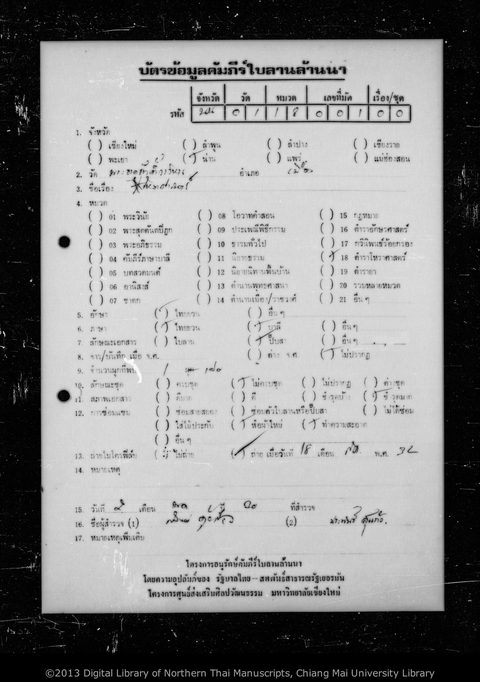
What this is
Horā — Lanna holasat, horasat (โหราศาสตร์) — is the reckoning of time and fortune: the lunar-solar calendar, the intercalary month that keeps it honest, the choice of auspicious and inauspicious days, the casting of a birth-chart, and the long planetary periods a diviner reads over a life. It descends from Indian jyotiṣa, carried north through Mon and Burmese intermediaries and reworked in Tai hands, so a Lanna horā manuscript sits at the meeting point of Sanskritic astronomy and local almanac practice.
At 388 witnesses it is the largest of the archive's wichaa-core genres — larger than magic and ritual, and every one of the 388 is flagged research-priority. It is also living knowledge: a mo du still opens tables like these today, which makes this genre the natural bridge between the historical record and the contemporary vernacular.
What is actually in an astrologer's book
The temptation is to imagine star charts. Read the titles and you find something more like a civil-engineering handbook for luck — a working compendium of tables for the decisions a household cannot afford to get wrong. The catalogue's own title lines, in the astrologer's spelling, give the inventory:
- Finding the moment. Ha wan di wan hai — seek the good day and the bad (ms 445, Wat Hia). Withi ha wan di (ms 351, Wat Si Mongkhon, palm-leaf, 1885). Tamla ha loek ha nyam and Tamla du loek nyam tang tang — manuals for finding the ฤกษ์ loek, the auspicious juncture, and the ยาม yam, the watch of the day (ms 5517, ms 5515 at Wat Si Khom Kham, the latter dated 1950). Thirteen titles across the genre name a loek or a munla loek, the "root juncture," including Loek 27 tua — the twenty-seven junctures (ms 2193, Wat Sung Men, palm-leaf, 1837), the Indian nakṣatra count carried north intact. Inference — the recurrence of 27 rather than 28 is the cleanest single fingerprint of the tradition's Indic descent anywhere in the catalogue.
- Days that are not neutral. The Lanna almanac does not merely rank days; it names their characters, and the names are extraordinary. Kalong wan sip hai — the way of the ruinous days (ms 4966, Wat Phra That Lampang Luang). Wan lokawinat — the day of world-destruction — bound together with the day for cutting cloth, the day for putting on clothes, the day the mother comes down from the house, and the first day of the house-posts (ms 5469, Wat Ban Luk). Wan duean phi kin — the days and months the spirits eat (ms 4960). Wan ka tok — the day the crow falls — filed beside the month in which people are born and the year people take up the sword (ms 5522, Wat Si Khom Kham). Thirteen titles in the genre carry wan, "day," in them.
- Reading a person. Cata sam can, Cata phu nying — the three-tier horoscope, and the woman's horoscope (ms 462, Wat Nong Bua). Suep cata nying cai, casting for female and male (ms 6429, 1939). Cata pi koet song thaen — the birth-year chart and the sending-off to the Thaen (ms 5535). Tamnai pi koet, prognostication from the birth-year (ms 469). Eleven titles name a cata.
- Reading everything else. Tamla du laksana kaeo mani, Laksana dap — the manual for judging the marks of a gemstone, and the marks of a sword (ms 2807, Wat Mueang Mo). Lakkhana khut nam bo, Lakkhana com puak — the marks of digging a well, and the marks of a termite mound (ms 5536). Lakkhana kan tai, Withi tham sop lae withi sang ban — the marks of a death, the method of handling a corpse, and the method of building a house, in one volume (ms 4964). Tamnai fan, dream interpretation, bound with the worship of four devatā (ms 5072). And Tamla bok fai — the rocket manual (ms 4952, Wat Phra That Lampang Luang), because Bun Bang Fai needs a date too.
- Acting on the reading. Six titles name a song kho (ส่งเคราะห์), the sending-away of misfortune — ms 5160 dispatches it to the nine devatā and worships the Four Kings; ms 5163 gives the words for pouring nam som poi, acacia water, over a person to send off an ubat. Eight name a suep cata, eight a khwan.
Inference — set the list end to end and the genre's real subject appears. It is not the sky. It is the moment — the hinge at which an action becomes safe or unsafe — and the astrologer is the person paid to locate it. That is also why the genre is so hard to keep separate from ritual: locating the moment and acting in it are one job, done by one person, out of one book.
The horā / saiyasat boundary is not a boundary
Fifty-nine of the 388 titles name a katha and 43 name a nyan — Untitled (Katha tang tang, Sainyasat), Untitled (Holasat, Tholanisan), Untitled (Nyan, katha lae holasat), Untitled (Holasat, Tamla ya, Sainyasat) (ms 4516, Wat Chedi Luang: almanac, pharmacopoeia and saiyasat in a single folding book). The diviner and the ritualist were routinely the same person, and the household manual bound the calendar next to the protective verse and the medicine.
Two witnesses make the point sharper than any statistic. ms 355 at the Nan Provincial Museum is catalogued as Holasat, Ao phua ao mia, Su khwan khao — astrology, taking a husband and taking a wife, and the soul-calling of the rice. ms 5562 at Wat Si Khom Kham binds monastic Vinaya, the funeral mātikā, a chant, and holasat into one object. And the Uppatasanti — the great Lanna pacification chant — turns up in this genre twice (ms 2560, Wat Sung Men, palm-leaf, 1767; ms 3127, Wat Muang Tuet, 1925) as readily as it does under liturgy or magic. The genre line records which content dominated a page; the object on the shelf is usually a hybrid.
The printed treatises: horā doing its day job
The contributed printed volumes have full transcription and translation, and they catch the astrologer mid-consultation.
Setting a wedding. Setting Up Ceremonies, Ancient Edition (p.125) says plainly whose job it is — the astrologer's — and then explains the reasoning, which turns out to be substantially puns. Monday and Friday are the favoured days, Friday especially, because suk (Friday) sounds like sukh (happiness). The month should be even-numbered, from the auspiciousness of khu, "a pair," because married life is a paired life — except the 8th and 12th, which are swapped for the 9th, an odd month, and best in its waxing half, because "9th, waxing" sounds like stepping up. As for the year: no year forbids marriage, though families with several daughters avoid marrying two in the same year, "probably because it would be too costly." Then the page does something no charm-book does — it tells the reader they may ignore all of it and reason from convenience instead, "in accordance with the teachings of Buddhism, as one sees fit." Inference — the calendar's authority is presented as customary, not cosmic, by its own handbook.
Naming a child. Conducting Religious Rituals, Complete (p.141) makes the astrological alphabet explicit. Letters are sorted into groups; a man's name should open with a letter from the Dech (power) group, a woman's from the Sri (glory) group, and letters from the Kalakini — the inauspicious group — must never appear at all. The justification offered is disarmingly sociological rather than occult: name a man "Bad," and people will call him Mr Bad, and being called it he will become it. The same volume has the presiding monk inscribe the host's horoscope with a stylus during a Buddha-image casting (p.84), and requires a foundation-stone tablet with the auspicious horoscope already cut into it before the ceremony begins (p.92).
Reading a face. Reading Women's Physiognomy runs the same logic over the body, head to toe, and its verdicts are brutal in both directions. Ears like a cow's ears mark a woman of bitter want and hardship, "who cannot find happiness even for the space of a single meal"; ears level with each other, proportionate to the face, red, with a wide and deep canal, mark a lady of rank whose husband will be a great personage (p.20). The craft is the phrommachat's, applied to flesh instead of a birth-year.
Consecrating anything. Akhom Magic of Phra Narai (p.143) fixes a consecration to an astrological coincidence rather than a plain date — "Saturday Five," a Saturday falling in the fifth lunar month on the fifth waxing day. The same treatise sets out the Itipiso of the Eight Directions (p.85–86), the itipiso verse split into a grid and deployed to ward off harm "coming from all eight directions"; the eight-direction Aṭṭhīso formula (p.30) does the same job in another book. Inference — the eight-direction schemes are where horā stops being a calendar and becomes a map: the same reckoning that assigns a character to a day assigns one to a bearing, and the 108 Na and the yant grids inherit that geometry directly.
Even a diet. The Life of Luang Por Thob (p.50) forbids one food to each birth-weekday — water spinach on Sunday, pork on Thursday, moringa on Saturday — with the charm's efficacy made to depend on keeping it. Your birth-day follows you into the kitchen.
The shape of the collection — a paper technology
Horā in this catalogue is an upper-northern tradition. It clusters in Phayao (90) and Lampang (79) ahead of Chiang Mai (51), Nan (50) and Chiang Rai (46) — the old muang of the Ping, Wang and upper Yom basins. The archive's own findings rank Phayao and Chiang Rai as the two provinces whose surviving corpus leans hardest toward astrology relative to everything else they kept. The largest single holdings are Wat Chiang Man (31), Wat Phra That Lampang Luang (30), Wat Si Sutthawat (29) and Wat Si Khom Kham (22). Script is overwhelmingly Tham Lanna — 377 of 388 — in the mixed Pali-and-Lan Na register.
The most telling pattern is physical. Where the canonical genres are overwhelmingly palm-leaf, horā inverts it: 295 mulberry-paper folding books against 85 palm-leaf. That is not an accident of survival. An almanac is a working reference, opened flat and read across a spread, and the concertina phap sa is the tool for that job in a way a bound stack of palm-leaves is not. When you browse this genre and see paper outrunning leaf by more than three to one, you are seeing the genre's use fossilised in its support. The holasat page follows this finding down to the level of the individual practitioner's manual.
Dates are sparse — only 38 witnesses carry one — but the span they anchor is the longest in the wichaa core: 1578 to 1973. The oldest is Athimat winitsai (อธิมาสวินิจสย), a determination of the intercalary month, from Wat Nantharam in Chiang Mai, 1578 — and it is worth pausing on what survived. Not a horoscope, not a charm: the calendrical arithmetic that decides which years get a thirteenth month. Two more copies of the same problem appear later (ms 3808, Wat Duang Di, 1835; ms 2647, Wat Phra Luang). Inference — the intercalation rule is the load the whole system rests on. If the calendar drifts, every auspicious day computed from it is wrong. The earliest thing the north bothered to preserve in this genre is the correction term.
A finding: the phrommachat is here after all
The phrommachat page reports zero witnesses, on the grounds that no title in the catalogue names one. Searched by the standard spelling พรหมชาติ that is correct. Searched by the Lanna scribe's spelling, it is not: ms 5040, Du phommacat nying cai (ดูพรหมชาทหญิงชาย) — "reading the phrommachat, female and male" — a mulberry-paper folding book from Wat Ban Ueam, Lampang, filed in this genre. It is one witness, undated, and it does not overturn the finding that the illustrated twelve-year almanac is drastically under-represented here. But it is not zero, and the reason it was invisible is the reason half this genre is invisible: the catalogue is indexed on Central Thai orthography and the north did not write that way.
Notes
- Read alongside the raw label. 374 of the 388 came in labelled Astrology; 11 were reclaimed from Undetermined and 3 from Miscellany by title markers. Those 14 have thin metadata and are worth checking against the image before citing.
- Most of it has no title. 306 of the 388 are catalogued as Untitled or no title, 29 of them as bare Untitled (Holasat). As with the untitled nyan-and-katha bundles, the content is real and the finding-aid simply cannot see it. Section-level reading, not title search, is what will open this genre.
- Dates are anchored by a handful. The 1578–1973 span rests on 38 dated witnesses out of 388 and should not be read as the genre's true range; paper does not survive, and the paper is where most of the working almanacs are.
- Where to go next. The holasat entity is the practitioner's own manual seen close up; phrommachat is its popular, illustrated face; suep cata is what the astrologer prescribes when the chart reads badly and thon is what is recited when it has already gone wrong. The divination tool, the moon complication and the glossary are the working surfaces; browse by need approaches the same shelf from the client's side of the table.
- The illustrated plates are the missing half. In an almanac the image often is the text — fate-figures, direction wheels, animal-cycle plates — and a title line captures almost none of it. Filling in the image download phase for this genre would do more for it than any amount of further title work.
What the bots have noticed
Auto-derived from the catalogue and the curiosity bots — refreshed automatically, not hand-written. Each note links to its finding.
- Where the stars were written down — 2 provinces whose surviving corpus leans toward astrology — the reading of time, fate, and the calendar — well above the corpus norm. see the finding →
The live connections graph and any current curiosity-bot findings.
Connections
- Horā almanac (Holasat) (includes)
- Phrommachat (12-year almanac) (includes)
- Magic & Ritual · ไสยศาสตร์ (related to)
- Liturgy & Chanting · บทสวด (related to)
- Katha (Pali spell-formulae) (related to)
- Yantra / Yan (nyan) (related to)
- Suep Cata (life-extension rite) (related to)
- Su Khwan (soul-calling) (related to)
- Thon (protective / funerary rite) (related to)
- Didactic & Moral · คำสอน (related to)
- Grammar & Lexicography · ไวยากรณ์ (related to)
- Medicine · ตำรายา (related to)