wichaa › Subjects › Horā almanac (Holasat)
Horā almanac (Holasat)
What this is
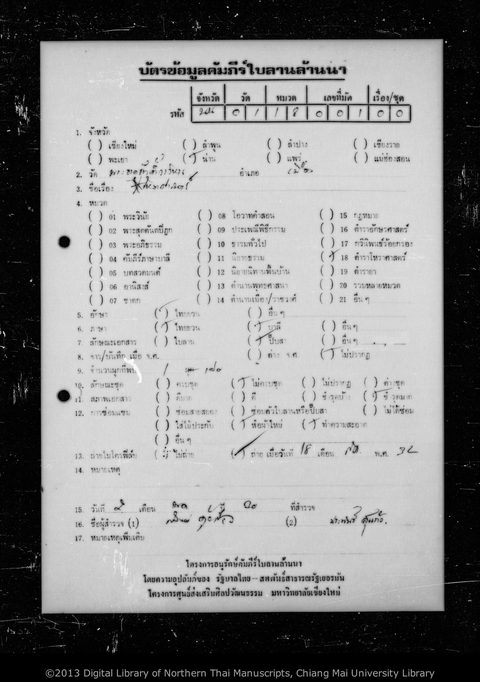
Holasat (โหราศาสตร์, horāsāstra; also Horasat) is the almanac of the horā — the working book of northern astrology. It is what a mo holasat opens across his knees when a family arrives at his house wanting to know which day to marry on, which month to raise the house-posts in, whether the sickness in the back room is an illness or an offence, and what the child born last Tuesday is going to be like. If astrology is the genre, holasat is the practitioner's own copy of it. The catalogue holds 99 witnesses whose titles name it.
This page does two things. It reads the shape of those 99 — which turns out to say something sharp about how the north actually used this knowledge — and then, because the palm-leaf records are title-level only, it goes to the printed treatises to show what the reckoning does when someone performs it.
The paper tells you it was in use
Start with the material, because it is the finding.
The Lanna manuscript world is a palm-leaf world. Across the 6,959 catalogued witnesses, 5,800 are palm leaf and 888 are mulberry paper. The canonical shelves are lopsided further still: 2,192 palm-leaf against 142 paper in the Buddhist canon, 1,435 against 48 in jātaka. Palm leaf is the support you choose when a text is to be inscribed once, correctly, and kept.
Astrology inverts it. Of the 388 witnesses in the astrology genre, 295 are mulberry paper and only 85 palm leaf. And the holasat titles invert it hardest of all: 84 mulberry paper against 14 palm leaf.
Inference — this is not an archival text. It is a working document — consulted, corrected, copied and recopied on cheap fibre because it was in the hand most weeks and wore out. Everything else about the 99 agrees. 94 of them are undated; the five that carry a year carry it in Cunlasakkarat — CS 1180, 1244, 1261, 1272 and 1309 — and the four the catalogue has converted land at 1882, 1899, 1910 and 1947, which is to say the surviving copies are recent copies of a much older art. 94 of the 99 are in Tham Lanna script (3 Thai, 1 Tham Lue). And 92 of the 99 carry the research-priority flag — 93%, one of the densest priority shares of any subject the scorer touches.
It almost never travels alone
Only 29 of the 99 are catalogued as a bare Untitled (Holasat). 56 of the 99 titles name at least one other work bound in with the almanac — and the company it keeps is the best description of the job:
- 15 with katha — Katha, Holasat; Katha lae nyan tang tang tamla holasat.
- 14 with nyan, the drawn yant — Holasat nyan; Nyan tian lae holasat, almanac bound with candle-yantra.
- 8 with sainyasat, the magic-and-ritual register — including Holasat lae sainyasat three separate times over at Wat Lai Hin Luang alone.
- 3 with khwan calling — including คำเรียกขวัญนางคำ และโหราศาสตร์ (ms 5674, Wat Yuan), the words for calling back Nang Kham's khwan, bound with the almanac.
- 2 with suep chata, the life-extension rite — both at Wat Yuan in Phayao. Inference — that pairing is the practitioner's whole logic in one binding: the almanac finds the flaw in the fate, and the rite mends it. Diagnosis and treatment, one book.
And then the bundles that are simply a life: Holasat, Ao phua ao mia, Su khwan khao — almanac, taking a husband and taking a wife, and the calling of the rice-soul (ms 355, Nan Provincial Museum). Holasat lae tamla sang ban — almanac and the house-building manual (ms 2842, Wat Klang, Phrae). Withi pha koet lae holasat. Pu thao son lan, Holasat — the elders' teaching to their grandchildren, bound with the tables. Lakkhana cang, Hiak khwan cang, Tamla hian phasa tai yuan, Holasat — elephant lore, elephant soul-calling, a primer for learning to read Tai Yuan, and the almanac, in one bundle at Wat Pa Mueat (ms 538).
The one that reads like a person rather than a genre is ms 5062 at Wat Ban Ueam, Lampang: Horasat lae banthuek kan pai krung thep khong khruba wong — the horā tables, and Khruba Wong's record of his journey to Bangkok. Somebody's almanac and somebody's travel diary, kept in the same bundle.
Where the almanacs are
There is no dominant library, and that is itself the point. Holasat spreads across Nan (28), Lampang (25), Phayao (22), Phrae (7) and Chiang Mai (4), and no single temple holds more than ten: Wat Yuan in Phayao 10, Wat Pa Mueat in Nan 9, Wat Phra That Lampang Luang 9, Wat Lai Hin Luang 6, the Tai Lue Wat Nong Bua 6, Wat Klang in Phrae 5, Wat Si Khom Kham 5.
Inference — the scholastic genres pool in great collections; holasat sits wherever a mo practised. It is distributed the way a trade is distributed, not the way a canon is. You can walk that distribution on the atlas and the wats map.
Leaf for the doctrine, paper for the lookup
One temple makes the whole argument visible. Wat Si Khom Kham in Phayao holds 22 astrology witnesses. Two of them are on palm leaf: มุลละรึก, the root of the ฤกษ์ (rerk) — the auspicious moment — and ปถมมูลละ, the primal root. The rest of its divination shelf is mulberry paper, and includes exactly the books you would reach for with a client sitting in front of you: ตำราดูฤกษ์ยามต่างฯ — the manual for reading the rerk and the hour; ตำราหาฤกษ์หายาม — the manual for finding the rerk and the hour; หาฤกษ์ยามต่างฯ; four separate ตำราโหราศาสตร์; and ยันต์ต่างฯ และปีเกีดวันเกีด, yant plus birth-year and birth-day.
The pattern holds corpus-wide. Of the 11 astrology witnesses whose Thai title carries ฤกษ์, 8 are palm leaf and 3 are mulberry paper — and all three of the paper ones are the how-to-find-it manuals at Wat Si Khom Kham. The leaf ones are the doctrine and the stories, and five of the eight come from Phrae: ฤกษ์ ๒๗ ตัว, "the twenty-seven rerk," and มุลลฤกษ์, the root-rerk, both at Wat Sung Men; มูลละฤกษ์ again at Wat Mueang Mo; ตำนานฤกษ์, the rerk's own chronicle, at Wat Phra Luang; นิทานนักขัตตฤกษ, the tale of the lunar-mansion rerk. And then, three times over across Chiang Mai, Chiang Rai and one unattributed bundle, นิทานฤกษ์ชาวเจ็ด — "the tale of the rerk of the seven" — which is a story filed in the astrology genre.
Inference — the tradition kept its theory on leaf and its lookup tables on paper. Doctrine is inscribed once and preserved; the tables are consumables.
What the tables actually look like
Because the palm-leaf catalogue is title-level, the archive can rarely show a holasat page. There is one exception, and it is a good one.
ms 363 — mulberry paper, Tham Lanna, dated BE 2475 (1932), from Wat Si Mongkhon (Kong) in Nan — is catalogued under liturgy and titled for its exorcisms: ถอนบ้าน, ถอนเรือน, ถอนผีตาย ฯลฯ, "undoing the village, undoing the house, undoing the death-ghost, etc." Its pages 25 to 27 are horā tables. The transcriber marks them as ตารางโหรา with twelve numbered columns, ๑ through ๑๒; row one reads out the twelve Lanna year-names — เม็ด, สะง้า, ไส้, สี, เหม้า, ยี, เป้า, ไจ้, ไค้, เส็ด, เร้า, สัน — and every following row rotates the cycle by one position. At the right-hand end of each row sits a คำทาย, a verdict, in Tham script the transcriber could not read with confidence at working resolution.
Inference — even unreadable, the geometry is the whole instrument. A twelve-place cycle rotated against itself is how you cross one year with another — a birth-year against a current year, or a bride's year against a groom's — and read the answer off the intersection. That is the machine the Phrommachat prints in pictures, sitting here in a Nan exorcism book, undeclared in its title.
What the diviner does with it
For procedure, the archive has to change shelves: the contributed printed treatises carry full text, and they are explicit in a way the palm-leaf titles never get to be.
Choosing the day
The Yantra Craft and Katha of the Lanna Lineage prints a two-sided day-table at p.4–5 — waxing moon on the left, waning on the right, nights 1 to 15 down each — and it is pure verdict, no reasoning shown. Waxing night 1: inauspicious, brings suffering. Night 2: auspicious, "people will be kind and fond of you." Night 4: inauspicious, "someone will wish you harm." Night 8: "there will be quarrels and disputes." Night 15: "calamity and illness will arise." Cross to the waning column and night 15 flips completely — "auspicious: fortune will come pouring in." Eight of the fifteen waxing nights are bad. The same page then rules out days by month: months 1, 6 and 10 are governed by Mars and forbid Tuesday; months 3, 7 and 11 are Saturn-and-Jupiter and forbid Saturday and Thursday; months 4, 8 and 12 forbid Friday and Wednesday. Inference — the two tables run on different clocks — one lunar, one planetary-weekday — and a date has to clear both. Consultation is not a lookup, it is an intersection, which is exactly why you go to somebody who owns the book.
Choosing the wedding day
The Setting Up of Ceremonies, Ancient Edition gives the fullest account in the corpus of what a client is actually buying (p.123). "This matter is the duty of the astrologer or a knowledgeable person to determine," it opens, and notes drily that the person who goes to consult is "generally from the woman's side."
- The day. Monday and Friday are the favoured days, and Friday overwhelmingly — "because the sound of the word suk [Friday] matches the sound of the word sukh [happiness]." But those are the general auspicious days. "When a specifically auspicious day is desired, it is best to bring the birth date, month and year of the bride and groom to the astrologer," who calculates from both.
- The month. Marry in an even-numbered month, on the auspiciousness of khu, "pair," because married life is a paired life. Except: not the 8th and not the 12th. Those get moved to the 9th — an odd month — and if it falls in the waxing half of the 9th, better still, because "9th, waxing" sounds like stepping up.
- The year. No year forbids marriage. The only rule is social: families with several daughters do not like to marry two in one year, "probably because it would be too costly."
The treatise then adds a note that is worth quoting for its tone: one may follow custom, "or one may use reasoning based on convenience, in accordance with the teachings of Buddhism, as one sees fit." Inference — the almanac's authority is real and its practitioners know it is negotiable. That double register — binding table, permissive footnote — is the everyday shape of this knowledge.
Choosing the hour to build
The same volume follows a foundation-stone rite from first principles (p.56–58). What gets buried under a new ordination hall, provincial office, bank or restaurant is a stone slab inscribed with the auspicious hour, day, month and year — the duang rerk, the moment itself, cut in stone and put in the ground. Around it go nine pegs of nine woods, each a pun made solid: jackfruit for power, chaiyaphruek for victory, ratchaphruek for high rank, teak for sanctity, rosewood for stability, thonglang for money and gold, kankrao to keep danger off. (The manual then notes you can buy the set at any monastic-supply shop.)
The rite that consecrates the hour is a meal. Before the monks chant, "someone knowledgeable in proper ceremonial matters, such as an astrologer or scholar," must honour the auspicious time with a pair of bai sri, two young coconuts, a boiled pig's head (pork loin if the head is too dear), boiled chicken, duck, shrimp and steamed snakehead fish, red and white sweets, yam and taro, a hand of bananas, roasted peanuts and sesame, betel and areca and cigarettes, two vases of flowers and a pair of candles. If the market has no shrimp, the treatise says, leave out the shrimp. Inference — the astrologer here is not a forecaster. He is the officiant of a transaction with a moment, and the moment is fed.
Reading the omen that arrives uninvited
Not everything is scheduled. The Key to Saiyasat sets out อุบาทว์ — the ill omen — as "an event that arises through the power of a deity, showing and telling us of it, intended for us to know and to receive and remedy" (p.141). It is read by direction: east is the omen of Indra, southeast of the Fire God, northwest of the Wind God, north of the Moon, northeast of Phra Phraisop. And each direction has a consequence (p.142): east, you will lose money; southeast, fire and heartache; south, illness or death; southwest, thieves; west — and this is the tradition declining to be uniformly grim — "one will gain fortune, including fortune from a woman"; northwest, happiness; north, "various satisfying fortunes." The directions are reckoned within the property: your house, your workplace, your orchard, your paddy, or the town, the temple precinct, the palace.
The Lanna register of the same idea is ธรณีสาร (tholanisan) — the earth-essence affliction — and the corpus holds both its remedy and, remarkably, its catalogue of triggers. The Lanna yantra manual prints a rite for น้ำมนต์ธรณีสาร, dharani earth-water, to be sprinkled over a person under misfortune, a chronic invalid, or "inauspicious things that have arisen within a house" — and the invocation that charges it runs, for two solid pages, a list of what those things are. It has to be read to be believed: a bamboo whose tip bends back toward the west; rats squeaking in the house calling their companions to gather; a house-post that oozes resin; wasps building on the eaves; a monitor lizard running up onto the house; a python climbing onto the loft; a vulture perching on the roof; husked rice sprouting into a shoot; mushrooms growing on the stove; foul rain that will not stop; a pot that rings; jackals barking in the lane; a vulture dropping a corpse onto the roof; a pumpkin-vine climbing onto the loft and turning into a Great Kala; a house-post struck by lightning; a hen laying eggs at the gate; a boundary-post that has taken root in the earth; a stone broken in two. Inference — this is what the almanac is for. Half of divination is the calendar, and the other half is a household watching itself for the moment the ordinary turns strange — and needing someone with a book who can say which strangeness counts.
Reading the person
Finally, the reckoning runs inward. The second volume of Thai Traditional Medicine pauses its pharmacology to derive a patient's constitutional element from the year, month and day of birth (p.139–140). Born in the Year of the Rat — Water. Ox — Earth. Tiger and Rabbit — Wood. Dragon — Metal. Snake and Horse — Fire. Goat — Metal. Monkey and Rooster — Iron. Dog — Earth. Pig — Water. Then the same by birth-month in threes (5/9/1 Fire, 6/10/2 Earth, 7/11/3 Wind, 8/12/4 Water), and by birth-day (Sunday or Saturday Fire, Monday or Thursday Earth, Tuesday Wind, Wednesday or Friday Water). The prescriptions that follow are dosed against that reading — so many parts sakhan, so many parts dipli, "treats excess of the Tejo element."
Inference — this is the seam the archive exists to make legible. A doctor reaching for a birth-year table is not doing astrology as a hobby. In this system the almanac, the pharmacopoeia and the rite are one profession, and the horā manual is where its clock is kept.
Notes
- Watch the alias, and one that was mis-glossed. Holasat / Holsat / Horasat / Horā fragment across transliterations, and the 99 folds them together deliberately — that normalisation is what an entity article is for. But the bundle-partner Tholanisan is not a calendar, as this page previously implied: it is ธรณีสาร, the earth-essence affliction and the holy-water rite that lifts it, and the corpus holds four witnesses under that name — three at Wat Phra That Chang Kham in Nan (one of them bundled with holasat) and one at Wat Hia. The correction matters, because it changes what Holasat, Tholanisan is a book for: not almanac-plus-calendar, but almanac plus remedy.
- Separate the tables from the bundles. Tamla holasat — the rule-tables proper — is a distinguishable sub-family (12 witnesses carry that phrase in their title), and pulling it apart from the almanac-plus-ritual bundles is the obvious next pass. The rerk manuals are the other clean sub-family, and their leaf-versus-paper split is already a finding.
- Search the variants before believing a zero. The Phrommachat page reports a witness this catalogue held all along and a Central Thai spelling could not see — ดูพรหมชาทหญิงชาย, with ท for ติ. The same caution applies here: any count on this page is a count of the spellings tried, and Horā has more of them than most.
- A crawl and transcription priority. The 99 are 92-percent priority-flagged and almost entirely untranscribed; the single digested exception, ms 363 pp.25–27, is a table nobody has yet been able to read. A high-resolution pass over those three pages would give this archive its first legible Lanna horā table — and the search image for every bundle after it.
- Read alongside its neighbours. The Phrommachat is the household face of the same science; the lersi is where the astrologer's own lineage claim terminates; the divination pages and the single divination-and-omen witness the catalogue holds sit next door.
- The living practitioner is a primary source. Any working mo holasat's manual — historical or bought new this year — belongs in this record, and so does the fact of how it is used. This archive treats the modern almanac as continuous with the palm-leaf one, not separate from it; the living market layer is where that continuity gets measured.
The live connections graph and any current curiosity-bot findings.
Connections
- Lersi / Ruesi (ascetic-seers) (in the lineage of)
- Phrommachat (12-year almanac) (paired with)
- Astrology · โหราศาสตร์ (part of)
- Liturgy & Chanting · บทสวด (related to)
- Magic & Ritual · ไสยศาสตร์ (related to)
- Katha (Pali spell-formulae) (related to)
- Yantra / Yan (nyan) (related to)
- Divination & Omens · การทำนาย (related to)
- Suep Cata (life-extension rite) (related to)
- Su Khwan (soul-calling) (related to)
- Paṭiloma (reversal & mirror katha) (related to)
- Thon (protective / funerary rite) (related to)