wichaa › Subjects › Yantra / Yan (nyan)
Yantra / Yan (nyan)
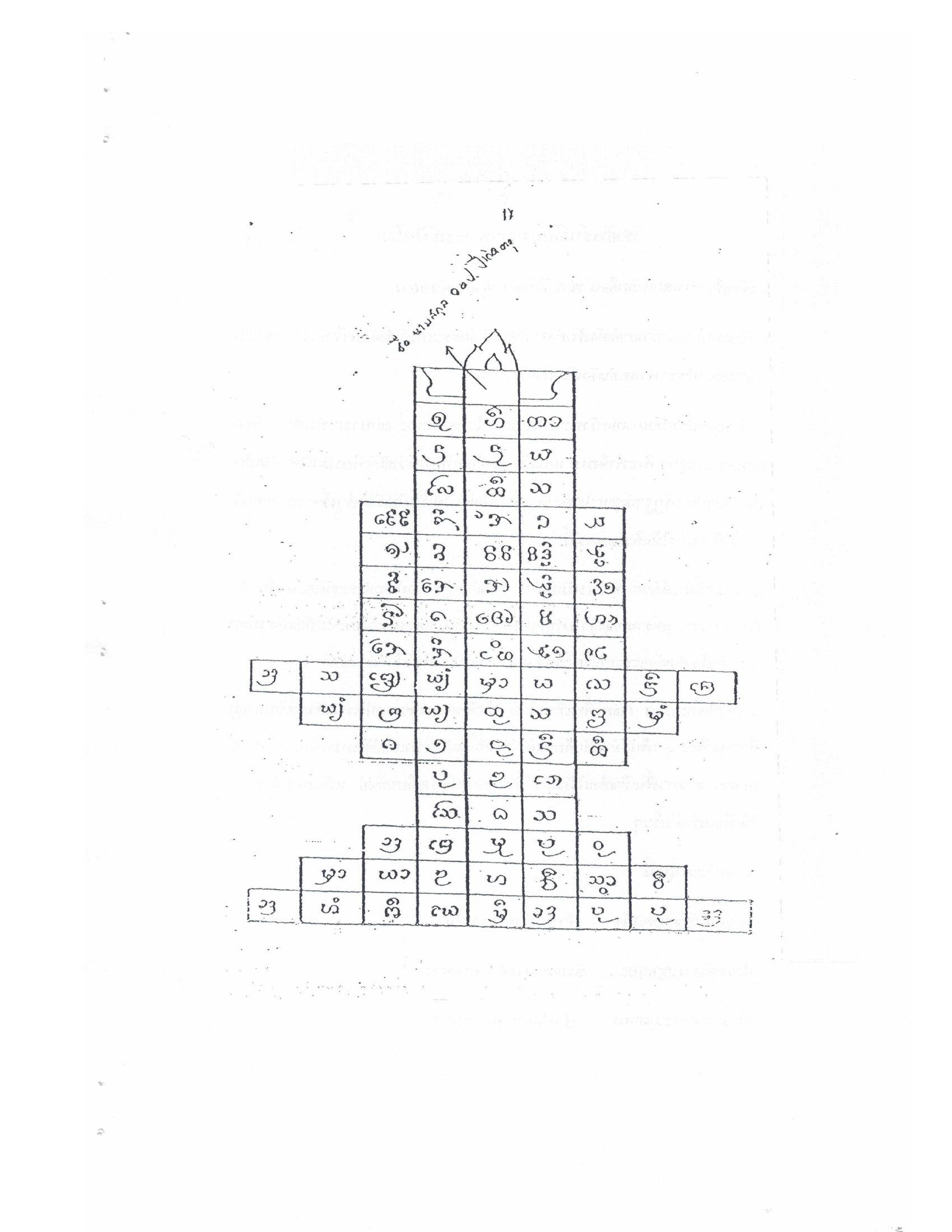
Diagram — A tower-form yantra: a magic-number grid built up into the silhouette of a chedi (stupa), narrow at the crowning tier and widening through stepped reg
What this is
A yantra — Lanna nyan (ยันต์) — is a sacred diagram: a grid of syllables, numbers and figures that concentrates protective or auspicious power into a drawable form. Where a katha is the spell spoken, a nyan is the spell inscribed — laid onto cloth, paper, metal foil or skin so that its efficacy stays fixed in an object. The catalogue holds 74 witnesses in the palm-leaf collection whose titles name a nyan, plus three of the contributed printed treatises that name the craft outright — 77 in all — and they sit squarely in the wichaa core.
A note on the name: the corpus writes this as nyan, not yantra, which is the same reason the entity was initially invisible to a naive search. Beware, too, that nyan also transliterates ñāṇa ("insight") in scholastic titles; the match here is pinned to the diagram sense (nyan lae katha, long nyan, standalone nyan) to keep the two apart.
What follows tells the craft the way the manuals tell it — from the first dot on the page to the moment you find out whether it worked.
The first dot, and the world it came out of
Before a yant, there is a na — a single glyph, the smallest unit of the drawn magic. And before the na, the manuals put a cosmogony.
The Scripture of 108 Magical Na (p.2) tells it plainly. In the first aeon, when the world-plane was still empty and covered by water that was steadily drawing back toward dry land, Thao Sahampati Brahma cast his divine vision downward. He saw lotuses standing above the water bearing the syllables นะ โม พุท ธา ยะ — Na Mo Phut Tha Ya. (The passage says four lotuses and then names five syllables; the homage verse printed a page earlier says pañca-padumaṃ, five lotuses. The archive keeps the wobble rather than tidying it.) He recognised the form of the Na of the First Aeon rippling on the surface, as though it were the root of the four lotuses themselves; he paid homage to it, and prophesied that this aeon would be the Auspicious Aeon in which five Buddhas would wake. Then he threw down blades of kusa grass, and the earth arose, and after that there were humans and animals and plants. Inference — the sequence matters and is not decorative: in this account the letters precede the earth. The tradition is not claiming that writing is a good way to describe the world; it is claiming that writing is what the world was made after.
So the treatise's rule follows: before you inscribe any na at all, you speak homage to Sahampati Brahma, the primal cause. And there is an old line for students in a hurry — whoever masters Pathamang Phinthu, the first dot, "need not wait for the rest; understanding of Na comes of itself."
Note the manual's own careful distinction, worth keeping: a na is "a kind of special script-character — it is not, properly speaking, a yantra." The archive's gallery of the 108 Na holds 142 entries sliced out of that one book, which advertises on its cover นะวิเศษมากกว่า ๓๐๐ นะ — "more than 300 magical na." A hundred and eight is a number, not a count.
Five strokes, five consecrations
Here is the thing the title line can never show you: a na is not drawn, it is assembled, and each part is switched on before the next part is allowed to exist.
Every na-character, the Scripture says (pp.3–5), is built from five essential parts, and they are described as a small anatomy:
- พินธุ phinthu — the dot, a single hollow circle.
- ทัณฑะ thanda — "a fine walking-stick," the stem the dot now sits on.
- เภทะ phetha — "splitting apart," a stroke branching off the stem.
- อังกุ angku — "bent into a hook," the goad-curve at the foot.
- สิระ sira — "becomes a head," the coil that finishes it.
Each has its own line of the Pathamang formula, recited as the hand moves: Pathamang phinthu kangchatang for the dot, Thutiyang thanda mawcha for the stick, and so on through Panchamang sira sangchatang. But the formula is only half of it. Once the dot is inscribed, it must be consecrated with the incantation proper to the dot before the stick may be drawn; once the stick is inscribed, it is consecrated before the branch; and so on to the head. Five strokes, five separate acts of empowerment, in order, and the na is not complete until the last one lands. The book allows a working shortcut — "if working in genuine haste, one may use only the single inscribing formula" — which is exactly the kind of concession a real trade makes and an invented one never does.
Then the object has to be named. The naming formula runs Namapang samaso yuttattho yuttattha — "of all names; let the teacher intend that this be named Na Metta" — and it is followed by a line that is the most humane sentence in the whole craft: Anupatitthanang vuttayogato, "whatever example has not yet succeeded, may the venerable teacher bring it to completion by means of this formula." A built-in repair clause. The teacher's authority covers the student's mistakes.
The Tamra Phetcharat Maha-yant adds the taxonomic punchline: there are well over a hundred kinds of na, each with a distinctive name, and the name is the function — "a na named kan is simply protective; a na named khong is simply for invulnerability; a na named metta is simply for loving-kindness; a na named khlaeo khlat is simply for evasion of danger — you need not doubt this." The whole effect vocabulary of the tradition, carried as proper nouns.
The blind yantra
The prohibitions are where a craft tells you what it actually is.
The single most important one, stated in nearly identical words by two separate presses: a letter or numeral must never be allowed to touch or cross the ruled line of the yant. A yant in which that happens is called ยันต์บอด — a blind yantra — and it cannot be used (Yantra Inscription Formulas p.33; Phetcharat). Alongside it: many yants must be drawn in one unbroken stroke from start to finish, and the drawing must reach the corner exactly as the formula reaches its end. Stop partway and the yant is "reckoned spoiled." If you have stopped and want to salvage it, there is a further formula — Sandhiyantaṃ santaṃ vikiriṅkare — a splice.
Different shapes carry different lines. Four-cornered and interlaced yants take Catukoṭṭhā mahāyantaṃ santaṃ vikiriṅkare, landing on each corner in turn. A square with a centre line but no weave is a kraduk yant, a bone yantra, and takes Aṭṭhi yantaṃ. A yant bearing any numeral takes Lekha yantaṃ. And for an inverted Buddha figure you write the head first — Sīsa buddhā panaṣ jāyate, "may the head thus come into being as the sacred body" — then the feet, then the half-moon, then the void-centre, then the unalome at the very tip, which signals that the yant is finished.
Even the tools have to be washed first, and washed with words. On Making Things Pure (Yantra Inscription Formulas p.45) reasons that materials "may have passed through something inauspicious, carry defilement, contain impure elements, or have been obtained improperly against morality," and so are unfit. The remedy is a short liturgy with a different line for each object in the workshop: Buddham parisuddho to purify yourself and the stylus; another to consecrate water for washing the mouth and hands; Ongkarn pinthunathang three times over the stylus; then, one by one — Imang pinthukappang loha chinatayo parisuddho to mark lead and copper, Imang pinthukappang nakhasuwanno for silver, gold and nak-alloy, Phatiphinthukasi for cloth, paper and thread, Mikkhamillatho ahosi for the ink. The maker bathes, and keeps the Five or Eight Precepts. Inference — this is a purity regime addressed to a supply chain: the metal came from somewhere, the paper came from somewhere, and the yant inherits wherever that was. It is the same logic the market side of this archive reads under what a thing is made of.
The mind is a material too. Phetcharat sets out how to prepare it before consecrating, and the instruction is frankly somatic. For invulnerability and weapon-warding: make the mind "strong — hard as a diamond or stone." For maha-sane, great charm: "soft, gentle, and tender, free of anger, and ever fresh and bright." For rank, wealth and glory: put down every burden in the disposition of the mind, make it steady, and then "spread loving-kindness down upon those very things" — the money, the gold, the gain — until the mind is free of hindrances. The same hand, three different weathers.
Why there are numbers in it
The grids of digits that fill these pages look, to an outsider, like magic squares. They are something stranger and more legible: abbreviations.
The reasoning is spelled out (Yantra Inscription Formulas p.33): a yant's compartments are small, and the formulas are long, so numerals stand in for the letters. Write 7 and you have written Sangvithapukkayapa, the heart-formula of the seven books of the Abhidhamma. Write 9 and you have written Asangvisulopusapuka, the Navaharakhun, the nine virtues of the Buddha. A cell holding a digit is a cell holding a scripture, folded.
The shapes are read the same way (Phetcharat). A round yant signifies the face of Brahma, or the countenance of the Buddha. A square is the four elements, or the four continents. A small triangle is the Buddha, Dhamma and Sangha, or the three worlds. Sun and moon together mean that we, born into the world, were given the sun and moon to know time by. An arrow is Indra's arrow, for warding off danger. And the unalome, the curl at the tip, is explained as breath: in an ordinary person the breath wanders, but in one whose craving is cut "the breath that runs straight to Nirvana, straight to the centre point at the crown of the head, is called the unalome — running straight, not wavering as we ordinary people do." A yant ends in a picture of an unwavering breath.
Inference — taken together, the numeral-abbreviation rule and the shape-glosses mean a yant is compressed, not cryptic. Everything in the grid is expandable back into text. This is precisely why describing the diagram pages matters more here than anywhere else in the archive: 129 diagram pages across the contributed volumes now carry emic descriptions, and the largest single block of them (54) comes from the sak-yant stencil book, which is almost nothing but patterns to trace onto skin. A yant that is only photographed is a yant whose sentences are still folded shut.
Where they actually get put
The manuals are not abstract about placement, and this is where the craft stops being a theory of the cosmos and becomes household infrastructure. The Phetcharat yant-gallery (pp.14–55) reads like an inventory of a Thai house with the magic left visible:
- On lead, at the door. A 6×4 khom grid seals the house door against enemies; a 4×4 numeral grid closes the door and wards off ghosts and dangerous animals; another simply means burglars cannot break in (pp.14, 20).
- In the pillow. A 5×5 grid inscribed on a pillow "binds a person so they cannot rise," with a spell to be said 109 times, and a house-shaped yant placed on a wife's pillow keeps love "deep, never to be forgotten" (pp.15, 22).
- In the make-up. A yant inside a beeswax lip-balm case is a love-charm; a cross-shaped yant worn in a compact makes the mouth charming, "speaking to any creature wins its heart without deceit" (pp.15, 23). Compare the Khun Phaen market-walk katha, which ends the same way — thunder, then a cosmetics counter.
- In the drink. A diamond yant on paper goes in a bowl, water is poured over it, the bowl is consecrated, and you drink: "its effect lasts three days" (p.23). A lead yant sits inside a water bottle so a child can play with it and drink from it safely (p.22).
- At the child. A bodhi-leaf yant is hung at a cradle against Mae Sue, the child-snatching spirit; a numeral grid with heart-marks in its cells "protects a child from being seized by a ghost" (pp.47, 29).
- At the boundary. A stupa-shaped yant is set at the eight directions to keep evil spirits out; another goes on the house post against every harm; another seals a post-tip against fire (pp.29, 26).
- In the food. A small square yant is tucked into a betel leaf and given to a woman to eat "so that she will fall in love, it is said" — and, on the facing logic, a nearly identical yant on a betel leaf is fed to an animal to inspire deep affection (pp.55, 26).
- Under the mat. A six-petalled lotus yant goes under the sleeping mat against sannibat fever; a bodhi-leaf yant with a meditating figure goes under the mat against illness generally (p.46).
- On the winnowing tray, in the mouse-hide pouch, on the prayer beads, on the takrut, on the pha prajiat cloth, and on skin — the manual's own list of supports (pp.47, 68), which is to say: anything you own.
Inference — the collection's material profile and this list are the same fact seen from two ends. A tradition that puts diagrams in pillows, cradles, drinking water and lip-wax is a tradition that will keep its diagrams on paper, not palm-leaf, and will replace them.
The candle that is your own name
The most systematic yant procedure in the corpus is not drawn on cloth at all. It is drawn on wax and then burned, and it is the northern signature.
The Yantra Craft and Katha of the Lanna Lineage is largely a book of candle-yantras (เทียนยันต์), and they run to a fixed eight-step template that repeats down the whole volume with only the target changed. Step one, always: write the person's given name, surname, day, month, Buddhist-era year of birth, and age. Then recite the inscription formula — Akkhara-yan dang san dang uppatchati … lekha-yan dang san dang wikringkhare — then the naming formula, then a line declaring what this particular candle shall be called, then the awakening verse. Then you roll it.
And the rolling is the detail that gives the whole system away. Before the wax goes on, you make the wick from sacred thread cut longer than the person's age — one strand, measured in years of a life. Beeswax is laid in the sun until it softens, judged by feel, rolled with a head and a tail like an ordinary candle, then dipped through a mould so it sets fast. Then it is lit in front of the Buddha image and you sit and chant until it burns out. The candle is a clock set to the length of a person, and the rite lasts exactly as long as it takes to consume them in effigy.
The named candles in that one book are a portrait of what people actually needed: the Naga-King Candle for dispelling misfortune; Phra Chim, Receiver of Fortune; Maha Brahma Opening the World; the Piyo — "Beloved" — Candle; the Victory Candle; Phra Sivali in Three Bands; the Albino Walking-Catfish Candle; the Female-Male Hand-Leading Candle; the candle that seals the mouth, seals the ears, seals the eyes, whose notes are almost comically economical — it makes them not want to hear about our affairs, "no need to write on the ear"; not want to see what we do, "no need to write on the eye"; unable to harm us, "no need to write on the hand" — and which is forbidden on a wan phra, a Buddhist observance day.
Then the domestic end of the ladder. The candle to subdue the spirit under the stairs: trace the print of your own right foot onto mulberry paper, inscribe the yant onto the footprint, write the target's name and birth date and address, summon its mind with Ehi jit dang, and make the wick out of a used cotton wrap-cloth, a used foot-wiping cloth and a used rag twisted together with fresh sacred thread. Light it at the stairs and walk up reciting seven times, down reciting seven times. And the candle to subdue the toilet bowl, same template, same wick of foot-cloth and wrap-cloth, and an ending no reader forgets: light it at the bowl, let it burn all the way down, pour the ash into the bowl, defecate or urinate onto it, and flush it away.
Inference — this is the clearest available answer to the question the whole entity poses. A yant is not confined to shrines, battlefields and love affairs. It is the standard-issue instrument for anything in the house that has a will of its own — including the stairs and the plumbing — and its grammar (name, birth date, formula, wax, fire) does not change when the target does.
Four ways to find out whether it works
Efficacy in these books is not asserted. It is tested, and the tests are the best writing in the corpus.
The Maha Yant Manual (pp.55–58) teaches the Yot Sin, the "Highest Precept," a five-syllable formula, and then says something remarkable for a magical manual: do not believe it right away when found — test it first. What follows is a sequence of four escalating trials, each introduced by the same shrug of a sentence, "If you still do not believe it…"
First: write the given yant on your palm, hold your breath and recite the Highest Precept until the breath is spent, strike the palm against your own chest, then call over the sweets-seller and haggle properly for the price. Eat, keep chanting, and when you are full do not get up — go on reciting. If the seller shoulders her tray and walks off without ever asking you to pay, it is the genuine article.
If you still do not believe it: write the Male Yantra on your right palm and the Female Yantra on your left, put turmeric in the right hand and lime paste in the left, hold your breath, recite, press the right palm down onto the left, recite a little longer — then open your hands and see what has become of the turmeric and the lime.
If you still do not believe it: buy scented oil from a shop without haggling, write the yant on a bai rak son leaf, recite seven full times, steep the leaf in the oil, chant a further 108, then anoint a mouse and a cat with it. Say to them aloud, "You two creatures, I beg you, do not bite one another." Recite the Precept silently, and let them go.
If you still do not believe it: stand out in the sun on one leg with your arms crossed, the yant written on your palm, strike your chest, and keep reciting until your own shadow shrinks smaller and smaller and vanishes entirely.
And if you still do not believe it: take a lime from a branch pointing east, write the yant on the fruit, recite 108 times, say "Oh you, I beg of you," and go on reciting. If the lime turns out sweet, with no sourness at all, it is truly the genuine Highest Precept — and after that, the manual says, "it can be used for absolutely anything, very well indeed."
Inference — look at what those four tests have in common. Not one of them is a duel. They are a merchant who forgets to charge, two spices that change hands, a cat and a mouse who decline to be enemies, and a shadow that goes away. The proofs of this magic are all small suspensions of ordinary self-interest — which tells you what the tradition thinks power actually looks like when it arrives.
The same book is candid about what it does with that power. Immediately after the tests come the maha-la-luai charms of overlooking and forgetting, including one whose worked example is a mother walking past with a nursing child, who hands the child over when asked and reaches her own house without noticing it is gone (p.58); and a rite to separate a husband and wife — his name on a jak-palm leaf, hers on a tao-rang leaf, the two leaves pressed face to face and buried at a cemetery or a three-way crossroads, entrusted to Nang Phra Thorani, and "within three days they will separate as though gone mad" (p.59). Nothing in the manual flinches from this, and nothing in it recommends it either. It is a list of what the craft can do.
Which letters are sacred — an argument in progress
Two of these treatises answer the same question and do not agree, which is the most useful thing that can happen in an archive.
The Central Thai position (Yantra Inscription Formulas p.33): "the script used is Khom, because it is held to be a sacred script." Some southern yants use instead the "Royal Letters," the 29 letters held to be the primordial alphabet, each with its own virtue and usable alone for almost any purpose — but Central, Northern and Northeastern practice stays with Khom and Tham.
The Lanna position (Supreme Maha Mantra Katha): the great yants are handed down teacher to pupil, "from father to son, from grandfather to grandson," through candidates selected from within the same bloodline — and "the script that makes a yant sacred is the Tham script, that which is called ตัวเมือง," because since antiquity the Lanna have written the Dhamma in the letters of the mueang, with Pali spelling conventions intact. Inference — the disagreement is not trivia. It is two regions each locating sanctity in their own hand, and it predicts exactly what the catalogue shows: 72 of the 74 northern nyan witnesses are in Tham Lanna.
The same volume puts the whole practice in a wider frame: the peoples of Suvarnabhumi — จาม มอญ ขอม เขมร พม่า ไทยใหญ่ ไทยเขิน ไทยลื้อ ลาว มลายู and the Siamese — carried an animist inheritance fused with Buddhist Mantrayāna and Brahmanical practice, and it surfaced "in the various lek-yant systems" (เลขยันต์); monks were the greatest specialists, and what they did was to abbreviate whole suttas into characters and arrange them in tables and lines. That single sentence is the yant, defined by an insider, and it matches the numeral-abbreviation rule exactly. The Compendium of Ancient Katha (p.59) gives the practice its widest self-description in four words — "เลขยันต์พันอักษรต่างภาษา", "lek-yant of a thousand letters in many languages" — sitting, as it happens, in the middle of a ghost-driving invocation.
And the tradition polices its own edge. One textbook says flatly: "พระพุทธเจ้ามิได้ทรงแจกยันต์ หากแต่ทรงแจกพุทธมนต์ มิใช่มนตร์มาร" — "the Buddha did not hand out yantra, but Buddha-mantra; and not demon-mantra" (Supreme Maha Mantra Katha). A yantra lineage is also a taught craft with its own named teacher: a wai khru roll-call separates the masters by trade — "ครูเลขแลครูยันต์ ครูว่านแลครูยา ครูตำหรับแลครูตำรา", "the teacher of numerals and the teacher of yantra, the teacher of waan-herbs and of medicine, the teacher of manuals and of formularies" (Compendium of Ancient Katha p.3), alongside the hundred and eight ruesi invoked in the same breath.
The fee is itemised, too, which is its own kind of honesty. To open a yant manual at all you set up a khan khru — a face-washing bowl, four banana-leaf cones each holding a lotus, an incense stick, a candle, a betel quid and popped rice, on white and red cloth, with 6 or 12 baht "or as much as one is able to provide" (Yantra Inscription Formulas p.25). If you can do more, the scale climbs through a pig's head to a full offering of six kinds of meat and seafood, nine kinds of fresh sweets, nine kinds of dried, nine colours of flowers, and a pair of gold-and-silver candles of four baht weight each with sixteen-strand wicks (pp.26–27).
The shape of the collection
Like the horā almanac, the nyan is a working object, not an archival one, and its support proves it: 67 mulberry-paper against just 7 palm-leaf. You draw a yantra; you do not inscribe it into a palm-leaf for the library. Compare the collection as a whole, where palm-leaf outnumbers paper by better than six to one, and the inversion here is stark.
It is overwhelmingly research-priority — 63 of 74 flagged, 85% — and it cuts across the wichaa genres, sitting under astrology (37) as much as magic & ritual (24), with 10 filed under other. It is barely dated: 3 witnesses, 1925–1954 — late paper. Script is 72 of 74 Tham Lanna. And it clusters in Nan (27) and Lampang (23), with Phayao (12) behind them and only 3 from Phrae — the vernacular working temples rather than the great scriptoria. Leading holders are Wat Phra That Lampang Luang (11), Wat Pa Mueat (8), Wat Hia (6), Wat Si Mongkhon (5) and Wat Ban Luk (5). The great Phrae library at Wat Sung Men — which dominates the katha count with 38 — contributes exactly one nyan witness, an untitled bundle of candle-yantras and katha. Inference — the scholastic collection and the working collection were assembled by different people for different reasons, and the nyan shelf tells you which is which.
The title-forms say the rest. Twenty-seven of the seventy-four have no title at all beyond the pairing itself — Nyan lae khatha, Nyan lae katha, Katha lae nyan — and the named varieties are named by medium and purpose: Nyan tian luang, the great candle-yantra (and now you know what that is); Nyan nam bo kaeo, a water-yantra; Nyan pha sahang, a cloth-yantra; and bundles that fold nyan together with holasat, sainyasat and cumnum tewada, the assembling of the deities.
Notes
- Read it as one unit with the katha. The nyan/katha pairing is the atom of applied saiyasat: diagram plus formula, object plus utterance. To long nyan is to lay the diagram down while reciting — the two halves are one act, and 27 untitled witnesses in this collection are literally titled after the pair. Any finer pass should keep them cross-referenced rather than splitting the drawn from the spoken.
- The image is the source. Because a yantra is a visual artifact, its value is only fully captured when the page is seen, not just catalogued. But the numeral-abbreviation rule means seeing is not enough either: every digit in every grid expands back into a named formula, so the diagram pages need description, not only pixels. 129 diagram pages in the contributed volumes now carry emic descriptions; the na gallery pairs 142 glyphs with the folio each was drawn on, and the glossary holds the vocabulary (ยันต์, ลงยันต์, ผ้ายันต์) they are described in.
- Under-dated and under-imaged — a crawl target. High priority-density and in active living-practitioner use, yet thinly represented in the digitized record. The printed treatises give the search image for northern fieldwork: look for the eight-step candle-yantra template (name, birth date, akkhara-yan dang, wick longer than the age), for the five-part Pathamang na, and for the blind-yantra prohibition. Any practitioner's yantra-book — historical or contemporary — is a primary source worth documenting.
- Where the seams run. Reversal and mirror-work in yant grids belong with paṭiloma; the drawn-and-named repertoire slots belong with Khun Phaen; the bird-yants and the Wild Junglefowl King belong with kai; the Naga-King candle with naga. None of those are separate subjects from this one. They are places where this one is being used.
What the bots have noticed
Auto-derived from the catalogue and the curiosity bots — refreshed automatically, not hand-written. Each note links to its finding.
- Where the drawn tradition is thickest — Manuscripts carrying the most diagram pages — the yantra, cosmological charts, and talismanic figures that are drawn, not written. see the finding →
The live connections graph and any current curiosity-bot findings.
Connections
- Lersi / Ruesi (ascetic-seers) (in the lineage of)
- Katha (Pali spell-formulae) (invokes)
- Magic & Ritual · ไสยศาสตร์ (part of)
- Naga (sacred serpent) (related to)
- Astrology · โหราศาสตร์ (related to)
- Jātaka · ชาดก (related to)
- Medicine · ตำรายา (related to)
- Other · อื่น ๆ (related to)
- Chronicle (Tamnan) · ตำนาน (related to)
- Phrommachat (12-year almanac) (related to)
- Horā almanac (Holasat) (related to)
- Khun Phaen (epic hero & amulet) (related to)