wichaa › Subjects › Thon (protective / funerary rite)
Thon (protective / funerary rite)
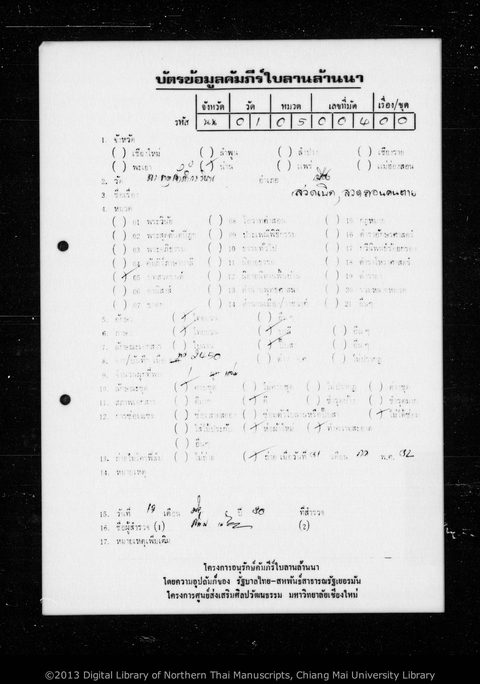
What this is
Thon (ถอน — "to withdraw, to pull out, to annul") is the rite of un-doing. Where most of the wichaa adds something — a charm, a span of years, a soul brought home — thon subtracts. It lifts a curse, cancels an inauspiciousness, and above all neutralises the danger left behind by a bad death. The catalogue holds 29 witnesses whose titles name it, and 28 of the 29 are flagged research-priority (97%).
You do not draw thon and you do not brew it. You say it, and the saying is what withdraws the harm. That is the whole technology, and the catalogue's genre split across the 29 is not confusion but an accurate description of it: 14 filed under magic & ritual, 7 under liturgy & chanting, 4 other, 3 astrology, and 1 under the canon itself. Thon is magic performed as recitation — which is why the same bundles carry it alongside katha and yantra manuals (manuscript 5466, Sut thon tang tang, Tamla nyan tang tang; manuscript 5671, Sut thon, Nyan lae katha) and alongside the holasat almanac twice over (manuscripts 2841 and 5162, each catalogued Sut thon lae holasat). The practitioner reads the day, then unsays the harm.
The vulture on the roof
Two treatises in this archive — one a Central Thai ceremonial manual, one a Lanna-lineage magic book, with nothing else obviously in common — both name the same trigger, and reading them together is the fastest way into what thon is for.
The Setting Up Ceremonies, Ancient Edition (การจัดตั้งพิธีการ ฉบับโบราณ) opens (p.1) by dividing all Buddhist merit-making in two. There is the auspicious (มงคล, mangala) ceremony — the house-warming, the birthday, the wedding — held for good fortune and prosperity. And there is the inauspicious (อวมงคล, avamangala) ceremony, held "to relieve suffering and grief and to entirely dispel misfortune." Its examples of the second kind are a funeral, and then, with no change of tone: rites performed when a vulture perches on the house, or when a rainbow touches down at the house.
That is a striking pair of things to require a ceremony for. A funeral is a fact. A vulture landing on your roof is an omen — and the manual files both under the same heading and prescribes largely the same apparatus for them, noting only that "some ceremonies omit certain items while others add certain items."
Now open the Yantra Craft and Katha of the Lanna Lineage (ตำราวิชายันต์ คาถาสายล้านนา) at page 87. There, inside the long invocation for consecrating the "dharani earth-water" — the holy water made specifically for clearing haunted ground — the officiant asks for authority "to untie the binding cords and snares, the shackles, hooks, and every kind of harassment," and to "set up the five-tiered platform and, with full authority, send off the ghost of one who died a violent death, toward the funeral urn's lid." And then the text does something extraordinary: it enumerates, for two solid pages, exactly what it is protecting against. A catalogue of ill omen, running without a break:
a bamboo whose tip bends back toward the west; a spider that portends ill; rats squeaking in the house, calling their companions to gather; a house-post that oozes resin; wasps and bees settling on the house to build their comb; a monitor lizard running up onto the house; a python climbing onto the loft; a vulture perching on the roof; husked rice sprouting into a shoot; mushrooms growing on the stove; monkeys roosting on the pillow; the weaving-loom set up wrongly; foul rain that will not stop; a misshapen shadow on someone's head; a pot that rings like a gong; a tiger that roars like an elephant; a banana tree that puts out its flower-bud sideways; a ghost that wails, a ghost that whistles, a body that trembles and shakes; bronze that cracks and shatters; a ring's setting that comes apart; a hen that crows; a mother duck that hatches eggs — and on the following page, a ghost that plays tricks and haunts, striking wooden clappers; jackals and wild dogs running about barking; a vulture dropping a corpse onto the roof; a pumpkin-vine climbing onto the loft and turning into a Great Kala, a death-omen; a house-post struck by lightning; a house-post burned by fire; a hen laying eggs at the house's gate; a rat gnawing at one's feet; a cockroach licking one's head.
Inference — the two books agree, and the agreement is the finding. A Bangkok ceremonial manual and a northern magic treatise independently list a vulture on the roof as a thing that requires ritual action. The category is real and it is shared: an event in the ordinary world that has gone wrong in a way that must be formally cancelled, whether or not anyone has died.
Read the list again and notice its logic. Almost every item is a small violation of category. Rice that should be food sprouts instead. A stove that should give heat grows mushrooms. A hen crows, which is a rooster's job; a duck sits on eggs, which should be somebody else's. A tiger makes an elephant's noise. A vulture, which belongs to corpses in the open, comes indoors — and in the worst case brings the corpse with it. Inference — khuet (ขึด), the Lanna word for this whole field of pollution and taboo, is not a moral category at all. It is a taxonomic one. Khuet is the world getting its own classifications wrong, and thon is the formal correction issued in reply.
The passage ends by naming its authority — "my teacher's name is the Elder Anuruddha" — and by listing what the finished water is sprinkled on: cattle, buffalo, elephants, horses; "a person gone mad and wandering through the town; on a sick person wasted and sallow; on one who is sluggish, one who is drowsy and forever yawning to sleep, one caught up in a legal dispute, one shackled by ill fortune"; and then on squash, gourds, melons, the rice in the paddy, beans and sesame. Lawsuits and pumpkins, treated by the same water.
What the officiant says to a ghost
The same treatise (p.88) gives the katha for driving away a haunting, and it is worth reading because of who it is addressed to. Not to the Buddha, not to the gods — to the ghost, in the second person, directly.
It opens by putting the four elements behind the speaker: Na shakes the earth until it trembles; Ma commands the moon and the sun and the open sky; Pha wields the fire that ends an aeon; Tha wields the great ocean, surging and churning. Then it turns and speaks to the thing in the house: "You know how to speak, you know the language; I call you, I summon you; I bid you, I command you: go back to find your master. Do not be stubborn, do not play tricks or deceive." And when politeness runs out: "I shall drive you out with fire, I shall chase you away with wind, I shall crush you with earth until nothing of the spirit remains, I shall wash you away with water. Whatever image or inscribed yantra you have made, whatever ghost or spirit you have set upon me, in whatever guise — do not stop, do not stay still; turn over and go back, whether asleep or awake, awaken at once; hasten away quickly, as I command."
Inference — two things are assumed here that no summary of "a rite for dispelling inauspiciousness" would convey. First, the ghost is linguistically competent — it is told it knows the language, and then reasoned with. Second, it has an employer: "go back to find your master," and "whatever ghost you have set upon me." The default assumption is not that the house is randomly haunted. It is that somebody sent this.
The direction of everything
The most elegant thing about thon is that it is often performed simply by reversing the auspicious version.
The Setting Up Ceremonies manual (p.3) explains how the sacred thread is laid. For an auspicious ceremony, begin at the Buddha image on the altar or the household shrine, "loop it clockwise around the building or house, or around the ceremony grounds," then bring it back and loop it clockwise around the base of the image once or three times, and coil the remainder onto a tray. But for an inauspicious one, the same page continues, "the thread is run from the corpse, from the urn of ashes, from the portrait of the deceased, or from the list of names of the deceased, to the monks." And if an ancestral urn joins an otherwise auspicious merit-making, the thread linking the monks to the Buddha is cut off and re-linked to the urn.
One material, one gesture, two directions of flow. Clockwise around a living house to enclose it; straight from a corpse to a monk to drain it. Inference — thon is not a different technology from blessing. It is the same technology run backwards, and the manuals are entirely explicit that the difference is directional.
The Conducting Religious Rituals, Complete Edition completes the picture at the crematorium (p.63). The procession forms up in fixed order — the monk first, then the incense pot with a single stick lit, then the photograph of the deceased, then the hearse or the bearers, then the family — and the manual notes, quietly, that here the monk need not hold the sacred thread at all. Then: "walk counterclockwise around the crematorium (the crematorium remains on the walker's left), beginning from the stairs in front, circling until 3 rounds are complete." Three circuits, the same number as an auspicious circumambulation, in the opposite direction.
And before the coffining, one more reversal, this one of ordinary social order. Back in the Setting Up Ceremonies manual (p.150), the living are to ask the dead for pardon — "I have offended against you, whether by body, speech, or mind; may you kindly grant me forgiveness" — and then pour water onto the right palm of the deceased, thinking: this body that has died is now forgiven of all offense, without fault, just like the water that has been poured. Water is poured into the hands of the living at every blessing on the shelf. Here it is poured into the hand of someone who cannot receive it, and the receiving is done on their behalf by the formula.
Withdraw first, then call
The clearest demonstration that thon is one half of a pair sits five pages later in the Lanna treatise, where a single procedure runs straight through both rites without a heading between them.
The practitioner builds a tray from banana stem, fills leaf-cups with itemised mouthfuls — betel and areca, a banana, three slices of sugarcane, a bite each of duck and chicken, a bottle-cap of liquor, cockles, two kinds of sweets — and sets it at the foot end of the sick person. He sweeps the patient with three stalks of star-gooseberry dipped in holy water, then breaks the stalks and lays them in the tray. He recites the Namo Tassa, takes a knife, draws a line on the ground, and leaves at once, not entering the house; the sick person is sent to stay elsewhere for a while. Only then does the text say: "Once the clearing is finished, call the khwan back" — and the soul-calling begins, with white thread tied at the left wrist.
Inference — soul-calling gathers a scattered life-force in; thon sends danger out. They are the centripetal and centrifugal halves of one act of care for a threatened person, and this page proves the pairing is not an interpretation imposed from outside — it is the order of operations, written down, with the clearing first because you do not call a soul home into a house that still has something else living in it. The catalogue agrees from its own side: manuscript 516 from Wat Pa Mueat in Nan binds the khwan-calling formula and the sut thon into one cover, and manuscript 490 from the same temple runs the full sequence — extend the rice, extend the town, then Kam sut thon — in a single working bundle with life-extension.
A taxonomy of dangerous deaths
Read the 29 titles in a row and they stop looking like a jumble. They are a professional's index of crises, and the professional needed a different withdrawal for each one.
Manuscript 254, from Wat Phra That Chang Kham Worawihan in Nan, carries five in one title: Thon pisu tai, Thon samanen tai, Thon khon cai tai, Thon phu nying tai, Thon khon tai hong tang muan — a withdrawal for a novice's death, for a woman's death, and for every kind of tai hong, the violent and untimely death. Manuscript 217 at the same temple pairs Thon tai phai ok luk — death in childbirth — with Thon phi tai hong. Manuscript 533 from Wat Pa Mueat adds Thon ku tai nen tai. Manuscript 363 covers the places instead: Thon ban, Thon huean — the withdrawal for the village and for the house.
Then there is manuscript 5127, mulberry paper from Wat Wiang in Lampang, dated 1937, whose title is the strangest and best in the set: Thon panyat, Thon tu tai bo maen ti, Thon pha tai bo maen ti, Thon khon tai bo maen ti, Thon khuet tit ton. The repeated phrase is บ่แม่นที่ — "not in the right place." Inference — read straight, the three parallel items are a cupboard, a cloth, and a person, each with its own rite for having died in the wrong place. Whatever the precise objects, the grammar is unmistakable: the manuscript applies the identical formula of wrongful death to household things and to human beings, in the same breath, without apparent strain. That is the khuet logic of the vulture-list stated as a table of contents.
And manuscript 521, also from Wat Pa Mueat, is the whole worldview in one binding: Withi sang ban — how to build a house — followed by Song sappa khuet, Sut thon sappa khuet, Kalakini haeng huean: send off all inauspiciousness, withdraw all inauspiciousness, and the misfortune of the dwelling. The instructions for making a home and the instructions for un-making what goes wrong in it, copied by the same hand into the same book.
The monastic register
Two of the 29 have been transcribed, and they turn out to point somewhere the title list alone would not suggest.
Manuscript 363 — Thon ban, Thon huean, Thon phi tai, etc., 34 pages of mulberry paper from Wat Si Mongkhon (Kong) in Nan, dated BE 2475 (1932) — has the words สูตรถอน, sutra thon, visible in the transcription of page 4. But the Pali running through pages 3 to 7 is not a spell. It is the kammavācā: the formal-act formula of the monastic Sangha — Suṇātu me bhante saṅgho… esā ñatti… yassāyasmato khamati… tuṇhī… evametaṃ dhārayāmi ("Let the Sangha hear me… this is the motion… he to whom it is acceptable remains silent… thus do I hold it") — and the verb it is built around, recurring on every page, is samūhanati / samūhaneyya: to abolish, to remove, to withdraw. In the Vinaya that verb governs the formal act by which a monastic boundary is un-declared.
Manuscript 5507, from Wat Si Khom Kham in Phayao, is catalogued in exactly those terms: Kammawaca, Sut thon pha lae bat — kammavācā, and the withdrawal-recitation for robe and bowl.
Inference — thon is therefore not only a village exorcist's word. It has a precise monastic twin: the Sangha's own procedure for formally cancelling something it once formally established. The layman's sut thon over a haunted house and the Sangha's samūhanana of a boundary are the same operation in two registers — authoritative un-declaration — and at least one northern practitioner kept both in the same book. That is a claim this page makes from a reading of a partial transcription, and it deserves a proper look by someone with the folios in hand.
The shape of the collection
Overwhelmingly a working paper technology — 26 mulberry-paper against just 3 palm-leaf — and almost entirely Tham Lanna (27 of 29, with 2 in Thai script). It clusters hard in Nan (16), with Lampang (6) and Phayao (4) behind. Its two great holdings are both in Nan: Wat Pa Mueat with 7 and Wat Phra That Chang Kham Worawihan with 6 — between them nearly half the corpus, two working ritual libraries rather than a scriptural one, well away from the canon's Wat Sung Men gravity. Barely dated: 4 witnesses, 1907, 1907, 1932 and 1937. Late paper, in active use, right up to living memory.
Notes
- It travels inside the life-crisis kit. Thon rarely stands alone: the bundles bind it to suep cata life-extension, su khwan soul-calling, almanac-reading and offering. Steady the soul, stretch the span, withdraw the harm — three moves of one repertoire, and manuscripts 490 and 516 carry more than one of them at a time.
- The omen list is a research instrument. The two-page catalogue in the Lanna treatise is the densest inventory of khuet in the archive, and it is cross-referable: several of its items recur in the divination material and in the household entries under find by need. A reader wanting to know what the tradition actually feared should start there rather than with a definition.
- The living half of the pair is published here. The soul-calling is on this site in full, as is its machine-facing sibling สู่ขวัญยนต์ and the household's blessings. Thon has no such published continuation — appropriately, since the archive's own practice is to call things home and not to send anything away.
- A living rite — a crawl target. 97% priority-density, still performed at Lanna deaths and misfortunes today, and only 2 of 29 witnesses transcribed. Any practitioner's sut thon book is a primary source worth documenting, and the search image is now specific: the vulture-and-hen omen catalogue, the second-person address to the ghost, the counterclockwise circuit, and the kammavācā's samūhaneyya.
The live connections graph and any current curiosity-bot findings.
Connections
- Magic & Ritual · ไสยศาสตร์ (part of)
- Su Khwan (soul-calling) (related to)
- Astrology · โหราศาสตร์ (related to)
- Buddhist Canonical · พระไตรปิฎก (related to)
- Liturgy & Chanting · บทสวด (related to)
- Other · อื่น ๆ (related to)
- Suep Cata (life-extension rite) (related to)
- Horā almanac (Holasat) (related to)
- Katha (Pali spell-formulae) (related to)
- Yantra / Yan (nyan) (related to)
- Vessantara / Mahāchat (related to)
- Buddhist Canonical · พระไตรปิฎก › Abhidhamma (related to)