wichaa › Subjects › Kai (chicken & rooster)
Kai (chicken & rooster)
What this is
The kai (ไก่) — chicken, and above all rooster — is the animal that keeps Thai time, feeds Thai households in a pinch, fought for a kingdom (so the story goes), and gets planted by the thousand in front of a warrior-king's shrine as thanks for a favor granted. Small, unglamorous, and everywhere: this is a dive into how much sacred and social weight one barnyard bird carries.
A palindrome to start with
เวทาสากุ กุสาทาเว · ทายะสาตะ ตะสายะทา · สาสาทิกุ กุทิสาสา · กุตะกุภู ภูกุตะกุ
Four paired phrases; in each pair the second is the first read backward, syllable by syllable — เว-ทา-สา-กุ mirrors into กุ-สา-ทา-เว, and so on down the line. Not translatable Pali — this is sound-magic, a katha built as a mirror rather than a sentence. The mirror doubles as a checksum: a transcription error in the first half is caught the moment you check it against its own reflection. (The copy in this collection — the Khom-Thai inscription formulas — arrived with exactly such an error: กสาทาเว for กุสาทาเว, a dropped อุ. The structure itself is what repairs it, and no circulating version transmits the broken form.)
This is คาถาพญาไก่เถื่อน — the katha of the Wild Junglefowl King. The tradition that carries it runs through สมเด็จพระสังฆราช สุก ไก่เถื่อน — Somdet Suk (1733–1822), abbot of Wat Tha Hoi in Ayutthaya and later of Wat Ratchasittharam (Wat Phlap) in Thonburi, Supreme Patriarch from 1820 — called "the wild junglefowl patriarch" because his loving-kindness practice was said to tame the wild junglefowl, the least tamable of birds, until they gathered around him. His lineage's biography has him receiving the katha from his teacher, Kruba Rueang, at Wat Tha Hoi, and calls it พระคาถานำพระคาถาทั้งปวง — the katha that leads all other kathas.
Tradition holds — per the Wat Phlap lineage text, the uses are keyed to the junglefowl's own virtues (which the text explicitly borrows from the Milindapañhā's five virtues of the wild cock): chant it three times before speaking — preaching, chanting, singing, negotiating — and your voice carries the way the junglefowl's crow does; eight times before a journey, like the cock's watch-crows through the night; over stones set at the four corners of the house, and thieves stay away as a junglefowl never abandons its nest. Chanted daily, the schedule of benefits escalates from the wisdom of Buddhaghosa at three months to reading other minds at seven — "as the wild fowl knows the scent of a man" — and it is framed throughout as a มหาเมตตา practice whose endpoint is not wealth but liberation.
And the tradition has its own answer for what the mirror means. The lineage biography stages it as a teaching dialogue: the four palindrome pairs are the โลกธรรมแปด, the eight worldly conditions — gain and loss, rank and its stripping, praise and blame, pleasure and pain. Each phrase read forward then backward enacts one pair: everything that arrives, reversed, is its own departure, and the chanter is not to cling to either direction. The palindrome isn't decorated doctrine — the palindrome is the doctrine. No word-by-word gloss exists, and one teacher in the lineage explicitly forbids seeking one: a concentration-katha's meaning is not to be known too early.
Inference — the "chant it and customers flock to your shop" framing common online is a modern commercial gloss; the older similes are the crow, the watch, and the nest — voice, time, and home. The lineage also claims a 1526 inscription of the katha on a Buddha image base in Phrao, Chiang Mai; that claim is single-lineage and unverified against the academic inscription databases, so treat the katha's documented history as beginning with the Wat Phlap tradition itself. Palindromic gathas in Thai and Lanna magic appear to be a genuine hole in open-access scholarship — the emic reading above, to our knowledge, has not been collected in any Western-language study. This katha is one worked example of a wider register — reversed recitation, mirror formulae, and their extension into the drawn yantra — held on its own page: Paṭiloma.
The junglefowl in the printed books
At least three of the contributed treatises carry the rooster, and each carries him in a different register.
The Khom-Thai inscription formulas print him twice. The first time is a bare list of mirror-formulae, where คาถาพญาไก่เถื่อน sits directly above คาถาพญากาน้ำ, the Cormorant King — two birds, the same four-pair mirror architecture, no instructions at all. The second time he arrives with a diagram and a job: ยันต์พญาไก่เถื่อน, the Wild Junglefowl King yantra, a grid of Khom syllables (the book's own contents page lists it at p.125, with a Crow King's yantra next at p.126). What you are told to do with it is startlingly domestic. Soak the drawn yantra to make holy water, and that water treats fever, sores and swellings; wash your face in it every day and no harm comes near you. If what you want is a crop, sprinkle the same water on the field and it will bear fruit and flower as you wish. If what you want is to be liked, soak the yantra in fragrant oil instead and anoint face and body — for เมตตามหานิยม, loving-kindness and great popularity. Then consecrate the whole thing 108 times with the palindrome above. The crowing bird, the growing field and the well-liked face turn out to be one charm.
The crow that follows him gets a stranger job, and it is worth knowing because it is the same logic pointed outward: inscribe that yantra on teak-wood paper, heap rice on top of it, consecrate it, and let a crow eat. Whatever house the crow flies off and settles on — that is the household that will bring you your fortune. The rooster's magic works on the practitioner; the crow's works by being carried away in a bird.
The same book's list of หัวใจ heart-syllables — the compressed one-line cores that stand in for whole formulae — gives the junglefowl one of his own: ติวิกุกุ, filed between the heart of the giant ant and the heart of the alphabet.
The Compendium of Ancient Katha holds a different junglefowl formula altogether, buried in a run of miscellaneous spells — lime consecrated seven times and dropped in a water-jar so whoever drinks loves you to breaking, sesame oil chanted over eighteen times and rubbed on to turn a man into a tiger, water drunk for a body an axe cannot bite. In the middle of that: กุกกุปะกา ปะพาชิตัง ปิยังมะมะ, glossed "this is the Wild Junglefowl King katha; consecrate rice fed to chickens, very good." After the eight worldly conditions and the mind-reading at seven months, the plainest use anywhere in the corpus is the literal one — a man in his own yard, saying the junglefowl king's words over the scratch feed.
And the sak yant stencils — a tracing book for tattooists — give the bird a body at last. ยันต์ไก่เถื่อน is drawn there as two roosters in fighting-cock posture, each set inside a roundel of fine incantation script, a few leaves away from the paired carp, the fighting fish and the backward-glancing deer. Not the watch-bird and not the hen: a matched pair squaring up. The magic-and-ritual register keeps the cockpit long after the doctrine has moved on from it.
What the catalogue holds
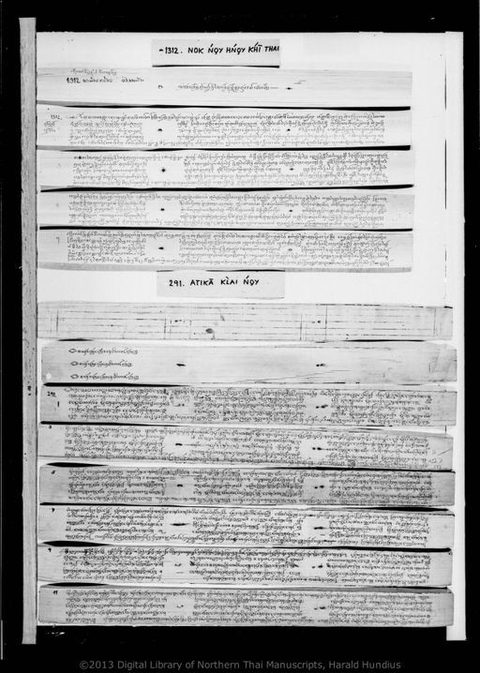
Five witnesses, and the shape of the evidence is specific: the chicken enters this collection as story and star, not yet as the rooster of the cockpit or the offering tray.
- อติกาไก่น้อย (Atika Kai Noi — "the Little Chick"), a jātaka, in two copies: one from Wat Ku Khao, Lamphun, dated CS 1288 (≈1926 CE); a second dated BE 2517 (1974 CE). Both Tham Lanna script, Pali and Lan Na.
- นิยายไก่ก้า (Ninyai Kai Ka), a jātaka, Tham Lanna script, dated CS 1269 (≈1907 CE).
- กิตติกาดาววีไก่น้อย (Kittika Dao Wi Kai Noi), in two copies from Chiang Rai temples (Wat Mae Kham Nam Lat; Wat Phra Chao Lan Thong, whose copy spells the title กิติกา with a single ต), dated 2497 BE and CS 1293 (≈1931 CE). กิตติกา is Krittikā — the Pleiades — and the popular Thai name for that cluster is ดาวลูกไก่, "the chick stars": a hen and her brood who leapt into a fire and became the asterism.
Note what the shelf-labels do here. The two Little Chick copies and Ninyai Kai Ka are filed as jātaka, the collection's second-largest genre at 1,633 witnesses; the two Pleiades copies are filed as "other," because a hen who is also an asterism fits no single drawer. Four are palm leaf and the 1974 copy records no material at all; all five are Tham Lanna.
Inference — as with naga and yantra elsewhere in this collection, a title search almost certainly undercounts the chicken. Formulae like the katha above are typically bound inside manuals titled for their genre, not their subject — which is exactly what the printed treatises above demonstrate: not one of them would surface in a title search for ไก่. Working chicken-magic sits invisibly inside titles that name no bird at all.
Beyond the catalogue — the king's chicken, and everyone's chicken
Tradition — the following is background from the wider Thai tradition, not drawn from these five manuscripts; treat specifics as orienting, not authoritative.
The wager and the breed
The best-known chicken story in Thai history is a cockfight. As a boy hostage at the Burmese court of Hongsawadi, the future King Naresuan is said to have matched his cock against the Burmese heir's — and won. The line usually given him in reply to the sting of losing ("this captive cock is quite the fighter") is the boast that a captive cock could wager whole kingdoms, not just palace sport.
Tradition holds — that telling is the popular one. The older trace of the story runs differently: it survives not in the Ayutthaya royal chronicles but in testimony compiled from Ayutthaya captives in Burma more than a century later, where the Burmese heir's remark reads as an insult — needling Naresuan about his captive status — and becomes his motive for fleeing Hongsawadi, not a boast about kingdoms at all. A Royal Society historian, Winai Pongsripian, has called the whole episode unverifiable — no Thai chronicle and no foreign document corroborates it — and has argued it be dropped from school curricula.
What happened next to the story is, if anything, the more interesting part. No 16th-century source names Naresuan's cock's breed. But in 1999 the Phitsanulok provincial livestock office fixed a formal breed standard — yellow hackle, white tail, "diamond eyes," 3 kg minimum — for เหลืองหางขาว (Leung Hang Khao, "yellow with white tail"), nicknamed ไก่เจ้าเลี้ยง ("the lord's own"), and it is now a registered Geographical Indication of Phitsanulok and Sukhothai. A legend became a breed standard became a protected regional product. (Sukhothai keeps its own royal chicken, too — ประดู่หางดำ, "the king's chicken" of Ramkhamhaeng in breeder lore — so Thailand has two chickens with a claim to the crown, one per dynasty.)
The votive flock
Vow-fulfillment at Naresuan shrines runs on the same logic as horse and elephant statues left at the same sites: he loved cockfighting, so a granted wish is repaid with a rooster. The scale is real — thousands of small plaster roosters ring the shrine at his birthplace palace grounds in Phitsanulok, and similar drifts of them stand at his monument in Ayutthaya, at Don Chedi in Suphanburi, and at a shrine in Prachinburi marking where he mustered troops. The practice has floated well past Naresuan, too — it shows up at Ai Khai's shrine (Wat Chedi, Nakhon Si Thammarat) and has become a generic wealth charm independent of any one cult. One concrete, recent wrinkle: the plaster votives don't degrade, so Naresuan University developed a biodegradable version — pineapple-root starch and hemp fiber, gone in about two months in the ground.
The bird that keeps you fed
Away from royal legend, the household chicken (ไก่บ้าน) is working infrastructure. Northern Thai smallholders keep native breeds mostly semi-intensively or free-range — birds that scavenge, need little investment, and can be sold on short notice for medical bills or school fees, commanding a premium over broiler meat. A government conservation effort begun around 2001–2002 selected four heritage breeds for preservation — Pradu Hang Dam, Leung Hang Khao, Chee, and Dang — and Khon Kaen University has since bred improved strains from them. The same bird that stars in royal legend is, at ground level, closer to a walking savings account.
That household bird is also the one demanded by ritual: offering chickens must be whole — head, feet, and innards on — the comb read as a mandarin's cap, the bird a stand-in for diligence and rank. It shows up on ancestor tables, on Isan village-guardian shrines, and above all in Lanna spirit-medium rites (เลี้ยงผีปู่ย่า), where one boiled chicken per household is a standard เครื่องเซ่น alongside a pig's head, liquor, and puffed rice.
In several highland and Tai communities the same bird doubles as an oracle once it's dead. A Chiang Rai field survey run under the Human and Chicken Multi-Relationship Project — fieldwork 2004–2007, under royal patronage — found each ethnic group reading a different part of the same sacrificed bird: liver among some Lao and Kayan communities, the jawbone among Hmong, Chinese, and Isan Thai, the feet among Khmer and Hmong, and — the classic Tai method — small sticks pushed into holes bored through the leg bone, read by Akha, Lahu, Karen-descended groups, and Yunnanese Chinese alike. Lanna's own version of this survives in a northern verse-tale (ค่าวซอเรื่องเจ้าสุวัตร), in which a หมอไก่ — a chicken-bone diviner — reads exactly this leg-bone-and-stick pattern — the one branch of divination in this tradition whose instrument has to be killed and cooked first. None of it works with a supermarket broiler; it needs a home-raised bird, which quietly means ritual demand and breed conservation may be propping each other up, though that particular link hasn't turned up a direct source yet.
Language and time
The chicken is dense in the language, too — idioms for bluffing (ลักไก่), public blunders (ปล่อยไก่), total control (ลูกไก่อยู่ในกำมือ, "the chick in your fist"), being up before anyone else (ตื่นแต่ไก่โห่, "before the cock's cry"), and dusk (ไก่ขึ้นรัง, "when the chicken goes up to roost"). Before clocks, the cockcrow itself was a watch-marker; one Isan reckoning names three crows across the night — first, middle, and last — each a rough hour. Whether Lanna almanac manuscripts name the cockcrow watch the same way hasn't turned up in published sources yet; it's exactly the kind of thing to check this catalogue's own pages for.
Two white roosters, two cities
Northern Thailand actually keeps two white-rooster legends, and popular writing tends to blur them into one. In Lamphun, the white rooster (named in the old texts เสตตกุกกุฏ, "Setta-kukkuta") was the guardian spirit and companion animal of Queen Chamadevi, founder of Hariphunchai. When it died, the king who built the great chedi — Adittayarat — is said to have buried it and raised a stupa over the grave: กู่ไก่ (Ku Kai), still standing near Wat Kai Kaew, in a set alongside sister stupas for an elephant and a horse. Lamphun's actual provincial seal is the Hariphunchai chedi itself, not the bird — the rooster is a civic and folk symbol rather than an official one.
Lampang, forty minutes north, has a different white rooster and a much older claim on it: the provincial seal genuinely is a white cock, and the city's old name — กุกกุฏนคร, "Rooster City" — comes from it. Here the legend is about Indra, not Chamadevi: worried the townspeople would sleep through the chance to give alms to a visiting Buddha, he took the form of a white rooster and crowed the town awake. The rooster on Lampang's famous ceramic bowls (ชามตราไก่), made by Chinese immigrant potters, is secular craft riding on the same civic symbol.
And Lamphun's chedi carries a second, independent reason for roosters to gather there: in the Lanna twelve-year cycle, Phra That Hariphunchai is the pilgrimage chedi assigned to the rooster year (ปีเร้า in Lanna reckoning, ปีระกา in standard Thai). Tradition holds that a person's spirit rests at their birth-year chedi before conception and returns to it after death, so worshipping it — ไหว้ชุธาตุ — at least once in life is expected of everyone born under that animal. Every rooster-year pilgrim in the Lanna world has Hariphunchai as their destination, which does more than any single legend to explain why rooster imagery accumulates there. (The northern temples themselves, Hariphunchai among them, are mapped at Wats of the Lanna north.)
A bird that isn't quite a swan
One more northern bird invites confusion with the rooster, though this observation is ours, not a source's: the hong (หงส์, the Southeast Asian hamsa) — sacred goose-swan of Indic cosmology, Brahma's mount, and the particular emblem of the Mon, who trace it to two golden hamsa that once foretold the founding of Hongsawadi, their lost capital. Mon temples in Thailand are still marked by a เสาหงส์, a pole topped with a hamsa ringing bells from its beak, kept as a memorial of that homeland — and Lampang, rooster city, happens to also hold Burmese-style temples carrying these hintha birds. The hamsa is properly a swan, not a fowl, but as conventionally carved and painted it's short-legged, crested, and rounder in the body than any swan — closer in silhouette to a junglefowl than to anything that swims. Two sacred birds, both galliform-looking on a temple roofline, in the one city that already calls itself Rooster City: worth knowing the two apart, even where a glance might not.
Ai Khai's flock
The largest rooster-votive economy in the country isn't Naresuan's — it's Ai Khai, the boy-spirit of Wat Chedi in Nakhon Si Thammarat. The legend: a boy left behind by the revered monk Luang Pho Thuat to guard the temple, who drowned in its pond and stayed on as guardian spirit; the temple's slogan is "ขอได้ ไหว้รับ" — ask, and it's granted. The cult was formalized around 1954 through a well-known amulet patron, got its first teak carving in 1981–82, and registered as a trademark in 2008 — but it exploded in 2020, during the pandemic, after lottery-win stories tied to Ai Khai went viral: peak-holiday visitor counts of 70,000–80,000 a day, parking for 6,000 cars, Nakhon Si Thammarat's flight traffic doubling, hotel occupancy up a quarter.
Why roosters specifically: Ai Khai is remembered as a boy, so devotees bring a boy's delights — fighting cocks, slingshots, firecrackers, toy soldiers. Live birds were the original offering; cement statues replaced them for practicality, and now range from a few hundred baht to an eleven-meter, 1.5-million-baht figure. The scale has outgrown the temple's grounds: a football-field-sized "rooster graveyard" (สุสานไก่) now holds an estimated hundreds of thousands of retired statues, and a 2025 recycling project grinds the surplus — statues and spent firecracker debris together — into bricks for temple and school walls.
Where the story starts
One reason none of this feels like an accident: this region is where the chicken itself starts. A 2022 reassessment of over 600 archaeological sites across 89 countries (Peters et al., PNAS) traced the earliest unambiguous domestic chickens to Ban Non Wat, on the Khorat Plateau in central Thailand, roughly 1650–1250 BCE — birds buried whole, as grave goods, from the very start. The same study ties domestication to the spread of dry-rice farming, which drew wild red junglefowl to field margins in the first place; a companion study of the earliest claimed European chickens found most were centuries younger than believed, and that chickens were kept as curiosities there long before anyone ate one. Thailand isn't just thick with chicken lore because it's an agricultural country with old folk-religion — it's the place the relationship between people and this bird began, and by the archaeological evidence, it was never a purely practical one even at the start.
Living tradition — the market layer
The chicken hasn't left commerce, either: Khun Phaen riding a rooster and Kuman Thong seated on one "to call in customers" are both live amulet forms — the same crowd-gathering logic as the opening katha, mechanized into a sales charm. Ai Khai devotees buy rooster statues in matched sets to fulfill vows. Red-rooster oil (น้ำมันว่านไก่แดง) circulates in the same metta mahaniyom family as the katha itself — and เมตตามหานิยม is the exact phrase the Wild Junglefowl King yantra uses for what its fragrant oil is meant to do. The manual and the shopfront are selling the same thing under the same name.
Notes
- Read alongside Paṭiloma and Katha. The rooster's palindrome is one worked example of a general operation; those pages hold the pattern and the corpus counts, and the drawn half of it sits with yantra. The teacher-figures who stand behind all three are the lersi.
- A crawl priority. Every chicken witness in the palm-leaf catalogue is narrative — jātaka and star-lore. Every piece of working chicken-magic found so far is in the contributed printed treatises, invisible to a title search. Any fresh transcription of an untitled "ยันต์ และคาถา" bundle is a live chance at a Lanna-side witness to the junglefowl katha or its yantra.
- Still open. Whether Lanna almanac manuscripts mark the cockcrow watches the way the Isan reckoning does is unresolved and checkable against this catalogue's own transcribed pages; so is whether ritual demand for home-raised birds is materially propping up heritage-breed conservation. Both are stated above as open, not as findings.
The live connections graph and any current curiosity-bot findings.
Connections
- Jātaka · ชาดก (related to)
- Poetry & Literature · วรรณกรรม (related to)
- Chronicle (Tamnan) · ตำนาน (related to)
- Katha (Pali spell-formulae) (related to)
- Yantra / Yan (nyan) (related to)
- Magic & Ritual · ไสยศาสตร์ (related to)
- Naga (sacred serpent) (related to)
- Lersi / Ruesi (ascetic-seers) (related to)
- Khun Phaen (epic hero & amulet) (related to)
- Phrommachat (12-year almanac) (related to)
- Paṭiloma (reversal & mirror katha) (related to)
- Chang (elephant) (related to)