Contents · 1 chapter(s) · 220 entries
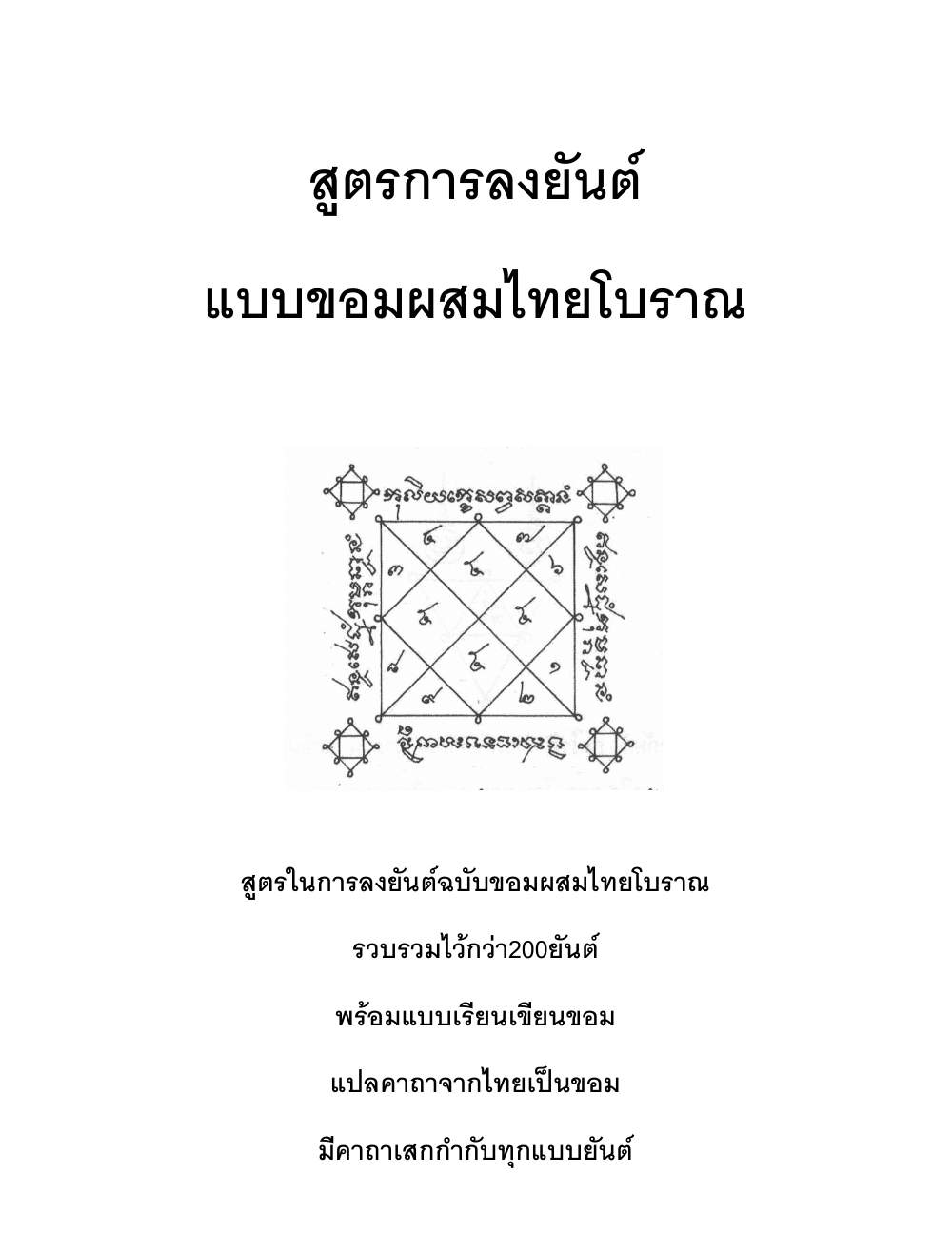
สูตรการลงยันต์
แบบขอมผสมไทยโบราณ
[ยันต์: แผนภาพสี่เหลี่ยมจัตุรัส มีดอกจันหกจุดเล็กๆ ประจำอยู่ที่มุมทั้งสี่ ตัวสี่เหลี่ยมถูกลากเส้นทแยงมุมทั้งสองเส้นและมีรูปหกเหลี่ยมดาว (ยันต์ตรีเพชร) ซ้อนอยู่ภายในแบ่งเป็นช่องย่อย มีเลขไทย ๑ ถึง ๘ เขียนไว้ในแต่ละช่องตามแนวทแยง มีอักขระขอมเรียงเป็นแถวอยู่นอกกรอบด้านบน ด้านล่าง และด้านข้างทั้งสองข้างของสี่เหลี่ยม และมีอักขระขอมสั้นๆ อยู่ในดอกจันแต่ละมุม — [อักขระขอมอ่านไม่ชัด]]
สูตรในการลงยันต์ฉบับขอมผสมไทยโบราณ รวบรวมไว้กว่า 200 ยันต์ พร้อมแบบเรียนเขียนขอม แปลคาถาจากไทยเป็นขอม มีคาถาเสกกำกับทุกแบบยันต์
Formula for Yantra Inscription
Khom Script Mixed with Ancient Thai Style
[yantra: a square diagram with a small six-dot rosette at each of the four corners; the square is crossed by both diagonals and has a six-pointed star (interlocking triangles) inscribed within it, dividing it into compartments; Thai numerals 1 through 8 are written diagonally in the compartments; khom-script inscriptions run in a line outside the top edge, bottom edge, and both side edges of the square, with short khom syllables inside each corner rosette — [illegible: the khom characters cannot be read with confidence]]
The formula for yantra inscription, khom-mixed ancient Thai edition. Compiling more than 200 yantras. Together with a primer for writing khom script. Translating incantations from Thai into khom. Every yantra design is accompanied by its consecration incantation.
[อ่านไม่ออก]
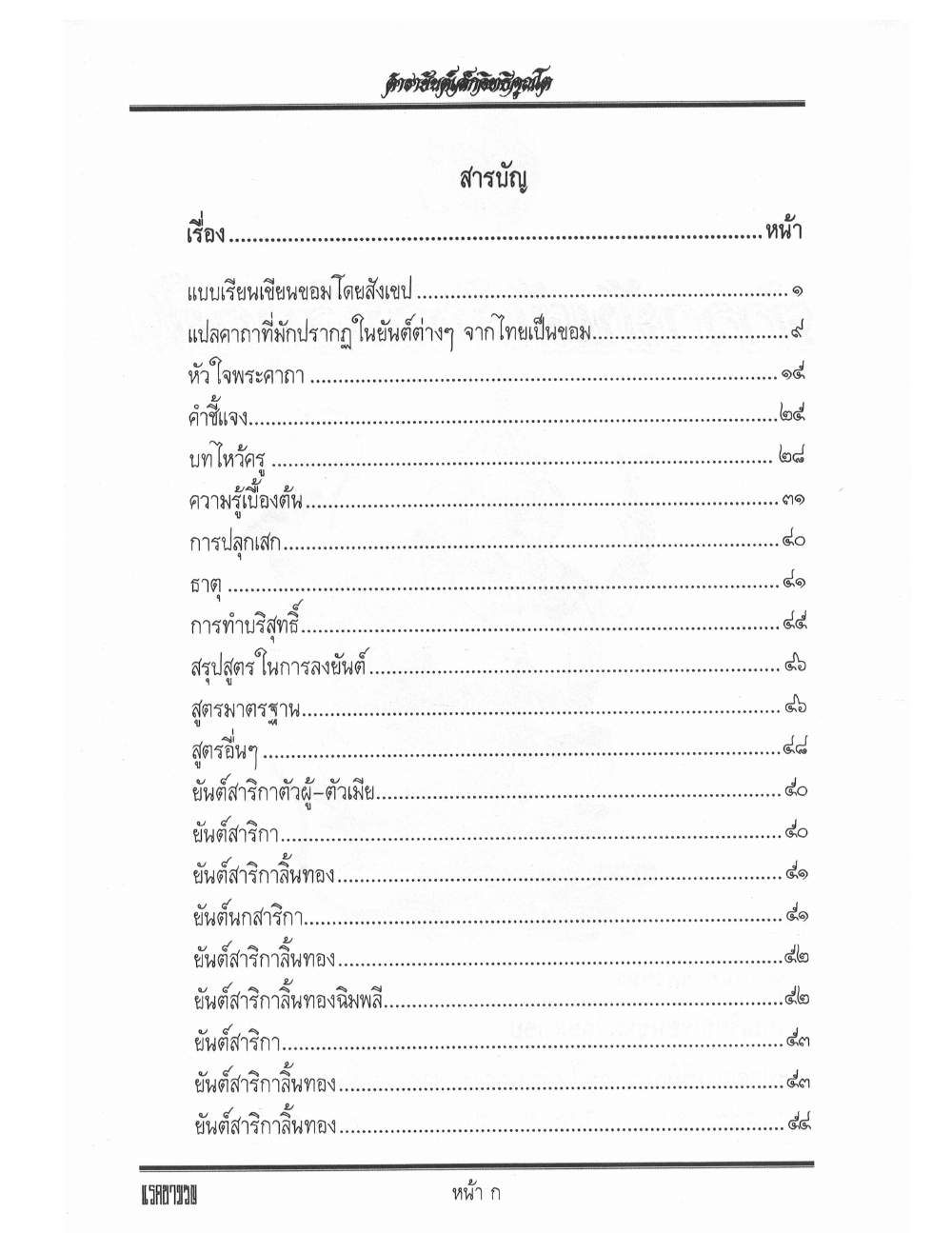
สารบัญ
เรื่อง ................................................... หน้า
แบบเรียนเขียนขอมโดยสังเขป ................ ๑ แปลคาถาที่มักปรากฏในยันต์ต่างๆ จากไทยเป็นขอม ................ ๙ หัวใจพระคาถา ................ ๑๔ คำชี้แจง ................ ๒๕ บทไหว้ครู ................ ๒๘ ความรู้เบื้องต้น ................ ๓๑ การปลุกเสก ................ ๔๐ ธาตุ ................ ๔๑ การทำบริสุทธิ์ ................ ๔๕ สรุปสูตรในการลงยันต์ ................ ๔๖ สูตรมาตรฐาน ................ ๔๖ สูตรอื่นๆ ................ ๔๘ ยันต์สาริกาตัวผู้-ตัวเมีย ................ ๕๐ ยันต์สาริกา ................ ๕๐ ยันต์สาริกาลิ้นทอง ................ ๕๑ ยันต์นกสาริกา ................ ๕๑ ยันต์สาริกาลิ้นทอง ................ ๕๒ ยันต์สาริกาลิ้นทองฉิมพลี ................ ๕๒ ยันต์สาริกา ................ ๕๓ ยันต์สาริกาลิ้นทอง ................ ๕๓ ยันต์สาริกาลิ้นทอง ................ ๕๔
หน้า ก
[illegible: decorative title banner across the header]
Table of Contents
Topic ................................................... Page
A brief primer for writing khom script — 1 Translating incantations commonly found in the various yantras, from Thai into khom — 9 Heart-mantras of the sacred formulas — 14 Explanatory notes — 25 The verse of homage to the teacher — 28 Basic knowledge — 31 Consecration (waking the power) — 40 The elements — 41 Purification — 45 Summary of yantra-inscription formulas — 46 The standard formula — 46 Other formulas — 48 Yantra of the male and female sarika (myna) birds — 50 Sarika Yantra — 50 Golden-Tongue Sarika Yantra — 51 Sarika-Bird Yantra — 51 Golden-Tongue Sarika Yantra — 52 Golden-Tongue Sarika-of-Chimphli Yantra — 52 Sarika Yantra — 53 Golden-Tongue Sarika Yantra — 53 Golden-Tongue Sarika Yantra — 54
Page ก
[อ่านไม่ออก]
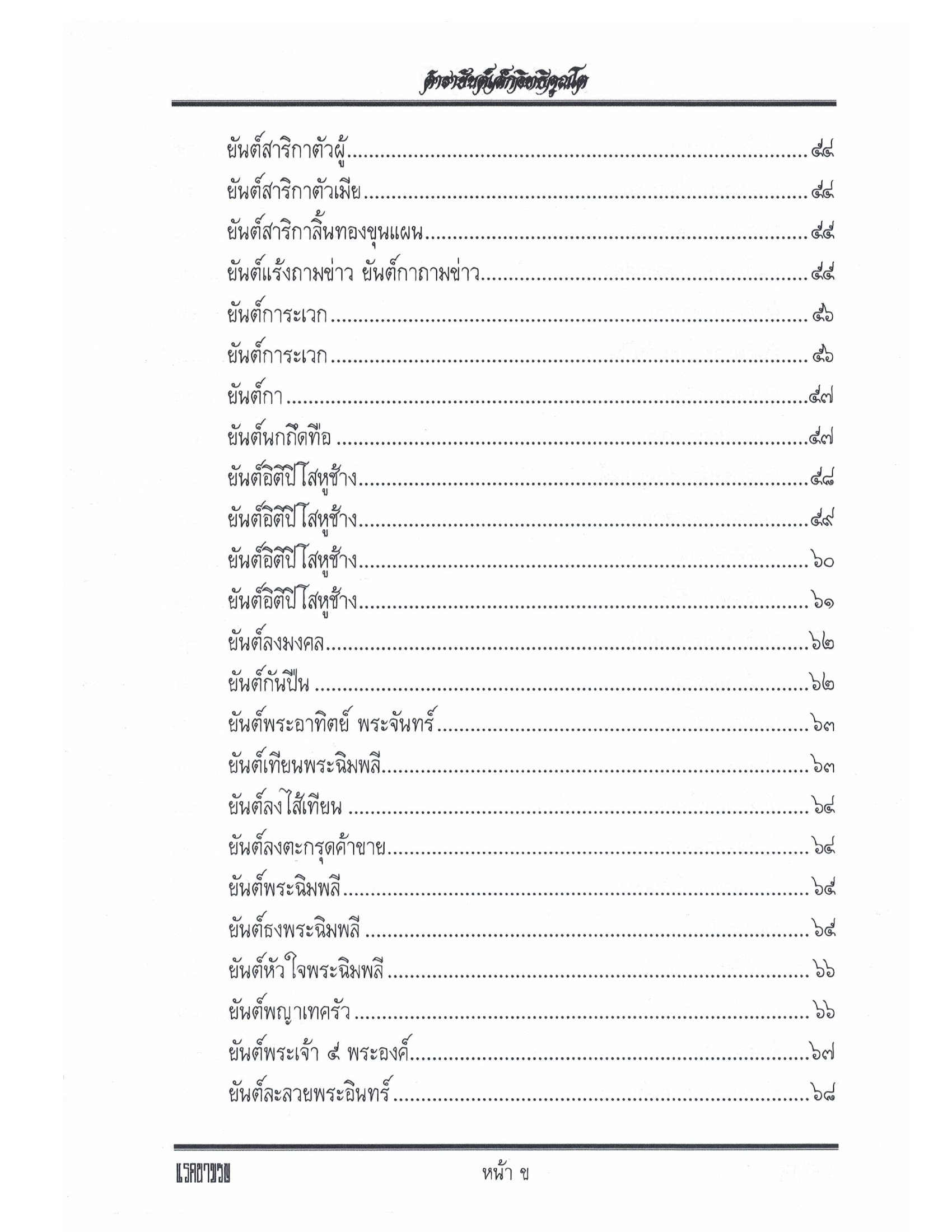
ยันต์สาริกาตัวผู้ ................ ๕๔ ยันต์สาริกาตัวเมีย ................ ๕๔ ยันต์สาริกาลิ้นทองขุนแผน ................ ๕๕ ยันต์แร้งถามข่าว ยันต์กาถามข่าว ................ ๕๕ ยันต์การะเวก ................ ๕๖ ยันต์การะเวก ................ ๕๖ ยันต์กา ................ ๕๗ ยันต์นกถึดทือ ................ ๕๗ ยันต์อิติปิโสหูช้าง ................ ๕๘ ยันต์อิติปิโสหูช้าง ................ ๕๙ ยันต์อิติปิโสหูช้าง ................ ๖๐ ยันต์อิติปิโสหูช้าง ................ ๖๑ ยันต์ลงมงคล ................ ๖๒ ยันต์กันปืน ................ ๖๒ ยันต์พระอาทิตย์ พระจันทร์ ................ ๖๓ ยันต์เทียนพระฉิมพลี ................ ๖๓ ยันต์ลงไส้เทียน ................ ๖๔ ยันต์ลงตะกรุดค้าขาย ................ ๖๔ ยันต์พระฉิมพลี ................ ๖๕ ยันต์ธงพระฉิมพลี ................ ๖๕ ยันต์หัวใจพระฉิมพลี ................ ๖๖ ยันต์พญาเทครัว ................ ๖๖ ยันต์พระเจ้า ๔ พระองค์ ................ ๖๗ ยันต์ละลวยพระอินทร์ ................ ๖๘
หน้า ข
[illegible: decorative title banner across the header]
Male Sarika-bird Yantra — 54 Female Sarika-bird Yantra — 54 Golden-Tongue Sarika Yantra of Khun Phaen — 55 Vulture-Asking-News Yantra, Crow-Asking-News Yantra — 55 Karavika-bird Yantra — 56 Karavika-bird Yantra — 56 Crow Yantra — 57 Thidue-bird Yantra — 57 Itipiso Elephant-ear Yantra — 58 Itipiso Elephant-ear Yantra — 59 Itipiso Elephant-ear Yantra — 60 Itipiso Elephant-ear Yantra — 61 Inscribing-Auspiciousness Yantra — 62 Bulletproof Yantra — 62 Sun-and-Moon Yantra — 63 Candle-of-Phra-Chimphli Yantra — 63 Inscribing-the-Candle-Wick Yantra — 64 Inscribing-a-Trading-Takrut Yantra — 64 Phra Chimphli Yantra — 65 Banner-of-Phra-Chimphli Yantra — 65 Heart-mantra-of-Phra-Chimphli Yantra — 66 Lord-Who-Empties-the-Household Yantra — 66 The-Four-Lord-Buddhas Yantra — 67 Indra's-Allure Yantra — 68
Page ข
[อ่านไม่ออก]
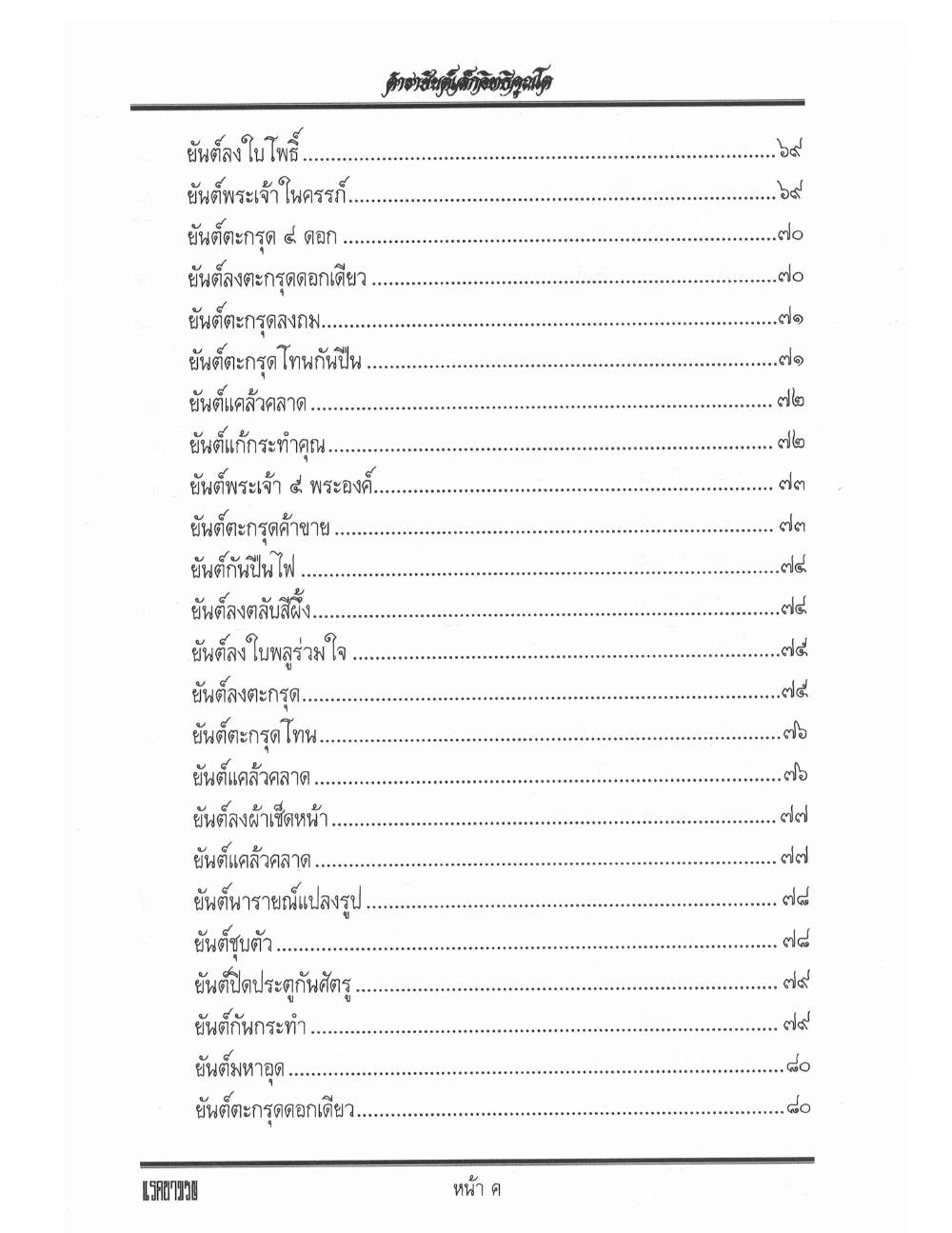
ยันต์ลงใบโพธิ์ ................ ๖๙ ยันต์พระเจ้าในครรภ์ ................ ๖๙ ยันต์ตะกรุด ๔ ดอก ................ ๗๐ ยันต์ลงตะกรุดดอกเดียว ................ ๗๐ ยันต์ตะกรุดลงถม ................ ๗๑ ยันต์ตะกรุดโทนกันปืน ................ ๗๑ ยันต์แคล้วคลาด ................ ๗๒ ยันต์แก้กระทำคุณ ................ ๗๒ ยันต์พระเจ้า ๔ พระองค์ ................ ๗๓ ยันต์ตะกรุดค้าขาย ................ ๗๓ ยันต์กันปืนไฟ ................ ๗๔ ยันต์ลงตลับสีผึ้ง ................ ๗๔ ยันต์ลงใบพลูร่วมใจ ................ ๗๕ ยันต์ลงตะกรุด ................ ๗๕ ยันต์ตะกรุดโทน ................ ๗๖ ยันต์แคล้วคลาด ................ ๗๖ ยันต์ลงผ้าเช็ดหน้า ................ ๗๗ ยันต์แคล้วคลาด ................ ๗๗ ยันต์นารายณ์แปลงรูป ................ ๗๘ ยันต์ชุบตัว ................ ๗๘ ยันต์ปิดประตูกันศัตรู ................ ๗๙ ยันต์กันกระทำ ................ ๗๙ ยันต์มหาอุด ................ ๘๐ ยันต์ตะกรุดดอกเดียว ................ ๘๐
หน้า ค
[illegible: decorative title banner across the header]
Inscribing-a-Bodhi-Leaf Yantra — 69 Buddha-in-the-Womb Yantra — 69 Four-Strand-Takrut Yantra — 70 Inscribing-a-Single-Strand-Takrut Yantra — 70 Niello-Inlaid-Takrut Yantra — 71 Solo-Takrut-against-Firearms Yantra — 71 Escape-from-Danger Yantra — 72 Counter-Black-Magic Yantra — 72 The-Four-Lord-Buddhas Yantra — 73 Trading-Takrut Yantra — 73 Ward-against-Gunfire Yantra — 74 Inscribing-a-Beeswax-Case Yantra — 74 Inscribing-a-Betel-Leaf-for-Union-of-Hearts Yantra — 75 Inscribing-a-Takrut Yantra — 75 Solo-Takrut Yantra — 76 Escape-from-Danger Yantra — 76 Inscribing-a-Handkerchief Yantra — 77 Escape-from-Danger Yantra — 77 Narayana's-Transformation Yantra — 78 Self-Renewal Yantra — 78 Closing-the-Door-against-Enemies Yantra — 79 Ward-against-Sorcery Yantra — 79 Great-Invulnerability Yantra — 80 Single-Strand-Takrut Yantra — 80
Page ค
[อ่านไม่ออก]
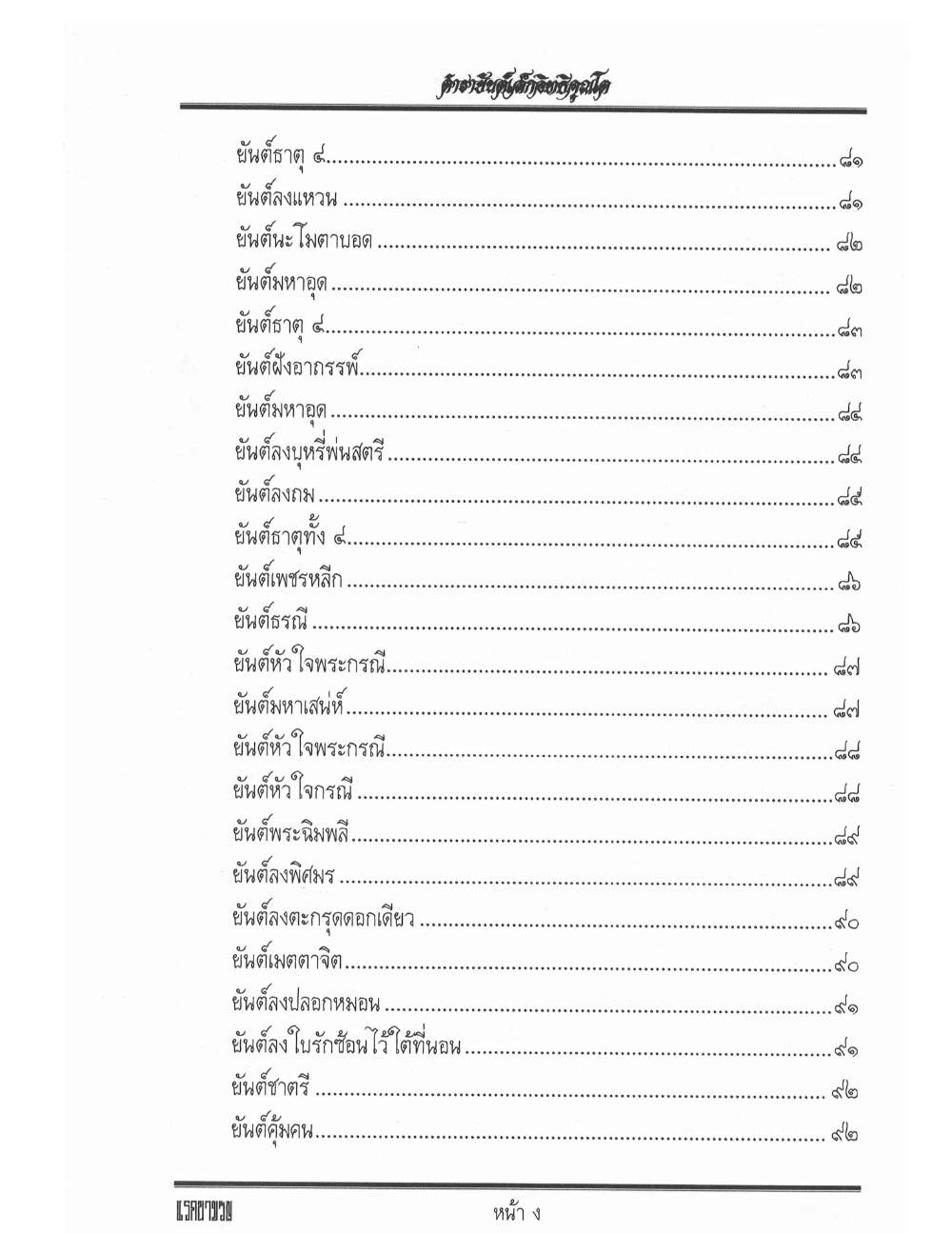
ยันต์ธาตุ ๔ ................ ๘๑ ยันต์ลงแหวน ................ ๘๑ ยันต์นะโมตาบอด ................ ๘๒ ยันต์มหาอุด ................ ๘๒ ยันต์ธาตุ ๔ ................ ๘๓ ยันต์ฝังอาถรรพ์ ................ ๘๓ ยันต์มหาอุด ................ ๘๔ ยันต์ลงบุหรี่พ่นสตรี ................ ๘๔ ยันต์ลงถม ................ ๘๕ ยันต์ธาตุทั้ง ๔ ................ ๘๕ ยันต์เพชรหลีก ................ ๘๖ ยันต์ธรณี ................ ๘๖ ยันต์หัวใจพระกรณี ................ ๘๗ ยันต์มหาเสน่ห์ ................ ๘๗ ยันต์หัวใจพระกรณี ................ ๘๘ ยันต์หัวใจกรณี ................ ๘๘ ยันต์พระฉิมพลี ................ ๘๙ ยันต์ลงพิศมร ................ ๘๙ ยันต์ลงตะกรุดดอกเดียว ................ ๙๐ ยันต์เมตตาจิต ................ ๙๐ ยันต์ลงปลอกหมอน ................ ๙๑ ยันต์ลงใบรักซ้อนไว้ใต้ที่นอน ................ ๙๑ ยันต์ชาตรี ................ ๙๒ ยันต์คุ้มคน ................ ๙๒
หน้า ง
[illegible: decorative title banner across the header]
Four-Elements Yantra — 81 Inscribing-a-Ring Yantra — 81 Blind-Eye-Namo Yantra — 82 Great-Invulnerability Yantra — 82 Four-Elements Yantra — 83 Burying-a-Cursed-Talisman Yantra — 83 Great-Invulnerability Yantra — 84 Inscribing-a-Cigarette-to-Blow-on-a-Woman Yantra — 84 Niello-Inscription Yantra — 85 All-Four-Elements Yantra — 85 Evading-Diamond Yantra — 86 Earth-Goddess (Thorani) Yantra — 86 Heart-mantra-of-the-Earth-Goddess Yantra [printed "กรณี"] — 87 Great-Charisma Yantra — 87 Heart-mantra-of-the-Earth-Goddess Yantra [printed "กรณี"] — 88 Heart-mantra Yantra [printed "กรณี"] — 88 Phra Chimphli Yantra — 89 Inscribing-a-Love-Charm Yantra — 89 Single-Strand-Takrut Yantra — 90 Loving-Kindness-Mind Yantra — 90 Inscribing-a-Pillowcase Yantra — 91 Inscribing-a-Love-Leaf-Hidden-under-the-Mattress Yantra — 91 Chatri (Warrior-Protection) Yantra — 92 Protecting-People Yantra — 92
Page ง
[อ่านไม่ออก]
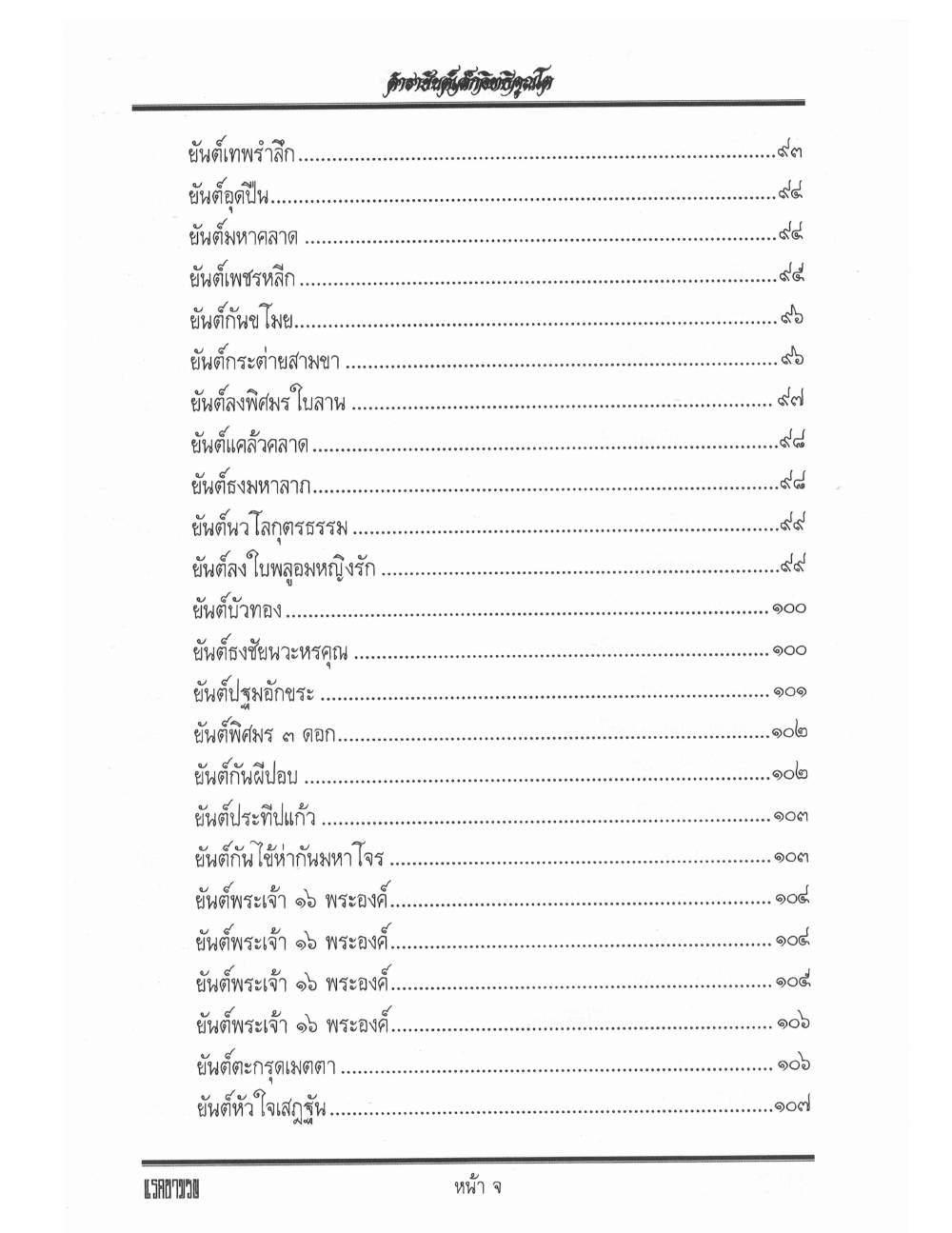
ยันต์เทพรำลึก ................ ๙๓ ยันต์อุดปืน ................ ๙๔ ยันต์มหาคลาด ................ ๙๔ ยันต์เพชรหลีก ................ ๙๕ ยันต์กันขโมย ................ ๙๖ ยันต์กระต่ายสามขา ................ ๙๖ ยันต์ลงพิศมรใบลาน ................ ๙๗ ยันต์แคล้วคลาด ................ ๙๘ ยันต์ธงมหาลาภ ................ ๙๘ ยันต์นวโลกุตรธรรม ................ ๙๙ ยันต์ลงใบพลูอมหญิงรัก ................ ๙๙ ยันต์บัวทอง ................ ๑๐๐ ยันต์ธงชัยพระหรคุณ ................ ๑๐๐ ยันต์ปฐมอักขระ ................ ๑๐๑ ยันต์พิศมร ๓ ดอก ................ ๑๐๒ ยันต์กันผีปอบ ................ ๑๐๒ ยันต์ประทีปแก้ว ................ ๑๐๓ ยันต์กันไข้ห่ากันมหาโจร ................ ๑๐๓ ยันต์พระเจ้า ๑๖ พระองค์ ................ ๑๐๔ ยันต์พระเจ้า ๑๖ พระองค์ ................ ๑๐๔ ยันต์พระเจ้า ๑๖ พระองค์ ................ ๑๐๕ ยันต์พระเจ้า ๑๖ พระองค์ ................ ๑๐๖ ยันต์ตะกรุดเมตตา ................ ๑๐๖ ยันต์หัวใจเสฏฐัน ................ ๑๐๗
หน้า จ
[illegible: decorative title banner across the header]
Remembering-the-Deity Yantra — 93 Sealing-against-Firearms Yantra — 94 Great-Escape Yantra — 94 Evading-Diamond Yantra — 95 Ward-against-Thieves Yantra — 96 Three-Legged-Rabbit Yantra — 96 Inscribing-a-Love-Charm-on-a-Palm-Leaf Yantra — 97 Escape-from-Danger Yantra — 98 Banner-of-Great-Fortune Yantra — 98 Nine-Transcendent-Dhammas Yantra — 99 Inscribing-a-Betel-Leaf-Held-in-the-Mouth-to-Win-a-Woman's-Love Yantra — 99 Golden-Lotus Yantra — 100 Victory-Banner Yantra [name uncertain in source] — 100 First-Syllable Yantra — 101 Three-Strand-Love-Charm Yantra — 102 Ward-against-Ghost-Possession Yantra — 102 Crystal-Lamp Yantra — 103 Ward-against-Plague-Fever-and-Great-Bandits Yantra — 103 Sixteen-Lord-Buddhas Yantra — 104 Sixteen-Lord-Buddhas Yantra — 104 Sixteen-Lord-Buddhas Yantra — 105 Sixteen-Lord-Buddhas Yantra — 106 Loving-Kindness-Takrut Yantra — 106 Heart-mantra-for-Prosperity Yantra [name uncertain] — 107
Page จ
[อ่านไม่ออก]
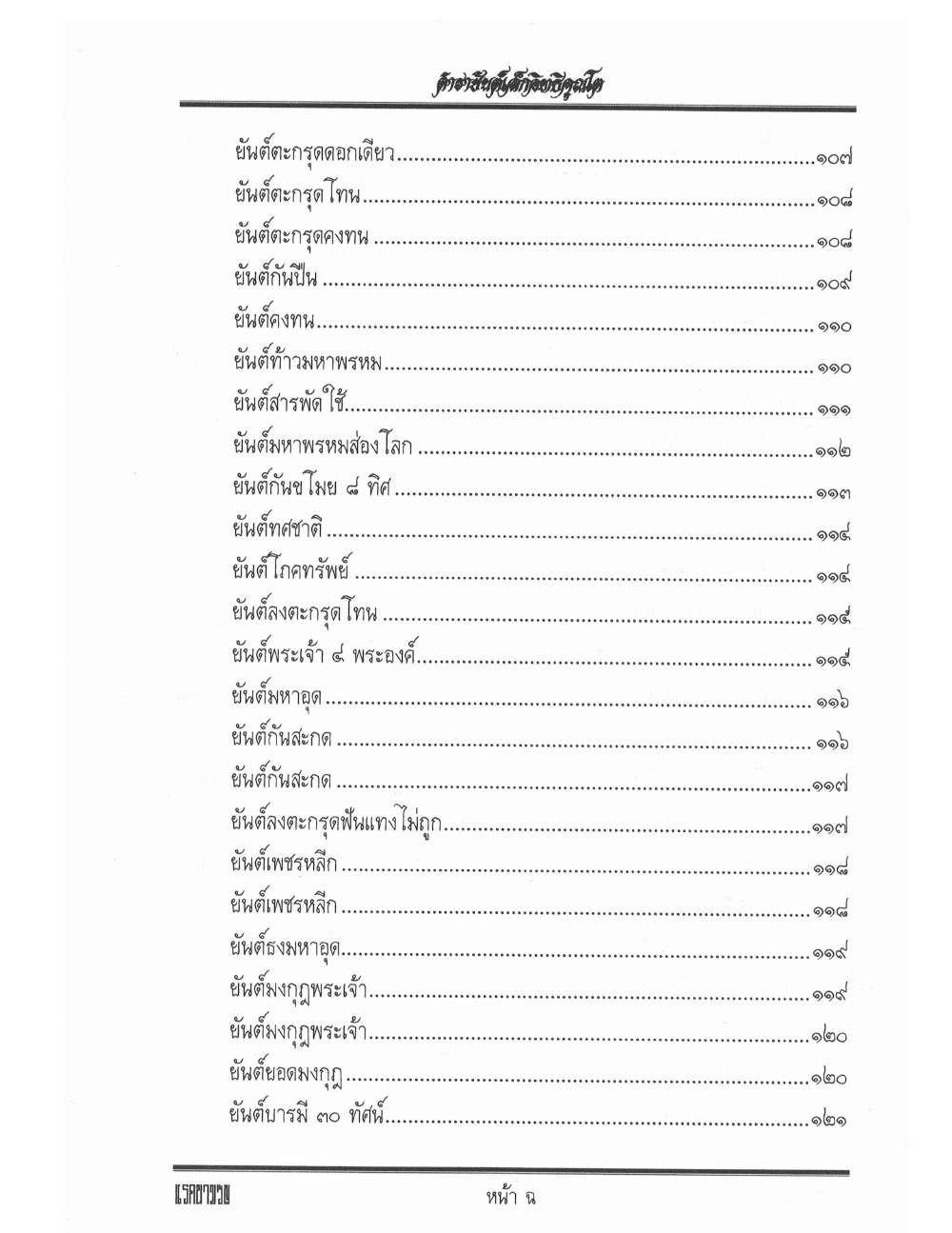
ยันต์ตะกรุดดอกเดียว ................ ๑๐๗ ยันต์ตะกรุดโทน ................ ๑๐๘ ยันต์ตะกรุดคงทน ................ ๑๐๘ ยันต์กันปืน ................ ๑๐๙ ยันต์คงทน ................ ๑๑๐ ยันต์ท้าวมหาพรหม ................ ๑๑๐ ยันต์สารพัดใช้ ................ ๑๑๑ ยันต์มหาพรหมส่องโลก ................ ๑๑๒ ยันต์กันขโมย ๘ ทิศ ................ ๑๑๓ ยันต์ทศชาติ ................ ๑๑๔ ยันต์โภคทรัพย์ ................ ๑๑๔ ยันต์ลงตะกรุดโทน ................ ๑๑๕ ยันต์พระเจ้า ๔ พระองค์ ................ ๑๑๕ ยันต์มหาอุด ................ ๑๑๖ ยันต์กันสะกด ................ ๑๑๖ ยันต์กันสะกด ................ ๑๑๗ ยันต์ลงตะกรุดฟันแทงไม่ถูก ................ ๑๑๗ ยันต์เพชรหลีก ................ ๑๑๘ ยันต์เพชรหลีก ................ ๑๑๘ ยันต์ธงมหาอุด ................ ๑๑๙ ยันต์มงกุฎพระเจ้า ................ ๑๑๙ ยันต์มงกุฎพระเจ้า ................ ๑๒๐ ยันต์ยอดมงกุฎ ................ ๑๒๐ ยันต์บารมี ๓๐ ทัศ ................ ๑๒๑
หน้า ฉ
[illegible: decorative title banner across the header]
Single-Strand-Takrut Yantra — 107 Solo-Takrut Yantra — 108 Enduring-Takrut Yantra — 108 Bulletproof Yantra — 109 Endurance Yantra — 110 Great-Brahma-King Yantra — 110 All-Purpose Yantra — 111 Great-Brahma-Illuminating-the-World Yantra — 112 Ward-against-Thieves-from-the-Eight-Directions Yantra — 113 Ten-Birth-Tales (Jataka) Yantra — 114 Wealth-and-Fortune Yantra — 114 Inscribing-a-Solo-Takrut Yantra — 115 The-Four-Lord-Buddhas Yantra — 115 Great-Invulnerability Yantra — 116 Ward-against-Hypnotic-Binding Yantra — 116 Ward-against-Hypnotic-Binding Yantra — 117 Inscribing-a-Takrut-against-Being-Cut-or-Stabbed Yantra — 117 Evading-Diamond Yantra — 118 Evading-Diamond Yantra — 118 Banner-of-Great-Invulnerability Yantra — 119 Buddha's-Crown Yantra — 119 Buddha's-Crown Yantra — 120 Crown's-Pinnacle Yantra — 120 Thirty-Perfections Yantra — 121
Page ฉ
[อ่านไม่ออก]
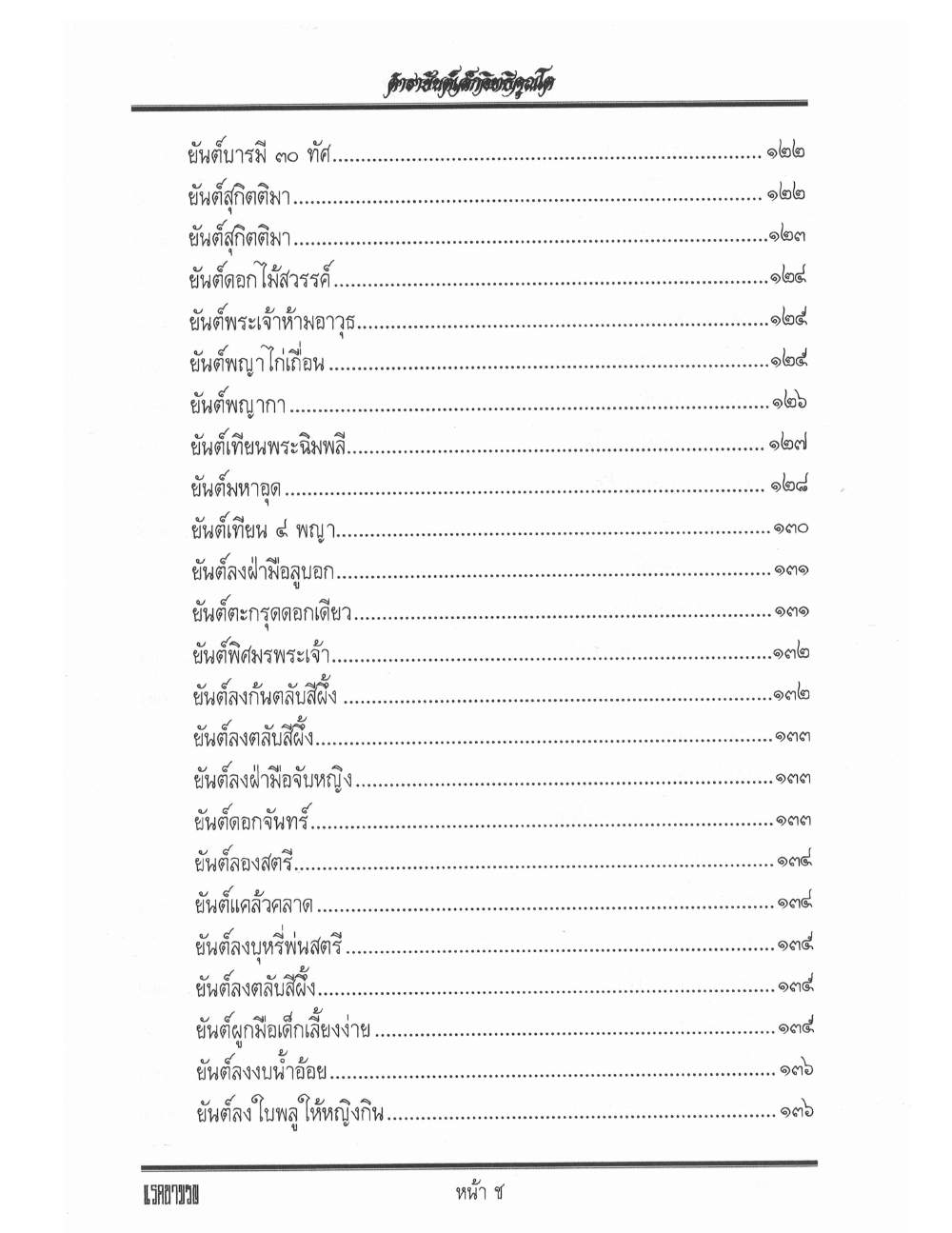
ยันต์บารมี ๓๐ ทัศ ................ ๑๒๒ ยันต์สุกิตติมา ................ ๑๒๒ ยันต์สุกิตติมา ................ ๑๒๓ ยันต์ดอกไม้สวรรค์ ................ ๑๒๔ ยันต์พระเจ้าห้ามอาวุธ ................ ๑๒๕ ยันต์พญาไก่เถื่อน ................ ๑๒๕ ยันต์พญากา ................ ๑๒๖ ยันต์เทียนพระฉิมพลี ................ ๑๒๗ ยันต์มหาอุด ................ ๑๒๘ ยันต์เทียน ๔ พญา ................ ๑๓๐ ยันต์ลงฝ่ามือลูบอก ................ ๑๓๑ ยันต์ตะกรุดดอกเดียว ................ ๑๓๑ ยันต์พิศมรพระเจ้า ................ ๑๓๒ ยันต์ลงกันตลับสีผึ้ง ................ ๑๓๒ ยันต์ลงตลับสีผึ้ง ................ ๑๓๓ ยันต์ลงฝ่ามือจับหญิง ................ ๑๓๓ ยันต์ดอกจันทร์ ................ ๑๓๓ ยันต์ลองสตรี ................ ๑๓๔ ยันต์แคล้วคลาด ................ ๑๓๔ ยันต์ลงบุหรี่พ่นสตรี ................ ๑๓๕ ยันต์ลงตลับสีผึ้ง ................ ๑๓๕ ยันต์ผูกมือเด็กเลี้ยงง่าย ................ ๑๓๕ ยันต์ลงงบน้ำอ้อย ................ ๑๓๖ ยันต์ลงใบพลูให้หญิงกิน ................ ๑๓๖
หน้า ช
[illegible: decorative title banner across the header]
Thirty-Perfections Yantra — 122 Good-Renown Yantra — 122 Good-Renown Yantra — 123 Heavenly-Flower Yantra — 124 Buddha-Forbidding-Weapons Yantra — 125 Lord-Wild-Rooster Yantra — 125 Lord-Crow Yantra — 126 Candle-of-Phra-Chimphli Yantra — 127 Great-Invulnerability Yantra — 128 Candle-of-the-Four-Lords Yantra — 130 Inscribing-a-Palm-for-Stroking-the-Chest Yantra — 131 Single-Strand-Takrut Yantra — 131 Buddha's-Love-Charm Yantra — 132 Inscribing-a-Protective-Beeswax-Case Yantra — 132 Inscribing-a-Beeswax-Case Yantra — 133 Inscribing-a-Palm-for-Holding-a-Woman Yantra — 133 Nutmeg-Flower Yantra — 133 Testing-a-Woman Yantra [reading uncertain] — 134 Escape-from-Danger Yantra — 134 Inscribing-a-Cigarette-to-Blow-on-a-Woman Yantra — 135 Inscribing-a-Beeswax-Case Yantra — 135 Binding-a-Child's-Wrist-so-It-Is-Easy-to-Raise Yantra — 135 Inscribing-a-Sugarcane-Syrup-Cake Yantra — 136 Inscribing-a-Betel-Leaf-for-a-Woman-to-Eat Yantra — 136
Page ช
[อ่านไม่ออก]
ยันต์ลงชายผ้าหญิงรัก ................ ๑๓๖ ยันต์ลงหน้าหินฝนจันทร์ ................ ๑๓๗ ยันต์พระเจ้า ๔ พระองค์ ................ ๑๓๗ ยันต์ลงใบพลู ................ ๑๓๘ ยันต์ลูบหลังสตรี ................ ๑๓๘ ยันต์กันผี ................ ๑๓๙ ยันต์ใส่บ่อน้ำรักสิ้นทั้งเรือน ................ ๑๓๙ ยันต์ทรหด ................ ๑๔๐ ยันต์มหาละลวย ................ ๑๔๐ ยันต์แช่น้ำมันหอม ................ ๑๔๑ ยันต์ลงหน้าผากเสือ ................ ๑๔๑ ยันต์พญาเทครัว ................ ๑๔๒ ยันต์ลงฝ่ามือตบผี ................ ๑๔๒ ยันต์กันกระทำ ................ ๑๔๓ ยันต์กันภัย ................ ๑๔๓ ยันต์กันศัตรู ................ ๑๔๔ ยันต์กันหนูกินข้าว ................ ๑๔๔ ยันต์ผูกมือเด็กกันผี ................ ๑๔๔ ยันต์กันหมากัด ................ ๑๔๕ ยันต์ลงฝ่ามือยุดหญิง ................ ๑๔๕ ยันต์กันไฟ ................ ๑๔๖ ยันต์ปิดประตูกันผี ................ ๑๔๖ ยันต์ปิดประตูกันผี ................ ๑๔๖ ยันต์กันผี ................ ๑๔๗
หน้า ซ
[illegible: decorative title banner across the header]
Inscribing-the-Hem-of-a-Cloth-for-a-Woman's-Love Yantra — 136 Inscribing-the-Face-of-a-Sandalwood-Grinding-Stone Yantra — 137 The-Four-Lord-Buddhas Yantra — 137 Inscribing-a-Betel-Leaf Yantra — 138 Stroking-a-Woman's-Back Yantra — 138 Ward-against-Ghosts Yantra — 139 Placing-in-a-Well-so-the-Whole-Household-Loves Yantra — 139 Endurance Yantra — 140 Great-Allure Yantra — 140 Soaking-in-Fragrant-Oil Yantra — 141 Inscribing-a-Tiger's-Forehead Yantra — 141 Lord-Who-Empties-the-Household Yantra — 142 Inscribing-a-Palm-for-Slapping-Ghosts Yantra — 142 Ward-against-Sorcery Yantra — 143 Ward-against-Danger Yantra — 143 Ward-against-Enemies Yantra — 144 Ward-Rats-from-Eating-the-Rice Yantra — 144 Binding-a-Child's-Wrist-against-Ghosts Yantra — 144 Ward-against-Dog-Bites Yantra — 145 Inscribing-a-Palm-for-Restraining-a-Woman Yantra — 145 Ward-against-Fire Yantra — 146 Closing-the-Door-against-Ghosts Yantra — 146 Closing-the-Door-against-Ghosts Yantra — 146 Ward-against-Ghosts Yantra — 147
Page ซ
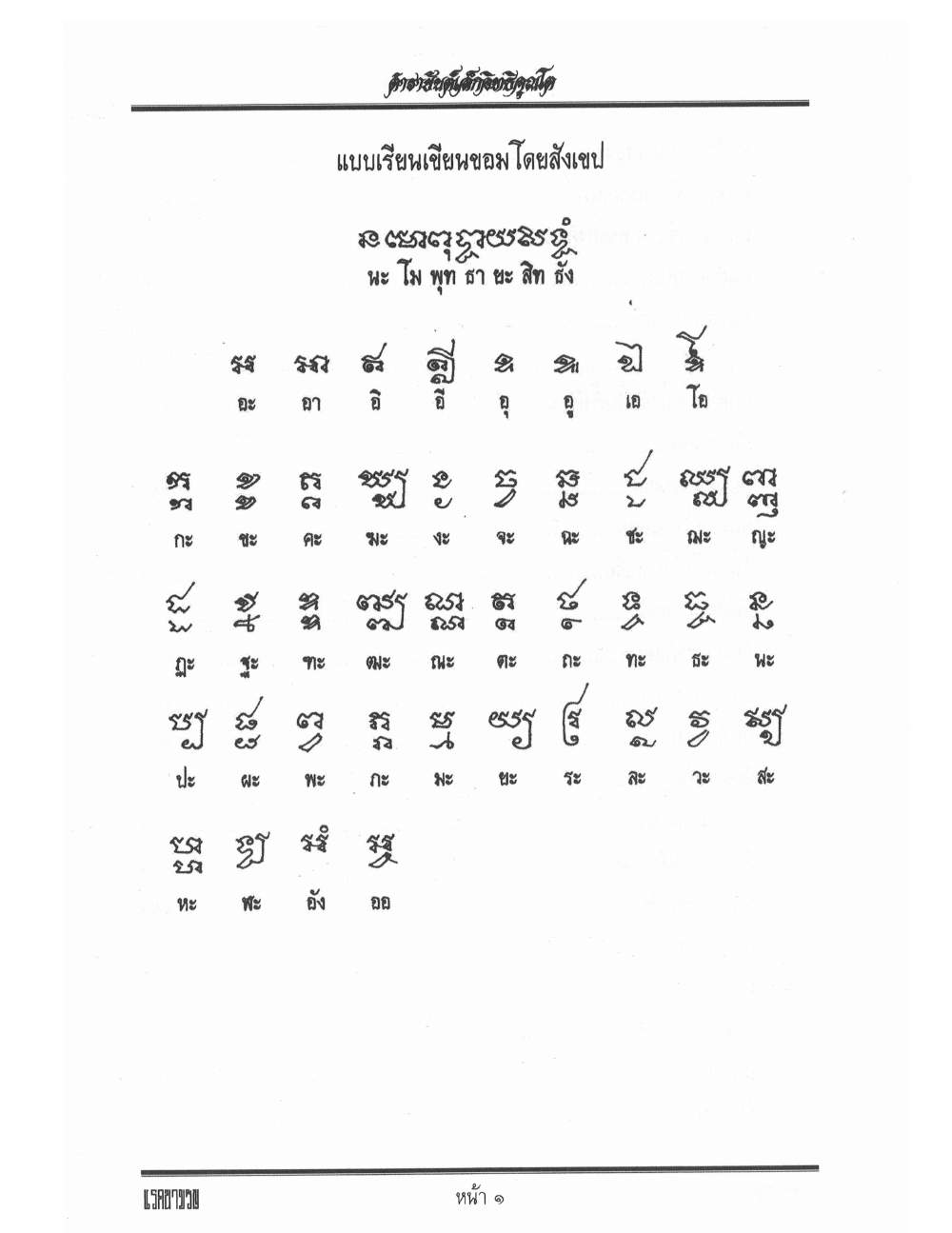
แบบเรียนเขียนขอมโดยสังเขป
[อักขระขอม] นะ โม พุท ธา ยะ สิท ธัง
[ตารางเปรียบเทียบอักขระขอมกับเสียงไทย: แถวแรกเป็นรูปสระ ตรงกับเสียง ะ า ิ ี ุ ู เ ไ ถัดลงมาเป็นตารางพยัญชนะขอมหลายแถว แต่ละช่องมีอักขระขอมลายมือกำกับด้วยคำอ่านภาษาไทยไว้ด้านล่าง — อักขระขอมลายมือในบางช่องอ่านไม่ชัด]
หน้า ๑
A Brief Primer for Writing Khom Script
[khom script] Na Mo Phut Tha Ya Sit Thang [the syllables of a heart-mantra formula, an extended form of the Namo Buddhaya invocation]
[Table comparing khom letterforms to their Thai phonetic equivalents: the first row gives the vowel forms corresponding to the sounds ะ า ิ ี ุ ู เ ไ; below that are several rows of khom consonant letters, each cell showing a hand-drawn khom character with its Thai phonetic reading printed underneath — the hand-drawn khom characters in some cells are not clearly legible]
Page 1
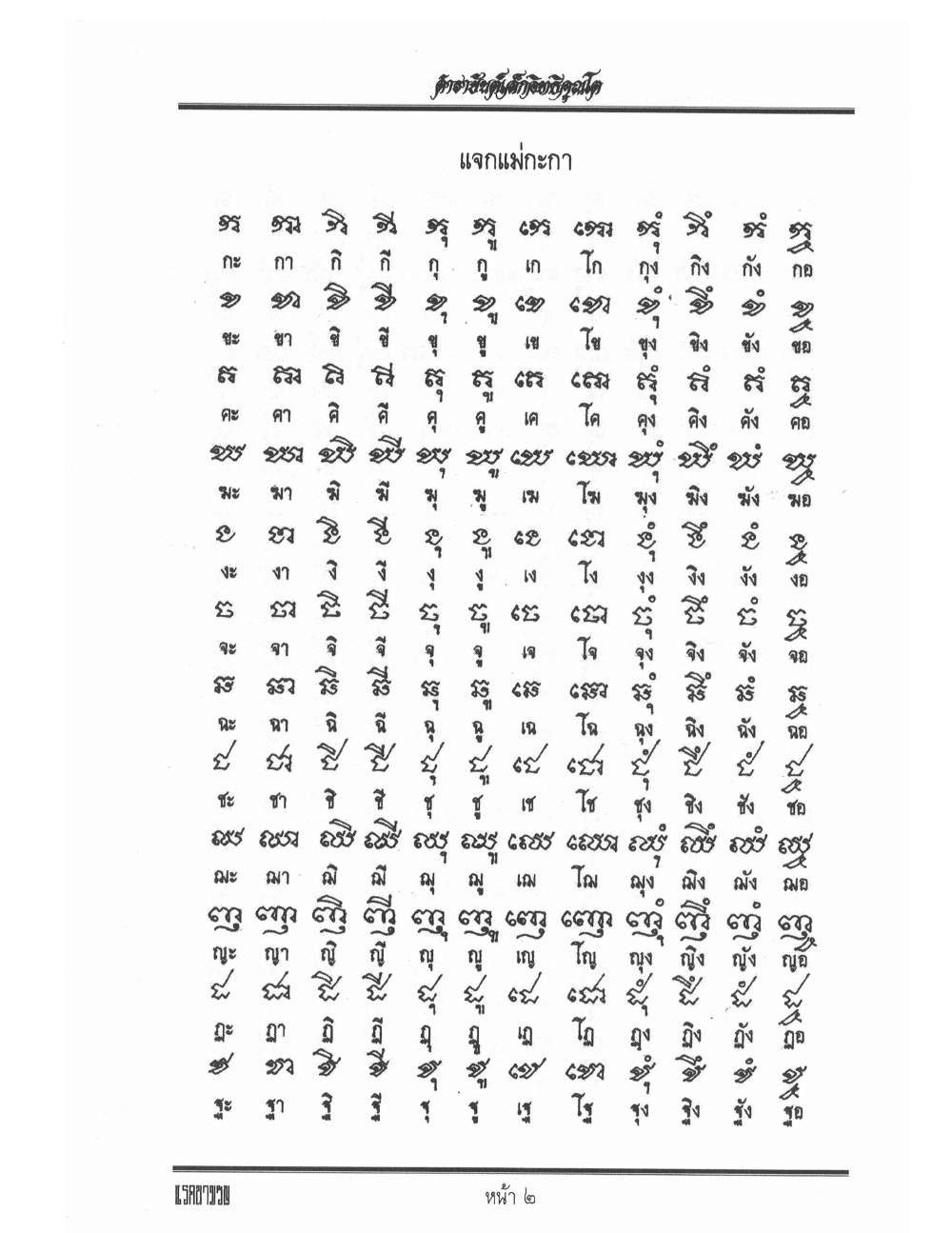
[หัวกระดาษบน: อักษรลายมือประดิษฐ์ อ่านไม่ชัด]
แจกแม่กะกา
กะ กา กิ กี กุ กู เก ไก กุง กิง กัง กอ
[แถวถัดไปอีกหลายแถว (ราวสิบกว่าแถว) อ่านไม่ออก]
[ตราด้านล่างซ้าย อ่านไม่ชัด] หน้า ๒
[Running header at top of page: decorative cursive script, illegible.]
Declension drill: the "ka-ka" family
The consonant ก (k) conjugated through the vowels a, ā, i, ī, u, ū, e, ai and the final -ng: ka, kā, ki, kī, ku, kū, ke, kai, kung, king, kang, kaw.
[table: a multi-row reading-drill grid continues below this row, each row pairing a Khom-script syllable above with its Thai transliteration beneath; the consonant letters in the further rows (roughly a dozen more) are not legible enough in this scan to transcribe with confidence]
[Stamp/mark, lower left of page: illegible.] [Page number: 2]
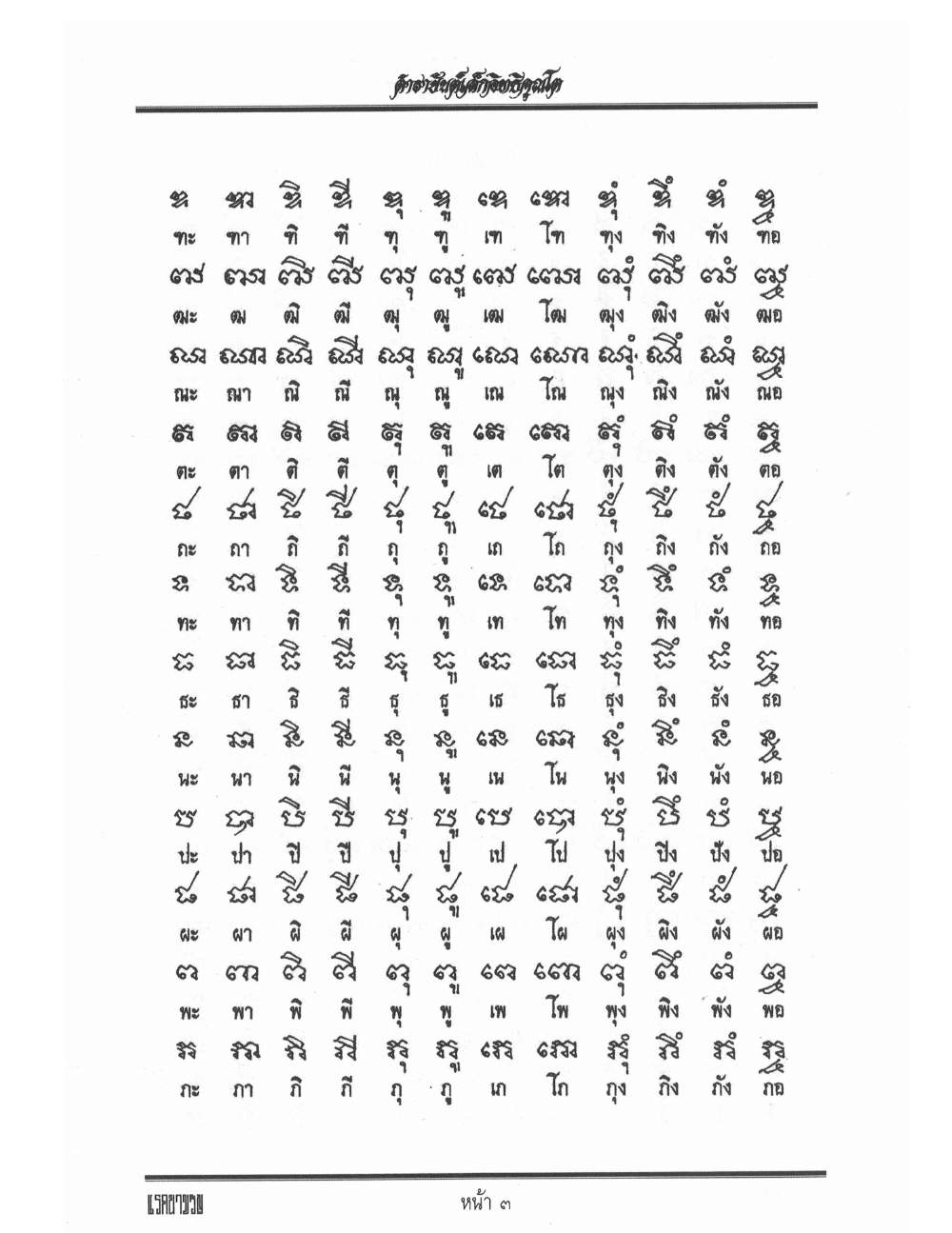
[หัวกระดาษบน: อักษรลายมือประดิษฐ์ อ่านไม่ชัด]
[ตารางแจกลูก (ต่อจากหน้าก่อน) อีกหลายแถว อ่านไม่ออก]
[ตราด้านล่างซ้าย อ่านไม่ชัด] หน้า ๓
[Running header at top of page: decorative cursive script, illegible.]
[table: continuation of the Khom-script/Thai reading-drill table from the previous page, roughly twenty more rows, each conjugating a further Thai consonant through the same vowel pattern (a, ā, i, ī, u, ū, e, ai, and final -ng); the individual consonant letters in each row are not legible enough in this scan to transcribe with confidence]
[Stamp/mark, lower left of page: illegible.] [Page number: 3]
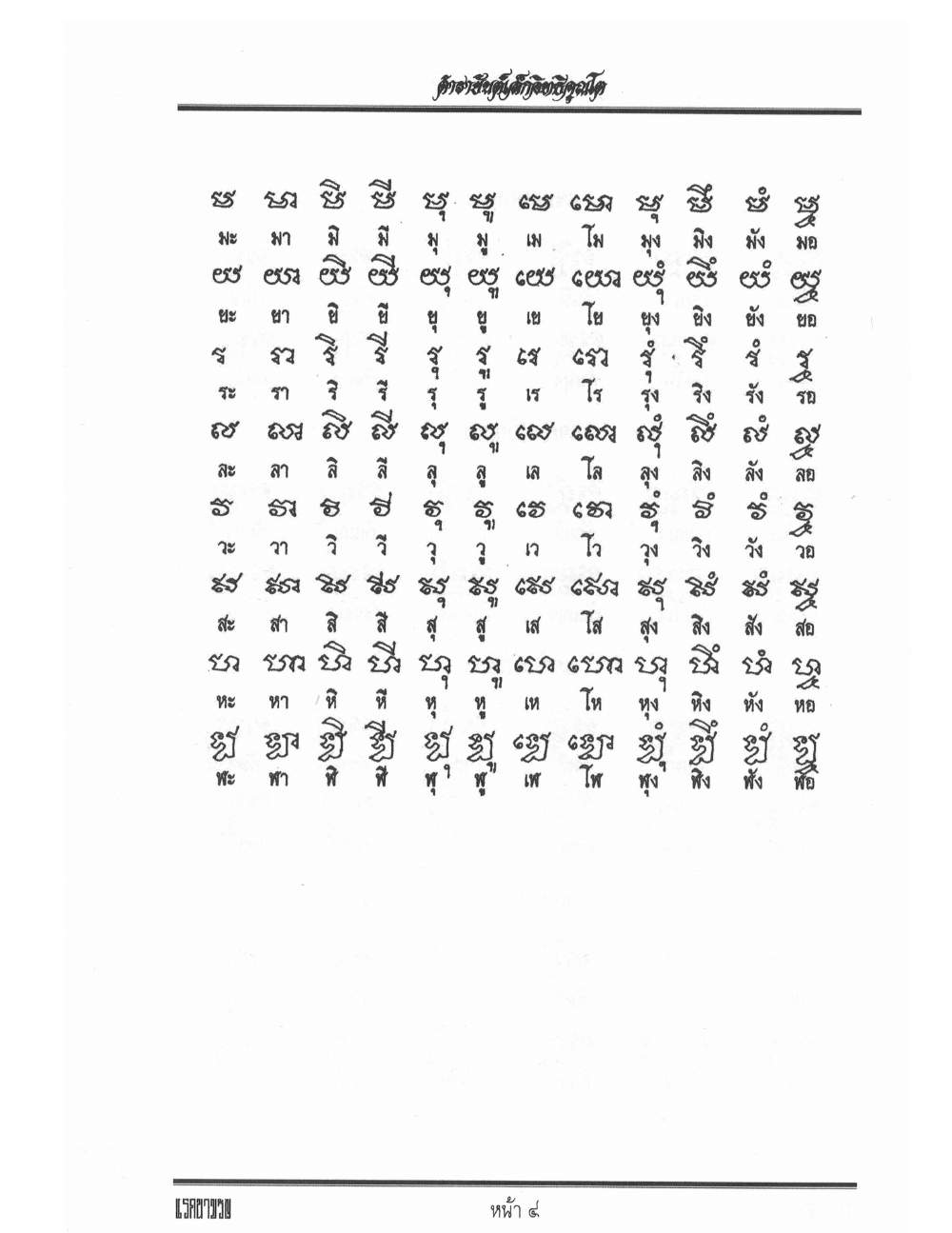
[หัวกระดาษบน: อักษรลายมือประดิษฐ์ อ่านไม่ชัด]
[ตารางแจกลูก (ต่อจากหน้าก่อน) จบตารางกลางหน้านี้ ส่วนล่างของหน้าเว้นว่าง อ่านไม่ออก]
[ตราด้านล่างซ้าย อ่านไม่ชัด] หน้า ๔
[Running header at top of page: decorative cursive script, illegible.]
[table: the Khom-script/Thai reading-drill table concludes partway down this page; the lower half of the page is blank. The individual consonant letters in each row are not legible enough in this scan to transcribe with confidence]
[Stamp/mark, lower left of page: illegible.] [Page number: 4]
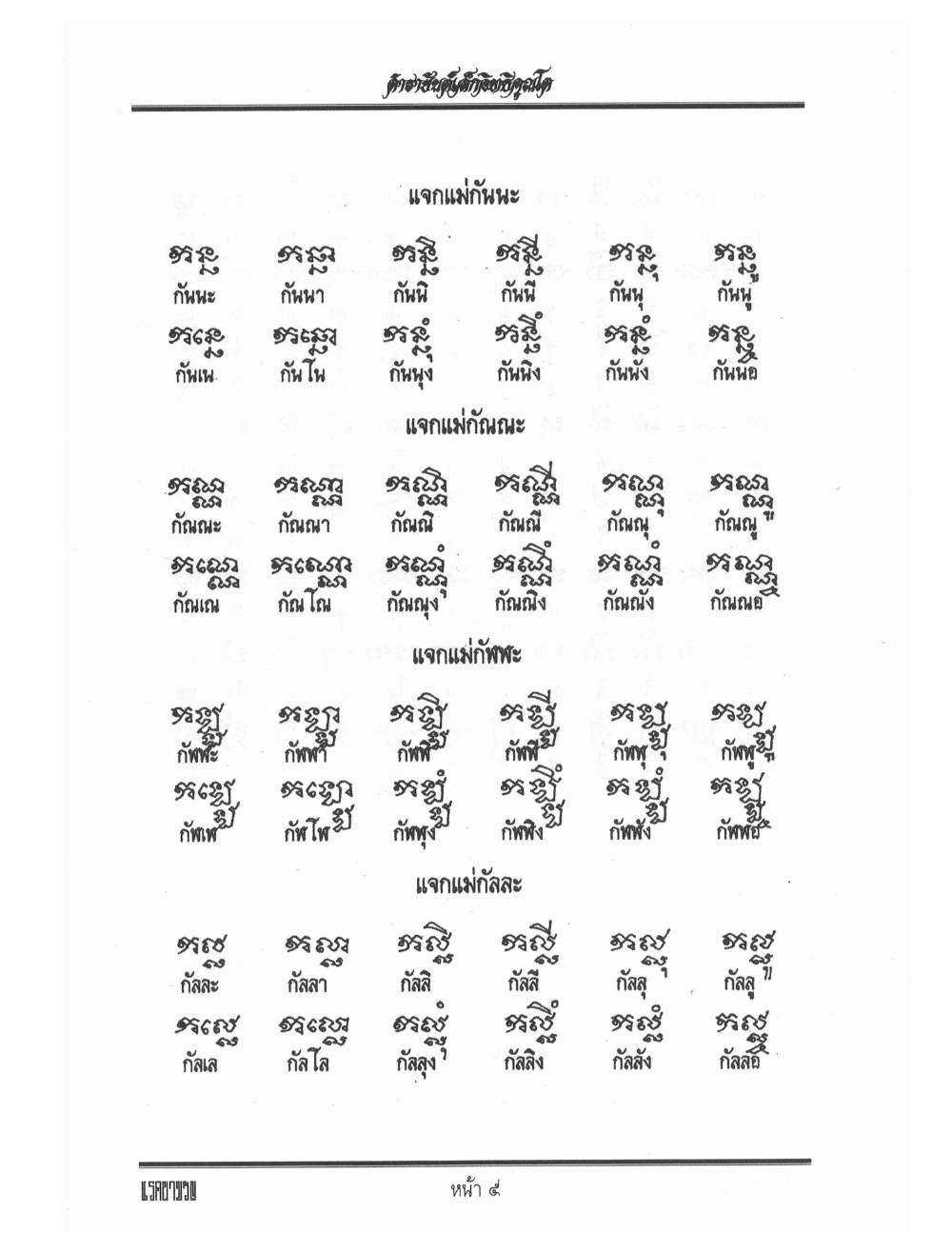
[หัวกระดาษบน: อักษรลายมือประดิษฐ์ อ่านไม่ชัด]
แจกแม่กัพนะ
กัพนะ กัพนา กัพนิ กัพนี กัพนุ กัพนู กัพเน กัพไน กัพนุง กัพนิง กัพนัง กัพนอ
แจกแม่กัณณะ
กัณณะ กัณณา กัณณิ กัณณี กัณณุ กัณณู กัณเณ กัณไณ กัณณุง กัณณิง กัณณัง กัณณอ
แจกแม่กัพพะ
กัพพะ กัพพา กัพพิ กัพพี กัพพุ กัพพู กัพเพ กัพไพ กัพพุง กัพพิง กัพพัง กัพพอ
แจกแม่กัสละ
กัสละ กัสลา กัสลิ กัสลี กัสลุ กัสลู กัสเล กัสไล กัสลุง กัสลิง กัสลัง กัสลอ
[ตราด้านล่างซ้าย อ่านไม่ชัด] หน้า ๕
[Running header at top of page: decorative cursive script, illegible.]
Four further consonant-cluster reading drills, each conjugating a nonsense syllable-cluster through the vowels a, ā, i, ī, u, ū, e, ai and the final -ng, with the Khom-script rendering above each Thai transliteration:
Declension of the "kap-na" cluster
kapna, kapnā, kapni, kapnī, kapnu, kapnū / kapne, kapnai, kapnung, kapning, kapnang, kapnaw.
Declension of the "kan-na" cluster
kanna, kannā, kanni, kannī, kannu, kannū / kanne, kannai, kannung, kanning, kannang, kannaw.
Declension of the "kap-pa" cluster
kappa, kappā, kappi, kappī, kappu, kappū / kappe, kappai, kappung, kapping, kappang, kappaw.
Declension of the "kas-la" cluster
kasala, kasalā, kasali, kasalī, kasalu, kasalū / kasale, kasalai, kasalung, kasaling, kasalang, kasalaw.
[Stamp/mark, lower left of page: illegible.] [Page number: 5]
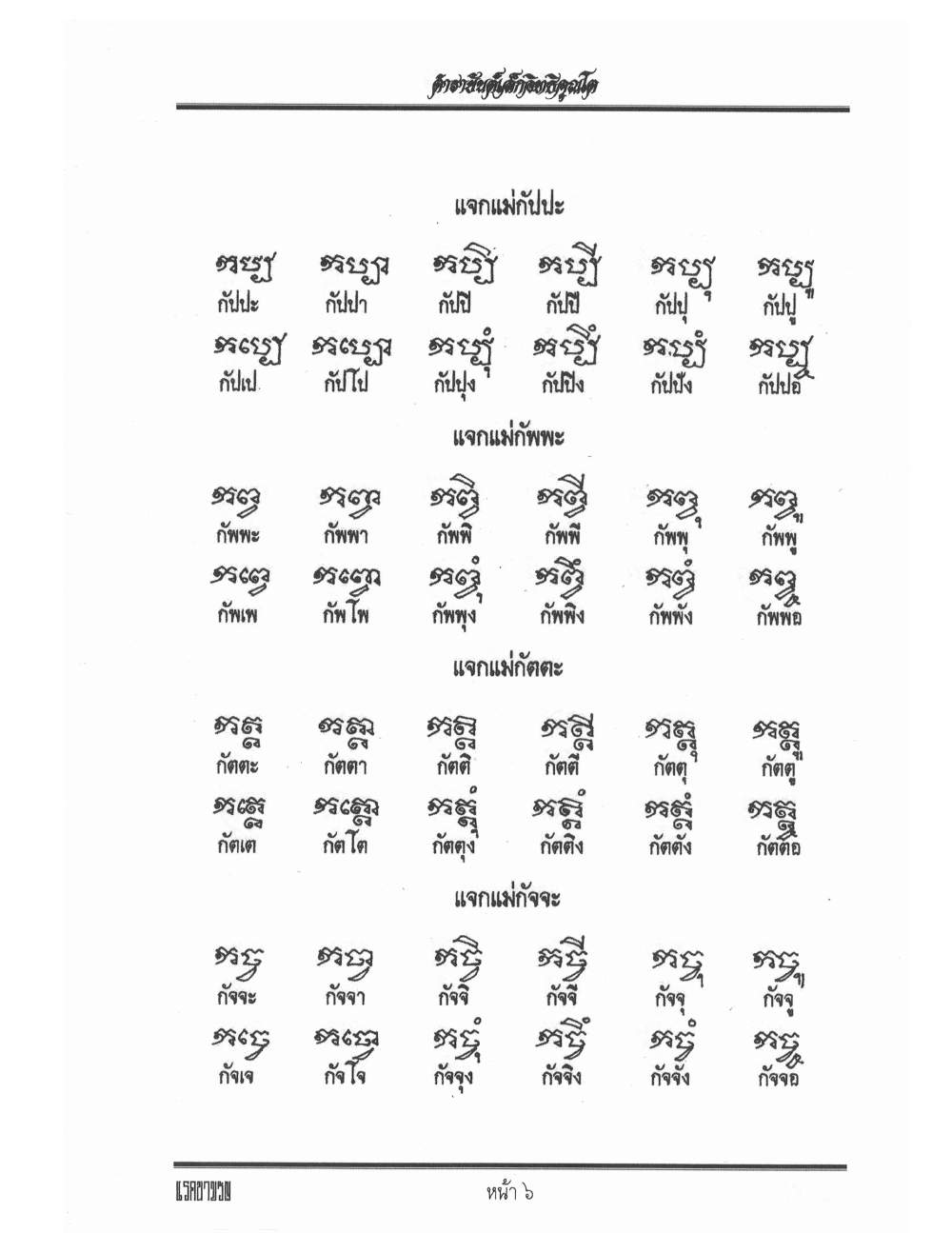
[หัวกระดาษบน: อักษรลายมือประดิษฐ์ อ่านไม่ชัด]
แจกแม่กัปปะ
กัปปะ กัปปา กัปปิ กัปปี กัปปุ กัปปู กัปเป กัปไป กัปปุง กัปปิง กัปปัง กัปปอ
แจกแม่กัพพะ
กัพพะ กัพพา กัพพิ กัพพี กัพพุ กัพพู กัพเพ กัพไพ กัพพุง กัพพิง กัพพัง กัพพอ
แจกแม่กัตตะ
กัตตะ กัตตา กัตติ กัตตี กัตตุ กัตตู กัตเต กัตไต กัตตุง กัตติง กัตตัง กัตตอ
แจกแม่กัจจะ
กัจจะ กัจจา กัจจิ กัจจี กัจจุ กัจจู กัจเจ กัจไจ กัจจุง กัจจิง กัจจัง กัจจอ
[ตราด้านล่างซ้าย อ่านไม่ชัด] หน้า ๖
[Running header at top of page: decorative cursive script, illegible.]
Four more consonant-cluster reading drills, same pattern (Khom script above, Thai transliteration below):
Declension of the "kap-pa" cluster
kappa, kappā, kappi, kappī, kappu, kappū / kappe, kappai, kappung, kapping, kappang, kappaw.
Declension of the "kap-pa" (labial) cluster
kappa, kappā, kappi, kappī, kappu, kappū / kappe, kappai, kappung, kapping, kappang, kappaw. [Note: this entry's Thai heading is visually near-identical to the preceding one; a fine distinction between the two consonants (likely พ vs ภ) was not confidently resolvable in this scan.]
Declension of the "kat-ta" cluster
katta, kattā, katti, kattī, kattu, kattū / katte, kattai, kattung, katting, kattang, kattaw.
Declension of the "kat-ja" cluster
katja, katjā, katji, katjī, katju, katjū / katje, katjai, katjung, katjing, katjang, katjaw.
[Stamp/mark, lower left of page: illegible.] [Page number: 6]
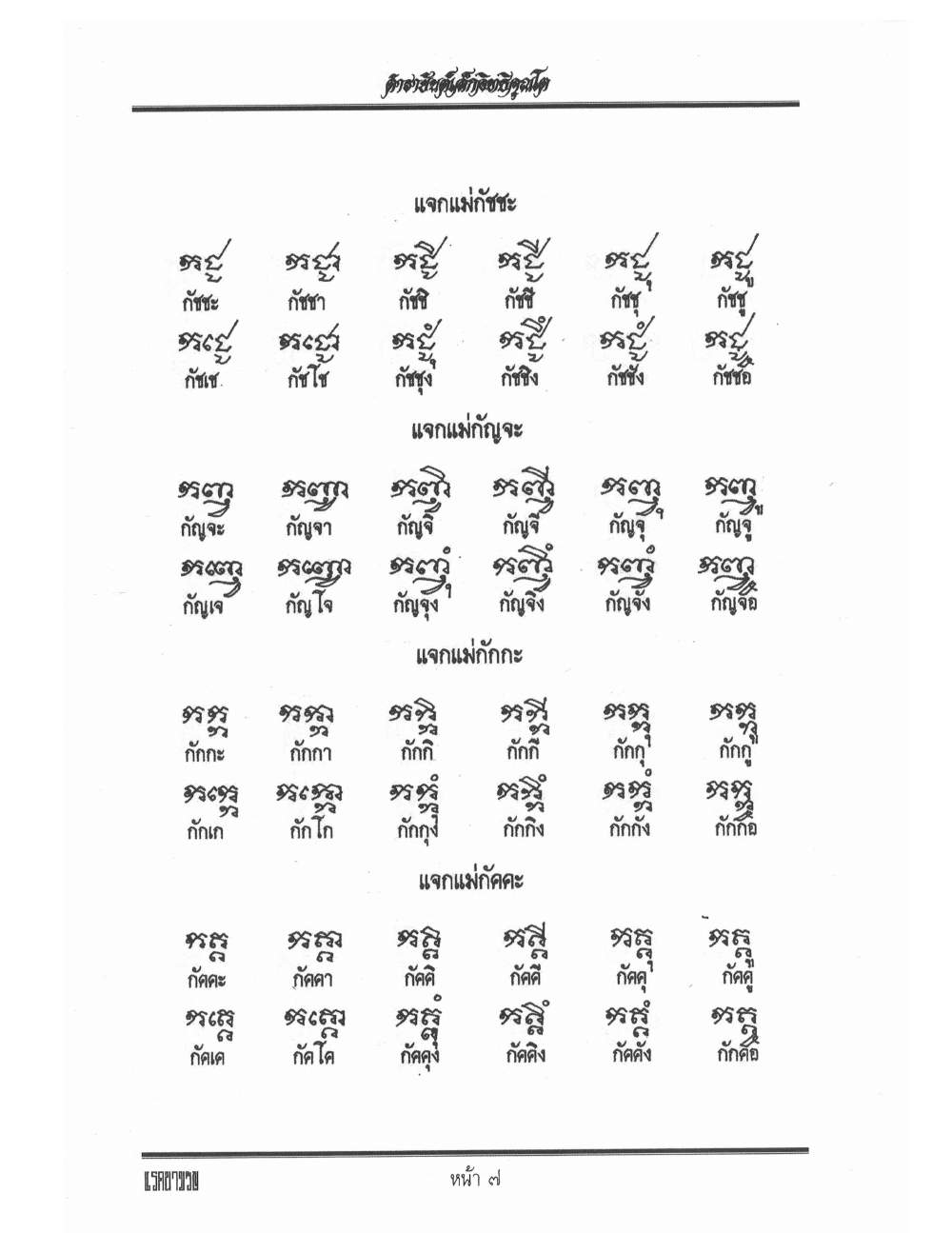
[หัวกระดาษบน: อักษรลายมือประดิษฐ์ อ่านไม่ชัด]
แจกแม่กัชชะ
กัชชะ กัชชา กัชชิ กัชชี กัชชุ กัชชู กัชเช กัชไช กัชชุง กัชชิง กัชชัง กัชชอ
แจกแม่กัญจะ
กัญจะ กัญจา กัญจิ กัญจี กัญจุ กัญจู กัญเจ กัญไจ กัญจุง กัญจิง กัญจัง กัญจอ
แจกแม่กักกะ
กักกะ กักกา กักกิ กักกี กักกุ กักกู กักเก กักไก กักกุง กักกิง กักกัง กักกอ
แจกแม่กัคคะ
กัคคะ กัคคา กัคคิ กัคคี กัคคุ กัคคู กัคเค กัคไค กัคคุง กัคคิง กัคคัง กัคคอ
[ตราด้านล่างซ้าย อ่านไม่ชัด] หน้า ๗
[Running header at top of page: decorative cursive script, illegible.]
Four more consonant-cluster reading drills, same pattern:
Declension of the "kat-ja" (voiced) cluster
katja, katjā, katji, katjī, katju, katjū / katje, katjai, katjung, katjing, katjang, katjaw.
Declension of the "kan-ja" cluster
kanja, kanjā, kanji, kanjī, kanju, kanjū / kanje, kanjai, kanjung, kanjing, kanjang, kanjaw.
Declension of the "kak-ka" cluster
kakka, kakkā, kakki, kakkī, kakku, kakkū / kakke, kakkai, kakkung, kakking, kakkang, kakkaw.
Declension of the "kak-ka" (voiced) cluster
kakka, kakkā, kakki, kakkī, kakku, kakkū / kakke, kakkai, kakkung, kakking, kakkang, kakkaw.
[Stamp/mark, lower left of page: illegible.] [Page number: 7]
[หัวกระดาษบน: อักษรลายมือประดิษฐ์ อ่านไม่ชัด]
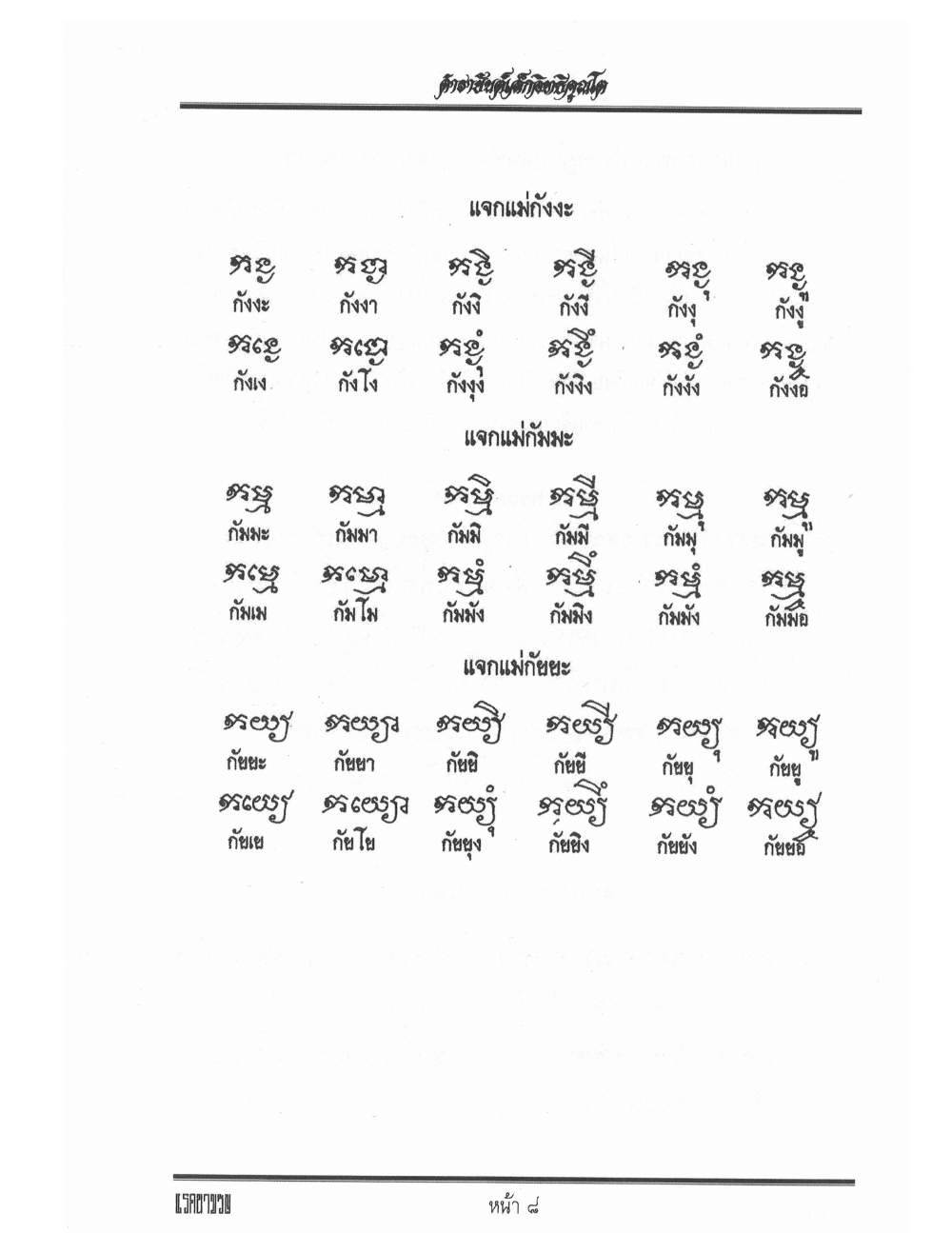
แจกแม่กังงะ
กังงะ กังงา กังงิ กังงี กังงุ กังงู กังเง กังไง กังงุง กังงิง กังงัง กังงอ
แจกแม่กัมมะ
กัมมะ กัมมา กัมมิ กัมมี กัมมุ กัมมู กัมเม กัมไม กัมมุง กัมมิง กัมมัง กัมมอ
แจกแม่กัยยะ
กัยยะ กัยยา กัยยิ กัยยี กัยยุ กัยยู กัยเย กัยไย กัยยุง กัยยิง กัยยัง กัยยอ
[ตราด้านล่างซ้าย อ่านไม่ชัด] หน้า ๘
[Running header at top of page: decorative cursive script, illegible.]
Three more consonant-cluster reading drills, same pattern, closing this series:
Declension of the "kang-nga" cluster
kangnga, kangngā, kangngi, kangngī, kangngu, kangngū / kangnge, kangngai, kangngung, kangnging, kangngang, kangngaw.
Declension of the "kam-ma" cluster
kamma, kammā, kammi, kammī, kammu, kammū / kamme, kammai, kammung, kamming, kammang, kammaw.
Declension of the "kay-ya" cluster
kayya, kayyā, kayyi, kayyī, kayyu, kayyū / kayye, kayyai, kayyung, kayying, kayyang, kayyaw.
[Stamp/mark, lower left of page: illegible.] [Page number: 8]
[หัวกระดาษบน: อักษรลายมือประดิษฐ์ อ่านไม่ชัด]
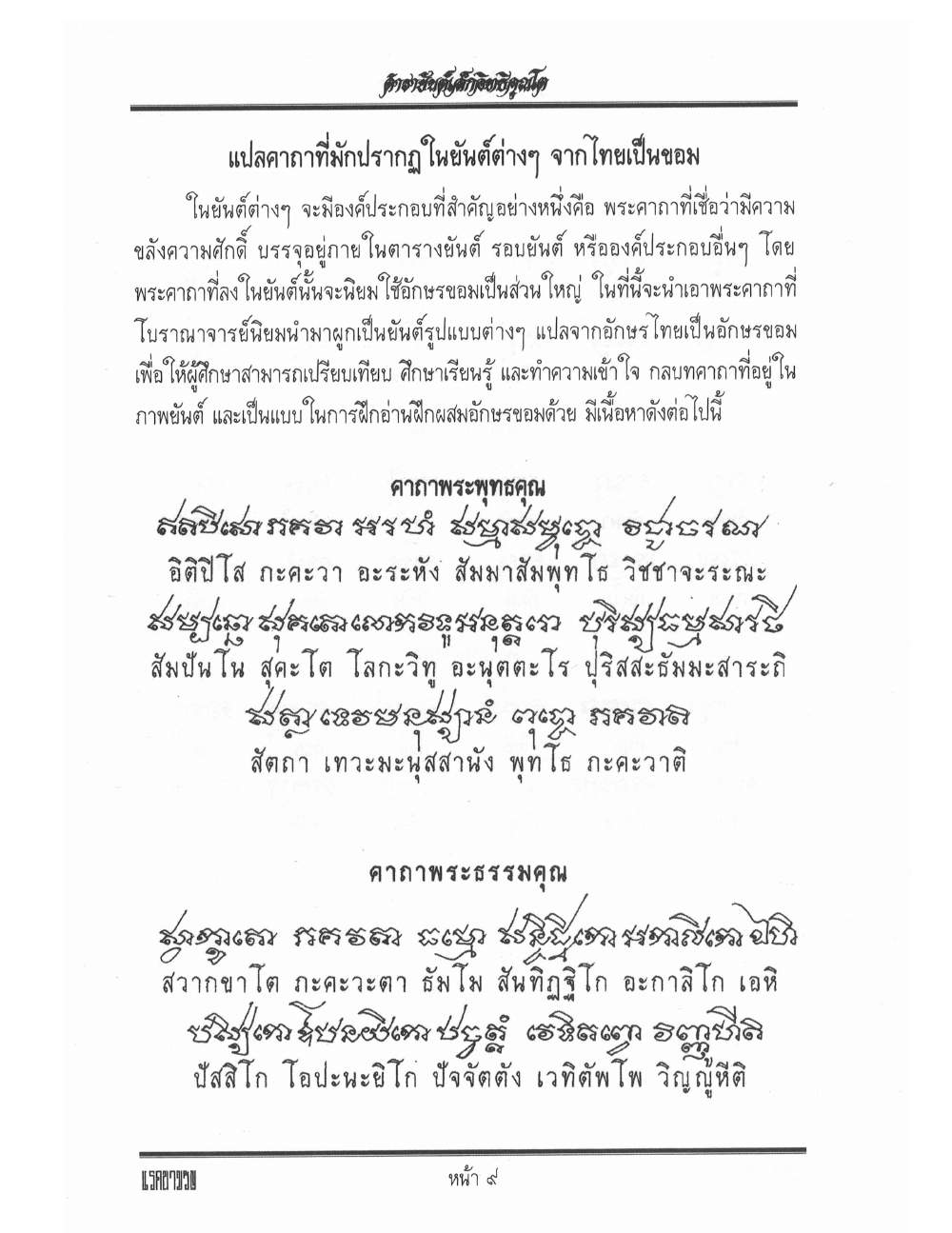
แปลคาถาที่มักปรากฏในยันต์ต่างๆ จากไทยเป็นขอม
ในยันต์ต่างๆ จะมีองค์ประกอบที่สำคัญอย่างหนึ่งคือ พระคาถาที่เชื่อว่ามีความขลังความศักดิ์สิทธิ์ บรรจุอยู่ภายในตารางยันต์ รอบยันต์ หรือองค์ประกอบอื่นๆ โดยพระคาถาที่ลงในยันต์นั้นจะนิยมใช้อักษรขอมเป็นส่วนใหญ่ ในที่นี้จะนำเอาพระคาถาที่โบราณาจารย์นิยมนำมาผูกเป็นยันต์รูปแบบต่างๆ แปลจากอักษรไทยเป็นอักษรขอม เพื่อให้ผู้ศึกษาสามารถเปรียบเทียบ ศึกษาเรียนรู้ และทำความเข้าใจ กลบทคาถาที่อยู่ในภาพยันต์ และเป็นแบบในการฝึกอ่านฝึกผสมอักษรขอมด้วย มีเนื้อหาดังต่อไปนี้
คาถาพระพุทธคุณ
[บรรทัดบน: อักษรขอม] อิติปิโส กะคะวา อะระหัง สัมมาสัมพุทโธ วิชชาจะระณะ [บรรทัดบน: อักษรขอม] สัมปันโน สุคะโต โลกะวิทู อะนุตตะโร ปุริสสะธัมมะสาระถิ [บรรทัดบน: อักษรขอม] สัตถา เทวะมะนุสสานัง พุทโธ ภะคะวาติ
คาถาพระธรรมคุณ
[บรรทัดบน: อักษรขอม] สวากขาโต ภะคะวะตา ธัมโม สันทิฏฐิโก อะกาลิโก เอหิ [บรรทัดบน: อักษรขอม] ปัสสิโก โอปะนะยิโก ปัจจัตตัง เวทิตัพโพ วิญญูหิติ
[ตราด้านล่างซ้าย อ่านไม่ชัด] หน้า ๙
[Running header at top of page: decorative cursive script, illegible.]
Translating the cataa formulas commonly found in various yantras, from Thai into Khom
An important component of many yantras is the sacred cataa (incantation) believed to hold power and sanctity, placed within the yantra's grid, around its border, or among its other elements. The cataa written into a yantra is usually rendered mostly in Khom script. Here we take cataa that ancient masters commonly wove into yantra designs of various forms and translate them from Thai script into Khom script, so that students can compare, study, and understand the coded formulas found within yantra images, and so that this also serves as practice in reading and combining Khom letters. The content is as follows.
Buddha-Virtue Cataa (คาถาพระพุทธคุณ)
[Each line below is given in Khom script above its Thai transliteration.] Itipi so bhagavā (here spelt กะคะวา) arahaṃ sammāsambuddho vijjācaraṇa- ("Thus indeed is the Blessed One: worthy, perfectly self-awakened, endowed with knowledge and conduct,") sampanno sugato lokavidū anuttaro purisa-dhamma-sārathi (as spelt on the page) ("well-gone, knower of the world, unsurpassed charioteer/trainer,") satthā devamanussānaṃ buddho bhagavā ti ("teacher of gods and humans, awakened, blessed.")
Dhamma-Virtue Cataa (คาถาพระธรรมคุณ)
svākkhāto bhagavatā dhammo sandiṭṭhiko akāliko ehi- ("Well-proclaimed by the Blessed One is the Dhamma, visible here and now, timeless, inviting one to come and see,") passiko opanayiko (as spelt) paccattaṃ veditabbo viññūhī ti ("leading onward, to be experienced individually by the wise.")
[Stamp/mark, lower left of page: illegible.] [Page number: 9]
[หัวกระดาษบน: อักษรลายมือประดิษฐ์ อ่านไม่ชัด]
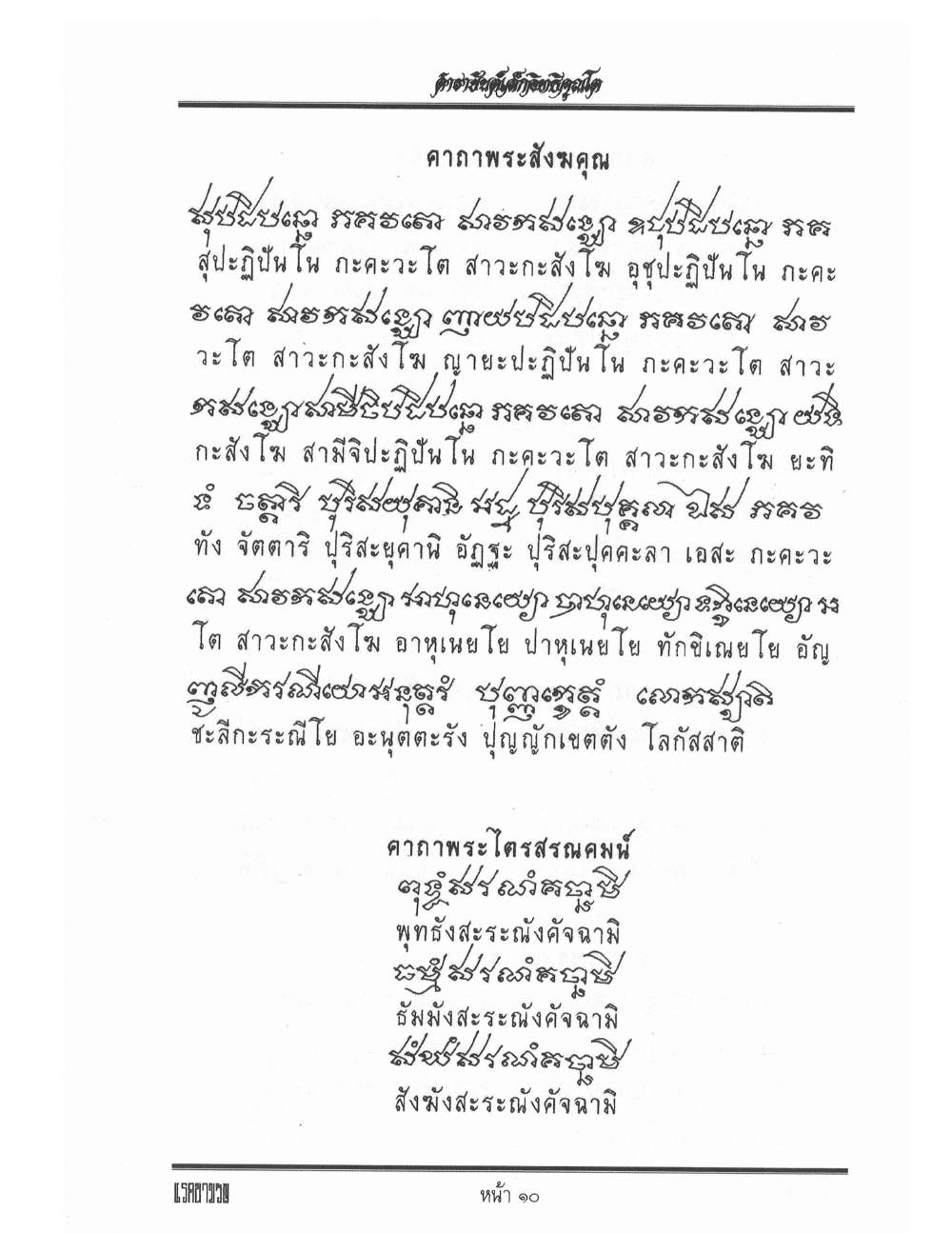
คาถาพระสังฆคุณ
[บรรทัดบน: อักษรขอม] สุปฏิปันโน ภะคะวะโต สาวะกะสังโฆ อุชุปฏิปันโน ภะคะวะโต [บรรทัดบน: อักษรขอม] สาวะกะสังโฆ ญายะปฏิปันโน ภะคะวะโต สาวะกะสังโฆ [บรรทัดบน: อักษรขอม] สามีจิปฏิปันโน ภะคะวะโต สาวะกะสังโฆ ยะทิ [บรรทัดบน: อักษรขอม] ทัง จัตตาริ ปุริสะยุคานิ อัฏฐะ ปุริสะปุคคะลา เอสะ ภะคะวะ [บรรทัดบน: อักษรขอม] โต สาวะกะสังโฆ อาหุเนยโย ปาหุเนยโย ทักขิเณยโย อัญ [บรรทัดบน: อักษรขอม] ชะลีกะระณีโย อะนุตตะรัง ปุญญักเขตตัง โลกัสสาติ
คาถาพระไตรสรณคมน์
[บรรทัดบน: อักษรขอม] พุทธังสะระณังคัจฉามิ [บรรทัดบน: อักษรขอม] ธัมมังสะระณังคัจฉามิ [บรรทัดบน: อักษรขอม] สังฆังสะระณังคัจฉามิ
[ตราด้านล่างซ้าย อ่านไม่ชัด] หน้า ๑๐
[Running header at top of page: decorative cursive script, illegible.]
Sangha-Virtue Cataa (คาถาพระสังฆคุณ)
[Each line below is given in Khom script above its Thai transliteration.] Supaṭipanno bhagavato sāvakasaṅgho, ujupaṭipanno bhagavato sāvakasaṅgho, ñāyapaṭipanno bhagavato sāvakasaṅgho, sāmīcipaṭipanno bhagavato sāvakasaṅgho — ("The Blessed One's disciple Sangha has practiced well, practiced directly, practiced methodically, practiced properly,") yadidaṃ cattāri purisayugāni aṭṭha purisapuggalā, esa bhagavato sāvakasaṅgho — ("namely, the four pairs of persons, the eight types of individuals — this is the Blessed One's disciple Sangha,") āhuneyyo pāhuneyyo dakkhiṇeyyo añjalikaraṇīyo, anuttaraṃ puññakkhettaṃ lokassā ti. ("worthy of offerings, worthy of hospitality, worthy of gifts, worthy of reverential salutation, the unsurpassed field of merit for the world.")
Refuge-Taking Cataa (คาถาพระไตรสรณคมน์)
Buddhaṃ saraṇaṃ gacchāmi. ("I go to the Buddha for refuge.") Dhammaṃ saraṇaṃ gacchāmi. ("I go to the Dhamma for refuge.") Saṅghaṃ saraṇaṃ gacchāmi. ("I go to the Sangha for refuge.")
[Stamp/mark, lower left of page: illegible.] [Page number: 10]
[หัวกระดาษบน: อักษรลายมือประดิษฐ์ อ่านไม่ชัด]
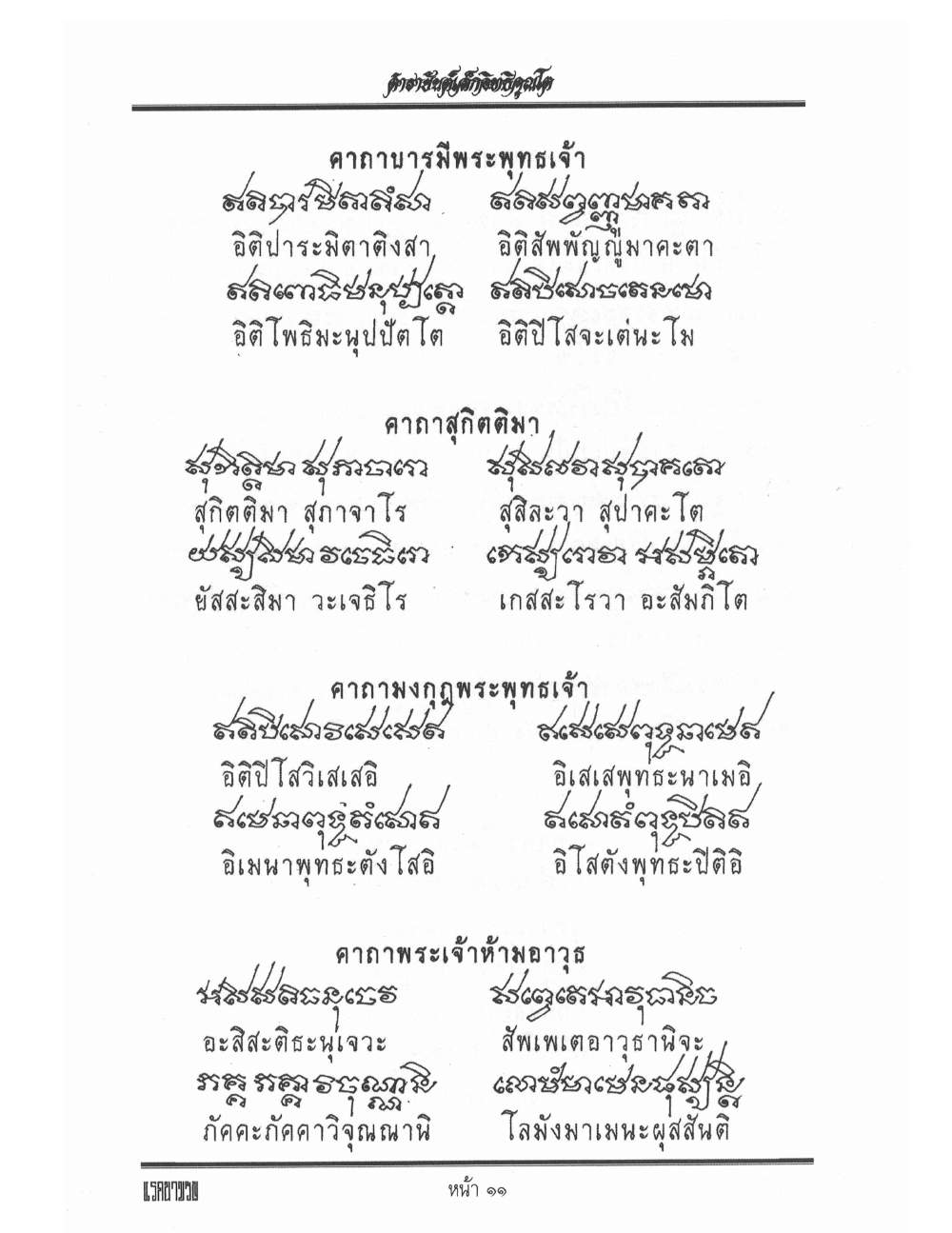
คาถาบารมีพระพุทธเจ้า
[บรรทัดบน: อักษรขอม] [บรรทัดบน: อักษรขอม] อิติปาระมิตาติงสา อิติสัพพัญญูมาคะตา [บรรทัดบน: อักษรขอม] [บรรทัดบน: อักษรขอม] อิติโพธิมะนุปปัตโต อิติปิโส[อ่านไม่ออก]
คาถาสุกิตติมา
[บรรทัดบน: อักษรขอม] [บรรทัดบน: อักษรขอม] สุกิตติมา สุภาจาโร สุสิละวา สุปาคะโต [บรรทัดบน: อักษรขอม] [บรรทัดบน: อักษรขอม] ยัสสะสิมา วะเจธิโร เกสสะโรวา อะสัมภิโต
คาถามงกุฏพระพุทธเจ้า
[บรรทัดบน: อักษรขอม] [บรรทัดบน: อักษรขอม] อิติปิโสวิเสเสอิ อิเสเสพุทธะนาเมอิ [บรรทัดบน: อักษรขอม] [บรรทัดบน: อักษรขอม] อิเมนาพุทธะตังไสอิ อิไสตังพุทธะปิติอิ
คาถาพระเจ้าห้ามอาวุธ
[บรรทัดบน: อักษรขอม] [บรรทัดบน: อักษรขอม] อะสิสะติถะนุเจวะ สัพเพเตอาวุธานิจะ [บรรทัดบน: อักษรขอม] [บรรทัดบน: อักษรขอม] ภัคคะภัคคะวิจุณณาติ โลมังมาเมนะผุสสันติ
[ตราด้านล่างซ้าย อ่านไม่ชัด] หน้า ๑๑
[Running header at top of page: decorative cursive script, illegible. Each cataa below is printed in two columns, Khom script above and Thai transliteration below, read left column then right column.]
Cataa of the Buddha's Perfections (คาถาบารมีพระพุทธเจ้า)
Itipāramitātiṅsā itisabbaññūmāgatā — ("Thus [through] the thirty perfections, thus he arrived at omniscience,") itibodhimanuppatto itipiso[illegible]. ("thus he attained enlightenment, thus is he..." — [the closing word(s) of this line are not legible enough in this scan to transcribe with confidence].)
Sukittimā Cataa (คาถาสุกิตติมา)
Sukittimā subhācāro susīlavā supāgato — ("Of good renown, of good conduct, virtuous, well-gone,") yassasīmā vacetiro kessaro vā asambhito. (as spelt on the page.)
Crown Cataa of the Buddha (คาถามงกุฏพระพุทธเจ้า)
Itipiso visese-i isese buddhanāme-i — (as spelt on the page) imenā buddhataṅ sai-i isaitaṅ buddhapiti-i. (as spelt on the page.)
Cataa Warding Off Weapons (คาถาพระเจ้าห้ามอาวุธ)
Asi satthaṃ nu ceva sabbe te āvudhāni ca — ("Swords and weapons, and all such arms,") bhaggabhaggā vicuṇṇāti lomaṃ mā menaṃ phusanti. ("broken and shattered — may they not so much as touch a hair of him.")
[Stamp/mark, lower left of page: illegible.] [Page number: 11]
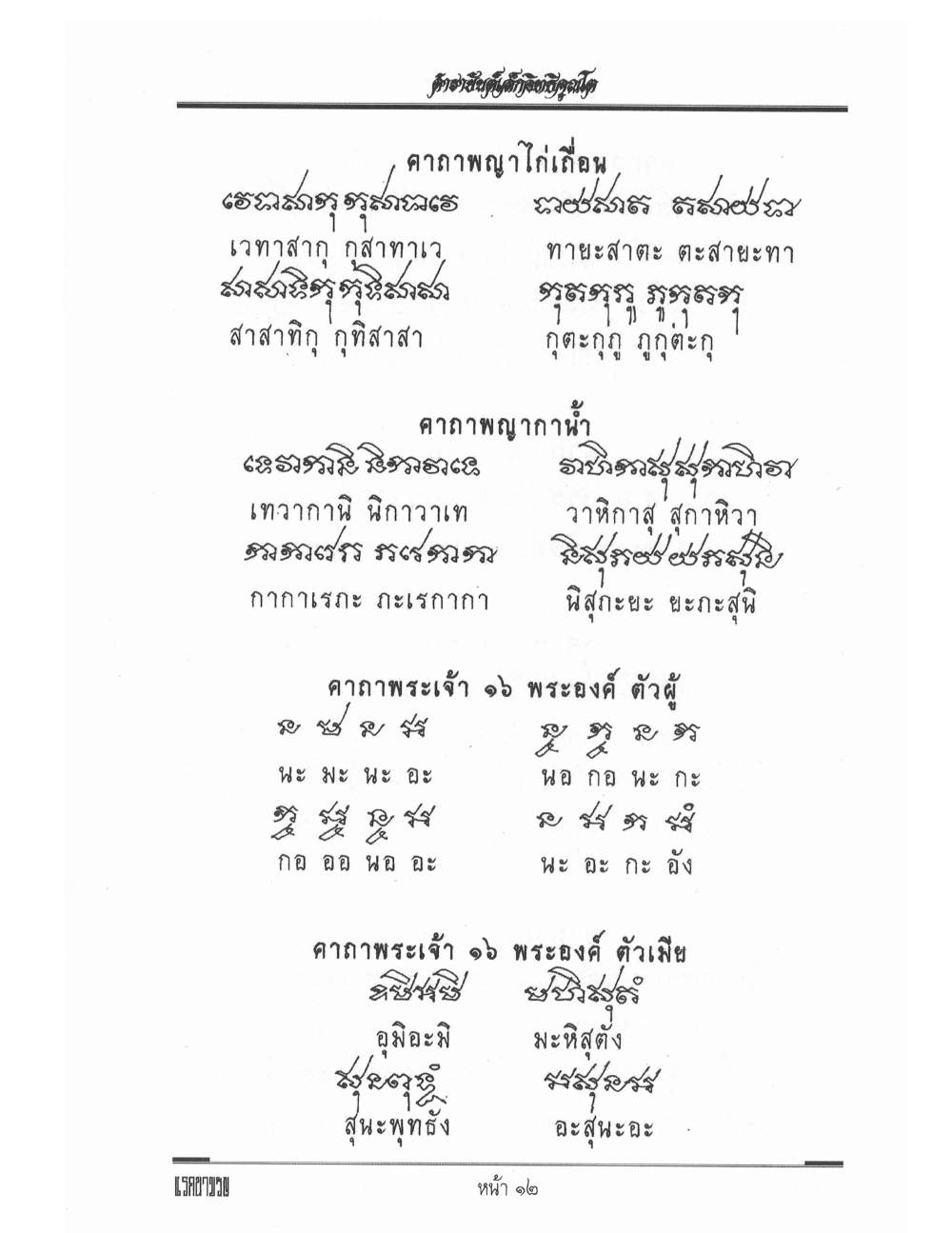
คาถาพญาไก่เถื่อน
เวทาสากุ กสาทาเว ทายะสาตะ ตะสายะทา สาสาทิกุ กุทิสาสา กุตะกุภู ภูกุตะกุ
คาถาพญากาน้ำ
เทวากานิ นิกาวาเท วาหิกาสุ สุกาหิวา กากาเรกะ กะเรกากา นิสุกะยะ ยะกะสุนิ
คาถาพระเจ้า ๑๖ พระองค์ ตัวผู้
พะ มะ พะ อะ พอ กอ พะ กะ กอ ออ พอ อะ พะ อะ กะ อัง
คาถาพระเจ้า ๑๖ พระองค์ ตัวเมีย
อุมิอะมิ มะหิสุตัง สุนะพุทธัง อะสุนะอะ
Mantra of the Wild Jungle-Fowl King
[a four-line charm built from mirrored syllables — vethāsāku kasāthāve / thāyasāta tasāyathā / sāsāthiku kuthisāsā / kutakuphū phūkutaku — a formulaic charm, kept as printed since it has no independent literal meaning]
Mantra of the Cormorant King
[a four-line charm of the same mirrored-syllable type — thevākāni nikāvāthe / vāhikāsu sukāhivā / kākāreka kārekākā / nisukaya yakasuni]
Mantra of the 16 Lords, Male Form
[sixteen single mnemonic syllables set out in a 2x2 block of four-syllable lines: pha ma pha a / pho ko pha ka / ko o pho a / pha a ka ang]
Mantra of the 16 Lords, Female Form
[mnemonic syllables: umi ami / mahisutang / sunaphutthang / asuna a]
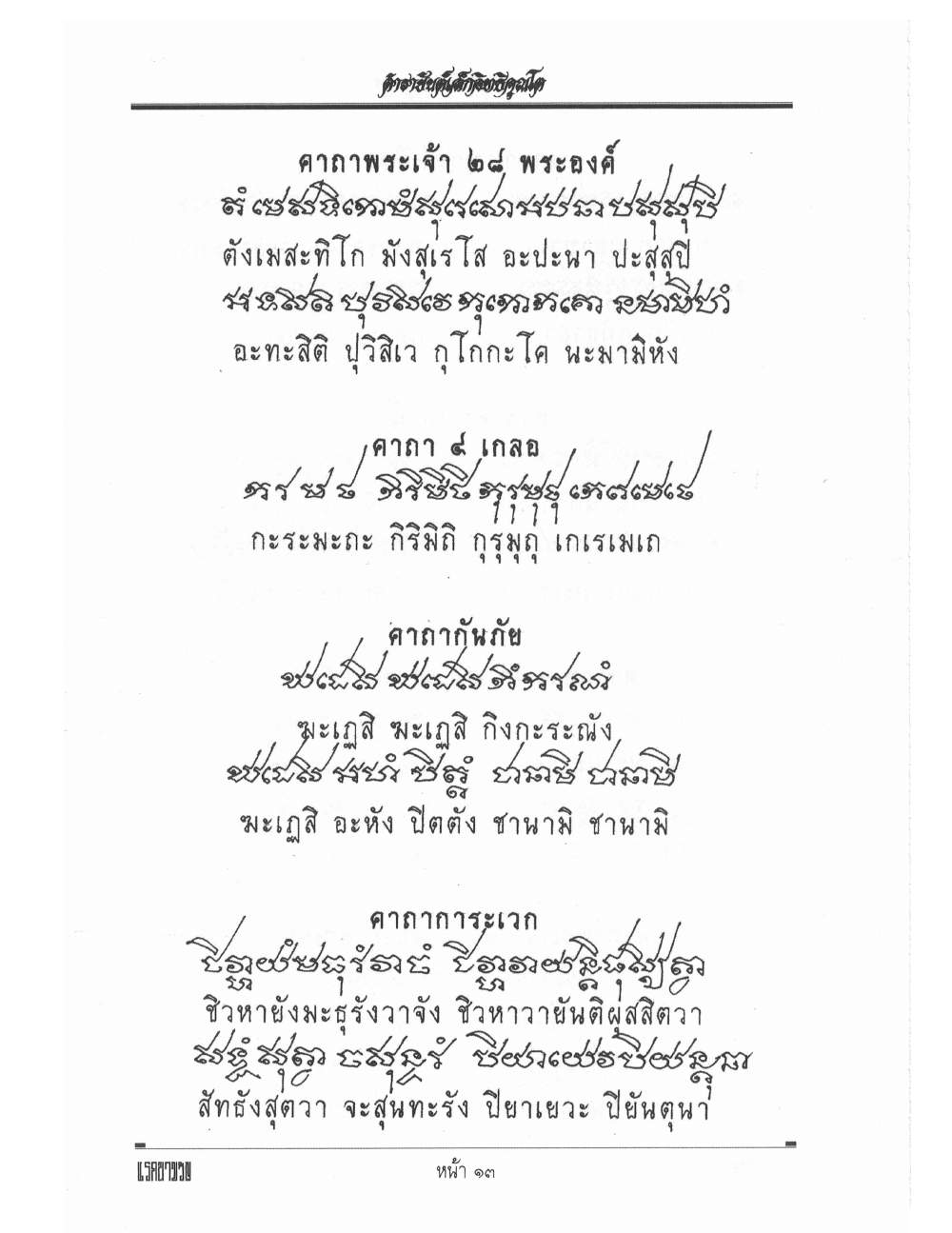
คาถาพระเจ้า ๒๘ พระองค์
ตังเมสะทิโก มังสุเรไส อะปะพา ปะสุสปี อะทะสิติ ปุวิสิเว กุไกกะโค พะมามิหัง
คาถา ๔ เกลอ
กะระมะถะ กิริมิติ กุรุมุถุ เกเรเมเถ
คาถากันภัย
มะเภสิ มะเภสิ กิงกะระณัง มะเภสิ อะหัง ปิตตัง ชาพามิ ชาพามิ
คาถาการะเวก
ชิวหายังมะธุรังวาจัง ชิวหาวายัตติผุสสิตวา สัทธังสุตวา จะสุนทะรัง ปิยาเยาะ ปิยัตถุนา
Mantra of the 28 Lords [Buddhas]
[a two-line syllable charm — tangmesathiko mangsurehsai apapha pasuspee / athasiti puwisive kukaikaho phamamihang — kept as printed, not literally translatable]
The Four Companions Mantra
[a single-line charm: karamatha kirimiti kurumuthu kerehmehthe]
Mantra for Warding Off Danger
[a two-line protective charm invoking "danger" (กิงกะระณัง) and declaring "I proclaim, I proclaim" (ชาพามิ ชาพามิ)]
Mantra of the Karavika Bird
[a two-line charm praising a sweet-voiced tongue: ชิวหา = "tongue", มะธุรัง = "sweet", วาจัง = "speech" — the karavika bird's melodious call rendered as a formulaic verse]
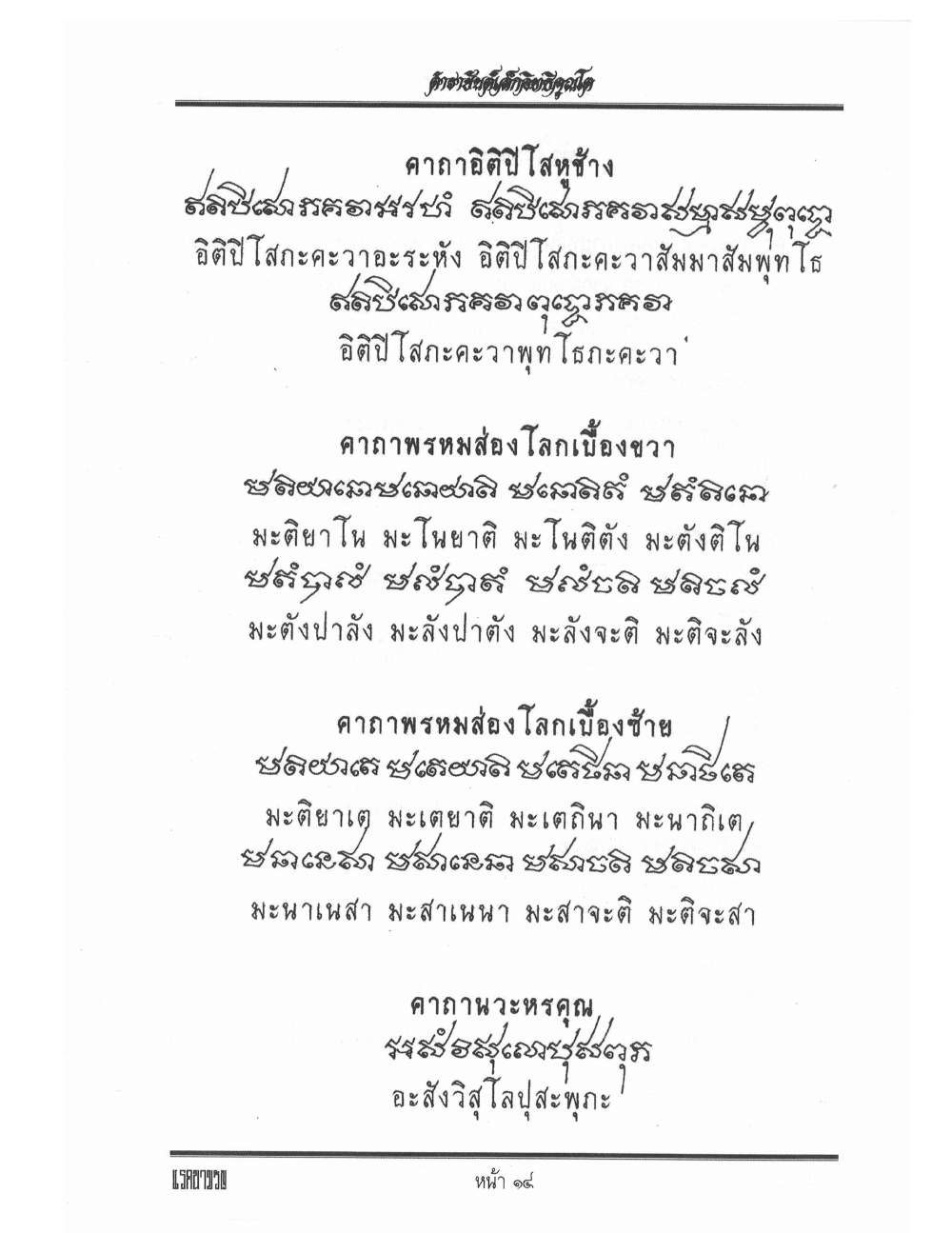
คาถาอิติปิโสหูช้าง
อิติปิโสภะคะวาอะระหัง อิติปิโสภะคะวาสัมมาสัมพุทโธ อิติปิโสภะคะวาพุทโธภะคะวา
คาถาพรหมส่องโลกเบื้องขวา
มะติยาโพ มะโพยาติ มะโพติตัง มะตังติโพ มะตังปาลัง มะลังปาตัง มะลังจะติ มะติจะลัง
คาถาพรหมส่องโลกเบื้องซ้าย
มะติยาเต มะเตยาติ มะเตติมา มะนาติเต มะนาเหสา มะสาเหนา มะสาจะติ มะติจะสา
คาถาหวะหรคุณ
อะสังวิสุโลปุสะพุกะ
Mantra "Itipiso" [for the Elephant's Ear]
This restates the standard "Itipiso" recollection of the Buddha's virtues: "Iti pi so Bhagavā arahaṃ" (Thus indeed is the Blessed One, a Worthy One), "Iti pi so Bhagavā sammāsambuddho" (a Rightly Self-Awakened One), "Iti pi so Bhagavā Buddho Bhagavā" (the Awakened One, the Blessed One) — used here as a protective charm.
Mantra of Brahma Surveying the World, Right Side
[a palindromic four-line charm built from mirrored syllables, not literally translatable]
Mantra of Brahma Surveying the World, Left Side
[a palindromic four-line charm, the mirror companion to the "right side" mantra above]
The "Wa Horakhun" Mantra
[a single-line eight-syllable charm, transliterated as printed: asangwisulopusapaka]
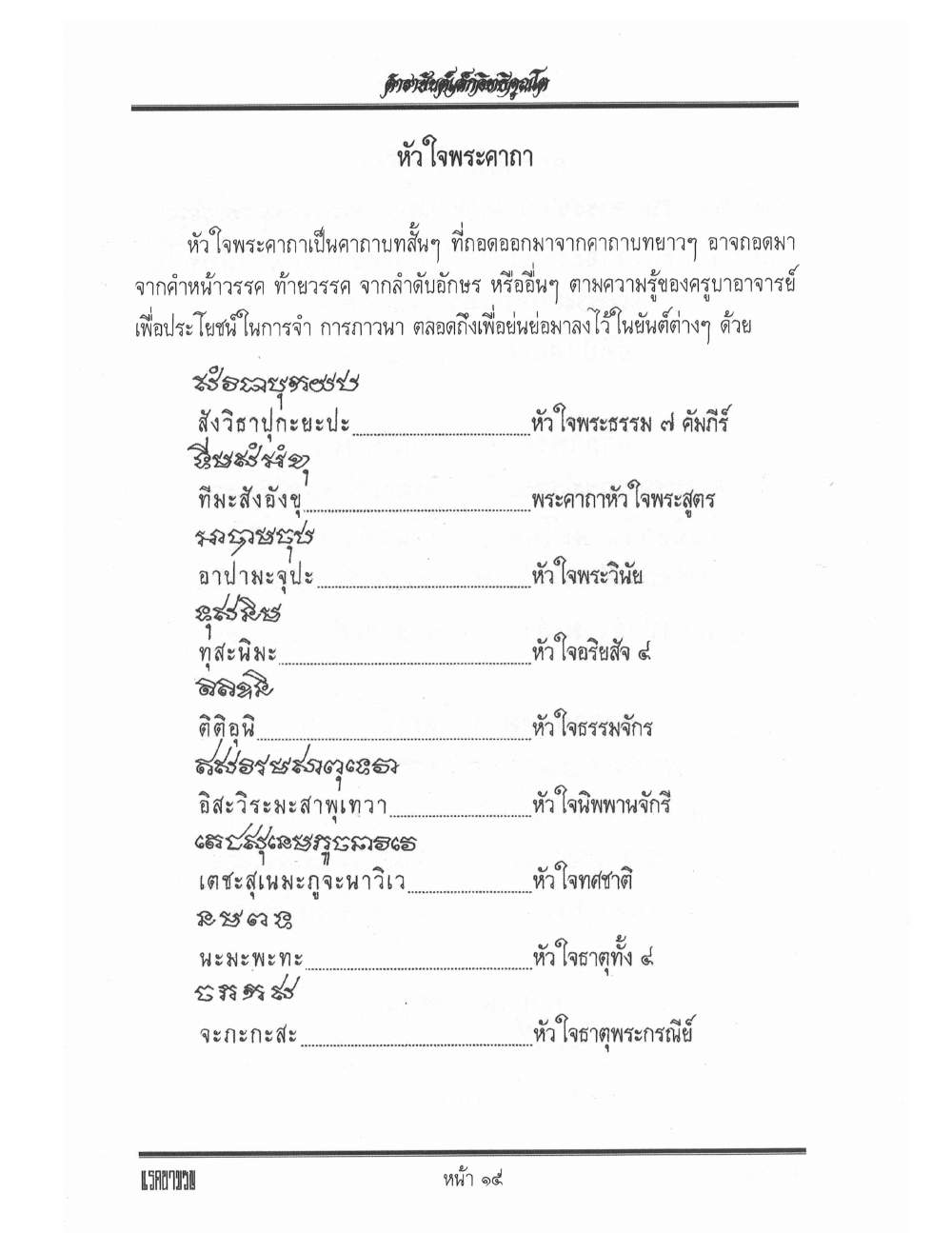
หัวใจพระคาถา
หัวใจพระคาถาเป็นคาถาบทสั้นๆ ที่ถอดออกมาจากคาถาบทยาวๆ อาจถอดมาจากคำหน้าวรรค ท้ายวรรค จากลำดับอักษร หรืออื่นๆ ตามความรู้ของครูบาอาจารย์ เพื่อประโยชน์ในการจำ การภาวนา ตลอดถึงเพื่อแยกผ่อมาลงไว้ในยันต์ต่างๆ ด้วย
สังวิธาปุกะยะปะ .....หัวใจพระธรรม ๗ คัมภีร์ ทีมะสังอิงขุ .....พระคาถาหัวใจพระสูตร อาปามะจุปะ .....หัวใจพระวินัย ทุสะพิมะ .....หัวใจอริยสัจ ๔ ติติอุมิ .....หัวใจธรรมจักร อิสะวิระมะสาพุเทวา .....หัวใจนิพพานจักรี เตชะสุเมมะภูจะนาวิเว .....หัวใจทศชาติ พะมะพะทะ .....หัวใจธาตุทั้ง ๔ จะกะกะสะ .....หัวใจธาตุพระกรณีย์
Heart-Mantras
A "heart" (hua-chai) mantra is a short verse condensed from a longer mantra. It may be extracted from the first word of each clause, the last word of each clause, a sequence of letters, or by other means known to one's teachers, for ease of memorization and recitation, and also so it can be reduced still further for inscribing into various yantra diagrams.
[table of condensed mnemonic syllables, each followed by the name of the longer text it stands for:] sangwithāpukayapa ..... Heart of the Seven Dhamma Books thimasang-ingkhu ..... Heart-mantra of the Suttas āpāmachupa ..... Heart of the Vinaya thusaphima ..... Heart of the Four Noble Truths titi-umi ..... Heart of the Dhammacakka [First Sermon] isavirama-sāphuthevā ..... Heart of the Nibbāna-cakkī techasumemaphūcha-nāvive ..... Heart of the Ten Birth-Stories (Dasajāti) phamaphatha ..... Heart of the Four Elements chakakasa ..... Heart of the Karaṇīya [Mettā] Sutta
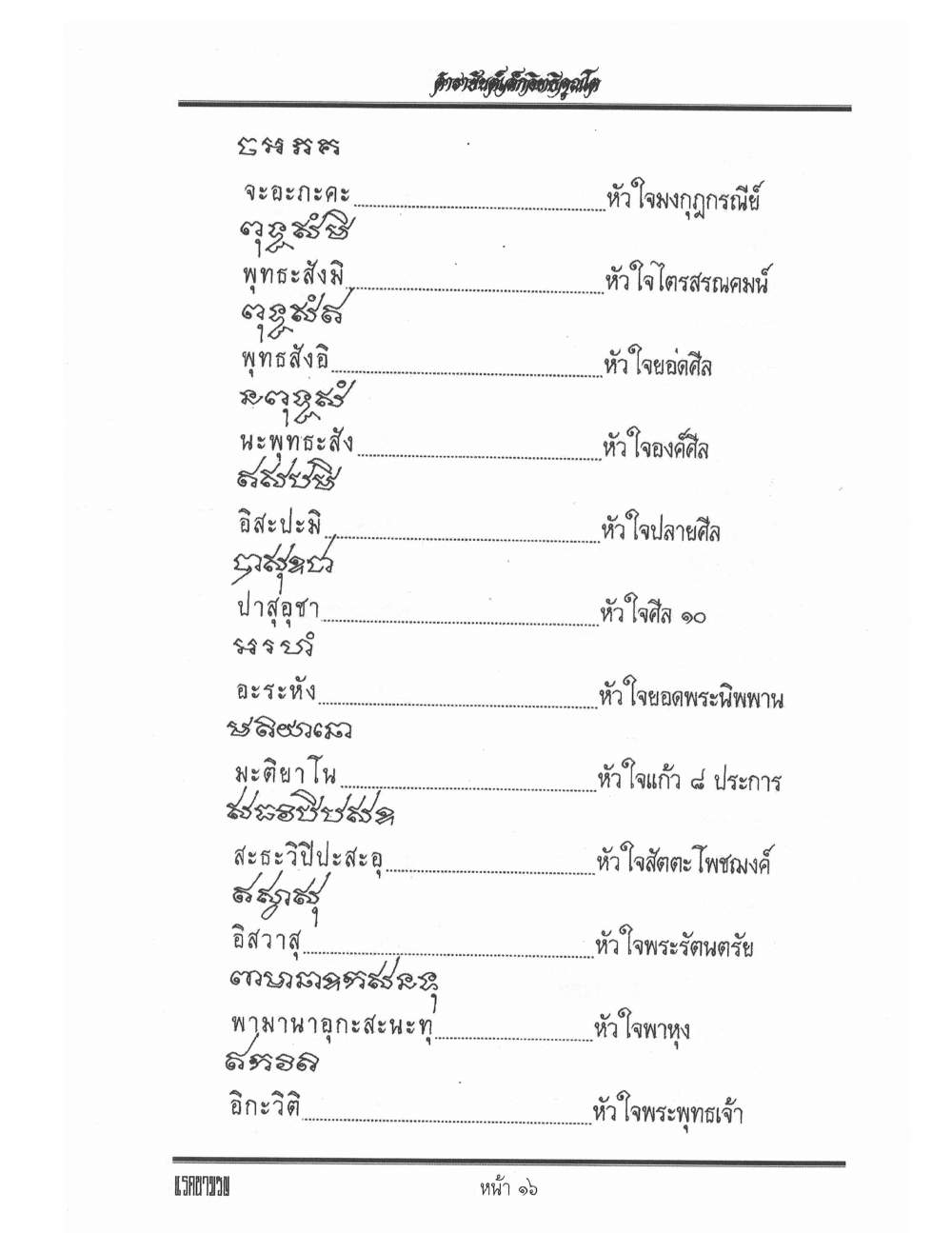
จะอะภะคะ .....หัวใจมงกุฎกรณีย์ พุทธะสังมิ .....หัวใจไตรสรณคมน์ พุทธสังอิ .....หัวใจยอดศีล นะพุทธะสัง .....หัวใจองค์ศีล อิสะปะมิ .....หัวใจปลายศีล ปาสุอุชา .....หัวใจศีล ๑๐ อะระหัง .....หัวใจยอดพระนิพพาน มะติยาโพ .....หัวใจแก้ว ๘ ประการ สะธะวิปิปะสะอุ .....หัวใจสัตตะไพชมงค์ อิสวาสุ .....หัวใจพระรัตนตรัย พามานาอุกะสะนะทุ .....หัวใจพาหุง อิกะวิติ .....หัวใจพระพุทธเจ้า
[continuing the same table of condensed mnemonic syllables paired with the longer text each stands for:] chaaphakha ..... Heart of the Crown Regalia phutthasangmi ..... Heart of the Threefold Refuge phutthasang-i ..... Heart of the Foremost Precept naphutthasang ..... Heart of the Body of the Precepts isapami ..... Heart of the Concluding Precept pāsucha ..... Heart of the Ten Precepts arahang ..... Heart of the Summit of Nibbāna matiyāpho ..... Heart of the Eight Gems sathavipipasa-u ..... Heart of the Seven Auspicious Blessings isavāsu ..... Heart of the Triple Gem phāmānā-ukasanathu ..... Heart of the Bāhung [Victory Verses] ikawiti ..... Heart of the Buddha
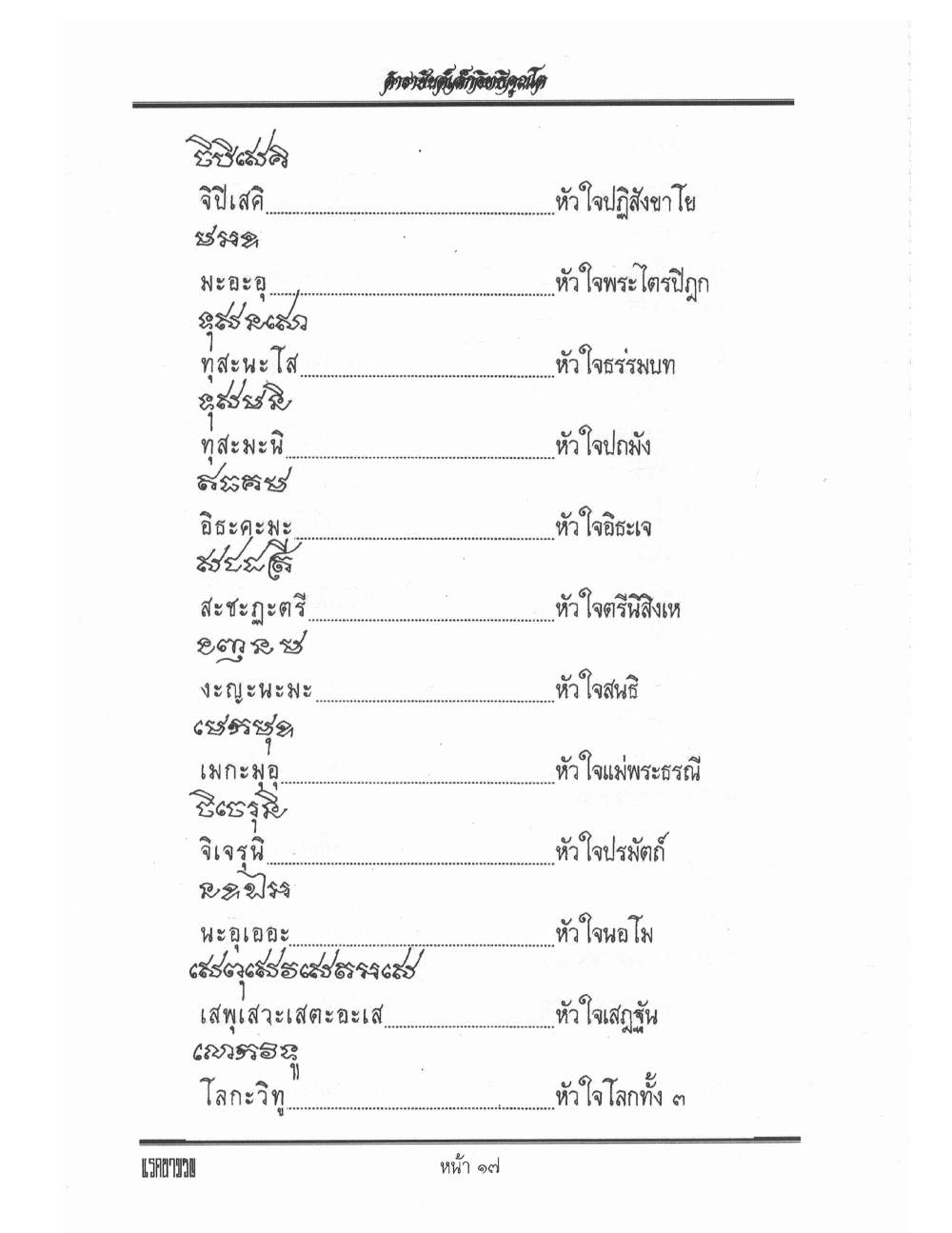
จิปิเสติ .....หัวใจปฏิสังขาโย มะอะอุ .....หัวใจพระไตรปิฎก ทุสะพะโส .....หัวใจธรรมบท ทุสะมะพิ .....หัวใจปถมัง อิถะคะมะ .....หัวใจอิถะเจ สะชะฏะตรี .....หัวใจตรีนิสิงเห งะณะพะมะ .....หัวใจสนธิ เมกะมุ .....หัวใจแม่พระธรณี จิเจรุมิ .....หัวใจปรมัตถ์ พะอุเออะ .....หัวใจพ่อโม เสพุเสาะเสตะอะเส .....หัวใจเสฏฐัน โลกะวิทู .....หัวใจโลกทั้ง ๓
chipiseti ..... Heart of the Paṭisaṅkhā [Reflection] formula ma-a-u ..... Heart of the Tipiṭaka thusaphaso ..... Heart of the Dhammapada thusamaphi ..... Heart of the "Pathamang" [Beginning] formula ithakhama ..... Heart of "Ithache" sachathatree ..... Heart of the Triple Lion (Trīnisingha) nganamama ..... Heart of Concord (Sandhi) mekamu ..... Heart of Mother Earth (Phra Thoranee) chicherumi ..... Heart of the Ultimate Truth (Paramattha) pha-u-e-a ..... Heart of Father Mo sepusaosetaase ..... Heart of the Foremost One lokawithu ..... Heart of the Three Worlds
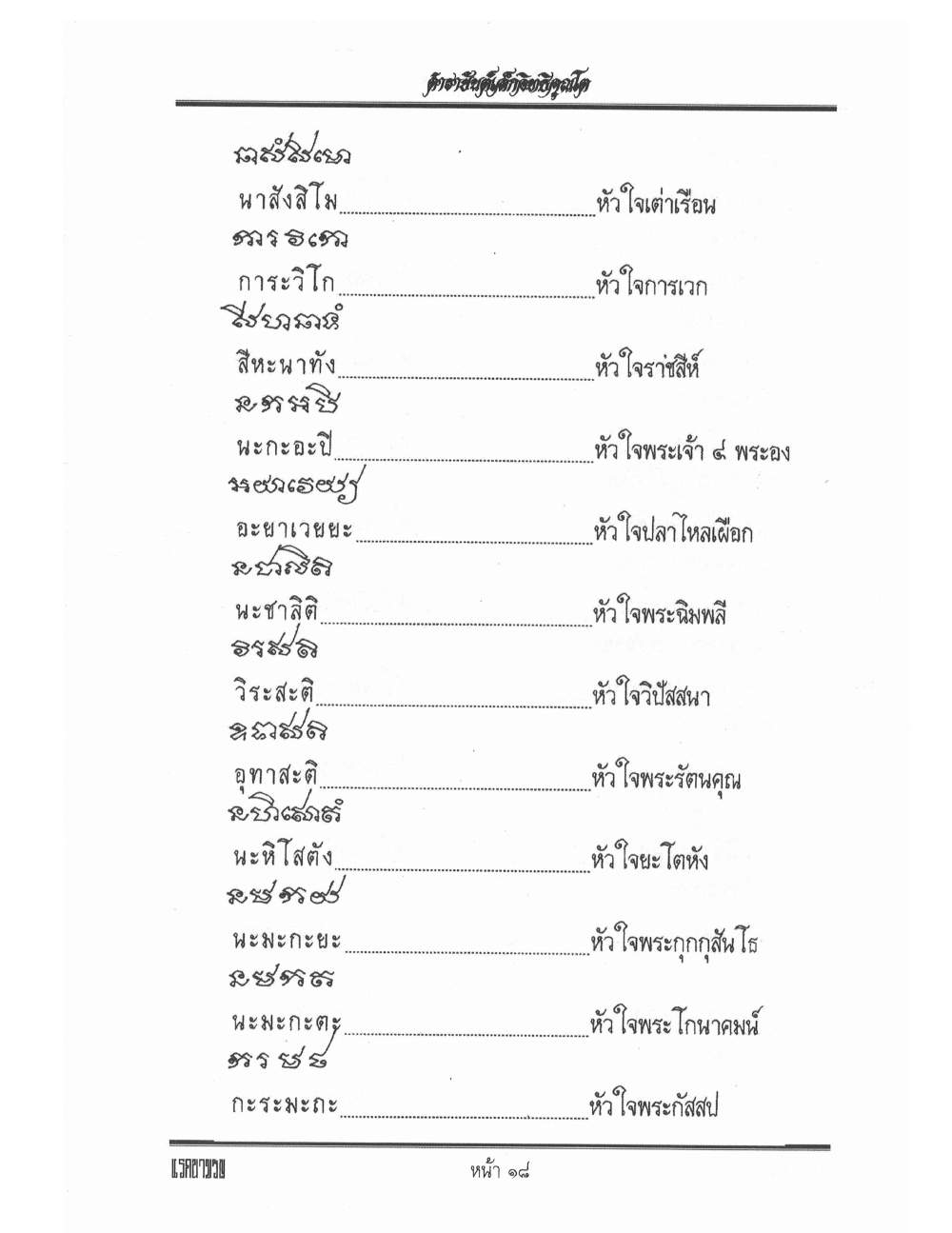
พาสังสิโพ .....หัวใจเต่าเรือน การะวิโก .....หัวใจการเวก สีหะพาทัง .....หัวใจราชสีห์ พะกะอะปิ .....หัวใจพระเจ้า ๔ พระองค์ อะยาเวยยะ .....หัวใจปลาไหลเผือก พะชาลิติ .....หัวใจพระฉิมพลี วิระสะติ .....หัวใจวิปัสสนา อุทาสะติ .....หัวใจพระรัตนคุณ พะหิโสตัง .....หัวใจยะโตหัง พะมะกะยะ .....หัวใจพระกุกกุสันโธ พะมะกะตะ .....หัวใจพระโกนาคมน์ กะระมะถะ .....หัวใจพระกัสสป
phāsangsipho ..... Heart of the House-Turtle (Tao Ruean) kārawiko ..... Heart of the Karavika Bird sīhaphāthang ..... Heart of the Lion (Rāchasīh) phaka-api ..... Heart of the Four [Great] Lords aya-weyya ..... Heart of the White Eel phachaliti ..... Heart of Phra Chimphli wirasati ..... Heart of Insight Meditation (Vipassanā) uthasati ..... Heart of the Triple Gem's Virtue phahisotang ..... Heart of "Yatohang" phamakaya ..... Heart of Kakusandha Buddha phamakata ..... Heart of Koṇāgamana Buddha karamatha ..... Heart of Kassapa Buddha
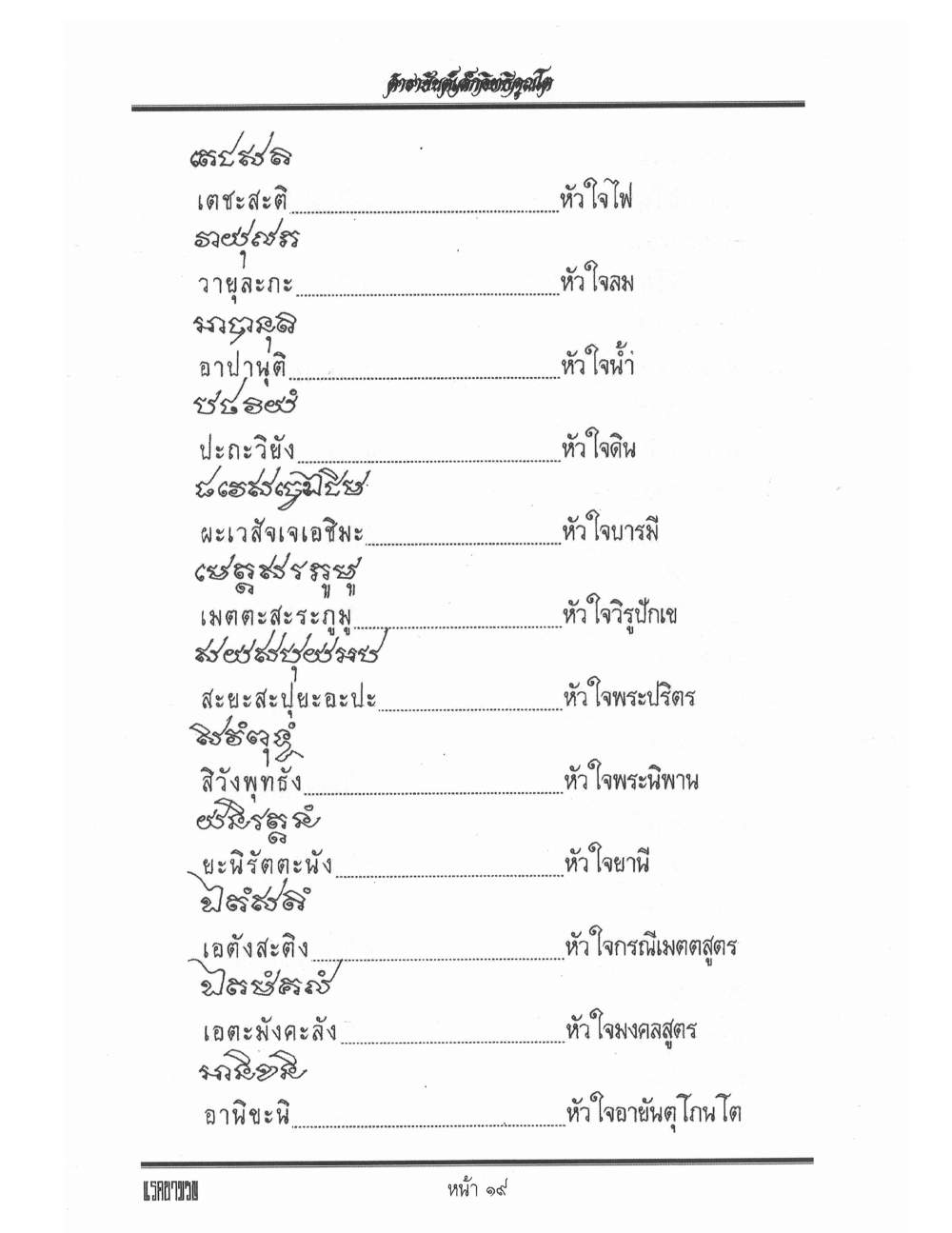
เตชะสติ .....หัวใจไฟ วายุละกะ .....หัวใจลม อาปานุติ .....หัวใจน้ำ ปะถะวิยัง .....หัวใจดิน ผะเวสัจเจอะชิมะ .....หัวใจบารมี เมตตะสะระภูมิ .....หัวใจวิรูปักเข สะยะสะปุยะอะปะ .....หัวใจพระปริตร สิวังพุทธัง .....หัวใจพระนิพาน ยะพิรัตตะพัง .....หัวใจยาภี เอตังสะติง .....หัวใจกรณีเมตตสูตร เอตะมังคะลัง .....หัวใจมงคลสูตร อาพิชะพิ .....หัวใจอายัตนุโภโต
techasati ..... Heart of Fire wāyulaka ..... Heart of Wind āpānuti ..... Heart of Water pathaviyang ..... Heart of Earth phawesatche-achima ..... Heart of the Perfections (Bāramī) mettasaraphūmi ..... Heart of Virūpakkha [Guardian King] sayasapuya-apa ..... Heart of the Paritta siwangphutthang ..... Heart of Nibbāna yaphirattaphang ..... Heart of "Yaphi" etangsating ..... Heart of the Karaṇīyamettā Sutta etamangkhalang ..... Heart of the Maṅgala Sutta āphichaphi ..... Heart of "Āyatanubhoto"
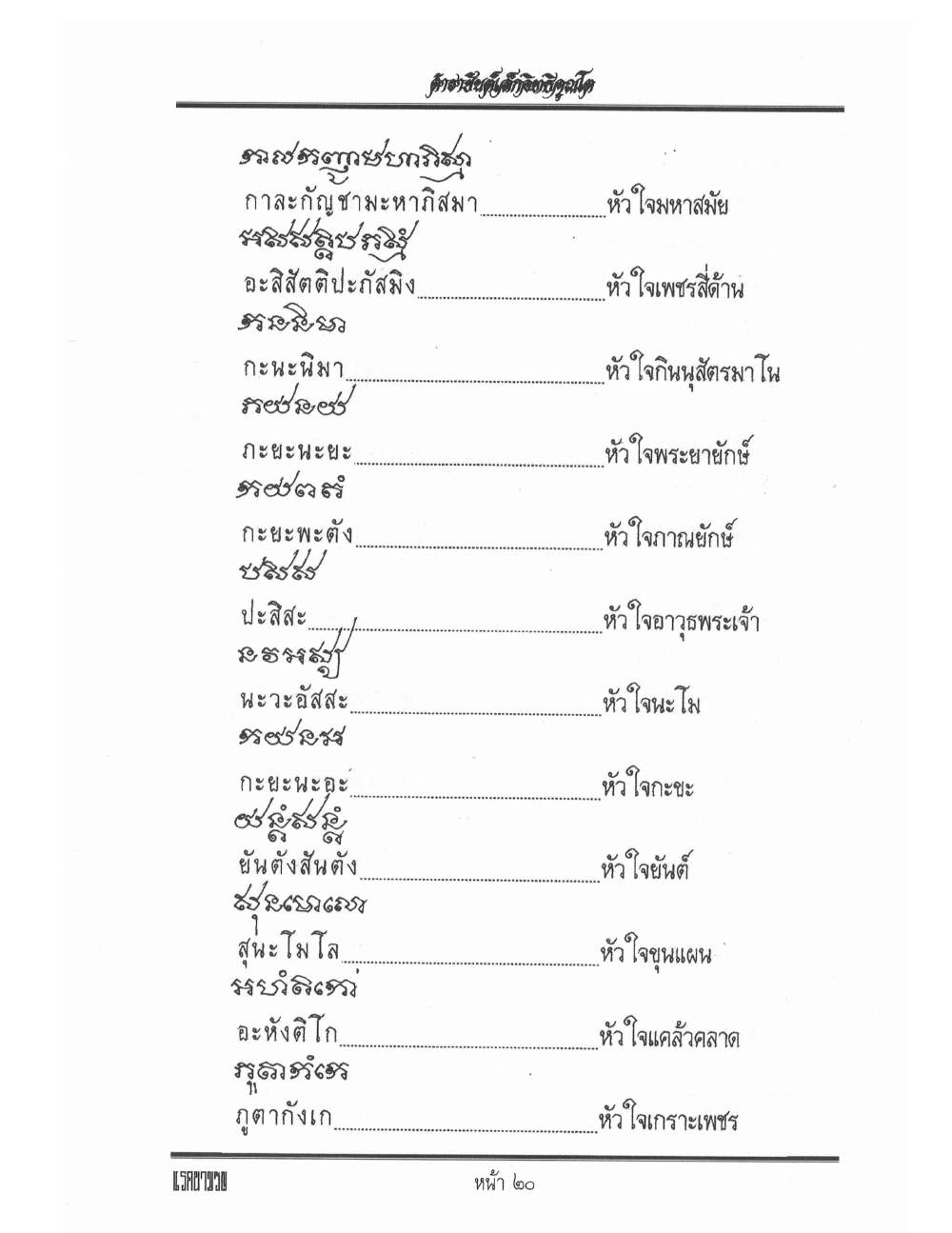
กาละกัญชามะหาภิสมา .....หัวใจมหาสมัย อะสิสัตติปะกัสมิง .....หัวใจเพชรสี่ด้าน กะพะพิมา .....หัวใจกินนุสัตรมาโน กะยะพะยะ .....หัวใจพระยายักษ์ กะยะพะตัง .....หัวใจภาณยักษ์ ปะสิสะ .....หัวใจอาวุธพระเจ้า นะวะอัสสะ .....หัวใจพะโม กะยะพะอะ .....หัวใจกะชะ ยันตังสันตัง .....หัวใจยันต์ สุนะโมโล .....หัวใจขุนแผน อะหังติโก .....หัวใจแคล้วคลาด ภูตากังเก .....หัวใจเกราะเพชร
kalakanchāmahāphisamā ..... Heart of the Mahāsamaya [Great Assembly] Sutta asisattipakasming ..... Heart of the Four-Sided Diamond kaphaphimā ..... Heart of "Kinnu Satmano" kayaphaya ..... Heart of the Yaksha King kayaphatang ..... Heart of the Yaksha Recitation pasisa ..... Heart of the Lord's Weapon nawa-assa ..... Heart of "Pha Mo" kayapha-a ..... Heart of "Kacha" yantangsantang ..... Heart of the Yantra sunamolo ..... Heart of Khun Phaen ahangtiko ..... Heart of Invulnerability and Evasion (Khlaeo Khlat) phutakangke ..... Heart of the Diamond Armor
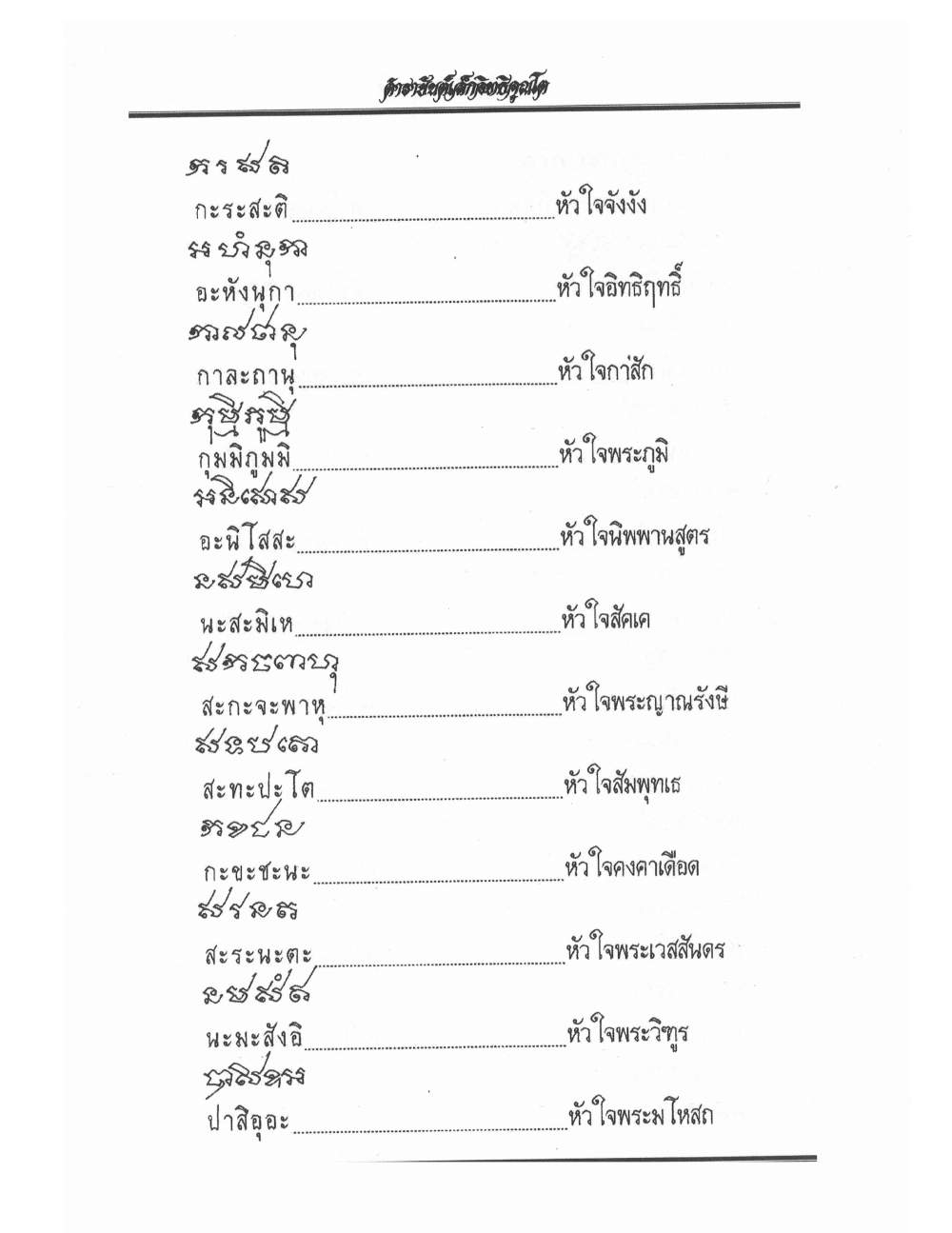
กะระสะติ .....หัวใจจังงัง อะหังนุกา .....หัวใจอิทธิฤทธิ์ กาละถานุ .....หัวใจกาสัก กุมมิภูมิ .....หัวใจพระภูมิ อะพิโสสะ .....หัวใจพิพพานสูตร พะสะมิเห .....หัวใจสัคเค สะกะจะพาหุ .....หัวใจพระญาณรังษี สะทะปะโต .....หัวใจสัมพุทเธ กะขะชะนะ .....หัวใจคงคาเดือด สะระนะตะ .....หัวใจพระเวสสันดร นะมะสังอิ .....หัวใจพระวิฑูร ปาสิอุอะ .....หัวใจพระมโหสถ
karasati ..... Heart of Paralysis/Stillness (Changngang) ahangnukā ..... Heart of Supernatural Power (Itthiriddhi) kālathānu ..... Heart of the Crow-Charm kummiphūmi ..... Heart of the Land-Guardian Spirit (Phra Phum) aphisosa ..... Heart of the Nibbāna Sutta phasamihe ..... Heart of the Devas (Sakka) sakachaphāhu ..... Heart of Phra Yāna-rangsī sathapato ..... Heart of "Sambuddhe" kakhachana ..... Heart of the Boiling Ganges saranata ..... Heart of the Vessantara Jātaka namasang-i ..... Heart of the Vidhura Jātaka pāsi-u-a ..... Heart of the Mahosadha Jātaka
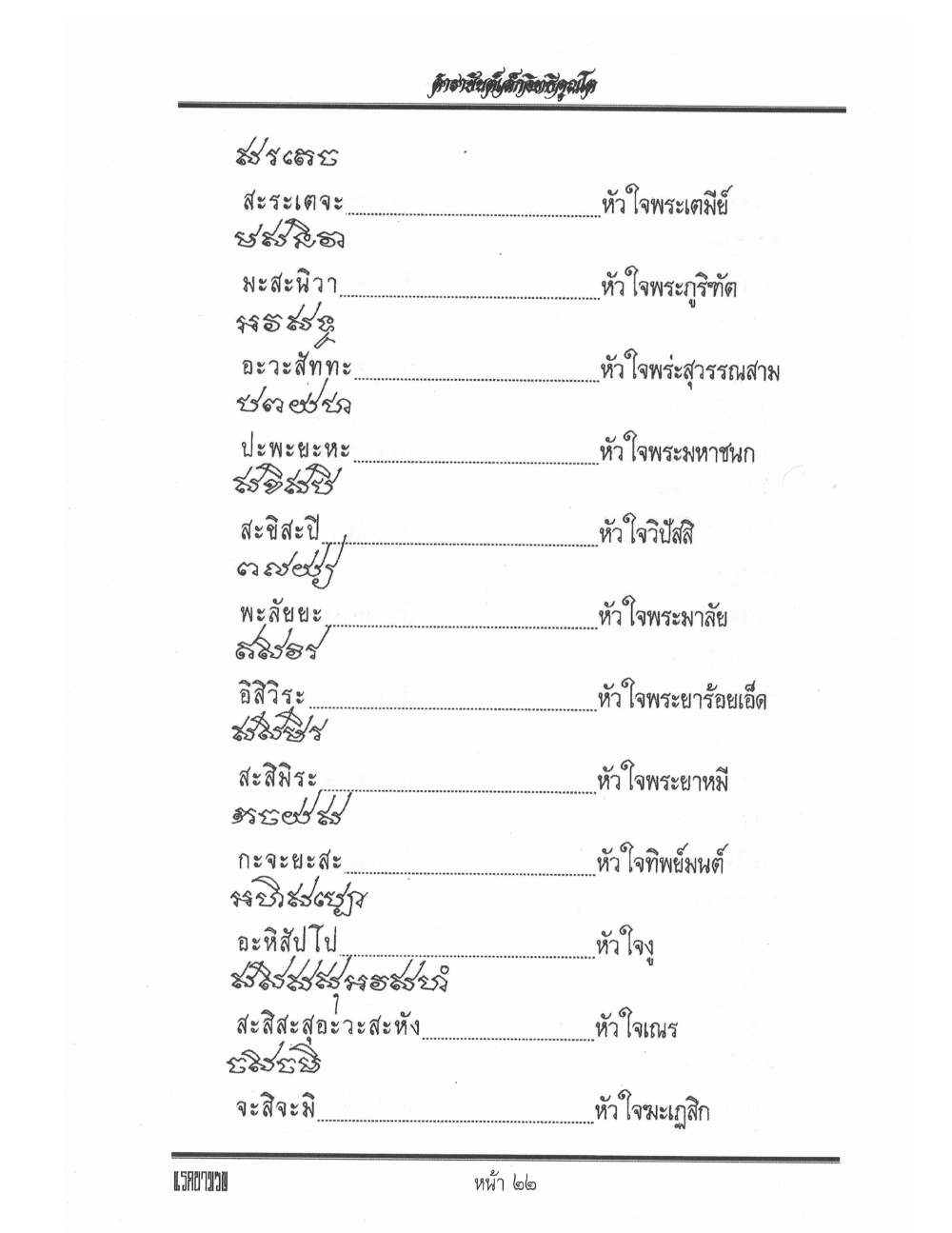
สรเตช
สะระเตจะ..................หัวใจพระเตมีย์ [อักขระขอมอ่านไม่ชัด]
มะสะพิวา..................หัวใจพระภูริทัต [อักขระขอมอ่านไม่ชัด]
อะวะสัทธะ..................หัวใจพระสุวรรณสาม [อักขระขอมอ่านไม่ชัด]
ปะพะยะหะ..................หัวใจพระมหาชนก [อักขระขอมอ่านไม่ชัด]
สะขิสะปี..................หัวใจวิปัสสิ [อักขระขอมอ่านไม่ชัด]
พะลัยยะ..................หัวใจพระมาลัย [อักขระขอมอ่านไม่ชัด]
อิสิวิระ..................หัวใจพระยาร้อยเอ็ด [อักขระขอมอ่านไม่ชัด]
สะสิมิระ..................หัวใจพระยาหมี [อักขระขอมอ่านไม่ชัด]
กะจะยะสะ..................หัวใจทิพย์มนต์ [อักขระขอมอ่านไม่ชัด]
อะหิสัปโป..................หัวใจงู [อักขระขอมอ่านไม่ชัด]
สะสิสะสุอะวะสัง..................หัวใจเณร [อักขระขอมอ่านไม่ชัด]
จะสิจะมิ..................หัวใจมะเฏสิก
[heading: "Soratetch" (a decorative section label, precise sense not clear from context)]
Saratedja — the heart(-mantra) of Phra Temiya [a decorative Khom-script rendering of the same word appears beneath each entry on this page; not confidently legible]
Masaphiwa — the heart of Phra Phurithat
Awasattha — the heart of Phra Suwannasam
Papayaha — the heart of Phra Mahachanok
Sakhisapi — the heart of Vipassī [one of the past Buddhas]
Phalaiya — the heart of Phra Malai
Isiwira — the heart of Phraya Roi-et
Sasimira — the heart of Phraya Mi
Kachayasa — the heart of the Divine Mantra
Ahisappo — the heart of the Snake
Sasisasu-awasang — the heart of the Novice Monk
Chasichami — the heart of "Mathesik" [name as printed, gloss unclear]
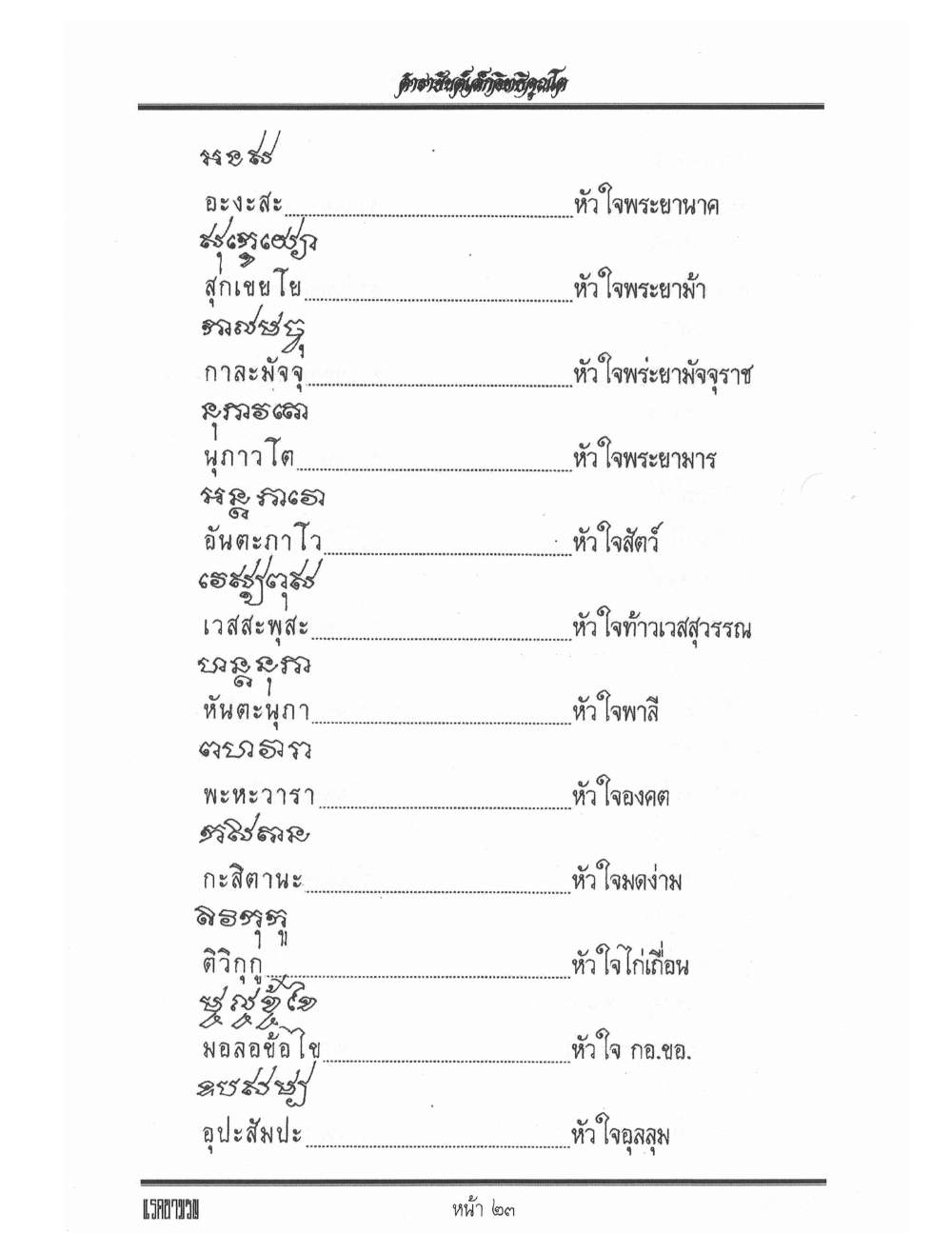
[อ่านไม่ออก]
อะงะสะ..................หัวใจพระยานาค [อักขระขอมอ่านไม่ชัด]
สุกเขยโย..................หัวใจพระยาม้า [อักขระขอมอ่านไม่ชัด]
กาละมัจจุ..................หัวใจพระยามัจจุราช [อักขระขอมอ่านไม่ชัด]
พุภาวโต..................หัวใจพระยามาร [อักขระขอมอ่านไม่ชัด]
[อ่านไม่ออก]..................หัวใจสัตว์ [อักขระขอมอ่านไม่ชัด]
เวสสะพุสะ..................หัวใจท้าวเวสสุวรรณ [อักขระขอมอ่านไม่ชัด]
หันตะพุกา..................หัวใจพาลี [อักขระขอมอ่านไม่ชัด]
พะหะวารา..................หัวใจองคต [อักขระขอมอ่านไม่ชัด]
กะสิตาพะ..................หัวใจมดง่าม [อักขระขอมอ่านไม่ชัด]
ติวิกุกุ..................หัวใจไก่เถื่อน [อักขระขอมอ่านไม่ชัด]
มอลอข้อไข..................หัวใจ กอ.ขอ. [อักขระขอมอ่านไม่ชัด]
อุปะสัมปะ..................หัวใจอุลลุม
[heading, illegible]
Angasa — the heart of the Naga King [a decorative Khom-script rendering of the same word appears beneath each entry on this page; not confidently legible]
Sukkheiyo — the heart of the Horse King
Kalamatju — the heart of Phraya Matchuraat [the Lord of Death]
Phuphawato — the heart of the Mara King
[illegible] — the heart of the Animal[s]
Wessaphusa — the heart of Thao Wessuwan
Hantaphuka — the heart of Bali [monkey king of the Ramayana]
Phahawara — the heart of Ongkot [monkey warrior of the Ramayana]
Kasitapha — the heart of the Pincer Ant
Tiwikuku — the heart of the Wild Jungle-fowl
Molokhokhai — the heart of "Ko.Kho." [abbreviation, referent unclear]
Upasampa — the heart of "Ullum" [name as printed, referent unclear]
[อ่านไม่ออก]
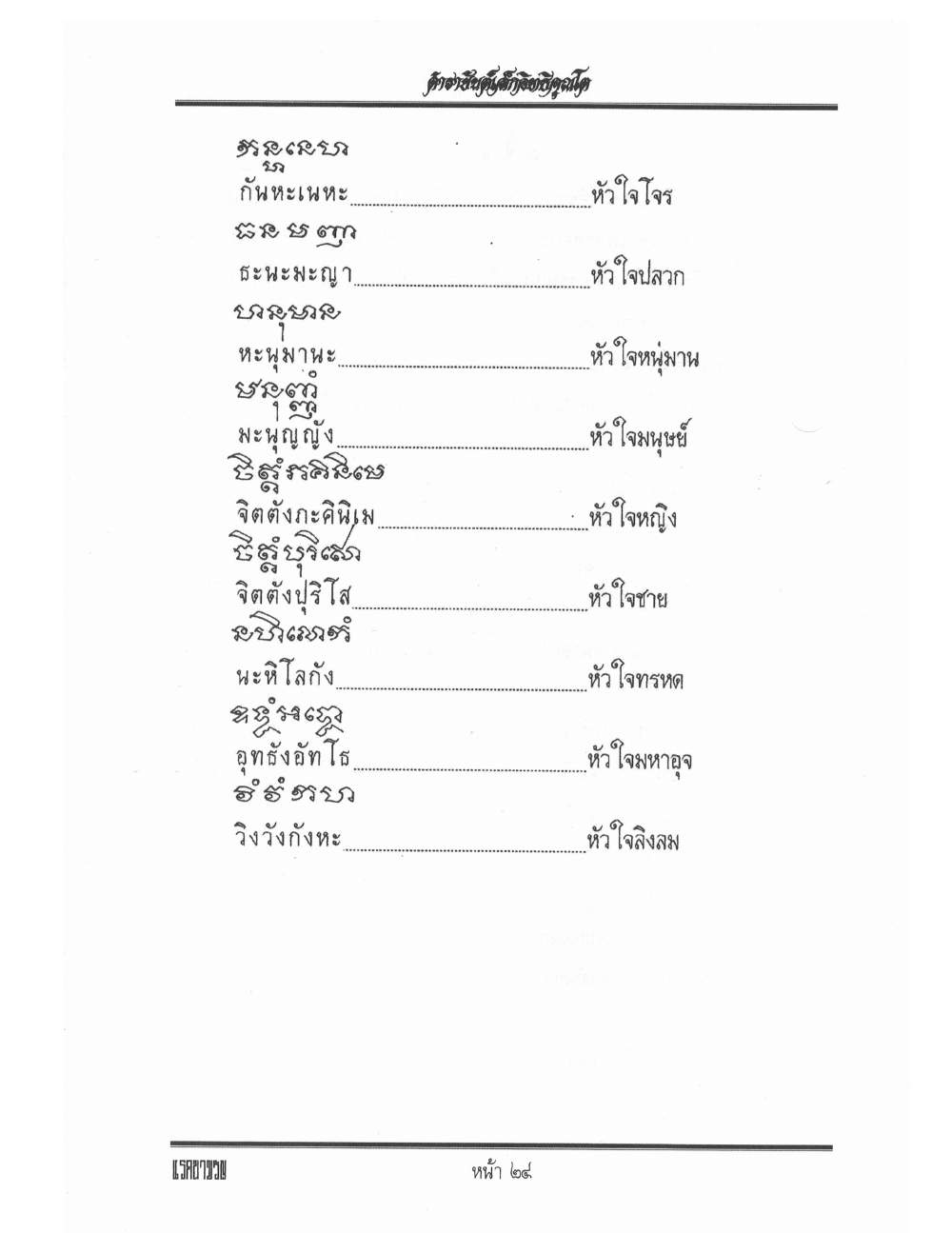
กัพหะเพหะ..................หัวใจโจร [อักขระขอมอ่านไม่ชัด]
ถะพะมะญา..................หัวใจปลวก [อักขระขอมอ่านไม่ชัด]
หะนุมานะ..................หัวใจหนุมาน [อักขระขอมอ่านไม่ชัด]
มะนุญญัง..................หัวใจมนุษย์ [อักขระขอมอ่านไม่ชัด]
จิตตังภะคินิเม..................หัวใจหญิง [อักขระขอมอ่านไม่ชัด]
จิตตังปุริโส..................หัวใจชาย [อักขระขอมอ่านไม่ชัด]
นะหิโลกัง..................หัวใจทรหด [อักขระขอมอ่านไม่ชัด]
อุทธังอัทโธ..................หัวใจมหาอุจ [อักขระขอมอ่านไม่ชัด]
วิงวังกังหะ..................หัวใจลิงลม
[heading, illegible]
Kaphapeha — the heart of the Thief [a decorative Khom-script rendering of the same word appears beneath each entry on this page; not confidently legible]
Thaphamaya — the heart of the Termite
Hanumana — the heart of Hanuman
Manuyang — the heart of the Human
Chittangphakhinime — the heart of a Woman
Chittangpuriso — the heart of a Man
Nahilokang — the heart of Endurance
Utthang-attho — the heart of "Maha-ut" [term as printed, sense unclear]
Wingwangkangha — the heart of the Slow Loris
คำชี้แจง
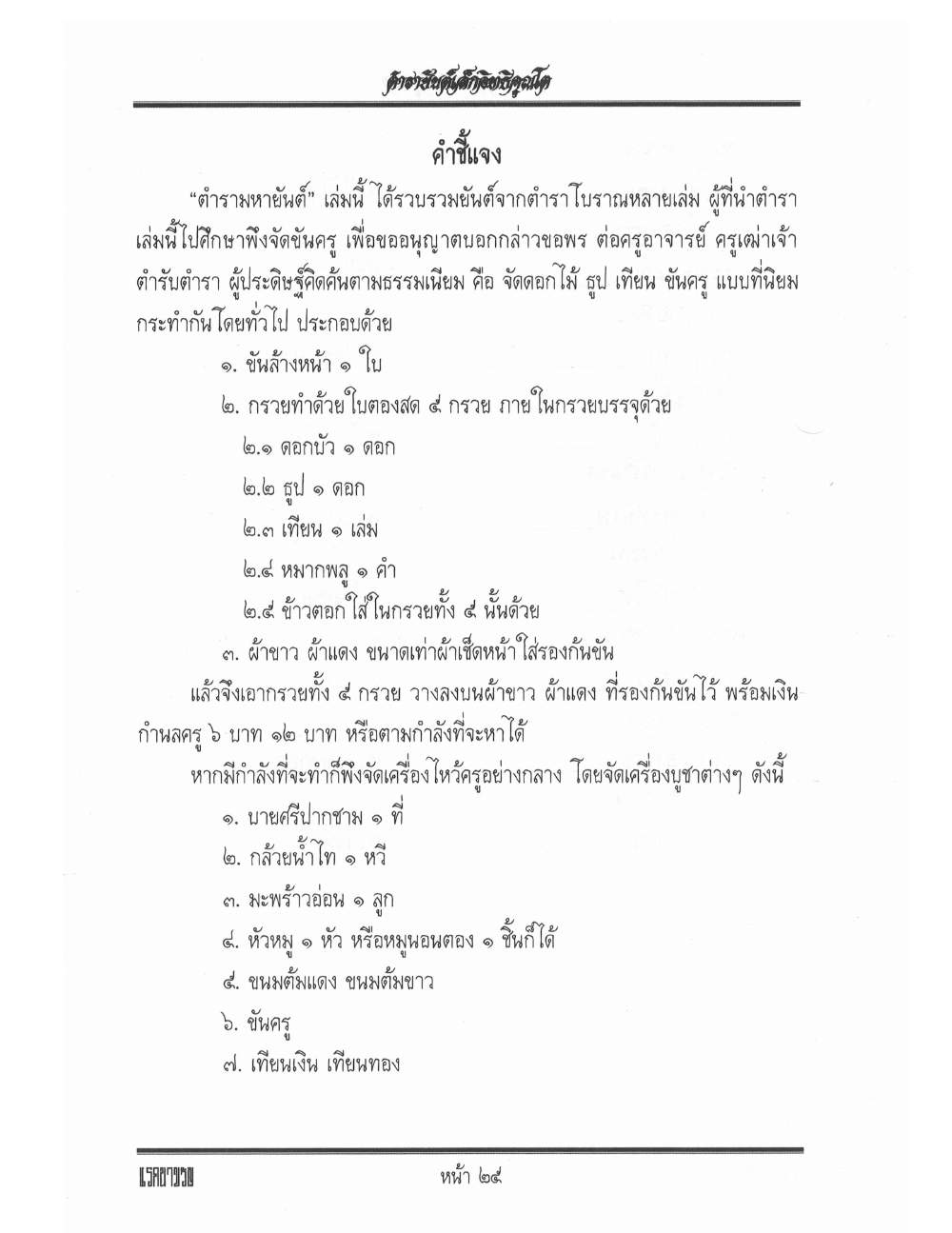
"ตำรามหายันต์" เล่มนี้ ได้รวบรวมยันต์จากตำราโบราณหลายเล่ม ผู้ที่นำตำราเล่มนี้ไปศึกษาพึงจัดขันครู เพื่อขออนุญาตบอกกล่าวขอพร ต่อครูอาจารย์ ครูเฒ่าเจ้าตำรับตำรา ผู้ประดิษฐ์คิดค้นตามธรรมเนียม คือ จัดดอกไม้ ธูป เทียน ขันครู แบบที่นิยมกระทำกันโดยทั่วไป ประกอบด้วย
๑. ขันล้างหน้า ๑ ใบ
๒. กรวยทำด้วยใบตองสด ๔ กรวย ภายในกรวยบรรจุด้วย
๒.๑ ดอกบัว ๑ ดอก
๒.๒ ธูป ๑ ดอก
๒.๓ เทียน ๑ เล่ม
๒.๔ หมากพลู ๑ คำ
๒.๕ ข้าวตอกใส่ในกรวยทั้ง ๔ นั้นด้วย
๓. ผ้าขาว ผ้าแดง ขนาดเท่าผ้าเช็ดหน้าใส่รองก้นขัน
แล้วจึงเอากรวยทั้ง ๔ กรวย วางลงบนผ้าขาว ผ้าแดง ที่รองก้นขันไว้ พร้อมเงินกำนลครู ๖ บาท ๑๒ บาท หรือตามกำลังที่จะหาได้
หากมีกำลังที่จะทำก็พึงจัดเครื่องไหว้ครูอย่างกลาง โดยจัดเครื่องบูชาต่างๆ ดังนี้
๑. บายศรีปากชาม ๑ ที่
๒. กล้วยน้ำไท ๑ หวี
๓. มะพร้าวอ่อน ๑ ลูก
๔. หัวหมู ๑ หัว หรือหมูพอนตอง ๑ ชิ้นก็ได้
๕. ขนมต้มแดง ขนมต้มขาว
๖. ขันครู
๗. เทียนเงิน เทียนทอง
Explanatory Notes
This "Manual of Great Yantras" compiles yantras drawn from many old treatises. Anyone who takes up this manual to study should first set up a teacher's bowl (khan khru), in order to ask permission and speak a request for blessing to the teachers, the elder teachers, and the originators of the tradition who devised it according to custom — that is, arranging flowers, incense, a candle, and a teacher's bowl in the manner generally practiced, consisting of:
1. One face-washing bowl.
2. Four cones made of fresh banana leaf, each containing inside:
2.1 One lotus flower
2.2 One incense stick
2.3 One candle
2.4 One quid of betel and areca
2.5 Popped rice placed in all four of those cones as well.
3. White cloth and red cloth, the size of a handkerchief, to line the bottom of the bowl.
Then place all four cones on top of the white and red cloth lining the bottom of the bowl, together with a teacher's fee of 6 or 12 baht, or as much as one is able to provide.
If one has the means to do more, one should arrange a medium-level teacher-veneration set, arranging the various offerings as follows:
1. One tray of rice topped with a boiled egg (bai sri pak cham).
2. One hand of nam-thai bananas.
3. One young coconut.
4. One whole pig's head, or one piece of "phon tong" pork.
5. Red and white boiled rice-flour sweets (khanom tom).
6. A teacher's bowl.
7. Silver and gold candles.
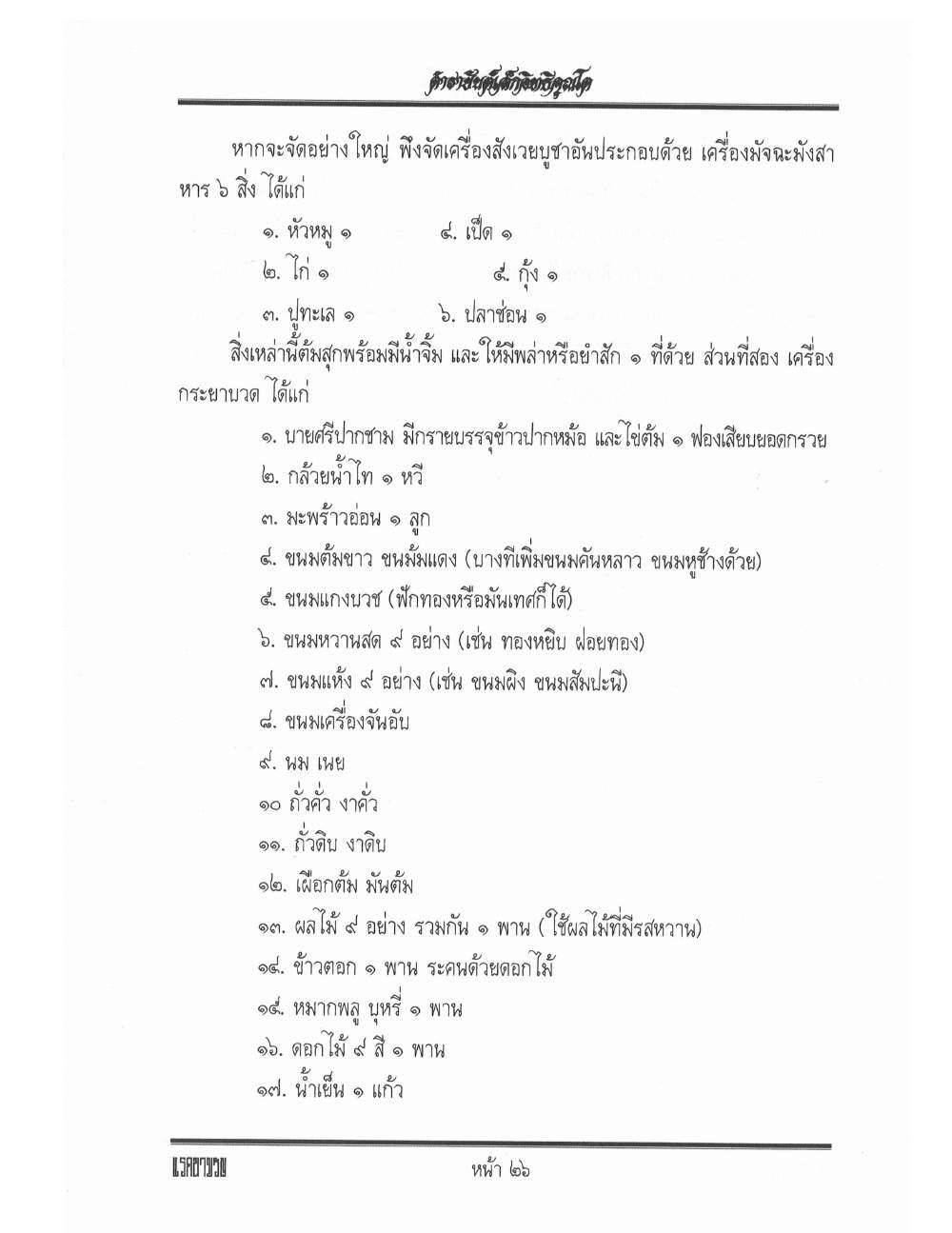
หากจะจัดอย่างใหญ่ พึงจัดเครื่องสังเวยบูชาอันประกอบด้วย เครื่องมัจฉะมังสาหาร ๖ สิ่ง ได้แก่
๑. หัวหมู ๑ ๔. เป็ด ๑ ๒. ไก่ ๑ ๕. กุ้ง ๑ ๓. ปูทะเล ๑ ๖. ปลาช่อน ๑
สิ่งเหล่านี้ต้มสุกพร้อมมีน้ำจิ้ม และให้มีพล่าหรือยำสัก ๑ ที่ด้วย ส่วนที่สอง เครื่องกระยาบวด ได้แก่
๑. บายศรีปากชาม มีกรายบรรจุข้าวปากหม้อ และไข่ต้ม ๑ ฟองเสียบยอดกรวย
๒. กล้วยน้ำไท ๑ หวี
๓. มะพร้าวอ่อน ๑ ลูก
๔. ขนมต้มขาว ขนมต้มแดง (บางทีเพิ่มขนมคันหลาว ขนมหูช้างด้วย)
๕. ขนมแกงบวช (ฟักทองหรือมันเทศก็ได้)
๖. ขนมหวานสด ๙ อย่าง (เช่น ทองหยิบ ฝอยทอง)
๗. ขนมแห้ง ๙ อย่าง (เช่น ขนมผิง ขนมสัมปะนี)
๘. ขนมเครื่องจันอับ
๙. นม เนย
๑๐. ถั่วคั่ว งาคั่ว
๑๑. ถั่วดิบ งาดิบ
๑๒. เผือกต้ม มันต้ม
๑๓. ผลไม้ ๙ อย่าง รวมกัน ๑ พาน (ใช้ผลไม้ที่มีรสหวาน)
๑๔. ข้าวตอก ๑ พาน ระคนด้วยดอกไม้
๑๕. หมากพลู บุหรี่ ๑ พาน
๑๖. ดอกไม้ ๙ สี ๑ พาน
๑๗. น้ำเย็น ๑ แก้ว
If preparing on a large scale, one should arrange sacrificial offerings consisting of six kinds of meat and seafood, namely:
1. One pig's head 4. One duck 2. One chicken 5. One shrimp 3. One sea crab 6. One snakehead fish
These items should be boiled through, served with dipping sauce, and there should also be one dish of spicy salad (plaa or yam). The second set, the "kraya buat" sweets, consists of:
1. A tray of rice topped with a boiled egg speared on the tip of the cone (bai sri pak cham).
2. One hand of nam-thai bananas.
3. One young coconut.
4. White and red boiled rice-flour sweets (sometimes "khan lao" and "hu chang" sweets are added as well).
5. Sweet coconut-milk stewed vegetable (pumpkin or sweet potato may be used).
6. Nine kinds of fresh sweets (such as thong yip and foi thong).
7. Nine kinds of dried sweets (such as khanom phing and khanom sampanni).
8. Assorted preserved sweets (khanom khrueang chan-ap).
9. Milk and cream/butter.
10. Roasted peanuts and roasted sesame.
11. Raw peanuts and raw sesame.
12. Boiled taro and boiled sweet potato.
13. Nine kinds of fruit combined on one tray (using sweet-tasting fruit).
14. Popped rice on one tray, mixed with flowers.
15. Betel, areca, and cigarettes on one tray.
16. Flowers of nine colors on one tray.
17. One glass of cool water.
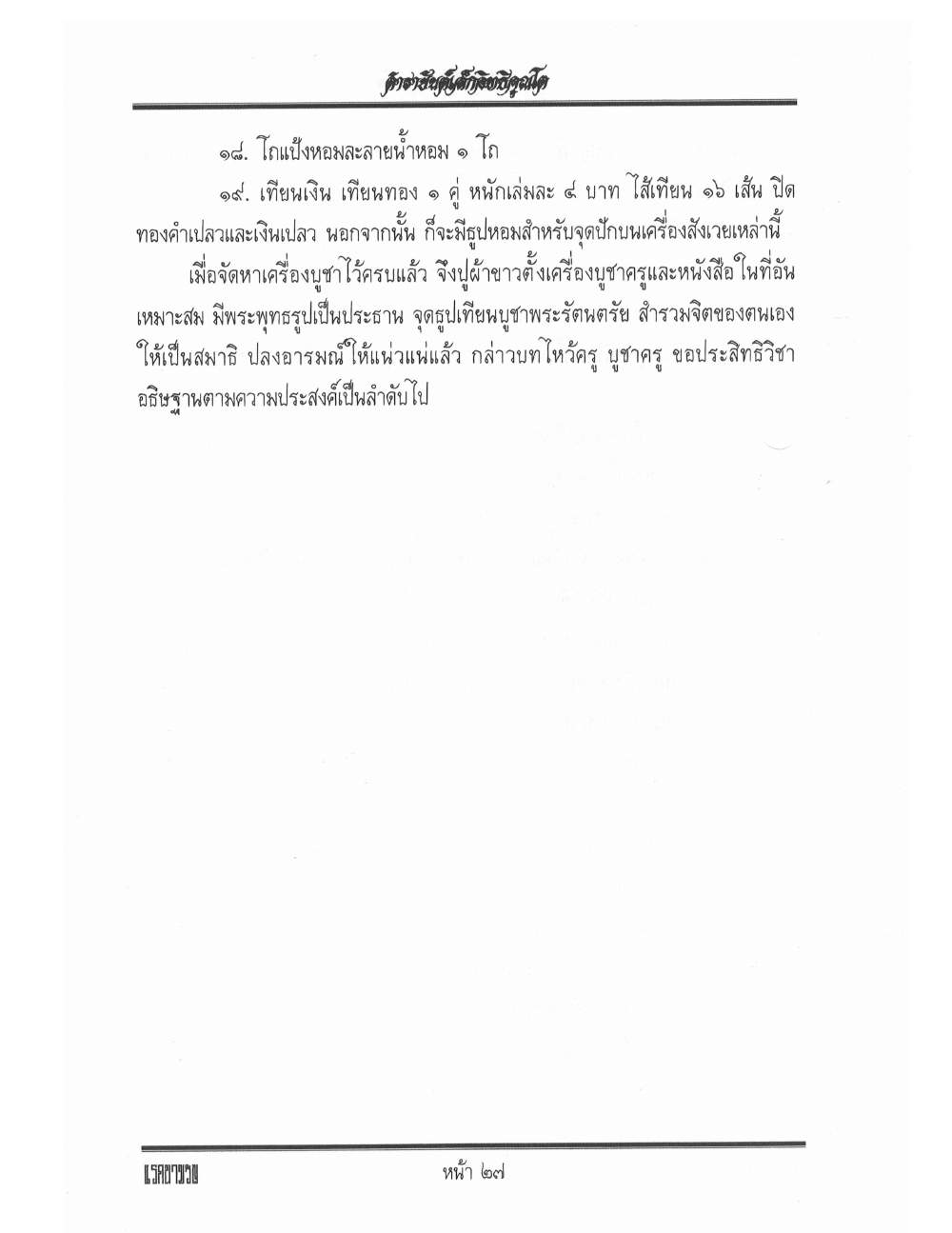
๑๘. โถแป้งหอมละลายน้ำหอม ๑ โถ
๑๙. เทียนเงิน เทียนทอง ๑ คู่ หนักเล่มละ ๔ บาท ไส้เทียน ๑๖ เส้น ปิดทองคำเปลวและเงินเปลว นอกจากนั้น ก็จะมีธูปหอมสำหรับจุดปักบนเครื่องสังเวยเหล่านี้
เมื่อจัดหาเครื่องบูชาไว้ครบแล้ว จึงปูผ้าขาวตั้งเครื่องบูชาครูและหนังสือไว้ ณ ที่อันเหมาะสม มีพระพุทธรูปเป็นประธาน จุดธูปเทียนบูชาพระรัตนตรัย สำรวมจิตของตนเองให้เป็นสมาธิ ปลงอารมณ์ให้แน่วแน่แล้ว กล่าวบทไหว้ครู บูชาครู ขอประสิทธิ์วิชา อธิษฐานตามความประสงค์เป็นลำดับไป
18. One jar of scented powder dissolved in perfumed water.
19. A pair of silver and gold candles, each weighing 4 baht, with 16-strand wicks, covered in gold leaf and silver leaf. Besides these, there should also be fragrant incense sticks for lighting and setting upon these offerings.
Once all the offering items have been fully prepared, spread white cloth, set up the teacher-veneration offerings and the text at a suitable place, with a Buddha image as the principal object. Light incense and candles in homage to the Triple Gem, gather one's own mind into concentration, and once the mind is settled and steady, recite the teacher-veneration verses, pay homage to the teachers, ask for empowerment in the knowledge, and state one's wishes in due order.
บทไหว้ครู
๏ นะโม ตัสสะ ภะคะวะโต อะระหะโต สัมมาสัมพุทธัสสะ ๚ (ว่า ๓ จบ)
๏ พุทธัง ชีวิตัง ยาวะนิพพานัง สะระณัง คัจฉามิ อิติปิโส ภะคะวา อะระหัง สัมมาสัมพุทโธ วิชชาจะระณะสัมปันโน สุคะโต โลกะวิทู อะนุตตะโร ปุริสะธัมมะสาระถิ สัตถาเทวะมะนุสสานัง พุทโธ ภะคะวาติ ๚
๏ ธัมมัง ชีวิตัง ยาวะนิพพานัง สะระณัง คัจฉามิ สวากขาโต ภะคะวะตา ธัมโม สันทิฏฐิโก อะกาลิโก เอหิปัสสิโก โอปะนะยิโก ปัจจัตตัง เวทิตัพโพ วิญญูหีติ ๚
๏ สังฆัง ชีวิตัง ยาวะนิพพานัง สะระณัง คัจฉามิ สุปะฏิปันโน ภะคะวะโต สาวะกะสังโฆ อุชุปะฏิปันโน ภะคะวะโต สาวะกะสังโฆ ญายะปะฏิปันโน ภะคะวะโต สาวะกะสังโฆ สามีจิปะฏิปันโน ภะคะวะโต สาวะกะสังโฆ ยะทิทัง จัตตาริ ปุริสะยุคานิ อัฏฐะ ปุริสะปุคคะลา เอสะ ภะคะวะโต สาวะกะสังโฆ อาหุเนยโย ปาหุเนยโย ทักขิเณยโย อัญชะลีกะระณีโย อะนุตตะรัง ปุญญักเขตตัง โลกัสสาติ ๚
๏ พุทธะบูชามหาเตชะวันโต ธัมมะปูชามหาปัญญะวันโต สังฆะบูชามหาโภคะวะโห ติโลกะเสฏฐัง อะภิปูชะยามิ ๚
คาถาดังกล่าวนี้เป็นคาถาบูชาพระรัตนตรัย ถ้าเป็นการประกอบพิธีแบบกลางและแบบใหญ่ ที่มีเทียนเงิน เทียนทองด้วย ให้จุดเทียนเงินเทียนทองเสียก่อน แล้วจึงค่อยกล่าวคาถาบูชาพระรัตนตรัย ต่อจากนั้นให้จุดธูปเทียนบูชาครูอาจารย์ โดยปักตามเครื่องสังเวยทั่วไป แล้วจึงกล่าวชุมนุมเทวดา ดังนี้
๏ สัคเค กาเม จะ รูเป คิริสิขะระตะเฏ จันตะลิกเข วิมาเน ทีเป รัฏเฐ จะ คาเม ตะรุณะคะหะเน เคหะวัตถุมหิ เขตเต ภุมมา จายันตุ เทวา ชะละถะละวิสะเม ยักขะคันธัพพะนาคา ติฏฐันตา สันติเก ยัง มุนิวะระจะนัง สาธะโว เม สุณันตุ ธัมมัสสะวะนะกาโล อะยัมภะทันตา ธัมมัสสะวะนะกาโล อะยัมภะทันตา ธัมมัสสะวะนะกาโล อะยัมภะทันตา ๚
The Teacher-Veneration Verses
Namo tassa bhagavato arahato sammāsambuddhassa. (recite 3 times)
Buddhaṃ jīvitaṃ yāva nibbānaṃ saraṇaṃ gacchāmi (I go for refuge to the Buddha for life, until Nibbāna): itipiso bhagavā arahaṃ sammāsambuddho vijjācaraṇasampanno sugato lokavidū anuttaro purisadammasārathi satthā devamanussānaṃ buddho bhagavā ti — the standard recollection of the Buddha's virtues: the Blessed One, the Worthy One, the Perfectly Self-Enlightened One, accomplished in true knowledge and conduct, the Well-Gone, the Knower of Worlds, the Unsurpassed Trainer of persons to be tamed, the Teacher of gods and humans, the Enlightened, the Blessed One.
Dhammaṃ jīvitaṃ yāva nibbānaṃ saraṇaṃ gacchāmi (I go for refuge to the Dhamma for life, until Nibbāna): svākkhāto bhagavatā dhammo sandiṭṭhiko akāliko ehipassiko opanayiko paccattaṃ veditabbo viññūhī ti — the Dhamma well-proclaimed by the Blessed One, visible here and now, timeless, inviting one to come and see, leading onward, to be known individually by the wise.
Saṅghaṃ jīvitaṃ yāva nibbānaṃ saraṇaṃ gacchāmi (I go for refuge to the Sangha for life, until Nibbāna): supaṭipanno bhagavato sāvakasaṅgho ... — the community of the Blessed One's disciples who practice well, practice straightly, practice methodically, practice properly; namely the four pairs, the eight kinds of persons — this community of the Blessed One's disciples is worthy of gifts, worthy of hospitality, worthy of offerings, worthy of reverential salutation, the unsurpassed field of merit for the world.
Worship of the Buddha [brings] great glory; worship of the Dhamma [brings] great wisdom; worship of the Sangha [brings] great prosperity; I offer highest homage to the Most Excellent of the Three Worlds.
This chant is a verse of homage to the Triple Gem. In a medium or large ceremony that also includes silver and gold candles, light the silver and gold candles first, and only then recite the verse of homage to the Triple Gem. After that, light incense and candles in homage to the teachers, placing them according to the usual offering arrangement, and then recite the invitation to the deities, as follows:
[Pali verse inviting the deities dwelling in the heavens, in the realms of sense-desire and form, on mountain peaks, in the sky, in celestial mansions, on islands, in kingdoms, villages, young thickets, houses and grounds, and every locality — spirits of water and land, yakkhas, gandhabbas, and nāgas — to draw near and hear the sage's exposition: "It is now the time to hear the Dhamma, venerable ones; it is now the time to hear the Dhamma, venerable ones; it is now the time to hear the Dhamma, venerable ones."]
เมื่อกล่าวชุมนุมเทวดา และสิ่งศักดิ์สิทธิ์ทั้งหลายแล้ว จากนั้นให้ระลึกถึงครูบาอาจารย์ อธิษฐานให้ท่านมาช่วยร่วมประกอบพิธี ให้บังเกิดความขลังความศักดิ์สิทธิ์ ความสำเร็จตามแต่จะปรารถนา และขอเชิญให้รับเครื่องพลีกรรมตามที่เราได้จัดเตรียมถวาย โดยกล่าวคำถวายดังนี้
๏ ยะมะหัง ครูอาจาริยัง สะระณังคะโต อิมินาสักกาเรนะตัง ครูอาจาริยัง อะภิปูชะยามิ ทุติยัมปิ ยะมะหัง ครูอาจาริยัง สะระณังคะโต อิมินาสักกาเรนะตัง ครูอาจาริยัง อะภิปูชะยามิ ตะติยัมปิ ยะมะหัง ครูอาจาริยัง สะระณังคะโต อิมินาสักกาเรนะตัง ครูอาจาริยัง อะภิปูชะยามิ ๚ (คาถานี้ถวายเครื่องสังเวยแล)
๏ วันทิตวา สุคะตัง นาถัง พุทธัญจะ ธัมมัญจะ สังฆัญจะ สาธุกัง นะโมพุทธายะ ทิพพะมันตานัง ปะวักขามิ ยะถาพะลัง ปัญจะอักขะรานิชาตา นะโมพุทธายะ วันทะติ ๚
๏ นะมัสสิตวา อิสิสิทธิโลกะนาถัง อะนุตตะรัง อิสิจะพันธะนังสาตรา อะหังวันทามิตัง อิสิสิทธิ เวสสะ ๚
๏ มะอะอุ อะทิกะมูลัง ตรีเทวานัง มหาสาตรา อุอุ อะอะ มะมะ มันตรา อุสาอาวา มหามันตัง มะอะอุ โลปะเก เญยยัง อังการะเส วาระชิโน ตรีนิ อักขะรานิ ชาตานิ อุณาโลมา ปะนะชายะเต นะโมพุทธายะ สัตถุโน พุทโธ ๚
๏ องการพินทุนาถัง อุปปันนานัง พรหมาสะหะปะตินามัง อาทิกัปเป สุอาคะโต ปัญจะปะทุมัง ทิสสะวา นะโมพุทธายะ วันทะนัง ๚
๏ สิโรเม พุทธะเทวัญจะ นะลาเต พรหมะเทวะตา หะทะยัง นารายะกัณเจวะ ทะเวหัตถะประเมสุรา ปาเทวิสะณุกัญเจวะ สัพพะกัมมา ประสิทธิเม ๚
๏ สิทธิกิจจัง สิทธิกัมมัง สิทธิการิยะ ตถาคะโต สิทธิลาโภ นิรันตะรัง สิทธิเตโชชะโยนิจจัง สัพพะกัมมังประสิทธิเม ๚
Once the invitation to the deities and all sacred powers has been spoken, next call to mind the teachers and masters, praying that they come to help conduct the rite, so that potency, sacredness, and success may arise as wished, and invite them to receive the offerings that have been prepared, reciting the following dedication:
[Pali:] Whatever teacher I have gone to for refuge, with this act of homage I revere that teacher; a second time [I revere that teacher]; a third time [I revere that teacher]. (This verse accompanies the presentation of the offerings.)
[Pali verse:] Having paid homage to the Well-Gone Protector, to the Buddha, the Dhamma, and the Sangha well — [reciting] Namo Buddhāya — I shall proclaim the divine mantra to the best of my ability; the five syllables [of Namo Buddhāya] having arisen, I pay homage.
[Pali verse:] Having paid homage to the unsurpassed Protector of the World among sages, [and] to the treatise bound to the sages, I pay homage to that sagely accomplishment, and to Vessa[ntara].
[Pali verse — a mantra built on the syllables "ma-a-u" drawn from "Namo", invoking the great treatise of the Triple Gods; with the syllables u-u, a-a, ma-ma forming the mantra, through this great mantra the three syllables arise from the Buddha's uṇṇaloma (the hair-curl between the brows); Namo Buddhāya, the Teacher, the Buddha.]
[Pali verse:] Homage to the Lord of the point of arising, to the one born under Brahma's foremost name, who in the first aeon came well, having beheld the five lotuses; Namo Buddhāya — this is the homage.
[Pali verse:] On my crown, the Buddha-deity; on my forehead, the Brahma-deity; in my heart, Nārāyaṇa; in my two hands, the Great Lord; on my feet, the guardian spirits — may all these deeds be accomplished for me.
[Pali verse:] May the task be accomplished, may the deed be accomplished, may the undertaking be accomplished, O Tathāgata; may accomplishment and gain be constant; may fiery power and victory be perpetual; may every deed be accomplished for me.
พุทธังวันทิตวา ข้าพเจ้าไหว้แล้วซึ่ง พระพุทธคุณณัง ธัมมังวันทิตวา ข้าพเจ้าไหว้แล้วซึ่ง พระธรรมคุณณัง สังฆังวันทิตะวา ข้าพเจ้าไหว้แล้วซึ่ง พระสังฆคุณณัง อนึ่ง ข้าพเจ้าขออาราธนาคุณพระพุทธเจ้า คุณพระธรรมเจ้า คุณพระสงฆ์เจ้า อีกทั้งคุณบิดามารดา คุณอุปัชฌาย์ครูอาจารย์ คุณพระฤาษีนารอท คุณพระฤาษีนาไลย คุณพระฤาษีกระไลยโกฏิ คุณพระฤาษีตาวัว คุณพระฤาษีตาไฟ คุณพระฤาษีกัสสะปะ คุณพระฤาษีไกรภพ คุณพระฤาษีทัสสนะมงคล ทั้งพระฤาษีเพชรฉลูกัญ แลนักสิทธิ์วิทยา อีกทั้งพระธรณี นางพระคงคา พระเพลิง พระพาย พระอิศวรผู้เป็นเจ้าฟ้า เธอจึงมาประสิทธิ์พระพรชัยให้แก่ข้าพเจ้า ข้าพเจ้าขอเชิญเทพยดาทั้งหลาย ทั่วพื้นปฐพีดล พระฤาษีทั้งร้อยแปดตน บันดาลดลด้วยสรรพพิทย์แลวิทยา พระครูพา พระครูเฒ่า ครูพักแลอักษรสถาพรกรรมสิทธิ์ แก่ข้าพเจ้าในกาลบัดนี้ เทอญ ๚
๏ อิติปิโส ภะคะวา ข้าพเจ้าขออัญเชิญ พระสัมมาสัมพุทธเจ้า มาอยู่เหนือเกล้าเหนือผม ขออัญเชิญพระพรหมเสด็จมาอยู่เบื้องบ่าซ้าย ขออัญเชิญพระนารายณ์เสด็จมาอยู่เบื้องบ่าขวา ขออัญเชิญพระแม่คงคาเสด็จมาเป็นน้ำลาย ขออัญเชิญพระพายเสด็จมาเป็นลมปาก ขออัญเชิญพญานาคเสด็จมาเป็นสร้อยสังวาล ขออัญเชิญพระกาฬเสด็จมาเป็นดวงใจ ข้าพเจ้าจะทำการสิ่งใด เมื่อใด ภูติใด พรายใด อย่าได้มาเบียดเบียนบีฑา อย่าได้ประมาทพลาดพลั้ง ขออัญเชิญคุณครูแต่หนหลัง พระฤาษีทั้งร้อยแปดตน เดชครูบาธิยายอันเลิศล้ำ คุณครูอยู่ในถ้ำจงมาช่วยอวยพรให้แก่ข้าพเจ้า พุทธังประสิทธิ มหาประสิทธิ ธัมมังประสิทธิ มหาประสิทธิ สังฆังประสิทธิ มหาประสิทธิ ๚
๏ โอม คุรุเทวะ นะมามิ ข้าพเจ้าขอยกกรชูสีโดยยินดีเคารพ คำนับนบคุณครูเฒ่าแต่ก่อนเก่าปัจจุบัน ครูเลขแลครูยันต์ ครูว่านแลครูยา ครูตำหรับแลครูตำรา ครูเวทย์มนต์กลคาถา ครูนะโมกอขอ แลกอกา ครูอักขระขอมไทยจนจบหมด ที่ข้าพเจ้าได้เล่าเรียนศึกษามา ข้าพเจ้าขออัญเชิญ ครูบาธิยาย ทั้งหลายพลัน เชิญมาชุมนุมประชุมกัน ณ สถานที่อันเป็นมงคลแห่งนี้ เทอญ ๚
Having paid homage to the Buddha, I have paid homage to the virtue of the Buddha. Having paid homage to the Dhamma, I have paid homage to the virtue of the Dhamma. Having paid homage to the Sangha, I have paid homage to the virtue of the Sangha. Furthermore, I invite the virtue of the Lord Buddha, the virtue of the Lord Dhamma, and the virtue of the Lord Sangha, together with the virtue of my father and mother, my preceptor and teachers, the virtuous hermit Narot, the virtuous hermit Nalai, the virtuous hermit Krailaikoti, the virtuous hermit Tawua, the virtuous hermit Tafai, the virtuous hermit Kassapa, the virtuous hermit Kraiphop, the virtuous hermit Tassanamongkhon, as well as the hermit Phet Chalukan, and the adepts of occult knowledge; also Mother Earth, Mother River Ganga, the God of Fire, the God of Wind, and Lord Isvara [Shiva] the Sky Lord — may they come and bestow their victorious blessing upon me. I invite all the deities throughout the whole earth, and the hundred and eight hermits, to bring down upon me every kind of sacred knowledge and skill; may the venerable teachers, the elder teachers, the resident teachers, and the sacred script grant lasting empowerment to me at this moment.
Itipiso bhagavā — I invite the Perfectly Enlightened Buddha to come and rest above my crown and hair; I invite Lord Brahma to descend and dwell upon my left shoulder; I invite Lord Narayana to descend and dwell upon my right shoulder; I invite Mother Ganga to descend and become my saliva; I invite the God of Wind to descend and become the breath of my mouth; I invite the Naga Prince to descend and become my ornamental chain; I invite Lord Kala to descend and become my heart. Whatever I do, whenever I do it, may no spirit or wandering ghost come to trouble or afflict me; may I never be careless or make a mistake. I invite the virtue of past teachers, the hundred and eight hermits — by the excellent power of the venerable teachers, may the teachers dwelling in caves come to help bestow their blessing upon me: may the Buddha grant accomplishment, great accomplishment; may the Dhamma grant accomplishment, great accomplishment; may the Sangha grant accomplishment, great accomplishment.
Om guru deva namami — I raise my hands in reverent homage, paying respect to the elder teachers from the past down to the present: teachers of numerology and of yantra, teachers of medicinal herbs and of remedies, teachers of formulas and of texts, teachers of magical mantra formulas, teachers of the Namo-ko-kho tradition and of the ko-ka [alphabet], and teachers of the Khom-Thai script, all of it, which I have studied and learned. I invite all the venerable teachers to swiftly gather together at this auspicious place.
๏ สิทธิกิจจัง กิจจานุกิจ ซึ่งบำเพ็ญกรณียกิจ จงเสร็จสมอย่าค้างขัดข้องแรมนานเลยนา สิทธิกัมมัง การงานผดุงเพื่อบำรุงรักษา อย่าเริศอย่าโรยรา สิทธิได้พลันๆ เทอญแลนา สิทธิการิยะ ตถาคะโต พระสรรเพชญ์เผด็จมารมอดฉันใด ปลอดภัยแผ้วคลาดแคล้วพันภัยพาลฉับพลัน เทอญนา สิทธิลาโภ นิรันตะรัง อีกราชลาภทุกสิ่งสรรพจงนิรันดร์หลั่งล้น ดั่งหนึ่งนทีธารท้นอย่าอยู่ขาดสูญเลยนา สิทธิเตโช ชะโยนิจจัง เดชอำนาจแผ่ทั่วผอง อริสยองหย่อนห้าว จงมีชัยชนะทุกด้าวปราบล้างไพรี แลนา สัพพะสิทธิ ภะวันตุโว ขอสรรพพรจงประสาทประสิทธิ์ แก่ข้าเสร็จสมดั่งคำพ้องพร่ำถวายฉะนี้เทอญ ๚
บทไหว้ครูนี้ เป็นบทไหว้ครูแบบย่อและรวบรัด ข้าพเจ้าเห็นว่ามีความเหมาะสมที่จะนำมาใช้ ก่อนทำการใดๆ ให้ว่าเสียก่อน เป็นสิริมงคล ประสิทธิ์ทุกประการแล
ความรู้เบื้องต้น
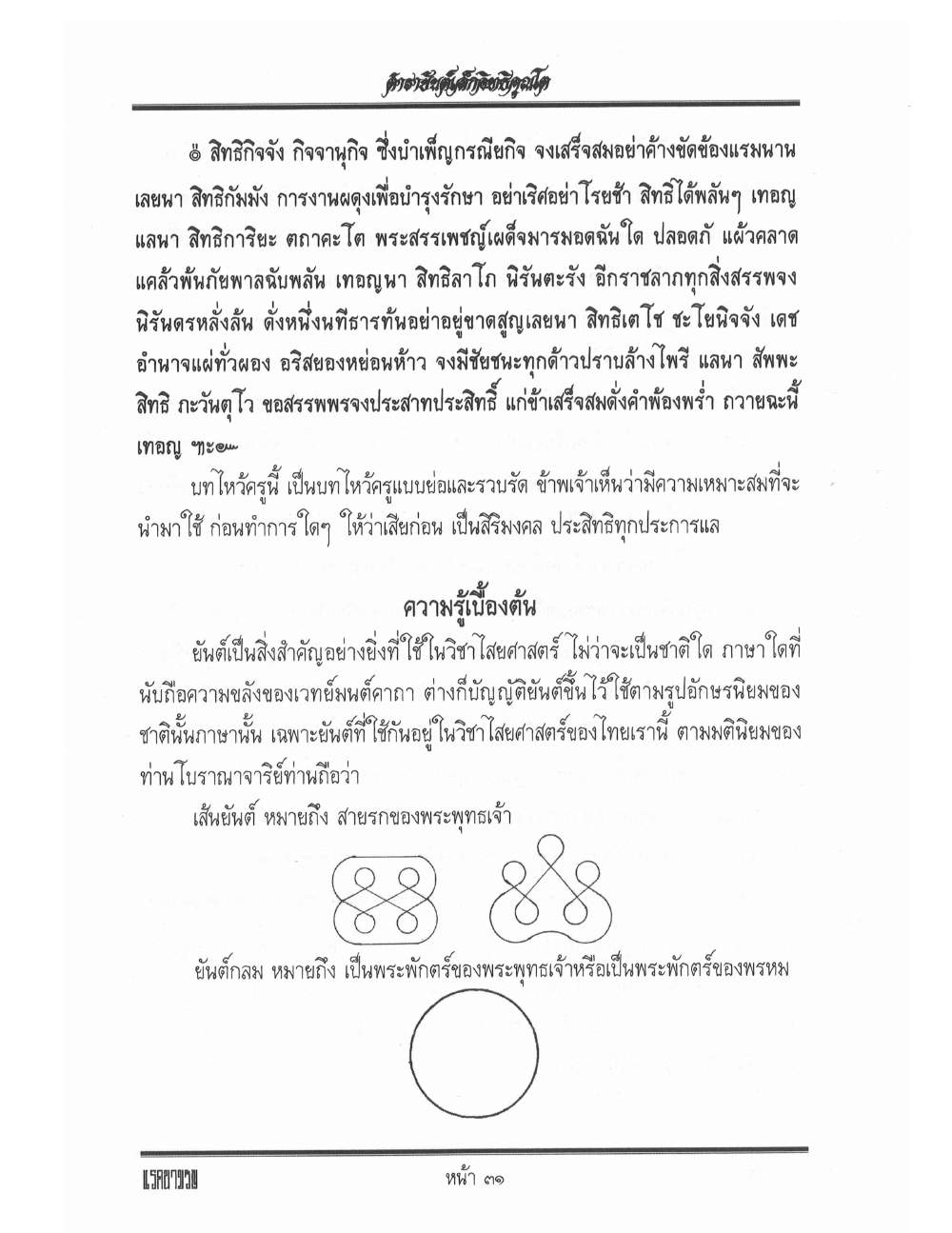
ยันต์เป็นสิ่งสำคัญอย่างยิ่งที่ใช้ในวิชาไสยศาสตร์ ไม่ว่าจะเป็นชาติใด ภาษาใดที่นับถือความขลังของเวทย์มนต์คาถา ต่างก็บัญญัติยันต์ขึ้นไว้ใช้ตามรูปอักษรนิยมของชาตินั้นภาษานั้น เฉพาะยันต์ที่ใช้กันอยู่ในวิชาไสยศาสตร์ของไทยเรานี้ ตามมตินิยมของท่านโบราณาจารย์ท่านถือว่า
เส้นยันต์ หมายถึง สายรกของพระพุทธเจ้า
ยันต์กลม หมายถึง เป็นพระพักตร์ของพระพุทธเจ้าหรือเป็นพระพักตร์ของพรหม
[Pali/Thai verse playing on the word "siddhi" (accomplishment):] Siddhi kicchang — whatever task or duty I undertake, may it be completed as intended, never stalling or dragging on for long. Siddhi kammang — may the work I maintain for upkeep never fade or decline; may accomplishment come swiftly, swiftly. Siddhi kariya tathagato — just as the All-Victorious Buddha utterly vanquished Mara, may I likewise be safe and clear, escaping every kind of danger instantly. Siddhi labho nirantarang — may royal fortune and every kind of gain flow down without end, like a river in flood that never runs dry. Siddhi techo chayo nichang — may fiery power and authority spread over all, may enemies lose their fierceness, may I be victorious in every direction and crush every foe. Sabbasiddhi bhavantu vo — may every blessing be granted and fulfilled for me, according to these words spoken in offering.
This teacher-veneration verse is a short, condensed version. I consider it suitable for use before undertaking any task — to be recited first, as an auspicious act bringing accomplishment in every respect.
Basic Knowledge
The yantra is an extremely important element used in the occult sciences (saiyasat); regardless of nation or language, those who hold the potency of mantras and incantations in reverence have each established yantras according to the preferred script-forms of their own nation and language. As for the yantras used specifically within Thai occult science, according to the accepted view of the ancient masters, they hold that:
The yantra line represents the umbilical cord of the Buddha. [yantra: two decorative knot-figures side by side — left, a rounded-rectangular frame woven from four small looping coils at its corners; right, a cluster of four looping coils radiating upward and outward from a shared curved base, forming a trefoil-like knot]
The round yantra represents the face of the Buddha, or the face of Brahma. [yantra: a single plain circle, unmarked]
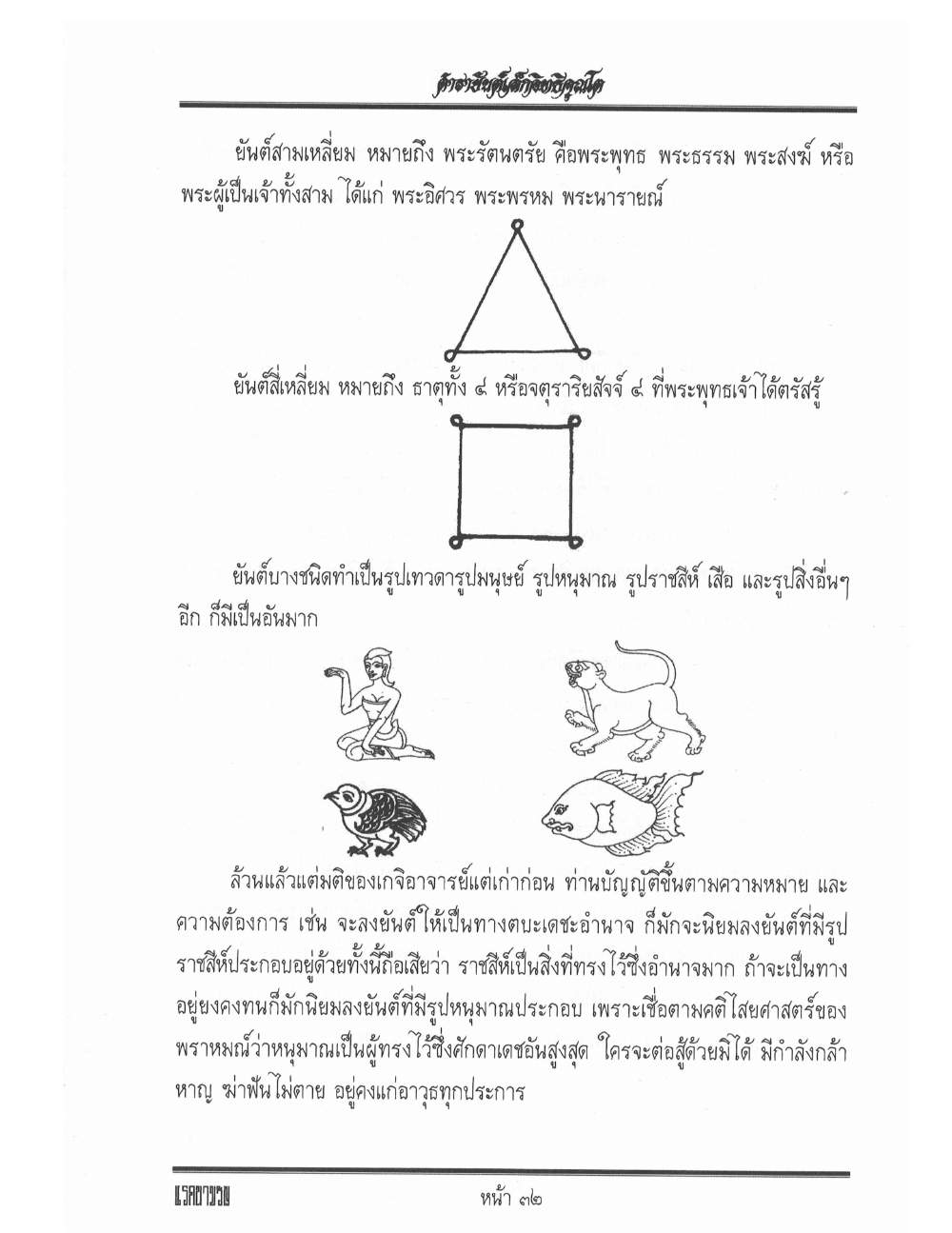
ยันต์สามเหลี่ยม หมายถึง พระรัตนตรัย คือพระพุทธ พระธรรม พระสงฆ์ หรือพระผู้เป็นเจ้าทั้งสาม ได้แก่ พระอิศวร พระพรหม พระนารายณ์
[รูปยันต์สามเหลี่ยม เส้นเปล่า ไม่มีอักขระ]
ยันต์สี่เหลี่ยม หมายถึง ธาตุทั้ง ๔ หรือจตุราริยสัจจ์ ๔ ที่พระพุทธเจ้าได้ตรัสรู้
[รูปยันต์สี่เหลี่ยม เส้นเปล่า ไม่มีอักขระ]
ยันต์บางชนิดทำเป็นรูปเทวดารูปมนุษย์ รูปหนุมาน รูปราชสีห์ เสือ และรูปสิ่งอื่นๆ อีก ก็มีเป็นอันมาก
[ภาพประกอบ ๔ รูป: รูปเทวดา/มนุษย์นั่งพับเพียบ, รูปราชสีห์คล้ายสิงห์, รูปนก, รูปปลา]
ล้วนแล้วแต่มติของเกจิอาจารย์แต่เก่าก่อน ท่านบัญญัติขึ้นตามความหมาย และความต้องการ เช่น จะลงยันต์ให้เป็นทางตะเดชอำนาจ ก็มักจะนิยมลงยันต์ที่มีรูปราชสีห์ประกอบอยู่ด้วยทั้งนี้ถือเสียว่า ราชสีห์เป็นสิ่งที่ทรงไว้ซึ่งอำนาจมาก ถ้าจะเป็นทางอยู่ยงคงทนก็มักนิยมลงยันต์ที่มีรูปหนุมานประกอบ เพราะเชื่อตามคติไสยศาสตร์ของพราหมณ์ว่าหนุมานเป็นผู้ทรงไว้ซึ่งศักดาเดชอันสูงสุด ใครจะต่อสู้ด้วยมิได้ มีกำลังกล้าหาญ ฆ่าฟันไม่ตาย อยู่คงแก่อาวุธทุกประการ
The triangular yantra refers to the Triple Gem — the Buddha, the Dhamma, and the Sangha — or to the three great deities: Isvara (Shiva), Brahma, and Narayana (Vishnu).
[yantra: a triangle with a small circle at each of its three corners, no inscribed characters]
The square yantra refers to the four elements, or the four noble truths that the Buddha awakened to.
[yantra: a square with a small circle at each of its four corners, no inscribed characters]
Some yantras are made in the form of deities, human figures, Hanuman, lions, tigers, and other figures — there are a great many of these as well.
[illustration: four figures — a seated deity/human figure, a lion-like beast (ratchasi), a bird, and a fish]
All of this is a matter of the opinion of the teachers of old, who established these forms according to their meaning and purpose. For example, to inscribe a yantra for the path of power, one would commonly favor a yantra incorporating the figure of the lion (ratchasi), on the reasoning that the lion is a creature possessed of great power. If the purpose were endurance and invulnerability, one would commonly favor a yantra incorporating the figure of Hanuman, because it is believed according to Brahmanical occult tradition that Hanuman is the bearer of the highest majesty and power — none can fight him, he is mighty and courageous, cannot be killed by blade, and is invulnerable to every kind of weapon.
ในการลงยันต์นั้น เมื่อเวลาลงต้องสำรวมจิตให้เป็นสมาธิแน่วแน่จริงๆ มือที่ลงต้องให้เที่ยงตั้งสติให้ตรง ยันต์ทุกชนิดท่านมีสูตรลงไว้กำกับทั้งนั้น เวลาลากยันต์ต้องลากให้จบพอดีกับสูตร และท่านบังคับไว้ให้เขียนทีเดียวให้ตลอดไม่ให้หยุด เพราะมิฉะนั้นจะไม่ศักดิ์สิทธิ์ เพราะการหยุดเสียกลางคันนั้น ท่านถือว่าเสีย ถ้าจะไม่ให้เสียต้องใช้สูตรต่อ
สิ่งที่ห้ามอย่างสำคัญที่สุดก็คือ ห้ามมิให้ลงอักขระ หรือเลขก้าวก่ายกับเส้นยันต์เป็นอันขาด เรียกกันว่าเป็นยันต์ตบอด ใช้การไม่ได้ อักขระที่ใช้ลงในยันต์ เฉพาะวิชาไสยศาสตร์ของไทยเรานั้นใช้อักขระที่ลงในยันต์จะใช้อักษรขอม เพราะถือกันว่าเป็นอักษรที่ศักดิ์สิทธิ์ จะมีเป็นรูปอักษรไทยที่ใช้ลงในยันต์อยู่บ้าง ได้แก่ยันต์ที่นิยมใช้กันอยู่ในแถวภาคใต้ใช้ลงด้วยอักษรพระเจ้า พอโม ๒๙ ตัว ที่ถือกันว่าเป็นกำเนิดปฐมอักษร คือ
๏ นอ โม พุท ท่อ ธาย ยอ สิท ท่อ ธม ออ อา อิ อี อึ อื อุ อู ฤ ฤๅ ฦ ฦๅ เอ แอ ไอ ใอ โอ้ เอ้า อำ อะ ๚ะ
อันอักขระทั้งนี้ แต่ละอักขระถือกันว่ามีคุณวิเศษ ใช้ได้แทบทุกประการที่เดี่ยว แต่ที่ใช้ลงกันเป็นส่วนมากทั้งภาคกลาง ภาคเหนือ และภาคอีสาน มิค่อยจะนิยมใช้กัน คงลงเป็นรูปอักขระขอมและอักขระธรรม (ขอมลาว)
สิ่งที่ลงในยันต์นอกจากจะเป็นตัวอักษรแล้ว ยันต์บางยันต์เป็นส่วนมากมักจะใช้ลงด้วยเลข เลขที่ใช้ลงในยันต์นั้นสูตรที่ใช้ลงก็มักนิยมใช้สูตรในตำราตรีนิสิงห์ คือแทนที่จะเขียนอักขระลงไปหลายๆ คำ ทั้งช่องยันต์ที่จะลงก็จำกัดที่ จึงให้ใช้เขียนเป็นตัวเลขแทนลงไป ดังเช่น จะเขียนหัวใจพระอภิธรรม ๗ คัมภีร์ คือ สังวิธาปุกะยะปะ ก็ใช้เขียนเลข ๗ แทนลงไป หรือเช่น จะเขียนคาถาพระนวหรคุณ อะสังวิสุโลปุสะพุกะ ก็เขียนเลข ๙ แทนลงไป เพราะฉะนั้น พึงให้เข้าใจว่าตัวเลขที่ลงนั้นเป็นตัวย่อของอักขระที่จะเขียนแทนลงไป สูตรที่ลงในเวลาเขียนยันต์นั้นมีหลายสูตรด้วยกัน คือ
When inscribing a yantra, at the moment of inscription one must compose the mind into deep, unwavering concentration. The hand doing the inscribing must be steady, with the mind set straight. Every kind of yantra has a formula prescribed to govern it; when drawing the lines of a yantra, the drawing must run to completion exactly with the formula, and it is required that it be written in a single continuous stroke without stopping, for otherwise it will not be potent — because stopping partway through is considered spoiled. If one is not to spoil it, the formula must be continued.
The single most important prohibition is this: characters or numerals must never be allowed to overlap or cross the lines of the yantra. Such a yantra is called a "blind yantra" and cannot be used. As for the characters used to inscribe a yantra — specifically in Thai occult practice — the script used is Khom (Khmer-derived script), because it is held to be a sacred script. There are also some yantras that use Thai script forms; for instance, yantras favored in the southern region are inscribed with the "Royal Letters," the 29 letters, which are held to be the origin of the primordial alphabet, namely:
[a 29-letter Thai/Khom alphabetical list, transliterated: nō mō phut thø̄ thāi yø̄ sit thø̄ tham ø̄ ā i ī ue ư u ū rư rư̄ lư lư̄ ē ǣ ai ai ō ao am a]
Each of these letters is held to possess special virtue and can be used individually for almost any purpose. However, the letters most commonly used — across the Central, Northern, and Northeastern regions — are not these; they remain chiefly in the form of Khom script and Tham script (Lao Khom).
Besides letters, what is inscribed in a yantra — in most yantras — is very often numerals. As for the numerals used in a yantra, the formula favored is usually the one from the Trinisingh treatise: instead of writing out many words of script, since the space available in a yantra's compartments is limited, numbers are used to stand in for them. For example, to write the heart-formula of the seven books of the Abhidhamma, "Sangvithapukkayapa," one may simply write the numeral 7 in its place; or to write the Navaharakhun formula, "Asangvisulopusapuka," one writes the numeral 9 in its place. Therefore, one should understand that a numeral inscribed in this way is an abbreviation standing for the letters it replaces. There are several formulas used when writing a yantra, namely:
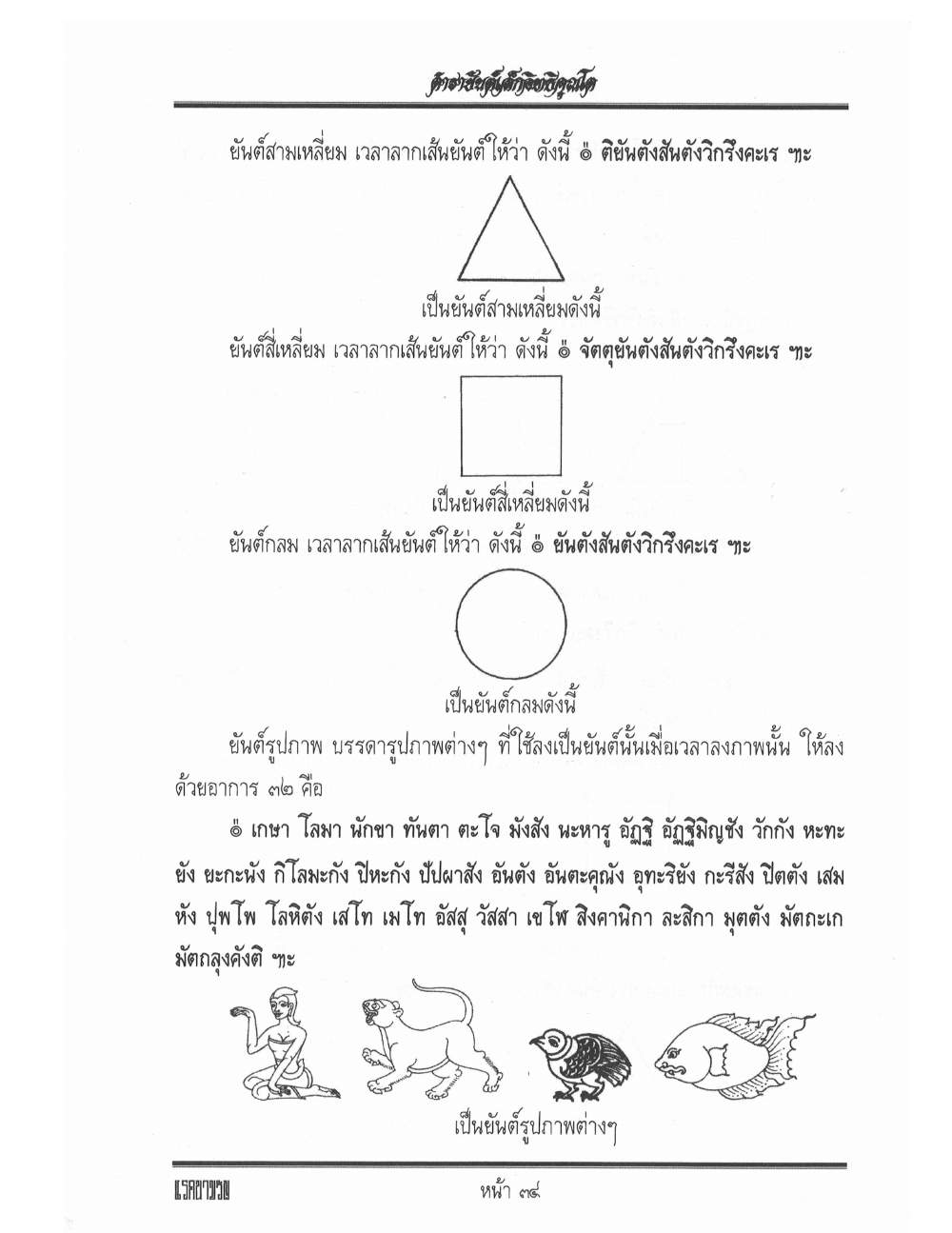
ยันต์สามเหลี่ยม เวลาลากเส้นยันต์ให้ว่า ดังนี้ ๏ ติยันตังสันตังวิกรึงคะเร ๚ะ
[รูปสามเหลี่ยม]
เป็นยันต์สามเหลี่ยมดังนี้
ยันต์สี่เหลี่ยม เวลาลากเส้นยันต์ให้ว่า ดังนี้ ๏ จัตตุยันตังสันตังวิกรึงคะเร ๚ะ
[รูปสี่เหลี่ยม]
เป็นยันต์สี่เหลี่ยมดังนี้
ยันต์กลม เวลาลากเส้นยันต์ให้ว่า ดังนี้ ๏ ยันตังสันตังวิกรึงคะเร ๚ะ
[รูปวงกลม]
เป็นยันต์กลมดังนี้
ยันต์รูปภาพ บรรดารูปภาพต่างๆ ที่ใช้ลงเป็นยันต์นั้นเมื่อเวลาลงภาพนั้น ให้ลงด้วยอาการ ๓๒ คือ
๏ เกษา โลมา นักขา ทันตา ตะโจ มังสัง นะหารู อัฏฐิ อัฏฐิมิญชัง วักกัง หะทะยัง ยะกะนัง กิโลมะกัง ปิหะกัง ปัปผาสัง อันตัง อันตะคุณัง อุทะริยัง กะรีสัง ปิตตัง เสมหัง ปุพโพ โลหิตัง เสโท เมโท อัสสุ วัสสา เขโฬ สิงคาณิกา ละสิกา มุตตัง มัตถะเก มัตถะลุงคังดังติ ๚ะ
[ภาพประกอบ ๔ รูป: รูปเทวดา/มนุษย์, รูปราชสีห์, รูปนก, รูปปลา]
เป็นยันต์รูปภาพต่างๆ
For the triangular yantra, while drawing the lines of the yantra, one recites as follows: "Tiyantang santang wikrueng khare."
[yantra: a triangle]
This becomes the triangular yantra as shown.
For the square yantra, while drawing the lines of the yantra, one recites: "Chattuyantang santang wikrueng khare."
[yantra: a square]
This becomes the square yantra as shown.
For the round yantra, while drawing the lines of the yantra, one recites: "Yantang santang wikrueng khare."
[yantra: a circle]
This becomes the round yantra as shown.
Pictorial yantras — of all the various images used as yantras, when the time comes to inscribe such an image, it must be accompanied by the recitation of the "32 parts [of the body]" (อาการ ๓๒), namely: [a recited list, in romanised Pali, of the traditional 32 constituent parts of the body — hair, body hair, nails, teeth, skin, flesh, sinews, bones, bone marrow, kidneys, heart, liver, membranes, spleen, lungs, intestines, mesentery, stomach contents, faeces, bile, phlegm, pus, blood, sweat, fat, tears, oil-of-skin, saliva, mucus, oil-of-joints, urine, and brain].
[illustration: four figures — a deity/human figure, a lion-like beast, a bird, and a fish]
These are the various pictorial yantras.
และการลงยันต์ที่เป็นรูปอีกแบบหนึ่ง เฉพาะที่เขียนเป็นรูปคนลงชื่อลงนาม ที่ประสงค์โดยมากเป็นยันต์ที่ใช้กับการฝังรูปฝังเทียนนั้น ให้ใช้สูตรปถมังโลกีย์ลง และเสกด้วยอาการ ๓๒ อีกครั้งหนึ่ง
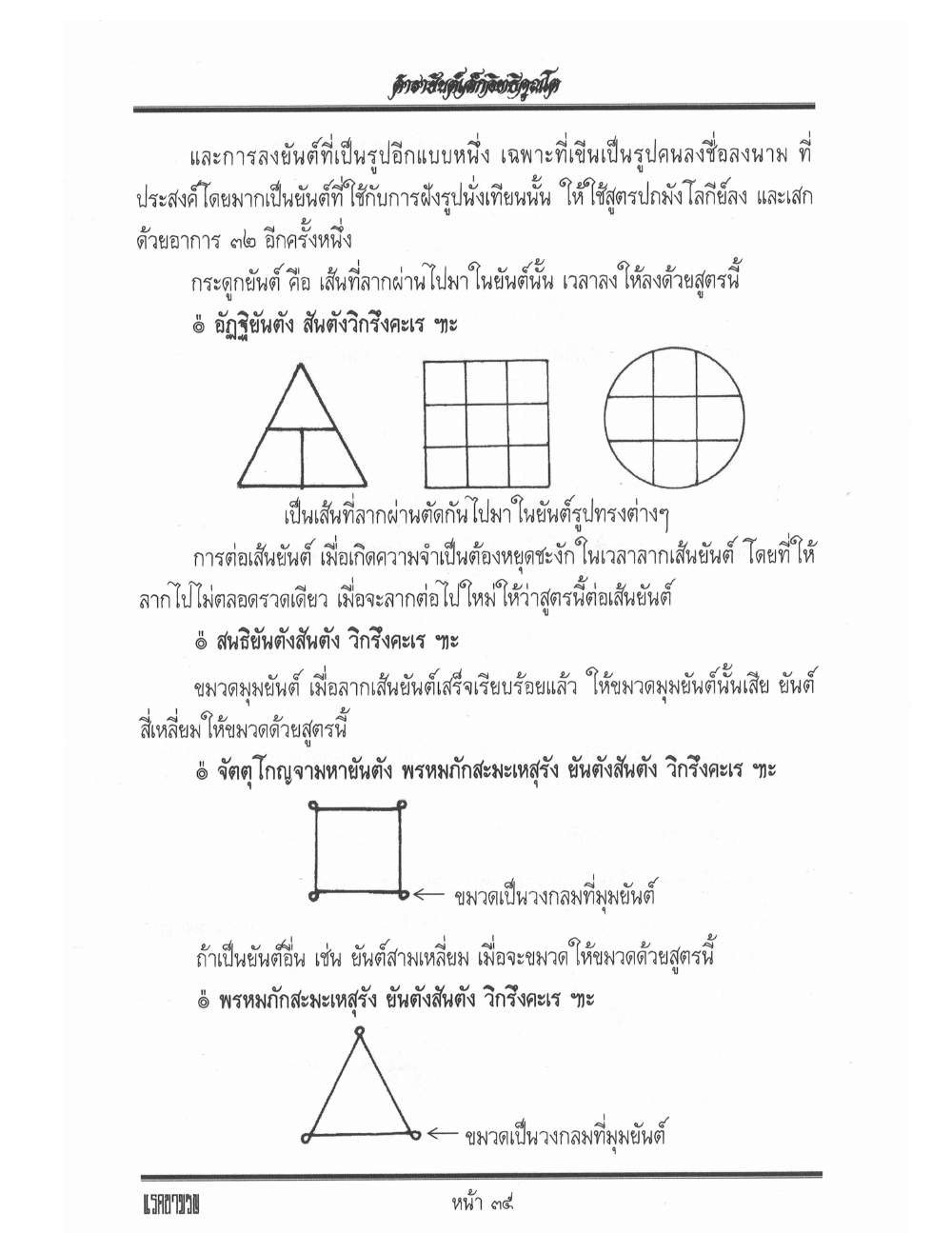
กระดูกยันต์ คือ เส้นที่ลากผ่านไปมาในยันต์นั้น เวลาลงให้ลงด้วยสูตรนี้ ๏ อัฏฐิยันตัง สันตังวิกรึงคะเร ๚ะ
[รูปสามเหลี่ยมมีเส้นแบ่งภายใน, รูปสี่เหลี่ยมมีเส้นแบ่งภายในเป็นตาราง, รูปวงกลมมีเส้นแบ่งภายใน]
เป็นเส้นที่ลากผ่านตัดกันไปมาในยันต์รูปทรงต่างๆ
การต่อเส้นยันต์ เมื่อเกิดความจำเป็นต้องหยุดชะงักในเวลาลากเส้นยันต์ โดยที่ให้ลากไปไม่ตลอดรวดเดียว เมื่อจะลากต่อไปใหม่ให้ว่าสูตรนี้ต่อเส้นยันต์ ๏ สนธิยันตังสันตัง วิกรึงคะเร ๚ะ
ขมวดมุมยันต์ เมื่อลากเส้นยันต์เสร็จเรียบร้อยแล้ว ให้ขมวดมุมยันต์นั้นเสีย ยันต์สี่เหลี่ยมให้ขมวดด้วยสูตรนี้ ๏ จัตตุโกญจามหายันตัง พรหมภักสะมะเหสุรัง ยันตังสันตัง วิกรึงคะเร ๚ะ
[รูปสี่เหลี่ยมมีวงกลมเล็กที่มุม พร้อมลูกศรชี้และคำอธิบาย "ขมวดเป็นวงกลมที่มุมยันต์"]
ถ้าเป็นยันต์อื่น เช่น ยันต์สามเหลี่ยม เมื่อจะขมวดให้ขมวดด้วยสูตรนี้ ๏ พรหมภักสะมะเหสุรัง ยันตังสันตัง วิกรึงคะเร ๚ะ
[รูปสามเหลี่ยมมีวงกลมเล็กที่มุม พร้อมลูกศรชี้และคำอธิบาย "ขมวดเป็นวงกลมที่มุมยันต์"]
There is also another style of yantra-inscription — specifically, one drawn as a figure of a person, on which a name is signed. This is used mostly for a yantra intended for burial with an effigy or a wax figure; for this, one should use the "Pathamang Lokiya" formula, and consecrate it again with the "32 parts" recitation.
The "bone-lines" of the yantra are the lines that run crisscrossing through the yantra. When inscribing them, use this formula: "Atthiyantang santang wikrueng khare."
[yantra: a triangle with an internal dividing line, a square divided into a 3x3 grid, and a circle divided by crossing lines]
These are the lines that cross back and forth within yantras of various shapes.
Joining the lines of a yantra: when it becomes necessary to pause partway through drawing the lines of a yantra — that is, the line is not drawn in a single unbroken stroke — when resuming the line, one recites this formula to join it: "Sonthiyantang santang wikrueng khare."
Closing the corners of a yantra: once the lines of the yantra have been fully drawn, the corners of the yantra must be closed off. For a square yantra, close it with this formula: "Chattukonchamahayantang, phrommaphaksamahesurang, yantang santang wikrueng khare."
[yantra: a square with a small circle at each corner, with an arrow and the caption "closed into a circle at the yantra's corner"]
For other yantras, such as the triangular yantra, when closing it, use this formula: "Phrommaphaksamahesurang, yantang santang wikrueng khare."
[yantra: a triangle with a small circle at each corner, with an arrow and the caption "closed into a circle at the yantra's corner"]
ลงอักษรและเลข เมื่อจะลงอักษรและเลขในยันต์นั้นให้ลงด้วยสูตรนี้ ลงอักษร ๏ อักขะระยันตัง อุปัชชะติ ๚ะ
ลงเลข ๏ เลขะยันตัง อุปัชชะติ ๚ะ
ลงแล้วให้กรึงเสียเพื่ออยู่ยงคงถาวรตลอดไป เพราะมีมติที่ถือกันอยู่ว่าอักษรหรือเลขก็ดี ถ้าลงแล้วไม่กรึง อาจจะหนีหายไปได้ (คือเสื่อมไปพั่นเอง)
กรึงอักษร ๏ อักขระยันตัง สันตังวิกรึงคะเร ๚ะ
กรึงเลข ๏ เลขะยันตัง สันตังวิครึงคะเร ๚ะ
ในการลงตัวอักษรและตัวเลขนี้ ยังมีสูตรที่นิยมใช้กันอย่างแพร่หลายอีกสูตรหนึ่ง เช่น จะลงตัวอะไรก็ดี ให้ว่าตัวนั้นขึ้นทุกที่ไป เช่น จะลง นะโมพุทธายะ ก็ให้ลงตามแบบนี้ ๏ นะ กาโรโหติสัมภะโว ๚ะ ลงนะ
๏ โม กาโรโหติสัมภะโว ๚ะ ลงโม
๏ พุท กาโรโหติสัมภะโว ๚ะ ลงพุท
๏ ธา กาโรโหติสัมภะโว ๚ะ ลงธา
๏ ยะ กาโรโหติสัมภะโว ๚ะ ลงยะ
หรือจะลงเลขก็ลงตามแบบนี้ ๏ มะอะอุ กาโรโหติสัมภะโว ๚ะ ลงเลข ๓
๏ นะมะพะทะ กาโรโหติสัมภะโว ๚ะ ลงเลข ๔
๏ พุทโธ กาโรโหติสัมภะโว ๚ะ ลงเลข ๒
จะใช้สูตรที่ลงตามแบบนี้ก็ได้ เมื่อลงแล้วให้กรึงเสีย เฉพาะตัวเลขนั้นให้พิจารณา คาถาที่จะนำมาใช้ลง เอาให้เท่ากับจำนวนเลขนั้นเป็นใช้ได้ทั้งนั้น เช่น เลข ๔ จะใช้ จะภะกะสะ ก็ได้ หรือจะใช้ ทุสะมะนิ ก็ได้
นอกจากการลงยันต์ลงอักขระและลงเลขแล้ว ก็ยังมีการลงองค์พระและสูรย์จันทร์ ครึ่งซีกอุณาโลมลงกำกับไว้ในยันต์อีกด้วย ท่านวางสูตรการลงไว้ ดังนี้คือ
Inscribing letters and numerals: when inscribing letters and numerals within a yantra, use this formula. To inscribe a letter: "Akkharayantang upachachati."
To inscribe a numeral: "Lekhayantang upachachati."
Once inscribed, the letter or numeral must be "locked" so that it remains permanently in place, because it is held that a letter or numeral, if not locked after being inscribed, may vanish away (that is, fade of its own accord).
To lock a letter: "Akkharayantang santang wikrueng khare."
To lock a numeral: "Lekhayantang santang wikhrueng khare."
For inscribing letters and numerals, there is also another widely favored formula: whichever letter one is inscribing, one recites that same letter each time it occurs. For example, to inscribe "Namo Buddhaya," one inscribes it in this manner: "Na — karo hoti sambhavo" — inscribe "na"
"Mo — karo hoti sambhavo" — inscribe "mo"
"Phut — karo hoti sambhavo" — inscribe "phut"
"Tha — karo hoti sambhavo" — inscribe "tha"
"Ya — karo hoti sambhavo" — inscribe "ya"
Or, if inscribing numerals, proceed likewise: "Ma-a-u — karo hoti sambhavo" — inscribe the numeral 3
"Na-ma-pha-tha — karo hoti sambhavo" — inscribe the numeral 4
"Phuttho — karo hoti sambhavo" — inscribe the numeral 2
One may use the formula given in this manner; once inscribed, it must be locked. As for the numeral itself, one should consider which incantation to bring to bear for the inscribing — any incantation whose syllable-count matches that number will serve. For example, for the numeral 4 one may use "Chapakasa," or one may use "Thusamani."
Besides inscribing the yantra's lines, letters, and numerals, there is also the inscribing of a Buddha-image and of the sun and moon, together with a half-circle unalome, placed to govern the yantra as well. The formulas for inscribing these are laid out as follows:
การลงองค์พระ ท่านให้ลง ๓ ตอนด้วยกัน คือ ลงตอนบน ซึ่งสมมุติให้เป็นพระเศียรก่อน ลงด้วยสูตรนี้ ๏ มะกาโร สีสะพุทธา ปะนะชายะเต ๚ะ
ลงตอนสอง คือตอนกลาง ซึ่งสมมุติให้เป็นองค์ ลงด้วยสูตรนี้ ๏ อะกาโร องคะพุทธา ปะนะชายะเต ๚ะ
ลงตอนสาม คือตอนล่าง ซึ่งสมมุติให้เป็นพระบาท ลงด้วยสูตรนี้ ๏ อุกาโร ปาทะพุทธา ปะนะชายะเต ๚ะ
[ภาพประกอบ: วงกลมเล็ก, รูปพระเศียรซ้อนฐาน, รูปพระเศียรซ้อนฐานสองชั้น]
ถ้ามี อุ อยู่บนพระเศียร เวลาลงให้ว่าสูตรดังนี้ ๏ อุกาโรโหติสัมภะโว จงมาบังเกิดเป็นอุดังนี้ ๚
[ภาพประกอบ: สัญลักษณ์อักขระขอมเล็กๆ]
การลงสูรย์จันทร์ สูตรที่ลงท่านสมมุติว่าเป็นพระอาทิตย์และพระจันทร์นั่นเอง อันเป็นสิ่งที่มีอยู่เป็นประธานประจำโลก สร้างความเจริญเติบโตให้แก่มนุษย์สัตว์ และสิ่งทั้งปวงบนพื้นพิภพนี้ ลงจันทร์ให้ลงด้วยสูตรนี้
ถ้ามีพระจันทร์ครึ่งซีกกำกับอยู่ เวลาลงให้ใช้สูตรดังนี้ ๏ ตรีนิอักขะรานิ อัฏฐะจันทา ปะนะชายะเต ๚ะ
[ภาพประกอบ: รูปพระจันทร์เสี้ยว]
ถ้ามีสูรย์กำกับอยู่บนจันทร์ เวลาลงให้ว่าสูตรดังนี้ ๏ ชาตานิ พินธุสุริยา ปะนะชายะเต ๚ะ
[ภาพประกอบ: วงกลมเล็ก]
การลงอุณาโลม อุณาโลมก็คือ ตัว อุ ในอักษรขอมที่เขียนกลับหัวลงนั่นเอง เป็นเครื่องหมาย แสดงถึงพระอริยะเจ้าทั้งหลายที่ได้บรรลุโลกุตระธรรมอันสูงสุด สายรัดตัณหาขาดสิ้น ไม่มีกำเริบดังเช่นบุคคลธรรมดา ลมตรงสูญกลางกระหม่อมของท่านเดินตรง ไม่พลุ่งพล่านเป็นเสมือนรูปอุณาโลม ฉะนั้น ในการลงเลขยันต์เมื่อถึงขั้นสุดท้ายจะสำเร็จแล้ว จึงให้ลงอุณาโลมกำกับลงไปด้วย อุณาโลมที่ลงตอนหยักนั้นที่นิยมใช้อยู่ด้วยกัน ๓ แบบ คือ หยัก ๓ ที หยัก ๔ ที และหยัก ๙ ที แล้วจึงขีดเป็นเส้นตรงยาวขึ้นไป การหยักนี้ไม่จำกัดจะหยัก ๓ ๔ ๙ ก็ได้ตามถนัด
Inscribing the Buddha-image: this is done in three sections together. Inscribe the upper section, which represents the head, first, using this formula: "Makaro sisaphuttha panachayate."
Inscribe the second section, the middle, which represents the body, using this formula: "Akaro ongkhaphuttha panachayate."
Inscribe the third section, the lower part, which represents the feet, using this formula: "Ukaro pathaphuttha panachayate."
[illustration: a small circle; a head resting on a tiered base; a head resting on a two-tiered base]
If the letter "u" sits atop the head, recite this formula when inscribing it: "Ukaro hoti sambhavo — may it come to arise as this 'u'."
[illustration: a small Khom-script character]
Inscribing the sun and moon: the formula inscribed here represents the sun and the moon themselves, which stand as the presiding lords of the world, bringing about growth and flourishing for humankind, animals, and all things upon the face of the earth. When inscribing the moon, use this formula.
If a crescent half-moon accompanies it, use this formula when inscribing: "Trini akkharani atthachanta panachayate."
[illustration: a crescent moon]
If the sun accompanies the moon, use this formula when inscribing: "Chatani phinthusuriya panachayate."
[illustration: a small circle]
Inscribing the unalome: the unalome is simply the letter "u" in Khom script, written upside down. It is a mark signifying the noble ones (ariya) who have attained the highest transcendent Dhamma, whose bonds of craving are utterly severed, who no longer stir as ordinary people do — the breath passes straight through the crown of the head, undisturbed, just as the shape of the unalome is drawn. Therefore, when inscribing the numerals of a yantra, at the final stage of its completion, the unalome must be inscribed to accompany it as well. As for the zigzags at the base of the unalome, three forms are commonly used: three zigzags, four zigzags, or nine zigzags, after which a long straight line is drawn upward. The number of zigzags is not fixed — three, four, or nine may be used, according to preference.
เมื่อลงอุณาโลมให้ใช้สูตรลงดังนี้ ๏ อุณาโลมาปะนะชายะเต ๚ะ
ถ้าหยัก ๓ หยัก ว่า ๏ มะอะอุ ๚ะ
ถ้าหยัก ๔ หยัก ว่า ๏ นะโมพุทธายะ ๚ะ
ถ้าหยัก ๗ หยัก ว่า ๏ สังวิธาปุกะยะปะ ๚ะ
ถ้าหยัก ๙ หยัก ว่า ๏ อะสังวิสุโลปุสะพุกะ ๚ะ
ลากเส้นตรงขึ้นไป เวลาลงให้ใช้สูตรดังนี้ ๏ สัตถุโพพุทโธ ๚ะ
[รูปอุณาโลม: เส้นหยักและเส้นตรงขึ้นไปสิ้นสุดด้วยอักขระขอม]
[รูปพระพุทธรูปประทับนั่งบนฐานซ้อน มีอักขระขอมและอุณาโลมอยู่เหนือพระเศียร มีพระจันทร์เสี้ยวและวงกลมประกอบ]
มักปรากฏอยู่ในรูปแบบนี้
When inscribing the unalome, use this formula: "Unalomapanachayate."
If three zigzags, recite: "Ma-a-u."
If four zigzags, recite: "Namo Buddhaya."
If seven zigzags, recite: "Sangvithapukkayapa."
If nine zigzags, recite: "Asangvisulopusapuka."
When drawing the straight line upward, use this formula: "Satthu pho phuttho."
[illustration: an unalome mark — a zigzagged base rising into a straight line, capped with a Khom-script character]
[illustration: a Buddha image seated on a tiered pedestal, with a Khom character and an unalome above the head, accompanied by a crescent moon and a circle]
This is commonly how it appears.
สูตรสำเร็จ ยันต์ทุกยันต์เมื่อทำสำเร็จแล้ว ให้เรียกสูตรนามทุกยันต์และให้ออกชื่อด้วยว่าเป็นยันต์ทางไหน เช่น เป็นทางคงกระพันก็ให้ออกชื่อว่ายันต์คงกระพัน ทางแคล้วคลาดก็ให้ออกชื่อว่ายันต์แคล้วคลาด ทางเมตตาก็ให้ออกชื่อว่ายันต์เมตตา ดังนี้เป็นต้น สูตรนามที่ใช้เรียกนั้น ดังนี้ คือ
๏ นามะนังสะมาโส ยุตตะโก ยุตตะกะ แห่งนามะทั้งหลาย พระอาริยะเจ้าพึงหมาย ให้ชื่อยันต์ .......(ออกชื่อขันต์ตามประสงค์)....... ๚ะ
๏ อนุปปะทิฏฐานัง วุตตะโย คะโต อุธาหรณ์อันใดอันเป็นไปมิได้แล้ว พระอาจาริยะเจ้าพึงหมายให้สำเร็จด้วยสูตรนี้ ๚ะ
สูตรดังกล่าวนี้เป็นสูตรสำเร็จที่ใช้ประจำยันต์ ถึงแม้ว่าจะมีสิ่งใดที่ขาดตกบกพร่องก็พึงสำเร็จด้วยสูตรนี้ อนึ่ง ในบรรดายันต์ต่างๆ มักจะมีรูปไม่เหมือนกัน เช่น บางที่ก็ทำเป็นกลีบบัวออกไปบ้าง ถ้าหากจะลงเส้นยันต์ที่ท่านโบราณาจารย์แต่เก่าก่อน ท่านประดิษฐ์แยกแยะออกไปดังกล่าวนี้ พึงให้ยึดสูตรที่ลงดังนี้เป็นพื้นว่า ยันตังสันตัง วิกรึงคะเร และบางที่ท่านก็ลงเป็นรูปลูกศรบ้าง ลงเป็นรูปธงบ้างก็มี เมื่อจะลงนั้นจะใช้สูตรที่กล่าวแล้วลงก็ได้ หรือจะลงด้วยสูตรเฉพาะดังนี้ก็ได้
ลงยันต์ที่เป็นรูปธง ให้ลงด้วยสูตรนี้ ๏ ธะชัดคังปะริตตัง มังคะลัง ๚ะ
ลงลูกศรซึ่งถือเสมือนเป็นศรของพระนารายณ์ สำหรับป้องกันอันตรายต่างๆ หรือใช้สำหรับปราบศัตรู ให้ลงด้วยคาถานี้ ๏ โอม เพ็ชชะละลาย ขับสายศรพระราม อันชื่อว่าพรหมมาศ พรายวาต อัคคะเนวาต โอมสะท้านตรึงธรณีสวาหะ ๚ะ
บางแบบว่าดังนี้
๏ โอม เพ็ชชะนารายน์ ขับสายศรพระราม อันชื่อว่าพรหมมาศ พรายวาต อัคคะเนวาต โอมสะท้านกรึงบาดาลสารพัดกริ่งทั่วโลกากริ่ง ๚ะ
มนต์ที่ลงลูกศรทั้งสองบทนี้ ให้เลือกใช้เอาเถิด แต่ถูกศรที่ลงด้วยมนต์ มักจะเป็นลูกศรที่ลงในยันต์เกี่ยวกับทำความ ทำอาถรรพ์ฝังรูปฝังรอยต่างๆ ถ้าเป็นยันต์ที่เกี่ยวกับการคุ้มภัยอันตราย นิยมใช้สูตร ยันตังสันตัง วิกรึงคะเร ดังกล่าวแล้ว
The completion formula: once every yantra has been completed, one must recite the name-formula proper to that yantra and pronounce its name according to which path it belongs to — for example, if it is for the path of invulnerability, name it "the Invulnerability Yantra"; if for the path of evasion of danger, name it "the Evasion Yantra"; if for the path of loving-kindness (metta), name it "the Metta Yantra," and so on. The name-formula used for this is as follows:
"Namanang samaso yuttako yuttaka — of all names, the noble ones should designate and name the yantra ...(name the yantra as desired)..."
"Anuppatitthanang wuttayo khato — whatever example cannot come to be, the teacher should intend it to be accomplished by this formula."
The formula stated above is the completion formula used for every yantra as standard; even if something is lacking or imperfect, it should be brought to completion by this formula. Furthermore, among the various yantras the forms often differ from one another — for instance, some are made to project out in lotus-petal shapes. If one is inscribing the lines of a yantra as the ancient teachers of old devised and differentiated them, one should hold to the following as the basic formula: "Yantang santang wikrueng khare." And in some cases the teachers inscribed a figure of an arrow, or a figure of a flag; when inscribing these, one may use the formula already given, or one may use a formula specific to each, as follows.
To inscribe a yantra in the shape of a flag, use this formula: "Thachatkhang parittang mangkhalang."
To inscribe the arrow — regarded as the arrow of Narayana (Vishnu), used to guard against various dangers or to subdue enemies — use this incantation: "Om, phetchalalai, drive the arrow-string of Phra Ram, named Phrommat, praiwat, akkhanewat, Om, shake and bind the earth, svaha."
Some versions have it thus:
"Om, phetchanarai, drive the arrow-string of Phra Ram, named Phrommat, praiwat, akkhanewat, Om, shake and bind the underworld, potent throughout, potent across the whole world."
Of these two incantations for inscribing the arrow, one may choose either to use. However, the arrow inscribed with an incantation tends to be the arrow used in yantras connected with working sorcery, or with burying effigies and impressions of various kinds for harmful magic. If the yantra concerns protection from danger, it is customary to use the formula "Yantang santang wikrueng khare" as already stated.
การปลุกเสก
ยันต์เมื่อลงเสร็จแล้วจำเป็นต้องปลุกเสกทุกยันต์ บางยันต์ก็วางคาถาปลุกเสกไว้ให้ หรือบางทีวางสูตรการลงกำกับไว้ให้ด้วย ยันต์เช่นว่านี้ต้องกระทำไปตามสูตรที่บังคับไว้ และเมื่อเสร็จแล้วก็ต้องปลุกเสกตามคาถาที่วางไว้กำกับนั้น ส่วนยันต์บางยันต์วางไว้แต่คาถาสำหรับปลุกเสก สูตรที่จะใช้ลงนั้นมิได้วางไว้ นั่นก็คือหมายความว่าให้ลงตามสูตรดังกล่าวแล้ว และบางยันต์มิได้วางไว้เลยทั้งสูตรลงและคาถาปลุกเสกยันต์เช่นนี้ จำเป็นจะต้องเลือกกาถาปลุกเสกเอง โดยกำหนดคาถานั้นให้เหมาะสมกับยันต์ เช่น ยันต์ทางคงกระพันให้เลือกเอาคาถาทางคงกระพันปลุกเสก ทางเมตตาหรือทางคุ้มกันก็ให้เอาคาถาเมตตาและคาถาคุ้มกันปลุกเสก หรือจะใช้คาถาพระพุทธคุณ พระธรรมคุณ พระสังฆคุณ คาถาพระเจ้า ๑๖ พระองค์ คาถาพระเจ้า ๔ พระองค์ กับบทใดบทหนึ่งปลุกเสกก็ได้ ยันต์บางชนิด ท่านบอกไว้แต่เพียงว่าให้ปลุกเสกด้วยตัวเอง หมายความว่าให้ถอดเอาคาถาที่ใช้ลงในยันต์นั้นนำเอามาปลุกเสก
ส่วนวิธีการปลุกเสกนั้น สำคัญอยู่ที่การวางกระแสจิต ถ้าประสงค์จะให้เป็นไปทางอยู่คงกระพันชาตรี ต้องวางอารมณ์ให้แข็งแกร่ง ไม่ย่นย่อต่อศาสตราอาวุธทั้งปวง ยิ่งทำกำลังใจให้แข็งได้เท่าไร ความศักดิ์สิทธิ์ก็จะยิ่งเพิ่มขึ้น ถ้าจะให้เป็นทางเมตตามหานิยมก็ต้องปรุงกระแสจิตให้อ่อนหวานเยือกเย็น การบริกรรมปลุกให้ดำเนินตามวิธีการภาวนาคาบ กระทำจนดวงจิตเป็นสมาธิ และในการปลุกเสกนี้ควรดำเนินไปตามหลักการของกสิณ กระทำให้เกิดอุคหนิมิตร และปฏิภาคนิมิตรบังเกิดปีติโดยลักษณะอาการต่างๆ เป็นต้นว่า เกิดขนพองสยองเกล้า เลขยันต์ที่ลงนั้นจะบรรลุถึงความศักดิ์สิทธิ์อย่างเต็มที่ อนึ่ง ในการปลุกเสกนั้น แม้ท่านจะวางคาถาให้ปลุกเสกด้วยบทใดบทหนึ่งก็ดี พึงอย่าลืมเอาธาตุเข้าประสมปลุกเสกด้วยเป็นอันขาด ให้พิจารณาดูกองธาตุอันควรจะใช้ให้เหมาะสมกับการนั้น
Consecration (Pluk Sek)
Once a yantra has been inscribed, every yantra must be consecrated. Some yantras come with a consecration incantation already provided; sometimes the formula for the inscribing is provided as well, governing it. Such a yantra must be made according to the formula prescribed, and once completed it must be consecrated according to the incantation laid down to govern it. As for some yantras, only the consecration incantation is provided, while the formula to be used for inscribing is not provided; this simply means one should inscribe using the formula already stated. And some yantras provide neither the inscribing formula nor the consecration incantation at all; such a yantra requires one to choose a consecration incantation oneself, selecting an incantation appropriate to the yantra. For example, for a yantra of the invulnerability path, choose an invulnerability incantation to consecrate it; for the path of loving-kindness or protection, use a loving-kindness incantation or a protection incantation to consecrate it; or one may use the Incantation of the Buddha's Virtues, the Dhamma's Virtues, the Sangha's Virtues, the Incantation of the 16 Lords Buddha, or the Incantation of the 4 Lords Buddha — any one of these verses may serve to consecrate it. For some kinds of yantra, it is stated only that it should be "self-consecrated," meaning that the incantation used to inscribe that yantra should itself be drawn out and used to consecrate it.
As for the method of consecration, what matters most is the placement of the mental current. If the intent is for the path of bodily invulnerability, one must set one's mood to be firm and unyielding, undaunted before any weapon or blade whatsoever; the firmer one can make one's resolve, the greater the potency will become. If the intent is for the path of great charm and popularity (metta mahaniyom), one must instead compose the mental current to be gentle, sweet, and cool. The muttering recitation for consecration should proceed according to the method of meditative recitation, carried out until the mind reaches concentration; and in this consecration one should proceed according to the principles of kasina meditation, bringing about the acquired sign (uggaha-nimitta) and the counterpart sign (patibhaga-nimitta), giving rise to rapture (piti) through various manifestations — such as, for instance, the hair standing on end. Only then will the numerals inscribed in the yantra attain their potency in full. Furthermore, in this consecration, even where an incantation is provided for consecrating with one verse or another, one must never forget to blend in the elements (thatu) as part of the consecration as well; one should consider which grouping of elements is appropriate and fitting to the purpose at hand.
ธาตุ
อีกสิ่งหนึ่งที่เป็นส่วนประกอบที่สำคัญ ในเรื่องเวทย์มนต์คาถาคือ "ธาตุ" ตามที่โบราณาจารย์ได้กล่าวไว้ดังนี้คือ
สิทธิการิยะ ถ้าจะเรียนปลุกเสกสิ่งใดๆ ก็ดี พึงให้รู้จักธาตุเป็นต้นไปก่อน จึงจะทำได้เป็นทุกสิ่งแล มีคำวิสัชนาไว้ดังนี้ว่า ธาตุนี้เป็นส่วนใหญ่ เทพยดา อินทร์ พรหม มนุษย์ และสรรพสิ่งต่างๆ ในพิภพนี้จะมีชีวิตยืนอยู่ได้ก็เพราะธาตุ ถ้าหาธาตุไม่ได้แล้ว โลกทั้งสามนี้ก็จะสูญสิ้นไป เพราะเหตุฉะนี้ ท่านจึงได้สรรเสริญธาตุเป็นส่วนใหญ่ ถ้าบุคคลใดได้รู้จักธาตุ ก็ประเสริฐนักแล
นะ คือ อาโปธาตุ ธาตุน้ำหล่อเลี้ยงร่างกายและดวงจิต โม คือ ปฐวีธาตุ ธาตุดิน พุท คือ เตโชธาตุ ธาตุไฟ ให้อุ่นกาย รักษากาย ธา คือ วาโยธาตุ ธาตุลม ห่อชีวิต ยะ คือ อากาศธาตุ อากาศมีที่ใด เป็นที่พึ่งแล นะ คือ พระกุกกุสันโธ อาโปธาตุ ๑๒ โม คือ พระโกนาคม ปฐวีธาตุ ๒๑ พุท คือ พระกัสสป เตโชธาตุ ๖ ธา คือ พระสมณโคดม วาโยธาตุ ๗ ยะ คือ พระศรีอาริยเมตตรัย อากาศธาตุ ๑๐
สิริรวมเป็นคุณพระพุทธเจ้า ๕๖ อันคุณพระพุทธเจ้าทั้ง ๕๖ นี้ ถ้าแบ่งเป็น ๒ คงได้ ๒๘ และเอาอากาศธาตุ ๑๐ บวกรวมกันเข้าเป็น ๓๘ คือ คุณพระธรรมเจ้า ถ้าแบ่งคุณพระพุทธเจ้า ๕๖ ออกเป็น ๔ ส่วน ก็จะได้ ๑๔ คือคุณพระสงฆ์เจ้า คุณพระพุทธเจ้า ๕๖ คุณพระธรรมเจ้า ๓๘ คุณพระสงฆ์เจ้า ๑๔ สิริรวม ๑๐๘ (อันเกณฑ์ ๑๐๘ ถือว่าเป็นเกณฑ์ที่ขลัง เช่น เสก ๑๐๘ คาบ จัดว่าเป็นการเสกที่เกิดความขลังศักดิ์สิทธิ์) ให้บุคคลทั้งหลายพึงรู้จักคุณพระพุทธเจ้า พระธรรมเจ้า พระสงฆ์เจ้าดังนี้
The Elements (Thatu)
Another element that forms a crucial component in the matter of mantras and incantations is "the elements," as the ancient teachers have stated as follows:
"Siddhikariya: if one wishes to study the consecrating of anything at all, one must first come to know the elements — only then can one accomplish every kind of working." There is an explanatory saying on this, as follows: these elements form the great foundation; devas, Indra, Brahma, human beings, and all things in this world are able to live and endure only because of the elements. If the elements could not be obtained, these three worlds would perish entirely. For this reason, the elements have been praised as the great foundation; whoever comes to know the elements is greatly blessed indeed.
Na is the water element (apo-dhatu), the element of water that nourishes the body and the mind. Mo is the earth element (pathavi-dhatu), the element of earth. Phut is the fire element (tejo-dhatu), the element of fire, which warms and preserves the body. Tha is the wind element (vayo-dhatu), the element of wind, which envelops life. Ya is the space element (akasa-dhatu); wherever there is space, there is a place of refuge indeed. Na corresponds to the Lord Buddha Kakusandha, water element, 12. Mo corresponds to the Lord Buddha Konagamana, earth element, 21. Phut corresponds to the Lord Buddha Kassapa, fire element, 6. Tha corresponds to the Lord Buddha Gotama, wind element, 7. Ya corresponds to the Lord Buddha Sri Ariya Metteyya, space element, 10.
Taken together, these total 56, the virtues of the Buddhas. If this total of 56 virtues of the Buddhas is divided in two, it gives 28; adding in the 10 of the space element gives 38, which is the virtue of the Dhamma. If the 56 virtues of the Buddhas are divided into four parts, this gives 14, which is the virtue of the Sangha. So: the virtue of the Buddha is 56, the virtue of the Dhamma is 38, the virtue of the Sangha is 14; together these total 108. (The number 108 is held to be a potent number — for instance, reciting a consecration 108 times is considered a consecration that produces sacred potency.) Let all people come to know the virtues of the Buddha, the Dhamma, and the Sangha in this way.
ในธาตุทั้ง ๔ กองนี้ โดยเฉพาะอากาศธาตุนั้นมีอยู่รอบใส่วนอันว่างเปล่า ฉะนั้น ให้พิจารณาแต่ธาตุดิน ธาตุน้ำ ธาตุลม ธาตุไฟ รวม ๔ กองเท่านั้น บางมติของอาจารย์แต่โบราณท่านกล่าวว่าเพราะอากาศธาตุนั้นคือ พระศรีอาริยเมตตรัยยังมิได้ตรัส ให้พึงพิจารณาแต่องค์ที่ตรัสรู้แล้วคือ พระกุกกุสันโธ (นะ) พระโกนาคม (โม) พระกัสสโป (พุท) พระสมณโคดม (ธา) รวม ๔ องค์เท่านั้น
อาโปธาตุ น้ำ (พะ) พะ ปฐวีธาตุ ดิน (โม) มะ เตโชธาตุ ไฟ (พุท) พะ วาโยธาตุ ลม (ธา) ถะ
นะโมพุทธายะ นี้เปรียบเสมือนเป็นแม่ธาตุใหญ่เป็นรากเหง้าของธาตุทั้ง ๔ นะมะพะทะ ธาตุทั้ง ๔ นี้เป็นธาตุที่หล่อเลี้ยงร่างกายสังขารที่ปรุงแต่งขึ้นมา เป็นตัวธาตุที่ถอดออกมาจากแม่ธาตุใหญ่คือ นะโมพุทธายะ ถ้าหากว่าธาตุทั้ง ๔ กองนี้คงอยู่โดยสมบูรณ์ ไม่วิปริตผิดแผกไป สังขารร่างกายก็คงอยู่โดยมิได้มีอาการเจ็บไข้ ถ้าหากว่าธาตุทั้ง ๔ นี้เกิดอาการวิปริตขึ้นมาเมื่อใด จะเป็นธาตุใดธาตุหนึ่งก็ตาม อาการเจ็บไข้ก็จะบังเกิดขึ้นทันที และก็เป็นไปโดยลักษณะอาการของธาตุที่วิปริตนั้น ฉะนั้นธาตุทั้ง ๔ นี้เอง จึงเป็นสมุฏฐานใหญ่ในคัมภีร์แพทย์พิทยาศาสตร์สังเคราะห์ สำหรับใช้พิจารณาดูอาการโรคและรักษาโรคภัยไข้เจ็บทั้งมวล
วิธีการรักษาโรคตามวิธีการแพทย์นั้น ใช้ประกอบยารักษา โดยจัดหาตัวยาให้ต้องตามลักษณะธาตุที่วิปริตไป อันจักพึงต้องแก้ไขรักษา แต่ในหลักวิชาการทางไสยศาสตร์นั้นก็มีวิธีการถ่ายธาตุจากในตัวคนหนึ่งไปรักษาอีกคนหนึ่งได้เหมือนกัน คือการถ่ายปราณ เพราะปราณก็คือกำลังของธาตุต่างๆ ที่มีอยู่ในตัวมนุษย์เรานั่นเอง
ฉะนั้นในการที่ใช้เวทย์มนต์คาถาเพื่อประกอบพิธีกรรมกระทำการใดๆ ก็ดี พึงกระทำธาตุในกายตัวเราให้สมบูรณ์เสียก่อน โดยวิธีการตั้งธาตุและหุนธาตุให้ถูกต้องตามลักษณะการที่จะกระทำนั้น เมื่อธาตุในกายตัวเราเป็นปกติสมบูรณ์แล้วก็เป็นสิ่งที่ช่วย
Within these four elements, the space element (akasa-dhatu) simply pervades the empty interval all around; therefore one need only consider earth, water, wind, and fire — four elements in all. Some old masters taught that the space element is Phra Sri Ariya Metteyya [the future Buddha], who has not yet attained enlightenment, so one should instead consider only the four who have already attained enlightenment: Phra Kakusandho (na), Phra Konagamana (mo), Phra Kassapo (phut), and Phra Samana Gotama (tha) — four altogether.
Apo-dhatu, water (na): pha Pathavi-dhatu, earth (mo): ma Tejo-dhatu, fire (phut): pha Vayo-dhatu, wind (tha): tha [as printed on the page — the syllables in parentheses and the bold single-letter forms are given exactly this way for each element]
"Namo Buddhaya" is likened to the great mother-element, the root of the four elements — na-ma-pha-tha. These four elements nourish the compounded physical body; they are the elements drawn out from the great mother-element, Namo Buddhaya. If the four elements remain complete and undistorted, the bodily compound stays free of sickness. Whenever any one of the four becomes disordered, illness arises at once, taking the character of whichever element is disordered. Hence these four elements are themselves the great foundation in the treatises of medical science, used to examine the symptoms of disease and to treat every kind of ailment.
The method of treating disease according to medical practice is to compound medicine, selecting substances suited to the disordered element that needs correcting. But within the occult sciences there is likewise a method of transferring the elements from one person's body to treat another — this is called the transfer of prana, since prana is simply the strength of the various elements present within the human body.
Therefore, in using mantras and incantations to perform any rite, one should first make the elements within one's own body complete, by the method of "setting" the elements and charging them correctly according to the act to be performed. When the elements in one's own body are normal and complete, this in itself is something that helps
ให้กำลังกระแสจิตทวีความรุนแรงขึ้น การตั้งธาตุและหุนธาตุนั้น ท่านให้ตั้งแต่ธาตุใหญ่ นะโมพุทธายะ เสียก่อนแล้วจึงตั้งธาตุทั้ง ๔ คือ นะมะพะทะ พร้อมทั้งธาตุกรณีจะภะกะสะ เป็นพี่เลี้ยงกำกับธาตุลงไปอีกทีหนึ่ง
จะ คือ อาโป ธาตุน้ำ ภะ คือ ปฐวี ธาตุดิน กะ คือ เตโช ธาตุไฟ สะ คือ วาโย ธาตุลม
ตั้งอาโปธาตุว่า ๏ นะโมพุทธายะ นะมะพะทะ จะภะกะสะ ๆะ ตั้งปฐวีธาตุว่า ๏ นะโมพุทธายะ มะพะทะนะ ภะกะสะจะ ๆะ ตั้งเตโชธาตุว่า ๏ นะโมพุทธายะ พะทะนะมะ กะสะจะภะ ๆะ ตั้งวาโยธาตุว่า ๏ นะโมพุทธายะ ทะนะมะพะ สะจะภะกะ ๆะ
และให้หุนธาตุด้วยแก้ว ๔ ดวงคือ พะ แก้วมณีโชติ อาโป ธาตุน้ำ มะ แก้วไพฑูรย์ ปฐวี ธาตุดิน อะ แก้ววิเชียร เตโช ธาตุไฟ อุ แก้วปัทมราช วาโย ธาตุลม
ตั้งอาโปธาตุและหุนด้วยแก้วมณีโชติดังนี้ ๏ นะโมพุทธายะ นะมะพะทะ จะภะกะสะ พะมะมะพะ พะอะอะพะ พะอุอุพะ ๆะ ตั้งปฐวีธาตุและหุนด้วยแก้วไพฑูรย์ดังนี้ ๏ นะโมพุทธายะ มะพะทะนะ ภะกะสะจะ มะพะพะมะ มะอะอะมะ มะอุอุมะ ๆะ ตั้งเตโชธาตุและหุนด้วยแก้ววิเชียรดังนี้ ๏ นะโมพุทธายะ พะทะนะมะ กะสะจะภะ อะพะพะอะ อะมะมะอะ อะอุอุอะ ๆะ ตั้งวาโยธาตุและหุนด้วยแก้วปัทมราชดังนี้
This makes the current of mind's power intensify further. As for setting and charging the elements: one should first set the great element, Namo Buddhaya, and only then set the four elements na-ma-pha-tha, together with the accompanying elements ja-pha-ka-sa, which serve as attendants governing the elements once again.
Ja is Apo, the water element. Pha is Pathavi, the earth element. Ka is Tejo, the fire element. Sa is Vayo, the wind element.
To set the water element, recite: "Namo Buddhaya na-ma-pha-tha ja-pha-ka-sa" [repeat]. To set the earth element: "Namo Buddhaya ma-pha-tha-na pha-ka-sa-ja" [repeat]. To set the fire element: "Namo Buddhaya pha-tha-na-ma ka-sa-ja-pha" [repeat]. To set the wind element: "Namo Buddhaya tha-na-ma-pha sa-ja-pha-ka" [repeat]. [Note: each formula is the same base syllables cyclically rotated by one position for each element in turn.]
And charge the elements with four gems, namely: Pha — the Manijoti gem (radiant/moonstone gem) — Apo, the water element Ma — the Phaithun gem (cat's-eye/beryl) — Pathavi, the earth element A — the Wichian gem (diamond) — Tejo, the fire element U — the Patmarat gem (ruby) — Vayo, the wind element
To set the water element and charge it with the Manijoti gem, thus: "Namo Buddhaya na-ma-pha-tha ja-pha-ka-sa pha-ma-ma-pha pha-a-a-pha pha-u-u-pha" [repeat]. To set the earth element and charge it with the Phaithun gem, thus: "Namo Buddhaya ma-pha-tha-na pha-ka-sa-ja ma-pha-pha-ma ma-a-a-ma ma-u-u-ma" [repeat]. To set the fire element and charge it with the Wichian gem, thus: "Namo Buddhaya pha-tha-na-ma ka-sa-ja-pha a-pha-pha-a a-ma-ma-a a-u-u-a" [repeat]. To set the wind element and charge it with the Patmarat gem, thus: [formula continues onto the next page]
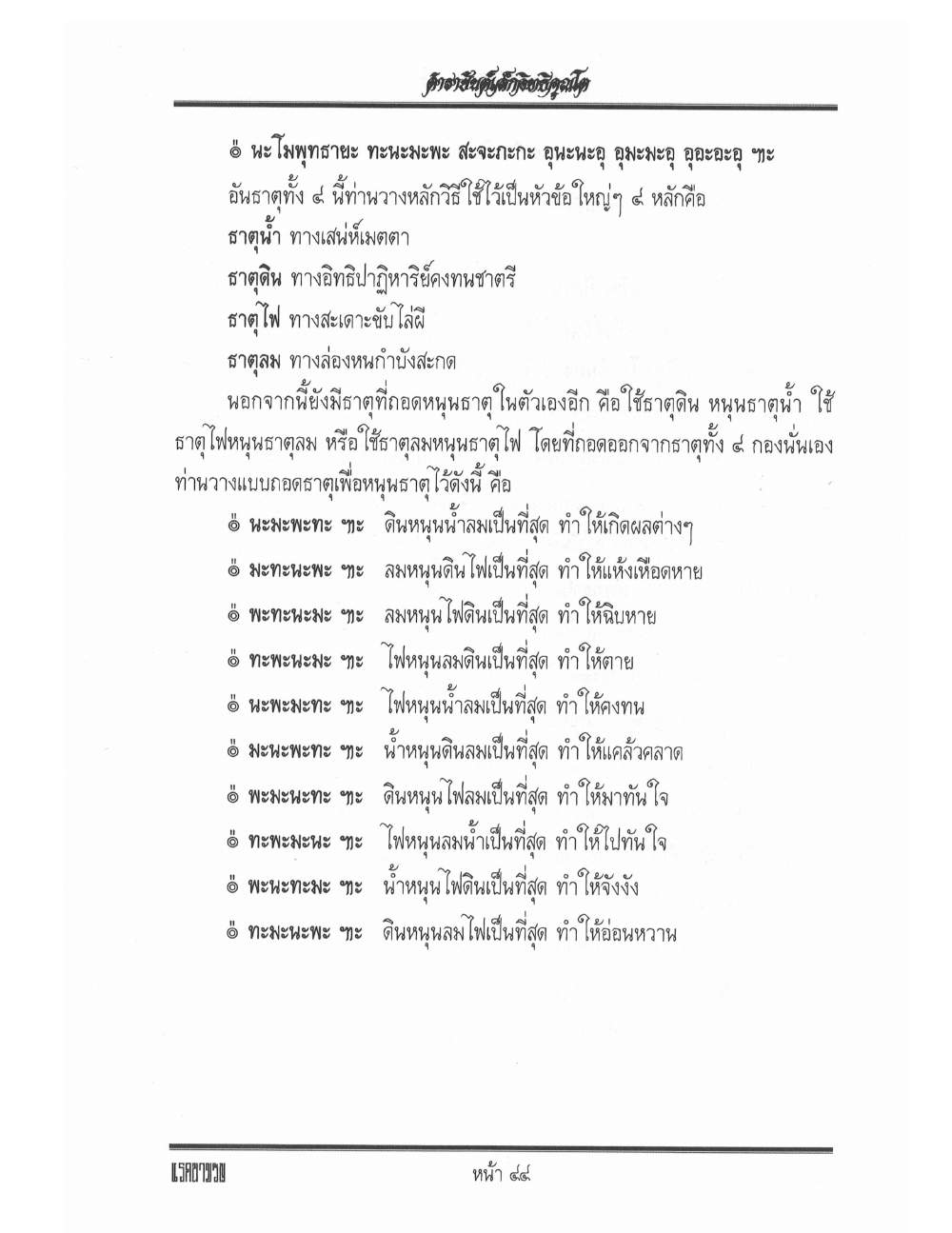
๏ นะโมพุทธายะ ทะนะมะพะ สะจะภะกะ อุพะพะอุ อุมะมะอุ อุอะอะอุ ๆะ
อันธาตุทั้ง ๔ นี้ท่านวางหลักวิธีใช้ไว้เป็นหัวข้อใหญ่ๆ ๔ หลักคือ ธาตุน้ำ ทางเสน่ห์เมตตา ธาตุดิน ทางฤทธิ์ปาฏิหาริย์คงทนชาตรี ธาตุไฟ ทางสะเดาะขับไล่ผี ธาตุลม ทางล่องหนกำบังสะกด
นอกจากนี้ยังมีธาตุที่ถอดหุนธาตุในตัวเองอีก คือใช้ธาตุดิน หุนธาตุน้ำ ใช้ธาตุไฟหุนธาตุลม หรือใช้ธาตุลมหุนธาตุไฟ โดยที่ถอดออกจากธาตุทั้ง ๔ กองนั่นเอง ท่านวางแบบถอดธาตุเพื่อหุนธาตุไว้ดังนี้ คือ
๏ นะมะพะทะ ๆะ ดินหุนน้ำลมเป็นที่สุด ทำให้เกิดผลต่างๆ ๏ มะทะนะพะ ๆะ ลมหุนดินไฟเป็นที่สุด ทำให้แห้งเหือดหาย ๏ พะทะนะมะ ๆะ ลมหุนไฟดินเป็นที่สุด ทำให้ฉิบหาย ๏ ทะพะนะมะ ๆะ ไฟหุนลมดินเป็นที่สุด ทำให้ตาย ๏ นะพะมะทะ ๆะ ไฟหุนน้ำลมเป็นที่สุด ทำให้คงทน ๏ มะนะพะทะ ๆะ น้ำหุนดินลมเป็นที่สุด ทำให้แคล้วคลาด ๏ พะมะนะทะ ๆะ ดินหุนไฟลมเป็นที่สุด ทำให้มาทันใจ ๏ ทะพะมะนะ ๆะ ไฟหุนลมน้ำเป็นที่สุด ทำให้ไปทันใจ ๏ พะนะทะมะ ๆะ น้ำหุนไฟดินเป็นที่สุด ทำให้จังงัง ๏ ทะมะนะพะ ๆะ ดินหุนลมไฟเป็นที่สุด ทำให้อ่อนหวาน
"Namo Buddhaya tha-na-ma-pha sa-ja-pha-ka u-pha-pha-u u-ma-ma-u u-a-a-u" [repeat]. [This completes the wind-element/ruby charging formula begun at the bottom of the previous page.]
For these four elements, the masters have laid down four great principal applications: The water element — for the way of charm and loving-kindness (metta). The earth element — for the way of miraculous power, invulnerability, and endurance. The fire element — for the way of exorcism, driving away spirits. The wind element — for the way of invisibility and concealment.
Besides this, there are also elements drawn out to charge one another within oneself — for instance, using the earth element to charge the water element, using the fire element to charge the wind element, or using the wind element to charge the fire element — each drawn from within the same four elements. The masters have laid down the pattern for drawing out an element to charge another as follows:
"Na-ma-pha-tha" [repeat] — earth charging water, with wind as the finishing touch — causes various results to arise. "Ma-tha-na-pha" [repeat] — wind charging earth, with fire as the finishing touch — causes withering and shrivelling. "Pha-tha-na-ma" [repeat] — wind charging fire, with earth as the finishing touch — causes ruin. "Tha-pha-na-ma" [repeat] — fire charging wind, with earth as the finishing touch — causes death. "Na-pha-ma-tha" [repeat] — fire charging water, with wind as the finishing touch — causes durability/endurance. "Ma-na-pha-tha" [repeat] — water charging earth, with wind as the finishing touch — causes safe escape from danger. "Pha-ma-na-tha" [repeat] — earth charging fire, with wind as the finishing touch — causes things to arrive in time. "Tha-pha-ma-na" [repeat] — fire charging wind, with water as the finishing touch — causes one to depart in time. "Pha-na-tha-ma" [repeat] — water charging fire, with earth as the finishing touch — causes paralysis/freezing on the spot. "Tha-ma-na-pha" [repeat] — earth charging wind, with fire as the finishing touch — causes softening, sweetness.
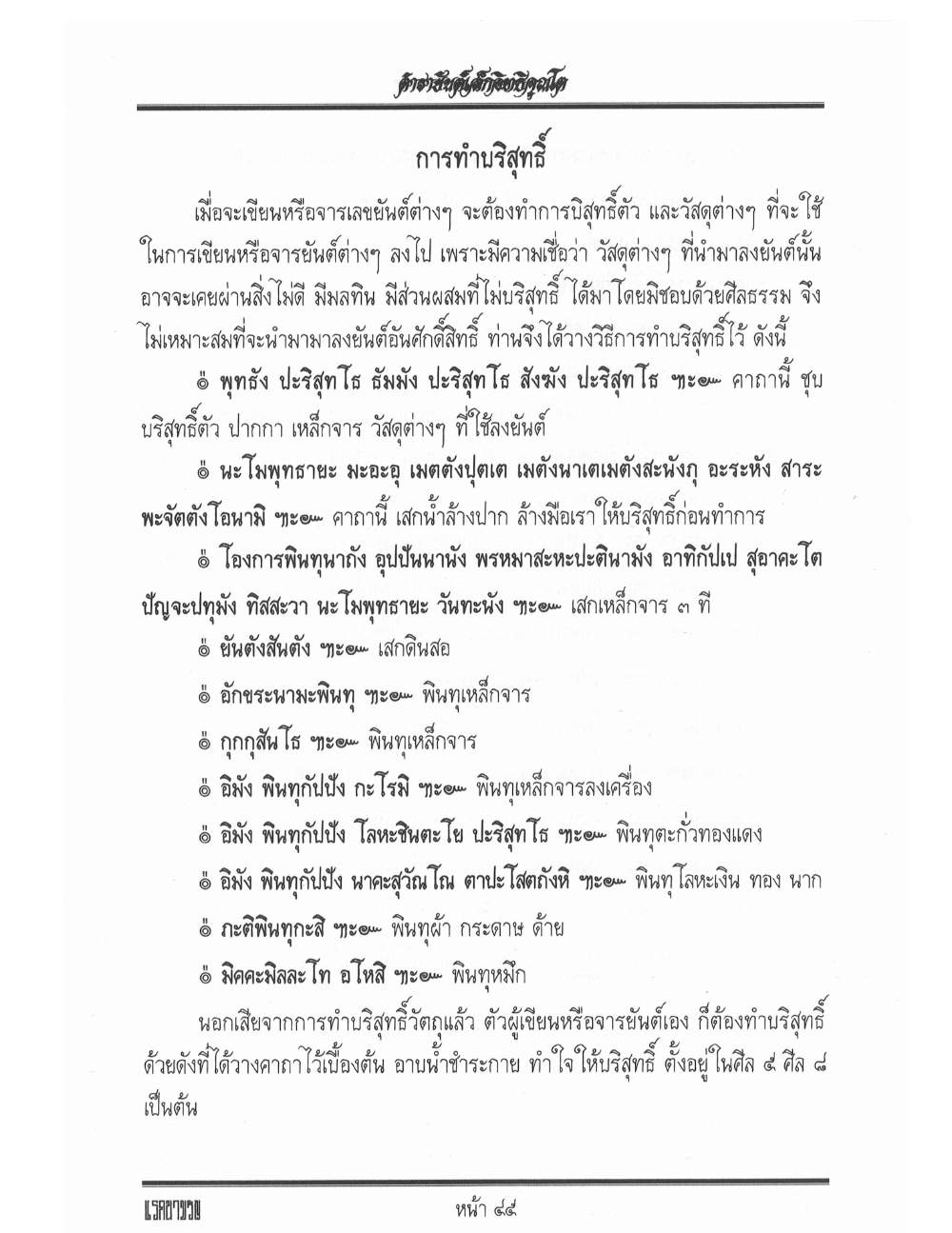
การทำบริสุทธิ์
เมื่อจะเขียนหรือจารเลขยันต์ต่างๆ จะต้องทำการบิสุทธิ์ตัว และวัสดุต่างๆ ที่จะใช้ในการเขียนหรือจารยันต์ต่างๆ ลงไป เพราะมีความเชื่อว่า วัสดุต่างๆ ที่นำมาลงยันต์นั้นอาจจะเคยผ่านสิ่งไม่ดี มีมลทิน มีส่วนผสมที่ไม่บริสุทธิ์ ได้มาโดยมิชอบด้วยศีลธรรม จึงไม่เหมาะสมที่จะนำมาลงยันต์อันศักดิ์สิทธิ์ ท่านจึงได้วางวิธีการทำบริสุทธิ์ไว้ ดังนี้
๏ พุทธัง ปะริสุทโธ ธัมมัง ปะริสุทโธ สังฆัง ปะริสุทโธ ๆะ คาถานี้ชุบบริสุทธิ์ตัว ปากกา เหล็กจาร วัสดุต่างๆ ที่ใช้ลงยันต์
๏ นะโมพุทธายะ มะอะอุ เมตตังปุตเต เมตตังนาเตเมตตังสะพังภุ อะระหัง สาระพะจัตตังโอนามิ ๆะ คาถานี้เสกน้ำล้างปาก ล้างมือเราให้บริสุทธิ์ก่อนทำการ
๏ โองการพินทุนาถัง อุปปันนาถัง พรหมาสะหะปะตินามัง อาทิกัปเป สุอาคะโต ปัญจะปทุมัง ทิสสะวา นะโมพุทธายะ วันทะนัง ๆะ เสกเหล็กจาร ๓ ที
๏ ยันตังสันตัง ๆะ เสกดินสอ ๏ อักขระนามะพินทุ ๆะ พินทุเหล็กจาร ๏ กุกกุสันโธ ๆะ พินทุเหล็กจาร ๏ อิมัง พินทุกัปปัง กะโรมิ ๆะ พินทุเหล็กจารลงเครื่อง ๏ อิมัง พินทุกัปปัง โลหะชินตะโย ปะริสุทโธ ๆะ พินทุตะกั่วทองแดง ๏ อิมัง พินทุกัปปัง นาคะสุวัณโณ ตาปะโสตังหิ ๆะ พินทุโลหะเงิน ทอง นาก ๏ ภะติพินทุกะสิ ๆะ พินทุผ้า กระดาษ ด้าย ๏ มิคคะมิลละโท อโหสิ ๆะ พินทุหมึก
นอกเสียจากการทำบริสุทธิ์วัตถุแล้ว ตัวผู้เขียนหรือจารยันต์เอง ก็ต้องทำบริสุทธิ์ด้วยดังที่ได้วางคาถาไว้เบื้องต้น อาบน้ำชำระกาย ทำใจให้บริสุทธิ์ ตั้งอยู่ในศีล ๕ ศีล ๘ เป็นต้น
On Making Things Pure
When one is about to write or inscribe any numerical yantra, one must first purify oneself and the various materials to be used in writing or inscribing it, because it is believed that materials brought to a yantra may have passed through something inauspicious, carry defilement, contain impure elements, or have been obtained improperly against morality — and so are unfit to be used for so sacred a yantra. The masters therefore laid down the following method of purification:
"Buddham parisuddho, dhammam parisuddho, sangham parisuddho" [repeat] — Pali for "The Buddha is pure, the Dhamma is pure, the Sangha is pure." This chant is used to dip and purify oneself, the pen, the inscribing stylus, and the various materials used for the yantra.
"Namo Buddhaya, ma-a-u, mettangputte mettangnate mettangsapangphu, arahang, saraphachattang onami" [repeat]. This chant consecrates water for washing the mouth and hands, to purify oneself before beginning the work.
"Ongkarn pinthunathang uppannathang, brahmasahapatinamang, adikappe su-akhato, panjapathumang, thissawa, Namo Buddhaya, wantanang" [repeat]. Consecrate the inscribing stylus three times.
"Yantangsantang" [repeat] — consecrate the pencil. "Akkharanamaphinthu" [repeat] — mark/dot the inscribing stylus. "Kakusandho" [repeat] — mark/dot the inscribing stylus. "Imang pinthukappang karomi" [repeat] — mark/dot the stylus onto the implement. "Imang pinthukappang loha chinatayo parisuddho" [repeat] — mark/dot lead and copper. "Imang pinthukappang nakhasuwanno tapasotanghi" [repeat] — mark/dot silver, gold, and nak-alloy. "Phatiphinthukasi" [repeat] — mark/dot cloth, paper, thread. "Mikkhamillatho ahosi" [repeat] — mark/dot the ink.
Apart from purifying the materials, the writer or inscriber of the yantra must likewise purify himself, as set out in the chants given above: bathe the body, purify the mind, and abide in the Five Precepts, the Eight Precepts, and so on.
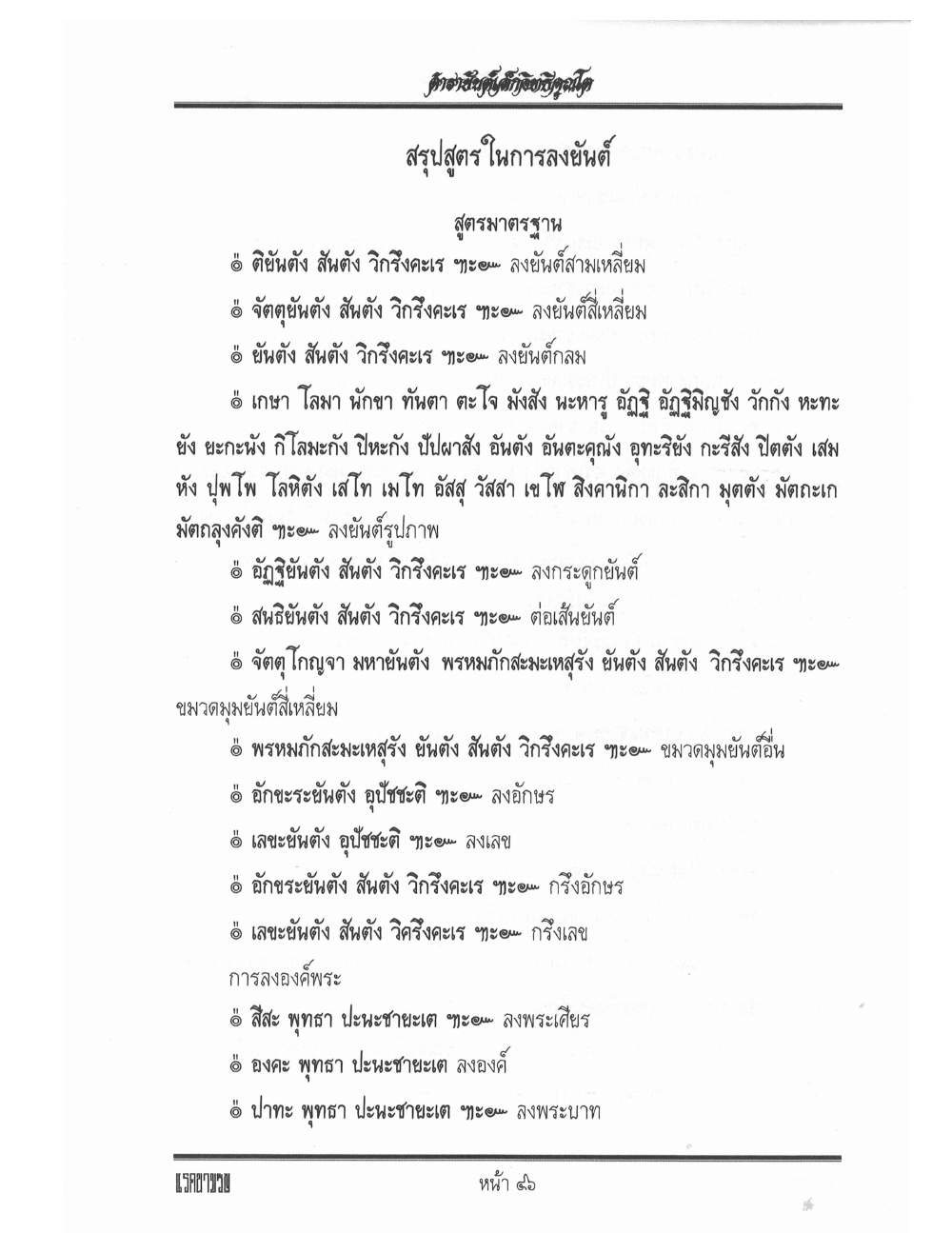
สรุปสูตรในการลงยันต์
สูตรมาตรฐาน ๏ ติยันตัง สันตัง วิกรึงคะเร ๆะ ลงยันต์สามเหลี่ยม ๏ จัตตุยันตัง สันตัง วิกรึงคะเร ๆะ ลงยันต์สี่เหลี่ยม ๏ ยันตัง สันตัง วิกรึงคะเร ๆะ ลงยันต์กลม
๏ เกษา โลมา นักขา ทันตา ตะโจ มังสัง นะหารู อัฏฐิ อัฏฐิมิญชัง วักกัง หทะยัง ยะกะนัง กิโลมะกัง ปิหะกัง ปัปผาสัง อันตัง อันตะคุณัง อุทะริยัง กะรีสัง ปิตตัง เสมหัง ปุพโพ โลหิตัง เสโท เมโท อัสสุ วัสสา เขโฬ สิงคานิกา ละสิกา มุตตัง มัตถะเก มัตถะลุงคังติ ๆะ ลงยันต์รูปภาพ
๏ อัฏฐิยันตัง สันตัง วิกรึงคะเร ๆะ ลงกระดูกยันต์ ๏ สนธิยันตัง สันตัง วิกรึงคะเร ๆะ ต่อเส้นยันต์
๏ จัตตุโกญจา มหายันตัง พรหมภักสะมะเหสุรัง ยันตัง สันตัง วิกรึงคะเร ๆะ ขมวดมุมยันต์สี่เหลี่ยม
๏ พรหมภักสะมะเหสุรัง ยันตัง สันตัง วิกรึงคะเร ๆะ ขมวดมุมยันต์อื่น ๏ อักขระยันตัง อุปัชชะติ ๆะ ลงอักษร ๏ เลขะยันตัง อุปัชชะติ ๆะ ลงเลข ๏ อักขระยันตัง สันตัง วิกรึงคะเร ๆะ กรึงอักษร ๏ เลขะยันตัง สันตัง วิครึงคะเร ๆะ กรึงเลข
การลงองค์พระ ๏ สีสะ พุทธา ปะนะชายะเต ๆะ ลงพระเศียร ๏ องคะ พุทธา ปะนะชายะเต ลงองค์ ๏ ปาทะ พุทธา ปะนะชายะเต ๆะ ลงพระบาท
Summary of Formulas for Inscribing Yantras
Standard formulas "Tiyantang santang wikrungkhare" [repeat]. For inscribing a triangular yantra. "Jatuyantang santang wikrungkhare" [repeat]. For inscribing a square yantra. "Yantang santang wikrungkhare" [repeat]. For inscribing a round yantra.
"Kesa loma nakha danta taco mangsang naharu atthi atthiminchang vakkang hadayang yakanang kilomakang pihakang papphasang antang antaguṇang udariyang karisang pittang semhang pubbo lohitang sedo medo assu vasa khelo singanika lasika muttang matthake matthalungangti" [repeat] — the traditional Pali enumeration of the parts of the body (hair, body hair, nails, teeth, skin, flesh, sinews, bones, marrow, kidneys, heart, liver, membranes, spleen, lungs, intestines, mesentery, stomach contents, faeces, bile, phlegm, pus, blood, sweat, fat, tears, oil, saliva, mucus, joint-fluid, urine, brain). For inscribing a figural (image) yantra.
"Atthiyantang santang wikrungkhare" [repeat]. For inscribing the bone-yantra. "Sandhiyantang santang wikrungkhare" [repeat]. For joining the yantra's lines.
"Jatukonja mahayantang brahmaphaksamahesurang yantang santang wikrungkhare" [repeat]. For closing the corners of a square yantra.
"Brahmaphaksamahesurang yantang santang wikrungkhare" [repeat]. For closing the corners of other yantras. "Akkharayantang upajjati" [repeat]. For inscribing letters. "Lekhayantang upajjati" [repeat]. For inscribing numerals. "Akkharayantang santang wikrungkhare" [repeat]. For binding the letters firm. "Lekhayantang santang wikrungkhare" [repeat]. For binding the numerals firm.
For inscribing the Buddha-figure "Sisa buddha panachayate" [repeat]. For the head. "Ongkha buddha panachayate". For the body. "Pada buddha panachayate" [repeat]. For the feet.
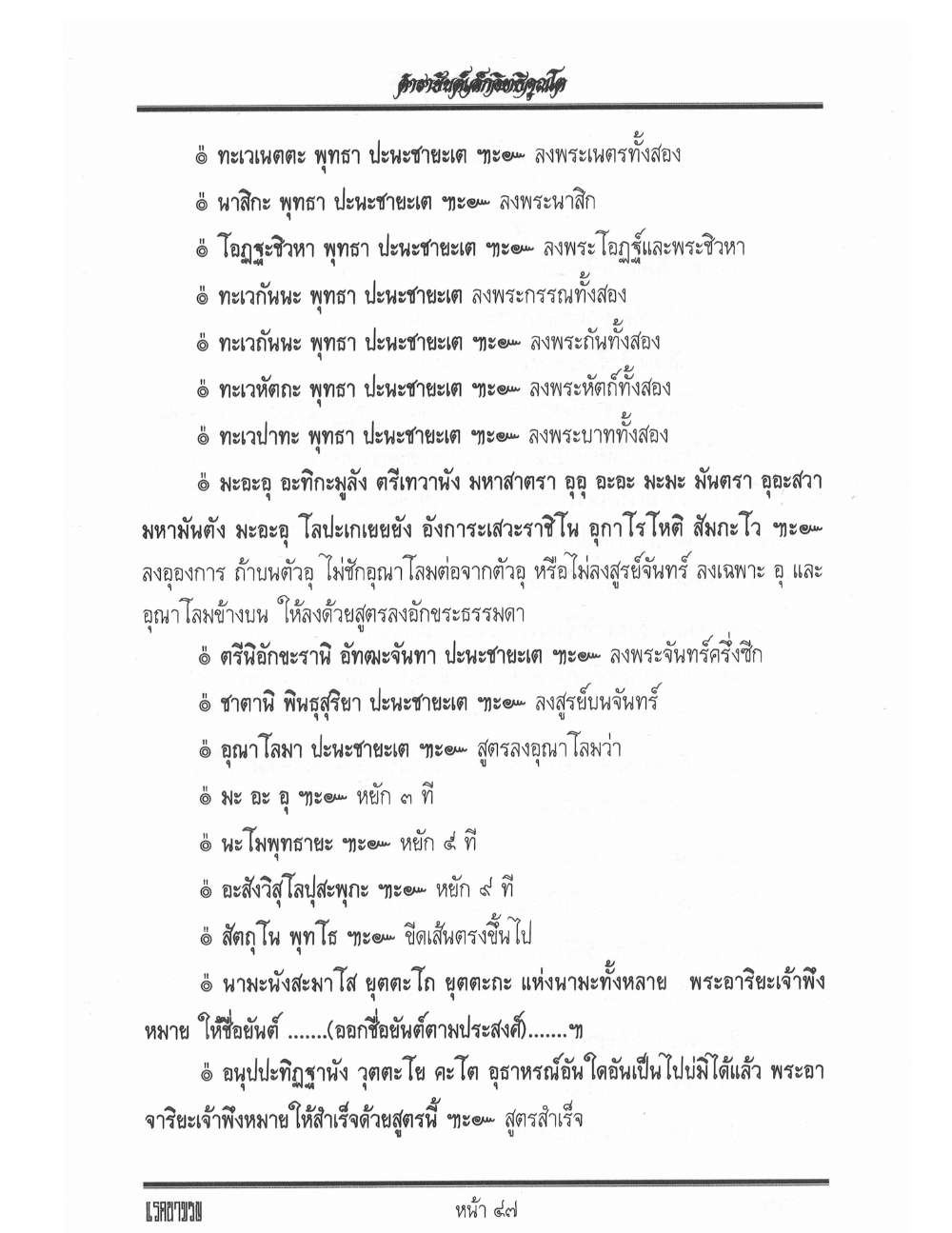
๏ ทะเวเนตตะ พุทธา ปะนะชายะเต ๆะ ลงพระเนตรทั้งสอง ๏ นาสิกะ พุทธา ปะนะชายะเต ๆะ ลงพระนาสิก ๏ โอฏฐะชิวหา พุทธา ปะนะชายะเต ๆะ ลงพระโอษฐ์และพระชิวหา ๏ ทะเวกัณณะ พุทธา ปะนะชายะเต ลงพระกรรณทั้งสอง ๏ ทะเวถันนะ พุทธา ปะนะชายะเต ๆะ ลงพระถันทั้งสอง ๏ ทะเวหัตถะ พุทธา ปะนะชายะเต ๆะ ลงพระหัตถ์ทั้งสอง ๏ ทะเวปาทะ พุทธา ปะนะชายะเต ๆะ ลงพระบาททั้งสอง
๏ มะอะอุ อะทิกะมูลัง ตรีเทวาพัง มหาสาตรา อุอุ อะอะ มะมะ มัตรา อุอะสวามหามัตตัง มะอะอุ โลปะเกเยยยัง อังการะเสวะราชิโพ อุกาโรโหติ สัมภะโว ๆะ ลงอุองการ ถ้าบนตัวอุ ไม่ชักอุณาโลมต่อจากตัวอุ หรือไม่ลงสูรย์จันทร์ ลงเฉพาะ อุ และอุณาโลมข้างบน ให้ลงด้วยสูตรลงอักขระธรรมดา
๏ ตรีนิอักขะรานิ อัทฒะจันทา ปะนะชายะเต ๆะ ลงพระจันทร์ครึ่งซีก ๏ ชาตานิ พินธุสุริยา ปะนะชายะเต ๆะ ลงสูรย์บนจันทร์ ๏ อุณาโลมา ปะนะชายะเต ๆะ สูตรลงอุณาโลมว่า ๏ มะ อะ อุ ๆะ หยัก ๓ ที ๏ นะโมพุทธายะ ๆะ หยัก ๔ ที ๏ อะสังวิสุโลปุสะพุภะ ๆะ หยัก ๙ ที ๏ สัตถุโพ พุทโธ ๆะ ขีดเส้นตรงขึ้นไป
๏ นามะนังสะมาโส ยุตตะโภ ยุตตะกะ แห่งนามะทั้งหลาย พระอาริยะเจ้าพึงหมาย ให้ชื่อยันต์ .......(ออกชื่อยันต์ตามประสงค์)....... ๆ
๏ อนุปปะทิฏฐานัง วุตตะโย คะโต อุธาหรณ์อันใดอันเป็นไปบ่มิได้แล้ว พระอาจาริยะเจ้าพึงหมายให้สำเร็จด้วยสูตรนี้ ๏ สูตรสำเร็จ
"Thawenetta buddha panachayate" [repeat]. For inscribing the two eyes. "Nasika buddha panachayate" [repeat]. For the nose. "Otthachiwha buddha panachayate" [repeat]. For the mouth and tongue. "Thawekanna buddha panachayate". For the two ears. "Thawethanna buddha panachayate" [repeat]. For the two breasts. "Thawehattha buddha panachayate" [repeat]. For the two hands. "Thawepada buddha panachayate" [repeat]. For the two feet.
[A mantra for inscribing the sacred "u" and its curling unalom mark]: "Ma-a-u atikamulang trithewaphang mahasatra u-u a-a ma-ma mattra u-a-sawa mahamattang ma-a-u lopakeyeyyang angkarasewarachipho ukaro hoti sambhavo" [repeat]. For inscribing the "u" and its crown-symbol. Note: if the unalom curl is not drawn continuing on from the "u", or if sun and moon are not to be inscribed, one should inscribe only the "u" and the unalom above it, using the ordinary letter-inscribing formula instead.
"Trinі akkharani addhachanta panachayate" [repeat]. For inscribing the half-moon (crescent). "Chatani pinthusuriya panachayate" [repeat]. For inscribing the sun above the moon. "Unaloma panachayate" [repeat] — the formula for inscribing the unalom curl is: "Ma a u" [repeat] — waver the pen three times. "Namo Buddhaya" [repeat] — waver the pen four times. "Asangvisulopusaphupha" [repeat] — waver the pen nine times. "Satthupho Buddho" [repeat] — then draw a straight line upward.
[A closing note:] Of all such names bound together, joined and fitted, the wise teacher should assign the yantra its name — here the practitioner inserts the desired yantra's name — [and repeat].
For any example that has not been separately set down and cannot otherwise be accomplished, the master teacher should complete it by means of this formula: "the formula of accomplishment."
สูตรอื่นๆ ๏.....กาโรโหติสัมภะโว จงมาบังเกิดเป็น..... ๆะ ลงอักขระ ตัวอย่างเช่นจะลง มะ ก็ให้ภาวนาสูตร ดังนี้ ๏ มะกาโรโหติสัมภะโว จงมาบังเกิดเป็นมะ ๆะ หรือจะใช้เรียกรวมอักขระทั้งหมดที่ได้ลงไปแล้ว เช่น ลงนะโมพุทธายะ ให้ภาวนาดังนี้
๏ นะโมพุทธายะ กาโรโหติสัมภะโว จงมาบังเกิดเป็น นะโมพุทธายะ ๆะ ๏.....อาคะโมจะ อาจาริยะ ให้ลง.....อาคม ๆะ ลงอักขระ ตัวอย่างเช่นจะลง มะ ก็ให้ภาวนาสูตร ดังนี้ ๏ มะอาคะโมจะ อาจาริยะ ให้ลงมะ อาคม ๆะ หรือจะใช้เรียกรวมอักขระทั้งหมดที่ได้ลงไปแล้ว เช่น ลงนะโมพุทธายะ ให้ภาวนาดังนี้
๏ นะโมพุทธายะ อาคะโมจะ อาจาริยะ ให้ลง นะโมพุทธายะ อาคม ๆะ ๏ พุทธัง สิระสังชาตัง พุทโธหมิ สะมุโร ๆะ ภาวนาลงองค์พระ ๏ อุณาโลมเม วิกรึงคะเร ๆะ ลงอุณาโลม ๏ ยันตังสันตัง นิกรึงคะเร ๆะ ชักยันต์ ๏ สระยันตัง อิทังคะเร ๆะ ลงอักษร ๏ เลขขะยันตัง อิทังคะเร ๆะ ลงเลข ๏ อักขระนามะโหนติ เอหิเอหิ พันธัง ๆะ ลงอักษร ๏ อักขระยันตัง อิทธิริทธิ วิกรึงคะเร ๆะ ลงอักษร ๏ อักขระยันตัง มาเรโส วิกรึงคะเร ๆะ ลงอักษร ๏ จัตตุโกญจา มหายันตัง อะยังเอหิ นะเยยุตเตถาเน วิกรึงคะเร ๆะ ชักยันต์
Other formulas "...karo hoti sambhavo, may there come to arise as ..." [repeat]. For inscribing a letter. For example, to inscribe "ma", recite the formula thus: "Ma-karo hoti sambhavo, may there come to arise as ma" [repeat]. Or one may instead recite together all the letters already inscribed — for example, having inscribed "Namo Buddhaya", recite thus:
"Namo Buddhaya karo hoti sambhavo, may there come to arise as Namo Buddhaya" [repeat]. "...akhamocha acariya, let it be inscribed as ... akhom" [repeat]. For inscribing a letter. For example, to inscribe "ma", recite the formula thus: "Ma akhamocha acariya, let ma be inscribed as akhom" [repeat]. Or one may instead recite together all the letters already inscribed — for example, having inscribed "Namo Buddhaya", recite thus:
"Namo Buddhaya akhamocha acariya, let Namo Buddhaya be inscribed as akhom" [repeat]. "Buddhang sirasangchatang buddhohmi samuro" [repeat]. Recited while inscribing the Buddha-figure. "Unalomme wikrungkhare" [repeat]. For inscribing the unalom. "Yantangsantang nikrungkhare" [repeat]. For drawing the yantra's lines. "Sarayantang ithangkhare" [repeat]. For inscribing letters. "Lekkhayantang ithangkhare" [repeat]. For inscribing numerals. "Akkharanamahonti ehi ehi phantang" [repeat]. For inscribing letters. "Akkharayantang itthiritthi wikrungkhare" [repeat]. For inscribing letters. "Akkharayantang mareso wikrungkhare" [repeat]. For inscribing letters. "Jatukonja mahayantang ayang ehi nayeyutthane wikrungkhare" [repeat]. For drawing the yantra's lines.
๏ อักขระยันตัง อะยังเอหิ นะเยยุตเตถาเน วิกรึงคะเร ๆะ ลงอักษร ๏ อัฏฐิยันตา มหายันตัง อะยังเอหิ นะเยยุตเตถาเน วิกรึงคะเร ๆะ ลงกระดูกยันต์
๏ เลกขะระยันตัง อะยังเอหิ นะเยยุตเตถาเน วิกรึงคะเร ๆะ ลงเลข ๏ จัตตุยันตา มหายันตัง สันตัง พรหมภัก วิกรึงคะเร ๆะ ลงยันต์สี่เหลี่ยม ๏ ปะยันตา มหายันตัง สันตัง วิกรึงคะเร ๆะ ลงยันต์กลม ๏ ตรีนิยันตา มหายันตัง สันตัง วิกรึงคะเร ๆะ ลงยันต์สามเหลี่ยม ๏ ติยันตัง มหายันตัง อะธิฐานะยันตัง วิกรึงคะเร ๆะ ลงยันต์สามเหลี่ยมที่ไม่มีอักขระ พร้อมขมวดมุม
๏ อัฏฐิยันตัง สันตัง ปะทัง วิกรึงคะเร ๆะ ลงกระดูกยันต์ ๏ ปะถะมัง สีสะ พุทธา ปะนะชายะเต ๆะ ลงพระเศียร ๏ ทุติยัง องคะ พุทธา ปะนะชายะเต ๆะ ลงองค์พระ ๏ ตะติยัง ปาทะ พุทธา ปะนะชายะเต ๆะ ลงพระบาท
สูตรลงองค์พระในยันต์ ๏ สีสะ พุทธา วิชายันติ ๆะ ลงพระเศียร ๏ องคะ พุทธา วิชายันติ ๆะ ลงองค์พระ ๏ ปาทะ พุทธา วิชายันติ ๆะ ลงพระบาท
สูตรลงองค์พระนอกยันต์ ๏ สีสะ พุทธา วิชายันเต ๆะ ลงพระเศียร ๏ องคะ พุทธา วิชายันเต ๆะ ลงองค์พระ ๏ ปาทะ พุทธา วิชายันเต ๆะ ลงพระบาท
"Akkharayantang ayang ehi nayeyutthane wikrungkhare" [repeat]. For inscribing letters. "Atthiyanta mahayantang ayang ehi nayeyutthane wikrungkhare" [repeat]. For inscribing the bone-yantra.
"Lekkharayantang ayang ehi nayeyutthane wikrungkhare" [repeat]. For inscribing numerals. "Jatuyanta mahayantang santang brahmaphak wikrungkhare" [repeat]. For inscribing a square yantra. "Payanta mahayantang santang wikrungkhare" [repeat]. For inscribing a round yantra. "Trinіyanta mahayantang santang wikrungkhare" [repeat]. For inscribing a triangular yantra. "Tiyantang mahayantang athitthanayantang wikrungkhare" [repeat]. For inscribing a triangular yantra bearing no letters, together with closing its corners.
"Atthiyantang santang patang wikrungkhare" [repeat]. For inscribing the bone-yantra. "Pathamang sisa buddha panachayate" [repeat]. First, the head of the Buddha. "Thutiyang ongkha buddha panachayate" [repeat]. Second, the body of the Buddha. "Tatiyang pada buddha panachayate" [repeat]. Third, the feet of the Buddha.
Formula for inscribing the Buddha-figure inside a yantra "Sisa buddha wichayanti" [repeat]. For the head. "Ongkha buddha wichayanti" [repeat]. For the body. "Pada buddha wichayanti" [repeat]. For the feet.
Formula for inscribing the Buddha-figure outside a yantra "Sisa buddha wichayante" [repeat]. For the head. "Ongkha buddha wichayante" [repeat]. For the body. "Pada buddha wichayante" [repeat]. For the feet.
ยันต์สาริกาตัวผู้-ตัวเมีย
[อักขระขอมในยันต์ อ่านไม่ชัด]
ตัวผู้
[อักขระขอมในยันต์ อ่านไม่ชัด]
ตัวเมีย
ยันต์สาริกานี้ท่านให้ลงด้วยแผ่นทองคำ เหล็กจารที่จะใช้ลงนั้นให้ทำด้วยทองคำ และให้ชุบเหล็กจารด้วยน้ำมันหอม ๗ ครั้ง แล้วจึงลงยันต์สาริกานี้ จึงเอาคาถานี้เสก ๏ คัชชะวะเร อะนุเตชา ๆะ คาถานี้ปลุกตัวผู้ลงข้างขวา ๏ สีละเตชา คัชชะวะเร ๆะ คาถานี้ปลุกตัวเมียลงข้างซ้าย เสกแล้วเอาไว้ใช้ตามปรารถนาเกิด
ยันต์สาริกา
[อักขระขอมกำกับตัวนก อ่านไม่ชัด]
ยันต์สาริกา ลงใบพลูร่วมใจ พูดเจรจาด้วยใครให้ลงชื่อผู้นั้น ลงใบพลูร่วมใจกิน เกิดเป็นเสน่ห์หญิงชายแล ให้เอาคาถานี้เสก ๏ โอมนางสาริกา โอมพระราชาเทวี นางสิตาวาพรหมมาจิตตังเสน่หา ๆะ คาถานี้เสกนกสาริกา ๗ ทีแล
The Sarika Yantra, Male and Female
[yantra: a four-celled square grid outlined with corner-dots, each cell containing a Khom-script syllable that cannot be confidently transliterated]
Male
[yantra: a matching four-celled square grid with different Khom syllables in each cell, likewise not confidently legible]
Female
For this sarika (myna-bird) yantra, one should inscribe it on a sheet of gold; the inscribing stylus used must also be made of gold, and it should be dipped in fragrant oil seven times before the yantra is inscribed. Then recite this chant over it: "Gajjavare anutecha" [repeat]. This chant awakens the male figure, inscribed on the right side. "Silatecha gajjavare" [repeat]. This chant awakens the female figure, inscribed on the left side. Once consecrated, keep it and use it according to whatever [love or attraction] one wishes to arise.
The Sarika Yantra
[drawing: a small bird (sarika/myna) in profile facing left, standing on two legs with a long tail, marked with Khom-script syllables at three points on its body — not confidently legible]
For the sarika yantra: inscribe it on a betel leaf shared between two hearts. When speaking with someone, write down that person's name, then place it on a betel leaf for the two to eat together, so that charm and attraction arise between woman and man. Recite this chant over it: "Om, Lady Sarika, Om, Queen consort, Lady Sita, may Brahma bring a heart of loving charm" [repeat]. This chant consecrates the sarika bird, recited seven times.
ยันต์สาริกาลิ้นทอง
[อักขระขอมในยันต์ อ่านไม่ชัด]
ยันต์สาริกาลิ้นทองท่านให้ลงเป็นตะกรุดด้วยตะกั่วก็ได้ เงินก็ได้ ทองก็ได้ ลงเป็นสาริกาลิ้นทอง แล้วให้เอาคาถานี้เสก ๏ ชิวหายังมะธุรังวาจัง ชิวหาวายันติผุสสิตวา สัทธังสุตวา จะสุนทะรัง ปิยาเยวะ ปิยันตุมา ๆะ คาถานี้เสกสาริกาลิ้นทองเป็นเสน่ห์เจรจา เทศนาสวดร้องเป็นที่ต้องใจชนทั้งหลายแล
ยันต์นกสาริกา
[อักขระขอมกำกับตัวนก อ่านไม่ชัด]
ยันต์นี้ให้ลงเป็นตะกรุดเสกด้วยคาถานี้ ๏ สะกุณณังสาริกะรัง ๆะ คาถานี้เสกนกสาริกาแล
The Golden-Tongued Sarika Yantra
[yantra: a circle divided into three wedge-shaped compartments, each containing a Khom-script syllable that cannot be confidently transliterated, the whole ringed by a border of further Khom letters running around its circumference]
For the golden-tongued sarika yantra, one may inscribe it as a takrut (rolled amulet) in lead, silver, or gold, inscribed as the golden-tongued sarika. Then recite this chant over it: "May the tongue be sweet in speech; may the tongue, once it moves, be felt; having heard it, may all find it lovely and dear" [repeat]. This chant consecrates the golden-tongued sarika to bring charm in speech, so that one's preaching, chanting, and singing become pleasing to the hearts of all who hear it.
The Sarika Bird Yantra
[drawing: a myna bird standing in profile facing left, marked with Khom-script syllables at three points on its body — not confidently legible]
This yantra should be inscribed as a takrut, consecrated with this chant: "Sakunnangsarikarang" [repeat]. This chant consecrates the sarika bird.
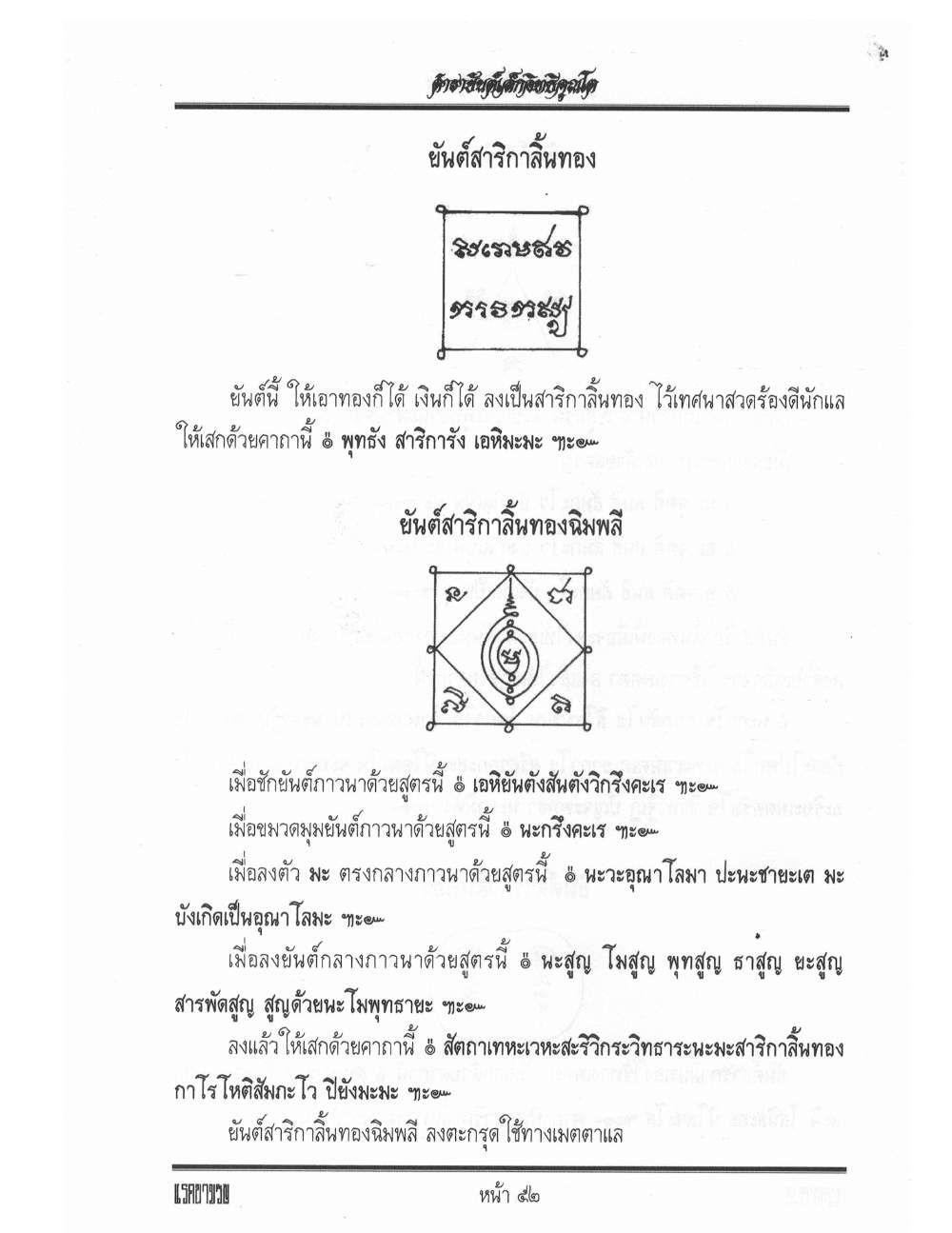
[หัวกระดาษซ้ำทุกหน้า: อักษรประดิษฐ์ อ่านไม่ชัด]
ยันต์สาริกาลิ้นทอง
[อักขระขอมในยันต์ อ่านไม่ชัด]
ยันต์นี้ให้เอาทองก็ได้ เงินก็ได้ ลงเป็นสาริกาลิ้นทอง ไว้เทศนาสวดร้องดีนักแล ให้เสกด้วยคาถานี้ ๏ พุทธัง สาริการัง เอหิมะมะ ๚๛
ยันต์สาริกาลิ้นทองฉิมพลี
[อักขระขอมในยันต์ อ่านไม่ชัด]
เมื่อชักยันต์ภาวนาด้วยสูตรนี้ ๏ เอหิยันตังสันตังวิกรึงคะเร ๚๛ เมื่อขมวดมุมยันต์ภาวนาด้วยสูตรนี้ ๏ พะกรึงคะเร ๚๛ เมื่อลงตัว มะ ตรงกลางภาวนาด้วยสูตรนี้ ๏ พะวะอุณาโลมา ปะนะชายะเต มะบังเกิดเป็นอุณาโลมะ ๚๛ เมื่อลงยันต์กลางภาวนาด้วยสูตรนี้ ๏ มะสูญ โมสูญ พุทสูญ ธาสูญ ยะสูญ สารพัดสูญ สูญด้วยมะโมพุทธายะ ๚๛ ลงแล้วให้เสกด้วยคาถานี้ ๏ สัตถาเทหะเวหะสะริวิกระวิทธาระนะมะสาริกาลิ้นทองกาโรโหติสัมภะโว ปิยังมะมะ ๚๛ ยันต์สาริกาลิ้นทองฉิมพลี ลงตะกรุดใช้ทางเมตตาแล
หน้า ๕๒ [ตราผู้จัดพิมพ์มุมล่างซ้าย อ่านไม่ชัด]
[running header, repeated every page: stylized ornamental title, illegible]
Golden-Tongued Mynah Yantra
[yantra: square frame with two lines of khom-script syllables inside, illegible]
For this yantra either gold or silver may be used. Inscribe it as the Golden-Tongued Mynah [yantra] and keep it for preaching and chanting recitals — very effective. Consecrate it with this spell: "Phutthang sarikarang ehi mama" (Buddha, o mynah-tongue, come to me), [recited] 3 [times, per the closing mark].
Golden-Tongued Mynah Yantra, Chimphli (silk-cotton tree) version
[yantra: a square frame with a diamond inscribed inside it; four khom syllables at the four points of the diamond; a set of concentric circles at the centre holding one khom syllable]
When drawing the yantra, recite this formula: "Ehi yantang santang vikarungkhare." When closing the corners of the yantra, recite: "Pha karungkhare." When inscribing the syllable "ma" in the centre, recite: "Phawa unalomā panachāyate ma bangkoetpen unalomā" ([...] arising as the ūrṇā radiance). When inscribing the middle of the yantra, recite: "Ma-sūn, mo-sūn, phut-sūn, thā-sūn, ya-sūn, sārapat sūn, sūn with ma-mo-phutthāya" (empty/void [of harm], made void with ma-mo-phutthāya). Once inscribed, consecrate it with this spell: "Satthā deha weha sari vikara vitthāra na ma sārikā lin thong kāro hoti sambhavo piyang mama" ([...] may [I] become dear/beloved). This Golden-Tongued Mynah Chimphli yantra, inscribed on a takrut [rolled amulet tube], is used on the path of loving-kindness (mettā).
[page footer] Page 52 [publisher's mark, bottom-left corner, illegible]
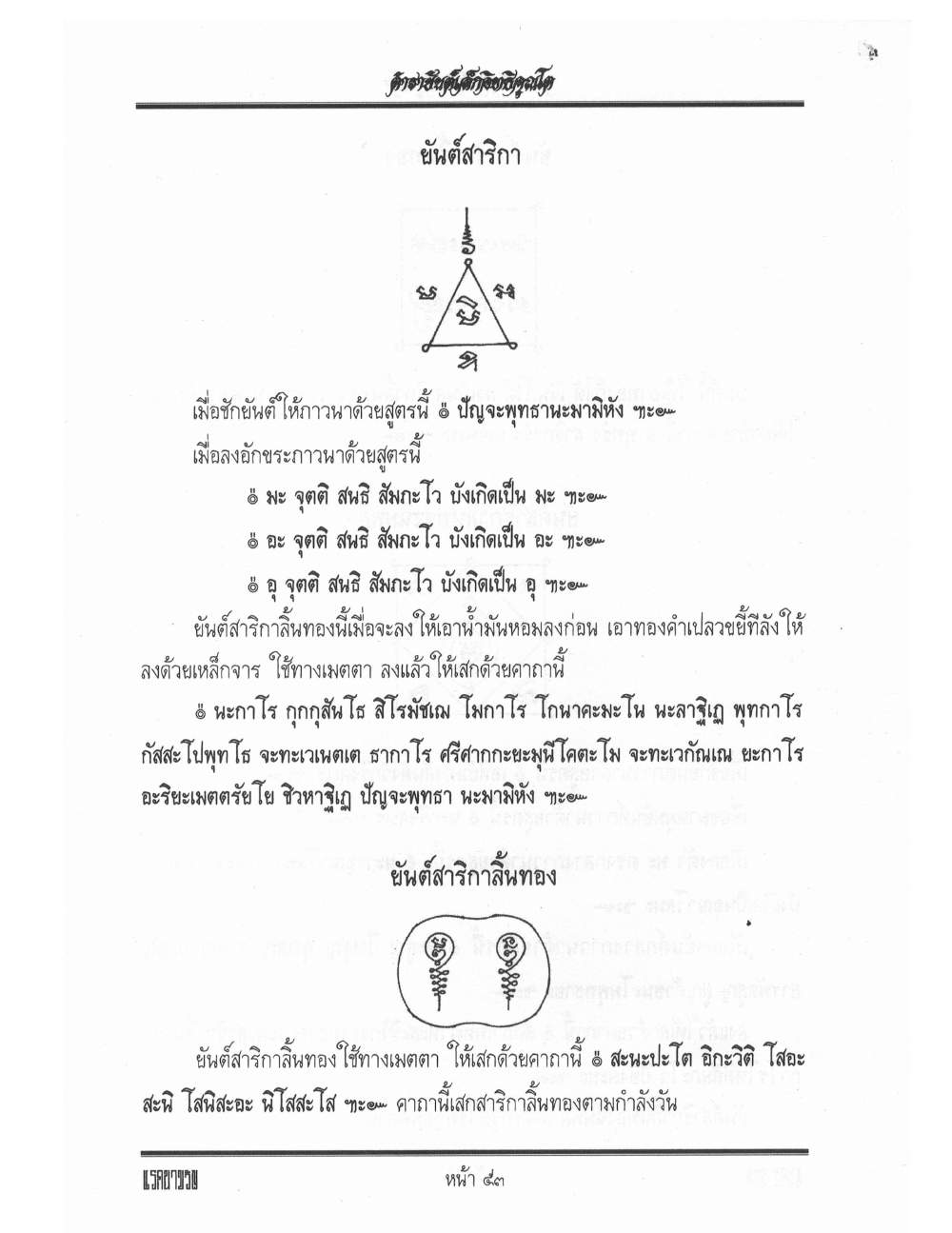
[หัวกระดาษซ้ำทุกหน้า: อักษรประดิษฐ์ อ่านไม่ชัด]
ยันต์สาริกา
[อักขระขอมในยันต์ อ่านไม่ชัด]
เมื่อชักยันต์ให้ภาวนาด้วยสูตรนี้ ๏ ปัญจะพุทธะนะมามิหัง ๚๛ เมื่อลงอักขระภาวนาด้วยสูตรนี้ ๏ มะ จุติ สนธิ สัมภะโว บังเกิดเป็น มะ ๚๛ ๏ อะ จุติ สนธิ สัมภะโว บังเกิดเป็น อะ ๚๛ ๏ อุ จุติ สนธิ สัมภะโว บังเกิดเป็น อุ ๚๛ ยันต์สาริกาลิ้นทองนี้เมื่อจะลง ให้เอาน้ำมันหอมลงก่อน เอาทองคำเปลวขี้ผึ้งลังให้ลงด้วยเหล็กจาร ใช้ทางเมตตา ลงแล้วให้เสกด้วยคาถานี้ ๏ พะกาโร กุกกุสันโธ สิโรมัชเฌ โมกาโร โกนาคะมะโน นะลาฐิเภ พุทกาโร กัสสะโปพุทโธ จะทะเวเนตเต ธากาโร ศรีสากกะยะมุนีโคตะโม จะทะเวกัณเณ ยะกาโร อะริยะเมตตรัยโย ชิวหาฐิเภ ปัญจะพุทธา พะมามิหัง ๚๛
ยันต์สาริกาลิ้นทอง
[อักขระขอมในยันต์ อ่านไม่ชัด]
ยันต์สาริกาลิ้นทองใช้ทางเมตตา ให้เสกด้วยคาถานี้ ๏ สะพะปะโต อิกะวิติ โสอะสะพิ โสพิสะอะ พิโสสะโส ๚๛ คาถานี้เสกสาริกาลิ้นทองตามกำลังวัน
หน้า ๕๓ [ตราผู้จัดพิมพ์มุมล่างซ้าย อ่านไม่ชัด]
[running header, repeated every page: stylized ornamental title, illegible]
Mynah Yantra
[yantra: triangle shape with a khom syllable in a circle at the centre and one khom syllable at each of the three corners]
When drawing the yantra, recite this formula: "Panja phutthanamāmihang" (homage to the five Buddhas). When inscribing the letters, recite this formula: "Ma cuti sandhi sambhavo bangkoetpen ma" (ma passes away, joins, arises, becomes ma). "A cuti sandhi sambhavo bangkoetpen a" (a passes away, joins, arises, becomes a). "U cuti sandhi sambhavo bangkoetpen u" (u passes away, joins, arises, becomes u). When this Golden-Tongued Mynah yantra is to be inscribed, first apply fragrant oil, then gold leaf and beeswax; inscribe with an iron stylus. It is used on the path of loving-kindness. Once inscribed, consecrate it with this spell: "Pha-karo kukkusandho siromajche mo-karo konākhamano na lāthiphe phut-karo kassapo phuttho cathaweney-tte thā-karo sri sakkayamuni gotamo cathawekanne ya-karo ariyametrayyo chiwhāthiphe panja phutthā pha mamihang" ([a formula invoking the five past Buddhas by initial syllable]).
Golden-Tongued Mynah Yantra
[yantra: two teardrop shapes joined, side by side, each containing a khom syllable with a zigzag "stem" beneath]
The Golden-Tongued Mynah yantra is used on the path of loving-kindness. Consecrate it with this spell: "Sapha pha to ikawiti so a sa phi so phi sa a phi so sa so" (3 times). This spell is used to consecrate the Golden-Tongued Mynah according to the power of the day [of the week].
[page footer] Page 53 [publisher's mark, bottom-left corner, illegible]
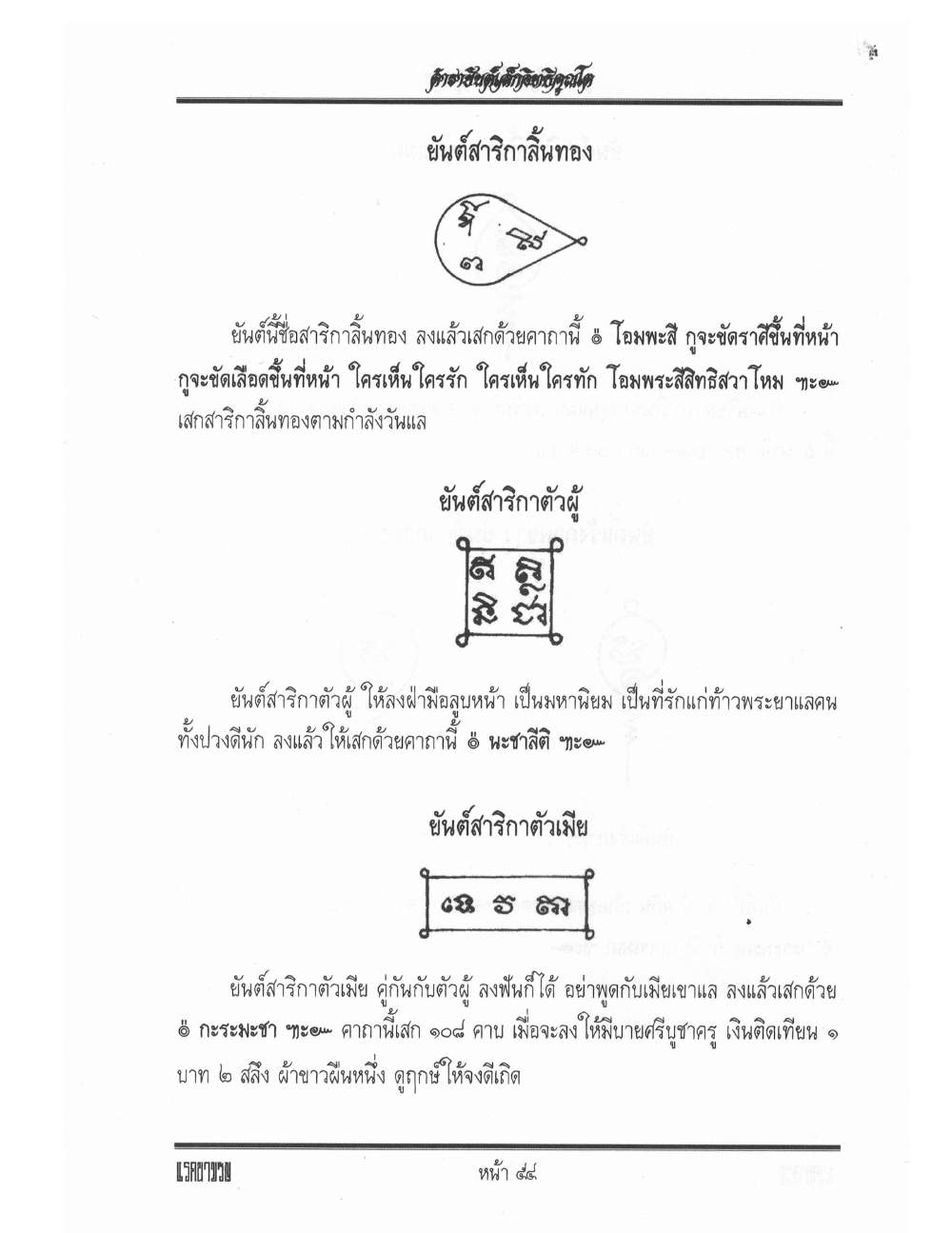
[หัวกระดาษซ้ำทุกหน้า: อักษรประดิษฐ์ อ่านไม่ชัด]
ยันต์สาริกาลิ้นทอง
[อักขระขอมในยันต์ อ่านไม่ชัด รูปทรงคล้ายหยดน้ำ มีเลข ๓ กำกับ]
ยันต์นี้ชื่อสาริกาลิ้นทอง ลงแล้วเสกด้วยคาถานี้ ๏ โอมพะสี กูจะขัดราศีขึ้นที่หน้า กูจะขัดเลือดขึ้นที่หน้า ใครเห็นใครรัก ใครเห็นใครทัก โอมพระสีสิทธิสวาโหม ๚๛ เสกสาริกาลิ้นทองตามกำลังวันแล
ยันต์สาริกาตัวผู้
[อักขระขอมในยันต์ อ่านไม่ชัด]
ยันต์สาริกาตัวผู้ ให้ลงฝ่ามือลูบหน้า เป็นมหานิยม เป็นที่รักแก่ท้าวพระยาแลคนทั้งปวงดีนัก ลงแล้วให้เสกด้วยคาถานี้ ๏ พะชาสีติ ๚๛
ยันต์สาริกาตัวเมีย
[อักขระขอมในยันต์ อ่านไม่ชัด]
ยันต์สาริกาตัวเมีย คู่กันกับตัวผู้ ลงฝันก็ได้ อย่าพูดกับเมียเขาแล ลงแล้วเสกด้วย ๏ กะระมะชา ๚๛ คาถานี้เสก ๑๐๘ คาบ เมื่อจะลงให้มีบายศรีบูชาครู เงินติดเทียน ๑ บาท ๒ สลึง ผ้าขาวผืนหนึ่ง ดูฤกษ์ให้จงดีเถิด
หน้า ๕๔ [ตราผู้จัดพิมพ์มุมล่างซ้าย อ่านไม่ชัด]
[running header, repeated every page: stylized ornamental title, illegible]
Golden-Tongued Mynah Yantra
[yantra: teardrop-shaped outline with a khom syllable inside and the numeral 3, illegible in detail]
This yantra is called the Golden-Tongued Mynah. Once inscribed, consecrate it with this spell: "Om pha si, ku ca khat rasi khuen thi na, ku ca khat lueat khuen thi na, khrai hen khrai rak, khrai hen khrai thak, om phra si sitthi sawahom" (I shall raise [my] fortune upon [my] face, I shall raise [my] blood upon [my] face; whoever sees [me] shall love [me], whoever sees [me] shall greet [me]). Consecrate the Golden-Tongued Mynah according to the power of the day [of the week].
Male Mynah Yantra
[yantra: square frame containing khom syllables arranged in four cells]
The Male Mynah yantra should be inscribed on the palm and stroked over the face; it brings great popularity and makes one beloved of lords, princes, and all people alike. Once inscribed, consecrate it with this spell: "Pha chā siti."
Female Mynah Yantra
[yantra: rectangular frame containing three khom syllables]
The Female Mynah yantra is paired with the male one. It may be inscribed [worn/carried] in dreams [or: while asleep]; do not speak ill of another man's wife. Once inscribed, consecrate it with: "Karamachā" (recited 108 times). When inscribing it, hold a bai sri [ceremonial offering] to honour the teacher, with money attached to a candle — 1 baht 2 salueng — and a length of white cloth; choose an auspicious time carefully.
[page footer] Page 54 [publisher's mark, bottom-left corner, illegible]
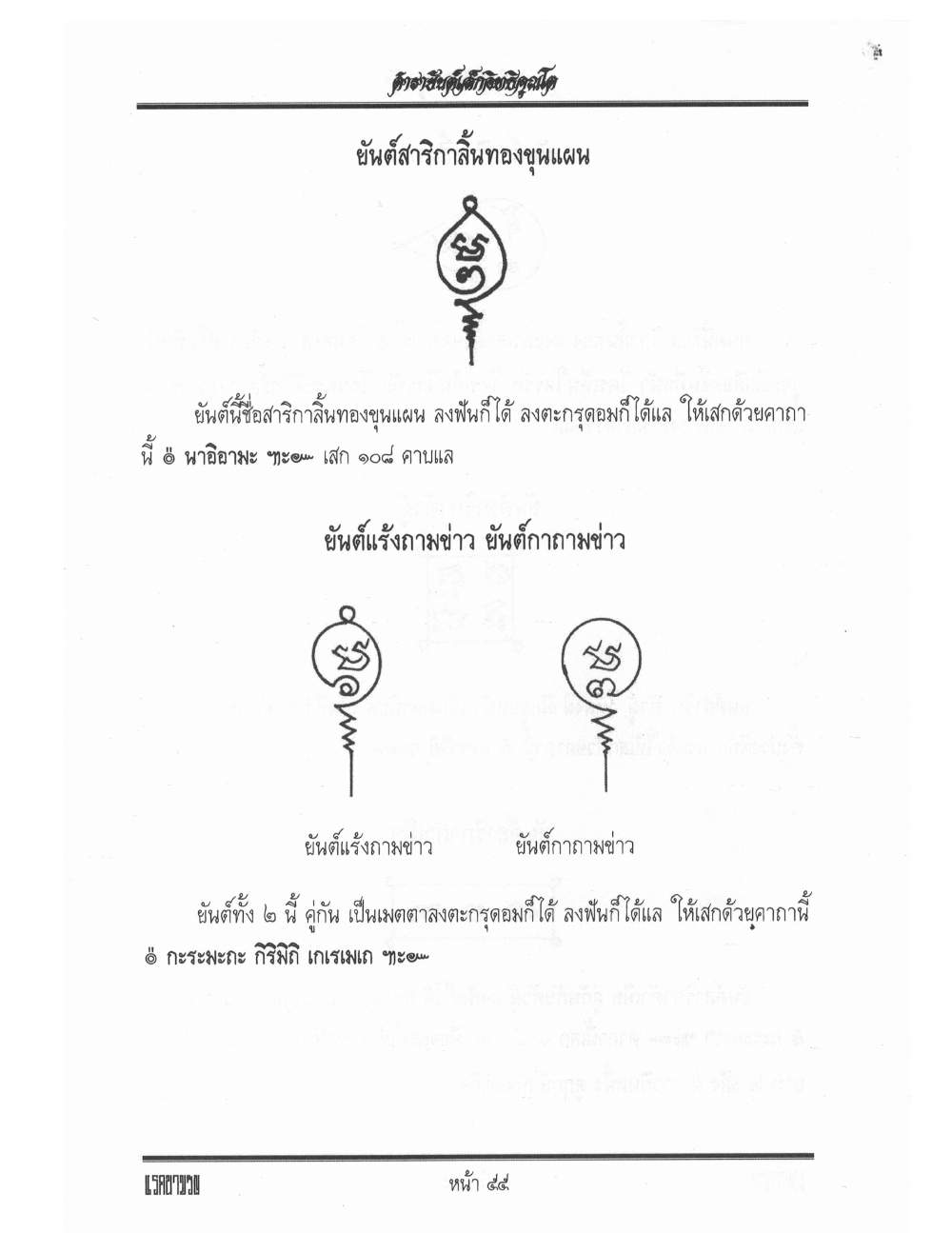
[หัวกระดาษซ้ำทุกหน้า: อักษรประดิษฐ์ อ่านไม่ชัด]
ยันต์สาริกาลิ้นทองขุนแผน
[อักขระขอมในยันต์ อ่านไม่ชัด รูปทรงคล้ายหยดน้ำ มีก้านหยักด้านล่าง]
ยันต์นี้ชื่อสาริกาลิ้นทองขุนแผน ลงฝันก็ได้ ลงตะกรุดอมก็ได้แล ให้เสกด้วยคาถานี้ ๏ พาอิอามะ ๚๛ เสก ๑๐๘ คาบแล
ยันต์แร้งถามข่าว ยันต์กาถามข่าว
[อักขระขอมในยันต์ อ่านไม่ชัด วงกลมสองวงมีก้านหยักด้านล่าง]
ยันต์ทั้ง ๒ นี้คู่กัน เป็นเมตตาลงตะกรุดอมก็ได้ ลงฝันก็ได้แล ให้เสกด้วยคาถานี้ ๏ กะระมะถะ กิริมิติ เกเรเมเถ ๚๛
หน้า ๕๕ [ตราผู้จัดพิมพ์มุมล่างซ้าย อ่านไม่ชัด]
[running header, repeated every page: stylized ornamental title, illegible]
Golden-Tongued Mynah Yantra of Khun Phaen
[yantra: teardrop-shaped outline with a khom syllable inside and a jagged "stem" hanging below, illegible in detail]
This yantra is called the Golden-Tongued Mynah of Khun Phaen [a legendary charmer figure]. It may be inscribed [worn] while asleep, or inscribed on a takrut and worn in the mouth. Consecrate it with this spell: "Phā i āma" (recited 108 times).
Vulture-Asks-the-News Yantra, Crow-Asks-the-News Yantra
[yantra: two circles, each with a khom syllable inside and a jagged "stem" hanging below]
These two yantras are a pair, for the path of loving-kindness; they may be inscribed on a takrut worn in the mouth, or worn while asleep. Consecrate them with this spell: "Karamathā kirimiti kereme the."
[page footer] Page 55 [publisher's mark, bottom-left corner, illegible]
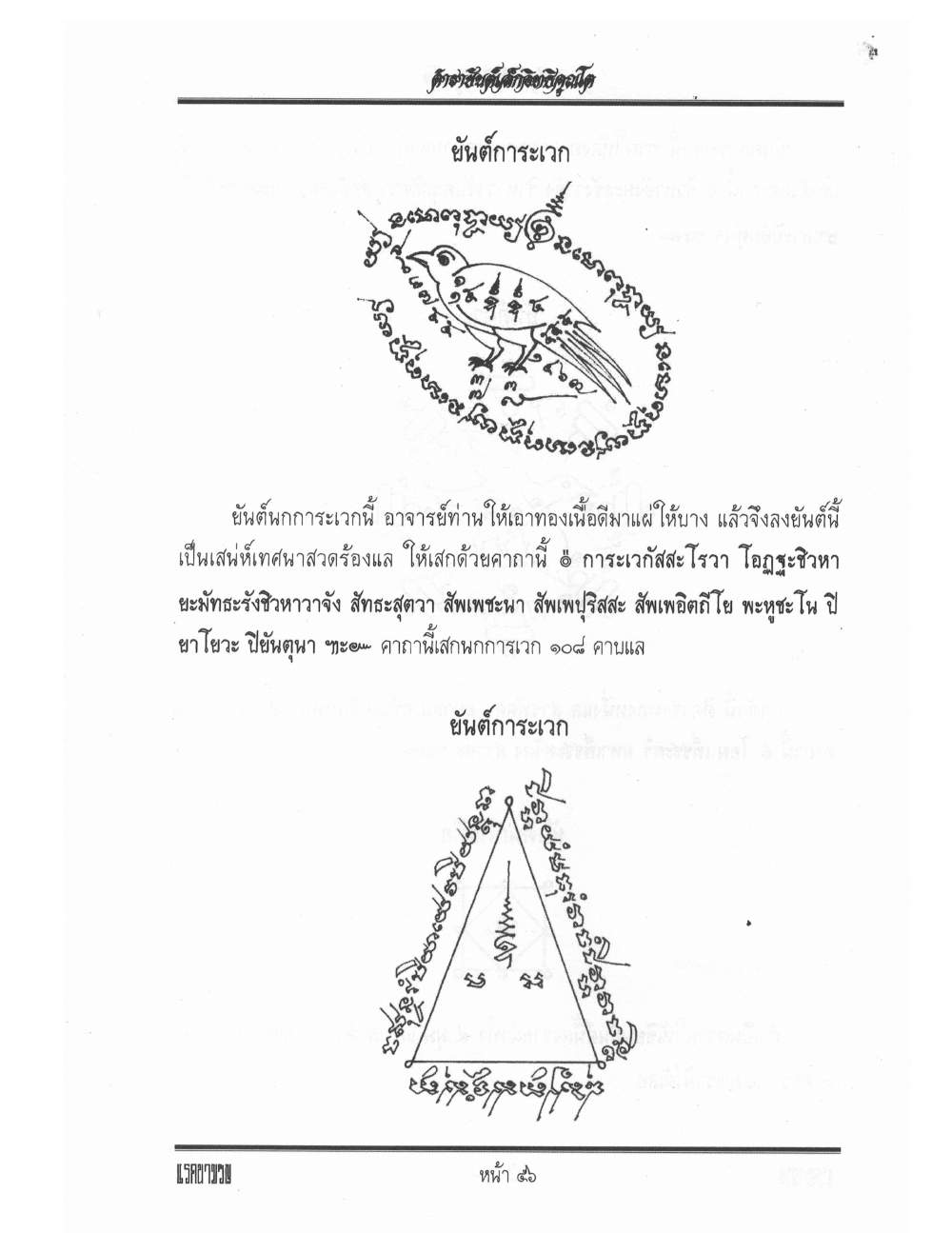
[หัวกระดาษซ้ำทุกหน้า: อักษรประดิษฐ์ อ่านไม่ชัด]
ยันต์การะเวก
[ยันต์: รูปนกการะเวกวาดเต็มตัว มีอักขระขอมล้อมรอบเป็นวงรี และวงแหวนอักขระขอมด้านบน อ่านไม่ชัด]
ยันต์นกการะเวกนี้ อาจารย์ท่านให้เอาทองเนื้อดีมาแผ่ให้บาง แล้วจึงลงยันต์นี้ เป็นเสน่ห์เทศนาสวดร้องแล ให้เสกด้วยคาถานี้ ๏ การะเวกัสสะโรวา โอฏฐะชิวหายะมัทธะรังชิวหาวาจัง สัทธะสุตวา สัพเพชะนา สัพเพปุริสสะ สัพเพอิตถีโย พะหูชะโน ปิยาโยวะ ปิยันตุนา ๚๛ คาถานี้เสกนกการะเวก ๑๐๘ คาบแล
ยันต์การะเวก
[ยันต์: รูปสามเหลี่ยม มีอักขระขอมล้อมรอบขอบสามเหลี่ยม และอักขระขอมเล็กอยู่ตรงกลาง อ่านไม่ชัด]
หน้า ๕๖ [ตราผู้จัดพิมพ์มุมล่างซ้าย อ่านไม่ชัด]
[running header, repeated every page: stylized ornamental title, illegible]
Karavek-Bird Yantra
[yantra: a full drawing of the karavek bird [a mythical songbird], encircled by an oval ring of khom-script syllables, with a further ring of khom syllables above, illegible in detail]
For this Karavek-Bird yantra, the teacher instructs that fine gold be beaten thin, and the yantra then inscribed upon it; it serves as a charm for preaching and chanting recitation. Consecrate it with this spell: "Karavekassa rova otthachiwhāya matharang chiwhāwācang satthasutwā sappecana sappepurissa sappeitthiyo pahucano piyāyova piyantunā" (...having heard with faith, may [I] become dear to all people, all men, all women, and the multitude, ever dear to them). This spell consecrates the karavek bird [amulet], recited 108 times.
Karavek-Bird Yantra
[yantra: a triangle with khom-script syllables running around its border, and small khom syllables at the centre, illegible in detail]
[page footer] Page 56 [publisher's mark, bottom-left corner, illegible]
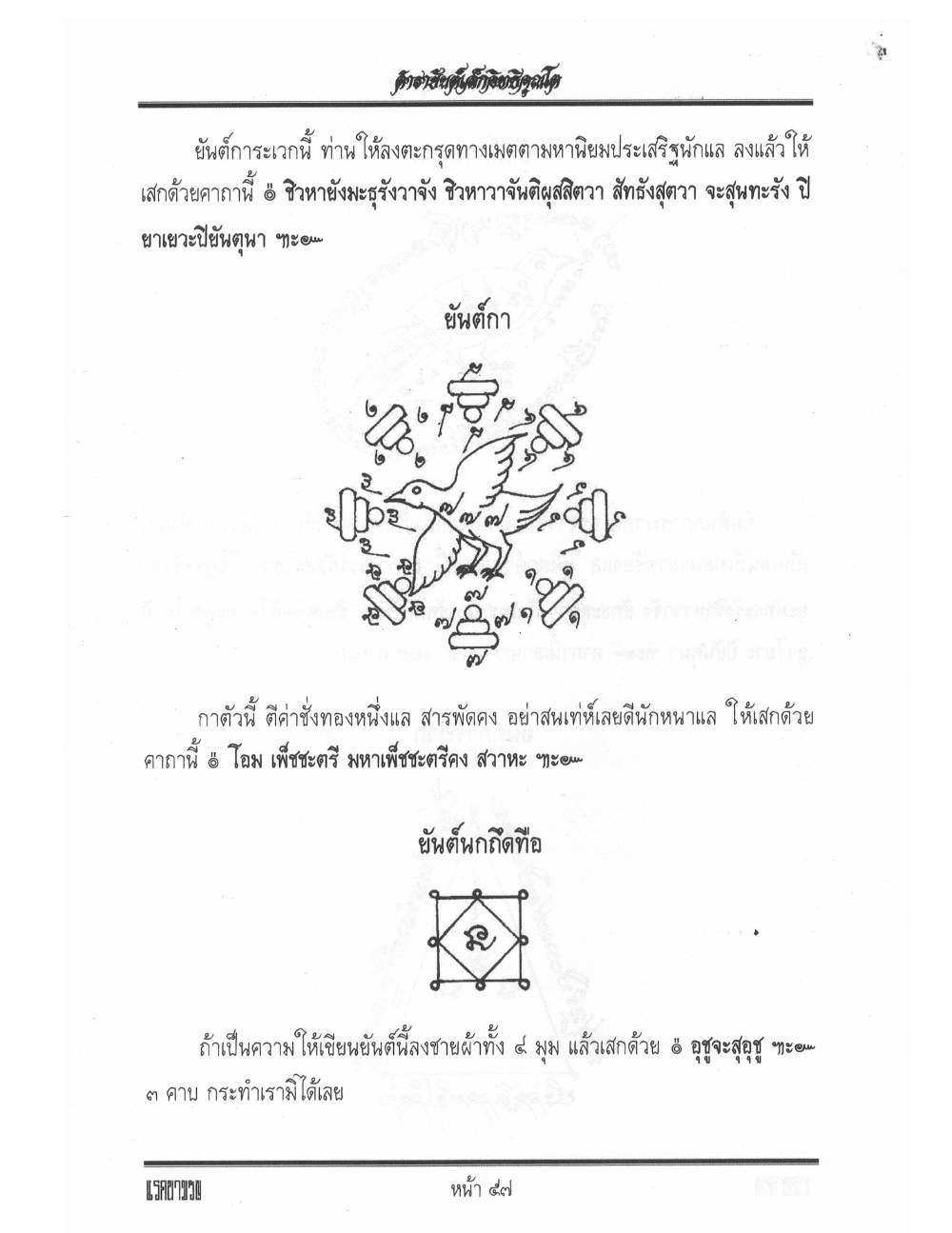
[หัวกระดาษซ้ำทุกหน้า: อักษรประดิษฐ์ อ่านไม่ชัด]
ยันต์การะเวกนี้ ท่านให้ลงตะกรุดทางเมตตามหานิยมประเสริฐนักแล ลงแล้วให้เสกด้วยคาถานี้ ๏ ชิวหายังมะธุรังวาจัง ชิวหาวาจันติผุสสิตวา สัทธังสุตวา จะสุนทรัง ปิยาเยวะ ปิยันตุนา ๚๛
ยันต์กา
[ยันต์: รูปนกกาวาดเต็มตัว มีอักขระขอมอยู่ในแผ่นป้ายหกแผ่นล้อมรอบ อ่านไม่ชัด]
กาตัวนี้ตีค่าชั่งทองหนึ่งแล สารพัดคง อย่าสนเท่ห์เลยดีนักหนาแล ให้เสกด้วยคาถานี้ ๏ โอม เพชะตรี มหาเพชะตรีคง สวาหะ ๚๛
ยันต์นกถิดทือ
[ยันต์: กรอบสี่เหลี่ยมมีเพชรกลางในกรอบ มีอักขระขอมหนึ่งตัวตรงกลาง]
ถ้าเป็นความให้เขียนยันต์นี้ลงชายผ้าทั้ง ๔ มุม แล้วเสกด้วย ๏ อุชุจะสุอุชุ ๚๛ ๓ คาบ กระทำเราไม่ได้เลย
หน้า ๕๗ [ตราผู้จัดพิมพ์มุมล่างซ้าย อ่านไม่ชัด]
[continuing from the previous page] For this Karavek-Bird yantra, one should inscribe it on a takrut for the path of loving-kindness and great popularity — most excellent. Once inscribed, consecrate it with this spell: "Chiwhāyang mathurangwācang chiwhāwācanti phussitwā satthangsutwā ca sunthorang piyāyeva piyantunā" (...having heard with faith, [my] speech becomes sweet and pleasing; ever dear, may [I] be dear to them).
Crow Yantra
[yantra: a full drawing of a crow, surrounded by six tablet-shaped panels each containing khom-script syllables, illegible in detail]
This crow [amulet] is valued at one baht-weight of gold; it grants all manner of invulnerability — do not take it lightly, it is very potent indeed. Consecrate it with this spell: "Om phechatri mahāphechatri khong sawāha."
Nok Thidthue [horned-owl] Yantra
[yantra: a square frame with a diamond inscribed within it, and a single khom syllable at the centre]
If there is a legal dispute, write this yantra on all four corners of a cloth, then consecrate it with: "Uchu ca su uchu" (3 times) — [your opponents] shall be unable to do anything against you.
[page footer] Page 57 [publisher's mark, bottom-left corner, illegible]
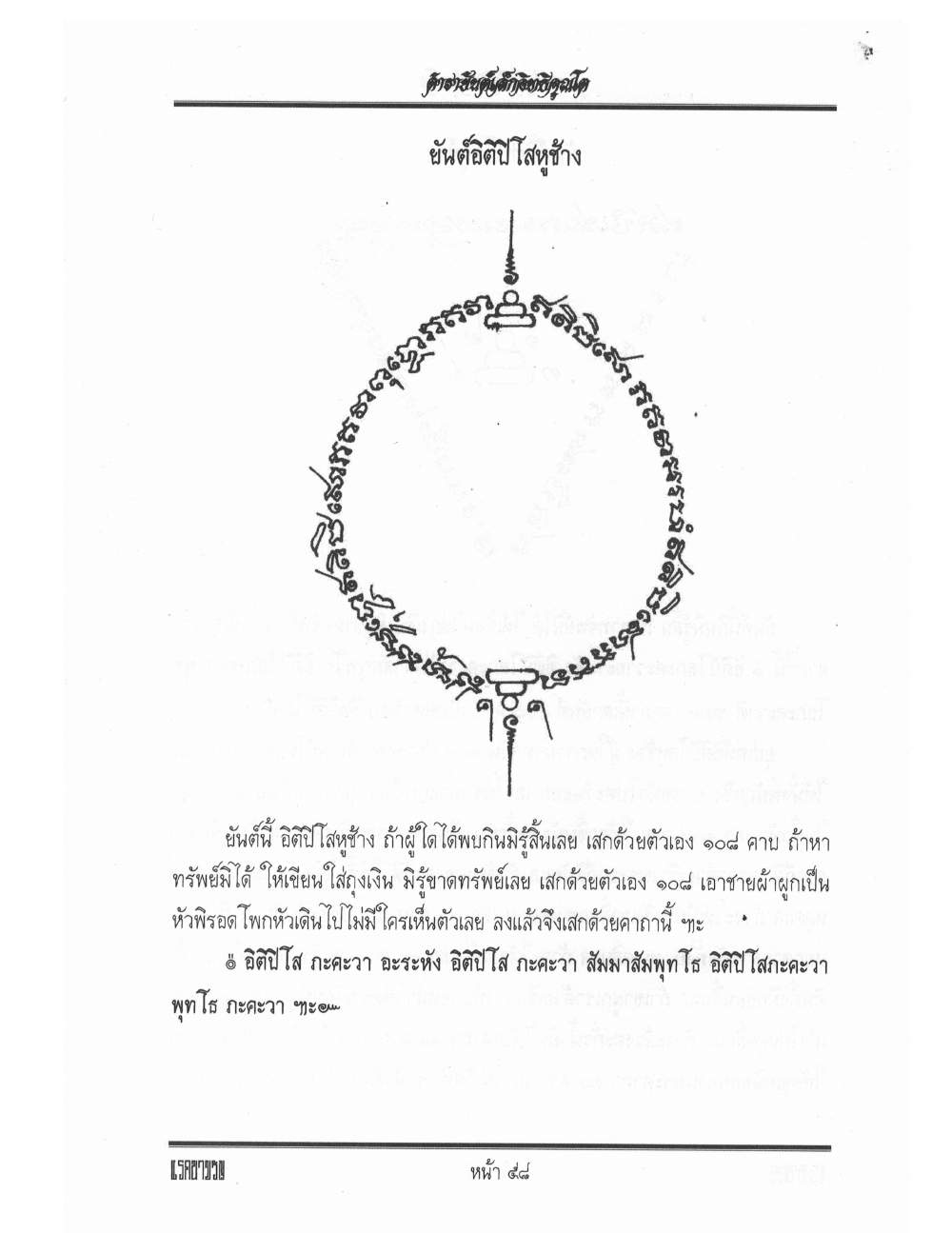
[หัวกระดาษซ้ำทุกหน้า: อักษรประดิษฐ์ อ่านไม่ชัด]
ยันต์อิติปิโสหูช้าง
[ยันต์: วงกลมใหญ่ มีอักขระขอมเรียงรอบวง มีสัญลักษณ์คล้ายเจดีย์อยู่ด้านบนและด้านล่างของวง อ่านไม่ชัด]
ยันต์นี้ อิติปิโสหูช้าง ถ้าผู้ใดได้พบกินมิรู้สิ้นเลย เสกด้วยตัวเอง ๑๐๘ คาบ ถ้าหาทรัพย์มิได้ ให้เขียนใส่ถุงเงิน มิรู้ขาดทรัพย์เลย เสกด้วยตัวเอง ๑๐๘ เอาชายผ้าผูกเป็นหัวพิรอด โพกหัวเดินไปไม่มีใครเห็นตัวเลย ลงแล้วจึงเสกด้วยคาถานี้ ๏ อิติปิโส ภะคะวา อะระหัง อิติปิโส ภะคะวา สัมมาสัมพุทโธ อิติปิโสภะคะวา พุทโธ ภะคะวา ๚๛
หน้า ๕๘ [ตราผู้จัดพิมพ์มุมล่างซ้าย อ่านไม่ชัด]
[running header, repeated every page: stylized ornamental title, illegible]
Iti-pi-so Elephant-Ear Yantra
[yantra: a large circle with khom-script syllables arranged around its circumference, and a stupa-like symbol above and below the circle, illegible in detail]
This is the Iti-pi-so Elephant-Ear yantra. Whoever obtains it will never run out of food; consecrate it oneself, 108 times. If wealth cannot be found, write it and place it in a money pouch — wealth will never be lacking; consecrate it oneself, 108 times. Tie a corner of cloth into a phirot [twisted headband] and wrap it around the head; walking about, no one will see you at all. Once inscribed, consecrate it with this spell: "Itipiso bhagavā arahang, itipiso bhagavā sammāsambuddho, itipiso bhagavā buddho bhagavā" (Thus is he the Blessed One, the Worthy One; thus is he the Blessed One, the Perfectly Self-Awakened One; thus is he the Blessed One, the Awakened, the Blessed One).
[page footer] Page 58 [publisher's mark, bottom-left corner, illegible]
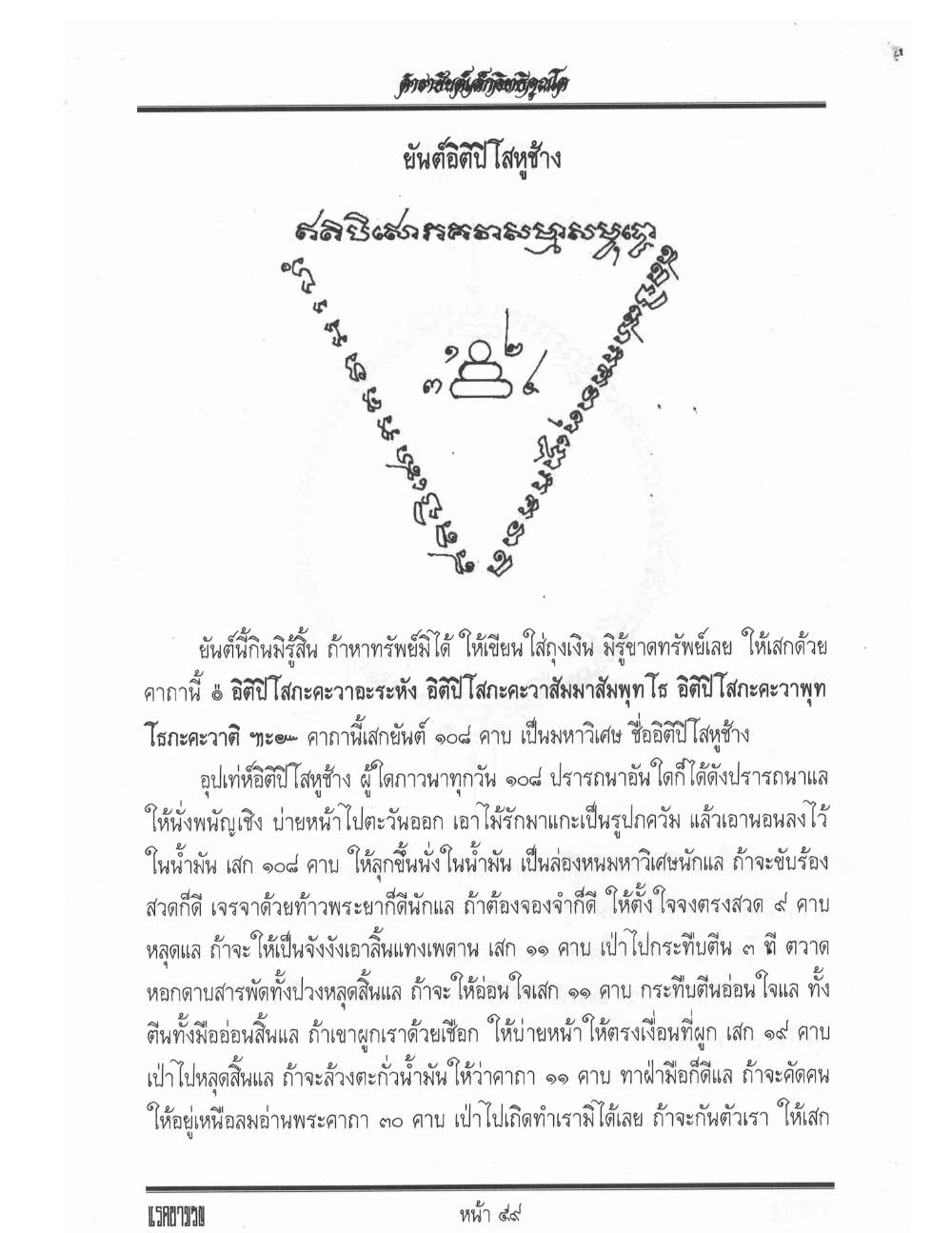
[หัวกระดาษซ้ำทุกหน้า: อักษรประดิษฐ์ อ่านไม่ชัด]
ยันต์อิติปิโสหูช้าง
[ยันต์: รูปสามเหลี่ยมหัวกลับ มีอักขระขอมเรียงตามขอบสามเหลี่ยม และสัญลักษณ์คล้ายเจดีย์กับอักขระขอมเล็กอยู่ตรงกลาง อ่านไม่ชัด]
ยันต์นี้กินมิรู้สิ้น ถ้าหาทรัพย์มิได้ ให้เขียนใส่ถุงเงิน มิรู้ขาดทรัพย์เลย ให้เสกด้วยคาถานี้ ๏ อิติปิโสภะคะวาอะระหัง อิติปิโสภะคะวาสัมมาสัมพุทโธ อิติปิโสภะคะวาพุทโธภะคะวาติ ๚๛ คาถานี้เสกยันต์ ๑๐๘ คาบ เป็นมหาวิเศษ ชื่ออิติปิโสหูช้าง
อุปเท่ห์อิติปิโสหูช้าง ผู้ใดภาวนาทุกวัน ๑๐๘ ปรารถนาอันใดก็ได้ดังปรารถนาแล ให้นั่งพันธุ์เชิง บ่ายหน้าไปตะวันออก เอาไม้รักมาแกะเป็นรูปภควัม แล้วเอาพอกลงไว้ในน้ำมัน เสก ๑๐๘ คาบ ให้ลุกขึ้นนั่งในน้ำมัน เป็นล่องหนมหาวิเศษนักแล ถ้าจะขับร้องสวดก็ดี เจรจาด้วยท้าวพระยาก็ดีนักแล ถ้าต้องจองจำก็ดี ให้ตั้งใจจงตรงสวด ๙ คาบ หลุดแล ถ้าจะให้เป็นจังงังเอาลิ้นแทงเพดาน เสก ๑๑ คาบ เป่าไปกระทืบตีน ๓ ที ตวาดหอกดาบสารพัดทั้งปวงหลุดสิ้นแล ถ้าจะให้อ่อนใจเสก ๑๑ คาบ กระทืบตีนอ่อนใจแล ทั้งตีนทั้งมืออ่อนสิ้นแล ถ้าเขาผูกเราด้วยเชือก ให้บ่ายหน้าให้ตรงเงื่อนที่ผูก เสก ๑๙ คาบ เป่าไปหลุดสิ้นแล ถ้าจะล้วงตะกั่วน้ำมันให้ว่าคาถา ๑๑ คาบ ทาฝ่ามือก็ดีแล ถ้าจะคัดคนให้ผู้เหมือนลมอ่านพระคาถา ๓๐ คาบ เป่าไปเถิด ทำเราไม่ได้เลย ถ้าจะกันตัวเรา ให้เสก
หน้า ๕๙ [ตราผู้จัดพิมพ์มุมล่างซ้าย อ่านไม่ชัด]
[running header, repeated every page: stylized ornamental title, illegible]
Iti-pi-so Elephant-Ear Yantra
[yantra: an inverted triangle with khom-script syllables running along its border, and a stupa-like symbol with small khom syllables at the centre, illegible in detail]
This yantra means one will never run out of food. If wealth cannot be found, write it and place it in a money pouch — wealth will never be lacking. Consecrate it with this spell: "Itipiso bhagavā arahang, itipiso bhagavā sammāsambuddho, itipiso bhagavā buddho bhagavāti" (as above). This spell consecrates the yantra, 108 times; it is a great marvel named the Iti-pi-so Elephant-Ear.
Instructions for the Iti-pi-so Elephant-Ear: whoever recites it daily 108 times, any wish will be granted as wished. Sit cross-legged facing east; carve an image of Phra Phrommagavampati [the pot-bellied disciple figure] from raktabush wood, then coat it and place it in oil; recite 108 times; have it "rise up" sitting in the oil, and it becomes a most marvellous vessel of invisibility. If you wish to sing or chant, or to converse with lords and princes, it serves very well indeed. If imprisoned, concentrate and chant straight through 9 times and you will be freed. To become paralyzed/still [render an attacker motionless], press the tongue to the roof of the mouth, recite 11 times, blow out, then stamp the foot 3 times and shout — all manner of spears and swords will fall away entirely. To soften [an enemy's] heart, recite 11 times, stamp the foot — the heart softens; both feet and hands become weak entirely. If bound with rope, turn to face directly toward the knot, recite 19 times, blow toward it, and it will come loose entirely. To extract lead [from a wound] or [use] oil, recite the spell 11 times and apply to the palm — it works well. To sway a crowd, have one recite the spell as if the wind were speaking, 30 times, then blow — [your opponents] will be unable to do anything to you. To protect oneself, recite...
[page footer] Page 59 [publisher's mark, bottom-left corner, illegible]
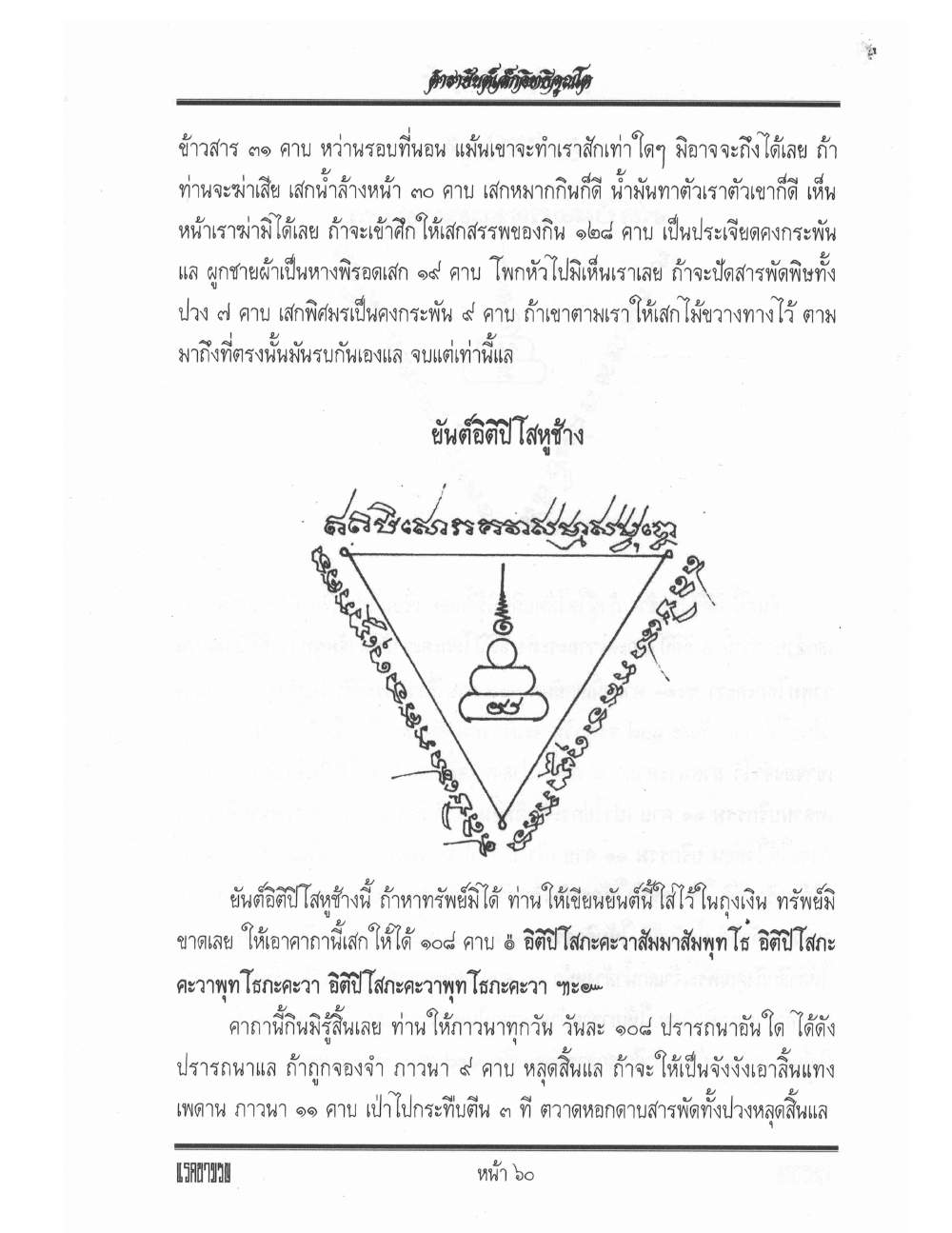
[หัวกระดาษซ้ำทุกหน้า: อักษรประดิษฐ์ อ่านไม่ชัด]
[ต่อจากหน้าก่อน] ข้าวสาร ๓๑ คาบ หว่านรอบที่นอน แม้นเขาจะทำเราสักเท่าใดๆ มิอาจจะถึงได้เลย ถ้าท่านจะฆ่าเสีย เสกน้ำล้างหน้า ๓๐ คาบ เสกหมากกินก็ดี น้ำมันทาตัวเราตัวเขาก็ดี เห็นหน้าเราฆ่ามิได้เลย ถ้าจะเข้าศึกให้เสกสรรพของกิน ๑๒๘ คาบ เป็นประเจียดคงกระพันแล ผูกชายผ้าเป็นหางพิรอดเสก ๑๙ คาบ โพกหัวไปมิเห็นเราเลย ถ้าจะปัดสารพัดพิษทั้งปวง ๗ คาบ เสกพิษมรเป็นคงกระพัน ๙ คาบ ถ้าเขาตามเราให้เสกไม้ขวางทางไว้ ตามมาถึงที่ตรงนั้นมันรบกันเองแล จบแต่เท่านี้แล
ยันต์อิติปิโสหูช้าง
[ยันต์: รูปสามเหลี่ยมหัวกลับ มีอักขระขอมเรียงตามขอบสามเหลี่ยม และสัญลักษณ์คล้ายเจดีย์กับอักขระขอมเล็กอยู่ตรงกลาง อ่านไม่ชัด]
ยันต์อิติปิโสหูช้างนี้ ถ้าหาทรัพย์มิได้ ท่านให้เขียนยันต์นี้ใส่ไว้ในถุงเงิน ทรัพย์มิขาดเลย ให้เอาคาถานี้เสกให้ได้ ๑๐๘ คาบ ๏ อิติปิโสภะคะวาสัมมาสัมพุทโธ อิติปิโสภะคะวาพุทโธภะคะวา ๚๛
คาถานี้กินมิรู้สิ้นเลย ท่านให้ภาวนาทุกวัน วันละ ๑๐๘ ปรารถนาอันใด ได้ดังปรารถนาแล ถ้าถูกจองจำ ภาวนา ๙ คาบ หลุดสิ้นแล ถ้าจะให้เป็นจังงัง เอาลิ้นแทงเพดาน ภาวนา ๑๑ คาบ เป่าไปกระทืบตีน ๓ ที ตวาดหอกดาบสารพัดทั้งปวงหลุดสิ้นแล
หน้า ๖๐ [ตราผู้จัดพิมพ์มุมล่างซ้าย อ่านไม่ชัด]
[running header, repeated every page: stylized ornamental title, illegible]
[continuing from the previous page] ...31 grains of rice, scattered around one's sleeping place — no matter what harm they try, they will never be able to succeed. If someone tries to kill you, consecrate water for washing the face 30 times; consecrating betel to chew, or oil to rub on yourself and on them, works well too — seeing your face, they cannot kill you at all. Before going into battle, consecrate food of every kind 128 times, as a talisman of invulnerability. Tie a corner of cloth into a phirot tail, recite 19 times, wrap it around the head, and going about, they will not see you at all. To ward off every kind of poison, recite 7 times; to turn poison into invulnerability, recite 9 times. If someone pursues you, consecrate a stick laid across the path — when they reach that spot, [the danger] will fight itself off, and that is the end of this [teaching].
Iti-pi-so Elephant-Ear Yantra
[yantra: an inverted triangle with khom-script syllables running along its border, and a stupa-like symbol with small khom syllables at the centre, illegible in detail]
This Iti-pi-so Elephant-Ear yantra: if wealth cannot be found, write this yantra and place it inside a money pouch — wealth will never run short. Consecrate it with this spell, 108 times: "Itipiso bhagavā sammāsambuddho, itipiso bhagavā buddho bhagavā."
This spell means one will never run out of food. Recite it daily, 108 times each day; whatever you wish for, you will obtain as wished. If imprisoned, recite 9 times and you will be freed entirely. To render [an attacker] motionless, press the tongue to the roof of the mouth, recite 11 times, blow out, stamp the foot 3 times, and shout — all manner of spears and swords will fall away entirely.
[page footer] Page 60 [publisher's mark, bottom-left corner, illegible]
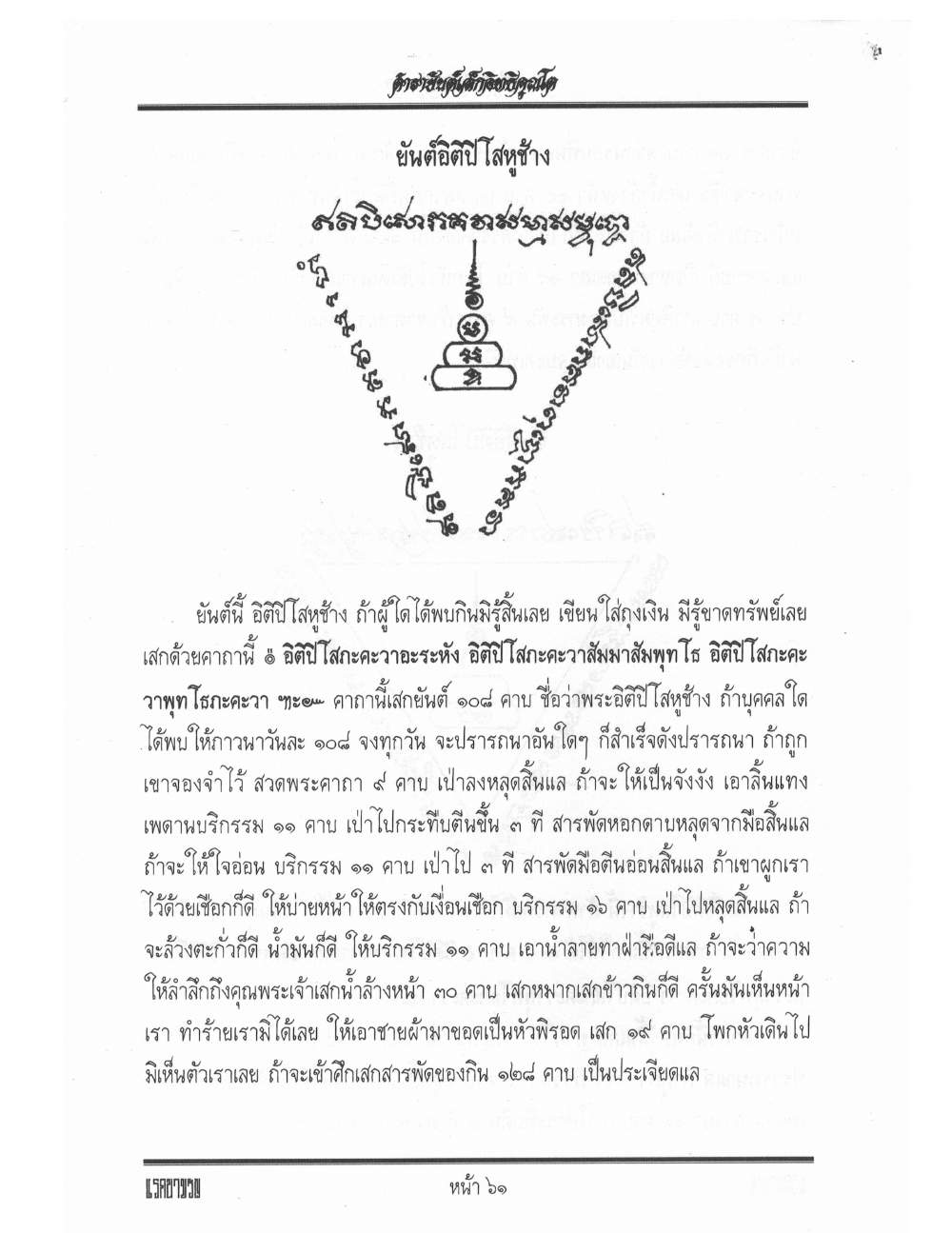
[หัวกระดาษซ้ำทุกหน้า: อักษรประดิษฐ์ อ่านไม่ชัด]
ยันต์อิติปิโสหูช้าง
[ยันต์: รูปสามเหลี่ยมหัวกลับ มีอักขระขอมเรียงตามขอบสามเหลี่ยม และสัญลักษณ์คล้ายเจดีย์กับอักขระขอมเล็กอยู่ตรงกลาง อ่านไม่ชัด]
ยันต์นี้ อิติปิโสหูช้าง ถ้าผู้ใดได้พบกินมิรู้สิ้นเลย เขียนใส่ถุงเงิน มิรู้ขาดทรัพย์เลย เสกด้วยคาถานี้ ๏ อิติปิโสภะคะวาอะระหัง อิติปิโสภะคะวาสัมมาสัมพุทโธ อิติปิโสภะคะวาพุทโธภะคะวา ๚๛ คาถานี้เสกยันต์ ๑๐๘ คาบ ชื่อว่าพระอิติปิโสหูช้าง ถ้าบุคคลใดได้พบให้ภาวนาวันละ ๑๐๘ จงทุกวัน จะปรารถนาอันใดๆ ก็สำเร็จดังปรารถนา ถ้าถูกเขาจองจำไว้ สวดพระคาถา ๙ คาบ เป่าลงหลุดสิ้นแล ถ้าจะให้เป็นจังงัง เอาลิ้นแทงเพดานบริกรรม ๑๑ คาบ เป่าไปกระทืบตีนขึ้น ๓ ที สารพัดหอกดาบหลุดจากมือสิ้นแล ถ้าจะให้ใจอ่อน บริกรรม ๑๑ คาบ เป่าไป ๓ ที สารพัดมือตีนอ่อนสิ้นแล ถ้าเขาผูกเราไว้ด้วยเชือกก็ดี ให้บ่ายหน้าให้ตรงกับเงื่อนเชือก บริกรรม ๑๖ คาบ เป่าไปหลุดสิ้นแล ถ้าจะล้วงตะกั่วก็ดี น้ำมันก็ดี ให้บริกรรม ๑๑ คาบ เอาน้ำลายทาฝ่ามือดีแล ถ้าจะว่าความให้ลำลึกถึงคุณพระเจ้าเสกน้ำล้างหน้า ๓๐ คาบ เสกหมากเสกข้าวกินก็ดี ครั้นมันเห็นหน้าเรา ทำร้ายเราไม่ได้เลย ให้เอาชายผ้ามาขอดเป็นหัวพิรอด เสก ๑๙ คาบ โพกหัวเดินไป มิเห็นตัวเราเลย ถ้าจะเข้าศึกเสกสารพัดของกิน ๑๒๘ คาบ เป็นประเจียดแล
หน้า ๖๑ [ตราผู้จัดพิมพ์มุมล่างซ้าย อ่านไม่ชัด]
[running header, repeated every page: stylized ornamental title, illegible]
Iti-pi-so Elephant-Ear Yantra
[yantra: an inverted triangle with khom-script syllables running along its border, and a stupa-like symbol with small khom syllables at the centre, illegible in detail]
This is the Iti-pi-so Elephant-Ear yantra. Whoever obtains it will never run out of food; write it and place it in a money pouch and wealth will never be lacking. Consecrate it with this spell: "Itipiso bhagavā arahang, itipiso bhagavā sammāsambuddho, itipiso bhagavā buddho bhagavā." This spell consecrates the yantra 108 times; it is named the Sacred Iti-pi-so Elephant-Ear. Whoever obtains it should recite it 108 times every day without fail; whatever they wish for will be accomplished as wished. If imprisoned by others, chant the sacred spell 9 times, blow onto [the bonds], and they will come undone entirely. To render [an attacker] motionless, press the tongue to the roof of the mouth while reciting 11 times, blow out, and stamp the foot upward 3 times — every spear and sword will drop from their hands entirely. To soften [someone's] heart, recite 11 times, blow 3 times — every hand and foot will go weak entirely. If someone binds you with rope, turn to face directly toward the knot of the rope, recite 16 times, blow toward it, and it will come loose entirely. To extract lead, or [to prepare] oil, recite 11 times and apply saliva to the palm — it works well. If pleading a legal case, recall the virtue of the Lord Buddha, consecrate water for washing the face 30 times, and consecrate betel or rice to eat — once they see your face, they will be unable to harm you at all. Tie a corner of cloth into a phirot knot, recite 19 times, wrap it around the head and walk — they will not see you at all. Before going into battle, consecrate food of every kind 128 times, as a protective talisman.
[page footer] Page 61 [publisher's mark, bottom-left corner, illegible]
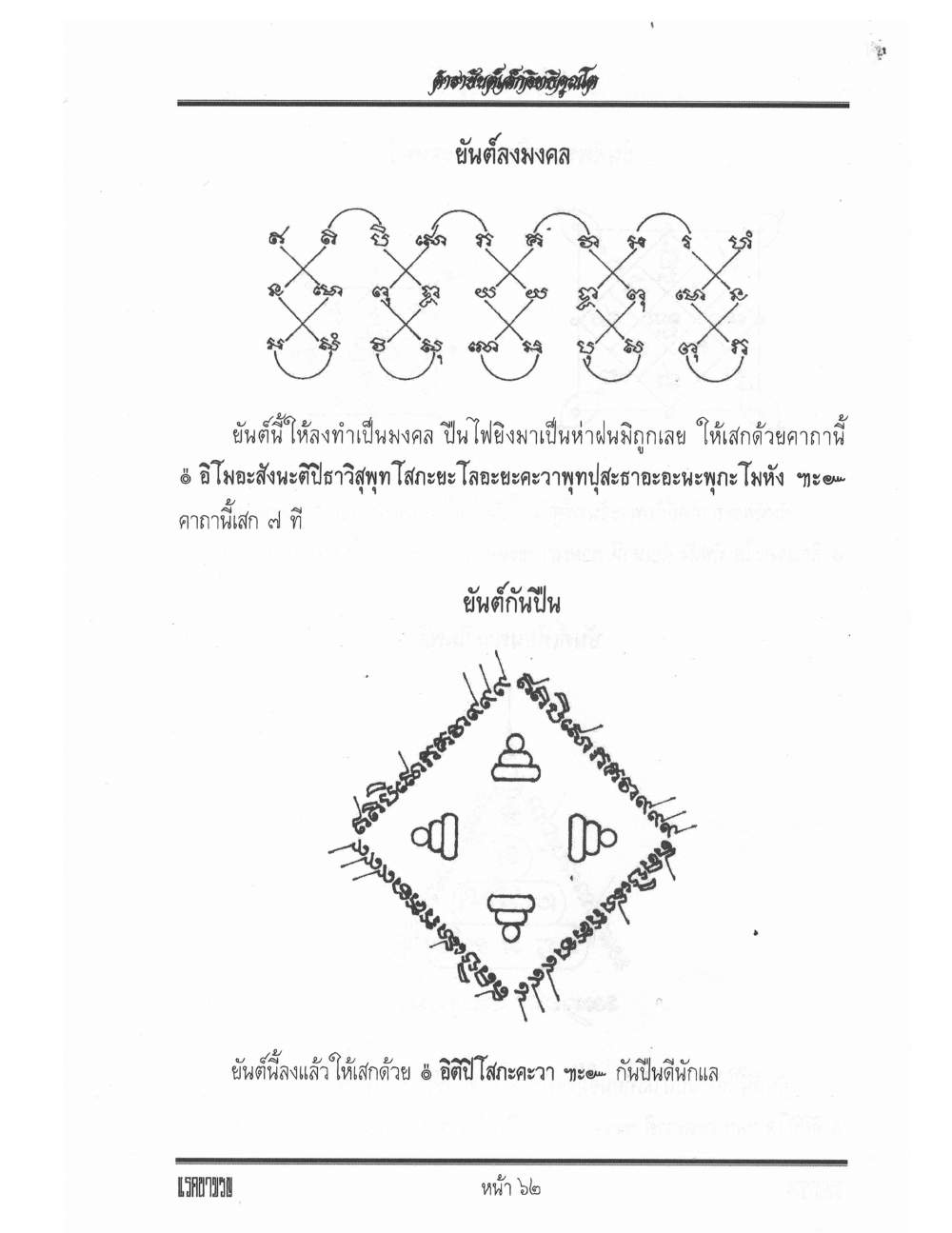
[อ่านไม่ออก]
ยันต์ลงมงคล
[อักขระในยันต์ อ่านไม่ชัด]
ยันต์นี้ให้ลงทำเป็นมงคล ปืนไฟยิงมาเป็นห่าฝนมิถูกเลย ให้เสกด้วยคาถานี้ ๐ อิโมอะสังพะติปาถาวิสุพุทโสภะยะโลอะยะคะวาพุทปุสะถาอะอะพะพุกะโมหัง ๚ะ คาถานี้เสก ๗ ที
ยันต์กันปืน
[อักขระในยันต์ อ่านไม่ชัด]
ยันต์นี้ลงแล้วให้เสกด้วย ๐ อิติปิโสภะคะวา ๚ะ กันปืนดีนักแล
[running header, illegible]
Auspicious Yantra
[yantra: a row of five repeating chain-link units, each a three-tier lattice of curling akkhara-style syllables joined by crossing diagonal lines, with a connecting arc above and below]
Inscribe this yantra for good fortune: gunfire aimed at the bearer will fall harmlessly like rain and never strike true. Consecrate it with this spell: "Imo asang pati pathawisuphut sophaya lo aya khawaphut pusatha a-a phaphu kamohang." Chant the spell 7 times.
Bullet-Warding Yantra
[yantra: a diamond frame bordered on all four sides by a spiral of khom-script incantation, containing three chedi-like emblems -- one at the top, two flanking at mid-height, one at the bottom]
Once inscribed, consecrate this yantra with: "Iti pi so phakhawa." It wards off bullets very well.
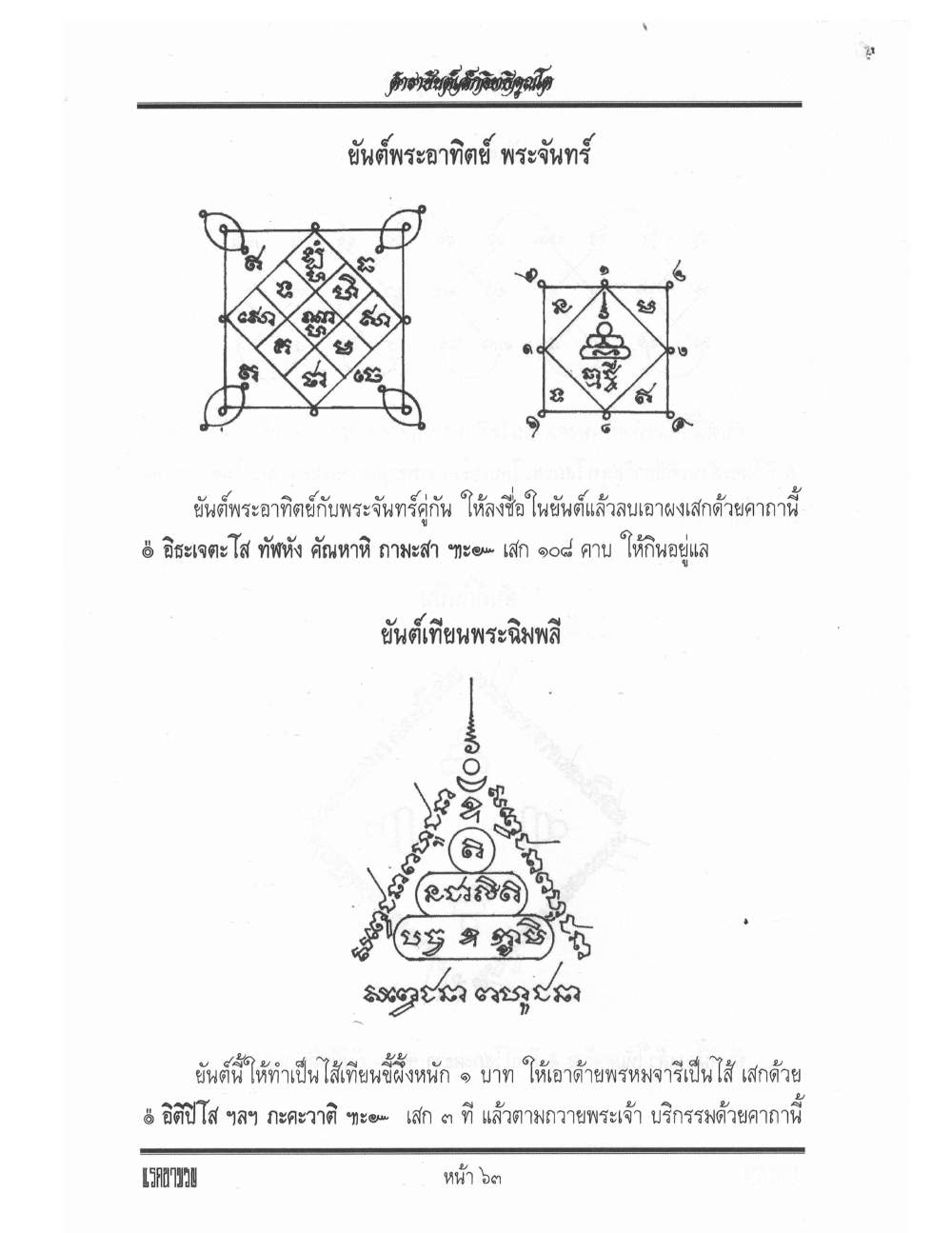
[อ่านไม่ออก]
ยันต์พระอาทิตย์ พระจันทร์
[อักขระในยันต์ อ่านไม่ชัด]
ยันต์พระอาทิตย์กับพระจันทร์คู่กัน ให้ลงชื่อในยันต์แล้วลบเอาผงเสกด้วยคาถานี้ ๐ อิถะเจตะโส ทัพหัง คัณหาหิ ถามะสา ๚ะ เสก ๑๐๘ คาบ ให้[อ่านไม่ออก]อยู่แล
ยันต์เทียนพระฉิมพลี
[อักขระในยันต์ อ่านไม่ชัด]
ยันต์นี้ให้ทำเป็นไส้เทียนขี้ผึ้งหนัก ๑ บาท ให้เอาด้ายพรหมจารีเป็นไส้ เสกด้วย ๐ อิติปิโส ฯลฯ กะคะวาติ ๚ะ เสก ๓ ที แล้วตามถวายพระเจ้า บริกรรมด้วยคาถานี้
[running header, illegible]
Sun and Moon Yantra
[yantra: two square-and-diamond figures side by side -- the left (Sun) yantra has a diamond of nine cells each bearing a syllable, with four looping emblems at its outer corners; the right (Moon) yantra has a smaller diamond within a square, its four sides bearing syllables and a stupa-like emblem at its centre]
The Sun and Moon yantras are paired together. Write the petitioner's name inside the yantra, then rub it off as a powder consecrated with this spell: "Itha cetaso thaphang khanhahi thamasa." Chant it 108 times to [word illegible] keep him/her close to you.
Candle-of-Phra-Chimphli Yantra
[yantra: a triangular figure topped with a sun-and-crescent-moon finial, three cartouches of khom syllables stacked down its centre, and a border of khom script running along its slanted sides]
Make the candle wick from one baht-weight of beeswax, using a virgin's thread as the wick. Consecrate it with: "Iti pi so, etc., kakhawati." Chant it 3 times, then place it before an image of the Buddha, reciting continuously with this spell --
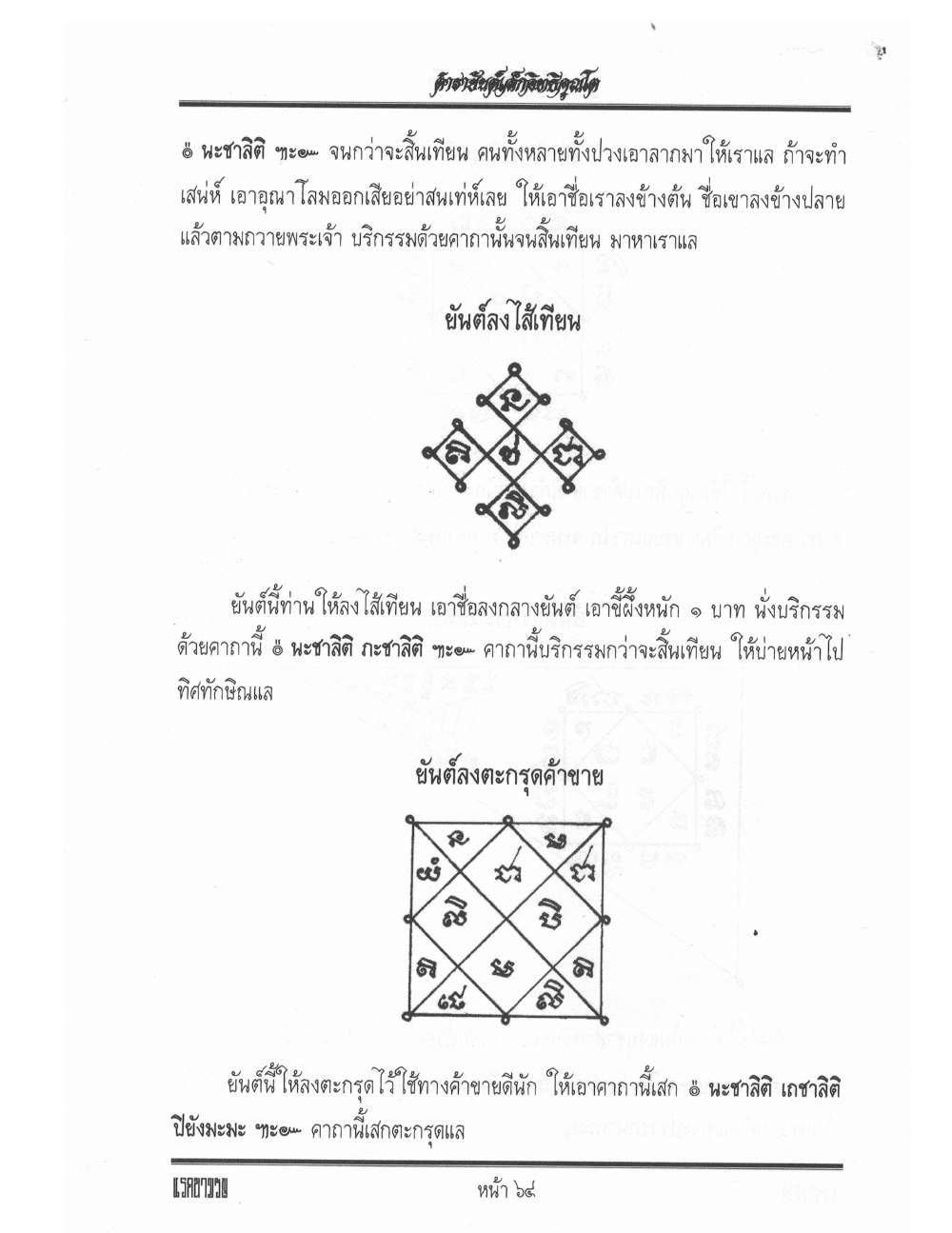
[อ่านไม่ออก]
๐ พะชาลิติ ๚ะ จนกว่าจะสิ้นเทียน คนทั้งหลายทั้งปวงเอาลาภมาให้เราแล ถ้าจะทำ เสน่ห์ เอาอุณาโลมออกเสียอย่าสนเท่ห์เลย ให้เอาชื่อเราลงข้างต้น ชื่อเขาลงข้างปลาย แล้วตามถวายพระเจ้า บริกรรมด้วยคาถานั้นจนสิ้นเทียน มาหาเราแล
ยันต์ลงไส้เทียน
[อักขระในยันต์ อ่านไม่ชัด]
ยันต์นี้ท่านให้ลงไส้เทียน เอาชื่อลงกลางยันต์ เอาขี้ผึ้งหนัก ๑ บาท ตั้งบริกรรม ด้วยคาถานี้ ๐ พะชาลิติ ภะชาลิติ ๚ะ คาถานี้บริกรรมจนจะสิ้นเทียน ให้บ่ายหน้าไป ทิศทักษิณแล
ยันต์ลงตะกรุดค้าขาย
[อักขระในยันต์ อ่านไม่ชัด]
ยันต์นี้ให้ลงตะกรุดไว้ใช้ทางค้าขายดีนัก ให้เอาคาถานี้เสก ๐ พะชาลิติ เถชาลิติ ปิยังมะมะ ๚ะ คาถานี้เสกตะกรุดแล
[running header, illegible]
"Pha chaliti" -- recited until the candle burns out entirely; then all people will bring their wealth to you. If making a love-charm, leave out the unalome mark, do not hesitate: write your own name at the top and the other person's name at the bottom, then place it before the Buddha image, reciting the spell continuously until the candle is spent; they will come seeking you.
Wick-Inscription Yantra
[yantra: four small diamonds arranged around a centre point in a cross-shaped cluster, one syllable in each]
This yantra is for inscribing onto a candle wick: write the name in the centre of the yantra, take one baht-weight of beeswax, and recite continuously with this spell: "Pha chaliti pha chaliti." Recite this spell until the candle is spent, facing south.
Trading Takrut Yantra
[yantra: a square crossed by diagonals forming a diamond core, eight syllables arranged around it]
Inscribe this yantra onto an amulet cylinder (takrut) carried for trading; it brings very good fortune in business. Consecrate it with this spell: "Pha chaliti thechaliti piyang mama." This spell consecrates the takrut.
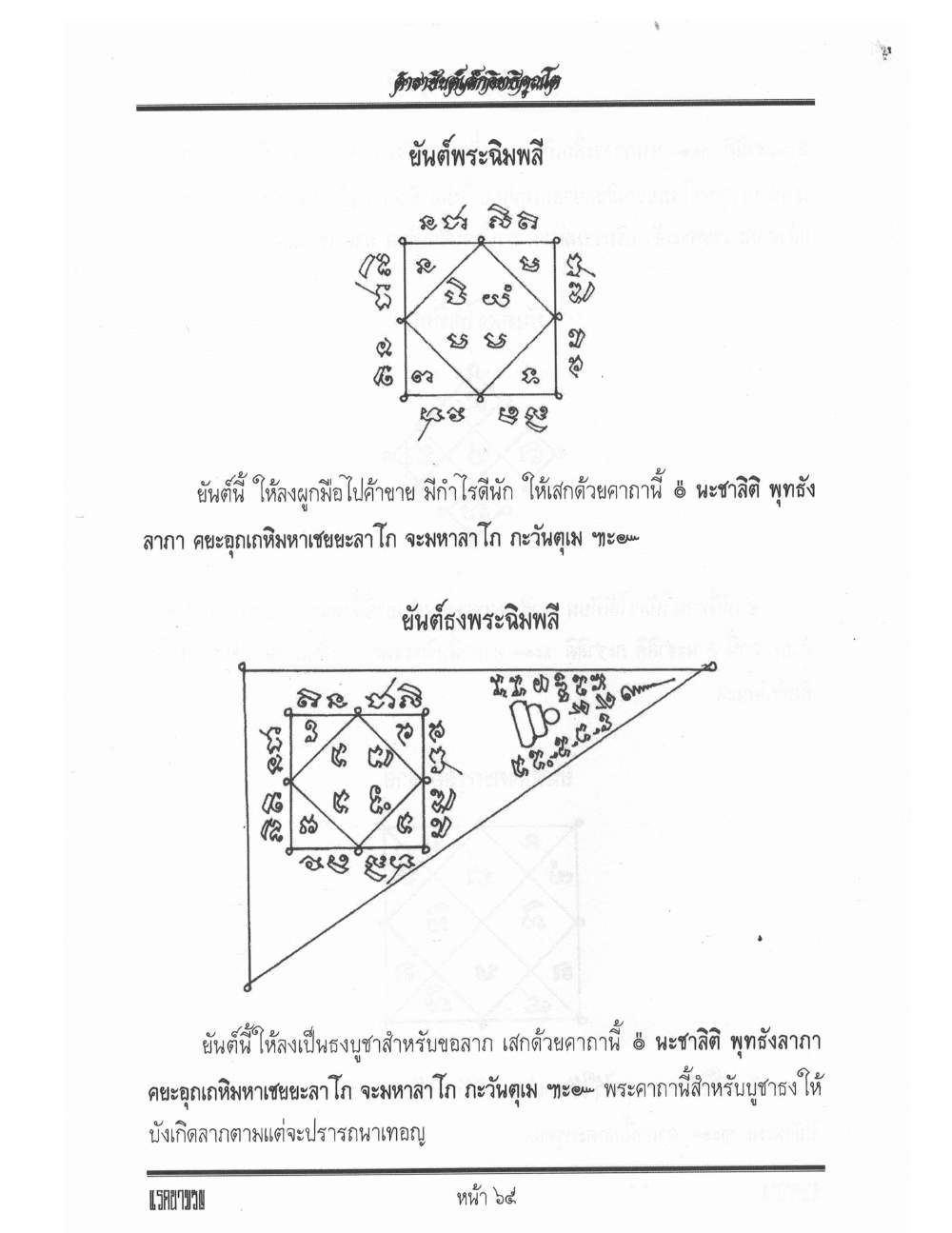
[อ่านไม่ออก]
ยันต์พระฉิมพลี
[อักขระในยันต์ อ่านไม่ชัด]
ยันต์นี้ ให้ลงผูกมือไปค้าขาย มีกำไรดีนัก ให้เสกด้วยคาถานี้ ๐ พะชาลิติ พุทธัง ลาภา คยะอุเถหิมหาเชยยะลาโภ จะมหาลาโภ กะวันตุเม ๚ะ
ยันต์ถงพระฉิมพลี
[อักขระในยันต์ อ่านไม่ชัด]
ยันต์นี้ให้ลงเป็นถุงบูชาสำหรับขอลาภ เสกด้วยคาถานี้ ๐ พะชาลิติ พุทธังลาภา คยะอุเถหิมหาเชยยะลาโภ จะมหาลาโภ กะวันตุเม ๚ะ พระคาถานี้สำหรับบูชาถุง ให้ บังเกิดลาภตามแต่จะปรารถนาเทอญ
[running header, illegible]
Phra Chimphli Yantra
[yantra: a diamond inscribed within a square, syllables filling the diamond's interior cells and further syllables ranged along the square's four sides, one label marked by a small arrow]
Wear this yantra tied at the wrist when going to trade; it brings very good profit. Consecrate it with this spell: "Pha chaliti phutthang lapha khaya-uthehimahachaiyalapho cha mahalapho kawantume."
Phra Chimphli Purse Yantra
[yantra: a large right triangle; at left within it, a square-and-diamond figure bearing syllables like the one above, and at right a cluster of khom syllables surrounding a small stupa-like emblem]
Inscribe this yantra onto a purse used to petition for fortune. Consecrate it with this spell: "Pha chaliti phutthang lapha khaya-uthehimahachaiyalapho cha mahalapho kawantume." This spell is for consecrating the purse, so that it brings whatever fortune is wished for.
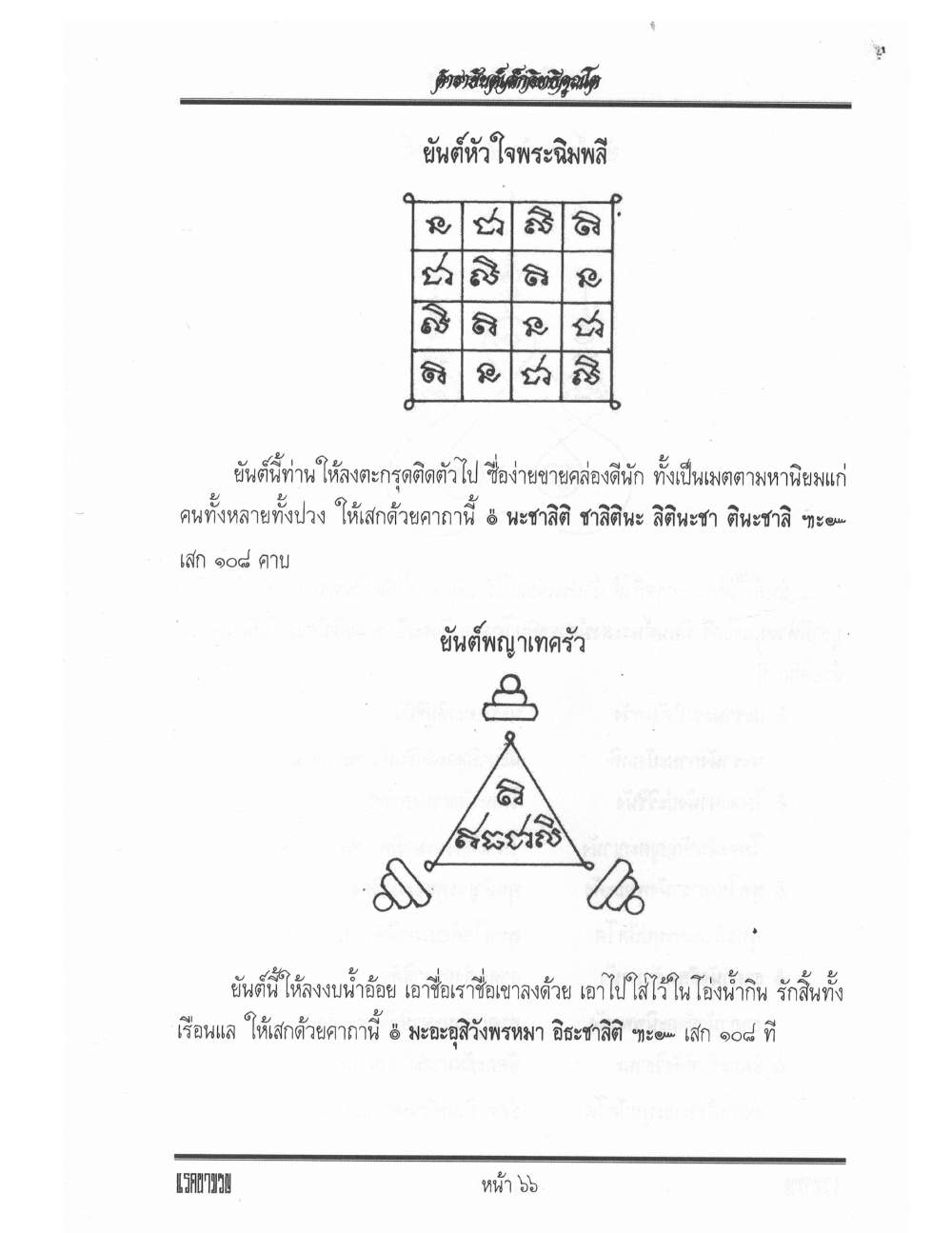
[อ่านไม่ออก]
ยันต์หัวใจพระฉิมพลี
[อักขระในยันต์ อ่านไม่ชัด]
ยันต์นี้ท่านให้ลงตะกรุดติดตัวไป ซื้อง่ายขายคล่องดีนัก ทั้งเป็นเมตตามหานิยมแก่ คนทั้งหลายทั้งปวง ให้เสกด้วยคาถานี้ ๐ พะชาลิติ ชาลิติพะ ลิติพะชา ติพะชาลิ ๚ะ เสก ๑๐๘ คาบ
ยันต์พญาเทครัว
[อักขระในยันต์ อ่านไม่ชัด]
ยันต์นี้ให้ลงงบน้ำอ้อย เอาชื่อเราชื่อเขาลงด้วย เอาไปใส่ไว้ในโอ่งน้ำกิน รักสิ้นทั้ง เรือนแล ให้เสกด้วยคาถานี้ ๐ มะอะอุสิวังพรหมา อิถะชาลิติ ๚ะ เสก ๑๐๘ ที
[running header, illegible]
Heart-of-Phra-Chimphli Yantra
[yantra: a four-by-four grid of sixteen cells, a repeating cycle of four syllables filling the squares]
Carry this yantra as an inscribed amulet cylinder; buying and selling will go very smoothly. It also serves as a charm of loving-kindness and popularity toward everyone. Consecrate it with this spell: "Pha chaliti chalitipha litipha-cha tiphachali." Chant it 108 times.
Lord Thekhrua Yantra
[yantra: a triangle topped by a stupa-like finial, a short vertical column of khom syllables inside it, and a rolled-scroll emblem at each of its two lower corners]
Inscribe this yantra onto a lump of sugarcane sugar, writing your own name and the other person's name onto it as well; place it in the drinking-water jar. It ends estrangement throughout the whole household. Consecrate it with this spell: "Ma-a-u siwang phrahma itha chaliti." Chant it 108 times.
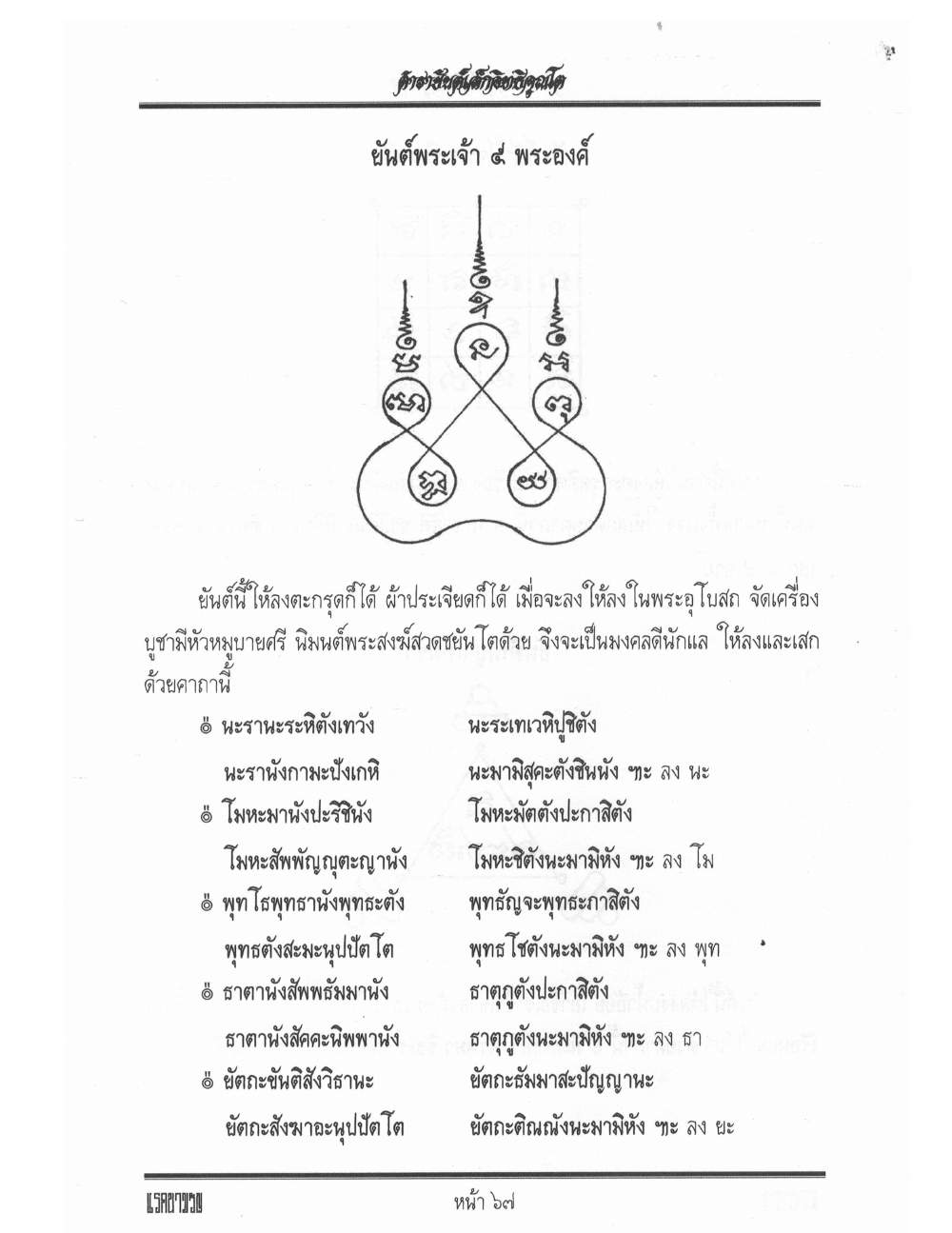
[อ่านไม่ออก]
ยันต์พระเจ้า ๔ พระองค์
[อักขระในยันต์ อ่านไม่ชัด]
ยันต์นี้ให้ลงตะกรุดก็ได้ ผ้าประเจียดก็ได้ เมื่อจะลงให้ลงในพระอุโบสถ จัดเครื่อง บูชามีหัวหมูบายศรี พิมพ์พระสงฆ์สวดชัยันโตด้วย จึงจะเป็นมงคลดีนักแล ให้ลงและเสก ด้วยคาถานี้
๐ นะรานะระหิตังเทวัง นะระเทเวหิปูชิตัง นะรานังกามะปังเกหิ นะมามิสุคะตังชินัง ๚ะ ลง นะ ๐ โมหะมานังปะริชินัง โมหะมัตตังปะกาสิตัง โมหะสัพพัญญุตะญานะ โมหะชิตังนะมามิหัง ๚ะ ลง โม ๐ พุทโธพุทธานังพุทธะตัง พุทธัญจะพุทธะภาสิตัง พุทธตังสะมะนุปปัตโต พุทโธชิตังนะมามิหัง ๚ะ ลง พุท ๐ ธาตานังสัพพะธัมมานัง ธาตุภูตังปะกาสิตัง ธาตานังสัพพะนิพพานัง ธาตุภูตังนะมามิหัง ๚ะ ลง ธา ๐ ยัตถะขันติสังวิธานะ ยัตถะธัมมาสะปัญญานะ ยัตถะสังฆาอะนุปปัตโต ยัตถะติณังนะมามิหัง ๚ะ ลง ยะ
[running header, illegible]
Yantra of the Four Lord Buddhas
[yantra: three tall flame-like spires rising from three circular medallions, each bearing a syllable, joined by crossing lines down to two further medallions below -- five medallions in all, arranged in a triangular formation]
This yantra may be inscribed onto a takrut amulet or onto a protective cloth. When inscribing it, do so inside the ordination hall (uposatha), with offerings arranged including a pig's head and a bai-si tray, and have monks chant the Chaiyanto verses over a Buddha image as well; only then will it be truly auspicious. Inscribe and consecrate it with this verse:
"Homage to the god free of human bonds, worshipped by gods and men; homage to him who is beyond desire's snares, I pay homage to the well-gone Victor" -- inscribe the syllable na. "Delusion that has cut off arrogance, delusion proclaimed as ultimate truth, delusion of omniscient knowledge, I pay homage to him who has conquered delusion" -- inscribe the syllable mo. "The Buddha, buddha among buddhas, buddha-nature, what the Buddha has spoken and declared, arrived at buddhahood, I pay homage to him who has conquered as Buddha" -- inscribe the syllable phut. "The elements of all phenomena, the arising of elements as declared, the elements of all who have attained Nibbana, I pay homage to him who has become the elements" -- inscribe the syllable tha. "Where patience is ordained, where the Dhamma bears wisdom, where the Sangha has arrived, I pay homage to that ground" -- inscribe the syllable ya.
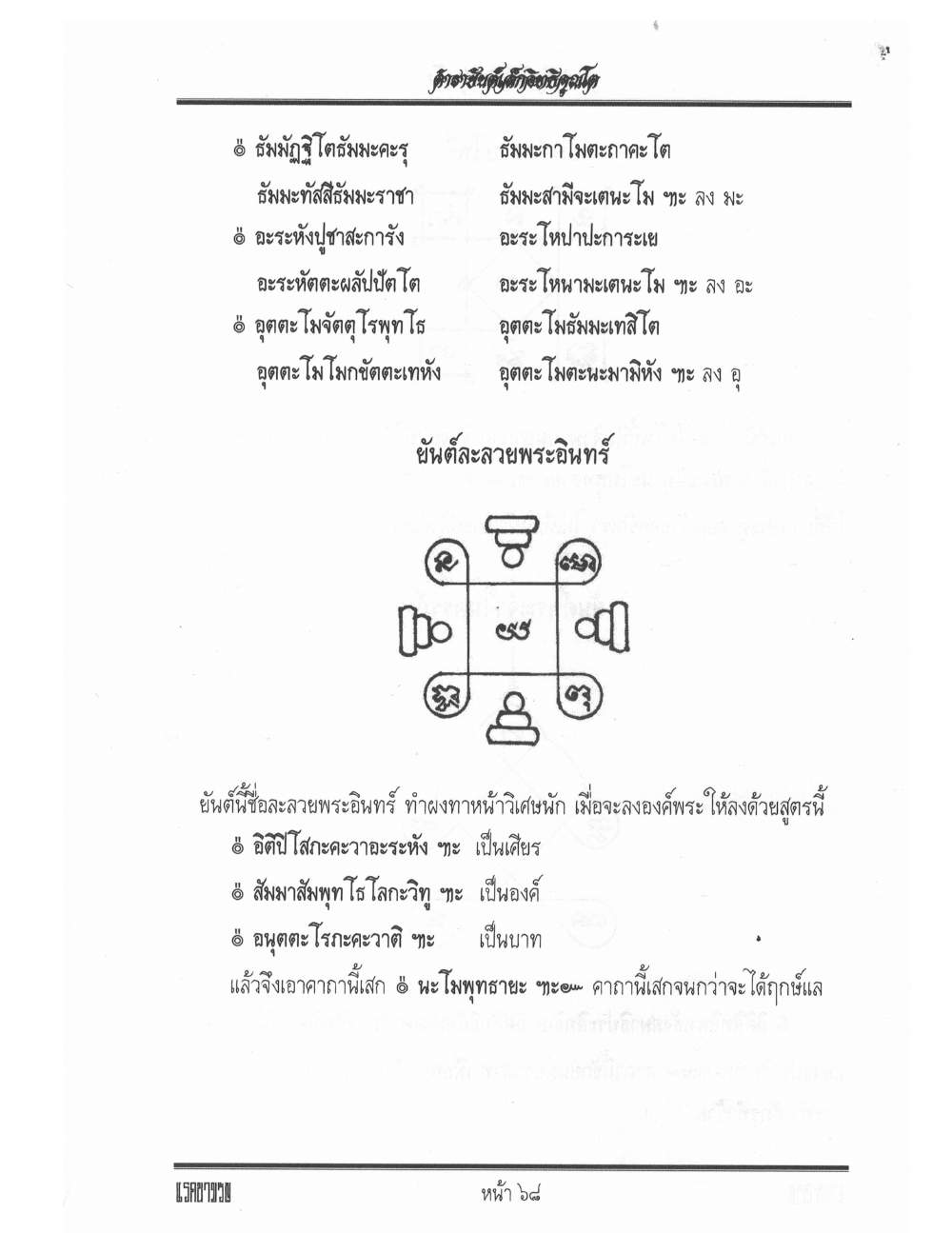
[อ่านไม่ออก]
๐ ธัมมัฏฐิโตธัมมะคะรุ ธัมมะกาโมตะถาคะโต ธัมมะทัสสีธัมมะราชา ธัมมะสามีจะเตนะโม ๚ะ ลง มะ ๐ อะระหังปูชาสะการัง อะระโหปาปะการะเย อะระหัตตะผลัปปัตโต อะระโหนามะเตนะโม ๚ะ ลง อะ ๐ อุตตะโมจัตตุโรพุทโธ อุตตะโมธัมมะเทสิโต อุตตะโมโมกขัตตะเทหัง อุตตะโมตะนะมามิหัง ๚ะ ลง อุ
ยันต์ละลวยพระอินทร์
[อักขระในยันต์ อ่านไม่ชัด]
ยันต์นี้ชื่อละลวยพระอินทร์ ทำผงทาหน้าวิเศษนัก เมื่อจะลงองค์พระให้ลงด้วยสูตรนี้ ๐ อิติปิโสภะคะวาอะระหัง ๚ะ เป็นเศียร ๐ สัมมาสัมพุทโธโลกะวิทู ๚ะ เป็นองค์ ๐ อนุตตะโรภะคะวาติ ๚ะ เป็นบาท แล้วจึงเอาคาถานี้เสก ๐ พะโมพุทธายะ ๚ะ คาถานี้เสกจนกว่าจะได้ฤกษ์แล
[running header, illegible]
"He who abides in the Dhamma, the Dhamma's teacher, the Dhamma's lover, the Realised One, the Dhamma-seer, the Dhamma-king, lord of the Dhamma, homage to him" -- inscribe the syllable ma. "Worthy One worshipped with offerings, Worthy One free of evil, Worthy One who has attained the fruit of arahantship, homage to the Worthy One" -- inscribe the syllable a. "Supreme, the four Buddhas; supreme, the Dhamma he taught; supreme, granter of liberation; supreme, homage to him" -- inscribe the syllable u.
Whirling Charm of Phra Indra Yantra
[yantra: a cross-shaped figure with four rounded lobes -- top, bottom, left, right -- each bearing a syllable, a syllable at the centre, and stupa- and vase-like emblems set outside the four sides]
This yantra is called the "Whirling Charm of Phra Indra"; made into a face-powder it is especially potent. When inscribing an image of the Buddha, inscribe with this formula: "Iti pi so phakhawa arahang" for the head; "Sammasambuddho lokawithu" for the body; "Anuttaro phakhawati" for the feet. Then consecrate with this spell: "Pha mo phutthaya." Recite this spell until an auspicious moment is obtained.
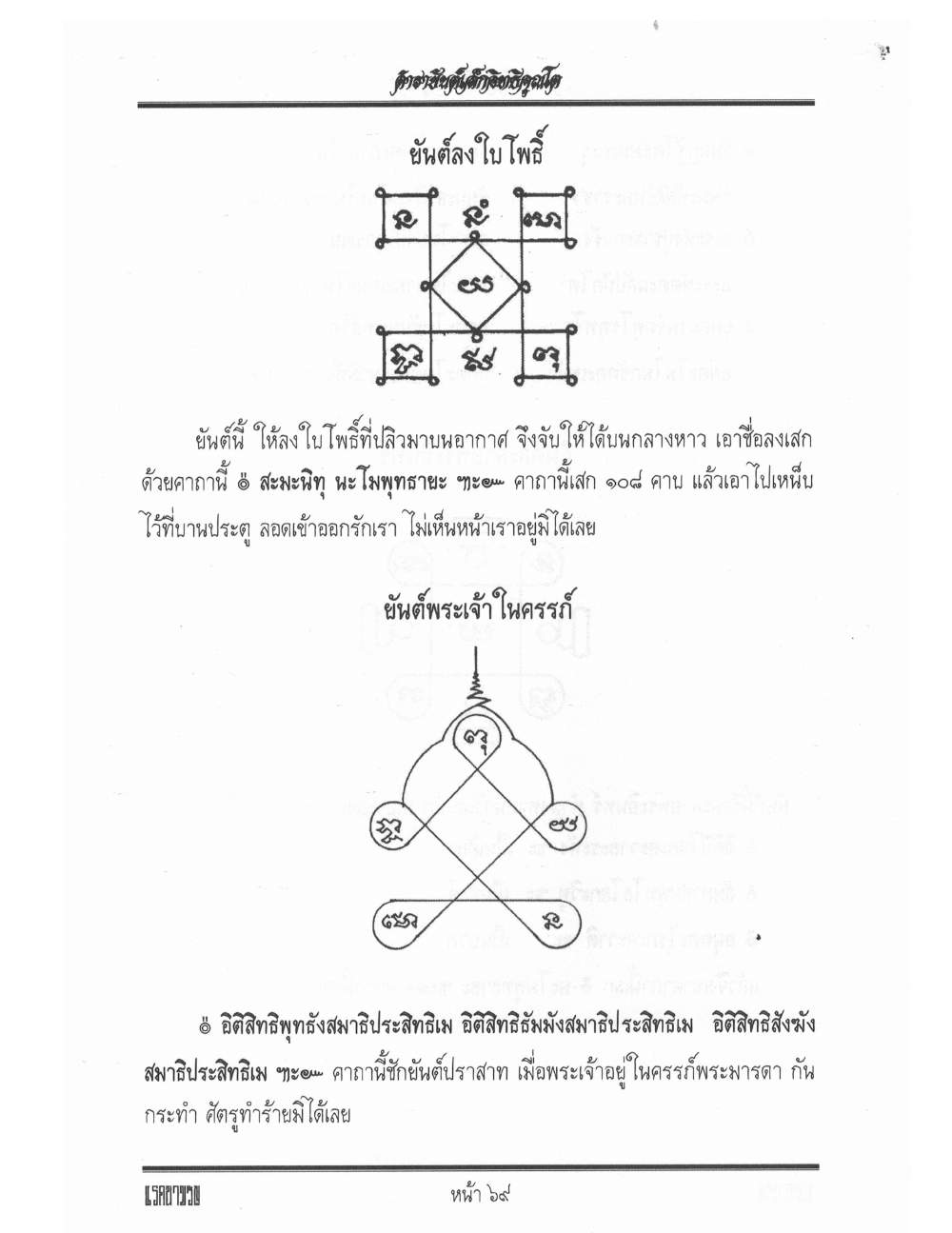
[อ่านไม่ออก]
ยันต์ลงใบโพธิ์
[อักขระในยันต์ อ่านไม่ชัด]
ยันต์นี้ ให้ลงใบโพธิ์ที่ปลิวมาบนอากาศ จึงจับให้ได้บนกลางหาว เอาชื่อลงเสก ด้วยคาถานี้ ๐ สะมะนิทุ มะโมพุทธายะ ๚ะ คาถานี้เสก ๑๐๘ คาบ แล้วเอาไปเหน็บ ไว้ที่บานประตู ลอดเข้าออกรักเรา ไม่เห็นหน้าเราอยู่มิได้เลย
ยันต์พระเจ้าในครรภ์
[อักขระในยันต์ อ่านไม่ชัด]
๐ อิติสิทธิพุทธังสมาธิประสิทธิเม อิติสิทธิธัมมังสมาธิประสิทธิเม อิติสิทธิสังฆัง สมาธิประสิทธิเม ๚ะ คาถานี้ชักยันต์ปราสาท เมื่อพระเจ้าอยู่ในครรภ์พระมารดา กัน กระทำ ศัตรูทำร้ายมิได้เลย
[running header, illegible]
Bodhi-Leaf Yantra
[yantra: a square with an inscribed diamond, three syllables along the top edge, one syllable inside the central diamond, three syllables along the bottom edge]
Inscribe this yantra onto a Bodhi leaf drifting down through the air -- it must be caught in mid-sky before it lands. Write the name on it and consecrate with this spell: "Samanithu mamophutthaya." Chant this spell 108 times, then tuck it into the door frame; anyone passing in and out will fall in love with you, unable to bear not seeing your face.
Yantra of the Lord in the Womb
[yantra: a triangular arrangement of four circular medallions -- one at the apex and three below -- joined by crossing lines, topped with a small flame-like finial]
"Thus is the accomplishment of concentration through the Buddha; thus is the accomplishment of concentration through the Dhamma; thus is the accomplishment of concentration through the Sangha." This spell draws out the palace-yantra; while the Lord dwells in his mother's womb, guarding him thus, no enemy is able to do him harm at all.
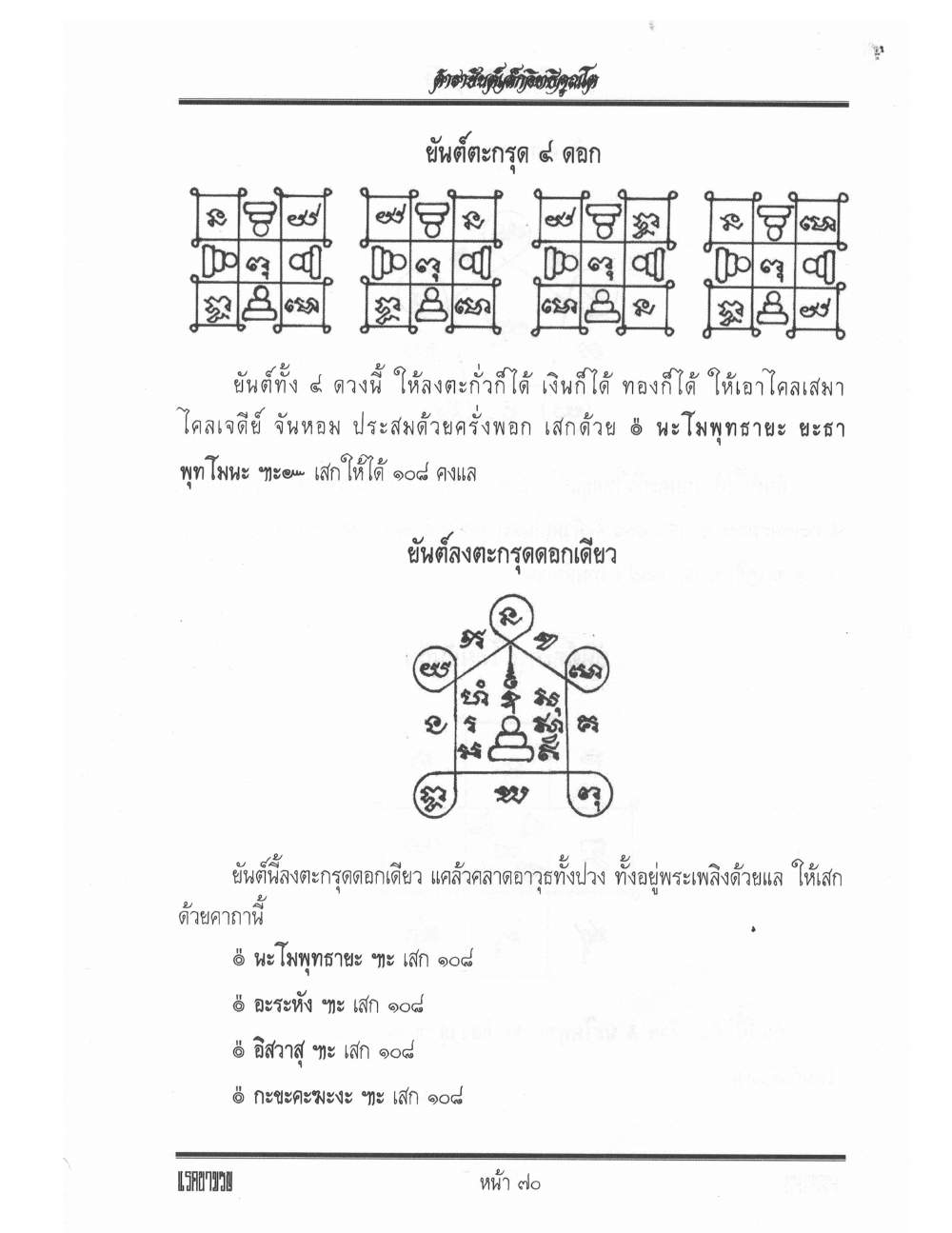
[อ่านไม่ออก]
ยันต์ตะกรุด ๔ ดอก
[อักขระในยันต์ อ่านไม่ชัด]
ยันต์ทั้ง ๔ ดวงนี้ ให้ลงตะกั่วก็ได้ เงินก็ได้ ทองก็ได้ ให้เอาไคลเสมา ไคลเจดีย์ จันทน์หอม ประสมด้วยครั่งพอก เสกด้วย ๐ พะโมพุทธายะ ยะธา พุทโมพะ ๚ะ เสกให้ได้ ๑๐๘ คงแล
ยันต์ลงตะกรุดดอกเดียว
[อักขระในยันต์ อ่านไม่ชัด]
ยันต์นี้ลงตะกรุดดอกเดียว แคล้วคลาดอาวุธทั้งปวง ทั้งอยู่พระเพลิงด้วยแล ให้เสก ด้วยคาถานี้ ๐ พะโมพุทธายะ ๚ะ เสก ๑๐๘ ๐ อะระหัง ๚ะ เสก ๑๐๘ ๐ อิสวาสุ ๚ะ เสก ๑๐๘ ๐ กะขะคะฆะงะ ๚ะ เสก ๑๐๘
[running header, illegible]
Four-Bud Takrut Yantra
[yantra: four repeated three-by-three grids, each with a small stupa-like emblem in the centre cell and syllables filling the eight surrounding cells]
These four yantra discs may be inscribed on lead, silver, or gold. Take dust scraped from a boundary-marker stone and from a chedi, mixed with sandalwood, and coat it with lac. Consecrate with: "Pha mo phutthaya yatha phutmopha." Chant it until recited 108 times.
Single-Bud Takrut Yantra
[yantra: a house-shaped figure with a peaked roofline, a syllable at its apex, four syllables at its rounded corner-lobes, and a vertical column of khom syllables together with a small stupa emblem at its centre]
This yantra, inscribed as a single-bud takrut amulet, grants freedom from all weapons, and even protection amid fire. Consecrate it with these spells: "Pha mo phutthaya" -- chant 108 times. "Arahang" -- chant 108 times. "Itsawasu" -- chant 108 times. "Ka-kha-kha-gha-nga" -- chant 108 times.
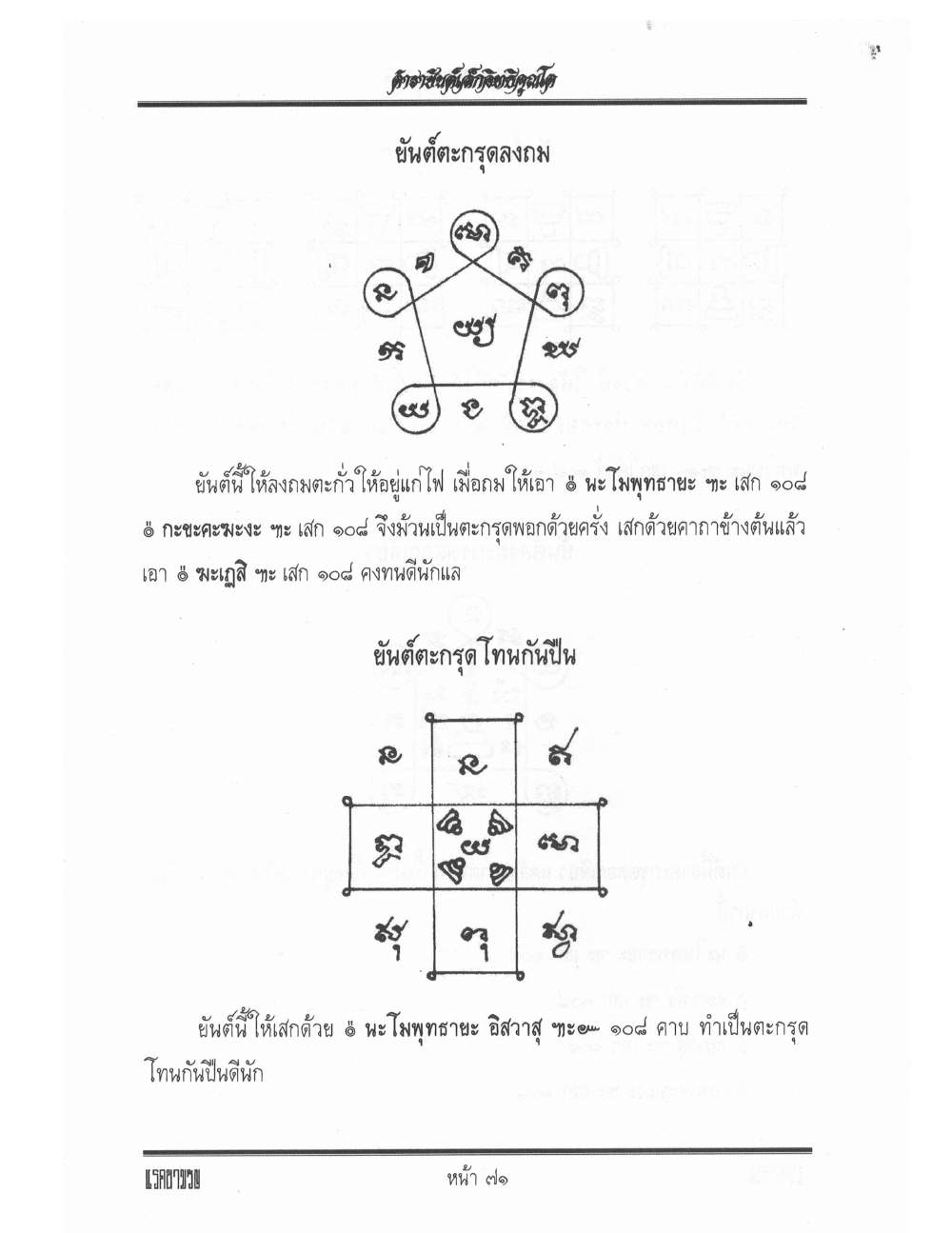
[อ่านไม่ออก]
ยันต์ตะกรุดลงถม
[อักขระในยันต์ อ่านไม่ชัด]
ยันต์นี้ให้ลงถมตะกั่วให้อยู่แก่ไฟ เมื่อถมให้เอา ๐ พะโมพุทธายะ ๚ะ เสก ๑๐๘ ๐ กะขะคะฆะงะ ๚ะ เสก ๑๐๘ จึงม้วนเป็นตะกรุดพอกด้วยครั่ง เสกด้วยคาถาข้างต้นแล้ว เอา ๐ มะเฏสิ ๚ะ เสก ๑๐๘ คงทนดีนักแล
ยันต์ตะกรุดโทนกันปืน
[อักขระในยันต์ อ่านไม่ชัด]
ยันต์นี้ให้เสกด้วย ๐ พะโมพุทธายะ อิสวาสุ ๚ะ ๑๐๘ คาบ ทำเป็นตะกรุด โทนกันปืนดีนัก
[running header, illegible]
Niello-Inlaid Takrut Yantra
[yantra: a five-pointed star-like figure with a circular medallion at each of the five points, joined by crossing lines, and a cluster of syllables at the centre]
Inlay this yantra onto lead kept over the fire. When inlaying, consecrate with "Pha mo phutthaya" 108 times and "Ka-kha-kha-gha-nga" 108 times, then roll it into a takrut and coat it with lac; consecrate with the spells above, then with "Ma thesi" 108 times, for very great durability.
Twin Bullet-Warding Solitary Takrut Yantra
[yantra: a cross/plus-shaped grid formed of three stacked rectangular bands, each divided into three cells, syllables filling all nine cells]
Consecrate this yantra with "Pha mo phutthaya itsawasu" 108 times, and make it into a solitary takrut amulet; it wards off bullets very well.
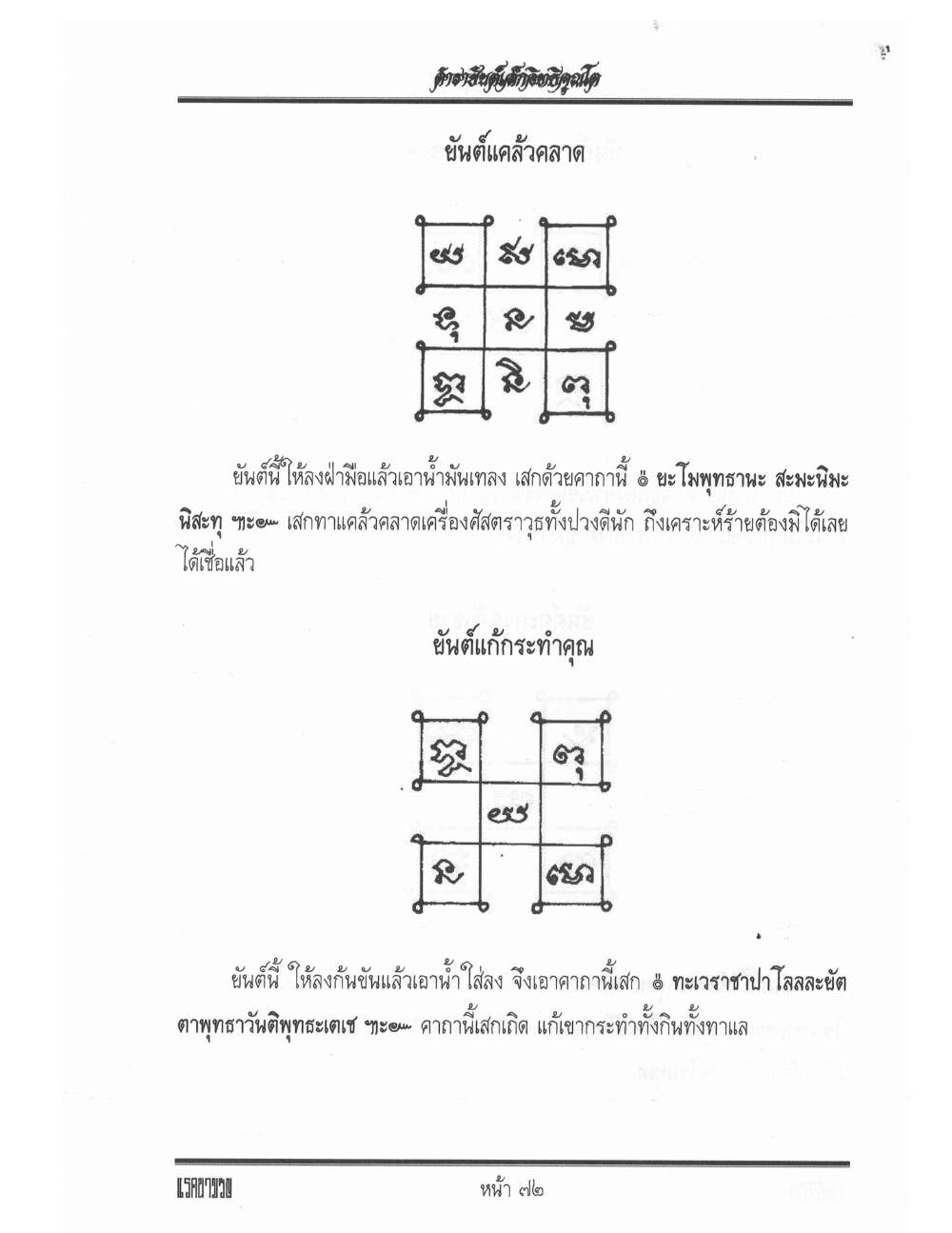
ยันต์แคล้วคลาด
[อักขระขอมในยันต์ อ่านไม่ชัด]
ยันต์นี้ให้ลงฝ่ามือแล้วเอาน้ำมันเทลง เสกด้วยคาถานี้ ๏ ยะโมพุทธานะ สะมะพิมะพิสะทุ ๚ะ เสกทาแคล้วคลาดเครื่องศัสตราวุธทั้งปวงดีนัก ถึงเคราะห์ร้ายต้องมิได้เลย ได้เชื่อแล้ว
ยันต์แก้กระทำคุณ
[อักขระขอมในยันต์ อ่านไม่ชัด]
ยันต์นี้ให้ลงก้นขันแล้วเอาน้ำใส่ลง จึงเอาคาถานี้เสก ๏ ทะเวราชาปาโลลละยัตตาพุทธาวันติพุทธะเตเช ๚ะ คาถานี้เสกเกิด แก้เขากระทำทั้งกินทั้งทาแล
Yantra of Escaping Harm
[yantra: two separate two-cell rectangular columns side by side, each split by a horizontal line into an upper and lower cell with a khom syllable in each, and one further khom syllable floating in the gap between them at mid-height — nine khom syllables in total across the figure]
For this yantra, have it drawn onto the palm of the hand, then pour oil over it; consecrate with this spell: "Yamo phutthana samaphima phisathu." Anoint with it to ward off all manner of weapons very well; even grave misfortune cannot touch you at all. Trust it.
Yantra to Counter Black Magic
[yantra: two separate two-cell rectangular columns side by side, each split by a horizontal line into an upper and lower cell with a khom syllable in each, and one further khom syllable in the gap between them]
For this yantra, inscribe it on the bottom of a bowl, then pour water in; then take this spell and consecrate it: "Thewaracha palolalayat taphutthawanti phutthadetche." Once consecrated with this spell, it undoes whatever [black magic] has been worked against you, whether by food or by anointing.
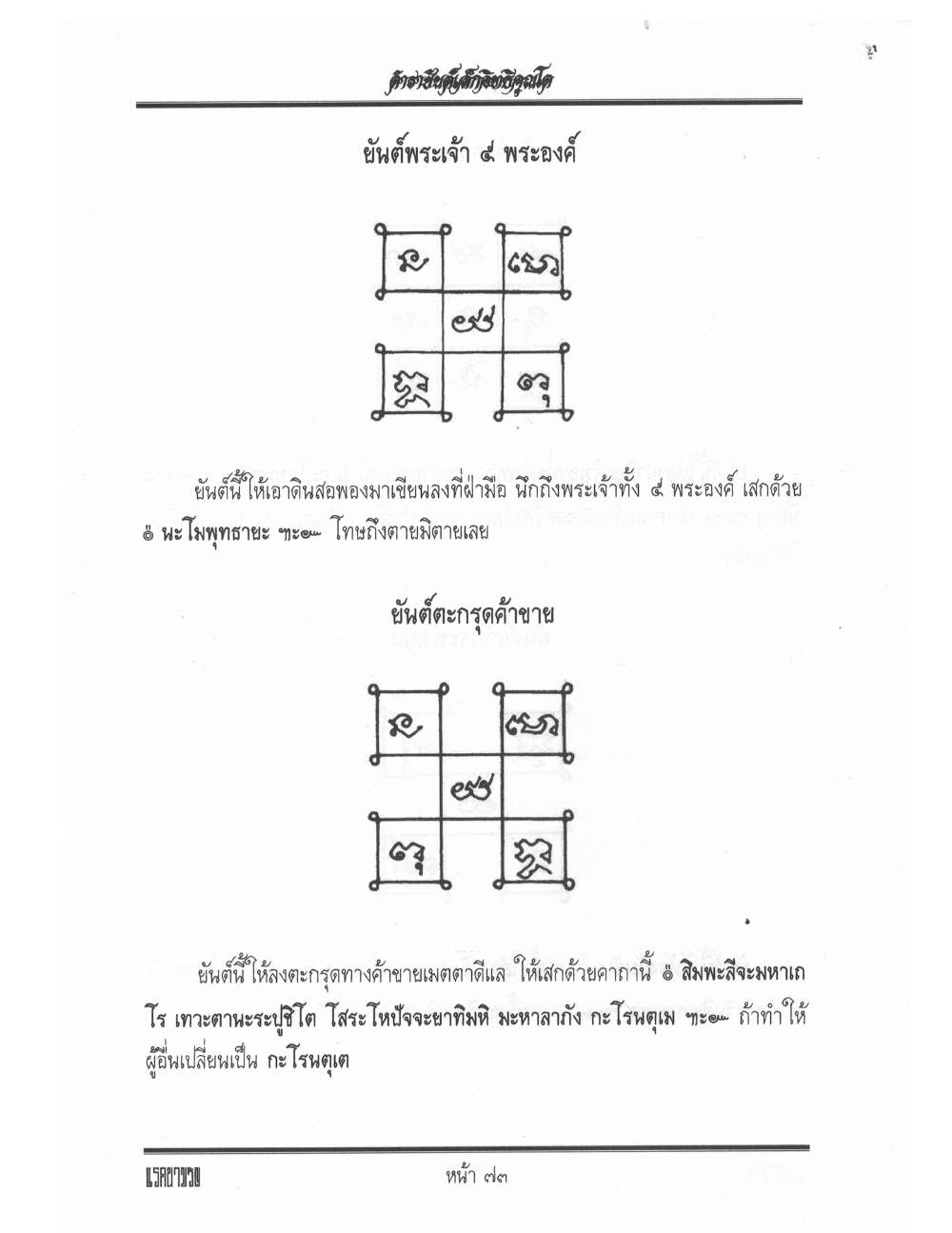
ยันต์พระเจ้า ๔ พระองค์
[อักขระขอมในยันต์ อ่านไม่ชัด]
ยันต์นี้ให้เอาดินสอพองมาเขียนลงที่ฝ่ามือ นึกถึงพระเจ้าทั้ง ๔ พระองค์ เสกด้วย ๏ นะโมพุทธายะ ๚ะ โทษถึงตายมิตายเลย
ยันต์ตะกรุดค้าขาย
[อักขระขอมในยันต์ อ่านไม่ชัด]
ยันต์นี้ให้ลงตะกรุดทางค้าขายเมตตาดีแล ให้เสกด้วยคาถานี้ ๏ สิมพะลีจะมหาเถโร เทวะตานะระปูชิโต โสระโหปัจจะยาทิมหิ มะหาลากัง กะโรนตุเม ๚ะ ถ้าทำให้ผู้อื่นเปลี่ยนเป็น กะโรนตุเต
Yantra of the Four Lords
[yantra: two separate two-cell rectangular columns side by side, each split by a horizontal line into an upper and lower cell with a khom syllable in each — one syllable for each of the Four Lords — and one further khom syllable in the gap between the columns]
For this yantra, take sacred white chalk (din sor phong) and write it onto the palm of the hand, calling to mind all Four Lords; consecrate with "Namo phutthaya." Even a sentence of death will not kill you.
Trade Takrut Yantra
[yantra: two separate two-cell rectangular columns side by side, each split by a horizontal line into an upper and lower cell with a khom syllable in each, and one further khom syllable in the gap between them]
For this yantra, inscribe it as a takrut for trading and commerce; it brings excellent favor (metta). Consecrate with this spell: "Simphali cha mahathero thewatana naraphuchito sorahopatchayathimhi mahalakang karontu me." If working it on behalf of someone else, change the ending to "karontu te."
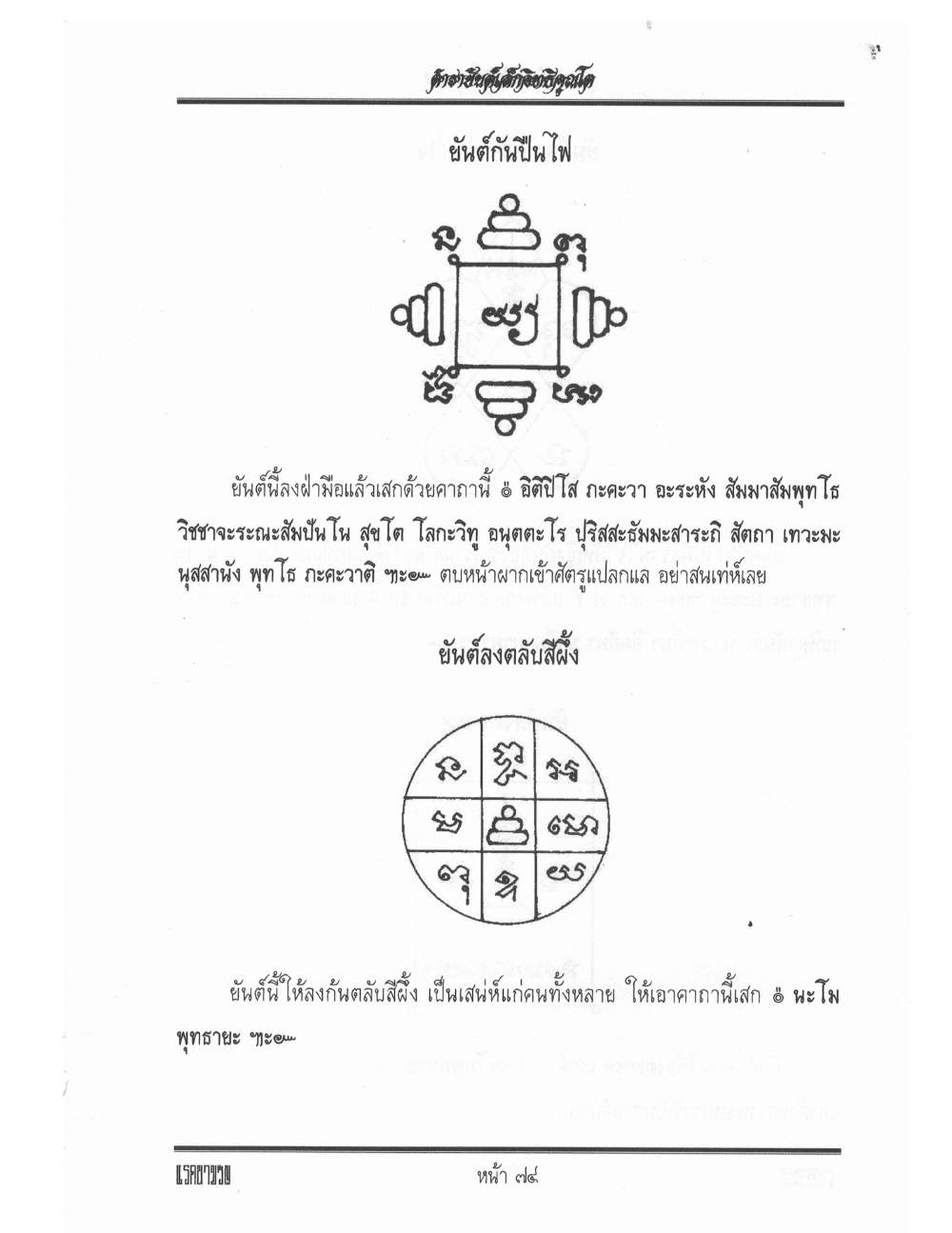
ยันต์กันปืนไฟ
[อักขระขอมในยันต์ อ่านไม่ชัด]
ยันต์นี้ลงฝ่ามือแล้วเสกด้วยคาถานี้ ๏ อิติปิโส กะคะวา อะระหัง สัมมาสัมพุทโธ วิชชาจะระณะสัมปันโน สุคะโต โลกะวิทู อนุตตะโร ปุริสะธัมมะสาระถิ สัตถา เทวะมะนุสสานัง พุทโธ ภะคะวาติ ๚ะ ตบหน้าผากเข้าศัตรูแปลกแล อย่าสนเท่ห์เลย
ยันต์ลงตลับสีผึ้ง
[อักขระขอมในยันต์ อ่านไม่ชัด]
ยันต์นี้ให้ลงก้นตลับสีผึ้ง เป็นเสน่ห์แก่คนทั้งหลาย ให้เอาคาถานี้เสก ๏ นะโมพุทธายะ ๚ะ
Firearm-Warding Yantra
[yantra: a central circle flanked by two curved bracket-shapes resembling handles, the whole framed above and below by a two-tier stepped pagoda (chedi) emblem, with a khom syllable beside each pagoda and inside each bracket shape]
For this yantra, inscribe it on the palm of the hand, then consecrate with this spell — the Itipiso recollection: "Itipiso bhagavā arahaṃ sammāsambuddho, vijjācaraṇasampanno, sugato, lokavidū, anuttaro purisadammasārathi, satthā devamanussānaṃ, buddho bhagavā ti" ("Such is the Blessed One: worthy, perfectly self-awakened, endowed with knowledge and conduct, well-gone, knower of the world, unsurpassed guide of persons to be tamed, teacher of gods and humans, awakened, blessed"). Press it to your forehead when facing an enemy — most extraordinary; have no doubt about it at all.
Yantra for a Beeswax Cosmetic Tin
[yantra: a circular figure divided into nine cells (three by three), a small stacked pagoda emblem in the center cell, khom syllables in the eight surrounding cells]
For this yantra, inscribe it on the bottom of a beeswax cosmetic tin — it grants charm and allure over people generally. Consecrate it with this spell: "Namo phutthaya."
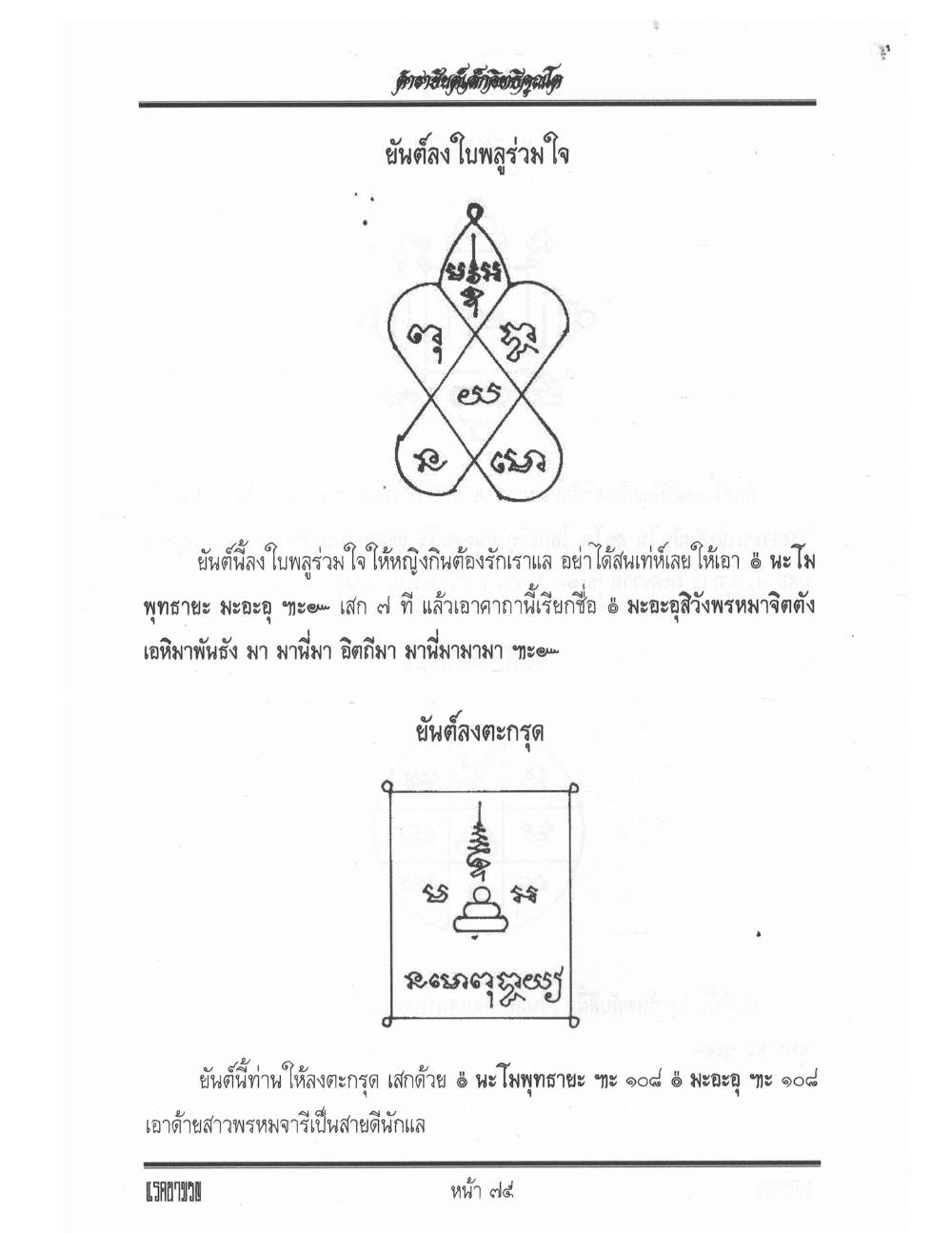
ยันต์ลงใบพลูร่วมใจ
[อักขระขอมในยันต์ อ่านไม่ชัด]
ยันต์นี้ลงใบพลูร่วมใจให้หญิงกินต้องรักเราแล อย่าได้สนเท่ห์เลย ให้เอา ๏ พะโมพุทธายะ มะอะอุ ๚ะ เสก ๗ ที แล้วเอาคาถานี้เรียกชื่อ ๏ มะอะอุสิวังพรหมาจิตตัง เอหิมาพันธัง มา มาพี่มา อิตถีมา มาพี่มามามา ๚ะ
ยันต์ลงตะกรุด
[อักขระขอมในยันต์ อ่านไม่ชัด]
ยันต์นี้ท่านให้ลงตะกรุด เสกด้วย ๏ พะโมพุทธายะ ๚ะ ๑๐๘ ๏ มะอะอุ ๚ะ ๑๐๘ เอาด้ายสาวพรหมจารีเป็นสายดีนักแล
Yantra Inscribed on a Betel Leaf, "Hearts United"
[yantra: a four-lobed interlocking loop shape like a cloverleaf or infinity-knot, a cluster of three stacked khom syllables at the top stem, one khom syllable in each of the four lobes, and one more khom syllable where the loops cross at the center]
For this yantra, write it on a betel leaf for a woman to eat so that hearts are joined — she must come to love us; have no doubt about it at all. Take "Phamo phutthaya, ma a u," consecrate 7 times; then take this spell and call out her name: "Ma a u siwang phrommachittang, ehimaphantang, ma, maphima, itthima, maphimamama."
Yantra for a Takrut
[yantra: a rectangular border containing a flame-like emblem above a stacked pagoda base at the center, flanked by two khom syllables, with a line of cursive khom script running along the bottom of the panel]
For this yantra, inscribe it as a takrut; consecrate with "Phamo phutthaya," 108 [times]; "Ma a u," 108 [times]. Use thread spun by an unmarried, chaste maiden as the binding cord — very excellent indeed.
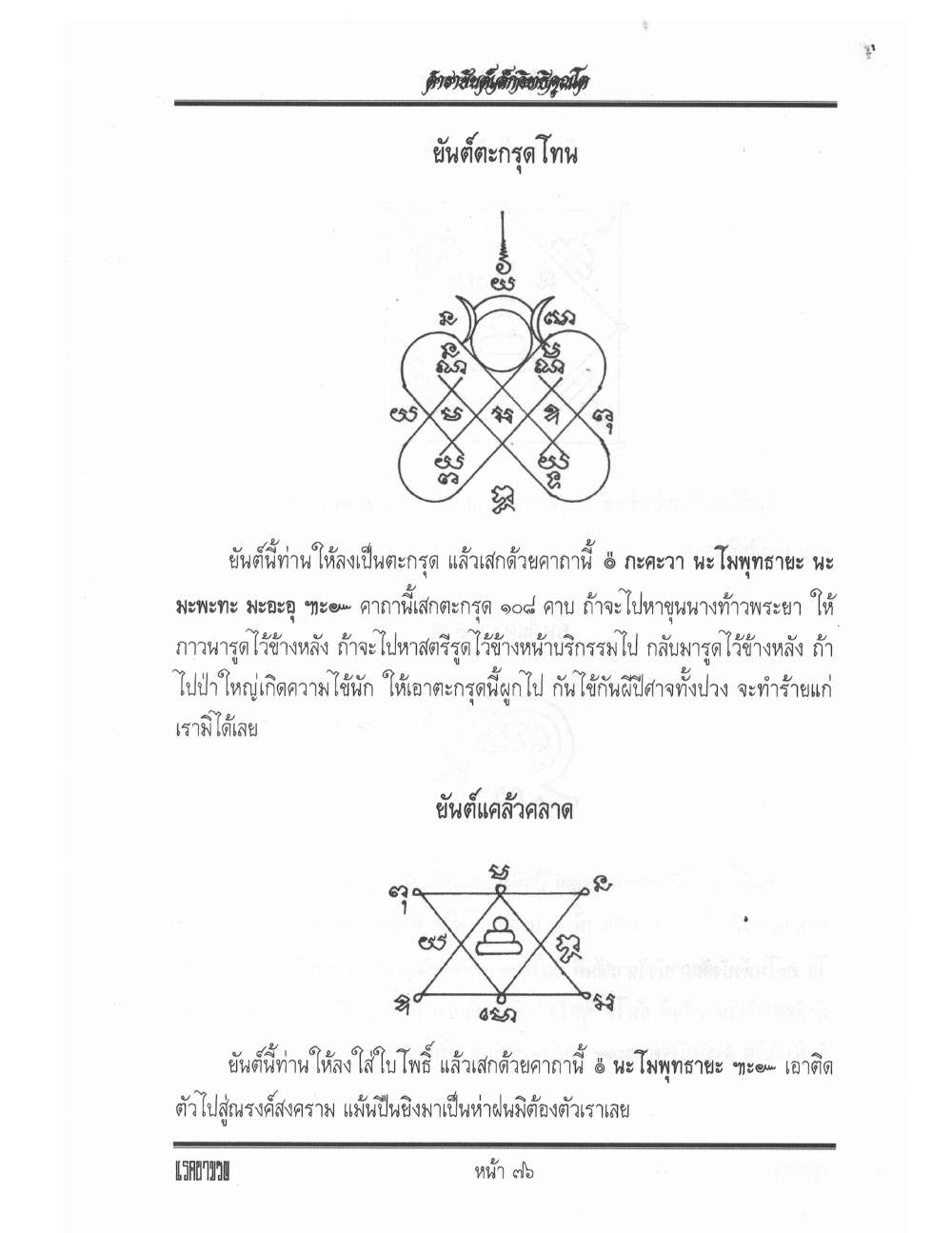
ยันต์ตะกรุดโทน
[อักขระขอมในยันต์ อ่านไม่ชัด]
ยันต์นี้ท่านให้ลงเป็นตะกรุด แล้วเสกด้วยคาถานี้ ๏ กะคะวา นะโมพุทธายะ นะ มะพะทะ มะอะอุ ๚ะ คาถานี้เสกตะกรุด ๑๐๘ คาบ ถ้าจะไปหาขุนนางท้าวพระยา ให้ภาวนารูดไว้ข้างหลัง ถ้าจะไปหาสตรีรูดไว้ข้างหน้าบริกรรมไป กลับมารูดไว้ข้างหลัง ถ้าไปป่าใหญ่เกิดความไข้พัก ให้เอาตะกรุดนี้ผูกไป กันไข้กันผีปีศาจทั้งปวง จะทำร้ายแก่เรามิได้เลย
ยันต์แคล้วคลาด
[อักขระขอมในยันต์ อ่านไม่ชัด]
ยันต์นี้ท่านให้ลงใส่ใบโพธิ์ แล้วเสกด้วยคาถานี้ ๏ นะโมพุทธายะ ๚ะ เอาติดตัวไปสู่ณรงค์สงคราม แม้นปืนยิงมาเป็นห่าฝนมิต้องตัวเราเลย
Solitary Takrut Yantra
[yantra: a flame-like finial above a circle flanked by two crescent-moon shapes, a khom syllable on each side of the circle, below which sit two stacked X-shaped (bowtie) lattices packed with khom syllables at each arm, and one further syllable at the bottom point]
For this yantra, inscribe it as a takrut, then consecrate with this spell: "Kakhawa namo phutthaya na maphatha maau." Consecrate the takrut with this spell 108 times. If going to see a nobleman, prince, or lord, recite while stroking it behind you [out of sight]; if going to see a woman, stroke it in front of you while reciting, then stroke it behind you again on the way back. If going into deep forest and taken with fever, tie on this takrut — it wards off fever and every kind of ghost and evil spirit; nothing can harm us at all.
Yantra of Escaping Harm
[yantra: a six-pointed star (hexagram) with a khom syllable at each of the six outer points and a seated Buddha/stupa emblem in the center]
For this yantra, inscribe it onto a bodhi leaf, then consecrate with this spell: "Namo phutthaya." Carry it on your person into battle — even if bullets come like a downpour of rain, they will not touch our body at all.
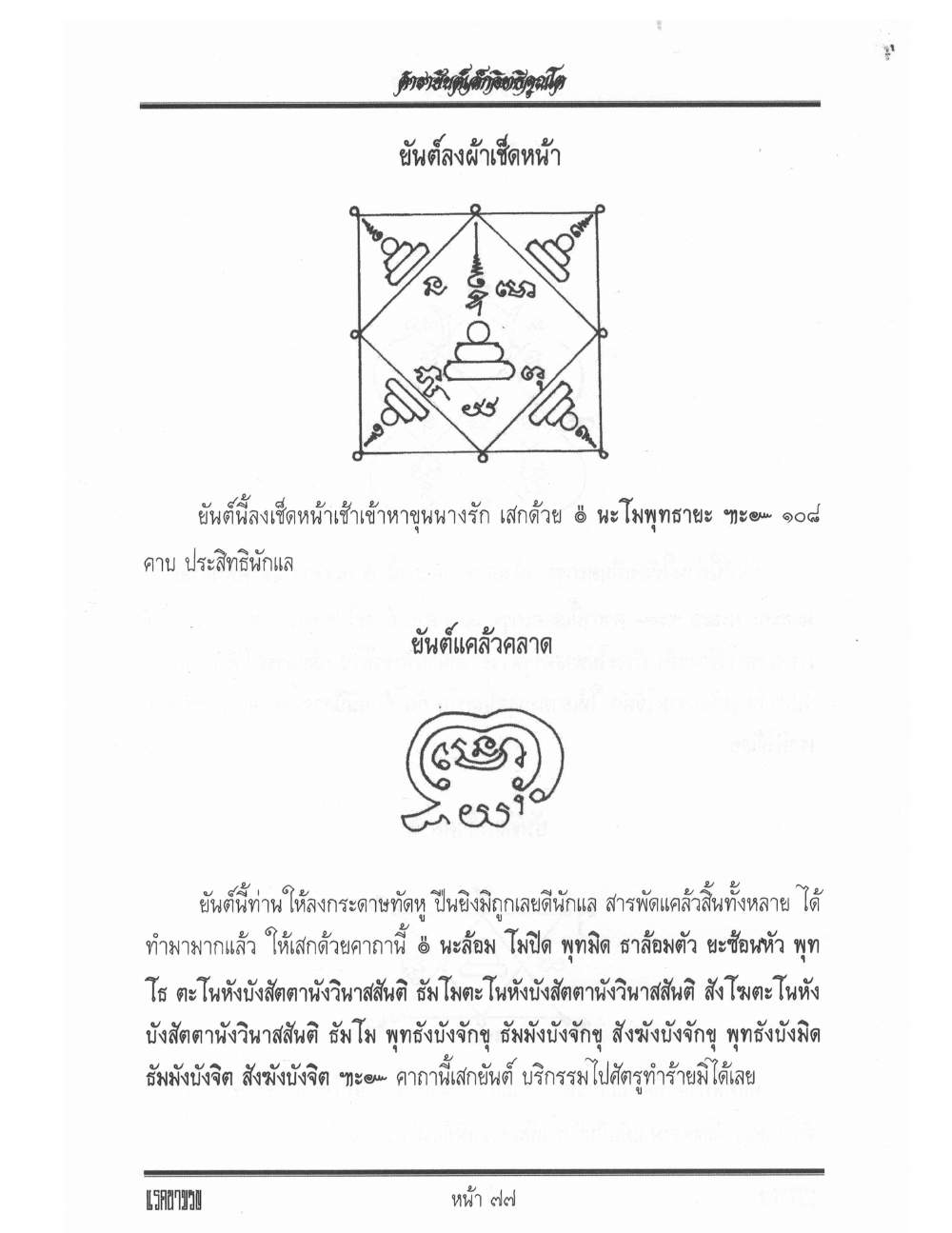
ยันต์ลงผ้าเช็ดหน้า
[อักขระขอมในยันต์ อ่านไม่ชัด]
ยันต์นี้ลงเช็ดหน้าเช้าเข้าหาขุนนางรัก เสกด้วย ๏ พะโมพุทธายะ ๚ะ ๑๐๘ คาบ ประสิทธินักแล
ยันต์แคล้วคลาด
[อักขระขอมในยันต์ อ่านไม่ชัด]
ยันต์นี้ท่านให้ลงกระดาษทัดหู ปืนยิงมิถูกเลยดีนักแล สารพัดแคล้วคลาดสิ้นทั้งหลาย ได้ทำมามากแล้ว ให้เสกด้วยคาถานี้ ๏ นะล้อม โมปิด พุทมิด ธาล้อมตัว ยะซ้อนหัว พุทโธ ตะโนหังบังสัตตานังวินาศสันติ ธัมโมตะโนหังบังสัตตานังวินาศสันติ สังโฆตะโนหังบังสัตตานังวินาศสันติ ธัมโม พุทธังบังจักขุ ธัมมังบังจักขุ สังฆังบังจักขุ พุทธังบังมิด ธัมมังบังจิต สังฆังบังจิต ๚ะ คาถานี้เสกยันต์ บริกรรมไปศัตรูทำร้ายมิได้เลย
Yantra for a Handkerchief
[yantra: a square containing an inscribed diamond, decorative spiked flourishes at the square's four corners, khom syllables at the four points of the diamond and two more flanking a small stacked pagoda emblem at the center]
For this yantra, wipe [your face] with it each morning before going to seek favor from a nobleman; consecrate with "Phamo phutthaya," 108 times — most efficacious indeed.
Yantra of Escaping Harm
[yantra: an oval, ribbon-like cartouche containing two stacked khom syllables]
For this yantra, inscribe it on paper and tuck it behind the ear; bullets fired will never strike you — most excellent indeed. It wards off every kind of harm without exception; it has proven itself many times already. Consecrate it with this spell: "Na lom, mo pit, phut mit, tha lom tua, ya son hua, phutto tano hang bang sattanang winat santi, thammo tano hang bang sattanang winat santi, sangkho tano hang bang sattanang winat santi, thammo, phutthang bang chakkhu, thammang bang chakkhu, sangkhang bang chakkhu, phutthang bang mit, thammang bang chit, sangkhang bang chit." Recite this spell as you consecrate the yantra, and go about — enemies cannot harm you at all.
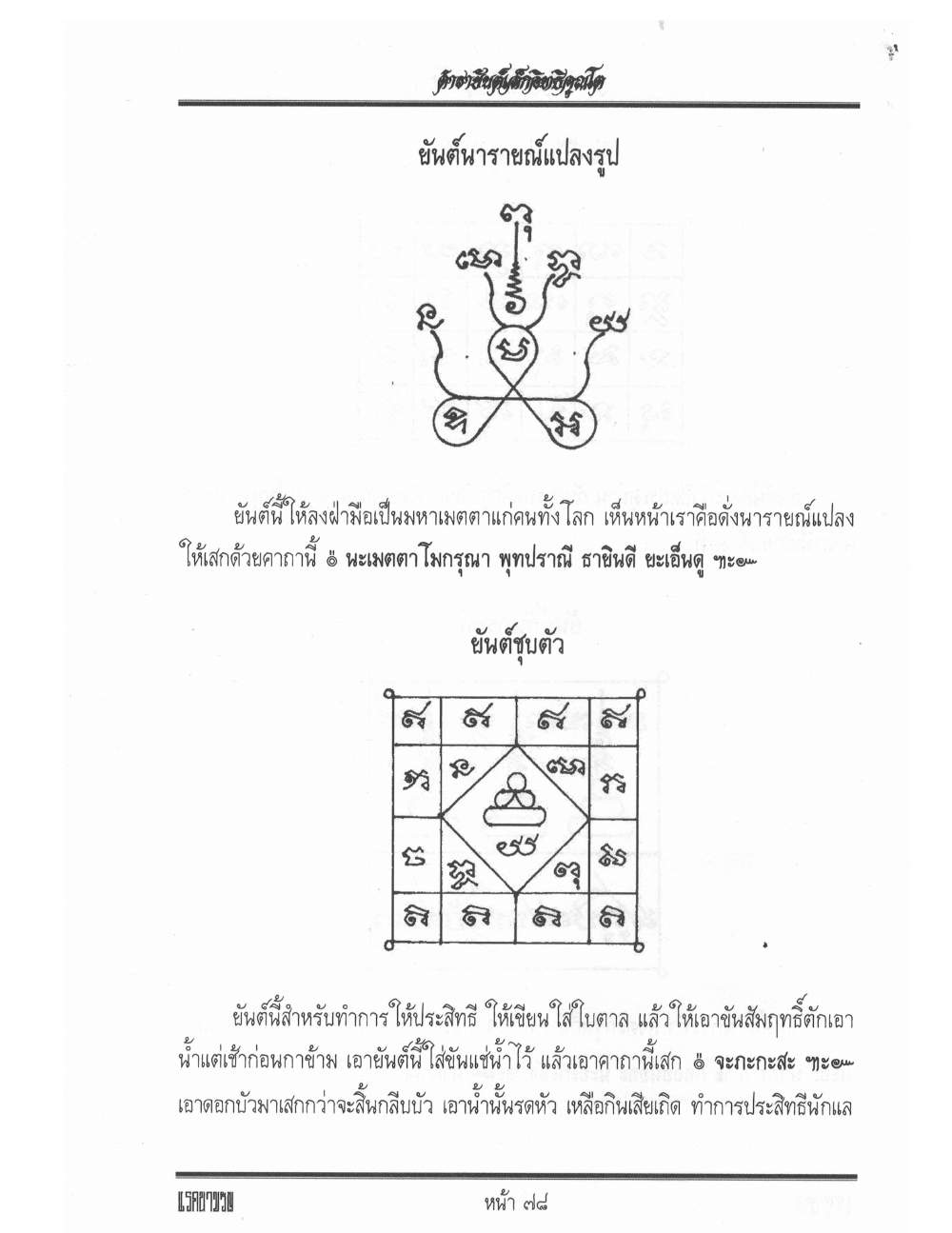
ยันต์นารายณ์แปลงรูป
[อักขระขอมในยันต์ อ่านไม่ชัด]
ยันต์นี้ให้ลงฝ่ามือเป็นมหาเมตตาแก่คนทั้งโลก เห็นหน้าเราคือดั่งนารายณ์แปลง ให้เสกด้วยคาถานี้ ๏ นะเมตตาโมกรุณา พุทปราณี ธายินดี ยะเอ็นดู ๚ะ
ยันต์ชุบตัว
[อักขระขอมในยันต์ อ่านไม่ชัด]
ยันต์นี้สำหรับทำการให้ประสิทธิ ให้เขียนใส่ใบตาล แล้วให้เอาขันสัมฤทธิ์ตักเอาน้ำแต่เช้าก่อนกาข้าม เอายันต์นี้ใส่ขันแช่น้ำไว้ แล้วเอาคาถานี้เสก ๏ จะภะกะสะ ๚ะ เอาดอกบัวมาเสกกว่าจะสิ้นกลีบบัว เอาน้ำนั้นรดหัว เหลือกินเสียเถิด ทำการประสิทธินักแล
Yantra of Narayana's Transformation
[yantra: a flower-like cluster of heart- and petal-shapes with a khom syllable in each — one at the top stem, one in the central heart, two in the side petals, and two more in the lower petals]
For this yantra, inscribe it in the palm of the hand as great loving-kindness toward all people of the world — whoever sees our face will see it as though Narayana had transformed [to appear before them]. Consecrate with this spell: "Na metta mo karuna, phut pranee, thayindee, yaendu."
Yantra to Immerse the Body
[yantra: a grid of sixteen cells (four by four), a diamond at the center containing three stacked circular emblems and a further khom syllable below them, khom syllables filling the twelve outer cells]
For this yantra to be made effective, write it onto a palm leaf, then take a bronze bowl and draw water with it early in the morning before the crows have crossed [the sky]. Place this yantra into the bowl to steep in the water, then take this spell and consecrate: "Chaphakasa." Take lotus blossoms and consecrate until every petal of the lotus is used up; take that water and pour it over the head, and drink what remains — it will be highly effective.
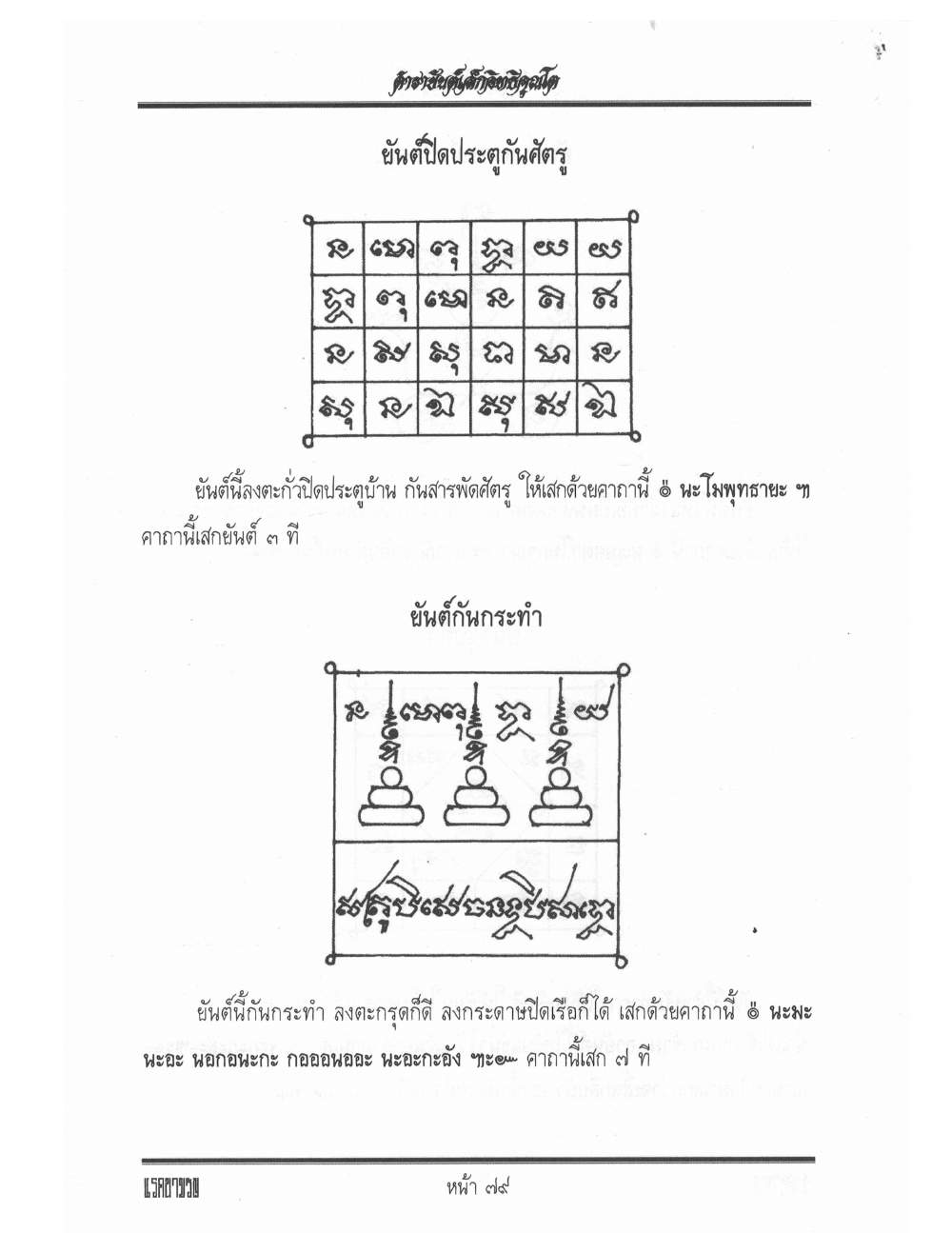
ยันต์ปิดประตูกันศัตรู
[อักขระขอมในยันต์ อ่านไม่ชัด]
ยันต์นี้ลงตะกั่วปิดประตูบ้าน กันสารพัดศัตรู ให้เสกด้วยคาถานี้ ๏ พะโมพุทธายะ ๚ะ คาถานี้เสกยันต์ ๓ ที
ยันต์กันกระทำ
[อักขระขอมในยันต์ อ่านไม่ชัด]
ยันต์นี้กันกระทำ ลงตะกรุดก็ดี ลงกระดาษปิดเรือนก็ได้ เสกด้วยคาถานี้ ๏ พะมะ พะอะ พอกอพะกะ กอออพอะ พะอะกะอัง ๚ะ คาถานี้เสก ๗ ที
Yantra to Shut the Door Against Enemies
[yantra: a grid of twenty-four cells (four rows of six), each filled with a khom syllable]
For this yantra, inscribe it on lead to seal a house door, warding off every kind of enemy; consecrate with this spell: "Phamo phutthaya." Consecrate this yantra 3 times.
Yantra Warding Off Sorcery
[yantra: a rectangle divided by a horizontal line — the upper half shows three stacked pagoda emblems, each surmounted by a khom syllable with further khom syllables flanking them, the lower half bears a single line of cursive khom script running the width of the panel]
This yantra wards off sorcery worked against you; inscribing it as a takrut is fine, or inscribing it on paper to seal a house is also fine. Consecrate with this spell: "Phama phaa phokphapaka koapha phaakaang." Consecrate this spell 7 times.
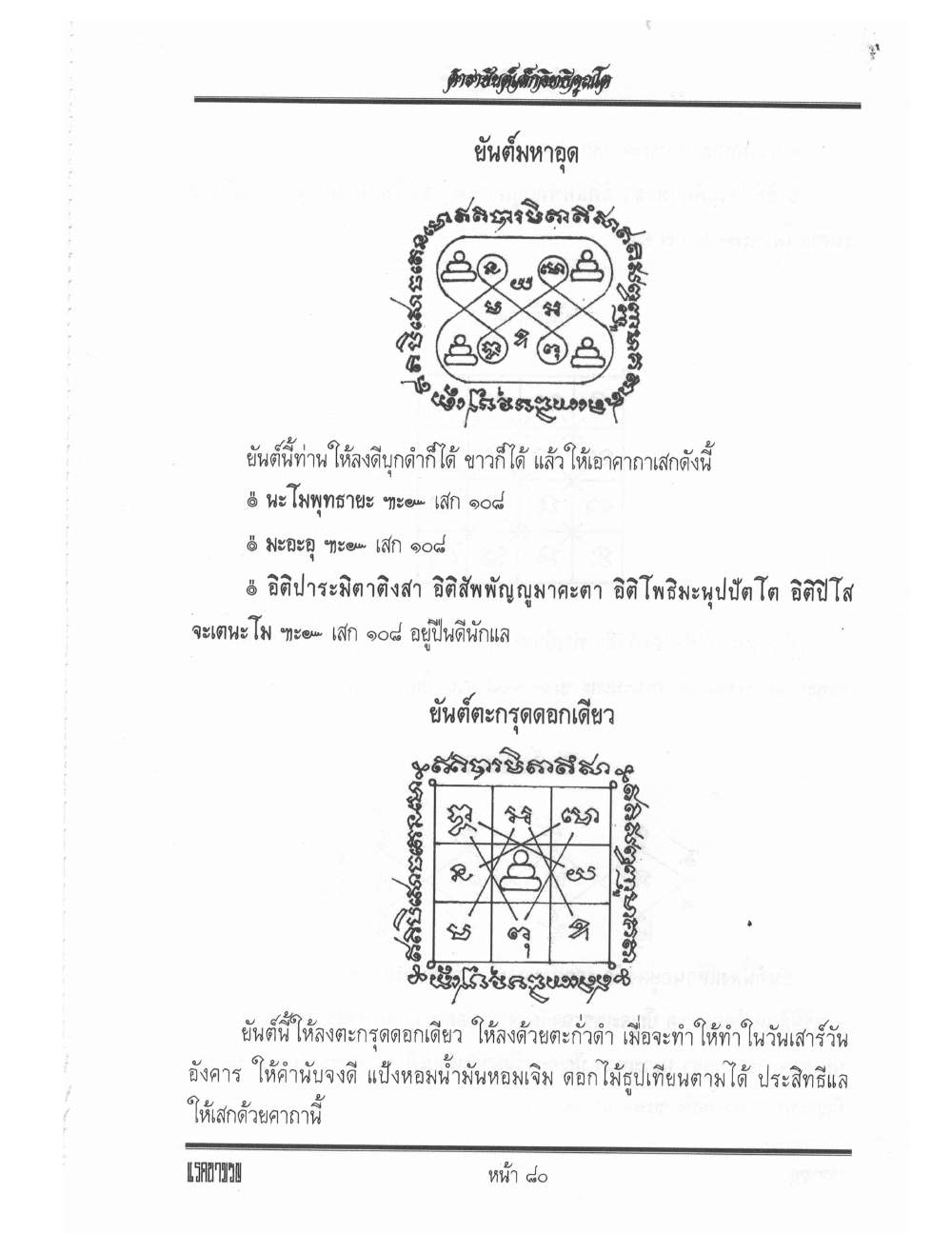
ยันต์มหาอุด
[อักขระขอมในยันต์ อ่านไม่ชัด]
ยันต์นี้ท่านให้ลงดินสอดำก็ได้ ขาวก็ได้ แล้วให้เอาคาถาเสกดังนี้ ๏ นะโมพุทธายะ ๚ะ เสก ๑๐๘ ๏ มะอะอุ ๚ะ เสก ๑๐๘ ๏ อิติปาระมิตาติงสา อิติสัพพัญญูมาคะตา อิติโพธิมะนุปปัตโต อิติปิโสจะเตนะโม ๚ะ เสก ๑๐๘ อยู่ยิงดีนักแล
ยันต์ตะกรุดดอกเดียว
[อักขระขอมในยันต์ อ่านไม่ชัด]
ยันต์นี้ให้ลงตะกรุดดอกเดียว ให้ลงด้วยตะกั่วดำ เมื่อจะทำให้ทำในวันเสาร์วันอังคาร ให้คำนับจงดี แป้งหอมน้ำมันหอมเจิม ดอกไม้ธูปเทียนตามได้ ประสิทธิ์แล ให้เสกด้วยคาถานี้
Great Invulnerability Yantra
[yantra: an oval border ringed with cursive khom script (not confidently legible), enclosing four small stupa emblems arranged in a 2x2 pattern, each containing a khom syllable, with two further khom syllables between them at the center]
For this yantra, you may draw it with black or white chalk pencil, then consecrate with these spells as follows: "Namo phutthaya," consecrate 108 [times]. "Ma a u," consecrate 108 [times]. "Iti paramita tingsa, iti sappannyu makata, iti photi manuppatto, iti piso cha te namo," consecrate 108 [times] — it makes one impervious to gunfire, very effective indeed.
Single-Flower Takrut Yantra
[yantra: an oval border ringed with cursive khom script, enclosing a grid of nine cells crossed by diagonal lines, a seated Buddha/stupa emblem in the center cell, khom syllables in the remaining eight cells]
For this yantra, make it as a single takrut, inscribed with black tin. When making it, do so on a Saturday or a Tuesday; pay proper respects, with fragrant powder and fragrant oil for anointing, and flowers, incense, and candles as available — thus made effective. Consecrate it with this spell —
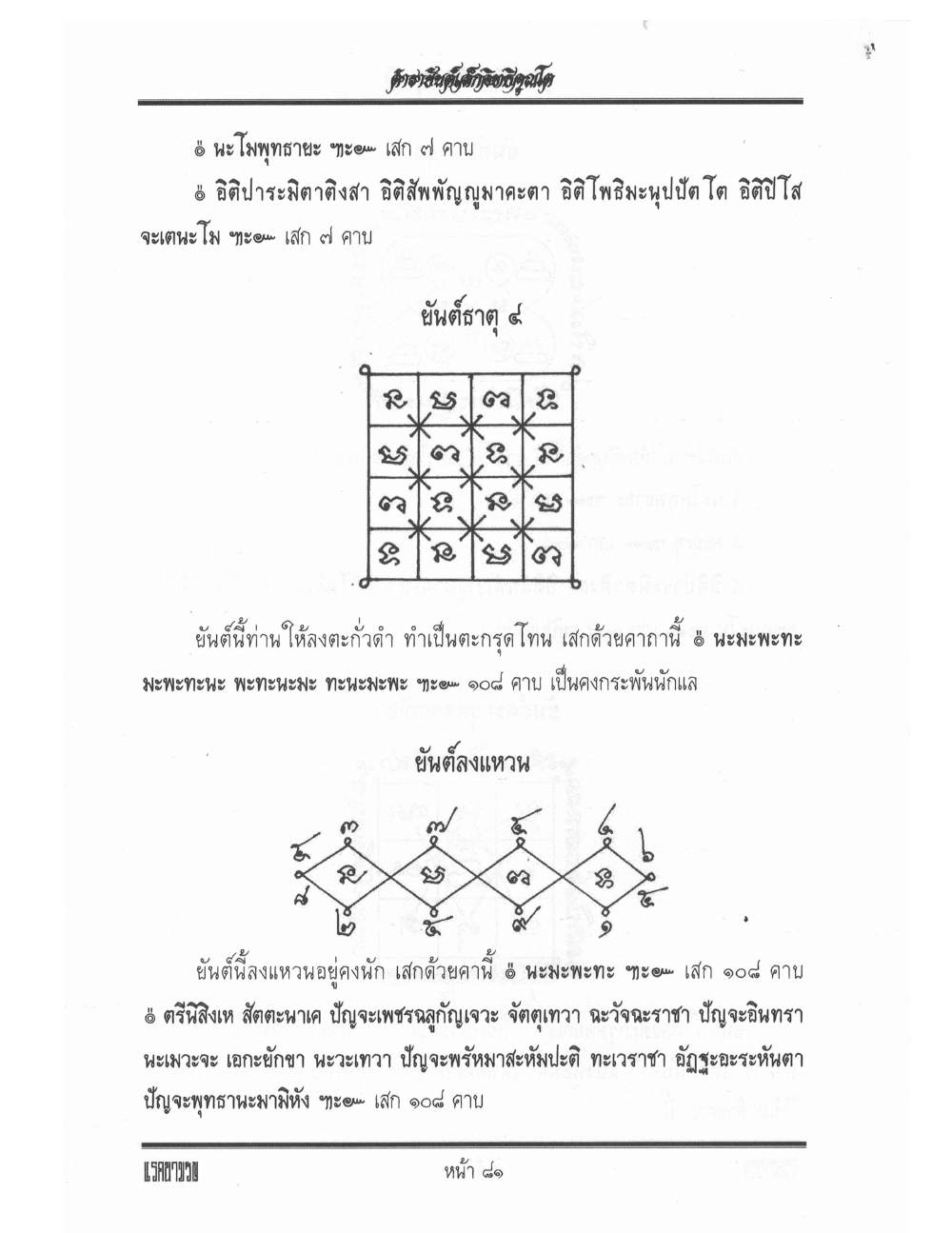
๏ นะโมพุทธายะ ๚ะ เสก ๗ คาบ ๏ อิติปาระมิตาติงสา อิติสัพพัญญูมาคะตา อิติโพธิมะนุปปัตโต อิติปิโสจะเตนะโม ๚ะ เสก ๗ คาบ
ยันต์ธาตุ ๔
[อักขระขอมในยันต์ อ่านไม่ชัด]
ยันต์นี้ท่านให้ลงตะกั่วดำ ทำเป็นตะกรุดโทน เสกด้วยคาถานี้ ๏ นะมะพะทะ มะพะทะนะ พะทะนะมะ ทะนะมะพะ ๚ะ ๑๐๘ คาบ เป็นคงกระพันนักแล
ยันต์ลงแหวน
[อักขระขอมในยันต์ อ่านไม่ชัด]
ยันต์นี้ลงแหวนอยู่คงนัก เสกด้วยคาถานี้ ๏ นะมะพะทะ ๚ะ เสก ๑๐๘ คาบ ๏ ตรีนิสิงเห สัตตะพาเค ปัญจะเพชรฉลูกัญเจาะ จัตุเทวา ฉะวัจฉะราชา ปัญจะอินทรา นะเมวะจะ เอกะยักขา นะวะเทวา ปัญจะพรหมาสะหัสปะติ ทะเวราชา อัฏฐะอะระหันตา ปัญจะพุทธานะมามิหัง ๚ะ เสก ๑๐๘ คาบ
[continuing the consecration for the Single-Flower Takrut Yantra from the previous page] "Namo phutthaya," consecrate 7 times. "Iti paramita tingsa, iti sappannyu makata, iti photi manuppatto, iti piso cha te namo," consecrate 7 times.
Yantra of the Four Elements
[yantra: a grid of sixteen cells (four by four), each containing a khom numeral-like character, diagonal cross-lines linking the cells]
For this yantra, inscribe it with black tin and make it into a solitary takrut; consecrate with this spell: "Namaphatha, maphathana, phathanama, thanamapha," 108 times — it grants great invulnerability (kong krapan).
Yantra for a Ring
[yantra: a row of four diamond shapes in a chain, each containing a khom syllable, with small petal-like tick marks radiating from the points of each diamond]
For this yantra, inscribe it on a ring for lasting invulnerability; consecrate with this spell: "Namaphatha," consecrate 108 times. "Trinisinghe sattaphake, panchaphet chalukanjo, chatuthewa, chawatcharacha, panchaindra, namewacha, ekayakkha, nawathewa, panchaphrommasahatpati, thewaracha, atthaarahanta, panchaphutthanamamihang," consecrate 108 times.
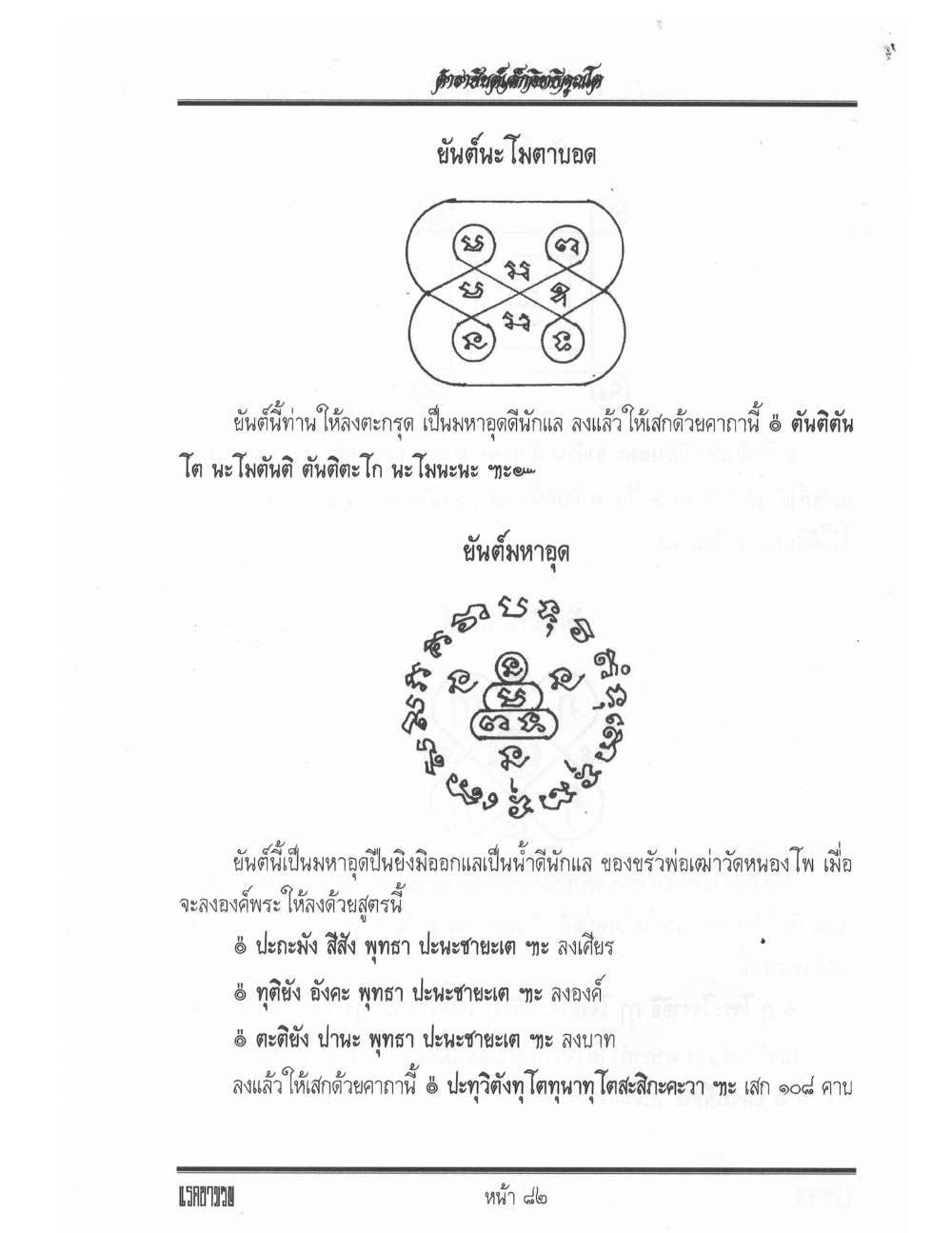
ยันต์นะโมตาบอด
[อักขระขอมในยันต์ อ่านไม่ชัด] ยันต์นี้ท่านให้ลงตะกรุด เป็นมหาอุดดีนักแล ลงแล้วให้เสกด้วยคาถานี้ ๏ ตันติตันโต นะโมตันติ ตันติตะโก นะโมนะ ๛
ยันต์มหาอุด
[อักขระขอมในยันต์ อ่านไม่ชัด] ยันต์นี้เป็นมหาอุดปืนยิงมิออกแลเป็นน้ำมันดีนักแล ของขรัวพ่อเฒ่าวัดหนองโพ เมื่อจะลงองค์พระให้ลงด้วยสูตรนี้ ๏ ปะถะมัง สีสัง พุทธา ปะนะชายะเต ๛ ลงเศียร ๏ ทุติยัง อังคะ พุทธา ปะนะชายะเต ๛ ลงองค์ ๏ ตะติยัง ปาทะ พุทธา ปะนะชายะเต ๛ ลงบาท ลงแล้วให้เสกด้วยคาถานี้ ๏ ปะทุวิตังทุโตทุนาทุโตสะสิกะคะวา ๛ เสก ๑๐๘ คาบ
Namo-Tabot Yantra
[yantra: a peanut-shaped outline made of two joined oval bands; four khom syllables sit in circles at the upper and lower crossing points, with two further khom syllables set uncircled between them in the middle] This yantra is to be inscribed onto a takrut; it is an excellent stopper-charm [against harm]. Once inscribed, consecrate it with this spell: "Tanti tanto namotanti tantitako namona" [chant].
Great Stopper (Maha-ut) Yantra
[yantra: a small three-tier pagoda shape, each tier holding its own khom syllable, encircled by a ring of further khom syllables] This yantra is a great stopper against gunfire and an excellent charm for consecrated oil; it belongs to Khrua Pho Thao of Wat Nong Pho. When inscribing it upon an image, inscribe it following this formula: "Pathamang sisang phutthā panachayate" [chant] — inscribe on the head. "Tutiyang angkha phutthā panachayate" [chant] — inscribe on the body. "Tatiyang pātha phutthā panachayate" [chant] — inscribe on the feet. Once inscribed, consecrate it with this spell: "Patuwitang thuto thuna thuto sasikakhawa" [chant], reciting it 108 times.
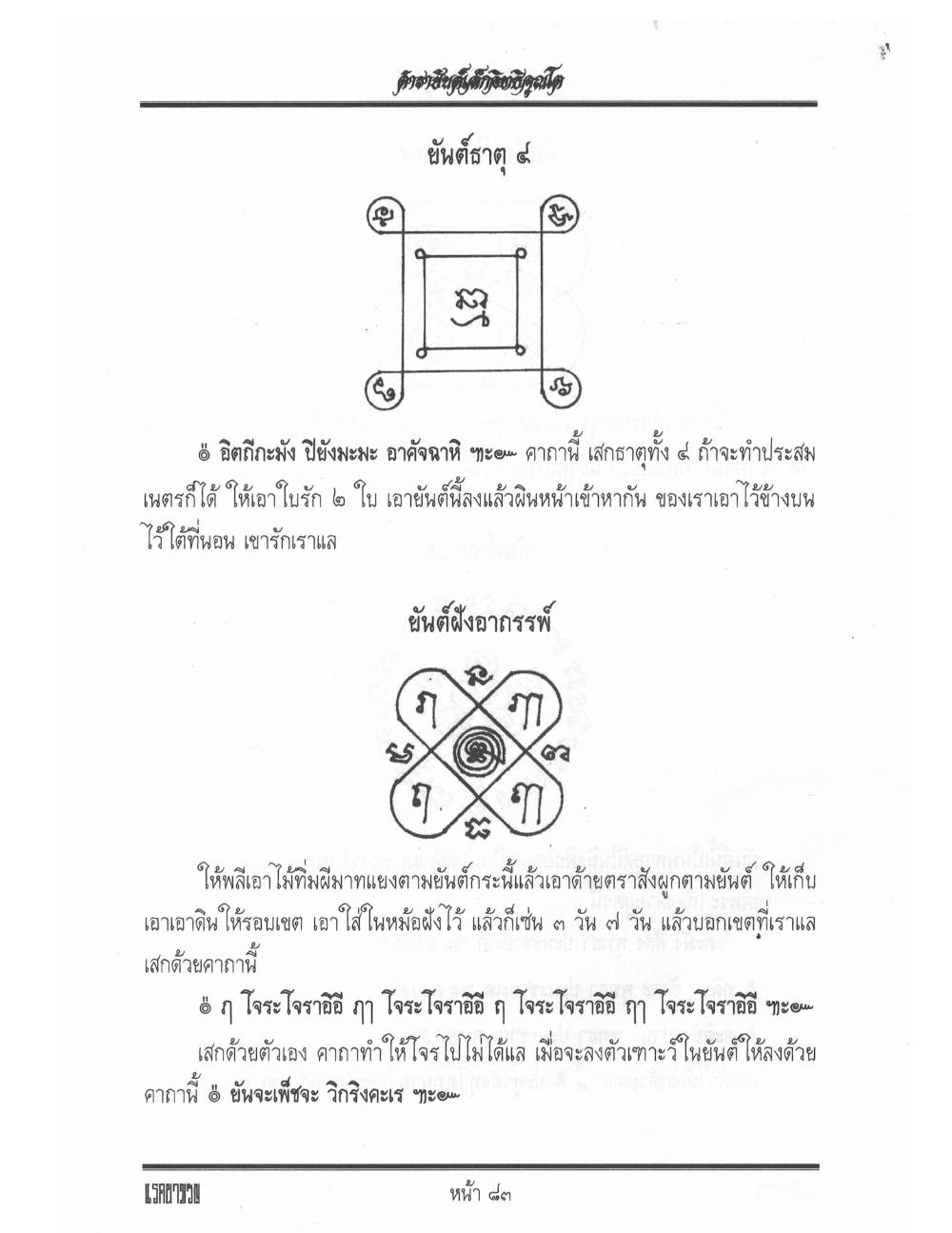
ยันต์ธาตุ ๔
[อักขระขอมในยันต์ อ่านไม่ชัด] ๏ อิติถิกะมัง ปิยังมะมะ อาคัจฉาหิ ๛ คาถานี้เสกธาตุทั้ง ๔ ถ้าจะทำประสมเพศรก็ได้ ให้เอาใบรัก ๒ ใบ เอายันต์นี้ลงแล้วผินหน้าเข้าหากัน ของเราเอาไว้ข้างบน ไว้ใต้ที่นอน เขารักเราแล
ยันต์ฝังอาถรรพ์
[อักขระขอมในยันต์ อ่านไม่ชัด] ให้พลีเอาไม้ทิ่มผีมาแยงตามยันต์กระนี้แล้วเอาด้วยตราสังผูกตามยันต์ ให้เก็บเอาเอาดินให้รอบเขต เอาใส่ในหม้อฝังไว้ แล้วก็เซ่น ๗ วัน ๗ วัน แล้วบอกเขตที่เราแล เสกด้วยคาถานี้ ๏ ฦ โจระโจราอิถิ ฦๅ โจระโจราอิถิ ฤ โจระโจราอิถิ ฤๅ โจระโจราอิถิ ๛ เสกด้วยตัวเอง คาถาทำให้โจรไปไม่ได้แล เมื่อจะลงตัวเทาะว่าในยันต์ให้ลงด้วยคาถานี้ ๏ ยันจะเพ็ชจะ วิกริงคะเร ๛
Four-Elements Yantra
[yantra: a square with a khom syllable circled at each of its four corners, and one further khom syllable inside the central square] "Itithikamang piyangmama akhatchahi" [chant] — this spell consecrates the four elements. If making a love-binding charm, take two betel-vine leaves, inscribe this yantra on them, then place them face to face; keep one of ours on top, and place it under the sleeping-mat — she will love us.
Buried Curse-Ward Yantra
[yantra: a four-petalled flower shape encircling a small central spiral, with a khom syllable in each of the four petals] Take a stick that has been used to prod a corpse-spirit and thrust it in following this yantra, then bind it with sacred cord according to the yantra. Gather earth to encircle the boundary, place it in a pot and bury it, then make offerings for seven days and seven days more, then declare the boundary as ours. Consecrate with this spell: "Lue jora jora-ithi, lue jora jora-ithi, rue jora jora-ithi, rue jora jora-ithi" [chant]. Consecrate it yourself; the spell keeps thieves from approaching. When inscribing the syllables within the yantra, inscribe them with this spell: "Yan cha phetcha, wikringkhare" [chant].
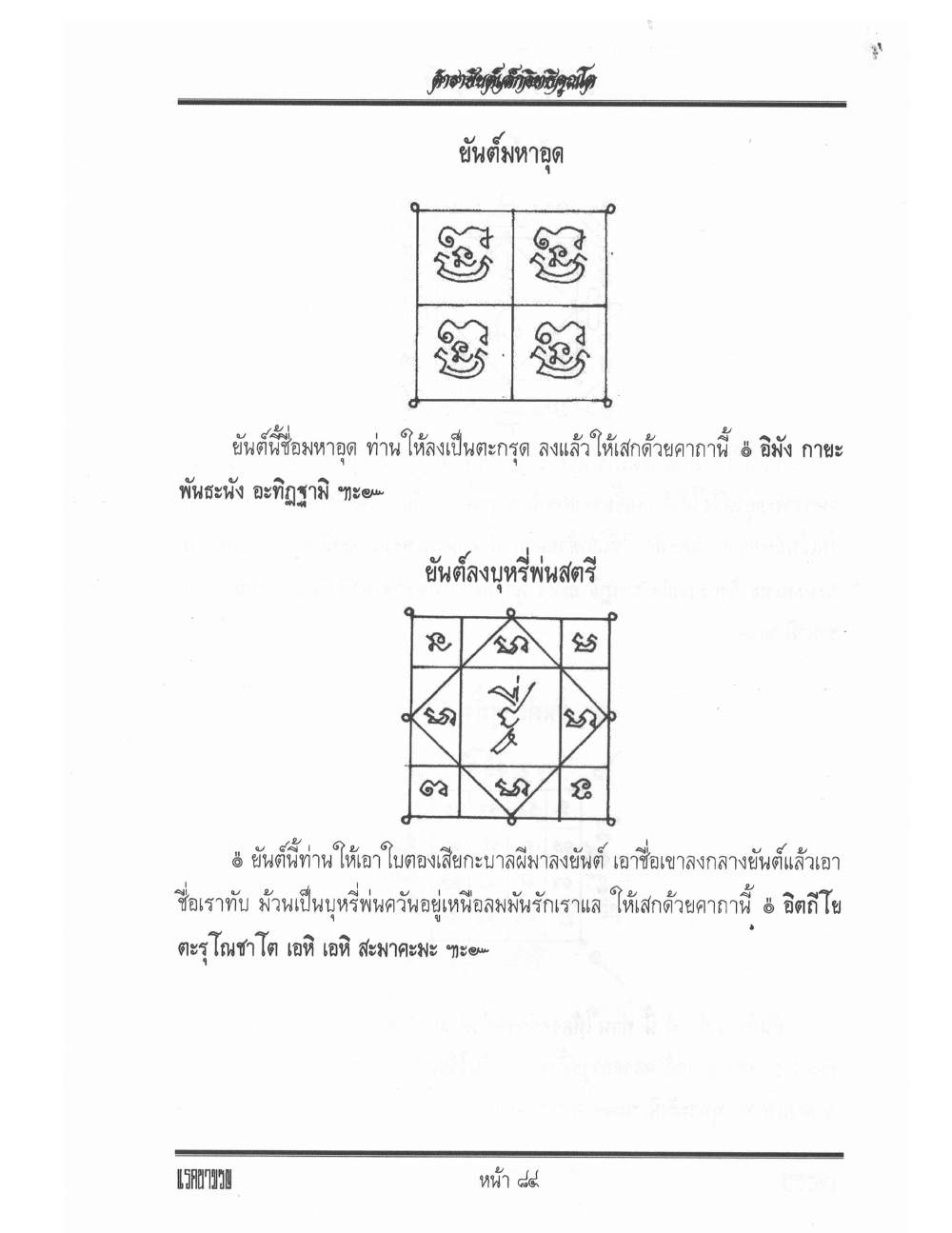
ยันต์มหาอุด
[อักขระขอมในยันต์ อ่านไม่ชัด] ยันต์นี้ชื่อมหาอุด ท่านให้ลงเป็นตะกรุด ลงแล้วให้เสกด้วยคาถานี้ ๏ อิมัง กายะพันธะพัง อะทิฏฐามิ ๛
ยันต์ลงบุหรี่พ่นสตรี
[อักขระขอมในยันต์ อ่านไม่ชัด] ๏ ยันต์นี้ท่านให้เอาใบตองเสียกะบาลผีมาลงยันต์ เอาชื่อเขาลงกลางยันต์แล้วเอาชื่อเราทับ ม้วนเป็นบุหรี่พ่นควันอยู่เหนือลมมันรักเราแล ให้เสกด้วยคาถานี้ ๏ อิติโภตะรุโณชาโต เอหิ เอหิ สะมาคะมะ ๛
Great Stopper (Maha-ut) Yantra
[yantra: a square of four cells in a 2x2 grid, each cell holding a khom syllable] This yantra is called the Great Stopper; inscribe it onto a takrut. Once inscribed, consecrate it with this spell: "Imang kayaphanthaphang athitthami" [chant].
Yantra for a Cigarette Blown Over a Woman
[yantra: a square with an inscribed diamond; a khom syllable sits in each of the square's four outer corners, four more sit at the diamond's side-points, and a further khom syllable stands in the diamond's centre] For this yantra, take a banana leaf that has covered a corpse's skull and inscribe the yantra on it; write her name in the centre of the yantra, then overlay it with our own name. Roll it into a cigarette and blow the smoke into the air upwind of her — she will love us. Consecrate it with this spell: "Iti pho tarunochato, ehi ehi samakhama" [chant].
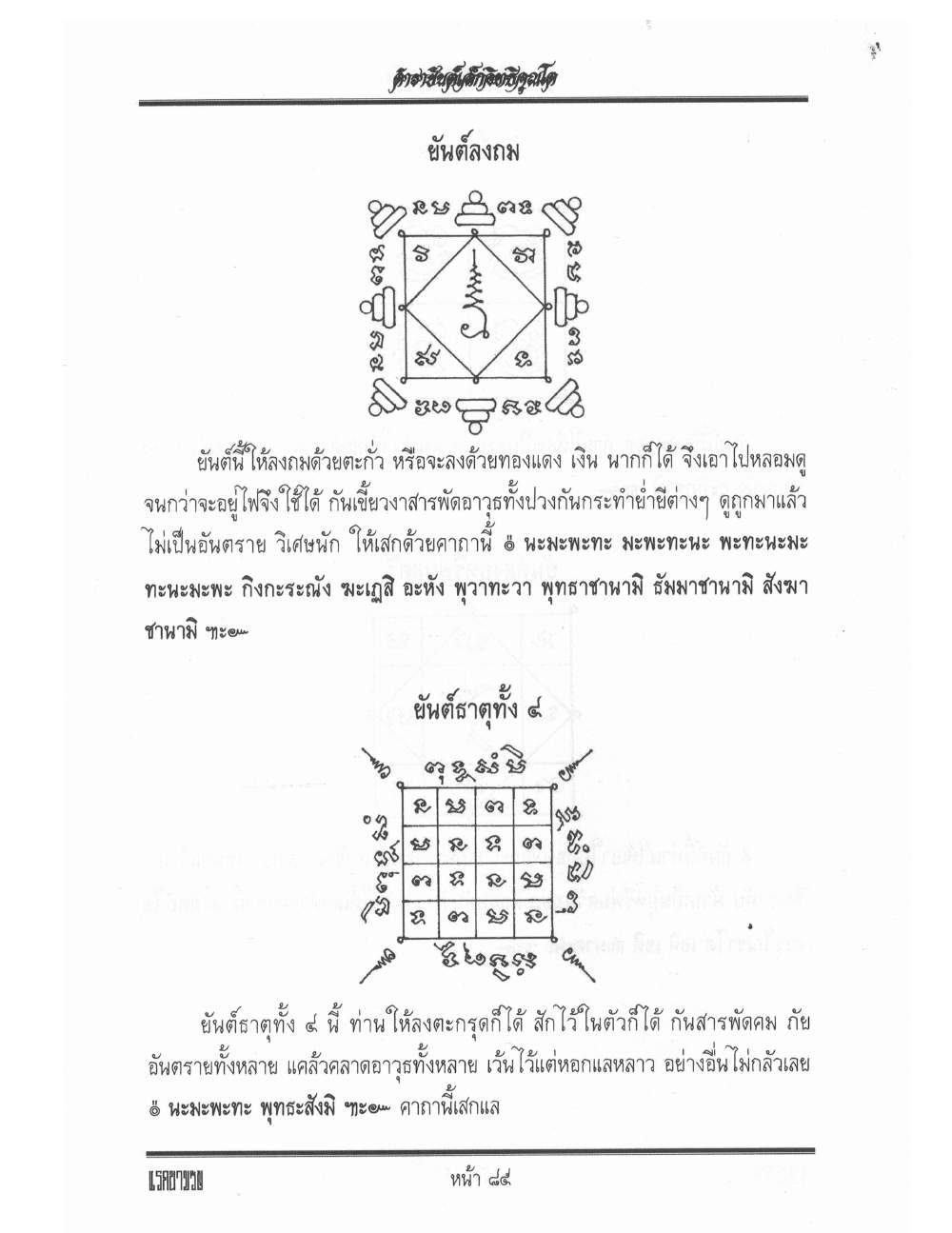
ยันต์ลงถม
[อักขระขอมในยันต์ อ่านไม่ชัด] ยันต์นี้ให้ลงถมด้วยตะกั่ว หรือจะลงด้วยทองแดง เงิน นากก็ได้ จึงเอาไปหลอมดู จนกว่าจะอยู่ไฟจึงใช้ได้ กันเขี้ยวงาสารพัดอาวุธทั้งปวงกันกระทำย่ำยีต่างๆ ดูถูกมาแล้วไม่เป็นอันตราย วิเศษนัก ให้เสกด้วยคาถานี้ ๏ นะมะพะทะ มะพะทะนะ พะทะนะมะ ทะนะมะพะ กิงกะระณัง ฆะเฏสิ อะหัง พุวาทะวา พุทธาชานามิ ธัมมาชานามิ สังฆาชานามิ ๛
ยันต์ธาตุทั้ง ๔
[อักขระขอมในยันต์ อ่านไม่ชัด] ยันต์ธาตุทั้ง ๔ นี้ ท่านให้ลงตะกรุดก็ได้ สักไว้ในตัวก็ได้ กันสารพัดคม ภัยอันตรายทั้งหลาย แคล้วคลาดอาวุธทั้งหลาย เว้นไว้แต่หอกและหลาว อย่างอื่นไม่กลัวเลย ๏ นะมะพะทะ พุทธะสังมิ ๛ คาถานี้เสกแล
Niello-Inlay Yantra
[yantra: a square with an inscribed diamond, khom syllables at the square's corners and at the diamond's side-points, a syllable in the diamond's centre, and a further ring of ornamental clubs and khom syllables running around the outside] This yantra is inscribed in niello-work on lead, or it may be done in copper, silver, or gold-alloy; then it is melted down [into an amulet] and must be fire-tempered before use. It wards off tusks and every kind of weapon, and all manner of violent harm; it can be shown scorn and comes to no harm — it is truly excellent. Consecrate it with this spell: "Namaphatha, maphathana, phathanama, thanamapha, kingkaranang khathesi ahang phuwathawa phutthachanami thammachanami sanghachanami" [chant].
Four-Elements Yantra
[yantra: a 4x4 grid of sixteen cells each holding a khom syllable, framed on all four sides by clusters of further khom syllables and by radiating spike-like marks at the corners] This Four-Elements yantra may be inscribed on a takrut, or tattooed onto the body; it wards off every kind of blade and all manner of danger, and turns aside every weapon — sparing only spears and lances, one need fear nothing else. "Namaphatha, phutthasangmi" [chant] — consecrate with this spell.
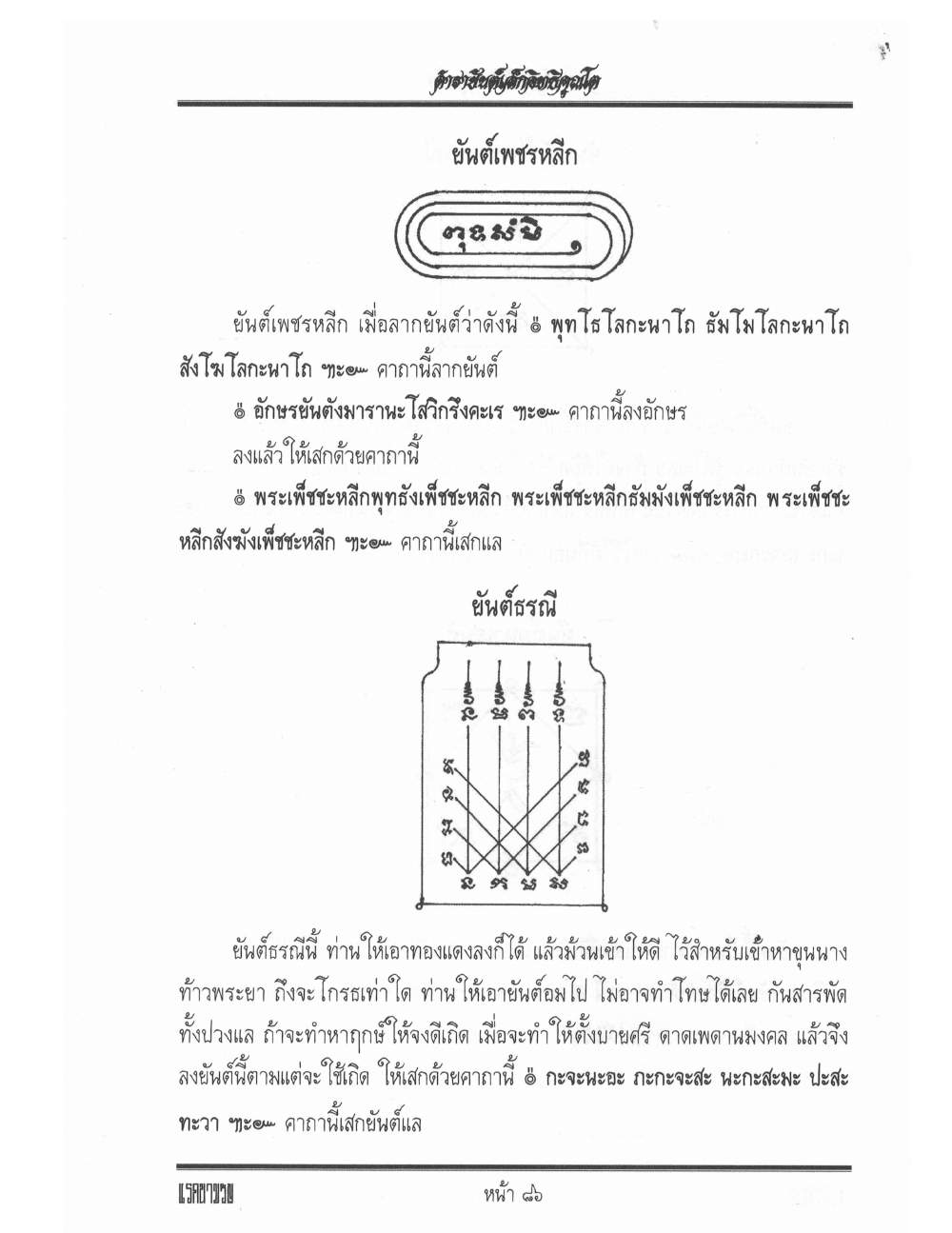
ยันต์เพชรหลีก
[อักขระขอมในยันต์ อ่านไม่ชัด] ยันต์เพชรหลีก เมื่อลากยันต์ว่าดังนี้ ๏ พุทโธโลกะนาโถ ธัมโมโลกะนาโถ สังโฆโลกะนาโถ ๛ คาถานี้ลากยันต์ ๏ อักษรยันตั้งมารานะโสวิกริงคะเร ๛ คาถานี้ลงอักษร ลงแล้วให้เสกด้วยคาถานี้ ๏ พระเพ็ชชะหลีกพุทธังเพ็ชชะหลีก พระเพ็ชชะหลีกธัมมังเพ็ชชะหลีก พระเพ็ชชะหลีกสังฆังเพ็ชชะหลีก ๛ คาถานี้เสกแล
ยันต์ธรณี
[อักขระขอมในยันต์ อ่านไม่ชัด] ยันต์ธรณีนี้ ท่านให้เอาทองแดงลงก็ได้ แล้วม้วนเข้าให้ดี ไว้สำหรับเข้าหาขุนนาง ท้าวพระยา ถึงจะโกรธเท่าใด ท่านให้เอายันต์อมไป ไม่อาจทำโทษได้เลย กันสารพัดทั้งปวงแล ถ้าจะทำหาฤกษ์ให้จงดีเถิด เมื่อจะทำให้ตั้งบายศรี ดาดเพดานมงคล แล้วจึงลงยันต์นี้ตามแต่จะใช้เถิด ให้เสกด้วยคาถานี้ ๏ กะจะพะอะ ภะกะจะสะ พะกะสะมะ ปะสะทะวา ๛ คาถานี้เสกยันต์แล
Diamond-Deflection Yantra
[yantra: a rounded double-lined oval band enclosing a short line of khom script] The Diamond-Deflection yantra: when drawing the yantra, recite: "Phuttho lokanatho, thammo lokanatho, sangkho lokanatho" [chant] — this spell accompanies the drawing of the yantra. "Aksonyan tangmaranaso wikringkhare" [chant] — this spell accompanies the inscribing of the syllables. Once inscribed, consecrate it with this spell: "Phra phetchalik phutthang phetchalik, phra phetchalik thammang phetchalik, phra phetchalik sanghang phetchalik" [chant] — consecrate with this spell.
Earth-Goddess (Thoranee) Yantra
[yantra: a jar-shaped outline; four khom syllables hang tassel-like from its mouth, a pair of crossing diagonal lines fills the body with a khom syllable at each side, and a further row of khom syllables runs along the base] This Thoranee yantra may be inscribed in copper, then rolled up carefully; it is for approaching officials and lords — however angry they may be, if one carries this yantra in the mouth, they cannot punish one at all; it wards off everything whatsoever. If making it, choose a good auspicious hour; when making it, set up a bai sri offering-tray, canopy the ceiling for good fortune, and only then inscribe this yantra for whatever use is wanted. Consecrate it with this spell: "Kachaphaa, phakachasa, phakasama, pasathawa" [chant] — this spell consecrates the yantra.
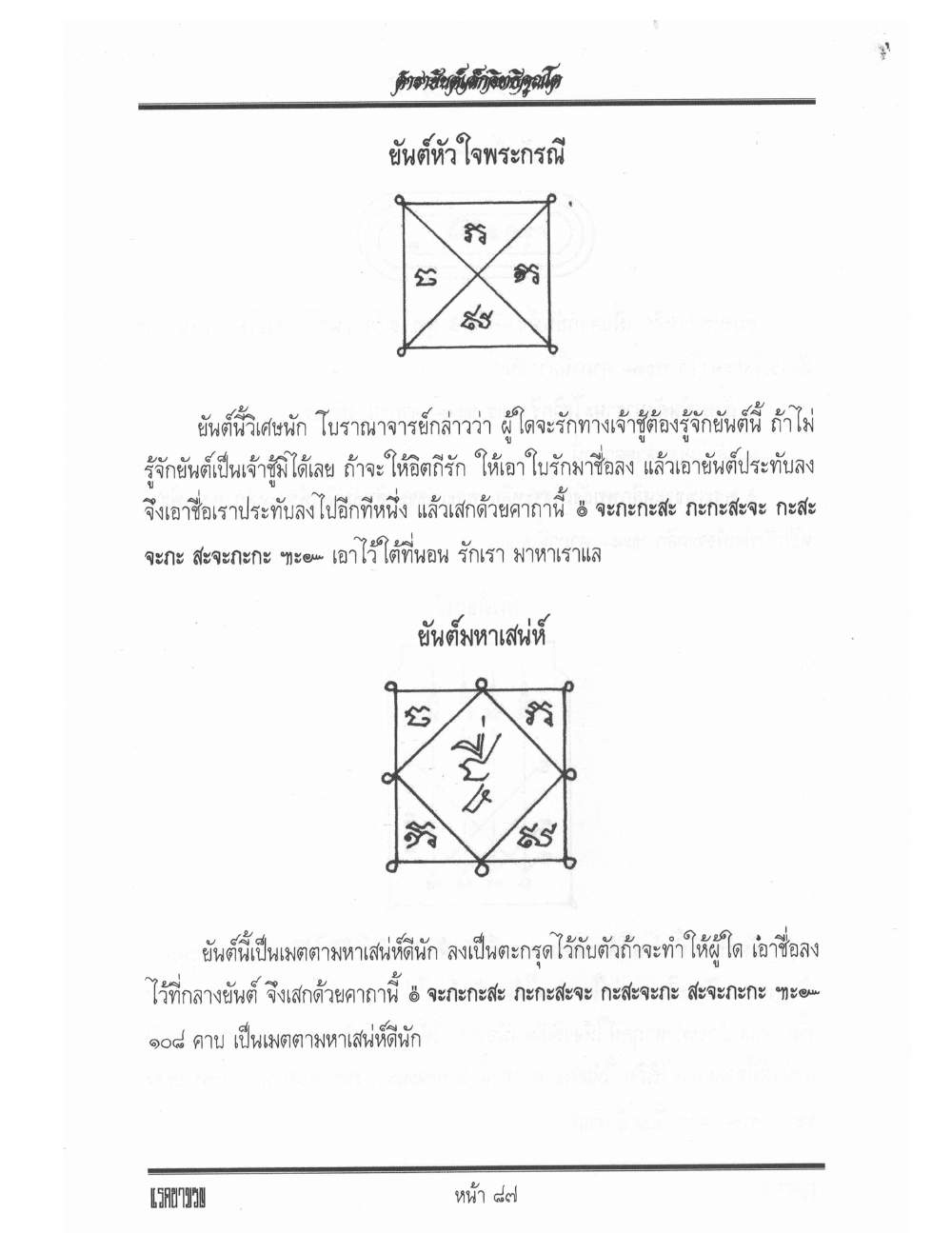
ยันต์หัวใจพระกรณี
[อักขระขอมในยันต์ อ่านไม่ชัด] ยันต์นี้วิเศษนัก โบราณาจารย์กล่าวว่า ผู้ใดจะรักทางเจ้าชู้ต้องรู้จักยันต์นี้ ถ้าไม่รู้จักยันต์เป็นเจ้าชู้มิได้เลย ถ้าจะให้อิตถีรัก ให้เอาใบรักมาชื่อลง แล้วเอายันต์ประทับลง จึงเอาชื่อเราประทับลงไปอีกทีหนึ่ง แล้วเสกด้วยคาถานี้ ๏ จะภะกะสะ ภะกะสะจะ กะสะจะภะ สะจะภะกะ ๛ เอาไว้ใต้ที่นอน รักเรา มาหาเราแล
ยันต์มหาเสน่ห์
[อักขระขอมในยันต์ อ่านไม่ชัด] ยันต์นี้เป็นเมตตามหาเสน่ห์ดีนัก ลงเป็นตะกรุดไว้กับตัวถ้าจะทำให้ผู้ใด เอาชื่อลงไว้ที่กลางยันต์ จึงเสกด้วยคาถานี้ ๏ จะภะกะสะ ภะกะสะจะ กะสะจะภะ สะจะภะกะ ๛ ๑๐๘ คาบ เป็นเมตตามหาเสน่ห์ดีนัก
Heart-Essence Yantra of Phra Karani
[yantra: a square with an X formed by its two diagonals, a khom syllable set within each of the four triangular quarters] This yantra is truly excellent. The teachers of old said that anyone who would succeed at courting must know this yantra; without knowing it, one cannot be a successful suitor at all. To make a woman love you, take a betel-vine leaf, write her name on it, stamp the yantra over it, then stamp our own name over that again; then consecrate it with this spell: "Cha phakasa, phakasacha, kasachapha, sachaphaka" [chant]. Keep it under the sleeping-mat — she will love us and come seeking us.
Great Charm (Maha-sane) Yantra
[yantra: a square with an inscribed diamond touching the midpoints of its sides; a khom syllable sits in each corner of the square, and a further syllable stands at the centre of the diamond] This yantra is an excellent charm of great loving-kindness and attraction; inscribe it on a takrut and keep it on the body. To work it on someone, write their name in the centre of the yantra, then consecrate it with this spell: "Cha phakasa, phakasacha, kasachapha, sachaphaka" [chant], 108 times — it is an excellent charm of great attraction.
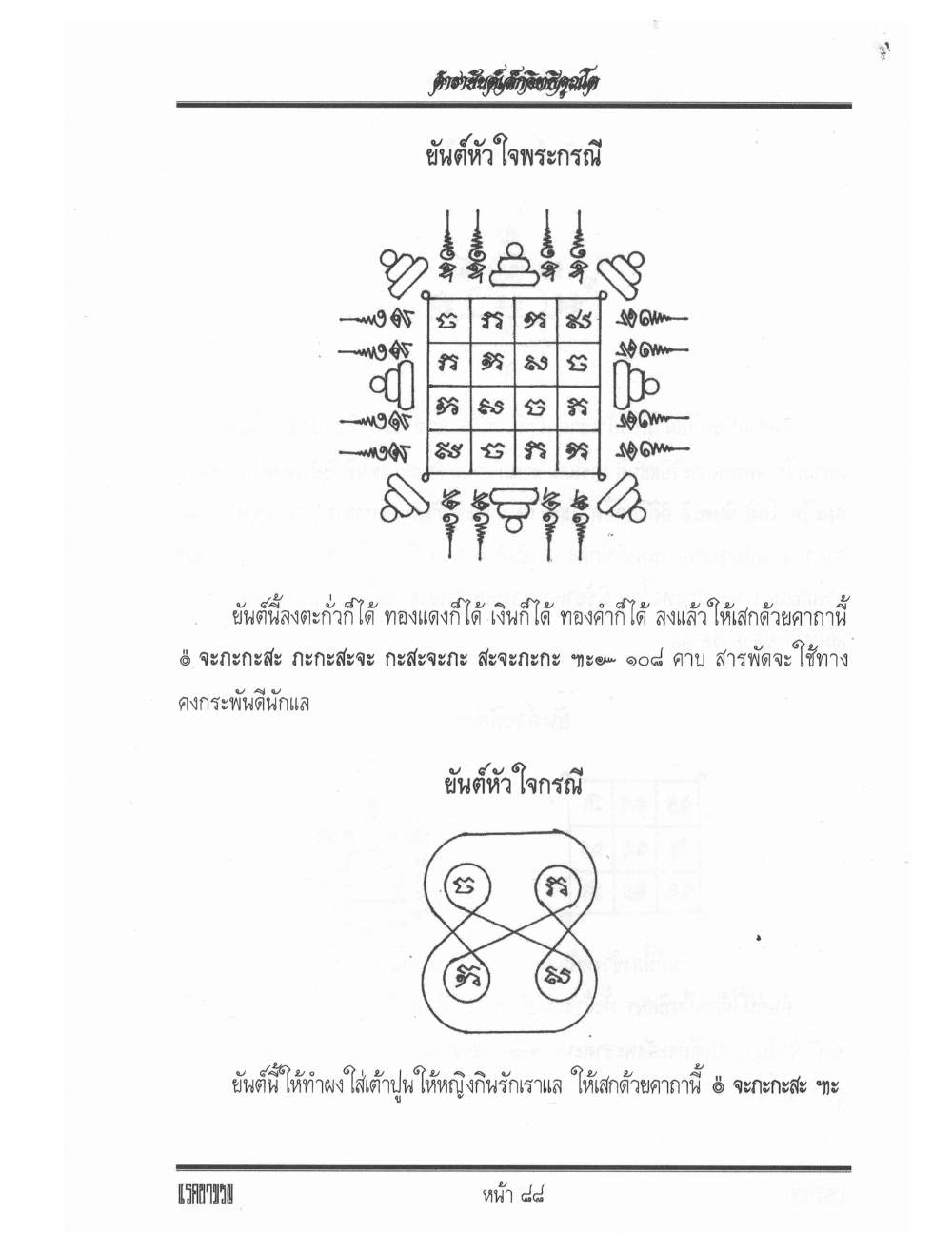
ยันต์หัวใจพระกรณี
[อักขระขอมในยันต์ อ่านไม่ชัด] ยันต์นี้ลงตะกั่วก็ได้ ทองแดงก็ได้ เงินก็ได้ ทองคำก็ได้ ลงแล้วให้เสกด้วยคาถานี้ ๏ จะภะกะสะ ภะกะสะจะ กะสะจะภะ สะจะภะกะ ๛ ๑๐๘ คาบ สารพัดจะใช้ทางคงกระพันดีนักแล
ยันต์หัวใจกรณี
[อักขระขอมในยันต์ อ่านไม่ชัด] ยันต์นี้ให้ทำผงใส่เต้าปูน ให้หญิงกินรักเราแล ให้เสกด้วยคาถานี้ ๏ จะภะกะสะ ๛
Heart-Essence Yantra of Phra Karani
[yantra: a 4x4 grid of sixteen cells each holding a khom syllable, framed on all four sides by clusters of khom syllables, with a small stupa shape above the top edge and wavy flourishes at the four outer corners] This yantra may be inscribed on lead, on copper, on silver, or on gold; once inscribed, consecrate it with this spell: "Cha phakasa, phakasacha, kasachapha, sachaphaka" [chant], 108 times — it serves for every purpose in the way of invulnerability, and is truly excellent.
Heart-Essence Yantra of Karani
[yantra: a peanut-shaped outline of two joined oval bands; four khom syllables sit in circles, two above and two below, joined by crossing diagonal lines] For this yantra, make a powder and put it in a lime-container [used with betel], and have the woman eat it — she will love us. Consecrate it with this spell: "Cha phakasa..." [continues, page ends]
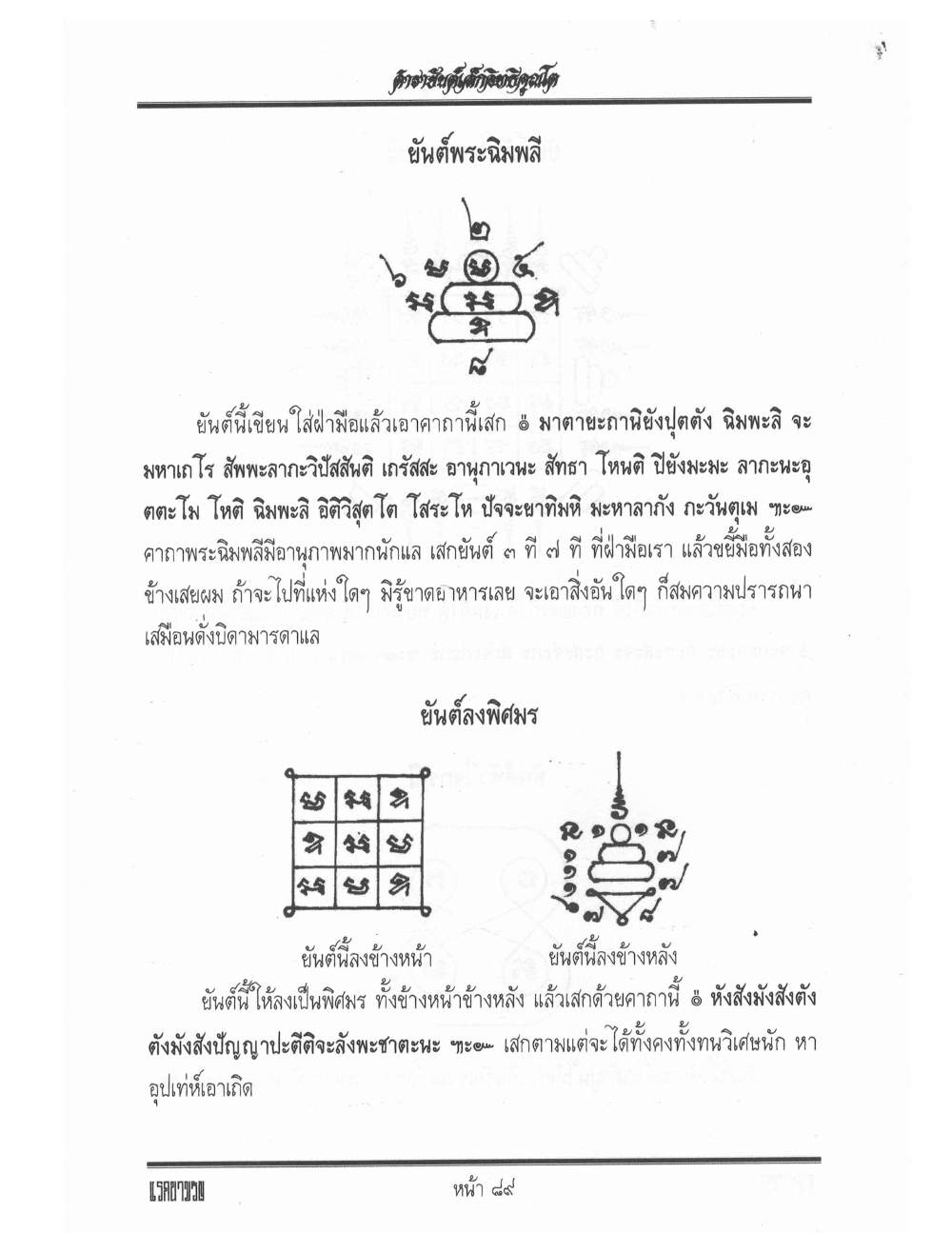
ยันต์พระฉิมพลี
[อักขระขอมในยันต์ อ่านไม่ชัด] ยันต์นี้เขียนใส่ฝ่ามือแล้วเอาคาถานี้เสก ๏ มาตายะถานิยังปุตตัง ฉิมพลิ จะมหาเถโร สัพพะลาภะวิปัสสันติ เถรัสสะ อานุภาเวนะ สัทธา โหนติ ปิยังมะมะ ลากะนะอุตตะโม โหติ ฉิมพลิ อิติวิสุตโต โสระโห ปัจจยาทิมหิ มะหาลากัง ภะวันตุเม ๛ คาถาพระฉิมพลีมีอานุภาพมากนักแล เสกยันต์ ๓ ที ๗ ที ที่ฝ่ามือเรา แล้วขยี้มือทั้งสองข้างเสยผม ถ้าจะไปที่แห่งใดๆ มิรู้ขาดอาหารเลย จะเอาสิ่งอันใดๆ ก็สมความปรารถนา เสมือนดั่งมิดามารดาแล
ยันต์ลงพิศมร
[อักขระขอมในยันต์ อ่านไม่ชัด] ยันต์นี้ลงข้างหน้า ยันต์นี้ลงข้างหลัง ยันต์นี้ให้ลงเป็นพิศมร ทั้งข้างหน้าข้างหลัง แล้วเสกด้วยคาถานี้ ๏ หังสังมังสังตังมังสังปัญญาปะติติจะลังพะชาตะนะ ๛ เสกตามแต่จะได้ทั้งคงทั้งทนวิเศษนัก หาอุปเท่ห์เอาเถิด
Phra Chimphli Yantra
[yantra: a three-tier stacked-oval pagoda shape, each tier holding a khom syllable, surrounded above by four further khom syllables set like rays] Write this yantra onto the palm of the hand, then consecrate it with this spell: "Matayathaniyang puttang chimphli cha mahathero sappalapha wipatsanti therassa anuphawena sattha honti piyangmama lakanauttamo hoti chimphli iti wisutto soraho patchayatimhi mahalakang phawantume" [chant]. The Phra Chimphli spell carries very great power; consecrate the yantra 3 times, 7 times, onto the palm of the hand, then rub both hands together and stroke the hair. Wherever one goes, one will never lack for food; whatever one wants will be granted as wished, just as if by one's own mother.
Amulet-Inlay Yantra
[two small square grids of nine cells each, each cell holding a khom syllable; a small stupa-shaped cluster of syllables is set beside them] This yantra goes on the front. This yantra goes on the back. This yantra is inscribed as an amulet-inlay, on both the front and the back; then consecrate it with this spell: "Hangsangmangsang tangmangsang panyapatiti chalang phachatana" [chant]. Consecrate it as one is able to obtain; it gives both endurance and toughness, and is truly excellent — seek out the right method for using it.
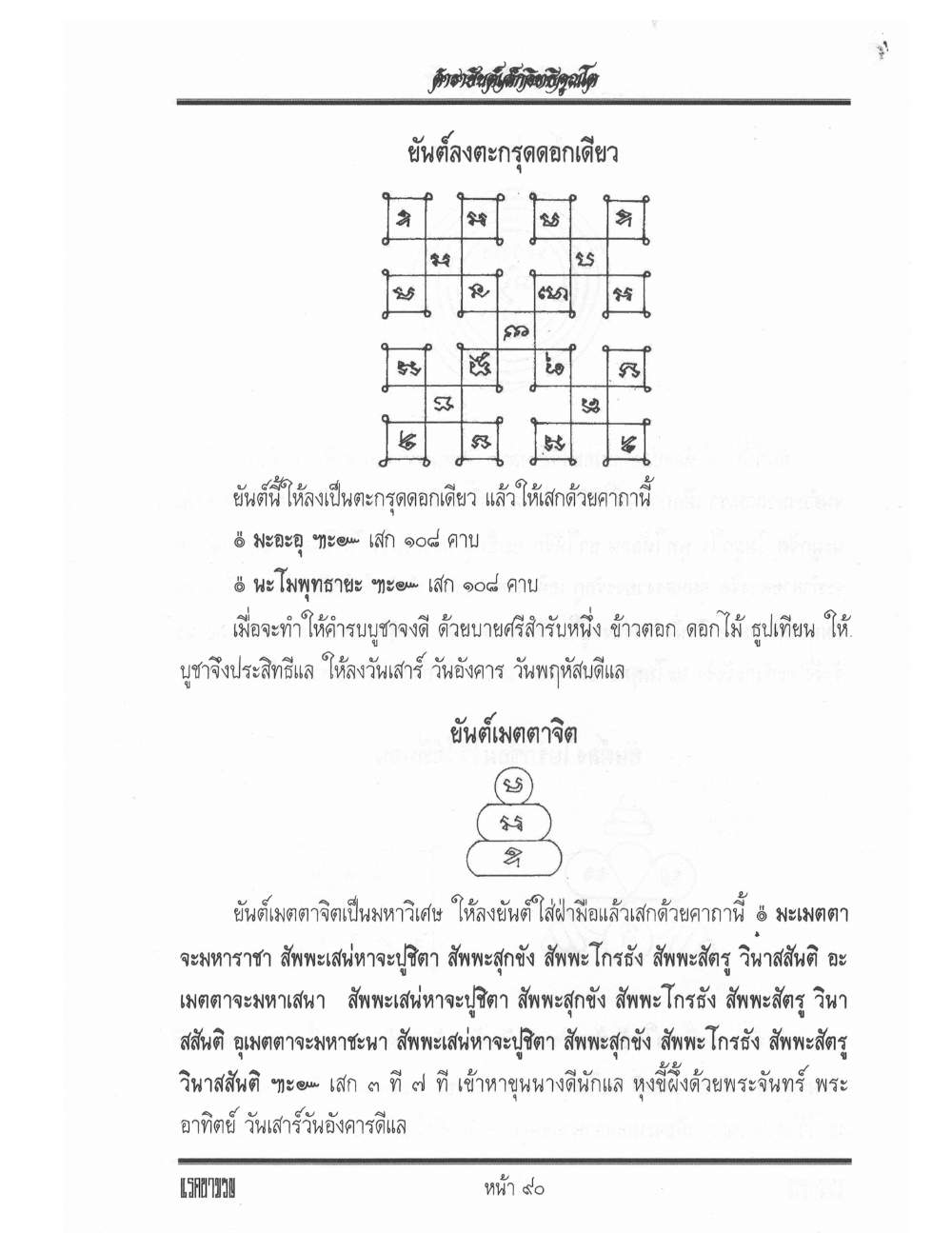
ยันต์ลงตะกรุดดอกเดียว
[อักขระขอมในยันต์ อ่านไม่ชัด] ยันต์นี้ให้ลงเป็นตะกรุดดอกเดียว แล้วให้เสกด้วยคาถานี้ ๏ มะอะอุ ๛ เสก ๑๐๘ คาบ ๏ นะโมพุทธายะ ๛ เสก ๑๐๘ คาบ เมื่อจะทำให้คำรบบูชาจงดี ด้วยบายศรีสำรับหนึ่ง ข้าวตอก ดอกไม้ ธูปเทียน ให้บูชาจึงประสิทธิ์แล ให้ลงวันเสาร์ วันอังคาร วันพฤหัสบดีแล
ยันต์เมตตาจิต
[อักขระขอมในยันต์ อ่านไม่ชัด] ยันต์เมตตาจิตเป็นมหาวิเศษ ให้ลงยันต์ใส่ฝ่ามือแล้วเสกด้วยคาถานี้ ๏ มะเมตตาจะมหาราชา สัพพะเสน่หาจะปูชิตา สัพพะสุขัง สัพพะโกรธัง สัพพะศัตรู วินาศสันติ อะเมตตาจะมหาเสนา สัพพะเสน่หาจะปูชิตา สัพพะสุขัง สัพพะโกรธัง สัพพะศัตรู วินาสสันติ อุเมตตาจะมหาชะนา สัพพะเสน่หาจะปูชิตา สัพพะสุขัง สัพพะโกรธัง สัพพะศัตรู วินาศสันติ ๛ เสก ๓ ที ๗ ที เข้าหาขุนนางดีนักแล หุงขี้ผึ้งด้วยพระจันทร์ พระอาทิตย์ วันเสาร์วันอังคารดีแล
Single-Bead Takrut Yantra
[yantra: four separate blocks of four cells each, arranged around a small central diamond mark to form an overall cross-like layout, every cell holding a khom syllable] Inscribe this yantra onto a single-bead takrut, then consecrate it with this spell: "Ma a u" [chant] — consecrate 108 times. "Namo phutthaya" [chant] — consecrate 108 times. When making an offering to complete it properly, use one set of bai sri offerings, popped rice, flowers, incense and candles; make the offering and it will take effect. Inscribe it on a Saturday, Tuesday, or Thursday.
Loving-Kindness Yantra
[yantra: three stacked ovals, each holding a single khom syllable] The Loving-Kindness yantra is a great marvel. Inscribe the yantra onto the palm of the hand, then consecrate it with this spell: "Ma metta cha maharacha, sappa senha cha puchita, sappa sukhang, sappa krotang, sappa sattru winat santi. A metta cha maha sena, sappa senha cha puchita, sappa sukhang, sappa krotang, sappa sattru winat santi. U metta cha maha chana, sappa senha cha puchita, sappa sukhang, sappa krotang, sappa sattru winat santi" [chant]. Consecrate 3 times, 7 times; it is excellent for approaching officials. Render the beeswax [for the charm] under the moon and the sun, on a Saturday or Tuesday, for best effect.
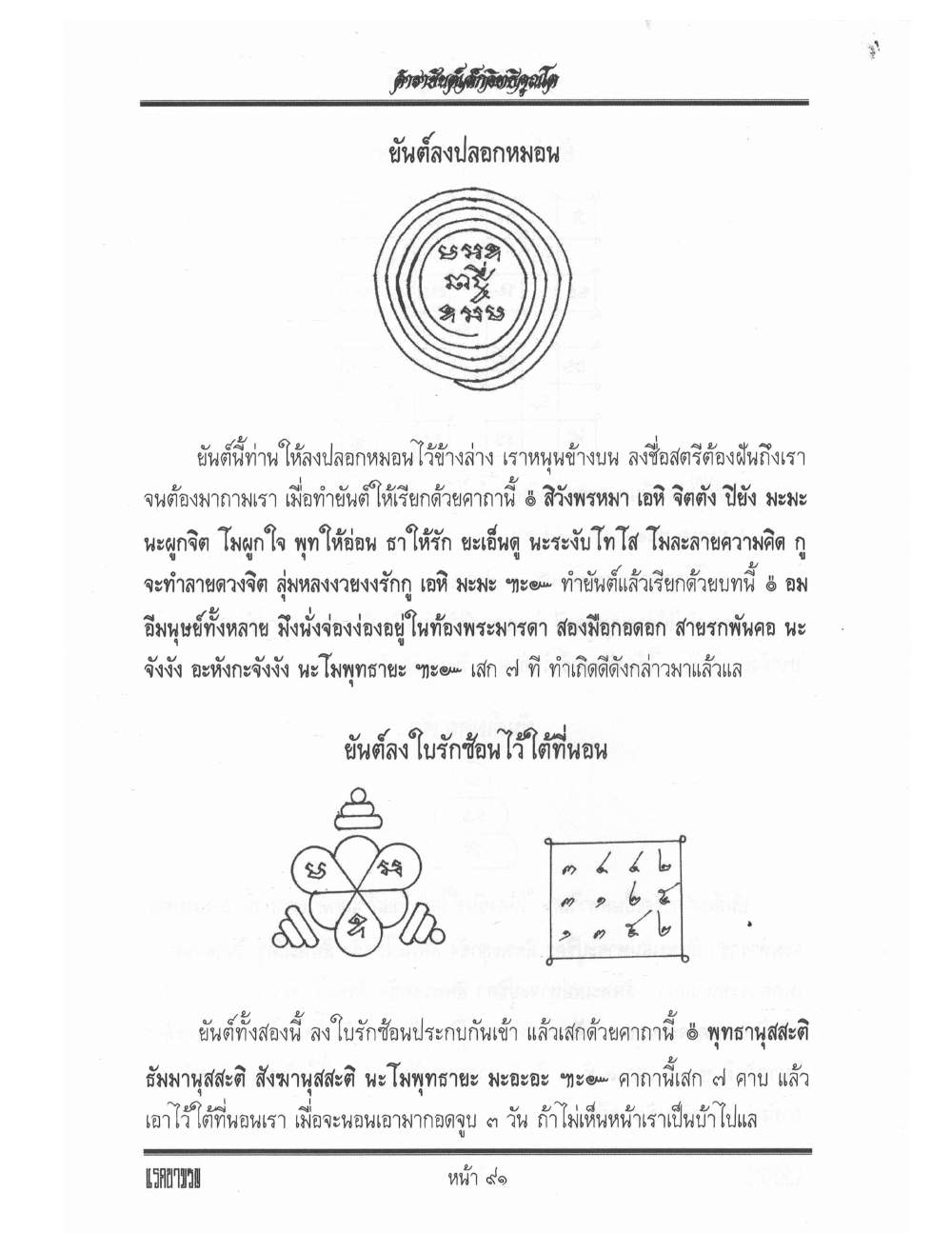
ยันต์ลงปลอกหมอน
[อักขระขอมในยันต์ อ่านไม่ชัด] ยันต์นี้ท่านให้ลงปลอกหมอนไว้ข้างล่าง เราหนุนข้างบน ลงชื่อสตรีต้องฝันถึงเรา จนต้องมาถามเรา เมื่อทำยันต์ให้เรียกด้วยคาถานี้ ๏ สิวังพรหมา เอหิ จิตตัง ปิยัง มะมะ นะผูกจิต โมผูกใจ พุทให้อ่อน ธาให้รัก ยะเอ็นดู นะระงับโทโส โมละลายความคิด กูจะทำลายดวงจิต ลุ่มหลงงวยงงรักกู เอหิ มะมะ ๛ ทำยันต์แล้วเรียกด้วยบทนี้ ๏ อมอีมนุษย์ทั้งหลาย มึงนั่งจ่องง่องอยู่ในท้องพระมารดา สองมือกอดอก สายรกพันคอ พะจังงัง อะหังกะจังงัง นะโมพุทธายะ ๛ เสก ๗ ที ทำเถิดดีดังกล่าวมาแล้วแล
ยันต์ลงใบรักซ้อนไว้ใต้ที่นอน
[อักขระขอมในยันต์ อ่านไม่ชัด] ยันต์ทั้งสองนี้ ลงใบรักซ้อนประกบกันเข้า แล้วเสกด้วยคาถานี้ ๏ พุทธานุสสติ ธัมมานุสสติ สังฆานุสสติ นะโมพุทธายะ มะอะอะ ๛ คาถานี้เสก ๗ คาบ แล้วเอาไว้ใต้ที่นอนเรา เมื่อจะนอนเอามากอดจูบ ๓ วัน ถ้าไม่เห็นหน้าเราเป็นบ้าไปแล
Pillowcase Yantra
[yantra: several concentric circles forming a spiral or target pattern, with a short khom inscription of a few lines set at the very centre] Inscribe this yantra into the underside of a pillowcase, with our own [pillow] resting on top; once the woman's name is inscribed she must dream of us, until she is compelled to come and ask after us. When making the yantra, summon it with this spell: "Siwang phrahma, ehi chittang, piyang mama, na phuk chit, mo phuk chai, phut hai on, tha hai rak, ya en du, na rangap toso, mo lalai khwamkhit, ku cha thamlai duangchit, lumlong nguaingong rak ku, ehi mama" [chant]. After making the yantra, summon it further with this verse: "Om, all you human beings, you once sat curled in your mother's womb, both hands folded over your chest, the umbilical cord wound about your neck — pha changngang, ahang ka changngang, namo phutthaya" [chant]. Consecrate 7 times; done this way it works well, as has been described.
Yantra on a Betel-Vine Leaf, Laid Beneath the Sleeping-Mat
[yantra: a three-lobed flower shape with a small stupa-top ornament, one khom syllable in each lobe, set beside a square grid of twelve cells each bearing a mark] Inscribe both of these yantras onto betel-vine leaves and lay them face to face together, then consecrate them with this spell: "Phutthanussati, thammanussati, sanghanussati, namo phutthaya, ma a a" [chant]. Consecrate this spell 7 times, then keep it under our sleeping-mat; when going to sleep, embrace and kiss it for 3 days — if she does not see our face [during that time], she will go mad with longing.
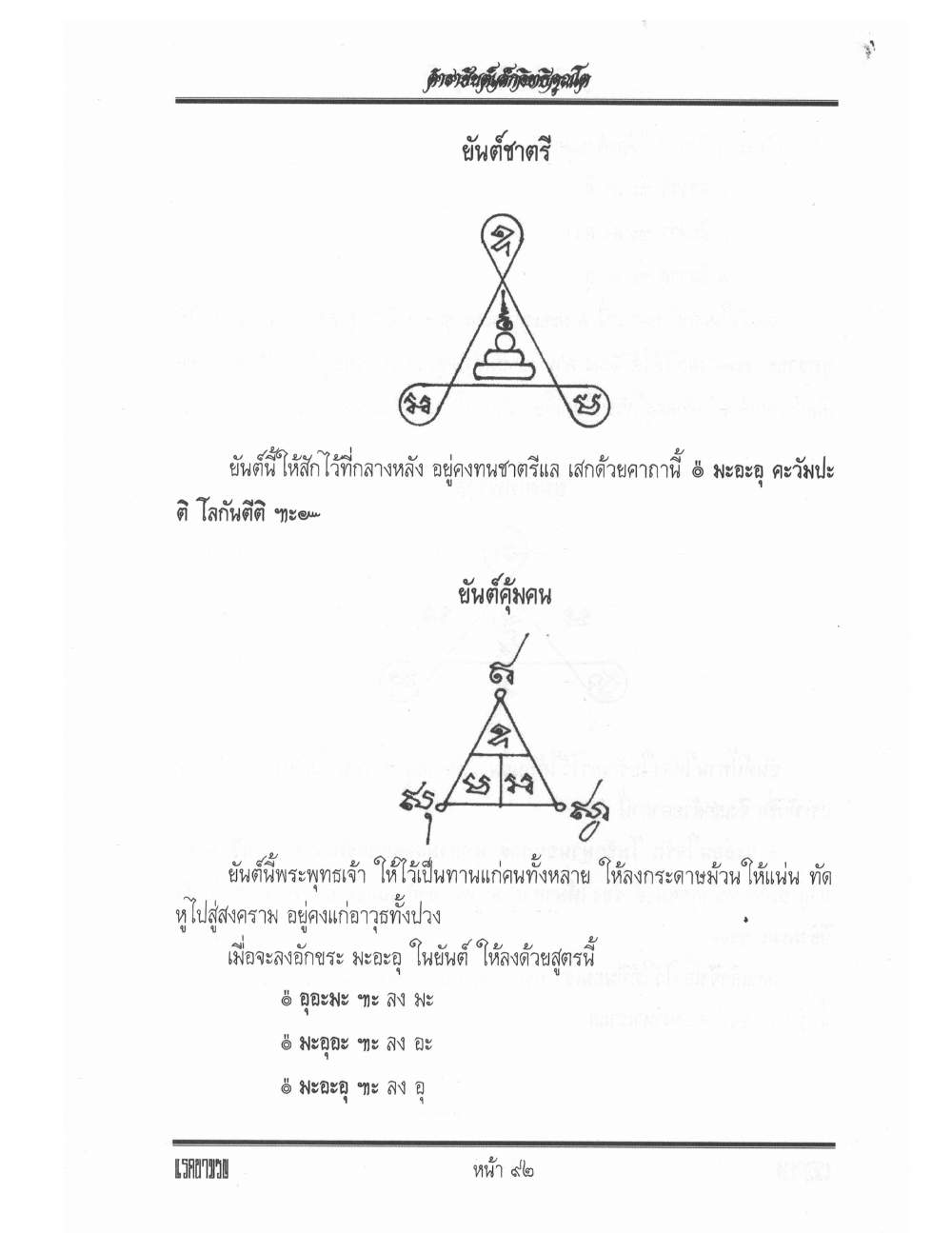
ยันต์ชาตรี
[อักขระขอมในยันต์ อ่านไม่ชัด] ยันต์นี้ให้สักไว้ที่กลางหลัง อยู่คงทนชาตรีแล เสกด้วยคาถานี้ ๐ มะอะอุ คะวัมปะติ โลกันติติ ๚ะ๛
ยันต์คุ้มคน
[อักขระขอมในยันต์ อ่านไม่ชัด] ยันต์นี้พระพุทธเจ้า ให้ไว้เป็นทานแก่คนทั้งหลาย ให้ลงกระดาษม้วนให้แผ่น ทัดหูไปสู่สงคราม อยู่คงแก่อาวุธทั้งปวง เมื่อจะลงอักขระ มะอะอุ ในยันต์ ให้ลงด้วยสูตรนี้ ๐ อุอะมะ ฯะ ลง มะ ๐ มะอุอะ ฯะ ลง อะ ๐ มะอะอุ ฯะ ลง อุ
Chatri (Invulnerability) Yantra
[yantra: a triangular figure with a khom syllable in a looped roundel at each of its three points, and a small stepped stupa drawn at its centre] Tattoo this yantra in the middle of the back; it grants lasting invulnerability. Consecrate it with this spell: "Ma a u, khawampati, lokantiti."
People-Protecting Yantra
[yantra: a triangular figure with a khom syllable in a looped roundel at its apex and at each of its two base corners] This yantra was given by the Buddha as a gift to all people. Have it written on a rolled sheet of paper and tied over the ear when going into battle; it grants protection against every kind of weapon. When inscribing the syllables "Ma a u" into the yantra, inscribe them by rotating the three syllables through each position: "U a ma" — ending on ma. "Ma u a" — ending on a. "Ma a u" — ending on u.
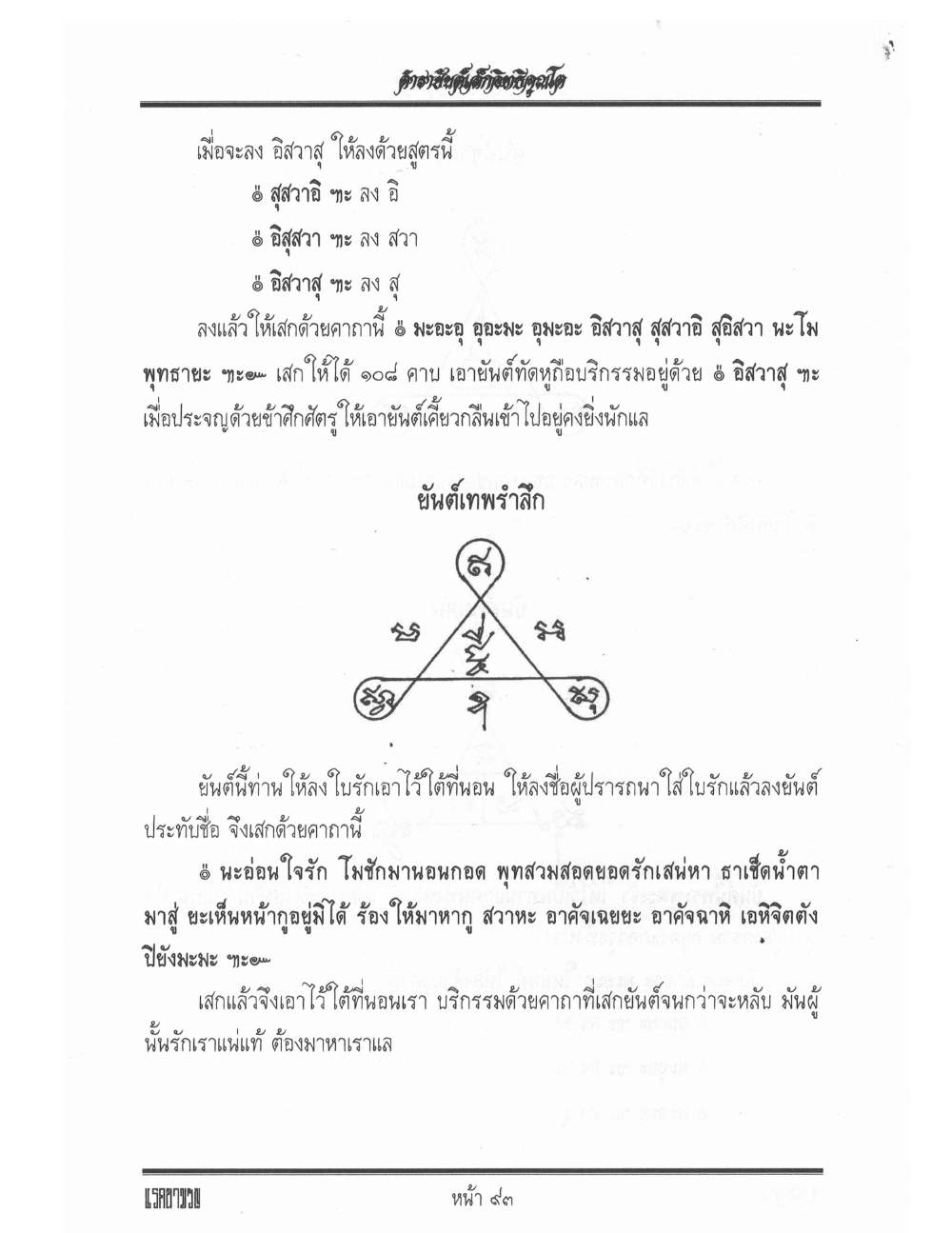
เมื่อจะลง อิสวาสุ ให้ลงด้วยสูตรนี้ ๐ สุสวาอิ ฯะ ลง อิ ๐ อิสุสวา ฯะ ลง สวา ๐ อิสวาสุ ฯะ ลง สุ ลงแล้วให้เสกด้วยคาถานี้ ๐ มะอะอุ อุอะมะ อุมะอะ อิสวาสุ สุสวาอิ สุอิสวา นะโม พุทธายะ ๚ะ๛ เสกให้ได้ ๑๐๘ คาบ เอายันต์ทัดหูถือบริกรรมอยู่ด้วย ๐ อิสวาสุ ฯะ เมื่อประจญด้วยข้าศึกศัตรู ให้เอายันต์เคี้ยวกลืนเข้าไปอยู่คงยิ่งนักแล
ยันต์เทพรำลึก
[อักขระขอมในยันต์ อ่านไม่ชัด] ยันต์นี้ท่านให้ลงใบรักเอาไว้ใต้ที่นอน ให้ลงชื่อผู้ปรารถนาใส่ใบรักแล้วลงยันต์ประทับชื่อ จึงเสกด้วยคาถานี้ ๐ นะอ่อนใจรัก โมชักมานอนกอด พุทสวมสอดยอดรักเสน่หา ธาเช็ดน้ำตามาสู่ ยะเห็นหน้ากูอยู่มิได้ ร้องให้มาหากู สวาหะ อาคัจเฉยยะ อาคัจฉาหิ เอหิจิตตังปิยังมะมะ ๚ะ๛ เสกแล้วจึงเอาไว้ใต้ที่นอนเรา บริกรรมด้วยคาถาที่เสกยันต์จนกว่าจะหลับ มันผู้ใดรักเราแน่แท้ ต้องมาหาเราแล
When inscribing "i sawa su," inscribe it by rotating the three syllables through each position: "Su sawa i" — ending on i. "I su sawa" — ending on sawa. "I sawa su" — ending on su. Once inscribed, consecrate it with this spell: "Ma a u, u a ma, u ma a, i sawa su, su sawa i, su i sawa, namo phutthaya." Consecrate it for 108 repetitions. Tie the yantra over the ear and recite "i sawa su" while carrying it. When facing an enemy in battle, chew and swallow the yantra; it grants very great invulnerability.
Yantra for Remembering the Divine (Love Charm)
[yantra: a triangular figure with a khom syllable in a looped roundel at its apex and at each of its two base corners] This yantra is to be written on a love-leaf and placed under one's pillow. Write the desired person's name onto the leaf, then inscribe the yantra stamped over the name, and consecrate it with this spell: "Na, my heart softens with love; mo, drawn to lie down and embrace me; phut, wrapped and clasped in the height of longing and affection; tha, wiping away the tears that come; ya, unable to bear seeing my face, weep and come to me. Sawaha akatcheyya akatchahi, ehi cittang piyang mama." Having consecrated it, keep it under one's own pillow and recite the consecrating spell until falling asleep; whoever truly loves us will be compelled to come to us.
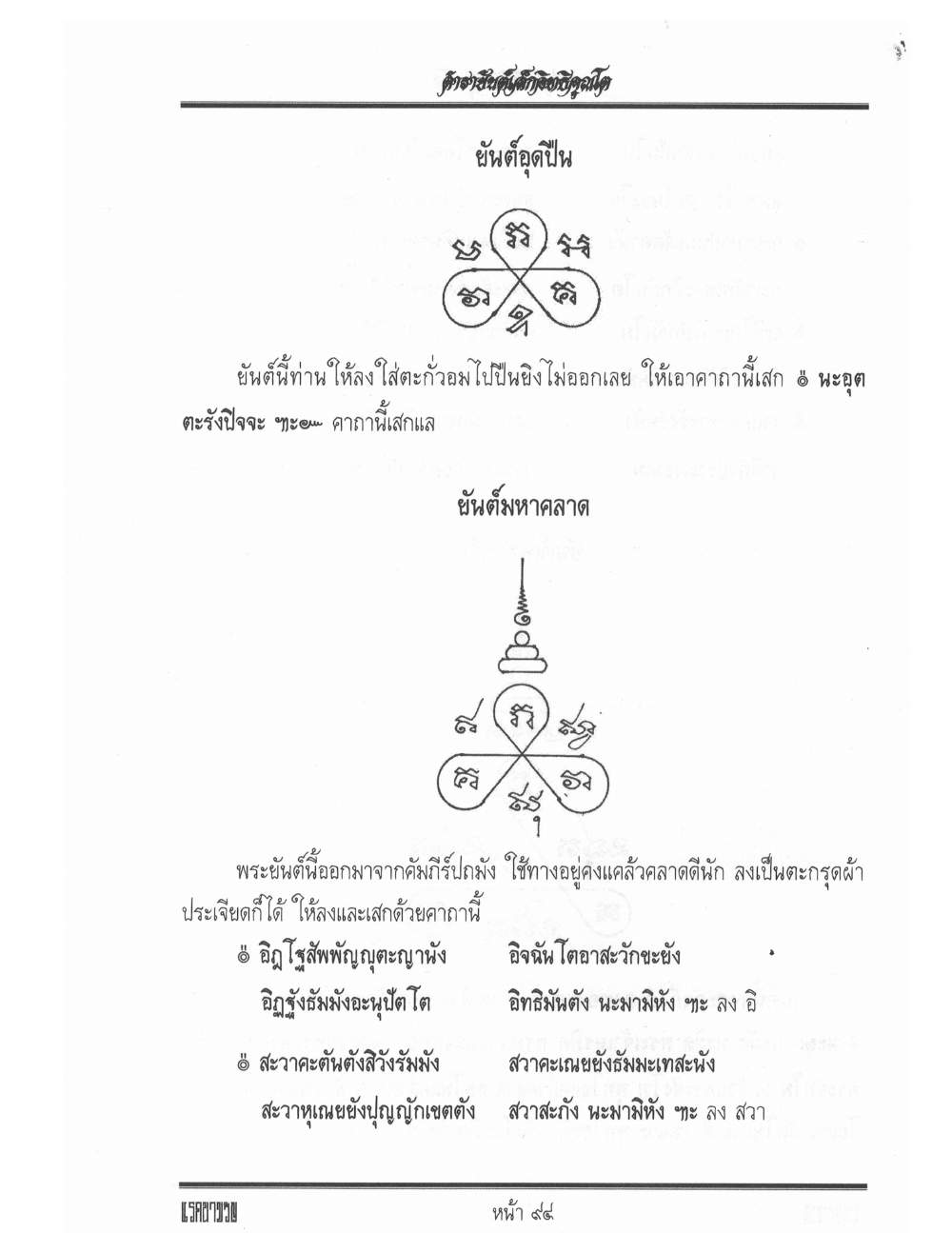
ยันต์อุดปืน
[อักขระขอมในยันต์ อ่านไม่ชัด] ยันต์นี้ท่านให้ลงใส่ตะกั่วอมไปยิงไม่ออกเลย ให้เอาคาถานี้เสก ๐ นะอุตตะรังปิจจะ ๚ะ๛ คาถานี้เสกแล
ยันต์มหาคลาด
[อักขระขอมในยันต์ อ่านไม่ชัด] พระยันต์นี้ออกมาจากคัมภีร์ปถมัง ใช้ทางอยู่คงแคล้วคลาดดีนัก ลงเป็นตะกรุดผ้าประเจียดก็ได้ ให้ลงและเสกด้วยคาถานี้ ๐ อิฏโฐสัพพัญญุตะญาณัง อิจฉันโตอาสะวักขะยัง อิฏฐังธัมมังอะนุปัตโต อิทธิมันตัง นะมามิหัง ๚ะ ลง อิ ๐ สะวาคะตันตังสิวังรัมมัง สะวาคะเณยยังธัมมะเทสะนัง สะวาหุเณยยังปุญญักเขตตัง สะวาสะภัง นะมามิหัง ๚ะ ลง สวา
Bullet-Sealing Yantra
[yantra: a small figure held in the mouth together with lead shot, a khom syllable in each of its lobes] This yantra is to be written on a piece of lead and held in the mouth; when shot at, the bullet will not go off at all. Consecrate it with this spell: "Na uttarang picca."
Great Escaping-Danger Yantra
[yantra: a triangular figure topped with a stepped stupa finial, a khom syllable in a central roundel and in each of four petal-like lobes at its base] This yantra comes from the Pathamang scripture. Worn on one's person it grants very good fortune in escaping danger; it may also be made into a cloth takrut or protective cloth charm. Inscribe it and consecrate it with this spell: "Ittho sabbaññutañāṇaṃ icchanto āsavakkhayaṃ, iṭṭhaṃ dhammaṃ anuppatto iddhimantaṃ namāmihaṃ" — ending on i. "Sawakatantang siwang rammang sawakaneyyang thammathesanang, sawahuneyyang punyakkhettang sawasaphang namamihang" — ending on sawa.
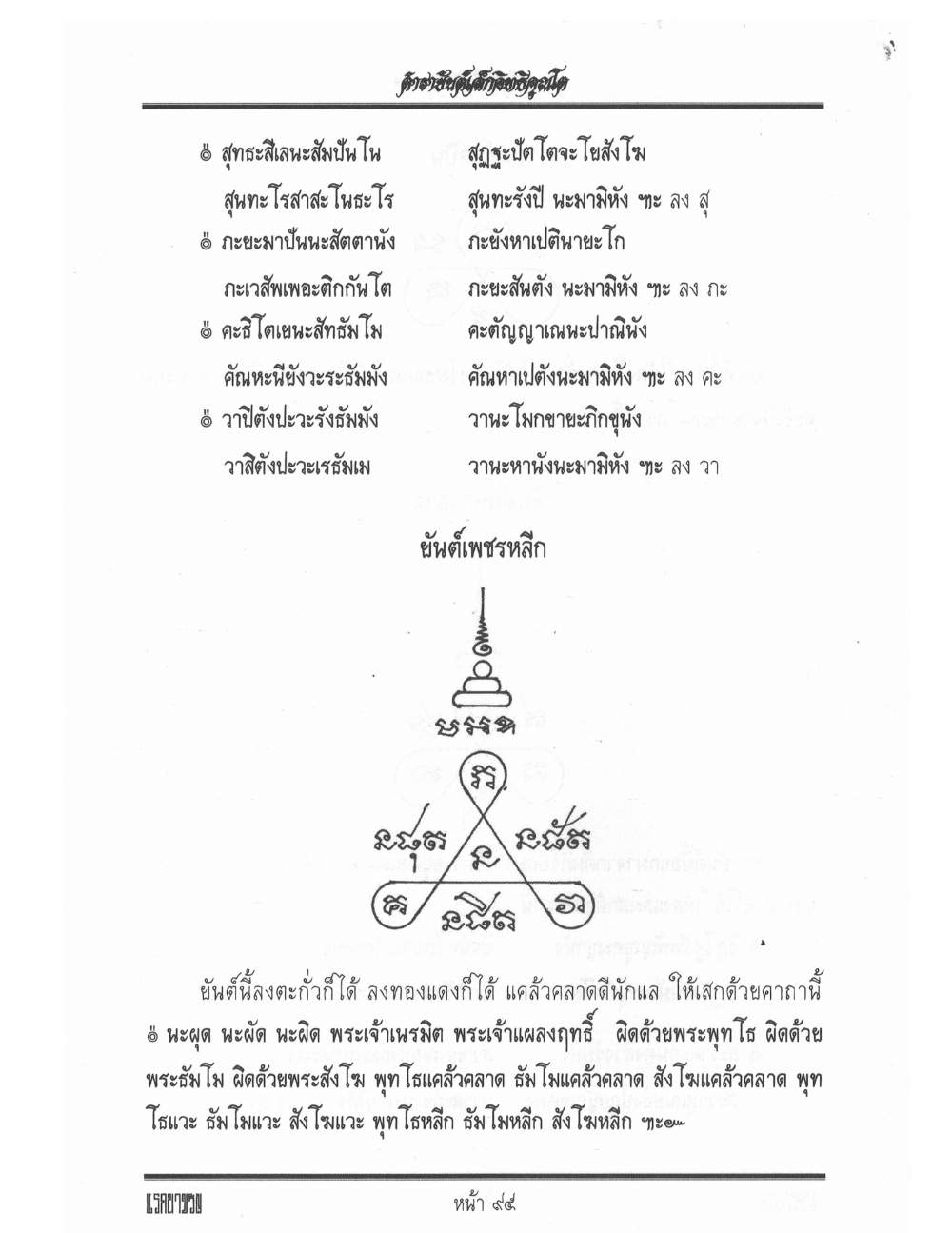
๐ สุทธะสีเลนะสัมปันโน สุฏฐะปัตโตจะโยสังโพ สุทธะโรสาสะโพธะโร สุทธะรังปี นะมามิหัง ๚ะ ลง สุ ๐ กะยะมาปันนะสัตตาพัง กะยังหาเปตินายะโก กะเวสัพเพอะติกกันโต กะยะสันตัง นะมามิหัง ๚ะ ลง กะ ๐ คะธิโตเยนะสัทธัมโม คะตัญญาเณนะปาณิพัง คัณหะพียังวะระธัมมัง คัณหาเปตังนะมามิหัง ๚ะ ลง คะ ๐ วาปิตังปะวะรังธัมมัง วานะโมกขายะภิกขุพัง วาสิตังปะวะเรธัมเม วานะหังนะมามิหัง ๚ะ ลง วา
ยันต์เพชรหลีก
[อักขระขอมในยันต์ อ่านไม่ชัด] ยันต์นี้ลงตะกั่วก็ได้ ลงทองแดงก็ได้ แคล้วคลาดดีนักแล ให้เสกด้วยคาถานี้ ๐ นะผุด นะผัด นะผิด พระเจ้าเนรมิต พระเจ้าแผลงฤทธิ์ ผิดด้วยพระพุทโธ ผิดด้วยพระธัมโม ผิดด้วยพระสังโฆ พุทโธแคล้วคลาด ธัมโมแคล้วคลาด สังโฆแคล้วคลาด พุทโธแวะ ธัมโมแวะ สังโฆแวะ พุทโธหลีก ธัมโมหลีก สังโฆหลีก ๚ะ๛
[continuing the "Great Escaping-Danger" spell:] "Sutthasilenasampanno sutthapattocayosangpho, sutthaorasasaphotharo sutthaerangpi namamihang" — ending on su. "Kayamapannasattaphang kayanghapetinayoko, kawesappheatikkanto kayasantang namamihang" — ending on ka. "Khathitoyenasatthammo khatanyanenapanipang, khanhapheeyangwaradhammang khanhapetangnamamihang" — ending on kha. "Wapitangpawarangthammang wanamokkhayaphikkhupang, wasitangpawarethamme wanahangnamamihang" — ending on wa.
Diamond-Evasion Yantra
[yantra: a triangular figure topped with a stepped stupa finial and a syllable above it, a khom syllable in each of four inner cells] This yantra may be written on lead or on copper; it grants very good fortune in evading harm. Consecrate it with this spell: "Na phut, na phat, na phit — the Lord who creates wonders, the Lord who works miracles: err against the Buddha, err against the Dhamma, err against the Sangha. Phuttho evade, thammo evade, sangkho evade. Phuttho swerve away, thammo swerve away, sangkho swerve away. Phuttho escape, thammo escape, sangkho escape."
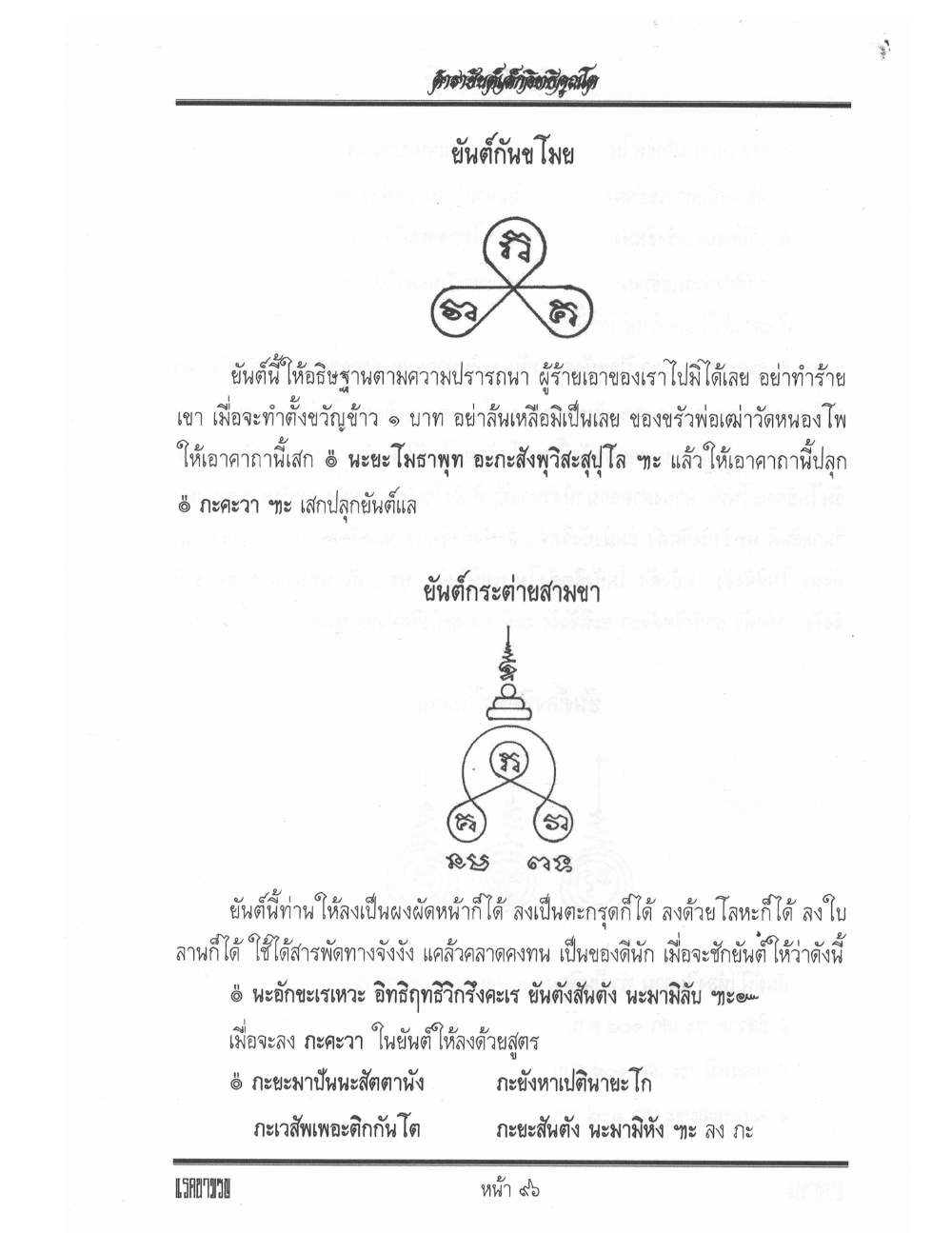
ยันต์กันขโมย
[อักขระขอมในยันต์ อ่านไม่ชัด] ยันต์นี้ให้ตั้งฐานตามความปรารถนา ผู้ร้ายเอาของเราไปมิได้เลย อย่าทำร้ายเขา เมื่อจะทำตั้งขวัญข้าว ๑ บาท อย่าล้นเหลือมิเป็นเลย ของขรัวพ่อเฒ่าวัดหนองโพ ให้เอาคาถานี้เสก ๐ พะยะโมธาพุท อะภะสังพุวิสะสุปุโล ๚ะ แล้วให้เอาคาถานี้ปลุก ๐ กะคะวา ๚ะ เสกปลุกยันต์แล
ยันต์กระต่ายสามขา
[อักขระขอมในยันต์ อ่านไม่ชัด] ยันต์นี้ท่านให้ลงเป็นผงผัดหน้าก็ได้ ลงเป็นตะกรุดก็ได้ ลงด้วยโลหะก็ได้ ลงใบลานก็ได้ ใช้ได้สารพัดทางจังงัง แคล้วคลาดคงทน เป็นของดีนัก เมื่อจะชักยันต์ให้ว่าดังนี้ ๐ พะอักขะเรเหวะ อิทธิฤทธิวิกรึงคะเร ยันตังสันตัง นะมามิลัม ๚ะ๛ เมื่อจะลง ภะคะวา ในยันต์ให้ลงด้วยสูตร ๐ ภะยะมาปันนะสัตตาพัง ภะยังหาเปตินายะโก ภะเวสัพเพอะติกกันโต ภะยะสันตัง นะมามิหัง ๚ะ ลง ภะ
Thief-Warding Yantra
[yantra: a three-lobed clover-shaped figure with a khom syllable in each lobe] Establish this yantra according to one's own intention; thieves will not be able to take one's belongings at all — but do not use it to harm them. When performing the rite, set out one baht's worth of rice as a khwan offering and do not let it fall short; this belongs to the old lay-elder ("khrua pho thao") of Wat Nong Pho. Consecrate it with this spell: "Phayamothaphut aphaphangphuwisasupulo." Then recite this spell to awaken it: "Kakhawa." This consecrates and awakens the yantra.
Three-Legged Rabbit Yantra
[yantra: a figure topped with a stupa finial, a central roundel with a khom syllable above two smaller roundels, with numerals written beneath] This yantra may be worn as face-powder, made into a takrut, cast in metal, or written on a palm leaf; it serves for every kind of protection against binding curses ("chang-ngang"), grants good fortune in escaping danger, and is very durable — a very good charm indeed. When drawing out the yantra's power, recite as follows: "Phaakkharehewa itthiritthiwikrungkhare yantangsantang namamilam." When inscribing "phakhawa" into the yantra, inscribe it with this formula: "Phayamapannasattaphang phayanghapetinayoko, phawesappheatikkanto phayasantang namamihang" — ending on pha.
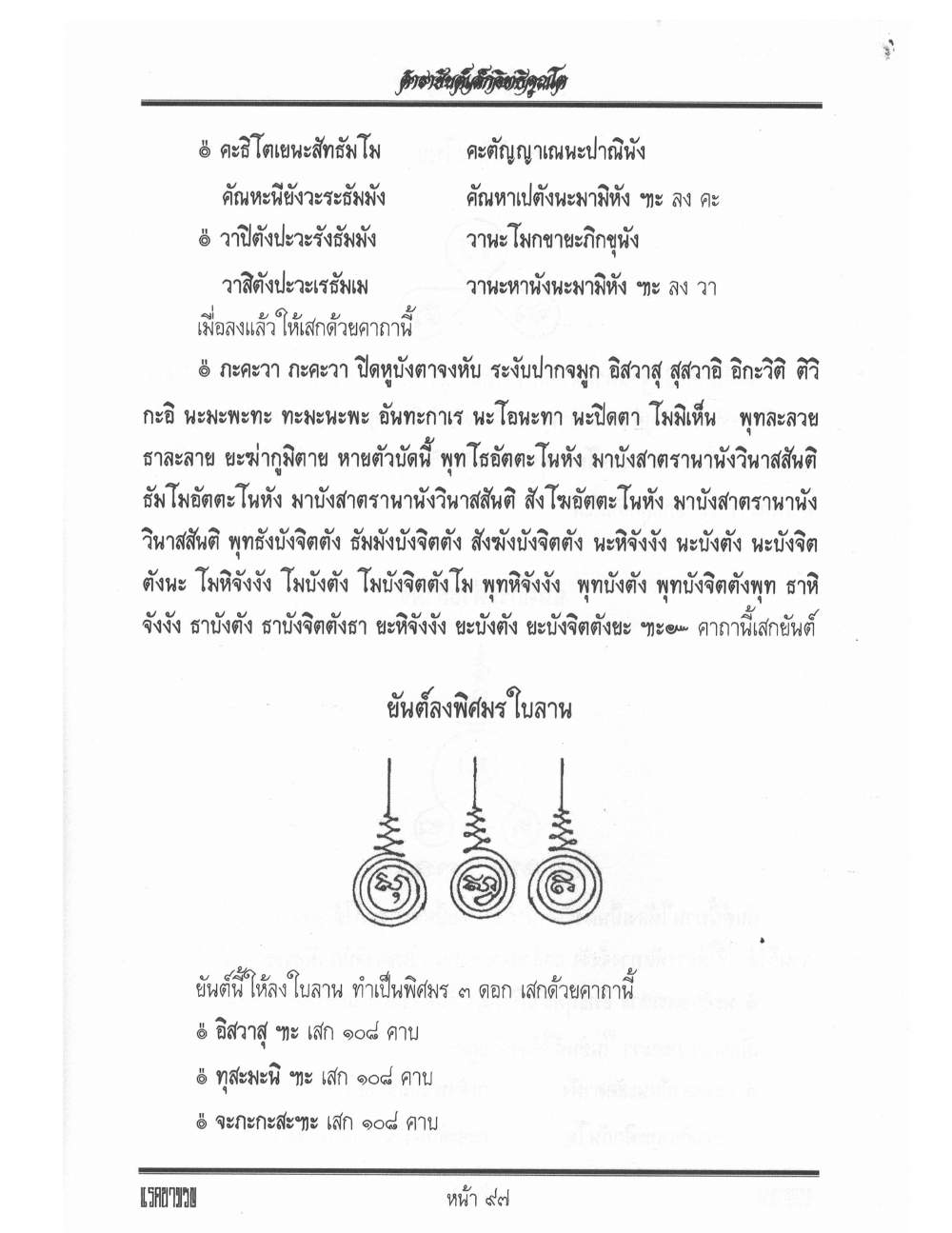
๐ คะธิโตเยนะสัทธัมโม คะตัญญาเณนะปาณิพัง คัณหะพียังวะระธัมมัง คัณหาเปตังนะมามิหัง ๚ะ ลง คะ ๐ วาปิตังปะวะรังธัมมัง วานะโมกขายะภิกขุพัง วาสิตังปะวะเรธัมเม วานะหังนะมามิหัง ๚ะ ลง วา เมื่อลงแล้วให้เสกด้วยคาถานี้ ๐ ภะคะวา ภะคะวา ปิดหูบังตาจงหลับ ระงับปากจมูก อิสวาสุ สุสวาอิ อิกะวิติ ติวิกะอิ พะมะพะทะ ทะมะนะพะ อันทะกาเร นะโอนะทา นะปิดตา โมมิเห็น พุทละลาย ธาละลาย ยะฆ่ากูมิตาย หายตัวบัดนี้ พุทโธอัตตะโนหัง มาบังสาตรานานังวินาสสันติ ธัมโมอัตตะโนหัง มาบังสาตรานานังวินาสสันติ สังโฆอัตตะโนหัง มาบังสาตรานานังวินาสสันติ พุทธังบังจิตตัง ธัมมังบังจิตตัง สังฆังบังจิตตัง นะหิจังงัง นะบังตัง นะบังจิตตังนะ โมหิจังงัง โมบังตัง โมบังจิตตังโม พุทหิจังงัง พุทบังตัง พุทบังจิตตังพุท ธาหิจังงัง ธาบังตัง ธาบังจิตตังธา ยะหิจังงัง ยะบังตัง ยะบังจิตตังยะ ๚ะ๛ คาถานี้เสกยันต์
ยันต์ลงพิศมรใบลาน
[อักขระขอมในยันต์ อ่านไม่ชัด] ยันต์นี้ให้ลงใบลาน ทำเป็นพิศมร ๓ ดอก เสกด้วยคาถานี้ ๐ อิสวาสุ ๚ะ เสก ๑๐๘ คาบ ๐ ทุสะมะนิ ๚ะ เสก ๑๐๘ คาบ ๐ จะภะกะสะ ๚ะ เสก ๑๐๘ คาบ
[continuing the previous formula:] "Khathitoyenasatthammo khatanyanenapanipang, khanhapheeyangwaradhammang khanhapetangnamamihang" — ending on kha. "Wapitangpawarangthammang wanamokkhayaphikkhupang, wasitangpawarethamme wanahangnamamihang" — ending on wa. Once inscribed, consecrate it with this spell: "Phakhawa, phakhawa, cover the ears, shut the eyes, and sleep; stop up the mouth and nose. I sawa su, su sawa i, i kawiti, ti wika i, pha ma pha tha, tha ma na pha. In the darkness: na, faint away; mo, be unseen; phut, dissolve away; tha, dissolve away; ya, though struck down I do not die — vanish now! Phuttho of myself, may they utterly perish and be destroyed; thammo of myself, may they utterly perish and be destroyed; sangkho of myself, may they utterly perish and be destroyed. Buddhang conceal the mind, dhammang conceal the mind, sanghang conceal the mind." [The spell continues, cycling the syllables na/mo/phut/tha/ya through concealing the binding-curse, concealing one's standing, and concealing the mind.] This spell consecrates the yantra.
Yantra Written on a Palm-Leaf Charm
[yantra: three hanging charm-strands, each a coiled spiral roundel containing a khom syllable, with a zigzag cord above each] This yantra is to be written on a palm leaf and made into three charm-blossoms (phitsamon). Consecrate it with this spell: "I sawa su" — consecrate for 108 repetitions. "Thusamani" — consecrate for 108 repetitions. "Caphakasa" — consecrate for 108 repetitions.
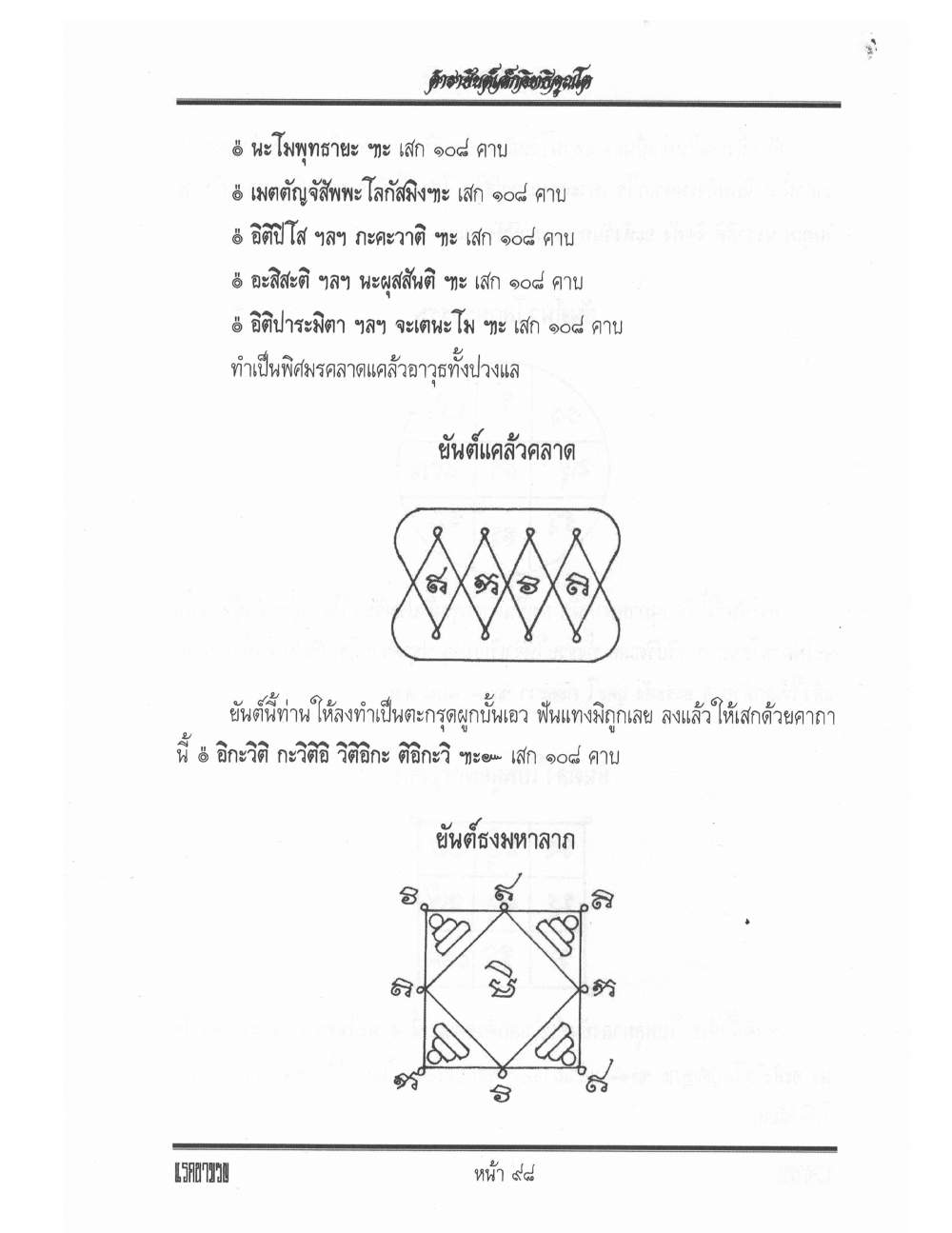
๐ นะโมพุทธายะ ๚ะ เสก ๑๐๘ คาบ ๐ เมตตัญจัสัพพะโลกัสมิง ๚ะ เสก ๑๐๘ คาบ ๐ อิติปิโส ฯลฯ กะคะวาติ ๚ะ เสก ๑๐๘ คาบ ๐ อะสิสะติ ฯลฯ นะผุสสันติ ๚ะ เสก ๑๐๘ คาบ ๐ อิติปาระมิตา ฯลฯ จะเตนะโม ๚ะ เสก ๑๐๘ คาบ ทำเป็นพิศมรคลาดแคล้วอาวุธทั้งปวงแล
ยันต์แคล้วคลาด
[อักขระขอมในยันต์ อ่านไม่ชัด] ยันต์นี้ท่านให้ลงทำเป็นตะกรุดผูกบั้นเอว ฟันแทงมิถูกเลย ลงแล้วให้เสกด้วยคาถานี้ ๐ อิกะวิติ กะวิติอิ วิติอิกะ ติอิกะวิ ๚ะ๛ เสก ๑๐๘ คาบ
ยันต์ธงมหาลาภ
[อักขระขอมในยันต์ อ่านไม่ชัด]
[continuing the palm-leaf charm's consecration:] "Namo phutthaya" — consecrate for 108 repetitions. "Mettañca sabbalokasmiṃ [...]" — consecrate for 108 repetitions. "Itipiso [...] kakhawati" — consecrate for 108 repetitions. "Asisati [...] naphutsanti" — consecrate for 108 repetitions. "Itiparamita [...] catenamo" — consecrate for 108 repetitions. Made into charm-blossoms, it grants evasion of every kind of weapon.
Danger-Evading Yantra
[yantra: an elongated capsule-shaped figure crossed by diagonal lines into four diamond cells, each holding a khom syllable] This yantra is to be made into a takrut worn tied at the waist; one will never be struck by blade or spear. Once inscribed, consecrate it with this spell: "Ikawiti, kawitii, witiika, tiikawi." Consecrate for 108 repetitions.
Great-Fortune Banner Yantra
[yantra: a square figure with a khom syllable at each corner and each side's midpoint, and another in a central roundel, with small flag-like tufts of strokes drawn just outside each corner]
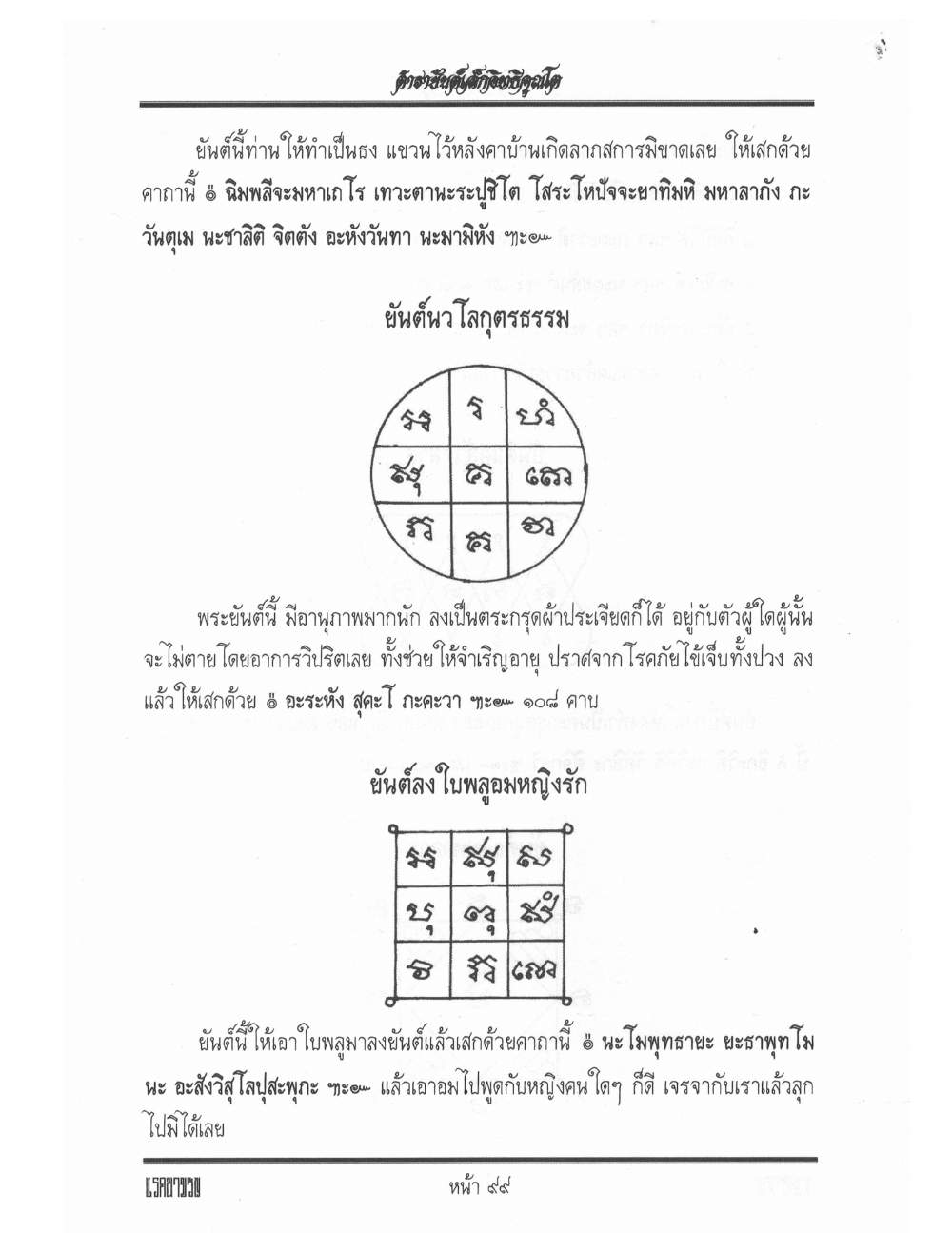
ยันต์นี้ท่านให้ทำเป็นธง แขวนไว้หลังคาบ้านเกิดลาภสการมิขาดเลย ให้เสกด้วยคาถานี้ ๐ ฉิมพลีจะมหาเถโร เทวะตานะระปูชิโต โสระโหปัจจะยาทิมหิ มหาลาภัง ภะวันตุเม นะชาลิติ จิตตัง อะหังวันทา นะมามิหัง ๚ะ๛
ยันต์นวโลกุตรธรรม
[อักขระขอมในยันต์ อ่านไม่ชัด] พระยันต์นี้ มีอานุภาพมากนัก ลงเป็นตระกรุดผ้าประเจียดก็ได้ อยู่กับตัวผู้ใดผู้นั้น จะไม่ตายโดยอาการวิปริตเลย ทั้งช่วยให้จำเริญอายุ ปราศจากโรคภัยไข้เจ็บทั้งปวง ลงแล้วให้เสกด้วย ๐ อะระหัง สุคะโต ภะคะวา ๚ะ๛ ๑๐๘ คาบ
ยันต์ลงใบพลูอมหญิงรัก
[อักขระขอมในยันต์ อ่านไม่ชัด] ยันต์นี้ให้เอาใบพลูมาลงยันต์แล้วเสกด้วยคาถานี้ ๐ นะโมพุทธายะ ยะธาพุทโม นะ อะสังวิสุโลปุสะพุกะ ๚ะ๛ แล้วเอาอมไปพูดกับหญิงคนใดๆ ก็ดี เจรจากับเราแล้วลุกไปมิได้เลย
This yantra is to be made into a banner and hung from the roof of one's house; good fortune and profit will never be lacking. Consecrate it with this spell: "Chimphli ca mahathero thewatanaraputchito sorahopaccayathimhi mahalaphang phawantume nachaliti cittang ahangwantha namamihang."
Nine Supramundane Dhammas Yantra
[yantra: a circle divided into a 3×3 grid of nine cells, each holding a khom syllable] This yantra has very great power. Worn as a cloth takrut or protective charm on one's person, whoever carries it will not die by any perverse mishap; it also helps prolong life and keeps one free of every illness and affliction. Once inscribed, consecrate it with "Arahang sukhato phakhawa" for 108 repetitions.
Betel-Leaf Charm Yantra for Women's Affection
[yantra: a 3×3 square grid, each of the nine cells holding a khom syllable] This yantra is to be written onto a betel leaf and consecrated with this spell: "Namo phutthaya yathaphutmo na asangwisulopusapuka." Then chew it and hold it in the mouth while speaking with any woman whatsoever; once she has spoken with us she will be unable to get up and leave.
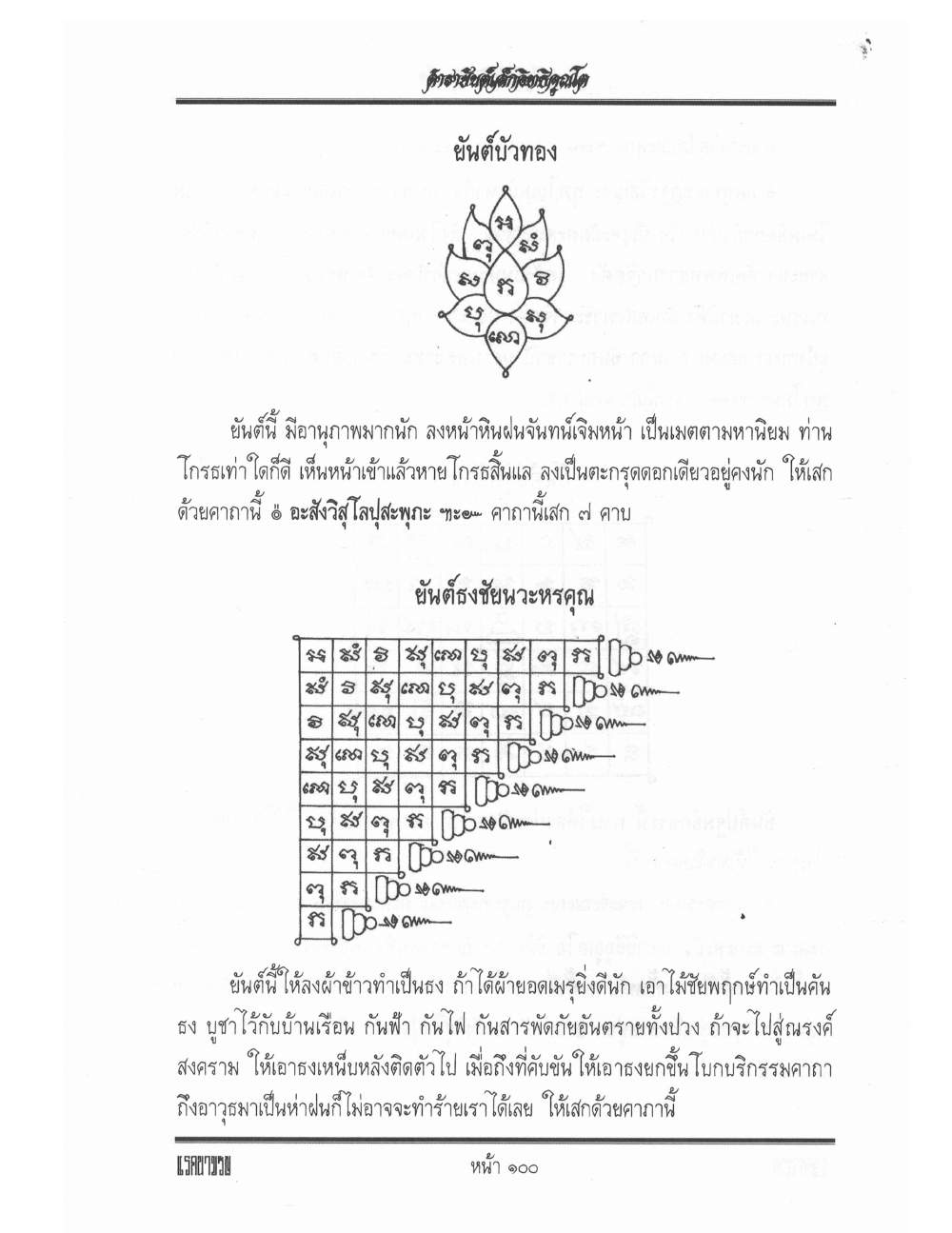
ยันต์บัวทอง
[อักขระขอมในยันต์ อ่านไม่ชัด] ยันต์นี้ มีอานุภาพมากนัก ลงหน้าหินฝนจันทน์เจิมหน้า เป็นเมตตามหานิยม ท่านโกรธเท่าใดก็ดี เห็นหน้าเข้าแล้วหายโกรธสิ้นแล ลงเป็นตะกรุดดอกเดียวอยู่คงนัก ให้เสกด้วยคาถานี้ ๐ อะสังวิสุโลปุสะพุกะ ๚ะ๛ คาถานี้เสก ๗ คาบ
ยันต์ธงชัยพะหรคุณ
[อักขระขอมในยันต์ อ่านไม่ชัด] ยันต์นี้ให้ลงผ้าขาวทำเป็นธง ถ้าได้ผ้ายอดเมรุยิ่งดีนัก เอาไม้ชัยพฤกษ์ทำเป็นคันธง บูชาไว้กับบ้านเรือน กันฟ้า กันไฟ กันสารพัดภัยอันตรายทั้งปวง ถ้าจะไปสู่ณรงค์สงคราม ให้เอาธงเหน็บหลังติดตัวไป เมื่อถึงที่คับขันให้เอาธงยกขึ้นโบกบริกรรมคาถา ถึงอาวุธมาเป็นห่าฝนก็ไม่อาจจะทำร้ายเราได้เลย ให้เสกด้วยคาถานี้
Golden Lotus Yantra
[yantra: an eight-petalled lotus flower, each petal and the centre holding a khom syllable] This yantra has very great power. Ground on a whetstone with sandalwood water and applied to the forehead, it grants great popularity and charm; however angry someone may be, once they see one's face their anger vanishes completely. Made into a single takrut, it grants lasting fortune. Consecrate it with this spell: "Asangwisulopusapuka," reciting it 7 times.
Victory-Banner Yantra of Phaharakhun
[yantra: a large staggered table of cells — nine rows, each one cell shorter than the last — every row ending in a small stupa icon and a repetition count, filled throughout with khom syllables] This yantra is to be written on white cloth and made into a banner; cloth taken from the top of a cremation stupa ("pha yot meru") is best of all. Make the banner's pole from chai phruek wood, and keep it enshrined at the house; it wards off lightning, fire, and every kind of danger. Going into battle, tuck the banner at one's back; when in dire straits, raise and wave the banner while reciting the spell — even should weapons fall like a rain-storm, they will be unable to harm us at all. Consecrate it with this spell:
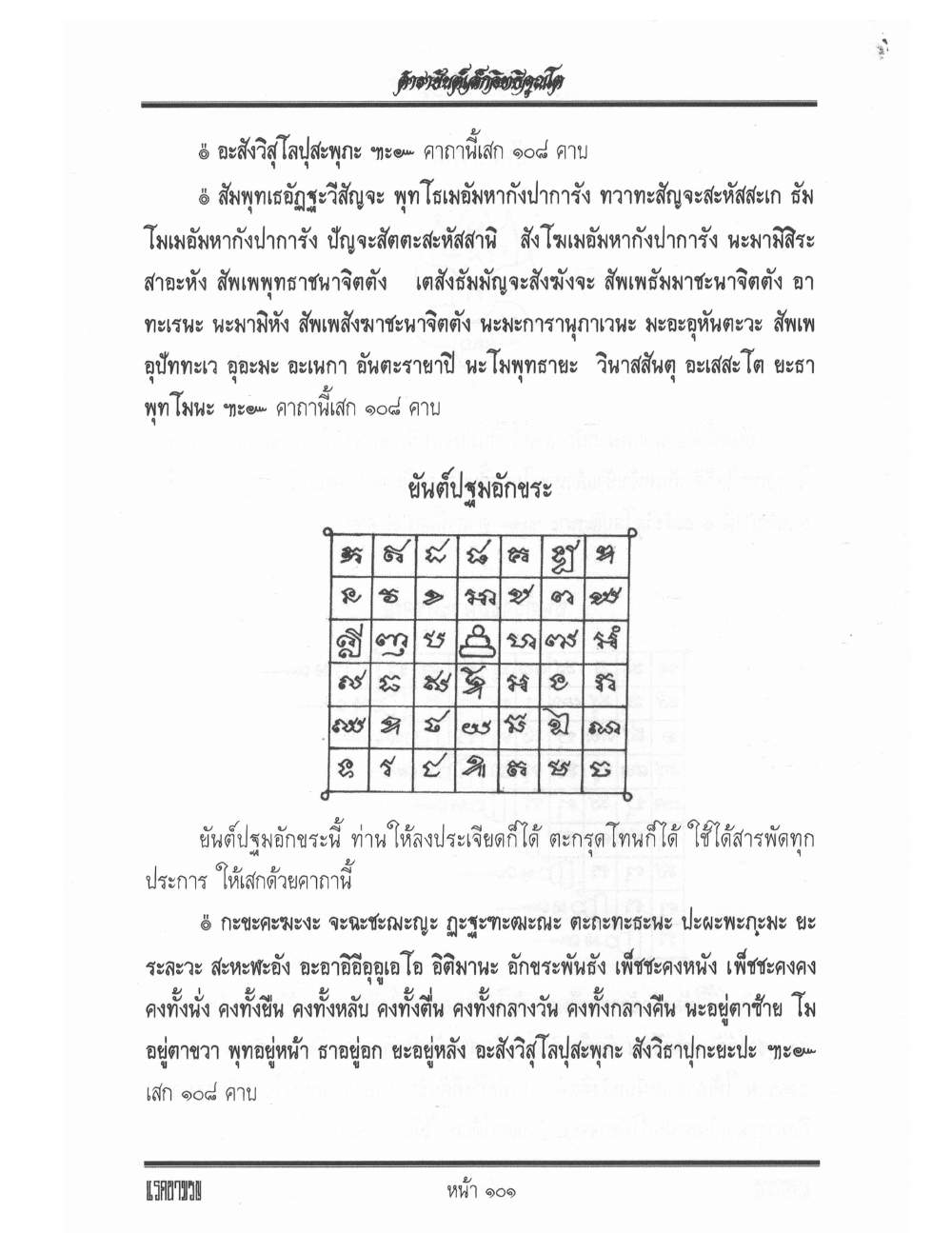
๐ อะสังวิสุโลปุสะพุกะ ๚ะ๛ คาถานี้เสก ๑๐๘ คาบ ๐ สัมพุทเธอัฏฐะวีสัญจะ พุทโธเมอัมหากังปาการัง ทวาทะสัญจะสะหัสสะเก ธัมโมเมอัมหากังปาการัง ปัญจะสัตตะสะหัสสานิ สังโฆเมอัมหากังปาการัง นะมามิสิระสาอะหัง สัพเพพุทธาชนาจิตตัง เตสังธัมมัญจะสังฆัญจะ สัพเพธัมมาชนาจิตตัง อาทะเรนะ นะมามิหัง สัพเพสังฆาชนาจิตตัง นะมะการานุภาเวนะ มะอะอุหันตะวะ สัพเพอุปัททะเว อุอะมะ อะเนกา อันตะรายาปิ นะโมพุทธายะ วินาสสันตุ อะเสสะโต ยะธาพุทโมนะ ๚ะ๛ คาถานี้เสก ๑๐๘ คาบ
ยันต์ปฐมอักขระ
[อักขระขอมในยันต์ อ่านไม่ชัด] ยันต์ปฐมอักขระนี้ ท่านให้ลงประเจียดก็ได้ ตะกรุดโทนก็ได้ ใช้ได้สารพัดทุกประการ ให้เสกด้วยคาถานี้ ๐ กะชะคะฆะงะ จะฉะชะฌะญะ ฏะฐะฑะฒะณะ ตะถะทะธะนะ ปะผะพะภะมะ ยะระละวะ สะหะพะฬะอัง อะอาอิอีอุอูเอโอ อิติมานะ อักขระพันธัง เพ็ชชะคงหนัง เพ็ชชะคงคง คงทั้งนั่ง คงทั้งยืน คงทั้งหลับ คงทั้งตื่น คงทั้งกลางวัน คงทั้งกลางคืน นะอยู่ตาซ้าย โมอยู่ตาขวา พุทอยู่หน้า ธาอยู่อก ยะอยู่หลัง อะสังวิสุโลปุสะพุกะ สังวิธาปุกะยะปะ ๚ะ๛ เสก ๑๐๘ คาบ
[continuing the banner's consecration:] "Asangwisulopusapuka" — consecrate for 108 repetitions. "Sambuddhe atthawisañca phutthomeamhakangpakarang thawathasañcasahatsake thammomeamhakangpakarang panyasattasahatsani sangkhomeamhakangpakarang namamisirasaahang sappheputthachanacittang tesangthammañcasangghañca sapphethammachanacittang athorena namamihang sapphesangghachanacittang namakaranuphawena maausantawa sapphaeupatthawe uama aneka antarayapi namophutthaya winatsantu asesato yathaphutmona" — consecrate for 108 repetitions.
First-Syllables Yantra
[yantra: a dense grid of roughly forty-two cells arranged in rows and columns, each filled with a khom syllable, with a small stupa icon in place of a syllable in one central cell] This "First-Syllables" yantra may be worn as a protective cloth charm or as a single takrut; it serves for every purpose. Consecrate it with this spell: "Ka cha kha gha nga, ca cha cha jha ya, ta tha da dha na, ta tha tha tha na, pa pha pha pha ma, ya ra la wa, sa ha pha la ang, a aa i ii u uu e o" — thus the whole alphabet is bound into the syllables. "Diamond-lasting for the body: enduring while seated, enduring while standing, enduring while asleep, enduring while awake, enduring by day, enduring by night. Na dwells in the left eye, mo in the right eye, phut at the front, tha at the chest, ya at the back. Asangwisulopusapuka, sangwithapukayapa." Consecrate for 108 repetitions.
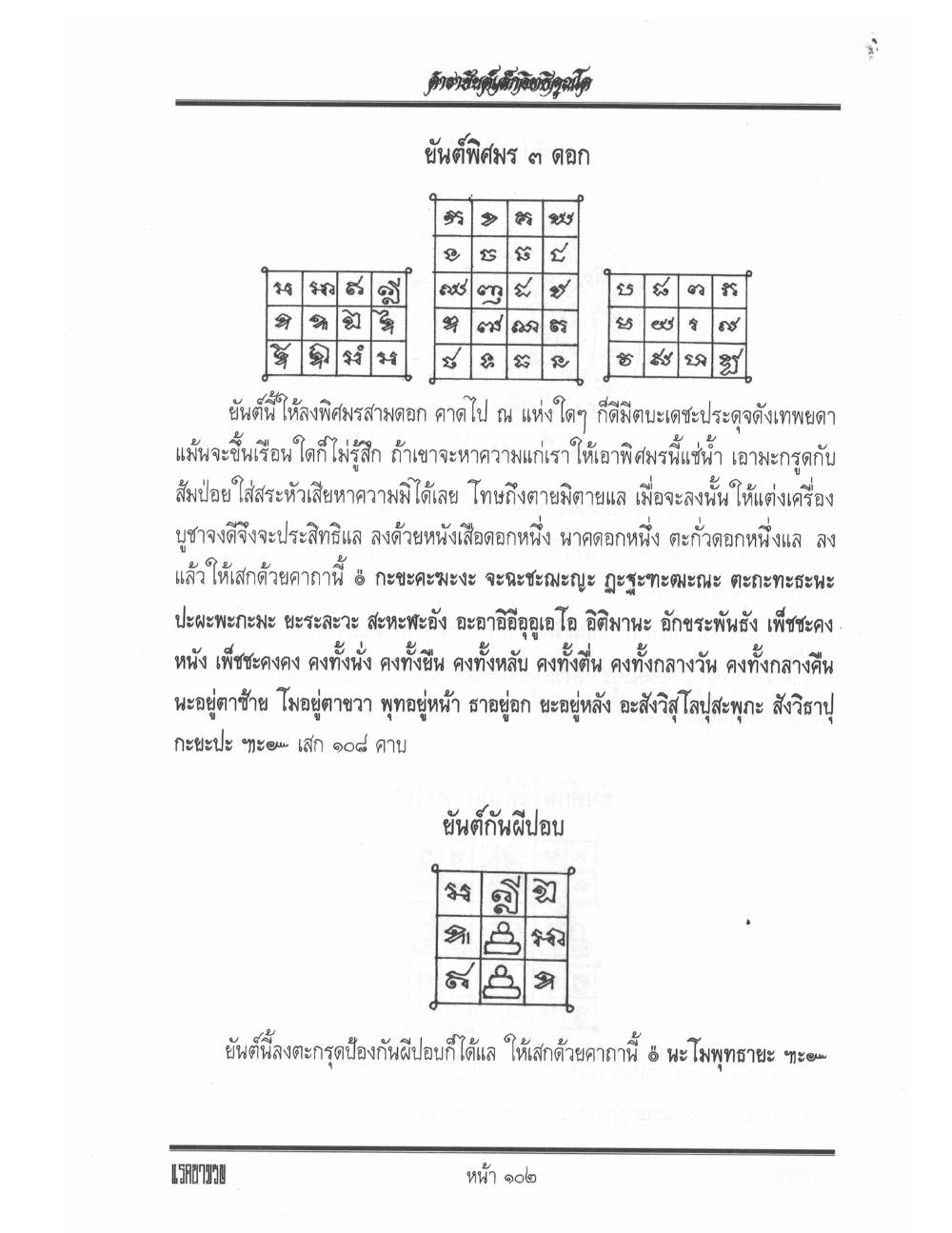
ยันต์พิศมร ๓ ดอก
[อักขระขอมในยันต์ อ่านไม่ชัด] (สามผังสี่เหลี่ยมเรียงกัน แต่ละผังบรรจุอักขระขอม)
ยันต์นี้ให้ลงพิศมรสามดอก คาดไป ณ แห่งใดๆ ก็ดีมีตะเดชะประดุจดังเทพยดา แม้นจะขึ้นเรือนใดก็ไม่รู้สึก ถ้าเขาจะหาความแก่เราให้เอาพิศมรนี้แช่น้ำ เอามะกรูดกับส้มป่อยใส่สระหัวเสียหาความมิได้เลย โทษถึงตายมิตายแล เมื่อจะลงนั้นให้แต่งเครื่องบูชาจงดีจึงจะประสิทธิ์แล ลงด้วยหนังเสือดอกหนึ่ง พาดดอกหนึ่ง ตะกั่วดอกหนึ่งแล ลงแล้วให้เสกด้วยคาถานี้ ๐ กะขะคะฆะงะ จะฉะชะฌะญะ ฏะฐะฑะฒะณะ ตะถะทะธะนะ ปะผะพะภะมะ ยะระละวะ สะหะพะอัง อะอาอิอีอุอูเอโอ อิติมาหะ อักขระพันธัง เพ็ชชะคงหนัง เพ็ชชะคงคง คงทั้งนั่ง คงทั้งยืน คงทั้งหลับ คงทั้งตื่น คงทั้งกลางวัน คงทั้งกลางคืน นะอยู่ตาซ้าย โมอยู่ตาขวา พุทอยู่หน้า ธาอยู่อก ยะอยู่หลัง อะสังวิสุโลปุสะพุภะ สังวิธาปุกะยะปะ ๚ะ๛ เสก ๑๐๘ คาบ
ยันต์กันผีปอบ
[อักขระขอมในยันต์ อ่านไม่ชัด] (ผังเก้าช่อง มีรูปเจดีย์ซ้อนชั้นสองช่องกลาง)
ยันต์นี้ลงตะกรุดป้องกันผีปอบก็ได้แล ให้เสกด้วยคาถานี้ ๐ พะโมพุทธายะ ๚ะ๛
Three-Bloom Charm Yantra (Yan Phitsamon Sam Dok)
[yantra: three separate square grids side by side, each divided into cells filled with khom syllables, not confidently legible]
This yantra is inscribed as three "blooms" of the phitsamon charm; wear it wrapped anywhere on the body and it grants an aura of power like a deity's — even climbing into someone else's house, one goes unnoticed. If someone comes seeking a quarrel or accusation against you, soak this phitsamon charm in water, add kaffir lime and soap-pod (som poi), and wash the hair with it — the matter cannot be pursued at all, even a capital charge comes to nothing. When inscribing it, prepare the offerings properly for it to take effect: inscribe one panel on tiger hide, one panel on [phak leaf-material], one panel on lead, then consecrate with this spell: 'Ka kha kha gha nga, ja cha cha cha ya, ta tha ta ta na, ta tha ta tha na, pa pha pha pha ma, ya ra la wa, sa ha pha ang, a a i i u u e o, iti maha akkhara phanthang, phetcha khong nang, phetcha khong khong, khong thang nang, khong thang yuen, khong thang lap, khong thang tuen, khong thang klang wan, khong thang klang khuen, na yu ta sai, mo yu ta khwa, phut yu na, tha yu ok, ya yu lang, a sang wi su lo pu sa phu pha, sang wi tha pu ka ya pa' — recite 108 times.
Ghost-Warding Yantra (Yan Kan Phi Pop)
[yantra: a nine-cell grid filled with khom syllables, with a stacked-tier pagoda (chedi) drawing in two of the center cells]
This yantra, inscribed on a takrut, wards off the phi pop spirit; consecrate it with this spell: 'Pha mo phutthaya.'
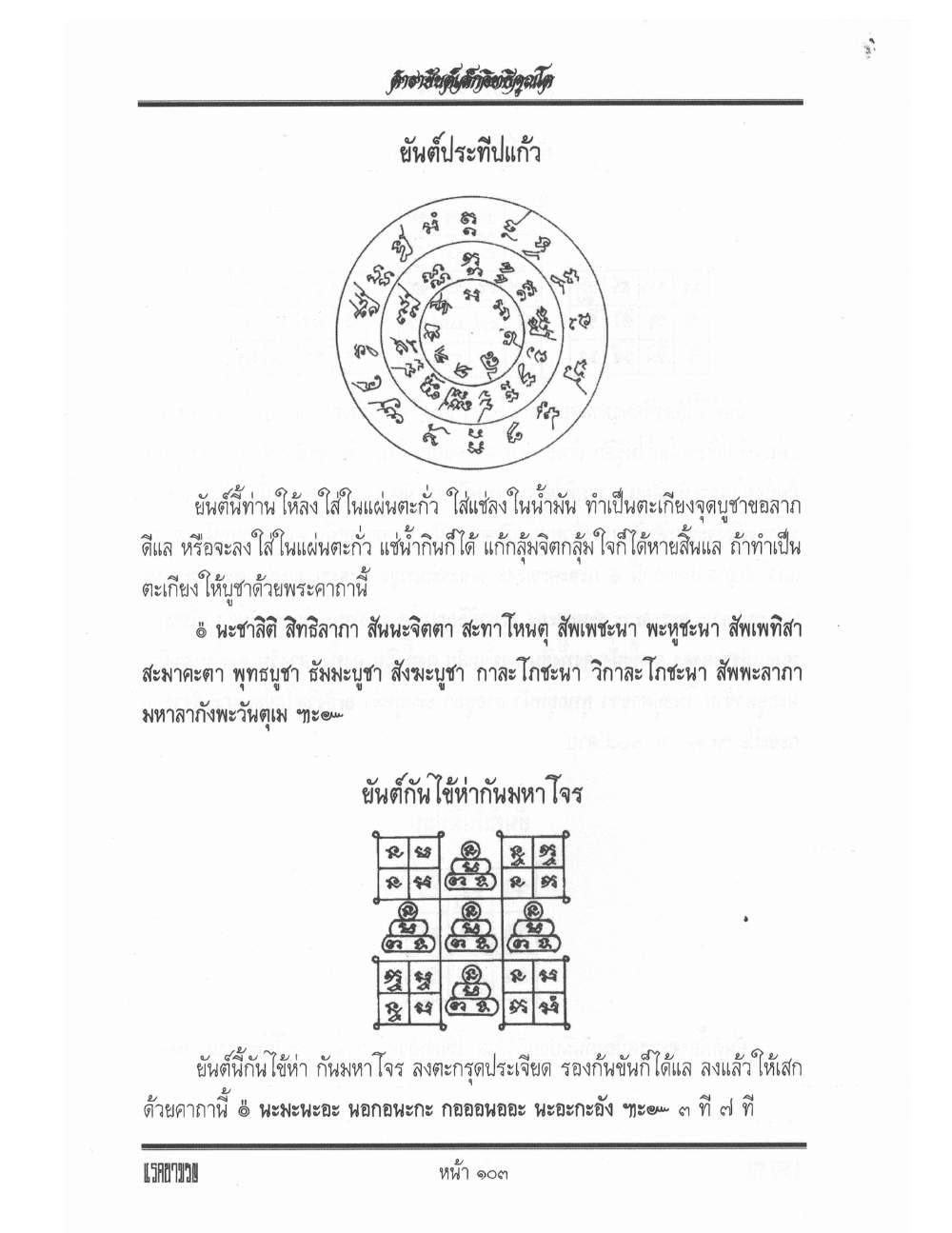
ยันต์ประทีปแก้ว
[อักขระขอมในยันต์ อ่านไม่ชัด] (วงกลมสามชั้นซ้อนกัน แบ่งเป็นช่องแนวรัศมี)
ยันต์นี้ท่านให้ลงใส่ในแผ่นตะกั่ว ใส่แช่ลงในน้ำมัน ทำเป็นตะเกียงจุดบูชาขอลาภดีแล หรือจะลงใส่ในแผ่นตะกั่ว แช่น้ำกินก็ได้ แก้กลุ้มจิตกลุ้มใจก็ได้หายสิ้นแล ถ้าทำเป็นตะเกียงให้บูชาด้วยพระคาถานี้
๐ นะชาลิติ สิทธิลาภา สันนะจิตตา สะทาโหนตุ สัพเพชะนา พะหูชะนา สัพเพทิสา สะมาคะตา พุทธบูชา ธัมมะบูชา สังฆะบูชา กาละโภชะนา วิกาละโภชะนา สัพพลาภา มหาลาภังพะวันตุเม ๚ะ๛
ยันต์กันไข้ห่ากันมหาโจร
[อักขระขอมในยันต์ อ่านไม่ชัด] (ผังเก้าช่อง มีรูปเจดีย์ซ้อนชั้นในหลายช่อง)
ยันต์นี้กันไข้ห่า กันมหาโจร ลงตะกรุดประเจียดก็ได้แล รองกันขับก็ได้แล ลงแล้วให้เสกด้วยคาถานี้ ๐ พะมะพะอะ พอกอพะกะ กอออพออะ พะอะกะอัง ๚ะ๛ ๓ ที ๗ ที
Crystal-Lamp Yantra (Yan Prathip Kaeo)
[yantra: three concentric circles, each ring divided into radial cells filled with khom syllables]
This yantra is inscribed on a lead sheet and steeped in oil, made into a lamp and lit as an offering to invite good fortune; or the lead sheet may instead be soaked in drinking water — this cures agitation of mind and heart entirely. If made into a lamp, offer it with this spell: 'Na cha li ti, sitthi lapha, san na chit ta, sa tha ho ntu, sap phe cha na, pha hu cha na, sap phe thi sa, sa ma kha ta, phutthabucha, thammabucha, sangkhabucha, kala phochana, wikala phochana, sappha lapha, maha laphang pha wan tu me.'
Yantra Warding Off Plague and Great Bandits
[yantra: a nine-cell grid, several cells containing stacked-tier pagoda (chedi) drawings]
This yantra wards off plague (khai ha) and great bandits; inscribe it on a takrut or a cloth amulet, and it also serves to ward off blows. Once inscribed, consecrate it with this spell: 'Pha ma pha a, po ko pha ka, ko o po o, pha a ka ang' — three times or seven times.
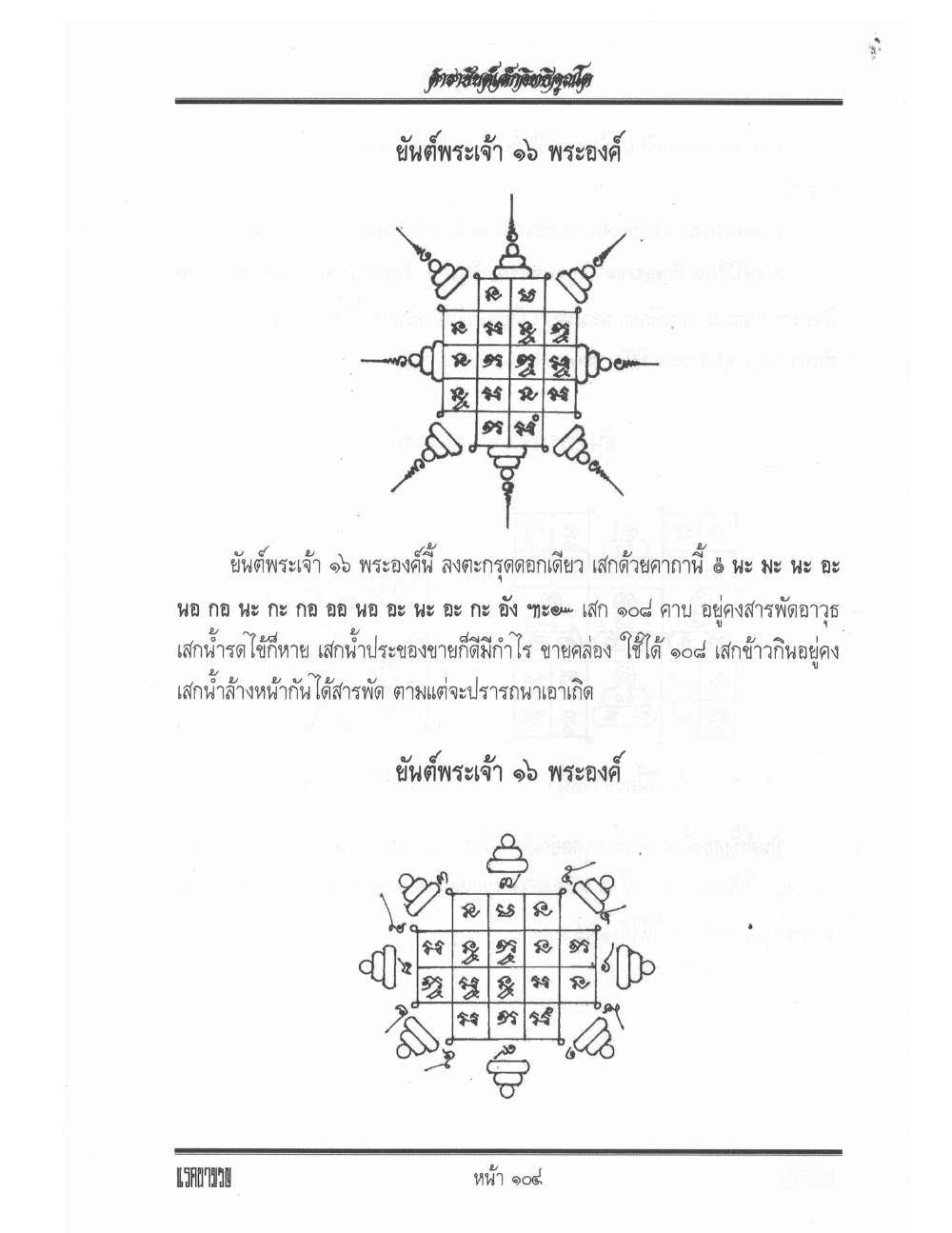
ยันต์พระเจ้า ๑๖ พระองค์
[อักขระขอมในยันต์ อ่านไม่ชัด] (ผังสี่เหลี่ยมสิบหกช่องตรงกลาง มีรัศมีแปดแฉกยื่นออกโดยรอบ ปลายแฉกสลับลายฉัตรและปุ่มลูกประคำ)
ยันต์พระเจ้า ๑๖ พระองค์นี้ ลงตะกรุดดอกเดียว เสกด้วยคาถานี้ ๐ พะ มะ พะ อะ พอ กอ พะ กะ กอ ออ พอ อะ พะ อะ กะ อัง ๚ะ๛ เสก ๑๐๘ คาบ อยู่คงสารพัดอาวุธ เสกน้ำรดไข้ก็หาย เสกน้ำประของขายก็ดีมีกำไร ขายคล่อง ใช้ได้ ๑๐๘ เสกข้าวกินอยู่คง เสกน้ำล้างหน้ากันได้สารพัด ตามแต่จะปรารถนาเอาเถิด
ยันต์พระเจ้า ๑๖ พระองค์
[อักขระขอมในยันต์ อ่านไม่ชัด] (ผังสี่เหลี่ยมสิบหกช่องตรงกลาง มีรัศมีแปดแฉกยื่นออกโดยรอบ ปลายแฉกเป็นปุ่มลูกประคำ)
Yantra of the Sixteen Buddhas
[yantra: a 4x4 grid of khom syllables at center, with eight rays radiating outward, the ray-tips alternating between a small spire (chatra) ornament and a bead-cluster ornament]
This Yantra of the Sixteen Buddhas is inscribed onto a single takrut; consecrate with this spell: 'Pha ma pha a, po ko pha ka, ko o po o, pha a ka ang' — recite 108 times. It grants invulnerability against every kind of weapon. Chant over water and sprinkle it on a fever, and the fever is cured; chant over goods offered for sale and they sell well and profitably, moving briskly — good for up to 108 uses. Chant over rice before eating for invulnerability. Chant over water used to wash the face, and it wards off anything at all — use it according to whatever one desires.
Yantra of the Sixteen Buddhas
[yantra: a second variant — a 4x4 grid of khom syllables at center, with eight rays radiating outward, all ray-tips ending in bead-cluster ornaments]
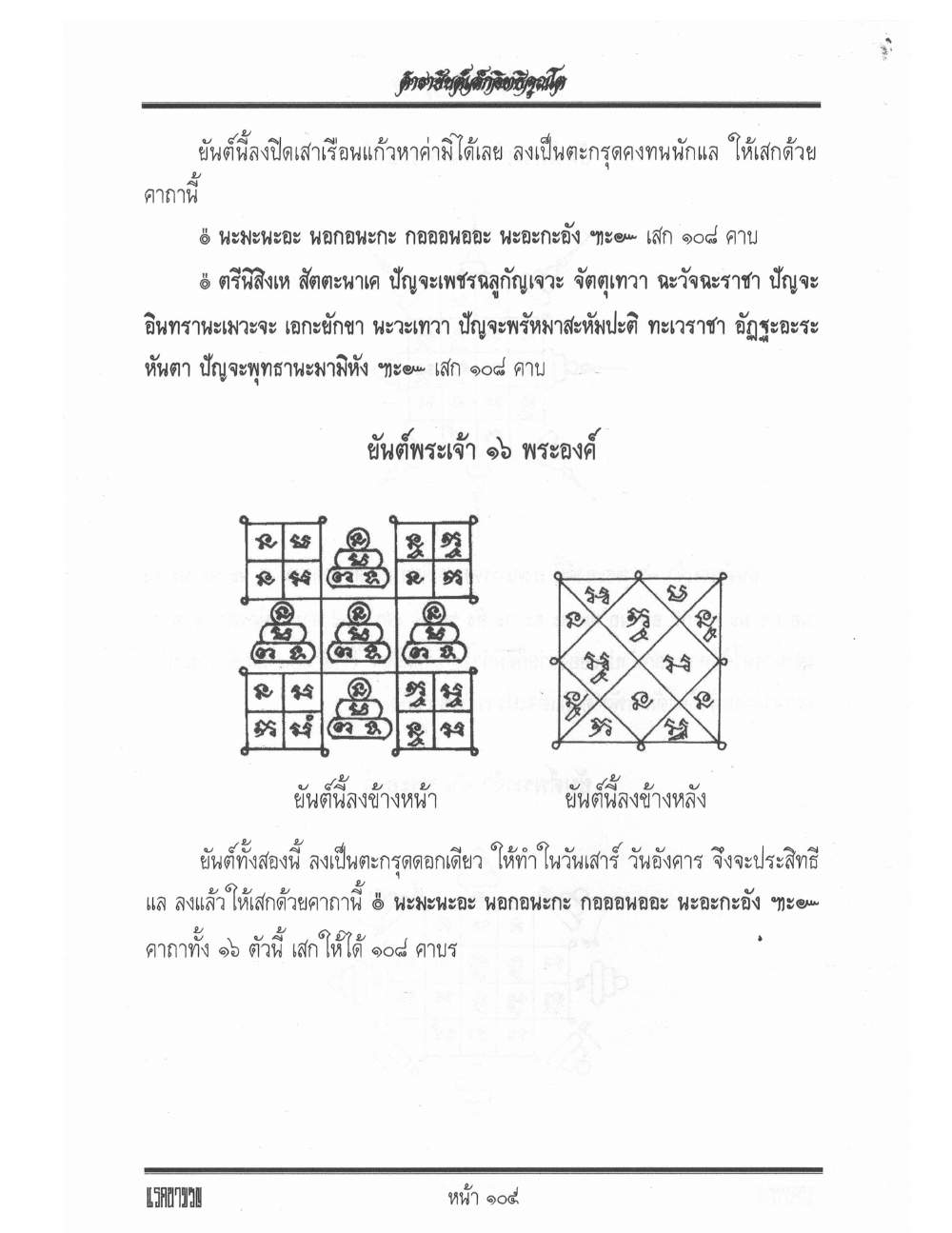
ยันต์นี้ลงปิดเสาเรือนแก้วหาค่ามิได้เลย ลงเป็นตะกรุดคงทนพักแล ให้เสกด้วยคาถานี้
๐ พะมะพะอะ พอกอพะกะ กอออพออะ พะอะกะอัง ๚ะ๛ เสก ๑๐๘ คาบ
๐ ตรีนิสิงเห สัตตะพาเค ปัญจะเพชรฉลูกัญเจวะ จัตตุเทวา ฉะวัจฉะราชา ปัญจะอินทราณะเมาะจะ เอกะยักขา พะเทวา ปัญจะพรัหมาสะหัมปะติ ทะเวราชา อัฏฐะอะระหันตา ปัญจะพุทธานะมามิหัง ๚ะ๛ เสก ๑๐๘ คาบ
ยันต์พระเจ้า ๑๖ พระองค์
ยันต์นี้ลงข้างหน้า [อักขระขอมในยันต์ อ่านไม่ชัด] (ผังเก้าช่อง แถวกลางมีรูปเจดีย์ซ้อนชั้นสามช่อง)
ยันต์นี้ลงข้างหลัง [อักขระขอมในยันต์ อ่านไม่ชัด] (ผังข่ายเส้นทแยงไขว้กันเป็นรูปสี่เหลี่ยมขนมเปียกปูน)
ยันต์ทั้งสองนี้ ลงเป็นตะกรุดดอกเดียว ให้ทำในวันเสาร์ วันอังคาร จึงจะประสิทธิ์แล ลงแล้วให้เสกด้วยคาถานี้ ๐ พะมะพะอะ พอกอพะกะ กอออพออะ พะอะกะอัง ๚ะ๛ คาถาทั้ง ๑๖ ตัวนี้ เสกให้ได้ ๑๐๘ คาบ
This yantra, inscribed to seal the pillar of a fine house, is beyond price; inscribed onto a takrut it grants durability/invulnerability. Consecrate it with this spell:
'Pha ma pha a, po ko pha ka, ko o po o, pha a ka ang' — recite 108 times.
'Tri ni singhe, sattha phake, pancha phet chalu kanjewa, chattu thewa, cha wat cha racha, pancha inthrana mocha, eka yak kha, pha thewa, pancha phrahma sahamapati, tha we racha, attha a ra hanta, pancha phutthana mamihang' — recite 108 times.
Yantra of the Sixteen Buddhas
This yantra is inscribed on the front: [yantra: a nine-cell grid, the middle row showing a three-tiered pagoda (chedi) drawing in each cell]
This yantra is inscribed on the back: [yantra: a lattice of crossed diagonal lines forming a diamond pattern, with khom syllables]
These two yantras are both inscribed onto a single takrut; they must be made on a Saturday or a Tuesday for them to take effect. Once inscribed, consecrate with this spell: 'Pha ma pha a, po ko pha ka, ko o po o, pha a ka ang.' Recite this sixteen-syllable spell 108 times.
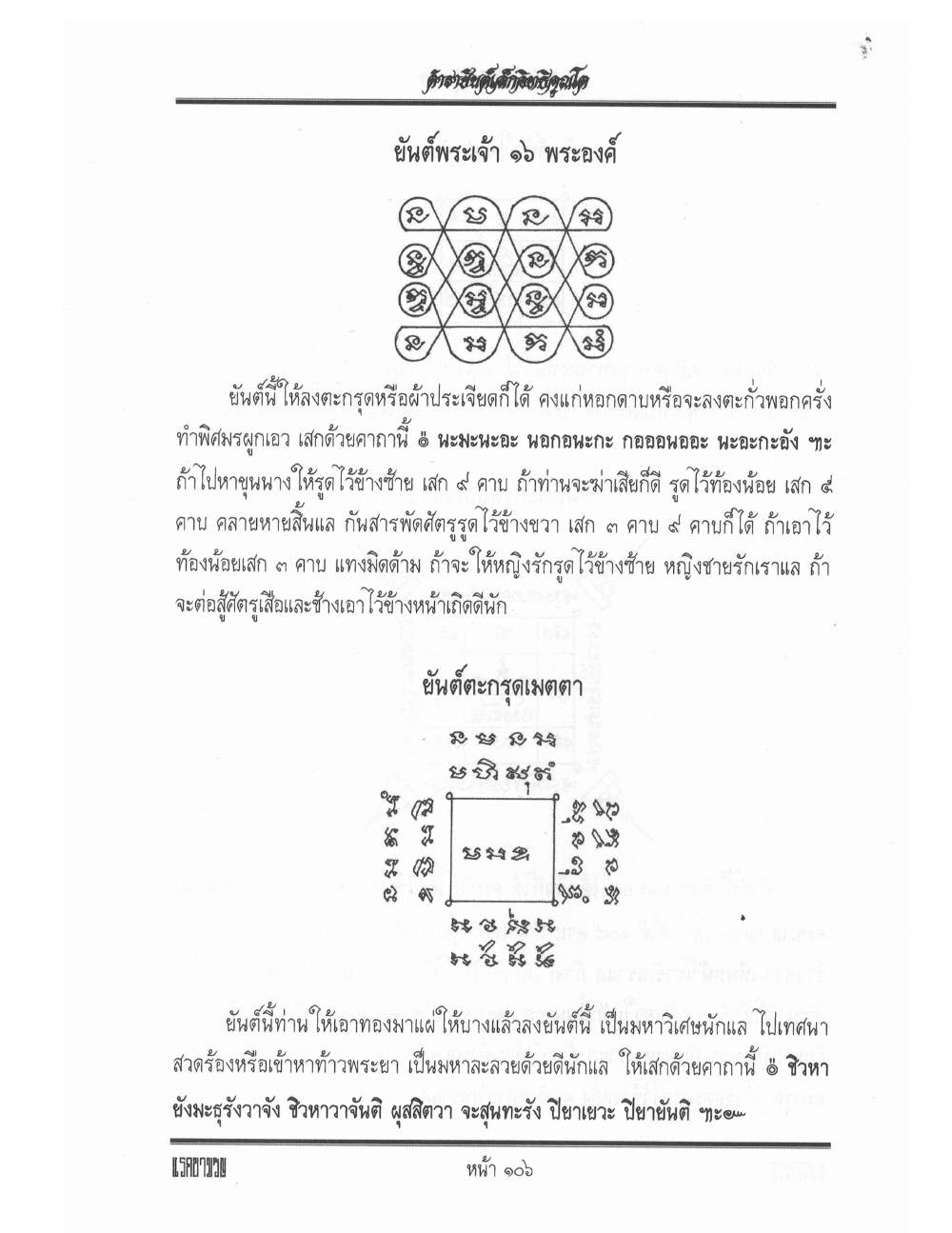
ยันต์พระเจ้า ๑๖ พระองค์
[อักขระขอมในยันต์ อ่านไม่ชัด] (แถบกลีบโค้งสานไขว้กันเป็นผังสิบหกวง แต่ละวงบรรจุอักขระขอมหนึ่งตัว)
ยันต์นี้ให้ลงตะกรุดหรือผ้าประเจียดก็ได้ คงแก่หอกดาบหรือจะลงตะกั่วผสมครั่งทำพิศมรผูกเอว เสกด้วยคาถานี้ ๐ พะมะพะอะ พอกอพะกะ กอออพออะ พะอะกะอัง ๚ะ ถ้าไปหาขุนนางให้รูดไว้ข้างซ้าย เสก ๙ คาบ ถ้าท่านจะฆ่าเสียก็ดี รูดไว้ท้องน้อย เสก ๔ คาบ คลายหายสิ้นแล กันสารพัดศัตรูรูดไว้ข้างขวา เสก ๓ คาบ ๙ คาบก็ได้ ถ้าเอาไว้ท้องน้อยเสก ๓ คาบ แทงมิดด้าม ถ้าจะให้หญิงรักรูดไว้ข้างซ้าย หญิงชายรักเราแล ถ้าจะต่อสู้ศัตรูเสือและช้างเอาไว้ข้างหน้าเกิดดีนัก
ยันต์ตะกรุดเมตตา
[อักขระขอมในยันต์ อ่านไม่ชัด] (ผังสี่เหลี่ยมกลางบรรจุอักขระขอมสามตัว ล้อมด้วยแถวอักขระขอมทั้งสี่ด้าน)
ยันต์นี้ท่านให้เอาทองมาแผ่ให้บางแล้วลงยันต์นี้ เป็นมหาวิเศษพักแล ไปเทศนาสวดร้องหรือเข้าหาท้าวพระยา เป็นมหาละลวยด้วยดีพักแล ให้เสกด้วยคาถานี้ ๐ ชิวหายังมะธุรังวาจัง ชิวหาวาจัติ ผุสสิตวา จะสุนทะรัง ปิยาเยวะ ปิยายันติ ๚ะ๛
Yantra of the Sixteen Buddhas
[yantra: interlocking scalloped bands forming sixteen circles woven together, each circle enclosing one khom syllable]
This yantra may be inscribed on a takrut or a cloth amulet; it grants resistance to spear and sword. It may also be inscribed on lead mixed with lac resin and made into a phitsamon charm worn at the waist. Consecrate it with this spell: 'Pha ma pha a, po ko pha ka, ko o po o, pha a ka ang.' If going before officials, slide it to the left side, chanted 9 times. If someone means to kill you, slide it to rest on the lower belly, chanted 4 times, and the danger dissolves entirely. To ward off every kind of enemy, slide it to the right side, chanted 3 or 9 times. If kept at the lower belly, chanted 3 times, a stabbing blade will not go in to the hilt. To make a woman love you, slide it to the left side, and men and women alike will love you. To fight tigers and elephants, keep it in front, and great fortune results.
Loving-Kindness Takrut Yantra (Yan Takrut Metta)
[yantra: a central square containing three khom syllables, surrounded on all four sides by rows of khom syllables]
This yantra is to be inscribed on a thin sheet of beaten gold, making it a great and wondrous thing; when going to preach, to chant, or to appear before a lord or ruler, it brings great and favorable charm. Consecrate it with this spell: 'Chiwaha yang mathurang wachang, chiwaha wachati, phutsitwa cha suntharang, piya yewa piya yanti.'
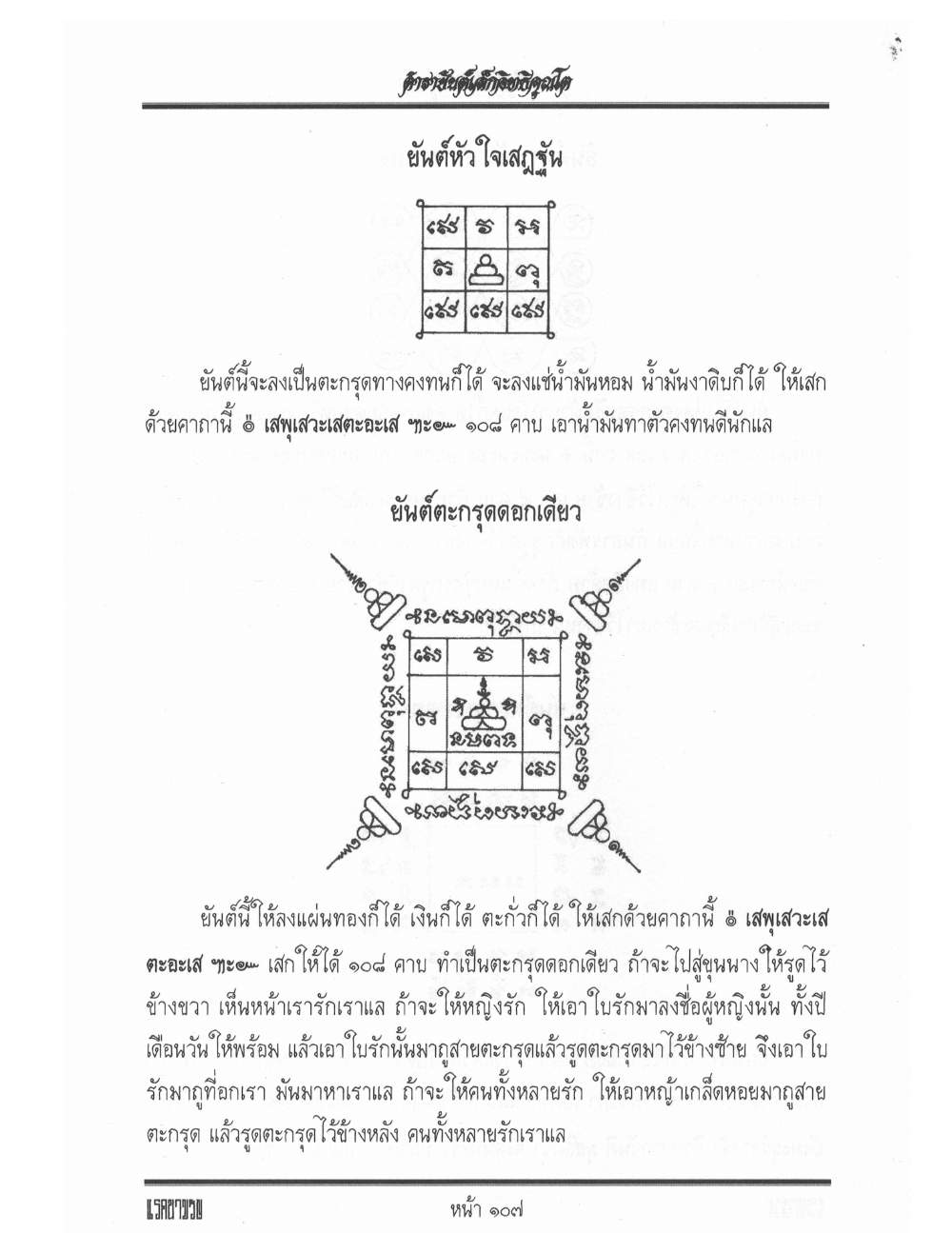
ยันต์หัวใจเศรษฐี
[อักขระขอมในยันต์ อ่านไม่ชัด] (ผังเก้าช่อง มีรูปเจดีย์ซ้อนชั้นตรงกลาง อักขระขอมซ้ำกันหลายช่องโดยรอบ)
ยันต์นี้จะลงเป็นตะกรุดทางคงทนก็ได้ จะลงแช่น้ำมันหอม น้ำมันงาดิบก็ได้ ให้เสกด้วยคาถานี้ ๐ เสพุเสวะเสตะอะเส ๚ะ๛ ๑๐๘ คาบ เอาน้ำมันทาตัวคงทนดีพักแล
ยันต์ตะกรุดดอกเดียว
[อักขระขอมในยันต์ อ่านไม่ชัด] (ผังเก้าช่องกลาง มีรูปเจดีย์ซ้อนชั้นตรงกลาง ล้อมด้วยแถวอักขระขอมทั้งสี่ด้าน และปุ่มลูกประคำสี่มุมนอก)
ยันต์นี้ให้ลงแผ่นทองก็ได้ เงินก็ได้ ตะกั่วก็ได้ ให้เสกด้วยคาถานี้ ๐ เสพุเสวะเสตะอะเส ๚ะ๛ เสกให้ได้ ๑๐๘ คาบ ทำเป็นตะกรุดดอกเดียว ถ้าจะไปสู่ขุนนางให้รูดไว้ข้างขวา เห็นหน้าเรารักเราแล ถ้าจะให้หญิงรัก ให้เอาใบรักมาลงชื่อผู้หญิงนั้น ทั้งปีเดือนวันให้พร้อม แล้วเอาใบรักนั้นมาถูสายตะกรุดแล้วรูดตะกรุดมาไว้ข้างซ้าย จึงเอาใบรักมาถูที่อกเรา มันมาหาเราแล ถ้าจะให้คนทั้งหลายรัก ให้เอาหญ้าเกล็ดหอยมาถูสายตะกรุด แล้วรูดตะกรุดไว้ข้างหลัง คนทั้งหลายรักเราแล
Millionaire's Heart Yantra (Yan Hua Chai Setthi)
[yantra: a nine-cell grid with a stacked-tier pagoda (chedi) drawing at the center, khom syllables repeating across the surrounding eight cells]
This yantra may be inscribed on a takrut for durability/invulnerability, or soaked in fragrant oil or raw sesame oil. Consecrate it with this spell: 'Se phu se wa se ta a se' — 108 times. Rub the oil on the body for good durability/invulnerability.
Single Takrut Yantra (Yan Takrut Dok Diao)
[yantra: a nine-cell grid with a stacked-tier pagoda drawing at the center, framed by rows of khom syllables along all four outer sides, with a bead-cluster ornament at each of the four outer corners]
This yantra may be inscribed on a sheet of gold, silver, or lead. Consecrate it with this spell: 'Se phu se wa se ta a se' — recite it 108 times. Make it into a single takrut. If going before officials, slide it to rest on the right side, and they will love you at first sight. To make a woman love you, take a rak leaf and write the woman's name upon it, together with her full year, month, and day of birth; rub that rak leaf along the takrut's cord and slide the takrut to rest on the left side; then rub the rak leaf against your own chest, and she will come to you. To make everyone love you, rub cowrie-shell-scale grass (ya klet hoi) along the takrut's cord and slide the takrut to rest at the back — everyone will love you.
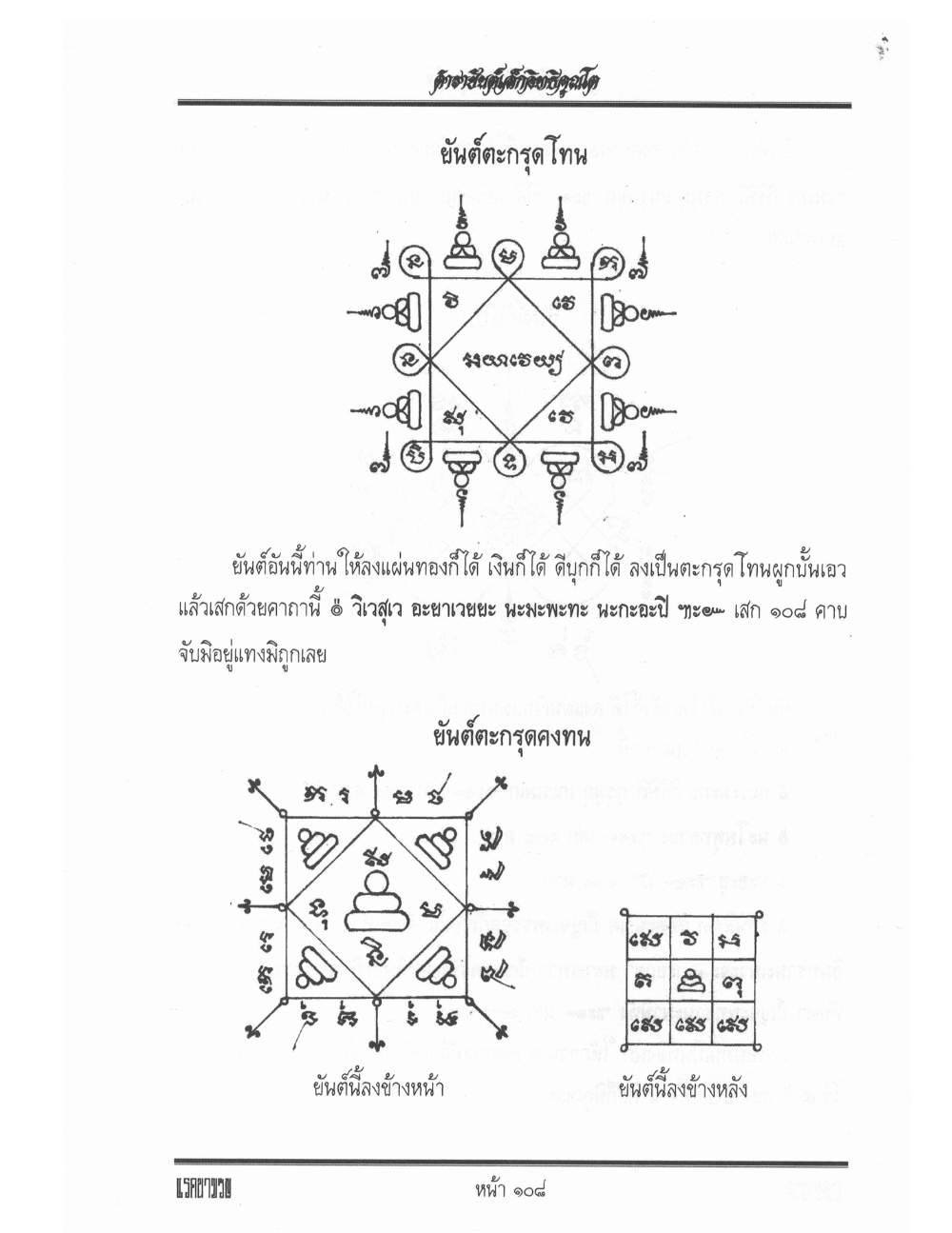
ยันต์ตะกรุดโทน
[อักขระขอมในยันต์ อ่านไม่ชัด] (ผังสี่เหลี่ยมขนมเปียกปูนซ้อนในกรอบสี่เหลี่ยมจัตุรัส ตรงกลางมีข้อความขอมอ่านไม่ชัด อักขระขอมหนึ่งตัวในมุมสามเหลี่ยมทั้งสี่มุม มีลายฉัตรและปุ่มลูกประคำที่มุมนอกทั้งสี่)
ยันต์อันนี้ท่านให้ลงแผ่นทองก็ได้ เงินก็ได้ ดีบุกก็ได้ ลงเป็นตะกรุดโทนผูกบั้นเอว แล้วเสกด้วยคาถานี้ ๐ วิเวสุเว อะยาเวยยะ พะมะพะทะ พะกะอะปิ ๚ะ๛ เสก ๑๐๘ คาบ จับมิดอยู่แทงมิถูกเลย
ยันต์ตะกรุดคงทน
[อักขระขอมในยันต์ อ่านไม่ชัด] (ผังสี่เหลี่ยมขนมเปียกปูนซ้อนในกรอบสี่เหลี่ยมจัตุรัส ตรงกลางมีรูปเจดีย์ซ้อนชั้นเล็ก อักขระขอมหนึ่งตัวในมุมสามเหลี่ยมทั้งสี่มุม มีข้อความขอมเรียงตามขอบทั้งสี่ด้านนอกกรอบ พร้อมลูกศรชี้)
ยันต์นี้ลงข้างหน้า [อักขระขอมในยันต์ อ่านไม่ชัด] (ผังเก้าช่อง)
ยันต์นี้ลงข้างหลัง [อักขระขอมในยันต์ อ่านไม่ชัด] (ผังเก้าช่อง มีรูปเจดีย์เล็กในช่องหนึ่ง)
Solitary Takrut Yantra (Yan Takrut Thon)
[yantra: a diamond inscribed within a square frame; illegible khom text at the diamond's center; one khom syllable in each of the four corner triangles; a spire-and-bead-cluster ornament at each of the four outer corners of the square]
This yantra is inscribed on a sheet of gold, silver, or tin, made into a solitary takrut worn at the waist, then consecrated with this spell: 'Wi we su we, a ya we ya, pha ma pha tha, pha ka a pi' — recite 108 times. Hold a blade against it and it will not stab through.
Enduring Takrut Yantra (Yan Takrut Khong Thon)
[yantra: a diamond inscribed within a square frame, a small stacked-tier pagoda drawing at the center, one khom syllable in each of the four corner triangles, khom-script text running along all four outer edges of the frame with small arrows pointing to it]
This yantra is inscribed on the front: [yantra: a nine-cell grid]
This yantra is inscribed on the back: [yantra: a nine-cell grid, with a small pagoda drawing in one cell]
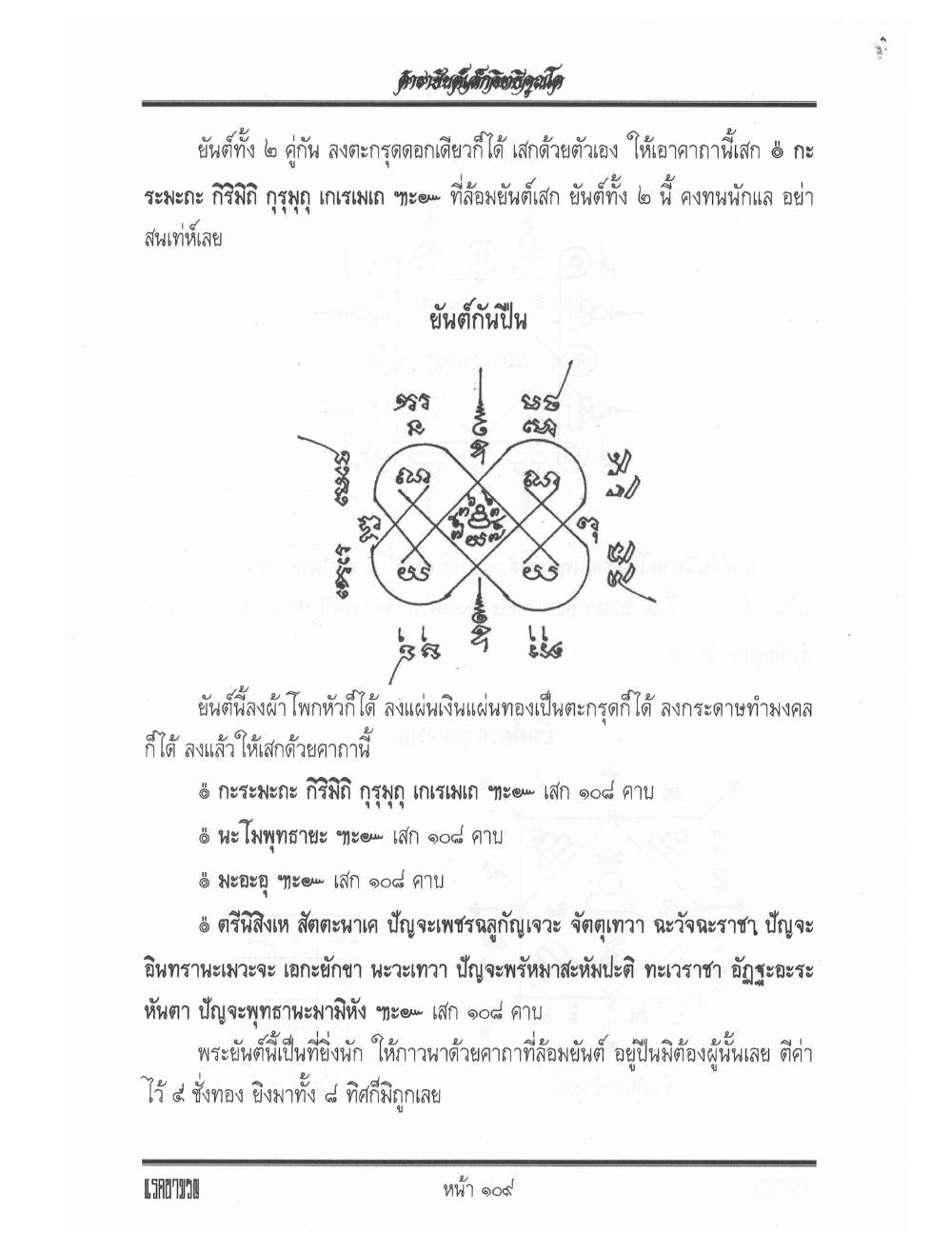
ยันต์ทั้ง ๒ คู่กัน ลงตะกรุดดอกเดียวก็ได้ เสกด้วยตัวเอง ให้เอาคาถานี้เสก ๐ กะระมะถะ กิริมิถิ กุรุมุถุ เกเรเมเถ ๚ะ๛ ที่ล้อมยันต์เสก ยันต์ทั้ง ๒ นี้ คงทนพักแล อย่าสนเท่ห์เลย
ยันต์กันปืน
[อักขระขอมในยันต์ อ่านไม่ชัด] (ผังกลีบสี่แฉกไขว้กันคล้ายเลขแปด มีอักขระขอมในแต่ละกลีบ ตรงกลางมีรูปเจดีย์ซ้อนชั้นในวงกลมเล็ก ปลายกลีบทั้งสี่มีข้อความขอมแยกออกไปตามแนวทแยง)
ยันต์นี้ลงผ้าโพกหัวก็ได้ ลงแผ่นเงินแผ่นทองเป็นตะกรุดก็ได้ ลงกระดาษทำมงคลก็ได้ ลงแล้วให้เสกด้วยคาถานี้
๐ กะระมะถะ กิริมิถิ กุรุมุถุ เกเรเมเถ ๚ะ๛ เสก ๑๐๘ คาบ
๐ นะโมพุทธายะ ๚ะ๛ เสก ๑๐๘ คาบ
๐ มะอะอุ ๚ะ๛ เสก ๑๐๘ คาบ
๐ ตรีนิสิงเห สัตตะพาเค ปัญจะเพชรฉลูกัญเจวะ จัตตุเทวา ฉะวัจฉะราชา ปัญจะอินทราณะเมาะจะ เอกะยักขา พะเทวา ปัญจะพรัหมาสะหัมปะติ ทะเวราชา อัฏฐะอะระหันตา ปัญจะพุทธานะมามิหัง ๚ะ๛ เสก ๑๐๘ คาบ
พระยันต์นี้เป็นที่ยิ่งนัก ให้ภาวนาด้วยคาถาที่ล้อมยันต์ อยู่ปืนมิต้องผู้นั้นเลย ตีค่าไว้ ๔ ชั่งทอง ยิงมาทั้ง ๘ ทิศก็มิถูกเลย
These two paired yantras [the front and back designs from the preceding page] may both be inscribed onto a single takrut, and are self-consecrating; use this spell to consecrate: 'Ka ra ma tha, ki ri mi thi, ku ru mu thu, ke re me the' — the spell that encircles the yantra. Both yantras grant durability/invulnerability — have no doubt of it.
Bullet-Warding Yantra (Yan Kan Puen)
[yantra: a figure-eight-like shape of four interlaced petal-loops, khom syllables filling each loop, a small stacked-tier pagoda drawing inside a small circle at the center, and a short khom-script inscription radiating diagonally from each of the four outer loop-tips]
This yantra may be inscribed on a head-cloth, or on a sheet of silver or gold made into a takrut, or on paper to make an auspicious charm. Once inscribed, consecrate it with these spells:
'Ka ra ma tha, ki ri mi thi, ku ru mu thu, ke re me the' — recite 108 times.
'Namo phutthaya' — recite 108 times.
'Ma a u' — recite 108 times.
'Tri ni singhe, sattha phake, pancha phet chalu kanjewa, chattu thewa, cha wat cha racha, pancha inthrana mocha, eka yak kha, pha thewa, pancha phrahma sahamapati, tha we racha, attha a ra hanta, pancha phutthana mamihang' — recite 108 times.
This yantra is exceedingly powerful; recite the spell that encircles the yantra while wearing it, and no bullet will ever strike the wearer. Its worth has been set at four chang of gold — even fired at from all eight directions, none will find their mark.
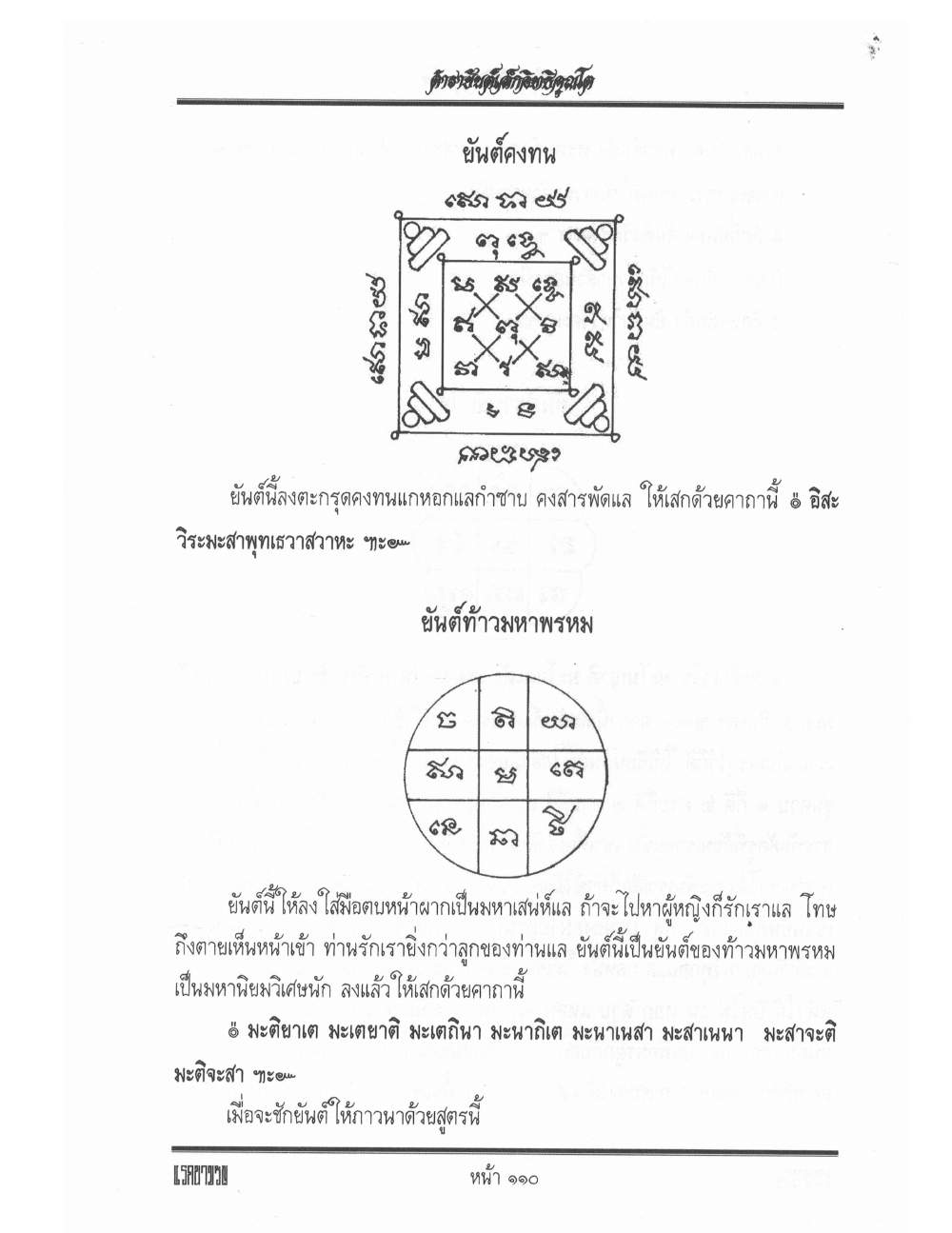
ยันต์คงทน
[อักขระขอมในยันต์ อ่านไม่ชัด] (กรอบสี่เหลี่ยมจัตุรัส มีปุ่มลูกประคำสี่มุม มีข้อความขอมเรียงตามขอบทั้งสี่ด้านนอกกรอบ ภายในมีเส้นทแยงไขว้เป็นสี่เหลี่ยมขนมเปียกปูนเล็ก อักขระขอมในแต่ละช่องที่ไขว้)
ยันต์นี้ลงตะกรุดคงทนแก้หอกและกำซาบ คงสารพัดแล ให้เสกด้วยคาถานี้ ๐ อิสะวิระมะสาพุทเถวาสวาหะ ๚ะ๛
ยันต์ท้าวมหาพรหม
[อักขระขอมในยันต์ อ่านไม่ชัด] (วงกลมแบ่งเป็นเก้าช่องแบบตาราง อักขระขอมช่องละหนึ่งตัว)
ยันต์นี้ให้ลงใส่มือตบหน้าผากเป็นมหาเสน่ห์แล ถ้าจะไปหาผู้หญิงก็รักเราแล โทษถึงตายเห็นหน้าเข้า ท่านรักเรายิ่งกว่าลูกของท่านแล ยันต์นี้เป็นยันต์ของท้าวมหาพรหม เป็นมหานิยมวิเศษพัก ลงแล้วให้เสกด้วยคาถานี้
๐ มะติยาเต มะเตยาติ มะเตถินา มะถาติเต มะถาเหสา มะสาเหถา มะสาจะติ มะติจะสา ๚ะ๛
เมื่อจะชักยันต์ให้ภาวนาด้วยสูตรนี้
Endurance Yantra (Yan Khong Thon)
[yantra: a square frame with a bead-cluster ornament at each corner and khom-script text running along all four outer edges, enclosing crossed diagonal lines forming a small diamond grid, one khom syllable in each resulting cell]
This yantra is inscribed on a takrut for durability, protecting against spear-thrusts and blunt blows, granting resistance to everything. Consecrate it with this spell: 'Isa wirama sa phuttheva savaha.'
Yantra of Great Brahma (Yan Thao Maha Phrom)
[yantra: a circle divided into a nine-cell grid, one khom syllable in each cell]
This yantra is inscribed and pressed to the palm, then touched to the forehead, granting great charm. If going to see a woman, she will love you; even facing the death penalty, the moment she sees your face she will love you more than her own children. This yantra belongs to Great Brahma; it is a supreme charm of favor. Once inscribed, consecrate it with this spell:
'Ma ti ya te, ma te ya ti, ma te thi na, ma tha ti te, ma tha he sa, ma sa he tha, ma sa cha ti, ma ti cha sa.'
When drawing/invoking the yantra, recite this formula:
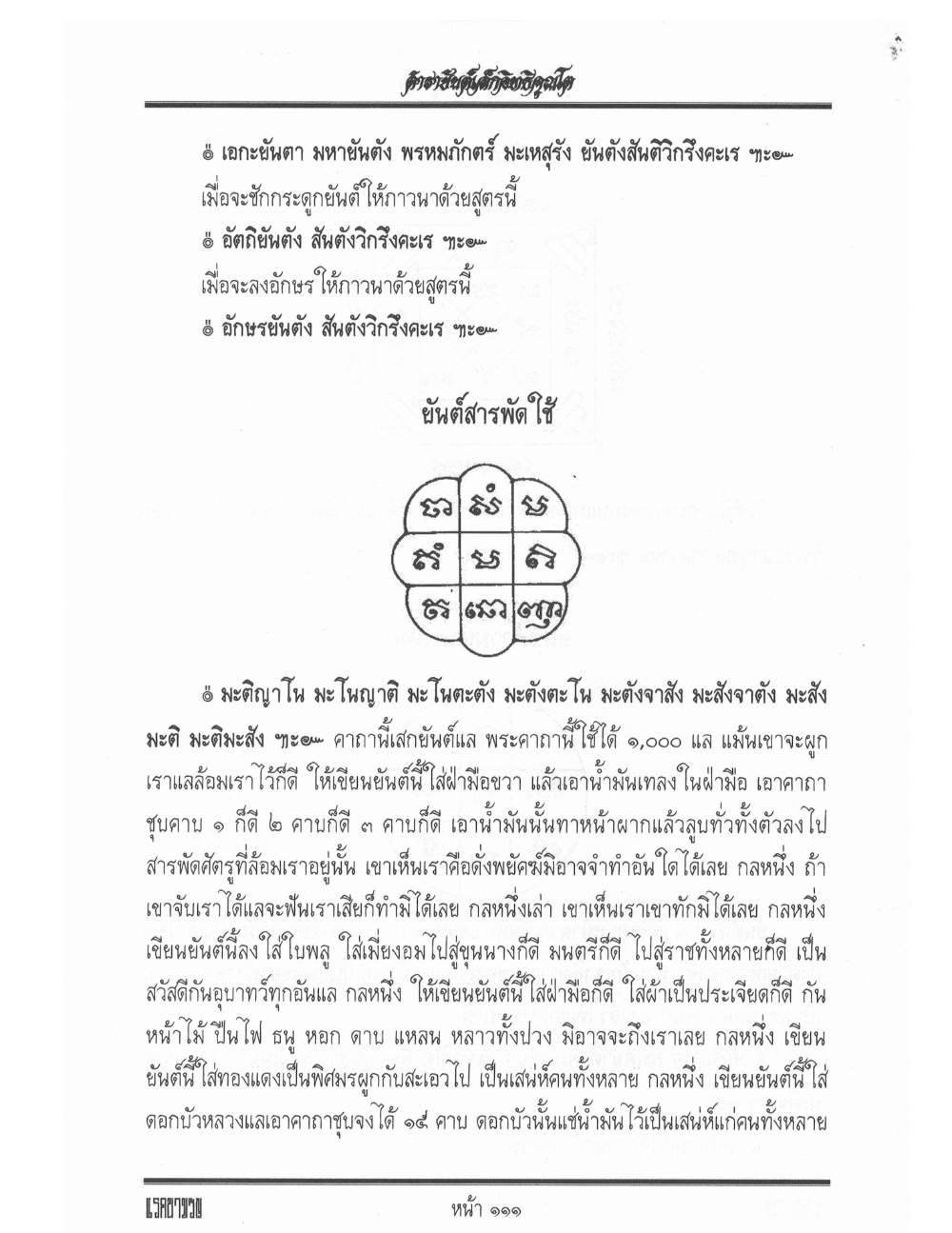
๐ เอกะยันตา มหายันตัง พรหมภักตร์ มะเหสุรัง ยันตังสันติวิกรึงคะเร ๚ะ๛
เมื่อจะชักกระดูกยันต์ให้ภาวนาด้วยสูตรนี้
๐ อัตถิยันตัง สันตังวิกรึงคะเร ๚ะ๛
เมื่อจะลงอักษรให้ภาวนาด้วยสูตรนี้
๐ อักษรยันตัง สันตังวิกรึงคะเร ๚ะ๛
ยันต์สารพัดใช้
[อักขระขอมในยันต์ อ่านไม่ชัด] (ผังกลีบดอกไม้หกกลีบ อักขระขอมในแต่ละกลีบ)
๐ มะติญาโพ มะโพญาติ มะโพตะตัง มะตังตะโพ มะตังจาสัง มะสังจาตัง มะสังมะติ มะติมะสัง ๚ะ๛ คาถานี้เสกยันต์แล พระคาถานี้ใช้ได้ ๑,๐๐๐ แล แม้นเขาจะผูกเราแลล้อมเราไว้ก็ดี ให้เขียนยันต์นี้ใส่ฝ่ามือขวา แล้วเอาน้ำมันเทลงใส่ฝ่ามือ เอาคาถาชุบคาบ ๑ ก็ดี ๒ คาบก็ดี ๓ คาบก็ดี เอาน้ำมันนั้นทาหน้าผากแล้วลูบทั่วทั้งตัวลงไป สารพัดศัตรูที่ล้อมเราอยู่นั้น เขาเห็นเราคือดั่งพยัคฆ์มิอาจจำทำอันใดได้เลย กลหนึ่ง ถ้าเขาจับเราได้และจะฟันเราเสียก็ทำมิได้เลย กลหนึ่งเล่า เขาเห็นเราเขาทักมิได้เลย กลหนึ่ง เขียนยันต์นี้ลงใส่ใบพลูใส่เมี่ยงอมไปสู่ขุนนางก็ดี มนตรีก็ดี ไปสู่ราชทั้งหลายก็ดี เป็นสวัสดิกันอุบาทว์ทุกอันแล กลหนึ่ง ให้เขียนยันต์นี้ใส่ฝ่ามือก็ดี ใส่ผ้าเป็นประเจียดก็ดี กันหน้าไม้ ปืนไฟ ธนู หอก ดาบ แหลม หลาวทั้งปวง มิอาจจะถึงเราเลย กลหนึ่ง เขียนยันต์นี้ใส่ทองแดงเป็นพิศมรผูกกับสะเอว ไป เป็นเสน่ห์คนทั้งหลาย กลหนึ่ง เขียนยันต์นี้ใส่ดอกบัวหลวงแลเอาคาถาชุบจงได้ ๑๔ คาบ ดอกบัวนั้นแช่น้ำมันไว้เป็นเสน่ห์แก่คนทั้งหลาย
'Eka yanta, maha yantang, phrom mahaphak, mahesurang, yantang santi wikrueng khare.'
When drawing the skeletal/bone frame of the yantra, recite this formula:
'Atthi yantang, santang wikrueng khare.'
When inscribing the letters, recite this formula:
'Akson yantang, santang wikrueng khare.'
All-Purpose Yantra (Yan Saraphat Chai)
[yantra: a six-petaled flower/clover shape, khom syllables filling each petal]
'Ma ti nya pho, ma pho nya ti, ma pho ta tang, ma tang ta pho, ma tang cha sang, ma sang cha tang, ma sang ma ti, ma ti ma sang' — this spell consecrates the yantra, and this spell may be used a thousand times over. Should anyone try to bind you or surround you, draw this yantra on your right palm, then pour oil into the palm, dip the spell into it once, twice, or three times, then smear that oil on your forehead and rub it over your whole body going downward: every enemy surrounding you will see you as though you were a tiger and will be unable to do anything to you at all — one trick. If they manage to seize you and try to cut you down, they still cannot do it — another trick. They will see you but be unable to address or accost you — another trick. Write this yantra on a betel leaf, wrap it with the quid (miang) and hold it in the mouth when going before officials, ministers, or any of the nobility, and it wards off every kind of misfortune — another trick. Write this yantra on the palm, or on cloth as an amulet-wrap, and it wards off crossbows, firearms, bows, spears, swords, lances, and every kind of pike — none can reach you — another trick. Write this yantra on copper and make it into a phitsamon charm tied at the waist, and it becomes a charm of love from all people — another trick. Write this yantra on a lotus blossom and dip the spell into it fully fourteen times; steep that lotus in oil, and it becomes a charm of love from all people.
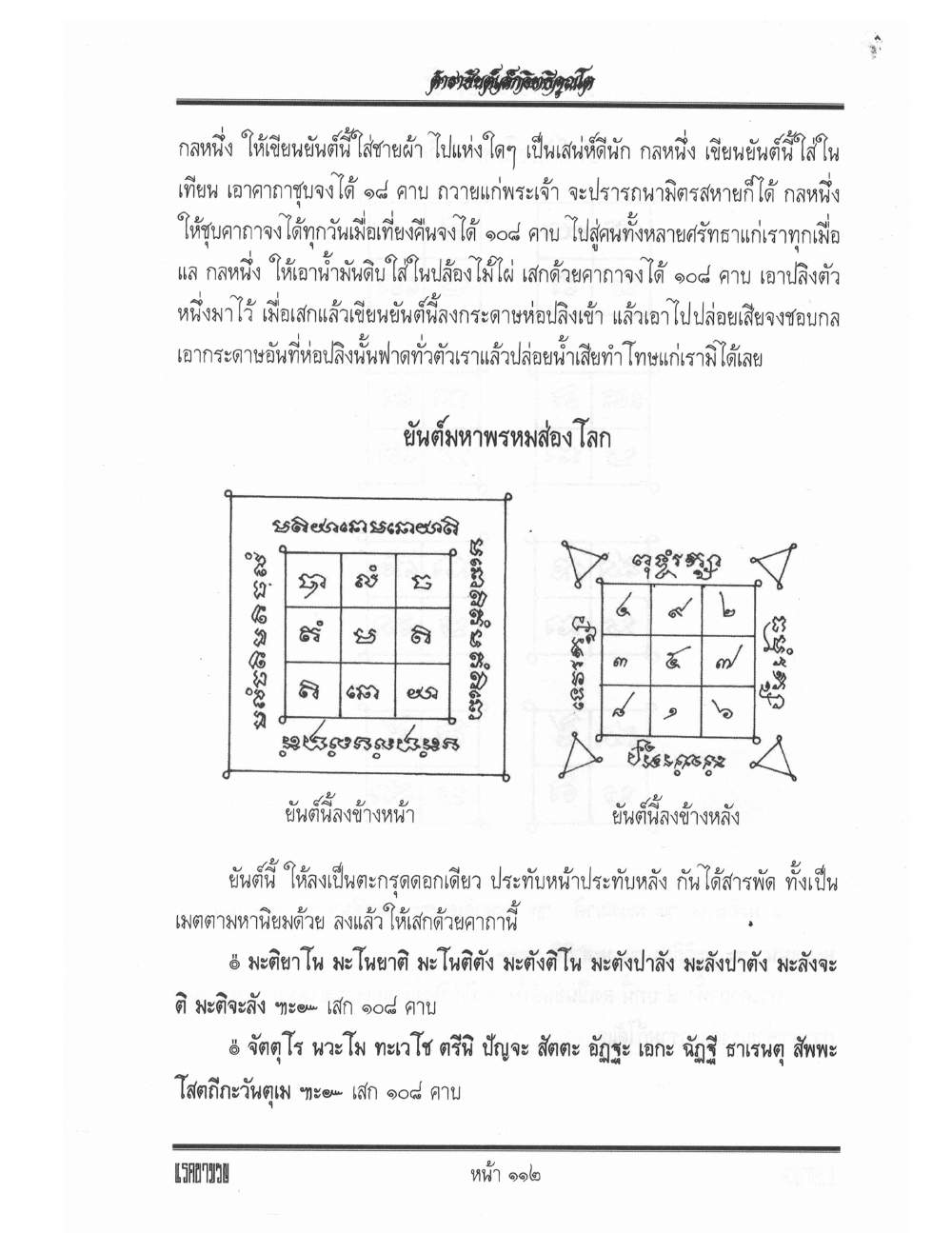
กลหนึ่ง ให้เขียนยันต์นี้ใส่ชายผ้า ไปแห่งใดๆ เป็นเสน่ห์ดีนัก กลหนึ่ง เขียนยันต์นี้ใส่ในเทียน เอาคาถาชุบจดได้ ๑๘ คาบ ถวายแก่พระเจ้า จะปรารถนามิตรสหายก็ได้ กลหนึ่ง ให้ชุบคาถาจดได้ทุกวันเมื่อเที่ยงคืนจดได้ ๑๐๘ คาบ ไปสู่คนทั้งหลายศรัทธาแก่เราทุกเมื่อแล กลหนึ่ง ให้เอาน้ำมันดิบใส่ในปล้องไม้ไผ่ เสกด้วยคาถาจดได้ ๑๐๘ คาบ เอาปลิงตัวหนึ่งมาไว้ เมื่อเสกแล้วเขียนยันต์นี้ลงกระดาษห่อปลิงเข้า แล้วเอาไปปล่อยเสียจงชอบกล เอากระดาษอันที่ห่อปลิงนั้นฟาดทั่วตัวเราแล้วปล่อยน้ำเสียทำโทษแก่เรามิได้เลย
ยันต์มหาพรหมส่องโลก
[อ่านไม่ออก]
ยันต์นี้ลงข้างหน้า
[อ่านไม่ออก]
ยันต์นี้ลงข้างหลัง
ยันต์นี้ ให้ลงเป็นตะกรุดดอกเดียว ประทับหน้าประทับหลัง กันได้สารพัด ทั้งเป็นเมตตามหานิยมด้วย ลงแล้วให้เสกด้วยคาถานี้
๏ มะติยาโพ มะโนยาติ มะโนติตัง มะตังติโพ มะตังปาลัง มะลังปาตัง มะลังจะติ มะติจะลัง ๚ะ เสก ๑๐๘ คาบ
๏ จัตุโร พวะโม ทะเวโช ตรีนิ ปัญจะ สัตตะ อัฏฐะ เอกะ ฉัฏฐี ถาเรนตุ สัพพะโสตถีภะวันตุเม ๚ะ เสก ๑๐๘ คาบ
One method: write this yantra and tuck it into a corner of a cloth; wherever you go, it makes you very charming. One method: write this yantra and place it inside a candle, dipping it while reciting the spell 18 times, then offer the candle to a Buddha image; one may thereby wish for friends and companions. One method: dip [the paper/wick] while reciting the spell every day, and at midnight recite it 108 times; people everywhere will have faith in you at all times. One method: put crude oil into a joint of bamboo, consecrate it by reciting the spell 108 times, then take hold of a leech; once consecrated, write this yantra on a piece of paper and wrap the leech in it, then take it and release it — this is the correct method. Take the paper that wrapped the leech and strike it over your whole body, then release [leech and paper] into water; it will never be able to bring harm upon you.
Great Brahma World-Illuminating Yantra
[yantra: a square frame with a small circle at each of the four corners, divided into a 3x3 grid of nine cells filled with syllables, with further characters running along the outside of the top, bottom, left, and right edges of the frame — the akkhara are in a decorative script and not confidently legible]
Caption: This yantra is placed on the front.
[yantra: a square frame with a small triangle at each of the four corners, divided into a 3x3 grid of nine cells filled with syllables, with further characters along the outside of the frame — akkhara not confidently legible]
Caption: This yantra is placed on the back.
This yantra should be inscribed as a single takrut, worn on the front and on the back; it wards off everything, and it is also for loving-kindness and great popularity. Once inscribed, consecrate it with this spell:
"Ma tiya pho ma no ya ti ma no ti tang ma tang ti pho ma tang pa lang ma lang pa tang ma lang ja ti ma ti ja lang," [closing mark], consecrate 108 times.
"Jatu ro phawa mo thawe cho tri ni panja satta attha eka chatthi tha rentu sappa sotthi phawantu me," [closing mark], consecrate 108 times.
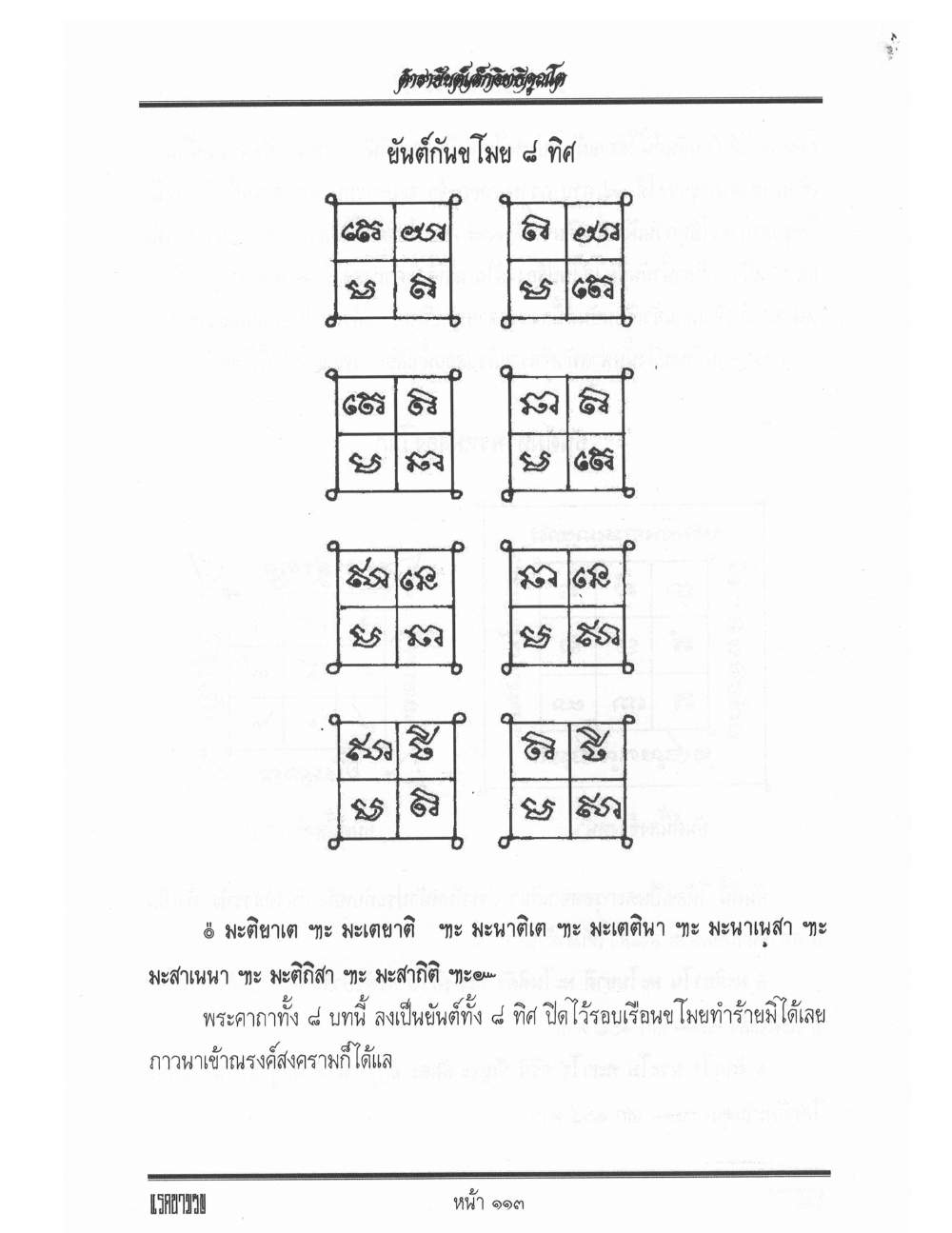
ยันต์กันขโมย ๘ ทิศ
[อ่านไม่ออก]
๏ มะติยาเต ๚ะ มะเตยาติ ๚ะ มะหาติเต ๚ะ มะเตติหนา ๚ะ มะหาเหมสา ๚ะ มะสาเหมนา ๚ะ มะติถิสา ๚ะ มะสาถิติ ๚ะ
พระคาถาทั้ง ๘ บทนี้ ลงเป็นยันต์ทั้ง ๘ ทิศ ปิดไว้รอบเรือนขโมยทำร้ายมิได้เลย ภาวนาเข้าณรงค์สงครามก็ได้แล
Eight-Direction Anti-Theft Yantra
[yantra: eight separate small squares, each divided into a 2x2 grid of four cells filled with syllables, meant to be posted so as to cover all eight compass directions — the akkhara are in a decorative script and not confidently legible cell by cell]
"Ma tiya te" [repeat], "Ma te ya ti" [repeat], "Ma ha ti te" [repeat], "Ma te ti na" [repeat], "Ma ha he ma sa" [repeat], "Ma sa he ma na" [repeat], "Ma ti thi sa" [repeat], "Ma sa thi ti" [repeat].
These eight verses of the spell, made into yantras for the eight directions and posted all around the house, mean thieves cannot do it any harm at all. Reciting them while going into battle also works.
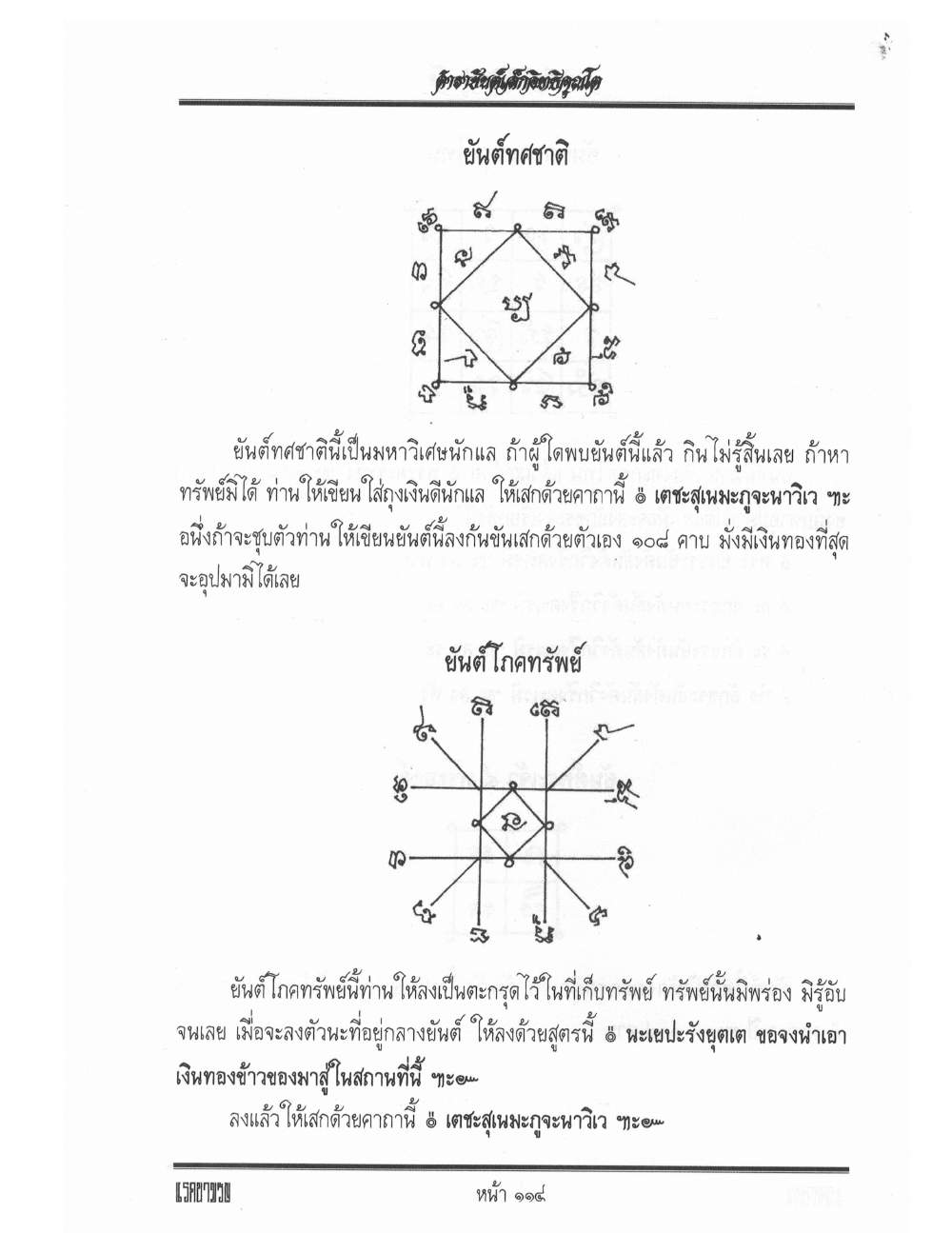
ยันต์ทศชาติ
[อ่านไม่ออก]
ยันต์ทศชาตินี้เป็นมหาวิเศษนักแล ถ้าผู้ใดพบยันต์นี้แล้ว กินไม่รู้สิ้นเลย ถ้าหาทรัพย์มิได้ ท่านให้เขียนใส่ถุงเงินดีนักแล ให้เสกด้วยคาถานี้ ๏ เตชะสุเนมะภูจะพาวิเว ๚ะ อนึ่งถ้าจะชุบตัวท่านให้เขียนยันต์นี้ลงก้นขันเสกด้วยตัวเอง ๑๐๘ คาบ มั่งมีเงินทองที่สุด จะอุปมามิได้เลย
ยันต์โภคทรัพย์
[อ่านไม่ออก]
ยันต์โภคทรัพย์นี้ท่านให้ลงเป็นตะกรุดไว้ในที่เก็บทรัพย์ ทรัพย์นั้นมิพร่อง มิรู้อับจนเลย เมื่อจะลงตัวนะที่อยู่กลางยันต์ ให้ลงด้วยสูตรนี้ ๏ พะเยปะรังยุตเต ขอจงนำเอาเงินทองข้าวของมาสู่ในสถานที่นี้ ๚ะ
ลงแล้วให้เสกด้วยคาถานี้ ๏ เตชะสุเนมะภูจะพาวิเว ๚ะ
Yantra of the Ten Jataka Lives
[yantra: a square frame with a small circle at each of the four corners, containing a diamond inscribed within it; syllables sit at the outer corners and along the sides, with one character at the center of the diamond — akkhara not confidently legible]
This Yantra of the Ten Jataka Lives is truly of the greatest excellence. Whoever encounters this yantra will never run out of food to eat. If wealth cannot be found, have this written and placed inside a money pouch — it is very good indeed; consecrate it with this spell: "Techa sune ma phu ja pha wiwe" [closing mark]. Also, if you wish to consecrate yourself with it, write this yantra on the bottom of a bowl and consecrate it yourself 108 times; you will become supremely wealthy in money and gold, beyond comparison.
Yantra of Wealth and Fortune
[yantra: a smaller square containing an inscribed diamond, with lines radiating outward like an eight-pointed star to eight points, each bearing a character — akkhara not confidently legible]
This Yantra of Wealth should be made into a takrut and kept where valuables are stored; those valuables will never run short, and one will never know want. When inscribing the "na" syllable at the center of the yantra, inscribe it with this formula: "Phaye parang yutte" — may it bring money, gold, and goods into this place [closing mark].
Once inscribed, consecrate it with this spell: "Techa sune ma phu ja pha wiwe" [closing mark].
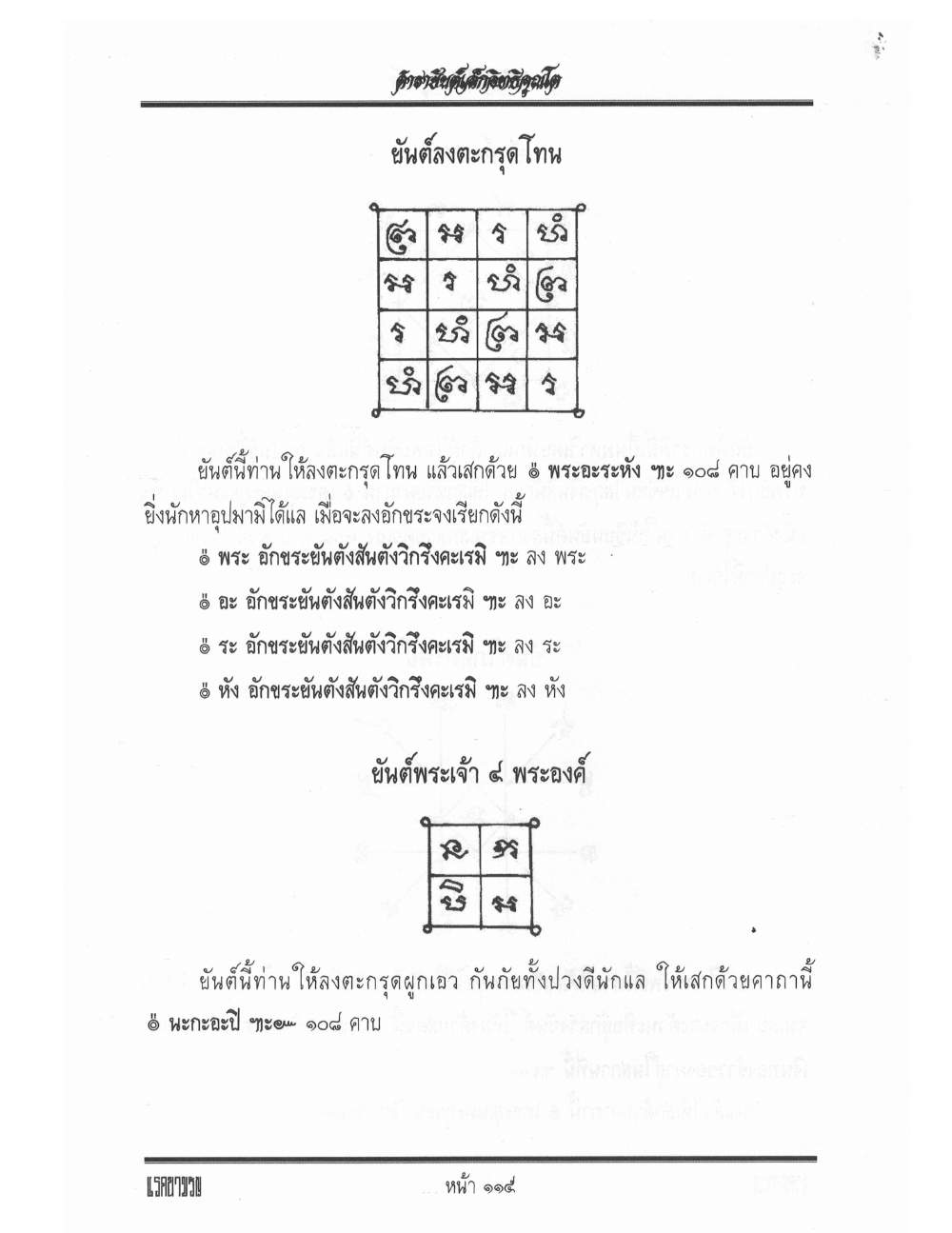
ยันต์ลงตะกรุดโทน
พระ อะ ระ หัง อะ ระ หัง พระ ระ หัง พระ อะ หัง พระ อะ ระ
ยันต์นี้ท่านให้ลงตะกรุดโทน แล้วเสกด้วย ๏ พระอะระหัง ๚ะ ๑๐๘ คาบ อยู่คงยิ่งนักหาอุปมามิได้แล เมื่อจะลงอักขระจงเรียกดังนี้
๏ พระ อักขระยันต์ตังสันตังวิกรึงคะเรมิ ๚ะ ลง พระ
๏ อะ อักขระยันต์ตังสันตังวิกรึงคะเรมิ ๚ะ ลง อะ
๏ ระ อักขระยันต์ตังสันตังวิกรึงคะเรมิ ๚ะ ลง ระ
๏ หัง อักขระยันต์ตังสันตังวิกรึงคะเรมิ ๚ะ ลง หัง
ยันต์พระเจ้า ๔ พระองค์
[อ่านไม่ออก]
ยันต์นี้ท่านให้ลงตะกรุดผูกเอว กันภัยทั้งปวงดีนักแล ให้เสกด้วยคาถานี้ ๏ พะกะฉะปิ ๚ะ ๑๐๘ คาบ
Solitary-Takrut Inscription Yantra
[yantra: a 4x4 grid in which the four syllables "Phra A Ra Hang" (from the Buddha-epithet "Phra Arahang") are written out, each successive row a cyclic rotation of the same four syllables so that all four appear once in every row and column]
This yantra should be inscribed on a solitary takrut, then consecrated with "Phra a ra hang" [closing mark], 108 times; its endurance is extraordinary, beyond compare. When inscribing each letter, recite as follows:
"Phra, akkhara yantang santang wikrueng khare mi" [closing mark] — inscribe "Phra."
"A, akkhara yantang santang wikrueng khare mi" [closing mark] — inscribe "A."
"Ra, akkhara yantang santang wikrueng khare mi" [closing mark] — inscribe "Ra."
"Hang, akkhara yantang santang wikrueng khare mi" [closing mark] — inscribe "Hang."
Yantra of the Four Lord Buddhas
[yantra: a small square divided into a 2x2 grid of four cells, each holding a syllable — akkhara not confidently legible]
This yantra should be inscribed on a takrut tied at the waist; it wards off every danger very well. Consecrate it with this spell: "Pha ka cha pi" [closing mark], 108 times.
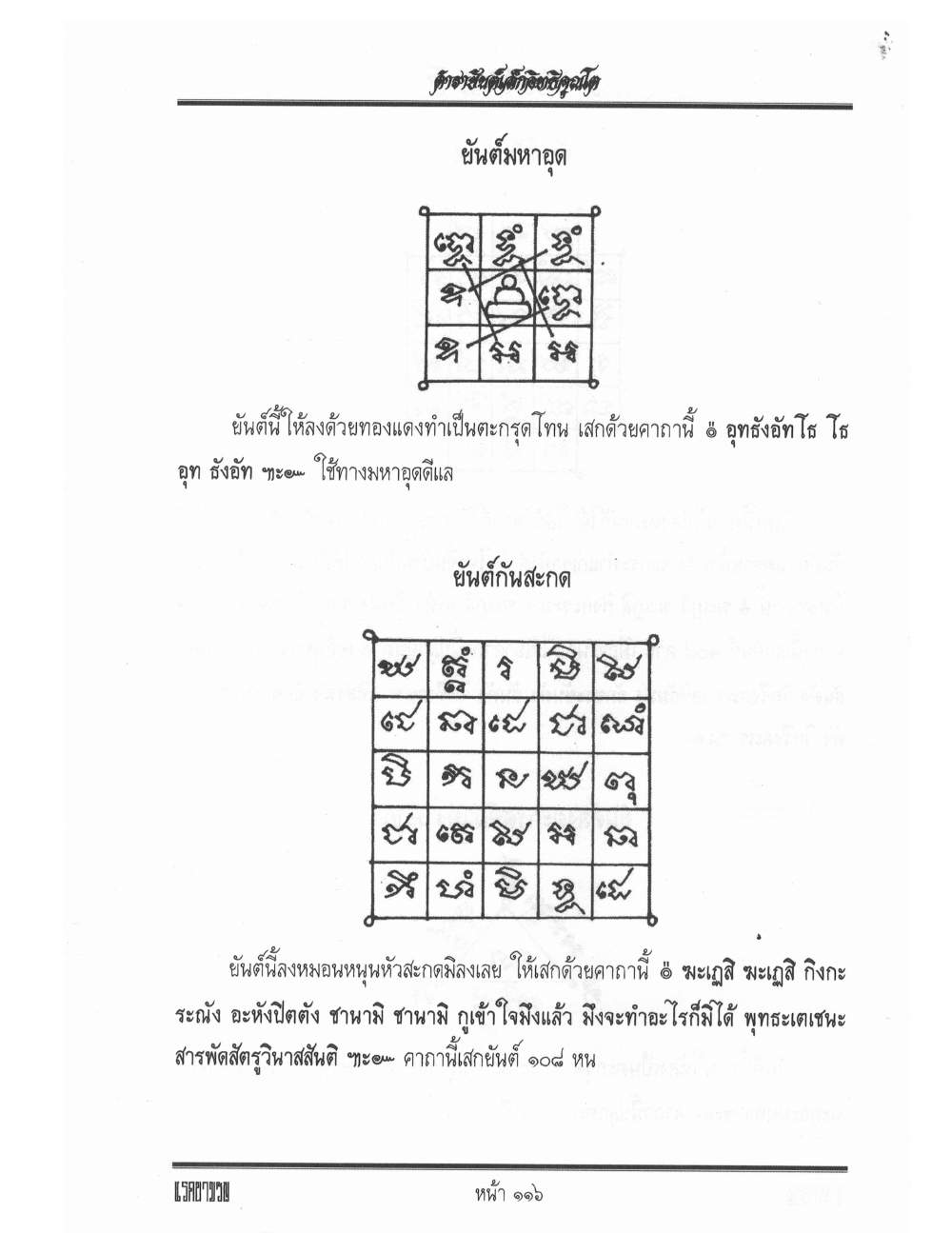
ยันต์มหาอุด
[อ่านไม่ออก]
ยันต์นี้ให้ลงด้วยทองแดงทำเป็นตะกรุดโทน เสกด้วยคาถานี้ ๏ อุทธังอัทโธ โธอุทธังอัท ๚ะ ใช้ทางมหาอุดดีแล
ยันต์กัณฑ์สะกด
[อ่านไม่ออก]
ยันต์นี้ลงหมอนหนุนหัวสะกดมิลงเลย ให้เสกด้วยคาถานี้ ๏ มะเภสิ มะเภสิ กิงกะระณัง อะหังปิตัง ชามามิ ชามามิ กูเข้าใจมึงแล้ว มึงจะทำอะไรก็มิได้ พุทธะเตเชนะสารพัดสัตรูวินาศสันติ ๚ะ คาถานี้เสกยันต์ ๑๐๘ หน
Great Invulnerability Yantra
[yantra: a square frame divided into a 3x3 grid; the center cell holds a drawing of a small stupa/chedi, the eight surrounding cells hold syllables, and diagonal lines run from the chedi out to some of the corner cells — akkhara not confidently legible]
This yantra should be inscribed in copper and made into a solitary takrut, consecrated with this spell: "Utthang attho tho utthang at" [closing mark]; it serves well for great invulnerability.
Yantra of Subduing (Kan Sakod)
[yantra: a rectangular grid of small cells filled with syllables, arranged in rows — akkhara not confidently legible]
This yantra, placed under a pillow, means nothing can overpower or subdue you as you sleep. Consecrate it with this spell: "Ma phe si ma phe si kingkaranang ahang pitang chamami chamami — I now understand you, you can do nothing at all — Phuttha techena sappha satru winat santi" [closing mark]. This spell consecrates the yantra 108 times.
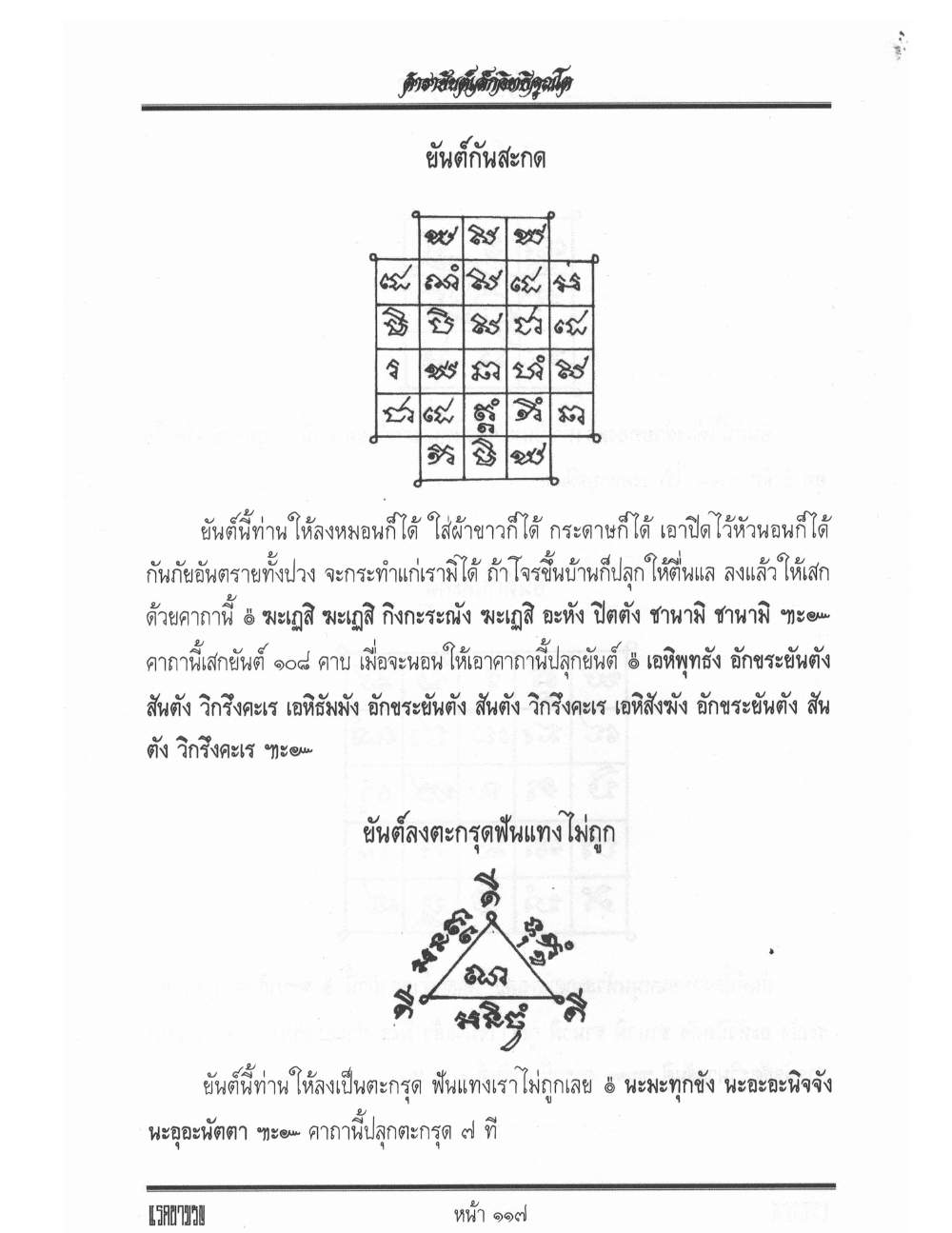
ยันต์กัณฑ์สะกด
[อ่านไม่ออก]
ยันต์นี้ท่านให้ลงหมอนก็ได้ ใส่ผ้าขาวก็ได้ กระดาษก็ได้ เอาปิดไว้หัวนอนก็ได้ กันภัยอันตรายทั้งปวง จะกระทำแก่เรามิได้ ถ้าโจรขึ้นบ้านก็ปลุกให้ตื่นแล ลงแล้วให้เสกด้วยคาถานี้ ๏ มะเฏสิ มะเฏสิ กิงกะระณัง มะเฏสิ อะหัง ปิตัง ชามามิ ชามามิ ๚ะ คาถานี้เสกยันต์ ๑๐๘ คาบ เมื่อจะนอนให้เอาคาถานี้ปลุกยันต์ ๏ เอหิพุทธัง อักขระยันตัง สันตัง วิกรึงคะเร เอหิธัมมัง อักขระยันตัง สันตัง วิกรึงคะเร เอหิสังฆัง อักขระยันตัง สันตัง วิกรึงคะเร ๚ะ
ยันต์ลงตะกรุดฟันแทงไม่ถูก
[อ่านไม่ออก]
ยันต์นี้ท่านให้ลงเป็นตะกรุด ฟันแทงเราไม่ถูกเลย ๏ พะมะทุกขัง พะอะอนิจจัง พะอุอะนัตตา ๚ะ คาถานี้ปลุกตะกรุด ๗ ที
Yantra of Subduing (Kan Sakod)
[yantra: a rectangular grid of small cells filled with syllables, arranged in rows — akkhara not confidently legible]
This yantra may be placed on a pillow, put into white cloth, or onto paper, and kept covering the head at the place where one sleeps; it wards off every kind of danger, which then cannot touch you at all. If a thief enters the house it will wake you. Once inscribed, consecrate it with this spell: "Ma tesi ma tesi kingkaranang ma tesi ahang pitang chamami chamami" [closing mark]. This spell consecrates the yantra 108 times. When about to sleep, use this spell to awaken the yantra: "Ehi Buddhang, akkhara yantang santang wikrueng khare. Ehi Dhammang, akkhara yantang santang wikrueng khare. Ehi Sanghang, akkhara yantang santang wikrueng khare" [closing mark].
Yantra for a Takrut Against Tooth and Blade
[yantra: a triangle enclosing syllables, with further characters written along its three sides — akkhara not confidently legible]
This yantra should be inscribed on a takrut; neither tooth nor blade will strike us. "Pha ma thukkhang, pha a anijjang, pha u anatta" [closing mark]. This spell awakens the takrut, [recited] 7 times.
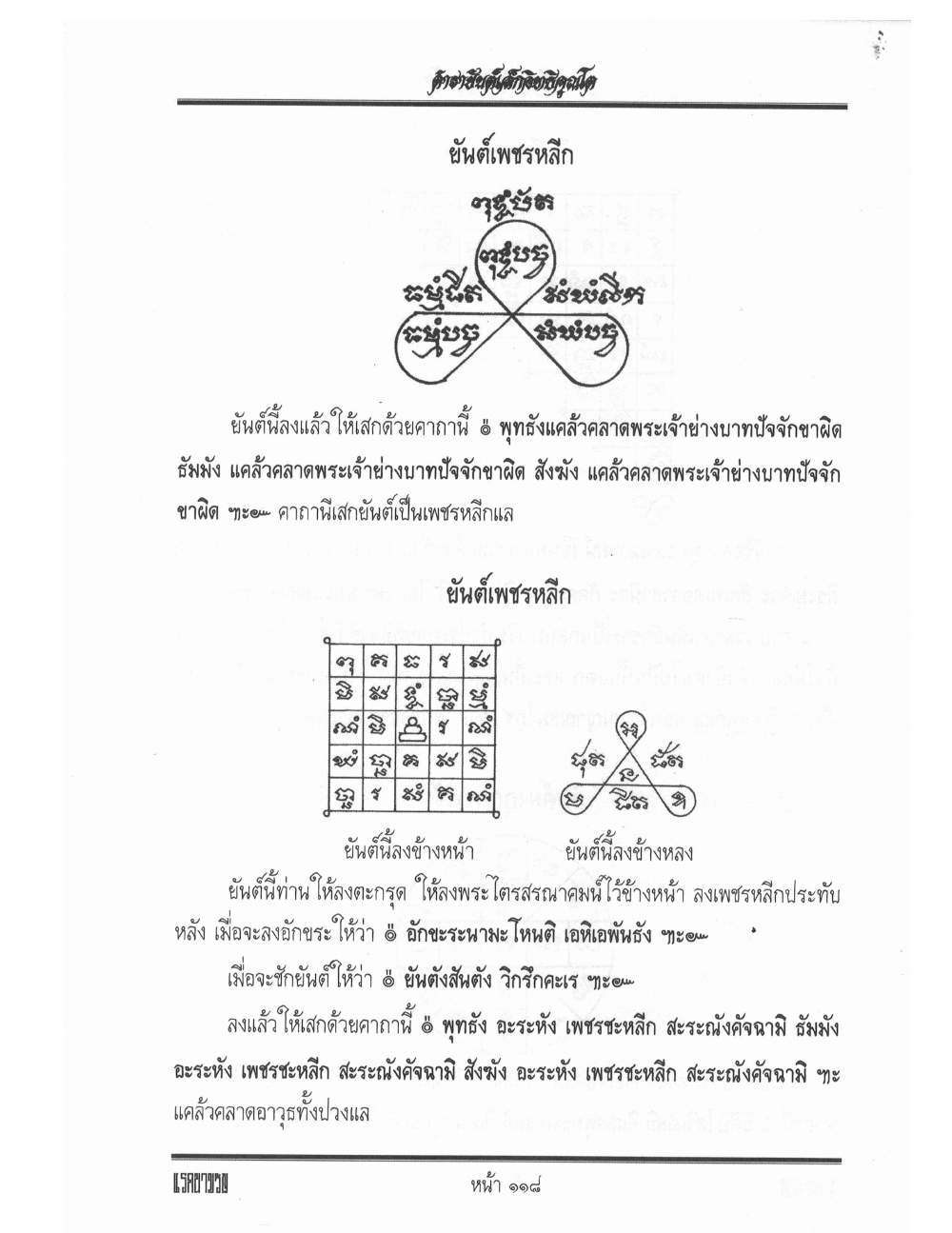
ยันต์เพชรหลีก
[อ่านไม่ออก]
ยันต์นี้ลงแล้วให้เสกด้วยคาถานี้ ๏ พุทธัง แคล้วคลาดพระเจ้าย่างบาทปัจจักขาผิด ธัมมัง แคล้วคลาดพระเจ้าย่างบาทปัจจักขาผิด สังฆัง แคล้วคลาดพระเจ้าย่างบาทปัจจักขาผิด ๚ะ คาถานี้เสกยันต์เป็นเพชรหลีกแล
ยันต์เพชรหลีก
[อ่านไม่ออก]
ยันต์นี้ท่านให้ลงตะกรุด ให้ลงพระไตรสรณาคมน์ไว้ข้างหน้า ลงเพชรหลีกประทับหลัง เมื่อจะลงอักขระให้ว่า ๏ อักขะระนามะโหติ เอหิเอพันธัง ๚ะ
เมื่อจะชักยันต์ให้ว่า ๏ ยันตังสันตัง วิกรึงคะเร ๚ะ
ลงแล้วให้เสกด้วยคาถานี้ ๏ พุทธัง อะระหัง เพชรชะหลีก สะระณังคัจฉามิ ธัมมัง อะระหัง เพชรชะหลีก สะระณังคัจฉามิ สังฆัง อะระหัง เพชรชะหลีก สะระณังคัจฉามิ ๚ะ แคล้วคลาดอาวุธทั้งปวงแล
Diamond-Deflecting Yantra
[yantra: a trefoil/pretzel-like figure of three interlocking loops meeting at a central crossing point, with a syllable-group written at the top and at each of the two lower loops, and a further syllable-group at the very center where the loops cross — akkhara not confidently legible]
Once this yantra is inscribed, consecrate it with this spell: "Buddhang — may we glance off the Lord's footfall and go astray [of harm], Dhammang — may we glance off the Lord's footfall and go astray, Sanghang — may we glance off the Lord's footfall and go astray" [closing mark]. This spell consecrates the yantra as a Diamond-Deflector.
Diamond-Deflecting Yantra
[yantra, front placement: a square divided into a 5x5 grid of cells filled with syllables, with a small image of a seated Buddha in the center cell — akkhara not confidently legible. yantra, back placement: the same trefoil/pretzel figure of three loops as above, with syllables at the top loop and the two lower loops and at the center]
This yantra should be inscribed on a takrut: inscribe the Three Refuges on the front, and the Diamond-Deflector on the back. When inscribing the letters, recite: "Akkhara namo hoti, ehi e phantang" [closing mark].
When drawing the yantra [in the air], recite: "Yantang santang, wikrueng khare" [closing mark].
Once inscribed, consecrate it with this spell: "Buddhang arahang phetchalik saranang gacchami, Dhammang arahang phetchalik saranang gacchami, Sanghang arahang phetchalik saranang gacchami" [closing mark]. [This] means one is spared from all manner of weapons.
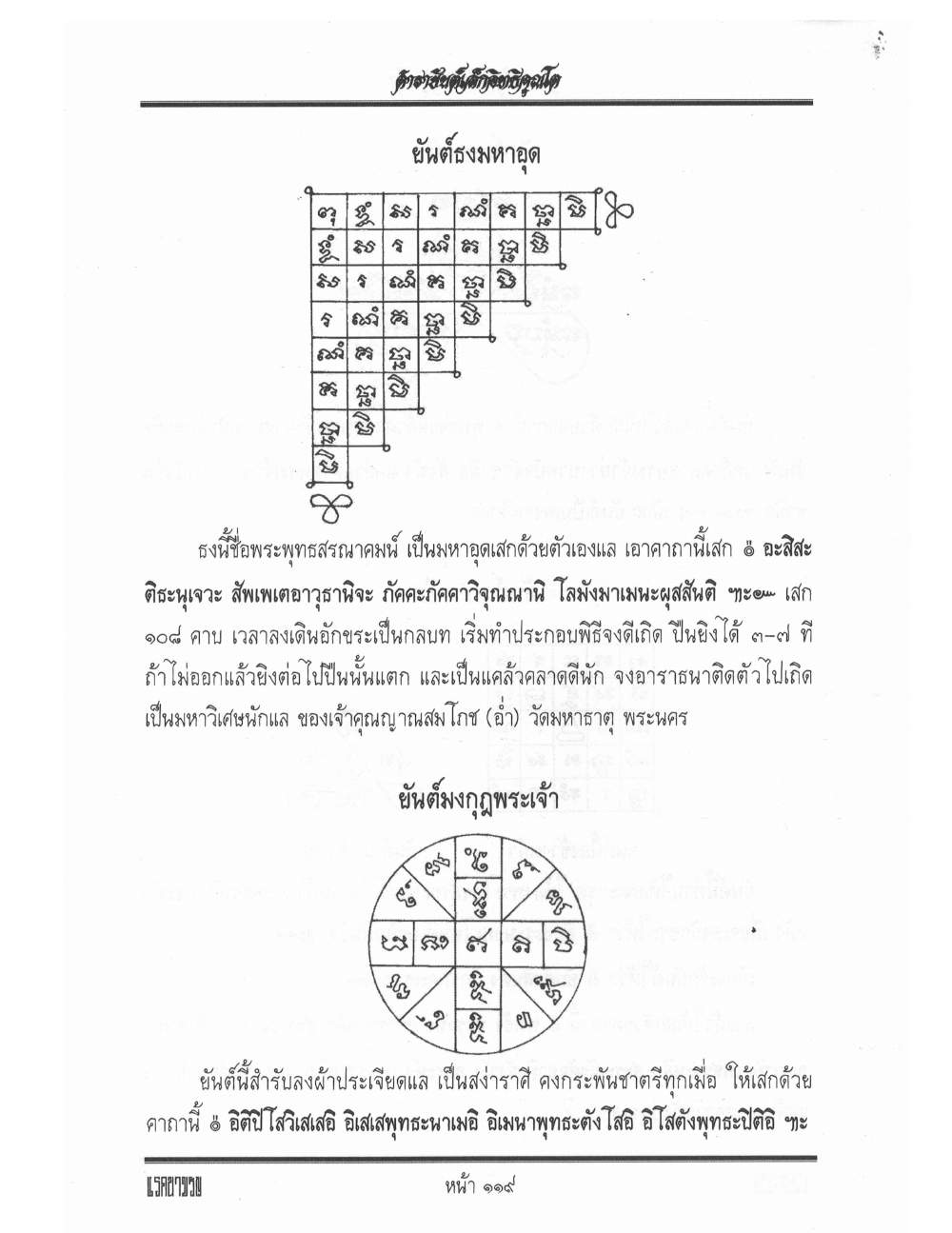
ยันต์ธงมหาอุด
[อ่านไม่ออก]
ธงนี้ชื่อพระพุทธสรณาคมน์ เป็นมหาอุดเสกด้วยตัวเองแล เอาคาถานี้เสก ๏ อะสิสะติถะพุเจวะ สัพเพเตอาวุธานิจะ ภัคคะภัคคาวิจุณณานิ โลมังมาเมนะผุสสันติ ๚ะ เสก ๑๐๘ คาบ เวลาลงเดินอักขระเป็นกลบท เริ่มทำประกอบพิธีจงดีเถิด ปืนยิงได้ ๓-๗ ที ถ้าไม่ออกแล้วยิงต่อไปปืนพังแตก และเป็นแคล้วคลาดดีนัก จงอาราธนาติดตัวไปเถิด เป็นมหาวิเศษนักแล ของเจ้าคุณญาณสมโภช (อ่ำ) วัดมหาธาตุ พระนคร
ยันต์มงกุฎพระเจ้า
[อ่านไม่ออก]
ยันต์นี้สำหรับลงผ้าประเจียดแล เป็นสง่าราศี คงกระพันชาตรีทุกเมื่อ ให้เสกด้วยคาถานี้ ๏ อิติปิโสวิเสเสอิ อิเสสพุทธะนาเมอิ อิเมนาพุทธะตังโสอิ อิโสตังพุทธะปิติอิ ๚ะ
Great Invulnerability Banner Yantra
[yantra: a stepped, tapering grid of cells narrowing from a wide top row down to a single cell at the bottom, filled throughout with syllables, with decorative bow-like flourishes at the top and bottom ends — akkhara not confidently legible]
This banner is named "the Buddha's Refuge Formula"; it is a great invulnerability, and consecrates itself. Recite this spell over it: "Asi sati thapu jewa sappe te awuthani ja, phakka phakka wijunnani, lomang ma mena phussanti" [closing mark], recite 108 times. When inscribing the letters, walk them out as a cipher-pattern; begin the rite properly. Have a gun fired at you 3 to 7 times; if it does not fire, keep having it fired — the gun itself will break apart — and this is a very good sign of being spared from harm. One should invoke it to keep with oneself always; it is truly of the greatest excellence. [It belongs] to the venerable Chao Khun Yanasomphoch (Am) of Wat Maha That, the capital.
Crown of the Lord Buddha Yantra
[yantra: a circle divided by concentric rings into sectors, each sector filled with a syllable — akkhara not confidently legible]
This yantra is for inscribing onto a prajiat cloth; it grants presence and radiance, and constant invulnerability of the body. Consecrate it with this spell: "Itipiso wisese i, isesa Buddha na me i, imena Buddhatang so i, isotang Buddhapiti i" [closing mark].
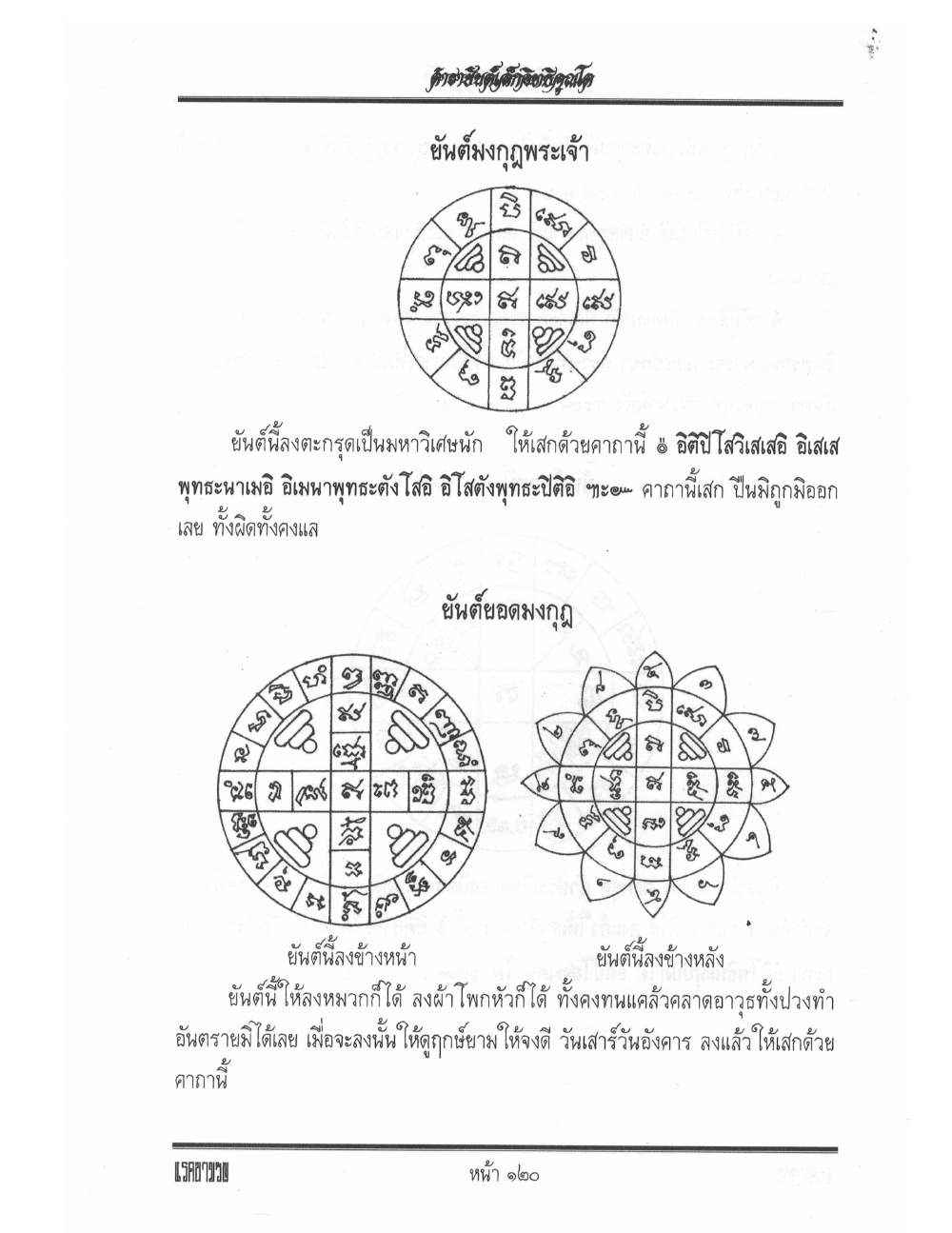
ยันต์นี้ลงตะกรุดเป็นมหาวิเศษนัก ให้เสกด้วยคาถานี้ ๏ อิติปิโสวิเสเสอิ อิเสสพุทธะนาเมอิ อิเมนาพุทธะตังโสอิ อิโสตังพุทธะปิติอิ ๚ะ คาถานี้เสก ปืนมิถูกมิออกเลย ทั้งผิดทั้งคงแล
ยันต์ยอดมงกุฎ
[อ่านไม่ออก]
ยันต์นี้ให้ลงหมวกก็ได้ ลงผ้าโพกหัวก็ได้ ทั้งคงทนแคล้วคลาดอาวุธทั้งปวงทำอันตรายมิได้เลย เมื่อจะลงนั้นให้ดูฤกษ์ยามให้จงดี วันเสาร์วันอังคาร ลงแล้วให้เสกด้วยคาถานี้
This yantra, inscribed on a takrut, is of the greatest excellence; consecrate it with this spell: "Itipiso wisese i, isesa Buddha na me i, imena Buddhatang so i, isotang Buddhapiti i" [closing mark]. Consecrated with this spell, a gun will neither strike you nor even fire at all — whether it misfires or holds, [you are protected] either way.
Yantra of the Crown's Pinnacle
[yantra, front placement: a circle divided by concentric rings into sectors filled with syllables. yantra, back placement: a flower-like figure of many pointed petals arranged in concentric rows around a central circle, each petal and ring filled with syllables — akkhara not confidently legible in either figure]
This yantra may be inscribed on a hat, or on a head-wrapping cloth; it grants lasting endurance and being spared from all manner of weapons, which cannot do harm at all. When inscribing it, be careful to check the auspicious time — a Saturday or a Tuesday. Once inscribed, consecrate it with this spell:
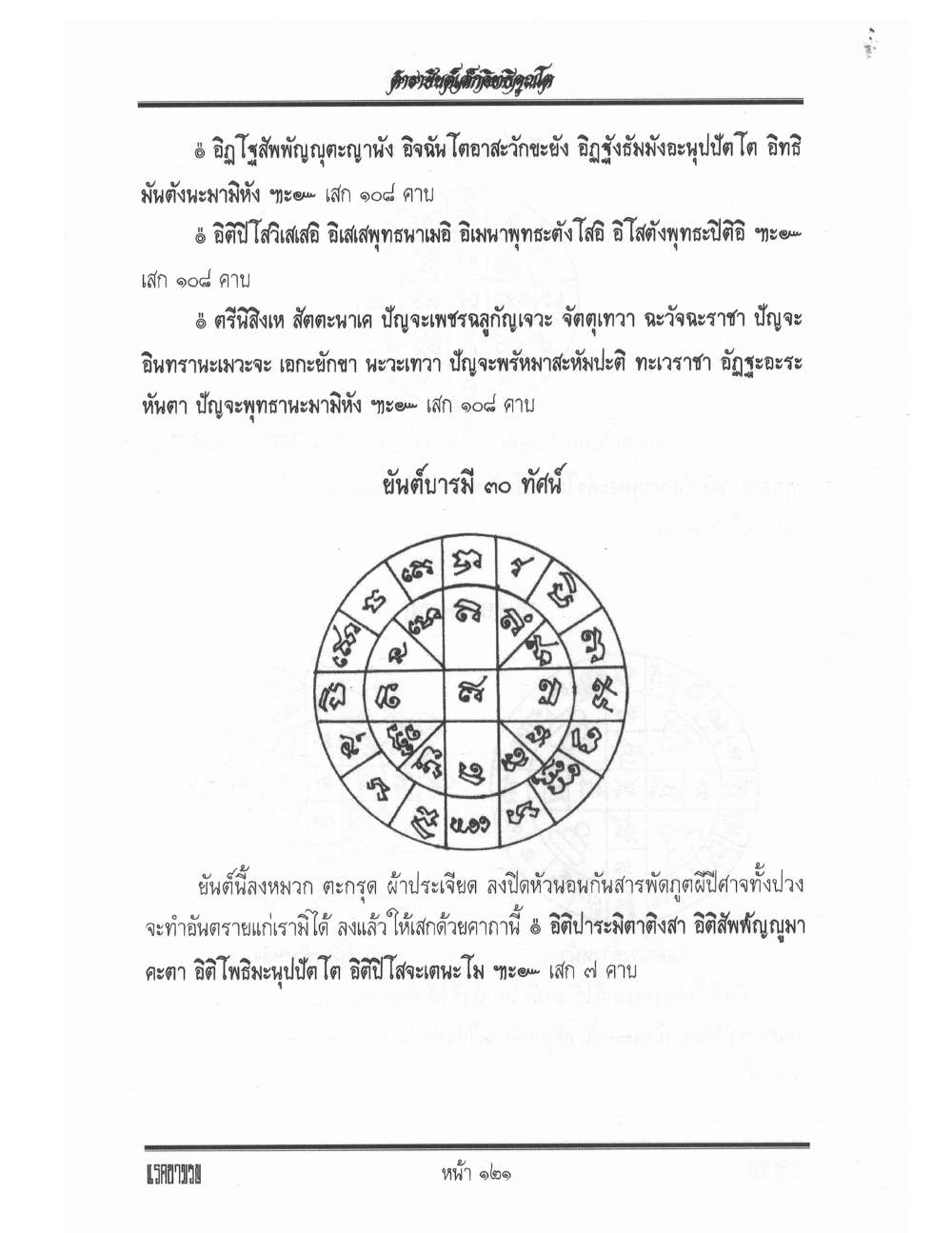
๏ อิฏฐาโฐสัพพัญญุตะญาณัง อิจฉันโตอาสะวักขะยัง อิฏฐฐังธัมมังอะนุปปัตโต อิทธิมันตังนะมามิหัง ๚ะ เสก ๑๐๘ คาบ
๏ อิติปิโสวิเสเสอิ อิเสสพุทธะนาเมอิ อิเมนาพุทธะตังโสอิ อิโสตังพุทธะปิติอิ ๚ะ เสก ๑๐๘ คาบ
๏ ตรีนิสิงเห สัตตะนาเค ปัญจะเพชรฉลูกัญเจวะ จัตตุเทวา ฉวัจฉราชา ปัญจะอินทรานะเมวะจะ เอกะยักขา พะเทวา ปัญจะพรัหมาสะหัมปะติ ทะเวราชา อัฏฐะอระหันตา ปัญจะพุทธานะมามิหัง ๚ะ เสก ๑๐๘ คาบ
ยันต์มารผี ๓๐ ทัศน์
[อ่านไม่ออก]
ยันต์นี้ลงหมวก ตะกรุด ผ้าประเจียด ลงปิดหัวนอนกันสารพัดภูตผีปีศาจทั้งปวง จะทำอันตรายแก่เรามิได้ ลงแล้วให้เสกด้วยคาถานี้ ๏ อิติปาระมิตาติงสา อิติสัพพัญญูมาคะตา อิติโพธิมะนุปปัตโต อิติปิโสจะเตนะโม ๚ะ เสก ๗ คาบ
"Ittha tho sappannyuta nyanang ijchanto asawakkhayang, ittha thang thammang anuppatto, itthimantang namamihang" [closing mark], consecrate 108 times.
"Itipiso wisese i, isesa Buddha na me i, imena Buddhatang so i, isotang Buddhapiti i" [closing mark], consecrate 108 times.
"Trini singhe satta nake, pancha phet chalu kanjewa, jattu thewa chawaj characha, pancha inthra name wa ja, eka yakkha pha thewa, pancha phrahma sahampati, thawe racha attha arahanta, pancha phutthanamamihang" [closing mark], consecrate 108 times.
Thirty-Aspect Ghost-and-Demon-Warding Yantra
[yantra: a circle divided by two concentric rings into sectors, each sector holding a numeral or syllable — akkhara not confidently legible]
This yantra may be inscribed on a hat, a takrut, or a prajiat cloth, and placed to cover the head where one sleeps; it wards off every manner of spirit, ghost, and demon, which cannot bring harm upon us. Once inscribed, consecrate it with this spell: "Iti paramita tingsa, iti sappannyu makata, iti pothi manuppatto, iti piso ja te namo" [closing mark], consecrate 7 times.
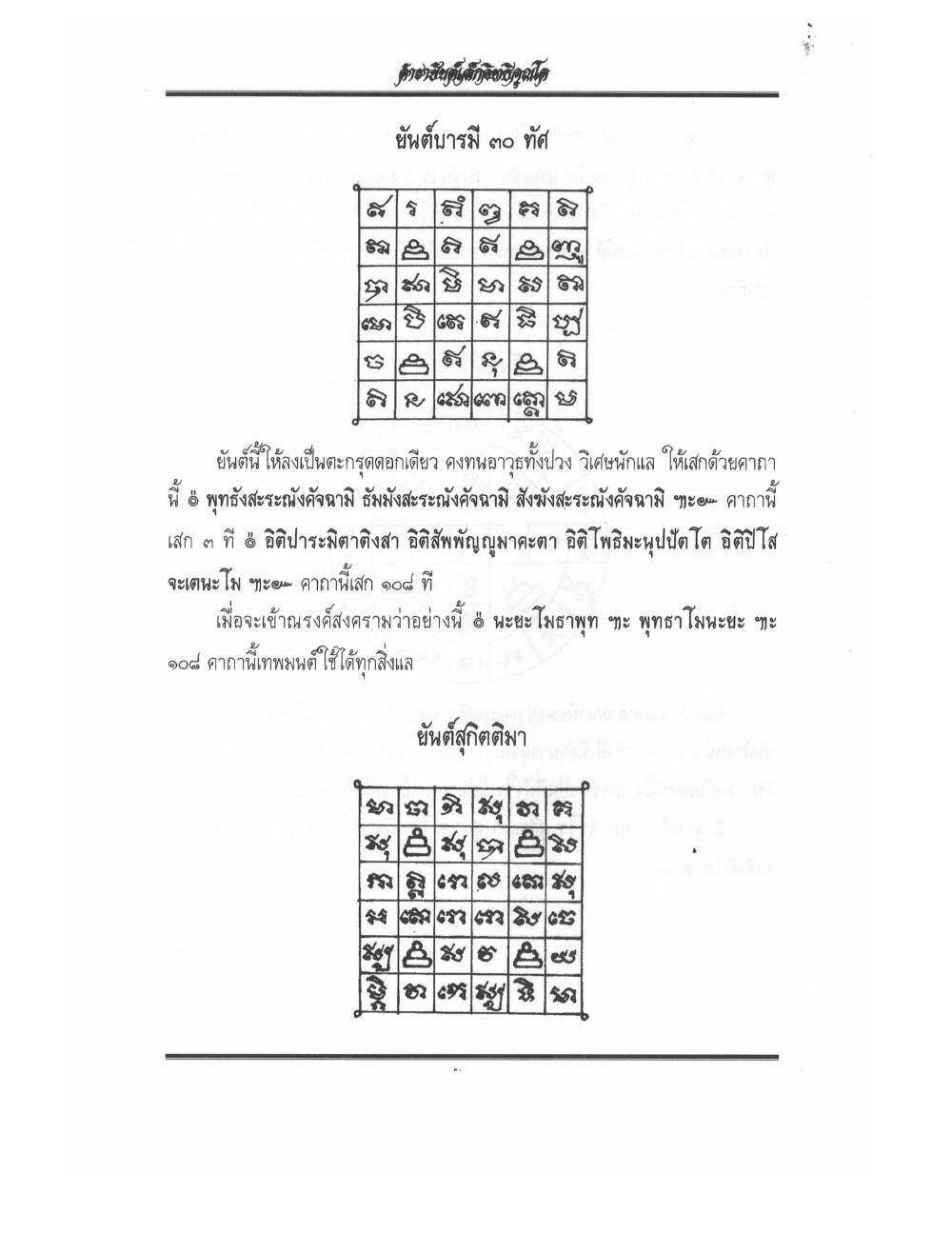
ยันต์มารมี ๓๐ ทัศ
[อักขระขอมในยันต์ อ่านไม่ชัด]
ยันต์นี้ให้ลงเป็นตะกรุดดอกเดียว คงทนอาวุธทั้งปวง วิเศษนักแล ให้เสกด้วยคาถานี้ ๏ พุทธังสะระณังคัจฉามิ ธัมมังสะระณังคัจฉามิ สังฆังสะระณังคัจฉามิ ๚ะ๛ คาถานี้เสก ๓ ที ๏ อิติปาระมิตาติงสา อิติสัพพัญญุมาคะตา อิติโพธิมะพุปปัตโต อิติปิโสจะเตนะโม ๚ะ๛ คาถานี้เสก ๑๐๘ ที เมื่อจะเข้าณรงค์สงครามว่าอย่างนี้ ๏ นะยะโมธาพุท ๚ะ พุทธาโมนะยะ ๚ะ ๑๐๘ คาถานี้เทพมนต์ใช้ได้ทุกสิ่งแล
ยันต์สุกิตติมา
[อักขระขอมในยันต์ อ่านไม่ชัด]
Thirty-Aspect Mara Yantra
[yantra: a 6x6 grid of cells, each inscribed with a khom syllable, not confidently legible]
Make this yantra as a single takrut; it withstands every weapon, most excellently. Consecrate it with this spell: "Phutthang saranang gajchami, thammang saranang gajchami, sanghang saranang gajchami" (I go for refuge to the Buddha, to the Dhamma, to the Sangha) -- consecrate this spell 3 times. "Iti paramita tingsa, iti sappanyumakata, iti bodhima phuppatto, iti piso ja tenamo" -- consecrate this spell 108 times. When going into battle, recite thus: "Na ya mo tha phut, phutthamonaya" -- 108 times; this divine mantra may be used for anything.
Sukittima Yantra
[yantra: a 6x6 grid of cells, each inscribed with a khom syllable, not confidently legible]
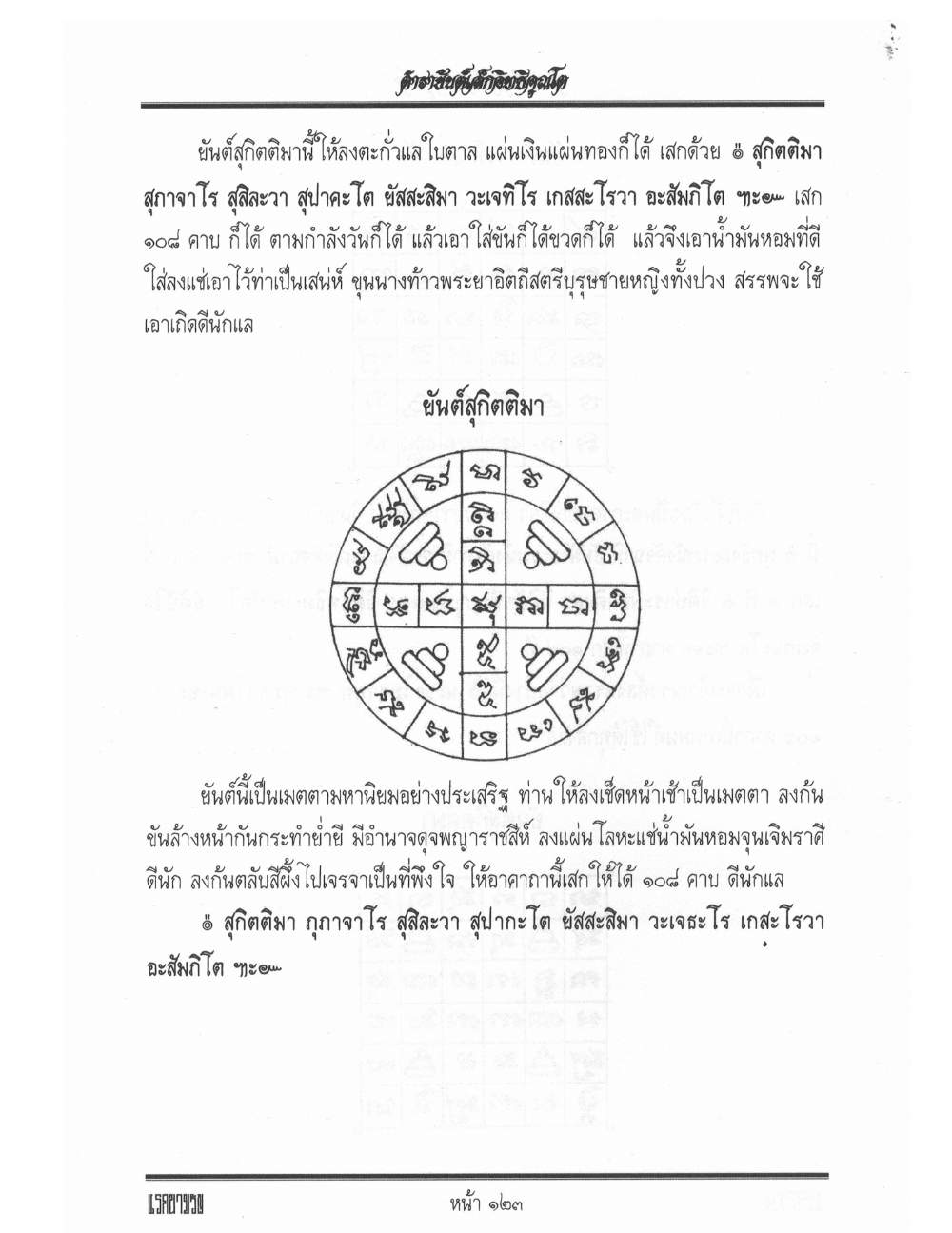
ยันต์สุกิตติมานี้ให้ลงตะกั่วแลใบตาล แผ่นเงินแผ่นทองก็ได้ เสกด้วย ๏ สุกิตติมา สุภาจาโร สุสิละวา สุปาคะโต ยัสสะสิมา วะเจฏิโร เกสสะโรวา อะสัมภิโต ๚ะ๛ เสก ๑๐๘ คาบ ก็ได้ ตามกำลังวันก็ได้ แล้วเอาใส่ขันก็ได้ขวดก็ได้ แล้วจึงเอาน้ำมันหอมที่ดีใส่ลงแช่เอาไว้ท่าเป็นเสน่ห์ ขุนนางท้าวพระยาอิตถีสตรีบุรุษชายหญิงทั้งปวง สรรพจะใช้เอาเกิดดีนักแล
ยันต์สุกิตติมา
[อักขระขอมในยันต์ อ่านไม่ชัด]
ยันต์นี้เป็นเมตตามหานิยมอย่างประเสริฐ ท่านให้ลงเช็ดหน้าเช้าเป็นเมตตา ลงกันขันล้างหน้ากันกระทำย่ำยี มีอำนาจดุจพญาราชสีห์ ลงแผ่นโลหะแช่น้ำมันหอมจุ่มเจิมราศีดีนัก ลงกันตลับสีผึ้งไปเจรจาเป็นที่พึงใจ ให้เอาคาถานี้เสกให้ได้ ๑๐๘ คาบ ดีนักแล ๏ สุกิตติมา ภุภาจาโร สุสิละวา สุปากะโต ยัสสะสิมา วะเจฉะโร เกสะโรวา อะสัมภิโต ๚ะ๛
This Sukittima yantra may be inscribed on lead or on a palm leaf, or on a sheet of silver or gold. Consecrate it with: "Sukittima subhajaro susilava supakato yassasima wachetiro kessarova asambhito" -- consecrate 108 times, or according to the day's power. Then place it in a bowl or a bottle, then pour in good fragrant oil to soak it, and keep it as a charm of attraction; nobles, lords, kings, women and men of every kind will all fall under its spell -- use it and it turns out very well.
Sukittima Yantra
[yantra: a circular figure of two concentric rings -- the inner ring divided into cells bearing khom syllables, the outer ring divided into curved segments each bearing a khom syllable]
This yantra is a supremely excellent charm of loving-kindness and great popularity. Wipe it on your face each morning as a charm of affection; place it in a bowl of water for washing the face to subdue and overawe others -- it grants power like that of the lion king. Inscribed on a sheet of metal and soaked in fragrant oil, it anoints the features very well; kept with a lip-balm case, it makes one's words pleasing to hear. Consecrate this spell 108 times, very well indeed. "Sukittima phuphajaro susilava supakato yassasima wachetharo kessarova asambhito"
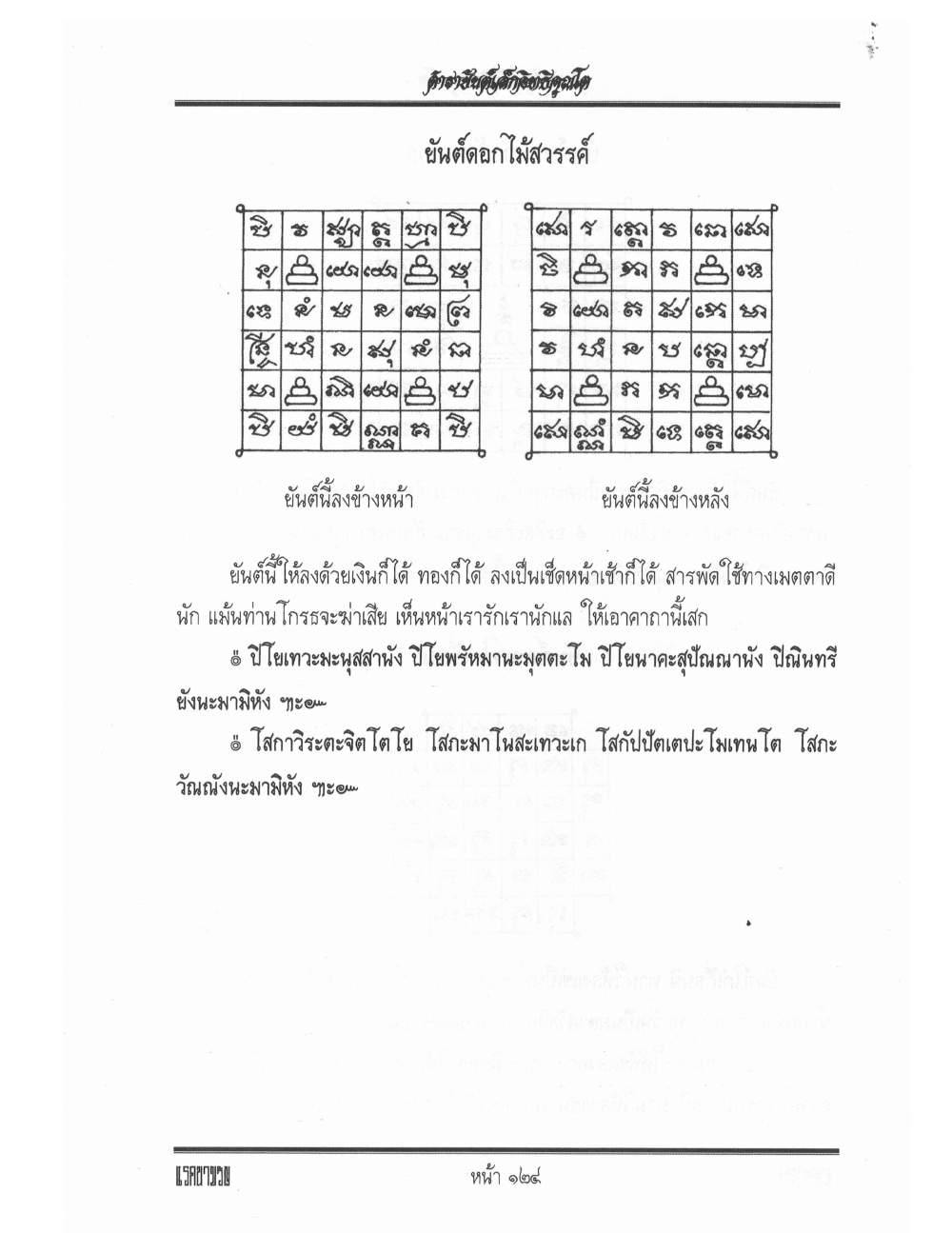
ยันต์ดอกไม้สวรรค์
[อักขระขอมในยันต์ อ่านไม่ชัด]
ยันต์นี้ลงข้างหน้า ยันต์นี้ลงข้างหลัง
ยันต์นี้ให้ลงด้วยเงินก็ได้ ทองก็ได้ ลงเป็นเช็ดหน้าเช้าก็ได้ สารพัดใช้ทางเมตตาดีนัก แม้นท่านโกรธจะหายเสีย เห็นหน้าเรารักเรานักแล ให้เอาคาถานี้เสก ๏ ปิโยเทวะมะนุสสานัง ปิโยพรหมมะนุตตะโม ปิโยนาคะสุปัณณานัง ปิณินทรียังนะมามิหัง ๚ะ๛ ๏ โสกาวิระตะจิตโตโย โสกะมาโนสะเทวะเก โสกัปปัตเตปะโมเทวะโต โสกะวัณณังนะมามิหัง ๚ะ๛
Heavenly Flower Yantra
[yantra: two 6x6 grids side by side, each cell inscribed with a khom syllable]
This yantra goes on the front This yantra goes on the back
This yantra may be inscribed on silver or on gold; it may also be used as something wiped on the face each morning -- it serves every purpose in loving-kindness excellently. Even if someone is angry with you, their anger will vanish; on seeing your face they will love you greatly. Recite this spell: "Piyo devamanussanang piyo brahmamanuttamo piyo nagasupannanang pinindriyang namamiham" "Sokaviratacittoyo sokamanosadevake sokappattepamodevato sokavannang namamiham"
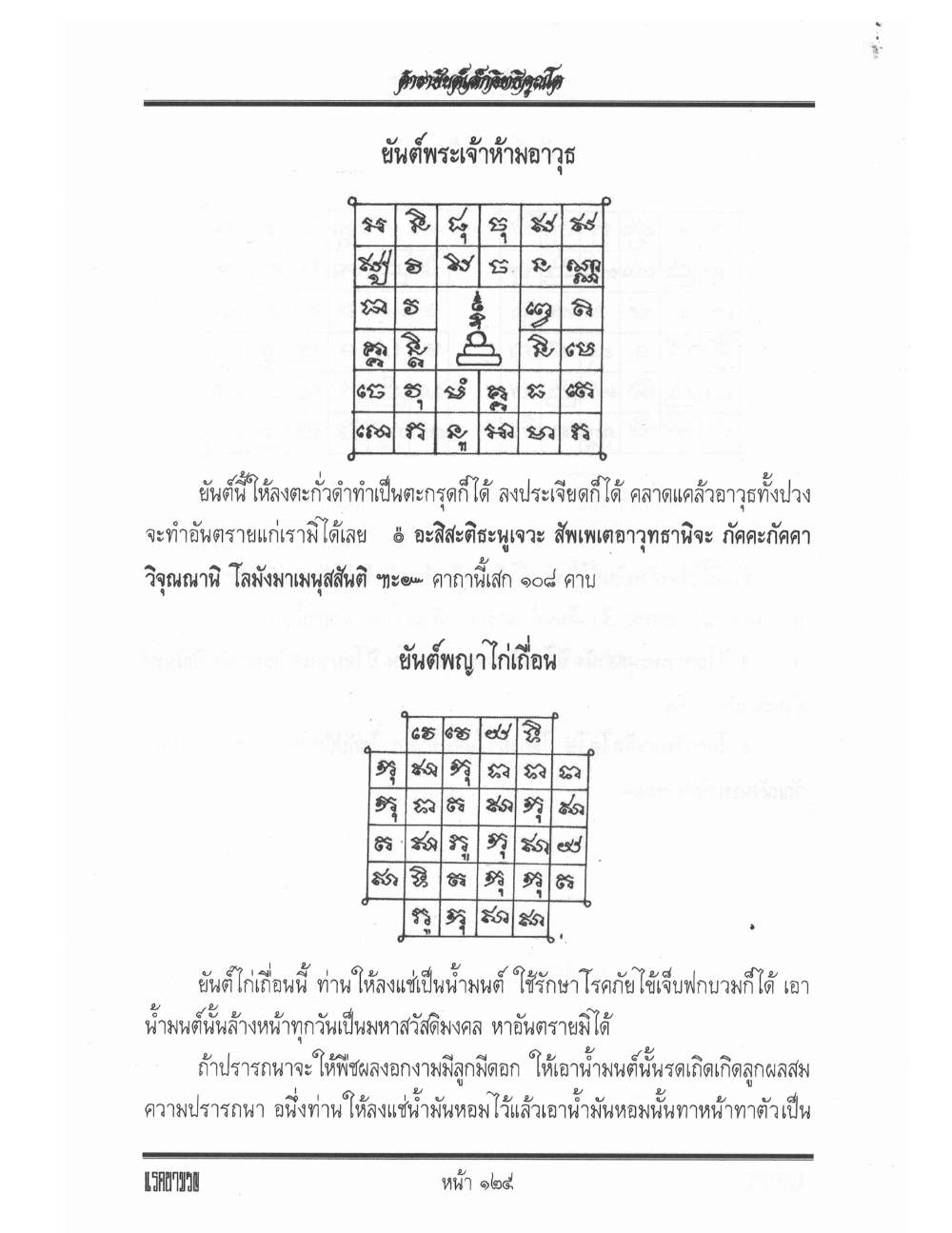
ยันต์พระเจ้าห้ามอาวุธ
[อักขระขอมในยันต์ อ่านไม่ชัด กลางยันต์มีรูปเจดีย์แทนอักขระ]
ยันต์นี้ให้ลงตะกั่วดำทำเป็นตะกรุดก็ได้ ลงประเจียดก็ได้ คลาดแคล้วอาวุธทั้งปวงจะทำอันตรายแก่เรามิได้เลย ๏ อะสิสะติถะพูเจวะ สัพเพเตอาวุธาธินิจะ ภัคคะภัคคาวิจุณณาหิ โลมังมาเมนุสสันติ ๚ะ๛ คาถานี้เสก ๑๐๘ คาบ
ยันต์พญาไก่เถื่อน
[อักขระขอมในยันต์ อ่านไม่ชัด]
ยันต์ไก่เถื่อนนี้ ท่านให้ลงแช่เป็นน้ำมนต์ ใช้รักษาโรคภัยไข้เจ็บฝีบวมก็ได้ เอาน้ำมนต์นั้นล้างหน้าทุกวันเป็นมหาสวัสดิมงคล หาอันตรายมิได้ ถ้าปรารถนาจะให้พืชผลงอกงามมีลูกมีดอก ให้เอาน้ำมนต์นั้นรดเถิดเกิดลูกผลสมความปรารถนา อนึ่งท่านให้ลงแช่น้ำมันหอมไว้แล้วเอาน้ำมันหอมนั้นทาหน้าทาตัวเป็น
Weapon-Warding Lord Buddha Yantra
[yantra: a 6x6 grid of cells with khom syllables; the center cell holds a drawing of a small chedi (stupa) in place of a syllable]
Make this yantra of black lead as a takrut, or as a cloth amulet; it protects against every weapon, so that no harm at all can come to us. "Asisatithaphujewa sappetheawuthathinicha phakkhaphakkhawichunnahi lomangmamenusanti" -- consecrate this spell 108 times.
Wild Rooster King Yantra
[yantra: a grid of cells with khom syllables]
This Wild Rooster yantra: soak it to make holy water, which may be used to treat illness, fever, sickness, and boils or swelling. Wash the face with that holy water every day for great auspicious fortune, and no harm can come to you. If you wish for crops to flourish, bearing fruit and flowers abundantly, sprinkle that holy water on them and they will bear fruit as desired. Also, one may soak the yantra in fragrant oil, then take that oil to anoint the face and body, becoming
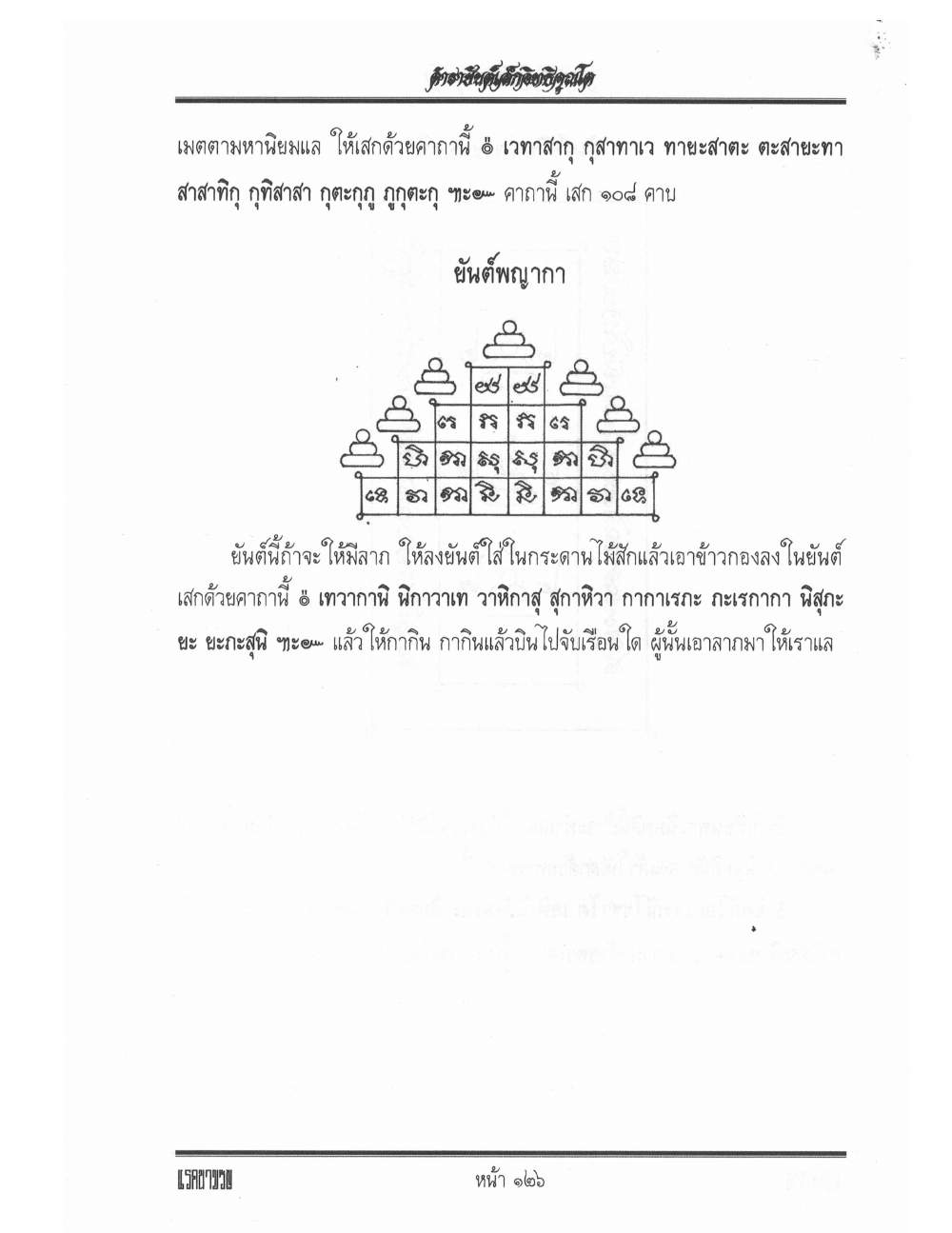
เมตตามหานิยมแล ให้เสกด้วยคาถานี้ ๏ เวทาสากุ กุสาทาเว ทายะสาตะ ตะสายะทา สาสาทิกุ กุทิสาสา กุตะกุภู ภูกุตะกุ ๚ะ๛ คาถานี้เสก ๑๐๘ คาบ
ยันต์พญากา
[อักขระขอมในยันต์ อ่านไม่ชัด]
ยันต์นี้ถ้าจะให้มีลาภ ให้ลงยันต์ใส่ในกระดาษไม้สักแล้วเอาข้าวกองลงในยันต์ เสกด้วยคาถานี้ ๏ เทวากานิ นิกาวาเท วาหิกาสุ สุกาหิวา กากาเรภะ ภะเรกากา นิสุภะยะ ยะภะสุนิ ๚ะ๛ แล้วให้กากิน กากินแล้วบินไปจับเรือนใด ผู้พั้นเอาลาภมาให้เราแล
...an object of loving-kindness and great popularity. Consecrate it with this spell: "Wethasaku kusathawe thayasata tasayatha sasathiku kuthisasa kutakuphu phukutaku" -- consecrate this spell 108 times.
Crow King Yantra
[yantra: a pyramidal arrangement of grid cells inscribed with khom syllables, topped and flanked by small stupa-shaped ornaments]
If you wish to gain good fortune with this yantra, inscribe it on teak-wood paper, then pile rice grains on top of the yantra. Consecrate it with this spell: "Thewakani nikawathe wahikasu sukahiwa kakarepha pharekaka nisuphaya yaphasuni" -- then let a crow eat [the rice]. Once the crow has eaten, it will fly off and perch on whatever house it lands on; the owner of that house will bring good fortune to you.
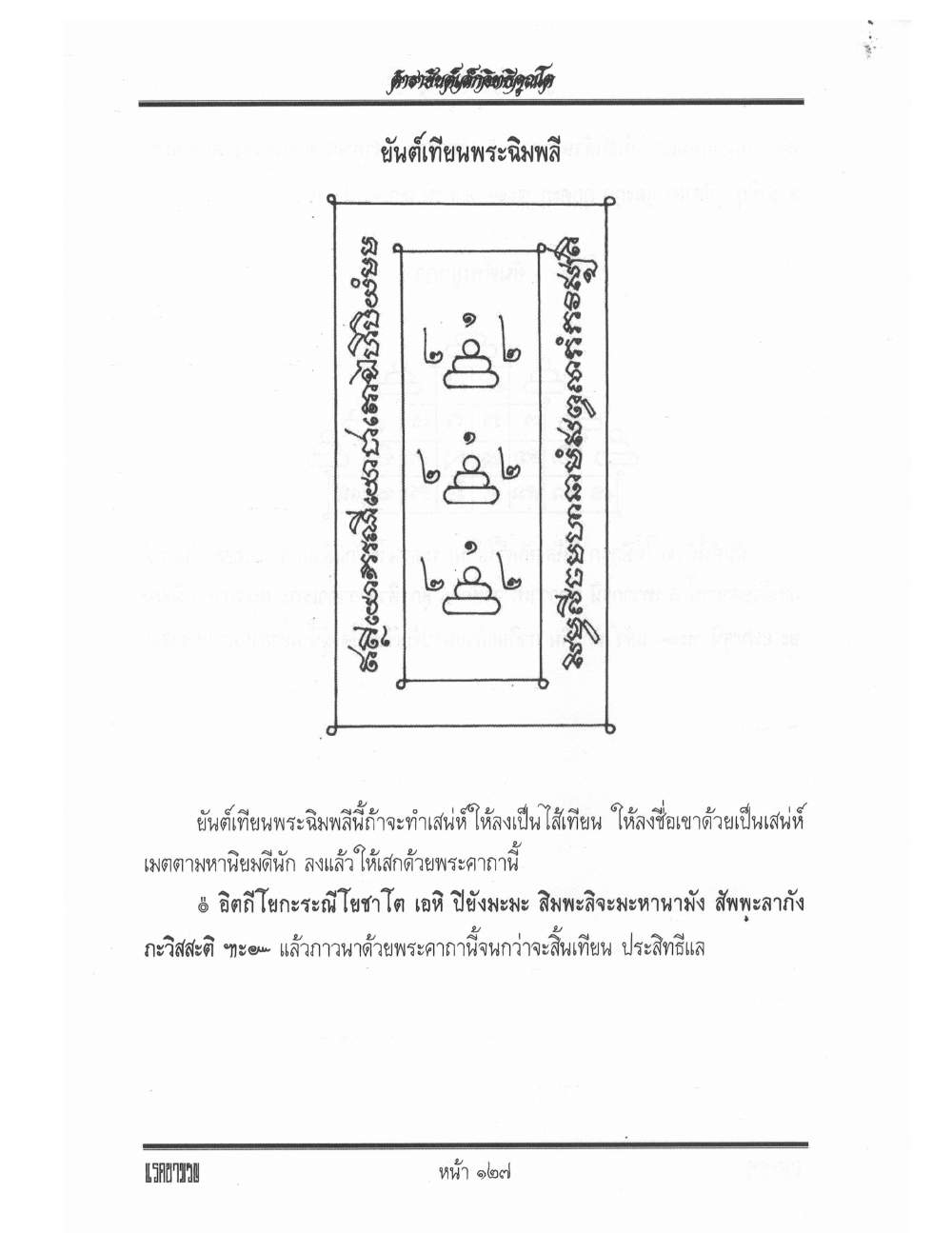
ยันต์เทียนพระฉิมพลี
[อักขระขอมในยันต์ อ่านไม่ชัด]
ยันต์เทียนพระฉิมพลีนี้ถ้าจะทำเสน่ห์ ให้ลงเป็นไส้เทียน ให้ลงชื่อเขาด้วยเป็นเสน่ห์เมตตามหานิยมดีนัก ลงแล้วให้เสกด้วยพระคาถานี้ ๏ อิตถีโยกะระณีโยชาโต เอหิ ปิยังมะมะ สิมพะลิจะมะหามัง สัพพะลาภังกะวิสสะติ ๚ะ๛ แล้วภาวนาด้วยพระคาถานี้จนกว่าจะสิ้นเทียน ประสิทธิแล
Phra Chimphali Candle Yantra
[yantra: a tall rectangular frame with three stacked stupa-shaped devices arranged vertically down its center; the left and right borders carry vertical lines of khom/Pali script, not confidently legible]
If this Phra Chimphali candle yantra is used to make a charm of attraction, inscribe it as the wick of a candle; write the target person's name on it as well, for an excellent charm of loving-kindness and great popularity. Once inscribed, consecrate it with this sacred spell: "Itthiyokaraniyochato ehi piyangmama simphalichamahamang sappalaphangkawisati" -- then recite this sacred spell continuously until the candle burns down completely; it will be efficacious.
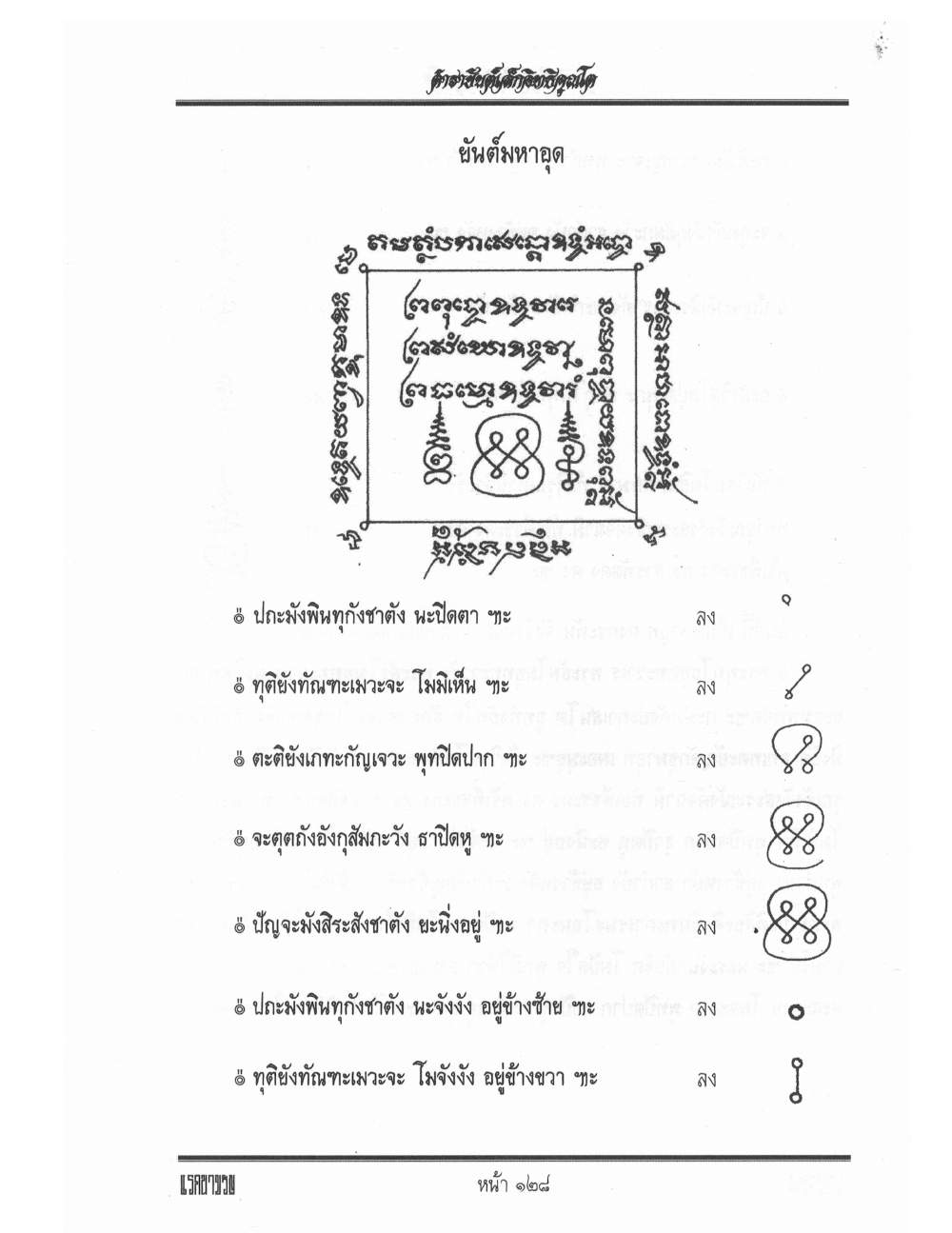
ยันต์มหาอุด
[อักขระขอมในยันต์ อ่านไม่ชัด]
๏ ปถมังพินทุกังชาตัง นะปิดตา ๚ะ ลง ๏ ทุติยังทัณฑะเมาะจะ โมมิเห็น ๚ะ ลง ๏ ตะติยังเภทะกัญเจวะ พุทปิดปาก ๚ะ ลง ๏ จะตุตถังอังกุสัมภะวัง ธาปิดหู ๚ะ ลง ๏ ปัญจะมังสิระสังชาตัง ยะพิ่งอยู่ ๚ะ ลง ๏ ปถมังพินทุกังชาตัง นะจังงัง อยู่ข้างซ้าย ๚ะ ลง ๏ ทุติยังทัณฑะเมาะจะ โมจังงัง อยู่ข้างขวา ๚ะ ลง
Mahaut (Total-Invulnerability) Yantra
[yantra: a square frame bordered on all four sides by lines of cursive khom/Pali script, not confidently legible; inside, three further lines of khom script above two small chedi-shaped ornaments flanking an endless-knot symbol]
"Pathamang pinthukangchatang na -- closes the eyes" -- inscribe [glyph: a small ring mark] "Tutiyang thandamawcha mo -- renders unseen" -- inscribe [glyph: two small circles joined by a line] "Tatiyang phethakanjewa phut -- seals the mouth" -- inscribe [glyph: a crossed-loop mark] "Jatutthang angkusamphawang tha -- seals the ears" -- inscribe [glyph: a crossed-loop mark] "Panjamang sirasangchatang ya -- rests above [the head]" -- inscribe [glyph: a doubled crossed-loop mark] "Pathamang pinthukangchatang na -- jangngang, placed on the left" -- inscribe [glyph: a round dot] "Tutiyang thandamawcha mo -- jangngang, placed on the right" -- inscribe [glyph: two dots joined by a line]
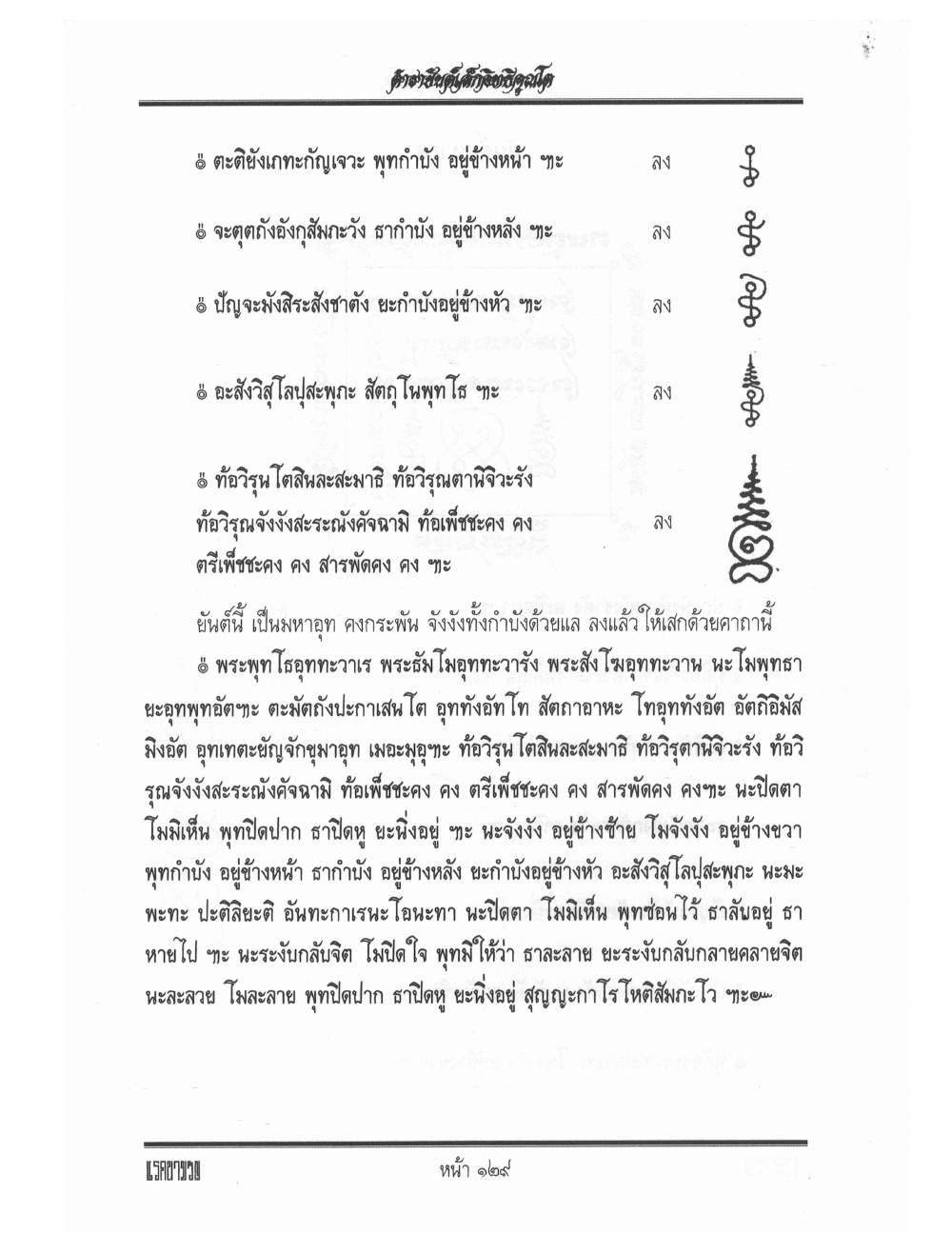
๏ ตะติยังเภทะกัญเจวะ พุทกำบัง อยู่ข้างหน้า ๚ะ ลง ๏ จะตุตถังอังกุสัมภะวัง ธากำบัง อยู่ข้างหลัง ๚ะ ลง ๏ ปัญจะมังสิระสังชาตัง ยะกำบังอยู่ข้างหัว ๚ะ ลง ๏ อะสังวิสุโลปุสะพุกะ สัตถุโพพุทโธ ๚ะ ลง ๏ ท้าวิรุนโตสินละสะมาธิ ท้าวิรุณตานิจิวะรัง ท้าวิรุณจังงังสะระณังคัจฉามิ ท้าเพ็ชชะคง คง ตรีเพ็ชชะคง คง สารพัดคง คง ๚ะ ลง
ยันต์นี้ เป็นมหาอุด คงกระพัน จังงังทั้งกำบังด้วยแล ลงแล้วให้เสกด้วยคาถานี้ ๏ พระพุทโธอุทะวาเร พระธัมโมอุทะวารัง พระสังโฆอุทะวาน พะโมพุทธายะอุทพุทอัต ๚ะ ตะมัตถังปะกาเสนโต อุทังอัทโท สัตถาอาหะ โทอุทังอัต อัตถิอิมัสมิงอัต อุทเทตะยัญจักขุมาอุท เมอะมุอุ ๚ะ ท้าวิรุนโตสินละสะมาธิ ท้าวิรุตานิจิวะรัง ท้าวิรุณจังงังสะระณังคัจฉามิ ท้าเพ็ชชะคง คง ตรีเพ็ชชะคง คง สารพัดคง คงๆ นะปิดตา โมมิเห็น พุทปิดปาก ธาปิดหู ยะพิ่งอยู่ ๚ะ นะจังงัง อยู่ข้างซ้าย โมจังงัง อยู่ข้างขวา พุทกำบัง อยู่ข้างหน้า ธากำบัง อยู่ข้างหลัง ยะกำบังอยู่ข้างหัว อะสังวิสุโลปุสะพุกะ นะมะพะทะ ปะติลิยะติ อันทะกาเรนะโอนะทา นะปิดตา โมมิเห็น พุทซ่อนไว้ ธาลับอยู่ ธาหายไป ๚ะ นะระงับกลับจิต โมปิดใจ พุทมิให้ว่า ธาละลาย ยะระงับกลับกลายคลายจิต นะละลวย โมละลาย พุทปิดปาก ธาปิดหู ยะนิ่งอยู่ สุญญะกาโรโหติสัมภะโว ๚ะ๛
"Tatiyang phethakanjewa phut -- conceals, in front" -- inscribe [glyph: a spiral hook] "Jatutthang angkusamphawang tha -- conceals, behind" -- inscribe [glyph: a spiral hook] "Panjamang sirasangchatang ya -- conceals, at the head" -- inscribe [glyph: a spiral hook] "Asangwisulopusaphuka satthuphophuttho" -- inscribe [glyph: a small pagoda-tower mark] "Thawirunto sinlasamathi, thawiruntanichiwarang, thawirunjangngang saranangkajchami, tha phetchakhong khong tri phetchakhong khong sanphatkhong khong" -- inscribe [glyph: a larger pagoda-tower mark]
This yantra is the Mahaut [total-invulnerability charm], granting invulnerability together with concealment and stillness of the body. Once inscribed, consecrate it with this spell: "Phraphutthooutthaware phrathammoutthawarang phrasangkhoutthawan phamophutthaya-utphutat -- tha matthangpakasento utthangatto satthaaha thoutthangat atthiimasming-at utthetayanjakkhumaut meamu-u -- thawirunto sinlasamathi thawirutanichiwarang thawirunjangngang saranangkajchami tha phetchakhong khong tri phetchakhong khong sanphatkhong khongkhong -- na (closes the eyes), mo (renders unseen), phut (seals the mouth), tha (seals the ears), ya (rests above) -- na jangngang on the left, mo jangngang on the right, phut conceals in front, tha conceals behind, ya conceals at the head; asangwisulopusaphuka namaphatha patiliyati anthakarenaonatha -- na (closes the eyes), mo (renders unseen), phut hides away, tha lies concealed, tha vanishes -- na stills the mind, mo shuts the heart, phut lets nothing be said, tha dissolves, ya subsides and the mind relaxes, na melts away, mo dissolves, phut seals the mouth, tha seals the ears, ya remains still: sunnyakaro hotisambhawo"
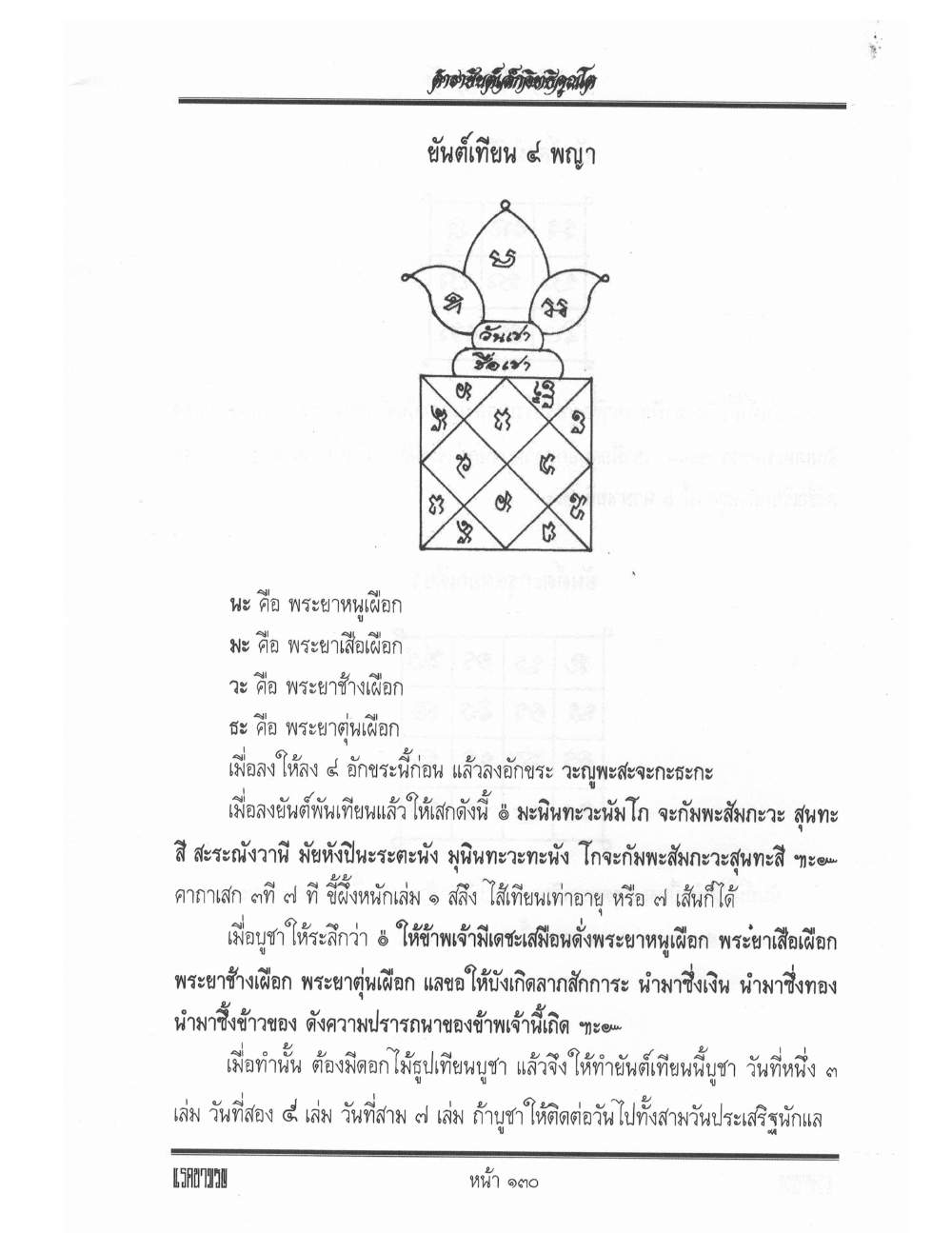
ยันต์เทียน ๔ พญา
[อักขระขอมในยันต์ อ่านไม่ชัด ในกรอบมีคำว่า "วันเจ้า" และ "ชื่อเจ้า"]
พะ คือ พระยาหนูเผือก มะ คือ พระยาเสือเผือก วะ คือ พระยาช้างเผือก ธะ คือ พระยาตุ่นเผือก เมื่อลงให้ลง ๔ อักขระนี้ก่อน แล้วลงอักขระ วะญูพะสะจะกะธะกะ เมื่อลงยันต์พันเทียนแล้วให้เสกดังนี้ ๏ มะพินทะวะพังโภ จะกัมพะสัมภะวะ สุทะสี สะระณังวานี มัยหังปิ๋นระตะพัง มุพินทะวะทะพัง โภจะกัมพะสัมภะวะสุทะสี ๚ะ๛ คาถาเสก ๓ ที ๗ ที ขี้ผึ้งหนักเล่ม ๑ สลึง ไส้เทียนเท่าอายุ หรือ ๗ เส้นก็ได้ เมื่อบูชาให้ระลึกว่า ๏ ให้ข้าพเจ้ามีเดชะเสมือนดั่งพระยาหนูเผือก พระยาเสือเผือก พระยาช้างเผือก พระยาตุ่นเผือก แลขอให้บังเกิดลาภสักการะ นำมาซึ่งเงิน นำมาซึ่งทอง นำมาซึ่งข้าวของ ดังความปรารถนาของข้าพเจ้านี้เกิด ๚ะ๛ เมื่อทำนั้น ต้องมีดอกไม้ธูปเทียนบูชา แล้วจึงให้ทำยันต์เทียนนี้บูชา วันที่หนึ่ง ๓ เล่ม วันที่สอง ๕ เล่ม วันที่สาม ๗ เล่ม ถ้าบูชาให้ติดต่อวันไปทั้งสามวันประเสริฐนักแล
Four-Lord Candle Yantra
[yantra: a lotus-bud-shaped device with three petal-like lobes, each bearing a syllable, above two cartouches reading "day of the owner" and "name of the owner"; below, a diamond-lattice grid with a syllable at each intersection]
Pha stands for the Albino Rat Lord. Ma stands for the Albino Tiger Lord. Wa stands for the Albino Elephant Lord. Tha stands for the Albino Mole Lord. When inscribing, write these four syllables first, then write the syllables "wa-nyu-pha-sa-ja-ka-tha-ka." Once the thousand-candle yantra is inscribed, consecrate it thus: "Maphinthawaphangpho jakamphasamphawa suthasi saranangwani maihangphinrataphang muphinthawathaphang phochakamphasamphawasuthasi" -- consecrate this spell 3 times, or 7 times. Use one salueng weight of beeswax; make the wick as long as [a length equal to] the person's age, or 7 strands will also do. When venerating it, hold in mind: "May I possess power like the Albino Rat Lord, the Albino Tiger Lord, the Albino Elephant Lord, and the Albino Mole Lord; and may fortune and offerings arise for me, bringing silver, bringing gold, bringing goods, according to my wish." When performing this, one must have flowers, incense, and candles as offerings, then make this candle yantra as an offering: the first day, 3 candles; the second day, 5 candles; the third day, 7 candles. If the offering continues for all three days without a break, it is most excellent indeed.
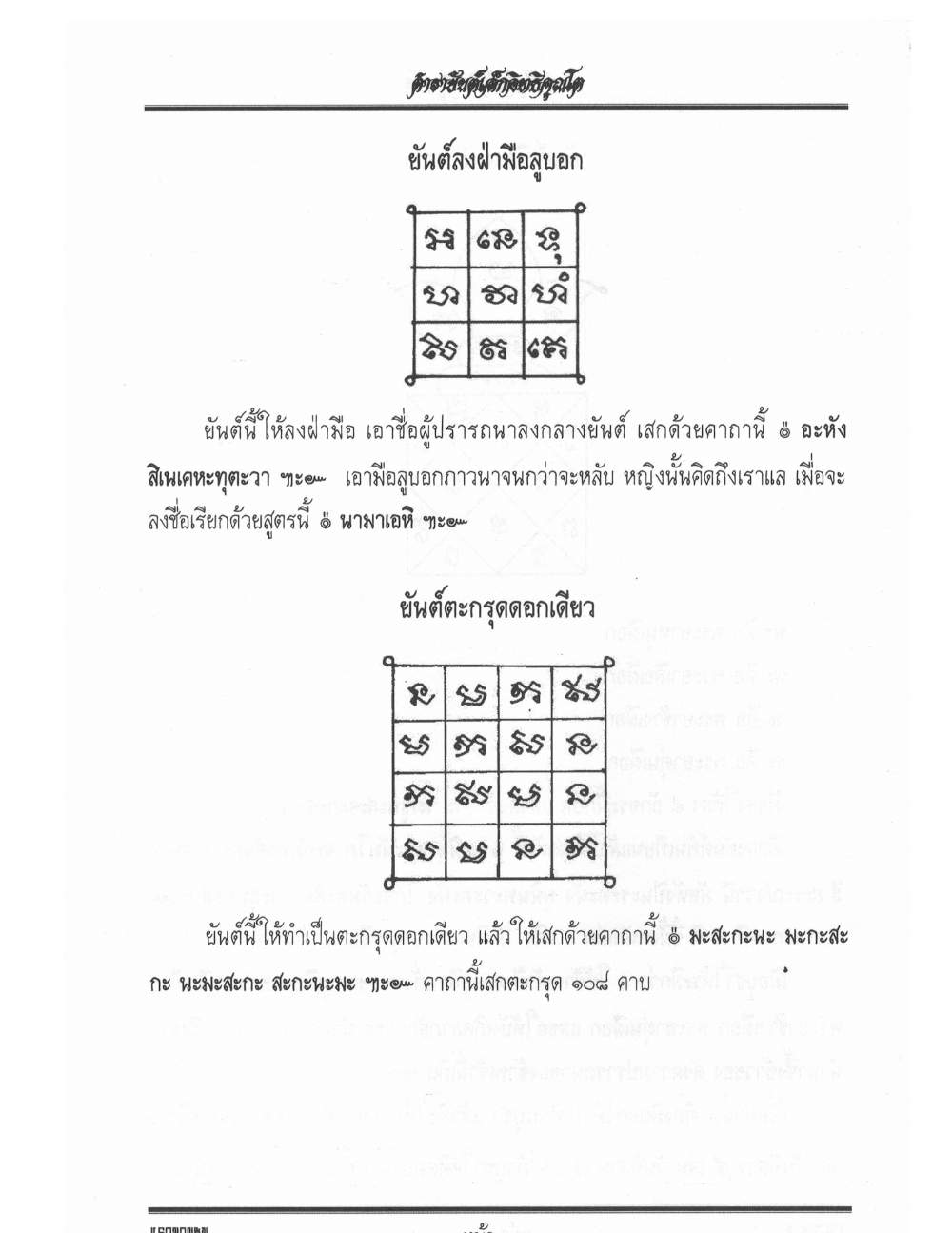
ยันต์ลงฝ่ามือลูบอก
[อักขระขอมในยันต์ อ่านไม่ชัด]
ยันต์นี้ให้ลงฝ่ามือ เอาชื่อผู้ปรารถนาลงกลางยันต์ เสกด้วยคาถานี้ ๏ อะหังสิเนหะทุตะวา ๚ะ๛ เอามือลูบอกภาวนาจนกว่าจะหลับ หญิงพั้นคิดถึงเราแล เมื่อจะลงชื่อเรียกด้วยสูตรนี้ ๏ พามาเอหิ ๚ะ๛
ยันต์ตะกรุดดอกเดียว
[อักขระขอมในยันต์ อ่านไม่ชัด]
ยันต์นี้ให้ทำเป็นตะกรุดดอกเดียว แล้วให้เสกด้วยคาถานี้ ๏ มะสะกะพะ มะกะสะกะ พะมะสะกะ สะกะพะมะ ๚ะ๛ คาถานี้เสกตะกรุด ๑๐๘ คาบ
Palm-Stroking-the-Chest Yantra
[yantra: a 3x3 grid of cells, each inscribed with a khom syllable]
Inscribe this yantra on the palm of the hand, writing the desired person's name in the center of the yantra. Consecrate it with this spell: "Ahang sinehathutawa" -- then stroke your chest with that hand and recite continuously until you fall asleep; the woman will then think only of you. When calling her name, use this formula: "Phamaehi"
Single Takrut Yantra
[yantra: a 4x4 grid of cells, each inscribed with a khom syllable]
Make this yantra into a single takrut, then consecrate it with this spell: "Masakapha makasaka phamasaka sakaphama" -- consecrate this spell over the takrut 108 times.
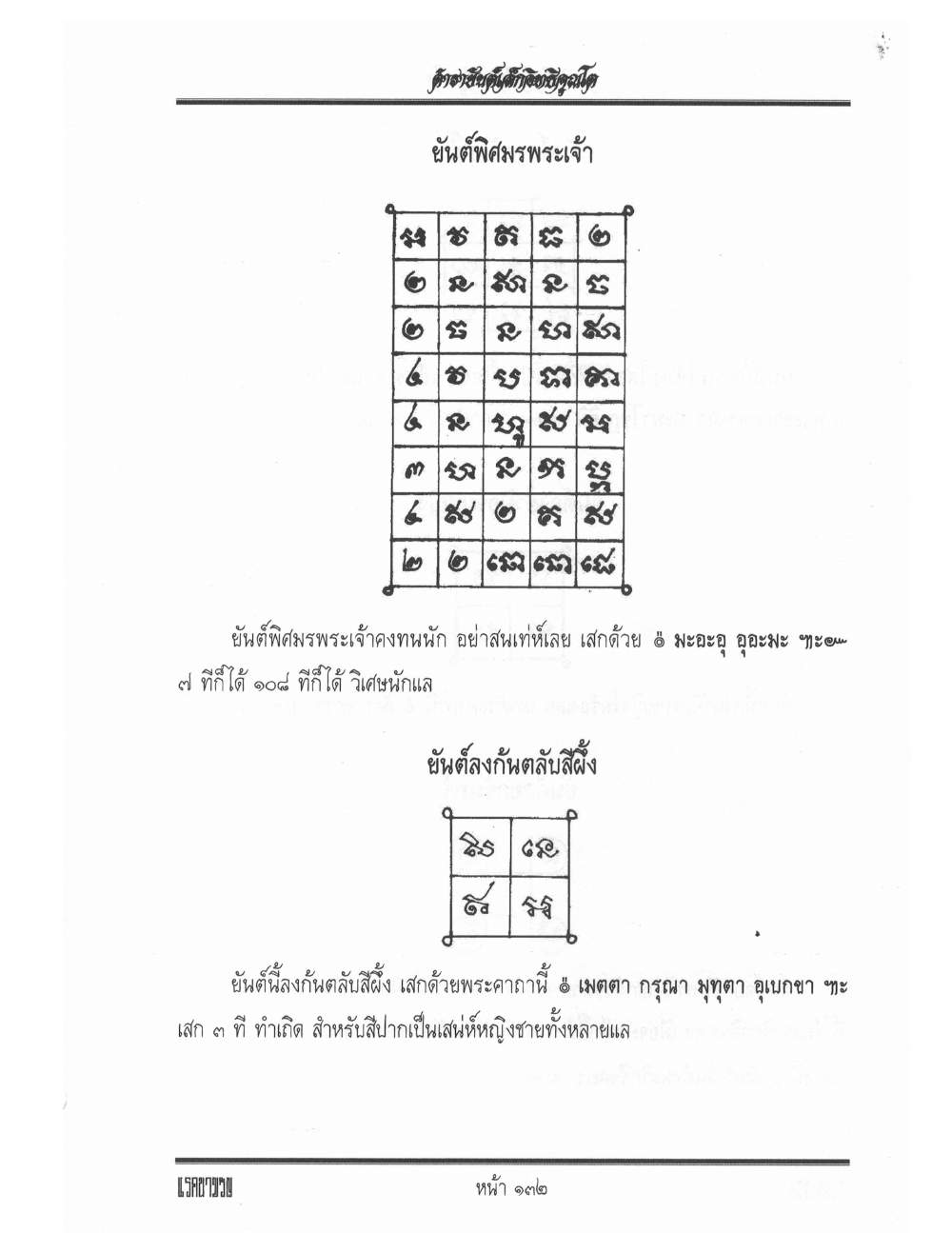
ยันต์พิศมรพระเจ้า
[yantra: rectangular grid of eight rows by five columns, each cell filled with a khom/Thai magical syllable, some cells also carrying a small numeral; [อักขระขอมในยันต์ อ่านไม่ชัด]]
ยันต์พิศมรพระเจ้าคงทนนัก อย่าสนเท่ห์เลย เสกด้วย ๐ มะอะอุ อุอะมะ ๛ ๗ ทีก็ได้ ๑๐๘ ทีก็ได้ วิเศษนักแล
ยันต์ลงก้นตลับสีผึ้ง
[yantra: small square grid of two rows by two columns, four khom syllable cells; [อักขระขอมในยันต์ อ่านไม่ชัด]]
ยันต์นี้ลงก้นตลับสีผึ้ง เสกด้วยพระคาถานี้ ๐ เมตตา กรุณา มุทุตา อุเบกขา ๛ เสก ๓ ที ทำเถิด สำหรับสีปากเป็นเสน่ห์หญิงชายทั้งหลายแล
The Lord's Charm Yantra
[yantra: rectangular grid of eight rows by five columns, each cell filled with a khom/Thai magical syllable, some cells also carrying a small numeral; syllables not confidently legible]
The Lord's Charm Yantra grants lasting endurance — do not doubt it. Consecrate with "Ma a u, u a ma" [end-of-spell mark], seven times or 108 times, either will do; it is especially excellent.
Yantra for the Base of the Love-Balm Tin
[yantra: small square grid, two rows by two columns, four khom syllable cells; syllables not confidently legible]
This yantra is inscribed on the base of a love-balm tin. Consecrate it with this spell: "Metta, karuna, mudita, upekkha" [end-of-spell mark], chanted 3 times — do this. It is for coloring the lips as a charm to attract women and men of all kinds.
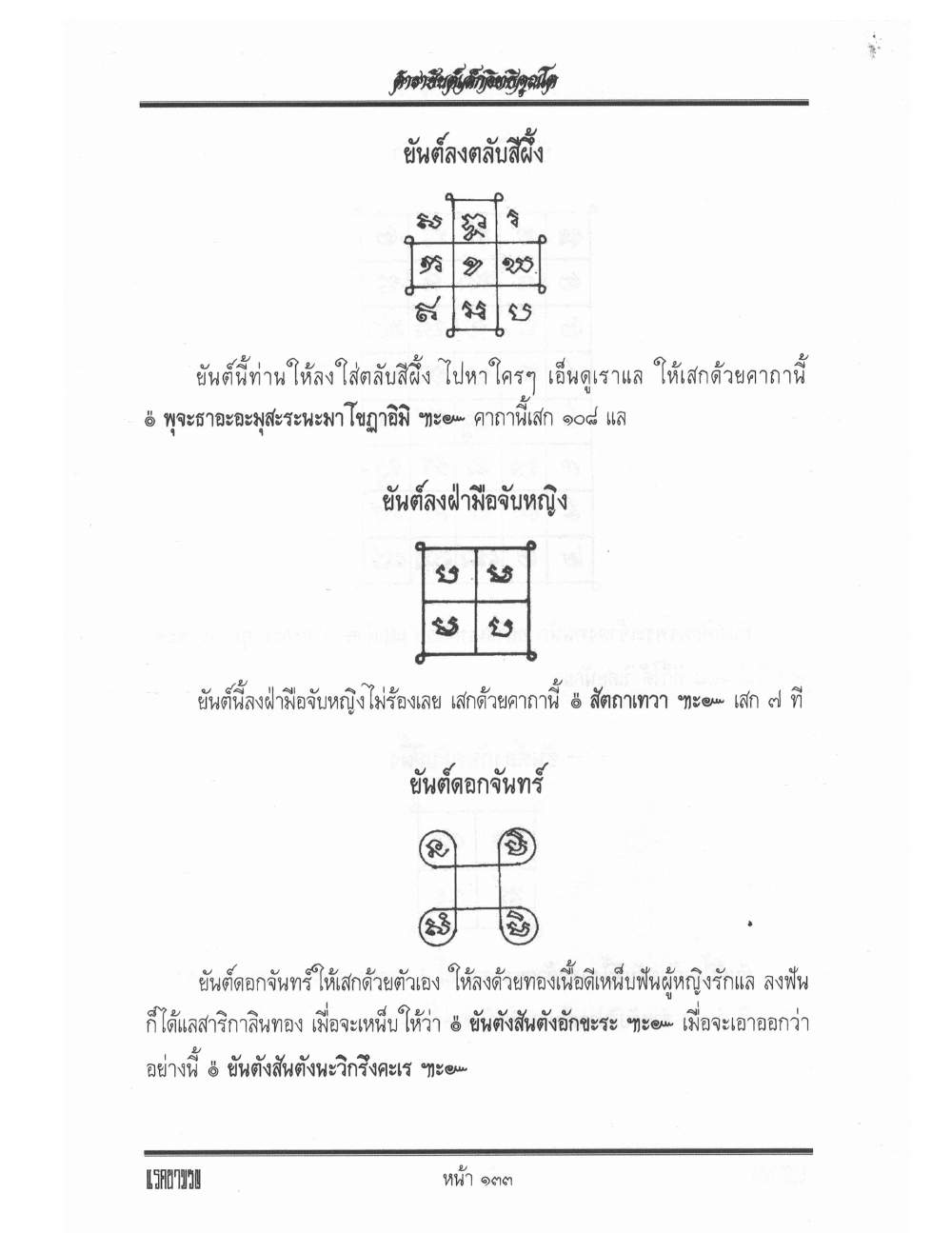
ยันต์ลงตลับสีผึ้ง
[yantra: square frame around a grid of three rows by three columns, nine khom syllable cells; [อักขระขอมในยันต์ อ่านไม่ชัด]]
ยันต์นี้ท่านให้ลงใส่ตลับสีผึ้ง ไปหาใครๆ เอ็นดูเราแล ให้เสกด้วยคาถานี้ ๐ พุจะถาอะถะมุสะระนะมาโขฎาอิมิ ๛ คาถานี้เสก ๑๐๘ แล
ยันต์ลงฝ่ามือจับหญิง
[yantra: square grid of two rows by two columns, four khom syllable cells; [อักขระขอมในยันต์ อ่านไม่ชัด]]
ยันต์นี้ลงฝ่ามือจับหญิงไม่ร้องเลย เสกด้วยคาถานี้ ๐ สัตถาเทวา ๛ เสก ๗ ที
ยันต์ดอกจันทร์
[yantra: four small circular cells joined by connecting lines into a cross/flower shape, each circle containing a khom syllable; [อักขระขอมในยันต์ อ่านไม่ชัด]]
ยันต์ดอกจันทร์ให้เสกด้วยตัวเอง ให้ลงด้วยทองเนื้อดีเหน็บผ้าผู้หญิงรักแล ลงพันก็ได้แลสาริกาลิ้นทอง เมื่อจะเหน็บให้ว่า ๐ ยันตังสันตังอักขะระ ๛ เมื่อจะเอาออกว่าอย่างนี้ ๐ ยันตังสันตังนะวิกรึงคะเร ๛
Yantra for the Love-Balm Tin
[yantra: square frame around a grid of three rows by three columns, nine khom syllable cells; syllables not confidently legible]
This yantra is to be inscribed and placed inside a love-balm tin; wherever you go to see anyone, they will feel fondness for you. Consecrate it with this spell: "Phutcha thaao thamutsaranama khotaimi" [end-of-spell mark]; chant this spell 108 times.
Yantra for the Palm, to Restrain a Woman
[yantra: square grid of two rows by two columns, four khom syllable cells; syllables not confidently legible]
This yantra, [placed] on the palm, [lets one] hold a woman without her crying out at all. Consecrate with this spell: "Sattha thewa" [end-of-spell mark], chanted 7 times.
Moon-Flower Yantra
[yantra: four small circular cells joined by connecting lines into a cross/flower shape, each circle containing a khom syllable; syllables not confidently legible]
The Moon-Flower Yantra is to be consecrated by oneself. Inscribe it on fine gold and tuck it into a woman's garment to win her love; it may also be wound together with a golden-tongued myna [charm]. When tucking it in, say: "Yantang santang akkhara" [end-of-spell mark]. When taking it out, say this: "Yantang santang na wikrungkhare" [end-of-spell mark].
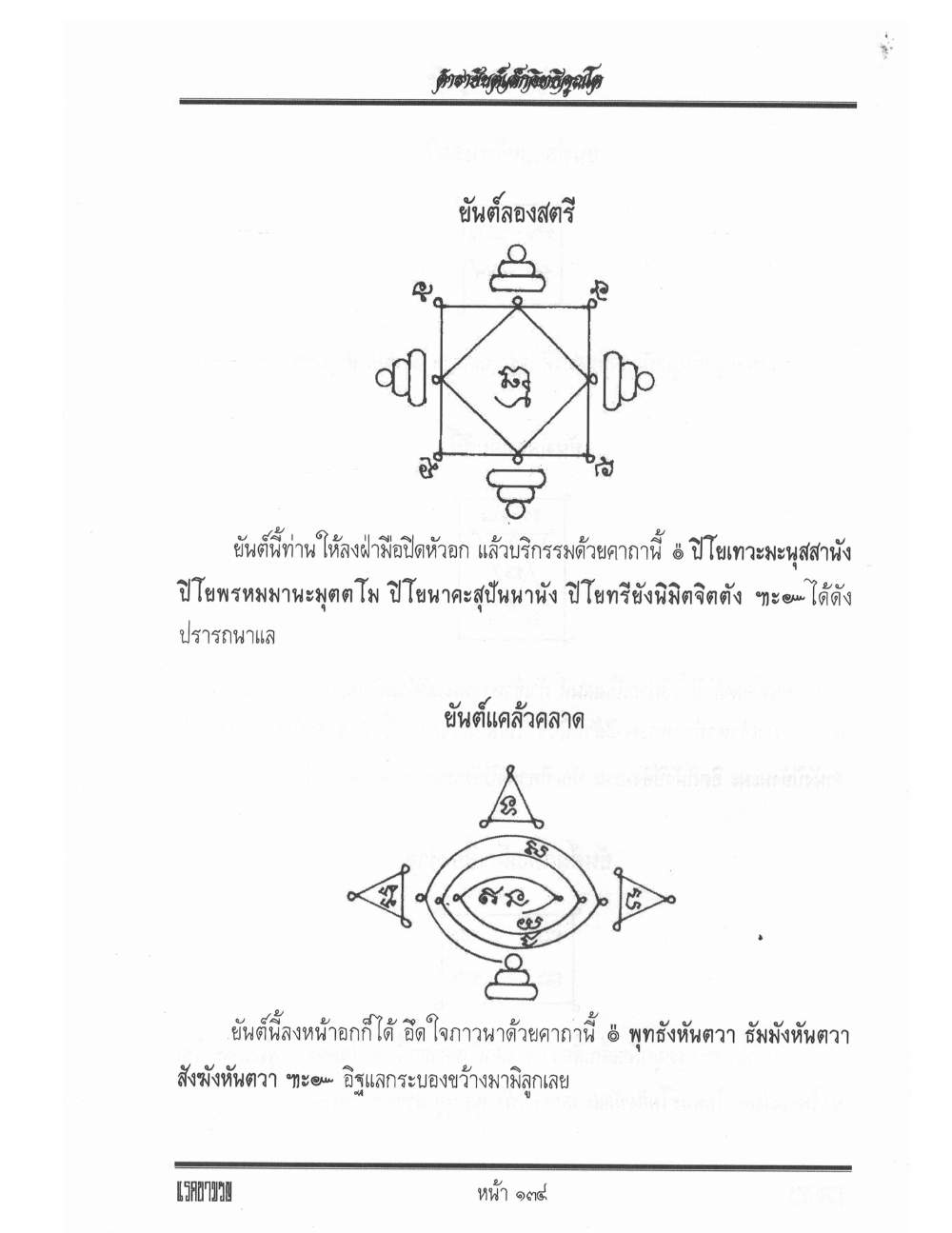
ยันต์ลองสตรี
[yantra: a diamond inscribed within a square, with four decorative stupa-like finials projecting outward at the top, bottom, left and right; a single khom syllable at the diamond's center; [อักขระขอมในยันต์ อ่านไม่ชัด]]
ยันต์นี้ท่านให้ลงฝ่ามือปิดหัวอก แล้วบริกรรมด้วยคาถานี้ ๐ ปิโยเทวะมะนุสสานัง ปิโยพรหมมานะมุตตะโม ปิโยนาคะสุปัณณานัง ปิโยทริยังนิมิตจิตตัง ๛ ได้ดังปรารถนาแล
ยันต์แคล้วคลาด
[yantra: a triangle at the top containing a syllable; below it an oval/eye-shaped figure of concentric rings with syllables inside; two further triangles flanking the oval at left and right, each with a syllable; a stupa-like finial at the bottom; [อักขระขอมในยันต์ อ่านไม่ชัด]]
ยันต์นี้ลงหน้าอกก็ได้ อึดใจภาวนาด้วยคาถานี้ ๐ พุทธังหันตวา ธัมมังหันตวา สังฆังหันตวา ๛ อิฏฐแลกระบองขว้างมาไม่ถูกเลย
Woman-Testing Yantra
[yantra: a diamond inscribed within a square, with four decorative stupa-like finials projecting outward at top, bottom, left and right; a single khom syllable at the diamond's center; syllable not confidently legible]
This yantra: place the palm over the chest, then recite this spell: "Piyo devamanussanang, piyo brahmamanamuttamo, piyo nagasupannanang, piyo thariyang nimittacittang" [end-of-spell mark]. You will obtain [your wish] as desired.
Yantra of Escape from Harm
[yantra: a triangle at the top containing a syllable; below it an oval/eye-shaped figure of concentric rings with syllables inside; two further triangles flanking the oval at left and right, each with a syllable; a stupa-like finial at the bottom; syllables not confidently legible]
This yantra may also be placed on the chest. Hold the breath and recite this spell: "Phutthang hantawa, thammang hantawa, sanghang hantawa" [end-of-spell mark]. Bricks and clubs thrown [at you] will never strike home.
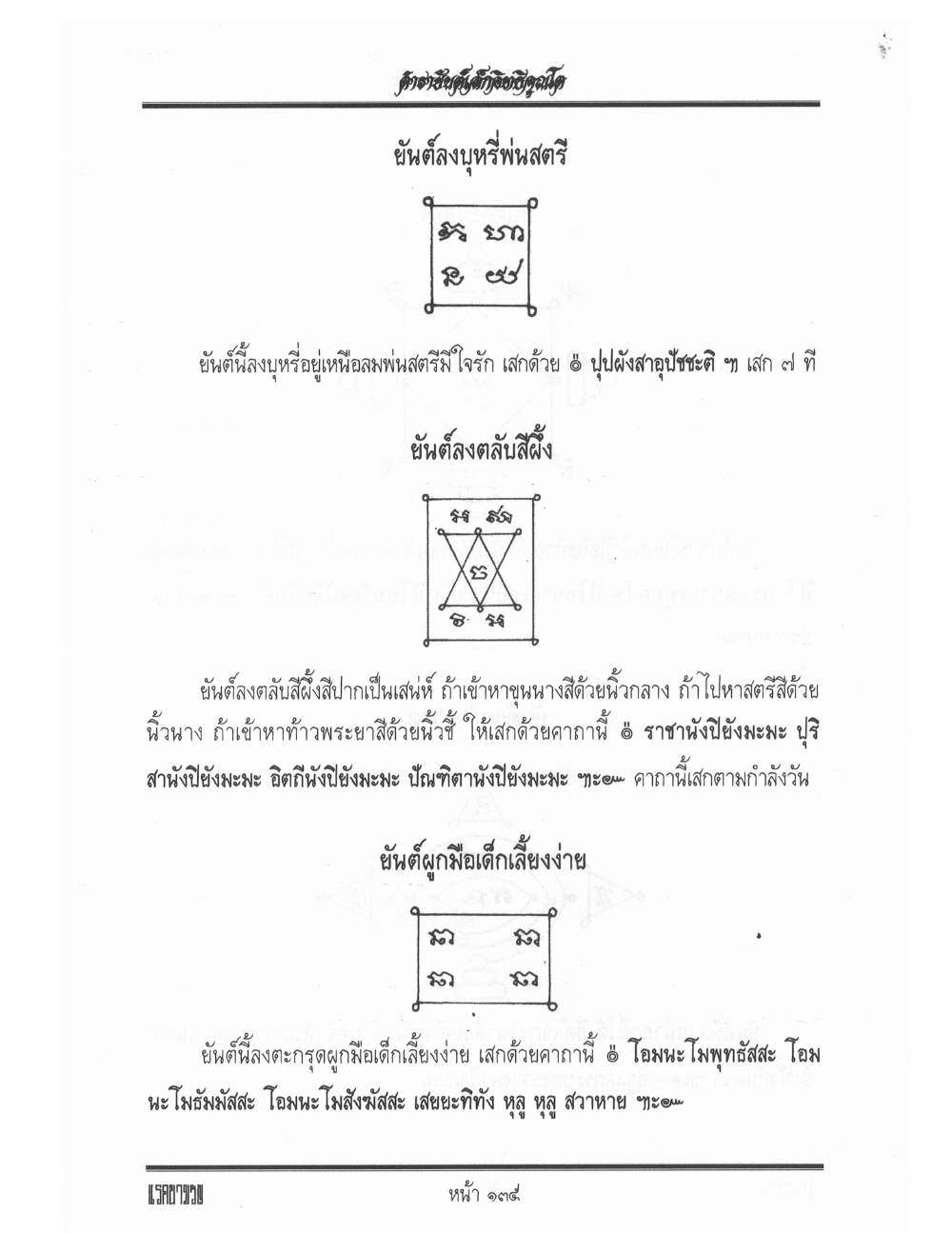
ยันต์ลงบุหรี่พ่นสตรี
[yantra: square grid of two rows by two columns, four khom syllable cells; [อักขระขอมในยันต์ อ่านไม่ชัด]]
ยันต์นี้ลงบุหรี่อยู่เหนือลมพ่นสตรีมีใจรัก เสกด้วย ๐ ปุปผังสาอุปัชชะติ ๗ เสก ๗ ที
ยันต์ลงตลับสีผึ้ง
[yantra: square frame containing two overlapping triangles forming a six-pointed star, with syllables at the top, center and bottom; [อักขระขอมในยันต์ อ่านไม่ชัด]]
ยันต์ลงตลับสีผึ้งสีปากเป็นเสน่ห์ ถ้าเข้าหาชุบนางสีด้วยนิ้วกลาง ถ้าไปหาสตรีสีด้วยนิ้วนาง ถ้าเข้าหาท้าวพระยาสีด้วยนิ้วชี้ ให้เสกด้วยคาถานี้ ๐ ราชาหนังปิยังมะมะ ปุริสาหนังปิยังมะมะ อิตถีหนังปิยังมะมะ ปัณฑิตาหนังปิยังมะมะ ๛ คาถานี้เสกตามกำลังวัน
ยันต์ผูกมือเด็กเลี้ยงง่าย
[yantra: square grid of two rows by two columns, four khom syllable cells, all similar in form; [อักขระขอมในยันต์ อ่านไม่ชัด]]
ยันต์นี้ลงตะกรุดผูกมือเด็กเลี้ยงง่าย เสกด้วยคาถานี้ ๐ โอมนะโมพุทธัสสะ โอมนะโมธัมมัสสะ โอมนะโมสังฆัสสะ เสยยะทิทัง หลู หลู สวาหาย ๛
Yantra for a Cigarette, Blown Toward a Woman
[yantra: square grid of two rows by two columns, four khom syllable cells; syllables not confidently legible]
This yantra is inscribed on a cigarette; standing upwind, blow the smoke toward a woman so that she comes to feel love. Consecrate with "Pupphang sa upajjati" [x7], chanted 7 times.
Yantra for the Love-Balm Tin
[yantra: square frame containing two overlapping triangles forming a six-pointed star, with syllables at the top, center and bottom; syllables not confidently legible]
The Love-Balm-Tin Yantra: coloring the lips with it creates charm. When approaching a young lady, apply it with the middle finger; when approaching a [grown] woman, apply it with the ring finger; when approaching a lord or official, apply it with the index finger. Consecrate with this spell: "Racha hanang piyang mama, purisa hanang piyang mama, itthi hanang piyang mama, pandita hanang piyang mama" [end-of-spell mark]. Chant this spell according to the day's power.
Yantra to Tie on a Child's Wrist, for Easy Rearing
[yantra: square grid of two rows by two columns, four similar khom syllable cells; syllables not confidently legible]
This yantra is inscribed on a takrut tied to a child's wrist so the child is easy to raise. Consecrate with this spell: "Om namo phutthassa, om namo thammassa, om namo sanghassa, seyyathidang hlu hlu svaha" [end-of-spell mark].
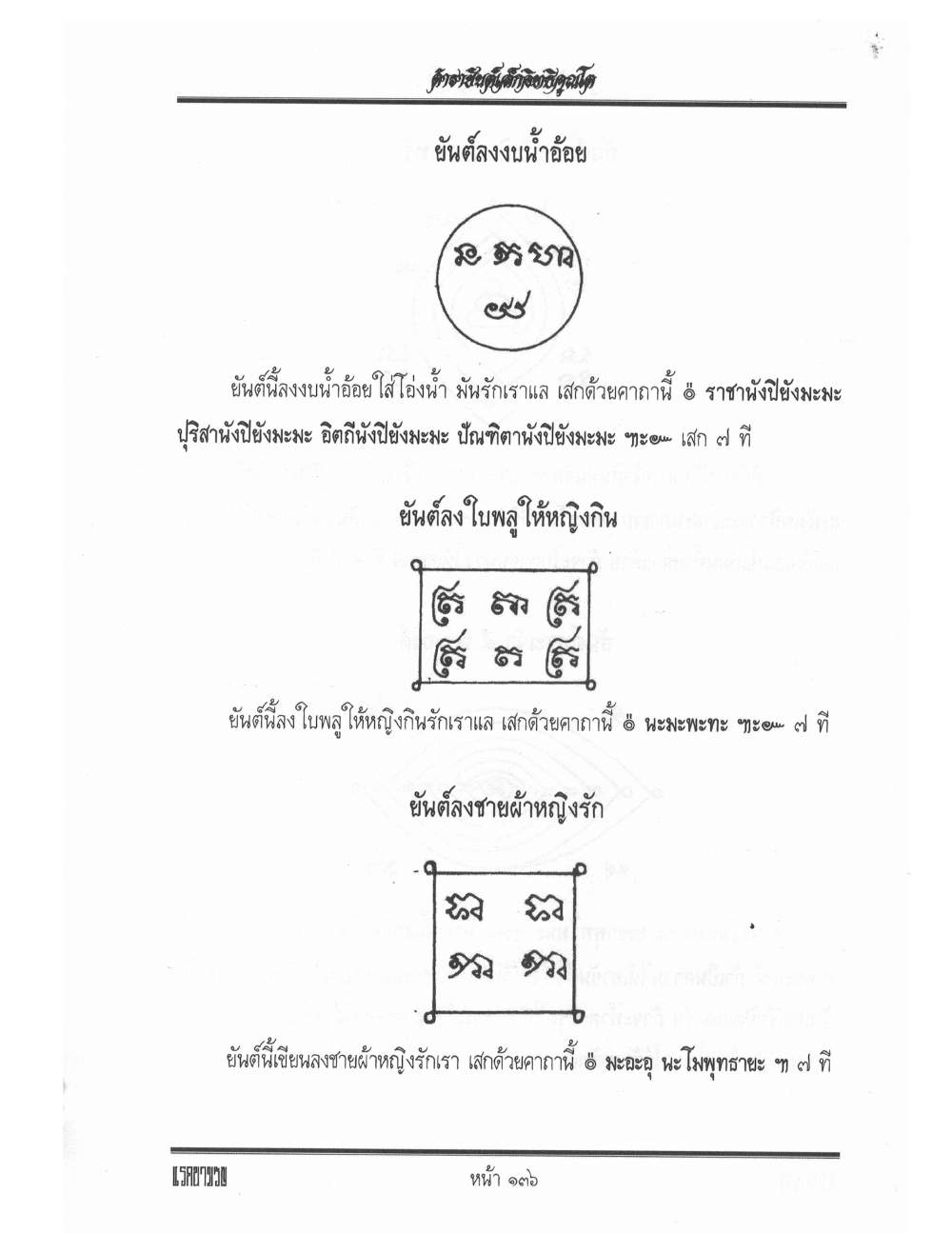
ยันต์ลงงบน้ำอ้อย
[yantra: circle containing three khom syllables in a row with a numeral beneath; [อักขระขอมในยันต์ อ่านไม่ชัด]]
ยันต์นี้ลงงบน้ำอ้อยใส่โอ่งน้ำ มันรักเราแล เสกด้วยคาถานี้ ๐ ราชาหนังปิยังมะมะ ปุริสาหนังปิยังมะมะ อิตถีหนังปิยังมะมะ ปัณฑิตาหนังปิยังมะมะ ๛ เสก ๗ ที
ยันต์ลงใบพลูให้หญิงกิน
[yantra: rectangular grid of two rows by three columns, six khom syllable cells; [อักขระขอมในยันต์ อ่านไม่ชัด]]
ยันต์นี้ลงใบพลูให้หญิงกินรักเราแล เสกด้วยคาถานี้ ๐ นะมะพะทะ ๛ ๗ ที
ยันต์ลงชายผ้าหญิงรัก
[yantra: square grid of two rows by two columns, four khom syllable cells; [อักขระขอมในยันต์ อ่านไม่ชัด]]
ยันต์นี้เขียนลงชายผ้าหญิงรักเรา เสกด้วยคาถานี้ ๐ มะอะอุ นะโมพุทธายะ ๗ ที
Yantra for a Lump of Palm Sugar
[yantra: circle containing three khom syllables in a row with a numeral beneath; syllables not confidently legible]
This yantra is inscribed on a lump of palm sugar and dropped into a water jar; [whoever drinks from it] will come to love us. Consecrate with this spell: "Racha hanang piyang mama, purisa hanang piyang mama, itthi hanang piyang mama, pandita hanang piyang mama" [end-of-spell mark], chanted 7 times.
Yantra on a Betel Leaf, Given to a Woman to Eat
[yantra: rectangular grid of two rows by three columns, six khom syllable cells; syllables not confidently legible]
This yantra is inscribed on a betel leaf given to a woman to eat so she comes to love us. Consecrate with this spell: "Na ma pha tha" [end-of-spell mark], 7 times.
Yantra on the Hem of a Woman's Cloth, for Love
[yantra: square grid of two rows by two columns, four khom syllable cells; syllables not confidently legible]
This yantra is written on the hem of a woman's cloth so that she loves us. Consecrate with this spell: "Ma a u, namo phutthaya", 7 times.
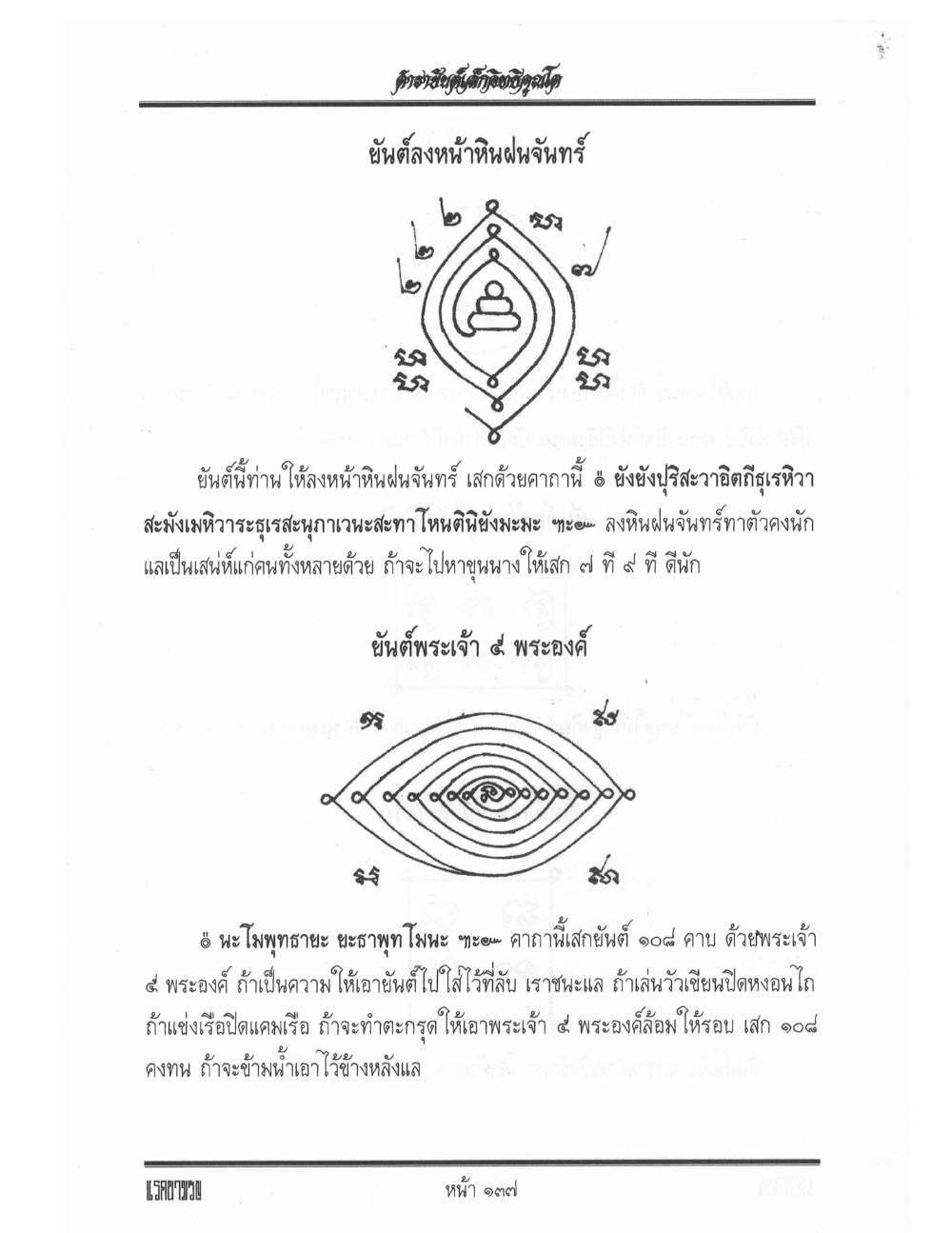
ยันต์ลงหน้าหินฝนจันทร์
[yantra: a pointed vesica (leaf-shaped) outline containing a seated Buddha figure at the centre, surrounded by two nested rings of khom syllables; four further syllables placed outside the vesica at the four diagonal corners, each joined to the figure by a line; [อักขระขอมในยันต์ อ่านไม่ชัด]]
ยันต์นี้ท่านให้ลงหน้าหินฝนจันทร์ เสกด้วยคาถานี้ ๐ ยังยังปุริสะวาอิตถีถุเรหิวาสะมังเมหิวาระถุเรสะนุภาเวนะสะทา โหนตินิยังมะมะ ๛ ลงหินฝนจันทร์ทาตัวคงนักแลเป็นเสน่ห์แก่คนทั้งหลายด้วย ถ้าจะไปหาชุบนางให้เสก ๗ ที ๙ ที ดีนัก
ยันต์พระเจ้า ๔ พระองค์
[yantra: vesica (eye-shaped) outline of many concentric rings, with a khom syllable at the very centre and four khom syllables placed outside at the top-left, top-right, bottom-left and bottom-right corners; [อักขระขอมในยันต์ อ่านไม่ชัด]]
๐ นะโมพุทธายะ ยะธาพุทโมนะ ๛ คาถานี้เสกยันต์ ๑๐๘ คาบ ด้วยพระเจ้า ๔ พระองค์ ถ้าเป็นความให้เอายันต์ไปใส่ไว้ที่ลับ เราชนะแล ถ้าเล่นวัวเขียนปิดหงอนไก่ ถ้าแข่งเรือปิดแคมเรือ ถ้าจะทำตะกรุดให้เอาพระเจ้า ๔ พระองค์ล้อมให้รอบ เสก ๑๐๘ คงทน ถ้าจะข้ามน้ำเอาไว้ข้างหลังแล
Yantra for the Face of the Moon-Grinding Stone
[yantra: a pointed vesica (leaf-shaped) outline containing a seated Buddha figure at the centre, surrounded by two nested rings of khom syllables; four further syllables placed outside the vesica at the four diagonal corners, each joined to the figure by a line; syllables not confidently legible]
This yantra is to be inscribed on the face of a moon-grinding stone [used to grind sacred paste]. Consecrate with this spell: "Yang yang purisawa itthithurehiwa samang mehiwara thuresa nuphawena sada honti niyang mama" [end-of-spell mark]. Once inscribed, grind the stone and apply the paste to the body for great [protective] potency, and it is also a charm to [attract] people generally; if going to see a young lady, chant it 7 or 9 times — very good.
Yantra of the Four Lords
[yantra: vesica (eye-shaped) outline of many concentric rings, with a khom syllable at the very centre and four khom syllables placed outside at the top-left, top-right, bottom-left and bottom-right corners; syllables not confidently legible]
"Namo phutthaya, ya tha phut mo na" [end-of-spell mark]. Chant this spell over the yantra 108 times, invoking the Four Lords [Four Buddhas]. If used in a legal dispute, keep the yantra hidden and we shall win. If used in bull-fighting, write it to cover [the animal's] horns; if for cockfighting, cover the comb; if racing boats, place it on the gunwale of the boat. If making a takrut, surround it all around with the Four Lords and chant 108 times for lasting durability. If crossing water, keep it at your back.
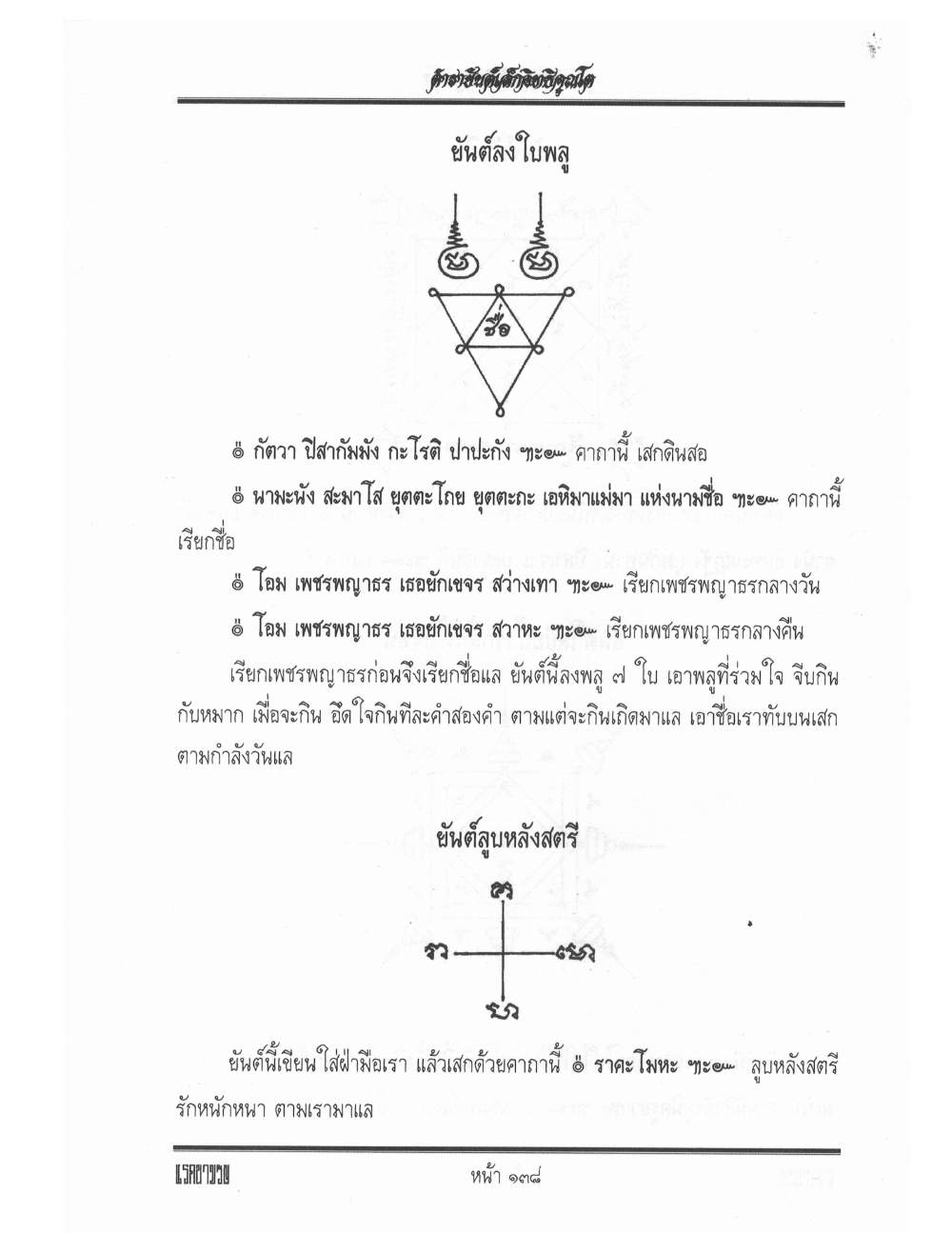
ยันต์ลงใบพลู
[yantra: two coiled stem-like forms at the top, each topped with a khom syllable; below them a downward-pointing triangle overlaid to form a hexagram, with a syllable at the centre and another at the lowest point; [อักขระขอมในยันต์ อ่านไม่ชัด]]
๐ กัตวา ปิสากัมมัง กะโรติ ปาปะกัง ๛ คาถานี้เสกดินสอ
๐ พามะหัง สะมาโส ยุตตะโภย ยุตตะภะ เอหิมาแม่มา แห่งนามชื่อ ๛ คาถานี้เรียกชื่อ
๐ โอม เพชรพญาธร เธอยักเขจร สว่างเทา ๛ เรียกเพชรพญาธรกลางวัน
๐ โอม เพชรพญาธร เธอยักเขจร สวาหะ ๛ เรียกเพชรพญาธรกลางคืน
เรียกเพชรพญาธรก่อนจึงเรียกชื่อแล ยันต์นี้ลงพลู ๗ ใบ เอาพลูที่ร่วมใจ จีบกินกับหมาก เมื่อจะกิน อึดใจกินทีละคำสองคำ ตามแต่จะกินเกิดมาแล เอาชื่อเราทับนพเสกตามกำลังวันแล
ยันต์ลูบหลังสตรี
[yantra: a cross/plus shape with a khom syllable at each of the four arm-ends (top, bottom, left, right); [อักขระขอมในยันต์ อ่านไม่ชัด]]
ยันต์นี้เขียนใส่ฝ่ามือเรา แล้วเสกด้วยคาถานี้ ๐ ราคะโมหะ ๛ ลูบหลังสตรีรักหนักหนา ตามเรามาแล
Yantra on a Betel Leaf
[yantra: two coiled stem-like forms at the top, each topped with a khom syllable; below them a downward-pointing triangle overlaid to form a hexagram, with a syllable at the centre and another at the lowest point; syllables not confidently legible]
"Katwa pisakammang karoti papakang" [end-of-spell mark]. Chant this spell over the pencil [used to write the yantra].
"Phamahang samaso yuttaphoi yuttapha, ehi ma mae ma" — [invoking her] by name [end-of-spell mark]. Chant this spell while calling [her] name.
"Om, phetphayathon, thoe yakkhechon, sawangthao" [end-of-spell mark]. [This] summons the daytime Diamond Naga-lord.
"Om, phetphayathon, thoe yakkhechon, svaha" [end-of-spell mark]. [This] summons the nighttime Diamond Naga-lord.
Summon the Diamond Naga-lord first, then call [the person's] name. This yantra is inscribed on 7 betel leaves; take the leaves that are in accord [with the intent] and fold them together with areca nut to chew. When eating, hold the breath and take one or two bites at a time, as it comes about. Set our own name over it and consecrate it according to the day's power.
Yantra to Stroke a Woman's Back
[yantra: a cross/plus shape with a khom syllable at each of the four arm-ends (top, bottom, left, right); syllables not confidently legible]
This yantra is written on our own palm, then consecrated with this spell: "Raka moha" [end-of-spell mark]. Stroke the woman's back [with the hand] and she will fall deeply in love, and follow after us.
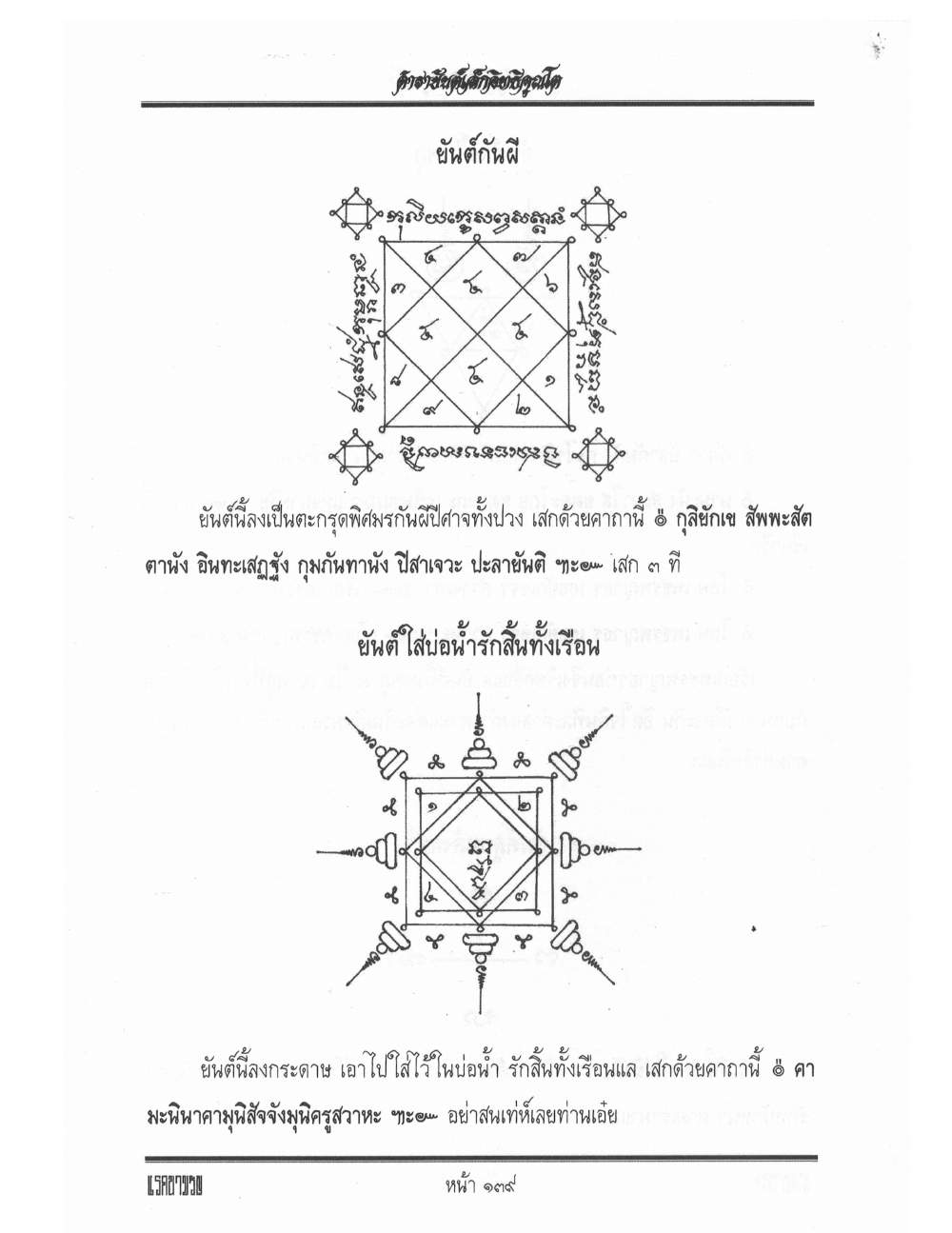
ยันต์กันผี
[yantra: a square with an inner diamond overlaid, forming an eight-pointed star pattern; khom syllables placed at the grid intersections inside; a six-pointed star ornament at each of the four outer corners; longer khom inscriptions running along each of the four outer edges (top, bottom, left, right); [อักขระขอมในยันต์ อ่านไม่ชัด]]
ยันต์นี้ลงเป็นตะกรุดพิศมรกันผีปีศาจทั้งปวง เสกด้วยคาถานี้ ๐ กุลิยักเข สัพพะสัตตาพัง อินทะเสฏฐัง กุมภันทาพัง ปิสาเจวะ ปะลายันติ ๛ เสก ๓ ที
ยันต์ใส่บ่อน้ำรักสิ้นทั้งเรือน
[yantra: a square containing a diamond and a smaller inner square, with a khom syllable at the centre; stupa-like finials and coiled ornaments radiating outward from each side and corner of the outer square, with small syllables at the outer corners; [อักขระขอมในยันต์ อ่านไม่ชัด]]
ยันต์นี้ลงกระดาษ เอาไปใส่ไว้ในบ่อน้ำ รักสิ้นทั้งเรือนแล เสกด้วยคาถานี้ ๐ คามะนิวาคามุนิสัจจังมุนิครูสวาหะ ๛ อย่าสนเท่ห์เลยท่านเอ๋ย
Ghost-Warding Yantra
[yantra: a square with an inner diamond overlaid, forming an eight-pointed star pattern; khom syllables placed at the grid intersections inside; a six-pointed star ornament at each of the four outer corners; longer khom inscriptions running along each of the four outer edges (top, bottom, left, right); syllables not confidently legible]
This yantra, made into a takrut, wards off ghosts and every kind of spirit. Consecrate with this spell: "Kuliyakkhe sabbasattapang, indasetthang, kumbhandapang, pisaceva palayanti" [end-of-spell mark], chanted 3 times.
Yantra for a Water Well, for the Whole Household's Love
[yantra: a square containing a diamond and a smaller inner square, with a khom syllable at the centre; stupa-like finials and coiled ornaments radiating outward from each side and corner of the outer square, with small syllables at the outer corners; syllables not confidently legible]
This yantra is inscribed on paper and placed in a water well; the whole household will come to love [us]. Consecrate with this spell: "Khamanivakhamunisaccangmunikhrusvaha" [end-of-spell mark]. Do not doubt it, dear reader.
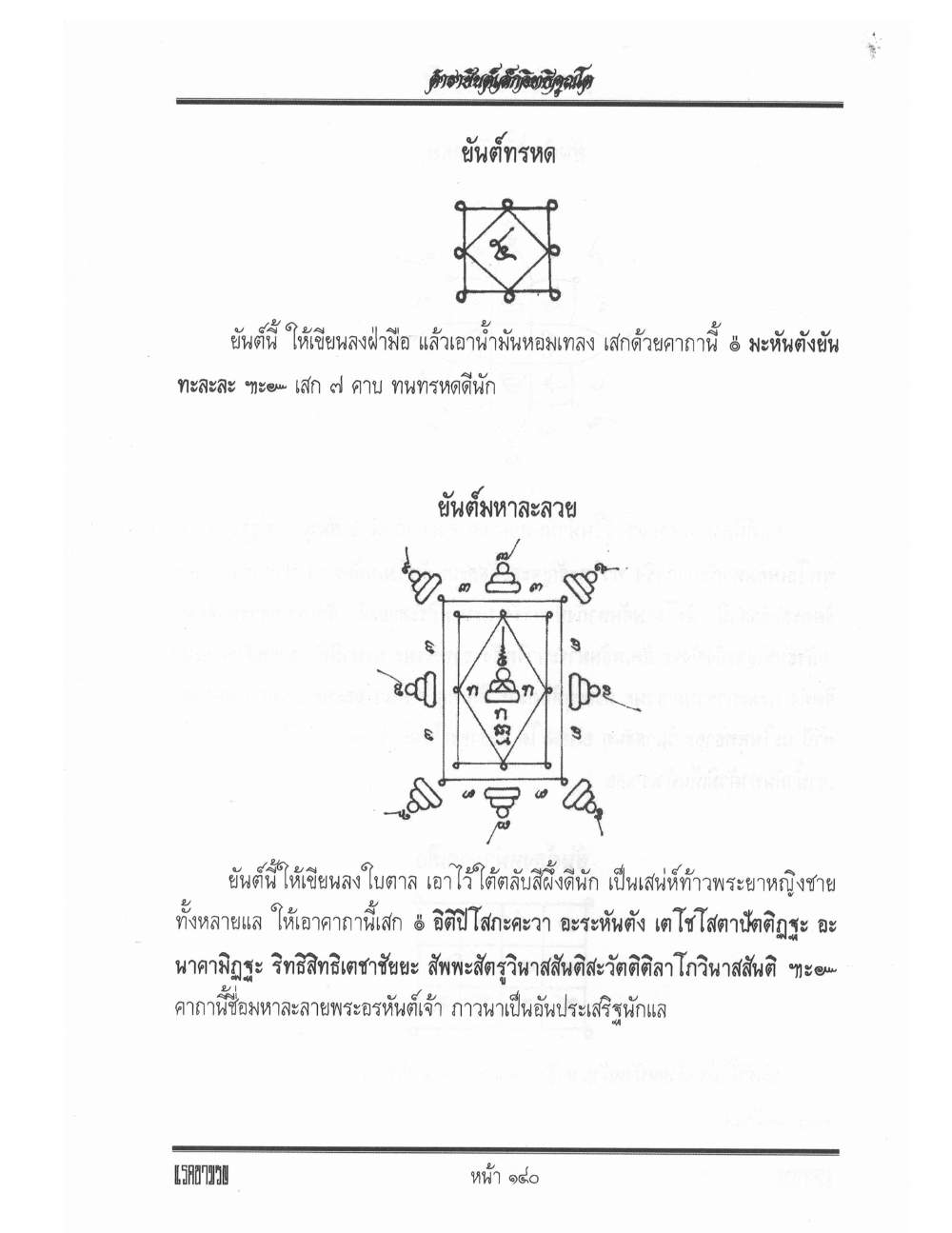
ยันต์ทรหด
[yantra: a square containing an inner diamond, with a single khom syllable at the centre; [อักขระขอมในยันต์ อ่านไม่ชัด]]
ยันต์นี้ ให้เขียนลงฝ่ามือ แล้วเอาน้ำมันหอมเทลง เสกด้วยคาถานี้ ๐ มะหันตังยันทะละละ ๛ เสก ๗ คาบ ทนทรหดดีนัก
ยันต์มหาละลวย
[yantra: a rectangle containing an inner diamond, with a seated Buddha figure at the centre flanked by two khom syllables and a further syllable below; eight decorative stupa-like finials radiate outward from the sides and corners of the rectangle, each accompanied by a small numeral; [อักขระขอมในยันต์ อ่านไม่ชัด]]
ยันต์นี้ให้เขียนลงใบตาล เอาไว้ใต้ตลับสีผึ้งดีนัก เป็นเสน่ห์แก่ท้าวพระยาหญิงชายทั้งหลายแล ให้เอาคาถานี้เสก ๐ อิติปิโสภะคะวา อะระหันตัง เตโชโสตาปัตติฏฐะ อะพาคามิฏฐะ ริทธิสิทธิเตชาชัยยะ สัพพะสัตรูวินาสสันติสะวัตติลาโภวินาสสันติ ๛ คาถานี้ชื่อมหาละลวยพระอรหันต์เจ้า ภาวนาเป็นอันประเสริฐนักแล
Endurance Yantra
[yantra: a square containing an inner diamond, with a single khom syllable at the centre; syllable not confidently legible]
This yantra is to be written on the palm, then scented oil poured over it. Consecrate with this spell: "Mahantang yanthalala" [end-of-spell mark], chanted 7 times; it makes one very tough and enduring.
"Maha Laluai" Yantra (Great Charm)
[yantra: a rectangle containing an inner diamond, with a seated Buddha figure at the centre flanked by two khom syllables and a further syllable below; eight decorative stupa-like finials radiate outward from the sides and corners of the rectangle, each accompanied by a small numeral; syllables not confidently legible]
This yantra is to be written on a palm leaf and kept beneath a love-balm tin — very effective. It is a charm [to win the favor of] lords, officials, women and men alike. Consecrate it with this spell: "Itipiso bhagavā, arahantang tejosotapatittha, apakamitthaha, ritthisitthi tejachaiya, sabbasattaru winasasanti sawattilabho winasasanti" [end-of-spell mark]. This spell is named "Maha Laluai [Great Charm] of the Arahant Lord"; reciting it is exceedingly excellent.
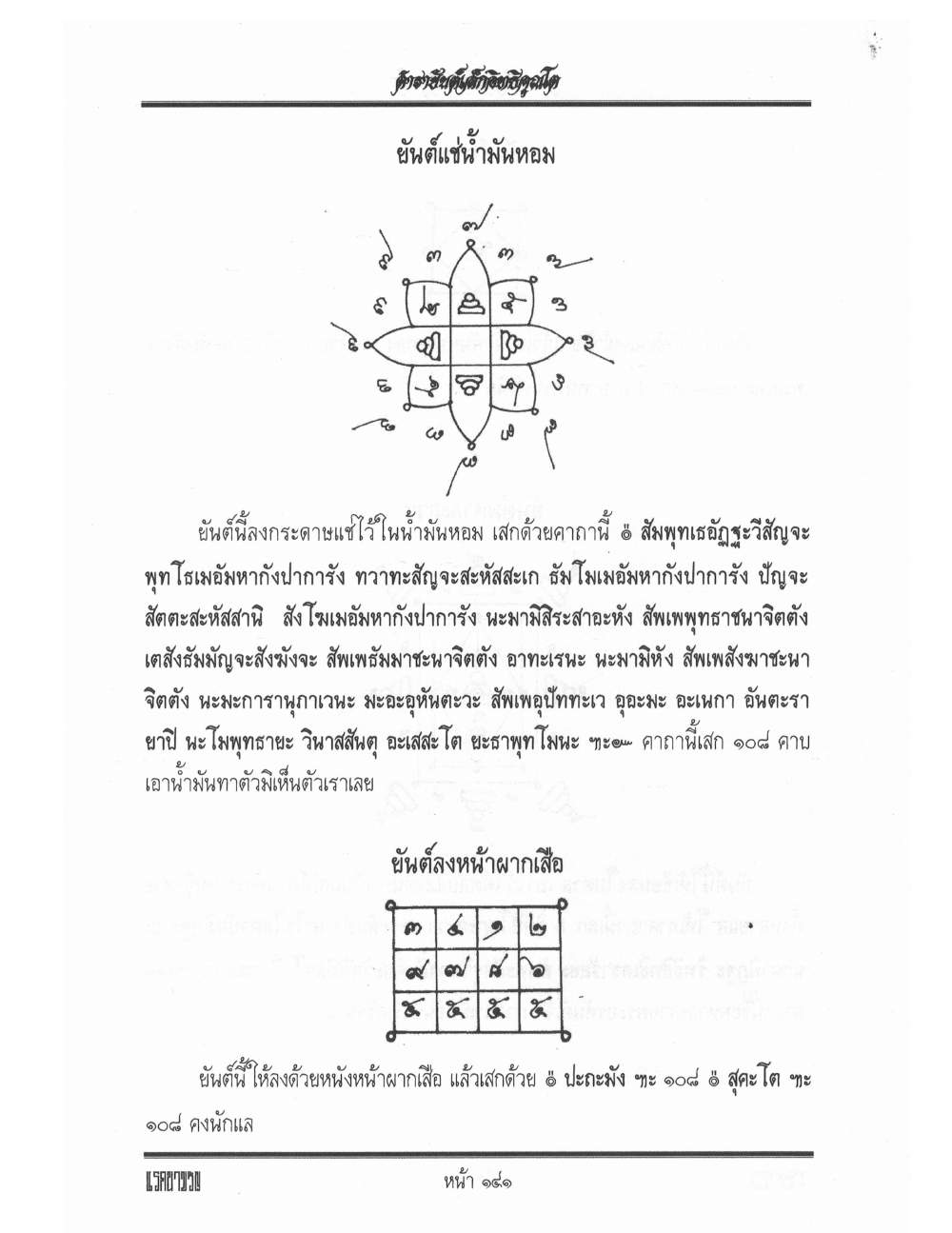
ยันต์แช่น้ำมันหอม
[yantra: an eight-petalled flower/star outline with a seated Buddha figure at the centre; four khom syllables in the cross-shaped cells immediately around the figure, and eight further khom syllables placed at the outer points of the petals, each numbered; [อักขระขอมในยันต์ อ่านไม่ชัด]]
ยันต์นี้ลงกระดาษแช่ไว้ในน้ำมันหอม เสกด้วยคาถานี้ ๐ สัมพุทเธ อัฏฐะวีสัญจะ พุทโธ เมอัมหากังปาการัง ทวาทะสัญจะสะหัสสะเก ธัมโมเมอัมหากังปาการัง ปัญจะสัตตะสะหัสสานิ สังโฆเมอัมหากังปาการัง นะมามิสิระสาอะหัง สัพเพพุทธาชนาจิตตัง เตสังธัมมัญจะสังฆัญจะ สัพเพธัมมาชนาจิตตัง อาทะเรนะ นะมามิหัง สัพเพสังฆาชนาจิตตัง นะมะการานุภาเวนะ มะอะอุหันตะวะ สัพเพอุปัททะเว อุอะมะ อะเนกา อันตรายาปิ นะโมพุทธายะ วินาสสันตุ อะเสสะโต ยะถาพุทโมนะ ๛ คาถานี้เสก ๑๐๘ คาบ เอาน้ำมันทาตัวมิเห็นตัวเราเลย
ยันต์ลงหน้าผากเสือ
[yantra: rectangular grid of three rows by four columns, twelve khom syllable cells; [อักขระขอมในยันต์ อ่านไม่ชัด]]
ยันต์นี้ให้ลงด้วยหนังหน้าผากเสือ แล้วเสกด้วย ๐ ปะถะมัง ๛ ๑๐๘ ๐ สุคะโต ๛ ๑๐๘ คงกระพันแล
Yantra Steeped in Scented Oil
[yantra: an eight-petalled flower/star outline with a seated Buddha figure at the centre; four khom syllables in the cross-shaped cells immediately around the figure, and eight further khom syllables placed at the outer points of the petals, each numbered; syllables not confidently legible]
This yantra is inscribed on paper and steeped in scented oil. Consecrate with this spell: "Sambuddhe atthavisañca, phuttho me amhakang pakarang, dvadasañca sahassake, thammo me amhakang pakarang, pañca sattasahassani, sangkho me amhakang pakarang, namami sirasa ahang, sabbe phuttha chanachittang, tesang thammañca sanghañca, sabbe thamma chanachittang, athorena namamihang, sabbe sangkha chanachittang, namakaranuphawena, ma a u hantawa, sabbe upattawe, u a ma, aneka antaraya pi, namo phutthaya winasantu asesato, yatha phutmona" [end-of-spell mark]. Chant this spell 108 times; smear the oil on the body and no one will see us at all [i.e., it grants invisibility].
Yantra for a Tiger's Forehead-Skin
[yantra: rectangular grid of three rows by four columns, twelve khom syllable cells; syllables not confidently legible]
This yantra is to be inscribed using tiger forehead-hide, then consecrated with "Pathamang" [end-of-spell mark] 108 times, and "Sukhato" [end-of-spell mark] 108 times; it grants invulnerability.
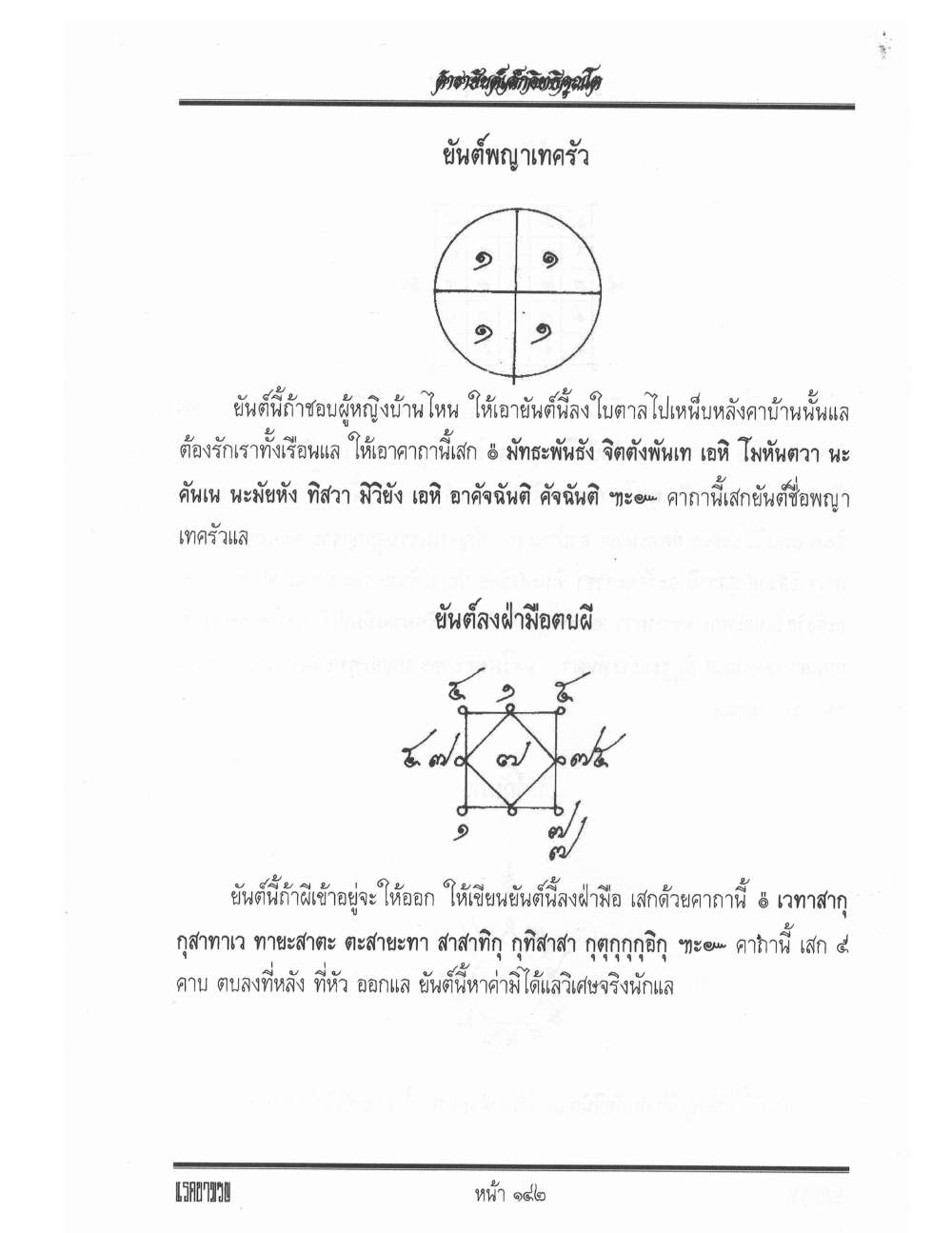
ยันต์พญาเทครัว
ยันต์นี้ถ้าชอบผู้หญิงบ้านไหน ให้เอายันต์นี้ลงใบตาลไปเหน็บหลังคาบ้านนั้นแล ต้องรักเราทั้งเรือนแล ให้เอาคาถานี้เสก ๐ มัทธะพันธัง จิตตังพันเท เอหิ โมหันตวา นะคัมเพ นะมัยหัง ทิสวา มิวิยัง เอหิ อาคัจฉันติ คัจฉันติ ๚ะ๛ คาถานี้เสกยันต์ชื่อพญาเทครัวแล
ยันต์ลงฝ่ามือตบผี
ยันต์นี้ถ้าผีเข้าอยู่จะให้ออก ให้เขียนยันต์นี้ลงฝ่ามือ เสกด้วยคาถานี้ ๐ เวทาสากุ กุสาทาเว ทายะสาตะ ตะสายะทา สาสาทิกุ กุทิสาสา กุตุกุกุอิกุ ๚ะ๛ คาถานี้เสก ๔ คาบ ตบลงที่หลัง ที่หัว ออกแล ยันต์นี้หาค่ามิได้แลวิเศษจริงนักแล
Yantra of Phraya Thekhrua ("the lord who tips the whole household" — a whole-household love charm)
[yantra: a circle divided into four quadrants by a cross, each quadrant containing a single curled syllable]
This yantra: if you desire the woman of some household, take this yantra and inscribe it on a palm leaf, then tuck it into that house's roof-thatch — she will come to love you, together with her whole household. Consecrate it with this spell: "Mattha phanthang, chittang phanthe, ehi, mohantawa, na khampe, na maiyhang, thitsawa, miwiyang, ehi, akhatchati, khatchati" [chant three times]. This spell consecrates the yantra called Phraya Thekhrua.
Yantra for the Palm-Slap that Expels Ghosts
[yantra: a square with an inscribed diamond formed by joining the midpoints of its sides, a syllable at each of the four outer corners, at each of the four diamond points, and at the center]
This yantra: if a ghost has taken possession [of someone] and you wish to drive it out, write this yantra onto the palm of the hand, consecrate it with this spell: "Wethasaku, kusathawe, thayasata, tasayatha, sasathiku, kuthisasa, kutukukuiku" [chant three times]. Chant this spell four times, then slap [the possessed person] on the back and on the head, and it will leave. This yantra is beyond price and truly extraordinary.
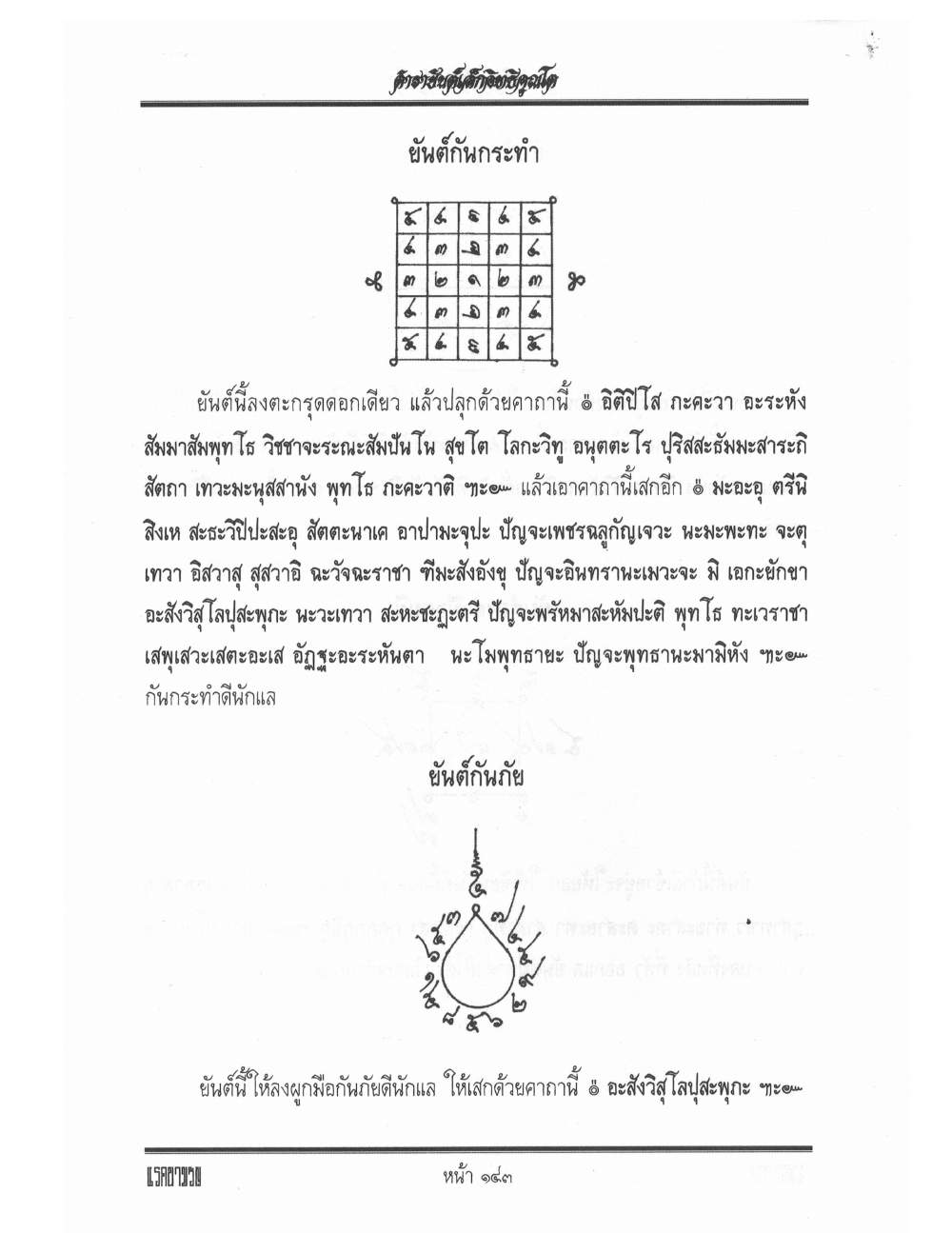
ยันต์กันกระทำ
ยันต์นี้ลงตะกรุดดอกเดียว แล้วปลุกด้วยคาถานี้ ๐ อิติปิโส ภะคะวา อะระหัง สัมมาสัมพุทโธ วิชชาจะระณะสัมปันโน สุขโต โลกะวิทู อนุตตะโร ปุริสสะธัมมะสาระถิ สัตถา เทวะมะนุสสานัง พุทโธ ภะคะวาติ ๚ะ๛ แล้วเอาคาถานี้เสกอีก ๐ มะอะอุ ตรีนิสิงเห สะธะวิปปะสะอุ สัตตะพาเค อาปามะจุปะ ปัญจะเพชรฉลูกัญเจวะ นะมะพทะ จตุเทวา อิสวาสุ สุสวาอิ ฉะวัจฉะราชา ฑีมะสังอังขุ ปัญจะอินทรานะเมวะจะ มิ เอกะยักขา อะสังวิสุโลปุสะพุกะ พะเวเทวา สะหะชะฏะตรี ปัญจะพรหมาสะหัมปะติ พุทโธ ทะเวราชา เสพุเสวะเสตะอะเส อัฏฐะอะระหันตา นะโมพุทธายะ ปัญจะพุทธานะมามิหัง ๚ะ๛ กันกระทำดีนักแล
ยันต์กันภัย
ยันต์นี้ให้ลงผูกมือกันภัยดีนักแล ให้เสกด้วยคาถานี้ ๐ อะสังวิสุโลปุสะพุกะ ๚ะ๛
Yantra to Ward Off Black Magic (Kan Kratham)
[yantra: a 5×5 grid, syllables filling all twenty-five cells, with an additional curling flourish just outside the grid at the left and right margins]
Inscribe this yantra on a single takrut, then awaken it with this spell: "Itipiso bhagava arahang samma-sambuddho vijja-charana-sampanno sukhato lokavidu anuttaro purisa-dhamma-sarathi sattha deva-manussanang buddho bhagavati" [chant three times]. Then take this further spell to consecrate it again: "Ma-a-u trini singhe sadha-vippa-sa-u satta-phakhe apama-chupa pancha-phet-chalu-kanchewa nama-phatha chatu-thewa isawasu susawa-i cha-wat-characha thi-ma-sang-angkhu pancha-indara-namewa-cha mi eka-yakkha asangwisulopusapukha phawe-thewa saha-cha-tatri pancha-phromma-sahampati phuttho thawe-racha sepu-sewa-seta-ase attha-arahanta namo-phutthaya pancha-phutthanamamihang" [chant three times]. Excellent for warding off black magic.
Yantra to Ward Off Danger
[yantra: a teardrop/pouch-shaped outline with a small loop at its top, syllables arranged around its circumference]
Inscribe this yantra and bind it at the wrist — very good for warding off danger. Consecrate it with this spell: "Asangwisulopusapukha" [chant three times].
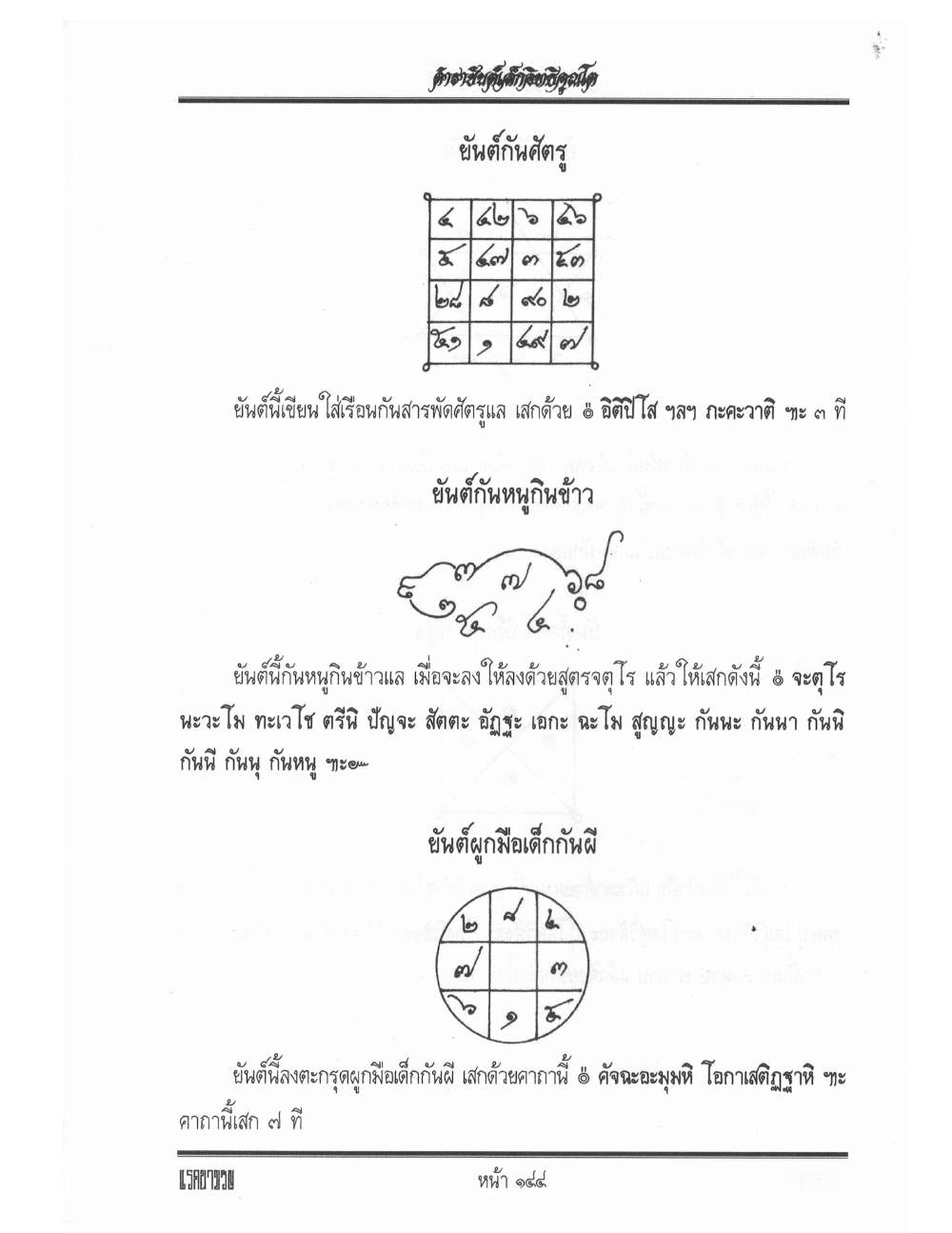
ยันต์กันศัตรู
ยันต์นี้เขียนใส่เรือนกันสารพัดศัตรูแล เสกด้วย ๐ อิติปิโส ฯลฯ ภะคะวาติ ๚ะ ๓ ที
ยันต์กันหนูกินข้าว
ยันต์นี้กันหนูกินข้าวแล เมื่อจะลงให้ลงด้วยสูตรจตุโร แล้วให้เสกดังนี้ ๐ จตุโร พะเวโม ทะเวโช ตรีนิ ปัญจะ สัตตะ อัฏฐะ เอกะ ฉะโม สูญญะ กันพะ กันพา กันพิ กันพี กันพุ กันหนู ๚ะ๛
ยันต์ผูกมือเด็กกันผี
ยันต์นี้ลงตะกรุดผูกมือเด็กกันผี เสกด้วยคาถานี้ ๐ คัจฉะอะมุมหิ โอกาเสติฏฐาหิ ๚ะ คาถานี้เสก ๗ ที
Yantra to Ward Off Enemies
[yantra: a 4×4 grid, numerals filling all sixteen cells]
Inscribe this yantra into the house to ward off every kind of enemy. Consecrate it with: "Itipiso... [gloss: the standard Itipiso formula, elided here] ...bhagavati" [chant three times].
Yantra to Keep Rats from Eating the Rice
[yantra: a rat figure drawn from curling syllable-strokes forming its body, ears, tail, and legs]
This yantra keeps rats from eating the rice. When inscribing it, lay it down using the "chaturo" formula, then consecrate it thus: "Chaturo phaewemo thaewecho trini pancha satta attha eka chamo sunya kanpha kanpha kanphi kanphi kanphu kan-nu" [chant three times].
Yantra for the Child's Wrist-Charm Against Ghosts
[yantra: a circle divided into a 3×3 grid, a syllable in each of the cells]
Inscribe this yantra on a takrut and bind it to a child's wrist to ward off ghosts. Consecrate it with this spell: "Kachchha-amumhi okase-titthahi" [chant this spell seven times].
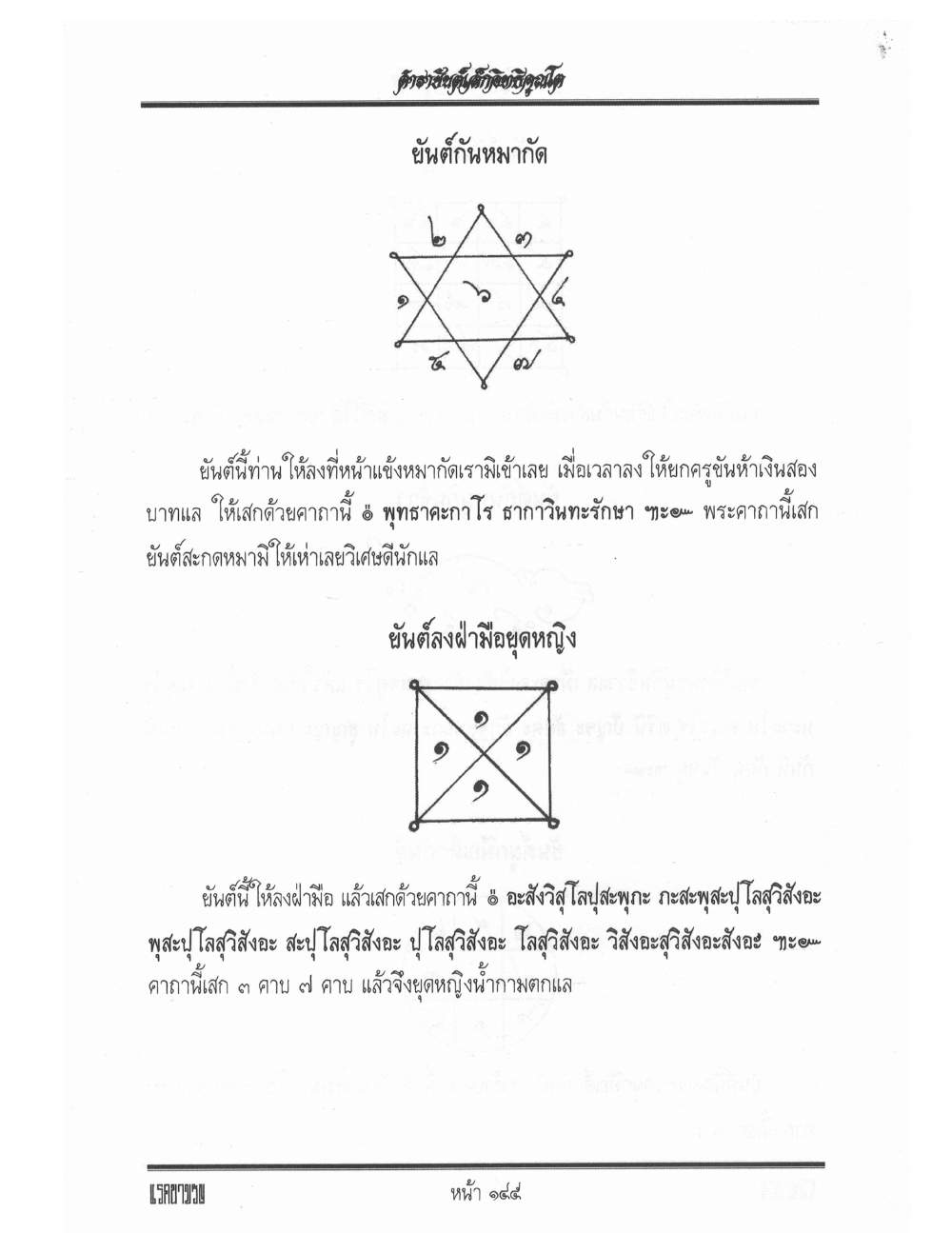
ยันต์กันหมากัด
ยันต์นี้ท่านให้ลงที่หน้าแข้งหมากัดเรามิเข้าเลย เมื่อเวลาลงให้ยกครูขันห้าเงินสองบาทแล ให้เสกด้วยคาถานี้ ๐ พุทธาคะกาโร ฐากาวินทะรักษา ๚ะ๛ พระคาถานี้เสกยันต์สะกดหมามิให้เห่าเลยวิเศษดีนักแล
ยันต์ลงฝ่ามือยุดหญิง
ยันต์นี้ให้ลงฝ่ามือ แล้วเสกด้วยคาถานี้ ๐ อะสังวิสุโลปุสะพุกะ ภะสะพุสะปุโลสุวิสังอะ พุสะปุโลสุวิสังอะ สะปุโลสุวิสังอะ ปุโลสุวิสังอะ โลสุวิสังอะ วิสังอะสุวิสังอะสังอะ ๚ะ๛ คาถานี้เสก ๓ คาบ ๗ คาบ แล้วจึงยุดหญิงน้ำกามตกแล
Yantra to Ward Off Dog Bites
[yantra: a hexagram (six-pointed star) formed of two overlapping triangles, a syllable at each of the six points and one at the center]
Inscribe this yantra on your own shin so that dogs will never bite you. When inscribing it, present the teacher an offering of a five-item tray and two baht in money. Consecrate it with this spell: "Phutthakhakaro, thakawinttharaksa" [chant three times]. This spell consecrates the yantra to still dogs so they never even bark — truly excellent.
Yantra Inscribed on the Palm to Restrain a Woman
[yantra: a square with both diagonals drawn, forming an X, with a curled syllable placed within each of the four triangular sections]
Inscribe this yantra on the palm of the hand, then consecrate it with this spell: "Asangwisulopusapukha phasaphusapulosuwisang-a phusapulosuwisang-a sapulosuwisang-a pulosuwisang-a losuwisang-a wisang-a-suwisang-a-sang-a" [chant three times]. Chant this spell three times, then seven times, and the woman will be held still until her desire is spent.
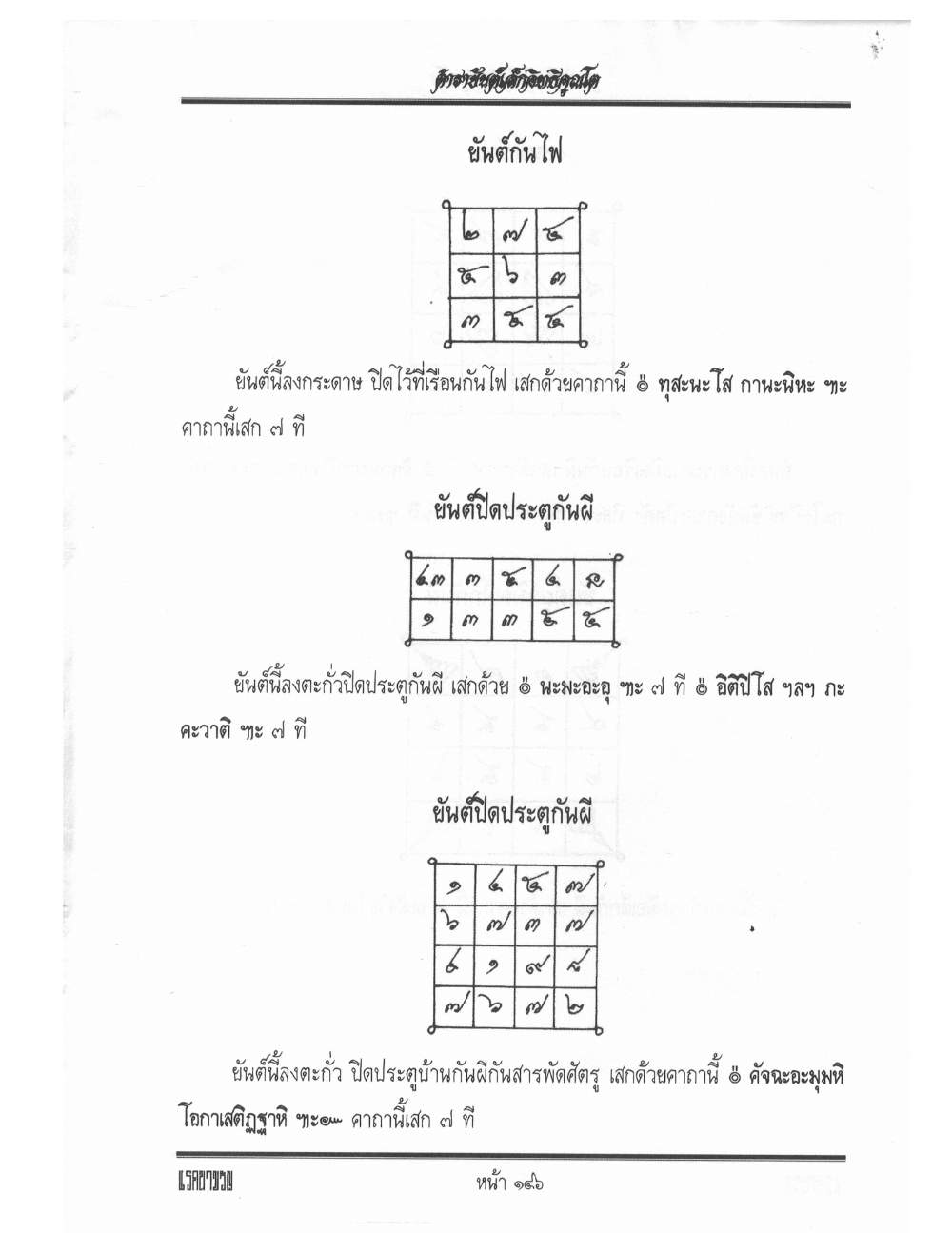
ยันต์กันไฟ
ยันต์นี้ลงกระดาษ ปิดไว้ที่เรือนกันไฟ เสกด้วยคาถานี้ ๐ ทุสะนะโส กาพิหะ ๚ะ คาถานี้เสก ๗ ที
ยันต์ปิดประตูกันผี
ยันต์นี้ลงตะกั่วปิดประตูกันผี เสกด้วย ๐ พะมะอะอุ ๚ะ ๗ ที ๐ อิติปิโส ฯลฯ ภะคะวาติ ๚ะ ๗ ที
ยันต์ปิดประตูกันผี
ยันต์นี้ลงตะกั่ว ปิดประตูบ้านกันผีกันสารพัดศัตรู เสกด้วยคาถานี้ ๐ คัจฉะอะมุมหิ โอกาเสติฏฐาหิ ๚ะ๛ คาถานี้เสก ๗ ที
Yantra to Ward Off Fire
[yantra: a 3×3 grid, syllables filling all nine cells]
Inscribe this yantra on paper and post it at the house to ward off fire. Consecrate it with this spell: "Thusanaso kaphiha" [chant this spell seven times].
Yantra to Seal the Door Against Ghosts
[yantra: a grid of two rows and five columns, a syllable in each cell]
Inscribe this yantra on lead to seal the door against ghosts. Consecrate it with: "Phamaa-u" [chant seven times], [then] "Itipiso... [gloss: the standard Itipiso formula, elided here] ...bhagavati" [chant seven times].
Yantra to Seal the Door Against Ghosts
[yantra: a 4×4 grid, a syllable in each cell]
Inscribe this yantra on lead to seal the house door against ghosts and every kind of enemy. Consecrate it with this spell: "Kachchha-amumhi okase-titthahi" [chant this spell seven times].
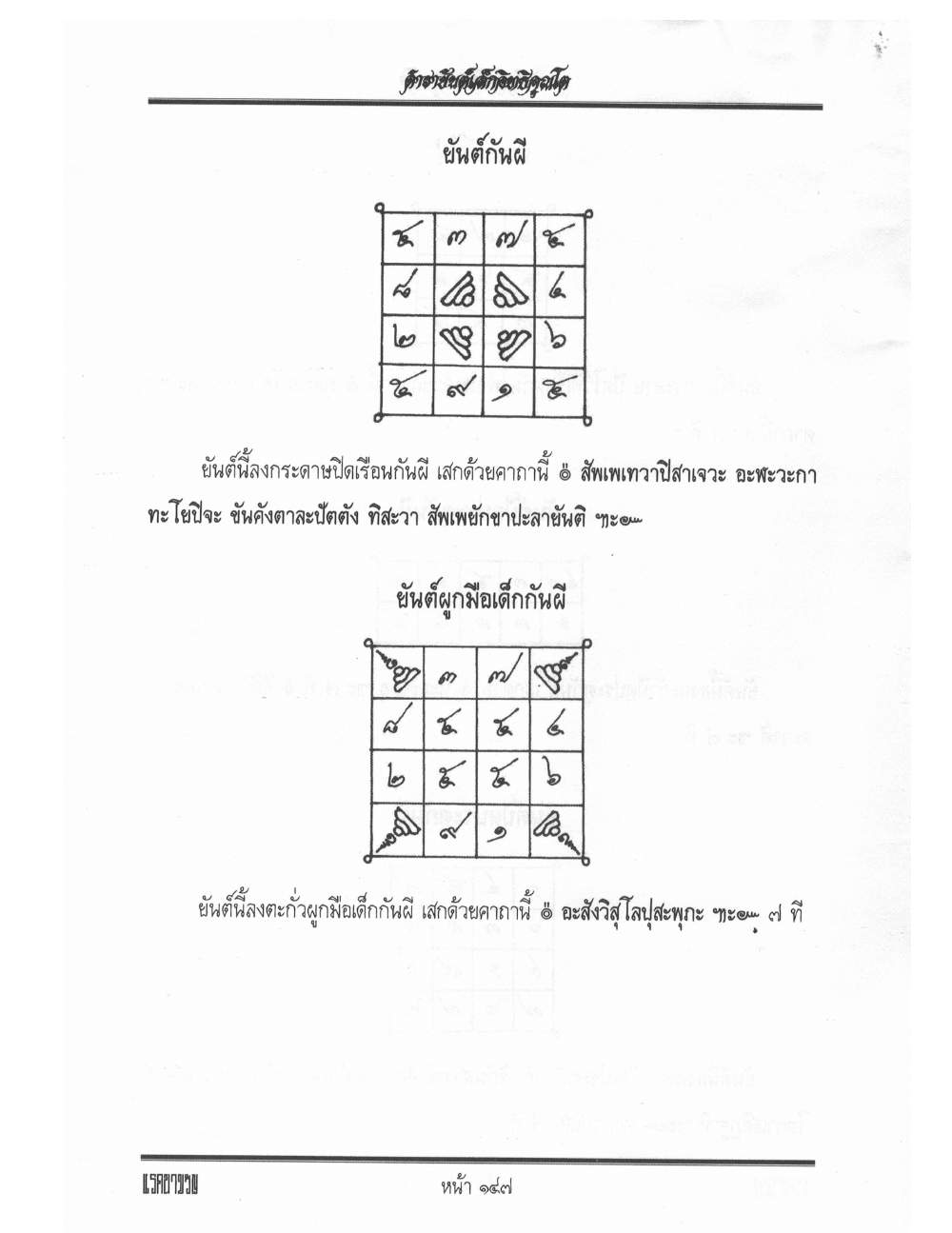
ยันต์กันผี
ยันต์นี้ลงกระดาษปิดเรือนกันผี เสกด้วยคาถานี้ ๐ สัพเพเทวาปิสาเจวะ อะพะวะกา ทะโยปิจะ ขันคังตาละปัตตัง ทิสวา สัพเพยักขาปะลายันติ ๚ะ๛
ยันต์ผูกมือเด็กกันผี
ยันต์นี้ลงตะกั่วผูกมือเด็กกันผี เสกด้วยคาถานี้ ๐ อะสังวิสุโลปุสะพุกะ ๚ะ๛ ๗ ที
Yantra to Ward Off Ghosts
[yantra: a 4×4 grid; the four corner cells and the four central cells each contain a distinctive triple-curl khom character, [อักขระขอมในยันต์ อ่านไม่ชัด], while the remaining cells contain numerals]
Inscribe this yantra on paper and post it at the house to ward off ghosts. Consecrate it with this spell: "Sabbe thewapisachewa apawaka thayopicha khankhang-talapattang thitsawa sabbe-yakkha-palayanti" [chant three times].
Yantra for the Child's Wrist-Charm Against Ghosts
[yantra: a 4×4 grid; the four corner cells each contain a distinctive triple-curl khom character, [อักขระขอมในยันต์ อ่านไม่ชัด], while the remaining cells contain numerals]
Inscribe this yantra on lead and bind it to a child's wrist to ward off ghosts. Consecrate it with this spell: "Asangwisulopusapukha" [chant seven times].