Contents · 1 chapter(s) · 69 entries
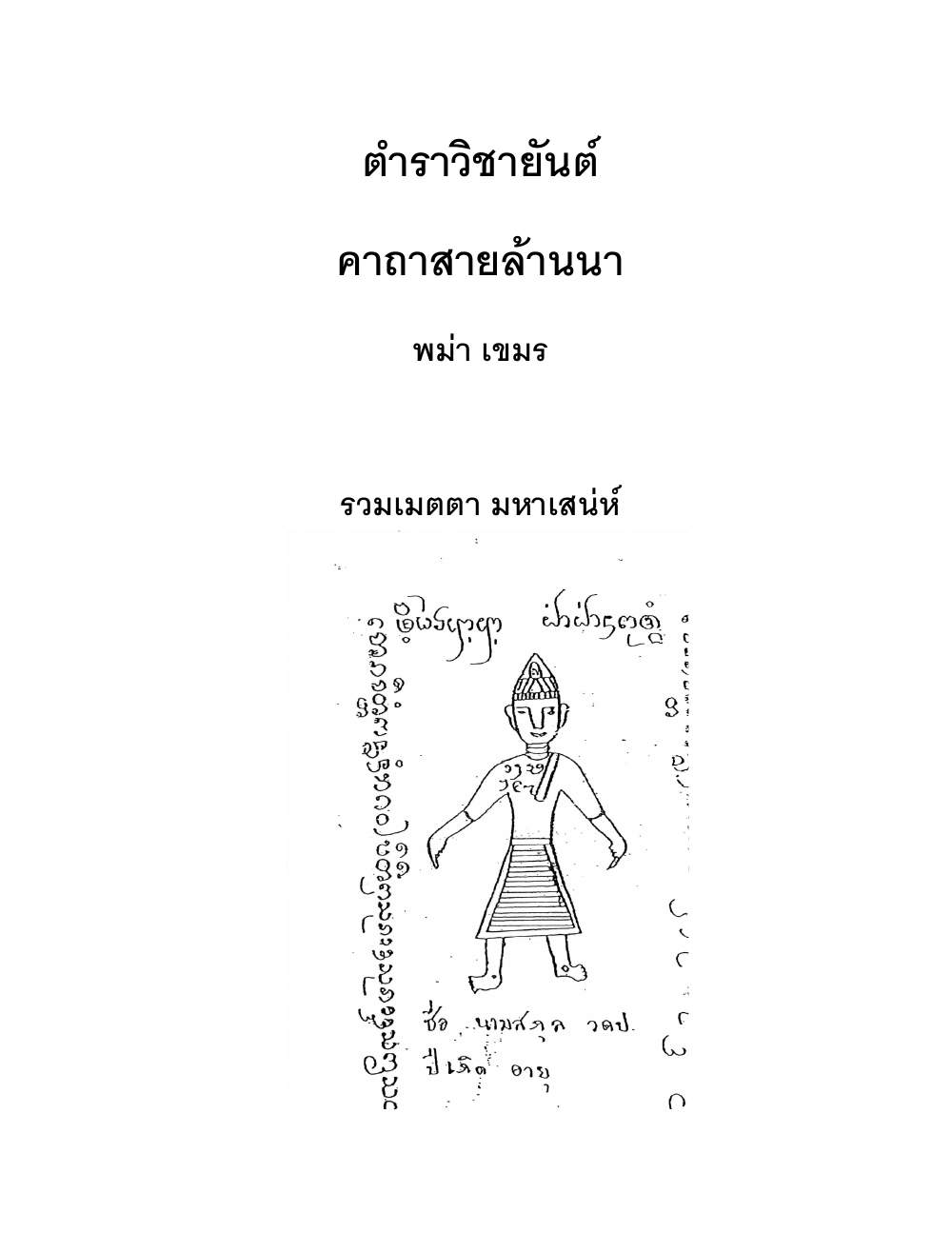
ตำราวิชายันต์
คาถาสายล้านนา
พม่า เขมร
รวมเมตตา มหาเสน่ห์
[อักษรธรรมล้านนาในยันต์ อ่านไม่ชัด]
ชื่อ..........นามสกุล..........วดป.......... ปีเกิด..........อายุ..........
Yantra Textbook. Lanna-lineage incantations. Burmese, Khmer [traditions]. Compilation of loving-kindness and great charm. [yantra: hand-drawn standing figure of a crowned deity/spirit in Thai-Lanna dress, arms held out to the sides; surrounded by Lanna Tham (อักษรธรรมล้านนา) script — a cluster of characters above the head, a vertical column of characters running down the left margin, and further marks down the right margin] Blank fill-in template below the figure: Name __________ Surname __________ [date of birth abbreviation] __________ Year of birth __________ Age __________
1
บท ไหว้ครู
ปัจจะมาเชิเนนวาโถ ปัดโตสัมโพธิมุดตะมัง จตุสัจจังประกาเสสิ ธัมมะจักกัง ประวัดตะติ เอเตนะ สัจจะวัชเซนะ โหตุเดชะยะมังคะลัง ขออัญเชิญพระอิศวรมาอยู่เบื้องซ้าย ขออัญเชิญพระนารายณ์มาอยู่ เบื้องขวา ขออัญเชิญพระคงคามาเป็นน้ำลาย ขออัญเชิญพระพายมา เป็นลมปาก ขออัญเชิญพญานาคมาเป็นเศษสร้อยและสังวาล ผู้ข้าจะ กล่าวอันใดขอให้ประสิทธิเม สิทธิกิจจัง สิทธิกัมมัง สิทธิการิยะ ตะถา คะโต สิทธิเตโช ชะโยนิจจัง สิทธิลาโภ นิรันตะรัง สัพพะกัมมัง ประสิทธิ
[๒]
1
Chapter: Homage to the Teacher
[Pali chant, given in Thai transliteration] He who sat at the foot of the noble Bodhi tree, having conquered Mara together with his army, attained the great Awakening — boundless knowledge, transcending all worlds. By the power of this truth, may there be glorious victory; the Wheel of the Dhamma turns. We invite Lord Ishvara to come and stand at [our] left side; we invite Lord Narayana to come and stand at [our] right side. We invite the [River] Ganges to become [our] saliva; we invite the Wind God to become the breath of [our] mouth. We invite the Naga king to become [our] necklace and ornaments. Whatever I speak, may it be accomplished — may [my] undertakings succeed, may [my] deeds succeed, may [my] works succeed. Thus has the Tathagata come; may glory and fire-power succeed, may victory be constant, may gain succeed without end; may every deed be accomplished.
[2]
2.
กำโอกาสปู่จาเดียนฯ
"โย สันนิสินโน วะระโพธิมูเล มารังสะเสนัง มะหันติวิชะโย สัพโพธิญาณัง อะนันตัญญาโภม โลกุตตะโม ตั้งประณะมามิปิใจถัง ตั้งประณะมามิธัมมัง ตั้งประณะมามิสังฆัง" สาธุ สาธุ โอกาส ข้าแด่พระมหาเจ้า จุบท จุบาท จุตั้วตน จุอักขระพยัญชนะ บัดนี้หมายมี ( บอกชื่อ ) ก็ได้น้อมนำมายังเทียน จิตหมายถวายมาปูจายังพระรัตนตรัยทั้งผ่านแก้วพระแก้ว เจ้าดังสามผะกาน อันเป็นเก้าเป็นประธาน ดังพระปิ่นกุ้มเคาะบุตร คนมีอิทธิฤทธิ์เก่งกล้า และครูบาอาจารย์เจ้า ดังครูเก่า ครูป้าย ครูค่าย ครูยัง จุค่านจุพระองค์ ดังเคาะบุตรคำ เคาะคาเจ้า พญาอินทร์ พญาพรหม พญายมราช ครุฑ นาคน้ำ ประไมยและไอศวร สิ่งศักดิ์สิทธิ์ อัน ฮักษาขระจะสัณฐาน บ้านเมืองเหมืองฝาย วัดวาอาราม ไร่นากั้มมะเขตเขะสถาน บ้านจอง หอเฮือน ดังหลายดังมวล บัดนี้หมายมี ( บอกชื่อ ) ก็ได้มาสักการะปู่จามีดังธูปะบุษผาราจา คอกดอก เข้าดอกพร้อมเทียนไฟ ยังขันแดเดียนแลก่ถาเยื้องนี้ ขอหื้อได้รับกับหายเสียยัง ภัย ยะ อุปะเทะทะกั้งวลอลด์ทรายดังหลายดังมวล จุ่งหื้อป่นเสียยังเคราะห์ปี เคราะห์เดือน เคราะห์ วัน เคราะห์ยาม เคราะห์๑๓ นาม๑๕ เคราะห์เมื่อหลับเมื่อตื่น เคราะห์เมื่อขึ้นเมื่อแลว สัพปีว่า เคราะห์ สัพปีว่าภัย สัพปีว่าจั๋งใด สัพปีว่าอุบาทว์ขีดคา ผีใส่และคนลอง สิ่งบ่คีบ่งามดัง หลายดังมวล คี่จักมาบังเกิดแก่ ( บอกชื่อ ) ก็หื้อร่ำงับดับหายไป แล้วจุ่งอย่าได้มาบังเกิด ด้วยเดชะอานุภาพคี่ ( บอกชื่อ ) ได้จำถวายปู่จาเทียนและสิบเป็นกุมมูลทั้งอันนี้ แก่แก้วเจ้า ดังสามผะกาน ขอหื้อได้ตั้งอยู่ในธรรมวุฒิ 4 ผะกาน มีผะฐานว่าทีฐายาวุฒิธรรม เป็น อุปถัมภะระจิ่นะสาสนา เที่ยงมั่นยืนยาว ด้วยเดชะกุสสละบุญ ภิสันตะรวยสีอันนี้นา หาก มิมากนักหนา ( บอกชื่อ ) ก็ขอถวายแก่สมปาน จุ่งไปจุ่งจอครอดถึง เสียยังเคาะบุตรคำ เคาะ คาเจ้า อันฮักษาต่นตั้วแห่ง ( บอกชื่อ ) และฮักษายังบ้านจอง หอเฮือน สัณฐาน ดังหลายดังมวล กั้มมะเคาะบุตร กั้มมะเคาะคา รุกขะเคาะบุตร รุกขะเคาะคา อากาศเคาะบุตร อากาศเคาะคา สอ กำเคาะบุตร สอกำเคาะคา โสรัสสะพญาอินคา พญาพรหม พญายมราช ครุฑ นาคน้ำ ประ ไมยและไอศวร ค้าวจดโลกมวลดัง๔ และแม่นงนาฏ [อ่านไม่ออก] ให้ธรณีสะหลีกุดคะอามาดข์ และโส กำมาวจะระณะ และเจ้าเคราะห์คั้ง๘ อันเกี่ยวมวดไปมา ในคว่าตั้งสสระวายสี อันมีต้นว่า คิส
2.
Words for the Occasion of Venerating the Candle
[Pali verse, given in Thai transliteration] "He who sat at the foot of the noble Bodhi tree, having conquered Mara together with his army, attained the great Awakening — boundless knowledge, transcending all worlds. To that One I bow: the Buddha. To that I bow: the Dhamma. To that I bow: the Sangha." Sadhu, sadhu — an occasion [for veneration], before the Great Lord [the Buddha]: every syllable, every verse, every body, every letter and sign. Now there is one named ( name spoken here ) who has humbly brought a candle, intending to offer it in veneration of the Triple Gem and the crystal images of the Lord, [regarded as] the Three Sacred Refuges, foremost and pre-eminent — like the crest-jewel guardian-spirits of one's children, persons of fierce and powerful potency — and the teachers and masters, the old teachers, the guardian teachers, the camp teachers, the still-living teachers, honouring the guardian-spirits of one's children and of oneself; Indra, Brahma, Yama the King of Death, Garuda, the water Naga, [minor deities], and Isvara — sacred and holy things that guard the boundaries, towns, irrigation canals, monasteries, fields, and dwelling places, houses and homes, all of them without exception. Now there is one named ( name spoken here ) who has come to pay homage with incense, flowers, unhusked and husked rice together with candle-fire, into this tray for candle offerings and this spoken formula, asking to be rid of danger, misfortune, and all manner of scattered troubles, of every kind. May [this rite] cause to be dissolved the ill-fortune of the year, the month, the day, the hour, the thirteen [inauspicious conditions] named as the fifteen, ill-fortune while asleep or awake, ill-fortune while rising or lying down — whatever is called misfortune, whatever is called danger, whatever is called any manner of it, whatever is called an evil omen or curse-mark, being possessed by spirits or tested by ill people — anything not good and not fair, of every kind, that might come to befall ( name spoken here ) — may it be extinguished and vanish, and may it never arise again. By virtue of this power, ( name spoken here ) has offered this candle in veneration together with the accompanying offerings to the crystal Lord, the Three Sacred Refuges, asking to remain established in the four kinds of righteous growth, whose foundation is the enduring Dhamma, as a support for the pure religion, steadfast and long-lasting; by virtue of the merit of this act of goodness and prosperity — if there is anything still owed, ( name spoken here ) offers it in requital, so that it may go and reach [its due end], dispelling the guardian-spirit ill-fortune of one's children and of oneself, that which guards the person of ( name spoken here ) and guards the dwelling, the house and home, in every form and shape: the guardian-spirit of the compound of one's children, of oneself; the tree-spirit of one's children, of oneself; the sky-spirit of one's children, of oneself; [other guardians] of one's children, of oneself; together with Indra, Brahma, Yama the King of Death, Garuda, the water Naga, [minor deities] and Isvara who travel throughout the four quarters of the world, and the goddess of the earth [or similar], [illegible], and the earth spirit who witnesses, and the eight lords of ill-fortune connected with all that comes and goes, within the array of constellations, beginning with...
๔
(ฤกษ์ที่ควรและห้าม สำหรับ การสีเทียน - บูชาเทียน)
| ค่ำ | บูชาข้างขึ้น | ค่ำ | บูชาข้างแรม | |---|---|---|---| | 1 | บ่คี จะเป็นทุกข์ | 1 | บ่คี จะเป็นทุกข์ | | 2 | คี จะคนเมตตาเอ็นดู | 2 | บ่คี จะมีเรื่องเดือดร้อนภายหลัง | | 3 | คี จะได้โชคลาภทุกอย่าง | 3 | บ่คี มีแต่คนเกลียดชัง | | 4 | บ่คี จะมีคนปองร้าย | 4 | คี จะได้โชคลาภทุกอย่าง | | 5 | คี จะได้โชคลาภทุกอย่าง | 5 | คี จะจากทุกข์โศกโรคภัย | | 6 | บ่คี จะเกิดอุบาทว์และเจ็บป่วย | 6 | บ่คี จะมีคนปองร้าย | | 7 | คี จะสมคิดใจนึกทุกอย่าง | 7 | คี จะได้โชคลาภเงินทอง | | 8 | บ่คี จะมีปากเสียงทะเลาะวิวาท | 8 | บ่คี จะมีปากเสียงทะเลาะวิวาท | | 9 | บ่คี จะมีเรื่องเดือดร้อนภายหลัง | 9 | คี จะได้โชคลาภทุกอย่าง | | 10 | บ่คี จะมีเรื่องเดือดร้อนภายหลัง | 10 | คี จะคนเมตตาเอ็นดู | | 11 | คี จะได้โชคลาภทุกอย่าง | 11 | บ่คี จะมีเรื่องเดือดร้อนภายหลัง | | 12 | คี จะสำเร็จตามประสงค์ | 12 | บ่คี จะเป็นทุกข์ | | 13 | คี จะสำเร็จตามประสงค์ | 13 | บ่คี จะเดือดร้อนและเจ็บป่วย | | 14 | บ่คี จะมีเรื่องเดือดร้อนภายหลัง | 14 | คี จะสมคิดใจนึกทุกอย่าง | | 15 | บ่คี จะเกิดอุบาทว์และเจ็บป่วย | 15 | คี จะมีโชคลาภหลั่งไหลเข้ามา |
(วันเสียประจำเดือนที่ห้ามกระทำการมงคลต่างๆ)
| เดือน | เกิ๋ง-ท้า-เก้า | ระวิ จันทร์ | เสีย | อาทิตย์ กับ จันทร์ | | เดือน | ขี้-หก-สิบ | องคาร์ | เสีย | อังคาร | | เดือน | สาม-เจ็ด-สิบเอ็ด | โสรี คุรุ | เสีย | เสาร์ กับ พฤหัสบดี | | เดือน | สี่-แปด-สิบสอง | สุโจ ทุธา | เสีย | ศุกร์ กับ พุธ |
4
(The auspicious and forbidden times for candle-lighting and candle-veneration)
Table, two sides — "Venerating on the waxing moon" and "Venerating on the waning moon" — listing, for each lunar night from 1 to 15, whether it is auspicious (คี) or inauspicious (บ่คี) and the resulting fortune, e.g. night 1 on both sides: inauspicious, will bring suffering; night 2 waxing: auspicious, will bring the kindness and affection of others, while night 2 waning: inauspicious, will bring later trouble; and so on through night 15, ending on the waning side with "auspicious — good fortune will pour in."
(The monthly unlucky days on which no auspicious rites should be performed)
Table listing lunar months grouped in three (e.g. months 1/6/10) against ruling days: months 1, 6, 10 are unlucky on Tuesday (Sun and Moon [group heading, Angkarn/Mars]); months 3, 7, 11 are unlucky on Saturday together with Thursday; months 4, 8, 12 are unlucky on Friday together with Wednesday.
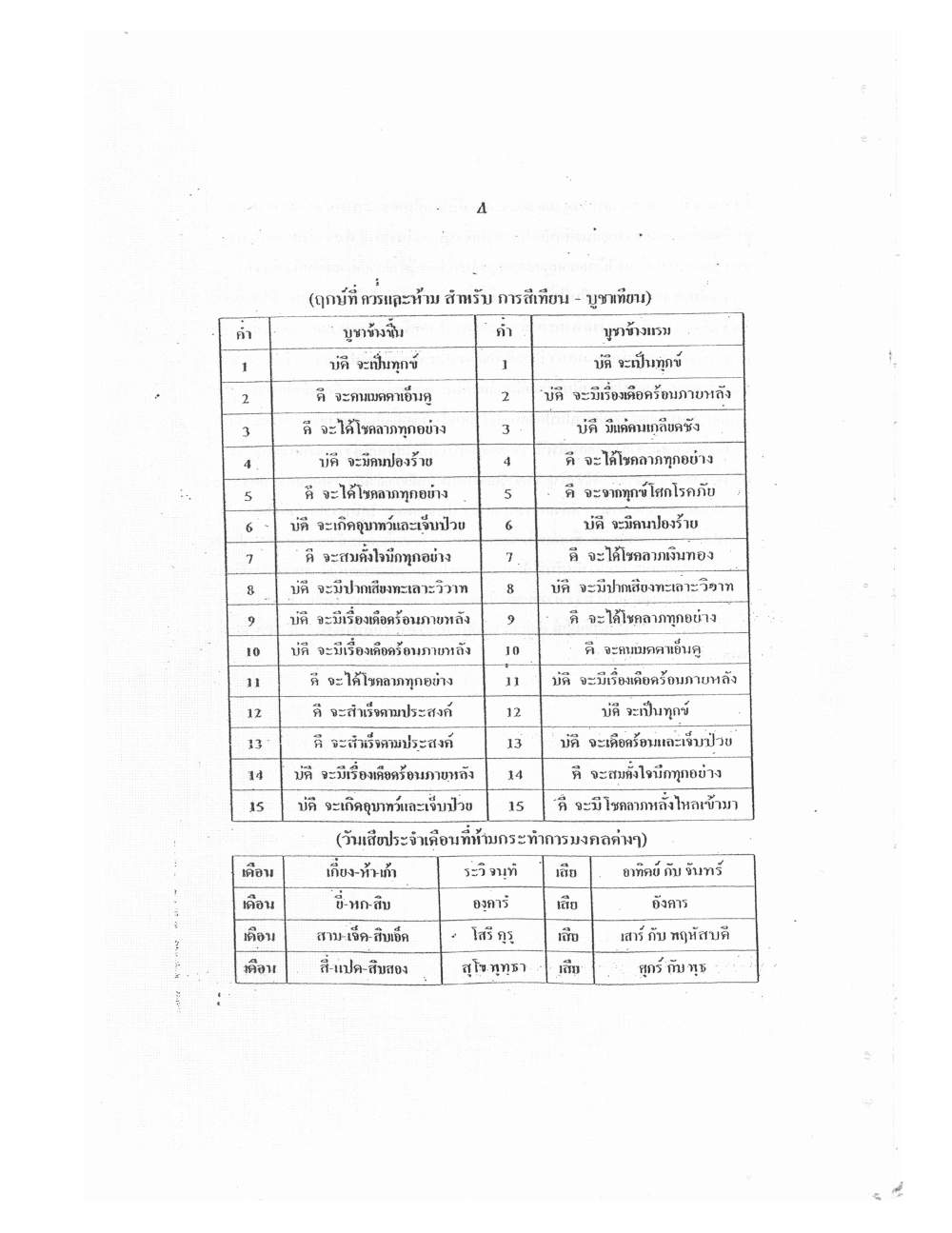
(ฤกษ์ที่ควรและห้าม สำหรับ การสีเทียน - บูชาเทียน)
ก่ำ | บูชาข้างขึ้น | ก่ำ | บูชาข้างแรม ๑ | บ่ดี จะเป็นทุกข์ | ๑ | บ่ดี จะเป็นทุกข์ ๒ | ดี จะคนเมตตาเอ็นดู | ๒ | บ่ดี จะมีเรื่องเดือดร้อนภายหลัง ๓ | ดี จะได้โชคลาภทุกอย่าง | ๓ | บ่ดี มีแต่คนเกลียดชัง ๔ | บ่ดี จะมีคนปองร้าย | ๔ | ดี จะได้โชคลาภทุกอย่าง ๕ | ดี จะได้โชคลาภทุกอย่าง | ๕ | ดี จะจากทุกข์โศกโรคภัย ๖ | บ่ดี จะเกิดอุบาทว์และเจ็บป่วย | ๖ | บ่ดี จะมีคนปองร้าย ๗ | ดี จะสมดั่งใจมีทุกอย่าง | ๗ | ดี จะได้โชคลาภเงินทอง ๘ | บ่ดี จะมีปากเสียงทะเลาะวิวาท | ๘ | บ่ดี จะมีปากเสียงทะเลาะวิวาท ๙ | บ่ดี จะมีเรื่องเดือดร้อนภายหลัง | ๙ | ดี จะได้โชคลาภทุกอย่าง ๑๐ | บ่ดี จะมีเรื่องเดือดร้อนภายหลัง | ๑๐ | ดี จะคนเมตตาเอ็นดู ๑๑ | ดี จะได้โชคลาภทุกอย่าง | ๑๑ | บ่ดี จะมีเรื่องเดือดร้อนภายหลัง ๑๒ | ดี จะสำเร็จตามประสงค์ | ๑๒ | บ่ดี จะเป็นทุกข์ ๑๓ | ดี จะสำเร็จตามประสงค์ | ๑๓ | บ่ดี จะเดือดร้อนและเจ็บป่วย ๑๔ | บ่ดี จะมีเรื่องเดือดร้อนภายหลัง | ๑๔ | ดี จะสมดั่งใจมีทุกอย่าง ๑๕ | บ่ดี จะเกิดอุบาทว์และเจ็บป่วย | ๑๕ | ดี จะมีโชคลาภหลั่งไหลเข้ามา
(วันเสียประจำเดือนที่ห้ามกระทำการมงคลต่างๆ)
เดือน [อ่านไม่ชัด]-[อ่านไม่ชัด]-เก้า ระวิ จันทร์ เสีย อาทิตย์ กับ จันทร์ เดือน [อ่านไม่ชัด]-หก-สิบ องคาร์ เสีย อังคาร เดือน สาม-เจ็ด-สิบเอ็ด โสรี คุรุ เสีย เสาร์ กับ พฤหัสบดี เดือน สี่-แปด-สิบสอง สุโจ พุธา เสีย ศุกร์ กับ พุธ
(The nights that are auspicious and inauspicious for candle-gazing and candle-worship)
Table — Night no. | Worshipping on the waxing moon | Night no. | Worshipping on the waning moon: 1: Inauspicious — will bring suffering. | 1: Inauspicious — will bring suffering. 2: Auspicious — people will be kind and fond of you. | 2: Inauspicious — trouble will come later. 3: Auspicious — every kind of fortune will come. | 3: Inauspicious — only enmity and hatred from others. 4: Inauspicious — someone will wish you harm. | 4: Auspicious — every kind of fortune will come. 5: Auspicious — every kind of fortune will come. | 5: Auspicious — suffering, sorrow, and sickness will depart. 6: Inauspicious — calamity and illness will arise. | 6: Inauspicious — someone will wish you harm. 7: Auspicious — all will go as your heart desires. | 7: Auspicious — you will gain wealth and fortune. 8: Inauspicious — there will be quarrels and disputes. | 8: Inauspicious — there will be quarrels and disputes. 9: Inauspicious — trouble will come later. | 9: Auspicious — every kind of fortune will come. 10: Inauspicious — trouble will come later. | 10: Auspicious — people will be kind and fond of you. 11: Auspicious — every kind of fortune will come. | 11: Inauspicious — trouble will come later. 12: Auspicious — you will succeed as you wish. | 12: Inauspicious — will bring suffering. 13: Auspicious — you will succeed as you wish. | 13: Inauspicious — trouble and sickness. 14: Inauspicious — trouble will come later. | 14: Auspicious — all will go as your heart desires. 15: Inauspicious — calamity and illness will arise. | 15: Auspicious — fortune will come pouring in.
(The monthly unlucky days on which no auspicious rites should be performed)
For months [illegible]-[illegible]-9, [ruled by] Ravi-Chandra [Sun and Moon], the unlucky days are Sunday and Monday. For months [illegible]-6-10, [ruled by] Angkarn [Mars], the unlucky day is Tuesday. For months 3-7-11, [ruled by] Sori-Guru [Saturn and Jupiter], the unlucky days are Saturday and Thursday. For months 4-8-12, [ruled by] Sujo-Phutha [Venus(?) and Mercury], the unlucky days are Friday and Wednesday.
๖
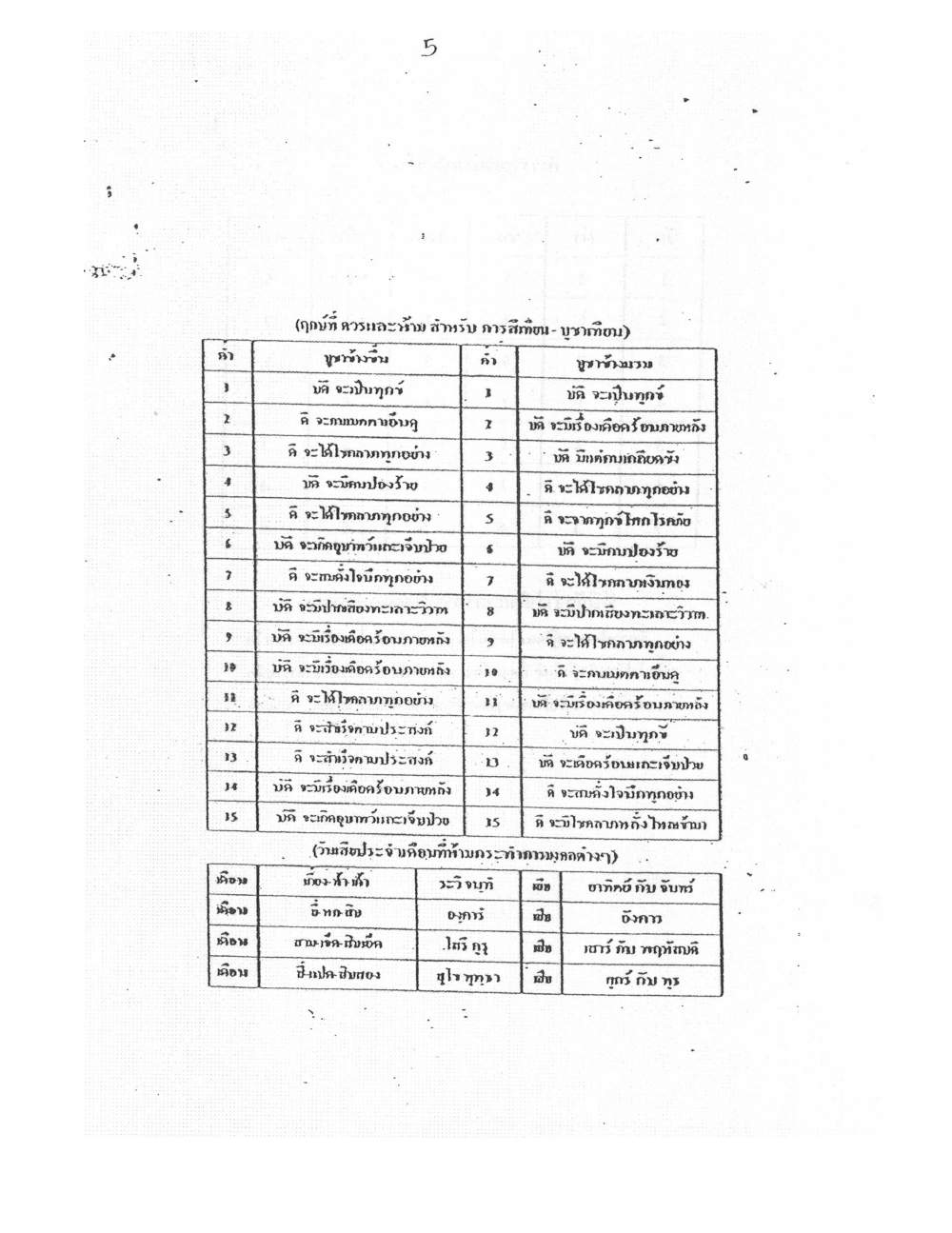
คำรา สูตรกำปู่จาเทียน
| วัน | ผ่า | ข่ม | โจก | เข้า | ตาย | |---|---|---|---|---|---| | 1 | 4 | 5 | 6 | 7 | 6 | | 2 | 6 | 7 | 1 | 2 | 7 | | 3 | 7 | 6 | 5 | 2 | 1 | | 4 | 1 | 7 | 6 | 4 | 2 | | 5 | 2 | 1 | 3 | 5 | 3 | | 6 | 3 | 2 | 1 | 7 | 4 | | 7 | 3 | 4 | 5 | 6 | 5 |
ตี๋นี้จักจำว่าด้วยสูตรการปู่จาเทียนก่อนแล
กั้นว่าปุกคละผู้ใดคนใด จักไป จักเป๋ง ในก่อกำ หื้อกำนั้นได้ วันนั้นไปตามกำอึ้งวันนี้ หื้อถูกต้องตามหลักวิธี ของครูบาอาจารย์เหือก่อน แล้วจึงจักกะดำกำนั้นๆจึงจะสำเร็จผล คำต้องกำ___จะแล
6
Textbook: Formula for the Candle-Veneration Incantation
A calculation table with columns Day, Split, Suppress, Chief, Enter, Die, giving a numeric offset for each of the seven days of the week — used to work out, from the day in question, which of these five conditions applies.
This, then, is to be remembered as the formula for candle-veneration to be used beforehand.
That is to say, whatever person intends to go, intends to act, in advance of the rite, must have that rite [performed] — on that day, following the day's calculation for that day, so that it is correct according to the method handed down by the teachers and masters of old; only then, having reckoned that rite accordingly, will it be brought to successful completion. The proper rite must accord with ___, indeed.
๗
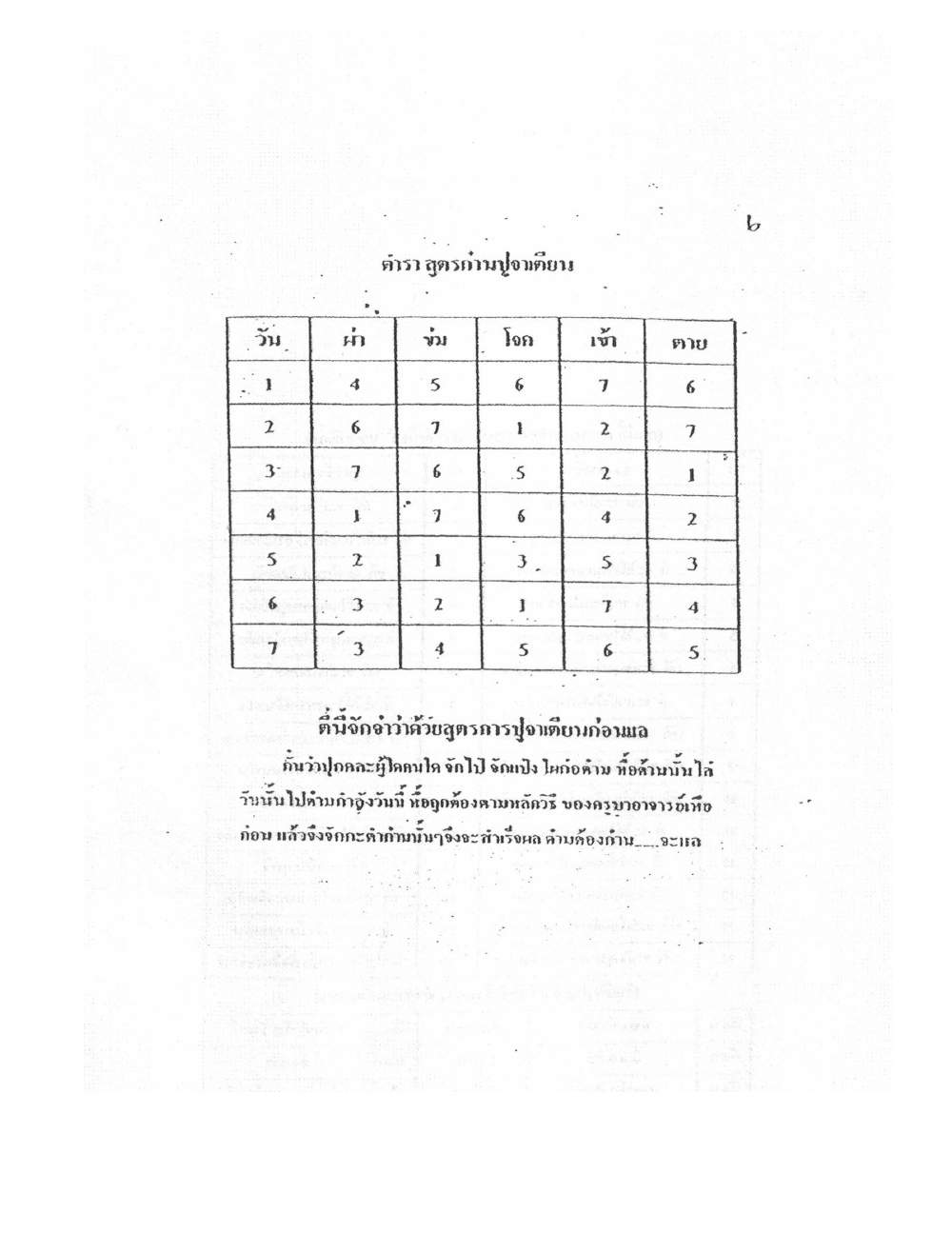
คาถาจุดเทียนหน้าพระ
นะโม 3 จบ
นะโมพุทธายะ นะขอจงมาบังเกิดเป็นคุณพระเจ้า โมขอจงมาบังเกิดเป็นคุณ พระสัทธรรมะเจ้า พุทธขอจงมาบังเกิดเป็นคุณพระสังฆะเจ้า ธาจงบังเกิดเป็นคุณบิดา มารดา ยะขอจงมาบังเกิดเป็นคุณครูบาอาจารย์ทุกพระองค์ ของจงมาประสิทธิให้แก่ ข้าพเจ้าสมความปรารถนา แห่งข้าพเจ้าทุกประการ ณ บัดนี้ข้าพเจ้า (ชื่อเรา) ได้ นำเอาพระมหายันต์เทียนต้นนี้มากระทำการสักการะบูชา ต่อหน้าพระพุทธเจ้า พระ ธรรมเจ้า พระสังฆเจ้า คุณบิดามารดา และคุณครูบาอาจารย์เจ้า เพื่อจักขอให้กลิ่น ธูปควันเทียนสัพพะเวทย์มหายันต์เทียนเหล่านี้ ไปถึงหัวใจกายตัวผู้ที่มีชื่อว่า (ชื่อของ คู่ครอง) ให้เขามารัก มาหลง มาใหล ให้จิตใจของเขาฝ่าหน้าแต่ข้าเจ้า ทุกวันทุกเมื่อ ทุกเช้าทุกค่ำ แม้นจะนั่งก็บ่อมิได้ นอนก็บ่อมิได้ กินก็บ่อมิได้ ยืนก็บ่อมิได้ ให้พร่ำ เพ้อละเมอ หลงใหลหาแต่ข้าเจ้า (ชื่อของเรา) ดังบทบาทพระคาถาแห่งครูบา อาจารย์ได้กล่าวไว้ว่า
นามมานังสะมาโส ยุดตะโถ ยุดถัตถะ แห่งนามะ (ชื่อของคู่ครอง) พุทธังเอหิ มา ริโส จิตตังมา ธัมมัง เอหิ มาริโสตังมา สังฆัง มาริโสจิตตังมา บุพผังมา กันธังมา ราชะกุมาโรมา ราชะกุมารีมา อิตถีมา ปุริโสมา ปุริจามา ปะริเทวันตี ปิยังมามะ มะ อมจิตตัง จิตจะนะ นังมามะมัด อุงพุทธะเสโท อิติปิโส ภะคะวา อะอุอัง ธัมมะ เสโถ ภะคะวา อะอุอัง สังฆะเสโฐ อิติปิโส ภะคะวาวัณณะสักโก ปิยะอมโห มุกขัง มุกขัง สะตะมาลัง (ชื่อของคนรัก) อมมะณีรักสวาหุมติด ติดด้วย นะโมพุทธายะ
ถ้ามีคำอธิษฐานใดก็อธิษฐานต่อไปได้ จุดถูป 5 ดอก
7
Incantation for Lighting a Candle Before the Buddha Image
Namo, three times.
Namo Buddhaya. [Interpreting the syllable Na:] May there come to be born in me the virtue of the Buddha. [Mo:] May there come to be born in me the virtue of the True Dhamma. [Phut:] May there come to be born in me the virtue of the Sangha. [Tha:] May there be born in me the virtue of father and mother. [Ya:] May there come to be born in me the virtue of every teacher and master — may they grant success to me according to my every wish, in every respect. Now I, ( my name ), have taken this great candle-yantra and performed an act of veneration before the Buddha, the Dhamma, the Sangha, [the virtue of] father and mother, and [the virtue of] my teachers and masters, so as to ask that the scent of incense and candle-smoke of this all-powerful great candle-yantra reach the heart and body of the one named ( name of the partner ), causing him/her to love me, to become infatuated, to be swept away, so that his/her heart turns toward none but me, every day, at all times, every morning and every evening — that he/she cannot even sit still, cannot sleep, cannot eat, cannot stand, but babbles and dreams, infatuated, seeking only me, ( my name ) — according to the verse of the incantation spoken by the teachers and masters, as follows:
[Pali-style formula, given in Thai transliteration, invoking the name of the beloved together with the Buddha, Dhamma, Sangha, and various figures — princes, princesses, men, women — to come and be drawn, infatuated and yearning, toward the speaker, sealed with] "...may [name of the loved one] be bound with the gem of love, bound fast, sealed with Namo Buddhaya."
If there is any further wish, it may be prayed for at this point. Light 5 sticks of incense.
๘
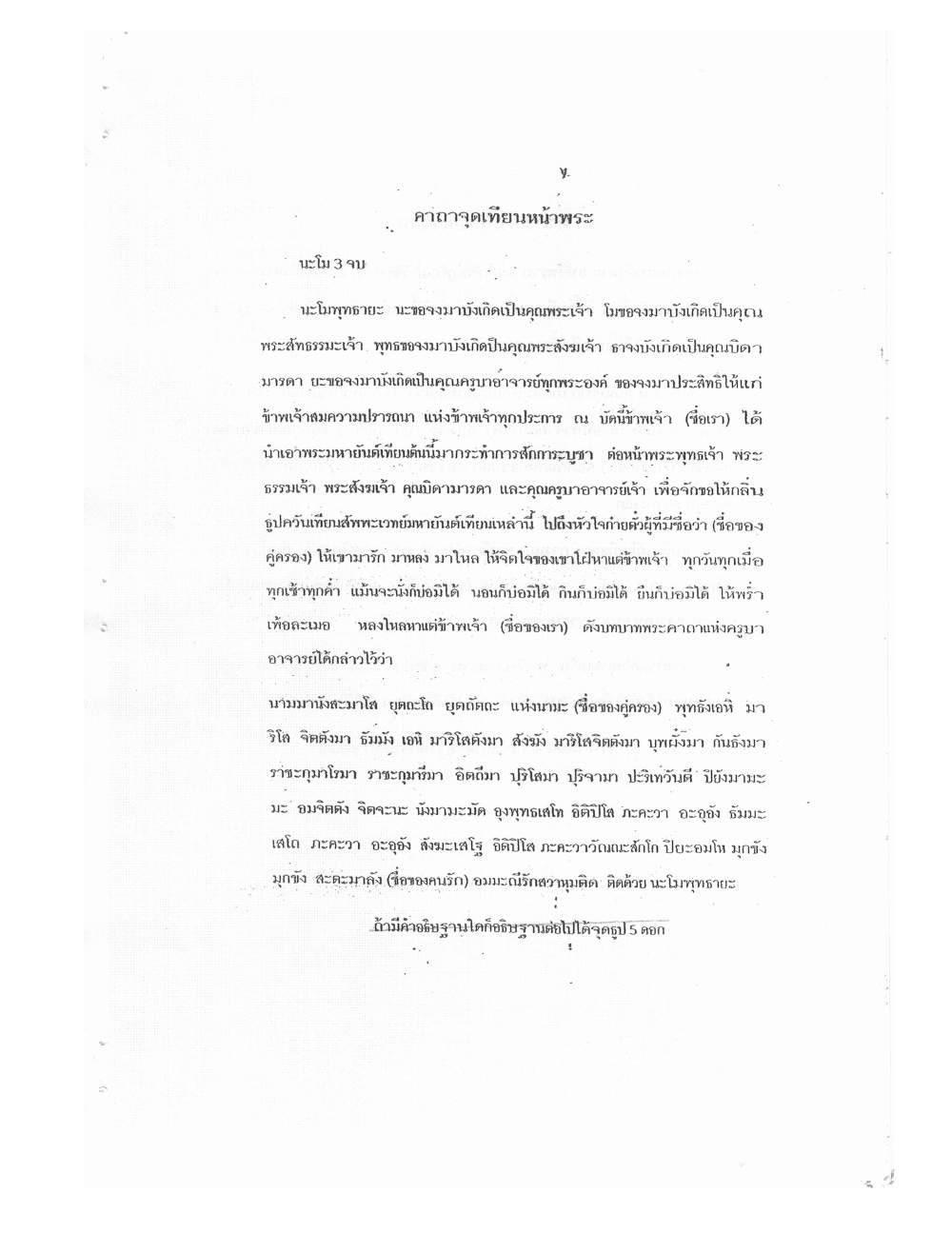
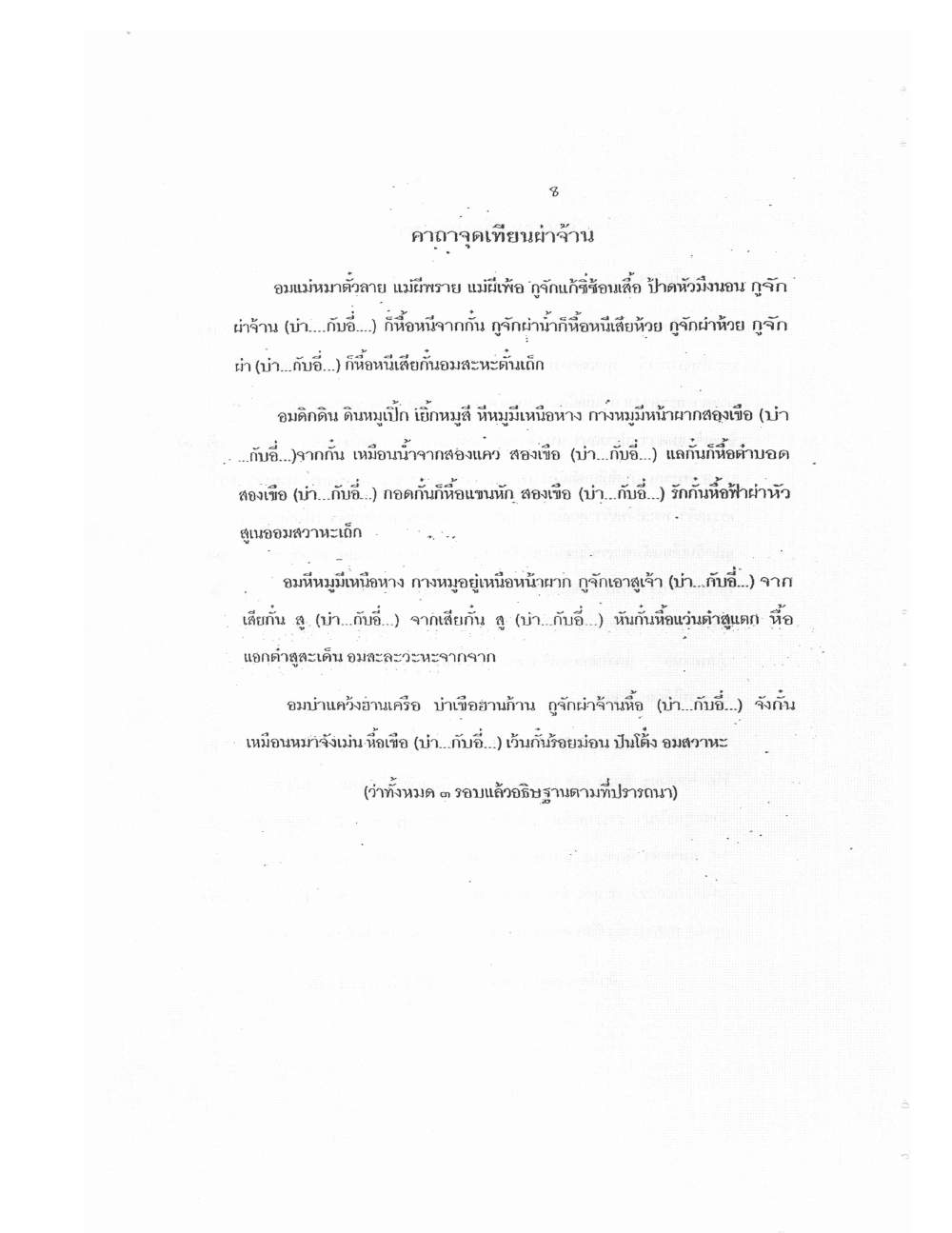
คาถาจุดเทียนผ่าจ้าน
อมแม่หมาตั้วลาย แม่ผีพราย แม่ผีเพ้อ กูจักแก้ซิซ้อนเสื้อ ป้าดหัวมึงนอน กูจัก ผ่าจ้าน (บ่า....กับอี่....) ก็หื้อหนีจากกั้น กูจักผ่าน้ำก็หื้อหนีเสียห้วย กูจักผ่าห้วย กูจัก ผ่า (บ่า...กับอี่...) ก็หื้อหนีเสียกั้นอมสะหะตั้นเถ็ก
อมดิกดิน ดินหมูเปิ๊ก เยิ้กหมูสี หื้อหมูมีเหนือหาง กางหมูมีหน้าผากสองเขือ (บ่า ...กับอี่...)จากกั้น เหมือนน้ำจากสองแคว สองเขือ (บ่า...กับอี่...) แล้วกั้นก็หื้อตำบอด สองเขือ (บ่า...กับอี่...) ก็อดกั้นก็หื้อแขนหัก สองเขือ (บ่า...กับอี่...) รักกั้นหื้อฟ้าผ่าหัว สูเนออมสวาหะเด็ก
อมหื้อหมูมีเหนือหาง กางหมูอยู่เหนือหน้าผาก กูจักเอาสูเจ้า (บ่า...กับอี่...) จาก เสียกั้น สู (บ่า...กับอี่...) จากเสียกั้น สู (บ่า...กับอี่...) หันกั้นหื้อแว่นตำสูแตก หื้อ แอกตำสูสะเด็น อมสะละวะหะจากจาก
อมบ่าแคว้งฮานเครือ บ่าเขือฮานก้าน กูจักผ่าจ้านหื้อ (บ่า...กับอี่...) จังกั้น เหมือนหมาจังเม่นหื้อเชือ (บ่า...กับอี่...) เว้นกั้นร้อยม่อน ปันโต้ง อมสวาหะ
(ว่าทั้งหมด 3 รอบแล้วอธิษฐานตามที่ปรารถนา)
8
Incantation for Lighting a Candle to Sever [a Couple] Apart
[Incantation opening with the sacred syllable Om, addressing a spirit-mother/hag figure] Om, mother of the striped dog-spirit, mother of the water-ghost, mother of the moaning ghost — I shall undo and strip off your covering garment, cover your head so you sleep. I shall sever ( the man ... and the woman ... ) so that they flee from one another. I shall sever the water so that it flees down the stream; I shall sever the stream; I shall sever ( the man ... and the woman ... ) so that they flee from one another — sealed with Om, savaha, child.
Om, earth-spirit of the earth, pig[-like] earth-spirit, [invoking imagery of two forked/branching things] making the two [people] like a pig's [divided] tail and forehead, two forks ( the man ... and the woman ... ), parting from one another like water parting at a river-fork into two branches ( the man ... and the woman ... ) — then let them go blind to one another, ( the man ... and the woman ... ), let their arms break toward one another, ( the man ... and the woman ... ) — should they love one another, let lightning strike their heads instead; sealed with Om savaha, child.
Om, let the [forked] imagery hold: I shall take you both, lord ( the man ... and the woman ... ), and part you from one another; you ( the man ... and the woman ... ), part from one another; you ( the man ... and the woman ... ) — turn so that the mirror between you shatters, so that the yoke between you snaps apart. Om, sever, part, away, away.
Om, [imagery of] a vine severed, a gourd-stem severed — I shall sever apart ( the man ... and the woman ... ) from one another, like a dog scattering and severing the rope ( the man ... and the woman ... ), leaving a hundred knots between them, laid apart. Om savaha.
(Recite the whole three times, then pray according to what is wished.)
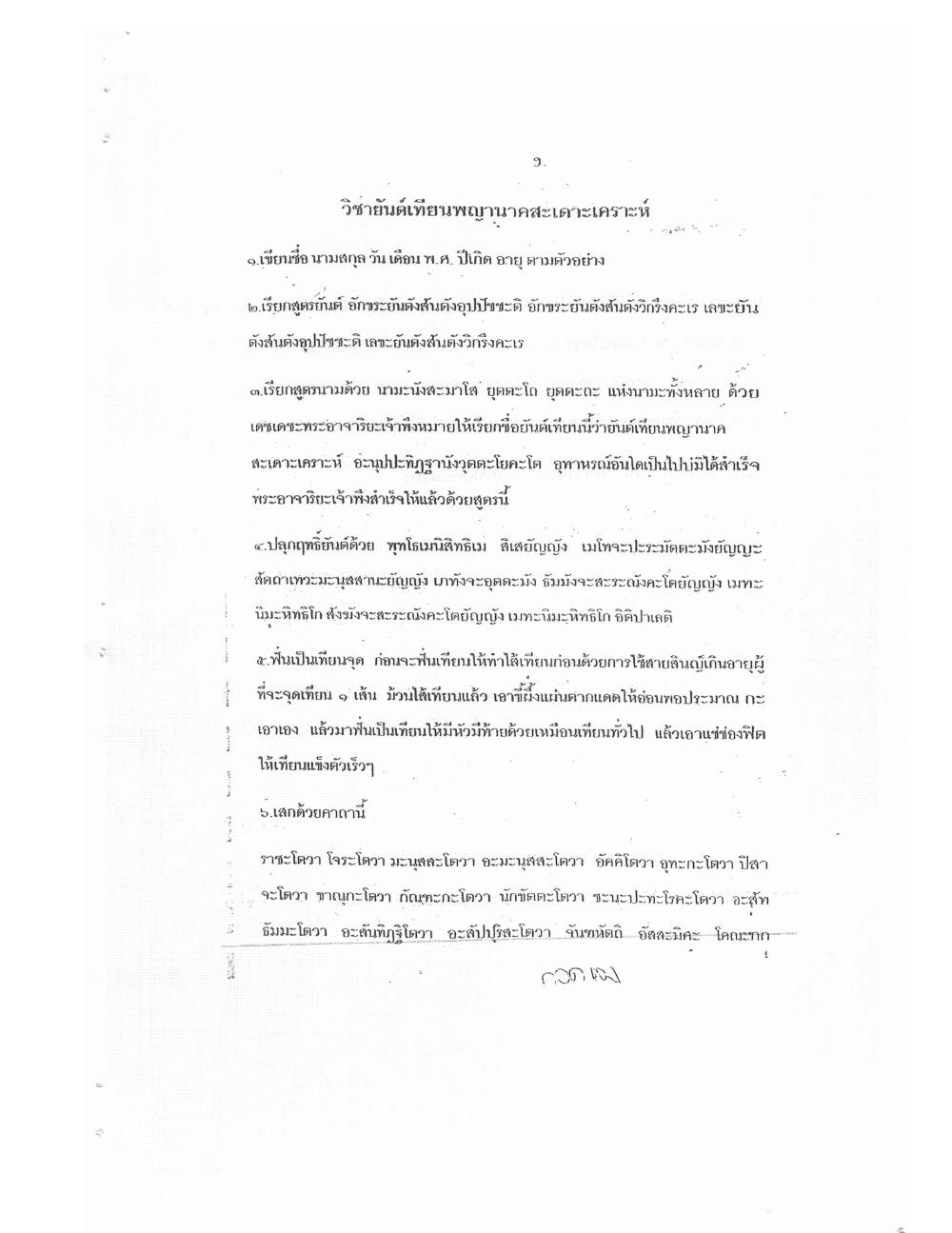
๙.
วิชายันต์เทียนพญานาคสะเดาะเคราะห์
๑.เขียนชื่อ นามสกุล วัน เดือน พ.ศ. ปีเกิด อายุ ตามตัวอย่าง
๒.เรียกสูตรยันต์ อักขระยันต์ดังสั้นดังอุปปาชะติ อักขระยันต์ดังสั้นดังวิกริ่งคะเร เลขะยัน ต์ดังสั้นดังอุปปาชะติ เลขะยันต์ดังสั้นดังวิกริ่งคะเร
๓.เรียกสูตรนามด้วย นามะนังสะมาโส ยุตตะโถ ยุตตะถะ แห่งนามะทั้งหลาย ด้วย เดชเดชะพระอาจาริยะเจ้า พึงหมายให้เรียกชื่อยันต์เทียนนี้ว่ายันต์เทียนพญานาค สะเดาะเคราะห์ อะนุปปะติฏฐานังวุตตะโยคะโต อุทาหรณ์อันใดเป็นไปบ่มิได้สำเร็จ พระอาจาริยะเจ้าพึงสำเร็จให้แล้วด้วยสูตรนี้
๔.ปลุกฤทธิ์ยันต์ด้วย พุทโธเมนิสิทธิเม สิเสยัญญัง เมโทจะประมัดตะมังยัญญะ สัตถาเทวะมนุสสานะยัญญัง ภาทังจะอุตตะมัง ธัมมังจะสะระณังคะโตยัญญัง เมทะ นิมะหิทธิโก สังฆังจะสะระณังคะโตยัญญัง เมทะนิมะหิทธิโก อิติปาเลติ
๕.ฟั่นเป็นเทียนจุด ก่อนจะฟั่นเทียนให้ทำไส้เทียนก่อนด้วยการใช้สายสิญจน์เกินอายุผู้ ที่จะจุดเทียน 1 เส้น ม้วนไส้เทียนแล้ว เอาขี้ผึ้งแผ่นตากแดดให้อ่อนพอประมาณ กะ เอาเอง แล้วมาฟั่นเป็นเทียนให้มีหัวมีท้ายด้วยเหมือนเทียนทั่วไป แล้วเอาแช่ช่องฟิต ให้เทียนแข็งตัวเร็วๆ
๖.เสกด้วยคาถานี้
ราชะโตวา โจระโตวา มะนุสสะโตวา อะมะนุสสะโตวา อัคคีโตวา อุทะกะโตวา ปิสา จะโตวา ขาณุกะโตวา กัณฏะกะโตวา นักขัตตะโตวา ชะนะปะทะโรคะโตวา อะสัท ธัมมะโตวา อะสันทิฏฐิโตวา อะสัปปุริสะโตวา จันทะหัตถิ อัสสะมิคะ โคณะฏก [อ่านไม่ออก]
9.
Yantra Craft: The Naga-King Candle for Dispelling Misfortune
1. Write [the practitioner's] given name, surname, day, month, Buddhist Era year, year of birth, and age, following the example [given elsewhere].
2. Recite the yantra formula: "The yantra syllables are as brief as [the phrase] uppājati; the yantra syllables are as brief as vikiriṅkare. The yantra numerals are as brief as uppājati; the yantra numerals are as brief as vikiriṅkare."
3. Also recite the name-formula: "Nāmaṁ [taken] together is fitting, fittingly meant" — of all such names — by the power of the teaching Master. This candle-yantra should accordingly be called "the Naga-King Candle-Yantra for Dispelling Misfortune." [Formula:] "anuppatiṭṭhānaṁ vuttayogato" — whatever example fails to succeed, the teaching Master shall bring to completion by means of this formula.
4. Awaken the yantra's power with: "Buddho me nisiddhi me, sise yaññaṁ, medo ca pamattamaṅ-yaññaṁ, satthā devamanussānaṁ yaññaṁ, bhātaṅ ca uttamaṁ, dhammaṁ ca saraṇaṁ gato yaññaṁ, medanimahiddhiko, saṅghaṁ ca saraṇaṁ gato yaññaṁ, medanimahiddhiko" — thus it protects.
5. Roll it into a candle to be lit. Before rolling the candle, first make the wick using a length of sacred thread (sai sin) longer than the age of the person for whom the candle will be lit, one strand. Having rolled the wick, take a sheet of beeswax, sun it until moderately softened — judge this by feel — then roll it into a candle with a head and a tail, as with an ordinary candle. Then place it in a fitted groove/mould so that the candle sets firm quickly.
6. Consecrate it with this incantation:
"Whether from a king, or from a thief, or from a human, or from a non-human, or from fire, or from water, or from a demon, or from a stump, or from a thorn, or from the stars/season, or from an epidemic disease, or from false teaching, or from wrong view, or from a bad person; the moon['s] elephant, horses, deer, oxen... [illegible, text continues beyond the visible portion of the page]"
๙.
วิชายันต์เทียนพญานาคสะเดาะเคราะห์
๑.เขียนชื่อ นามสกุล วัน เดือน พ.ศ. ปีเกิด อายุ ตามตัวอย่าง
๒.เรียกสูตรยันต์ อักขระยันต์ดังสั้นดังอุปปาชะติ อักขระยันต์ดังสั้นดังวิกริ่งคะเร เลขะยัน ต์ดังสั้นดังอุปปาชะติ เลขะยันต์ดังสั้นดังวิกริ่งคะเร
๓.เรียกสูตรนามด้วย นามะนังสะมาโส ยุตตะโถ ยุตตะถะ แห่งนามะทั้งหลาย ด้วย เดชเดชะพระอาจาริยะเจ้า พึงหมายให้เรียกชื่อยันต์เทียนนี้ว่ายันต์เทียนพญานาค สะเดาะเคราะห์ อะนุปปะติฏฐานังวุตตะโยคะโต อุทาหรณ์อันใดเป็นไปบ่มิได้สำเร็จ พระอาจาริยะเจ้าพึงสำเร็จให้แล้วด้วยสูตรนี้
๔.ปลุกฤทธิ์ยันต์ด้วย พุทโธเมนิสิทธิเม สิเสยัญญัง เมโทจะประมัดตะมังยัญญะ สัตถาเทวะมนุสสานะยัญญัง ภาทังจะอุตตะมัง ธัมมังจะสะระณังคะโตยัญญัง เมทะ นิมะหิทธิโก สังฆังจะสะระณังคะโตยัญญัง เมทะนิมะหิทธิโก อิติปาเลติ
๕.ฟั่นเป็นเทียนจุด ก่อนจะฟั่นเทียนให้ทำไส้เทียนก่อนด้วยการใช้สายสิญจน์เกินอายุผู้ ที่จะจุดเทียน 1 เส้น ม้วนไส้เทียนแล้ว เอาขี้ผึ้งแผ่นตากแดดให้อ่อนพอประมาณ กะ เอาเอง แล้วมาฟั่นเป็นเทียนให้มีหัวมีท้ายด้วยเหมือนเทียนทั่วไป แล้วเอาแช่ช่องฟิต ให้เทียนแข็งตัวเร็วๆ
๖.เสกด้วยคาถานี้
ราชะโตวา โจระโตวา มะนุสสะโตวา อะมะนุสสะโตวา อัคคีโตวา อุทะกะโตวา ปิสา จะโตวา ขาณุกะโตวา กัณฏะกะโตวา นักขัตตะโตวา ชะนะปะทะโรคะโตวา อะสัท ธัมมะโตวา อะสันทิฏฐิโตวา อะสัปปุริสะโตวา จันทะหัตถิ อัสสะมิคะ โคณะฏก [อ่านไม่ออก]
9. [This page is a duplicate scan of the preceding page (page 9), showing the same text.]
Yantra Craft: The Naga-King Candle for Dispelling Misfortune
1. Write [the practitioner's] given name, surname, day, month, Buddhist Era year, year of birth, and age, following the example [given elsewhere].
2. Recite the yantra formula: "The yantra syllables are as brief as [the phrase] uppājati; the yantra syllables are as brief as vikiriṅkare. The yantra numerals are as brief as uppājati; the yantra numerals are as brief as vikiriṅkare."
3. Also recite the name-formula: "Nāmaṁ [taken] together is fitting, fittingly meant" — of all such names — by the power of the teaching Master. This candle-yantra should accordingly be called "the Naga-King Candle-Yantra for Dispelling Misfortune." [Formula:] "anuppatiṭṭhānaṁ vuttayogato" — whatever example fails to succeed, the teaching Master shall bring to completion by means of this formula.
4. Awaken the yantra's power with: "Buddho me nisiddhi me, sise yaññaṁ, medo ca pamattamaṅ-yaññaṁ, satthā devamanussānaṁ yaññaṁ, bhātaṅ ca uttamaṁ, dhammaṁ ca saraṇaṁ gato yaññaṁ, medanimahiddhiko, saṅghaṁ ca saraṇaṁ gato yaññaṁ, medanimahiddhiko" — thus it protects.
5. Roll it into a candle to be lit. Before rolling the candle, first make the wick using a length of sacred thread (sai sin) longer than the age of the person for whom the candle will be lit, one strand. Having rolled the wick, take a sheet of beeswax, sun it until moderately softened — judge this by feel — then roll it into a candle with a head and a tail, as with an ordinary candle. Then place it in a fitted groove/mould so that the candle sets firm quickly.
6. Consecrate it with this incantation:
"Whether from a king, or from a thief, or from a human, or from a non-human, or from fire, or from water, or from a demon, or from a stump, or from a thorn, or from the stars/season, or from an epidemic disease, or from false teaching, or from wrong view, or from a bad person; the moon['s] elephant, horses, deer, oxen... [illegible, text continues beyond the visible portion of the page]"
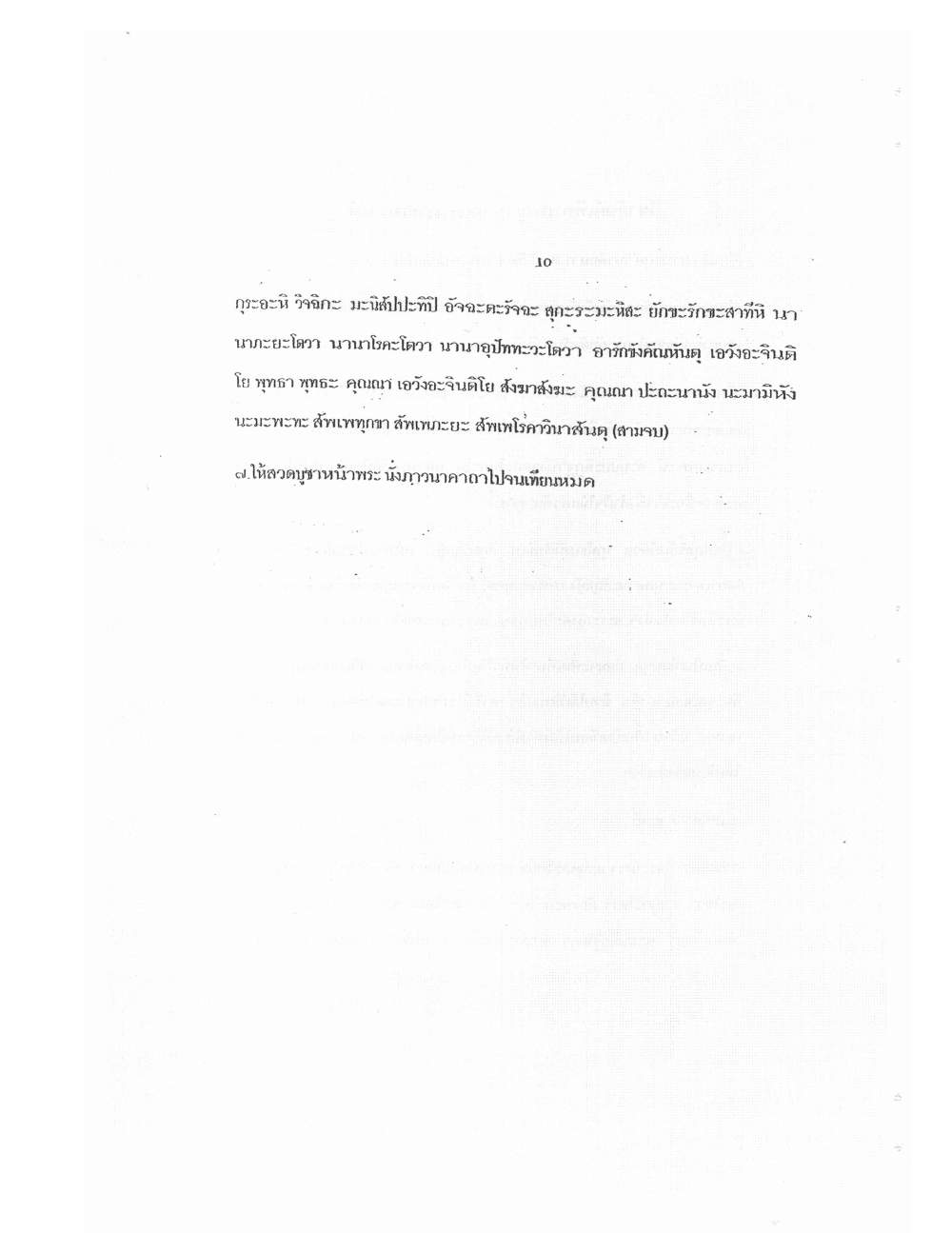
กะระอะหิ วิจฉิกะ มะนิสัปปะทีปิ อัจจะดะรัจจะ สุกะระมะหิสะ ยักขะรักขะสาทิหิ นานาภะยะโตวา นานาโรคะโตวา นานาอุปัทธะวะโตวา อารักขังคัณหันตุ เอวังอะจินติโย พุทธา พุทธะคุณณา เอวังอะจินติโย สังฆาสังฆะคุณณา ปะถะนานัง นะมามิหิงนะมะพะทะ สัพเพทุกขา สัพเพภะยะ สัพเพโรคาวินาสันตุ (สามจบ)
๗.ให้จุดบูชาหน้าพระ นั่งภาวนาคาถาไปจนเทียนหมด
[Continuing a protective mantra from the preceding page] ...scorpions, serpents, tigers and buffalo, yakkha and rakkhasa spirits, from every kind of danger, from every kind of illness, from every kind of calamity — may [the Triple Gem] hold and protect [us]. Thus by the inconceivable virtue of the Buddha, thus by the inconceivable virtue of the Sangha, [we] recite: may all suffering, all danger, all disease be destroyed. (Recite three times)
7. Light [the candle] in offering before the Buddha image; sit and recite the mantra until the candle burns out.
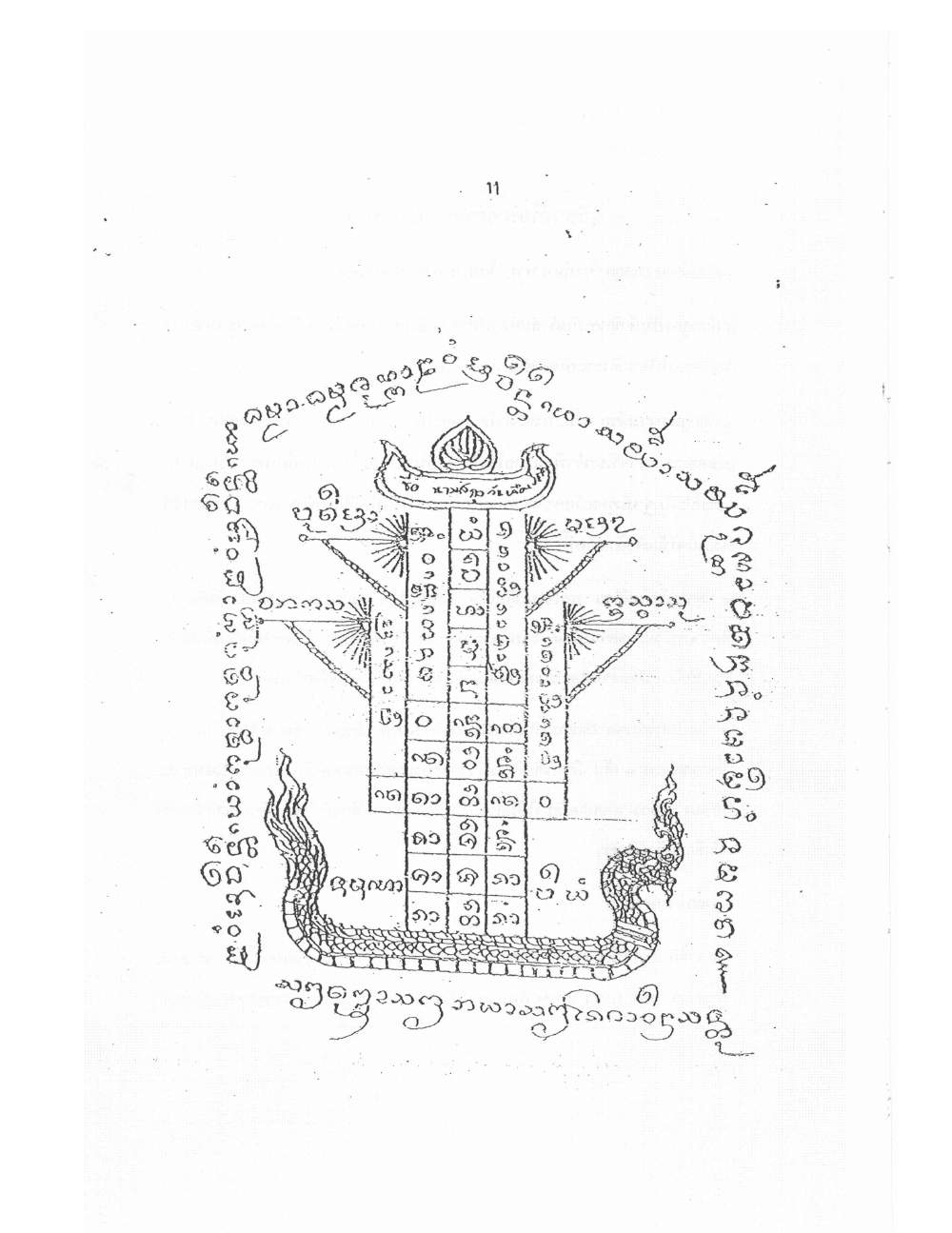
[อักษรธรรมล้านนาในยันต์ อ่านไม่ชัด]
[yantra: a tower of stacked rectangular panels filled with a grid of small squares, each holding a Khom/Lanna character; the tower is topped by a lotus-bud finial above a small cartouche bearing an illegible caption; four diagonal rays extend from the sides of the panels out to small roundels near the corners of the page; the tower rests on the coiled body of a naga, whose raised head and tail curve up on either side to form a boat-like base beneath it; the whole figure is encircled by a border of Lanna Tham script running around the edge of the page, illegible in detail]
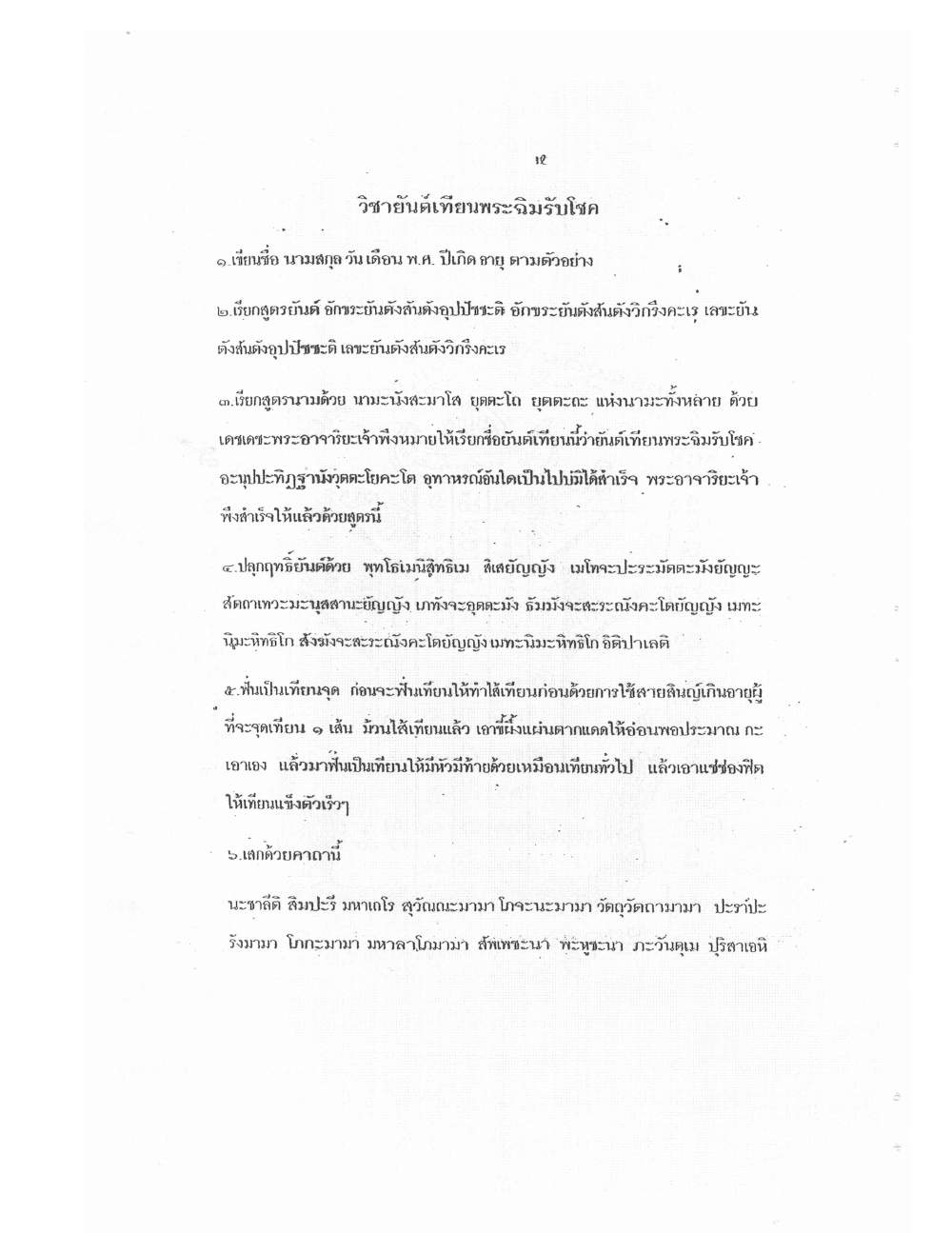
วิชายันต์เทียนพระฉิมรับโชค
๑.เขียนชื่อ นามสกุล วัน เดือน พ.ศ. ปีเกิด อายุ ตามตัวอย่าง
๒.เรียกสูตรยันต์ อักขระยันต์ตังสันตังอุปปาชะติ อักขระยันต์ตังสันตังวิกริงคะเร เลขะยันต์ตังสันตังอุปปาชะติ เลขะยันต์ตังสันตังวิกริงคะเร
๓.เรียกสูตรนามด้วย นามะนังสะมาโส ยุดตะโถ ยุดตะถะ แห่งนามะทั้งหลาย ด้วยเดชเดชะพระอาจาริยะเจ้า พึงหมายให้เรียกชื่อยันต์เทียนนี้ว่ายันต์เทียนพระฉิมรับโชค อะนุปะทิภฐานังวุดตะโยคะโต อุทาหรณ์อันใดเป็นไปมิได้สำเร็จ พระอาจาริยะเจ้าพึงสำเร็จให้แล้วด้วยสูตรนี้
๔.ปลุกฤทธิ์ยันต์ด้วย พุทโธเมนิสิทธิเม สิเสยัญญัง เมโทจะประระมัดตะมังยัญญะ สัตถาเทวะมะนุสสานะยัญญัง ภะทั้งจะอุดตะมัง ธัมมังจะสะระณังคะโตยัญญัง เมทะนิมะหิทธิโก สังฆังจะสะระณังคะโตยัญญัง เมทะนิมะหิทธิโก อิติปาเลติ
๕.ฟั่นเป็นเทียนจุด ก่อนจะฟั่นเทียนให้ทำไส้เทียนก่อนด้วยการใช้สายสิญจน์เกินอายุผู้ที่จะจุดเทียน ๑ เส้น ม้วนไส้เทียนแล้ว เอาขี้ผึ้งแผ่นตากแดดให้อ่อนพอประมาณ กะเอาเอง แล้วมาฟั่นเป็นเทียนให้มีหัวมีท้ายด้วยเหมือนเทียนทั่วไป แล้วเอาแซ่ช่องฟิดให้เทียนแข็งตัวเร็วๆ
๖.เสกด้วยคาถานี้
นะชาลิติ สิมประรี มหาเถโร สุวัณณะมามา โภคะนะมามา วัตถุวัตถามามา ปะรัปปะรังมามา โภกะมามา มหาลาโภมามา สัพเพชะนา พะหูชะนา ภะวันตุเม บุริสาเอนิ
The craft of the candle-yantra of Phra Chim, Receiver of Fortune
1. Write [your] given name, surname, day, month, year of birth (B.E.), and age, following the example.
2. Recite the yantra formula: a mantra invoking the yantra's characters and numbers to take effect, given (romanised) as 'akkhara-yantaṃ... uppajjati... vikiṇṇakāre... lekha-yantaṃ... uppajjati... vikiṇṇakāre.'
3. Also recite the naming formula: a formula for joining the practitioner's name to the charm ('nāmanaṅ samāso yuttatho yuttattha') for all names, by the power of the teacher-monk. This candle-yantra is to be understood and called 'the candle-yantra of Phra Chim, Receiver of Fortune.' [A further formula on establishing/empowering the charm follows.] Whatever example fails to succeed, the teacher-monk shall cause to succeed by means of this formula.
4. Awaken the power of the yantra with this mantra, invoking the Buddha as foremost teacher of gods and men, the Dhamma as refuge, and the Sangha as refuge, each said to bestow great power — 'Buddho me... iti pāleti' (thus he protects).
5. Roll [the wax] into a candle to be lit. Before rolling the candle, first make the wick using a length of sacred thread (sai sin) cut longer than the age of the person who will light the candle — one strand. After rolling the wick, take a sheet of beeswax, sun-dried until soft enough, by estimation, then roll it into a candle with a head and a tail like an ordinary candle. Then pass it briefly through a flame so the candle hardens quickly.
6. Consecrate with this mantra: 'Naḥ jālati... simaparī mahāthero...' [invoking a great elder monk associated with gold, wealth, and every kind of good, that all people, the many, may come to be for me] '...purisā eni [continues on the next page]'
เอหิสวาหุม องค์สีวลีราชา เอหิเมตตา เอหิกรุณา เอหิลาภา โภชะนะ โภชะนะ อิทัมปิยัง มะมะ อิตถีวา มนุสสจิตตัง ปิยังมะมะ ปิยาเทวา เอหิถะนัง ปิยังมะมะ (สามจบ)
๗.ให้จุดบูชาหน้าพระ นั่งภาวนาคาถาไปจนเทียนหมด
[Continuing the mantra from the previous page] ...come, by this power — O Lord Sivali! Come with loving-kindness, come with compassion, come with fortune, with food, with food; may this be dear to me. May the hearts of men and women be dear to me; may [all] the devas be dear to me; come, [grant] wealth; may [all] be dear to me. (Recite three times)
7. Light [the candle] in offering before the Buddha image; sit and recite the mantra until the candle burns out.
[อักษรธรรมล้านนาในยันต์ อ่านไม่ชัด]
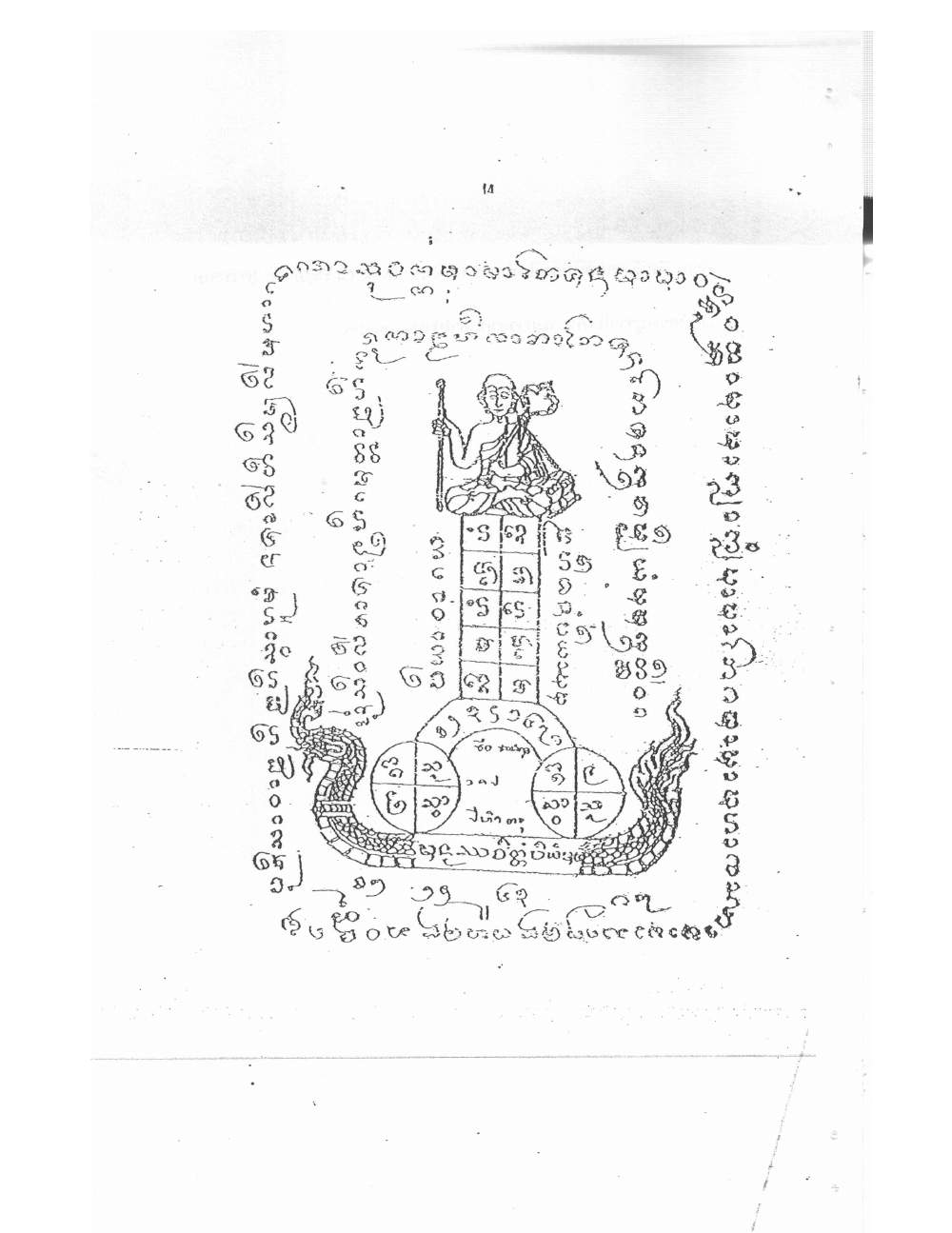
[yantra: a small seated figure — appearing to be an ascetic or teacher, holding a staff, with a second head or companion-animal beside him — sits atop a tower of grid cells filled with Khom characters; the tower rests on two circular roundels, each divided into four quadrants filled with characters, flanked by a pair of naga heads whose bodies curve around to form a boat-shaped base; a small cartouche between the two circles bears an illegible caption; the whole figure is bordered by a frame of Lanna Tham script running around the page, illegible in detail]
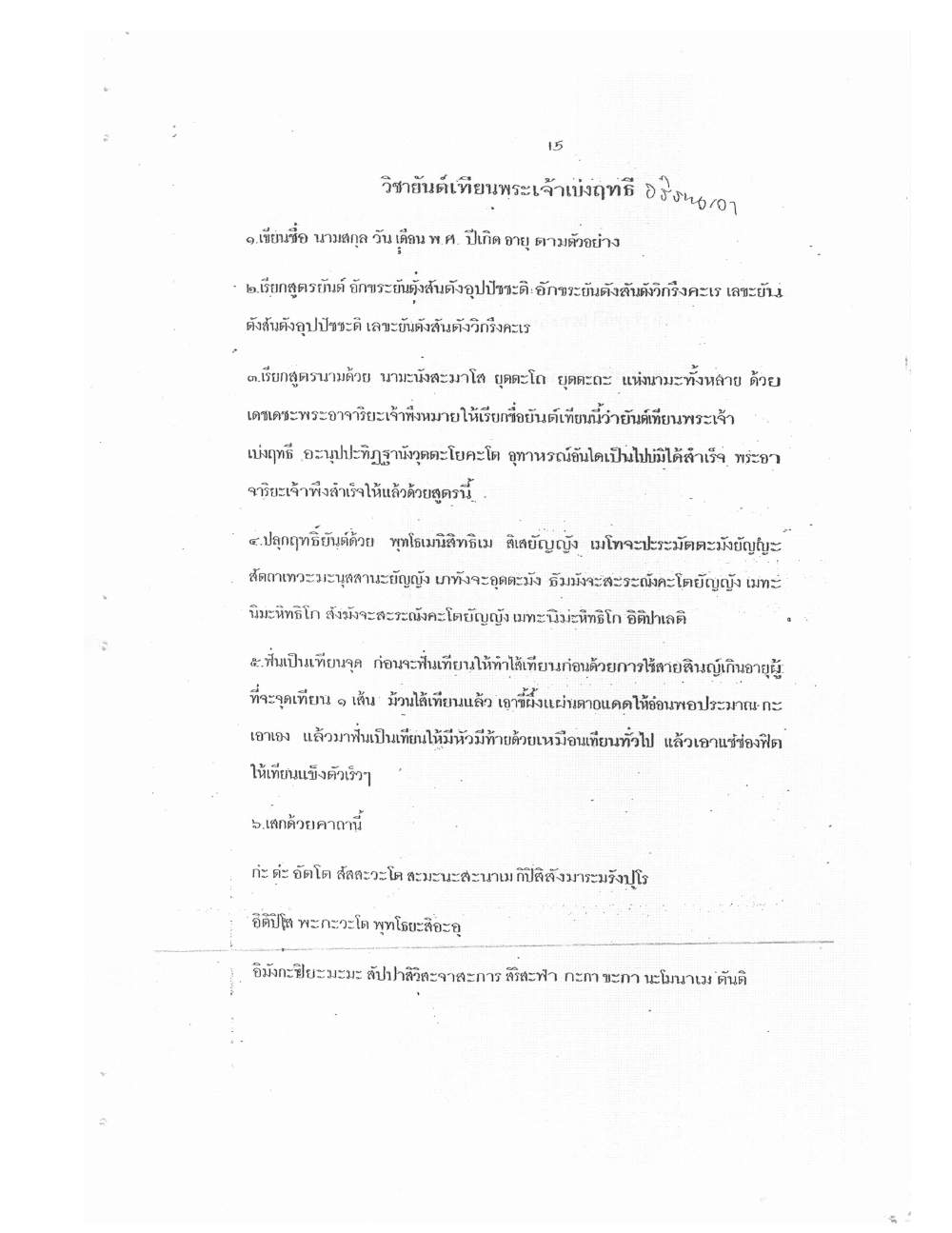
วิชายันต์เทียนพระเจ้าเบิ่งฤทธิ [ข้อความลายมือกำกับ อ่านไม่ชัด]
๑.เขียนชื่อ นามสกุล วัน เดือน พ.ศ. ปีเกิด อายุ ตามตัวอย่าง
๒.เรียกสูตรยันต์ อักขระยันต์ตังสันตังอุปปาชะติ อักขระยันต์ตังสันตังวิกริงคะเร เลขะยันต์ตังสันตังอุปปาชะติ เลขะยันต์ตังสันตังวิกริงคะเร
๓.เรียกสูตรนามด้วย นามะนังสะมาโส ยุดตะโถ ยุดตะถะ แห่งนามะทั้งหลาย ด้วยเดชเดชะพระอาจาริยะเจ้า พึงหมายให้เรียกชื่อยันต์เทียนนี้ว่ายันต์เทียนพระเจ้าเบิ่งฤทธิ อะนุปะทิภฐานังวุดตะโยคะโต อุทาหรณ์อันใดเป็นไปมิได้สำเร็จ พระอาจาริยะเจ้าพึงสำเร็จให้แล้วด้วยสูตรนี้
๔.ปลุกฤทธิ์ยันต์ด้วย พุทโธเมนิสิทธิเม สิเสยัญญัง เมโทจะประระมัดตะมังยัญญะ สัตถาเทวะมะนุสสานะยัญญัง ภะทั้งจะอุดตะมัง ธัมมังจะสะระณังคะโตยัญญัง เมทะนิมะหิทธิโก สังฆังจะสะระณังคะโตยัญญัง เมทะนิมะหิทธิโก อิติปาเลติ
๕.ฟั่นเป็นเทียนจุด ก่อนจะฟั่นเทียนให้ทำไส้เทียนก่อนด้วยการใช้สายสิญจน์เกินอายุผู้ที่จะจุดเทียน ๑ เส้น ม้วนไส้เทียนแล้ว เอาขี้ผึ้งแผ่นตากแดดให้อ่อนพอประมาณ กะเอาเอง แล้วมาฟั่นเป็นเทียนให้มีหัวมีท้ายด้วยเหมือนเทียนทั่วไป แล้วเอาแซ่ช่องฟิดให้เทียนแข็งตัวเร็วๆ
๖.เสกด้วยคาถานี้
กะต่ะ อัดโต สัลตะวะโต สะมะนะสะนาเม กิปิลิสังมาระมังปูโร
อิติปิโส พะกะวะโต พุทโธยะสิอะอุ
อิมังกะฉิยะมะมะ ลัปปาลิวิตะจาสะการ สิริสะฟา กะกา ขะกา นะโมนาเม ตันติ
The craft of the candle-yantra of the Lord Beholding Power (Phra Chao Berng Rit) [handwritten marginal note beside the heading, illegible]
1. Write [your] given name, surname, day, month, year of birth (B.E.), and age, following the example.
2. Recite the yantra formula: [the same mantra as before, invoking the yantra's characters and numbers to take effect].
3. Also recite the naming formula: [the same formula as before, binding the practitioner's name to the charm] by the power of the teacher-monk. This candle-yantra is to be understood and called 'the candle-yantra of the Lord Beholding Power.' Whatever example fails to succeed, the teacher-monk shall cause to succeed by means of this formula.
4. Awaken the power of the yantra with [the same mantra as before, invoking the Buddha, Dhamma, and Sangha as refuges of great power] '...iti pāleti.'
5. Roll [the wax] into a candle to be lit — [the same procedure as before: making the wick from sacred thread cut to the practitioner's age, rolling in sun-softened beeswax, shaping a head and tail, then passing it briefly through a flame to harden it quickly].
6. Consecrate with this mantra, given (romanised) as: 'Kata addho... salatavato samanasaname kipilisaṅ māra maṅ pūro. Iti pi so bhagavato Buddho yasi a u. Imaṅ ka chiya mama... lappālivitacasakāra sirisapha kakā khakā namo nāme tanti' [continues on the next page].
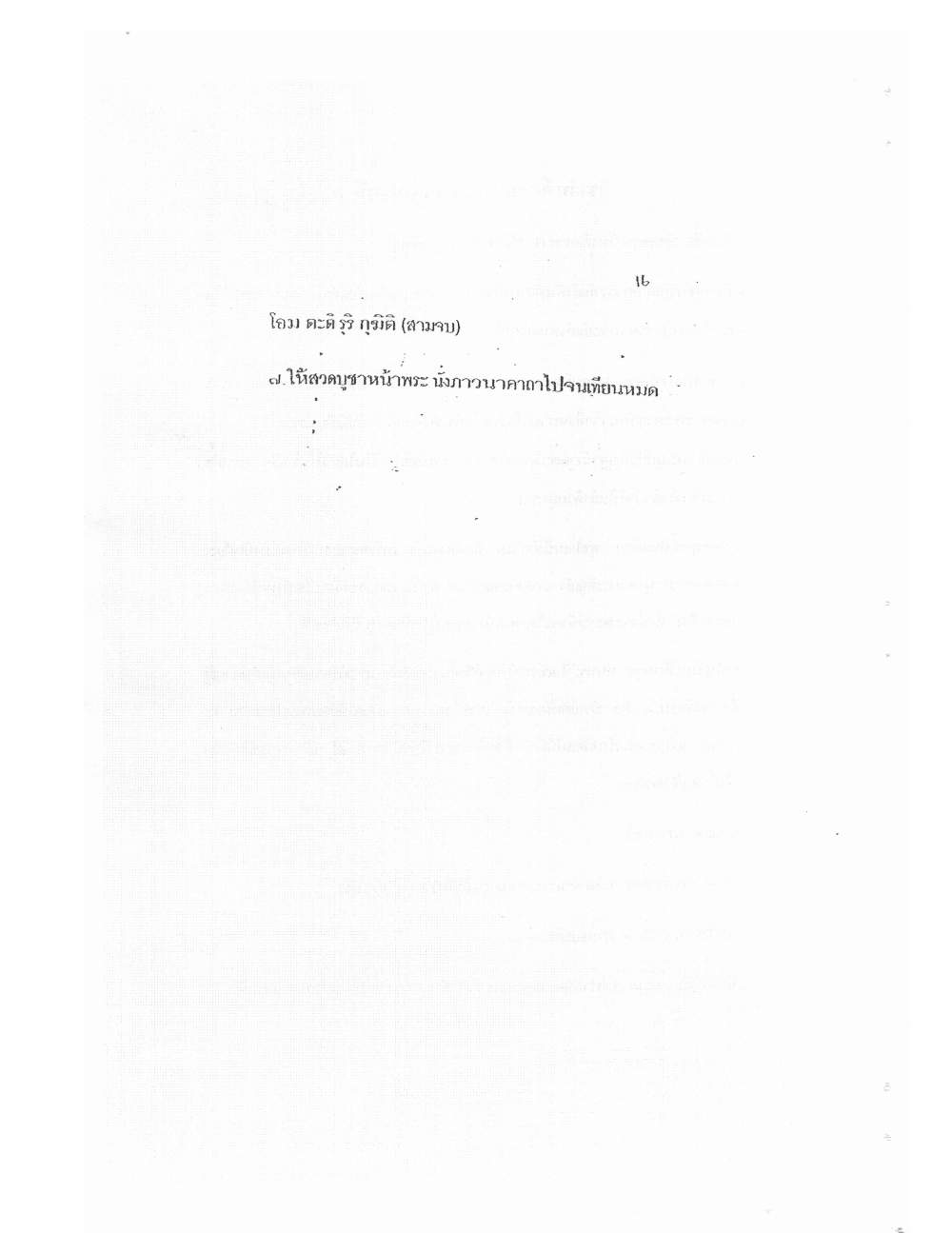
โอม ตะติรุริ กุมิติ (สามจบ)
๗.ให้จุดบูชาหน้าพระ นั่งภาวนาคาถาไปจนเทียนหมด
[Concluding the mantra from the previous page] Om tatiruri kumiti. (Recite three times)
7. Light [the candle] in offering before the Buddha image; sit and recite the mantra until the candle burns out.
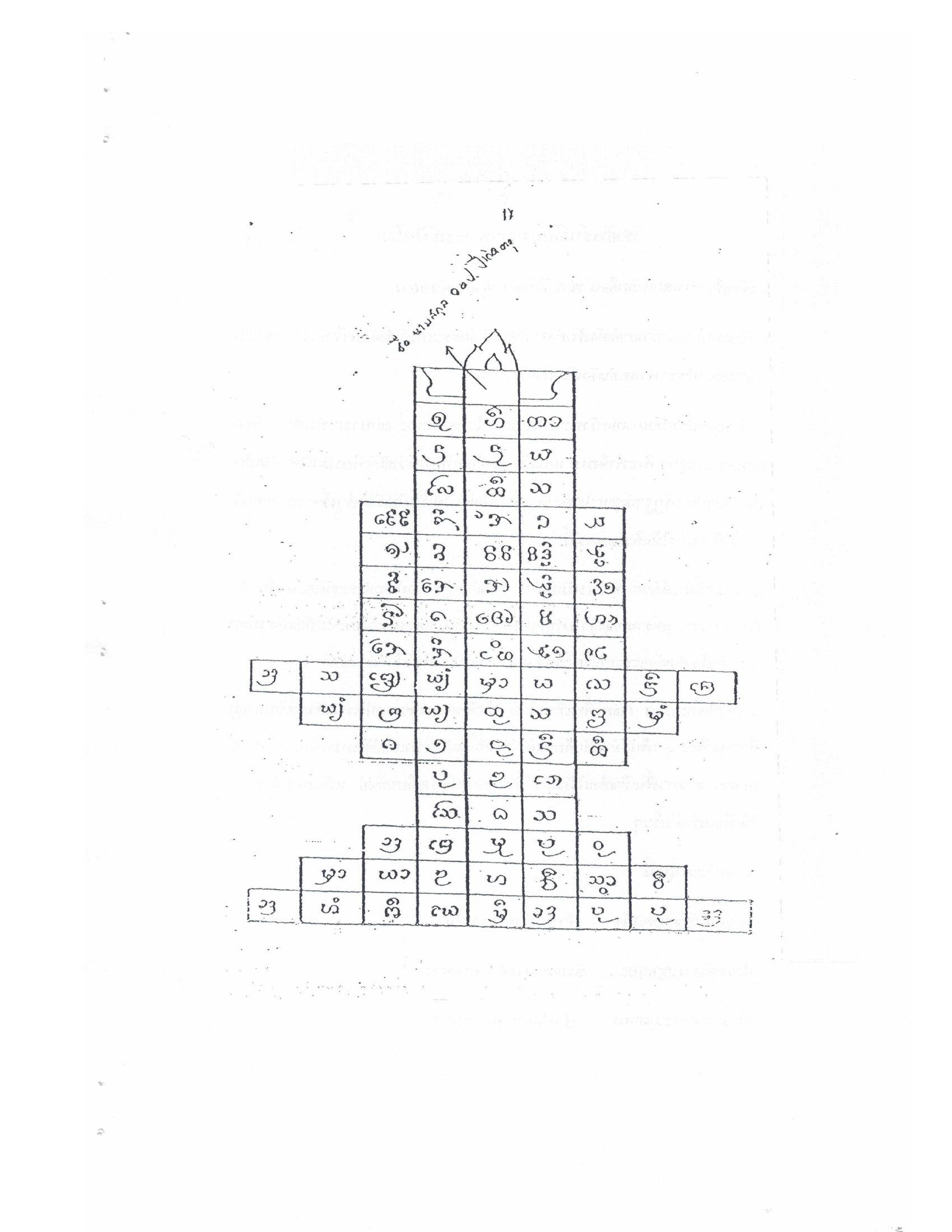
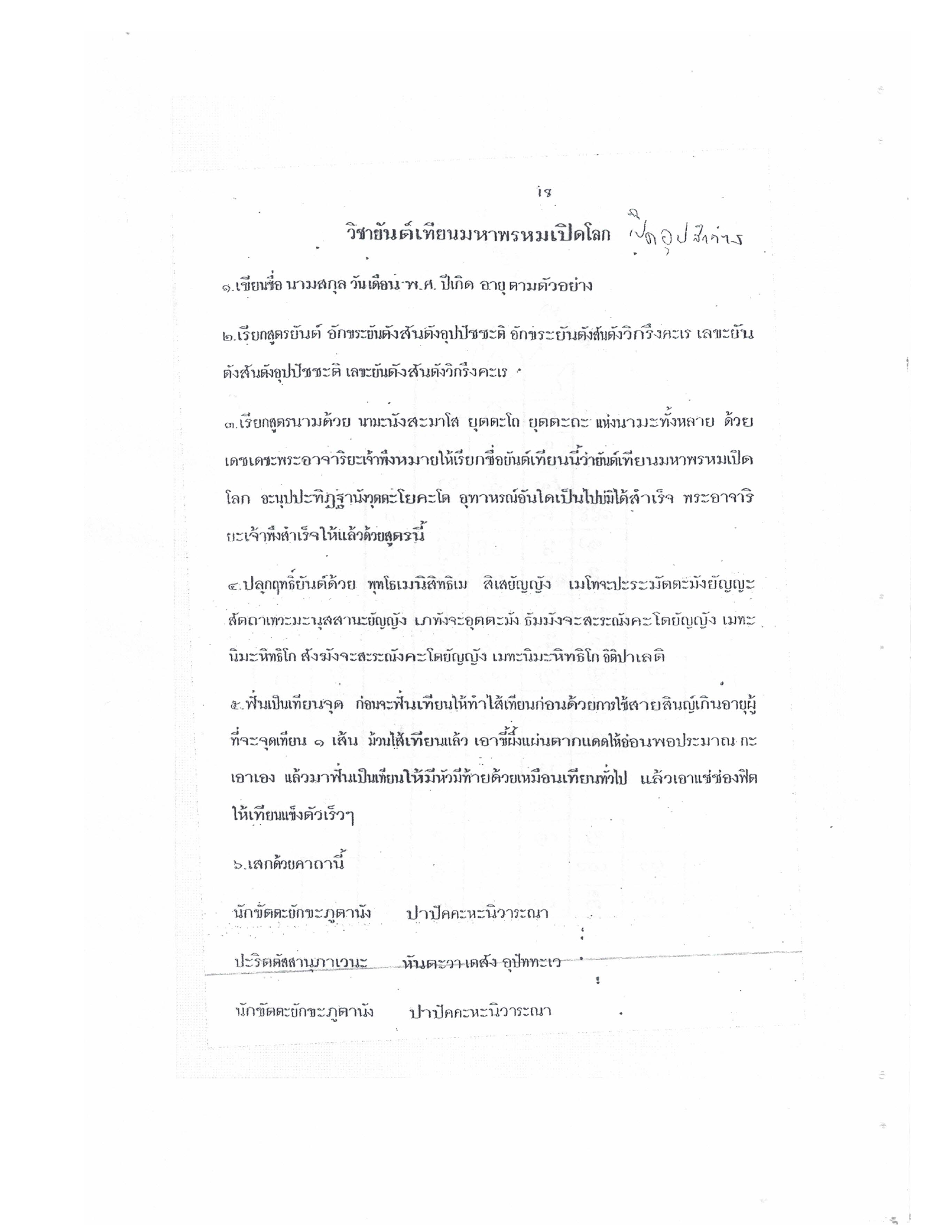
วิชายันต์เทียนมหาพรหมเปิดโลก [ข้อความลายมือกำกับ อ่านไม่ชัด]
๑.เขียนชื่อ นามสกุล วัน เดือน พ.ศ. ปีเกิด อายุ ตามตัวอย่าง
๒.เรียกสูตรยันต์ อักขระยันต์ตังสันตังอุปปาชะติ อักขระยันต์ตังสันตังวิกริงคะเร เลขะยันต์ตังสันตังอุปปาชะติ เลขะยันต์ตังสันตังวิกริงคะเร
๓.เรียกสูตรนามด้วย นามะนังสะมาโส ยุดตะโถ ยุดตะถะ แห่งนามะทั้งหลาย ด้วยเดชเดชะพระอาจาริยะเจ้า พึงหมายให้เรียกชื่อยันต์เทียนนี้ว่ายันต์เทียนมหาพรหมเปิดโลก อะนุปะทิภฐานังวุดตะโยคะโต อุทาหรณ์อันใดเป็นไปมิได้สำเร็จ พระอาจาริยะเจ้าพึงสำเร็จให้แล้วด้วยสูตรนี้
๔.ปลุกฤทธิ์ยันต์ด้วย พุทโธเมนิสิทธิเม สิเสยัญญัง เมโทจะประระมัดตะมังยัญญะ สัตถาเทวะมะนุสสานะยัญญัง ภะทั้งจะอุดตะมัง ธัมมังจะสะระณังคะโตยัญญัง เมทะนิมะหิทธิโก สังฆังจะสะระณังคะโตยัญญัง เมทะนิมะหิทธิโก อิติปาเลติ
๕.ฟั่นเป็นเทียนจุด ก่อนจะฟั่นเทียนให้ทำไส้เทียนก่อนด้วยการใช้สายสิญจน์เกินอายุผู้ที่จะจุดเทียน ๑ เส้น ม้วนไส้เทียนแล้ว เอาขี้ผึ้งแผ่นตากแดดให้อ่อนพอประมาณ กะเอาเอง แล้วมาฟั่นเป็นเทียนให้มีหัวมีท้ายด้วยเหมือนเทียนทั่วไป แล้วเอาแซ่ช่องฟิดให้เทียนแข็งตัวเร็วๆ
๖.เสกด้วยคาถานี้
นักขัตตะยักขะภูตานัง ปาปัคคะหะนิวาระณา ประวิตตัสสานุภาเวนะ หันตะวาเดสัง อุปัททะเว
นักขัตตะยักขะภูตานัง ปาปัคคะหะนิวาระณา
The craft of the candle-yantra of Maha Brahma Opening the World [handwritten marginal note beside the heading, illegible]
1. Write [your] given name, surname, day, month, year of birth (B.E.), and age, following the example.
2. Recite the yantra formula: [the same mantra as before, invoking the yantra's characters and numbers to take effect].
3. Also recite the naming formula: [the same formula as before, binding the practitioner's name to the charm] by the power of the teacher-monk. This candle-yantra is to be understood and called 'the candle-yantra of Maha Brahma Opening the World.' Whatever example fails to succeed, the teacher-monk shall cause to succeed by means of this formula.
4. Awaken the power of the yantra with [the same mantra as before, invoking the Buddha, Dhamma, and Sangha as refuges of great power] '...iti pāleti.'
5. Roll [the wax] into a candle to be lit — [the same procedure as before].
6. Consecrate with this mantra, the opening lines of a paritta-style verse invoking protection: warding off evil planets, spirit-seizures and possessions; by the power of that blessing, may it destroy calamities in the land. [Repeated:] warding off evil planets, spirit-seizures and possessions [continues on the next page].
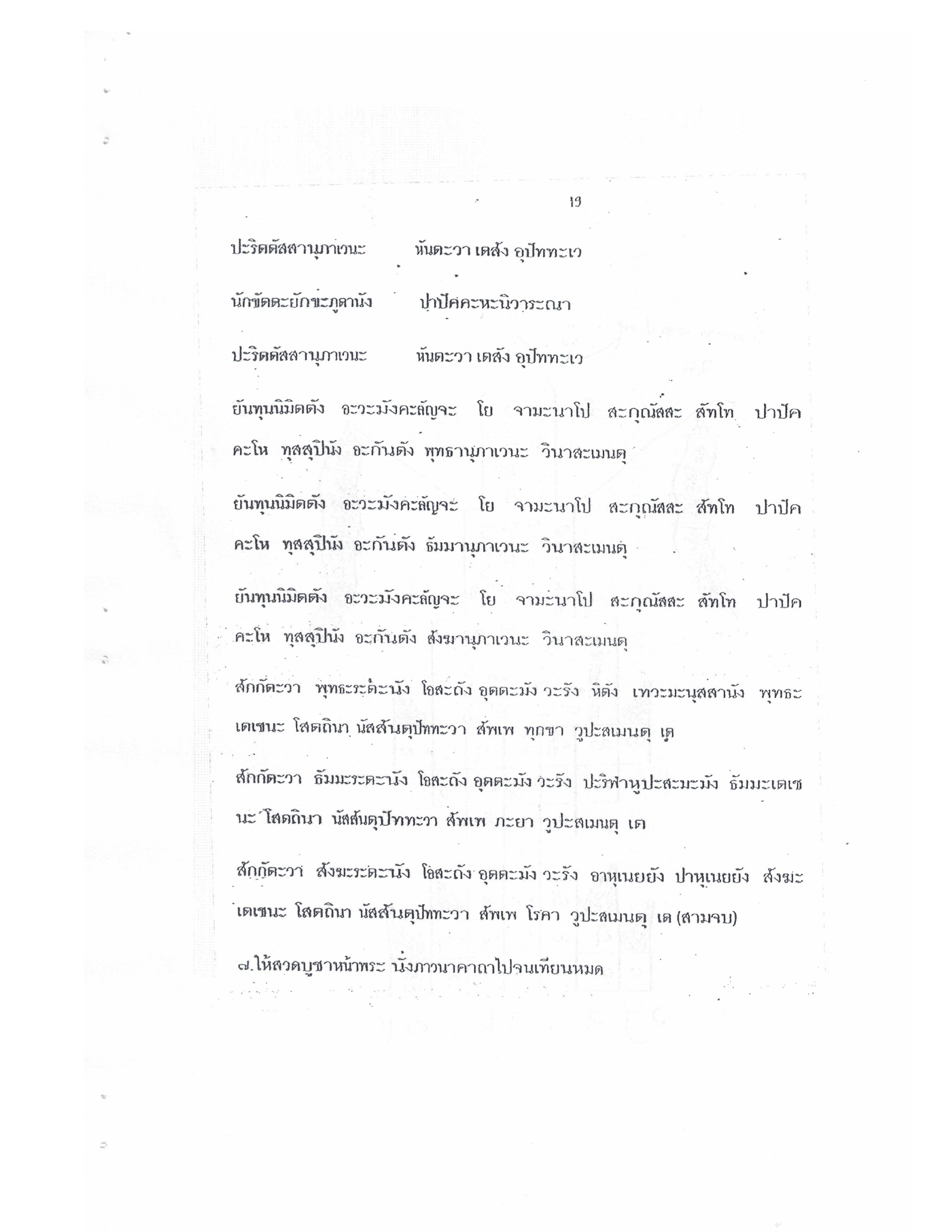
ประวิตตัสสานุภาเวนะ หันตะวาเดสัง อุปัททะเว
นักขัตตะยักขะภูตานัง ปาปัคคะหะนิวาระณา ประวิตตัสสานุภาเวนะ หันตะวาเดสัง อุปัททะเว
ยันตุนิมิตตัง อะวะมังคะลัญจะ โยจามะนาโป สะกุณัสสะสัทโท ปาปัคคะโห ทุสสุปินัง อะกันตัง พุทธานุภาเวนะ วินาสะเมนตุ
ยันตุนิมิตตัง อะวะมังคะลัญจะ โยจามะนาโป สะกุณัสสะสัทโท ปาปัคคะโห ทุสสุปินัง อะกันตัง ธัมมานุภาเวนะ วินาสะเมนตุ
ยันตุนิมิตตัง อะวะมังคะลัญจะ โยจามะนาโป สะกุณัสสะสัทโท ปาปัคคะโห ทุสสุปินัง อะกันตัง สังฆานุภาเวนะ วินาสะเมนตุ
สักกัตวา พุทธะระตะนัง โอสะถัง อุตตะมัง วะรัง หิตัง เทวะมะนุสสานัง พุทธะเตเชนะ โสตถินา นัสสันตุปัททะวา สัพเพ ทุกขา วูปะสะเมนตุ เต
สักกัตวา ธัมมะระตะนัง โอสะถัง อุตตะมัง วะรัง ปะริฬาหูปะสะมะนัง ธัมมะเตเชนะ โสตถินา นัสสันตุปัททะวา สัพเพ ภะยา วูปะสะเมนตุ เต
สักกัตวา สังฆะระตะนัง โอสะถัง อุตตะมัง วะรัง อาหุเนยยัง ปาหุเนยยัง สังฆะเตเชนะ โสตถินา นัสสันตุปัททะวา สัพเพ โรคา วูปะสะเมนตุ เต (สามจบ)
๗.ให้จุดบูชาหน้าพระ นั่งภาวนาคาถาไปจนเทียนหมด
[Continuing the mantra from the previous page] ...by the power of that blessing, may it destroy calamities in the land. Warding off evil planets, spirit-seizures, and possessions, by the power of that blessing, may it destroy calamities in the land.
May every bad omen, every unpleasant bird-cry, every evil-planet affliction, every unwanted bad dream be destroyed by the power of the Buddha.
May every bad omen, every unpleasant bird-cry, every evil-planet affliction, every unwanted bad dream be destroyed by the power of the Dhamma.
May every bad omen, every unpleasant bird-cry, every evil-planet affliction, every unwanted bad dream be destroyed by the power of the Sangha.
Having honoured the Jewel of the Buddha — the excellent, supreme medicine, beneficial to gods and to men — by the radiance of the Buddha, in well-being, may all calamities be destroyed; may all sufferings be calmed for them.
Having honoured the Jewel of the Dhamma — the excellent, supreme medicine that calms fever and distress — by the radiance of the Dhamma, in well-being, may all calamities be destroyed; may all dangers be calmed for them.
Having honoured the Jewel of the Sangha — the excellent, supreme [field of merit], worthy of offerings, worthy of hospitality — by the radiance of the Sangha, in well-being, may all calamities be destroyed; may all diseases be calmed for them. (Recite three times)
7. Light [the candle] in offering before the Buddha image; sit and recite the mantra until the candle burns out.
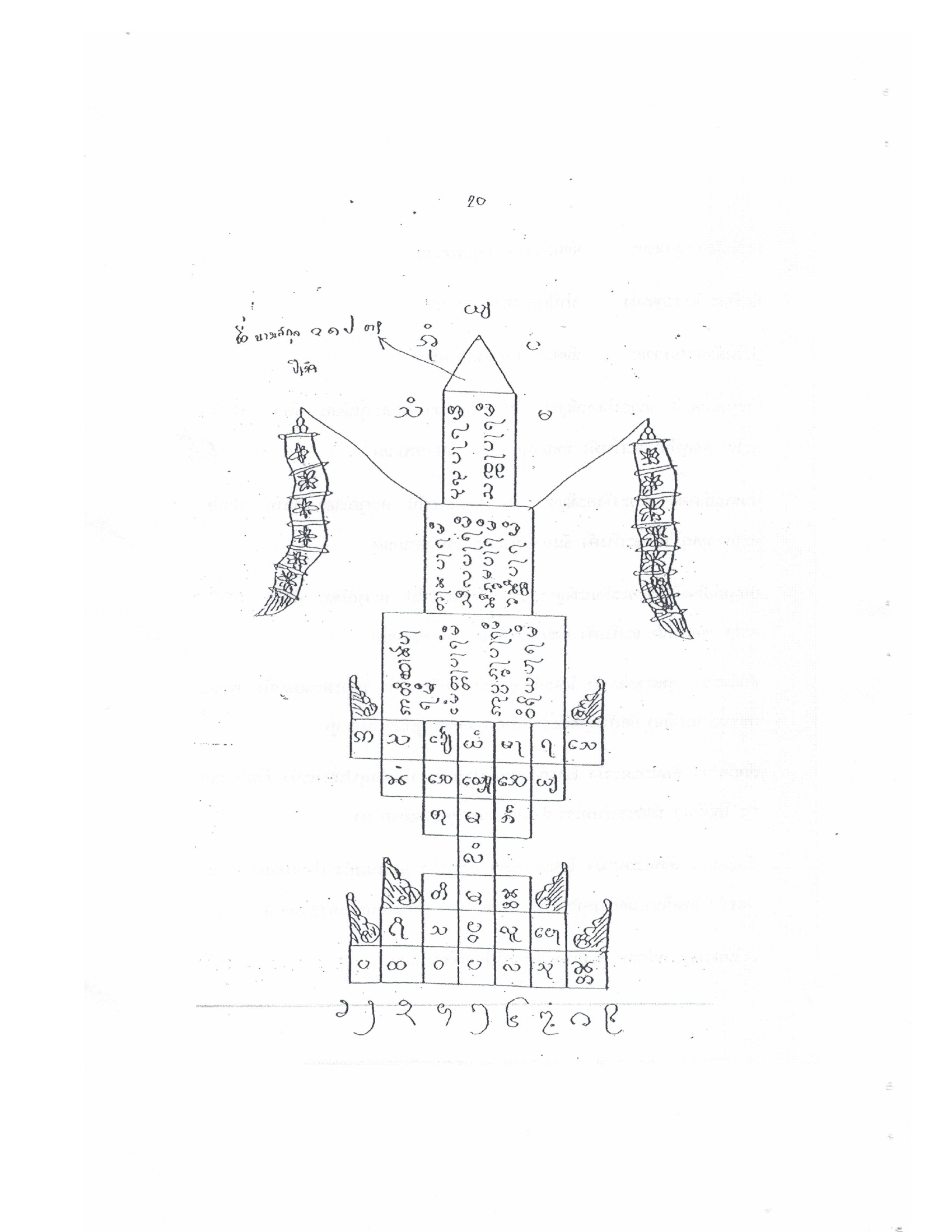
ปิด [อักษรธรรมล้านนาและอักขระขอมในยันต์ อ่านไม่ชัด]
[yantra: a peaked, obelisk-like tower divided into three stacked tiers of grid cells filled with Khom characters, topped with a triangular finial; two curling ribbon-like banners flank the upper tier; the lower, wider tier sits on a stepped base with flame-shaped corner flourishes and a row of numerals along the bottom edge; a handwritten marginal note reading "ปิด" (seal/close) appears at the left, with an arrow pointing into the figure and a smaller, illegible annotation beside it]
วิชายันต์เทียนพระเจ้าน้าวริพล [ลายมือกำกับข้างชื่อบท อ่านไม่ชัด]
1.เขียนชื่อ นามสกุล วัน เดือน พ.ศ. ปีเกิด อายุ ตามตัวอย่าง
2.เรียกสูตรยันต์ อักขระยันต์ดังสั้นดังอุปปัชชะติ อักขระยันต์ดังสั้นดังวิกรึงคะเร เลขยันต์ดังสั้นดังอุปปัชชะติ เลขยันต์ดังสั้นดังวิกรึงคะเร
3.เรียกสูตรนามด้วย นามะนังสะมาโส ยุดตะโถ ยุดตะถะ แห่งนามะทั้งหลาย ด้วยเดชเดชะพระอาจาริยะเจ้าพึงหมายให้เรียกชื่อยันต์เทียนนี้ว่ายันต์เทียนพระเจ้าน้าวริพล อะนุปะทิฏฐานังวุตตะโยคะโต อุทาหรณ์อันใดเป็นไปม่ได้สำเร็จ พระอาจาริยะเจ้าพึงสำเร็จให้แล้วด้วยสูตรนี้
4.ปลุกฤทธิ์ยันต์ด้วย พุทโธเมนิสิทธิเม สิเสยัญญัง เมโทจะประมัดตะมังยัญญะ สัตถาเทวะมะนุสสานะยัญญัง ภาทั้งจะอุตตะมัง ธัมมังจะสระณังคะโดยัญญัง เมทะนิมะหิทธิโก สังฆังจะสระณังคะโดยัญญัง เมทะนิมะหิทธิโก อิติปาเลติ
5.ฟั่นเป็นเทียนจุด ก่อนจะฟั่นเทียนให้ทำไส้เทียนก่อนด้วยการใช้สายสินญ์เกินอายุผู้ที่จะจุดเทียน 1 เส้น ม้วนไส้เทียนแล้ว เอาขี้ผึ้งแผ่นตากแดดให้อ่อนพอประมาณ กะเอาเอง แล้วมาฟั่นเป็นเทียนให้มีหัวมีท้ายด้วยเหมือนเทียนทั่วไป แล้วเอาแช่ช่องฟิตให้เทียนแข็งตัวเร็วๆ
6.เสกด้วยคาถานี้
เอวัง อะจินติยา พุทธา พุทธะ คุณณา อะจินติยา อะจินติเย ปะสันนามัง วิปาโกโนคุ อะจินติโย โอมจิตตัง มหาจิตตัง เอหิเศรษฐีจิตตังวา มนุสสานัง ปิยังพันธัง ปิยังมะยะ อิตถีจิตตัง ปุริโสจิตตัง จิตติ มิตติ มุตติ มัตติ
Manual for the "Lord Nawarippon" Candle Yantra [a handwritten note beside the title, illegible]
1. Write [the practitioner's] first name, surname, day, month, Buddhist-Era year of birth, and age, following the example.
2. Recite the yantra formula: "the yantra letters are as short as arising" (akkhara yan dang san dang uppajjati), "the yantra letters are as short as a moment" (akkhara yan dang san dang wikarungkhare), "the yantra numbers are as short as arising," "the yantra numbers are as short as a moment."
3. Recite the name-formula together with "namo nang samaso yutto tho yutto tha" of all names, so that — by the power and majesty of the teacher-master — this candle yantra shall be named the "Lord Nawarippon Candle Yantra." [Pali, romanised as printed:] anupatitthanang vutta-yokato — whatever example has not yet succeeded, the teacher-master shall cause it to succeed by means of this formula.
4. Awaken the power of the yantra with [Pali gloss, romanised as printed:] "Buddho me nisiddhi me, si se yanyang, medo ja pramat tamang yanya, sattha deva manussana yanyang, pha thang ja uttamang, thammang ja sara nang khado yanyang, metha nima hitthiko, sangkhang ja sara nang khado yanyang, metha nima hitthiko iti paleti."
5. Twist [the wax] into a candle to be lit. Before twisting the candle, first make the wick using a length of sacred thread longer than the age of the person who will light the candle — one strand. Roll the wick, then take a thin sheet of beeswax, sun-dried until soft enough to work by feel. Then twist it into a candle with a proper head and tail like an ordinary candle, and dip it into a chilled space so the candle hardens quickly.
6. Consecrate with this incantation:
[Pali/incantation, romanised as printed:] "Evang ajintiya buddha buddha khunna ajintiya ajintiye pasannamang wipako noku ajintiyo, om jittang maha jittang ehi setthi jittang wa manussanang piyang phanthang piyang maya itthi jittang purisa jittang jitti mitti mutti matti."

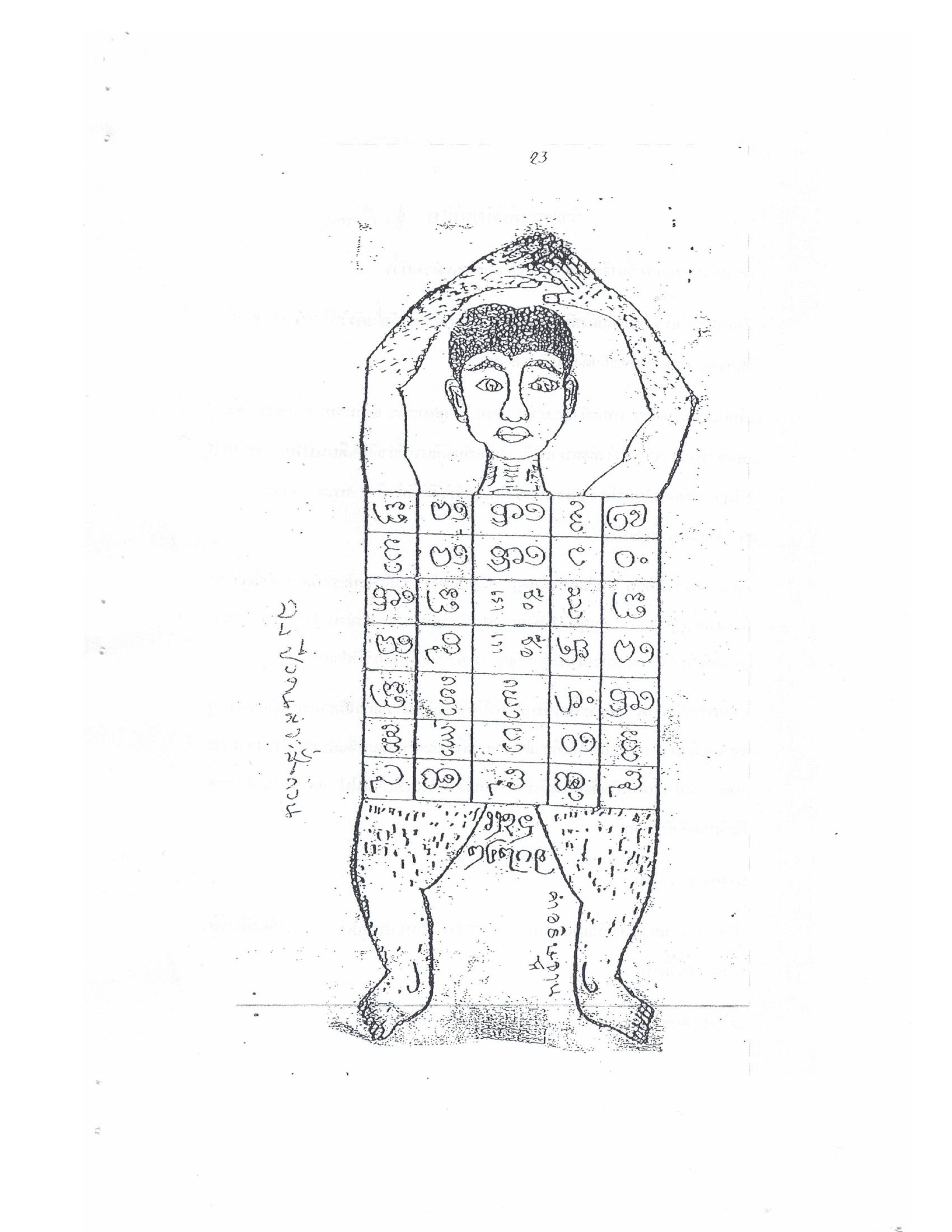
[ยันต์รูปคนยกมือทั้งสองขึ้นประสานเหนือศีรษะ ลำตัวแบ่งเป็นตาราง 6 แถว 5 ช่อง มีอักขระในแต่ละช่อง] [อักขระในตารางอ่านไม่ชัด] [อักษรกำกับแนวตั้งด้านซ้ายของภาพ อ่านไม่ชัด] [อักขระที่ขาทั้งสองข้าง อ่านไม่ชัด]
[yantra: a standing human figure with both arms raised and hands joined above the head; the torso is divided into a grid of six rows by five columns, each cell filled with characters; the characters inside the grid are illegible; a caption running vertically down the left margin of the figure is illegible; further characters running down each leg are illegible]
7.ให้สวดบูชาหน้าพระ นั่งภาวนาคาถาไปจนเทียนหมด
7. Chant in homage before the Buddha image; sit and recite the incantation until the candle burns out. [The rest of the page is otherwise blank; a faint ghost image of a figure and grid, bleeding through from the facing page, is visible but is not printed content of this page.]
[ยันต์รูปวงกลมด้านบนมีอักขระ 1 ตัว เชื่อมด้วยเส้นลงมาเป็นรูปสี่เหลี่ยมขนมเปียกปูนต่อกัน 6 ชั้น แต่ละชั้นมีอักขระที่มุมและกำกับด้วยตัวอักษรทั้งสองข้าง] [อักขระที่มุมและกำกับสองข้างของแต่ละชั้น อ่านไม่ชัด] [ด้านล่างเป็นกรอบสี่เหลี่ยมผืนผ้า ภายในมีรูปสี่เหลี่ยมขนมเปียกปูนซ้อนอยู่ มีลายมือเขียนกำกับภายใน] [ลายมือภายในกรอบล่าง อ่านไม่ชัด] [แถวตัวเลขกำกับใต้กรอบ อ่านไม่ชัด]
[yantra: a circle at the top containing a single character, linked by a line descending through a chain of six diamond shapes; each diamond is marked with characters at its corners and flanked by further characters on either side — these corner and side characters are illegible; below, a rectangular frame encloses a diamond shape with a handwritten caption inside, which is illegible; a row of numerals runs beneath the frame, also illegible]
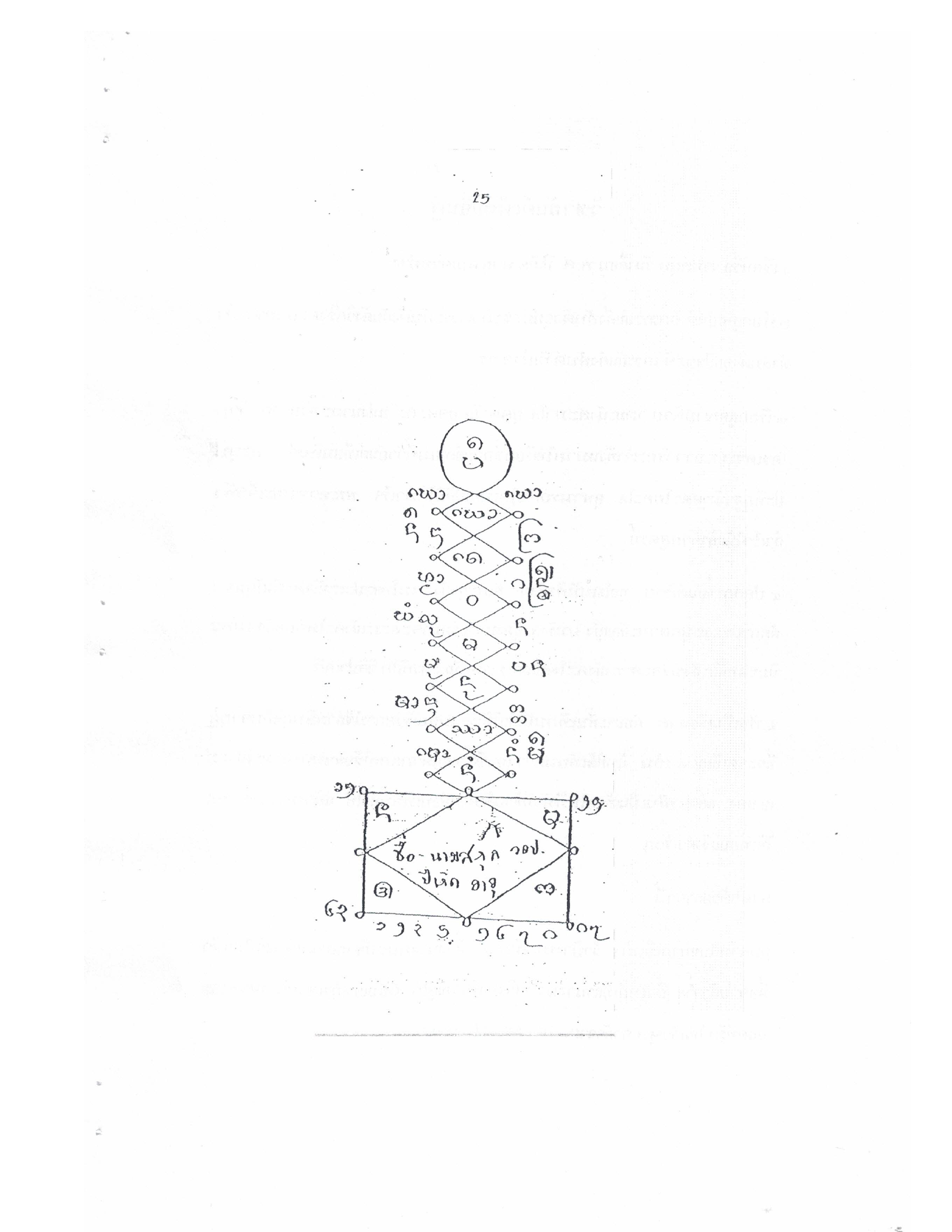
วิชายันต์เทียนปิโย [ลายมือกำกับข้างชื่อบท อ่านไม่ชัด]
1.เขียนชื่อ นามสกุล วัน เดือน พ.ศ. ปีเกิด อายุ ตามตัวอย่าง
2.เรียกสูตรยันต์ อักขระยันต์ดังสั้นดังอุปปัชชะติ อักขระยันต์ดังสั้นดังวิกรึงคะเร เลขยันต์ดังสั้นดังอุปปัชชะติ เลขยันต์ดังสั้นดังวิกรึงคะเร
3.เรียกสูตรนามด้วย นามะนังสะมาโส ยุดตะโถ ยุดตะถะ แห่งนามะทั้งหลาย ด้วยเดชเดชะพระอาจาริยะเจ้าพึงหมายให้เรียกชื่อยันต์เทียนนี้ว่ายันต์เทียนปิโย อะนุปะทิฏฐานังวุตตะโยคะโต อุทาหรณ์อันใดเป็นไปม่ได้สำเร็จ พระอาจาริยะเจ้าพึงสำเร็จให้แล้วด้วยสูตรนี้
4.ปลุกฤทธิ์ยันต์ด้วย พุทโธเมนิสิทธิเม สิเสยัญญัง เมโทจะประมัดตะมังยัญญะ สัตถาเทวะมะนุสสานะยัญญัง ภาทั้งจะอุตตะมัง ธัมมังจะสระณังคะโดยัญญัง เมทะนิมะหิทธิโก สังฆังจะสระณังคะโดยัญญัง เมทะนิมะหิทธิโก อิติปาเลติ
5.ฟั่นเป็นเทียนจุด ก่อนจะฟั่นเทียนให้ทำไส้เทียนก่อนด้วยการใช้สายสินญ์เกินอายุผู้ที่จะจุดเทียน 1 เส้น ม้วนไส้เทียนแล้ว เอาขี้ผึ้งแผ่นตากแดดให้อ่อนพอประมาณ กะเอาเอง แล้วมาฟั่นเป็นเทียนให้มีหัวมีท้ายด้วยเหมือนเทียนทั่วไป แล้วเอาแช่ช่องฟิตให้เทียนแข็งตัวเร็วๆ
6.เสกด้วยคาถานี้
ปิโยเทวะมะนุสสานัง ปิโยพรหมมานะมุดตะโม ปิโยนาคะสุปันนานัง ปิณินทรียังนะ มามิหัง (สามจบ)
8.ให้สวดบูชาหน้าพระ นั่งภาวนาคาถาไปจนเทียนหมด
Manual for the "Piyo" (Beloved) Candle Yantra [a handwritten note beside the title, illegible]
1. Write [the practitioner's] first name, surname, day, month, Buddhist-Era year of birth, and age, following the example.
2. Recite the yantra formula: "the yantra letters are as short as arising," "the yantra letters are as short as a moment," "the yantra numbers are as short as arising," "the yantra numbers are as short as a moment."
3. Recite the name-formula together with "namo nang samaso yutto tho yutto tha" of all names, so that — by the power and majesty of the teacher-master — this candle yantra shall be named the "Piyo Candle Yantra." [Pali, romanised as printed:] anupatitthanang vutta-yokato — whatever example has not yet succeeded, the teacher-master shall cause it to succeed by means of this formula.
4. Awaken the power of the yantra with [Pali gloss, romanised as printed:] "Buddho me nisiddhi me, si se yanyang, medo ja pramat tamang yanya, sattha deva manussana yanyang, pha thang ja uttamang, thammang ja sara nang khado yanyang, metha nima hitthiko, sangkhang ja sara nang khado yanyang, metha nima hitthiko iti paleti."
5. Twist [the wax] into a candle to be lit. Before twisting the candle, first make the wick using a length of sacred thread longer than the age of the person who will light the candle — one strand. Roll the wick, then take a thin sheet of beeswax, sun-dried until soft enough to work by feel. Then twist it into a candle with a proper head and tail like an ordinary candle, and dip it into a chilled space so the candle hardens quickly.
6. Consecrate with this incantation:
[Pali, romanised as printed:] "Piyo deva manussanang, piyo phrommana muttamo, piyo naka supannanang, pininthariyang na, mamihang." (Repeat three times.)
8. Chant in homage before the Buddha image; sit and recite the incantation until the candle burns out.
[Note: as printed, the item numbering skips directly from 6 to 8; no item 7 appears on this page.]
7.ให้สวดบูชาหน้าพระ นั่งภาวนาคาถาไปจนเทียนหมด
7. Chant in homage before the Buddha image; sit and recite the incantation until the candle burns out. [The rest of the page is otherwise blank; a faint ghost image, bleeding through from the facing page, is visible but is not printed content of this page.]

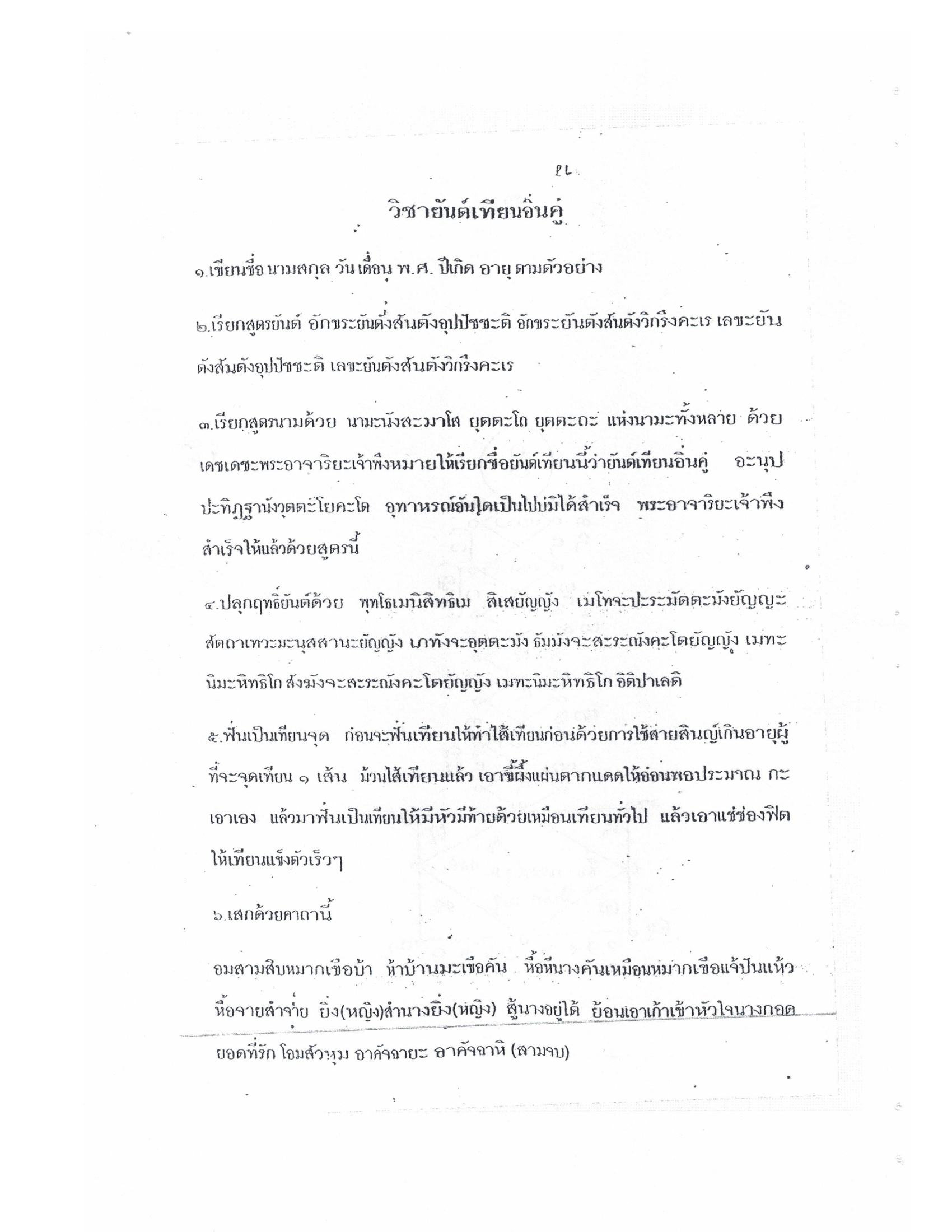
วิชายันต์เทียนอิ่นคู่
1.เขียนชื่อ นามสกุล วัน เดือน พ.ศ. ปีเกิด อายุ ตามตัวอย่าง
2.เรียกสูตรยันต์ อักขระยันต์ดังสั้นดังอุปปัชชะติ อักขระยันต์ดังสั้นดังวิกรึงคะเร เลขยันต์ดังสั้นดังอุปปัชชะติ เลขยันต์ดังสั้นดังวิกรึงคะเร
3.เรียกสูตรนามด้วย นามะนังสะมาโส ยุดตะโถ ยุดตะถะ แห่งนามะทั้งหลาย ด้วยเดชเดชะพระอาจาริยะเจ้าพึงหมายให้เรียกชื่อยันต์เทียนนี้ว่ายันต์เทียนอิ่นคู่ อะนุปะทิฏฐานังวุตตะโยคะโต อุทาหรณ์อันใดเป็นไปม่ได้สำเร็จ พระอาจาริยะเจ้าพึงสำเร็จให้แล้วด้วยสูตรนี้
4.ปลุกฤทธิ์ยันต์ด้วย พุทโธเมนิสิทธิเม สิเสยัญญัง เมโทจะประมัดตะมังยัญญะ สัตถาเทวะมะนุสสานะยัญญัง ภาทั้งจะอุตตะมัง ธัมมังจะสระณังคะโดยัญญัง เมทะนิมะหิทธิโก สังฆังจะสระณังคะโดยัญญัง เมทะนิมะหิทธิโก อิติปาเลติ
5.ฟั่นเป็นเทียนจุด ก่อนจะฟั่นเทียนให้ทำไส้เทียนก่อนด้วยการใช้สายสินญ์เกินอายุผู้ที่จะจุดเทียน 1 เส้น ม้วนไส้เทียนแล้ว เอาขี้ผึ้งแผ่นตากแดดให้อ่อนพอประมาณ กะเอาเอง แล้วมาฟั่นเป็นเทียนให้มีหัวมีท้ายด้วยเหมือนเทียนทั่วไป แล้วเอาแช่ช่องฟิตให้เทียนแข็งตัวเร็วๆ
6.เสกด้วยคาถานี้
อมสามสิบหมากเขือบ้า ห้าบ้านมะเขือคัน หื้อหินางคันเหมือนหมากเขือแจ้ปิ่นแก้ว หื้อจายลำจ่าย ยิ่ง(หญิง)สำนางยิ่ง(หญิง) สู้นางอยู่ได้ ย้อนเอาเก้าเข้าหัวใจนางกอด ยอดที่รัก โอมสว้วหุม อาคัจจายะ อาคัจจาหิ (สามจบ)
Manual for the "Paired Candle" Yantra
1. Write [the practitioner's] first name, surname, day, month, Buddhist-Era year of birth, and age, following the example.
2. Recite the yantra formula: "the yantra letters are as short as arising," "the yantra letters are as short as a moment," "the yantra numbers are as short as arising," "the yantra numbers are as short as a moment."
3. Recite the name-formula together with "namo nang samaso yutto tho yutto tha" of all names, so that — by the power and majesty of the teacher-master — this candle yantra shall be named the "Paired Candle Yantra." [Pali, romanised as printed:] anupatitthanang vutta-yokato — whatever example has not yet succeeded, the teacher-master shall cause it to succeed by means of this formula.
4. Awaken the power of the yantra with [Pali gloss, romanised as printed:] "Buddho me nisiddhi me, si se yanyang, medo ja pramat tamang yanya, sattha deva manussana yanyang, pha thang ja uttamang, thammang ja sara nang khado yanyang, metha nima hitthiko, sangkhang ja sara nang khado yanyang, metha nima hitthiko iti paleti."
5. Twist [the wax] into a candle to be lit. Before twisting the candle, first make the wick using a length of sacred thread longer than the age of the person who will light the candle — one strand. Roll the wick, then take a thin sheet of beeswax, sun-dried until soft enough to work by feel. Then twist it into a candle with a proper head and tail like an ordinary candle, and dip it into a chilled space so the candle hardens quickly.
6. Consecrate with this incantation:
[Northern-Thai (kham mueang) love charm, as printed:] "Om, thirty eggplants gone mad, five houses' worth of eggplants aching — may this woman ache [for me] like an eggplant aches for a bright glass hairpin; may she come running to me. Woman — may I overcome this woman, may I prevail and she remain [with me]. By taking nine [things] into this woman's heart she embraces me, my beloved. Om sawuang hum, akajjaya, akajjahi." (Repeat three times.)
ยันต์เทียนเจ้าเงาะเรียกเนื้อ
1.เขียนชื่อ นามสกุล วัน เดือน พ.ศ. ปีเกิด อายุ ตามตัวอย่าง
2.เรียกสูตรยันต์ อักขระยันต์ดังสั้นดังอุปปัชชะติ อักขระยันต์ดังสั้นดังวิกรึงคะเร เลขยันต์ดังสั้นดังอุปปัชชะติ เลขยันต์ดังสั้นดังวิกรึงคะเร
3.เรียกสูตรนามด้วย นามะนังสะมาโส ยุดตะโถ ยุดตะถะ แห่งนามะทั้งหลาย ด้วยเดชเดชะพระอาจาริยะเจ้าพึงหมายให้เรียกชื่อยันต์เทียนนี้ว่ายันต์เทียนเจ้าเงาะเรียกเนื้อ อะนุปะทิฏฐานังวุตตะโยคะโต อุทาหรณ์อันใดเป็นไปม่ได้สำเร็จ พระอาจาริยะเจ้าพึงสำเร็จให้แล้วด้วยสูตรนี้
4.ปลุกฤทธิ์ยันต์ด้วย พุทโธเมนิสิทธิเม สิเสยัญญัง เมโทจะประมัดตะมังยัญญะ สัตถาเทวะมะนุสสานะยัญญัง ภาทั้งจะอุตตะมัง ธัมมังจะสระณังคะโดยัญญัง เมทะนิมะหิทธิโก สังฆังจะสระณังคะโดยัญญัง เมทะนิมะหิทธิโก อิติปาเลติ
5.ฟั่นเป็นเทียนจุด ก่อนจะฟั่นเทียนให้ทำไส้เทียนก่อนด้วยการใช้สายสินญ์เกินอายุผู้ที่จะจุดเทียน 1 เส้น ม้วนไส้เทียนแล้ว เอาขี้ผึ้งแผ่นตากแดดให้อ่อนพอประมาณ กะเอาเอง แล้วมาฟั่นเป็นเทียนให้มีหัวมีท้ายด้วยเหมือนเทียนทั่วไป แล้วเอาแช่ช่องฟิตให้เทียนแข็งตัวเร็วๆ
6.เสกด้วยคาถานี้
สะหุภูภู นานา สัพพะมะนุสสลาตัง กัปปิยา ภะวิสันติ อะนะรัง กะโรนิโม อะชะบุตรดัง นะปิสถามิ ยักขินี มะนัง กะดาติ (สามจบ)
7.ให้สวดบูชาหน้าพระ นั่งภาวนาคาถาไปจนเทียนหมด
The "Lord Ngoh Calls the Flesh" Candle Yantra
1. Write [the practitioner's] first name, surname, day, month, Buddhist-Era year of birth, and age, following the example.
2. Recite the yantra formula: "the yantra letters are as short as arising," "the yantra letters are as short as a moment," "the yantra numbers are as short as arising," "the yantra numbers are as short as a moment."
3. Recite the name-formula together with "namo nang samaso yutto tho yutto tha" of all names, so that — by the power and majesty of the teacher-master — this candle yantra shall be named the "Lord Ngoh Calls the Flesh Candle Yantra." [Pali, romanised as printed:] anupatitthanang vutta-yokato — whatever example has not yet succeeded, the teacher-master shall cause it to succeed by means of this formula.
4. Awaken the power of the yantra with [Pali gloss, romanised as printed:] "Buddho me nisiddhi me, si se yanyang, medo ja pramat tamang yanya, sattha deva manussana yanyang, pha thang ja uttamang, thammang ja sara nang khado yanyang, metha nima hitthiko, sangkhang ja sara nang khado yanyang, metha nima hitthiko iti paleti."
5. Twist [the wax] into a candle to be lit. Before twisting the candle, first make the wick using a length of sacred thread longer than the age of the person who will light the candle — one strand. Roll the wick, then take a thin sheet of beeswax, sun-dried until soft enough to work by feel. Then twist it into a candle with a proper head and tail like an ordinary candle, and dip it into a chilled space so the candle hardens quickly.
6. Consecrate with this incantation:
[Pali/incantation, romanised as printed:] "Sahuphuphu nana sappa manussalatang kappiya phawisanti anarang karonimo achaputrdang na pisathami yakkhini manang kadati." (Repeat three times.)
7. Chant in homage before the Buddha image; sit and recite the incantation until the candle burns out.
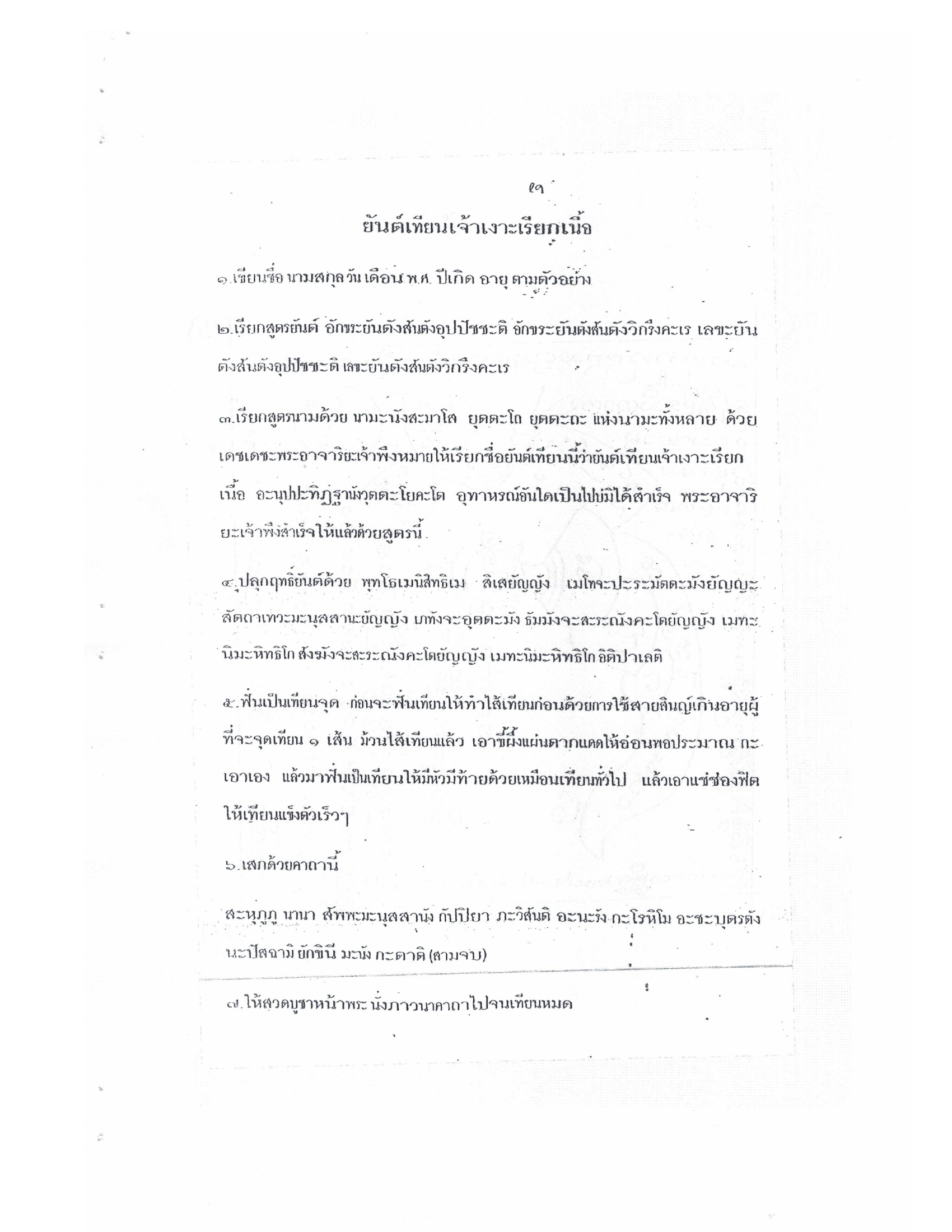
[ยันต์รูปกรอบสี่เหลี่ยม มีวงกลมกำกับตัวเลขที่มุมทั้งสี่] [ตัวเลขในวงกลมที่มุม อ่านไม่ชัดบางส่วน] [ภายในกรอบเป็นภาพยักษ์/รากษสหน้าถมึงทึงถือธงหรือใบไม้รูปคล้ายพัด] [รายรอบกรอบทั้งสี่ด้านมีอักขระธรรมล้านนา/ขอมเรียงเป็นแถว อ่านไม่ชัด] [แถวตัวเลขด้านขวาของภาพ อ่านไม่ชัด] [ข้อความตามแนวขอบล่างอ่านไม่ชัด]
[yantra: a rectangular frame with a numbered circle at each of its four corners (the numerals partly illegible); inside stands a fierce-faced yaksha/rakshasa figure holding a banner or a fan-like leaf; running around all four sides of the frame is a border of Lanna Tham/Khom characters, illegible; a column of numerals runs down the right side of the image, illegible; text along the bottom edge is illegible]
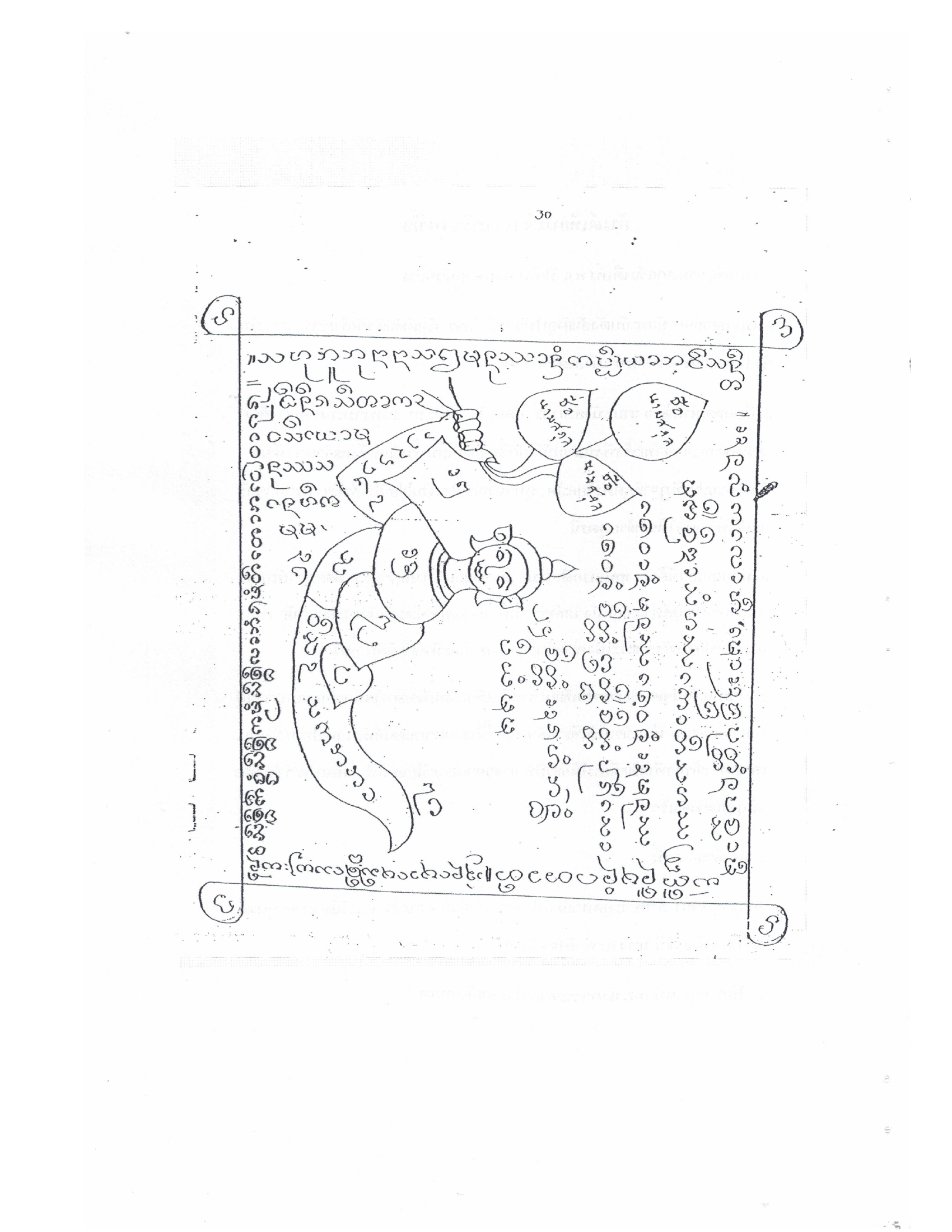
[ยันต์รูปคน 2 คน หญิงผมยาวด้านซ้ายและชายด้านขวา ยกมือขึ้นจับกันตรงกลางภาพ ลำตัวแต่ละคนแบ่งเป็นตาราง 3 แถว 3 ช่อง มีอักขระในแต่ละช่อง รายรอบภาพทั้งหมดมีกรอบอักขระธรรมล้านนา/ขอมล้อมอยู่] [อักขระในตารางและกรอบรอบภาพ อ่านไม่ชัด] [คำบรรยายใต้ภาพแต่ละข้างและแถวตัวเลขใต้ภาพ อ่านไม่ชัด] [ลายมือเขียนกำกับด้านล่างสุดของหน้า 3 บรรทัด อ่านไม่ชัด]
[yantra: two human figures — a long-haired woman on the left and a man on the right — each with an arm raised, their hands joined at the center of the image; each figure's torso is divided into a 3-by-3 grid of cells filled with characters; the whole composition is bordered by a ring of further Tham/Khom characters; the characters in the grids and border are illegible; captions beneath each figure and a row of numerals below them are illegible; a three-line handwritten note at the very bottom of the page is illegible]
วิชายันต์เทียนพระเจ้าตกเตียง [อ่านไม่ออก]
๑.เขียนชื่อ นามสกุล วัน เดือน พ.ศ. ปีเกิด อายุ ตามตัวอย่าง
๒.เรียกสูตรยันต์ อักขะยันต์ดังสันดังอุปปัชชะติ อักขะยันต์ดังสันดังวิกรึงคะเร เลขะยันดังสันดังอุปปัชชะติ เลขะยันดังสันดังวิกรึงคะเร
๓.เรียกสูตรนามด้วย นามะนังสะมาโส ยุดตะโถ ยุดตะถะ แห่งนามะทั้งหลาย ด้วยเดชเดชะพระอาจาริยะเจ้าพึงหมายให้เรียกชื่อยันต์เทียนนี้ว่ายันต์เทียนพระเจ้าตกเตียง อะนุปปะทิฏฐานังวุตตะโยคะโต อุทาหรณ์อันใดเป็นไปบ่มิได้สำเร็จ พระอาจาริยะเจ้าพึงสำเร็จให้แล้วด้วยสูตรนี้
๔.ปลุกฤทธิ์ยันต์ด้วย พุทโธเมนิสิทธิเม สิเสยัญญัง เมโทจะประระมัดตะมังยัญญะ สัตถาเทวะมะนุสสานะยัญญัง ภทังจะอุตตะมัง ธัมมังจะสะระณังคะโตยัญญัง เมทะนิมะหิทธิโก สังฆังจะสะระณังคะโตยัญญัง เมทะนิมะหิทธิโก อิติปาเลติ
๕.ฟั่นเป็นเทียนจุด ก่อนจะฟั่นเทียนให้ทำไส้เทียนก่อนด้วยการใช้สายสิญจน์เกินอายุผู้ที่จะจุดเทียน ๑ เส้น ม้วนไส้เทียนแล้ว เอาขี้ผึ้งแผ่นตากแดดให้อ่อนพอประมาณ กะเอาเอง แล้วมาฟั่นเป็นเทียนให้มีหัวมีท้ายด้วยเหมือนเทียนทั่วไป แล้วเอาแช่ช่องฟิดให้เทียนแข็งตัวเร็วๆ
๖.เสกด้วยคาถานี้
อุ่งติ โลจา โลติ (สามจบ)
๗.ให้สวดบูชาหน้าพระ นั่งภาวนาคาถาไปจนเทียนหมด
The craft of the yantra-candle of Phra Chao Tok Tiang [the Lord Buddha image fallen from the bed] [a handwritten mark beside the title is illegible]
1. Write the [client's] first name, surname, day, month, Buddhist-era year of birth, and age, following the example.
2. Recite the yantra formula: "Akkhayan dang, san dang uppatchati; akkhayan dang, san dang wikrueng khare; lekkhayan dang, san dang uppatchati; lekkhayan dang, san dang wikrueng khare" [a Pali-style incantation, transliterated as printed].
3. Recite the name-formula together with "nama nang samaso, yutta-tho, yutta-tha" for all the names. By the power and majesty of the teacher (ajarn), this candle-yantra should be named "the candle-yantra of Phra Chao Tok Tiang." "Anupatitthanang wutta-yokato" — whatever example fails to succeed, the teacher shall make it succeed by this formula.
4. Awaken the power of the yantra with: "Phuttho meni sitthi me, sise yanyang, metho ja pramat tamang yanya, sattha thewa manutsana yanyang, phathang ja uttamang, thammang ja saranang khato yanyang, metha nima hitthiko, sanghang ja saranang khato yanyang, metha nima hitthiko iti paleti" [a Pali-style formula invoking the Buddha, Dhamma, and Sangha for protection].
5. Twist it into a candle to be lit. Before rolling the candle, first make the wick using one strand of sacred thread (sai sin) longer than the age of the person for whom the candle will be lit. After winding the wick, take a sheet of beeswax dried in the sun until softened to about the right degree — judge for yourself — then roll it into a candle so that it has a head and a tail like an ordinary candle, then dip it through a mold-opening so the candle hardens quickly.
6. Consecrate with this spell: "Ung ti locha loti" (three times).
7. Chant in homage before the Buddha image, sit and recite the spell continuously until the candle is spent.
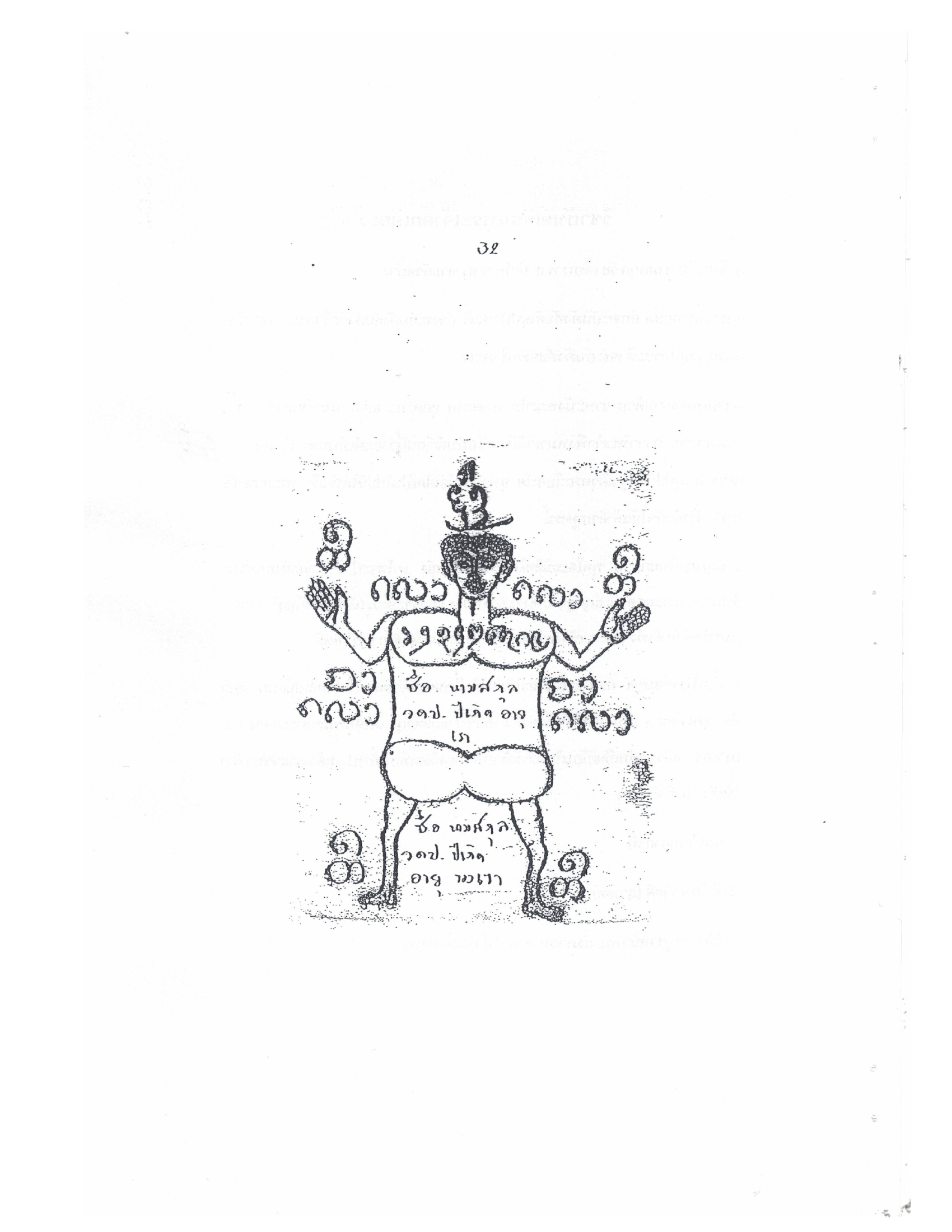
[กรอบข้อความบนร่างของรูปยันต์ ปรากฏคำว่า ชื่อ นามสกุล ว.ด.ป. ปีเกิด อายุ (ตัวอย่างช่องกรอกข้อมูล) อ่านไม่ชัดทั้งหมด; อักขระขอม/อักษรธรรมล้านนาโดยรอบมือ เอว และเท้า อ่านไม่ชัด]
[yantra: a standing human figure, arms raised out to the sides with the hands open; clusters of Khom/Lanna Tham syllables beside each hand, at the waist, and at the feet; a printed Thai fill-in box on the chest and another near the thighs for the client's name, surname, date of birth, and age, too faint to read in full. No running Thai text appears elsewhere on the page.]
วิชายันต์เทียนพระสิวลีสามบั้ง
๑.เขียนชื่อ นามสกุล วัน เดือน พ.ศ. ปีเกิด อายุ ตามตัวอย่าง
๒.เรียกสูตรยันต์ อักขระยันต์ดังสันดังอุปปัชชะติ อักขระยันต์ดังสันดังวิกรึงคะเร เลขะยันดังสันดังอุปปัชชะติ เลขะยันดังสันดังวิกรึงคะเร
๓.เรียกสูตรนามด้วย นามะนังสะมาโส ยุตตะโถ ยุตตะถะ แห่งนามะทั้งหลาย ด้วยเดชเดชะพระอาจาริยะเจ้าพึงหมายให้เรียกชื่อยันต์เทียนนี้ว่ายันต์เทียนพระสิวลีสามบั้ง อะนุปปะทิฏฐานังวุตตะโยคะโต อุทาหรณ์อันใดเป็นไปบ่มิได้สำเร็จ พระอาจาริยะเจ้าพึงสำเร็จให้แล้วด้วยสูตรนี้
๔.ปลุกฤทธิ์ยันต์ด้วย พุทโธเมนิสิทธิเม สิเสยัญญัง เมโทจะประระมัดตะมังยัญญะ สัตถาเทวะมะนุสสานะยัญญัง ภทังจะอุตตะมัง ธัมมังจะสะระณังคะโตยัญญัง เมทะนิมะหิทธิโก สังฆังจะสะระณังคะโตยัญญัง เมทะนิมะหิทธิโก อิติปาเลติ
๕.ฟั่นเป็นเทียนจุด ก่อนจะฟั่นเทียนให้ทำไส้เทียนก่อนด้วยการใช้สายสินญ์เกินอายุผู้ที่จะจุดเทียน ๑ เส้น ม้วนไส้เทียนแล้ว เอาขี้ผึ้งแผ่นตากแดดให้อ่อนพอประมาณ กะเอาเอง แล้วมาฟั่นเป็นเทียนให้มีหัวมีท้ายด้วยเหมือนเทียนทั่วไป แล้วเอาแช่ช่องฟิดให้เทียนแข็งตัวเร็วๆ
๖.เสกด้วยคาถานี้
ตั้งเมสะทิโก มังสุเรโลจะ ปะนาปะสุสุวิ อะทะสิติปิวิ สิเวกุโกกะโค นะมามิหัง (สามจบ)
๗.ให้สวดบูชาหน้าพระ นั่งภาวนาคาถาไปจนเทียนหมด
The craft of the yantra-candle of Phra Sivali, Three Bands
1. Write the name, surname, day, month, Buddhist-era year of birth, and age, following the example.
2. Recite the yantra formula: "Akkhayan dang, san dang uppatchati; akkhayan dang, san dang wikrueng khare; lekkhayan dang, san dang uppatchati; lekkhayan dang, san dang wikrueng khare."
3. Recite the name-formula together with "nama nang samaso, yutta-tho, yutta-tha" for all the names. By the power and majesty of the teacher, this candle-yantra should be named "the candle-yantra of Phra Sivali, Three Bands." Whatever example fails to succeed, the teacher shall make it succeed by this formula.
4. Awaken the power of the yantra with: "Phuttho meni sitthi me, sise yanyang, metho ja pramat tamang yanya, sattha thewa manutsana yanyang, phathang ja uttamang, thammang ja saranang khato yanyang, metha nima hitthiko, sanghang ja saranang khato yanyang, metha nima hitthiko iti paleti."
5. Twist it into a candle to be lit. Before rolling the candle, first make the wick using one strand of sacred thread longer than the age of the person for whom the candle will be lit. After winding the wick, take a sheet of beeswax dried in the sun until softened to about the right degree — judge for yourself — then roll it into a candle so that it has a head and a tail like an ordinary candle, then dip it through a mold-opening so the candle hardens quickly.
6. Consecrate with this spell: "Tang mesathiko, mang surelocha, pana pasusuwi, atha sitipiwi, siwekukokakho, namami hang" (three times).
7. Chant in homage before the Buddha image, sit and recite the spell continuously until the candle is spent.
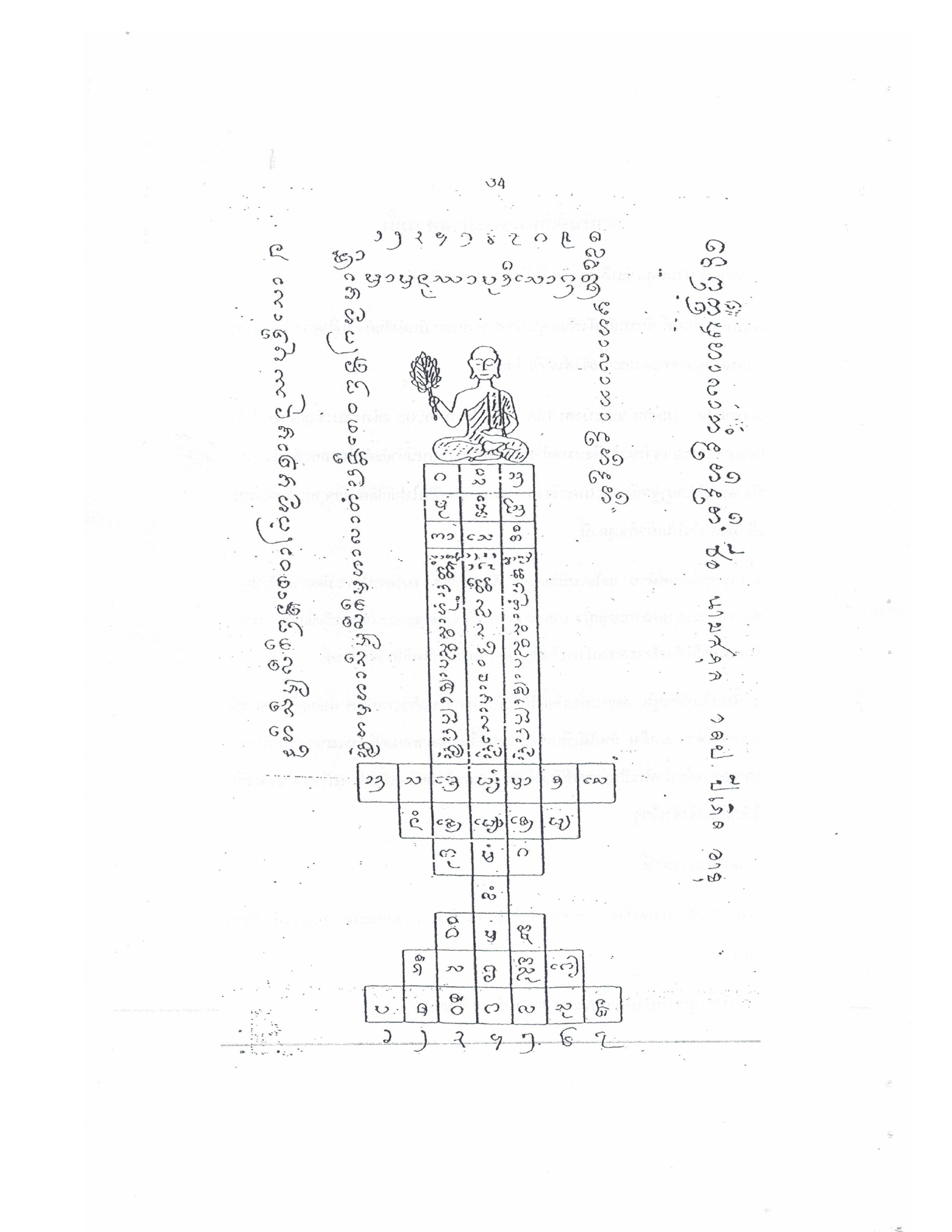
[อักขระขอม/อักษรธรรมล้านนาในยันต์และในกรอบข้อความโดยรอบภาพ อ่านไม่ชัด]
[yantra: a seated monastic figure holding a leafy branch, seated atop a stepped tower of grid-cells inscribed with Khom/Lanna Tham syllables in three registers that widen toward the base; the whole is framed by a rectangular border of running Lanna Tham script, with a row of numeral-like glyphs along the top edge. No Thai running text appears on this page.]
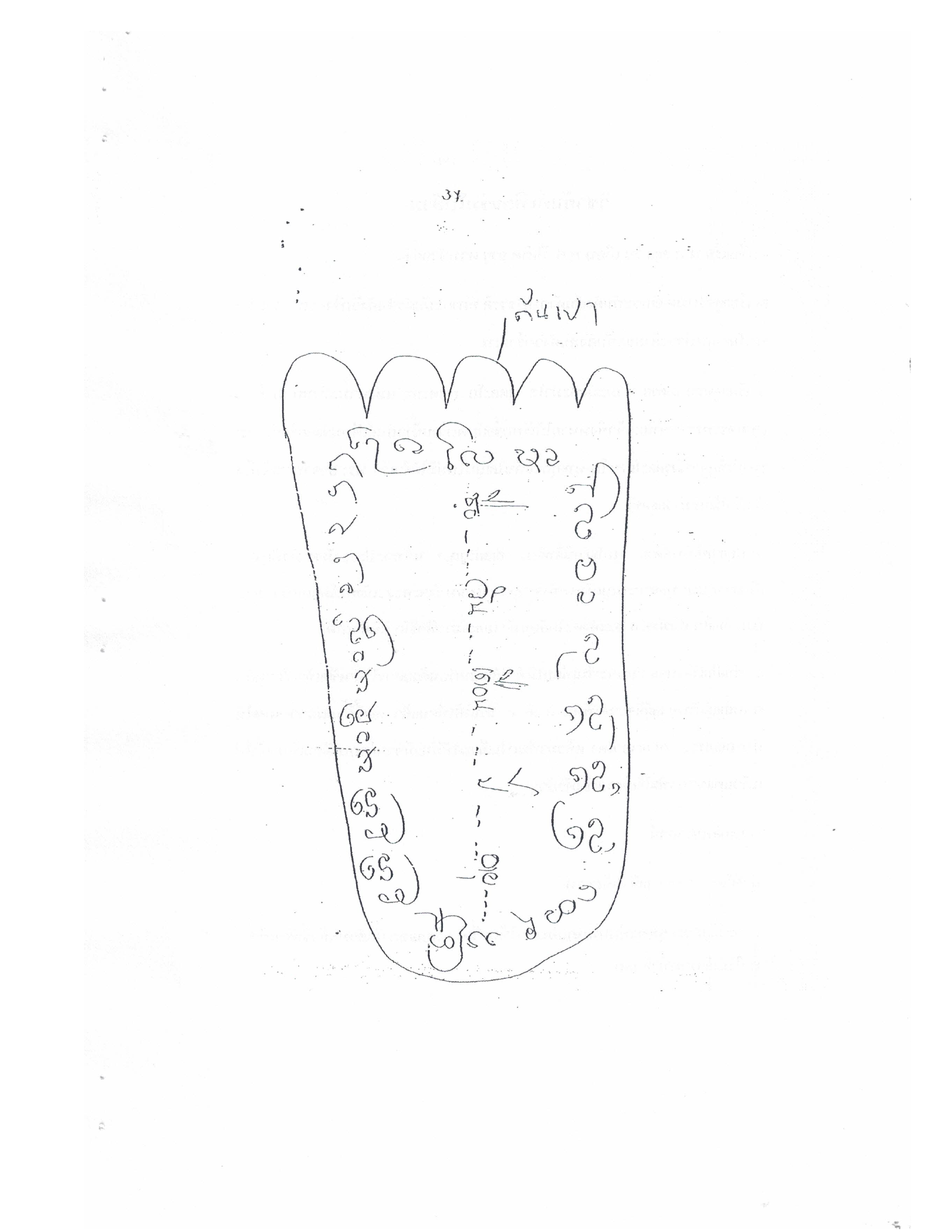
วิชายันต์เทียนข่มใต้บันได
๑.วาดรอยเท้าข้างขวาของเราลงบนกระดาษสา
๒.เขียนอักขระยันต์ลงบนกระดาษสา พร้อมกับเรียกสูตร อักขระยันต์ดัง สันดังอุปปัชชะติ อักขระยันต์ดัง สันดังวิกรึงคะเร จนครบทุกตัว
๓.เขียนชื่อ นามสกุล วันเกิด ที่ เดือน พ.ศ. ปี อายุ ที่อยู่ ถ้ามี แล้วเรียกจิตด้วยคาถานี้ เอหิจิตดัง จิตของไอ้หรืออี.......... มานิมา นะมะพะทะ นะผุก โมมัด พุทรัด ธาดรึงยะวิกรึงคะเร โสธายะวิกรึงคะเร
๔.เรียกสูตรนามด้วย นามะนังสะมาโล ยุตตะโถ ยุตตะถะ แห่งนามะทั้งหลาย ด้วยเดชเดชะพระอาจาริยะเจ้าพึงหมายให้เรียกชื่อยันต์เทียนนี้ว่ายันต์เทียน ข่มใต้บันได ข่มไอ้หรืออี.............ให้กลัวเกรงเชื่อฟัง อะนุปะทิฏฐานังวุตตะโยคะโต อุทาหรณ์อันใดเป็นไปบ่มิได้สำเร็จ พระอาจาริยะเจ้าพึงสำเร็จให้แล้วด้วยสูตรนี้
๕.ปลุกฤทธิ์ยันต์ด้วย พุทโธเมนิสิทธิเม สิเสยัญญัง เมโทจะประระมัดตะมังยัญญะ สัตถาเทวะมะนุสสานะยัญญัง ภทังจะอุตตะมัง ธัมมังจะสะระณังคะโตยัญญัง เมทะนิมะหิทธิโก สังฆังจะสะระณังคะโตยัญญัง เมทะนิมะหิทธิโก อิติปาเลติ
๖.เสกต่อด้วยคาถานี้ 7 จบ ไอ้หรืออี..................โลมา โลจา ลุลัง ลง ลง เตนะ ศัตรูเอหิ เอหิ มามิมาลง มาลงลง
๗.ฟั่นเป็นเทียนจุด ก่อนจะฟั่นเทียนให้ทำไส้เทียนก่อนด้วยการใช้ผ้าถุง ผ้าเช็ดเท้า ผ้าขี้ริ้วที่ผ่านการใช้งานแล้ว กับสายสิญจน์ที่ยังไม่ผ่านการใช้งานมาทำไส้เทียนของคนที่เราจะจุดใส่ โดยใช้สายสิญจน์เกินอายุ 1 เส้น ม้วนไส้เทียนแล้ว เอาขี้ผึ้งแผ่นตากแดด
The craft of the yantra-candle to subdue [the spirit] under the stairs
1. Draw the print of your own right foot onto mulberry-bark paper.
2. Write the yantra characters onto the mulberry-bark paper, reciting the formula as you do: "Akkhayan dang, san dang uppatchati; akkhayan dang, san dang wikrueng khare" — until every character is complete.
3. Write the [target's] name, surname, date of birth (day, month, Buddhist-era year), age, and address if known, then summon the mind/spirit with this spell: "Ehi jit dang, jit khong ai/i [blank for the target's name]... manima, namaphatha, naphuk, momat, phutrat, thatruengya-wikrueng-khare, sotha-ya-wikrueng-khare."
4. Recite the name-formula together with "nama nang samalo, yutta-tho, yutta-tha" for all the names. By the power and majesty of the teacher, this candle-yantra should be named "the candle-yantra that subdues [the spirit] under the stairs, subduing so-and-so [blank for name]..." so that he/she becomes fearful, wary, and obedient. Whatever example fails to succeed, the teacher shall make it succeed by this formula.
5. Awaken the power of the yantra with: "Phuttho meni sitthi me, sise yanyang, metho ja pramat tamang yanya, sattha thewa manutsana yanyang, phathang ja uttamang, thammang ja saranang khato yanyang, metha nima hitthiko, sanghang ja saranang khato yanyang, metha nima hitthiko iti paleti."
6. Continue consecrating with this spell, seven times: "So-and-so [blank for name]... loma, locha, lulang, long, long, tena, sattru ehi, ehi mami malong, malonglong."
7. Twist it into a candle to be lit. Before rolling the candle, first make the wick using a used cotton wrap-cloth, a used foot-wiping cloth, and a used rag, together with sacred thread that has not yet been used, to make the wick for the person the candle will be lit for — using one strand of thread longer than that person's age. After winding the wick, take a sheet of beeswax dried in the sun...
ให้อ่อนพอประมาณ กะเอาเอง แล้วมาฟั่นเป็นเทียนให้มีหัวมีท้ายด้วยเหมือนเทียนทั่วไป แล้วเอาแช่ช่องฟิดให้เทียนแข็งตัวเร็วๆ
๘.จุดได้บันได ท่องคาถาไปด้วย เดินขึ้น – ลง บันไดไปด้วย (ขึ้น ท่อง 7.จบ ลง ท่อง 7 จบ)
๙.ก่อนจุดเทียนให้เสกคาถามงกุฏพระพุทธเจ้ากันตัวก่อน อิติปิโส วิเสเสอิ อิเสเส พุทธะนาเมอิ อิมนาพุทธะตังโสอิ อิโสตังพุทธะปิติอิ 3.จบ
...until softened to about the right degree — judge for yourself — then roll it into a candle so that it has a head and a tail like an ordinary candle, then dip it through a mold-opening so the candle hardens quickly.
8. Light it at the stairs and chant the spell as you do so — walk up and down the stairs while chanting (going up: recite seven times; going down: recite seven times).
9. Before lighting the candle, first consecrate yourself with the Buddha's Crown spell: "Itipiso wisetse-i, isese, phutthanam-e-i, imna phutthatang so-i, i-so-tang phutthapiti-i" — three times.
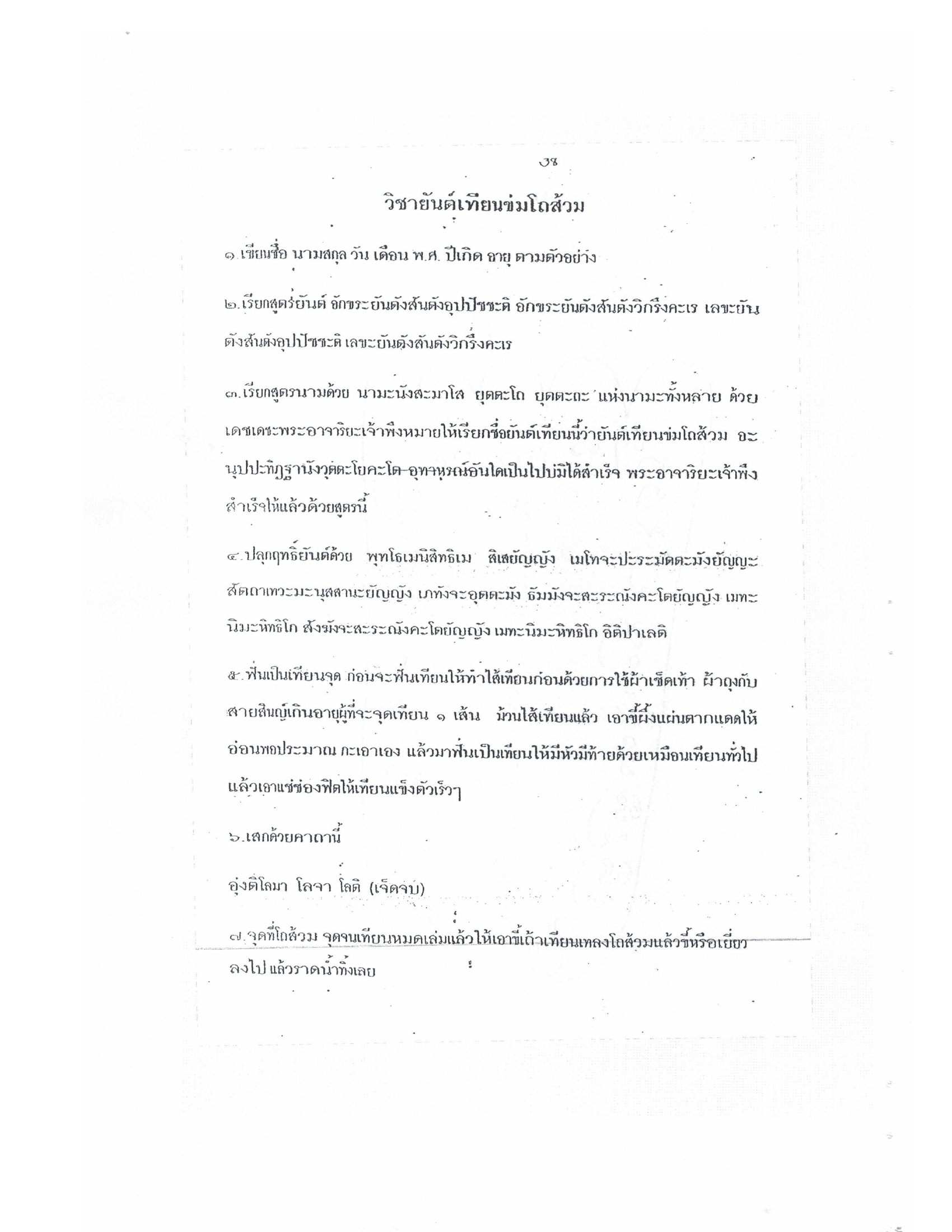
วิชายันต์เทียนข่มโถส้วม
๑.เขียนชื่อ นามสกุล วัน เดือน พ.ศ. ปีเกิด อายุ ตามตัวอย่าง
๒.เรียกสูตรยันต์ อักขระยันต์ดังสันดังอุปปัชชะติ อักขระยันต์ดังสันดังวิกรึงคะเร เลขะยันดังสันดังอุปปัชชะติ เลขะยันดังสันดังวิกรึงคะเร
๓.เรียกสูตรนามด้วย นามะนังสะมาโส ยุดตะโถ ยุดตะถะ แห่งนามะทั้งหลาย ด้วยเดชเดชะพระอาจาริยะเจ้าพึงหมายให้เรียกชื่อยันต์เทียนนี้ว่ายันต์เทียนข่มโถส้วม อะนุปปะทิฏฐานังวุตตะโยคะโต อุทาหรณ์อันใดเป็นไปบ่มิได้สำเร็จ พระอาจาริยะเจ้าพึงสำเร็จให้แล้วด้วยสูตรนี้
๔.ปลุกฤทธิ์ยันต์ด้วย พุทโธเมนิสิทธิเม สิเสยัญญัง เมโทจะประระมัดตะมังยัญญะ สัตถาเทวะมะนุสสานะยัญญัง ภทังจะอุตตะมัง ธัมมังจะสะระณังคะโตยัญญัง เมทะนิมะหิทธิโก สังฆังจะสะระณังคะโตยัญญัง เมทะนิมะหิทธิโก อิติปาเลติ
๕.ฟั่นเป็นเทียนจุด ก่อนจะฟั่นเทียนให้ทำไส้เทียนก่อนด้วยการใช้ผ้าเช็ดเท้า ผ้าถุงกับสายสิญจน์เกินอายุผู้ที่จะจุดเทียน ๑ เส้น ม้วนไส้เทียนแล้ว เอาขี้ผึ้งแผ่นตากแดดให้อ่อนพอประมาณ กะเอาเอง แล้วมาฟั่นเป็นเทียนให้มีหัวมีท้ายด้วยเหมือนเทียนทั่วไป แล้วเอาแช่ช่องฟิดให้เทียนแข็งตัวเร็วๆ
๖.เสกด้วยคาถานี้
อุ่งติโลมา โลจา โลติ (เจ็ดจบ)
๗.จุดที่โถส้วม จุดจนเทียนหมดเล่มแล้วให้เอาขี้เถ้าเทียนเทลงโถส้วมแล้วขี้หรือเยี่ยวลงไป แล้วราดน้ำทิ้งเลย
The craft of the yantra-candle to subdue the toilet bowl
1. Write the name, surname, day, month, Buddhist-era year of birth, and age, following the example.
2. Recite the yantra formula: "Akkhayan dang, san dang uppatchati; akkhayan dang, san dang wikrueng khare; lekkhayan dang, san dang uppatchati; lekkhayan dang, san dang wikrueng khare."
3. Recite the name-formula together with "nama nang samaso, yutta-tho, yutta-tha" for all the names. By the power and majesty of the teacher, this candle-yantra should be named "the candle-yantra that subdues the toilet bowl." Whatever example fails to succeed, the teacher shall make it succeed by this formula.
4. Awaken the power of the yantra with: "Phuttho meni sitthi me, sise yanyang, metho ja pramat tamang yanya, sattha thewa manutsana yanyang, phathang ja uttamang, thammang ja saranang khato yanyang, metha nima hitthiko, sanghang ja saranang khato yanyang, metha nima hitthiko iti paleti."
5. Twist it into a candle to be lit. Before rolling the candle, first make the wick using a foot-wiping cloth and a cotton wrap-cloth together with sacred thread longer than the age of the person for whom the candle will be lit, one strand. After winding the wick, take a sheet of beeswax dried in the sun until softened to about the right degree — judge for yourself — then roll it into a candle so that it has a head and a tail like an ordinary candle, then dip it through a mold-opening so the candle hardens quickly.
6. Consecrate with this spell: "Ung ti loma, locha, loti" (seven times).
7. Light it at the toilet bowl. Once the candle has burned all the way down, take its ash and pour it into the toilet bowl, then defecate or urinate onto it, then flush it away with water.
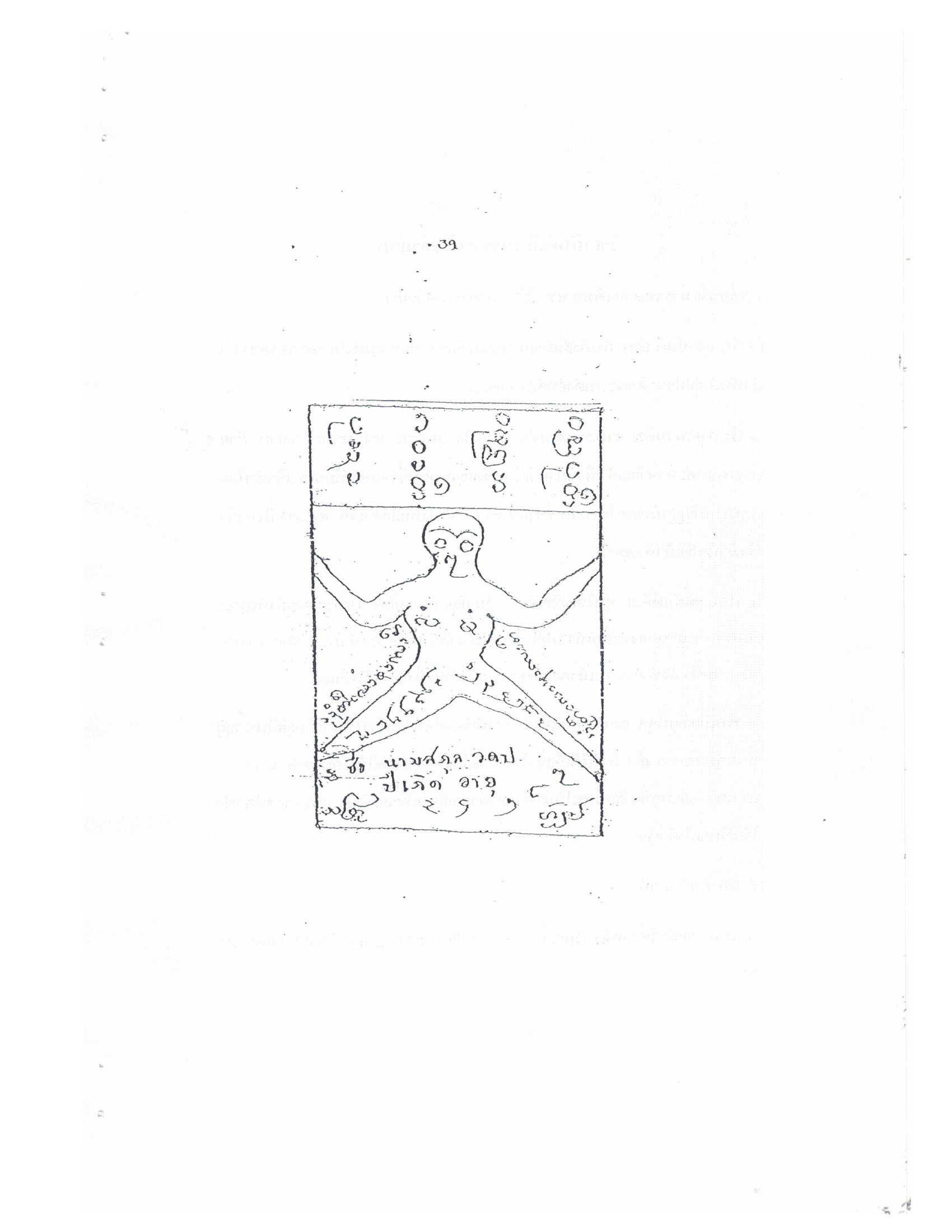
[อักขระขอม/อักษรธรรมล้านนาในยันต์ อ่านไม่ชัด]
[yantra: a rectangular panel; the upper register holds four columns of stacked Khom/Lanna Tham syllables, two cells to a column; below it, a stick-figure body with a round head and two dot eyes, arms spread down and outward and legs spread wide in an inverted V, with curving lines of Lanna script following each limb; faint Thai fill-in text (name, date of birth, age) is printed near the feet but is too faint to read in full.]
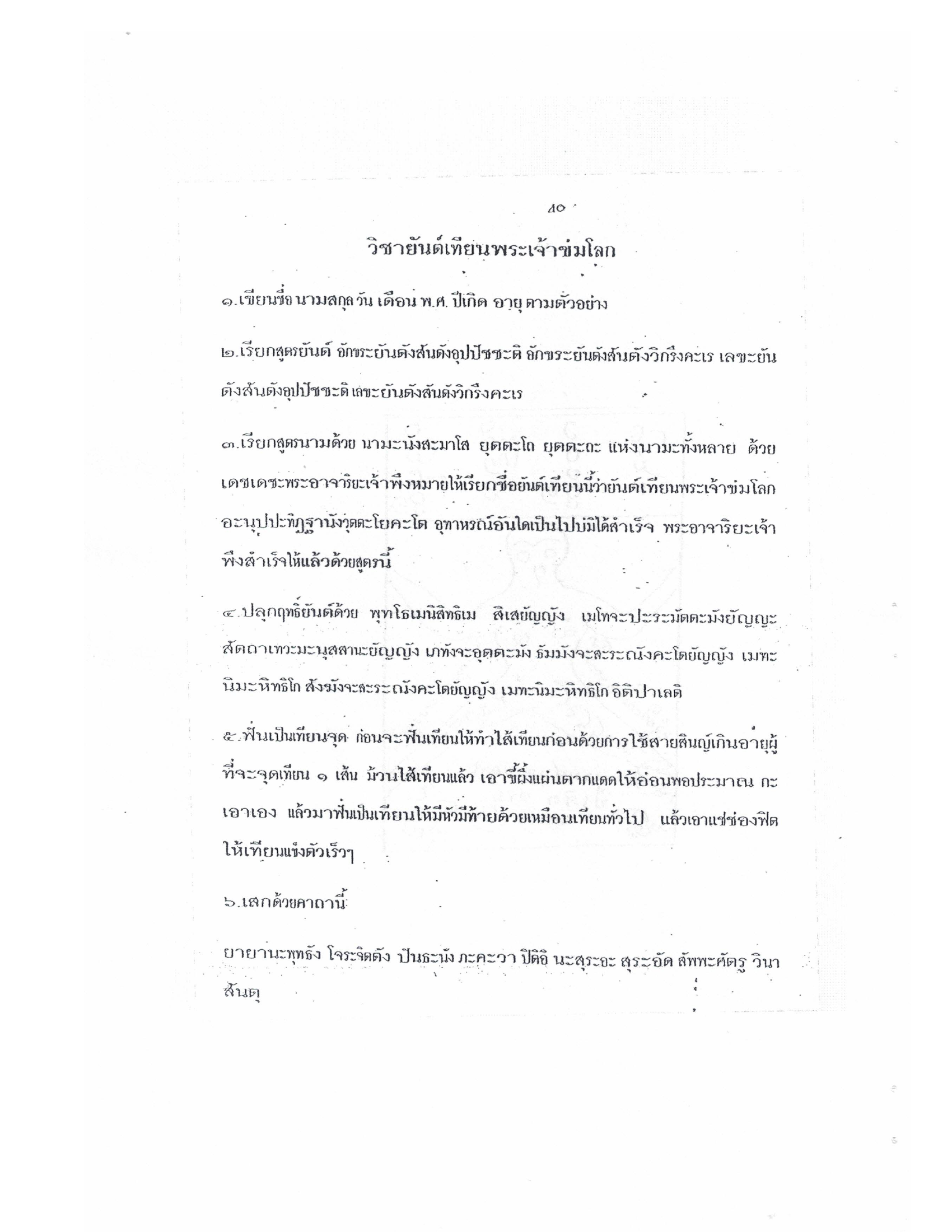
๘.จุดตรงประตูทางเข้าบ้าน จุดกลางแจ้ง จุดหน้าพระ อย่างใดอย่างหนึ่งก็ได้แล้วสวดจนเทียนจบ
8. Light it right at the entrance door of the house, in the open yard, or in front of the Buddha image — any one of these will do — then chant until the candle is spent.

๘.จุดตรงประตูทางเข้าบ้าน จุดกลางแจ้ง จุดหน้าพระ อย่างใดอย่างหนึ่งก็ได้แล้วสวดจนเทียนจบ
8. Light it right at the entrance door of the house, in the open yard, or in front of the Buddha image — any one of these will do — then chant until the candle is spent.
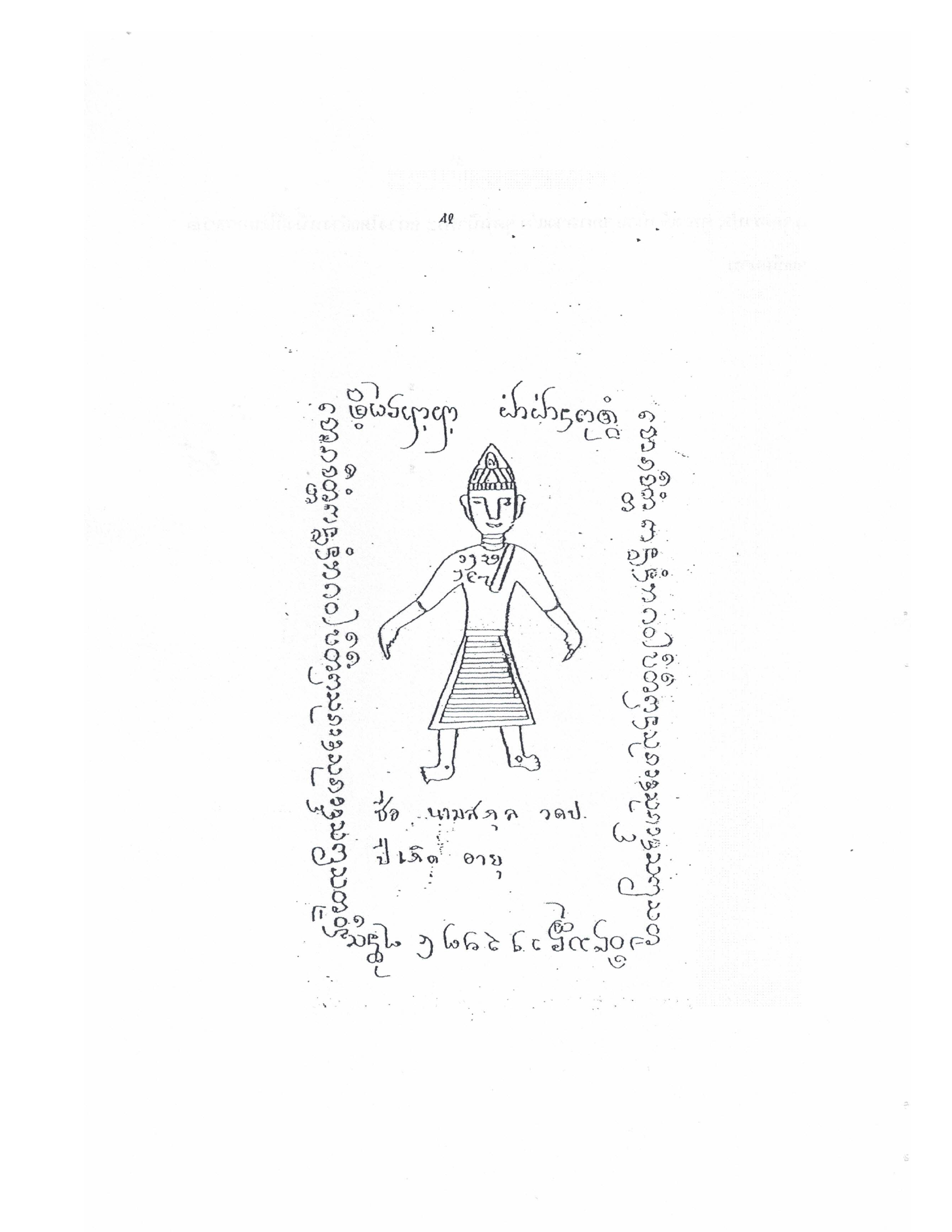
[อักษรธรรมล้านนาล้อมกรอบรูปยันต์โดยรอบ อ่านไม่ชัด] [อักขระที่เขียนบนอกรูปยันต์ อ่านไม่ชัด] ชื่อ นามสกุล วดป. เกิด อายุ
[yantra: a standing figure of a deity or person wearing a tall peaked crown and a long wrapped lower garment (a pha nung with horizontal pleats) with a diagonal sash across the chest, arms held out to the sides, bare feet; the figure is framed on all four sides by a border of Lanna dhamma script, illegible; unclear characters are inscribed on the chest] Name. Surname. Day/month/year. Born. Age.
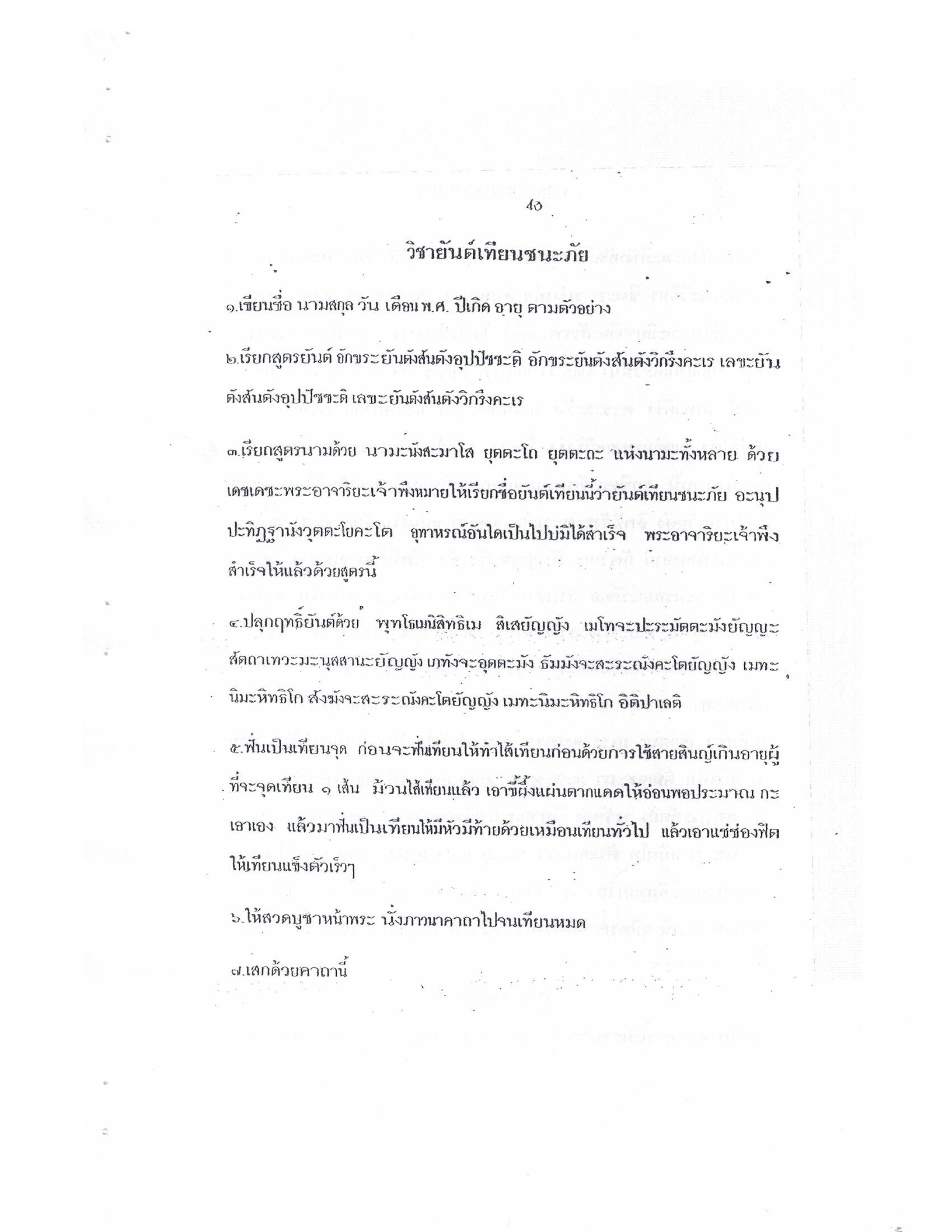
วิชายันต์เทียนชนะภัย
๑.เขียนชื่อ นามสกุล วัน เดือน พ.ศ. ปีเกิด อายุ ตามตัวอย่าง
๒.เรียกสูตรยันต์ อักขระยันต์ดังส้นดังอุปปัชชะติ อักขระยันต์ดังส้นดังวิกรึงคะเร เลขะยันต์ดังส้นดังอุปปัชชะติ เลขะยันต์ดังส้นดังวิกรึงคะเร
๓.เรียกสูตรนามด้วย นามะนังสะมาโส ยุดตะโถ ยุดตะถะ แห่งนามะทั้งหลาย ด้วยเดชเดชะพระอาจาริยะเจ้าพึงหมายให้เรียกชื่อยันต์เทียนนี้ว่ายันต์เทียนชนะภัย อะนุปปะทิฏฐานังวุตตะโยคะโต อุทาหรณ์อันใดเป็นไปบ่มิได้สำเร็จ พระอาจาริยะเจ้าพึงสำเร็จให้แล้วด้วยสูตรนี้
๔.ปลุกฤทธิ์ยันต์ด้วย พุทโธเมนิสิทธิเม สิเสยัญญัง เมโทจะประระมัดตะมังยัญญะ สัตถาเทวะมะนุสสานะยัญญัง ภทังจะอุดตะมัง ธัมมังจะสะระถังคะโตยัญญัง เมทะนิมะหิทธิโก สังมังจะสะระถังคะโตยัญญัง เมทะนิมะหิทธิโก อิติปาเลติ
๕.ฟั่นเป็นเทียนจุด ก่อนจะฟั่นเทียนให้ทำไส้เทียนก่อนด้วยการใช้สายสิญจ์เกินอายุผู้ที่จะจุดเทียน ๑ เส้น ม้วนไส้เทียนแล้ว เอาขี้ผึ้งแผ่นตากแดดให้อ่อนพอประมาณ กะเอาเอง แล้วมาฟั่นเป็นเทียนให้มีหัวมีท้ายด้วยเหมือนเทียนทั่วไป แล้วเอาแช่ช่องฟิตให้เทียนแข็งตัวเร็วๆ
๖.ให้สวดบูชาหน้าพระ นั่งภาวนาคาถาไปจนเทียนหมด
๗.เสกด้วยคาถานี้
Method of the Victory Candle Yantra
1. Write [the practitioner's] given name, surname, day, month, Buddhist-era year of birth, and age, following the example.
2. Recite the yantra formula: the yantra letters as it is said to arise, the yantra letters as it is said to multiply; the yantra numbers as it is said to arise, the yantra numbers as it is said to multiply.
3. Recite the name-formula together with 'namo-nangsamaso, yutato, yutatha' over all the names, so that by the power and majesty [of the formula] the teacher-master intends this candle-yantra to be called the Victory Candle Yantra. Whatever example fails to succeed, the master shall bring it to success by means of this formula.
4. Awaken the yantra's power with: 'Buddho meni sitthi me, sise yannyang, metho ja pramat tamang yanya, sattha teva manutsana yanyang, phathang ja uttamang, thammang ja sarathang khato yanyang, metha nimahitthiko, sangmang ja sarathang khato yanyang, metha nimahitthiko, iti paleti.' [a Pali-styled empowerment formula; several terms are obscure and not confidently translatable]
5. Twist [the wick] into a candle to be lit. Before twisting the candle, first make the wick using a length of sacred thread (sai sin) one strand longer than the age of the person who will light the candle. Once the wick is rolled, take a sheet of beeswax dried in the sun until soft enough — judge this yourself — then twist it into a candle with a head and a tail like an ordinary candle, and dip it in a freezer compartment so the candle hardens quickly.
6. Chant in worship before the Buddha image, sit and recite the mantra until the candle is used up.
7. Consecrate with this mantra:
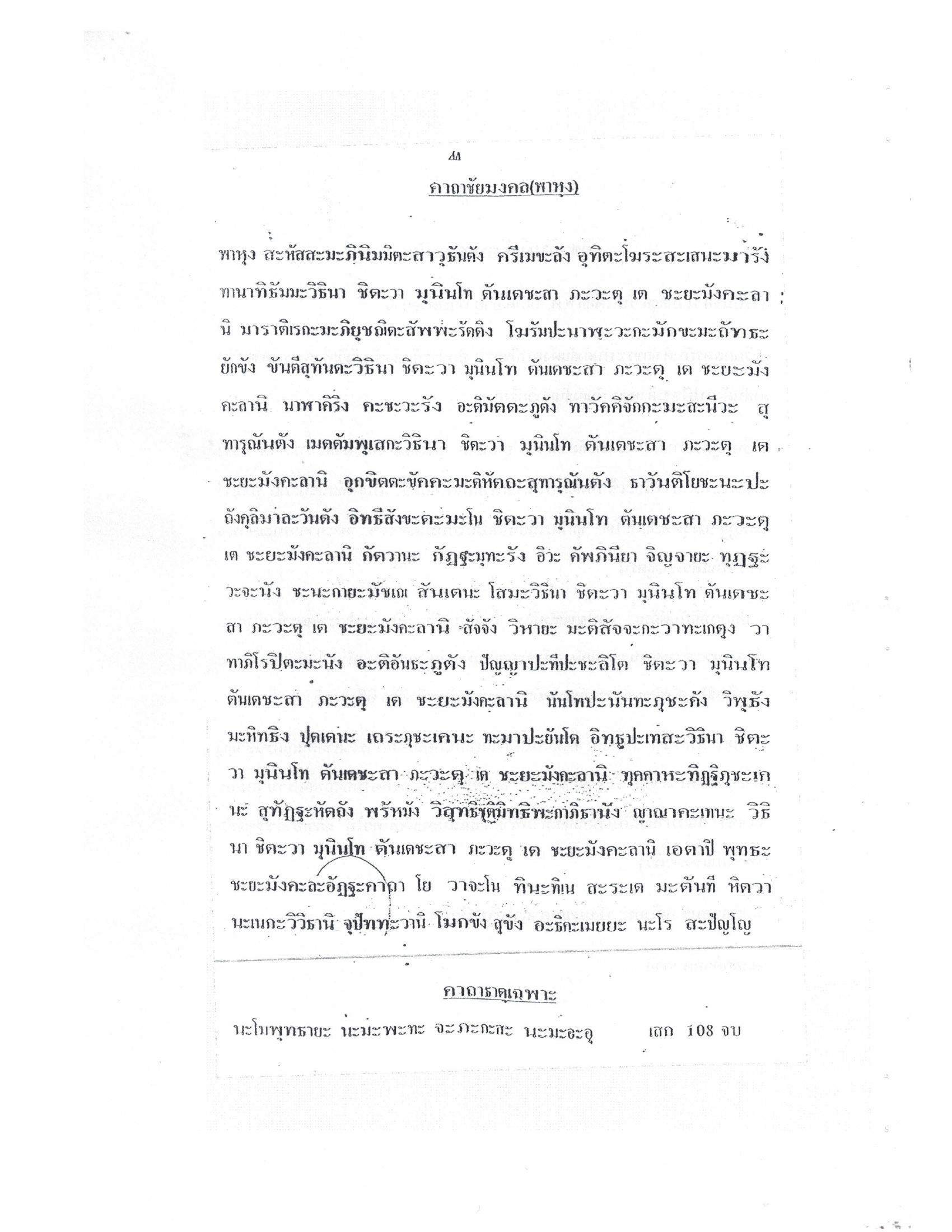
คาถาชัยมงคล(พาหุง)
พาหุง สะหัสสะมะภินิมมิตะสาวุธันตัง ครีเมขะลัง อุทิตะโฆระสะเสนะมารัง ทานาทิธัมมะวิธินา ชิตะวา มุนินโท ตันเตชะสา ภะวะตุ เต ชะยะมังคะลานิ
มาราติเรกมะภิยุชฌิตะสัพพะรัตติง โฆรัมปะนาฬะวะกะมักขะมะถัทธะยักขัง ขันตีสุทันตะวิธินา ชิตะวา มุนินโท ตันเตชะสา ภะวะตุ เต ชะยะมังคะลานิ
นาฬาคิริง คะชะวะรัง อะติมัตตะภูตัง ทาวัคคิจักกะมะสะนีวะ สุทารุณันตัง เมตตัมพุเสกะวิธินา ชิตะวา มุนินโท ตันเตชะสา ภะวะตุ เต ชะยะมังคะลานิ
อุกขิตตะขัคคะมะติหัตถะสุทารุณันตัง ธาวันติโยชะนะปะถังคุลิมาละวันตัง อิทธีภิสังขะตะมะโน ชิตะวา มุนินโท ตันเตชะสา ภะวะตุ เต ชะยะมังคะลานิ
กัตวานะ กัฏฐะมุทะรัง อิวะ คัพภินียา จิญจายะ ทุฏฐะวะจะนัง ชะนะกายะมัชเฌ สันเตนะ โสมะวิธินา ชิตะวา มุนินโท ตันเตชะสา ภะวะตุ เต ชะยะมังคะลานิ
สัจจัง วิหายะ มะติสัจจะกะวาทะเกตุง วาทาภิโรปิตะมะนัง อะติอันธะภูตัง ปัญญาปะทีปะชะลิโต ชิตะวา มุนินโท ตันเตชะสา ภะวะตุ เต ชะยะมังคะลานิ
นันโทปะนันทะภุชะคัง วิพุธัง มะหิทธิง ปุตเตนะ เถระภุชะเคนะ ทะมาปะยันโต อิทธูปะเทสะวิธินา ชิตะวา มุนินโท ตันเตชะสา ภะวะตุ เต ชะยะมังคะลานิ
ทุคคาหะทิฏฐิภุชะเคนะ สุทัฏฐะหัตถัง พรัหมัง วิสุทธิชุติมิทธิพะกาภิธานัง ญาณาคะเทนะ วิธินา ชิตะวา มุนินโท ตันเตชะสา ภะวะตุ เต ชะยะมังคะลานิ
เอตาปิ พุทธะชะยะมังคะละอัฏฐะคาถาโย วาจะโน ทินะทินัง สะระเต มะตันที หิตวานะเนกะวิวิธานิ จุปัททะวานิ โมกขัง สุขัง อะธิคะเมยยะ นะโร สะปัญโญ
คาถาธาตุเฉพาะ
นะโมพุทธายะ นะมะพะทะ จะภะกะสะ นะมะอะอุ เสก ๑๐๘ จบ
Jaya Mangala Gatha (the Phahung verses)
1. With arms conjured into a thousand bearing weapons, mounted on the elephant Girimekhala, together with the fearsome host of Mara that had risen up — through the power of the perfection of giving the Lord of Sages conquered them. By that same power, may victory and blessing be yours.
2. Mara's fiercer ally, the harsh and unyielding yakkha Alavaka, who fought a battle more terrible than Mara's the whole night through — through the power of well-trained patience the Lord of Sages conquered him. By that same power, may victory and blessing be yours.
3. The noble elephant Nalagiri, maddened and rampaging, as dreadful as a wildfire or a thunderbolt — through the power of loving-kindness poured out like water the Lord of Sages conquered him. By that same power, may victory and blessing be yours.
4. Angulimala, most dreadful, sword raised in hand, running the distance of many leagues — through his miraculous power of mind the Lord of Sages conquered him. By that same power, may victory and blessing be yours.
5. Cinca, having made herself appear pregnant with a piece of wood, falsely accused him before the assembly — through calm and serene conduct the Lord of Sages conquered her. By that same power, may victory and blessing be yours.
6. Saccaka, who abandoned the truth for the sake of his own doctrine of debate and was blinded by attachment to argument — through the light of the lamp of wisdom the Lord of Sages conquered him. By that same power, may victory and blessing be yours.
7. The naga king Nandopananda, learned and of great power, was tamed by the elder [Moggallana], his own disciple, appearing as a naga — through the method of teaching miraculous power the Lord of Sages conquered him. By that same power, may victory and blessing be yours.
8. Baka Brahma, whose hand was firmly gripped by the serpent of wrong view — pure, radiant, and of miraculous power though he was named — through the method of teaching knowledge the Lord of Sages conquered him. By that same power, may victory and blessing be yours.
Whoever, being wise, recites these eight verses of the Buddha's victorious blessing daily and constantly bears them in mind shall, having abandoned manifold calamities and afflictions, attain liberation and happiness.
Mantra Specific to the Elements
Namo Buddhaya, namapatha, japhakasa, namo-a-u. Recite/consecrate 108 times.
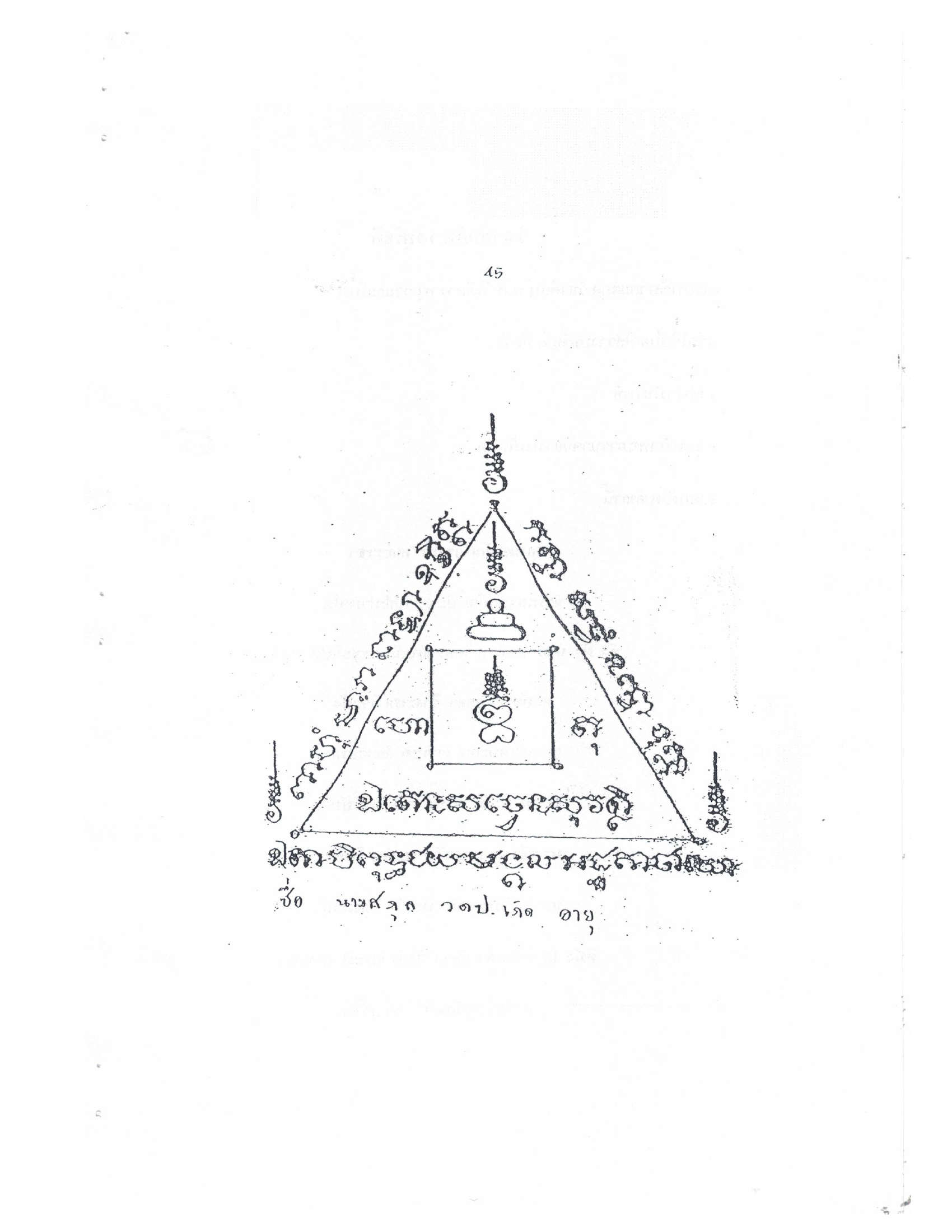
[รูปยันต์ทรงสามเหลี่ยม (รูปเทียน/ภูเขา) ล้อมด้วยอักษรธรรมล้านนาโดยรอบ อ่านไม่ชัด] ชื่อ นามสกุล วดป. เกิด อายุ
[yantra: a tall triangular, mountain- or flame-shaped diagram. At the apex a small seated Buddha figure sits beneath a hanging cluster of curling syllables; below it a small square frame encloses another cluster of curling syllables. The two slanted sides of the triangle are lined with rows of Lanna dhamma script, illegible, and four short vertical strokes with curling tops stand outside the four corners. Along the base of the triangle runs a horizontal band of the same illegible script] Name. Surname. Day/month/year. Born. Age.
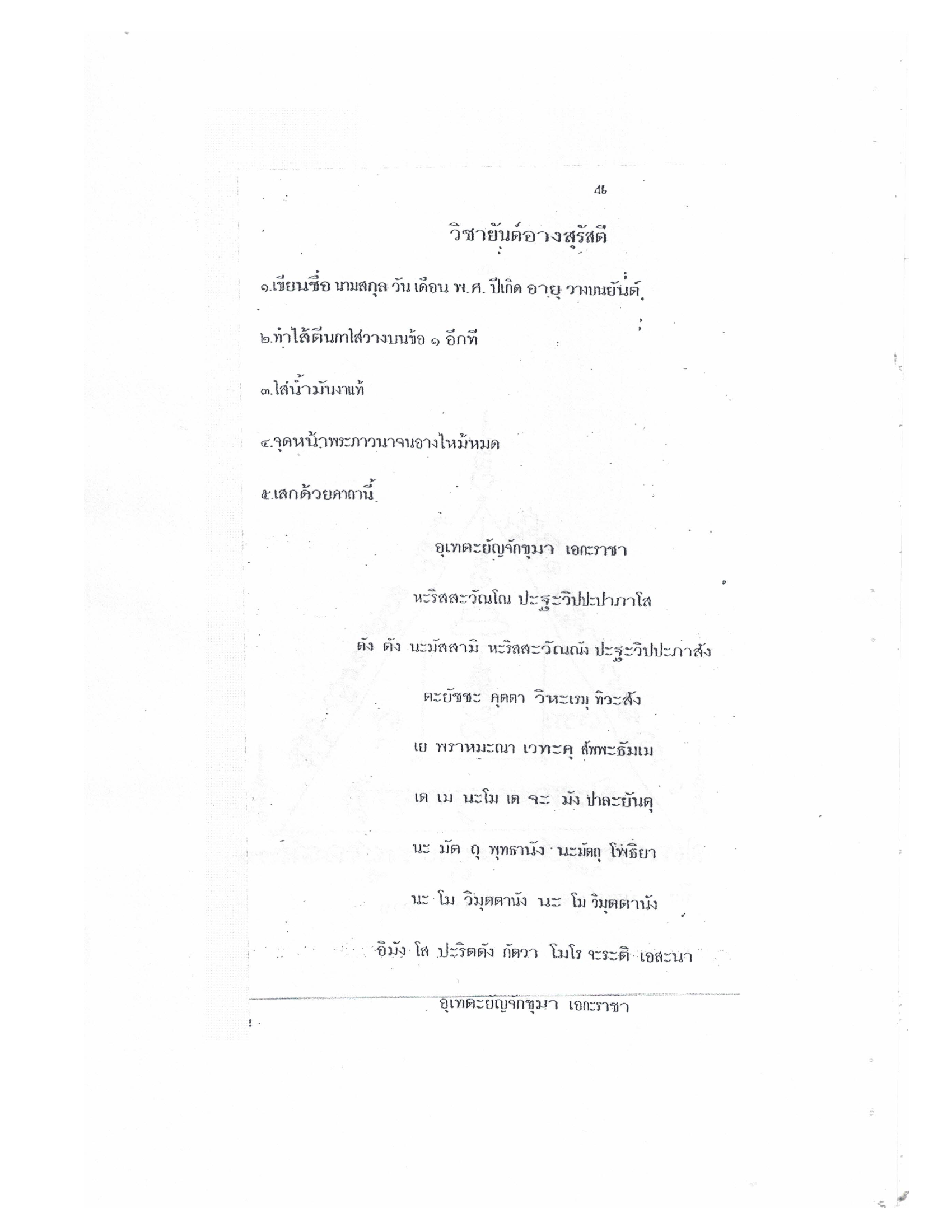
วิชายันต์อางสุรัสดี
๑.เขียนชื่อ นามสกุล วัน เดือน พ.ศ. ปีเกิด อายุ วางบนยันต์
๒.ทำไส้ตีนกาใส่วางบนข้อ ๑ อีกที
๓.ใส่น้ำมันงาแท้
๔.จุดหน้าพระภาวนาจนอางไหม้หมด
๕.เสกด้วยคาถานี้
อุเทตะยัญจักขุมา เอกะราชา หะริสสะวัณโณ ปะฐะวิปปะภาโส ตัง ตัง นะมัสสามิ หะริสสะวัณณัง ปะฐะวิปปะภาสัง ตะยัชชะ คุตตา วิหะเรมุ ทิวะสัง เย พราหมะณา เวทะคุ สัพพะธัมเม เต เม นะโม เต จะ มัง ปาละยันตุ นะมัตถุ พุทธานัง นะมัตถุ โพธิยา นะโม วิมุตตานัง นะโม วิมุตตานัง อิมัง โส ปะริตตัง กัตวา โมโร จะระติ เอสะนา
อุเทตะยัญจักขุมา เอกะราชา
Method of the Surasadi Basin Yantra
1. Write [the practitioner's] given name, surname, day, month, Buddhist-era year of birth, and age; place this on the yantra.
2. Make a crow's-foot-shaped wick and set it again on top of item 1.
3. Pour in genuine sesame oil.
4. Light it before the Buddha image and chant until the basin has burned out completely.
5. Consecrate with this mantra:
He who rises, the All-Seeing One, the Sole Sovereign, golden-hued, radiant as the earth's light — to that golden, earth-radiant one I pay homage, again and again. Guarded by you today, may we dwell through the day. Those brahmins versed in all truths [the Buddhas] — to them I pay homage, and may they in turn protect me. Homage to the Buddhas, homage to the Awakening. Homage to the liberated ones, homage to the liberated ones. Having made this protective chant, the peacock goes about foraging.
He who rises, the All-Seeing One, the Sole Sovereign,
หะริสสะวัณโณ ปะฐะวิปปะภาโส ตัง ตัง นะมัสสามิ หะริสสะวัณณัง ปะฐะวิปปะภาสัง ตะยัชชะ คุตตา วิหะเรมุ ทิวะสัง เย พราหมะณา เวทะคุ สัพพะธัมเม เต เม นะโม เต จะ มัง ปาละยันตุ นะมัตถุ พุทธานัง นะมัตถุ โพธิยา นะโม วิมุตตานัง นะโม วิมุตตานัง อิมัง โส ปะริตตัง กัตวา โมโร จะระติ เอสะนา
อะเปตะยัญจักขุมา เอกะราชา หะริสสะวัณโณ ปะฐะวิปปะภาโส ตัง ตัง นะมัสสามิ หะริสสะวัณณัง ปะฐะวิปปะภาสัง ตะยัชชะ คุตตา วิหะเรมุ ทิวะสัง เย พราหมะณา เวทะคุ สัพพะธัมเม เต เม นะโม เต จะ มัง ปาละยันตุ นะมัตถุ พุทธานัง นะมัตถุ โพธิยา นะโม วิมุตตานัง นะโม วิมุตตานัง อิมัง โส ปะริตตัง กัตวา โมโร วาสะมะกัปปะยีติ
golden-hued, radiant as the earth's light — to that golden, earth-radiant one I pay homage, again and again. Guarded by you today, may we dwell through the day. Those brahmins versed in all truths [the Buddhas] — to them I pay homage, and may they in turn protect me. Homage to the Buddhas, homage to the Awakening. Homage to the liberated ones, homage to the liberated ones. Having made this protective chant, the peacock goes about foraging.
He who sets, the All-Seeing One, the Sole Sovereign, golden-hued, radiant as the earth's light — to that golden, earth-radiant one I pay homage, again and again. Guarded by you today, may we dwell through the day. Those brahmins versed in all truths [the Buddhas] — to them I pay homage, and may they in turn protect me. Homage to the Buddhas, homage to the Awakening. Homage to the liberated ones, homage to the liberated ones. [this line is underlined by hand in the original] Having made this protective chant, the peacock settles in for the night.
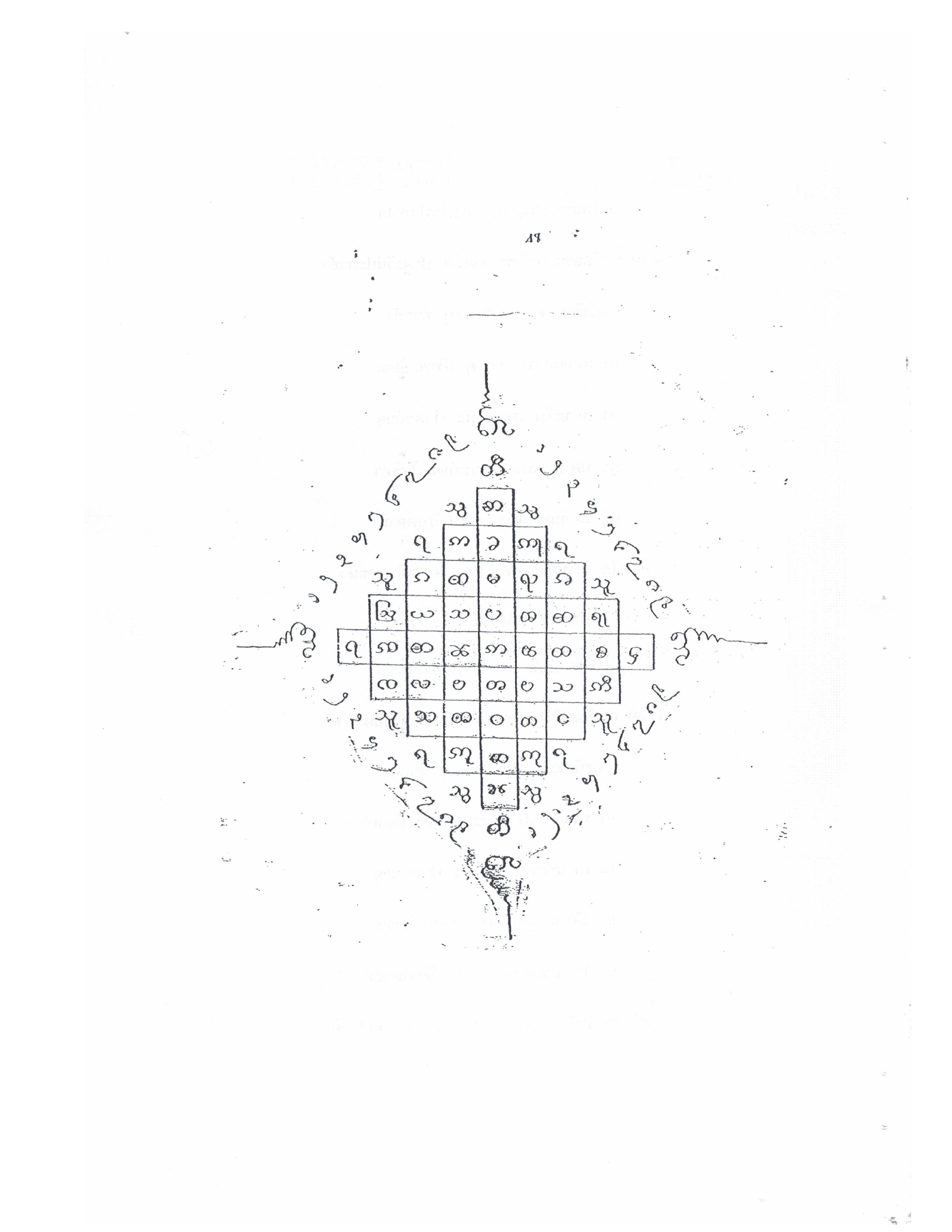
[ยันต์ตารางรูปสี่เหลี่ยมข้าวหลามตัด บรรจุตัวเลขล้านนาในแต่ละช่อง ล้อมรอบด้วยอักษรธรรมล้านนา อ่านไม่ชัด]
[yantra: a lozenge/diamond-shaped grid of stacked square cells, each filled with a Lanna numeral; the rows step outward from a single cell at the top, widen to a broad band across the middle, then narrow back to a single cell at the bottom. A ring of Lanna dhamma script runs around the outside of the diamond, illegible, with four short lines radiating from the top, bottom, left, and right points]
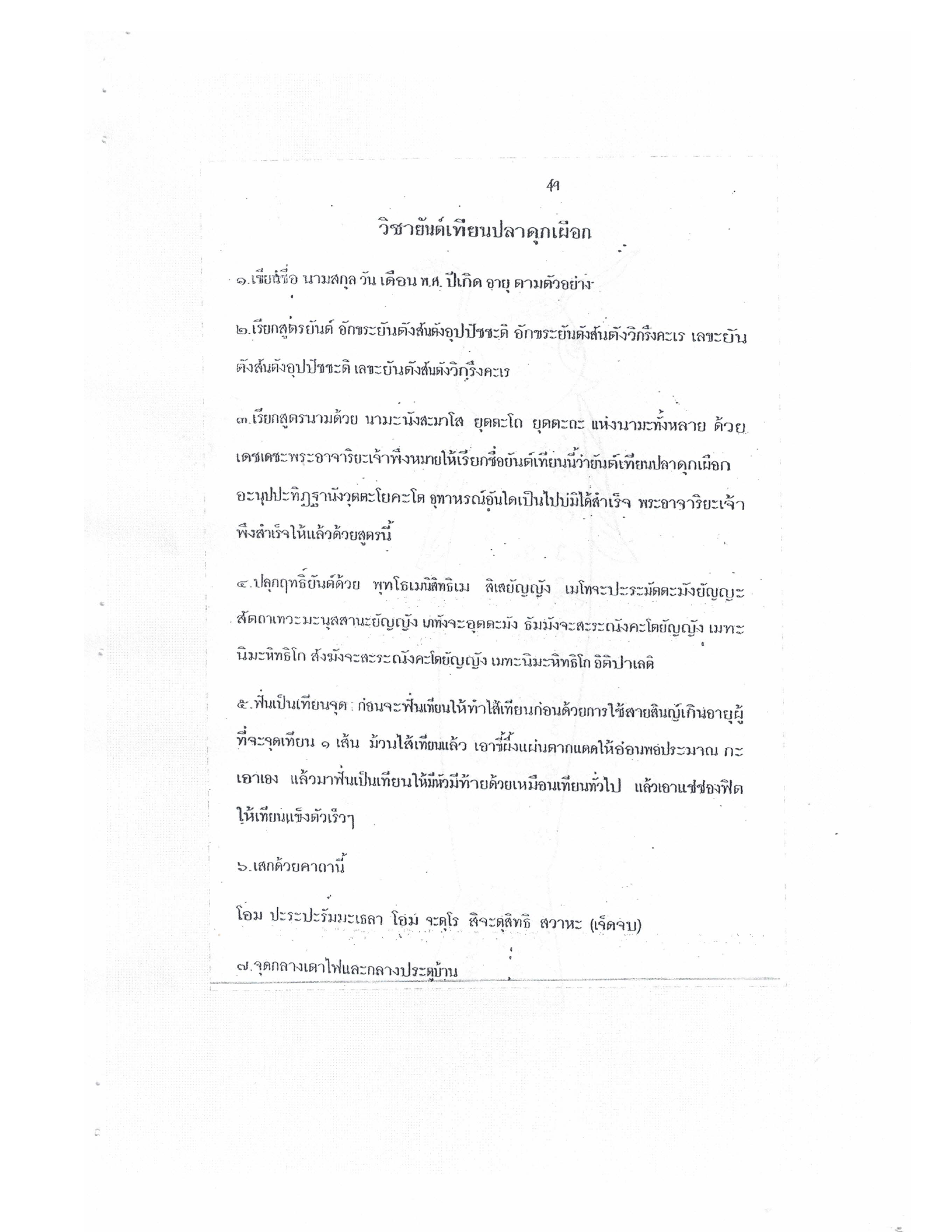
วิชายันต์เทียนปลาดุกเผือก
๑.เขียนชื่อ นามสกุล วัน เดือน พ.ศ. ปีเกิด อายุ ตามตัวอย่าง
๒.เรียกสูตรยันต์ อักขระยันต์ดังส้นดังอุปปัชชะติ อักขระยันต์ดังส้นดังวิกรึงคะเร เลขะยันต์ดังส้นดังอุปปัชชะติ เลขะยันต์ดังส้นดังวิกรึงคะเร
๓.เรียกสูตรนามด้วย นามะนังสะมาโส ยุดตะโถ ยุดตะถะ แห่งนามะทั้งหลาย ด้วยเดชเดชะพระอาจาริยะเจ้าพึงหมายให้เรียกชื่อยันต์เทียนนี้ว่ายันต์เทียนปลาดุกเผือก อะนุปปะทิฏฐานังวุตตะโยคะโต อุทาหรณ์อันใดเป็นไปบ่มิได้สำเร็จ พระอาจาริยะเจ้าพึงสำเร็จให้แล้วด้วยสูตรนี้
๔.ปลุกฤทธิ์ยันต์ด้วย พุทโธเมนิสิทธิเม สิเสยัญญัง เมโทจะประระมัดตะมังยัญญะ สัตถาเทวะมะนุสสานะยัญญัง ภทังจะอุดตะมัง ธัมมังจะสะระถังคะโตยัญญัง เมทะนิมะหิทธิโก สังมังจะสะระถังคะโตยัญญัง เมทะนิมะหิทธิโก อิติปาเลติ
๕.ฟั่นเป็นเทียนจุด ก่อนจะฟั่นเทียนให้ทำไส้เทียนก่อนด้วยการใช้สายสิญจ์เกินอายุผู้ที่จะจุดเทียน ๑ เส้น ม้วนไส้เทียนแล้ว เอาขี้ผึ้งแผ่นตากแดดให้อ่อนพอประมาณ กะเอาเอง แล้วมาฟั่นเป็นเทียนให้มีหัวมีท้ายด้วยเหมือนเทียนทั่วไป แล้วเอาแช่ช่องฟิตให้เทียนแข็งตัวเร็วๆ
๖.เสกด้วยคาถานี้
โอม ปะระปะรัมมะเถลา โอม จะตุโร สิจะตุสิทธิ สวาหะ (เจ็ดจบ)
๗.จุดกลางเตาไฟและกลางประตูบ้าน
Method of the Albino Walking-Catfish Candle Yantra
1. Write [the practitioner's] given name, surname, day, month, Buddhist-era year of birth, and age, following the example.
2. Recite the yantra formula: the yantra letters as it is said to arise, the yantra letters as it is said to multiply; the yantra numbers as it is said to arise, the yantra numbers as it is said to multiply.
3. Recite the name-formula together with 'namo-nangsamaso, yutato, yutatha' over all the names, so that by the power and majesty [of the formula] the teacher-master intends this candle-yantra to be called the Albino Walking-Catfish Candle Yantra. Whatever example fails to succeed, the master shall bring it to success by means of this formula.
4. Awaken the yantra's power with: 'Buddho meni sitthi me, sise yannyang, metho ja pramat tamang yanya, sattha teva manutsana yanyang, phathang ja uttamang, thammang ja sarathang khato yanyang, metha nimahitthiko, sangmang ja sarathang khato yanyang, metha nimahitthiko, iti paleti.' [a Pali-styled empowerment formula; several terms are obscure]
5. Twist [the wick] into a candle to be lit. Before twisting the candle, first make the wick using a length of sacred thread one strand longer than the age of the person who will light the candle. Once the wick is rolled, take a sheet of beeswax dried in the sun until soft enough — judge this yourself — then twist it into a candle with a head and a tail like an ordinary candle, and dip it in a freezer compartment so the candle hardens quickly.
6. Consecrate with this mantra: 'Om para paramma-thela, om jaturo sicatusitthi svaha' (seven times).
7. Light it in the middle of the cooking hearth and in the middle of the house's front door.
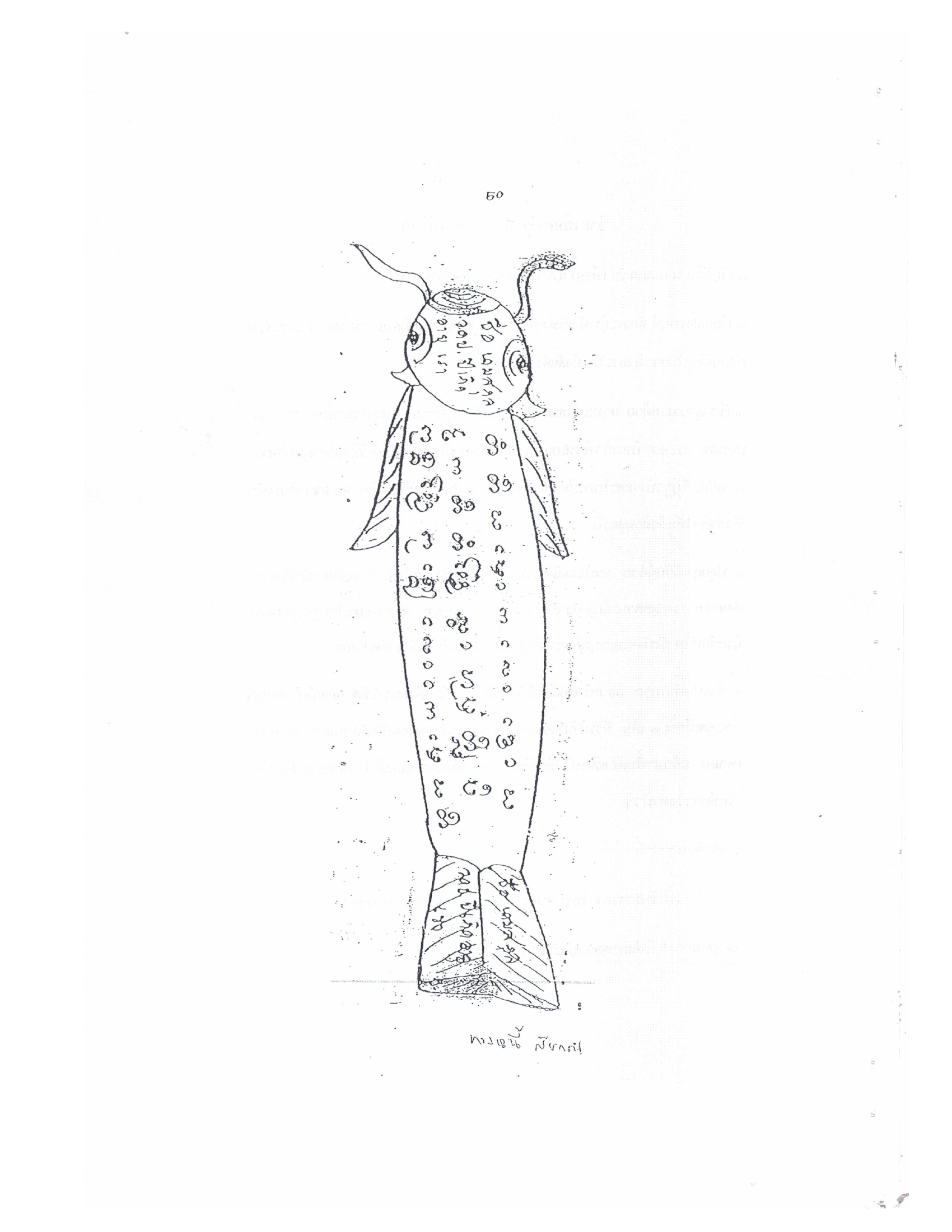
[รูปยันต์ปลาดุก มีอักษรธรรมล้านนา/อักขระขอมเขียนกำกับที่หัว ลำตัว ครีบ และหาง อ่านไม่ชัด] [ลายมือกำกับใต้ภาพ อ่านไม่ชัด]
[yantra: a drawing of a catfish seen from above, with two long barbels curling out from the head; a cluster of illegible Lanna dhamma/khom script is written inside the head, and further columns of the same illegible script run down the length of the body between the two side fins, continuing onto the two-lobed tail; a handwritten caption below the image is illegible]
วิชายันต์เทียนมูตูหลวง
ขันธ์ตั้ง [มีข้อความกำกับเพิ่มเติมด้วยลายมือ อ่านไม่ออก]
๑.กล้วยสองหวี
๒.กระทงใส่หมากพลูสองกระทง
๓.ผ้าขาวผ้าแดงขนาดฝ่ามือ
๔.เงินค่ากำนลครูห้าบาท
ให้ขึ้นขันธ์ตั้งทุกครั้งที่ทำเทียน เมื่อครบสามวันเจ็ดวันแล้วเอาน้ำส้มป่อยพรมขันธ์ตั้ง แล้วเอาขันธ์ตั้งไปไว้ที่โคนไม้ใหญ่
๑.เขียนชื่อ นามสกุล วัน เดือน พ.ศ. ปีเกิด อายุ ตามตัวอย่าง
๒.เรียกสูตรยันต์ อักขระยันต์ดังส้นดังอุปปัชชะติ อักขระยันต์ดังส้นดังวิกรึงคะเร เลขะยันต์ดังส้นดังอุปปัชชะติ เลขะยันต์ดังส้นดังวิกรึงคะเร
๓.เรียกสูตรนามด้วย นามะนังสะมาโส ยุดตะโถ ยุดตะถะ แห่งนามะทั้งหลาย ด้วยเดชเดชะพระอาจาริยะเจ้าพึงหมายให้เรียกชื่อยันต์เทียนนี้ว่ายันต์เทียนมูตูหลวง อะนุปปะทิฏฐานังวุตตะโยคะโต อุทาหรณ์อันใดเป็นไปบ่มิได้สำเร็จ พระอาจาริยะเจ้าพึงสำเร็จให้แล้วด้วยสูตรนี้
Method of the Great Mutu Candle Yantra
Offering stand (khanthang) [an additional handwritten marginal note here is illegible]
1. Two hands of bananas.
2. Two leaf-trays holding betel and areca nut.
3. White cloth and red cloth, each the size of a palm.
4. Five baht as the teacher's fee.
Set up the offering stand every time the candle is made. Once three days, then seven days, have passed, sprinkle the offering stand with soap-pod (som-poi) blessing water, then take the offering stand to the base of a large tree.
1. Write [the practitioner's] given name, surname, day, month, Buddhist-era year of birth, and age, following the example.
2. Recite the yantra formula: the yantra letters as it is said to arise, the yantra letters as it is said to multiply; the yantra numbers as it is said to arise, the yantra numbers as it is said to multiply.
3. Recite the name-formula together with 'namo-nangsamaso, yutato, yutatha' over all the names, so that by the power and majesty [of the formula] the teacher-master intends this candle-yantra to be called the Great Mutu Candle Yantra. Whatever example fails to succeed, the master shall bring it to success by means of this formula.
๔.ปลุกฤทธิ์ยันต์ด้วย พุทโธเมนิสิทธิเม สิเสยัญญัง เมโทจะประระมัดตะมังยัญญะ สัตถาเทวะมะนุสสานะยัญญัง ภทั้งจะอุดตะมัง ธัมมังจะสะระณังคะโตยัญญัง เมทะนิมะหิทธิโก สังมังจะสะระณังคะโตยัญญัง เมทะนิมะหิทธิโก อิติปาเลติ
๕.ฟั่นเป็นเทียนจุด ก่อนจะฟั่นเทียนให้ทำไส้เทียนก่อน 37 เส้นทุกคน ม้วนไส้เทียนแล้ว เอาขี้ผึ้งแผ่นตากแดดให้อ่อนพอประมาณ กะเอาเอง แล้วมาฟั่นเป็นเทียนให้มีหัวมีท้ายด้วยเหมือนเทียนทั่วไป แล้วเอาแช่ช่องฟิตให้เทียนแข็งตัวเร็วๆ
๖.เสกด้วยคาถานี้
อุ่งมูตู อะนาดิมานิ อุ่งเต สามุง ยักขิสวาหะ อุงคัจสะอะมุมนิโกาเสติฐาหิ สวาหะ (เจ็ดจบ)
๘.ให้สวดบูชาหน้าพระ นั่งภาวนาคาถาไปจนเทียนหมด
4. Awaken the yantra's power with this formula (kept as printed): 'Phuttho meni sitthi me, sise yanyang, metho cha pramatt tamang yanya, sattha thewa manutsasana yanyang, phatang cha uttamang, thammang cha saranang khatho yanyang, metha nimahitthiko, sangmang cha saranang khatho yanyang, metha nimahitthiko itipaleti.'
5. Twist the wax into a candle for lighting. Before twisting the candle, first make 37 wicks for everyone. Roll the wicks, then take a sheet of beeswax dried in the sun until soft enough — judge this yourself — then twist it into a candle with a head and a tail like an ordinary candle, and dip it in a mould/cooling channel so the candle hardens quickly.
6. Consecrate with this incantation: 'Ung mutu ana dimani ung te samung yakkhisawaha ungkhatsa amumnikoasetithahi sawaha' (seven times).
8. [The practitioner] should chant in worship before the Buddha image, sitting in meditation reciting the incantation until the candle burns out.
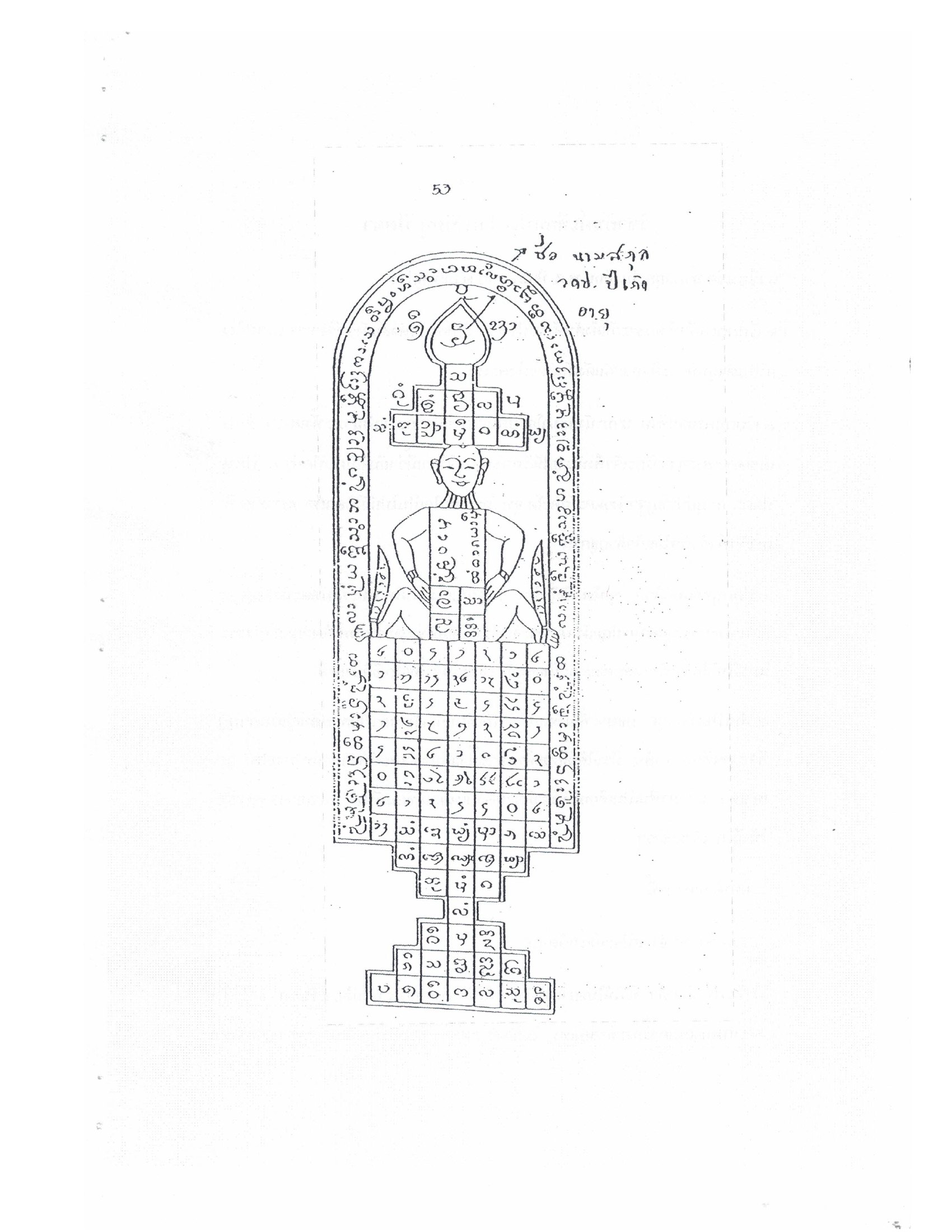
๑ ๒๓๐ [ลายมือกำกับชื่อและวันเกิดของเจ้าของยันต์ อ่านไม่ชัด] [อักขระในกรอบโค้งและในตารางเป็นอักษรธรรมล้านนา/ขอม อ่านไม่ชัด]
[Yantra diagram: a seated humanoid figure inside a tall pointed archway, the archway's border filled all the way around with a continuous line of looping Lanna Tham script (not confidently legible). Above the figure's head is a small flame- or leaf-shaped finial marked with the numerals '1' and '230' and pointed to by an arrow, with a handwritten caption beside it giving what appears to be a name and date, not confidently legible. Below the finial is a small stepped grid of a few characters, then the seated figure itself — a bald head, torso with hands resting in the lap, crossed legs — with a column of Tham-script syllables running down the chest. Below the figure's feet is a large rectangular grid, roughly nine rows by five columns, of small numerals and Tham/Lanna characters, narrowing at the bottom into a smaller stepped block of a few more rows. The individual glyphs in the border and grid could not be read with confidence and are not transcribed.]
วิชายันต์เทียนปิดปากปิดหูปิดตา
๑.เขียนชื่อ นามสกุล วัน เดือน พ.ศ. ปีเกิด อายุ ตามตัวอย่าง
๒.เรียกสูตรยันต์ อักขระยันดังสันดังอุปปัชชะติ อักขระยันดังสันดังวิกริงคะเร เลขะยันดังสันดังอุปปัชชะติ เลขะยันดังสันดังวิกริงคะเร
๓.เรียกสูตรนามด้วย นามะนังสะมาโส ยุดตะโถ ยุดตะถะ แห่งนามะทั้งหลาย ด้วยเดชเดชะพระอาจาริยะเจ้าพึงหมายให้เรียกชื่อยันต์เทียนนี้ว่ายันต์เทียนปิดปาก ปิดหู ปิดตา อะนุปปะทิฏฐานังวุดตะโยคะโต อุทาหรณ์อันใดเป็นไปบ่มิได้สำเร็จ พระอาจาริยะเจ้าพึงสำเร็จให้แล้วด้วยสูตรนี้
๔.ปลุกฤทธิ์ยันต์ด้วย พุทโธเมนิสิทธิเม สิเสยัญญัง เมโทจะประระมัดตะมังยัญญะ สัตถาเทวะมะนุสสานะยัญญัง ภทั้งจะอุดตะมัง ธัมมังจะสะระณังคะโตยัญญัง เมทะนิมะหิทธิโก สังมังจะสะระณังคะโตยัญญัง เมทะนิมะหิทธิโก อิติปาเลติ
๕.ฟั่นเป็นเทียนจุด ก่อนจะฟั่นเทียนให้ทำไส้เทียนก่อนด้วยการใช้สายสิญจ์เกินอายุผู้ที่จะจุดเทียน ๑ เส้น ม้วนไส้เทียนแล้ว เอาขี้ผึ้งแผ่นตากแดดให้อ่อนพอประมาณ กะเอาเอง แล้วมาฟั่นเป็นเทียนให้มีหัวมีท้ายด้วยเหมือนเทียนทั่วไป แล้วเอาแช่ช่องฟิตให้เทียนแข็งตัวเร็วๆ
๖.เสกด้วยคาถานี้
โอมมุกขัง พุทธัง สุปิจะเถ็ก (เจ็ดจบ)
๘.วันพระห้ามทำ ทำให้ไม่อยากรู้ไม่อยากได้ยินเรื่องของเรา ไม่ต้องเขียนหู ทำให้ไม่อยากมองเห็นการกระทำของเรา ไม่ต้องเขียนตา ทำให้ไม่พูดนินทาว่าร้ายเราทั้งต่อ
Technique of the candle yantra that seals the mouth, seals the ears, seals the eyes
1. Write the name, surname, day, month, year (B.E.) of birth, and age, following the example.
2. Recite the yantra formula: 'Akkhara-yan dang san dang uppatchati, akkhara-yan dang san dang wikringkhare, lekha-yan dang san dang uppatchati, lekha-yan dang san dang wikringkhare.'
3. Also recite the name-formula 'Nama-nang samaso yudtatho yudtatha' of all names — by the power and majesty [of the lineage] may the teacher-master intend this candle yantra to be called the candle yantra that seals the mouth, seals the ears, seals the eyes. 'Anuppathitthanang wudtayokato' — whatever example has failed to succeed, may the teacher-master cause it to succeed by this formula.
4. Awaken the yantra's power with: 'Phuttho meni sitthi me, sise yanyang, metho cha pramatt tamang yanya, sattha thewa manutsasana yanyang, phatang cha uttamang, thammang cha saranang khatho yanyang, metha nimahitthiko, sangmang cha saranang khatho yanyang, metha nimahitthiko itipaleti.'
5. Twist the wax into a candle for lighting. Before twisting the candle, first make the wick using a length of sacred thread (sai sin) longer than the age of the person for whom the candle is to be lit, one wick. Roll the wick, then take a sheet of beeswax dried in the sun until soft enough — judge this yourself — then twist it into a candle with a head and a tail like an ordinary candle, then dip it in a mould/cooling channel so the candle hardens quickly.
6. Consecrate with this incantation: 'Om mukkhang phutthang supi cha thek' (seven times).
8. It is forbidden to make this on a Buddhist observance day (wan phra). Doing so makes [the target] not want to know, not want to hear about our affairs — no need to write on the ear. It makes them not want to see what we do — no need to write on the eye. It makes them not gossip or speak ill of us, whether to...
หน้าและลับหลัง ไม่ต้องเขียนปาก ทำให้ไม่สามารถทำร้ายเราได้ ไม่ต้องเขียนมือ ทำให้ไม่อยากมาหาเรา ไม่ต้องเขียนขา
๘.ให้สวดบูชาหน้าพระ นั่งภาวนาคาถาไปจนเทียนหมด
...our face or behind our back — no need to write on the mouth. It makes them unable to harm us — no need to write on the hand. It makes them not want to come looking for us — no need to write on the leg.
8. [The practitioner] should chant in worship before the Buddha image, sitting in meditation reciting the incantation until the candle burns out.
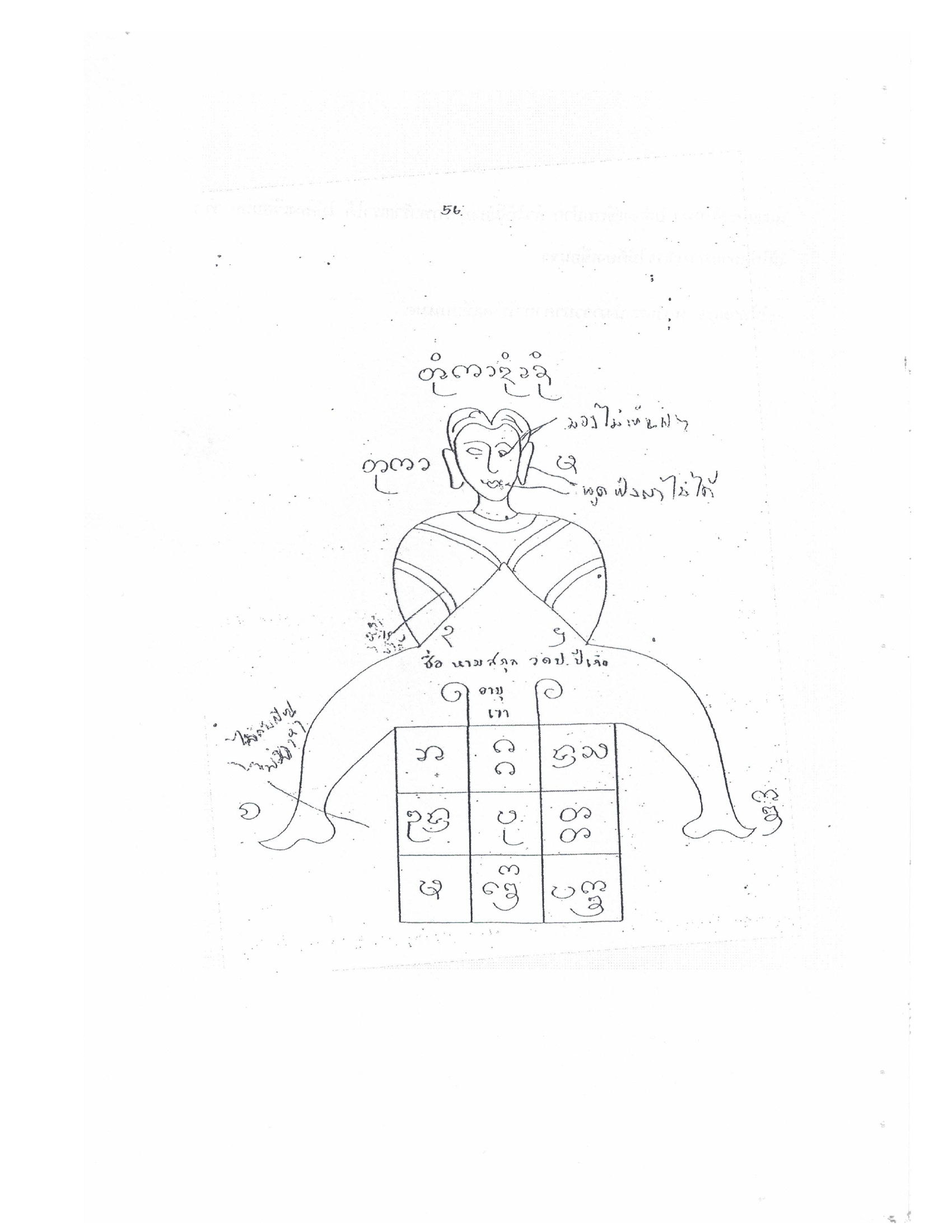
ชื่อ นามสกุล วดป.ปีเกิด อายุ เท่า [ลายมือกำกับอื่น ๆ ในภาพ อ่านไม่ชัด]
[Yantra diagram: the head, shoulders, and crossed arms of a figure — torso only, no lower body shown. A small caption is written above the head, not confidently legible. An arrow runs from beside the eye to a handwritten note, and another from beside the ear to a second note; neither note is confidently legible, but by their placement they appear to describe the eye being unable to see and the ear being unable to hear, consistent with the accompanying 'candle that seals the mouth, ears, and eyes' recipe. Below the crossed arms is the caption 'name, surname, date of birth,' and below that the heading 'age, equal to' above a 3x3 grid. The grid cells, and the loose characters scattered beside the arms and legs, are small Lanna/Tham-style glyphs that could not be read with confidence.]
วิชายันต์เทียนยักษ์ข่ม
๑.เขียนชื่อ นามสกุล วัน เดือน พ.ศ. ปีเกิด อายุ ตามตัวอย่าง
๒.เรียกสูตรยันต์ อักขระยันดังสันดังอุปปัชชะติ อักขระยันดังสันดังวิกริงคะเร เลขะยันดังสันดังอุปปัชชะติ เลขะยันดังสันดังวิกริงคะเร
๓.เรียกสูตรนามด้วย นามะนังสะมาโส ยุดตะโถ ยุดตะถะ แห่งนามะทั้งหลาย ด้วยเดชเดชะพระอาจาริยะเจ้าพึงหมายให้เรียกชื่อยันต์เทียนนี้ว่ายันต์เทียนยักษ์ข่ม อะนุปปะทิฏฐานังวุดตะโยคะโต อุทาหรณ์อันใดเป็นไปบ่มิได้สำเร็จ พระอาจาริยะเจ้าพึงสำเร็จให้แล้วด้วยสูตรนี้
๔.ปลุกฤทธิ์ยันต์ด้วย พุทโธเมนิสิทธิเม สิเสยัญญัง เมโทจะประระมัดตะมังยัญญะ สัตถาเทวะมะนุสสานะยัญญัง ภทั้งจะอุดตะมัง ธัมมังจะสะระณังคะโตยัญญัง เมทะนิมะหิทธิโก สังมังจะสะระณังคะโตยัญญัง เมทะนิมะหิทธิโก อิติปาเลติ
๕.ฟั่นเป็นเทียนจุด ก่อนจะฟั่นเทียนให้ทำไส้เทียนก่อนด้วยการใช้สายสิญจ์เกินอายุผู้ที่จะจุดเทียน ๑ เส้น ม้วนไส้เทียนแล้ว เอาขี้ผึ้งแผ่นตากแดดให้อ่อนพอประมาณ กะเอาเอง แล้วมาฟั่นเป็นเทียนให้มีหัวมีท้ายด้วยเหมือนเทียนทั่วไป แล้วเอาแช่ช่องฟิตให้เทียนแข็งตัวเร็วๆ
๖.เสกด้วยคาถานี้
โอมมะอุ่งติ โลมาติ พุทธะจิตตัง.................จิตตัง เอหิมัง ธัมมะจิตตัง.................จิตตังเอหิมัง สังฆะจิตตัง.................จิตตังเอหิมัง มานิมัง ปิยะมะมะ (เจ็ดจบ)
๘.ให้สวดบูชาหน้าพระ นั่งภาวนาคาถาไปจนเทียนหมด
Technique of the yaksha-suppressing candle yantra
1. Write the name, surname, day, month, year (B.E.) of birth, and age, following the example.
2. Recite the yantra formula: 'Akkhara-yan dang san dang uppatchati, akkhara-yan dang san dang wikringkhare, lekha-yan dang san dang uppatchati, lekha-yan dang san dang wikringkhare.'
3. Also recite the name-formula 'Nama-nang samaso yudtatho yudtatha' of all names — by the power and majesty [of the lineage] may the teacher-master intend this candle yantra to be called the yaksha-suppressing candle yantra. 'Anuppathitthanang wudtayokato' — whatever example has failed to succeed, may the teacher-master cause it to succeed by this formula.
4. Awaken the yantra's power with: 'Phuttho meni sitthi me, sise yanyang, metho cha pramatt tamang yanya, sattha thewa manutsasana yanyang, phatang cha uttamang, thammang cha saranang khatho yanyang, metha nimahitthiko, sangmang cha saranang khatho yanyang, metha nimahitthiko itipaleti.'
5. Twist the wax into a candle for lighting. Before twisting the candle, first make the wick using a length of sacred thread (sai sin) longer than the age of the person for whom the candle is to be lit, one wick. Roll the wick, then take a sheet of beeswax dried in the sun until soft enough — judge this yourself — then twist it into a candle with a head and a tail like an ordinary candle, then dip it in a mould/cooling channel so the candle hardens quickly.
6. Consecrate with this incantation: 'Om ma ung ti loma ti phutthachittang [gap] chittang ehimang thammachittang [gap] chittang ehimang sangkhachittang [gap] chittang ehimang manimang piyamama' (seven times). [The dotted gaps are printed as-is in the original, apparently marking an omitted or repeated portion of the chant.]
8. [The practitioner] should chant in worship before the Buddha image, sitting in meditation reciting the incantation until the candle burns out.
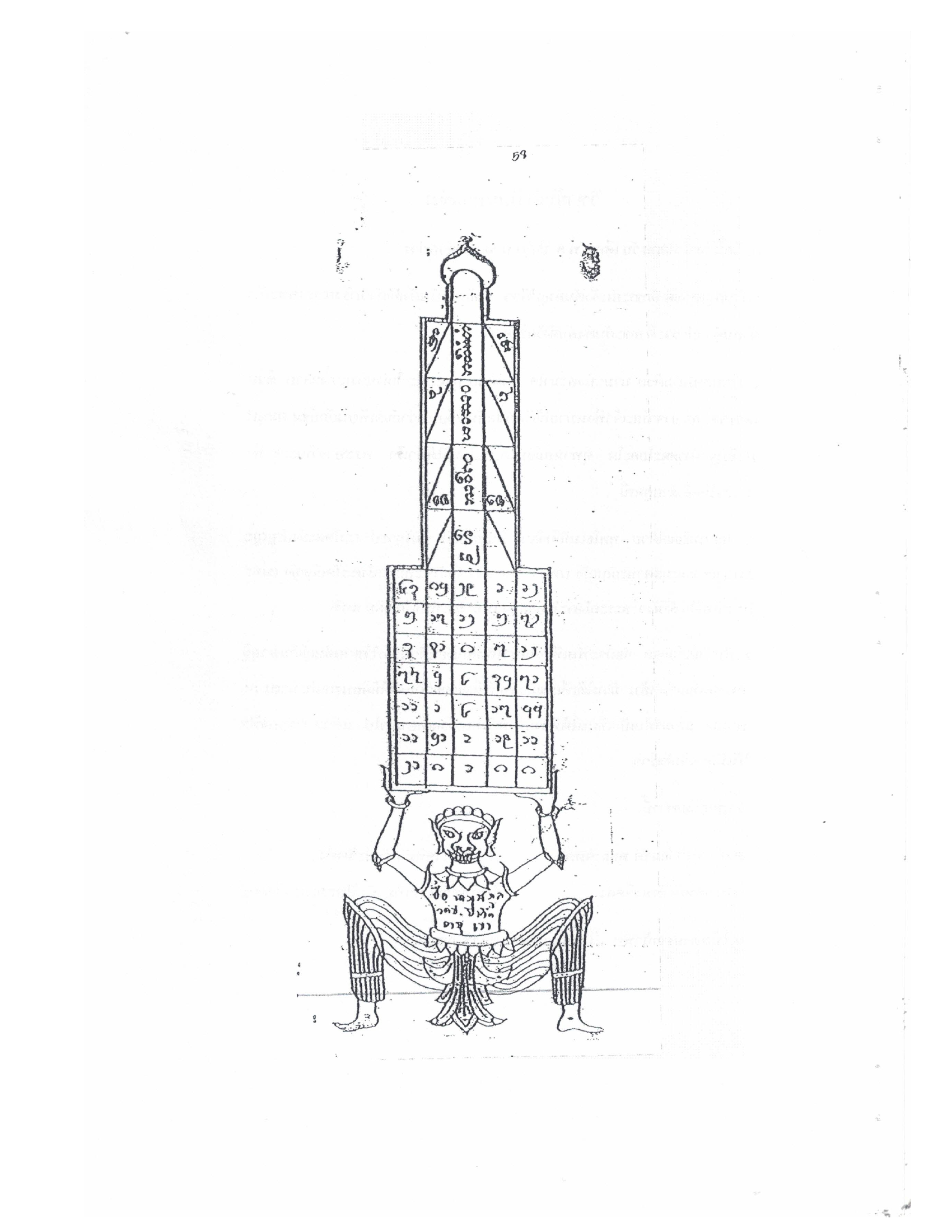
วิชายันต์เทียนผ่าจ้าน
๑.เขียนชื่อ นามสกุล วัน เดือน พ.ศ. ปีเกิด อายุ ตามตัวอย่าง
๒.เรียกสูตรยันต์ อักขระยันดังสันดังอุปปัชชะติ อักขระยันดังสันดังวิกริงคะเร เลขะยันดังสันดังอุปปัชชะติ เลขะยันดังสันดังวิกริงคะเร
๓.เรียกสูตรนามด้วย นามะนังสะมาโส ยุดตะโถ ยุดตะถะ แห่งนามะทั้งหลาย ด้วยเดชเดชะพระอาจาริยะเจ้าพึงหมายให้เรียกชื่อยันต์เทียนนี้ว่ายันต์เทียนผ่าจ้าน อะนุปปะทิฏฐานังวุดตะโยคะโต อุทาหรณ์อันใดเป็นไปบ่มิได้สำเร็จ พระอาจาริยะเจ้าพึงสำเร็จให้แล้วด้วยสูตรนี้
๔.ปลุกฤทธิ์ยันต์ด้วย พุทโธเมนิสิทธิเม สิเสยัญญัง เมโทจะประระมัดตะมังยัญญะ สัตถาเทวะมะนุสสานะยัญญัง ภทั้งจะอุดตะมัง ธัมมังจะสะระณังคะโตยัญญัง เมทะนิมะหิทธิโก สังมังจะสะระณังคะโตยัญญัง เมทะนิมะหิทธิโก อิติปาเลติ
๕.ฟั่นเป็นเทียนจุด ก่อนจะฟั่นเทียนให้ทำไส้เทียนก่อนด้วยการใช้สายสิญจ์เกินอายุผู้ที่จะจุดเทียน ๑ เส้น ม้วนไส้เทียนแล้ว เอาขี้ผึ้งแผ่นตากแดดให้อ่อนพอประมาณ กะเอาเอง แล้วมาฟั่นเป็นเทียนให้มีหัวมีท้ายด้วยเหมือนเทียนทั่วไป แล้วเอาแช่ช่องฟิตให้เทียนแข็งตัวเร็วๆ
๖.เสกด้วยคาถานี้
โอม นิต่ำต่ำไร นองสู่อยู่กองรักกั้นเท่าเป้ามอปูดอย โอมสะหะจาก (เจ็ดจบ)
๘.จุดที่ป่าช้ากลางกองฟอน ทางสามแพร่ง หน้าบ้าน กลางเตาไฟ วัดร้าง บ้านร้าง น้ำที่ไหลแยกกันเป็นสองทาง
Technique of the cleaving candle yantra ('phaa jaan')
1. Write the name, surname, day, month, year (B.E.) of birth, and age, following the example.
2. Recite the yantra formula: 'Akkhara-yan dang san dang uppatchati, akkhara-yan dang san dang wikringkhare, lekha-yan dang san dang uppatchati, lekha-yan dang san dang wikringkhare.'
3. Also recite the name-formula 'Nama-nang samaso yudtatho yudtatha' of all names — by the power and majesty [of the lineage] may the teacher-master intend this candle yantra to be called the cleaving candle yantra. 'Anuppathitthanang wudtayokato' — whatever example has failed to succeed, may the teacher-master cause it to succeed by this formula.
4. Awaken the yantra's power with: 'Phuttho meni sitthi me, sise yanyang, metho cha pramatt tamang yanya, sattha thewa manutsasana yanyang, phatang cha uttamang, thammang cha saranang khatho yanyang, metha nimahitthiko, sangmang cha saranang khatho yanyang, metha nimahitthiko itipaleti.'
5. Twist the wax into a candle for lighting. Before twisting the candle, first make the wick using a length of sacred thread (sai sin) longer than the age of the person for whom the candle is to be lit, one wick. Roll the wick, then take a sheet of beeswax dried in the sun until soft enough — judge this yourself — then twist it into a candle with a head and a tail like an ordinary candle, then dip it in a mould/cooling channel so the candle hardens quickly.
6. Consecrate with this incantation: 'Om ni tam tam rai nong su yu kong rak kan thao pao mo pu doi om sa ha chak' (seven times).
8. Light it at a cremation ground amid the ashes of a pyre, at a three-way crossroads, in front of a house, at the middle of a hearth-fire, at a ruined/abandoned temple, at a ruined/abandoned house, or at flowing water that splits into two channels.
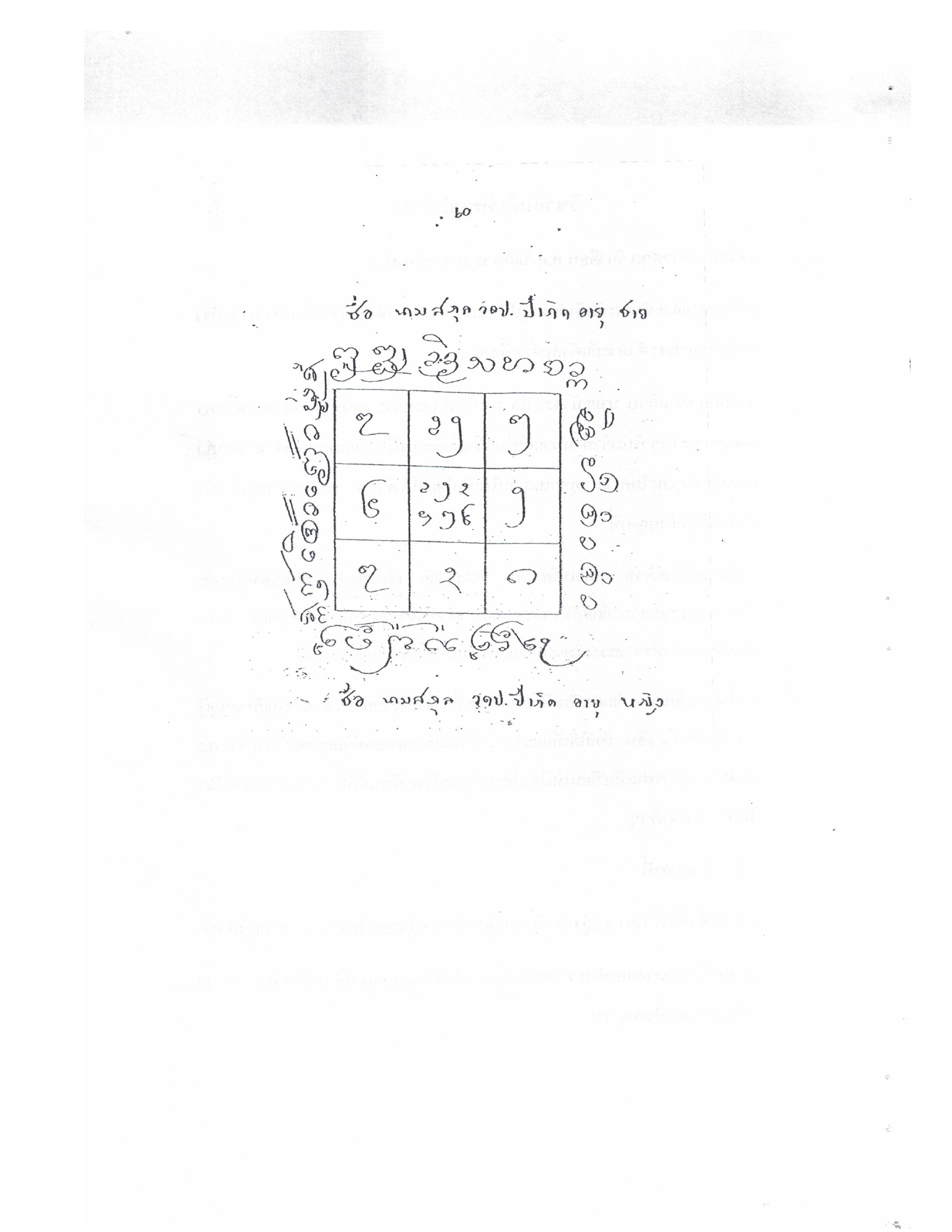
ชื่อ นามสกุล วดป.ปีเกิด [ตัวเลขในตารางและอักขระในกรอบเป็นอักษรธรรมล้านนา/ขอม อ่านไม่ชัด] ชื่อ นามสกุล วดป.ปีเกิด
[Yantra diagram: a 3x3 magic square whose nine cells are filled with small numerals in Lanna/Tham script, not confidently legible. Above and below the square is the caption 'name, surname, date of birth,' where the practitioner is to fill in the client's details. The square is bordered on all four sides by a dense line of looping Lanna/Tham script characters, likewise not confidently legible.]
วิชายันต์เทียนภควัมบดี
๑.เขียนชื่อ นามสกุล วัน เดือน พ.ศ. ปีเกิด อายุ ตามตัวอย่าง
๒.เรียกสูตรยันต์ อักขระยันดังสันดังอุปปัชชะติ อักขระยันดังสันดังวิกริงคะเร เลขะยันดังสันดังอุปปัชชะติ เลขะยันดังสันดังวิกริงคะเร
๓.เรียกสูตรนามด้วย นามะนังสะมาโส ยุดตะโถ ยุดตะถะ แห่งนามะทั้งหลาย ด้วยเดชเดชะพระอาจาริยะเจ้าพึงหมายให้เรียกชื่อยันต์เทียนนี้ว่ายันต์เทียนภควัมบดี อะนุปปะทิฏฐานังวุดตะโยคะโต อุทาหรณ์อันใดเป็นไปบ่มิได้สำเร็จ พระอาจาริยะเจ้าพึงสำเร็จให้แล้วด้วยสูตรนี้
๔.ปลุกฤทธิ์ยันต์ด้วย พุทโธเมนิสิทธิเม สิเสยัญญัง เมโทจะประระมัดตะมังยัญญะ สัตถาเทวะมะนุสสานะยัญญัง ภทั้งจะอุดตะมัง ธัมมังจะสะระณังคะโตยัญญัง เมทะนิมะหิทธิโก สังมังจะสะระณังคะโตยัญญัง เมทะนิมะหิทธิโก อิติปาเลติ
๕.ฟั่นเป็นเทียนจุด ก่อนจะฟั่นเทียนให้ทำไส้เทียนก่อนด้วยการใช้สายสิญจ์เกินอายุผู้ที่จะจุดเทียน ๑ เส้น ม้วนไส้เทียนแล้ว เอาขี้ผึ้งแผ่นตากแดดให้อ่อนพอประมาณ กะเอาเอง แล้วมาฟั่นเป็นเทียนให้มีหัวมีท้ายด้วยเหมือนเทียนทั่วไป แล้วเอาแช่ช่องฟิตให้เทียนแข็งตัวเร็วๆ
๖.เสกด้วยคาถานี้
อิติปิโส ภะคะวา อะระหัง สัมมาสัมพุทโธ วิชชาจะระณะสัมปันโน สุคะโต โลกะวิทู อะนุตตะโร ปุริสะทัมมะสาระถิ สัตถา เทวะมะนุสสานัง พุทโธ ภะคะวาติ (เจ็ดจบ)
เสกด้วย นะชาลีติ ไปจนกว่าจะสิ้นเทียน เป็นที่รักและบูชาแก่คนทั้งหลาย
Technique of the Bhagavampati candle yantra
1. Write the name, surname, day, month, year (B.E.) of birth, and age, following the example.
2. Recite the yantra formula: 'Akkhara-yan dang san dang uppatchati, akkhara-yan dang san dang wikringkhare, lekha-yan dang san dang uppatchati, lekha-yan dang san dang wikringkhare.'
3. Also recite the name-formula 'Nama-nang samaso yudtatho yudtatha' of all names — by the power and majesty [of the lineage] may the teacher-master intend this candle yantra to be called the Bhagavampati candle yantra. 'Anuppathitthanang wudtayokato' — whatever example has failed to succeed, may the teacher-master cause it to succeed by this formula.
4. Awaken the yantra's power with: 'Phuttho meni sitthi me, sise yanyang, metho cha pramatt tamang yanya, sattha thewa manutsasana yanyang, phatang cha uttamang, thammang cha saranang khatho yanyang, metha nimahitthiko, sangmang cha saranang khatho yanyang, metha nimahitthiko itipaleti.'
5. Twist the wax into a candle for lighting. Before twisting the candle, first make the wick using a length of sacred thread (sai sin) longer than the age of the person for whom the candle is to be lit, one wick. Roll the wick, then take a sheet of beeswax dried in the sun until soft enough — judge this yourself — then twist it into a candle with a head and a tail like an ordinary candle, then dip it in a mould/cooling channel so the candle hardens quickly.
6. Consecrate with this incantation, the well-known verse in praise of the Buddha (Itipiso): 'Itipi so bhagavā arahaṃ sammāsambuddho vijjācaraṇasampanno sugato lokavidū anuttaro purisadammasārathi satthā devamanussānaṃ buddho bhagavā' — 'Thus indeed is the Blessed One: worthy, perfectly self-awakened, endowed with knowledge and conduct, well-gone, knower of the world, unsurpassed guide of persons to be tamed, teacher of gods and humans, awakened, blessed' (seven times).
Also consecrate with 'na chaliti', reciting until the candle is entirely spent, so as to be an object of love and reverence to all people.
๘.ให้สวดบูชาหน้าพระ นั่งภาวนาคาถาไปจนเทียนหมด
8. [The practitioner] should chant in worship before the Buddha image, sitting in meditation reciting the incantation until the candle burns out.
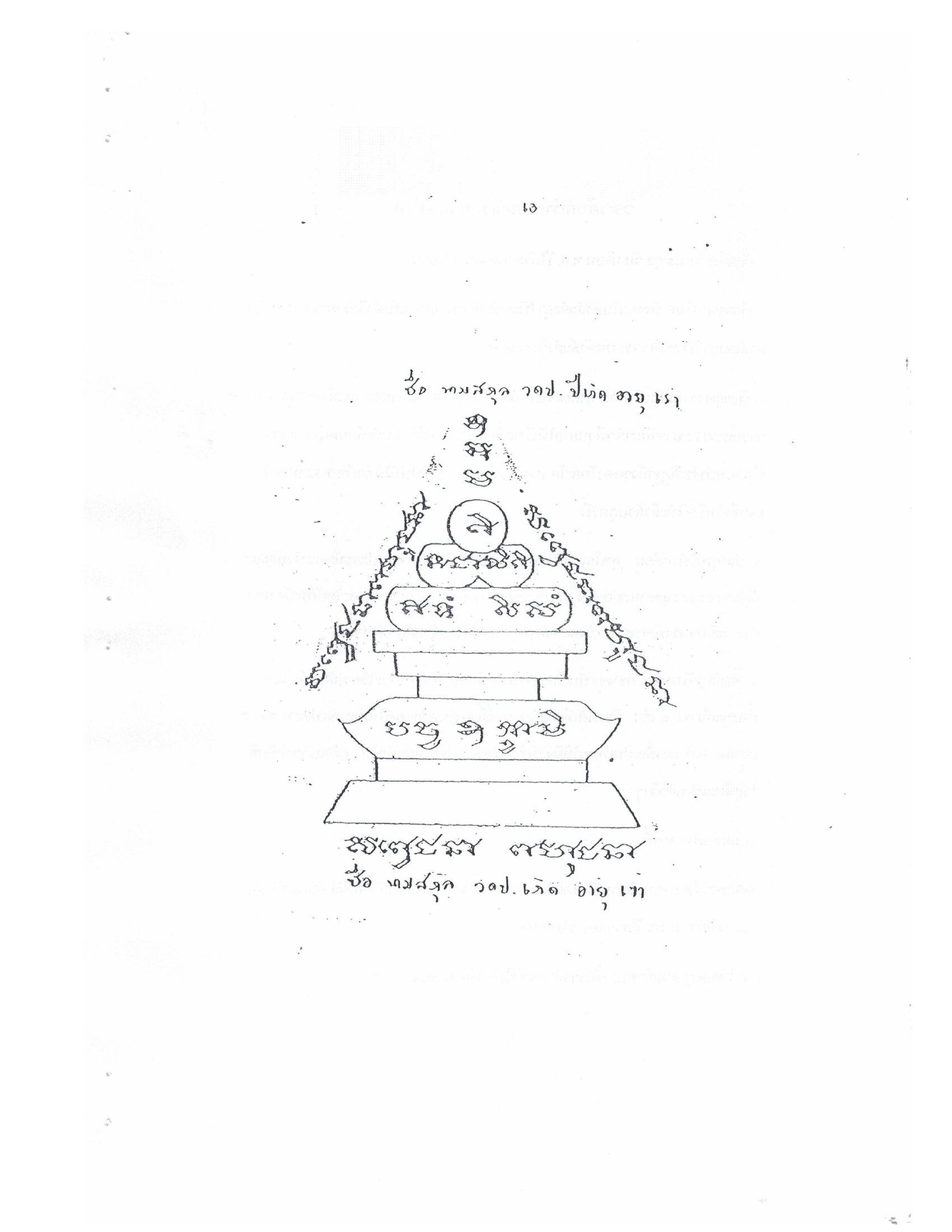
ชื่อ นามสกุล ว.ด.ป.เกิด อายุ [อ่านไม่ออก]
[อักขระขอม/ลานนาในยันต์รูปเจดีย์ อ่านไม่ชัด]
ชื่อ นามสกุล ว.ด.ป.เกิด อายุ [อ่านไม่ออก]
Name, surname, date of birth (day/month/year), age [illegible]
[yantra: a stupa/chedi-shaped diagram built in tiers. At the peak, three stacked syllables; below them a circle enclosing one syllable, resting on two joined lobes each holding a syllable; below that a rectangular band with two more syllables; then plinth tiers; and at the base a wide petalled band with two syllables. The sloping outer edges of the triangle are bordered top to bottom with decorative Lanna/Khom script. The akkhara throughout the figure are not confidently legible.]
Name, surname, date of birth (day/month/year), age [illegible]
วิชายันต์เทียนหญิง-ชายจูงมือ
๑.เขียนชื่อ นามสกุล วัน เดือน พ.ศ. ปีเกิด อายุ ตามตัวอย่าง
๒.เรียกสูตรยันต์ อักขระยันต์ดังสันดังอุปปัชชะติ อักขระยันต์ดังสันดังวิกริงคะเร เลขยันต์ดังสันดังอุปปัชชะติ เลขยันต์ดังสันดังวิกริงคะเร
๓.เรียกสูตรนามด้วย นามะนังสะมาโส ยุตตะโถ ยุตตะถะ แห่งนามะทั้งหลาย ด้วยเดชเดชะพระอาจาริยะเจ้าพึงหมายให้เรียกชื่อยันต์เทียนนี้ว่ายันต์เทียนหญิง-ชายจูงมือ อะนุปปะทิฏฐานังวุดตะโยคะโต อุทาหรณ์อันใดเป็นไปบ่มิได้สำเร็จ พระอาจาริยะเจ้าพึงสำเร็จให้แล้วด้วยสูตรนี้
๔.ปลุกฤทธิ์ยันต์ด้วย พุทโธเมนิสิทธิเม สิเสยัญญัง เมโทจะประมัดตะมังยัญญะ สัดถาเทวะมะนุสสานะยัญญัง นทังจะอุตตะมัง ธัมมังจะสะระณังคะโดยัญญัง เมทะ. นิมะหิทธิโก สังฆังจะสะระณังคะโดยัญญัง เมทะนิมะหิทธิโก อิติปาเลติ
๕.ฟั่นเป็นเทียนจุด ก่อนจะฟั่นเทียนให้ทำไส้เทียนก่อนด้วยการใช้สายสิญจน์เกินอายุผู้ที่จะจุดเทียน ๑ เส้น ม้วนไส้เทียนแล้ว เอาขี้ผึ้งแผ่นตากแดดให้อ่อนพอประมาณ กะเอาเอง แล้วมาฟั่นเป็นเทียนให้มีหัวมีท้ายด้วยเหมือนเทียนทั่วไป แล้วเอาแช่ช่องฟิดให้เทียนแข็งตัวเร็วๆ
๖.เสกด้วยคาถานี้
อิธะเจตะโสทัฟห์ง กัณหานิ อิตถีจิตตัง ปิยังมะมะ อิธะเจดะโสทัฟห์ง กัณหานิ ปุริสะจิตตัง ปิยังมะมะ ปิยาวาเย ปิเยล้วหุม
๗.ให้สวดบูชาหน้าพระ นั่งภาวนาคาถาไปจนเทียนหมด
The Craft of the Female-Male Hand-Leading Candle Yantra
1. Write the name, surname, day, month, Buddhist-Era year of birth, and age, following the example.
2. Recite the yantra formula [incantation]: 'akkhara yant dang san dang uppatchati, akkhara yant dang san dang wikringkhare, lek yant dang san dang uppatchati, lek yant dang san dang wikringkhare.'
3. Recite the name-formula together with it [incantation]: 'nama nang samaso yutta-tho yutta-tha' -- of all the names [of those the charm concerns]. By this power and glory the teacher-master should intend that this candle-yantra be called the 'Female-Male Hand-Leading Candle Yantra' -- anuppatitthanang wutta-yokato. Whatever instance has not yet succeeded, the teacher-master shall make it succeed with this formula.
4. Awaken the yantra's power with [incantation]: 'Puttho me nisitthi me, sise yanyang, medo ja pramat tamang yanya, sattha thewa manutsana yanyang, nathang ja uttamang, thammang ja saranang khado yanyang, metha nimahitthiko, sangkhang ja saranang khado yanyang, metha nimahitthiko, iti paleti.'
5. Twist it into a lit candle. Before twisting the candle, first make the wick, using a length of sacred thread [sai sin] longer than the age of the person who will light the one candle-strand. Having rolled the wick, take a sheet of beeswax and sun it until it is suitably soft -- judge this yourself -- then twist it into a candle so that it has a head and a tail like an ordinary candle. Then dip it in a channel of water so the candle hardens quickly.
6. Consecrate it with this incantation: 'Itha jetaso thap-hang, kanhani itthi-jittang piyang mama, itha jetaso thap-hang, kanhani purisa-jittang piyang mama, piyawaye piye luam hum.'
7. Have [the practitioner] chant in worship before the Buddha image, sitting in meditation reciting the incantation until the candle is used up.
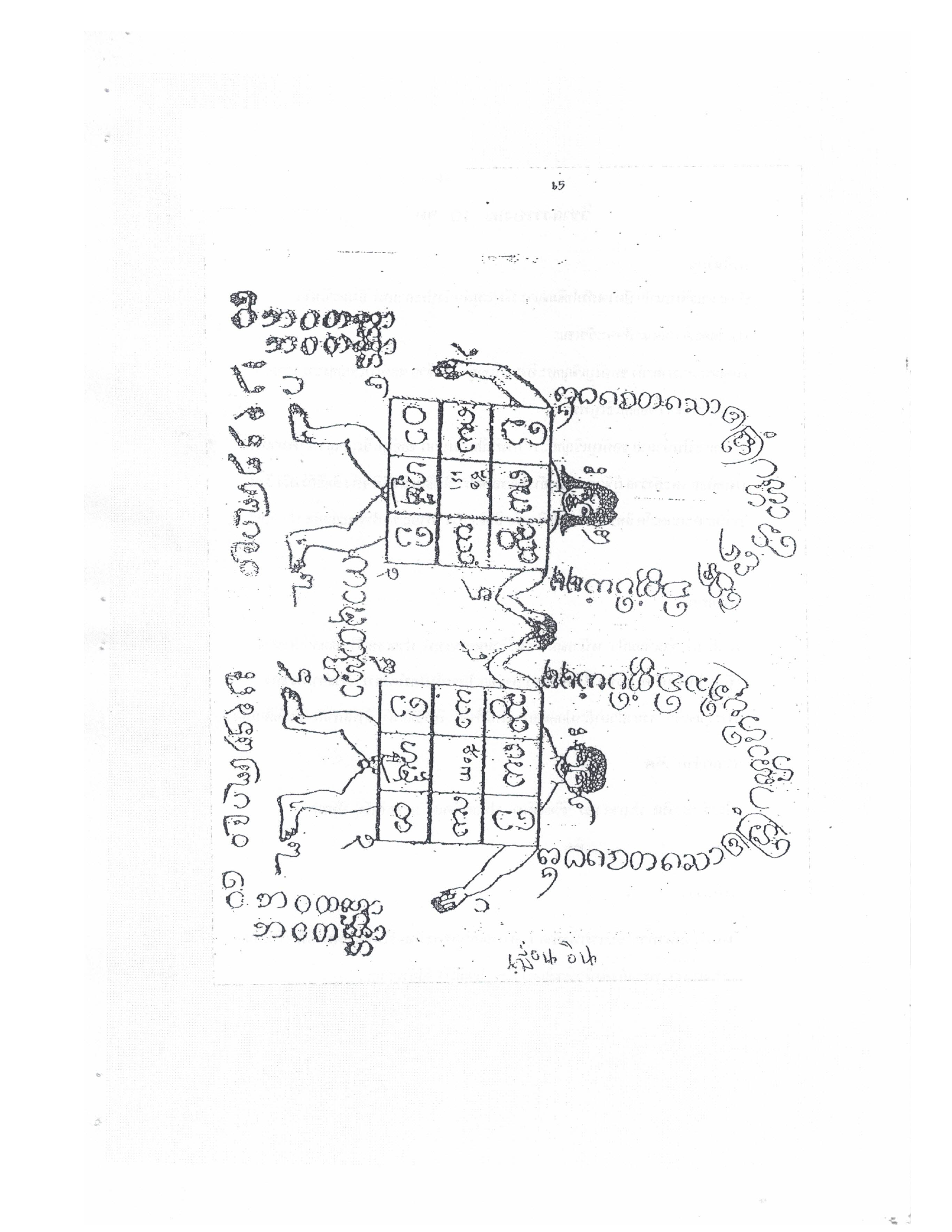
คาถาพระธรรมขับผี
พุทโธ นาม ภควา ผู้ข้าขอเอาคุณบุญราศีรัศมี บารมีธรรมแห่งพระพุทธเจ้า ตามเป็นเค้าเป็นกก ตกแต่งธรรมสอนสั่งอักขระ ตั้งเป็น อะ เป็น อา ทั้งอ้อยเอ็ดภาษา ถ้วนหน้า บารมีเกล้า แผ่เมตตา แบ่งธรรมผายโผด ผีตัวใดแฝงทำโทษ ธรรมเจ้าขับหนี ฝูงมิจฉาทิฏฐิณเหล่า ธรรมเจ้าขับหนี ผีกินปี้กินเดือน เข้าไฝ่ตาย ธรรมเจ้าขับหนี ผีกินเข้าในนาตายแล้ง ธรรมเจ้าขับหนี ผีกินในเล้าในเยีย ธรรมเจ้าขับหนี ผีแผดอยู่แจ้เล้า ธรรมเจ้าขับหนี ผีเถ่าอยู่ขอกไฮ่ แคมสวน ธรรมเจ้าขับหนี ผีกวนกินคน กินความย หมู ไก่ ธรรมเจ้าขับหนี ผีสาโหด ตาฟาง ธรรมเจ้าขับหนี ผีกลางทางล่มท่าว ธรรมเจ้าขับหนี ผีโท่งป่าเป็นพระยา ธรรมเจ้าขับหนี ผีสามาลย์อยู่ในถ้ำ ธรรมเจ้าขับหนี ผีดำอยู่ในแจ้ ธรรมเจ้าขับหนี ผีตาเบือนสู้สูงเจ้า ธรรมเจ้าขับหนี ผีตานายนำเชื้อ ธรรมเจ้าขับหนี ผีเฮือนอยู่ดอมคน ธรรมเจ้าขับหนี ผีมนต์กลายใส่อุ่น ธรรมเจ้าขับหนี ผีเอาฝุ่นตีนฮอย ธรรมเจ้าขับหนี ผีคอยคนไส่ห้วาน ธรรมเจ้าขับหนี ผีเสื้อบ้านกวนเมือง
ธรรมเจ้าขับหนี ผีขวางเฮือนกลายเป็นเงือก ธรรมเจ้าขับหนี ผีลากเชือกผูกคน ธรรมเจ้าขับหนี ผีมนต์กลายเป็นปอบ ธรรมเจ้าขับหนี ผีทอบหุ่นงัวธนู ธรรมเจ้าขับหนี ผีกินปูใส่หน้าน้อย ธรรมเจ้าขับหนี ผีอยู่ลี้คอยบังดี ธรรมเจ้าขับหนี ผีถือวีขับฟ้อน ธรรมเจ้าขับหนี ผีย้อนง้าวบังฟัน ธรรมเจ้าขับหนี ผียะคันยะคาย ให้คนเจ็บไข้ ธรรมเจ้าขับหนี ผีให้เกิดเป็นหมอ ธรรมเจ้าขับหนี ผีตากอบบริสาจ ธรรมเจ้าขับหนี ผีพาดเสื้อให้เป็นทาย ธรรมเจ้าขับหนี ผีตานายแฮก ธรรมเจ้าขับหนี ผีป่าอยู่ภูผา ธรรมเจ้าขับหนี ผีคาดคาฮ้องอยู่เทิงอากาศ ธรรมเจ้าขับหนี ผีคาดห้างยิงคน ธรรมเจ้าขับหนี ผีทำกลยะตื่นหลุบหล่ม ธรรมเจ้าขับหนี ผีข่มให้เป็นบ้าป่วงวิน ธรรมเจ้าขับหนี ผีอยู่หิน อยู่ผานสนหน่อน ธรรมเจ้าขับหนี ผีผาต่อน ผาด่าง ผาไต ธรรมเจ้าขับหนี ผีจังไอควัดฮอยู่
Mantra of the Dhamma that Drives Out Ghosts
Buddho, that is, the Blessed One — I take the virtue, the auspicious merit and radiance, the accomplished power of the Buddha's Dhamma as my root and source. I arrange the Dhamma, teaching the letters: setting down A as A, AA as AA, the full array of sounds in every form. By his gracious power, spreading loving-kindness, dispensing the Dhamma to release and save: whatever ghost hides and does harm — Lord Dhamma, drive it out! The crowds of those of wrong view — Lord Dhamma, drive them out! The ghost that devours months and years, driving one into the fields to die — Lord Dhamma, drive it out! The ghost that eats the rice in the paddies until they die of drought — Lord Dhamma, drive it out! The ghost that eats in the granary, in the rice-barn — Lord Dhamma, drive it out! The ghost that glares by the doorway — Lord Dhamma, drive it out! The ghost that squats at the edge of the swidden field, along the garden — Lord Dhamma, drive it out! The ghost that torments and eats people, eats buffalo, pigs, chickens — Lord Dhamma, drive it out! The cruel, dim-eyed ghost — Lord Dhamma, drive it out! The ghost that fells travellers on the road — Lord Dhamma, drive it out! The ghost of the open plain that poses as a lord — Lord Dhamma, drive it out! The ghost that lairs in caves — Lord Dhamma, drive it out! The dark ghost that dwells in the doorway — Lord Dhamma, drive it out! The ghost that turns its face against the high lord — Lord Dhamma, drive it out! The headman's ghost that carries on contagion — Lord Dhamma, drive it out! The house-ghost that dwells among people — Lord Dhamma, drive it out! The ghost whose spell turns things feverish — Lord Dhamma, drive it out! The ghost that scatters dust in its footprints — Lord Dhamma, drive it out! The ghost that waits to sow discord among people — Lord Dhamma, drive it out! The guardian-spirit of the house that disturbs the town — Lord Dhamma, drive it out!
Lord Dhamma, drive it out: the ghost that blocks the house and turns into a water-serpent — Lord Dhamma, drive it out! The ghost that drags a rope to bind people — Lord Dhamma, drive it out! The ghost whose spell turns it into a pop [an entrail-eating ghost] — Lord Dhamma, drive it out! The ghost that rides an ox-effigy made by sorcery — Lord Dhamma, drive it out! The ghost that eats crab off a child's face — Lord Dhamma, drive it out! The ghost that lurks in hiding, waiting to conceal itself — Lord Dhamma, drive it out! The ghost that holds a fan and dances — Lord Dhamma, drive it out! The ghost that turns back a halberd to cut — Lord Dhamma, drive it out! The ghost that causes itching and rashes, making people sick — Lord Dhamma, drive it out! The ghost that makes one become a medium — Lord Dhamma, drive it out! The ghost that weighs one down with possessing spirits — Lord Dhamma, drive it out! The ghost that lays cloth over something to work divination — Lord Dhamma, drive it out! The ghost of the pioneer farmer [of the first-cleared field] — Lord Dhamma, drive it out! The forest ghost that dwells on the mountain — Lord Dhamma, drive it out! The ghost that cries out over the sky — Lord Dhamma, drive it out! The ghost that shoots at people from a platform — Lord Dhamma, drive it out! The ghost that makes one's feet sink into the mud — Lord Dhamma, drive it out! The ghost that oppresses people into madness and delirium — Lord Dhamma, drive it out! The ghost that dwells in the rock, on the pine-covered cliff — Lord Dhamma, drive it out! The ghost of the cliff-edge, the mottled cliff, the scorched cliff — Lord Dhamma, drive it out! The ghost that gasps and groans, dwelling there —
(Text is cut off mid-sentence at the bottom of the page; it continues on a later page.)
วิชาลงทองนะ 10 จุด
บทไหว้ครู
ปัจจะมาเรชิเนมาโถ ปิดโตสัมโพธิมุดตะมัง จะดุสัจจังประกาเสสิ ธัมมะจักกัง ประวัดตะติ เอเดนะ สัจจะวัชเซนะ
โหตุเดชะยะมังคะลัง ขออัญเชิญพระอิศวรมาอยู่เบื้องซ้าย ขออัญเชิญพระนารายณ์ มาอยู่เบื้องขวา ขออัญเชิญพระ
คงคามาเป็นน้ำลาย ขออัญเชิญพระพายมาเป็นลมปาก ขออัญเชิญพญานาคมาเป็น เศษร้อยและสังวาล ผู้ข้าจะกล่าวอันใดขอให้ประสิทธิเม สิทธิกิจจัง สิทธิกัมมัง สิทธิ การิยะ ตะถาคะโต สิทธิเดโช ชะโยนิจจัง สิทธิลาโภ นิรันตะรัง สัพพะกัมมัง ประสิทธิ เม
หน้าผาก
นะศรี ศรี ขึ้นเทียมฟ้า หน้าเธองามเหมือนพรหมเทพ ปากเธอเป็นเอกกว่าคนทั้ง เมือง ใครเห็นใครใคร่รัก ใครเห็นใครใคร่ทัก ใครเห็นใครใคร่ชม ด้วยอาคมของ พระพุทธเจ้า จงมาปกเกล้าปกหม่อม สิทธิกิจจัง สิทธิกัมมัง สิทธิลาภัง สิทธิสิเนหัง
คาถากำกับจิด
ประละประติด ปะถาลาเม ชีวิตกาติก ประหาจิดเต นะอะภิหัง ปัทเวท ชื่อ.....................ติด
แก้มขวา
โอมสวยมหาสวย ละลวยทั้งปาก กูจักออกปากพระอินทร์ไม่ขัด พระศรีสิบทันต์มา เป็นดวงตา พระแก้วทั้งห้ามาเป็นดวงใจ โอมปิติง ปิยังมะมะ
The Craft of Applying Gold-Leaf Charm at 10 Points
Verse of homage to the teacher
[incantation, a verse of homage]: 'Patcha ma rechinematho, pitto sampothi muttamang, ja dusatchang prakasesi, thammajakkang prawattati, edena satcha wachena.'
May it bring auspicious glory. I invite Lord Isvara [Shiva] to come and take his seat at the left; I invite Lord Narayana [Vishnu] to come and take his seat at the right; I invite the
Ganges to become my saliva; I invite the Wind God to become the breath of my mouth; I invite the Naga king to become the string of beads and the necklace [around my neck]. Whatever I speak, may it be granted: success for me, success in every task, success in every action, success in every undertaking like the Tathagata, success in power, unfailing victory always, success in gain, unending, success in every deed -- may it succeed for me.
Forehead
[incantation invoking beauty and charm]: Na-si, si, rise up level with the sky; may your face be as beautiful as a Brahma-deity; may your mouth be foremost above all the people in the land. Whoever sees you must love you, whoever sees you must greet you, whoever sees you must praise you -- by the mantra-power of the Buddha, may it come and cover your head and shoulders: success in every task, success in every action, success in gain, success in affection.
Incantation to fix it to the mind
[incantation]: 'Pralapatit, patalame, chiwitkatik, prahachitte, na-a-phihang, patwet.' Name:.....................fixed.
Right cheek
[incantation]: 'Om, beautiful, greatly beautiful, may [misfortune] slip entirely from the mouth; I shall let my mouth speak and Indra will not hinder it; the ten glorious teeth become my eyes, all five gem-teeth become my heart.' Om piting, piyang mama.
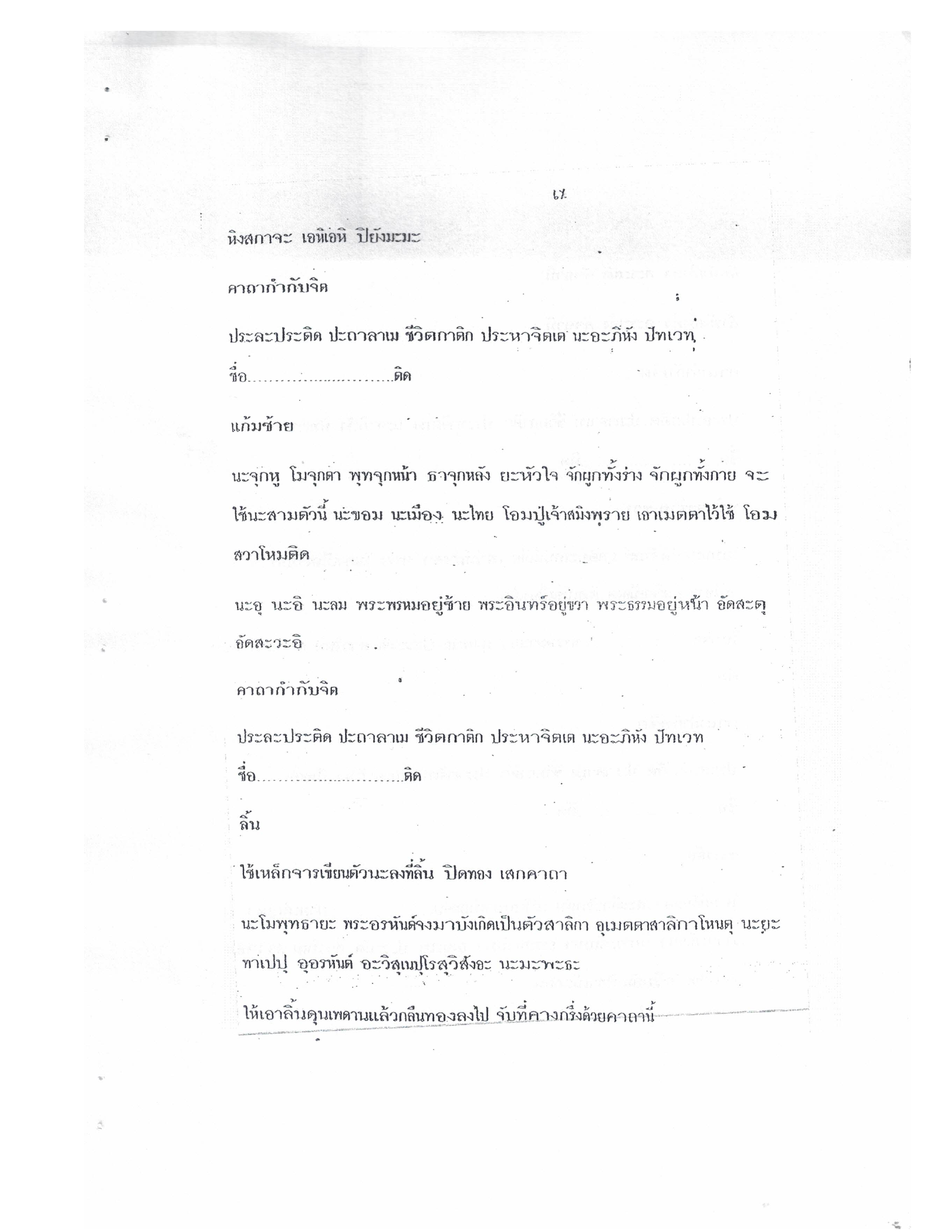
หิงสกาจะ เอหิเอหิ ปิยังมะมะ
คาถากำกับจิด
ประละประติด ปะถาลาเม ชีวิตกาติก ประหาจิดเต นะอะภิหัง ปัทเวท ชื่อ.....................ติด
แก้มซ้าย
นะจุกหู โมจุกตา พุทจุกหน้า ธาจุกหลัง ยะหัวใจ จักผูกทั้งร่าง จักผูกทั้งกาย จะ ใช้นะสามตัวนี้ นะขอม นะเมือง นะไทย โอมปู่เจ้าสมิงพราย เอาเมตตาไว้ใช้ โอม สวาโหมติด
นะอุ นะอิ นะลม พระพรหมอยู่ซ้าย พระอินทร์อยู่ขวา พระธรรมอยู่หน้า อัดสะตุ อัดสะวะอิ
คาถากำกับจิด
ประละประติด ปะถาลาเม ชีวิตกาติก ประหาจิดเต นะอะภิหัง ปัทเวท ชื่อ.....................ติด
ลิ้น
ใช้เหล็กจารเขียนตัวนะลงที่ลิ้น ปิดทอง เสกคาถา
นะโมพุทธายะ พระอรหันต์จงมาบังเกิดเป็นตัวสาลิกา อุเมตตาสาลิกาโหนตุ นะยะ ทาเปปุ อุอรหันต์ อะวิสุนปุโรสุวิสังอะ นะมะพระธะ
ให้เอาลิ้นดุนเพดานแล้วกลืนทองลงไป จับที่คางกริ่งด้วยคาถานี้
[incantation, the tail of a charm]: 'Hingsakaja, ehi ehi, piyang mama' -- [come, come, be dear to me].
Incantation to fix it to the mind
[incantation]: 'Pralapatit, patalame, chiwitkatik, prahachitte, na-a-phihang, patwet.' Name:.....................fixed.
Left cheek
[incantation]: 'Na-chukhu, mo-chukta, phut-chukna, tha-chuklang' -- may it bind the ear, bind the eye, bind the face, bind the back; bind the whole body, bind the whole frame. I shall use these three na-syllables: the Khmer na, the Mueang na, the Thai na. Om, grandfather spirit Sming Phrai, take this and use it with compassion. Om svaha, fixed.
[incantation]: 'Na-u, na-i, na-lom' -- Lord Brahma stands at the left, Lord Indra stands at the right, the Dhamma stands in front. Atsatu, atsawa-i.
Incantation to fix it to the mind
[incantation]: 'Pralapatit, patalame, chiwitkatik, prahachitte, na-a-phihang, patwet.' Name:.....................fixed.
Tongue
Use an iron stylus to inscribe the na-syllable on the tongue, cover it with gold leaf, and consecrate it with this incantation:
[incantation]: 'Namo Phutthaya, may an Arahant come and be born as a mynah bird; um metta salika hontu, na-ya-tha-pe-pu, u-arahant, awisunuporosuwisang-a, na-ma-phra-tha.'
Then press the tongue against the palate and swallow the gold leaf down; grip it at the throat with this incantation:
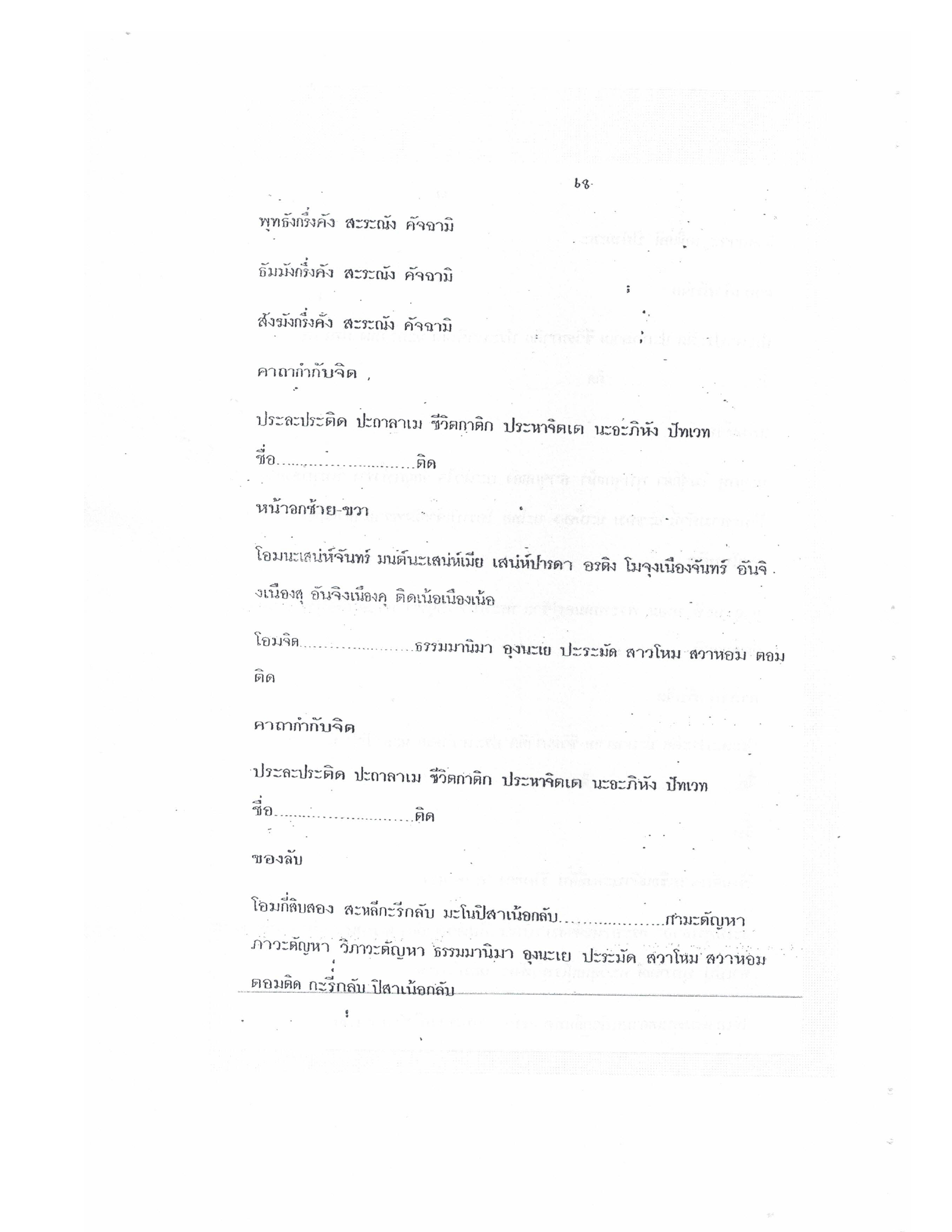
พุทธังกึ่งคั้ง สะระณัง คัจฉามิ
ธัมมังกึ่งคั้ง สะระณัง คัจฉามิ
สังฆังกึ่งคั้ง สะระณัง คัจฉามิ
คาถากำกับจิด
ประละประติด ปะถาลาเม ชีวิตกาติก ประหาจิดเต นะอะภิหัง ปัทเวท ชื่อ.....................ติด
หน้าอกซ้าย-ขวา
โอมนะเสน่ห์จันทร์ มนต์นะเสน่ห์เมีย เสน่ห์ปารดา อรดิง โมจุงเนืองจันทร์ อันจิ. งเนืองสุ อันจิงเนืองคุ ติดเน้อเนืองเน้อ
โอมจิด..................ธรรมมานิมา อุงนะเย ประระมัด สวาโหม สวาหอม ตอม ติด
คาถากำกับจิด
ประละประติด ปะถาลาเม ชีวิตกาติก ประหาจิดเต นะอะภิหัง ปัทเวท ชื่อ.....................ติด
ของลับ
โอมกี่สิบสอง สะหลีกะรีกลับ มะโนปิสาเน้อกลับ..................กามะตัญหา ภาวะตัญหา วิภาวะตัญหา ธรรมมานิมา อุงนะเย ประระมัด สวาโหม สวาหอม ตอมติด กะรี่กลับ ปิสาเน้อกลับ
'Buddham kueng-khang saranang gacchami.' 'Dhammam kueng-khang saranang gacchami.' 'Sangham kueng-khang saranang gacchami.' [a variant of the standard Refuges formula, 'I go for refuge to the Buddha / the Dhamma / the Sangha,' with an added word kueng-khang]
Incantation to fix it to the mind
[incantation]: 'Pralapatit, patalame, chiwitkatik, prahachitte, na-a-phihang, patwet.' Name:.....................fixed.
Left and right side of the chest
[incantation, a charm of infatuation]: 'Om, moon-charm, wife-charm mantra, sweetheart's charm, oradi-ng, calls the moon-country to come; truly to the country, truly to [the beloved] -- stick, stick fast to the flesh.'
[incantation]: 'Om jit [name].................. thammamanima ungnaye pramat sawahom sawahom' -- fixed fast.
Incantation to fix it to the mind
[incantation]: 'Pralapatit, patalame, chiwitkatik, prahachitte, na-a-phihang, patwet.' Name:.....................fixed.
Private parts
[incantation]: 'Om, twenty-two, sali-kari turn back, the mind and spirit turn back.................. craving for sense-pleasure, craving for existence, craving for non-existence, thammamanima ungnaye pramat sawahom sawahom -- fixed fast, kari turn back, spirit turn back.'
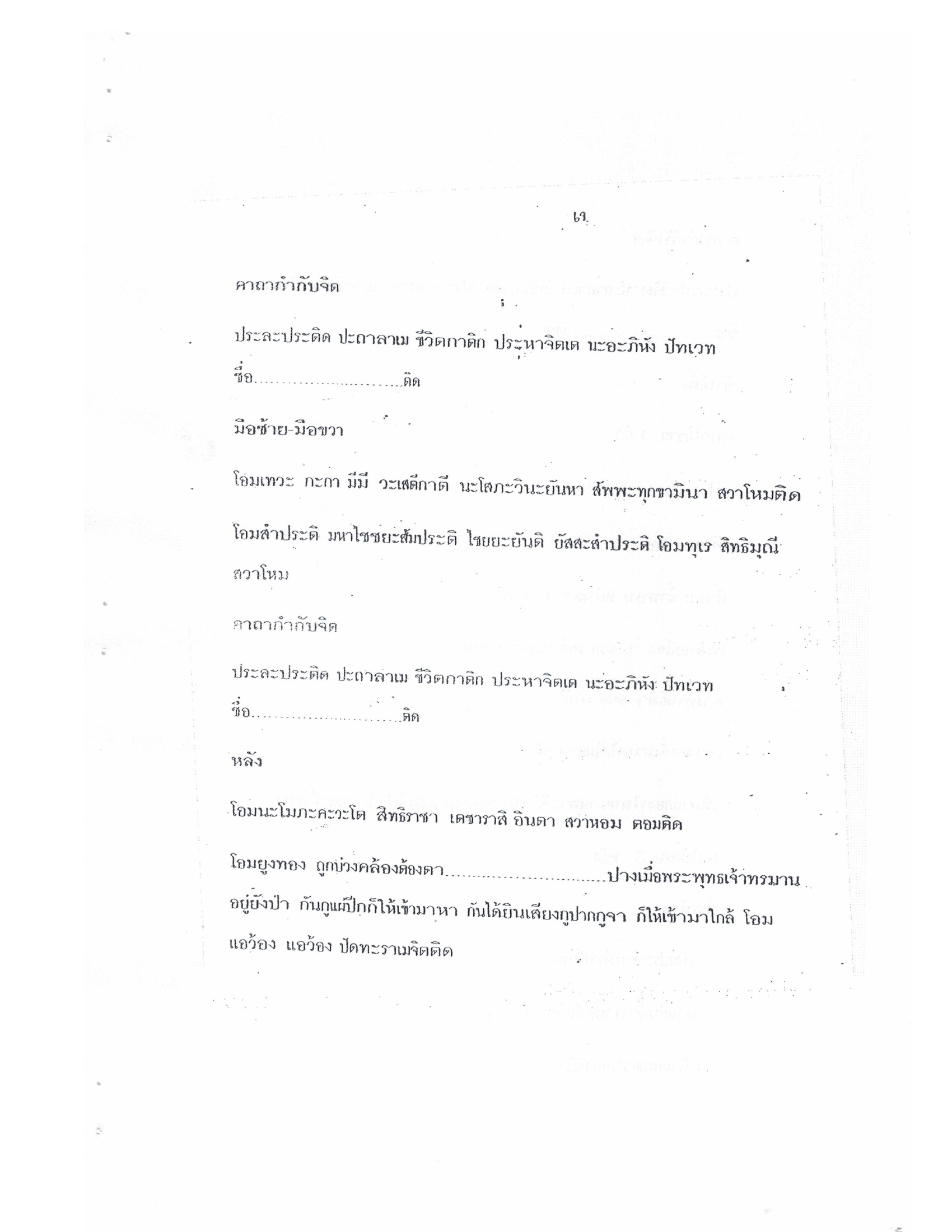
คาถากำกับจิด
ประละประติด ปะถาลาเม ชีวิตกาติก ประหาจิดเต นะอะภิหัง ปัทเวท ชื่อ.....................ติด
มือซ้าย-มือขวา
โอมเทวะ กะกา มีมี วะเสตีกาตี นะโสภะวินะยันหา สัพพะทุกขามินา สวาโหมติด
โอมสำประดิ มหาไชยะสัมประดิ ไชยะยันติ ยัสสะสำประดิ โอมทุเร สิทธิมุณี สวาโหม
คาถากำกับจิด
ประละประติด ปะถาลาเม ชีวิตกาติก ประหาจิดเต นะอะภิหัง ปัทเวท ชื่อ.....................ติด
หลัง
โอมนะโมภะคะวะโต สิทธิราชา เตชาราสิ อินดา สวาหอม ตอมติด
โอมยูงทอง ถูกบ่วงคล้องต้องดา..................ปางเมื่อพระพุทธเจ้าทรมาน อยู่ยังป่า กันกูแผ่ปีกก็ให้เข้ามาหา กันได้ยินเสียงกูปากกูจา ก็ให้เข้ามาใกล้ โอม แอว้อง แอว้อง ปัดทะรามจิดติด
Incantation to fix it to the mind
[incantation]: 'Pralapatit, patalame, chiwitkatik, prahachitte, na-a-phihang, patwet.' Name:.....................fixed.
Left hand - right hand
[incantation]: 'Om thewa, kaka, mimi, wasetikati, na-sopha winayanha, sappha-tukkha-mina, sawahom' -- fixed.
[incantation]: 'Om samprati, maha-chaiya-samprati, chaiya-yanti, yatsa-samprati, om ture, sitthimuni, sawahom.'
Incantation to fix it to the mind
[incantation]: 'Pralapatit, patalame, chiwitkatik, prahachitte, na-a-phihang, patwet.' Name:.....................fixed.
Back
[incantation]: 'Om namo phakawato, sitthi-racha, techarasi, inda, sawahom' -- fixed.
[incantation, a charm to draw creatures near]: 'Om, golden peafowl, caught in a snare, held fast, star-struck..................in the time the Buddha subdued [wild beasts] while dwelling in the forest, may they spread their wings and come to me; may they hear my voice, my speech, and come near. Om aeo-ong, aeo-ong, sweep it to fix fast to the mind.'
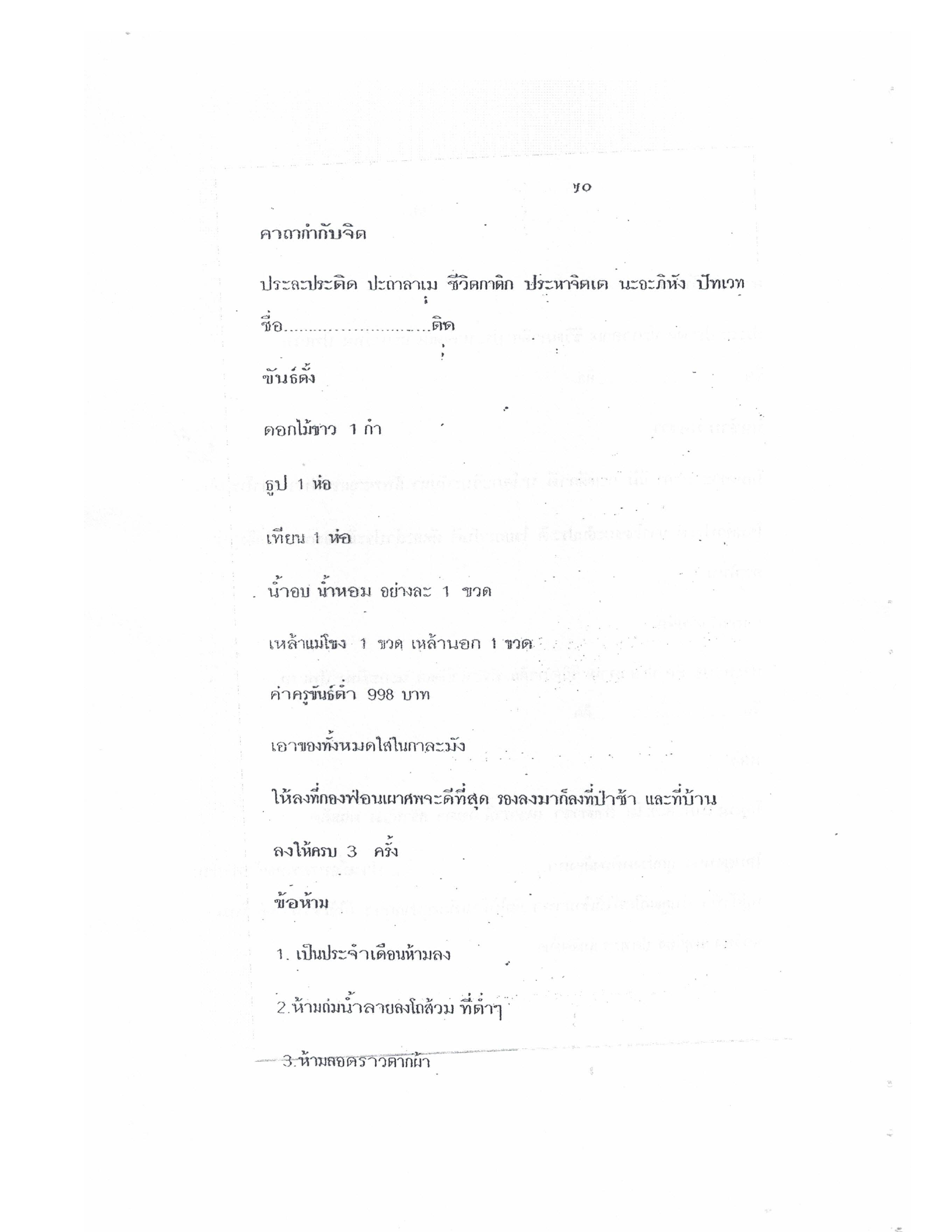
คาถากำกับจิด
ประละประติด ปะถาลาเม ชีวิตกาติก ประหาจิดเต นะอะภิหัง ปัทเวท ชื่อ.....................ติด
ขันธ์ตั้ง
ดอกไม้ขาว 1 กำ
ธูป 1 ห่อ
เทียน 1 ห่อ
น้ำอบ น้ำหอม อย่างละ 1 ขวด
เหล้าแม่โขง 1 ขวด เหล้านอก 1 ขวด
ค่าครูขันธ์ต่ำ 998 บาท
เอาของทั้งหมดใส่ในกาละมัง
ให้ลงที่กองฟ่อนเผาศพจะดีที่สุด รองลงมาก็ลงที่ป่าช้า และที่บ้าน
ลงให้ครบ 3 ครั้ง
ข้อห้าม
1. เป็นประจำเดือนห้ามลง
2.ห้ามถ่มน้ำลายลงโถส้วม ที่ต่ำๆ
3.ห้ามลอดราวตากผ้า
Incantation to fix it to the mind
[incantation]: 'Pralapatit, patalame, chiwitkatik, prahachitte, na-a-phihang, patwet.' Name:.....................fixed.
Setting up the offering tray
White flowers, 1 handful
Incense, 1 bundle
Candles, 1 bundle
Scented water and perfumed water, 1 bottle of each
Mekhong rum, 1 bottle; foreign liquor, 1 bottle
Minimum teacher's-offering fee: 998 baht
Put everything into a basin.
Best to perform it at a cremation pyre; next best at a graveyard, or at home.
Perform it a full 3 times.
Prohibitions
1. Do not perform it during [a woman's] menstrual period.
2. Do not spit into a low latrine bowl.
3. Do not pass beneath a clothes-drying rail.
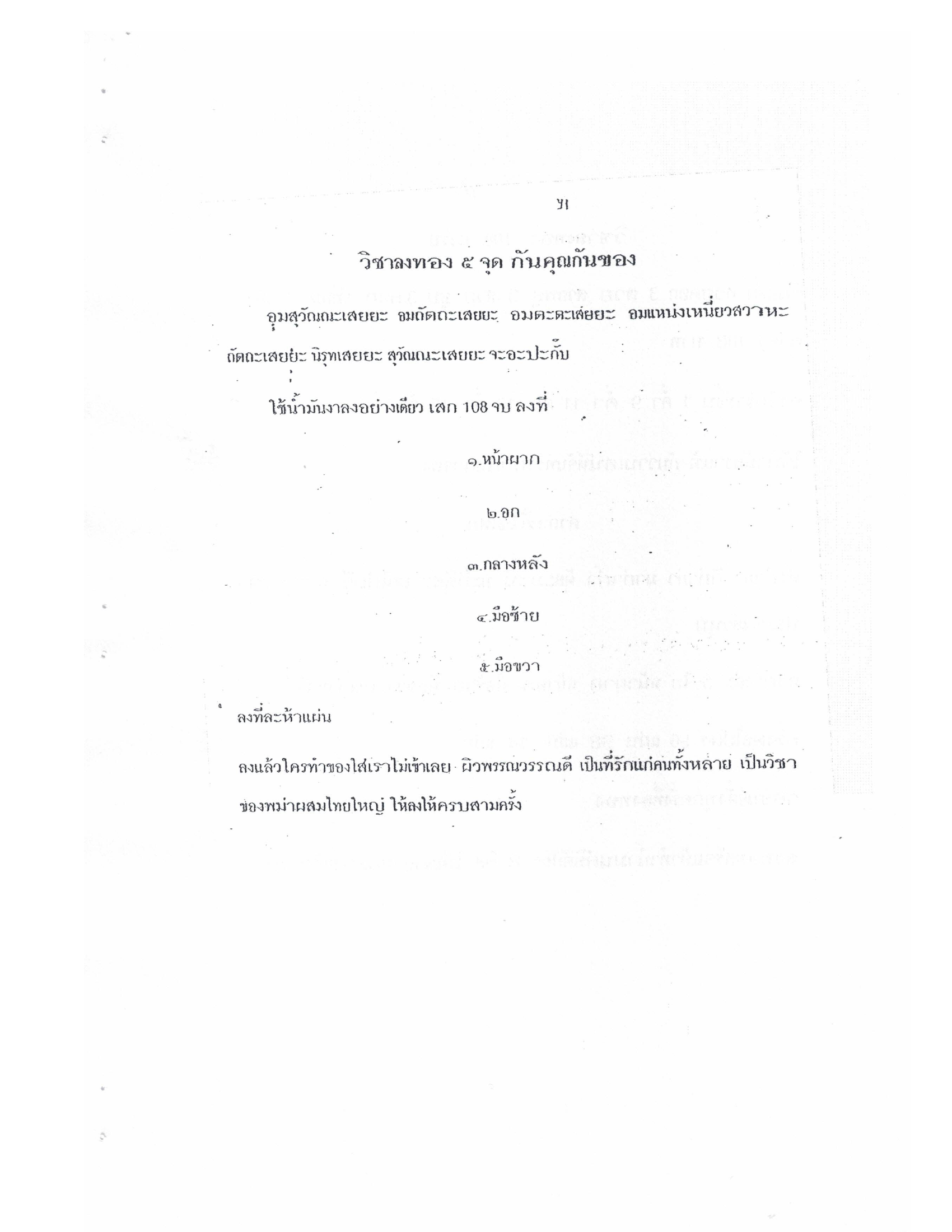
วิชาลงทอง ๕ จุด กันคุณกันของ
อุมสุวัณณะเสยยะ อมถัดถะเสยยะ อมตะตะเสยยะ อมแหน่งเหนี่ยวสวานะ ถัดถะเสยยะ นิรุทเสยยะ สุวัณณะเสยยะ จะอะปะกั๊บ
ใช้น้ำมันงาลงอย่างเดียว เสก 108 จบ ลงที่
๑.หน้าผาก
๒.อก
๓.กลางหลัง
๔.มือซ้าย
๕.มือขวา
ลงที่ละห้าแผ่น
ลงแล้วใครทำของใส่เราไม่เข้าเลย ผิวพรรณวรรณดี เป็นที่รักแก่คนทั้งหลาย เป็นวิชา ของพม่าผสมไทยใหญ่ ให้ลงให้ครบสามครั้ง
The Craft of Applying Gold-Leaf at 5 Points, to Ward Off Charms and Cursed Objects
[incantation]: 'Um suwannaseyya, om thatthaseyya, om tatataseyya, om naeng-niao-sawana, thatthaseyya, nirutseyya, suwannaseyya, ja apakap.'
Use sesame oil alone for the application. Consecrate it by chanting it 108 times through. Apply at:
1. The forehead
2. The chest
3. The middle of the back
4. The left hand
5. The right hand
Apply five sheets [of gold leaf] at each point.
Once applied, no cursed object that anyone places on you will ever take hold. Your complexion will be fine, and you will be loved by all people. This is a craft of the Burmese blended with the Tai Yai [Shan]. Apply it a full three times.
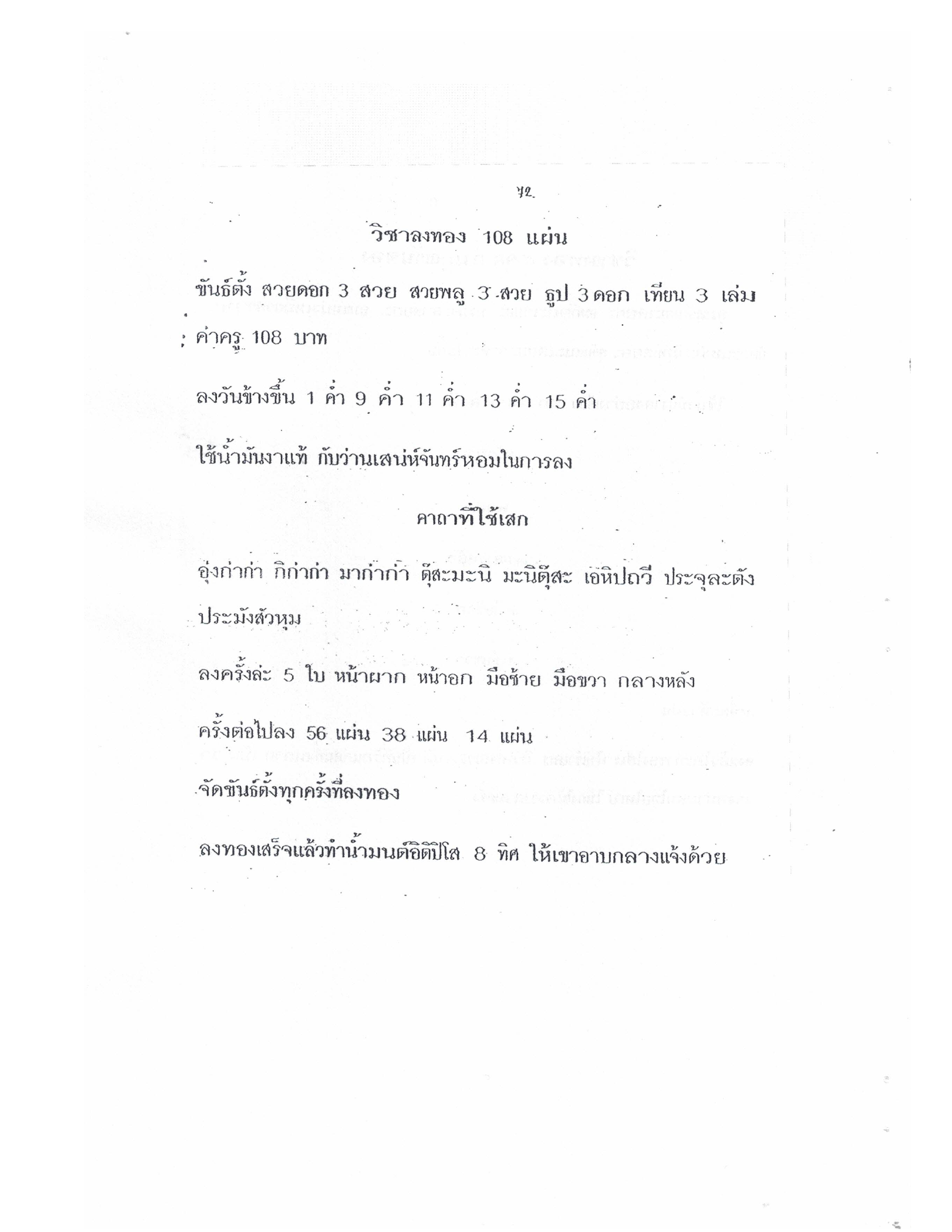
วิชาลงทอง 108 แผ่น
ขันธ์ตั้ง สวยดอก 3 สวย สวยพลู 3 สวย ธูป 3 ดอก เทียน 3 เล่ม
ค่าครู 108 บาท
ลงวันข้างขึ้น 1 ค่ำ 9 ค่ำ 11 ค่ำ 13 ค่ำ 15 ค่ำ
ใช้น้ำมันงาแท้ กับว่านเสน่ห์จันทร์หอมในการลง
คาถาที่ใช้เสก
อุ่งก่าก่า กิก่าก่า มาก่าก้า ตุ๊สะมะนิ มะนิตุ๊สะ เอหิปถวี ประจุละตัง ประมังสัวหุม
ลงครั้งละ 5 ใบ หน้าผาก หน้าอก มือซ้าย มือขวา กลางหลัง
ครั้งต่อไปลง 56 แผ่น 38 แผ่น 14 แผ่น
จัดขันธ์ตั้งทุกครั้งที่ลงทอง
ลงทองเสร็จแล้วทำน้ำมนต์อิติปิโส 8 ทิศ ให้เขาอาบกลางแจ้งด้วย
The Craft of Applying 108 Sheets of Gold Leaf
Offering tray: 3 trays of flowers, 3 trays of betel, 3 incense sticks, 3 candles.
Teacher's fee: 108 baht.
Apply it on waxing-moon days: the 1st, 9th, 11th, 13th, or 15th lunar day.
Use genuine sesame oil together with fragrant wan-sane-chan [a charm-herb] in the application.
The incantation used to consecrate it:
[incantation]: 'Ung-kaka, kikaka, makaka, tusamani, manitusa, ehi-pathawi, prachulatang, pramangsuahum.'
Apply 5 sheets at a time: forehead, chest, left hand, right hand, middle of the back.
For subsequent applications, apply 56 sheets, 38 sheets, [or] 14 sheets.
Set up the offering tray every time gold is applied.
Once the gold application is complete, make holy water with the Itipiso [chant] toward the 8 directions, and have the person bathe with it out in the open as well.
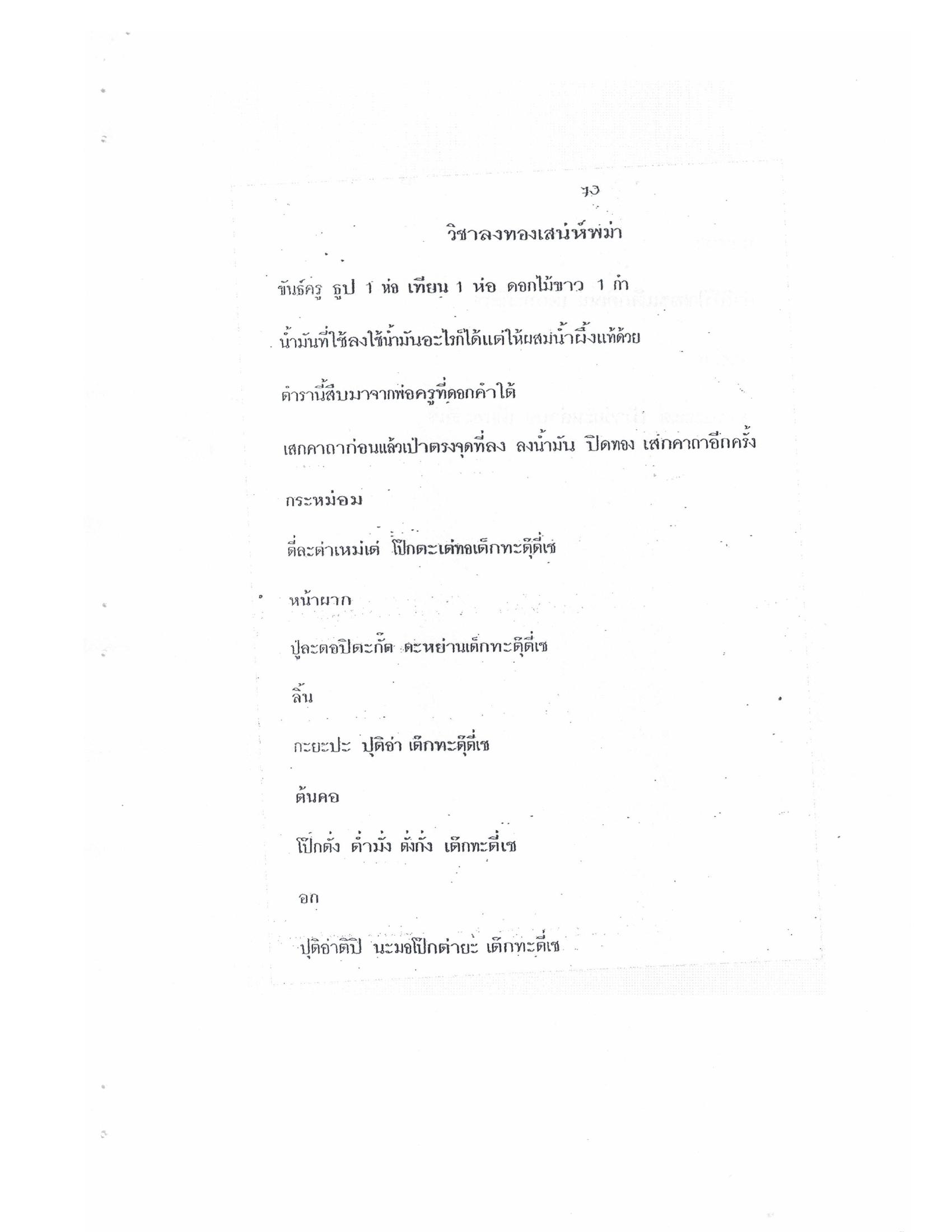
วิชาลงทองเสน่ห์พม่า
ขันธ์ครู ธูป 1 ห่อ เทียน 1 ห่อ ดอกไม้ขาว 1 กำ
น้ำมันที่ใช้ลง ใช้น้ำมันอะไรก็ได้ แต่ให้ผสมน้ำผึ้งแท้ด้วย
ตำรานี้สืบมาจากพ่อครูที่ดอกคำใต้
เสกคาถาก่อนแล้วเป่าตรงจุดที่ลง ลงน้ำมัน ปิดทอง เสกคาถาอีกครั้ง
กระหม่อม ตี่ละต่าเหม่เต่ โป๊กตะเต่ทอเต็กทะตุ๊ดี่เช
หน้าผาก ปู่ละตอปิตะกั๊ด ตะหย่านเต็กทะตุ๊ดี่เช
ลิ้น กะยะปะ ปุติอ่า เต็กทะตุ๊ดี่เช
ต้นคอ โป๊กตั่ง ต่ำมั่ง ตั้งกั้ง เต็กทะตี่เช
อก ปุติอ่าติปิ นะมอโป๊กต่ายะ เต็กทะดี่เช
The craft of gilding with a Burmese love-charm
Master's offering set: 1 bundle of incense sticks, 1 bundle of candles, 1 handful of white flowers.
Any oil may be used for the gilding, but true honey must be mixed into it.
This manual descends from a teacher-father at Dok Kham Tai.
Recite the incantation first, then blow on the spot to be marked, apply the oil, affix the gold leaf, and recite the incantation once more.
Crown of the head: [charm syllables, transliterated in Thai: ตี่ละต่าเหม่เต่ โป๊กตะเต่ทอเต็กทะตุ๊ดี่เช]
Forehead: [charm syllables: ปู่ละตอปิตะกั๊ด ตะหย่านเต็กทะตุ๊ดี่เช]
Tongue: [charm syllables: กะยะปะ ปุติอ่า เต็กทะตุ๊ดี่เช]
Base of the neck: [charm syllables: โป๊กตั่ง ต่ำมั่ง ตั้งกั้ง เต็กทะตี่เช]
Chest: [charm syllables: ปุติอ่าติปิ นะมอโป๊กต่ายะ เต็กทะดี่เช]
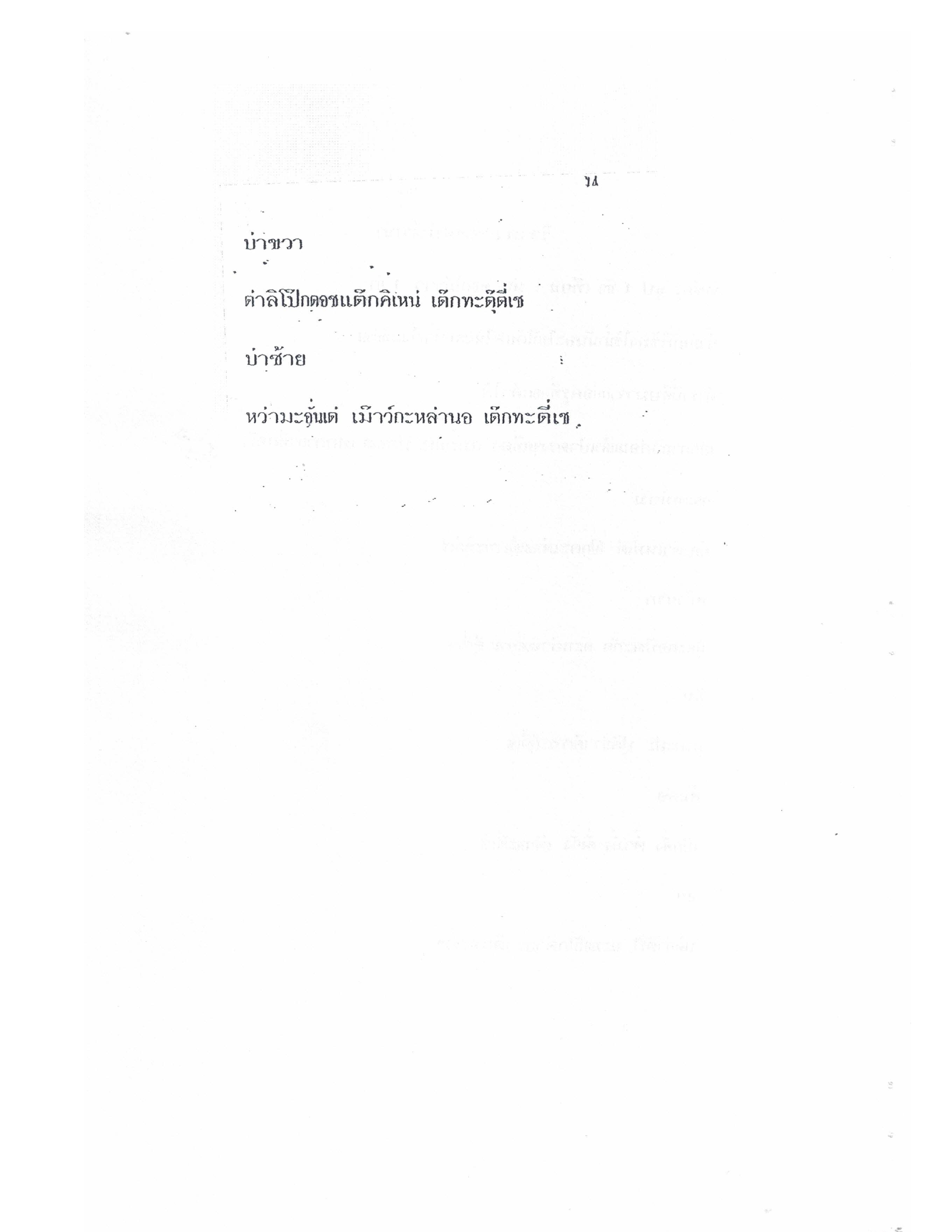
บ่าขวา ต่าลิโป๊กดุจแต็กคิเหน่ เต็กทะตุ๊ดี่เช
บ่าซ้าย หว่ามะถั่นเต่ เม็าว์กะหล่านอ เต็กทะดี่เช
Right shoulder: [charm syllables: ต่าลิโป๊กดุจแต็กคิเหน่ เต็กทะตุ๊ดี่เช]
Left shoulder: [charm syllables: หว่ามะถั่นเต่ เม็าว์กะหล่านอ เต็กทะดี่เช]
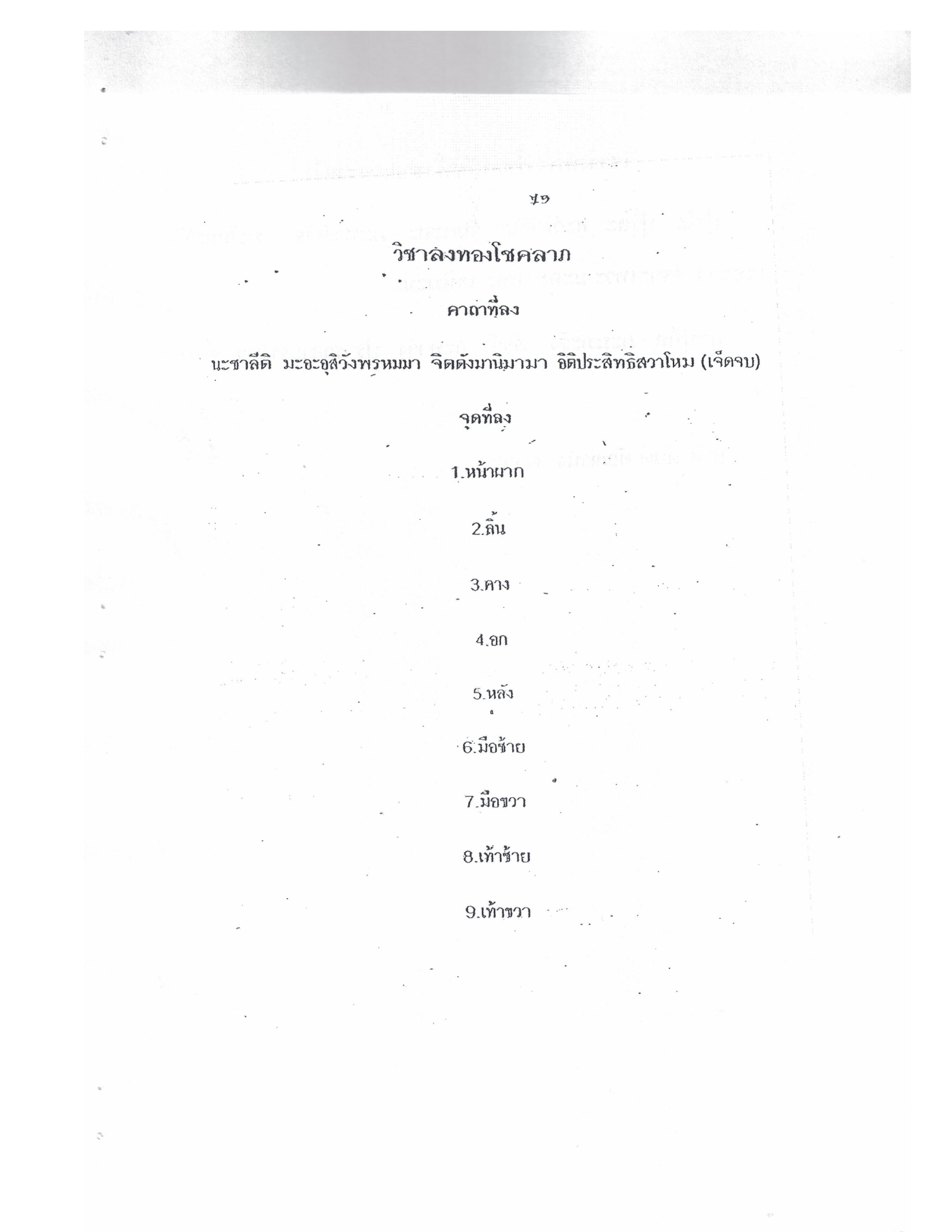
วิชาลงทองโชคลาภ
คาถาที่ลง
นะชาลีติ มะอะอุสิวังพรหมมา จิตดังมานิมามา อิติประสิทธิสวาโหม (เจ็ดจบ)
จุดที่ลง
1.หน้าผาก
2.ลิ้น
3.คาง
4.อก
5.หลัง
6.มือซ้าย
7.มือขวา
8.เท้าซ้าย
9.เท้าขวา
The craft of gilding for fortune and luck
The incantation to apply:
Na chaa lii ti, ma a u si wang phrommaa, jit dang maa ni maa maa, iti prasitthi sawaahom (recite seven times)
Points to apply it:
1. Forehead
2. Tongue
3. Chin
4. Chest
5. Back
6. Left hand
7. Right hand
8. Left foot
9. Right foot
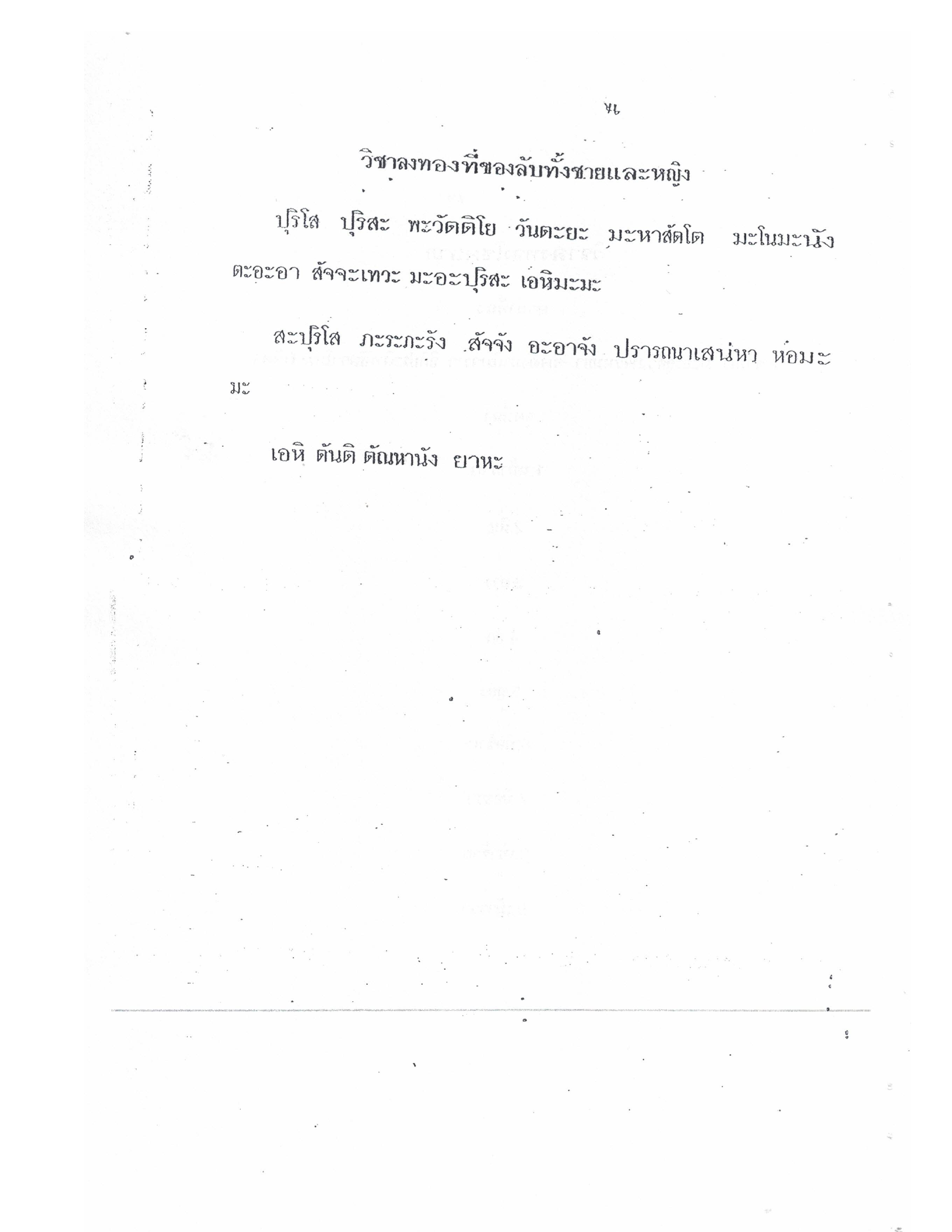
วิชาลงทองที่ของลับทั้งชายและหญิง
ปุริโส ปุริสะ พะวัดติโย วันตะยะ มะหาสัดโด มะโนมะนัง ตะอะอา สัจจะเทวะ มะอะปุริสะ เอหิมะมะ
สะปุริโส ภะระภะรัง สัจจัง อะอาจัง ปรารถนาเสน่หา ห่อมะมะ
เอหิ ตันติ ตัณหานัง ยาหะ
The craft of gilding the private parts, for both men and women
Pu ri so, pu ri sa, pha wat ti yo, wan ta ya, ma haa sat do, ma no ma nang, ta a aa, sat ja thewa, ma a pu ri sa, e hi ma ma
Sa pu ri so, pha ra pha rang, sat jang, a aa jang — may [the other] feel longing and be charmed, [drawn] to me
E hi tan ti tanhaanang yaa ha
วิชาสักที่ของลับทั้งชายและหญิง
ดะทะสะ ดะปะละ
จะภะสะอุมะ
คาถาเสก
ดะทะสะ ดะปะละ
จะภะสะอุมะ
The craft of tattooing the private parts, for both men and women
Da tha sa, da pa la
Ja pha sa u ma
The consecration incantation:
Da tha sa, da pa la
Ja pha sa u ma
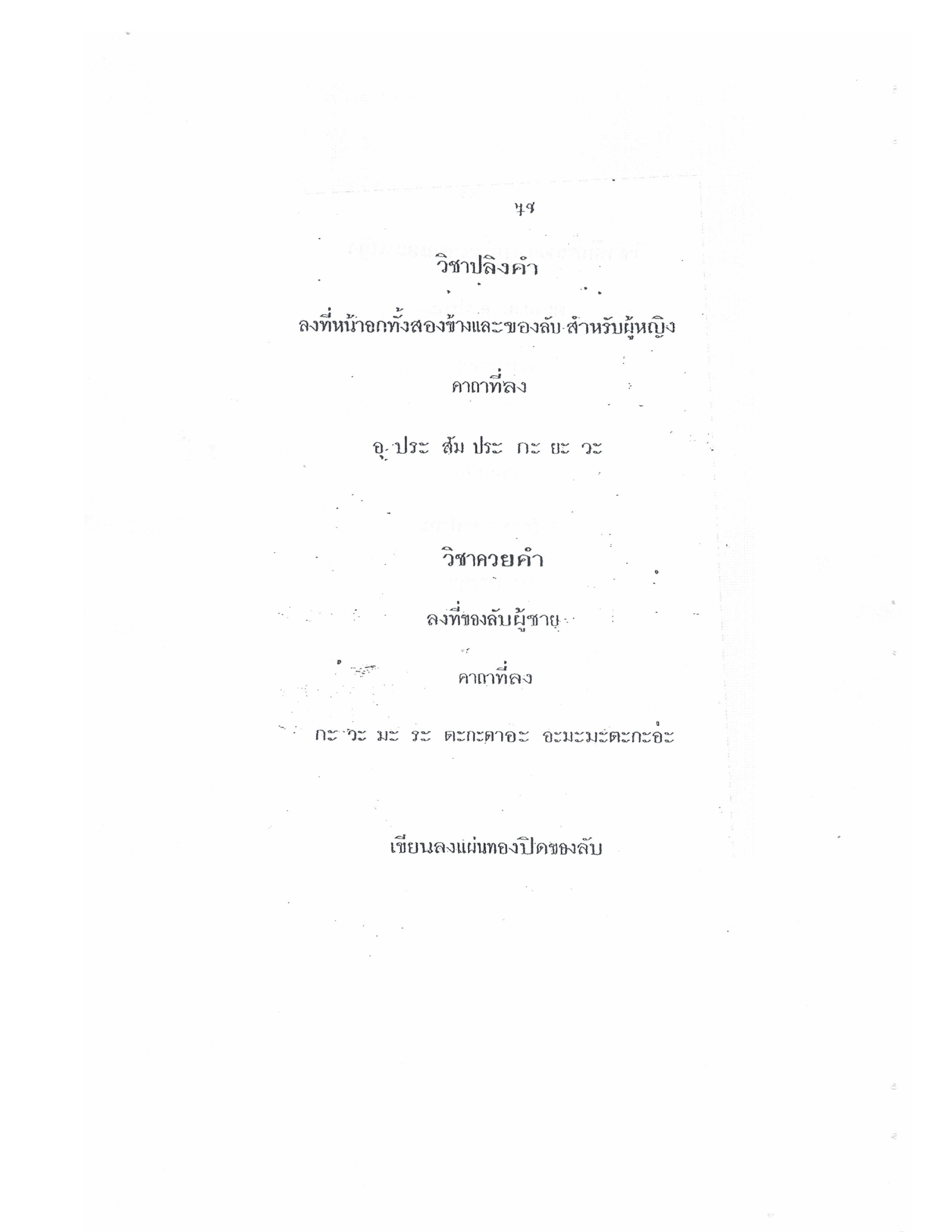
วิชาปลิงคำ
ลงที่หน้าอกทั้งสองข้างและของลับ สำหรับผู้หญิง
คาถาที่ลง
อุ ประ ส้ม ประ กะ ยะ วะ
วิชาควยคำ
ลงที่ของลับผู้ชาย
คาถาที่ลง
กะ วะ มะ ระ ตะกะตาอะ อะมะมะตะกะอ่ะ
เขียนลงแผ่นทองปิดของลับ
The craft of the Golden Leech
Applied at both sides of the chest and at the private parts; for women.
The incantation to apply:
U pra, som pra, ka ya wa
The craft of the Golden Phallus
Applied at the male private parts.
The incantation to apply:
Ka wa ma ra, ta ka taa a, a ma ma ta ka a
Write this onto a sheet of gold leaf to be laid over the private parts.
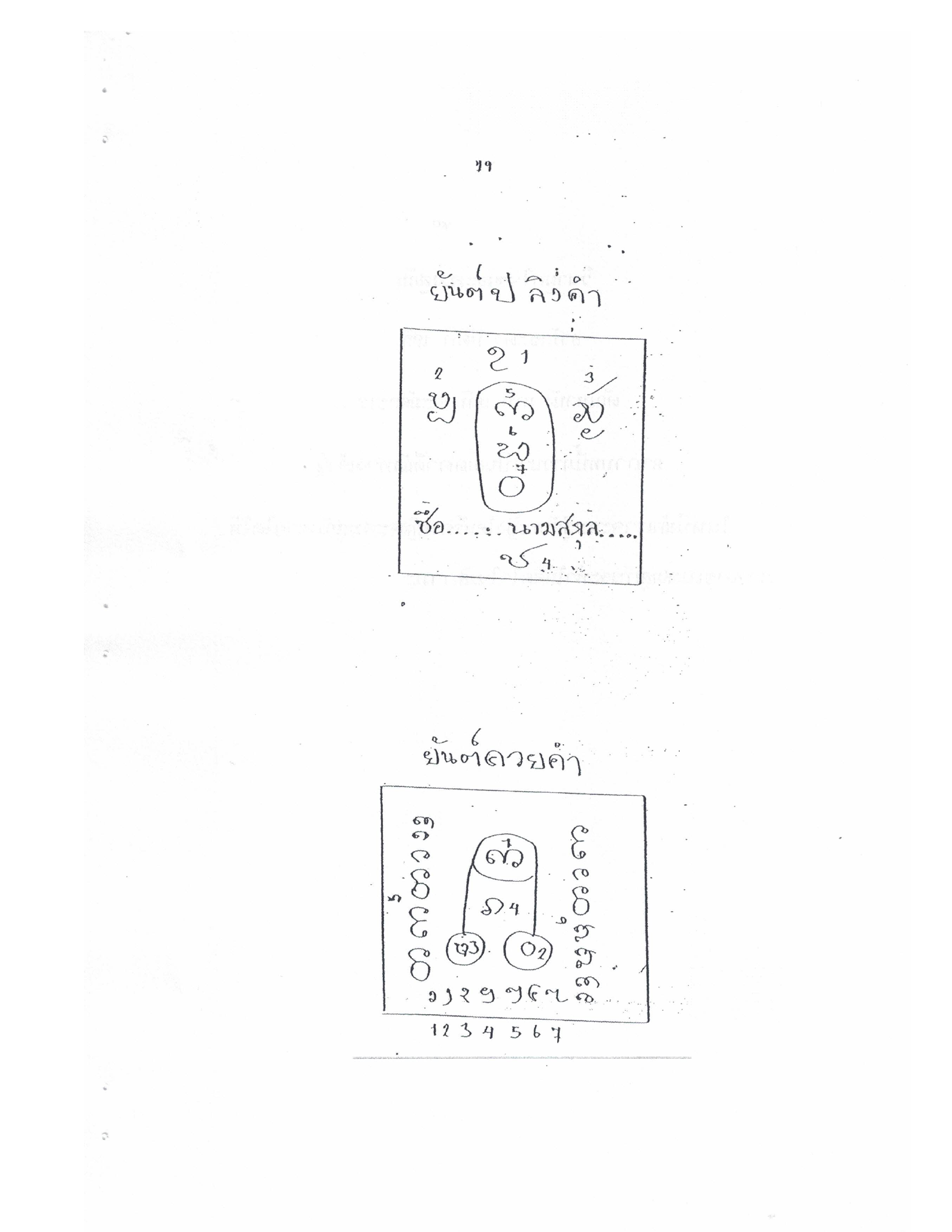
ยันต์ปลิงคำ
[อักษรธรรมล้านนาในยันต์ อ่านไม่ชัด]
ชื่อ......นามสกุล......
ยันต์ควยคำ
[อักษรธรรมล้านนาในยันต์ อ่านไม่ชัด]
1 2 3 4 5 6 7
Yantra of the Golden Leech [yantra: a rectangular frame enclosing an upright oblong figure numbered 1 at its top and flanked by 2 and 3; inside the oblong figure three stacked circles numbered 5, 6, 7 each hold a character in Lanna Tham script, not confidently legible; below the figure a blank ruled line reads "Name......Surname......" beside a numeral 4]
Yantra of the Golden Phallus [yantra: a rectangular frame enclosing a glans-like oblong shape at top numbered 1 with a character inside it, above two adjoining circles numbered 2 and 3 each holding a character; columns of stacked Lanna Tham characters run down the left side (marked 5) and right side (marked 6) of the frame, not confidently legible; a row of numerals 1 2 3 4 5 6 7 is printed beneath the frame]
วิชาผูกใจขณะสมสู่กัน
อารักขะตุ ปิติอิ เอหิ
ตัณหานัง เอหิ เอ่หิ จะมัดถะเร
คาถาบทนี้ภาวนาเป็นเมตตาดีนักทางเจ้าชู้
ในหนึ่งถ้าเราจะสมสู่กับหญิงใดหรือหญิงจะสมสู่กับชายใดให้ภาวนาขณะสมสู่กันจะทำให้ติดใจในรสกามะ
The craft of binding the heart during intercourse
Aarakkhatu, pitii, ehi
Tanhaanang, ehi, ehi, ja mat tha re
Reciting this verse works very well as a charm on the path of a philanderer.
That is: if we are about to have intercourse with any woman, or a woman with any man, reciting it during intercourse will make the partner become attached to the pleasure of the act.
วิชานะหน้าทองเจ้าชู้
โอม สิทธิ กิจจัง จิตตะวัง พุทธะรัตตะนัง ธัมมะรัตตะนัง สังฆะรัตตะนัง จามะนา นะชาลีติ อุอิอะอิ กูจะทรงส่าราศรี เสมือนหนึ่งพระจันทร์ เมื่อวันเพ็ญ คนทั้งหลายหน้ากูก็ระริ้นคลื่นแคลง ทุกถ้วนหน้า นะมะ นะอะ นอกอ นะภะ กออะ นออะ นะอะกะอัง ขอให้จิตคนทั้งหลาย คลุ้มคลั่งระเริงหลง ด้วยเดชเดชะ พระเจ้าทั้งห้าพระองค์ พระฤๅษีทั้งสี่พระองค์ จงมาประสิทธิ์คาถาพระยามนต์ มอบให้แก่ตัวกู อะอาอิอี มนุสสานัง จิตตังพันธะนัง จิตติ จิตดังนามะนัง วิกริงคะรัง จะคุจี วะหาปะคาเวติ
มะหานิยม โอมไสไส มาพัดเอาปัจจัย กษัตราแลกษัตรี หญิงขายใดเห็นหน้ากูก็ยินดีทั่วทั้งจักวาฬ เมตตาจิตตะ อะระหัง โอมเงินทอง มะหาเงินทอง ลอยล่องมาหาตัวกู กูจะออกปากเอาเงินเอาทอง เอาสิ่งของใดใด ก็มิขัดแก่กู มาตาทุกซัง ปิยังสุขะดัง กูจะเสกแป้งทาหน้า กูจะเสกผ้าก็ผุด คือเทวาทุกท้าว ทุกพระยา ทุกชายทุกหญิง เห็นหน้ากูก็ลืมพ่อลืมแม่ ลืมกินลืมนอน ลืมจิดมาใหลหลง พวงคิดครวญหา ทุกเวลาเสียวกะสั่น นอนฝันเห็นตัวกู อิติคะมะ อิทะคะมะ อิทธิเจเสิ มุทุจิตดัง สะวาหะ
The Na-charm craft for a philanderer's golden face
Om, may this succeed, [my] resolve, Buddha-ratanang, Dhamma-ratanang, Sangha-ratanang, jaamanaa na chaa lii ti u i a i — I bear splendor and glory like unto the moon on a full-moon night; may every single face among all people, on seeing my face, shimmer and waver with longing. Na ma na a nok a na pha ko a na a na a ka ang — may the minds of all people become wild, infatuated, and lost, by the power and might of the five Lord Buddhas and the four Hermit-Sages: may they come and empower this mantra-verse and grant it unto me. A aa i ii manussaanang jittang phanthanang jitti jit dang naamanang wikaringkharang ja khu jee wa haa pa khaa we ti
Great popularity charm: Om sai sai — may I draw to myself wealth and support, be it from kings or queens; whatever woman sees my face shall rejoice throughout the whole universe. Mettaa jittaa arahang. Om, silver and gold, great silver and gold, come floating and drifting to me; whatever I open my mouth to ask for — silver, gold, or any object — none shall be denied me. Maataa thuk sang piyang sukha dang — I shall consecrate powder to apply to my face, I shall consecrate cloth so that it gleams; every deva-king, every lord, every man and every woman, upon seeing my face, shall forget their father, forget their mother, forget to eat, forget to sleep, their minds adrift and lost, pining for me, trembling with longing at every hour, and dreaming of me in their sleep. Iti ka ma, itha ka ma, iddhi je se, mudu jit dang, svaahaa.
วิชาลงทองเรียกจิต
นะเมดตะเห็นหน้า (ชื่อเขา) เห็นหน้ากูก็ใจดี นะเข็ม โมมัด พุทรักธามีใครใจว่าง ยะเอ็นดู เหมือนพ่อแม่อยู่ร่วมหัวใจนั้นเต๊อะ พุทธังเมตตา ธัมมังเมตตา สังฆังเมตตา พุทธเอ็นดู ธัมมังรักคาบ อุ่ง งวย โง อะนุดตะโรโหติ อาคัจฉายะ อาคัจฉาหิ ติวะตะ โพมาเรโสอุสุจะชุ มิฉาทิฏฐิ เอาหัวใจ (ชื่อเขา) มาใส่ตนตัวแห่ง (ชื่อเรา) มุทุจิตดังปิยัง มะมะ
The craft of gilding to summon the mind [of another]
Na metta — seeing my face, (his/her name) sees my face and feels kindly toward me. Na khem, mo mat, phut rak thaa — whoever's heart is unattached, may [it] be moved with tenderness as though father and mother dwelt together within that very heart. Buddhang mettaa, Dhammang mettaa, Sanghang mettaa, Buddha endu, Dhammang rak khaap, ung nguay ngo, anuttaro hoti, aakacchaaya, aakacchaahi tiwata phomaaresoosujachu michaathitthi — take the heart of (his/her name) and place it within the self of (our name). Mudu jit dang piyang mama.
[Note: "(ชื่อเขา)" and "(ชื่อเรา)" are printed as fill-in-the-blank placeholders for "his/her name" and "my/our name" respectively.]
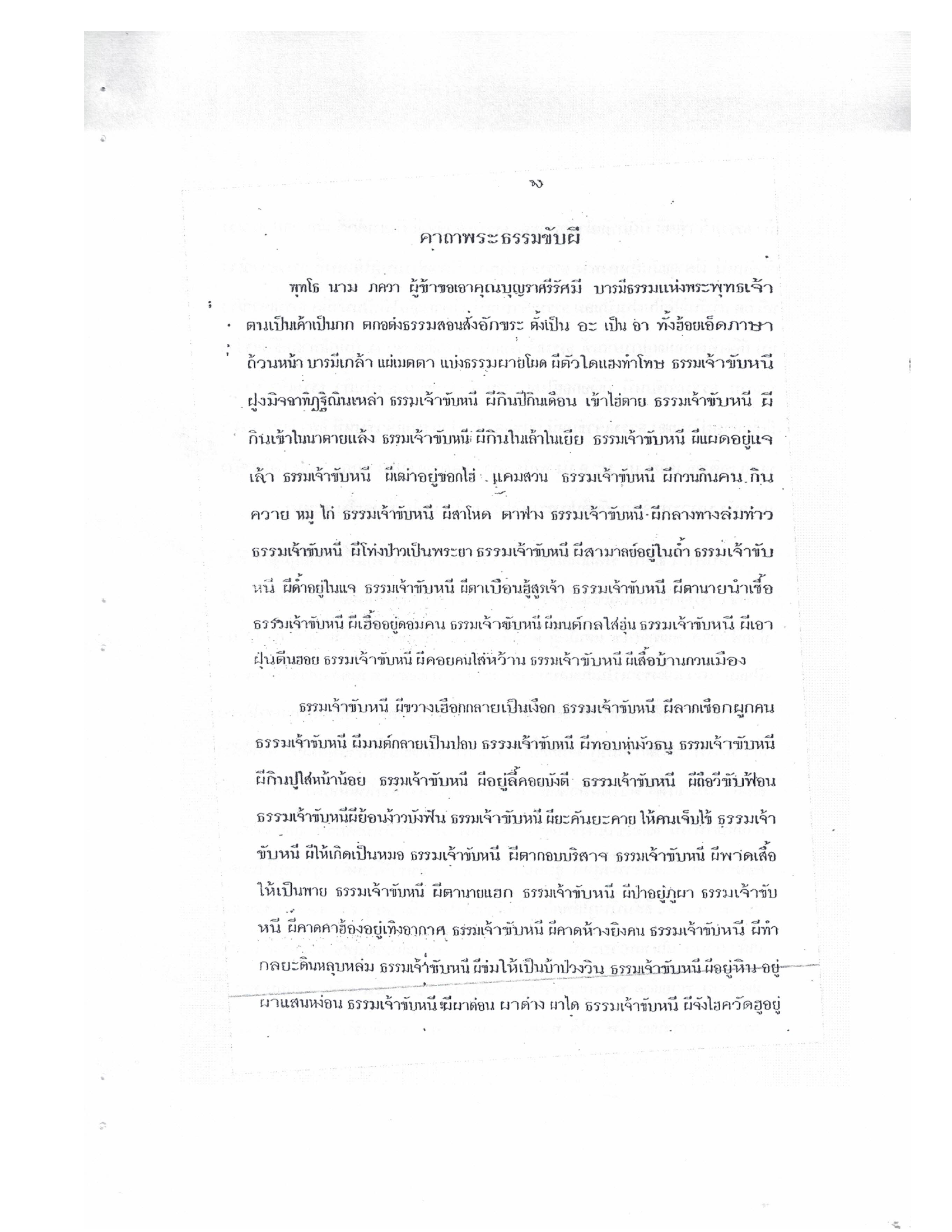
คาถาพระธรรมขับผี
พุทโธ นาม ภควา ผู้ข้าขอเอาคุณบุญราศีรัศมี บารมีธรรมแห่งพระพุทธเจ้า ตามเป็นเค้าเป็นกก ตกแต่งธรรมสอนสั่งอักขระ ตั้งเป็น อะ เป็น อา ทั้งอ้อยเอ็ดภาษา ถ้วนหน้า บารมีเกล้า แผ่เมตตา แบ่งธรรมผายโผด ผีตัวใดแฝงทำโทษ ธรรมเจ้าขับหนี ฝูงมิจฉาทิฏฐิณเหล่า ธรรมเจ้าขับหนี ผีกินปี้กินเดือน เข้าไฝ่ตาย ธรรมเจ้าขับหนี ผีกินเข้าในนาตายแล้ง ธรรมเจ้าขับหนี ผีกินในเล้าในเยีย ธรรมเจ้าขับหนี ผีแผดอยู่แจ้เล้า ธรรมเจ้าขับหนี ผีเถ่าอยู่ขอกไฮ่ แคมสวน ธรรมเจ้าขับหนี ผีกวนกินคน กินความย หมู ไก่ ธรรมเจ้าขับหนี ผีสาโหด ตาฟาง ธรรมเจ้าขับหนี ผีกลางทางล่มท่าว ธรรมเจ้าขับหนี ผีโท่งป่าเป็นพระยา ธรรมเจ้าขับหนี ผีสามาลย์อยู่ในถ้ำ ธรรมเจ้าขับหนี ผีดำอยู่ในแจ้ ธรรมเจ้าขับหนี ผีตาเบือนสู้สูงเจ้า ธรรมเจ้าขับหนี ผีตานายนำเชื้อ ธรรมเจ้าขับหนี ผีเฮือนอยู่ดอมคน ธรรมเจ้าขับหนี ผีมนต์กลายใส่อุ่น ธรรมเจ้าขับหนี ผีเอาฝุ่นตีนฮอย ธรรมเจ้าขับหนี ผีคอยคนไส่ห้วาน ธรรมเจ้าขับหนี ผีเสื้อบ้านกวนเมือง
ธรรมเจ้าขับหนี ผีขวางเฮือนกลายเป็นเงือก ธรรมเจ้าขับหนี ผีลากเชือกผูกคน ธรรมเจ้าขับหนี ผีมนต์กลายเป็นปอบ ธรรมเจ้าขับหนี ผีทอบหุ่นงัวธนู ธรรมเจ้าขับหนี ผีกินปูใส่หน้าน้อย ธรรมเจ้าขับหนี ผีอยู่ลี้คอยบังดี ธรรมเจ้าขับหนี ผีถือวีขับฟ้อน ธรรมเจ้าขับหนี ผีย้อนง้าวบังฟัน ธรรมเจ้าขับหนี ผียะคันยะคาย ให้คนเจ็บไข้ ธรรมเจ้าขับหนี ผีให้เกิดเป็นหมอ ธรรมเจ้าขับหนี ผีตากอบบริสาจ ธรรมเจ้าขับหนี ผีพาดเสื้อให้เป็นทาย ธรรมเจ้าขับหนี ผีตานายแฮก ธรรมเจ้าขับหนี ผีป่าอยู่ภูผา ธรรมเจ้าขับหนี ผีคาดคาฮ้องอยู่เทิงอากาศ ธรรมเจ้าขับหนี ผีคาดห้างยิงคน ธรรมเจ้าขับหนี ผีทำกลยะตื่นหลุบหล่ม ธรรมเจ้าขับหนี ผีข่มให้เป็นบ้าป่วงวิน ธรรมเจ้าขับหนี ผีอยู่หิน อยู่ผานสนหน่อน ธรรมเจ้าขับหนี ผีผาต่อน ผาด่าง ผาไต ธรรมเจ้าขับหนี ผีจังไอควัดฮอยู่
[Note: this page's photographed leaf is identical to page 66's — the same heading and the same two paragraphs of text appear on both images, apparently a duplicate scan of a single physical leaf.]
Mantra of the Dhamma that Drives Out Ghosts
Buddho, that is, the Blessed One — I take the virtue, the auspicious merit and radiance, the accomplished power of the Buddha's Dhamma as my root and source. I arrange the Dhamma, teaching the letters: setting down A as A, AA as AA, the full array of sounds in every form. By his gracious power, spreading loving-kindness, dispensing the Dhamma to release and save: whatever ghost hides and does harm — Lord Dhamma, drive it out! The crowds of those of wrong view — Lord Dhamma, drive them out! The ghost that devours months and years, driving one into the fields to die — Lord Dhamma, drive it out! The ghost that eats the rice in the paddies until they die of drought — Lord Dhamma, drive it out! The ghost that eats in the granary, in the rice-barn — Lord Dhamma, drive it out! The ghost that glares by the doorway — Lord Dhamma, drive it out! The ghost that squats at the edge of the swidden field, along the garden — Lord Dhamma, drive it out! The ghost that torments and eats people, eats buffalo, pigs, chickens — Lord Dhamma, drive it out! The cruel, dim-eyed ghost — Lord Dhamma, drive it out! The ghost that fells travellers on the road — Lord Dhamma, drive it out! The ghost of the open plain that poses as a lord — Lord Dhamma, drive it out! The ghost that lairs in caves — Lord Dhamma, drive it out! The dark ghost that dwells in the doorway — Lord Dhamma, drive it out! The ghost that turns its face against the high lord — Lord Dhamma, drive it out! The headman's ghost that carries on contagion — Lord Dhamma, drive it out! The house-ghost that dwells among people — Lord Dhamma, drive it out! The ghost whose spell turns things feverish — Lord Dhamma, drive it out! The ghost that scatters dust in its footprints — Lord Dhamma, drive it out! The ghost that waits to sow discord among people — Lord Dhamma, drive it out! The guardian-spirit of the house that disturbs the town — Lord Dhamma, drive it out!
Lord Dhamma, drive it out: the ghost that blocks the house and turns into a water-serpent — Lord Dhamma, drive it out! The ghost that drags a rope to bind people — Lord Dhamma, drive it out! The ghost whose spell turns it into a pop [an entrail-eating ghost] — Lord Dhamma, drive it out! The ghost that rides an ox-effigy made by sorcery — Lord Dhamma, drive it out! The ghost that eats crab off a child's face — Lord Dhamma, drive it out! The ghost that lurks in hiding, waiting to conceal itself — Lord Dhamma, drive it out! The ghost that holds a fan and dances — Lord Dhamma, drive it out! The ghost that turns back a halberd to cut — Lord Dhamma, drive it out! The ghost that causes itching and rashes, making people sick — Lord Dhamma, drive it out! The ghost that makes one become a medium — Lord Dhamma, drive it out! The ghost that weighs one down with possessing spirits — Lord Dhamma, drive it out! The ghost that lays cloth over something to work divination — Lord Dhamma, drive it out! The ghost of the pioneer farmer [of the first-cleared field] — Lord Dhamma, drive it out! The forest ghost that dwells on the mountain — Lord Dhamma, drive it out! The ghost that cries out over the sky — Lord Dhamma, drive it out! The ghost that shoots at people from a platform — Lord Dhamma, drive it out! The ghost that makes one's feet sink into the mud — Lord Dhamma, drive it out! The ghost that oppresses people into madness and delirium — Lord Dhamma, drive it out! The ghost that dwells in the rock, on the pine-covered cliff — Lord Dhamma, drive it out! The ghost of the cliff-edge, the mottled cliff, the scorched cliff — Lord Dhamma, drive it out! The ghost that gasps and groans, dwelling there —
(Text is cut off mid-sentence at the bottom of the page; it continues on a later page.)
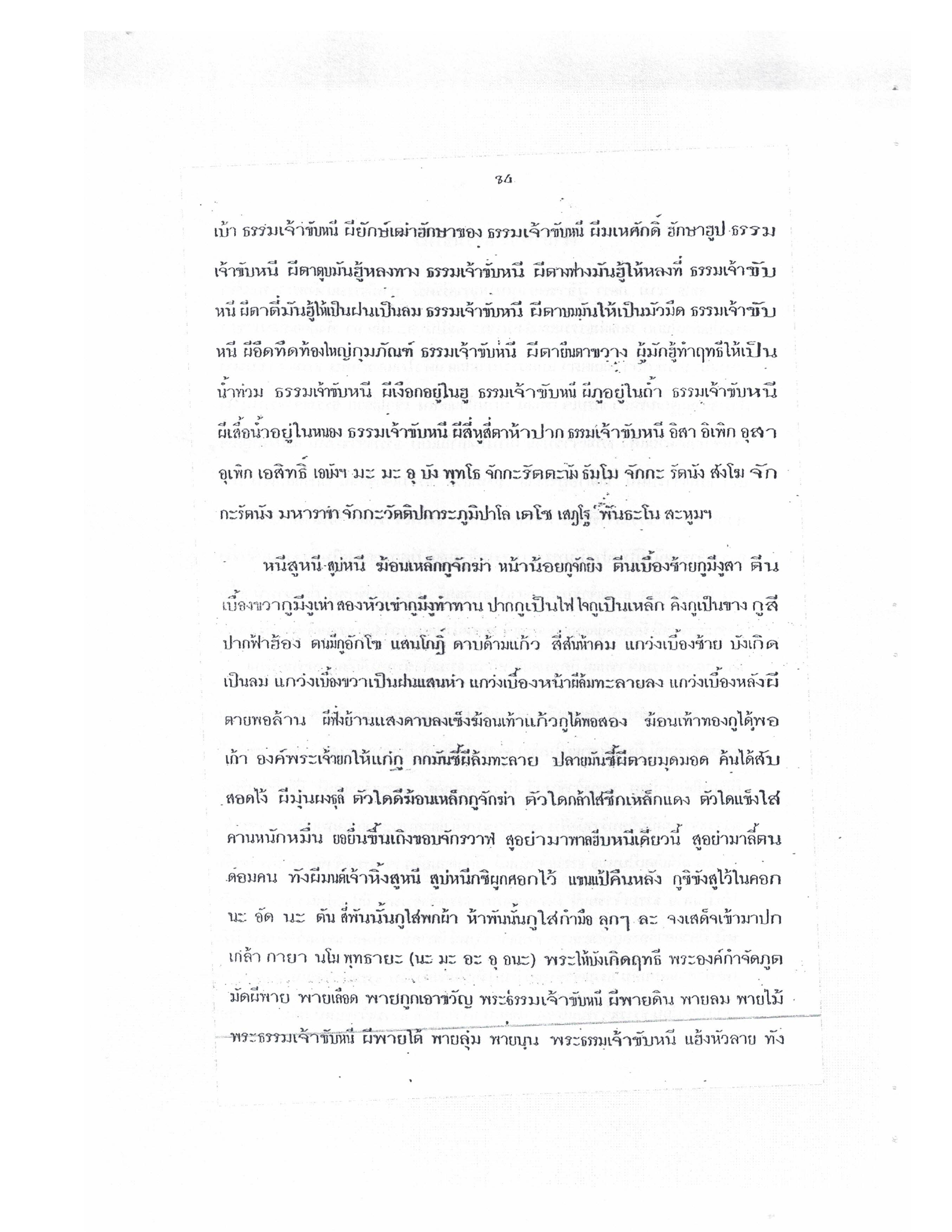
เบ้า ธรรมเจ้าขับหนี ผียักษ์เฒ่าฮักษาของ ธรรมเจ้าขับหนี ผีเหศักดิ์ฮักษาฮูป ธรรมเจ้าขับหนี ผีดาตุมันฮู้หลงทาง ธรรมเจ้าขับหนี ผีดางฝ่างมันฮู้ให้หลงที่ ธรรมเจ้าขับหนี ผีดาตี่มันฮู้ให้เป็นฝนเป็นลม ธรรมเจ้าขับหนี ผีดายมันให้เป็นมัวมืด ธรรมเจ้าขับหนี ผีอืดทืดท้องใหญ่กุมภัณฑ์ ธรรมเจ้าขับหนี ผีดายืนตาขวาง ผู้มักฮู้ทำฤทธิ์ให้เป็นน้ำท่วม ธรรมเจ้าขับหนี ผีเงือกอยู่ในฮู ธรรมเจ้าขับหนี ผีภูอยู่ในถ้ำ ธรรมเจ้าขับหนี ผีเสื้อน้ำอยู่ในหนอง ธรรมเจ้าขับหนี ผีสี่หูห้าตาห้าปาก ธรรมเจ้าขับหนี
อิสา อิเพิก อุสา อุเพิก เอสิทธิ เอมัง มะ มะ อุ บัง พุทโธ จักกะรัตนัง ธัมโม จักกะรัตนัง สังโฆ จักกะรัตนัง มหาราชำ จักกะวัติปการะภูมิปาโล เตโช เสโพรู พันธะโน สะหุมฯ
หนีสูหนี สู่บ่หนี ม้อนเหล็กกูจักฆ่า หน้าน้อยกูจักยิง ตีนเบื้องซ้ายกูมีงูสา ตีนเบื้องขวากูมีงูเห่า สองหัวเข่ากูมีท้าวทาน ปากกูเป็นไฟ ใจกูเป็นเหล็ก คิงกูเป็นขาง กูสีปากฟ้าฮ้อง ตนมีกูอักโข แสนโภฏิ ดาบด้ามแก้ว สี่ส้นห้าคม แกว่งเบื้องซ้าย บังเกิดเป็นลม แกว่งเบื้องขวาเป็นฝนแสนห่า แกว่งเบื้องหน้าผีล้มทะลายลง แกว่งเบื้องหลังผีตายพอล้าน ผีฝ่ายฮ้านแลงดาบลงเซ็งม้อนเท้าแก้วกูได้พอสอง ม้อนเท้าทองกูได้พอเก้า องค์พระเจ้ายกให้แก่กู กกมันซี้ผีล้มทะลาย ปลายมันซี้ผีตายมุดมอด ค้นได้สับสอดไว้ ผีมุ่งผงคลี ตัวใดดีม้อนเหล็กกูจักฆ่า ตัวใดกล้าใส่ซีกเหล็กแดง ตัวใดแข็งใส่คานหนักหมื่น ยอยืนขึ้นเถิงขอบจักรวาฬ สู่อย่ามาทะลืบหนีเดียวนี้ สู่อย่ามาลี้ดอมคน ทั้งผีมนต์เจ้าหิงสูหนี สู่หนีกซิผูกศอกไว้ แขนแป้คืนหลัง กูขังสู้ไว้ในคอก
นะ อัด นะ ต้น สี่พันนั้นกูใส่พกผ้า ห้าพันนั้นกูใส่กำมือ ลุกๆ ละ จงเสด็จเข้ามาปกเกล้า กายา นโม พุทธายะ (นะ มะ อะ อุ อนะ) พระให้บังเกิดฤทธิ์ พระองค์กำจัดภูต มัดผีพาย พายเลือด พายภูตเอาขวัญ พระธรรมเจ้าขับหนี ผีพายดิน พายลม พายไม้ พระธรรมเจ้าขับหนี ผีพายได้ พายลุ่ม พายบุญ พระธรรมเจ้าขับหนี แอ้งหัวลาย ทั้ง
— [continuing] Lord Dhamma, drive it out: the aged demon-ghost that guards its things — Lord Dhamma, drive it out! The ghost of rank that guards an image — Lord Dhamma, drive it out! The star-ghost that makes travellers lose their way — Lord Dhamma, drive it out! The comet-ghost that makes one lose one's bearings — Lord Dhamma, drive it out! The earth-star ghost that can turn into rain and wind — Lord Dhamma, drive it out! The ghost that darkens the sky into gloom — Lord Dhamma, drive it out! The bloated, big-bellied kumbhanda-ghost — Lord Dhamma, drive it out! The ghost that stands cross-eyed, that likes to work its power into floods — Lord Dhamma, drive it out! The water-serpent ghost that lives in a hole — Lord Dhamma, drive it out! The mountain ghost that lives in caves — Lord Dhamma, drive it out! The water-guardian ghost that lives in the marsh — Lord Dhamma, drive it out! The ghost with four ears, five eyes, five mouths — Lord Dhamma, drive it out!
[A protective invocation, romanised as printed: "Isa ipek, usa upek, esiddhi emang, ma ma u bang; Buddho cakkaratanam, Dhammo cakkaratanam, Sangho cakkaratanam; maharaja cakkavati pakara bhumipalo tejo sepōrū bandhano sahum." Its exact sense is uncertain; it appears to invoke the Triple Gem as a wheel-jewel and a great wheel-turning king as guardian of the realm.]
Flee, ghost, flee! Do not stay! With my iron mallet I will strike you, with my small face I will shoot you. On my left foot I bear the royal serpent, on my right foot I bear the cobra; at both my knees I bear the guardian deity Thao Than. My mouth is fire, my heart is iron, my body is bronze; my mouth roars like the sky. I possess a mantra of a hundred thousand powers; a sword with a crystal hilt, four-butted, five-edged: swung to the left, it raises a wind; swung to the right, it brings a hundred thousand measures of rain; swung forward, ghosts fall and are destroyed; swung behind, ghosts die by the hundred-thousand. The ghost-side lays down its sword, bowing — I have won as many as two rounds with my crystal feet, as many as nine with my golden feet; the Lord Buddha has granted them to me. Wherever it takes root, may the ghost fall and be destroyed; wherever it trails off, may the ghost die and rot away. Having searched, I have found and driven it in: the ghost that raises dust — whatever ghost is strong, my iron mallet will kill it; whatever ghost is bold, I thrust a red-hot iron splinter into it; whatever ghost is tough, I load it with a ten-thousand-weight yoke, lifting it up to the very rim of the universe. Do not slip away and flee at this moment; do not go into hiding among people — and every ghost bound by spells, flee! Flee, and let your arms be bound behind your back and turned back — I will confine and hold you in the pen.
Na-at, na-ton: four thousand of them I tuck into my clothing-fold, five thousand of them I hold in my fist. Rise up, rise up! Come and cover my head. [Romanised as printed:] "Kaya namo buddhaya (na ma a u ana)." The Lord grants the arising of power; he destroys the spirits, binds the ghost that carries misfortune away, that carries away blood, that carries off the spirit and takes the khwan [soul-essence] — Lord Dhamma, drive it out! The ghost that carries away earth, that carries away wind, that carries away wood — Lord Dhamma, drive it out! The ghost that can carry things off, that carries off the lowlands, that carries off merit — Lord Dhamma, drive it out! Its striped head, all —
(Text is cut off mid-sentence at the bottom of the page; it continues on the following page.)
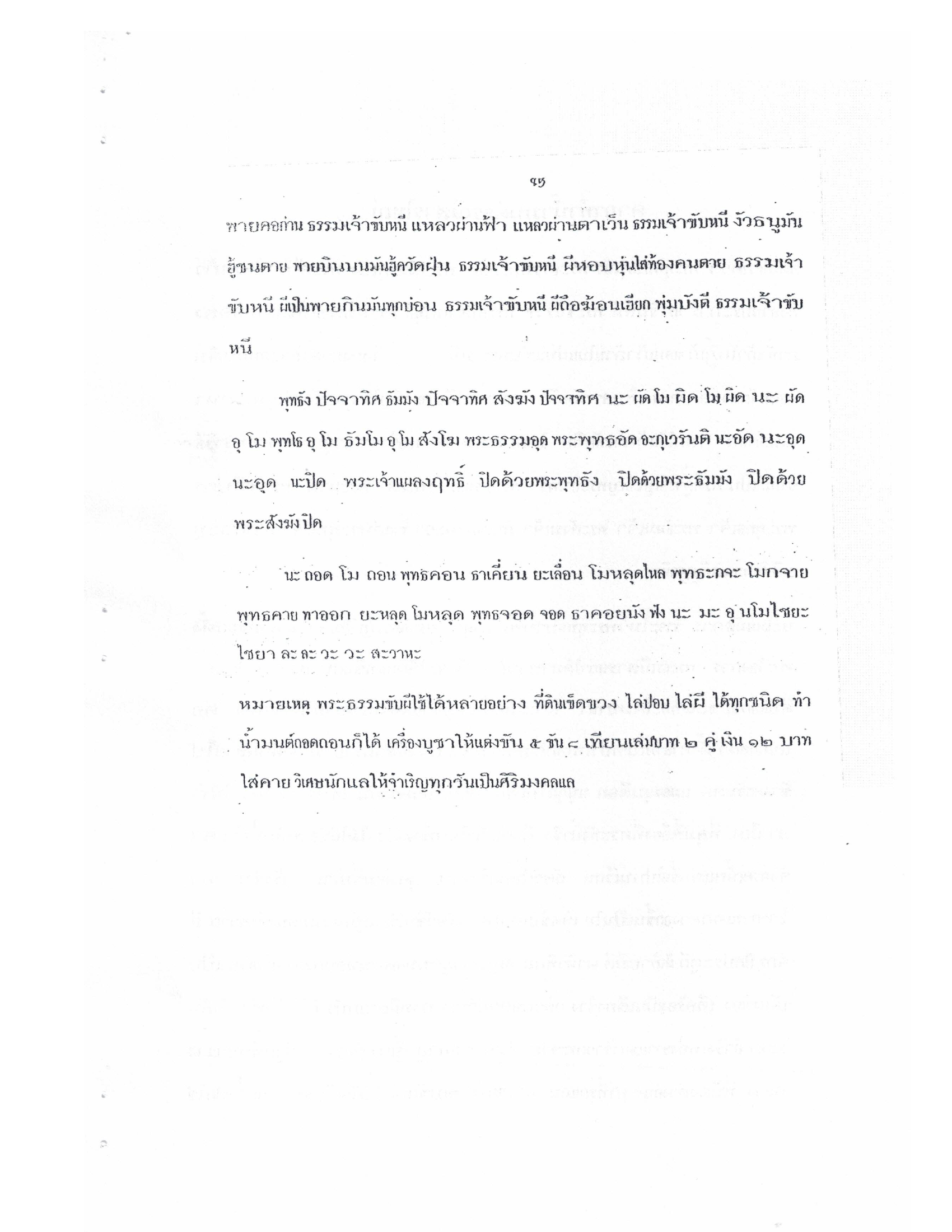
พายคอก่าน ธรรมเจ้าขับหนี แหลวผ่านฟ้า แหลวผ่านตาเว็น ธรรมเจ้าขับหนี งัวธนูมันฮู้ซนตาย พายบินบามมันฮู้ควัดฝุ่น ธรรมเจ้าขับหนี ผีหอบหุ่นไส้ท้องคนตาย ธรรมเจ้าขับหนี ผีเป็นพายกินมันทุกบ่อน ธรรมเจ้าขับหนี ผีถือฆ้อนเขียก พุ่มบังดี ธรรมเจ้าขับหนี
พุทธัง ปัจจาทิศ ธัมมัง ปัจจาทิศ สังฆัง ปัจจาทิศ นะ ผัด โม ผิด โม ผิด นะ ผัด อุ โม พุทโธ อุ โม ธัมโม อุ โม สังโฆ พระธรรมอุด พระพุทธอัด อะกุเวรันติ นะอัด นะอุด นะอุด นะปิด พระเจ้าแผลงฤทธิ์ ปิดด้วยพระพุทธัง ปิดด้วยพระธัมมัง ปิดด้วยพระสังฆังปิด
นะ ถอด โม ถอน พุทธถอน ธาเคี่ยน ยะเลื่อน โมหลุดไหล พุทธะกจะ โมกจาย พุทธคาย ทาออก ยะหลุด โมหลุด พุทธจอด จอด ธาคอยนัง ฟัง นะ มะ อุ นโมไชยะ ไชยา ละ ละ วะ วะ สะวาหะ
หมายเหตุ พระธรรมขับผีใช้ได้หลายอย่าง ที่ดินเข็ดขวง ไล่ปอบ ไล่ผี ได้ทุกชนิด ทำน้ำมนต์รดถอนก็ได้ เครื่องบูชาให้แต่งขัน ๕ ขัน ๘ เทียนเล่มบาท ๒ คู่ เงิน ๑๒ บาท ใส่คายวิเศษนักแลให้เจริญทุกวันเป็นศิริมงคลแล
— carries off the dead trunk — Lord Dhamma, drive it out! The hawk-ghost that flies across the sky, that flies across the sun — Lord Dhamma, drive it out! The ox-star spirit that can tangle one to death; the flying-monkey ghost that can stir up dust — Lord Dhamma, drive it out! The ghost that carries off the entrails of the dead — Lord Dhamma, drive it out! The ghost that becomes a carrying-spirit devouring everywhere — Lord Dhamma, drive it out! The ghost that holds a creaking hammer, lurking to do harm — Lord Dhamma, drive it out!
[A closing seal-formula invoking the Triple Gem to bind and shut away the ghost, romanised as printed:] "Buddhang pacchathit, Dhammang pacchathit, Sangkhang pacchathit; na phat, mo phit, mo phit, na phat; u mo Buddho, u mo Dhammo, u mo Sangho; the Dhamma seals, the Buddha binds; akuwerandi; na-at, na-ut, na-ut, na-pit — the Lord displays his power; sealed by the Buddha, sealed by the Dhamma, sealed by the Sangha, sealed."
[A further mantra of closing syllables, romanised as printed, their sense being ritual sound rather than plain prose:] "Na thot, mo thon; Buddha-thon; tha khian, ya leuan; mo lut lai; Buddhaka-cha, mokchai; Buddhakhai, tha-ok; ya lut, mo lut; Buddha-chot, chot; tha khoi nang fang; na ma u; namo chaiya, chaiya, la la wa wa sawaha."
Note: this Dhamma-that-drives-out-ghosts mantra can be used in many ways — to counter a cursed plot of land, to drive off a pop-spirit [an entrail-eating ghost] or any kind of ghost at all; it may also be made into holy water for sprinkling and undoing curses. For the offering, prepare a five-tiered tray and an eight-tiered tray, a pair of one-baht candles, twelve baht in money, and set out fine areca-and-betel offerings; do this and you will prosper every day, most auspiciously.
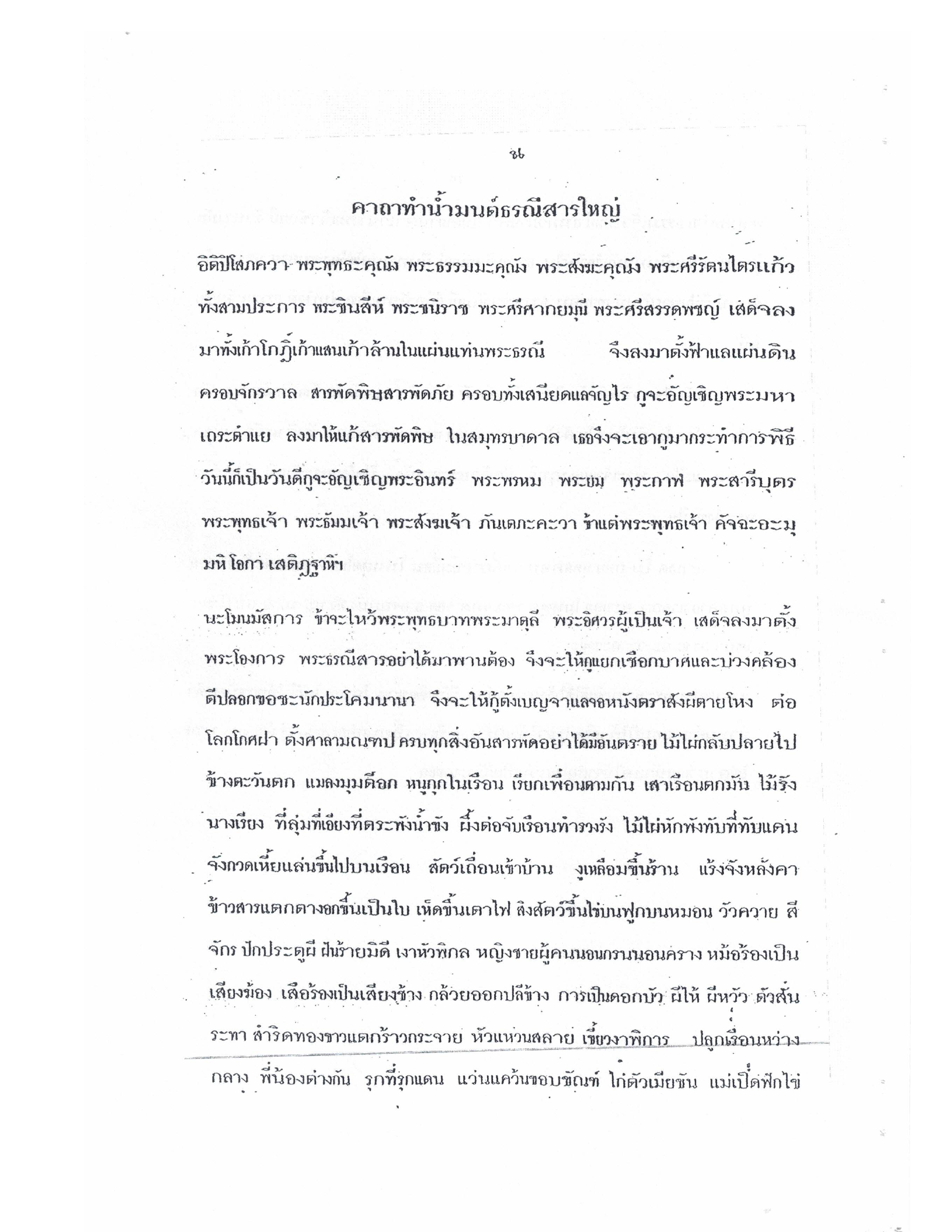
คาถาทำน้ำมนต์ธรณีสารใหญ่
อิติปิโสภควา พระพุทธคุณัง พระธรรมมะคุณัง พระสังฆะคุณัง พระศรีรัตนไตรแก้วทั้งสามประการ พระชินสีห์ พระชินราช พระศรีศากยมุนี พระศรีสรรดพชญ์ เสด็จลงมาทั้งเก้าโกฏิเก้าแสนเก้าล้านในแผ่นแท่นพระธรณี จึงลงมาตั้งฟ้าแลแผ่นดิน ครอบจักรวาล สารพัดพิษสารพัดภัย ครอบทั้งเสนียดแลจัญไร กูจะอัญเชิญพระมหาเถระดำแย ลงมาให้แก้สารพัดพิษ ในสมุทรบาดาล เธอจึงจะเอากูมากระทำการพิธี วันนี้ก็เป็นวันดีกูจะอัญเชิญพระอินทร์ พระพรหม พระยม พระกาฬ พระสารีบุตร พระพุทธเจ้า พระธัมมเจ้า พระสังฆเจ้า ภันเตภะคะวา ข้าแด่พระพุทธเจ้า คัจจะอะมุมหิ โอกาเสติฏฐาหิฯ
นะโมมัสการ ข้าจะไหว้พระพุทธบาทพระมาตุลี พระอิศวรผู้เป็นเจ้า เสด็จลงมาตั้งพระโองการ พระธรณีสารอย่าได้มาพานต้อง จึงจะให้กูแยกเชือกบาศและบ่วงคล้อง ดีปลอกขอชะนักประโคมนานา จึงจะให้กู้ตั้งเบญจาแลอหังการส่งผีตายโหง ต่อโลกโกศฝา ตั้งศาลามณฑป ครบทุกสิ่งอันสารพัดอย่าได้มีอันตราย ไม้ไผ่กลับปลายไป ข้างตะวันตก แมลงมุมดีอก หนูทุกในเรือน เรียกเพื่อนตามกัน เสาเรือนตกมัน ไม้รังนางเรียง ที่ลุ่มที่เอียงที่ตระพังน้ำขัง ผึ้งต่อจับเรือนทำรวงรัง ไม้ไผ่หักพังทับที่ทับแคน จิ้งกวดเหี้ยแล่นขึ้นไปบนเรือน สัตว์เถื่อนเข้าบ้าน งูเหลือมขึ้นร้าน แร้งจับหลังคา ข้าวสารแตกตางอกขึ้นเป็นใบ เห็ดขึ้นเตาไฟ ลิงสัตว์ขึ้นไม่บินฟูกบนหมอน วัวควาย สีจักร ปักประดูมี ฝนร้ายมิดี เงาหัวพิกล หญิงชายผู้คนนอนกรนนอนคราง หม้อร้องเป็นเสียงม้อง เสือร้องเป็นเสียงช้าง กล้วยออกปลีข้าง การเป็นดอกบัว ผีไห้ ผีหวีว ตัวสั่นระทา สำริดทองขาวแตกร้าวกระจาย หัวแหวนสลาย เขี้ยวงาพิการ ปลูกเรือนหว่างกลาง พี่น้องต่างกัน รุกที่รุกแดน แว่นแคว้นขอบเขต ไก่ตัวเมียขัน แม่เป็ดฟักไข่
Mantra for Making the Great Dharani-sara Holy Water
Iti pi so bhagavā: the virtue of the Buddha, the virtue of the Dhamma, the virtue of the Sangha; the precious Triple Gem in all three aspects; the Victorious Lion, the Victorious King, the glorious Sage of the Sakyas, the glorious Perfect One — descend, all nine koti, nine hundred thousand, nine million of them, onto the very dais of Mother Earth. So descend and establish the sky and the earth, encompassing the universe, encompassing every poison and every danger, encompassing every ill omen and misfortune. I shall invoke the great dark-robed elder monk to descend and dispel every poison in the depths of the ocean; then he will take me to perform the rite. Today being an auspicious day, I shall invoke Indra, Brahma, Yama, Kala, the Elder Sariputta, the Lord Buddha, the Lord Dhamma, the Lord Sangha. [Romanised as printed:] "Bhante bhagavā... gacchāmi amumhi okāse titthāhi" — O Lord Buddha, go and stand in that place.
Homage: I shall pay respect to the Buddha's footprint and to Phra Matuli; the Lord Isvara [Shiva] himself descends to issue his command: let the earth-essence affliction not come near or touch this person. So he grants that I may untie the binding-cords and snares, the shackles, hooks, and every kind of harassment; so he grants that I may set up the five-tiered platform and, with full authority, send off the ghost of one who died a violent death, toward the funeral urn's lid; erect the pavilion-hall, complete in every particular, so that nothing untoward may happen: such as — a bamboo whose tip bends back toward the west; a spider that portends ill; rats squeaking in the house, calling their companions to gather; a house-post that oozes resin; a "rang"-wood plank lying askew; a low or tilted spot, a pool where water stands; wasps and bees settling on the house to build their comb; bamboo breaking and falling onto the granary-platform; a monitor lizard running up onto the house; wild animals entering the home; a python climbing onto the loft; a vulture perching on the roof; husked rice sprouting into a shoot; mushrooms growing on the stove; monkeys or animals flying up to roost on the pillow; cattle and buffalo behaving strangely; the weaving-loom set up wrongly; foul rain that will not stop; a misshapen shadow on someone's head; men and women lying asleep, snoring and groaning; a pot that rings like a gong; a tiger that roars like an elephant; a banana tree that puts out its flower-bud sideways; something that grows in the shape of a lotus; a ghost that wails, a ghost that whistles, a body that trembles and shakes; bronze or white-metal ware that cracks and shatters; a ring's setting that comes apart; tusks or teeth that are deformed; a house built in between two others, causing siblings to become estranged; encroaching on land, encroaching on borders, on the boundary of a realm; a hen that crows; a mother duck that hatches eggs —
(Text is cut off mid-sentence at the bottom of the page; it continues on the following page.)
ผีหลอกผีหลอน ตีเกราะเคาะไม้ หมาจิ้งจอกหมาไน วิ่งไล่เห่าขบ แร้งคาบศพตกลงหลังคา งูทับสมิงคล่าเข้าไซในบ้าน ฝักทองขึ้นร้าน กลายเป็นมหากาฬ ร่วมอาสน์พระยา สมณะชีพราหมณ์เบิกพระเนตรพระเตียงตั้ง ก่อรูปพระสลักหนังฝังเสาเกียดเสาตะลุง เห็นผีพุ่งได้ กันเสนียดจัญไร ปลูกเรือนไม้ไผ่ชักข้างประสมโขลง ติดเสากระโดง ติดโขนโขมดยา ติดโขนเรือพายม้า หมาเขี้ยวรดตีน หลักต่อได้ดิน หินหักสองท่อน ที่ลุ่มที่ดอน สาครดลิ่งพัง เรือนเดิมแรกตั้งที่ฝังน้ำหัก เสาเรือนย่อยยัก หันแตกแยกทาง เสาเรือนเป็นแล่ง หัวบันไดเพล่ เสาเรือนเป็นเล่ห์ เสาเรือนไสบ ผิดน้ำท่านบ คบคนทั้งหลาย ประสมช้างม้าวัวควายให้มีครรภ์ ปิดปล่องช่องน้ำ ทำไร่ทำนา ติดขาฝงเกวียน บาดแรกสาแหรกขาด ตะล่มทาชาติ กินซ้อนหอยมุก ร่วมอาสน์พระยา ตัดไม้ในป่า แร้งกาขี้รด ประสมหินบด คนคดต้นไม้ ทิ้งฟืนทิ้งไฟ ทิ้งเหย้าทิ้งเรือน ถอดงาช้างเถื่อน ถอดออกคลาดเคลื่อน ขี้มักตายโหง ไม้สักต่อโลง โยงเข้าป่าช้า ขายกระเบน เช็ดหน้า ก้างปลาจิ้มฟัน หายใจรดกัน ฟันร่องซ่องตัด ปลูกเรือนใกล้วัด ไม้ปิดหลังคา เสาเรือนฟ้าผ่า เสาเรือนไฟไหม้ แม่ไก่ไข่ในบ้านประตู เลี้ยงนกผสมคู่ นกนั้นมิอยู่ ปลูกเรือนพะไล ตัดไม้เจาะเสา หนูกัดตีน แมลงสาบเลียหัว ผ้าหมุ่งกับตัว ไฟไหม้ได้ลน วัวชนควายชนโอนต้นกูจะต่อต้น โอนปลายกูจะต่อปลาย ต้นมันกูจะฝากไว้กับพระพาย ปลายมันกูจะฝากไว้กับนางพระธรณีกูจะสร้างพระภูมิ ก่อพระวิหาร ทำตามบุราณ เขียนพระบทประนมศพ ประนมเมรุ ครูกูชื่ออนุรุทธเถร จึงเอาพระยา คาถานี้ให้เสกน้ำ รดวัว รดควาย รดช้าง รดม้า รดคนเป็นบ้าเที่ยวอยู่กลางเมือง คนไข้ผอมเหลือง คนเงื่อง คนเนหงา คนขี้เซาหาวนอน ต้องอธิกรณ์ โชคตวนขื้อคา รดฟักรดแฟง รดแตงน้ำเต้า รดข้าวในนา รดถั่ว รดงา สารพัดเคราะห์สิ่งอันใดๆ รดให้ประสิทธิ เธอจะไปพระนิพพานัง ประสิทธิสุขัง ภวันตุเตฯ
— a ghost that plays tricks and haunts, striking wooden clappers; jackals and wild dogs running about barking and snapping; a vulture dropping a corpse onto the roof; a monitor-lizard-spirit stalking into the fish-trap inside the house; a pumpkin-vine climbing onto the loft and turning into a Great Kala [death-omen]; sharing the lord's dais; a monk or brahmin having their eyes opened, a couch set up; making an image, carving a hide, planting a boundary-post and a hitching-post; seeing a ghost leap — all these ward off ill omen and misfortune. Building a bamboo house drawn to one side, mixed in with the herd; a mast-post fixed in place; a demon-mask fixed on; a boat's prow-mask fixed on, paddled like a horse; a dog licking one's feet with its fangs; a boundary-post that has taken root in the earth; a stone broken in two pieces; low ground and high ground; the river-bank giving way; the very first house-site where the water-course broke; house-posts crooked and twisted, splitting off in different directions; a house-post split lengthwise; the stair-head worn away; a house-post that is deceptive; a house-post that slips; going against the water's course; keeping company with all sorts of people; crossing elephants, horses, cattle, and buffalo to make them breed; blocking a water-channel; working the fields and the rice-paddies; a wagon's wheel-shaft catching; a first wound where the carrying-strap breaks; toppling over from birth; eating oysters and pearls two at a time; sharing the lord's dais; felling trees in the forest; crows and vultures fouling a place with their droppings; grinding stone mixed together; a man who bends a tree crooked; throwing away firewood, throwing away fire, abandoning house and home; drawing out a wild elephant's tusk and having it slip and go astray; one prone to a violent death; teak wood cut for a coffin, dragged to the cemetery; selling a stingray; wiping one's face, picking a fish-bone from between the teeth; breathing on one another; cutting a channel or ditch; building a house near a temple; wood that caps the roof; a house-post struck by lightning; a house-post burned by fire; a hen laying eggs by the house's gate; keeping birds paired to breed, and the bird will not stay; building a lean-to shed; cutting wood and boring a post; a rat gnawing at one's feet; a cockroach licking one's head; cloth wrapped round the body catching fire and scorching; oxen goring, buffalo goring — whatever bends at the base, I will splice the base; whatever bends at the tip, I will splice the tip; its base I entrust to the Wind-god; its tip I entrust to Mother Earth; I shall build a spirit-house, erect a shrine-hall, following the ancient way; write out the verse for laying out a corpse, for laying out the cremation-pyre. My teacher's name is the Elder Anuruddha; so I take, O Lord, this mantra, to consecrate water: sprinkle it on cattle, on buffalo, on elephants, on horses; sprinkle it on a person gone mad and wandering through the town; on a sick person wasted and sallow; on one who is sluggish, one who is listless, one who is drowsy and forever yawning to sleep, one caught up in a legal dispute, one shackled by ill fortune; sprinkle it on squash, on gourds, on melons and bottle-gourds, on the rice in the paddy, on beans, on sesame — on whatever misfortune of any kind — sprinkle it and it will take effect. May you go to Nibbana; may you attain the bliss of accomplishment; may it be so for you.
น้ำมนต์ธรณีสารนี้ ท่านให้ทำรดคนที่กำลังมีเคราะห์เจ็บไข้เรื้อรังกันเสนียด จัญไรที่เกิดขึ้นในบ้านเรือน หรือประพรมบ้านเรือนไร่นาสวนดีนักแล
จะทำพิธีอะไรก็ตาม เมื่อทำน้ำมนต์เสร็จแล้ว ให้เอามือแตะน้ำมนต์ลูบหน้าลูบแขน เพื่อป้องกันตัวเราเองก่อนเวลาลูบให้ว่าคาถาป้องกันตัว ว่าดังนี้
บทที่ ๑
ปิดตะปิดตัวทะวะถัง ปิดตะ
บทที่ ๖
สุสุละถาโร อังสะมะ อะอุ อุมะอะ
นะ คือ ตัวกู มีเกาะเหล็ก เกาะทอง หุ้มห่อตัวกู อยู่มิดชิด
นะชิด นะบังปิด คัดชามิ
คาถาสองบทนี้จะใช้บทใดบทหนึ่งก็ได้
This dharani earth-water (nam mon thoranisan): have it used to sprinkle a person who is currently under misfortune, ill with a chronic illness, or plagued by ill omens, or on inauspicious things that have arisen within a house; or sprinkle it around the house, the fields, and the gardens — it is very good indeed.
Whatever rite is being performed, once the holy water is finished, take the hand, touch the holy water, and stroke it over the face and stroke it over the arms, in order to protect oneself; before stroking it on, recite the body-protection katha, as follows:
Verse 1
[katha, romanised as printed] Pidta pidtua thawathang pidta.
Verse 6
[katha, romanised as printed] Susulathoro angsama a-u umaa.
Na represents the self (tua ku): it is wrapped in an iron shell and a golden shell, enclosing the self, sealed completely shut.
[katha, romanised as printed] Na chid, na bang pid, khatchami.
Either of these two verses may be used — either one will do.
คาถาปัดรังควาน
นะสะเทือนพสุธาเลื่อนไหวหวั่น มะทรงจันทร์กูนเมมาพระสุริย์อากาศ สุเมรุ ราชหักหลักจักวาลทานมิได้ พะทรงไฟประลัยกัลป์เย็นแล้ร้อน ทะทรงสมุทรสาคร กระฉ่อนกระฉอก ระลอกฉาน เดชาธาตุทั้งสี่ให้บันดาลพระเวทย์ ทั้งนี้ให้ประสิทธิเดช มโน มหินทรา มหานุภาพ โอมมหาราบทาบบำราบศัตรู ครูท่านประสิทธิ อิอิทะอุ โออะหัง นะมะพะทะนระอะอุมะทะระวุ กูผู้สามารถอาจปราบจบเมฆฝนในอากาศ สายฟ้าฟาดภูผาทลาย เป็นเปลวเพลิงกระจายด้วยศาสตราคม โอมมะอุอะ ยะธา พุทโมนะอิกะ เออิอุมะ สิกะสิอะอะนะอัง พุทธัง พุทโธ โอเอฟ้าผ่า อะอาฟ้าลั่น หวั่น หวั่นหวาดหวาด ภูตผีปีศาจจงเร่งเร็วออกมา อะอะอาอา อย่าช้าไวๆ ตามกูบัญชา โส จิจะเจ สะติ วิยะอินทร์ มึงรู้เจ๊จา มึงรู้ภาษา กูเรียกมึงขาน กูวานกูใช้ ให้มึงกลับไป หาเจ้านายมึง อย่าทำดื้อดึง ทำเล่ห์ทำกล ยะธายะโส อาคัจจะ อะมุมหิ อุทิอุทัง อะสังปะสัง ภวะจิตดัง อุทะอุตะ อุติรูปะ นิมิตดังดัง ภูตาถูดัง อุตติอุตดัง โอมนะมะ พะทะ กะระมะถะ นะอะมะนิ มิอะอะอุ อุอินะอะ อิกะวิติ พุทธิคัตโถ นะโมมะยิ อาคัจจะ อะมุมหิ กูจะขับด้วยไฟ กูจะไล่ด้วยลม กูจะข่มด้วยดินให้สิ้นซากสาง กูจะล้างด้วยน้ำ รูปที่มึงทำเลขยันต์ต่างๆ ใช้ผีใช้สางกำกับกันมา นานาสมมุติ อย่าหยุดอย่านิ่ง จงกลิ้งจงกลับ ทั้งหลับทั้งตื่น จงฟื้นขึ้นมา เร่งพากันไปเร็วๆไวๆ ดังกูบัญชา ทั้งพระสุริยา จงมาสาปสรร รีบไปโดยพลัน พระนารายณ์ทรงฤทธิ์ อิศวรพระสิทธิ์ ทรงฟ้าอากาศ มหาภูตลีลาส เร่งออกจากตัว อิมะสาดรา มหาอาคัมมะ ปรพรหมา อุตติ อุตติ อุตตะ หะหิ อะอิเอโอ นะมะมะโม มิตดัง จิตดัง จิตดัง จิตตะ ชาตะชาติ อุฏเฐหิ ลุกขึ้นเร็วๆ มา พระนาถให้หา สาดราประชุม เมฆหมอกมืดคลุ้ม ประชุมเทวา รูปะรูปา บรรดากลเดช เวทย์มนต์ทนอยู่มิได้ วิชัยยะเดโช นะโมอะระหะโต สุคะตัสสะ นะมะพะทะ จัด
Katha for driving away hauntings (rangkhwan)
Na shakes the earth, making it tremble and quake; Ma commands the moon, [is] the sun and the open sky; Sumeru, the great axis-pillar of the universe, does not yield; Pha wields fire that ends an aeon, now cool, now hot; Tha wields the great ocean, surging and churning, its waves crashing — may the power of these four elements bring this sacred formula into effect. Let it grant magical potency of mind, of the great Indra, of great might. Om, great king, beat down and crush every enemy; may my teacher grant success. [mantra syllables, romanised] I-i-tha-u o-a-hang na-ma-pha-tha-na-ra-a-u-ma-tha-ra-wu — I who am able to subdue and disperse the clouds and rain in the sky, the lightning that splits mountains and shatters cliffs, turning it into a spreading blaze by magical craft. [mantra syllables, romanised] Om-ma-u-a yatha phutmonaika oei-uma sikasi-a-anang phutthang phuttho — oh, lightning strikes! ah, the sky thunders! tremble, tremble and quake and quake — spirits and ghosts, hurry out at once! Ah, ah, ah, ah, do not delay, be swift, as I command! [mantra syllables, romanised] So chichaje sati wiya-in — you know how to speak, you know the language; I call you, I summon you; I bid you, I command you: go back to find your master. Do not be stubborn, do not play tricks or deceive. [mantra syllables, romanised] Yathayaso akhachcha amumahi uthi-uthang asangpasang phawachitdang uthauta utirupa nimitdangdang phutathudang uttiutdang om-na-ma-phatha karamatha na-a-mani mi-a-a-u u-ina-a ikawiti phutthikhattho namomayi akhachcha amumahi — I shall drive you out with fire, I shall chase you away with wind, I shall crush you with earth until nothing of the spirit remains, I shall wash you away with water. Whatever image or inscribed yantra you have made, whatever ghost or spirit you have set upon me, in whatever guise — do not stop, do not stay still; turn over and go back, whether asleep or awake, awaken at once; hasten away quickly, as I command. May the Sun himself come and curse you; be gone at once. Mighty Narayana, powerful Isvara, master of the sky, lord of the great elements' movement — hasten out of the body. [mantra syllables, romanised] Imasadra maha-akhamma paraphrommha utti utti utta hahi a-i-e-o namamamo mitdang chitdang chitdang chitta chatachati uttehi — rise up quickly and come; may the guardian lord summon the great host, though dark clouds of mist and fog gather the gods together, every form and shape — no magic power or mantra can withstand this. [mantra syllables, romanised] Wichaiyadecho namo arahato sukhatassa namaphatha — arrange... [continues on the next page, mid-sentence]
ตุโลกะปาลา ชุติมันโต สุคะตัสสะ นะมะพะทะ จัดตุโลกะปาลา ชุติมันโต สุคะตัสสะ นะมะพะทะ จัดตุโลกะปาลา ชุติมันโต ยัสสะ
โดยวจีอธิษฐาน ตามอาจารย์ประสิทธิมา ด้วยเหตุแห่งกู ศัตรูอันต่อสู้อัปรา อังกาโร เทวะราชา มโหส้กขา มหิทธิเก วชิราจะ มหาเดโช ขัดตะ ขัดตัง สักกาลุทธัง อินทะรูปัง ทุรังทิสวา อุสุระดะณา ปลายันติ วิทธิ ระทิมะอิ อุกะวิติ อิกะวิติ อะระหัดโต รุดะรุโต อาคัจจะ อะมุมหิ มิมะ อัดโตวะดา อะโสภะควา สัพเพยักขา ปลายันติ
[continuing the mantra from the previous page, romanised as printed] Tulokapala chutimanto sukhatassa namaphatha, chatutulokapala chutimanto sukhatassa namaphatha, chatutulokapala chutimanto yassa.
By this spoken vow, taught successfully by my teacher, by this power that is mine, may every enemy who stands against me be crushed. [mantra, romanised] Angkaro thewaracha mahossakkha mahitthike wachirache mahadecho khatta khattang sakkaluttang inthrarupang thurangthisawa usuradana palayanti witthi rathimaoi ukawiti ikawiti arahatto ruttarutto akhachcha amumahi mima attowada asophakhawa — may all yakkhas flee (sabbe yakkha palayanti).
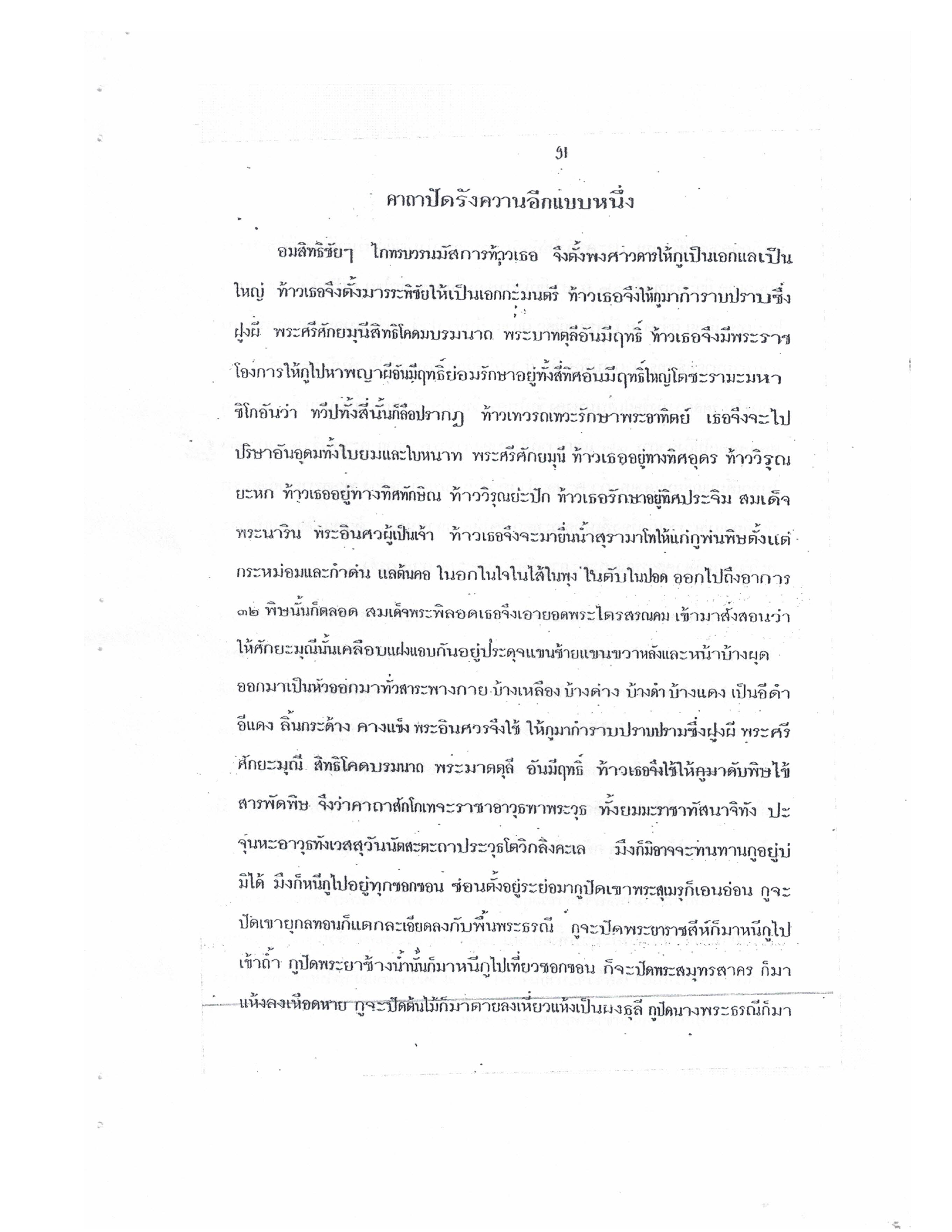
คาถาปัดรังควานอีกแบบหนึ่ง
อมสิทธิชัยๆ ไกทรบวรมมัสการทุกเธอ จึงตั้งพงศาวดารให้กูเป็นเอกและเป็นใหญ่ ท้าวเธอจึงตั้งมารระพิชัยให้เป็นเอกกษมนตรี ท้าวเธอจึงให้กูมากำราบปราบซึ่งฝูงผี พระศรีศักยมุนีสิทธิโคดมบรมนาถ พระบาทตุลีอันมีฤทธิ์ ท้าวเธอจึงมีพระราชโองการให้กูไปหาพญาผีอันมีฤทธิ์ย่อมรักษาอยู่ทั้งสี่ทิศอันมีฤทธิ์ใหญ่โตชะรามะหวชิโกอันว่า ทวีปทั้งสี่นั้นก็ถือปรากฏ ท้าวเทวรถเทวะรักษาพระอาทิตย์ เธอจึงจะไปปริษาอันอุดมทั้งใบยมและใบหนาท พระศรีศักยมุนี ท้าวเธออยู่ทางทิศอุดร ท้าววิรุณยะหก ท้าวเธออยู่ทางทิศทักษิณ ท้าววิรุณยะปัก ท้าวเธอรักษาอยู่ทิศประจิม สมเด็จพระนาริน พระอินทร์ผู้เป็นเจ้า ท้าวเธอจึงจะมายื่นน้ำสุรามาโทให้แก่กูพ่นพิษตั้งแต่กระหม่อมและกำด่น แลต้นคอ ในอกในใจในไส้ในพุง ในตับในปอด ออกไปถึงอาการ ๓๒ พิษนั้นก็ตลอด สมเด็จพระพิลอดเธอจึงเอายอดพระไตรสรณคม เข้ามาสั่งสอนว่า ให้ศักยมุนีนั้นเคลือบแฝงแอบกันอยู่ประดุจแขนซ้ายแขนขวาหลังและหน้าบ้างผุดออกมาเป็นหัวออกมาทั่วสารพางกาย บ้างเหลือง บ้างด่าง บ้างดำ บ้างแดง เป็นกีดำอีแดง ลิ้นกระด้าง คางแข็ง พระอินศวรจึงใช้ ให้กูมากำราบปราบซึ่งฝูงผี พระศรีศักยะมุนี สิทธิโคดมบรมนาถ พระมาตุลี อันมีฤทธิ์ ท้าวเธอจึงใช้ให้กูมาคับพิษให้สารพัดพิษ จึงว่าคาถาสกโกเทจราชาอาวุธทาพระวุธ ทั้งยมมะราชาทัสนาจิทัง ปะจุนหะอาวุธทังเวสสุวันนัตสะดะถาประวุธโตวิกลิงคะเล มึงก็มิอาจจะทนทานกูอยู่บ่มิได้ มึงก็หนีกูไปอยู่ทุกซอกซอน ซ่อนตั้งอยู่ระย่อมากูปิดเขาพระสุมรุกเอนอ่อน กูจะปิดเขายุกลทอนก็แตกละเอียดลงกับพื้นพระธรณี กูจะปิดพระยาราชสีห์ก็มาหนีกูไปเข้าถ้ำ กูปิดพระยาช้างน้ำนั้นก็มาหนีกูไปเที่ยวซอกซอน ก็จะปิดพระสมุทรสาคร ก็มาแห้งลงเหือดหาย กูจะปิดต้นไม้ก็มาตายลงเหี่ยวแห้งเป็นผงธุลี กูปิดนางพระธรณีก็มา
Another version of the katha for driving away hauntings
Om, victory, victory! ... homage from you all. He thus established the chronicle making me foremost and supreme. The lord then appointed Mara-raphichai as chief minister. The lord then sent me to come subdue and vanquish the multitude of ghosts. The Glorious Sakyamuni, the Accomplished Gotama, the Great Lord — his blessed feet possess power. The lord then issued a royal command for me to go seek the mighty ghost-kings, of great power, who guard each of the four directions — Charamahawachiko; as for the four continents, they too are made manifest. Lord Devaratha, deity who guards the sun — the lord would then go to the great assembly of both the Bai Yom and the Bai Nathat. The Glorious Sakyamuni: the lord dwells in the northern direction. Lord Wirunyahok: the lord dwells in the southern direction. Lord Wirunyapak: the lord guards the western direction. His Majesty Phra Narin, Lord Indra: the lord would then come and hand me sacred liquor-medicine, to spit out the poison — from the crown of the head and the nape, and the neck, in the chest, in the heart, in the intestines, in the belly, in the liver, in the lungs, out to the 32 [afflictions] — the poison would then be entirely expelled. The Blessed Philot then took up the essence of the Three Refuges and came to instruct: that Sakyamuni should coat and conceal himself, guarding as though he were the left arm, the right arm, the back, and the front — some [poison] bursting out as swellings over the whole body: some yellow, some mottled, some black, some red, becoming black crow-marks and red crow-marks, the tongue stiffening, the jaw locking. Lord Isvara then sent me to come subdue the multitude of ghosts, the Glorious Sakyamuni, the Accomplished Gotama the Great Lord, Phra Matuli who possesses power: the lord then sent me to come press down the poison, to overcome every kind of poison. Then recite the katha: Sakkothetracha, weapon of the king, weapon of the lord, together with Yommaracha's tatsanachithang, pachunha-weapon-thang wetsuwannatsata-thapravutto-wikalingkhale — you cannot endure and remain before me, you cannot; you must flee from me into every crevice and corner, hiding, cowering low. I press down Mount Sumeru until it bends and bows low; I press down the mountains until they crumble to dust upon the earth. I press down the lion-king and he flees from me into a cave. I press down the water-elephant-king and he flees from me wandering into every crevice. I press down the great ocean and it dries up and vanishes. I press down the trees and they wither, die, and crumble to dust. I press down the Earth Goddess and she too comes... [continues on the next page]
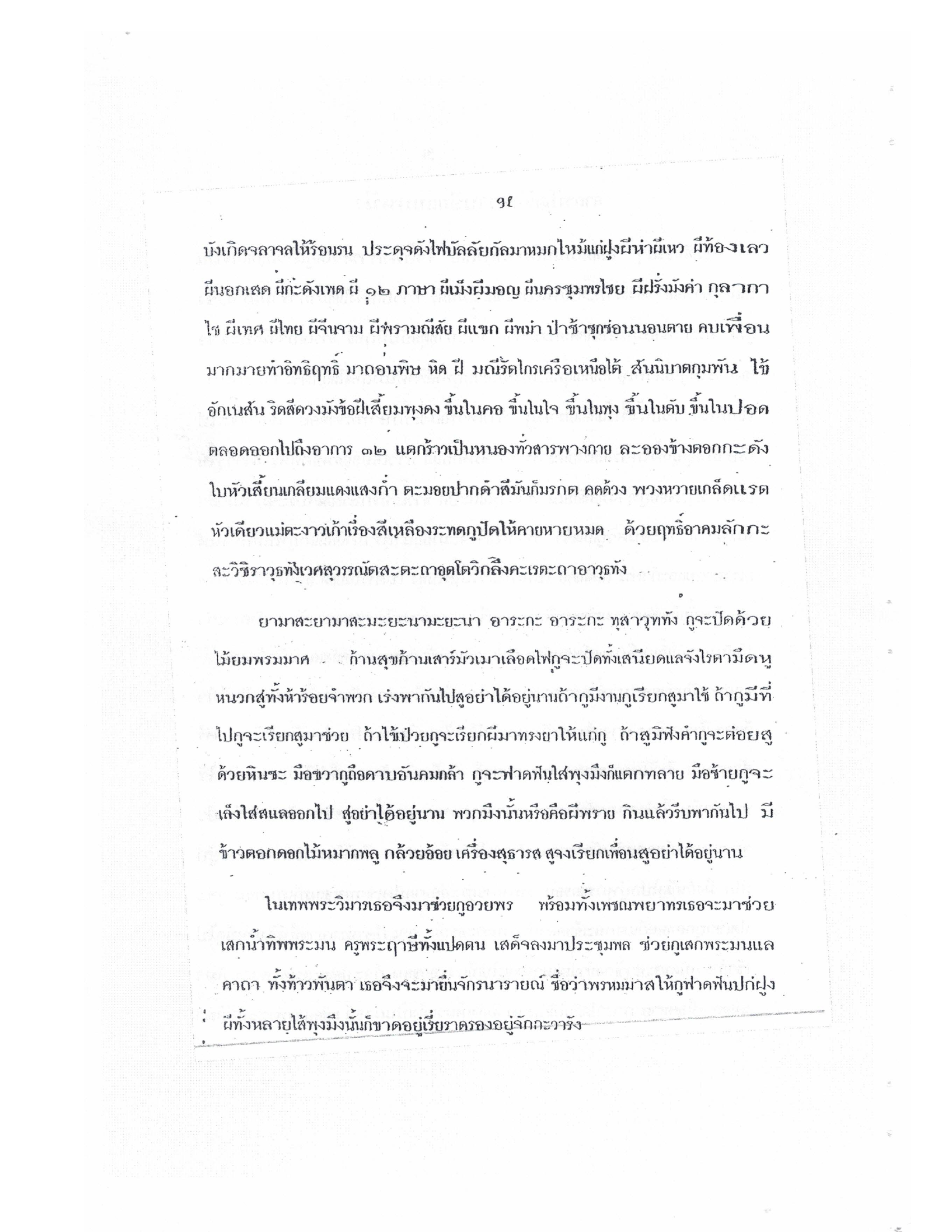
บังเกิดจลาจลให้ร้อนรน ประดุจดังไฟบัลลัยกัลมาหมกไหม้แก่ฝูงผีห่าผีเหว ผีท้องเลว ผีนอกเสด ผีกะดังเพด ผี ๑๒ ภาษา ผีมึงผีมอญ ผีนครชุมพรไชย ผีฝรั่งมั่งคำ กุลากาไข ผีเทศ ผีไทย ผีจีนจาม ผีพรามณีลัย ผีแขก ผีม่า ป่าช้าซุกซ่อนนอนตาย คบเพื่อนมากมายทำอิทธิฤทธิ์ มาถอนพิษ หิด ฝี มณีรัดไกรเครือเหนือได้ ส้นนิบาตกุมพ้าน ไข้อักเนส้น วิดสีดวงมังข้อฝีเสี้ยมพุงดง ขึ้นในคอ ขึ้นในใจ ขึ้นในพุง ขึ้นในตับ ขึ้นในปอด ตลอดออกไปถึงอาการ ๓๒ แตกร้าวเป็นหนองทั่วสารพางกาย ละอองข้างตอกกะดัง ใบหัวเสี้ยนเกลียมแดงแสงก่ำ ตะมอยปากดำสีมันก็มรกต คดด้วง พวงหวายเกล็ดแรด หัวเดียวแม่ตะงาวเก้าเรื่องสีเหลืองระทดกูปัดให้คายหายหมด ด้วยฤทธิ์อาคมลักกะสะวิชิราวุธทังเวสสุวรรณัตสะตะถาอุดโตวิกลิงคะเรตะถาอาวุธทัง
ยามาสะยามาสะมะยะนามะยะนา อาระกะ อาระกะ ทุสาวุทธัง กูจะปัดด้วยไม้ยมพรมมาศ ก้านสุขก้านเสาร์มัวเมาเลือดไฟกูจะปัดทั้งเสนียดแลจังไรตามีดนู หนวกสู่ทั้งห้าร้อยจำพวก เร่งพากันไปสู่อย่าได้อยู่นาน ถ้ากูมีงานกูเรียกสูมาใช้ ถ้ากูมีที่ไปกูจะเรียกสูมาช่วย ถ้าไข้ป่วยกูจะเรียกผีมาทรงยาให้แก่กู ถ้าสูมิฟังคำกูจะต่อยสูด้วยหินซะ มือขวากูถือดาบอันคมกล้า กูจะฟาดฟันใส่พุงมึงก็แตกทลาย มือซ้ายกูจะเล็งใส่แสลออกไป สู่อย่าได้อยู่นาน พวกมึงนั้นหรือคือผีพราย กินแล้วรีบพากันไป มีข้าวตอกดอกไม้หมากพลู กล้วยอ้อย เครื่องสุธารส สูงเรียกเพื่อนสู่อย่าได้อยู่นาน
ในเทพพระวิมารเธอจึงมาช่วยกูอวยพร พร้อมทั้งเพชณพยาทรเธอจะมาช่วยเสกน้ำทิพพระมน ครูพระฤๅษีทั้งแปดตน เสด็จลงมาประชุมพล ช่วยกูเสกพระมนแลคาถา ทั้งท้าวพันตา เธอจึงจะมายื่นจักรนารายณ์ ชื่อว่าพรหมมาสให้กูฟาดฟันปกฝูงผีทั้งหลายให้พุงมึงนั้นก็ขาดอยู่เรี่ยวราดรองอยู่จักกะวารัง
[Ghosts and evil spirits] arise in tumult, making all burn hot as though scorched by the fire of the aeon's end — every kind of plague-ghost, chasm-ghost, dysentery-ghost, outcast-ghost, roof-crest ghost, ghosts of the twelve languages, Mon ghosts, ghosts of the city of Chumphon Chai, wealthy Western ghosts, foreign traders, Persian/Indian ghosts, Thai ghosts, Chinese and Cham ghosts, Brahmin ghosts, Malay ghosts, Burmese ghosts, and those hiding and lying dead in graveyards, consorting together in great number to work their power — I draw out the poison: scabies, boils, [an affliction called] manirat-rat-krai-khruea-nuea, the collapsing-fit spirit, tetanus, fire-thread illness, hemorrhoids, joint-abscesses, the belly-boring worm — rising up into the throat, into the heart, into the belly, into the liver, into the lungs, all the way out to the 32 [afflictions], breaking open into sores all over the body, dust-motes at the corner [of the eye], leaves turning jagged and glowing dark red, the black-mouthed biting insect whose colour is emerald, the curled beetle, the rattan-cluster with rhino-scale, the single-headed nine-marked yellow serpent — may I sweep it all out and make it entirely vanish, by the power of the incantation Lakkasa Wachirawut, together with Wetsuwannatsata-thaudto-wikalingkhareta-thaawuttang.
[mantra, romanised] Yamasayamasamayanamayana arakha arakha thusawutthang — I will sweep it away with the wood of the golden banyan, with the branch of good fortune and the branch of Saturn, drunk on blood and fire, I will sweep away every ill omen and misfortune with this very blade. All five hundred kinds [of spirits], deaf to it — hurry away together, do not remain long. If I have work, I will call upon you to serve; if I have somewhere to go, I will call upon you to help; if I fall ill, I will call the spirit to come and give me medicine through possession. If you do not heed my word, I will strike you with stone. In my right hand I hold a sharp sword; I will hew and slash into your belly until it bursts apart. With my left hand I will take aim and cast you out. Do not remain long. Whatever you are, ghost or malevolent spirit, once you have eaten, hurry away together. Here are puffed rice, flowers, betel, banana, sugarcane, sweet offerings — call your companions and be gone; do not remain long.
May the deities of the heavenly mansion come and grant me their blessing; together with the vengeful spirits (Phet Phaya), may they come and help consecrate the divine water and sacred formula. The eight hermit-teachers descend to assemble their host and help me consecrate the sacred formula and the katha. Together with the thousand-eyed lord [Indra], may he come and hand over Narayana's discus, called Phrommas, for me to hew and cut down all the ghosts, so that your bellies burst open and your entrails lie strewn across the universe (chakkawan).
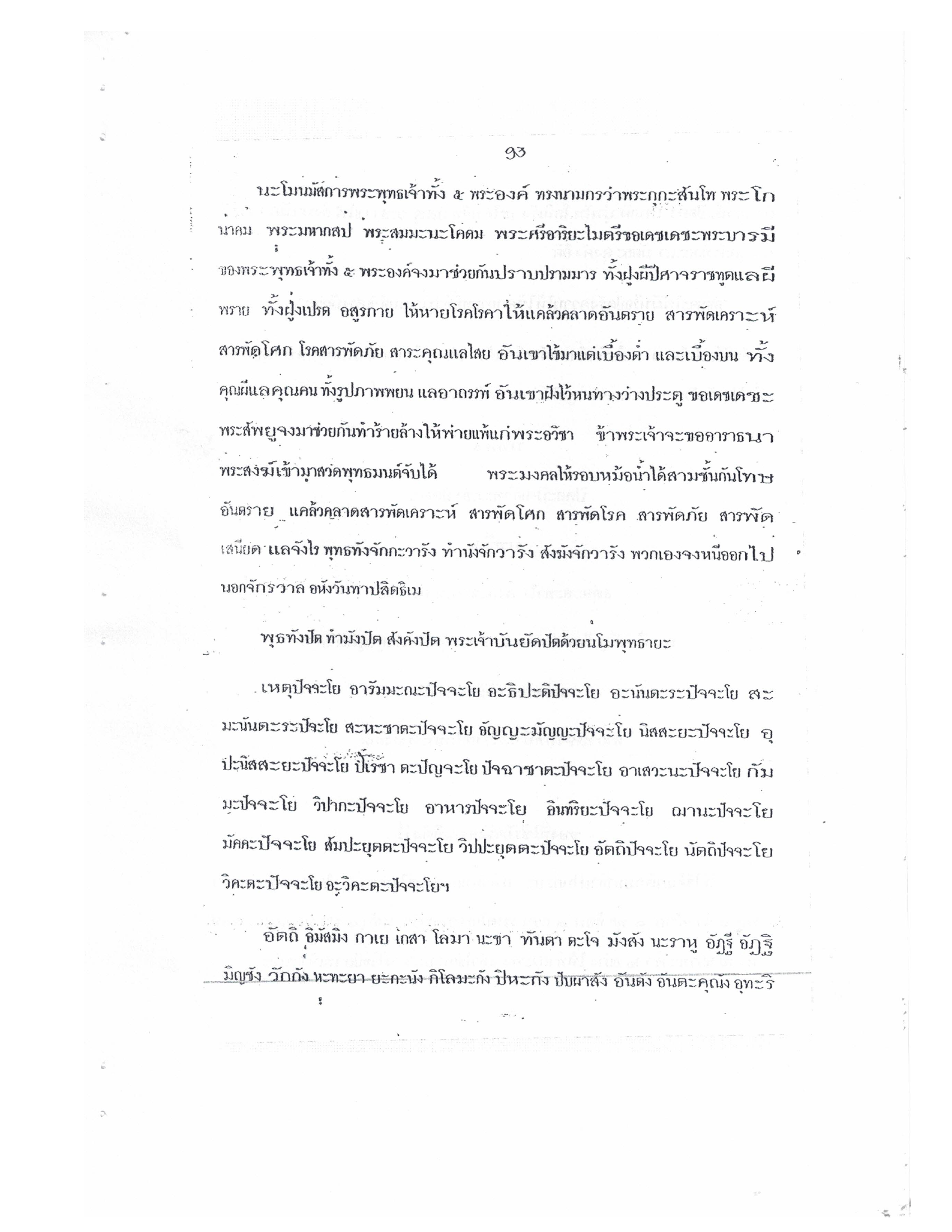
นะโมนมัสการพระพุทธเจ้าทั้ง ๕ พระองค์ ทรงพระนามกรว่าพระกกะสันโท พระโกนาคม พระมหากัสป พระสมมะนะโคดม พระศรีอาริยะไมตรี ขอเดชะพระบารมีของพระพุทธเจ้าทั้ง ๕ พระองค์จงมาช่วยกันปราบปรามมาร ทั้งฝูงผีปีศาจราชทูดแลผีพราย ทั้งฝูงเปรต อสูรกาย ให้หายโรคโรคาให้แคล้วคลาดอันตราย สารพัดเคราะห์ สารพัดโศก โรคสารพัดภัย สารพัดคุณแลไสย อันเขาไว้มาแต่เบื้องต่ำและเบื้องบน ทั้งคุณผีแลคุณคน ทั้งรูปภาพพยน แลอาถรรพ์ อันเขาฝังไว้หนทางว่างประตู ขอเดชเดชะพระสัพยูจงมาช่วยกันทำร้ายล้างให้พ่ายแพ้แก่พระอวิชา ข้าพระเจ้าจะขออาราธนาพระสงฆ์เข้ามาสวดพุทธมนต์จับได้ พระมงคลให้รอบหม้อน้ำได้สามชั้นเกินโทษอันตราย แคล้วคลาดสารพัดเคราะห์ สารพัดโศก สารพัดโรค สารพัดภัย สารพัดเสนียดแลจังไร พุทธทั้งจักกะวารัง ทำมังจักวารัง สังมังจักวารัง พวกเองจงหนีออกไปนอกจักรวาล อนึ่งวันทาปลิตธิเม
พุทธังปัด ทำมังปัด สังคังปัด พระเจ้าบันยัดปัดด้วยนโมพุทธายะ
เหตุปัจจะโย อารัมมะณะปัจจะโย อะธิปะติปัจจะโย อะนันตะระปัจจะโย สะมะนันตะระปัจจะโย สะหะชาตะปัจจะโย อัญญะมัญญะปัจจะโย นิสสะยะปัจจะโย อุปะนิสสะยะปัจจะโย ปุเรชาตะปัจจะโย ปัจฉาชาตะปัจจะโย อาเสวะนะปัจจะโย กัมมะปัจจะโย วิปากะปัจจะโย อาหารปัจจะโย อินทริยะปัจจะโย ฌานะปัจจะโย มัคคะปัจจะโย สัมปะยุตตะปัจจะโย วิปปะยุตตะปัจจะโย อัตถิปัจจะโย นัตถิปัจจะโย วิคะตะปัจจะโย อะวิคะตะปัจจะโยฯ
อัตถิ อิมัสมิง กาเย เกสา โลมา นะขา ทันตา ตะโจ มังสัง วักกัง หะทะยะ ยะกะนัง กิโลมะกัง ปิหะกัง ปัปผาสัง อันตัง อันตะคุณัง อุทะริ...
Homage — paying reverence to the five Buddhas, whose names are Kakusandha, Konagamana, Mahakassapa, Samana-Gotama, and Sri Ariya Maitreya (Metteyya) — may the power and glory of the merit of these five Buddhas come together to subdue Mara, together with every ghost, demon, royal-messenger spirit, and malevolent spirit, every hungry ghost and asura, so that sickness and disease be healed, that every danger be escaped, every misfortune, every sorrow, every disease, every peril, every [harmful] charm and black magic that has been laid from below and from above, both ghost-magic and human-magic, every effigy and curse buried along the pathway or the doorway — may the power and glory of the Sabbhayu [all-Buddha assembly] come together to destroy them and make them fail before the light of wisdom. I now invite the Sangha to come recite the sacred Buddhist formula and seize hold of it. May the blessing encircle the water-jar three times over, beyond all danger and peril, escaping every misfortune, every sorrow, every disease, every peril, every ill omen and inauspicious thing. [mantra, romanised] Phutthang chakkawarang thammang chakkawarang sangkhang chakkawarang — may you all flee out beyond the universe (chakkawan). Furthermore, homage —
[mantra, romanised] Phutthang pat, thammang pat, sangkhang pat (the power of the Buddha dispels, the power of the Dhamma dispels, the power of the Sangha dispels) — the Lord bars and repels [all harm], with Namo Buddhaya.
[the twenty-four conditions (paccaya) of the Abhidhamma's Paṭṭhāna, romanised as printed:] Hetu-paccayo, arammana-paccayo, adhipati-paccayo, anantara-paccayo, samanantara-paccayo, sahajata-paccayo, aññamañña-paccayo, nissaya-paccayo, upanissaya-paccayo, purejata-paccayo, pacchajata-paccayo, asevana-paccayo, kamma-paccayo, vipaka-paccayo, ahara-paccayo, indriya-paccayo, jhana-paccayo, magga-paccayo, sampayutta-paccayo, vippayutta-paccayo, atthi-paccayo, natthi-paccayo, vigata-paccayo, avigata-paccayo.
[the beginning of the thirty-two parts of the body, romanised as printed:] Atthi imasmim kaye kesa loma nakha danta taco mangsang vakkang hathaya yakanang kilomakang pihakang papphasang antang antakhunang uthari... [continues on the next page]
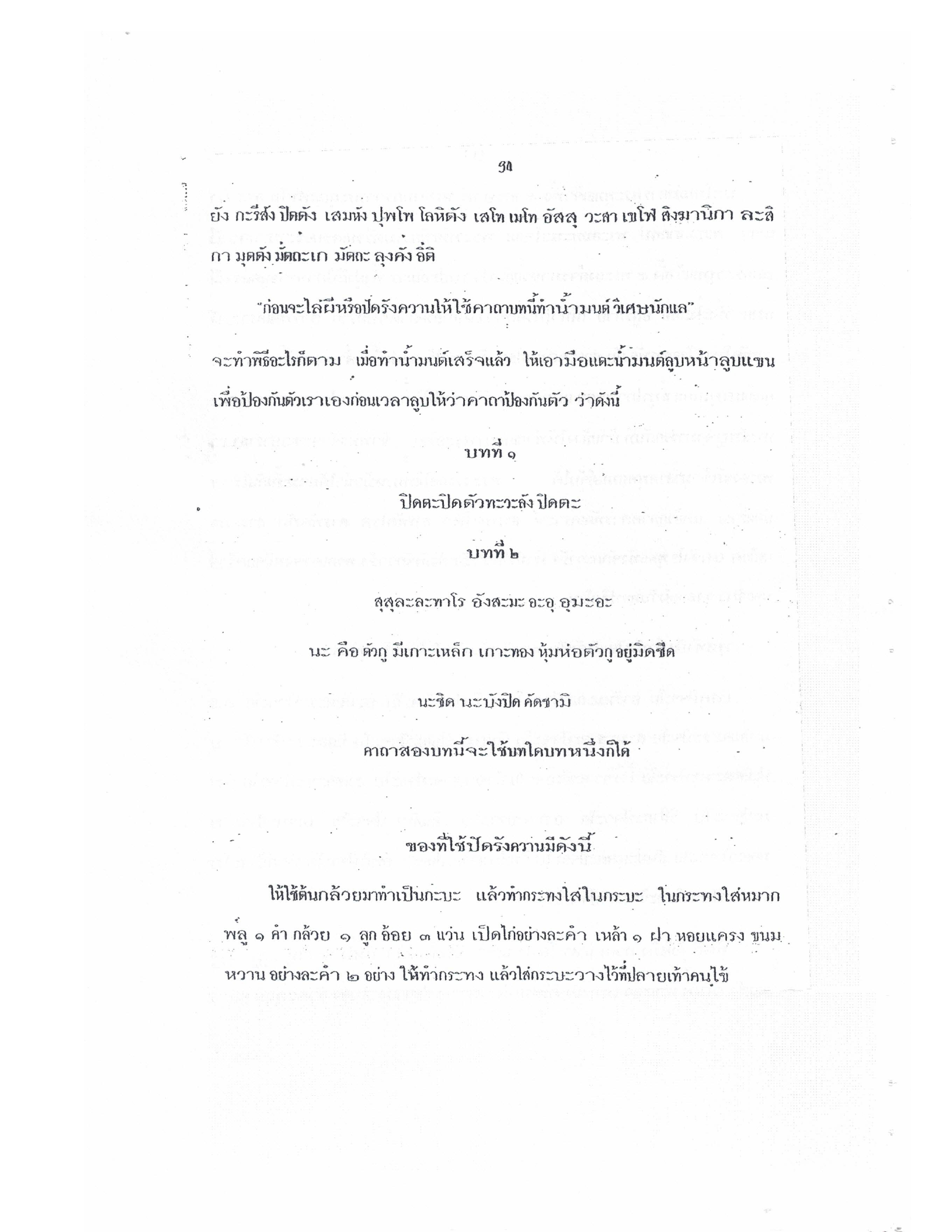
ยัง กะรีสัง ปิดตัง เสมหัง ปุพโพ โลหิตัง เสโท เมโท อัสสุ วะสา เขโฬ สิงฆานิกา ละสิกา มุตตัง มุตตะเก มัตตะ ลุงคัง อิติ
"ก่อนจะไล่ผีหรือปัดรังควานให้ใช้คาถาบทนี้ทำน้ำมนต์วิเศษนักแล"
จะทำพิธีอะไรก็ตาม เมื่อทำน้ำมนต์เสร็จแล้ว ให้เอามือแตะน้ำมนต์ลูบหน้าลูบแขน เพื่อป้องกันตัวเราเองก่อนเวลาลูบให้ว่าคาถาป้องกันตัว ว่าดังนี้
บทที่ ๑
ปิดตะปิดตัวทะวะถัง ปิดตะ
บทที่ ๖
สุสุละถาโร อังสะมะ อะอุ อุมะอะ
นะ คือ ตัวกู มีเกาะเหล็ก เกาะทอง หุ้มห่อตัวกู อยู่มิดชิด
นะชิด นะบังปิด คัดชามิ
คาถาสองบทนี้จะใช้บทใดบทหนึ่งก็ได้
ของที่ใช้ปัดรังควานมีดังนี้
ให้ใช้ต้นกล้วยมาทำเป็นกระบะ แล้วทำกระทงใส่ในกระบะ ในกระทงใส่หมากพลู ๑ คำ กล้วย ๑ ลูก อ้อย ๓ แว่น เป็ดไก่อย่างละคำ เหล้า ๑ ฝา หอยแครง ขนมหวาน อย่างละคำ ๒ อย่าง ให้ทำกระทง แล้วใส่กระบะวางไว้ที่ปลายเท้าคนไข้
[continuing the thirty-two parts of the body from the previous page, romanised as printed] Yang karisang pittang semhang pubbo lohitang sedo medo assu vasa khelo singkhanika lasika muttang muttake matta lungkhang iti (thus [end the thirty-two parts]).
"Before driving out a ghost or clearing away hauntings, use this verse to make the holy water — it is exceedingly potent indeed."
Whatever rite is being performed, once the holy water is finished, take the hand, touch the holy water, and stroke it over the face and stroke it over the arms, in order to protect oneself; before stroking it on, recite the body-protection katha, as follows:
Verse 1
[katha, romanised] Pidta pidtua thawathang pidta.
Verse 6
[katha, romanised] Susulathoro angsama a-u umaa.
Na represents the self: it is wrapped in an iron shell and a golden shell, enclosing the self, sealed completely shut.
[katha, romanised] Na chid, na bang pid, khatchami.
Either of these two verses may be used — either one will do.
The items used for the rangkhwan-clearing rite are as follows:
Use a banana-plant stem to make a tray, then make leaf-cups to place inside the tray. In each leaf-cup place: one mouthful of betel-and-areca, one banana, three slices of sugarcane, one bite each of duck and chicken, one bottle-cap of liquor, cockles, and one bite each of two kinds of sweets. Make the leaf-cups, place them in the tray, and set it down at the foot end of the sick person.
ให้เอาก้านมะยมสามก้านจุ่มน้ำมนต์แล้วปัด เสร็จแล้วให้หักก้านมะยมใส่ในกระบะวางแล้วว่านะโมตัสสะ แล้วค่อยเอามีดกรีดที่ดินแล้วไปเลย อย่าเข้าบ้าน คนไข้ให้ไปอยู่ที่ไหนสักพักแล้วค่อยกลับมา
เมื่อปัดรังควานเสร็จแล้วให้เรียกขวัญ
เมื่อปัดรังควานแล้วเอาสายสิญจน์มาผูกที่แขนซ้ายแล้วว่า นกเขาน่อนคอนเขา กล่าว น้ำไหลเชี่ยว ผีเหลียวมอง กูจะเอาไม้ค้อนเท่าแดกตาผีคัชชะมุมหิเอกาเสติ ถ้าหิว แล้วเรียกขวัญว่า ขวัญเอ้ยๆ มาอยู่กับเนื้อกับตัว (ออกชื่อคนไข้) มานี่มาๆ ขวัญตาอยู่ตายิ้มแย้ม ขวัญแก้มอยู่แก้มยิ้ม ขวัญนมอยู่สองเต้า ขวัญเกศเกล้าอยู่เกล้าเกศา
ขวัญเอ้ยๆ มาอยู่กับตัว (บอกชื่อคนไข้)
เอาผูกได้ลายสิญจน์ที่ข้อมือว่าอมสนับจับเนี้ยวเพี้ยงหาย
Take three stalks of star-gooseberry (mayom) leaf, dip them in the holy water, and sweep [the sick person] with them. When done, break the mayom stalks, place them in the tray, set it down, and recite Namo Tassa. Then take a knife, draw a line on the ground, and go away at once — do not enter the house. Let the sick person go stay somewhere else for a while, and only then come back.
Once the rangkhwan-clearing is finished, call the khwan (spirit-essence) back.
After clearing away the hauntings, take a length of sacred thread (sai sin) and tie it around the left wrist, saying: "The dove roosts and perches on the branch" — recite [this] as the water flows swiftly and the ghost looks back and away: [mantra, romanised] Ku cha ao mai khon thao daek ta phi khatcha-mumhi-ekasati — if it still lingers hungrily. Then call the khwan, saying: "Khwan, oh khwan, come and dwell within the flesh and the body (say the sick person's name), come here, come, come. May the khwan of the eyes remain, may the eyes smile brightly; may the khwan of the cheeks remain, may the cheeks smile; may the khwan of the breasts remain in both breasts; may the khwan of the hair and crown remain in the hair and the crown of the head.
Khwan, oh khwan, come and dwell within the body (say the sick person's name)."
Then tie the sacred thread around the wrist, saying: Om sanap chap niaeo phiang hai (may [the illness] vanish completely).
คาถากันหมาของสมเด็จโต
อมอ้ายจอ หูกว้าง หางงอ เอ็นดูกูบ้างนะ อ้ายจอ อ้ายจอ
หัวใจพระฤๅษี
ฤๅ ฦๅ
อ่านว่า รรือ ลลือ เป็นคาถาแทรกยันต์ต่างๆ ใช้ในทางเมตตามหานิยมดีนักแล
Somdet To's dog-warding katha
[mantra, romanised] Om ai-cho, hu kwang, hang ngo, en du ku bang na, ai-cho, ai-cho (Om, dog, wide of ear and curved of tail — have some pity on me).
The heart-syllables of the hermit-sage (Ruesi)
[the two vowel-letters ฤๅ and ฦๅ ("rue" and "lue") of the Thai alphabet, used here as sacred heart-syllables]
Read as "rue" [and] "lue." These are katha-syllables inserted into various yantras; they are used in matters of loving-kindness and great popularity/charm — very good indeed.
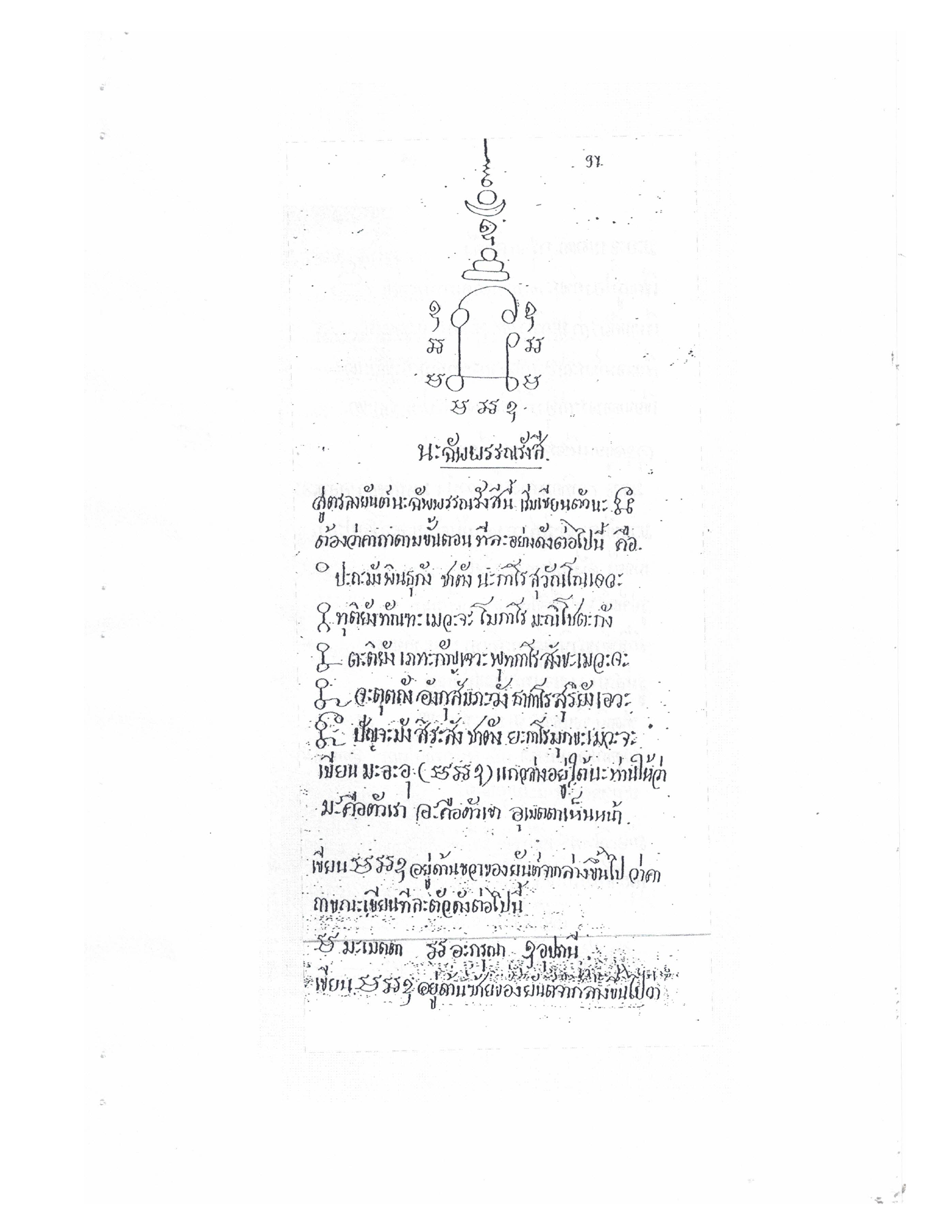
[yantra: อ่านไม่ชัด — ดูคำอธิบายในคำแปล]
นะกัมภรรณสิงห์ [อ่านไม่ชัด]
สูตรลงยันต์นะกัมภรรณสิงห์นี้ เป็นเชียนคาถา ต้องว่าคาถาตามขั้นตอน คือฉะนี้ คือลำดับต่อไปนี้ คือ
ปะถมัง พินธุกัง นะกาโรสุวัณโณเอวะ ทุติยัง ทันฑะเมฆะจะ โมภาโว มะโนโพธะกัง ตะติยัง เอกะกัปเทวะ พุทธาโว สังขะเมฆะอะ จะตุตถัง อังกัสนาวังธาตุโรสุริยังเอวะ ปัญจะมัง สีระสังทัฒัง ยะกาโรมุกขะแหวะจะ [อ่านไม่ชัด]
เพียน มะอะอุ [อ่านไม่ชัด] แกล้งอยู่ได้นะทำให้คะ มะคือตัวเรา อะคือตัวเขา อุเมตตาเห็นหน้า
เพียน [อ่านไม่ชัด] อยู่ด้านซ้ายของยันต์ตากลางขึ้นไป ว่าคาถากะชะเมื่อกะถอยถึงต่อไปนี้
ธะ มะเมตตา รรือ อะกะถา [อ่านไม่ชัด]
[yantra: a hand-drawn diagram shaped like a stupa/chedi spire — a slender stem topped by a crescent moon and a small stack of tiered rings (the finial and umbrella-tiers of a chedi), above a domed archway; a circle bearing a single character sits at each upper corner of the arch, with two further pairs of circles bearing characters descending along the sides, and a row of characters running along the base beneath the arch. [อักขระในวงกลมของยันต์อ่านไม่ชัด — characters inside the yantra's circles are not confidently legible]]
Na Kamphannasing (the name is handwritten and not entirely certain) [illegible]
The formula for inscribing this Na Kamphannasing yantra is a written spell; the katha must be recited in order, step by step, as follows:
Firstly: the dot/drop (bindu), the letter Na, golden, thus. Secondly: the staff and the cloud, the mind-arising awareness. Thirdly: the single-aeon deity, the Buddha-nature, the gathering cloud. Fourthly: the vessel of the elements, the sun, thus. Fifthly: the head-portion is fastened; the letter Ya at the mouth, split open [remainder illegible].
[An aside, partly illegible:] the syllables Ma-a-u [illegible] — even if [the wearer] misbehaves, [this] still protects; Ma represents oneself, A represents the other person, U is loving-kindness upon seeing the other's face.
The aside [illegible name] sits to the left of the yantra's central eye, upward; recite the katha, withdrawing back to this point, as follows:
[katha, romanised as printed] Tha ma metta rue akatha [remainder illegible].
[ข้อความคาถาในหน้านี้เขียนด้วยอักษรไทยแบบลายมือประดิษฐ์ อ่านไม่ชัดเจนหลายบรรทัด กล่าวถึงการเขียนรูปเสือ รูปองค์พระ และรูปนาคก่อนลงอักขระ มะ อะ อุ]
รูปจันทร์ [อ่านไม่ออก] เขียนไว้ก่อน [อ่านไม่ออก] ปะนะชาเยตุ
รูปสุริย [อ่านไม่ออก] บนจันทร์ เอาไว้เขียนก่อน [อ่านไม่ออก] ปะนะชาเยตุ
รูปอากาศ [อ่านไม่ออก] ไว้ก่อน อากาศปะนะชาเยตุ นะโมพุทธายะ
[ข้อความท้ายหน้า อักษรลายมือ อ่านไม่ชัด]
[Note: several lines of katha on this page are printed in an ornate, cursive-style Thai typeface that is not confidently legible; they concern drawing a tiger figure, a Buddha figure, and a naga figure before writing the syllables ma-a-u.]
Moon figure [illegible] — to be drawn first — [illegible] ...panachayetu.
Sun figure [illegible] above the moon, kept to be drawn first — [illegible] ...panachayetu.
Sky/air figure [illegible], kept for later; sky-panachayetu, namo buddhaya.
[Note: the remaining lines toward the bottom of the page, in the same cursive script, are not confidently legible.]
[yantra: a small icon resembling a Buddha image on a pedestal, near the top right of the page]
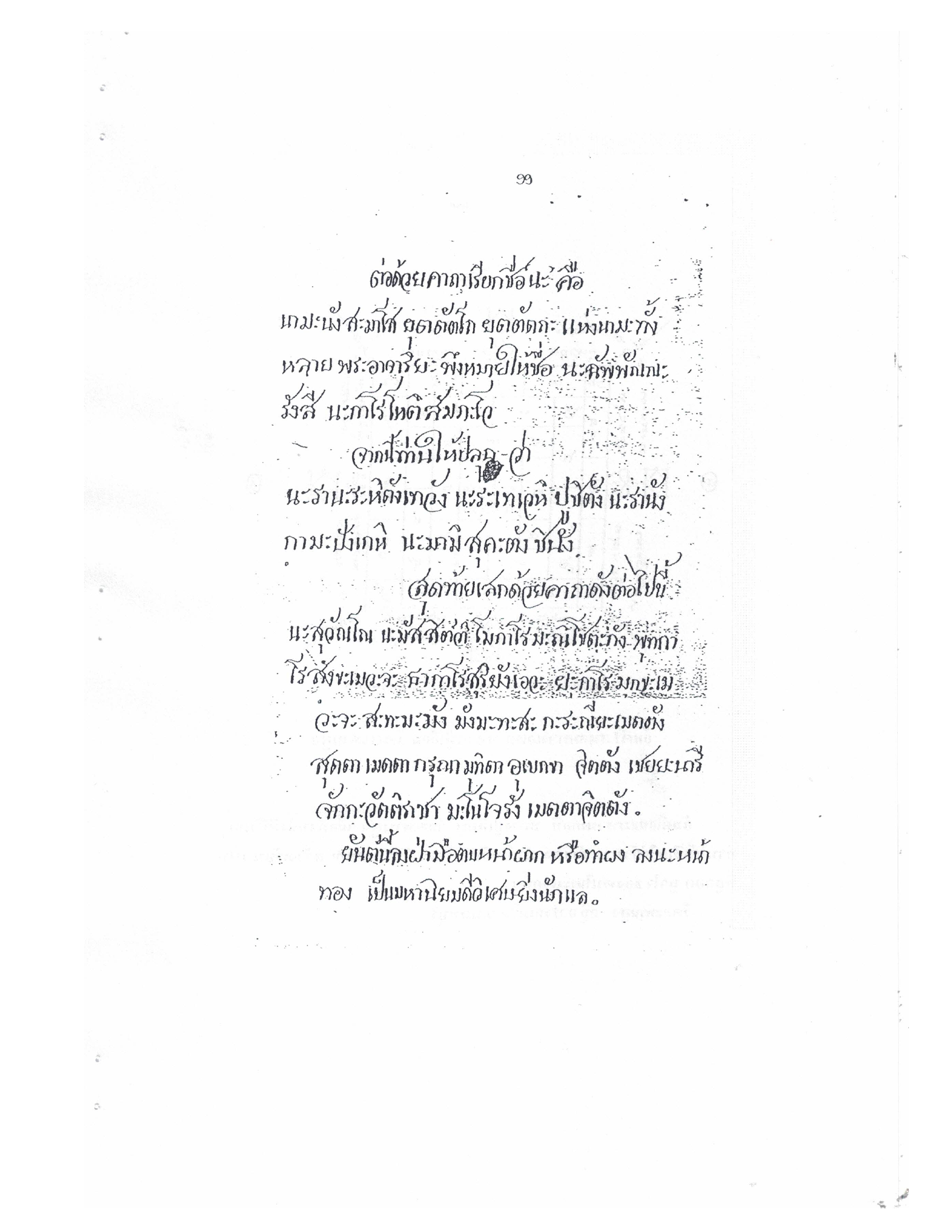
ด้วยคาถาเรียกชื่อนี้ คือ
[ข้อความคาถาอักษรลายมือ อ่านไม่ชัดหลายบรรทัด กล่าวถึงพระอาจารย์และการตั้งชื่อ]
จากนั้นให้ภาวนาว่า
[อ่านไม่ออก]
สุดท้ายเสกด้วยคาถาดังต่อไปนี้
[อ่านไม่ออก]
เมตตา กรุณา มุทิตา อุเบกขา จิตตัง
[อ่านไม่ออก]
ยันต์นี้ทาฝ่ามือ [อ่านไม่ออก] หรือทาผง ลงหน้าท้อง เป็นมหานิยมดีเยี่ยมยิ่งนักแล
With this name-invoking incantation, namely:
[Note: several lines of katha in the same ornate, cursive-style typeface, referring to teachers/masters and the giving of a name, are not confidently legible.]
Then chant:
[illegible]
Finally, consecrate with the following incantation:
[illegible]
Metta, karuna, mudita, upekkha — loving-kindness, compassion, sympathetic joy, and equanimity of mind.
[illegible]
Apply this yantra to the palm of the hand, [illegible], or apply the powder to the belly — it is an excellent charm for popularity and charisma (mahaniyom), most outstanding indeed.
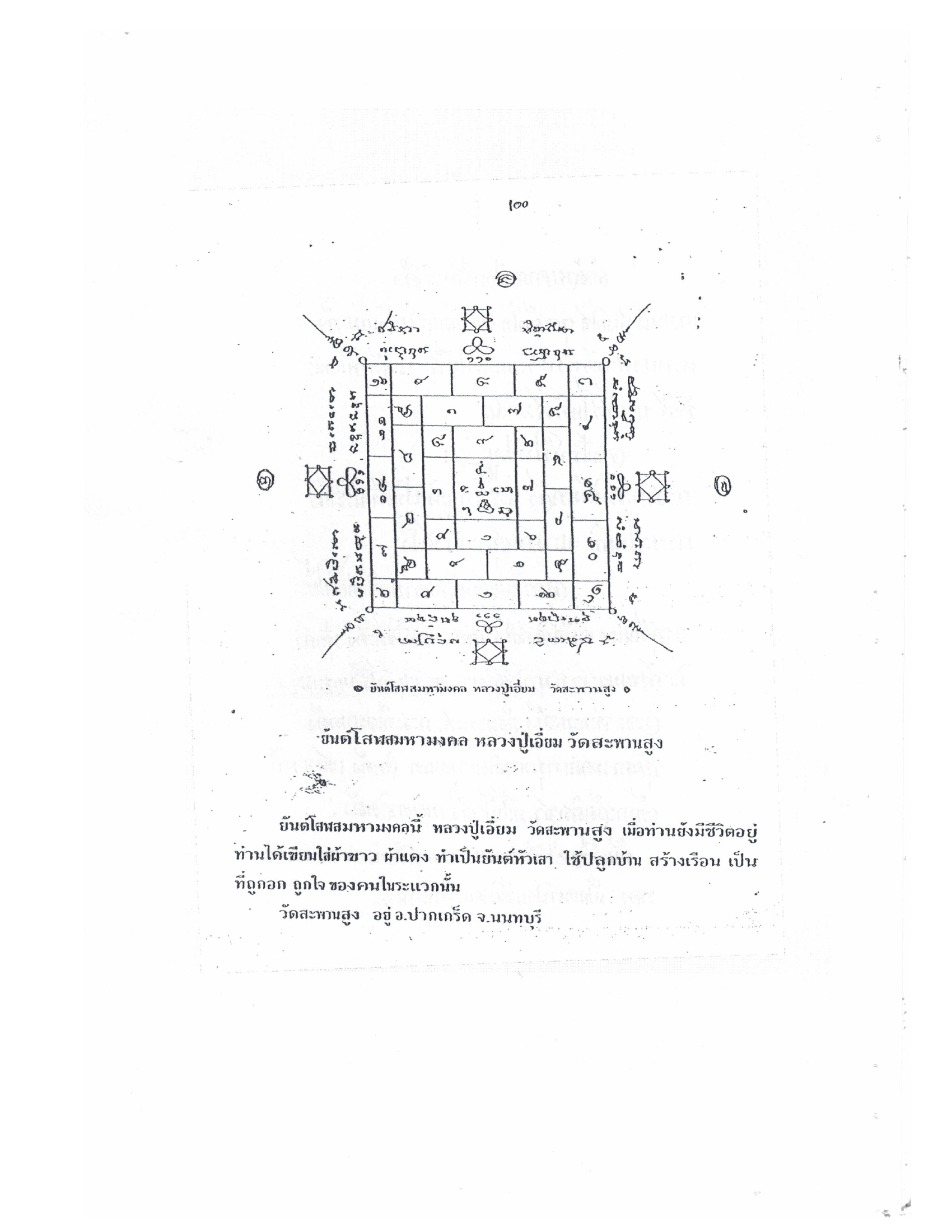
[อักขระประกอบยันต์รอบภาพ อ่านไม่ชัด]
๏ ยันต์โสฬสมหามงคล หลวงปู่เอี่ยม วัดสะพานสูง ๏
ยันต์โสฬสมหามงคล หลวงปู่เอี่ยม วัดสะพานสูง
ยันต์โสฬสมหามงคลนี้ หลวงปู่เอี่ยม วัดสะพานสูง เมื่อท่านยังมีชีวิตอยู่ ท่านได้เขียนใส่ผ้าขาว ผ้าแดง ทำเป็นยันต์หัวเสา ใช้ปลูกบ้าน สร้างเรือน เป็นที่ถูกอก ถูกใจ ของคนในระแวกนั้น
วัดสะพานสูง อยู่ อ.ปากเกร็ด จ.นนทบุรี
[yantra: a magic square of sixteen cells filled with Thai numerals, bordered by small hand-written akkhara labels along all four sides — not clearly legible — with diamond-lattice ornaments at the four corners and at the top and bottom centre]
Caption: 'Yantra of the Sixteen Great Auspiciousness (Solot Mahamongkol), Luang Pu Iam, Wat Saphan Sung'
Heading: Yantra of the Sixteen Great Auspiciousness, Luang Pu Iam, Wat Saphan Sung
While he was still alive, Luang Pu Iam of Wat Saphan Sung would write this Solot Mahamongkol yantra onto white cloth or red cloth, making it into a house-post yantra, used when building a house or raising a home — it was well liked and pleasing to the people of that neighbourhood.
Wat Saphan Sung is located in Pak Kret district, Nonthaburi province.
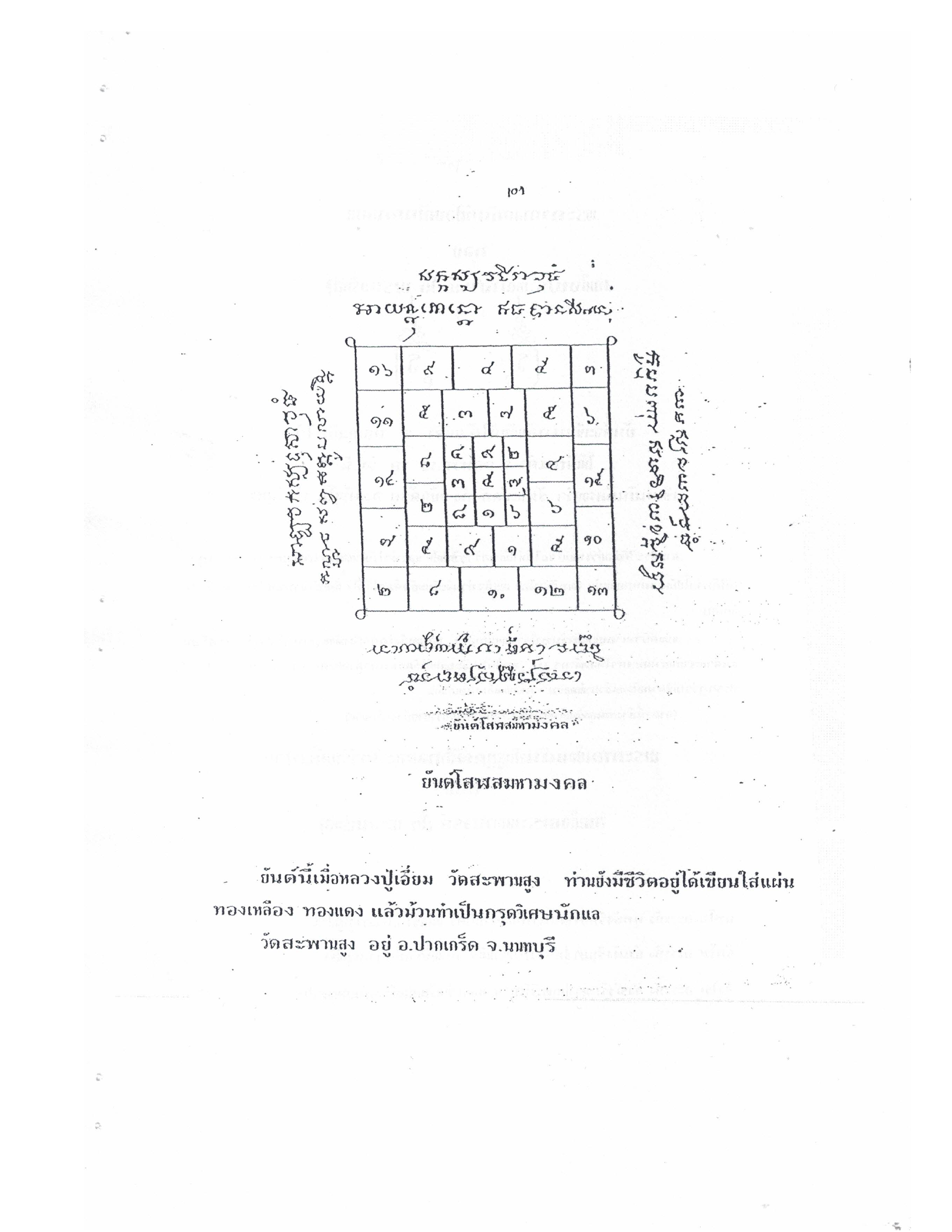
[อักขระหัวยันต์ อ่านไม่ชัด]
[อักขระประกอบยันต์ อ่านไม่ชัด]
[จารึกใต้ยันต์ อ่านไม่ชัด]
ยันต์โสฬสมหามงคล
ยันต์นี้เมื่อหลวงปู่เอี่ยม วัดสะพานสูง ท่านยังมีชีวิตอยู่ ได้เขียนใส่แผ่นทองเหลือง ทองแดง แล้วม้วนทำเป็นกรุดวิเศษนักแล
วัดสะพานสูง อยู่ อ.ปากเกร็ด จ.นนทบุรี
[Pali-style invocation heading above the yantra, in cursive script, not confidently legible]
[yantra: a magic square grid of Thai numerals with small hand-written akkhara labels down the left and right margins, not clearly legible]
[caption beneath the yantra, in cursive script, not confidently legible]
Heading: Yantra of the Sixteen Great Auspiciousness (Solot Mahamongkol)
While he was still alive, Luang Pu Iam of Wat Saphan Sung would write this yantra onto sheets of brass or copper, then roll them up to make an excellent protective amulet (krut).
Wat Saphan Sung is located in Pak Kret district, Nonthaburi province.
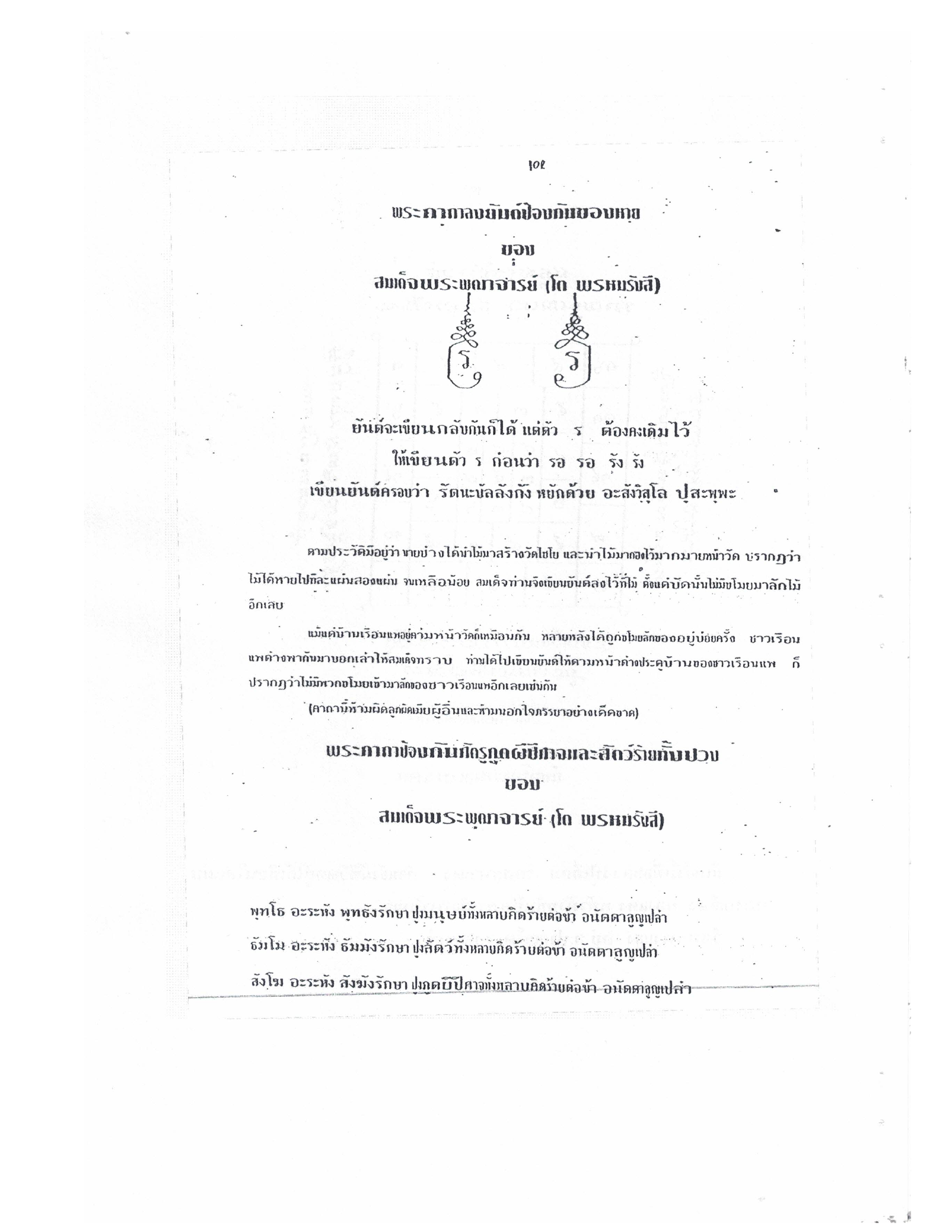
พระคาถาลงยันต์ป้องกันขโมย ของ สมเด็จพระพุฒาจารย์ (โต พรหมรังสี)
[ยันต์รูปป้ายห้อยเชือกผูกปม ๒ รูป แต่ละรูปมีอักษร ร กำกับ]
ยันต์จะเขียนกลับกันก็ได้ แต่ตัว ร ต้องคงเดิมไว้ ให้เขียนตัว ร ก่อนว่า รอ รอ รัง รัง เขียนยันต์ครบว่า รัตนะบัลลังกัง หยักด้วย อะสังวิสุโล ปุสะพุพะ
ตามประวัติมีอยู่ว่า ชายบ้างได้นำไม้มาสร้างวัดไชโย และนำไม้มากองไว้มากมายหน้าวัด ปรากฏว่าไม้ไม่ได้หายไปทีละแผ่นสองแผ่น จนเหลือน้อย สมเด็จท่านจึงเขียนยันต์ลงไว้ที่ไม้ ตั้งแต่บัดนั้นไม่มีโจรมาลักไม้อีกเลย
แม้แต่บ้านเรือนแพอยู่ใกล้ๆ วัดเหมือนกัน หลายหลังได้ถูกโจรลักของอยู่บ่อยครั้ง ชาวเรือนแพต่างพากันมาบอกเล่าให้สมเด็จทราบ ท่านได้ไปเขียนยันต์ให้ตามหน้าต่างประตูบ้านของชาวเรือนแพ ก็ปรากฏว่าไม่มีถูกขโมยเข้ามาลักของชาวเรือนแพอีกเลยเช่นกัน
(คาถานี้ห้ามผิดลูกผิดเมียผู้อื่น และห้ามนอกใจภรรยาอย่างเด็ดขาด)
พระคาถาป้องกัน[อ่านไม่ออก] ผีปีศาจและสัตว์ร้ายทั้งปวง ของ สมเด็จพระพุฒาจารย์ (โต พรหมรังสี)
พุทโธ อะระหัง พุทธังรักษา ปวงมนุษย์ทั้งหลายคิดร้ายต่อข้า อนัตตาสูญเปล่า ธัมโม อะระหัง ธัมมังรักษา ปวงสัตว์ทั้งหลายคิดร้ายต่อข้า อนัตตาสูญเปล่า สังโฆ อะระหัง สังฆังรักษา ปวงภูตผีปีศาจทั้งหลายคิดร้ายต่อข้า อนัตตาสูญเปล่า
The Incantation for Laying a Protective Yantra Against Thieves by Somdet Phra Buddhacarn (Toh Phrommarangsi)
[yantra: two small hanging tag-shaped charms, each suspended by a knotted cord, each inscribed with the letter ร (ro)]
The yantra may also be written in reverse, but the letter ร must always remain as it is. Write the letter ร first, reciting: ro ro rang rang. Write the complete yantra reciting: rattana ballangkang, followed by: a sang wi su lo pu sa phu pha.
According to the account, a man once brought timber to help build Wat Chaiyo, and piled up a great quantity of wood in front of the temple. It turned out that the wood kept disappearing, one or two planks at a time, until little was left. The Somdet therefore wrote the yantra onto the remaining timber, and from that time on no thief ever came to steal the wood again.
Even the houseboats moored near the temple suffered the same problem — many of them were repeatedly robbed. The houseboat dwellers all came to tell the Somdet of this. He went and wrote the yantra on the windows and doors of the houseboats, and it was found that thieves never again broke in to steal from the houseboat dwellers either.
(This incantation strictly forbids committing adultery with another's spouse or child, and strictly forbids being unfaithful to one's own wife.)
The Incantation for Protection Against [illegible], Ghosts, Evil Spirits, and All Dangerous Creatures by Somdet Phra Buddhacarn (Toh Phrommarangsi)
Buddho arahang, Buddhang raksa: may all humans who intend harm against me have that intent become empty and void (anatta, void of self). Dhammo arahang, Dhammang raksa: may all creatures who intend harm against me have that intent become empty and void. Sangho arahang, Sanghang raksa: may all spirits and ghosts who intend harm against me have that intent become empty and void.
วิชาแก้วมณีสามภพ ทำน้ำมนต์ดี
อิติปาระมิดตาดิงส่า อิติสัพพัญญูมาคะตา อิติโพธิ มนุสตัพโพ อิติปิโสจะเดนะโม กะระถี่ยะเมดดัง สัตตา เมตตา กรุณา มุดทิตา อุเบกขา จิตติ จิตตัง ชัยยะ นารี จักกะราชา นะโนโจรัง ไมดรีจิตตัง จุติ
จินดามุลิ บันโล จินมุนิโน สะตาสะติ จินดา วิถันตะมาโน จิดตะตะยัง วัททะปุโตติ มะนันทะ อะนัมโภ จกัมมะสัมภะวะสุนทรี สะระนัง วานี มัยหัง ปินระดะตัง มุนินทะวะทะนัง โกจะสัมภะ วะสุนทรี
The Craft of the Three-Realm Crystal Gem (Kaeo Mani Sam Phop), for Making Good Holy Water
[This is a chanted incantation, printed in Thai script as a phonetic, cipher-like rendering of Pali-style syllables rather than as ordinary grammatical prose; it does not translate word for word, and is reproduced below as printed, transliterated into Roman letters. Recognisable embedded terms include the four sublime abodes — metta (loving-kindness), karuna (compassion), mudita (sympathetic joy), and upekkha (equanimity) — set within a longer formula invoking omniscience (sabbannu), awakening (bodhi), and a righteous ruler or wheel (cakkaraja).]
Iti paaramitaa dingsaa, iti sabbannu maakataa, iti bodhi manusatappo, iti piso ja dena mo, karathiiya medtang, satta, metta, karuna, mudtitaa, upekkhaa, jitti jittang, chaiya naaree jakkaraachaa, na no jorang mai dree jittang juti.
Jindaamuli banlo jinmunino sataasati jindaa vithantamaano jidtatayang vatthaputoti manantha anampho jakammasambhavasundaree saranang vaanee maihang pinaradatang muninthavathanang kojasambha vasundaree.
วิชาใช้ไข่เช็ดไฝ ปาน ขี้แมลงวันที่ไม่ดี
ใช้ไข่เช็ดที่หลังหรือบริเวณที่มีตำหนิไม่ดี คาถาให้ท่องไปตลอดเวลาที่เกลี่ย ให้เกลี่ยทั่วบริเวณที่มีตำหนิ ถ้ามีความรู้สึกว่าไข่หนัก แสดงว่าใช้ได้ ให้เอาไข่เหวี่ยงบนดิน ถ้าไข่แตกถือว่าสำเร็จ จากนั้นให้เหวี่ยงไข่จนกว่าจะแตกภายใน 7-15 วัน ตำหนินั้นจะหายไปเอง
ของขึ้นครู ระลึกถึงหลวงปู่เส็ง วัดศรีประจันตคาม
ดอกไม้ขาว 5 ดอก
เทียนขาว 5 เล่ม
ธูป 5 ดอก
ค่าครู 399 บาท
คาถาเช็ดไข่
พุทธัง สรณัง คัจฉามิ ธัมมัง สรณัง คัจฉามิ สังฆัง สรณัง คัจฉามิ
The Craft of Using an Egg to Rub Away Moles, Birthmarks, and Bad Fly-Spots
Use an egg to rub over the back, or over the area marked by an unwanted blemish. Recite the incantation continuously the whole time you are rubbing, moving it evenly over the whole marked area. If the egg begins to feel heavy, that shows it is working. Then throw the egg down onto the ground — if it breaks, the working has succeeded. Keep throwing the egg down until it breaks, within 7 to 15 days; the blemish will then disappear by itself.
Offerings for the teacher, in remembrance of Luang Pu Seng of Wat Sri Prachantakam:
5 white flowers
5 white candles
5 sticks of incense
Teacher's fee: 399 baht
Incantation for rubbing the egg:
I take refuge in the Buddha. I take refuge in the Dhamma. I take refuge in the Sangha.
วิชาดูของหาย คนหาย คนป่วย ของอาจารย์เปล่ง บุญยืน
ทำขันธ์ห้า ขึ้นวันอังคารวันเดียว
เขียนตัว มะ อะ อุ ลงบนกระดาษ ให้คนที่เดือดร้อนที่มาหาเรา เสี่ยงทายหยิบมาหนึ่งใบ แล้วอธิษฐานจิตเอา
ถ้าตก มะ เท่ากับ ตาย หายไม่ได้คืน
ถ้าตก อะ เท่ากับ หายโดยเร็ว ได้โดยเร็ว
ถ้าตก อุ เท่ากับ ไม่ตาย หายได้ช้า
The Craft of Divining Lost Objects, Missing Persons, and the Sick, from Ajarn Pleng Bunyuen
Prepare a five-item offering (khan ha), done on a single Tuesday.
Write the syllables ma, a, u onto paper. Let the troubled person who has come to consult us draw one slip at random by chance, having first fixed their mind and made their wish.
If 'ma' is drawn: equivalent to death — lost and never to be recovered.
If 'a' is drawn: equivalent to recovering quickly — it will be found quickly.
If 'u' is drawn: equivalent to not dying — lost, but will be recovered slowly.
วิชาดูดวง ดูเคราะห์ ดูคู่ครองของอาจารย์เปล่ง บุญยืน
[แผนภาพจุดทำนาย ๔ ชุด กำกับหัวข้อ ข้างขึ้นผู้ชาย, ข้างแรมผู้ชาย, ข้างขึ้นผู้หญิง, ข้างแรมผู้หญิง แต่ละชุดมีจุดเชื่อมกัน ๓ จุด กำกับคำว่า เสือ, ตา, ปาก, นขา, แหลว และหมายเลข ๑–๓] นับเสือเป็นข้างขึ้น นับหมาเป็นข้างแรม
ถ้าตกเสือ ถ้าเป็นโสดจะมีคู่ ถ้ามีคู่แล้ว จะได้โชค
ถ้าตกหมา ไม่ดีต้องแก้เคราะห์
ถ้าตกแหลว ดีที่สุด
ถ้าตกหมาให้แก้เคราะห์ดังนี้
ทำขันธ์ห้า เงิน 6 บาท ปลาไหล 1 คู่ ใส่ของหอมลงบนตัวปลา แป้งน้ำอบ กล้วย 1 หวี กี่ลูกก็ได้ ห้ามให้ใครบิดทิ้งเด็ดขาดจะซวย ข้าวสาร 6 ถ้วยเล็ก นิมนต์พระสามรูปสวดยถา-ให้พร ปล่อยปลาลงน้ำ เอากล้วย 1 ลูกปล่อยลงน้ำ เอาข้าวสาร 1 ถ้วยโปรยลงน้ำ กล้วยทิ้งน้ำพูดว่า ถ้ากล้วยลูกนี้งอกได้ให้คนนี้มีอันเป็นไป ถ้างอกไม่ได้ให้มีโชคลาภร่ำรวยเงินทองตลอดไป ข้าวสารพูดเหมือนกัน ข้าวที่เหลือหุงถวายพระพร้อมกล้วย ทำที่ท่าน้ำด้วยตัวเอง หยาดน้ำด้วย
The Craft of Reading One's Fortune, Reading Misfortune, and Reading a Life-Partner's Match, from Ajarn Pleng Bunyuen
[diagram: four small fortune-telling charts labelled 'waxing-moon side, male', 'waning-moon side, male', 'waxing-moon side, female', and 'waning-moon side, female'; each chart connects three points labelled tiger (เสือ), eye (ตา), mouth (ปาก), claw (นขา), and falcon (แหลว), numbered 1 to 3]
Count the tiger as the waxing side. Count the dog as the waning side.
If it falls on the tiger: if the person is single they will find a partner; if they already have a partner, they will have good fortune.
If it falls on the dog: not good, misfortune must be remedied.
If it falls on the falcon: best of all.
If it falls on the dog, remedy the misfortune as follows:
Prepare a five-item offering: 6 baht in coins, a pair of eels with something fragrant placed on their bodies, scented powder, one hand of bananas (any number of fingers is fine — absolutely do not let anyone twist any off beforehand, or it brings bad luck), and 6 small cups of rice. Invite three monks to chant the Yathā blessing. Release the eels into the water. Take one banana and release it into the water; take one cup of rice and scatter it into the water. As you drop the banana into the water, say: 'If this banana can sprout, let it happen to this person instead; if it cannot sprout, let there be good fortune and lasting wealth for them.' Say the same over the rice. Cook the remaining rice as an offering to the monks, together with the bananas. Carry this out yourself at the waterside, and pour the libation of water as well.
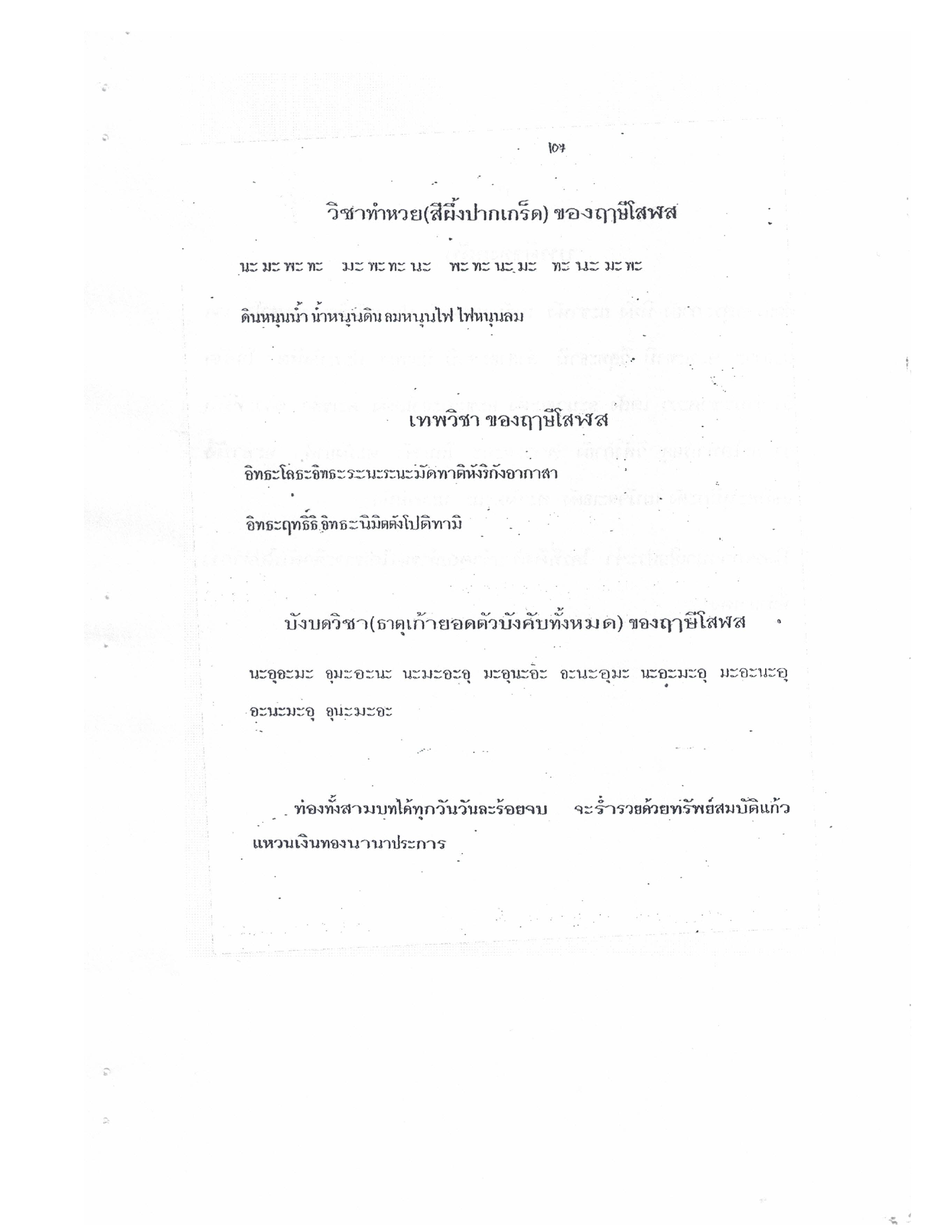
วิชาทำหวย (สีผึ้งปากเกร็ด) ของฤาษีโสฬส
นะมะพะทะ มะพะทะนะ พะทะนะมะ ทะนะมะพะ
ดินหนุนน้ำ น้ำหนุนดิน ลมหนุนไฟ ไฟหนุนลม
เทพวิชา ของฤาษีโสฬส
อิทธะโคธะอิทธะระนะระนะมัดทาติหังริกังอากาสา
อิทธะฤทธิ์อิทธะนิมิตังโปติทามิ
บังบดวิชา (ธาตุเก้ายอดตัวบังคับทั้งหมด) ของฤาษีโสฬส
นะอุอะมะ อุมะอะนะ นะมะอะอุ มะอุนะอะ อะนะอุมะ นะอะมะอุ มะอะนะอุ อะนะมะอุ อุนะมะอะ
ท่องทั้งสามบทได้ทุกวันวันละร้อยจบ จะร่ำรวยด้วยทรัพย์สมบัติแก้วแหวนเงินทองนานาประการ
The Craft of Making Lottery Numbers (the Beeswax Charm of Pak Kret), from Ruesi Solot
na ma pha tha, ma pha tha na, pha tha na ma, tha na ma pha.
Earth supports water, water supports earth; wind supports fire, fire supports wind.
The Divine Craft of Ruesi Solot
ittha-kotha ittha-rana rana matthaa tihang rikang aakaasaa.
ittha-ridhi ittha-nimitang photi thaami.
The Craft of Concealment (Binding All Nine Elements), from Ruesi Solot
na u a ma, u ma a na, na ma a u, ma u na a, a na u ma, na a ma u, ma a na u, a na ma u, u na ma a.
Recite all three formulas every day, one hundred times each, and one will grow wealthy with treasure, jewels, rings, gold and silver, and every kind of fortune.
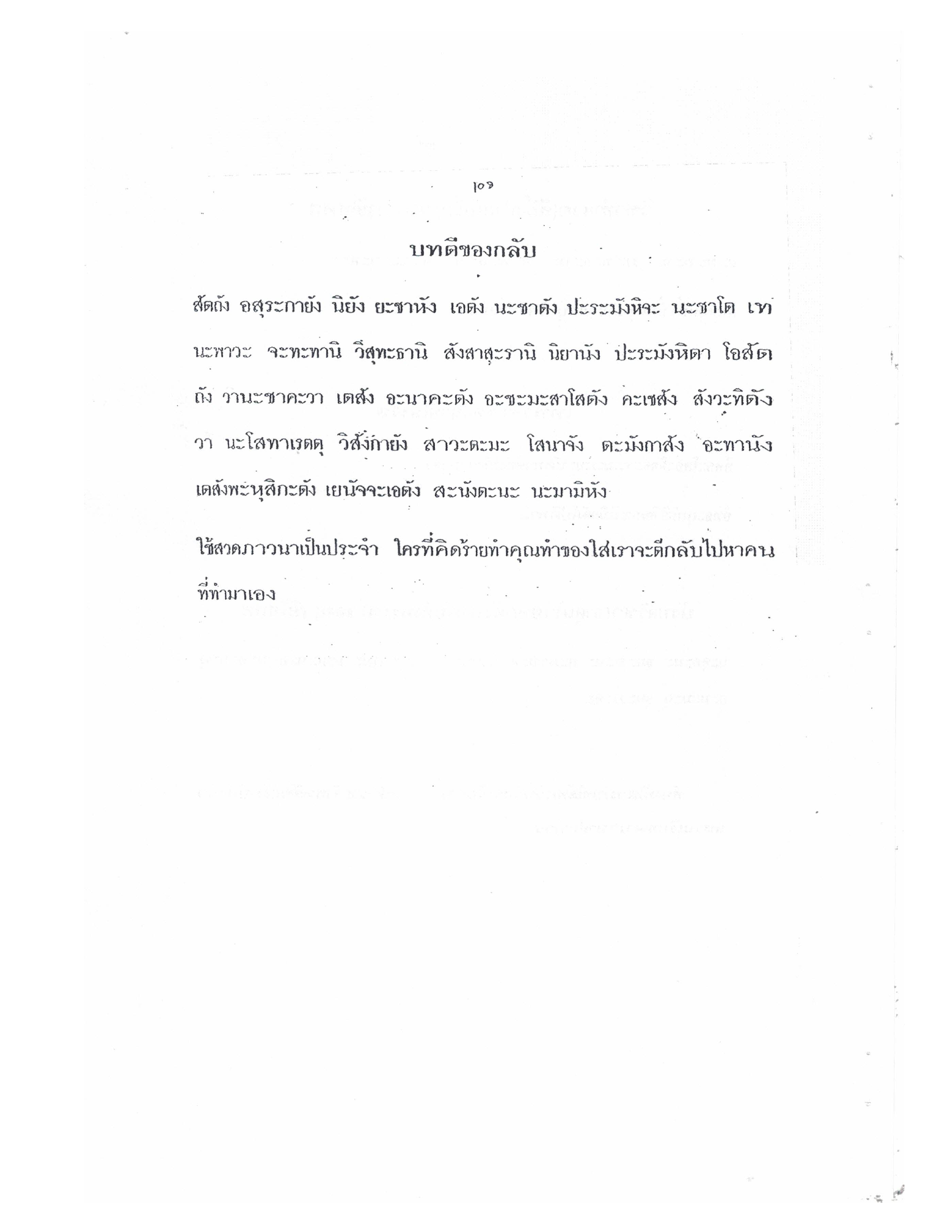
บทตีของกลับ
สัดถึง อสุระกายัง นิยัง ยะชาหัง เอตัง นะชาตัง ปะระมังหิจะ นะชาโต เทนะพาวะ จะทะทานิ วิสุทธานิ สังสาสุรานิ นิยานัง ปะระมังหิดา โอสัดถึง วานะชาคะวา เตสัง อะนาคะตัง อะชะมะสาโสตัง คะเชสัง สังวะทิดังวา นะโสทาเรดตุ วิสังกายัง สาวะดะมะ โสนาจัง ตะมังกาสัง อะทานังเตสังพะหุสิกะตัง เยนัจจะเอตัง สะนังตะนะ นะมามิหัง
ใช้สวดภาวนาเป็นประจำ ใครที่คิดร้ายทำคุณทำของใส่เราจะตีกลับไปหาคนที่ทำมาเอง
The Return-Strike Verse
[Chanted formula, transliterated:] Satthueng asurakaayang niyang yachahang etang nachatang paramangvicha nachato thenaphaawa chathathaani wisuthaani sangsaasuraani niyaanang paramangvitda osatthueng waanachaakhawa tesang anaakatang achamasaasotang khachesang sangwathidangwaa nasothaaretu wisangkaayang saawadama sonaachang tamangkaasang athaanang tesangphahusikatang yenatjaetang sanangtana namaamihang.
Recite this in meditation regularly. Whoever thinks ill of us and casts a curse or plants a cursed object against us — it will strike back onto the very person who made it themselves.
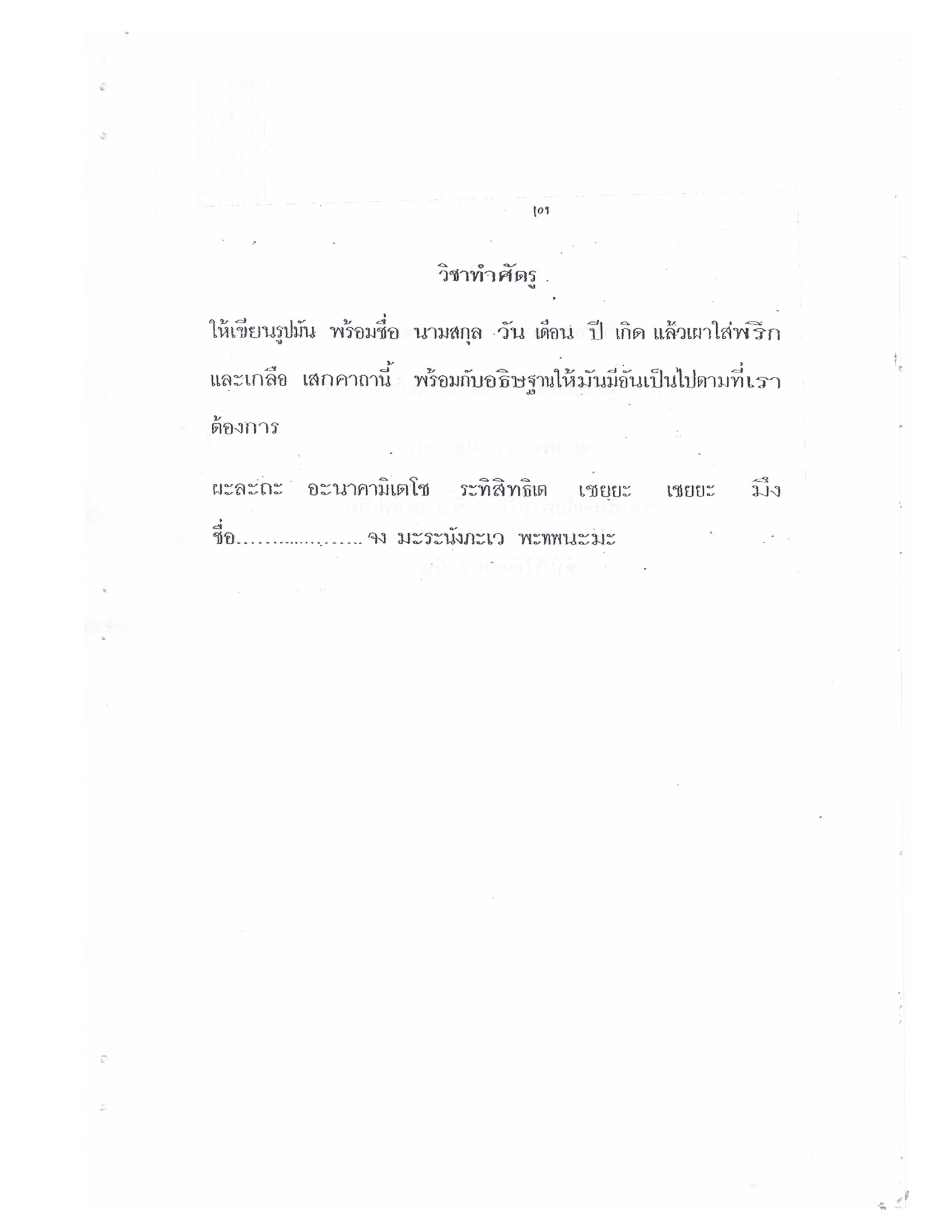
วิชาทำศัตรู
ให้เขียนรูปมัน พร้อมชื่อ นามสกุล วัน เดือน ปี เกิด แล้วเผาใส่พริกและเกลือ เสกคาถานี้ พร้อมกับอธิษฐานให้มันมีอันเป็นไปตามที่เราต้องการ
ผละถะ อะนาคามิเตโช ระทิสิทธิเต เชยยะ เชยยะ มึงชื่อ.................. จง มะระนังภะเว พะทพนะมะ
The Craft of Cursing an Enemy
Draw a picture of the person [targeted], together with their given name, surname, and date, month, and year of birth. Then burn it together with chili peppers and salt. Chant this spell over it, together with a vow that it come to pass as we desire.
[Chanted formula, transliterated:] Phalatha anaakhaamitecho rathisitthite cheiyya cheiyya — you, named .................., may death come upon you. Phatphanamа.
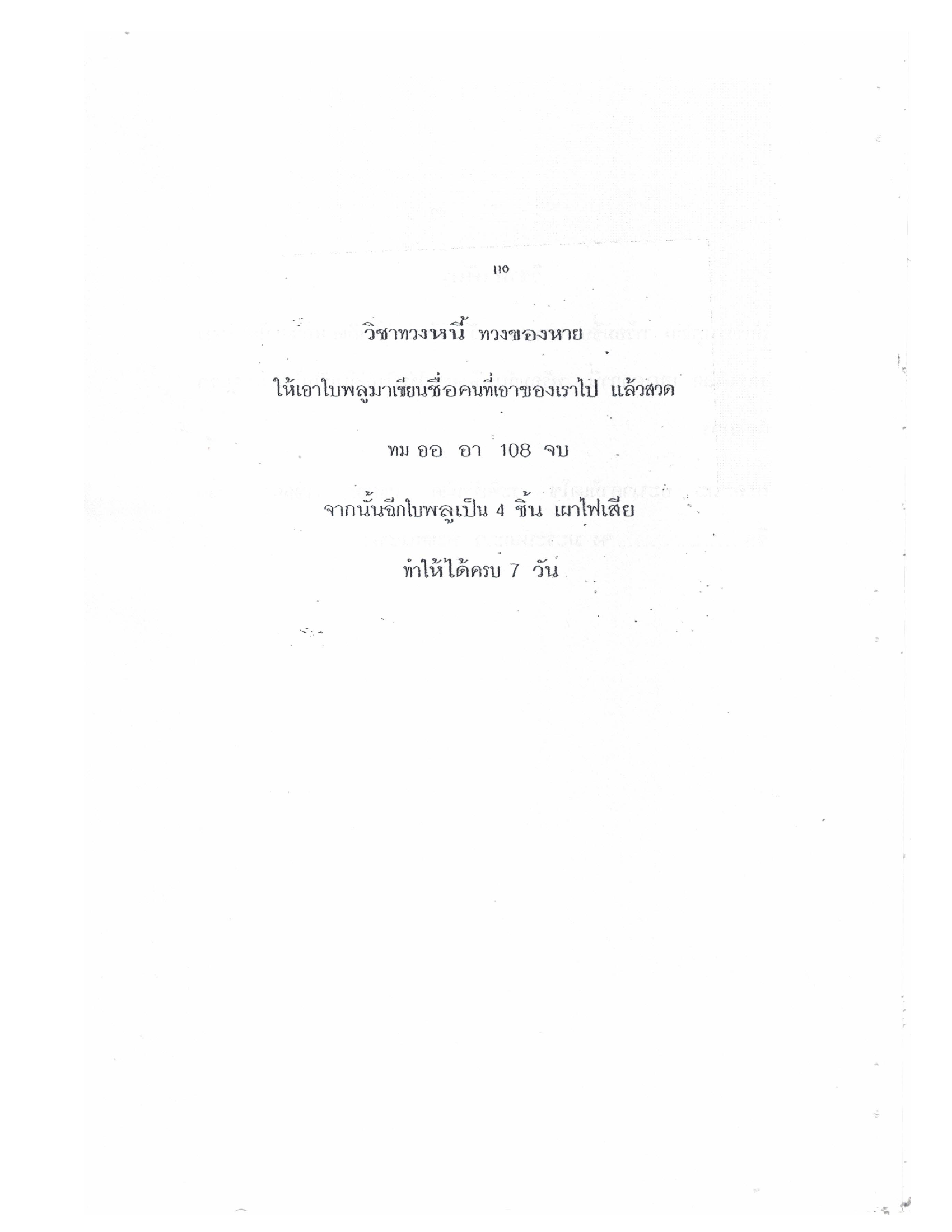
วิชาทวงหนี้ ทวงของหาย
ให้เอาใบพลูมาเขียนชื่อคนที่เอาของเราไป แล้วสวด
ทม กอ อา 108 จบ
จากนั้นฉีกใบพลูเป็น 4 ชิ้น เผาไฟเสีย
ทำให้ได้ครบ 7 วัน
The Craft of Demanding Back a Debt, Recovering a Lost Item
Take a betel leaf and write on it the name of the person who took our thing, then chant
[the syllables] "Thom Ko A" 108 times.
Then tear the betel leaf into 4 pieces and burn it in a fire.
Do this for a full 7 days.
วิชาผูกโบสถ์
ยะถาอุโบสะถัง โสยะนัง นะสัพพะติ ธัมมังจักกัง โอสะถัง กะระนะยันตัง สันตัง ภะคะวันติ กะถายะ เรนะภาโว สัพพะวันตัง พันธะนัง เสมายัง ทินนะติ พินทิตตะวา มันทะสะตัง จะพินทะระนัยยัน ติกะเสมัง สมุหะพันธะตะดัง
นัยยะ สมุหะพุทธะ ตัดนังถาคาดัง ปะเจมิหะ ธัมมะเตภาคะดัง ปะละมินะสังมัง ยะถาคะดัง ปะเจมิ
ใช้ผูกวิชาคาถาอาคมทุกชนิดที่เราทำไม่ให้หลุด ไม่ให้แก้ ไม่ให้เสื่อม
The Craft of Binding the Uposatha [Hall]
[Chanted formula, transliterated:] Yathaa uposatthang soyanang nasapphati thammangchakkang osathang karanayantang santang phakhawanti kathaaya renaphaawo sapphawantang phanthanang semaayang thinnati phinthittawaa manthasatang chaphinatharanaiyan tikasemang samuhaphanthatadang. Naiya samuhaphuttha tatnangthaakhaadang pachemiha thammatephaakhadang palaminasangmang yathaakhadang pachemi.
Used to bind every kind of spell, mantra, and sacred formula (wicha katha akhom) that we have cast, so that it cannot come loose, cannot be undone, and cannot fade or weaken.
คาถาเมฆกระซิบ
สุสัง อะระหัง สุคะโต โลกะวิทู อะระหัง พุทธะสังมิ
สุสัง อะระหัง สุคะโต โลกะวิทู อะระหัง พุทธะสังมิ
The Whispering-Cloud Mantra
[Chanted formula, transliterated, built from epithets of the Buddha — Arahaṃ (the Worthy One), Sugato (the Well-Gone/Blessed One), Lokavidū (Knower of the World), Buddhaṃ:] Susang arahang sukhato lokawithu arahang phutthasangmi.
[Repeated a second time:] Susang arahang sukhato lokawithu arahang phutthasangmi.
วิชาเต่าเรือนแก้อาถรรพ์
๑.ให้ใช้เตาก่อไฟ
๒.เอาขี้ผึ้งมาปั้นเป็นรูปเต่า แล้วเขียนยันต์ใส่ตรงกลางอกเต่า ทำตอนเช้าก็เขียนยันต์ตอนเช้าใส่ ทำตอนเย็นก็เขียนยันต์ตอนเย็นใส่
๓.เวลาปั้นเต่าห้ามให้ผู้หญิงแตะถูกตัวเต่า
๔.เสกด้วยคาถาไฟม้างกลับ
อัคคินะ อะภาสะรา เหรนะ ภูเต นะกิง หะเถ นะวามิ เอติเอเต เอโตเอวัง รูโป วินาสันตุ สัวหาย (เจ็ดจบ)
๕.เสกด้วยคาถาเมตตาผี
อะทิตะสัง เมตตายะมะโน อะนุธัมมะรักขัง สะเมติโน (เจ็ดจบ)
๖.เอาเต่าใส่เตาไฟ แล้วเอาน้ำพรมที่ตัวเต่าไปเรื่อยๆ ให้ควันฟุ้งกระจายให้ทั่วในบริเวณที่ทำพิธีทั้งหมด
๗.ให้ปิดประตูหน้าต่างในบ้านเรือนทั้งหมด
The Craft of the House-Tortoise for Undoing Curses
1. Have a stove ready and light a fire.
2. Take beeswax and mold it into the shape of a tortoise, then write a yantra in the middle of the tortoise's chest. If [the tortoise] is made in the morning, write the morning yantra on it; if made in the evening, write the evening yantra on it.
3. While molding the tortoise, do not let any woman touch the tortoise's body.
4. Consecrate it with the "Fire That Turns Destruction Back" spell.
[Chanted formula, transliterated:] Akkhina aphaasara herana phuute nakhing hathe nawaami etiete etoewang ruupo winaasantu suwaahaay. (Chant seven times.)
5. Consecrate it with the "Loving-Kindness Toward Spirits" spell.
[Chanted formula, transliterated:] Athitasang mettaayamano anuthammarakkhang samethino. (Chant seven times.)
6. Put the tortoise into the stove-fire, then continually sprinkle water onto the tortoise's body, so that the smoke billows out and spreads throughout the entire area where the rite is being performed.
7. Close all the doors and windows throughout the house.
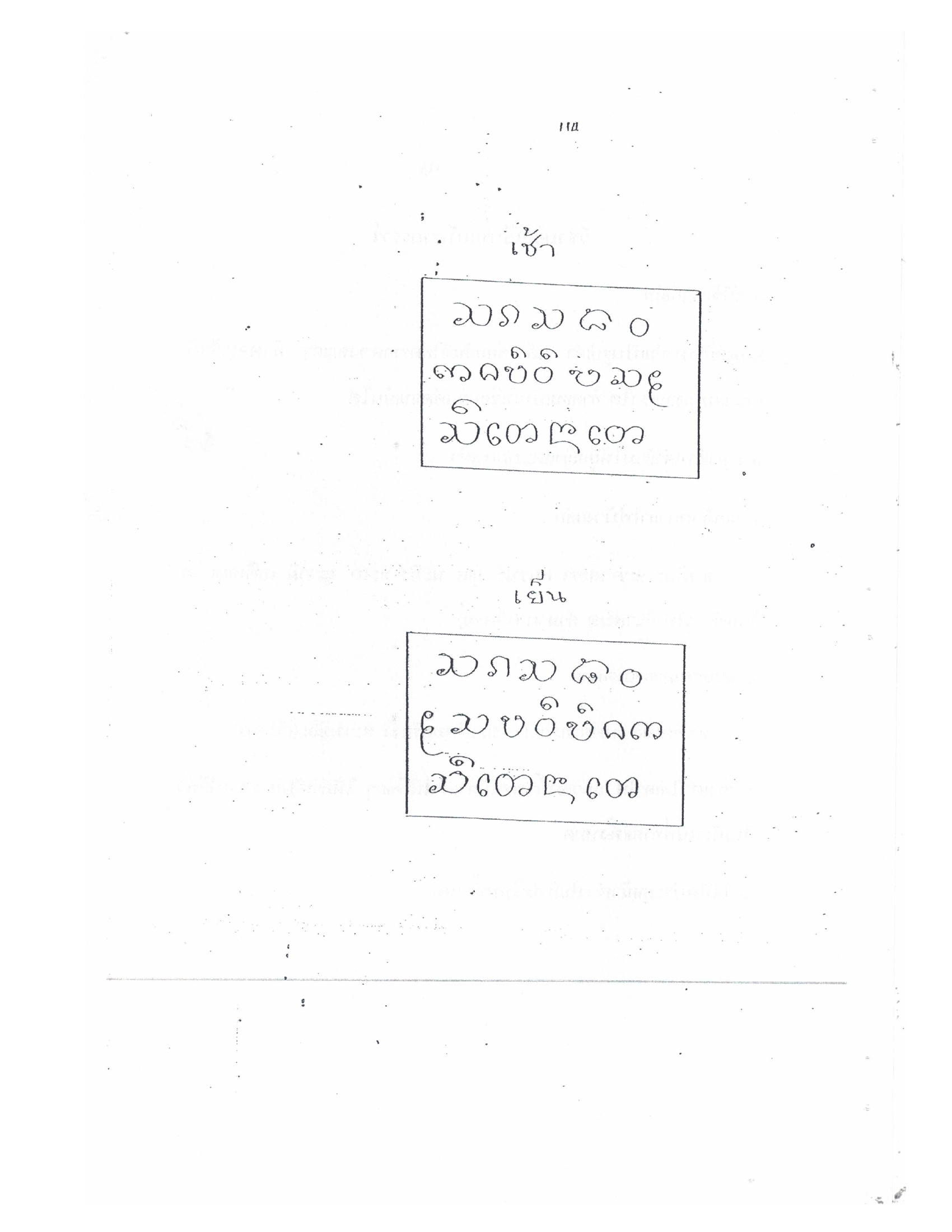
เช้า
[อักษรธรรมล้านนา อ่านไม่ชัด]
เย็น
[อักษรธรรมล้านนา อ่านไม่ชัด]
[Caption: "เช้า" ("Morning")] [yantra: a rectangular box containing several lines of rounded Lanna Tham/Khom-style script; characters not confidently legible]
[Caption: "เย็น" ("Evening")] [yantra: a rectangular box below it, similar in form to the "Morning" box but with different characters inside; not confidently legible]
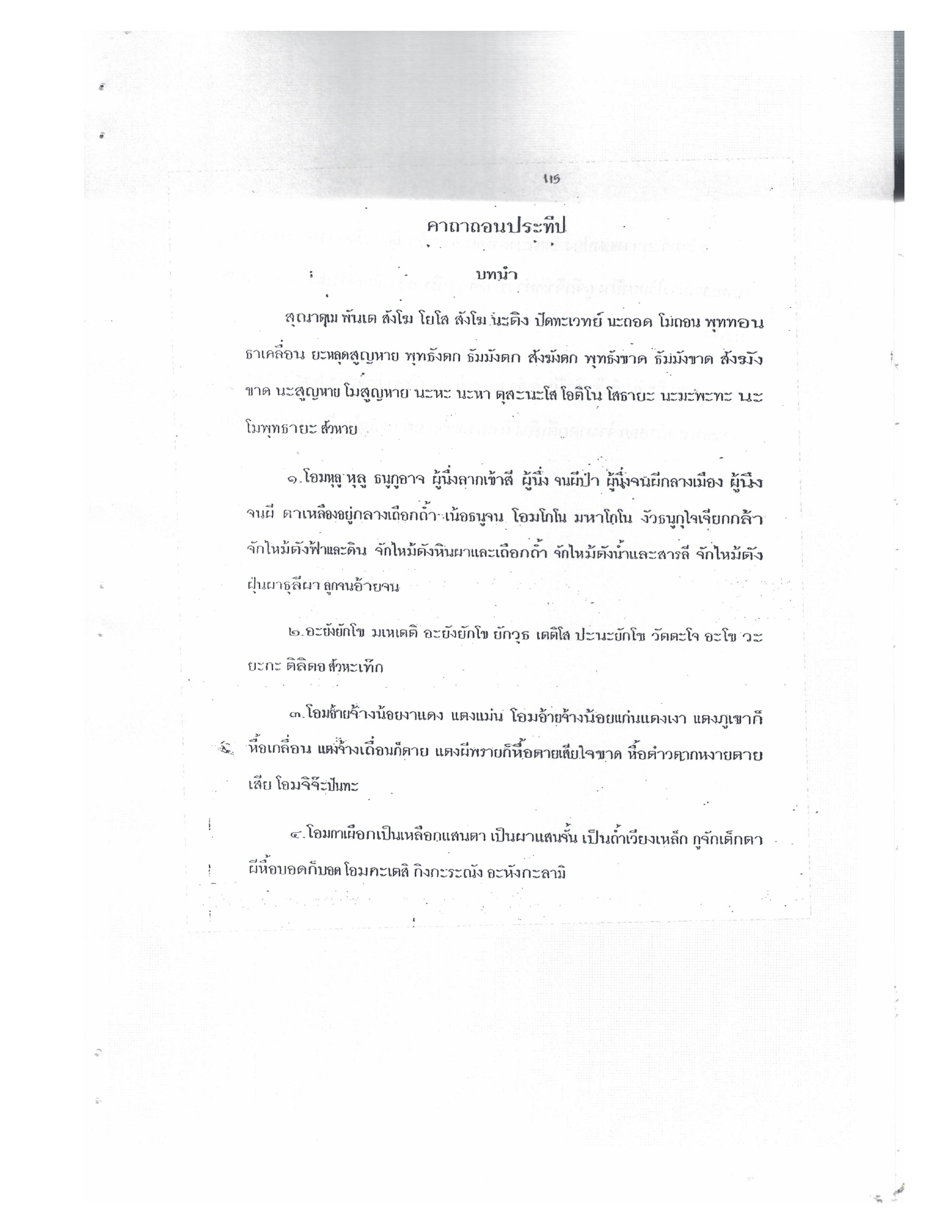
คาถาถอนประทีป
บทนำ
สุณาตุม พันเต สังโฆ โยโส สังโฆ นะติง ปัดทะเวทย์ นะถอด โมถอน พุทธอน ธาเคลื่อน ยะหลุดสูญหาย พุทธังดก ธัมมังดก สังฆังดก พุทธังขาด ธัมมังขาด สังฆังขาด นะสูญหาย โมสูญหาย นะหะ นะหา ตุละนะโส โอติโน โสธายะ นะมะพะทะ นะโมพุทธายะ สัวหาย
๑.โอมหุลุ หลุ ธนูอาจ ผู้นึ่งลากเข้าสี ผู้นึ่งจนผีป่า ผู้นึ่งจนผีกลางเมือง ผู้นึ่งจนผี ตาเหลืองอยู่กลางเถือกถ้ำ เนื้อธนูจน โอมโกโน มหาโกโน งัวธนูใจเจี๊ยกกล้า จักให้หมั่งฟ้าและดิน จักให้หมั่งหินผาและเถือกถ้ำ จักให้หมั่งน้ำและสารลี จักให้หมั่งฝุ่นผาธุลีผา ลูกจนอ้ายจน
๒.อะยังยักโข มเหเตติ อะยังยักโข ยักวุธ เตติโส ปะนะยักโข วัดตะโจ อะโข วะยะกะ ติลิตอ สัวหะเท็ก
๓.โอมอ้ายจ้างน้อยงาแดง แดงแม่น โอมอ้ายจ้างน้อยแก่นแดงเงา แดงภูเขาก็หื้อเกลื่อน แดงจ้างเถื่อนก็ตาย แดงผีพรายก็หื้อตายเสียใจขาด หื้อตำวุกหงายตายเสีย โอมจิจิฉะปิ่นทะ
๔.โอมทาเผือกเป็นเหลือกแสนตา เป็นผาแสนจั้น เป็นถ้ำเวียงเหล็ก กูจักเด็กตา ผีหื้อบอดก็บอด โอมคะเตสิ กิงกะระณัง อะหังกะลามิ
The Lamp-Withdrawing Mantra
Introduction
[Chanted formula, transliterated, opening with the Pali "Suṇātu me bhante saṅgho" — "Let the Sangha, Venerable Sir, hear me":] Sunaatum phante sangkho yoso sangkho, nating patthawet, nathot mothon phutthaon thaakhleuan yalutsuunhaay — Buddha abundant, Dhamma abundant, Sangha abundant; Buddha cut off, Dhamma cut off, Sangha cut off; na vanish, mo vanish; naha naha tulanaso otino sothaaya namaphatha; namo Buddhaaya. Svaahaay.
1. Om hulu hulu, mighty bow! One is dragged into [its] hue; one becomes a forest ghost, one becomes a ghost in the middle of the town, one becomes a yellow-eyed ghost dwelling within the mountain cave; the bow's flesh [becomes] it. Om Kono, Maha Kono — the bow-ox's heart is fiercely bold. It shall fill the sky and earth with abundance, fill the stone cliffs and mountain caves with abundance, fill the water and [sarali] with abundance, fill the cliff-dust and cliff-motes with abundance — for child and elder alike.
2. This is a yaksha, greatly so; this is a yaksha armed with a weapon, threefold; then a yaksha of shivering, trembling form. Svaaha thoek.
3. Om, elder little elephant of red tusks, truly red; Om, elder little elephant of red heartwood, glowing red — let the red mountain be scattered. The wild red elephant dies; the red phrai-ghost is made to die of a broken heart; may [it] be made to keel over and die. Om ji-ji-cha pinta.
4. Om, turn [it] pale and make its hundred-thousand eyes roll back; become a cliff of a hundred-thousand tiers, become an iron-walled cave. I shall darken [its] eyes; let the ghost that blinds be blinded itself. Om khatesi, kingkarana, ahangkalami.
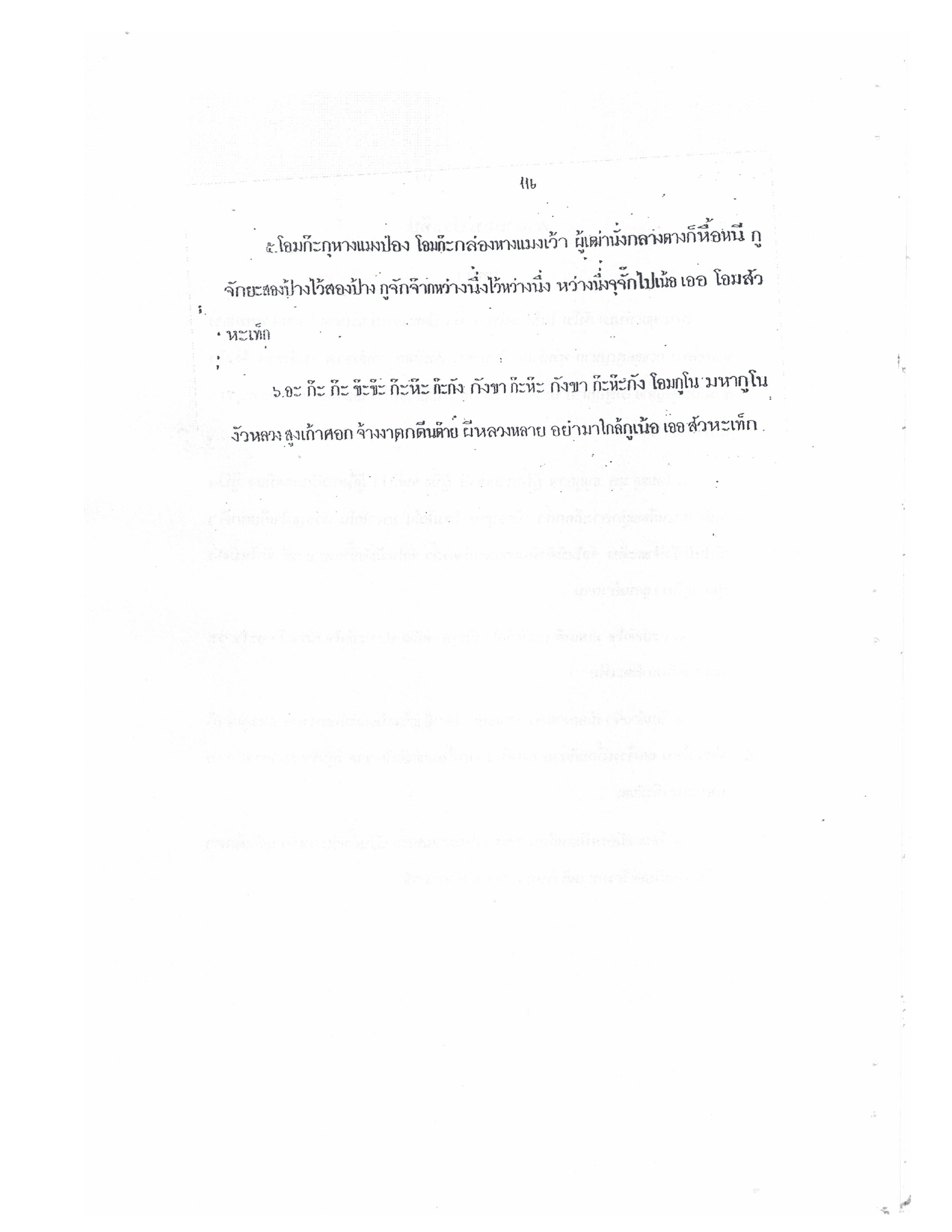
๕.โอมกะกุหางแมงป่อง โอมกะกล่องหางแมงเงี้ยว ผู้เฒ่านั่งกลางดงก็หื้อหนี กูจักยะสองป้างไว้สองป้าง กูจักจากหว่างนี่งไว้หว่างนี่ง หว่างนี่งจุ๊กไปเน้อ เออ โอมสัวหะเท็ก
๖.อะ กะ กะ ชะขะ กะหะ กะกัง กังขา กะหะ กังขา กะหะกัง โอมกุโน มหากุโน งัวหลวง สูงเก้าศอก จ้างงาดกดื่นด้าย ผีหลวงหลาย อย่ามาใกล้กูเน้อ เออ สัวหะเท็ก
5. Om, hook of the scorpion's tail; Om, box of the centipede's tail — let the old one sitting in the middle of the jungle flee! I shall set two sides apart, leaving two sides; I shall part [it] from between, leaving [it] between; from between, slip away now, will you! Yes — Om svaaha thoek.
6. A ka ka cha kha ka ha ka kang, kang kha ka ha kang kha ka ha kang — Om Kuno, Maha Kuno. The great ox, nine cubits tall; the tusked elephant roaring loud; the many great ghosts — do not come near me, will you! Yes — svaaha thoek.
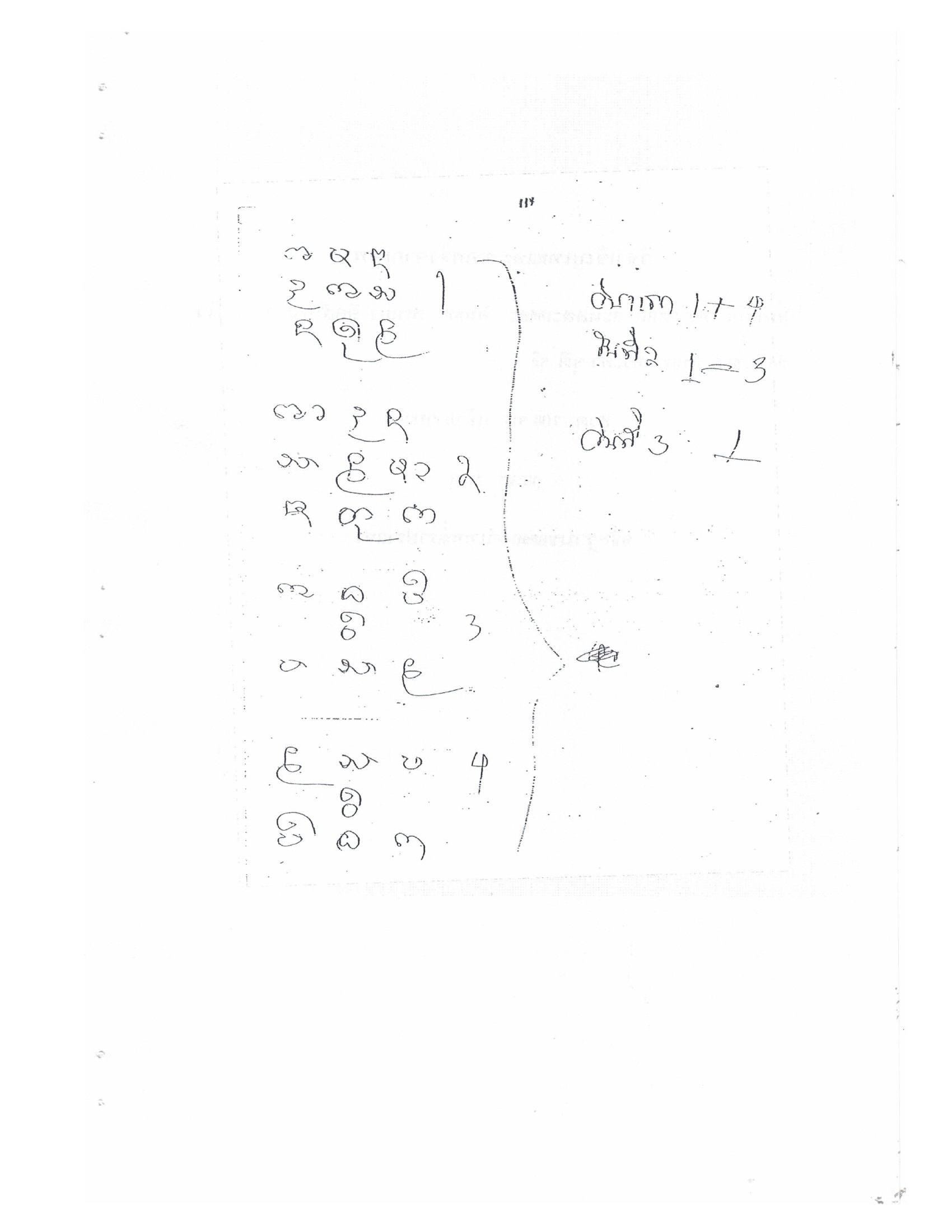
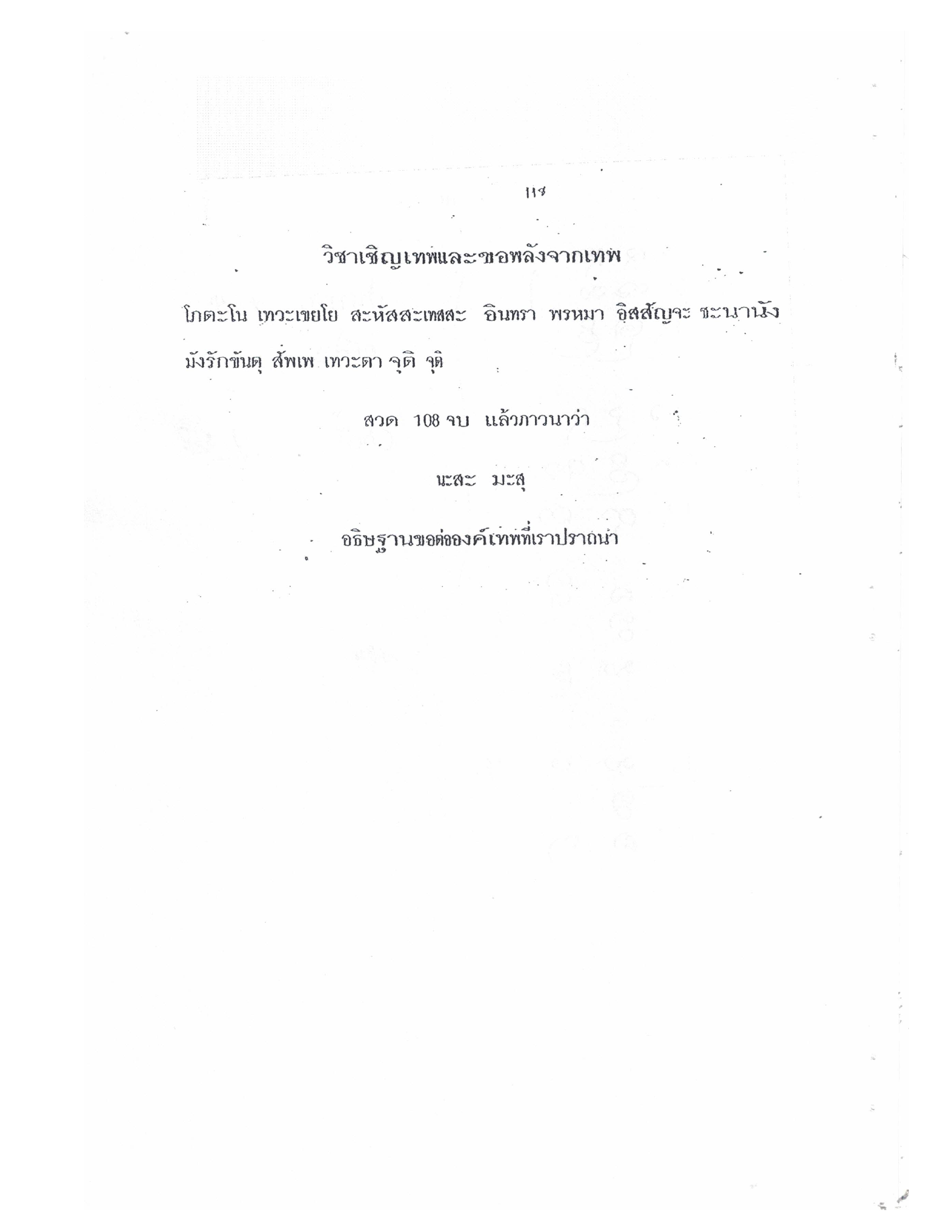
วิชาเชิญเทพและขอพลังจากเทพ
โภตะโน เทวะเขยโย สะหัสสะเทสสะ อินทรา พรหมา อิสสัญจะ ชะนานังมังรักขันตุ สัพเพ เทวะตา จุติ จุติ
สวด 108 จบ แล้วภาวนาว่า
นะสะ มะสุ
อธิษฐานขอต่อองค์เทพที่เราปรารถนา
The Craft of Inviting the Deities and Requesting Their Power
[Chanted formula, transliterated:] Photano thewakheiyayo sahatsathetsa Inthra Phrohmaa itsanja chanaanangmang rakkhantu — Indra, Brahma, and all the divine ones, may you protect [us]. All the deities: descend, descend.
Recite 108 times, then chant:
Nasa masu
Make your vow to the particular deity you desire [to invoke].
วิชาทำผงลบของ
นะ มะ สะ พัง
ให้เขียนคาถานี้แล้วลบเป็นผง ใส่ในอาหารของกินต่างๆ น้ำมนต์ให้ผู้ที่โดนคุณโดนของกิน
The craft of making a powder to dispel a cursed object
Na Ma Sa Phang
Write this spell [on a slate or similar surface], then erase/rub it off into a powder. Put it into various foods, or into holy water, for a person who has been cursed (โดนคุณ) or has unknowingly eaten a cursed object mixed into food (โดนของ).
ยันต์ให้ผัว-เมีย และให้สามีเลิกกับเมียน้อย
(ในกรณีที่เมียน้อยให้ทุกข์แก่เมียหลวง)
วิธีทำ
1.ให้เขียนยันต์ลงในผ้าขาว 2 แผ่น ยันต์ละแผ่น
2.เวลาเขียนยันต์ต้องปฏิบัติให้ถูกหลัก และยันต์นี้เป็นยันต์ 8 มุม อุณาโลม 5 หยัก
3.ให้เขียนยันต์ไว้ให้เรียบร้อยก่อน แล้วหาหนัง "เสือ" เขามาขนาดเท่ายันต์แล้วเขียนชื่อ "ชาย" ลงในหนังเสือ แล้วเอายันต์ทับชื่อ (เวลาเขียนชื่อต้องบริกรรมคาถาดังที่บอกไว้แล้ว)
4.ให้เขียนชื่อ "หญิง" ขอชื่อเขามาขนาดเท่ายันต์แล้วเขียนชื่อ "หญิง" ลงในหนังควาย (เวลาเขียนชื่อต้องบริกรรมคาถาดังกล่าว)
5.แล้วเอาหนังทั้ง 2 ประกบเข้ากัน เอาหนังเสือไว้บนเอาหนังควายไว้ล่าง เอาด้ายสายสิญจน์ 9 เส้น (หรือด้ายขาวที่ยังไม่เคยใช้) มัดหนังทั้ง 2 ไว้ ขณะมัดหรือพันยันต์ทั้ง 2 ให้บริกรรมตลอดเวลาว่า
"อุปะคุดโต จะ มหาเถโร อุปะคุดดัง จะ มหาเถรัง พันธะเวระมาระ พันธานุภาเวนะ อิมัง กายะพันธัง อธิฏฐามิ"
6.พอถึงวันอังคารหรือวันเสาร์ พอถึงฤกษ์เดชของวันก็ให้นำยันต์ทั้ง 2 นั้นมาบริกรรมปลุกเสกด้วยพระคาถาต่อไปนี้ให้ได้ครั้งละ 108 จบ
Yantra for husband and wife, and to make a husband break off with a minor wife
(For the case in which the minor wife causes suffering to the senior wife)
Method
1. Write the yantra onto two pieces of white cloth, one yantra per piece.
2. When writing the yantra, one must follow the correct procedure exactly; this yantra is an eight-cornered yantra with an unalome (อุณาโลม, spiral curl motif) bearing 5 coils.
3. Have the yantra written out neatly first. Then obtain tiger hide the size of the yantra and write the man's name onto the tiger hide, then lay the yantra over the name (while writing the name one must recite the spell already given).
4. Write the woman's name — obtain her name and, onto hide the size of the yantra, write the woman's name onto buffalo hide (while writing the name one must recite the same spell as stated).
5. Then join the two hides together, tiger hide on top and buffalo hide underneath. Take 9 strands of sacred thread (sai sin) (or white thread never before used) and bind the two hides together with it. While binding or wrapping the two yantras, recite continuously:
"Upagutto ca mahathero, upaguttaṃ ca mahatheraṃ, bandhaveramara bandhanubhavena imaṃ kāyabandhaṃ adhiṭṭhāmi" — [gloss: invoking the elder monk Upagutta, by the power of this binding against Māra's hindrance, I resolve to bind this body/these two together].
6. When Tuesday or Saturday comes, at the auspicious hour of that day, bring the two yantras to be consecrated by reciting the following sacred verse, 108 repetitions each time.
หมายเหตุ ทางที่ให้เกิดผลดีในวันอังคารก็นำมาปลุกเสกเสีย 2 ครั้ง เพราะฤกษ์เดชที่ทั้งกลางวันและกลางคืน พอถึงวันเสาร์ก็นำมาปลุกเสกอีก กลางวัน 1 ครั้ง กลางคืน 1 ครั้งๆละ 108 จบ อย่าด่วนนำไปใช้
พระคาถาเสกยันต์
นอ โม พุ ทอ ธา ยอ สิ ทอ
ธม ออ อะ อา อิ อี อี อึ อุ อู
ฤ ฤๅ ฦ ฦๅ เอ แอ ไอ ใอ เอา อำ อะ
หนุนต่อด้วยธาตุไฟ นะโมพุทธายะ พะธะนะมะ กะสะจะคะ (3 จบ) แล้วอธิษฐานว่า
"เสือกับควายถูกกันเมื่อไร ให้มันทั้ง 2 คนคืนดีกันเมื่อนั้น ถ้าเสือกับควายยังไม่ถูกกัน (เสือในป่าธรรมชาติ) ขอให้มันทั้ง 2 เลิกกันตลอดไปแล
7.ปลุกเสกแล้วก็เก็บไว้ วันไหนว่างก็ให้มาบริกรรมปลุกเสกซ้ำๆได้อีกทุกวัน พอถึงวันอังคารหรือวันเสาร์ก็ให้นำฝังเสียที่ป่าช้าให้ลึก 1 ศอก ขณะฝังก็ให้บริกรรมพระคาถาดังกล่าวแล้วตลอดเวลา แล้วจุดธูปเทียนบอกวิญญาณเจ้าป่าช้าให้ช่วยทำหรือสนับสนุนให้คนทั้ง 2 แยกจากความเป็นผัวเป็นเมียกันตลอดไป
กรณีพิเศษ
หากผัวจะให้เมียเลิกกับคนหรือเมียจะให้ผัวเลิกกับคนเพราะอีกฝ่ายหนึ่งเป็นคนไม่ดี อยู่ด้วยกันก็มีแต่ความทุกข์ ก็ให้เขียนยันต์นี้ลงในแผ่นตะกั่วเป็นต้น ทำตะกรุด
Note: For the method to give good results, on Tuesday bring [the yantras] to be consecrated twice, because the auspicious hour falls both during the day and at night on that day. When Saturday comes, consecrate again — once during the day and once at night, 108 repetitions each time. Do not rush to use it.
Sacred verse for consecrating the yantra
Nor Mo Phu Tho Tha Yo Si Tho
Tham Or A A I I I Ue U U
Rue Rue(long) Lue Lue(long) E Ae Ai Ai Ao Am A
[gloss: these lines recite the Thai consonant/vowel base-syllables used as a mnemonic charm-foundation, not ordinary prose]
Follow this with the fire element: "Namo Phutthaya Phathanama Kasajakha" (3 times), then make this resolve:
"Whenever tiger and buffalo come to agree with one another, at that same moment let the two people be reconciled. If tiger and buffalo do not (yet) agree with one another — as with a tiger still living wild in the forest — then let the two of them separate from each other forever."
7. Once consecrated, keep it stored. On any free day, recite the consecration again; this may be repeated every day. When Tuesday or Saturday comes, bury it in a cemetery, one cubit deep. While burying it, recite the aforementioned sacred verse continuously the whole time, then light incense and candles to inform the guardian spirit(s) of the cemetery, asking them to help bring about or support the permanent separation of the two people from being husband and wife.
Special case
If a husband wants his wife to break off with someone, or a wife wants her husband to break off with someone, because the other party is a bad person and living together brings only suffering, then write this yantra onto a sheet of lead or similar material, and make it into a takrud (rolled amulet).
พิเศษแล้วผูกที่เอวตนไว้ตลอดเวลา อิทธิของยันต์จะบันดาลให้จิตของอีกฝ่ายที่ตนไม่ปรารถนาให้อยู่เป็นผัวเป็นเมีย เขาจะเกิดเบื่อหน่ายจากตนไปเองไม่มายุ่งอีกเลย
[continuing from the previous page's takrud instructions] ...once specially [consecrated], tie it at one's own waist and keep it there at all times. The power of the yantra will make the mind of the other party — the one whom you do not wish to remain your husband or wife — grow weary; they will leave of their own accord and never come to bother [you] again.
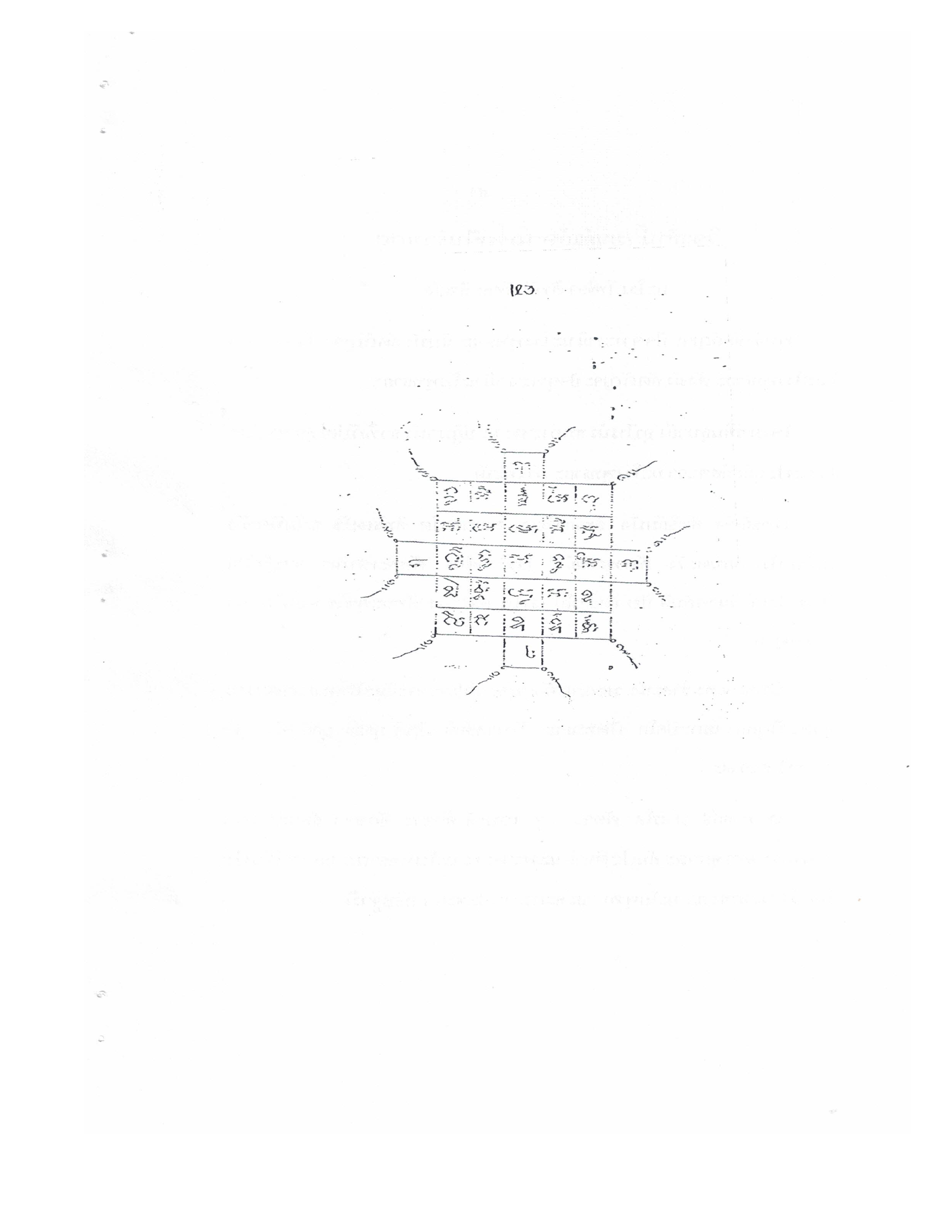
[ยันต์รูปสี่เหลี่ยม 5 แถว มีอักขระขอม/อักษรธรรมล้านนาในแต่ละช่อง อ่านไม่ชัด มีเส้นแปดแฉกยื่นออกจากมุมและกึ่งกลางด้านทั้งสี่ แต่ละแฉกกำกับด้วยเลขไทยตัวเล็กที่ปลาย อ่านไม่ชัด]
[yantra: a square grid of cells arranged in five rows, each cell inscribed with a khom or Lanna-tham script character (illegible in this reproduction); eight rays/spokes radiate outward from the corners and the midpoints of the four sides, each ray tipped with a small numeral (illegible) — consistent with the "eight-cornered" yantra design referenced in the preceding pages]
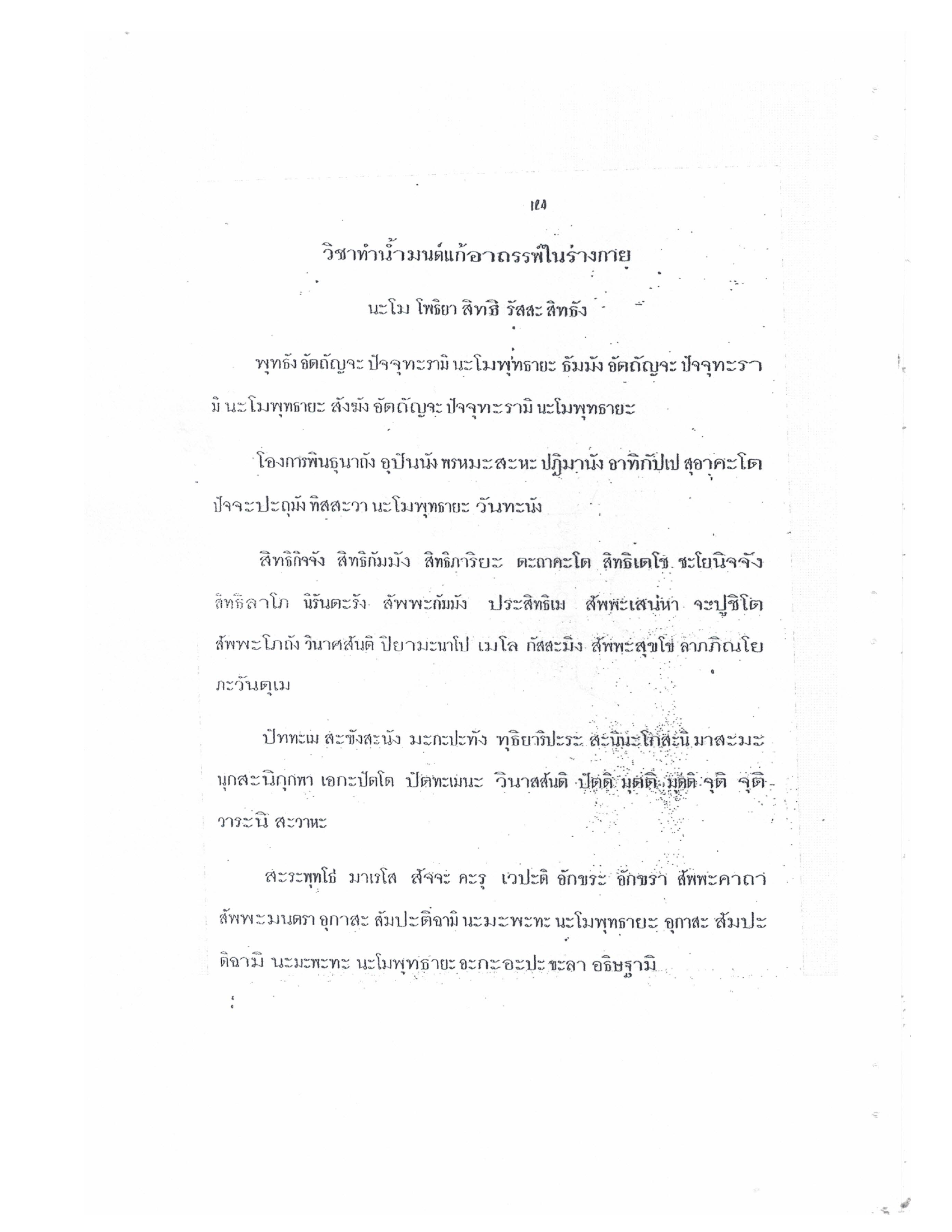
วิชาทำน้ำมนต์แก้อาถรรพ์ในร่างกาย
นะโม โพธิยา สิทธิ รัสสะ สิทธัง
พุทธัง อัตถัญจะ ปัจจุทธรามิ นะโมพุทธายะ ธัมมัง อัตถัญจะ ปัจจุทธรามิ นะโมพุทธายะ สังฆัง อัตถัญจะ ปัจจุทธรามิ นะโมพุทธายะ
โองการพินธุนาถ อุปันนัง พรหมะสะหะ ปฏิมานัง อาทิกัปเป สุอาคะโต ปัจจะปะถุมัง ทิสสะวา นะโมพุทธายะ วันทะนัง
สิทธิกิจจัง สิทธิกัมมัง สิทธิภาริยะ ตะถาคะโต สิทธิเตโช ชะโยนิจจัง สิทธิลาโภ นิรันตะรัง สัพพะกัมมัง ประสิทธิเม สัพพะเสน่หา จะปูชิโต สัพพะโภคัง วินาศสันติ ปิยามะนาโป เมโล กัสสะมิง สัพพะสุขโข ลาภภิณโย ภะวันตุเม
ปะถะเม สะขังสะนัง มะกะปะทัง ทุธิยาริปะระ สะนิมะโภสะนิ มาสะมะนุกะสะนิกุกฺขา เอกะปัดโด ปัดทะเมนะ วินาสสันติ ปัดดิ มุตติ มุตติ จุติ จุติวาระนิ สวาหะ
สะระพุทโธ มาเรโส สัจจะ คะรุ เวปะติ อักขระ อักขรา สัพพะคาถา สัพพะมนตรา อุกาสะ สัมปะติฉามิ นะมะพะทะ นะโมพุทธายะ อุกาสะ สัมปะติฉามิ นะมะพะทะ นะโมพุทธายะ อะกะอะปะขะลา อธิษฐามิ
The craft of making holy water to counteract black-magic affliction in the body
Homage to the Bodhi [awakening]; may success, may swift success be [attained].
I recall/restore the very meaning of the Buddha, homage to the Buddha. I recall/restore the very meaning of the Dhamma, homage to the Buddha. I recall/restore the very meaning of the Sangha, homage to the Buddha.
[An Oṃ-invocation:] Oṃ, Lord of the sacred drop (bindu), arisen together with Brahma, in [his] image, well come since the very first aeon; having beheld the first, foremost [truth], homage to the Buddha — this is my act of veneration.
May [my] undertakings succeed, may [my] deeds succeed, may [my] duties succeed, O Tathāgata; may [my] fiery power succeed, may victory be unceasing, may gain succeed without end; may all my deeds be accomplished for me. May I be held in affection and honoured by all with love; may all wealth bring only peace; may I be dear and pleasing everywhere; may every happiness and every gain come to be mine.
[A more obscure passage of formulaic protective syllables, evidently invoking removal of harm — gloss uncertain in places:] ...in the first, ease/security and the footing (or path); in the second, that which opposes/threatens... may [afflictions] be destroyed; release, release; passing away, passing away — svāhā.
Recollecting the Buddha in every guise; truth is [my] teacher; every letter and syllable trembles [with power]; every verse, every mantra — with due leave, I receive [this power]: Na-ma-pa-tha, homage to the Buddha. With due leave, I receive [this power]: Na-ma-pa-tha, homage to the Buddha. A-ka-a-pa-kha-la — thus do I resolve.
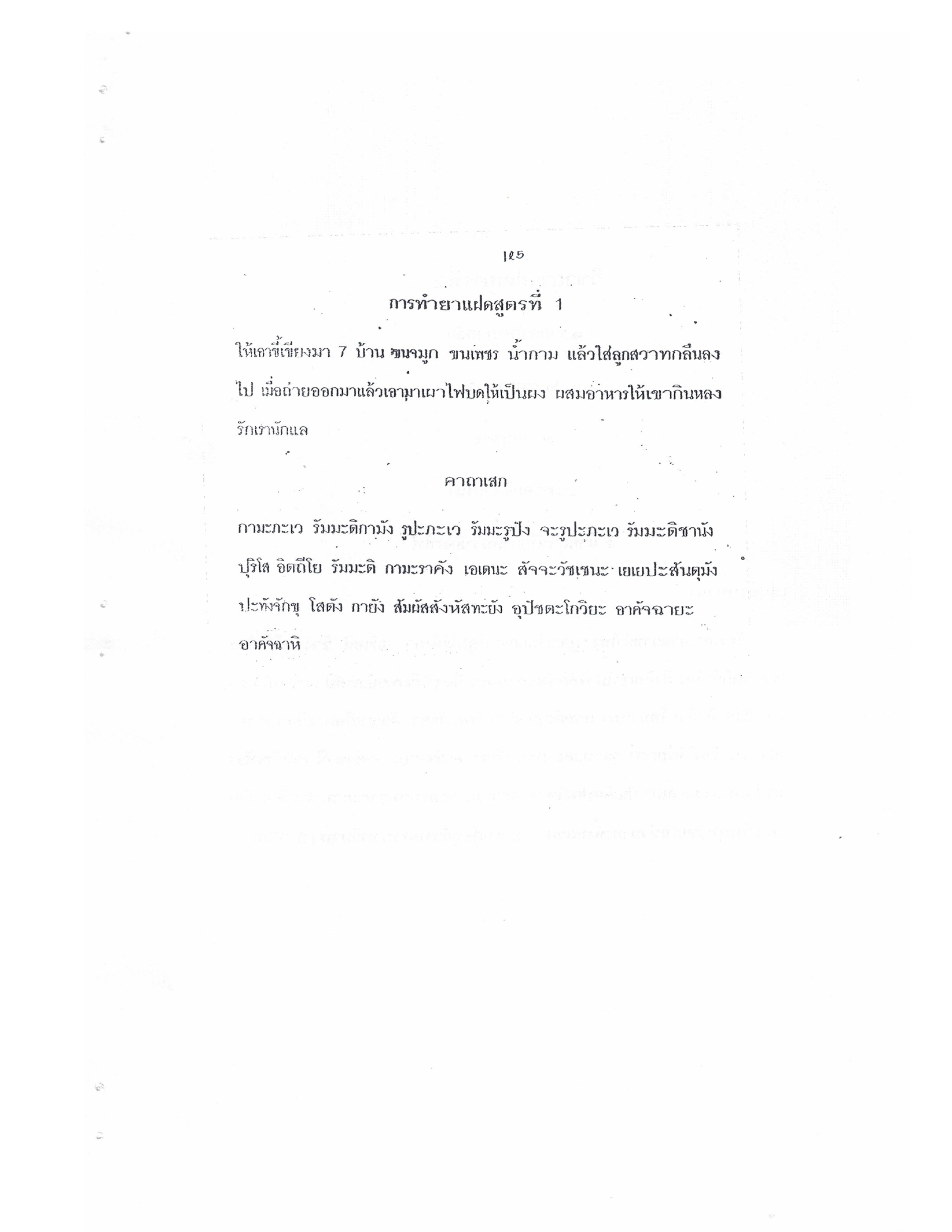
การทำยาแฝดสูตรที่ 1
ให้เอาขี้เขียงมา 7 บ้าน ขนจมูก ขนเพชร น้ำกาม แล้วใส่ลูกสวาทกลืนลงไป เมื่อถ่ายออกมาแล้วเอามาเผาไฟบดให้เป็นผง ผสมอาหารให้เขากินหลงรักเขานักแล
คาถาเสก
กามะภะเว รัมมะติกามัง รูปะภะเว รัมมะรูปัง จะรูปะภะเว รัมมะติชานัง ปุริโส อิตถีโย รัมมะติ กามะราคัง เอตนะ สัจจะวัชเชนะ เยเยปะสันตุมัง ปะทังจักขุ โสตัง กายัง สัมผัสสังหัสทะยัง อุปัชตะโกวิยะ อาคัจฉายะ อาคัจฉาหิ
Making a love-binding drug (ya faet), formula no. 1
Take chopping-board scrapings gathered from 7 houses, nose hair, pubic hair, and semen; put these into a "look sawat" love-charm bead and swallow it down. Once it has been passed [in a bowel movement], retrieve it, burn it in fire, and pound it into a powder. Mix this into food and give it to the person to eat — they will fall deeply in love, indeed.
Spell to consecrate it
[Pali-style formula on the arising of desire, gloss:] In the realm of sensuality, one delights in sensual desire; in the realm of form, one delights in form; and in the realm of form, one delights in [what is] known [through it]. Man and woman delight in sexual passion. By this utterance of truth, may all beings who [encounter this] be drawn to [me/it] — [reaching] the eye, the ear, the body, [every] contact, [and] the heart. [I call upon this power to] arise: come, arrive! Come here!
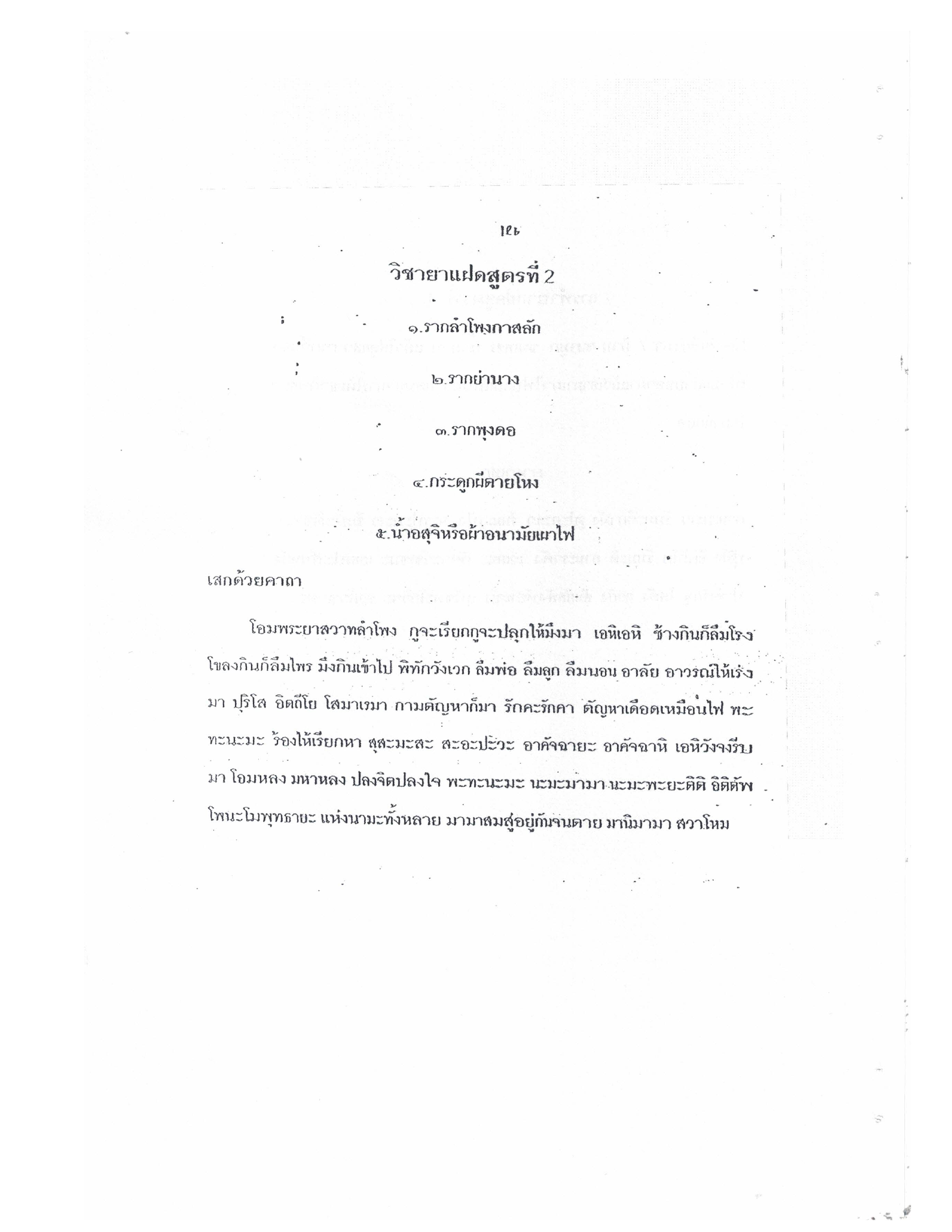
วิชายาแฝดสูตรที่ 2
๑.รากลำโพงกาสลัก
๒.รากย่านาง
๓.รากพุงดอ
๔.กระดูกผีตายโหง
๕.น้ำอสุจิหรือผ้าอนามัยเผาไฟ
เสกด้วยคาถา
โอมพระยาสวาทลำโพง กูจะเรียกกูจะปลุกให้มึงมา เอหิเอหิ ช้างกินก็ลืมโรง โขลงกินก็ลืมไพร มึงกินเข้าไป พิทักษ์วังเวก ลืมพ่อ ลืมลูก ลืมนอน อาลัย อาวรณ์ให้เร่งมา ปุริโส อิตถีโย โสมาเรมา กามตัณหาก็มา รักคะรักคา ตัณหาเดือดเหมือนไฟ พะทะนะมะ ร้องให้เรียกหา สุสะมะสะ สะอะปะวะ อาคัจฉายะ อาคัจฉาหิ เอหิวังจงรีบมา โอมหลง มหาหลง ปลงจิตปลงใจ พะทะนะมะ นะมะมามา นะมะพะยะติติ อิติตัพโพ นะโมพุทธายะ แห่งนามะทั้งหลาย มามาสมสู่อยู่กันจนตาย มานิมามา สวาโหม
Craft of the love-binding drug (ya faet), formula no. 2
1. Root of "lamphong kasalak" (a datura/thornapple variety)
2. Root of "yanang" vine
3. Root of "phung do"
4. Bone of one who died a violent/untimely death
5. Semen, or a sanitary cloth burnt in fire
Consecrate with the spell
Om, lord of love-magic of the datura flower — I shall call you, I shall rouse you to come to me; come, come! An elephant, once it eats [this], forgets its stable; a herd, once it eats, forgets the forest; when you eat this, you will forget to guard your solitude, forget your father, forget your children, forget sleep — let longing and yearning hasten you to me. Man, woman, [may they] come drawn together; let sexual craving come too; love, oh love; let desire boil like fire. Pha-tha-na-ma — cry out and call in search [of me]; su-sa-ma-sa, sa-a-pa-wa; arrive, come here! Come, spirit, hasten here! Om, be infatuated, be deeply infatuated, surrender your heart and mind. Pha-tha-na-ma, na-ma-ma-ma, na-ma-pha-ya-ti-ti, iti tappo, homage to the Buddha — [invoking] all such names. Come, come, be united together until death; ma-ni-ma-ma, svāhā.
การทำยาแฝดสูตรที่ 3
อัมมะนิด บิสสะมิละ อะละห์ อะเนาะ
ให้เอาเหงื่อที่ของลับมาเสก แล้วผสมอาหารให้กิน หลงแล
Making the love-binding drug (ya faet), formula no. 3
Ammanid Bissamila Alah Anao [a chanted invocation formula; its phonetic resemblance to "Bismillah"/"Allah" is noted but not certain]
Take sweat from the genitals and consecrate it [with the above formula], then mix it into food to give [to the target] to eat — they will fall in love, indeed.
วิชาทำปลัดขิกเมตตา
ลงด้วย อิมะ อะมิ
คาถาเสก
อิมะ อะมิ มิอะ มะอิ อะอิอะมะ อะมะอะอิ อะมะจะหัง อะมะ สวาหะ เอวะมาโวมาวะ
อิติ ลึงคะ ปะฉะดะ หีมาหาควย นะดอล่อหี มันดีนะหะปะมิ
Craft of making a metta (loving-kindness/charm) palad khik [phallic amulet]
Inscribe it with: Ima Ami
Spell to consecrate
Ima Ami, Mi-a Ma-i, A-i-a-ma, A-ma-a-i, A-ma-ja-hang, A-ma, svāhā, evam avo mava.
[A closing charm built on the phallic/genital imagery of the amulet itself, given here as printed:] "Thus [is] the lingam/phallus... [a run of phonetic syllables incorporating the colloquial words for female and male genitalia] ...it is good — so may it be."
วิชาทำอีเปื่อ
อมกระโกลนโก้นเรือ โกรนไม้สัก กระบองขว้างยัก หัวยักทิ่มหี กะภา กิกี ขวักข้อนย้อนควับ มานึกถึงแตด น้ำตาควยตก ถลกหนังหมอย ข้างขึ้นถอกถอย ข้างแรมถอกรีถอกขว้าง ถอกข้ามแม่น้ำ ถอกฆ่าคน ตาย ถอกขายคนกิน ตะวันตกดิน
หากินตามประสาถอก น้ำมันหีออก มาเจ็ดจอก ทาถอกไม่เปียก นะ โมพุทธายะ
เวลาเซ่นด้วยเหล้าให้ภาวนาว่า
อุกะปะสะ หะนะพุท
Method of making the 'Ii Peua' [lit. "rotten/soft one"] charm
Om, [a boat-poling refrain,] rowing with an oar of teak; a yaksha hurls his club, the yaksha's head thrusts into the vulva, ka-pha- ki-kee; twisting and turning back and forth, thinking of the clitoris, tears fall like semen dripping; peel back the skin of the pubic mound; on the waxing moon, thrust and withdraw; on the waning moon, thrust and pull, thrust and hurl; thrust across the river, thrust to kill people; thrust to sell people for eating. The sun sets below the horizon.
Feed on it as thrusting's nature demands; oil from the vulva comes out, seven cupfuls; anoint with it — the thrusting will not get wet. Na mo buddhaaya.
When making offerings with liquor, chant:
Uka pasa, hana phut.
วิชาทำน้ำมันพรายกระดูก
ให้หาน้ำมันจันทน์ น้ำมันจำปี น้ำมันจำปา ขี้เถ้ากองฟอนมารวมกัน แล้วเสก
อาคัจฉายะ อาคัจฉาหิ อิสุ สุอิ สุสะ อุปาระนิ
สวดให้ได้วันละ 108 จบ 7 วัน
Method of making Phraai-Kraduk oil [bone-spirit oil]
Find sandalwood oil, champi oil, champa oil, and ash from the cremation pyre; bring them together and consecrate them, chanting:
Aakacchaaya aakacchaahi isu su-i susa uparani.
Chant it 108 times a day, for 7 days.
วิชาทำน้ำมันโหงพราย
เขอะสูสะ สะสูอะเข อะสูสะขะ เขสะสูอะ
น้ำมันชื่อใครเรียกชื่อตามนั้น เช่นน้ำมันโหงพรายนายทวี ศรีชยานุพันธ์อายุ 74-75 ปี ถอนจุดธูป 9 ดอกอธิษฐาน
ขึ้นขันธ์ครู
บายศรีปากชามข้าว 1 คู่
เหล้าขาว 1 ขวด
เงินหกสลึงหรือหนึ่งบาท
ขันธ์ห้าใช้เป็นคู่แบบภาคกลางทำกรวย 5 อันมีรูป 2 เทียน 2 ดอกไม้ขาว 2
ส่วนผสม
1.ขี้เถ้ากองฟอน (รู้ชื่อ-สกุล) เขาเต็มใจมาช่วยสร้างบุญกุศลด้วย (ห้ามบังคับ มา)
2.น้ำมันหอม 3 เจ้า เจ้าละร้าน ห้ามต่อราคา
3.ดอกรักซ้อน (พลีเอา)
Method of making Hong Phraai oil [a spirit-summoning oil]
Kher-suusa sasuu-akhe asuusakha khesasuu-a.
The oil is named after whoever it is called for — for example, 'Hong Phraai oil of Mr. Thawi Sichayanuphan,' aged 74–75 years. Draw out and light 9 incense sticks, and make the petition/vow.
Raise the teacher's offering tray [khan khru].
A pair of bai-sri rim-of-bowl rice offerings.
1 bottle of white liquor.
Six salueng or one baht in money.
The five-part offering [khan haa] is used in pairs, central-Thai style, made into 5 cones, with 2 images/photographs, 2 candles, 2 white flowers.
Ingredients:
1. Ash from the cremation pyre (the [deceased's] given name and surname must be known); they must come willingly to help build merit — they must not be compelled to come.
2. Perfumed oil, from 3 sources, one from each shop — do not haggle over the price.
3. Double crown-flower blossoms [dok rak sawn] (to be taken as an offering, not purchased).
การทำสีผึ้งเมตตา
เมื่อเราเริ่มตั้งไฟให้ว่าบทนี้ก่อน
อะนะ มะอุอะ เมื่อเราเริ่มที่ตั้งไฟให้ภาวนาไปจนกว่าจะเดือด เมื่อเดือดแล้วก็ภาวนาว่า
อิทัง กันทุนาชาโต เอหิมาวะ สะมวคะมะ อิดถีโย ปุริโส คัน ทะ นาชาโต เอหิ สะมาคะมะ
สวดให้มานหน่อย และเมื่อยกลงเป่าด้วยคาถาบทนี้อีกว่า
นะมะ อะอุนะ
Making Metta beeswax [balm]
When we first set up the fire, recite this verse first:
'Ana ma-u-a.' When we start setting up the fire, chant continuously until it comes to a boil. Once it has boiled, then chant:
'Itang kantunachaato ehimaava samavakhama itthiyo puriso, kanta- na-chaato ehi samaakhama.'
Chant it for a good while, and when lifting it down from the fire, blow on it while reciting this verse again:
'Nama a-una.'
วิชาทำผ้ายันต์เพชรพญาธร
พระคาถาเพชรพญาธร
โอมพระเทพเพชรพญาธร เสด็จจรอยู่บนเวหา กูจะเรียกมึงมา กูจะใช้มึงไป ไปสู่ห้องที่นางนอน กูจะให้ให้มึงไปสมจรที่นางหลับ กูจะใช้ให้มึงไปจับไปกุม หญิงสาวและเด็กหนุ่ม สาวพรหมจารีย์ เร็วเร็ว เร่งไป เร็วเร็ว เร่งมา ข้ามห้วย ข้ามหนอง ข้ามคลอง ข้ามท่า ข้ามดิน ข้ามฟ้า ข้ามพระมหาสมุทร และ กระแสสินธุ์ ข้ามถนนมงคลแลลิบลี้ ไปเถิดพ่อไป ให้มีชัยชนะ จงไป เอาจิตของอิตถีอี.................มา เอหิมะมะ มะมา ชนาจิตดัง จิตของอี.................มามัง มาหากูมา
หัวใจเพชรพญาธร
หีหา เหหา เฮฮา นะมะพะทะ จะภะกะสะ กันหะเนหะ มุทุจิตตัง ปิยังมะ นะ
Method of making the Phet Phaya-thorn [Diamond Lord] yantra cloth
The Phet Phaya-thorn spell:
'Om, divine Phet Phaya-thorn, you who travel dwelling in the sky — I shall call you to come, I shall command you to go. Go to the room where the lady sleeps; I will have you go and unite with her while she is asleep; I will command you to go and seize, to grasp, young women and young men, virgin maidens. Quick, quick, hurry and go; quick, quick, hurry and come. Cross the stream, cross the swamp, cross the canal, cross the landing, cross the earth, cross the sky, cross the great ocean, and the river currents. Cross the auspicious road and vanish from sight. Go then, father, go — be victorious. Go and take the mind of the woman [named] _________ and bring it. Ehi mama mama, let [her] mind be as the mind of [named] _________ ; come to me, come and find me.'
Heart-mantra of Phet Phaya-thorn:
'Heehaa hehaa hehaa namaphatha chaphakasa kanhaneha mudu cittam piyam ma- na.' [gloss: 'a tender heart, a mind that is beloved.']
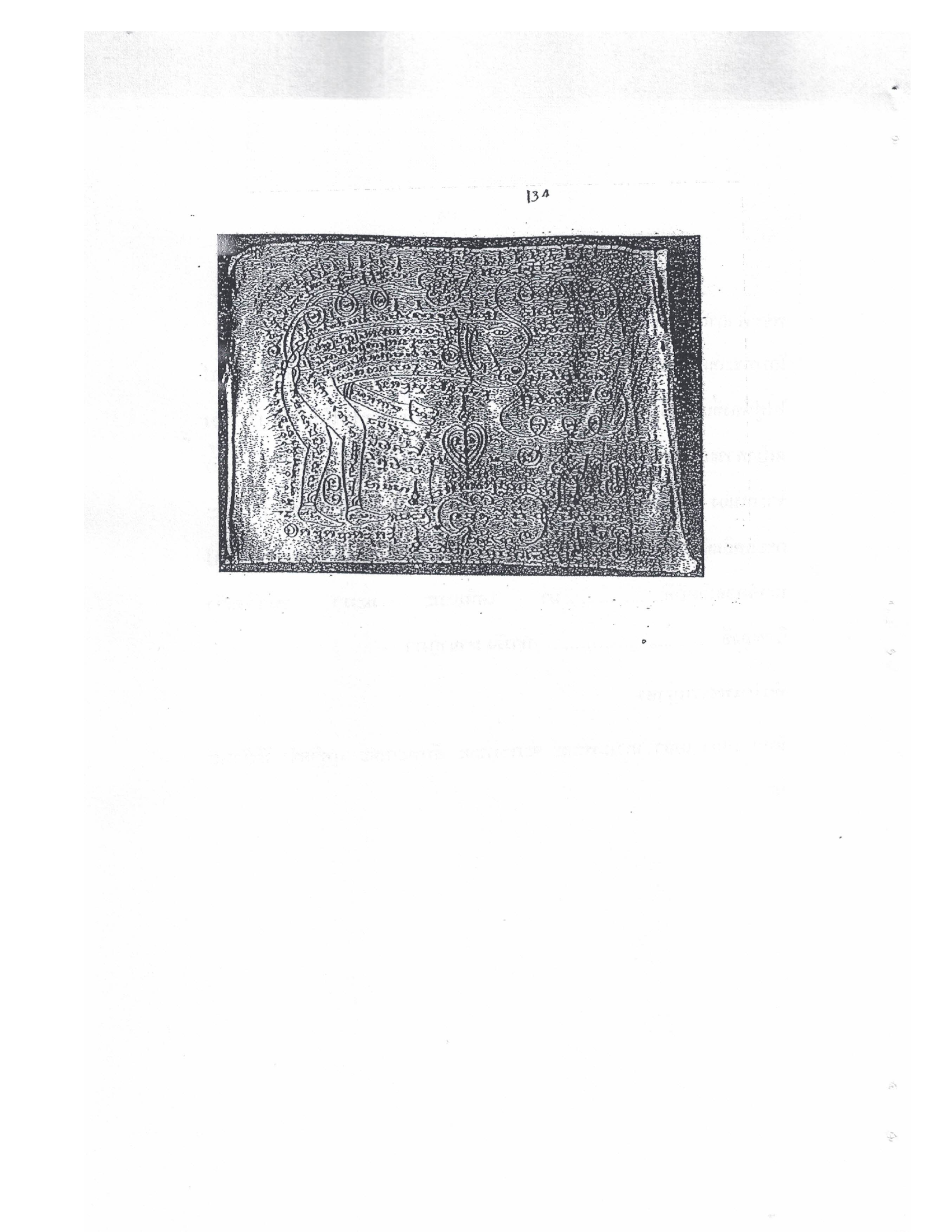
[หน้านี้เป็นภาพยันต์ ไม่มีข้อความบรรยายร้อยแก้ว] [อักษรธรรมล้านนา/อักขระขอมในยันต์ อ่านไม่ชัด]
[This page carries a yantra diagram, with no running prose text.] [yantra: the outline of a four-legged animal, possibly a deer, its body and the surrounding field composed of lines of Lanna Tham or Khom script; a small loop-like emblem sits near the chest; the characters are too faint and worn in this scan to read with confidence]
วิชาทำไชเรียกเงินเรียกทอง
นะโมพุทธายะ เดชะชัยยะ เดชะชัยยะ สิทธิชัยยะเมตตา ชัยยะจิต ตัง ชัยยะลาภา ชัยยะมังคะลา ชัยยะมังคะลา
วิชาจิ้งจกสองหางเจ้าชู้
นะมะพะทะ อุปะสัมปะ กันหะเนหะ พุทธะชาลีติ โสธายะ ทุโจ ทุจา ขัดจะ ขะลาเกนะ ขะลาเกนะ จุ๊จุ๊ มัดถะเร
Method of making a Chai [charm] to summon silver and summon gold
'Namo buddhaaya, power of victory, power of victory, accomplished victorious loving-kindness, victorious heart- mind, victorious fortune, victorious auspiciousness, victorious auspiciousness.'
Method of the Two-Tailed Flirtatious Gecko
'Namaphatha upasampa kanhaneha buddhachaaliti sodhaaya, thucho thucha khatcha khalaakena khalaakena chuchu matthare.'
การทำตะกรุดพญากามะ
ลง
นะกามะ เจ้าเอ่ยจงมา อิปิเสคิ อิอาโกติ สัมภะโว จงมาบังเกิด นะกามะโภติ
เสก
โสตะโสตา มานิมามา อิกะโภติ เสน่หาจี่รัก จิจะสังติ รักกา รักโก โสติ
Making the Phya Kama takrut [King of Desire amulet]
Inscribe:
'Na kaama, oh lord, come now — ipisekhi iaakoti sambhavo — come and arise, na kaama bhoti.'
Consecrate, chanting:
'Sota sota, manimama, ika bhoti, may affection cling and bind, jicha sangti rakka, rakko soti.'
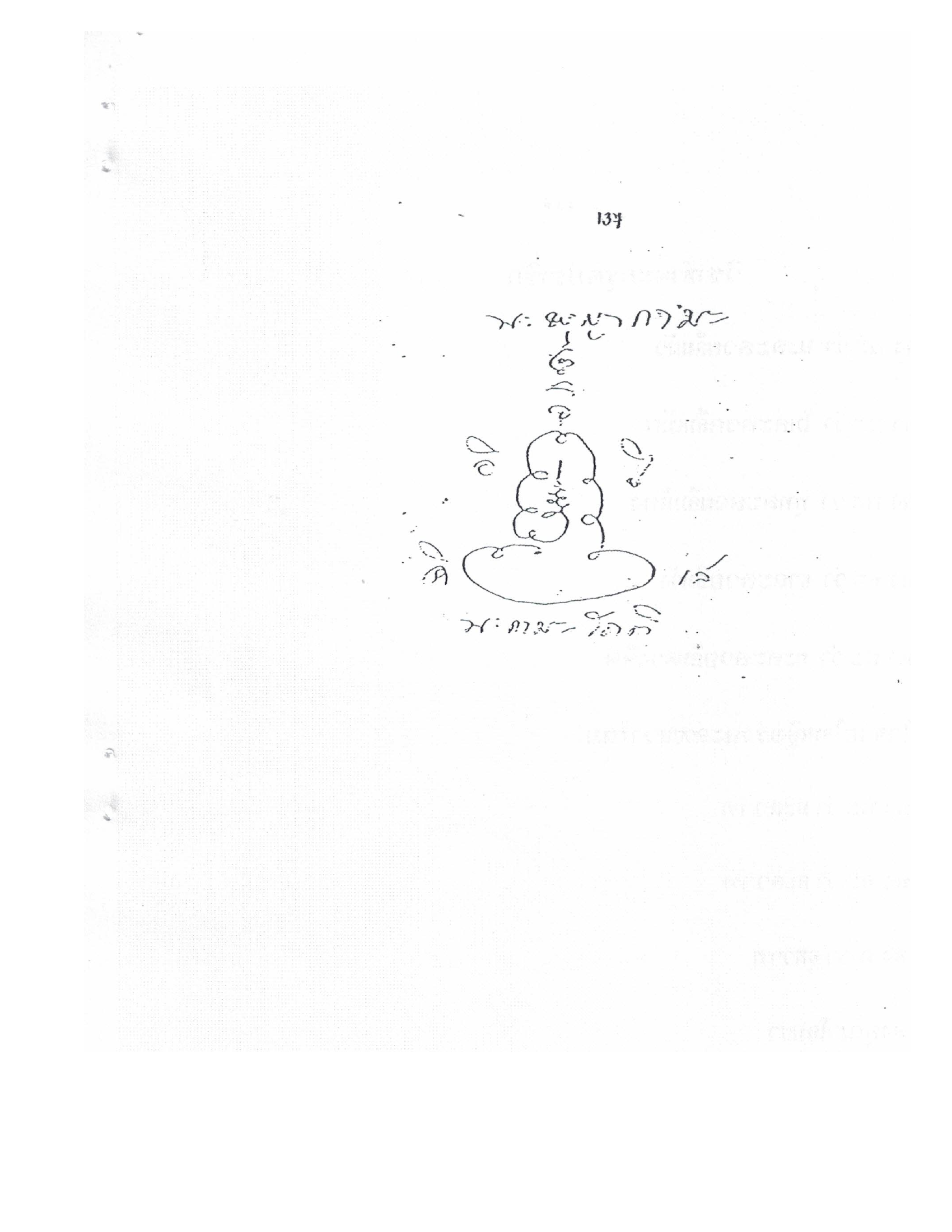
วิชาทำตะกรุดปราชิก
ลง นะ ว่า นะละลวยลืมผัว
ลง มะ ว่า โมละลวยลืมเมีย
ลง พะ ว่า พุทละลวยลืมห้อง
ลง ธะ ว่า ธาละลวยลืมวัง
ลง ยะ ว่า ยะละลวยลืมดวงจิต
ใจชายใจหญิงเร่งละลวยสวาโหม
ลง มะ ว่า มะสวาท
ลง อะ ว่า อะสวาท
ลง อุ ว่า อุสวาท
ลงอุณาโลมว่า
อุณาโลมาปะนะชายะเต
นะนิยม โมนิยม พุทนิยม ธานิยม ยะนิยม โอมนิยม มหานิยม อิตถีปุ ริโส อาคัจฉาหิ มานิมามา มานิยม นะโมพุทธะยะ
Method of making the Prachik takrut [rival-forgetting amulet]
Inscribe 'na', saying: 'Na-la-luai — forget the husband.'
Inscribe 'ma', saying: 'Mo-la-luai — forget the wife.'
Inscribe 'pha', saying: 'Phut-la-luai — forget the [marriage] chamber.'
Inscribe 'tha', saying: 'Tha-la-luai — forget the household.'
Inscribe 'ya', saying: 'Ya-la-luai — forget the heart-mind.'
Let the heart of man and the heart of woman quickly be entranced into forgetting — sawaahom.
Inscribe 'ma', saying: 'Ma sawat [longing].'
Inscribe 'a', saying: 'A sawat.'
Inscribe 'u', saying: 'U sawat.'
Inscribe the unaalom [spiral crown mark], saying:
'Unaalomaa panachaayate.'
'Na-niyom, mo-niyom, phut-niyom, thaa-niyom, ya-niyom, om-niyom, mahaa-niyom, itthi-pu- riso [woman and man], aakacchaahi, manimama, maniyom, namo buddhaaya.'
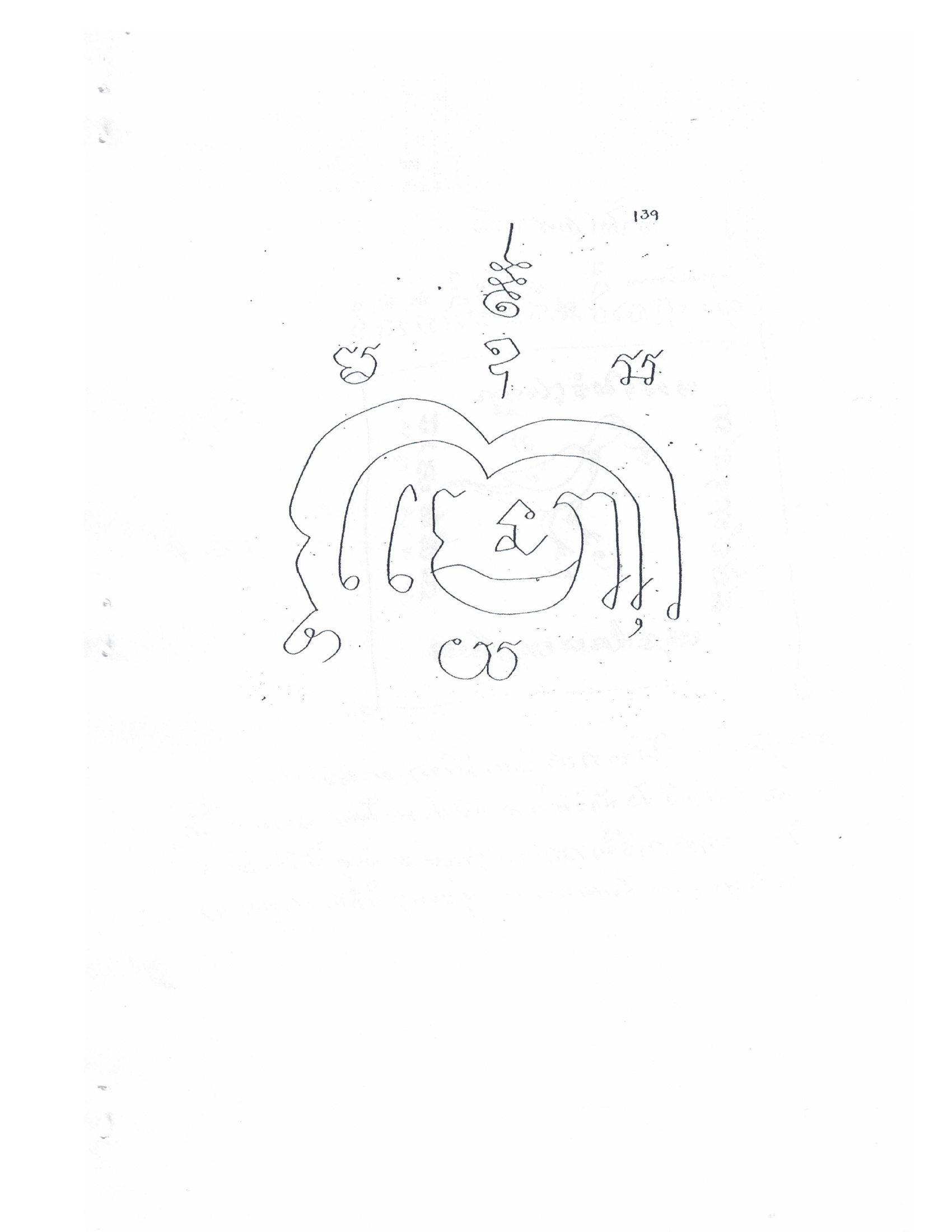
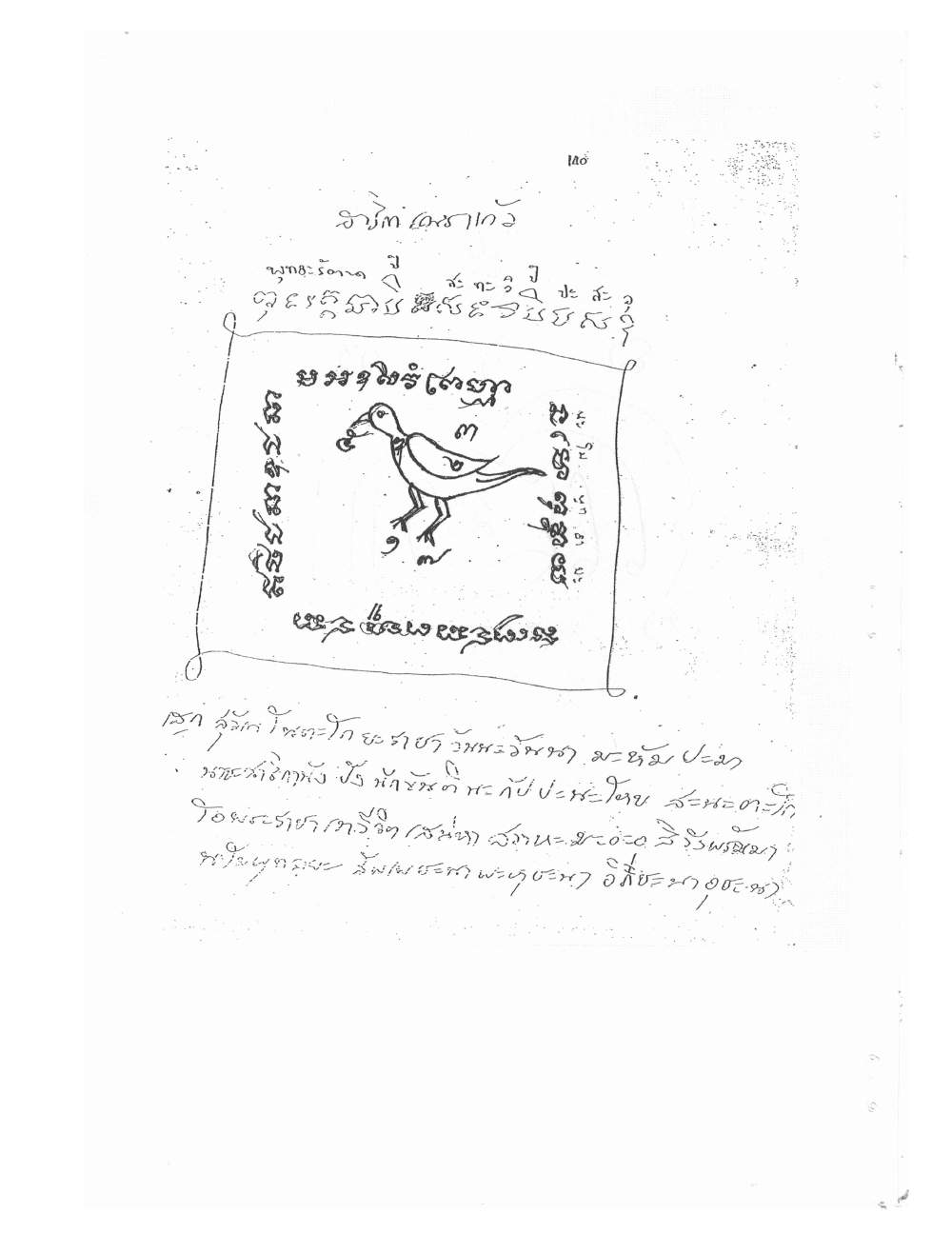
[หมายเลขหน้าที่พิมพ์บนหน้ากระดาษ: ๑๔๐] [หัวข้อที่เขียนด้วยลายมือด้านบน อ่านไม่ชัด] [ยันต์รูปนก ล้อมกรอบด้วยแถวอักขระ (ล้านนา/ขอม) อ่านไม่ชัด] [ข้อความลายมือหลายบรรทัดใต้ยันต์ อ่านไม่ชัด]
[Printed folio number on the page: 140.] [A handwritten heading above the yantra is illegible.] [yantra: a rectangular yantra drawn by hand, its four borders lined with rows of characters (Lanna or Khom script) too faint and cursive to read with confidence; at the center stands a bird, holding something in its beak, with a few isolated characters near its body.] [Several lines of handwritten Thai text below the yantra give further instructions, but the cursive script is illegible.]
วิชาสาริกาป้อนเหยื่อ
ลงด้วย วะ ธะ พะ จะ
๑.ใช้ทองคำกับตะกั่วอวนผสมกันแล้วรีดเป็นแผ่น
๒.เวลาลง ให้ลงที่หน้าอกผู้หญิง เวลากระทำสังวาสกัน เสร็จแล้วป้อนใส่ปากผู้หญิงแล้วพูดพลีเอาเอง
๓.ลงเสร็จแล้วให้เสกด้วย
สุกิตติมา สุภาจาโร สุสิละวา สุปาคะโต ยัสสะสิมา วะเจธิโร เถสะโรวา อะสัมภีโต
๔.ห้ามลงกับแฟน ผู้หญิงขายบริการ
ห้ามใช้ในทางที่หลอกลวงผู้อื่น จะเป็นกรรมแก่ตัว
Technique of the Sarika (Mynah Bird) Feeding Bait
Inscribed with the syllables wa, tha, pha, ja.
1. Combine gold with fishing-net lead sinker, mix them together, then press/roll into a thin sheet.
2. Timing for the inscribing: inscribe it on the woman's chest at the moment of intercourse. Once finished, feed it into the woman's mouth, then speak the offering-dedication yourself.
3. Once the inscribing is finished, chant over it as well:
Sukittimā subhācāro susīlavā supākato yassasīmā vacetthīro thesaro vā asambhīto. [Pali formula chanted over the inscribed sheet — roughly, "of good renown, of good conduct, virtuous, accomplished, whose bounds are such, resolute, unshaken."]
4. Forbidden to use on one's own girlfriend/wife, or on a woman who sells sexual services.
Forbidden to use in any way that deceives others — that becomes one's own karma.
คาถากบิลยักษ์
โอ้ม ยักขะ ปะริสุญญะ พระวิธูรราชา โอมยักขา โอมยักขาเทวา มึงจะแลดากูก็บ่มิได้ คือ เปลวไฟประลัยกัลป์ กูจะดวาดฝูงคนทั้งหลายนั้น ก็ล้มทั้งยืน กูจะดวาดปืน ปืนก็จะกลับหักไป กูจะดวาดฟื้นไฟ ฟื้นไฟก็แตก กูจะดวาดสาแหรก สาแหรกก็ขาด กูจะดวาดฝูงผีปีศาจ ลุกแล่นแสนเทวดา แลพญา กราบไหว้กูอยู่มิได้ขาด ด้วยเดชอำนาจ กูดวาดพระวิธูร ตัวกูชื่อกบิลยักษ์ประกาสูรเป็นจ้าวแห่งยักษ์ เอามือลูบอกอยู่ ไหว้ๆ ร้องให้รักตน โอมจะริตมาดิเสยยะถีทั้งหลูหลูฯ
Spell of Kabin Yaksha
Om, yaksha, parisuñña [epithet, exact sense unclear], Phra Withun Racha [the royal Vidhura]. Om yaksha! Om yaksha deva! You (mueng) shall not even be able to look upon me — I am like the flame that consumes the aeon. I ('goo') shall [dawat — an archaic magical verb, roughly "glare down upon / strike with power"; exact sense uncertain] the crowds of people, and they shall all collapse, whether sitting or standing. I shall strike upon guns, and the guns shall bend and break. I shall strike upon blazing embers, and the embers shall shatter. I shall strike upon the carrying-yoke strap, and the strap shall snap. I shall strike upon the hosts of ghosts and demons; the hundred thousand devas and lords come running, bowing down to me without ceasing, by this power and glory. I strike upon Phra Withun himself. My own name is Kabin Yaksha Prakasun, lord of all yaksha. I stroke my own chest with my hand, bowing again and again, calling out so that others shall love me. Om ja rit ma di seiya thi, all together!
พิธีไหว้ราหู
จุดธูป ๑๒ ดอก โต๊ะตั้งกลางแจ้ง ผ้าขาวปูคลุมโต๊ะ ให้มีไก่ ๑ คู่ ผลไม้ ๔ อย่าง (ยกเว้นมะพร้าว) เหล้าเซียงชุน ๑ ขวด เบียร์ ๑ ขวด บุหรี่ ๑ ซอง ขนมเปียกปูน (ไม่เอามะพร้าว) กาแฟดำ ๑ แก้ว ข้าวเหนียวดำ ๑ ถ้วย พล่าปลา ๑ ตัว มีหัวมีก้าง (ย้ำ ปลาก็ได้แต่ต้องมีหัวมีก้างเป็นตัว)
คาถาบูชา
กุเสโต มะมะ กุเสโต โตลาโม มะมะ โตลาโม คุยหะโม มะมะ คุยหะโม คุหติโม มะมะ ดุหติโม
(ท่องตอนกลางวัน ๑๒ จบ)
ยะทาดังมะมะ ดังถายะ ดังวะดัง มะมะ ดังวะดัง ดังเสกา มะมะ กาเสดัง กาติยะ มะมะ ยะติกา
(ท่องตอนกลางคืน ๑๒ จบ)
ใช้ดอกบานไม่รู้โรย ๑๒ ดอก หรือกุหลาบหรือดอกไม้อื่นที่สีดำใส่ในแจกัน แจกันเดียวกัน เทียนดำ ๑๒ เล่ม
เอ่ยชื่อนามสกุล วันเดือนปีเกิด แล้วพูดว่า ลูกขอทำพิธีบูชารับส่งองค์พระราหู ขอได้โปรดเมตตารับทราบและช่วยเหลือลูกบ้าง (จะให้ช่วยอะไรก็บอกกล่าว)
ผลไม้ที่ห้าม คือ มังคุด ละมุด
(ยิ่งไหว้บ่อยยิ่งดี)
Rite for Worshipping Rahu
Light 12 incense sticks. Set up a table outdoors in the open air, cover the table with white cloth. Have a pair of chickens (1 male, 1 female), 4 kinds of fruit (excluding coconut), 1 bottle of Sieng Chun liquor, 1 bottle of beer, 1 pack of cigarettes, khanom piak-poon [a black rice-flour custard sweet] (without coconut), 1 cup of black coffee, 1 cup of black sticky rice, 1 phla pla (spicy fish salad) made from a whole fish, with head and bones intact (note: any kind of fish will do, but it must be a whole fish with head and bones).
Chant of Worship:
Kuseto mama kuseto, tolamo mama tolamo, khuiyahamo mama khuiyahamo, khuhatimo mama duhatimo.
(Recite by day, 12 times through.)
Yathadang mama, dangthaya, dangwadang mama dangwadang, dangseka mama kasedang, katiya mama yatika.
(Recite by night, 12 times through.)
Use 12 everlasting flowers (globe amaranth), or roses, or other black-colored flowers, placed in a vase — a single vase. 12 black candles.
Speak your given name and surname, and date, month, and year of birth, then say: "Your child requests to perform this rite of worship, to receive and send off the Lord Rahu. May you be so gracious as to accept this and to help your child" (state whatever help is being requested).
Forbidden fruits are: mangosteen, sapodilla (la-mut).
(The more often it is worshipped, the better.)
พระมนต์จินดามณี
จินดามุนิปันโร จินมุนิ โนกะทาสะติ จินดามะณี วิทันตะมาโน จิตตะ ตะยัง วัตถะปุดโตติ
โอมจินดา มะหาจินดา ดังมังสัง ธะนังจิตถะ วะโอรัตสัง มะหาลาภัง ภะวันตุเม
อิตถีโย ตะรุโน เอหิสะมาคะมะ อาคัจฉายะ อาคัจฉาหิ เอหิสะมาคะมา
เอหิมนุสสานัง พรหมา นิยัง ปิยัง มะมะ มามา
The Jindamani (Wish-Fulfilling Gem) Mantra
Jindamuni panro, jin muni, noka thasati, jindamani, vitantamano, citta tayang vatthapudoti. [Pali-style incantation invoking the wish-fulfilling gem; no separate Thai gloss is given on the page.]
Om jinda, maha jinda, dang mangsang, thanang jittha, va-oratsang, maha labhang bhavantu me. ["...may great fortune/wealth come to be for me."]
Itthiyo taruno ehi samakhama, akajchaya, akajchahi, ehi samakhama. ["Women and young men, come, gather together; come, arrive; come, gather together."]
Ehi manussanang, brahma, niyang piyang mama mama. ["Come, all people, and Brahma spirits — be dear and beloved to me, to me."]