Contents · 1 chapter(s) · 32 entries
ฝึกใช้อำนาจจิต (พลังจิต)
ตามหลักวิทยาศาสตร์ และ ศาสนา
เล่มที่ 2
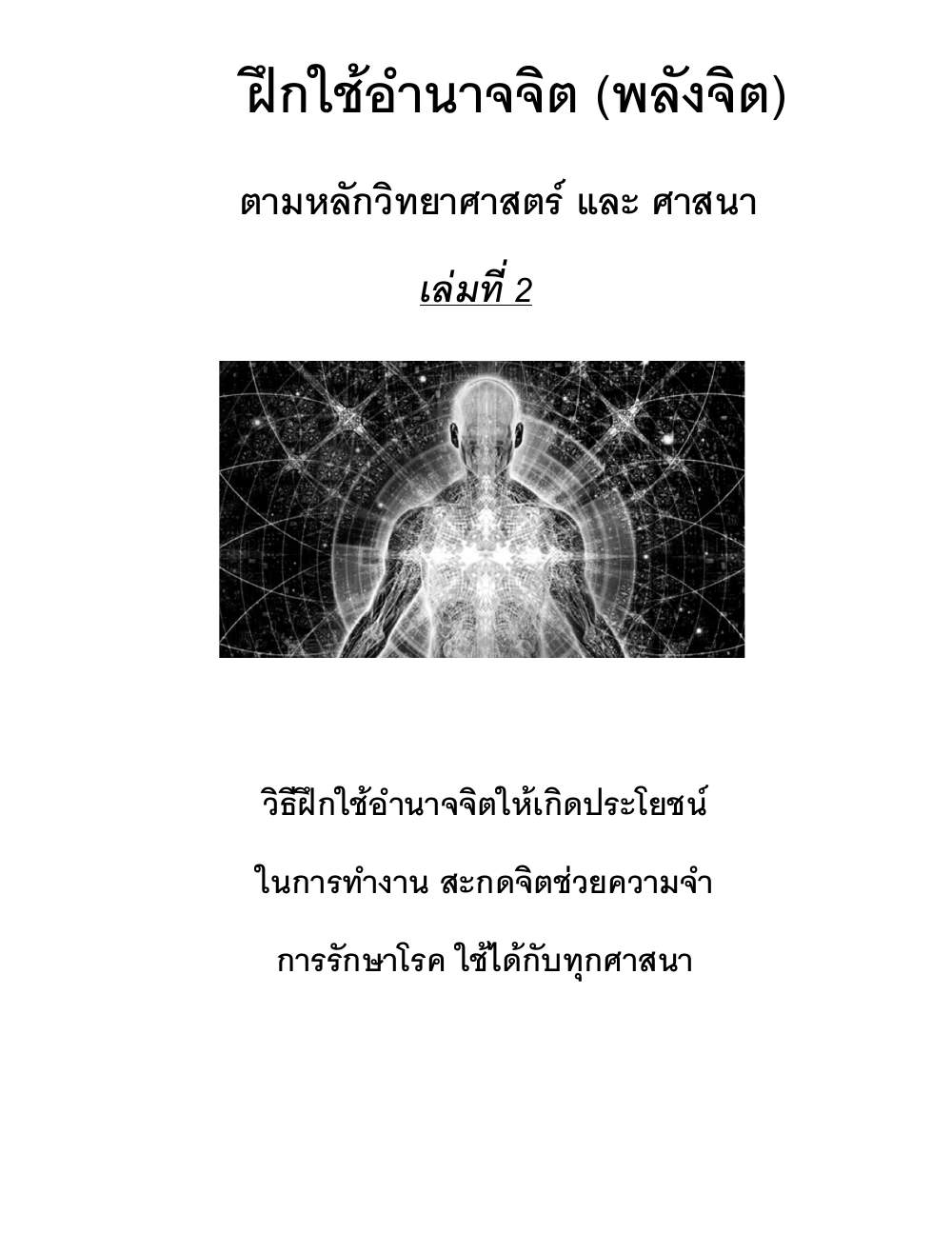
[ภาพ: รูปถ่ายขาวดำของร่างมนุษย์เรืองแสงมองจากด้านหลัง มีเส้นตารางเรขาคณิตและแสงพวยพุ่งโดยรอบคล้ายเครือข่ายจักรวาล]
วิธีฝึกใช้อำนาจจิตให้เกิดประโยชน์ ในการทำงาน สะกดจิตช่วยความจำ การรักษาโรค ใช้ได้กับทุกศาสนา
Training the Use of Mind Power (Psychic Power)
According to Scientific and Religious Principles
Volume 2
[diagram: black-and-white photograph of a glowing human figure seen from behind, surrounded by geometric grid lines and bursts of light resembling a cosmic network]
How to train the use of mind power to bring benefit to work; hypnosis to aid memory; the treatment of illness. Usable with every religion.
๑๕๓
บทที่ ๖ การใช้อำนาจจิตในการพัฒนาประเทศ
๑. พื้นฐานในการใช้อำนาจจิตในการพัฒนา
ผลประโยชน์เป็นเครื่องดึงดูดความเคารพ ความสนใจ และความเลื่อมใสได้ดีที่สุด ทั้งในส่วนบุคคลและชุมชน แม้ในส่วนใหญ่คือประเทศชาติก็ย่อมมีนโยบาย หรือการดำเนินงานไปสู่ผลประโยชน์ของชาติการล้างสมองหรือการจูงใจให้คล้อยตามถึงขั้นเลื่อมใสลัทธิคอมมิวนิสต์ ก็อาศัยผลประโยชน์ที่จะได้รับเป็นเครื่องล่อใจ เมื่อฝ่ายคอมมิวนิสต์ล้างสมองให้คนเลื่อมใสได้ เหตุไฉนฝ่ายโลกเสรีจึงไม่สามารถล้างสมอง หรือเปลี่ยนความนึกคิดให้เลื่อมใสทางฝ่ายตนให้ได้? ไม่ใช่เพราะการแก้ไขทางจิตผิดพลาดต่อจุดสำคัญดอกหรือ? ผลที่ต้องการย่อมจะเกิดจากเหตุที่คู่ควรกัน ลองพิจารณาผลการวิเคราะห์ ของนักวิชาการฝ่ายเราหลาย ๆ ประเทศดูบ้าง จะเห็นว่าปัญหาเรื่องเด็กวัยรุ่น ปัญหาเรื่องต่างศาสนาต่างเชื้อชาติ ปัญหาเรื่องเหตุใดคนจึงหันไปเลื่อมใสคอม-
153
Chapter 6: The Use of Mind Power in National Development
1. Foundations for Using Mind Power in Development
Benefit is the thing that best draws respect, interest, and devotion, both for individuals and for communities. Even for the greater whole — the nation — there are policies, or operations directed toward the nation's benefit. Brainwashing, or persuasion that induces people to go along with something to the point of devotion to Communist doctrine, likewise relies on the benefit to be gained as its bait. If the Communist side can brainwash people into devotion, why can the Free World side not brainwash people, or change their thinking, to win devotion to its own side? Is it not because the correction applied at the level of the mind has gone wrong on some crucial point? The result one wants arises only from a cause fit to produce it. Consider the results of analysis by our own scholars from many countries: one sees that the problem of teenagers, the problem of differing religions and differing ethnicities, and the problem of why people turn to devotion to Com-
๑๕๔
มิวนิสต์ และปัญหาอื่น ๆ นักวิชาการสาขาต่าง ๆ ได้รายงานผลการวิจัยออกมาแต่ละปัญหา มีสาเหตุมากมาย วิธีแก้ไขก็มากจนไม่สามารถที่จะแก้ไขพร้อมกันได้ เพราะเงินไม่พอ จึงต้องทำเป็นแผนระยะยาวต่อไป เมื่อเป็นระยะยาวก็เกิดความเสียหายตามมา เช่น ทำเขื่อนกั้นนั้นไม่ทำคลองระบายไปสู่พื้นที่ต่าง ๆ เพราะขาดเงิน เลยทำให้ขาดน้ำและขาดคนทำต่อเพราะเปลี่ยนรัฐบาล นี่เป็นตัวอย่างประเทศอื่น ๆ ไม่ได้ว่าประเทศของเรา การเห็นแก่ผลประโยชน์ส่วนตัวบ้าง เห็นแก่ประโยชน์หมู่คณะส่วนน้อยบ้าง ก่อให้เกิดโครงการและแผนการที่สร้างความแตกแยกโดยไม่รู้ตัวและโดยไม่เป็นธรรม ประเทศอเมริกา รัสเซีย เยอรมัน และญี่ปุ่น ๆลๆ เขาก้าวหน้ามากเข้าก็พบความจริงในเรื่องที่หลายประเทศยังโง่แต่อวดฉลาด เช่น การรักษาโรคด้วยอำนาจจิตและยาโบราณ ก็ได้พบเอกสารยืนยันว่าทำได้ผลและไม่เกิดโทษ หลายประเทศวิจัยพบว่ายาแผนปัจจุบันให้โทษมากมายหลายขนาน น้ำผึ้งมีไวตามินที่ดีและช่วยรักษาโรคได้ ซึ่งการทำแบบวิทยาศาสตร์ไม่อาจทำให้น้ำผึ้งมีคุณค่าเหมือนของธรรมชาติได้แต่อีกหลายประเทศที่มีกฎหมายหรือพระราชบัญญัติ ที่กีดกันแพทย์แผนโบราณ ซึ่งใช้อำนาจจิตและยาธรรมชาติ ไม่ยอมให้ตั้งโรงเรียนแพทย์โบราณต่าง ๆ นานาโดยไม่มีการพิสูจน์ว่าแผนโบราณทำอะไรได้ผลดีบ้าง ก็เพราะเรื่องการเห็นแก่ผลประโยชน์ของหมู่คณะกลุ่มน้อยมิใช่หรือ? แพทย์จึงไม่พอ และก็รู้อยู่เต็มอกว่าไม่พอ
154
-munism, and other problems, have each been reported on by scholars in various fields, with findings on that particular problem. There are many causes, and just as many remedies — so many that they cannot all be applied at once, because there is not enough money. So they must instead be turned into long-term plans. Being long-term, damage follows in their wake — for example, a dam is built but the canals to drain water out to the various areas are not, for lack of funds; this then causes water shortages, and shortages of people to carry the work forward, because the government changes. This is an example from other countries, not to say it applies to our own country. Regard for one's own private benefit in some cases, regard for the benefit of a small faction in others, gives rise to projects and plans that create division without those involved even realizing it, and unjustly. As America, Russia, Germany, and Japan, etc. advanced further, they came upon the truth of matters in which many countries had been foolish while putting on airs of cleverness — for instance, the treatment of illness by mind power and traditional medicine: they found documentary evidence that it works and causes no harm. Research in many countries has found that modern medicines cause harm of many kinds. Honey has good vitamins and can help treat illness — something a scientific process cannot make equal in value to the natural product. Yet many other countries have laws or acts that obstruct traditional-medicine practitioners, who use mind power and natural medicines, refusing to allow the establishment of various traditional-medicine schools, all without any proof of what the traditional approach can or cannot achieve well. Is this not, then, a matter of regard for the benefit of a small faction? Physicians are therefore insufficient in number, and they know full well in their hearts that they are insufficient
๑๕๕
ไปอีกหลายสิบปีคอมมิวนิสต์มีหน่วยพยาบาลประจำที่ในที่กันดาร เพื่อเอาชนะใจประชาชนเสียก่อน ในประเทศต่าง ๆ ก็ยังกีดกั้นการผลิตแพทย์ด้วยวิธีง่าย และทุนต่ำเหมือนฝ่ายตรงกันข้าม แน่นอนทีเดียวการเห็นแก่ผลประโยชน์ส่วนตัวก็มีอิทธิพลให้คนพูด และทำอะไรผิด ๆ ได้มาก เช่นการหาเหตุผลผิด ๆ ขัดแย้งศาสนาดังกล่าวมาแล้ว รวมทั้งขัดแย้งการรักษาโรคแผนโบราณที่ทำได้ผลดีในศาสนาต่าง ๆ บางทีก็ขัดแย้งไปเพื่อผลประโยชน์ส่วนตัว คือต้องการชื่อเสียงว่าตนมีความรู้ความสามารถ หรือเพื่อแต่งหนังสือขาย ๆลๆ
ความรู้สึกพื้นฐานที่สำคัญเกี่ยวกับการฝึกจิต และใช้อำนาจจิตก็คือ หลักตำราที่เขียนไว้มากมาย ผลการวิจัยที่มีเหตุผลหลาย ๆ ข้อ ผู้มีปัญญาจริงย่อมสามารถรวมให้เหลือน้อยข้อหรือข้อเดียว แต่มีผลดีหรือกินความหมดทุกข้อได้ ดังที่เคยยกตัวอย่างความชั่วหรือกิเลสมาแล้วข้างต้น จะแยกแยะเป็นหลายอย่างจนถึง ๑๕๐๐ อย่างก็ได้ แต่รวมเป็นอย่างเดียวก็กินความหมดได้ ปัญหาทั้งหลายที่แก้ไม่ได้หรือวิจัยหาสาเหตุได้มากมายจนแก้ไม่ไหวนั้น ก็สรุปรวมลงเหลือข้อเดียวได้คือ "ต้องแก้เรื่องจิต" เพื่อให้เข้าใจการฝึกและการใช้อำนาจจิตแบบสรุปรวมและเห็นความสำคัญของอำนาจจิตไปด้วย จึงขอเปรียบเทียบการฝึกแบบพุทธศาสนา แบบโลกเสรีและแบบคอมมิวนิสต์ ในรูปหลักสูตรโดยย่อดังต่อไปนี้
155
-for many more decades. Communists station nursing units permanently in remote areas in order to win the people's hearts first. Meanwhile, in various countries, the production of doctors is still obstructed by facile means and with low funding, just like the opposing side. To be sure, regard for private benefit has strong influence, leading people to speak and to do many wrong things — for example, arriving at wrong reasoning that conflicts with religion, as mentioned already, including conflicting with traditional treatments of illness that work well within various religions. Sometimes the conflict arises for the sake of personal benefit — wanting a reputation for having knowledge and ability, or in order to write and sell books, etc.
The fundamental understanding important to training the mind and using mind power is this: many principles have been written down in textbooks; research findings give many reasoned points. A person of true wisdom is able to consolidate them down to few points, or a single one, that still holds good, or covers the full meaning of, every point. As illustrated earlier with the example of evil or defilement (kilesa), one can break it down into many kinds, even up to 1,500 kinds, yet consolidated into one it still covers the whole meaning. All the problems that cannot be solved, or for which research has found so many causes that they cannot be resolved, can likewise be summed up into a single point: "the matter of the mind must be corrected." So that the training and use of mind power may be understood in summary form, and so that the importance of mind power may also be seen, let me compare training in the Buddhist style, the Free World style, and the Communist style, in the form of a brief outline of curricula, as follows:
๑๕๖
การฝึกจิตแบบพุทธศาสนา เฉพาะสำนักต่าง ๆ ที่ฝึกได้ผลดีถึงอำนาจจิตขั้นสูง ในปัจจุบันดำเนินการดังต่อไปนี้
๑. การคัดเลือกคน อาศัยอำนาจจิตคัดเลือกคนที่พอจะฝึกได้ ทั้งนี้มีวิธีกำหนดรู้จิตใจของผู้อื่นได้ ซึ่งเรียกว่า "วิธีดักใจ"(๑) ซึ่งมีวิธีการอยู่ ๔ อย่าง
๒. ให้ยาแก่ศิษย์ที่คัดเลือกแล้ว โดยให้ยาแผนโบราณเพื่อบำรุงและรักษาร่างกายส่วนต่าง ๆ ด้วยวิธีเปลี่ยนยาหลายขนานตามระยะที่ทดลองได้ผลมาแล้วหลายชั่วคน ทั้งนี้เพราะกายที่สบายมีสุขภาพดี จิตใจก็สบาย ฝึกจิตได้ง่าย
๓. ฝึกให้ทำจิตเป็นสมาธิ และทำการตรวจสอบโดยวิธีให้ทดลองใช้อำนาจจิตดู เพื่อเป็นการยืนยันกับการตรวจสอบทางจิตและให้ศิษย์รู้เห็นเองมีความมั่นใจว่าฝึกดีขึ้นเพียงใด
๔. ฝึกในภูมิประเทศและเหตุการณ์จริง เพื่อให้ยกระดับสมาธิและอำนาจจิตขึ้นได้เร็ว ขั้นนี้นับว่าสำคัญมาก ตอนต้นพาเดินไปในป่าในเขาที่มนุษย์ทั่ว ๆ ไป เข้าไปได้ยากมีสัตว์ร้ายนานาชนิด เมื่อชินเข้าก็ให้เดินคู่คือไปเพียง ๒ คน ต่อไปให้เดินเดี่ยว คือเดินไปคนเดียว กำหนดทิศทางและตำบลผ่านให้อาวุธติดตัวคือมีดเล่มเดียว ตำบลนัดพบของอาจารย์แต่ละแห่งก็ไปได้ด้วยความยากลำบากเต็มที่ ไม่มีเส้นทางต้องขึ้นเขาสูงชันแหวก
(๑) กรมการศาสนา. พระไตรปิฎกฉบับภาษาไทย. เล่ม ๑๖ หน้า ๑๓๑
156
The training of the mind in the Buddhist style — specifically, in the various schools that have trained effectively up to the advanced level of mind power — proceeds at present as follows:
1. Selection of people: mind power is used to select people fit to be trained. There is a method for determining the state of another person's mind, called the "method of intercepting the heart" (1), which has 4 techniques.
2. Giving medicine to the selected disciples: traditional medicines are given to nourish and treat the various parts of the body, by changing among several formulas over the course of a trial period, formulas already proven effective across many generations of people — this because a body that is comfortable and healthy makes the mind comfortable too, so the mind is then easy to train.
3. Training the mind into concentration (samadhi), and carrying out verification by having the disciple try using mind power as a test, so as to confirm the results against the assessment of the mind, and so the disciple can see for himself and be confident of how much his training has improved.
4. Training in real terrain and real circumstances, so as to raise the level of concentration and mind power quickly — this stage is considered very important. At first they are led walking into forests and mountains that ordinary people find difficult to enter, containing dangerous animals of many kinds. Once accustomed to it, they walk in pairs, that is, just two people together; later they walk alone, one person at a time. A direction and a route to pass through are set, with only one weapon carried on the body — a single knife. Reaching the meeting-point set by each teacher likewise requires the utmost difficulty — there is no path; one must climb steep, sheer mountains, hacking through
(1) Department of Religious Affairs. The Thai-language Tipitaka. Volume 16, page 131.
๑๕๗
ก่อหนามหรือตัดลงไปในหุบในเหว ต้องประจัญหน้ากับสัตว์ที่ดุร้าย แต่ก็เต็มใจจะไปเพราะเห็นผลประโยชน์และเข้าใจเรื่องของกายกับจิตที่แท้จริงดีขึ้นแล้ว ทั้ง ๆ ที่เชื่อว่าไม่มีอันตราย หรือมีอาจารย์ควบคุมทางจิตอยู่แล้ว และจิตก็เข็งแกร่งขึ้นมาก แต่ก็มีบางคนที่ร้องไห้ ร้องไห้จนไม่รู้จะร้องเพื่ออะไร ทั้งนี้เพราะกำลังใจตกจึงหวนไปถึงฐานะความสบายและความรู้ทางโลก บางครั้งถูกปล่อยไว้กลางป่าทึบ เดินอดอาหารถึง ๑๕ วัน จนไม่อยากจะถืออะไรติดตัวยอมทิ้งหมด เพราะหมดเรี่ยวแรงจนก้าวขาแทบไม่ไหวเสียแล้ว ในที่สุดก็ต้องสู้จนจบหลักสูตร
จุดสำคัญในการฝึกขั้นนี้ก็คือ ให้พบกับที่สุด ในแง่ต่าง ๆ คือ กลัวจนถึงที่สุด สุดจนไม่กลัว หิวจนถึงที่สุด อดจนถึงที่สุด ลำบากจนถึงที่สุด ทำให้เห็นกฏความจริง และได้บทเรียนได้ความรู้ที่ฝังแน่นในจิตชั้นใน มั่นใจในความเป็นยอดมนุษย์การฝึกจิตและการกระทำกิจการต่าง ๆ ความลำบากต่าง ๆ ตลอดจนภัยอันตรายที่มนุษย์จะพึงประสบ เป็นเรื่องเล็กเป็นเรื่องง่าย เป็นเรื่องไม่น่าเกรงกลัวอะไรทั้งนั้น จิตมั่นคงไม่มีอาการสะทกสะท้านต่อเหตุการณ์ใด ๆ เพราะพบกับของจริงมาแล้ว บางทีมีไฟพุ่งเข้ามาอย่างน่ากลัว บางทีมีเสือใหญ่ หรือช้างตกมันพุ่งเข้ามา แต่อาจารย์ก็มีอาการไม่ต่างอะไรกับเห็นต้นหญ้าหรือใบไม้ ครั้นศิษย์เจอตามลำพัง กว่าจะควบคุมจิตได้ก็ย่ำแย่ไปทีเดียว
157
-through thorns, or cutting a way down into gorges and ravines; they must confront ferocious animals face to face. Yet they go willingly, because they see the benefit, and by then understand the true matter of body and mind better — even while believing there is no real danger, or that a teacher is already watching over them through the mind, their minds grow much stronger regardless. But some do cry — cry until they no longer know what they are crying for — this because their spirits have sunk, so they long back for a state of comfort and worldly knowledge. Sometimes they are left in the middle of dense forest, walking without food for as long as 15 days, until they no longer want to carry anything with them and are willing to abandon it all, because they have run out of strength to the point where they can barely take another step. In the end, though, they must fight on until they finish the course.
The essential point of this stage of training is this: to bring the disciple to the utmost limit in various respects — that is, to fear until reaching the limit of fear, then beyond, so there is no more fear; to hunger until reaching the limit; to go without until reaching the limit; to suffer hardship until reaching the limit. This lets him see the true law of things, and gain a lesson, a knowledge, lodged firmly deep within the mind — confidence in being a superior human being. Training the mind, and carrying out various undertakings, various hardships, as well as any dangers a person may encounter, become small matters, easy matters, matters not at all to be feared. The mind stays steady, showing no sign of alarm at any event, because it has already met the real thing. Sometimes fire comes rushing in, terrifyingly; sometimes a great tiger, or a musth-maddened elephant, charges in — but the teacher shows no more reaction than if he were looking at a blade of grass or a leaf. When the disciple meets such things alone, however, it goes rather badly for him before he manages to control his mind.
๑๕๘
ลองพิจารณาการฝึกของคอมมิวนิสต์ดูบ้างว่า เขาดำเนินการอย่างไร ในด้านการฝึกจิต และยกระดับกำลังจิตขึ้น
๑. การคัดเลือกคนเพื่อปฏิบัติงาน ใช้ผู้ที่มีอำนาจจิตดีที่ตรวจสอบแล้ว เป็นผู้เข้ามาคัดเลือกในบริเวณที่จะแผ่ขยายลัทธิ การคัดเลือกอย่างรอบคอบทั้งหลักวิชาทั่วไป และความรู้ทางจิต จึงนับว่าคล้ายการดำเนินการคัดเลือกของการฝึกจิตทางพุทธศาสนาเพื่อให้ถึงสมาธิขั้นสูง
๒. นำบุคคลที่คัดเลือกแล้ว ทะยอยไปยังฐานอยโดยวิธีเดินฝ่าเข้าไปในป่าเขา และไปในทิศทางที่แน่ใจว่าไม่มีใครพบเป็นเวลากว่าหนึ่งเดือน เป็นการฝึกที่สมจริงปฏิบัติจริงในระยะยาว จึงนับว่าคล้ายกับการฝึกในภูมิประเทศจริงเหตุการณ์จริงคล้ายในการฝึกจิตขั้นสูงทางพุทธศาสนา
๓. ระหว่างที่ปฏิบัติจริงในระยะยาว คือเดินทางไปกลับก็เป็นเวลาประมาณ ๓ เดือน และยังมีการไปฝึกเพิ่มเติมในระยะประมาณ ๕ เดือนอีก ให้ผ่านสภาพที่สุดทำนองการฝึกจิตขั้นสูง เป็นการช่วยให้คัดเลือกและอ่านนิสัยใจคอได้ถูกต้องกว่าวิธีการอื่น ทำให้คัดเลือกผู้เป็นหัวหน้างานได้ถูกต้องผู้เป็นลูกน้องจะเลื่อมใส และกลัวเกรงกันด้วยความจริงใจ เพราะผู้จะเป็นหัวหน้ารู้จริงทำจริงเข้มแข็งจริง เขาได้ผ่านหลักสูตรทรหดที่ลูกน้องก็เห็นจริงจังด้วยตาด้วยใจ และยอมแพ้กันอยู่แล้วยังไม่พอ เขาจะต้องผ่านหลักสูตรที่สูงไปกว่านั้นอีก กระสุนจะเฉียดหูหรือระเบิดจะตกข้าง ๆ ก็ไม่แสดง
158
Let us also consider the training of the Communists, to see how they carry it out in mind-training, and in raising the level of mental strength.
1. Selection of people to carry out the work: they use a person of proven, verified good mind power to come and do the selecting in the area where the doctrine is to be spread. Selection is thorough, covering both general subject knowledge and knowledge of the mind — thus it may be counted similar to the selection process used in Buddhist mind-training aimed at reaching an advanced level of concentration.
2. The selected persons are led, in stages, to a base by walking straight into forests and mountains, going in a direction where it is certain no one will be encountered, for a period of over one month. This is realistic, genuinely-practiced, long-term training, and so it may be counted similar to training in real terrain and real circumstances, resembling advanced mind-training in the Buddhist style.
3. During this long period of genuine practice — that is, the round-trip journey itself takes about 3 months, and there is additional training for a further period of about 5 months — they are made to pass through the most extreme conditions, in the manner of advanced mind-training. This helps in selecting people and reading character and temperament more accurately than other methods, allowing correct selection of those fit to be work-leaders; their subordinates will then genuinely admire and genuinely fear-and-respect them, because the one who becomes leader truly knows, truly acts, is truly tough. He has passed through a grueling course which his subordinates have seen with their own eyes and felt in their own hearts, and have already conceded defeat over — yet even that is not enough; he must go on to pass an even higher course still: bullets grazing past his ear, or a bomb landing right beside him, must produce no
๑๕๙
อาการตื่นกลัวให้เห็น
ผู้เขียนไม่ขอเล่ารายละเอียดของหลักสูตรให้ยืดยาวซึ่งอาจจะถูกเป็นผู้ต้องสงสัย เมื่อผู้เขียนเป็นนักเรียนเสนาธิการ เคยเห็นผู้กลับใจจากคอมมิวนิสต์มาแสดงตนในห้องประชุม นักเรียนเสนาธิการที่จังหวัดอุบล จำนวน ๗ คน มีทั้งหญิงและชาย ก็พอนึกภาพได้ว่า บุคคลทั้ง ๗ คนนั้นไม่ใช่คนขั้นหัวกะทิ เขาไม่ใช่ขั้นหัวหน้า แต่ก็มีจิตใจมั่นคงควบคุมจิตของตนได้อย่างประหลาด เขาไม่แสดงให้เห็นร่องรอยแห่งการสะทกสะท้านแม้แต่น้อย ทั้งในด้านร่างกาย ใบหน้า และจิตใจ เขาพูดและตอบคำถามฉาดฉานด้วยพื้นความรู้เดิมเพียงประถม ๔ เขามีรอยยิ้มในใจและคุมอาการกิริยาปกติ เมื่อถูกถามแบบกวนโทสะผู้เขียนได้เรียนในต่างประเทศ ๓ แห่ง และเรียนในประเทศเราหลายโรงเรียน ฟังบรรยายในที่ต่าง ๆ หลายแห่ง มือชั้นครูและผู้บรรยาย ผู้มีปริญญาสูง หรือได้รับความยกย่องมากมาย ไม่สามารถจะควบคุมจิตของตนได้เป็นจำนวนมาก มีอาการไหวหวั่นในตอนต้น ๆ ที่ต้องพูดกับคนหมู่มากบ้าง แสดงความไม่พอใจในเมื่อถูกถาม ๆลๆ เห็นได้ชัดทางเสียง ทางใบหน้า หรือทางคำพูดควบคุมจิตใจไม่ได้ก็พอทำเนา การแสดงออกภายนอกก็ยังคุมไม่ได้อีก ครูฝรั่งส่วนมากเขายอมรับฟังการโต้แย้งของศิษย์เขาควบคุมใจได้พอดู เขาฝึกกันอย่างไร
ลองหันไปพิจารณาหลักสูตรในด้านการฝึกด้านจิตใจ และฝึกกำลังใจของฝ่ายโลกเสรีดูบ้าง ว่าได้มีหลักสูตรให้ลงมือ
159
-reaction showing fright.
The writer will not go into the lengthy details of the course, as doing so might make him an object of suspicion. When the writer was a student at the Command and General Staff College, he once saw people who had defected from Communism come present themselves in the meeting hall. There were 7 Command and Staff College students from Ubon province, both women and men; one could picture that those 7 people were not of elite caliber, nor of leadership rank — yet their minds were remarkably steady, controlling themselves in an extraordinary way. They showed not the slightest trace of alarm, whether in body, face, or mind. They spoke and answered questions crisply and clearly, despite having only a Grade 4 educational background. They kept an inward smile and maintained perfectly normal demeanor even when asked provocative, anger-baiting questions. The writer, by contrast, has studied in 3 foreign countries and at several schools in our own country, and has listened to lectures in many different places, given by teacher-level people and lecturers — people with high degrees, or who have received great acclaim — yet a great many of them are unable to control their own minds: they show signs of being shaken at first when they must speak before a large crowd, or show displeasure when questioned, etc. — this is plainly visible in the voice, in the face, or in speech that betrays a lack of control over the mind; that alone might be tolerable, but even their outward expression cannot be controlled either. Most Western teachers, for their part, are willing to hear out their students' counter-arguments and can control their feelings reasonably well. How, then, do they train?
Let us turn to consider the curricula used in mental training, and in training the morale/spirit of the Free World side, to see whether there are curricula that call for actual hands-on
๑๖๐
ปฏิบัติจริงจังหรือเปล่า? หลักสูตรที่นับว่าตรงเป้าหมายการฝึกกำลังใจบ้างก็คือ หลักสูตรจู่โจม (RANGER) แต่ก็ลงมือปฏิบัติจริงเพียงระยะสั้น ๆ ลองเทียบกับหลักสูตร ๒ อย่างที่กล่าวมาแล้วเอาเองว่าใครจะเข้มข้นกว่ากัน?
การฝึกกำลังใจของทหารและพลเรือนประเทศไทยเราเคยมีผู้รู้ผู้มีอำนาจทำได้ผลดี ยิ่งกว่าวิธีการของคอมมิวนิสต์ในปัจจุบันนี้เสียอีก แต่เหตุไฉนสมัยนี้ จึงไม่คัดเลือกผู้มีสมาธิดีอำนาจจิตดีมาช่วยกันปรับปรุงการฝึกกำลังใจ หรือพลังจิตเพื่อให้เกิดพลังภายในให้ทรหดอดทนเป็นนักสู้ หรือช่วยสร้างสรรค์พลังอำนาจรวมแห่งชาติ เรื่องนี้น่าคิดแต่การพูดเขียนอาจเป็นภัยแก่ตน ตัวอย่างการคัดเลือกคนที่มีความสามารถดีด้านจิต เช่น ให้ทดลองใช้อำนาจจิตดูบ้างให้ต่อสู้ฟันดาบต่อหน้าพระที่นั่งบ้าง ผู้นำในสมัยก่อนสนใจเรียนวิชาทางจิตมีจิตกล้าแข็งนำหน้ากองทัพออกรบ
๒. การใช้อำนาจจิตในการพัฒนาประเทศ
การใช้อำนาจจิต อำนาจคุณพระเพื่อให้เกิดประโยชน์แก่บุคคลคงจะพอเข้าใจได้เองแล้วว่าเป็นไปได้จริง เพราะจิตที่ฝึกแล้วย่อมมีความสามารถพิเศษต่าง ๆ ตามขั้นของสมาธิ รวมทั้งมีกำลังใจ กำลังความคิด และความจำดีขึ้น ถ้าต้องการรายละเอียดการฝึก และวิธีการจะนำไปใช้ให้เกิดประโยชน์ยิ่งไปกว่านี้ ก็ดูได้จากหนังสือวิทยาศาสตร์ทางใจ ซึ่งผู้เขียนส่งให้ห้องสมุดประชาชน
160
-practice with real seriousness, or not? The curriculum that could be counted as most on-target for training morale/spirit is the Ranger course, but even there, actual hands-on practice runs only for a short period. Compare it against the two curricula described above and judge for yourself which is the more intense.
For the training of the morale of Thai soldiers and civilians, we once had knowledgeable, capable people who achieved good results — even better than the methods the Communists use at present. Yet why is it that nowadays we no longer select people of good concentration and good mind power to help improve the training of morale, or of mind power, so as to produce inner strength, to make people tough, enduring fighters, or to help build up the nation's combined power? This is a matter worth thinking about, though speaking or writing of it may bring danger upon oneself. An example of selecting people of good mental ability: having them try using mind power as a test, or having them fight with swords before the reigning monarch. Leaders in past times took an interest in studying the sciences of the mind, and had bold, strong minds, leading their armies out to battle.
2. The Use of Mind Power in National Development
The use of mind power — the power of merit (khun phra) — to bring benefit to a person can probably already be understood on its own as genuinely possible, because a trained mind naturally possesses various special abilities according to its level of concentration, including improved morale, improved power of thought, and improved memory. If greater detail on the training, and on the methods for putting it to use for even greater benefit, is wanted, it can be found in the book Science of the Mind, which the writer has donated to the public library
๑๖๑
ประจำจังหวัดทุกจังหวัดแล้ว หรือดูหลักฐานอื่น ๆ ในภาคผนวก(๒) น่าจะกล่าวได้เสียเลยว่าเมื่อบุคคลดีหรือก้าวหน้า เพราะใช้ความรู้ทางจิตเป็น ก็ย่อมจะช่วยให้ประเทศชาติก้าวหน้าดีไปด้วย แต่เพื่อความแจ่มแจ้งจึงขอเสนอแนะแนวทางในการใช้อำนาจจิต เพื่อพัฒนากิจการต่าง ๆ และพัฒนาประเทศชาติพร้อมด้วยเหตุผลดังต่อไปนี้
ก. การพัฒนาบุคคล ข. การระดมสรรพกำลังเพื่อพัฒนาประเทศ
กล่าวโดยสรุป ประเทศเป็นที่อยู่อาศัย ชาติก็เป็นกลุ่มบุคคล การพัฒนาประเทศชาตินั้น ตัวการหรือองค์ประกอบที่เป็นใหญ่ เป็นประธานในการพัฒนาก็คือบุคคลนั่นเอง เพราะฉะนั้น การพัฒนาบุคคลจึงเป็นกุญแจสำคัญ หรือเป็นจุดเพ่งเล็งที่จะต้องกระทำอย่างจริงจังเพื่อให้การพัฒนาประเทศชาติก้าวหน้าไปได้เร็ว แต่เมื่อพิจารณาถึงการพัฒนาบุคคลแล้ว ก็จะเห็นได้ว่า การพัฒนาจิตใจเป็นเรื่องที่จะต้องเพ่งเล็งมากที่สุด เพราะจิตเป็นใหญ่เป็นประธานซึ่งมีความสำคัญตามที่กล่าวข้างต้น ใจความว่าจิตเป็นสิ่งที่ฝึกได้ เมื่อฝึกถูกทางก็จะมีความสามารถพิเศษได้หลายอย่างตามขั้นของสมาธิ เช่น ช่วยเพิ่มพลังและสุขภาพทางกาย ช่วยให้
(๒) หลักฐานต่าง ๆ เกี่ยวกับการฝึกจิต การใช้อำนาจจิต อำนาจคุณพระให้เกิดประโยชน์ ดูผนวก
161
-in every single province, or one can look at other evidence in the appendix (2). It might well be stated outright that when a person becomes good, or progresses, because he can put knowledge of the mind to use, this will naturally also help the nation progress well along with him. But for the sake of clarity, let me put forward suggested directions for using mind power to develop various undertakings and to develop the nation, together with the following reasoning:
a. The development of the individual b. The mobilization of all resources/forces to develop the nation
In summary: the country is the place of residence; the nation is a group of individuals. In developing the nation, the principal actor, or the component that is paramount, that presides over development, is the individual person himself. Development of the individual is therefore the key, or the focal point that must be seriously attended to, in order for national development to progress swiftly. But when one considers the development of the individual, one sees that the development of the mind is the matter demanding the most attention, because the mind is paramount, is the presiding factor, of the importance described above. In essence, the mind is something that can be trained; when trained in the right way it will acquire various special abilities according to its level of concentration — for example, helping to increase physical strength and health, helping to
(2) Various evidence regarding mind-training, the use of mind power, and the power of merit producing benefit — see appendix.
๑๖๒
มีความรู้ มีสติปัญญาดี มีความจำดี มีกำลังความคิดดี มีความสามารถรู้และเห็นเหตุการณ์ในอดีตปัจจุบันและอนาคตได้ถูกต้องตามความเป็นจริง ตลอดจนความสามารถพิเศษอื่น ๆ ในอำนาจจิตขั้นต้นถึงขั้นสูง สิ่งเหล่านี้แหละที่จะช่วยให้การพัฒนาด้านต่าง ๆ กระทำได้เป็นผลดีอย่างยิ่ง เมื่อจิตแต่ละบุคคลมีความสามารถพิเศษดังกล่าวแล้ว ก็เป็นอันมั่นใจได้ว่า เมื่อรวมกำลังจิตของประชาชนส่วนใหญ่ให้เป็นปึกแผ่นได้ก็จะมีพลังอำนาจอันยิ่งใหญ่ที่จะดึงจิตใจคนกลุ่มน้อยให้อนุโลมหรือคล้อยตามได้ และสามารถใช้พลังอำนาจจิตที่รวมกันได้ พัฒนาประเทศชาติได้ทุกแง่ทุกมุม อย่างมีประสิทธิภาพ น่าแปลกใจที่นโยบายและหลักวิชาในการพัฒนาประเทศหรือการระดมสรรพกำลังของชาติ พลังอำนาจของชาติ ยุทธศาสตร์แห่งชาติ ยุทธศาสตร์ทหารเหล่านี้ไม่ได้กล่าวถึงการใช้พลังทางจิต หรือการรวมพลังทางจิตไว้เลย จะมีกล่าวถึงก็เพียงผิวเผิน คือกล่าวถึงเพียงจิตวิทยา ที่ว่าผิวเผิน เพราะจิตวิทยาเป็นวิชาที่ว่าด้วยพฤติกรรมหรือศึกษา เรื่องการแสดงออกในทางกาย และวาจาเท่านั้น เพราะเขายึดถือหลักความรับรู้เพียงประสาท ๕ ทาง (คือ ตา หู จมูก ลิ้น และกาย) แต่ความจริงเรามีทางรับรู้ ๖ ทาง คือ เพิ่ม "การรับรู้ทางใจ" อีกทางหนึ่ง ตรงกับพระพุทธศาสนาซึ่งเรียกว่าสัมผัส ๖ หรืออายตนะ ๖ อย่าง ถึงอย่างไรก็ดี ในการดำเนินการจริงหรือกลุ่มการศึกษาเบื้องสูง ฝรั่งก็ยึดหลักสัมผัส ๖ นั่นเอง เขาจึงเจริญก้าวหน้าได้เร็ว เป็นการแน่นอนเหลือ
162
-give knowledge, good sense and wisdom, good memory, good power of thought, the ability to correctly know and perceive events of the past, present, and future in accordance with reality, as well as other special abilities across the elementary through advanced levels of mind power. It is these very things that will make development in various areas succeed extremely well. Once each individual's mind possesses such special abilities, one can be confident that once the mental power of the great mass of the people is unified into a solid whole, it will produce an immense power capable of drawing the hearts and minds of the small minority to fall in line or go along with it — and this unified power of mind can be used to develop the nation in every respect, every corner, with great effectiveness. It is remarkable that the policies and principles of learning for national development, or for the mobilization of the nation's resources, the nation's power, national strategy, and military strategy — none of these speak of using mental power, or of unifying mental power, at all. If it is mentioned at all, it is only superficially — that is, only psychology is mentioned. It is superficial because psychology is a subject concerned with behavior, or the study of expression only through body and speech, because it holds to the principle of perception through only 5 senses (namely, eye, ear, nose, tongue, and body). But in reality we have 6 channels of perception — adding "perception through the mind" as one further channel — which matches Buddhism, which calls this the 6 contacts, or the 6 sense-bases (ayatana). Be that as it may, in actual practice, or among advanced groups of learners, Westerners themselves do hold to the principle of the 6 contacts, and that is why they have been able to progress so quickly — this being altogether certain, beyond
๑๖๓
เกินสิ่งที่เขาคิดค้นได้ผลดี ทั้งด้านวัตถุ และด้านจิตใจเขาก็มีการปกปิดทั้งนั้น ผู้ไปศึกษาต่างประเทศจะเห็นได้ชัด ถ้ามีเเววในการสังเกตรอบคอบ เขาจะเปิดเผยให้เฉพาะที่เห็นว่าไม่กระทบกระเทือนต่อผลประโยชน์ของเขามาก ยิ่งเรื่องการนำเอาประโยชน์ทางอำนาจจิตไปใช้ หรือการค้นพบเกี่ยวกับจิตนั้น จำเป็นอย่างยิ่งที่จะปกปิด หรือเขียนให้เลี่ยงออกไป มิฉะนั้นก็จะเห็นชัดว่าลอกแบบจากศาสนาอื่น ฝรั่งเขาทดลองและเห็นผลตลอดจนนำไปใช้ประโยชน์จริงจังในเรื่องสัมผัสที่ ๖ ตามที่ได้กล่าวมาแล้วข้างต้น แต่การเขียนหลักตำราออกมาจนบัดนี้ก็ยังมีสัมผัส ๕ เท่านั้น ผู้เขียนรู้สึกเวทนานักวิชาการที่พ่วงปริญญาต่างประเทศไว้มาก และอยู่ในประเทศที่ถือพุทธศาสนาอีกหลายประเทศ ยังยึดมั่นอยู่ในสัมผัส ๕ ไม่ยอมรับรู้เรื่องสัมผัสที่ ๖ แต่ยังบังอาจโจมตีถากถางผู้ที่เขาเชื่อถือว่าเป็นพวกโง่งมงาย ยิ่งกว่านั้นยังถึงกับผลักดันให้มีกฏหมายกีดกัน เพื่อตัดผลประโยชน์ของผู้ที่นิยมใช้สัมผัสที่ ๖ นี่ก็เป็นจุดใหญ่ยิ่งอันหนึ่งที่ทำลายการรวมพลังอำนาจจิตของชาติในการพัฒนาประเทศเพราะจิตใจที่ไม่มีอุดมการณ์เป็นแนวเดียวกัน ย่อมรวมกันไม่ได้
ลองหันไปพิจารณาหลักวิชาในการดำรงรักษา และพัฒนาประเทศชาติดูก่อนว่าจำเป็นหรือเปล่า ที่จะต้องใช้สัมผัสที่ ๖ หรือความรู้เรื่องอำนาจจิต เพื่อนำไปใช้จะเกิดผลดีเพียงใดเป็นต้น
163
-what they have thought up and found effective. Both in the material sphere and in the mental sphere, they engage in concealment all the same. Anyone who goes to study abroad will see this clearly, if he has a knack for careful observation: they will only reveal what they judge will not much affect their own interests. All the more so with the matter of putting the benefits of mind power to use, or discoveries concerning the mind — it is exceedingly necessary for them to conceal it, or to write around it evasively; otherwise it would be plain to see that it was copied from another religion. Westerners have experimented with, seen the results of, and even seriously put to practical use, the matter of the 6th sense-contact, as already described above — yet the textbooks they have written, even up to now, still speak of only 5 senses. The writer feels pity for scholars who carry many foreign degrees after their names, and who, while living in various other Buddhist countries, still cling firmly to the 5 senses, refusing to acknowledge the matter of the 6th sense-contact — yet still dare to attack and deride, with mockery, those they consider foolish and superstitious. Worse still, they even go so far as to push for obstructive laws, in order to cut off the interests of those who favor using the 6th sense-contact. This, too, is one very major point that destroys the unification of a nation's mental power for national development — because minds that do not share a single, unified ideology simply cannot be united.
Let us turn, then, to consider the principles of learning for maintaining, preserving, and developing the nation, and ask first whether it is really necessary to make use of the 6th sense-contact, or knowledge of mind power, to see, for example, how much benefit would result from putting it to use.
ว่า หน้าที่ของรัฐในการรักษาความมั่นคงแห่งชาติ(๓) ยุทธศาสตร์ฯลฯ
“หน้าที่ของรัฐบาลในการรักษาความมั่นคงแห่งชาติ ๑. การป้องกันศัตรูภายนอก ๒. การรักษาความสงบเรียบร้อย และความยุติธรรมภายในภายในประเทศ ๓. การส่งเสริมความสุขสมบูรณ์แก่ประชาชน”
“ยุทธศาสตร์แห่งชาติก็คือ ศิลปะและวิทยาการในการพัฒนาการใช้พลังทางการเมือง ทางเศรษฐกิจ ทางสังคมจิตวิทยา และทางทหารของชาติ ทั้งในยามปกติและในยามสงคราม เพื่อรักษาวัตถุประสงค์ของชาติ(๔)”
“ยุทธศาสตร์ทหาร คือ ศิลปะและวิทยาการในการใช้กำลังทหารของชาติหนึ่ง เพื่อรักษาวัตถุประสงค์แห่งนโยบายของชาติ โดยการใช้กำลังหรือคุกคามด้วยกำลัง(๕)”
(๓) พ.อ.ประจักษ์ สุวรรณมณี. ยุทธศาสตร์แห่งชาติ และยุทธศาสตร์ทหาร, วิทยาลัยการทัพบก. หน้า ๔๕. (๔) Ibid, p. ๔๑ (พ.อ. ประจักษ์ สุวรรณมณี เล่มที่อ้างมาแล้วหน้า ๔๑) (๕) Ibid. p. ๔๑ (พ.อ. ประจักษ์ สุวรรณมณี เล่มที่อ้างมาแล้วหน้า ๔๑)
...that the state's duty in maintaining national security(3) [is called] strategy, etc.
"The government's duty in maintaining national security: 1. Defending against external enemies 2. Maintaining peace, order, and justice within the country 3. Promoting the complete happiness and well-being of the people"
"National strategy is the art and science of developing the use of a nation's political, economic, social-psychological, and military power, both in peacetime and in wartime, in order to preserve the nation's objectives.(4)"
"Military strategy is the art and science of using a nation's armed forces to preserve the objectives of national policy, through the use of force or the threat of force.(5)"
(3) Col. Prajak Suwannamanee. National Strategy and Military Strategy, Army War College, p. 45. (4) Ibid, p. 41 (Col. Prajak Suwannamanee, the aforementioned volume, p. 41) (5) Ibid, p. 41 (Col. Prajak Suwannamanee, the aforementioned volume, p. 41)
การระดมสรรพกำลังของชาติ หมายถึงการรวมกำลังในทางเศรษฐกิจ ทางการเมือง ทางการทหาร ทางศีลธรรมและจิตวิทยา เป็นหลักใหญ่ และให้หมายรวมไปถึงอย่างอื่นที่จะช่วยส่งเสริมหลักใหญ่เหล่านั้นด้วย ตัวอย่างเช่น การต่อต้านการล้มรัฐบาล การข่าว การป้องกันสาธารณภัย ฯลฯ
พลังอำนาจแห่งชาติ มีองค์ประกอบดังนี้(๖) ๑. พลังทางการเมือง ๒. พลังทางเศรษฐกิจ ๓. พลังทางสังคมจิตวิทยา ๔. สภาพทางภูมิศาสตร์ ๕. พลังทางทหาร
โปรดพิจารณาและสังเกตเรื่องใหญ่ๆ ที่เกี่ยวกับการดำรงรักษาประเทศ และการพัฒนาประเทศที่ศึกษากันในที่ต่างๆ จะเห็นว่าการพัฒนาก็ต้องพัฒนาในหัวข้อที่กล่าวแล้วข้างต้นนี้เอง ผู้เขียนพยายามศึกษานอกเหนือไปจากนี้หลายตำรา ตลอดจนข้อปลีกย่อยไม่ปรากฏว่าได้หยิบยกเอาเรื่องจิต เรื่องพลังทางจิตหรือการรวมพลังจิตหรือการรวมพลังทางจิตของชาติมากล่าวไว้เลย เราลองย่องไปดูหลังฉากของประเทศมหาอำนาจดูบ้าง ย่องเข้า
(๖) Ibid, p. ๒๔ (พ.อ. ประจักษ์ สุวรรณมณี เล่มที่อ้างมาแล้วหน้า ๒๔)
Mobilizing the total strength of the nation means combining strength in the economic, political, military, moral, and psychological spheres as the principal foundation, and is also taken to include other things that would help promote these principal foundations — for example, countering attempts to overthrow the government, intelligence work, disaster prevention, etc.
The national power has the following components:(6) 1. Political power 2. Economic power 3. Social-psychological power 4. Geographic conditions 5. Military power
Please consider and observe the major matters concerning the preservation of the nation and national development studied in various places — one will see that development, too, must proceed along the very topics stated above. The author has tried to study many textbooks beyond this, down to minor points, and has found no instance where the matter of mind, of mental power, or of gathering the nation's mental power, has been raised at all. Let us sneak a look behind the scenes of the great powers. Sneaking in...
(6) Ibid, p. 24 (Col. Prajak Suwannamanee, the aforementioned volume, p. 24)
ไป ย่องเข้าไปให้ลึกๆ เราจะพบว่าเขาได้เอาเรื่องจิต เรื่องพลังทางจิต และการรวมพลังทางจิตไปใช้ เขาจึงก้าวหน้าได้เร็ว เขาเอาไปใช้อย่างไรในระดับบุคคลถึงระดับชาติ จะได้กล่าวพอเป็นแนวทางต่อไป
วิชาการในโลกมี ๒ กิ่ง คือ กิ่งวิทยาศาสตร์สมัยใหม่ที่เรียนรู้กันในโรงเรียนของประเทศต่างๆ อีกกิ่งหนึ่งคือ เรื่องจิต พลังจิต หรือจะเรียกว่าวิทยาศาสตร์ทางจิต และจะเรียกว่าจิตศาสตร์ก็ตามใจ พลังต่างๆ ที่จะนำมาใช้พัฒนาบุคคลและประเทศชาติก็มี ๒ ประเภท คือ ประเภทด้านวัตถุ หรือด้านวิทยาการสมัยใหม่ กับประเภททางจิต ที่เราเรียนรู้ตามหลักตำราต่างประเทศ หรือตามที่ยกมากล่าวข้างบนนั้น เป็นประเภทด้านวัตถุ หรือด้านวิทยาการสมัยใหม่ รวมทั้งจิตวิทยา ซึ่งยึดหลักสัมผัส ๕ นั้นด้วย นักปราชญ์ฝรั่งหรือการดำเนินการในระดับชาติของมหาอำนาจ เขาเพ่งเล็งหัวใจสำคัญในการพัฒนาบุคคลและประเทศชาติ นั่นคือเรื่องจิตหรือสัมผัสที่ ๖ เขาวางหลักเกณฑ์ไว้ว่า พลังทั้งสิ้นนั้นมี ๒ ประเภท ถ้าพูดในด้านการทหารก็พูดว่า อำนาจกำลังรบ ซึ่งตรงกับพลังทั้งสิ้นมี ๒ ประเภท เช่นเดียวกัน ทั้ง ๒ ประเภทนั้น ก็คือ
๑. ประเภทวัตถุหรือพวกรูป (TANGIBLE หรือ Physical Means) ๒. ประเภทไม่มีตัวตน (INTAGIBLE Means)
...further — sneaking in more deeply, we will find that they have taken the matter of mind, of mental power, and of gathering mental power, and put it to use; that is why they have been able to advance so quickly. How they apply this from the level of the individual up to the level of the nation will be discussed as a guide going forward.
Knowledge in the world has 2 branches: one branch is modern science, learned in the schools of various countries; the other branch is the matter of mind, of mental power — or one may call it psychic science, or 'mind-science,' as one wishes. The various powers used to develop the individual and the nation likewise fall into 2 categories: the material category, or the category of modern technology, and the mental category. What we learn according to foreign textbooks, or as cited above, belongs to the material category, or the category of modern technology, including psychology, which relies on the principle of the 5 senses. Western scholars, or the operations at the national level of the great powers, focus intently on the crucial heart of developing the individual and the nation — that is, the matter of mind, or the sixth sense. They have laid down the principle that all power is of 2 categories; in military terms one would say 'combat power,' which likewise corresponds to all power being of 2 categories. Those 2 categories are:
1. The material or tangible-form category (TANGIBLE or Physical Means) 2. The intangible category (INTANGIBLE Means) [printed as "INTAGIBLE"]
ประเภทไม่มีตัวตน หมายถึงขวัญ และกำลังใจซึ่งตอนต้นเขาแยกเป็น ๔ กิ่งได้แก่ ก. กำลังใจ (Morale) คือกำลังใจในการต่อสู้กับความยากลำบาก สู้กับอันตราย กำลังใจในการสู้รบ ข. ความจงรักภักดี และการเสียสละ (ESPRIT de CORPS) ค. การฝึก (TRAINING) ง. ความเป็นผู้นำ (LEADERSHIP)
ในสมัยต่อมาได้พิสูจน์ทดลองจริงจัง โดยอาศัยสัตว์และคนจำนวนมากๆ ตามที่กล่าวมาในบทก่อน จึงได้พบว่ามีกำลังหรือพลังมหัศจรรย์ (Occult Power) ๓ อย่าง ที่เป็นหัวใจสำคัญในการพัฒนาบุคคล และประเทศชาติคือ ๑. กำลังใจ หรืออำนาจจิต (Will Power) ๒. กำลังสมาธิ (Concentration Power) ๓. กำลังการรู้เห็นทางจิต (Visualisation Power) หรือ ทางทหารเรียกว่า การวาดภาพการรบบ้าง การวาดภาพเหตุการณ์บ้าง ใจความก็คือ การเห็นทางจิตนั่นเอง นี่แหละคือสัมผัสที่ ๖
ความจริงจะพูดเอาข้อเดียวว่า กำลังสมาธิก็พอดังเหตุผลที่กล่าวในบทที่ ๑ แล้วว่า สมาธิทำให้เกิดอำนาจจิต และทำให้รู้เห็นอะไรได้ตามความเป็นจริงทั้งอดีตและปัจจุบันและอนาคต
The intangible category refers to morale and spirit, which at first they divided into 4 branches, namely: a. Morale — the spirit to struggle against hardship, to fight danger, the spirit to fight in battle. b. Loyalty and self-sacrifice (ESPRIT de CORPS) c. Training (TRAINING) d. Leadership (LEADERSHIP)
In a later period this was proven through serious experimentation, using large numbers of animals and people, as described in the previous chapter. It was thus found that there are 3 miraculous powers (Occult Power) that form the essential heart of developing the individual and the nation, namely: 1. Willpower, or mind-power (Will Power) 2. The power of concentration (Concentration Power) 3. The power of psychic sight/knowing (Visualisation Power), or what the military calls 'picturing the battle' or 'picturing events' — the meaning of which is simply psychic seeing itself. This is precisely the sixth sense.
In truth one could say it reduces to a single point: the power of concentration alone is sufficient, as reasoned in Chapter 1 already — that concentration/samadhi gives rise to mind-power, and enables one to truly know and see things as they really are, in the past, present, and future.
มหาประเทศเห็นความสำคัญของกำลังใจ และฝึกกำลังใจกันอย่างจริงจัง มาตั้งแต่หลังสงครามโลกครั้งที่ ๑ และมีแผนมีโครงการในระดับชาติ จะยกตัวอย่างเฉพาะที่ผู้อ่านจะพอติดตามเข้าใจได้คือ อังกฤษฝึกหน่วยจู่โจม (Comando) จนมีชื่อเสียง เยอรมัน รัสเซียและอเมริกาก็มีหลักสูตรคล้ายคลึงกัน ซึ่งหลักสูตรจู่โจมนี้ มุ่งหนักไปทางกำลังใจ การรวมพลังทางจิตของชาติ เขาก็มีแผนดำเนินการอย่างจริงจัง เช่น สร้างอุดมการณ์ประจำชาติ อบรมตั้งแต่เด็ก และอาศัยการโฆษณาการศึกษา การวิจัยเป็นเครื่องมือหาทางรวมกำลังใจสร้างกำลังใจให้แก่คนทุกระดับทุกวัย ที่ยกตัวอย่างการฝึก การคัดเลือกหัวหน้าของคอมมิวนิสต์ การทดลองศึกษาขณะหลับด้วยคนจำนวนพันคนของรัสเซีย มหาอำนาจอื่นๆ เขาก็เร่งทำกันทั้งนั้น แต่การแสดงออกในทางคัดค้าน หรือว่าเป็นไปไม่ได้ ก็เป็นเรื่องของการแข่งขันการต่อสู้กันเราต้องอ่านทางจิตจึงจะรู้ความจริง
ในด้านการเมือง การมุ่งรักษาผลประโยชน์และเพิ่มพูนผลประโยชน์ด้านต่างๆ นั้นต้องอาศัยไหวพริบ และดำเนินการแบบซ่อนเร้นหรือพรางไม่ให้เห็นเจตนาอันแท้จริง เพื่อการได้เปรียบ เพราะประเทศต่างๆ ก็มุ่งผลประโยชน์ของชาติเช่นกัน การที่จะพิจารณาถึงการแสดงออก และท่าทีต่างๆ อย่างผิวเผินตามหลักสัมผัส ๕ อย่าง แบบจิตวิทยานั้น ย่อมจะอ่าน
The great powers have recognized the importance of morale, and have trained morale seriously since after World War 1, with plans and programs at the national level. To give examples the reader can readily follow: Britain trained commando units (Commando) until they became famous; Germany, Russia, and America also have similar curricula. This commando-style curriculum focuses heavily on morale, on gathering the nation's mental power. They have serious operational plans, such as: building a national ideology, indoctrinating from childhood, and relying on propaganda and education; research is used as a tool to seek ways of building morale for people of every level and every age. Examples given: training, the selection of Communist leaders, Russia's experimental study of sleep using thousands of people. Other great powers likewise rush to do the same. But to show opposition, or to say it is impossible, is simply a matter of ongoing competition and struggle — we must read [things] via the mind in order to know the truth.
On the political side, the effort to preserve and increase advantages of various kinds must rely on cunning, and must be conducted in a concealed or disguised manner so as not to reveal one's true intentions, in order to gain the upper hand — because other countries likewise pursue their own national advantage. To consider [another party's] outward expressions and postures only superficially, according to the 5-sense principle in the psychological manner, would only allow one to read...
เจตนารมณ์ผิดพลาดได้ง่ายในสมัยปัจจุบัน เป็นเพราะคนมีความรู้สมัยใหม่มาก ความซื่อสัตย์จงรักภักดีก็ลดน้อยลง เนื่องจากไม่สนใจในเรื่องทางจิต ทางศาสนา เมื่อไม่มีเครื่องมือสมัยใหม่อ่านจิตใจของคนในชาติ และคนต่างชาติได้ จึงจำเป็นอย่างยิ่งที่จะต้องอาศัยจิต หรืออำนาจจิต ซึ่งมีประสิทธิภาพในการหยั่งรู้ถึงจิตใจได้ถูกต้อง นอกจากนี้ยังมีประสิทธิภาพในการดึงจิตใจ หรือโน้มเหนี่ยวจิตใจให้เกิดความร่วมมือช่วยเหลือให้เข้าสู่อุดมการณ์ที่ประสงค์ได้ดีด้วย จึงนับว่าจำเป็นอย่างยิ่ง และได้ผลดีอย่างยิ่งในการอาศัยความรู้ทางจิต ในด้านการเมืองภายในและภายนอกประเทศมหาอำนาจต่างๆ เขาจึงยอมลงทุนค้นคว้าเพื่อการใช้ประโยชน์ในทางจิตนี้อย่างจริงจัง
ในด้านเศรษฐกิจ หัวใจสำคัญในเรื่องเศรษฐกิจก็คือ ผลผลิตที่มีคุณภาพดี มีปริมาณเพียงพอและรวดเร็วทุกสาขาอาชีพ ความสำคัญรองลงมาคือ การจำหน่ายออกให้ได้มาก ทั้งในและนอกประเทศ ผลผลิตทางเกษตรอุตสาหกรรม ต้องอาศัยความเข้มแข็ง อดทนซื่อตรงนั่นคือเรื่องจิตใจและกำลังใจในการทำงาน นอกจากนี้ยังต้องอาศัยสมาธิช่วยในการพิจารณา จิตใจบุคคลที่ช่วยทำงานและกลุ่มบุคคลในวงงาน เพื่อหาทางโน้มใจให้ร่วมมืออย่างจริงจังได้ตลอดไป การพิจารณาข่าวและสถานการณ์ปัจจุบันในอนาคตให้ถูกต้องว่า แต่ละอาชีพควรส่งเสริมอะไร ส่งเสริมมาก
...true intent — easily mistaken nowadays, because people have so much modern knowledge; honesty and loyalty have also declined, owing to a lack of interest in matters of the mind and of religion. Since there is no modern instrument to read the hearts and minds of one's own countrymen and of foreigners, it becomes exceedingly necessary to rely on the mind, or mind-power, which is effective at correctly divining what is in a person's heart. Besides this, it is also effective at drawing the heart, or inclining it, so as to bring about cooperation and assistance in entering into the desired ideology as well. It is therefore considered exceedingly necessary, and yields exceedingly good results, to rely on knowledge of the mind. In domestic and foreign politics, the various great powers are therefore willing to invest in research in order to make serious use of this mental [power].
On the economic side, the crucial heart of economic matters is: output of good quality, in sufficient quantity, produced quickly, in every occupation. Of secondary importance: getting it sold in large volume, both domestically and abroad. Agricultural and industrial output requires strength and honest endurance — that is, a matter of heart and of morale in work. Besides this, one must also rely on samadhi/concentration to help in considering the minds of the individuals who help with the work, and of groups of people within the working circle, in order to find ways to incline their hearts toward genuine, lasting cooperation. [One must] correctly assess news and the present and future situation as to: what each occupation should promote, promote greatly...
น้อยเพียงไรจึงจะเหมาะ การปล่อยให้ราษฎรทำไปโดยเดาสุ่มหรืออาศัยการวิจัยผิวเผินแบบทั่วๆ ไป ไม่ใช้อำนาจจิตประกอบย่อมผิดพลาด ทำให้เกิดผลเสียหายแก่กลุ่มบุคคล และประเทศชาติอยู่เสมอ เช่น เห็นสับปะรดราคาดีก็พากันปลูกมากมาย จนขายลดราคาจากผลละ ๔ บาท เหลือ ๕๐ สตางค์ ก็ขายไม่หมด ไม่มีโรงงานรับซื้อตามส่วนของการผลิตมีตัวอย่างอื่นๆ ทำนองนี้อีกมาก
ในด้านการทหาร กำลังใจในการสู้รบซึ่งรวมทั้งความกล้าหาญ ความทรหดอดทนเป็นเรื่องสำคัญยิ่งที่แสดงถึงคุณค่าของทหาร และแสดงความแตกต่างจากพลเรือน นอกจากนั้นยังช่วยดึงจิตใจประชาชนให้นิยมการทหาร เหล่านี้เป็นเรื่องที่จะสร้างที่จะเปลี่ยนแปลงจิตใจ ซึ่งต้องการให้เปลี่ยนไปแบบถาวร ไม่ใช่ชั่วแล่น การดัดแปลงการสร้างการคิดค้นยุทโธปกรณ์ก็ต้องอาศัยสมาธิจิตจึงจะได้ผลดี ประเทศมหาอำนาจเขาหันมาสนใจเรื่องจิตใจดังได้กล่าวมาแล้วนั้น มีหลักสูตรฝึกกำลังใจทั้งแบบเปิดเผยและแบบปกปิด แต่ปกปิดได้ เฉพาะเพื่อนมนุษย์ที่ไม่นิยมไม่ใช้ผู้มีอำนาจจิตเข้ามาช่วยเท่านั้น ไม่มีอะไรปกปิดได้สำหรับผู้ฝึกจิตไว้ดีแล้ว เพราะสัมผัสที่ ๖ หรือการเรียนรู้เห็นทางจิตไม่มีวัตถุ แม้ภูเขาหรือท้องทะเลลึกจะปิดกั้นไว้ได้
...how little it should be. Letting the populace act on guesswork, or relying on superficial general-style research without also employing mind-power, inevitably leads to error, causing damage to groups of people and to the nation again and again — for example, seeing that pineapples fetched a good price, everyone rushed to plant them in great quantity, until the price dropped from 4 baht a fruit to 50 satang, and even then it could not all be sold, there being no factory to buy in proportion to output. There are many more examples of this same kind.
On the military side, the fighting spirit — including courage and stamina — is an extremely important matter that demonstrates the worth of a soldier and distinguishes him from a civilian. Besides this, it also helps draw the hearts of the people to hold the military in esteem. These are matters that build, that change the heart, requiring a change that is permanent, not fleeting. Modifying, creating, and inventing military equipment likewise requires mental concentration in order to achieve good results. The great powers, having turned their attention to matters of the mind as described above, have training curricula for building morale both openly and secretly. But it can only be kept secret from those fellow human beings who do not favor, who do not employ, persons with mind-power to assist them. There is nothing that can be kept hidden from one who has trained his mind well, because the sixth sense, or the learning of psychic sight, has no [physical] object — even a mountain or the depths of the ocean cannot block it off.
ในด้านสังคมและจิตวิทยา มีจุดประสงค์ที่สำคัญยิ่งคือสร้างความร่วมมือร่วมใจกันรวมทั้งความเสียสละเครื่องมือในการสร้างก็คือ การโน้มน้าวจิตใจคน การเปลี่ยนแปลงจิตใจคนให้เข้าสู่อุดมการณ์เดียวกัน แน่นอนเหลือเกินจะไม่มีเครื่องมือใดๆ ทางวิทยาศาสตร์ในสมัยใหม่เข้าไปโน้มเหนี่ยวจิตใจคนได้ เหตุใฉนจึงไม่ใช้ความรู้ทางจิต ไม่ใช้อำนาจจิต หรือไม่ใช้ผู้มีความสามารถทางจิตเข้าร่วมมือในการแก้ไขเปลี่ยนแปลงเล่า?
นอกจากกำลังหรือพลังสำคัญทั้ง ๔ คือ พลังทางเศรษฐกิจ ทางการทหาร ทางสังคมและจิตวิทยาแล้ว บางตำรายังมีส่วนประกอบในการดำรงรักษา และพัฒนาประเทศอีกคือ สถานภาพทางภูมิศาสตร์ ทรัพยากรธรรมชาติ จำนวนประชากร อุปนิสัยประจำชาติ ขวัญหรือกำลังใจ และคุณภาพของทูต ส่วนประกอบเหล่านี้ ถ้าได้แก้ปัญหาด้านใจให้มีกำลังใจ กำลังความคิดดีแล้ว ย่อมจะแก้ปัญหาได้ดีโดยตลอด เช่น สถานภาพทางภูมิศาสตร์ทรัพยากรธรรมชาติในประเทศและจำนวนประชากร อังกฤษ และญี่ปุ่นในสมัยเดิม ยังสู้ประเทศไทยไม่ได้ แต่เขาก็ก้าวหน้าไปไกลมากเพราะกำลังใจและกำลังความคิดไม่ใช่หรือ ส่วนอุปนิสัยประจำชาติ ขวัญกำลังใจและคุณภาพของทูตเหล่านี้ก็เรื่องจิต เรื่องการแก้ การเปลี่ยนแปลงที่จิตนั่นเอง ประเทศล้าหลังมัววิจัยด้านอื่นมากมายแล้วแก้ไม่ได้ ฝ่ายคอมมิวนิสต์ได้พิสูจน์ให้เห็น
On the social and psychological side, the most important objective is to build cooperation and unity of heart, including readiness for self-sacrifice. The tool for building this is precisely the swaying of people's hearts — changing people's hearts so they enter into the same shared ideology. It is quite certain, surely, that no modern scientific instrument can go in and sway a person's heart. Why, then, should one not make use of knowledge of the mind, of mind-power, or of persons with psychic ability, to take part in correcting and bringing about this change?
Besides the four important forces — economic power, military power, and social/psychological power — some textbooks also list further components in preserving and developing a country, namely: geographic conditions, natural resources, population size, national character, morale, and the quality of diplomats. As for these components — if the problem of the heart is solved so as to produce good morale and good thinking-power, then all other problems will consequently be solved well throughout. For example, as for geographic conditions, natural resources, and population size: Britain and, formerly, Japan, could not match Thailand in these, yet they advanced very far ahead — was this not because of morale and the power of thought? As for national character, morale, and the quality of diplomats — these too are matters of the mind, matters of correcting and changing precisely at the level of mind. Backward countries, busy researching many other areas, have been unable to fix [these problems]. The Communist side has proven to show...
ว่า การใช้อำนาจจิตให้เกิดประโยชน์แก้ปัญหาเหล่านั้นได้ แต่ก็ยังไม่รู้อยู่นั่นแหละว่าเขาใช้อย่างไร? ตัวอย่างง่ายๆ ในชายแดนที่ความเจริญเข้าไม่ถึง การศึกษาต่ำภูมิประเทศกันดาร เจ้าหน้าที่ไม่สามารถจะเข้าถึงประชาชนได้ แต่ฝ่ายคอมมิวนิสต์ใช้ประโยชน์ทางจิตมาคัดเลือกคนในแถบที่กันดารที่ว่าโง่ๆ นั่นแหละไปอบรมเปลี่ยนจิตใจให้เป็นคนที่ฉลาด พูดจาคล่องแคล่ว กำลังใจในการต่อสู้สูงและเปลี่ยนใจไปเลื่อมใสลัทธิคอมมิวนิสต์แบบฝังลึกลงไปได้ ฝ่ายเสรีต่อสู้ลัทธินี้มา ๒๕ ปีแล้ว เพราะเหตุไรจึงไม่สามารถแก้ที่จิตอย่างเขาบ้าง? ต้องแก้ได้แน่ๆ ถ้าพากันหันมาเห็นความสำคัญเรื่องจิต เรื่องกำลังใจ
ตามที่ได้เสนอแนะการใช้อำนาจจิตโดยกล่าวไปตามหัวข้อของหลักวิชาสมัยใหม่มานี้แล้ว ถ้าไม่แจ่มแจ้งควรจะได้ปฏิบัติอีกรูปหนึ่ง คือการใช้ประโยชน์ของอำนาจจิตเพื่อการพัฒนาชุมชน พัฒนาประเทศชาตินั้นไปดำเนินการพร้อมๆ กันกับหัวข้อต่อไปนี้
ก. การหาข่าวอันถูกต้อง
ในกิจการทหารใช้คำว่าข่าวกรอง แต่ข่าวกรองนั้นได้มาจากการสรุปรวมสิ่งที่บอกเหตุต่างๆ ตีความให้รู้สิ่งสำคัญ คือเจตนาอันแท้จริงของข้าศึก และที่สำคัญก็คือเจตนาหรือการกระทำของข้า
...that the use of mind-power can be of benefit in solving those problems, yet still no one knows just how they use it. A simple example: in border areas that prosperity has not reached, where education is poor and the terrain is rugged, officials are unable to reach the people. But the Communist side has used mental/psychic power to select people in those rugged, so-called "ignorant" areas, taking them off for training, changing their minds to make them clever, fluent speakers, with high fighting spirit, and converting their hearts to a deep-rooted faith in Communist doctrine. The free side has fought this doctrine for 25 years now — why, then, has it been unable to fix things at the level of mind the way they do? It surely can be fixed, if we together turn to recognize the importance of the matter of mind, the matter of morale.
Having thus suggested the use of mind-power by going through the topics of modern academic principles, if this is still not clear, one more approach should be put into practice: that is, using the benefit of mind-power for the development of communities and of the nation, to be carried out together with the following topics:
a. Gathering correct intelligence
In military affairs the term "intelligence" is used, but that intelligence is obtained by summarizing and combining various pieces of indicative information, interpreted so as to know the important matter — namely, the enemy's true intent. And what matters most is the intent or the actions of the [enemy]...
ศึกในอนาคตอันใกล้ นี่ก็คือการหาข่าวเรื่องวัตถุที่เห็นด้วยตาได้ แต่ตีความให้เป็นด้านจิตใจที่ยากขึ้นอีก คือตีความให้รู้จิตใจในอนาคตในวันต่อไป เวลาต่อไปของข้าศึก จึงยากที่จะถูกต้องตามความเป็นจริงโดยสมบูรณ์ การใช้อำนาจจิตหยั่งรู้ และพิจารณาทางจิตประกอบย่อมมีคุณค่า และได้ความถูกต้องดีควรแก่การเรียกว่าการหาข่าวอันถูกต้อง ซึ่งฝรั่งเขาก็ใช้ทางจิตดังที่กล่าวมาแล้วในหน้า ๔๒.
ข่าวอันถูกต้องในการทราบจิตใจ หรือเจตนาอันแท้จริงในปัจจุบัน และอนาคต เป็นเรื่องสำคัญที่จะแก้ไขจิตสร้างกำลังใจ สร้างแนวความคิดที่ดีหรือความเสียสละได้เหมาะสม จึงมีความสำคัญทั้งในการทหาร การเมือง การเศรษฐกิจ และการสังคม ไม่ว่าจะเป็นการกระทำต่อกลุ่มคนในประเทศ หรือการดำเนินการกับประเทศอื่น ชาติอื่น ก็ย่อมต้องการข่าวที่ถูกต้องทั้งนั้น
ข. การวางหลักสูตรเกี่ยวกับจิต และการฝึกกำลังใจ
การวางหลักสูตรจะต้องใช้ผู้ที่มีความสามารถทางจิตหรือมีอำนาจจิตดี เข้าร่วมพิจารณากับผู้เชี่ยวชาญทางวิชาการสาขาอื่นๆ เพื่อให้มีหลักสูตรที่ทำอย่างจริงจังและเหมาะสมในทุกระดับการศึกษา
...enemy in the near future. This, too, is a matter of gathering intelligence about physical things visible to the eye, but interpreting it into the mental dimension, which is even more difficult — that is, interpreting it so as to know the enemy's state of mind on days and at times yet to come. It is therefore difficult to be fully correct according to true reality. Using mind-power to divine, and considering matters psychically as well, adds value and yields good accuracy — deserving to be called the gathering of correct intelligence, which Westerners, too, achieve by mental means, as already mentioned on page 42.
Correct intelligence in knowing a person's heart, or their true intent in the present and future, is an important matter for correcting the mind, building morale, and building good lines of thought or appropriate self-sacrifice. It is therefore important in military affairs, politics, economics, and social affairs alike — whether acting toward groups of people within the country, or dealing with other countries and nations — correct intelligence is needed in every case.
b. Establishing curricula concerning the mind, and training of morale
Establishing a curriculum must involve persons with psychic ability, or good mind-power, taking part in deliberation together with experts in other academic fields, so that there may be a curriculum carried out seriously and appropriately at every level of education.
๑. ในระดับอนุบาล ระดับประถมถึงระดับอุดมศึกษา ตลอดจนนักศึกษาวิชาทหาร ประเทศมหาอำนาจเขาก็ทำกันทั้งนั้น ที่เห็นด้วยตาตนเองก็คือ โรงเรียนวันอาทิตย์ การพาเด็กเข้าโบสถ์ในวันอาทิตย์ ที่อเมริกา ผู้เขียนเข้าโบสถ์ต่างๆ หลายครั้ง และปรากฏว่าผู้ปกครองพาเด็กไปเป็นจำนวนมาก สำหรับนักศึกษาวิชาทหารนั้นผู้เขียนเคยอยู่ที่ฟอร์ตไรเล่ย์ อเมริกาเป็นเวลา ๑ เดือน เห็นนักศึกษาชั้นมหาวิทยาลัยจำนวนมาก มาอยู่ในโรงทหารดำเนินกิจประจำวันเหมือนชีวิตทหาร เขาตื่นขึ้นวิ่งพร้อมด้วยอาวุธแต่เช้าตรู่ เขาต้องฝึกในสนามฝึกกำลังใจ มีตัวอย่างการแก้ทางจิตใจการฝึกกำลังใจของมหาอำนาจอื่นๆ อีกมากมาย เหตุผลที่ต้องฝึกต้องฝังอุดมการณ์แต่เด็กก็เข้าหลักที่ว่า “ไม้อ่อนดัดง่าย” แต่อย่าลืมว่าต้องดัดซ้ำซากจึงจะอยู่ตัว ลองหันมาตรวจสอบบรรดาประเทศล้าหลังดูบ้างว่าเขามีหลักสูตรในด้านจิต หรือกำลังใจหรือเปล่า?
๒. ในระดับนายทหาร นายสิบและพลทหาร โดยเฉพาะนายทหารนายสิบ ซึ่งต้องเป็นผู้นำของทหารจะต้องมีหลักสูตรกำลังใจที่เข้มข้นกว่าพลทหาร หรือพลเรือนให้มาก ถ้าจะตรวจสอบดูประเทศในกลุ่มเอเซียอาคเนย์ว่าจะพากันเพิ่มหรือลด หรือละเลยการฝึกด้านกำลังใจ ก็ลองย้อนไปดูสมัยก่อนมีการฝึกทหารพราน ซึ่งฝึกทำนองหลักสูตรจู่โจม ก็ได้เลิกกันหลายประเทศ ภายหลังมามีหลักสูตรจู่โจมโดยทำตามประเทศมหาอำนาจบ้าง แต่หลาย
1. At the kindergarten level, primary through tertiary level, including military-science students — the great powers do this in every case. What one has seen with one's own eyes is: Sunday school, taking children to church on Sundays. In America, the writer attended various churches several times, and it was apparent that a great many parents brought their children along. As for military-science students, the writer once stayed at Fort Riley, America, for a period of 1 month, and saw large numbers of university-level students staying in the army barracks, carrying out a daily routine like a soldier's life. They would wake and run, armed, in the early morning; they had to train on the morale-training ground. There are many more examples of how other great powers address matters of mind and train morale. The reason one must train, must instill ideology from childhood, fits the principle that "young wood bends easily" — but one must not forget that it must be bent repeatedly before it will hold its shape. Let us turn now to examine various backward countries, to see whether or not they have a curriculum in the area of mind, or morale.
2. At the level of officers, non-commissioned officers, and enlisted soldiers — especially officers and NCOs, who must be the leaders of soldiers — there must be a morale curriculum far more intensive than for enlisted soldiers or civilians. If one examines the countries of Southeast Asia to see whether they are increasing, decreasing, or neglecting morale training, one need only look back to the earlier period when Rangers were trained, using a commando-style curriculum, which was abandoned in many countries. Afterward, some [countries] adopted commando curricula, following the example of the great powers, but many...
ประเทศทำกันไม่จริงจัง ฝึกเฉพาะนายทหารกลุ่มน้อยและก็ไม่เข้มข้น เหมือนฝ่ายคอมมิวนิสต์ การฝึกกำลังใจหลักสูตรต่อสู้และกีฬาต่อสู้ที่เคยทำกันหนักหน่วง จริงจังของนักเรียนนายสิบ นักเรียนนายร้อย ได้พากันละเลยย่อหย่อนกันลงมาก
๓. ข้าราชการพลเรือนระดับเสมียน พนักงานจนถึงผู้นำระดับสูงจะต้องผ่านหลักสูตรกำลังใจ หรือเทรกการฝึกด้านกำลังใจอย่างจริงจัง มิฉะนั้น ก็คงจะสำรวยไม่ยอมเข้าถึงประชาชนโดยทั่วถึงในเขตรับผิดชอบของตน การปฏิบัติหน้าที่ย่อหย่อนไม่อดทน ก็เพราะขาดกำลังใจนี่แหละ ทำให้การวิจัย การทำสถิติ การพัฒนาประเทศผิดพลาดเสียมากจะตรวจสอบได้ง่ายๆ หลายอย่าง เช่น ขีดลงไปในเนื้อที่ของอำเภอเพียงกว้าง ๕ กิโลเมตร ยาว ๕ กิโลเมตร แล้วให้เวลาค้นหลักฐาน ๕ ชั่วโมงก็จะมีหลายประเทศที่จะบอกไม่ถูกว่าในบริเวณเล็กๆ อย่างนั้นมีบ้านกี่หลัง มีคนกี่คน ในปี ๒๕๑๐ ผู้เขียนไปศึกษาภูมิประเทศที่ต่างจังหวัด ในคณะนักเรียนเสนาธิการ มีบางอำเภอที่ตัวนายอำเภอบรรยายต่อหน้าที่ประชุมว่ากว่า ๑๐ ปีแล้ว ข้าหลวงไม่เคยไปเยี่ยมอำเภอนั้นเลย ทั้งๆ ที่รถยนต์ก็ไปถึงตัวอำเภอกว่า ๑๐ ปีแล้ว เช่นกัน
ค. การเลือกบุคคล
การคัดเลือกบุคคลที่มีความรู้อย่างเดียวเหมือนที่กระทำกันอยู่ในปัจจุบัน โดยที่ไม่พิจารณาคัดเลือกในด้านความสามารถอย่างถูก
...countries do not do this seriously — training only a small group of officers, and not intensively either, unlike the Communist side. The training of morale, the combat curriculum, and combat sports, which used to be carried out rigorously and seriously among NCO cadets and cadet officers, have been neglected and have slackened considerably.
3. Civil servants at the clerk level, staff, up to senior leaders, must pass through a morale curriculum, or an intensive track of morale training; otherwise they will simply remain complacent and unwilling to thoroughly reach the people within their area of responsibility. Lax, impatient performance of duty is due precisely to this lack of morale. This causes research, statistics-gathering, and national development to go wrong in many respects, which can easily be checked in various ways — for example, mark off a district area only 5 kilometers by 5 kilometers, and give 5 hours to find the facts, and there will be many [officials] unable to correctly say how many houses, how many people, are within that small area. In 1967 (B.E. 2510), the writer went to study the terrain in the provinces, together with a class of General Staff College students; in some districts, the district officer himself stated before the assembled meeting that for more than 10 years, no provincial governor had ever visited that district — even though a car had been able to reach the district office for more than 10 years as well.
c. Selecting personnel
The selection of personnel based on knowledge alone, as is presently done, without considering selection based on genuine, correct...
ต้อง เป็นอุปสรรคสำคัญยิ่งในการพัฒนาประเทศ ฉะนั้น ลำดับแรก และเร็วที่สุดก็คือ คัดเลือกผู้มีความสามารถทางจิต มีสมาธิดี ให้มาร่วมปฏิบัติงานคัดเลือกคนก่อน วิธีคัดเลือกที่ถูกต้องก็มีหลาย วิธี เช่นให้ทำงาน ให้ส่งกระแสจิต หรือให้ใช้อำนาจจิตดูว่ามีความ สามารถชั้นใด ผู้มีอำนาจจิตดีนี่แหละจะเป็นเครื่องมือที่ดีในการ ร่วมกันตรวจสอบผู้ที่มีความสามารถในการทำงาน มีกำลังใจใน การทำงาน หรือมีอุปนิสัยในด้านความเสียสละความทรหดอดทน อยู่แล้วเพียงใด การคัดเลือกคนเพื่อเรียนอาชีพต่าง ๆ คัดเลือก หัวหน้างาน คัดเลือกผู้นำในระดับต่าง ๆ จะต้องวางรายละเอียดใน การคัดเลือกให้เหมาะสมแม้ในการจะค้นหาตัวผู้ก่อการร้ายซึ่ง วิจารณ์กันว่าปราบได้ยาก เพราะปะปนอยู่กับชาวบ้านแยกไม่ออก ก็ดี การปราบผู้ก่อการร้ายที่ซุกซ่อนในป่าเขาก็ดี หากได้ใช้ผู้ที่ ฝึกจิต ฝึกกำลังใจไว้ดีแล้ว ก็ย่อมจะได้ผลดีและเด็ดขาดในระยะเวลา อันสั้น แทบจะไม่ต้องกล่าวเลยว่า ผู้นำหรือหัวหน้าทุกระดับ มีความสำคัญยิ่งที่จะโน้มเหนี่ยวจิตใจของหมู่ชน หรือปวงชนทั้ง ชาติให้หันมาในทางดี ในทางร่วมมือร่วมใจ แคนเนดี อดีตผู้นำ อเมริกา ตกลงใจเด็ดขาดใช้กำลังทหารบีบบังคับคิวบาและรัสเซีย ให้ถอนจรวดไปจากคิวบาได้ไม่ให้ลำเลียงมาเพิ่มได้สำเร็จ ก็เพราะ มีกำลังจิตสูงพอที่จะโน้มใจฝ่ายคัดค้านจำนวนมากในสภาได้ และจุดสำคัญก็คือการรู้เหตุการณ์ข้างหน้าได้ถูกต้องว่าจะทำอย่างไร จึงจะสำเร็จและดึงจิตใจฝ่ายคัดค้านไม่เห็นด้วยให้หันมาร่วมมือ
...must be a major obstacle to national development. Therefore, the first and quickest step is to select people with psychic ability, good concentration (samadhi), to join in the work of selecting other people first. There are several correct methods of selection, such as giving them work to do, having them send mental currents, or having them use psychic power to see what level of ability [a candidate] has. Those with good psychic power are a good tool for jointly examining who has the ability to work, has morale for the work, or already has the disposition of self-sacrifice and endurance to what degree. Selecting people to learn various occupations, selecting foremen, selecting leaders at various levels — all require detailed planning for proper selection, even down to searching out insurgents, who are criticized as being hard to suppress because they blend in with the villagers and cannot be told apart, and likewise the suppression of insurgents hiding in the forested hills — if one uses people who have already trained their minds and trained their morale well, one would certainly get good and decisive results in a short time. It hardly needs saying that leaders or heads at every level are extremely important in swaying the hearts of the masses, or the whole nation's people, toward good, toward cooperation and unity of purpose. Kennedy, the former American leader, made the firm decision to use military force to compel Cuba and Russia to withdraw missiles from Cuba and succeeded in preventing further shipments from being added, because he had psychic strength high enough to sway the large number of opposing voices in Congress. And the crucial point is knowing the course of events ahead correctly — what to do so as to succeed, and to draw the hearts of the opposing side who disagreed around to cooperate.
นั้น จะต้องอาศัยพลังจิตที่เข้มแข็งมิใช่น้อย เรื่องทำนองนี้ใน ประเทศไทยสมัยใหม่ควรจะได้ยกให้ จอมพล ป. พิบูลย์ สงคราม ว่าเป็นผู้หนึ่งที่มีความดีเด่นในทางกำลังใจ และสมาธิจิต ยึดมั่นใน ศาสนาซึ่งเป็นที่ทราบกันดีอยู่แล้ว ในบทบาทอันสำคัญหลาย อย่าง ในสมัยก่อน สมเด็จพระนเรศวร ทรงเป็นตัวอย่างเด่นชัดใน เรื่องกำลังใจสูงมีอำนาจจิตสูง เช่น ทรงนำทหารส่วนน้อยออก ปล้นค่ายกองทัพใหญ่ของพม่าที่ล้อมกรุงศรีอยุธยาถึง ๓ ครั้ง แม้พม่าจะจัดทหารเอกคอยสกัดจับพระองค์พม่าก็ไม่สามารถจับ ได้ หรือถูกแทงตกจากค่ายพม่าก็ไม่ทรงหวั่นเกรง ไม่มีอันตราย ตอนช้างพระที่นั่งวิ่งฝ่าเข้าไปในกองทัพพม่าตามลำพัง ก็ยังทรง มีพระทัยมั่นคงทรงท้าชนช้างกับแม่ทัพพม่าจนได้ชัยชนะ ทรงนำ กองทัพฝ่าทางทุรกันดารไปทางเมืองหาง เพื่อตีพม่า เหล่านี้เป็น เพียงตัวอย่างส่วนน้อย ยังมีตัวอย่างเกี่ยวกับกำลังใจสูงของพระ องค์อีกมาก ผู้นำในระดับต่าง ๆ ก็ล้วนมีความสำคัญไม่น้อยถ้าได้ใช้ กำลังใจ กำลังสมาธิให้เกิดประโยชน์ การคัดผู้มีความรู้นั้นไม่ยาก นัก แต่การคัดผู้ที่สามารถทรหดอดทน หรือผู้ที่ฝึกให้มีกำลังใจที่ เด็ดเดี่ยว มั่นคงซื่อสัตย์ได้นั้นเป็นเรื่องยากที่จะคัดเลือก เมื่อไม่ ใช้ความรู้ทางจิตเข้าช่วย ก็ย่อมผิดพลาดได้มาก ในเรื่องสามก๊กนั้น เล่าปี่รู้ว่าขงเบ้งมีความสามารถทางพลังจิตดี อยู่ที่ภูเขาห่างไกลก็ อุตส่าห์ไปพนมมือขอร้องให้ขงเบ้งมาร่วมงานหลายครั้งจึงยอมมา ร่วม
...that must rely on no small amount of strong mental power. A matter of this kind in modern-era Thailand should be attributed to Field Marshal P. Phibunsongkhram as one who was outstanding in morale and mental concentration (samadhi), firmly devoted to religion, as is already well known, in many important roles. In earlier times, Somdet Phra Naresuan was a clear example of high morale and high psychic power — for instance, he led a small force out to raid the camps of the great Burmese army that besieged Ayutthaya as many as 3 times. Even though the Burmese arranged elite soldiers to intercept and capture him, the Burmese were unable to capture him, and even when struck down from a Burmese camp he was not afraid; there was no danger. At the time his royal war-elephant charged alone into the Burmese army, his heart still remained resolute, and he challenged the Burmese general to elephant combat until he won victory. He led the army through difficult terrain toward Muang Hang to strike the Burmese. These are only a few examples; there are many more examples concerning His Majesty's high morale. Leaders at all levels are likewise of no small importance if morale and the power of concentration are put to good use. Selecting those with knowledge is not very difficult, but selecting those capable of endurance, or those who can be trained to have resolute, steadfast, and honest morale, is a difficult matter to select for. When psychic knowledge is not used to help, mistakes can easily be made. In the story of the Three Kingdoms, Liu Bei knew that Zhuge Liang had good ability in mental power; though he lived on a distant mountain, [Liu Bei] took the trouble to go and, with hands pressed together [in respect], beg Zhuge Liang to join his cause many times, until he finally agreed to come and join.
ง. การรวมพลังจิตของกลุ่มชนและของชาติ
เรื่องนี้เป็นเรื่องที่จะต้องพิจารณาให้ลึกซึ้ง เพราะว่าจิตเป็นสิ่ง ละเอียดอ่อน การพิจารณาว่าอะไรจะกระทบกระเทือนเกี่ยวโยงมา ถึงจิตมากหรือน้อย และจะเข้าไปอยู่ในส่วนลึกของจิต (จิตใต้ สำนึก) หรือไม่เพียงใดนั้น ผู้มิได้ศึกษาเรื่องจิตดีพอย่อมจะพิจารณา ได้ผิดพลาด เท่าที่ผู้เขียนสอบถามอาจารย์ที่มีสมาธิขั้นสูงได้พบ ว่า มีหลายสิ่งหลายอย่าง ที่นักวิชาการสมัยใหม่ได้โฆษณาสิ่งที่ เป็นภัยร้ายแรงทางจิตใจออกมา ทำให้เกิดอุดมการณ์ในส่วนลึก ของจิต ยากแก่การแก้ไขภายหลัง จะขอยกตัวอย่างที่คล้ายคลึงกัน นี้ แต่มีลักษณะพิจารณาได้ง่าย เช่น เมื่อเปลี่ยนการปกครอง ใหม่ ๆ ประกาศเน้นหนักไปในเรื่องเสรีภาพมากไป มิได้ให้ความ หมายและตัวอย่างง่าย ๆ มิได้มีสมาธิสอดส่องว่าเมื่อเน้นไปอย่าง นั้นจะเกิดผลอย่างไรขึ้น ผลที่เกิดขึ้นก็คือ ประชาชนทั้งเด็กผู้ใหญ่รู้ ว่ามีการเปลี่ยนแปลงการปกครอง ซึ่งเป็นเรื่องใหญ่ก็ย่อมเกิดความ สนใจอย่างแรงกล้าคอยเฝ้าดูผลประโยชน์ที่จะเกิดแก่ตน และ ส่วนรวม จังหวะนี้เป็นจังหวะที่เหมาะ ที่จิตจะยอมรับอะไรเข้าไป ในส่วนลึกได้ง่าย พอบอกว่าได้เสรีภาพก็จะดูประหนึ่งว่าตนขาดเสรี- ภาพที่สมบูรณ์มานานแล้ว จึงเกิดความภูมิใจที่จะใช้เสรีให้เต็มที่ เด็กวัดเด็กบ้าน ถือเสรีไม่หุงข้าวให้พระ ขัดขืน ทำอะไรเอาแต่ใจ ตัวลดหย่อนความเคารพเชื่อฟังผู้ใหญ่ หรือครูอาจารย์อย่างเห็นได้ ชัดโดยทั่วกัน เรื่องนี้ผู้เขียนมุ่งหวังยกมาเป็นอุทาหรณ์ด้านจิตเท่า
d. The Gathering of Psychic Power of Groups and of the Nation
This matter must be considered deeply, because the mind is a delicate thing. Considering what will affect and connect to the mind, whether much or little, and whether or not it will lodge in the deep part of the mind (the subconscious), and to what extent — a person who has not studied the mind thoroughly enough is bound to judge this incorrectly. As far as the writer has asked teachers of high-level concentration (samadhi), it has been found that there are many things which modern scholars have propagandized as being seriously harmful to the mind, causing an ideology to form in the depths of the mind, difficult to correct afterward. Let me give an example that is similar to this but easier to consider: for instance, when a new form of government is instituted, and announcements place too much emphasis on the matter of freedom, without giving simple meaning and examples, without concentration to watch what results would occur from such emphasis. The result that occurs is that the people, both children and adults, know that there has been a change of government, which, being a big matter, naturally produces intense interest, watching eagerly for the benefits that will come to themselves and to the public. This moment is the suitable moment for the mind to easily accept anything into its depths. As soon as they are told they have obtained freedom, it appears as though they had long lacked complete freedom, and so a pride arises in using that freedom to the fullest. Temple boys and neighborhood children take freedom as an excuse not to cook rice for the monks, to be disobedient, to do whatever they please, reducing respect and obedience toward elders, or toward teachers, visibly and generally. This matter the writer intends to raise merely as an example concerning the mind...
นั้น ส่วนความจริงจะเป็นอย่างไรนั้นโปรดพิจารณาเอาเอง ผู้ ฝึกจิตกับผู้ไม่สนใจกับการฝึกจิตควบคุมจิตยากที่จะพูดกันให้ รู้เรื่อง ขอยกเป็นอุทาหรณ์อีกเรื่องเดียว ควรพิจารณาให้ลึกซึ้งก่อน เชื่อ คือ ผู้เขียนได้ไปหาท่านผู้มีสมาธิสูง พอดีได้ยินทางวิทยุ ว่า “งานคือเงิน เงินคืองาน บันดาลสุข” ท่านผู้รู้เลยสอนผู้ที่เข้าไป เคารพว่า เราไปว่ากันเสียอย่างนี้ คนจึงเห็นแก่เงินกันหมด จะทำ อะไรก็ต้องคิดเทียบเป็นเงินทั้งนั้น จะมีแก่ใจเสียสละเพื่อส่วนรวม อย่างไรได้? ผู้เขียนฟังเรื่องงานคือเงินมาปีกว่า ไม่ได้เฉลียวใจว่าจะ เป็นการจูงใจไปได้อย่างนั้น แต่เมื่อได้รับคำสอนดังนั้น ก็ตั้งใจ สังเกต และเที่ยวรวบรวมความคิดเห็นในสถานที่ต่าง ๆ ปรากฏว่า เป็นความจริงตามที่ได้รับการสอน ผู้เขียนได้ยินด้วยหูและเห็นด้วย ตาในท่าทีของนายทหารนายสิบ เด็กผู้ใหญ่ ทั้งข้าราชการและ พลเรือนจำนวนมากมาย ที่แสดงให้เห็นเด่นชัดทั้งทางกาย วาจา พูดออกมาดัง ๆ เสมือนเป็นความเก่งกล้าของตนว่า “เงินดึงงาน เดิน” หรือ “จะทำมากหรือทำน้อยก็ได้เงินเท่าเดิม จะทำให้โง่ หรือ?” ในปัจจุบันนี้ มีอีกหลายประเทศที่มีลักษณะไม่น่าเชื่อ สำหรับผู้ใหญ่ชั้นสูงคือ เป็นการยากมากที่จะหาหน่วยราชการใด องค์การใดที่ไม่มีการเรียกร้องเอาเงินลับ ๆ เพื่อให้ได้รับความ สะดวกรวดเร็ว หรือให้ได้เข้าทำงานให้ได้รับเหมางาน ฯลฯ ในทาง ตรงกันข้ามจะเป็นการง่ายมากที่จะพิสูจน์หรือชี้ตัวอย่างจริง ว่า หน่วยงานใดหมักหมมงานให้ล่าช้าขนาดไม่น่าให้อภัย ซึ่งเข้า
...as for what the truth is, please consider that for yourself. Between one who trains the mind and one who has no interest in mind-training and mind-control, it is difficult to speak so as to be understood. Let me offer one more example — this should be considered deeply before believing it. That is: the writer went to visit a person of high concentration (samadhi); just then, [we] happened to hear on the radio [the slogan], "Work is money, money is work, [this] brings happiness." The knowledgeable man then instructed those who had come to pay respects, [saying]: when we go around saying things this way, people then value nothing but money; whatever they do, they must reckon it in terms of money — how then can they have the heart to sacrifice for the common good? The writer had been hearing this "work is money" line for over a year without suspecting it could be persuading people in that direction. But once given this teaching, [the writer] made a point of observing and going around gathering opinions in various places, and it turned out to be true, as taught. The writer heard with [his] own ears and saw with [his] own eyes, in the manner of officers and NCOs, children and adults, both government officials and a great many civilians, who showed it clearly both in body and speech — saying loudly, as though it were a mark of their own cleverness, "Money is what makes work move," or "Whether you do a lot or a little, you get the same pay — would you be a fool [to do more]?" At present, there are many other countries with a trait hard to believe regarding senior officials — namely, that it is very difficult to find any government agency or organization that does not demand secret money in order to grant convenience and speed, or to get someone hired, or to get a work contract, etc. On the contrary, it is very easy to prove or point to real examples of any agency that lets work pile up and be delayed to an inexcusable degree, which enters...
ตำรับงานคือเงินหรือเงินเดินงานดี และขาดหลักสำคัญคือการตรวจที่ ดีการแก้ไขที่ดีผู้เขียนเคยเห็นคนเอาเงินไปฝากธนาคารขณะที่เจ้า หน้าที่นับเงินที่นำไปฝาก พอก้มหน้าเขียนใบฝากก็ถูกดึงเอาเงิน ไป ๔๐๐ บาท นอกจากนี้ยังมีตัวอย่างอีกมากมายที่เจ้าหน้าที่ของ รัฐขององค์การ หรือของบริษัทไม่ซื่อ ระบบการคัดเลือกคนยังขาด การคัดเลือกทางจิตใจระบบการดำเนินงานยังขาดการพิจารณาป้อง กันการกระทบกระเทือนด้านจิตใจที่สำคัญยิ่ง ที่กล่าวมานี้เป็นการ ให้เหตุผลว่า จำเป็นมากจะต้องแก้ด้านจิต ส่วนการสร้างศีลธรรม ประจำใจ การใช้พลังจิตให้เกิดประโยชน์ จะได้เสนอแนะให้กว้าง ขวางในหัวข้อรวมพลังจิตของกลุ่มชนและของชาติ ตามที่เห็นว่า จำเป็นดังต่อไปนี้
๑. สร้างอุดมคติให้ฝังใจ
เป็นแนวเดียวกันทั่วประเทศ คือ “การร่วมมือกับรัฐสร้างผลประโยชน์ให้แก่กลุ่มชนและ ประเทศ” เพราะเหตุผลที่ว่ากลุ่มชนที่ถือศาสนาอื่น กลุ่มชนที่ไม่ใช่ เชื้อชาติไทย กลุ่มชนที่เป็นเชื้อชาติผสมนับวันแต่จะมีบทบาทสำคัญ และเพิ่มจำนวนมากขึ้น จึงควรเน้นหนักโดยวิธีเปิดเผยไปทางรัก ประเทศ รักที่อยู่อาศัย รักที่จะทำความเจริญก้าวหน้าให้เป็นถิ่นผาสุก ของลูกหลานตน นี่คือบทบาทการรวมพลังจิตของประเทศ เพื่อให้ เกิดพลังร่วมมือพัฒนาดีดีกว่าการเน้นหนักไปในทางรักชาติรักสาย โลหิตแต่อย่างเดียว
...into the pattern of 'work is money' or 'money makes work move well,' and lacks the essential principle of good inspection, good correction. The writer once saw a person taking money to deposit at a bank; while the bank officer was counting the money to be deposited, the moment [the depositor] bent his head to write the deposit slip, 400 baht was pulled out of the money. Besides this, there are many more examples of state officials, of organizations, or of companies being dishonest. The system of selecting people still lacks selection for the mind; the system of operations still lacks consideration to prevent the very important kind of harm to the mind. What has been said above is to give reasons why it is very necessary to fix things on the level of the mind. As for building morality that is fixed in the heart, and using mental power for benefit, [the writer] will now offer broad suggestions under the topic of gathering the psychic power of groups and of the nation, as seen to be necessary, as follows:
1. Instill an Ideology That Takes Root in the Heart
[This should] be a single line followed throughout the country, namely: "Cooperating with the state to create benefit for the groups and the country." The reason is that groups holding other religions, groups that are not of Thai ethnicity, groups of mixed ethnicity, are day by day coming to play an important role and increasing in number. Therefore emphasis should be placed openly on love of country, love of one's place of residence, love of bringing about progress so that it becomes a peaceful and prosperous land for one's own children and descendants. This is the role of gathering the nation's psychic power, so as to produce a cooperative power for development, which is better than emphasizing only love of nation and love of blood-lineage alone.
๒. การสร้างความเลื่อมใสศรัทธาในศาสนา และการวางแกนกลางศาสนา
แกนกลางศาสนาสำคัญต่าง ๆ ก็คือเรื่องที่ จำเป็นต้องมีในศาสนา ได้แก่ความเชื่อว่าจิตหรือวิญญาณมีจริง ความดีความชั่ว หรือบาปบุญมีจริงอำนาจจิตมีจริงใช้ประโยชน์ ได้จริง กรรมตอบสนองได้จริง ส่งเสริมให้คนเคารพนับถือ ศาสนา ส่งเสริมให้คนประพฤติดีถึงถือศาสนาอื่นก็ชี้ให้เห็น แกนกลางของศาสนา เพื่อดึงจิตใจมาเป็นแนวเดียวกัน เป็นพวก เดียวกันหมดเรื่องนี้จะต้องคัดเลือกผู้มีสมาธิดีมา ช่วยกันแสดงโดย เปิดเผยและชัดแจ้ง เช่น การพิสูจน์ว่า จิตวิญญาณเป็นพลังงานเป็น ธรรมชาติรู้ต้องรับสนองกรรม พิสูจน์การใช้อำนาจจิตหรือสมาธิ ให้เกิดประโยชน์ต่าง ๆ ต่อบุคคลและส่วนรวมเหตุผลที่สำคัญก็ คือ จะต้องเน้นหนักไปว่าทุกศาสนาล้วนแต่สอนให้คนประพฤติดี ไม่เน้นหนักลงไปว่าให้นับถือศาสนาเดียวเป็นการแก้ไขโดยตรงที่ จิต และเป็นการเปิดเผยความจริงที่ยังเข้าใจคลาดเคลื่อนกันอยู่ มาก ช่วยป้องกันช่วยระงับการสร้างความแตกแยกทางจิต ถึงขั้น กีดกันเหยียดหยาม ตามที่กล่าวมาแล้ว ประการสำคัญที่สุดก็คือ เป็นการฝังศีลธรรมอันดีลงในส่วนลึกของจิตใจ ส่วนรายละเอียด เป็นหน้าที่ของผู้มีความสามารถดีทางจิต ซึ่งได้ตรวจสอบคัดเลือก มาช่วยในด้านนี้
๓. การสร้างความเคารพเลื่อมใส อย่างแท้จริงในองค์พระ
2. Building Devotion and Faith in Religion, and Establishing the Core of Religion
The important core of each religion is the matter that must necessarily be present in religion, namely: the belief that mind or spirit truly exists, that good and evil, or sin and merit, truly exist, that psychic power truly exists and can truly be put to use, that karma truly returns its consequences. This encourages people to respect and revere religion; it encourages people to behave well; even those who hold other religions can be shown the core of religion, so as to draw hearts into a single line, to become all of one group. This matter requires selecting people of good concentration to help demonstrate it openly and clearly — for example, proving that mind/spirit is an energy, is a natural phenomenon that is sentient and must receive the response of karma; proving the use of psychic power or concentration to produce various benefits for individuals and for the public. The important reasoning is that emphasis must be placed on the fact that every religion alike teaches people to behave well, without placing emphasis on adherence to a single religion — this is a direct correction at the level of the mind, and it is a revealing of truth that is still widely misunderstood. It helps prevent and helps suppress the creation of division at the level of the mind, [division that can go] so far as exclusion and contempt, as mentioned above. The most important point of all is that it plants good morality deep within the mind. As for the details, that is the duty of those with good ability of mind, who have been examined and selected to help in this area.
3. Building Genuine Reverence and Devotion Toward the King
มหากษัตริย์ ซึ่งพิสูจน์ให้เห็นประโยชน์ยิ่งใหญ่ที่จะได้รับทั้งใน ส่วนบุคคล และส่วนรวมในด้านเพิ่มพลังทางจิตขึ้นได้ ในเมื่อเคารพ เลื่อมใสจริงจัง ผู้เขียนเชื่อว่าพระมหากษัตริย์เป็นศูนย์ดึงดูดให้รวม จิตใจได้ดีทั่วประเทศประการหนึ่ง และยังเป็นพระหรือคุณพระใน ด้านช่วยเพิ่มพลังจิตอีกด้วย แต่การวิจัยของนักวิชาการลงเอย และเขียนเป็นหลักฐานไว้ว่า ศูนย์รวมพลังทางจิตของชาติ คือพระ มหากษัตริย์ (เพียงอย่างเดียวเท่านั้น) แต่ผู้เขียนขอเสนอ ๓ ศูนย์ ในข้อ ๑-๓ (แทนชาติ ศาสนา พระมหากษัตริย์ ควรเป็น ประเทศ–ศาสนา–พระมหากษัตริย์) ขอเน้นซ้ำอีกว่า การแก้ทางจิต นั้น ทำได้แน่ผู้ท้อถอยว่าแก้ไม่ได้ แก้ความนึกคิดที่เลื่อมใส คอมมิวนิสต์ก็ว่าแก้ไม่ได้ ก็เพราะไม่ได้เรียนรู้เรื่องจิตอย่างจริงจัง จงอย่าคิดว่าครูคอมมิวนิสต์ เป็นยอดเทวดาที่มนุษย์สู้ไม่ได้
๔. การรักษาความเป็นธรรมโดยเคร่งครัด
ข้อนี้มีความ หมายกว้างขวาง คลุมไว้ทุกเรื่องที่เกี่ยวกับการสร้างความเชื่อ ถือ ความพึงพอใจ และการขจัดทุกอย่างที่ทำให้เกิดการแตกแยก หรือการเอารัดเอาเปรียบกัน โดยปราศจากเหตุผลอันถูกต้อง เหตุผลก็คือเมื่อทุกคนรู้ว่าทำไปด้วยความเป็นธรรม ปราศจากอคติ ๔ อย่าง(๑) ก็ย่อมพึงพอใจและเชื่อถือ ไม่เกิดการแตกแยกกลับ
(๑) อคติ ๔ คือ ลำเอียงเพราะรัก, ลำเอียงเพราะไม่พอใจ, ลำเอียงเพราะเขลา (ไม่รู้) ลำเอียงเพราะกลัว.
...the King, which proves the great benefit to be gained both by the individual and by the public in the matter of increasing psychic power, when reverence and devotion are truly sincere. The writer believes that the King is one center that draws and gathers the hearts and minds well throughout the country, and is furthermore a source of blessing/merit (khun phra) that also helps increase psychic power. However, the research of scholars has concluded, and been written down as established fact, that the sole center for gathering the nation's psychic power is the King (that alone, and nothing else). But the writer wishes to propose 3 centers in items 1–3 (in place of "Nation, Religion, King," it should be "Country–Religion–King"). Let it be emphasized once more that correction at the level of the mind can certainly be done; those who give up, saying it cannot be fixed, [also] say that belief devoted to communism cannot be corrected — but that is only because they have not studied the mind seriously. Do not think that the communist teacher is a supreme deity that humans cannot overcome.
4. Strictly Maintaining Fairness
This point has a broad meaning, covering everything related to building trust, satisfaction, and eliminating everything that causes division or the taking of unfair advantage without proper reason. The reasoning is: when everyone knows that things are done with fairness, free from the four kinds of bias,(1) they will naturally be satisfied and trusting, and division will not arise in return—
(1) The four biases are: bias from love/favoritism, bias from displeasure, bias from ignorance (not knowing), and bias from fear.
เป็นการรวมจิตใจไปเคารพเลื่อมใสต่อสิ่งเดียว หรือบุคคลเดียวกัน ตัวอย่างเช่น
— การสร้างความพึงพอใจ การช่วยชีวิตไว้หรือให้การ รักษาพยาบาลยามเจ็บไข้ เป็นการสร้างความพึงพอใจที่สำคัญ อันหนึ่ง และเป็นวิธีที่คอมมิวนิสต์เอามาเป็นเครื่องสร้างความพอใจ เลื่อมใสที่สำคัญ โดยผลิตแพทย์ระยะสั้นเพียง ๖ เดือน จากการ คัดเลือกบุคคลในบริเวณ ที่จะเผยแพร่ไปอบรมเป็นแพทย์ จึงขอย้ำ ไว้ว่า การคัดเลือกบุคคลที่กล่าวในข้อ (ก) กับการฝึกกำลังใจให้ ข้าราชการพลเรือนทุกสาขาโดยวางหลักสูตรไว้ในข้อ (ข) นั้น มีความสำคัญมาก และเป็นการประหยัดในด้านเศรษฐกิจมาก เพราะมีความสามารถดีคนเดียวก็ทำงานได้ดีเท่า ๒ หรือ ๕ คนที่มี กำลังใจในการทำงานน้อย ถ้าเลือกคนผิดดังเช่นผู้ที่จะเป็น แพทย์ เป็นหัวหน้านิคม เป็นนักเกษตร ฯลฯ ซึ่งมุ่งจะให้ไปอยู่ช่วย พัฒนาในเขตที่ความเจริญน้อยอย่าว่าแต่จะหลบเข้ากรุงหรือเข้า จังหวัดในวันหยุดราชการเลย วันราชการก็หลบมากที่สุดเท่าที่จะ ทำได้ ฉะนั้นจึงต้องแก้ด้วยปัจจัยอื่น ๆ อีกนอกจากคัดเลือกคนและ ฝึกด้านจิตใจ คือ ต้องจัดระบบหมุนเวียน และระบบตรวจ ระบบ แก้ไข ฯลฯ เพื่อให้เกิดความเป็นธรรม ได้รับความพึงพอใจ ใน เรื่องการแพทย์ในที่กันดารหรือเจริญน้อย ควรคัดเลือกคนและวาง หลักสูตรไม่เกิน ๑ ปี ให้รู้วิธีตรวจรักษาทั้งแผนปัจจุบัน และ
...it is a gathering of hearts toward reverence and devotion for a single thing, or a single person. For example:
— Creating satisfaction: saving a life, or giving medical care in times of illness, is one important way of creating satisfaction, and is a method that the communists have adopted as an important tool for creating satisfaction and devotion, by producing doctors through a short course of only 6 months, from selecting people in the local area to be trained and spread out as doctors. It should therefore be emphasized again that the selection of people mentioned in item (a), together with training the morale of civil officials in every field by laying down a curriculum as in item (b), is very important, and is a great economy in economic terms, because one person with good ability can work as well as 2 or 5 people who have little morale for work. If the wrong people are chosen — such as those who are to become doctors, heads of settlements, agricultural officers, etc., who are meant to go and help develop areas of little prosperity — not to mention avoiding [duty] by slipping into the capital or into town on official holidays, [they] even avoid it as much as possible on working days too. Therefore this must be corrected with other factors besides selecting people and training the mind, namely: a rotation system must be arranged, along with an inspection system, a correction system, etc., so that fairness results and satisfaction is achieved. In the matter of medicine in remote or underdeveloped areas, people should be selected and a curriculum laid down of not more than 1 year, to teach methods of examination and treatment in both the modern system, and...
แผนโบราณ เหตุผลก็คือให้มีแพทย์เพียงพอ และเป็นที่พอใจของ ประชาชนส่วนใหญ่ เพราะประชาชนส่วนมาก โดยเฉพาะในส่วน ภูมิภาคยังยึดมั่นเชื่อถือแผนโบราณ ซึ่งมีการใช้อำนาจจิต อำนาจ คุณพระใช้ยาและวิธีนวด ยิ่งกว่านั้นการรักษาแผนโบราณก็รักษา โรคได้ดีหลายอย่าง ผลการค้นคว้าของต่างประเทศในบทที่ ๒ ก็ ช่วยยืนยันแล้วว่า โรคที่เกิดเพราะจิตรักษาด้วยยาแผนปัจจุบันนั้น ไม่หาย แต่รักษาทางจิตนั้นหายได้ ผู้เขียนได้ศึกษาและสอบแพทย์ แผนโบราณได้ทั้งทางเวชกรรมและเภสัชกรรม แล้วทำการวิจัยผล การรักษาโรคแผนโบราณปรากฏว่า การรักษากระดูกหัก การรักษา วัณโรคการรักษาโรคแผลหนองและเชื้อราบางอย่าง (โรคหืด, โรคริดสีดวงทวาร) กับโรคเจ็บป่วยอันเนื่องจากจิตหรือเนื่องจาก เส้นพลิกเส้นจม เหล่านี้ การรักษาแผนโบราณรักษาได้ผลดีบาง ประเภทเร็วกว่าแผนปัจจุบันและลงทุนน้อย และยังมีอีกหลายโรคที่ ผู้เขียนได้วิจัยจากการรักษาของอาจารย์อื่น และลงมือรักษาดู เอง ปรากฏว่ารักษาได้ผลอีกหลายโรค ผู้เขียนมีความเห็นว่าควรจะ ใช้ทั้งวิธีแผนโบราณ และแผนปัจจุบันประกอบกันจึงจะได้ผลดี และประชาชนจะพึงพอใจต่อรัฐขึ้นอีกเป็นอันมาก เพราะเป็นการ ให้ความเป็นธรรมและยึดถือความจริงเป็นใหญ่ ไม่ใช่ยึดถือผล ประโยชน์ของแพทย์แผนปัจจุบันแต่อย่างเดียว มีหลายประเทศที่กีดกัน แผนโบราณอย่างเห็นชัด การปฏิบัติขัดขวางไม่ให้นำเม้แต่น้ำมนต์ ไปใช้ในสถานพยาบาล การบรรยายเสียดสี ดูหมิ่นโดยข้าราชการผู้
...the traditional system as well. The reason is to have enough doctors, and to satisfy the majority of the people, because most of the people, especially in the regions, still firmly believe in the traditional system, which involves the use of psychic power, the power of merit/blessing, medicines, and massage techniques. Furthermore, traditional treatment can also cure many illnesses well. The findings of foreign research in Chapter 2 also confirm that illnesses caused by the mind are not cured by treatment with modern medicine, but can be cured by mental/psychic treatment. The writer has studied and examined traditional doctors in both medicine and pharmacy, and then conducted research into the results of traditional treatment; it was found that the treatment of broken bones, the treatment of tuberculosis, the treatment of festering wounds and certain fungal infections (asthma, hemorrhoids), and illnesses due to the mind or due to twisted/sunken tendons — for these, traditional treatment achieves good results, in some categories faster than the modern system and at less cost. There are also many more illnesses that the writer has researched from the treatment of other teachers, and personally undertaken to treat; it was found that good results were achieved for several more illnesses. The writer's opinion is that both the traditional and the modern systems should be used together for good results, and the people would be considerably more satisfied with the state, because this gives fairness and holds truth as paramount, rather than upholding only the interests of modern medicine alone. There are many countries that visibly discriminate against the traditional system — practices that obstruct even the use of consecrated water (nam mon) in medical facilities, and lectures that mock and hold in contempt, by officials who...
ใหญ่ ซ้ำซากหลายคน จะให้ประชาชนเข้าใจว่าเป็นเรื่องของบุคคล หรือเป็นเรื่องของรัฐบาล? ควรเปิดการพิสูจน์กันอย่างจริงจัง และเผยแพร่ความจริงดีกว่า ว่าโรคอะไรควรรักษาวิธีใด โรคใดควร ใช้วิธีผสม เพื่อแก้เรื่องสำคัญที่สุดคือความแตกแยกกัน ความไม่ พึงพอใจรัฐบาล แม้ในประเทศอังกฤษเขาก็ประกาศลงข่าวสาร ว่า เมื่อรักษาแผนปัจจุบันก็ไม่เกิดผลดี คนไข้มีความประสงค์จะ รักษาทางจิตหรือวิธีอื่น ก็ให้ทำการรักษาช่วยกันได้ ตามความประสงค์ ของคนไข้ ดูหลักฐานใน น.ส.พ. สยามนิกร ฉบับ ๑๘ มิ.ย. ๐๓ หน้า ๘ การเปิดพิสูจน์การรักษาแผนโบราณที่ได้ผลดีนั้นเกิด ประโยชน์ให้รู้ความจริงประหยัดเงินและชีวิตคนได้มาก
— การขจัดทุกอย่างที่ทำให้เกิดการแตกแยกหรือเอารัดเอา เปรียบกันเรื่องนี้มีมากมายหลายอย่าง ที่จะต้องแก้ไขถ้ามีคณะนัก วิชาการผสมกับผู้มีสมาธิสูงได้ช่วยกันพิจารณาไตร่ตรองก็เกิด ประโยชน์มาก จะยกมากล่าวเป็นบางอย่างคือ
การพิสูจน์อำนาจจิต อำนาจคุณพระทั้งขั้นต้น ขั้นกลางและ ขั้นสูง เพื่อให้รู้ความจริงไม่ให้เกิดแตกแยกดูหมิ่นกันว่าพวกเชื่อ เป็นพวกงมงาย ถ้าไม่แสดงความจริง เพื่อดึงความเชื่อถือให้เป็น แนวเดียวกันแล้ว ก็นับวันแต่จะเกิดแตกแยกจนถึงกับเป็นเหตุ ใหญ่ ประกอบเป็นศึกกลางเมืองด้วยเรื่องศาสนา ดังตัวอย่างที่ญวน
...ranking officials, repeatedly, by many people — is [the intent] to let the people understand this as a matter of individuals, or as a matter of the government? It would be better to open honest and serious proof, and to spread the truth, [showing] which illness should be treated by which method, which illness should use a combined method, in order to resolve the most important matter, which is division and dissatisfaction with the government. Even in England, they have issued and published news stating that when modern treatment produces no good result, and the patient wishes to be treated by mental/psychic means or by other methods, then such treatment may be given jointly, according to the patient's wishes. See the evidence in the Siam Nikorn newspaper, issue of 18 June [20]03, page 8. Opening up proof of traditional treatments that achieve good results yields the benefit of knowing the truth and saving a great deal of money and human lives.
— Eliminating everything that causes division or the taking of unfair advantage: this matter has very many aspects that need to be corrected. If a mixed panel of scholars together with people of high concentration could help consider and deliberate on this, much benefit would result. Let me mention a few examples:
Proving psychic power, the power of merit/blessing at the elementary, intermediate, and advanced levels, so that the truth is known, so as not to create division and contempt, [with people] saying that believers are superstitious fools. If the truth is not demonstrated, in order to draw belief into a single line, then day by day division will only increase, to the point of becoming a major cause, forming into civil strife over matters of religion — as in the example of Vietnam...
ใต้และประเทศอื่น ๆ อีกมาก นอกจากนี้พระไตรปิฎกจะยืนยัน และยกตัวอย่างการใช้อำนาจจิต และตัวอย่างการรักษาโรค การไล่ ผี ฯลฯ พระยังสวดมนต์ตามบ้านตามวัด โดยนำเอาใจความในพระ ไตรปิฎกมาสวด เช่นบทพาหุงก็กล่าวถึง การใช้อำนาจจิตขั้นสูง ของพระพุทธเจ้า ๘ ครั้ง ในเจ็ดตำนานก็นำมาสวดกล่าวถึงการใช้ อำนาจจิตทำยา ไล่ผี แก้ไข ใช้อำนาจจิตป้องกันภัยร้ายต่าง ๆ ถ้าเป็นไปไม่ได้พระก็กล่าวโกหกทุกวัน จะพิสูจน์หรือจะปล่อยให้ เกิดการแตกแยกพากันโง่อยู่ต่อไป? ทุกศาสนาก็ล้วนมีเรื่องการ ใช้พลังจิตการรักษาโรค การไล่ผี เช่นเดียวกับศาสนาพุทธ จะว่า ศาสนาโกหกก็เท่ากับเป็นคอมมิวนิสต์มิใช่หรือ?
แผนและโครงการ ย่อมมีระยะให้คุณและให้โทษเกี่ยวกับ ความแตกแยก และไม่พึงพอใจ เช่น แผนระยะยาวในการทำเขื่อน หรืออ่างเก็บน้ำของบางประเทศ เมื่อไม่มีทุนทำคลองระบายน้ำออก ไปให้ทั่วถึง ก็จะเกิดขาดน้ำขึ้น หรือเมื่อมีคลองไปด้านใด ก็มีน้ำ มากเฉพาะด้านนั้นด้านอื่นก็ขาดน้ำอีกจำนวนมาก แต่ถ้าไม่กักน้ำ เต็มที่น้ำก็เอ่อไปทั่วถึง เรื่องนี้ราษฎรจำนวนมากที่ขาดน้ำมีท่าที ไม่พอใจรัฐบาลมาก ถึงกับลักลอบไปทำลายเขื่อนกั้นน้ำก็มีหลาย ครั้ง การรายงานและประกาศผลเฉพาะแต่ผลดีส่วนผลร้ายก็ปกปิด กันไว้ ที่จริงเมื่อมีผลเสีย หรือใช้สมาธิรู้ผลที่จะเสียล่วงหน้าก็ควร แก้ไขชดเชยให้แก่ประชาชนเช่นการขุดน้ำบาดาล หรือชักชวน
...South and many other countries as well. Furthermore, the Tipitaka itself confirms and gives examples of the use of psychic power, and examples of the curing of illness, the driving out of ghosts, etc. Monks still chant at people's homes and at temples, taking the substance of the Tipitaka to chant — for example, the Phahung verse also speaks of the Buddha's use of high-level psychic power on 8 occasions. In the Seven Chronicles [chants], too, [passages are] chanted that speak of using psychic power to make medicine, to drive out ghosts, to remedy [harm], to use psychic power to prevent various dangers. If this were not possible, then monks would be speaking falsehood every day. Shall it be proven, or shall division be allowed to arise, with people going on together in ignorance? Every religion alike has matters concerning the use of mental power, the curing of illness, the driving out of ghosts, just as in Buddhism. To say that religion is a lie would be tantamount to being a communist, would it not?
Plans and projects inevitably have periods that bring benefit and periods that bring harm, related to division and dissatisfaction. For example, the long-term plan to build a dam or reservoir in some countries: when there is no funding to build drainage canals reaching everywhere, a water shortage results; or when a canal reaches in some direction, that direction alone has plenty of water while other directions lack water in great quantity. But if water is not held back at all, then water flows evenly everywhere. In this matter, the great number of people who lack water show a strong attitude of dissatisfaction with the government, to the point that there have been several instances of people secretly going to destroy the water-retaining dams. Reports and announcements state only the good results, while the bad results are concealed. In truth, when there are bad results, or when concentration is used to know in advance what results will be lost, compensation should be made and corrected for the people — for example, by digging artesian wells, or encouraging...
พัฒนาคลองเล็ก ๆ เพื่อบรรเทาความเดือดร้อนไปก่อน นี่ก็เป็นวิธีขจัด ความแตกแยกและสร้างความพอใจ สร้างความร่วมมืออย่าง หนึ่ง
กฎและระเบียบที่ตัดทอนประโยชน์ หรือกระทบกระเทือน จิตใจของคนกลุ่มใหญ่ ควรจะได้พิจารณาหรือหาทางชดเชย ดังกล่าวในเรื่องแผนและโครงการ ตัวอย่างเช่นไม่ให้ตั้งโรงเรียน แผนโบราณ ขณะนี้โรงเรียนแผนโบราณมีแห่งเดียวคือที่วัดโพธิ์ เพราะไม่อนุญาตให้ตั้งที่อื่นอีกเป็นการทำให้เกิดการแตกแยกด้าน จิตใจ เกิดความไม่พึงพอใจ และเสียประโยชน์อันจะพึงมีพึงได้จาก แผนโบราณนอกจากนี้กฎหรือระเบียบที่จะกระทบกระเทือนใจ บุคคล หรือส่วนรวมมาก เช่น การจะหมุนเวียนคนออกตามระบบ ปลดถ่าย (ถ้ามีใช้) หรือให้คนออกจากงานเข้าทำงานควรมีราย ละเอียดมากพอ และรักษาความเป็นธรรมโดยเคร่งครัด เรื่องนี้มีตัว อย่างอยู่มาก เช่น มหาประเทศเขาจัดเข้าเรียนโรงเรียนต่าง ๆ สำหรับผู้ที่รับราชการแล้วเขาวิจัยกันและทำมานาน ด้วยวิธีหมุน เวียนตามรุ่นและผลงาน แต่อีกหลายประเทศที่ล้าหลังไม่เอา อย่าง กลับไปทำแบบสอบแข่งขัน และการเลื่อนฐานะพิจารณา ความรู้ที่ผ่านโรงเรียนหลายโรงเรียน แทนที่จะเพ่งเล็งผลงานทำ ให้เกิดการวิ่งเต้น ทำให้คนหลบเลี่ยงงาน และพยายามเรียนหรือวิ่ง เต้นจะสอบแข่งขันเข้าโรงเรียนมาก ๆ เป็นการขาดความเป็น
...the development of small canals, to relieve hardship first — this too is one method of eliminating division and creating satisfaction, and building cooperation.
Rules and regulations that curtail benefit, or that harm the feelings of a large group of people, should be considered, or a way found to compensate for them, as discussed under the matter of plans and projects. For example: not permitting the establishment of traditional-medicine schools. At present there is only a single traditional-medicine school, at Wat Pho, because permission is not granted to establish [such schools] elsewhere — this causes division at the level of the mind, causes dissatisfaction, and forfeits benefits that could rightly be had from the traditional system. Besides this, rules or regulations that greatly affect the feelings of individuals or of the public — such as rotating people out under a retirement/discharge system (if such a system is in use), or hiring people in and letting people go from work — should have sufficiently detailed provisions, and fairness should be strictly maintained. There are many examples of this matter. For instance, major countries arrange for those already in government service to attend various schools; they have researched this and practiced it for a long time, using a system of rotation according to seniority/class and performance. But many other, more backward countries do not follow this example, and instead go back to using competitive examinations, and consider promotion based on knowledge acquired by passing through many different schools, instead of focusing on actual performance — this causes maneuvering/lobbying for position, causes people to avoid real work, and causes people to try to study or scramble to take competitive exams to enter many schools — this is a lack of...
๑๔๘
ธรรม ที่ว่าทำงานก็ย่อมต้องการผลงานที่ดี แต่คนไม่ค่อยทำงาน กลับได้ดีจึงเป็นการแตกแยกกัน ผู้ขยันงานเสียกำลังใจในการ ทำงาน และเกิดความไม่พึงพอใจหน่วยเหนือ ลองมองกลับมาดู ประเทศล้าหลังว่าเป็นอย่างไรต่างกับมหาอำนาจอย่างไรในการเข้า เรียน การประดับเครื่องหมาย การบรรจุคนทำงาน? ข้อเสนอใน เรื่องนี้เพิ่มเติมจากข้างต้นก็คือ ดูอย่างของมหาอำนาจและใช้ผู้ มีสมาธิดีช่วยวิจัยร่วมด้วย จะเป็นผลดีในการพัฒนาประเทศ มาก
การตรวจและการแก้ไข เป็นเรื่องสำคัญอย่างหนึ่งที่จะช่วย รักษาความเป็นธรรม และขจัดความไม่พึงพอใจ ดังเห็นตัวอย่าง จริงหลายเรื่องในปัจจุบัน เช่น กว่าจะรู้ว่ามีการโกงก็เสียหาย ไปมากแล้ว ก็เป็นการสร้างความไม่พึงพอใจ และขาดความไว้วาง ใจหน่วยเหนือที่ไม่สามารถและไม่เอาใจใส่ในการตรวจ ที่ร้าย ยิ่งกว่านั้นคือ เมื่อมีผู้กระทำผิด ไม่มีการลงโทษบ้าง ลงโทษซ้ำ บ้าง ลงโทษไม่เหมือนกันบ้าง คือการแก้ไขไม่ดี เป็นการสร้าง ความไม่พึงพอใจ และขาดความเป็นธรรม การตรวจทุกสายงาน โดยรอบคอบ เพื่อได้ทราบความจริงทันทีตลอดเวลาจะต้องมีสาย ข่าวทั้งทางธรรมดา และคัดเลือกบุคคลด้านอำนาจจิตดี ศีลธรรมดี ในระบบใต้ดินช่วยในการตรวจสอบด้วย การแก้ไขต้องวางระเบียบ ให้อย่างละเอียด อย่าให้เกิดขัดแย้ง หรือเป็นช่องทางให้ลำเอียงได้
148
...dharma — [holding] that work naturally requires good results, but people who do little work end up faring well instead, and this becomes a cause of division. Those who work diligently lose their morale for working, and grow dissatisfied with the level above them. Look back at how backward countries differ from the great powers in matters of entrance into training, the awarding of insignia, and the placement of workers. A further proposal on this point, beyond what has been said above, is: follow the example of the great powers, and make use of people with good concentration (samadhi) to help with research as well — this would greatly benefit national development.
Inspection and correction are one important matter that helps preserve fairness and eliminate dissatisfaction, as can be seen from many real examples today. For instance, by the time corruption is discovered, much damage has already been done — this itself creates dissatisfaction and a lack of trust toward the higher level, which was unable, or failed, to attend properly to inspection. Worse still is when a wrongdoer goes entirely unpunished, or is punished repeatedly for the same matter, or is punished inconsistently compared to others — that is, poor correction — which creates dissatisfaction and a lack of fairness. Inspecting every line of work thoroughly, so as to learn the truth immediately at all times, requires channels of information both through ordinary means, and by selecting people of good mind-power and good morality within an underground system to help with investigation as well. Correction must be laid out in detailed regulations, so as not to create conflict or become a channel for bias.
๑๔๙
ง่าย เช่น เกียจคร้านต่อการงาน ต้องกำหนดรายละเอียดว่าในปี หนึ่งหลบหลีกงานกี่ครั้ง ลาเท่าใด ขาดการปฏิบัติหน้าที่สำคัญ อะไร กี่ครั้งใน ๑ ปี จึงจะเข้าเกณฑ์เกียจคร้านและไม่ควรทิ้งไว้โดย ปราศจากการแก้ไข ดังนี้เป็นต้น การตกลงใจผิดพลาดไม่เหมาะสม ทำให้เกิดการแตกแยก ทำให้เกิดความไม่พอใจ ทำให้ไม่มีกำลังใจ จะทำงาน ทำให้เกิดความเสียหายคดโกงเหล่านี้ก็เพราะความบกพร่อง ในการข่าว การตรวจ และการแก้ไขเป็นสำคัญ
สรุปความ
ประเทศมหาอำนาจต่าง ๆ เจริญก้าวหน้าได้เร็วเพราะนำ เอาสมาธิ และอำนาจจิตไปใช้ให้เกิดประโยชน์ในแง่ต่าง ๆ ประกอบ กับวิชาการสมัยใหม่ และได้ทำการวิจัยเกี่ยวกับจิตกันอย่าง ขนานใหญ่ เพื่อปรับปรุงค้นหาวิธีนำมาใช้ประโยชน์ให้ดียิ่ง ๆ ขึ้นไป ประเทศใดต้องการพัฒนาได้เร็วก็ควรเอาอย่างด้านนี้ ด้วย วิธีล้างสมองที่พูดกันมากโดยไม่รู้จริงจังก็คือ เรื่องจิต นี้เอง
ยังมีคนจำนวนมากเข้าใจผิดพลาดว่า จิตหรือวิญญาณไม่มี บาปบุญ หรือกรรมให้ผลอย่างจริงจังไม่ได้ไม่เชื่อว่าอำนาจจิต อำนาจคุณพระทำให้เกิดประโยชน์ต่าง ๆ แก่มนุษย์ได้ ฯลฯ เหล่านี้
149
...easily — for example, laziness toward one's duties: the details must be set out — how many times in one year a person avoids work, how much leave is taken, how many times in a year an important duty is neglected — before it meets the threshold of "laziness", and this should not be left unaddressed without correction, and so on. Mistaken, unsuitable decisions cause division, cause dissatisfaction, cause loss of morale for work; the damage and corruption that results from these things is chiefly because of deficiencies in intelligence-gathering, inspection, and correction.
SUMMARY
The various great powers have progressed rapidly because they have taken meditation (samadhi) and mind-power and put them to beneficial use in various respects, combined with modern academic knowledge, and have carried out research into the mind on a massive scale, in order to improve and discover ways of using it to ever greater benefit. Any country that wants to develop quickly should follow this example as well. The so-called "brainwashing" that is much talked about without being truly understood is, in fact, precisely this matter of the mind.
There are still many people who mistakenly believe that the mind or consciousness carries no sin or merit, or that karma cannot truly bear fruit; who do not believe that mind-power, or the power of merit/virtue (khun phra), can bring various benefits to human beings, etc. These [misunderstandings]...
๑๕๐
เป็นเหตุให้เกิดการแตกแยกกัน รังเกียจกัน ขาดศีลธรรมอันดีกัน มากขึ้น จนมีแต่การคดโกง ยักยอก ฉ้อราษฎร์บังหลวงกันทุกหน ทุกแห่งดาษดื่น ถ้าไม่แก้ก็ลุกลามเป็นภัยต่อความมั่นคง และความ สงบสุขของประเทศชาติ นอกจากนี้ยังเสียผลประโยชน์ของบุคคล และของประเทศในด้านการใช้อำนาจจิต อำนาจคุณพระ เพิ่ม พูนความสามารถด้านต่าง ๆ เมื่อมีการให้ความรู้ ความเข้าใจอัน ถูกต้อง ก็จะเกิดประโยชน์ได้อย่างกว้างขวาง
แนวทางที่จะฝึกและใช้อำนาจจิต ให้เกิดประโยชน์แก่บุคคล และเกิดประโยชน์ในการพัฒนาประเทศนั้นจะต้องคัดเลือกผู้มี อำนาจจิตสูงมาร่วมมือ ดำเนินการวิเคราะห์ วิจัยกิจการต่าง ๆ ซึ่งจำเป็นต้องใช้อำนาจสมาธิและอำนาจจิตทุกอย่างจึงจะเกิด ผลดีกว่าปกติ ผู้มีอำนาจจิตดีก็มีอยู่มากในประเทศไทย ส่วนวิธี คัดเลือกก็อาจจะใช้วิธีให้ทดลองใช้อำนาจจิตดูก็จะรู้ได้ว่า ได้มี สมาธิหรืออำนาจจิตขั้นใดโดยถูกต้อง ดังที่ได้วิจัยและให้หลักเกณฑ์ มาแล้วข้างต้น ในตอนต้นอาจจะทดลองใช้ผู้มีอำนาจจิตร่วมงานเพียง จำนวนน้อยร่วมอยู่ในหน่วยใหญ่ หน่วยอนุศาสนาจารย์ หรือ ในกรมการศาสนาเป็นต้น ใช้สมาธิหรืออำนาจจิตในการร่วม พัฒนาประเทศ ในทางการเมือง ทางเศรษฐกิจ ทางการทหาร ทาง สังคมและจิตวิทยา ฯลฯ ได้กล่าวโดยย่อไว้แล้วแต่จำเป็นต้องดำเนิน การอีกรูปหนึ่ง โดยอาศัยแนวทาง ๔ ประการที่กล่าวมาแล้ว
150
...are a cause of division and mutual contempt, and of an increasing lack of good morality, until there is nothing but corruption, embezzlement, and graft on every side, everywhere, in abundance. If not corrected, this will spread and become a threat to the security and peace of the nation. Besides this, it also causes a loss of benefit to individuals and to the country in the use of mind-power and the power of merit/virtue (khun phra), which increases ability in various respects. When correct knowledge and understanding are given, wide-ranging benefit can result.
The approach for training and using mind-power so as to benefit individuals and benefit national development must involve selecting people with high mind-power to cooperate, carrying out analysis and research into various affairs which necessarily require the use of every form of samadhi-power and mind-power, in order to achieve better-than-normal results. People with good mind-power already exist in large numbers in Thailand. As for the method of selection, one might have people try using their mind-power, from which it will become clear what level of samadhi or mind-power they truly possess, in accordance with the research and criteria already given above. At the outset, one might try employing a small number of people with mind-power to work within a larger unit — the Chaplaincy Division, or the Department of Religious Affairs, for instance — using samadhi or mind-power to help with national development in the political, economic, military, social, and psychological spheres, etc. This has already been mentioned briefly, but it is necessary to proceed in yet another form, relying on the four approaches already mentioned,
๑๕๑
คือ ก. การหาข่าวอันถูกต้อง ข่าวอันถูกต้องที่เกี่ยวกับการ เมือง การเศรษฐกิจ การทหาร การสังคมและจิตวิทยา ซึ่งเป็นหลัก ใหญ่ ยังมีข่าวอันถูกต้องที่ปลีกย่อยลงไปอีกคือข่าวเกี่ยวกับ การ ค้า การอุตสาหกรรม การเกษตร ฯลฯ เหล่านี้สำคัญยิ่งต่อการ พัฒนาบุคคล กลุ่มชนและประเทศ การหาข่าวที่กระทำกันอยู่โดย ทั่วไปนั้น ถึงจะจัดเป็นหลายสาย เพียงใดก็คงรวมอยู่ในวิธีธรรมดา ทั้งนั้น ยังมีอีก ๒ วิธีที่มีประสิทธิภาพสูงมักจะไม่รู้แจ่มแจ้งกันคือ วิธีใต้ดิน และวิธีใช้อำนาจจิต เมื่อใช้ประกอบกันทั้ง ๓ วิธีจึงจะควร แก่การเชื่อมั่นว่า เป็นข่าวอันถูกต้อง ความบกพร่อง ความเสียหาย ทั้งหลายที่เกิดขึ้นก็เป็นเพราะว่า ไม่รู้ข่าวหรือความเป็นไปอันถูก ต้องในปัจจุบันและอนาคตนั่นเอง หรือจะพูดอีกอย่างหนึ่งก็คือ รู้ความเป็นไปในปัจจุบัน และรู้ผลที่จะเกิดขึ้นในภายหน้า เนื่องจาก เหตุที่จะกระทำลงไปนั้น ด้วยเหตุนี้จึงต้องอาศัยผู้มีอำนาจจิตดี ช่วย
ข. การวางหลักสูตรเกี่ยวกับจิตและการฝึกกำลังใจต้องวาง ไว้โดยรอบคอบ ละเอียดลออ ทั้งเด็กผู้ใหญ่ทั้งทหารและ พลเรือน ควบคุมดูแลให้ปฏิบัติกันอย่างจริงจัง
ค. การคัดเลือกบุคคล โดยเฉพาะหัวหน้างานครูและตำแหน่ง หน้าที่สำคัญ ต้องพิจารณาด้านความสามารถกำลังใจ และความ
151
namely:
a. Gathering correct information. Correct information concerning politics, economics, the military, and society and psychology, which form the main pillars; there is also correct information of a more minor kind, concerning trade, industry, agriculture, etc. — these are extremely important to the development of individuals, groups, and the country. The gathering of information as generally carried out, however many channels it may be divided into, still falls within ordinary methods altogether. There are two further methods of high effectiveness that are usually not clearly understood: the underground method, and the method of using mind-power. Only when all three methods are used together should one have confidence that the information is correct. All the deficiencies and damage that occur happen precisely because of not knowing the correct news, or the correct course of events, in the present and future. Put another way: knowing what is happening in the present, and knowing the results that will occur in future because of causes now being enacted — for this reason one must rely on the help of those with good mind-power.
b. The laying-out of curricula concerning the mind and the training of morale/willpower must be done thoroughly and in detail, for both children and adults, both military and civilian, with supervision to ensure it is practiced in earnest.
c. The selection of personnel, particularly heads of work, teachers, and important positions, must consider ability, morale, and
๑๕๒
เสียสละเป็นสำคัญ และให้มีพอในการหมุนเวียน การคัดเลือก ความรู้ ไม่ใช่ความดีเด่นที่จะควบคุมจิตใจของผู้ร่วมงานได้โดย เด็ดขาด บางคนฝึกยาก บางคนฝึกง่าย บางคนชอบอยู่สงบ ไม่ชอบ วุ่นวายมาก อย่าคิดว่าความรู้ดีแล้ว จะดีทุกอย่าง แต่คนกำลังใจดี อำนาจจิตดี จะสามารถปรับตัว ปรับความรู้ความสามารถได้ ง่าย มีตัวอย่างอยู่มากที่ผู้สมาธิดี รู้และทำอะไรได้ดีกว่าผู้ที่เรียนมา มากและทำมาหลายสิบปี
ง. การรวมพลังจิตของกลุ่มชนและของชาติ โดยการพิจารณา ทางจิต อย่างรอบคอบ แล้วดำเนินการเกี่ยวกับการรวมพลังจิต หรือสร้างความเลื่อมใสเต็มใจในการเสียสละต่อส่วนรวมให้เป็น แนวเดียวกันทั้งประเทศ เช่น ๑) สร้างอุดมคติให้ฝังใจเป็นแนวเดียวกัน อุดมคติหลัก ไม่ควรเกิน ๓ อย่าง เพื่อให้ง่ายต่อการเข้าใจ การจำ ฯลฯ ๒) สร้างความเลื่อมใสศรัทธาในศาสนา และวางแกนกลาง ศาสนาขึ้น ตลอดจนการพิสูจน์ทดลองสิ่งที่น่าสงสัย หรือเรื่องที่ ขัดแย้งกันให้เข้าใจความจริงโดยถูกต้อง ๓) สร้างความเคารพ เลื่อมใส ในองค์พระมหากษัตริย์ และหัวหน้างานในระดับต่าง ๆ โดยการสอบและทดลองด้านจิตใจ อย่างจริงจังไม่ใช่สอบเพียงความรู้ธรรมดา ๔) รักษาความเป็นธรรมโดยเคร่งครัด ทุกแง่ทุกมุม โดย ปราศจากอคติ ๔ ทั้งนี้จะต้องอาศัยระบบการตรวจ การแก้ไข
152
self-sacrifice as the most essential factors, with enough personnel available to allow for rotation. Selecting on the basis of knowledge — rather than outstanding virtue — will not enable one to fully control the hearts of co-workers. Some people are hard to train, some easy; some prefer calm, some do not like too much commotion. Do not think that good knowledge alone means everything will be good; rather, a person of good morale and good mind-power will be able to adapt themselves, and adapt their knowledge and ability, easily. There are many examples of a person with good samadhi knowing and doing things better than one who has studied a great deal and worked for decades.
d. Uniting the mental power of a group and of the nation, through careful mental consideration, and then proceeding with the unification of mental power, or creating devoted, willing self-sacrifice toward the collective good, in one and the same direction throughout the whole country, for example: 1) Creating an ideology firmly implanted in a single direction; the core ideology should not exceed 3 points, so as to make it easy to understand and remember, etc. 2) Creating faith and confidence in religion, and establishing a central religious core, together with proving and testing doubtful matters, or matters of controversy, so that the truth is correctly understood. 3) Creating respect and devotion toward the Monarch and heads of work at every level, through earnest examination and testing of the mind — not merely testing ordinary knowledge. 4) Strictly maintaining fairness in every respect, free from the four biases (agati) — all of this requires the support of a system of inspection, correction,
๑๕๓
การคัดเลือกฯ ที่มีประสิทธิภาพเป็นเครื่องช่วย ๕) การสร้างความพึงพอใจ และขจัดความไม่พึงพอใจของ ราษฎรต่อส่วนรวม ต่อรัฐต้องกระทำโดยเร่งด่วน และจริงจัง ถ้าได้ใช้ผู้ที่มีอำนาจจิตดีมาร่วมในการดำเนินงาน มีการ ฝึก และใช้อำนาจจิตประกอบวิชาการต่าง ๆ รวมทั้งเร่งรัดปฏิบัติ ตามหัวข้อที่กล่าวมาแล้ว ก็จะเกิดประโยชน์แก่บุคคล เกิด ประโยชน์แก่กลุ่มชน และประเทศชาติอย่างดียิ่ง มีประสิทธิภาพ ในการป้องกันและปราบลัทธิคอมมิวนิสต์ ซึ่งกำลังคืบหน้าในกลยุทธ์ ใหม่คือ ใช้การแทรกซึม และการปรับแก้ที่จิตใจของ ประชาชน ซึ่งเป็นการมุ่งหนักไปในการใช้พลังมหัศจรรย์ทางจิต และการรวมพลังทางจิต เพื่อปราบและป้องกันลัทธิคอมมิวนิสต์ได้ ประกอบกับการขจัดความแตกแยก ความขัดแย้งของกลุ่มชนประเภท ต่าง ๆ ในประเทศได้แล้ว ก็ย่อมจะเกิดความมั่นคง เข้มแข็ง เป็น เครื่องช่วยสนับสนุนให้การพัฒนาชุมชน และประเทศชาติเจริญ ก้าวหน้าได้โดยรวดเร็ว
การคัดเลือกคนเป็นหัวใจสำคัญยิ่งในการดำเนินงานปกครอง ประเทศ หรือการประกอบการงานต่าง ๆ ทั้งที่เป็นการงานส่วน ตัว หรือการงานของหมู่คณะ ทั้งนี้เพราะการงานต่าง ๆ จะก้าว หน้าจะขยายตัวไปได้ ก็จำเป็นต้องอาศัยคนอื่น หรือต้องอาศัย หลายคน การจะเลือกคนให้ถูกต้องได้ หรือแก้ไขคนให้ดีให้มีความ สามารถมีน้ำใจช่วยเหลืออย่างจริงจัง ก็ต้องอาศัยผู้มีความ
153
...and effective selection as aids. 5) Creating satisfaction and eliminating dissatisfaction among the populace toward the collective and toward the state must be done urgently and earnestly. If people of good mind-power are brought in to take part in carrying out the work — with training, and the use of mind-power together with various fields of academic knowledge, along with urgent implementation of the points already mentioned — this will bring excellent benefit to individuals, to groups, and to the nation. It will be effective in preventing and suppressing communism, which is now advancing with a new strategy: using infiltration and the reshaping of the minds of the people, which places heavy emphasis on the use of the marvelous power of the mind and the unification of mental power, in order to suppress and prevent communism. Combined with eliminating division and conflict among the various types of groups within the country, this will naturally bring about stability and strength, serving to support and help community and national development progress rapidly.
The selection of people is an extremely important core matter in the administration of the country, or in carrying out any undertaking, whether personal work or the work of a group, because in order for any work to progress and expand, it necessarily requires the help of others, or the help of many people. To be able to select the right people, or to correct people so that they become capable and genuinely willing to help, one must rely on those with
๑๕๔
สามารถทางจิตเราจะทำตามอำเภอใจ ใครไม่ดีก็ทำโทษ ใครไม่ดีก็ ไล่ออกย่อมจะเกิดผลร้าย แต่ถ้ารู้เหตุรู้ผลที่ถูกต้องก็ย่อมมีอุบายที่ จะป้องกันผลร้ายเสียได้ ดังที่มีคำเตือนไว้ว่า "ทำโทษมิใช่โกรธโกรธา ทำเพื่อรักษาวินัยให้เคร่งครัด" ก่อนที่จะทำโทษ ต้องชี้แจงคุณ ประโยชน์และความจำเป็นตลอดจนมีเมตตา ที่จะแก้ไขตักเตือน เป็นขั้นตอนด้วยเหตุด้วยผลที่น่าเชื่อถือดังนี้เป็นต้น ในราช สำนักสมัยก่อนการเลือกคนทำกันจริงจัง เช่นจะเป็นแม่ทัพนายกองก็ ต้องให้ลองฟันดาบหน้าพระที่นั่งคัดคน ผู้จะเป็นอาจารย์ทาง จิตก็ทดลองจนเห็นจริง
ผู้เขียนขออุทิศกาย วาจา ใจ ในการที่จะเพิ่มพูนสิ่งที่ยังขาด ความสมบูรณ์ หรือขาดความกระจ่างแจ้งให้แก่ผู้ที่ประสงค์จะให้ เกิดความรู้แจ่มแจ้งยิ่งขึ้น และขณะเดียวกันก็ขอความกรุณาท่านผู้รู้ โปรดแจ้งข้อบกพร่อง หรือส่งข้อคิดเห็นที่มีประโยชน์ไปยังผู้เขียน ด้วย จะเป็นพระคุณอย่างยิ่ง
ขอเน้นว่า หัวหน้าหน่วยงานตั้งแต่หน่วยเล็กถึงหน่วยใหญ่ และระดับประเทศ นอกจากจะคัดเลือกโดยการสอบความรู้ และ สุขภาพ เท่าที่นิยมทำกันอยู่ยังขาดความสำคัญยิ่ง ก็คือ การตรวจ สอบด้านจิตใจและคุณธรรมโดยกรรมการผู้มีสมาธิสูงสามารถอ่าน จิตใจคนได้ และผู้จะเป็นหัวหน้างานทุกระดับจำเป็นต้องมีคุณ สมบัติในการทำให้ผู้อื่นศรัทธาเลื่อมใสเชื่อถือโดยมีธรรม ๓ ประเภท ที่กล่าวไว้ในฉบับยอดคนหน้า..๕๕ และ ๑๐๐
154
mental ability — if we were to act purely as we pleased, punishing whoever seems "not good", dismissing whoever seems "not good", this would certainly produce harmful results. But if one knows the correct causes and effects, there are then ways to prevent harmful results, as the warning goes: "To punish is not to be angry — anger; punishment is done to preserve discipline strictly." Before administering punishment, one must explain its benefit and necessity, and act with compassion, correcting and admonishing step by step, with credible reasons and outcomes, and so on. In the royal court of former times, the selection of people was done in earnest — for example, one who was to become a field marshal or army commander had to be tested by sword-fighting before the throne to select the right person; one who was to become a spiritual teacher was likewise tested until proven genuine.
The author wishes to dedicate body, speech, and mind toward adding to what remains incomplete, or clarifying what remains unclear, for those who wish to gain even clearer understanding; and at the same time requests the kindness of knowledgeable readers to point out any deficiencies, or to send useful comments to the author — this would be a very great favor.
I wish to emphasize that the heads of work units, from the smallest unit up to the largest, and at the national level, in addition to being selected through tests of knowledge and health as is customarily done, still lack something of great importance: examination of the mind and moral character by a committee of people with high samadhi who are able to read others' minds; and anyone who is to be a head of work at any level must possess the qualities that inspire faith, devotion, and trust in others, possessing the 3 kinds of virtue described in the book "Yod Khon" [The Exemplary Person], page 55 and 100.
๑๕๗
บทที่ ๗ ให้ความสว่างล้างสงสัย สาเหตุให้เกิดความสงสัยและเกิดการโต้แย้งกัน
สาเหตุสำคัญที่ทำให้เกิดความสงสัยและเกิดการโต้แย้ง ถกเถียงกันลงเอยกันไม่ได้หลายเรื่อง ทุกวันนี้ก็เพราะสาเหตุสำคัญ เพียงอย่างเดียวเท่านั้นคือ "ขาดปัญญา" ผู้เขียนไม่ขอตำหนิว่าฝ่ายใด เป็นฝ่ายโง่ เพราะถ้าโง่ฝ่ายเดียว หรือโง่ทั้งสองฝ่ายก็ย่อมจะไม่มี อะไรโต้แย้งกันและก็คงไม่มีอะไรจะต้องสงสัย ที่เกิดการสงสัย หรือโต้แย้งกันอยู่นี้ ก็เพราะมีความฉลาดที่จะคิดที่จะไตร่- ตรอง หาเหตุหาผลนั้นเอง พูดง่าย ๆ ก็คือคนเราได้มีปัญญาขึ้นแล้ว จึงจะรู้คิดรู้ไตร่ตรองและเกิดการอยากรู้อยากเห็นความจริงขึ้นมา ก็เมื่อมีปัญญาขึ้นแล้วทำไมไม่หายสงสัย ทำไมไม่รู้ความจริงเล่า? ก็นี่เหละข้าพเจ้าจึงกล่าวว่า "ขาดปัญญา" หรือปัญญาไม่พอความรู้ ไม่พอ ถ้าจะพูดตามหลักวิชา ปัญญา นั้นมี ๒ อย่างคือ ปัญญา ทางโลก และ ปัญญาทางธรรม ปัญญาทางโลก ก็คือปัญญาที่เกิดจาก การศึกษาเล่าเรียนตามโรงเรียนต่าง ๆ ในปัจจุบัน ปัญญาที่เกิดจาก การศึกษาไตร่ตรองในสิ่งที่รู้ที่เห็นมาในด้านโลก ๆ ในด้าน วัตถุซึ่งได้เคยกล่าวไว้แล้วว่าศึกษากันไม่รู้จบไม่รู้สิ้นแม้แต่ธาตุ แท้ที่ทางวิทยาศาสตร์จำกัดความไว้ก็จบไม่ลงว่าในโลกนี้มี
157
CHAPTER 7 Giving Light, Clearing Away Doubt The cause of doubt and mutual disagreement
The important cause underlying doubt, disagreement, and unresolved argument on so many matters today is, in fact, only one thing: "lack of wisdom (panya)". The author does not wish to blame either side as being the "foolish" one, because if only one side were foolish, or if both sides were foolish, there would then be nothing to argue about, and presumably nothing to be doubtful about either. The reason doubt or disagreement arises at all is precisely because there is enough intelligence to think, to deliberate, and to seek causes and reasons. Put simply: it is because people have already developed wisdom that they are able to think, to deliberate, and to develop the desire to know and see the truth. But then, once wisdom has arisen, why does doubt not disappear? Why is the truth still not known? This is exactly why I say "lack of wisdom", or insufficient wisdom, insufficient knowledge. Speaking according to doctrine, wisdom (panya) is of two kinds: worldly wisdom and dharma wisdom. Worldly wisdom is the wisdom arising from education and schooling as it exists today — wisdom arising from studying and deliberating on things known and seen in worldly, material matters, which, as has already been said, can never be studied to completion, not even regarding the true elements that science has defined,
๑๕๘
ธาตุแท้กี่ชนิด บางทีค้นพบธาตุใหม่ ๆ ขึ้นอีกหลายชนิด แต่พอ ค้นคว้ากันละเอียดลออขึ้นกลับพบว่า ที่ค้นพบใหม่อีกหลายชนิด นั้นยังผิดพลาดอยู่เพราะที่พบใหม่นั้นก็คือธาตุแท้ที่พบอยู่เดิมนั่น เอง มันแปรเปลี่ยนไปได้ชั่วระยะเล็กน้อย เพราะสภาพแวดล้อมไม่ช้าก็ กลับไปเป็นธาตุเดิมอีก นี่ก็เข้าหลักธรรมที่ว่า "ความไม่เที่ยง" (อนิจจัง) การศึกษาเรื่องเชื้อโรค เรื่องดาวหาง เรื่องการทำรถยนต์ การทำจรวด ทำเครื่องสื่อสาร ฯลฯ ก็ล้วนแต่รู้ไม่จบไม่สิ้นกัน ทั้งนั้น ที่ไม่รู้จบรู้สิ้นก็เพราะใช้ปัญญาทางโลกเป็นหลักอย่างเดียว ยังขาดปัญญาทางธรรม พูดง่าย ๆ ก็คือขาดความรู้ความสามารถ ในด้านจิตนั่นเอง ได้กล่าวมาแล้ว และพิสูจน์มาแล้วว่า จิตเป็น ธรรมชาติรู้ จิตเป็นพลังงาน และการศึกษาทางจิตนั้นมีการจบสิ้น แจ่มกระจ่างไม่มีข้อสงสัยใด ๆ เกิดขึ้นได้ ปัญญาทางธรรมนั้นไม่ใช่ เกิดขึ้นจากการศึกษาธรรมศึกษาพระไตรปิฎก อย่างที่สอนกันอยู่ ทั่ว ๆ ไป "ปัญญาทางธรรม และยอดปัญญานั้นจะต้องเพาะให้ เกิดขึ้นจากการปฏิบัติ" การเรียนทางธรรมโดยใช้ปัญญาทางโลก ไปพิจารณาคิดเอาตรึกตรองเอาตามอาการไม่ลงมือปฏิบัติจริงจัง นั้น ย่อมจะรู้เห็นธรรมผิดพลาดไม่ตรงไปตามความจริง สมดังท่าน ผู้รู้ทางจิตได้เขียนไว้ใน "มุตโตทัย" ว่า "พระธรรมของพระตถาคต เมื่อเข้าไปประดิษฐานในสันดานของปุถุชนแล้ว พระธรรมอัน แท้จริงจะกลายเป็นของปลอมทั้งสิ้น......" (พลิกกลับไปดู บทที่๕ แต่การทำของปลอมที่แนบเนียนนี่แหละทำให้เกิดความ
158
...true elements there are; sometimes new elements are found — several new kinds — but once studied in finer detail, it turns out that the several newly discovered kinds were mistaken, because what was newly found was in fact the same true element already found before; it merely changes temporarily, for a brief span, because of surrounding conditions, and before long reverts back to being the original element. This accords with the dharma principle of "impermanence" (anicca). The study of germs, of comets, of automobile manufacture, rocket manufacture, communication devices, etc. — all of these are, likewise, endless, never fully known. The reason they can never be studied to completion is that only worldly wisdom is used as the sole basis, while dharma wisdom is still lacking. Put simply, this means a lack of knowledge and ability regarding the mind itself. It has already been stated, and already proven, that mind is by nature a knowing thing, mind is energy, and that the study of mind can reach a complete, thoroughly clear conclusion, with no doubt whatsoever remaining. Dharma wisdom does not arise from studying dharma, from studying the Tipitaka, in the way it is commonly taught everywhere. "Dharma wisdom, and the highest wisdom, must be cultivated to arise from practice." Studying dharma by using worldly wisdom alone — considering, thinking it over, reasoning it out by mere appearance, without actually undertaking earnest practice — will inevitably result in seeing dharma wrongly, not in accordance with the truth, just as a certain master of mind-knowledge wrote in the "Muttodai": "The Dharma of the Tathagata, once it takes root in the disposition of an ordinary worldling, becomes entirely counterfeit dharma......" (turn back to see Chapter 5). But it is precisely this making of a convincing counterfeit that gives rise to
๑๕๙
เดือดร้อนยุ่งยาก แก่ผู้นำมาใช้นำมาปฏิบัติ ของปลอมในทางโลกก็ ทำให้ยุ่งยากให้เดือดร้อนมากพอดู และทำให้เกิดข้อสงสัยข้อโต้ แย้งกันขึ้น ยิ่งเป็นของปลอมในทางธรรมคือความรู้หรือปัญญาที่ ผิดไม่ตรงกับความจริงนั้น ย่อมทำให้ผู้อื่นยุ่งยากเดือดร้อนหลาย เท่า คือทำให้เกิดสงสัยเกิดการโต้แย้งพยายามเอาชนะกันจนถึงกับ ลุกลามไปถึงการแยกเป็นฝ่ายคอมมิวนิสต์ไม่เชื่อถือทางจิตทาง ธรรมให้เชื่อเฉพาะทางวัตถุ ซึ่งเรียกกันว่าให้เชื่อทางวัตถุนิยม ไม่ให้เชื่อทาง จิตนิยม ทางจิตนิยมทำให้คนโง่ถ่วงให้โลกเจริญ ช้า อีกฝ่ายหนึ่งเรียกว่าฝ่ายโลกเสรีถือทั้งทางวัตถุนิยมและจิตนิยม คือเชื่อถือทางธรรมทางศาสนาด้วย เชื่อถือทางวัตถุด้วย แต่ก็ ขาดการสนับสนุนส่งเสริมทางจิตทางธรรมอย่างแท้จริง คนจึงโน้ม เอียงไปทางวัตถุนิยมกันมาก ฝ่ายวัตถุนิยมก็ฉวยโอกาสใช้จิตนิยม หรือใช้ธรรมอย่างลับ ๆ ดังได้กล่าวไว้ใน บทที่ ๑ และ บทที่ ๖ รวมทั้งวิธีการ ล้างสมอง ซึ่งเป็นการยืนยันว่าฝ่าย คอมมิวนิสต์เขาใช้ปัญญาทางธรรมทางจิตเข้าช่วยทางลับ ๆ แต่ประกาศเปิดเผยให้ฝ่ายโลกเสรีเห็นหรือเชื่อว่าจิตนิยมนั้นไม่ ดี เป็นอุบายให้ฝ่ายโลกเสรีละเลยการใช้ปัญญาทางธรรมทาง จิต เพื่อตัดรอนความสามารถความทรหดอดทนกันทางอ้อม ขอให้ พิจารณาให้รอบคอบว่าความรู้ทางโลกทางวัตถุ หรือปัญญาทาง โลกนั้น ไม่จบสิ้นไม่ยุติและแก้ปัญหาแก้ข้อสงสัยไม่ได้หมดสิ้น จำเป็น จะต้องอาศัยปัญญาทางธรรมทางจิตเข้าช่วย จึงจะแจ่ม
159
...trouble and difficulty for whoever takes it up and puts it into practice. A counterfeit in worldly matters already causes considerable trouble and difficulty, and causes doubt and disagreement to arise. All the more so a counterfeit in dharma matters — that is, knowledge or wisdom that is mistaken and not in accordance with truth — which causes many times more trouble and difficulty to others. That is, it gives rise to doubt, gives rise to disagreement, and to attempts to defeat one another, until it spreads even to a split into a communist faction that does not believe in mind or dharma matters, believing only in the material — what is called believing in materialism, and not believing in idealism/mentalism. Idealism, they claim, makes people foolish and holds back the world's progress. The other faction is called the free-world faction, which holds to both materialism and idealism — that is, believing also in dharma and religious matters, and also believing in material matters — but lacking genuine support and promotion of the mind and dharma side, so that people lean heavily toward materialism. The materialist faction, for its part, seizes the opportunity to use idealism, or to use dharma, secretly, as has already been discussed in Chapter 1 and Chapter 6, including the method of "brainwashing" — which confirms that the communist side secretly makes use of dharma wisdom and mind-power to help them, while openly proclaiming to the free world, so that the free world sees or believes idealism to be bad — a device to make the free-world side neglect the use of dharma wisdom and mind-power, in order to indirectly undermine their capacity and endurance. Please consider carefully that worldly, material knowledge, or worldly wisdom, never reaches completion, is never conclusive, and cannot fully resolve problems or doubts; it is necessary to rely on the help of dharma wisdom, mind-wisdom, before it can become clear
๒๐๐
แจ้งจบสิ้น และเพิ่มความเข้มแข็งความก้าวหน้าได้อย่างจริงจัง
ปรัชญาของความจริง
เพื่อให้เกิดความสว่างล้างข้อสงสัยต่าง ๆ ที่โต้แย้งกันอยู่ ไม่จบสิ้น ขอให้พยายามใช้ปัญญาทางธรรมทางจิต ค่อย ๆ พิจารณา ทบทวนให้ดีเสียก่อน ความจริงแล้วจะเป็นการศึกษาทางโลก หรือทางธรรม จะเป็นการศึกษาทางหลักตำราซึ่งเรียกว่า ปริยัติ หรือการศึกษาทางปฏิบัติเพื่อให้เกิดความรู้เกิดปัญญาขึ้นนั้นก็ล้วน แต่ต้องการรู้ความจริงแท้ ของทุกสิ่งทุกอย่างนั่นเอง ฉะนั้นจึงอาจ จะโต้แย้งขึ้นได้ว่า ขึ้นชื่อว่าปัญญาหรือมีปัญญาแล้วก็ต้องรู้ความ จริงแท้ หรือรู้ตามความเป็นจริง จึงไม่ควรจะแยกเป็นปัญญาทาง โลกปัญญาทางธรรมขึ้นมาอีก ปัญหานี้ก็น่าฟังน่าเป็นจริง เหตุใด ความจริงจึงขัดแย้งกันเล่า เพราะได้กล่าวลักษณะความจริงไว้ใน หน้า ๑๐๕ แล้วว่า ความจริงย่อมไม่ขัดกัน ความจริงต้องพิสูจน์ ให้ลงเอยกันได้ ความจริงต้องเป็นไปอย่างใดอย่างหนึ่งโดย แน่นอน ความจริงต้องมีเหตุผลเพียงพอ
ได้กล่าวแล้วว่าที่สงสัยหรือโต้แย้งกันอยู่ไม่จบสิ้นก็เพราะ ขาดปัญญา หรือขาดความรู้ที่แท้จริงรู้ไม่หมดสิ้น รู้เพียงด้านใด ด้านหนึ่ง ในพระไตรปิฎกท่านเปรียบง่าย ๆ ว่าเหมือนคนตาบอด ๓ คนไปคลำช้าง คนคลำที่หางช้างก็อธิบายว่า ช้างมีลักษณะ
200 [numeral as printed; the text reads as a direct continuation of the previous page, so the true page number is likely 160]
...clear and complete, and can increase strength and progress in true earnest.
THE PHILOSOPHY OF TRUTH
In order to bring light and clear away the various doubts that remain endlessly disputed, please try to use dharma wisdom, mind-wisdom, and gradually consider and review the matter carefully first. In truth, whether it is worldly study or dharma study, whether it is study of textual doctrine — called "pariyatti" — or practical study undertaken to give rise to knowledge and wisdom, all of it, in the end, seeks to know the true reality of each and every thing. One might therefore object: surely, if something is called wisdom, or if one possesses wisdom, one must then know the true reality, or know things as they truly are — so there should be no need to divide it further into worldly wisdom and dharma wisdom. This objection is indeed worth hearing and does seem valid. Why, then, does truth conflict with itself? Because, as already stated on page 105, the characteristics of truth are: truth does not conflict [with itself]; truth must be provable so that it can be reconciled/agreed upon; truth must proceed in one definite way, certainly; truth must have sufficient reason.
It has already been said that the doubt or disagreement that remains endlessly unresolved is because of a lack of wisdom, or a lack of true and complete knowledge — knowing only one side or aspect. In the Tipitaka it is compared, simply, to three blind men groping an elephant. The one who groped the elephant's tail explained that the elephant has the characteristics...
๒๐๑
เหมือนไม้กวาด คนคลำที่ขาช้างก็อธิบายว่า ช้างมีลักษณะกลมยาว คล้ายเสาดังนี้เป็นต้น แม้แต่ในหนังสือวิทยาศาสตร์ทางใจ ข้าพ เจ้าก็รับว่ามีข้อความที่ขัดแย้งกัน หรือแตกต่างกันโดยตัวอักษร หรือสำนวนที่จะพูดเป็นส่วน ๆ เป็นขั้นตอน เมื่ออ่านให้ตลอด ทบทวนพิจารณาให้ดีโดยตลอดแล้วก็จะไม่มีอะไรขัดแย้งกันเลย ทั้งนี้เพราะวิทยาศาสตร์ทางใจต้องการเปิดเผยให้เห็นความจริง โดยแจ่มแจ้งสำหรับคนทุกระดับความรู้ จึงต้องพูดหลายอย่าง หลายตอน
เพื่อให้เกิด ปัญญารวบยอด เข้าใจความจริงได้แจ่มแจ้ง ขอ ให้หันมาพิจารณาปรัชญาของความจริงกันต่อไป ท่านผู้รู้ได้เขียน ปรัชญาของความจริงไว้หลายอย่าง หรือเขียนไว้หลายแง่หลายมุม เพื่อให้เหมาะกับบุคคลประเภทต่าง ๆ จะได้ยกมาอธิบายเป็นบาง อย่างคือนอกจากลักษณะความจริง ๔ อย่างที่กล่าวมาแล้ว ยัง มีปรัชญาหรือจะเรียกว่า ความรู้รวบยอด ของความจริง กล่าวไว้ ดังนี้
"ที่ว่าจริงนั้นก็จริง ที่ว่าไม่จริงนั้นก็จริง แต่ที่จริงแน่ ๆ ไม่มีการแปรเปลี่ยน ไม่มีข้อขัดแย้งจึงจะเรียกว่า จริงแท้" ตัวอย่างที่ จริงแท้ เช่น สัจจธรรม ซึ่งมี ๔ อย่างคือ ทุกข์, สมุทัย, นิโรธ และมรรค ซึ่งมีอธิบายไว้ในพระพุทธศาสนา ที่เป็นปัญหาก็
201 [numeral as printed; continues directly from the previous page, so the true page number is likely 161]
...like a broom; the one who groped the elephant's leg explained that the elephant has a round, long shape like a post, and so on. Even in books of mind-science, I admit there are passages that seem to conflict, or to differ, in wording, or in the manner of expression used for each part as a matter of stages; when read all the way through, however, and reviewed and considered carefully from beginning to end, there is then found to be no conflict at all. This is because mind-science aims to reveal the truth clearly for people of every level of knowledge, and must therefore express it in many different ways, in many different sections.
In order to give rise to a comprehensive, unifying wisdom (panya ruap yot) that understands the truth with full clarity, let us turn to consider further the philosophy of truth. Learned masters have written the philosophy of truth in many different ways, or from many different angles and perspectives, to suit different kinds of people; some of these will be brought up and explained. That is, besides the four characteristics of truth already mentioned, there is also a philosophy, or what might be called the "comprehensive knowledge" of truth, stated as follows:
"That which is said to be true is indeed true; that which is said to be untrue is [in its own way] also true; but that which is truly certain, with no change, no contradiction — that alone is to be called 'absolute truth'." An example of "absolute truth" is the Four Noble Truths (sacca-dhamma), of which there are 4: suffering (dukkha), the cause of suffering (samudaya), the cessation of suffering (nirodha), and the path (magga), which are explained in Buddhism. As for the problem [of the blind men and the elephant], it...
คือ "ที่ว่าไม่จริงนั้นก็จริง" ส่วนที่ว่าสัจจธรรมนั้นจริงแท้แน่นอนก็เพราะเป็นความจริงที่แน่นอนประจำโลกอยู่อย่างนั้น ไม่มีการเปลี่ยนแปลงหรือ ไม่มีการขัดแย้งได้ เช่น ความเกิด ความแก่ ความเจ็บ ความตาย ความเสียใจ ความแค้นเคืองๆ ซึ่งเป็นความจริงแท้ประจำโลกประจำมนุษย์สัตว์อยู่อย่างนั้น ถ้าจะรวมสรุปกันเข้าแล้ว ความเกิดแก่เจ็บตายความเสียใจความแค้นเคืองๆ ก็รวมเรียกว่า "ทุกข์" บางทีก็เรียกว่า "ทุกขสัจ" คำว่า "ทุกขสัจ" นี้ความหมายไม่เหมือนกันกับคำว่า "ความทุกข์" หรือ ความทุกข์ยาก ที่เราพูดเราเข้าใจกันอยู่โดยทั่วไป คำว่า "ทุกข์" นั้นท่านหมายถึงสภาพที่จะต้องเป็นไป สภาพที่ทนทานอยู่ไม่ได้จำเป็นต้องปรวน–แปรไปอย่างนั้น คือเกิดในเบื้องต้นปรวนแปรไปในท่ามกลางและแตกสลายในที่สุด แต่ความทุกข์ยากความเสียใจที่เราเข้าใจกันอยู่เป็นส่วนหนึ่งของทุกขสัจหรือ ทุกข์ ทั้ง ๆ ที่เป็นความจริงแท้อย่างนี้ก็จะมีความเชื่อมั่นเห็นชัดแจ่มแจ้งได้ ก็ต่อเมื่อมีปัญญาพิจารณาตามโดยแยบคายและเข้าใจความหมายของแต่ละคำให้ดีก่อน เพราะคำที่พูดออกเสียงเหมือนกันเขียนเหมือนกัน แต่ใช้ในที่ต่างกันก็มีความหมายไปคนละอย่างได้ เช่น คำว่า เดิน ถ้าว่าคนเดิน, ท้องเดิน, งานเดิน. ก็ย่อมมีความหมายแตกต่างกันไป ปัญหาที่น่าสงสัยในปรัชญาตอนที่ว่า "ที่ว่าไม่จริงนั้นก็จริง" หมายความว่าในเรื่องที่ไม่ใช่พระสัจจธรรมแล้ว จะว่าจริงก็ถูกว่าไม่จริงก็ถูก แต่ว่าจะถูกมากหรือถูกน้อยต่างกันไป เพราะ
That is, "what is said to be not-true is also true." As for the saying that sacca-dhamma (noble truth) is genuinely true and certain, that is because it is a truth fixed and constant throughout the world in that way — it does not change and cannot be contradicted, such as birth, aging, illness, death, sorrow, resentment, etc., which are true realities constant throughout the world, among humans and animals, in that way. If summarized together, birth-aging-illness-death, sorrow, resentment, etc. are collectively called "dukkha" (suffering). Sometimes it is also called "dukkha-sacca" (the truth of suffering). The word "dukkha-sacca" does not mean the same thing as the word "khwaam-thuk" (suffering) or "khwaam-thuk-yaak" (hardship) that we commonly use and understand. The word "dukkha" as intended here refers to the condition that must inevitably occur — the condition that cannot endure and must necessarily change, that is, it arises at the beginning, changes in the middle, and disintegrates in the end. But the hardship and sorrow that we commonly understand is only one part of dukkha-sacca or dukkha as a whole. Even though this is a genuine truth, one can have clear and certain confidence in it only once one has the wisdom to consider it thoroughly and understands the meaning of each word well beforehand — because words that sound the same when spoken and are written the same, but used in different contexts, can carry entirely different meanings. For example, the word "dern" (to walk/to run/to proceed) — "a person walks," "the stomach runs" (diarrhea), "the work proceeds" — these naturally have different meanings. The question worth doubting in the philosophical passage "what is said to be not-true is also true" means that in matters that are not the noble truth, one may say it is true and be right, or say it is not true and also be right, but the degree of rightness will differ, because
ลักษณะของทุกสิ่งทุกอย่างนั้นเป็นสิ่งที่ไม่แน่นอน (ไม่เที่ยง–อนิจจัง) เมื่อไม่แน่นอนจึงถูกก็ได้ผิดก็ได้ ของที่ว่าไม่จริงก็จริงได้ บางทีก็มองดูพิจารณาดูคนและแง่คนละมุม หรือดูตามความรู้ที่ตนถนัดก็อธิบายไม่เหมือนกันแต่ก็ถูกได้ทั้งนั้น เปรียบเหมือนคนตาบอดคลำช้าง หรือเปรียบเหมือนยิงนก คนหนึ่งยิงถูกขน คนหนึ่งยิงถูกขา คนหนึ่งยิงถูกอก ก็ล้วนแต่ยิงถูกแต่จะว่าใครถูกมาก ถูกน้อยก็พิจารณาเอา ความจริงทั้งหลายที่นักวิทยาศาสตร์สมัยใหม่ค้นพบ และเชื่อกันมานาน ถ้าใครคัดค้านว่าไม่จริง ก็ถูกเขากล่าวหาว่าเป็นคนโง่ แต่ในที่สุดค้นคว้านานเข้าก็กลายเป็นเรื่องไม่จริงไปก็มีมากมายหลายเรื่อง แล้วจะว่าใครโง่กันแน่ เดิมเคยเชื่อว่าโลกแบนต่อมานักวิทยาศาสตร์พิสูจน์หลายวิธีลงเอยว่าโลกกลม ในปัจจุบันนี้ มีการยิงจรวดออกนอกโลกไปถ่ายรูปโลกดูหลายด้านลงเอยกันว่าโลกมีรูปร่างคล้ายไข่ไก่ และเราก็ต้องเชื่อกันไปเพื่อการสอบไล่หรือเพื่อการศึกษาการสังคมพูดจากัน แต่จะเชื่อเอาเป็นจริงเป็นจังว่าถูกแท้แน่นอนนั้นไม่ได้ เพราะไม่ใช่สัจจธรรมอาจจะผิดหรือเกิดการเปลี่ยนแปรไปได้ ทั้งนี้เพราะการถ่ายภาพทางจรวดนั้นเป็นการถ่ายขณะจรวดเคลื่อนที่เร็วมาก และเป็นการถ่ายระยะไกลมากเหลือเกิน เป็นภาพแบนติดกระดาษอยู่ไม่ใช่เป็นภาพมีทรง แสงที่นำภาพไปสู่กล้องถ่ายย่อมจะหักเหไปหลายทอดหลายท่อนตามชั้นอากาศซึ่งมีหลายชั้น ดังนั้นถ้าต่อไปภายหน้าคิดจรวดหรือสถานีอากาศที่ดีกว่านี้ ช้ากว่านี้กล้องถ่ายดีกว่า
The nature of all things is something uncertain (impermanent — anicca). Since it is uncertain, it can be right or wrong; something said to be untrue can also be true. Sometimes when one looks and considers people or things from different angles, or according to one's own particular expertise, the explanations differ but can all still be correct. It is like a blind man feeling an elephant, or like shooting at a bird — one person hits the feathers, another hits the leg, another hits the chest — all of them hit something, but as for who hit more accurately or less accurately, that must be judged separately. As for the truths that modern scientists have discovered and that have been believed for a long time — if anyone objected that they were untrue, that person would be accused of being a fool. But eventually, after long research, many such truths turned out to be untrue after all — so who, in the end, was really the fool? Originally people believed the earth was flat; later scientists proved through various methods that it concluded the earth was round. At present, rockets are launched out beyond the earth to photograph the earth from many angles, and it has been concluded that the earth's shape resembles a chicken egg. We must believe this for the sake of examinations or for education and social discourse, but we cannot take it as absolutely and certainly correct, because it is not sacca-dhamma — it may be wrong or subject to change. This is because photography by rocket is taken while the rocket moves extremely fast, and from an extremely great distance; it is a flat image fixed on paper, not a three-dimensional image. The light carrying the image to the camera must refract many times through the many layers of the atmosphere. Therefore, if in the future one builds a better rocket or a better space station than this — slower than this, with a better camera —
นี้ วิชาการก้าวหน้าไปกว่านี้ รูปร่างของโลกก็น่าจะผิดไปจากที่เชื่อกันอยู่ในปัจจุบัน เรื่องอื่น ๆ ที่เชื่อกันมาหลายร้อยปี พิสูจน์กันซ้ำซากหลายหนหลายครั้งก็ยังผิดพลาดได้ เช่นเดิมว่าวัตถุออกนอกโลกไม่ได้ เวลานี้จรวดก็ออกไปนอกโลกได้ เดิมว่าปรมาณูแยกตัวอีกไม่ได้ ในปัจจุบันก็ทำให้แยกตัวได้คือทำระเบิดปรมาณูได้ ในกิจการทางแพทย์ทางรักษาโรค ในกิจการทางวิทยาศาสตร์ก็ล้วนแต่มีเรื่องที่เข้าใจผิดรู้ผิด ๆ กันมามากมายหลายอย่าง ที่รู้กันอยู่ทั่วไปก็มาก ที่เขาปกปิดไม่ให้คนส่วนมากรู้ก็มีมากมายหลายอย่าง เช่นการใช้ยา การใช้รังษี ที่ผิดพลาดทำให้คนตายนับแสนพิการนับแสนแล้วก็มี เมื่อรู้แล้วก็แก้ไขหรือเลิกใช้กันเสียไม่บอกเหตุผลอันแท้จริง ในปัจจุบันนี้ก็มียาอีกหลายอย่างที่รักษาโรคหนึ่งได้ผลแต่ไปทำให้เกิดโรคอื่นขึ้นโดยไม่รู้ตัว หรือไปทำลายประสาททำลายความเป็นไปโดยธรรมชาติให้ผิดปกติ จึงกล่าวได้ว่าถ้าขาดปัญญาก็ย่อมมีข้อผิดพลาดข้อโต้แย้งสงสัยกันอยู่ไม่มีที่สิ้นสุด ควรจะหาปัญญาทางธรรมทางจิตมาสอดส่องดูด้วย จึงจะช่วยขจัดข้อผิดพลาดข้อโต้แย้งออกไปได้และช่วยให้เกิดความก้าวหน้าที่ดีที่มั่นคงขึ้นได้ เมื่อตนยังมีปัญญาทางธรรมทางจิตไม่เพียงพอ ก็ควรไต่ถามจากผู้ที่มีปัญญาดีกว่าตนคบกับผู้มีปัญญาดี ย่อมช่วยให้เป็นสิริมงคลช่วยให้ก้าวหน้าได้อย่างหนึ่ง จึงได้กล่าวไว้ในมงคล ๓๘ หรือสิ่งที่จะเป็นสิริมงคล ๓๘ ประการในข้อต้นเลยว่า ไม่คบพาลให้คบบัณฑิต (ผู้รู้ผู้มีปัญญา)
than this, and science advances further, the shape of the earth may well turn out to be different from what is believed at present. Other matters believed for hundreds of years, proven repeatedly time and again, can still turn out to be mistaken. For example, it was once believed objects could not leave the earth; now rockets can go beyond the earth. It was once believed the atom could not be split further; now it can be split — that is, the atomic bomb can be made. In medical and therapeutic affairs, and in scientific affairs generally, there are a great many things that have long been misunderstood and wrongly known. What is widely known is a great deal; what is deliberately concealed from most people is also a great deal — for example, the use of certain medicines and the use of radiation, which through error have caused hundreds of thousands of deaths and hundreds of thousands of disabilities. Once this became known, the practice was corrected or discontinued, without the true reasons being disclosed. At present there are still many medicines that effectively cure one disease but unknowingly cause another disease to arise, or that damage the nervous system, disrupting the body's natural course and making it abnormal. It can therefore be said that if one lacks wisdom, errors and disputes will arise endlessly, without limit. One should seek dhamma-wisdom and mind-wisdom to examine such matters as well; only then can errors and disputes be cleared away, helping bring about good, stable progress. When one's own dhamma-wisdom and mind-wisdom are insufficient, one should inquire of those with greater wisdom — associating with the wise brings auspiciousness and helps one progress; this is why, among the 38 blessings (mangala), the very first of the 38 things that constitute auspiciousness states: "Do not associate with fools; associate with the wise (those who know, those who possess wisdom)."
เรื่องแบบโลก ๆ จะเอาเป็นจริงเป็นจังถูกแท้แน่นอนไม่ได้ เพราะต้องอยู่ในกฎความจริงที่ว่าไม่เที่ยงเป็นอนิจจัง เมื่อมีเรื่องสงสัยขัดแย้งกันขึ้นเป็นสองอย่างสามอย่างก็พึงเชื่อไว้ก่อนว่า มีส่วนถูกด้วยกันทั้งนั้น แต่จะถูกมากถูกน้อยเพียงใดก็เปรียบเหมือนคนตาบอดคลำช้าง หรือการยิงถูกนกที่กล่าวมาแล้ว จะต้องไปถกเถียงเอาเป็นเอาตายกันไปหาอะไรกัน ควรจะต้องใคร่ครวญหาเหตุหาผลให้ถ่องแท้ดีกว่า คิดไม่ออกก็ถามท่านผู้รู้ผู้ชำนาญต่อไป ส่วนมากที่สงสัยหรือโต้แย้งกันอยู่ก็เพราะต่างคนต่างไม่รู้จริง และไม่เข้าใจความหมายของคำ หรือเข้าใจความหมายของคำไปเสียคนละอย่าง ก่อนจะโต้แย้งกันต้องทำความเข้าใจในคำพูดและความหมายของคำพูดนั้นให้ดี ให้รอบคอบกันก่อน ถ้าไม่เข้าใจความหมายและความเป็นไปที่ถูกต้องแล้วก็มีแง่ประเด็นที่จะสงสัยหรือโต้แย้งกันขึ้นต่าง ๆ นานาไม่จบสิ้น
ขอยกตัวอย่างเรื่องที่สงสัยโต้แย้งกันอยู่มากจนถึงกับลงหนังสือพิมพ์กันหลายฉบับ และพูดทางวิทยุกระจายเสียงกันหลายสถานีในปลายปี ๒๕๑๓ นี้จนถึงปี ๒๕๑๔ ไม่รู้จบสิ้นก็คือ เรื่องวิญญาณ เรื่องการเข้าทรงวิญญาณของนายมิตร ชัยบัญชา พระเอกภาพยนตร์ผู้มีชื่อเสียงซึ่งตายเพราะตกจากการไต่เชือกที่ติดกับเครื่องเฮลิคอปเตอร์ บางคนก็ว่าวิญญาณไม่มี บางคนว่าวิญญาณมีแต่มาเข้าทรงไม่ได้ เพราะต้องไปรับกรรมหรือบางคนก็ว่า
Worldly matters can never be taken as absolutely and certainly true, because they must remain within the law of truth that all things are impermanent — anicca. When a matter of doubt or contradiction arises, appearing as two or three different views, one should first believe that there is some element of truth in all of them, but the degree of correctness will vary — as with the blind men feeling the elephant, or the bird-shooting example mentioned earlier. Why should one argue over it to the death? One should instead deliberate carefully to find the true reasons. If one cannot work it out, one should ask someone knowledgeable and skilled. Most doubts and disputes arise because each person does not truly know, and does not understand the meaning of the words, or understands the meaning of the words differently. Before disputing, one must first thoroughly and carefully understand the words spoken and their meaning. If one does not understand the correct meaning and the correct way things actually are, then countless points of doubt or dispute will endlessly arise in many different ways.
Let me give an example of a matter so doubted and disputed that it appeared in newspapers many times over, and was discussed on the radio on many stations, from the end of 2513 [1970] through 2514 [1971], without ever being resolved — namely, the matter of spirits (winyaan), the matter of the spirit-medium possession of Mit Chaibancha, the famous film actor who died falling while climbing a rope attached to a helicopter. Some people say spirits do not exist; some say spirits exist but cannot come to possess a medium because they must go to face the consequences of their karma; or some say
ตายแล้ววิญญาณต้องไปเกิดทันทีมาเข้าทรงไม่ได้ บางคนก็แก้ว่าวิญญาณไปเกิดทันทีจริงแต่ก็แบ่งภาคมาเข้าทรงได้ บางคนก็ว่าถ้าวิญญาณของผู้ตายมาจริงต้องรู้อะไรทุกอย่างเหมือนกับผู้ที่ตายแล้วยังมีชีวิตอยู่ ๆๆ ต่างคนก็ต่างหาเหตุผลของตนมาอธิบายบ้าง มาขัดแย้งบ้างบางคนก็ยกเอาหลักตำรามาอ้าง ยกเอาเรื่องที่เคยรู้เคยเห็นมาอ้างบางคนถึงกับเขียนเป็นลายลักษณ์อักษรว่าเอาว่าคนที่เชื่อวิญญาณว่ามาเข้าทรงได้หรือเชื่อว่าวิญญาณมีจริง สามารถรู้ หรือเชิญมาได้นั้นเป็นพวกโง่พวกงมงาย ผู้ที่สนใจฟังทางโน้นบ้างทางนี้บ้างก็ยิ่งสงสัยไม่รู้ว่าความจริงเป็นอย่างไรกันแน่
เมื่อไม่รู้ว่าจะเชื่อใคร เมื่อไม่รู้ว่าความจริงเป็นอย่างไรก็ให้ระลึกถึงความจริงรวบยอดที่ว่า "ที่ว่าจริงนั้นก็จริง ที่ว่าไม่จริงนั้นก็จริง" ทั้งนี้ก็เพราะจริงหรือถูกไปอย่างโลก ๆ บางอย่างผิดชัด ๆ แต่ก็พิสูจน์หรือพูดให้เหตุให้ผลจนทำให้เชื่อว่าถูกไปได้ ยิ่งเป็นเรื่องที่ถูกบ้างผิดบ้างยิ่งทำให้น่าเชื่อได้อย่างสนิท จึงมักจะใช้คำว่าโฆษณาชวนเชื่อ สำหรับการพูดเรื่องที่จริงบ้างไม่จริงบ้างให้เห็นเป็นจริงเป็นจัง เปรียบเอาง่าย ๆ เหมือนคนตาบอดคลำช้างหรือการยิงนกถูกขนบ้างถูกตัวบ้างถูกขาบ้างก็ล้วนแต่ถูกทั้งนั้น อะไรจะถูกแน่จริงต้องแยกออกมาเป็นประเด็น ๆ ไป คือเขาพูดมา ๑๐ ประโยคก็แยกพิจารณาเป็นประโยคหรือเป็นอย่าง ๆ
that after death the spirit must go to be reborn immediately and cannot come to possess a medium. Some counter that the spirit does go to be reborn immediately, but a part of it can divide off and come to possess a medium. Some say that if the spirit of the deceased truly comes, it must know everything just as the person did while still alive, and so on. Each person finds their own reasons to explain, and to contradict others; some cite scriptural texts, some cite things they themselves have known or seen; some have even written formally that people who believe spirits can come to possess mediums, or who believe spirits truly exist, can know things, or can be summoned, are foolish and superstitious. Those who listen with interest to first one side and then the other become even more doubtful, not knowing what the truth really is.
When one does not know whom to believe, when one does not know what the truth is, one should recall the comprehensive truth that says: "What is said to be true is also true; what is said to be not-true is also true." This is because worldly truth or correctness is sometimes clearly wrong, and yet can be proven, or argued with reasons and evidence, until one comes to believe it is correct. The more a matter is partly right and partly wrong, the more convincingly it comes to be believed — which is why the term "propaganda" (persuasive advertising) is often used for speaking about matters that are partly true and partly untrue in a way that makes them seem wholly true. It is easy to compare this to the blind men feeling the elephant, or to shooting a bird — hitting the feathers, the body, the leg — all are hits of some kind. To determine what is truly, definitely correct, one must separate things out point by point — that is, if someone speaks ten sentences, one must analyze each sentence, or each point, separately,
ไปว่าอันไหนถูกอันไหนผิดก่อนจะเชื่อก็ควรพลิกไปดูหลักการพิจารณาก่อนจะเชื่อ ๑๐ ประการ (กาลามสูตร) เสียก่อน ต่อไปก็พิจารณาความหมายของคำว่า วิญญาณว่าหมายถึงอะไรกันแน่ เมื่อรู้ความหมายแน่นอนตรงกันทั้งฝ่ายว่าจริงและฝ่ายโต้แย้งแล้ว ต่อไปก็ให้พิจารณาความเป็นไปอันแท้จริงของวิญญาณในระหว่างที่อยู่ในตัวคนที่มีชีวิต และหลังจากตายไปแล้วว่ามีความเป็นไปอย่างไรเสียก่อน เมื่อรู้ความจริงแล้วก็ย่อมจะหมดข้อสงสัยไม่มีอะไรจะต้องโต้แย้งกันอีก เพราะความจริงย่อมไม่ขัดกันๆ จะว่าใครโง่ก็ไม่ใช่ทั้งนั้นถ้าโง่ก็คง ไม่มีปัญญาหาเหตุผลมาโต้แย้งได้ จึงน่าจะฉลาดหรือมีปัญญาทั้งนั้นแต่ขาดปัญญาทางธรรมหรือปัญญาไม่พอนั่นเอง จะขอยกเอาความจริงเรื่องวิญญาณ ซึ่งรวบรวมจากท่านผู้มีความรู้ความสามารถทางจิตหลายท่านมากล่าว เพื่อเป็นหลักในการพิจารณาให้หายสงสัยเรื่องวิญญาณดังต่อไปนี้
คนเรามีส่วนสำคัญอยู่ ๒ อย่างคือกายกับใจ สำหรับใจนั้นจะเรียกว่าวิญญาณก็ได้ เรียกว่าจิตก็ได้มีความหมายถึงสิ่งอันเดียวกันตามเหตุผลที่ได้กล่าวมาแล้วในบทต้นเอาแค่นี้ก่อนอย่าไปปะปนกับคำว่าวิญญาณ หรือใจที่หมายถึงอย่างอื่นเพราะการนำไปใช้ในที่ต่างกัน เช่นคำว่า "ใจกลาง" หรือ "ด้ายหนึ่งใจ" หรือวิญญาณในเรื่องของขันธ์ ๕ ก็ย่อมหมายความต่างไปจากวิญญาณหรือใจที่นับเป็นส่วนสำคัญใน ๒ อย่างของคน เมื่อเข้าใจความหมาย
which is right and which is wrong before believing, one should first turn back to review the ten principles for consideration before believing (the Kalama Sutta). Next, one should consider what the word "winyaan" (spirit/consciousness) truly means. Once its meaning is understood and agreed upon by both the affirming side and the disputing side, one should then consider the true nature of winyaan while it resides within a living person's body, and after death, what its true nature is — first. Once the truth is known, doubt will naturally end, with nothing left to dispute, because truths do not contradict one another. As for who is the fool — neither side is, really; if one were truly foolish, one would have no wisdom to find reasons to argue with. So both sides are likely intelligent and possess wisdom, but lack dhamma-wisdom, or their wisdom is simply insufficient. I will now present the truth about winyaan, gathered from the words of several persons of knowledge and ability in matters of the mind, as a basis for resolving doubts about winyaan, as follows:
A person consists of two important parts: body and mind (jai). As for the mind, it may be called "winyaan" or it may be called "jit" — both refer to the same thing, for the reasons given in the earlier chapter; let us leave it at that for now, and not confuse it with the word "winyaan" or "jai" used to mean something else in different contexts — for example the words "jai klang" (center) or "daai nueng jai" (single-mindedness), or the "winyaan" spoken of among the five khandhas (aggregates), which naturally has a different meaning from the winyaan or jai counted as one of the two important parts of a person. Once the meaning
ของวิญญาณดีแล้ว ต่อไปต้องพิจารณาให้แน่ใจเสียก่อนว่า วิญญาณมีจริง เรื่องวิญญาณมีจริงนี้ก็ได้กล่าวถึงการค้นคว้าและพิสูจน์ทดลองของประเทศต่าง ๆ มาแล้วข้างต้นว่า พิสูจน์แล้วเห็นจริงจังและลงเอยกันแล้วว่าวิญญาณมีจริงหรือจะพิสูจน์แบบใหม่ก็บอกวิธีไว้แล้วในเรื่องวิธีพิสูจน์วิญญาณซึ่งเป็นวิธีที่สามารถจะทดลองให้เห็นจริงได้ โดยมีวิธีการให้รู้เห็นแจ่มแจ้งได้ไม่สงสัย
เรื่องการเชื่อว่าวิญญาณมีจริง จะว่าเป็นพวกคนโง่งมงาย ก็ลองพิจารณาคนที่เขาเชื่อเขาพบเห็นจริงจังดูบ้างว่าควรจะเป็นคนโง่งมงายหรือเปล่า ผู้เขียนขอยกตัวอย่างบุคคลในปัจจุบันมาให้ผู้อ่านลองมาพิจารณาดู คือ ศาสตราจารย์ ดร. คลุ้ม วัชโรบล ผู้เชื่อว่าวิญญาณมีจริงท่านผู้นี้เป็นผู้เชี่ยวชาญทางชีววิทยา และได้รับทุนจากพระบาทสมเด็จพระเจ้าอยู่หัวให้ไปศึกษาต่อที่ต่างประเทศ ท่านผู้นี้เคยเขียนเรื่องวิญญาณพ่อปู่ อภินิหารพระภูมิเจ้าที่ วิญญาณในบริเวณมหาวิทยาลัยเชียงใหม่ วิญญาณคุณแก้ว วิญญาณของคลั้ม วัชโรบล วิญญาณของวรีภรรยาของข้าพเจ้า รวม ๖ เรื่อง อีกท่านหนึ่งที่เชื่อวิญญาณมีจริงคือศาสตราจารย์นายแพทย์อวย เกตุสิงห์ ได้เขียนเรื่องเกี่ยวกับวิญญาณไว้แล้วกว่า ๑๕ เรื่อง เช่นเรื่องสามเณรระลึกชาติได้ วิญญาณอำลา วิญญาณวนเวียน เจ้าพ่อนนทรี คนตายมาเข้าฝันคนเป็น วิญญาณ
of winyaan is well understood, one must next be certain that winyaan truly exists. The matter of winyaan truly existing has already been discussed above, regarding the research and experimental proof of various countries, concluding that it has been proven and seen to be genuinely true, and it has been concluded that winyaan truly exists; or, if one wishes to prove it in a new way, the method has already been given in the section on methods for proving winyaan, a method that can be experimentally shown to be true, with a procedure allowing one to know and see clearly, without doubt.
As for believing that winyaan truly exists — should this be considered foolish and superstitious? Let us consider those who believe it, who have genuinely encountered and seen it, and ask whether they should really be considered foolish and superstitious. The writer offers examples of present-day persons for the reader to consider: Professor Dr. Khlum Watcharobon, who believes winyaan truly exists — this person is an expert in biology, and received a scholarship from His Majesty the King to study further abroad. This person has written the stories: the spirit of Phor Pu, the miraculous power of the guardian spirit of the land, the spirit within the grounds of Chiang Mai University, the spirit of Khun Kaeo, the spirit of Khlum Watcharobon, the spirit of my wife Waree — six stories in total. Another person who believes winyaan truly exists is Professor Dr. Uai Ketusingh, who has already written more than fifteen stories concerning winyaan, such as: the novice monk who could remember his past life, the farewell spirit, the wandering spirit, Chao Pho Nonsi, the dead appearing in the dreams of the living, spirits
ต้อนรับ ไปแล้วกลับๆ เรื่องวิญญาณของศาสตราจารย์ผู้มีความรู้ความสามารถดีทั้ง ๒ ท่านนี้ได้รวบรวมพิมพ์ไว้ทั้ง ๒๑ เรื่อง ใน "เอกสารรายงานค้นคว้าเรื่องวิญญาณมีจริงหรือไม่" ซึ่งกองทัพบกจัดพิมพ์เป็นธรรมบรรณาการ โดยเสด็จพระราชกุศลในงานกฐินพระราชทานวัดเทวราชกุญชรเมื่อ ๑๔ พฤศจิกายน ๒๕๑๒
นอกจากจะหาวิธีการให้เห็นได้ชัดเจนว่า วิญญาณมีจริงมาเข้าอยู่ในร่างได้จริงโดยวิธีทำให้เกิดเป็นตัวสัตว์มีชีวิตด้วยพลังจิตตามที่กล่าวไว้ในวิทยาศาสตร์ทางใจ ฉบับยอดคนแล้วก็ยังมีวิธีสร้างปัญญา และตาในขึ้นให้เห็นวิญญาณและความเป็นไปของวิญญาณได้เอง ซึ่งจะได้กล่าวต่อไป ในขั้นนี้จะได้กล่าวถึงความเป็นไปของวิญญาณ ที่ประจำอยู่ในตัวคนที่มีชีวิตเสียก่อน
เรื่องวิญญาณประจำอยู่ในตัวคนที่มีชีวิตนี้ ผู้เขียนจะขอนำคำสอนของท่านผู้รู้มากล่าว คือคำสอนของพระอาจารย์ลีธัมมธโร (พระสุทธิธรรมรังษีคัมภีรเมธาจารย์) วัดอโศการาม จังหวัดสมุทรปราการ ผู้มีจิตสมาธิสูงและเป็นอาจารย์สอนสมาธิวิปัสสนาที่มีชื่อเสียงมากองค์หนึ่ง ท่านผู้นี้เคยเดินธุดงค์มามากเคยไปอยู่โดดเดี่ยวในป่าเขากว่าสิบปี เคยเดินฝ่าเข้าไปในป่าใหญ่ ๆ หลายป่าทั้งในประเทศไทย พม่า อินเดีย ลาว เขมร ท่านอาจารย์ลีได้
welcoming and seeing off [the living], back and forth. These stories about winyaan by these two knowledgeable and capable professors have been compiled and printed, 21 stories in all, in the "Research Report Document: Does the Spirit Truly Exist or Not," published by the Royal Thai Army as a Dhamma gift, dedicating the merit to His Majesty the King, at the royal kathin robe-offering ceremony at Wat Thewarat Kunchon on 14 November 2512 [1969].
Besides finding a method to show clearly that winyaan truly exists and can come to reside within a body — such as the method of causing a living creature to be formed through the power of the mind, as described in "Mind Science, the Edition for Exceptional People" — there is also a method for developing wisdom and the inner eye so as to see winyaan and its nature for oneself, which will be discussed further on. At this stage, let us first discuss the nature of the winyaan that resides within a living person's body.
On the matter of winyaan residing within a living person's body, the writer wishes to present the teaching of a knowledgeable teacher, namely the teaching of Phra Ajahn Lee Dhammadharo (Phra Suthidhammarangsi Khamphirametajarn) of Wat Asokaram, Samut Prakan Province, a person of very high meditative concentration and one of the most renowned teachers of samadhi and vipassana. This teacher had undertaken extensive dhutanga (forest-wandering) practice, having once lived alone in the forest mountains for over ten years, and had walked deep into many great forests both in Thailand, Burma, India, Laos, and Cambodia. Ajahn Lee had
เทศน์เรื่องวิญญาณในบั้นปลายของชีวิตท่าน ซึ่งผู้เขียนได้อัดเสียงจริงไว้ด้วยเครื่องบันทึกเสียง และได้เปิดฟังหลายครั้งมีใจความโดยย่อว่าดูเผิน ๆ ตัวเราคนหนึ่งมีจิตหรือวิญญาณอยู่อันเดียว บางแห่งท่านทรงแสดงไว้ว่า จิตวิญญาณของคนคนหนึ่งนั้นมันมีมากมายเหลือหลาย วิญญาณของตัวเองจริง ๆ นั้นหาไม่ค่อยจะพบ กล่าวโดยวิญญาณในตัวคนมี ๓ จำพวก คือวิญญาณจริง ๆ ของตัวเองนั้นอย่างหนึ่ง อีกพวกหนึ่งเป็นวิญญาณของสัตว์ ที่มีชีวิตซึ่งอยู่ในตัวของคนได้แก่ตัวตืดตัวพยาธิตัวเชื้อโรคตัวหนอน วิญญาณอีกพวกหนึ่งเป็นวิญญาณที่ไม่มีรูปกายมันมาอาศัยกายเราอยู่มาแทรกมาแฝงอยู่โดยเราไม่รู้ตัว จะต้องปฏิบัติจนมีจิตสมาธิสูงจึงจะสามารถรู้เห็นวิญญาณจริง ๆ ของตน และพวกวิญญาณที่มาอาศัยอยู่ในกายเหล่านี้ได้ พวกวิญญาณที่มาแฝงมาอาศัยอยู่นี้มันโกรธก็เป็นโลภก็เป็นหลงก็เป็น เกลียดก็เป็นเหมือนกัน และจิตของเราก็พลอยเป็นไปตามวิญญาณอื่นได้ด้วย ท่านเปรียบเหมือน ลูกของเรามันทะเลาะกัน อยู่ต่อหน้าเราก็ทำให้ใจเราเสียไปด้วย ทั้ง ๆ ที่เราก็ไม่ได้ทะเลาะกับมันเลย ก็พลอยเป็นไปด้วยเพราะวิญญาณต่อเนื่องถึงกันได้ ท่านจึงสอนว่าเมื่ออยู่ใกล้กับคนชนิดใดคบกับคนชนิดใดก็จะพลอยเป็นไปกับคนชนิดนั้นได้ เรื่องบางอย่างเกิดในจิตของเราก็รู้สึกยินดีไปด้วย แต่บางทีมันก็ไม่ยินดี บางอย่างเรารู้ว่าดีพิจารณาแจ้งชัดแล้วว่าควรทำควรปฏิบัติ เมื่อทำไปแล้วก็จะเกิดผลดีมีความ
given a sermon about winyaan late in his life, which the writer recorded with a sound recorder and has listened to many times; the gist of it, in brief, is: on a superficial view, each of us has only a single mind or winyaan. But in some places he taught that the mind-winyaan of a single person is actually numerous beyond counting — one's own true winyaan is rarely found. Speaking in terms of the winyaan within a person's body, there are three kinds: one's own true winyaan, one kind; another kind is the winyaan of living creatures that live within a person's body, such as tapeworms, parasitic worms, disease germs, and other worms; and another kind of winyaan has no physical form, coming to depend on our body, infiltrating and hiding within us without our knowledge. One must practice until one's meditative concentration is high enough to be able to know and see one's own true winyaan, and these other winyaan residing within the body. These winyaan that hide and reside within us can become angry, or greedy, or deluded, or feel disgust, just as we do — and our own mind can be swept along by these other winyaan as well. He compared it to our own children quarrelling in front of us — it upsets us too, even though we ourselves were not quarrelling with them at all; we are swept along because winyaan are interconnected with one another. He therefore taught that when we are near, or associate with, a certain type of person, we will be swept along and become like that type of person. Some things arise in our mind and we feel glad about them; but sometimes we do not feel glad. Some things we know to be good, having clearly considered that we should do and practice them; when we act on them, good results follow, and there is
เบิกบานใจ แล้วเราก็ตั้งใจทำไปจนสำเร็จด้วยความสุจริต นี่แหละเป็นด้วยวิญญาณของเราจริง ๆ เพราะวิญญาณของเราจริง ๆ ย่อมจะหวังดีและซื่อสัตย์ต่อเรา แต่บางคราวตั้งใจจะทำความดี ทำสิ่งที่ดีแล้วกลับเปลี่ยนแปรไปไม่อยากทำหรือทำไปได้บ้างก็เลิกก็เบื่อหน่ายนี่แหละเป็นด้วยวิญญาณของเรา พลอยเป็นไปตามวิญญาณอื่นหรือถูกวิญญาณอื่นแทรกแซงเข้ามา บางคราวเราก็เป็นคนดุดันโหดร้ายคล้ายยักษ์มาร บางคราวก็ดีมั่นคงเยือกเย็น ใครจะด่าก็ไม่โกรธ สุขสบาย คล้ายเป็นเทวดา ล้วนเป็นลักษณะที่ไม่น่าจะเป็นไปได้ แต่ก็เป็นไปได้ เป็นเพราะมีวิญญาณอื่นมาแทรกแซงมาแย่งกันเป็นเจ้าของร่างกาย ท่านจึงกล่าวไว้เพียงสั้น ๆ ว่าวิญญาณมันไม่ใช่ตัวเรานะ เราก็ฟังไม่ออก ไม่ออกเอาจริง ๆ ก็จะฟังออกได้อย่างไรใจเราไม่มีสมาธิสูงพอ ก็ฟังคลุม ๆ ไปอย่างนั้น ทีนี้ก็เข้าข้างตัว อันนั้นก็เป็นของเรา อันนี้ก็เป็นเรา เป็นของเรา วิญญาณที่อยู่ในตัวเราบางพวกก็ตรงกับเราเป็นพวกเรา ช่วยเหลือเราบางพวกเคยเป็นสหายเคยรักใคร่นับถือ บางพวกที่ไม่มีร่างกายอยากจะทำบุญสร้างกุศล ทำเองไม่ได้ก็มาอาศัยร่างของเรา ชวนให้อยากไปทำบุญกุศลที่โน่นที่นี่ก็มี บางพวกเป็นยักษ์เป็นมารหยาบช้า บางพวกเป็นเจ้ากรรมนายเวรมาแอบแฝงอยู่ คอยหาโอกาสชักจูงไปทางที่ไม่ดีให้เกิดโทษดุร้าย หรือที่มีรูปเป็นหนอน เป็นพยาธิก็กินกัดเนื้อหนังเป็นแผล เป็นเชื้อโรคทำให้เกิดเป็นโรคต่าง ๆ เน่าเปื่อยไปก็มี
a feeling of joyful expansion of the heart; then we resolve to carry it through to completion with honesty — this indeed is due to our own true winyaan, because our own true winyaan always wishes us well and is loyal to us. But at other times, we resolve to do good, to do something good, but then change our mind and no longer wish to do it, or if we manage to do a little we give it up out of boredom — this too is due to our winyaan being swept along by another winyaan, or being infiltrated by another winyaan. At times we become fierce and cruel like a demon (yak); at other times we are calm, steady, and cool — no matter who scolds us we do not become angry, we remain at ease, like a deva — these are all characteristics that should not seem possible together, and yet they are possible; this is because other winyaan infiltrate and compete with one another to become master of the body. He therefore said, only briefly: "Winyaan is not the self, you know" — but we cannot understand this; how could we understand it, when our mind lacks sufficiently high concentration? We understand it only vaguely, in a blurred way. Then we take sides with ourselves: that is ours, this is us, this is ours. Of the winyaan residing within our body, some are aligned with us, on our side, helping us — some were once companions, once loved and respected [by us]. Some, having no physical body of their own, wish to make merit and create wholesome karma but cannot do so themselves, so they come to rely on our body, inducing us to want to go and make merit here and there. Some are coarse and cruel demons or evil spirits (yak, maan); some are karmic debtors (jao gam nai wen) hiding in wait, seeking the opportunity to lead us toward wrongdoing, causing severe harm; or those with a bodily form like a worm or a parasite, biting and gnawing the flesh into wounds, becoming disease germs that cause various illnesses, causing rot and decay —
เป็นลูกเป็นก้อนเป็นเนื้องอกขึ้นก็มี มันอยู่ที่ตามันก็ถือว่ามันเป็นเจ้าของ มันแอบแฝงกายเราอยู่ก็ถือโอกาสว่าเป็นกายของมัน วิญญาณบางพวกก็ชักชวนให้เรารู้สึกไปแปลก ๆ รู้เห็นไปแปลก ๆ เสียงที่หยาบคายไม่เป็นมงคลไม่น่าจะชอบใจเราก็เกิดชอบอกชอบใจไปได้ บางทีมันรู้ดีกว่าเรารู้ล่วงหน้ามันมาส่งข่าวให้เราหลงตามมันไปมาส่งข่าวให้เราหลงเชื่อตามมันไปก็มี ส่งข่าวบอกเหตุที่จริงที่ดีก็มี เราต้องรู้จักมีสติยับยั้งให้ดี พิจารณาให้ดีว่ามันเป็นวิญญาณของเราจริง ๆ หรือเป็นวิญญาณที่มาแอบแฝงชักจูงไปทางที่ผิดที่ชั่ว ถ้าชักจูงไปทางไม่ดีก็อย่าพลอยเป็นไปกับมัน รวมความว่าวิญญาณในตัวเรามี ๓ จำพวก เป็นวิญญาณจริง ๆ ของเราอย่างหนึ่ง อีกพวกหนึ่งเป็นวิญญาณที่มีรูปกายอาศัยอยู่ในตัวเรา อีกพวกหนึ่งเป็นวิญญาณที่ไม่มีรูปกายมาแอบแฝงเราอยู่.............ผู้เขียนขอจบคำสอนของท่านพ่อลีเพียงนี้ก่อน ลองฟังเรื่องของท่านอาจารย์ผู้สามารถอื่น ๆ ดูบ้าง
อาจารย์ของผู้เขียนซึ่งยังมีชีวิตอยู่ในปัจจุบันท่านให้ความรู้และพิสูจน์ทดลองให้เห็นจริงคล้าย ๆ กับของท่านพ่อลีข้างต้น แต่มีที่แปลกออกไปบ้างคือ ท่านพ่อลีกล่าวว่าวิญญาณในตัวเรามันมีมากมายเหลือหลาย บางพวกก็ตรงกับเราเป็นพวกเดียวกับเรา ฟังดูเผิน ๆ ก็เข้าใจคลุม ๆ ไปเมื่อผู้อ่านพิจารณาอาจจะไม่รู้ว่าเป็นอย่างไรแน่? เรื่องนี้อาจารย์ในปัจจุบันท่านสอนไว้ว่า
becoming lumps, becoming growths, becoming tumors — these too occur. It resides in the eye and considers itself the owner [of the body]; hiding within our body, it takes the opportunity to claim the body as its own. Some winyaan induce us to feel strange things, to see and perceive things strangely; coarse, inauspicious sounds that should not please us can come to please and delight us instead. Sometimes it knows things ahead of us and sends us messages that make us follow it in delusion, leading us into false belief; sometimes it sends messages telling us true and good things. We must be mindful and restrain ourselves well, considering carefully whether it is truly our own winyaan or a winyaan that has infiltrated us and is leading us toward wrongdoing or evil. If it is leading us in a bad direction, we should not be swept along with it. In summary, there are three kinds of winyaan within our body: our own true winyaan, one kind; another kind, winyaan with physical form residing within our body; and another kind, winyaan without physical form infiltrating and hiding within us............. The writer will conclude Phra Ajahn Lee's teaching here for now; let us go on to hear the teachings of other capable teachers.
The writer's own teacher, who is still alive today, gives knowledge and experimental proof similar to that of Phra Ajahn Lee above, but with some points of difference, namely: Phra Ajahn Lee said that the winyaan within us are numerous beyond counting, and some are aligned with us, being of our own kind — hearing this only superficially, one understands it only vaguely, and a reader considering it carefully may not know exactly what this means. On this matter, the writer's present-day teacher teaches as follows:
วิญญาณประจำร่างของเรานี้มีวิญญาณจริง ๆ ของเราอันหนึ่ง ซึ่งจะต้องไปเกิดไปรับกรรมหรืออาจจะวนเวียนอยู่ชั่วคราวหลังจากที่เราตายแล้ววิญญาณอีกอย่างหนึ่งเป็นวิญญาณประจำร่าง ซึ่งติดมาแต่ชาติก่อนบางทีก็เรียกว่าปีศาจประจำร่าง ถ้าเป็นเด็กอ่อนวิญญาณประจำร่าง หรือปีศาจประจำร่างนี้ก็เรียกว่า แม่ซื้อ บางทีเด็กอ่อนอยู่ดี ๆ ไม่มีใครอยู่ใกล้ลองคอยแอบดูเด็กจะยิ้มหัวเราะดีอกดีใจหรือดิ้นคล้ายกับมีคนมาล้อเล่นหยอกเล่น บางทีอยู่ดี ๆ ก็ผวาตกใจร้องกรีดคล้ายกับมีคนมาทำให้ตกอกตกใจขนาดหนัก นี่ก็เป็นการแสดงตนหรือแสดงผลของแม่ซื้อหรือปีศาจประจำร่าง นอกจากจะมีชื่อเรียกว่าปีศาจประจำร่างหรือแม่ซื้อแล้วก็ยังมีชื่ออีกอย่างหนึ่งเรียกว่า "เจตภูต" ที่มีมากชื่อแต่หมายถึงสิ่งเดียวกันดังนี้เพราะความรู้เรื่องวิญญาณได้มาจากอาจารย์ต่างสำนักและต่างภาษาต่างประเทศต่างที่อยู่กัน ฉะนั้นจึงมีชื่อเรียกต่าง ๆ กันซึ่งยังมีชื่อวิญญาณที่แปลก ๆ ไปกว่านี้อีกมากมายในพระไตรปิฎกและในหลักตำราของท่านผู้รู้ต่าง ๆ บางทีก็เรียกว่าผีหรือเปรต อสุรกาย สัมพะเวสีบางที เป็นพวกทำความดีหรือมีบุญกุศลทางประพฤติปฏิบัติธรรม วิญญาณนั้นก็เรียกเป็นเทพ เทวดา พรหมไปก็มี พวกเทพพวกเทวดาพวกผีก็ล้วนแต่เข้ามาแฝงมาแอบมาอาศัยร่างของคนอยู่ได้ชั่วขณะหรือชั่วคราวได้ หรือไป ๆ มา ๆ ได้ ฉะนั้นจึงน่าจะมีปัญหาว่าทำไมไม่ไปรับกรรม? ถ้ามาได้อย่างนี้ก็ผิดหลักอภิธรรม
The winyaan residing in our body consists of: our own true winyaan, which must go on to be reborn and face the consequences of karma, or may wander for a time after we die; another kind is the "resident winyaan" (winyaan pracham raang), which has followed us from a past life — sometimes called the "resident spirit" (peesaat pracham raang). If [the person] is an infant, this resident winyaan, or resident spirit, is called "Mae Sue." Sometimes, when an infant is left alone with no one nearby, if one secretly watches, the infant will smile, laugh, show delight, or wriggle as if someone were playing and teasing it. Sometimes, out of nowhere, it will suddenly startle and scream in fright as if someone had badly frightened it — this too is the manifestation, or the effect, of Mae Sue or the resident spirit. Besides being called the resident spirit or Mae Sue, there is yet another name for it: "Jetabhut," which has many names but refers to the same thing; this is because knowledge about winyaan has come from teachers of different schools, different languages, different countries, and different places, and so it has different names in different traditions. There are still more unusual names for winyaan in the Tipitaka and in the texts of various knowledgeable teachers — sometimes called "phi" (ghost) or "pret" (hungry ghost), "asurakai" (asura being), "samphaweesi"; sometimes these are beings who have done good deeds or possess merit through virtuous conduct and dhamma practice, in which case the winyaan is called a deva, an angel (thewada), or a Brahma. Devas, angels, and ghosts alike can all infiltrate, hide, and dwell within a person's body for a moment or a time, or come and go repeatedly. This therefore raises the question: why do they not go to face the consequences of their karma? If they can come [to possess a body] in this way, would this not contradict the principles of the Abhidhamma?
หรือหลักกรรม ไปซิ? ผู้เขียนขอยืนยันว่าไม่ขัดกันเลย ความจริง ย่อมไม่ขัดกันๆ จะเข้าใจดีต่อไปเมื่ออ่านไปถึงวิญญาณหลังจากตาย ไปแล้ว และอ่านเรื่องการสะกดจิตการเข้าทรงต่อไป ตอนนี้ยาก จะอ้างหลักฐานที่มีในตำราในศิลาจารึกและที่ได้จากปฏิบัติจริง ก่อน ส่วนการพิสูจน์ทดลองจะได้บอกวิธีให้และผู้เขียนจะได้นัด พิสูจน์หรือแสดงในภายหลัง เอาให้แน่ ๆ ว่าวิญญาณมีจริงก่อน แล้วจึงรู้บทบาทความเป็นไปของวิญญาณ
ตำราของโรงเรียนแพทย์แผนโบราณพิมพ์เมื่อ พ.ศ. ๒๕๐๐ ชื่อว่า "ตำรายา ศิลาจารึกในวัดพระเชตุพนวิมลมังคลาราม (วัดโพธิ์) พระนคร พระบาทสมเด็จพระนั่งเกล้าเจ้าอยู่หัว ทรง พระกรุณาโปรดเกล้าให้จารึกไว้เมื่อ พ.ศ. ๒๓๗๕ ฉบับสมบูรณ์" ฉบับนี้ลอกมาจากต้นฉบับที่หอสมุดแห่งชาติเป็นบันทึกต้นฉบับ ที่จารึกลงในหินอ่อนที่วัดโพธิ์ ภาคแรกเป็นวิชาหมอนวดและท่า ฤษีดัดตนแก้โรคต่าง ๆ มีภาพประกอบ ภาคต่อไปเป็นตำรายา ในภาคตำรายานี้ได้กล่าวลักษณะแม่ซื้อ ลักษณะลำบองราหูซึ่ง เป็นพวกวิญญาณมาทำให้เด็กอ่อนมีอาการเป็นไปต่าง ๆ รวมทั้ง วิธีแก้ไข ในตำราภาคนี้หน้า ๑ ตรงกับศิลาจารึกที่ฝาผนัง ศาลาแม่ซื้อแผ่นที่ ๑ ความตอนหนึ่งว่า "......แม่ซื้อลางบางแฝง อยู่ในชงค์มักให้ไหลหลงตกใจร้องตื่นมือน่องเย็นเฉียบ แม่ซื้อ ลางบางเลียบอยู่ในเส้น มักให้ร้อนเต้นสี่ตีนมือบิดตัวอือ่อืดไปมา
Or is it the principle of karma? The writer wishes to affirm that the two are not at all contradictory. Truth does not conflict with itself. This will become clearer further on when reading about the spirit after death, and further on about hypnosis and spirit-possession. At this point it is difficult to cite the evidence found in textbooks, in stone inscriptions, and that gained from actual practice first; as for proof by experiment, the method will be given, and the writer will arrange a demonstration or proof later. Let us first be certain that the spirit truly exists, and only then come to understand the role and workings of the spirit.
A textbook of the Traditional Medicine School, printed in B.E. 2500, titled "Medical Texts: The Stone Inscriptions at Wat Phra Chetuphon Wimon Mangkhalaram (Wat Pho), the Capital. His Majesty King Rama III graciously had them inscribed in B.E. 2375. Complete edition." This edition was copied from the original held at the National Library, a record of the original inscribed on marble at Wat Pho. The first section concerns the art of massage and the ruesi (hermit) stretching postures for curing various illnesses, with accompanying illustrations. The next section is on medicines. In this medicinal section, the characteristics of the Mae Sue (child-snatching spirits) and of Lambong Rahu are described, spirits that cause various symptoms in infants, together with the methods to cure them. Page 1 of this section corresponds to the stone inscription on the wall of the Mae Sue pavilion, panel 1, which reads in part: "...certain Mae Sue spirits hide in the throat, tending to cause delirium and sudden fright, crying out, with hands and calves turning ice-cold. Certain Mae Sue spirits lurk along the sinews, tending to cause heat, the four limbs to jerk, the hands to twist, the body to writhe back and forth...
หวาดวายวาหน้าเขียว แม่ซื้อบรรดาเที่ยวมาสถิต ทั้งยี่สิบแปดคน สนิทกระทำโทษ......" ในหน้า ๘ ความตอนหนึ่งว่า "......โอง- การนี้ชื่อสารเดชวิธีใหญ่สำหรับปัดพิษเสียแสลง ลำบอง ราหู อัคคมุขี ปักษี สะพั้น ให้แพทย์กระทำ ๓ วัน ดุจกล่าวไว้ดังนี้ฯ" โรคบางอย่างที่มีอาการคล้ายวิญญาณเข้าสิง คล้ายผีเข้าคล้าย ต้องภูตผีปีศาจ แต่ไม่ใช่วิญญาณดังกล่าวมาทำโทษจริงก็บอก วิธีรักษาด้วยการใช้ยา หรือใช้นวดเส้นแก้เลือดลมหายได้ดัง ปรากฏอยู่ที่ศิลาจารึกที่ศาลาหมอนวด และที่ศาลา ๗ เสาที่ ๑๑ ตรงกับในหนังสือหน้า ๕๓ นอกนั้นยังมีจารึกที่ศาลาอื่นอีกตรง กับในหน้าหนังสือหน้า ๕๕, ๑๑๒, ๑๑๓, ๓๒๑ และ ๓๒๔ เป็นต้น
หลักฐานในพระไตรปิฎกเกี่ยวกับเรื่องวิญญาณก็มีหลาย แห่งเช่น วิญญาณที่เข้าพระโมคคัลลาในสมัยที่ท่านยังไม่สำเร็จ พระอรหันต์ มีปรากฏในพระไตรปิฎกของกรมการศาสนาพิมพ์ เมื่อ พ.ศ. ๒๕๐๐ เล่ม ๑๘ หน้า ๖๘๔ ความว่า "......พระมหา โมคคัลลานะจงกรมอยู่ในที่แจ้งถูกมารผู้ลามกเข้าไปในท้องในไส้ มีความดำริว่า ท้องเราเป็นดังว่ามีก้อนหินหนัก ๆ และเป็นเช่น กะทออันเต็มด้วยถั่วหมัก เพราะเหตุอะไรหนอ จึงลงจากที่จงกรม แล้วเข้าสู่วิหาร นั่งอยู่บนอาสนะที่ปูไว้ ได้ใส่ใจถึงมารที่ลามก ด้วยอุบายอันแยบคายของตน ได้เห็นมารผู้ลามกอยู่ในท้องในไส้ จึงเรียกว่าดูกรมารผู้ลามก ท่านจงออกมา ท่านจงออกมา......"
...startled, pale with fright; various Mae Sue spirits come and take up residence, twenty-eight of them in all, closely inflicting harm..." On page 8 it reads in part: "...This incantation is named the Great Sarn Det method for warding off poison and affliction from Lambong, Rahu, Akkamukhi, Paksi, and Saphan; have the physician perform it for 3 days, reciting as follows..." Some illnesses have symptoms resembling possession by a spirit, resembling being possessed by a ghost, resembling being afflicted by a phi or a demon, but are not truly caused by the spirits described above; it duly gives the method of treatment using medicine, or using massage of the channels to cure the blood-and-wind ailments, as appears on the stone inscription at the massage pavilion, and at pavilion 7, pillar 11, corresponding to page 53 of the book. Besides that there are also inscriptions at other pavilions corresponding to pages 55, 112, 113, 321, and 324 of the book, among others.
Evidence in the Tipitaka concerning the matter of spirits exists in several places, such as the spirit that entered the belly of Phra Mahamoggallana at the time when he had not yet attained arahantship. This appears in the Tipitaka printed by the Department of Religious Affairs in B.E. 2500, volume 18, page 684, reading: "...The Venerable Mahamoggallana was pacing in walking meditation in the open air when a wicked Mara entered into his belly, into his intestines. He thought: my belly feels as if it holds heavy stones, and is like a basket full of fermented beans — for what reason is this? He then came down from the walking path and entered the vihara, sat upon the seat that had been spread there, and turned his attention to the wicked Mara with his own skillful means, and perceived the wicked Mara within his belly, within his intestines. He then said: Wicked Mara, come out. Come out...
มารนึกว่าไม่เห็นตัว.......ออกมายืนอยู่ข้างบานประตูครั้นแล้ว จึงกล่าวว่า ดูกรมารผู้ลามกเราเห็นท่านแม้ที่ข้างบานประตูนั้น ......ต่อไปมารเข้าสิงชาวบ้านให้ด่าว่าพระ......" ในพระวินัย ก็มีบัญญัติเรื่องเกี่ยวกับวิญญาณหรือผีคือมีพระวินัยบ่งไว้ว่า พระที่ผีเข้าไม่ต้องลงอุโบสถ นอกจากนี้ในพระไตรปิฎกยังมี เรื่องผีเรื่องเปรตอีกหลายตอน
สำหรับผู้เขียนเองก็เคยพบเห็นผู้ที่วิญญาณอื่นมาเข้าหลาย ครั้ง ที่ศูนย์การทหารปืนใหญ่ลพบุรีมีวิญญาณผีตายโหงมาเข้า ภรรยาของร้อยเอกธีระยุทธซึ่งโดยปรกติหญิงผู้นี้ไม่ใช่คนช่างพูด ไม่เคยดื่มสุรา ครั้นมีผีมาเข้าก็พูดมาก รู้เห็นไปต่าง ๆ ดิ้นไปมา ต้องคอยจับไว้ตั้งแต่ตอนเช้าจนค่ำก็ไม่หยุดดิ้นไม่หยุดพูด ได้ หาหมอผีหลายหมอมาทำพิธีขับไล่ก็ไม่ออก บางคราวก็พูด หลอกว่าถ้าได้กินเหล้าจะออก ครั้นเอาเหล้าแม่โขงมาให้กินก็ กินรวดเดียวหมดขวดแต่ก็ไม่มีอาการมึนเมา คงมีอาการพูดมาก ดิ้นไปมาพูดพร่ำไปตลอดวัน แพทย์แผนปัจจุบันตรวจก็ไม่ทราบว่า เป็นอะไร ครั้นเวลาประมาณ ๓ ทุ่มเศษ ผู้เขียนจึงถูกขอร้องให้ ไปช่วยเหลือ ครั้งแรกหญิงที่ผีเข้าจ้องตาผู้เขียนอยู่เป็นเวลานานไม่ พูดจนผู้เขียนรู้สึกว่ามีอะไรมาปะทะรู้สึกขนลุก ครั้นรู้ว่าเป็น วิญญาณมาเข้าแน่ ก็ทำพิธีให้อาบน้ำมนต์ขับไล่ ครูใหญ่ผีก็ออก พูดได้เป็นปกติ บางรายเมื่อใช้อำนาจจิตขับก็มีก้อนเนื้อวิ่งไป
Mara, thinking he could not be seen ...came out and stood beside the door-panel; then he said: Wicked Mara, I see you there beside the door-panel too. ...Further on, Mara possesses villagers, making them revile the Buddha..." In the Vinaya there is also a rule concerning spirits or ghosts, namely a Vinaya rule stating that a monk who is possessed by a ghost need not attend the Uposatha observance. Besides this, the Tipitaka contains several other passages concerning ghosts and petas.
As for the writer himself, I have personally witnessed people possessed by other spirits many times. At the Lopburi Artillery Center, the spirit of one who died a violent death came and possessed the wife of Captain Theerayut. This woman was ordinarily not talkative and never drank alcohol, but once the ghost entered her she talked a great deal, seemed to see and know various things, thrashed about, and had to be restrained; from morning until evening she did not stop thrashing, did not stop talking. Several spirit-doctors were brought in to perform exorcism rites, but it would not leave. At times it spoke deceptively, saying that if given liquor it would leave; when Mekhong whisky was brought for her to drink, she drank the whole bottle in one go yet showed no sign of intoxication, still talking a great deal, thrashing about and rambling on all day. Doctors of modern medicine who examined her could not determine what was wrong. Then at around 9 p.m. the writer was asked to come and help. At first, the possessed woman stared at the writer for a long time without speaking, until the writer felt something make contact, felt his hair stand on end. Once it was confirmed that a spirit had truly entered her, the rite of bathing in consecrated water to expel it was performed; the chief ghost then departed, and she was able to speak normally again. In some cases, when psychic power was used to expel it, a lump of flesh would run [beneath the skin]
ตามแขนเห็นได้ชัดแล้วหายไป อาจารย์เบ๋าเอิงวัดญวนนางเลิ้ง พระนคร ซึ่งค้นคว้าเรื่องวิญญาณมากท่านหนึ่ง ก็เคยประสบ เรื่องวิญญาณเข้าแทรกคนหลายครั้งหลายหน มีรายหนึ่งเป็นหญิง วิญญาณทำให้มีก้อนเนื้อที่ปอดมีอาการเจ็บปวดผ่ายผอมไป แพทย์ฉายเอกซเรย์ดูเห็นก้อนเนื้องอกโตและลงความเห็นว่า เป็นมะเร็งจะผ่าตัดก็กลัวตายพอดีมาหาอาจารย์เบ๋าเอิงตรวจ พบว่ามีวิญญาณทำให้เป็นอย่างนั้น จึงรักษาตามวิธีการทางขับไล่ วิญญาณ หลังจากขับไล่แล้วหญิงผู้ป่วยก็หายเป็นปกติ อาการที่ วิญญาณเข้าผีเข้านี้คนถูกเข้าจะมีอาการผิดปกติทันทีไม่ใช่ค่อย ๆ เป็นอาการไข้ไม่มีและเมื่อทำพิธีขับออกได้จะหายทันทีเป็นปกติได้ ทันที บางรายที่วิญญาณเข้าเต็มที่กินเหล้าขวดใหญ่ ๆ หมดขวดได้ ไม่เมา ผีออกแล้วก็ไม่มีอาการเมา จะให้กินยานอนหลับหรือ ฉีดยานอนหลับก็ไม่หลับ
เรื่องวิญญาณในตัวคนคนเดียวมีหลายวิญญาณนี้ ถ้าฟังแล้ว ก็เข้าใจยากมีชื่อเรียกวิญญาณเหล่านั้นไปต่าง ๆ แต่เพื่อให้เข้าใจ ง่ายก็พึงทราบว่าในตัวคนคนหนึ่งมีวิญญาณที่เป็นหลักควบคุม ร่างกายเรากลมกลืนอยู่กับร่างกายของเราเพียงวิญญาณจริง ๆ ของเราอันเดียว ซึ่งทำให้เครื่องกลไกในร่างกายทำงานได้ถูกต้อง ทั้งภายในและภายนอก และทำให้ตาเห็นรูป หูได้ยินเสียง จมูก ได้กลิ่น ลิ้นรู้รส กายรู้สึกสัมผัส และใจหรือวิญญาณรู้คิดนึก
along the arm, could be clearly seen, then it vanished. Ajarn Bao Erng of Wat Yuan Nang Loeng, the Capital, one teacher who has done extensive research into the matter of spirits, has also encountered cases of spirits intruding into people many times, on many occasions. There was one case involving a woman: a spirit caused a lump of flesh to form in her lung, causing pain and causing her to waste away. Doctors took X-rays, saw a growing tumor, and concluded it was cancer; she feared death from an operation and happened to come to Ajarn Bao Erng, who examined her and found that a spirit was causing this condition, and so treated her by the method of exorcising the spirit. After the exorcism the female patient recovered to normal. The pattern of symptoms when a spirit or ghost possesses someone is that the afflicted person shows abnormal symptoms suddenly, not gradually as with fever, and when the exorcism rite succeeds in expelling it, recovery to normal is immediate, right away. In some cases where the spirit fully possesses the person, they can drink a whole large bottle of liquor without becoming drunk; once the ghost leaves there is no sign of intoxication. Even if given sleeping pills, or injected with sleeping medicine, they still will not sleep.
This matter of there being several spirits within a single person's body, if heard about, is hard to understand, with various names given to those spirits. But for ease of understanding, one should know that within a single person's body there is a spirit that is the principal, controlling force, blended together with our body — only our one true spirit — which makes the mechanisms of the body function correctly, both internally and externally, and which enables the eyes to see forms, the ears to hear sounds, the nose to smell odors, the tongue to know tastes, the body to feel touch, and the mind or spirit to know thought.
จดจำโกรธเกลียดโลภหลง วิญญาณอื่น ๆ นั้นเป็นแต่เพียง มาอาศัยมาแฝงอยู่ผิวเผิน อาจจะแทรกแซงหรือชักจูงเราไปได้ บ้างเป็นครั้งคราว ทำให้มีความรู้สึกหรือทำให้คิดให้พูดให้ทำ อะไรแปลกจากนิสสัยเดิมได้ชั่วขณะ แต่ถ้าแทรกได้เต็มที่ก็ทำให้ กลายเป็นคนละคนไปได้เหมือนกับที่ผีเข้าเต็มที่ ซึ่งข้าพเจ้าเคย ขับออกที่ลพบุรี เขาจะเป็นคนไปอีกคนหนึ่ง จำลูกจำสามีไม่ได้ ดังนี้เป็นต้น วิญญาณอื่นที่มาอาศัยอยู่นั้นมีวิญญาณที่ใกล้ชิด เกี่ยวข้องมากอยู่อันเดียว คือ เจตภูต หรือจะเรียกว่า ปีศาจประจำ ร่างก็ได้ ตกลงวิญญาณที่มีบทบาทสำคัญประจำตัวคนเราก็มีอยู่ ๒ วิญญาณ คือวิญญาณจริง ๆ ของเราซึ่งมีบทบาทประจำและ สำคัญที่สุด อีกอย่างหนึ่งก็คือเจตภูต ซึ่งจะมีบทบาทเป็นครั้ง คราว บางทีทำให้เราเห็นหรือได้ยินไปได้ต่าง ๆ เมื่อพอเข้าใจ วิญญาณประจำตัวคนที่มีชีวิตแล้วต่อไป ควรทำความเข้าใจ บทบาทของวิญญาณหลังจากคนตายไปแล้วบ้าง
ได้กล่าวมาข้างต้นแล้วว่า วิญญาณหรือจิตเป็นพลังงาน พิเศษและเป็นธรรมชาติรู้ และได้แสดงการพิสูจน์ไว้แล้ว เมื่อจิต เป็นพลังหรือเป็นกำลังงานแล้วก็เข้าตามหลักวิทยาศาสตร์ได้ ว่าพลังงานย่อมไม่สูญหายไปได้เป็นแต่สามารถแปรสภาพไปเป็น พลังงานรูปอื่น เรื่องจิตเรื่องวิญญาณท่านกล่าวไว้ในรูปอื่นคือ กล่าวว่าจิตหรือวิญญาณมีการเกิดการดับได้ ต้องพิจารณาคำว่า
remembers, gets angry, hates, is greedy, is deluded. Other spirits are merely things that come to lodge, lying hidden on the surface. They may occasionally intrude upon or lead us astray, causing us to feel, or causing us to think, speak, or do something out of keeping with our original nature for a brief moment. But if they intrude fully, they can turn us into an entirely different person, just as with full ghost-possession, which I have myself exorcised at Lopburi — the person becomes an entirely different person, unable to recognize their own children or spouse, and so on. Among the other spirits that come to lodge in us, there is one that is most closely and intimately connected, namely the jetaphut, which may also be called the guardian demon attached to the body. In conclusion, there are two spirits that play an important role personal to each of us: our own true spirit, which plays the constant and most important role; and the other is the jetaphut, which plays a role only occasionally, sometimes causing us to see or hear various things. Once one has understood the spirit belonging to a living person, one should next come to understand the role of the spirit after a person has died.
It was said above that the spirit or mind is a special form of energy and is a natural faculty of knowing, and proof of this has already been demonstrated. Once the mind is established as a force or form of energy, it then follows scientific principle, namely that energy can never be lost, but can only be transformed into another form of energy. The matter of mind, the matter of spirit, is described elsewhere as follows: it is said that mind or spirit can arise and cease. One must consider the meaning of the word
เกิด-ดับ ให้ดีมิฉะนั้นจะเข้าใจผิดและเกิดสงสัยเกิดปัญหาขัดแย้ง กันขึ้นอีก การดับไม่ได้หมายถึงการสูญหายไป เพราะเป็นพลัง งานย่อมสูญหายไปไม่ได้ การดับก็เปรียบเหมือนการดับไฟฟ้า ซึ่งเราหมายถึงดับอาการที่ปรากฏของมัน ดับแสงสว่างที่เป็น อาการปรากฏออกมาอย่างหนึ่งเท่านั้น ไม่ได้ทำให้ไฟฟ้าสูญ หายไป เมื่อเปิดสวิตช์ไฟอีกก็เกิดแสงสว่างขึ้นได้อีกเป็นการเกิด หรือการปรากฏของอาการไฟฟ้าออกมาอีก ส่วนตัวไฟฟ้าอันแท้ จริงเราไม่เห็นและไม่มีใครรู้ว่ารูปร่างมันเป็นอย่างไร รู้แต่อาการ ของมัน ถ้าปล่อยให้ไฟฟ้ามันเดินไปในเตารีดก็แสดงอาการให้ ปรากฏเป็นความร้อนออกมา จิตหรือวิญญาณก็เกิดดับและแปร สภาพไปได้ เวลาเราหลับสนิทหูของเราก็ยังเป็นหูอยู่อย่างเก่า ประสาทและสมองมัน ก็คงมีรูปร่างมีส่วนประกอบอยู่อย่างเก่า ยังทำงานอยู่ แต่หูเราก็ไม่ได้ยินเสียงทั้ง ๆ ที่รูปกายยังพร้อมมูล อยู่ นี่แหละเป็นอาการดับของวิญญาณในด้านหู ซึ่งเรียกตาม ทางศาสนาพุทธว่า "โสตวิญญาณ" แต่วิญญาณจริง ๆ ประจำ ตัวเราก็ไม่ได้สูญหายไป คล้ายกับไฟฟ้าไม่ได้สูญหายไปไหน เมื่อคนเราตายวิญญาณก็ไม่ได้สูญหายไป เป็นแต่มีการดับแล้ว ก็มีการเกิด การเกิดก็หมายถึงการปรากฏขึ้น การมีขึ้น จะไปเกิด เป็นคนเป็นสัตว์หรือจะปรากฏในรูปอื่นอาการอื่นก็ได้ล้วนแต่ เรียกว่าการเกิดทั้งนั้น เช่นจะไปแอบแฝงอยู่กับกายคนอื่นดังที่ กล่าวมาแล้วก็ได้ หรือจะวนเวียนอยู่ก่อนก็ได้ หรือจะไปอาศัย
"arise-cease" carefully, otherwise one will misunderstand, and doubt will arise, giving rise once more to contradictions and problems. Ceasing does not mean disappearing, because it is energy, which can never be lost. Ceasing is comparable to switching off electricity, by which we mean the ceasing of its visible manifestation — the ceasing of the light that is one manifestation appearing from it, that is all; it does not cause the electricity itself to be lost. When the switch is turned on again, light can appear once more — this is the arising, or reappearance, of the manifestation of electricity once again. As for electricity itself, in its true nature, we cannot see it and no one knows what shape it truly has; we know only its manifestation. If electricity is allowed to flow through a flat-iron, it will manifest and appear as heat. Mind or spirit likewise can arise, cease, and transform its condition. When we are sound asleep, our ears are still ears as before; the nerves and the brain still retain their form and their components as before, still functioning; but our ears do not hear sound even though the physical body remains fully present. This is precisely the ceasing of the spirit with regard to hearing, which is called in the Buddhist religion "sota-viññana" [ear-consciousness]. But our own true spirit does not disappear at all — similar to how electricity does not disappear anywhere. When a person dies, the spirit likewise does not disappear; there is merely a ceasing, followed by an arising. Arising means an appearing, a coming into being; it may go to be reborn as a human, as an animal, or it may appear in another form, another manifestation — all of these are called "arising." For instance, it may go to lodge hidden within the body of another person as already described, or it may wander about beforehand, or it may go to dwell
อยู่ที่ต้นไม้ ที่ถ้ำที่ป่าก็ได้ ก็ล้วนแต่เป็นการเกิด เมื่อดับแล้วก็เกิด จะว่าตายแล้วเกิดทันทีก็ถูกเพราะหมายถึงการปรากฏขึ้นใหม่ ที่ไม่เหมือนเดิม คือไม่ได้ครองร่างกายอันเดิม จะว่าตายแล้วยังไม่ เกิดทันทีก็ถูกเหมือนกันเพราะหมายถึงการไปเกิดเป็นคนเป็นสัตว์ ขึ้นใหม่ เข้าหลัก "ที่ว่าจริงก็จริง ที่ว่าไม่จริงก็จริง" เพราะเป็น เรื่องของความไม่เที่ยง และเป็นเรื่องของการแปลความหมายของ คำ การเข้าใจความหมายของคำที่กล่าวนี้ ก็หมายถึงวิญญาณอัน แท้จริงของเขา ส่วนวิญญาณแฝงตัวสำคัญคือ เจตภูต หรือปีศาจ ประจำร่างนั้นมีบทบาทเหมือนเดิมอยู่อีก ยังไม่ยอมดับยังสำคัญว่า เป็นตัวเราอยู่อย่างเดิมไม่ยอมตาย เมื่อร่างกายจริงของเราตายไป แล้ว จะแอบแฝงหรือสิงอยู่ไม่ได้ก็อยู่กับกายชั้นใน หรือจะเรียกว่า กายละเอียดบ้าง เรียกว่ากายทิพย์ บ้าง ผี หรือ ปีศาจ บ้าง จะ เรียกอย่างอื่นก็มี แต่ก็หมายถึงสิ่งเดียวกันคือเป็นร่างที่เรามองไม่ เห็นด้วยตาธรรมดาของเรา จะพูดให้เข้าใจง่ายขึ้น ปีศาจประจำร่าง คือ กำลังใจหรือพลังที่ไม่อยากตายไม่ยอมตาย เช่นตายเมื่ออายุ ๔๐ ปี ก็มีความรู้สึกว่าตนเองไม่ได้ตายและรู้สึกว่ามีร่างกายอยู่ อย่างเดิมเหมือนตอนอายุ ๔๐ ปีตลอดไป เจ้าปีศาจประจำร่างที่ เหลืออยู่นี้มีการดับสลายไปได้ในที่สุด และปรากฏอยู่ได้ด้วยพลัง จิตของตน ถ้ามีกำลังจิตเข้มแข็งหรือผู้ที่ฝึกจิตกล้าแข็งมาก ฝึกจิต ได้สูงแต่ยังไม่หมดกิเลส ความแรงในการอยากอยู่ก็มาก ปีศาจ ประจำร่างก็อยู่ได้นาน ท่านผู้รู้เคยตรวจพบตรงกันหลายท่าน
at a tree, in a cave, or in a forest — all of these are still cases of arising. Once it ceases, it arises again. To say that upon death rebirth occurs immediately is correct, meaning a new appearing that is unlike before, i.e. it no longer occupies the same original body. To say that upon death it has not yet arisen immediately is likewise correct, meaning it refers to going to be reborn anew as a human or an animal. This falls under the principle "what is said to be true is true, and what is said not to be true is also true," because it concerns the matter of impermanence, and the matter of how the meanings of words are interpreted. Understanding the meaning of the term as used here refers to a person's true spirit. As for the secondary, hidden spirit — that is, the jetaphut, or the guardian demon attached to the body — it continues to play its former role; it has not yet ceased, still believing itself to be "us" as before, refusing to die. When our true physical body has died, unable to go on lodging or possessing, it remains with the inner body, which may also be called the subtle body, or the divine body, or a ghost, or a demon; other names exist too, but they all refer to the same thing — a form we cannot see with our ordinary eyes. To put it more simply, the guardian demon of the body is the will or force that does not wish to die, that refuses to die — for instance, if one dies at age 40, it still feels that it has not died, and feels that it still has a body just as before, as if still 40 years old, forever. This remaining guardian demon of the body will eventually cease and dissolve, and it persists in appearing by the power of its own mind. If the mental power is strong, or in the case of one who has trained the mind to be very strong-willed, trained the mind to a high level but not yet exhausted the defilements, the intensity of the wish to continue existing is great, and the guardian demon of the body can persist for a long time. Learned men have investigated and found agreement on this, many of them,
ว่า ปีศาจบางรายอยู่ได้ถึง ๕๐๐ ปี ๑๐๐๐ ปีก็มี และปีศาจนี้ไปสิง คนอื่นแอบแฝงคนอื่นก็ได้ ไปหลอกหลอนให้เห็นรูปร่างก็ได ถ้าไปสิงคนอื่นเต็มที่ก็ทำให้คนนั้นเปลี่ยนความรู้สึก ความจำและ ความเป็นอยู่ก็เปลี่ยนไปเป็นคนละคนได้ ที่ไปเข้าทรงหรือผู้ทรงเจ้า เข้าผีส่วนมากก็เป็นพวกปีศาจนี้แหละไปเข้า ถ้าเข้าเพียงแฝงอยู่ แอบอยู่ก็ไม่ถึงกับเปลี่ยนเป็นคนละคนไปเป็นแต่รู้ตัวครึ่ง ๆ กลาง ๆ แต่ที่เข้าทรงกันทั่ว ๆ ไปกลายเป็นงานอดิเรก หรือเป็น งานอาชีพไปก็มากมาย คือเข้าทรงไปในรูปแกล้งทำหรือในรูปการ สะกดตนเองก็มีมาก วิญญาณอันแท้จริงนั้นท่านสอนไว้ว่ามี โอกาสมาเข้าได้น้อยเต็มที เพราะต้องไปเกิดไปรับกรรมของตน ตามหลักในพระอภิธรรม บางกรณีที่วิญญาณอันแท้จริงยังไม่ไปเกิด ในรูปหยาบหรือรูปละเอียด วิญญาณอันแท้จริงนั้นยังวนเวียนอยู่ ก็มีโอกาสมาเข้าทรง หรือเข้าสิงได้
ที่กล่าวมาแค่นี้ก็คงจะพอเข้าใจในเรื่องวิญญาณและตัด ปัญหาที่สงสัยหรือโต้แย้งกันลงไปได้มาก จะเข้าใจดีอีกต่อไป ก็ต้องรู้วิธีตรวจสอบ หรือวิธีดูวิญญาณต่อไป ผู้เขียนมิได้เอา ตามอำเภอใจ หรือนึกคิดเอาตามความรู้แบบโลก ๆ แต่ได้พยายาม ศึกษาเองและรวบรวมจากท่านอาจารย์ผู้มีสมาธิสูง ซึ่งควรเชื่อ และตรวจสอบตรงกันแล้ว อาจารย์ผู้มีสมาธิสูงท่านอธิบายอาการ ก่อนจะตายของคนโดยละเอียดตั้งแต่ก่อนจะตายมีอาการแปร ปรวนทางด้านร่างกายและจิตใจอย่างไร เป็นชั้นเป็นตอนเช่น
that some demons persist for as long as 500 years, even 1000 years in some cases. And this demon can go and possess other people, lodging hidden in them, and can go and haunt them, making them see apparitions. If it possesses another person fully, it changes that person's feelings, memory, and manner of living, so that they become an entirely different person. In the practice of mediumship or "spirit-possession," it is mostly these demons that enter in this way. If it only enters as a hidden lodger, merely lurking, it does not go so far as to turn the person into someone else entirely — the person remains only half-aware, in between. But mediumship as commonly practiced has in many cases become a hobby, or a profession; that is, going into trance is in many cases in the form of pretense, or in the form of self-hypnosis. As for the true spirit itself, it is taught that it has very little opportunity to enter in this way, because it must go to be reborn and receive the fruits of its own karma, according to the principles of the Abhidhamma. In some cases where the true spirit has not yet gone to be reborn in a coarse or a subtle form, and is still wandering about, there is then an opportunity for it to enter a medium, or to possess someone in this way.
What has been said so far should be sufficient to give an understanding of the matter of spirits and to settle much of the doubt and dispute surrounding it. To understand it better still, one must further know the method of investigating, or of examining, spirits. The writer has not taken this according to his own whim, or thought it up from worldly knowledge, but has striven to study it himself and to gather it from teachers of high meditative attainment, whose accounts should be believed, having been cross-checked and found to agree. Teachers of high meditative attainment explain in detail the condition of a person before death — that from before death there occur changes in the body and mind, in stages, such as
ธาตุในกายคุมกันไม่อยู่เหมือนปกติ มีการเจ็บปวดไปทั่วทุก ขุมขน ทั้งปวดทั้งเมื่อยหมดเรี่ยวแรงจนทนไม่ไหว ความเจ็บป่วย ที่เราเป็นกันอยู่บ่นว่ามากเหลือเกินนั้น ที่จริงยังไม่มากเหลือเกิน หรือยังไม่มากเหลือทน ยังพอทนได้จึงไม่ตาย เมื่อทนไม่ไหว ธาตุไฟก็แตกสลายเกิดความร้อนเผาผลาญภายในให้เร่าร้อน เหมือนไฟกองใหญ่ไปสุมอยู่ในกายจนทนอยู่ไม่ไหวจริง ๆ แล้ว ความร้อนในกาย ความอบอุ่นในกายก็เริ่มหมดไป ปลายมือปลาย เท้าเย็นจัด เย็นขึ้นเรื่อยไปจากปลายเท้า เย็นไปถึงขาถึงลำตัว จนเย็นหมดทั่วร่างกาย การหายใจหยุดลงเรียกว่าตาย หรือกาย สังขารดับ เมื่อรู้ว่าจะต้องตายทนไม่ไหวแน่วิญญาณก็ออกจาก ร่างไปตามกรรมของตน เจตภูตหรือปีศาจประจำตัวก็แยกออก ไปคนละส่วนกับวิญญาณอันแท้จริง ไม่ไปพัวพันกันอยู่อีก ก่อน ที่อาจารย์ผู้มีสมาธิสูงท่านจะตาย มีบางท่านได้พยายามสอน ศิษย์เป็นครั้งสุดท้าย โดยนั่งสมาธิ และอธิบายความแปรเปลี่ยน ของร่างกายและจิตใจของท่านโดยละเอียด เล่าถึงความเจ็บป่วย รวดร้าวต่าง ๆ แต่ท่านเองไม่มีอาการดิ้นรนทุกข์ร้อนอะไร คง มีความสงบสุขคล้ายไม่มีอะไรเกิดขึ้น และท่านจะแยกวิญญาณ หนีออกไปเมื่อใดก็ได้แยกจิตแยกวิญญาณออกมา เพียงหนีจาก ทุกข์เวทนาต่าง ๆ เหล่านั้น แต่ยังไม่หนีไปยังรับรู้อาการเป็นไป ของร่างกายอยู่ก็ได้ เมื่อสอนจบท่านก็บอกลาและสิ้นลมหายใจ อยู่ในท่านั่งสมาธิแต่คอจะเอียงไม่ตั้งตรง
the elements in the body no longer hold together as normal; there is pain throughout every pore, both aching and fatigue, exhausted strength, unbearable. The sicknesses we ordinarily suffer and complain of as being far too much — in truth they are not yet too much, not yet unbearably much; we can still just about bear them, and so we do not die. When it can no longer be borne, the fire element breaks apart and disintegrates, producing heat that burns and consumes within, causing burning agony, like a great blazing fire piled up within the body, until it truly cannot be endured any longer. Then the heat in the body, the warmth in the body, begins to fade; the tips of the hands and feet become intensely cold, the cold spreading continually from the tips of the feet, to the legs and to the trunk of the body, until the whole body is entirely cold. The stopping of the breath is called death, or the cessation of the bodily formations. When one knows that death is inevitable and truly cannot be borne any longer, the spirit departs from the body according to its own karma. The jetaphut, or the guardian demon belonging to the person, also separates, going its own separate way from the true spirit, no longer entangled with it. Before a teacher of high meditative attainment dies, some such teachers have made an effort to teach their disciples one final time, by sitting in meditation and explaining in detail the changes occurring in their body and mind, recounting the various pains and agonies — yet they themselves show no sign of struggling or suffering; they remain peaceful and at ease, as if nothing were happening at all. And they can separate their spirit and let it flee whenever they wish, separating mind and spirit out from the body, merely to escape from those various forms of painful feeling, while not yet actually departing, remaining aware of the ongoing condition of the body. When the teaching is finished, they bid farewell and their breath ceases while still seated in the meditation posture, though the neck may tilt and no longer remain upright.
ดังนั้นสัจจธรรมที่ว่าทุกข์เป็นสิ่งที่หนีได้ทำให้พ้นไปได้ ไม่ต้องรับความทุกข์ความเสียใจ ไม่ต้องมีความโศกเศร้า ไม่ ต้องมีความปวดเจ็บ ด้วยเหตุนี้จึงมีคนจำนวนมากรวมทั้งนักบวช ผู้ทราบความจริงนี้จึงสู้สละทรัพย์ และความสุขทางโลกทั้งปวง ไปบำเพ็ญ สมาธิวิปัสสนา อยู่ในป่าเขา เพื่อการหนีทุกข์เป็นการ ดำเนินตามพระพุทธองค์ผู้หนีทุกข์ได้โดยเด็ดขาด
ถาม : เมื่อสัจจธรรมเป็นของเที่ยงแท้ไม่แปรเปลี่ยน ทำไม จึงหนีจากทุกข์ได้ ทุกคนต้องมีทุกข์ มีเกิด มีแก่ เจ็บตาย แล้วก็ เวียนจากตายมาเกิดแก่ๆ อีก เมื่อเกิดมีผู้หนีทุกข์ได้ จะเรียกว่าทุกข์ เที่ยงแท้อย่างไรได้? สัจจธรรมก็ไม่เที่ยงแท้ คือ ไม่จริงอีกละซิ?
ตอบ : ก็ถูก ของคุณ แล้ว ที่ว่าไม่จริงนั่นก็จริง แต่จริง ของคุณจริงตามความหมายและความเข้าใจของคุณ ซึ่งไม่ตรง กับเจตนาหรือความหมายของคำสอนอันแท้จริง กล่าวคือสัจจ- ธรรมในข้อที่ว่า ทุกข์ นั้น ท่านหมายถึงความเกิด ความแก่ ความเจ็บ ความตาย ความเสียใจ ความโศกเศร้า ความแค้น เคืองๆ เป็นเรื่องที่ต้องมีต้องเป็น ไม่ได้กล่าวว่า ทุกข์นั้นแก้ไม่ได้ พระพุทธเจ้าเห็นตัวทุกข์ทั้งตานอกตาใน เห็นคนแก่คนเจ็บคน ตาย จึงยอมสละราชสมบัติไปหาวิธีแก้ทุกข์วิธีหนีทุกข์จนสำเร็จ
Thus the sacred truth stating that suffering is something one can escape and be freed from means one need not endure suffering or sorrow, need not have grief, need not have pain. For this reason many people, including monastics who know this truth, therefore renounce wealth and all worldly happiness, going to practice meditation and insight (vipassana) in forests and mountains, in order to escape suffering, following the example of the Buddha, who escaped suffering utterly and decisively.
Question: Since the sacred truth is something eternal and unchanging, why then can suffering be escaped? Everyone must have suffering — there is birth, aging, sickness, death, and then one cycles from death back to birth, aging, and so on again. If there is one who can escape suffering, how then can suffering be called eternal and unchanging? Then the sacred truth itself is not eternal and unchanging either — that is, it is not true after all, is it?
Answer: You are quite correct there. What you say — that it is not true — that too is true. But your truth is true according to your own meaning and your own understanding, which does not accord with the true intention or meaning of the teaching. That is to say, the sacred truth in the matter of "suffering" — the Teacher meant by it birth, aging, sickness, death, sorrow, grief, resentment, and vexation — these are things that must exist, that must occur. It was not said that suffering cannot be remedied. The Buddha saw suffering itself with both his outer eyes and inner eyes; he saw old people, sick people, and dead people, and so he was willing to renounce his royal kingdom to seek a way to remedy suffering, a way to escape suffering, until he succeeded
สมความประสงค์ หรือจะว่าไม่จริงเพราะร่างกายพระพุทธเจ้า ก็แก่ ก็เจ็บ และตาย จะว่าหนีได้อย่างไร? ก็จริงของคุณ อีกนั่น แหละ เพราะคุณไปหมายเอาวัตถุหมายเอารูป แต่คำว่า "ทุกข์" ท่านหมายว่าทางนามทางจิตเป็นหลัก เพราะแยกจิตออกจาก ร่างกายได้ไม่ยึดถือเอาร่างกายเป็นของตน จึงไม่พลอยเป็นไป อย่างนั้น ถ้าหมายเอาวัตถุด้วยก็ให้ หมายเอาหลังจากร่างกาย แตกดับไปแล้วไม่ไปเกิดเป็นคนเป็นสัตว์ ไม่มีวิญญาณที่หลง เหลือไปแทรกไปแฝงอยู่ในรูปในกายใด ๆ ทั้งสิ้น ไม่ว่าจะเป็น รูปหยาบกายหยาบ ไม่ว่าจะเป็นรูปละเอียดกายละเอียดก็ไม่มี วิญญาณไปอยู่ไปอาศัย มีตัวอย่างในพระไตรปิฎกคือ พระวังคี- สะสมัยยังไม่ได้บวชเป็นผู้เชี่ยวชาญทางวิญญาณ นั่งเพ่งพิจารณา หัวกะโหลกของคนที่ตายแล้วจะบอกถูกว่าเวลานี้ วิญญาณไป อยู่ที่ไหนมีความเป็นไปอย่างไร ต่อมาวันหนึ่งพระพุทธเจ้าให้ ตรวจดูกะโหลกศีรษะของพระอรหันต์ วังคีสะ เพ่งพิจารณา จนอ่อนอกอ่อนใจก็ตามไม่พบวิญญาณของพระอรหันต์ จึงทูลถาม วิธีตรวจสอบหาวิญญาณของพระอรหันต์ พระพุทธเจ้าก็แนะ ให้บวชจึงจะเรียนรู้ได้ วังคีสะก็ตกลงบวชและภายหลังได้สำเร็จ เป็นพระอรหันต์
พิจารณามากไปก็มีปัญหาไม่สิ้นสุดสงสัยไม่จบสิ้นเพราะ มีปัญญาแต่ปัญญาไม่พอ และประการสำคัญที่สุดก็คือจะอธิบาย อย่างละเอียดเพียงใด หรือจะเขียนให้บรรยายให้รอบคอบถ้วน
as intended. Or would you say it is not true, since the Buddha's own body too grew old, fell ill, and died — so how can it be said he escaped? Well, you are correct there too — because you are referring to physical matter, to material form. But the word "suffering" the Teacher meant to refer principally to the mental, the psychic, dimension, because once the mind is separated from the body, one no longer clings to the body as one's own, and one is thus no longer implicated in physical suffering in that way. If you wish to include physical matter as well, then it means: after the physical body has broken apart and ceased, one does not go to be reborn as a human or an animal; there remains no lingering spirit that intrudes into or lodges within any form or body whatsoever, whether a coarse form, a coarse body, or a subtle form, a subtle body — there is no spirit going to dwell or lodge anywhere. There is an example of this in the Tipitaka, concerning the Venerable Vangisa, who, before he was ordained, was an expert in matters of spirits; he would sit and gaze intently upon the skulls of the dead, and could correctly state where the spirit presently resided and what its condition was. Then one day the Buddha had him examine the skull of an arahant. Vangisa gazed and examined until he was utterly discouraged, yet could not find the spirit of the arahant. He then asked the method for investigating and finding the spirit of an arahant. The Buddha advised that he must be ordained in order to learn it. Vangisa then agreed to be ordained, and afterward attained arahantship himself.
The more one investigates, the more the questions become endless, and doubt never comes to a full end, because one has wisdom, but the wisdom is not sufficient. And the most important point of all is: to what degree of detail should this be explained, or should it be written out and narrated thoroughly and completely,
เพียงใด ก็ไม่มีทางจะทำให้คนเข้าใจแจ่มแจ้งได้ ไม่มีทางที่จะ ทำให้คนเข้าใจถูกต้องโดยแท้จริงได้ จะเข้าใจถูกต้องสมบูรณ์ ได้ผู้ฟังผู้อ่านต้องช่วยตัวเองมาก ๆ คือต้องพิจารณาเหตุผลตาม และลงมือปฏิบัติตามท่านผู้รู้เมื่อติดขัด ก็ซักถามหาทางแก้ไข ต่อไป ด้วยเหตุนี้พระอาจารย์มั่นภูริทัตต์ผู้มีสมาธิสูง ท่านจึงเขียน ไว้ใน "มุตโตทัย" ว่า "......ธรรมของพระตถาคตเมื่อเข้าประ- ดิษฐานในสันดานปุถุชนแล้ว พระธรรมอันแท้จริงจะกลายเป็นของ ปลอมทั้งสิ้น......" อนึ่งคำพูดหรือข้อเขียนจะทำให้เกิดความ เข้าใจถูกต้องสมบูรณ์ไม่ได้นั้นเป็นทำนองเดียวกับการอธิบาย คำว่า "อร่อย" ก็ไม่ทราบจะอธิบายว่าอย่างไรจึงจะถูกสมบูรณ์ ได้ ของอันเดียวกันเรากินดูอร่อยแต่บางโอกาสไม่สบายของนั้น ก็ไม่อร่อย หรือคนอื่นชาติอื่นกินก็ไม่อร่อย คำว่า "เพราะ" หมายความอย่างไรก็ยากที่จะอธิบาย จึงควรจำปรัชญาอีกอันหนึ่ง ไว้คือ
"ของจริงนิ่งเป็นใบ้ ของพูดได้นั้นไม่จริง"
ในนิกายเซนต์ มีอาจารย์สำนักหนึ่งทดสอบศิษย์ว่าใคร จะเข้าใจพระพุทธศาสนาได้มากกว่ากันก็ถามทีละคนว่า แก่น ใจความที่สำคัญที่สุดของศาสนาคืออะไร ศิษย์ผู้ตอบสรุปใจความ ได้ดีกลับได้ผลตอบจากอาจารย์ว่าได้หนังไปกิน บางคนก็ได้ เนื้อได้กระดูกไปกิน ศิษย์คนที่นิ่งไม่ตอบอะไรเลยกลับได้รับ
however great the detail, there is no way to make people understand with full clarity; there is no way to make people understand with complete and true correctness. To understand completely and correctly, the listener or reader must help themselves a great deal — that is, must consider the reasoning for themselves, and put it into practice following the learned teachers, and when stuck, must go on asking questions in search of a way through. For this reason, Phra Ajarn Mun Bhuridatta, a teacher of high meditative attainment, wrote in his "Muttodai": "...Once the Dhamma of the Tathagata becomes established in the disposition of ordinary worldlings, the true Dhamma becomes entirely counterfeit..." Furthermore, that speech or writing cannot bring about complete and correct understanding is of the same nature as trying to explain the word "delicious." One does not know how to explain it so as to be perfectly correct; the very same food that we find delicious, on some occasions when we are unwell, is not delicious; or people of another nation eating it may not find it delicious either. As for what the word "because" truly means, that too is difficult to explain. One should therefore also bear in mind another saying:
"What is true is mute and silent; what can be spoken is not true."
In the Zen sect, there was a school where a teacher tested his disciples to see who understood the Buddha's teaching best, asking each one in turn: what is the most essential core meaning of the religion? The disciple who answered with the best summary was told by the teacher, in reply, that he had gotten only the skin to eat; some others got the flesh, or the bone, to eat. The disciple who remained silent and answered nothing at all instead received
๒๒๖
ความยกย่องว่าถูกที่สุด ซึ่งตรงกับสุภาษิตของไทยที่มีไว้ว่า "ของจริงนิ่งเป็นใบ้ ของพูดได้นั้นไม่จริง" นี่ก็เป็นข้อเตือนใจ อันหนึ่งว่าอย่ามัวไปโต้เถียงขัดแย้งเอาเป็นเอาตายอะไรกันเลย มันก็ถูก ๆ ผิด ๆ ด้วยกันทั้งนั้น ของจริงความจริงแท้นั้นอธิบาย ให้ถูกต้องสมบูรณ์ไม่ได้ ต้องพิจารณาไตร่ตรองให้ดี และปฏิบัติ จริงจังก็จะรู้เห็นขึ้นได้
ถาม : เรื่องวิญญาณที่มาเข้าทรงนั้นถ้ามาได้จริง ทำไมถาม ถึงเรื่องราวต่าง ๆ ของคนที่ตายนั้น ผู้เข้าทรงจึงตอบไม่ถูก หรือตอบผิดบ้างถูกบ้าง
ตอบ : การตอบคำถามถูกบ้างผิดบ้าง ไม่ใช่เครื่องชี้ขาด ว่าวิญญาณมาจริงหรือเปล่า เพราะการเข้าทรงวิญญาณผู้ตาย วิญญาณจริง ๆ ก็มีโอกาสจะมาเข้าได้น้อย ส่วนมากเป็นเจตภูต นอกจากนั้นการเข้าก็มีเข้าได้ลึกได้สนิท หรือเข้าเพียงแฝงอยู่ เผิน ๆ และบางทีก็ไม่มีอะไรมาเข้าเลย เป็นการสะกดจิตตนเอง ไป ถ้าสะกดได้ดีก็บอกเรื่องราวของผู้ตายได้ถูก ฝรั่งเคยทดลอง สะกดคนได้สนิทแล้วสะกดสั่งให้เป็นตัวละครคนหนึ่ง หรือให้ เป็นตัวผู้ที่ตายแล้ว ผู้ถูกสะกดก็รู้เรื่องของคนนั้นได้ทำท่าทาง หรือวาดรูปเขียนหนังสือได้อย่างคนที่ตายแล้ว หรือเหมือนคน ที่สั่งให้เป็น อย่าว่าแต่วิญญาณคนตายจะจำเรื่องราวไม่ถูกหมด ตัวเราเองยังจำไม่ได้ว่าเมื่อ ๓ วันที่แล้วกินอะไรบ้าง ทำอะไรบ้าง
226
The esteem that it is the most correct, which matches the Thai proverb which holds: "The real thing stays silent as if mute; what can be spoken is not the real thing." This too is a reminder that one should not get caught up in arguing and disputing to the point of life-and-death over anything at all. It is right in some ways and wrong in some ways, both together. As for what is genuinely real, true reality cannot be explained to be perfectly, completely correct — one must consider and reflect on it carefully, and practice it in earnest, and then one will come to know and see it.
Question: Regarding the spirit that comes to possess a medium — if it truly comes, why is it that when asked about the various affairs of the dead person, the one possessed answers incorrectly, or answers right in some cases and wrong in others?
Answer: Answering questions correctly in some cases and incorrectly in others is not proof of whether the spirit has truly come or not. This is because when a medium is possessed by the spirit of a dead person, a true spirit has only a small chance of actually entering; mostly what enters is a "jetaphut" (a subtle life-essence/ghost double). Besides this, possession itself can be deep and thorough, or it can just linger on the surface lightly, and sometimes nothing at all enters — it is simply the person hypnotizing themselves. If the self-hypnosis is done well, the person can correctly relate the affairs of the dead. Westerners have experimented with hypnotizing people thoroughly and then commanding them to become some character, or to become a person who has died. The hypnotized person then knows about that person's affairs, can act it out, or draw and write as the dead person would, or act like whoever they were commanded to become. Let alone the spirit of a dead person remembering all its affairs correctly — we ourselves cannot even remember what we ate or did three days ago.
๒๒๗
ข้อเตือนใจเรื่องเล่นผีเล่นวิญญาณ
คนที่เล่นผีเล่นวิญญาณมากเป็นภัยแก่ตนมาก จะเกิดโทษ มากกว่าประโยชน์ เพราะไม่เก่งจริงก็เห็นผิด ๆ ถูก ๆ จะใช้ ผีใช้วิญญาณให้เกิดประโยชน์ก็ได้บ้างไม่ได้บ้าง ไม่ได้ดังใจ ก็คิดค้นยุ่งไปจนเกินความสามารถของตน บางท่านจิตสมาธิ สูงแต่ไปเล่นวิญญาณมากเข้ากลายเป็นบ้าไปก็มาก ตัวอย่างที่ เด่นชัดในปัจจุบันก็คือพระอริยะคุณาธาณ ซึ่งเป็นผู้ตั้งสำนักเขา สวนกวางที่จังหวัดขอนแก่น และเป็นผู้เขียน เรื่องทิพย์อำนาจ เป็นผู้มีชื่อเสียงมาก มีผู้เคารพนับถือยกย่องมากมาย แต่หันมา เล่นวิญญาณเล่นทางเข้าทรง พูดกับเทวดาได้ในที่สุดก็เป็นบ้า ต่อมาก็สึกจากพระนุ่งขาวห่มขาวกิน ๒ มื้อ อยู่ที่เขาสวนกวาง สำนักอาจารย์ฝึกจิตที่ได้สมาธิขั้นสูงจริง ๆ ท่านห้ามไม่ให้เล่น วิญญาณต่อเมื่อฝึกได้ความว่างหรือถึงจิตขั้นสูงแล้วจึงจะให้เล่น วิญญาณทดลองเลี้ยงผีได้ครั้งเดียวแล้วก็ให้ปล่อยเสียไม่ให้เล่น พร่ำเพรื่อ เพราะวิญญาณเป็นของละเอียดอ่อน จิตไม่สูงพอก็รู้เห็น ได้ยาก รู้เพียงเผิน ๆ ผิด ๆ ถูก ๆ จะพาให้เกิดความนึกคิด ที่เลอะเทอะและถ่วงความก้าวหน้าในทางฝึกจิตอีกด้วย จะไป หวังพึ่งผีพึ่งวิญญาณ เมื่อถึงคราวเราจะขอพึ่งวิญญาณหรือผีก็ไม่ มา หรือบางทีมาก็ช่วยไม่ได้ผล หวังพึ่งอำนาจจิตอำนาจคุณพระ จะเป็นเรื่องที่ศึกษาได้ง่ายมั่นคง ไม่หลอกลวงฝึกได้สูงขึ้นก็ใช้ ประโยชน์ได้มากขึ้น ฝึกไม่ได้เองก็หวังพึ่งคนที่เขาฝึกได้จริง
227
A Reminder About Playing with Ghosts and Spirits
People who play with ghosts and spirits a great deal put themselves at great risk; more harm than benefit results. Because if one is not truly skilled, one sees things wrongly as often as rightly, and using ghosts or spirits to produce benefit works sometimes and not others — it does not go as one wishes, and one keeps fumbling and searching beyond one's own ability. Some people have high concentration but, from playing too much with spirits, end up becoming deranged. A clear example at present is Phra Ariyakhunathan, who founded the Khao Suan Kwang monastery in Khon Kaen province, and who wrote the book Tip Amnat (Divine Power). He was a very famous man, revered and honored by many, but he turned to playing with spirits, to mediumship, and in the end, having spoken with devas, went insane. He later disrobed and now lives wearing white, eating two meals a day, at Khao Suan Kwang. At a monastery of a meditation teacher who has genuinely attained a high level of concentration, the teacher forbids students from playing with spirits; only after training to attain emptiness or a high level of mind is a student allowed to try keeping a ghost, just once, and then must let it go and not keep playing indiscriminately, because spirits are a delicate, subtle matter. If the mind is not high enough, it is hard to truly know and see; one only knows superficially, right in some ways and wrong in others, which leads to muddled thinking and also drags down one's progress in mind-training. As for going to rely on ghosts or spirits — when the time comes that we wish to call on a spirit or ghost, it may not come, or if it comes, it may be of no use. Relying instead on the power of the mind and the power of the Buddha's virtue is something that can be studied easily and securely; it does not deceive — the higher one trains, the more benefit one can use. If one cannot train oneself, one can still rely on someone who has genuinely trained.
๒๒๘
จะได้ผลแน่นอนกว่าการหวังพึ่งผีหรือวิญญาณ
ถาม : การฝึกจิตย่อมทำให้เป็นคนขาดการสังคมและจะ เป็นการถ่วงความเจริญก้าวหน้าเสียด้วย เป็นการเสียประโยชน์ใน การทำมาหากิน สู้เรียนวิชาทางโลกไม่ได้ เพราะวิชาทางโลกทำให้ หาทรัพย์ได้ดีกว่าทางธรรม เรื่องนี้มีความเห็นอย่างไร?
ตอบ : การฝึกจิตไม่จำเป็นต้องเลิกสังคมกับผู้อื่น จะฝึก เพียงวันละ ๕ นาที หรือครึ่งชั่วโมงก็ได้ ฝึกในเวลาทำงานก็ได้ ฝึกจิตดีขึ้นก็ทำให้ทำงานได้ผลดีขึ้นเสียอีก การหาทรัพย์ประกอบ อาชีพก็ดีขึ้นด้วย ดังที่กล่าวไว้ละเอียดแล้วในบทที่ ๑ สำหรับข้อที่ว่าจะเป็นการถ่วงความเจริญก้าวหน้านั้นก็ เป็นอันว่าไม่จริงไปด้วย ยิ่งสมัยปัจจุบันก็ยิ่งเห็นชัดเจนขึ้น ถ้า รู้จักพิจารณาให้เป็นธรรม ตัวอย่างเช่นคนจะคิดจรวดไปนอก โลก คิดเครื่องควบคุมจรวด คิดเครื่องรับส่งข่าวและตรวจความ เป็นไปของคนบนจรวดเหล่านี้ มีคนคิดได้ดีน้อยคนเต็มที เพราะ การคิดอะไรที่ละเอียดซับซ้อนอย่างนี้ต้องเป็นผู้ที่มีสมาธิดี ควบคุม จิตของตนได้ดี สอนกันแบบวิชาธรรมดาไม่ได้ แม้แต่ผู้ที่จะเป็น นักบินอวกาศ ซึ่งจะไปนอกโลกก็ยิ่งจำเป็นที่จะต้องเลือกผู้มี จิตใจมั่นคงไม่ไหวหวั่นต่ออารมณ์ใด ๆ นั่นก็คือผู้มีสมาธิจิตดี นั่นเอง อเมริกาและรัสเซียมีพลเมืองหลายร้อยล้าน แต่จะหา
228
...will give more certain results than relying and hoping on ghosts or spirits.
Question: Doesn't training the mind make a person lacking in social life, and also hold back one's progress and advancement? Isn't it a waste of benefit for making a living — it cannot compete with studying worldly subjects, because worldly subjects let one find wealth better than the path of Dharma does. What is your view on this?
Answer: Training the mind does not require giving up social life with others. One may train for only 5 minutes a day, or half an hour, and one may train even during working hours. A better-trained mind makes one's work produce even better results — earning wealth and pursuing one's livelihood also improves, as was explained in detail in Chapter 1. As for the claim that it holds back progress and advancement, that too turns out to be untrue. In the present age this becomes ever clearer, if one knows how to consider it rightly. For example: people wanting to design rockets to go beyond the earth, to design rocket-control devices, to design equipment for receiving and transmitting news and monitoring the condition of the people aboard these rockets — very few people can think well enough to do this. Because thinking about something this detailed and complex requires one to have good concentration, to be able to control one's own mind well; it cannot be taught by ordinary methods. Even for those who will become astronauts, who will go beyond the earth, it is all the more necessary to select people whose minds are firm and unshaken by any emotion whatsoever — that is to say, people who have good mental concentration. America and Russia have citizens numbering in the hundreds of millions, but to find...
๒๒๙
คนจิตใจมั่นคงไม่ไหวหวั่น ก็หาเพิ่มขึ้นได้ยากเต็มที ต้องอาศัย คนที่เคยออกนอกโลกไปซ้ำ ๆ อยู่นั่นเอง เพราะจรวดที่ไปนอก โลก ราคาสูงมากต้องคัดคนควบคุมที่สมาธิดีจิตใจมั่นคงจริง ๆ มีผู้สมัครไปมากมายแต่ถูกทดสอบจิตใจต่าง ๆ นานา เช่นให้ ร้อนจัด หนาวจัด หิวจัด ถูกเหวี่ยงหรือพาเคลื่อนที่อย่างเร็วจัด บ้าง เสี่ยงอันตรายบ้าง ผู้สมัครเป็นนักบินอวกาศที่มีความรู้ดี ทางวัตถุ รู้ดีทางปฏิบัติด้านวัตถุ ก็สอบตกกันเป็นแถว เป็นการ สอบตกด้านกำลังใจ หรือด้านสมาธินั่นเอง
ถาม : รู้ได้อย่างไรว่านักบินอวกาศที่จะไปนอกโลกต้อง เอาคนที่สมาธิดีจิตใจมั่นคงเป็นเรื่องสำคัญ คนที่ไปนอกโลกเขาไม่ เคยฝึกสมาธิ ทำไมจึงจะมีสมาธิดีได้เล่า?
ตอบ : คนที่จิตใจไม่มั่นคง เมื่อเสี่ยงอันตรายเข้า จิตใจ ก็ตื่นเต้น ทำอะไรผิดพลาดได้ง่าย ผู้ที่จิตเป็นสมาธิมั่นคง ย่อม ควบคุมสติควบคุมจิตใจให้ปกติได้ แม้จะมีอันตรายเพียงใด ที่ รู้ว่านักบินอวกาศเขามีจิตสมาธิมั่นคงเพราะมีการลงข่าวเกี่ยวแก่ การทดสอบ และข่าวเกี่ยวกับการติดตามดูสภาพจรวด และ สุขภาพของนักบินอวกาศระหว่างขึ้นลงและจรวดติดขัด การ หายใจและการเต้นของหัวใจไม่เปลี่ยนแปลง หรือเปลี่ยนแปลง น้อยมากอยู่ในเกณฑ์ไม่ผิดปกติ ซึ่งเป็นเครื่องวัดถึงจิตใจได้ด้วย
229
...people with firm, unshaken minds is extremely difficult; one must rely on people who have already gone beyond the earth repeatedly. Because rockets that go beyond the earth are extremely expensive, the crew controlling them must be selected for genuinely good concentration and firmness of mind. Many applicants apply, but they are tested for mental state in all sorts of ways — for instance, subjected to extreme heat, extreme cold, extreme hunger, spun around or moved at very high speed, and exposed to danger. Applicants who are highly knowledgeable in technical/physical matters, well-versed in physical/technical practice, fail the tests in droves — this is failure in the area of fortitude, that is, in the area of mental concentration.
Question: How do we know that astronauts who will go beyond the earth must be chosen for good concentration and firm-mindedness as the essential matter? People who go beyond the earth have never trained in meditation — so how could they have good concentration?
Answer: A person whose mind is not firm, when facing danger, becomes agitated in mind and is prone to making mistakes. A person whose mind is firmly concentrated is able to control mindfulness and keep the mind normal no matter how great the danger. The reason we know astronauts have firm mental concentration is because there are reports concerning the testing, and reports concerning monitoring of the rocket's condition and the astronauts' health during ascent, descent, and when the rocket runs into trouble — their breathing and heartbeat do not change, or change only very slightly, remaining within the range considered normal, which is itself a measure of their state of mind.
๒๓๐
ถาม : การสนใจทางศาสนาและบางค่นถึงกับลงมือฝึกจิต ฝึกสมาธิวิปัสสนา มีประโยชน์หรือผลดีอย่างไรบ้าง? จะไม่ทำให้ การประกอบอาชีพเสียผลหรือ?
ตอบ : การสนใจในศาสนาและการฝึกจิตไม่ทำให้การ ประกอบอาชีพเสียผล ทั้งนี้จะต้องพิจารณาให้เหมาะกับฐานะและ ความเป็นอยู่ของตนเพราะสมาธิมีวิธีการไม่ให้ติดหรือหลงใหล ในทุกเรื่องทุกสิ่ง อาจใช้เวลาว่างเล็ก ๆ น้อย ๆ ค้นคว้าหรือ ไต่ถามผู้รู้ในเรื่องที่ตนสนใจจะเป็นการเรียนรู้ทางลัด และใช้ เวลาน้อย ส่วนการฝึกจิตก็มีหลายวิธี จะฝึกยามว่างวันละ ๒๐ นาทีก็ได้ หรือจะฝึกไปพร้อม ๆ กับการทำงาน ตามที่กล่าวมา แล้วข้างต้น เมื่อฝึกได้ผลบ้างแล้วก็ย่อมเกิดคุณประโยชน์ช่วย ให้จิตเข้มแข็งมั่นคงอดทนต่อความเหนื่อยยากได้ดีขึ้น และเกิด ความสามารถพิเศษต่าง ๆ ตามขั้นของสมาธิ (สมาธิขั้นต้นขั้น กลางและขั้นสูง) ดังที่กล่าวไว้ในบทที่ ๑
ถ้ากล่าวตามหลักธรรมประโยชน์ในการสนใจทางศาสนา จะได้รับประโยชน์ ๓ ชั้นคือ
(ก) ประโยชน์ชั้นต้น (ทิฏฐธัมมิกประโยชน์)
๑. ถึงพร้อมด้วยความหมั่น อันเป็นการช่วยก่อร่างสร้าง ตัว เช่นหมั่นศึกษาเล่าเรียนศิลปวิทยา หมั่นแสวงหาทรัพย์ในทาง ที่ชอบ หมั่นประกอบการงานที่เป็นประโยชน์
230
Question: Interest in religion — and some people even go so far as to practice mind training, meditation and vipassana — what benefit or good result does this bring? Doesn't it harm one's livelihood?
Answer: Interest in religion and mind training does not harm one's livelihood. This must be considered in a way suited to one's own status and way of life, because meditation has a method for not becoming attached to or infatuated with any matter or thing whatsoever. One may use small bits of free time to research or ask knowledgeable people about matters one is interested in — this is a shortcut to learning and takes little time. As for mind training, there are many methods; one may train for 20 minutes a day in one's free time, or train alongside working, as mentioned above. Once some results are achieved, benefits naturally follow, helping the mind become strong, firm, and better able to endure hardship, and giving rise to various special abilities according to the level of concentration attained (elementary, intermediate, and advanced), as stated in Chapter 1.
If spoken of according to the principles of Dharma, interest in religion yields benefit on 3 levels:
(a) The primary benefit (Ditthadhammika-attha — benefit visible in this very life)
1. Being endowed with diligence, which helps one build oneself up — such as diligently studying arts and learning, diligently seeking wealth by rightful means, diligently engaging in beneficial work.
๒๓๑
๒. ถึงพร้อมด้วย การรักษา ซึ่งเป็นการป้องกันมิให้เสื่อม ถอย เช่นรักษาวิชาความรู้ไว้ไม่ให้เสื่อมไปโดยนำมาใช้ให้เป็น ประโยชน์ รักษาทรัพย์มิให้สูญหาย หรือมิให้ใช้เกินตัว รักษา การงานในหน้าที่ให้ก้าวหน้าไม่ทอดทิ้ง ๓. ทำให้มีมิตรที่ดี ช่วยชักจูงส่งเสริมในทางที่ดีงามไม่ คบคนชั่วเป็นมิตร ๔. ทำให้เป็นผู้เลี้ยงชีพตามควร กับกำลังทรัพย์ที่หามาได้ ไม่จับจ่ายฟุ่มเฟือยและไม่ฝืดเคืองจนเกินไป (มีภาษิตเตือนไว้ว่า "อย่าใช้ก่อนหาอย่าว่าก่อนเห็น") นอกจากทั้ง ๔ ข้อนี้ ยังช่วยให้มีความสามารถพิเศษตาม ขีดความสามารถของอำนาจจิตขั้นต้นที่กล่าวมาแล้ว เช่นควบคุม จิตใจ ทำให้คงกระพัน ดับพิษร้อน รักษาโรคต่าง ๆ ได้ และยังมี ความรู้ในวิชาการต่าง ๆ เช่นความรู้ทางวิทยาศาสตร์ ทางการ- แพทย์ ชีววิทยา จิตวิทยา วิชาครู จิตศาสตร์ วัฒนธรรม ฯลฯ ตลอดจนการประพฤติปฏิบัติ และการแก้ปัญหาชีวิตประจำวัน ต่าง ๆ ซึ่งมีอยู่มากมายในพระไตรปิฎก มีหลายอย่างที่ละเอียด ลึกซึ้งและมีเหตุผลดีกว่าที่นักวิชาการสมัยใหม่เขียนไว้
(ข) ประโยชน์ชั้นกลาง (สัมปรายิกประโยชน์)
๑. ทำให้ถึงพร้อมด้วยความเชื่อในศาสนา หรือเชื่อใน ความดี ซึ่งเป็นความเชื่อด้วยเหตุผล นิยมนับถือความบริสุทธิ์
231
2. Being endowed with maintenance/preservation, which guards against decline — such as maintaining one's learning so it does not decay, by putting it to beneficial use; preserving one's wealth from being lost or spent beyond one's means; maintaining one's work duties so as to advance and never neglect them. 3. It brings good friends, who help guide and encourage one toward what is good and fine, and one does not befriend bad people. 4. It makes one sustain one's livelihood in proportion to the wealth one has earned, neither spending extravagantly nor being so frugal as to cause hardship. (There is a proverb warning: "Do not spend before you earn, do not speak before you see.") Besides these 4 points, it also helps one attain special abilities within the range of the elementary level of mental power mentioned earlier — such as controlling the mind, becoming invulnerable, neutralizing venom and heat, and curing various illnesses. One also gains knowledge in various fields, such as scientific knowledge, medicine, biology, psychology, teaching, mental science, culture, etc., as well as in conduct and in solving everyday problems of life — of which there is a great deal in the Tipitaka, much of it more detailed, profound, and better reasoned than what modern scholars have written.
(b) The intermediate benefit (Samparayika-attha — benefit in future lives)
1. It brings one to be endowed with faith in religion, or faith in goodness, which is a reasoned faith — one esteems purity...
๒๓๒
และความชอบธรรม ไม่เป็นคนเชื่องมงายและไม่เป็นคนไร้ ศาสนา ๒. ทำให้ถึงพร้อมด้วย ความประพฤติทางกายและวาจา ที่ไม่มีโทษ ทำให้เป็นผู้ชอบอยู่ในศีล ๓. ทำให้ถึงพร้อมด้วยการสละ คือมีอัธยาศัยเผื่อแผ่แบ่งปัน ไม่เห็นแก่ตัว ไม่เป็นคนใจคับแคบ รู้จักให้ปันเจือจานเป็นการ เฉลี่ยสุขให้ผู้อื่น ทั้งทางกายทางใจ ๔. ทำให้ถึงพร้อมด้วย ความรอบรู้ในสิ่งที่ควรรู้ เช่นรู้จัก คติแห่งธรรมดา รู้จักเหตุแห่งความเสื่อมความเจริญ รู้จักเหตุแห่ง ทุกข์แห่งสุข นอกจากนี้ยังมีความสามารถพิเศษ ตามขีดความสามารถ ของอำนาจจิตขั้นกลาง ตามที่กล่าวไว้ในบทที่ ๑ เช่นทายใจผู้อื่น ได้ รักษาโรคต่าง ๆ ได้ มองเห็นของที่เล็กหรือของอยู่ในที่กำบัง ได้ มีความจำดีเป็นพิเศษ สะเดาะกุญแจให้หลุดได้ แปลงธาตุได้ ฯลฯ และรู้หลักธรรมต่าง ๆ ได้ลึกซึ้งกว่าประโยชน์ชั้นต้น เป็น การช่วยให้เป็นหัวหน้าที่ดี ปกครองคนหมู่มากหรือดำเนินงานที่ ใหญ่โตกว้างขวางได้ดี รายละเอียดเรื่องประโยชน์ของสมาธิดู ได้จากวิทยาศาสตร์ทางใจฉบับยอดคนปรับปรุงใหม่ หน้า ๗๕
(ค) ประโยชน์ชั้นสูง (ปรมัตถประโยชน์) คือ ทำให้พยา-
ยามละกิเลส เครื่องเศร้าหมองทั้งปวงอันเป็นต้นเหตุแห่งความ
232
...and righteousness; one does not become superstitious, nor does one become a person without religion. 2. It brings one to be endowed with blameless conduct of body and speech, making one a person who delights in keeping the precepts. 3. It brings one to be endowed with generosity — that is, having a disposition of sharing and giving, not being selfish, not being narrow-minded, knowing how to give and share so as to spread happiness to others, both bodily and mentally. 4. It brings one to be endowed with thorough knowledge of what ought to be known — such as knowing the ordinary course of things, knowing the causes of decline and prosperity, knowing the causes of suffering and happiness. Besides this, one also gains special abilities within the range of the intermediate level of mental power, as stated in Chapter 1 — such as being able to read others' minds, cure various illnesses, see small objects or objects that are hidden, have an especially good memory, pick locks open, transmute elements, etc., and know various Dharma principles more deeply than in the primary benefit. This helps one become a good leader, able to govern large numbers of people or carry out large, wide-ranging undertakings well. For details on the benefits of concentration, see Wittayasat Thang Jai [Science of the Mind], Yod Khon edition, newly revised, page 75.
(c) The highest benefit (Paramattha-attha, the ultimate benefit): that is, it causes one to strive
to abandon defilements — all the corrupting things that are the root cause of...
๒๓๓
ทุกข์ จนถึงการหมดทุกข์โดยสิ้นเชิง ในระหว่างที่ละกิเลสลงได้พอ ควร จิตก็จะเข้าถึงระดับสมาธิขั้นสูงได้ และจะมีความสามารถ พิเศษตามที่กล่าวไว้ในขีดความสามารถของอำนาจจิตขั้นสูง ถ้าจะกล่าวอีกแง่หนึ่งก็คือได้วิชชาทางศาสนา ซึ่งละเอียดอ่อน หรือสูงกว่าวิชาทางโลกมาก เมื่อได้วิชชาทางศาสนาแล้วอยากรู้ อะไรเกี่ยวกับวิชาทางโลก ก็ได้รู้หมด สิ้นข้อสงสัยทั้งปวงโดย สิ้นเชิง
วิชชาในศาสนาพุทธ มีแยกไว้เป็น ๓ อย่างคือ วิชชา ๓, วิชชา ๘, และอภิญญา ๖ ซึ่งกล่าวไว้ในพระไตรปิฎก หรือจะดู ในพจนานุกรมฉบับราชบัณฑิตยสถาน พ.ศ. ๒๔๙๓ พิมพ์ครั้ง ที่ ๗ หน้า ๕๕๑ จะมีคำอธิบายเรื่อง วิชชา ไว้คือ
วิชชา ๓ ได้แก่
๑. ระลึกชาติได้ (ระลึกชาติก่อน ๆ ได้แม้หลายชาติ) ๒. รู้จุติและเกิด (รู้เห็นการเกิดการดับ) ๓. รู้ทำอาสวะให้สิ้นไป (รู้ทำกิเลสให้หมด)
วิชชา ๘ ได้แก่
๑. วิปัสสนาญาณ (มีความรู้ดีในวิปัสสนา คือรู้เห็นการเกิด ดับของมนุษย์สัตว์ทั้งปวง) ๒. มโนมยิทธิ (แสดงฤทธิ์ทางใจได้)
233
...suffering, until suffering is ended entirely. In the course of abandoning defilements to a sufficient degree, the mind will be able to reach a high level of concentration, and will gain the special abilities described in the range of the advanced level of mental power. Put another way, this is to attain the vijja [higher knowledge] of religion, which is far more subtle, refined, and higher than worldly knowledge. Once one has attained the vijja of religion, whatever one wishes to know regarding worldly knowledge, one comes to know completely — all doubts are ended, entirely.
The vijja in the Buddhist religion are divided into 3 kinds: the Three Vijja, the Eight Vijja, and the Six Abhiñña, as stated in the Tipitaka; or one may consult the Royal Institute Dictionary, B.E. 2493 [1950], 7th printing, page 551, where there is an explanation of vijja, as follows:
The Three Vijja are:
1. Recollecting past lives (able to recall previous lives, even many lives) 2. Knowing death and rebirth (seeing the arising and passing away [of beings]) 3. Knowing how to bring the taints (asava) to a complete end (knowing how to eliminate defilements entirely)
The Eight Vijja are:
1. Insight-knowledge (vipassana-ñana) (having good knowledge in vipassana, that is, seeing the arising and passing away of all humans and beings) 2. Mind-made power (manomayiddhi) (able to display power through the mind)
๒๓๔
๓. แสดงฤทธิ์ได้ ๔. หูทิพย์ (ได้ยินเสียงแม้แต่เสียงที่มนุษย์ไม่ได้ยินหรือ เสียงที่อยู่ไกล) ๕. ตาทิพย์ (เห็นอะไรได้ทั้งใกล้และไกล หรือที่เล็กจน มองไม่เห็น ตลอดจนของอยู่ในที่กำบังก็เห็นได้) ๖. รู้จิตใจผู้อื่นได้ (ผู้อื่นคิดอย่างไรก็รู้ได้ สภาพจิตผู้อื่น เป็นอย่างไรก็รู้ได้) ๗. ระลึกชาติได้ ๘. รู้ทำอาสวะได้สิ้น
อภิญญา ๖ คือความรู้ยิ่ง ๖ อย่าง ได้แก่ความรู้ในข้อ ๓ ถึงข้อ ๘ ในวิชชา ๘ นั่นเอง
ถาม : วิชชาดังกล่าวข้างบนนี้มีจริงหรือ? มีคนทำได้ใน ปัจจุบันหรือ? และมีความจำเป็นอย่างไรในการศึกษาทางศาสนา หรือในการสอนทางศาสนา? ในปัจจุบันมีอาจารย์หลายท่าน ยืนยันว่า วิชาทางใช้อำนาจจิตเป็นอุปสรรคสำคัญในการละ กิเลส และทำให้ก้าวหน้าไปได้ช้า นั้นความจริงเป็นอย่างไรแน่?
ตอบ : วิชชาดังกล่าวข้างบนนั้น เป็นวิชชาที่มีจริง เรียนต่อ กันได้จริง ผู้ที่ทำได้จริงในปัจจุบันก็กล่าวมามากแล้วในตอนต้น
234
3. Able to display psychic powers 4. Divine ear (able to hear sounds even those humans cannot hear, or sounds that are far away) 5. Divine eye (able to see things both near and far, or things so small they cannot be seen, as well as things hidden from view) 6. Knowing the minds of others (able to know whatever others are thinking, able to know the state of others' minds) 7. Recollecting past lives 8. Knowing how to bring the taints (asava) to a complete end
The Six Abhiñña are the six kinds of extraordinary knowledge, namely the knowledge in items 3 through 8 of the Eight Vijja themselves.
Question: Is the vijja described above genuinely real? Are there people in the present day who can achieve it? And how necessary is it for the study of religion, or for teaching religion? At present several teachers affirm that the practice of using mental power is a major obstacle to abandoning defilements, and causes one's progress to be slow — what exactly is the truth of this?
Answer: The vijja described above are genuinely real vijja; they can truly be learned and passed on. Those who have genuinely achieved them in the present day have already been discussed at length earlier...
๒๓๕
สำหรับในเรื่องที่ว่าจำเป็นอย่างไรในการศึกษาหรือการสอน ทางศาสนา จึงต้องมีการใช้วิชชาหรือใช้อำนาจจิต หรือใช้ฤทธิ์ เรื่องนี้ต้องพิจารณาให้รอบคอบและลึกซึ้ง ประกอบทั้งประวัติ การเผยแพร่ศาสนาและความต้องการของคนในปัจจุบันเป็น สำคัญ ลองย้อนไปดูหลักฐาน ในคัมภีร์ของศาสนาต่าง ๆ เช่น ศาสนาพุทธ ศาสนาคริสต์ ศาสนาอิสลามฯ ซึ่งเป็นศาสนาที่มี ผู้เลื่อมใสเป็นจำนวนมาก คัมภีร์ศาสนาต่าง ๆ ล้วนแต่อาศัย การใช้อำนาจจิตเป็นหัวใจสำคัญ ในการดึงจิตใจของคนให้มา สนใจและเลื่อมใสทางศาสนา แล้วจึงหันเหเข้าสู่หลักธรรม หรือ จูงเข้ามาปฏิบัติตนตามศีลธรรมตามที่จะดึงเข้าได้ ในระดับทั้ง ๓ คือดึงเข้าสู่ประโยชน์ชั้นต้น ชั้นกลาง และชั้นสูง การใช้อำนาจ จิตดึงความสนใจของคนมาเลื่อมใสนั้นไม่ใช่ใช้เฉพาะตอนเริ่มต้น เผยแพร่ศาสนาเท่านั้น แต่ต้องใช้อยู่ตลอดระยะเวลาที่เผยแพร่ ศาสนา ทั้งนี้เพราะความต้องการหรือความปรารถนาของคน มี ต่างกันคือ คนส่วนหนึ่งต้องการละกิเลสมุ่งสู่ความหลุดพ้นหรือ นิพพานซึ่งเป็นส่วนน้อย สำหรับคนส่วนใหญ่ไม่เข้าใจความหมาย อันถูกต้อง และเชื่อไม่สนิทว่านิพพานหรือนรกสวรรค์มีจริง ต้องการเห็นของจริง ต้องการศึกษาศาสนา เพื่อนำมาใช้ให้เกิดผล ประโยชน์ในทางโลกคือ ใช้ประโยชน์ในทางอาชีพ ในการเล่า- เรียน และใช้ประโยชน์ในทางหาลาภยศสรรเสริญสุข ทั้งนี้จะ
235
As for the matter of why it is necessary, in the study or teaching of religion, that there be use of vijja, or use of mental power, or use of psychic power — this must be considered carefully and deeply, taking into account the history of religious propagation and, importantly, the needs of people at present. Let us look back at the evidence in the scriptures of various religions, such as Buddhism, Christianity, Islam, etc., religions which have great numbers of devoted followers. The scriptures of these various religions all rely on the use of mental power as the essential core, in order to draw people's minds to become interested in and devoted to religion, and then turn them toward the principles of Dharma, or lead them into practicing according to morality, to whatever level they can be drawn — across all three levels, that is, drawing them into the primary, intermediate, and highest benefits. The use of mental power to draw people's interest into devotion is not used only at the initial stage of propagating religion, but must be used throughout the entire period during which the religion is propagated. This is because people's needs or desires differ: some people want to abandon defilements and aim toward liberation or nirvana, but these are the minority. For the majority, who do not understand the correct meaning, and who do not firmly believe that nirvana, or hell and heaven, truly exist, they want to see something real; they want to study religion in order to use it to produce worldly benefit — that is, benefit for their livelihood, for their studies, and benefit in seeking wealth, rank, praise, and happiness. In this regard...
๒๓๖
ต้องปฏิบัติตามหลักธรรมพอควร ประกอบกับฝึกใช้อำนาจจิต ในตนช่วยจึงจะก้าวไปได้เร็ว ฉะนั้นการแสดงให้เห็นผลของ อำนาจจิตว่ามีความสามารถพิเศษมากมาย และศึกษากันได้จึง เป็นหัวใจสำคัญในการดึงจิตใจของคนให้มาสนใจศาสนา ดังนั้น ทุกศาสนาจึงต้องใช้พลังจิตให้เห็นว่ามีความสามารถพิเศษต่าง ๆ นานาในพระพุทธศาสนา ปรากฏในพระไตรปิฎกว่า เมื่อมีผู้ นับถือพระพุทธศาสนากว้างขวางไปมากแล้วก็มีชาวบ้านมา ขอให้พระแสดงอำนาจจิต หรือฤทธิ์ให้ดู บ่อยเกินไป จึงทรง ห้ามไม่ให้พระแสดงฤทธิ์หรืออำนาจจิตขั้นสูงให้คฤหัสถ์ดู ต่อมา ภายหลัง พราหมณ์ถือโอกาสว่าทางพุทธศาสนาห้ามแสดงฤทธิ์ แล้วก็ยกเป็นข้อเปรียบเทียบว่าทางศาสนาพุทธนำมาใช้ประโยชน์ ทางโลกได้น้อย เพราะใช้พลังจิตหรือฤทธิ์ได้น้อย ไม่เชื่อก็ลองมา แสดงฤทธิ์แข่งกันดู ในที่สุดพระพุทธเจ้าก็ต้องทรงแสดงฤทธิ์แข่ง จนเห็นจริงจังว่า ทางพุทธศาสนาใช้ประโยชน์ของพลังจิตได้ดีกว่า
เหตุผลที่สำคัญอย่างหนึ่งก็คือ ทั้งในทางราชการ ในพระ ราชวังหรือในวัด ในบ้านๆ ก็มีการทำบุญหรือสวดมนต์กันทุกวัน วันหนึ่งหลายหมื่นแห่ง ในการสวดมนต์ก็มีบทชุมนุมเทวดา มีบทพาหุง ซึ่งกล่าวถึงชัยชนะของพระพุทธเจ้าในการแสดง ฤทธิ์ถึง ๘ ครั้ง และยังมีบทอื่น ๆ อีกที่เกี่ยวกับการใช้ฤทธิ์หรือ ใช้พลังจิตอีกมาก เช่นในเจ็ดตำนานซึ่งใช้สวดในพิธีต่าง ๆ มี
236
...one must practice the principles of Dharma reasonably well, combined with training the use of one's own mental power to help oneself — only then can one progress quickly. Therefore, demonstrating the results of mental power, showing that it possesses many special abilities and can be studied and learned, becomes the essential core in drawing people's minds to become interested in religion. Thus every religion must use mental power to show that it possesses various special abilities. In Buddhism, it appears in the Tipitaka that once there came to be a great many followers of Buddhism, villagers began coming too often to ask monks to display mental power or psychic power for them to see. The Buddha therefore prohibited monks from displaying advanced psychic power or mental power to laypeople. Later on, brahmins took the opportunity, saying that since Buddhism prohibited the display of psychic powers, this was proof that Buddhism could be put to little worldly use, since it could use little mental power or psychic power. If you don't believe it, they said, come and compete in displaying psychic powers. In the end, the Buddha himself had to display psychic powers in competition, until it was seen truly and clearly that Buddhism made better use of the benefits of mental power.
One important reason is this: both in government affairs, in the royal palace or in temples, and in ordinary homes, merit-making or chanting takes place every day, at many tens of thousands of places in a single day. Among the chants there is the "Chumnum Thewada" [Gathering of the Devas] verse, and the "Phahung" verse, which recounts the Buddha's eight victories in displaying psychic power, and there are still many other verses concerning the use of psychic power or mental power — such as in the Chet Tamnan [Seven Chronicles] which are chanted in various ceremonies...
๒๓๗
วิธีแก้ไขในบทโพชฌงคปริต คาถาให้คลอดลูกง่ายมีในบท องค- คุลิมาลปริต คาถาเสกยามีในบทสักกัตวาและบทสัพพาสี คาถา ไล่ผีมีในบทรัตนสูตร คาถากันผีหลอกมีในบท กรณียเมตตสูตร คาถากันงูและสัตว์เสือกคลานได้แก่บท ขันธปริต คาถาแคล้ว คลาดมีในบทโมรปริต คาถาปลุกใจให้หายจากความหวาดสะดุ้ง และความกลัวมีในบท ธชัคคสูตร คาถากันยักษ์และอมนุษย์ทั้ง หลายอยู่ในบทอาฏานาฏิยปริต คาถาแก้ความอัปมงคลหรือเคราะห์ ร้ายอยู่ในบทอภัยปริต ดังนี้เป็นต้น (ดูคำแปลได้ที่หนังสือสวดมนต์ แปล) เมื่อคนในปัจจุบันศึกษาศาสนามากขึ้น รู้ความหมายรู้คำ แปลก็ย่อมเกิดความสงสัยว่าไม่จริง กลายเป็นพระสวดมนต์ หรือกล่าวโกหกอยู่เรื่อย ความเชื่อถือความเลื่อมใสก็ลดลงจน กลายเป็นศาสนาต่าง ๆ เอาเรื่องไม่จริงมาสอนมาสวดกัน
ฉะนั้นในสมัยนี้จึงจำเป็นต้องมีการใช้อำนาจจิต ใช้ฤทธิ์ ให้คนเห็นจริงเห็นจังตามคำสอนในศาสนา มิฉะนั้นจะมีคนเชื่อแต่ ปากใจจริงไม่เชื่อ เพิ่มจำนวนมากขึ้นทุกที ไม่อยากทำความดี เพราะไม่เชื่อผลแห่งกรรม
ที่ว่าอาจารย์หลายท่านตำหนิว่าการใช้อำนาจจิตเป็นอุปสรรค สำคัญในการละกิเลสนั้น ก็ระลึกปรัชญาความจริงให้ดี ทุกสิ่ง ทุกอย่างก็มีทั้งคุณทั้งโทษ ถ้ารู้จักนำเอาคุณมาใช้ป้องกันโทษไว้ ก็ย่อมเกิดผลดีทั้งนั้น แม้แต่อาหารถ้ากินมากเกินไปก็ให้โทษ
237
The method for resolving [difficulties in childbirth] is in the Bojjhanga Paritta; the verse for easy childbirth is in the Angulimala Paritta; the verses for casting protective spells are in the Sakkatva verse and the Sabbasi verse; the verse for driving away ghosts is in the Ratana Sutta; the verse for warding off deceptive ghosts is in the Karaniyametta Sutta; the verse for warding off snakes and crawling creatures is the Khandha Paritta; the verse for averting mishap is in the Mora Paritta; the verse for rousing courage and dispelling fright and fear is in the Dhajagga Sutta; the verse for warding off yakkhas and all manner of non-human beings is in the Atanatiya Paritta; the verse for undoing inauspiciousness or bad luck is in the Aphaya Paritta — and so on (see the translations in the book of translated chanting texts). As people nowadays study religion more, and come to know the meaning and the translation, doubt naturally arises that these things are not real, and it comes to seem that the chanting monks are simply telling falsehoods again and again. Faith and devotion then decline, to the point where it seems that the various religions teach and chant things that are untrue.
Therefore, in this age it has become necessary to make use of mental power, to use psychic power, so that people may truly and genuinely see the teachings of religion as real. Otherwise there will be people who believe only with their mouths but not truly in their hearts, and their numbers will keep increasing; they will not want to do good, because they do not believe in the results of karma.
As for the matter of several teachers criticizing the use of mental power as being a major obstacle to abandoning defilements — one should recall the true philosophy carefully: every single thing has both benefit and harm. If one knows how to take the benefit and use it to guard against the harm, only good results will follow. Even food, if eaten to excess, causes harm...
การละกิเลสก็มีหนทางละได้หมดสิ้นอยู่ ๒ ทางคือ ปัญญาวิมุติ ละกิเลสได้หมดด้วยอาศัยปัญญาเป็นหลักใหญ่ คือฝึกหนักไปทางวิปัสสนา ซึ่งจะไม่รู้วิธีใช้พลังจิตคือแสดงฤทธิ์ได้ไม่มากอย่าง ส่วนอีกทางหนึ่งเรียกว่า เจโตวิมุติ ละกิเลสได้สิ้นด้วยการอาศัยสมาธิเป็นหลักใหญ่ คือฝึกหนักไปทางสมถะก่อน แล้วจึงหันไปเดินทางวิปัสสนาเป็นหลักภายหลัง วิธีนี้ทำให้จิตเป็นสมาธิสูงขึ้นโดยลำดับ และสามารถใช้พลังจิตไปตามลำดับจนถึงขั้นสูงคือแสดงฤทธิ์หรืออภินิหารได้แปลก ๆ หลายอย่าง ในสมัยพุทธกาลและสมัยต่อมาก็มีผู้สำเร็จทางปัญญาวิมุติและเจโตวิมุติด้วยกันทั้ง ๒ อย่างและจะลงความเห็นว่าวิธีใดช้ากว่าวิธีใดก็ไม่ถูก ไม่มีหลักเกณฑ์ไม่ตรงความจริง ถ้าหวังจะใช้พลังจิตให้เกิดประโยชน์ในทางโลกและทางธรรมด้วย ก็ควรฝึกวิธีอาศัยสมาธิเป็นหลักใหญ่เสียก่อน
ถาม : ตามหลักในอภิธรรมว่า เมื่อคนตายไปแล้ววิญญาณจริงต้องจุติ หรือไปเกิดไปรับกรรมทันที จะว่าบางทีวิญญาณจริงจะอยู่ชั่วคราว หรืออาจจะมาเข้าทรงได้จะไม่ผิดหรือ?
ตอบ : เมื่อคนตายแล้ววิญญาณจริงจะวนเวียนอยู่ชั่วคราว หรือไปเข้าทรงได้นั้นได้กล่าวแล้วว่ามีน้อยโอกาสเต็มที่ แต่ก็มีได้ (ที่ว่าจริงก็จริง ที่ว่าไม่จริงก็จริง......) ตัวอย่างเช่น คนตาย
There are two paths by which defilements can be eliminated completely: paññā-vimutti (liberation through wisdom), in which defilements are eliminated entirely by relying mainly on wisdom — that is, training heavily in the way of vipassanā, in which case one will not know how to use the power of the mind, meaning one cannot display supernormal powers to any great extent. The other path is called cetovimutti (liberation through mind), in which defilements are eliminated by relying mainly on samādhi — that is, training heavily in the way of samatha first, and only afterward turning to walk the path of vipassanā as the secondary practice. This method causes the mind to attain progressively higher levels of samādhi, and allows one to use the power of the mind in sequence up to an advanced level, displaying strange and varied supernormal powers or miracles. In the Buddha's time and in later eras there were those who attained both paññā-vimutti and cetovimutti, and it would not be correct to conclude that either method is slower than the other; there is no fixed rule, and such a claim would not match the truth. If one hopes to use the power of the mind for benefit in both worldly and Dhamma matters, one should first train mainly by relying on the method of samādhi.
Question: According to the principle in the Abhidhamma, when a person dies, the true consciousness (viññāṇa) must pass on (cuti), or go immediately to be reborn and receive the results of kamma. Would it be wrong to say that sometimes the true consciousness remains for a while, or that it might come to possess a medium?
Answer: As for whether, after a person dies, the true consciousness lingers for a while, or whether it can come to possess a medium, it has already been said that the opportunity for this is very slight, but it can happen. (What is said to be true is true, and what is said not to be true is also true......) For example, take a person who dies...
โดยกะทันหัน ตายโหง หรือตายโดยยังไม่หมดอายุเป็นต้น บางคนตายไป ๓ วันบ้าง ๒ วันบ้างแล้วฟื้นขึ้นมาได้ จะว่าวิญญาณจริงไม่วนเวียนอยู่ จะว่าวิญญาณจริงเมื่อตายแล้วต้องไปเกิดทันทีจะถูกหรือ? ความหมายของคำว่า ตาย หรือ คนตาย ก็มีตายเพราะหมดบุญตายทุกขณะจิต ตายเพราะมีกรรมมาตัด และตายเพราะหมดอายุ เรื่องวิญญาณของคนที่ตายแล้วจะมาได้หรือไม่รับส่วนบุญได้หรือไม่ก็แล้วแต่เหตุปัจจัย จงพิจารณาความหมายและความเป็นไปเกี่ยวกับวิญญาณ ความตาย การเกิด การดับ และบุญกุศลให้รอบคอบถ้วน พิจารณาแล้วลงมือปฏิบัติดู เมื่อสงสัยก็ถามท่านผู้รู้ไม่ใช่คิดเอาเองตามอารมณ์แบบโลก ๆ ดังนี้ก็คงจะหมดปัญหาหรือหมดข้อโต้แย้งเพราะเกิดความรู้ทะลุแทงตลอด เอาเวลาไปทำสิ่งที่จะเกิดประโยชน์จะดีกว่า ผู้เขียนรับพิสูจน์ให้แจ่มแจ้งอยู่แล้ว
รู้ทะลุแทงตลอด
การพิจารณาให้รอบคอบสมบูรณ์และ การใช้จิตสมาธิช่วย จะแก้ปัญหาต่าง ๆ ได้เพราะเกิดความรู้ชนิด รู้ทะลุแทงตลอด ตามขั้นของสมาธิ หรือเกิดปัญญาชนิดรู้แจ้งแทงตลอด หมดสงสัยโดยสิ้นเชิง สำหรับสมาธิขั้นสูงเพื่อให้เข้าใจแจ่มแจ้งขอยกตัวอย่างคุณประโยชน์ของ การแผ่เมตตา ซึ่งมี ๑๑ อย่าง ซึ่งเรียกว่าได้อานิสงส์ ๑๑ อย่าง คือ
...suddenly, dying violently, or dying while the allotted lifespan is not yet exhausted, and so on. Some people die and, after three days or two days, revive and come back to life. Would it be correct to say that the true consciousness does not linger, or that the true consciousness, once someone has died, must go immediately to be reborn? As for the meaning of the words "death" or "a dead person": there is death because merit is exhausted (dying at every mind-moment), death because kamma has cut life short, and death because the lifespan is exhausted. Whether the consciousness of a dead person can come back or receive a share of merit or not depends on causes and conditions. One should consider thoroughly the meaning and workings connected with consciousness, death, birth, cessation, and merit and goodness. Having considered, one should put it into practice. When in doubt, ask a knowledgeable person; do not simply think it out for yourself according to worldly feeling. Doing so should put an end to problems or disputes, because a knowledge that penetrates thoroughly will arise. It would be better to spend one's time doing things that will bring benefit. The author has already offered clear proof of this.
Knowing That Penetrates Thoroughly
Thorough and complete reflection, aided by the use of a mind in samādhi, can resolve various problems, because a kind of knowledge arises that penetrates thoroughly, according to the level of samādhi, or a kind of wisdom arises that knows clearly and penetrates through, leaving no doubt whatsoever. For the higher levels of samādhi, to make this clear, let me give the example of the benefits of the spreading of loving-kindness (mettā), which has 11 benefits, called the 11 anisaṃsa (blessings), namely:
๑. หลับเป็นสุข ๒. ตื่นนอนเป็นสุข ๓. ฝันเป็นมงคลไม่ลามก ๔. เป็นที่รักของมนุษย์ทั้งหลาย ๕. เป็นที่รักของอมนุษย์ทั้งหลาย ๖. เทวดาทั้งหลายย่อมคุ้มครองรักษา ๗. ไฟไม่ไหม้ ไม่ทำให้ร้อนได้ พิษต่าง ๆ และศาสตราวุธไม่ประทุษร้ายทำอันตราย ๘. จิตย่อมตั้งมั่นได้โดยเร็วพลัน ๙. มีผิวหน้าผ่องใสงดงาม ๑๐. เป็นผู้มีสติไม่หลงตาย ๑๑. ตายแล้วไปเกิดในพรหมโลก
(อานิสงส์ ๑๑ อย่างนี้ดูได้ในพระไตรปิฎกของกรมการศาสนาเล่ม ๕๑ หน้า ๕๒๐)
คุณประโยชน์หรือผลของการแผ่เมตตาทั้ง ๑๑ อย่างนี้ ผู้ศึกษาแบบที่สอนกันตามโรงเรียนย่อมไม่มีทางจะเข้าใจแจ่มแจ้งได้ เพราะเรียนด้วยการหวังผลแบบโลก ๆ หรือแบบลวก ๆ เรื่องอานิสงส์การแผ่เมตตานี้ ผู้เขียนได้เรียนในโรงเรียนนายร้อยแผนกเทคนิค เมื่อ พ.ศ. ๒๔๘๒ มหาจันทร์เป็นผู้สอน ผู้เขียนถามว่า – ทำไมแผ่เมตตาคนอื่นจึงไม่ทำร้าย ผู้สอนตอบว่า –
1. One sleeps happily. 2. One wakes happily. 3. One's dreams are auspicious, not lewd. 4. One is beloved by human beings. 5. One is beloved by non-human beings. 6. Devas protect and guard one. 7. Fire does not burn one, nor cause heat; various poisons and weapons do not injure or harm one. 8. The mind becomes firmly established quickly. 9. One's complexion is bright and beautiful. 10. One has mindfulness and does not die confused. 11. After death, one is reborn in the Brahma world.
(These 11 benefits can be found in the Tipitaka published by the Department of Religious Affairs, volume 51, page 520.)
As for the benefits or results of these 11 kinds of spreading loving-kindness, those who study in the way taught in ordinary schools have no way of understanding them clearly, because they study hoping for worldly results, or in a superficial way. Regarding this matter of the benefits of spreading loving-kindness, the author studied it at the Military Cadet School, Technical Division, in B.E. 2482 (1939 CE), taught by Mahachan. The author asked: why does spreading loving-kindness to others prevent them from doing harm? The teacher answered:
เพราะเรารักเขาเมตตาเขา เขาก็รักและเมตตาเรา มิตรจิตก็มิตรใจ ถาม – ไฟไม่มีจิตใจทำไมไฟจึงไม่ไหม้และไม่ทำให้ร้อน เพราะไฟไม่มีทางรู้ว่าเรารักหรือเมตตาต่อไฟ ท่านมหาจันทร์ตอบไม่ถูกและรับว่าจะไปถามท่านผู้รู้เสียก่อนแล้วจะตอบให้เข้าใจ ปรากฏว่าหาคำตอบไม่ได้ ผู้เขียนยังติดใจสอบ – ถามผู้รู้ พระเจ้าคุณที่สอบได้เปรียญ ๘ ก็ตอบไม่ถูกหลายองค์ น่าจะเป็นความบกพร่องของผู้เขียนเองที่ไปถามไม่ตรงตัวท่านผู้ที่ตอบได้ ตั้งแต่ออกรับราชการเป็นร้อยตรีจนเป็นพันโทเป็นเวลา ๑๕ ปีแล้ว ยังหาคำตอบไม่ได้จึงเริ่มค้นคว้าพระธรรมและอ่านพระไตรปิฎก อ่านจนตลอดก็ไม่เข้าใจในเรื่องไฟไม่ไหม้ไม่ทำให้ร้อนเพราะอำนาจเมตตา ในที่สุดก็ตั้งใจฝึกสมาธิและบวชเป็นพระออกไปอยู่ป่าอยู่ถ้ำตามลำพังแห่งละ ๗ วัน ๒ แห่งจึงได้เข้าสู่สมาธิขั้นกลางได้ ต่อมานั่งเล่นธรรมดาจิตเกิดสมาธิขึ้นเองจึงยกเอาปัญหาเรื่องไฟไม่ไหม้นั้นมาพิจารณา จึงเกิดความรู้หรือปัญญาชนิดรู้ทะลุแทงตลอดขึ้นมาเอง รู้ว่าธรรมทุกข้อทุกหมวดล้วนแต่มีความเกี่ยวโยงถึงกัน ถ้าเลื่อมใสจริงจังต่อธรรมข้อหนึ่งก็จะดึงดูดให้รู้หรือให้ปฏิบัติธรรมข้ออื่น ๆ ได้ และเกิดความต่อเนื่องโยงถึงกันได้ ในเรื่องการแผ่เมตตาไฟไม่ไหม้ได้ก็นึกขึ้นมาได้ว่า การฝึกสมาธิซึ่งมี ๔๐ วิธีนั้น วิธีที่ ๓๑ (พลิกกลับไปดูบทที่ ๑) เป็นวิธีทำให้เกิดสมาธิด้วยวิธีแผ่เมตตา แล้วรู้โยงไปถึงผลหรืออานิสงส์ของการฝึกสมาธิแบบเจริญเมตตามีหลักฐานในพระ
...because we love and have loving-kindness for the other, and they in turn love and have loving-kindness for us; friendly mind meets friendly heart. The question was asked: fire has no mind, so why does fire not burn and not cause heat? Because fire has no way of knowing whether we love it or have loving-kindness toward it. Mahachan could not answer correctly, and admitted he would go and ask a knowledgeable person first, then come back with an understandable answer. It turned out no answer could be found. The author remained curious and kept asking knowledgeable people; even monks of the ecclesiastical rank of Parian 8 could not answer correctly, several of them. It seemed it must have been the author's own shortcoming, in not asking the right person who could actually answer. From the time he entered government service as a second lieutenant until he became a lieutenant colonel, a period of 15 years, he still could not find the answer, so he began to research the Dhamma and read the Tipitaka. He read it through entirely but still did not understand the matter of fire not burning and not causing heat through the power of loving-kindness. In the end he resolved to train in samādhi and ordain as a monk, going out to live alone in the forest and in caves, seven days in each of two places, and so attained the middle level of samādhi. Later, while sitting at ease, samādhi arose in his mind of itself, and he took up the problem of fire not burning to reflect upon it. Thus a kind of knowledge or wisdom that penetrates thoroughly arose of itself. He realized that every item and every category of Dhamma is interconnected; if one is genuinely devoted to one item of Dhamma, it will draw one on to know or to practice other items of Dhamma as well, and a continuous connection will arise. Regarding the matter of spreading loving-kindness and fire not burning, it then occurred to him that: of the 40 methods of training in samādhi, method 31 (turn back to see Chapter 1) is the method that produces samādhi by means of spreading loving-kindness. He then understood the connection to the result or benefit of training in samādhi by the method of cultivating loving-kindness, which has support in the...
ไตรปิฎกว่าจะมีสำเร็จได้ถึงฌานที่ ๔ (ดูได้จากพระอภิธรรมมัตถสังคหะ) เมื่อสำเร็จได้ถึงฌานที่ ๔ ก็ระลึกได้ต่อไปอีกว่า ผู้เข้าฌานที่ ๔ นั้น จะมีฤทธิ์ (พลังจิตขั้นสูง) แผ่ออกไปด้วยอำนาจของสมาธิ หรือสามารถน้อมจิตแสดงฤทธิ์ต่าง ๆ ได้ (ดูหลักฐานได้จากพระไตรปิฎกของกรมการศาสนาเล่ม ๕๐ หน้า ๖๒๔ และ ๖๓๑ และเล่ม ๑๔ ตอนอินทรียสังวร) ตัวอย่างพระที่เข้าฌาน ๔ ถูกเผาไฟ แต่ไม่ไหม้ไม่มีอันตรายแม้แต่จีวรก็ไม่ไหม้ไฟ ก็มีในพระไตรปิฎกของกรมการศาสนา เล่ม ๑๘ หน้า ๖๘๖ นอกจากนี้ผู้เขียนเคยเห็นเคยดูอาจารย์ผู้มีสมาธิสูงแสดงอำนาจจิตได้อย่างไม่น่าเชื่อหลายครั้ง จึงเป็นอันว่าหมดสงสัยเรื่องแผ่เมตตาไฟไม่ไหม้เพราะเมตตาทำให้ได้ถึงฌาน ๔ ใน พระอภิธรรมมัตถสังคหะกล่าวไว้ว่า "เมื่อเข้าฌานอัปปนาชวนจิต ช่วยค้ำชูให้ตั้งอยู่ในอิริยาบถได้เป็นปกติไม่กำเริบ เมื่อเกิดภัยเป็นต้นว่า ไฟไหม้ และช้าง เสือ โจร งู มาทำร้าย อัปปนาชวนะจิตก็ห้ามอันตรายได้ ไม่ให้มีมาถึงโยคาวจร (ผู้เข้าฌาน)" ส่วนธรรมข้ออื่น ๆ ก็ต้องพิจารณาให้รอบคอบ ประกอบกับสมาธิจิตจึงจะเข้าใจได้แจ่มแจ้งและ รู้ทะลุแทงตลอดได้ นี่ก็เป็นตัวอย่างว่าสมาธิจิตที่ดีเกิดขึ้นได้ทุกเมื่อ เมื่อสภาพร่างกายและจิตใจเกิดความเหมาะสมขึ้น ไม่จำเป็นจะต้องเกิดสมาธิที่ดี เฉพาะการนั่งในท่าสมาธิที่ถูกระเบียบ สมาธิที่ดีอาจจะเกิดขึ้นขณะยืนเดินก็ได้ อาจารย์ในดงท่านใช้คำพูดว่า ลมหายใจและจิต
...Tipitaka: that one can attain up to the fourth jhāna (see the Abhidhammatthasaṅgaha). Once one has attained the fourth jhāna, one recalls further that one who has entered the fourth jhāna will have iddhi (higher mental power) radiating outward by the power of samādhi, or is able to incline the mind to display various supernormal powers. (See the evidence in the Tipitaka published by the Department of Religious Affairs, volume 50, pages 624 and 631, and volume 14, the section on Indriyasaṃvara.) An example of a monk who had entered the fourth jhāna being burned by fire yet not burning, suffering no harm, not even his robe catching fire, is also found in the Tipitaka of the Department of Religious Affairs, volume 18, page 686. Besides this, the author has personally seen and observed teachers of high samādhi display powers of mind in ways almost unbelievable, on many occasions. Thus all doubt about spreading loving-kindness preventing fire from burning is resolved, because loving-kindness enables one to attain the fourth jhāna. The Abhidhammatthasaṅgaha states: "When one has entered the absorption javana-citta of jhāna, it helps to support one so as to remain in one's posture normally, without disturbance. When danger arises, such as fire, or an elephant, tiger, robber, or snake coming to attack, the absorption javana-citta prevents the danger from reaching the yogāvacara (the one who has entered jhāna)." As for the other items of Dhamma, one must also reflect on them carefully, together with a mind in samādhi, in order to understand them clearly and to know with thorough penetration. This is also an example showing that good samādhi of mind can arise at any time; when the condition of body and mind becomes suitably favorable, it is not necessary that good samādhi arise only while sitting in the correctly regulated meditation posture; good samādhi may arise even while standing or walking. The teacher in the forest used to say that the breath and the mind...
เกิดสมส่วนกันสมาธิก็ดี
ถาม : การที่จะเกิดสมาธิและมีพลังจิตสูงนั้นบางคนเขาไม่เคยมีครูบาอาจารย์ไม่รู้วิธีฝึกจิตหรือไม่เคยเรียนวิธีใช้อำนาจจิต ทำไมจึงมีสมาธิดีหรือพลังจิตดีได้?
ตอบ : ไม่เคยมีครูสอนหรือไม่รู้วิธีฝึกจิตเลย แต่เกิดสมาธิดีได้นั้น ก็เพราะสมาธิการตั้งจิตมั่นคงอยู่ในเรื่องเดียวสิ่งเดียว ไม่ไหวหวั่นต่ออะไรเป็นของจริง มีประจำโลก ใครจะค้นพบคิดได้ทำได้ก็ไม่เป็นปัญหา เพราะผลย่อมเกิดจากเหตุที่คู่ควรกัน ท่านผู้สอนหรือรู้สมาธิคนแรกก็ย่อมไม่มีครูสอนเช่นกัน ความรู้ลึกซึ้งหรือปัญญาย่อมเกิดจากการพิจารณาธรรมชาติให้เห็นตามความเป็นจริง บางวิธีก็ทำให้จิตเกิดสมาธิเอาดื้อ ๆ คือวิธีข่มหรือบังคับจิตไม่ให้คิดฟุ้งซ่านข่มให้จิตสงบเอาดื้อ ๆ บางท่านก็พิจารณาถูกช่องถูกทางได้ สมาธิสูงหรือหมดกิเลสไปได้ บางทีสภาพร่างกายและจิตใจมีความพอเหมาะขึ้นเองเกิดสมาธิจิตดีขึ้นได้รู้เห็นอะไรได้ถูกต้อง ธรรมชั้นสูงสุดที่ทำให้เกิดสมาธิสูงขึ้นจนถึงหมดกิเลสนั้นเมื่อย่อลงคงเหลืออย่างเดียวคือละตัณหาหรือไม่ยึดมั่นถือมั่น (ละอุปาทาน) ส่วนวิธีทำหรือวิธีฝึกให้ได้ผลแบบที่ฝึกได้ตลอดเวลาก็คือ มีสติวางเฉยหรือทำใจเป็นกลางต่อสังขารทั้งปวง อำนาจของการวางเฉยก็ได้อำนาจจิตขั้นสูงหรือถึง
...meeting together in proportion, samādhi too arises well.
Question: For samādhi to arise and for one to have strong power of mind, some people have never had a teacher, do not know the method of training the mind, and have never studied how to use the power of the mind. Why is it that they can have good samādhi or good power of mind?
Answer: Even without ever having a teacher, or without knowing the method of training the mind at all, good samādhi can still arise, because samādhi is the mind being firmly established in one single matter, one single thing, unwavering toward anything that is real, that persists in the world. Whoever discovers it, is able to think of it, and is able to do it, this is not a problem, because a result naturally arises from a cause suited to it. The very first person who taught or knew samādhi likewise had no teacher. Deep knowledge or wisdom arises from reflecting on nature so as to see it according to truth. Some methods make the mind attain samādhi by sheer force, that is, the method of suppressing or forcing the mind not to think and wander, forcibly subduing the mind into calm. Some people reflect and hit upon the right point, the right way, and thereby attain high samādhi or eliminate defilements. Sometimes the condition of body and mind becomes suitably balanced of itself, and good samādhi of mind arises, allowing one to know and see things correctly. The highest Dhamma that causes samādhi to rise ever higher, up to the complete elimination of defilements, when reduced down, comes to just one thing remaining: the abandoning of craving, or not clinging firmly (abandoning upādāna, clinging). As for the method or way of training that gives results and that can be practiced at all times, it is: having mindfulness that remains equanimous, or keeping the mind neutral toward all conditioned things (saṅkhāra). The power of equanimity itself is a high power of mind, reaching up to...
ฌานที่ ๔ ได้ ดังกล่าวในพระไตรปิฎกใจความว่า วางเฉยจากนิวรณ์ได้ฌานที่ ๑ วางเฉยจากวิตกวิจารณ์ได้ฌานที่ ๒ วางเฉยจากปิติได้ฌานที่ ๓ วางเฉยจากสุขทุกข์ได้ฌานที่ ๔ ดูได้จากพระไตรปิฎกของกรมการศาสนา เล่ม ๕๐ หน้า ๖๔ – ๖๘ และเล่ม ๒๘ หน้า ๓๖๘ ถ้าพูดง่าย ๆ ก็คือ มีสติรู้เท่าทันว่าขณะนี้เรารู้สึกอย่างไร นึกคิดอะไรก็รีบดึงกลับวางเฉยสงบอยู่ไม่สนใจ ถ้ามีสติกำกับได้อย่างนี้ก็เกิดสมาธิดีขึ้นตามลำดับ ผู้มีบุญบารมีชาติก่อนดีเคยฝึกไว้ดีมักสำเร็จสมาธิดีเอาง่าย ๆ แบบนี้ เปรียบเหมือนคนเล่นดนตรีเก่ง ขับรถเก่งแต่เลิกเด็ดขาดมาถึง ๒๐ ปี ย่อมหลงลืมทำไม่ได้ แต่ถ้าลงมือฝึกใหม่ก็ทำได้ดีชั่วเวลาเล็กน้อยดังนี้เป็นต้น
อนึ่ง ถ้ารักษาสติให้ วางเฉยไม่ได้ก็อาศัยการพิจารณาให้วางเฉยหรือให้ละความยึดมั่น ดังที่กล่าวไว้ในพระไตรปิฎก ฉบับของกรมการศาสนา เล่ม ๓๘ หน้า ๓๑๒ ว่า
......"ท่านจงเป็นผู้มีสติทุกเมื่อ พิจารณาเห็นโลกโดยความเป็นของว่างเปล่าเถิด จงถอนความเห็นว่าเป็นตัวตนเสีย".....ถ้าเห็นโลกเป็นของว่างเปล่าโดยเทียบว่าเมื่อพันปีก่อน และอีกพันปีต่อไปทุกอย่างที่เราเห็นอยู่คือตัวเรา คน สัตว์ บ้านเรือนและสิ่งของต่าง ๆ ก็ไม่มีอย่างนี้เป็นต้น เมื่อพิจารณาแค่นี้ให้เกิด
...the fourth jhāna. As stated in the Tipitaka, the meaning is: equanimity toward the hindrances (nīvaraṇa) gives the first jhāna; equanimity toward applied and sustained thought (vitakka-vicāra) gives the second jhāna; equanimity toward rapture (pīti) gives the third jhāna; equanimity toward pleasure and pain gives the fourth jhāna. See the Tipitaka of the Department of Religious Affairs, volume 50, pages 64–68, and volume 28, page 368. Put simply, it means having mindfulness that keeps pace, aware of how we feel at this very moment; whatever thought arises, we quickly pull back, remaining equanimous and calm, paying it no heed. If one can maintain mindfulness in this way, good samādhi arises progressively. Those with good merit and accumulated pāramī from past lives, who trained well before, often attain good samādhi easily in this manner, comparable to a person skilled at playing music, or skilled at driving, who then stops entirely for as long as 20 years and naturally forgets and cannot do it anymore; but if they take it up and train again, they become good at it again within a short time, and so on.
Furthermore, if one cannot maintain mindfulness so as to remain equanimous, one may rely on reflection to bring about equanimity, or to abandon clinging, as stated in the Tipitaka, Department of Religious Affairs edition, volume 38, page 312, which says:
"...May you be one who is mindful at all times; contemplate the world as being empty; abandon the view that there is a self...." If one views the world as empty, by comparing that a thousand years ago, and a thousand years hence, everything we now see — ourselves, people, animals, houses and belongings, and various things — will not exist, and so on; when this much reflection is made to arise...
ความว่างไม่ได้ ก็พิจารณาแบบอื่น ๆ อีกตัวอย่างเช่น มีสติรู้เท่าทันผัสสะ (สัมผัสทั้ง ๖) เป็นกลางอยู่ไม่คล้อยตาม คือเมื่อตาเห็นรูป หูได้ยินเสียง จมูกได้กลิ่น ลิ้นรู้รส กายสัมผัส จิตนึกคิด เหล่านี้ก็วางจิตเป็นกลาง ไม่รักไม่โกรธไม่เกลียดไม่เสียใจ มีหน้าที่อะไรก็ทำไปในทางที่ถูกที่ควร หรือจะย่อให้สั้นลงอีกก็คือ ทำลายความยึดถือรูป (ร่างกาย) ของตนเสีย รูปอื่น ๆ ก็ไม่มีช่องทางจะเข้ามารบกวนได้ การทำลายรูปแบบนี้ท่านเรียกว่าทำให้ไม่มีรูปและกล่าวไว้ว่า ทำได้ ๒ ประการคือ การพิจารณาโดยแยบคายและการได้อรูปฌาน การพิจารณาอาจพิจารณาดังกล่าวมาแล้วหรือพิจารณาให้เห็นรูปกายเป็นเพียงธาตุ ๔ หรือพิจารณาอาการ ๓๒ ให้เห็นเป็นอสุภะไม่เที่ยงเปลี่ยนเสมอหรือ....."รูปไม่มี โดยพิจารณาโดยความเป็นของไม่เที่ยง เป็นทุกข์ เป็นโรค เป็นดังหัวฝี เป็นดังลูกศร เป็นอาพาธ.......แตกพัง ไม่มีที่ซ่อนเร้น ไม่มีที่พึ่งเป็นของว่าง......" เครื่องมือที่จะทำลายความยึดมั่นในรูปกายทุกอย่างได้โดยเด็ดขาดอีกวิธีหนึ่งนั้นคือการเข้าสู่อรูปฌานที่ ๔ ดังที่ท่านกล่าวไว้ว่า
......"รูปไม่มีโดยการก้าวล่วงคือผู้เจริญอรูปสมาบัติ ๔ แล้ว เป็นผู้ไม่มีรูป......"
หลักฐานดังกล่าวแล้วนี้ ดูได้จากพระไตรปิฎกของกรมการศาสนาเล่ม ๔๗ หน้า ๔๕๐ ถึง ๔๖๐
...emptiness, and it does not work, then one may reflect in other ways. Another example: having mindfulness that keeps pace with sense-contact (all 6 kinds of contact), remaining neutral and not being swayed by it — that is, when the eye sees a form, the ear hears a sound, the nose smells an odor, the tongue tastes a flavor, the body feels a touch, the mind thinks a thought — in all these cases one keeps the mind neutral: not loving, not angry, not hating, not sorrowful. Whatever duty there is, one simply carries it out in the right and proper way. Or, to put it even more briefly: destroy one's own clinging to form (the body); then other forms will have no opening through which to disturb one. This kind of destruction of form is called "making there be no form," and it is said this can be done in 2 ways: reflection by thorough analysis, and the attainment of the formless jhānas. The reflection may be as described above, or one may reflect so as to see the physical body as merely the four elements, or reflect on the 32 parts of the body so as to see them as impure, impermanent, and ever-changing, or.... "There is no form — by reflecting on it as impermanent, as suffering, as a disease, as a boil, as an arrow, as an affliction... it breaks apart, there is no hiding place, no refuge, it is empty...." Another tool that can utterly destroy clinging to the physical form in every respect is entering the fourth formless jhāna, as stated:
"...There is no form, by way of transcending it — that is, one who has cultivated the four formless attainments (arūpa-samāpatti) is then one who is without form...."
The above evidence can be found in the Tipitaka of the Department of Religious Affairs, volume 47, pages 450 to 460.
สรุปความว่า ถึงแม้จะทำลายความยึดมั่นในรูปไม่ได้เด็ดขาดคือไม่ถึงอรูปฌานที่ ๔ ก็ยังมีโอกาสถึงสมาธิขั้นกลางและขั้นสูงตามควรแก่เหตุหรือกรรมซึ่งตนพยายามประกอบขึ้น ซึ่งจะใช้ประโยชน์ได้ต่าง ๆ ถึงไม่มีครูสอนแต่มีไหวพริบรู้เท่าทันสัมผัสทั้ง ๖ อย่าง ยับยั้งใจไว้ทันไม่ฟุ้งซ่าน เพื่อให้ได้รับผลที่ดียิ่งคือ
"คิดเฉพาะสิ่งที่เราต้องการจะคิด เลิกคิดเลิกรับรู้ในสิ่งที่เราไม่ต้องการ" นี่คือกุญแจในการเปิดโลก เพราะ "คิดเฉพาะสิ่งที่เราต้องการจะคิด เลิกคิดเลิกรับรู้ในสิ่งที่เราไม่ต้องการจะคิด" เป็นสาเหตุที่แน่นอนที่สุดที่จะให้เกิด "รู้ในสิ่งที่ต้องการจะรู้" เพราะเหตุว่ามีสมาธิสูงขึ้นเป็นลำดับตามแต่จะเลิกคิดเรื่องอื่น ๆ ได้จริงจังเพียงใด "เลิกคิด" เป็นเรื่องสำคัญที่สุดในเรื่องการฝึกจิตหรือควบคุมจิตของตน ทุกคนคงรู้ฤทธิ์ของมันแล้วคืออยากจะลืมหรือเลิกคิดเรื่องกลุ้มใจก็ลืมไม่ได้ ใครยังไม่รู้ก็ทดลองดูได้ ลองทำจิตให้สงบนิ่งไม่คิดอะไรเลยดูทีหรือว่าจะนิ่งสงบไม่นึกคิดอะไรเลยได้หรือไม่ได้นานเท่าใด?
"คิดเฉพาะสิ่งที่ต้องการจะคิดได้ ย่อมรู้ในสิ่งที่ต้องการจะรู้" เมื่อรู้ในสิ่งที่ต้องการจะรู้ได้ถูกต้องก็เท่ากับเราได้ยอดวิชา หรือได้ แก้วสารพัดนึก เพราะอยากได้อะไรก็ รู้ในสิ่งที่ต้องการรู้ ย่อม รู้วิธีจะได้สิ่งนั้นมา รู้ว่าใครจะช่วยเหลือให้ได้มา
In summary: even if one cannot utterly destroy clinging to form, that is, does not reach the fourth formless jhāna, there is still an opportunity to reach the middle and higher levels of samādhi, according to the causes or kamma one has striven to build up, which can be put to various uses. Even without a teacher, if one has the wit and awareness to keep pace with all 6 kinds of sense-contact, restraining the mind in time so as not to become scattered, one can obtain an even better result, namely:
"Think only about what we want to think about; stop thinking, stop taking in, whatever we do not want." This is the key that opens the world, because "think only about what we want to think about; stop thinking, stop taking in, whatever we do not want to think about" is the surest cause for bringing about "knowing what one wants to know." This is because samādhi rises progressively higher, in proportion to how earnestly one can stop thinking about other matters. "Stopping thought" is the single most important matter in training the mind or controlling one's own mind. Everyone probably already knows its power, that is, when one wants to forget or stop thinking about a troubling matter, one cannot forget it. Anyone who does not yet know this can test it: try making the mind calm and still, thinking nothing at all, and see — can you remain still and calm, thinking nothing at all, or not, and for how long?
"Being able to think only about what one wants to think about, one comes to know what one wants to know." When one knows correctly what one wants to know, this is equivalent to obtaining the supreme knowledge, or obtaining a wish-fulfilling gem, because whatever one wishes to have, by "knowing what one wants to know," one naturally comes to know the way to obtain that thing, to know who will help one obtain it,
รู้วิธีจะทำให้คนอื่นช่วย รู้ว่าใครจะเต็มใจช่วยและซื่อตรงต่อเรา ตัว รู้ นี่แหละคือ วิชา และ ไม่รู้ เป็น อวิชา คนทำความชั่ว คด โกง คอรัปชั่น ลักขโมย หลอกลวง กล่าวเท็จรายงานปิดบังความจริง ฯลฯ เหล่านี้ก็ทำไปด้วยความไม่รู้ ไม่รู้ผลร้ายจะเกิดอย่างไรบ้างเกิดเมื่อใด? รู้ตามเป็นจริง เกิดจาก คิดเฉพาะเรื่องที่ต้องการจะคิด ทั้งนี้จะสำเร็จสมประสงค์ได้โดยการปฏิบัติสมาธิถูกต้องซึ่งเรียกว่า "สัมมาสมาธิ" นี่แหละเป็นกุญแจเปิดโลกเป็นกุญแจหรือกลไกสำคัญที่จะช่วยให้ทำความดีเข้มแข็งทำการงานอะไรก็ก้าวหน้าสำเร็จสมความมุ่งหมายไม่ว่าจะทำกิจการส่วนตัวส่วนรวมหรือกิจการปกครองประเทศชาติก็สำเร็จด้วยดีทั้งนั้น เพราะ "งานดีเกิดจากคนดี - คนดีเกิดจากจิตใจที่ดี" จะหาคนดีก็ต้อง รู้จิตใจ ของคนโดยถูกต้อง
ถาม : จะรู้จิตใจคนได้ถูกต้องอย่างไร?
ตอบ : วิธีจะรู้จิตใจคนได้นั้นมีหลายวิธีคือ วิธีทางจิตวิทยา ซึ่งเป็นวิธีของฝรั่งเป็นวิธีที่เรียนกันนิยมกันมากมายในปัจจุบัน คือ อาศัยสังเกตการกระทำของคน พูดตามศัพท์ที่ใช้สอนตามโรงเรียนซึ่งทำให้มนุษย์ทั่ว ๆ ไปฟังเข้าใจยากขึ้น เขาพูดว่าอาศัย พฤติกรรม (จิตวิทยาเป็นวิชาที่ได้จากพฤติกรรม) วิธีนี้มีส่วนผิดพลาดได้มาก จะให้ถูกได้บ้างก็โดยสังเกตเป็นเวลา
...knows how to get others to help, knows who will be willing to help and who is honest toward us. This very "knowing" is called vijjā (true knowledge), and "not knowing" is avijjā (ignorance). People who do evil, cheat, are corrupt, steal, deceive, tell lies, falsify reports, conceal the truth, and so on, all these things they do out of not knowing; they do not know what bad results will occur, or when. Knowing according to truth arises from "thinking only about the matter one wants to think about." This can be successfully achieved by practicing samādhi correctly, which is called "sammā-samādhi" (right concentration). This indeed is the key that opens the world, the key or the essential mechanism that helps one to do good firmly, and to make any undertaking progress and succeed according to one's aim, whether it is a matter of personal affairs, collective affairs, or the governance of the nation, all succeed well through it. Because "good work arises from good people, good people arise from a good mind," to find good people one must know people's minds correctly.
Question: How can one know people's minds correctly?
Answer: There are many ways to know people's minds. There is the psychological method, which is the Western method, a method very popular and much studied at present, that is, relying on observing people's actions. Put in the terminology taught in schools, which makes it harder for ordinary people to understand, they say it relies on "behavior" (psychology is the science derived from behavior). This method can go wrong in many ways. To get it right to some extent requires observing over time...
นาน ความยุ่งยากความคดโกงขนานใหญ่ในประเทศต่าง ๆ ก็เกิดเพราะการคัดคนผิดพลาด รู้จิตใจของคนผิดพลาดจึงได้คนที่ไม่ดีมาร่วมงานของชาติ
วิธีที่จะรู้จิตใจคนได้ถูกต้องแน่นอนที่สุดก็คือ อาศัยสมาธิขั้นสูง ถ้าไม่ได้สมาธิขั้นสูงก็ใช้วิธีดักใจ การกำหนดรู้ใจผู้อื่นได้นั้น มีในวิชชา ๘ หรืออภิญญา ๖
วิธีรู้จิตใจคนได้ถูกต้องอีกวิธีหนึ่งก็คือ อาศัยวิธีสังเกตการกระทำ ประกอบการสืบสวน และ วิธีใช้จิต โดยอาศัย วิธีดักใจคน ๔ อย่าง คือ ๑. ดักใจด้วยนิมิต ๒. ดักใจด้วยฟังเสียง ๓. ดักใจด้วยฟังเสียงละเมอของผู้วิตกวิจารณ์ ๔. ดักใจด้วยใจของตน (ทำจิตของตนเป็นสมาธิดูใจผู้อื่น) (ดูหลักฐานในพระไตรปิฎกของกรมการศาสนา เล่มที่ ๑๖ หน้า ๑๓๑)
ถาม : การเรียนวิชาคงกระพัน ดับพิษไฟลุยไฟได้ จับเหล็กที่เผาไฟได้ เหล่านี้เป็นเดียรัจฉานวิชา เป็นวิชาที่ต่ำช้าเป็นวิชาของสัตว์เดียรัจฉานไม่ควรเรียน เพราะเป็นวิชาผิดทางคือนำไปในทางไม่ดี จริงหรือไม่ขอให้ชี้แจงให้แจ่มแจ้งด้วย?
...a long time. Great troubles and large-scale corruption in various countries arise because of mistakes in selecting people; getting people's minds wrong means unsuitable people end up joining in the nation's work.
The most certain method for correctly knowing people's minds is to rely on advanced samādhi. If advanced samādhi is not attained, one may use the method of "trapping the mind" (catching another's thoughts). The ability to discern another's mind is found among the 8 vijjā (higher knowledges) or the 6 abhiññā (supernormal knowledges).
Another correct method of knowing people's minds is to rely on the method of observing actions combined with investigation, and the method of using the mind, by means of 4 ways of "trapping the mind": 1. Trapping the mind through visions (nimitta). 2. Trapping the mind by listening to sound. 3. Trapping the mind by listening to the mutterings of one who is anxiously deliberating. 4. Trapping the mind with one's own mind (making one's own mind concentrated in order to observe another's mind). (See the evidence in the Tipitaka of the Department of Religious Affairs, volume 16, page 131.)
Question: Studying the art of invulnerability, quenching poison, walking through fire unharmed, grasping red-hot iron — these are said to be tiracchāna-vijjā (bestial/base knowledge), a low and vile art, an art of animals that should not be studied, because it is a wrong art, that is, it leads in a bad direction. Is this true or not? Please explain clearly.
ตอบ : ที่กล่าวนั้นจริงของคนที่พูด แต่คนที่ได้ฟังถ้าเชื่อง่ายก็จะเข้าใจไม่ตรงตามความจริง การอ่านการฟังโดยไม่ใช้ปัญญาไตร่ตรองให้รอบคอบ ย่อมเข้าใจคลาดเคลื่อนจากความจริงหรือไม่ตรงตามเจตนาของผู้รู้ ซึ่งเขียนหรือพูด ด้วยเหตุนี้จึงมีผู้รู้สูงจำนวนมากไม่ชอบแสดงตน ไม่ชอบพูดชอบเขียนเพราะหาคำพูดให้คนเข้าใจตามจริงได้ยาก จะเลือกสอนเฉพาะบางคน
เรื่องเดียรัจฉานวิชา หรือบางทีก็เรียกว่าติรัจฉานวิชา บางแห่งก็เรียกว่าดิรัจฉานวิชาล้วนความหมายเหมือนกัน ติรัจฉาน แปลว่าขวาง สัตว์ที่ไปตามยาวก็คือไปตามขวาง คนเคลื่อนที่คือเดินด้วยการมีลำตัวตั้งขึ้น แต่สัตว์เคลื่อนที่ลำตัวนอนยาวจึงว่าขวาง ติรัจฉานวิชาหมายถึงวิชาที่ขวางทางไปสู่นิพพาน ถ้าดูหลักฐานในพระไตรปิฎกภาควินัยมุขติรัจฉานวิชามี ๕ อย่างคือ ๑. ความรู้ในการทำเสน่ห์ ๒. ความรู้ทำให้ผู้อื่นวิบัติ (เดือดร้อนเสียหาย) ๓. ความรู้ในการใช้ภูตผี ๔. ความรู้ในการทำนายทายทัก ๕. ความรู้อันทำให้หลงงมงายไม่ใช่วิชาที่ทำได้จริง
การเรียนวิชาคงกระพันดับพิษไฟเมื่อทำได้จริงและผู้เขียนก็สอนด้วย เจตนาเพื่อยกระดับสมาธิให้ดีขึ้นได้เร็วใช้สอบกำลังใจ
Answer: What was said is true for the person who said it, but the person who hears it, if too credulous, will understand it not in accordance with the truth. Reading or listening without applying wisdom to reflect carefully leads to understanding that deviates from the truth, or does not match the intention of the knowledgeable person who wrote or spoke it. For this reason, many highly knowledgeable people dislike putting themselves forward, dislike speaking, and prefer writing, because it is difficult to find words that make people understand correctly; they choose to teach only certain individuals.
As for the matter of "deiarajchan vijja" — sometimes called "tirajchan vijja," in some places called "dirajchan vijja," all have the same meaning. Tiracchāna means "crosswise/transverse." An animal that moves along its length moves transversely (crosswise, relative to an upright being). A human moves by walking with the body held upright, but an animal moves with its body lying lengthwise, hence it is said to be "crosswise." Tiracchāna-vijjā means knowledge that lies crosswise, blocking the path to Nibbāna. According to the evidence in the Tipitaka, in the Vinayamukha section, there are 5 kinds of tiracchāna-vijjā: 1. Knowledge of making love-charms. 2. Knowledge that causes others to be ruined (suffer harm or loss). 3. Knowledge of the use of spirits. 4. Knowledge of prophecy and fortune-telling. 5. Knowledge that causes deluded superstition, not knowledge that actually works in reality.
As for studying the art of invulnerability and quenching the poison of fire, when it can genuinely be done, and the author himself also teaches it, the intention is to raise the level of samādhi so that it improves quickly, to use as a test of one's fortitude...
มุ่งหน้าจะให้นำไปใช้ทางช่วยเหลือผู้อื่น คือใช้รักษาโรคเช่นรักษา แผลก็ปล่อยพลังคงกระพัน ไม่ให้แผลลุกลามเปื่อยพังเพราะตั้งจิต ให้เหนียวคงเป็นบริเวณ ดับพิษไฟก็ใช้เป่าถอนพิษผู้ถูกน้ำร้อนลวก หรือไฟไหม้ ซึ่งโดยธรรมดาทายาแล้วก็มีพิษร้อนผ่าว ๆ ทำ ให้ปวดแสบปวดร้อน เมื่อใช้อำนาจจิตดับพิษก็หายได้จริงทดลอง ได้จริง และสอนต่อให้ผู้อื่นทำก็ทำได้ผล จึงไม่เข้าในข่ายติรัจฉาน- วิชาเพราะไม่ตรงตาม ๕ ข้อข้างต้น และประการสำคัญที่สุดก็คือ ติรัจฉานวิชาเป็นรายละเอียด ในข้อปฏิบัติของพระสงฆ์ในเรื่องศีล ถ้าอยากจะปฏิบัติตามท่านก็ถือให้ครบศีลทั้ง ๒๒๗ ข้อจะดีกว่า ในพระไตรปิฎกก็มีกล่าวว่า "เจตนานั่นแหละเป็นกรรม" เมื่อ ทำตามเจตนาที่ดีที่เป็นบุญ การกระทำนั้นก็ย่อมเป็นกรรมดี
อีกประการหนึ่ง ถ้าจะดูรายละเอียดเรื่องเดียรัจฉานวิชา ให้รอบคอบแล้ว วิชาทุกอย่างที่สอนกันตามโรงเรียนและอาชีพ ที่เราทำกันอยู่ก็เป็นเดียรัจฉานวิชาสำหรับพระ ดูพระไตรปิฎก ของกรมการศาสนาเล่ม ๑๔ เรื่องมหาศีลมีกล่าวไว้มากจะยก มาบางประโยค คือมีกล่าวว่า
....."เว้นจากเลี้ยงชีพโดยทางผิดติรัจฉานวิชา เช่นทาย ลักษณะแก้วมณี....ทายลักษณะอาวุธ ทายลักษณะสตรี ทาย ลักษณะไก่....พยากรณ์ว่าจักมีจันทคราส....จักมีดาวหาง สุริย-
The intent is to bring [this power] forth for use in helping others — that is, using it to treat illness, such as treating wounds by releasing the power of invulnerability (khong kraphan), so that the wound does not spread and fester, because fixing the mind firmly holds the area steady. To extinguish fire-poison, one blows to draw the poison out of someone scalded by hot water or burned by fire — which normally, even after medicating, still carries a hot, searing poison causing stinging, burning pain. When mental power is used to extinguish the poison, it truly heals — this has been tested and proven true, and when taught to others to perform, it likewise works. Therefore it does not fall within the category of tiracchāna-vijjā ("beast-lore"), because it does not match the five criteria given above. And the most important point of all is that tiracchāna-vijjā is a matter of detail within the monastic precepts (sīla) governing monks' conduct — if one wishes to follow the monks' practice, it would be better to keep all 227 precepts in full. The Tipiṭaka itself states: "Intention (cetanā) is itself karma" — when one acts from a good intention that is meritorious, that action is naturally good karma.
Another point: if one examines the details of tiracchāna-vijjā thoroughly, every kind of knowledge taught in schools, and every occupation we practice, would likewise count as tiracchāna-vijjā for a monk. See the Tipiṭaka of the Department of Religious Affairs, Volume 14, on the Mahāsīla, where it is discussed at length; a few sentences may be quoted, namely it says:
....."[He/she] abstains from wrong livelihood through tiracchāna-vijjā, such as: divining by the marks of gems.... divining by the marks of weapons, divining by the marks of women, divining by the marks of chickens.... prophesying that there will be a lunar eclipse.... that there will be a comet, [that there will be a] solar—
คราส.:..พยากรณ์ว่าจะมีฝนดี ให้ฤกษ์วิวาห์มงคล....ดูเคราะห์ ร้าย....เป็นหมอทรงเจ้า....ร่ายมนต์พ่นไฟ ทำพิธีบนบานทำพิธี แก้บน ร่ายมนต์ขับผี....พ่นน้ำมนต์....รดน้ำมนต์....ปรุงยาสำรอก ปรุงยาถ่าย....ทำการผ่าตัด รักษาเด็ก ใส่ยาชะแผล....ฯลฯ"
ข้อควรจำและควรพิจารณา อย่าตำหนิคนอื่นพล่อย ๆ อย่า พูดอะไรส่งเดชโดยไม่มีหลักฐานหรือรู้คลุม ๆ ไม่ชัดก็ไม่ควร อธิบายเพื่ออยากดีเด่น ซึ่งผลจะทำให้ผู้อื่นรู้ผิด ๆ และพูดต่อให้ ผู้อื่นรู้ผิดไปอีกหลายคน ความดีกับความชั่วนั้นอยู่ใกล้ชิดติดกัน ไม่มีช่องห่างกัน ชั่วพริบตาเดียวก็กลับจากชั่วเป็นดีหรือดีเป็นชั่ว วิชาต่าง ๆ เกี่ยวแก่การอาชีพจะว่าขวางทางไปนิพพานก็จริง จะว่าไม่ขวางก็จริง เพราะไม่ได้หมายความว่าผู้กระทำอย่างนั้น จะไม่มีโอกาสไปนิพพานได้ทำเลวทำชั่วกว่านั้นหลายเท่าติดต่อกัน เป็นเวลานานถึงพันครั้ง ก็ยังกลับใจทันทีในขณะที่กำลังทำชั่วแล้ว ได้เป็นพระอรหันต์ คือได้ถึงนิพพาน ตัวอย่างเช่นพระองคุลิมาล ก่อนบวชองคุลิมาลพยายามฆ่าคนให้ครบพันคน แต่ฆ่าได้ ๙๙๙ คนแล้ว ครั้งที่ ๑๐๐๐ ใช้ดาบวิ่งไล่ฆ่าพระพุทธเจ้า แม้พระพุทธเจ้า ทรงเดินก็วิ่งไล่ไม่ทัน พอพระพุทธเจ้าเตือนสติก็กลับใจลงกราบ ขอบวชทันทีแล้วภายหลังก็ได้สำเร็จเป็นพระอรหันต์ และได้เข้าถึง นิพพาน ดูประวัติได้ในพระไตรปิฎกเล่ม ๒๐ อังคุลิมาลสูตร ถึงแม้พระองคุลิมาลสำเร็จเป็นพระอรหันต์แล้วก็ยังหนีกรรมไม่
—eclipse.... prophesying that there will be good rain, giving auspicious dates for marriage.... reading ill fortune.... acting as a spirit medium.... chanting spells and blowing fire, performing votive rites, performing rites to fulfil vows, chanting spells to exorcise ghosts.... blowing consecrated water.... sprinkling holy water.... compounding emetic medicine, compounding purgative medicine.... performing surgery, treating children, applying wound ointment.... etc."
Points to remember and consider: do not carelessly criticize others. Do not speak recklessly without evidence, or with vague, uncertain knowledge — if it is not clear, one should not explain it merely out of a wish to appear outstanding, since the result will cause others to know it wrongly, and they will pass the wrong knowledge on to many more people. Good and evil lie right next to each other, with no gap between them; in the blink of an eye, evil can turn to good, or good to evil. As for the various arts connected with livelihood — whether one says they obstruct the path to nibbāna is true, and whether one says they do not obstruct it is also true, because it does not mean that one who practises such things has no opportunity to reach nibbāna. Even one who did far worse and far more evil, continuously, for as many as a thousand times, could still, in the very moment of committing evil, turn his mind around instantly and become an arahant — that is, attain nibbāna. An example is the Venerable Aṅgulimāla. Before ordaining, Aṅgulimāla tried to kill a full thousand people; having already killed 999 people, on the thousandth attempt he used his sword to chase down and kill the Buddha. Even though the Buddha was merely walking, Aṅgulimāla running could not catch up to him. When the Buddha roused him to awareness, he immediately repented, prostrated, and asked to ordain at once; afterward he succeeded in becoming an arahant and attained nibbāna. See his history in the Tipiṭaka, Volume 20, the Aṅgulimāla Sutta. Even though the Venerable Aṅgulimāla became an arahant, he still could not escape—
พ้น ยังต้องรับผลกรรมชั่วที่เคยทำไว้ถูกพวกเด็กขว้างป่าศีรษะ จึงควรหมั่นทำดี ความชั่วไม่ทำเลยดีกว่า
ถาม : ทำดีก็ได้รับผลดี ทำชั่วก็ได้รับผลชั่ว ทำกรรมดี จะลบล้างกรรมชั่ว หรือทำความชั่วจะลบล้างความดีก็ไม่ได้ นี่ เป็นหลักกรรมที่ถูกต้องแน่นอนใช่หรือไม่?
ตอบ : ใช่และไม่ใช่ ก่อนจะว่าใช่ว่าจริงต้องดีความกันให้ดี ก่อน ตอบกันเรื่อยเปื่อยอาจไม่ตรงตามเจตนาของผู้ถามหรือผิด ความจริง ทำกรรมดีคือสร้างเหตุดีผลก็ย่อมดี แต่ทำกรรมดีหรือชั่ว อาจไม่ได้รับผลเลยก็ได้ถ้าการกระทำนั้นเป็นกรรมประเภทไม่ ให้ผลซึ่งเรียกว่า "อโหสิกรรม" และพึงพิจารณาให้ดีว่ากรรม บางอย่างเป็นกรรมที่ปะปนหรือกรรมผสมทั้งดีทั้งชั่วก็มีผลที่ จะได้รับทั้งสองอย่าง เช่น ขโมยเงินเขาไปซื้อยารักษามารดา ที่ป่วยหนักเป็นต้น ในแง่ที่ว่ากรรมลบล้างกันไม่ได้ ก็ต้องพิจารณา ความหมายของคำว่าลบล้างให้ดีที่ว่าลบล้างเจตนาอย่างไร ถ้า เจตนาไปในทางที่ว่าจะช่วยหักล้างหรือทำให้บรรเทาเบาบาง ลงได้ กรรมย่อมลบล้างกันได้บ้าง เช่นนักมวยหรือนักมวยปล้ำ เขาบำรุงร่างกายฝึกซ้อมในการต่อสู้มากนั้นเป็นกรรมดีเขาถูกชก แรง ๆ เขาก็ไม่เกิดอันตรายเหมือนกับผู้ที่ไม่เคยฝึกซ้อม ผู้ไม่ เคยฝึกซ้อมถูกชกต่อยแรงเท่ากัน ในที่เดียวกันอาจมีอันตราย
—escape it: he still had to receive the fruit of the evil karma he had once committed, being struck on the head with a stone thrown by children. One should therefore constantly do good; better not to do evil at all.
Question: Doing good receives good results, doing evil receives evil results — doing good karma cannot erase evil karma, nor can doing evil erase good; is this a correct and certain principle of karma or not?
Answer: Yes and no. Before saying "yes, it is true," the terms must be defined well first. Answering loosely may not match the questioner's intention, or may be factually wrong. Doing good karma means creating a good cause, so the result is naturally good; but doing good or evil karma may sometimes yield no result at all, if that act belongs to the category of karma that gives no result, called "ahosikamma" (defunct karma). One should also consider carefully that some karma is mixed — combined good and evil karma — which yields results of both kinds. For example, stealing someone's money in order to buy medicine to treat one's gravely ill mother, and so on. As for the view that karma cannot cancel karma, one must carefully consider the meaning of the word "cancel" — in what sense is intention being cancelled? If the intention runs in the direction of helping to counteract or lessen and lighten [the effect], karma can to some extent cancel [another karma]. For example, a boxer or wrestler who conditions his body and trains hard at fighting — that training is good karma; when he is struck hard, he suffers no harm the way someone who never trained would. A person who never trained, struck with equally hard blows in the same spot, may suffer—
เจ็บช้ำหรือถึงตายก็ได้ ทำนองเดียวกันผู้ที่เคยทำความดีช่วยเหลือ ผู้อื่นเต็มที่ตลอดเวลา ๒๐ ปี ถ้าเขาทำความชั่วเกิดโทสะไปทำร้าย ผู้อื่นที่เคยได้รับความช่วยเหลือ หรือเป็นญาติมิตรกับผู้ที่เคยได้รับ ความช่วยเหลือดังนี้ ความดีที่เคยทำไว้มากย่อมช่วยต้านทาน ผลชั่วไว้ได้พอควร คนจำนวนมากเห็นอกเห็นใจที่ทำผิดพลาด พยายามช่วยเหลือหรือให้อภัย แม้แต่ศาลจะตัดสินลงโทษก็ยังมี การผ่อนผันโทษให้โดยพิจารณาถึงความดีดังนี้เป็นต้น ฉะนั้น ผลกรรมหรือผลของการกระทำย่อมมีอยู่ต้องได้รับแต่อาจจะมีการ ต้านทานผ่อนผลลงได้หรืออาจไม่ได้รับผลเลยถ้าเป็นประเภท อโหสิกรรม (ขอให้พิจารณาเรื่องกรรม ๑๒ อย่าง)
ถาม : การค้นคว้าในด้านชีววิทยาเกี่ยวกับ การเกิดของสิ่ง มีชีวิต และวิญญาณนั้น ในทางวิทยาศาสตร์และจิตศาสตร์ (หรือ ทางศาสนา) มีการค้นพบได้ความรู้แตกต่างกันอย่างไรบ้าง อย่าง ไหนถูกต้องกว่ากัน?
ตอบ : การเกิดทางวิทยาศาสตร์ยังยอมรับ หรือมีการ ค้นพบเพียง ๒ อย่างคือ เกิดจากการตั้งครรภ์แล้วคลอดเป็นตัวและ เจริญเติบโตขึ้น กับเกิดจากไข่ ส่วนเรื่องสาเหตุที่ทำให้เกิด หรือ วิญญาณที่มาเป็นต้นเหตุให้เกิดนั้นทางวิทยาศาสตร์ยังไม่สามารถ พิสูจน์ได้จึงไม่มีความรู้ในด้านนี้
—bruising injury or even death. In the same way, a person who has done good, helping others fully for a full 20 years — if that person then does evil, becomes angered and harms someone once helped, or someone who is a relative or friend of a person once helped — the great good previously done will help resist the evil result to a reasonable degree. Many people feel sympathy for one who has erred and try to help or forgive; even a court about to pass sentence will still grant leniency in consideration of such good deeds. Therefore, the fruit of karma, or the result of an action, does indeed exist and must be received, but there may be resistance that lessens the result, or there may be no result received at all, if it belongs to the category of ahosikamma (defunct karma). (Please consider the matter of the 12 kinds of karma.)
Question: Research in the field of biology concerning the origin of living beings, and of consciousness (viññāṇa) — in science and in psychology (or in religion) — what different knowledge has been discovered, and which is more correct?
Answer: Birth according to science is still only recognized, or has only been discovered, in 2 forms: birth from pregnancy followed by delivery as a living body that then grows, and birth from an egg. As for the cause that brings about birth, or the consciousness that serves as the original cause of birth, science has not yet been able to prove this, and therefore has no knowledge in this area.
สำหรับในทางศาสนา หรือความรู้ที่เกิดจากอำนาจสมาธิ นั้นสามารถสอดส่องให้เห็น สาเหตุหรือต้นเหตุในการเกิดตลอด จนหนทางที่จะเกิดได้ โดยครบถ้วนและแจ่มแจ้ง คือมีหลักฐาน ในพระไตรปิฎกของกรมการศาสนา เล่ม ๑๖ เรื่องโยนิ ๔ (กำเนิด หรือการเกิดของสัตว์ทั้งหลาย ๔ อย่าง)
การเกิดของสัตว์ ๔ อย่าง (โยนิ ๔) คือ ๑. เกิดจากคลอดออกมาเป็นตัว ๒. เกิดจากไข่ ไข่กลายเป็นตัวอีกทอดหนึ่ง ๓. เกิดจากการหมักหมม (เกิดจากเถ้าไคล) หรือเกิดจาก ของโสโครกของหมักของเน่า ๔. เกิดโดยผุดขึ้น หรือเกิดทันทีไม่ต้องเป็นตัวอ่อนหรือ ลูกอ่อนมาก่อน
การเกิดจากคลอดเป็นตัว และเกิดจากไข่นั้นเหมือนกับความ รู้ทางวิทยาศาสตร์ซึ่งยอมรับว่าการเกิดมีเพียง ๒ อย่างเท่านั้น การเกิดในข้อ ๓ เกิดจากการหมักหมมก็มีตัวอย่างชัดเจนหลาย อย่างเช่น ลูกมะเดื่อสุกแตกออก จะมีตัวแมลงเล็ก ๆ ทุกลูก ก็ไม่น่าจะมีไข่ของสัตว์ใดไปไข่ไว้ได้ทุกลูกอย่างไร? แป้งเหล้า หมักกับข้าวก็เกิดตัวยีสซึ่งมีชีวิต เชื้อโรคหลายอย่างที่เกิดขึ้น ในตัวคนตัวสัตว์ได้ ดังหลักฐานในศิลาจารึกวัดโพธิ์ อีกอย่างหนึ่ง ตัวสัตว์เล็กมีชีวิตในตัวคนหรือสัตว์คือตัวเชื้อในน้ำอสุจิของชาย
As for the religious path, or the knowledge that arises through the power of samādhi, it is able to see through to the cause or root cause of birth, and even the way birth can occur, completely and clearly — that is, there is evidence for this in the Tipiṭaka of the Department of Religious Affairs, Volume 16, on the Four Yoni (the four modes of origin, or the four ways living beings are born).
The four modes of birth of living beings (catuyoni) are: 1. Born by being delivered as a body [viviparous birth] 2. Born from an egg — the egg later transforms into a body 3. Born from fermentation/decay (born from mould/scum), or born from filth, from fermenting or rotting matter 4. Born by spontaneous arising, or born instantly without first having been an embryo or infant
Birth by delivery as a body, and birth from an egg, are the same as scientific knowledge, which accepts only these 2 modes of birth. Birth as described in item 3, from fermentation, also has many clear examples — for instance, when a ripe fig fruit bursts open, every single fruit will have small insects in it; is it really plausible that some creature's eggs were laid in every single fruit? Fermented liquor mash mixed with rice likewise produces living yeast organisms. Many kinds of disease-germs that arise in the bodies of people and animals — as evidenced in the stone inscriptions at Wat Pho — are another example. Also, tiny living creatures within the body of a person or animal, namely the germs/sperm in a man's seminal fluid—
หรือของสัตว์ตัวผู้ก็มีเพศเดียว ไม่มีเพศหญิง จะว่ามันเกิดจากไข่ก็ ไม่ใช่ จะว่ามีการผสมพันธุ์เกิดเป็นตัวก็ไม่ใช่ จึงเป็นพวกเกิดจาก การหมักหมม (เกิดจากเถ้าไคล) ในปัจจุบันทางวิทยาศาสตร์ ผสมพันธุ์ได้สะดวกโดยอาศัยเอาน้ำอสุจิของชายหรือสัตว์ตัวผู้ ไปฉีดใส่หญิงหรือสัตว์ตัวเมียเป็นการผสมพันธุ์ที่ทำได้รวดเร็ว ความจริงนักวิทยาศาสตร์ก็รู้กันชัดแต่ไม่ยอมรับไม่ยอมแก้หลัก วิทยาศาสตร์เรื่องการเกิดด้วยเหตุ ๒ ประการ คือปกปิดความรู้ ไม่อยากให้ประเทศล้าหลังรู้แม้ความรู้ในกิ่งต่าง ๆ ประเทศใหญ่ เขาสงวนไม่ให้ต่างชาติเรียนโดยเฉพาะก็เรื่องที่เขาดัดแปลงหรือพบ ใหม่นั่นเอง อีกประการหนึ่งก็เป็นการรักษาเกียรติ รักษาหน้าที่ การค้นพบบกพร่องผิดพลาดเมื่อเทียบทางศาสตร์อื่นเข้า ก็จะ เสียชื่อเพราะสู้ไม่ได้
สำหรับการเกิดโดยผุดขึ้นหรือเกิดทันทีในประการที่ ๔ นั้นเป็นการเกิดที่ไม่ต้องเป็นทารก หรือลูกอ่อนเหมือนการเกิด ใน ๓ ประการแรก ได้แก่พวกเทพ พวกเปรต ปีศาจ ผี ๆ ซึ่งมอง ไม่เห็นด้วยตาธรรมดาแต่เห็นได้ด้วยตาในนั้นพวกหนึ่ง อีกพวก หนึ่งเช่นตัวสัตว์ที่ทำขึ้นให้เกิดด้วยพลังจิต หรือวิญญาณบาง ประเภททำให้ตาธรรมดาเห็นเป็นตัวตนได้ สัตว์บางจำพวกที่เกิด ด้วยการแบ่งตัวจากหนึ่งเป็นสอง จาก ๒ ตัวเป็น ๔ ตัว ก็เป็นพวก ที่ไม่ได้เกิดจากการคลอดเป็นตัว หรือไม่ได้เกิดจากไข่เกิดเป็นตัว
—or in a male animal, has only one sex, with no female counterpart; one cannot say it is born from an egg, nor can one say it arises from mating between two — it therefore belongs to those born from fermentation (born from mould/scum). Nowadays science can breed conveniently by taking the semen of a man or male animal and injecting it into a woman or female animal — a form of mating that can be done rapidly. In truth, scientists know this clearly, but they refuse to accept it, refuse to amend the scientific principle regarding birth, for two reasons: one is to conceal knowledge, not wanting backward countries to know, [withholding] knowledge even in various branches — large countries reserve it, not letting other nations learn, especially matters that they themselves have modified or newly discovered. The other reason is to preserve honour and preserve face — if a discovery is found flawed or mistaken when compared against other fields of knowledge, they would lose face because they could not compete.
As for birth by spontaneous arising, or instant birth, the fourth kind — this is birth that does not require being an infant or a newborn as in the first three kinds. This includes devas, hungry ghosts (peta), demons, and spirits, which cannot be seen with ordinary eyes but can be seen with the inner eye — that is one group. Another group is, for example, creatures brought into being by the power of mind, or certain kinds of consciousness that make themselves visible as a body to ordinary sight. Certain kinds of creatures born by dividing from one body into two, from 2 bodies into 4 bodies, are also among those not born by delivery as a body, nor born from an egg hatching into a body—
โตทันที ไม่ต้องเป็นลูกอ่อนซึ่งได้แก่พยาธิตัวตืดหรือเซลล์ในตัว คน ซึ่งทางวิทยาศาสตร์สมัยใหม่ก็พบแล้ว ศึกษากันอยู่แล้ว ฉะนั้นการเกิดที่กล่าวไว้ในทางวิทยาศาสตร์ว่ามี ๒ อย่างกับ การเกิดที่ค้นพบทางจิตว่ามี ๔ อย่าง ทางไหนจะถูกกว่าก็พิจารณา เอาเองได้ หรือจะต้องการพิสูจน์เพิ่มเติมอย่างไรก็ลองสอบถาม ไปดู
ในเรื่องการเกิดนี้ ทางวิทยาศาสตร์ไม่ทราบสาเหตุที่ทำให้เกิด ไม่ทราบต้นเหตุที่ทำให้เกิด แต่ในทางจิตทางศาสนารู้สาเหตุในการ เกิดโดยถี่ถ้วนรอบคอบคือ
สาเหตุหรือต้นเหตุให้เกิด (ตามสมุฏฐานนัย) มี ๔ คือ ๑. กรรมคือการกระทำ (กุศลกรรมและอกุศลกรรมที่ ทำให้เกิดมี ๒๕) ๒. จิตหรือวิญญาณ (จิตที่ทำให้เกิดมี ๑๙ ดวง) ๓. ความร้อน (อุตุซึ่งทำให้ร้อนหรือเย็น) ๔. อาหาร
สาเหตุทั้ง ๔ อย่างนี้ พูดรวมทั้งสาเหตุที่ทำให้เกิด ทั้งการเริ่ม เกิดและสาเหตุให้เจริญขึ้นตามลำดับจนเป็นตัวคนตัวสัตว์ ถ้า จะไม่รวมสาเหตุที่ทำให้เจริญขึ้นเอาแต่สาเหตุให้เกิดท่าน เรียกว่า "สิ่งที่สร้างภพสร้างชาติ"
—growing to full size instantly, without needing to be a newborn — examples are tapeworms or cells within a person's body, which modern science has already discovered and is already studying.
Therefore, as for birth described in science as having 2 kinds, versus birth as discovered through the mind as having 4 kinds — which is more correct can be considered for oneself; or if further proof is wanted, one may go and inquire further.
On this matter of birth, science does not know the cause that brings it about, does not know the root cause that brings it about; but the path of mind, the path of religion, knows the cause of birth thoroughly and completely, namely:
The causes or root causes of birth (according to the doctrine of origination) are 4: 1. Karma, that is, action (wholesome and unwholesome karma that give rise to birth number 25) 2. Mind or consciousness (the types of consciousness that give rise to birth number 19) 3. Heat (utu, which causes heat or cold) 4. Nutriment
These 4 causes, spoken of together, include both the cause that brings about the beginning of birth and the cause for growth in due order until [a being] becomes a full human or animal body. If one does not include the cause of growth, and takes only the cause of birth [itself], it is called "that which builds up existence and builds up birth."
สิ่งที่สร้างภพสร้างชาติ (สาเหตุให้มีการเกิดอีกนัยหนึ่ง) มี ๓ อย่างคือ ๑. กรรม เปรียบเหมือนเนื้อนา (หรือดินนั่นเอง) ๒. วิญญาณ เปรียบเหมือนพืช หรือเมล็ดพืช ๓. ตัณหา (ความอยาก) เปรียบเหมือนเชื้อหรือยางเหนียว ในพืช
เมื่อประจวบกันหรือมีครบ ๓ อย่างก็มีการเกิดได้ ถ้าครบ ๔ อย่างดังกล่าวข้างต้นก็เป็นสาเหตุให้เจริญเติบโตขึ้นด้วย
นอกจากสาเหตุทำให้เกิดให้เจริญแล้วยังมีลำดับในการเจริญ เติบโตโดยละเอียดอีกด้วย ดังที่ปรากฏในพระไตรปิฎกของกรม การศาสนาเล่ม ๖๓ หน้า ๘๖ ว่า
......"สัตว์เกิดในครรภ์มารดาเกิดเป็นกลละขึ้นก่อน จาก กลละเกิดเป็นอัมพุทะ จากอัมพุทะเกิดเป็นเปสิ จากเปสิเกิด เป็นฆนะ จากฆนะเกิดเป็นปัญจสาขาผมขนและเล็บ ก็มารดา บริโภคสิ่งใดคือข้าวน้ำและโภชนะทารกอยู่ในครรภ์มารดานั้น เติบโตขึ้นด้วยอาหารคือข้าวน้ำ และโภชนะที่มารดาบริโภค" ......กลละ เป็นรูปก้อนกลมมีสีเหมือนหยาดน้ำมันงาอันใสติด อยู่ที่ปลายขนจามรีอันบุคคลสลัดเสีย ๗ ครั้ง ที่เหลือติดอยู่นั้น เท่ากับรูปแห่งสัตว์เมื่อแรกเกิดอยู่ในท้องมารดา (คือใสคล้ายหยาด
That which builds up existence and builds up birth (another account of the cause of birth) has 3 components: 1. Karma — comparable to the rice field (or the soil itself) 2. Consciousness (viññāṇa) — comparable to the plant, or the seed 3. Craving (taṇhā, desire) — comparable to the moisture or sticky sap within the plant
When these come together, or all 3 are present, birth can occur. If all 4 factors mentioned earlier are present, that is also the cause for growth.
Besides the causes for birth and for growth, there is also a detailed sequence of growth, as appears in the Tipiṭaka of the Department of Religious Affairs, Volume 63, page 86, which states:
......"A being born in the mother's womb first arises as kalala. From kalala it becomes abbuda. From abbuda it becomes pesi. From pesi it becomes ghana. From ghana it becomes the five extremities (pañcasākhā) — hair, body-hair, and nails. Whatever the mother consumes — that is, food, drink, and nourishment — the infant residing in the mother's womb grows by means of that food, namely the food, drink, and nourishment that the mother consumes." ......Kalala is a round, drop-like form, the colour of a clear drop of sesame oil, such as clings to the tip of a strand of yak-tail hair after a person has flicked it seven times — what remains clinging is equal [in size] to the form of the being when first conceived in the mother's womb (that is, clear like a drop—
น้ำมันเล็กมากตาธรรมดามองไม่เห็น) ครั้นต่อมาอีก ๗ วันรูป กลละก็กลายเป็นอัมพุท ข้นเข้าหน่อยหนึ่งใหญ่ขึ้นหน่อยหนึ่ง สีเหมือนน้ำล้างเนื้อ ครั้นต่อมาอีก ๗ วันก็เปลี่ยนจากอัมพุทเป็น เปสิ คือเป็นชิ้นสีเหมือนดีบุกที่หลอมละลาย ต่อมาอีก ๗ วัน เปสิ ก็กลายเป็นฆนะ คือข้นเข้าเป็นแท่งเหมือนเยื่อไข่ ครั้นต่อมาอีก ๗ วันฆนะก็แก่ข้นเข้าแตกเป็นปุ่ม ๕ ปุ่ม คือจะเป็นมือ ๒ เท้า ๒ ศีรษะอีกหนึ่ง......ฯลฯ
ถาม : เมื่อจิตได้ถึงสมาธิขั้นสูงแล้วจะทราบเพียงว่า จิต ตั้งนิ่งอยู่เฉย มีสติกำกับรู้อยู่ แต่ขาดตอนไปจากรูปทั้งหลาย ไม่เห็นมีร่างกายของตนไม่มีบ้านเรือนต้นไม้และอื่น ๆ มาปรากฏ ทางจิตทำให้รู้สึกหมดห่วงและสุขสบายอย่างยิ่ง จึงสงสัยต่อไปว่า จะมีวิธีใช้จิตสมาธิขั้นสูงนี้ให้เป็นประโยชน์ ในทางโลกหรือทาง ธรรมได้อย่างไร ในสมาธิขั้นต้นบอกไว้ว่าจะใช้อำนาจจิตทำอะไร ก็ให้ย้ายจิตไปตั้งที่นั่นหรือสร้างภาพขึ้น แต่สมาธิขั้นสูงตัดขาด ไปจากรูปหรือปิดทวารได้ดี แล้วจะย้ายไปตั้งที่ไหนกันเพราะ ไม่มีอะไร? และจะเกิดตาทิพย์เห็นโน่นเห็นนี่ รู้เหตุการณ์ได้ อย่างไร?
ตอบ : เมื่อจะใช้อำนาจจิตขั้นสูงในทางโลกหรือทางธรรม จะต้องถอยจิตถอยสมาธิ มาอยู่ในเขตสุดของสมาธิขั้นกลาง
—of oil, too small for the ordinary eye to see). Then after another 7 days, the form of kalala becomes abbuda — thickening a little, growing a little larger, the colour like water used for washing meat. Then after another 7 days it changes from abbuda into pesi, that is, becoming a piece the colour of molten tin. After another 7 days more, pesi becomes ghana, that is, thickening into a mass like an egg's membrane. Then after another 7 days, ghana matures and thickens, splitting into 5 protrusions — that is, becoming 2 hands, 2 feet, and one head..... etc.
Question: When the mind has reached a high level of samādhi, one knows only that the mind is fixed still, quiet, with mindfulness present and aware, but cut off from all forms — one does not see one's own body, no house, trees, or anything else appears. Mentally this produces a feeling of being utterly free of care and supremely at ease. This raises a further question: is there a way to use this high-level mental samādhi for benefit, in worldly or dhamma matters? In the lower stage of samādhi it was said that to use mental power for anything, one moves the mind to settle there, or creates an image. But high samādhi cuts off from form, or closes the sense-doors well — so where would one move the mind to settle, since there is nothing [to settle on]? And how would clairvoyance arise, seeing this and that, knowing events?
Answer: When one wishes to use high-level mental power in worldly or dhamma matters, one must withdraw the mind, withdraw the samādhi, back to the outer boundary of the middle level of samādhi—
(อุปจาระสมาธิ) เสียก่อนเพราะสมาธิขั้นสูงมีแต่ความนิ่งความ สงบความสุข เป็นจิตที่ถูกชำระล้างสิ่งสกปรกออกไป (ชำระกิเลส ขั้นหยาบและขั้นกลางออกไปหมดแล้ว) ในระยะสมาธิขั้นต้นแม้ หลับตาอยู่จิตก็นึกรู้นึกเห็นร่างกายของตนรู้ว่ามีกาย และนึกรู้เห็น รูปอื่นคนอื่นเรื่องอื่นไปได้ ตีวงให้จำกัดอยู่ในเรื่องเดียวไม่ไคร่ ได้ จะนิ่งดิ่งอยู่เรื่องเดียวไม่ไคร่ได้ จะนิ่งดิ่งอยู่เรื่องเดียวก็ชั่วเวลา เล็กน้อย ประเดี๋ยวก็โดดไปเรื่องอื่นกำลังจิตจึงไม่มากนัก ครั้นเริ่ม เข้าเขตสมาธิขั้นกลางก็เป็นการแยกจิต กับกายจากกันได้ จิตนิ่งดี ขึ้น และจะคิดจะเห็นอะไรให้อยู่ในวงจำกัด เรื่องเดียว สิ่งเดียวก็ทำ ได้ กำลังจิตดีกว่าสมาธิขั้นต้นใช้ประโยชน์ได้ดีกว่าขั้นต้นแต่ก็ยัง ไม่ดีพอเพราะกิเลสอย่างกลางยังมีอยู่บ้างยังไม่หมดไป เมื่อต้อง การจะใช้อำนาจจิตสูงขึ้นอีก ก็ต้องให้จิตเข้าสู่สมาธิขั้นสูงก่อน และพักจิตอยู่ในขั้นสูงครู่หนึ่งจิตก็สะอาดดีขึ้นอีก คือกิเลสขั้น กลางหมดไป แล้วจึงถอยจิตมาใหม่พอถอยมาเข้าเขตขั้นกลางก่อน ที่จะมีกิเลสหรืออารมณ์ต่าง ๆ มาแทรกแซงก็หันเข้าสู่เรื่องที่จะ ใช้ประโยชน์เสีย คือเมื่อจิตเริ่มจะรับอารมณ์ต่าง ๆ ก็หันเข้าสู่ อารมณ์ที่ต้องการเสียอย่างเดียว จะพิจารณาธรรม พิจารณาการเกิด ดับหรือจะดูภาพ ดูเหตุการณ์อะไรก็พุ่งตรงไปเสียก่อนที่อารมณ์ อื่น ๆ จะเข้ามาแทรกแซง ด้วยวิธีนี้จึงมีกำลังมีความสามารถดี ขึ้น กว่าจิตที่อยู่ในสมาธิขั้นกลางอย่างเดียวโดยไม่ได้ผ่านสมาธิขั้น สูงมาก่อน และเรียกว่าเป็นการใช้อำนาจจิตขั้นสูง
(upacāra-samādhi, access concentration) first, because high-level samādhi consists only of stillness, calm, and happiness; it is a mind that has been cleansed of impurities (the coarse and middle levels of defilement having all been cleansed away). In the stage of lower samādhi, even with the eyes closed, the mind still perceives and sees its own body, knows it has a body, and can still perceive and see other forms, other people, other matters. Confining it so that it stays within a single matter is not easily achieved — to remain fixed, still, on a single matter can only be sustained for a brief moment; presently it leaps to another matter, so its mental power is not very great. Once one begins to enter the middle level of samādhi, it becomes possible to separate mind from body; the mind becomes stiller, and one can think of or see whatever one wishes within a confined scope — a single matter, a single thing can be done. The mental power here is better than in the lower samādhi and can be used more effectively than at the lower stage, but it is still not good enough, because middling defilements still remain to some degree, not yet entirely gone. When one wants to use even higher mental power, the mind must first be brought into the high level of samādhi, and rest in that high level for a while; the mind becomes even more purified, that is, the middling defilements are exhausted. Then one withdraws the mind anew; as soon as it withdraws back into the middle level, before defilements or various mental states can intrude, one turns immediately toward the matter one wishes to use for benefit — that is, as soon as the mind begins to receive various mental objects, one turns it toward the desired object alone. Whether one wishes to contemplate the Dhamma, contemplate arising and passing away, or view an image, or view some event — one drives straight toward it before other mental objects can intrude. By this method, one gains greater strength and ability than a mind that remains only in middle-level samādhi without having first passed through high-level samādhi; and this is called the use of high-level mental power.
ถ้าจะกล่าวตามหลักฐานในอภิธรรมก็จะได้ความย่อ ๆ ว่า เมื่อจะกำหนดรู้อะไรต่าง ๆ เช่นจิต นิสัย วาสนาของผู้อื่นและ เทวดาย่อมรู้ได้ด้วยวิธีใดวิธีหนึ่งใน ๓ วิธีนี้คือ ๑. กำหนดพิจารณากายนี้จนปรากฏชัดเกิดอุคคหะนิมิต (หรือเข้าสู่สมาธิขั้นกลางนั่นเอง) แล้วปล่อยวางนิมิตเข้ามา ถึงจิตดวงเดิม ฐีติจิต (คือเข้าสู่สมาธิขั้นสูงนั่นเอง) พักอยู่พอ ประมาณ พอจิตถอยออกมาพักเพียงอุปจาระก็ทราบได้ว่าเหตุ- การณ์นั้นเป็นอย่างนั้นอย่างนี้ วิธีนี้เรียกว่าเอกวิธัญญา ๒. กำหนดพิจารณาเหมือนข้อ ๑ (เอกวิธัญญา) พอจิตถอย มาถึงอุปจาระ (สมาธิขั้นกลาง) จะปรากฏนิมิตภาพเหตุการณ์ นั้น ๆ ขึ้น ต้องวางนิมิตเข้าสู่จิตดวงเดิมอีกครั้งหนึ่ง ครั้นถอย ออกมาอีกก็ทราบเหตุการณ์นั้น ๆ ได้ วิธีนี้เรียกว่า ทุวิธัญญา หรือนั่นคือ เมื่อเรื่องที่ต้องการทราบมาปรากฏครั้งแรกยังไม่เอา ละทิ้งเสียเข้าสู่สมาธิขั้นสูงซ้ำอีกแล้วจึงถอยออกมาใหม่ ๓. กำหนดพิจารณาเหมือนข้อ ๑ พอจิตถอยหลังมาถึงชั้น อุปจาระจะปรากฏนิมิตภาพเหตุการณ์ขึ้น ต้องวิตกถามเสียก่อน แล้วจึงวางนิมิตนั้น แล้วเข้าสู่จิตดวงเดิมอีกทีแล้วจึงถอยออกมาสู่ ขั้นอุปจาระ ก็จะทราบเหตุการณ์นั้นได้ วิธีนี้เรียกว่า ติวิธัญญา วิธีนี้ต่างกับข้อ ๓ (ทุวิธัญญา) คือในข้อ ๒ พอปรากฏนิมิตขึ้น ก็ปล่อยวางไม่สนใจทำจิตขึ้นสู่สมาธิขั้นสูงเลย ส่วนวิธีที่ ๓ นี้ เมื่อเกิดนิมิตมาให้พิจารณาสอบสวนดูก่อนแล้วจึงวางนิมิตนั้น
If one speaks according to the evidence in the Abhidhamma, it can be summarised as follows: when one wishes to ascertain various things — such as the mind, character, and disposition of others, and of devas — this can be known by one of three methods, namely: 1. Contemplating this body until it appears clearly and an uggaha-nimitta (learning sign) arises (that is, entering the middle level of samādhi), then releasing the sign so that it reaches back to the original mind, the ṭhitibhavaṅga-citta (that is, entering high-level samādhi), resting there for a suitable time; then, as the mind withdraws and rests only at the access level, one comes to know that the event was thus-and-such. This method is called ekavidhaññā [single-method knowing]. 2. Contemplating as in method 1 (ekavidhaññā); as the mind withdraws back to the access level (middle samādhi), an image/sign of that event will appear. One must again release the sign, entering back into the original mind once more; then upon withdrawing again, one comes to know that event. This method is called duvidhaññā [double-method knowing] — that is, when the matter one wishes to know first appears, one does not yet take it, but sets it aside and enters high-level samādhi once again, then withdraws anew. 3. Contemplating as in method 1; as the mind withdraws back to the access level, an image/sign of the event will appear. One must first question and reflect upon it, then set that sign aside, enter the original mind once more, and then withdraw back to the access level; one will then come to know that event. This method is called tividhaññā [triple-method knowing]. This method differs from method 2 (duvidhaññā) in that: in method 2, as soon as the sign appears, one releases it without paying attention, bringing the mind straight up into high samādhi; whereas in this third method, when a sign arises, one first examines and investigates it before setting that sign aside—
ถาม : ถ้าได้เพียงสมาธิขั้นต้นจะอยากดูอะไรเห็นอะไร หรือเหตุการณ์อะไรไม่ได้เช่นนั้นหรือ ถ้าดูได้เห็นได้มีวิธีทำ อย่างไร?
ตอบ : ได้เพียงสมาธิขั้นต้นก็ใช้ดูอะไรได้ เห็นได้เช่นกัน, แต่มีความแน่นอนน้อย และไม่แม่นยำเท่าเมื่อจิตอยู่ในสมาธิ ขั้นกลางและขั้นสูง ภาพที่เห็นเมื่อจิตสงบนิ่งอยู่เพียงสมาธิขั้นต้น นั้นเป็นภาพไม่ชัดเจน และบางทีก็เป็นภาพเปรียบเทียบให้แปล ความหมายอีกทีหนึ่ง ส่วนวิธีการที่จะดูจะเห็นนั้นมีหลายวิธี เช่นใช้เพ่งลูกแก้ว ดูในวงกลมดำ ดูในน้ำมนต์ เพ่งเปลวเทียน ใช้กระจกเงาประกอบ และอื่น ๆ อีก แล้วแต่อาจารย์ต้นคิดจะค้นพบหรือทดลองได้ผลมา
ถาม : การใช้อำนาจจิตในทางโหราศาสตร์ใช้สมาธิใน การทำนายเหตุการณ์ หรือใช้วิธีกสิณในทางโหราศาสตร์นั้น มีวิธีการอย่างไร?
ตอบ : มีวิธีการดังนี้คือ ถ้าจะใช้อำนาจจิตขั้นสูงก็ทำตาม วิธีทั้ง ๓ ที่กล่าวมาแล้ว ซึ่งมีวิธี เอกวิธัญญา ทุวิธัญญา และ ติวิธัญญา ทั้ง ๓ วิธีนี้ รวมเรียกว่า ไตรวิธญาณ ส่วนการใช้ อำนาจจิตขั้นต้นก็มีวิธีต่าง ๆ กันดังกล่าวมาแล้ว ยังมีวิธีผสมอีก
Question: If one has attained only the lower level of samādhi, is it then true that one cannot wish to view anything, see anything, or [know] any event? If it can be viewed and seen, what is the method?
Answer: Even with only the lower level of samādhi attained, one can still use it to view and see things as well, but with less certainty, and not as accurate as when the mind is in middle or high-level samādhi. The images seen when the mind is calm and still only at the lower level of samādhi are unclear images, and sometimes they are comparative/symbolic images requiring a further act of interpretation. As for the methods of viewing and seeing, there are many — such as gazing into a crystal ball, looking within a black circle, looking into consecrated water, gazing at a candle flame, using a mirror in combination, and others besides — depending on what the originating teacher thought to discover or found effective through experimentation.
Question: The use of mental power in astrology — using samādhi in predicting events, or using the kasiṇa method in astrology — what is the method for this?
Answer: The method is as follows: if one wishes to use high-level mental power, one follows the 3 methods already described, namely the methods of ekavidhaññā, duvidhaññā, and tividhaññā. These 3 methods together are called the threefold knowledge (traividhañāṇa). As for using lower-level mental power, there are various methods as already described. There is also a combined method besides—
๒๖๒
คือ อาศัยวิธีการของการใช้อำนาจจิตหรือสมาธิขั้นต้นประกอบกัน กับวิธีใช้อำนาจจิตขั้นสูง หรือ ใช้เครื่องมือ ใช้วิธีสมาธิขั้นต้น แต่ทำจนชำนาญหรือยกจิตให้เป็นสมาธิสูงขึ้น ความแน่นอนแม่นยำในการทำนายย่อมขึ้นกับความแน่วแน่ของจิตหรือขั้นของสมาธิ
ถาม : ขอให้ยกตัวอย่างวิธีใช้อำนาจจิตขั้นต้น ใช้สมาธิ หรือใช้อำนาจคุณพระในการทำนายตลอดจนวิธีฝึกให้สำเร็จผลด้วย ผู้ที่ทำได้สอนได้นั้น นอกจากผู้แต่งวิทยาศาสตร์ทางใจแล้วมีที่ไหนบ้าง? มีวิธีลัดที่จะให้เรียนสำเร็จหรือไม่?
ตอบ : วิธีที่จะสำเร็จได้เร็ว ก็คือวิธีอาศัยอำนาจคุณพระ และการเรียนโดยตรงกับอาจารย์ผู้ทำได้สอนได้ ผู้ทำได้สอนได้อยู่ในประเทศไทยก็มี ในต่างประเทศก็มีในกรุงเทพฯ ก็มี ต่างจังหวัดก็มี ยังไม่อยากบอกชื่อเจาะจงลงไป เพราะของดีกับของปลอมนั้นคล้าย ๆ กันทำนองเดียวกับธนบัตรปลอม ฉะนั้นบางทีบอกของดีให้ อาจารย์ไม่อยากสอนให้หรือดูกันผิวเผินเห็นไม่ดี เกิดอิจฉาจับกุมว่าหลอกลวง บาปกรรมนั้นก็จะตกทอดถึงตัวคนบอก จึงขอแย้มไว้ให้พอคิดค้นเอาเองบ้าง เมื่อสนใจมั่นหมายจริงจัง และอยากพิสูจน์ทดลองจริงก็จะรู้จะพบได้ถ้าไม่ละความพยายาม เมื่ออยากทราบตัวอย่างก็จะกล่าวให้ฟังย่อ ๆ เป็นบางอย่าง คือ
262
That is: [this] relies on the method of using mental power or basic-level concentration (samadhi) combined with the method of using higher-level mental power, or on using instruments. One uses the basic samadhi method but practices until proficient, or raises the mind to a higher level of samadhi. The certainty and accuracy of prediction depends on the firmness of the mind, or on the level of samadhi.
Question: Please give examples of the method of using basic-level mental power, using samadhi, or using the power of the Buddha's virtue in fortune-telling, as well as the method of training to achieve success with it. Besides the author of Wichayasat Thang Jai (Science of the Mind), who else can do this and teach it? Is there a shortcut method to learn it successfully?
Answer: The method that succeeds quickly is the method that relies on the power of the Buddha's virtue, and studying directly with a teacher who can do it and teach it. Such teachers exist within Thailand, and abroad as well; there are some in Bangkok, and some in the provinces. I still do not wish to name them specifically, because the genuine and the fake resemble one another, in the same way as counterfeit banknotes. So sometimes, when telling of something genuine, the teacher may not wish to teach it, or people looking only superficially may see it as no good, become jealous, and accuse it of being a fraud — that sin would then fall upon the one who told of it. So I only wish to give a hint, enough for readers to search out for themselves. When one is genuinely interested and determined, and truly wishes to prove and test it, one will come to know and find it, if one does not abandon the effort. Since you wish to know examples, I will speak of a few briefly, namely:
๒๖๓
วิธีใช้กระจกเงาประกอบ ใช้กระจกเงาส่องหน้าวางบนฝ่ามือ นั่งแบบสมาธิ และย้ายที่ตั้งจิตมาอยู่ที่กระจกเงา จนกว่าจะปรากฏภาพทางจิตขึ้นบริเวณที่ตั้งจิต
วิธีใช้วงกลมดำ ใช้เขม่าไฟทาเป็นวงกลมขึ้นที่กระจกหรือผ้าขาว โตประมาณเท่าเหรียญบาท ทำจิตให้เป็นสมาธิและเพ่งลงที่วงกลมดำนั้น วิธีนี้บางอาจารย์มีน้ำมันที่ปลุกเสกไว้แล้ว ช่วยคือทาในวงกลมดำ ถ้าจะให้ผู้อื่นดูหรือให้เด็กดู ก็มีการเชิญครูและภาวนาครอบผู้ที่จะดูนั้นด้วย การเห็นก็เห็นที่วงกลมดำนั่นเอง เห็นลึกขยายกว้างและมีภาพที่ต้องการจะเห็นขึ้น เห็นการเคลื่อนไหวได้ เช่น ของหายก็เห็นของวางอยู่ที่เดิม เห็นตัวคนที่มาขโมยเห็นลักษณะอาการที่มาเอาไป เห็นการนำเอาไป ส่วนการใช้น้ำมันต์ก็ทำนองเดียวกับวงกลมดำ คือแทนที่จะใช้วงกลมดำเป็นที่ดูก็ใช้ดูที่น้ำมนต์ ข้อสำคัญต้องมีการอธิษฐานว่าจะทำอะไรเสียก่อน
นอกจากนี้ก็มีวิธีการต่าง ๆ อีกมากมายหลายอย่าง วิธีของมาดามนีนาเดอลูนา นักพยากรณ์ทางกสิณ ซึ่งมีชื่อเสียงคนหนึ่งของประเทศอังกฤษใช้วิธีเพ่งลูกแก้ว กล่าวไว้ว่า ลูกแก้วที่ทำด้วยหินแท้บริสุทธิ์ จะช่วยให้ฝึกได้เร็ว จะใช้ลูกแก้วธรรมดา, ขวดหมึกอินเดีย (มีน้ำหมึกสีดำอยู่ด้วย) หรือกระจกส่องหน้าก็ใช้ได้ การเพ่งใช้วางลูกแก้วไว้บนผ้าแพรหรือกำมะหยี่ดำ นั่งหันหน้าไปหาลูกแก้ว หันหลังให้แสงสว่าง ให้มีแสงสว่างในห้องที่ฝึก
263
Method using a mirror as an aid: Use a hand mirror placed on the palm, sit in the samadhi posture, and shift the fixed point of the mind onto the mirror, until a mental image appears in the area where the mind is fixed.
Method using a black circle: Use lamp-soot to paint a circle onto a mirror or white cloth, about the size of a baht coin. Bring the mind into samadhi and gaze fixedly at that black circle. In this method, some teachers have oil that has already been consecrated, applied within the black circle to help. If one wishes to let someone else, or a child, look, there is a ritual of inviting the teachers (khru) and chanting to envelop the viewer as well. What is seen is seen right at the black circle itself — one sees it deepen and widen, and the desired image appears; one can see movement — for example, if something is lost, one sees the object lying in its original place, sees the person who came to steal it, sees the manner in which it was taken, sees the act of carrying it away. As for using consecrated water, it works in the same way as the black circle — instead of using the black circle as the viewing point, one views the consecrated water instead. The important point is that one must first make a resolution (athitthan) as to what one intends to do.
Besides this there are many other various methods. The method of Madame Nina de Luna, a scrying diviner famous in England, uses gazing into a crystal ball. It is said that a crystal ball made of genuine pure crystal will help one train quickly; an ordinary glass ball, a bottle of India ink (containing black ink), or a face mirror may also be used. For gazing, place the ball on silk cloth or black velvet, sit facing the ball, with one's back to the light, so that there is light in the room where one trains,
๒๖๔
เพียงสลัว ๆ ถ้าเป็นเวลากลางคืนควรใช้เทียนไขจุดดีกว่าใช้ตะเกียงหรือไฟฟ้า ทำใจให้เป็นสมาธิเพ่งลูกแก้วอย่างแน่วแน่ ให้เห็นลูกแก้วโดยทั่วถึงทั้งลูก ถ้าจ้องหรือเกร็งประสาทเกินไป จะผิดวิธีและทำให้ปวดตามีน้ำตาออกมา ถ้าเพ่งถูกวิธีและจิตนิ่งดีไม่ฟุ้งซ่านไปอื่น ขั้นที่ ๑ จะรู้สึกว่าลูกแก้วเลือนลางไป เห็นเป็นเงา ๆ คล้ายกับลูกแก้วจะหายไป ให้เพ่งอยู่เรื่อย ๆ มองดูสบาย ๆ ทำใจให้สบาย ต่อไปจะเห็นมีรัศมีสว่างสลัว ๆ หรือสีเทา ๆ เกิดขึ้น ขั้นที่ ๒ จะเห็นเป็นหมอกเมฆเกิดขึ้นในลูกแก้ว สีมัว ๆ หรือสีอื่น แล้วต่อไปจะมีจุดสว่างวอบแวบเคลื่อนไหวไปมาในลูกแก้ว ฝึกซ้ำมากเข้าจะเห็นจุดสว่างนี้โตประมาณเท่าหัวเข็มหมุด หลาย ๆ จุดเกิดขึ้น แล้วหมอกเมฆก็ค่อย ๆ จางหมดไป ขั้นที่ ๓ จุดสว่างเหล่านั้นจะรวมตัวจัดเป็นรูปร่างเป็นภาพขึ้นได้ต่าง ๆ ถ้าจิตนิ่งแน่วแน่ได้เพียงสมาธิขั้นต้น ก็เกิดภาพแปลก ๆ ขึ้น ไม่ใช่ภาพเหตุการณ์จริงที่ต้องการดู จึงต้องแปลความหมายของภาพนั้นอีกทีหนึ่ง ซึ่งได้เขียนเป็นตำราไว้มากมายหลายอย่าง ถ้าจิตแน่วแน่เป็นสมาธิขั้นกลางหรือขั้นสูงได้ก็จะเกิดภาพจริงที่ต้องการ ไม่จำเป็นต้องแปลความหมายอีก ภาพที่มักจะเห็นตอนแรก ๆ มักเป็นรูปดาวหรือเป็นฉากภาพลาง ๆ ในเงามืดหรือภาพอื่น การแปลความหมายของภาพมีมาก ขอกล่าวเพียงเป็นตัวอย่าง เช่นหีบศพ เป็นลางดี ถ้าปรากฏว่ามีศพอยู่ด้วย หมายถึงความลำบากยุ่งยากจะหมดไป นก หมายถึงจะได้รับข่าวที่คอยฟัง
264
only dimly. If it is nighttime, it is better to light a candle than to use a lamp or electric light. Bring the mind into concentration and gaze at the crystal ball steadily and fixedly, seeing the whole ball evenly. If one stares or strains the nerves too much, this is the wrong method and will cause the eyes to ache and tears to come out. If one gazes by the correct method and the mind is calm, not wandering to other things, at Stage 1 one will feel the ball grow faint, seen as if shadowy, as though the ball were about to disappear. Keep gazing steadily, looking comfortably, keeping the mind at ease. Next one will see a faint glow of light, or a greyish color, arise. At Stage 2 one will see mist or cloud arise within the ball, dull or of another color, and then points of light will flicker and move about within the ball. With more repeated practice, these points of light will be seen to grow to about the size of a pinhead, many points appearing, and the mist will gradually fade away. At Stage 3, those points of light will gather together and arrange themselves into various shapes and images. If the mind is calm and fixed only to the level of basic samadhi, strange images will arise which are not the true images of the events one wishes to see; one must then interpret the meaning of that image once more — a matter on which many textbooks have been written. If the mind can be fixed in samadhi at the middle or higher level, the true desired image will arise, with no further need to interpret its meaning. The images usually seen at first tend to be shapes of stars, or dim scenes in darkness, or other images. The interpretation of images is extensive; I will give only a few examples: a coffin is a good omen — if a corpse is seen to be present as well, it means that hardship and difficulty will come to an end. A bird means one will receive news one has been waiting to hear,
๒๖๕
อยู่ ถ้าเป็นนกกะสาจะมีการให้กำเนิดเด็ก กางเขนหรือกากบาท หมายถึงความยุ่งยากยังไม่หมด กลับจะยุ่งยากหนักขึ้น ระฆัง หมายถึงจะได้รับข่าวที่ไม่นึกไม่ฝัน ไฟ หมายถึงจะได้รับข่าวด่วนที่ไม่นึกไม่ฝัน ฯลฯ
การฝึกดูภาพดูเหตุการณ์นี้ อาศัยหลักที่กล่าวได้ในบทที่ ๑ ฉบับนี้ และวิธีกสิณที่ได้กล่าวไว้แล้วในวิทยาศาสตร์ทางใจ ฉบับส่องโลกประกอบด้วย มิฉะนั้นจะเกิดเขวผิดทาง และจะเป็นอันตรายแก่ผู้ฝึก
ถาม : การใช้อำนาจจิตในการรักษาโรคนั้น มีหลักการและวิธีการอย่างไร?
ตอบ : มีหลักการตามที่กล่าวแล้วในบทที่ ๔ ส่วนวิธีการนั้นได้กล่าวในวิทยาศาสตร์ทางใจ ฉบับแพทย์ ๓ แผน ซึ่งมีหัวข้อสำคัญ คือ
๑. การตรวจสาเหตุหรือชนิดของโรคทางจิต ๒. การรักษาด้วยอำนาจจิต ๓. การถ่ายทอดอำนาจจิตลงสู่วัตถุหรือยาเพื่อช่วยในการรักษาโรค ๔. การรักษาโรคทางไกล (รักษาคนที่อยู่ห่างไกลได้ โดยไม่ต้องไปรักษาที่บ้านคนไข้)
265
...that one has been waiting for. If it is a stork, it signifies that a child will be born. A cross or an X-mark means that difficulties are not yet over — they will instead grow more troublesome. A bell means one will receive news that is unexpected and unimagined. Fire means one will receive urgent news that is unexpected and unimagined. Etc.
This training in viewing images and events relies on the principles stated in Chapter 1 of this volume, together with the kasina method already described in Wichayasat Thang Jai, the "Mirror on the World" volume. Otherwise one will go astray, and it will be dangerous for the practitioner.
Question: In using mental power to treat disease, what are the principles and methods?
Answer: The principles are as already stated in Chapter 4. As for the methods, they are described in Wichayasat Thang Jai, the "Three-System Medicine" volume, which has the following important headings:
1. Examining the cause or type of mental illness 2. Treatment by means of mental power 3. Transferring mental power into an object or medicine to assist treatment 4. Distance healing (treating a person who is far away, without needing to go treat them at the patient's home)
๒๖๖
๕. การใช้อำนาจจิตประกอบกับการรักษาวิธีอื่น ๆ ทั้งในแผนปัจจุบันและแผนโบราณ ๖. เปรียบเทียบผลการรักษาด้วยวิธีใช้อำนาจจิตกับการรักษาแผนอื่น พร้อมกับเปรียบเทียบคุณและโทษ
ถาม : วิธีทำให้อายุยืนนั้นจะเป็นไปได้หรือ และเขามีหลักเกณฑ์อย่างไร? ได้มีหลักฐานและจดสถิติไว้หรือเปล่า? และที่ว่าอายุยืนนั้นอยู่ได้นานเท่าใด?
ตอบ : วิธีทำให้อายุยืนนั้นเป็นเรื่องจริง และเป็นไปได้จริง หลักฐานและสถิติตลอดจนวิธีการทดลองค้นคว้าต่าง ๆ ก็มีอยู่โดยพร้อมมูล อายุยืนนั้นหมายถึงมีอายุอยู่ได้ตั้งแต่ ๑๒๐ ปีขึ้นไป โดยร่างกายยังมีกำลังพอเดินไปมาได้จิตใจก็ยังดี มีสติดีไม่หลงเลอะเลือน การทำให้อายุยืนนั้น เป็นเรื่องที่ทำได้จริงไม่ต้องสงสัย ในต่างประเทศเช่นอังกฤษ อเมริกา อิตาลี ฝรั่งเศส ก็มีสมาคมอายุยืน และทดลองค้นคว้ากันแปลก ๆ โดยอาศัยสังเกตทดลองกับคนบ้างกับสัตว์บ้าง เมื่อได้รวบรวมจากผลการทดลองค้นคว้าของสมาคมอายุยืนต่าง ๆ ในต่างประเทศ และรวบรวมหลักวิชาในประเทศเราเข้าประกอบกันแล้ว คงสรุปรวมได้หลักการที่จะปฏิบัติให้อายุยืนได้ ๓ ประการคือ ๑. การปฏิบัติเกี่ยวแก่ร่างกาย มีการกินอยู่หลับนอน และ
266
5. Using mental power together with other methods of treatment, both in the modern system and in the traditional system. 6. Comparing the results of treatment by the method of using mental power with treatment by other systems, together comparing their benefits and drawbacks.
Question: Is the method of achieving longevity really possible, and what are its principles? Is there evidence and recorded statistics? And how long does this "long life" actually last?
Answer: The method of achieving longevity is a real matter, and it is truly possible. Evidence and statistics, as well as various methods of experimentation and research, exist in full. "Longevity" here means having a lifespan of 120 years or more, while the body still has enough strength to walk about and the mind is still good, with good awareness and no confusion. Achieving longevity is something that can truly be done, without doubt. In foreign countries such as England, America, Italy, and France, there are longevity societies that carry out varied research, relying on observation and experimentation, sometimes with people and sometimes with animals. Having gathered together the results of research from the various longevity societies abroad, combined with the body of knowledge in our own country, one can sum up the principles for achieving longevity into 3 points, namely: 1. Practices concerning the body — eating, resting, sleeping, and
๒๖๗
การปฏิบัติตน เช่น การออกกำลังกาย การพักผ่อน การทำตนให้สบาย เป็นต้น ๒. การใช้ยาช่วยให้อายุยืน ๓. การปฏิบัติเกี่ยวกับจิตใจ รายละเอียดได้กล่าวไว้ในวิทยาศาสตร์ทางใจ ฉบับส่องโลก ถ้าหากท่านผู้ใดมีความข้องใจติดขัดประการใดก็ติดต่อสอบถามไปได้ หนังสือวิทยาศาสตร์ทางใจได้ส่งไปให้ห้องสมุดประชาชนของจังหวัดทุกจังหวัดแล้วจึงไม่จำเป็นต้องซื้อ นอกจากผู้ที่ต้องการไว้เป็นสมบัติส่วนตัว ถ้าหาซื้อเล่มใดไม่ได้ก็สั่งซื้อหรือส่งเงินไปยังผู้แต่งเพื่อจะได้จัดส่งให้ต่อไป
ถาม : การรักษาโรคแผนปัจจุบันสามารถรักษาได้ดีอยู่แล้ว จึงไม่น่าจะจำเป็นรักษาแผนโบราณหรือรักษาทางจิตใจในเมื่อมีเงินรักษา นอกจากจะขัดสนเงินจึงหันไปใช้แผนโบราณ ถ้าเห็นว่าจำเป็นขอให้ชี้แจงด้วยว่าโรคอะไรที่รักษาทางอำนาจจิตอำนาจคุณพระ ได้ดีกว่าแผนปัจจุบันและดีกว่ากันอย่างไร? อาจารย์ที่รักษาได้ดีนั้นอยู่ที่ไหน? ผู้แต่งวิทยาศาสตร์ทางใจเปิดรับรักษาโรคหรือเปล่า?
ตอบ : ผู้แต่งวิทยาศาสตร์ทางใจยังไม่ได้เปิดรับรักษา เป็นแต่เพียงสอนต่อให้ผู้อื่น ถ้าเป็นการรักษาเพื่อแสดงตัวอย่าง
267
personal conduct such as exercise, rest, and keeping oneself comfortable, and so on. 2. Using medicine to help achieve longevity. 3. Practices concerning the mind. The details are given in Wichayasat Thang Jai, the "Mirror on the World" volume. Should any reader have any point of confusion, they may write in to ask. The book Wichayasat Thang Jai has already been sent to the public libraries of every province, so it is not necessary to buy it, except for those who wish to keep it as a personal possession. If any volume cannot be found for purchase, one may order it or send payment to the author so it can be sent on.
Question: Since modern medicine is already able to treat well, it should not be necessary to use traditional treatment or treatment of the mind when one has money for treatment — except when short of money, one turns to traditional methods. If you consider it necessary, please explain what diseases are better treated by mental power / the power of the Buddha's virtue than by modern medicine, and in what way it is better? Where is the teacher who treats well located? Does the author of Wichayasat Thang Jai accept patients for treatment?
Answer: The author of Wichayasat Thang Jai does not yet accept patients for treatment, but only teaches the method on to others. If it is treatment done to demonstrate an example,
๒๖๘
ให้ศิษย์ดูเพื่อพิสูจน์ทดลองกันให้เห็นจริงเพื่อส่วนรวมก็ทำให้ดูได้ จริงอยู่การรักษาโรคด้วยอำนาจจิตอำนาจคุณพระอาจจะสู้การรักษาแผนปัจจุบันไม่ได้หลายอย่างเพราะการค้นคว้าทดลองยังไม่ดีถึงขนาด หรือยังไม่พบอาจารย์ที่ดีพอ แต่เท่าที่ทราบและเห็นจริงอยู่ในเวลานี้ก็มีหลายโรคที่รักษาด้วยอำนาจจิตอำนาจคุณพระอย่างเดียว ไม่ต้องใช้ยาแผนปัจจุบันก็รักษาโรคได้ดี ตัวอย่างเช่น ท่านอาจารย์มหานา วัดจางวางพ่วง พระนคร สามารถรักษาโรคตัวจี๊ดเพียง ๒ ครั้ง หรือ ๒ วัน ให้หายขาดได้ไม่กลับเป็นอีก อาจารย์วัดไทรเขตธนบุรีก็สามารถรักษาโรคคอพอก และไส้ติ่งอักเสบได้ดี ความดันโลหิตสูงและโรงมะเร็ง ก็มีอาจารย์ที่ชัยนาทสิงห์บุรี และลำพูนรักษาได้ผลอยู่ในเกณฑ์ดี ริดสีดวงทวารก็มีหมอแผนโบราณรักษาได้ดีหลายแห่ง เช่นที่กรุงเทพฯ และที่สิงห์บุรี กระดูกหัก วัณโรคประเภทดื้อยา และคนแพ้ยาฝรั่ง ไซนัส หืด โรคพยาธิ โรคสุนัขบ้ากัดเมื่อมีอาการแล้ว และโรคฝีต่าง ๆ ทั้งชนิดธรรมดาและร้ายแรงก็มีอาจารย์รักษาทางอำนาจจิตอำนาจคุณพระได้ดีหลายท่าน เช่นอาจารย์วัดโคกหม้อ อำเภอชุมแสง จังหวัดนครสวรรค์เป็นต้น ที่ว่ารักษาได้ดีกว่าแผนปัจจุบันอย่างไรนั้น ขอตอบว่าดีกว่าที่หายเร็วและบางโรคก็เสียค่ารักษาเพียงเล็กน้อย ตัวอย่างเช่นกระดูกหัก แพทย์ปัจจุบันลงความเห็นว่าต้องตัดแขนหรือขาที่หัก แต่ทางคุณพระก็รักษาได้มีตัวอย่างอยู่มาก หรือแขนหัก แทนที่จะเข้าเฝือกอยู่ ๑ เดือน รักษาแบบอำนาจจิตอำนาจคุณ
268
the teacher may let disciples observe, in order to prove and test it so it can truly be seen, for the public good, and may allow this to be shown. It is true that treating disease by means of mental power / the power of the Buddha's virtue may not be able to compete with modern medical treatment in many respects, because research and experimentation are not yet developed to a sufficient degree, or a sufficiently good teacher has not yet been found. But as far as is known and truly seen at present, there are many diseases that can be treated by mental power / the power of the Buddha's virtue alone, curing them well without needing modern medicine. For example, Teacher Mahana of Wat Chang Wang Phuang, Phra Nakhon, is able to cure Gnathostoma disease ("tua jeed") in just 2 sessions or 2 days, curing it completely so that it does not return. The teacher at Wat Sai Khet, Thonburi, is also able to treat goiter and appendicitis well. For high blood pressure and cancer, there are teachers in Chai Nat, Sing Buri, and Lamphun who achieve results within a good range. For hemorrhoids, there are traditional doctors who treat well in many places, such as in Bangkok and in Sing Buri. For broken bones, drug-resistant tuberculosis, people allergic to Western medicine, sinusitis, asthma, parasitic disease, rabies once symptoms have appeared, and various kinds of abscess, both ordinary and severe, there are several teachers who can treat well by means of mental power / the power of the Buddha's virtue, such as the teacher at Wat Khok Mo, Chum Saeng district, Nakhon Sawan province, and so on. As for how it treats better than the modern system, the answer is: it is better in that healing is faster, and for some diseases the cost of treatment is only very small. For example, with a broken bone, modern doctors conclude that the broken arm or leg must be amputated, but by the power of the Buddha's virtue there are many examples of successful treatment; or for a broken arm, instead of being in a cast for 1 month, treatment by the method of mental power / the power of the Buddha's virtue
๒๖๙
พระหนเดียวก็ประสานติดได้ ให้ใช้แขนที่หักหิ้วน้ำก็ทำได้ และไม่ต้องเข้าเฝือกไม่ต้องเสียเวลาการงาน อาจารย์ทำได้ขนาดนี้ เวลานี้ก็ยังมีอยู่หลายท่าน ฝีบางชนิดเป็นอยู่ได้นาน – และปวดหลายวัน เมื่อรักษาทางจิตเพียงวันเดียวก็หยุดปวด และหายได้เร็วกว่าฉีดยา ที่กล่าวมานี้เป็นเพียงตัวอย่างบางอย่าง และว่าไปตามที่รู้มาเห็นมาและเรียนมาบ้าง เพื่อประดับสติปัญญาและเพื่อการกุศลแก่ผู้ที่ใฝ่หาความจริงไม่มีเจตนาชักจูงให้ขาดความเลื่อมใสจากการรักษาแผนปัจจุบัน ซึ่งมีความก้าวหน้าดีอยู่แล้ว แต่มีความประสงค์เพียงจะให้ผู้ที่รักความจริงทั้งหลายรู้ความจริงจะได้สนใจเรื่องจิต ใช้จิตช่วยชีวิตช่วยแก้ทุกข์ให้เกิดความเจริญก้าวหน้าทุกด้าน ผู้เขียนพร้อมที่จะรับพิสูจน์ทดลอง ในเมื่อเป็นเรื่องส่วนใหญ่จะวิจัยให้เกิดประโยชน์แก่ประเทศชาติ
ถาม : การสะกดจิตนั้นรู้สึกว่าน่าสนใจ เพราะจะช่วยในการรักษาคนไข้ให้ได้ผลดี เช่นเด็กหรือผู้ใหญ่บางคนไม่กล้าให้ฉีดยาหรือถอนฟันมีความกลัว และบางรายแพ้ยา บางรายเป็นโรคทางจิตโดยเฉพาะ ไม่มีอะไรทางร่างกายผิดปกติ แต่ก็มีอาการเจ็บปวด ได้ยินเสียงแปลก ๆ ทางหูอยู่เสมอ นอกจากนั้นยังเคยพบหลายรายที่กินยาหรือฉีดยาแล้วไม่หาย แต่ถ้าพยายามพูดเอาใจ และเอายาอย่างเดียวกันให้กินหรือฉีด บอกว่าเป็นยาใหม่ที่รักษาได้ผลดีมามาก คนไข้เชื่อก็หายได้เร็วอย่างไม่คาดฝัน ดังนี้เป็นต้น
269
using just one session, can already knit it together — the broken arm can be used to carry water and will still function, without needing a cast, and without losing work time. Teachers able to do this to this degree still exist in some number today. Some kinds of abscess persist for a long time — and are painful for many days; when treated by mental power for just one day, the pain stops, and healing is faster than with injections. What has been said above is merely a few examples, spoken according to what I have come to know, seen, and learned somewhat, in order to add to readers' knowledge and for the merit of those who seek the truth. There is no intention to lead people away from confidence in modern treatment, which is already making good progress; the only purpose is for those who love the truth to know the truth, so that they may become interested in the matter of the mind — using the mind to help save life, to help resolve suffering, and to bring progress in every respect. The writer is ready to submit to proof and testing, when it is a matter of wide importance, so as to conduct research for the benefit of the nation.
Question: Hypnosis (sakot jit) seems interesting, because it can help in treating patients effectively — for example, some children or adults are afraid and do not dare have an injection or a tooth pulled; some patients are allergic to medicine; some suffer from a purely mental illness, with nothing physically wrong with the body, yet have symptoms of pain, and constantly hear strange sounds in their ears. Besides this, there have also been many cases where taking or being injected with medicine did not cure the patient, but if one tries speaking to please them and gives the very same medicine to take or be injected, saying it is a new medicine that has worked very well, the patient believes it and is cured quickly, unexpectedly. And so on.
๒๗๐
ขอถามว่าจะใช้วิธีสะกดจิตประกอบจะมีผลดีหรือไม่? และจะมีคุณและโทษอย่างไร? เคยฝึกสะกดจิตตามตำรา และอาจารย์ผู้สอนสะกดจิตที่สามารถดี แต่ก็ทำไม่ได้ผลตามที่สอนตามที่ฝึกเป็นเพราะอะไร?
ตอบ : การใช้วิธีสะกดจิตประกอบการรักษาอย่างอื่นนั้น ได้ผลดีแน่เพราะจิตเป็นตัวการสำคัญอย่างหนึ่ง ที่ทำให้ร่างกายเจ็บไข้ได้ ทำให้อวัยวะต่าง ๆ ผิดปกติไปได้และทำให้หายจากโรคภัยได้ ดังที่ได้ยกเอาผลการค้นคว้าของประเทศต่าง ๆ มากล่าวไว้ในบทที่ ๒
สำหรับคุณและโทษของการสะกดจิตนั้นมีแน่ โดยเฉพาะอย่างยิ่งการสะกดลึกจนขาดสติ ทำบ่อย ๆ จะเกิดโทษ ทำนองเดียวกับโทษของการวางยาสลบ แต่ถ้าสะกดเพียงให้หลับเพียงเผลอตัวรู้สติอยู่บ้างแต่ลืมความเจ็บปวดได้ ดังนี้ก็จะเกิดประโยชน์ในการรักษาโรค หรือการปลูกฝังนิสัยที่ดี การช่วยให้เกิดความจำดี ฯลฯ ดังที่มีผู้ทดลองทำได้ผลทั้งในประเทศเราและต่าง–ประเทศ ตามที่กล่าวในบทที่ ๒ และบทที่ ๓ สำหรับการฝึกสะกดจิตที่ไม่ได้ผลนั้นเป็นเพราะขาดความรู้ในหลักสำคัญ และลำดับการฝึก กล่าวคือหลักสำคัญในการสะกดจิตมี ๔ ประการคือ รู้รวมพลังจิต รู้ส่งพลังจิตออกไป
270
May I ask: would using the method of hypnosis as an adjunct produce good results or not? And what would be its benefits and dangers? I have practiced hypnosis according to textbooks, with a teacher who teaches hypnosis and is quite capable, but still did not achieve the results that were taught and practiced — why is that?
Answer: Using the method of hypnosis together with other treatments will certainly produce good results, because the mind is one important factor that can cause the body to fall ill, cause the various organs to malfunction, and also cure disease — as has already been shown by citing the research results of various countries in Chapter 2.
As for the benefits and dangers of hypnosis, these certainly exist — especially deep hypnosis to the point of losing consciousness; doing this often will cause harm, in the same way as the harm of administering anesthesia. But if one hypnotizes only to the point of sleep, only slipping into unawareness while still retaining some consciousness but forgetting the pain, then this will produce benefit in treating disease, or in cultivating good habits, helping to produce good memory, etc., as has been experimented with successfully both in our country and abroad, as stated in Chapters 2 and 3. As for why the practice of hypnosis fails to produce results, it is because of a lack of knowledge of the essential principles and the order of training. That is to say, the essential principles in hypnosis number 4: knowing how to gather mental power, knowing how to send mental power out,
๒๗๑
รู้จุดที่จะส่งกระแสจิตไปสะกดและรู้จังหวะที่จะส่งกระแสจิตหรือพลังจิตออกไป ส่วนลำดับการฝึกก็ต้องฝึกจากง่ายไปยาก ต้องรู้ว่าบุคคลประเภทใดที่จะสะกดได้ง่ายที่สุด ฝึกสะกดให้ได้ก่อน ต่อไปจะสะกดยากขึ้นได้ เพราะเข้าใจวิธีการดีแล้ว เข้าหลักว่ารู้ไม่เท่าชำนาญ สิบชำนาญไม่เท่าลงมือทำ การใช้วิธีพูดจูงใจและฝึกสายตาให้เข็ง เป็นหลักสำคัญแบบต่างประเทศนั้น เป็นวิธีที่ถูกไม่จัง เพราะเป็นเพียงวิธีประกอบไม่ใช่หลักสำคัญ เราไม่ใช้สายตาและไม่ใช้วิธีพูดจูงใจก็สะกดได้ผลดี เรื่องวิธีสะกดจิตหรือวิธีใช้พลังจิตให้เกิดประโยชน์ต่าง ๆ นั้น ดูเรื่องการสะกดจิต วิธีใช้อำนาจจิต เคล็ดลับในการใช้อำนาจจิตและวิธีเพิ่มพูนอำนาจจิตที่กล่าวมาแล้ว
ผู้เขียนขอย้ำว่าการฝึกใช้อำนาจจิตให้เกิดประโยชน์ต่าง ๆ นั้นเรียนโดยตรงจากผู้ที่ทำได้และสอนดี จะเป็นวิธีลัดที่จะทำได้เร็วไม่เกิน ๒ ชั่วโมงก็เข้าใจดีและลงมือทำได้ เมื่อเข้าใจและทำได้แล้วจะไปทำที่ใดหรือนำไปสอนใครก็ได้
ถาม : ผู้ที่นับถือศาสนาอื่น ๆ จะเรียนใช้อำนาจจิตแบบวิทยาศาสตร์ทางใจ โดยไม่ต้องเลิกนับถือศาสนาเดิมของตนจะเรียนได้ผลดีนำไปใช้ประโยชน์ได้ดีหรือไม่? จะยึดถือเอาพระศาสดาในศาสนาของตนมาช่วยให้เกิดความสำเร็จได้หรือไม่?
271
knowing the point to which one should send the mental current in order to hypnotize, and knowing the right moment to send out the mental current or mental power. As for the order of training, one must train from easy to difficult; one must know which type of person is easiest to hypnotize, and practice hypnotizing that type first; after that, one can proceed to harder cases, because the method is by then well understood. Bear in mind the principle that knowing is not equal to being skilled, and ten times skilled is not equal to actually doing it. Using persuasive speech and training the eyes to be sharp, held as the essential method in the foreign style, is not quite the correct approach, because it is merely an auxiliary method, not the essential principle. We can hypnotize successfully without using the eyes and without persuasive speech. On the method of hypnosis, or of using mental power for various benefits, see the sections on hypnosis, the method of using mental power, the secrets of using mental power, and the method of increasing mental power discussed above.
The writer wishes to emphasize that training to use mental power for various benefits should be learned directly from one who can do it and teaches well; this will be the shortcut method, achievable in no more than 2 hours to understand well and put into practice. Once one understands and can do it, one may then go and practice it anywhere, or teach it to anyone.
Question: Can followers of other religions learn to use mental power in the manner of Wichayasat Thang Jai, without having to abandon their own original religion, and still learn it effectively and put it to good use? Can they hold to the founder/teacher of their own religion to help bring about success?
๒๗๒
ตอบ : จะเป็นคนนับถือศาสนาใดก็เรียนได้ผลดีทั้งนั้น เพราะเป็นวิทยาศาสตร์ จึงไม่จำกัดเพศและไม่จำกัดเรื่องชาติศาสนา ผู้เขียนเคยทดลองสอนผู้ถือศาสนาคริสต์ ศาสนาอิสลาม และผู้นับถือลัทธิเชื่อผีมาแล้ว หลายคนเขาก็ใช้อำนาจจิตได้ผลดี และไม่จำเป็นต้องเลิกนับถือศาสนาเดิม จะยึดถือเอาพระศาสดาเดิมมาช่วยก็ทำสำเร็จได้ ในศาสนาอื่นก็มีการใช้พลังจิตใช้ฤทธิ์ช่วยในการเผยแพร่ศาสนาทั้งนั้น ถ้าไม่มีพลังจิตหรือฤทธิ์พิเศษกว่าคนธรรมดา ก็คงไม่มีคนเลื่อมใสยอมเคารพกราบไหว้เป็นจำนวนหลายล้านคน และเคารพกราบไหว้กันทุกวันเป็นเวลาหลายพันปี
ถาม : อาจารย์บางคนมีความรู้ความสามารถดี แต่สอนผู้อื่นไม่ค่อยได้ผล ทำตามที่อาจารย์ทำไม่ได้เป็นเพราะเหตุไร? ถ้าเป็นเพราะไม่รู้หลักสำคัญดังนั้นเมื่ออ่านวิทยาศาสตร์ทางใจแล้วก็น่าจะฝึกจิต หรือสอนผู้อื่นได้ผลดีไม่ใช่หรือ? หรือยังขาดอะไรอีก ขอให้ยกตัวอย่างเรื่องจริงมาให้ดูด้วย?
ตอบ : อาจารย์ที่มีความสามารถดีมีความรู้ดี แต่สอนไม่ได้ผลก็เพราะมีเหตุ ผลทุกอย่างย่อมเกิดแต่เหตุ นอกจากเหตุยังมีปัจจัย คือเครื่องส่งเสริมเหตุ นี้เป็นความจริงแท้ และเป็นสัจธรรมอย่างหนึ่งตามที่เคยอธิบายไว้แล้ว เหตุที่จะสอนได้ผลหรือ
272
Answer: Whatever religion a person follows, they can learn it effectively all the same, because it is a science, and so is not restricted by sex nor by matters of nationality or religion. The writer has experimented with teaching followers of Christianity, followers of Islam, and followers of spirit-worship beliefs; many of them likewise used mental power effectively, and did not need to abandon their original religion. They can hold to their own original teacher/prophet to help them and still succeed. In other religions too, there is the use of mental power and supernatural power to help spread the religion, in every case. If there were no mental power or supernatural power beyond that of ordinary people, there would surely be no many millions of people who come to have faith and are willing to revere and pay homage, revering and paying homage every day for a period of many thousands of years.
Question: Some teachers have good knowledge and ability, but when they teach others it does not work well — students cannot do as the teacher does; why is that? If it is because the student does not know the essential principle, then after reading Wichayasat Thang Jai, should the student not then be able to train the mind, or teach others effectively? Or is something else still lacking? Please give a real example to illustrate.
Answer: A teacher who has good ability and good knowledge but whose teaching does not produce results does so because there is a cause. Every result arises from a cause. Besides the cause, there is also the condition — the instrument that reinforces the cause. This is a genuine truth, and is one of the Dhamma-truths already explained. The cause that determines whether teaching succeeds or
๒๗๓
ทำให้ผู้เป็นศิษย์ทำตามได้สำเร็จคือความรู้ความสามารถดี กล่าวคือ นอกจากรู้ดีมีหลักการสอนดี วิธีการสอนดีรู้ขั้นตอนการสอน ก็นับว่าสอนได้ผลอยู่พอควร แต่พิจารณาดูเผิน ๆ ก็ว่าดีว่าถูกน่ายกย่องอาจารย์อย่างนั้นมาก ครั้นสอนคนบางพวกไม่ได้ผลเลย พาลว่าผู้รับการสอนโง่ ว่าเอาง่าย ๆ แต่ความจริงยังมีเหตุอื่น คือ ความรู้เกี่ยวกับจิต กิจการหรือผลงานทุกอย่างก็ต้องเกี่ยวกับจิตทั้งนั้น ที่ว่าขาดเรื่องจิตจะยกตัวอย่างที่กล่าวมานั้นก็ได้คือ มีความรู้ดี ทำได้ดี รู้วิธีถ่ายทอดวิชาให้ผู้อื่นดี มีขั้นตอนการสอนดี แต่สอนคนบางพวกไม่ได้ผล บางพวกได้ผล ก็เพราะยังมีเหตุสำคัญเกี่ยวกับจิต คือจิตใจของผู้สอนและผู้รับการสอน ผู้รับการอบรม จิตใจของผู้ที่จะสอนเห็นผู้รับการสอนเป็นคนยากจน แต่งตัวไม่สะอาดเรียบร้อย พูดง่าย ๆ ก็ไม่เข้าใจ การต้อนรับหรือให้ความสะดวกแก่ผู้สอนไม่ดี ผู้สอนก็เกิดความไม่พอใจ ไม่เต็มใจจะสอน เพราะไม่รู้วิธีควบคุมจิตตัวเอง ผลที่สอนก็ย่อมไม่ดีเพราะจิตใจย่อมต่อเนื่องกันได้ ทีนี้ว่าถึงจิตใจของผู้รับการสอนรับการอบรม ฟังหางเสียงการพูดท่าทีและท่าทาง ก็ย่อมจะกระทบกระเทือนไปทางใจโดยไม่รู้ตัว แต่ผลรวมจะหลุดออกมาว่าไม่พอใจ ไม่ชอบใจที่จะเรียน หรือมีข้อเคลือบแคลงในใจต่าง ๆ ไม่รู้สึกว่าจะได้ประโยชน์อะไรแก่ตน จนลงว่าใจไม่เอา ไม่ชอบใจแล้วผู้สอนจะวิเศษเพียงใดก็สอนไม่ได้ผล ฉะนั้น เหตุตัวสำคัญในการสอนการอบรมผู้อื่นให้ได้ผลจึงกล่าวได้ว่า
273
not, making the disciple able to succeed in following the teaching, is good knowledge and ability. That is to say: besides having good knowledge, a good teaching principle, a good teaching method, and knowing the steps of teaching, this can be considered to produce results reasonably well. But looking only superficially, one might say such a teacher is good and correct, and greatly worthy of praise. Yet when teaching some groups of people, it produces no result at all, and the teacher rashly blames the student as being stupid — this is taking the easy way out. In truth, however, there is another cause: knowledge concerning the mind. Every activity or piece of work must without exception be connected to the mind. As for saying that the matter of the mind is lacking, one can use the very example already given: the teacher has good knowledge, performs well, knows how to transmit the subject well to others, has good teaching steps — yet teaching some groups produces no result, while other groups do get results; this is because there is still an important cause connected to the mind, namely the mental state of the teacher and of the one being taught, the one receiving the training. Consider the mental state of the one who is to teach: seeing the student as a poor person, dressed untidily and not cleanly, speaking simply so as not to understand — if the reception given, or the convenience provided to the teacher, is not good, the teacher becomes displeased and unwilling to teach, because he does not know how to control his own mind; the result of the teaching will then inevitably be poor, because states of mind can affect one another in sequence. Now, as for the mental state of the one receiving the teaching, receiving the training: hearing the tone of voice, manner of speaking, and demeanor will inevitably affect the mind without one realizing it, but the overall result that emerges is dissatisfaction, a dislike of learning, or various doubts in the mind, not feeling that any benefit will come to oneself, until finally the mind simply refuses and dislikes it — then no matter how excellent the teacher may be, the teaching will not succeed. Therefore, the essential cause in teaching and training others effectively so as to produce results can be said to be:
๒๗๔
สำคัญที่เรื่องจิตใจ คือผู้รับการสอนต้องตั้งใจมีความสนใจดีจึงจะ เรียนได้ผล ความสนใจความพอใจความตั้งใจอันแท้จริงเหล่านี้ คือความเลื่อมใส บางทีก็เรียกว่าความเลื่อมใสศรัทธา
ด้วยเหตุนี้ การสอนการอบรมคน การปกครองควบคุม คนเพื่อให้ได้ผล และให้กิจการงานเจริญก้าวหน้า จึงสำคัญ อยู่ที่การสร้างความเลื่อมใสศรัทธา ให้คนเต็มใจ ให้คนยินดี ให้คน ตั้งใจฟัง ตั้งใจทำตั้งใจคิดตามที่ตนปรารถนาด้วยความมั่นคง ถาวร นี่แหละคือการล้างสมองการเปลี่ยนแนวความคิดที่ได้ผลดี ที่สุด วิธีสร้างความเลื่อมใสศรัทธานั้น ในตำราต่างประเทศซึ่ง ผู้เขียนได้เขียนในรูปต่าง ๆ เช่น ความเป็นผู้นำลักษณะผู้นำ การจูงใจ การเอาชนะใจคน การล้างสมอง ฯลฯ รู้สึกว่าบางอย่างมี หัวข้อมากมายอ่านแล้วก็จำไม่ไหว เกินความจำเป็นไปก็มี ว่า ไว้น้อยไม่รอบคอบครบถ้วนก็มี จะยกเอาความรู้ทางจิตทาง ศาสนามาให้ดู จะได้เปรียบเทียบกับของต่างประเทศว่า อย่างไหน จะรอบคอบครบถ้วนเหมาะสมกว่ากัน โดยจะยกเอาของพระ พุทธศาสนามาให้ดูก่อนคือการสร้างความเลื่อมใสศรัทธา ท่านกล่าวไว้หลายหมวดหลายนัยตามความเหมาะสม กับผู้รับ การสอนผู้รับการอบรมหรือตามสภาพจิตใจ สภาพความเป็นอยู่ ของคน ตัวอย่างเช่น
274
What matters most in [teaching] is the mind: the student must be attentive and have genuine interest, only then will the teaching succeed. This genuine interest, satisfaction, and sincere attentiveness is called being convinced (lueam sai), sometimes also called convinced faith (lueam sai satha).
For this reason, teaching people, training people, and governing and controlling people so as to get results and make work progress, all depend crucially on creating convinced faith — making people willing, making people glad, making people listen attentively, act and think as one wishes, with firm and lasting resolve. This indeed is the most effective form of brainwashing — of changing the direction of thought. As for methods of creating convinced faith, in foreign textbooks the authors have written about it in various forms, such as leadership, leadership traits, persuasion, winning people over, brainwashing, etc. It seems that some of these have so many headings that after reading them one cannot remember them all — some go further than necessary, and some are stated too briefly, incomplete and not thorough. [I] will bring in knowledge from the spiritual/religious side to show, so it can be compared with the foreign material, to see which is more thorough, complete, and suitable. [I] will first show what comes from Buddhism — that is, the creation of convinced faith. It has been explained in many categories and in many ways, according to what suits the student, the trainee, or according to the state of mind and circumstances of the person. For example:
๒๗๕
ปมาณ ๔ เครื่องทำให้คนเลื่อมใส ๔ อย่าง เครื่องทำให้ คนเลื่อมใส คือทำให้พอใจ เชื่อถือ เห็นชอบด้วย มีจิตยินดี ซึ่ง เป็นเครื่องดึงดูดให้เกิดความสนใจ รักใคร่ เอาใจใส่ และให้ความ ร่วมมือ มี ๔ อย่าง
๑. รูป (หมายถึงร่างกาย บุคลิกลักษณะ อาการกิริยา และ หมายถึงรูปประกอบการสอน ภาพเตือนใจ รวมความว่าสิ่งที่ เห็นด้วยตาที่ช่วยดึงความพอใจสนใจ)
๒. เสียง เสียงที่กลั่นออกมาจากหัวใจแท้จริงที่หวังดีต่อ ผู้อื่นเมตตารักใคร่ผู้อื่น นอกจากนั้นต้องให้เข้าใจลักษณะเสียงดี ด้วย
๓. ศิลปวิชา คือนอกจากมีความรู้ดีสอนดีแล้วยังต้องมี ศิลปะในการพูดการปฏิบัติอีกด้วย
๔. เคร่งครัด ในคุณธรรมอันดี
ลักษณะเสียงดี มี ๘ อย่าง (ดูลักษณะเสียงพรหม ๘ อย่าง) บุคลิกลักษณะดีมี ๓๒ อย่าง (ดูมหาปุริสลักษณะ ๓๒) บางแห่ง ท่านกล่าวละเอียดกว่านี้ เช่นในพระไตรปิฎกของกรมการศาสนา เล่ม ๑๕ หน้า ๓๖๐ มี ๕ อย่าง และเล่ม ๒๑ มี ๑๐ อย่างคือ
275
The Four Pamāṇa [criteria by which people are won over]. There are four things that make people convinced: making them satisfied, trusting, in agreement, and glad at heart — these are what draw out interest, affection, attentiveness, and cooperation. There are four:
1. Form (rūpa) — meaning the body, personal bearing, manner and gesture, and also visual aids used in teaching, illustrative pictures; in sum, whatever is seen with the eye that helps draw satisfaction and interest.
2. Voice — the voice that is distilled from a heart truly wishing others well, with loving-kindness and affection for others. Beyond that, one must also understand the qualities of a good voice.
3. Skill in the art — meaning that besides having good knowledge and teaching well, one must also have skill in speech and in practice.
4. Strictness in good virtue.
The marks of a good voice number 8 (see the 8 marks of a Brahma voice). Good bodily characteristics number 32 (see the 32 marks of a great man). In some places this is explained in more detail, such as in the Tipiṭaka published by the Department of Religious Affairs, volume 15, page 360, which gives 5, and volume 21, which gives 10, namely:
๒๗๖
ธรรมเป็นที่ตั้งแห่งความเลื่อมใส ๑๐ ประการ ๑. เป็นผู้มีศีล ๒. เป็นพหูสูต (ได้ยินได้ฟังได้ศึกษามาก ทรงจำไว้ได้ ท่องไว้ได้ด้วยวาจา เอาใจจดจ่อ และขบได้ด้วยทิฏฐิ คือแก้ปัญหา เฉพาะหน้าได้ดี) ๓. เป็นผู้สันโดษด้วยปัจจัย ๔ ๔. เป็นผู้ได้ฌาน ๔ ๕. แสดงฤทธิ์ได้อเนกประการ ๖. หูทิพย์ ฟังเสียงทิพย์และเสียงมนุษย์ทั้งใกล้ไกลได้ ๗. กำหนดรู้ใจของผู้อื่นสัตว์อื่นได้ ๘. ระลึกชาติได้ ๙. เห็นหมู่สัตว์กำลังจุติกำลังอุปบัติ (เกิดและดับ) เลว ประณีต....... ๑๐. เข้าถึงเจโตวิมุติ ปัญญาวิมุติ อันหาอาสวะมิได้
ลองพิจารณาดู และเทียบกับความรู้หลักตำราของต่างประ- เทศดู ว่าอันใดจะรอบคอบครบถ้วนกว่ากัน ถ้าทำไม่ได้ครบทั้ง ๑๐ จะทำตามเพียง ๔ อย่าง หรือ ๕ อย่าง ๗ อย่างก็เลือกเอา อย่า ท้อใจว่าต้องแสดงฤทธิ์ได้ เอาเพียงลูกน้องของฤทธิ์ คือใช้อำนาจ จิตควบคุมตนได้ ทั้งร่างกาย วาจาและจิตใจ มีเมตตามีความ เป็นธรรมอย่างมั่นคง ไม่เห็นแก่ส่วนตัวหรือพวกของตัว อดทน
276
The ten dhammas that are grounds for being convinced: 1. Being a person of virtue (sīla). 2. Being learned (bahussuta) — having heard, listened, and studied much, able to retain it, able to recite it aloud, keeping the mind focused on it, and able to penetrate it with right view, that is, able to resolve immediate problems well. 3. Being content with the four requisites. 4. Having attained the four jhānas. 5. Being able to display supernormal powers in many ways. 6. Divine ear — able to hear divine sounds and human sounds, both near and far. 7. Being able to know the minds of other people and other beings. 8. Being able to recall past lives. 9. Seeing beings passing away and being reborn (dying and arising), low and refined... 10. Attaining liberation of mind and liberation by wisdom, free of taints (āsava).
Try considering this, and compare it with the core knowledge in foreign textbooks, to see which is more thorough and complete. If one cannot achieve all 10, one may practice only 4, or 5, or 7 — choose as one wishes. Do not be discouraged thinking one must be able to display supernormal powers — take just a lesser offshoot of such power: that is, use mental power to control oneself, in body, speech, and mind, with loving-kindness and firm righteousness, not being selfish or partisan, being patient...
๒๗๗
เสียสละจริง ๆ ก็ดีพอควรอยู่แล้ว ถ้าให้ดีขึ้นอีกก็ใช้อำนาจจิต เพื่อประโยชน์ของตนและส่วนรวม ให้ได้พิเศษกว่าคนธรรมดา ก็ย่อมจะเกิดผลดีขึ้น
ถ้าจะเอาตัวอย่างจริง ๆ ในปัจจุบัน ผู้ที่เรียนวิชาทางจิต แบบฝรั่งมามาก เรียนการปฏิบัติการทางจิตวิทยามีปริญญาสูง มากมาย จิตของตนก็ควบคุมไม่ได้เลยพากันเก่งนอกสังเวียน ไปหมดหลายประเทศ แม้ประเทศใหญ่ที่เป็นครูเขาก็แก้ไขจิตใจ ประชาชนในประเทศไม่ได้ ยังต้องยุ่งยากจลาจล ช่วงชิงอำนาจ กันอยู่ไม่หยุดยั้ง แต่ยังพยายามเป็นครูสอนชาติอื่นเขาอยู่อีก ลองติดตามเหตุการณ์ประเทศต่าง ๆ ดูจะรู้เอง
เรื่องการควบคุมด้านจิตใจ ต้องทำให้เหมาะกับคนแต่ละ กลุ่ม ซึ่งจะเห็นจากคำสอนในศาสนา ธรรมข้อเดียวกันแยกให้ น้อยให้มาก แยกให้ยากให้ง่ายไว้ต่าง ๆ กัน ประชาชนหรือ กลุ่มชน ก็ย่อมต้องใช้คำสอนคำจูงใจต่าง ๆ กันจึงจะได้ผล ผู้ เรียนหลักตำราฝรั่งไปยึดมั่นเข้าเลยเอาคำพูดที่ถือว่าสูงลึกซึ้ง สำหรับคนในกรุงไปใช้ในชนบท ในถิ่นกันดารจึงได้ผลน้อยเต็มที เพราะผลเกิดในทางลับหรือทางร้ายทางล้มเหลวเสียตั้งแต่เริ่มแรก เสียแล้ว คือจิตใจที่ไม่รับนับถือว่าเป็นญาติเป็นชาติเดียวกัน คิดว่า เขาโง่เสียก่อนรังเกียจความเป็นอยู่และการพูดจา การแต่งกาย
277
Genuine self-sacrifice alone is already good enough. If one wants it to be even better, one uses mental power for the benefit of oneself and of the group as a whole, making it exceed the ordinary person's — good results will naturally follow.
If we take real examples in the present day: those who have studied a great deal of Western-style mind training, studied psychological practice and hold many high degrees — they cannot even control their own minds, yet they all claim to be experts outside their own arena, across many countries. Even the great nations that act as teachers to others cannot fix the minds of their own people; they still suffer unrest and turmoil, still struggle endlessly over power — yet they still try to be teachers to other nations as well. Try following the events of various countries and you will see for yourself.
As for controlling the mind, it must be made suitable for each group of people, as can be seen from religious teaching: the very same point of Dhamma is divided into fewer or more parts, made harder or easier, in various ways. The general public, or different groups of people, likewise require different teachings and different means of persuasion in order to be effective. Those who study Western textbooks and cling rigidly to them then take words considered lofty and profound — meant for city people — and use them in the countryside; in remote areas this therefore achieves very little result, because the result is undermined, spoiled, and doomed to failure from the very start — that is, [because of] a mindset that does not accept [the villagers] as kin, as of the same nation, thinking them stupid first, being repelled by their way of life and manner of speaking, their dress...
๒๗๘
กิริยาอาการของเขา คิดในใจยังไม่พอยังแสดงให้เห็นความรังเกียจ ของตนทางกิริยาอาการและวาจาเสียอีก นี่แหละโทษของการไม่ฝึก จิต หรือไม่รู้วิธีควบคุมจิตของตน ตัวอย่างจริงของผู้เขียน
ผู้เขียนได้มีโอกาสไปที่กันดาร บริเวณเทือกเขาภูพาน เพื่อ ทราบข้อเท็จจริงเกี่ยวกับประโยชน์ของพลังจิตพลังคุณพระ และการเอาชนะจิตใจประชาชนในที่กันดาร ว่ามีความจริงตรง ตามที่ผู้เขียนคาดคิดไว้หรือไม่ ในระหว่างวันที่ ๔ ถึง ๑๔ มีนาคม พ.ศ. ๒๕๑๓ ผู้เขียนได้ไปอบรมผู้ก่อการร้ายที่กลับใจ ที่จังหวัด สกลนคร ได้สอนเรื่องคุณพระและอำนาจจิตให้ผู้กลับใจ และให้ เรียนการใช้อำนาจจิต ๒ คน คือนายผาย งามวงศ์ และ นาย คำผา โดยให้เรียนวิชาคงกระพัน ทดลองแทงไม่เข้าและดับพิษ น้ำมันเอามือล้วงในน้ำมันเดือดได้ และวิชารักษาโรคบางอย่าง เพื่อให้ผู้กลับใจเห็นว่าคุณพระมีจริง อำนาจจิตมีจริง เป็นการ ลบล้างความคิดที่อบรมในป่ามาว่า คุณพระไม่มีไม่ให้แขวนพระ ไม่ให้เชื่อศาสนาหรือจิตนิยม ทั้งนี้มิได้ตำหนิหรือพูดถึงข้อคิดเห็น ของคอมมิวนิสต์ว่าถูกหรือผิด ต่อไปได้ให้นายผายแสดงอำนาจ จิตอำนาจคุณพระเอง โดยประชุมเปิดให้ทดลอง ใครจะทดลอง แทงดูก็ให้นายผายปลุกเสกให้ ใครอยากล้วงน้ำมันเดือดดู ก็ให้ นายผายดับพิษร้อนแล้วไปล้วงดู ทำให้ผู้กลับใจเชื่อว่าอำนาจ คุณพระมีจริงและใช้ประโยชน์ในทางรักษาโรค และใช้ประโยชน์
278
...their manner and behavior — merely thinking it in one's heart is not enough; one still shows one's own disdain through manner and speech besides. This indeed is the fault of not training the mind, or not knowing how to control one's own mind. A real example from the author:
The author had the opportunity to go to a remote area in the Phu Phan mountain range, in order to learn the facts about the benefit of mental power and the power of merit [khun phra], and about winning over the hearts of the people in remote areas — to see whether it was really true as the author had anticipated. Between the 4th and the 14th of March, B.E. 2513 [1970], the author went to train reformed insurgents in Sakon Nakhon province, teaching the reformed men about the power of merit and mental power, and having two of them learn to use mental power — namely Mr. Phai Ngamwong and Mr. Khamphaa — by having them learn invulnerability magic (khong kraphan), testing that they could not be stabbed, and neutralizing the danger of boiling oil so they could reach a hand into it. [They] also [learned] certain healing techniques, so the reformed men could see that the power of merit is real, that mental power is real — this was meant to erase the ideas instilled in them in the forest, that the power of merit does not exist, that one should not wear an amulet, that one should not believe in religion or in mentalism. In doing this, [the author] did not criticize or discuss whether the communists' views were right or wrong. Next, [the author] had Mr. Phai himself demonstrate mental power and the power of merit, holding an open meeting for testing: whoever wanted to test being stabbed, Mr. Phai would consecrate/empower him; whoever wanted to reach into boiling oil, Mr. Phai would neutralize the heat and let him reach in. This made the reformed men believe that the power of merit was truly real and could be used for healing illness, and used for...
๒๗๙
อย่างอื่นได้หลายอย่าง ต่อมามีคณะข้าราชการมาขอดูเรื่องคุณพระ มีจริง ที่สถานอบรมฟื้นฟูจิตใจ สกลนคร และได้ให้ทดลองแทง นายผายดู พร้อมกับให้ผู้ใจกล้าทั้งหญิงชายทดลองตัวเองได้ ก่อนที่จะกลับพระนคร ผู้เขียนได้ไปที่บ้านคำข่า ซึ่งอยู่ใกล้เทือก เขาภูพาน ในเขตอำเภอพรรณานิคม จังหวัดสกลนคร บ้านคำข่า เคยถูกผู้ก่อการร้ายทำการปิดล้อมประมาณ พ.ศ. ๒๕๐๘ เพื่อ ชักจูงชาวบ้านให้ร่วมมือ เนื่องจากผู้เขียนไปอยู่ที่หมู่บ้านคำข่า โดยลำพังแต่ผู้เดียวไม่ให้มีการจัดทหารหรือคนคุ้มครอง จึงทำตน เป็นอาจารย์รักษาโรคและพูดจาเป็นญาติมิตรกับชาวบ้าน ไม่ เชื่อว่าคนจะเป็นคอมมิวนิสต์ เป็นแต่เพียงความคิดเห็นถูกเปลี่ยน ไปคือเป็นเรื่องของจิต และอำนาจจิตก็ย่อมสามารถเปลี่ยนจิต เปลี่ยนความนึกคิดของคนได้ เมื่อคอมมิวนิสต์เปลี่ยนชาวไทย เราไปมีแนวคิดอย่างเขาได้ เราก็ย่อมเปลี่ยนกลับมาได้เช่นกัน บังเอิญโชคดีของผู้เขียนพบคนไข้กำลังรับการฉีดยา เพราะเป็นโรค เกี่ยวแก่การไหลเวียนของโลหิตไม่ดี และโรคประสาทลุกขึ้น ไม่ไหว ต้องมีคนพยุงเดินเองไม่ได้เพราะสั่น ผู้เขียนใช้คุณพระ และจิตรักษาประกอบกับการใช้พลังจิตของคนไข้ช่วย ดังที่กล่าว ในบทก่อนปรากฏว่าคนไข้ทั้ง ๒ คนลุกขึ้นเดินได้และหายสั่น หลังจากการรักษาประมาณ ๒๐ นาที ต่อจากนั้นผู้เขียนได้ขึ้น ไปอยู่ที่ถ้ำขาม บนเทือกเขาภูพานเป็นเวลา ๔ วัน เพื่อฝึกจิตและ ค้นหาข้อเท็จจริงทางจิต ถ้ำขามนี้อยู่ห่างจากบ้านคำข่าประมาณ
279
...many other kinds of use. Later, a group of officials came asking to see for themselves whether the power of merit was real, at the mind-rehabilitation training center in Sakon Nakhon, and [the author] had Mr. Phai tested by stabbing, while also letting brave men and women test it on themselves. Before returning to the capital, the author went to Ban Kham Kha, near the Phu Phan mountain range, in Phanna Nikhom district, Sakon Nakhon province. Ban Kham Kha had once been besieged by insurgents around B.E. 2508 [1965], in order to persuade the villagers to cooperate [with them]. Because the author went to stay in Ban Kham Kha alone, without arranging soldiers or bodyguards, [the author] made himself a healer and spoke as kin and friend with the villagers. [The author] does not believe that people truly become communists — it is merely that their opinions are changed, that is, it is a matter of mind, and mental power is likewise able to change the mind, change people's thinking. If communists could change Thai people to think as they do, we can equally well change them back. By good fortune, the author happened to find a patient receiving injections, for an illness related to poor blood circulation, and a nervous condition that left him unable to stand up — needing to be supported to walk, being unable on his own because of trembling. The author used the power of merit and mental healing, combined with using the patient's own mental power to help, as described in the previous chapter; it turned out that both patients were able to stand and walk, and stopped trembling, after about 20 minutes of treatment. After that, the author went up to stay at Tham Kham [Kham Cave], in the Phu Phan mountain range, for 4 days, to train the mind and search for facts about the mind. This Tham Kham is about [this far] from Ban Kham Kha...
๒๘๐
๒ กิโลเมตรรถยนต์เข้าถึงได้ แต่ต้องขึ้นเขาไปอีกประมาณครึ่ง ชั่วโมง อาจารย์ฝั้นผู้มีจิตสมาธิสูงเคยอยู่ที่ถ้ำนี้มานานกว่า ๑๐ ปี ทำให้ชาวบ้านคำข่าน้อย คำข่าใหญ่ บ้านหนองโดก และบ้าน ใกล้เคียงมีความศรัทธาเชื่อถือมาก หมู่บ้านกลุ่มนี้เหมาะที่จะ เผยแพร่ลัทธิคอมมิวนิสต์ เพราะใกล้เทือกเขาภูพานซึ่งเป็นบริเวณ ที่มียอดเขาสูงใหญ่สลับซับซ้อนมาก ที่ถ้ำขามมีต้นมะขามใหญ่ ที่ปากถ้ำ มีศาลาใหญ่คร่อมปากถ้ำ ต้นมะขามจึงมีหลังคาสังกะสี ปิดมิดชิด ยอดมะขามโผล่ขึ้นพ้นบนหลังถ้ำ หลังถ้ำด้านบนเป็น พื้นหินกว้างใหญ่ มีทำนบกั้นน้ำไว้เป็นสระใหญ่ และมีกุฏิหลัง เล็ก ๆ อยู่ห่าง ๆ กันบนหลังถ้ำ มีท่อประปาต่อจากสระใหญ่ ไปยังศาลาและกุฏิ ที่หลังถ้ำและที่ศาลาใหญ่ จะมองเห็น ขุนเขาสลับซับซ้อนไปจนสุดสายตาพร้อมทั้งต้นไม้นานาชนิดสูง สล้างรกทึบ ภาพหรือวัตถุเป็นประเภทที่จัดไว้ในทางธรรมว่า รูป หรือรูปสังขาร รูปนี้แหละจะยังความสะเทือนใจไปยังส่วน ลึก ในแง่ต่าง ๆ แล้วแต่แนวความคิดหรือความเป็นอยู่ของคน ที่ได้พบเห็น และจะสะเทือนไปถึงผลงานของรัฐบาลได้เป็นอัน มาก เพราะมันเป็นภาพที่ต่างไปจากความสวยงามโอ่อ่า พรึบพรับ ไปด้วยวัตถุทางวิทยาศาสตร์อันชวนให้เพลิดเพลินเจริญใจ ด้วย การดัดแปลงตบแต่งให้แปลกปลอมไปเสียทุกสิ่งทุกอย่างที่เห็น ด้วยตาได้ยินด้วยหู มันช่างต่างไปจากสภาพทุกสิ่งทุกอย่างของ บ้านนอกป่าเขา ราวฟ้ากับดิน เจ้าหน้าที่ตัวแทนของรัฐบาลประ-
280
...2 kilometers by car — one can reach it by car, but then must climb the mountain for about another half hour. Ajahn Fan, a monk of very high mental concentration, once lived at this cave for more than 10 years, which caused the people of Ban Kham Kha Noi, Kham Kha Yai, Ban Nong Dok, and nearby villages to have great faith and trust [in him]. This group of villages would be suitable ground for spreading communist ideology, because it is near the Phu Phan mountain range, an area with very tall, complex, overlapping peaks. At Tham Kham there is a large tamarind tree at the mouth of the cave; a large sala [pavilion] straddles the cave mouth, so the tamarind tree has a tightly closed corrugated-metal roof; the crown of the tamarind tree pokes up above the roof of the cave. The upper surface of the cave roof is a wide expanse of rock, with a dam holding back water to form a large pool, and small dwelling huts scattered here and there on top of the cave. A water pipe runs from the large pool to the sala and to the huts. From the top of the cave and from the large sala, one can see mountain ranges overlapping into the far distance, together with trees of many kinds, tall, dense, and thickly overgrown. Images or objects of this kind are classed in Dhamma terms as "rūpa" or "rūpa-saṅkhāra" [form/formation] — and this kind of form is what stirs the depths of the heart, in various ways depending on the outlook or way of life of the person who encounters it, and it can have a great impact on [people's view of] the government's achievements, because it is an image quite unlike the splendid, magnificent, glittering scientific things that give delight and pleasure, [things which] through alteration and decoration make everything one sees with the eye and hears with the ear seem artificial. It is utterly unlike everything about rural, forest, and mountain areas — as different as sky from earth. The government officials representing...
๒๘๑
เทศต่าง ๆ จำนวนเกือบทั้งหมดไม่เคยฝึกจิต หรือฝึกความทรหด อดทน จึงพากันมองสภาพบ้านนอกเป็นสภาพที่น่าเบื่อน่ารังเกียจ ในชั่วระยะไม่กี่วัน ที่เขาต้องออกไปปฏิบัติงานเข้าถึงประชาชน งานเอาชนะใจประชาชน หรือพูดให้ตรงเผงก็คือ งานล้างสมอง ประชาชน ให้เต็มใจร่วมมือด้วยในชนบทจึงต้องล้มเหลวกัน หลายประเทศ เพราะเหตุสำคัญอย่างเดียวคือ สมองตนเองก็ ล้างไม่ได้เสียแล้ว ไม่สามารถจะควบคุมจิตใจของตนให้เต็มใจ พอใจกับคน และทุกอย่างในชนบท นี่แหละโทษของการไม่มี การฝึกด้านจิตใจหรือเห็นการฝึกด้านจิตใจเป็นเรื่องเล็ก เรื่องราว ทางวัตถุและการหันเหเข้าหารายได้ หาความดีไม่ว่าจะเท็จหรือ จริงด้วยหลักฐานเอกสารกลับเป็นเรื่องใหญ่
มองสภาพถ้ำขามและชาวบ้านแถบนั้น ในแง่ผู้รักสงบและผู้ รักการฝึกจิต บริเวณถ้ำขามเป็นที่สูงเย็นสบายในฤดูร้อน ความ เขียวชอุ่มของป่าเขา ลมที่โชยเอื่อย ๆ น้ำดื่มน้ำใช้ที่บริบูรณ์ ชาวบ้านบริเวณนั้นแม้จะห่างออกไปถึง ๔ กิโลเมตรเศษ ก็พา กันไปใส่บาตรที่เชิงเขาทุกเช้าเป็นประจำมาโดยตลอดกว่า ๑๕ ปี แล้วเพราะความเลื่อมใสเชื่อถือหลวงพ่อฝั้น เวลานี้หลวงพ่อฝั้น ผู้มีพลังจิตสูงได้ลงมาอยู่ที่วัดป่าอำเภอพรรณานิคมหลายปีแล้ว แต่ชาวบ้านยังกตัญญูในพระคุณของหลวงพ่อฝั้น (อาจาโร) ซึ่ง ถือเป็นผู้มาสร้างถ้ำเป็นสถานบุญกุศล ยังเลื่อมใสพากันไปใส่
281
...various countries — nearly all of them have never trained the mind, or trained endurance and patience, and so they all view the condition of the countryside as tedious and repellent, [something to endure] for the short span of a few days that they must go out to work among and reach the people — the work of winning the people's hearts, or to put it exactly straight, the work of brainwashing the people so that they are willing to cooperate. This has therefore had to fail in the countryside in many countries, for one important reason alone: their own minds could not be washed clean — they were unable to control their own minds so as to be willing and satisfied with the people and with everything in the countryside. This indeed is the fault of not having trained the mind, or of regarding the training of the mind as a trivial matter — while material affairs and turning toward income, and seeking merit [a reputation for goodness], whether false or true, by means of documentary evidence, become the important matter instead.
Looking at the condition of Tham Kham and the villagers of that area, from the viewpoint of those who love peace and love mind-training: the area of Tham Kham is high up, cool, and comfortable in the hot season; the lush greenness of the forested mountains; the gently drifting breeze; abundant drinking and household water. The villagers of that area, even though as much as 4-odd kilometers away, go together to give alms food at the foot of the mountain every morning, regularly, for more than 15 years now, out of faith and trust in Luang Pho Fan. At this time, Luang Pho Fan, a monk of high mental power, has come down to live at the forest monastery in Phanna Nikhom district for many years already, but the villagers are still grateful for the merit/kindness of Luang Pho Fan (Ācāro), who is regarded as the one who made the cave into a place of merit-making — they are still devoted and go together to offer...
๒๘๒
บาตรทุกเช้าจนบัดนี้ มีพระประจำถ้ำอยู่องค์เดียว ชื่ออาจารย์มั่น พูดน้อย ปฏิบัติเคร่งแต่ในสมัยออกพรรษา พระที่ชอบแสวงหา ที่สงบและเหมาะแก่การฝึกจิต จะมาอยู่ตามกุฏิหรือศาลาถ้ำขาม ชุดละ ๓ องค์ ๕ องค์ หรือมาองค์เดียวอยู่หลาย ๆ วันตามควร จึงกลับ และมีชุดอื่นมาอีก ในระหว่างที่ผู้เขียนอยู่บนถ้ำขาม มีพระอยู่ฝึกจิตประมาณ ๑๐ องค์ ลงมารับอาหารให้ชาวบ้าน ใส่บาตรที่เชิงเขาทุกเช้าแล้วก็ขึ้นไปที่ถ้ำขาม หลวงพ่อฝั้นเป็น อาจารย์ฝึกจิตที่ถือเคร่ง ไม่สะสมมีเงินมาก่สร้างถนนบำรุงความ เจริญของหมู่บ้าน จึงดึงความเชื่อถือเลื่อมใสของประชาชนได้ หรือนั่นคือเข้าถึงประชาชน เอาชนะจิตใจประชาชนได้ คำว่าเข้าถึง หมายถึงการเข้าถึงจิตใจ แต่หลายประเทศ ตลอดจนประชาชน ของเขาได้เสียกลลวงของคอมมิวนิสต์เสียแล้ว คอมมิวนิสต์ พยายามพูดว่าไม่ให้เชื่อศาสนา ไม่ให้เชื่อคุณพระ ไม่ให้เชื่อ จิตนิยม แต่เขาเองเป็นผู้ใช้จิตนิยมค้นคว้าด้านจิตใจ และใช้ประ- โยชน์ของพลังจิตได้อย่างลึกซึ้งดังที่กล่าวข้างต้น นั่นคือเขายึด หลักสำคัญในการล้างสมองและกลลวงคือ จงทำต่อเขาแต่อย่าให้ เขารู้ตัวว่าเราทำ ทำนองเดียวกับการปฏิบัติทางจิตวิทยาต่อเขา ใช้ พลังจิตต่อเขายกย่องเขา ประจบสอพลอเขา แต่ไม่ให้เขารู้ว่าเรา ทำต่อเขาย่อมจะได้ผลดีมาก
ผลที่ชาวบ้านแถบนั้นพากันยึดมั่นในศาสนา ถึงแม้ผู้ก่อ การร้ายมาปิดล้อมหมู่บ้านคำข่าใหญ่ ประชุมชักชวนให้ร่วมมือ
282
...alms every morning even now. There is only one monk permanently at the cave, named Ajahn Mun, who speaks little and practices strictly, but only during the period from the end of the rains retreat. Monks who like to seek quiet places suited to mind-training come to stay at the huts or sala of Tham Kham, in groups of 3 or 5, or come alone and stay for several days as appropriate before returning, and then other groups come. During the time the author was at Tham Kham there were about 10 monks training their minds there, who would come down to receive food offered by the villagers at the foot of the mountain every morning and then go back up to Tham Kham. Luang Pho Fan is a strict mind-training teacher; he does not accumulate money, but has built roads to promote the prosperity of the village, and thus has been able to draw the trust and devotion of the people — that is, [he has] reached the people, won over the people's hearts. The word "reach" means reaching the mind/heart. But in many countries, and their peoples as well, have already fallen for the trickery of the communists. The communists try to say one should not believe in religion, should not believe in the power of merit, should not believe in mentalism — yet they themselves are the ones who use mentalism to investigate the mind, and use the benefits of mental power very deeply, as described above. That is, they hold to an important principle in brainwashing and deception: do it to them, but do not let them know you are doing it — in the same way [one should] apply psychological practice toward them, use mental power on them, praise them, flatter and fawn on them, but without letting them know you are doing it to them — this will certainly produce very good results.
The result was that the villagers of that area all held firmly to religion. Even when the insurgents came to besiege the village of Ban Kham Kha Yai, held a meeting to persuade them to cooperate...
๒๘๓
ก็ไม่มีผู้เต็มใจไปภายหลังจึงมาขอแบ่งปันอาหารไม่สะดวกเพราะ ไม่มีคนในหมู่บ้านแถบนั้นไปอยู่ป่า หมู่บ้านเหล่านั้นก็ยังมีความ สุขสบายมากกว่าบริเวณอื่น ซึ่งเหมาะในการเผยแพร่ลัทธิ หรือชัก จูงไปอบรม เปลี่ยนจิตใจ ระหว่างที่ผู้เขียนขึ้นไปอยู่บนถ้ำขาม ได้มีชาวบ้านคำข่าไปเรียนวิชาใช้อำนาจคุณพระอำนาจจิต ๔ คน คือผู้ใหญ่ดวง นพรัตน์ นายจอน ลือแสน นายสุวัฒน์ นพรัตน์ และนายศูนย์ลัย อินคำน้อย มีผู้ขึ้นไปให้รักษาโรค ๒ คนได้ผลดี วันที่ผู้เขียนกลับลงมาจากถ้ำ จึงมีคนไข้จำนวนมากรอรับการ รักษาด้วยอำนาจคุณพระที่บ้านผู้ใหญ่ดวง รู้สึกว่าชาวบ้าน พระ ธุดงค์ที่ไปฝึกจิตและบุคคลน่าเชื่อถือได้ให้ข่าวที่ถูกต้อง แปลก ไปจากที่ปล่อยข่าวเพื่อประโยชน์ของตนให้ชั้นสูงทราบ เพราะ ความเป็นกันเองและเชื่อใจกัน ผู้เขียนเคยชักชวนให้พระผู้มี สมาธิสูงไปช่วยอบรมจิตใจผู้กลับใจ หรือผู้เคยไปอยู่ป่าจะได้ ชักชวนให้ชาวบ้านได้อยู่เย็นเป็นสุข เรียนท่านว่าจะขอความ กรุณาให้ช่วยอบรมผู้ก่อการร้าย ท่านยิ้มและตอบว่า "ก็พวกเรา เป็นผู้ก่อการร้ายก่อนไม่ใช่หรือ" ท่านหมายถึงพวกข้าราชการ ผู้เขียนเลยนึกกระดากใจไม่กล้าชักชวนท่านต่อไป
ผู้เขียนเคยไปอบรมชาวเขาที่ตำบลป่ากลาง อำเภอปัว จัง- หวัดน่าน ซึ่งเป็นนิคมชาวเขามีชาวเขาประมาณ ๒๓๐๐ คน มี สำนักสงฆ์อยู่ที่นั่น แต่ถามได้ความว่าไหว้พระเพียง ๒-๓ คน
283
...no one was willing to go [with them]; afterward [the insurgents] came asking to share food, [but this] was inconvenient because no one from that village had gone to live in the forest [with them]. Those villages were still happier and more comfortable than other areas — [areas] that would be more suitable for spreading the doctrine or persuading people to be indoctrinated and change their thinking. During the time the author was staying at Tham Kham, four people from Ban Kham Kha went to learn how to use the power of merit and mental power — namely Phu Yai [village headman] Duang Noppharat, Mr. Jon Luesaen, Mr. Suwat Noppharat, and Mr. Sunlai Inkhamnoi. Two people went up to be treated for illness with good results. On the day the author came back down from the cave, there were a great many patients waiting to receive treatment by the power of merit at the house of Phu Yai Duang. It seemed that villagers, wandering (dhutanga) monks who had gone to train their minds, and other credible persons had given accurate news, quite different from news released for the benefit of those wishing higher authorities to be informed — because of the closeness and mutual trust [among them]. The author once tried to persuade a monk of high concentration to go help train the minds of the reformed men, or [persuade] one who had once lived in the forest, in order to persuade the villagers to live in peace and happiness. [The author] asked him for the kindness of helping to train the insurgents. He smiled and answered, "Aren't we ourselves the insurgents to begin with?" — meaning the government officials. The author then felt embarrassed and did not dare press him further.
The author once went to train hill people at Tambon Pa Klang, Amphoe Pua, Nan province, which is a hill-tribe settlement with about 2,300 hill people. There is a monastic residence there, but on asking, [I] learned that only 2-3 people paid respect to the Buddha [image]...
๒๘๔
ผู้เขียนได้ให้รวมชาวเขาที่เป็นผู้ใหญ่บ้านและหมอผีมาได้ ๑๒ คน ถามว่าผีคืออะไรเขาว่าคนที่ตายแล้ว ผู้เขียนว่า พระพุทธเจ้า ตายแล้วหรือยัง เขาตอบว่าตายแล้ว ผู้เขียนจึงว่าตายแล้วใช่ผี หรือไม่ เขาว่าใช่ ผู้เขียนจึงว่าถ้าเช่นนั้นไหว้พระพุทธเจ้าก็คือ ไหว้ผีใช่ไหม เขาว่าใช่ ฉะนั้นเราพวกเดียวกัน พวกไหว้ผีด้วยกัน ต่อจากนั้นได้สอนวิชาใช้คุณพระและอำนาจจิตดังที่เคยสอนที่ สกลนคร มีพระอธิการไสว นายอำเภอ ข้าราชการ และชาวเขา ทั้ง ๑๒ คน เรียนวิชาต่าง ๆ และช่วยกันรักษาโรคต่าง ๆ ของ ชาวเขา ชาวเขาที่มามากมายดีใจพากันไหว้พระกันทั้งนั้น นี่แหละ ผลการใช้จิตย่อมนำความเชื่อถือเลื่อมใส จูงใจง่ายได้ผลดีกว่าการ ใช้คำพูดอย่างธรรมดา จงอ่านประวัติการเผยแพร่ศาสนาพุทธ คริสต์ และอิสลาม ท่านเจ้าของศาสนาสมาธิสูงยิ่งก็ยังต้องอาศัย พลังจิต แสดงฤทธิ์ช่วยเผยแพร่จึงได้ผลดี แต่มาสมัยนี้กลับเห็นการ ใช้พลังจิตเป็นเรื่องเล็กเป็นเรื่องไม่ต้องการ ดูจะคิดว่าตน เก่งกว่าพระศาสดาเสียแล้วกระมัง จึงตำหนิการใช้พลังจิตซึ่ง เท่ากับตำหนิพระศาสดาที่พากันใช้พลังจิตรักษาโรคไล่ผี ฯลฯ
284
The author had the hill-tribe village headmen and spirit-doctors gathered — 12 came. [I] asked what a "phi" [spirit] was; they said it was a person who had died. The author asked: has the Buddha died yet or not? They answered: he has died. The author then said: since he has died, is he a phi or not? They said: yes. The author then said: if that is so, then paying respect to the Buddha is the same as paying respect to a phi, isn't it? They said: yes. So then we are the same kind — fellow phi-worshippers too. After that, [I] taught the use of the power of merit and mental power, as had previously been taught at Sakon Nakhon. Phra Athikan Sawai, the district officer, government officials, and all 12 of the hill people learned various techniques and together helped treat various illnesses of the hill people. The many hill people who came were delighted, and all paid respect to the Buddha image together. This indeed [shows]: the result of using mental power naturally brings trust and devotion, and persuades people more easily with better results than using ordinary speech. Read the history of the spread of Buddhism, Christianity, and Islam — even the founders of religions of the very highest concentration still had to rely on mental power, displaying supernormal powers to help spread [their teaching], and thereby achieved good results. But in this era, people instead regard the use of mental power as a trivial matter, an unnecessary matter — it seems they think themselves more skilled than the Buddha/founders of religion! And so they criticize the use of mental power, which amounts to criticizing the very founders of religion, who used mental power to heal sickness, drive out spirits, etc.
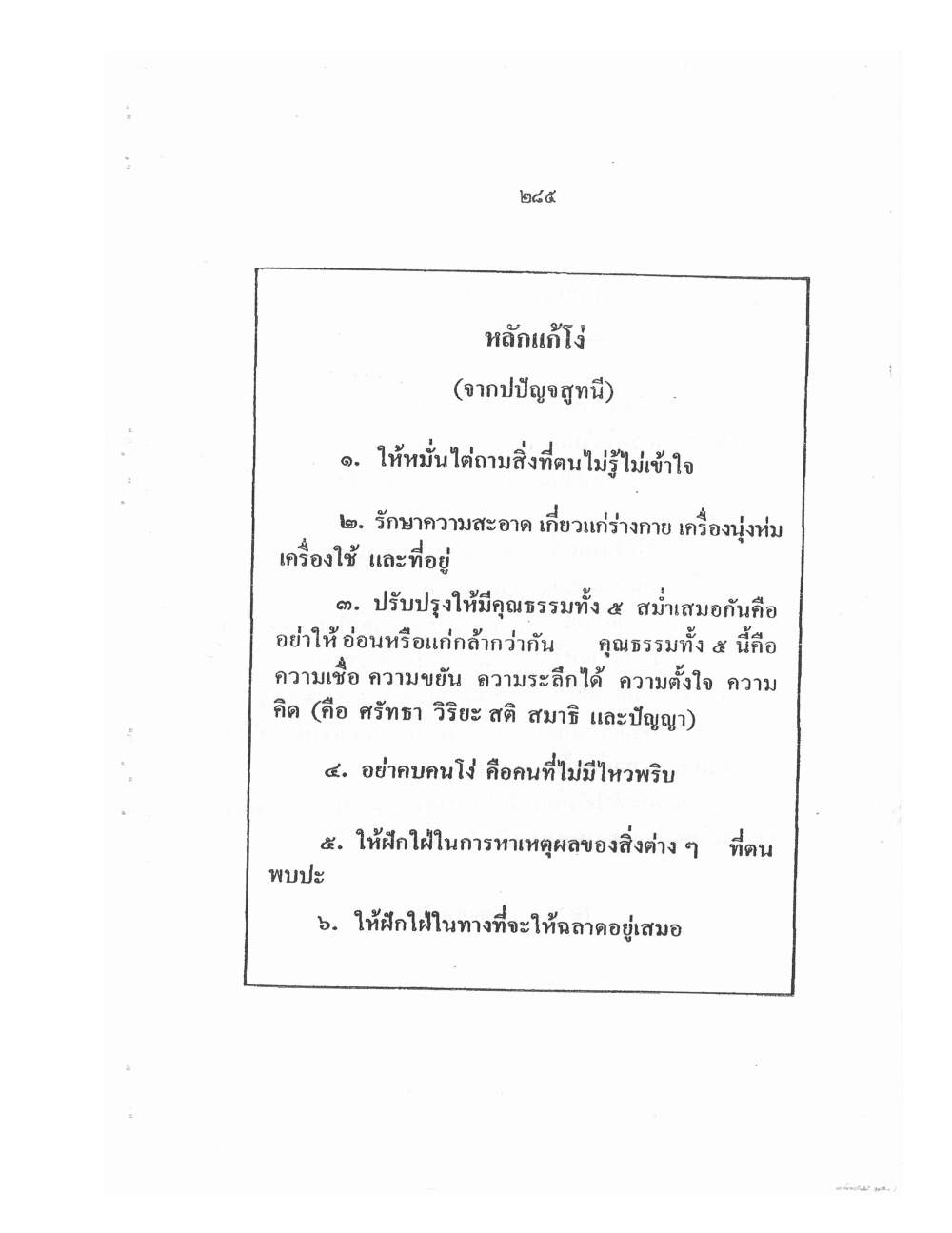
๒๘๕
[ภายในกรอบสี่เหลี่ยม:]
หลักแก้โง่
(จากปปัญจสูทนี)
๑. ให้หมั่นได้ถามสิ่งที่ตนไม่รู้ไม่เข้าใจ
๒. รักษาความสะอาด เกี่ยวแก่ร่างกาย เครื่องนุ่งห่ม เครื่องใช้ และที่อยู่
๓. ปรับปรุงให้มีคุณธรรมทั้ง ๕ สม่ำเสมอกันคือ อย่าให้อ่อนหรือแก่กล้ากว่ากัน คุณธรรมทั้ง ๕ นี้คือ ความเชื่อ ความขยัน ความระลึกได้ ความตั้งใจ ความ คิด (คือ ศรัทธา วิริยะ สติ สมาธิ และปัญญา)
๔. อย่าคบคนโง่ คือคนที่ไม่มีไหวพริบ
๕. ให้ฝักใฝ่ในการหาเหตุผลของสิ่งต่าง ๆ ที่ตน พบปะ
๖. ให้ฝักใฝ่ในทางที่จะให้ฉลาดอยู่เสมอ
285
[Inside a boxed frame:]
Principles for Curing Foolishness
(From the Papañcasūdanī)
1. Be diligent in asking about things one does not know or understand.
2. Maintain cleanliness, regarding the body, clothing, belongings, and one's dwelling.
3. Cultivate all five virtues so they are balanced and even — do not let any be weaker or stronger than the others. These five virtues are: faith, diligence, mindfulness, concentration, and wisdom (that is: saddhā, viriya, sati, samādhi, and paññā).
4. Do not associate with foolish people, that is, people who lack quick wit.
5. Devote oneself to seeking the reasons behind the various things one encounters.
6. Devote oneself always to the path that leads to wisdom.
๒๘๖
หลักแก้ความไม่สบายใจ
๑. ให้บริโภคอาหารที่ถูกกันกับร่างกายของตนคือไม่ทำให้ อึดอัด ฉุนเฉียวหรือไม่สบาย ๒. ให้หาที่อากาศเหมาะกับนิสัยใจคอ เป็นที่พักผ่อนหย่อน อารมณ์ ๓. ให้หาอิริยาบถที่สบาย ยืน เดิน นั่ง นอน ตามส่วนที่ เหมาะ อิริยาบถไหนสบายก็ถือเป็นหลัก ๔. ให้ทำตนเป็นกลาง ๆ ไม่พลอยดีใจ เสียใจเมื่อตนหรือ ผู้อื่นมีทุกข์ มีอันตรายหรือมีความก้าวหน้ามีความสุข โดยเชื่อ ในเรื่องกรรม และนึกถึงกรรมเป็นใหญ่ว่าเป็นกรรมของเขา ๕. คบแต่คนชอบสงบ ไม่คบคนที่ชอบเบียดเบียนผู้อื่น หรือชอบก่อความเดือดร้อนวุ่นวาย ๖. พยายามทำใจให้หนักไปในทางสงบกายสบายใจ นึกถึง คุณประโยชน์ของความสงบจนใจรักความสงบ
(จาก - ปปัญจสูทนี)
286
Principles for Relieving an Uneasy Mind
1. Eat food that agrees with your own body — that is, food that does not cause bloating, irritability, or discomfort. 2. Seek out surroundings suited to your temperament, as a place to rest and relax the emotions. 3. Seek out comfortable postures — standing, walking, sitting, lying down — as fits the occasion; whichever posture is comfortable, take that as the guiding rule. 4. Keep yourself neutral — do not let yourself feel glad or sad together with yourself or others when there is suffering, danger, or when there is progress and happiness — by believing in the matter of kamma, and holding kamma to be paramount, that it is that person's own kamma. 5. Associate only with people who love peace; do not associate with those who like to encroach on others or who like to stir up trouble and disturbance. 6. Try to incline the heart toward bodily calm and ease of mind; reflect on the benefits of calm until the mind comes to love calm.
(From — the Papañcasūdanī)
๒๘๗
บทที่ ๘ การฝึกปัญญา และวิปัสสนา
ความสำคัญของปัญญานั้นก็คือ เป็นเครื่องมือในการหา สิ่งที่ตนปรารถนา ได้แก่ ลาภ ยศ สรรเสริญและสุข เมื่อจะ พิจารณาในแง่ธรรมล้วน ๆ แล้ว ปัญญาทางธรรมหมายถึง ความ รู้ชั้นสูงสุด ความเห็นแจ้งชัดในธรรมชาติทั้งปวง ซึ่งเรียกว่า วิปัสสนาญาณ ปัญญามีความสำคัญคือ
๑. ปัญญาทำให้ได้ความแตกฉานใน เหตุ ผล ภาษา และ ไหวพริบ ๒. ปัญญาทำให้การดำเนินชีวิตเป็นไปในสายกลาง ไม่มี ทุกข์โศก และไม่หลงในสุข ๓. ปัญญาทำให้ละทิ้งนิสสัยชั่ว เลิกประพฤติสิ่งที่ไม่ดี ไม่ควร ๔. ปัญญาทำให้หลุดพ้นไปจากความเห็นที่ผิดทำให้เลิกล้ม แนวความคิดที่ผิดที่ไม่ถูกทาง ๕. ปัญญาทำให้เห็นความจริงทำให้เห็นความงามของพระ ธรรม ทำให้รู้รสพระธรรมอันแท้จริงได้
287
Chapter 8 Training Wisdom and Vipassanā
The importance of wisdom (paññā) is that it is a tool for finding what one desires — namely gain, status, praise, and pleasure. When considered purely from the standpoint of the Dhamma, wisdom in the Dhamma sense means the highest-level knowledge, the clear insight into all of nature, which is called vipassanā-ñāṇa. The importance of wisdom is as follows:
1. Wisdom gives mastery in cause, effect, language, and quick-wittedness. 2. Wisdom makes one's conduct of life proceed along the middle way, free of suffering and grief, and not lost in pleasure. 3. Wisdom makes one abandon bad habits, and give up behaving in ways that are not good or proper. 4. Wisdom frees one from wrong views, causing one to abandon mistaken, wrong-path lines of thinking. 5. Wisdom makes one see the truth, see the beauty of the Dhamma, and enables one to truly taste the genuine flavor of the Dhamma.
๒๘๘
๖. ปัญญาทำให้ละกิเลสอย่างหยาบจนถึงละกิเลสอย่าง ละเอียดทำให้ได้ผลดีตั้งแต่ขั้นต่ำจนถึงขั้นสูงสุด คืออรหัตตผล (เข้าถึงนิพพาน)
ปัญญาคืออะไร? มีกี่ชนิด
ปัญญาหมายถึง ความรู้ ความรอบรู้แตกฉาน ความรู้ชัดแจ้ง และไหวพริบ เมื่อจะแยกปัญญาออกเป็นชนิดเป็นจำพวกแล้วก็อาจแยกให้ เข้าใจได้ง่ายว่ามี ๒ ชนิดหรือ ๒ ประเภทคือ ๑. ปัญญาในทางโลก (โลกียปัญญา) คือความรู้ที่เราเล่า เรียนกันในทางโลกหรือความรู้ในพระธรรม ทั้งแปดหมื่นสี่พัน หมวดก็ดี ความรู้ที่ได้รับการสอนจากโรงเรียนต่าง ๆ ทุกประ- เภททุกแห่งก็ดีล้วนเป็นปัญญาในทางโลก เป็นปัญญาที่ยังมี อาสวะ (กิเลส) ซึ่งอาจจะแยกออกไปได้อีกเป็น ๒ อย่างคือ รู้ ในเรื่อง รูป และรู้เรื่อง นาม ๒. ปัญญาพ้นโลก (โลกุตตระปัญญา) เป็นความรู้ชนิด ซาบซึ้งตรึงแน่น, รู้ทะลุแทงตลอด รู้แจ้งเห็นจริงในธรรมชาติ ทั้งปวง หรือจะแยกเป็นรู้แจ้งชัดในเรื่องรูปและเรื่องนามก็ได้ ปัญญาชนิดนี้ทำให้หลุดพ้นจากความเย้ายวนของอารมณ์ต่าง ๆ เพราะรู้แจ้งในสภาพความจริงไม่ติด ไม่กังวล ไม่หวั่นไหว ไม่ แปรเปลี่ยนไปตามเหตุการณ์ต่าง ๆ ซึ่งมี รูป รส กลิ่น เสียง
288
6. Wisdom makes one abandon defilements from the coarse level down to the subtlest level, yielding good results from the lowest stage up to the highest — that is, the fruit of Arahantship (attaining Nibbāna).
What Is Wisdom? How Many Kinds Are There?
Wisdom (paññā) means knowledge, thorough and masterful understanding, clear knowledge, and quick-wittedness. When wisdom is divided into kinds or categories, it can be divided simply, for easy understanding, into 2 kinds or 2 types, namely: 1. Worldly wisdom (lokiya-paññā) — the knowledge we study in worldly matters, or knowledge of the Dhamma — whether all 84,000 sections of it, or knowledge taught in schools of every kind, everywhere — all of this is worldly wisdom. It is wisdom that still has āsava (defilements), and it may further be divided into 2 kinds: knowledge of form (rūpa) and knowledge of mentality (nāma). 2. Wisdom beyond the world (lokuttara-paññā) — knowledge of a kind that is deeply penetrating and firmly fixed, that knows through and through, that clearly realizes the truth in all of nature. It may also be divided into clear knowledge of form and of mentality. This kind of wisdom frees one from the allure of the various emotions, because clearly realizing the true condition, one is not attached, not anxious, not shaken, not changed according to the various events, which consist of form, taste, smell, sound,
๒๘๙
สิ่งสัมผัส และอารมณ์ในใจ (ซึ่งเรียกว่าอายตนะภายนอก ๖) ที่เป็นสื่อเป็นเครื่องเร้าเครื่องจูงใจ ปัญญาชนิดนี้เป็นเครื่องชำระ ล้างกิเลสให้หมดไปเข้าถึงพระนิพพานได้ จึงเรียกว่าปัญญาไม่มี อาสวะ หรือปัญญาไม่มีกิเลส หรือปัญญาพ้นโลก ปัญญาในทางโลก นั้นเข้าหาได้ง่ายคือ ต้องหมั่นศึกษา พิจารณาและจดจำเป็นเรื่อง ๆ ไป เช่นการเรียน อ่านหนังสือ เขียนหนังสือเรียนวิชาคำนวณ เรียนภาษาต่างประเทศ เรียน ตัดเสื้อ เรียนจักสาน เรียนซ่อมรถ หรือ เรียนพระธรรมในทาง พระพุทธศาสนา ก็ล้วนแต่เป็นการทำให้เกิดปัญญาในทางโลก ทั้งนั้น การฝึกจิตฝึกสมาธิศึกษาเล่าเรียนทางพระธรรมจนกระทั่ง สำเร็จถึงฌานที่ ๔ แล้วก็คงได้เพียงปัญญาในทางโลกหรือโลกีย ปัญญา และปัญญาชนิดนี้มีการเสื่อมถอยลงได้ ปัญญาพ้นโลก (โลกุตตระปัญญา) ซึ่งเป็นปัญญาขั้นสูงสุด นี้มีความแจ้งชัดตรึงแน่น ไม่มีการเสื่อมไม่มีถอยหลัง และไม่มี ทางที่จะก้าวหน้าต่อไปอีกเพราะสุดยอดแล้ว ปัญญาชนิดนี้จะเกิด ขึ้นได้ด้วย การเจริญวิปัสสนาขั้นสูง ซึ่งมีขั้นต่าง ๆ ๕ และ ๘ ขั้น ก่อนที่จะเจริญวิปัสสนาตามขั้นนี้จะต้องได้สมาธิถึงฌาน ๔ เสียก่อน หรือถ้าเป็นผู้มีบารมีดีก็ จะต้องถึงฌานที่ ๑ เป็นอย่าง น้อย จึงจะเจริญวิปัสสนาขั้นสูงนี้ได้โดยไม่ผิดพลาดแน่นอน เมื่อ สำเร็จวิปัสสนาแล้วจึงจะได้ปัญญาพ้นโลก ถ้าเจริญวิปัสสนา
289
touch, and mental objects (which are called the 6 external sense-bases), which serve as the media that stimulate and lure the mind. This kind of wisdom is what cleanses away defilements entirely, enabling one to reach Nibbāna; it is therefore called wisdom without āsava, or wisdom without defilement, or wisdom beyond the world.
Worldly wisdom is easy to attain — one need only diligently study, consider, and memorize things one by one, such as: studying, reading, writing, learning mathematics, learning foreign languages, learning tailoring, learning basket-weaving, learning to repair vehicles, or studying the Dhamma in Buddhism — all of these are simply ways of producing worldly wisdom.
Training the mind, training concentration, and studying the Dhamma until succeeding in reaching the 4th jhāna will still only yield worldly wisdom, or lokiya-paññā, and this kind of wisdom can degenerate and decline.
Wisdom beyond the world (lokuttara-paññā), being the highest level of wisdom, is firmly and clearly fixed; it has no decline, no regression, and no way to progress further, because it is already the utmost. This kind of wisdom can arise through the cultivation of advanced vipassanā, which has stages of 5 and of 8 steps. Before cultivating vipassanā according to these stages, one must first attain concentration up to the 4th jhāna; or, if one is a person of good pāramī, one need attain at least the 1st jhāna, in order to be able to cultivate this advanced vipassanā without error, for certain. Once vipassanā is accomplished, one then attains wisdom beyond the world. If one cultivates vipassanā
๒๙๐
ในระหว่างที่จิตไม่ถึงขั้นฌานดังกล่าวแล้วอาจจะทำให้เกิดการ ผิดพลาดขึ้นได้ ซึ่งบางทีก็หลงผิดไปว่าตนได้ปัญญาพ้นโลกแล้ว เรื่องนี้มีหลักฐานยืนยันหลายแห่ง ในทางพระพุทธศาสนา การฝึกจิตแบบต่าง ๆ นั้น ก็ล้วนมีความมุ่งหมายอย่าง เดียวกัน และเข้าบรรจบกันได้ดังกล่าวมาแล้วหลายแง่หลายมุม จะว่าเป็นการรวมจิตมาอยู่ที่เดียวเรื่องเดียวก็ได้ จะว่าทำจิตให้ ว่างเปล่าก็ได้ คือว่างจากอารมณ์อื่น ๆ ว่างจากเรื่องอื่น ๆ ว่างจาก ความวุ่นวายไม่คิดเรื่องอื่น ๆ เมื่อว่างจากเรื่องอื่น จิตก็จะสงบนิ่ง และเป็นสมาธิ จะว่าการฝึกจิตก็คือการปิดทวารทั้ง ๖ ก็ได้เพราะ เมื่อปิดได้แล้วจิตก็ไม่ฟุ้งซ่านออกไปคงสงบนิ่งอยู่ได้ จะว่าการฝึก จิตก็คือการทำลมหายใจให้ละเอียดก็ถูกเหมือนกัน เพราะลม หายใจละเอียดประสาทต่าง ๆ ก็พักผ่อนจิตก็สบายไม่ฟุ้งซ่าน จะฝึกจิตด้วยวิธีใด ๆ ก็ตามเมื่อจิตสงบขึ้นดีขึ้นลมหายใจก็จะ พลอยละเอียดขึ้นด้วย และเมื่อเราจับลมละเอียดชำนาญแล้ว ตั้งลมละเอียดขึ้นจิตก็จะนิ่งหรือเป็นสมาธิติดขึ้นมาด้วยทันที จะว่าการฝึกจิตก็คือการแก้นิวรณ์ ๕ หรือกำจัดนิวรณ์ ๕ ก็ได้ เพราะเมื่อจิตไม่มีนิวรณ์ จิตก็สงบนิ่งและมีกำลังเช่นกัน จะว่า การฝึกจิตก็คือการปฏิบัติเพื่อรู้แจ้งเห็นจริงในขันธ์ ๕ ก็ได้ เพราะ ถ้าพิจารณาให้เห็นจริงจังไม่ใช่เพียงแต่รู้อย่างเดียวจิตก็สงบได้ตาม ลำดับการเห็นจริง แม้ในที่สุดเมื่อเห็นจริงแจ่มชัดสิ้นสงสัยแล้ว ก็เป็นอันสำเร็จวิชาทางจิตขั้นสุดยอดแล้วคือ ถึงนิพพานหรือ
290
while the mind has not yet reached the level of jhāna described above, this may give rise to error, and one may sometimes mistakenly believe that one has already attained wisdom beyond the world. There is confirming evidence for this in many places within Buddhism.
The various methods of training the mind all share the same aim, and converge as already described from many angles and perspectives. One could say it is a matter of gathering the mind to rest on a single point, a single matter; one could say it is making the mind empty — that is, empty of other emotions, empty of other matters, empty of turmoil, not thinking of other things; when empty of other matters, the mind becomes calm and still, and enters concentration (samādhi). One could say that training the mind is closing the 6 doors [of the senses], because once closed, the mind no longer scatters outward and remains calm and still. One could equally say that training the mind is making the breath subtle, and this too is correct, because when the breath is subtle the various nerves rest, and the mind becomes at ease and does not scatter. By whatever method one trains the mind, when the mind grows calmer and better the breath will also grow subtler along with it; and once we have become skilled at catching the subtle breath, as soon as the breath is set subtle the mind will immediately become still, or samādhi will attach at once. One could say that training the mind is curing the 5 hindrances (nīvaraṇa), or eliminating the 5 hindrances, because when the mind is free of hindrances it is calm, still, and likewise possesses strength. One could say that training the mind is practice in order to realize and truly see the 5 aggregates (khandha), because if one contemplates so as to truly see — not merely know in a single way — the mind becomes calm in accordance with the sequence of true seeing. Even, in the end, when true seeing becomes utterly clear and all doubt is exhausted, this constitutes the accomplishment of the highest level of the science of mind — that is, reaching Nibbāna, or
๒๙๑
หมดกิเลสหมดอุปาทาน จะให้ความหมายหรือแนวทางการฝึกจิต ไปอย่างไรก็ตามถ้าถูกหลักเกณฑ์แล้วก็ย่อมไม่มีโทษและจะ บังเกิดผลร่วมกันลงรอยกันได้ทั้งนั้น
จิตไม่ใช่ลม ลมไม่ใช่จิต แต่จิตกับลมมีความสัมพันธ์กัน ลมละเอียดจิตก็สงบเป็นสมาธิ จิตเป็นสมาธิลมก็ละเอียด ความจริงจะว่าการฝึกสมาธิหรือฝึกจิตแบบสมถะนั้นคล้าย คลึงกับการฝึกวิปัสสนาก็นับว่าถูก เพราะการฝึกวิปัสสนา ก็คือ การฝึกเพื่อให้เกิดปัญญาเห็นประจักษ์แจ้งในสภาวะธรรม สภาพ ของสิ่งต่าง ๆ ตามความเป็นจริงหรือเห็นชัดว่าทุกอย่างเป็น อนิจจัง ทุกขัง อนัตตา แต่ก่อนจะเห็นชัดได้ก็ต้องมีสมาธิขั้นสูง เป็นฐานเสียก่อนความจริงจิตธรรมดาก็พอจะนึกรู้ แต่ไม่แจ้งชัด เห็นจริงจังเมื่อสมาธิดีขึ้นก็เห็นชัดขึ้นถีก ครั้นสำเร็จวิปัสสนาเป็น พระอรหันต์ ก็เห็นแจ่มชัดไม่ถอยหลัง สิ่งที่ต้องการรู้ต้องการ เห็นในการฝึกจิต ทั้งแบบสมถะแะวิปัสสนาก็เป็นสิ่งเดียวกัน คือรู้เห็นสภาพความเป็นจริงของสิ่งต่าง ๆ แต่รู้เห็นได้คนละขั้น ตามกำลังของสมาธิ สมาธิขั้นต้นก็พิจารณาเหมือนวิปัสสนา เป็น เครื่องช่วยให้จิตสงบลงสู่สายกลางพอควร แล้วจึงหยุดพิจารณา เพื่อให้สงบ เปรียบเหมือนจะมองดูกรุงเทพฯ ดูบนพื้นดินก็ เห็นขึ้นไปบนภูเขาทองก็เห็น ขึ้นบนเครื่องบินก็เห็น แต่เห็นไม่ เหมือนกัน
291
being free of all defilements and all clinging. Whatever meaning or approach one gives to the training of the mind, if it accords with the correct principles it is without fault, and all approaches will produce results that agree and converge together.
Mind is not breath, breath is not mind, but mind and breath are related to one another: when the breath is subtle, the mind is calm and in concentration; when the mind is in concentration, the breath is subtle.
In truth, to say that training in samādhi, or training the mind by the samatha method, is similar to training in vipassanā may be considered correct, because the training of vipassanā is training so as to give rise to wisdom that clearly and directly perceives the true nature of phenomena, the true condition of things as they really are, or clearly sees that everything is impermanent (anicca), suffering (dukkha), not-self (anattā). But before one can see this clearly, one must first have a high level of concentration as a base; in truth, an ordinary mind can conceive of it somewhat, but not with full clarity or true realization; as concentration improves, seeing becomes correspondingly clearer. Once vipassanā is accomplished and one becomes an Arahant, seeing becomes perfectly clear and does not regress. What one needs to know, what one needs to see, in training the mind — whether by the samatha method or the vipassanā method — is the same thing: knowing and seeing the true condition of things as they really are; but the degree to which one knows and sees differs stage by stage according to the strength of one's concentration. Basic-level concentration involves contemplation similar to vipassanā, serving as an aid to bring the mind down to a reasonably middle, calm state, after which one stops contemplating in order to rest calm. It is comparable to looking at Bangkok: viewed from ground level one sees it; viewed from atop the Golden Mount one sees it; viewed from an airplane one sees it — but the seeing is not the same.
๒๙๒
เมื่อทราบว่าวิปัสสนาก็ต้องอาศัยสมาธิเป็นฐานแล้ว ก็เป็น การสมควรที่จะทำความเข้าใจและสนใจ ในการที่จะลงมือฝึกจิต ให้ได้สมาธิไปโดยลำดับก่อน อุบายในการให้จิตเป็นสมาธิ ก็คือวิธีดำเนินการฝึกจิตและ แก้ไขจิตที่ไม่ยอมเป็นสมาธิ ดังที่ได้กล่าวมาแล้ว ซึ่งรวมการ ปฏิบัติตั้งแต่เริ่มต้นก็ตรงกับ อัปปนาโกศล ๑๐ (อุบายทำให้สมาธิ เกิด ๑๐ อย่าง) นั่นเอง แต่ไม่ได้ยกรูปเดิมมากล่าวเป็นข้อ ๆ ตาม หลักฐานในบาลีเพราะทำให้เข้าใจยาก จึงได้จัดลำดับและกล่าวให้ เข้าใจง่ายและเป็นแนวทางที่ใช้ปฏิบัติจริง ๆ อนึ่ง การพิจารณาทางวิปัสสนาก็เป็นการช่วยให้จิตเป็น สมาธิไปในตัวด้วยเหมือนกัน และใช้ช่วยแก้ไขจิตที่ฟุ้งซ่าน ดังที่กล่าวมาแล้วในเรื่องอุบายแก้ไขจิต ลำดับในการฝึกวิปัสสนานั้นแบ่งไว้เป็น ๕ ก็มี แบ่งไว้เป็น ๘ ก็มี
ลำดับวิปัสสนา ๕ ขั้น
เมื่อเราได้สำเร็จฌานขั้นที่ ๔ หรือความว่าง และอำนาจ พิเศษดังกล่าวไว้ในบทที่ ๑ แล้ว เราต้องเข้าสู่ฌานขั้นที่ ๔ หรือ ความว่างสักครู่หนึ่งแล้วถอยออกมานิดหนึ่งเพื่อใช้อำนาจจิต (ทิพพจักขุ หรือการเห็นทางใน) พิจารณาในร่างกายขฮงตน ชีวิตของตนและจิตของตนเป็นขั้น ๆ ดังต่อไปนี้ :-
292
Once one knows that vipassanā too must rely on concentration as its base, it is fitting to first come to understand and take interest in setting about training the mind so as to attain concentration in due order.
The method for making the mind into concentration is the way of proceeding with training the mind and correcting a mind that will not settle into concentration, as already described — and the practice, taken together from the very start, corresponds to the "10 skills of absorption" (appanā-kosala 10, the 10 methods for producing concentration). However, the original form is not presented item by item according to the Pāli sources, because that would make it hard to understand; it has therefore been arranged and explained in an order that is easy to understand and serves as a guide for actual practice.
Furthermore, contemplation by way of vipassanā also itself helps the mind settle into concentration, and is used to help correct a scattered mind, as already described in the section on methods for correcting the mind.
The sequence for training in vipassanā is, in some sources, divided into 5 stages; in others, into 8 stages.
The 5 Stages of Vipassanā
Once we have succeeded in reaching the 4th jhāna, or the state of voidness, and the special powers described in Chapter 1, we must enter the 4th jhāna, or voidness, for a moment, then withdraw slightly in order to use the power of the mind (the divine eye, or inner seeing) to contemplate one's own body, one's own life, and one's own mind, stage by stage, as follows:—
๒๙๓
๑. ตรวจสอบดูให้ละเอียดถี่ถ้วนทุกปีทุกวันและทุกขณะจิต จากปัจจุบันจนถึงขณะเกิดเป็นชีวิตขึ้นมาว่า ความเติบโต ความ สุข ความยุ่งยาก บาปบุญ ความรู้ความฉลาด ความรู้สึกฯ ได้ เปลี่ยนแปลงมาอย่างไร แล้วจึงตรวจในชีวิตที่เวียนเกิดเวียนตายมา แต่ก่อน ให้เห็นการเกิดการดับของตนและสัตว์อื่น ๒ พิจารณาให้ลึกซึ้งเช่นนั้น หลายครั้งหลายหนจนทำให้ พ้นจากความยึดมั่นว่าร่างกายในปัจจุบันนี้เป็นตน เพราะตาม ความจริงแล้วเป็นสิ่งที่ดำรงอยู่ชั่วเดี๋ยวเดียว (เมื่อเทียบกับจักร- วาล) และจิตตนเคยอาศัยร่างกายอื่นมาหลายร่างหลายชีวิต ไม่ได้ เป็นเจ้าของร่างใด พิจารณากายและใจนี้ ให้เห็นว่า เป็นของไม่เที่ยง มีการแปรเปลี่ยน เปลี่ยนอยู่ตลอดเวลา ทุกขณะจิตทั้งร่างกายและจิตใจ เพราะว่าอวัยวะทุกส่วน ทุกจุด ทุกเซลล์ในร่างกาย กำลังไหวเคลื่อน กำลังเปลี่ยนแปลง กำลังแก่ กำลังเจ็บและกำลังตาย ไม่มีการหยุดยั้งเลย เป็นทุกข์ ไหวเคลื่อนอยู่มิขาดสาย ทนอยู่ไม่ได้ จำเป็นต้อง แปรเปลี่ยนอยู่เสมอ ไม่อาจที่จะหยุดนิ่งได้แม้แต่เดี๋ยวเดียว ฉะนั้น ความแก่ ความเจ็บ (ปวดเจ็บ เสียใจ ฯลฯ) และความตายจึง จำต้องมีแน่เลี่ยงไม่ได้ เป็นอนัตตา ไม่ใช่ตน เป็นของว่างเปล่า ไม่มีเจ้าของ เวียน ไปสู่ชีวิตใหม่ไม่หยุดหย่อน จะบังคับควบคุมให้เป็นไปตามใจชอบ ไม่ได้
293
1. Examine thoroughly, in fine detail, every year, every day, and every mind-moment, from the present back to the moment life first arose: how growth, happiness, difficulty, sin and merit, knowledge and cleverness, feelings, etc., have changed over time. Then examine the lives one has cycled through, birth after death, from before, so as to see the arising and ceasing of oneself and of other beings. 2. Contemplate as deeply as this, many times over, again and again, until one is freed from the clinging belief that this present body is one's self — because in truth it is something that endures only for a fleeting moment (when compared to the cosmos), and one's mind has in the past inhabited many other bodies, many other lives, and has not been the owner of any body. Contemplate this body and mind so as to see that: It is impermanent — it undergoes change, changing constantly, at every mind-moment, both body and mind, because every part, every point, every cell in the body is moving, changing, aging, sickening, and dying, without ever stopping at all. It is suffering — moving without break, unable to endure as it is, necessarily always changing, unable to remain still even for a single moment; therefore aging, sickness (pain, sorrow, etc.) and death are bound to occur, unavoidably. It is not-self (anattā) — not a self, an empty thing, without an owner, cycling on into new lives without ceasing; it cannot be forced or controlled to go according to one's own wishes.
๒๙๔
๓. พิจารณาจิตใจและร่างกายว่าเป็นสิ่งที่น่ารังเกียจ แล้ว พิจารณาว่าเป็นสิ่งที่น่าเบื่อหน่ายสะอิดสะเอียน แล้วพิจารณาว่า เป็นสิ่งที่น่ากลัว ๔. พิจารณาซ้ำทั้ง ๓ ขั้นมาก ๆ ครั้ง จนมีความชำนาญ และสามารถเห็นแจ่มชัดทันทีแล้ววางเฉยต่อกายและใจอันประ- กอบไปด้วยกิเลส แล้วคิดหาทางรอดพ้นจากการแก่ การเจ็บ และการตาย ๕. ทำขั้นที่ ๔ ซ้ำหลาย ๆ ครั้ง จะเกิด "ยอดปัญญา" รู้ ทางที่จะรื้อถอนเอากิเลสทั้งปวงออกจากใจ ซึ่งทำให้หลุดพ้น ออกจาก การแก่ การเจ็บ การตายได้โดยเด็ดขาด (บางแห่งกล่าววิปัสสนา ๕ ขั้น ต่างไปจากนี้ ก็มีแต่คล้าย ๆ กัน) การฝึกทั้ง ๕ ขั้นนี้ เรียกว่า "การฝึกวิปัสสนา" ขั้นสูง ซึ่งจะสำเร็จได้ด้วยปัญญาหรือวิชาคืออย่างน้อยต้องได้ วิชาสาม เป็นการฝึกเพื่อยอดปัญญา บางท่านก็รอดพ้นจากความแก่ ความ เจ็บ ความตาย ทั้งในชาตินี้และชาติหน้า กล่าวคือเมื่อได้ฌาน ขั้นสูงสุดหรือความว่างอันแท้จริง ใช้อำนาจจิตในขั้นนี้ได้แล้ว อยู่ในฌานหรือความว่างเป็นประจำตามเกณฑ์จะทำให้ร่างกาย คงที่อยู่ไม่เปลี่ยนแปลง ไม่มีการแก่ การเจ็บ การตาย จนกว่า จะถึงวาระสุดท้าย ซึ่งนับเป็นเวลาหลายร้อยปี เมื่อเห็นว่าไม่ควร อาศัยร่างอยู่ต่อไปแล้ว ก็แยกวิญญาณออกไปอยู่ในสถานอัน
294
3. Contemplate mind and body as things that are repulsive; then contemplate that they are things wearisome and disgusting; then contemplate that they are things to be feared. 4. Repeat all 3 stages above many, many times, until skilled and able to see clearly at once; then remain equanimous toward body and mind, which are laden with defilements; then think of a way to escape from aging, sickness, and death. 5. Do stage 4 repeatedly, many times, and there will arise "supreme wisdom" — knowledge of the way to uproot and remove all defilements from the heart, which brings about definitive liberation from aging, sickness, and death. (In some sources the 5 stages of vipassanā are described somewhat differently from this, but they are all similar.) This training in all 5 stages is called "advanced vipassanā training," which can be accomplished by wisdom or knowledge — at minimum one must attain the threefold knowledge (tevijjā) — as training toward supreme wisdom. Some practitioners escape from aging, sickness, and death both in this life and in the next life; that is to say, once one has attained the highest jhāna, or true voidness, and is able to use the power of mind at this level, remaining in jhāna or voidness regularly, as a rule, will cause the body to remain fixed and unchanging, without aging, sickness, or death, until the final moment arrives — which may be reckoned as many hundreds of years. When one sees that it is no longer fitting to continue relying on the body, one then separates one's consciousness to dwell in a state of
๒๙๕
บรมสุข ซึ่งเรียกว่า สวรรค์ชั้นพรหม แต่ถ้าฝึกวิปัสสนาจนได้ ถึงยอดปัญญาอีกแล้ว ก็จะเข้าสู่นิพพาน บางท่านฝึกทางลัด เมื่อสำเร็จฌานขั้นต้นหรือเริ่มจะถึง ฌานแล้วก็ฝึกวิปัสสนาเลย ไม่สนใจในการใช้อำนาจจิตเมื่อได้ ยอดปัญญาแล้วก็หลุดพ้นจากความแก่ ความเจ็บและความตาย เฉพาะในชาติถัดไป คือไม่มีอำนาจพิเศษที่จะยับยั้งความแก่ ความเจ็บ ความตายในชาตินี้ได้ แต่เมื่อตายแล้วก็เข้าสู่นิพพาน อาจารย์บางคนไม่พิจารณาพระไตรปิฎกโดยถี่ถ้วน มัก จะเข้าใจผิดคิดดัดแปลงวิธีฝึกใหม่ซึ่งเป็นวิธีที่ฝ่าฝืนแนวการ ปฏิบัติอันถูกต้องเลยพาให้ผู้อื่นหลงผิดตามไปด้วยเป็นจำนวน มากทีเดียว เป็นต้นว่า เริ่มฝึกวิปัสสนาเสียก่อนการได้สมาธิ ตามควร ซึ่งเป็นการข้ามขั้นและในที่สุดก็ฝึกแทบแย่แต่ไม่ได้ ผลอะไรเลย นอกจากผลจอมปลอมตั้งเอาเองตามชอบใจ
แนวทางปฏิบัติอันถูกต้องนั้น คือ ศีล - สมาธิ - และปัญญา ในการฝึกใช้อำนาจจิตหรือฝึกสมาธิขั้นต้นก็จำเป็นต้องมีศีลธรรม ที่ดี บางข้อเท่าที่จะพอปฏิบัติได้ แต่ การฝึกสมาธิขั้นกลาง และขั้นสูงนั้นควรมีศีล ๕ ครบบริบูรณ์จึงจะฝึกได้ผลเร็ว นักปฏิบัติต้องจดจำหลักวิชาเพียงเล็กน้อยก็พอ เมื่อสำเร็จขั้น ฌานก็จะเกิดปัญญาพิเศษ สามารถรู้ได้ทุกสิ่งทุกอย่างดีกว่าตำรา ทุกเล่มในโลกมารวมกันเสียอีก ดังมีตัวอย่างจริงในปัจจุบันหลาย
295
supreme bliss, which is called the Brahmā heaven. But if one has trained in vipassanā until reaching supreme wisdom as well, one then enters Nibbāna.
Some practitioners train by a shortcut: once they succeed in the initial jhāna, or are beginning to reach jhāna, they go straight to training in vipassanā, without concerning themselves with using the power of the mind. Once they attain supreme wisdom, they are freed from aging, sickness, and death only starting from the next life — that is, they have no special power to hold back aging, sickness, and death in this present life, but once they die they enter Nibbāna.
Some teachers, without examining the Tipiṭaka thoroughly, often misunderstand and devise new, modified methods of training that go against the correct line of practice, thereby leading a great many other people astray along with them. For example: beginning to train in vipassanā before attaining adequate concentration — which is skipping a stage — and in the end one practices almost to exhaustion but gains no result at all, apart from a counterfeit result set up according to one's own liking.
The correct path of practice is: sīla (virtue) – samādhi (concentration) – and paññā (wisdom). In training to use the power of mind, or training in basic-level concentration, it is necessary to have good moral virtue — some precepts, to the extent one can manage to practice. But for training in intermediate and advanced-level concentration, one should have all 5 precepts complete, in order to train and get results quickly. The practitioner need only memorize a small amount of doctrine — that much is enough. Once one succeeds in reaching the jhāna stage, special wisdom will arise, able to know all things better than every textbook in the world combined. There are real examples of this at present, many
๒๙๖
ท่านที่ไม่ต้องมีตำราไม่ต้องมีการจดช่วยความจำ แต่รู้ทุกวิชา ในโลกได้ ตอบได้ถูกต้องและทำได้ถูกต้องตรงจุดหมายเสมอ
ลำดับวิปัสสนา ๘ ขั้นได้แก่
๑. เจริญญาณที่ ๑ (การรู้จักความเกิดและความดับของ นามรูป) พิจารณาแยกรูป แยกนามให้เห็นเป็นไตรลักษณ์ และ สังเกตลักษณะการเกิดและการดับที่ปรากฏจนจิตตั้งมั่นอยู่ใน เรื่อง การเกิดการดับแห่งนามรูป
๒. เจริญญาณที่ ๒ (ให้เห็นความดับของสังขาร) คำนึงถึง ความดับแห่งจิตอันมีรูปเป็นอารมณ์ว่าเป็นของไม่เที่ยง, เป็น ทุกข์, ไม่ใช่ตนควรเบื่อหน่าย ควรคลายความรัก ไม่ควรยึดถือ มั่นพิจารณาให้เห็นความดับไปของสังขารทั้งปวง
๓. เจริญญาณที่ ๓ (ให้เห็นสังขารว่าเป็นของน่ากลัว) ให้ เจริญญาณที่ ๒ ให้มากก็จะเห็นความเกิดความดับของสังขาร ชัดขึ้น และจะเห็นว่าเป็นของน่ากลัว เป็นของว่างเปล่าไม่มี เจ้าของ
๔. เจริญญาณที่ ๔ (การเห็นโทษ) ให้เจริญญาณที่ ๓ ให้ มาก จะเห็นสังขารล้วนเป็นของไม่ดี เห็นความเป็นไปและการเกิด แห่งสังขารว่าเป็นทุกข์ ความไม่เกิดเป็นสุข
296
respected individuals who need no textbooks and no notes to aid their memory, yet can know every subject in the world, always answering correctly and acting correctly, exactly on target.
The 8 Stages of Vipassanā Are:
1. Developing the 1st insight-knowledge (knowing the arising and ceasing of mentality-materiality/nāma-rūpa): Contemplate, separating out form (rūpa) and separating out mentality (nāma), so as to see them as the Three Characteristics, and observe the characteristics of arising and ceasing as they appear, until the mind becomes firmly established in the matter of the arising and ceasing of nāma-rūpa.
2. Developing the 2nd insight-knowledge (seeing the ceasing of conditioned formations/saṅkhāra): Reflect on the ceasing of the mind that has form as its object, [seeing] that it is impermanent, that it is suffering, that it is not-self; one should feel weariness toward it, should let attachment fade, should not cling and hold to it firmly; contemplate so as to see the ceasing of all conditioned formations.
3. Developing the 3rd insight-knowledge (seeing conditioned formations as fearsome): By developing the 2nd insight-knowledge abundantly, one will see the arising and ceasing of conditioned formations more clearly, and will see that they are fearsome, an empty thing without an owner.
4. Developing the 4th insight-knowledge (seeing the danger): By developing the 3rd insight-knowledge abundantly, one will see that conditioned formations are entirely undesirable; one sees that the occurrence and arising of conditioned formations is suffering, and that non-arising is happiness.
๒๙๗
๕. เจริญญาณที่ ๕ (ความรู้สึกเบื่อหน่าย) ให้เจริญญาณ ที่ ๔ ให้มากแล้วจะรู้สึกเบื่อหน่ายสังขารทั้งปวง ยินดีแต่ในความ ไม่มีสังขาร
๖. เจริญญานที่ ๖ (ความรู้สึกอยากพ้น) ให้เจริญญาณที่ ๕ ให้มาก จะเกิดความรู้สึกอยากพ้นจากสังขารทั้งปวง
๗. เจริญญานที่ ๗ (ความรู้จักพิจารณา) หมายถึงพิจารณา หาทางที่จะหนีพ้นจากสังขาร พิจารณาให้เป็นไตรลักษณ์ให้เห็น ความเกิดดับ เห็นความว่างไม่มีเจ้าของแห่งสังขาร
๘. เจริญญาณที่ ๘ (ความเพิกเฉยในสังขาร) คือไม่ดีใจ ไม่เสียใจไม่รักไม่เกลียดในสังขารทั้งปวง โดยกำหนดให้เห็น เป็นของว่างเปล่า เปล่าจากความเป็นตัวตนเปล่าจากความสุข ความทุกข์
๙. เจริญญาณที่ ๙ (ความรู้สมควรแก่สัจจะ) ให้เจริญญาณ ที่ ๘ ให้มาก แล้วจิตจะตั้งมั่นเห็นไตรลักษณ์ชัดเจนแจ่มแจ้ง
เรื่องวิปัสสนาเป็นเรื่องที่ละเอียดสุขุม
แต่เมื่อมีสมาธิเป็นฐานดี แล้วก็จะเป็นการต่อเนื่องขึ้น ได้เอง ไม่ต้องห่วงกังวลว่าเป็นของยากจนพ้นวิสัยที่จะทำ ได้ ไม่ต้องห่วงว่าจะต้องท่องจำหัวข้อต่าง ๆ จำไม่ได้ก็ไม่เป็น
297
5. Developing the 5th insight-knowledge (feeling of weariness): By developing the 4th insight-knowledge abundantly, one will come to feel weariness toward all conditioned formations, taking delight only in the absence of conditioned formations.
6. Developing the 6th insight-knowledge (feeling the wish to be free): By developing the 5th insight-knowledge abundantly, there will arise a feeling of wishing to be free from all conditioned formations.
7. Developing the 7th insight-knowledge (knowledge of how to contemplate): This means contemplating so as to find the way to escape from conditioned formations; contemplating so as to see them as the Three Characteristics, so as to see arising and ceasing, so as to see the emptiness, the ownerlessness, of conditioned formations.
8. Developing the 8th insight-knowledge (equanimity toward conditioned formations): That is, neither gladness nor sorrow, neither love nor hatred, toward all conditioned formations, by determining to see them as an empty thing — empty of selfhood, empty of happiness and suffering.
9. Developing the 9th insight-knowledge (knowledge fit for realizing the truth): By developing the 8th insight-knowledge abundantly, the mind becomes firmly established, seeing the Three Characteristics clearly and distinctly.
The subject of vipassanā is a subtle and refined matter.
But once there is good concentration as a base, it will then continue to develop of its own accord. There is no need to worry that it is something so difficult as to be beyond one's ability to do; there is no need to worry about having to memorize the various topics by rote — if one cannot remember them, it does not matter [text continues on next page]
เหตุขัดข้วาง การฝึกจิตทำนองเดียวกับการเห็นบันไดสูงถึง ๒๐๐๐ ขั้น ย่อมจะรู้สึกว่าน่ากลัวขึ้นไม่ไหว ครั้นขึ้นไปถึงขั้น ที่ ๔ ก็จะรู้สึกว่าการขึ้นสู่ขั้นที่ ๕ ก็ง่าย ๆ ไม่ยากเลยเมื่อไป ถึงขั้นที่ ๔๑ ก็จะรู้สึกว่าการขึ้นสู่ขั้นที่ ๔๒ ก็ง่ายดังนี้เรื่อย ๆ ไป จนถึงขั้นสุดท้ายก็ไม่พบว่ามีความยากลำบากอะไร แต่ถ้า ฝึกข้ามขั้นโดยขึ้นสู่วิปัสสนาเลย ไม่สร้างสมาธิเป็นฐานไปโดย ลำดับ กล่าวคือพยายามพิจารณานึกคิดให้เห็นการเกิดการดับ โดยไม่ทำจิตให้เป็นสมาธิ
การฝึกปัญญาและวิปัสสนาก่อนก็ย่อมมีหวังผิดพลาดขาด ความสำเร็จ บางวิธีที่ฝึกจิตแบบวิปัสสนาแต่เริ่มแรกก็เป็นการ ปลูกสร้างสมาธิไปในตัวทั้งนั้น เมื่อสมาธิแก่กล้าวิปัสสนานั้นจึงจะ เป็นองค์วิปัสสนาที่แท้จริงได้
ถาม : ขอให้ยกตัวอย่างวิญญาณเรื่องการพบปะหรือ พิสูจน์เรื่องวิญญาณมาให้ดูสักอย่างพร้อมกับบอกสถานที่ที่จะไป ทดลอง?
ตอบ : ขอยกตัวอย่างคือวิญญาณคู่พูดตอบคำถามให้ได้ยิน ชัดเจน เรียกเงินและพระให้ตกลงมาได้ทำอภินิหารแปลก ๆ ได้ ผู้เขียนได้เคยพบเห็นเรื่องวิญญาณมีวิธีพิสูจน์หลายอย่าง เช่นเคยไปทดสอบซักถามวิญญาณ ใครจะถามก็ตอบดัง ๆ ได้ แต่เห็นร่างของวิญญาณได้บ้าง บางคนเท่านั้น คนทั่วไปได้ยิน
Obstructing factors: Training the mind is similar to seeing a staircase as high as 2,000 steps -- one would feel too frightened to climb it. But once one reaches step 4, one feels that climbing to step 5 is quite easy, not difficult at all. When one reaches step 41, one feels that climbing to step 42 is likewise easy, and so on continuously, until by the final step one finds no difficulty at all. But if one trains by skipping steps and going straight to vipassana (insight), without building samadhi (concentration) as a foundation step by step -- that is, trying to contemplate and reflect so as to see arising and ceasing without first making the mind concentrated --
training in wisdom and vipassana first is likely to lead to mistakes and failure. Some methods that appear to train the mind in vipassana style from the very beginning are, in fact, all building samadhi within themselves regardless. Only when samadhi has matured can that vipassana then become genuine vipassana.
Question: Please give an example concerning a spirit being encountered, or proof concerning spirits, to see for ourselves, along with the place where we could go to test it.
Answer: Let me give an example -- a paired spirit that speaks and answers questions audibly and clearly, that can call money and Buddha images down to fall, and perform other strange wonders. The writer has personally encountered matters concerning spirits, with several methods of proof -- such as having gone to test and question a spirit, where whoever asked, it would answer aloud. But only some people could see the form of the spirit; ordinary people could only hear it --
แต่เสียงชัดเจน นางสาวลัดดา มั่งประสิทธิ์ ซึ่งมีวิญญาณมา ติดตาม เมื่อปี ๒๕๐๐ เรียกว่านางน้ำพุ หนังสือพิมพ์บางกอกไทม์ ได้ทำเรื่องราวมาลง และลงรูปกำลังทำน้ำพุ นางสาวลัดดาฯ อยู่ บ้านวังเย็น จ.ราชบุรี อยู่ใกล้วัดหลวง ซึ่งอยู่ติดถนนสายใหม่ทาง ไป อ.ดำเนินสะดวก ปี ๒๕๐๐ ผู้คนหลายจังหวัดแตกตื่นไปดู นางน้ำพุ และขอน้ำพุมารักษาโรค ทางการได้ให้เจ้าหน้าที่ไป พิสูจน์หลายครั้งลงความเห็นว่าหลอกลวง จึงฟ้องศาลว่า หลอกลวงประชาชน เจ้าหน้าที่ให้การว่าดำน้ำลงดูเห็น นางสาว ลัดดาฯ (นางน้ำพุ) แกว่งเท้าในน้ำ เจ้าหน้าที่แกว่งให้น้ำพุ่งมาได้แต่ ไม่ได้ดีเท่า จึงลงความเห็นว่าหลอกลวง จนถึงศาลฏีกาให้รอลง อาญา ๕ ปี เรื่องจึงเงียบหายไป
แต่ก็เงียบหายไปทำนองกับผู้เขียน ต้องสงบเงียบในปี ๒๕๐๓ ที่ถูกกล่าวหาเป็นทางการว่ารักษาโรคมะเร็งหลอกลวง เอาเงินราษฎร เราสงบอยู่เพื่อรอโอกาสอันควรที่จะทดลองให้ เห็นจริงจังไม่หักหน้าของทางการ
บัดนี้ถึงเวลาที่จะพิสูจน์ทดลองแล้ว ผู้เขียนจึงรับพิสูจน์ ทดลองเพื่อความเข้าใจความจริงที่ถูกต้อง และนำอำนาจคุณพระ ไปใช้ให้เกิดประโยชน์ต่าง ๆ ผู้เขียนได้ลองเชิญวิญญาณที่แฝง นางสาวลัดดาฯ มาถามแล้วไปพิสูจน์ทดลองวิญญาณเมื่อ ๒๓
-- but the sound was clear. Miss Ladda Mangprasit, who had a spirit following/accompanying her from the year 1957 (BE 2500), was called 'the fountain woman.' The Bangkok Times newspaper ran a story on it and printed a picture of her while she was producing the fountain. Miss Ladda lived at Ban Wang Yen, Ratchaburi Province, near Wat Luang, which stands beside the new road leading toward Damnoen Saduak district. In 1957, people from many provinces rushed excitedly to see the fountain woman and to ask for the fountain water to cure illness. The authorities sent officials to investigate several times, and they concluded it was a deception; they therefore brought suit in court for deceiving the public. The officials testified that when they dove underwater to look, they saw Miss Ladda (the fountain woman) swishing her foot in the water; when the officials themselves swished the water they could make it spurt up, but not as well -- so they concluded it was a fraud. The case went as far as the Supreme Court, which handed down a five-year suspended sentence, and the matter then died down.
But it fell silent for the writer too, in a similar way -- I had to remain quiet in 1960 (BE 2503), when I was officially accused of fraudulently treating cancer to take the public's money. We stayed calm, waiting for a suitable opportunity to demonstrate the truth convincingly, without embarrassing the authorities.
Now the time has come to prove and test it. The writer therefore accepted the challenge of proof and demonstration, in order to establish the correct truth, and to put the power of Buddha-virtue to various beneficial uses. The writer tried inviting the spirit that accompanies Miss Ladda to come and be questioned, and then went to test and prove the spirit on the 23rd of --
มกราคม ๒๕๑๔ นี้เอง โดยให้คนไปตามมาที่วัดหลวง ท่านเจ้า อาวาสคุ้นเคยกับครอบครัวนางสาวลัดดาฯ และให้ใช้วัดเป็นที่ เรียกวิญญาณมาซักถามรักษาโรค – ดูเหตุการณ์ เรียกเหรียญบาท ให้ตกมา เรียกพระให้ตกลงมาได้ ฯลฯ วิญญาณมาจะได้ยินเสียง คล้ายคนเป่านกหวีด หรือเป่าปากก้ำกึ่งกันแต่ไม่เหมือนนกหวีด ธรรมดา ไม่เหมือนเสียงเป่าปากธรรมดา เสียงดังชัดหลายครั้ง ต่อไปวิญญาณจะมาอยู่ข้าง ๆ นางสาวลัดดาฯ ซึ่งเวลานี้คนส่วน มากเรียกกันว่า นางน้ำเดือด ในวันที่ผู้เขียนและคณะไป ได้มี เสียงดังหวีดหลายครั้งและซักถามกันหลายเรื่องดูของหาย และ เรียกเงินบาทตกลงมา ๒ เหรียญ พระตกลงมา ๓ องค์ เสียง วิญญาณตอบคำถามชัดเจน ที่เกิดของเสียงอยู่ห่างจากตัวคนบ้าง อยู่ข้างเอวของลัดดาบ้าง
ใครสงสัยเรื่องวิญญาณหากสนใจจริง เห็นว่าเป็นประโยชน์ ยินดีพาพิสูจน์ ควรใช้ปัญญาใช้ความรอบคอบจึงจะรู้ความเป็นจริง ได้ ถ้าเรามัวสนใจแต่เรื่องวัตถุ เรื่องหลักวิชาทางเดียว ไม่สนใจ ทางจิตโลกเราก็จะยุ่งยากเดือดร้อนกันมากขึ้นทุกที อาจารย์ ทางจิตที่มีสมาธิสูงกำลังเริ่มจะสละเวลาทำความกระจ่างทางจิตใจ กันแล้ว มิฉะนั้นคนฉลาดขึ้น รู้มากขึ้นแปลคำสวดมนต์ที่พระ สวดอยู่ทุกวันตามสถานที่ต่าง ๆ และตามบ้านก็จะหมดความ เชื่อถือทางศาสนามากขึ้นทุกที เพราะที่พระสวดมนต์ขึ้นต้นว่า
-- this very January, 1971 (BE 2514), by sending someone to fetch [the spirit] at Wat Luang. The abbot was well acquainted with Miss Ladda's family and allowed the temple to be used as the place for summoning the spirit to question it about healing -- to observe events, to call for baht coins to fall, to call for Buddha images to fall, etc. When the spirit came one would hear a sound like a person blowing a whistle, or blowing through pursed lips halfway -- yet unlike an ordinary whistle, unlike an ordinary lip-whistling sound -- a loud, clear sound repeated many times. After that the spirit would come and stay beside Miss Ladda, whom most people now call 'the boiling-water woman.' On the day the writer and the group went, there were several loud whistling sounds, and we asked about many matters, looked for lost items, and called for baht coins to fall -- 2 coins fell, and 3 Buddha images fell. The spirit's voice answered questions clearly; the source of the sound was sometimes some distance from the person's body, sometimes near Ladda's waist.
Anyone who doubts the matter of spirits, if genuinely interested and sees it as worthwhile, we are glad to take them along to witness the proof. One should use wisdom and thoroughness in order to know the truth. If we concern ourselves only with material things, with a single field of knowledge, and pay no attention to the mind, our world will grow more and more troubled. Teachers of the mind with high samadhi are now beginning to devote time to clarifying matters of the mind; otherwise, as people grow cleverer and more knowledgeable and translate the chants that monks recite daily in various places and in homes, they will lose more and more faith in religion -- because the chant the monks begin with says --
สัคเคกฺเม......ก็เป็นบทเชิญเทวดา เชิญวิญญาณต่าง ๆ มา บท พาหุงฯ ก็ว่าถึงชัยชนะโดยการใช้พลังจิตอย่างสูงถึง ๘ ครั้ง อย่าง ไม่น่าเชื่อ บทอื่น ๆ ก็มีบทไล่ผีไล่เปรต บทกันสัตว์ร้าย บท เสกยา บทรักษาโรคฯ โดยใช้พลังจิต
ฉะนั้นคนไม่เชื่อวิญญาณ ซึ่งเป็นจิตนั่นเองไม่เชื่อจิตไม่ เชื่อวิญญาณก็ย่อมไม่เชื่อ พลังจิตขั้นสูงไม่เชื่อบุญบาป นั่นคือไม่ เชื่อคำสวดมนต์ของพระ หรือเห็นว่าพระพูดโกหกสวดโกหก จึงกล่าวได้ว่าคนไม่เชื่อจิตหรือวิญญาณ ไม่เชื่อพลังจิตว่าใช้ ประโยชน์ต่าง ๆ ได้ ก็จะทำให้เป็นคอมมิวนิสต์มากขึ้นทุกที แล้วก็จะช้ำใจที่คอมมิวนิสต์ เขาใช้พลังจิตโดยไม่ให้คนที่ถูกเขา ใช้รู้ตัว ถึงคราวหรือยังจะส่งเสริมเรื่องจิตวิญญาณ และพิจารณา ให้เห็นจริงจังเสียที
วิญญาณที่มาติดตามนาวสาวลัดดามี ๒ วิญญาณ เป็นหญิง หนึ่ง ชายหนึ่ง และแสดงผลไม่เหมือนกับวิญญาณเข้าสิงหรือ เข้าทรงในตัวคน ดังที่ได้รู้เห็นกันเป็นส่วนมาก คือคนทรงนั้น พูดออกมา ส่วนวิญญาณติดตามแบบนี้เคยมีมาครั้งหนึ่งที่อยุธยา เป็นประเภทลักยม มี ๒ ตัว เป็นเด็กแต่มาพูดให้ได้ยินชัดและ ทำอะไรได้แปลก ๆ มีเสียงเกิดขึ้นโดยไม่อาศัยปากคนพูด
'Sakke-me...' [the opening Pali formula] is itself a verse for inviting deities, inviting various spirits to come. The Phahung verse likewise speaks of victory won through the use of mental power as many as 8 times, almost unbelievably. Other verses include ones for driving away ghosts and hungry ghosts (pret), verses for warding off dangerous animals, verses for charming medicine, and verses for curing disease -- all through the use of mental power.
Therefore, a person who does not believe in spirits -- which is the mind itself -- does not believe in the mind; not believing in spirits naturally means not believing [in the mind]. One whose mental power is at a high level yet does not believe in merit and sin, that is, does not believe the monks' chanting, or thinks the monks are lying when they chant -- it can thus be said that a person who does not believe in mind or spirit, who does not believe mental power can be put to various beneficial uses, will grow more and more like a communist. Then such a person will feel bitter that communists use mental power without letting the people they use it on realize it. It is high time to promote the matter of mind and spirit, and to examine it seriously so as to see it clearly at last.
The spirits that came to accompany Miss Ladda number two -- one female, one male -- and they manifest differently from a spirit that possesses or enters a medium in a person's body, as is commonly known, where it is the medium who speaks the words aloud. As for spirits that accompany in this other manner, there was once a case at Ayutthaya, of the 'lak-yom' type [a class of spirit], numbering two, appearing as children, yet able to speak so as to be heard clearly and to do other strange things -- a sound arising without depending on any person's mouth to produce it.
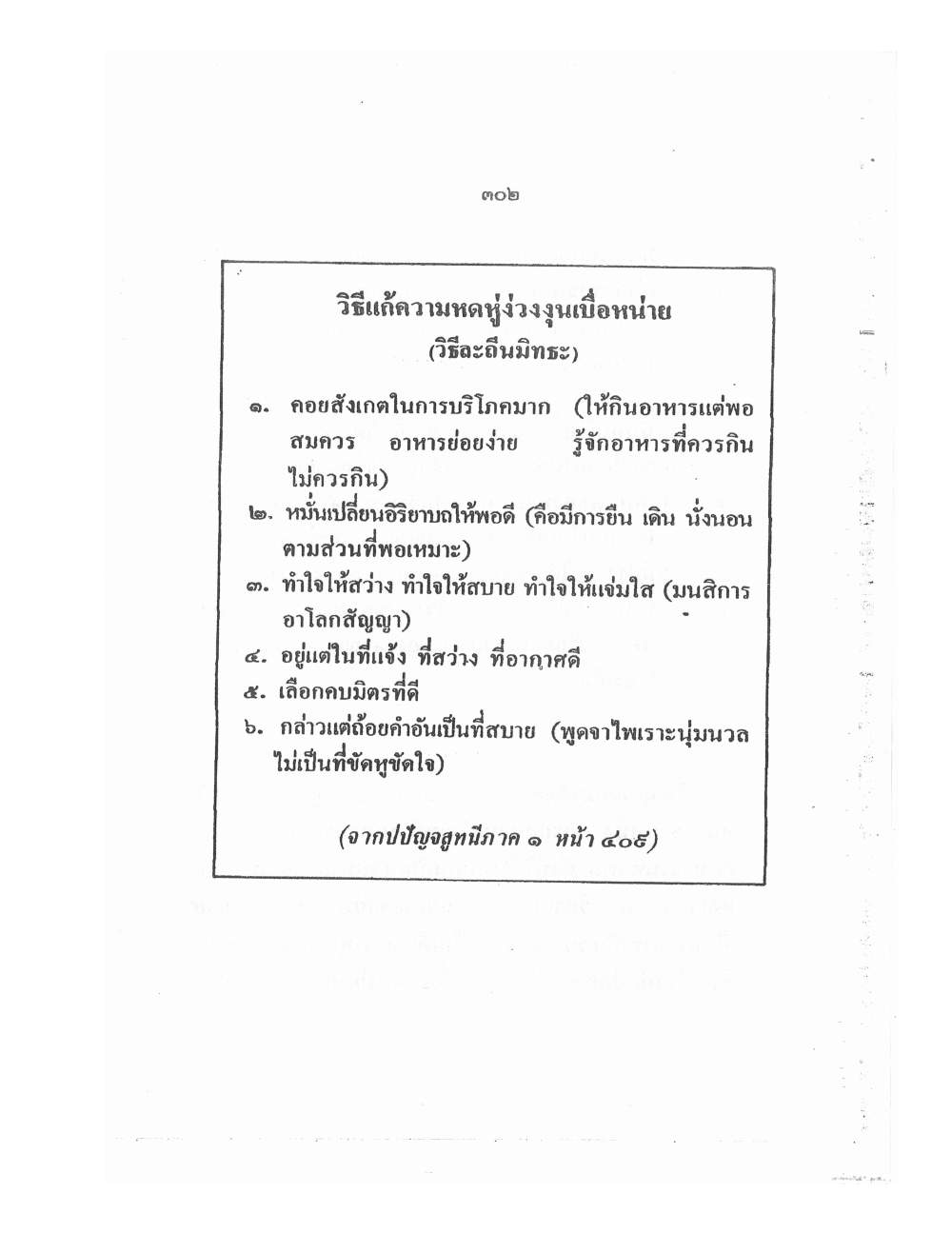
วิธีแก้ความหดหู่ง่วงงุนเบื่อหน่าย
(วิธีละถีนมิทธะ)
๑. คอยสังเกตในการบริโภคมาก (ให้กินอาหารแต่พอ สมควร อาหารย่อยง่าย รู้จักอาหารที่ควรกิน ไม่ควรกิน) ๒. หมั่นเปลี่ยนอิริยาบถให้พอดี (คือมีการยืน เดิน นั่งนอน ตามส่วนที่พอเหมาะ) ๓. ทำใจให้สว่าง ทำใจให้สบาย ทำใจให้แจ่มใส (มนสิการ อาโลกสัญญา) ๔. อยู่แต่ในที่แจ้ง ที่สว่าง ที่อากาศดี ๕. เลือกคบมิตรที่ดี ๖. กล่าวแต่ถ้อยคำอันเป็นที่สบาย (พูดจาไพเราะนุ่มนวล ไม่เป็นที่ขัดหูขัดใจ)
(จากปปัญจสูทนีภาค ๑ หน้า ๔๐๕)
Method for Curing Depression, Drowsiness, Dullness, and Weariness
(The method for overcoming sloth and torpor -- thina-middha)
1. Watch and be mindful of overeating (eat food only in a moderate amount, food that is easy to digest; know which foods should and should not be eaten) 2. Regularly change posture to a suitable degree (that is, alternate standing, walking, sitting, and lying down in proper proportion) 3. Make the mind bright, make the mind at ease, make the mind clear (attending to the perception of light -- aloka-sanna) 4. Stay only in open, bright places with good air 5. Choose good friends to keep company with 6. Speak only words that are pleasant (speak sweetly and gently, in a way that does not grate on the ear or the mind)
(From the Papancasudani, Part 1, page 405)
บทที่ ๕
บทสรุป
จิต ใจ วิญญาณ หรือมโน มีความหมายถึงสิ่งเดียวกัน แต่ นิยมใช้ในโอกาสต่างกันอยู่บ้าง เช่น จิตของคนที่ตายไปแล้ว นิยมเรียกว่าวิญญาณ เป็นต้น จิตเป็นพลังงานพิเศษและเป็น ธรรมชาติรู้ ดังที่ได้พิสูจน์ไว้หลายตอนแล้ว
เมื่อจิตเป็นสมาธิก็จะมีอำนาจหรือพลังในตัว แค่มีอยู่ใน อาการสงบ ทั้งจิต และอำนาจจิต เมื่อสมาธิสูงขึ้น อำนาจหรือ พลังของจิตก็เพิ่มขึ้นตามส่วน การแบ่งขั้นตอนของสมาธิและ อำนาจจิตแบ่งได้หลายอย่าง หลายประเภท แต่แบ่งแบบง่าย ๆ ซึ่งเป็นที่รู้กันส่วนมากก็คือ สมาธิขั้นต้น ขั้นกลาง และขั้นสูง ส่วนอำนาจจิตก็เรียกเป็นอำนาจจิตขั้นต้น ขั้นกลางและขั้นสูง
อำนาจจิต หรือจิตที่เป็นสมาธิอยู่ เมื่อควบคุมให้สงบนิ่งอยู่ ได้นาน ๆ สมาธิก็สูงขึ้นไป อำนาจจิตก็ค่อย ๆ สูงขึ้นไปตาม ส่วน เมื่อใช้สมาธิหรืออำนาจจิตก็จะปรากฏผลต่าง ๆ ที่แปลก
Chapter 5
Summary
Chit (mind), jai (heart), winyan (spirit/consciousness), or mano -- all refer to the same thing, but are conventionally used on somewhat different occasions. For example, the mind of a person who has died is conventionally called 'winyan,' and so on. The mind is a special form of energy and is by nature a knowing thing, as has already been demonstrated in many sections.
When the mind is in samadhi (concentration) it possesses power or force within itself, but this exists only in a state of calm, both for the mind itself and for its power. As samadhi rises higher, the power or force of the mind increases correspondingly. The stages of samadhi and mental power can be divided in many different ways, into many categories, but the simplest division, and the one most commonly known, is: beginning-level samadhi, intermediate-level, and advanced-level. Mental power is likewise called beginning-level, intermediate-level, and advanced-level mental power.
Mental power, or the mind that is in a state of samadhi, when controlled so as to remain calm and still for a long time, causes samadhi to rise higher, and mental power gradually rises correspondingly. When samadhi or mental power is used, various strange results appear --
พิสดารกว่าจิตธรรมดา เช่น ใช้ในการคิด การทำกิจการต่าง ๆ ตลอดจนการควบคุมจิต ควบคุมอาการกิริยาที่แสดงออกทางกาย ทางวาจา หรือทางใบหน้าท่าที ผู้มีสมาธิหรืออำนาจจิตสูงขึ้น ก็มีความสามารถดีขึ้น ทั้งทางกาย ทางวาจาและทางใจ เช่น มี ความเข้มแข็งอดทน มีความขยันหมั่นเพียรดีขึ้น ช่วยให้เกิดความ เข้าใจหรือความจำดีขึ้น มีกำลังใจและกำลังในความคิดดีขึ้น นอกจากนี้ยังมีความสามารถแปลก ๆ เช่น การรู้เห็นอะไรได้ด้วย จิต การแปรธาตุได้ มีอำนาจในการรักษาโรค ป้องกันอันตราย ต่าง ๆ อันเกิดจากสัตว์บุคคล และจากศาสตราวุธ หรือภัยอัน– ตรายอื่น ๆ ได้ ที่สำคัญคือสามารถโน้มเหนี่ยวให้จิตใจของผู้อื่น เปลี่ยนแปลงได้มาก และรุนแรงรวดเร็ว เช่นทำให้เกิดความ เชื่อถือ เลื่อมใส เกิดการเปลี่ยนแนวนึกคิดและความประพฤติ หรือทำให้เกิดความสงบ เกิดการรู้การเห็นทางจิตได้ เป็นต้น ทั้งนี้จะทำได้เพียงใดแล้วแต่ขั้นของสมาธิ
การฝึกจิตให้เกิดสมาธิ หรือเกิดอำนาจจิต เกิดกำลังใจนั้นมีวิ ธีฝึกหลายอย่างจะฝึกไปพร้อม ๆ กับการปฏิบัติงานประจำวัน หรือฝึกเวลาใดก็ได้ ถ้าจะต้องการเพียงสมาธิขั้นต้น และใช้ อำนาจจิตขั้นต้นได้ถูกต้อง ไม่พลาดพลั้ง ก็ใช้เวลาเพียงไม่เกิน ๒ ชั่วโมงต่อหนึ่งวิชา แต่ถ้าจะต้องการให้ได้สมาธิขั้นกลาง หรือ อำนาจจิตขั้นกลางเร็วขึ้นด้วยตนเองควรใช้วิธีลัด โดยปรับลม หายใจประกอบเครื่องมือหรือมีครูที่ดีสอนให้
-- more elaborate than ordinary mental activity, such as being used in thinking, in performing various tasks, as well as in controlling the mind and controlling the behavior expressed through the body, through speech, or through facial expression and demeanor. A person whose samadhi or mental power is higher has correspondingly greater ability, in body, speech, and mind -- for example, having more strength and endurance, better diligence and perseverance, which helps produce better understanding or memory, and better morale and strength of thought. Besides this, there are also strange abilities, such as being able to know and see things by means of the mind, being able to transmute elements, having power to cure disease and to protect against various dangers arising from animals, from other people, and from weapons or other kinds of danger. Most importantly, one gains the ability to influence and change other people's minds a great deal, powerfully and rapidly -- for example, producing belief and devotion, causing a change in patterns of thought and behavior, or producing calm, producing knowledge and vision through the mind, and so on. How much of this can be achieved depends on the level of one's samadhi.
Training the mind to develop samadhi, or to develop mental power and morale, has many methods; one can train alongside one's daily work, or train at any time. If one wants only beginning-level samadhi, and to use beginning-level mental power correctly without error, it takes no more than 2 hours per subject. But if one wants to attain intermediate-level samadhi, or intermediate-level mental power, more quickly by oneself, one should use a shortcut method, by regulating the breath together with an instrument, or by having a good teacher to instruct one.
นอกจาก จะใช้จิตสมาธิให้เกิดประโยชน์ในทางโลกดังกล่าว แล้วจะใช้ประโยชน์ในทางธรรมล้วน ๆ คือเพื่อให้จิตสะอาด บริสุทธิ์ขึ้นตามลำดับก็ได้ คือฝึกสมาธิดีพอแล้วก็ฝึกทางวิปัสสนา ขั้นสูงได้ ส่วนการฝึกวิปัสสนาขั้นต้นนั้นต้องฝึกสมาธิควบคู่ ไปกับวิธีการทางวิปัสสนาตามที่กล่าวไว้ในพระไตรปิฎกฉบับ ภาษาไทยของกรมการศาสนาเล่ม ๕๑ หน้า ๔๗๒
ข้อผิดพลาดที่ฝึกจิตแล้วใช้ประโยชน์ไม่ได้นั้นเป็นเพราะ ไม่ตั้งใจให้แน่ว่า จะฝึกตรงไปนิพพานแน่หรือจะใช้ประโยชน์ ทางโลกเสียก่อน ทั้งยังเข้าใจกันว่าฝึกสมาธิ (หรือสมถะ) กับ วิปัสสนานั้นเป็นการฝึกที่แยกกันแตกต่างกัน ความจริงจะต้อง ฝึกควบคู่กันไปจึงจะได้ผลเร็ว
สรุปความรู้ที่จะได้รับจากวิทยาศาสตร์ทางใจ
ความรู้ที่จะศึกษาในวิทยาศาสตร์ทางใจได้นั้น แยกเป็น ๔ ประเภท คือ การสะกดจิต การรักษาโรค การใช้พลังจิตเพื่อ ให้เกิดประโยชน์ต่าง ๆ ความรู้ประกอบเกี่ยวกับการฝึกจิต และ การฝึกชำระจิตให้บริสุทธิ์ตรงไปสู่ความสุขขั้นต้นจนถึงนิพพาน
Besides using concentration of mind for worldly benefit as described above, it can also be used for purely spiritual (Dhamma) benefit, that is, to purify the mind progressively. That is, once one's samadhi has been trained well enough, one can then train in advanced-level vipassana. As for training in beginning-level vipassana, that must be trained together with samadhi, following the vipassana method described in the Thai-language edition of the Tipitaka published by the Department of Religious Affairs, Volume 51, page 472.
The mistake whereby one trains the mind but is then unable to put it to use arises because one has not firmly decided whether one will train straight toward nibbana for certain, or make use of worldly benefit first. There is also a misunderstanding that training in samadhi (or samatha) and training in vipassana are separate, different kinds of practice. In truth, they must be trained together for results to come quickly.
Summary of the Knowledge to Be Gained from the Science of the Mind
The knowledge that can be studied in the science of the mind divides into 4 categories: hypnosis/mind-control; curing disease; using mental power to produce various benefits; and knowledge concerning mind-training together with training to purify the mind, heading straight toward an initial level of happiness up to nibbana.
๒. พลังจิตช่วยรักษาโรคได้อย่างไร (พลังจิตก็คือ อำนาจจิตหรือกำลังทางจิต) ๓. ผลดีผลเสียในการรักษาโรคแต่ละอย่าง เทียบกับการ รักษาแบบปัจจุบัน แบบโบราณและการใช้พลังจิต ๔. การตรวจโรคเปรียบเทียบแบบปัจจุบัน แบบโบราณ และความสามารถในการตรวจแบบปัจจุบัน แบบโบราณ และ การใช้พลังจิต ๕. สาเหตุให้เกิดโรคแบบปัจจุบัน และโบราณ ใครค้น พบได้ครบถ้วนกว่า ๖. การรักษาโรคในระยะไกล ๗. การใช้พลังจิตรักษาโรคแยกแยะวิธีการออกไป อย่างไรบ้าง ๘. วิธีใช้พลังจิตของคนไข้ช่วยรักษาโรค (การใช้พลัง จิตโดยตรงของคนไข้และการปฏิบัติด้านจิตใจ)
ค. การใช้พลังจิตเพื่อประโยชน์ต่าง ๆ
๑. ลำดับขั้นตอนในการฝึกใช้พลังจิตให้ได้เร็วตาม ที่ได้ค้นพบมานั้น การใช้พลังจิตขั้นต้นมีลำดับการเรียนอย่างไร ใช้เวลาเรียนนานเท่าใดต่อหนึ่งวิชา ๒. การทำให้คงกระพัน ทดลองเอามีดฟันแทงไม่เข้า มีวิธีการทำให้ได้ผลกี่อย่างมีคุณและโทษอย่างไร?
2. How can mental power help cure disease? (Mental power is [the same as] mind-power or mental strength) 3. The advantages and disadvantages of treating each type of illness, compared against modern treatment, traditional treatment, and the use of mental power 4. Comparing diagnosis by modern methods and by traditional methods, and comparing the ability to diagnose by modern methods, traditional methods, and by using mental power 5. Causes of disease according to modern and traditional understanding -- which has been more thoroughly discovered? 6. Treating disease at a distance 7. In using mental power to cure disease, what distinct methods can be identified? 8. How the patient's own mental power can help in curing disease (the patient's direct use of mental power, and mental practice)
c. Using Mental Power for Various Benefits
1. What is the sequence of steps for training to use mental power quickly, based on what has been discovered? What is the order of learning for beginning-level use of mental power, and how long does it take to learn per subject? 2. Making the body invulnerable -- testing this by striking and stabbing with a knife without it penetrating. How many methods achieve this result, and what benefits and harms do they carry?
๓. การเรียนใช้วิชาพลังจิตเรียนได้ไม่เลือกว่าชาติใด นับถือศาสนาใดก็เรียนได้สำเร็จโดยไม่ต้องเปลี่ยนศาสนา เพราะ เหตุใด ๔. การใช้พลังจิต พลังคุณพระขั้นต้น ซึ่งเคยยืนยัน ว่าเรียนสำเร็จภายใน ๒ ชั่วโมงต่อวิชา ไม่ว่าจะเป็นหญิงหรือ ชายนั้น ทำได้จริงหรือไม่ เพราะเหตุใดจึงเรียนได้ในเวลาเพียง เล็กน้อย ๕. พลังจิตขั้นต้นหรือสมาธิขั้นต้นสามารถใช้ประโยชน์ อะไรได้บ้างที่แปลกจากคนทั่ว ๆ ไป ๖. สมาธิขั้นกลาง สมาธิขั้นสูงสามารถใช้ประโยชน์ อะไรได้บ้างที่แปลกพิสดารกว่าธรรมดา ๗. การใช้พลังจิตในการพัฒนาประเทศและเปลี่ยน ทัศนคติของคน (ล้างสมอง) ๘. วิธีใช้พลังจิตให้เกิดประโยชน์ต่าง ๆ เช่นใช้ใน การทำงาน ช่วยความจำ ทำให้อายุยืน รักษาโรค การดูทางใน การพยากรณ์ การสะกดจิต การจับขโมย ฯลฯ
ง. ความรู้ประกอบเกี่ยวกับการฝึกจิต
๑. วิธีตรวจสอบที่แน่นอนว่า ผู้ใดรวมพลังจิตได้ถึง สมาธิขั้นต้น ขั้นกลาง หรือขั้นสูง ในแต่ละขั้นใครสมาธิสูงกว่า ใคร วิธีตรวจสอบพลังจิตที่ถ่ายทอดไว้ในสิ่งของหรือองค์พระ
3. The discipline of using mental power can be learned regardless of nationality; whatever religion one follows, one can learn it successfully without needing to change religion -- for what reason is this so? 4. Regarding the use of mental power -- beginning-level power drawn from Buddha-virtue -- which has been affirmed to be learnable within 2 hours per subject, whether by a woman or a man: can this really be done? Why can it be learned in so short a time? 5. What benefits, out of the ordinary for most people, can beginning-level mental power or beginning-level samadhi provide? 6. What benefits, more extraordinary than usual, can intermediate-level and advanced-level samadhi provide? 7. Using mental power in national development and in changing people's attitudes (brainwashing) 8. Methods of using mental power for various benefits, such as use in work, aiding memory, prolonging life, curing disease, clairvoyance, prediction, hypnosis, catching thieves, etc.
d. Knowledge Concerning Mind-Training
1. A reliable method for determining who has gathered mental power up to beginning, intermediate, or advanced-level samadhi, and, within each level, whose samadhi is higher than whose. A method for verifying mental power that has been imbued into objects or Buddha images --
๒. การฝึกสมาธิกับการฝึกวิปัสสนาต่างกันอย่างไร และจะต้องแยกกันฝึกหรือฝึกไปพร้อม ๆ กันดีกว่า (มีหลักฐาน ในพระไตรปิฎก)
๓. การฝึกสมาธิกับการฝึกรวมพลังจิตต่างกันหรือไม่ ผู้ฝึกจะได้รับประโยชน์อะไร การฝึกจะต้องเลือกเวลาและสถานที่ ด้วยหรือไม่
๔. สิ่งศักดิ์สิทธิ์ ผี นรก สวรรค์ วิญญาณ มีจริงหรือไม่ มีความเกี่ยวข้องที่จะให้ผลดี ผลเสียแก่คนได้อย่างไร วิธีพิสูจน์ ทดลองให้เห็นจริงจัง
๕. คนที่ตายไปแล้ว จิตหรือวิญญาณไปอยู่อย่างไร ทำไมจึงมาเข้าทรงคนได้ไม่ไปรับกรรมของตนหรือ
๖. ผู้สนใจฝึกจิตจะเกิดคุณและโทษอย่างไร มีวิธีแก้ ไม่ให้เกิดโทษอย่างไรได้บ้าง
๗. การฝึกให้เกิดความจำดีหรือกลับนิสัย เปลี่ยนอุดม– คติ เขามีวิธีการอย่างไร ในเมืองไทยและต่างประเทศค้นคว้า ได้ผลไปเพียงใดแล้ว การดัดตน การใช้ยา เกี่ยวกับจิตอย่างไร บ้าง
๘. การฝึกจิตเพื่อชำระจิตให้บริสุทธิ์มุ่งตรงสู่นิพพาน ทำอย่างไร?
2. How does training in samadhi differ from training in vipassana, and must they be trained separately, or is it better to train them together? (There is evidence for this in the Tipitaka)
3. Does training in samadhi differ from training to gather mental power? What benefit does the trainee gain from it? Must the training also involve choosing a particular time and place?
4. Do sacred things, ghosts, hell, heaven, and spirits truly exist? How are they involved in producing good or bad results for people? What method of proof and testing can show this convincingly?
5. For a person who has died, where does the mind or spirit go to dwell? Why can it come to possess/enter a medium instead of going to receive the results of its own karma?
6. What benefits and harms arise for one who is interested in training the mind? What methods exist to prevent harm from arising?
7. What methods exist for training to produce good memory, or to reverse habits and change one's ideals/outlook? To what extent has research in Thailand and abroad found results on this? How are bodily conditioning and the use of medicine related to the mind?
8. How does one train the mind to purify it, heading straight toward nibbana?
ก. การสะกดจิต
๑. การสะกดจิตแบบต่างประเทศ กับแบบไทย (แบบ ใช้อำนาจคุณพระ) ต่างกันอย่างไร ๒. หลักการและวิธีการที่ผิดพลาดในการฝึกสะกดจิต ซึ่งทำให้ผู้ฝึกล้มเหลว ๓. ความเข้าใจผิดของการใช้ประโยชน์ ในการสะกดจิต ๔. การสะกดจิตแบบฉับพลัน (วิชานารายณ์แผลงศร) ๕. โทษของการสะกดจิต ๖. วิธีแก้ไขไม่ให้เกิดโทษในการสะกดจิต ๗. วิธีฝึกสะกดจิตแบบลัดภายใน ๒ ชั่วโมงให้สะกด คนอื่นได้ ๘. หลักการสะกดจิตที่ถูกต้อง คือ–รู้วิธีส่งพลังจิต– รู้จุดที่จะส่งพลังจิตไปสะกด –รู้จังหวะในการส่งพลังจิตไป สะกด
ข. การรักษาโรค
๑. เปรียบเทียบผลการรักษาโรคต่าง ๆ แบบปัจจุบัน แบบโบราณ แบบใช้พลังจิตพลังคุณพระและแบบผสม โดย เปรียบเทียบกันเป็นโรค ๆ ไป ที่ได้ทดลองมาด้วยตนเองมี โรค มะเร็ง วัณโรค เชื้อรา โรคปวดศีรษะเป็นประจำ หืด ไซนัส โรค ประสาท การต่อกระดูกหัก ฝีต่าง ๆ แผลในมดลูก ฯลฯ
a. Hypnosis / Mind-Control
1. How does the foreign style of hypnosis differ from the Thai style (the style using the power of Buddha-virtue)? 2. What mistaken principles and methods in practicing hypnosis cause the trainee to fail? 3. Misunderstandings about the benefits/uses of hypnosis 4. Sudden/instant hypnosis (the 'Narayana Shoots His Arrow' technique) 5. The harms of hypnosis 6. Methods to prevent harm from arising in hypnosis 7. A shortcut method for training in hypnosis within 2 hours, so as to be able to hypnotize others 8. The correct principles of hypnosis are: knowing how to send mental power -- knowing the point to which mental power should be sent to hypnotize -- knowing the timing/rhythm for sending mental power to hypnotize
b. Curing Disease
1. Comparing the results of treating various diseases by modern methods, traditional methods, methods using mental power/the power of Buddha-virtue, and mixed methods, comparing disease by disease, based on personal experimentation -- including cancer, tuberculosis, fungal infection, chronic headache, asthma, sinusitis, nerve disease, setting broken bones, various abscesses, and uterine lesions, etc.
ความรู้ดังกล่าวมาแล้วข้างต้นตลอดจน วิธีปฏิบัติให้เกิดผลประโยชน์ วิธีพิสูจน์ทดลอง มีอยู่ในวิทยาศาสตร์ทางใจฉบับเปิดโลกนี้เป็นส่วนใหญ่ สำหรับการปฏิบัติให้ได้ผลจริงจังพร้อมด้วยรายละเอียดในการเรียนด้วยตนเองได้และความรู้อย่างอื่นได้เขียนไว้ใน วิทยาศาสตร์ทางใจฉบับส่องโลก การแปลงธาตุ การสะเดาะเครื่องมือ วัดพลังจิต การทำใบไม้เป็นตัวสัตว์มีชีวิต เคล็ดลับในการฝึกสมาธิให้ได้ผลเร็วและการเพิ่มพูนพลังจิตให้เกิดผลเป็นพิเศษ การดูทางใน การใช้สมาธิช่วยความจำ ช่วยการทำงาน ช่วยแก้ความประหม่าตื่นเต้นและแก้ความกลัว วิธีพิสูจน์วิญญาณ ยาแก้โรคกันชรา ยอดธรรมะ ธรรมเทศนาและยาดีของพระอาจารย์ฝั้น (อาจาโร) รวมทั้งการใช้พลังจิตเพื่อประโยชน์อื่น ๆ มีกล่าวใน "วิทยาศาสตร์ทางใจฉบับยอดคน" แล้ว
ขอขอบพระคุณที่ท่านสนใจในวิทยาศาสตร์ทางใจผู้เขียนยินดีน้อมรับข้อคิดเห็นหรือคำแนะนำจากทุกท่าน หากมีความบกพร่องและมีข้อความที่ท่านไม่พึงพอใจกรุณาให้อภัยแก่ผู้เขียนด้วย
All the knowledge described above, together with the methods of practice for producing benefit and the methods of proof and experiment, is found for the most part in Science of the Mind, the "Opening the World" edition. For practising to get real, serious results, along with the details needed to study by oneself, and other knowledge, this has been written in Science of the Mind, the "Seeing the World" edition: transmuting elements, [testing/adjusting] instruments for measuring mind-power, turning leaves into living creatures, secrets for quickly succeeding at meditation practice and for increasing mind-power to produce special results, inner vision, using concentration to aid memory, to help with work, to help overcome nervousness and fear, methods of proving the existence of spirit, medicine against ageing, the highest Dhamma, Dhamma sermons, and the good medicine of Phra Ajahn Fan (Ācāro) — together with the use of mind-power for other benefits — all this has already been discussed in Science of the Mind, the "Foremost Man" edition.
Thank you for your interest in Science of the Mind. The writer is glad to humbly receive comments or suggestions from everyone. If there are shortcomings, or any passages that do not please you, please forgive the writer.
หลักแก้ความเสียใจ
๑. ให้นึกถึงความดีของตนและความดีของผู้ที่ตนนับถือ ๒. ให้นึกถึงคุณธรรมหรือการกระทำของผู้อื่นที่มีความสุขความก้าวหน้า แล้วนึกถึงการกระทำและคุณธรรมของตนว่าทำเช่นนั้นเหมือนกันจึงควรจะได้รับผลตอบสนองสักวันหนึ่ง (เชื่อกรรมและผลกรรม) ๓. ให้นึกถึงคุณพระนิพพาน ซึ่งเป็นความดีความสุขสูงสุด ควรทำตนให้เข้าสู่ความดี และทำตนให้เบิกบานสุขสบาย ๔. ไม่คบคนเจ้าทุกข์ ชอบทำตนเป็นคนทุกข์ร้อนเศร้าโศก ให้คบแต่คนมีนิสัยร่าเริงเบิกบาน ๕. ให้นึกถึงแต่เรื่องสนุกสนานร่าเริง ๖. ให้น้อมใจไปในทางร่าเริงเบิกบาน คือหัดเป็นคนรื่นเริงเบิกบาน
(จาก - ปปัญจสูทนี)
Principles for Overcoming Grief
1. Recall your own good deeds and the good deeds of those you respect. 2. Recall the virtues or deeds of others who have happiness and progress; then recall your own deeds and virtues, [thinking that] having done the same, you too should receive their reward some day. (Trust in karma and its fruit.) 3. Recall the virtue of Nibbāna, which is the highest good and highest happiness; you should bring yourself toward goodness, and make yourself cheerful and at ease. 4. Do not associate with sorrowful people who like to make themselves suffering and grieving; associate only with people of a cheerful, joyful disposition. 5. Think only of enjoyable, cheerful things. 6. Incline your mind toward cheerfulness and joy — that is, train yourself to be a joyful, cheerful person.
(From — Papañcasūdanī)
หลักแก้การหลง ๆ ลืม ๆ
๑. ให้ทำความรู้สึกตัวทุกขณะที่ ยืน เดิน นั่ง นอน กิน ทำ ดื่ม พูด คิด อย่าให้ใจลอยให้รู้ว่าตนทำอะไรอยู่ในขณะนี้ อย่าขาดสติ ๒. อย่าคบคนขี้หลงขี้ลืม ๓. ให้คบแต่คนที่มีความจำดี จะได้ช่วยเตือนเมื่อหลงลืม และทำให้เราพลอยจำดีตามเขาด้วย ๔. ให้ฝักใฝ่แต่ในเรื่องจำพยายามฝึกเกี่ยวแก่ความจำ เช่น นึกย้อนดูเรื่องของวันก่อนชั่วโมงก่อนเป็นต้น (จาก - ปปัญจสูทนี)
Principles for Overcoming Absent-Mindedness and Forgetfulness
1. Be mindful at every moment — when standing, walking, sitting, lying down, eating, doing, drinking, speaking, thinking. Do not let your mind wander; know what you are doing at this very moment. Do not lose mindfulness. 2. Do not associate with forgetful, absent-minded people. 3. Associate only with people who have a good memory, so that they can help remind you when you forget, and so that we too come to remember well, following their example. 4. Devote yourself to matters of memory; try to train yourself in matters concerning memory — for example, by recalling the events of the previous day or the previous hour, and so on. (From — Papañcasūdanī)
ผนวก
รายละเอียดในการทดลองใช้อำนาจจิต แปลงธาตุ และทำให้เกิดเป็นตัวสัตว์มีชีวิต
๒๕ กันยายน ๒๔๙๖ อาจารย์อภิชิโตภิกขุ (อาจารย์ของผู้เขียน) ทำใบไม้ให้เป็นนก ลงข่าวในหนังสือพิมพ์เดลิเมล์ข่าวภาพ ประจำวันจันทร์ที่ ๑๒ ตุลาคม ๒๔๙๖ (คณะหนังสือพิมพ์ชุดนี้มาทำหนังสือพิมพ์บางกอกไทม์) ใจความย่อ ๆ ว่า เมื่อวันที่ ๒๕ กันยายน ๒๔๙๖ มีผู้ไปดูคือ พระยาสารกิจพิลาสและครอบครัว นายบุญมี เมธางกูร นางแนบ มหานิรานนท์ อาจารย์สอนพระอภิธรรมแห่งมหาวิทยาลัยสงฆ์ คณะเดลิเมล์ และบุคคลอื่น ๆ อีกมาก ใช้ใบมะม่วงแห้งเด็ดเอาแต่เพียงครึ่งใบส่วนปลายใบแรกใส่อุ้งมือภาวนาอยู่ประมาณ ๑๕ นาทีก็กลายเป็นนก ขนาดนกกระจอก แต่สีประหลาดไม่เหมือนนกที่มีอยู่ทั่ว ๆ ไป อาจารย์บอกว่าเป็นนกชนิดที่มีมากในป่าลึก ซึ่งท่านไปเรียนอยู่กับหลวงตาดำ ใบมะม่วงใบที่สองทำเป็นนกได้ในเวลาไม่ถึง ๑๐ นาที เป็นนกชนิดเดียวกัน รู้จักอ้าขาพะวาปีกและร้องจิ๊ก ๆ เหมือนธรรมชาติของนกทั่ว ๆ ไป ก่อนที่จะทำใบไม้เป็นนก ท่านอาจารย์อภิชิโต เคยทำกาบดอกบัวเป็นคางคก ทำขี้เทียนเป็นหอยให้ลูกศิษย์ดูหลายครั้ง
Appendix
Details of the experiments in using mind-power to transmute elements and cause the arising of living creatures.
On 25 September 1953, Ajahn Aphichito Bhikkhu (the writer's teacher) turned a leaf into a bird. This was reported in the Daily Mail News-Photo newspaper, Monday edition of 12 October 1953 (this same group of journalists later went on to run the Bangkok Times newspaper). The gist of the report: on 25 September 1953, those who went to watch included Phraya Sarakitphilat and family, Mr. Boonmee Methangkun, Mrs. Naep Mahaniranon — a teacher of Abhidhamma at the Sangha University — the Daily Mail staff, and many other people. Using a dried mango leaf, only half of the leaf — the tip end of the first leaf — was plucked and placed in the cupped palm; after chanting/praying over it for about 15 minutes it turned into a bird the size of a sparrow, but of a strange colour unlike ordinary birds. The teacher said it was a kind of bird found in great numbers deep in the forest, where he had gone to study with Luang Ta Dam. A second mango leaf was turned into a bird in less than 10 minutes — the same kind of bird — able to open its beak, flap its wings, and chirp "jik jik" just like the natural behaviour of ordinary birds. Before turning leaves into birds, Ajahn Aphichito had also turned lotus-petal sheaths into toads, and candle-wax drippings into shellfish, showing this to his disciples on many occasions.
หลังจากลงข่าวว่าเนรมิตใบไม้เป็นนกแล้ว คณะเดลิเมล์คณะนี้ได้ไปดูและลงข่าวเรื่อง อาจารย์ฉลองทำข้าวสารให้เป็นกุ้ง โดยถ่ายรูปประกอบข่าวเป็นตอน ๆ เช่นตอนข้าวสารกลายเป็นกุ้งไปครึ่งตัว เป็นข้าวสารอีกครึ่งตัว ว่ายน้ำได้
ในปี ๒๕๐๔ อาจารย์พัว แก้วพลอย ทำใบไม้ให้เป็นแมลงภู่ให้ผู้เขียนดูที่บางแสน จ.ชลบุรี ในปลายปี ๒๕๐๔ ได้ทำให้ดูที่บ้านพักของผู้เขียน โดยใช้ใบชมพู่มาทำเป็นแมลงภู่ ในตอนกลางวันเวลาประมาณสี่โมงเช้า ใช้เวลาประมาณ ๑๓ นาที มีอาจารย์พุทธทาสภิกขุ คุณชำนาญ ลือประเสริฐ และผู้ที่มีเกียรติอีกหลายท่าน ร่วมไปดู หลังจากทำเสร็จ อาจารย์พัวมีอาการสั่นพอสังเกตเห็นได้ชัดคล้ายหนาว เมื่อจับดูที่มือจะรู้สึกร้อนครู่หนึ่งเย็นครู่หนึ่งสลับกันเป็นเวลาประมาณ ๓ นาที จึงเป็นปกติ แสดงถึงการสูญเสียพลังในกายมาก ในครั้งก่อน ๆ ไม่ปรากฏว่ามีอาการดังกล่าว คงจะเป็นด้วยอายุมาก และสุขภาพขณะนั้นไม่ดีนัก อาจารย์พัว แก้วพลอย เคยอยู่ที่เขาใหญ่เขตนครราชสีมา เป็นเวลา ๔ ปี โดยอยู่กับหลวงปู่สุข ใกล้เหวสุวัฒน์ สมัยนั้นคนไปได้ลำบากมาก แต่เวลานี้รถขึ้นไปได้สะดวก เมื่อฝึกฝนทางจิตอยู่เป็นเวลา ๔ ปีแล้วครบกำหนดเกณฑ์ทหาร หลวงปู่ให้มารับเกณฑ์เพราะเป็นเรื่องของแผ่นดินและกฎหมาย ไม่ควรหลีกเลี่ยง อาจารย์พัว เป็นทหารอยู่ในหน่วย ปตอ. บางซื่อ
After the report that he had conjured a leaf into a bird, this same Daily Mail team went to observe and report on "Ajahn Chalong turns uncooked rice into shrimp," photographing the event stage by stage — for instance, the stage where the rice grain had turned half into shrimp while remaining half rice grain, and could swim.
In 1961, Ajahn Pua Kaeophloi turned a leaf into a bumblebee, showing it to the writer at Bang Saen, Chonburi Province. In late 1961 he did it again at the writer's residence, using a rose-apple leaf turned into a bumblebee, in the daytime at about ten o'clock in the morning, taking about 13 minutes. Ajahn Buddhadasa Bhikkhu, Mr. Chamnan Luprasoet, and several other distinguished people went along to watch. After he finished, Ajahn Pua showed a trembling clear enough to notice, as if from cold; when his hand was held it felt hot for a moment and cold for a moment, alternating, for about 3 minutes, before returning to normal — showing a great loss of bodily energy. On previous occasions no such symptom had appeared; this was probably due to his advanced age and his not being in very good health at that time. Ajahn Pua Kaeophloi had once lived at Khao Yai, in Nakhon Ratchasima province, for 4 years, staying with Luang Pu Suk near Hew Suwat [waterfall]. In those days it was very difficult for people to get there, but nowadays cars can go up easily. When he had trained in mind-practice there for 4 years, his military conscription came due; Luang Pu had him go to be conscripted, since it was a matter of the nation and the law, not to be avoided. Ajahn Pua served as a soldier in the anti-aircraft [ปตอ.] unit at Bang Sue.
ในปี ๒๔๙๕ ได้เคยทำดอกไม้เป็นแมลงภู่ ทำขนมอันเดียวเป็นหลายอัน เดินบนน้ำและแสดงอำนาจจิตอย่างอื่น ๆ จนเป็นที่เลื่องลือกันมากในหน่วย ปตอ. สมัยนั้น ภายหลังอาจารย์พัว ทำงานอยู่ในโรงงานประตูหน้าต่าง ใกล้สี่แยกบางโพ พระนคร เป็นผู้ชอบสงบ เก็บตัว ไม่ชอบแสดงตนว่ามีความรู้ดีในทางจิต ขณะนั้นอายุ ๔๗ ปี เคยไปท่องเที่ยวและพักแรมในป่ากับผู้เขียน ๖ ครั้ง ในระยะพักร้อน
วิธีทำให้เกิดเป็นตัวสัตว์ หรือการแปลงธาตุ
การเปลี่ยนจากธาตุหนึ่งไปเป็นอีกธาตุหนึ่ง และทำให้เกิดเป็นตัวสัตว์นั้นมีหลักสำคัญคือ จะต้องรู้ว่าธาตุอะไรเปลี่ยนได้ง่ายเสียก่อน เช่น ใบไม้ทำเป็นนก ดอกไม้ทำเป็นแมลงภู่ ใบมะขามทำเป็นตัวต่อ ตัวแตน ขี้เทียนทำเป็นหอย หญ้าทำเป็นขนมฝอยทอง ดังนี้เป็นต้น ผู้ที่ชำนาญแล้วก็ไม่จำเป็นต้องยึดถือกฎดังกล่าวก็ได้ ขีดขั้นสมาธิที่จะทำขนมอันเดียวเป็นหลายอัน ทำเป็นตัวสัตว์ ทำเป็นข้าว เป็นขนม ฯลฯ เหล่านี้ใช้สมาธิขั้นกลางและระยะจะทำได้คือ ระยะเข้าสู่ภวังค์ ตัวอย่างทำใบมะขาม เป็นตัวแตน เอาใบมะขาม ๑ กำมือ ใส่ในบาตรเล็ก ๆ หรือภาชนะอย่างอื่นปิดไว้ด้วยผ้า หรือเอามือกำไว้ (ความประสงค์ต้องการบังแสงเพื่อการเกิด) อธิษฐานจิตจะทำให้เกิดเป็นตัวแตน นึกภาพตัวแตนให้ชัดแทนใบมะขาม จวนเข้าภวังค์ภาพจะชัด ขณะตรึงภาพนี้ให้นิ่ง
In 1952 he had once turned a flower into a bumblebee, turned a single sweet into many, walked on water, and displayed other mind-powers, until he became widely renowned within the anti-aircraft unit at that time. Later, Ajahn Pua worked in a door-and-window factory near the Bang Pho intersection, Bangkok. He was a person who liked calm and kept to himself, not fond of showing off his knowledge in matters of the mind. At that time he was 47 years old. He had gone travelling and camping in the forest with the writer six times, during vacation periods.
The Method of Causing the Arising of a Creature, or the Transmutation of Elements
Changing from one element into another, and causing the arising of a creature, has one important principle: one must first know which elements change easily — for example, a leaf made into a bird, a flower made into a bumblebee, a tamarind leaf made into a wasp or hornet, a candle-wax dripping made into a shellfish, grass made into foi-thong sweets [golden egg-yolk threads], and so on. Those who are already skilled need not hold strictly to this rule. The level of concentration needed to turn a single sweet into many, to make it into a creature, into rice, into sweets, etc., is a middle level of concentration, and the stage at which it can be achieved is the stage of entering the bhavaṅga [the life-continuum/subconscious state]. As an example, to turn a tamarind leaf into a wasp: take a handful of tamarind leaves, place them in a small alms-bowl or other container, cover it with cloth, or simply hold it closed in the hand (the purpose is to block out the light, for the arising to occur). Determining the mind [adhiṭṭhāna] will cause a wasp to arise; visualise the image of the wasp clearly in place of the tamarind leaf. As one nears the bhavaṅga the image will become clear; while fixing
อยู่ ก็ใช้วิธีภาวนาคำที่อาจารย์สอนให้ หรือมิฉะนั้นก็ภาวนาเอาเองว่า แตน หรือ จงเป็นแตนซ้ำ ๆ เรื่อยไปก็ได้ ผู้ฝึกทำใหม่ ๆ ควรเข้าภวังค์ได้ประมาณ ๑๕ นาที จึงจะพอเหมาะที่จะทำได้ ส่วนท่านผู้ชำนาญ และมีอำนาจจิตขั้นสูงทำได้เร็วและไม่ต้องดำเนินตามขั้นตอนดังกล่าว
การประมวลเข้าด้วยกันเกี่ยวกับลักษณะของจิต ว่าเป็นทั้งกำลังงานพิเศษและเป็นธรรมชาติรู้ อาศัยพระไตรปิฎกช่วยพิจารณาประกอบการค้นคว้า ทดลองของต่างประเทศ ซึ่งกล่าวในบทที่ ๑ และที่ ๒ ในพระไตรปิฎกดูเรื่องผี ผีเข้า เรื่องวิญญาณ เรื่องจิต เรื่องเปรต เรื่องการเสวยผลกรรมในชาติก่อน และชาติต่อไป ซึ่งมีอยู่มากในพระสุตตันตปิฎก และมีเล็กน้อยในพระวินัย นอกจากนี้ให้ดูเรื่องจิต เจตสิกในพระอภิธรรม เมื่อจะพิจารณาประมวลโดยวิธีทดลอง ก็ดูในวิทยาศาสตร์ทางใจฉบับเปิดโลกนี้ โดยอ่านทบทวนและพิจารณาตามดู
still, one uses the formula the teacher taught, or otherwise recites on one's own "wasp" or "become a wasp," repeated over and over — this also works. A beginner practitioner should be able to enter the bhavaṅga in about 15 minutes; this is about the right amount of time for it to succeed. As for one who is already skilled and possesses mind-power of a high level, it can be done quickly, with no need to follow the steps described above.
Bringing together [the evidence] concerning the nature of the mind — that it is both a special form of energy and also a natural faculty of knowing — relies on the Tipiṭaka to help consider and support the research, together with foreign experiments, as discussed in Chapters 1 and 2. In the Tipiṭaka, see the matters of ghosts, spirit-possession, consciousness [viññāṇa], mind [citta], hungry ghosts [peta], and the experiencing of the fruits of karma in a past life and in a future life — these appear extensively in the Suttanta Piṭaka, and to a small extent in the Vinaya. In addition, see the matter of citta and cetasika in the Abhidhamma. When one wishes to consider and bring [the evidence] together by way of experiment, one should look in Science of the Mind, the "Opening the World" edition, reading it over and considering it as one goes.
รายการแสดงอำนาจจิตต่อหน้าที่ประชุม สำหรับผู้เขียน
เคยบรรยายเรื่องอำนาจจิต อำนาจคุณพระ และทดลองอำนาจจิตให้ดู เกี่ยวกับวิชาเหนียวคงทดลองแทงหรือฟันด้วยมีด การหว่านทรายเข้าตาขณะลืมตาอยู่ แต่ทรายไม่เข้าตา การดับพิษน้ำมันมะพร้าวที่กำลังเดือดโดยส่งจิตไปสู่น้ำมันเพียงพอแล้วเอามือจุ่มลง หรือตักกินได้ผู้ดูก็ทดลองดูได้ การดับพิษโซ่เหล็กขนาดใหญ่เผาไฟจนแดง เมื่อยกโซ่แดงขึ้นเอามือลูบ หรือกอบขึ้นได้ ผู้ดูก็ทดลองได้ การแสดงย่ำบนกระจกแตกด้วยเท้าเปล่า และนอนกลิ้งกระแทกบนกระจกแตกโดยไม่ใส่เสื้อ (เฉพาะรายการย่ำกระจกแตกนี้นายอยู่เป็นผู้แสดง)
๑. ในวันที่ ๒๗ ธ.ค. ๙๗ บรรยายวิทยาศาสตร์ทางใจที่กรมทหารสื่อสาร บางซื่อ หลังจากบรรยายได้ทดลองกอบโซ่ที่เผาไฟจนแดง และเอามือล้วงในน้ำมันเดือดให้ดู และให้ผู้ฟังมาทดลองดูด้วย รายละเอียดคำบรรยายอยู่ในวิทยาศาสตร์ทางใจ
๒. ในวันที่ ๒ มี.ค. ๙๙ บรรยายที่สมาคมจิตแพทย์ และใช้อำนาจจิตสองอย่างเหมือนข้อ ๑
๓. ในวันที่ ๑๗ มี.ค. ๙๙ บรรยายที่พุทธสมาคมหน้าวัดบวรฯ พระนคร แสดงให้ดูเฉพาะการจับและกอบโซ่ที่เผาไฟ
List of Demonstrations of Mind-Power Given by the Writer Before Audiences
I have lectured on the subject of mind-power, the power of sacred merit, and demonstrated mind-power experiments concerning the art of invulnerability [nieokhong] — testing being stabbed or slashed with a knife; scattering sand into the eyes while they remain open, yet the sand does not enter the eyes; neutralising the harm of boiling coconut oil by sending the mind into the oil sufficiently, then dipping the hand in, or scooping it out to eat, with viewers able to try it themselves too; neutralising the harm of a large iron chain heated in fire until red-hot — when the red-hot chain is lifted, the hand can stroke it or scoop it up, and viewers could try it too; the demonstration of treading barefoot on broken glass, and lying down and rolling the body on broken glass without wearing a shirt (only this treading-on-broken-glass demonstration was performed by Mr. Yu).
1. On 27 December 1954, [I] lectured on Science of the Mind at the Signal Corps Regiment, Bang Sue. After the lecture, [I] demonstrated scooping up the chain that had been heated red-hot in fire, and plunging a hand into boiling oil, for the audience to see, and let listeners come and try it themselves. Details of the lecture are in Science of the Mind.
2. On 2 March 1956, [I] lectured at the Psychiatric Association, and used two kinds of mind-power as in item 1.
3. On 17 March 1956, [I] lectured at the Buddhist Association in front of Wat Bowon, Bangkok, demonstrating only the gripping and scooping up of the fire-heated chain.
๔. ในวันที่ ๑๕ เม.ย. ๙๙ บรรยายทางวิทยุโทรทัศน์ ช่อง ๔ แสดงการจับและกอบโซ่เผาไฟ มือล้วงน้ำมันที่กำลังเดือด และให้นายอยู่ กระโดดจากโต๊ะลงย่ำเศษกระจกแตก และกลิ้งตัวกระแทกบนกองกระจก
๕. ในวันที่ ๑ ก.ย. ๙๙ บรรยายที่สมาคมโหรแห่งประเทศไทยวัดบวรฯ แสดงการใช้อำนาจจิตสามอย่าง เหมือนข้อ ๔
๖. ในวันที่ ๓๑ มี.ค. ๒๕๐๐ แสดงให้คณะผู้แทน น.ส.พ. พิมพ์ไทย ดูที่บ้านผู้เขียนสามอย่างเหมือนข้อ ๔
๗. ในวันที่ ๑ ม.ค. ๐๓ บรรยายและแสดงการเอาปรอทเข้าตัวทางฝ่ามือ และเรียกออกมาคืนได้ มีอาจารย์เสงี่ยม จิตตานนท์ ช่วยแสดงทางโทรทัศน์ช่อง ๗
การสอนชาวต่างประเทศ และทดลองกับชาวต่างประเทศ พระนาคเสน ชาวอินเดีย ศึกษาและทดลองวิชาเหนียวคง นายเอ็ทเก้น รองประธานกรรมการบริษัทอเมริกันอินเตอร์เนชั่นแนล เริ่มเรียนเมื่อ ๗ มิ.ย. ๐๓ เรียนวิชาเหนียวคง ดับพิษน้ำมันเดือดและวิชาเอาปรอทเข้าตัว นายทหารช่างอากาศอเมริกันที่ดอนเมืองขอทดลองวิชาเหนียวคงที่บ้านหนึ่งครั้ง
เมื่อ ๕ ก.ย. ๒๕๐๓ แสดงการใช้อำนาจจิตให้ผู้แทนต่างประเทศที่มาประชุมซีโต้รวม ๕ คน ที่บ้านของผู้เขียน มีนายเอ็ทเก้นช่วยแสดงด้วย แสดงสามอย่างเหมือนข้อ ๔ และการเอาปรอทเข้าตัวด้วย
4. On 15 April 1956, [I] lectured on television, Channel 4, demonstrating gripping and scooping up the fire-heated chain, plunging a hand into boiling oil, and having Mr. Yu jump down from a table onto broken glass fragments and roll his body on a pile of broken glass.
5. On 1 September 1956, [I] lectured at the Astrologers' Association of Thailand at Wat Bowon, demonstrating three uses of mind-power, as in item 4.
6. On 31 March 1957, [I] demonstrated the same three feats as in item 4 for a delegation from Phim Thai Newspaper, at the writer's house.
7. On 1 January 1960, [I] lectured and demonstrated taking mercury into the body through the palm of the hand, and calling it back out again; Ajahn Sa-ngiam Jittanon helped with the demonstration on Channel 7 television.
Teaching foreigners, and experimenting with foreigners: Phra Nagasena, an Indian, studied and tested the art of invulnerability. Mr. Etken, Vice-Chairman of the board of an American international company, began studying on 7 June 1960, learning the art of invulnerability, neutralising boiling oil, and the practice of taking mercury into the body. An American Air Force engineering officer at Don Mueang asked to test the art of invulnerability once, at [my] home.
On 5 September 1960, [I] demonstrated the use of mind-power for a delegation of foreign representatives attending a SEATO meeting, five people in all, at the writer's house; Mr. Etken helped with the demonstration. Three feats were demonstrated, as in item 4, along with taking mercury into the body as well.
เมื่อ ๒๘ ก.ย. ๐๕ บรรยายที่ห้องประชุมกรมยุทธศึกษาทหารบก มีเจ้ากรมยุทธศึกษาทหารบก หัวหน้าจัสแม็ก นายทหารอเมริกาชุดครูสอนวิชาต่อต้านกองโจรและนายทหารไทยหลายท่านฟังบรรยาย และดูการทดลองเหนียวคง ด้วยการเอามีดแทงแขน การดับพิษน้ำมันเดือดแล้วเอามือล้วงและตักขึ้นอมได้ พันโทบราว หัวหน้าชุดครูอเมริกา เป็นผู้ทดลองล้วงน้ำมันเดือดและทดลองแทงแขนด้วย
เนื่องด้วยผู้เขียนต้องเร่งรัดฝึกทางจิตให้ก้าวหน้าต่อไป จึงได้งดบรรยายและงดแสดงการใช้อำนาจจิตมาหลายปี จะได้บรรยายและทดลองในโอกาสที่เหมาะต่อไป
หลักฐานที่ใช้ค้นคว้าเกี่ยวกับจิต การฝึกจิตและการใช้อำนาจจิต ตลอดจนวิธีแปลงธาตุ วิธีทำให้เห็นทางจิต ฯลฯ
๑. พระไตรปิฎกของพระพุทธศาสนา และคัมภีร์ของศาสนาต่าง ๆ ๒. พระวิสุทธิมรรค ๓. ศีลสิกขา และจิตวิชชา ของพระอาจารย์ลี ธัมมธโร ๔. อานาปานพรรษาที่ ๔ และบันทึกคำสอนในเครื่องอัดเสียงของพระอาจารย์ลี ธัมมธโร (เจ้าอาวาสวัดอโศการาม สมุทรปราการ พิมพ์ พ.ศ. ๒๔๙๙) ๕. ชีวประวัติ ของพระอาจารย์มั่น ภูริทัตตเถระ
On 28 September 1962, [I] lectured at the meeting hall of the Army Education Department; present were the Director of the Army Education Department, the head of JUSMAG, a team of American officers who taught counter-guerrilla warfare, and many Thai officers, who listened to the lecture and watched the demonstration of invulnerability — stabbing the arm with a knife; neutralising boiling oil, then plunging a hand into it and scooping it up to taste. Lieutenant Colonel Brown, head of the American training team, was the one who tested plunging his hand into the boiling oil, and also tested being stabbed in the arm.
Since the writer needed to press on urgently with further progress in mind-training, lectures and demonstrations of the use of mind-power were suspended for a number of years; lecturing and experimenting will resume at a suitable future opportunity.
Sources Used for Research Concerning the Mind, Mind-Training and the Use of Mind-Power, as well as the Method of Transmuting Elements, the Method of Enabling Inner Sight, etc.
1. The Tipiṭaka of Buddhism, and the scriptures of various [other] religions 2. The Visuddhimagga 3. Sīlasikkhā and Cittavijjā, by Phra Ajahn Lee Dhammadharo 4. Ānāpāna, Vassa no. 4, and recorded teachings on tape by Phra Ajahn Lee Dhammadharo (abbot of Wat Asokaram, Samut Prakan; printed B.E. 2499 [1956]) 5. The Biography of Phra Ajahn Mun Bhūridatta Thera
๖. ขันธวิภาคเทศนา ของพระอุบาลีคุณูปมาจารย์ อดีตเจ้าอาวาส วัดบรมนิวาส พระนคร
๗. อานาปานสติภาวนา โดย พระอาจารย์พุทธทาสภิกขุ
๘. ยถาภูตธัมม์ โดย พระภัททันตวิลาสะ (พระพม่า) อดีตเจ้าอาวาสวัดปรก ตำบลบ้านทะวาย พระนคร
๙. จิตตปรัชญาของคณะ ส. ธรรมภักดี
๑๐. เอกสารเกี่ยวกับจิต และการค้นคว้าทางจิตของต่างประเทศ และของอาจารย์อื่น ๆ
๑๑. วิทยาศาสตร์ทางใจ เล่ม ๑-๔ วิทยาศาสตร์ทางใจฉบับย่อ ภาษาอังกฤษ และไทย
๑๒. การพิสูจน์ทดลองของจริงและปลอม รวมทั้งประสบการณ์ต่าง ๆ ในชีวิตที่ผ่านมา
6. Khandhavibhāga Sermon, by Phra Ubali Khunuppamachan, former abbot of Wat Boromniwat, Bangkok
7. Ānāpānasati Bhāvanā, by Phra Ajahn Buddhadasa Bhikkhu
8. Yathābhūtadhamma, by Phra Bhaddanta Vilasa (a Burmese monk), former abbot of Wat Prok, Ban Thawai Sub-district, Bangkok
9. Cittapaññā [Philosophy of Mind] of the S. Thammaphakdi group
10. Documents concerning the mind, and foreign research on the mind, and [research] of other teachers
11. Science of the Mind, volumes 1–4; the abridged edition of Science of the Mind, in English and Thai
12. The testing and proving of genuine and fake [phenomena], together with various experiences in life up to the present