Contents · 1 chapter(s) · 48 entries
ฝึกใช้อำนาจจิต (พลังจิต)
ตามหลักวิทยาศาสตร์ และ ศาสนา เล่มที่ 1
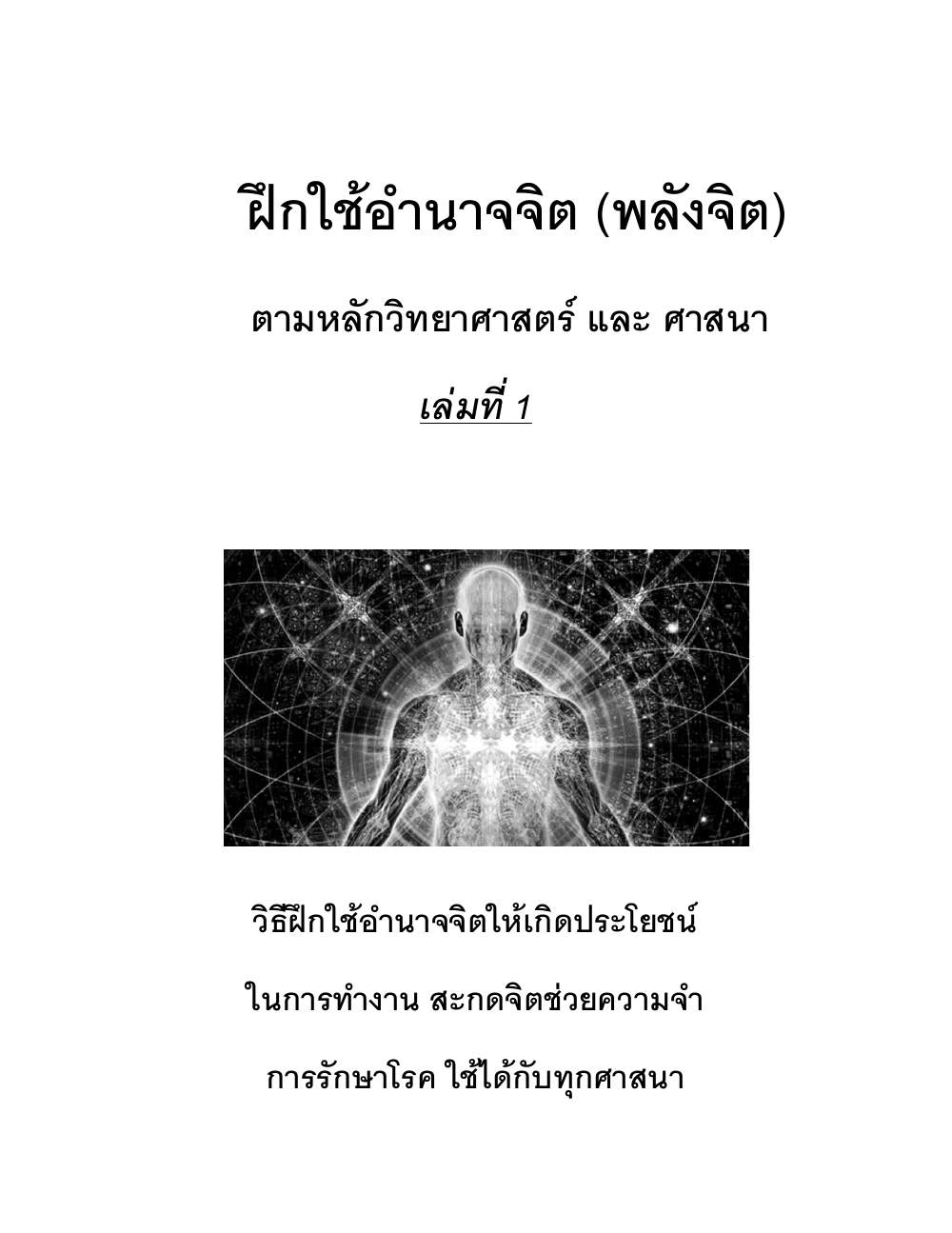
[ภาพ: ภาพขาวดำแบบภาพถ่ายของร่างมนุษย์เห็นจากด้านหลัง ตั้งแต่ศีรษะถึงไหล่ เปล่งแสงเรืองรอง มีเส้นเรขาคณิตแผ่รัศมีและพื้นหลังคล้ายดวงดาว/วงจรอิเล็กทรอนิกส์ล้อมรอบ]
วิธีฝึกใช้อำนาจจิตให้เกิดประโยชน์ ในการทำงาน สะกดจิตช่วยความจำ การรักษาโรค ใช้ได้กับทุกศาสนา
Training the Power of the Mind (Psychic Power)
According to the Principles of Science and Religion Volume 1
[diagram: a black-and-white, photograph-style image of a human figure seen from behind, from the head to the shoulders, glowing with light, surrounded by radiating geometric lines and a starry, circuit-like background]
How to train the use of mind power to bring benefit to one's work; hypnosis to aid memory; and the treatment of illness — usable with every religion
ง
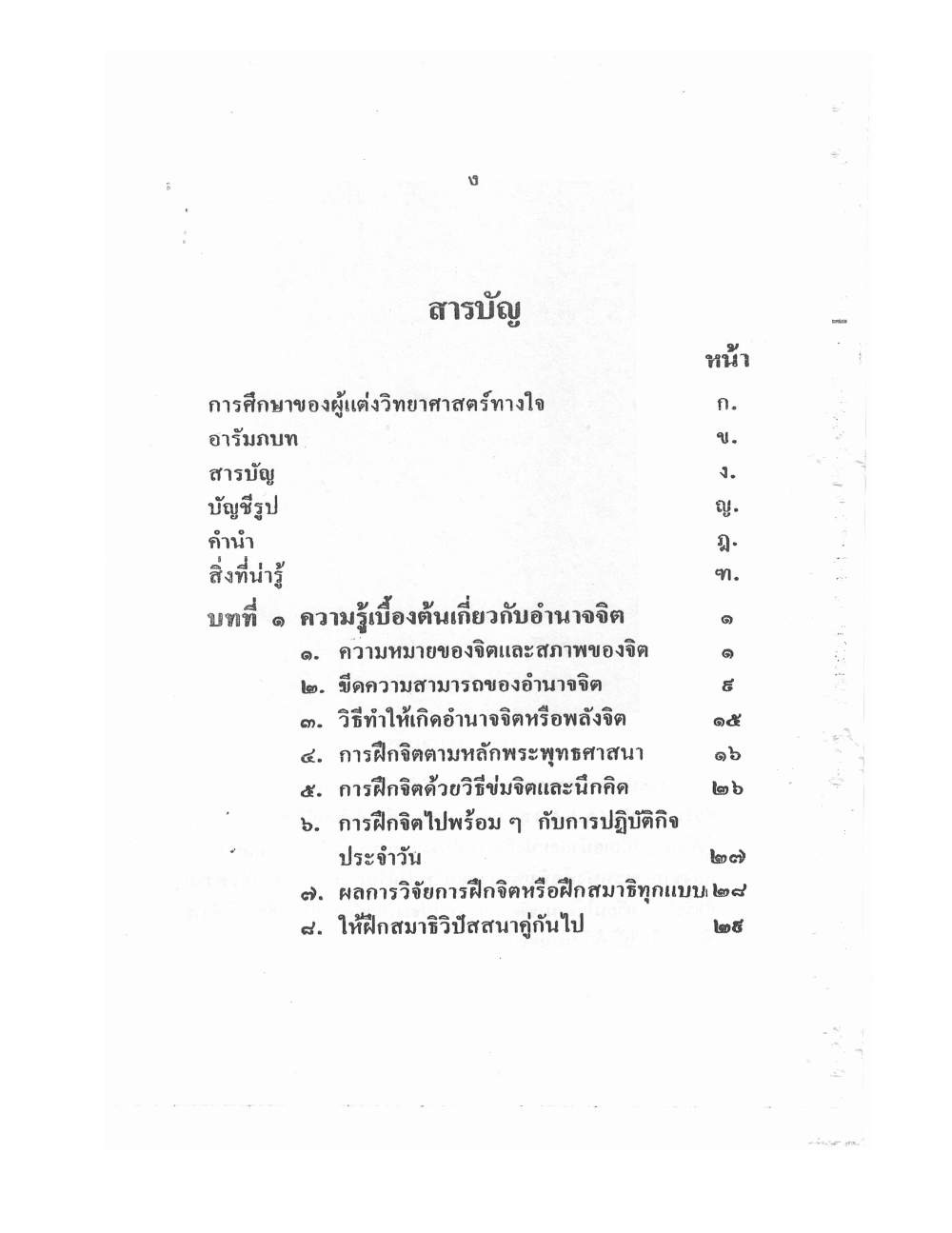
สารบัญ
หน้า การศึกษาของผู้แต่งวิทยาศาสตร์ทางใจ ก. อารัมภบท ข. สารบัญ ง. บัญชีรูป ญ. คำนำ ฎ. สิ่งที่น่ารู้ ฏ.
บทที่ ๑ ความรู้เบื้องต้นเกี่ยวกับอำนาจจิต ๑
๑. ความหมายของจิตและสภาพของจิต ๑ ๒. ขีดความสามารถของอำนาจจิต ๘ ๓. วิธีทำให้เกิดอำนาจจิตหรือพลังจิต ๑๕ ๔. การฝึกจิตตามหลักพระพุทธศาสนา ๑๖ ๕. การฝึกจิตด้วยวิธีข่มจิตและนึกคิด ๒๖ ๖. การฝึกจิตไปพร้อม ๆ กับการปฏิบัติกิจประจำวัน ๒๗ ๗. ผลการวิจัยการฝึกจิตหรือฝึกสมาธิทุกแบบ ๒๘ ๘. ให้ฝึกสมาธิวิปัสสนาคู่กันไป ๒๙
[page marker: ง]
Table of Contents
Page The education of the author of the science of the mind ก. Introduction ข. Table of Contents ง. List of Figures ญ. Preface ฎ. Things Worth Knowing ฏ.
Chapter 1 Basic Knowledge concerning Mind Power 1
1. The meaning of mind and the state of mind 1 2. The limits of the ability of mind power 8 3. How to develop mind power or psychic power 15 4. Training the mind according to Buddhist principles 16 5. Training the mind by suppressing the mind and directed thinking 26 6. Training the mind alongside the performance of daily activities 27 7. Results of research on mind training or meditation of every kind 28 8. Practicing samadhi and vipassana together 29
จ
หน้า
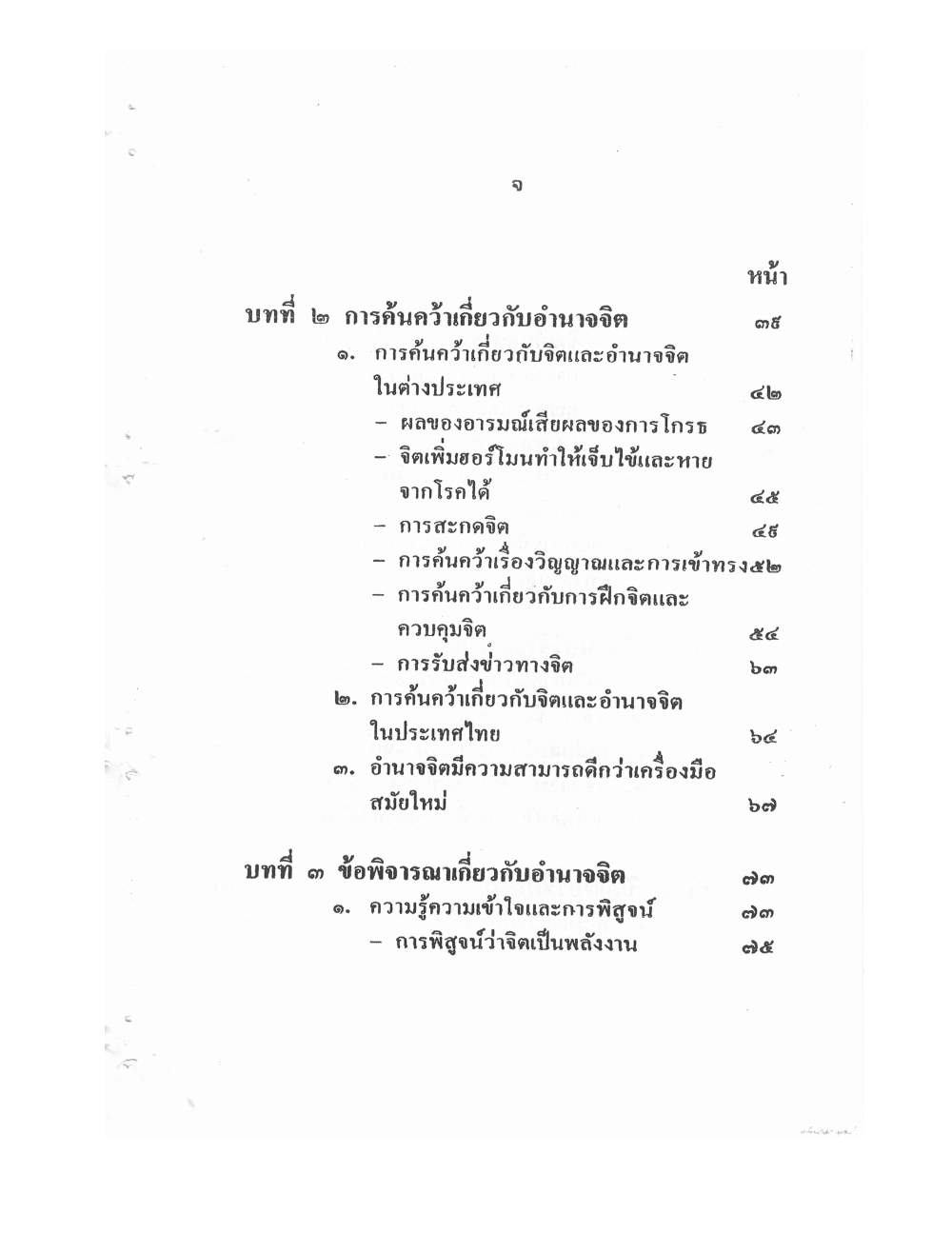
บทที่ ๒ การค้นคว้าเกี่ยวกับอำนาจจิต ๓๕
๑. การค้นคว้าเกี่ยวกับจิตและอำนาจจิตในต่างประเทศ ๔๒ – ผลของอารมณ์เสียผลของการโกรธ ๔๓ – จิตเพิ่มฮอร์โมนทำให้เจ็บไข้และหายจากโรคได้ ๔๕ – การสะกดจิต ๔๖ – การค้นคว้าเรื่องวิญญาณและการเข้าทรง ๕๒ – การค้นคว้าเกี่ยวกับการฝึกจิตและควบคุมจิต ๕๔ – การรับส่งข่าวทางจิต ๖๓ ๒. การค้นคว้าเกี่ยวกับจิตและอำนาจจิตในประเทศไทย ๖๔ ๓. อำนาจจิตมีความสามารถดีกว่าเครื่องมือสมัยใหม่ ๖๗
บทที่ ๓ ข้อพิจารณาเกี่ยวกับอำนาจจิต ๗๓
๑. ความรู้ความเข้าใจและการพิสูจน์ ๗๓ – การพิสูจน์ว่าจิตเป็นพลังงาน ๗๕
[page marker: จ]
Page
Chapter 2 Research concerning Mind Power 35
1. Research concerning mind and mind power in foreign countries 42 – The effects of emotion; the harmful effects of anger 43 – The mind increases hormones, causing illness, and can bring recovery from illness 45 – Hypnosis 46 – Research on spirits/consciousness and spirit possession 52 – Research concerning mind training and mind control 54 – Sending and receiving news by the mind (telepathy) 63 2. Research concerning mind and mind power in Thailand 64 3. Mind power has abilities superior to modern instruments 67
Chapter 3 Points to Consider concerning Mind Power 73
1. Knowledge, understanding, and proof 73 – Proof that the mind is a form of energy 75
ฉ
หน้า
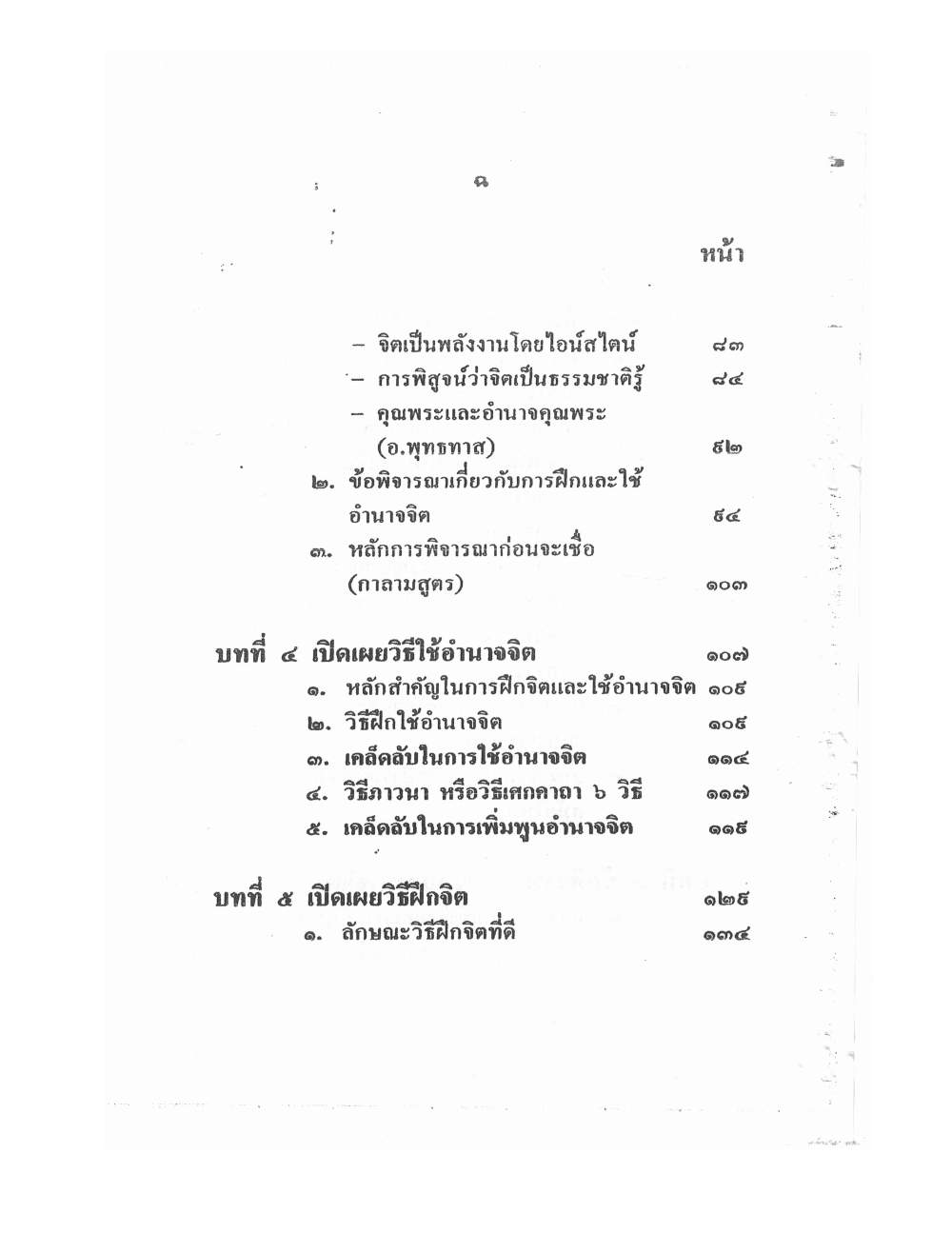
– จิตเป็นพลังงานโดยไอน์สไตน์ ๘๓ – การพิสูจน์ว่าจิตเป็นธรรมชาติรู้ ๘๔ – คุณพระและอำนาจคุณพระ (อ.พุทธทาส) ๙๒ ๒. ข้อพิจารณาเกี่ยวกับการฝึกและใช้อำนาจจิต ๙๔ ๓. หลักการพิจารณาก่อนจะเชื่อ (กาลามสูตร) ๑๐๑
บทที่ ๔ เปิดเผยวิธีใช้อำนาจจิต ๑๐๓
๑. หลักสำคัญในการฝึกจิตและใช้อำนาจจิต ๑๐๕ ๒. วิธีฝึกใช้อำนาจจิต ๑๐๖ ๓. เคล็ดลับในการใช้อำนาจจิต ๑๑๔ ๔. วิธีภาวนา หรือวิธีเศกคาถา ๖ วิธี ๑๑๗ ๕. เคล็ดลับในการเพิ่มพูนอำนาจจิต ๑๑๙
บทที่ ๕ เปิดเผยวิธีฝึกจิต ๑๒๕
๑. ลักษณะวิธีฝึกจิตที่ดี ๑๓๔
[page marker: ฉ]
Page
– The mind is energy, according to Einstein 83 – Proof that the mind is a knowing nature (a natural faculty of awareness) 84 – The Buddha's virtue and the power of the Buddha's virtue (Ven. Buddhadasa) 92 2. Points to consider concerning training and using mind power 94 3. Principles to consider before believing (the Kalama Sutta) 101
Chapter 4 Revealing Methods for Using Mind Power 103
1. Key principles in training the mind and using mind power 105 2. Methods of training the use of mind power 106 3. Secrets of using mind power 114 4. Methods of meditation, or 6 methods of chanting spells 117 5. Secrets of increasing mind power 119
Chapter 5 Revealing Methods of Training the Mind 125
1. Characteristics of a good method of mind training 134
ช
หน้า
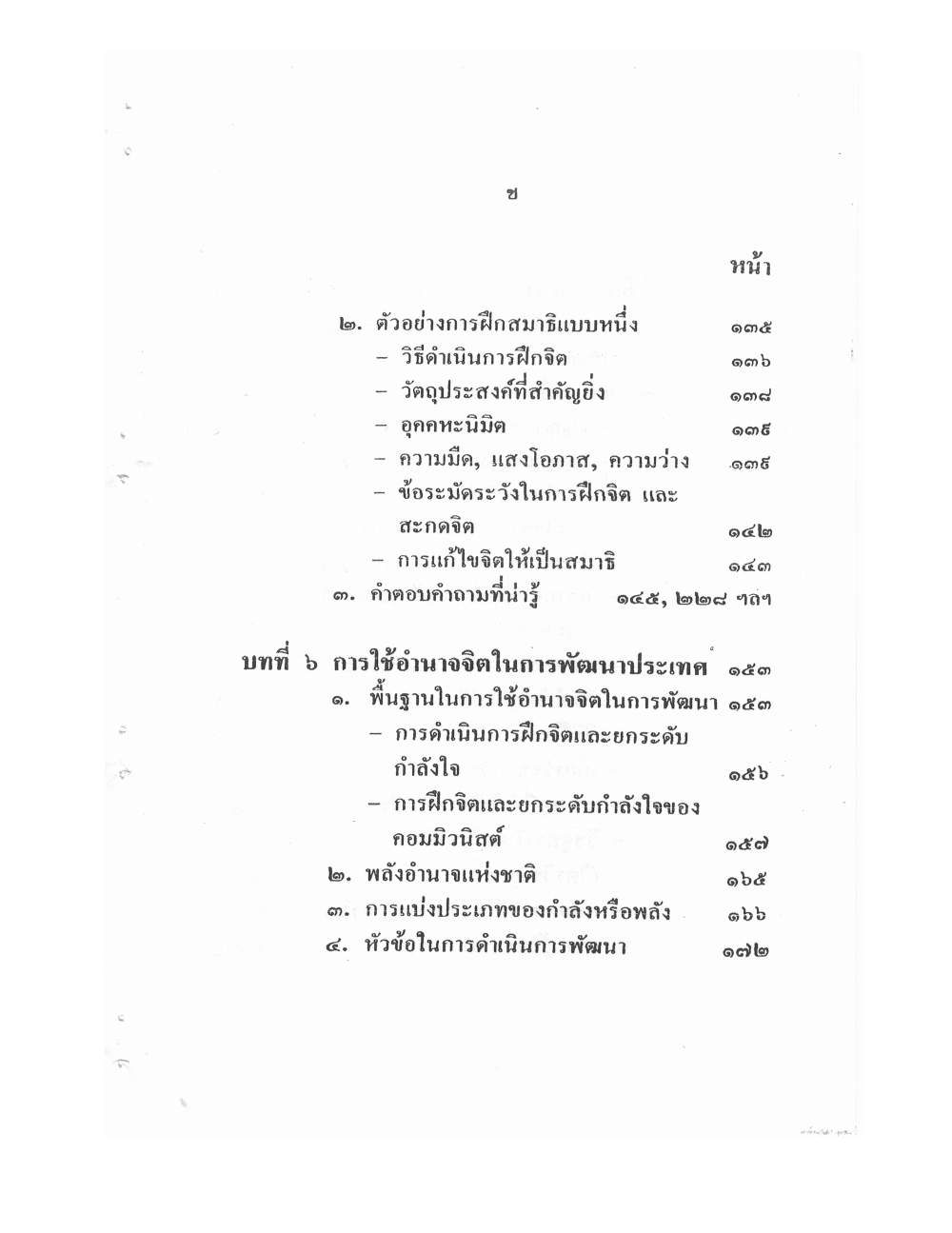
๒. ตัวอย่างการฝึกสมาธิแบบหนึ่ง ๑๓๕ – วิธีดำเนินการฝึกจิต ๑๓๖ – วัตถุประสงค์ที่สำคัญยิ่ง ๑๓๘ – อุคคหะนิมิต ๑๓๙ – ความมืด, แสงโอภาส, ความว่าง ๑๓๙ – ข้อระมัดระวังในการฝึกจิต และสะกดจิต ๑๔๒ – การแก้ไขจิตให้เป็นสมาธิ ๑๔๓ ๓. คำตอบคำถามที่น่ารู้ ๑๔๕, ๒๒๘ ฯลฯ
บทที่ ๖ การใช้อำนาจจิตในการพัฒนาประเทศ ๑๕๓
๑. พื้นฐานในการใช้อำนาจจิตในการพัฒนา ๑๕๓ – การดำเนินการฝึกจิตและยกระดับกำลังใจ ๑๕๖ – การฝึกจิตและยกระดับกำลังใจของคอมมิวนิสต์ ๑๕๗ ๒. พลังอำนาจแห่งชาติ ๑๖๕ ๓. การแบ่งประเภทของกำลังหรือพลัง ๑๖๖ ๔. หัวข้อในการดำเนินการพัฒนา ๑๗๒
[page marker: ช]
Page
2. An example of one method of meditation training 135 – The procedure for training the mind 136 – The most important objective 138 – The uggahanimitta (the "grasped" meditation sign) 139 – Darkness, radiant light, emptiness 139 – Precautions in mind training and hypnosis 142 – Correcting the mind so that it becomes concentrated (samadhi) 143 3. Answers to questions worth knowing 145, 228, etc.
Chapter 6 The Use of Mind Power in National Development 153
1. Foundations for using mind power in development 153 – Carrying out mind training and raising morale 156 – Mind training and raising the morale of communists 157 2. National power/strength 165 3. The classification of types of strength or power 166 4. Topics in carrying out development 172
ซ
หน้า
บทที่ ๗ ให้ความสว่างล้างสงสัย ๑๕๗
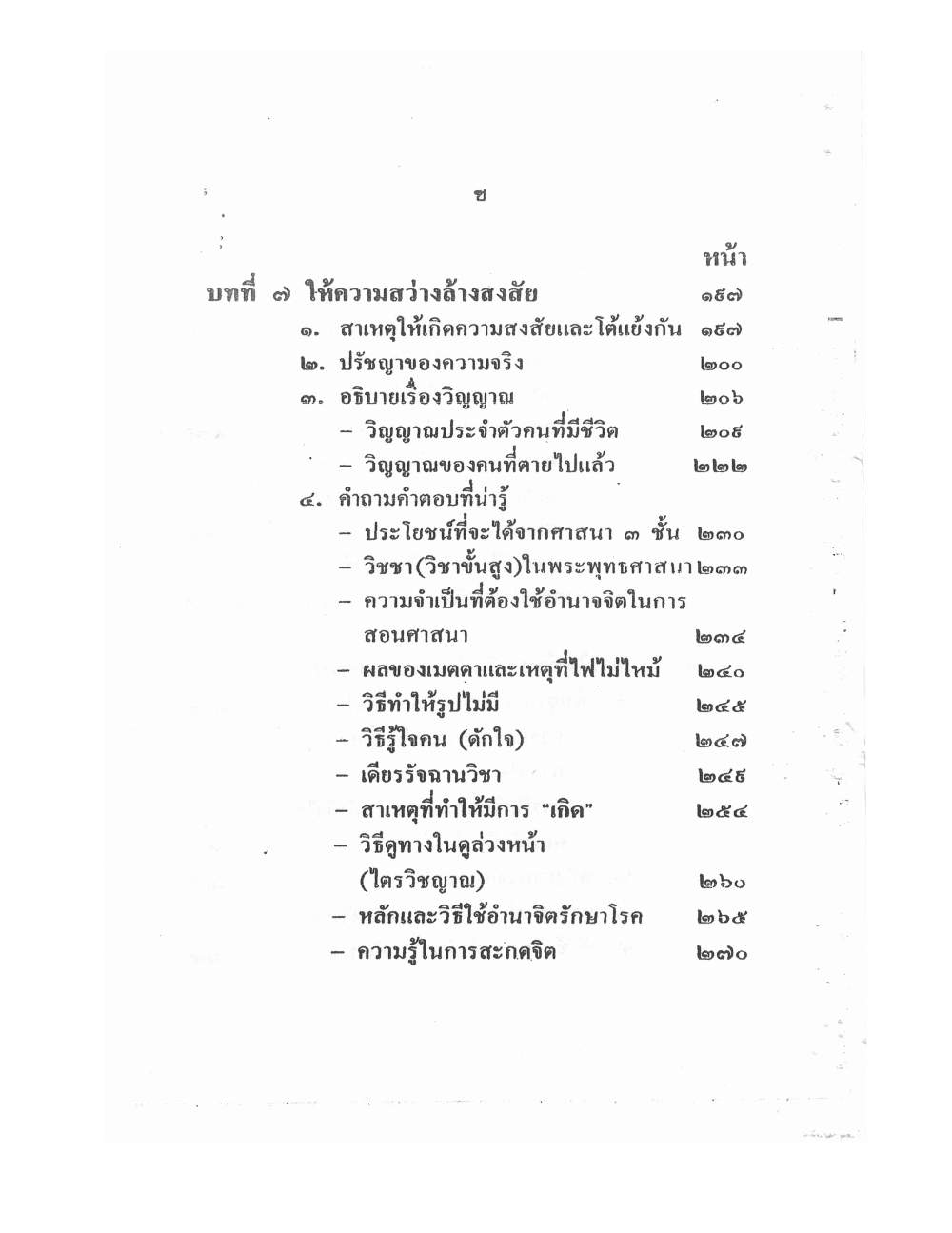
๑. สาเหตุให้เกิดความสงสัยและโต้แย้งกัน ๑๕๗ ๒. ปรัชญาของความจริง ๒๐๐ ๓. อธิบายเรื่องวิญญาณ ๒๐๖ – วิญญาณประจำตัวคนที่มีชีวิต ๒๐๖ – วิญญาณของคนที่ตายไปแล้ว ๒๒๒ ๔. คำถามคำตอบที่น่ารู้ – ประโยชน์ที่จะได้จากศาสนา ๓ ชั้น ๒๓๐ – วิชชา (วิชาขั้นสูง) ในพระพุทธศาสนา ๒๓๓ – ความจำเป็นที่ต้องใช้อำนาจจิตในการสอนศาสนา ๒๓๔ – ผลของเมตตาและเหตุที่ไฟไม่ไหม้ ๒๔๐ – วิธีทำให้รูปไม่มี ๒๔๕ – วิธีรู้ใจคน (ดักใจ) ๒๔๗ – เดียรัจฉานวิชา ๒๔๖ – สาเหตุที่ทำให้มีการ "เกิด" ๒๕๔ – วิธีดูทางในดูล่วงหน้า (ไตรวิชญาณ) ๒๖๐ – หลักและวิธีใช้อำนาจจิตรักษาโรค ๒๖๕ – ความรู้ในการสะกดจิต ๒๗๐
[page marker: ซ]
Page
Chapter 7 Bringing Clarity, Dispelling Doubt 157
1. Causes giving rise to doubt and disagreement 157 2. The philosophy of truth 200 3. An explanation concerning consciousness/spirit (winyan) 206 – The spirit belonging to a living person 206 – The spirit of a person who has already died 222 4. Questions and answers worth knowing – Benefits to be gained from the three levels of religion 230 – Vijja (higher knowledge) in Buddhism 233 – The necessity of using mind power in teaching religion 234 – The results of loving-kindness (metta), and why fire does not burn [one who has it] 240 – How to make one's form/appearance disappear 245 – How to know a person's mind (reading their intentions) 247 – Forbidden/bestial knowledge (เดียรัจฉานวิชา) 246 – The cause that gives rise to "birth" 254 – Methods of seeing the way ahead, of foreseeing (the three kinds of knowledge) 260 – Principles and methods for using mind power to treat illness 265 – Knowledge concerning hypnosis 270
ฌ
หน้า
– เครื่องทำให้คนเลื่อมใส ๔ ๒๗๕ – ธรรมซึ่งทำให้คนเลื่อมใส ๑๐ ๒๗๖
บทที่ ๘ การฝึกปัญญาและวิปัสสนา ๒๘๗
๑. ปัญญาคืออะไร? มีกี่ชนิด ๒๘๘ ๒. ลำดับการฝึกวิปัสสนา ๕ ขั้น ๒๙๒ ๓. ลำดับการฝึกวิปัสสนา ๘ ขั้น ๒๙๖ – วิญญาณพูดดังในอากาศได้ จับตัวดูได้ ๒๙๘
บทที่ ๙ บทสรุป ๓๐๓
ผนวก ๓๑๓ บรรณานุกรม ๓๒๑
[page marker: ฌ]
Page
– Four things that make people trust/have faith 275 – Ten qualities of dharma that make people trust/have faith 276
Chapter 8 Training Wisdom (Paññā) and Vipassana 287
1. What is wisdom? How many kinds are there? 288 2. The 5-stage sequence of vipassana training 292 3. The 8-stage sequence of vipassana training 296 – Spirits can speak audibly in the air, and can be caught and observed 298
Chapter 9 Conclusion 303
Appendix 313 Bibliography 321
ญ
บัญชีรูป
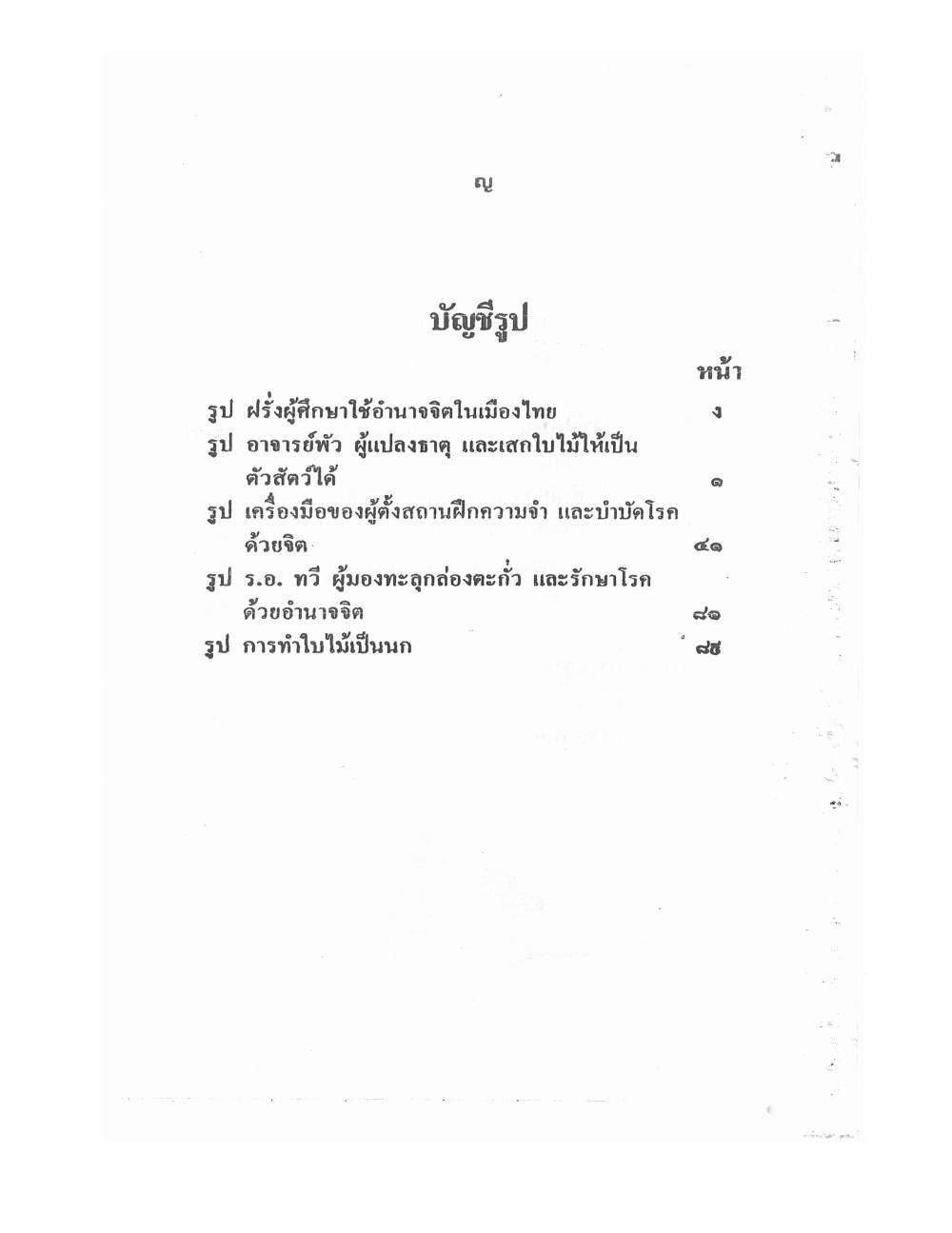
หน้า รูป ฝรั่งผู้ศึกษาใช้อำนาจจิตในเมืองไทย ง. รูป อาจารย์พัว ผู้แปลงธาตุ และเสกใบไม้ให้เป็น ตัวสัตว์ได้ ๑ รูป เครื่องมือของผู้ตั้งสถานฝึกความจำ และบำบัดโรค ด้วยจิต ๔๑ รูป ร.อ. ทวี ผู้มองทะลุกล่องตะกั่ว และรักษาโรค ด้วยอำนาจจิต ๘๑ รูป การทำใบไม้เป็นนก ๘๕
[page marker: ญ]
List of Figures
Page Figure: A foreigner who studied and used mind power in Thailand ง. Figure: Ajarn Pua, who transmuted elements and enchanted leaves so that they became living creatures 1 Figure: The equipment of the founder of an institute for training memory and treating illness with the mind 41 Figure: Capt. Tawee, who could see through a lead box, and who treated illness with mind power 81 Figure: Turning a leaf into a bird 85
ฏ
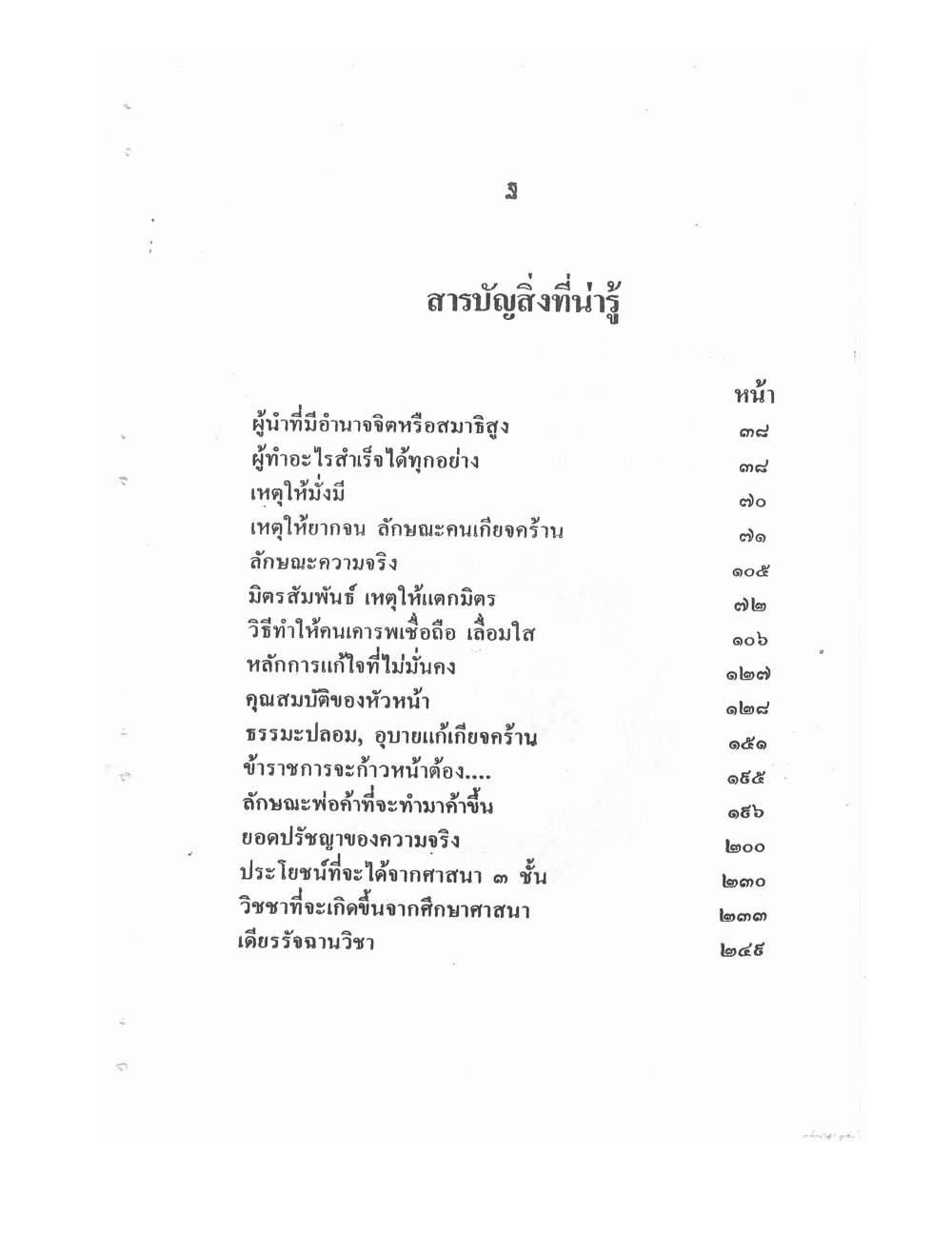
สารบัญสิ่งที่น่ารู้
หน้า ผู้นำที่มีอำนาจจิตหรือสมาธิสูง ๓๘ ผู้ทำอะไรสำเร็จได้ทุกอย่าง ๓๘ เหตุให้มั่งมี ๗๐ เหตุให้ยากจน ลักษณะคนเกียจคร้าน ๗๑ ลักษณะความจริง ๑๐๕ มิตรสัมพันธ์ เหตุให้แตกมิตร ๗๒ วิธีทำให้คนเคารพเชื่อถือ เลื่อมใส ๑๐๖ หลักการแก้ใจที่ไม่มั่นคง ๑๒๗ คุณสมบัติของหัวหน้า ๑๒๘ ธรรมะปลอม, อุบายแก้เกียจคร้าน ๑๕๑ ข้าราชการจะก้าวหน้าต้อง.... ๑๖๕ ลักษณะพ่อค้าที่จะทำมาค้าขึ้น ๑๖๖ ยอดปรัชญาของความจริง ๒๐๐ ประโยชน์ที่จะได้จากศาสนา ๓ ชั้น ๒๓๐ วิชชาที่จะเกิดขึ้นจากศึกษาศาสนา ๒๓๓ เดียรัจฉานวิชา ๒๔๖
[page marker: ฏ]
Index of Things Worth Knowing
Page Leaders who possess mind power or high concentration (samadhi) 38 People who succeed at everything they do 38 The causes of wealth 70 The causes of poverty; the characteristics of a lazy person 71 The characteristics of truth 105 Friendship; the causes of a broken friendship 72 Ways to make people respect, trust, and have faith [in you] 106 Principles for correcting an unstable mind 127 The qualities of a good leader 128 False dharma; tricks for overcoming laziness 151 For a civil servant to advance, one must.... 165 The characteristics of a merchant whose business will prosper 166 The supreme philosophy of truth 200 Benefits to be gained from the three levels of religion 230 The higher knowledge (vijja) that arises from the study of religion 233 Forbidden/bestial knowledge (เดียรัจฉานวิชา) 246
ฒ
หลักแก้โง่ ๒๕๕ วิธีแก้ความหดหู่ง่วงงุนเบื่อหน่าย ๓๐๒ หลักแก้ความไม่สบายใจ ๒๘๖ หลักแก้ความเสียใจ ๓๑๑ หลักแก้การหลง ๆ ลืม ๆ ๓๑๒
[ภาพ: ลายเส้นประดับรูปพวงมาลัยดอกไม้ล้อมกรอบวงกลม ภายในมีอักษรไทยคำว่า "สมาธิ" เขียนแบบลายมือ]
[page marker: ฒ]
Principles for correcting foolishness/ignorance 255 Methods for correcting listlessness, drowsiness, and boredom 302 Principles for correcting uneasiness of mind 286 Principles for correcting sorrow 311 Principles for correcting forgetfulness and absent-mindedness 312
[diagram: a decorative line drawing of a floral garland encircling a circle, within which the Thai word "สมาธิ" ("samadhi") is written in a cursive, handwritten-style script]
บทที่ ๑
ความรู้เบื้องต้นเกี่ยวกับอำนาจจิต
๑. ความหมายของจิตและสภาพของจิต ก. กล่าวทั่วไป
สมัยก่อนสงครามโลกครั้งที่ ๑ คนส่วนมากเชื่อว่ามีจิต คือคนเรามีชีวิตเป็นไปได้โดยมีส่วนประกอบ ๒ อย่าง คือ มีร่างกายและมีจิต ในบางกรณีเรียกจิตนี้ว่าวิญญาณ หรือ มโน หรือใจ ขอให้เข้าใจไว้ด้วยว่า จิต วิญญาณ ใจ หรือมโน ก็หมายถึงสิ่งเดียวกันแต่มักนิยมใช้ในโอกาสต่าง ๆ กัน ตัวอย่างที่เห็นได้ง่ายก็คือ เมื่อคนตายจิตที่แยกออกจากร่างกายนั้น เรียกว่าวิญญาณ(๑)
สมัยหลังสงครามโลกครั้งที่ ๑ วิทยาศาสตร์สมัยใหม่ (วิทยาศาสตร์ทางวัตถุ) ได้เจริญก้าวหน้าขึ้นเรื่อย ๆ จึงเป็นการจูงใจให้คนมาเลื่อมใสในด้านวัตถุ จนมองข้ามเรื่องจิตซึ่งมีความสำคัญเหนือกว่าวัตถุหรือร่างกาย ยิ่งกว่านั้นยังดื้อรั้นที่จะคัดค้านว่า จิตไม่มี วิญญาณไม่มี และหาทางพิสูจน์ทางวิทยาศาสตร์เพื่อยืนยันความเห็นที่ผิดว่าจิตไม่มีนี้ด้วย ข้อนี้มีความสำคัญต่อความ
――――――――― (๑) กรมการศาสนา. พระไตรปิฎก ฉบับภาษาไทย เล่ม ๓๑. หน้า ๓๕๘.
Chapter 1
Basic Knowledge concerning Mind Power
1. The meaning of mind and the state of mind a. General remarks
In the period before the First World War, most people believed that "mind" (jit) existed — that is, that a human being's life is possible through the presence of two components: having a body, and having a mind. In some cases this mind is called "winyan" (consciousness/spirit), or "mano," or "jai" (heart). Please understand that jit, winyan, jai, and mano all refer to the same thing, but each term tends to be favored on different occasions. An easily seen example is this: when a person dies, the mind that separates from the body is called "winyan."(1)
In the period after the First World War, modern science (physical/material science) progressed further and further. This persuaded people to become devoted to the material side, to the point of overlooking the matter of the mind — which is in fact of greater importance than matter or the body. Furthermore, people stubbornly insisted on arguing that mind does not exist, that consciousness does not exist, and sought scientific proof to confirm this mistaken opinion that the mind does not exist. This matter is of great importance to the
――――――――― (1) Department of Religious Affairs. The Tipitaka, Thai-language edition, Volume 31, page 358.
๒
มั่นคงความสงบสุขของชาติ และการพัฒนาประเทศอยู่มาก เพราะเมื่อไม่มีจิตไม่มีวิญญาณ ไม่มีบุญบาป ศาสนาต่าง ๆ ก็กล่าวเท็จหลอกลวงให้คนโง่ซื่อตรงกับคำโฆษณาชวนเชื่อ และอุดมคติของฝ่ายคอมมิวนิสต์ ฉะนั้น จึงพอจะกล่าวได้ว่า ผู้ที่คัดค้านหรือพยายามจูงว่า จิตไม่มี, เป็นการบ่อนทำลายศาสนา และบ่อนทำลายความมั่นคงความสงบสุขของชาติไปด้วย โดยความรู้เท่าไม่ถึงการณ์ ผลการวิจัยครั้งล่าสุดก็ยืนยันว่า สิ่งที่คอมมิวนิสต์กลัวมากนั้นก็คือความเลื่อมใสมั่นคงในศาสนาซึ่งเป็นเครื่องขัดขวางที่สำคัญยิ่ง ปัญหาศาสนานี้พวกคอมมิวนิสต์พยายามถือโอกาสใช้เป็นหลักสำคัญในการปฏิบัติการทางจิตวิทยา นอกจากจะค้านคำสอนทางศาสนาแล้ว ยังเปรียบเทียบให้เห็นว่า ศาสนาเป็นเครื่องถ่วงความเจริญก้าวหน้า ปัญหาโจมตีทำนองนี้ ผู้เขียนได้พบหลักฐานเป็นจำนวนมากว่า ทางสัมพันธมิตรใช้วิธีนิ่งสงบไม่โต้ตอบเสียเป็นส่วนมาก(๒) จึงทำให้บางคนเข้าใจว่า คำโฆษณาของคอมมิวนิสต์นั้นเป็นความจริง ที่ถูกแล้ว ศาสนาก็มีรากฐานมาจากความจริง และยืนยันว่าจิตมีจริง จิตเป็นกำลังสำคัญยิ่งในการส่งเสริมให้เกิดความเจริญก้าวหน้ารวดเร็ว ทั้งในด้านวัตถุและด้านจิตใจ
――――――――― (๒) รวบรวมจากบันทึกการสอนเกี่ยวกับสงครามจิตวิทยา ของฟอร์ตแบรก พ.ศ. ๒๕๐๘
2
the stability and peace of the nation, and to national development, a great deal — because if there were no mind, no consciousness, and no merit or sin, then the various religions would simply be telling lies to deceive foolish people who go along with propaganda and with the ideology of the communist side. Therefore it may fairly be said that those who deny, or who try to persuade others, that the mind does not exist are undermining religion, and are also undermining the stability and peace of the nation, out of ignorance of the consequences. The most recent research findings confirm that what communists fear most is firm devotion to religion, which is a very significant obstacle [to them]. The communists try to seize on this matter of religion and use it as a key principle in their psychological operations. Besides opposing religious teachings, they also draw comparisons to suggest that religion is a drag on progress. Regarding this kind of attack, the author has found a great deal of evidence that the Allied side mostly used a method of remaining quiet and not responding.(2) This has led some people to believe that the communists' propaganda is true. In fact the opposite is correct: religion does have its foundation in truth, and it can be confirmed that the mind truly exists. The mind is an extremely important force in promoting rapid progress, both in material terms and in terms of the mind/spirit.
――――――――― (2) Compiled from records of training on psychological warfare, of Fort Bragg, B.E. 2508 [1965 CE].
๓
ในการคัดค้านและพิสูจน์ว่าจิตไม่มี วิญญาณไม่มีนั้นล้วน แต่ว่าไปตามความเห็น ที่โน้มเอียงไปทางวัตถุมากเกินไป ไม่มี เหตุผลพิสูจน์ แต่หลังสงครามโลกครั้งที่ ๑ มีการพิสูจน์และ เผยแพร่ทำให้คนเชื่อถือมากอย่างหนึ่งก็คือ การเปิดกะโหลก ศีรษะของคนที่ตายใหม่ ๆ แล้วเอาไฟฟ้าจี้ลงไปที่สมองและ ระบบประสาท จี้ลงบางแห่งก็ทำให้นิ้วกระดิก บางแห่งก็ทำให้ อ้าปาก จี้ลงบางแห่งก็ทำให้ตาลืมขึ้นหรือหลับลงได้ จึงสรุปเอา ว่าจิตไม่มีแน่ ที่หลงเชื่อกันว่าจิตไปควบคุมอวัยวะต่าง ๆ นั้น ที่แท้ก็คือสมองและระบบประสาทนั่นเอง ข้อพิสูจน์นี้ทำให้คน เชื่อถือมาเป็นเวลานาน แต่ถ้าเราจะใช้สามัญสำนึกวิเคราะห์ดู ก็จะเห็นข้อผิดและกลับเป็นข้อสนับสนุนว่าจิตมีเสียอีก กล่าวคือ คนที่ยังมีชีวิตอยู่ไม่มีไฟฟ้าไปจี้สมอง ก็อะไรเล่าเป็นตัวการ ไปจี้ หรือกระตุ้นให้สมองและระบบประสาททำงาน? สิ่งที่ไป กระตุ้นให้สมองและระบบประสาททำงานก็คือจิตนั่นเอง เพื่อ เพิ่มพูนความกระจ่างชัดว่าจิตไม่มีนี้อีก นักวิทยาศาสตร์ได้ พยายามสร้างอวัยวะเทียม พยายามสร้างคนหรือสิ่งที่มีชีวิต ตามหลักการของวิทยาศาสตร์ เขาทำหัวใจเทียม สมองเทียม ไข่เทียมได้ แต่ว่าการสร้างไข่ซึ่งมีความละเอียดซับซ้อนน้อย กว่าสัตว์มีชีวิตนั้น จนถึงปัจจุบันนี้เขาก็ไม่สามารถสร้างให้ไข่ มีเชื้อเหมือนไข่ธรรมชาติได้ นั่นก็คือ เขาสร้างจิตหรือวิญญาณ หรือเชื้อที่มีชีวิตอันเป็นกลไกที่สำคัญไม่ได้ แต่ในประเทศเรา
3
In refuting and arguing that mind does not exist, that consciousness does not exist — this is all merely an opinion that leans too far toward materialism, with no reasoned proof behind it. But after the First World War, there was one proof that was published and spread and made people believe it strongly: opening the skull of a person freshly dead and applying electric current to the brain and nervous system. Stimulating in some spots made a finger twitch; in other spots it made the mouth open; stimulating other spots made the eyes open or close. From this they concluded that mind surely does not exist — that what people mistakenly believed to be mind controlling the various organs was in truth nothing but the brain and nervous system themselves. This proof made people believe it for a long time. But if we apply plain common sense to analyze it, we will see the flaw in it, and it actually turns into evidence supporting that mind does exist after all — namely, a living person has no electricity being applied to stimulate the brain, so what then is the agent that stimulates or prompts the brain and nervous system to work? The thing that prompts the brain and nervous system to work is precisely the mind itself. To further clarify this refutation of "no mind," scientists have tried to create artificial organs, tried to create people or living things according to scientific principles. They have made artificial hearts, artificial brains, artificial eggs — yet the making of an egg, which is far less intricate and complex than a living animal, has still, to this day, not been achieved to the point where the artificial egg has fertility like a natural egg. That is because they cannot create mind or consciousness, or the living germ that is the essential mechanism. But in our country —
๔
มีอาจารย์ที่สร้างสิ่งมีชีวิตด้วยอำนาจจิต เช่นทำข้าวสารให้เป็น กุ้ง ทำใบไม้ให้เป็นนกหรือแมลงภู่(๓) ทั้งนี้โดยอาศัยเรียกวิญ- ญาณหรือจิตที่ยังไม่มีร่างครองมาสิงอยู่ในรูปกายนั้นก่อนชั่วคราว
หลังสงครามโลกครั้งที่ ๒ มีการวิจัยของนักวิทยาศาสตร์ ในสมัยฮอร์โมนอีกครั้งหนึ่ง และได้ประกาศผลการวิจัยเกี่ยวกับ เรื่องจิตโดยอธิบายว่า คนที่สามารถทำอะไรได้แปลก ๆ เหนือ กว่าคนธรรมดามากเช่น คนกลัวเสือสามารถกระโดดขึ้นเกาะ กิ่งไม้สูง ๆ ได้ คนตกใจหรือโกรธสามารถยกของหนัก ๆ ขึ้น ได้ ซึ่งเวลาปกติเขาทำเช่นนั้นไม่ได้ เพราะว่าเวลาโกรธหรือกลัว ต่อมบางประเภทจะขับน้ำฮอร์โมนออกมาช่วยเร่งการขับดัน ของโลหิตให้ทวีมากขึ้น จึงมีกำลังหรือพลังพิเศษขึ้นได้ และ เชื่อต่อไปว่าการที่คนเรามีพลังพิเศษขึ้นหรือทำอะไรได้แปลก ๆ ผิดธรรมดานั้นก็เพราะเหตุว่ามีฮอร์โมนซึ่งถูกขับออกมาเป็น พิเศษนี้แหละช่วยให้ทำเช่นนั้นได้ เรื่องนี้ก็พลอยทำให้เชื่อกัน ไปมาก แต่เมื่อผู้เขียนได้วิเคราะห์ดู ตรวจสอบการใช้อำนาจจิต ของผู้รู้หลายท่านแล้วทดลองปฏิบัติด้วยตนเอง ก็พอจะสรุป ได้ว่า ผลการวิจัยของนักวิทยาศาสตร์นี้มีส่วนถูกอยู่บ้าง กล่าวคือ ความกลัว ความโกรธ ไม่ใช่เหตุที่แท้จริงในการทำให้เกิดความ
(๓) ดูรายละเอียดในการทดลอง และวิธีทำให้เกิดขึ้นได้ใน ผนวก
4
There are teachers who create living beings by the power of mind — for example, turning uncooked rice into shrimp, turning leaves into birds or bees (3). This is done by calling forth a consciousness or mind that has no body of its own to temporarily come and inhabit that form.
After the Second World War, there was once again scientific research in the age of hormones, and the results of research concerning the mind were announced, explaining that people who can do strange things far beyond the ordinary — for instance, a person afraid of a tiger can leap up and cling to a high branch; a person startled or enraged can lift heavy objects — things they could not normally do — because at times of anger or fear, certain glands release hormones that help accelerate the pumping of blood, increasing it, and thereby giving rise to special strength or power. And it was further believed that the reason people gain special power or can do strange, abnormal things is because of this specially secreted hormone that helps them do so. This matter caused many people to come to believe it. But when the author analyzed and examined the use of mind-power by several knowledgeable people, and then experimented with it personally, it could be concluded in summary that the scientists' research findings were partly correct — namely, that fear and anger are not the true cause that brings about the
(3) See the details of the experiment and the method for producing this in the appendix.
๕
สามารถพิเศษขึ้นได้ เช่น คนตกใจเพราะไฟไหม้ สามารถยก กำปั้นหนัก ๆ ไปได้ แต่คนอื่น ๆ ก็ตกใจเหมือนกันเหตุไฉน จึงยกไม่ไหว หรือทำให้คนที่เคยตกใจแล้วยกกำปั้นไหว คนเดิม ตกใจอีกเขาก็ไม่สามารถจะยกกำปั้นได้เสมอไป เมื่อได้วิจัยดู ในทางปฏิบัติโดยใช้อำนาจจิตเพื่อให้เกิดความสามารถพิเศษ ต่าง ๆ รวมทั้งการกระโดดได้สูง และการยกน้ำหนักได้ดีกว่า ปกติวิสัยแล้วก็ทราบว่า เนื่องมาแต่ต้นเหตุร่วมอันเดียวกันทั้งนั้น คือ อำนาจทางจิตหรือพลังทางจิตนั่นเอง และถ้าใช้อำนาจจิต ล้วน ๆ เช่น การรับส่งข่าวทางจิต หรือการสะกดจิตทางไกล แทนที่จะอาศัยการไหลเวียนของโลหิตทวีขึ้น เพราะมีน้ำฮอร์- โมนเกิดขึ้นมาก ก็จะกลับเป็นไปในทางตรงกันข้าม คือโลหิตไหล วนน้อยกว่าปกติ ถ้ายิ่งต่อมทำงานน้อยลงขับน้ำฮอร์โมนออกมา น้อยลง และโลหิตไหลวนน้อยลงเพียงใด อำนาจจิตกลับจะเกิด สูงขึ้นซึ่งจะได้แสดงผลการพิสูจน์ต่อไป
ในบางกรณีที่ความสามารถพิเศษนั้นใช้ทั้งกำลังกายและ กำลังใจ (อำนาจจิต) ด้วย จึงจะมีน้ำฮอร์โมนถูกขับออกมามาก ขึ้น เป็นการเร่งให้โลหิตไหลวนมากขึ้น เมื่อทำการวิเคราะห์ อีกแง่หนึ่งคือ อาศัยกำลังทางกายล้วน ๆ มีกำลังทางจิตมาช่วย เพียงส่วนน้อย การแสดงความสามารถพิเศษออกมาก็ไม่แตกต่าง ไปจากปกติวิสัยมากนัก เมื่ออาศัยการวิจัยให้ลึกซึ้งยิ่งขึ้นอีก ก็จะพบว่าความกลัว หรือความโกรธไม่ใช่เหตุอันแท้จริงที่จะ
5
...special ability, such as a person startled by a fire who can lift heavy fists — but other people are equally startled, so why can't they lift it? Or a person who once was startled and could lift a fist — if the same person is startled again, they cannot always lift it. When the matter was researched in practice, using the power of mind to produce various special abilities, including jumping high and lifting weight better than normal, it was found that all of these stem from one and the same root cause: the power of mind, or mental force itself. And if pure mind-power alone is used, such as sending and receiving messages by mind, or hypnotizing someone at a distance — instead of relying on increased blood circulation from the large amount of hormone produced — the opposite occurs: the blood circulates less than normal. The less the gland works and the less hormone it secretes, and the less the blood circulates, the higher the power of mind that arises instead — this will be shown by proof further on.
In some cases where the special ability uses both physical strength and mental strength (mind-power) together, more hormone will be secreted, which speeds up blood circulation. Analyzed from another angle: when relying purely on physical strength, with mental strength helping only a small amount, the display of special ability does not differ much from the ordinary. When the research is carried further and deeper, it is found that fear or anger is not the true cause that will —
๖
ทำให้น้ำฮอร์โมนถูกขับออกมาก หรือไม่ใช่เหตุอันแท้จริงที่จะ เกิดความสามารถพิเศษ เป็นแต่เพียงเหตุต่อเนื่องหรือเหตุช่วงต่อ กล่าวคือสิ่งที่ทำให้กลัวหรือโกรธเป็นสิ่งแวดล้อม ทำให้จิตลืม เรื่องอื่นหันมารวมรับรู้เรื่องเดียวอย่างมั่นคง จึงเกิดสมาธิและ เกิดอำนาจจิตขึ้น อำนาจจิตที่เกิดขึ้นเป็นต้นเหตุอันแท้จริงให้มี ความสามารถพิเศษขึ้นได้ และเป็นเครื่องกระตุ้นให้เกิดผลคือ ต่อมขับน้ำฮอร์โมนออกมากขึ้น น้ำฮอร์โมนที่ออกมากขึ้นกลับ เป็นตัวเหตุต่อทำให้เกิดผล คือโลหิตไหลวนมากขึ้น แล้วโลหิต ที่ไหลวนมากขึ้นเป็นตัวเหตุช่วงต่อให้เกิดกำลังทางกาย หรือ ความสามารถทางกายมากขึ้นเป็นพิเศษ
เมื่อสรุปแล้ว การที่ต่อมขับน้ำฮอร์โมนออกมากขึ้นเป็นเพียง เหตุช่วงต่อมา ซึ่งช่วยให้เกิดความสามารถผิดปกติ ผลที่มีความ สามารถพิเศษดังกล่าวจะเกิดขึ้นจากเหตุแท้ คืออำนาจจิต หรือ พลังจิตโดยไม่จำเป็นต้องมีการขับน้ำฮอร์โมนออกมา หรือไม่ จำเป็นต้องเพิ่มการไหลวนของโลหิตมาช่วย จะมีการไหลวน ของโลหิตหรือน้ำฮอร์โมนมาช่วยเฉพาะบางกรณีที่ความสามารถ พิเศษนั้นต้องมีทั้งการใช้กำลังกาย และกำลังใจรวมเป็น ๒ แรง
ข. ความหมายของจิตและสภาพของจิต
เมื่อได้ประมวลเอาลักษณะอาการของจิต และความหมาย ของจิตตามพระไตรปิฎกรวมกันเข้า ประกอบกับการค้นคว้า
6
...cause a large release of hormone, or is not the true cause that gives rise to special ability. It is merely a subsequent or intermediary cause. That is to say, the thing that causes fear or anger is a surrounding circumstance that makes the mind forget other matters and turn to focus steadily on registering a single matter, and so concentration (samādhi) and mind-power arise. The mind-power that arises is the true root cause enabling special ability, and it acts as the trigger that produces the effect of the glands secreting more hormone. The hormone that is secreted more heavily then becomes, in turn, the cause producing the effect of increased blood circulation. And the increased blood circulation is the intermediary cause giving rise to greater physical strength or special physical ability.
In summary, then, the increased secretion of hormone by the glands is merely an intermediary cause that helps bring about abnormal ability. The result of having such special ability arises from the true cause, which is mind-power or mental force, without any need for hormone secretion, and without any need for increased blood circulation to help. Circulation of blood or hormone will assist only in particular cases where the special ability requires the use of both physical strength and mental strength combined into two forces.
B. The Meaning of Mind and the Nature of Mind
Having gathered together the characteristics and behavior of mind, and the meaning of mind according to the Tipitaka, combined with research —
๗
ทดลอง(๔) ก็สรุปให้สั้นและสมบูรณ์ได้ว่า "จิตคือพลังงานพิเศษ และธรรมชาติรู้" เพื่อให้เข้าใจและเห็นจริงตามนี้ควรจะได้พิจาร- ณาถึงสภาพของจิตเสียก่อน สภาพของจิตหรือธรรมชาติของจิตที่ สำคัญอย่างหนึ่งคือ จิตจะต้องมีที่เกาะเกี่ยวหรือรับรู้ ถ้าเป็นจิต ของคนที่มีชีวิตอยู่ สิ่งที่จิตเกาะเกี่ยวหรือรับรู้นั้นก็เป็นได้ทั้ง จำพวกรูปและไม่ใช่รูป (นามธรรม) จำพวกรูปได้แก่ คน สัตว์ ต้นไม้ บ้านเรือน เครื่องนุ่งห่ม ฯลฯ ส่วนจำพวกไม่ใช่รูปนั้นได้แก่ ความรัก ความโกรธ ความโลภ ความวิตก ความกลัวกับเรื่องราว ที่จิตนึกคิด ในขณะเดียวกันจิตจะเกาะเกี่ยวอยู่กับสิ่งต่าง ๆ หลาย อย่างพร้อมกัน ตัวอย่างเช่น นายแดงจะไปยืมเงินจากนายเขียว นายเขียวไม่ให้ยืมก็รีบลากลับ ขณะที่นั่งพูดจากับนายเขียว จิต ของนายแดงก็มุ่งที่จะคิดหาคำพูดในการทักทายและยืมเงิน คือ จิตเกาะเกี่ยวอยู่กับสิ่งที่ไม่ใช่รูป หรือพูดอีกอย่างหนึ่งว่าจิตเสวย ธรรมารมณ์ (คิดเรื่องราวการยืมเงิน) ขณะเดียวกันที่จิตคิดเรื่องราว เกี่ยวกับการยืมเงินก็ไปเกาะเกี่ยวรับรู้เรื่องราวอื่น ๆ อีกโดยที่ นายแดงรู้ตัวบ้างไม่รู้ตัวบ้าง เมื่อนายแดงกลับถึงบ้านถูกซักถาม ว่าบ้านนายเขียวเป็นตึกหรือเป็นไม้ ห้องรับแขกเป็นพื้นกระดาน หรือมีอะไรปู เก้าอี้รับแขกเป็นไม้หรือเป็นหวาย ห้องรับแขกทาสี หรือเปล่า ฯลฯ คำถามทำนองนี้ นายแดงจะตอบได้ถูกต้องหลาย
(๔) รายละเอียดในการประมวลเข้าด้วยกันดู ผนวก
7
...experiment (4), it may then be summed up briefly and completely as: "Mind is a special energy and a knowing nature." In order to understand and see the truth of this, one should first consider the nature of mind. One important characteristic, or natural quality, of mind is that mind must always have something to latch onto or to be aware of. In the case of the mind of a living person, the things the mind latches onto or perceives may be either of the category of form, or not-form (the abstract, nāma-dhamma). Things of the form category include people, animals, trees, houses, clothing, etc. Things not of the form category include love, anger, greed, worry, fear, together with the matters the mind is thinking about. At the same time, the mind latches onto many different things simultaneously. For example: Mr. Daeng goes to borrow money from Mr. Khiaw. Mr. Khiaw refuses to lend it, so Mr. Daeng hurries to take his leave. While sitting and talking with Mr. Khiaw, Mr. Daeng's mind is intent on thinking of what to say in greeting and in asking to borrow money — that is, the mind is latched onto something that is not form, or put another way, the mind is "experiencing a mental object" (thinking about the matter of borrowing money). At the very same time that the mind is thinking about the matter of borrowing money, it also latches onto and perceives other matters as well, some of which Mr. Daeng is aware of and some of which he is not. When Mr. Daeng returns home and is questioned about whether Mr. Khiaw's house is made of brick or wood, whether the sitting room has a plank floor or something else laid over it, whether the guest chairs are wood or rattan, whether the sitting room is painted or not, and so on — Mr. Daeng will be able to answer many such questions correctly —
(4) For details of how this was compiled together, see the appendix.
๘
อย่าง แสดงว่าขณะที่นายแดงคิดเรื่องราวเกี่ยวกับการยืมเงิน ตั้งแต่เดินทางไปบ้านนายเขียวจนพบนายเขียวนั้น จิตก็ยังมีเรื่อง อื่น ๆ เกาะเกี่ยวหรือรับรู้อีกหลายอย่างพร้อม ๆ กัน สภาพ ที่จิตไปเกาะเกี่ยวรับรู้หลายอย่างพร้อม ๆ กันนี้ ทำให้จิตไม่สงบ ไม่แน่วแน่อยู่ในเรื่องเดียว ซึ่งเป็นธรรมดาของคนทั่วไป เมื่อจิต ไม่แน่วแน่อยู่ในเรื่องเดียว จิตก็มีอำนาจหรือกำลังน้อย เปรียบ เหมือนน้ำซึ่งไหลจากที่สูงลงไป ถ้าแยกให้ไหลลง ๑๐ สาย ก็ ย่อมมีกำลังน้อย ถ้าปิดให้น้ำไหลลงด้วยจำนวนเท่าเดิม แต่ไหล ลงไปได้เพียงทางเดียว น้ำก็ย่อมมีกำลังมากขึ้นหลายเท่า นำไป ใช้ประโยชน์ได้ต่าง ๆ
การควบคุมจิตให้สงบแน่วแน่อยู่ในเรื่องเดียว หรือสิ่งเดียว นั้น เรียกว่าการทำจิตเป็นสมาธิ เมื่อรวมจิตให้เป็นสมาธิรับรู้ อยู่เพียงเรื่องเดียว หรือสิ่งเดียวได้ชั่วขณะแล้วจิตก็กลับไปรับรู้ หรือคิดเรื่องอื่น ๆ อีก ครั้นรวมจิตใหม่ก็มีความแน่วแน่อยู่เพียง ครู่เดียวอีก ดังนี้เรียกว่าเป็น "สมาธิขั้นต้น" เมื่อมีสิ่งแวดล้อม บังคับหรือมีการฝึกสมาธิมากขึ้นก็อาจจะรวมจิตให้แน่วแน่อยู่ ในเรื่องเดียวได้เป็นเวลานานพอควร แล้วจิตจึงถอยจากสมาธิ ไปรับรู้เรื่องอื่น สมาธิลักษณะนี้เรียกว่า "สมาธิขั้นกลาง" เมื่อ ได้ฝึกสมาธิมากขึ้นจนสามารถรวมจิตให้แน่วแน่อยู่ในเรื่องเดียว สิ่งเดียวได้นานตามความประสงค์ของตน และเข้าสู่สมาธิได้ เร็ว มีสติรู้ตัวอยู่ตลอดเวลา อยากจะออกจากสมาธิเมื่อใดก็ทำ
8
...correctly. This shows that while Mr. Daeng was thinking about the matter of borrowing money, from the time he set out for Mr. Khiaw's house until he met Mr. Khiaw, his mind was still latching onto and perceiving many other matters at the same time. This condition, of the mind latching onto and perceiving many things at once, causes the mind to be unsettled, not fixed steadily on one matter — which is the ordinary condition of people in general. When the mind is not fixed steadily on one matter, the mind has little power or strength — comparable to water flowing down from a high place: if it is divided to flow down through 10 channels, it will have little force in each; but if the same total quantity of water is closed off so that it can flow down through only one channel, the water will have many times more force, and can be put to various uses.
Controlling the mind so that it is calm and fixed steadily on one matter or one thing is called making the mind into samādhi (concentration). When the mind is gathered into samādhi, perceiving only one matter or one thing for a moment, and then the mind returns to perceiving or thinking of other matters again — and when it is gathered anew it again remains fixed for only a brief moment — this is called "basic-level samādhi." When there are surrounding conditions compelling it, or when there has been more training in samādhi, the mind may be gathered to remain fixed on one matter for a fairly long time before it withdraws from samādhi to perceive other things; this quality of samādhi is called "middle-level samādhi." When one has trained in samādhi further, to the point of being able to gather the mind to remain fixed on one matter, one thing, for as long as one wishes, and to enter samādhi quickly, remaining continuously mindful and self-aware throughout, able to leave samādhi whenever one wishes to do so —
๙
ได้ตามต้องการ สมาธิลักษณะนี้เรียกว่า "สมาธิขั้นสูง" ขณะที่ จิตเป็นสมาธินั่นเองจะเป็นกฎ หรือเป็นความจริงตามมาว่า จิตจะ มีกำลังหรืออำนาจเพิ่มขึ้นกว่าปกติ ยิ่งสมาธิสูงขึ้นเพียงใด จิต ก็ยิ่งมีกำลังมีความสามารถมากขึ้นตามส่วน และอาจจะนำไปใช้ ประโยชน์ได้ต่าง ๆ แต่ถ้าไม่ใช้อำนาจจิตให้เกิดประโยชน์ ปล่อย ให้จิตเป็นสมาธินิ่งอยู่ ร่างกายและจิตก็จะได้รับการพักผ่อนดีกว่า การพักผ่อนในขณะนอนหลับเสียอีก ถึงแม้ว่าร่างกายและจิต อยู่ในอาการพักผ่อนในระหว่างจิตเป็นสมาธิ จิตก็ยังมีอำนาจ หรือพลังในตัวมากกว่าจิตธรรมดาตามขั้นของสมาธิ
๒. ขีดความสามารถของอำนาจจิต
เพื่อให้เข้าใจขีดความสามารถของอำนาจจิตเป็นขั้นตอน และสอดคล้องกับขั้นตอนของสมาธิ จะได้กล่าวขีดความสามารถ ของอำนาจจิตเป็น ๓ ขั้น คือ:- ก. อำนาจจิตขั้นต้น (เกิดขึ้นเมื่อมีสมาธิขั้นต้น) ข. อำนาจจิตขั้นกลาง (เกิดขึ้นเมื่อมีสมาธิขั้นกลาง) ค. อำนาจจิตขั้นสูง (เกิดขึ้นเมื่อมีสมาธิขั้นสูง) สมาธิเป็นต้นเหตุอันแท้จริงให้เกิดอำนาจจิต และอำนาจจิต จะมากขึ้นตามลำดับในเมื่อสมาธิสูงขึ้นไป อำนาจจิตที่เกิดขึ้น ในห้วงของสมาธิขั้นต้นเรียกว่าอำนาจจิตขั้นต้น อำนาจจิตที่ เกิดขึ้นในสมาธิขั้นกลาง เรียกว่าอำนาจจิตขั้นกลาง และอำนาจ
9
...as one wishes — this quality of samādhi is called "high-level samādhi." At the very moment the mind is in samādhi, it follows as a rule, or as a truth, that the mind will gain more power or force than normal. The higher the samādhi, the more the mind's power and ability increase correspondingly, and this may be put to various uses. But if the power of mind is not used for any benefit, and the mind is simply left resting in samādhi, the body and mind will receive even better rest than the rest gained during sleep. Even though the body and mind are in a state of rest while the mind is in samādhi, the mind still retains more power or force in itself than an ordinary mind, according to the level of samādhi.
2. The Range of Ability of Mind-Power
In order to understand the range of ability of mind-power as a set of stages, and in correspondence with the stages of samādhi, the range of ability of mind-power will be described in 3 levels, namely:— a. Basic-level mind-power (arises when there is basic-level samādhi) b. Middle-level mind-power (arises when there is middle-level samādhi) c. High-level mind-power (arises when there is high-level samādhi) Samādhi is the true root cause giving rise to mind-power, and mind-power increases progressively as samādhi rises higher. The mind-power that arises within the span of basic-level samādhi is called basic-level mind-power. The mind-power that arises within middle-level samādhi is called middle-level mind-power, and the power —
๑๐
จิตที่เกิดขึ้นในสมาธิขั้นสูงเรียกว่าอำนาจจิตขั้นสูง คำว่า "สมาธิ" อาจจะทำให้ผู้อ่านหนักใจว่าเป็นของยาก และท้อถอยว่าตนเองยอมจำนนต่อการทำสมาธิหรือการใช้อำนาจ จิตให้เกิดประโยชน์ เพราะเคยรับการสอนว่าทำสมาธิ คือทำให้ ใจสงบไม่คิดอะไร ผู้เขียนก็เคยเข้าใจเช่นนั้น แต่เมื่อค้นคว้า มากเข้าก็พบวิธีการใหม่ที่เรียนได้ง่ายทุกเพศทุกวัย แทนที่จะ พูดว่า ฝึกสมาธิหรือทำสมาธิก็พูดว่า ปรับลมหายใจ ซึ่งฟังง่าย กว่า เมื่อปรับลมหายใจได้ จิตก็เป็นสมาธิและเกิดกำลังพิเศษ ขึ้นเอง อำนาจจิตขั้นต้นเรียนไม่ถึง ๒ ชั่วโมง ก็ทำได้ทุกคนไม่ ว่าจะอยู่ที่ใด ถ้าไม่เข้าใจจริงก็จะเห็นเป็นเรื่องยาก
นอกจากนี้จะต้องพิจารณาให้แจ่มแจ้งเสียก่อนว่าเมื่อมี สมาธิเกิดขึ้นอำนาจจิตหรือพลังจิตก็เกิดขึ้นด้วย ระหว่างที่อำนาจ จิตเกิดขึ้นนี้ ถ้าปล่อยให้สงบนิ่งอยู่ไม่ใช้ประโยชน์อย่างอื่น ๆ ก็จะเกิดประโยชน์ในตัวเองขึ้นเสมอ ทำนองเดียวกันกับน้ำซึ่ง ปล่อยให้ไหลลงหลายสายเมื่อปิดทุกสายไว้ก็เป็นการรวมกำลัง หรือพลังงานไว้ในตัว และมีประโยชน์อยู่ในตัว ครั้นต้องการ จะใช้งานให้เกิดประโยชน์จากกระแสน้ำก็ปล่อยให้น้ำไหลไปใน ทิศทางที่ต้องการ และในปริมาณที่ต้องการ สำหรับขีดความ สามารถของอำนาจจิตที่จะกล่าวนี้ จะกล่าวเฉพาะความสามารถ ที่จะนำไปใช้ประโยชน์บางประการเท่านั้นรายละเอียดอย่างอื่น และประโยชน์ในตัวเองก่อนจะใช้งานจะได้กล่าวภายหลัง
10
...that arises in high-level samādhi is called high-level mind-power.
The word "samādhi" may weigh heavily on the reader as something difficult, causing discouragement and a sense of surrendering to the idea that one cannot practice samādhi or use mind-power for benefit — because one was previously taught that practicing samādhi means making the mind calm and thinking of nothing. The author, too, once understood it that way. But upon further research, a new method was found that can be learned easily by every gender and every age. Instead of saying "practice samādhi" or "make samādhi," one can simply say "adjust the breath," which is easier to grasp. Once the breath is adjusted, the mind becomes samādhi and special power arises on its own. Basic-level mind-power can be learned in less than 2 hours — everyone can do it, no matter where they are. Only if one does not truly understand will it seem to be a difficult matter.
Beyond this, one must also consider clearly, first, that whenever samādhi arises, mind-power or mental force arises along with it. During the time this mind-power arises, if it is left calm and still without being put to any other use, it will always still produce a benefit in itself. This is the same as with water that is allowed to flow down through many channels: when all the channels are closed off, this becomes a gathering of force or energy within itself, and it has benefit in itself. Then, when one wants to put the current of water to use for some purpose, one lets the water flow in the direction wanted and in the quantity wanted. As for the range of ability of mind-power to be discussed here, only certain abilities that can be put to practical use will be discussed; other details, and the benefit inherent in it before being put to use, will be discussed later.
๑๑
ขีดความสามารถของอำนาจจิตขั้นต้น อำนาจจิตขั้นต้น จะช่วยให้มีความสามารถทั้งทางกายและทางจิตใจดีขึ้นกว่าปกติ เพิ่มความเข้มแข็งความอดทนและความขยันหมั่นเพียร ช่วย ให้มีความจำดีมีสุขภาพดี เพิ่มความรู้ความเข้าใจในวิชาการต่าง ๆ ดีขึ้น ขวัญและกำลังใจดีขึ้น ในกรณีพิเศษหรือการทดสอบอำนาจ จิตขั้นนี้สามารถทดลองฟันหรือแทงด้วยแรงคนไม่เข้า ไม่มี อันตราย น้ำมันที่กำลังเดือดเอามือจุ่มลงไปได้ตักกินได้โดยไม่มี อันตราย สามารถเดินลุยไปบนถ่านที่ติดไฟโดยไม่ต้องใส่รองเท้า สามารถเอามือจับโซ่ขนาดใหญ่ที่เผาไฟจนแดงได้ หรือเอามือกอบ ขึ้นได้ ใช้ในการรักษาโรคได้หรือช่วยส่งเสริมการรักษาอย่างอื่น ให้โรคหายเร็วขึ้น ใช้ในการสะกดจิตได้ ช่วยให้มองเห็นภาพ สิ่งของหรือเหตุการณ์ในปัจจุบัน และอนาคตอันใกล้ได้ แต่ก็ เป็นภาพเงา ๆ ยังไม่ชัดเจนเหมือนสมาธิขั้นกลาง จึงมีส่วนผิด บ้างถูกบ้าง
ขีดความสามารถของอำนาจจิตขั้นกลาง อำนาจจิตขั้น กลางสามารถเพิ่มพูนความเข้มแข็ง ความอดทนและความขยัน หมั่นเพียร ช่วยให้เกิดขวัญและกำลังใจ ช่วยให้มีความจำและ ความรู้ความเข้าใจได้ดีกว่าอำนาจจิตขั้นต้น(๕) ส่วนในกรณีอื่น ๆ
(๕) ดูรายละเอียดในการทดลอง ในบทที่ ๓
11
The range of ability of basic-level mind-power. Basic-level mind-power helps improve ability both physically and mentally beyond the ordinary — increasing strength, endurance, and diligent effort; helping give good memory and good health; increasing knowledge and understanding of various subjects; improving morale and willpower. In special cases, or in tests of mind-power, at this level one can test being cut or stabbed by another person's force and not be penetrated, without harm; one can dip a hand into boiling oil and even scoop it up to eat, without harm; one can walk through burning coals without wearing shoes; one can grasp with the hand a large chain that has been heated red-hot in fire, or even scoop it up with the hand; it can be used in healing illness, or in supporting other treatments so that illness heals faster; it can be used in hypnotism; it helps one see images of objects or events in the present and in the very near future — but these are only shadowy images, not yet as clear as with middle-level samādhi, and so there is a mixture of right and wrong in them.
The range of ability of middle-level mind-power. Middle-level mind-power can increase strength, endurance, and diligent effort further; it helps give rise to morale and willpower; it helps give memory and knowledge and understanding better than basic-level mind-power (5). As for other cases —
(5) See the details of the experiment in Chapter 3.
๑๒
ก็มีขีดความสามารถสูงกว่าอำนาจจิตขั้นต้น ตัวอย่างเช่น ใน การทดลองฟันหรือแทงแรง ๆ อำนาจจิตขั้นต้นยังปรากฏผลว่า มีอาการบวมแดง และมีอาการเจ็บช้ำได้ บางทีก็มีเลือดซึมออก มาบ้าง แต่อำนาจจิตขั้นกลางจะไม่มีอาการเจ็บไม่ช้ำบวม มอง เห็นวัตถุในที่กำบังระยะไกล หรือเห็นเหตุการณ์ปัจจุบันและ อนาคตอันใกล้ชัดเจนและถูกต้อง มีส่วนจะผิดพลาดน้อยมาก ใน ด้านความจำก็สามารถจำได้มากในระยะเวลาอันสั้น(๖) สามารถรับ ส่งข่าวด้วยกระแสจิตได้ (ถามและตอบกันได้ทางจิต) สะเดาะ กุญแจให้หลุดได้, สามารถรักษาโรคได้ผลดีกว่าอำนาจจิตขั้นต้น สามารถเปลี่ยนธาตุหรือวัตถุอย่างหนึ่งให้เป็นอีกอย่างหนึ่งได้ และทำให้เป็นตัวสัตว์ที่มีชีวิตและวิญญาณได้ เช่นการทำใบไม้ให้ เป็นแมลงภู่หรือเป็นนก และทำข้าวสารให้เป็นกุ้ง ความสามารถ ดังกล่าวมานี้ อาจารย์ในประเทศไทยได้แสดงต่อหน้าที่ประชุม หลายครั้งมาแล้ว ในปัจจุบันก็มีทำได้หลายท่าน
ขีดความสามารถของอำนาจจิตขั้นสูง อำนาจจิตขั้นสูงย่อม ใช้ประโยชน์ต่าง ๆ ได้เหมือนอำนาจจิตขั้นต้นและขั้นกลาง แต่มี ขีดความสามารถสูงกว่า เช่น ทำได้ดี ทำได้เร็ว ถูกต้องแม่นยำ กว่า และนอกนั้นยังมีขีดความสามารถนอกเหนือไปจากอำนาจ
(๖) ดูรายละเอียดในการทดลอง ในบทที่ ๓
12
...also has a range of ability higher than basic-level mind-power. For example, in the test of being cut or stabbed hard, basic-level mind-power still shows results of swelling and redness, and bruising can occur; sometimes a little blood seeps out. But middle-level mind-power shows no pain, no bruising or swelling. It can see objects hidden at a distance, or see events of the present and the near future clearly and accurately, with very little chance of error. In terms of memory, it can retain a great deal in a short span of time (6). It can send and receive messages by mental current (asking and answering questions by mind), can spring open locks; it can heal illness with better results than basic-level mind-power; it can transmute one element or substance into another, and turn it into a living creature with a soul — such as turning leaves into bees or birds, and turning uncooked rice into shrimp. Such abilities as described here have been demonstrated before assembled audiences by teachers in Thailand on many occasions; at present there are also several people who can do this.
The range of ability of high-level mind-power. High-level mind-power can be put to the same various uses as basic-level and middle-level mind-power, but with a higher range of ability — for example, doing things better, faster, and with greater accuracy and precision. Beyond that, it also has abilities that go beyond —
(6) See the details of the experiment in Chapter 3.
๑๓
จิตขั้นต้น และขั้นกลางอีกมากมายหลายอย่าง ตัวอย่างการแสดง อำนาจจิตตลอดจนหลักการและวิธีการที่จะใช้อำนาจจิตขั้นสูง มีอยู่ในพระไตรปิฎกหลายแห่ง จะขอยกมาเพียงบางแห่ง เช่น น้อมจิตไปเพื่ออิทธิวิธีหลายประการคือ คนเดียวเป็นหลายคน ก็ได้ ทำให้หายไปก็ได้ (หายตัว) หรือทำให้วัตถุอื่นหายไป เดิน ทะลุฝากำแพงหรือภูเขาไปได้ น้อมจิตให้เกิดทิพยโสต ได้ยิน เสียงทิพย์กับเสียงมนุษย์ใกล้ไกลได้ เจโตปริยญาณกำหนดรู้ใจ ของผู้อื่นได้ ปุพเพนิวาสานุสสติญาณ ระลึกชาติก่อนได้เป็นอัน มาก(๗) ผุดขึ้นดำลงแม้ในแผ่นดินเหมือนในน้ำก็ได้ เดินบนน้ำ เหมือนเดินบนดินก็ได้ เหาะไปในอากาศเหมือนนกก็ได้ น้อมใจ ทำกองไม้ให้เป็นดินได้ หรือให้เป็นน้ำได้ เป็นลมก็ได้ ทำให้ ปรากฏคือมองเห็นอะไรไกลใกล้ได้แม้จะมีอะไรปิดบังก็เห็น ได้(๘) และอำนาจจิตขั้นสูงแม้ถูกเผาทั้งเป็นก็ไม่มีอันตราย โจร ไล่ฟันก็ไม่ได้ สัตว์ร้ายก็ไม่กล้าทำอันตราย จิตขั้นสูงสุดก็อาจสำเร็จ วิชา ๓ อภิญญา ๖ หรือวิชชา ๘ ประการ(๙)
(๗)(๘) กรมการศาสนา, พระไตรปิฎก ฉบับภาษาไทย เล่ม ๑๕. หน้า ๓๓๑. ๓๘๖ เล่ม ๑๔, หน้า ๕๐๕ และเล่ม ๑ หน้า ๗. (วิธีระลึกชาติ)
(๙) ราชบัณฑิตยสถาน, พจนานุกรมฉบับราชบัณฑิตยสถาน, พิมพ์ครั้งที่ ๗, พ.ศ. ๒๕๐๔, หน้า ๘, ๕ และ หน้า ๕๕๑.
13
...basic-level and middle-level mind-power — and there are many more besides. Examples of the display of mind-power, as well as the principles and methods for using high-level mind-power, are found in many places in the Tipitaka. A few passages may be cited, such as: directing the mind toward various forms of supernormal power (iddhi), namely — becoming one person into many, or making oneself disappear (becoming invisible), or making other objects disappear; walking through a wall or a mountain; directing the mind to develop the divine ear, able to hear both heavenly and human sounds, near and far; the knowledge of penetrating others' minds (cetopariyañāṇa), able to discern the minds of others; the knowledge of recollecting past lives (pubbenivāsānussatiñāṇa), able to remember very many past existences (7); rising up out of the earth and diving down into it as if it were water; walking on water as if walking on land; flying through the air like a bird; directing the mind to turn a pile of wood into earth, or into water, or into wind; causing things to appear — that is, seeing anything far or near, even things that are hidden from view, can be seen (8). And with high-level mind-power, even if one is burned alive there is no harm; bandits pursuing with swords cannot strike; fierce animals dare not cause harm. The very highest level of mind may achieve the Three Knowledges (vijjā), the Six Superknowledges (abhiññā), or the Eight Attainments (vijjā) (9).
(7)(8) Department of Religious Affairs, Tipitaka, Thai-language edition, Vol. 15, p. 331, 386; Vol. 14, p. 505; and Vol. 1, p. 7. (Method of recollecting past lives)
(9) Royal Institute, Dictionary of the Royal Institute, 7th printing, B.E. 2504 [1961], pp. 8, 5, and p. 551.
๑๔
สรุปความได้ว่า อำนาจจิตขั้นต้น ขั้นกลางช่วยให้มีสุขภาพดี เพิ่มความเข้มแข็งอดทน และความขยันขันแข็ง ช่วยให้มีความ จำดีเพิ่มขวัญและกำลังใจให้ดีขึ้น ช่วยให้มองเห็นสิ่งอยู่ในที่กำบัง หรือรู้เหตุการณ์ในปัจจุบันอนาคตอันใกล้ได้ และมีความสามารถ พิเศษอื่น ๆ แต่อำนาจจิตขั้นกลางเพิ่มความสามารถได้ดีกว่า มีความถูกต้องแม่นยำ และใช้ประโยชน์ได้พิสดารกว่าคนทั่ว ๆ ไปมาก ส่วนอำนาจจิตขั้นสูงนั้นย่อมใช้ประโยชน์ได้อย่างกว้าง ขวางและพิสดารมาก จึงมักจะเรียกการใช้อำนาจจิตขั้นนี้ว่า การปาฏิหาริย์ หรือการแสดงฤทธิ์ อำนาจจิตก็จะมีมากขึ้น หรือ สูงขึ้นตามลำดับในเมื่อจิตมีสมาธิสูงขึ้น และจิตจะมีสมาธิสูงขึ้น ก็เพราะมีการควบคุม ให้จิตมารวมเกาะเกี่ยวอยู่ในเรื่องเดียว ไม่ว่าจะทำได้เองหรือมีการฝึก
หลวงวิจิตรวาทการก็ได้ทำการวิเคราะห์ และยกตัวอย่าง เกี่ยวกับอำนาจจิตไว้มาก แต่นิยมเรียกว่ากำลังใจ ท่านได้กล่าว ยืนยันไว้ว่า "ไม่ต้องสงสัย กำลังใจเป็นของมีแน่และปรากฏตัว ออกมาสำแดงเดชเพิ่มพูน กำลังกาย กำลังความคิด----"(๑๐) นอก- จากนี้ยังยืนยันในด้านการทำงานว่า "กำลังใจในการทำงาน หมาย
(๑๐) หลวงวิจิตรวาทการ. กำลังใจ พิมพ์ครั้งแรก กรุงเทพฯ สำนักพิมพ์นครเกษม, ๑๑ ส.ค. ๒๔๙๓, หน้า ๓๑.
14
In summary, then: basic-level and middle-level mind-power help produce good health, increase strength and endurance and diligent vigor, help produce good memory, and raise morale and willpower. They help one see things hidden from view, or know present events and the near future, along with other special abilities. But middle-level mind-power increases these abilities to a better degree, with greater accuracy and precision, and can be put to more elaborate use than for ordinary people generally. High-level mind-power, meanwhile, can be put to use extremely widely and elaborately, and so the use of mind-power at this level is often called a "miracle" (pāṭihāriya) or "the display of supernormal power." Mind-power increases, or rises, progressively as the mind's samādhi rises higher, and the mind's samādhi rises higher because of controlling the mind so that it gathers and fixes on a single matter — whether this is achieved by oneself or through training.
Luang Wichit Wathakan also analyzed and gave many examples concerning mind-power, though he preferred to call it "willpower" (kamlang jai). He affirmed: "There is no need to doubt — willpower is something certain, and it manifests itself outwardly, displaying its power, augmenting physical strength, mental strength ----" (10) Beyond this, he also affirmed regarding work: "Willpower in work means
(10) Luang Wichit Wathakan. Kamlang Jai [Willpower], first printing, Bangkok: Nakhon Kasem Publishing House, 11 August B.E. 2493 [1950], p. 31.
ถึงความขยันขันแข็ง ไม่เกียจคร้านความขยันขันแข็งนั้นเป็น กำลังใจอย่างสำคัญอันหนึ่ง และความเกียจคร้านเป็นสัญลักษณ์ อันแน่นอนแห่งความขาดหรือบกพร่องทางกำลังใจ——”(๑๑)
คำว่ากำลังใจ อำนาจจิต, พลังจิต หรือที่พูดกันมากในปัจ- จุบันว่ากำลังภายใน นั้นก็ล้วนแต่มีความหมายอย่างเดียวกัน และใช้แทนกันได้
๓. วิธีทำให้เกิดอำนาจจิตหรือพลังจิต
จิตจะมีอำนาจหรือพลังเพิ่มขึ้นกว่าปกติ เมื่อจิตเป็นสมาธิ ดังกล่าวมาแล้วข้างต้น ฉะนั้น วิธีทำให้เกิดอำนาจจิตก็คือ การ ทำจิตให้เป็นสมาธิ หรือพูดง่าย ๆ ก็ว่าการควบคุมจิตให้เกาะเกี่ยว รับรู้อยู่เฉพาะเรื่องเดียว ถ้าจะให้คำจำกัดความตามหลักพระพุทธ ศาสนา การทำจิตใจให้เป็นสมาธิก็คือ “การตั้งจิตมั่นอยู่ในอารมณ์ เดียว” อารมณ์ที่จิตตั้งมั่น หรือรับรู้นั้นเป็นได้ทั้งประเภทรูป และไม่ใช่รูป (ประเภทนามธรรม) เมื่อต้องการให้เกิดอำนาจจิต ให้สูงกว่าปกติมาก ก็จำเป็นต้องมีการฝึกให้จิตเป็นสมาธิสูงขึ้น โดยลำดับ
(๑๑) หลวงวิจิตรวาทการ Op. cit., หน้า ๒๓๓. เล่มเดียวกันกับ (๑๐)
...to the point of diligence and industriousness — not being lazy; that industriousness is one important form of willpower, and laziness is a sure sign of a lack or deficiency of willpower——”(11)
The term willpower, power of mind, mind power, or what is much spoken of nowadays as “inner power” — these all carry exactly the same meaning and can be used interchangeably.
3. How to Generate Power of Mind or Mind Power
The mind gains power or strength beyond the ordinary when it attains samadhi (concentration), as described above. Therefore, the way to generate power of mind is simply to bring the mind into samadhi — or, put simply, to control the mind so that it clings to and is aware of only a single matter. If we are to give a strict definition according to Buddhist principle, bringing the mind into samadhi means “firmly establishing the mind in a single object of attention.” The object in which the mind is firmly established, or of which it is aware, may belong either to the category of form, or to the category of non-form (the abstract/mental category). When one wishes power of mind to rise far higher than the ordinary, it becomes necessary to train the mind into progressively higher levels of samadhi.
(11) Luang Wichitwathakan, Op. cit., p. 233. Same volume as (10).
วิธีฝึกจิตให้เกิดสมาธิหรือฝึกให้มีอำนาจจิตสูงขึ้นนั้น อาจ จะแยกเป็นประเภทใหญ่ ๆ ได้ ๓ ประการคือ——
ก. การฝึกให้จิตเป็นสมาธิ ตามหลักฐานในพระพุทธศาสนา มี ๔๐ วิธีซึ่งเรียกว่า กัมมัฏฐาน ๔๐ ข. การฝึกด้วยวิธีข่มจิตหรือวิธีนึกคิดเพื่อช่วยให้จิตเป็น สมาธิ ได้แก่วิธีซึ่งปรากฏในศาสนาอื่น และในตำราของผู้รู้ทาง ยุโรปและอเมริกา ค. การฝึกไปพร้อม ๆ กับการปฏิบัติกิจประจำวัน คือ ปฏิบัติงานไปด้วย ฝึกทำจิตให้เป็นสมาธิไปด้วยโดยไม่เสียงาน
บางคนมีความเห็นผิดพลาดไปต่าง ๆ เช่น คิดว่าการฝึก จิตเป็นเรื่องของพระ ผู้ที่ต้องทำมาหากินทั่ว ๆ ไปฝึกไม่ได้ผล บางคนก็ว่าการฝึกจิตจะทำได้ผลเฉพาะบางคนที่มีนิสัยเหมาะ เท่านั้น บางคนก็ว่าถ้าจะฝึกให้ได้ผลต้องใช้เวลามากมาย และ ต้องทำต่อเนื่องหลาย ๆ ปี บางคนว่าคนที่ฝึกจิตมักเป็นบ้าได้ ง่าย ๆ บางคนก็ว่าเมื่อฝึกจิตหรือฝึกสมาธิจะกลายเป็นคนสำรวม เข้าสังคมไม่ได้ นึกเบื่อในสังคมไม่ชอบยุ่งเกี่ยวกับใคร เมื่อได้ วิเคราะห์ไตร่ตรองและสอบสวนตัวจริงแล้ว ได้พบว่า ในเรื่อง อาชีพและการงานไม่เป็นอุปสรรคในการฝึกจิต เพราะมีวิธีฝึก หลายวิธี บางวิธีจะฝึกไปด้วย ทำงานไปด้วยก็ได้ สำหรับนิสัย ของคนก็เลือกวิธีให้เหมาะกับนิสัยได้ ในเรื่องเวลาการฝึกก็
The methods of training the mind to attain samadhi, or of training it to have higher power of mind, may broadly be divided into 3 categories, namely——
a. Training the mind into samadhi according to the evidence found in Buddhism: there are 40 methods, called the “40 Kammatthana” (meditation subjects). b. Training by methods of suppressing the mind, or by methods of contemplation to help the mind attain samadhi: these are methods found in other religions, and in the texts of learned people in Europe and America. c. Training alongside the performance of one's daily duties — that is, carrying out one's work while at the same time training the mind into samadhi, without the work being harmed.
Some people hold various mistaken views — for example, thinking that training the mind is a matter for monks, and that ordinary people who must earn a living cannot train effectively. Some say training the mind can only succeed for certain people whose temperament happens to be suited to it. Some say that if training is to be effective it must take a great deal of time, and must be carried on continuously for many years. Some say that people who train the mind tend to easily go mad. Some say that when one trains the mind or trains in samadhi one becomes withdrawn, unable to fit into society, weary of society, and unwilling to be involved with anyone. Once these claims have been analyzed, considered, and genuinely investigated, it has been found that occupation and work are not obstacles to training the mind, because there are many methods of training — some can be practiced while working at the same time. As for a person's temperament, one can choose a method suited to it. As for the matter of time required for training, that too...
แล้วแต่จะต้องการสมาธิหรือกำลังใจขั้นใด ถ้าต้องการขั้นสูง ก็ใช้เวลามาก ถ้าต้องการขั้นต้นก็ใช้เวลาน้อยเพียงไม่เกิน ๒ ชั่วโมง ดังกล่าวมาแล้ว ส่วนเรื่องกลัวเป็นบ้า เพราะการฝึกจิต ก็ต้องอาศัยหลักตำราที่เชื่อถือได้ หรือศึกษากับผู้ที่มีความสามารถ ให้รู้เหตุของการเป็นบ้า หรือสติไม่ปกตินั้นเสียก่อน เมื่อละเว้น เหตุเสียผลก็ย่อมไม่เกิด ในการสังคมหรือการเกี่ยวข้องกับครอบ- ครัว เกี่ยวข้องกับหมู่คณะนั้น ผู้ฝึกจิตอาจจะต้องหลีกออกจาก ความเกี่ยวข้องบางโอกาสในระยะหนึ่งเท่านั้น ในกรณีที่ต้องการ สมาธิขั้นสูงทั้งนี้เพื่อเพิ่มความสามารถพิเศษ การใช้ทำงานหรือ ใช้ทำกิจการต่าง ๆ ก็ไม่มีความจำเป็นที่จะต้องเลิกเกี่ยวข้อง ดังกล่าว คงปฏิบัติไปตามปกตินั่นเอง เมื่อได้เข้าใจตรงตามความ เป็นจริงและรู้ขีดความสามารถของจิตขั้นต่าง ๆ แล้ว ก็น่าจะ เข้าใจได้ว่า ไม่ว่าจะมีหน้าที่การงานหรืออาชีพใดการฝึกจิตจะ ให้ประโยชน์แก่ตนเอง และส่วนรวมได้ตามขั้นของสมาธิ เพราะ จิตที่ฝึกดีแล้ว ย่อมควบคุมได้ตามความต้องการ ต้องการจะคิด เรื่องอะไรโดยเฉพาะก็ทำได้ ต้องการเลิกคิดเมื่อใดก็ได้ ต้องการ ให้จิตสงบเป็นการพักผ่อนที่ดีกว่านอนหลับถึง ๑๐ เท่าก็ทำได้ ทุกเมื่อ ต้องการใช้ประโยชน์ของจิตอย่างไรก็ใช้ได้ตามขั้นของ สมาธิ จะโน้มจิตให้ร่าเริง ให้สงบ ให้แสดงออกในทางโกรธ เกลียด กลัว ก็ทำได้ทันที เปลี่ยนแปลงได้ทันทีตามต้องการ จึงนับ ว่าการฝึกจิตย่อมเกิดประโยชน์ได้แก่ทุกคน ทุกอาชีพ และทุก
...depending on which level of samadhi or willpower is desired: a high level requires a great deal of time, while a basic level requires little time — no more than 2 hours, as already stated. As for the fear of going mad: since training the mind must rely on trustworthy texts, or one should first study with someone competent enough to make the causes of madness or abnormal consciousness clearly understood beforehand — once the cause is avoided, the result naturally will not arise. As for social life, or involvement with family and with one's group, the person training the mind may only need to withdraw from such involvement on certain occasions, for a limited period — and this only in cases where a high level of samadhi is sought, in order to increase special abilities. There is no need whatsoever to give up work or various undertakings; one may simply continue as usual. Once this is correctly understood, and the limits of the mind's capability at each level are known, one should be able to understand that no matter what one's duties or occupation may be, training the mind will bring benefit both to oneself and to the community, according to the level of samadhi attained. For a well-trained mind can be controlled as one wishes: if one wants to think of a particular matter specifically, one can; if one wants to stop thinking at any moment, one can; if one wants the mind calm, for a rest ten times better than sleep, one can do so at any time; whatever use one wants to make of the mind, one can use it according to the level of samadhi attained — inclining the mind to cheerfulness, to calm, to expressing anger, hatred, or fear can all be done instantly, and changed instantly as desired. It may therefore be said that training the mind brings benefit to everyone, every occupation, and every...
สภาพความเป็นอยู่ จะได้ขยายความวิธีฝึกจิตโดยย่อตามลำดับ คือ——
ก. การฝึกจิตตามหลักพระพุทธศาสนา ๔๐ วิธี
การฝึกจิตหรือกัมมัฏฐาน ๔๐ ในพระพุทธศาสนามีการ ฝึกจิต ๒ ประเภท คือ ฝึกสมาธิ ซึ่งเรียกว่าสมถะกัมมัฏฐาน กับการชำระจิตซึ่งเรียกว่า วิปัสสนากัมมัฏฐาน เรื่องวิธีฝึกทั้ง ๒ ประเภทนี้ มีการถกเถียงหรือขัดแย้งกันอยู่ตลอดมา ผู้ถนัด ทางสมาธิก็ว่าควรฝึกสมาธิก่อนจนได้สมาธิดีแล้วจึงเริ่มฝึก วิปัสสนา ผู้ถนัดทางวิปัสสนาก็กล่าวว่า การฝึกสมาธิเป็นการฝึกไป เพื่ออิทธิฤทธิ์ไม่ถูกเป้าหมายทางศาสนา จุดมุ่งหมายของศาสนา ต้องการให้ประพฤติให้ดีงามยิ่ง ๆ ขึ้นไปจนหมดกิเลสเป็นพระ อรหันต์ หรือถึงนิพพานนั้นเอง การที่มีความเห็นขัดแย้งกัน ทำนองนี้มีปลีกย่อยมากมายที่ขัดแย้งกัน สาเหตุที่ขัดแย้งกันก็ เพราะรู้ไม่แจ้งแทงไม่ตลอดนั่นเอง กล่าวคือ ศึกษายังไม่ละเอียด รอบคอบพอ จำได้หรือพิจารณาเป็นบางตอน ไม่พิจารณาให้ กลมกลืนกันตลอดเรื่อง จึงเข้าใจเขวไป ที่จริงมีหลักฐานใน พระไตรปิฎกโดยแน่นอน ว่าฝึกสมาธิกับฝึกวิปัสสนา เป็นเรื่อง เกื้อกูลสนับสนุนซึ่งกันและกัน จะฝึกวิธีไหนก็ล้วนแต่มีวัตถุ ประสงค์ร่วมกัน ตรงกันอยู่อย่างเดียวคือ ชำระล้างจิตให้หมด จากกิเลส หรือมลทิน หรือพูดให้ง่ายก็คือ ทำให้จิตสะอาดเป็น
...living conditions. Let us now expand, briefly and in order, on the methods of training the mind, namely——
a. Training the Mind According to the 40 Methods of Buddhist Doctrine
Training the mind, or the “40 Kammatthana,” in Buddhism comprises 2 types: training in samadhi, called samatha kammatthana, and purifying the mind, called vipassana kammatthana. Regarding these 2 types of training, there has been ongoing debate and disagreement. Those skilled in the samadhi path say one should train in samadhi first, until good samadhi is attained, and only then begin training in vipassana. Those skilled in the vipassana path say that training in samadhi is training toward supernatural powers, and misses the true religious goal; the goal of religion is for one's conduct to become ever better, until defilements are exhausted and one becomes an arahant, or reaches Nibbana itself. This kind of disagreement has many minor variants. The cause of the disagreement is simply that understanding is not clear or thorough — that is, study has not been detailed and careful enough; things are remembered or considered only in parts, without being considered as a coherent whole, so that understanding goes astray. In fact there is definite evidence in the Tipitaka that training in samadhi and training in vipassana support and reinforce one another. Whichever method one trains in, all share the same objective, agreeing on this one point: to cleanse the mind entirely of defilements or impurity — or, put simply, to make the mind clean and...
จิตล้วน ๆ ตามธรรมชาติดั้งเดิม จิตตามธรรมชาติดั้งเดิมเป็น จิตที่มีอำนาจมีพลังพิเศษ หรือเป็นของวิเศษนั่นเอง เมื่อเข้าครอง รูปกายเป็นคนตั้งแต่เริ่มแรก และเติบใหญ่มาตามลำดับ จิตก็ถูก เคลือบด้วยความรู้สึกนึกคิดในทางที่ผิด หรือไม่ดี ซึ่งเรียกว่า บาป เรียกว่ากิเลส หรือเรียกว่าเป็นมลทิน ตามโอกาสที่จะเหมาะ แก่การใช้ถ้อยคำ หรือจะรวมเป็นตระกูลความชั่วใหญ่ ๆ เป็น ๓ คือ โลภ โกรธ และหลง หรือแยกละเอียดไปเป็น ๑๕๐๐ จำพวก เรียกว่ากิเลสพันห้า ที่แยกไว้เป็น ๒ เป็น ๓ เป็น ๕ เป็น ๘ เป็น ๑๐ เป็น ๑๖ เป็น ๑๐๘ สรุปเหลือหนึ่งก็มี บางทีแยกเป็น ๓ ชนิด ด้วยกัน แต่เรียกชื่อต่างกัน การทำสมาธิก็เพื่อให้จิตสงบ สงบ จากอะไร? ก็สงบจากกิเลสหรือความนึกคิดทางไม่ดีที่ฝังอยู่ ในจิตชั้นในนั้น โดยที่เราไม่รู้โดยชัดแจ้งนั่นเอง เมื่อมีกิเลสจิต ก็สงบไม่ได้ กิเลสค่อยหมดไปจิตก็ค่อยสงบขึ้น สมาธิก็ดีขึ้น ส่วนการฝึกวิปัสสนาก็เป็นการฝึกเพื่อชำระจิตให้สะอาด ให้กิเลส หมดไปเหมือนกัน แต่อาศัยการพิจารณาเป็นหลัก พิจารณาให้ ลึกซึ้ง เพื่อหลีกเลี่ยงไม่ให้กิเลสเข้ามาเกาะจิต ทั้งนี้โดยอาศัย ธรรมชาติที่ว่า กิเลสหรือความคิดที่ชั่วไม่ได้เกาะจิตติดแน่นจน แกะไม่ออก บางขณะจิตคนเราก็สงบหรือหยุดการนึกคิดกิเลส ขั้นหยาบ หรือขั้นกลางก็ไม่มีในจิต และขณะนั้นจิตก็มีพลังพิเศษ ในตัว สามารถคุ้มครองป้องกันอันตรายได้อย่างประหลาด จะ เห็นว่าบางคนอยู่ในอันตรายน่าจะถึงตาย แต่รอดพ้นมาได้โดย
...pure, according to its original nature. The mind, in its original nature, is a mind possessing power and special strength — it is, in itself, something extraordinary. When it comes to inhabit a physical body as a person from the very beginning, and grows up in stages, the mind becomes coated with wrong or unwholesome feelings and thoughts, which are called sin, called defilements, or called impurity, depending on which term suits the occasion — or which may be gathered into 3 great families of evil, namely greed, anger, and delusion, or subdivided in detail into 1,500 kinds, called “the fifteen hundred defilements,” further divided into 2, 3, 5, 8, 10, 16, or 108, and, in summary, sometimes reduced to just one; sometimes divided into 3 kinds together but called by different names. The practice of samadhi is in order to calm the mind. Calm from what? Calm from the defilements, or unwholesome thoughts, buried within the deeper layers of the mind, of which we are not clearly aware. As long as defilements are present the mind cannot be calm; as defilements gradually diminish, the mind gradually becomes calmer, and samadhi improves. As for the practice of vipassana, it too is training to purify the mind and make defilements disappear likewise, but it relies chiefly on contemplation — contemplating deeply, in order to prevent defilements from attaching to the mind. This relies on the natural fact that defilements or evil thoughts do not cling to the mind so firmly that they cannot be detached. At certain moments a person's mind becomes calm, or the arising of gross- or moderate-level defilements simply stops and is absent from the mind; and at that moment the mind possesses a special power of its own, able to protect against danger in a remarkable way. One can see that some people, in situations of danger where death seemed certain, nevertheless survived, through...
ที่เขาไม่ได้ฝึกจิตหรือไม่มีอะไรป้องกันตน วิปัสสนาก็อาศัย สมาธิเป็นเครื่องช่วยให้จิตสงบ เมื่อจิตสงบกิเลสก็ออกไปตาม ลำดับ ขณะนี้ก็ใช้วิธีพิจารณาหาลู่ทางตัดไม่ให้กิเลสกลับเข้ามา อีก การฝึกโดยอาศัยวิธีสมาธิเป็นหลัก ใช้วิธีวิปัสสนาประกอบ แต่พอควร นั่นแหละคือวิธีฝึกสมาธิที่ถูก และวิธีฝึกจิตโดยอาศัย วิธีการทางสมาธิประกอบแต่พอควร แต่ใช้วิธีการทางวิปัสสนา เป็นหลักนั่นแหละ คือการฝึกวิปัสสนาที่ถูก เมื่อการฝึกสมาธิ และฝึกวิปัสสนา ต่างก็ให้ผลอันเดียวกัน คือชำระกิเลสออกจาก จิต จึงอาจจะใช้คำพูดรวม ๆ ว่าการฝึกจิต แต่ความเข้าใจใน เมื่อใช้คำว่าฝึกจิตมักเข้าใจไปว่าเป็นการฝึกสมาธิ ต่อไปนี้จะ ได้กล่าวถึงการฝึกสมาธิทั้ง ๔๐ วิธี ซึ่งแยกเป็นหมวดได้ ๗ หมวด คือ
หมวดที่ ๑ เรียกว่า หมวดกสิณ
เป็นวิธีฝึกเพ่งให้จำภาพในทางจิต หรือเกิดภาพทางจิตชัดเจน การเพ่งหมายถึงเพ่งทางจิต คือรวมจิตอยู่ที่ภาพนั้น ๆ โดยวิธีดู ด้วยตาพอจำได้ แล้วหลับตารวมจิตนึกภาพนั้น ไม่ใช่ลืมตาจ้อง เขม็งที่ภาพนั้นตามที่มีผู้แต่งตำราขายหลายท่าน ซึ่งให้เพ่งพระ อาทิตย์ เพ่งกระจก ฯลฯ ผู้เขียนเคยถูกถามมาบ่อย ๆ ว่า เมื่อ เพ่งไปแล้วรู้สึกตาพร่าบ้าง มึนศีรษะบ้าง ปวดศีรษะบ้าง เป็น เพราะอะไร? ก็เป็นเพราะไม่เข้าใจคำว่าเพ่งนี้แหละ ยังเคราะห์ดี
...the fact that they had not trained the mind, or had nothing to protect themselves — vipassana too relies on samadhi as a means of helping the mind become calm. Once the mind is calm, defilements leave it in stages; at this point one uses contemplation to find a way to cut them off from returning again. Training that relies chiefly on the samadhi method, using vipassana only as a moderate supplement — that is the correct way to train in samadhi. And training that relies on samadhi methods only as a moderate supplement, but uses vipassana methods as the principal approach — that is the correct way to train in vipassana. Since training in samadhi and training in vipassana both yield the very same result, namely purifying defilements from the mind, one may use the general term “training the mind” for either; however, in common usage, when the term “training the mind” is used it is usually taken to mean training in samadhi specifically. What follows will discuss the training of samadhi in all 40 methods, which can be divided into 7 categories, namely:
Category 1, called the Kasina Category
This is a method of training by gazing (peng) so as to hold an image in the mind, or to produce a clear mental image. “Gazing” here means mental fixation — that is, concentrating the mind on that image, by first looking with the eyes only long enough to memorize it, then closing the eyes and gathering the mind to visualize it; it is not staring with eyes wide open, fixed intently on the image, as several authors of popular textbooks have claimed, telling people to gaze at the sun, gaze at a mirror, and so on. The writer has often been asked why, after gazing, one feels one's eyes blur, or feels dizzy, or gets a headache. This happens simply because people do not understand this word “gazing” correctly. Fortunately...
ที่ถามมา ถ้าขืนฝึกต่อไปโดยเคร่งครัดก็จะได้รับผลคือตาบอด หรือ เป็นบ้าในไม่ช้า วิธีเพ่งให้ได้ภาพทางจิต มักใช้คำพูดว่าให้ได้ภาพ ติดตาเลยเข้าใจว่า ใช้ตาจ้องเพ่งเอา ภาพที่จะใช้เพ่งจะเป็นน้ำ ใส่แก้ว หรือภาพลูกแก้วแบบฝรั่งก็ได้ แต่ในพระไตรปิฎกตัดทอน มา เฉพาะแบบที่ฝึกได้ผลดีและเร็ว โดยบอกขนาด และระยะ ที่จะวางตลอดจนรายละเอียดต่าง ๆ มีตัวอย่างให้ ๑๐ วิธี คือ วิธีที่ ๑ ถึง ๑๐
วิธีที่ ๑ เพ่งวงกลมดิน วิธีที่ ๒ เพ่งวงกลมน้ำ วิธีที่ ๓ เพ่งวงกลมไฟ วิธีที่ ๔ เพ่งวงกลมลม วิธีที่ ๕ เพ่งวงกลมสีเขียว วิธีที่ ๖ เพ่งวงกลมสีเหลือง วิธีที่ ๗ เพ่งวงกลมสีแดง วิธีที่ ๘ เพ่งวงกลมสีขาว วิธีที่ ๙ เพ่งวงกลมแสงสว่าง วิธีที่ ๑๐ เพ่งวงกลมช่องว่าง
ผู้สำเร็จสมาธิด้วยวงกลมดิน สามารถทำอากาศหรือน้ำให้ เป็นดินได้ ยืนเดินนั่งนอนไปในอากาศ หรือน้ำได้เหมือนกับ ในแผ่นดิน (หมายถึงใช้ภาพวงกลมดินพากายไป) และอาจนิรมิต
...as asked. If one persists in training rigorously without proper understanding, the result will be blindness, or one will go mad before long. As for the method of gazing to obtain a mental image, people often use the expression “to get the image fixed to the eye,” which leads to the misunderstanding that one should stare fixedly with the eyes. The image used for gazing may be water in a glass, or a crystal ball of the Western sort; but the Tipitaka narrows this down to only those versions that give good and quick results in training, specifying their size, the distance at which they are to be placed, and all other details. 10 example methods are given, namely Methods 1 through 10:
Method 1: Gazing at the earth-circle Method 2: Gazing at the water-circle Method 3: Gazing at the fire-circle Method 4: Gazing at the wind-circle Method 5: Gazing at the green-colored circle Method 6: Gazing at the yellow-colored circle Method 7: Gazing at the red-colored circle Method 8: Gazing at the white-colored circle Method 9: Gazing at the light circle Method 10: Gazing at the space/void circle
One who attains samadhi by means of the earth-circle can turn air or water into earth, and can stand, walk, sit, or lie down in the air or on water just as if on solid ground (meaning: one uses the mental image of the earth-circle to carry the body along), and may also conjure up...
สิ่งอื่น ๆ นอกจากนี้ได้ ผู้สำเร็จสมาธิด้วยวงกลมแสงสว่าง ทำ ให้เกิดแสงสว่างได้ ผู้สำเร็จสมาธิด้วยช่องว่าง ทำให้สิ่งต่าง ๆ เป็น ช่องว่างได้ เช่น ทำภูเขา แผ่นดิน กำแพงให้มีช่องแซกไปได้ (หมายถึงพากายผ่านไปได้ แต่กำแพงภูเขาก็มีสภาพอย่างเก่า ไม่เกิดเป็นช่องให้คนอื่นเห็น) สำเร็จแต่ละวิธีทั้ง ๑๐ อย่างก็มี ความสามารถได้ต่าง ๆ ขอข้ามไปวิธีอื่น เพราะหาหลักฐานตาม ที่บอกไว้ในภาคผนวกดูได้
หมวดที่ ๒ เรียกว่า หมวดอสุภะ
เป็นวิธีเพ่งพิจารณาซากศพ ความมุ่งหมายชั้นต้นเพื่อให้ได้ ภาพทางจิตเด่นชัด ว่าร่างกายมนุษย์ทุกคนเป็นสิ่งที่น่าเกลียด ไม่เที่ยง จำต้องเปลี่ยนแปลงเป็นซากศพ เช่นนั้นทำให้ลดความ หลงรัก หลงห่วงใยเกี่ยวแก่ตนและคนอื่น จิตก็จะสงบลง เป็น สมาธิได้ตามความมุ่งหมายหลัก มียกตัวอย่างไว้เพียง ๑๐ วิธี คือวิธีที่ ๑๑ ถึง ๒๐
วิธีที่ ๑๑ เพ่งพิจารณาซากศพที่ขึ้นพอง วิธีที่ ๑๒ เพ่งพิจารณาซากศพที่ขึ้นสีเขียว วิธีที่ ๑๓ เพ่งพิจารณาซากศพที่มีน้ำหนองไหล วิธีที่ ๑๔ เพ่งพิจารณาซากศพที่ถูกม่า ถูกฟัน วิธีที่ ๑๕ เพ่งพิจารณาซากศพที่สัตว์กัดตาย วิธีที่ ๑๖ เพ่งพิจารณาซากศพที่ขาดตกเรี่ยราด
...other things besides this. One who attains samadhi by means of the light-circle can produce light. One who attains samadhi by means of the space-circle can turn things into open space — for example, making a mountain, the earth, or a wall have a passable gap (meaning: one's body can pass through it, but the mountain or wall itself remains in its former state, without actually forming a visible opening for anyone else to see). Attainment in each of these 10 methods brings different abilities; I will move on to the other categories, since supporting evidence can be found as indicated in the appendix.
Category 2, called the Asubha Category
This is a method of gazing and contemplating corpses. The initial purpose is to obtain a vivid mental image — that every human body is a loathsome, impermanent thing, bound to change into a corpse — which reduces infatuated attachment and anxious concern for oneself and others, so that the mind becomes calmer and attains samadhi in keeping with this main purpose. Only 10 example methods are given, namely Methods 11 through 20:
Method 11: Contemplating a corpse that has become bloated Method 12: Contemplating a corpse that has turned green(-black) Method 13: Contemplating a corpse oozing with pus Method 14: Contemplating a corpse that has been slashed and cut [transcription uncertain in this phrase] Method 15: Contemplating a corpse that animals have bitten and killed Method 16: Contemplating a corpse that has fallen apart and lies scattered
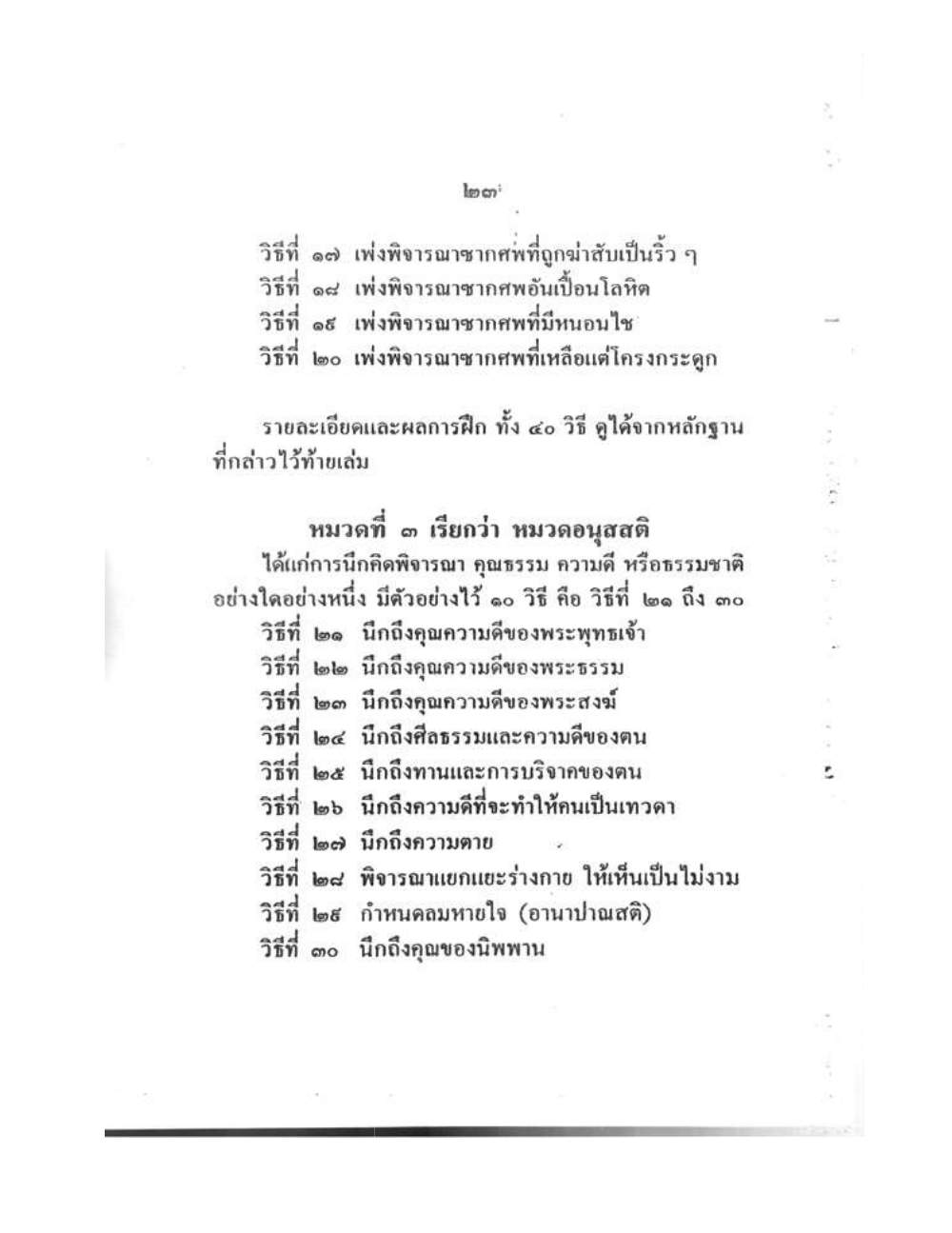
วิธีที่ ๑๗ เพ่งพิจารณาซากศพที่ถูกฟันสับเป็นริ้ว ๆ วิธีที่ ๑๘ เพ่งพิจารณาซากศพอันเปื้อนโลหิต วิธีที่ ๑๙ เพ่งพิจารณาซากศพที่มีหนอนไช วิธีที่ ๒๐ เพ่งพิจารณาซากศพที่เหลือแต่โครงกระดูก
รายละเอียดและผลการฝึก ทั้ง ๔๐ วิธี ดูได้จากหลักฐาน ที่กล่าวไว้ท้ายเล่ม
หมวดที่ ๓ เรียกว่า หมวดอนุสสติ
ได้แก่การนึกคิดพิจารณา คุณธรรม ความดี หรือธรรมชาติ อย่างใดอย่างหนึ่ง มีตัวอย่างไว้ ๑๐ วิธี คือ วิธีที่ ๒๑ ถึง ๓๐
วิธีที่ ๒๑ นึกถึงคุณความดีของพระพุทธเจ้า วิธีที่ ๒๒ นึกถึงคุณความดีของพระธรรม วิธีที่ ๒๓ นึกถึงคุณความดีของพระสงฆ์ วิธีที่ ๒๔ นึกถึงศีลธรรมและความดีของตน วิธีที่ ๒๕ นึกถึงทานและการบริจาคของตน วิธีที่ ๒๖ นึกถึงความดีที่จะทำให้คนเป็นเทวดา วิธีที่ ๒๗ นึกถึงความตาย วิธีที่ ๒๘ พิจารณาแยกแยะร่างกาย ให้เห็นเป็นไม่งาม วิธีที่ ๒๙ กำหนดลมหายใจ (อานาปาณสติ) วิธีที่ ๓๐ นึกถึงคุณของนิพพาน
Method 17: Contemplating a corpse that has been hacked and chopped into strips Method 18: Contemplating a corpse stained with blood Method 19: Contemplating a corpse infested with worms Method 20: Contemplating a corpse reduced to nothing but a skeleton
The details and results of practice for all 40 methods can be found in the evidence set out at the end of the volume.
Category 3, called the Anussati Category
This consists of contemplating and reflecting on virtue, goodness, or some aspect of nature. 10 example methods are given, namely Methods 21 through 30:
Method 21: Recollecting the virtues and goodness of the Buddha Method 22: Recollecting the virtues and goodness of the Dhamma Method 23: Recollecting the virtues and goodness of the Sangha Method 24: Recollecting one's own morality and goodness Method 25: Recollecting one's own giving and charitable donations Method 26: Recollecting the goodness that would make one a deva (heavenly being) Method 27: Recollecting death Method 28: Contemplating and analyzing the body, so as to see it as unbeautiful Method 29: Fixing attention on the breath (anapanasati, mindfulness of breathing) Method 30: Recollecting the qualities of Nibbana
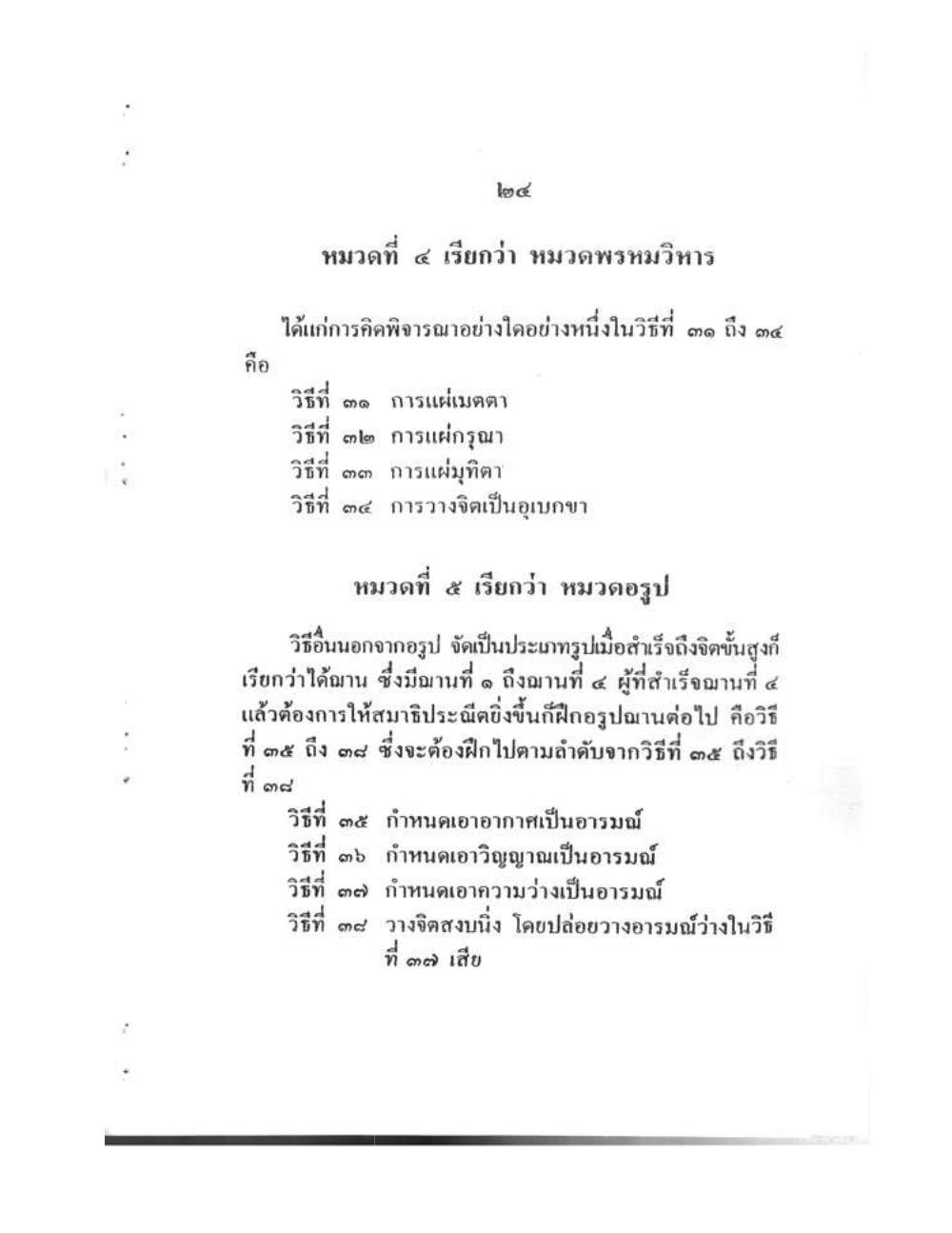
หมวดที่ ๔ เรียกว่า หมวดพรหมวิหาร
ได้แก่การคิดพิจารณาอย่างใดอย่างหนึ่งในวิธีที่ ๓๑ ถึง ๓๔ คือ
วิธีที่ ๓๑ การแผ่เมตตา วิธีที่ ๓๒ การแผ่กรุณา วิธีที่ ๓๓ การแผ่มุทิตา วิธีที่ ๓๔ การวางจิตเป็นอุเบกขา
หมวดที่ ๕ เรียกว่า หมวดอรูป
วิธีอื่นนอกจากอรูป จัดเป็นประเภทรูป เมื่อสำเร็จถึงจิตขั้นสูงก็ เรียกว่าได้ฌาน ซึ่งมีฌานที่ ๑ ถึงฌานที่ ๔ ผู้ที่สำเร็จฌานที่ ๔ แล้วต้องการให้สมาธิประณีตยิ่งขึ้นก็ฝึกอรูปฌานต่อไป คือวิธี ที่ ๓๕ ถึง ๓๘ ซึ่งจะต้องฝึกไปตามลำดับจากวิธีที่ ๓๕ ถึงวิธี ที่ ๓๘
วิธีที่ ๓๕ กำหนดเอาอากาศเป็นอารมณ์ วิธีที่ ๓๖ กำหนดเอาวิญญาณเป็นอารมณ์ วิธีที่ ๓๗ กำหนดเอาความว่างเป็นอารมณ์ วิธีที่ ๓๘ วางจิตสงบนิ่ง โดยปล่อยวางอารมณ์ว่างในวิธี ที่ ๓๗ เสีย
Category 4, called the Brahmavihara Category
This consists of contemplating any one of Methods 31 through 34, namely:
Method 31: Radiating loving-kindness (metta) Method 32: Radiating compassion (karuna) Method 33: Radiating sympathetic joy (mudita) Method 34: Settling the mind in equanimity (upekkha)
Category 5, called the Arupa (Formless) Category
Methods other than the arupa ones are classified as belonging to the “form” type. When one reaches a high level of mind, it is called attaining jhana, of which there is the 1st jhana through the 4th jhana. One who has attained the 4th jhana and wishes for samadhi to become even more refined then goes on to train in the arupa jhanas, namely Methods 35 through 38, which must be trained in sequence from Method 35 through Method 38:
Method 35: Taking space as the object of attention Method 36: Taking consciousness as the object of attention Method 37: Taking nothingness/voidness as the object of attention Method 38: Settling the mind into still calm, by letting go even of the “voidness” object used in Method 37
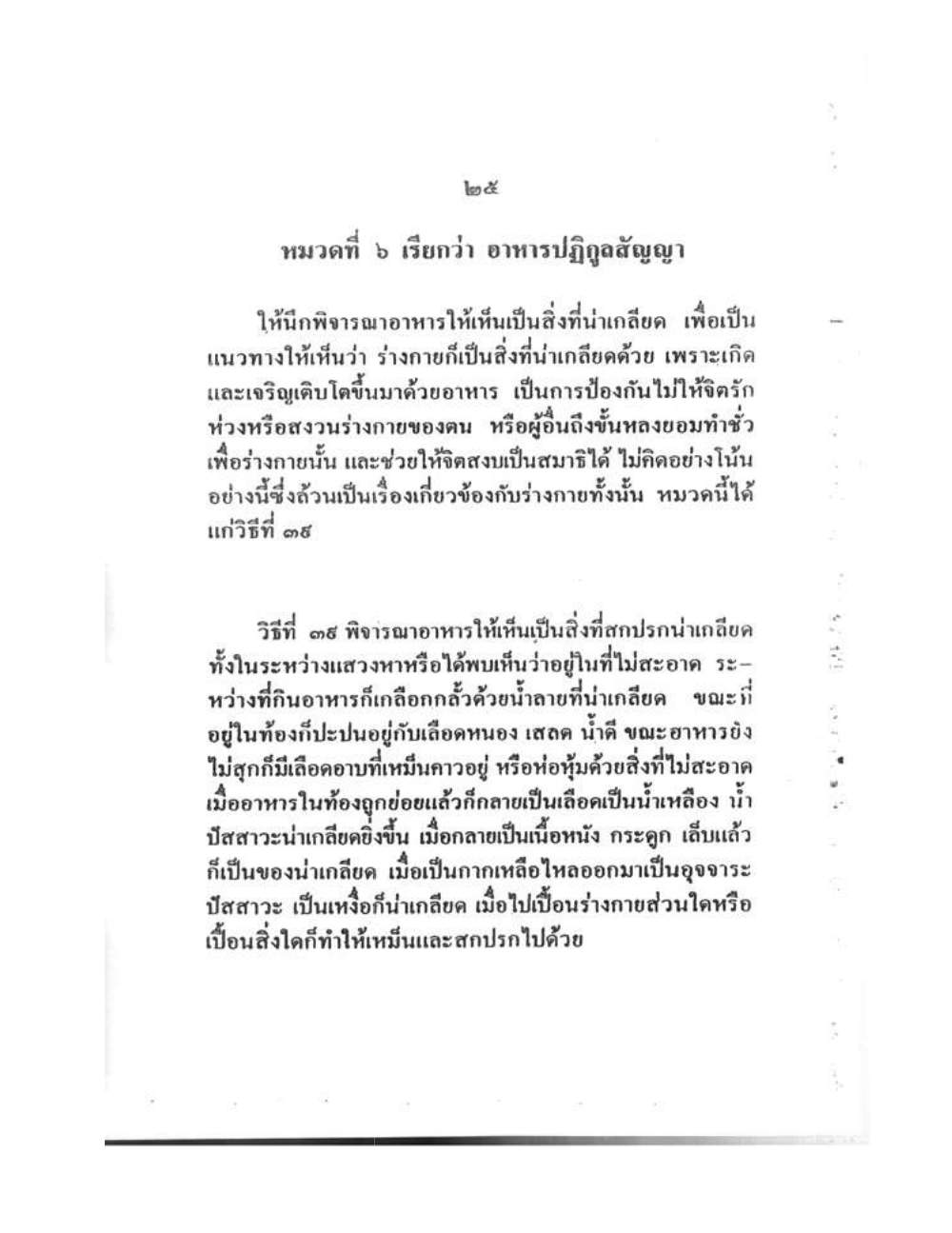
หมวดที่ ๖ เรียกว่า อาหารปฏิกูลสัญญา
ให้นึกพิจารณาอาหารให้เห็นเป็นสิ่งที่น่าเกลียด เพื่อเป็น แนวทางให้เห็นว่า ร่างกายก็เป็นสิ่งที่น่าเกลียดด้วย เพราะเกิด และเจริญเติบโตขึ้นมาด้วยอาหาร เป็นการป้องกันไม่ให้จิตรัก ห่วงหรือสงวนร่างกายของตน หรือผู้อื่นถึงขั้นหลงยอมทำชั่ว เพื่อร่างกายนั้น และช่วยให้จิตสงบเป็นสมาธิได้ ไม่คิดอย่างโน้น อย่างนี้ซึ่งล้วนเป็นเรื่องเกี่ยวข้องกับร่างกายทั้งนั้น หมวดนี้ได้ แก่วิธีที่ ๓๙
วิธีที่ ๓๙ พิจารณาอาหารให้เห็นเป็นสิ่งที่สกปรกน่าเกลียด ทั้งในระหว่างแสวงหาหรือได้พบเห็นว่าอยู่ในที่ไม่สะอาด ระ- หว่างที่กินอาหารก็เกลือกกลั้วด้วยน้ำลายที่น่าเกลียด ขณะที่ อยู่ในท้องก็ปะปนอยู่กับเลือดหนอง เสลด น้ำดี ขณะอาหารยัง ไม่สุกก็มีเลือดอาบที่เหม็นคาวอยู่ หรือห่อหุ้มด้วยสิ่งที่ไม่สะอาด เมื่ออาหารในท้องถูกย่อยแล้วก็กลายเป็นเลือดเป็นน้ำเหลือง น้ำ ปัสสาวะน่าเกลียดยิ่งขึ้น เมื่อกลายเป็นเนื้อหนัง กระดูก เล็บแล้ว ก็เป็นของน่าเกลียด เมื่อเป็นกากเหลือไหลออกมาเป็นอุจจาระ ปัสสาวะ เป็นเหงื่อก็น่าเกลียด เมื่อไปเปื้อนร่างกายส่วนใดหรือ เปื้อนสิ่งใดก็ทำให้เหม็นและสกปรกไปด้วย
Category 6, called Aharapatikulasañña (Perception of the Repulsiveness of Food)
This involves contemplating food so as to see it as something disgusting, as a way of realizing that the body too is disgusting, because it arises and grows through food; it prevents the mind from loving, being anxious over, or cherishing one's own body, or another's, to the point of foolishly committing wrongdoing for the sake of that body, and it helps the mind become calm and attain samadhi, free of such thoughts, all of which concern only the body. This category consists of Method 39:
Method 39: Contemplating food so as to see it as dirty and disgusting — whether while it is being sought, or when found lying in an unclean place; while it is being eaten, it is mixed with disgusting saliva; while in the stomach, it is mingled with blood, pus, phlegm, and bile; while not yet digested, it is bathed in foul-smelling blood, or wrapped in unclean matter; once the food in the stomach has been digested, it turns into blood and lymph, and urine becomes even more disgusting; when it turns into flesh, skin, bone, and nails, it too is a disgusting thing; when it becomes waste flowing out as feces, urine, or sweat, it is disgusting; and wherever it stains any part of the body, or stains anything else, it makes that thing foul-smelling and dirty as well.
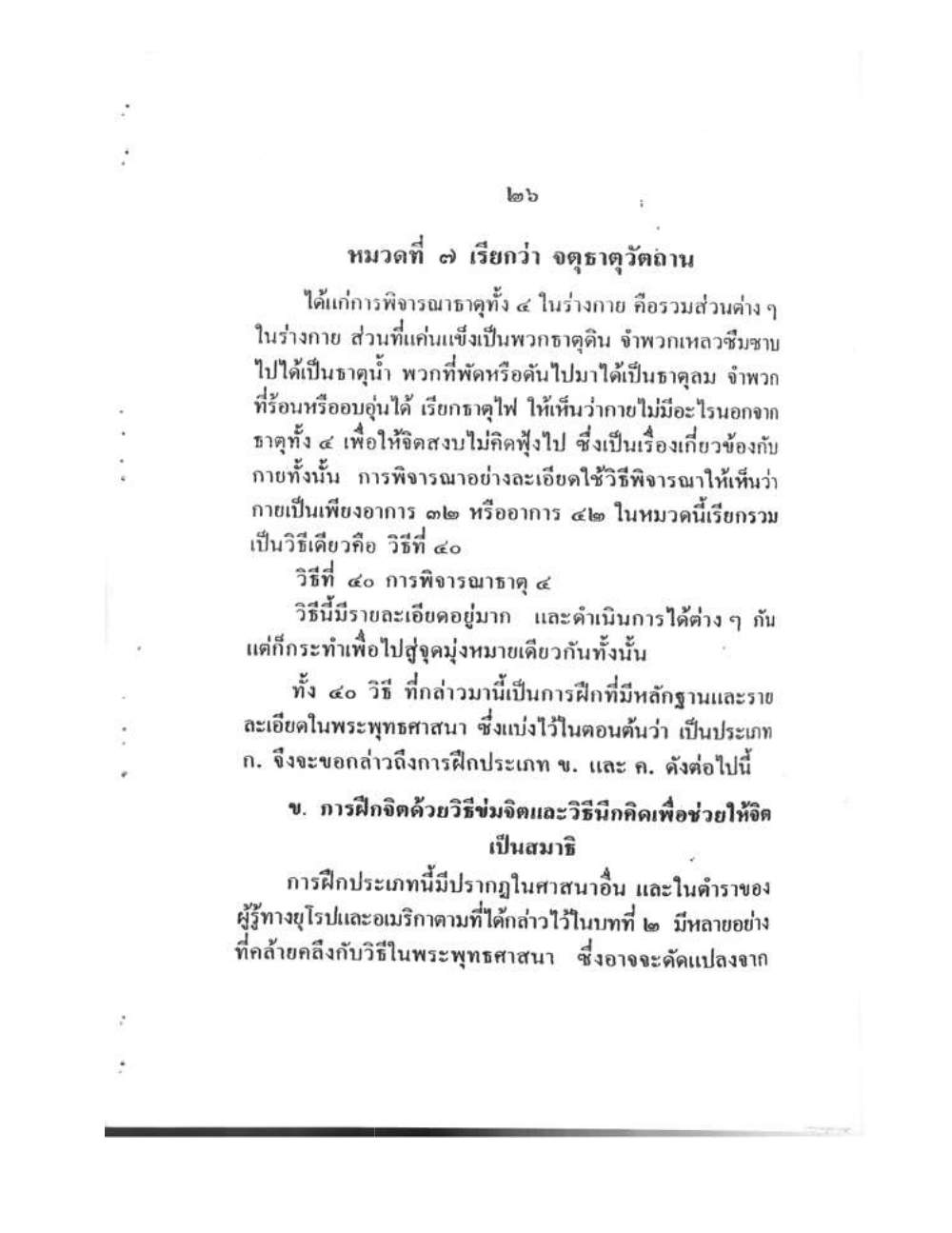
หมวดที่ ๗ เรียกว่า จตุธาตุวัฏฐาน
ได้แก่การพิจารณาธาตุทั้ง ๔ ในร่างกาย คือรวมส่วนต่าง ๆ ในร่างกาย ส่วนที่แค่นแข็งเป็นพวกธาตุดิน จำพวกเหลวซึมซาบ ไปได้เป็นธาตุน้ำ พวกที่พัดหรือดันไปมาได้เป็นธาตุลม จำพวก ที่ร้อนหรืออบอุ่นได้ เรียกธาตุไฟ ให้เห็นว่ากายไม่มีอะไรนอกจาก ธาตุทั้ง ๔ เพื่อให้จิตสงบไม่คิดฟุ้งไป ซึ่งเป็นเรื่องเกี่ยวข้องกับ กายทั้งนั้น การพิจารณาอย่างละเอียดใช้วิธีพิจารณาให้เห็นว่า กายเป็นเพียงอาการ ๓๒ หรืออาการ ๔๒ ในหมวดนี้เรียกรวม เป็นวิธีเดียวคือ วิธีที่ ๔๐
วิธีที่ ๔๐ การพิจารณาธาตุ ๔
วิธีนี้มีรายละเอียดอยู่มาก และดำเนินการได้ต่าง ๆ กัน แต่ก็กระทำเพื่อไปสู่จุดมุ่งหมายเดียวกันทั้งนั้น
ทั้ง ๔๐ วิธี ที่กล่าวมานี้เป็นการฝึกที่มีหลักฐานและราย ละเอียดในพระพุทธศาสนา ซึ่งแบ่งไว้ในตอนต้นว่า เป็นประเภท ก. จึงจะขอกล่าวถึงการฝึกประเภท ข. และ ค. ดังต่อไปนี้
ข. การฝึกจิตด้วยวิธีข่มจิตและวิธีนึกคิดเพื่อช่วยให้จิต
เป็นสมาธิ
การฝึกประเภทนี้มีปรากฏในศาสนาอื่น และในตำราของ ผู้รู้ทางยุโรปและอเมริกาตามที่ได้กล่าวไว้ในบทที่ ๒ มีหลายอย่าง ที่คล้ายคลึงกับวิธีในพระพุทธศาสนา ซึ่งอาจจะดัดแปลงจาก
Category 7, called Catudhatuvatthana (Analysis of the Four Elements)
This consists of contemplating the four elements within the body — that is, grouping together the various parts of the body: the parts that are hard and solid belong to the earth element; parts that are liquid and able to seep or permeate belong to the water element; parts that can blow or push back and forth belong to the wind element; parts that can be hot or warm are called the fire element — so as to see that the body is nothing other than these four elements, in order to calm the mind and prevent it from wandering into distracting thoughts, all of which concern the body. Detailed contemplation uses the method of seeing the body as merely 32 parts, or as 42 parts. In this category all of this is grouped together as a single method, namely Method 40:
Method 40: Contemplation of the Four Elements
This method has a great deal of detail, and can be carried out in various different ways, but all are done in pursuit of the very same goal.
All 40 methods described above are trainings with evidence and detail found in Buddhism, which was divided at the outset into Category (a). We shall now go on to discuss training Categories (b) and (c), as follows:
b. Training the Mind by Methods of Suppressing the Mind and by Methods of Contemplation to Help the Mind Attain Samadhi
This type of training is found in other religions, and in the texts of learned people in Europe and America, as already mentioned in Chapter 2. There are many things similar to the methods found in Buddhism, which may have been adapted from...
พระพุทธศาสนาก็ได้ เพราะในต่างประเทศก็ได้ศึกษาพระพุทธ ศาสนามาเป็นเวลานาน และได้แปลพระไตรปิฎก ซึ่งเป็นภาษา บาลีจบก่อนที่ประเทศไทยเราแปลเป็นไทยหลายปี ถึงอย่างไร ก็ดี วิธีต่าง ๆ ของต่างประเทศก็เข้าอยู่ในวิธีฝึกในพระพุทธ ศาสนานั่นเอง บางวิธีเทียบดูแล้วไม่ตรงกับวิธีใดเลยใน ๔๐ วิธี เป็นด้วยในต่างประเทศเขาเอาวิธีใช้อำนาจจิตไปปนอยู่ในวิธี ฝึกจิต ถ้าเราตรวจสอบดูวิธีการใช้จิต วิธีฝึกสมาธิ และผลประ- โยชน์ที่จะได้รับจากวิธีฝึกทั้ง ๗ หมวด (๔๐ วิธี) แล้วก็จะมี รายละเอียดมากกว่าของต่างประเทศจนไม่สามารถจะคิดวิธี ใหม่ให้นอกเหนือออกไปได้อีก ตัวอย่างเช่น การฝึกติดต่อทาง จิต ฝึกสะกดจิต การดูเห็นทางจิตโดยไม่ต้องใช้ตา การฝึกบังคับ การหลับ การตื่น ฝึกบังคับบุคคลหรือเหตุการณ์ฝึกสะกดจิต การเข้าทรง ก็ล้วนแต่เป็นการใช้อำนาจจิต ไม่ใช่การฝึกจิต ส่วน การฝึกด้วยวิธีนึกคิดต่าง ๆ ในพระพุทธศาสนาก็มีละเอียด ครบถ้วนกว่า วิธีฝึกเพ่งแก้วน้ำ แสงแดด เพ่งกระจกก็มีอยู่แล้ว ในหมวดกสิณ
ค. การฝึกจิตไปพร้อม ๆ กับการปฏิบัติกิจประจำวัน
คือระหว่างที่ทำกิจการอะไรอยู่ก็ฝึกจิตไปด้วย หรือระหว่าง ที่หยุดพักนั่งเล่น นอนเล่น ระหว่างที่กินอาหาร ระหว่างที่นั่ง ถ่ายอุจจาระ ปัสสาวะ ก็ฝึกจิตได้ทั้งนั้นโดยฝึกตามวิธีที่ ๓๘
...Buddhism as well, because in foreign countries too Buddhism has been studied for a long time, and the Tripitaka, which was in the Pali language, was translated to completion many years before Thailand translated it into Thai. However that may be, the various methods of foreign countries all fall within the methods of training found in Buddhism itself. Some methods, when compared, do not match any of the 40 methods at all — this is because in foreign countries they mix methods of using mind-power together with methods of training the mind. If we examine the methods of using the mind, the methods of training in samadhi, and the benefits to be gained from all 7 categories of training methods (40 methods), we find they have more detail than those of foreign countries, to the point that it is not possible to devise any further new method beyond them. For example: training in mental contact/telepathy, training in hypnosis, seeing through the mind without using the eyes, training to control sleeping and waking, training to control other persons or events, hypnosis, spirit mediumship — these are all merely uses of mind-power, not training of the mind. As for training by various methods of contemplation, Buddhism already has this more complete and detailed. The method of gazing at a crystal or water, at sunlight, or gazing into a mirror is already found in the kasina category.
C. Training the mind together with the performance of daily activities
This means that while doing whatever task one is engaged in, one trains the mind at the same time; or while resting, sitting idly, lying down at ease; while eating; while sitting to defecate or urinate — the mind can be trained in all these cases, by training according to method 38
พิจารณาอาหารให้เห็นเป็นสิ่งสกปรกน่าเกลียด และวิธีที่ ๔๐ การพิจารณาธาตุ ๔ หรือใช้วิธีที่ ๒๕ การกำหนดลมหายใจซึ่ง มักนิยมเรียกว่าวิธี อานาปาณสติ และเป็นวิธีที่พระพุทธเจ้า ทรง ใช้ในวันตรัสรู้ นอกจากนี้ก็ใช้วิธีฝึกจิตประเภท ข. คือ วิธีข่มจิต และนึกคิดเพื่อให้จิตเป็นสมาธิ วิธีที่ ๒๕ การกำหนดลมหายใจ เป็นวิธีที่เหมาะทุกโอกาส และเหมาะทุกนิสัยของบุคคล ทำได้ ทุกเมื่อ เรื่องนี้ชวนให้สงสัยและมีผู้เข้าใจคลาดเคลื่อนอยู่มาก คือเข้าใจว่าการฝึกจิตต้องมีที่สงบ ต้องนั่งนิ่งอยู่หรืออยู่ในอาการ สงบ อยู่ในอาการนิ่ง จึงจะฝึกจิตได้ บางคนเข้าใจถูกมาอีกนิดหนึ่ง ว่า ตอนทำงานหรือมีกิจในการอ่าน การฟังก็ฝึกจิตได้ แต่จะทำให้ งานนั้นเสียผล หรือเกิดความว้าวุ่นสองฝักสองฝ่าย ความจริงแล้ว ถ้าเลือกวิธีฝึกที่เหมาะสมฝึกไปด้วย ทำงาน อ่านหนังสือ เขียน หนังสือ หรือฟังเพลงไปพลาง ฝึกจิตไปพลางก็ไม่ทำให้เสียงาน กลับจะทำให้ทำงานได้ผลดีขึ้น แต่มีความเหน็ดเหนื่อย หรือ อ่อนเพลียน้อยลง เรื่องนี้จะเกิดความเข้าใจและเชื่อถือได้ว่าเป็น ความจริง ต้องพิจารณาผลการวิจัยต่อไปนี้เสียก่อน
ผลการวิจัยในการฝึกจิต หรือฝึกสมาธิทุกแบบซึ่งผู้เขียน ทำการวิจัยมากกว่า ๒๐ ปี ปรากฏผลว่า ไม่ว่าจะฝึกแบบใด จิต จะสงบหรือเป็นสมาธิจะต้องมีเหตุ หรือสิ่งบอกเหตุที่ต้องเหมือน กันอยู่อย่างหนึ่งคือ ลักษณะของลมหายใจ ถ้าลมหายใจมีลักษณะ ราบเรียบ สม่ำเสมอและหายใจน้อยครั้งลงแผ่วเบาลงมากเพียงใด
...contemplating food to see it as something filthy and disgusting; and method 40, the contemplation of the 4 elements; or use method 25, regulation of the breath, which is commonly called the method of ānāpānasati, and is the method the Buddha used on the night of his Enlightenment. Besides this, one may also use type-B mind-training methods, that is, the method of suppressing the mind and reflecting so as to bring the mind into samadhi. Method 25, regulation of the breath, is a method suited to every occasion and suited to every temperament of person; it can be done at any time. This point invites doubt, and many people have a mistaken understanding of it — understanding that training the mind requires a quiet place, that one must sit still or remain in a calm, motionless state in order to train the mind. Some people understand slightly more correctly — that while working, or while engaged in reading or listening, one can also train the mind, but that it will spoil the result of the work, or cause confusion, being divided between two things at once. In truth, if one selects a suitable method to train alongside working, reading, writing, or listening to music, training the mind at the same time does not spoil the work — on the contrary it makes the work turn out better, while there is less fatigue or tiredness. For this to be understood and believed as true, the following research results must first be considered.
The results of research into mind-training, or every form of samadhi training, which the author has carried out for more than 20 years, show that no matter which method is practiced, for the mind to become calm or concentrated there must be a cause, or an indicating sign, that is the same in one respect: the character of the breath. The more the breath has the character of being smooth, even, and reduced in frequency, growing ever fainter and lighter...
สมาธิก็จะสูงขึ้นตามลำดับ จนกระทั่งสมาธิสูงขึ้นถึงฌานที่ ๔ แล้วก็ไม่ต้องหายใจ(๑๒) กล่าวคือ เครื่องยนต์แห่งร่างกายเดิน เครื่องซึ่งหรี่ลงเบาที่สุด จนสามารถใช้อากาศเพียงเล็กน้อยก็ คำรงชีพอยู่ได้ ไม่ต้องสูดลมเข้าออกทางจมูกอาศัยลมที่ซึมซาบ ไปทางช่องจมูก ช่องผิวหนังก็เพียงพอ เรื่องนี้นอกจากจะตรง ตามหลักฐานในพระไตรปิฎกหลายแห่งแล้วยังตรงกับผลการ ทดลองที่ประเทศอินเดีย ประเทศอังกฤษและประเทศอเมริกา ซึ่งทดลองฝังโยคีไว้ได้ดินเป็นเวลาหลายวันแต่ไม่ตาย(๑๓) การ วิจัยเรื่องลมหายใจเกี่ยวกับสมาธิเพื่อหาสิ่งบอกเหตุ หรือเหตุ ในการที่จิตเป็นสมาธิสูงขึ้น ได้วิจัยซ้ำซากหลายหนได้ผลดัง ต่อไปนี้
๑. คนธรรมดาหายใจไปตามปกติ นาทีละประมาณ ๑๘ ครั้ง ตรงตามหลักฐานของแพทย์แผนปัจจุบัน โดยนับเฉพาะการหายใจ เข้าอย่างเดียว (หรือจะนับการหายใจออกอย่างเดียวก็ได้) ทั้งนี้ เป็นเกณฑ์เฉลี่ยของผู้ใหญ่
๒. คนนอนหลับ การหายใจนับได้เฉลี่ยนาทีละ ๑๘ หรือ ๒๐ ครั้ง แล้วแต่จะหลับสนิทเพียงใด แสดงว่าคนนอนหลับได้ พักผ่อนดีที่ร่างกายนิ่ง ส่วนการทำงานภายในลดลงกว่าเวลา
(๑๒) กรมการศาสนา, พระไตรปิฎกฉบับภาษาไทย เล่ม ๑๘. หน้า ๖๑๗. (๑๓) A. Sealey, MAN of MIRACLES, ซึ่งนำบางตอนมาลงหนังสือพิมพ์บางกอกไทม์ ฉบับ ๒๕ ธ.ค. ๐๔.
...samadhi rises step by step, until it rises to the fourth jhāna, at which point breathing is no longer needed.(12) That is to say, the engine of the body runs with the machine turned down to its faintest, until it can sustain life using only a very small amount of air — one need not draw breath in and out through the nose; it is enough to rely on air that seeps in through the passage of the nose and the pores of the skin. This matter, besides according with evidence found in several places in the Tripitaka, also accords with the results of experiments in India, England, and America, in which yogis were experimentally buried in earth for many days without dying.(13) Research into breathing in relation to samadhi, to find the indicating sign, or the cause, by which the mind rises to a higher degree of samadhi, has been repeated many times, with the following results:
1. An ordinary person breathes normally about 18 times per minute, in accordance with the findings of modern medicine, counting only the in-breath (or one may count only the out-breath) — this is the average standard for an adult.
2. A sleeping person: breathing is counted at an average of 18 or 20 times per minute, depending on how deeply asleep, showing that a sleeping person rests well when the body is still, while internal functioning is reduced compared to [waking] time
(12) Department of Religious Affairs, Tripitaka, Thai-language edition, vol. 18, p. 617. (13) A. Sealey, MAN OF MIRACLES, portions of which were reprinted in the Bangkok Times newspaper, issue of 25 December [19]04.
ตื่นเพียงเล็กน้อย หรือกล่าวว่าหรี่เครื่องยนต์ของร่างกายลงได้ เล็กน้อย
๓. คนที่จิตเป็นสมาธิขั้นต้น อยู่ในเกณฑ์ที่จะทดลองเอา มีดฟันแทงไม่เข้า ส่งจิตไปดับพิษร้อนของน้ำมันเดือด หรือโซ่ เหล็กเผาไฟแดงได้ผลพอจะให้ทุกคนล้วงลงในน้ำมันเดือด หรือ จับเหล็กที่ร้อนแดงได้ หรือใช้จิตนั้นไปรักษาโรคบางอย่างได้ และทำอย่างอื่น ๆ ไปตามขีดความสามารถของอำนาจจิตขั้นต้น ดังกล่าวไว้ในบทนี้ ผู้มีสมาธิระดับนี้จะหายใจประมาณนาทีละ ๘ ครั้ง การทดลองอำนาจจิตต้องเรียนรู้วิธีส่งอำนาจจิต และวิธี ตรวจสอบก่อนจึงจะได้ผลทุกครั้ง จะเห็นได้ว่าสมาธิขั้นต้น เท่านั้นเราก็หรี่เครื่องยนต์ของร่างกายลงได้ อีกครึ่งหนึ่งของ การนอนหลับสนิท เพราะการหลับสนิทหายใจนาทีละ ๒๐ ครั้ง แต่สมาธิขั้นต้นหายใจเพียงนาทีละ ๘ ครั้ง
๔. ผู้ที่ทำจิตให้อยู่ในสมาธิขั้นกลาง ในระดับที่จะสะเดาะ กุญแจให้หลุด ติดต่อส่งข่าวทางจิตกันได้ มองเห็นคนหรือสิ่งของ ในที่ปกปิดกำบังได้ เห็นภาพเหตุการณ์ในอดีตหรืออนาคตระยะ ใกล้ได้ สามารถแปลงธาตุหรือทำให้เกิดเป็นตัวสัตว์ที่มีชีวิตได้ หรือความสามารถอื่น ๆ ในขีดความสามารถของอำนาจจิตขั้น กลาง ดังกล่าวไว้ในบทนี้ บุคคลที่อยู่ในสมาธิระดับนี้จะหายใจ ประมาณนาทีละ ๒ ครั้งเท่านั้น
...waking — or one may say the body's engine has only been turned down slightly.
3. A person whose mind has reached the initial level of samadhi is at the standard where one may test that a knife cannot pierce or cut them; they can send the mind to neutralize the burning heat of boiling oil, or of an iron chain heated red-hot, well enough for anyone to plunge their hand into boiling oil, or grasp red-hot iron; or use that mind to cure certain kinds of illness, and do other things within the range of this initial level of mind-power, as described in this chapter. A person with samadhi at this level breathes about 8 times per minute. Experimenting with mind-power requires learning the method of projecting mind-power, and the method of checking it beforehand, in order to succeed every time. It can be seen that with only this initial level of samadhi we can already turn the body's engine down to half again as low as [that reached in] deep sleep, because deep sleep involves breathing 20 times per minute, while the initial level of samadhi involves breathing only 8 times per minute.
4. One who brings the mind to the intermediate level of samadhi — to the level where one can spring a lock open, communicate news to one another by mind, see people or objects hidden from view, see images of events in the near past or near future, transmute elements or cause a living creature to come into being, or other abilities within the range of this intermediate level of mind-power, as described in this chapter — a person at this level of samadhi will breathe only about 2 times per minute.
การหายใจซึ่งเป็นสิ่งบอกเหตุ หรือเป็นเหตุของสมาธิที่ ถูกต้องนั้น จะมีลักษณะเบา-ขาว-สบาย-สม่ำเสมอ และต่อเนื่อง ไม่น้อยกว่า ๑๕ นาทีจึงจะใช้ประโยชน์ได้ดีสำหรับผู้เริ่มฝึกไม่ใช่ แกล้งอัดลมไว้ และจะมีลักษณะแผ่วเบามองเห็นการกระเพื่อม ของส่วนอก หรือส่วนท้องน้อยลงทุกที เมื่อสมาธิสูงขึ้นถึงขั้น กลางจะเห็นการกระเพื่อมได้ยากมากซึ่งต่อไปจะสังเกตไม่เห็น อาการกระเพื่อมพร้อม ๆ กับลมหายใจเดินสม่ำเสมอแผ่วเบา ลงนี้ จิตใจจะค่อย ๆ สงบนิ่งไม่ฟุ้งซ่านยิ่งขึ้น รู้สึกสบายเพลิน ปลอดโปร่งยิ่งขึ้นจนในที่สุดจะเห็นทางจิต โดยชัดเจนเป็นแสง สว่าง หรือความมืด ไม่เห็นมีร่างกาย หรือทุกสิ่งในโลก เสมือน ไม่มีเลยเห็นแต่จิตหรือวิญญาณของตนลอยอยู่ การแกล้งทำให้ ลมหายใจน้อยลงทำได้ไม่นาน และการหายใจจะแรง และจิตใจ ไม่สงบ ไม่สบาย จะอึดอัดหรือมึนทื่อ ถ้าฝืนทำไปบ่อย ๆ จะ เป็นโรคประสาท และโรคอื่น ๆ ได้ วิธีง่าย ๆ แบบวิทยาศาสตร์ เหมาะสำหรับฝึกเด็ก ๆ และคนที่ฝึกได้ยากก็คือ วิธีหายใจเข้า ออกตามจังหวะเสียงโดยใช้เครื่องบันทึกเสียงให้จังหวะการ หายใจซึ่งจะได้กล่าวละเอียดในบทหลัง การมีครูที่สามารถตรวจ สอบได้ดี จึงเป็นการช่วยให้ฝึกสมาธิได้เร็ว ลมหายใจที่ลดลง แผ่วลงนั้น นิยมเรียกว่าลมละเอียด ถ้าปรับลมให้ละเอียดได้ ส่วนกับการสงบนิ่งของจิต สมาธิก็จะตั้งมั่นหรือก้าวหน้าไปได้ ถ้าผิดส่วนกันสมาธิก็ถอยลง เมื่อปรับลมได้ถูกและเคยชินไม่กี่ครั้งจะ
The breathing that serves as the indicating sign, or the cause, of correct samadhi has the character of being light — pale — comfortable — even, and continuous for no less than 15 minutes for it to be of good use to a beginner — not artificially held in. It has a faint, light character in which the movement of the chest, or of the lower abdomen, is seen to diminish more and more each time. When samadhi rises to the intermediate level, this movement becomes very hard to see, until eventually no movement at all will be observed accompanying the breath, which proceeds evenly, growing ever fainter. As this happens, the mind gradually becomes calm and still, less and less scattered, feeling ever more comfortable, joyful, and clear, until finally one sees the path of the mind distinctly, as a bright light, or as darkness — not seeing the body, or anything at all in the world, as though nothing existed, seeing only one's own mind or consciousness floating [there]. Artificially forcing the breath to lessen cannot be sustained for long, and the breathing will then become forceful, and the mind will not be calm or comfortable — it will feel tight or dull. If one persists in forcing this repeatedly, it can lead to nervous disorders and other illnesses. A simple, scientific-style method suited for training children, and people who find training difficult, is the method of breathing in and out in rhythm with sound, using a sound-recording device to set the rhythm of breathing, which will be described in detail in a later chapter. Having a teacher able to check one's progress well thus helps one train in samadhi more quickly. The breath that has diminished and grown faint in this way is commonly called "refined breath." If one can adjust the breath to be refined in proportion with the stillness of the mind, samadhi will become stable or will advance; if it is out of proportion, samadhi will regress. Once one has adjusted the breath correctly and grown accustomed to it, after only a few times it will...
ตั้งลมตั้งสมาธิในขั้นที่เคยชินนั้นได้ทันที และจะดำรงอยู่โดย ไม่ต้องไปพะวงในการปรับ หรือการรักษาให้คงไว้ ฉะนั้น เมื่อ ทุกคนปรับลมหายใจลงได้เท่าใด ก็ทำให้ชิน และปรับให้ได้เร็ว ต่อไปจะเป็นไปเองโดยไม่ต้องห่วงในการควบคุม จึงกล่าวได้ว่า เราจะฝึกสมาธิไปด้วย ทำงานอะไรไปด้วยก็ได้ ซึ่งการทำดังกล่าว จะเกิดผลดีหลายอย่างเช่น
๑. ทำงานได้ผลดีขึ้น เขียนหนังสือก็ได้เร็ว และถูกต้องดี ขึ้น อ่านหนังสือหรือฟังอะไรก็เข้าใจและจำดีขึ้น เพราะจิตมีสมาธิ และมีอำนาจมีกำลังใจดีขึ้นกว่าปกติ
๒. ร่างกายได้พักผ่อนไปในตัว เพราะเราหรี่เครื่องยนต์ ของร่างกายลงได้และจิตใจก็สงบมั่นคง ฉะนั้น เมื่อต้องการ พักผ่อนหรือหลังจากเหน็ดเหนื่อย แม้ขณะนั่งรถหรือเดินอยู่ ก็ทำจิตเป็นสมาธิ ด้วยวิธีปรับลมในชั่วระยะไม่นาน ก็ทำให้ ร่างกาย และจิตใจสดชื่นขึ้นได้โดยเร็ว
๓. การอ่อนเพลียเหนื่อยใจหลังจากทำงานจะมีน้อยลงมาก เรื่องนี้ตรงกับผลการวิจัยของนักวิทยาศาสตร์ และนักจิตวิทยา สมัยใหม่ ตามที่กล่าวไว้ในบทที่ ๒ ใจความมีว่าความเหนื่อยอ่อน เกิดจากจิตมากกว่าเกิดจากการออกแรงเสียอีก แม้จะนั่งรถ เฉย ๆ เดินทางไปไกล ๆ ถ้าคิดฟุ้งซ่าน รำคาญใจ เบื่อหน่าย อยู่เป็นเวลานาน ๆ ก็จะทำให้เกิดความรู้สึกอ่อนเพลียมาก ถ้า จิตใจสงบแจ่มใสก็มีอาการเหนื่อยอ่อนน้อยมาก
...establish the breath and establish samadhi at the habituated level instantly, and it will be maintained without one needing to worry about adjusting it or keeping it maintained. Therefore, once everyone has adjusted their breathing down to whatever degree, this creates familiarity, and adjustment becomes quick; thereafter it will happen automatically without needing to worry about controlling it. It can thus be said that one can train in samadhi while doing any kind of work at the same time, and doing so produces many beneficial results, such as:
1. Work is done with better results — writing is done faster and more accurately; reading or listening to anything is understood and remembered better, because the mind has samadhi and greater power and confidence than usual.
2. The body rests in the process, because we are able to turn down the body's engine, and the mind is calm and stable. Therefore, when one wants to rest, or after becoming tired, even while riding in a car or while walking, one can bring the mind into samadhi by the method of adjusting the breath for a short while, and this quickly refreshes both body and mind.
3. Fatigue and mental tiredness after working will be much reduced. This accords with the research findings of modern scientists and psychologists, as stated in Chapter 2 — the gist being that fatigue arises from the mind even more than it arises from physical exertion. Even sitting idly in a car, traveling a long distance, if one's thoughts are scattered, irritated, and bored for a long time, this produces a strong feeling of fatigue. If the mind is calm and clear, there is very little feeling of tiredness.
๔. การหายใจลดลงพร้อมด้วยจิตสงบลงนี้ ช่วยทำให้ สุขภาพดี มีอำนาจหรือพลังทางจิตสูงขึ้น ทำให้อายุยืนและเป็น การช่วยรักษาโรคภัยได้ด้วย ตัวอย่างในพระไตรปิฎกก็มีหลาย แห่ง เช่น พระกำลังเข้าฌานอยู่ถูกไฟเผาเพราะพากันคิดว่าตาย จึงเผาเสีย แต่ปรากฏว่าไม่มีอันตรายอะไรเลย(๑๔) นอกจากนี้ผล การทดลองของนักวิทยาศาสตร์สมัยใหม่ ก็เป็นเครื่องยืนยัน ได้คือ การทดลองเรื่องค้างคาวเข้าฌาน หรือจำศีล(๑๕) ใจความว่า มีค้างคาวหลายประเภทที่จำศีลได้ คือพอถึงฤดูหนาวก็เกาะนิ่ง อยู่ได้ตลอด ๓ เดือน โดยไม่เคลื่อนไหว ไม่กินอาหาร นักวิทยา- ศาสตร์ได้ทดลองเอาใส่ตู้เย็นให้คล้ายอากาศฤดูหนาว ค้างคาว เหล่านั้นก็เริ่มจำศีล เมื่อทดลองตรวจสอบการเต้นของหัวใจ และการหายใจปรากฏผลว่าในเวลาปกติหัวใจเต้น ๑๘๐ ครั้งต่อ ๑ นาที เวลาจำศีลลดลงเหลือ ๓ ครั้งต่อ ๑ นาที และการหายใจ ตามปกตินาทีละ ๔๘๐ ครั้ง เวลาจำศีลลดลงเหลือนาทีละ ๘ ครั้ง (จะเห็นได้ว่าลดลงได้ส่วนกัน คือหัวใจเต้นลดน้อยลง ๖๐ เท่า การหายใจก็ลดลง ๖๐ เท่า) ค้างคาวสีน้ำตาลที่จำศีลทุกฤดูหนาว อายุถึง ๒๐ ปี ซึ่งถ้าเทียบตามหลักวิชาแล้ว มันตัวโตเท่า ๆ กับ
(๑๔) กรมการศาสนา, พระไตรปิฎก ฉบับภาษาไทย เล่ม ๑๘. หน้า ๖๘๖. (๑๕) ช่างอากาศ ทอ.. "ค้างคาวมีคุณสมบัติพิเศษ." ช่างอากาศ, ฉบับ มิ.ย. ๐๖ และวารสารวิทยาศาสตร์ของสมาคมวิทยาศาสตร์แห่งประเทศไทย ฉบับ ธ.ค. ๐๖ เรื่อง สัตว์จำศีล
4. This reduction of breathing together with the calming of the mind helps produce good health, raises one's power or mental strength, prolongs life, and also helps cure illnesses. There are several examples of this in the Tripitaka, such as: a monk in deep meditative absorption (jhāna) was burned by fire because [people], thinking he had died, cremated him — yet it turned out he suffered no harm whatsoever.(14) Besides this, the results of experiments by modern scientists also serve as confirmation — namely, the experiment concerning bats entering jhāna, or hibernation.(15) The gist is that there are several species of bat capable of hibernating — that is, when winter arrives they cling motionless for a full 3 months without moving and without eating. Scientists experimented by placing them in a refrigerator to simulate winter air, and those bats began to hibernate. When they experimentally checked the heartbeat and breathing, the results showed that in normal times the heart beats 180 times per minute, but during hibernation this drops to 3 times per minute; and normal breathing is 480 times per minute, but during hibernation this drops to 8 times per minute. (It can be seen that the reduction is proportional — the heartbeat decreases 60-fold, and breathing likewise decreases 60-fold.) The brown bat that hibernates every winter lives to 20 years of age, which, if compared according to scientific principle, for an animal of its size...
(14) Department of Religious Affairs, Tripitaka, Thai-language edition, vol. 18, p. 686. (15) Chang Akat [RTAF Technician magazine], Royal Thai Air Force, "Bats Have Special Properties." Chang Akat, June [19]06 issue, and the Science Journal of the Science Society of Thailand, December [19]06 issue, on "Hibernating Animals."
หนูควรมีอายุเพียงประมาณ ๑ ปีเศษเท่านั้น เมื่อเครื่องยนต์แห่ง ร่างกายทำงานน้อยลงหรือหรี่เครื่องลงได้เช่นนั้น ร่างกายก็จำเป็น ต้องใช้พลังงานในการเดินเครื่องของร่างกายเพียงเล็กน้อย ใช้ พวกไขมันที่สะสมไว้ในกายก็พอ ฉะนั้นไม่ต้องกินอาหารร่างกาย ก็ไม่ทรุดโทรม
ผลการทดลองดังกล่าวมานี้ จะเป็นการยืนยันว่าเมื่อสมาธิ สูงขึ้น เครื่องยนต์แห่งร่างกายจะทำงานน้อยลง การเต้นของหัวใจ น้อยลง การไหลเวียนของโลหิตก็น้อยลง ด้วยเพราะหัวใจเป็น อวัยวะสูบฉีดโลหิต แต่อำนาจจิตกลับสูงขึ้นตามสมาธิ ฉะนั้น การวิจัยของฝรั่งเกี่ยวกับฮอร์โมนที่กล่าวไว้ในต้นบทที่ ๑ นี้จึง ผิดพลาดหรือถูกในบางกรณีเท่านั้น
การฝึกจิตไปพร้อม ๆ กับการทำกิจกรรมต่าง ๆ ทำโดย วิธีสร้างความนึกคิดขึ้นใหม่ ทดแทนความนึกคิดที่บั่นทอน สุขภาพ จากผลการวิจัยของนักวิทยาศาสตร์ได้ผลว่า ความเหนื่อย อ่อนเกิดจากจิตใจ หรืออารมณ์ มากกว่าเหนื่อยอ่อนเพราะการ ออกแรง ฉะนั้น แทนที่จะปล่อยให้จิตเรานึกคิดในทางเบื่อหน่าย รำคาญ ลุกลน ซึ่งเป็นการบั่นทอนสุขภาพ ก็เอาความนึกคิดที่ดี อย่างอื่นเข้าแทน คือใช้ความนึกคิดเกี่ยวกับการฝึกจิต หรือ ควบคุมจิตในบทที่ ๑ และบทที่ ๒ ข้อสำคัญไม่ให้เสียงาน กล่าว คือคิดชั่วขณะประเดี๋ยวเดียว ในโอกาสที่จิตไม่ตั้งมั่นอยู่กับเรื่อง กิจการที่ทำนั้น เมื่อมีความพอใจสนใจในกิจการนั้นแล้วก็ไม่ต้อง
...a mouse should only live about a year or so. When the body's engine works less, or can be turned down in that way, the body then needs to use energy to run its machinery only a little; using the fat stored up within the body is enough. Therefore, even without eating, the body does not deteriorate.
These experimental results confirm that when samadhi rises, the body's engine works less; the heartbeat decreases; the circulation of blood also decreases, since the heart is the organ that pumps blood — yet mind-power, on the contrary, rises together with samadhi. Therefore the Western research concerning hormones mentioned at the start of Chapter 1 is therefore only correct, or mistaken, in certain cases.
Training the mind together with the performance of various activities is done by the method of creating new thoughts to replace thoughts that undermine health. From the results of scientific research it has been found that fatigue arises from the mind, or from emotion, more than fatigue arising from physical exertion. Therefore, instead of allowing our mind to dwell on boredom, irritation, and restlessness, which undermines health, one substitutes other good thoughts in their place — that is, using thoughts concerning mind training, or mind control, as in Chapters 1 and 2. The important point is not to let this spoil one's work — that is, thinking only for a brief moment, on occasions when the mind is not firmly fixed on the task at hand; once one has interest and satisfaction in that task, there is no need to...
นึกคิดอย่างอื่นอีก และมีการนึกคิดที่ช่วยลดความเหนื่อยอ่อนลง ได้มากก็คือ การนึกคิดให้เป็นนิสัย ที่ฝังใจเป็นอัตโนมัติในแง่ดี ตัวอย่างเช่น ท่านอาจารย์พุทธทาสภิกขุสอนว่า ในระหว่างที่ทำ อะไรก็ตามให้ถือว่า มีแต่การทำตามหน้าที่ไม่มีคนทำ เพราะเมื่อ แยกคนหรือตัวเราให้ละเอียดลงก็เป็นแต่ธาตุและธรรมชาติที่มองไม่ เห็น เมื่อเห็นทางจิตว่าไม่มีคนก็ไม่มีใครจะต้องเหนื่อย ต้องรำคาญ หรือลำบาก เวลาทำงานก็ให้เห็นว่ามีแต่การทำงาน คนทำงานไม่มี เวลาเดินก็เห็นว่า มีแต่การเดินไม่มีคนเดิน ดังนี้เป็นต้น ส่วนการ กระทำก็ต้องทำไปตามหลักการ ไม่ชักช้าให้ได้ผลงานดีที่สุดที่จะทำ ได้ นี่เป็นความนึกคิดที่ถูก ที่ดีอย่างหนึ่ง แต่ถ้าใช้ผิดก็เป็นความ ชั่ว เช่น คิดว่าเมื่อไม่มีคนก็ไม่มีบาปบุญ ดังนี้เป็นความเห็นผิด จากทำนองคลองธรรม เป็นโทษแก่ตนและส่วนรวมอย่างใหญ่ หลวง การทำงานไปพลาง รักษาลมละเอียดไปพลาง ก็เป็นวิธี ที่ดีและเป็นประโยชน์มาก เมื่อเราฝึกปรับลมหายใจให้เบา— ยาว—สบายได้แล้ว เวลาทำงาน เวลาคิด เวลานั่งยืนเดิน เวลา พูดคุยก็รักษาลมหายใจที่สบายนี้ไว้ การงานที่ทำที่คิดที่พูดก็จะมี ผลดีเกินกว่าธรรมดา
สรุปความว่า จิตเป็นพลังงานพิเศษและเป็นธรรมชาติรู้ จึงสามารถรู้อะไรได้ทั้งอดีต ปัจจุบัน และอนาคต และสามารถ เปลี่ยนเป็นกำลังงานอื่น ๆ ได้ ตามหลักของวิทยาศาสตร์ เมื่อ ฝึกจิตถูกทางก็จะทำให้มีความสามารถเพิ่มขึ้นเป็นพิเศษ ทั้งใน
...think of anything else. Also, a way of thinking that greatly helps reduce fatigue is thinking habitually in a way that becomes automatically fixed in the mind in a positive sense. For example, Venerable Ajahn Buddhadasa Bhikkhu teaches that while doing anything whatsoever, one should hold that there is only the performing of one's duty, with no one performing it — because when a person, or our self, is broken down finely, it is merely elements and nature, which cannot be seen. When one sees through the mind that there is no "person," then there is no one who needs to be tired, irritated, or troubled. While working, one should see that there is only the work being done, with no person doing the work; while walking, one should see that there is only walking, with no person walking — and so on. As for the actual performance, it must still be carried out according to principle, without delay, so as to achieve the best possible result. This is one correct and good way of thinking. But if used wrongly, it becomes an evil — for example, thinking that since there is no "person," there is no sin or merit; this is a mistaken view, contrary to the way of righteousness, and causes great harm to oneself and to society at large. Working while at the same time maintaining refined breath is a good and very beneficial method. Once we have trained ourselves to adjust the breath to be light — long — comfortable, then during work, during thinking, during sitting, standing, walking, during conversation, we maintain this comfortable breath; the work done, the thoughts thought, and the words spoken will then have better results than ordinary.
To summarize: the mind is a special form of energy and is by nature a knowing thing; it is therefore able to know things of the past, present, and future, and is able to be converted into other forms of energy, according to scientific principle. When the mind is trained in the correct way, it produces a special increase in ability, both in...
ทางกาย และทางใจ ทางสมอง และความสามารถพิเศษนี้จะ มีมากหรือน้อยเพียงใด ก็ขึ้นอยู่กับสมาธิจะสูงเพียงใด มีหลัก เกณฑ์ที่แน่นอนว่า สมาธิขั้นใดมีขีดความสามารถอะไรบ้าง และมีวิธีที่จะทดสอบ หรือพิสูจน์โดยพร้อมมูล ตัวอย่างการใช้ อำนาจจิตตั้งแต่ขั้นต้นถึงขั้นสูง ก็มีผู้ทดลองให้ดูได้ในปัจจุบัน ที่นึกคิดเอาว่าเป็นไปไม่ได้ หรือเป็นเรื่องหลอกลวง ก็เพราะ ไม่ได้ศึกษาในทางจิตโดยถูกต้อง และไม่มีน้ำใจเป็นนักวิทยา- ศาสตร์แท้จริง หรือไม่ปฏิบัติตามหลักการเชื่อถือ (กาลามสูตร ๑๐ ข้อ) ในพระพุทธศาสนา ที่ว่าไม่ให้เชื่อโดยการคาดคะเน หรือการเดา ฯลฯ ให้พิสูจน์หรือทดลองปฏิบัติให้เห็นจริงก่อน จึงเชื่อ อำนาจจิตหรือกำลังใจมีประโยชน์แก่บุคคลทุกคน ทุก อาชีพ และทุกสาขาวิชา เป็นประโยชน์ในการพัฒนาชุมชนและ ประเทศชาติอย่างใหญ่หลวง
เมื่อได้พิจารณาหลักแห่งกรรมแล้ว ก็จะสรุปได้ว่าผู้มีกรรม ดีในชาติก่อนจะมีจิตเข้มแข็งเป็นสมาธิที่ดี มีอำนาจในตัวสูง ในชาตินี้ได้โดยไม่มีอาจารย์ฝึกทางจิตให้ แต่จับหลักการฝึก จิต หรือหลักลมละเอียดได้โดยไม่รู้ตัว หรือรู้ได้เฉพาะตัว ความ จริงผู้นำฝ่ายโลกเสรีก็มีความเข้มแข็งทางจิตไม่แพ้ผู้นำฝ่ายคอม- มิวนิสต์ แต่การฝึกจิต ฝึกกำลังใจ หรือฝึกสมาธิให้แก่ผู้น้อย ที่ต้องลงมือทำงานสาขาต่าง ๆ นั้น หลายประเทศได้ละเลยโดย คิดผิดว่าไม่สำคัญ บางประเทศมีการฝึกให้แต่ฝึกไม่ตรงหลักการ
...body and mind, and the brain; and how great or small this special ability will be depends on how high the samadhi is. There is a definite standard as to what capabilities exist at each level of samadhi, and there are methods to test or prove this fully. Examples of the use of mind-power, from the initial level up to the highest level, can be demonstrated by practitioners today. Those who think it impossible, or a deception, do so because they have not studied the way of the mind correctly, and lack the true spirit of a scientist, or do not practice according to the principle of belief (the ten points of the Kālāma Sutta) in Buddhism, which states that one should not believe by way of speculation or guessing, etc. — one should prove or experimentally practice it to see the truth first, and only then believe. Mind-power, or spirit/willpower, is of benefit to every person, every occupation, and every field of study; it is of great benefit to the development of communities and the nation.
Having considered the principle of karma, it can be concluded that a person who had good karma in a previous life will have a strong mind, good samadhi, and high innate power in this life without having had any teacher to train the mind — but grasps the principle of mind training, or the principle of refined breath, without being aware of it, or knows it only for himself/herself. In truth, leaders of the free world have mental strength no less than leaders on the communist side; but the training of the mind, the training of willpower, or the training of samadhi, for lesser persons/subordinates who must carry out work in various fields — many countries have neglected this, wrongly thinking it unimportant. Some countries do provide such training, but the training does not accord with correct principle...
ที่สำคัญ ผู้เขียนได้ยกเอาหลักสูตรการฝึก ด้านกำลังใจหรือสมาธิ ของฝ่ายโลกเสรี กับฝ่ายคอมมิวนิสต์มาเปรียบเทียบในบทที่ ๓ เพื่อจะได้พิจารณาว่า ใครจะฝึกได้ดีกว่า เข้มกว่า? ใครกำลัง ชนะ? และในที่สุดใครจะชนะ? มีคำตอบอันถูกต้องแน่นอน อยู่แล้วสำหรับผู้ที่ฝึกจิตถึงขั้นสูง
การฝึกสมาธิหรือที่เรียกว่าฝึกสมถกัมมัฏฐาน กับการ ฝึกวิปัสสนานั้น เป็นการฝึกที่ส่งเสริมกัน และฝึกควบคู่กัน แยกออกเด็ดขาดจากกันไม่ได้ ซึ่งมีหลักฐานในพระไตรปิฎก ใจความว่า "ภิกษุย่อมเจริญสมถะและวิปัสสนาคู่กันไปด้วย อาการ ๑๖......."(๑๖) การมีครูที่สามารถทำได้จริงสอน จะได้ ผลดี ได้ผลเร็ว กว่าการค้นคว้าทดลองด้วยตนเอง มีอาจารย์ที่ ฝึกศิษย์ทั้งในทางสมถะและวิปัสสนา ยังเข้าใจผิดอีกหลายท่าน ว่าเป็นการฝึกที่แตกต่างกัน ฝึกคนละอย่างถึงกับถกเถียงโกรธเคือง กันไปก็มี ผู้เขียนเคยเอาพระไตรปิฎกเล่ม ๓๑ ไปเปิดข้อความ ดังกล่าวข้างต้น คือการฝึกจิตนั้นย่อมใช้ทั้งสมถะและวิปัสสนา คู่กันไปด้วยอาการ ๑๖ ให้อาจารย์ที่มีชื่อเสียงดูหลายท่านต่างก็ ตีความไม่ถูกว่าจะฝึกควบคู่กันอย่างไร ผู้เขียนจะได้ค้นคว้า เปิดเผยในภายหลังในขั้นนี้มุ่งหวังจะเชิญชวนให้ฝึก เพื่อใช้ ประโยชน์ของอำนาจจิตทั้งทางโลกและทางธรรมเสียก่อน
(๑๖) กรมการศาสนา, พระไตรปิฎก ฉบับภาษาไทย, เล่ม ๓๑. หน้า ๔๗๒.
...important. The author has taken the training curricula concerning willpower or samadhi of the free-world side and the communist side and compared them in Chapter 3, in order to consider: who trains better, more intensively? Who is presently winning? And who will ultimately win? There is already a definite, correct answer for those who have trained the mind to a high level.
The training of samadhi, also called samatha-kammaṭṭhāna practice, and the training of vipassanā, are trainings that reinforce one another and are trained together as a pair; they cannot be strictly separated from each other. There is evidence for this in the Tripitaka, stating: "A monk cultivates samatha and vipassanā together, paired, by way of the sixteen modes......."(16) Having a teacher who can genuinely perform the practice teach it gives better and quicker results than researching and experimenting by oneself alone. There are even teachers who train students in both samatha and vipassanā who still misunderstand, believing these to be different kinds of training, to be trained separately, to the point of arguing and quarreling over it. The author once took Tripitaka volume 31 and opened it to the passage mentioned above — that mind training necessarily uses both samatha and vipassanā together, paired, by way of the sixteen modes — and showed it to several well-known teachers; they each interpreted incorrectly how the two should be trained together as a pair. The author will research and reveal this in a later chapter; at this stage the aim is to invite the reader to train, in order to make use of the benefits of mind-power in both worldly and spiritual matters, first.
(16) Department of Religious Affairs, Tripitaka, Thai-language edition, vol. 31, p. 472.
[กรอบข้อความ 1:] ควรทำสมาธิให้เกิด ผู้มีดวงใจเป็นสมาธิย่อม ทำกิจการทุกอย่างได้สำเร็จเสมอ
จากพุทธภาษิต (สมาธิ ภิกฺขเว ภาเวถ สมาหิโต ยถา ภูตํ ปชานาติ)
[กรอบข้อความ 2:] จงเชื่อมั่นเถิดว่าขณะนี้ถึงแม้ว่าท่านยัง ไม่เคยลงมือฝึกสมาธิ ท่านก็มีอำนาจจิตอยู่ ในตัวแล้ว และอาจนำไปใช้ประโยชน์ได้ หลายอย่าง ในเมื่อท่านรู้วิธีและจังหวะใน การทำ ซึ่งจะทราบได้โดยแจ่มแจ้งจาก ผู้เขียนหรือท่านผู้รู้อื่น ๆ
[boxed text 1:] One should cultivate samadhi; a person whose heart possesses samadhi always succeeds in accomplishing every undertaking.
From a saying of the Buddha ("Samādhiṃ, bhikkhave, bhāvetha; samāhito yathābhūtaṃ pajānāti" — "Monks, cultivate concentration; one who is concentrated understands things as they truly are.")
[boxed text 2:] Be firmly confident that, even now, although you have never yet actually undertaken the practice of samadhi, you already possess mind-power within yourself, and it may be put to use for many benefits, once you know the method and the rhythm of practice — which you can learn clearly and in detail from the author or from other knowledgeable persons.
บทที่ ๒ การค้นคว้าเกี่ยวกับอำนาจจิต
๑. กล่าวทั่วไป
ส่วนมากยังเข้าใจคลาดเคลื่อนอยู่ว่า เมื่อคนเรายังต้อง ปฏิบัติงานประจำวันหรือมีอาชีพต้องทำงานต่าง ๆ อยู่ ย่อม ไม่มีทางจะฝึกจิตหรือฝึกสมาธิได้ผล หรือกล่าวง่าย ๆ ว่าการ ฝึกจิตนั้นไม่มีประโยชน์อะไรสำหรับคนที่ต้องมีงานทำประจำ อยู่วันละหลาย ๆ ชั่วโมงเป็นเพราะจิตต้องนึกคิดกังวลอยู่ใน เรื่องการงาน เรื่องการกินคืออยู่ดี และความก้าวหน้า จะฝึกจิต ได้ผลถึงกับใช้ประโยชน์ของอำนาจจิตได้ต่าง ๆ นั้น ก็จะต้องใช้ เวลา และความพยายามมาก เหมาะสำหรับผู้ที่เป็นนักบวช หรือ ผู้ที่ว่างงานและฐานะดีแล้วเท่านั้น แต่เมื่อผู้เขียนได้ศึกษาและ วิจัยมาเป็นเวลาหลายปีแล้ว ก็ปรากฏผลว่าความเข้าใจดังกล่าว นั้น ยังคลาดเคลื่อนอยู่ กล่าวคือการฝึกจิตนั้นมีวิธีการฝึกอยู่ มากตามที่ได้กล่าวไว้ในบทที่ ๑ ข้อ ๓ เมื่อทำการฝึกจิตวิธีใด วิธีหนึ่งแล้วย่อมได้รับประโยชน์ตอบแทนตามส่วน ดีกว่าไม่ฝึก เสียเลยและมีหลายวิธีที่ใช้ฝึกไปพร้อม ๆ กับการปฏิบัติงานประจำ วันได้ และบางวิธีก็ใช้ฝึกในระหว่างที่ว่างงานชั่วระยะเล็กน้อย
Chapter 2 Research on Mental Power
1. General Remarks
Most people still hold a mistaken understanding that when a person must still carry out daily work or has an occupation requiring various tasks, there is no way for them to train the mind or practise concentration (samadhi) effectively — or, put simply, that mind training is of no benefit to someone who must work many hours every day, because the mind must constantly be occupied with worry about work, about making a living, and about advancement. To train the mind successfully, to the point of being able to use the various benefits of mental power, would require much time and effort, suitable only for those who are monks/ascetics or those who are free from work and already well-off. But when the author had studied and researched this over many years, it turned out that this understanding is indeed mistaken. That is to say, mind training has many methods, as described in Chapter 1, Section 3. When one practises any one method of mind training, one receives benefit in return accordingly — better than not training at all — and there are many methods that can be practised alongside daily work, and some methods can even be practised during small odd moments of free time...
หรือขณะที่เริ่มนอนก็ได้ การฝึกไปทีละเล็กละน้อยก็ได้ผล ตามส่วน
อีกประการหนึ่งเมื่อเห็นคนที่ลุยไฟได้ กอบโซ่ที่เผาไฟ จนแดงได้ ทดลองความเหนียวคงได้ ทำให้น้ำมันที่กำลังเดือดร้อน น้อยไม่มีอันตราย ในเมื่อเอามือจุ่มลงไปหรือรักษาโรคบางอย่าง ด้วยอำนาจจิตได้ และอย่างอื่น ๆ ที่ใช้สมาธิใกล้เคียงกัน ก็คิด เอาเองว่าเป็นผู้มีความสามารถมาก คงจะต้องฝึกนานและฝึกได้ น้อยคนที่สุด ความจริงแล้วการกระทำดังกล่าว เป็นเพียงอำนาจ จิตขั้นต้นเท่านั้นซึ่งจะเกิดขึ้นได้จากสมาธิขั้นต้น ทุกคนอาจ สามารถเรียนรู้และปฏิบัติได้จริงภายในเวลาไม่เกิน ๒ ชั่วโมง ต่อหนึ่งอย่าง ทั้งนี้จะต้องสอนให้เข้าใจเป็นขั้นตอน ผู้เขียนได้ เคยทดลองสอนผู้ที่สนใจกว่า ๓,๐๐๐ คน มีทั้งประเภทอายุ ๑๘ ปี ถึง ๕๐ ปี ประเภทถือศาสนาคริสต์และเป็นนักบวชก็มี ผลปรากฏว่าเรียนได้ผลดีทุกคน ทั้งนี้เพราะทุกคนก็มีสมาธิและ มีอำนาจจิตขั้นต้นอยู่แล้ว บางคนก็ทำให้เกิดสมาธิได้เองโดยไม่ ต้องไปศึกษากับอาจารย์ใด แต่ยังขาดหลักการและวิธีการที่จะ นำไปใช้ จึงใช้ประโยชน์ของอำนาจจิตไม่ได้ทุกโอกาสที่ตน ประสงค์จะใช้ ตัวอย่างง่าย ๆ เช่น เมื่อเดินคิดอะไรอยู่ด้วยความ สนใจหรือพอใจมาก เพื่อนที่รู้จักเดินสวนมาใกล้ ๆ ก็ไม่เห็นหรือ เรียกในคำแรกก็ยังไม่ได้ยิน บางโอกาสอ่านหนังสือที่ถูกใจสนุก เพลิดเพลินก็อ่านได้ตลอดคืนไม่ง่วง หรือเมื่อจะต้องสอบเพื่อ
...or even at the moment one is about to fall asleep. Practising a little at a time also yields results accordingly.
Another point: when we see someone who can walk on fire, hold a chain heated red-hot in fire, test their resilience, dip their hand into boiling-hot oil without harm, or cure certain diseases by mental power, and other similar feats using a similar level of concentration, we tend to assume such a person must be extremely capable, that they must have trained for a long time, and that very few people could achieve it. In truth, such feats are merely a beginning level of mental power, which can arise from a beginning level of concentration (samadhi). Everyone is capable of learning and practising this for real within no more than 2 hours per feat. However, it must be taught so as to be understood step by step. The author has tried teaching more than 3,000 interested people, of ages ranging from 18 to 50, including Christians and monks/religious practitioners. The result was that everyone learned successfully. This is because everyone already possesses concentration and a beginning level of mental power. Some people can even bring about concentration on their own without needing to study under any teacher, but they still lack the principles and methods to apply it, and so cannot make use of the benefits of mental power on every occasion they wish to. A simple example: when walking along thinking about something with great interest or satisfaction, a friend one knows may walk past close by and not be noticed, or calling out is not even heard at first. On some occasions, reading an enjoyable, engrossing book, one can read right through the night without feeling sleepy. Or when one has to sit an examination for...
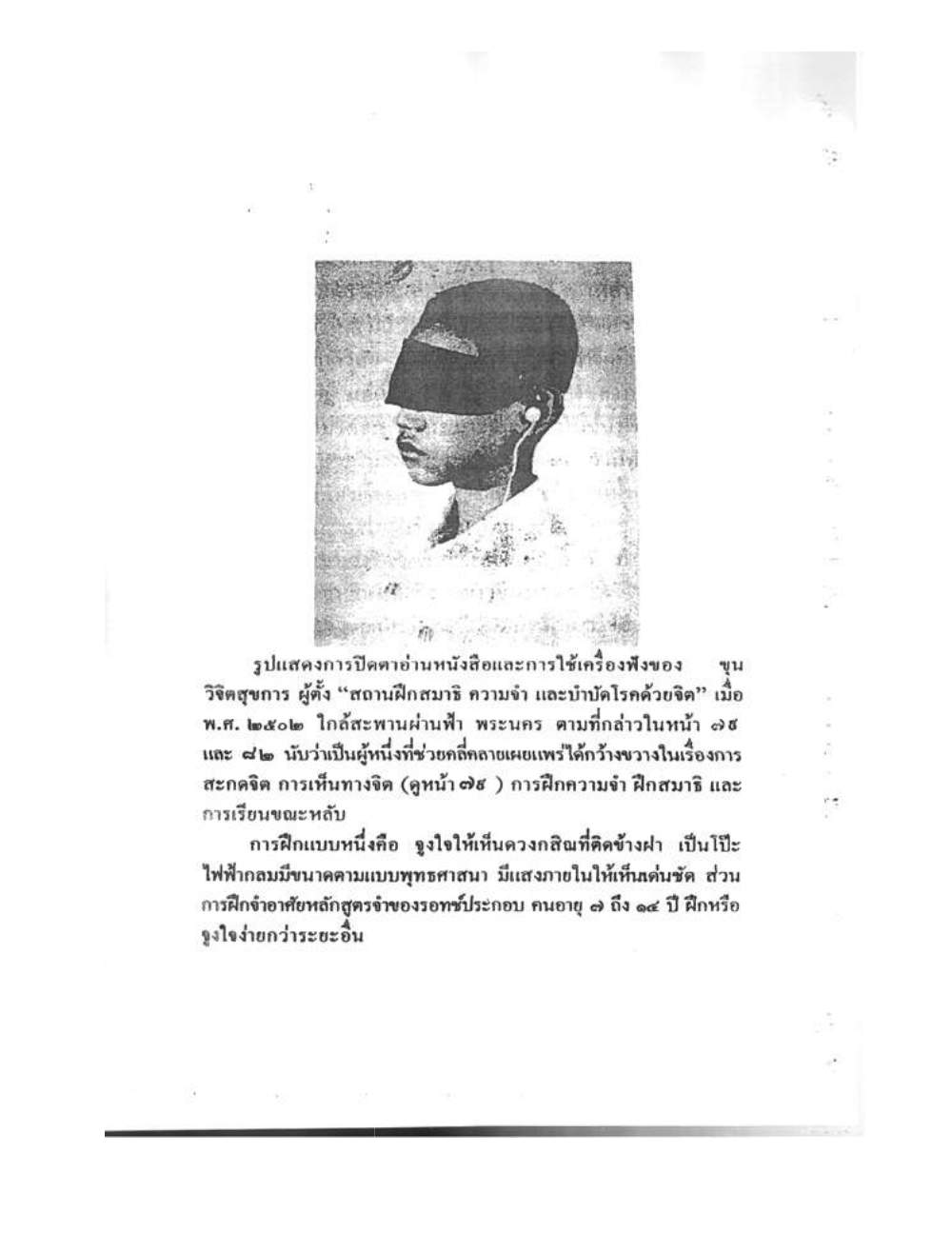
[ภาพ: รูปถ่ายศีรษะบุคคลมองจากด้านข้าง สวมแถบผ้าสีดำปิดตา มีสายหูฟังต่อออกจากหู]
รูปแสดงการปิดตาอ่านหนังสือและการใช้เครื่องฟังของ ขุน วิจิตรสุขการ ผู้ตั้ง "สถานฝึกสมาธิ ความจำ และบำบัดโรคด้วยจิต" เมื่อ พ.ศ. ๒๕๐๒ ใกล้สะพานผ่านฟ้า พระนคร ตามที่กล่าวไว้ในหน้า ๗๙ และ ๘๒ นับว่าเป็นผู้หนึ่งที่ช่วยคลี่คลายเผยแพร่ได้กว้างขวางในเรื่องการ สะกดจิต การเห็นทางจิต (ดูหน้า ๗๙) การฝึกความจำ ฝึกสมาธิ และ การเรียนขณะหลับ
การฝึกแบบหนึ่งคือ จูงใจให้เห็นดวงกสิณที่ติดข้างฝา เป็นโป๊ะ ไฟฟ้ากลมมีขนาดความแบบพุทธศาสนา มีแสงภายในให้เห็นเด่นชัด ส่วน การฝึกจำอาศัยหลักสูตรจำของรอทช์ประกอบ คนอายุ ๗ ถึง ๑๔ ปี ฝึกหรือ จูงใจง่ายกว่าระยะอื่น
[Photo: a side-profile head shot of a man wearing a black band/blindfold over his eyes, with an earphone wire running from his ear.]
The picture shows the blindfolded reading and the use of a listening device by Khun Wichit Sukkarn, founder of the "Centre for Concentration, Memory Training, and Mind-based Healing", established in 1959 (B.E. 2502) near Phan Fa Bridge, Phra Nakhon, as mentioned on pages 79 and 82. He is regarded as one of those who helped spread and popularise widely the subjects of hypnosis, mental seeing (see page 79), memory training, concentration training, and sleep-learning.
One method of training is to induce the subject to see a kasina disc fixed to the wall — a round electric lamp globe of a size in the Buddhist tradition, with an inner light making it appear clearly. As for memory training, it draws on Roth's memory curriculum. People aged 7 to 14 find training or being induced into this state easier than at other ages.
ความก้าวหน้าที่สำคัญยิ่งก็ตั้งใจดูหนังสืออย่างจริงจัง ไม่ง่วง หรือบางระยะไม่ได้ยินเสียงวิทยุที่อยู่ใกล้ ๆ เหล่านี้ก็ล้วนแต่จิต เกิดสมาธิขึ้น และมีอำนาจจิตขึ้นนั่นเอง จึงเกิดความอดทนขยัน ขันแข็งกว่าปกติวิสัย ทั้งยังเป็นเครื่องยืนยันว่าจิตมีแน่แม้จะลืมตา อยู่ หูก็เปิดอยู่ แต่เมื่อไม่มีจิตมาควบคุมประสาทหูและตาแล้ว ก็ไม่ได้เห็นไม่ได้ยิน ส่วนสมาธิขั้นกลางในขั้นที่ไม่ได้ยินเสียง อะไรเลยเป็นเวลานานประมาณ ๑๐ - ๓๐ นาทีดังนี้ บางคนก็ ทำได้โดยไม่ต้องเรียนกับอาจารย์ก็มี เพราะผู้นั้นอาจจะฝึกไป พร้อม ๆ กันกับงานประจำวันหรือยามว่างเล็ก ๆ น้อย ๆ หรือ เป็นบุญของเขาเองจึงได้พบวิธีทำให้เกิดสมาธิ ทำให้เกิดอำนาจ จิตโดยบังเอิญหรือโดยพิจารณารู้ขึ้นมา
ฉะนั้น จึงขอเน้นว่าสมาธิขั้นต้นหรือการใช้อำนาจจิตขั้นต้น นั้น สามารถศึกษาได้สำเร็จในเวลาอันสั้น ส่วนสมาธิขั้นกลาง หรือการใช้อำนาจจิตขั้นกลางนั้น ต้องใช้เวลามากและมีอาจารย์ ที่สามารถ จึงจะเรียนได้สำเร็จทุกขั้นตอนของสมาธิขั้นกลาง อนึ่งในระหว่างที่ทำจิตให้เป็นสมาธิโดยไม่มีการใช้อำนาจจิต ก็มีอำนาจจิตเกิดมากขึ้นตามลำดับที่สมาธิเดินสูงขึ้นไป และเป็น การพักผ่อนร่างกายและจิตใจดีกว่าการนอนหลับ(๑) นอกจากนั้น ยังสามารถป้องกันอันตรายได้ในตัวดีขึ้นตามขั้นของสมาธิ ส่วน
(๑) ดูในบทที่ ๑. หน้า ๓๐
The most important progress is to concentrate on reading a book earnestly, without drowsiness, or at times not hearing the sound of a nearby radio — all of these are simply the mind entering a state of concentration, and thereby generating mental power. This gives rise to endurance and diligence beyond the ordinary, and also confirms that the mind truly exists: even though the eyes remain open and the ears remain open, when the mind is not there to control the nerves of the ears and eyes, one does not see and does not hear. As for intermediate-level concentration, at the stage of not hearing any sound at all for about 10-30 minutes — some people can achieve this without studying under a teacher, because they may have been training alongside their daily work or in small spare moments, or it may be their own merit that led them to discover a way to bring about concentration, generating mental power either by chance or through conscious realisation.
Therefore, it should be emphasised that beginning-level concentration, or the use of beginning-level mental power, can be studied to success in a short time. Intermediate-level concentration, or the use of intermediate-level mental power, however, requires much time and a capable teacher in order to successfully learn every stage of intermediate concentration. Furthermore, while bringing the mind into concentration without using mental power, mental power still arises increasingly in step with the rising level of concentration, and this serves as rest for the body and mind better than sleep.(1) Besides this, it can also protect against danger, to a degree that improves according to the level of concentration attained...
(1) See Chapter 1, page 30.
การใช้อำนาจจิตนั้น เป็นการใช้พลังงานเป็นการเสียพลังงาน ทั้งทางร่างกายและทางจิตใจ ถ้าใช้อำนาจจิตมากนัก ก็ให้โทษ ยิ่งกว่าการใช้กำลังกายมากเกินส่วนเสียอีก ซึ่งจะได้ทราบจาก ผลการวิจัยในบทที่ ๓
๒. การค้นคว้าเกี่ยวกับจิตและอำนาจจิตในต่างประเทศ
คำว่าต่างประเทศนี้ มุ่งหมายไปถึงประเทศในทวีปยุโรป และอเมริกา ซึ่งได้มีการค้นคว้าและมีทุนสนับสนุนอยู่มาก การ ค้นคว้าและทดลองด้วยวิธีการต่าง ๆ เพื่อแสดงว่าจิตหรือวิญญาณ ไม่มีนั้น มีการพิจารณาและวิจัยกันหลายอย่างแต่ก็ไม่มีเหตุผล เพียงพอ แต่ถึงกระนั้นก็ยังทำให้คนเป็นจำนวนมากหลงเชื่อ ไปได้ เป็นเวลาหลายสิบปี เชื่อด้วยอำนาจของอุปทานไปยึดมั่น ว่าผู้ค้นคว้าวิจัยนั้นเป็นบุคคลสำคัญหรือค้นคว้าเรื่องอื่น ๆ ได้ดี หลายอย่างให้เป็นประจักษ์พยานอยู่แล้ว เรื่องนี้ได้ยกตัวอย่าง การวิจัยครั้งสำคัญมาให้ดูแล้ว ๒ เรื่อง ในบทที่ ๑ ต่อไปนี้จะ ขอยกตัวอย่างการวิจัยที่ยืนยันว่าจิตหรือวิญญาณมีจริงบ้าง
หลังสงครามโลกครั้งที่ ๑ การค้นคว้าของนักวิทยาศาสตร์ ในด้านคัดค้านว่าจิตไม่มีนั้น ก็ยังหาข้อพิสูจน์ที่น่าเชื่อไม่ได้ นอก- จากนั้นผลการค้นคว้ายังโอนเอียงให้เข้าใจไปในทางที่ว่าจิตมีจริง เสียอีก ฉะนั้น หลังสงครามโลกครั้งที่ ๒ นักวิทยาศาสตร์ก็ เริ่มมีความเชื่อมั่นว่า จิตมีจริงและมีอำนาจ หรือพลังที่จะช่วย
The use of mental power involves the expenditure of energy — a loss of energy — both physically and mentally. If mental power is used too much, it is even more harmful than using excessive physical strength, as will be learned from the research findings in Chapter 3.
2. Research on Mind and Mental Power in Foreign Countries
The term "foreign countries" here refers to countries in the continents of Europe and America, where a great deal of research has been carried out with substantial funding support. Research and experiments using various methods, aiming to show that mind or spirit does not exist, have been considered and studied in many ways, but without sufficient grounds. Nevertheless, this still caused a great many people to be misled into belief for several decades, believing through the power of assumption and holding firmly that the researcher was an important person, or that he had produced good research on other matters in many respects that already served as clear evidence. This topic has already given two examples of major research in Chapter 1. What follows will give examples of research that confirms that mind or spirit does indeed exist.
After the First World War, the research of scientists on the side arguing that mind does not exist still could not find convincing proof. Moreover, the results of the research even leaned towards the understanding that mind truly does exist. Therefore, after the Second World War, scientists began to become convinced that mind truly exists and possesses power, or a force, that can help...
ส่งเสริมให้พลังทางกายดีขึ้น หรือทำให้ร่างกายเกิดการผิดปกติ เจ็บป่วยได้ จะได้นำเอาผลการค้นคว้ามากล่าวเป็นบางประการ ต่อไป
จากบทความเรื่องวิธีทำให้ท่านสบายไปตลอดปี ในหนังสือ รีดเดอร์ไดเจส(๒) กล่าวว่า "มนุษย์เราแต่ละคนต่างก็มีพลังเพื่อ ความสมบูรณ์ นั่นคือพลังของอารมณ์อันแจ่มใส————" บทความนี้มีผลการทดลองของนักวิทยาศาสตร์หลายท่าน เช่น วิลเลียมเจมส์ กล่าวว่าอารมณ์มี ๒ ชนิด คือ อารมณ์เสียและ อารมณ์ดี เมื่อคนเรามีอารมณ์เสียแล้ว อวัยวะบางส่วนของร่างกาย เช่น กล้ามเนื้อหรือต่อมต่าง ๆ จะถูกกระแสประสาทจากสมอง กระตุ้นแรงเกินกว่าธรรมดามาก อารมณ์เสียนั้นมีหลายอย่าง เช่น ความโกรธ ความผิดหวัง ความอาฆาต ความวิตกกังวล ความกลัว ความท้อถอย ความเศร้าโศกเสียใจ ความไม่พอใจ เมื่อมีอารมณ์ดี อวัยวะต่าง ๆ จะถูกกระตุ้นอย่างพอดีไม่มีส่วน ใดที่ตึงเครียด หรือหย่อนเกินไป เวลาโกรธกล้ามเนื้อส่วนปลาย ของกระเพาะอาหารจะหดตัวแน่นมากจนอาหารผ่านออกไม่ได้ ระบบทางเดินอาหาร เช่น ลำไส้จะเกิดอาการเกร็ง ขณะเดียวกัน จำนวนเม็ดโลหิตแดงก็จะเพิ่มขึ้น โลหิตจะแข็งตัวเร็วขึ้น อาการ
(๒) John Schindler, M.D., "How to live 365 Days a Year" Reader's Digest, May 1965, p. 85.
...promote better bodily strength, or cause the body to become abnormal and fall ill. Some of the research findings will now be presented below.
From an article on how to keep oneself well throughout the year, in Reader's Digest,(2) it states: "Each and every human being possesses a power for wholeness — that is, the power of a bright, cheerful emotional state————" This article cites the experimental results of several scientists. For instance, William James stated that there are two kinds of emotion: bad emotion and good emotion. When a person has a bad emotional state, certain parts of the body's organs — such as muscles or various glands — are stimulated far more strongly than normal by nerve impulses from the brain. Bad emotions are of many kinds, such as anger, disappointment, vindictiveness, anxiety, fear, discouragement, grief and sorrow, and displeasure. When one has good emotion, the various organs are stimulated just the right amount, with no part being either too tense or too slack. When angry, the muscles at the far end of the stomach contract so tightly that food cannot pass through. The digestive tract, such as the intestines, becomes cramped. At the same time, the number of red blood cells increases, and the blood clots faster. The condition...
(2) John Schindler, M.D., "How to Live 365 Days a Year", Reader's Digest, May 1965, p. 85.
จะเป็นอยู่อย่างนี้ จนกว่าความโกรธจะค่อย ๆ ลดลง ในเวลา ที่โกรธมาก ความดันโลหิตจะเพิ่มขึ้นอย่างรวดเร็วจาก ๑๓๐ จะขึ้นถึง ๒๓๐ หรือกว่านี้ ผลเหล่านี้แหละเป็นผลร้ายต่อร่างกาย อย่างยิ่ง บางคนถึงกับเจ็บป่วยไม่สบายไป เพราะความโกรธ ของตนเอง และเคยพบบ่อย ๆ ที่คนโกรธถึงขีดสุดหัวใจจะขาด โลหิตไปหล่อเลี้ยงเพราะเส้นโลหิตตีบ บางทีถึงกับเป็นลมตายไป ก็มี ดร. HANDS SELYE ได้ทดลองให้เห็นว่าอารมณ์เสียอยู่ บ่อย ๆ จะทำให้เกิดการป่วยไข้ขึ้นได้ นอกจากนี้ได้วิจัยพบว่า อารมณ์ไม่ดี เช่นความโกรธ ความวิตกกังวล ความเศร้าโศก และอารมณ์ตึงเครียดอย่างอื่น ทำให้เกิดอาการเจ็บกล้ามเนื้อ เรื่องนี้เพิ่งมารู้กันแน่นอน เมื่อคราวสงครามโลกครั้งที่ ๒ ส่วน ในสงครามโลกครั้งที่ ๑ นั้น ทหารจำนวนมากที่ออกรบในแนวหน้า เป็นโรคเจ็บป่วยกล้ามเนื้อ ซึ่งเป็นเพราะเอ็นและกล้ามเนื้ออักเสบ แต่ในสมัยสงครามโลกครั้งที่ ๑ นั้น ยังเชื่อกันว่าโรคเจ็บป่วย กล้ามเนื้อดังกล่าวนั้น เป็นด้วยสิ่งแวดล้อมต่าง ๆ เป็นเหตุ เช่น อากาศชื้น และความเป็นอยู่ไม่ดี ในสงครามโลกครั้งที่ ๒ จึง ปรากฏผลว่าไม่ใช่เพราะสิ่งแวดล้อมเป็นเหตุ รบในเขตหนาว เขตร้อน หรือสภาพอื่น ๆ ทหารก็เป็นโรคเจ็บป่วยกล้ามเนื้อ เท่า ๆ กัน แต่จะเจ็บป่วยด้วยโรคนี้ทวีมากขึ้นเรื่อย ๆ ตลอด เวลาที่เคลื่อนที่ใกล้แนวรบเข้าไปทุกที เมื่อค้นคว้าดูก็ลงเอยกันว่า โรคเจ็บป่วยกล้ามเนื้อที่เกิดขึ้นกันนั้นเป็นเพราะอารมณ์เสีย ทำให้
...remains so until the anger gradually subsides. At times of intense anger, blood pressure rises rapidly from 130 up to 230 or higher. These effects are extremely harmful to the body. Some people even fall ill because of their own anger, and it has often been found that when a person's anger reaches its peak, the heart may fail to receive enough blood because the blood vessels narrow; sometimes this even causes fainting and death. Dr. Hans Selye conducted experiments showing that frequent bad emotional states can cause illness to arise. Research also found that negative emotions, such as anger, anxiety, grief, and other forms of emotional tension, cause muscle pain. This matter only became definitely known at the time of the Second World War. In the First World War, however, a great many soldiers who fought at the front developed muscular illness, caused by inflammation of tendons and muscles, but at that time it was still believed that this muscular illness was caused by various environmental factors, such as damp air and poor living conditions. In the Second World War, it turned out that the cause was not environmental after all — whether fighting in cold zones, hot zones, or other conditions, soldiers suffered from muscular illness equally, but the illness increased more and more the closer they moved toward the front line. Upon investigation, it was concluded that the muscular illness that arose was due to bad emotion, which caused...
ประสาทเคร่งเครียดเกินไป อาการดังกล่าวนี้คนทั่ว ๆ ไปอาจ เป็นได้เหมือนกัน โดยเฉพาะคนที่ถูกบังคับให้ทำอะไรที่ตนไม่ ชอบ เมื่อต้องทนทำไปนาน ๆ ก็จะเกิดเจ็บป่วยดังกล่าวได้ ผู้ป่วย ที่บอกว่ามีอาการปวดศีรษะบริเวณท้ายทอยเรื่อยลงไปจนถึง ต้นคอนั้น ปรากฏว่า ๙๕ เปอร์เซ็นต์เกิดการเจ็บป่วยเช่นนั้น เพราะอารมณ์ตึงเครียดเป็นเหตุ คนที่ป่วยท้องคิดว่าตนเป็นแผล ที่กระเพาะ มีประมาณครึ่งจำนวนที่เป็นเพราะการเปลี่ยนแปลง ของอารมณ์มากเกินไปเป็นเหตุ จากการวิจัยอย่างกว้างขวาง ลงเอยว่า กล้ามเนื้อทุกส่วนของร่างกายนั้นเปลี่ยนแปลงไป เพราะอารมณ์ได้ บทความนี้ยังได้กล่าวไว้ว่า
การที่คนจะมีสุขสมบูรณ์นั้น ต้องเป็นคนมีอารมณ์ดีอยู่เสมอ การมีอารมณ์ดีอยู่เสมอนี้เป็นยาขนานเอกที่ทำให้ร่างกายมีความ สุขสมบูรณ์เท่า ๆ กับยาพวกปฏิชีวนะ หรือเป็นยาพวกฮอร์โมน และคอร์ตีโซน วิธีทำให้ร่างกายผลิตฮอร์โมนในจำนวนพอดีนั้น ก็คือการมีอารมณ์ดีอยู่เสมอ มีคนไข้รายหนึ่งรู้สึกเจ็บแน่นแถว หน้าอกระหว่างทำงานก็ไม่เอาใจใส่ แต่พอไปหาแพทย์ แพทย์ บอกว่าสงสัยจะเป็นโรคหัวใจ คนไข้รายนี้ก็ตกใจนึกว่าตนเป็น มากมายหนักเหลือเกิน จึงเที่ยวไปหาผู้เชี่ยวชาญทางโรคหัวใจ หลายแห่งไม่เป็นอันทำงาน ผู้เชี่ยวชาญเหล่านั้นตรวจไม่พบว่า มีโรคอะไร ให้กลับไปทำงานตามเดิม เมื่อไปทำงานตามเดิม ก็ รู้สึกหายไปเอง ทั้งนี้ก็เพราะเวลามีเรื่องคิดมากมีกังวลมากมาย
...too much nervous tension. This condition can occur in ordinary people as well, especially those who are forced to do something they dislike; when compelled to endure it for a long time, they can develop this kind of illness. Among patients who report a headache in the back of the head extending down to the base of the neck, it was found that 95 percent of such illness was caused by emotional tension. Among people who suffer from stomach pain believing they have a stomach ulcer, about half of the cases were caused by excessive emotional fluctuation. Extensive research concludes that every muscle in the body can be changed by emotion. This article further states:
For a person to enjoy complete well-being, they must always be in a good emotional state. Always maintaining a good emotional state is a supreme remedy that gives the body wholeness equal to antibiotic medicines, or hormone- and cortisone-type medicines. The way to make the body produce the right amount of hormones is precisely to always maintain a good emotional state. One patient felt a tight, painful sensation across the chest while working but paid it no attention; but upon visiting a doctor, the doctor said it might be heart disease. This patient became alarmed, thinking he was gravely ill, and went around visiting heart specialists at many places, unable to work at all. Those specialists, upon examination, found no disease and told him to go back to work as before. When he went back to work as before, he felt the symptom disappear by itself — this was because, at the earlier time, he had had many worrying thoughts and much anxiety...
ก็เกิดอาการเจ็บไข้ขึ้นได้ เมื่ออารมณ์ดีก็ช่วยให้โรคหายได้
ตามรายงานการค้นคว้าที่อเมริกา ปรากฏว่าได้ยอมรับเอา เรื่องจิตทำให้เกิดโรคต่าง ๆ นี้ขึ้นมาเป็นหลักสูตรของแพทย์อีก วิธีหนึ่งเรียกว่า ไซโคโซแมติก เมดิซิน และได้พากันพิสูจน์ให้ เห็นว่า การกระทบกระเทือนทางใจมาก ๆ ทำให้อวัยวะปฏิบัติ หน้าที่ผิดปกติ ทำให้เซลล์ของร่างกายเกิดโรคขึ้นได้ และทำให้ อวัยวะเปลี่ยนรูปไปได้(๓)
นายแพทย์โว้ลฟ์ และวูลฟ์ แห่งโรงพยาบาลเพนวิทนีย์ ผู้เชี่ยวชาญทางโรคประสาทได้ให้คำจำกัดความคำ "ไซโคโซ- แมติก เมดิซิน" ว่า เป็นวิชาแพทย์ที่ว่าด้วยสมุฏฐานและวิชา รักษาโรคของร่างกายอันเกิดจากความผิดปกติของจิต โรคที่เกิด จากจิตดังกล่าวนี้ ก็มีโรคหืด ขี้มูกไหล กระเพาะและลำไส้อักเสบ ความดันโลหิตสูง ปวดศีรษะเรื้อรัง ลมพิษ ผื่นคัน ถ่ายปัสสาวะ รดที่นอน ปวดประจำเดือน จามบ่อย ๆ ฯลฯ ศาสตราจารย์โว้ลฟ์ และวูลฟ์ได้ทดลองคนไข้รายหนึ่งชื่อทอม ซึ่งเป็นโรคกระเพาะ ตีบ ได้เปิดหน้าท้องและคอยสังเกตผลทางจิต เวลาทอมรื่นเริง เบิกบานและเวลาหิวกระเพาะจะชุ่มมีน้ำย่อยไหลออกมามาก
(๓) คณะนายแพทย์. "แมวมหัศจรรย์ที่แพทย์ลืมใช้" ปัญหาชีวิต ประจำเดือน สิงหาคม - กันยายน ๒๕๐๕. กรุงเทพฯ:โรงพิมพ์สหไทย. หน้า ๘.
...illness can arise; and when one's emotional state is good, this helps illness to be cured.
According to research reports from America, it has been recognised that the causing of various diseases by the mind has become established as a branch of medical curriculum, known as psychosomatic medicine, and it has been jointly demonstrated that severe emotional shocks cause the organs to malfunction, cause the cells of the body to develop disease, and can even cause organs to change shape.(3)
Doctors Wolff and Wolff of Payne Whitney Hospital, specialists in nervous disorders, defined the term "psychosomatic medicine" as the branch of medicine concerned with the origin and treatment of bodily disease arising from disorders of the mind. Diseases arising from the mind in this way include asthma, runny nose, gastritis and enteritis, high blood pressure, chronic headache, hives, itchy rash, bedwetting, painful menstruation, frequent sneezing, etc. Professors Wolff and Wolff experimented on a patient named Tom, who suffered from a narrowed stomach; they opened his abdomen and observed the mental effects. When Tom was cheerful and in good spirits, and when he was hungry, his stomach would become moist with digestive juice flowing out abundantly...
(3) A panel of physicians, "The Miraculous Cat That Doctors Forgot to Use", Panha Chiwit [Life Problems] magazine, August–September issue, 1962 (B.E. 2505). Bangkok: Sahathai Press, p. 8.
และที่ผิวกระเพาะมีเลือดคั่ง กระเพาะบีบตัวบ่อยขึ้นเมื่อเวลา ทอมเศร้าเสียใจ ผิวกระเพาะจะซีดและแห้ง หลังจากที่มีความ โศกเศร้ามาก จะทำให้มีโลหิตไหลออกมาเป็นหย่อม ๆ ผิวอ่อน ของกระเพาะจะหนาและแข็งขึ้น เมื่อทุกข์โศกหายไป ทุกอย่าง ที่ผิดปกตินั้นหายไปด้วย ระยะที่กระเพาะเปลี่ยนแปลงมาก ๆ นี้ ถ้ามีการกระทบกระเทือนที่ผิวอ่อนของกระเพาะบ่อย ๆ จะเกิด แผลง่ายที่สุด เมื่อโกรธมากก็จะมีโลหิตมาคั่งในกระเพาะมาก ขึ้น ในเวลากระเพาะซีดใบหน้าก็ซีด และเวลากระเพาะแดงเพราะ มีโลหิตมาคั่งมาก ใบหน้าก็มีสีแดงด้วย
ดร. เวส แห่งมหาวิทยาลัยแคลิฟอร์เนีย เป็นหัวหน้าค้นคว้า โรคมะเร็งที่เกี่ยวกับจิต สรุปผลการค้นคว้าว่า คนไข้ที่ชอบซ่อน ความรู้สึกในใจมีอารมณ์เคร่งเครียดในใจ จะเป็นเหตุให้โรค มะเร็งเจริญเติบโตได้เร็วขึ้น ส่วนคนไข้ที่จิตใจเยือกเย็น โรค มะเร็งก็จะเจริญหรือกำเริบขึ้นได้ช้า
ที่มหาวิทยาลัยแคลิฟอร์เนีย ได้ทดลองพิสูจน์ว่ากาแฟทำให้ คนนอนไม่หลับจริงหรือไม่ โดยแบ่งนักศึกษาออกเป็น ๒ พวก ก่อนเข้านอนให้พวกหนึ่งดื่มกาแฟ อีกพวกหนึ่งดื่มนม ปรากฏ ว่าพวกดื่มกาแฟนอนไม่ค่อยหลับ แต่พวกดื่มนมนอนหลับสนิทได้ เร็ว การทดลองครั้งหลังได้สกัดเอากรดที่ทำให้นอนไม่หลับ ในกาแฟเอาไปใส่ในนม ทดลองให้นักศึกษาเป็นจำนวนมากดื่ม ก่อนนอนอีก ปรากฏผลว่าพวกที่ดื่มนมที่มีธาตุทำให้นอนไม่
...and blood congestion at the stomach's surface would occur, with the stomach contracting more frequently. When Tom was sad and grieving, the stomach's surface would become pale and dry; after intense grief, this would cause blood to leak out in patches, and the delicate lining of the stomach would become thickened and hardened. When the sorrow passed, all the abnormalities also disappeared. During this period of great change in the stomach, if the delicate lining of the stomach were repeatedly disturbed, ulcers would form most easily. When very angry, more blood would congest in the stomach; when the stomach was pale the face was also pale, and when the stomach was red due to heavy blood congestion, the face was also red.
Dr. West of the University of California headed research into cancer in relation to the mind. He concluded that patients who tend to hide their feelings and hold tension in their minds cause cancer to grow more quickly, whereas in patients whose minds are calm and cool, cancer grows or worsens more slowly.
At the University of California, an experiment was conducted to test whether coffee really does prevent sleep. Students were divided into two groups: before going to bed, one group was given coffee to drink, the other group was given milk to drink. It turned out that the coffee-drinking group had difficulty sleeping, while the milk-drinking group fell soundly asleep quickly. In a later experiment, the acid in coffee that causes sleeplessness was extracted and added to milk; this was given to a large number of students to drink before bed again. The result showed that those who drank the milk containing the substance that causes sleeplessness...
หลับ กลับนอนหลับสนิทเร็วตามเดิม และพวกที่ดื่มกาแฟนั้น ก็นอนไม่ค่อยหลับดังคราวก่อนนี้ แสดงว่าอำนาจจิตที่เกิดเพราะ ความยึดมั่น เชื่อมั่นนั้น ก็ทำให้ร่างกายเปลี่ยนแปลง ทำให้ นอนไม่หลับได้
ในต่างประเทศ สมาคมค้นคว้าทางจิตได้พยายามพิสูจน์ ทดลองเกี่ยวกับอำนาจจิตมากมาย ในด้านอื่นที่นิยมค้นคว้า มากในลำดับถัดลงมาก็คือ การสะกดจิต นอกนั้นก็เกี่ยวกับ การรับส่งข่าวทางจิต การเห็นด้วยจิต (ไม่ต้องใช้ตา) การฝึกจิต หรือควบคุมจิต และการค้นคว้าเรื่องวิญญาณ
จูลโรแมง ชาวฝรั่งเศสได้พิมพ์หนังสือที่กรุงปารีส พ.ศ. ๒๔๖๗ ชื่อว่า "การเห็นที่ไม่ต้องใช้ตา" เขายืนยันในหนังสือ ว่ามีหลายคนที่สามารถเห็นได้โดยไม่ต้องใช้ตามองดู ผู้ที่เห็น ได้ดังนี้จะอยู่ในภาวะอย่างหนึ่งคล้าย ๆ คนถูกสะกด จูลโรแมง เล่าว่าเขาเองได้เข้าสมาธิอยู่ร่วม ๑๕๐ ชั่วโมง จนกระทั่งสามารถ เห็นสิ่งของและอ่านหนังสือได้ขณะปิดตาอยู่
นางสะแตนลีเห็นสีต่าง ๆ ได้โดยการสัมผัส(๔) ดร. ยูทธ์ ศาสตราจารย์แผนกจิตวิทยา แห่งมหาวิทยาลัยบาร์นาด ใน
(๔) วารสารวิทยาศาสตร์ ฉบับ มี.ค. ๐๗ เรื่องผู้เห็นสีฯ ของสมาคมวิทยาศาสตร์ แห่งประเทศไทย และดูบทที่ ๓ ในเล่มนี้ประกอบ
...sleeplessness went back to falling soundly asleep quickly as before, while those who had drunk coffee again had difficulty sleeping as in the earlier round. This shows that the mental power arising from firm conviction and belief can indeed change the body and cause sleeplessness.
In foreign countries, psychical research societies have made many attempts to prove and experiment with mental power. Another field popular for research, next in order, is hypnosis. Besides that, there is also research concerning telepathy, seeing with the mind (without using the eyes), training or controlling the mind, and research into spirit/consciousness.
Jules Romains, a Frenchman, published a book in Paris in 1924 (B.E. 2467) titled "Eyeless Sight". In it he affirms that there are many people capable of seeing without using their eyes to look. Those capable of seeing in this way are in a state somewhat similar to a person who has been hypnotised. Jules Romains recounts that he himself entered a state of concentration for a total of about 150 hours, until he was able to see objects and read books while his eyes were closed.
Mrs. Stanley could perceive various colours through touch.(4) Dr. Youtz, professor of the psychology department at Barnard University/College...
(4) Science Journal, March issue [no. 07], article on colour perception, by the Science Society of Thailand; see also Chapter 3 in this volume for further reference.
นิวยอร์คทดลองพร้อมกับศาสตราจารย์อื่น ๆ อีกหลายคน การ ทดลองนั้นกระทำเมื่อ พ.ศ. ๒๕๐๖ โดยให้นางสะแตนลี ซึ่งอายุ ๔๒ ปี ยื่นมือเข้าไปในกล่องที่มีรูสำหรับลอดแขนเข้าไป เอา เศษผ้าสีต่าง ๆ หุ้มด้วยพลาสติกบาง ๆ ให้ลูบคลำไม่เกิน ๒ นาที ปรากฏว่าทายสีได้ถูกต้อง นางสะแตนลีเล่าว่านางต้องเข้าสมาธิ ให้ดีก่อนจึงทายได้ถูก
วิชาสะกดจิตเริ่มนิยมกันในยุโรปตั้งแต่ ค.ศ. ๑๗๓๔ นาย แพทย์เมสเมอร์แห่งกรุงเวียนนา ได้รักษาโรคโดยใช้วิธีสะกดจิต จนมีชื่อเสียงโด่งดัง เอมิลคูเอได้ตั้งโรงเรียนสอนวิชาสะกดจิต เป็นคนแรกที่เมืองนังซี เมสเมอร์ได้เคยรักษาโรคของขุนนาง ผู้หนึ่งซึ่งเป็นโรคกล้ามเนื้อรัดตึงปวดเจ็บอย่างรุนแรง นายแพทย์ อื่นตรวจไม่พบสาเหตุและรักษาไม่หาย เมสเมอร์รักษาด้วยการ จูงใจโดยเอานิ้วมือแตะตรงที่ปวดแล้วถามว่า รู้สึกร้อนหรือเปล่า เมื่อขุนนางผู้นั้นบอกไม่ร้อน เขาก็บอกว่าเมื่อไม่ร้อนก็ไม่มีโรค อะไร เป็นแต่เพียงโรคอุปทานหรือคิดไปเอง ทำดังนี้ ๓ ครั้ง และย้ำว่าการเจ็บป่วยเป็นด้วยนึกคิดไปเองจึงรู้สึกไปว่าเจ็บป่วย ส่วนร่างกายนั้นสมบูรณ์ดีทุกอย่าง การพูดจูงใจและเน้นหนัก แน่นทำให้โรคเจ็บป่วยนั้นหายไปได้ แต่ต่อมาเกิดเจ็บป่วยขึ้นอีก เมสเมอร์จึงใช้วิธีสะกดให้หลับ แล้วพูดจูงใจในขณะหลับ และ ทำซ้ำ ๒ - ๓ ครั้ง โรคที่ป่วยก็หายขาดไม่กลับเป็นอีก
...in New York, conducted the experiment together with several other professors. The experiment was carried out in 1963 (B.E. 2506), in which Mrs. Stanley, aged 42, put her hand into a box that had a hole for the arm to reach through; scraps of cloth of various colours, wrapped in thin plastic, were placed for her to feel for no more than 2 minutes. It turned out that she correctly guessed the colours. Mrs. Stanley related that she had to enter a good state of concentration first in order to guess correctly.
The study of hypnosis first became popular in Europe from 1734 CE. Doctor Mesmer of Vienna treated illness using hypnotic methods until he became famous and well-known. Émile Coué was the first to establish a school teaching hypnosis, in the city of Nancy. Mesmer once treated the illness of a nobleman who suffered from severe muscle contraction and pain. Other doctors could find no cause and could not cure him. Mesmer treated him through persuasion, touching the painful spot with his finger and asking whether it felt hot. When the nobleman said it did not feel hot, Mesmer told him that if it was not hot then there was no disease at all — it was merely a delusion, or something he had only imagined. He did this three times, repeatedly emphasising that the illness was only imagined, and that the body was in fact completely sound in every way. This persuasive, emphatic talk caused the illness to disappear. But later the illness arose again, so Mesmer used the method of hypnotising him to sleep, then spoke persuasively to him while asleep, repeating this 2-3 times, and the illness was cured completely and never returned.
เนื่องจากการค้นคว้าทางสะกดจิต ยังไม่พบหลักเกณฑ์อันแท้จริง ส่วนมากวางหลักเกณฑ์ที่สำคัญคือ ฝึกให้สายตาแข็ง ฝึกให้มีความเชื่อมั่นในตนเอง และฝึกบังคับผู้อื่นอย่างง่ายก่อน เช่น เวลาเดินสวนกันตั้งใจไว้ให้แรงกล้าว่าให้คนเดินสวนมานั้นหลีกไปทางขวา ดังนี้เป็นต้น การสะกดก็ตั้งจิตให้มั่นคงแล้วพูดจูงใจอย่างช้า ๆ หนักแน่น และใช้เสียงเบาพอควรขั้นต้นก็จูงใจให้หลับก่อน เมื่อสั่งให้หลับได้ดีแล้ว ต่อไปก็สั่งให้เป็นไปต่าง ๆ ในเรื่องที่ไม่ฝืนใจหรือขัดใจผู้ถูกสะกด
ผู้เขียนได้ติดตามการค้นคว้าของต่างประเทศหลายด้าน และได้เขียนรายละเอียดวิจัยเปรียบเทียบข้อดีข้อเสีย หรือสิ่งที่ถูกที่ผิดไว้โดยละเอียดแล้วในหนังสือ "วิทยาศาสตร์ทางใจ ฉบับส่องโลก" สำหรับเรื่องการสะกดจิตได้พบว่ามีผู้เริ่มจับหลักเกณฑ์ที่ถูกต้องได้คือ นายเลทเนอร์ คอนราดี แห่งนิวยอร์ค กล่าวคือ เขาเน้นเรื่องการควบคุมจิต และการควบคุมการหายใจ เขาได้กล่าวว่า "————ปัจจัยสำคัญในการสะกดจิตเพื่อควบคุมความตั้งใจของผู้ที่ถูกสะกด ก็คือการควบคุมการหายใจของเขา (ผู้ถูกสะกด)"(๕) นายเลทเนอร์ใช้วิธีหายใจเข้าให้ลึกและหยุดนิ่ง ๑๐ วินาที แล้วหายใจออกช้า ๆ และควบคุมให้ผู้ถูกสะกด
(๕) Konradi leitner, How to Hypnotize, New York, N.Y. Stravon Publisher, 1950, p. 26.
Because research into hypnosis has not yet found a truly authentic set of principles, most people set down as their key principle: train the eyes to be fixed, train confidence in oneself, and practice easy control of others first — for instance, when passing someone walking toward you, firmly resolve in advance that the oncoming person will veer to the right, and so on. For hypnotism itself, one steadies the mind firmly, then speaks persuasively, slowly and with weight, using a voice quiet enough; at the outset one persuades the subject to fall asleep first. Once the command to sleep succeeds, one then goes on to command various other things, in matters that do not go against or conflict with the will of the person being hypnotized.
The author has followed research from various foreign countries on many fronts, and has written up in detail a comparison of the merits and faults, or of what is correct and mistaken, in the book "Mind Science, World-View Edition." As for hypnotism, it was found that the person who first grasped the correct principles was Mr. Leitner Conradi of New York. That is, he emphasized control of the mind and control of breathing. He stated: "—— the important factor in hypnosis for controlling the intention of the person being hypnotized is control of his (the subject's) breathing."(5) Mr. Leitner used the method of breathing in deeply and holding still for 10 seconds, then breathing out slowly, and controlling the subject to
(5) Konradi Leitner, How to Hypnotize, New York, N.Y. Stravon Publisher, 1950, p. 26.
หายใจเข้าออกในจังหวะเดียวกัน การควบคุมการหายใจนี้ก็เป็นการช่วยให้จิตเป็นสมาธินั่นเอง จึงตรงกับความจริงที่ว่า เมื่อจิตเป็นสมาธิก็มีพลังหรืออำนาจ ทำอะไรได้แปลก ๆ แต่นักสะกดจิตอื่น ๆ ส่วนมากเน้นหลักสำคัญว่า ต้องฝึกให้สายตาแข็งจึงจะสะกดได้สำเร็จ ซึ่งไม่ตรงกับความจริง เพราะมีการสะกดจิตในระยะไกลกันได้ในระยะ ๒ – ๓ กิโลเมตร ซึ่งการสะกดจิตระยะไกลก็ไม่จำเป็นต้องใช้สายตาแข็ง ถึงแม้ว่าหลักสำคัญไม่ถูกต้องก็ทำได้สำเร็จ เพราะต่างก็มีหลักข้ออื่นที่พาดพิงมาในด้านการทำจิตใจให้เป็นสมาธินั่นเอง นายเลทเนอร์ใช้หลักควบคุมการหายใจทั้งผู้สะกดและผู้ถูกสะกด ประกอบกับการพูดจูงใจ และได้กล่าวถึงขั้นตอนในการทำให้ผู้ถูกสะกดมีความรู้สึกไปต่าง ๆ และทำให้หมดความรู้สึกเป็นบางบริเวณ เช่น การสะกดเพื่อการถอนฟันโดยไม่ต้องฉีดยาชาเป็นต้น นักสะกดจิตส่วนมากก็เขียนหลักวิชาในการคัดเลือกผู้ที่จะนำมาสะกด การสะกดให้หลับและการสะกดสั่ง การคัดเลือกคนที่จะนำมาสะกดให้หลักว่า ผู้ที่จะสะกดได้นั้นต้องเป็นผู้ที่ยินยอมให้สะกด เป็นบุคคลที่ไม่เมาสุรา ไม่เป็นลมบ้าหมู ไม่มีความโศกเศร้า เป็นต้น การสะกดสั่งนั้นกระทำเมื่อสะกดให้หลับแล้วเช่น สั่งให้หมดความรู้สึกหรือชาในบางบริเวณ เอาเข็มแทงก็ไม่รู้สึก ถอนฟันก็ไม่รู้สึกเจ็บ สั่งให้ตัวแข็ง หรือให้เป็นตัวละคร หรือเป็นใครคนหนึ่งก็ได้ แล้วเขาก็แสดงท่าทางหรือตอบเรื่องราวของคนนั้น
breathing in and out at the same rhythm. This control of the breath is itself what helps the mind become concentrated (samādhi). This accords with the truth that when the mind is concentrated it has power or force and can do strange things. But most other hypnotists mostly stress the key principle that one must train the eyes to be fixed in order to hypnotize successfully — which does not accord with the truth, because hypnosis can be performed at a distance of 2–3 kilometers, and long-distance hypnosis does not require a fixed gaze at all. Even when the stated key principle is incorrect, success can still be achieved, because each practitioner also has other principles bearing on making the mind concentrated in the same way. Mr. Leitner used the principle of controlling the breath of both the hypnotist and the subject, together with persuasive speech, and described the stages for making the subject feel various sensations, and for numbing sensation in particular areas — for example, hypnotizing someone so a tooth could be pulled without an anesthetic injection. Most hypnotists also wrote up the theory for selecting who should be hypnotized, for hypnotizing someone to sleep, and for post-hypnotic suggestion. The principle for selecting people to hypnotize states that a person who can be hypnotized must be one who consents to being hypnotized, is not drunk, does not have epilepsy, has no grief, and so on. Post-hypnotic suggestion is carried out once the subject has been put to sleep — for instance, commanding loss of feeling or numbness in a certain area, so that a needle prick is not felt, or a tooth extraction is not felt as painful; commanding the body to go rigid, or to become a character in a play, or to become some particular person, whereupon the subject acts out the manner or answers as that person would.
ได้ การที่วางหลักการวิธีการที่ไม่ถูกต้องสมบูรณ์นั่นเอง จึงทำให้ผู้ฝึกสะกดจิตล้มเหลวกันเป็นส่วนมาก
หลักการที่ผู้เขียนค้นพบก็คือ ต้องรู้วิธีรวมพลังจิตและส่งพลังจิตไปยังผู้ถูกสะกด ส่วนวิธีการนั้นก็คือ ต้องส่งไปยังจุดรวมประสาท โดยรวมลงเป็นจุดเล็ก ถ้าจะให้ได้ผลโดยฉับพลันทันที ต้องพุ่งจิตไปในจังหวะที่ผู้ถูกสะกดอ่อนแอที่สุด วิธีนี้เรียกตามตำราว่า วิธี นารายณ์แผลงศร รายละเอียดการฝึกสะกดจิตดูได้จาก "วิทยาศาสตร์ทางใจ ฉบับส่องโลก"
การค้นคว้าเรื่องวิญญาณ ได้มีสมาคมค้นคว้าทางวิญญาณในประเทศอังกฤษ อเมริกาและในยุโรป ระยะที่ค้นคว้ากันอย่างกว้างขวางเริ่มตั้งแต่ พ.ศ. ๒๔๔๐ ความมุ่งหมายก็เพื่อที่จะพิสูจน์ทดลองว่า จิตของบุคคลเราจะถูกควบคุมด้วยจิตผู้อื่นได้หรือไม่ วิญญาณผู้ที่ล่วงลับไปแล้วจะยังคงเหลืออยู่หรือไม่ มีนักวิทยาศาสตร์และนายแพทย์ที่มีชื่อเสียงร่วมกันค้นคว้าหลายคนในกรุงลอนดอน ประเทศอังกฤษ เซอร์เจมส์ ได้รวบรวมหลักฐานการทดลองพิมพ์เป็นหนังสือชื่อ เซอร์ไววอล(๖) เรื่องราวการเข้าทรงในหนังสือบางเรื่อง ก็น่าอัศจรรย์จนแทบไม่น่าเชื่อ เซอร์–วิลเลียม ซึ่งเป็นสมาชิกในสมาคมค้นคว้าทางวิญญาณก็ได้แต่งหนังสือยืนยันการค้นคว้าตั้งแต่ปี ๑๘๗๒ (พ.ศ. ๒๔๑๕) ไว้
(๖) SURVIVAL, Sir JAMES MARCHANT K.B.E.
...succeed. It is precisely the fact that the principles and methods set down were not properly complete that causes most who train in hypnosis to fail.
The principle the author has discovered is this: one must know how to gather mental power and send it to the subject. As for the method, it is this: it must be sent to the point where the nerves converge, gathering it down to a small point. If an instant, immediate effect is wanted, the mind must be shot forth at the moment when the subject is weakest. This method is called, according to the texts, the "Nārāyaṇa Loosing the Arrow" method. Details of hypnosis training can be found in "Mind Science, World-View Edition."
Regarding research into the soul/spirit: there have been societies for psychical research in England, America, and in Europe. The period of wide-ranging research began in B.E. 2440 (1897 CE). The aim was to prove and test experimentally whether one person's mind could be controlled by another's mind, and whether the spirit of a person who has passed away still remains in existence. Several renowned scientists and physicians jointly carried out research in London, England. Sir James compiled the experimental evidence and had it published as a book titled Survival.(6) The accounts of spirit possession in some of these books are so astonishing as to be almost unbelievable. Sir William, who was a member of the Society for Psychical Research, also wrote a book affirming this research dating from the year 1872 (B.E. 2415).
(6) SURVIVAL, Sir JAMES MARCHANT K.B.E.
หลายเล่ม เช่นหนังสือการค้นคว้าเรื่องวิญญาณ(๗)
ในปี ๑๘๗๑ เซอร์วิลเลียมได้ทดลองให้คนทรง ชื่อโฮม เข้าทรงประมาณ ๕๐ ครั้ง ในการเข้าทรงนั้นสมาคมค้นคว้าทางวิญญาณได้บันทึกไว้ บางครั้งได้เห็นตัวคนทรงที่ชื่อโฮมนี้ ค่อย ๆ ลอยขึ้นจากพื้นสูงประมาณ ๖ นิ้ว ลอยอยู่ประมาณ ๑๐ วินาที ครั้งหนึ่งคนทรงนี้ได้เอามือลนไฟเทียนช้า ๆ โดยไม่รู้สึกร้อน อีกครั้งหนึ่งได้คุ้ยถ่านในเตาที่กำลังลุกแดงอยู่แล้วหยิบเอาก้อนหนึ่งวางลงบนมือขวา ผู้ได้เห็นการเข้าทรงของนางเกตตี้ และนายโฮมได้เขียนรับรองไว้หลายคน
ศาสตราจารย์ริเชท แห่งซอร์บอนน์ ได้ทดลองเกี่ยวกับคนทรงต่าง ๆ อยู่ ๓๐ ปี ได้แต่งหนังสือเรื่อง ๓๐ ปี แห่งการค้นคว้าเรื่องวิญญาณ เซอร์อาเทอร์ ซึ่งเป็นสมาชิกคนหนึ่งในสมาคมการค้นคว้าทางวิญญาณของอังกฤษ ได้เขียนยืนยันเรื่องการเข้าทรงไว้มาก เขากล่าวว่า การเข้าทรงไม่ใช่จะหลอกลวงเสียทุกรายไป และได้ทดลองกับคนทรงทั้ง ๓ ทวีป ได้พบคนที่หลอกลวงไม่เกิน ๔ ครั้ง บางครั้งคนทรงที่เคยเข้าทรงได้ผลดีก็หลอกลวงได้ เมื่อคนทรงอยู่ในอาการครึ่งหลับครึ่งตื่น โดยที่คนทรงเองก็ไม่รู้ตัว ผู้ชำนาญในการสังเกตอาการกิริยาของคนทรงเมื่อยังเข้าทรงไม่สนิท ย่อมไม่เอาใจใส่ในตอนนี้ เซอร์–
(๗) RESEARCHES in SPIRITUALISM.
several volumes, such as the book Researches into Spiritism.(7)
In 1871, Sir William experimented with a medium named Home, who went into trance about 50 times. During those trance sessions, the Society for Psychical Research kept records. On some occasions they saw the medium Home's body slowly rise from the floor to a height of about 6 inches, remaining aloft for about 10 seconds. On one occasion this medium held his hand slowly over a candle flame without feeling any heat. On another occasion he stirred the coals in a brazier that was glowing red-hot, then picked up a piece and set it on his right palm. Many people who witnessed the trance sessions of Mrs. Getty and Mr. Home wrote statements confirming it.
Professor Richet of the Sorbonne experimented with various mediums for 30 years, and wrote a book titled Thirty Years of Psychical Research. Sir Arthur, who was a member of the British Society for Psychical Research, wrote extensively affirming accounts of trance mediumship. He stated that not every instance of trance mediumship is fraudulent, and having experimented with mediums on all three continents, he found frauds in no more than 4 cases. Sometimes a medium who had previously produced good results while in trance could also be fraudulent — this occurs when the medium is in a half-asleep, half-awake state, without the medium himself being aware of it. Those skilled in observing a medium's demeanor, when the trance is not yet fully settled, would not pay attention at this stage. Sir—
(7) RESEARCHES in SPIRITUALISM.
อาร์เทอร์ เคยได้เห็นร่างผู้ตายชัดเจนเดินได้รอบ ๆ ห้อง เคยเอามือสัมผัสดู เคยเห็นคนทรงบางคนทำอะไรแปลก ๆ เช่น เมื่อเชิญวิญญาณช่างเขียนที่ตายมาเข้าทรง ก็วาดรูปได้อย่างรวดเร็วเหมือนรูปที่แขวนอยู่ในห้องรับแขกที่บ้าน เป็นต้น
ในประเทศเยอรมัน ศาสตราจารย์ทางจิตศาสตร์ ชื่อ บารอน ประจำมหาวิทยาลัยมูนิคซ์ ได้ใช้เวลาในการทดลองเรื่องวิญญาณถึง ๑๕ ปี โดยอาศัยคนทรงหลายคน บางคราวก็ปรากฏเป็นตัวคนที่ตายไปแล้วชัดเจนก็มี
ที่อเมริกาศาสตราจารย์เจมส์ ก็ได้เขียนรับรองถึงการพิสูจน์เรื่องรูปถ่ายเกี่ยวกับวิญญาณลงพิมพ์ในหนังสือพิมพ์ของสมาคมค้นคว้าทางวิญญาณแห่งประเทศอเมริกา
การค้นคว้าเกี่ยวกับการฝึกจิตควบคุมจิตของต่างประเทศส่วนมากก็มีแนวทางคล้าย ๆ กันคือ ฝึกด้วยวิธีนึกคิดเพื่อให้จิตสงบ หรือรวมความนึกคิดมาอยู่เรื่องเดียวประการหนึ่ง และอีกประการหนึ่งฝึกนิสัยหรือความสามารถประจำตัว ตัวอย่างเช่นการฝึกจิตหรือฝึกสมาธิของ นาย ยี.เอ. ดันลอป(๘) นักปราชญ์
(๘) กณะ ส.ธรรมภักดิ์. จิตตปรัชญา, พิมพ์ครั้งที่ ๓ โรงพิมพ์ ส.ธรรมภักดี พ.ศ. ๒๔๘๑
Arthur once clearly saw the form of a dead person walking around the room, and once touched it with his hand. He once saw certain mediums do strange things — for instance, when the spirit of a deceased artist was invited to possess the medium, it could draw a picture as quickly and skillfully as the picture hanging in the sitting room at home, and so on.
In Germany, a professor of psychical science named Baron, of the University of Munich, spent as long as 15 years experimenting with matters of the spirit, relying on many mediums; on some occasions the clear form of a person who had already died would appear.
In America, Professor James also wrote in confirmation of the verification of spirit photographs, published in the journal of the American Society for Psychical Research.
Research into training and controlling the mind conducted abroad mostly follows similar lines: training by a method of directed thought so as to calm the mind, or to gather one's thoughts onto a single subject, as one approach; and as another approach, training a habit or an ongoing personal ability. An example is the mind-training or meditation practice of Mr. G.A. Dunlop,(8) a scholar
(8) Khana S. Thammaphakdi. Jittapratya [Philosophy of Mind], 3rd printing, S. Thammaphakdi Press, B.E. 2481 [1938].
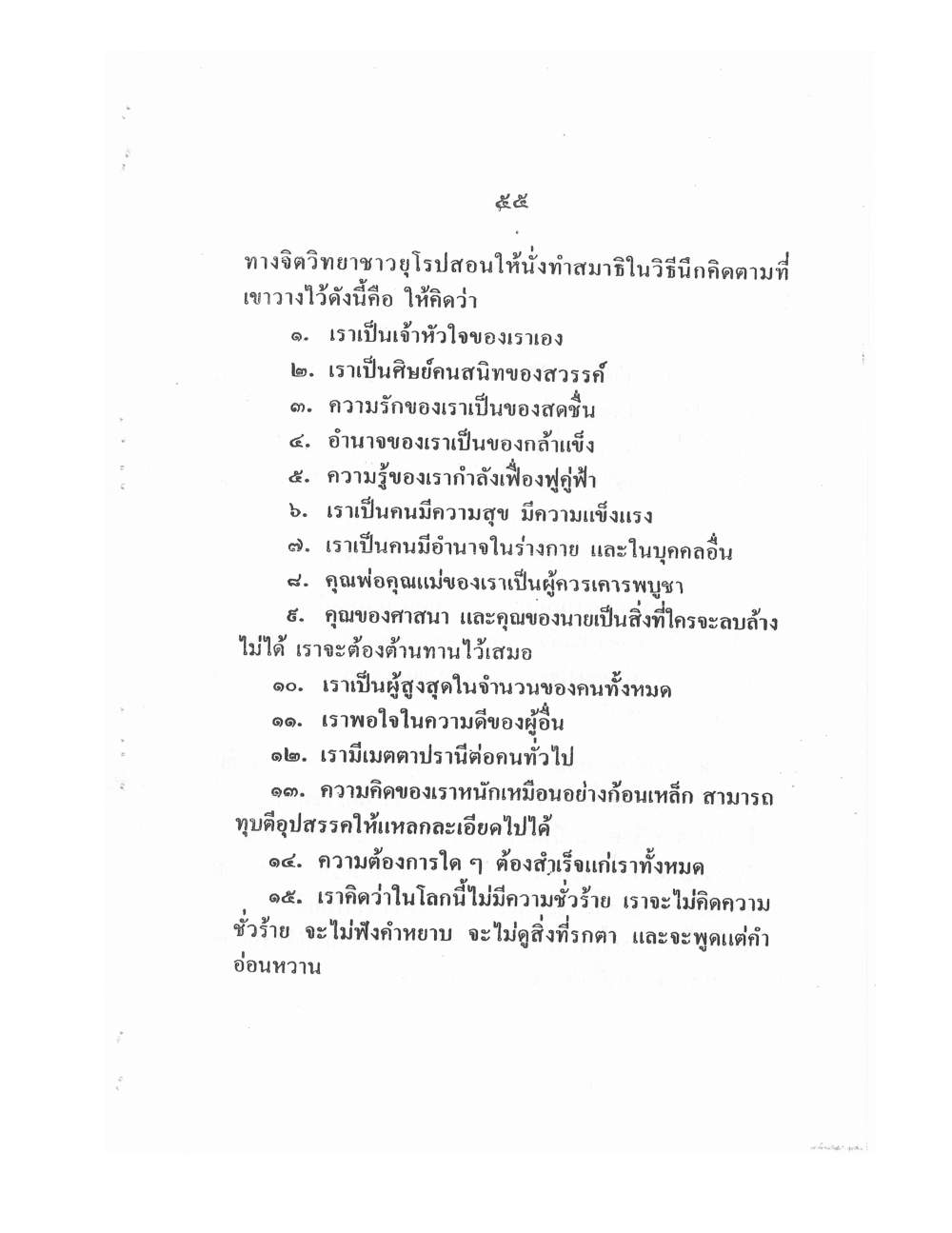
ทางจิตวิทยาชาวยุโรปสอนให้นั่งทำสมาธิในวิธีนึกคิดตามที่เขาวางไว้ดังนี้คือ ให้คิดว่า
๑. เราเป็นเจ้าหัวใจของเราเอง ๒. เราเป็นศิษย์คนสนิทของสวรรค์ ๓. ความรักของเราเป็นของสดชื่น ๔. อำนาจของเราเป็นของกล้าแข็ง ๕. ความรู้ของเรากำลังเฟื่องฟูคู่ฟ้า ๖. เราเป็นคนมีความสุข มีความแข็งแรง ๗. เราเป็นคนมีอำนาจในร่างกาย และในบุคคลอื่น ๘. คุณพ่อคุณแม่ของเราเป็นผู้ควรเคารพบูชา ๙. คุณของศาสนา และคุณของนายเป็นสิ่งที่ใครจะลบล้างไม่ได้ ไม่ได้ เราจะต้องต้านทานไว้เสมอ ๑๐. เราเป็นผู้สูงสุดในจำนวนของคนทั้งหมด ๑๑. เราพอใจในความดีของผู้อื่น ๑๒. เรามีเมตตาปรานีต่อคนทั่วไป ๑๓. ความคิดของเราหนักเหมือนอย่างก้อนเหล็ก สามารถทุบตีอุปสรรคให้แหลกละเอียดไปได้ ๑๔. ความต้องการใด ๆ ต้องสำเร็จแก่เราทั้งหมด ๑๕. เราคิดว่าในโลกนี้ไม่มีความชั่วร้าย เราจะไม่คิดความชั่วร้าย จะไม่ฟังคำหยาบ จะไม่ดูสิ่งที่รกตา และจะพูดแต่คำอ่อนหวาน
European psychology teaches sitting in meditation using a method of directed thought as they have set it out, as follows — one is to think:
1. I am master of my own heart. 2. I am a close disciple of heaven. 3. My love is ever fresh. 4. My power is bold and strong. 5. My knowledge is flourishing alongside the sky. 6. I am a person who is happy and strong. 7. I am a person with power over my own body and over other people. 8. My father and mother are worthy of respect and veneration. 9. The virtue of religion and the virtue of my master/lord are things no one can erase; I must always uphold and defend them. 10. I am the highest among all people. 11. I am pleased by the goodness of others. 12. I have loving-kindness and compassion toward people in general. 13. My thoughts are as heavy as a lump of iron, able to pound obstacles to fine powder. 14. Whatever I need must be accomplished for me, all of it. 15. I think that in this world there is no evil; I will not think evil thoughts, will not listen to coarse speech, will not look at unsightly things, and will speak only gentle, sweet words.
๑๖. เราขอขอบใจผู้ประทานชีวิตให้แก่เราโดยแท้จริง ฯลฯ
ความคิดที่เขาวางไว้นี้ ให้เราเลือกเอาแต่อย่างใดอย่างหนึ่งหัดจิตใจขณะใดขณะหนึ่งตามแต่ความสะดวก จะเอาข้อไหนก็คิดข้อนั้นไปจนกระทั่งใจมั่นคง เกิดความกล้าหาญ วิธีรักษาอำนาจจิตไว้ก็ใช้วิธีคิดดังกล่าววันละ ๒ ครั้งคือ ก่อนนอนและเวลาตื่นนอน การฝึกนิสัยหรือความสามารถประจำตัวนั้น นักปราชญ์ทางจิตศาสตร์ให้หลักการฝึกตามขั้นดังนี้
๑. หัดบังคับความหลับและความตื่น เมื่อหัดบังคับการหลับให้เป็นไปตามเวลาได้แล้ว ก็หัดบังคับการตื่นให้เป็นไปตามเวลาที่ต้องการ ทั้งนี้โดยตั้งใจลงไปอย่างแน่วแน่เอาจริง ต้องเป็นคำสั่งที่เด็ดขาดจากจิตใจ
๒. บังคับความคิดให้ปลอดโปร่งในเวลาตื่นนอน เวลาตื่นนอนมักจะงัวเงียเซื่องซึม ไม่อยากทำอะไร และใจมักหงุดหงิด โกรธง่าย เกลียดง่าย มีหลักอยู่ว่าให้เอาความคิดเมื่อวานมาต่อกับความคิดวันนี้ จะเอาความคิดอะไรก็ได้ ก่อนจะนอนหลับขอให้นึกว่า พรุ่งนี้เราจะทำอะไรบ้าง จดงานไว้ในแผ่นกระดาษ พอตื่นขึ้นก็หยิบขึ้นมาดูทันที หรือเวลาจะหลับไม่ต้องนึกคิดอะไรเลย พอตื่นขึ้นก็รีบนึกถึงงานประจำวัน
16. We give sincere thanks to the One who granted us life. Etc.
Of these thoughts as laid out, let us choose only one or another to train the mind with at any given moment, as is convenient. Whichever item is chosen, think on it continuously until the mind becomes steadfast and courage arises. The method for preserving the mind's power is to use this method of thinking twice a day: before sleeping and upon waking. As for training a habit or an ongoing personal ability, scholars of psychical science give the following steps for training:
1. Practice commanding sleep and waking. Once one has trained the ability to command sleep to occur on schedule, then train the ability to command waking to occur at the desired time. This must be done by setting the intention firmly and in earnest; it must be a command that is absolute and decisive from the mind.
2. Command the mind to be clear and unclouded upon waking. Upon waking one tends to be drowsy and sluggish, unwilling to do anything, and the mind tends to be irritable, quick to anger, quick to hate. The principle here is to carry yesterday's thoughts forward to join with today's thoughts — any thought will do. Before falling asleep, think about what you will do tomorrow; write the tasks down on a sheet of paper, and as soon as you wake, pick it up and look at it right away. Or, when about to fall asleep, do not think of anything at all, and as soon as you wake, promptly turn your mind to the day's tasks.
๓. ความเป็นผู้วางจิตใจให้เป็นปกติ โดยลืมเหตุการณ์ที่เลวร้าย คิดว่าสิ่งทั้งหลายต้องตกอยู่ในธรรมดาของโลกจะหลีกเลี่ยงไม่ได้ เราต้องเป็นนายตัวเอง สามารถข่มเหตุร้ายด้วยการวางจิตใจให้เป็นปกติ
๔. การระงับใจไม่ให้ตื่นเต้น โดยให้พยายามบำรุงกำลังลมหายใจให้เข้มแข็ง หายใจให้ยาวและลึก และให้นึกว่าเรามีความแข็งแรงพอที่จะต่อสู้กับสิ่งเหล่านั้นได้ เมื่อได้ประสบความดีก็ฝึกสงบจิตใจให้เป็นปกติไม่ตื่นเต้น การที่หัวใจตื่นเต้นนั้นเป็นภัยแก่จิตตานุภาพอย่างแรง
๕. หัดเปลี่ยนความคิดได้ในเวลาที่ต้องการ เช่นขณะอ่านหนังสือเล่มหนึ่งอย่างเพลิดเพลิน แล้วหยิบหนังสือเล่มอื่นขึ้นอ่านแทนเปลี่ยนความคิดมาสู่เล่มใหม่ได้ทันที
๖. หัดเปลี่ยนนิสัยจากร้ายมาเป็นดี เช่น เคยมีนิสัยกล่าวคำหยาบ โกรธง่าย เกลียดง่าย ก็พยายามเปลี่ยนเสีย เมื่อเปลี่ยนเป็นดีได้แล้วก็รักษานิสัยดีไว้
เมื่อได้ฝึกให้จิตมีอำนาจ หรืออานุภาพดังกล่าวแล้วได้ผลดี ก็ฝึกใช้อำนาจจิตอย่างแรงบังคับผู้อื่นและเหตุการณ์ต่อไป อำนาจจิตบังคับคนอื่นนั้นก็มุ่งหมายให้บุคคลอื่นเกิดมีความเกรงกลัวหรือมีความรัก ยอมกระทำตามในสิ่งที่ตนประสงค์ด้วยความพอใจ ทั้งนี้ได้สอนหลักการสำคัญไว้ว่า ให้หัดสายตาแข็ง ทำ
3. Being one who keeps the mind normal/settled, by forgetting bad events; thinking that all things must fall within the ordinary course of the world and cannot be avoided; we must be master of ourselves, able to overcome misfortune through keeping the mind in a normal state.
4. Restraining the heart from being startled/agitated, by trying to strengthen the breath, breathing long and deep, and thinking that we have strength enough to fight against those things. When one has had good results, one then trains the mind to be calm and normal, not agitated. A heart that becomes agitated is a serious danger to the power of the mind.
5. Practice changing one's train of thought whenever needed — for example, while enjoying reading one book, pick up another book to read instead, shifting one's thoughts to the new book immediately.
6. Practice changing bad habits into good ones — for example, if one used to have the habit of speaking coarsely, getting angry easily, hating easily, then try to change it. Once changed for the better, maintain the good habit.
Once one has trained the mind to have power or force as described above and achieved good results, one then trains to use that mental power strongly to control other people and events. The mental power used to control others aims to make other people feel fear or love, so that they willingly act as one wishes, with contentment. On this point, the important principle taught is: to train the eyes to be fixed, to
ให้เสียงชัดเจนแจ่มใส สำรวมอิริยาบถและหัดความคิดชักจูงคนอื่น
การหัดสายตาแข็ง เขาสอนให้ดูกระจกเงาโดยไม่กะพริบตา ฝึกจนดูได้นานและหัดดูแสงแดดอ่อน ๆ ลืมตากว้าง ๆ โดยไม่กะพริบ ขยายเวลาดูออกไปให้นาน ต่อไปเมื่อเวลาพูดกับใครก็หัดมองดูตาของผู้ที่พูดด้วย ไม่หลบสายตา (ข้อพิจารณา หลักการฝึกสายตาไม่ควรนำมาใช้เพราะให้โทษมากกว่าคุณ เป็นการฝึกกายไม่ใช่ฝึกจิตโดยตรง) ทำเสียงให้ชัดแจ่มใสตั้งใจให้แน่วแน่ว่าผู้นั้นจะต้องเชื่อฟังคำที่ตนพูด ทั้งนี้ต้องมีสมาธิดีและรักษาอำนาจจิตของตนไว้ด้วย การหัดให้เสียงแจ่มใสและมีจังหวะในการพูดดีนั้น วิธีที่ดีที่สุดคือ พอตื่นนอนเช้าก็ลงมือฝึกการพูดไปเลยทีเดียว คนพูดค่อยไม่ชัดถ้อยชัดคำแสดงว่ามีใจขลาด
การฝึกหัดจูงใจผู้อื่น ทำตนให้มีจิตเข้มแข็ง รวมความคิดพุ่งไปยังบุคคลคนหนึ่งโดยนึกให้เขารักและเชื่อถือตน หรือเกรงกลัวตน ขั้นแรก ๆ อาจไม่ได้ผลแต่ต้องพยายามไม่ลดละเมื่อจิตมีอำนาจแข็งกล้ายิ่งขึ้น ก็ฝึกบังคับคนอื่นในระยะไกล เช่น ใช้กำลังจิตนี้ปลุกให้คนที่นอนหลับอยู่ในระยะไกล ๒ – ๓ กิโลเมตรตื่นขึ้น โดยสำรวมจิตบังคับอยู่ในใจว่า "จงตื่น จงตื่น" หลาย ๆ ครั้ง หรือรวมจิตเรียกให้มาหา เป็นต้น
make the voice clear and distinct, keep one's demeanor composed, and train one's thoughts to persuade other people.
As for training the eyes to be fixed, one is taught to look at a mirror without blinking, practicing until one can look for a long time, and to practice looking at soft/mild sunlight with eyes wide open without blinking, extending the length of time looking for longer and longer. Later, when speaking with anyone, one practices looking into the eyes of the person spoken to, without averting one's gaze. (A point for consideration: the principle of training the eyes should not actually be used, since it does more harm than good — it trains the body, not the mind, directly.) Make the voice clear and distinct, and set the intention firmly that the listener must obey what one says; for this, one must have good concentration and also maintain one's own mental power. As for training the voice to be clear and to have good rhythm in speaking, the best method is: as soon as one wakes in the morning, immediately set about practicing speaking. A person who speaks unclearly, without clear diction, shows that he has a cowardly heart.
Training to persuade other people makes oneself mentally strong; one gathers one's thoughts and directs them toward a particular person, thinking to make that person love and trust oneself, or fear oneself. In the early stages this may not succeed, but one must persevere without giving up. As the mind's power grows stronger and bolder, one then trains to control other people at a distance — for example, using this mental power to wake someone sleeping at a distance of 2–3 kilometers, by focusing the mind and commanding within oneself, "Wake up, wake up," repeated many times, or by gathering the mind to summon them to come, and so on.
การบังคับเหตุการณ์ ขั้นแรกสอนให้ตั้งความมุ่งหมายอันแท้จริงในชีวิต หรือในกิจการที่ทำ เช่น มุ่งให้ได้ตำแหน่งอันมีเกียรติอันใดอันหนึ่ง โดยตั้งความมุ่งหมายไว้ให้สูงที่สุดมุ่งหมายจะต้องการอะไรเป็นจุดหมายสำคัญ ก็พยายามทำทุกอย่างให้สำเร็จให้ได้ สำรวมจิตบังคับให้เหตุการณ์ที่ดีมาเกิดกับเรา นายเดลคาร์เนกี ได้รวบรวมหลักการที่ดีไว้มาก ซึ่งแปลเป็นไทยจำหน่ายแพร่หลาย โดยใช้ชื่อหนังสือว่า "วิธีชนะทุกข์และสร้างสุข"(๙) จะได้สรุปมากล่าวเฉพาะที่สำคัญ คือ
หลักสำคัญในการเอาชนะเคราะห์ร้าย หรือชนะทุกข์นั้นมี ๓ ประการ คือ ๑. ค้นหาข้อเท็จจริง ๒. วิเคราะห์ข้อเท็จจริง ๓. ทำการตัดสินใจ ครั้นแล้วปฏิบัติตามที่ได้ตัดสินใจ
วิธีของกาเลนลิตซฟีลด์ และนักจิตวิทยาอื่น ๆ อาจรวบรวมกล่าวได้เป็น ๔ ประการคือ
๑. พิจารณาว่ากำลังเป็นทุกข์ หรือวิตกกังวลเรื่องอะไร?
(๙) คาร์เนกี. ขจิตต์เมตต์. วิธีชนะทุกข์และสร้างสุข, ของเดลคาร์เนกี
Controlling circumstances: the first step is to teach setting a truly genuine purpose in life, or in the work one does — for instance, aiming to attain some position of honor — by setting the aim as high as possible. Whatever the aim requires as its essential goal, one must try to accomplish everything needed to achieve it, focusing the mind to compel good circumstances to come to us. Mr. Dale Carnegie compiled a great many good principles on this, which were translated into Thai and widely distributed under the book title "How to Stop Worrying and Start Living."(9) The essentials will be summarized here.
The essential principles for overcoming misfortune, or overcoming suffering, are three: 1. Search out the facts. 2. Analyze the facts. 3. Make a decision, and then act according to the decision made.
The method of Galen Litzfield and other psychologists may be summarized as four points:
1. Consider: what suffering or anxiety am I experiencing, and about what?
(9) Carnegie. Khajit Mette [translator]. How to Stop Worrying and Start Living, by Dale Carnegie.
อะไรเป็นสาเหตุของความวิตกกังวล ๒. พิจารณาว่า แก้ไขอย่างไร? มีวิธีใดบ้างที่จะแก้ไข ๓. ตกลงใจเอาวิธีที่ดีที่สุดมาแก้ไข ๔. จะลงมือแก้ไขเมื่อใด? ลงมือแก้ไขหรือเริ่มปฏิบัติโดยไม่ชักช้า
แทนที่จะคิดพิจารณาในใจทั้ง ๔ ข้อดังกล่าว จะใช้วิธีเขียนหรือพิมพ์ด้วยจะเป็นผลดีกว่า
วิธีทำลายนิสัยที่มีทุกข์ หรือบังคับเคราะห์ร้ายให้หนีไปมีกฎอยู่ ๖ ข้อคือ
๑. จงอย่าอยู่ว่าง จงหาอะไรมาทำให้ง่วนอยู่ พยายามเพลิดเพลินในการงานเพื่อให้ลืมความทุกข์ ความกังวล
๒. ไม่เอาธุระกับความคิดเล็ก ๆ น้อย ๆ คิดเสียว่า ชีวิตเป็นสิ่งสั้นเกินไปกว่าที่จะเอาธุระกับสิ่งเล็กน้อย ควรลืมมันเสีย
๓. จงตรวจดูสถิติ จงถามตนเองว่าเหตุการณ์เช่นนั้นอาศัยกฎเฉลี่ยมันมีทางที่จะเกิดขึ้นหรือไม่? เมื่อมีทางเกิดขึ้นได้แล้วก็สงบอารมณ์เสีย คิดหาหนทางแก้ไขดีกว่า
๔. จงต้อนรับสิ่งที่หนีไม่พ้น คิดเสียว่ามันจะต้องเป็นอย่างนั้นมันจะเป็นอย่างอื่นไม่ได้ จงยินดีรับมัน และหาทางแก้ไขตามหลักสำคัญที่กล่าวมาแล้ว
[continuing the enumeration from the previous page]: What is the cause of the anxiety? 2. Consider: how is it to be fixed? What methods are there to fix it? 3. Decide on the best method to use to fix it. 4. When will action be taken? Take action or begin to act without delay.
Rather than merely thinking through these four points in one's head, it is better to write them down or type them out.
The method for breaking habits of suffering, or for compelling misfortune to flee, has 6 rules:
1. Do not remain idle. Find something to occupy yourself with; try to find enjoyment in work so as to forget suffering and worry.
2. Do not bother with small, trivial thoughts. Think instead that life is too short to be concerned with small things; one should simply forget them.
3. Examine the statistics. Ask yourself whether, by the law of averages, such an event actually has any real likelihood of happening. Once you find that it could happen, calm your emotions and instead think of a way to deal with it.
4. Welcome what cannot be escaped. Think that it must be that way and cannot be otherwise; be willing to accept it, and seek a solution according to the key principles already stated.
๕. ใช้คำสั่งว่า "หยุด เสียหาย" และรีบแก้ไข ๖. จงฝังอดีต คือพยายามลืมเรื่องเก่าเสีย
วิธีฝึกเพื่อให้เกิดความสุข หรือช่วยบังคับเหตุการณ์ดีมาสู่ตน ได้ให้กฎไว้ ๗ ข้อ คือ
๑. จงบรรจุจิตของเราให้มีอยู่เฉพาะแต่ความคิดถึง ความสงบ ความกล้า ความสุขสมบูรณ์ ความหวัง
๒. อย่าโกรธแค้นศัตรูของเรา เพราะเป็นผลร้ายแก่ตัวเรายิ่งกว่าที่จะเป็นผลร้ายแก่ศัตรูหลายเท่า
๓. อย่ากังวลที่จะได้รับการตอบแทนบุญคุณจากผู้อื่น เพียงแต่หวังว่าจะได้รับบ้างก็พอแล้ว ให้ถือว่าการที่ตนช่วยเหลือเป็นความอิ่มเอิบปลาบปลื้มของตน ควรสร้างนิสัยกตัญญูให้เกิดแก่ตนและลูกหลาน
๔. จงคิดแต่ความสุขสำราญ และความเจริญ
๕. อย่าเลียนแบบผู้อื่น
๖. เมื่อโชคชะตาทำให้ตนได้รับผลอย่างไร ก็จงเปลี่ยนให้ผลนั้นดีที่สุดเท่าที่จะทำได้
๗. จงลืมทุกข์ของเราโดยพยายามสร้างสุขให้ผู้อื่น
5. Give yourself the command "Stop — this is a loss," and hasten to correct it. 6. Bury the past — that is, try to forget old matters.
For the method of training to bring about happiness, or to help compel good circumstances to come to oneself, 7 rules are given, as follows:
1. Fill your mind with only thoughts of peace, courage, complete happiness, and hope.
2. Do not harbor anger or resentment toward your enemies, because it causes far more harm to yourself than it does to your enemies.
3. Do not worry about receiving repayment of gratitude from others; it is enough merely to hope you might receive some. Regard the fact that you have helped as itself a source of fullness and joy for yourself. One should cultivate the habit of gratitude in oneself and in one's children and descendants.
4. Think only of happiness, contentment, and prosperity.
5. Do not imitate others.
6. Whatever result fate brings you, change it into the best result you possibly can.
7. Forget your own suffering by trying to create happiness for others.
๖๒
หลักป้องกันความอ่อนเพลีย ป้องกันทุกข์ และส่งเสริม กำลังงาน กำลังจิตใจให้เกิดกระปรี้กระเปร่าได้ให้กฏไว้ ๖ ข้อ คือ ๑. จงพักผ่อนก่อนที่ท่านจะรู้สึกเหนื่อย การพักผ่อนเป็น การบูรณะร่างกายในการทดลองกับกรรมกร การทำงานต่อเนื่อง ได้ผลน้อยกว่าให้มีการพักประจำชั่วโมง ๒. จงหาวิธีพักผ่อนหย่อนใจในขณะปฏิบัติงาน การทำงาน เคร่งเครียดเกินไป จะทำให้เกิดการอิดโรยอ่อนเพลีย การหายใจ ช้าๆ ได้ระดับและสูดลึก เป็นการพักผ่อนประสาท การรู้สึก เบื่อหน่ายทำให้อ่อนเพลีย เป็นต้นว่า มีแขกมาบ่อยๆ จนไม่ได้ ทำงานตามนัดหมายไว้ และเกิดขลุกขลักโน่นนี่ จนดูคล้ายกับ วันนั้นมีแต่สิ่งบกพร่อง ซึ่งจะเป็นเหตุให้มีอาการอ่อนเพลียอิดโรย บางทีก็ปวดศีรษะไปด้วย ๓. แม่บ้านพยายามหาทางพักผ่อนหย่อนใจในขณะปฏิบัติ งานอยู่ที่บ้าน ๔. สร้างนิสัยดีงามด้วยการจัดโต๊ะไม่ให้รุงรังเตรียมแก้ ปัญหาไว้ เมื่อมีปัญหาอะไรก็รีบตัดสินใจ ปฏิบัติงานตามลำดับ ความสำคัญ รู้จักระเบียบงาน รู้วิธีแบ่งงานให้ผู้อื่นและรู้วิธีอำนวย การ ๕. จงปฏิบัติงานด้วยความศรัทธาแก่กล้า และเพลิดเพลิน ๖. จำไว้ว่า ความวิตกทุกข์ร้อน ทำให้นอนไม่หลับและเกิด
62
Principles for preventing exhaustion, preventing suffering, and promoting work capacity and mental strength to produce vigor and freshness are laid down as 6 rules, namely:
1. Rest before you feel tired. Resting restores the body — in experiments with laborers, continuous work yielded poorer results than when there were regular hourly breaks.
2. Find ways to rest and relax the mind while carrying out work. Working too intensely causes fatigue and exhaustion. Slow, steady, deep breathing is a way of resting the nerves. A feeling of boredom also causes tiredness — for example, having visitors come frequently so that one cannot do the work as scheduled, and things keep going wrong here and there, until the whole day seems to consist of nothing but mishaps, which becomes a cause of fatigue and exhaustion, sometimes accompanied by headache as well.
3. Housewives should try to find ways to rest and relax the mind while doing their work at home.
4. Build good habits by keeping the desk uncluttered and having solutions to problems prepared in advance; when any problem arises, decide on it promptly. Carry out work in order of importance, know how to organize work properly, know how to delegate work to others, and know how to direct/manage.
5. Carry out work with strong faith and enthusiasm, and with enjoyment.
6. Remember that anxiety and distress cause sleeplessness and lead to...
๖๓
อันตราย ไม่ใช่โรคนอนไม่หลับเป็นเหตุให้เกิดอันตราย วิธีดี ที่สุดในการแก้ความทุกข์ร้อนจากนอนไม่หลับก็คือการสวดมนต์ และวิธีที่ดีอย่างหนึ่งก็คือออกกำลังให้เหนื่อย วิธีอื่นๆ เช่น เหลือบตาดำให้สูงขึ้นหรือพูดแผ่วๆ ว่า "ไปเสียเถอะ ไปเสีย เถอะ หย่อนคลายกันเสียที พักผ่อนหย่อนใจให้สบายเสียที" (จบข้อความที่สรุปจากหนังสือ "วิธีชนะทุกข์สร้างสุข" เพียงนี้)
การค้นคว้าเกี่ยวกับการรับส่งข่าวทางจิต
ในสมัยปัจจุบันทางยุโรปและอเมริกา ได้ค้นคว้าและทดลอง เรื่องการรับส่งข่าวทางจิต และแน่ใจว่าทำได้จริง ได้มีผู้เขียน ตำราด้านนี้ขึ้นหลายท่าน ศาสตราจารย์ชาฟ์เทสเบอรี่ได้เขียน ตำราเป็นที่นิยมในอังกฤษ อเมริกา เมื่อ พ.ศ. ๒๔๕๓ เกี่ยวกับ การฝึกจิต และการส่งกระแสจิต (รับส่งข่าวทางจิต) หลักสำคัญ ของท่านผู้นี้คือ ทำดวงจิตให้ว่างเปล่า และวิธีทำดวงจิตให้ว่าง เปล่าก็คือ พยายามไล่ความคิดต่างๆ ออกไป ถ้าทำจิตให้ว่างเปล่า ได้วันละ ๑ นาที จะเป็นการให้กำลังและสุขภาพอันดีในทางจิต เป็นอันมาก ทั้งจะช่วยให้จิตมีสมรรถภาพในการรับส่งกระแสจิต ได้ดีที่สุด ผู้รู้เขียนทำนองนี้หลายท่านและต่างก็ยืนยันว่า ใน ระยะชั่วที่จิตว่างเพียง ๑ นาที จิตจะมีกำลัง มีความแจ่มใส มี ความสุข สามารถล่วงรู้เรื่องที่ล่วงมาแล้ว หรือเรื่องข้างหน้า อันใกล้ได้ถูกต้อง
63
...danger. It is not the insomnia itself that is the cause of the danger. The best way to resolve the distress caused by insomnia is to chant prayers, and one other good method is to exercise until tired. Other methods include rolling the eyes upward, or murmuring softly, "Go away now, go away now, let go and relax, rest and relax comfortably now."
(This concludes the summary drawn from the book "Vithi Chana Thuk Sang Suk" [How to Overcome Suffering and Create Happiness].)
Research on Sending and Receiving Messages by Mind (Telepathy)
In the present era, Europe and America have researched and experimented with the sending and receiving of messages by mind, and are certain that it can truly be done. Several authors have written textbooks on this subject. Professor Shaftesbury wrote a textbook popular in England and America around 1910 (B.E. 2453) concerning mental training and the transmission of mental currents (the sending and receiving of mental messages). This gentleman's key principle was to make the mind empty, and the method for emptying the mind is to try to drive out various thoughts. If one can empty the mind for 1 minute a day, it will give great strength and good mental health, and will also help the mind attain the best capacity for sending and receiving mental currents. Many knowledgeable writers on this subject all confirm that during the brief period when the mind is empty for just 1 minute, the mind gains strength, becomes clear, and becomes happy, and is able to correctly perceive things that have already passed, or things in the near future.
๖๔
๓. การค้นคว้าเกี่ยวกับจิตและอำนาจจิตในประเทศไทย
สมาคมเกี่ยวกับจิตในประเทศไทย ยังไม่มีสมาคมที่ค้นคว้า ทางอำนาจจิตอย่างจริงจัง มักจะค้นคว้าหนักไปทางจิตวิทยา ซึ่งเป็นวิชาที่ว่าด้วยเรื่องพฤติกรรมหมายถึงการแสดงออก การ ประพฤติปฏิบัติออกมาต่างๆ นั้นเกี่ยวกับจิตใจอย่างไร หรือ เพราะอารมณ์อย่างไรจึงแสดงออกอย่างนั้น นอกจากนั้นก็เป็น การค้นคว้าเพื่ออธิบายขยายความหลักตำราทางพระพุทธศาสนา และหลักตำราของต่างประเทศ ความจริงแล้ว ประเทศไทยมี อาจารย์ที่มีความสามารถสูงกว่าที่ปรากฏตามหลักฐานของต่าง ประเทศมากมาย แต่ขาดการประสาน และรวบรวมส่งเสริม สนับสนุนขึ้น ถ้าได้ประสานกัน ร่วมมือกันอย่างจริงจังแล้วก็จะ เกิดประโยชน์ที่ยิ่งใหญ่แก่ส่วนบุคคล และประเทศชาติอย่างยิ่ง ซึ่งจะได้วิเคราะห์วิจัย และยืนยันท่านผู้ที่มีความสามารถ ตลอด จนวิธีนำประโยชน์มาใช้ในบทต่อไป สำหรับสมาคมในประเทศ ไทยที่เกี่ยวกับจิต และทราบกันกว้างขวางในปัจจุบัน คือ
๑. สมาคมจิตวิทยาแห่งประเทศไทย เมื่อ พ.ศ. ๒๕๐๔ มีหม่อมหลวงตุ้ย ชุมสาย เป็นนายกสมาคม และมีนายแพทย์ ประสพ รัตนากร เป็นอุปนายก มีการค้นคว้าประยุกต์จิตวิทยา กับปรัชญาทางศาสนา และสังคมตามแนวทางวิทยาศาสตร์
64
3. Research on Mind and Mental Power in Thailand
Among associations concerned with the mind in Thailand, there is not yet any association that seriously researches mental power itself. Research tends to focus heavily on psychology, which is the discipline concerned with behavior — that is, with how outward expression and various forms of conduct relate to the mind, or what kind of emotion causes a given expression. Beyond that, research is mainly aimed at explaining and elaborating the principles found in Buddhist scripture and in foreign textbook principles. In truth, Thailand has teachers of far greater ability than what appears in foreign documentation, but there is a lack of coordination and of gathering, promoting, and supporting them. If there were serious coordination and cooperation, it would produce enormous benefit for individuals and for the nation, allowing for the analysis, research, and verification of capable teachers, as well as methods for putting this to use, to be covered in later chapters. As for associations in Thailand concerned with the mind that are widely known at present, they are:
1. The Psychological Association of Thailand, founded in 1961 (B.E. 2504), with Mom Luang Tui Chumsai as president and Dr. Prasop Ratanakorn as vice-president. It conducts research applying psychology to religious philosophy and to society, along scientific lines.
๖๕
๒. สมาคมค้นคว้าทางจิตแห่งประเทศไทย ตั้งอยู่ที่วัด มกุฏกษัตริยาราม พระนคร มีผลงานที่ดีเด่นก็คือการสะกดจิต ๓. จิตแพทย์สมาคม ตั้งอยู่ที่โรงพยาบาลบ้านสมเด็จ ธนบุรี ๔. สมาคมสุขภาพจิตแห่งประเทศไทย ๕. หน่วยวิจัยพุทธ ตั้งอยู่ที่วัดเบญจมบพิตร กรมการ ศาสนาดำเนินการ
นอกจากนี้ก็มีการฝึกจิตและค้นคว้าทางจิตในสำนักสงฆ์ ในสำนักงาน หรือบ้านส่วนบุคคล และในป่าเขาอีกหลายแห่ง ที่ทำได้ผลดี ผู้อ่านอาจจะตื่นใจหรือคิดไปว่าผู้เขียนอาจจะสติ ฟั่นเฟือนในเมื่อเปิดเผยความจริงในเรื่องมหาวิทยาลัยขั้นสูง ในป่าเขา แต่ถ้าเป็นผู้รักความจริง ชอบค้นคว้าความจริงที่มี ประโยชน์ ก็คงจะทราบความจริงภายหลัง ผู้เขียนจึงขอยืนยัน เสียเลยว่า มหาวิทยาลัยในป่าเขาที่เข้าไปได้ด้วยความยากลำบาก นั้น ก็คือที่อยู่ของอาจารย์ผู้มีอำนาจจิตสูง สามารถรับส่งข่าว ทางกระแสจิตได้ สามารถไปมาไกลๆ ได้ในระยะเวลาอัน สั้น สามารถแปลงธาตุได้ และมีความสามารถพิเศษพิสดาร ต่างๆ มหาวิทยาลัยขั้นสูงดังกล่าวนี้ ยังมีอีกมากมายหลายแห่ง เช่น ในป่าเขาของประเทศไทยทุกภาคและในต่างประเทศ ทั้ง ในยุโรปและอเมริกาด้วย ถ้ามองดูในแง่การสื่อสารก็จะเห็นข่าย การสื่อสารทางจิต ระบบฉับพลันนี้ มีข่ายเกยกันหลายข่ายหลาย
65
2. The Society for Research into the Mind of Thailand, located at Wat Makut Kasattriyaram, Phra Nakhon, whose notable achievement is hypnosis. 3. The Psychiatric Association, located at Ban Somdet Hospital, Thonburi. 4. The Mental Health Association of Thailand. 5. The Buddhist Research Unit, located at Wat Benchamabophit, operated by the Department of Religious Affairs.
Besides these, mental training and mind research are also being carried out in monastic residences, in offices, or in private homes, and in many forested mountain areas, achieving good results. Readers may be startled or think that the author's mind may have grown unsound in revealing the truth about advanced "universities" in the mountain forests. But if one is a lover of truth, fond of researching truths that are beneficial, one will surely come to know the truth eventually. The author therefore wishes to state outright that the "universities" in the mountain forests, reachable only with great difficulty, are none other than the dwelling places of teachers possessing great mental power — able to send and receive messages by mental current, able to travel great distances within a short time, able to transmute elements, and possessing various other extraordinary special abilities. There are many more such advanced "universities," for example in the forested mountains of every region of Thailand and in foreign countries, both in Europe and in America. Viewed from the standpoint of communication, one would see a network of mental communication — this instantaneous system has many overlapping networks, many...
๖๖
ทาง ทั้งนี้ มีการรับส่งข่าวกันอยู่ทั้งในเวลากลางวันและเวลา กลางคืน
ผู้เขียนค้นคว้ามานานสรุปลงได้ว่าเรื่องวิญญาณเป็นเรื่องที่ สำคัญยิ่งควรจะพิสูจน์ทดลองให้เห็นจริงจังแต่ขาดผู้ที่จะสนับสนุน ถ้าไม่เชื่อว่าวิญญาณมีจริง ก็เป็นอันว่าบุญบาปก็ไม่มีจริงไปด้วย ที่เกิดความสับสนลังเลกันก็เพราะขาดการพิสูจน์อันถูกต้อง และ แยกไม่ถูกว่าวิญญาณของผู้ตายแล้วแยกไปอย่างไรกันแน่ จะได้ กล่าวละเอียดในบทหลัง
ประเทศที่จะเจริญก้าวหน้าได้เร็วจะต้องอาศัยอำนาจจิต หรือกำลังใจ กำลังสมาธิเป็นเครื่องช่วยที่สำคัญ การคิดค้นทาง วิทยาศาสตร์ในขั้นแปลกและไม่น่าจะเป็นไปได้ก็ต้องอาศัยสมาธิ จิตนั่นเอง ประเทศที่ไม่เห็นความสำคัญของสมาธิ ไม่ใช้คนที่มี สมาธิดี ก็จะกลายเป็นประเทศล้าหลัง หลวงวิจิตรวาทการเขียน ในหนังสือมหัศจรรย์ทางจิต มีใจความว่าอเมริกาก็มีมหาวิทยาลัย ที่ศึกษาทางจิต และมีหลักสูตรให้ศึกษาจิตศาสตร์ของธิเบต มี ฝรั่งไปศึกษาเกี่ยวกับการฝึกจิตที่อินเดียและธิเบต แล้วกลับมา แต่งหนังสือขายมากมายหลายเล่ม แต่เล่มที่หลวงวิจิตรเห็นว่า เกี่ยวกับเรื่องมายาศาสตร์ของธิเบต ไม่มีเล่มใดดีกว่าของหญิง ชาวฝรั่งเศส จึงนำมาใช้เป็นหลัก หญิงผู้แต่งตำรานี้เรียนอยู่ใน
66
...ways. Messages are sent and received both during the day and at night.
The author, after long research, has concluded that the matter of the spirit (winyan) is an extremely important matter that ought to be proven and demonstrated to be genuinely real, but there is a lack of people willing to support this effort. If one does not believe that the spirit truly exists, then it follows that merit and sin would likewise not truly exist. The confusion and hesitation that arise are due to a lack of correct proof, and an inability to correctly determine exactly how the spirit of a deceased person departs and separates — this will be discussed in detail in a later chapter.
A country that is to progress and develop quickly must rely on mental power, or willpower; the power of concentration (samadhi) is an important aid. Even scientific discovery at its strangest and most seemingly impossible levels must rely on this very power of mental concentration. A country that does not recognize the importance of concentration, that does not make use of people with good concentration, will become a backward country. Luang Wichit Wathakan, writing in the book "Mahatsajan Thang Chit" (The Miracle of the Mind), states that America too has universities that study the mind, and has curricula for the study of Tibetan mental science. There were Westerners who went to study mind training in India and Tibet, then returned and wrote many books which sold widely. But among these, the one book that Luang Wichit judged, concerning the illusion-science (mayasat) of Tibet, to be better than any other was that of a Frenchwoman, and so he used it as his principal source. The woman who wrote this text had studied in...
๖๗
ธิเบตหลายปี แล้วท่องเที่ยวไปประเทศจีน เกาหลี ญี่ปุ่น และกลับ ไปอยู่ธิเบต ในคำนำหน้าแรกของหนังสือ มหัศจรรย์ทางจิต หลวงวิจิตรกล่าวว่า "ในประเทศที่มีการศึกษาทางวิทยาการ สมัยใหม่ก้าวหน้ามากที่สุด กลับหันไปค้นคว้าเรื่องมหัศจรรย์ ทางจิตมากที่สุด"(๑๐) ทั้งๆ ที่อาศัยอำนาจจิตคิดค้นวิชาการสมัยใหม่ สิ่งที่ประ- ดิษฐ์ขึ้นใช้นั้น ก็ยังมีความสามารถไม่เท่าอำนาจจิตหลายอย่าง เช่น เครื่องมือติดต่อสื่อสารชั้นเยี่ยมยอดสมัยนี้ รับส่งข่าวระหว่าง เรือใต้น้ำกับบนฝั่งไม่ได้ แต่ทดลองใช้คนรับส่งด้วยกระแสจิตกัน ได้ การรับส่งข่าวพร้อมด้วยภาพแบบโทรทัศน์นั้น รับส่งผ่าน ทะลุภูเขาสูงๆ ไปไม่ได้ แต่การรับส่งทางจิตพร้อมด้วยภาพ ผ่านทะลุไปได้ แสงเอกซเรย์ หรือ รังสีเรเดียมผ่านทะลุกล่องตะกั่วหนา ไม่ได้ แต่กระแสจิตผ่านทะลุไปเห็นของในกล่องตะกั่วได้ วิทยาศาสตร์สร้างสิ่งที่มีชีวิตไม่ได้ แต่อำนาจจิตทำให้เกิด เป็นตัวสัตว์ได้ มีทั้งชีวิตร่างกาย และวิญญาณ
———————————
(๑๐) หลวงวิจิตรวาทการ. มหัศจรรย์ทางจิต, พิมพ์ครั้งที่ ๓. กรุงเทพฯ: โรงพิมพ์ พัฒนาการพิมพ์, ๕ พ.ย. ๐๗ หน้า ๓๐๔-๓๕๖.
67
...Tibet for many years, then traveled to China, Korea, and Japan, and returned to live in Tibet. In the opening foreword of the book "The Miracle of the Mind," Luang Wichit states, "In the countries where modern scientific education has advanced furthest, people have turned back most of all to research the miracle of the mind." (10)
Even though modern science relies on mental power to make its discoveries, the things that have been invented for use still fall short of the capability of mental power in many respects, for example:
The most advanced communication devices of this era cannot transmit messages between a submarine and the shore, but it has been demonstrated that people can send and receive by mental current.
Television-type transmission of messages together with images cannot pass through and transmit across high mountains, but mental transmission together with images can pass through.
X-rays or radium rays cannot pass through a thick lead box, but a mental current can pass through and perceive what is inside a lead box.
Science cannot create a living thing, but mental power can bring into being a living creature, complete with a physical body and a spirit.
———————————
(10) Luang Wichitwathakan. Mahatsajan Thang Chit [The Miracle of the Mind], 3rd printing. Bangkok: Phatthanakan Phim Press, 5 Nov. [B.E. 25]07, pp. 304–356.
๖๘
ทางวิทยาศาสตร์และการแพทย์สมัยใหม่ รักษาโรคบาง อย่างไม่ได้ แต่อำนาจจิตรักษาโรคประเภทนั้นได้ และรักษาโรค อย่างอื่นได้ด้วย
วิทยาศาสตร์สร้างเครื่องจับเท็จยังไม่ได้ผล แต่อำนาจจิต จับเท็จหรือกำหนดรู้จิตคนได้
นอกจากนี้อำนาจจิตยังทำอะไรได้เหนือวิทยาศาสตร์สมัย ใหม่หลายอย่างดังกล่าวมาแล้วในบทที่ ๑ จึงเป็นเรื่องที่ให้ประ- โยชน์แก่บุคคลและส่วนรวมเป็นอันมาก
เนื่องจากพระพุทธศาสนามาตั้งมั่น และเจริญรุ่งเรืองอยู่ ในประเทศไทย และความปรารถนาที่จะได้ที่พึ่งช่วยสนับสนุน ความก้าวหน้า ช่วยป้องกันภัยอันตรายหรือช่วยขจัดความเจ็บไข้ ความทุกข์ร้อน จึงพากันยึดเอาคุณความดีด้านศาสนามาเป็นที่ พึ่งที่ระลึก ซึ่งเรียกกันง่ายๆ ว่า "คุณพระ" ด้วยเหตุที่เชื่อมั่น ในอำนาจคุณพระว่าเป็นที่พึ่งได้จริง ไม่มีที่พึ่งอื่นดียิ่งกว่า เมื่อ ถึงคราวคับขันมีภัยพิบัติหรือเวลาเจ็บไข้ทุกข์ร้อนก็ระลึกยึดถือ เอาอำนาจคุณพระมาช่วย ผลปรากฏว่า คุณพระช่วยให้ได้ผล สมประสงค์แปลกๆ และพิสดารมาก จนไม่น่าเชื่อก็มีมาก มี พยานหลักฐานทั้งในอดีตและในปัจจุบันนี้มากมาย ทั้งในด้าน การรักษาโรคการคุ้มครองอันตราย ตลอดจนการทำอะไรได้
68
Modern science and medicine cannot cure certain kinds of disease, but mental power can cure that type of disease, and can cure other diseases as well.
Science has not yet succeeded in building an effective lie-detector, but mental power can detect lies or discern a person's mind.
Beyond this, mental power can do many other things beyond what modern science can do, as already described in Chapter 1. It is therefore a subject that brings great benefit to individuals and to society as a whole.
Because Buddhism has become firmly established and flourishes in Thailand, and because of the desire to have something to rely on that supports progress, helps guard against danger, or helps eliminate sickness and suffering, people have come to hold the virtuous power of religion as a refuge and object of remembrance, commonly called "khun phra" (the sacred power/merit of the Buddha). Because of firm belief that the power of khun phra is a genuinely reliable refuge, with no other refuge better than it, when facing a crisis, a calamity, or times of sickness and distress, people call to mind and rely on the power of khun phra to help them. The result has been that khun phra has helped produce results that fulfill one's wishes in strange and highly extraordinary ways, to the point that many are almost unbelievable. There is abundant supporting evidence both in the past and at present, in the areas of curing disease, protection from danger, as well as accomplishing other things...
๖๙
แปลกๆ เหมือนกับขีดความสามารถของอำนาจจิตขั้นต้น ขั้น กลางและขั้นสูงที่ได้กล่าวมาแล้ว อำนาจคุณพระกับอำนาจจิต จะมีความสัมพันธ์กันอย่างไร? เป็นไปได้เพียงใด? ตลอดจน วิธีนำไปใช้ให้เกิดประโยชน์แก่บุคคลและการพัฒนาประเทศ ด้านต่างๆ จะได้วิเคราะห์และเสนอแนะในบทหลังต่อไป
การรักษาโรคด้วยอำนาจจิตอำนาจคุณพระนั้นทำได้ผลดี หลายโรครวมทั้งโรคที่รักษาได้ยากด้วย การรักษาโรคแผนปัจจุบัน ได้รับการสนับสนุนทั่วโลกจึงเจริญก้าวหน้าดึงความเลื่อมใส คนได้เป็นจำนวนมากมาย แต่ความจริงก็ไม่สามารถรักษาโรค ได้ดีทุกประเภท และยังมีโทษจากการบำบัดทั้งทางยาทางฉายแสง ทางผ่าตัดฯ การรักษาแบบโบราณซึ่งประกอบด้วยการให้ยา การ นวด และการใช้อำนาจจิตอำนาจคุณพระนั้นผู้เขียนก็พิสูจน์ ทดลองเองมามากกว่ารักษาโรคต่างๆ ได้ผลดีหลายอย่าง เช่น โรคมะเร็ง วรรณโรค เชื้อรา โรคปวดศีรษะเป็นประจำ อัมพาต แผล โรคหืด ไซนัส โรคประสาท ฝีต่างๆ และการต่อกระดูก หักเป็นต้น การเปรียบเทียบความสามารถในการรักษาโรคและ ตรวจโรคต่างๆ ของแผนปัจจุบันและแผนโบราณ ข้อดีข้อเสีย ในการรักษาวิธีต่างๆ และสรุปลงเอยเป็นโรคๆ ว่าควรใช้ วิธีใดดี หรือจะใช้วิธีผสมช่วยกันอย่างไร รวมทั้งวิธีการรักษา ผู้เขียนจะกล่าวละเอียด "ในวิทยาศาสตร์ทางใจ" ฉบับแพทย์
69
...extraordinary things, similar to the range of capability of mental power at the elementary, intermediate, and advanced levels already discussed. What relationship exists between the power of khun phra and mental power? To what degree are they alike? As well as the methods for putting this to beneficial use for individuals and for the development of the country in various areas — these will be analyzed and proposed in a later chapter.
Curing disease by mental power, by the power of khun phra, has produced good results with many diseases, including diseases that are difficult to treat. Modern medical treatment has received support worldwide and has therefore progressed and drawn the confidence of a great many people, but in truth it is not able to treat every type of disease well, and there are also harms arising from treatment — whether by medicine, radiation, or surgery. Traditional treatment, consisting of the giving of medicine, massage, and the use of mental power / the power of khun phra — the author has personally tested and proven this to achieve good results in treating various conditions more so than [other methods], such as: cancer, venereal disease, fungal infection, chronic headache, paralysis, wounds, asthma, sinusitis, nervous disorders, various abscesses, and the setting of broken bones, among others. A comparison of the treatment and diagnostic capability of modern medicine and traditional medicine for various diseases, the advantages and disadvantages of the various treatment methods, and a conclusion, disease by disease, as to which method is best, or how to combine methods to assist one another, together with the treatment methods themselves — the author will discuss in detail in "Wittayasat Thang Chai" [Science of the Mind], Medical Edition...
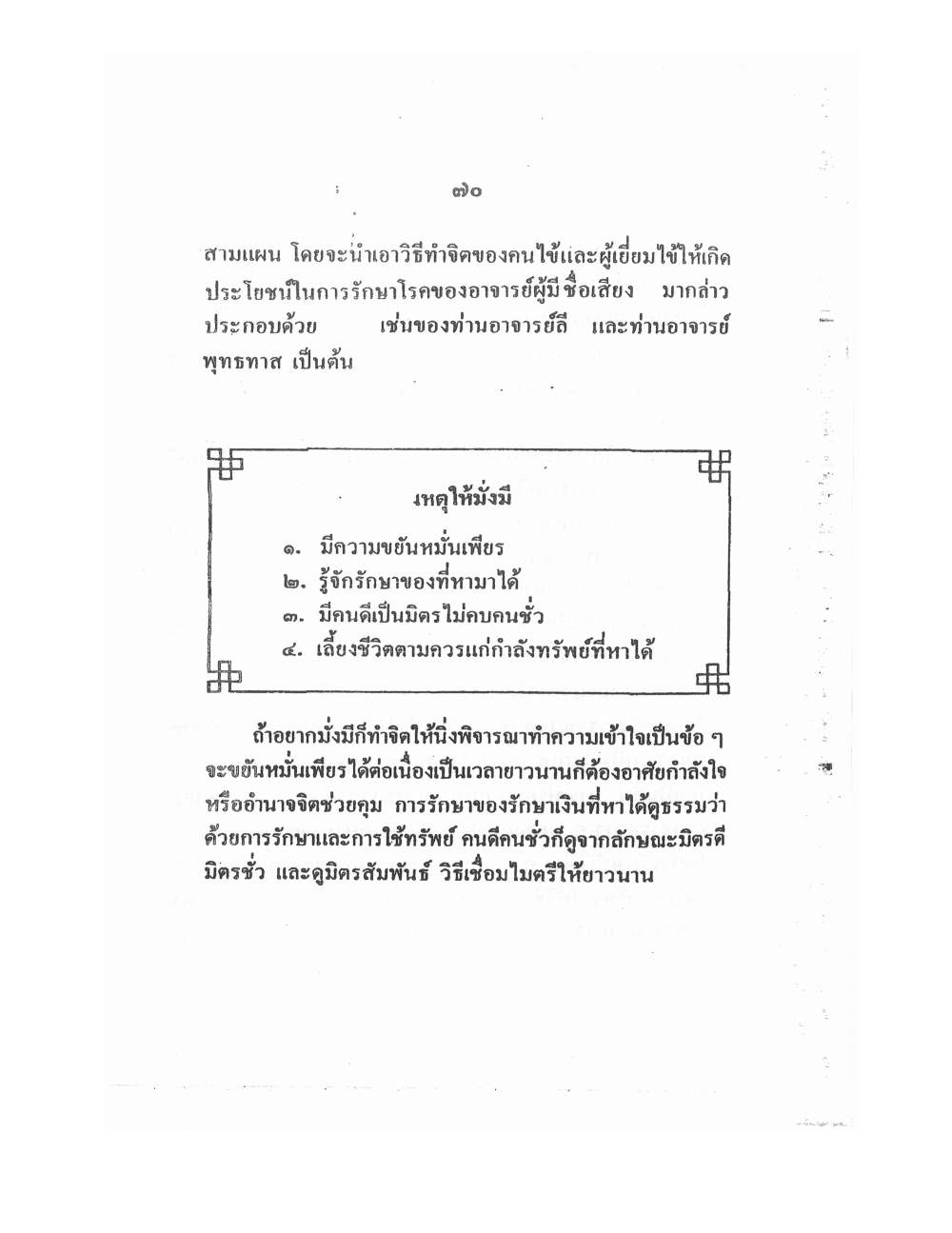
๗๐
สามแผน โดยจะนำเอาวิธีทำจิตของคนไข้และผู้เยี่ยมไข้ให้เกิด ประโยชน์ในการรักษาโรคของอาจารย์ผู้มีชื่อเสียง มากล่าว ประกอบด้วย เช่นของท่านอาจารย์ลี และท่านอาจารย์ พุทธทาส เป็นต้น
[decorative bordered box with corner ornaments] เหตุให้มั่งมี
๑. มีความขยันหมั่นเพียร ๒. รู้จักรักษาของที่หามาได้ ๓. มีคนดีเป็นมิตรไม่คบคนชั่ว ๔. เลี้ยงชีวิตตามควรแก่กำลังทรัพย์ที่หาได้ [end box]
ถ้าอยากมั่งมีก็ทำจิตให้นิ่งพิจารณาทำความเข้าใจเป็นข้อๆ จะขยันหมั่นเพียรได้ต่อเนื่องเป็นเวลายาวนานก็ต้องอาศัยกำลังใจ หรืออำนาจจิตช่วยคุม การรักษาของรักษาเงินที่หาได้ดูธรรมว่า ด้วยการรักษาและการใช้ทรัพย์ คนดีคนชั่วก็ดูจากลักษณะมิตรดี มิตรชั่ว และดูมิตรสัมพันธ์ วิธีเชื่อมไมตรีให้ยาวนาน
70
...[three] approaches/systems, by which methods of settling the mind used by patients and by visitors of the sick, drawn from the practice of famous teachers, will be brought together and discussed — for example those of Ajarn Lee and Ajarn Buddhadasa, among others.
[decorative bordered box with corner ornaments] Causes of Wealth
1. Having diligence and perseverance. 2. Knowing how to preserve what one has earned. 3. Having good people as friends, not associating with bad people. 4. Living within one's means, according to the wealth one has earned. [end box]
If one wishes to become wealthy, one should settle the mind and consider these points carefully, one by one, to understand them. To be diligent and persevering continuously over a long period of time requires the help of willpower, or mental power, to keep oneself in check. As for the preservation of things and of the money one has earned, one should look to the dhamma concerning the preservation and use of wealth. Good people and bad people are to be judged by the traits of a good friend versus a bad friend, and by observing the nature of the friendship — the methods for maintaining a lasting bond of friendship...
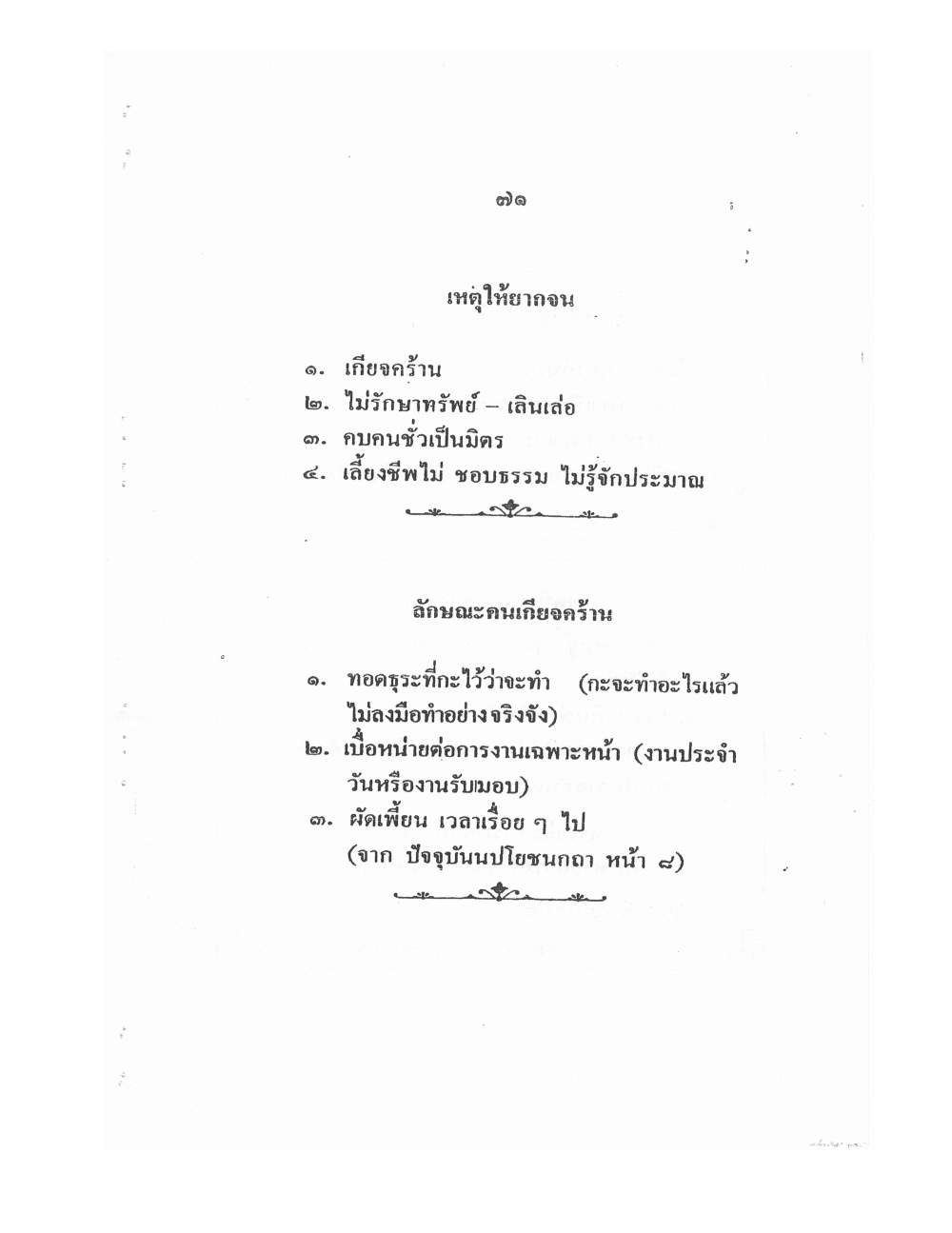
๗๑
เหตุให้ยากจน
๑. เกียจคร้าน ๒. ไม่รักษาทรัพย์ - เลินเล่อ ๓. คบคนชั่วเป็นมิตร ๔. เลี้ยงชีพไม่ ชอบธรรม ไม่รู้จักประมาณ [decorative divider]
ลักษณะคนเกียจคร้าน
๑. ทอดธุระที่กะไว้ว่าจะทำ (กะจะทำอะไรแล้ว ไม่ลงมือทำอย่างจริงจัง) ๒. เบื่อหน่ายต่อการงานเฉพาะหน้า (งานประจำ วันหรืองานรับมอบ) ๓. ผัดเพี้ยน เวลาเรื่อยๆ ไป (จาก ปัจจุบันนปโยชนกถา หน้า ๘) [decorative divider]
71
Causes of Poverty
1. Laziness. 2. Not preserving one's wealth — carelessness. 3. Associating with bad people as friends. 4. Earning a livelihood dishonestly, not knowing moderation. [decorative divider]
Characteristics of a Lazy Person
1. Abandoning a task one had intended to do (having planned to do something, then not actually setting about it in earnest). 2. Growing weary of the work immediately at hand (daily routine work or assigned tasks). 3. Procrastinating, letting time drift on and on. (From "Patchuban-nopayochana-katha" [Discourse on Present Benefit], p. 8) [decorative divider]
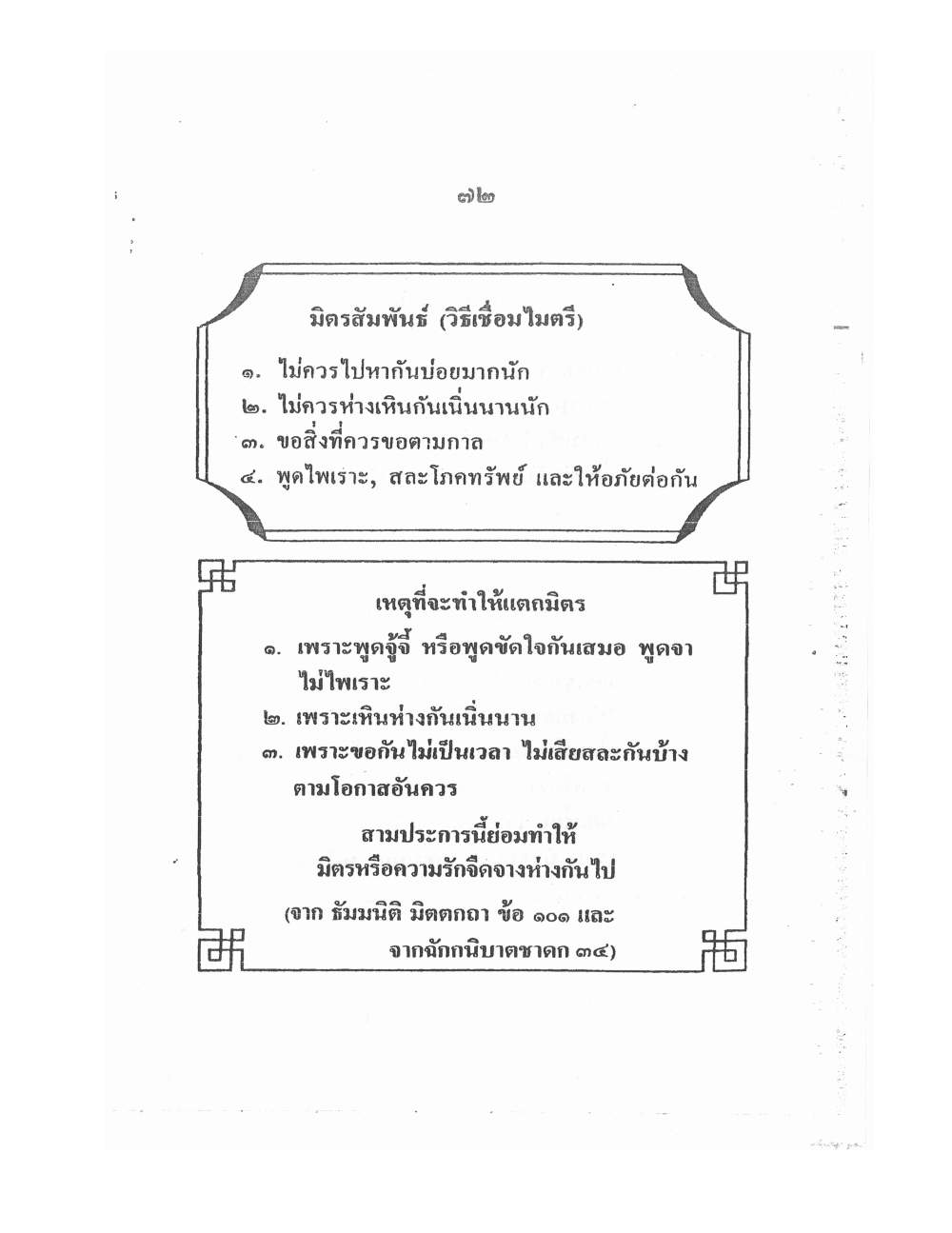
๗๒
[decorative bordered box, rounded-corner style] มิตรสัมพันธ์ (วิธีเชื่อมไมตรี)
๑. ไม่ควรไปหากันบ่อยมากนัก ๒. ไม่ควรห่างเหินกันเนิ่นนานนัก ๓. ขอสิ่งที่ควรขอตามกาล ๔. พูดไพเราะ, สละโภคทรัพย์ และให้อภัยต่อกัน [end box]
[decorative bordered box with corner ornaments] เหตุที่จะทำให้แตกมิตร
๑. เพราะพูดจู้จี้ หรือพูดขัดใจกันเสมอ พูดจา ไม่ไพเราะ ๒. เพราะเหินห่างกันเนิ่นนาน ๓. เพราะขอกันไม่เป็นเวลา ไม่เสียสละกันบ้าง ตามโอกาสอันควร
สามประการนี้ย่อมทำให้ มิตรหรือความรักจืดจางห่างกันไป
(จาก ธัมมนิติ มิตตกถา ข้อ ๑๐๑ และ จากฉักกนิบาตชาดก ๓๔) [end box]
72
[decorative bordered box] Friendship (Methods for Maintaining Good Relations)
1. One should not visit one another too often. 2. One should not remain distant from one another for too long a time. 3. One should ask for things that are proper to ask for, at the right time. 4. One should speak pleasantly, be willing to part with material wealth [for a friend], and forgive one another. [end box]
[decorative bordered box with corner ornaments] Causes That Break a Friendship
1. Because of nagging speech, or always speaking in a way that offends the other — speech that is not pleasant. 2. Because of remaining distant from one another for too long. 3. Because of asking for things at improper times, and not being willing to make some sacrifice for one another on suitable occasions.
These three factors will surely cause friendship or affection to fade and grow distant.
(From Thammaniti, Mittakatha, item 101, and from the Chakka-nibata Jataka, 34) [end box]
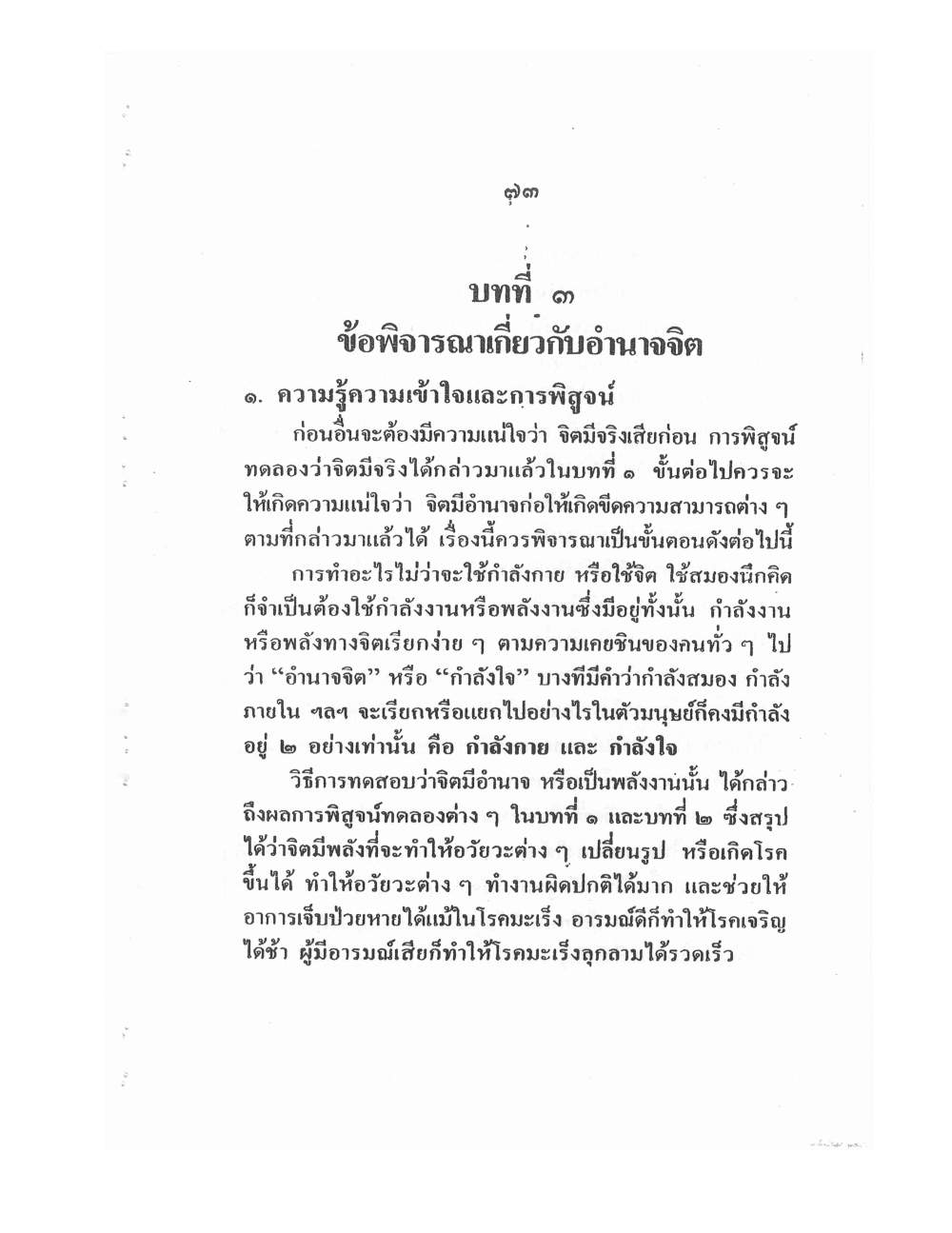
๗๓
บทที่ ๓
ข้อพิจารณาเกี่ยวกับอำนาจจิต
๑. ความรู้ความเข้าใจและการพิสูจน์ ก่อนอื่นจะต้องมีความแน่ใจว่า จิตมีจริงเสียก่อน การพิสูจน์ ทดลองว่าจิตมีจริงได้กล่าวมาแล้วในบทที่ ๑ ขั้นต่อไปควรจะ ให้เกิดความแน่ใจว่า จิตมีอำนาจก่อให้เกิดขีดความสามารถต่างๆ ตามที่กล่าวมาแล้วได้ เรื่องนี้ควรพิจารณาเป็นขั้นตอนดังต่อไปนี้ การทำอะไรไม่ว่าจะใช้กำลังกาย หรือใช้จิต ใช้สมองนึกคิด ก็จำเป็นต้องใช้กำลังงานหรือพลังงานซึ่งมีอยู่ทั้งนั้น กำลังงาน หรือพลังทางจิตเรียกง่ายๆ ตามความเคยชินของคนทั่วๆ ไป ว่า "อำนาจจิต" หรือ "กำลังใจ" บางทีมีคำว่ากำลังสมอง กำลัง ภายใน ฯลฯ จะเรียกหรือแยกไปอย่างไรในตัวมนุษย์ก็คงมีกำลัง อยู่ ๒ อย่างเท่านั้น คือ กำลังกาย และ กำลังใจ วิธีการทดสอบว่าจิตมีอำนาจ หรือเป็นพลังงานนั้น ได้กล่าว ถึงผลการพิสูจน์ทดลองต่างๆ ในบทที่ ๑ และบทที่ ๒ ซึ่งสรุป ได้ว่าจิตมีพลังที่จะทำให้อวัยวะต่างๆ เปลี่ยนรูป หรือเกิดโรค ขึ้นได้ ทำให้อวัยวะต่างๆ ทำงานผิดปกติได้มาก และช่วยให้ อาการเจ็บป่วยหายได้แม้ในโรคมะเร็ง อารมณ์ดีก็ทำให้โรคเจริญ ได้ช้า ผู้มีอารมณ์เสียก็ทำให้โรคมะเร็งลุกลามได้รวดเร็ว
73
Chapter 3
Points to Consider Regarding Mental Power
1. Knowledge, Understanding, and Proof
First of all, one must be certain that the mind truly exists. The proof and experiments demonstrating that the mind truly exists have already been discussed in Chapter 1. The next step should be to become certain that the mind has the power to give rise to the various capabilities already described. This matter should be considered in the following stages.
Doing anything, whether using physical strength, or using the mind, using the brain to think, necessarily requires the use of work-energy or power, which is present in either case. Work-energy or mental power is commonly called, according to ordinary people's usage, "mental power" (amnat chit) or "willpower" (kamlang chai). Sometimes terms such as "brain power," "inner power," etc. are used. However it is named or divided, within a human being there really exist only 2 kinds of power: physical power and willpower.
As for the method of testing whether the mind has power, or is a form of energy — this has already been addressed through the results of various proofs and experiments in Chapters 1 and 2, which may be summarized as follows: the mind has the power to cause various organs to change form, or to give rise to disease; it can cause various organs to malfunction significantly; and it can help symptoms of illness to be cured, even in the case of cancer. A good emotional state causes disease to progress slowly; a person with a bad emotional state causes cancer to spread rapidly.
๗๔
เรื่องแปลก ๆ ตามที่ต่างประเทศทดลองกันคือ ในด้านการเชิญวิญญาณเข้าทรงในการสะกดจิต ในการเห็นด้วยจิต หรือการติดต่อทางกระแสจิตนั้น ในประเทศไทยมีผู้รู้ทำได้ ทดลองได้หลายท่าน ยิ่งกว่านั้นยังทำได้ตามขีดความสามารถของอำนาจจิตทั้งสามขั้นอีกด้วย ที่สำคัญก็คือ ในประเทศไทยยังมีผู้ที่ทำได้ดีหลายท่านในปัจจุบันนี้ ส่วนในต่างประเทศนั้นในปัจจุบันหาดูได้ยาก จะหาดูได้บ้างก็ในด้านสะกดจิต ทั้งนี้เพราะผู้ที่ทำได้แปลก ๆ ส่วนมากอาศัยความเชื่อมั่นว่ามีอำนาจอะไรพิเศษมาช่วยตนเองเป็นพิเศษบ้าง หรืออาศัยการฝึกฝนที่ไม่ตรงเป้าหมายนักจึงกระทำได้ดีเป็นจำนวนน้อยมาก ยังไม่พบวิธีการสอนที่ถูกต้องแน่นอน ผู้เขียนได้พยายามค้นคว้าและพิสูจน์ทดลองมาเป็นเวลา ๒๖ ปี นับตั้งแต่ พ.ศ. ๒๔๘๕ เป็นต้นมา ถึงแม้จะทำบ้างหยุดบ้างเพราะหน้าที่การงาน และขาดการสนับสนุนจากผู้อื่น ก็พอจะได้หลักเกณฑ์ที่เป็นวิทยาศาสตร์ศึกษาได้ ทดลองได้โดยทั่วไป ทั้งนี้ได้ทดลองสอนศิษย์ประเภทต่าง ๆ กว่า ๓,๐๐๐ คน ดังกล่าวมาแล้วในบทที่ ๒ ปรากฏผลว่าขีดความสามารถต่าง ๆ ของอำนาจจิตขั้นต้นดังกล่าวในบทที่ ๑ นั้น เรียนได้สำเร็จทุกคน นำไปทดลองเองได้ทุกคน โดยใช้เวลาเรียนวิชาละไม่เกิน ๒ ชั่วโมง เพื่อเป็นหลักฐานให้ผู้อ่านนำไปพิจารณาและพิสูจน์ทดลองให้เห็นจริง ผู้เขียนจะได้สรุปตัดตอนผลการค้นคว้า และวิธีพิสูจน์เฉพาะที่สำคัญบางอย่างมากล่าวดังต่อไปนี้คือ
74
Strange things that various foreign countries have experimented with are, in the area of inviting a spirit to possess a medium for hypnotic trance, in seeing with the mind, or in contact through mental currents — in Thailand there are knowledgeable people who can do this, many have tested it. Moreover, they can also perform according to the capability limits of all three levels of mind power. What matters most is that in Thailand today there are still many people who can do this well. As for foreign countries, at present it is hard to find; what can be found is mostly in the area of hypnosis. This is because those abroad who do unusual things mostly rely on confidence that some special power is specially helping them, or rely on training that is not well aimed at the true goal, so very few succeed. No definitely correct method of teaching has yet been found abroad. The author has striven to research and test this for 26 years, counting from 2485 BE [1942] onward. Even though sometimes carried on and sometimes stopped because of work duties, and for lack of support from others, enough scientifically studiable, generally testable principles were obtained. This included experimentally teaching more than 3,000 students of various kinds, as already mentioned in Chapter 2. It was found that the various capabilities of the elementary level of mind power described in Chapter 1 were successfully learned by everyone, and everyone was able to go on and test it themselves, using no more than 2 hours to learn each subject. To provide evidence for readers to consider and test for themselves so as to see the truth, the author will give a condensed summary of the results of this research, and some particularly important methods of proof, as follows:
๗๕
จิตเป็นพลังงานหรือมีพลังงาน
ก. จิตทำให้เกิดแรงตอบหรือแรงผลักดัน เรื่องนี้ทดลองได้ง่าย ๆ ได้ โดยทำให้เกิดอำนาจจิตในทางเหนียวคง แล้วทดลองเอามีดคมปลายแหลมแทงที่แขนกดลงแรง ๆ มีดไม่เข้าทะลุเนื้อ แต่จะเห็นรอยบุ๋มเข้าตรงปลายมีดกด และเนื้อหนังในด้านตรงกันข้ามก็เป็นรอยบุ๋มเข้าไปแทนที่จะตุงออกและทะลุ บริเวณที่แทงจะมีสีแดงและจะมีการบวมในระยะหลัง แต่ถ้าตั้งจิตไว้แรงพอจะแทงหรือฟันก็ไม่มีอาการบวม ส่วนอาการแดงมีเล็กน้อยในระยะเวลาสั้น ๆ วิธีนี้ผู้เขียนได้ทดลองมากว่า ๓๐๐ คน เพราะเป็นวิชาเริ่มต้นในการใช้อำนาจจิต เพื่อตัดปัญหาการสงสัยได้ ทดลองด้วยวิธีเอาเศษกระจกที่ตัดใส่กรอบรูปมากองขึ้นเป็นกองใหญ่แล้วให้คนที่ทำตัวให้เหนียวคง ถอดเสื้อถอดรองเท้าขึ้นไปยืนบนโต๊ะ แล้วโดดลงย่ำกองกระจกจนแตกและนอนกลิ้งกระแทกบนกองกระจกไปมา แต่ไม่มีอันตราย อีกวิธีหนึ่งใช้ทรายหว่านไปที่ลูกตาขณะที่ลืมตาตั้งจิตภาวนาอยู่ หว่านหลาย ๆ ครั้งแต่ทรายไม่เข้าตา ทั้ง ๓ วิธีนี้แสดงให้เห็นว่ากำลังจิตนั้นเป็นแรงตอบต้านทานแรงอื่นไว้ได้ ผู้เขียนและคณะเคยแสดงต่อหน้าที่ประชุมหลายครั้ง และได้ถ่ายภาพนิ่งและภาพยนตร์ไว้ด้วย(๑)
(๑) รายการที่แสดงอำนาจจิตต่อหน้าที่ประชุมหรือสมาคม ดูผนวก
75
The Mind Is Energy, or Possesses Energy
a. The mind produces a resisting force or a pushing force. This can be tested easily, by generating mind power toward toughness/invulnerability, then testing by pressing a sharp-pointed knife hard against the arm. The knife does not pierce the flesh, but a dent can be seen where the knife tip presses in, and the flesh on the opposite side is likewise dented inward instead of bulging out and being pierced through. The stabbed area turns red and swells afterward. But if the mind is set strongly enough while stabbing or slashing, there is no swelling at all; the redness, too, is only slight and short-lived. The author has tested this method on more than 300 people, since it is the introductory subject in the use of mind power, in order to remove any doubt about the matter. It was also tested by piling broken picture-frame glass into a large heap, then having a person who has made himself tough/invulnerable remove shirt and shoes, stand on a table, then jump down to trample the glass pile until it shatters, and lie down rolling and slamming back and forth on the broken glass — without injury. Another method scatters sand at the eyeball while the eyes are open and the mind is fixed in meditation — scattered repeatedly, yet the sand does not enter the eye. All three of these methods show that mental power is a resisting force capable of withstanding other forces. The author and colleagues have demonstrated this before audiences many times, and have had it photographed and filmed as well.(1)
(1) For the list of demonstrations of mind power before meetings or societies, see the appendix.
๗๖
ข. จิตทำให้เกิดพลังงานเหมือนไฟฟ้าดังที่กล่าวในบทที่ ๑ จิตบังคับอวัยวะได้เหมือนที่เอาไฟฟ้าลองจี้ที่ระบบประสาท และจิตช่วยต้านแรงไฟฟ้าได้ เรื่องนี้ได้ทดลองโดยตั้งสมาธิให้ดี ใช้ผ้าคล้องตัวไว้ช่วยเหลือเมื่อดึงมือออกเองไม่ได้ เมื่อตั้งใจดีแล้วก็จับสายไฟกำลัง ๒๒๐ โวลท์ทั้ง ๒ สาย ครู่หนึ่งแล้วดึงมือออกเองได้ ผู้ทดลองคืออาจารย์พัว แก้วพลอย มีผลลัพธ์เพียงใจสั่น ๆ ไปนานเกือบชั่วโมง การถูกสายไฟโดยไม่ตั้งใจ จะมีอันตราย แต่ถ้าตั้งจิตเป็นสมาธิแล้วจับสายไฟโดยไม่ลังเลจะปลอดภัย หรืออันตรายน้อยกว่ามาก
ค. จิตทำให้เกิดพลังความร้อนหรือลดความร้อนลงได้ วิธีพิสูจน์ใช้วิธีส่งอำนาจจิตไปสู่น้ำมันที่กำลังเดือดซึ่งวัดด้วยเทอร์มอมิเตอร์ได้ประมาณ ๑๑๐ องศาเซนติเกรด แล้วเอามือจุ่มลงได้ หรือเอาช้อนตักน้ำมันนั้นกินได้ หลังจากส่งอำนาจจิตลงไปในน้ำมันเพียงพอแล้ว บุคคลอื่น ๆ จะไปตักกินหรือเอามือจุ่มดูได้ จะรู้สึกร้อนเล็กน้อย ไม่มีอันตรายอะไร อีกวิธีหนึ่งใช้โซ่เหล็กขนาดใหญ่ ๘ หุนเผาไฟให้แดง และส่งอำนาจจิตลงดับพิษร้อนขณะที่โซ่ยังแดงอยู่เอามือกอบขึ้นได้ เอามือลูบดูได้ บุคคลอื่นก็ทดลองดูได้โดยไม่ต้องใช้อำนาจจิตหรือเครื่องป้องกันมาช่วยอีก โซ่เหล็กที่กำลังแดงจะมีความร้อนประมาณ ๔๐๐ – ๕๐๐ องศาเซนติเกรด ถ้าส่งอำนาจจิตลงสู่น้ำมันที่กำลังเดือดหรือโซ่
76
b. The mind produces power like electricity, as stated in Chapter 1. The mind can control the body's organs the way electricity applied to the nervous system does, and the mind can also help resist the force of electricity. This was tested by entering good meditative concentration, with a cloth wrapped around the body to help in case one could not pull one's hand away unaided. Once well concentrated, [the subject] gripped both wires of a 220-volt line for a moment and was then able to pull the hand away unaided. The person tested was Ajarn Phua Kaewploy; the only effect was a trembling heart that lasted almost an hour. Being shocked unintentionally is dangerous, but if the mind is set in concentration and the wire grasped without hesitation, it is safe, or far less dangerous.
c. The mind can produce heat, or reduce heat. The method of proof sent mind power into oil that was boiling, measured by thermometer at about 110 degrees Celsius, then a hand was dipped into it, or a spoon used to scoop out the oil and eat it. After enough mind power had been sent into the oil, other people could also scoop and eat it, or dip a hand in and see for themselves; they would feel only slight heat, with no danger at all. Another method used a large iron chain, 8 fun thick, heated red-hot in fire, with mind power sent to quench the burning "poison" while the chain was still red — the hand could scoop it up, the hand could stroke it. Other people could test this too, without needing mind power or any protective device to help. A red-hot iron chain has a heat of about 400–500 degrees Celsius. If mind power is sent into boiling oil or the chain
๗๗
ที่เผาไม่เพียงพอที่จะต้านความร้อนได้ เอานิ้วมือจุ่มในน้ำมันเดือดแล้วยกขึ้น หรือเอานิ้วแตะที่โซ่แดง แล้วเอานิ้วออกมา จะรู้สึกว่านิ้วที่จุ่มหรือแตะนั้นร้อนผ่าว ๆ มีพิษตุบ ๆ ถ้าจิตดับพิษหมดเอานิ้วออกมาก็ไม่ร้อน ทั้งสองวิธีนี้ได้สอนศิษย์ไปแล้วประมาณ ๑๐๐ คน และเคยแสดงต่อหน้าที่ประชุมมาหลายครั้ง (ดูผนวก)
จิตทำให้ลดความร้อนก็ได้ ทดลองพิสูจน์ด้วยการทำน้ำมันงาให้แข็งตัว การทำให้น้ำมันงาที่กำลังเหลวอยู่ลดความร้อนจนแข็งตัวได้นี้ มีอาจารย์ที่ทำได้ดีในปัจจุบันและเคยสอนศิษย์ให้ทำได้ไว้หลายคนก็คือ หลวงพ่อปาน วัดเขาอ้อ จังหวัดพัทลุง ผู้เขียนได้เคยไปศึกษาและพิสูจน์มาแล้ว และในทางตรงกันข้ามน้ำมันที่แข็งตัวแล้ว หรือขี้ผึ้งแข็ง ก็ทำให้ละลายเหลวลงได้ด้วยอำนาจจิต
ง. อำนาจจิตขั้นกลาง ทำให้เกิดแรงผลักดันวัตถุหรือผลักดันอณูให้เคลื่อนที่ได้ การวิเคราะห์ให้เห็นจริงมีหลายวิธี ตัวอย่างเช่น การใช้แผ่นทองเปลวที่ใช้ปิดพระพุทธรูปเอาแผ่นทองซึ่งมีกระดาษฟางปิดไว้ ๒ ด้านมา แล้วเปิดกระดาษออกข้างหนึ่งนั้นปิดลงที่หน้าผากคน หรือปิดที่แขนที่หลังที่หน้าอก จะมองเห็นแผ่นทองติดที่ผิวหนังมีกระดาษฟางปิดอยู่ต่อไปใช้ส่งพลังจิตบังคับให้แผ่นทองเข้าไปในตัวคน ทั้งนี้จะให้ใครเอามือมาแตะ
77
that was fired is not enough to withstand the heat, and a finger is dipped into boiling oil and then lifted out, or a finger touched to the red chain and then taken away, the finger that was dipped or touched will feel scaldingly hot, throbbing with "poison." If the mind has extinguished the poison entirely, the finger, once taken out, will not be hot at all. Both of these methods have already been taught to about 100 students, and have been demonstrated before audiences many times (see appendix).
The mind can also lower heat. This was tested and proven by making sesame oil solidify. This ability to cool liquid sesame oil down until it solidifies is something a teacher today does well, and has taught to many students — namely, Luang Pho Pan of Wat Khao O, Phatthalung province. The author has personally gone to study and verify this. And conversely, oil that has already solidified, or hardened wax, can likewise be made to melt back into liquid by mind power.
d. Intermediate-level mind power produces a force that pushes objects, or pushes molecules, to move. There are several ways to analyze this so as to see it demonstrated truly. For example: using gold leaf of the kind used to gild Buddha images — take a sheet of gold leaf backed with paper covering both sides, then peel the paper off one side and press that side onto a person's forehead, or press it onto the arm, the back, or the chest; one will see the gold leaf sticking to the skin, with the paper backing still covering the other side. Next, mental power is sent to force the gold leaf to go into the person's body. This is done without letting anyone touch
๗๘
กดแผ่นกระดาษฟางที่ทับทองนั้นไว้ก็ได้ หรือไม่ต้องมีคนแตะกดไว้ก็ได้ เมื่อส่งพลังจิตไปเพียงพอแล้ว แผ่นทองจะเข้าไปในตัวคนหมด ถ้าส่งพลังจิตไปไม่พออาจเหลือแผ่นทองอยู่ครึ่งแผ่นหรือน้อยกว่าครึ่งแผ่นก็มี ในปัจจุบันก็มีอาจารย์ในพระนครบังคับแผ่นทองเข้าตัวคนอื่นได้หลายท่าน บางท่านก็บังคับให้แผ่นทองเข้าตัวได้ครั้งละหลาย ๆ แผ่นพร้อมกัน เท่าที่ผู้เขียนเคยทดลอง อาจารย์เคยเอาทองเข้าตัวให้ครั้งละ ๗ แผ่นพร้อม ๆ กันหลายครั้ง ทั้งนี้โดยปิดแผ่นทองไว้ที่หน้าผาก หน้าอก แขน และหลังรวม ๗ แผ่น เวลาบังคับแผ่นทองเข้าคงปล่อยกระแสจิตเข้าทางศีรษะแห่งเดียว อีกวิธีหนึ่งได้ทดลองโดยการสะเดาะกุญแจให้หลุดออกแทนการไขด้วยลูกกุญแจ หรือทำให้เชือกที่มัดแขน โซ่ที่รัดขาอยู่หลุดออกไปได้ ผู้เขียนเคยพบเห็นหลายครั้งและได้ศึกษาทดลองมาแล้ว การทำให้เคลื่อนที่ทะลุไปได้หรือข้ามอากาศไปได้นั้นเรียกว่า “วิชาปัดตลอด” เป็นวิธีส่งจิตบังคับให้แผ่นทองที่ปิดไว้ที่หลังฝ่ามือผ่านไปติดอยู่ในด้านหน้าฝ่ามือทั้งแผ่น หรือบังคับแผ่นทองจากฝ่ามือของผู้ส่งพลังจิต ให้แผ่นทองไปติดอยู่ที่หน้าผากของผู้อื่นที่นั่งอยู่ใกล้ ๆ ได้ นอกจากนี้ยังมีการพิสูจน์ที่พิสดารกว่านี้อีกหลายอย่าง
จ. จากอำนาจจิตเปลี่ยนเป็นแสงสว่างได้ เรื่องนี้ทำการทดสอบได้จากการเห็นโดยไม่ต้องใช้ตา ตามตัวอย่างที่ต่างประ-
78
the paper backing over the gold and hold it down — or there need be no one pressing it down at all. Once enough mental power has been sent, the gold leaf goes entirely into the person's body. If not enough mental power was sent, sometimes half the sheet, or less than half, remains outside. At present there are several teachers in Bangkok who can force gold leaf into other people's bodies. Some can force several sheets of gold leaf into the body at once. As far as the author has personally tested, one teacher was able to send gold into the body 7 sheets at a time, repeatedly, placing the sheets on the forehead, chest, arms, and back — 7 sheets in all. At the moment of forcing the gold leaf in, the mental current apparently is released only through the head. Another method tested was picking a lock open instead of using the actual key, or making a rope binding the arms, or a chain binding the legs, come loose. The author has witnessed this many times and has studied and tested it. Making something move so as to pass straight through solid matter, or cross through the air, is called "the art of complete pat-talot [sweeping-through]" — a method of sending the mind to force a whole sheet of gold leaf placed on the back of the hand to pass through and end up stuck on the palm side of the same hand; or forcing gold leaf from the palm of the person sending the power to travel and stick onto the forehead of another person sitting nearby. Besides this there are still many more elaborate demonstrations.
e. Mind power can also be converted into light. This can be tested by seeing without using the eyes, following the examples of foreign coun-
๗๙
เทศทดลองในบทที่ ๒ สำหรับประเทศไทยเราก็มีตัวอย่างอยู่มาก ที่มีการแสดงให้เห็นจริงต่อหน้าที่ประชุมหลายครั้ง ก็คือ การแสดงของนายแพทย์ขุนวิจิตสุขการ โดยให้เด็กที่ฝึกไว้แสดงในที่ประชุม หรือสมาคม และที่สถานีโทรทัศน์หลายครั้ง ระหว่าง พ.ศ. ๒๕๐๑ ถึง ๒๕๐๔ โดยวิธีปิดตาแล้วให้อ่านหนังสือได้ หรือขี่จักรยานไปตามถนนที่คดเคี้ยวได้ อีกวิธีหนึ่งให้จำสิ่งของ ๑๐๐ อย่างบอกเป็นเบอร์ไปตามลำดับ เช่น เบอร์ ๑ ปากกา เบอร์ ๒ กางเกงฯ ไปจนถึง ๑๐๐ เบอร์ เมื่อบอกครบ ๑๐๐ อย่างแล้ว ก็ให้คนถามสลับเบอร์ตามใจได้ เช่น ถามว่าเบอร์ ๒ อะไร เบอร์ ๒๕ อะไร เมื่อเด็กตอบแล้วก็ถามต่อไปจนครบ ๑๐๐ อย่าง ปรากฏผลว่าเด็กตอบได้ถูกต้อง แต่บางครั้งตอบผิดไปประมาณ ๒ อย่าง ผู้เขียนเคยไปฟังเด็กคนนี้บรรยายเป็นภาษาอังกฤษได้ชัดเจนคล่องแคล่วนานกว่า ๑๐ นาที โดยจำมาจากฟังเครื่องอัดเสียงในระหว่างนั่งสมาธิได้ สอบถามตัวเด็กเอง และขุนวิจิตสุขการผู้นำแสดงได้รับการยืนยันว่า การที่ทำได้เช่นนั้นเพราะเด็กได้สมาธิหลับตาเห็นแสงสว่างได้ และใช้แสงนั่นเองช่วยให้มองเห็น และสมาธิช่วยให้เกิดความจำได้แม่นยำ ในระยะเวลาสั้น ๆ ได้เคยมีฝรั่งขอทดลองเด็กของขุนวิจิตสุขการ โดยเอาสิ่งที่มองดูด้วยตาไม่เห็น ต้องใช้กล้องจุลทรรศน์ดูจึงจะเห็นรูปร่างได้ ปรากฏว่าเด็กนั่งสมาธิมองเห็นรูปร่างสิ่งนั้นได้ และเขียนรูปได้ถูกต้อง ทดลองดูของต่างกัน ๓ ครั้งก็เขียนได้ถูกต้องทั้ง ๓ ครั้ง
79
...-tries [mentioned] as tested in Chapter 2. For our own Thailand we too have many examples that have been demonstrated truthfully before audiences many times — namely, the demonstrations of Dr. Khun Wichit Sukkarn, who had a child he had trained perform before meetings or societies, and on television broadcasts several times, between 2501 and 2504 BE [1958–1961], by such methods as covering the eyes and then being able to read a book, or riding a bicycle along a winding road. Another method was memorizing 100 items, called out in order by number — for example, number 1: pen, number 2: trousers, and so on up to number 100. Once all 100 had been given, people could then ask out of order as they pleased — for example, asking what number 2 was, what number 25 was. As the child answered, questioning continued until all 100 had been covered. It turned out the child answered correctly, though sometimes about 2 answers were wrong. The author once heard this child give a lecture clearly and fluently in English for more than 10 minutes, memorized from listening to a tape recorder while sitting in meditation. Questioning the child directly, and Khun Wichit Sukkarn who presented the demonstration, it was confirmed that the reason the child could do this was that, in meditation with eyes closed, the child could see light, and used that very light to help see, while the meditation helped produce accurate memory. In that short period, a Westerner once asked to test Khun Wichit Sukkarn's child by using an object invisible to the naked eye — needing a microscope to see its shape — and it turned out the child, sitting in meditation, could see the shape of that thing and draw it correctly. Testing with three different objects, the child drew all three correctly, all three times.
๘๐
เรื่องจิตเป็นสมาธิแล้วจำได้ดี เข้าใจได้ดีนี้ในประเทศไทยมีตัวอย่างอยู่มาก แต่ขาดการสนใจและการเผยแพร่จึงนึกว่าไม่เคยมี มีเณรอายุประมาณ ๑๒ ขวบ นั่งสมาธิฟังอาจารย์เทศน์สอนประชาชน พออาจารย์เทศน์จบ ทดลองให้เณรขึ้นไปเทศน์ เณรก็เทศน์ได้เหมือนกับอาจารย์ มีอีกหลายแห่งที่นั่งสมาธิเห็นอะไรได้ไกล ๆ ในปัจจุบัน แต่ทางฝรั่งคือยุโรป อเมริกา ยังไม่เข้าใจเรื่องนี้ดี ได้ลงข่าวในหนังสือไซแอนซ์ไดเจส ฉบับเดือนมีนาคม พ.ศ. ๒๕๑๑ ในหัวข้อเรื่องว่า Sleep Learning มีใจความสำคัญคือ ทุกคนอยากมีสติปัญญาฉียบแหลม วิธีเรียนจากเครื่องบันทึกเสียงขณะที่กำลังหลับเป็นวิธีที่ช่วยได้มาก นายเดวิด (DAVID COURTIS) ได้เขียนหนังสือชื่อ Sleep and Learn พร้อมด้วยตัวอย่าง ประเทศรัสเซียได้ทดลองการเรียนจากเสียงในเวลาหลับ โดยทดลองกับกลุ่มชนในศูนย์วิจัยปรมาณู เมืองคุปนาทิศเหนือกรุงมอสโก มีผู้เข้าทดลอง ๑๐๐๐ คน อายุ ๑๕ ปีถึง ๕๐ ปี การทดลองเป็นการสอนภาษาอังกฤษ โดยกระจายเสียงทางวิทยุเวลาก่อนนอน และกระจายเสียงซ้ำ ๆ อีกครั้งหนึ่งในเวลาเช้าตรู่ก่อนที่ผู้รับการทดลองจะตื่น นักจิตวิทยาในสหรัฐอเมริกาได้ทดลองหาข้อเท็จจริงเรื่องนี้ ใช้เครื่องบันทึกคลื่นสมองตรวจสอบทำการทดลองโดย ตร. ชาร์ลส์ ซีมอน แห่งรัฐแคลิฟอเนีย ลงเอยว่าคนรับรู้เวลาหลับไม่ได้ ความรู้สึกต่อเหตุการณ์ภายนอกที่มีอยู่ในระหว่างตื่นอยู่จนถึงหลับสนิทจะค่อย ๆ ลดลง วารสาร Con–
80
Regarding the matter of the mind, once in concentration (samadhi), remembering well and understanding well — there are many examples of this in Thailand, but for lack of attention and publicity people think it has never occurred. There was a novice monk about 12 years old who sat in meditation while listening to his teacher preach to the people; as soon as the teacher finished preaching, the novice was tested by having him go up and preach — and the novice was able to preach just like the teacher. There are several other places where, sitting in meditation, one can presently see things far away. But Western countries — Europe, America — do not yet understand this matter well. An article appeared in Science Digest, March 1968 issue [2511 BE], under the heading "Sleep Learning," whose essential point was: everyone wants to have a sharp mind, and the method of learning from a tape recorder while asleep is a method that helps a great deal. Mr. David Courtis wrote a book titled Sleep and Learn, complete with examples. Russia tested learning from sound during sleep, experimenting with a group of people at an atomic research center in the town of Kupna(?), north of Moscow; 1,000 people took part in the test, aged 15 to 50. The test was teaching English, by broadcasting over radio before bedtime, and broadcasting the same recording again repeatedly early in the morning before the test subjects woke. Psychologists in the United States tested to find the facts of this matter, using a brainwave recording device to check; the experiment was conducted by Dr. Charles Simon of the state of California, and concluded that people cannot perceive time while asleep — awareness of outside events, present while awake, gradually diminishes as one passes into deep sleep. The journal Con–
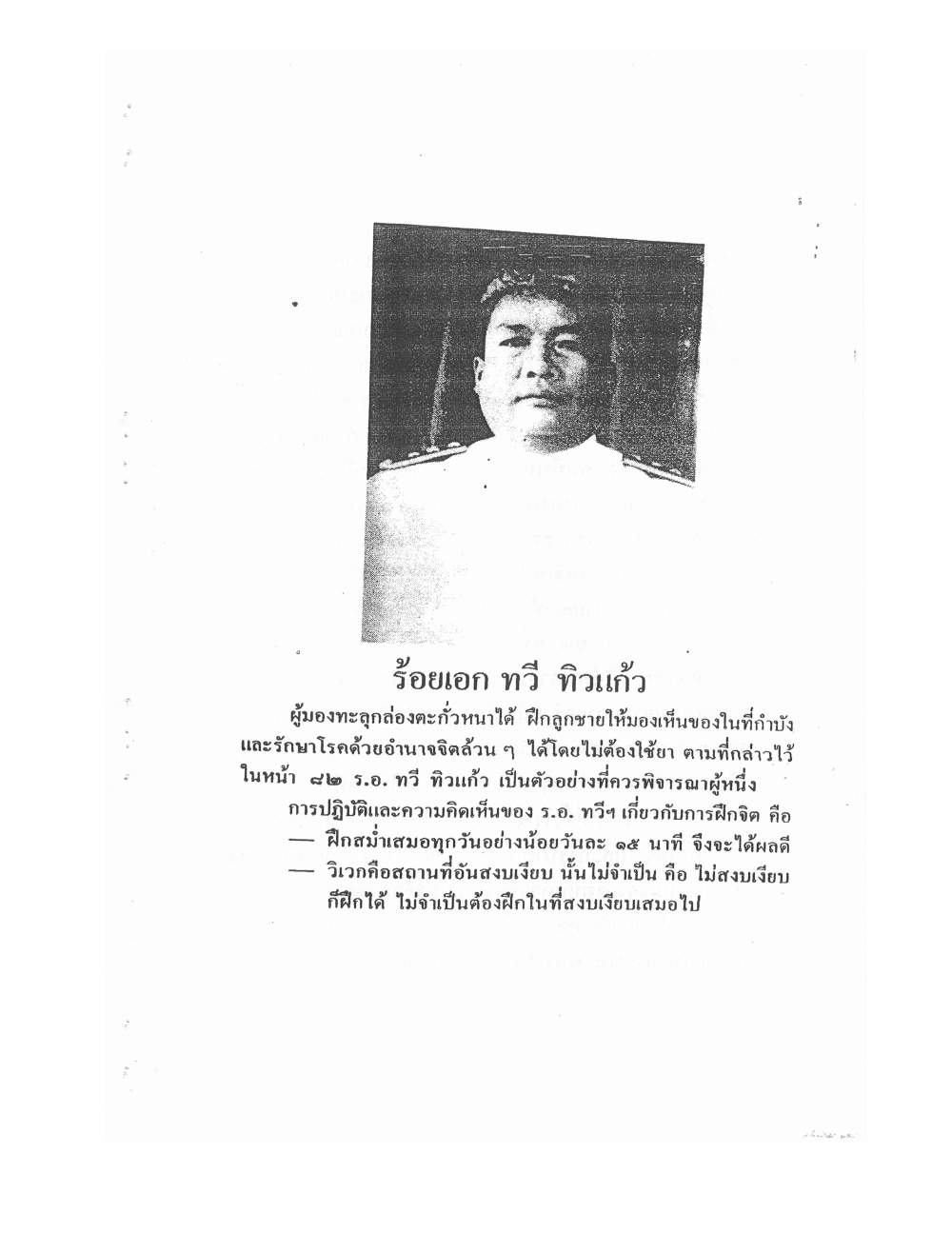
[ภาพถ่ายฮาล์ฟโทน: นายทหารสวมเครื่องแบบมีอินทรธนูบนบ่า มองตรงมาที่ผู้ชม]
ร้อยเอก ทวี ทิวแก้ว
ผู้มองทะลุกล่องตะกั่วหนาได้ ฝึกลูกชายให้มองเห็นของในที่กำบัง และรักษาโรคด้วยอำนาจจิตล้วน ๆ ได้โดยไม่ต้องใช้ยา ตามที่กล่าวไว้ในหน้า ๘๒ ร.อ. ทวี ทิวแก้ว เป็นตัวอย่างที่ควรพิจารณาผู้หนึ่ง
การปฏิบัติและความคิดเห็นของ ร.อ. ทวีฯ เกี่ยวกับการฝึกจิต คือ — ฝึกสม่ำเสมอทุกวันอย่างน้อยวันละ ๑๕ นาที จึงจะได้ผลดี — วิเวกคือสถานที่อันสงบเงียบ นั้นไม่จำเป็น คือ ไม่สงบเงียบก็ฝึกได้ ไม่จำเป็นต้องฝึกในที่สงบเงียบเสมอไป
[Half-tone photograph: a military officer in uniform with epaulettes on the shoulders, looking straight at the viewer]
Captain Thawi Thiukaeo
The man who could see through a thick lead box. He trained his son to see objects hidden from view, and to cure disease by mind power alone, without needing medicine, as stated on page 82. Capt. Thawi Thiukaeo is one example worth considering.
Capt. Thawi's practice and views concerning mind training are: — Train regularly every day, at least 15 minutes a day, in order to get good results. — "Seclusion," meaning a quiet, peaceful place, is not necessary — that is, one can train even where it is not quiet; it is not necessary to always train in a quiet place.
๘๑
...sumer's Bulletin ที่มีชื่อเสียงในอเมริกาลงบทความว่า การเรียนรู้ขณะที่หลับไม่เกิดผล ถึงแม้จะทดลองขณะกำลังจะหลับ หรือกำลังจะตื่นก็ตาม จะได้รับความรู้อย่างจริงจังได้ในขณะตื่น แต่การทดลองของ ดร. วิลเดอร์ (Dr. Wilder Penfield) แห่งสถาบันวิจัยประสาทแห่งเมืองมอนทรีออล ประเทศแคนาดา พบว่าขณะผ่าตัดสมองคนไข้หมดสติ เอากระแสไฟฟ้าอ่อน ๆ สัมผัสสมองบางตำแหน่งทุกครั้ง คนที่หมดสติจะพูดเป็นเรื่องเป็นราวหรือร้องเพลงดัง ๆ แสดงว่าสมองจะทำงานได้ แม้จะหลับสนิทหรือหมดสติ ถ้ามีเครื่องกระตุ้นที่ถูกต้อง เช่น กระแสไฟฟ้า หรือกระแสจิต (กระแสจิตเปลี่ยนรูปเป็นไฟฟ้าหรือเป็นกำลังงานอื่น ๆ ก็ได้) มีความคิดเห็นขัดแย้งกันในเรื่องการเรียนขณะหลับหรือจวนจะหลับ ขณะครึ่งหลับครึ่งตื่นไม่ลงเอยกันได้ แต่ที่ประเทศไทยเราได้พบความจริงมาก่อนเป็นเวลาหลายปี และทดลองเห็นจริงหลายครั้งแล้ว คือความจริงนั้นขณะจิตเป็นสมาธิ มีความสามารถพิเศษ หรือวิเศษ ทั้งด้านความจำ ความคิด ความเข้าใจและมีอำนาจต่าง ๆ ดังกล่าวมาแล้วในบทที่ ๑ ขุนวิจิตสุขการ เป็นคนแรกที่ตั้งโรงเรียนฝึกความจำมีป้ายว่า “สถานฝึกสมาธิความจำ และการบำบัดโรคด้วยจิต” อาจารย์อีกท่านหนึ่งที่ทดลองในเรื่องการเห็นด้วยจิตจนเป็นที่รู้จักกว้างขวาง ในระยะพร้อม ๆ กับขุนวิจิตสุขการก็คือ ร.อ. ทวี ทิวแก้ว ซึ่งรับราชการอยู่ที่ กรมการขนส่งทหารบก ใกล้สะพานแดง ร.อ. ทวีฯ ได้
81
...-sumer's Bulletin, well known in America, published an article stating that learning while asleep produces no result — even if tested while about to fall asleep or about to wake, real knowledge is only received while genuinely awake. But the experiment of Dr. Wilder Penfield of the neurological research institute in Montreal, Canada, found that during brain surgery on unconscious patients, touching a weak electric current to certain points in the brain each time caused the unconscious patient to speak coherently or sing loudly — showing that the brain can still function even in deep sleep or unconsciousness, given the right stimulus, such as an electric current, or a mental current (a mental current can likewise be converted into electricity or other forms of energy). There are conflicting opinions on learning while asleep or about to fall asleep — the state of being half-asleep, half-awake — that cannot be settled. But in Thailand we discovered this truth years earlier, and have tested and confirmed it many times already: namely, that while the mind is in concentration, it has special or extraordinary abilities, in memory, thought, and understanding, and possesses the various powers already described in Chapter 1. Khun Wichit Sukkarn was the first to establish a memory-training school with a sign reading "Institute for Training Concentration-Memory and Mind-Healing of Disease." Another teacher who experimented with seeing-by-mind until becoming widely known, at about the same time as Khun Wichit Sukkarn, was Capt. Thawi Thiukaeo, who served in the Army Transportation Department near Saphan Daeng [Red Bridge]. Capt. Thawi
๘๒
ฝึกลูกให้นั่งสมาธิและช่วยรักษาโรคด้วยอำนาจจิต อำนาจคุณพระ ลูกชายคนชื่อหูทิพย์ และตัว ร.อ. ทวี เองก็สามารถมองเห็นทางจิตได้ ได้มีผู้ไปดูการทดลองหลายท่านรวมทั้งผู้เขียนด้วย วิธีทดลองทำโดยให้คนเอาของไปซ่อนไว้แล้วให้เด็กบอกที่ซ่อน พร้อมทั้งเดินไปเอาของนั้นมา บางคราวก็เอาของใส่กล่องให้ดู มีนายแพทย์สงสัยว่า แสงที่เกิดกับจิตคงจะลอดผ่านทะลุกล่องตะกั่วหนาไม่ได้ เพราะกล่องตะกั่วหนาที่ใช้เก็บเรเดียม สามารถกำบังรังสีเรเดียมไว้ได้ จึงเอากล่องตะกั่วดังกล่าวใส่ของให้ ร.อ. ทวีฯ ดูทางจิต ปรากฏว่ามองเห็นได้ ลูก ร.อ. ทวีฯ ที่ชื่อหูทิพย์นี้เป็นเด็กหูเสีย แต่ก็ไปเรียนหนังสือได้เพราะจิตเป็นสมาธิ ทำให้เกิดปัญญาและมีความจำดี ได้สอบถามบิดาของเด็กที่ชอบไปฝึกสมาธิ รวมทั้งเด็กของขุนวิจิตสุขการ ปรากฏว่าผลการเรียนดีกว่าระยะที่ไม่เคยฝึกสมาธิเป็นอันมาก
ฉ. พลังจิตเปลี่ยนเป็นพลังในทางเคมี แยกอณูหรือเปลี่ยนอณู ตลอดจนรวมอณูและควบคุมวิญญาณได้ ตัวอย่างที่อาจารย์หลายท่านในประเทศทดลองได้ก็คือ การแปลงธาตุและการทำให้เกิดเป็นสัตว์มีชีวิตขึ้นได้ เช่นการทำใบไม้ให้เป็นนก ทำใบไม้ให้เป็นแมลงภู่ ทำข้าวสารให้เป็นกุ้ง ทำหญ้าให้เป็นขนมหรือเป็นข้าว หรือทำขนมอันเดียวให้เป็นหลายอัน เรื่องนี้ยังมีอีกหลายท่านที่ไม่เชื่อว่าทำได้จริง แต่ผู้เขียนก็ได้ตรวจสอบหลาย
82
trained his children to sit in meditation and helped heal disease by mind power — the power of virtue/the Buddha. A son named "Divine Ear" (Hu Thip), and Capt. Thawi himself, were also able to see by mind. Several people went to observe the demonstrations, including the author. The method of testing was to have someone hide an object, then have the child say where it was hidden and go and fetch it. Sometimes the object was placed in a box to be viewed. A physician doubted that light produced by the mind could pass through a thick lead box, since thick lead boxes used to store radium are able to shield radium radiation. So the object was placed in such a lead box for Capt. Thawi to view by mind, and it turned out he could see it. Capt. Thawi's son named Hu Thip was a deaf child, but was able to study because his mind was in concentration, which produced intelligence and good memory. Inquiries were made of the fathers of children who liked to go and practice meditation, including Khun Wichit Sukkarn's child, and it turned out their school results were far better than in the period before they had practiced meditation.
f. Mental power can be converted into chemical power — splitting or changing molecules, as well as combining molecules, and controlling spirit/consciousness. Examples that several teachers in the country have been able to demonstrate are the transmutation of elements and causing living creatures to come into being — such as turning a leaf into a bird, turning a leaf into a bee, turning raw rice into shrimp, turning grass into a sweet or into rice, or turning a single sweet into many. There are still many people who do not believe this can truly be done, but the author has personally examined many
๘๓
ครั้งและได้ศึกษาทดลองดูเอง ขอยืนยันว่าทำได้จริง อาจารย์ผู้ทำได้ก็ยังมีชีวิตอยู่หลายท่าน—มีอธิบายวิธีทำในการแปลงธาตุในวิทยาศาสตร์ทางใจ ฉบับยอดคน
เพื่อให้เข้าใจดีขึ้นว่าเป็นไปได้ ไม่ขัดกับหลักวิทยาศาสตร์ ควรจะได้พิจารณาหลักการทางวิทยาศาสตร์ประกอบ จะขอยกหลักการที่นักวิทยาศาสตร์รู้และรับรองกันโดยทั่วไปหลังสงครามโลกครั้งที่ ๒ มากล่าว ซึ่งตรงกับบทความในหนังสือไลฟ์ ฉบับ ม.ค. ปี ๑๙๕๖ (พ.ศ. ๒๔๙๙) คือ ไอน์สไตน์ นักวิทยาศาสตร์ชั้นเอกได้พิสูจน์ให้เห็นว่ามวลเปลี่ยนเป็นพลังงานได้ วัตถุต่าง ๆ ตลอดจนคนและสัตว์ก็คืออาการของพลังงานนั่นเอง แต่สิ่งที่มีชีวิตนั้น ยังมีพลังงานอีกชนิดหนึ่งแฝงอยู่ด้วย พลังงานอีกชนิดหนึ่งนี้คือ “จิต” ฉะนั้นรูปลักษณะในอวกาศนอกจากจะแสดงออกมาเป็นสนามแรงแม่เหล็กไฟฟ้าแล้ว ก็น่าจะแสดงรูปลักษณะเป็นสนามแรงจิตได้อีกด้วย
ตามที่ได้กล่าวถึงการพิสูจน์ทดลองว่า จิตเป็นพลังงานหรือมีพลังงานในข้อ ก. ถึงข้อ ฉ. ก็เป็นการยืนยันว่าเป็นความจริง เมื่อประกอบเข้ากับหลักการทางวิทยาศาสตร์ ที่ว่าทุกอย่างเป็นพลังงาน รวมทั้งจิตก็เป็นพลังงานก็น่าจะเป็นการเพียงพอที่จะเชื่อถือได้ว่า จิตเป็นพลังงานอย่างหนึ่ง เมื่อเชื่อว่าจิตเป็นพลังงานอย่างหนึ่งแน่นอนแล้ว ก็เป็นการง่ายที่จะเชื่อว่าการพิสูจน์อำนาจ
83
...times, and studied and tested it myself. I affirm that it can truly be done; teachers able to do it are still alive, several of them — the method for transmuting elements is explained in Mind Science, Edition for Exceptional People [Witthayasat Thang Jai, Chabap Yotkon].
To understand better that this is possible and not contrary to scientific principle, one should also consider scientific principles as support. I will cite a principle that scientists have known and generally accepted since after World War II, corresponding to an article in Life magazine, January 1956 issue (2499 BE): namely, that Einstein, a foremost scientist, proved that mass can be converted into energy. Objects of all kinds, including people and animals, are themselves manifestations of energy. But living things also carry latent within them another kind of energy besides. This other kind of energy is "the mind" (jit). Therefore, aside from manifesting in space as an electromagnetic force field, it should also be able to manifest in the form of a mental force field.
As already discussed regarding the proof that the mind is energy or possesses energy, in items a. through f., this confirms it to be true. Combined with the scientific principle that everything is energy, and that the mind too is energy, this should be sufficient to believe that the mind is a form of energy. Once it is firmly believed that the mind is indeed a form of energy, it becomes easy to believe that the proof of the power of
๘๔
จิตหรือขีดความสามารถของอำนาจจิตขั้นต่าง ๆ ที่กล่าวมาแล้วนั้น เป็นความจริงที่สามารถศึกษากันได้ กล่าวคือมีหลักการทางวิทยาศาสตร์ว่า พลังงานทั้งหลายย่อมสามารถเปลี่ยนจากพลังงานอย่างหนึ่งไปเป็นพลังงานอีกอย่างหนึ่งได้ เช่น พลังงานไฟฟ้าเมื่อผ่านหลอดไฟก็เปลี่ยนเป็นพลังความร้อนได้ พลังความร้อนก็เปลี่ยนไปเป็นแสงสว่างออกไปอีกได้ ฉะนั้น เมื่อจิตเป็นพลังงานก็ย่อมเปลี่ยนเป็นพลังงานอื่น ๆ ได้ แม้จะเปลี่ยนไปเป็นวัตถุหรือรวมอณูใหม่ก็ไม่ขัดกับหลักวิทยาศาสตร์ เพราะวัตถุก็เป็นรูปหนึ่งของพลังงานนั่นเอง ยังน่าสงสัยอีกว่าทำไมจึงสร้างสิ่งที่มีชีวิตขึ้นได้ ข้อนี้ก็เป็นเรื่องที่เข้าใจได้ เมื่อวิเคราะห์ธรรมชาติของจิตต่อไป
จิตเป็นธรรมชาติรู้
จิตหรือวิญญาณเป็นธรรมชาติที่รู้แจ้ง(๒) สรุปรวมได้ว่า จิตคือพลังงานพิเศษ และเป็นธรรมชาติรู้ในข้อที่ว่าเป็นพลังงานก็ได้วิเคราะห์วิจารณ์มาแล้ว ส่วนในข้อที่ว่าเป็นธรรมชาติรู้ก็พอจะเชื่อมั่นกันได้ทุกคนว่า จิตเรารู้อะไรได้จริง แต่ส่วนจิตของคนหลังจากตายไปแล้ว ซึ่งมักเรียกว่าวิญญาณนั้นคงจะมีผู้สงสัย หรือไม่แน่ใจอีกเป็นจำนวนมาก ในประเด็นนี้มีหนทาง
(๒) กรมการศาสนา, พระไตรปิฎก ฉบับภาษาไทย, เล่ม ๑๘, หน้า ๖๑๐.
84
...mind, or the various capability limits of mind power described earlier, is a truth that can be studied — that is, there is a scientific principle that all forms of energy can indeed change from one kind of energy into another. For example, electrical energy, passed through a light bulb, can change into heat energy; heat energy can in turn change further into light given off. Therefore, since the mind is a form of energy, it can likewise change into other forms of energy. Even changing into matter, or newly combined molecules, does not contradict scientific principle, because matter itself is simply one form of energy. One might still wonder why it is possible to create living things this way. This too can be understood, when we go on to analyze the nature of the mind.
The Mind Is a Knowing Nature
The mind or consciousness is a nature that knows clearly.(2) In summary: the mind is a special form of energy, and is a knowing nature. The point that it is energy has already been analyzed and discussed. As for the point that it is a knowing nature, everyone can probably be confident that our mind truly knows things. But as for the mind of a person after death — what is usually called "consciousness/spirit" (winyan) — there are surely still many people who doubt or remain uncertain about this. On this question there is a way
(2) Department of Religious Affairs, Tipitaka, Thai-language edition, volume 18, page 610.
ที่จะวิเคราะห์ให้เห็นจริงหลายประการ จะยกตัวอย่างเพียงบางประการ คือ
๑. ควรพิจารณาการที่คนฝันไป คนที่ระลึกชาติได้ หรือคนที่สลบ หรือตายแล้วฟื้นขึ้น ก็มีการไปรู้เห็นอะไรได้ด้วยจิตโดยมิได้อาศัยร่างกาย
๒. การเชิญวิญญาณมาเข้าทรง ซึ่งกล่าวมาแล้วทั้งในต่างประเทศและประเทศเรา เข้าทรงแล้วทำอะไรได้แปลก ๆ นี่ก็เป็นการยืนยันอันหนึ่งว่า วิญญาณของผู้ตายไปแล้วก็รู้อะไรได้เหมือนกัน ผู้เขียนเองเคยประสบมาด้วยตนเองหลายครั้ง ที่วิญญาณผู้ตายมาเข้าแทรกแทนวิญญาณจริงของคน ซึ่งเรียกง่าย ๆ ว่าผีเข้าและได้เคยทำพิธีไล่วิญญาณนั้นออกไปหลายครั้ง ในพระไตรปิฎกของพระพุทธศาสนา และในคัมภีร์ใบเบิลของคริสต์ศาสนาก็มีตัวอย่างจริงเรื่องผีเข้าและไล่ผีอยู่หลายแห่ง
๓. การทำให้เกิดเป็นสัตว์มีชีวิตด้วยอำนาจจิต เช่นการทำใบไม้เป็นนกทำข้าวสารเป็นกุ้ง หรือทำใบไม้เป็นแมลงภู่ ทำใบไม้เป็นขนมหรือทำขนมชิ้นเดียวเป็นหลายชิ้น ซึ่งขณะนี้อาจารย์ที่ทำได้ก็มีหลายท่าน เมื่อจะแยกออกพิจารณาด้านร่างกายของสัตว์ ก็นับว่าไม่ขัดกับหลักวิทยาศาสตร์ เพราะส่วนเล็กที่สุดของวัตถุของอากาศ และของมนุษย์ สัตว์ ต้นไม้ ทางวิทยาศาสตร์ก็ค้นพบแล้วว่าเหมือนกันหมด คือเป็นละอองไฟฟ้าบวก ละอองไฟฟ้าลบอยู่รอบแกนกลาง เรียกว่า ปรมาณู จะเป็นธาตุอะไร
...that can be shown to be really true in many respects. A few examples will be given, namely:
1. One should consider the case of people who dream, people who can recall past lives, or people who faint or die and then revive — they perceive and know things through the mind without relying on the body.
2. The inviting of a spirit to possess a medium (which has been discussed both abroad and in our own country) — when possessed, the medium can do strange things. This too is one confirmation that the spirit of a dead person still knows things. The author himself has personally experienced, many times, spirits of the dead coming in to displace a person's own true spirit — commonly called being "possessed by a ghost" — and has performed rites to drive that spirit out on many occasions. In the Buddhist Tipiṭaka, and in the Bible of the Christian religion, there are real examples in many places of spirit possession and of exorcism.
3. Causing living creatures to arise by the power of the mind, such as turning a leaf into a bird, turning raw rice into a shrimp, or turning a leaf into a bumblebee, turning a leaf into a sweet, or turning a single piece of sweet into many pieces — there are several teachers alive today who can do this. When one separates out and considers the physical aspect of such a creature, it is not at all contrary to scientific principle, because science has already discovered that the smallest particles of matter — of air, and of humans, animals, and trees — are all alike: they consist of positive electrical particles and negative electrical particles surrounding a central core, called an atom. Whatever element it may be,
แตกต่างกันก็เป็นเพราะจำนวนละอองของไฟฟ้าในปรมาณูนี้ต่างกัน เมื่อแยกปรมาณูออกไปอีกก็เป็นพลังงานต่าง ๆ ไป ดังเช่น ระเบิดปรมาณู เมื่อปรมาณูแยกออกไปก็เป็นความร้อน เป็นแสงสว่างและเป็นแรงผลักดัน ฉะนั้นในทางวิทยาศาสตร์สมัยใหม่นี้จึงรับรองว่าวัตถุตลอดจนคน สัตว์ ต้นไม้ ท่อนไม้ ดิน แสงสว่างทุกอย่างก็ล้วนเป็นการรวมกลุ่มของพลังงานทั้งนั้น นักวิทยาศาสตร์จึงสามารถทำวัตถุหนึ่ง ให้เป็นอีกอย่างหนึ่งได้ เช่น ทำขี้เลื่อยเป็นขนมปัง ทำตะกั่วเป็นทอง ทำยางเทียม ฯลฯ โดยวิธีการทางวิทยาศาสตร์ แต่บางอย่างลงทุนมากไม่คุ้มค่า แทนที่จะใช้พลังทางวิทยาศาสตร์มาจัดปรมาณูใหม่ เราใช้พลังทางจิตแทนเพื่อเปลี่ยนธาตุก็ไม่เห็นจะขัดกับหลักวิทยาศาสตร์ข้อไหน? ควรวิเคราะห์ต่อไปว่า เมื่อทำให้เป็นสัตว์ มีร่างกายชีวิตและวิญญาณได้ ซึ่งสัตว์ที่ทำขึ้นจากพลังจิตมีชีวิตอยู่ได้ ๒ หรือ ๓ ชั่วโมง บางอย่างอยู่ถึง ๗ วัน แล้วแต่ความแรงของพลังจิต เราจะคาดคะเนยกย่องว่าผู้ทำสัตว์นั้นสามารถสร้างวิญญาณขึ้นได้หรือ? แน่ที่เดียว เขาสร้างวิญญาณขึ้นไม่ได้ ถ้าสร้างวิญญาณไม่ได้ก็คงเหลือทางเดียว คือวิญญาณอื่นที่มีอยู่แล้วในโลกเข้ามาครองหรือมาสิงอยู่ในรูปกายของสัตว์นั้นซึ่งเป็นไปได้ตรงกับหลักฐานในศาสนาต่าง ๆ นี่ก็พอจะเห็นได้ว่าวิญญาณของผู้ตายไปแล้ว ก็มีการรู้ได้ หรือเป็นธรรมชาติรู้นั่นเอง
๔. จากการทดลองหลายครั้งหลายหน และหลายแห่งเกี่ยว
the difference lies only in the differing number of electrical particles within this atom. When the atom is further split, it becomes various forms of energy — as in an atomic bomb: when the atom splits, it becomes heat, becomes light, and becomes propulsive force. Therefore in modern science it is now accepted that matter — including people, animals, trees, timber, soil, and every kind of light — are all nothing but aggregations of energy. Scientists are therefore able to turn one substance into another, such as turning sawdust into bread, turning lead into gold, making artificial rubber, etc., by scientific methods. But some of these require so much investment that it is not worthwhile. Instead of using scientific power to rearrange atoms anew, if we use mental power instead to change the elements, I do not see that this contradicts any principle of science. One should further analyze this: when something is made into a living creature, having a body, life, and a spirit — a creature made from mental power lives for only 2 or 3 hours; some last as long as 7 days, depending on the strength of the mental power. Are we to suppose and credit that the person who made the creature was able to create a spirit? Certainly not — he cannot create a spirit. If he cannot create a spirit, then only one possibility remains: some other spirit already existing in the world comes to take possession of, or to inhabit, the body of that creature — which accords exactly with the evidence found in various religions. This is enough to show that the spirit of a dead person retains the ability to know — that is, it is by nature a knowing thing.
4. From experiments conducted many times, in many places, concerning
กับการนั่งสมาธิ มองเห็นของในกล่องตะกั่วหนา เห็นสิ่งที่เล็กจนตาเปล่าดูไม่เห็น การเห็นได้ อ่านหนังสือได้ขณะปิดตา การกำหนดรู้จิตใจคนได้ การเห็นหรือได้ยินระยะไกลได้ เหล่านี้ก็เป็นเครื่องแสดงว่าจิต หรือวิญญาณรู้อะไรได้โดยไม่ต้องอาศัยตาหรือหู ในทางตรงกันข้ามตาและหูที่เปิดอยู่กลับไม่เห็นหรือไม่ได้ยินได้ เช่น ขณะคิดอะไรเพลินอยู่มีคนที่ชอบพอกันเดินผ่านหรือเรียกก็ไม่ได้ยิน หรือเมื่อทำจิตให้เป็นสมาธิถึงขั้นสูง หูที่เปิดอยู่ก็ไม่ได้ยินอะไร และหยุดความนึกคิดเรื่องราวต่าง ๆ ได้ แสดงว่าอวัยวะต่าง ๆ ที่เราถือว่าทำหน้าที่คิด ทำหน้าที่เห็น ทำหน้าที่ได้ยิน ฯลฯ เหล่านั้น จะทำหน้าที่ไม่ได้ เมื่อจิตหรือวิญญาณไม่เข้ามาควบคุม แต่ตรงกันข้ามจิตหรือวิญญาณ รู้ได้เห็นได้คิดได้ โดยไม่ต้องอาศัยอวัยวะเหล่านั้นช่วย จึงเป็นเครื่องยืนยันแล้วว่าจิตเป็นธรรมชาติรู้
ปัญหาที่สำคัญต่อไปก็คือ คนเราจะต้องรับผลกรรม ต้องรับผลจากการประพฤติ และปฏิบัติตนทุกอย่างหรือไม่ หรือพูดอีกนัยหนึ่งก็คือ จะมีบุญบาปตอบสนองเสมอไปหรือไม่? เรื่องนี้พระพุทธศาสนามีรายละเอียดยืนยัน และมีเหตุผลหลายประการที่น่าเชื่อถือ แต่จะต้องพิจารณาให้ลึกซึ้งจึงจะเข้าใจแจ่มแจ้งว่าทุกคนต้องรับผลกรรมหรือรับบุญบาปที่ตนทำไว้และถ้าได้ฝึกสมาธิและวิปัสสนาได้ผลดีก็ยิ่งจะเห็นชัดเจนทีเดียว พระพุทธ—
As regards meditation practice — seeing objects inside a thick lead box, seeing things so small the naked eye cannot see them, being able to see and read a book with the eyes closed, being able to discern another person's mind, being able to see or hear at a distance — all these are evidence that the mind or spirit can know things without relying on the eyes or ears. Conversely, the eyes and ears, though open, may fail to see or hear — for example, when absorbed in some thought, a friend may walk past or call out and go unnoticed and unheard; or when the mind is brought to a high level of concentration, the ears, though open, hear nothing at all, and all thinking about various matters ceases. This shows that the various organs which we consider to perform the functions of thinking, seeing, hearing, etc., cannot perform those functions unless the mind or spirit comes in to take control; but conversely, the mind or spirit can know, see, and think without needing the help of those organs at all. This confirms that mind is, by nature, a knowing thing.
The next important question is this: must a person receive the fruits of kamma, must one receive the results of one's own conduct and every action one performs, or not? Put another way: do merit and demerit always bring their due response, or not? On this matter Buddhism has detailed confirmation, and many convincing reasons; but one must consider it deeply in order to understand clearly that everyone must receive the fruits of the kamma — the merit or demerit — that they themselves have done, and if one practices meditation (samādhi) and insight (vipassanā) successfully, this becomes all the more clearly evident. The Buddhist—
ศาสนาเป็นศาสนาที่มีหลักฐานตัวอย่างจริง มีเหตุผลที่ลึกซึ้งและมีรายละเอียดมากมาย ในด้านเหตุผลก็กล่าวไว้มากมายว่าเหตุอย่างไรทำให้เกิดผลอย่างไร หรือย้อนจากผลไปก็แสดงให้เห็นว่าผลอย่างนั้นเกิดแต่เหตุอะไร สำหรับด้านเหตุก็มีความรอบคอบสมบูรณ์ ทำนองเดียวกับเหตุในทางวิทยาศาสตร์ เช่น ทางวิทยาศาสตร์พิสูจน์ว่าน้ำเกิดได้จากเหตุ คือเอาอากาศออกซิเจน และไฮโดรเจนมารวมกัน แต่จะเอามารวมกันเฉย ๆ ก็ไม่เป็นน้ำขึ้นได้ จะต้องมีเหตุประกอบหรือเหตุสนับสนุนซึ่งในทางศาสนาเรียกว่าปัจจัย เมื่อมีเหตุและมีปัจจัยครบถ้วนแล้ว จึงจะเกิดผลที่ต้องการคือน้ำได้ ปัจจัยอื่น ๆ ในการผสมออกซิเจนและไฮโดรเจนให้เป็นน้ำก็มีอุณหภูมิ และความกดดันที่ได้เกณฑ์ตามกำหนดดังนี้เป็นต้น ทางพระพุทธศาสนามีคำสอนทั้งเหตุและปัจจัยที่สมบูรณ์ทำนองเดียวกับวิทยาศาสตร์ จึงเป็นความจริงที่ตายตัวไม่มีการเปลี่ยนแปลง และเฉพาะเรื่องเหตุปัจจัยมีกระจายอยู่ในบทต่าง ๆ มาก แต่ในพระอภิธรรมมีเรื่องเหตุปัจจัยติดต่อกันถึง ๑๓ เล่ม คือ พระไตรปิฎกฉบับภาษาไทย เล่ม ๖๘ ถึงเล่ม ๘๐ ส่วนในเรื่องกรรมมีหลักใหญ่อยู่ในเรื่องกรรม ๑๒ ซึ่งจัดเป็น ๓ หมวด หมวดหนึ่งแบ่งเป็น ๔ ประเภท ได้แก่หมวดกรรมที่ให้ผลตามคราว หมวดกรรมให้ผลตามกิจ และหมวดกรรมที่เข้าไปตัดคือแย่งให้ผลก่อน ด้วยเหตุที่กรรมบางอย่างในชาตินี้และชาติก่อนมีการให้ผลตามลำดับบ้าง ชิงให้ผลก่อนบ้าง จึง
—religion is a religion with real, verifiable evidence, with profound reasoning and abundant detail. On the matter of causation it explains at great length how a given cause produces a given effect, or, working backward from an effect, shows what cause produced it. As for causation, it is as thorough and complete as causation in science. For example, science proves that water arises from a cause: taking oxygen gas and hydrogen gas and combining them. But simply bringing them together does nothing — merely combining them will not by itself produce water. There must also be accompanying or supporting causes, which in religious terms are called "conditions" (paccaya). Only when both cause and conditions are complete does the desired result — water — arise. Other conditions needed for combining oxygen and hydrogen into water include temperature and pressure meeting the required specifications, and so on. Buddhism likewise has teachings on both cause and condition that are as complete as those of science, and so it is a fixed truth, unchanging; and the subject of cause and condition specifically is scattered throughout many sections, but in the Abhidhamma the subject of cause and condition runs continuously across as many as 13 volumes — namely the Thai-language edition of the Tipiṭaka, volumes 68 through 80. As for kamma, the main doctrine is found in the 12 kinds of kamma, which are classified into 3 groups; one group is further divided into 4 types, namely: the group of kamma that gives its result in due turn, the group of kamma that gives its result according to function, and the group of kamma that cuts in — that is, seizes the chance to give its result first. Because of this, some kamma from this life and from past lives gives its result in sequence in some cases, and seizes precedence in others; thus
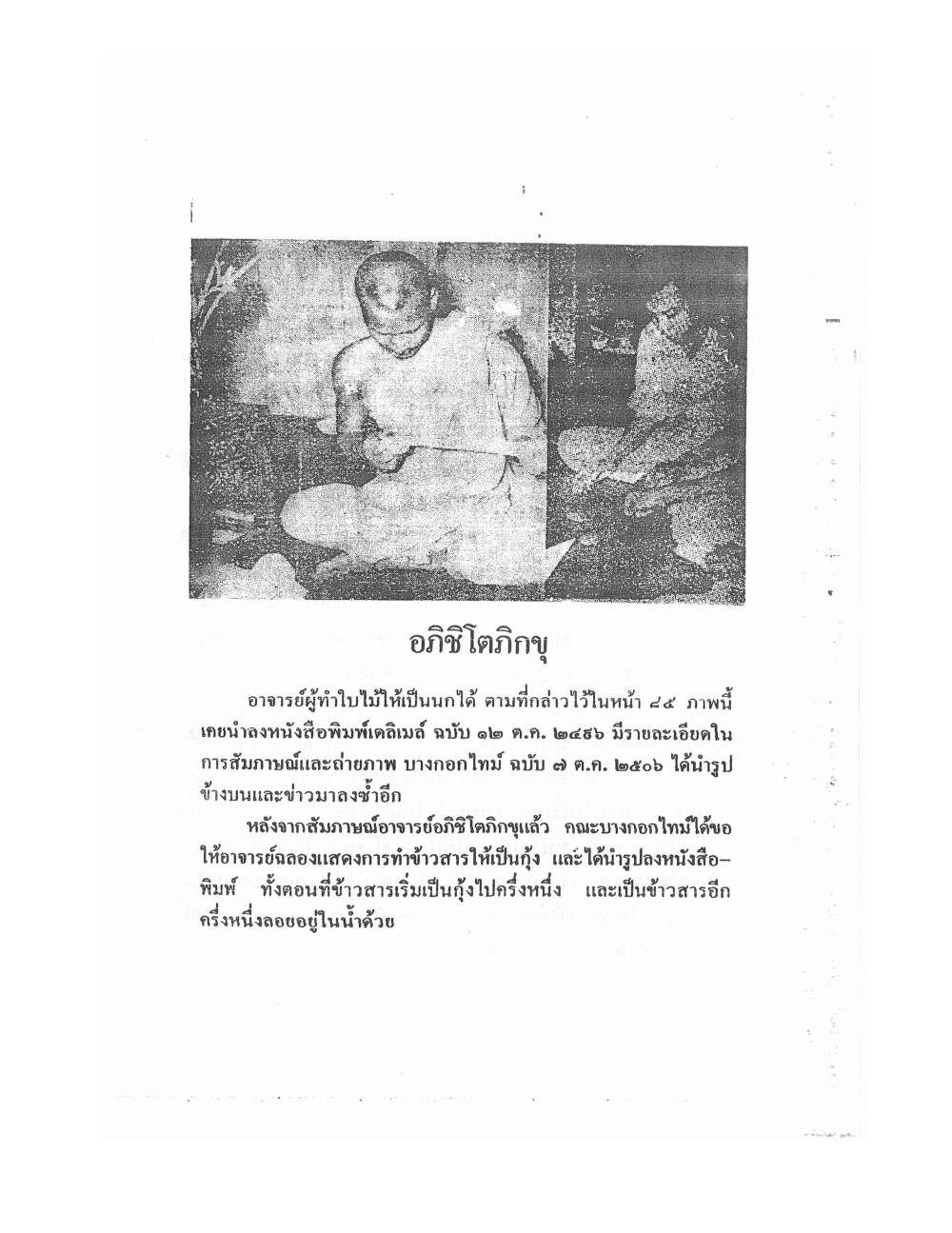
[ภาพ: ภาพถ่ายเก่าสองภาพเรียงกัน ภาพซ้ายเป็นภาพพระภิกษุนั่งขัดสมาธิ ศีรษะโล้น ห่มจีวรลงมาถึงเอว มือทั้งสองถือสิ่งของกำลังพิจารณาอยู่ ภาพขวาเป็นภาพบุคคลนั่งอยู่อีกภาพหนึ่ง เห็นไม่ชัด]
อภิชิโตภิกขุ
อาจารย์ผู้ทำใบไม้ให้เป็นนกได้ ตามที่กล่าวไว้ในหน้า ๘๕ ภาพนี้เคยนำลงหนังสือพิมพ์เดลิเมล์ ฉบับ ๑๒ ต.ค. ๒๔๘๖ มีรายละเอียดในการสัมภาษณ์และถ่ายภาพ บางกอกไทม์ ฉบับ ๗ ต.ค. ๒๕๐๖ ได้นำรูปข้างบนและข่าวมาลงซ้ำอีก
หลังจากสัมภาษณ์อาจารย์อภิชิโตภิกขุแล้ว คณะบางกอกไทม์ได้ขอให้อาจารย์ฉลองแสดงการทำข้าวสารให้เป็นกุ้ง และได้นำรูปลงหนังสือพิมพ์ ทั้งตอนที่ข้าวสารเริ่มเป็นกุ้งไปครึ่งหนึ่ง และเป็นข้าวสารอีกครึ่งหนึ่งลอยอยู่ในน้ำด้วย
[photo: two old side-by-side halftone photographs; the left photograph shows a Buddhist monk seated cross-legged, head shaved, robe draped down to the waist, both hands holding and examining something; the right photograph shows another seated figure, not clearly visible]
Abhichito Bhikkhu
The teacher who was able to turn a leaf into a bird, as mentioned on page 85. This photograph was previously published in the Daily Mail newspaper, issue of 12 October 1943 (B.E. 2486), which carried details of the interview and the photography. The Bangkok Times, issue of 7 October 1963 (B.E. 2506), reprinted the photograph above along with the news report.
After interviewing Ajahn Abhichito Bhikkhu, the Bangkok Times team asked the teacher to demonstrate turning raw rice into shrimp, and published the photographs — showing both the moment when the rice had become half shrimp, and the other half still rice, floating in the water.
ทำให้กรรมที่มีกำลังน้อยรอเวลาให้ผล คนเราจึงมักจะเข้าใจผิดกันอยู่มากว่าทำดีแล้วก็ไม่ได้ดี ทำดีไม่มีคนเห็นก็ไม่เกิดผลอะไร ความเชื่อที่ผิดอย่างนี้แหละ ที่มีกันมากและทำให้คนพยายามหาลาภยศ สรรเสริญ และสุขด้วยวิธีไม่เป็นธรรม พากันปกปิดความชั่วความผิดของตน ทั้ง ๆ ที่รู้ว่าชั่วหรือบาปก็ทำไปโดยการปิดบังให้รู้เฉพาะบางคน แล้วยังสอนหรือปราบปรามผู้อื่นที่ทำผิด มีบางรายที่กรรมยังให้ผลช้าไปจึงทำให้ผู้อื่นเข้าใจว่าทำชั่วก็ได้ผลดี หมดความเชื่อถือเรื่องกรรม ด้วยเหตุนี้แหละจึงทำให้คนประพฤติชั่วทั้งเด็กผู้ใหญ่ ขาดความเคารพต่อกฎหมาย ขาดความเคารพต่อผู้ใหญ่ บ้านเมืองจึงไม่สงบสุข และไม่เจริญก้าวหน้าเท่าที่ควรจะเป็นไปได้
ลองย้อนพิจารณาเรื่องผลกรรม หลังจากตายไปแล้วดูบ้าง เมื่อเราแน่ใจว่าวิญญาณเป็นธรรมชาติรู้ สามารถรู้เรื่องอะไรได้ตามที่ได้กล่าวมาแล้ว ฉะนั้น วิญญาณของผู้ตายจึงรู้ว่าทุกข์ รู้ว่าสุขสบาย รู้ว่าลำบากหิวโหย รู้จักคนที่ยังอยู่สถานที่เคยอยู่เคยไปได้ ด้วยเหตุนี้เองกรรมจึงตามสนองหรือติดตัวไปได้ สมกับภาษิตที่ว่า "ทำกรรมใดเล่าเหมือนเงาตามตน แม้สร้างกุศลเหมือนกันแลนา" คือจะทำชั่วหรือทำดีก็ตอบสนองได้ตลอดไป น่าจะคิดปัญหาอีกว่าตายไปแล้วก็ไม่รู้เรื่อง ไม่ใช่ตัวเราจะไปทุกข์ร้อนอะไร? ข้อนี้ก็เป็นความเข้าใจที่ผิดอีก เพราะวิญญาณ
—it causes kamma of weaker force to have to wait its turn for its result. People therefore often mistakenly believe that doing good brings no good result — that doing good unseen by anyone produces no effect at all. It is exactly this mistaken belief, widely held, that drives people to seek wealth, rank, praise, and happiness by unrighteous means. They conceal their own wrongdoing and faults; even while knowing something is wrong or sinful, they do it anyway, hiding it so that only certain people know, and then go on to teach or to suppress others who do wrong. In some cases the kamma is slow to give its result, which leads others to believe that doing evil brings good results, so that they lose all faith in the law of kamma. It is for this very reason that people, both young and old, come to behave badly, losing respect for the law and for their elders, so that the country cannot be at peace or progress as far as it should.
Let us turn now to consider the fruits of kamma after death. Since we are certain that the spirit is, by nature, a knowing thing, capable of knowing the things already described, the spirit of one who has died therefore knows suffering, knows comfort and ease, knows hardship and hunger, and recognizes people still living and places it once knew and once visited. For this very reason, kamma is able to follow after and cling to a person, in accordance with the saying: "Whatever kamma one does follows like a shadow follows the body; and so too does merit that one creates." That is, whether one does evil or good, the response follows without end. One might further wonder whether, once dead, one no longer knows anything, so that it is not truly oneself who suffers the consequences — but this too is a mistaken understanding, because the spirit
เป็นธรรมชาติรู้ ทุกคนต่างก็รักชีวิตของตนและไม่อยากตาย ความอยากมีชีวิตอยู่ของจิต และจิตเป็นพลังงานพิเศษ นี่แหละจึงมีพลังที่จะสร้างกายชั้นใน หรือเรียกว่ากายทิพย์ขึ้นได้ บางทีก็เรียกว่า "เจตภูต" จะเรียกให้ง่ายก็คือกายผีหรือกายเทวดา กายชั้นในนี้จะเป็นกายคนหรือกายผีก็ตาม ย่อมจะเป็นการรวมตัวของกลุ่มพลังงานตามหลักวิทยาศาสตร์ และกลุ่มพลังงานนี้ก็มองไม่เห็นด้วยตาเช่นเดียวกับพลังงานอื่นอีกมากมาย ในปัจจุบันนักวิทยาศาสตร์สร้างเครื่องมือวัดพลังจิตได้แล้ว และเห็นได้ชัดทั้งคนเป็นและคนตาย ดูรายละเอียดในฉบับยอดคน กายชั้นในก็เป็นสิ่งที่มองไม่เห็นด้วยตาเปล่าแต่เห็นด้วยตาในคือพลังจิตได้ คนเรารักและเสียดายชีวิต และร่างกายของตนแม้พิการก็ไม่อยากตาย เมื่อตายไปแล้วมีกายชั้นในเป็นที่อยู่อาศัย ก็ยังรู้ว่าเป็นตนอยู่ รู้จักญาติ รู้จักสถานที่ และที่สำคัญก็คือรู้จักกายชั้นในทำนองเดียวกับกายของคนธรรมดา ด้วยเหตุนี้เองจึงต้องรับกรรมที่ทำไว้ ปัญหาอาจจะมีต่อไปว่าถึงแม้จะไปมีกายใหม่ รู้ว่าเป็นตนรับกรรมต่าง ๆ ได้ไม่นานก็ไปเกิดและกลายเป็นคนอื่นไป เรื่องนี้ก็เป็นการคิดผิด ๆ ไปอีก เมื่อจิตมีกายครองรับกรรมของตนเช่นนั้นก็จะกำหนดเอาเองว่า จะตายหรือจุติจากร่างนั้นต่อไปดังนี้ก็ไม่มีเหตุผล เพราะเมื่อรู้ว่าเป็นตนอยู่ก็ย่อมรักและเสียดายไม่คิดอยากจากไปอีก และกายชั้นในดังนั้นไม่ต้องมีอาหารหล่อเลี้ยงเหมือนคน ฉะนั้น จึงสามารถมีอายุอยู่ได้นานกว่าชีวิตคน
—is, by nature, a knowing thing. Everyone loves their own life and does not wish to die; this wish of the mind to go on living — mind being a special form of energy — is precisely why it has the power to build an inner body, or what is called a divine (subtle) body. Sometimes this is called a "jetabhūta" (spirit-essence); put simply, it is a ghost-body or a deva-body. This inner body, whether it be a human-body or a ghost-body, is necessarily an aggregation of a group of energies according to scientific principle, and this group of energies, like many other forms of energy, cannot be seen with the eyes. At present, scientists have already built instruments capable of measuring mental power, and can clearly detect it in both the living and the dead — see the details in the "Yodkhon" (Top Person) periodical. The inner body is likewise a thing that cannot be seen with the naked eye but can be seen with the inner eye, that is, with mental power. People love and treasure their life and their body, and even if disabled do not wish to die; when they die and come to dwell in the inner body as their abode, they still know that it is themselves, recognize their relatives, recognize places, and — most importantly — recognize the inner body in the same way as the body of an ordinary person. For this very reason one must receive the kamma one has made. A further question might arise: even if one goes on to have a new body and knows it as oneself and receives the various kammic results, does one not soon go on to be reborn and become someone else entirely? This too is a mistaken way of thinking. When the mind possesses a body to bear its kamma in this way, it will itself determine when it dies, or passes on ("cuti"), from that body — and so this notion has no valid reason behind it, because once one knows oneself to be there, one naturally loves and treasures it and has no wish to depart again; and, being of this kind, the inner body needs no food to sustain it as a human body does. Therefore it is able to live for a lifespan far longer than that of an ordinary
ธรรมดาหลายเท่า เรามีชีวิตเป็นคนธรรมดาเพียง ๖๐ ปีบ้าง ๘๐ ปีบ้าง ก็ยังอยากมีความสุข ต้องการอย่างโน้นอย่างนี้ เมื่อไปครองกายชั้นในก็มีความรู้ความอยากเช่นเดียวกัน จะคิดเอาเองว่าตายแล้วก็แล้วไปอย่างนั้นไม่ถูก เหตุปัจจัยที่จะให้เกิด ให้จุติมีอย่างสั้น ๆ ว่า "กรรม จึงชื่อว่าเป็นไร่นา วิญญาณชื่อว่าเป็นพืช ตัณหาชื่อว่าเป็นยางเหนียวในพืช"(๓) ใจความว่า เมื่อมีเหตุปัจจัยครบทั้ง ๓ อย่างคือ มีกรรม มีวิญญาณและมีตัณหา (ความอยาก) ก็ย่อมจะต้องเวียนว่ายตายเกิดอยู่อีก
ด้วยเหตุผลตามที่กล่าวมาแล้วข้างต้น จึงขอเน้นว่าจิตเป็นตัวการสำคัญที่จะควบคุมให้คนมีความเข้มแข็ง ซื่อตรง ขยัน หมั่นเพียร มีศีลธรรมอันดี และเสียสละเพื่อตนเอง เสียสละเพื่อส่วนรวมหรือประเทศชาติ จะเป็นคอมมิวนิสต์ก็ตรงจิตนี้แหละ จะเอาชนะลัทธิคอมมิวนิสต์ก็ชนะได้ โดยการเปลี่ยนแปลงที่จิต ที่ความนึกคิด ฉะนั้น การจะสร้างความเจริญให้ก้าวหน้าแก่ตนเองก็ดี การพัฒนาประเทศให้มีความสุขสมบูรณ์ก้าวหน้าได้เร็ว ก็สำคัญที่จิตนี้เอง อำนาจจิตจึงมีบทบาทสำคัญยิ่งต่อมนุษย์และประเทศชาติ แต่ยังมีความรู้ความเข้าใจที่จะนำเอามาใช้ประโยชน์กันน้อยมาก
(๓) กรมการศาสนา, พระไตรปิฎก ฉบับภาษาไทย เล่ม ๓๑, หน้า ๓๕๘.
—human being, many times over. We live as an ordinary person for perhaps only 60 or 80 years, and even so we still wish for happiness and want this and that. When one comes to inhabit the inner body, one has the same kind of knowledge and desire. To assume that once one dies, that is simply the end of it, is therefore incorrect. The causes and conditions that bring about arising, that bring about rebirth ("cuti"), can be stated briefly thus: "Kamma is called the rice-field; consciousness is called the seed; craving is called the sticky sap within the seed" (3) — meaning that when all three conditions are present together — kamma, consciousness, and craving (desire) — one must inevitably continue to wander through the round of death and rebirth.
For the reasons given above, I wish to emphasize that mind is the crucial factor controlling whether a person is strong, honest, diligent, and persevering, possessed of good moral virtue, and willing to sacrifice for their own sake, and to sacrifice for the common good or for the nation. Even to become a communist is, precisely, a matter of this very mind; and to overcome the communist doctrine can likewise be achieved by changing the mind, changing one's thinking. Therefore, whether it is building progress and advancement for oneself, or developing the nation so that it may achieve prosperity and progress swiftly, this mind is what matters most. The power of mind therefore plays an extremely important role for both individual human beings and for the nation — yet there is still very little knowledge and understanding brought to bear in putting it to use.
(3) Department of Religious Affairs, Tipiṭaka, Thai-language edition, vol. 31, p. 358.
ยังมีเรื่องสำคัญอีกอย่างหนึ่งที่เข้าใจคลาดเคลื่อนกันอยู่มาก คือเรื่องคุณพระ หรืออำนาจคุณพระ ความจริงแล้วจะเป็นพระหรือคนธรรมดาก็มีส่วนประกอบอยู่สองอย่างเท่านั้น คือกายกับจิต ที่ให้เกิดอำนาจแปลก ๆ ขึ้นได้ก็เป็นเรื่องของจิตหรืออำนาจจิตนั้นเอง แต่ถ้าเป็นจิตที่ดีที่สะอาดประณีตก็มีกำลังหรืออำนาจสูงกว่าจิตธรรมดา คุณพระมีความเกี่ยวพันใกล้ชิดกับอำนาจจิต คือช่วยให้จิตมีสมาธิได้ง่ายและเร็วขึ้น คุณพระก็คือคุณความดีทางจิตที่เป็นเครื่องยึดเหนี่ยวกล่อมเกลาจิตของคน ให้เกิดความสงบสุข เกิดสมาธิหรือเกิดอำนาจจิตขึ้นได้ แต่ถ้าเป็นพุทธศาสนาก็ถือกันว่า คุณพระพุทธ คุณพระธรรม คุณพระสงฆ์ คุณบิดามารดา และครูอาจารย์ เป็นคุณพระทั้ง ๕ ขอยกความเห็นท่านผู้มีความรู้สูงคือ ท่านอาจารย์ พุทธทาสภิกขุ มากล่าวประกอบกันดังต่อไปนี้
"คุณพระ ตามความรู้สึกของข้าพเจ้านั้นคือ อำนาจธรรมชาติอันเร้นลับเกินกว่าที่จะเรียกว่าสิ่งศักดิ์สิทธิ์ไปเสียอีก———— คำคำนี้มีความหมายลึกและกว้างเช่นเดียวกับคำว่า "พระเจ้า" ซึ่งยากแก่การจะเอามาอธิบายด้วยคำพูดให้ถูกต้องและสมบูรณ์ คนจึงรู้จักสิ่งนี้น้อยเกินไป————ปัญหาเหลืออยู่แต่เพียงว่า ใครจะทำให้ปรากฏออกมาได้หรือไม่เท่านั้นเอง "คุณพระ" เป็นสิ่งที่มีอยู่แล้ว
There remains another important matter about which there is a great deal of confused understanding: the matter of khun phra ("the Power of Virtue"), or the power of khun phra. In truth, whether one is a monk or an ordinary person, there are only two components involved: body and mind. Whatever gives rise to unusual powers is a matter of the mind, of the power of mind itself; but if the mind is good, clean, and refined, then it has greater force or power than an ordinary mind. Khun phra is closely bound up with the power of mind — that is, it helps the mind attain concentration (samādhi) more easily and more quickly. Khun phra is itself the goodness of mind that serves to bind and to refine a person's mind, bringing about peace and calm, and giving rise to concentration or to the power of mind. In Buddhism it is held that the Virtue of the Buddha, the Virtue of the Dhamma, the Virtue of the Sangha, the virtue of one's mother and father, and of one's teachers, together make up the Five Khun Phra. Let me offer here, in support, the view of a most learned figure, the Venerable Ajahn Buddhadāsa Bhikkhu:
"Khun phra, as I understand and feel it, is a hidden natural power, even beyond what could properly be called something sacred — — — — This word carries a meaning as deep and as broad as the word 'God,' which is likewise difficult to explain fully and correctly in words. People therefore know far too little of this thing — — — — The only remaining question is: who can bring it forth into manifestation, or not. 'Khun phra' is a thing that already exists
โดยตัวเอง ในตัวเอง ไม่ต้องมีใครมาสร้าง————คุณพระเป็นสิ่งที่อาจเข้าถึงได้ ๓ ระดับคือ ด้วยการกระทำที่ดีงามเป็นชีวิตประจำวัน ด้วยกำลังจิตที่อบรมถูกวิธี และด้วยกำลังปัญญาที่เป็นไปถึงที่สุด————สำหรับข้อที่บางคนถามว่า คุณพระจะช่วยจริงหรือไม่นั้น มันขึ้นอยู่กับข้อที่ว่า เรามีคุณพระที่แท้จริงหรือไม่มี? เราทำคุณพระให้ปรากฏออกมาจากธรรมชาติอันสูงสุดนั้นได้หรือไม่? ถ้ามีจริงได้จริง ก็ช่วยได้จริง————"(๔)
ใจความสำคัญที่กล่าวข้างบนนี้ก็คือ คุณพระเป็นคุณความดีที่เกิดขึ้นด้วยการทำความดีเป็นประจำวัน หรือการอบรมจิตฝึกจิตนั่นเอง ผู้เขียนมีความเห็นว่าการฝึกใช้อำนาจจิตเป็นวิธีที่เข้าถึงคุณพระ และรู้จักคุณพระได้แจ่มแจ้ง แต่ใช้เวลาน้อย คุณพระเป็นความดี เป็นคุณธรรมทางจิต ฉะนั้น เมื่อจิตเรายึดมั่นในคุณพระหรือเชื่อไว้บ้างก็ทำให้เกิดสมาธิง่ายขึ้น เร็วขึ้น เมื่อจิตมีสมาธิก็เกิดอำนาจ เกิดพลังพิเศษขึ้น อำนาจจิตที่เกิดขึ้นโดยอาศัยคุณพระสนับสนุนนี้แหละคือ "อำนาจคุณพระ" ความนิยมของคนจำนวนมากในประเทศไทยมักจะเรียกอำนาจจิตที่
(๔) พุทธทาสอินทปัญโญ, "คุณพระ" คุณพระและการพิสูจน์คุณพระ, กองอนุศาสนาจารย์กรมยุทธศึกษาทหารบก, พระนคร ; โรงพิมพ์กรมยุทธศึกษาทหารบก, พ.ศ. ๒๕๑๑, หน้า ๑.
—in and of itself; no one needs to create it — — — — Khun phra is something that can be reached at 3 levels: through good conduct carried out in daily life; through mental power properly cultivated; and through wisdom carried through to its ultimate conclusion — — — — As for the question some people ask, whether khun phra can truly help or not, that depends on whether we truly possess genuine khun phra or not. Can we bring khun phra forth from that highest nature, or not? If it truly exists and can truly be attained, then it can truly help — — — —" (4)
The main point made above is this: khun phra is the goodness that arises from doing good deeds daily, that is, from training and cultivating the mind. The author's own view is that training in the use of mental power is the way to reach khun phra, and to come to know khun phra clearly, yet in less time. Khun phra is goodness, a virtue of the mind. Therefore, when our mind holds fast to khun phra, or places some faith in it, this makes concentration arise more easily and more quickly; and when the mind has concentration, power arises, a special force arises. This power of mind that arises with the support of khun phra is precisely "the power of khun phra." The popular custom among many people in Thailand is to call this power of mind that
(4) Buddhadāsa Indapañño, "Khun Phra": Khun Phra and the Verification of Khun Phra, Chaplaincy Division, Army Education Department, Bangkok; Army Education Department Press, B.E. 2511 [1968], p. 1.
เกิดขึ้น และทำให้สำเร็จประโยชน์ได้แปลก ๆ นั้นว่า "คุณพระ" เพราะอาศัยระลึกถึงคุณพระเป็นการเริ่มแรก ถ้าจะเรียกควบกันไปว่า อำนาจจิตอำนาจคุณพระ ก็น่าจะได้ แต่ขอให้เข้าใจไว้ว่า อำนาจคุณพระก็เป็นรูปหนึ่งของอำนาจจิต หรือพลังจิตนั่นเอง ผู้เขียนขอเสนอแนะว่าการฝึกจิต หรือยกระดับกำลังใจขึ้นนั้น วิธีอาศัยคุณพระเป็นวิธีที่ช่วยให้ได้ผลเร็วขึ้นมาก
๒. ข้อพิจารณาเกี่ยวกับการฝึกและการใช้อำนาจจิต
ยังมีผู้เข้าใจผิดพลาดอยู่อีกมากในเรื่องการฝึกจิตและการใช้อำนาจจิต อันเป็นเหตุให้ได้รับความเสียหายแก่ส่วนรวมหรือประเทศชาติเป็นอันมาก แต่ขาดการวิเคราะห์รอบคอบ จึงไม่ทราบผลเสียหายซึ่งกำลังทวีมากขึ้นทุกที จะขอยกตัวอย่างบางประการดังต่อไปนี้
ก. มีการใช้อำนาจจิต อำนาจคุณพระในการรักษาโรค ทำให้ประชาชนแตกตื่นไปดูและไปรักษากันมาก แต่ทำไม่ได้ผลจริงตามโฆษณา หรือตามที่เล่าลือกัน มีตัวอย่างมากมายในปัจจุบันและจะมีมากขึ้นต่อไปอีก ถ้าไม่มีการแก้ไข เฉพาะระหว่าง พ.ศ. ๒๕๐๐ ถึง ๒๕๑๐ ก็มีตัวอย่างครั้งสำคัญหลายครั้ง เช่น การรักษาคนตาบอดให้มองเห็นได้ที่วัดเกาะ พระนคร การรักษาโรคต่าง ๆ โดยกินน้ำพุที่ทำขึ้นจากคนเข้าทรงที่เขตราชบุรี ปลายเดือน ม.ค. ๒๕๐๐ การรักษาโรคโดยอาศัยอำนาจพระเจ้าจูงใจ
—arises and brings about unusual success "khun phra," because it relies on first calling khun phra to mind. If one wished to call it by both names together — "power of mind, power of khun phra" — that would also be acceptable; but let it be understood that the power of khun phra is itself one form of the power of mind, or mental power. The author would suggest that, in training the mind, or in raising the level of one's inner strength, relying on khun phra is a method that helps one achieve results much more quickly.
2. Considerations concerning the training and use of mental power
There remain many people who hold mistaken and erroneous views on the subject of training the mind and using mental power, which has caused a great deal of harm to the public and to the nation; yet, for lack of careful analysis, the resulting harm — which keeps increasing all the time — goes unrecognized. Let me offer some examples, as follows:
a. There has been use of mental power, of the power of khun phra, in the treatment of illness, causing the public to rush in great excitement to watch and to seek treatment; but it does not actually work as advertised or as rumored. There are many such examples at present, and there will be more to come if nothing is done to correct this. Between B.E. 2500 and 2510 [1957–1967] alone there were several notable instances, such as: the treatment that supposedly restored sight to the blind at Wat Ko, in the capital; the treatment of various diseases by drinking spring water produced by a medium in Ratchaburi province, at the end of January B.E. 2500 [1957]; treatment relying on the power of God to persuade
ให้เชื่อมั่นในพระเจ้าแล้วโรคจะหาย ในพระนครการรักษาคนหูหนวกให้หาย ที่วัดใจกลางพระนครการรักษาโรคต่าง ๆ ด้วยการขอน้ำในสระโกสินารา ส่วนในรายอื่น ๆ ในพระนครและต่างจังหวัดก็ยังมีอีกมาก และมีขึ้นเรื่อย ๆ ที่สำคัญก็คือการอาศัยการโฆษณาหลายแบบ เช่น นำเอารูปผู้ใหญ่ ชั้นรัฐมนตรีที่เข้าไปหาลงหนังสือพิมพ์ ให้มีการเล่าลือกันทั้งทางรถไฟ รถยนต์และเรือ ยกตัวอย่างผู้ที่หายโรคทันตาเห็น มีการใช้คนพวกเดียวกันเข้ามารักษาและหายได้เร็ว เอาตัวคนที่ว่ารักษาหายมาแสดงตัวหน้าประชาชน มีบุคคลสำคัญด้านตำรวจ ทหารและพลเรือน หรือพระเป็นกรรมการเก็บเงินบำรุง และเงินค่ายาที่ปลุกเสก มีหนังสือพิมพ์และวิทยุเป็นเครื่องกระจายข่าว ฉะนั้น แต่ละรายที่ยกตัวอย่างข้างต้น จึงมีประชาชนทั้งในพระนคร และต่างจังหวัดใกล้ ๆ เดินทางมาดูและมารักษากันมากมาย บางรายก็ดำเนินการอยู่ได้ถึงสองสามเดือน เพราะประชาชนไปหามาก ต้องแย่งกันเข้าไป บางรายยังไม่หายก็นัดวันมารักษาซ้ำอีก ครั้นส่วนมากรักษาไม่ได้ผล หาวิธีปกปิดไม่ไหวแล้วก็เลิกรักษา หาโอกาสต่อไปอีก ผู้เดือดร้อนหลายหมื่นคนที่พากันไข้มารักษาแล้วไม่ได้ผล หรือมาตอนเขาเลิกกันแล้ว ผลที่เลวร้ายก็คือ ทำให้ประชาชนจำนวนมากมายขาดความเลื่อมใสทางศาสนา หันเหไปเห็นจริงตามที่ฝ่ายคอมมิวนิสต์โฆษณาว่า ศาสนาเป็นเครื่องหลอกลวงคนโง่ ทั้งพยายามยกตัวอย่างเรื่องราวต่าง ๆ ในปัจจุบัน
—people to believe firmly in God so that their illness would be cured; in the capital, the curing of deafness at a temple in the middle of the capital; the curing of various illnesses by asking for water from the Kusinārā pool. There are still many other such cases, both in the capital and in the provinces, and new ones keep arising continually. What matters most is the reliance on advertising of various kinds — for instance, bringing in photographs of important people, cabinet-minister rank, who had gone to seek treatment, to publish in the newspapers; spreading word of mouth by train, by car, and by boat; citing examples of people cured before one's very eyes; using people from the same group to come and be treated and recover quickly; bringing forward the very people said to have been cured to display themselves before the public; having important figures from the police, the military, and civilians, or monks, serve as committee members collecting maintenance funds and fees for consecrated medicine; using newspapers and radio to spread the news. And so, in each of the cases cited above, there came to be people both from the capital and from nearby provinces traveling to watch and to seek treatment in great numbers; some cases carried on for as long as two or three months, because so many people came that they had to compete to get in; in cases where people were not cured, another visit would be arranged for further treatment. Eventually, when most treatments failed and there was no longer any way to conceal this, the practice would be abandoned, and a new opportunity sought elsewhere. The many tens of thousands of suffering people who went along to be treated and got no result, or who arrived only after the practice had already ended, suffered the worst consequence: causing large numbers of the public to lose faith in religion, and to be led to believe, just as Communist propaganda claimed, that religion is a tool for deceiving fools — while also trying to cite various examples of current events
สนับสนุนด้วย
ข. ผู้ที่มีความรู้ดี ผู้มีอำนาจหน้าที่สำคัญจำนวนมากไม่เชื่อ อำนาจจิตอำนาจคุณพระ แม้แต่ขีดความสามารถของอำนาจจิต ขั้นต้นที่กล่าวมาแล้วในบทที่ ๑ ก็ไม่เชื่อว่าจะเป็นไปได้ จึงมัก จะแสดงความคิดเห็นไปในทางคัดค้าน ทำให้ผู้มีความรู้น้อยกว่า และผู้ที่เคยเคารพยำเกรงอยู่มากพลอยเห็นผิดตามไปด้วย ผู้ที่มี อำนาจจิตดีกว่าผู้เขียนหลายท่านนั้น เมื่อได้แสดงผลทางอำนาจ จิต อำนาจคุณพระให้ที่ประชุมดู กลับถูกวิจารณ์ไปว่า เป็นการ เล่นกลหรือมีการปกปิดให้เข้าใจผิดไป ไม่ใช่ทำได้จริง
ค. ผู้ที่มีความเลื่อมใสในศาสนาเชื่อเรื่องอำนาจจิตอำนาจ คุณพระ ได้พยายามฝึกจิตค้นหาความรู้ และใช้อำนาจจิตด้วย วิธีต่าง ๆ แต่ทำไม่ได้ผลดี เพราะขาดหลักวิชาที่ถูกต้อง ขาดครู ที่มีความสามารถดี จึงทำได้ผลบ้าง ไม่ได้ผลบ้าง ทำให้ลดความ เชื่อถือที่มั่นคง ทั้งผู้ใช้อำนาจจิตและผู้รู้เห็น การแพร่ข่าวความ ล้มเหลวในการใช้อำนาจจิต อำนาจคุณพระ เช่น ข่าวของผู้ที่ เคยทดลองฟันไม่เข้า เมื่อมาแสดงให้ที่ประชุมดูก็ฟันเข้า ผู้ที่ อ้างว่ามีพระดีเอาแขวนคอเป็ดไก่ ทดลองยิงก็ไม่อาจคุ้มครอง อันตรายได้จริง การทดลองรักษาโรคกับทดลองอย่างอื่น ๆ ได้ ผลบ้าง ไม่ได้ผลบ้าง ไม่มีการชี้แจงให้เข้าใจเป็นหลักวิชาที่ถูกต้อง ว่าเป็นเพราะอะไร เมื่อคนส่วนมากได้รู้หรือเห็นการทดลองที่ ล้มเหลวทั้งทางวิทยุ ทางหนังสือพิมพ์ และทางโทรทัศน์ เป็น
...to support it as well.
B. Many people of good knowledge, people holding important positions of authority, do not believe in mental power, the power of merit (of sacred objects). Even the basic limits of mental power's capability described earlier in Chapter 1, they do not believe are possible. So they tend to express opinions in an opposing direction, causing people with less knowledge, and those who used to hold them in great respect and awe, to be led into the same mistaken view. Those who possess better mental power than the many authors [who wrote against it] — when they demonstrated the results of mental power, the power of merit, before an assembly, were instead criticized as having performed a trick, or having concealed something to create a false impression — not something really achieved.
C. Those who have faith in religion and believe in mental power, the power of merit, have tried to train their minds to seek knowledge and to use mental power by various methods, but did not get good results, because they lacked the correct body of doctrine, lacked a capable teacher; so they succeeded sometimes and failed sometimes, which reduced firm confidence, both among those who used mental power and those who witnessed it. The spreading of news of failures in using mental power and the power of merit — for example, news of someone who had previously tested a blade cutting him and it did not penetrate, but when demonstrating before an assembly the blade did penetrate; of someone who claimed to have a good sacred amulet who hung it round the neck of a duck or chicken and tested shooting it, yet it could not actually protect against harm; trials of curing disease and other trials succeeded sometimes and failed sometimes, with no correct technical explanation given as to why. When most people came to know of or witness these failed trials, whether by radio, by newspapers, or by television, this became...
การยืนยันหลายครั้ง ก็ย่อมมีจิตใจโน้มเอียงไปว่า เป็นเรื่องทำ ไม่ได้จริง เป็นผลกระทบกระเทือนไปถึงศาสนาที่มีเรื่องแปลก ๆ นั้นด้วย ที่จริงมีกฎเกณฑ์ที่แน่นอนเป็นวิทยาศาสตร์ แต่การเผย แพร่ที่ถูกต้องสมบูรณ์ยังไม่ได้จัดทำขึ้น
ลองใช้ความพิจารณาวิเคราะห์ให้ลึกซึ้งลงไปอีกว่า เมื่อ ๔๐ ปีก่อนฝ่ายคอมมิวนิสต์ได้แผ่อำนาจไปได้เพียงเล็กน้อย แต่ ขณะนี้แผ่ขยายไปหลายสิบเท่า ทั้งนี้ฝ่ายโลกเสรีมีกำลังพล น้อยกว่าหรือ? ทางฝ่ายโลกเสรีมีอาวุธยุทโธปกรณ์ด้อยกว่าหรือ? เปล่าเลยทางฝ่ายโลกเสรีมีกำลังพลสูงกว่า และมีอาวุธยุทโธป– กรณ์มากกว่าทั้งในด้านปริมาณ และคุณภาพ ถ้าเช่นนั้นเหตุใด คอมมิวนิสต์จึงแผ่ขยายได้มากมายในห้วงระยะ ๔๐ ปี? ซึ่งสาเหตุ สำคัญก็คงเหลืออีกเพียงอย่างเดียวคือ ฝ่ายคอมมิวนิสต์มีความ สามารถในการปฏิบัติการทางจิตวิทยาได้ดีกว่า ทั้ง ๆ ที่เขานำ สิ่งที่ไม่เป็นความจริงมาใช้โฆษณาปะปนอยู่มาก ผู้ก่อการร้าย และกองโจรปฏิบัติการโดยไม่ลดละ ทั้ง ๆ ที่ต้องลำบากตรากตรำ อดอยากอยู่ในป่าเขา และอยู่ในบริเวณที่กันดารเป็นเวลายาวนาน กำลังน้อยกว่าและอาวุธด้อยกว่าฝ่ายโลกเสรี แต่ไม่ยอมท้อถอย ย่อมแสดงถึงการดำเนินการทางด้านจิตใจกระทำได้ผลดี ซึ่งจาก ข่าวสารของทางราชการและอาจารย์ทางจิตได้พบเห็นพวก เวียตกง ซึ่งเป็นฝ่ายคอมมิวนิสต์ในประเทศญวน มีความเข้มแข็ง ด้านจิตใจมาก จำนวนคนและอาวุธด้อยกว่ามากกับการกินอยู่
...repeated confirmations, minds naturally tend to lean toward believing it truly cannot be done, and this has a damaging effect reaching even to religion, which itself contains such strange matters. In truth there are fixed rules that are scientific, but correct and complete dissemination of them has not yet been carried out.
Let us try a deeper, more careful analysis: 40 years ago the communist side had spread its power only a little, but now it has expanded many tens of times over. Is this because the free world side has fewer troops? Does the free world side have inferior weapons and military equipment? Not at all — the free world side has more troops, and more weapons and military equipment, both in quantity and quality. If so, why then has communism been able to spread so extensively over the span of 40 years? The one remaining significant cause is likely just this: the communist side has been better able to carry out psychological operations, even though much of what they use in their propaganda is untrue. Terrorists and guerrilla forces operate relentlessly, even though they must endure hardship and hunger living in forests and mountains, remaining in barren areas for long periods, with fewer troops and inferior weapons than the free world side, yet refusing to give up — this shows that their conduct on the mental side has been effective. From reports by government agencies and mind-teachers, it has been observed that the Viet Cong, the communist side in Vietnam, have very strong mental fortitude; their numbers of people and their weapons are far inferior, along with their living conditions...
อดอยาก มีข้าวเป็นอาหารจำเป็น ส่วนกับข้าวก็อาศัยเกลือเป็น หลัก มีหลายหน่วยที่ต้องกินข้าวต้มกับเกลือ นาน ๆ จึงจะมีของ เค็มหรือของสดกิน แต่ส่วนมากเต็มใจอดทนได้ ลองแอบให้ อาหารดีไปกิน กลับได้รับคำตอบว่า เพื่อนและนายของเขาอีก หลายคน และโฮจิมินห์ก็กินอดอยากอย่างนี้ เขาเองจึงไม่ต้องการ อาหารพิเศษไปกว่าผู้อื่น ควรวิเคราะห์ออกเป็นบทเรียนว่า ตัว– อย่างเป็นสิ่งสำคัญมากในการสร้างสรรค์นิสัยคน และตัวอย่าง ที่ดีของหัวหน้าชั้นสูงซึ่งใช้อำนาจจิตข่มให้อดทนรักษาสัจจะ ที่จะทำหรือประพฤติสิ่งที่ดีได้เป็นประจำ ในระยะยาวนาน ย่อม ดึงดูดให้คนส่วนมากเอาอย่าง และคนส่วนมากเอาอย่างในทาง ที่ดีเป็นปัจจัยเครื่องบังคับจิตใจให้คนส่วนรวมเอาอย่างในทาง ที่ดีด้วย จะมีวิธีการสร้างขวัญและกำลังใจในทางดีนี้อย่างไร? จะได้กล่าวในบทต่อไป
ความเจริญรุดหน้าทางด้านวัตถุ ทำให้คนชั้นปัญญาชน จำนวนมากที่มีตำแหน่งหน้าที่สำคัญ ขาดความเชื่อถือทางศาสนา อย่างจริงใจ เรื่องนี้จะเห็นได้ชัดจากการแสดงออกมาหรือการ บรรยายในที่ประชุมชน บรรยายทางวิทยุและโทรทัศน์ ตลอดจน การเขียนเอกสารต่าง ๆ สิ่งที่ทำได้จริงในขอบเขตของจิต ที่ ปรากฏในศาสนาก็ไม่เชื่อถือว่าทำได้จริง ยิ่งกว่านั้นยังใช้ปัญญา ด้านอื่นมาอธิบายเปรียบเทียบให้ผิดเพี้ยน หรือขัดแย้งกับหลักฐาน
...hunger, with rice as the necessary food; as for side dishes they mainly rely on salt. There are many units that must eat rice porridge with salt, and only after a long time would they get something salty or fresh to eat. But most were willing to endure it. When [the interviewer] secretly tried giving them good food to eat, the reply received was that their friends and their commanders — many others — and Ho Chi Minh himself also ate under such privation; so they themselves did not want special food beyond what others had. This should be drawn out as a lesson: that example is a very important thing in shaping people's character, and the good example set by a high-level leader who uses mental power to compel himself to endure and keep faithfully to doing or behaving well as a regular practice, over a long period of time, will naturally draw the majority of people to imitate it; and when the majority imitate good conduct, this becomes a factor that constrains the mind of the community as a whole toward imitating good conduct as well. What method could be used to build morale and spirit in this good direction? This will be discussed in the next chapter.
Advancement in material progress has caused a great many intellectuals holding important positions to lack sincere religious belief. This can be clearly seen from what they express, or in lectures given before public assemblies, lectures on radio and television, as well as in the writing of various documents. Things that can truly be achieved within the domain of the mind, as they appear in religion, are not believed to be truly achievable. Furthermore, they use other kinds of intellect to explain and compare things in a distorted way, or in contradiction with the evidence...
ในศาสนาหลายประการ เช่น ตอนพระพุทธเจ้าเกิดในประวัติว่า เดินได้ ๗ ก้าว และพูดได้ ท่านผู้รู้อธิบายว่าเป็นการเปรียบเทียบ ไม่ใช่จริง คือเปรียบกับพระพุทธเจ้าเผยแพร่ศาสนาไปได้ ๗ เมือง ใหญ่ ในพระไตรปิฏกว่า ในวันตรัสรู้มีมารมาผจญ พระพุทธเจ้า เอาชนะได้ด้วยวิธีอดทนนิ่งอยู่พวกมารจึงพ่ายแพ้ไป ผู้รู้สมัยใหม่ อธิบายว่า จะมียักษ์มีมารที่ไหนกัน? เป็นเพียงการเปรียบเทียบ กับจิตใจที่ท้อถอยอยากจะเลิกบำเพ็ญเพียรกลับไปอยู่ในพระ ราชวังตามเดิม นั่นแหละคือมาร ฟังดูก็น่าเชื่อและหลงเชื่อกัน ไปมากมายแล้ว ทั้งนี้ก็เป็นด้วยรู้ไม่ตลอด ในพระไตรปิฎกท่าน ให้ความหมายไว้แน่นอนว่า ยักษ์ มาร หรือผี คืออะไร จะให้ เห็นด้วยตาเหมือนยักษ์วัดแจ้งก็ไม่ตรงกับศาสนา วิเคราะห์โดย รอบคอบแล้วจะเห็นได้ว่า การพยายามเปรียบเทียบให้เกิดความ ขัดแย้งแตกต่างออกไปนั้น มีผลเสียหายอย่างใหญ่หลวง เพราะ ทำให้คนเข้าใจไปว่า คำสอนในพระพุทธศาสนานี้ไม่ได้กล่าวไว้ ตามความจริง ต้องตีปัญหาเอาใหม่จึงจะได้รู้ความจริง เลยกลาย เป็นการสนับสนุนฝ่ายคอมมิวนิสต์ดังกล่าวมาแล้ว และยังเป็น การทำให้ศาสนาเสื่อมเข้าอยู่ในหัวข้อที่ทำให้ศาสนาเสื่อม คือ ไม่ศึกษาโดยเคารพ ไม่พิจารณาเนื้อความโดยเคารพ การแปลความ ให้คลาดเคลื่อนไปเช่นนั้น ทำไปตามความคิดเห็นของตนอันมี ความไม่เชื่อถือ ความไม่เคารพ ไม่รอบคอบเป็นมูลเหตุ ไม่มี เหตุผลและหลักฐานยืนยัน ซึ่งเมื่อเอาเรื่องอื่นที่แปลกพิสดาร
...in religion, in several respects. For instance, regarding the account in the Buddha's biography that when he was born he walked seven steps and spoke — learned scholars explain that this is a comparison, not literally true; that is, it is compared to the Buddha's spreading of the religion to seven great cities. In the Tipitaka it says that on the night of Enlightenment Mara came to assail him, and the Buddha overcame him by the method of enduring stillness, whereupon Mara's host was defeated. Modern scholars explain: where would there really be a yaksha or a Mara? It is merely a comparison to the discouraged mind that wanted to give up striving and return to living in the royal palace as before; that itself is Mara. This sounds convincing, and many have come to believe it and been misled by it. This is because their knowledge is incomplete. In the Tipitaka the meaning is stated with certainty as to what a yaksha, Mara, or ghost actually is; to make it something seen with the eyes like the yaksha [guardian statue] at Wat Chaeng would not accord with the religion. On careful analysis it will be seen that attempts at comparison that create contradiction and difference like this have enormously harmful effects, because they make people believe that the teachings of Buddhism were not stated truthfully, that the matter must be reasoned out anew in order to know the truth — and this then becomes, as already mentioned, a support for the communist side, and it also causes religion to decline, falling under the very heading of what causes religion to decline: namely, not studying with respect, not considering the content with respect. Translating the meaning to be so mistaken, proceeding according to one's own opinion rooted in disbelief, disrespect, and carelessness, without reason or evidence to confirm it — so that when other matters that are strange and extraordinary...
หลายอย่างในศาสนามาตีความ ก็จะหาทางเปรียบเทียบไม่ได้ โดยตลอด แต่ถ้ามีความศรัทธาเชื่อถือว่า คำสอนในศาสนาเป็น ความจริงแล้วไต่สวนค้นคว้าให้ทั่วถึง ก็จะพบว่า มีเหตุผลสอด คล้องต้องกันว่าเป็นจริงตามคำสอน ตัวอย่างง่าย ๆ ก็คือ หลักฐาน ในศาสนามียืนยันเรื่องจิตเรื่องวิญญาณว่ามีจริง เป็นกำลังงาน พิเศษเป็นธรรมชาติรู้ ไม่ตายไปพร้อมกับกาย วิญญาณที่ยังอยู่ จำแนกตามกรรม ตามการเสวยอารมณ์ เป็นผี เป็นเทวดา เป็นยักษ์ เป็นมาร เป็นเปรต เป็นพรหม ฯลฯ และมีความสัมพันธ์กับ คนได้ในบางโอกาส มีวิธีพิสูจน์ทดลองได้
นอกจากจะพูดขัดแย้งอำนาจจิต อำนาจคุณพระ ยังหาว่า คนที่เชื่อเป็นพวกงมงาย ยิ่งไปกว่านั้นยังขัดแย้งและเสียดสีด้วย การเขียนลงหนังสือ พูดทางวิทยุและโทรทัศน์ บางคนยังไม่ถึงใจ ยังติดป้ายไว้ว่า "อย่าเชื่อน้ำมนตร์ อย่าเชื่อยาหม้อ" ผู้เขียนเก็บ หลักฐานเหล่านี้ไว้ดูหลายอย่าง ไม่อยากจะเอ่ยชื่อจะเป็นการเสีย มารยาท ขอแปลกใจที่เขาทำให้คนพลอยหลงเชื่อเพื่อรักษาผล ประโยชน์ตนได้สำเร็จโดยขาดความแนบเนียนเหมือนฝรั่ง? ฝรั่ง ที่เขาเจริญทางวัตถุมาก ๆ เขาก็ต้องอาศัยอำนาจจิต อำนาจสมาธิ เขาจึงเจริญได้เร็ว ตรงตามคำของหลวงวิจิตรในหนังสือมหัศจรรย์ ทางจิต ที่ว่าประเทศที่เจริญก้าวหน้าทางวิทยาการมากเขายิ่ง ค้นคว้าเรื่องความมหัศจรรย์ทางจิตมากขึ้น ซึ่งควรจะเติมต่อไป
...are used to interpret many matters in religion, comparisons cannot be found for everything. But if one has faith that the teachings of religion are true, and then investigates and researches thoroughly, one will find reasoning that is consistent and coherent, confirming that things are true according to the teaching. A simple example is this: the evidence in religion confirms that mind and consciousness truly exist, as a special energy, a natural knowing quality, that does not die together with the body. The consciousness that remains is differentiated according to karma and according to the experiencing of feeling — becoming a ghost, a deva, a yaksha, a Mara, a preta, a Brahma, etc., and it can have relations with people on certain occasions; there are methods by which this can be proven and tested.
Beyond merely speaking against mental power and the power of merit, they also accuse believers of being superstitious. Even further, they contradict and mock it by writing in books, and speaking on radio and television; some, not satisfied with that, even post signs saying "Do not believe in holy water, do not believe in herbal medicine." The writer has kept many such pieces of evidence to look at; he does not wish to name names, as that would be discourteous. He finds it strange that they cause people to be misled in order to succeed in preserving their own interests, doing so without the subtlety that Westerners use? Westerners, who have advanced very greatly in material things, must also rely on mental power, the power of concentration — that is why they can advance so quickly, exactly in accordance with what Luang Wichit says in the book 'The Miracle of the Mind,' that the more a country advances in science, the more it researches into the miraculous power of the mind, which should be further explained...
ว่า ค้นคว้าแล้วเขายังใช้ให้เกิดประโยชน์แก่บุคคลหรือประเทศ ชาติด้วย นอกจากอังกฤษ เยอรมัน จะแปลพระไตรปิฎกเสร็จก่อน ไทย และชาวยุโรปอเมริกามาค้นคว้าเรื่องจิต ค้นคว้าการรักษา โรคแผนโบราณ และยาในไทย อินเดีย จีน และธิเบต ลงมือ ศึกษาจริงจังหลายปีจนเขียนตำราต่าง ๆ ไว้มากแล้ว เขายังมี การวิจัยอำนาจจิต และนำไปใช้อย่างจริงจัง แต่บางอย่างปกปิด ไม่เปิดเผย เวลานี้ฝรั่งเริ่มหลั่งไหลมาศึกษาในประเทศไทยที่มา บวชก็มาก เขาปรารถนาทำได้มากกว่าการเรียนรู้ ศิษย์ชาวอเมริกา ของผู้เขียนเขาบอกว่า เขาเรียนรู้มามาก อยากจะเรียนปฏิบัติ คือทำให้ได้เองมากกว่า ปัจจุบันนี้ฝรั่งไปศึกษาในต่างจังหวัด กันมาก รู้ว่าอาจารย์ที่ไหนดีจะไกลเท่าใดก็ไป ในปี ๒๕๑๑ ผู้ เขียนไปเยี่ยมท่านอาจารย์พุทธทาส ที่ไชยา จังหวัดสุราษฏร์ ก็พบฝรั่งทั้งหญิงและชายไปศึกษาอยู่กับท่าน ที่วัดอัมพวัน อำเภอ พรหมบุรี จังหวัดสิงห์บุรี ก็มีฝรั่งไปศึกษา ที่ไปบวชเรียนอยู่ด้วยก็มี ยังอีกหลายวัดที่ฝรั่งไปศึกษาชั่วคราวบ้าง บวชอยู่บ้าง เขาเริ่ม จะหาทางเข้าไปหาอาจารย์ในป่าลึก ๆ อีก ฝรั่งที่มาค้นคว้าส่วน มากมีความรู้สูงเป็นขั้นปริญญากันหลายคน
ที่ว่าฝรั่งเขาทำแนบเนียนคือ เรื่องการนำเอาอำนาจจิตไปใช้ ในสาขาวิชาต่าง ๆ เขาไม่เปิดเผย วิชาการต่าง ๆ ที่ต่างชาติ ไปเรียนเขาจะยกเว้นไม่ให้เรียนไว้หลายอย่าง เรื่องสำคัญที่ไม่
...that after researching it they still put it to use for the benefit of individuals or the nation. Besides England and Germany completing translation of the Tipitaka before Thailand did, Europeans and Americans have come to research matters of the mind, to research traditional medicine and treatment in Thailand, India, China, and Tibet, undertaking serious study for many years until they have already written many textbooks on the subject. They also carry out research into mental power and apply it seriously, though some aspects are kept concealed and undisclosed. At this time, Westerners are beginning to flow in to study in Thailand; many even come to be ordained. They wish to accomplish more than merely learning. An American student of the writer's said that he had already learned a great deal, and wanted instead to learn practice — that is, to be able to actually achieve it himself more than [just know about it]. At present, Westerners go to study in the provinces a great deal; wherever they know a teacher is good, however far it is, they go there. In the year 2511 [1968], the writer went to visit Venerable Ajarn Buddhadasa at Chaiya, Surat Thani Province, and found Westerners, both women and men, studying there with him. At Wat Amphawan, Phrom Buri District, Sing Buri Province, there were also Westerners studying; some were even ordained and studying there as well. There are still many more temples where Westerners go to study temporarily, or stay ordained. They are beginning to seek their way in to find teachers deep in the forest as well. Most of the Westerners who come to do research have a high level of education, many of them holding degrees.
As for the fact that Westerners do things subtly — it concerns the matter of applying mental power in various fields of study; they do not disclose it. Various branches of knowledge that foreigners go to study, they will exclude and withhold from teaching in many respects. The important matter that is not...
ได้เรียนนี้มีการวิจัยเกี่ยวกับจิต และการนำไปใช้รวมอยู่ด้วย ซึ่งเป็นความจริงที่แน่นอนเหลือเกินว่า ที่เยอรมัน รัสเซีย และ อเมริกามีการใช้อำนาจจิตประกอบกับวิชาการสมัยใหม่ ข่าย การรับส่งทางกระแสจิตและสิ่งบอกเหตุอย่างอื่น ได้ยืนยันกัน ว่ามีผู้ได้สมาธิขั้นสูงอยู่ในประเทศเหล่านั้น และยังมีในประเทศ อื่น ๆ อีก
สรุปความว่าบางประเทศรวมทั้งประเทศเรา มีผู้ที่ได้สมาธิ ขั้นต้นถึงขั้นสูง และใช้ประโยชน์ได้ดีจำนวนมาก แต่คนส่วน มากยังมองข้ามไปไม่สนับสนุน หรือส่งเสริมให้เกิดประโยชน์ แพร่หลาย แต่ตรงกันข้ามท่านผู้ศึกษาทางวัตถุมามาก อาศัย ความรู้ด้านเดียวของตนขัดแย้งกีดกันดังกล่าวมาแล้ว จึงทำให้ คนส่วนใหญ่เกิดความลังเลใจ ไม่เชื่อเรื่องอำนาจจิต อำนาจคุณ พระ ไม่เชื่อว่าคนทั่ว ๆ ไปจะฝึกใช้อำนาจจิต อำนาจคุณพระ เพื่อให้เกิดประโยชน์ได้ในระยะเวลาสั้น ๆ เรื่องนี้ก็เป็นเหตุ สำคัญให้คนลังเลใจไม่เชื่อทางศาสนาเป็นช่องทางให้คอมมิวนิสต์ แทรกแซงได้ง่าย ยิ่งกว่านั้นยังเป็นเหตุปัจจัยให้ประเทศชาติ เจริญก้าวหน้าได้ช้า บางประเทศถึงกับเกิดยุคเข็ญเดือดร้อนกันทั้ง ประเทศเป็นเวลาหลายปี ซึ่งผู้เขียนจะได้เสนอแนะเหตุผลพร้อม ด้วยวิธีแก้ไขในบทต่อไป ขอเน้นว่าในประวัติศาสตร์และผลที่ ปรากฏในปัจจุบันมีตัวอย่างมากมายที่ชี้ให้เห็นชัดว่า ในสมัยใด
...taught includes research related to the mind, together with its application. It is a fact that is extremely certain: that in Germany, Russia, and America mental power is used in combination with modern science; networks for transmitting and receiving psychic currents and other such signalling phenomena have been confirmed by them; and it is affirmed that there are people who have attained a high level of concentration in those countries, and there are still more in other countries besides.
In summary, some countries, including our own, have many people who have attained samadhi from the elementary to the advanced level and who make good use of it. But most people still overlook this and do not support it, or promote it so its benefit may spread widely. On the contrary, those who have studied mainly on the material side, relying on their own one-sided knowledge, contradict and obstruct it as already described, thereby causing the majority of people to become hesitant, disbelieving in mental power and the power of merit, not believing that ordinary people in general could train to use mental power and the power of merit so as to gain benefit within a short period of time. This matter is also an important cause of people's hesitation and disbelief toward religion, which becomes an opening through which communism can easily infiltrate. Furthermore, it is also a contributing cause of the nation's slow progress; some countries have even fallen into a whole era of hardship and suffering for the entire country lasting many years — for which the writer will propose reasons together with methods of remedy in the next chapter. It should be emphasized that in history, and in results appearing at present, there are many examples that clearly show that in whichever era...
ประเทศชาติสนใจในทางเรื่องจิต และนำอำนาจจิตมาใช้ให้เกิด ประโยชน์ สมัยนั้นประเทศชาติก็จะเจริญก้าวหน้าได้เร็ว แต่ สมัยใดที่ประเทศชาติหลงละเมอเพลินด้านวัตถุมาก ไม่เอาใจใส่ เรื่องศาสนาเรื่องจิต ขาดความสนใจเรื่องการฝึกจิต การแก้ไข ควบคุมจิต สมัยนั้นก็จะเจริญก้าวหน้าได้ยากโดยเฉพาะอย่างยิ่ง ชนชั้นหัวหน้าหน่วยงานระดับต่าง ๆ เป็นปัจจัยสำคัญยิ่ง ดู ตัวอย่างได้จากจีน อินเดีย เยอรมัน อเมริกา รัสเซีย พม่า และ ประเทศอื่น ๆ แต่ละสมัยจึงจะเข้าใจได้ดีถ้ามีความรอบคอบพอ
หลักในการเชื่อก่อนจะเชื่ออะไรนั้นควรอาศัยหลักที่นัก วิทยาศาสตร์ทั้งหลายได้ยอมรับนับถือทั่วไปนั่นเอง ซึ่งเป็นหลัก ที่พระพุทธเจ้าทรงบัญญัติไว้เรียกว่า "กาลามสูตร" ทรงวางไว้ เป็นแนวทาง ๑๐ ประการ ความว่าก่อนที่จะตกลงปลงใจยึดมั่น ในความจริง หรือก่อนเชื่อสิ่งใดก็จะต้องถือหลักไว้ในใจดังนี้คือ
๑. อย่าได้ถือโดยฟังตามกันมา (ฟังเขามายังเชื่อไม่ได้) ๒. อย่าได้ถือโดยลำดับสืบกันมา (คนก่อน ๆ พูดหรือ ทำต่อ ๆ กันมา ก็ยังไม่ควรเชื่อว่าถูกกว่าจริง) ๓. อย่าได้ถือโดยความตื่นเต้นว่าได้ยินว่าอย่างนั้น (เข้า ทำนองกระต่ายตื่นตูม) ๔. อย่าได้ถือโดยการอ้างตำรา (มีในตำราก็ยังเชื่อไม่ได้ ว่าถูกว่าจริง)
...the nation was interested in matters of the mind and applied mental power to produce benefit, in that era the nation would advance rapidly. But in whichever era the nation became infatuated and lost in the enjoyment of material things, not attending to matters of religion and mind, lacking interest in training the mind, in correcting and controlling the mind, in that era progress would be difficult — this is especially true and an extremely important factor among the leading class of various levels of organizations. One can see examples from China, India, Germany, America, Russia, Burma, and other countries; each era can be well understood if one is careful enough [in study].
The principle for believing — before believing anything one should rely on the very principle that scientists in general have accepted and hold to, which is the principle laid down by the Buddha called the "Kalama Sutta." He set it out as ten guidelines, meaning that before deciding to firmly hold something as true, or before believing anything, one must keep these principles in mind, namely:
1. Do not accept a thing merely because it has been heard repeated by others (hearsay is not yet grounds for belief). 2. Do not accept a thing merely because it has been passed down in succession (that earlier people said or did it one after another is still not grounds for believing it is more likely true). 3. Do not accept a thing out of excitement at having heard it said so (in the manner of the startled rabbit). 4. Do not accept a thing merely by citing scripture (that it appears in a text is still not grounds for believing it is true).
๕. อย่าได้ถือโดยนึกเดาเอา (ยังไม่เข้าใจดี จะเดาเอาก็ ยังเชื่อไม่ได้ว่าถูกว่าจริง) ๖. อย่าได้ถือโดยคาดคะเน (ยังไม่เข้าใจดี จะคาดคะเนเอา ก็ยังเชื่อไม่ได้ ว่าถูกว่าจริง) ๗. อย่าได้ถือโดยตรึกตรองตามอาการ (การตรึกตรอง เอาตามลักษณะอาการจะเชื่อว่าถูกว่าจริงไม่ได้) ๘. อย่าได้ถือโดยชอบใจว่าต้องกับลัทธิของตน (ตรงกับ ข้อปฏิบัติที่ตนเคยทำมาจะเชื่อว่าถูกว่าจริงยังไม่ได้) ๙. อย่าได้ถือโดยเชื่อว่าผู้พูดสมควรจะเชื่อได้ (ถึงแม้ว่า ผู้ที่พูดที่เขียนจะเป็นบุคคลที่ควรเชื่อถือได้ ข้อความนั้น ๆ ก็ยัง เชื่อไม่ได้ว่าถูกว่าจริง) ๑๐. อย่าได้ถือโดยนับถือว่า เป็นครูของเราพูดหรือเขียน
ความสรุปของกาลามสูตรพระพุทธองค์ทรงกล่าวว่า "เมื่อ ใดท่านรู้ตัวเองว่าอารมณ์เหล่านี้เป็นกุศล ไม่มีโทษ เป็นไปเพื่อ ประโยชน์ และปฏิบัติได้ผลจริง เมื่อนั้นก็ควรเชื่อสิ่งนั้น" รวม ความว่าก่อนที่จะตกลงปลงใจเชื่อในสิ่งใดสิ่งหนึ่งต้องพิสูจน์ และทดลองให้เห็นจริงหรือพิจารณาเข้าใจอย่างแน่ชัดแล้วว่าดี ไม่มีโทษ ทั้งยังมีประโยชน์ปฏิบัติดูก็ได้ผลจึงจะยอมเชื่อ
ท่านยังไม่เชื่อวิทยาศาสตร์ทางใจก็ควรพิจารณาหลักการ ให้ดีเสียก่อนแล้วลองปฏิบัติดู เมื่อไม่สำเร็จก็ซักถามรายละเอียด แล้วขอเรียนวิธีทำให้ทำได้จริงจากท่านผู้รู้.
5. Do not accept a thing merely by guessing (if not yet properly understood, guessing at it is still not grounds for believing it is true). 6. Do not accept a thing merely by conjecture (if not yet properly understood, conjecturing about it is still not grounds for believing it is true). 7. Do not accept a thing merely by reasoning from its outward manner (reasoning based on external characteristics is not grounds for believing it is true). 8. Do not accept a thing merely because it pleases one as agreeing with one's own doctrine (that it accords with practices one has done before is still not grounds for believing it is true). 9. Do not accept a thing merely by believing that the speaker is one who ought to be believed (even if the speaker or writer is a person who should be trustworthy, that particular statement is still not grounds for believing it is true). 10. Do not accept a thing merely out of respect, thinking "this is our teacher's word or writing."
The summary of the Kalama Sutta: the Buddha declared, "When you yourselves know that these states are wholesome, blameless, conducive to benefit, and yield real results when practiced, then you should believe that thing." In sum, before deciding to firmly believe in any particular matter, one must prove it and test it to see it is really true, or consider and understand with certainty that it is good, without fault, and also beneficial — that practicing it truly yields results — only then should one accept belief in it.
If you still do not believe in the science of the mind, you should first consider the principles carefully, and then try practicing them. If it does not succeed, then question the details, and ask to learn the method for making it truly achievable from one who knows.
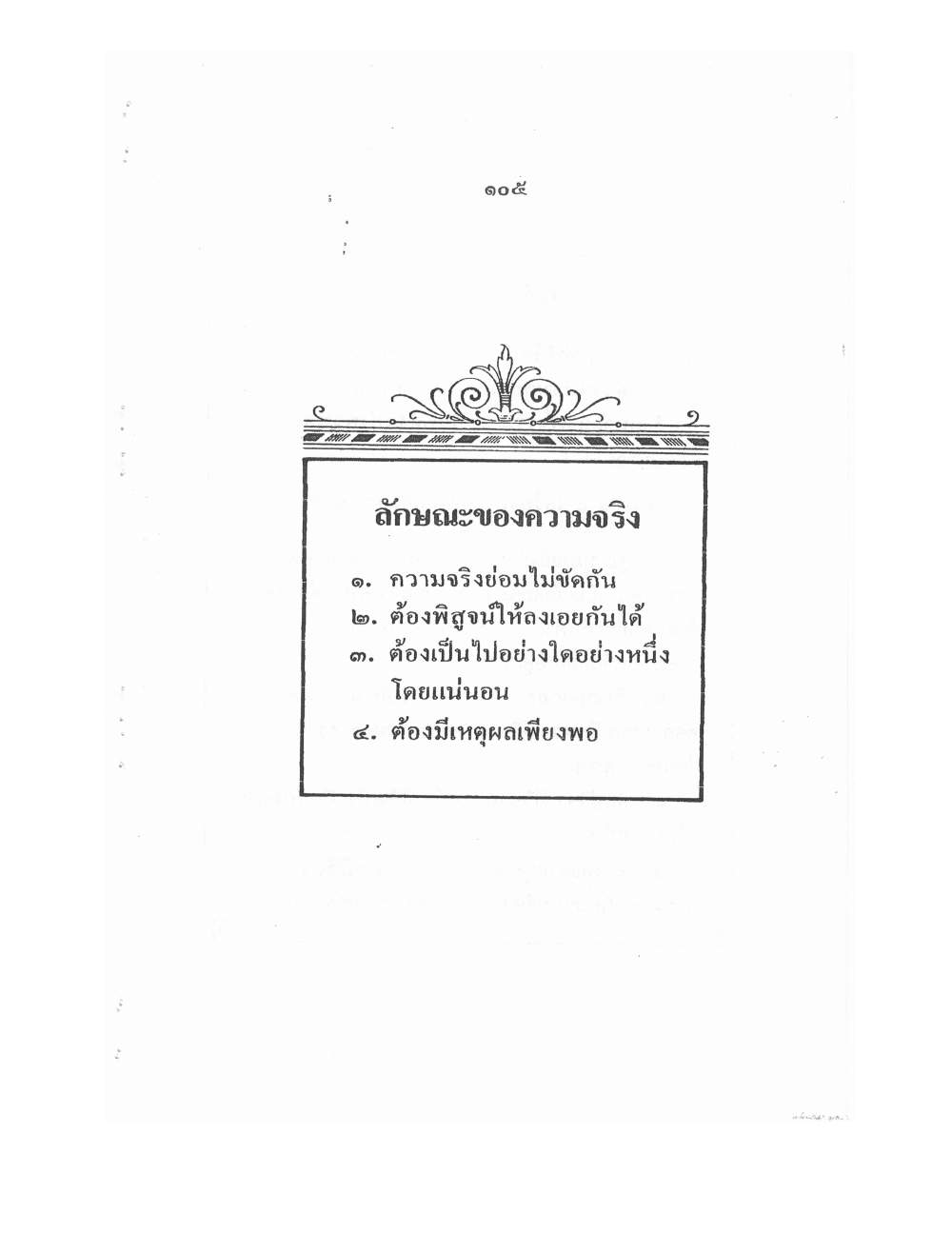
[diagram: ornate floral scrollwork flourish and a patterned decorative band above a bordered box with woven corner ornaments framing the heading and list below]
ลักษณะของความจริง
๑. ความจริงย่อมไม่ขัดกัน ๒. ต้องพิสูจน์ให้ลงเอยกันได้ ๓. ต้องเป็นไปอย่างใดอย่างหนึ่งโดยแน่นอน ๔. ต้องมีเหตุผลเพียงพอ
[diagram: ornate floral scrollwork flourish and a patterned decorative band above a bordered box with woven corner ornaments framing the heading and list below]
Characteristics of Truth
1. Truth does not contradict itself. 2. It must be provable to a consistent, coherent conclusion. 3. It must be one way or another, definitely. 4. It must have sufficient reason/evidence.
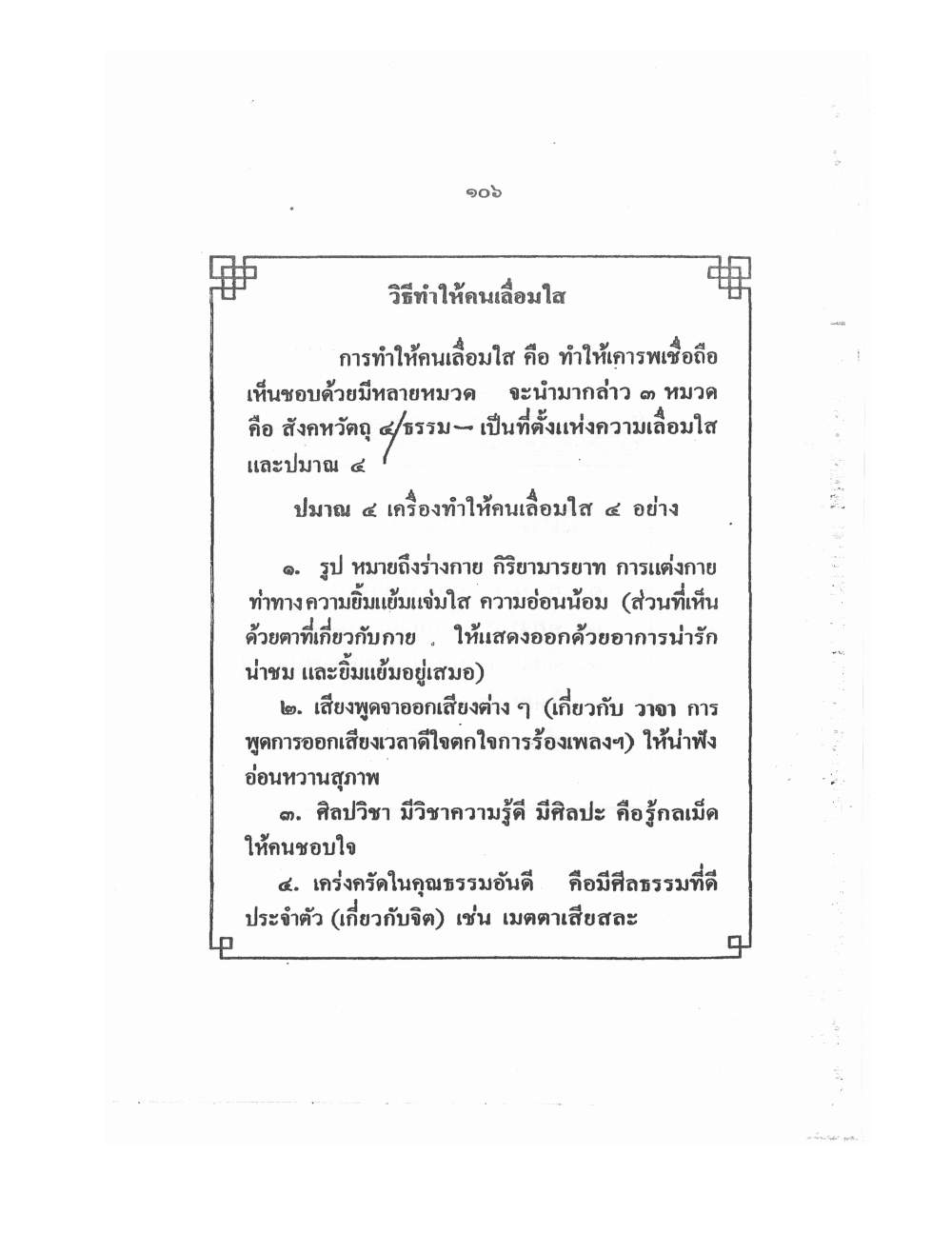
[diagram: decorative box border with woven cross-knot corner ornaments framing the heading and text below]
วิธีทำให้คนเลื่อมใส
การทำให้คนเลื่อมใส คือ ทำให้เคารพเชื่อถือ เห็นชอบด้วยมีหลายหมวด จะนำมากล่าว ๓ หมวด คือ สังคหวัตถุ ๔/ธรรม– เป็นที่ตั้งแห่งความเลื่อมใส และปมาณ ๔
ปมาณ ๔ เครื่องทำให้คนเลื่อมใส ๔ อย่าง
๑. รูป หมายถึงร่างกาย กิริยามารยาท การแต่งกาย ท่าทาง ความยิ้มแย้มแจ่มใส ความอ่อนน้อม (ส่วนที่เห็น ด้วยตาที่เกี่ยวกับกาย ให้แสดงออกด้วยอาการน่ารัก น่าชม และยิ้มแย้มอยู่เสมอ) ๒. เสียง พูดจาออกเสียงต่าง ๆ (เกี่ยวกับ วาจา การ พูดการออกเสียงเวลาดีใจตกใจการร้องเพลงฯ) ให้น่าฟัง อ่อนหวานสุภาพ ๓. ศิลปวิชา มีวิชาความรู้ดี มีศิลปะ คือรู้กลเม็ด ให้คนชอบใจ ๔. เคร่งครัดในคุณธรรมอันดี คือมีศีลธรรมที่ดี ประจำตัว (เกี่ยวกับจิต) เช่น เมตตาเสียสละ
[diagram: decorative box border with woven cross-knot corner ornaments framing the heading and text below]
Method for Making People Feel Confidence/Faith
Making people have confidence means making them respect, believe in, and approve of [something]; there are many categories. Three categories will be presented here: the Four Sangahavatthu / Dhamma — the basis of confidence — and the Four Pamāna.
The Four Pamāna: four things that produce confidence in people.
1. Form — refers to the body: manners and conduct, dress, bearing, a bright cheerful smile, gentle humility (the part seen by the eye relating to the body; it should be expressed with a lovable, admirable manner, and a constant smile). 2. Voice — speaking and various tones of voice (relating to speech: talking, tone of voice when glad or startled, singing, etc.) — it should be pleasant to hear, gentle, and polite. 3. Skill/artistry — having good knowledge and skill, having art — that is, knowing the technique/knack that pleases people. 4. Strict adherence to good virtue — that is, having good personal morality (relating to the mind), such as loving-kindness and self-sacrifice.
บทที่ 4
เปิดเผยวิธีใช้อำนาจจิต
วิธีฝึกที่ดีนั้นควรฝึกทั้งการใช้อำนาจจิต และฝึก สมาธิไปพร้อม ๆ กัน เพราะวิชาที่เกี่ยวโยงกันทั้ง 2 อย่างนี้ สามารถช่วยสนับสนุนกันโดยตรงตลอดเวลา ตัวอย่างเช่น เมื่อ เราเบื่อหน่ายหรือตกใจ กลัว หรือจิตฟุ้งซ่านในเวลาฝึกสมาธิ เราก็ต้องใช้อำนาจจิตมาควบคุมไว้ หรือเมื่อจิตเป็นสมาธิก็จะมี อำนาจจิตอยู่ในตัวซึ่งจะช่วยควบคุมให้สมาธิก้าวหน้ายิ่งขึ้น
ข้าพเจ้าได้สอนวิธีใช้อำนาจจิตขั้นต้นมาแล้วมากกว่า ๑,๐๐๐ คน ตามความชำนาญที่มีอยู่ ปรากฏว่า การสอนใช้เวลาประมาณ ๓๐ นาที ถึง ๒ ชั่วโมงต่อวิชา แล้วแต่ความสามารถของผู้รับ การสอน วิชาเหล่านี้ผู้รับการสอนสามารถทดลองได้เองโดย ไม่มีอันตราย โดยให้ใช้มีดฟันหรือแทงที่แขน หว่านทรายเข้า ตา เดินหรือนอนกลิ้งบนกองกระจกแตกด้วยเท้าเปล่าและไม่ สวมเสื้อ ใช้มือกอบโซ่ที่เผาไฟจนร้อนแดงขึ้นได้ เอามือล้วงลง ในน้ำมันที่เดือด และตักน้ำมันที่กำลังเดือดใส่ปาก นอกจากนี้ ยังสามารถใช้อำนาจจิตขั้นต้นในการรักษาโรค ไล่ผีปีศาจสะกด จิต และควบคุมจิตเพื่อให้เกิดความสุขหรือความสามารถพิเศษ ต่าง ๆ
Chapter 4
Revealing the Method of Using Mental Power
A good method of training should train both the use of mental power and the practice of meditation together at the same time, because these two interconnected subjects can directly support each other at all times. For example, when we become bored, or startled, afraid, or when the mind becomes distracted during meditation practice, we must use mental power to bring it under control; or when the mind attains concentration, mental power is also present within it, which will help keep concentration advancing further still.
I have already taught the elementary method of using mental power to more than 1,000 people, according to the skill I possess. It turns out that teaching takes about 30 minutes to 2 hours per subject, depending on the ability of the student receiving instruction. With these subjects, the student receiving instruction is able to test them for himself without danger — such as by using a knife to cut or stab the arm, scattering sand into the eyes, walking or rolling on a pile of broken glass barefoot and without a shirt, using bare hands to grasp a chain heated in fire until red-hot, plunging a hand down into boiling oil, and scooping up boiling oil into the mouth. Besides this, elementary mental power can also be used in the treatment of illness, in driving away ghosts and evil spirits, in hypnosis, and in controlling the mind so as to produce happiness or various special abilities.
อำนาจจิตขั้นกลางและขั้นสูงสามารถใช้เช่นเดียวกับเรื่อง อัศจรรย์หรือปาฏิหาริย์ในคัมภีร์ของศาสนาต่าง ๆ เมื่อเราเข้าถึง สมาธิขั้นสูงก็จะมีอำนาจจิตขั้นสูง และสามารถเริ่มต้นทำจิต ให้บริสุทธิ์เพื่อความสุขชั้นยอดเยี่ยม (นิพพาน)
ท่านควรจะฝึกการใช้อำนาจจิตขั้นต้น ๓ ขั้นเสียก่อนอย่าง น้อยขั้นละ ๒ วิชา เพื่อให้อำนาจจิตที่น่าอัศจรรย์นั้น กระตุ้น เตือนให้ท่านเรียนใช้อำนาจจิตขั้นต่อไป ทั้งนี้เพราะการใช้อำนาจ จิตขั้นต้นฝึกได้เร็ว และเห็นผลทันใจ ก่อให้เกิดกำลังใจที่จะฝึก ขั้นต่อไปอีก เมื่อฝึกใช้อำนาจจิตขั้นต้นสำเร็จทั้ง ๓ ขั้นแล้ว ก็ ย่อมเป็นเครื่องกระตุ้นเตือนให้อยากใช้อำนาจจิตขั้นสูงต่อไปอีก จึงเป็นเหตุให้เต็มใจตั้งใจที่จะฝึกจิต หรือฝึกสมาธิเพื่อให้สามารถ ใช้อำนาจจิตขั้นกลางและขั้นสูงต่อ ๆ ไป ขณะเดียวกันก็จะ พยายามขัดเกลาจิตใจให้สะอาด ประพฤติตนดีด้วยความหวังที่จะ ก้าวหน้าทางจิตต่อไป
มีคนจำนวนมากที่ตั้งใจฝึกจิตหรือฝึกสมาธิแล้วก็บ่นว่า ฝึกตั้งนานไม่เห็นได้อะไรเลยเลิกฝึก ความจริงนั้นจะให้เห็นว่า ได้อะไร ก็ต้องทดลองใช้อำนาจจิตดูจึงจะเกิดผลเกิดประโยชน์ ขึ้นและอยากได้อะไรก็ใช้อำนาจจิตช่วยให้ได้มาตามประสงค์
เวลานี้มีหนังสือหลายเล่มที่สอนเรื่องอำนาจจิตผิดทาง และ ผู้เขียนก็สอนให้โดยตรงไม่ได้ ถ้าขืนปฏิบัติตามวิธีนั้นก็อาจเป็น
The middle and higher levels of mind-power can be used just like the marvels or miracles described in the scriptures of various religions. When we attain higher levels of concentration (samadhi), we gain higher levels of mind-power, and can begin to purify the mind for the supreme happiness (nibbana).
You should first practice the three beginning levels of mind-power, at least two subjects each, so that the wondrous mind-power will spur and remind you to go on to learn the next level. This is because beginning-level mind-power is quick to train and shows results immediately, which gives rise to the encouragement to keep training further. Once you have succeeded in training all three beginning levels of mind-power, this becomes the spur that makes you want to go on using the middle and higher levels of mind-power, and so becomes the cause for being willing and determined to train the mind, or train in concentration, so as to be able to use the middle and higher levels of mind-power onward. At the same time, one should strive to purify the mind and behave well, in the hope of progressing further on the path of the mind.
Many people who have set their minds to train the mind or train in concentration complain that they have practiced for a long time and seen nothing, so they give up. In truth, to see what one has gained, one must actually test the use of mind-power, and then results and benefits will arise; and whatever one wishes to obtain, one may use mind-power to help obtain it as desired.
At present there are many books that teach about mind-power in a mistaken way, and their writers cannot teach it correctly. If one insists on practicing by that method, it may become
อันตรายทางจิตใจและร่างกาย ข้าพเจ้าจะให้หลักการสำคัญ ๓ ประการ ดังต่อไปนี้ :- ๑. จะต้องมีสมาธิก่อน จึงจะเกิดอำนาจจิตได้ ๒. การฝึกสมาธิที่ถูกทาง จะต้องกำหนดที่ตั้งจิตไว้โดย แน่นอน รู้ว่าปรากฏการณ์หรือนิมิตอะไรบ้าง ซึ่งอาจเกิดขึ้นใน ขั้นต่าง ๆ ของสมาธิ และจะปฏิบัติต่อนิมิตนั้นอย่างไร นอกจาก นั้นต้องทราบวิธีแก้ข้อบกพร่องต่าง ๆ ในสมาธิแต่ละขั้น ๓. การใช้อำนาจจิต จะต้องรู้วิธีการ ๓ อย่างคือ ทำสมาธิ เพื่อรวมอำนาจจิต, ส่งอำนาจจิตออกไป และ ตรวจสอบอำนาจ จิตว่าเพียงพอกับเรื่องนั้นแล้วหรือยัง ใช้หลักสำคัญทั้ง ๓ ประการข้างบนนี้ และมีครูที่สามารถ ช่วยแก้ไขการปฏิบัตินับว่า เป็นทางลัดในการใช้อำนาจจิต
วิธีฝึกใช้อำนาจจิต
ผู้เขียนได้ศึกษาหนังสือหลายเล่มของประเทศต่าง ๆ ได้ฝึก จิต และพยายามเชื่อมโยงเข้ากับวิทยาศาสตร์ทั่วไป ขณะนี้ข้าพเจ้า คิดว่า ได้พบทางที่เหมาะในการศึกษาเรื่องจิตใจ ทางในการศึกษา นี้ผู้อื่นสามารถเรียนใช้อำนาจจิตโดยตรงได้ในเวลาอันสั้นไม่ว่า หญิงหรือชาย ดังนั้นข้าพเจ้าจึงรักที่จะเรียกว่า "วิทยาศาสตร์ ทางใจ"
...danger to mind and body. I will give three important principles, as follows:- 1. There must first be concentration (samadhi); only then can mind-power arise. 2. Training concentration on the correct path requires fixing definitely where the mind is placed, knowing what phenomena or visions may occur at the various stages of concentration, and how to deal with such visions. Besides this, one must know how to correct the various flaws that occur at each stage of concentration. 3. Using mind-power requires knowing three methods: doing concentration to gather mind-power, sending mind-power out, and checking whether the mind-power sent out is already sufficient for that matter or not yet. Using these three important principles above, together with a teacher able to help correct one's practice, counts as a shortcut in the use of mind-power.
How to Train in the Use of Mind-Power
The writer has studied many books from various countries, has trained the mind, and has tried to connect it with science in general. At present I think I have found a suitable way to study the mind. By this method of study, others can learn to use mind-power directly in a short time, whether woman or man. Therefore I am fond of calling it "the Science of the Mind."
สมาธิเป็นกุญแจสำคัญที่สุดในการใช้อำนาจจิต การฝึก ให้ใช้อำนาจจิตมีหลักใหญ่อยู่ ๓ ประการ คือ ๑. วิธีรวมอำนาจจิต (ทำสมาธิ) ๒. วิธีส่งอำนาจจิตออกไป ๓. วิธีตรวจสอบอำนาจจิตที่ส่งออกไปว่า มีพอที่จะใช้การ ได้แล้วหรือยัง
สมาธิอาจแบ่งออกได้เป็น ๓ ขั้น คือ ๑. สมาธิขั้นต้น (ทำให้เกิดอำนาจจิตขั้นต้น) ๒. สมาชิกขั้นกลาง (ทำให้เกิดอำนาจจิตขั้นกลาง) ๓. สมาธิขั้นสูง (ทำให้เกิดอำนาจจิตขั้นสูง) สมาธิขั้นสูง มักจะเรียกว่า "ฌาน" ฌานมี ๔ ขั้น คือ ฌาน ที่ ๑ ที่ ๒ ที่ ๓ และฌานที่ ๔
ขั้นตอนในการฝึกใช้อำนาจจิตขั้นต้น มีดังนี้ :-
ขั้นที่ ๑
ให้เรียนวิธีรวมอำนาจจิต และวิธีส่งอำนาจจิตไปยังบริเวณ เล็ก ๆ ในร่างกาย เมื่อได้ตรวจสอบว่าอำนาจจิตได้ส่งไปเพียงพอ แล้ว ผู้เรียนสามารถใช้มีดคม ๆ ฟันแทงร่างกายส่วนนั้นหรือ ส่วนอื่นก็ฟันหรือแทงไม่เข้า ตัวอย่างอื่นในการทดลองอำนาจจิต
Concentration is the most important key to the use of mind-power. Training to use mind-power has three main principles: 1. The method of gathering mind-power (doing concentration). 2. The method of sending mind-power out. 3. The method of checking the mind-power sent out — whether it is now sufficient for use or not yet.
Concentration may be divided into 3 levels: 1. Beginning-level concentration (produces beginning-level mind-power). 2. Middle-level concentration [printed in the text as "สมาชิก" rather than "สมาธิ"] (produces middle-level mind-power). 3. High-level concentration (produces high-level mind-power). High-level concentration is often called "jhana." There are 4 levels of jhana: the first, second, third, and fourth jhana.
The steps for training the use of beginning-level mind-power are as follows:-
Step 1
One should learn the method of gathering mind-power and the method of sending mind-power to a small area of the body. Once it has been verified that enough mind-power has been sent there, the learner can use a sharp knife to hack or stab that part of the body, or try other parts, and the knife will not cut or pierce in. Another example in testing mind-power
ขั้นนี้มีการส่งอำนาจจิตไปยังตาทั้งสองข้างแล้ว หว่านทรายเข้าตา ทรายจะไม่เข้าตา ตัวอย่างที่สาม คือ การส่งอำนาจจิตไปทั่ว ร่างกายแล้วทดลองด้วยการล้มตัวลงทับบนกองกระจกแตก และ กลิ้งตัวทับไปมาโดยไม่มีอะไรปกปิดร่างกายท่อนบน
ขั้นที่ ๒
สอนให้ส่งอำนาจจิตไปยังที่อื่นนอกร่างกายของตน เป็นต้น ว่าส่งอำนาจจิตไปยังโซ่ใหญ่ที่เผาจนร้อนแดง เพื่อทำให้หมด พิษร้อน แล้วใช้มือจับยกโซ่นั้นขึ้นได้ในขณะที่โซ่ยังร้อนแดง อยู่ ในทำนองเดียวกันนี้สามารถส่งอำนาจจิตไปยังถ่านที่ติดไฟ อยู่ ทำให้คนเดินเท้าเปล่าไปบนถ่านติดไฟนั้นได้ ผู้ที่ไม่มีความรู้ เรื่องอำนาจจิตก็สามารถจับโซ่แดงและเดินลุยไฟไปได้ เมื่อได้ มีการส่งอำนาจจิตลงไปเพียงพอแล้ว ตัวอย่างอื่น คือการส่ง อำนาจจิตไปยังน้ำมันเดือดเพื่อดับพิษร้อน หลังจากได้ทดสอบ อำนาจจิตที่ส่งไปแล้ว ใคร ๆ ก็สามารถเอามือจุ่มลงในน้ำมัน เดือด และตักใส่ปากในขณะที่น้ำมันกำลังเดือดอยู่
ขั้นที่ ๓
สอนวิธีส่งอำนาจจิตออกไปใช้ให้เกิดประโยชน์ต่าง ๆ ตามที่จะปรารถนาเช่น วิธีรักษาโรคต่าง ๆ วิธีสะกดจิตและ
At this stage, mind-power has been sent to both eyes, then sand is thrown into the eyes — the sand will not enter the eyes. A third example is sending mind-power throughout the whole body and then testing by falling and lying down on a pile of broken glass, and rolling the body back and forth over it with the upper body completely uncovered.
Step 2
Teaches sending mind-power to places outside one's own body — for example, sending mind-power to a large chain heated red-hot, so as to remove all the burning harm, then using the hand to grasp and lift that chain while it is still glowing red-hot. In the same way, mind-power can be sent to charcoal that is burning, enabling a person to walk barefoot on that burning charcoal. Even someone with no knowledge of mind-power can grasp the red-hot chain and walk through the fire, once enough mind-power has been sent down. Another example is sending mind-power to boiling oil to extinguish its burning harm; after the sent mind-power has been tested, anyone at all can dip a hand into the boiling oil and scoop it into the mouth while the oil is still boiling.
Step 3
Teaches the method of sending mind-power out to be used for various benefits as one may wish, such as methods for curing various illnesses, methods of hypnotizing/controlling the mind, and
วิธีใช้จิตในเรื่องอื่นตามที่ตนจะปรารถนา จะใช้ช่วยความจำ ช่วยในการทำงานหรือใช้แก้ปัญหาชีวิตประจำวันก็ได้ โรคบาง อย่างสามารถรักษาด้วยอำนาจจิตได้ชั่วเวลาเล็กน้อย ตัวอย่าง เช่น แขนหักรักษาให้ใช้ทำงานได้เลยโดยไม่เจ็บปวดภายในเวลา ๓๐ นาที ทีแรกข้าพเจ้าไม่เชื่อว่าจะเป็นไปได้จึงได้ไปดูและเรียน วิธีรักษากระดูกหัก เวลานี้ผู้เขียนได้เคยรักษาคนกระดูกหักมา แล้วหลายราย และได้สอนให้ผู้อื่นไปทำได้ผลอีกหลายคน จง กระโดดออกมาจากครอบกะลาเสียเถิด อย่าให้วิชาการสมัยใหม่ หรือฝรั่งเขาครอบเราไว้จนฝังใจว่าวิชาของเขาดีทั้งนั้น ถูกทั้งนั้น วิชาของคนโบราณเป็นเรื่องงมงายไปเสียหมด ความจริงนั้น ทั้งวิชาการสมัยใหม่และวิชาการสมัยโบราณก็ล้วนแต่มีทั้งคุณและ โทษมีทั้งข้อดีข้อเสียด้วยกันทั้งนั้น นักวิทยาศาสตร์ที่แท้จริง หรือนักศึกษาที่แท้จริง ควรตั้งจิตให้เป็นกลางให้เป็นธรรมแล้ว พิจารณาและพิสูจน์ทดลองให้เห็นจริงและนำเอาข้อดี นำสิ่งที่ ให้คุณของวิชาการทั้งสมัยโบราณและสมัยใหม่มาใช้ให้เกิด ประโยชน์แก่ตนและส่วนรวม จึงจะนับว่าเป็นผู้รู้ผู้ฉลาดโดยแท้
การฝึกใช้อำนาจจิตนั้นผู้เขียนเห็นว่าควรจะยึดหลักการ สำคัญและขั้นตอนในการฝึกใช้อำนาจจิตทั้ง ๓ ขั้น ดังกล่าว มาแล้ว ซึ่งจะใช้เวลาเรียนวิชาหนึ่งไม่เกิน ๒ ชั่วโมง เรียนได้ ทั้งหญิงและชายเรียนได้ทุกศาสนา เมื่อเรียนทำได้แล้วก็สามารถ นำไปทำที่อื่นทดลองที่อื่นได้ ไม่ใช่ทำได้เฉพาะต่อหน้าอาจารย์
...ways of using the mind in other matters as one may wish — it can be used to help memory, to help in work, or to solve everyday problems of life. Certain illnesses can be cured with mind-power within a short time. For example, a broken arm can be treated so that it can be used for work at once, without pain, within 30 minutes. At first I did not believe this was possible, so I went to observe and learn the method of treating broken bones. By now the writer has treated many people with broken bones, and has taught others to do so with good results in many more cases. Do jump out from under the coconut-shell cover! Do not let modern learning or Western knowledge cover you so completely that you become fixed in the belief that their knowledge is entirely good, entirely correct, while the knowledge of the ancients is nothing but superstition. In truth, both modern learning and ancient learning alike have both merits and faults, both good points and bad points. A true scientist or a true scholar should keep the mind neutral and fair, then examine and test to see the truth for oneself, and take the good points — take what is beneficial from both ancient and modern learning — and put it to use for the benefit of oneself and of the whole; only then can one truly be counted as knowledgeable and wise.
As for training in the use of mind-power, the writer feels one should hold to the important principles and the steps in training the use of mind-power through all 3 stages, as described above, which will take no more than 2 hours to learn per subject. It can be learned by both women and men, of every religion. Once one has learned to do it, one can then take it and do it, and test it, elsewhere — not only in front of one's teacher.
เครื่องประกันให้กล้าทดลองได้ใช้ประโยชน์ได้โดยไม่ผิดพลาด หรือเป็นอันตราย ก็คือวิธีตรวจสอบอำนาจจิต ที่ส่งออกไปว่า มีพอที่จะใช้การในเรื่องนั้น ๆ ได้แล้วหรือยัง ตัวอย่างง่าย ๆ ในการตรวจสอบเช่นเมื่อส่งอำนาจจิตไปยังน้ำมันที่กำลังเดือด แล้วอยากทราบว่าอำนาจจิตจะพอเพียงที่จะทำให้น้ำมันหายร้อน หรือยัง ก็ลองเอานิ้วจุ่มแตะน้ำมันดูถ้ารู้สึกอุ่น ๆ ก็เอานิ้วจุ่มลึก ลงไปได้ จุ่มลงแล้วยกนิ้วออกมาถ้ารู้สึกร้อนผ่าว ๆ รู้สึกร้อนและ เต้นตุบ ๆ ก็ยังใช้ไม่ได้ ต้องส่งอำนาจจิตลงไปอีก เมื่อส่งลง ไปเพียงพอแล้วก็จะเอามือจุ่มลงไปได้ ตักกินได้ ทั้ง ๆ ที่น้ำมัน กำลังเดือดอยู่ ผู้อื่นจะทดลองจุ่มหรือตักกินก็ได้ มีหลายราย ไม่มีหลักการที่ถูกต้องพอให้ศิษย์ใช้คาถาดับพิษน้ำมันแล้วก็ ให้ตักใส่ปากเลย แล้วก็เกิดอันตรายปากคอพองต้องนอนหยอด ข้าวต้มหลายวันกว่าจะหาย อนึ่งน้ำมันที่กำลังเดือดนี้เมื่อเราส่ง อำนาจจิตลงไปเพียงพอแล้วจุ่มดูได้ตักกินได้นั้นจะเอาเครื่องวัด ความร้อน (เทอร์มอมิเตอร์) วัดจุ่มไว้ในน้ำมันที่กำลังเดือดดู ด้วยก็ได้ ความร้อนขึ้นสูงถึง ๑๑๐ องศาเซนติเกรดก็ยังรู้สึกว่า น้ำมันอุ่น ๆ หรือเย็นเอามือจุ่มหรือตักกินได้ แต่ถ้าใช้อำนาจจิต ขั้นกลางหรือขั้นสูงส่งไปที่น้ำมันที่กำลังเดือดน้ำมันจะเย็นและ เครื่องวัดความร้อนจะอยู่ปกติไม่ขึ้นแสดงความร้อนให้เห็น
ตัวอย่างการตรวจสอบอีกอย่างหนึ่งคือ การลุยไฟเมื่อส่ง อำนาจจิตลงไปที่ถ่านไฟซึ่งติดไฟแดงอยู่นั้นเพียงพอแล้วก่อน
What guarantees the courage to test and use it beneficially, without error or danger, is the method of checking the mind-power that has been sent out — whether it is now sufficient for use in that particular matter or not yet. A simple example of checking: when mind-power has been sent into boiling oil and one wants to know whether the mind-power is sufficient to make the oil stop being hot, one may try dipping a finger in to touch the oil — if it feels merely warm, one can dip the finger in deeper. After dipping and lifting the finger out, if it feels scorching hot, feels burning and throbbing, then it is still not usable — one must send more mind-power down. Once enough has been sent down, one can then dip the hand in, and scoop it up to eat, even while the oil is still boiling. Others may also try dipping in or scooping it to eat. There have been many cases where, lacking the correct principle, [teachers] let their students recite the spell to quench the oil's harm and then had them scoop it straight into the mouth — resulting in injury, with the mouth and throat swelling, requiring the person to lie down and be fed rice gruel by drops for many days before recovering. Also, with this boiling oil, once we have sent down sufficient mind-power so that dipping and eating are possible, one may also place a thermometer into the still-boiling oil to measure it — even with the heat reading as high as 110 degrees Celsius, it will still feel merely warm or even cool to a hand dipped in or scooping it to eat. But if middle-level or high-level mind-power is sent to the boiling oil, the oil will actually become cool and the thermometer will stay normal, not rising to show any heat.
Another example of checking is fire-walking: when mind-power has first been sent sufficiently down into the charcoal fire that is glowing red-hot,
จะเดินลุยไฟก็ควรเอาใบไม้วางบนถ่านดู ถ้าใบไม้เหี่ยวลงไม่ไหม้ เป็นรูใหญ่ ๆ ก็เป็นอันว่าส่งอำนาจจิตไปพอใช้งานได้แล้วเดิน ลุยไฟนั้นได้แล้ว ถ้าจะตรวจสอบให้แน่อีกทีก็เอาเท้าเปล่าแตะ กดลงไปบนถ่านไฟ ถ้ารู้สึกอุ่น ๆ เมื่อยกเท้าออกมาแล้วก็หาย ร้อน ไม่มีอาการร้อนผ่าว ๆ ต่อไปจึงเดินลุยไฟได้ มีตัวอย่าง ที่เดินลุยไฟแล้วเกิดอันตรายและถึงตายก็มี ทั้งนี้ก็เพราะขาด หลักสำคัญคือวิธีตรวจสอบอำนาจจิตนั้นเอง
ขอเน้นว่า การฝึกใช้อำนาจจิตให้ได้เร็วทันใจนั้นควรเรียน หรือฝึกโดยตรงจากอาจารย์ที่ทำได้และสอนดี หรือรู้วิธีถ่ายทอด วิชาโดยรอบคอบจึงจะได้ผลดีใช้ประโยชน์ได้ไม่ผิดพลาด สำหรับ ผู้ที่ไม่มีเวลาหรือไม่ประสงค์จะเรียนจากอาจารย์โดยตรงจะฝึก ตนเองค้นคว้าด้วยตนเอง ควรจะได้อ่านวิทยาศาสตร์ทางใจ ฉบับเรียนด้วยตนเอง ซึ่งข้าพเจ้าได้แต่งขึ้นและพิมพ์ไว้เรียบร้อย แล้ว
เคล็ดลับในการใช้อำนาจจิต
(๑) ทำจิตให้สงบเป็นสมาธิเสียก่อน วิธีง่ายที่สุดก็คือ ทำ จิตให้หยุดจากความนึกคิดหรือหยุดจากความกังวลห่วงใยใน กิจการหรือเรื่องราวต่าง ๆ ทั้งนี้ใช้เวลาประเดี๋ยวเดียวก็พอ เมื่อ จิตหยุดก็ใช้อำนาจจิตได้เลย วิธีนี้เหมาะสำหรับมีเวลาน้อย หรือ มีเหตุฉุกเฉินที่จะต้องรีบทำทันที ถ้ามีเวลามากขึ้นก็ควรจะได้
If one is going to walk through fire, one should first place a leaf on the coals to test: if the leaf withers without burning through into a large hole, then this shows that enough mind-power has been sent to make it usable, and one may then walk through the fire. To check once more for certainty, one may press a bare foot down onto the burning coals — if it feels merely warm, and once the foot is lifted the heat is gone, with no scorching sensation, then one may go on to walk through the fire. There are cases where people walked through fire and were injured, even killed — this was because they lacked the essential principle, namely the method of checking the mind-power itself.
Let me emphasize: to train in the use of mind-power so as to gain it quickly, one should study or train directly under a teacher who can do it and teaches well, or who knows how to transmit the knowledge thoroughly, so as to get good results and use it beneficially without error. For those who have no time, or do not wish to learn directly from a teacher, and will train and research on their own, they should read the "Science of the Mind, Self-Study Edition," which I have composed and had printed already.
The Secret to Using Mind-Power
(1) First, calm the mind into concentration. The simplest method is to make the mind stop from thinking, or stop from worry and concern over affairs or various matters — this needs only a moment. Once the mind stops, one can use mind-power at once. This method is suitable when one has little time, or there is an emergency requiring immediate action. If one has more time, one should
น้อมใจเคารพต่อสิ่งที่ควรเคารพ เช่น พระทั้ง ๕ มีพระพุทธ พระธรรม พระสงฆ์ บิดามารดา และครูอาจารย์ ถ้ามีโอกาส ที่จะกราบไหว้และจุดธูปเทียนบูชาได้ก็ควรกระทำด้วย บางวิชา ก็มีระเบียบให้จัดเครื่องบูชาตามที่อาจารย์องค์ก่อน ๆ สั่งไว้ พร้อมด้วยอัญเชิญคุณพระทั้ง ๕ มาช่วยให้ใช้อำนาจจิตอย่างนั้น ได้สำเร็จ
(๒) มีเจตนาและเป้าหมาย การใช้อำนาจจิตทุกครั้ง ต้อง มีเจตนาและมีเป้าหมาย เจตนาก็คือความตั้งใจที่จะให้เป็นอย่างไร นั้นเอง ส่วนเป้าหมายก็คือสิ่งที่จะทำให้เปลี่ยนแปลงหรือให้ เกิดขึ้นเป็นขึ้นตามเจตนา เช่นจะทำให้น้ำมนต์น้ำในขันที่จะทำนั้น ก็เป็นเป้าหมาย จะสะกดจิตให้คนหลับหรือทำตามสั่ง คนที่เรา จะสะกดนั้นก็เป็นเป้าหมายจะรักษาคนเจ็บไข้ด้วยอำนาจจิต คนไข้ นั้นก็เป็นเป้าหมายจะทำให้น้ำมันที่กำลังเดือดหายร้อน น้ำมัน นั้นก็เป็นเป้าหมาย
(๓) เลือกจุดรวมอำนาจจิต การส่งอำนาจจิตหรือพลังจิต ไปยังเป้าหมายต้องเลือกบริเวณรวมอำนาจจิตที่สำคัญและเหมาะ- สม เช่นทำน้ำมนต์ในขัน ก็นึกภาพผิวน้ำในขันซึ่งเป็นวงกลมจะ เห็นภาพนั้นทางจิตหรือไม่เห็นก็ตาม ใจก็ตั้งความสำนึกรู้บริเวณ ผิวน้ำที่จะเสกหรือที่จะส่งอำนาจจิตลงไปอยู่ตลอดเวลา เพื่อเป็น
...bow the mind in reverence to what deserves reverence, such as the Five Sacred Ones: the Buddha, the Dhamma, the Sangha, one's parents, and one's teachers. If there is opportunity to prostrate and light incense and candles in offering, one should do so as well. Some disciplines have a set procedure requiring offerings to be arranged as instructed by earlier generations of teachers, along with an invocation inviting the virtue of these Five to come and help one succeed in using mind-power in that way.
(2) Have Intention and a Goal. Every use of mind-power must have an intention and a goal. Intention is simply the determination as to how one wants things to be. The goal, meanwhile, is the thing that is to be changed or brought about in accordance with the intention — for instance, if one is going to consecrate water in a bowl, that is the goal; if one is going to hypnotize someone to sleep or to obey a command, the person one is hypnotizing is the goal; if one is going to heal a sick person with mind-power, that patient is the goal; if one is going to make boiling oil stop being hot, that oil is the goal.
(3) Choose the Point of Focus for Gathering Mind-Power. Sending mind-power or mental energy to the goal requires choosing an important and suitable area to focus the mind-power. For example, when making consecrated water in a bowl, one visualizes the surface of the water in the bowl, which is circular; whether or not one actually sees that image mentally, the mind should maintain constant awareness of the area of the water's surface to be consecrated, or to which mind-power is to be sent, in order to serve as
เครื่องช่วยให้สำนึกรู้บริเวณผิวน้ำที่จะเสกได้ง่ายและถูกต้อง ก็ใช้มือแตะขันน้ำทั้งสองข้างไว้ ขณะเดียวกันนี้ให้รวมจิตไว้ที่ กึ่งกลางวงกลมผิวน้ำในขัน คือ รวมจิตรับรู้ดิ่งลงตรงกึ่งกลาง ผิวน้ำพร้อมกับนึกภาพผิวน้ำทั้งหมด
ในการสะกดจิตให้คนหลับ คนที่ถูกสะกดเป็นเป้าหมาย ภาพที่นึกให้เห็นเลา ๆ ก็คือร่างกายของผู้ที่ถูกสะกด บริเวณ ที่รวมอำนาจจิตพุ่งเข้าไป คือบริเวณจุดกึ่งกลางระหว่างคิ้ว
ในการรักษาโรคของคนเจ็บไข้ก็อาจจะส่งอำนาจจิตรวม ลงที่จุดกึ่งกลางระหว่างคิ้ว หรือกึ่งกลางบริเวณที่เจ็บปวด ทั้งนี้ ควรจะได้ศึกษาละเอียดเป็นโรค ๆ ไป
(4) การใช้คำภาวนาประกอบ เพื่อช่วยให้จิตมารวมจดจ่อ อยู่เรื่องเดียวหรือสิ่งเดียวที่เราต้องการให้เกิดผลด้วยอำนาจจิต เป็นการช่วยรวมจิตให้มีกำลังมากขึ้นเราจึงใช้คำภาวนาเป็นเครื่อง ช่วยอีกอย่างหนึ่ง คำภาวนานี้อาจจะเป็นคาถาที่อาจารย์ได้มอบ ให้ หรืออาจจะเป็นคำพูดธรรมดาก็ได้ ตัวอย่างเช่นการสะกดจิตให้ หลับอาจภาวนา คือพูดในใจว่า "จงหลับ จงหลับ" หรืออาจจะพูด ให้ดังเพียงแผ่วเบาพอได้ยินก็ได้ หรือจะภาวนาเป็นคาถาตามที่ ได้เล่าเรียนมาก็ได้ ส่วนมากมักจะภาวนาในใจติดต่อกันไปหรือ ภาวนาในใจเป็นห้วง ๆ ก็ได้ ส่วนการนึกภาพตามที่กล่าวใน ข้อ ๓ นั้นก็จะต้องกระทำอยู่ตลอดเวลาที่ส่งอำนาจจิตออกไป
...an aid for maintaining, easily and correctly, awareness of the area of the water's surface to be consecrated. One uses the hands to touch the water bowl on both sides; at the same time, one gathers the mind at the center point of the circle of the water's surface in the bowl — that is, one gathers the mind's awareness and sends it plunging straight down to the very center of the water's surface, while simultaneously visualizing the whole of the water's surface.
In hypnotizing someone to sleep, the person being hypnotized is the goal. The image one visualizes, faintly, is the body of the person being hypnotized. The area where the gathered mind-power is directed and driven in is the point midway between the eyebrows.
In treating the illness of a sick person, one may likewise send the gathered mind-power to the point midway between the eyebrows, or to the center of the area that is in pain. This should be studied in detail, disease by disease.
(4) Using an Accompanying Incantation. To help the mind gather and focus on the single matter or single thing one wants to bring about through mind-power, this helps the mind gather with greater strength; we therefore use a spoken incantation as another aid. This incantation may be a spell given by a teacher, or it may simply be ordinary words. For example, in hypnotizing someone to sleep, one may recite, saying in one's mind, "Sleep, sleep," or one may say it aloud but only faintly, just loud enough to be heard, or one may recite a spell as one has learned it. Mostly one recites either continuously in the mind, or in the mind in intervals. As for the visualization mentioned in item 3, that must be carried on the entire time that mind-power is being sent out.
การภาวนาคาถานั้นมีวิธีภาวนาที่ใช้กันมากอยู่ ๖ วิธี คือ
๑. ภาวนาเป็นจบ คือว่าคาถาหรือพูดในใจไปหนึ่งครั้งหรือ หนึ่งเที่ยวก็นับเป็นหนึ่งจบ ภาวนา ๓ จบก็คือว่า ๓ ครั้งนั่นเอง บางวิธีให้ภาวนา ๑๐๘ จบ มักใช้ลูกประคำซึ่งมีจำนวน ๑๐๘ ลูก มาชักประกอบเพื่อเป็นเครื่องบอกว่าภาวนา ๑๐๘ จบแล้ว
๒. ภาวนาเป็นอัดใจ คือหายใจเข้าแล้วอัดลมหายใจไว้ไม่ หายใจเข้าไม่หายใจออก แล้วภาวนาหรือว่าคาถาจนสุดลมหายใจ เมื่อสุดลมหายใจหรือสุดที่จะอัดลมไว้แล้วก็เรียกว่า ภาวนาหนึ่ง อัดใจ จะเอากี่อัดใจก็หายใจเข้าและทำซ้ำอีกให้ครบ
3. ภาวนาเป็นสมาธิ คือตั้งจิตเป็นสมาธิดีแล้วก็ภาวนา คาถาเรื่อย ๆ ไป หายใจเป็นสมาธิ ไม่ต้องอัดลมหายใจไว้ ใช้ เวลานานตามต้องการ บางวิธีก็ให้ภาวนาจนเทียนหนักหนึ่งบาท ที่จุดไว้หมดเล่ม
4. ภาวนาเป็นคาบ คือว่าคำภาวนาพร้อมกับสูดลมหายใจ เข้าทางจมูก ว่าคำภาวนาจนได้ ๑ จบ ต่อไปจึงเป่าลมออกทาง ปากพร้อมกับว่าคำภาวนา ให้ได้อีก ๑ จบ การเป่าลมออกทางปาก ให้เป่าโดยแผ่วเบาและยาวมุ่งจิตเป่าลงสู่เป้าหมายหรือของที่เรา จะเสก ถ้าคำภาวนายาวเวลาสูดหายใจเข้าทางจมูก ก็ต้องอัดลม ไว้จนภาวนาคาถาจบจึงเริ่มเป่าออก รวมความว่าภาวนาได้ ๒ จบ
There are 6 commonly used methods of reciting the incantation, namely:
1. Reciting by rounds (chop): this means saying the spell or reciting it silently in the mind once — one time counts as one round. Reciting 3 rounds simply means 3 times. Some methods call for reciting 108 rounds, and one commonly uses a rosary of 108 beads, moving them along as a way of marking that 108 rounds have been recited.
2. Reciting with held breath: this means breathing in and then holding the breath — neither breathing in nor breathing out — while reciting the spell or incantation until the breath runs out. When the breath runs out, or one can no longer hold it, this is called one held-breath recitation. However many held-breaths one wishes to do, one breathes in again and repeats until the count is complete.
3. Reciting in concentration: this means settling the mind well into concentration and then reciting the spell continuously, breathing in a state of concentration, without needing to hold the breath. One uses as much time as desired. Some methods call for reciting until a one-baht-weight candle that has been lit burns down completely.
4. Reciting in a "khap" (round-trip): this means reciting the incantation while drawing breath in through the nose, reciting until completing 1 round; then blowing the breath out through the mouth while continuing to recite, completing another 1 round. The breath blown out through the mouth should be blown gently and for a long duration, directing the mind through the breath down onto the goal or the object one is consecrating. If the incantation is long, while breathing in through the nose one must hold the breath until the recitation of the spell is complete, and only then begin blowing out. In total, this counts as 2 rounds recited.
จบแรกสูดลมเข้าจบหลังเป่าลมออก รวม ๒ จบ ดังนี้เรียกว่า หนึ่งคาบ จะให้ได้กี่คาบก็ทำซ้ำต่อไปอีก
๕. ภาวนาเป็นคาบผสมอัดใจ คือหายใจเข้าพร้อมกับภาวนา คาถา และอัดลมหายใจไว้ภาวนาต่อเนื่องกันไป จนถึงปลายลมแล้ว จึงเป่าลมออกทางปาก พร้อมกับภาวนาคาถาเรื่อยไป ตอนอัด ลมไว้และตอนเป่าออกไม่จำกัดว่าจะภาวนาได้กี่จบ ถ้าคำภาวนา สั้นก็ว่าได้หลายจบ ถ้าคำภาวนายาวก็อาจจะได้จบเดียวหรือ ๒ จบ เป่าออกครั้งหนึ่งจะเรียกว่า ๑ คาบหรือ ๑ ครั้งก็ได้ ทำ หลายครั้งตามวิธีที่อาจารย์กำหนด การภาวนาเป็นคาบผสมอัดใจ นี้เหมาะสำหรับผู้ฝึกใหม่ หรือผู้ที่ฝึกชำนาญแล้วแต่ยังไม่มีความ สามารถถึงสมาธิขั้นสูงก็ควรใช้วิธีนี้ประกอบเพราะเป็นวิธีที่ ส่งอำนาจจิตออกได้ดี
๖. ภาวนาวิธีผสม คือภาวนาเป็นคาบผสมอัดใจ เมื่อรู้สึก เหนื่อยก็ใช้วิธีภาวนาเป็นสมาธิสลับกันไป หรืออาจจะใช้วิธี อื่น ๆ สลับกันก็ได้
ข้อควรระลึกในการใช้อำนาจจิตก็คือ พยายามทำใจให้สงบ แน่วแน่ ปลอดโปร่งสบายไม่เหนื่อย และทำต่อเนื่องกันไปจนเกิด ผลที่ต้องการ ถ้ารู้สึกเหนื่อยก็ใช้วิธีภาวนาเป็นสมาธิช่วยผ่อนคลาย ให้หายเหนื่อยหรือเกิดความสงบแน่วแน่ขึ้น
The first round: breathe in; the second round: blow out — together these 2 rounds are called one "khap" (round-trip). One repeats this again and again for as many round-trips as desired.
5. Reciting in round-trip combined with held-breath: this means breathing in while reciting the spell, then holding the breath and continuing to recite without a break until the breath is nearly spent, then blowing the breath out through the mouth while continuing to recite the spell. During the held-breath portion and the exhaling portion there is no fixed limit to how many rounds one may recite — if the incantation is short, one may complete it many rounds; if the incantation is long, one may only manage a single round, or 2 rounds. One exhalation may be called 1 "khap" or 1 time. This is repeated many times according to the method set by the teacher. This method — reciting in round-trip combined with held-breath — is suitable for beginners, or for those who have practiced and become skilled but are not yet able to reach high-level concentration; they should use this method as well, because it is a method that sends out mind-power well.
6. The mixed method of reciting: this means reciting in round-trip combined with held-breath, and when one feels tired, switching to reciting in the concentration method, alternating between the two; or one may alternate with other methods as well.
The point to bear in mind in using mind-power is: strive to keep the mind calm and steady, clear and comfortable, without tiring, and to continue without interruption until the desired result occurs. If one feels tired, use the concentration method of reciting to help relax, relieve the tiredness, or bring about greater calm and steadiness.
เคล็ดลับในการเพิ่มพูนอำนาจจิต
ได้กล่าวไว้ในบทที่ ๑ แล้วว่าอำนาจจิตหรือพลังจิตจะเพิ่ม มากขึ้นในเมื่อจิตเป็นสมาธิสูงขึ้น หรือพูดง่าย ๆ ว่าเมื่อจิตสงบ สบายปลอดโปร่งมากขึ้น อำนาจจิตก็จะเพิ่มมากขึ้นตามส่วน นอกจากนี้ยังได้กล่าวยืนยันไว้ว่าการใช้อำนาจจิตขั้นต้น ซึ่ง สามารถใช้ประโยชน์ได้หลายอย่างนั้นก็สามารถจะเรียนได้สำเร็จ และนำไปทำหรือทดลองได้ไม่ว่าที่ใด เพราะผู้เขียนได้ค้นคว้า วิธีถ่ายทอดวิชาให้ผู้อื่นมาเป็นเวลา ๒๐ ปีเศษแล้ว เคยสอนวิชา ใช้อำนาจจิตให้แก่เด็กผู้ใหญ่ ผู้หญิงตลอดจนผู้ที่นับถือศาสนา อื่น ๆ คือศาสนาคริสต์ ศาสนาอิสลาม ผู้นับถือลัทธิเชื้อผีได้แก่ ชาวเขาเผ่าต่าง ๆ ผู้เขียนก็เคยทดลองสอนให้ใช้อำนาจจิตได้ ผลดีมาแล้วหลายราย มีหลักฐานยืนยันทั้งที่สอนเป็นส่วนตัวและ ไปสอนเป็นทางราชการ วิธีฝึกหรือสอนให้แก่ผู้อื่นให้ได้ผลดี ให้ได้ผลเร็วตลอดจน วิธีใช้อำนาจจิตให้เกิดประโยชน์ต่าง ๆ ได้ดีขึ้นกว่าความสามารถที่ตนมีอยู่หรือให้ได้ผลดียิ่งนั้นก็คือ การเพิ่มพูนอำนาจจิต เคล็ดลับในการเพิ่มพูนอำนาจจิตมีอยู่ ๒ ประการคือ
๑. วิธี ๒. จังหวะ
The Secret to Increasing Mind-Power
It was already stated in Chapter 1 that mind-power, or mental energy, increases as the mind attains a higher level of concentration — or, put simply, as the mind becomes calmer, more comfortable, and clearer, mind-power increases correspondingly. In addition, it was also affirmed that the use of beginning-level mind-power, which can be put to use in many beneficial ways, can be learned successfully and carried out or tested anywhere, because the writer has researched methods for transmitting this knowledge to others for over 20 years now. I have taught the use of mind-power to children and adults, to women, and even to followers of other religions — namely Christianity and Islam — as well as to followers of spirit-worship beliefs among various hill-tribe peoples. I have tested teaching the use of mind-power with good results in many cases, with evidence confirming this both in private teaching and in official government teaching. The method of training or teaching others so as to get good results, quick results, as well as the method of using mind-power so as to achieve various benefits better than one's own existing ability, or to achieve even better results — this is precisely: the increasing of mind-power. There are 2 secrets to increasing mind-power, namely:
1. Method 2. Timing/Rhythm
วิธีก็คือการดำเนินการหรือพิธีการ หรือวิธีทำนั่นเอง บาง อาจารย์ก็มีวิธีการหรือพิธีการก่อนจะทำขณะทำยืดยาวน่าเบื่อ บางอาจารย์ก็สอนให้ทำเอาดื้อ ๆ จนศิษย์จับหลักไม่ได้ว่าเกิด ผลนั้นขึ้นมา เป็นขั้นเป็นตอนอย่างไร ครั้นไปทำลับหลังอาจารย์ ก็ทำไม่สำเร็จ ผู้เขียนมีความเห็นว่าวิธีการนั้นควรมีทั้งแบบ ธรรมดาและแบบเร่งด่วนและได้เคยสอนศิษย์ไว้ทั้ง ๒ วิธีเสมอ คือดำเนินการก่อนใช้อำนาจคุณพระตามแบบที่สมบูรณ์เป็นขั้น เป็นตอน และวิธีใช้อำนาจจิตอำนาจคุณพระโดยตัดวิธีการให้ น้อยลง หรือใช้โดยทันทีไม่มีวิธีการเริ่มต้น ทั้งนี้ก็โดยอาศัย ตั้งจิตให้นิ่งให้เป็นสมาธิทันทีหรือปรับลมหายใจควบคุมลม หายใจทันทีนั้นเอง แล้วจึงใช้อำนาจจิตไปพร้อม ๆ กับการปรับ ลมโดยไม่ชักช้า ในเรื่องวิธี ได้กล่าวมาแล้วในเคล็ดลับการใช้ อำนาจจิต ๔ ประการคือ–ทำจิตให้สงบเป็นสมาธิ–มีเจตนาและ เป้าหมาย–เลือกจุดรวมอำนาจจิต และ–การใช้คำภาวนาประกอบ
จังหวะ
จังหวะหมายถึง เวลาหรือโอกาสที่แน่นอนอัน หนึ่งซึ่งเมื่อทำอะไรลงไปก็ได้ผลดีที่สุด เช่นเวลาเราจะต่อย ให้มีกำลังมาก ให้หมัดหนักก็ต้องต่อยในจังหวะที่เราอัดลมหายใจ ไว้ ในจังหวะที่เราหายใจออกจะยกของหนักก็ยกไม่ขึ้นไม่มี กำลัง จะต่อยจะเตะก็ไม่มีกำลัง จังหวะที่กำลังทางกายจะดีก็ คือจังหวะหายใจเข้าแล้วอัดลมหายใจไว้ไม่หายใจเข้าไม่หายใจ
Method means the procedure or ritual, or simply the way of doing it. Some teachers have a procedure or ritual before performing it, and while performing it the process drags on tediously. Some teachers instead teach students to just do it outright, so the student cannot grasp how the result comes about step by step. Then when the student goes and tries it later, away from the teacher, it does not succeed. The author's view is that method should exist in two forms — an ordinary form and a rapid/urgent form — and has always taught students both, namely: proceeding first by using the power of the Buddha's virtue in the complete, step-by-step form; and using the power of mind and the power of the Buddha's virtue by cutting the procedure down, or using it immediately with no preliminary steps at all, by resolving the mind into stillness and samadhi at once, or by regulating and controlling the breath immediately, and then applying the power of mind together with the breath-regulation without delay. On the subject of method, this has already been described under the four secrets of using the power of mind: making the mind calm into samadhi — having intention and a goal — choosing the point at which to focus the power of mind — and using an accompanying incantation.
Timing (changwa)
Timing means a certain fixed moment or opportunity at which, when something is done, it produces the best result. For example, to throw a punch with maximum power, with a heavy fist, one must strike at the moment the breath is held in. In the moment one breathes out, trying to lift something heavy fails — there is no power. Striking or kicking then also has no power. The timing when bodily power is best is the moment of breathing in and holding the breath — not breathing in, not breathing
ออก แต่ในระหว่างที่อัดลมหายใจไว้ก็ย่อมจะอัดไว้ได้นานระยะ หนึ่ง ในระยะที่อัดลมหายใจไว้จึงมีขณะหนึ่งที่มีกำลังมากที่สุด ระยะที่มีกำลังมากที่สุดนี้แหละคือจังหวะ หรือโอกาสที่จะเกิด ผลดีที่สุด สำหรับผู้ที่ฝึกใหม่ ๆ จังหวะที่ดีอยู่ประมาณตอน กลาง ๆ ของระยะที่อัดลมไว้ได้ ทั้งนี้เพราะกำลังกายจะดีที่สุด ก็ต้องอาศัยกำลังใจที่ดีที่สุดเข้าประกอบกัน กำลังใจที่ดีที่สุด ก็คือขณะที่มีสมาธิดีที่สุด หรือจะพูดให้ง่ายเข้าก็คือกำลังใจที่ดี ที่สุดก็คือ ขณะที่มีความตั้งใจจริงจังที่สุดหรือรวมจิตรวมความ นึกคิดอยู่ในเรื่องเดียวนั้นได้โดยเด็ดเดี่ยว ฉะนั้นจึงสรุปได้ว่า จังหวะที่ดีที่จะใช้กำลังกายหรือใช้อำนาจจิต (กำลังใจ) คือจังหวะ ตอนกลาง ๆ ของระยะอัดลมหายใจไว้ ทั้งนี้ได้ทดลองมาหลาย ครั้งหลายหนและทดลองสอนศิษย์มาเป็นจำนวนมากแล้ว พร้อม ทั้งตรวจค้นหาจังหวะที่ดีที่สุด
ที่กล่าวว่าตอนกลาง ๆ ของระยะอัดลมไว้เป็นจังหวะดี ที่สุดนั้น ก็จำเป็นต้องพิจารณาให้ซึ้งลงไปอีกว่า ตอนกลาง ๆ นั้นตอนไหนกันแน่? จะแบ่งครึ่งให้อยู่กลางเลยหรืออย่างไร? ความจริงนั้นไม่ใช่กลางพอดีจะต้องตรงจุดใดแน่ก็ต้องสังเกต ความนิ่งความแน่วแน่ของจิต ถือเอาตรงสมาธิดีที่สุดนั่นเอง ดังนั้นผู้ไม่ชำนาญจะต้องตั้งจิตให้แน่วแน่ดีก่อนหรือภาวนาช่วย ให้จิตเป็นสมาธิดีเสียก่อน ไม่ควรรีบทดลองอำนาจจิตในขณะที่ เริ่มอัดลมหายใจไว้ หรือในตอนปลายลม เรื่องนี้ผู้ที่ตั้งใจพิจารณา
out — but during the interval the breath is held, it can be held for a certain length of time. Within the period the breath is held there is therefore one instant of greatest power. This instant of greatest power is precisely the timing, or the opportunity, at which the best result occurs. For a beginner in training, good timing lies roughly in the middle of the period the breath can be held. This is because for bodily power to be at its best it must be paired with the best mental power. The best mental power is the instant when samadhi is best; or, put simply, the best mental power is the instant of the most genuinely resolute intention, or of gathering the mind and thoughts onto a single matter decisively. It can therefore be concluded that the best timing for using bodily power or the power of mind (mental power) is the timing in the middle of the period the breath is held. This has been tested many times over, and tested by teaching a great many students, along with investigating to find the very best timing.
To say that the middle of the breath-holding period is the best timing requires deeper consideration still: which 'middle' exactly? Is it divided exactly in half, or how? In truth it is not exactly the middle — one must determine precisely which point, by observing the stillness and steadiness of the mind, taking the point of best samadhi itself. Therefore one who is not yet skilled must first settle the mind firmly, or use an incantation to help the mind achieve good samadhi first; one should not rush to test the power of mind at the moment breath-holding begins, or at the tail end of the breath. On this matter, anyone who deliberately considers
ทดลองดูก็พอจะรู้และเข้าใจเรื่องจังหวะที่ดีนี้ได้ แต่ถ้าเห็นว่า จะเสียเวลาทดลองก็ควรเรียน และซักถามจากอาจารย์ที่ดีก็จะ ลงมือทำได้เลย เพราะมีอาจารย์คอยกำกับชี้ให้เห็นสิ่งที่ถูกหรือ ผิดในขณะลงมือปฏิบัติ ซึ่งจะทำให้เข้าใจและจำได้แม่นยำมีความ มั่นใจตลอดไปไม่สงสัยเคลือบแคลง สำหรับผู้ที่ชำนาญแล้วฝึก จิตไว้ดีพอควรแล้วย่อมจะสามารถตั้งจิตสมาธิได้เร็วจึงสามารถ ทดลองอำนาจจิตได้ทันทีไม่ต้องรอจังหวะกลาง ๆ ของระยะ อัดลมหรือไม่ต้องอัดลมก็ได้ ดังที่ได้กล่าวมาแล้วในเรื่องการ ภาวนา ๖ อย่าง มีภาวนาเป็นอัดลมภาวนาเป็นสมาธิฯ เป็นต้น สำหรับผู้ที่ไม่ชำนาญก็ไม่ต้องท้อใจว่าเมื่อมีเหตุการณ์ฉุกเฉิน ก็จะตั้งจิตไม่ทัน หรือรอจังหวะกลาง ๆ อัดลมไม่ทัน เรื่องนี้ ไม่ต้องกังวลใจเมื่อมีเหตุการณ์กะทันหันขึ้น จิตก็จะเกิดความ แข็งกล้าขึ้นได้เร็ว พลังจิตก็เกิดขึ้นเร็วกว่าที่เคยทดลองในเวลา ไม่มีเรื่องราวสำคัญ ฉะนั้นอาจารย์ที่ไม่มีหลักการในเรื่องจังหวะ ที่ดีจึงมักไม่กล้าให้ทดลองในสิ่งที่มีอันตราย และมีภาษิตช่วย รักษาชื่อเสียงของตนไว้ว่า "ของดีห้ามลอง"
น่าจะมีปัญหาต่อไปอีกว่า เมื่อจังหวะอัดลมไว้มีกำลังกาย กำลังใจดีเวลาต่อสู้ติดพันกัน อัดลมไว้ไม่ได้ตลอดเวลา จำเป็น ต้องหายใจออกจะไม่มีอันตรายหรือ? เรื่องนี้มีวิธีแก้ คือเมื่อ หายใจเข้าอัดลมไว้แล้วต่อไปก็ต้องมีการหายใจออก ขณะที่
and tests this will come to know and understand this matter of good timing well enough. But if one feels experimenting would waste time, one should instead study and ask questions of a good teacher, and can then go straight to practicing it, because a teacher is there to correct and point out what is right or wrong at the moment of practice, which brings clear understanding and firm memory, with lasting confidence and no lingering doubt. For one already skilled, whose mind has been trained well enough, one becomes able to settle the mind into samadhi quickly, and so can test the power of mind immediately, without needing to wait for the middle timing of the breath-holding period, or without even needing to hold the breath at all — as already discussed under the six kinds of incantation practice, which include incantation-as-breath-holding, incantation-as-samadhi, and so on. For one not yet skilled, there is no need to be discouraged that in an emergency one will not be able to settle the mind in time, or will not be able to wait for the middle timing in time. There is no need to worry about this: when a sudden event occurs, the mind grows resolute quickly, and mental power arises faster than it does in ordinary practice when there is no urgent matter. Hence a teacher with no solid principle regarding good timing often dares not let students experiment with anything dangerous, and there is a saying that protects such a teacher's reputation: "a good thing must not be tested."
There may be a further question: when breath-holding timing gives good bodily and mental power during a prolonged fight, one cannot hold the breath the whole time — surely one must breathe out, and is there then no danger? There is a solution: once one has breathed in and held the breath, and must then breathe out, at the moment
หายใจออกก็ตั้งจิตให้แน่วแน่ไว้เป็นการใช้กำลังใจช่วยอยู่ แต่ เพื่อเพิ่มพูนทั้งกำลังกายกำลังใจขึ้นได้รวดเร็วอีก ก็ใช้วิธีหายใจ ออกทางจมูกให้สั้นที่สุดคือกระแทกลมหายใจออกทางจมูก โดยแรง และเร็วแล้วสูดลมหายใจเข้าในทันที การหายใจออก เบายาวและชักช้าอยู่นั้นทำให้เกิดระยะความอ่อนแอทางร่างกาย ขึ้น
เรื่องจังหวะที่กล่าวมาแล้วข้างต้นนี้เป็นเรื่องจังหวะส่ง พลังจิตของผู้ที่จะส่งเป็นการเพิ่มพูนอำนาจจิต ของผู้ส่งอย่าง เดียว ผลที่ได้รับยังไม่ดีที่สุด เพื่อจะเพิ่มพูนอำนาจจิตให้เกิด ผลดีขึ้นจะต้องให้ได้จังหวะส่งเสริมกันกับผู้รับอีกด้วย เรื่องนี้ จะยกตัวอย่างให้เห็นง่าย ๆ คือ เวลาเราจะต่อยผู้อื่นให้เกิดผลดี ที่สุด จังหวะที่พุ่งหมัดออกไปเราก็ใช้จังหวะอัดลมหายใจใน ระยะที่ได้ผลดีที่สุดของเราดังกล่าวมาแล้วข้างต้น แต่จะเพิ่มพูน กำลังกายกำลังใจให้ดีขึ้นอีกก็ต้องใช้จังหวะให้หมัดกระทบศัตรู หรือผู้ถูกต่อยในขณะที่เขาอ่อนแอที่สุด จังหวะที่เขาอ่อนแอก็คือ จังหวะที่เขาหายใจออก ระยะที่เขาหายใจออกนั้นจะมีขณะหนึ่ง ที่เขาอ่อนแอที่สุด คือระยะตอนปลายสุดของการหายใจออก ความ จริงนักมวยใช้จังหวะที่ดีของตนถูกต้องทุกคน แต่เขาไม่รู้ จังหวะที่ดีที่สุด คือจังหวะที่ตนเองเข้มแข็งที่สุด และคู่ต่อสู้ อ่อนแอที่สุดนั้นเป็นจังหวะที่ให้หมัดกระทบจึงจะได้ผลดีที่สุด
of breathing out, one keeps the mind firm and resolute — this uses mental power to help. But to increase both bodily and mental power even more rapidly, one uses the method of breathing out through the nose as briefly as possible — forcefully expelling the breath out through the nose, hard and fast, then immediately drawing the breath back in. Breathing out gently and slowly, by contrast, causes a period of bodily weakness to arise.
This matter of timing discussed above concerns the timing for sending mental power on the part of the one who sends it — it increases the power of mind of the sender alone; the result obtained is still not the very best. To increase the power of mind so as to produce the best result, one must also achieve timing that reinforces together with the receiver. To illustrate this simply: when we throw a punch at someone to produce the best result, at the moment the fist shoots out we use the breath-holding timing during the period that gives our own best result, as described above. But to increase bodily and mental power even further, one must also time the fist to strike the enemy, or the one being struck, at the moment they are weakest. The moment they are weakest is the moment they are breathing out; within the period they breathe out there is one instant when they are weakest of all — the very final stage of the exhalation. In truth, every boxer uses his own good timing correctly, but he does not know the very best timing — the timing when he himself is strongest and his opponent is weakest — that is the timing at which landing the fist produces the very best result.
ความจริงข้อนี้เป็นเครื่องช่วยให้หายสงสัยได้เป็นอย่างดีว่า เหตุ ใดบางคนถูกต่อยในที่สำคัญโดยแรงหลายครั้งแต่ไม่เป็นไร บางคน ถูกต่อยในที่ไม่สำคัญนักและไม่แรงนักแต่ถึงชักถึงตายได้ นี่ ก็เพราะวิธีและจังหวะนั่นเอง นอกจากนั้นจิตใจต้องนิ่งแน่วแน่ หรือมีความตั้งใจที่จะต่อยอย่างจริงจัง ควบคุมการต่อยให้ดีที่สุด เท่านั้นไม่คำนึงถึงผล คือจะมุ่งหน้าหรือตั้งใจจะให้คู่ต่อสู้ตาย ตั้งใจจะให้คู่ต่อสู้บาดเจ็บดังนี้เป็นเจตนาที่มัวหมองเป็นบาปทำ ให้อำนาจจิตลดน้อยลง เพราะความพยาบาทความโกรธ ความ แข่งดีเข้าครอบงำจิต ที่ถูกควรวางจิตเป็นกลาง สังวรในหน้าที่ หรือถือเป็นหน้าที่เราทำหน้าที่ให้ดีที่สุด ไม่ใช่มุ่งให้เกิดผลร้าย แก่ผู้อื่นในการจะพ่นน้ำมนต์รักษาโรค หรือในการทาบจิตในการ สะกดจิต ก็จำเป็นต้องใช้วิธีและจังหวะที่ดีที่สุดดังกล่าวมาแล้วนี้ เป็นเครื่องเพิ่มพูนอำนาจจิต นอกจากวิธีและจังหวะแล้วยังมี การเพิ่มพูนอำนาจจิตที่สำคัญอีกอย่างหนึ่งคือการพูดจูงใจ หรือสั่งในใจให้ผู้รับเกิดอำนาจจิตช่วยส่งเสริมผลที่ต้องการ ด้วย ตัวอย่างเช่นพูดจูงใจให้คนไข้รู้สึกและจำให้แม่นยำว่าความ เจ็บปวดของตนได้หายไปแล้วไม่เป็นอีกดังนี้เป็นต้น วิธีการ ดังกล่าวนี้เป็นการเพิ่มพูนอำนาจจิตของตนโดยใช้อำนาจจิตของคน ไข้นั้นเองเข้ามาช่วยส่งเสริม ช่วยรักษาช่วยควบคุม ฉะนั้นจึง เป็นเคล็ดลับอันหนึ่ง ที่ทำให้คนจำนวนมากพากันงงและสงสัย ว่าคนที่รักษาหรือเสกเป่านั้นก็ไม่มีวิชาอะไร ไม่เคยร่ำเรียนอะไร
This fact helps resolve doubt very well as to why some people are struck hard, many times, in a vital spot yet are unharmed, while some are struck in an unimportant spot, not very hard, yet convulse and die. This is precisely because of method and timing. Beyond that, the mind must be still and resolute, with genuine intent to strike seriously, controlling the strike as well as possible only, without regard for the outcome — that is, not aiming or intending for the opponent to die, nor intending for the opponent to be injured; such intentions are tainted and sinful, and cause the power of mind to diminish, because vengefulness, anger, and rivalry come to dominate the mind. What is correct is to keep the mind neutral, restrained within one's duty, or to regard it as one's duty to perform that duty as well as possible — not aiming to cause harm to others. In blowing consecrated water to cure disease, or in touching the mind [thaap chit] or in hypnosis, one must likewise use the best method and timing described above as a means of increasing the power of mind. Besides method and timing, there is another important means of increasing the power of mind: persuasive speech, or instructing within the mind, so that the recipient generates power of mind that helps reinforce the desired result. For example, persuading a patient to feel, and to remember firmly, that their pain has already gone away and will not return, and so on. This method increases one's own power of mind by using the power of mind of the patient themself to help reinforce, help heal, help control. This is therefore one secret which causes a great many people to be puzzled and to doubt, wondering how it is that someone who heals or performs incantations has no learning at all, has never studied anything,
หายใจออกก็ตั้งจิตให้แน่วแน่ไว้เป็นการใช้กำลังใจช่วยอยู่ แต่ เพื่อเพิ่มพูนทั้งกำลังกายกำลังใจขึ้นได้รวดเร็วอีก ก็ใช้วิธีหายใจ ออกทางจมูกให้สั้นที่สุดคือกระแทกลมหายใจออกทางจมูก โดยแรง และเร็วแล้วสูดลมหายใจเข้าในทันที การหายใจออก เบายาวและชักช้าอยู่นั้นทำให้เกิดระยะความอ่อนแอทางร่างกาย ขึ้น
เรื่องจังหวะที่กล่าวมาแล้วข้างต้นนี้เป็นเรื่องจังหวะส่ง พลังจิตของผู้ที่จะส่งเป็นการเพิ่มพูนอำนาจจิต ของผู้ส่งอย่าง เดียว ผลที่ได้รับยังไม่ดีที่สุด เพื่อจะเพิ่มพูนอำนาจจิตให้เกิด ผลดีขึ้นจะต้องให้ได้จังหวะส่งเสริมกันกับผู้รับอีกด้วย เรื่องนี้ จะยกตัวอย่างให้เห็นง่าย ๆ คือ เวลาเราจะต่อยผู้อื่นให้เกิดผลดี ที่สุด จังหวะที่พุ่งหมัดออกไปเราก็ใช้จังหวะอัดลมหายใจใน ระยะที่ได้ผลดีที่สุดของเราดังกล่าวมาแล้วข้างต้น แต่จะเพิ่มพูน กำลังกายกำลังใจให้ดีขึ้นอีกก็ต้องใช้จังหวะให้หมัดกระทบศัตรู หรือผู้ถูกต่อยในขณะที่เขาอ่อนแอที่สุด จังหวะที่เขาอ่อนแอก็คือ จังหวะที่เขาหายใจออก ระยะที่เขาหายใจออกนั้นจะมีขณะหนึ่ง ที่เขาอ่อนแอที่สุด คือระยะตอนปลายสุดของการหายใจออก ความ จริงนักมวยใช้จังหวะที่ดีของตนถูกต้องทุกคน แต่เขาไม่รู้ จังหวะที่ดีที่สุด คือจังหวะที่ตนเองเข้มแข็งที่สุด และคู่ต่อสู้ อ่อนแอที่สุดนั้นเป็นจังหวะที่ให้หมัดกระทบจึงจะได้ผลดีที่สุด
[Note: the photographed page for this page_no is a duplicate scan of page 123/page_no 136 — the image shows identical text to the preceding page.] Of breathing out, one keeps the mind firm and resolute — this uses mental power to help. But to increase both bodily and mental power even more rapidly, one uses the method of breathing out through the nose as briefly as possible — forcefully expelling the breath out through the nose, hard and fast, then immediately drawing the breath back in. Breathing out gently and slowly, by contrast, causes a period of bodily weakness to arise.
This matter of timing discussed above concerns the timing for sending mental power on the part of the one who sends it — it increases the power of mind of the sender alone; the result obtained is still not the very best. To increase the power of mind so as to produce the best result, one must also achieve timing that reinforces together with the receiver. To illustrate this simply: when we throw a punch at someone to produce the best result, at the moment the fist shoots out we use the breath-holding timing during the period that gives our own best result, as described above. But to increase bodily and mental power even further, one must also time the fist to strike the enemy, or the one being struck, at the moment they are weakest. The moment they are weakest is the moment they are breathing out; within the period they breathe out there is one instant when they are weakest of all — the very final stage of the exhalation. In truth, every boxer uses his own good timing correctly, but he does not know the very best timing — the timing when he himself is strongest and his opponent is weakest — that is the timing at which landing the fist produces the very best result.
ความจริงข้อนี้เป็นเครื่องช่วยให้หายสงสัยได้เป็นอย่างดีว่า เหตุ ใดบางคนถูกต่อยในที่สำคัญโดยแรงหลายครั้งแต่ไม่เป็นไร บางคน ถูกต่อยในที่ไม่สำคัญนักและไม่แรงนักแต่ถึงชักถึงตายได้ นี่ ก็เพราะวิธีและจังหวะนั่นเอง นอกจากนั้นจิตใจต้องนิ่งแน่วแน่ หรือมีความตั้งใจที่จะต่อยอย่างจริงจัง ควบคุมการต่อยให้ดีที่สุด เท่านั้นไม่คำนึงถึงผล คือจะมุ่งหน้าหรือตั้งใจจะให้คู่ต่อสู้ตาย ตั้งใจจะให้คู่ต่อสู้บาดเจ็บดังนี้เป็นเจตนาที่มัวหมองเป็นบาปทำ ให้อำนาจจิตลดน้อยลง เพราะความพยาบาทความโกรธ ความ แข่งดีเข้าครอบงำจิต ที่ถูกควรวางจิตเป็นกลาง สังวรในหน้าที่ หรือถือเป็นหน้าที่เราทำหน้าที่ให้ดีที่สุด ไม่ใช่มุ่งให้เกิดผลร้าย แก่ผู้อื่นในการจะพ่นน้ำมนต์รักษาโรค หรือในการทาบจิตในการ สะกดจิต ก็จำเป็นต้องใช้วิธีและจังหวะที่ดีที่สุดดังกล่าวมาแล้วนี้ เป็นเครื่องเพิ่มพูนอำนาจจิต นอกจากวิธีและจังหวะแล้วยังมี การเพิ่มพูนอำนาจจิตที่สำคัญอีกอย่างหนึ่งคือการพูดจูงใจ หรือสั่งในใจให้ผู้รับเกิดอำนาจจิตช่วยส่งเสริมผลที่ต้องการ ด้วย ตัวอย่างเช่นพูดจูงใจให้คนไข้รู้สึกและจำให้แม่นยำว่าความ เจ็บปวดของตนได้หายไปแล้วไม่เป็นอีกดังนี้เป็นต้น วิธีการ ดังกล่าวนี้เป็นการเพิ่มพูนอำนาจจิตของตนโดยใช้อำนาจจิตของคน ไข้นั้นเองเข้ามาช่วยส่งเสริม ช่วยรักษาช่วยควบคุม ฉะนั้นจึง เป็นเคล็ดลับอันหนึ่ง ที่ทำให้คนจำนวนมากพากันงงและสงสัย ว่าคนที่รักษาหรือเสกเป่านั้นก็ไม่มีวิชาอะไร ไม่เคยร่ำเรียนอะไร
[Note: the photographed page for this page_no is a duplicate scan of page 124/page_no 137 — the image shows identical text to that earlier page.] This fact helps resolve doubt very well as to why some people are struck hard, many times, in a vital spot yet are unharmed, while some are struck in an unimportant spot, not very hard, yet convulse and die. This is precisely because of method and timing. Beyond that, the mind must be still and resolute, with genuine intent to strike seriously, controlling the strike as well as possible only, without regard for the outcome — that is, not aiming or intending for the opponent to die, nor intending for the opponent to be injured; such intentions are tainted and sinful, and cause the power of mind to diminish, because vengefulness, anger, and rivalry come to dominate the mind. What is correct is to keep the mind neutral, restrained within one's duty, or to regard it as one's duty to perform that duty as well as possible — not aiming to cause harm to others. In blowing consecrated water to cure disease, or in touching the mind or in hypnosis, one must likewise use the best method and timing described above as a means of increasing the power of mind. Besides method and timing, there is another important means of increasing the power of mind: persuasive speech, or instructing within the mind, so that the recipient generates power of mind that helps reinforce the desired result. For example, persuading a patient to feel, and to remember firmly, that their pain has already gone away and will not return, and so on. This method increases one's own power of mind by using the power of mind of the patient themself to help reinforce, help heal, help control. This is therefore one secret which causes a great many people to be puzzled and to doubt, wondering how it is that someone who heals or performs incantations has no learning at all, has never studied anything,
ทำไมจึงทำให้โรคหายได้ ทำไมไปบนบานเจ้าพ่อจึงหายจากโรค ได้ ที่จริงก็เป็นด้วยความเชื่อมั่นนั่นเองทำให้เกิดพลังจิตขึ้น บางคน แกล้งหลอกว่าจะเป่ารักษาโรค หรือพ่นน้ำมนต์ให้โดยที่ตนเองไม่ได้ ร่ำเรียนวิชาอะไรไม่รู้วิธีรักษาแต่ทำให้โรคหายได้ ก็เคลือบแคลง สงสัยว่าไม่น่าจะเป็นไปได้ บางคนเลยเข้าใจผิดพลาดอย่างร้ายแรง คือคิดเอาเองว่าวิชาการรักษาโรค หรือการเสกเป่านั้นเป็นการ หลอกลวงเพราะตนเองไม่เคยเรียนยังทำได้ผล ซึ่งความจริงนั้นเมื่อ คนไข้เชื่อมั่นจริงจัง ก็เกิดอำนาจจิตขึ้นเองและบันดาลผลขึ้นได้
เรื่องอำนาจจิตดังกล่าวนี้ ควรจะได้พิจารณาและพิสูจน์ให้ ถ่องแท้จึงจะเข้าใจดี ข้อสำคัญอย่าไปเชื่อหรือยึดถือตามอาจารย์ ที่เขาไม่รู้จริง หรือไม่เข้าใจจริงจะทำให้เราเขวไปคว้าเอาของไม่จริง มาไว้ และพาให้คนอื่นหลงผิดตามไปด้วย
วิธีใช้อำนาจจิตที่กล่าวในบทนี้ ได้เปิดเผยเคล็ดลับที่สำคัญ คือ การใช้วิธีและจังหวะเพิ่มพูนอำนาจจิตของตนรวมทั้งการ ใช้อำนาจจิตของผู้อื่นมาส่งเสริมอำนาจจิตของตนให้ได้ผลดีขึ้น ข้อพิจารณาที่สำคัญก็คือการใช้อำนาจจิตให้เกิดประโยชน์ต่าง ๆ นั้นพยายามใช้อำนาจจิตของผู้อื่นช่วยส่งเสริมอำนาจจิตของตน ด้วยจะได้ผลดีมากแต่เมื่อใช้อำนาจจิตผู้อื่นมาร่วมไม่ได้ ก็จง แน่ใจว่าลำพังการใช้อำนาจจิตของตนเองตามเคล็ดลับที่กล่าว
Why does it manage to cure disease? Why, upon making a vow to the shrine spirit, is one then cured of illness? In truth this too comes from that very confidence itself, which gives rise to power of mind. Some people falsely claim they will blow-cure a disease, or give consecrated water, while they themselves have never studied any subject and do not know any method of healing — yet the disease is cured anyway. This then breeds doubt that it should not be possible. Some people go further into a seriously mistaken understanding, assuming that the practice of healing disease, or of incantation, is a deception, simply because they themselves have never studied it yet it still works. In truth, when the patient believes firmly and genuinely, power of mind arises of itself and can bring about the result.
This matter of the power of mind should be examined and proven thoroughly in order to be understood properly. The important point is: do not go believing or relying on a teacher who does not truly know or truly understand, for this will lead us astray, to grasp at something unreal, and to lead others astray along with us.
The method of using the power of mind described in this chapter has revealed an important secret: using method and timing to increase one's own power of mind, together with using the power of mind of others to reinforce one's own power of mind so as to achieve a better result. The important consideration is that in using the power of mind to produce various benefits, one should try to use the power of mind of others to help reinforce one's own power of mind — this yields very good results; but when the power of mind of others cannot be brought in to join, then be assured that relying solely on one's own power of mind, according to the secrets described,
ก็ได้ผลดีพอแล้ว ผู้ที่สนใจในเรื่องจิตย่อมจะพิจารณานำไปใช้ ประโยชน์ได้ แต่ถ้าผู้ใดยังไม่เข้าใจแจ่มแจ้งและนำไปใช้ประโยชน์ ไม่ได้ผลเต็มที่ ก็ควรอ่านหนังสือวิทยาศาสตร์ทางใจ-ฉบับส่อง- โลกและฉบับยอดคน ซึ่งผู้เขียนจะได้แยกวิธีใช้อำนาจจิตอธิบาย ละเอียดเป็นอย่าง ๆ ไป เช่นการใช้อำนาจจิตรักษาโรคหรือใช้ อำนาจจิตประกอบการใช้ยา ประกอบการนวดก็จะแยกกล่าว เป็นโรค ๆ ไป การสะกดจิต การทำให้เกิดความจำดีเข้าใจดี การรับส่งข่าวทางจิต หรือการดูเห็นทางจิต การแปลงธาตุ ๆ เหล่านี้จะได้แยกอธิบายเป็นอย่าง ๆ ท่านผู้ใดต้องการสอบถาม กรุณาตัดบัตรสอบถามในหนังสือเล่มนี้ส่งไปด้วย ท่านจึงจะได้รับ คำตอบจากผู้เขียนโดยแน่นอนทั้งนี้เพื่อสงวนสิทธิ์ไว้สำหรับ ผู้ที่ซื้อหนังสืออันเป็นการเสียสละ เพื่อนำผลกำไรไปใช้ในทาง ที่เป็นกุศลการใช้อำนาจจิตช่วยควบคุมคนช่วยให้การงานก้าวหน้า ช่วยในกิจการค้าหรือกิจการสาขาต่าง ๆ ให้เกิดผลดี จะได้กล่าว ภายหลังจากวิธีใช้อำนาจจิตในการพัฒนาประเทศ ทั้งนี้เพื่อให้เห็น หรือเข้าใจกิจการที่ใหญ่โตก่อนแล้วจึงย้อนลงมาสู่กิจการเล็กหรือ กิจการส่วนตัวต่อไป
[ลวดลายประดับท้ายบท]
already gives good enough results. Anyone interested in the matter of mind will be able to consider how to apply it usefully. But if anyone still does not understand it clearly and cannot apply it to full effect, they should read the books Psychology for the Heart — the 'Mirror on the World' edition and the 'Top Person' edition — in which the author separately explains the methods of using the power of mind in full detail, one by one: for example, using the power of mind to heal disease, or using the power of mind together with taking medicine or with massage, explained disease by disease. Hypnosis, improving memory and understanding, sending and receiving messages by mind, or clairvoyance by mind, transmutation of the elements — all these are separately explained. Anyone who wishes to ask questions, please cut out the inquiry card included in this book and send it in, and you will certainly receive an answer from the author. This is done in order to reserve this right for those who purchase the book, as an act of support, so that the profit gained can be used for wholesome purposes — using the power of mind to help control people, help advance one's work, help in trade or various branches of business, to produce good results. This will be discussed later, after the method of using the power of mind in national development, so that the great, large-scale matters may be seen and understood first, before turning back down to smaller matters or personal matters.
[decorative chapter-end ornament]
หลักการแก้ใจที่ไม่มั่นคง
(การทำใจให้หนักแน่นมั่นคง)
[ลวดลายคั่นบท]
๑. รักษาความสะอาดทั้งภายในและภายนอก คือทำร่างกาย เครื่อง นุ่งห่ม เครื่องใช้สอยที่อยู่ให้สะอาด ๒. ให้มีคุณธรรมทั้ง ๕ นี้ เสมอกันไม่ยิ่งหย่อนกว่ากันคือ ความเชื่อ ความพากเพียร ความระลึก (สติ) ความตั้งใจจริง และความไตร่ตรอง คิดสอดส่อง ๓. ฉลาดในการจำเครื่องหมายจำลักษณะของสิ่งต่าง ๆ ที่พบเห็น ๔. รู้จักปลุกใจให้เข้มแข็ง, เบิกบาน, รู้จักข่มใจให้พอดีพองาม อย่ากล้านักอย่าเริงนัก นึกหาสิ่งที่ทำให้อ่อนแอแล้วเลิกละเสียค้นหาเหตุ ที่ทำให้เข้มแข็งแล้วปฏิบัติ ๕. เมื่อรู้สึกว่าใจหนักแน่นมั่นคงดีแล้วก็วางเฉยอย่ากดหรือยกจิต ขึ้นรักษาไว้ให้เป็นนิสัย ๖. คบแต่คนที่มีใจหนักแน่นทำจริง ไม่คบคนใจอ่อนแอโลเล ๗. นึกถึงสิ่งที่ตนตั้งใจว่าจะทำแล้ว พยายามทำให้ได้ด้วยความ ตั้งใจในทางที่ดี ๘. ให้รักต่อความมั่นคงหนักแน่นอยู่เสมอ ระลึกถึงผลที่จะได้รับ จากการมีใจหนักแน่นมั่นคง
(จาก ป ปัญจสูทนี)
Principles for Correcting an Unsteady Mind
(Making the mind firm and steady)
[decorative section-divider ornament]
1. Keep cleanliness both within and without — that is, keep the body, clothing, and belongings/dwelling clean. 2. Possess these five virtues equally, none lesser than another: faith, diligence, mindfulness (sati), true determination, and careful, searching reflection. 3. Be skillful at remembering markers and the distinguishing features of the various things one encounters. 4. Know how to rouse the mind to be strong and cheerful, and know how to restrain the mind to a fitting degree — not too bold, not too excited; seek out what weakens the mind and abandon it, and seek out the causes of strength and put them into practice. 5. Once one feels the mind has become firm and steady, let it rest in equanimity — do not suppress it nor overexert it — and keep this as a habit. 6. Associate only with people of firm, sincere mind; do not associate with people of weak, wavering mind. 7. Keep in mind what one has resolved to do, and strive to accomplish it with determination directed toward the good. 8. Hold steadiness and firmness dear at all times, remembering the benefits that come from having a firm and steady mind.
(From: Por Panchasuthani)
[กรอบลวดลายดอกไม้ประดับมุมทั้งสี่]
คุณสมบัติของหัวหน้า
๑. มีความอดทน ๒. มีความขยัน ๓. มีความเอ็นดู (เมตตา) ๔. มีความระมัดระวัง ๕. มีความเผื่อแผ่ (การเสียสละการแบ่งปัน) ๖. หมั่นตรวจตรา (ตรวจพบสิ่งไม่ดีก็ต้องกล้าแก้ไข) (จาก-ธัมมนีติ ราชธัมมกถา ข้อ ๒๖๘)
ทุกคนที่หวังก้าวหน้าจำเป็นต้องพยายามเป็นหัวหน้าที่ดี หัวหน้าในการควบคุมงาน หัวหน้าในการดำเนินงาน หัวหน้า ครอบครัว หัวหน้านักเรียน หัวหน้าชั้น หัวหน้าสำนักงาน หัวหน้า บริษัทฯ ก็ล้วนเป็นเรื่องของหัวหน้า และควรมีคุณสมบัติหรือ ประพฤติตนตามลักษณะทั้ง ๖ ข้อข้างบนนี้จึงจะเจริญก้าวหน้าดี และถ้าอยากจะร่ำรวยเร็วก็โปรดพลิกดูลักษณะพ่อค้าที่จะทำมา ค้าขึ้นประกอบกับเหตุให้มั่งมีและเหตุให้ยากจน
[ornamental floral corner frame surrounding the heading box]
Qualities of a Leader
1. Has patience/endurance. 2. Has diligence. 3. Has compassion (metta). 4. Has caution/carefulness. 5. Has generosity (self-sacrifice and sharing). 6. Is diligent in oversight (when a fault is found, must be bold enough to correct it). (From: Dhammaniti, Rajadhammakatha, item 268)
Everyone who hopes to advance must strive to be a good leader — a leader in overseeing work, a leader in carrying out work, a leader of the family, a leader of students, a class leader, an office leader, a leader of a company, and so on — all of these are matters of leadership, and one should possess these qualities and conduct oneself according to the six points above in order to prosper and advance well. And if one wishes to become wealthy quickly, please turn to see the characteristics of a merchant who will succeed in trade, together with the causes of wealth and the causes of poverty.
บทที่ ๕
เปิดเผยวิธีฝึกจิต
การฝึกจิต หรือฝึกสมาธินั้นได้กล่าวไว้ในบทที่ ๔ แล้วว่า วิธีฝึกที่ดีนั้นควรฝึกทั้งการใช้อำนาจจิต และฝึกสมาธิไปพร้อม ๆ กัน เพราะวิชาทั้ง ๒ นี้เกี่ยวโยงสนับสนุนกันโดยตรงตลอด เวลา การฝึกใช้อำนาจจิตขั้นต้นนั้นทำได้เร็วและได้ผลทันใจ เรียนได้ทั้งหญิงและชาย ทุกชาติทุกศาสนา ใช้เวลาไม่เกิน ๒ ชั่วโมงก็เข้าใจและทดลองได้นำไปทดลองที่ใดก็ได้ ผลดังนี้ ย่อมก่อให้เกิดกำลังใจที่จะฝึกขั้นสูงต่อ ๆ ไปอีก เป็นการแก้ ความท้อถอยและความเข้าใจผิดของคนจำนวนมากที่พากัน เข้าใจหรือพูดอยู่เสมอว่า ฝึกจิตหรือฝึกสมาธิตั้งนานแล้วก็ไม่ เห็นได้อะไร ก็จะเอาอะไรกันเล่า! เมื่อจิตเป็นสมาธิถึงขั้นสูง จะเอาอะไรก็ได้จะต้องการเงินมาก ๆ ก็แปลงธาตุด้วยพลังจิต ได้ หรือจะสอดส่องหาลู่ทางที่สุจริตหาเงินทองก็ได้จะใช้ประ- โยชน์ต่าง ๆ ได้ทั้งทางโลกและทางธรรม ส่วนสมาธิขั้นกลาง ก็ใช้ประโยชน์ได้ดีหลายอย่างดังกล่าวมาแล้ว สมาธิขั้นต้นก็ช่วย ให้มีความขยันหมั่นเพียร มีความซื่อสัตย์กตัญญู จิตโน้มเอียง มาชอบประพฤติปฏิบัติดีงาม นอกจากนั้นยังใช้ประโยชน์ให้ ประกอบกิจการงานต่าง ๆ ได้ดีทุกอาชีพทุกสาขา
Chapter 5
Revealing the Method of Training the Mind
Training the mind, or training in samadhi, was already discussed in Chapter 4: that the best method of training is to train both the use of the power of mind and samadhi together at the same time, because these two disciplines are directly interlinked and support one another at all times. Training in the basic use of the power of mind can be done quickly and gives immediate results; it can be learned by both women and men, of every nationality and every religion, taking no more than 2 hours to understand and be able to try it out — it can be tried out anywhere. Such a result naturally builds the confidence to go on training to a higher level. This corrects the discouragement and misunderstanding of a great many people who commonly think or say that they have trained the mind or trained in samadhi for a long time already and see no result — 'so what is even the point!' Once the mind reaches a high level of samadhi, one can obtain whatever one wishes: if one needs a great deal of money, one can transmute the elements by the power of mind, or seek out honest ways to obtain money and wealth, putting it to use for benefit in both worldly and spiritual ways. As for the middle level of samadhi, it can be put to many good uses as already described. Even the basic level of samadhi helps foster diligence and perseverance, honesty and gratitude, and inclines the mind toward good conduct. Beyond that, it is also useful for carrying out all kinds of work well, in every occupation and every field.
ปัญหาที่ว่าฝึกได้ยาก คนที่มีกิจการงานยุ่ง ๆ ย่อมไม่มี เวลาฝึกหรือฝึกก็ไม่ได้ผล ข้อนี้ก็ได้กล่าวไว้ละเอียดในบทที่ ๑ แล้วว่า การฝึกนั้นมีหลายวิธีทั้งของไทยและของต่างประเทศ จะฝึกจิตฝึกสมาธิไปพร้อม ๆ กับการทำงานประจำวันอยู่ก็ได้ซึ่งจะ เป็นเครื่องช่วยให้ทำงานได้ผลดีขึ้นเสียอีก
ยังมีหลายคนที่โลเลจับจดอยากจะฝึกจิต แต่ไม่รู้จะเอา วิธีไหนดี พยายามเสาะแสวงหาอาจารย์ที่ดีสำนักสอนที่ดี ไป สำนักใดเขาก็บอกว่าวิธีของเขาดีกว่าวิธีอื่นมีเหตุผลอธิบาย ต่าง ๆ จนตัดสินใจไม่ถูกว่าวิธีใดดีคือฝึกได้ผลเร็ว ผู้เขียนจึง ขอแจ้งให้ทราบความจริงว่าจงพิจารณาดูผลที่จะได้รับจากการฝึก หรือรายละเอียดในการฝึก ถ้าชอบใจก็ฝึกตามวิธีนั้นเป็นหลัก ส่วนวิธีอื่น ๆ ให้ประกอบกันในบางโอกาส จะฝึกโดยไม่ต้องมีพิธี รีตองอะไรเลย ไม่ต้องภาวนาอะไรเลยก็ได้ฝึกที่ใดก็ได้ ตัวอย่าง เช่นวิธีฝึกปรับลมหายใจ จะฝึกในเวลาทำงานในเวลานั่งนอน ยืนเดิน ก็ฝึกได้โดยจัดลมหายใจทดลองหายใจเข้าออกสั้นบ้าง ยาวขึ้นบ้างเบาลงบ้าง ลักษณะไหนสบายก็รักษาลักษณะการ หายใจดังนั้นไว้ให้ได้นาน ๆ เมื่อจำได้แม่นยำแล้วต่อไปก็ไม่ต้อง ปรับหาลมสบายอีก เพราะจำได้แล้วก็ตั้งลมหายใจ หรือเริ่ม หายใจในลักษณะที่สบายที่ปลอดโปร่งนั้นทันทีดังนี้เป็นต้น
ถ้าต้องการรู้ว่าการฝึกสมาธิของตนดีขึ้น หรือเลวลง หรือ คงเดิมก็จับเวลาดูการหายใจว่า นาทีหนึ่งหายใจกี่ครั้ง ประมาณ
The problem that training is hard: people with busy affairs naturally have no time to train, or training yields no results. This point was already discussed in detail in Chapter 1, that there are many methods of training, both Thai and foreign. One can train the mind, train concentration, alongside one's daily work, which will actually help make that work more effective.
There are still many people who waver indecisively, wanting to train the mind but not knowing which method to take up. They try to seek out a good teacher, a good school; at whatever school they go to, the teachers say their own method is better than the others, giving various reasons and explanations, until one cannot decide which method is good, that is, which trains effectively and quickly. The writer therefore wishes to inform you of the truth: consider the results to be gained from the training, or the details of the training. If you like it, train according to that method as your main one; use other methods to supplement it on certain occasions. One may train without any ceremony or ritual whatsoever — no need to recite anything at all — and one can train anywhere. For example, the method of training by adjusting the breath: one can train while working, sitting, lying down, standing, or walking. One trains by arranging the breath, experimenting with breathing in and out — sometimes short, sometimes longer, sometimes lighter. Whichever manner feels comfortable, maintain that manner of breathing for as long as possible. Once it is thoroughly memorized, there is no further need to adjust for a comfortable breath — because, having memorized it, one simply sets the breath, or begins breathing in that comfortable, clear manner immediately, and so on.
If one wants to know whether one's practice of concentration is improving, worsening, or staying the same, one times the breathing: how many breaths per minute, approximately
๒๐ นาที ก็จะรู้ได้แน่นอน คือ คนธรรมดาหายใจนาทีละประมาณ ๑๘ ครั้ง เมื่อฝึกสมาธิหรือควบคุมจิตให้นิ่งก็จะหายใจเบา-ยาว- สบาย-สม่ำเสมอและต่อเนื่อง ในหนึ่งนาทีจะหายใจประมาณ ๑๐ ครั้ง เมื่อควบคุมจิตใจนิ่งให้สงบดีขึ้นก็จะหายใจ น้อยครั้งลงไปอีกและเกิดความเพลิดเพลินความสบายมากขึ้น อีกตามส่วน
เพื่อให้การศึกษาจิตง่ายและเห็นผลได้เร็ว เหมาะสำหรับ ฝึกทั้งเด็กและผู้ใหญ่ควรใช้เครื่องบันทึกคำภาวนาไว้ให้ได้จังหวะ ตามการหายใจหรือเป็นหลักยึดถือ คือหายใจเข้าออกตามจังหวะ เครื่องบันทึกเสียงนั้น ตัวอย่างเช่นบันทึกเสียงคำว่า "พุท" และ "โธ" ต่อเนื่องกันไว้นาทีหนึ่งให้ได้เสียงคำว่า "พุท-โธ" ทั้ง ๒ คำนี้จำนวน ๑๒ ครั้งโดยใช้เสียงให้สม่ำเสมอ เมื่อถึงเวลา ฝึกจิตก็เปิดเครื่องบันทึกเสียงให้มีเสียง พุท-โธ เรื่อย ๆ ไป เมื่อมีเสียง พุท ก็หายใจเข้า เมื่อมีเสียง โธ ก็หายใจออก เป็น การฝึกหายใจนาทีละ ๑๒ ครั้ง ควรฝึกทุกวัน-วันละหนึ่งชั่วโมง หรือครึ่งชั่วโมง เพื่อให้เคยชินและจำได้แม่นยำ ใช้เวลาฝึกประ- มาณ ๑๕ วันถึง ๓๐ วัน เมื่อทำได้ดีแล้ว ไม่ต้องเปิดเครื่องบันทึก เสียงก็ปรับลมหายใจได้ใกล้เคียงกัน ต่อไปจึงลดการหายใจลง ไปอีกโดยบันทึกเสียงให้ได้คำว่า พุทโธ นาทีละ ๑๑ ครั้ง แล้ว ฝึกหายใจตามนั้นจนเคยชินหรือจำได้แม่นยำ ต่อไปจึงลดการ
20 minutes, and one will know for certain. That is: an ordinary person breathes about 18 times per minute. When one practices concentration or controls the mind to be still, the breath becomes light, long, comfortable, even, and continuous — one will breathe about 10 times per minute. As one controls the mind to become still and calm to a greater degree, the breaths will decrease further in number, and a growing enjoyment and comfort will arise proportionately.
To make the study of the mind easy and quick to show results — suitable for training both children and adults — one should use a recording device to record the recitation word so as to get a rhythm matching the breath, or as a fixed guide, that is, breathing in and out according to the rhythm of that sound recording. For example: record the sound of the word "Phut" and "Tho" continuously so that within one minute one gets the sound "Phut-Tho" a total of 12 times, using an even, steady voice. When it is time to train the mind, turn on the recording so the sound "Phut-Tho" plays continuously. When there is the sound "Phut," breathe in; when there is the sound "Tho," breathe out. This trains breathing at 12 times per minute. One should practice every day — one hour or half an hour a day — so as to become accustomed to it and remember it precisely. Training takes about 15 to 30 days. Once one can do it well, there is no need to play the recording anymore; one can adjust the breath to nearly the same rhythm on one's own. After that, reduce the breathing further by recording the word "Phutho" at 11 times per minute, then train breathing accordingly until accustomed to it or able to remember it precisely. After that, reduce
หายใจให้ลดน้อยลงไปอีก การหายใจได้นาทีหนึ่ง-น้อยครั้งลง ไปแต่มีลักษณะที่ดีคือ เบา-ยาว-สบายสม่ำเสมอและต่อเนื่อง ก็เป็นการยืนยันว่าจิตเป็นสมาธิดีขึ้นและมีกำลังมีอำนาจมากขึ้น ไปด้วยในตัว การเริ่มต้นฝึกไม่จำเป็นต้องเริ่มจากการหายใจ นาทีละ ๑๒ ครั้งเสมอไป ถ้าปรับลมหายใจดู เห็นว่าหายใจถูก ลักษณะที่ดีได้นาทีละเท่าใดก็เริ่มจากการหายใจเข้าออกจังหวะ นั้นเลยก็ได้
อย่ามัวลังเลหรือถกเถียงเรื่องคำภาวนา บางคนมัวถก เถียงกันว่าคำภาวนาอย่างนั้นดีอย่างนี้ดี ความจริงไม่ใช่เรื่องสำคัญ อะไร ภาวนาอย่างไรก็ได้ ไม่ภาวนาเลยก็ได้ดังกล่าวมาแล้วในเรื่อง การปรับลมหายใจ คำภาวนานั้นเป็นเพียงเครื่องประกอบหรือ เครื่องอาศัย ช่วยให้จิตสงบนิ่งไม่สัดส่ายคิดเรื่องราวต่าง ๆ เมื่อจิต เริ่มสงบก็มีความปลอดโปร่งสบายมีความเพลิดเพลิน จึงทำให้เรา ลืมคำภาวนาหรือลืมภาวนาไปเองโดยไม่ตั้งใจ เมื่อเป็นเช่นนี้ก็ พยายามรักษาความสงบความสบายนั้นไว้โดยไม่ต้องภาวนาอะไรทั้ง สิ้น แต่คนส่วนมากเข้าใจผิดเมื่ออาจารย์ผู้ฝึกสั่งให้ภาวนาอะไรก็ ภาวนาเรื่อยไป พอจิตเริ่มสงบลืมคำภาวนาก็รีบภาวนาอีก เป็น การถอยหลังหรือทำลายสมาธิของตนเอง เพราะกลับมาภาวนา ใหม่ก็เท่ากับเริ่มต้นฝึกใหม่นั่นเอง เปรียบเหมือนเราขึ้นบันไดบ้าน เมื่อขึ้นไปได้ ๓ ขั้นแล้วก็กลับลงมาขั้นที่ ๑ ใหม่อีก ได้ขึ้นไปถึง
the breathing to decrease still further. Breathing at fewer times per minute, but with the good qualities of being light, long, comfortable, even, and continuous, is confirmation that the mind's concentration is improving and is gaining more strength and power along with it. Beginning one's training does not necessarily have to start from breathing 12 times a minute always; if, on adjusting the breath, one finds that one is breathing correctly with good qualities at some other rate per minute, one may simply begin from breathing in and out at that rhythm.
Do not waver or argue about the words of recitation. Some people keep arguing that this recitation word is good, that one is good — in truth it is not an important matter at all. One may recite in any manner; one may not recite at all, as already discussed regarding adjusting the breath. The recitation word is merely a supporting device or a support to lean on, helping the mind become calm and still, not scattering to think of various matters. When the mind begins to calm, there arises a feeling of clarity, comfort, and enjoyment, which causes us to forget the recitation word, or to forget to recite, unintentionally. When this happens, one should try to maintain that calm and comfort without reciting anything at all. But most people misunderstand: when the training teacher instructs them to recite something, they keep reciting continuously. As soon as the mind begins to calm and forgets the recitation, they hurry to recite again — this is retreating, or destroying one's own concentration, because returning to recite anew is equivalent to starting the training all over again. It is like climbing the stairs of a house: having climbed up 3 steps, one comes back down to step 1 again, having only reached
ขั้นที่ ๓ ได้อีกก็ถอยมาขั้นที่ ๑ ซ้ำซากอยู่เช่นนี้ก็เป็นอันว่าขึ้นไปได้ เพียง ๓ ขั้นเท่านั้นก็เลิกทุกที การฝึกจิตก็เช่นเดียวกัน เมื่อจิตสงบ นิ่งลืมภาวนาก็เปรียบเหมือนฝึกได้สูงขึ้นถึง ๓ ขั้นแล้ว แต่ครั้น กลับมาภาวนาใหม่ก็เท่ากับถอยมาอยู่ขั้นที่ ๑ ใหม่อีก ที่ถูกนั้น ควรพยายามพิจารณาและสังเกตว่าลมหายใจลักษณะที่สงบสบาย จนลืมภาวนานั้นมีลักษณะอย่างไร ทำอย่างไรจึงจะทำให้การหายใจ เกิดความสงบสบายอย่างนั้น เมื่อสังเกตได้แล้วก็จำไว้ ต่อไปเมื่อ เริ่มฝึกสมาธิก็ตั้งลมอย่างนั้นเลยทีเดียว เมื่อตั้งได้เร็วก็เท่ากับเราขึ้น ไปสู่สมาธิขั้นที่ ๓ หรือบันไดขั้นที่ ๓ ได้เร็วหรือขึ้นได้ทันที ฉะนั้นจึงมีโอกาสในการที่จะได้ขึ้นสู่ขั้นสูงต่อไปได้อีก ไม่ต้อง ถอยหลังกลับไปกลับมาดังที่กล่าวมาแล้วให้หมดเวลาไปเสียเปล่า ๆ แต่ถ้าจิตสงบสบายไปครู่หนึ่ง หรือนานหน่อยแล้วจิตถอยกลับ มาเอง คือไม่สงบนิ่ง กลับคิดเรื่องราวอื่น ๆ ขึ้นอีก เมื่อเป็นเช่นนี้ก็ เริ่มตั้งจิตตั้งลมที่ถูกเสียใหม่ ถ้าตั้งไม่ได้จริง ๆ จึงเริ่มต้นด้วยการ ภาวนาซึ่งการเริ่มต้นด้วยการภาวนานี้เป็นการขึ้นต้นใหม่หรือ บาง ทีก็จำเป็นต้องอาศัยวิธีการอย่างอื่นมาช่วยควบคุมจิต บางทีก็ต้อง อาศัยวิธีวิปัสสนาเข้ามาช่วย เพื่อให้จิตเริ่มสงบ แล้วจึงดำเนินการ ฝึกสมาธิต่อไปตามวิธีที่เรายึดถือเป็นหลัก เรื่องนี้จะได้ยกตัวอย่าง การดำเนินการฝึกจิตอย่างย่อต่อไปว่า จิตสมาธิจะดำเนินต่อเนื่อง กันไปอย่างไร ปฏิบัติอย่างไรจึงจะถูกต้องในเมื่อจิตได้มีความสงบ สบายก้าวหน้าไป
step 3, and going back to step 1 again — repeating this endlessly means one only ever reaches step 3 and then gives up every time. Training the mind is just the same: when the mind becomes calm and still and forgets to recite, it is as if one has trained up to reach step 3; but as soon as one returns to reciting again, it is the same as retreating back to step 1 once more. What is correct is to try to consider and observe what quality the breath has when calm and comfortable to the point of forgetting the recitation; what must be done to make the breathing arise into that state of calm comfort. Once one has observed this, remember it; then, the next time one begins to practice concentration, set the breath in that manner right from the start. If one can set it quickly, it is equivalent to rising to the third level of concentration, or the third rung of the ladder, quickly, or ascending immediately. Thus there is the opportunity to be able to rise further to higher levels, without having to retreat back and forth as described above and waste time for nothing. But if the mind is calm and comfortable for a while, or somewhat longer, and then retreats back on its own — that is, it is not calm and still, and returns to thinking of other matters again — when this happens, begin again to set the mind and breath correctly anew. If one truly cannot set it, then begin with reciting, though beginning with reciting is starting anew again; or sometimes it is necessary to rely on some other method to help control the mind; sometimes one must rely on the method of vipassana (insight meditation) to help, so that the mind begins to calm, and only then proceed with training concentration further according to the method one holds as one's main practice. This matter will be illustrated below with a brief example of how the process of training the mind proceeds — how concentration of mind continues on in sequence, and what practice is correct as the mind's calm and comfort advances further.
จงจำไว้ว่า วิธีฝึกจิตที่ทำแล้วได้ผลดีก็ใช้วิธีนั้นสำหรับฝึก เมื่อเกิดติดขัดไม่ก้าวหน้าก็หมั่นพิจารณาและสอบถามท่านผู้รู้ อย่ามัวโลเลเลือกวิธีฝึกจนไม่ได้ลงมือทำจริงจังหรือลงมือฝึก จริงจังชั่วระยะสั้น ๆ ติดขัดก็ลองเปลี่ยนวิธีใหม่อยู่เสมอดังนี้ ไม่ถูก ควรจะยึดถือวิธีใดวิธีหนึ่งเป็นหลักในการฝึกจิตอย่าง จริงจังและต่อเนื่อง ส่วนวิธีอื่นเป็นวิธีประกอบและใช้ในบาง โอกาส ไม่ควรจะมัววิเคราะห์วิจารณ์ว่าวิธีนั้นดีกว่าวิธีนี้วิธีนั้น ไม่ดีจนเสียเวลาที่จะลงมือฝึกจริงจัง ไม่ว่าจะฝึกวิธีใดเมื่อถูก ทาง ก็จะเกิดผลเหมือนกันคือ ลมหายใจจะเปลี่ยนมาเป็นลักษ- ณะที่ถูกที่ดีดังกล่าวมาแล้ว
ลักษณะวิธีฝึกจิตที่ดีนั้น ควรจะต้องมีลักษณะดังนี้คือ
๑. กำหนดที่ตั้งจิตไว้โดยแน่นอน ว่าจะตั้งจิตหรือความ นึกคิดไว้ที่ใด หรือนึกคิดเรื่องอะไรในกรอบแค่ไหน ๒. เมื่อฝึกถูกทางแล้วสมาธิจะก้าวไปอย่างไร สังเกตได้ อย่างไรว่าทำถูกต้องแล้ว ๓. ควรจะทราบว่าในระหว่างที่ฝึกจิตนั้นเมื่อสมาธิก้าวหน้า ต่อไปจะมีปรากฏการณ์อะไรเกิดขึ้นทางจิตคือ จะรู้สึกหรือเห็น อย่างไร มีวิธีปฏิบัติอย่างไรเมื่อรู้หรือเห็นเช่นนั้น
Remember this: whichever method of mind training, once tried, gives good results — use that method for training. When one encounters difficulty and no progress, diligently reflect and ask a knowledgeable teacher. Do not keep wavering, choosing among methods without ever seriously getting down to practice, or practicing seriously only for short periods, and whenever stuck, trying yet another new method — this is not right. One should hold to one particular method as the main basis for training the mind, seriously and continuously; other methods serve as supplementary methods to be used on certain occasions. One should not keep analyzing and debating that this method is better than that one, that one is not good, until time is wasted that should go to serious practice. Whichever method one practices, when it is on the right path, the same result will occur: namely, the breath will change into the correct, good characteristics already described above.
The characteristics of a good method for training the mind should be as follows:
1. A definitely fixed point where the mind is set — where the mind or thought is to be placed, or what matter is to be thought of, within what scope. 2. Once trained correctly, how will concentration proceed? How can one observe that one is doing it correctly? 3. One should know that, during the training of the mind, as concentration progresses further, what phenomena will arise in the mind — that is, what one will feel or see, and what method of practice to follow when one feels or sees such things.
๔. เมื่อเกิดนิมิต คือเกิดความรู้สึกเกิดการเห็นทางจิตขึ้น จะต้องรู้ว่าเกิดนิมิตอย่างไรถูกทางเกิดอย่างไรเป็นการผิดทาง และรู้วิธีปฏิบัติต่อนิมิตต่าง ๆ เหล่านั้นเพื่อให้สมาธิก้าวหน้า ต่อไปอีก หรือให้รู้วิธีนำเอานิมิตนั้นมาใช้ให้เกิดประโยชน์ต่าง ๆ ประการสำคัญที่สุดที่คนส่วนมากเข้าใจกันผิด ๆ อยู่ก็คือ มักจะกล่าวกันว่า ฝึกสมาธิตั้งนานแล้วยังไม่เห็นอะไรเลย ที่ถูก นั้นการเห็นทางจิตเป็นเรื่องของการใช้อำนาจจิตให้เกิดประโยชน์ สำหรับในการฝึกจิตนั้นมีความสำคัญอยู่ที่ให้จิตตั้งมั่น สงบ สบาย อยู่ได้นาน ๆ เพื่อให้สมาธิก้าวหน้าต่อไป ดังกล่าวมาแล้ว ไม่จำเป็นต้องเห็น
ตัวอย่างการฝึกสมาธิแบบหนึ่ง
สมาธิ คือ "การตั้งจิตมั่นอยู่ในอารมณ์เดียว" อารมณ์ที่ ตั้งจิตนั้นอาจจะเป็น วัตถุ รูป ความรู้สึก ความนึกคิดและสิ่ง อื่น ๆ อีก วิธีฝึกสมาธินั้นมีหลายวิธี แต่วิธีทั้งหลายในโลกจะ ไม่มีนอกเหนือไปจากวิธีฝึกสมาธิ ๔๐ วิธีในพระพุทธศาสนา ในการฝึกสมาธิจะต้องเลือกวิธีฝึกด้วยความระมัดระวัง มิฉะนั้น จะเป็นภัยแก่ตน ข้าพเจ้าขอเสนอแนะวิธีที่ดีอันหนึ่งคือวิธีใช้ ลมหายใจ ซึ่งโดยธรรมดาเรียกว่า "อานาปานสติ" วิธีนี้รู้สึกจะ เหมาะสำหรับคนทุกคน และใช้สะกดจิตในปัจจุบันนี้ ทั้งเป็นวิธี ที่ทำให้พระพุทธเจ้าทรงตรัสรู้อีกด้วย
4. When a nimitta (mental sign) arises — that is, a feeling arises, a seeing through the mind arises — one must know how a nimitta arising in a correct manner differs from one arising in a wrong manner, and know the method of dealing with those various nimittas so that concentration may progress further still, or know how to make use of that nimitta to bring about various benefits.
The most important point that most people misunderstand is this: they often say, "I have practiced concentration for so long and still haven't seen anything." What is correct is that seeing through the mind is a matter of using the power of the mind to produce benefit. For the training of the mind, what matters is that the mind be firmly established, calm, and comfortable, able to remain so for a long time, so that concentration may progress further, as already described — it is not necessary to see anything.
An example of one method of training concentration
Concentration (samadhi) is "the firm setting of the mind upon a single object." The object upon which the mind is set may be a physical thing, a form, a feeling, a thought, or other things besides. There are many methods of training concentration, but all the methods in the world are none other than the 40 methods of concentration training within Buddhism. In training concentration one must choose a method with great care; otherwise it will become a danger to oneself. I would like to suggest one good method: the method using the breath, which is ordinarily called "anapanasati" (mindfulness of breathing). This method feels suitable for every person, and is used for self-hypnosis at the present time; it is also the very method by which the Lord Buddha attained enlightenment.
การเตรียมการและข้อเตือนใจในการฝึกสมาธิ มีดังต่อไปนี้ :-
๑. การมีศีลธรรมดีย่อมเป็นรากฐานสำคัญ ที่จะทำให้สำเร็จ สมาธิขั้นกลางและขั้นสูงได้ ๒. การฝึกอย่างต่อเนื่องกันไปในเวลาและสถานที่เหมาะ- สม เป็นหัวแรงสำคัญที่จะทำให้สมาธิก้าวหน้าดีขึ้น ๓. วิธีที่จะใช้ฝึกสมาธินั้น จะต้องเลือกด้วยความระมัด ระวัง และเมื่อไม่มีความจำเป็นก็ไม่ควรเปลี่ยนวิธีฝึก ๔. วิธีที่ถูกย่อมจะกล่าวถึงจิต จุดที่ตั้งจิต ปรากฏการณ์ สภาพของจิตใจหรือนิมิตซึ่งอาจจะเกิดขึ้นได้ ตลอดจนวิธีปฏิบัติ ต่อนิมิตเหล่านั้นในสมาธิขั้นต่าง ๆ (ได้กล่าวไว้อย่างแจ่มแจ้ง ในวิทยาศาสตร์ทางใจฉบับส่องโลกแล้ว) ๕. วิธีแก้ข้อบกพร่องต่าง ๆ ในขั้นหนึ่ง ๆ
วิธีดำเนินการฝึกจิต
๑. ในโอกาสและสถานที่ที่เหมาะ เรากราบไหว้ต่อคุณ พระพุทธ พระธรรม พระสงฆ์ คุณบิดามารดา และครูบาอาจารย์ แล้วนั่งนิ่งในท่าที่ถูกต้องและในอาการหย่อนคลาย หลับตาตลอด เวลาที่ฝึกสมาธิ ๒. ตั้งจิตที่จะปฏิบัติตามศีลธรรมอันดี แล้วแผ่เมตตาไปยัง สัตว์ บุคคลทั้งหลาย รวมทั้งตัวเราและสัตว์หรือวิญญาณอื่น ๆ
The preparation and points to bear in mind for training concentration are as follows:-
1. Having good moral conduct (sila) is naturally the essential foundation that will enable one to succeed at the middle and higher levels of concentration. 2. Practicing continuously at a suitable time and place is the essential driving force that will make concentration progress and improve. 3. The method to be used for training concentration must be chosen with great care, and when there is no necessity, one should not change the method of training. 4. The correct method will address the mind, the point where the mind is set, the phenomena and states of mind or nimittas that may arise, as well as the method of dealing with those nimittas at the various levels of concentration. (This has already been explained clearly in "The Science of the Mind," the "Mirror on the World" edition.) 5. Methods for correcting various deficiencies at each level.
Method for carrying out the training of the mind
1. At a suitable occasion and place, we pay respect to the virtues of the Buddha, the Dharma, the Sangha, the virtue of our father and mother, and our teachers. Then sit still in the correct posture and in a relaxed manner, eyes closed the entire time one is practicing concentration. 2. Set the mind to practice according to good moral conduct, then extend loving-kindness (metta) to all beings, persons, including oneself and other creatures or spirits.
ทั้ง ๒ ขั้นนี้ กระทำชั่วระยะเวลาเล็กน้อย เพื่อให้จิตปลอด โปร่งราบเรียบเท่านั้น เราอาจจะใช้อุบายอย่างอื่นแทน เพื่อให้ เกิดผลอย่างเดียวกันนี้ก็ได้, เป็นต้นว่าการสวดมนต์ หรือการนึก คิด หรือการพิจารณาที่เหมาะสม สิ่งสำคัญยิ่งที่จะต้องพิจารณา และทำความเข้าใจให้ดี คือ ธาตุ, ขันธ์ และอายตนะสัมพันธ์ เข้ากับไตรลักษณะ ๓ (อนิจจัง, ทุกขัง, อนัตตา) ๓. เริ่มทำสมาธิ โดยตั้งจิตมั่นอยู่ที่กึ่งกลางดั้งจมูก ตรงที่ รูจมูกทั้ง ๒ ข้างมาพบกัน ภาวนาในใจว่า "พุท" ในระหว่างที่ หายใจเข้าแล้วภาวนาว่า "โธ" ในระหว่างที่หายใจออก ในขณะ เดียวกันเปลี่ยนลมหายใจเข้าออกให้ลึก, สั้น, ยาว, เบา ปรับปรุง ลมหายใจ และคอยสังเกตว่าลมหายใจลักษณะใดที่สบายที่สุด หายใจปลอดโปร่งดี จงจำลมหายใจลักษณะนั้นไว้ และรักษา ลมหายใจนั้นไว้ตลอดเวลาเพื่อให้เกิดความสุขความสำราญและ ความสงบ
๔. รักษาลมหายใจที่สบายที่สุดไว้ และตั้งจิตมั่นอยู่ที่จุด รวมจิตอันเดิม (จุดรวมของช่องจมูกทั้งสองข้าง) ตลอดเวลา คอยรับรู้แต่เพียงการกระทบที่ลมหายใจเข้าออกปะทะกับจุด รวมจิตเท่านั้น อย่าเอาใจใส่รู้ว่าลมมาจากที่ใดและจะผ่านเลย ไปที่ใด การภาวนาในใจว่า "พุทโธ" ต้องภาวนาไว้ตามเดิมจนกว่า จะลืมภาวนาในเมื่อสมาธิดีขึ้นมากแล้ว จากนั้นไปเราก็เลิกภาวนา ถึงแม้ว่าจะนึกขึ้นมาได้อีกก็ไม่กลับไปภาวนา "พุท-โธ" อีก
Both of these two steps are done for only a brief period, merely to make the mind clear and even. We may use some other device instead to achieve this same result — for instance, chanting, or reflective thought, or suitable contemplation. The most important matter to be considered and understood well is the elements (dhatu), the aggregates (khandha), and the sense-bases (ayatana), related to the Three Characteristics (anicca — impermanence, dukkha — suffering, anatta — non-self). 3. Begin the practice of concentration by fixing the mind steadily at the midpoint of the bridge of the nose, at the point where the two nostrils meet. Recite mentally "Phut" while breathing in, then recite "Tho" while breathing out. At the same time, vary the breath in and out — deep, short, long, light — adjusting the breath, and watch to observe which quality of breath is the most comfortable, breathing clearly and freely. Remember that quality of breath, and maintain that breath at all times so as to give rise to happiness, contentment, and calm.
4. Maintain the most comfortable breath, and fix the mind steadily at the original point of mental focus (the point where the two nostril passages meet) at all times, being aware only of the sensation of the breath striking that point of focus as it goes in and out. Do not pay attention to trying to know where the breath comes from or where it will pass on to. The mental recitation of "Phutho" must be continued as before until one forgets to recite it, once concentration has become much better. From that point we stop reciting; even if it comes to mind again, we do not go back to reciting "Phut-Tho" again.
ขณะนี้สมาธิจะก้าวหน้าดีขึ้นทีละน้อย อากาศที่จะใช้หายใจก็ต้อง การน้อยลงจนเรารู้สึกว่าไม่ได้หายใจเลย เราจะรู้สึกสงบปีติ และ มีความสุขมากขึ้นทุกที ผลที่เกิดขึ้นเช่นนี้จะเกิดขึ้นชั่วเดี๋ยวเดียว แล้วสมาธิก็ถอยลงเป็นจิตธรรมดา นี่คือสมาธิขั้นต้น (ซึ่งในบาลี เรียกว่า ขณิกะสมาธิ แปลว่าสมาธิชั่วขณะ หรือพิจารณาในแง่ นิมิต สมาธิขั้นต้นนี้ก็เรียกว่า บริกรรมนิมิต ซึ่งหมายถึงนิมิตที่เกิด ด้วยการบริกรรมคือการใช้คำภาวนานั้นเอง นิมิตที่อาจเกิดขึ้น นั้น เป็นต้นว่า รู้สึกขนลุกขนพอง รู้สึกดีอกดีใจ รู้สึกเสียวซ่านขึ้น ในร่างกายหรือเห็นกายหรือเห็นภาพเห็นแสงวอบแวบ ปีติหรือ ความสุขที่เกิดในขั้นนี้ก็ยังไม่ใช่ของแท้เป็นเพียงนิมิตเท่านั้น) อย่าลืมว่าต้องตั้งจิตมั่นอยู่ที่จุดกำหนดอันเดิมเสมอ มิฉะนั้น ปรากฏการณ์ที่ไม่พึงปรารถนาจะเกิดขึ้น แล้วสมาธิก็จะถอยลงหรือ เปลี่ยนเป็นภาพนึก, ความตื่นกลัว, ความดีใจ สติก็ง่ำสำนึกหรือ ความหลงในภูมิตน ซึ่งผลเหล่านี้จะทำให้เกิดสมาธิที่ผิด และความ เข้าใจที่ผิดพลาด ซึ่งเราจะต้องแก้โดยดึงความตั้งใจมายังจุดที่ ตั้งจิตตามเดิม, เปลี่ยนลักษณะการหายใจ หรือกลับไปภาวนา "พุท-โธ" ใหม่หรือพิจารณาทำนองเดียวกับโอกาสที่ จิตมีกำลัง (จะกล่าวต่อไป)
ข้อเตือนใจ วัตถุประสงค์ที่สำคัญยิ่ง ก็คือ ต้องมีสติ ทุก ขั้นตอนของสมาธิ และลดอารมณ์ต่าง ๆ ลง เพื่อให้จิตแน่วแน่อยู่ ในอารมณ์เดียว (เอกัคคตา) เป็นต้นว่าเลิกภาวนา "พุท-โธ" ด้วย
At this point concentration will progress and improve little by little. The air needed for breathing will become less and less, until we feel as if we are not breathing at all. We will feel calm and joyful, and increasingly happy all the time. Such an effect will occur for only a brief moment, and then concentration will subside back into an ordinary state of mind. This is the initial level of concentration (which in Pali is called khanika-samadhi, meaning momentary concentration; or, considered in terms of nimitta, this initial level of concentration is also called parikamma-nimitta, meaning the nimitta that arises through parikamma, that is, through the use of the recitation word itself. The nimittas that may arise include, for instance, a feeling of the hair standing on end, a feeling of gladness and joy, a tingling sensation arising in the body, or seeing one's own body, or seeing images, or seeing flashes of light. The joy or happiness that arises at this level is still not the genuine thing — it is merely a nimitta.) Do not forget that the mind must always be kept fixed steadily at the original set point; otherwise, undesired phenomena will arise, and concentration will then subside or change into imagined images, fright, elation, or the mind's awareness will become dulled, or there will be delusion about one's own attainment. These results will produce false concentration and mistaken understanding, which we must correct by drawing our attention back to the original point where the mind is set, changing the manner of breathing, or returning to reciting "Phut-Tho" anew, or reflecting in the same manner as for the occasion when the mind has strength (to be discussed further below).
Point to bear in mind: The most essential objective is that there must be mindfulness (sati) at every stage of concentration, and that the various mental states be reduced, so that the mind remains firmly fixed on a single object (ekaggata) — for instance, ceasing to recite "Phut-Tho" as well
การปล่อยให้เป็นไปเอง (อย่าเลิกภาวนาด้วยความเจตนา) ๕. เมื่อสมาธิได้ก้าวมาถึงปลายสุดของสมาธิขั้นต้นแล้ว เราจะ มีจิตดิ่งอยู่ที่จุดตั้งจิตอย่างมั่นคง รู้สึกว่าไม่ได้หายใจเลย มีความสงบ ปีติ และสุข เป็นความสุขชนิดพิเศษซึ่งเหนือกว่าความสุขสำราญ โดยทั่วไป ถ้าเราสามารถควบคุมจิตให้สงบมีความสุขอยู่ได้ นานพอ สมควร และชำนาญในการเข้า ก็เป็นการเข้าถึง สมาธิขั้นกลาง (ใน พระบาลีเรียกว่า อุปจาระสมาธิ หรือพิจารณาในแง่นิมิต สมาธิขั้น กลางนี้ก็เรียกว่า อุคคหะนิมิต ซึ่งแปลว่า นิมิตติดตากล่าวคือถ้า นิมิตเกิดขึ้นในขั้นนี้เช่นเห็นภาพต่าง ๆ หรือเห็นแสงก็จะชัดเจนและ เป็นภาพนิ่งบางทีอาจจะไม่เกิดอุคคหะนิมิตก็ได้) เนื่องจากจิต แน่วแน่และความสุขที่ลึกซึ้งเช่นนั้น ไม่ช้าก็ทำให้จิตละทิ้งร่างกาย ไปเสีย ขณะเดียวกันสติจะขาดลงโดยสิ้นเชิงชั่วเวลาเดี๋ยวเดียว แล้ว จิตก็แยกจากร่างไป, พร้อม ๆ กันนี้เองทวารทั้ง ๖ ก็จะดับสูญลง ไป คงเหลืออยู่แต่ทวารใจอย่างเดียว กล่าวคือสติ (ความรู้ตัว) ได้ย้ายออกจากร่างกายไปอยู่ที่ใจอย่างเดียว ผลที่เด่นชัดเป็น ดังนี้ คือ จิตยึดมั่นอยู่ที่เดียว ด้วยความสุขสำราญ รู้อยู่ว่า "นี่คือตน เป็นจิตที่อยู่โดดเดี่ยวในความว่างและอยู่ในความสุข แจ่มใสมาก ฉันหาร่างกายของฉันและของทุกอย่างไม่พบว่าอยู่ ที่ไหน" ในกรณีเช่นนี้ส่วนมากความว่างมักจะเป็นความมืดหรือ แสงโอภาส ซึ่งขยายตัวออกกว้างใหญ่จนปิดบังร่างกายของ ตนเอง และทุกสิ่งทุกอย่างในสากลจักรวาลเว้นไว้แต่ใจของตน
Letting it happen by itself (do not deliberately stop reciting on purpose) 5. When concentration has progressed to the very end of the initial level, we will have a mind fixed steadily and firmly on the set point, feeling as if we are not breathing at all, with calm, joy, and happiness — a special kind of happiness that surpasses ordinary pleasure and contentment. If we can control the mind to remain calm and happy for a sufficiently long time, and become skilled in entering it, this is reaching the middle level of concentration (in the Pali scriptures called upacara-samadhi; or, considered in terms of nimitta, this middle level of concentration is also called uggaha-nimitta, meaning "the nimitta caught by the eye" — that is, if a nimitta arises at this level, such as seeing various images or seeing light, it will be clear and be a still image; sometimes an uggaha-nimitta may not arise at all). Because of such firm concentration and such deep happiness, before long the mind will let go of the body entirely; at the same moment, mindfulness will be completely cut off for a brief instant, and then the mind separates from the body. At the very same time, all six sense-doors will be extinguished, leaving only the mind-door remaining — that is, sati (self-awareness) will have moved out from the body to reside solely in the mind. The clear result is as follows: the mind clings fixedly to one point, with happiness and contentment, knowing, "This is myself — a mind that dwells alone in emptiness and abides in very bright happiness. I cannot find my own body, nor anything else — I do not know where it is." In such a case, most often this emptiness tends to be either darkness or a radiant light, which expands to become vast and wide until it conceals one's own body, and everything in the entire universe, except for one's own mind
เท่านั้น ลักษณะเช่นนี้อาจเรียกง่าย ๆ ว่า "จิตว่าง" หรือ การเข้าสู่ ภาวะความว่าง จัดเป็นระดับสูงสุดในสมาธิขั้นกลาง (ความว่างใน ขั้นนี้ไม่ใช่ว่างแท้จริง เป็นแต่เพียงว่างไปจากรูปหยาบและกิเลส ขั้นหยาบเหลือแต่รูปละเอียดและกิเลสขั้นกลางขั้นละเอียด) เราจะอยู่ในสมาธิขั้นกลางไม่นานนัก จิตก็จะถอยไปสู่ภาวะ ปกติ และควบคุมร่างกายตามเคยระลึกได้ว่าอะไรเกิดขึ้น
ข้อระมัดระวังที่สำคัญยิ่ง เมื่อได้เข้าถึงสมาธิขั้นกลาง แล้ว อย่าหยุดพักเป็นอันขาด ให้พยายามเข้าสู่สมาธิขั้นกลาง ซ้ำซากจนกว่าจะชำนาญคล่องแคล่วในการกำหนด ชำนาญในการ เข้า ชำนาญในการรักษาไว้ ชำนาญในการออก และชำนาญในการ พิจารณา ซึ่งเรียกว่า วสี ๕ (อาจต้องทำติดต่อตลอดคืน หรือ ๒ วัน) ถ้าไม่ทำเช่นนี้จะหลงทางเข้าและทำไม่ได้อีกเป็นเวลา นาน อาจจะเป็นเวลาหลายปีนิมิตที่เห็นด้วยตาชั้นในได้นั้น อาจจะ เกิดขึ้นหรือไม่เกิดได้ แต่ถ้าเกิดขึ้นและรู้วิธีบังคับได้ก็จะเกิดเป็น วิชาพิเศษขึ้นถ้าบังคับผิดหลักก็มีโทษมาก ฉะนั้นทางที่ปลอดภัย ที่สุดก็คือปล่อยวางนิมิตเสีย มุ่งสู่สมาธิขั้นสูงต่อไป เมื่อเข้าสมาธิขั้นกลางได้ชำนิชำนาญแล้ว ก็ฝึกให้ก้าวหน้าขึ้น อีก จนได้จิตที่แน่วแน่อยู่ในความสุขและความปีติอย่างสูงได้นาน เท่าที่จะต้องการ และสามารถถอยจิตมาสู่ขั้นใดก็ได้ หรือจะเข้าไป ใหม่อีกก็ทำได้โดยทันทีดังนี้ เรียกว่าได้สำเร็จถึง สมาธิขั้นสูง
only. This condition may simply be called "the empty mind," or entering the state of emptiness, and is classified as the highest level within the middle stage of concentration. (The emptiness at this level is not true, ultimate emptiness — it is merely empty of coarse form and coarse-level defilements, leaving only subtle form and middle-to-subtle-level defilements.) We will remain in the middle level of concentration not for very long; the mind will then withdraw back to its ordinary state, and regain control of the body, recalling as usual what has occurred.
A most important caution: once one has reached the middle level of concentration, do not, under any circumstances, stop and rest. One should keep trying to enter the middle level of concentration repeatedly until becoming skilled and fluent in setting it, skilled in entering it, skilled in maintaining it, skilled in emerging from it, and skilled in reflecting upon it — which is called the Five Vasi (masteries) (this may need to be done continuously for a whole night, or for 2 days). If this is not done, one will lose the way in and be unable to do it again for a long time — possibly for several years. The nimitta seen with the inner eye at this level may or may not arise; but if it does arise and one knows how to control it, it will become a special skill; if one controls it incorrectly, there is great harm. Therefore the safest course is to let go of the nimitta entirely, and press on toward the higher level of concentration. Once one has become fully skilled at entering the middle level of concentration, one trains to progress further still, until one attains a mind fixed firmly in the highest happiness and joy, for as long as one wishes, and able to withdraw the mind to any level at will, or to re-enter again immediately as one wishes. This is called achieving the higher level of concentration
ซึ่งเรียกได้ว่า ขั้นฌาน (ในพระบาลีบางแห่งก็เรียกว่า อัปปนาสมาธิ หรือพูดในแง่นิมิต สมาธิขั้นสูงนี้ก็อยู่ถัดขึ้นไปจาก ปฏิภาคนิมิต ซึ่งเป็นขั้นที่บังคับนิมิตได้ เช่นบังคับให้เล็กใหญ่ให้เกิดให้หายไป ได้ทันที ซึ่งจะเกิดเป็นวิชชาขึ้นและได้ถึงความว่างอย่างสูง) ขั้น ฌานเป็นขั้นที่ถึง ความว่างอย่างสูง คือจิตว่างจากอารมณ์ที่เป็น รูปทั้งปวง ไม่มีภาพ ไม่มีนิมิต จิตคงดิ่งนิ่งอยู่ในอารมณ์ของ ฌาน
ฌานมี ๔ ขั้น คือฌานขั้นที่ ๑, ที่ ๒, ที่ ๓, และที่ ๔ เมื่อสมาธิก้าวหน้าถึงฌานที่ ๔ ว่างจากกิเลสขั้นกลาง (นิวรณ์ ๕) และว่างจากรูปละเอียด สำเร็จฌานที่ ๔ แล้ว ก็เริ่มทำจิตให้ บริสุทธิ์ได้ กล่าวคือฝึกตามขั้นวิปัสสนา ผู้ใดถ้ามีบุญบารมีสูง ก็สามารถเริ่มฝึกวิปัสสนาได้เมื่อสำเร็จฌานที่ ๑ ผลสำเร็จขั้นสูงสุด ของวิปัสสนาจะทำให้จิตหมดจากกิเลสทั้งปวง ซึ่งเป็นสภาวะการ รู้แจ้งโลก สภาวะเช่นนี้เรียกว่า นิพพาน ซึ่งเป็น ความว่างสูงสุด (ความว่างอย่างยิ่ง) ว่างจากกิเลสขั้นละเอียด (สังโยชน์ ๑๐) ตรงตามที่ว่านิพพานเป็นความว่างอย่างยิ่ง (นิพพานเนังปรมัง- สูญญัง)
ที่กล่าวมาข้างต้นนี้ เป็นหนทางที่ถูกและมั่นคงที่จะนำไปสู่ สวรรค์นิพพาน และในระหว่างที่ก้าวไปนั้นก็สามารถใช้อำนาจ จิต เพื่อประโยชน์ได้ทั้งทางโลก หรือทางธรรมได้เสมอ
which may be called the jhana stage (in some places in the Pali scriptures also called appana-samadhi; or, speaking in terms of nimitta, this higher level of concentration lies just beyond the patibhaga-nimitta, which is the stage at which one can control the nimitta — for instance, making it shrink or grow, making it appear or vanish instantly — which will give rise to special knowledge (vijja) and the attainment of a high degree of emptiness). The jhana stage is the stage that reaches a high degree of emptiness — that is, the mind is empty of all objects that are form, with no image, no nimitta; the mind remains fixed and still in the object of jhana.
There are 4 levels of jhana: the first jhana, the second, the third, and the fourth. When concentration progresses to reach the fourth jhana, it is empty of the middle-level defilements (the Five Hindrances, nivarana) and empty of subtle form. Having accomplished the fourth jhana, one may then begin to purify the mind — that is, to train according to the stages of vipassana (insight meditation). Anyone with especially high accumulated merit (bunyabaramee) may begin to practice vipassana as soon as they accomplish the first jhana. The highest fruit of vipassana will cause the mind to be free of all defilements entirely, which is the state of enlightened understanding of the world. Such a state is called nibbana (nirvana), which is the ultimate emptiness (supreme emptiness), empty of the subtle-level defilements (the Ten Fetters, samyojana), exactly in accordance with the saying that nibbana is the ultimate emptiness ("nibbanam paramam sunnam").
What has been said above is the correct and firm path that will lead to the heaven of nibbana, and while progressing along that path, one can also always make use of the power of the mind for benefit, whether worldly or spiritual.
๑๕๒
ข้อระมัดระวังที่สำคัญยิ่ง การสะกดจิตมี ๒ ชนิด ชนิดหนึ่ง การสะกดจิตผู้อื่น และชนิดที่สองสะกดตนเอง ผลบางอย่างของการ สะกดจิต คล้ายคลึงกันกับผลของสมาธิขั้นต้น และขั้นกลาง และ ทำให้คนเข้าใจสับสน ถึงอย่างไรก็ดี ผลของการสะกดจิต และการ ฝึกสมาธินั้นต่างกันมากทีเดียว แต่ในการฝึกสมาธิถ้าบังคับจิตมาก เกินไป ก็จะกลายเป็นการสะกดตนเองได้ ตัวอย่างเช่น การหมด สติและตัวแข็งทื่อไปชั่วระยะหนึ่ง ซึ่งเป็นการสะกดตนเอง พระ- อาจารย์ในดงสอนว่า ก่อนที่ร่างกายจะแข็งทื่อนั้น จะรู้สึกเย็นวูบจาก ปลายเท้าขึ้นไปโดยกะทันหันเป็นเครื่องเตือนล่วงหน้า ถ้าปล่อยให้ เย็นถึงสะดือตัวจะแข็งทื่อขาดสติ ในกรณีเช่นนี้เราจะต้องถอยกลับ โดยลืมตาเล็กน้อยแล้วหลับตาหรือหายใจแรง และลงมือทำสมาธิ ต่อไปอีก ความแตกต่างที่เด่นชัดระหว่างสมาธิที่ถูกกับการสะกด จิตก็คือการสะกดจิตเป็นสภาพที่มีสติกึ่งเดียวหรือหมดสติ ดังนั้น ผู้ที่ถูกสะกดจิตจึงขาดสติและนึกไม่ออกว่าได้บังเกิดอะไร ขึ้นต่อร่างกายในระหว่างที่ลืมตัว เพราะการสะกด ส่วนสมาธิที่ ถูกนั้นต้องมีสติอยู่ตลอดเวลา (คือ มี สัมมาสติ ตามมรรค มีองค์ ๘ ข้อที่ ๗) ถ้าตัวแข็งครั้งหนึ่งแล้วต่อไปทำสมาธิจะตัวแข็ง ทุกครั้งต้องแก้โดยหยุดฝึกสมาธินานถึง ๕ ปี จึงฝึกใหม่ (คำสอน ของพระอาจารย์ในดง)
ทางที่ดีที่สุดที่จะรู้แน่นอนว่าเรากำลังเข้าถึงสมาธิขั้นใด
152
A very important point of caution: hypnosis is of two kinds. One kind is hypnotizing another person, and the second kind is hypnotizing oneself. Some effects of hypnosis resemble the effects of the lower and middle stages of samadhi, and this causes confusion. However, the effects of hypnosis and of samadhi practice are actually very different. But in practicing samadhi, if one forces the mind too much, it can turn into self-hypnosis. For example, losing consciousness and having the body go rigid for a period of time is self-hypnosis. The forest teacher (Phra Ajarn in the forest) taught that before the body stiffens, one will suddenly feel a wave of coldness rushing up from the tips of the feet, as an advance warning. If this is allowed to continue until the coldness reaches the navel, the body will stiffen and consciousness will be lost. In such a case we must draw back — by opening the eyes slightly and then closing them again, or by breathing forcefully — and then resume meditating. The clear difference between correct samadhi and hypnosis is that hypnosis is a state of half-awareness or unconsciousness. Therefore, one who has been hypnotized lacks awareness and cannot recall what happened to the body during the period of unawareness, because of the hypnosis. Correct samadhi, on the other hand, must be accompanied by mindfulness at all times (that is, having Right Mindfulness [sammā-sati], the seventh factor of the Noble Eightfold Path). If the body stiffens once, then every subsequent attempt at meditation will cause the body to stiffen again; this must be remedied by ceasing meditation practice for as long as 5 years before practicing anew (teaching of the forest teacher).
The best way to know for certain which level of samadhi we are reaching...
๑๕๓
แล้ว ก็คือการตรวจสอบโดยวิธีใช้อำนาจจิตดังที่กล่าวมาแล้วใน บทก่อน เมื่อจิตออกไปเสียจากจุดตั้งสมาธิแต่ยังสงบดีอยู่ย่อมจะเกิด ภาพทางจิต หรือนิมิตขึ้นเพราะจิตเที่ยวไปนอกลู่นอกทาง ซึ่งจัด เป็นสมาธิผิดทางยังผลให้เกิดการหลงในภูมิตนได้ การทำตาม กฎเกณฑ์อันปลอดภัยที่กล่าวมาแล้วย่อมจะสำเร็จสมาธิที่ดี และใช้ อำนาจจิตได้ด้วย รายละเอียดยิ่งกว่านี้อ่านได้จากวิทยาศาสตร์ ทางใจฉบับส่องโลก ซึ่งผู้เขียนเรื่องนี้ได้แต่งไว้ (มีที่ห้องสมุด ประชาชนทุกจังหวัด)
เมื่อจิตถอยจากสมาธิขั้นหนึ่งขั้นใด เราจะต้องทำซ้ำจาก ขั้นตอนที่เหมาะอีก หรืออาจจะเริ่มจากขั้นต้นที่สุดใหม่ ถึงอย่างไร ก็ดี เมื่อทำซ้ำหลายหนแล้วก็ไม่ได้ผลเราต้องค้นให้พบว่าอะไรเป็น สาเหตุสำคัญให้ล้มเหลว โดยปกติต้นเหตุที่ทำให้ล้มเหลวนั้นก็คือ นิวรณ์ ๕ (เครื่องกีดกั้นความสำเร็จ ๕ ประการ) ซึ่งมีดังนี้.-
๑. กามฉันทะ (ความพอใจรักใคร่ในวัตถุกาม) ๒. พยาบาท (ความไม่พึงพอใจความยินร้าย) ๓. ถีนมิทธะ (ความง่วงงุนท้อแท้) ๔. อุทธัจจะกุกกุจจะ (ความฟุ้งซ่าน) ๕. วิจิกิจฉา (ความสงสัย โลเล ไม่แน่นอนใจ)
153
...is by checking through the method of using the power of the mind, as described in the previous chapter. When the mind moves away from the point where samadhi was established but is still well settled, mental images or visions (nimitta) can arise, because the mind has wandered off the proper track. This is classed as samadhi gone astray, and it can result in one becoming lost within one's own [meditative] plane. Following the safe rules described above will lead to good samadhi being accomplished, and will also allow the power of the mind to be used. Further detail than this can be read in the book "Wittayasat Thang Jai" [Science of the Mind], "Song Lok" [Illuminating the World] edition, which the author of the present work has also written (available in the public library of every province).
When the mind falls back from any level of samadhi, we must repeat from the appropriate stage again, or we may start over from the very beginning. In any case, if repeated attempts still bring no result, we must search to find what the main cause of the failure is. Normally the cause of failure is the Five Hindrances (nivarana) — the five things that obstruct success — which are as follows:
1. Kamacchanda (desire and attachment toward sensual objects) 2. Byapada (displeasure, ill will) 3. Thina-middha (drowsiness and dejection) 4. Uddhacca-kukkucca (restlessness, distraction) 5. Vicikiccha (doubt, wavering, uncertainty)
๑๕๔
เมื่อเราทราบแน่ว่านิวรณ์ข้อใด เป็นต้นเหตุ ก็แก้ไขด้วยการ พิจารณาในทางต่อต้านไว้ ซึ่งได้เขียนไว้แล้วในพระธรรม ในทาง ปฏิบัติจริง เราย่อนิวรณ์ ๕ ลงเหลือ ๒ ประการ คือ จิตมีกำลัง มาก และ จิตกำลังอ่อน ลักษณะของจิตมีกำลังมากคือ ฟุ้ง ซ่าน หลงในภูมิตน พยาบาท คิดเกี่ยวแก่ความรักใคร่หรือเรื่องเก่า หรือความคิดใหม่ ๆ ลักษณะของจิตกำลังอ่อนคือ ท้อแท้หดหู่ หงอยเหงา หงุดหงิด ลังเล นิวรณ์ข้อที่ ๓ และข้อที่ ๕ เป็นประเภท จิตกำลังอ่อน นิวรณ์อีก ๓ ข้อเป็นประเภทจิตมีกำลังมาก
จิตมีกำลังมาก แก้โดยพิจารณาทุกสิ่งทุกอย่างว่าเป็นของว่าง เปล่าปราศจากแก่นสาร และน่าเบื่อหน่ายด้วยวิธีนึกแยกแยะออก จนเป็นส่วนเล็กที่สุด ประกอบการพิจารณา การพิจารณานี้ เป็น เพียงอุบายดึงให้จิตที่มีกำลังมากถอยมาเป็นจิตที่ปลอดโปร่ง ราบเรียบและสงบไม่แจ่มชัดเหมือนพิจารณาในขั้นวิปัสสนา ซึ่ง เป็นภาพจริงและรื้อถอนกิเลสขั้นละเอียดทิ้งได้ เมื่อได้บังเกิดผลที่ ต้องการดังนี้แล้ว เราก็เริ่มทำสมาธิต่อไปอีก
จิตกำลังอ่อน แก้โดยการพิจารณาเกี่ยวกับความดีและบุญ กุศลของพระพุทธเจ้าหรือของตนเอง หรือเกี่ยวกับผลขั้นสุด ท้าย อุบายอันนี้จะช่วยบำรุงน้ำใจที่อ่อนให้เข้มแข็งกระปรี้ กระเปร่า ปลอดโปร่งและราบเรียบ
154
Once we know for certain which item of the hindrances is the cause, we remedy it by contemplating its opposite, as already written in the Dhamma [section]. In actual practice we reduce the Five Hindrances down to two categories: mind with excessive energy, and mind with weak energy. The characteristics of a mind with excessive energy are: restlessness, becoming lost within one's own [meditative] plane, ill will, thinking about affection or old matters, or new trains of thought. The characteristics of a mind with weak energy are: dejection, despondency, loneliness, irritability, wavering. Hindrance items 3 and 5 belong to the weak-energy type; the other three hindrances belong to the excessive-energy type.
A mind with excessive energy is remedied by contemplating that all things are empty, devoid of any essence, and are tiresome — using the method of mentally breaking things down into ever smaller parts as the basis of contemplation. This contemplation is merely a device to draw a mind of excessive energy back down into a mind that is clear, smooth and calm — it is not as vivid as the contemplation done at the level of vipassana, which is a true seeing and can uproot even the subtle defilements. Once the desired result has been produced in this way, we then resume the practice of samadhi.
A mind with weak energy is remedied by contemplating the goodness and merit of the Buddha, or of oneself, or contemplating the final result [of practice]. This device helps to nourish a weakened spirit, making it strong, vigorous, clear and smooth.
๑๕๕
ข้อจดจำ เมื่อจิตปลอดโปร่งราบเรียบหรือแจ่มใสเราต้องกลับ ไปตั้งจิตที่จุดรวมจิตโดยไม่ชักช้า ไม่ต้องพิจารณาอุบายแก้ไขจิตมี กำลังมาก หรือจิตกำลังอ่อนอีกต่อไป มิฉะนั้นจิตจะถูกแก้ไขมาก เกินไป ตัวอย่างเช่น จากจิตที่มีกำลังมากเป็นจิตที่ปลอดโปร่ง ราบเรียบ ถ้าแก้มากก็กลายเป็นจิตกำลังอ่อน การใช้อุบายที่ผิดจะ เกิดความล้มเหลวและอันตรายขึ้น ตัวอย่างเช่น จิตมีกำลังอ่อนแต่ กลับไปใช้อุบายแก้จิตมีกำลังมากมาแก้ ย่อมทำให้จิตมีกำลังอ่อนยิ่ง ขึ้นอีก และหมดกำลังใจที่จะทำอะไรในที่สุด เบื่อชีวิตหรืออาจฆ่า ตัวตาย
ถาม : ผู้ที่สำเร็จสมาธิขั้นสูงจะได้รับบุญกุศลอันใดที่นอก เหนือไปจากการใช้อำนาจจิต?
ตอบ : ฌานขั้นที่ ๑ ช่วยให้เราสามารถแยกจิตออกจากกาย ได้โดยทันที ดังนั้นเราสามารถที่จะระงับความเจ็บปวดต่าง ๆ ตลอดจนอารมณ์รุนแรง หรือความทุกข์ได้ทันทีทันใด เรา สามารถหนีจากความเจ็บปวดหรือความทุกข์สูงสุดก่อนจะตาย โดย การละทิ้งร่างกายไปอยู่ในความสุขขององค์ฌาน สภาพเช่นว่านี้ เรามีสติรู้ว่านั่นเป็นเรา เป็นจิตที่อยู่โดดเดี่ยวเต็มไปด้วยความปีติ และความสุข ไม่มีความกังวลหรือยุ่งยาก และจะเป็นอยู่เช่นนั้นเป็น เวลายาวนานเป็นต้นว่า ๕๐๐ ปี, ๒๐๐๐ ปี แล้วแต่ขั้นของฌาน
155
Point to remember: once the mind becomes clear, smooth, or bright, we must return to fixing the mind at the point of mental concentration without delay; there is no need to keep contemplating the remedies for a mind of excessive energy or a mind of weak energy any further. Otherwise the mind will be corrected too much. For example, a mind that had excessive energy becomes clear and smooth; if corrected further it turns into a mind of weak energy. Using the wrong device causes failure and danger to arise. For example, if the mind has weak energy but one instead applies the remedy meant for a mind of excessive energy, this will make the weak mind weaker still, and in the end one will lose all motivation to do anything, become weary of life, and may even take one's own life.
Question: What merit does one who has attained the higher levels of samadhi receive, apart from being able to use the power of the mind?
Answer: The first jhana enables us to separate the mind from the body immediately. Therefore we are able to suppress various kinds of pain, as well as intense emotion or suffering, instantly. We are able to escape the greatest pain or suffering before death by abandoning the body and dwelling in the happiness of the jhana factors. In such a state we remain mindfully aware that this is ourself — a mind dwelling in solitude, filled with rapture and happiness, free of any worry or trouble — and we can remain in this state for a very long time, for example 500 years or 2,000 years, depending on the level of jhana.
๑๕๖
หลังจากนั้นแล้วจิตจะกลับเป็นจิตธรรมดาและเข้าสู่การเวียนว่าย ตายเกิดอีกแล้ว ก็ไม่มีอำนาจของฌานเหลืออยู่นอกจากบุญกุศล เท่านั้น สภาพที่จิตอยู่ในความสุขของฌานเรียกว่า "สวรรค์ชั้น พรหม" กล่าวให้ละเอียดแล้วฌาน ๔ ชั้น แยกออกได้เป็น ๒๐ ชั้น ส่วนในสมาธิขั้นต้นและขั้นกลางแยกออกได้เป็น ๖ ขั้น ฉะนั้นสวรรค์ของคนที่ตายจึงแบ่งเป็น ๒๖ ชั้น ตรงกับสมาธิ ๒๖ ขั้น หรือตามขั้นของบุญกุศล หรือจะกล่าวอีกอย่างหนึ่งว่าตามขั้น ของความสุข ผู้ที่สำเร็จฌานที่ ๔ สามารถมีชีวิตอยู่ได้หลายร้อย ปี ซึ่งในปัจจุบันนี้ก็สามารถจะพบเห็นได้เป็นจำนวนมากในป่า ใหญ่ ของประเทศอินเดีย, ประเทศไทยและประเทศจีน มีบางท่านที่ เป็นอาจารย์ใหญ่ของข้าพเจ้า
ถาม : เหตุใดผู้สำเร็จฌานขั้น ๔ จึงมีชีวิตอยู่ได้หลายร้อยปี?
ตอบ : ที่สามารถมีอายุยืนยาวได้มากเพราะในฌานที่ ๔ ต้องใช้อากาศน้อยที่สุด ดังนั้นลมละเอียดที่แทรกซึมผ่านร่างกาย หรือผ่านวัตถุทุกอย่างได้ก็เพียงพอที่จะดำรงชีวิตอยู่โดยไม่มีการ หายใจ สัมผัสดูชีพจรก็ไม่รู้สึกว่าเต้นแต่ยังคงมีสติอยู่ ทุกส่วนของ ร่างกายพักผ่อนอย่างแท้จริงดีกว่าการนอนหลับสนิท เพราะฌาน ที่ ๔ ให้การพักผ่อนอย่างแท้จริงทั้งกายและใจ สามารถอยู่ในฌาน ที่ ๔ ได้มากกว่า ๗ วัน และทำซ้ำต่อไปอีกได้ ฉะนั้นจึงไม่น่า
156
After that, the mind returns to being an ordinary mind and re-enters the cycle of birth and death again; no power of the jhana remains, apart from the merit [accumulated]. The state in which the mind dwells in the happiness of jhana is called the "Brahma heaven." To speak in more detail, the four jhanas can be subdivided into 20 levels, while the preliminary and middle stages of samadhi can be subdivided into 6 levels. Thus the heavens of the deceased are divided into 26 levels, corresponding to the 26 levels of samadhi, or according to the level of merit, or, put another way, according to the level of happiness. One who has attained the fourth jhana can remain alive for several hundred years, and at present a good many such persons can indeed be found in the great forests of India, Thailand, and China. Some of them are among my own senior teachers.
Question: Why can one who has attained the fourth level of jhana live for several hundred years?
Answer: The reason such long life is possible is that the fourth jhana requires the least amount of air. Therefore the subtle breath-current that permeates through the body, or through any substance whatever, is sufficient to sustain life without [ordinary] breathing. Feeling for the pulse, one would not sense it beating, yet awareness still remains present. Every part of the body rests more truly and completely than in deep sleep, because the fourth jhana provides genuine rest for both body and mind. One can remain in the fourth jhana for more than 7 days, and can repeat this again and again. It is therefore not...
๑๕๗
ประหลาดเลยที่โยคีสามารถอยู่ในที่ปิดล้อมมิดชิด และฝังไว้ใต้ดินได้ หลายวัน โดยไม่ต้องดื่มหรือกินอาหารเลย ถ้าเราใช้รถยนต์เพียง สัปดาห์ละ ๒๐ นาที และรักษารถนั้นไว้ให้สะอาดเรียบร้อย ก็ สามารถอยู่ในสภาพใช้การได้หลายพันปีทำนองเดียวกันเมื่อผู้ใดอยู่ ในฌาน ๔ เป็นประจำย่อมจะมีอายุยืนยาวมาก (เข้าฌานหลาย ๆ วัน แล้วออกจากฌานเคลื่อนไหวกินอาหารบ้างแล้วเข้าฌานอีก สลับกันไป)
ถาม : เหตุใดจึงอยู่ในฌานได้โดยไม่กินอาหาร? และจะอยู่ใน ฌานติดต่อเรื่อยไปหลายร้อยปีจะได้หรือไม่?
ตอบ : ที่คนอยู่ในฌานได้โดยไม่กินอาหารหลายวันเพราะ ว่า อาหารใช้สำหรับสร้างกำลังงานเพื่อกระตุ้นให้อวัยวะ ต่าง ๆ ไหวเคลื่อน ซ่อมแซมหรือสร้างอวัยวะขึ้น ดังนั้นเมื่อร่างกาย และจิตใจพักผ่อนอย่างแท้จริงในฌานที่ ๔ กำลังงานหรืออาหารก็ ไม่จำเป็นต่อร่างกายถึงอย่างไรก็ดีหัวใจยังต้องทำงานอยู่ แต่ทำงาน เบามากจนสัมผัสดูไม่รู้สึก ด้วยเหตุนี้เองจึงอยู่ในฌานหลาย ๆ ปี ไม่ได้ มิฉะนั้นอาหารที่เก็บตุนอยู่ในร่างกายก็จะถูกใช้หมด ไป เพราะการทำงานของหัวใจ หลังจากนั้นร่างกายก็จะเริ่มต้นร่วง- โรยและเหี่ยวแห้ง ฉะนั้นโดยธรรมดาจะอยู่ในฌาน ๔ เพียง ๗ วันหรือ ๑๕ วัน ต่อจากนั้นก็ต้องกินอาหารและออกกำลังกาย บ้างแล้วจึงเข้าฌานอีกต่อไป
157
...strange at all that yogis are able to remain in a tightly sealed enclosure, or even buried underground, for many days without needing to drink or eat anything at all. If we use a car for just 20 minutes a week and keep it clean and well-maintained, it can remain usable for many thousands of years in the same fashion; likewise, anyone who regularly abides in the fourth jhana will certainly have a very long lifespan (entering the jhana for several days at a stretch, then coming out of the jhana to move about and eat a little, then entering the jhana again, alternating in this way).
Question: Why is it possible to remain in jhana without eating? And is it possible to remain continuously in jhana for several hundred years?
Answer: The reason a person can remain in jhana for many days without eating is that food is used to generate the energy that stimulates the various organs to move, and to repair or build up bodily organs. Therefore, when the body and mind are genuinely resting in the fourth jhana, energy or food is not needed by the body. Even so, the heart must still continue working, but it works so lightly that it cannot be felt by touch. For this reason it is not possible to remain in jhana for several years at a stretch; otherwise the food reserves stored in the body would eventually be used up entirely by the working of the heart, after which the body would begin to waste away and wither. Therefore, ordinarily one remains in the fourth jhana for only 7 or 15 days; after that one must eat food and exercise the body somewhat before entering jhana again.
๑๕๘
ถาม : ที่เขาอยู่ในป่าใหญ่เป็นเวลานาน ๆ กันนั้น เพื่อ ประโยชน์อันใดหรือ?
ตอบ : เป็นเพราะเขาเห็นกันว่า หลังจากเราได้เกิดมาแล้ว ชีวิตก็จะแก่ เจ็บและตาย โดยไม่มีการหยุดยั้งและไม่มีการ ยกเว้น เฉพาะอย่างยิ่งความทุกข์มหาศาลก่อนจะตายนั้นเขามองเห็น แจ่มชัด เราสามารถหนีจากทุกข์มหาศาลนี้โดยการแยกจิตออกจาก ร่างกาย ฌานที่ ๑ จะช่วยให้เราสามารถแยกจิตจากร่างกายได้ ยิ่งกว่า นั้นจิตที่แยกออกยังมีความสุขอย่างใหญ่หลวงและสามารถติดต่อ กับผู้ที่มีสมาธิจิตดีได้ ป่าลึกเป็นสถานที่เปลี่ยวซึ่งยกย่องว่าเป็นที่ ฝึกสมาธิได้ดี หลังจากได้สำเร็จฌาน ๔ ก็จะมองเห็นการเวียนว่าย ตายเกิดซ้ำซาก เห็นชีวิตของมนุษย์และมนุษย์กำลังแก่เจ็บ ทุกข์ ทรมานเวียนวนและเกิดใหม่พิจารณาไปว่าแม้จะสามารถหนีจาก ทุกข์ แก่ เจ็บและตายไปได้หลายพันปีด้วยอำนาจฌาน แต่ในที่สุด อำนาจฌานก็จะหมดแล้วก็ต้องเข้าสู่การเวียนว่ายตายเกิดอีก เมื่อผู้ใด เคยเห็นความทุกข์ใหญ่หลวงของความยากจนแล้ว ภายหลังกลับ เป็นคนมั่งมีได้ลิ้มรสความสุข เขาย่อมจะกลัวการกลับเป็นคนจน อย่างยิ่งยวด ทำนองเดียวกัน เมื่อผู้ใดมองเห็นทุกข์ในการเวียนเกิด เวียนตายและได้ลิ้มรสความสุขอันแท้จริงของฌาน เขาย่อมจะกลัว ต่อการเวียนเกิดและทุกข์ ด้วยเหตุนี้เขาย่อมพยายามที่จะได้อยู่ใน ความสุขถาวรและทำลายการเวียนเกิดเวียนตายเสีย สภาพ
158
Question: For what benefit do they remain living in the great forest for such a long time?
Answer: It is because they see that once we have been born, life must age, sicken and die, without cessation and without exception for anyone. They see especially clearly the immense suffering that precedes death. We can escape this immense suffering by separating the mind from the body. The first jhana helps us to be able to separate the mind from the body. What is more, the mind that has separated out still experiences enormous happiness, and is able to make contact with others who possess good mental concentration. The deep forest is a secluded place esteemed as a good place to practice samadhi. After attaining the fourth jhana, one comes to see the repeated cycle of birth and death; one sees the life of human beings, humanity aging, sickening, suffering, revolving and being reborn again, and reflects that even though one may be able to escape suffering, aging, sickness and death for several thousand years by the power of jhana, in the end the power of the jhana will run out, and one must re-enter the round of birth and death once more. When someone who has once experienced the immense suffering of poverty later becomes wealthy and tastes happiness, that person will be extremely afraid of becoming poor again. In the same way, when someone sees the suffering of the round of birth and death and has tasted the true happiness of jhana, that person will be afraid of the round of rebirth and of suffering. For this reason such a person will strive to abide in permanent happiness and to destroy the cycle of birth and death. The state...
๑๕๙
เช่นกล่าวนี้เรียกว่า "นิพพาน" ซึ่งมีอยู่พร้อมสำหรับทุกคนผู้มีจิต บริสุทธิ์ เช่นเดียวกับสวรรค์ซึ่งมีอยู่พร้อมสำหรับทุกคนผู้ สำเร็จสมาธิ หรือผู้มีศีลธรรมดี หรืออีกนัยหนึ่งผู้มีความสุขอัน แท้จริง จิตที่บริสุทธิ์ย่อมจะเกิดได้จากการฝึกวิปัสสนา ซึ่งโดย ธรรมดาใช้เวลานานมาก เพราะเหตุดังกล่าวแล้วนี้จึงมีหลายคน ที่เต็มใจฝึกอยู่ในใจกลางป่า และหน่วงเวลาอยู่นานต่อนานจนกว่า จะสำเร็จสมปรารถนา
พิจารณาคำตอบข้างบนนี้ และประโยชน์ของสมาธิขั้นสูง ในบทที่ ๑ ก็พอจะเห็นได้ว่า สมาธิขั้นสูงทำให้คนเป็นผู้วิเศษ แต่ถึงอย่างไรก็ดีในที่สุดคุณวุฒิของผู้วิเศษก็จะหมดสิ้นลงได้ จะให้ยืนยงตลอดไปไม่มีทุกข์เวียนมาหาอีกก็ต่อเมื่อได้เป็น พระอริยะ ก็อะไรเล่าเป็นมูลเหตุที่จะทำให้คนเป็นพระอริยะ? ปัญญาอันเลิศ (โลกุตตระปัญญา) นั่นแหละเป็นมูลเหตุ ทำไมหรือ! โปรดสอบ สวนดูในเรื่องวิปัสสนา
159
Such a state as described is called "Nibbana," which stands ready for every person of pure mind, in the same way that the heavens stand ready for everyone who has accomplished samadhi, or who possesses good moral virtue, or, put another way, for one who has true happiness. A purified mind can only arise from the practice of vipassana, which ordinarily requires a very long time. For this reason there are many people who are willing to train deep in the heart of the forest, prolonging the time again and again until they succeed in attaining their aspiration.
Considering the answers given above, together with the benefits of the higher levels of samadhi [discussed] in Chapter 1, it can be seen well enough that the higher levels of samadhi make a person into an extraordinary being (a person of special powers). However, in the end even the qualities of such an extraordinary being will eventually be exhausted. For these to endure permanently, with suffering never returning again, one must become a Noble One (Phra Ariya). What, then, is the cause that makes a person a Noble One? It is supreme wisdom (transcendent wisdom, lokuttara-pañña) that is the cause. Why is that! Please go and examine this further in the section on vipassana.
๑๖๐
พระธรรมของพระตถาคต เมื่อเข้าไป ประดิษฐานในสันดานของปุถุชนแล้ว พระธรรม อันแท้จริงจะกลายเป็นของปลอมทั้งสิ้น (สัทธรรม ปฏิรูป) เพราะฉะนั้นเมื่อยังเพียรแต่เรียนพระ ปริยัติ ธรรมถ่ายเดียว จึงยังใช้การไม่ได้ดี เราจะต้อง ฝึกทางด้านปฏิบัติ และกำจัดกิเลสทั้งปวงออกไปแล้ว จึงจะยังประโยชน์ให้สำเร็จได้เต็มที่ และทำให้ พระสัทธรรมบริสุทธิ์ ไม่วิปลาศคลาดเคลื่อนจาก หลักเดิม
จาก "มุตโตทัย"
[ภาพประกอบ: ลายเส้นแกะไม้รูปกิ่งดอกโบตั๋นประดับใต้กรอบข้อความ]
160
The Dhamma of the Tathagata, once it has entered and become established in the disposition of an ordinary worldling, the true Dhamma turns entirely into something counterfeit (a false semblance of the true Dhamma, saddhamma-patirupa). Therefore, as long as one still merely strives to study only the scriptural/theoretical Dhamma (pariyatti) alone, this alone is not yet fit for use. We must also train on the side of practice, and only once all defilements have been eliminated will [the Dhamma] be able to yield its benefit fully, and will keep the true Dhamma pure, undistorted and undeviated from its original principle.
From "Muttodai"
[diagram: a decorative woodcut-style linework of a flowering peony branch beneath the boxed text]
๑๖๑
อุบายแก้เกียจคร้าน
๑. ให้นึกถึงโทษของความเกียจคร้าน และเป็นอบายภูมิซึ่ง เป็นเรือนจำของคนเกียจคร้าน คือคิดว่าความเกียจคร้านไม่ดี เลย มีแต่ทำให้คนเลวลงอย่างเดียว
๒. ให้นึกถึงคุณของความขยันหมั่นเพียร ซึ่งจะทำให้คน มีความเจริญก้าวหน้า มีความสุข
๓. พิจารณาทางดำเนินของคนที่ดี คนที่มีความรู้คนที่ มีความสุข ซึ่งต้องอาศัยความขยันหมั่นเพียรทั้งนั้น คนเกียจคร้าน จะเอาดีอย่างนั้นไม่ได้เป็นอันขาด แล้วปลุกใจตัวให้เป็นคนขยัน บากบั่นว่า เราต้องเป็นคนขยัน เราต้องบากบั่นไม่ท้อถอย
๔. เคารพอาหารที่ตนจะบริโภค โดยพิจารณาเสียก่อนว่า เป็นของที่ได้จากความขยันหมั่นเพียรของคนอย่างไร? บริโภคแต่ สิ่งที่ควรบริโภคแต่พอดีพองามและนึกไปด้วยว่า "เราต้องเป็นคน ขยัน เราต้องบากบั่นเพื่อให้สมกับเป็นผู้บริโภคอาหารนั้น ๆ"
161
Remedy for Laziness
1. Bring to mind the harm of laziness, and [the fact] that it is a woeful realm serving as the prison house of the lazy person — that is, reflect that laziness is not good at all, and only ever makes a person worse.
2. Bring to mind the benefit of diligence and perseverance, which brings a person progress and happiness.
3. Consider the path followed by good people, knowledgeable people, and happy people — all of whom, without exception, must rely on diligence and perseverance. A lazy person can never attain such good qualities in that way. Then rouse oneself to become a diligent, striving person, saying: "I must be a diligent person, I must strive without giving up."
4. Show respect for the food one is about to consume, by first reflecting on how it was obtained through the diligence and effort of others. Consume only what is proper and fitting, in due measure, and reflect also: "I must be a diligent person, I must strive so as to be worthy of being one who consumes this food."
๑๖๒
๕. ให้นึกถึงมรดกที่ตนจะได้รับ เนื่องจากความขยันหมั่น- เพียร คือทรัพย์ที่ตนจะได้รับทั้งในทางโลกและทางธรรม
๖. ให้นึกถึงบิดามารดาครูบาอาจารย์ ว่าท่านเหล่านั้นล้วน ปรารถนาให้เราเป็นคนขยัน หมั่นเพียรเป็นคนดี ไม่ปรารถนาที่จะ ให้เป็นคนเกียจคร้าน นึกถึงความพากเพียรบากบั่นอย่างสูงสุดของ พระบรมศาสดาของเรา
๗. ให้นึกถึงชาติ (กำเนิด) อันสูงของตนซึ่งเป็นมนุษย์ ไม่ควรทำตนให้ไร้ความสามารถคล้ายสัตว์ดิรัจฉาน
๘. ให้นึกถึงบุคคลอื่นซึ่งมีความรู้ความเจริญ และความ สุขนั้น ล้วนแต่มีความขยันขันแข็งเป็นเหตุ
๘. ไม่คบคนเกียจคร้าน เลือกคบแต่คนขยัน
๑๐. น้อมใจของตนให้ชอบแต่ความขยันหมั่นเพียรและ เกลียดกลัวความเกียจคร้าน
(จากปัญจสูทนี และ สุมังคลวิลาสินีภาค ๒ หน้า ๕๑๖)
162
5. Bring to mind the inheritance one will receive as a result of diligence and perseverance — that is, the wealth one will receive, both in worldly and in spiritual terms.
6. Bring to mind one's parents and teachers, [reflecting] that all of them wish for us to be diligent and persevering, to be good people, and do not wish for us to be lazy. Bring to mind the supreme diligence and effort of our Great Teacher [the Buddha].
7. Bring to mind the high status (birth) of being human; one should not make oneself as incapable as an animal.
8. Bring to mind other people whose knowledge, prosperity and happiness all come about because of diligence and vigor.
[8.] Do not associate with lazy people; choose to associate only with diligent people. [Note: the source page prints this item's number as "8" a second time, rather than "9" — reproduced here as printed.]
10. Incline one's own mind to love only diligence and perseverance, and to fear and abhor laziness.
(From the Papañcasudani and the Sumangalavilasini, Part 2, page 516)