Contents · 1 chapter(s) · 47 entries
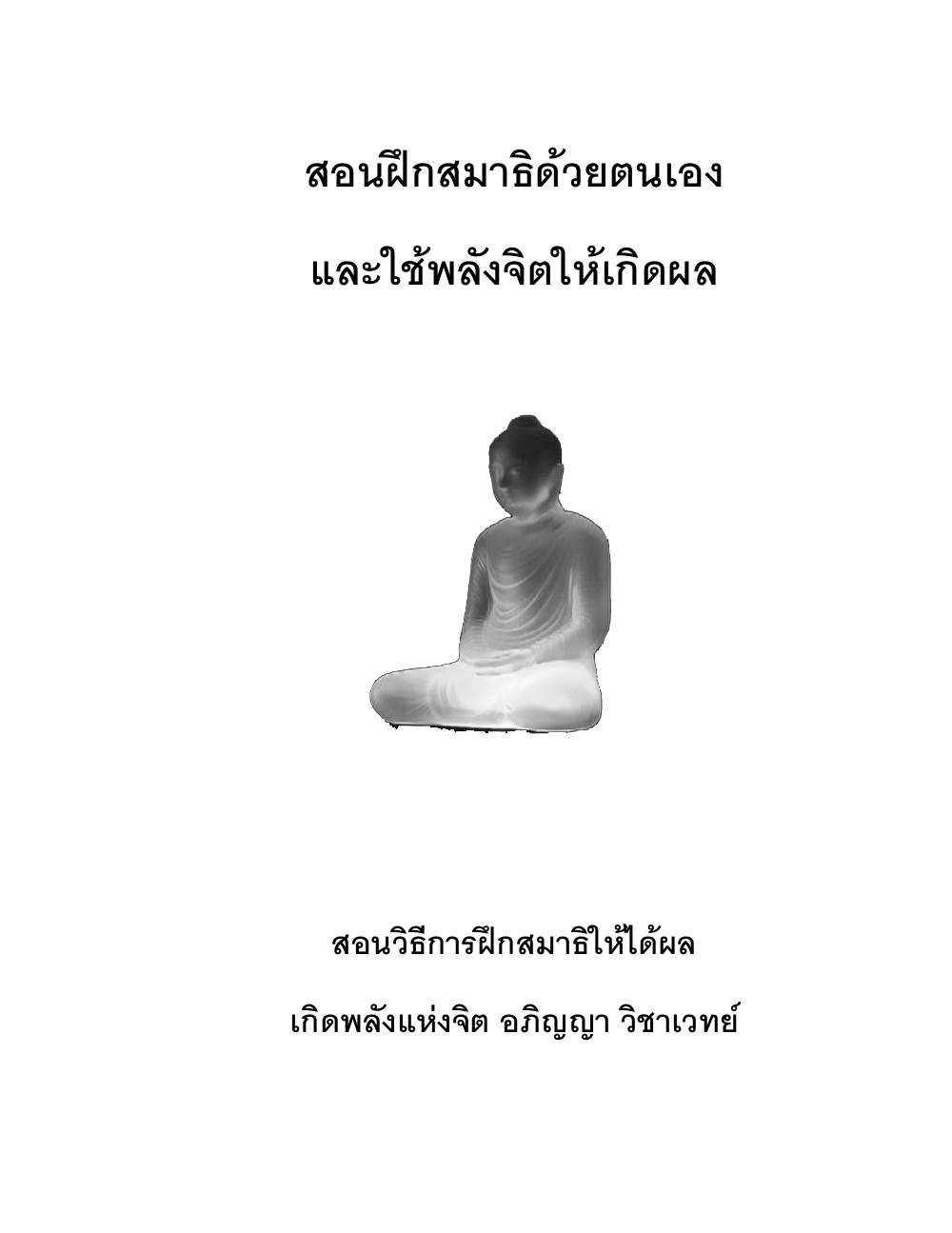
สอนฝึกสมาธิด้วยตนเอง
และใช้พลังจิตให้เกิดผล
[ภาพ: พระพุทธรูปปางสมาธินั่งขัดสมาธิ สีทอง]
สอนวิธีการฝึกสมาธิให้ได้ผล
เกิดพลังแห่งจิต อภิญญา วิชาเวทย์
Teaching Yourself to Practice Samadhi
And Using Mind Power to Produce Results
[image: a golden seated Buddha statue in meditation posture]
Teaching the method of practicing samadhi effectively
Producing mind power, higher knowledge (abhiñña), and magical science
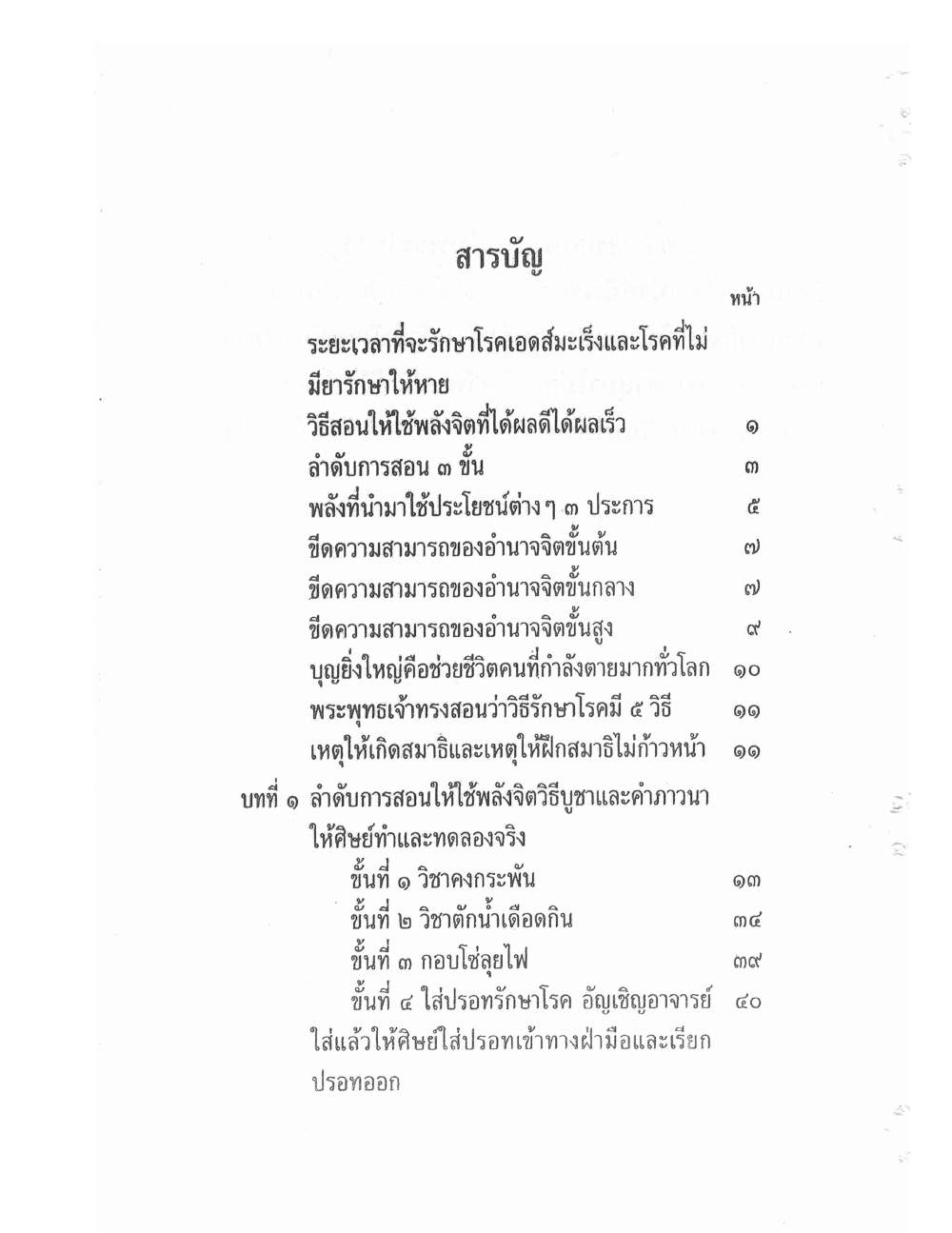
สารบัญ หน้า ระยะเวลาที่จะรักษาโรคเอดส์มะเร็งและโรคที่ไม่ มียารักษาให้หาย วิธีสอนให้ใช้พลังจิตที่ได้ผลดีได้ผลเร็ว ๑ ลำดับการสอน ๓ ขั้น ๓ พลังที่นำมาใช้ประโยชน์ต่าง ๆ ๓ ประการ ๕ ขีดความสามารถของอำนาจจิตขั้นต้น ๗ ขีดความสามารถของอำนาจจิตขั้นกลาง ๗ ขีดความสามารถของอำนาจจิตขั้นสูง ๙ บุญยิ่งใหญ่คือช่วยชีวิตคนที่กำลังตายมากทั่วโลก ๑๐ พระพุทธเจ้าทรงสอนว่าวิธีรักษาโรคมี ๕ วิธี ๑๑ เหตุให้เกิดสมาธิและเหตุให้ฝึกสมาธิไม่ก้าวหน้า ๑๑ บทที่ ๑ ลำดับการสอนให้ใช้พลังจิตวิธีบูชาและคำภาวนา ให้ศิษย์ทำและทดลองจริง ขั้นที่ ๑ วิชาคงกระพัน ๑๓ ขั้นที่ ๒ วิชาตักน้ำเดือดกิน ๓๔ ขั้นที่ ๓ กอบโซ่ลุยไฟ ๓๙ ขั้นที่ ๔ ใส่ปรอทรักษาโรค อัญเชิญอาจารย์ ๔๐ ใส่แล้วให้ศิษย์ใส่ปรอทเข้าทางฝ่ามือและเรียก ปรอทออก
Table of Contents Page The length of time needed to treat AIDS, cancer, and diseases with no known cure Method of teaching the use of mind power for good, fast results 1 The 3-stage teaching sequence 3 The 3 kinds of benefit that this power can be put to use for 5 The capability limits of beginning-level mind power 7 The capability limits of intermediate-level mind power 7 The capability limits of advanced-level mind power 9 The greatest merit is saving the lives of the many dying worldwide 10 The Buddha taught that there are 5 methods of treating illness 11 Causes that give rise to samadhi, and causes that keep samadhi practice from progressing 11 Chapter 1: The sequence for teaching the use of mind power by the method of veneration and recitation of chants, having the student actually perform and test it Stage 1: The invulnerability discipline (khong kraphan) 13 Stage 2: The discipline of scooping and drinking boiling water 34 Stage 3: Gathering red-hot chains, walking through fire 39 Stage 4: Inserting mercury for treating illness; inviting the teacher [spirit] 40 After insertion, the student is made to receive the mercury through the palm of the hand and to call the mercury back out
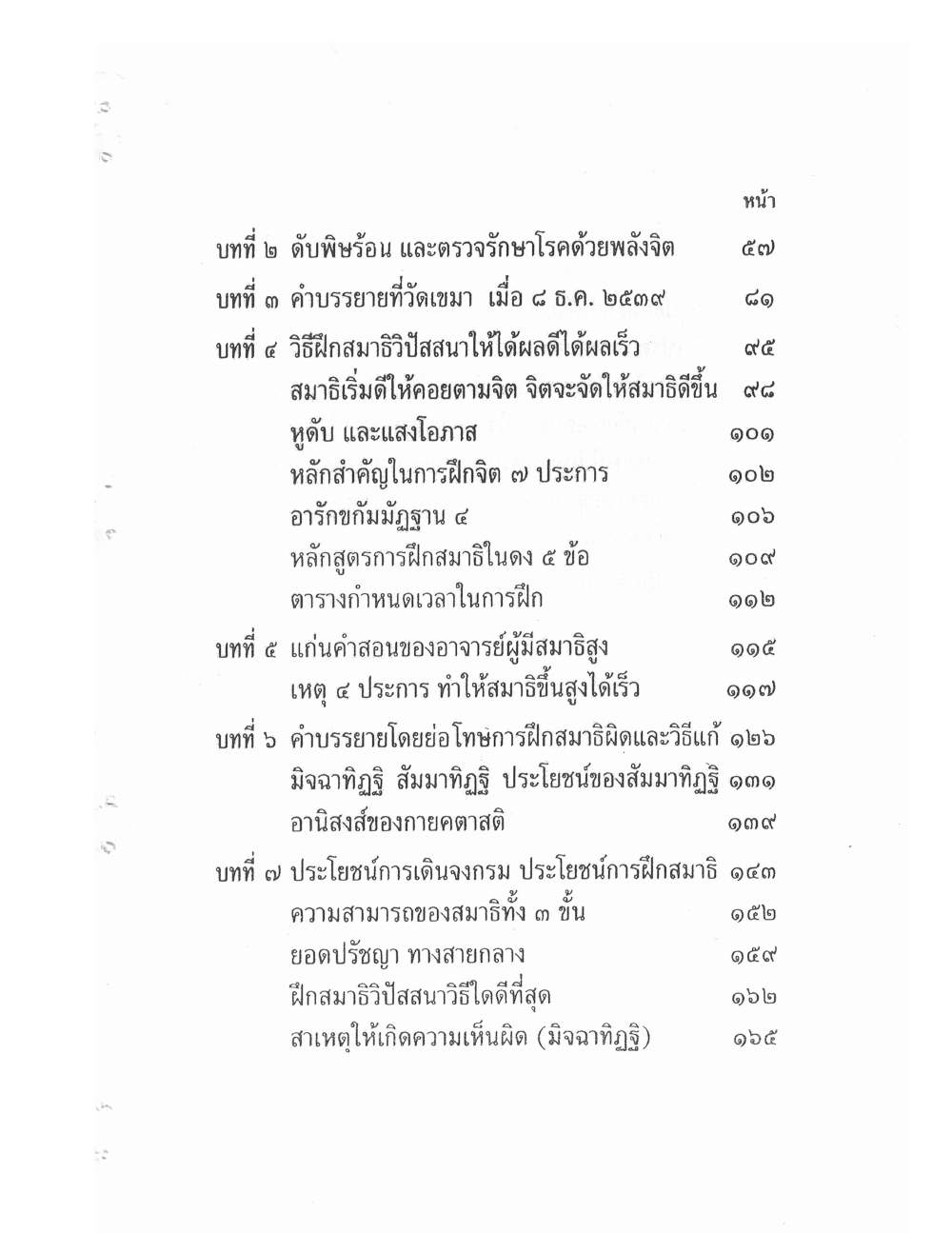
หน้า บทที่ ๒ ดับพิษร้อน และตรวจรักษาโรคด้วยพลังจิต ๕๗ บทที่ ๓ คำบรรยายที่วัดเขมา เมื่อ ๘ ธ.ค. ๒๕๓๙ ๘๑ บทที่ ๔ วิธีฝึกสมาธิวิปัสสนาให้ได้ผลดีได้ผลเร็ว ๙๕ สมาธิเริ่มดีให้คอยตามจิต จิตจะจัดให้สมาธิดีขึ้น ๙๘ หูดับ และแสงโอภาส ๑๐๑ หลักสำคัญในการฝึกจิต ๗ ประการ ๑๐๒ อารักขกัมมัฏฐาน ๔ ๑๐๖ หลักสูตรการฝึกสมาธิในดง ๕ ข้อ ๑๐๙ ตารางกำหนดเวลาในการฝึก ๑๑๒ บทที่ ๕ แก่นคำสอนของอาจารย์ผู้มีสมาธิสูง ๑๑๕ เหตุ ๔ ประการ ทำให้สมาธิขึ้นสูงได้เร็ว ๑๑๗ บทที่ ๖ คำบรรยายโดยย่อโทษการฝึกสมาธิผิดและวิธีแก้ ๑๒๖ มิจฉาทิฏฐิ สัมมาทิฏฐิ ประโยชน์ของสัมมาทิฏฐิ ๑๓๑ อานิสงส์ของกายคตาสติ ๑๓๙ บทที่ ๗ ประโยชน์การเดินจงกรม ประโยชน์การฝึกสมาธิ ๑๔๓ ความสามารถของสมาธิทั้ง ๓ ขั้น ๑๕๒ ยอดปรัชญา ทางสายกลาง ๑๕๙ ฝึกสมาธิวิปัสสนาวิธีใดดีที่สุด ๑๖๒ สาเหตุให้เกิดความเห็นผิด (มิจฉาทิฏฐิ) ๑๖๕
Page Chapter 2: Dispelling burning poison, and examining and treating illness with mind power 57 Chapter 3: Lecture given at Wat Khema, 8 December 2539 [1996] 81 Chapter 4: Method of practicing samadhi-vipassana for good, fast results 95 When samadhi first becomes good, follow the mind; the mind will arrange for samadhi to improve further 98 Ears going silent, and radiant light 101 7 essential principles for training the mind 102 The 4 protective meditation subjects (ārakkha-kammaṭṭhāna) 106 The 5-point curriculum for practicing samadhi in the forest 109 Timetable for practice 112 Chapter 5: The essence of the teaching of a teacher of high samadhi 115 4 causes that make samadhi rise to a high level quickly 117 Chapter 6: A brief lecture on the faults of practicing samadhi incorrectly, and how to correct them 126 Wrong view, right view, the benefits of right view 131 The blessings of mindfulness of the body 139 Chapter 7: The benefits of walking meditation, the benefits of practicing samadhi 143 The capabilities of the three levels of samadhi 152 The supreme philosophy: the Middle Way 159 Which method of practicing samadhi-vipassana is best 162 The causes that give rise to wrong view (micchā-diṭṭhi) 165
๑
วิธีสอนให้ใช้พลังจิตที่ได้ผลดีได้ผลเร็ว
ผู้สนใจจะใช้อำนาจจิตหรือพลังจิตของตนให้เกิด ประโยชน์ต่าง ๆ ได้เร็ว คือ ใช้เวลาเรียนเพียงวันเดียวก็ ใช้พลังจิตให้เกิดประโยชน์ต่าง ๆ ได้ เช่นใช้พลังจิตให้ มีความจำดีเรียนเก่ง, ใช้พลังจิตช่วยให้ทำงานได้ผลดี ใช้พลังจิตรักษาโรคต่าง ๆ ที่ฝรั่งยังไม่มียารักษาที่ได้ผล เช่น โรคเอดส์, โรคมะเร็ง, วัณโรคบางประเภท, ไซนัส, เบาหวาน, หืด, ทอนซิลอักเสบ, ไวรัสบางชนิด, เรื้อนกวาง แบบแห้ง, ต่อมลูกหมากโต, นิ่วในไตและในถุงน้ำดี, งูสวัด, เริม, พิษสุนัขบ้าที่มีอาการแล้ว เหล่านี้ล้วนรักษา ให้หายได้เร็วด้วยการใช้สมุนไพรหรือใช้ยาประกอบ กับพลังจิตพลังคุณพระ วิธีรักษาโรคโดยละเอียดได้กล่าว ไว้ใน “แพทย์สามแผนนำสมัย” ที่มีหัวข้อสำคัญครบถ้วน คือ ชื่อโรค, อาการ, วิธีรักษาของแสลง, การปฏิบัติตน และวิธีใช้สมาธิรักษาตนเองและรักษาผู้อื่น อ่านแล้ว สงสัยก็ถามได้ไปเรียนเพื่อให้รักษาได้ผลดีก็ยินดี สอนให้ โดยไม่คิดค่าสอน ได้สอนศิษย์มาเป็นเวลา ๔๐ ปี ตั้ง แต่ พ.ศ. ๒๕๐๐ เป็นต้นมา ในปัจจุบันจนถึง พ.ศ. ๒๕๔๐ นี้มีบางอาจารย์นำเอาวิธีรักษาโรคต่าง ๆ แบบฝรั่งมา
1
How to Teach Mind Power Use for Good, Fast Results
Anyone interested in using the power of their mind, or mind power, to bring about various benefits quickly — that is, using only a single day of study to be able to use mind power for various benefits — can do so. For example, using mind power to gain a good memory and study well; using mind power to help one's work turn out well; using mind power to treat various illnesses for which Westerners still have no effective medicine, such as AIDS, cancer, certain kinds of tuberculosis, sinusitis, diabetes, asthma, tonsillitis, certain viruses, dry-type ringworm/eczema, enlarged prostate, kidney stones and gallstones, shingles, herpes, and rabies once symptoms have appeared — all of these can be cured quickly by using herbal medicine or medicine combined with mind power and the power of the Buddha's virtue. The detailed method of treatment is set out in "Modern Traditional Medicine" (แพทย์สามแผนนำสมัย), which has all the essential headings complete: name of illness, symptoms, treatment method, dietary restrictions, self-conduct, and the method of using samadhi to treat oneself and to treat others. Having read it, if you still have doubts you may ask; and if you wish to study further in order to obtain good results in treatment, I am glad to teach — without charging any fee. I have been teaching students for 40 years now, from B.E. 2500 [1957] onward, up to the present, B.E. 2540 [1997]. In this period some teachers have taken foreign-style methods of treating various illnesses
๒
สอนในเมืองไทย แต่จะได้ผลดีเพียงใดย่อมพิจารณาได้ ง่ายจากผลในการรักษาเปรียบเทียบกับวิธีของไทยที่ได้ จากการสอนของพระอาจารย์ในดงลึก และความชำนาญ ในการค้นคว้าทดลองซึ่งผู้เขียน (พ.อ.ชม) ได้ทดลอง รักษามากว่า ๔๐ ปี ขอยืนยันด้วยความสัตย์จริงว่า การ เขียนทุกเรื่องพูดถึงและเปรียบเทียบระหว่างแพทย์ฝรั่ง แผนปัจจุบันและแผนโบราณของไทย ไม่มีการกล่าวถึง แพทย์แผนปัจจุบันของไทยเพราะย่อมจะรู้เห็นชัดเจน กันอยู่แล้ว ถ้าใช้สติปัญญาพิจารณาดูให้รอบคอบ ถ้า แพทย์แผนปัจจุบันไทยเห็นว่ามีข้อความพาดพิงถึง แพทย์แผนปัจจุบันไทยให้เสียหายหรือมีข้อความใด กระทบกระเทือนถึงโปรดแจ้งให้ผู้เขียน (พ.อ.ชม) ทราบด้วย จะแก้ไขโดยด่วน ถ้าทุกคนช่วยกันทำให้ แพทย์แผนปัจจุบันและแผนโบราณร่วมมือกันได้ด้วย ความจริงใจทั้งไทยและฝรั่งก็จะช่วยชีวิตคนที่กำลังตาย มากขึ้นทุกทีด้วยโรคที่แพทย์ที่ฝรั่งรักษาไม่ได้ผลหรือยัง คิดยาไม่ได้ เพราะสภาพแวดล้อมทำให้โรคใหม่ ๆ เกิด ขึ้น โรคเก่าก็เปลี่ยนสภาพแปลก ๆ ขึ้น ทำให้อาการ ปรากฏผิดไปจากเดิมตรวจรักษาไม่ได้ผลอีกด้วย เพราะ เหตุที่จะกล่าวต่อไป การกล่าวถึงแพทย์ฝรั่งได้ไม่ใช่เดา แต่ผู้เขียนได้ไปเรียนวิชาทางโลกที่อเมริกา ๒ ครั้ง ดูงาน
2
to teach in Thailand — but how good the results really are can easily be judged by comparing their results in treatment with the Thai method obtained from the teaching of forest-dwelling teachers (phra ajarn nai dong), together with the skill from research and experimentation which the writer (Colonel Chom) has carried out in treatment for over 40 years. I affirm truthfully that everything written here discusses and compares Western modern medicine and Thai traditional medicine only — nothing is said about Thai modern medicine, since that is already clearly known to everyone, if one considers it carefully and thoughtfully. If Thai modern-medicine doctors feel that anything here touches on or damages Thai modern medicine, or contains anything that causes harm, please inform the writer (Colonel Chom) so that it can be corrected promptly. If everyone helps bring modern medicine and traditional medicine to cooperate sincerely, both Thai and foreign, then more and more lives can be saved among the many now dying from diseases that Western doctors cannot treat successfully or for which no medicine has yet been devised — because changing environmental conditions cause new diseases to arise, and old diseases to change into strange new forms, so that their symptoms appear differently from before and examination and treatment fail to work, for reasons to be discussed further. What is said here about Western medicine is not guesswork — the writer has gone to study worldly subjects in America twice, observing work
๓
หนึ่งครั้ง และเคยไปประเทศต่าง ๆ อ่านข่าวและตำรา ฝรั่งและพิจารณาด้วยสมาธิด้วยเรียนรู้จากพระอาจารย์ ในดง ผู้มีฤทธิ์และเคยเป็นแพทย์แผนปัจจุบันไทยมา แล้วด้วย และผู้เขียนได้รักษาโรคต่าง ๆ มานานตลอด ๔๐ ปี “ร่วมมือกันนั้นดีกว่าพาล”
การเรียนการสอนแบบพระอาจารย์ในดงหรือนั่น คือ สอนแบบสมบูรณ์ตามคำสอนของพระพุทธเจ้าซึ่ง มีปรากฏในพระไตรปิฎก
วิธีสอนให้ใช้พลังจิตให้เกิดประโยชน์ต่าง ๆ ได้ จริงและได้ผลเร็วมีลำดับดังนี้
๑. สอนให้ทำสมาธิได้ถูกต้องเสียก่อน เพราะสมาธิสูงขึ้นก็เกิดพลังจิตสูงขึ้นโดยลำดับ ถึงไม่ ประสงค์จะให้เกิดพลังแต่ก็จะเกิดพลังขึ้นเองโดยธรรมชาติ จึงต้องสอนให้ทำสมาธิให้ถูกต้อง โดยสอนให้ตรวจผล ของสมาธิได้ด้วยตนเองว่าตนมีสมาธิระดับใดและจะฝึก ให้ดีขึ้นอย่างไร?
๒. สอนให้ส่งพลังจิตออกไปภายนอกจาก ง่ายไปยาก คือสอนให้ส่งพลังจิตไปยังปูนที่นิ้วมือปล่อย พลังไปยังปูนทำให้ปูนเปลี่ยนรสได้ ทดลองให้เป็น
3
once, and has also gone to various other countries, reading foreign news and texts and considering them with samadhi, along with learning from the forest-dwelling teacher, a man of psychic power who had also once been a Thai modern-medicine doctor. And the writer has treated various illnesses for a long time, over 40 years. "Cooperation is better than foolish conflict."
The teaching and study method of the forest-dwelling teachers is this: it is a complete teaching following the Buddha's teaching as it appears in the Tipitaka.
The method for teaching the use of mind power so that it truly produces various benefits, and produces them quickly, has the following sequence:
1. First teach the student to practice samadhi correctly, because as samadhi rises, mind power arises correspondingly higher in sequence. Even without intending power to arise, it will arise by itself, naturally. Therefore one must teach samadhi to be done correctly, teaching the student to examine the results of their own samadhi — to know for themselves at what level their samadhi stands, and how to train it to improve further.
2. Teach the student to project mind power outward, proceeding from easy to difficult — that is, teach the student to project mind power onto lime paste (ปูน, chewing-lime) held at the fingertips, releasing power into the lime paste so as to change its taste. Test this until it becomes
๔
คงกระพันก็ได้ ต่อไปให้ส่งพลังจิตไปยังน้ำหรือน้ำมันที่ กำลังเดือดซึ่งร้อนประมาณ ๑๑๐ องศา ให้หมดพิษ ทุกคนเอามือล้วงลงในน้ำเดือดได้ตักกินได้ไม่มีอันตราย ขั้นต่อไปให้ส่งพลังจิตไปยังโซ่เหล็กที่เผาไฟจนแดงเอามือ แตะโซ่เหล็กที่ร้อนแดงนั้นได้ เอามือกอบโซ่เหล็กที่ร้อน แดงขึ้นได้ ก่อนทดลองทุกขั้นต้องสอนให้ตรวจสอบเสีย ก่อนว่า หมดพิษไม่มีอันตรายและกล้าทดลองทุกคน
๓. เมื่อแน่ใจว่าตนมีพลังจิตและสามารถ ส่งพลังจิตออกไปภายนอกได้จริงแล้ว จึงสอนให้ส่ง พลังจิตไปรักษาโรคด้วยวิธีต่าง ๆ ได้ผลจริง ขั้นแรก สอนให้ใช้พลังจิตบังคับปรอทไร้โทษเข้าทางฝ่ามือเพื่อ ให้แล่นไปรักษาโรคในกายของคน แต่ในโอกาสนี้ต้อง แสดงให้เห็นว่าอำนาจคุณพระอำนาจครูอาจารย์อำนาจ พลังของบิดามารดานั้นสามารถอาราธนาให้มาช่วยทำให้ ปรอทเข้าตัวคนไข้ได้โดยไม่ต้องใช้พลังจิตของตนไม่ต้อง ภาวนาคาถาอะไร ปรอทก็วิ่งเข้าตัวคนได้ด้วยพลังคุณพระ เป็นการเกิดพลังความเชื่อที่พิสูจน์ทดลองได้ และด้วย เหตุนี้จึง ใช้พลังคุณพระเป็นความเชื่อประกอบกับการ ใช้พลังสมาธิเป็นหลักสำคัญช่วยรักษาโรคต่าง ๆ ได้ ผลดี ได้ผลเร็ว โดยการอธิบายวิธีส่งพลังจิตไปรักษาโรค
4
possible to become invulnerable (khong kraphan) as well. Next, the student is taught to project mind power onto water or oil that is boiling, at about 110 degrees, so as to remove its harm entirely — so that anyone can plunge a hand into the boiling water and scoop it up and drink it with no danger. The next stage is to project mind power onto an iron chain heated in fire until red-hot, so the hand can touch that red-hot chain, and can even gather up the red-hot chain in the hand. Before every stage of testing, the student must be taught to check first that all harm has been removed and there is no danger, and to dare to test it, everyone.
3. Once one is certain that one truly has mind power and can truly project that mind power outward, one is then taught to project mind power to treat illness by various methods, with real results. The first stage teaches the use of mind power to direct harmless mercury in through the palm of the hand so that it will travel through and treat illness within a person's body. But on this occasion it must be demonstrated that the power of the Buddha's virtue, the power of one's teachers, and the power of one's parents can be invoked to help make the mercury enter the patient's body without the need to use one's own mind power at all, without reciting any incantation — the mercury runs into the person's body by the power of the Buddha's virtue alone. This produces a power of belief that can be proven and tested. And for this reason, the power of the Buddha's virtue is used as belief, in combination with the use of the power of samadhi, as the essential foundation to help treat various illnesses with good results, and with fast results, by explaining the method of projecting mind power to treat illness
๕
เป็นอย่าง ๆ ต่อไป หรือการใช้ยาประกอบกับพลังจิต ทำอย่างไรก็อธิบายและทดลองให้ดูโดยไม่ปิดบังความรู้ ผู้เชื่อว่าพลังอื่นมาช่วยได้ก็ควรลองดูว่ามาช่วยได้จริง หรือไม่ และช่วยได้มากน้อยเพียงใด ใช้เวลาในการเรียน มากน้อยเพียงใดเพื่อประกอบการพิจารณา
กล่าวโดยสรุปพลังจิตที่จะนำมาใช้ให้เกิด ประโยชน์ มี ๒ ประเภทคือ พลังความเชื่อและพลังของ สมาธิ
๑. พลังที่เกิดจากความเชื่อ เป็นวิธีที่ฝรั่งใช้และ นำมาสอนกันหลายสำนัก ต้องใช้เวลาเรียนมากกว่าจะเชื่อ
๒. พลังที่เกิดจากสมาธิ มีผลมากจากชั้นต้นจน ถึงชั้นสูงสุด มีการแสดงฤทธิ์ต่าง ๆ ได้ ถึงนิพพานได้
๓. การใช้พลังสมาธิเป็นหลัก ใช้ความเชื่อ ประกอบซึ่งเป็นวิธีที่ให้ผลดีที่สุดและทดลองให้เห็นจริงได้ เรียนรู้และพิสูจน์ให้เห็นแจ่มแจ้งได้
การสอนให้รักษาโรคแบบฝรั่ง จะสอนให้รักษา โรคเลย โดยที่ผู้เรียนยังไม่รู้แน่ชัดว่าตนมีพลังจะส่งไป รักษาโรคได้หรือไม่ ถ้ามีก็ไม่รู้ว่ามีมากหรือน้อยเพียงใด นี่คือความสงสัยลังเลใจ ซึ่งเป็นนิวรณ์ ๕ ข้อสุดท้าย
5
one by one; or the use of medicine combined with mind power — however it is done, it is explained and demonstrated openly, hiding no knowledge. Those who believe that some other power can help should try it out to see whether it truly helps or not, and how much or little it helps, and how much time is needed to learn it, so as to inform one's own judgment.
In summary, the mind power to be used for producing benefit is of 2 kinds: the power of belief, and the power of samadhi.
1. Power arising from belief — this is the method used by Westerners and taught in many schools; it requires more time spent learning before belief is achieved.
2. Power arising from samadhi — this has great effects, from the beginning level up to the highest level, able to display various psychic powers, and able to reach nibbana.
3. Using the power of samadhi as the foundation, combined with belief — this is the method that gives the best results and can be tested and shown to be true; it can be learned and proven with full clarity.
Teaching to treat illness in the Western manner teaches the student to go straight to treating illness, while the learner still does not know for certain whether they have power that can be sent to treat illness or not — and if they do have it, they do not know how much or how little. This is doubt and hesitation, which is the fifth and final hindrance (nivarana)
๖
เป็นเครื่องขัดขวางไม่ให้เกิดความสำเร็จ ถ้าผู้ใดเชื่อ ได้สนิทก็ย่อมรักษาโรคได้ผลพอประมาณหรือดีบ้าง ภายหลังเขาได้สังเกตพิจารณาการใช้วิธีรักษาโรคแบบไทย ที่ได้ผลดีเพราะใช้สมาธิช่วย หลักสูตรการฝึกในระดับ ท้าย ๆ ของฝรั่งเขาจึงสอนให้ใช้สมาธิช่วยด้วย ระยะเวลา เรียนยังใช้เวลาให้ได้ผลดีเป็นระยะเวลาหลายวันหรือ หลายปี จึงได้ผลดีพอสมควร
แต่การที่ได้รับการสอนแบบพระอาจารย์ในดง สรุปรวมธรรมหมวดอื่นในพระไตรปิฎกมาร่วมอธิบาย ขยายความให้แจ่มแจ้ง มีขั้นตอนภาคปฏิบัติเป็นขั้น ๆ จากง่ายไปยากจึงทำให้เรียนได้เร็ว ผู้ไม่เคยฝึกสมาธิเลย หรือฝึกได้เพียงสมาธิขั้นต้นก็สามารถเรียนรู้การทำสมาธิ ได้ถูกต้อง และรู้วิธีวัดได้เองว่าตนมีสมาธิระดับใด จะฝึก ต่อไปให้ก้าวหน้าอีกอย่างไร และรู้ส่งอำนาจคุณพระ อำนาจสมาธิไปรักษาโรคต่าง ๆ ได้ผลดี ได้ผลเร็ว ตามที่ กล่าวมาแล้วใช้เวลาเพียงวันเดียวก็เรียนได้จบและได้ผล ถึงไปรักษาโรคต่าง ๆ ได้จริง
พระอาจารย์ในดงจะสอนเน้นในเรื่องการใช้พลัง คุณพระพลังจิตว่าเป็นวิชาที่ต้องผ่านไปไม่ยึดติด เป็น วิชาเด็กเล่น ที่ถูกคือเร่งฝึกสมาธิให้ก้าวหน้ายิ่ง ๆ ขึ้นไป
6
that blocks the arising of success. If someone believes wholeheartedly, they may indeed treat illness with moderate or even good results. Afterward, having observed and considered the use of the Thai method of treatment, which gets good results because it uses samadhi to help, Western training curricula at their most advanced levels have accordingly begun teaching the use of samadhi as an aid too. But the time needed for study to get good results is still many days or many years, so the results obtained are only fair.
But being taught in the manner of the forest-dwelling teachers, which brings together and summarizes other sections of Dhamma in the Tipitaka to jointly explain and elaborate matters clearly, with a practical sequence proceeding step by step from easy to difficult, makes learning fast. A person who has never practiced samadhi at all, or who has practiced only to the beginning level, can learn to do samadhi correctly, and can learn to measure for themselves what level of samadhi they have, and how to train further to progress — and can learn to project the power of the Buddha's virtue and the power of samadhi to treat various illnesses with good, fast results. As already stated, it takes only a single day to complete the study and obtain results, even to the point of actually treating various illnesses.
The forest-dwelling teacher teaches with emphasis on the use of the power of the Buddha's virtue and mind power as a subject one must pass through without clinging to it — it is a "child's-play" subject; what is correct is to hasten to train samadhi to progress ever further.
๗
เมื่อใช้ความพยายามและปฏิบัติตามคำสอนของ พระพุทธองค์ได้จริงก็ใช้เวลา เพียง ๓ เดือน ก็ได้ถึง สมาธิขั้นกลาง สมาธิขั้นกลางมีพลังดีกว่าขั้นต้นมาก
ขีดความสามารถของอำนาจจิตขั้นต้น
อำนาจจิต ขั้นต้นจะช่วยให้มีความสามารถทั้งทางกายและทางจิตใจ ดีขึ้นกว่าปกติเพิ่มความเข้มแข็งอดทนและขยันหมั่นเพียร ช่วยให้มีความจำดีมีสุขภาพดี เพิ่มความรู้ความเข้าใจใน วิชาการต่าง ๆ ดีขึ้น ขวัญและกำลังใจดีขึ้น ในกรณีพิเศษ หรือการทดสอบอำนาจจิตขั้นนี้สามารถทดลองฟันหรือ แทงด้วยแรงคนไม่เข้า ไม่มีอันตราย น้ำมันที่กำลังเดือด เอามือจุ่มลงไปได้ ตักกินได้โดยไม่มีอันตราย สามารถ เดินลุยไปบนถ่านที่ติดไฟโดยไม่ต้องใส่รองเท้าสามารถเอา มือจับโซ่ขนาดใหญ่ที่เผาไฟจนแดงได้หรือเอามือกอบ ขึ้นได้ ใช้ในการรักษาโรคได้หรือช่วยส่งเสริมการรักษา อย่างอื่นให้โรคหายเร็วขึ้น ใช้ในการสะกดจิตได้ ช่วยให้ มองเห็นภาพสิ่งของหรือเหตุการณ์ในปัจจุบันและอนาคต อันใกล้ได้ แต่ก็เป็นภาพเงา ๆ ยังไม่ชัดเจนเหมือน สมาธิขั้นกลาง จึงมีส่วนผิดบ้างถูกบ้าง
ขีดความสามารถของอำนาจจิตขั้นกลาง
อำนาจ จิตขั้นกลางสามารถเพิ่มพูนความเข้มแข็งความอดทนและ
7
When one applies real effort and truly practices according to the Buddha's teaching, it takes only about 3 months to reach intermediate-level samadhi. Intermediate samadhi has far greater power than the beginning level.
The Capability Limits of Beginning-Level Mind Power
Beginning-level mind power helps improve one's ability in both body and mind beyond the ordinary, increasing strength, endurance, and diligence; it helps give a good memory and good health; it increases knowledge and understanding of various subjects; morale and confidence improve. In special circumstances, or when testing this level of power, one can test being cut or stabbed by a person's own force without the blade penetrating, with no harm; one can dip a hand into boiling oil, scoop it up and eat it with no harm; one can walk through burning coals without wearing shoes; one can grasp a large chain heated in fire until red-hot, or gather it up in the hand. It can be used to treat illness, or to help support other treatments so illness heals faster. It can be used for hypnosis/mind-suppression. It helps one see images of objects or events in the present and near future, but these are only shadowy images, not yet as clear as with intermediate samadhi, so there is a mix of right and wrong in them.
The Capability Limits of Intermediate-Level Mind Power
Intermediate-level mind power can further increase strength, endurance, and
๘
ความขยันหมั่นเพียร ช่วยให้เกิดขวัญและกำลังใจ ช่วย ให้มีความจำและความรู้ความเข้าใจได้ดีกว่าอำนาจจิตขั้น ต้น ส่วนในกรณีอื่น ๆ ก็มีขีดความสามารถสูงกว่าอำนาจ จิตขั้นต้น ตัวอย่างเช่น ในการทดลองฟันหรือแทงแรง ๆ อำนาจจิตขั้นต้นยังปรากฏผลว่ามีอาการบวมแดง และมี อาการเจ็บช้ำได้ บางทีก็มีเลือดซึมออกมาบ้าง แต่อำนาจ จิตขั้นกลางจะไม่มีอาการเจ็บไม่ช้ำบวม มองเห็นวัตถุใน ที่กำบังระยะไกล หรือเห็นเหตุการณ์ปัจจุบันและอนาคต อันใกล้ชัดเจนและถูกต้อง มีส่วนจะผิดพลาดน้อยมาก ในด้านความจำก็สามารถจำได้มากในระยะเวลา อันสั้น สามารถรับส่งข่าวด้วยกระแสจิตได้ (ถามและตอบกันได้ ทางจิต) สะเดาะกุญแจให้หลุดได้, สามารถรักษาโรคได้ ผลดีกว่าอำนาจจิตขั้นต้น สามารถเปลี่ยนธาตุหรือวัตถุ อย่างหนึ่งให้เป็นอีกอย่างหนึ่งได้ และทำให้เป็นตัวสัตว์ที่ มีชีวิตและวิญญาณได้ เช่นการทำใบไม้ให้เป็นแมลงภู่ หรือเป็นนก และทำให้ข้าวสารให้เป็นกุ้ง ความสามารถ ดังกล่าวมานี้ อาจารย์ในประเทศไทยได้แสดงต่อหน้าที่ ประชุมหลายครั้งมาแล้ว ในปัจจุบันก็มีทำได้หลายท่าน
8
diligence, help create morale and confidence, and help give better memory and comprehension than beginning-level mind power. In other respects too its capability exceeds that of beginning-level power. For example, in testing being cut or stabbed hard, beginning-level power still shows swelling and redness and bruising afterward, and sometimes a little blood seeps out; but with intermediate-level power there is no pain, no bruising, no swelling. One can see objects hidden at a distance, or see present events and near-future events clearly and correctly, with very little error. As for memory, one can memorize a great deal in a short time; one can send and receive messages by mental current (asking and answering mentally); one can pick locks open by mind alone; one can treat illness with better results than beginning-level power; one can transform one element or object into another, and even make it into a living creature with a spirit — for example turning a leaf into a bee or a bird, or turning uncooked rice grains into shrimp. Teachers in Thailand have demonstrated these abilities before assembled audiences many times already; at present there are several people who can do this.
๙
ขีดความสามารถของอำนาจจิตขั้นสูง
อำนาจจิต ขั้นสูงย่อมใช้ประโยชน์ต่าง ๆ ได้เหมือนอำนาจจิตขั้นต้น และขั้นกลาง แต่มีขีดความสามารถสูงกว่า เช่น ทำได้ดี ทำได้เร็ว ถูกต้องแม่นยำกว่า และนอกนั้นยังมีขีดความ สามารถนอกเหนือไปจากอำนาจจิตขั้นต้น และขั้นกลาง อีกมากมายหลายอย่าง ตัวอย่างการแสดงอำนาจจิต ตลอดจนหลักการและวิธีการที่จะใช้อำนาจจิตขั้นสูงมีอยู่ ในพระไตรปิฎกหลายแห่ง จะขอยกมาเพียงบางแห่ง เช่น น้อมจิตไปเพื่ออิทธิวิธีหลายประการคือ คนเดียวเป็น หลายคนก็ได้ ทำให้หายไปก็ได้ (หายตัว) หรือทำให้ วัตถุอื่นหายไป เดินทะลุฝากำแพงหรือภูเขาไปได้ น้อมจิต ให้เกิด ทิพยโสต ได้ยินเสียงทิพย์กับเสียงมนุษย์ใกล้ไกล ได้ เจโตปริยญาณกำหนดรู้ใจของผู้อื่นได้ ปุพเพนิวาสา -นุสสติญาณ ระลึกชาติก่อนได้เป็นอันมาก ผุดขึ้นดำลง แม้นในแผ่นดินเหมือนในน้ำก็ได้ เดินบนน้ำเหมือนเดิน บนดินก็ได้ เหาะไปในอากาศเหมือนนกก็ได้ น้อมใจทำ กองไม้ให้เป็นดินได้ หรือให้เป็นน้ำได้ เป็นลมก็ได้ ทำให้ ปรากฏคือมองเห็นอะไรไกลใกล้ได้แม้จะมีอะไรปิดบังก็ เห็นได้และอำนาจจิตขั้นสูงแม้ถูกเผาทั้งเป็นก็ไม่มีอันตราย โจรไล่ฟันก็ไม่ได้ สัตว์ร้ายก็ไม่กล้าทำอันตราย จิตขั้น สูงสุดก็อาจสำเร็จวิชา ๓ อภิญญา ๖ หรือ วิชชา ๘ ประการ
9
The Capability Limits of Advanced-Level Mind Power
Advanced-level mind power can be used for all the same benefits as beginning- and intermediate-level power, but has a higher capability — it produces results better, faster, and with greater accuracy — and beyond that it has capabilities entirely beyond those of the beginning and intermediate levels, many more besides. Examples of the display of mind power, together with the principles and methods for using advanced-level mind power, appear in many places in the Tipitaka; only a few will be cited here. Directing the mind toward the various modes of psychic power (iddhi-vidhā): a single person can become many persons; one can make oneself disappear (vanish), or make other objects disappear; one can walk through walls or mountains; one can direct the mind to produce the divine ear (dibba-sota), hearing both divine sounds and human sounds near and far; cetopariya-ñāṇa, knowing the minds of others; pubbenivāsānussati-ñāṇa, recalling a great many past lives; one can rise up and sink down even through solid ground as though through water; one can walk on water as on solid ground; one can fly through the air like a bird; one can direct the mind to turn a mass of earth into water, or into wind; one can cause things to appear — that is, see anything far or near even when something conceals it; and with advanced-level mind power, even if burned alive there is no harm; robbers cannot cut one down with a blade; fierce animals dare not harm one. At the very highest level of mind, one may attain the 3 vijjā, the 6 abhiññā, or the 8 vijjā.
บุญยิ่งใหญ่ที่จะนำความเจริญมาให้ตน
ขอเชิญชวนให้ศิษย์ที่เคยเรียนใช้พลังจิตพลังคุณพระจำนวนมากจากผู้เขียน (พ.อ.ชม) ช่วยรักษาโรคที่ฝรั่งยังไม่มียาที่จะรักษาได้ผลดีทำให้คนตายมากขึ้นทุกที โรคที่เคยรักษาหายก็ดื้อด้านรักษาไม่หาย อาการโรคเปลี่ยนแปลงจากเดิมมีโรคใหม่เกิดเพิ่มขึ้นอีก เพราะสิ่งแวดล้อมเปลี่ยนไปด้วยรังสีที่เกิดจากการทดลองอาวุธร้ายหลายประเทศต่อไปใช้ปรมาณูอย่างเปิดเผยลงบนพื้นดินในการรบนั่นแหละ จะเห็นโทษชัดเจน ฝรั่งยังคิดวิธีล้างรังสีไม่ได้ เขารักษาด้วยรังสีแต่ไม่รู้วิธีลบล้างรังสีที่ส่งเข้าตัวคน ตามที่ผู้เขียนทดลองมามากพบรังสีปรอทที่ปราศจากพิษเท่านั้นที่ลบล้างรังสีทางวิทยาศาสตร์ได้ การรักษาโรคต่าง ๆ ที่สอนศิษย์ใช้คุณพระและพลังสมาธิ จึงเป็นการเผยแพร่พระพุทธศาสนาได้ดี กฎหมายเปิดโอกาสให้บรรยายเผยแพร่ศาสนาในที่เปิดเผยได้ ไม่มีใบประกอบโรคศิลป์ รักษาโรคเอดส์ มะเร็ง และอื่น ๆ ได้ ภายหลังจากการห้ามรักษาที่ระยองได้อนุโลมให้รักษาได้โดยไม่มีใบประกอบโรคศิลป์ หลังจากคนไข้เอดส์จำนวนมากเดินขบวน
Great Merit That Will Bring Prosperity to Oneself
I invite students who have in the past studied the use of psychic power and the power of the Buddha's virtues, in great numbers, from the author (Col. Chom), to help treat illnesses for which Westerners still have no medicine that works well, causing more and more deaths every time. Illnesses that used to be curable now resist treatment and cannot be cured; the character of illness has changed from before, with new illnesses arising in addition. This is because the environment has changed due to radiation arising from the testing of terrible weapons — many countries going on to use atomic weapons openly on the ground in warfare, that is exactly it — the harm can be seen clearly. Westerners still cannot think of a way to cleanse radiation; they treat with radiation but do not know how to eliminate the radiation that has entered a person's body. According to what the author has tested extensively, only mercury radiation [รังสีปรอท] free of toxicity can eliminate radiation by scientific means. Teaching students to treat various illnesses using the power of the Buddha's virtues and the power of samadhi is therefore a good way of propagating Buddhism. The law allows lectures propagating religion to be given openly; [one may treat] AIDS, cancer, and other illnesses without a medical practitioner's license. After treatment [of this kind] was banned, [authorities] in Rayong relented and allowed treatment to proceed without a medical practitioner's license, following a large number of AIDS patients marching in protest.
พระพุทธเจ้าทรงสอนว่าการรักษาโรคมี ๕ วิธี มีหลักฐานในพระไตรปิฎกเล่ม ๔๗ หน้า ๖๓๒ กล่าวถึงวิธีรักษาโรค ๕ วิธีไว้ว่า การรักษาโรค ๕ อย่าง คือ "รักษาทางเสกเป่า, ทางผ่าตัด, ทางยา, ทางภูตผี, รักษาทางกุมาร" ดูได้จากพระไตรปิฎกฉบับภาษาไทยของกรมการศาสนา (ชุด ๔๐ เล่ม) แพทย์ฝรั่งไม่ใช้วิธีเสกเป่า (ใช้พลังคุณพระและพลังสมาธิ) และวิธีทางภูตผี (คือวิชาถอนคุณไสยศาสตร์และผีเข้า) แพทย์ ๓ แผนนำสมัยใช้วิธีรักษาโรคทั้ง ๕ วิธี ที่ได้ผลดีมากก็คือใช้การเสก เป่า ประกอบยา"
การฝึกสมาธิวิปัสสนามีความสำคัญที่ทำให้เกิดพลังจิตนำมาใช้ในการรักษาโรค ที่ฝึกไม่ได้ผลนั้นเพราะเหตุหลายประการที่ไม่ทำตามคำสอนของพระพุทธเจ้า ตัวอย่างเช่น ไม่รู้ว่าอะไรเป็นเหตุให้เกิดสมาธิ พระพุทธองค์สอนว่า
๑. ความสุขสบายเป็นเหตุให้เกิดสมาธิ ต้องสร้างเหตุผลจึงจะเกิด,
๒. ไม่รู้ว่าที่ปฏิบัติสมาธิอยู่นั้นถูกหรือผิด จึงทำถูกบ้างผิดบ้าง,
The Buddha taught that there are 5 ways of treating illness. There is evidence for this in the Tipitaka, volume 47, page 632, which speaks of 5 ways of treating illness, saying: the 5 kinds of treatment are: "treatment by incantation and blowing (เสกเป่า), by surgery, by medicine, by spirits, and treatment for children (กุมาร)." This can be seen in the Thai-language edition of the Tipitaka published by the Department of Religious Affairs (the 40-volume set). Western doctors do not use the method of incantation and blowing (which uses the power of the Buddha's virtues and the power of samadhi), nor the method of spirits (that is, the skill of removing black-magic curses and spirit possession). Practitioners of the three schools of medicine, keeping up with modern times, who use all 5 of these methods get very good results by using incantation and blowing combined with medicine."
The practice of samadhi-vipassana meditation is important, for it is what gives rise to the psychic power used in treating illness. Where such practice fails to bear results, it is for many reasons — namely, not following the Buddha's teachings. For example, not knowing what is the cause that gives rise to samadhi. The Lord Buddha taught that:
1. Comfort and ease are a cause that gives rise to samadhi; the causes must be created for it to arise,
2. Not knowing whether the way one is practicing samadhi is correct or incorrect, so that one does it right sometimes and wrong sometimes,
๓. ฝึกวนเวียนอยู่ในตอนต้น ๆ ไม่ก้าวหน้าต่อไป ขึ้นต้นเทียบว่าประถมหนึ่งภาวนาไปด้วยเมื่อสมาธิก้าวหน้าสูงขึ้นก็ลืมคำภาวนาเพราะจิตสงบเป็นสมาธิ เปรียบเหมือนได้ประถมสอง บางท่านสอนว่า ลืมภาวนาก็ให้เริ่มภาวนาใหม่ จึงวนเวียนอยู่แค่ประถมหนึ่งประถมสอง บางคนเมื่อลืมภาวนาลมหายใจละเอียดเบาจนไม่รู้สึกว่าหายใจซึ่งนับเป็นประถมสาม เกิดกลัวว่าจะตายเพราะไม่ได้หายใจ จึงกลัวไม่กล้าฝึกอีก ในระดับนี้พระอาจารย์พุทธทาสสอนว่า การหายใจยังมีอยู่ แต่ไม่ปรากฎ เมื่อเข้าใจผิดในขั้นที่สามก็กลัวนึกว่าผิด เมื่อวนเวียนอยู่ดังนี้จึงทำให้การฝึกไม่ก้าวต่อไป
๔. ไม่สอนไม่ฝึกจากง่ายไปยาก ฝึกข้ามขั้น ส่วนมากข้ามถึง ๒ ขั้นจึงฝึกไม่ถูกต้องไม่ก้าวหน้า รายละเอียดให้ดูวิธีฝึกสมาธิวิปัสสนาให้ได้ผลเร็วต่อไป
3. Practicing goes round and round at the beginning, not progressing further. At the start it is comparable to Primary One, reciting [the meditation word] along with it; when samadhi progresses and rises higher one forgets the recitation word because the mind becomes calm and settles into samadhi — this is comparable to reaching Primary Two. Some teachers instruct that when one forgets to recite, one should begin reciting again, so one just goes round and round between Primary One and Primary Two. For some people, when they forget to recite, the breath becomes so fine and light that they no longer feel they are breathing, which counts as Primary Three; fear then arises that they will die because they are not breathing, and out of fear they dare not practice further. At this level Ajahn Buddhadasa taught that the breathing is still there, it simply does not manifest. When one misunderstands at this third stage one becomes afraid, thinking it is wrong. Going round and round like this causes the practice not to progress further.
4. Not teaching, not practicing from easy to difficult — practicing by skipping stages. Mostly people skip as much as 2 stages, so the practice is done incorrectly and does not progress. For details, see the method of practicing samadhi-vipassana to get quick results, further on.
บทที่ ๑
ลำดับการสอนให้ใช้พลังจิต
ขั้นที่ ๑
สอนวิชาคงกระพัน
ซึ่งจะบังเกิดผลคือเปลี่ยนรสของธรรมชาติได้, ทดลองเอามีดฟันหรือแทงก็ไม่มีอันตรายจะไม่ทดลองก็ได้ ขอให้ทำตามลำดับต่อไปนี้
๑. เตรียมดอกไม้ธูปเทียนใส่พาน ไม่มีพานจะใส่จานที่สะอาดหรือใส่ฝาบาตรของพระก็ได้ ดอกไม้อะไรก็ได้ประมาณ ๓ ดอก ธูป ๓ ดอกหรือ ๕ ดอกก็ได้ เทียนใช้เทียนขี้ผึ้งขนาดหนักประมาณ ๑ บาท จำนวน ๒ เล่ม หาปูนที่กินกับหมากไว้เล็กน้อย ใช้ปูนที่ไม่ใส่สีเสียด เอาเงินบูชาครูใส่ในพานดอกไม้ธูปเทียน ๖ บาท เมื่อเสร็จพิธีแล้วเอาเงิน ๖ บาทนี้ไปทำบุญทำทานตามที่เห็นสมควร
Chapter 1
The Order of Teaching for Using Psychic Power
Stage 1
Teaching the Skill of Invulnerability (Kong Kraphan)
The result that will arise from this is that one can change the nature/taste of a natural thing; testing it by cutting with a knife or stabbing causes no harm — though one need not test it if one does not wish to. Please proceed in the following order:
1. Prepare flowers, incense, and candles, and place them on a tray. If there is no tray, they may be placed on a clean plate, or in the lid of a monk's alms bowl. Any kind of flower will do, about 3 blooms; 3 or 5 sticks of incense are fine. For candles, use beeswax candles weighing about 1 baht [weight], 2 of them. Find a small amount of the lime paste eaten with betel nut; use lime paste that has no cutch dye added. Place 6 baht of money as an offering to the teacher in the tray with the flowers, incense, and candles. When the ceremony is finished, take this 6 baht and use it to make merit and give alms as seen fit.
๒. จุดธูปเทียนบูชาพระ โดยจุดธูปเทียนแล้วกราบพระ ๕ ครั้ง ครั้งที่ ๑ ตั้งใจเคารพพระพุทธเจ้าแล้วจึงกราบ ครั้งที่ ๒ ตั้งใจเคารพพระธรรม ครั้งที่ ๓ ตั้งใจเคารพพระสงฆ์ ครั้งที่ ๔ ตั้งใจเคารพบิดามารดาของตนและกราบลงไป แล้วตั้งใจเคารพครูอาจารย์ กราบลงครั้งที่ ๕ อาจารย์ปู่คำสอนอาจารย์ฟื้น พ.อ.ชม เรียนจากอาจารย์ฟื้น และคุณแม่ลำใย (ภรรยา อ. ฟื้น)
๓. เอาปูนทาที่ปลายนิ้วชี้ของมือขวา หรือเอาปลายนิ้วชี้ไปแตะปูนให้ปูนติดอยู่ด้านข้างตอนปลาย แล้วนั่งพนมมือในท่านั่งพับเพียบหรือท่านั่งขัดสมาธิก็ได้ ยกมือที่พนมมาไว้ใกล้ปากให้ปลายนิ้วชี้ที่มีปูนติด มาอยู่ห่างปากประมาณ ๑ คืบ ทดลองเป่าลมออกจากปากเบา ๆ ยาว ๆ ไปที่ปูน ถ้าลมที่เป่านั้นไม่ตรงปูน ที่ปลายนิ้วชี้ ก็เลื่อนมือให้ลมที่เป่านั้นตรงไปที่ปูนพอดีต่อไปให้หลับตา นั่งนิ่งไม่ขยับมือไม่ขยับหน้าไม่ลืมตา ตั้งใจว่าในใจดังต่อไปนี้
"ข้าพเจ้าขออัญเชิญคุณพระพุทธ พระธรรม พระสงฆ์ บิดามารดา ครูอาจารย์ ขอให้มาช่วยเสกปูนนี้ให้เป็นปูนคงกระพันด้วยเถิด"
2. Light incense and candles to venerate the Buddha. After lighting them, prostrate to the Buddha image 5 times. The 1st time, with the intention of paying respect to the Buddha, then prostrate. The 2nd time, with the intention of paying respect to the Dhamma. The 3rd time, with the intention of paying respect to the Sangha. The 4th time, with the intention of paying respect to one's own father and mother, and prostrate. Then, with the intention of paying respect to one's teachers, prostrate the 5th time. [Lineage note:] grandfather-teacher's teachings [passed to] Ajahn Fuen; Col. Chom studied from Ajahn Fuen and Khun Mae Lamyai (Ajahn Fuen's wife).
3. Smear lime paste on the tip of the index finger of the right hand, or touch the tip of the index finger to the lime paste so it sticks to the side near the tip. Then sit with the hands pressed together in the polite side-sitting posture or the cross-legged meditation posture. Raise the joined hands close to the mouth, so that the tip of the index finger with the lime paste on it comes to rest about 1 khuep (a hand-span) from the mouth. Try blowing air from the mouth gently and in a long stream toward the lime paste. If the breath blown does not land directly on the paste at the fingertip, shift the hand so the breath lands exactly on the paste. Next, close the eyes, sit still without moving the hand, without moving the face, without opening the eyes. Set the intention in the mind as follows:
"I hereby invite the virtue of the Buddha, the Dhamma, the Sangha, my father and mother, and my teachers, to please come and help enchant this lime paste, that it may become invulnerability-paste, I beg of you."
"นะโมตัสสะ ภะคะวะโต อะระหะโต สัมมา สัมพุทธัสสะ นะโมตัสสะ ภะคะวะโต อะระหะโต สัมมา สัมพุทธัสสะ นะโมตัสสะ ภะคะวะโต อะระหะโต สัมมา สัมพุทธัสสะ"
๔. สูดลมหายใจเข้าเต็มปอดแล้วอัดลมไว้ ไม่หายใจเข้าไม่หายใจออกจิตนึกถึงภาพปูนที่นิ้วชี้ตลอดเวลา ภาวนาคาถาบทที่ ๑ (ดูท้ายเล่ม) ซึ่งมี ๓ คำ (ว่าในใจ) ตลอดเวลา เมื่อภาวนาไปจนถึงปลายลม คือ ประมาณ ๒๐ จบ แล้วให้เป่าลมออกทางปากเบา ๆ ยาว ๆ เป่าไปที่ปูน การภาวนาให้มีความสม่ำเสมอไม่ใช่เร็วบ้างช้าบ้าง ขณะเป่าก็ภาวนาคาถาและนึกถึงภาพปูนอยู่ตลอดเวลา เป่าลมออกไปนั้นภาวนาให้ได้ ๓ หรือ ๔ จบก็พอ ต่อไปก็สูดลมเข้าทางจมูกอีกอัดลมไว้ ภาวนาคาถาและนึกถึงภาพปูนไว้เรื่อย ภาวนาได้นานถึงปลายลม คือ เกือบจะรู้สึกเหนื่อย ก็เป่าลมไปที่ปูนพร้อมกับภาวนาคาถาด้วย แล้วจึงสูดลมเข้าภาวนาคาถาและเป่าออกซ้ำ ๆ อย่างนี้ให้ได้ ๗ ครั้ง คือ เป่าไปที่ปูนได้ ๗ ครั้ง จะมากกว่า ๗ ครั้งก็ได้ ไม่ต้องกังวลไม่ต้องหวังว่าจะครบ ๗ ครั้งแล้วหรือยัง เพียงแต่ประมาณว่าได้ ๗ ครั้ง จะเป็น ๖ ครั้ง
"Namo tassa bhagavato arahato samma sambuddhassa Namo tassa bhagavato arahato samma sambuddhassa Namo tassa bhagavato arahato samma sambuddhassa" [Homage to the Blessed One, the Worthy One, the Perfectly Self-Enlightened One — recited three times]
4. Draw the breath in until the lungs are full, then hold the breath — neither breathing in nor out — while the mind pictures the lime paste on the index finger the whole time. Recite Chant No. 1 (see the back of the book), which has 3 words (recited silently in the mind), continuously. When one has recited up to the end of the breath, that is, about 20 repetitions, blow the breath out gently and in a long stream through the mouth, toward the lime paste. The recitation should keep an even pace, not sometimes fast and sometimes slow. While blowing, continue reciting the chant and picturing the lime paste the whole time. For the outward breath, reciting 3 or 4 repetitions is enough. Next, draw the breath in again through the nose and hold it, continuing to recite the chant and picture the lime paste. Recite for as long as possible, up to the end of the breath, that is, until one almost feels tired, then blow the breath toward the lime paste while still reciting the chant. Then draw breath in, recite, and blow out again repeatedly like this, for 7 times — that is, blow toward the lime paste 7 times; it may be more than 7 times. There is no need to worry or to keep track of whether it has reached exactly 7 times yet; it is enough to estimate about 7 times, whether that turns out to be 6 times
หรือ ๑๐ ครั้งก็ได้ การภาวนาก็ไม่ต้องไม่ต้องกังวลว่า จะภาวนาให้ได้ ๒๐ จบ เพียงแต่ประมาณว่า ๒๐ จบ หรือรู้สึกว่าจะเหนื่อยก็เป่าออก ครั้งหลัง ๆ อาจภาวนาได้เพียง ๑๐ จบในเวลาอัดลมไว้ ส่วนเวลาเป่าออกจะภาวนาได้เพียง ๒ จบก็ได้ กะประมาณให้พอเหมาะไม่เหนื่อย ถ้าเหนื่อยกระแสจิตจะออกไปได้น้อย
เมื่อเป่าไปที่ปูนได้ประมาณ ๗ ครั้งแล้ว ให้เอาปลายนิ้วชี้ที่มีปูนติดอยู่กดลงที่ปลายลิ้นพร้อมกับหายใจเข้าอัดลมไว้ ภาวนาคาถาไว้ ให้ปูนแตะถูกลิ้นและกดไว้สักครู่ใหญ่ก็เอานิ้วชี้ออกจากลิ้น คอยสังเกตพิจารณาว่าบริเวณที่ลิ้นที่ถูกปูนนั้นรู้สึกอย่างไร ถ้ารู้สึกเฉย ๆ รู้สึกจืด รู้สึกเค็ม รู้สึกหวาน หรือรู้สึกขม รู้สึกอย่างใดอย่างหนึ่งแล้ว ก็แสดงว่าอำนาจจิตได้ส่งไปที่ปูนมากพอแล้ว จึงทำให้รสของปูนเปลี่ยนไปได้ ถ้าเป็นปูนธรรมดาไม่ได้เสกเอามาแตะที่ลิ้นจะกัดลิ้นมีอาการแสบและรู้สึกเหมือนของมีคมกรีด ปูนที่เสกได้ดีแล้ว เวลาแตะลิ้นรสจะเปลี่ยนไปแปลก ๆ หรือรู้สึกเฉย ๆ รู้สึกเย็น ๆ บางทีก็มีแสบบ้างเล็กน้อยก็ใช้ได้ ปูนยังกัดลิ้นรู้สึกแสบมากต้องเสกใหม่ ทำซ้ำอย่างที่เคยทำจนใช้การได้ไม่กัดลิ้น
or as many as 10 times is fine too. As for the recitation, there is no need to worry about reciting a full 20 repetitions — it is enough to estimate about 20, or when one feels about to grow tired, blow out. In later repetitions one might recite only 10 times while holding the breath in; and while blowing out one might recite only 2 times — just estimate a suitable amount so as not to become tired. If one becomes tired, the flow of psychic power will go out only weakly.
When one has blown toward the lime paste about 7 times, press the tip of the index finger with the paste on it down onto the tip of the tongue, while breathing in and holding the breath, continuing to recite the chant, letting the paste touch the tongue and pressing it there. After a fairly long moment, remove the finger from the tongue. Observe and consider carefully how the area of tongue touched by the paste feels. If it feels neutral, tasteless, salty, sweet, or bitter — feeling any one of these — this shows the power of the mind has been sent into the paste sufficiently, causing its taste to change. If it were ordinary, unenchanted paste, touching it to the tongue would bite the tongue with a stinging sensation, feeling like something sharp cutting it. Paste that has been well enchanted, when touched to the tongue, will have its taste change to something strange, or feel neutral, or feel cool; sometimes there may be a slight sting, which is still acceptable. If the paste still bites the tongue and stings a lot, it must be enchanted again — repeat the process as before until it can be used without biting the tongue.
ต่อไปหายใจเข้าอัดลมไว้เอานิ้วชี้ที่มีปูนติดแตะไว้ข้างคอ ภาวนาคาถา ๑ จบว่า "อุนุยัง" พร้อมกับลากนิ้วชี้ข้ามคอมาอีกด้านหนึ่งเรียกว่าเอาปูนคาดคอ ลากนิ้วมายาวประมาณ ๑ นิ้วหรือ ๒ นิ้ว ก็ได้ให้ข้ามกึ่งกลางคอมาอีกทางหนึ่ง ทำดังนี้แล้วก็เป็นอันว่าทำให้คงกระพันเสร็จแล้ว จะทดลองฟันหรือแทงดูก็ได้ แต่เนื่องจากวิชาคงกระพันทำให้หนังเหนียวป้องกันการเจ็บการช้ำยังไม่ได้ ต้องเป็นวิชาชาตรีจึงไม่เจ็บไม่ช้ำ เมื่อสมาธิดีคือถึงขั้นกลาง จึงเรียนวิชาชาตรีได้ ดังนั้นเวลาทดลองให้ดึงหนังที่แขนซ้ายระหว่างข้อศอกถึงข้อมือออกมา ให้หนังที่แขนยืดออกมาแล้ว เอามีดปลายแหลมกดลงที่หนังเตรียมทดลอง แทง คือ ให้ปลายมีดแตะหนังไว้ เตรียมกดด้ามมีดลงแรง ๆ
ก่อนจะกดปลายมีดลง ให้สูดลมหายใจเข้าจนเต็มปอด อัดลมหายใจไว้ ภาวนาคาถาบทที่ ๑ ซึ่งมีสามคำ ภาวนาได้ประมาณ ๗ จบ ก็เริ่มกดมีดลงไปได้ ขณะที่เริ่มกดมีดลงไปก็ภาวนาคาถาไว้เรื่อย ๆ ภาวนาให้ถี่คือเร็วขึ้นจะช่วยให้เจ็บน้อย ภาวนาไปได้อีกประมาณ ๙ จบ ก็ให้เลิกกดมีดลงไป ให้ยกมีดขึ้น การดึงหนังที่แขนจะให้ผู้อื่นช่วยดึงให้ก็ได้
Next, breathe in and hold the breath, and touch the index finger with the lime paste on it to the side of the neck. Recite the chant once, saying "unuyang" (a chant-word, recited as printed), while dragging the finger across the neck to the other side — this is called "putting a band of paste around the neck." Drag the finger a length of about 1 or 2 inches, crossing the midpoint of the neck to the other side. Having done this, it is considered that the invulnerability is complete; one may now test it by cutting or stabbing. However, because the skill of invulnerability only toughens the skin, it cannot yet prevent pain and bruising — for that one needs the "chatri" skill, so as to feel no pain and no bruising. Once one's samadhi is good, that is, has reached the intermediate stage, one can then learn the chatri skill. Therefore, when testing, pull the skin of the left arm between the elbow and the wrist outward, so the skin of the arm stretches out; then press the sharp point of a knife down onto the prepared skin to test stabbing — that is, let the tip of the knife touch the skin, and prepare to press the handle of the knife down hard.
Before pressing the tip of the knife down, draw the breath in until the lungs are full, hold the breath, and recite Chant No. 1, which has three words, for about 7 repetitions; then one may begin pressing the knife down. While beginning to press the knife down, continue reciting the chant steadily; reciting it faster will help reduce the pain. Continue reciting for about 9 more repetitions, then stop pressing the knife down and lift it up. As for pulling the skin of the arm, one may have someone else help pull it.
การที่กดมีดลงไปในเวลาอัดลมหายใจไว้ และทำจิตให้นิ่งพร้อมภาวนาได้ประมาณ ๗ จบนั้น จะช่วยให้มีอำนาจจิตหรือพลังจิตมากขึ้นช่วยต้านอันตราย ถึงจะกดมีดลงแรง ๆ เต็มที่ก็ไม่มีอันตราย ผิวหนังรอบ ๆ ไม่แดง ไม่บวม และไม่มีเลือดออก เพียงแต่รู้สึกเจ็บนิดหน่อยเท่าการฉีดยา หรืออาจจะไม่เจ็บเลย ถ้าไม่อัดลมหายใจและไม่ภาวนาไว้แล้วกดมีดลงไป แต่ตั้งจิตให้มั่นไว้ก็ไม่มีอันตราย แต่ผิวหนังรอบ ๆ จะแดงนานหน่อย จะมีการบวม และจะมีเลือดซึมออกเล็กน้อย และรู้สึกมีการเจ็บมากกว่าการอัดลมหายใจไว้
ข้อควรระวัง มีดใช้มีดขนาดปานกลางทั้งด้ามทั้งตัวมีดยาวประมาณ ๑ ฟุต หรือสั้นกว่านี้เล็กน้อย ปลายให้แหลมแต่พอควร ถ้าปลายแหลมและเรียวยาวเกินไปมีดเล็กเกินไปจิตจะเกิดพะวงกังวลว่ามีดจะหักกลัวว่ามีดจะพลิก เมื่อมีการระแวงก็ทำให้สมาธิไม่ดีพลังจิตก็มีน้อย อีกประการหนึ่งตอนปลาย ๆ ลม คือเมื่อเริ่มอัดใจภาวนาไป ๗ จบ ให้จิตนิ่งมั่นคงแล้วกดและภาวนาไปอีก ๙ จบ รวมเป็น ๑๖ จบ เป็นระยะกลาง ๆ ลม ต่อไปเป็นระยะปลาย ๆ ลม เพราะเราอัดลมไว้ภาวนาไปสุด
Pressing the knife down while the breath is held and the mind is made still, together with reciting for about 7 repetitions, helps increase the power of the mind, helping to resist harm. Even if one presses the knife down hard, with full force, there will be no harm; the skin around it will not redden, will not swell, and there will be no bleeding — one will feel only slight pain, about as much as an injection, or perhaps no pain at all. If one presses the knife down without holding the breath and without reciting the chant, but with the mind firmly set, there will still be no harm, but the skin around it will redden for a somewhat longer time, there will be swelling, and a small amount of blood will seep out, and one will feel more pain than when the breath is held.
Point to be careful of: use a knife of medium size, handle and blade together about 1 foot long, or slightly shorter. Let the tip be sharp, but only moderately so. If the tip is too sharp and tapers too long, or the knife is too small, the mind will become anxious, worrying the knife will break or turn aside. Such worry causes the samadhi to be poor and the psychic power weak. Another point, regarding the later part of the breath: when one begins holding the breath and reciting for 7 repetitions, letting the mind become still and firm, then presses and continues reciting for another 9 repetitions, totaling 16 repetitions — this is the middle stage of the breath. After that comes the final stage of the breath, since we hold the breath and continue reciting to the very end
อัดลมจะได้ประมาณ ๒๕ หรือ ๓๐ จบ ระยะปลายลม คือจาก ๑๖ จบไปแล้ว อำนาจจิตหรือพลังจิตจะน้อย เพราะผู้ฝึกใหม่ตั้งจิต ให้นิ่งไม่ได้นานนัก เมื่อสมาธิสูงขึ้นจึงจะตั้งจิตให้นิ่งให้มั่นคงได้นาน ๆ ฉะนั้นผู้ฝึกใหม่ควรทำตามที่แนะนำโดยเคร่งครัดก่อน อย่ารีบทำพลิกแพลงไปนอกแบบ เช่นแทงให้นาน ลองใช้มีดโกน ลองใช้เข็มแทงดังนี้ยังไม่ควร เพราะยังทำสมาธิไม่ได้ดี เราควรทดลองด้วยความรอบคอบ ตั้งจิตใจให้มั่นคงทุกครั้งก่อนทดลอง หรือทำตามที่อธิบายไว้
เคล็ดลับสำคัญในการใช้อำนาจจิต นอกจากเคล็ดลับในการใช้อำนาจจิตที่กล่าวไว้ในหนังสือวิทยาศาสตร์ทางใจฉบับเปิดโลก และฉบับส่องโลกแล้ว ยังมีเคล็ดลับอีกอย่างหนึ่งคือ ในการใช้อำนาจจิตไปในทางต่อสู้ หรือในการเสี่ยงอันตราย เช่น วิชาคงกระพันนั้น ก่อนจะลงมือทำให้ทำจิตใจให้สงบ และทำจิตใจเอาจริงเอาจังเป็นนักสู้ คิดเสียว่าเป็นคราวสัจจ์–คราวจริงของเราแล้ว ต้องเอาจริงเอาจัง เป็นการสร้างอารมณ์ห้าวหาญไว้ แล้วจึงลงมือเสกปูน จนถึงทดลองได้จริง ๆ ถ้าเป็นการเสกของให้เป็นเมตตามหานิยมก็สร้างอารมณ์ยิ้ม
the held breath will reach about 25 or 30 repetitions. As for the final stage of the breath, that is, from repetition 16 onward, the power of the mind will be weaker, because a new practitioner cannot keep the mind still for very long. Once samadhi becomes higher, one will be able to keep the mind still and firm for a long time. Therefore a new practitioner should first strictly follow what is recommended; do not rush to vary or deviate from the method — for example, stabbing for a long time, trying a razor, or trying to stab with a needle — these are not yet advisable, because samadhi is not yet good enough. We should test carefully, setting the mind firmly every time before testing, or following what has been explained.
Important secrets in using the power of the mind: aside from the secrets mentioned in the books Mind Science, the World-Opening Edition and the World-Illuminating Edition, there is yet another secret, namely: in using the power of the mind for combat or for facing danger — such as with the skill of invulnerability — before setting to work one should calm the mind and make it determined and serious, like a fighter, thinking of it as one's moment of truth, one's real moment; one must be truly serious and determined, which creates a bold, fearless mood. Only then does one set to work enchanting the lime paste, until one can truly test it. If the enchantment is instead meant to bring loving-kindness and popularity/charm, one should create a smiling mood
แย้มแจ่มใสทำใจให้สงบยิ้มในใจ ทำจิตเมตตารักใคร่ทุกคนที่เป็นเพื่อนมนุษย์ แล้วจึงลงมือเสกของ
การทดลองดูปูนว่ากัดลิ้นอย่างไร ไม่ควรทดลองติดต่อกับการเสกปูน จะทำให้เกิดการสงสัย เพราะจิตมีความเชื่อมั่นในการเสกปูน หรือปูนที่เสกไปติดอยู่ที่ลิ้นจะปะปนกัน ควรทดลองก่อนหรือหลัง การทดลองใช้อำนาจจิตประมาณ ๑ วันหรือมากกว่า ๑ วันจะดีกว่า
วิชาคงกระพันอีกอย่างหนึ่งคือการเสกใบไม้กิน การเริ่มเรียนให้เสกใบพลูก่อนใช้ใบพลูหนึ่งใบ ลำดับการทดลองและการจัดเครื่องบูชาค่าบูชาครู และอื่น ๆ ทำเหมือนการเสกปูน แต่ให้ใช้ใบพลูแทนปูน ใช้คาถาบทที่ ๒ เอาใบพลูมาวางไว้ในฝ่ามือที่พนมอยู่ ยกมือที่พนมอยู่นั้นไว้ห่างจากปากประมาณ ๑ คืบ คือให้ใบพลูอยู่ห่างจากปาก ๑ คืบนั่นเอง ใบพลูวางแบนตามฝ่ามือ จะมีใบพลูโผล่ออกมาจากฝ่ามือบ้างก็ได้ นึกภาพใบพลูไว้ตลอดเวลา และภาวนาคาถาไว้ทั้งเวลาอัดลมหายใจไว้ และในเวลาเป่าลมออกทางปากเป่าให้ได้ประมาณ ๓ ครั้งเหมือนกันเสร็จแล้วก็เอาใบพลูนั้นพับเคี้ยวกลืนลงไปหมด จะกินน้ำตามลงไปอีกก็ได้ ขณะเคี้ยวใบพลูกินนั้น
With a bright, cheerful expression, calm the mind and smile inwardly, make the mind loving toward every person who is a fellow human being, and only then set to work enchanting the object.
Testing the lime paste to see how it bites the tongue should not be done in immediate succession with enchanting the paste — it will give rise to doubt, since the mind's confidence in the enchanting, and the paste's residual presence on the tongue, may become mixed up with each other. It should be tested either before or afterward. It is better to test the use of the power of the mind after about 1 day or more.
Another skill within invulnerability is the enchanting of a leaf to eat. To begin learning, enchant a betel leaf first, using one leaf. The order of testing and of arranging the offering items, the teacher's fee, and so on, is done the same as for enchanting lime paste, except that betel leaf is used in place of the paste, and Chant No. 2 is used. Place the betel leaf in the palm of the hand held in the wai gesture; raise that hand so it is about 1 khuep away from the mouth — that is, so the betel leaf is about 1 khuep from the mouth. The betel leaf lies flat along the palm; it is fine if part of it protrudes from the palm. Keep picturing the betel leaf the whole time, and recite the chant continuously, both while the breath is held in and while it is blown out through the mouth, blowing about 3 times as before. When finished, fold the betel leaf, chew it, and swallow it all down; one may drink water afterward as well. While chewing and eating the betel leaf,
ให้หายใจเข้าและอัดลมหายใจไว้ ภาวนาไปด้วยเคี้ยวใบพลูไปด้วย เมื่อกลืนหมดแล้วสักครู่ก็ทดลองแทงดูได้ ทำเช่นเดียวกับการทดลองแทงในคราวเสกปูน คาถาที่ใช้ในการเสกใบพลู ให้ใช้คาถาบทที่ ๒ เวลาทดลองแทงก็อยู่ในจังหวะอัดลมหายใจไว้และภาวนา คาถาบทที่ ๒ โดยภาวนาให้เร็วให้ถี่ขึ้น
รวมความว่า ให้ตั้งใจทำจริงจัง ให้รู้สึกเป็นคนเอาจริงเอาจังกล้าหาญ เชื่อมั่นในตนเองและคำสอนที่กล่าวไว้ น้อมใจเคารพคุณพระทั้ง ๕ แล้วกราบ จุดธูปเทียนบูชา อธิษฐาน คืออัญเชิญให้คุณพระมาช่วยในการเสกใบพลู จะว่าคำเชิญต่างจากที่เขียนไว้บ้างก็ได้ ต่อไปว่า นะโม ฯ สามจบ แล้วสูดลมเข้าพอสบาย และอัดลมไว้ภาวนาคาถา และนึกภาพที่จะเสกไว้ตลอดเวลา ปลายลมแล้วให้เป่าลมออกทางปากเบา ๆ ยาว ๆ ไปยังของที่เสกคือใบพลู ขณะเป่าลมออกก็ภาวนาคาถาไปด้วย ภาวนาคาถาตลอดเวลา นึกภาพไว้ตลอดเวลา จะเห็นภาพทางจิตหรือไม่เห็นก็ได้ เมื่อเป่าได้ประมาณ ๗ ครั้ง หรือมากกว่า ๗ ครั้ง จึงตรวจสอบรสใบพลูด้วยการเคี้ยวกินดู อยากรู้ว่าใบพลูที่ไม่ได้เสกมีรสเป็นอย่างไรต่างกับ
breathe in and hold the breath, reciting the chant while also chewing the betel leaf. Once it has all been swallowed, after a short moment one may test by stabbing, done the same way as the stab-test in the case of enchanting lime paste. For the chant used in enchanting the betel leaf, use Chant No. 2. When testing by stabbing, this too is done in rhythm with holding the breath and reciting Chant No. 2, reciting it faster and more rapidly.
In summary: set the intention to do this seriously and in earnest, feel like a person who is truly determined and courageous, have confidence in oneself and in the teachings stated. Incline the mind to pay respect to the five [objects of reverence] and prostrate; light incense and candles in offering; make a vow, that is, invite the virtues of the Buddha to come and help in enchanting the betel leaf — the words of invitation may be spoken somewhat differently from what is written here. Continue by saying "Namo..." three times, then breathe in comfortably and hold the breath, reciting the chant, and picturing the object to be enchanted the whole time. At the end of the breath, blow it out gently and in a long stream through the mouth toward the object being enchanted, that is, the betel leaf. While blowing the breath out, also recite the chant; recite it the whole time, keep picturing the image the whole time — whether or not one actually sees the image in the mind's eye does not matter. When one has blown about 7 times, or more, test the taste of the betel leaf by chewing and eating it. One wants to know what the taste of an unenchanted betel leaf is like, in contrast with
ที่เสกแล้วอย่างไร ให้ทดลองก่อนหรือหลังจากวันเสกจริง ไม่น้อยกว่า ๑ วัน เพื่อไม่ให้เกิดปะปนสงสัยการทดลอง แทงให้ทำโดยวิธีดึงหนังที่แขนออกมา และกดมีดในจังหวะกลางลม คือกดมีดระหว่างที่อัดใจภาวนาคาถาได้ ๓ จบแล้ว ให้ภาวนาคาถาถี่ ๆ เพื่อให้จิตนิ่งและไม่กลัว เมื่อภาวนาต่อไปอีกประมาณ ๙ จบ ให้เลิกกดมีดลง เพราะปลายลมอำนาจจิตไม่ดีเท่าตอนกลาง ๆ ลม เมื่อทำได้แล้วทดลองได้แล้วมีความเข้าใจมั่นใจดีแล้วไม่ต้องเอาปูนคาดคอหรือไม่ต้องกินใบพลูเพียงแต่อัดลมหายใจไว้ภาวนาไว้ก็ทดลองกดมีดแทงในตอนกลาง ๆ ลมได้
ขอให้พิจารณาให้ดีว่าการแทงอย่างนั้น ถ้าแทงคนที่ไม่ได้ตั้งใจไม่รู้เรื่องการเหนียวก็คงจะเข้าเลือดออก เมื่อเราใช้วิชาดังกล่าวกดมีดแรง ๆ ก็ไม่เข้า จะมีหลุมที่หนังทั้ง ๒ ข้างเท่านั้น แต่หลุมทั้ง ๒ ข้างก็บุ๋มเข้าข้างในทั้ง ๒ ข้าง ถ้าไม่เหนียวหลุมทางตรงกันข้ามจะตุงออกมามีดทะลุผิวหนัง รู้ว่าอำนาจจิต อำนาจคุณพระมีจริง ทำให้รสของปูนและใบพลูเปลี่ยนไปได้เพียงแค่นี้ก็ดีแล้ว ไม่ควรทดลองพลิกแพลงแปลก ๆ เพราะสมาธิหรือความมั่นคงไม่พอจะพลั้งพลาด ใครอยากจะพลิกแพลง
As for however it was consecrated, have the test done either before or after the actual day of consecration, no less than 1 day apart, so that no confused doubt arises about the test. Have the piercing done by pulling the skin of the arm outward and pressing the knife in at the mid-breath count — that is, press the knife in while the breath is held, after having chanted the formula 3 times through; then chant the formula rapidly, so the mind stays still and unafraid. When you have chanted about 9 more times through, stop pressing the knife, because toward the tail end of the held breath the power of mind is not as strong as in the middle of it. Once you can do this, once you have tested it and have full understanding and confidence, you no longer need lime paste on the neck or betel leaf to chew — merely holding the breath and chanting is enough to test pressing the knife in during the middle of the held breath.
Please consider carefully: with this kind of piercing, if you pierce someone who has not set his mind on it and does not understand the invulnerability craft, blood will certainly flow in and out. When we apply the technique described and press the knife in hard, it will not go in — there will only be a dimple on both sides of the skin, sunk inward on both sides. If he is not invulnerable, the dimple on the opposite side will bulge outward and the knife will pierce through the skin. This shows that the power of mind, the power of the Buddha's virtue, truly exists. That the taste of the lime paste and betel leaf can be made to change is proof enough — one should not experiment with strange variations, because one's concentration or steadiness may not be sufficient and a slip could happen. Anyone who wants to try variations —
ไปอย่างอื่นก็ไปหาอาจารย์โดยตรงทำต่อหน้าอาจารย์จึงจะมีความปลอดภัย เมื่อเข้าใจดีแล้วจึงทำพลิกแพลงตามลำพังได้ เรื่องนี้เตือนไม่ให้พลิกแพลงก็หวังดีที่จะให้มีโอกาสฝึกใช้อำนาจจิตอำนาจคุณพระขั้นสูงขึ้นต่อไปได้ง่าย ฝึกสมาธิให้สูงขึ้นจะทำอะไรได้แปลก ใช้ประโยชน์ได้พิสดารขึ้นทั้งทางโลกและทางธรรม คนที่ยังนึกกลัวอยู่มากไม่กล้าทดลองก็ยังไม่ควรทดลองในวันนั้น
ข้อห้าม
วิชาคงกระพันที่เรียนนี้และวิชาอื่น ๆ ที่ข้าพเจ้าสอน เป็นวิชาทางคุณพระ ส่วนมากไม่มีข้อห้าม แต่บางวิชามีข้อห้าม แต่ก็เป็นข้อห้ามง่าย ๆ ทำผิดข้อห้ามก็ไม่มีโทษ ไม่ทำให้เจ็บป่วยเหมือนไสยศาสตร์โบราณ เมื่อพลั้งเผลอข้อห้ามวิชาทางคุณพระไม่เกิดโทษให้เจ็บป่วย แต่ก็ควรมีการเคารพต่ออาจารย์และคุณพระ คือเมื่อทำพลั้งเผลอแล้วก็จุดธูปเทียนบูชาบอกกล่าวและขอใช้วิชานั้นต่อไปก่อน มีเวลาก็ไปบอกกล่าวกับอาจารย์ขอยกครูใหม่
— to do it any other way, go directly to the teacher and do it in front of the teacher, so there will be safety. Once you understand it well, you may then experiment with variations on your own. This warning against experimenting with variations is meant well — to let you go on practicing the use of mental power, the power of the Buddha's virtue, at ever higher levels with ease. Training concentration to a higher level lets you do stranger things, and use it to greater and more elaborate benefit both in worldly and in Dhamma matters. Anyone who still feels very afraid and does not dare test it should not test it that day.
Prohibitions
This invulnerability craft being taught here, and the other crafts that I teach, are crafts of the Buddha's virtue; for the most part they carry no prohibitions. But some crafts do have prohibitions, and even so they are easy prohibitions. Breaking a prohibition carries no penalty — it does not cause illness the way old-time black magic does. When one breaks a prohibition of a craft of the Buddha's virtue through carelessness, no penalty of illness results, but one should still show respect toward the teacher and the Buddha's virtue — that is, when a lapse occurs, light incense and candles in homage, state what happened, and ask permission to go on using that craft for now. When there is time, go and tell the teacher and ask to hold the teacher-raising ceremony anew.
วิชาคงกระพันนี้มีข้อห้าม ๓ ข้อ คือ
๑. ห้ามเอาคาถาไปบอกต่อให้แก่ผู้อื่น ถ้าเรียนแล้วครบ ๕ ปีจึงเป็นครูสอนหรือบอกต่อผู้อื่นได้ ถ้ายังไม่ครบ ๕ ปี ต้องไปทำพิธีครอบครูเรียนวิธีเป็นครูก่อนจึงสอนผู้อื่น
๒. ห้ามเอากระดาษที่มีอักษรไทย อักษรขอมไปเช็ดก้นเวลาถ่ายอุจจาระ
๓. ห้ามด่าแม่เขาเวลาเกิดต่อสู้กัน ข้อนี้ขอเพิ่มเติมตำราเดิมอีกว่า เวลาต่อสู้หรือใช้วิชานี้เรามีหน้าที่อัดลมหายใจไว้ และภาวนาคาถา เมื่อถึงปลายลมอัดไว้ไม่ได้ก็หายใจออกเร็วและแรง แล้วสูดลมหายใจเข้าอัดลมไว้อีกโดยเร็ว คือหายใจออกทางจมูกแบบกระแทกออกแรง ๆ เร็วและหายใจเข้าอัดลมและภาวนาถี่ ๆ อีก
การทำให้ผู้อื่นเหนียวคง วิชาเหนียวคงที่สอนนี้เรียนตกทอดกันมาหลายชั่วคนแล้วเรียกว่าวิชาแต่งกองทัพ คือทำให้ผู้อื่น เหนียวคงได้ การทำให้ผู้อื่นเหนียวคงก็อธิษฐานหรืออัญเชิญให้คุณพระช่วยคุ้มครองเป็นรายบุคคล เช่น เขาชื่อนายแดงก็ให้คุ้มครองนายแดง
This invulnerability craft has 3 prohibitions, namely:
1. It is forbidden to pass the formula on to another person. If one has studied it a full 5 years, one may then become a teacher and teach it, or pass it on to another. If it is not yet a full 5 years, one must first go through the teacher-raising ceremony and learn the method of being a teacher before teaching others.
2. It is forbidden to take paper bearing Thai script or Khom (Khmer) script and use it to wipe oneself when defecating.
3. It is forbidden to curse someone's mother during a fight. Let me add something further to the original text here: during a fight, or when using this craft, our duty is to hold the breath and chant the formula. When the held breath reaches its limit and can no longer be held, breathe out quickly and forcefully, then quickly draw the breath back in and hold it again — that is, breathe out through the nose in a sharp, forceful, rapid burst, then breathe in, hold, and chant rapidly again.
Making others invulnerable: this craft of making others invulnerable, taught here, has been handed down through many generations and is called the craft of "arraying an army" — that is, making other people invulnerable. To make another person invulnerable, one prays or invokes the Buddha's virtue to protect that person individually — for example, if his name is Mr. Daeng, one asks protection for Mr. Daeng.
หรือทำให้ช้างม้าที่ใช้ในสงครามเหนียวคงก็เสกปูนคาดคอให้ช้างและม้า การทำให้ผู้อื่นเหนียวคง ตนเองต้องเชื่อมั่นทดลองจนมั่นใจ ๓ หรือ ๔ ครั้งก่อน เช่น วันนี้ทดลองแล้วอีก ๗ วันหรือ ๑๐ วันทดลองใหม่ พอมั่นใจดีจึงทดลองทำให้คนอื่น เวลาลองให้เขาอยู่ในจังหวะอัดและภาวนาพุทโธ ถี่ ๆ เราภาวนาคาถาแทนเขาจึงจะไม่เจ็บ ไม่ช้ำ ไม่บวม ผู้มีความเชื่อมั่นดีและฝึกสมาธิดีพอควรจะเสกปูนครั้งเดียวคาดคอให้ ๗ คนก็ได้ หรือเสกใบพลูครั้งละ ๗ ใบ ให้คน ๗ คนกินคนละใบก็ได้ ผู้มีสมาธิสูงจะทำให้ได้หลายคน หลังจากทดลองแทงแล้วจะมีหลุมที่แทงทั้งสองข้าง คือมีหลุมบุ๋มเข้าทั้งสองข้างนั้น ห้ามเอามือจับแหวะดู เพราะเนื้อข้างในจะขาดและมีเลือดซึมออกมา ปล่อยไว้อย่างนั้นหลุมจะเต็มเอง ไม่ควรทดลองฟันหรือเถือไปมา ไม่ควรทดลองใช้ใบมีดโกนหรือมีดหมอทดลอง เพราะในระดับสมาธิขั้นต้นนั้นยังมีพลังไม่มากพอ และการเหนียวก็เหนียวเฉพาะหนังข้างนอก เนื้อหรือกระดูกไม่เหนียวพอที่จะต้านทานความคมความแรงได้ อย่างน้อยก็อาจช้ำในและกลายเป็นฝีช้ำภายหลัง เคยรักษาคนที่เกวียนทับที่วัดพระแก้ว
Or, to make elephants and horses used in war invulnerable, one consecrates lime paste and smears it on the neck of the elephant and horse. To make another person invulnerable, one must first believe in oneself, testing until confident, 3 or 4 times beforehand — for instance, testing it today, then testing again after 7 or 10 days. Once fully confident, one may then test it on someone else. When testing on him, have him hold his breath in rhythm and chant "Buddho" rapidly; we chant the formula in his place, so that he will not be hurt, bruised, or swollen. A person with good self-confidence and adequately trained concentration may consecrate the lime paste once and smear the necks of 7 people with it, or consecrate 7 betel leaves at a time and have 7 people each eat one leaf. A person of high concentration can do it for many people. After testing the piercing, there will be a dimple where the piercing was made on both sides — that is, an indentation pressed inward on both sides. It is forbidden to take one's hand and pry it open to look, because the flesh inside will tear and blood will seep out. Left alone like that, the dimple will fill in by itself. One should not test cutting or slicing back and forth on it, and should not test using a razor blade or a ritual knife, because at the beginner level of concentration there is not yet enough power, and the invulnerability holds only for the outer skin — the flesh or bone is not tough enough to withstand sharpness and force. At the very least it may bruise internally and later turn into a bruised abscess. I once treated someone who had been run over by an ox-cart at Wat Phra Kaeo,
ที่จังหวัดเพชรบูรณ์ หลังจากถูกเกวียนทับมาประมาณ ๕ ปี เกิดเป็นฝีช้ำ หลังจากผ่าขูดเอาเนื้อเน่าออกก็รักษาไม่หายนานกว่าเดือนจึงมาให้รักษาโดยการใช้ปรอท เพียง ๓ วันอาการก็ดีขึ้นมาก กำลังใจดีกินข้าวได้ ผู้ป่วยนี้เป็นบิดาของท่านเจ้าอาวาสวัดพระแก้วและแผลก็หายดีทั้งนี้ได้รักษาเมื่อ พ.ศ. ๒๕๑๖ ใช้เวลารักษา ๑๐ วัน แผลก็หายเป็นปกติ มีดที่ใช้ทดลองใช้มีดเดินป่าซึ่งปลายแหลมไม่มาก ถ้าใช้มีดปลายแหลมเรียวเล็กก็ไม่สมควร เพราะมีจิตส่วนหนึ่งกลัวหัก ทางที่ดีที่สุดคือให้เร่งฝึกสมาธิขั้นกลางได้แล้ว จบสมาธิขั้นกลางเอามีดดาบฟัน หรือเอาเหล็กฟาดหน้าแข้งก็ไม่เจ็บ ไม่มีอันตราย ไม่รู้สึกเจ็บเพราะพลังสมาธิ ผลักเหล็กหรือมีดดาบออกไปก่อนที่จะถึงหน้าแข้ง ตัวอย่างแบบนี้พระอาจารย์ในดงท่านเล่าให้ฟังว่าเมื่อท่านกำลังขุดมันที่จังหวัดนครปฐม ระหว่างที่ท่านเป็นเณร พระอาจารย์ใหญ่ให้ทดลองเอาเสียมตอนเป็นเหล็กตีหน้าแข้งของพระอาจารย์ใหญ่ ตีจนเหนื่อยก็ไม่มีอันตรายแม้แต่น้อย
ผู้มีสมาธิขั้นต้นใจยังนึกกลัวขณะแทงก็จะมีหลุมบุ๋มเข้าไปทั้ง ๒ ด้าน ถ้าไม่เหนียวไม่ตั้งใจทำปลายมีดก็
in Phetchabun Province, about 5 years after having been run over by an ox-cart; it had become a bruised abscess. After it was cut open and the rotten flesh scraped out, it still would not heal for more than a month, so he came to be treated using mercury; in just 3 days his condition improved greatly, his spirits were good, and he could eat. This patient was the father of the abbot of Wat Phra Kaeo, and the wound healed completely — this treatment was given in B.E. 2516 [1973], and took 10 days before the wound healed back to normal. The knife used for the test was a jungle-trekking knife whose point is not very sharp. If one uses a knife with a slender, tapering point, it is not suitable, because part of the mind will be afraid it might snap. The best way is to hasten one's training until reaching the intermediate level of concentration. Once one has completed intermediate concentration, being struck with a sword blade, or having iron struck against the shin, causes no pain and no harm — one feels no pain, because of the power of concentration, which pushes the iron or sword blade away before it reaches the shin. As an example of this, the forest-dwelling teacher told me that once, when he was digging up yams in Nakhon Pathom Province, back when he was a novice, the senior teacher had him test it by taking a steel hoe-blade and striking the senior teacher's shin — he struck until he was exhausted, and there was not the slightest harm.
For one whose concentration is still only at the beginning level, if the mind still feels afraid at the moment of piercing, a dimple will be pressed inward on both sides. If he is not invulnerable, if he is not committed, then the point of the knife will —
จะแทงเข้าคือหนังทะลุตุงออกไปเลือดไหล เมื่อฝึกสมาธิบ่อยเพียงสมาธิขั้นต้นนั้นก็จะมีรอยบุ๋มเข้าข้างเดียวด้านล่างไม่มีรอยบุ๋ม เมื่อสมาธิดีขึ้นเอามีดแทงโยกไปมาที่หนังจะมีหลุมเล็กนิดเดียว เมื่อฝึกถึงสมาธิขั้นสูงจะใช้มีดคมปลายแหลมแทงโยกไปมา ที่หนังก็ยังเป็นปกติไม่เจ็บ ไม่มีหลุมเหมือนที่พระอาจารย์ใหญ่ให้เอาเสียมตีหน้าแข้ง ตามที่ผู้เขียนสอนมากว่า ๓๕ ปี พบพระที่มาเรียนเพียงองค์เดียวที่ทดลองแทงเต็มแรงไม่มีบุ๋มเลย พระท่านขอแทงด้วยตนเองอีก ๒ ครั้งเต็มแรงก็ไม่มีหลุม แต่จะแทงซ้ำก็ขอจากครูอาจารย์ว่าขอแทงซ้ำเพื่อความชำนาญไม่ได้ มีจิตไม่เชื่อโดยประมาท
การใช้คาถา จะใช้คาถา (บทที่ ๑) เสกปูนก็ใช้อย่างเดียว จะใช้คาถา (บทที่ ๒) เสกใบพลูก็ใช้แต่อย่างเดียว อย่าใช้ ๒ อย่างในเวลาเดียวกัน เป็นการแสดงว่าจิตใจไม่เชื่อมั่น เมื่อถึงคราวจำเป็นจะเสกน้ำลายแทนปูนก็ได้ หรือไม่มีเวลาเสก ไม่มีเวลาคาดคอจะหายใจเข้าอัดลมหายใจไว้ และภาวนาคาถาก็ใช้ได้ คุ้มครองได้ไม่มีอันตราย แต่ให้เลือกเอาบทเดียว (บทที่ ๑ หรือ บทที่ ๒ ซึ่งบอกไว้ท้ายเล่มนี้) ใบพลูถ้าเป็นใบเล็กก็เอา ๒ หรือ
pierce in — that is, the skin will tear through and bulge outward, and blood will flow. When one has trained concentration frequently but is still only at the beginning level, there will be a dimple pressed in on one side only, with no dimple on the underside. When concentration improves, and one presses the knife in and rocks it back and forth against the skin, there will be only a tiny little hole. When one has trained up to a high level of concentration, one may use a sharp, pointed knife and rock it back and forth — the skin remains completely normal, without pain, without any hole at all, just as when the senior teacher had a hoe struck against his shin. In more than 35 years of teaching, this writer has met only a single monk who came to study who, when tested with a full-force thrust, showed no dimple at all. That monk asked to thrust it himself two more times with full force, and still there was no hole; but when he wished to thrust yet again, and asked his teacher for permission to thrust once more merely for the sake of skill, he was refused — for that would show a careless, unbelieving mind.
On the use of the formula: if you use formula (Chapter 1) to consecrate the lime paste, use only that one; if you use formula (Chapter 2) to consecrate the betel leaf, use only that one alone — do not use both at the same time, for that shows a mind that lacks confidence. When necessity demands it, one may consecrate saliva in place of the lime paste; or if there is no time to consecrate, no time to tie something around the neck, simply drawing the breath in, holding it, and chanting the formula will also work and will protect without danger — but choose only one chapter (Chapter 1 or Chapter 2, given at the end of this volume). As for the betel leaf, if it is a small leaf, take 2, or
๓ ใบ ใบใหญ่ก็เอาใบเดียว ถ้าจำเป็นก็ใช้ใบไม้อื่น ๆ ก็ได้ ถ้าใบไม้เล็ก ๆ เช่นใบมะขามก็ใช้ ๑ กำมือมาเสกกิน ถ้าเสกปูนคาดคอ หรือเสกใบพลูกินอย่างใดอย่างหนึ่ง วันละครั้งทุกวันจนครบ ๕ ปี จะทำให้เหนียวแบบอยู่ตัว คือไม่ต้องเสกก็เหนียว นอนหลับอยู่ก็ฟันไม่เข้า และฉีดยาไม่เข้า
อาจารย์ที่สอนให้ข้าพเจ้า ชื่ออาจารย์ฟื้น และอาจารย์ฟื้นเรียนวิชาคงกระพันนี้มาจากอาจารย์คำ อาจารย์คำศิษย์มักจะเรียกว่าปู่คำ อยู่ที่บางลำพู พระนคร ปู่คำทำตัวให้เหนียวคงแบบอยู่ตัว คือเสกทำครบ ๕ ปี ส่วนอาจารย์ฟื้น ศิษย์มักจะเรียกว่าพ่อฟื้น อาจารย์ฟื้นตายแล้ว ภรรยาท่านชื่อคุณแม่ลำใย ก็เป็นอาจารย์สอนแทน, คุณแม่ลำใยเป็นผู้ครอบครูคือประสิทธิ์ประสาทให้ข้าพเจ้าเป็นครูได้
ขั้นต่อไปจะได้สอนให้ส่งจิตออกนอกกาย คือส่งไปใส่น้ำมันที่กำลังเดือด หรือน้ำที่กำลังเดือด ทำให้เย็นลงได้
เพื่อให้การเรียนใช้เวลาสั้น ๆ จึงจะเริ่มขั้นที่ ๒ ด้วยการฝึกดับพิษน้ำเดือดก่อน
3 leaves; a large leaf, take just one. If necessary, other kinds of leaves may also be used — if they are small leaves, such as tamarind leaves, use a handful, consecrated and eaten. Whether one consecrates the lime paste worn at the neck, or consecrates the betel leaf and eats it — doing either one once a day, every day, for a full 5 years, will produce invulnerability of the lasting, self-sustaining kind, meaning one is invulnerable even without further consecration; even while sound asleep, a blade will not cut in, and an injection needle will not go in either.
The teacher who taught me is named Ajarn Fuen, and Ajarn Fuen learned this invulnerability craft from Ajarn Kham. Ajarn Kham's students usually called him Grandfather Kham; he lived at Bang Lamphu, in the capital. Grandfather Kham made himself invulnerable in the lasting, self-sustaining way — that is, by consecrating it daily for a full 5 years. As for Ajarn Fuen, his students usually called him Father Fuen. Ajarn Fuen has since passed away; his wife, called Mother Lamyai, became the teacher in his place — Mother Lamyai is the one who holds the teacher-lineage, meaning she is the one who conferred and empowered me to become a teacher myself.
The next stage to be taught is how to send the mind out of the body — that is, sending it into boiling oil, or into boiling water, so as to make it cool.
So that the course of study takes only a short time, we will therefore begin Stage 2 with training in dousing the heat-poison of boiling water first.
ขั้นที่ ๒
การดับพิษน้ำที่เดือดแล้วตักกินได้
พ.อ. ชม เรียนจากพระอาจารย์ในดง
(๑). จัดดอกไม้ธูปเทียนใส่พานพร้อมกับเงินค่าบูชาครู ๖ บาท แล้วกราบพระและจุดธูปเทียนบูชาครู ภาวนาในใจว่า "ข้าพเจ้าขอสักการะบูชาต่อคุณ พระพุทธ พระธรรม พระสงฆ์ คุณบิดามารดา คุณครูอาจารย์ มีหลวงตาดำ อาจารย์ชาญณรงค์ ขอให้มาช่วยทำน้ำให้เป็นยา ดับพิษร้อนของน้ำเดือดให้หมดไป เมื่อน้ำถูกปากถูกมือก็อย่าให้ร้อน อย่าให้มีอันตราย"
(๒). เอาน้ำเทใส่กะทะหรือภาชนะที่จะต้มน้ำ
(๓). ว่า "นะโม" สามจบ แล้วว่า "พุทธัง สะระณัง คัจฉามิ ธัมมัง สะระณัง คัจฉามิ สังฆัง สะระณัง คัจฉามิ"
(๔). ภาวนา "สัคเค กาเม จรูเป คีริสิขะระเตเฏ จันตะลิเข วิมาเน ทีเปรัฏเถ จะคาเม ตะรุวะนะคะหะเน เคหะวัตถุมหิ เขตเตภุมมาจายันตุ เทวาชะละ-
Stage 2
Dousing the heat-poison of boiling water so that it can then be ladled out and drunk
Colonel Chom, learned from the forest-dwelling teacher
(1). Arrange flowers, incense, and candles on a tray together with 6 baht as the fee for honoring the teacher, then prostrate before the Buddha image and light the incense and candles in homage to the teacher, chanting silently in the mind: "I wish to pay homage and reverence to the virtue of the Buddha, the Dhamma, the Sangha, the virtue of my father and mother, and the virtue of my teachers — including Luang Ta Dam and Ajarn Chan Narong. May you come and help make this water into medicine, and douse away all the heat-poison of the boiling water, so that when the water touches the mouth or the hand, may it not be hot, may it cause no harm."
(2). Pour the water into the pan or vessel in which it is to be boiled.
(3). Say "Namo" three times through, then say: "Buddhaṃ saraṇaṃ gacchāmi, Dhammaṃ saraṇaṃ gacchāmi, Saṅghaṃ saraṇaṃ gacchāmi" [I go for refuge to the Buddha, I go for refuge to the Dhamma, I go for refuge to the Sangha].
(4). Chant: "Sagge kāme ca rūpe, girisikharataṭe cantalikkhe vimāne, dīpe raṭṭhe ca gāme, taruvanagahane gehavatthumhi khette bhummā ca yantu deva—" [gloss: may the devas dwelling in the heavens of the senses and of form, on mountain ridges, in sky-palaces, on islands, in lands, in villages, in dense groves and forests, in houses, and in fields and grounds, come — devas of water and —] (verse continues on the next page)
ถะละ วิสะเม ยักขะคันธัพพะนาคา ติฏฐันตา สันติเก ยัง มุนิวะระวะจะนัง สาธะโวเม สุณันตุ ธัมมัสสะวะนะกาโล อยัมภะทันตา" คำสุดท้าย "อะยัมภะทันตา" ว่าหนเดียว (โดยที่ธรรมดาว่า ๓ หน)
(๕). อัญเชิญว่าดังนี้ "ข้าพเจ้าขออาราธนา คุณพระพุทธ คุณพระธรรม คุณพระสงฆ์ คุณบิดามารดา คุณครูอาจารย์ ขอให้มาช่วยทำน้ำนี้ให้เป็นยา และช่วยดับพิษร้อนให้หมดไป ขอเชิญธาตุน้ำ ธาตุลม มาช่วยดับพิษร้อนทั้งหลายให้สูญสิ้นไป"
(๖). ยกกระทะน้ำขึ้นตั้งบนเตาไฟ (เตาถ่าน, หรือเตาไฟฟ้า, เตาแก๊ส) แล้วเสกน้ำในกระทะให้เป็นยา หายใจเข้าอัดลมไว้แล้วพนมมือก้มหน้าลงห่างน้ำประมาณ ๑ ฟุตแล้วว่า "สมุหะ คัมภีรัง อะโจระ ภะยัง อะเสสะโต โสภะคะวา พุทโธหยุด ธัมโมหยุด สังโฆหยุด โรคภัยทั้งหลายจงหยุด หยุดด้วยนะโมพุทธายะ" ว่าประมาณ ๒ จบแล้วเป่าลงไปที่น้ำ เวลาเป่าให้ว่าอีก ๑ จบ (ว่าในใจ) ต่อไปสูดลมหายใจเข้าอัดลมภาวนาบททำน้ำมันให้เป็นยา คือ "สมุหะคัมภีรัง อะโจระภะยัง อะเสสะโตโสภะคะวา พุทโธหยุดธัมโม หยุดสังโฆ หยุดโรคภัยทั้งหลายจงหยุด
— on land, in rough and dangerous places, may the yakkhas, gandhabbas, and nagas standing nearby listen well to these words of the sage; the time for hearing the Dhamma has come, good venerable sirs." The final phrase, "ayambhadantā," is said once (whereas ordinarily it would be said 3 times).
(5). Invoke as follows: "I invite the virtue of the Buddha, the virtue of the Dhamma, the virtue of the Sangha, the virtue of my father and mother, and the virtue of my teachers, to come and help turn this water into medicine, and help douse away all its heat-poison completely. I invite the water element and the wind element to come and help extinguish all this heat-poison until it is utterly gone."
(6). Lift the pan of water and set it on the stove (a charcoal brazier, or an electric stove, or a gas stove), then consecrate the water in the pan to make it medicine. Breathe in and hold the breath, then place the palms together and lower the head to about 1 foot above the water, and say: "Samuha gambhīraṃ acora bhayaṃ asesato sobhagavā, Buddho stop, Dhammo stop, Saṅgho stop, may all sickness and danger stop — stop, by the power of Namo Buddhāya," said about 2 times through, then blow onto the water. While blowing, say it once more (silently, in the mind). Next, draw the breath in, hold it, and chant the verse for turning oil into medicine as well, namely: "Samuha gambhīraṃ acora bhayaṃ asesato sobhagavā, Buddho stop, Dhammo stop, Saṅgho stop, may all sickness and danger stop,
หยุดด้วย นะโมพุทธายะ" ข้อสำคัญยิ่งก็คือในการเสกให้ว่าและเป่าอย่างเดิมให้ครบ ๓ ครั้ง จิตนึกภาพน้ำและตั้งใจปล่อยกระแสจิตลงไป น้ำร้อนขึ้นมากแล้วก็เริ่มภาวนา ว่า บทดับพิษร้อน โดยสูดลมหายใจเข้าอัดไว้ภาวนาในใจว่า
"มะอะอุ นะมะพะทะ สะกะพะจะ" ว่าประมาณ ๕ จบ แล้วเป่าลงไป เวลาเป่าภาวนาอีก ๑ จบ ต่อไปก็สูดลมเข้าภาวนาและเป่าอย่างเดิมอีกเรื่อย ๆ ไปจนน้ำเริ่มเดือดจิตนึกภาพน้ำและตั้งใจปล่อยกระแสจิตลงไปที่น้ำตลอดเวลา ถ้าเริ่มจะเหนื่อยก็ภาวนาเป็นสมาธิ คือไม่ต้องอัดลมไว้หายเหนื่อยดีแล้วก็ภาวนาด้วยวิธีอัดลมอีกหลายครั้ง
เมื่อน้ำเริ่มเดือด จะลองเอานิ้วจุ่มลงตรงไหนก็ตั้งจิตนึกถึงตรงนั้น สูดลมหายใจเข้า อัดลมไว้ หลับตาภาวนาคาถาดับพิษร้อน ๓ จบแล้วเป่าลงตรงที่จะเอานิ้วจุ่ม พร้อมคาถาบทดับพิษร้อนอีก ๑ จบ ต่อไปสูดลมหายใจอัดลมไว้ เอานิ้วชี้เข้าใกล้น้ำเกือบจะแตะน้ำภาวนาว่า "นะโมพุทธายะ" แล้วเอานิ้วชี้แตะลงในน้ำพร้อมกับภาวนาว่า "ปติรูปัง" ยกนิ้วขึ้นดู ถ้ายังร้อนก็ดับพิษซ้ำอีก
— stop, by Namo Buddhāya." The most essential point is that in consecrating, the recitation and blowing exactly as above must be done a full 3 times, with the mind picturing the water and deliberately sending a stream of mental force down into it. Once the water has grown quite hot, begin chanting what is called the "chapter for dousing heat-poison," by drawing the breath in, holding it, and chanting silently in the mind:
"Ma a u, na ma pha tha, sa ka pha ja" — said about 5 times through, then blow it down onto the water; while blowing, chant it once more. Next, draw the breath in again, chant, and blow as before, over and over, until the water begins to boil, with the mind continually picturing the water and deliberately sending a stream of mental force down into it the whole time. If you begin to grow tired, chant in the manner of concentration-meditation instead — that is, without holding the breath — and once the tiredness has passed, resume chanting with the breath-holding method several more times.
Once the water begins to boil, try dipping a finger in at some spot; fix the mind on that spot, draw the breath in, hold it, close the eyes, and chant the heat-poison-dousing formula 3 times through, then blow onto the spot where the finger is to be dipped, together with the heat-poison-dousing verse once more. Next, draw the breath in and hold it; bring the index finger close to the water, almost touching it, chanting "Namo Buddhāya," then touch the index finger down into the water while chanting "patirūpaṃ" ["that which is fitting"]. Lift the finger and look — if it is still hot, douse the heat-poison again.
ถ้ารู้สึกอุ่น ๆ เวลาแตะน้ำเมื่อยกนิ้วขึ้นมาก็หายร้อนหายอุ่น ก็เป็นอันว่าดับพิษร้อนได้ผลดีแล้ว ต่อไปให้หายใจเข้าอัดลมไว้เอานิ้วเตรียมจุ่มซ้ำอีกว่า "นะโม-พุทธายะ" เวลาจุ่มว่า "ปติรูปัง" จุ่มให้ลึกลงไปประมาณกึ่งกลางนิ้ว เมื่อยกมาไม่ร้อนก็ใช้ได้
การตักน้ำเดือดขึ้นอม ทำเหมือนการเอานิ้วจุ่มครั้งแรกคือจะตักตรงไหนก็ว่าบทดับพิษร้อนเป่าลงไปช้อนที่จะตักควรใช้ช้อนกระเบื้อง ถ้าไม่มีก็ใช้ช้อนสังกะสีเคลือบล้างให้สะอาดเวลาจะตักสูดลมเข้าอัดลมไว้ว่า "นะโมพุทธายะ" แล้วตักน้ำมาเล็กน้อย ขณะเทใส่ปากให้ภาวนาว่า "ปติรูปัง" แล้วพ่นน้ำออกมา เมื่อไม่ร้อนเพียงอุ่น ๆ ครั้งหลังก็ตักน้ำมากขึ้นโดยสูดลมเข้าอัดลมไว้ภาวนาว่า "นะโมพุทธายะ" แล้วตักน้ำร้อนเทใส่ปากว่า "ปะติรูปัง" อมไว้ก่อนจึงกลืนกิน
การทำครั้งแรกไม่ชำนาญเมื่อน้ำเริ่มเดือดให้ลดไฟเหลือน้อย ๆ ถ้าเป็นถ่านก็ตักถ่านออกให้เหลือแต่น้อย จะได้มีเวลาดับพิษร้อนได้นานพอควร ถ้าเวลาเอามือจุ่มทดลองรู้สึกร้อนมากยกนิ้วขึ้นก็ร้อนเผา ๆ ร้อนตุบตุบก็ยังดับพิษร้อนไม่ลง ต้องภาวนาดับพิษร้อนใหม่อีก
If it feels only lukewarm when the finger touches the water, and the heat and warmth are gone once the finger is lifted, then the dousing of the heat-poison has succeeded. Next, breathe in, hold the breath, and prepare the finger to dip again, chanting "Namo Buddhāya"; while dipping, chant "patirūpaṃ," dipping down to about the middle of the finger. If, on lifting it out, it is not hot, then it may be used.
As for ladling up the boiling water to sip: do it the same way as the first finger-dipping — that is, wherever you are going to ladle from, say the heat-poison-dousing verse and blow onto it. The spoon used for ladling should be a ceramic spoon; if none is available, use a galvanized tin spoon, washed clean. When about to ladle, draw the breath in, hold it, and say "Namo Buddhāya," then ladle up a small amount of water. While pouring it into the mouth, chant "patirūpaṃ," then spit the water back out. Once it is no longer hot, only lukewarm, the next time ladle up more water, again drawing the breath in and holding it while chanting "Namo Buddhāya," then ladle the hot water into the mouth saying "patirūpaṃ," hold it in the mouth first, and only then swallow it.
The first time one does this, being unskilled, once the water begins to boil, reduce the fire to a low flame; if using charcoal, remove most of the charcoal so only a little remains, so as to have enough time to douse the heat-poison properly. If, when testing by dipping the hand in, it feels very hot, and on lifting the finger it still burns and throbs with heat, that means the heat-poison has not yet been doused — one must chant to douse the heat-poison anew
หลาย ๆ ครั้ง จนหมดพิษร้อนทำครั้งแรกจะร้อนเล็กน้อยเพราะยังกลัวอยู่ข้อสำคัญก่อนจะกลืนน้ำร้อนให้อมไว้ก่อน
น้ำที่กำลังเดือด ถ้าตักใส่ปากพ่นลงตรงที่เจ็บปวดหรือที่เป็นฝีมักจะได้ผลดีกว่าเอาน้ำมันทาแก้ปวด การเสกก็ใช้อัดใจภาวนาคาถาหลายจบ แล้วเป่าลงพร้อมด้วยภาวนาคาถาด้วย อย่าลืมนึกภาพน้ำตั้งจิตหรือนึกคิดอยู่ที่น้ำปล่อยลมที่เป่าและกระแสจิตให้ดิ่งลงไปสู่น้ำอยู่เสมอ
การปล่อยกระแสจิตลงนั้น ถ้าเหนื่อยก็จะปล่อยกระแสจิตลงได้ผลน้อย ดังนั้นเวลาเอาน้ำตั้งไฟอยู่ เมื่อเสกหรือภาวนาแล้วเป่าหลายทีเริ่มเหนื่อย ก็ให้ภาวนาโดยหายใจเข้าออกเบา ๆ สบาย ๆ แบบทำสมาธิ ไม่ต้องอัดลมหายใจไว้นึกแต่ภาพน้ำและตั้งจิตดิ่งลงไปในน้ำ ทำแบบนี้ไม่เหนื่อยเพราะไม่ได้อัดลมหายใจไว้เป็นการพักให้หายเหนื่อยไปในตัว แต่ก็ยังมีกระแสจิตลงไป วิธีนี้เรียกว่า "ภาวนาเป็นสมาธิ" พอหายเหนื่อยแล้วก็เริ่มใช้วิธีอัดลมหายใจภาวนาแล้วเป่า เพราะเป็นวิธีที่ปล่อยกระแสจิตได้ดี แล้วก็ภาวนาเป็นสมาธิสลับกันไป
การดับพิษน้ำเดือดแล้วตักกินได้ที่กล่าวมานี้ เป็นวิธีที่อธิษฐานขออนุญาตพระอาจารย์ในดง ขอใช้
several more times, until the heat-poison is entirely gone. The first time it is done, a little heat will still be felt, because one is still afraid; the important point is that before swallowing the hot water, one must hold it in the mouth first.
As for water that is actually boiling: if it is ladled into the mouth and sprayed onto a spot that is in pain, or onto an abscess, the result is usually better than rubbing on oil to relieve the pain. The consecrating is done by holding the breath and chanting the formula many times through, then blowing onto it while also chanting the formula. Do not forget to picture the water in the mind, keeping the mind or thought fixed on the water, letting the breath that is blown and the stream of mental force plunge continuously down into the water.
As for releasing the stream of mental force: if one is tired, the stream of mental force will be released with little effect. Therefore, while the water sits on the fire, once one has consecrated or chanted and blown several times and begins to grow tired, one should chant while breathing in and out lightly and comfortably, in the manner of sitting meditation, without holding the breath — merely picturing the water and fixing the mind, letting it plunge down into the water. Doing it this way is not tiring, because the breath is not held; it serves as a rest that relieves tiredness on its own, while the stream of mind still flows downward. This method is called "chanting as concentration-meditation." Once the tiredness has passed, one begins again using the method of holding the breath, chanting, and blowing, because that method releases the stream of mind most effectively; and so one alternates between the breath-holding method and chanting-as-concentration, back and forth.
This method described above, of dousing the heat-poison of boiling water so that it can then be ladled out and drunk, is a method for which permission was requested, through prayer, from the forest-dwelling teacher — asking to use
คาถาและวิธีในการทำน้ำมันรักษาโรคและดับพิษร้อน มาใช้ในการดับพิษน้ำเดือดส่วนการทำน้ำมันรักษาโรค จะกล่าวภายหลัง เพราะใช้เวลานาน
ขั้นที่ ๓
สอนวิชารูดโซ่ลุยไฟแบบลัด
วิชารูดโซ่ลุยไฟหมายถึงวิชาเผาโซ่เหล็กในเตาถ่านจนร้อนแดงแล้ว เอาฝ่ามือทั้ง ๒ ทดลองลูบโซ่ที่กำลังร้อนแดงดู ถ้ายังร้อนมากไปก็ภาวนาดับพิษร้อนซ้ำอีกหลาย ๆ หน แล้วทดลองลูบโซ่แดงดูอีก ถ้าร้อนเล็กน้อยก็เอาฝ่ามือทั้ง ๒ กอบโซ่ที่ร้อนแดงขึ้นได้โดยไม่มีอันตราย วิชารูดโซ่ลุยไฟนี้ใช้ในการเดินลุยไฟก็ได้ คือเดินไปบนถ่านที่เผาไฟร้อนแดงนั้นได้ ผู้ฝึกได้เพียงสมาธิขั้นต้นก็เดินไปบนถ่านไฟได้ แต่จะยืนอยู่นานไม่ได้ ผู้ที่ฝึกสมาธิได้ขั้นกลางแล้วก็สามารถยืนอยู่บนถ่านไฟร้อนแดงนั้นได้นาน ยิ่งได้ถึงสมาธิขั้นสูงก็ยืนอยู่บนถ่านไฟร้อนแดงนั้นนาน ๆ ได้ หรือจะลงไปนั่งในกะทะใหญ่ที่น้ำมันที่กำลังเดือด เพื่อเสกให้เป็นยาได้นานตลอดเวลาที่สมาธิยังอยู่ในระดับสูง
Formulas and methods for making medicinal oil to cure disease and quench burning poison — these are used for quenching the poison of boiling water. As for making the medicinal oil itself, that will be discussed later, because it takes a long time.
Stage 3
Teaching the abbreviated method of chain fire-walking (rood-so lui-fai)
The technique of "rood-so lui-fai" (dragging the chain, wading through fire) means heating an iron chain in a charcoal brazier until it glows red hot. Then, using both palms, test-stroke the chain while it is still glowing hot. If it is still too hot, chant again to extinguish the heat/poison, repeating several times, then test-stroke the red-hot chain again. If it is only slightly hot, scoop up the glowing red chain with both palms without harm. This technique can also be used for fire-walking, that is, walking on charcoal burned red-hot. A practitioner who has trained only to the beginning level of samadhi can walk on the burning coals, but cannot stand there long. One who has trained samadhi to the middle level can stand on the glowing red coals for a long time. The higher the level of samadhi attained, the longer one can stand on the glowing coals, or even sit down in a large pan of boiling oil, to consecrate it into medicine, for as long as the samadhi remains at a high level.
การฝึกขั้นที่ ๒ ดับพิษร้อนน้ำเดือดให้เอามือล้วงลงได้ ตักกินได้นั้นเป็นเพียงการฝึกที่ขออนุญาตพระอาจารย์ในดงนำมาสอนผู้ที่สมาธิไม่มั่นคงพอ ต่อไปจึงสอนเต็มตามพิธีทำน้ำมันเดือดให้เป็นยา ซึ่งจะได้กล่าวภายหลังตามลำดับวิธีในสมัยก่อน การรูดโซ่ลุยไฟที่จะกล่าวต่อไปนี้ก็เป็นการทำที่ขออนุญาตพระอาจารย์ชาญณรงค์ด้วยกำลังอธิษฐานใช้ร่วมกับวิชาของอาจารย์ไปล่ เพื่อขอทำแบบง่าย ๆ เหมาะในการสอนผู้เริ่มเรียน ส่วนการรูดโซ่ลุยไฟที่ครบถ้วนตามที่ทำกันมาแต่โบราณนั้นก็จะกล่าวภายหลังต่อไป
ต่อไปนี้จะกล่าวถึงการรูดโซ่ลุยไฟแบบลัดโดยผสมวิธีทำน้ำมันโดยละเอียดค่ายกครู ๖ บาท กับวิชารูดโซ่ลุยไฟครบถ้วน ค่ายกครู ๖ บาท มาสอนแบบลัดง่ายนี้ร่วมกันจึงรวมค่ายกครูเป็น ๑๒ บาท โดยเริ่มต้นดังต่อไปนี้
การจัดพานบูชาครู
พานที่ ๑ มีดอกไม้ธูปเทียน และเงินค่าบูชาครู ๑๒ บาท เทียนควรใช้เทียนขาวหนัก ๑ บาท ๓ เล่ม
Level-2 training — extinguishing the burning poison of boiling water so as to be able to reach a hand in, or scoop it up and eat — is merely a preliminary exercise for which permission was requested from the teacher in the forest, brought forward to teach those whose samadhi is not yet stable enough. Later the student is taught the full ceremony for turning boiling oil into medicine, which will be described afterward, following the sequence of the old-time method. The chain fire-walking to be described next is likewise something done with permission requested from Ajarn Charnarong, by the power of aspiration/vow, used together with the technique of Ajarn Pai Lae, in order to request a simplified version, suitable for teaching beginners. As for the complete chain fire-walking as practiced since ancient times, that will be described later on.
Next will be described the abbreviated chain fire-walking method, combining the detailed method of making the medicinal oil — teacher's fee 6 baht — together with the complete chain fire-walking technique — teacher's fee 6 baht — taught together in this simple, abbreviated way, so the combined teacher's fee totals 12 baht. Beginning as follows:
Arranging the offering tray for the teacher
Tray 1: contains flowers, incense and candles, and money for the teacher's fee of 12 baht. The candles should be white candles weighing 1 baht each, 3 of them.
(การรูดโซ่ลุยไฟแบบเดิม ๖ บาท รวมกับวิชาน้ำมันอีก ๖ บาท)
พานที่ ๒ ใส่ใบพลู ๓ ใบ ข้าวสาร ๑ กำมือ ปูนแดงประมาณขนาดหัวแม่มือ ปูนนี้ใช้ปูนแดงที่ยังไม่ได้ปนสีเสียด โดยเอาใบพลูอีก ๑ ใบ มาใส่ปูนแดงบนใบพลูนี้แล้ววางในพาน, เหล้าขาวอีก ๑ ขวด วางไว้นอกพาน
ขันน้ำมนต์
เอาน้ำใส่ขันค่อนขันเพื่อทำให้เป็นน้ำมนต์
เริ่มพิธี เอาโซ่เหล็กโตประมาณ ๔ หุน ยาวประมาณ ๓ ศอก ๑ เส้น เตาถ่านให้เต็มและจุดให้ถ่านติดไฟดีแล้ว จึงเอาปลายโซ่ข้างหนึ่งขดไว้บนถ่านไฟให้ตอนปลายโซ่อยู่ข้างบน ต่อไปจุดเทียนบูชาพระกราบพระแล้วว่า
"นะโม…." สามจบ แล้วว่า "พุทธังสะระณังคัจฉามิ ธัมมังสะระณังคัจฉามิ สังฆังสะระณะคัจฉามิ"
"สัคเค กาเม จะรูเป คีริสิขะ ระตะเฏ จันตะลิเข วิมาเน ทีเปรัฏเถ จะคาเม ตะรุวะนะคะหะเน เคหะวัตถุมหิ เขตเต ภุมมาจายันตุ เทวาชะละถะละ วิสะเม ยักขะ-
(The original chain fire-walking, 6 baht, combined with the oil technique for another 6 baht)
Tray 2: place in it 3 betel leaves, 1 handful of rice, and red lime paste about the size of a thumb — this lime paste should be the kind not yet mixed with catechu dye. Take one more betel leaf, put the red lime paste on it, then place it in the tray. One more bottle of white liquor is placed outside the tray.
The bowl of holy water
Put water into the bowl, filling it about half-full, in order to turn it into holy water (nam mon).
Beginning the ceremony: take an iron chain about 4 hun [in thickness] and about 3 sok 1 sen long (traditional Thai length units). Fill the charcoal brazier and light it until the charcoal is burning well. Then coil one end of the chain onto the fire so that the tip of the chain rests on top. Next, light a candle to pay respect to the Buddha, prostrate, and say:
"Namo…." three times, then say: "Buddhaṃ saraṇaṃ gacchāmi, Dhammaṃ saraṇaṃ gacchāmi, Saṅghaṃ saraṇaṃ gacchāmi" (I go to the Buddha/Dhamma/Sangha for refuge)
"Sagge kāme ca rūpe giri-sikhare taḷe c'antalikkhe vimāne, dīpe raṭṭhe ca gāme taru-vana-gahane geha-vatthumhi khette, bhummā cāyantu devā jala-thala-visame yakkha-" (Pali invocation verse, continuing onto the next page — an invitation to devas dwelling in the heavens, in the sky, in celestial palaces, on islands, in countries, in villages, in trees and forests, on house-sites, in fields, on land and water and rough terrain, yakkhas—)
คันธัพพะนาคาติฏฐันตา สันติเกยัง มุนิวะระวะจะนัง สาธะโว เม สุณันตุ ธัมมัสสะวะนะกาโล อยัมภะทันตา" ("อยัมภะทันตา" ว่าเพียงหนึ่งครั้ง)
อัญเชิญว่าดังนี้ "ข้าพเจ้าขออาราธนา คุณพระพุทธ คุณพระธรรม คุณพระสงฆ์ คุณบิดามารดา คุณครูอาจารย์ ขอให้มาช่วยดับพิษร้อนให้หมดไป ขอเชิญธาตุน้ำ ธาตุลม มาช่วยดับพิษร้อนทั้งหลายให้สูญสิ้นไป"
ต่อไปทำน้ำมนต์เอาเทียนจากพานที่ ๑ มาจุด ๑ เล่ม เอาหัวแม่มือขวาและนิ้วชี้หนีบเทียนไว้ มือทั้ง ๒ ข้างจับขันน้ำมนต์ ตั้งจิตไว้ที่กึ่งกลางวงกลมน้ำในขัน ปล่อยให้น้ำตาเทียนหยดลงประมาณกลางวงกลมน้ำ ว่า "นะโม…" ๓ จบ แล้วอัดลมว่า
"สมุหะ คัมภีรัง อะโจระ ภะยัง อะเสสะโต โสภคะวา พุทโธหยุด ธัมโมหยุด สังโฆหยุด โรคภัยทั้งหลายจงหยุด หยุดด้วยนะโมพุทธายะ" ว่าประมาณ ๒ จบแล้วเป่าลงไป ที่น้ำ เวลาเป่าให้ว่าอีก ๑ จบ (ว่าในใจ) ต่อไปสูดลมหายใจเข้า อัดลมไว้ภาวนาอีก ๒ จบ เป่าลงไปภาวนา ๑ จบ และทำซ้ำอีก ๑ ครั้ง ให้ครบ ๓ ครั้ง ต่อไปภาวนาบทดับพิษร้อนอัดลมไว้ภาวนาว่า
— gandhabbas, nāgas, standing nearby; may the good ones listen to this word of the excellent Sage that I now recite. This, venerable sirs, is the time for hearing the Dhamma." ("ayaṃ bhadantā" is said only once)
Invite the deities by saying: "I invite the virtue of the Buddha, the virtue of the Dhamma, the virtue of the Sangha, the virtue of father and mother, the virtue of the teacher-masters. Please come and help extinguish the burning poison completely. I invite the water element and the wind element to come and help extinguish all burning poison so that it is utterly destroyed."
Next, to make the holy water: take a candle from Tray 1 and light it. Hold the candle pinched between the right thumb and index finger. With both hands, hold the bowl of holy water. Fix the mind at the center of the circle of water in the bowl. Let the candle wax drip down roughly at the center of the circle of water, saying "Namo…" three times, then hold the breath and say:
"Samuha gambhīraṃ acora bhayaṃ asesato sobhagavā — Buddho stop, Dhammo stop, Saṅgho stop, may all diseases and dangers stop, stop by the power of Namo Buddhāya" — say this about 2 times, then blow onto the water. When blowing, say it once more (silently, in the mind). Next, breathe in, hold the breath, chant it 2 more times, then blow while chanting once, and repeat once more, for a total of 3 times. Next, chant the verse for extinguishing burning poison, holding the breath while chanting, saying:
"มะอะอุ นะมะ พะทะ สะกะ พะจะ" ๓ จบ แล้วเป่าไปว่าอีก ๑ จบ ให้ครบ ๓ ครั้ง เช่นเดียวกันกับบทก่อน
ต่อไปเสกของในพานที่ ๒ โดยเอานิ้วทั้ง ๕ แตะลงบนใบพลูข้าวสาร และปูนแดง เสกด้วยคาถาทั้ง ๒ บทเหมือนทำน้ำมนต์
ต่อไปภาวนาดับพิษร้อนของโซ่บนเตาไฟก้มหน้าลงให้ใกล้เตาไฟประมาณ ๑ คืบเศษ ตั้งจิตไว้ที่กึ่งกลางขดโซ่ ภาวนาโดยอัดลมภาวนาในใจว่า "มะอะอุ นะมะ พะทะ สะกะ พะจะ" ประมาณ ๓ ถึง ๕ จบ แล้วเป่าลงพร้อมกับภาวนาอีก ๑ จบ ต่อไปสูดลมเข้าอัดลมภาวนาและเป่าเช่นเดิม หลาย ๆ ครั้ง เมื่อรู้สึกเริ่มจะเหนื่อยก็ภาวนาเป็นสมาธิ คือทำจิตเป็นสมาธิภาวนา โดยไม่ต้องอัดลม เพ่งจิตไปที่โซ่ในเตาหายเหนื่อยแล้วก็ภาวนาโดยอัดลมหายใจและเป่าเหมือนเดิมเริ่มจะเหนื่อยก็ภาวนาเป็นสมาธิสลับกันไปดังนี้นานพอควร แล้วก็ทดสอบดูว่าดับพิษร้อนหมดหรือยัง โดยใช้ใบพลูในพานที่ ๒ มา ๑ ใบ จุ่มลงในน้ำมนต์แล้ววางลงบนโซ่ในเตาไฟ ถ้าใบพลูใหม่เป็นรูใหญ่ แสดงว่าดับพิษร้อนยังไม่หมด ให้ภาวนาด้วยพิษร้อนเหมือนเดิม ซ้ำหลาย ๆ หน แล้วทดลองเอา
"Ma-a-u na-ma pha-tha sa-ka pha-ja" (mantra syllables) 3 times, then blow while saying it once more, so as to complete 3 times, the same as with the previous verse.
Next, consecrate the items in Tray 2 by touching all 5 fingers down onto the betel leaf, rice, and red lime paste, chanting with both verses as when making the holy water.
Next, chant to extinguish the burning poison of the chain on the fire brazier: bow the head down close to the brazier, about a hand-span and a bit. Fix the mind at the center of the coiled chain. Chant by holding the breath and reciting silently in the mind, "Ma-a-u na-ma pha-tha sa-ka pha-ja," about 3 to 5 times, then blow down while chanting once more. Next, breathe in, hold the breath, chant, and blow as before, many times. When one begins to feel tired, chant while settling into samadhi — that is, make the mind into samadhi while chanting, without holding the breath — focusing the mind on the chain in the brazier. Once the tiredness passes, chant again by holding the breath and blowing as before; when tiredness begins again, chant in samadhi, alternating like this for a good while. Then test whether the burning poison has been fully extinguished: take one betel leaf from Tray 2, dip it in the holy water, and place it on the chain in the brazier. If the new betel leaf develops a large hole, it shows the burning poison is not yet fully extinguished; chant to extinguish the burning poison as before, repeating many times, then try again with
ใบพลูจุ่มน้ำมนต์วางลงบนโซ่ในเตาอีก ถ้าใบพลูเหี่ยวลงไม่ไหม้เป็นรูใหญ่อาจจะมีรูเล็ก ๆ บ้าง แสดงว่าหมดพิษร้อนแล้วจึงยกโซ่เหล็กออกจากเตามาแขวนไว้ เพื่อเอามือกอบขณะโซ่ยังร้อนแดงอยู่โดยทดลองดังนี้
เอาหน้าเข้าใกล้โซ่ประมาณ ๑ คืบ จิตตั้งไว้ที่โซ่แดง หายใจเข้าอัดลมไว้ภาวนาบทดับพิษร้อน
"มะอะอุ…." แล้วเป่าลงมาพร้อมกับภาวนาบทดับพิษร้อนและเอาฝ่ามือแตะโซ่และลูบโซ่ดู เมื่อร้อนไม่มากก็เอาฝ่ามือทั้ง ๒ กอบโซ่ขึ้นแล้วรีบปล่อยลง ทำทีแรกสมาธิไม่ค่อยดี ก็รู้สึกร้อนเล็กน้อยเพราะยังกลัวอยู่และพลังจิตยังไม่มากพอ แต่เมื่อปล่อยมือออกก็ไม่ร้อน ไม่มีอันตราย ขณะกอบโซ่ขึ้นอยู่ในจังหวะอัดลมภาวนาเป็นอันว่า สามารถปล่อยพลังจิตออกนอกกายได้ดี พอเป็นที่เชื่อใจว่าสามารถปล่อยพลังออกเพื่อรักษาโรคต่าง ๆ ได้แล้ว ตามวิธีต่าง ๆ ที่จะได้สอนต่อไป
— a betel leaf dipped in holy water, and place it on the chain in the brazier again. If the betel leaf wilts but does not burn into a large hole — there may be a few small holes — it shows the burning poison is now gone; then lift the iron chain off the brazier and hang it up, in order to grasp it with the hands while it is still glowing red hot, testing as follows:
Bring the face close to the chain, about one hand-span away. Fix the mind on the red-hot chain. Breathe in, hold the breath, and chant the verse for extinguishing burning poison:
"Ma-a-u…." then blow down while chanting the verse for extinguishing burning poison, and touch the palm to the chain, stroking it to test. When it is not too hot, scoop up the chain with both palms, then quickly release it. The first time, since samadhi is not yet very good, one feels slightly hot because one is still afraid and the power of mind is not yet strong enough. But once the hand is released it is not hot, and there is no harm. While scooping up the chain, do it in rhythm with holding the breath and chanting — this means one is able to release mental power outside the body well. This is enough to give confidence that one can release power to treat various illnesses, according to the various methods that will be taught next.
ขั้นที่ ๔
ใช้พลังคุณพระอย่างเดียว หรือพลังตนเอง
ช่วยขับปรอทเข้าไปรักษาโรคต่าง ๆ
จัดพานบูชาครู มีดอกไม้, ธูป ๓ ดอก เทียนขาวหนัก ๑ บาท ๒ เล่ม (ไม่มีเทียนขาวก็ใช้เทียนเหลืองได้) เงินบูชาครู ๑๒ บาท
พระอาจารย์ที่ใช้ปรอทรักษาโรคต่าง ๆ ได้ผลดีกว่า ๓๐ ปี และสอนศิษย์ให้ทำได้ไว้หลายคนคือ พระอาจารย์หลวงพ่อรอด หรือเรียกกันว่า "หลวงพ่อรอดเสือ" ตามประวัติว่า สมัยรัชกาลที่ ๑ หรือ สมัยต้นกรุงเทพฯ ต่อจากสมัยกรุงธนบุรี หลวงพ่อรอดเป็นผู้สร้าง "วัดประดู่โรงธรรม" ใหม่ แทนวัดประดู่โรงธรรมเก่าและเป็นเจ้าอาวาสองค์แรก ภายหลังเรียกว่า "วัดประดู่ทรงธรรม" หลวงพ่อรอดองค์นี้เล่าลือกันว่าเป็นพระยอดเยี่ยมในด้านวิชาอาคม มีชื่อเสียงโด่งดังในการใช้ปรอทรักษาโรคต่าง ๆ สอนศิษย์ไว้มาก อาจารย์ทรัพย์เป็นศิษย์โดยตรงของหลวงพ่อรอด ได้สอนวิชาใช้ปรอทรักษาโรคให้อาจารย์เสงี่ยม จิตตานนท์ ถนนธรรมเกษตร ซอย ๔
Stage 4
Using only the power of the Buddha's virtue, or one's own power,
to help drive mercury in to treat various illnesses
Arrange the offering tray for the teacher: with flowers, 3 sticks of incense, 2 white candles weighing 1 baht each (if there is no white candle, a yellow candle may be used), and money for the teacher's fee of 12 baht.
The teacher who used mercury to treat various illnesses with good results for over 30 years, and who taught many disciples to do so, was the venerable Luang Phor Rot, also called "Luang Phor Rot Suea" (Rot the Tiger). According to the history, in the reign of Rama I, or the early Bangkok period following the Thonburi period, Luang Phor Rot was the one who built the new "Wat Pradu Rong Tham," replacing the old temple of that name, and was its first abbot; it was later called "Wat Pradu Songtham." This Luang Phor Rot was renowned as being outstanding in the field of magical knowledge (wicha akhom), and famous for using mercury to treat various illnesses. He taught many disciples. Ajarn Sap was a direct disciple of Luang Phor Rot, and taught the technique of using mercury to treat illness to Ajarn Sa-ngiam Chittanon, of Thammakaset Road, Soi 4,
อ.เมือง นครสวรรค์ อาจารย์เสงี่ยมสอนวิชาปรอทรักษาโรค ให้แก่ผู้เขียน (พ.อ.ชม) เมื่อ พ.ศ. ๒๕๐๓ ผู้เขียนใช้ปรอทที่ไม่มีพิษรักษาโรคต่าง ๆ ได้ผลดีตั้งแต่ พ.ศ. ๒๕๐๓ มาจนถึงปัจจุบัน คือ พ.ศ. ๒๕๔๐ ได้เรียนวิธีใส่ปรอทวิธีฆ่าพิษปรอทจากพระอาจารย์ในดง เมื่อเชื่อมั่นว่าฆ่าพิษปรอทหมดแล้วจึงได้ทดลองกินปรอท ที่ฆ่าพิษแล้วหลายครั้ง กินปรอทที่ฆ่าพิษแล้วครั้งละ หนัก ๑ บาท, ๒ บาท, ๓ บาท และหนัก ๔ บาท ไม่มีพิษแต่กลับไปช่วยรักษาโรคต่าง ๆ ในกะเพาะลำไส้ให้หายได้เร็วขึ้น ตั้งแต่หลวงพ่อรอดใช้ปรอทรักษาได้ผลเร็วมาเป็นเวลา ๓๐ ปี และผู้เขียนก็ใช้ปรอทรักษาโรคมาอีกกว่า ๓๐ ปี รักษาคนไข้มามากกว่า ๒๐๐ คน ก็ได้ผลดี ไม่มีโทษไม่มีพิษ ได้สอนให้ศิษย์ใช้ปรอทรักษาโรคมามากกว่า ๓๐๐ คน ในปัจจุบันก็ยังใช้ปรอทรักษาโรคและสอนให้ผู้สนใจรักษาด้วยปรอททุกคนโดยไม่คิดค่าสอน ติดตามผลมากว่า ๓๐ ปี ไม่พบโทษของปรอท ตามที่ทดลองรักษาโรคเอดส์ โรคมะเร็ง ได้ผลดีใช้เวลาไม่เกิน ๕ วัน อาการจะดีขึ้นมาก คือใน ๕ วัน ผล คือ นอนหลับได้ยาว อ่อนเพลียน้อยลง กินอาหารได้มากขึ้นความปวดหายไปวิธีได้ผลดีที่สุด คือใช้รักษาด้วยปรอทและยาประกอบการใช้พลังจิต ได้
Muang District, Nakhon Sawan. Ajarn Sa-ngiam taught the technique of treating illness with mercury to the author (Colonel Chom) in B.E. 2503 (1960). The author has used non-toxic mercury to treat various illnesses with good results from B.E. 2503 up to the present, that is, B.E. 2540 (1997). He learned the method of applying mercury and the method of neutralizing mercury's toxicity from the teacher in the forest. Once confident that the mercury's toxicity had been fully neutralized, he then tested eating the detoxified mercury many times — eating it in doses weighing 1 baht, 2 baht, 3 baht, and 4 baht — with no toxicity, and instead it helped treat various stomach and intestinal illnesses, making them heal faster. Since Luang Phor Rot used mercury to treat with fast results for a period of 30 years, and the author has also used mercury to treat illness for over 30 years more, treating more than 200 patients, with good results, no harm, no toxicity — he has taught more than 300 disciples to use mercury to treat illness. At present he still uses mercury to treat illness and teaches anyone interested in mercury treatment, without charging any teaching fee. Following up results for over 30 years, no toxic harm from mercury has been found. As tested in treating AIDS and cancer, good results were obtained within no more than 5 days; symptoms would improve greatly — that is, within 5 days the results were: being able to sleep longer, less fatigue, eating more food, and pain disappearing. The most effective method is to treat using mercury together with medicine, combined with the use of mental power.
พยายามค้นคว้าทดลองรักษาโรคที่ฝรั่งยังไม่มียารักษา ได้ผลดีอีกหลายโรค มีรายละเอียดวิธีรักษาวิธีใช้ยาและใช้พลังคุณพระพลังจิตประกอบกับยา พร้อมระยะเวลาในการรักษาโดยเฉลี่ยจากการรักษาโรคต่าง ๆ เป็นเวลายาวนานจึงกล้าบอกได้ว่าโรคอะไรรักษาให้หายได้ในระยะเวลาเท่าใด ทั้งนี้เฉลี่ยได้ใกล้เคียงมากในระยะเวลาเท่าใด จากผลการรักษาของอาจารย์แผนโบราณที่รักษาได้ผลดีจริง ๆ ดังปรากฏอยู่ใน "แพทย์ ๓ แผนนำสมัย" เล่มแรกและเล่มที่ ๒ อธิบายวิธีรักษาเอดส์ มะเร็ง เบาหวาน, หืด, ไซนัส, พิษสุนัขบ้า, นิ่วในไตและในดี, ต่อมลูกหมากโต ไวรัส เชื้อราแบบแห้งที่ดื้อยา ทอนซิลอักเสบ ริดสีดวงทวารและลำไส้ กระดูกหักและอื่น ๆ อีกหลายอย่าง ได้บอกวิธีรักษาทุกรูปแบบและครบบอกของแสลง วิธีปฏิบัติตน, การออกกำลังกายที่พอเหมาะกับโรค การสะกดจิต และวิธีใช้พลังจิตรักษาตนเอง การไล่ผี การตอนของที่ถูกกระทำทางไสยศาสตร์ ฯลฯ เป็นต้น สงสัยถามได้ อยากจะเรียนก็สอนให้
การจัดพานบูชาครูปรอท แบบง่าย
ในพานมีดอกไม้, ธูป ๓ ดอก, เทียนหนัก ๑ บาท ๒ เล่ม เงินบูชาครู ๑๒ บาท ปรอทหนักประมาณ ๒ บาท
He made efforts to research and test treatments for illnesses for which Western medicine still had no cure, and obtained good results with many more diseases. There are detailed accounts of treatment methods, methods of using medicine, and the use of the power of the Buddha's virtue and mental power in conjunction with medicine, along with the average length of treatment time derived from treating various illnesses over a long period — so he can confidently state which illness can be cured within what length of time, this average being fairly close/consistent, based on the results of treatment by traditional-medicine teachers who genuinely achieved good results, as appears in "Three Modernized Traditional Medicine Systems" (Phaet Sam Phaen Nam Samai), volume 1 and volume 2, which explain methods of treating AIDS, cancer, diabetes, asthma, sinusitis, rabies poisoning, kidney and gall stones, enlarged prostate, viruses, drug-resistant dry-type fungal infection, tonsillitis, hemorrhoids and intestinal ailments, broken bones, and many other conditions — giving the treatment method for every form, together with the full list of foods to avoid, methods of conduct, exercise appropriate to the illness, hypnosis, methods of using mental power to heal oneself, exorcising spirits, counter-treating things done through black magic (saiyasat), etc. If in doubt, one may ask; anyone wishing to learn will be taught.
Arranging the simplified offering tray for the mercury-treatment teacher
In the tray: flowers, 3 sticks of incense, 2 candles weighing 1 baht each, money for the teacher's fee of 12 baht, and mercury weighing about 2 baht.
จุดเทียนธูปบูชาพระ แล้วอัญเชิญเหมือนวิชารูดโซ่ลุยไฟแบบลัด แล้วเอาน้ำมนต์ทาฝ่ามือคนไข้ เทปรอทลงที่ฝ่ามือ โดยธรรมดาเทปรอทลงที่ฝ่ามือซ้ายของคนไข้ ตาเพ่งที่ปรอทภาวนา "คาถาปลุก" ๑ จบ พร้อมกับเอาหัวแม่มือขวาถูปรอท ฝ่ามือซ้ายของผู้รักษารองฝ่ามือซ้ายของคนไข้
คาถาปลุก ว่าดังนี้ "อมเพ็ชชะคงคง พระพุทธังคงหนัง พระธัมมังคงเนื้อ พระสังฆังคงกระดูก พระพุทโธแว พระธัมโมแหว พระสังโฆแวะ"
ต่อไปอัญเชิญคุณพระ คุณครูอาจารย์ ให้มาใส่ปรอท ทั้งนี้เพื่อให้ศิษย์เห็นว่า คุณพระ คุณครูอาจารย์ก็สามารถมาช่วยรักษาโรคได้จริง ให้ทำจิตเป็นสมาธิแล้วภาวนาว่าดังนี้
"ข้าขออาราธนา คุณพระพุทธ คุณพระธรรม คุณพระสงฆ์ คุณบิดามารดา คุณครูอาจารย์ มีหลวงตาดำ อาจารย์ชาญณรงค์ หลวงพ่อรอด เป็นต้น ขอให้มาช่วยใส่ปรอทรักษาคนไข้ ณ บัดนี้ด้วยเถิด" ขณะว่าก็เอาหัวแม่มือขยี้ปรอทที่ฝ่ามือคนไข้เรื่อยไปโดยไม่ต้องภาวนาคาถาอะไรและไม่ต้องเป่า อาจจะเอามือขยี้ปรอทไปเรื่อย ๆ หรือ
Light candles and incense to pay respect to the Buddha, then invoke the deities in the same way as in the abbreviated chain fire-walking technique. Then apply holy water to the patient's palm, and pour mercury onto the palm — normally the mercury is poured onto the patient's left palm. Gaze fixedly at the mercury, chanting the "Awakening Verse" once, while rubbing the mercury with the right thumb, with the healer's left palm supporting the patient's left palm from beneath.
The Awakening Verse goes as follows: "Om phetcha khong khong, Phra Phutthang khong nang, Phra Thammang khong neua, Phra Sanghang khong kraduk, Phra Phutho wae, Phra Thammo wae, Phra Sangho wae" (invoking the mercury to become as enduring as diamond-hardness, skin, flesh and bone, calling on the Buddha, Dhamma, and Sangha)
Next, invoke the virtue of the Buddha and of the teacher-masters to come and enter the mercury. This is so that the disciple may see that the virtue of the Buddha and of the teacher-masters can truly come and help cure illness. Settle the mind into samadhi, then chant as follows:
"I invite the virtue of the Buddha, the virtue of the Dhamma, the virtue of the Sangha, the virtue of father and mother, the virtue of the teacher-masters — including Luangta Dam, Ajarn Charnarong, Luang Phor Rot, and others — please come and help put mercury in to treat the patient now." While saying this, rub the mercury on the patient's palm continuously with the thumb, without needing to chant any further verse or to blow. One may simply keep rubbing the mercury with the hand continuously, or
จะอธิบายให้รู้ว่าคุณพระ คุณครูอาจารย์มาช่วยได้เป็นต้น ปรอทจะเข้าไปในตัวคนไข้ เป็นปรอทที่มีพลังแล่นไปหาโรค รักษาโรคตามเจตนาที่ตั้งไว้ ที่เหลืออยู่ในฝ่ามือคนไข้เรียกว่า "ขี้ปรอท" ยังใช้ประโยชน์ได้หลายอย่าง เมื่อศิษย์เห็นแน่ชัดว่าคุณพระช่วยใส่ปรอทได้จริง ต่อไปก็ใส่ปรอทเข้าตัวคนไข้ด้วยพลังจิตพลังสมาธิของตนเป็นหลัก มีพลังคุณพระร่วมด้วย
การรักษาโรคโดยอาราธนาคุณพระมาช่วยดังกล่าวนั้นเป็นเพียงทำ เพื่อสอนศิษย์ได้รู้เห็นว่าอำนาจคุณพระช่วยได้ ในการรักษาคนไข้ไปตามปกติ คือการใช้ทั้งพลังคุณพระ และพลังสมาธิของตน เมื่อเทปรอทใส่มือคนไข้แล้ว เอาหัวแม่มือขวาขยี้ปรอทพร้อมกับภาวนา "บทคาถาปลุก" คือ "อมเพชชะคง ๆ …………. พระสังโฆแวะ"
ต่อไปจึงภาวนาบทรักษาโรค
"สมุหะคัมภีรัง อโจระพยัง อะเสสะโต โสภะคะวา พุทโธหยุด ธัมโมหยุด สังโฆหยุด โรคภัยทั้งหลายจงหยุด หยุดด้วยนะโมพุทธายะ"
This is to explain and make it understood that the virtue of the Buddha and of the teacher-masters can indeed come and help — for example, the mercury will enter into the patient's body as mercury imbued with power that travels to seek out the disease, treating it according to the intention that has been set. What remains on the patient's palm is called "kee prot" (mercury residue), which is still useful in several ways. Once the disciple sees clearly that the virtue of the Buddha can truly help apply the mercury, thereafter the disciple applies the mercury into the patient's body relying mainly on his or her own mental power and power of samadhi, with the power of the Buddha's virtue joining in as well.
Treating illness by invoking the virtue of the Buddha to help, as described above, is done only in order to teach the disciple to see and know that the power of the Buddha's virtue can help, in the normal course of treating a patient — that is, using both the power of the Buddha's virtue and one's own power of samadhi together. Once the mercury has been poured onto the patient's hand, rub the mercury with the right thumb while chanting the "Awakening Verse," that is: "Om phetcha khong khong…………. Phra Sangho wae"
Next, chant the verse for treating illness:
"Samuha gambhīraṃ acora bhayaṃ asesato sobhagavā — Buddho stop, Dhammo stop, Saṅgho stop, may all diseases and dangers stop, stop by the power of Namo Buddhāya"
ในระหว่างที่ภาวนาคาถารักษาโรค และอัดลมหายใจไว้ ก็ใช้หัวแม่มือขยี้ปรอทให้เข้าตัวคนไข้ และแล่นไปรักษาบริเวณที่เป็นโรคหรือมีอาการเจ็บป่วย แล้วเป่าลงไปที่ปรอทพร้อมกับภาวนาบทคาถาเรียกเข้าว่า "นขา โลมา ตะโจ" ประมาณ ๓ หรือ ๔ จบ ต่อไปหายใจเข้าอัดลมไว้ ภาวนาคาถารักษาโรคอีกบทหนึ่ง คือ "สมิจจะ สังโฆศิษตัง สโมหะนัยยะ พุทธังละลาย ธัมมังละลาย สังฆังสูญหาย โรคทั้งหลายหายด้วย นะมะ-พะทะ" หัวแม่มือก็ขยี้ปรอทและเป่าลงพร้อมกับภาวนาพระคาถาเรียกเข้า ว่า "นขา โลมา ตะโจ" ๓ หรือ ๔ จบ
ถ้าจะใช้คาถาบทอื่นอีกก็ทำเช่นเดียวกันจะใช้คาถาอะไรก็ตามจะต้องมีบท 'สมุหะคัมภีรัง……………" ด้วยเสมอ ถือเป็นคาถาหลักของพระอาจารย์ในดง
เมื่อปรอทศักดิ์สิทธิ์เข้าตัวคนไข้จะมีขี้ปรอทละเอียดเหมือนแป้งฝุ่นบนฝ่ามือคนไข้ ต้องคอยเอานิ้วปาดขี้ปรอทมาใส่ลงในถ้วยน้ำมนต์เรื่อย ๆ เพื่อไม่ให้ขี้ปรอทปิดรูที่ปรอทรุ่นหลังจะเข้าไปในร่างกายคนไข้ ปรอทที่เทใส่ฝ่ามือครั้งแรกเข้าร่างกายหมดก็เทปรอทเติมอีก แล้วทำเช่นเดิมจนหมดปรอทที่ต้องการใส่คนไข้
While chanting the verse to treat the illness and holding the breath, use the thumb to rub the mercury so it enters the patient's body, and it travels to treat the area that is diseased or shows symptoms of illness. Then blow onto the mercury while chanting the calling-in verse: "Nakha loma tacho" (nails, body-hair, skin), about 3 or 4 times. Next, breathe in and hold the breath, chanting another verse for treating illness, namely: "Samijja sangho sittang samoha naiya, Buddhang lalai, Thammang lalai, Sanghang sunhai, may all illnesses be cured too, Nama-Phatha" — the thumb then rubs the mercury and blows down while chanting the calling-in verse, "Nakha loma tacho," 3 or 4 times.
If another verse is to be used instead, do the same; whatever verse is used, it must always include the passage 'Samuha gambhīraṃ……………' as well — this is held to be the core verse of the teacher in the forest.
When the sanctified mercury has entered the patient's body, there will be fine mercury residue like powder on the patient's palm. One must keep using a finger to wipe this mercury residue off into the bowl of holy water continuously, so that the residue does not block the pores through which the next round of mercury will enter the patient's body. Once the mercury first poured onto the palm has fully entered the body, pour in more mercury, and repeat the same process until all the mercury intended for the patient has been administered.
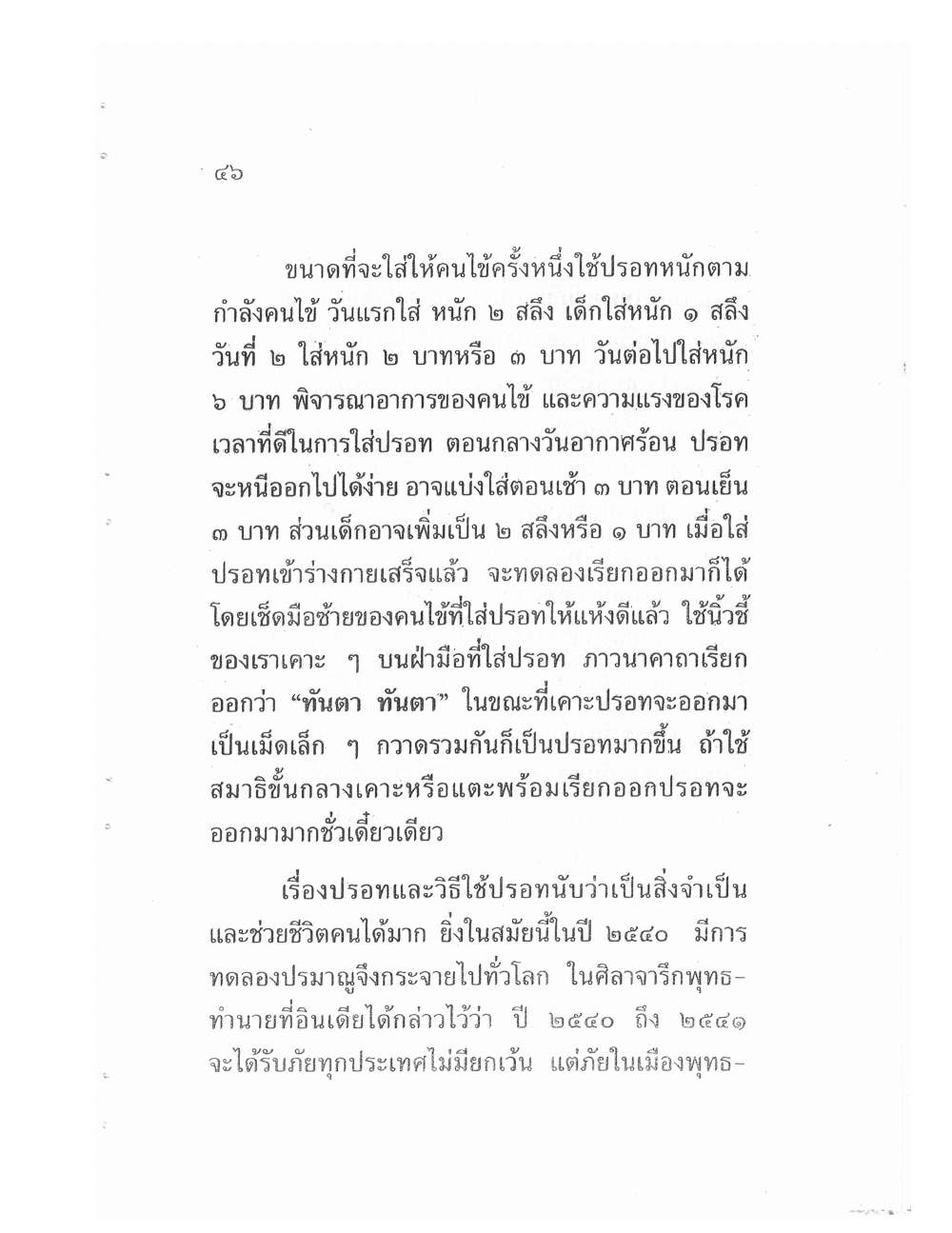
๔๖
ขนาดที่จะใส่ให้คนไข้ครั้งหนึ่งใช้ปรอทหนักตาม กำลังคนไข้ วันแรกใส่ หนัก ๒ สลึง เด็กใส่หนัก ๑ สลึง วันที่ ๒ ใส่หนัก ๒ บาทหรือ ๓ บาท วันต่อไปใส่หนัก ๖ บาท พิจารณาอาการของคนไข้ และความแรงของโรค เวลาที่ดีในการใส่ปรอท ตอนกลางวันอากาศร้อน ปรอท จะหนีออกไปได้ง่าย อาจแบ่งใส่ตอนเช้า ๓ บาท ตอนเย็น ๓ บาท ส่วนเด็กอาจเพิ่มเป็น ๒ สลึงหรือ ๑ บาท เมื่อใส่ ปรอทเข้าร่างกายเสร็จแล้ว จะทดลองเรียกออกมาก็ได้ โดยเช็ดมือซ้ายของคนไข้ที่ใส่ปรอทให้แห้งดีแล้ว ใช้นิ้วชี้ ของเราเคาะ ๆ บนฝ่ามือที่ใส่ปรอท ภาวนาคาถาเรียก ออกว่า “ทันตา ทันตา” ในขณะที่เคาะปรอทจะออกมา เป็นเม็ดเล็ก ๆ กวาดรวมกันก็เป็นปรอทมากขึ้น ถ้าใช้ สมาธิขั้นกลางเคาะหรือแตะพร้อมเรียกออกปรอทจะ ออกมามากชั่วเดี๋ยวเดียว
เรื่องปรอทและวิธีใช้ปรอทนับว่าเป็นสิ่งจำเป็น และช่วยชีวิตคนได้มาก ยิ่งในสมัยนี้ในปี ๒๕๔๐ มีการ ทดลองปรมาณูจึงกระจายไปทั่วโลก ในศิลาจารึกพุทธ- ทำนายที่อินเดียได้กล่าวไว้ว่า ปี ๒๕๔๐ ถึง ๒๕๔๑ จะได้รับภัยทุกประเทศไม่มียกเว้น แต่ภัยในเมืองพุทธ-
46
The amount given to a patient at one time is a weight of mercury according to the patient's strength. On the first day, insert a weight of 2 salueng; for a child, insert a weight of 1 salueng. On the 2nd day, insert a weight of 2 baht or 3 baht. On following days insert a weight of 6 baht. Consider the patient's symptoms and the severity of the disease. The best time to insert mercury is during the daytime when the weather is hot, since mercury can escape easily then. One may divide the dose, inserting 3 baht in the morning and 3 baht in the evening; for a child the amount may be increased to 2 salueng or 1 baht. Once the mercury has been fully inserted into the body, one may test recalling it back out: wipe the patient's left hand — the hand into which the mercury was inserted — until well dried, then use one's own index finger to tap repeatedly on the palm where the mercury was inserted, reciting the recall spell: "Tanta, Tanta." While tapping, the mercury will emerge as small beads; sweeping them together produces more mercury. If one uses middle-level samadhi while tapping or touching together with the recall, the mercury will come out in quantity within an instant.
The subject of mercury and the method of using it is considered a necessary matter and can save many lives — all the more so in this era, since in the year 2540 [1997 CE] there were atomic tests, so [radiation] has spread throughout the world. In the stone inscription of the Buddha's prophecy found in India, it is said that: from the year 2540 to 2541 [1997-1998 CE] every country will receive danger without exception, but the danger in the Buddhist land...
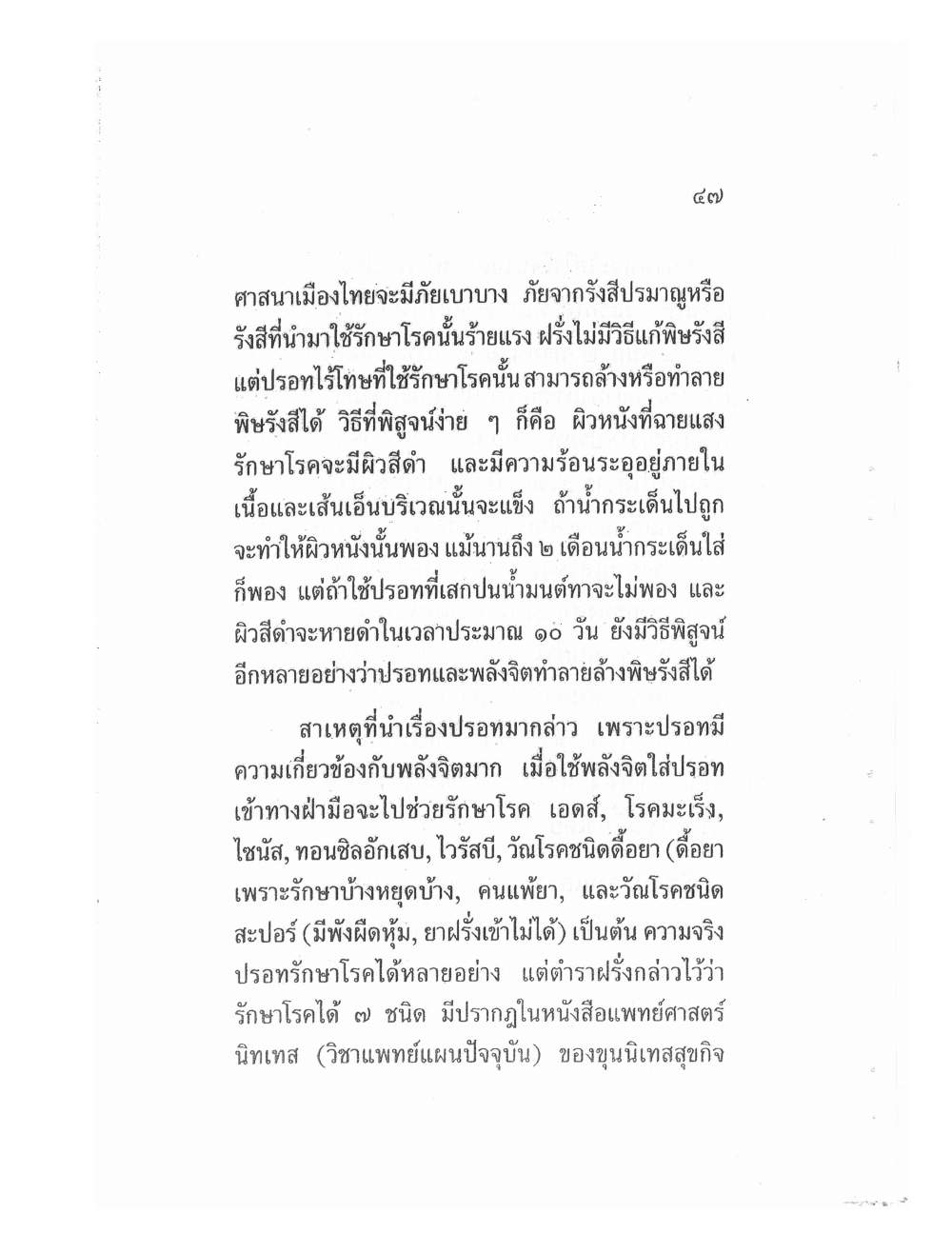
๔๗
ศาสนาเมืองไทยจะมีภัยเบาบาง ภัยจากรังสีปรมาณูหรือ รังสีที่นำมาใช้รักษาโรคนั้นร้ายแรง ฝรั่งไม่มีวิธีแก้พิษรังสี แต่ปรอทไร้โทษที่ใช้รักษาโรคนั้น สามารถล้างหรือทำลาย พิษรังสีได้ วิธีที่พิสูจน์ง่าย ๆ ก็คือ ผิวหนังที่ฉายแสง รักษาโรคจะมีผิวสีดำ และมีความร้อนระอุอยู่ภายใน เนื้อและเส้นเอ็นบริเวณนั้นจะแข็ง ถ้าน้ำกระเด็นไปถูก จะทำให้ผิวหนังนั้นพอง แม้นานถึง ๒ เดือนน้ำกระเด็นใส่ ก็พอง แต่ถ้าใช้ปรอทที่เสกปนน้ำมนต์ทาจะไม่พอง และ ผิวสีดำจะหายดำในเวลาประมาณ ๑๐ วัน ยังมีวิธีพิสูจน์ อีกหลายอย่างว่าปรอทและพลังจิตทำลายล้างพิษรังสีได้
สาเหตุที่นำเรื่องปรอทมากล่าว เพราะปรอทมี ความเกี่ยวข้องกับพลังจิตมาก เมื่อใช้พลังจิตใส่ปรอท เข้าทางฝ่ามือจะไปช่วยรักษาโรค เอดส์, โรคมะเร็ง, ไซนัส, ทอนซิลอักเสบ, ไวรัสบี, วัณโรคชนิดดื้อยา (ดื้อยา เพราะรักษาบ้างหยุดบ้าง, คนแพ้ยา, และวัณโรคชนิด สะปอร์ (มีพังผืดหุ้ม, ยาฝรั่งเข้าไม่ได้) เป็นต้น ความจริง ปรอทรักษาโรคได้หลายอย่าง แต่ตำราฝรั่งกล่าวไว้ว่า รักษาโรคได้ ๗ ชนิด มีปรากฏในหนังสือแพทย์ศาสตร์ นิทเทส (วิชาแพทย์แผนปัจจุบัน) ของขุนนิเทสสุขกิจ
47
...the religion of the land of Thailand will suffer only mild harm. The danger from atomic radiation, or from radiation used to treat disease, is severe. Westerners have no method to cure radiation poisoning, but the harmless mercury used to treat disease can wash away or destroy radiation poison. An easy method of proof: skin that has been irradiated for treatment turns black in colour, with a burning heat inside; the flesh and tendons of that area become stiff. If water splashes onto it, the skin will blister — even as much as 2 months later, if water splashes onto it, it still blisters. But if mercury consecrated together with holy water is applied instead, it will not blister, and the black colour of the skin will fade back to normal within about 10 days. There remain many other ways to prove that mercury together with mental power can destroy radiation poison.
The reason for bringing up the subject of mercury is that mercury has a great deal to do with mental power. When mental power is used to insert mercury in through the palm of the hand, it goes on to help treat disease: AIDS, cancer, sinusitis, tonsillitis, Hepatitis B, drug-resistant tuberculosis (resistant because treatment was done on-and-off), people allergic to medicine, and spore-type tuberculosis (which has a fibrous covering that Western medicine cannot penetrate), among others. In truth mercury can treat many kinds of disease, but Western textbooks state that it treats only 7 kinds. This appears in the medical textbook "Nithesa" (a work on modern medicine) by Khun Nithesa Sukkit...
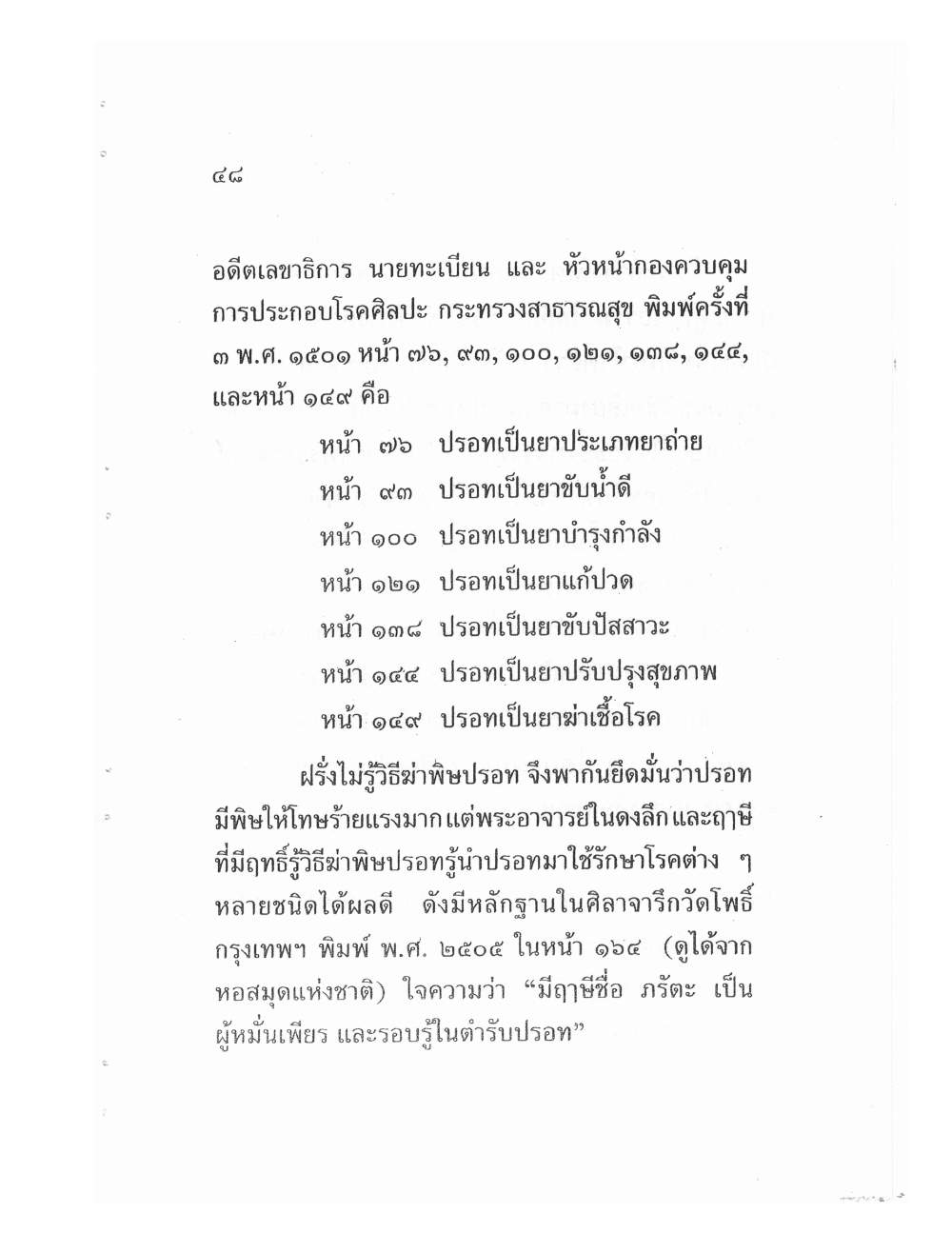
๔๘
อดีตเลขาธิการ นายทะเบียน และ หัวหน้ากองควบคุม การประกอบโรคศิลปะ กระทรวงสาธารณสุข พิมพ์ครั้งที่ ๓ พ.ศ. ๒๕๐๑ หน้า ๗๖, ๙๓, ๑๐๐, ๑๒๑, ๑๓๘, ๑๕๔, และหน้า ๑๕๙ คือ
หน้า ๗๖ ปรอทเป็นยาประเภทยาถ่าย หน้า ๙๓ ปรอทเป็นยาขับน้ำดี หน้า ๑๐๐ ปรอทเป็นยาบำรุงกำลัง หน้า ๑๒๑ ปรอทเป็นยาแก้ปวด หน้า ๑๓๘ ปรอทเป็นยาขับปัสสาวะ หน้า ๑๕๔ ปรอทเป็นยาปรับปรุงสุขภาพ หน้า ๑๕๙ ปรอทเป็นยาฆ่าเชื้อโรค
ฝรั่งไม่รู้วิธีฆ่าพิษปรอท จึงพากันยึดมั่นว่าปรอท มีพิษให้โทษร้ายแรงมาก แต่พระอาจารย์ในดงลึกและฤาษี ที่มีฤทธิ์รู้วิธีฆ่าพิษปรอทรู้นำปรอทมาใช้รักษาโรคต่าง ๆ หลายชนิดได้ผลดี ดังมีหลักฐานในศิลาจารึกวัดโพธิ์ กรุงเทพฯ พิมพ์ พ.ศ. ๒๕๐๕ ในหน้า ๑๖๔ (ดูได้จาก หอสมุดแห่งชาติ) ใจความว่า “มีฤาษีชื่อ ภรัตะ เป็น ผู้หมั่นเพียร และรอบรู้ในตำรับปรอท”
48
...the former Secretary-General, Registrar, and Head of the Division of Control of the Practice of the Healing Arts, Ministry of Public Health, 3rd printing, B.E. 2501 [1958 CE], pages 76, 93, 100, 121, 138, 154, and page 159, namely:
Page 76 Mercury is a purgative medicine Page 93 Mercury is a bile-expelling medicine Page 100 Mercury is a tonic medicine Page 121 Mercury is a pain-relieving medicine Page 138 Mercury is a diuretic medicine Page 154 Mercury is a health-improving medicine Page 159 Mercury is a germ-killing medicine
Westerners do not know the method of neutralizing mercury's poison, and so they hold firmly to the belief that mercury has very severe poisonous harm. But the teacher-masters deep in the forest, and the ascetic sages (ruesi) possessed of occult power, know the method of neutralizing mercury's poison and know how to bring mercury to treat various diseases of many kinds with good results — as there is evidence in the stone inscription at Wat Pho, Bangkok, printed in B.E. 2505 [1962 CE], page 164 (obtainable from the National Library), whose substance states: "There is a ruesi named Bharata, a person of persevering diligence and thoroughly versed in the mercury formulary."
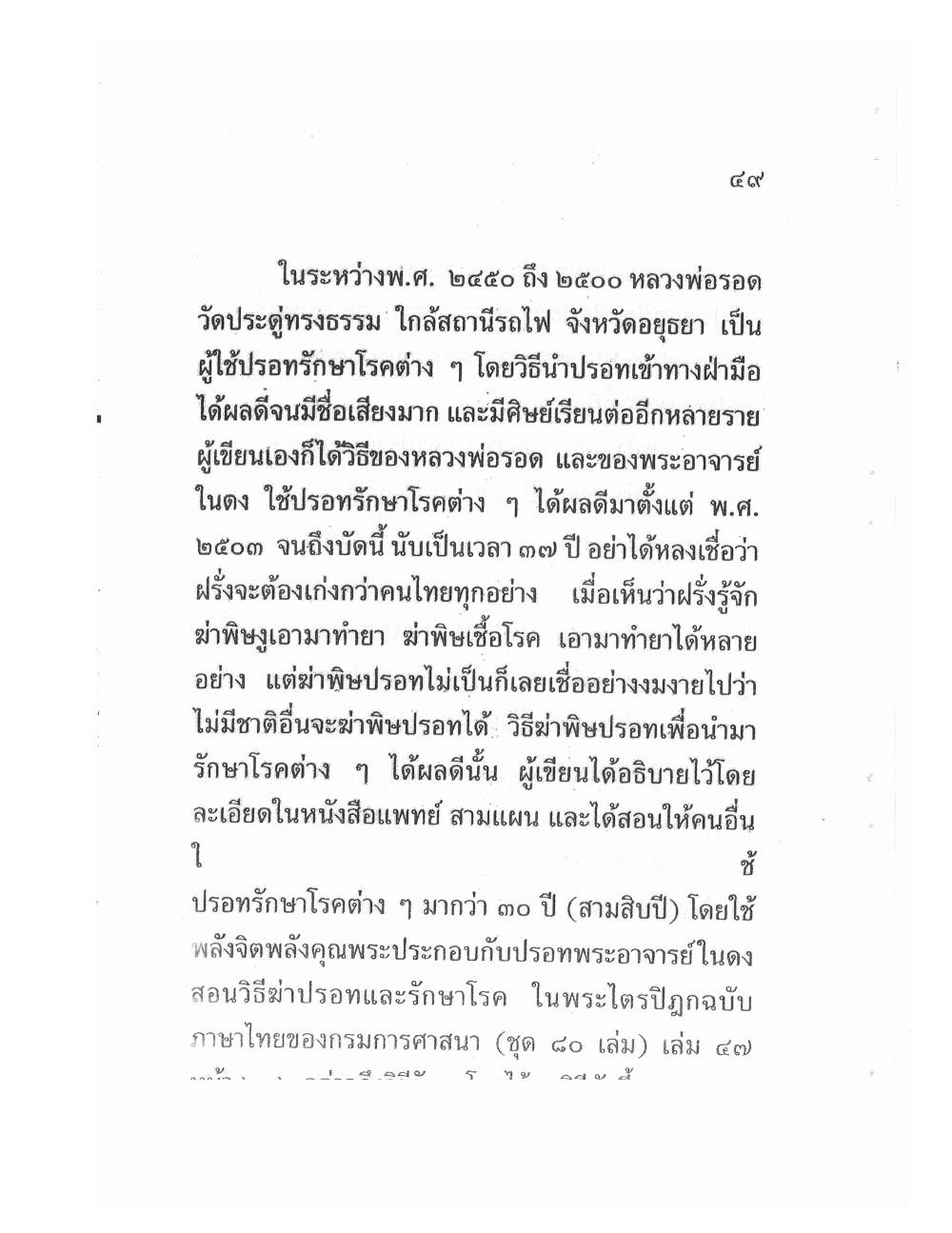
๔๙
ในระหว่างพ.ศ. ๒๔๙๐ ถึง ๒๕๐๐ หลวงพ่อรอด วัดประดู่ทรงธรรม ใกล้สถานีรถไฟ จังหวัดอยุธยา เป็น ผู้ใช้ปรอทรักษาโรคต่าง ๆ โดยวิธีนำปรอทเข้าทางฝ่ามือ ได้ผลดีจนมีชื่อเสียงมาก และมีศิษย์เรียนต่ออีกหลายราย ผู้เขียนเองก็ได้วิธีของหลวงพ่อรอด และของพระอาจารย์ ในดง ใช้ปรอทรักษาโรคต่าง ๆ ได้ผลดีมาตั้งแต่ พ.ศ. ๒๕๐๓ จนถึงบัดนี้ นับเป็นเวลา ๓๗ ปี อย่าได้หลงเชื่อว่า ฝรั่งจะต้องเก่งกว่าคนไทยทุกอย่าง เมื่อเห็นว่าฝรั่งรู้จัก ฆ่าพิษงูเอามาทำยา ฆ่าพิษเชื้อโรค เอามาทำยาได้หลาย อย่าง แต่ฆ่าพิษปรอทไม่เป็นก็เลยเชื่ออย่างงมงายไปว่า ไม่มีชาติอื่นจะฆ่าพิษปรอทได้ วิธีฆ่าพิษปรอทเพื่อนำมา รักษาโรคต่าง ๆ ได้ผลดีนั้น ผู้เขียนได้อธิบายไว้โดย ละเอียดในหนังสือแพทย์ สามแผน และได้สอนให้คนอื่นใช้ ปรอทรักษาโรคต่าง ๆ มากว่า ๓๐ ปี (สามสิบปี) โดยใช้ พลังจิตพลังคุณพระประกอบกับปรอทพระอาจารย์ในดง สอนวิธีฆ่าปรอทและรักษาโรค ในพระไตรปิฎกฉบับ ภาษาไทยของกรมการศาสนา (ชุด ๘๐ เล่ม) เล่ม ๔๗
49
Between B.E. 2490 and 2500 [1947-1957 CE], Luang Pho Rod of Wat Pradu Songtham, near the railway station, Ayutthaya province, was one who used mercury to treat various diseases by the method of bringing mercury in through the palm of the hand, achieving such good results that he became very famous, and had many disciples who studied further under him. The author himself also learned the method of Luang Pho Rod, and of the teacher-master in the forest, and has used mercury to treat various diseases with good results since B.E. 2503 [1960 CE] until now, a span of 37 years. One should not fall into the belief that Westerners must be superior to Thai people in every respect. Seeing that Westerners know how to neutralize snake venom and turn it into medicine, neutralize disease germs and turn them into medicine in many ways, but cannot neutralize the poison of mercury, one then foolishly comes to believe that no other nation can neutralize mercury's poison. As for the method of neutralizing mercury's poison in order to bring it to treat various diseases with good results, the author has explained this in detail in the medical book "Sam Phaen" [The Three Traditions of Medicine], and has taught others to use mercury to treat various diseases for more than 30 years (thirty years), using mental power and the power of the Buddha's virtue together with the mercury. The teacher-master in the forest taught the method of neutralizing mercury and of treating disease. In the Thai-language edition of the Tipitaka of the Department of Religious Affairs (the 80-volume set), Volume 47...
๕๐
การรักษาโรค ๕ อย่างคือ “รักษาทางเสกเป่า (ใช้ พลังจิต) ทางผ่าตัด, ทางยา, ทางภูตผี, รักษาทางกุมาร” รักษาทางภูตผี คือการใช้พลังจิตไล่ผีที่มาเข้าคนหรือ ถอนของที่ถูกกระทำทางไสยศาสตร์ ฝรั่งไม่ใช้วิธีเสกเป่า (วิธีใช้พลังคุณพระพลังจิต) และวิชาทางภูตผี จึงรักษา โรคไม่หายหลายอย่าง
“อย่าใช้ก่อนหา อย่าว่าก่อนเห็น”
ฝรั่งเอาของมีพิษมาทำยาได้ ฆ่าพิษได้ พากัน เชื่อถือยกย่องเช่นเอาพิษงู เอาเชื้อโรค ซึ่งมีพิษภัยมา ฆ่าพิษทำยาหลายอย่าง กลายเป็นยาดี พากันเชื่อยกย่อง เอาของมีพิษภัยมาใช้รักษา เช่นรังสี, ยาคีโม และยาอื่น ๆ ที่มีพิษภัยมาใช้ ก็เชื่อฝรั่ง แต่พระอาจารย์ในดง ฤาษีผู้ มีฤทธิ์ ฆ่าพิษปรอทได้ ฆ่าพิษยาอื่น ๆ มาเป็นยาที่ดี กลับไม่เชื่อไม่พิสูจน์ การใส่ปรอทจะใส่มากน้อยเพียงใด ให้พิจารณาโรคอะไรและกำลังคนไข้ที่จะรับได้ และผล ที่เกิดจากการใส่ปรอท
ผลที่เกิดขึ้นจะสังเกตได้หลังจากใส่ปรอทไปแล้ว ๑ วันหรือ ๒ วัน คือมีผลให้นอนหลับได้สนิท หลับได้ยาว อาการเจ็บป่วยลดลงกินอาหารได้ดีขึ้น รู้สึกมีกำลัง ความอ่อนเพลียน้อยลง
50
The treatment of disease has 5 methods, namely: "treatment by way of incantation/blowing (using mental power), by way of surgery, by way of medicine, by way of spirits, and treatment by way of paediatrics." Treatment by way of spirits means using mental power to drive out a spirit that has entered a person, or to remove the effects of something done through black magic. Westerners do not use the method of incantation/blowing (the method of using the power of the Buddha's virtue and mental power), nor the branch of knowledge concerning spirits, and so they fail to cure many kinds of disease.
"Do not use before you seek; do not speak before you see."
Westerners can take poisonous things and make them into medicine, can neutralize poison — people believe and praise this, such as taking snake venom, taking disease germs, which carry poison and danger, and neutralizing them into many kinds of medicine, turning them into good medicine; people believe and praise this. When they take things carrying poison and danger to use in treatment, such as radiation, chemotherapy drugs, and other medicines that carry poison and danger, people believe the Westerners. But the teacher-masters in the forest, the ruesi possessed of occult power, who can neutralize the poison of mercury, who can neutralize the poison of other medicines to make them into good medicine — people instead do not believe, do not test it. As for how much or how little mercury to insert, one must consider what the disease is and the strength of the patient able to receive it, and the effects that result from inserting the mercury.
The effects that arise can be observed after the mercury has been inserted for 1 or 2 days: the result is that the patient can sleep soundly and for a long time, symptoms of illness decrease, appetite improves, one feels more strength, and fatigue lessens.
๕๑
การใช้พลังจิตรักษาโรคต่าง ๆ ก็ทำเช่นเดียวกับ การส่งพลังไปทำให้คงกระพัน ทำให้เอามือล้วงน้ำเดือด ได้ตักกินได้ และการส่งพลังจิตพลังคุณพระกอบโซ่ที่เผา ไฟจนร้อนแดงได้ การใส่ปรอทได้มีหลักสำคัญเหมือนกัน คือ อาราธนาคุณพระพุทธ พระธรรม พระสงฆ์ คุณบิดา มารดา คุณครูอาจารย์ให้มาช่วย......การทำจิตให้เป็นสมาธิ เพ่งจิตส่งพลังจิตไปยังที่ต้องการให้เกิดผลตามที่ต้องการ ส่วนบทคาถาที่นำมาใช้ก็มีต่าง ๆ ตามที่จะให้เกิดผลอะไร ตามที่กล่าวไว้ในบทหลัง
การที่กล่าวว่า ในวันเดียวก็สอนให้ทำสมาธิ- วิปัสสนา และใช้พลังจิตให้เกิดประโยชน์ต่าง ๆ ได้นั้น ก็สอนให้ศิษย์ ลงมือทำสมาธิวิปัสสนาให้ถูกต้องและ ให้ศิษย์รู้ตรวจสอบได้ด้วยตนเองว่า เวลานี้ตนได้ สมาธิอยู่ในระดับใด และจะฝึกให้ก้าวหน้าต่อไปนั้น ปฏิบัติอย่างไร ? เมื่อให้ศิษย์ลงมือทำสมาธิวิปัสสนาได้ ถูกต้อง และรู้วิธีที่จะฝึกให้ก้าวหน้าต่อไปแล้วจึงสอนให้ ใช้พลังจิตจากง่ายไปยากตามลำดับที่กล่าวมาแล้ว ด้วย วิธีการดังกล่าวนี้จึงสอนให้ทำสมาธิวิปัสสนา สอนให้ใช้ พลังจิตรักษาโรคที่ฝรั่งไม่มียารักษาที่ได้ผล คือ ให้รู้วิธี รักษาโรคเอดส์ โรคมะเร็ง และโรคอื่น ๆ ได้จริงอีก
51
Using mental power to treat various diseases is done in the same way as sending power to make the body invulnerable, to enable plunging a hand into boiling water and ladling it out to drink, and sending mental power, the power of the Buddha's virtue, to grasp an iron chain heated in fire until red-hot. Inserting mercury has the same essential principle, namely: invoking the virtue of the Buddha, the Dhamma, the Sangha, the virtue of father and mother, and the virtue of one's teachers and masters to come and assist... Making the mind into samadhi, focusing the mind, and sending mental power to the place needed so as to produce the desired result. As for the incantation verses used, these vary according to what result is to be produced, as stated in a later section.
As for the statement that in a single day one can be taught to practice samadhi-vipassana and to use mental power to produce various benefits, this means: teaching the disciple to practice samadhi-vipassana correctly, and letting the disciple know how to check for himself at what level his samadhi currently stands, and how he should practice to progress further from there. Once the disciple has been made to practice samadhi-vipassana correctly and knows the method of training onward, he is then taught to use mental power, proceeding from easy to difficult in the order already described. By this method one teaches samadhi-vipassana and teaches the use of mental power to treat diseases for which Westerners have no effective medicine — that is, to truly know how to treat AIDS, cancer, and other diseases as well...
๕๒
หลายโรค และผู้เขียนทำการสอนดังกล่าวมาแล้วได้ผล แล้วทุกคนมาเป็นเวลากว่า ๓๕ ปี จึงกล้ากล่าวกล้าเขียน เป็นลายลักษณ์อักษรยืนยันไว้ เพื่อมิให้วิชาดี ๆ เสื่อมสูญ ไป เป็นการช่วยเพื่อนมนุษย์และส่งเสริมพระพุทธศาสนา ให้เห็นให้เชื่อว่าคุณพระมีจริงช่วยได้จริง
ประเทศไทยไม่เป็นเมืองขึ้น ไม่เป็นคอมมิวนิสต์ และไม่ได้รับภัยร้ายแรงเหมือนประเทศอื่น ๆ อย่างเห็น ได้ชัด ก็เพราะคุณพระช่วยได้จริง กฎโดมิโนของฝรั่งที่ว่า รอบ ๆ เป็นคอมมิวนิสต์ ประเทศอยู่กลางก็ต้องเป็น คอมมิวนิสต์ รอบ ๆ เป็นเมืองขึ้น กลางก็ต้องเป็นเมืองขึ้น เขาเอาเป็นเมืองขึ้นโดยให้ผู้นำประเทศไปลงเรือรบเขา แล้วเซ็นสัญญายอมเป็นเมืองขึ้น พม่าไม่ยอมจึงรบกับฝรั่ง ๓ ชั่วโมง ตายมากก็ยอมเป็นเมืองขึ้น ส่วนไทยสมัยรัชกาล ที่ ๕ พอลงเรือของฝรั่งเรือรบเอียง ฝรั่งตกใจยังไม่กล้า ให้เซ็นสัญญา รอพิจารณาดูก่อน แต่คืนนั้นในห้อง แม่ทัพฝรั่งซึ่งมีการป้องกันกันรอบคอบ ก็มีอาจารย์ในดง ที่ไม่ได้บวช หายตัวเข้าไปเอาดาบจี้คอขู่ให้ถอยกลับไป มิฉะนั้นจะถูกฆ่าได้ทุกเวลารุ่งเช้าเรือรบฝรั่งก็ไม่กล้ามาเอา เป็นเมืองขึ้นรีบกลับประเทศตน ในประวัติศาสตร์ ก็มีกล่าวถึงโกษาปานไปฝรั่งเศส ได้ให้ทดลองทำพิธียิง
52
...many diseases. And the author, having taught as described above and achieved results with everyone, over a period of more than 35 years, now dares to state and dares to set it down in writing as a firm record, so that this good body of knowledge will not be lost — as a way of helping fellow human beings and promoting the Buddhist religion, so that people may see and believe that the Buddha's virtue truly exists and truly can help.
Thailand was not colonized, did not become communist, and did not suffer severe harm as other countries clearly did, because the Buddha's virtue truly helped. The Westerners' domino theory holds that if the surrounding countries become communist, the country in the middle must also become communist; if the surrounding countries become colonies, the one in the middle must also become a colony. They would take a country as a colony by having its leader board their warship and then sign a treaty consenting to become a colony. Burma did not consent, so it fought the Westerners for 3 hours; once many had died, it consented to become a colony. As for Thailand, in the reign of Rama V, as soon as [the king] boarded the Westerners' ship, the warship listed; the Westerners were alarmed and did not yet dare have him sign, waiting to consider further. But that night, in the cabin of the Western commanding general — which was guarded thoroughly on every side — there appeared a teacher-master from the forest, one who had not been ordained, who made himself invisible, entered, took a sword, held it to the general's throat and threatened him to withdraw, or else he could be killed at any moment. At dawn the Western warship did not dare come to take [the country] as a colony, and hurried back to its own country. In history there is also mention of Kosa Pan going to France, where he was made to undergo a test-firing ceremony...
๕๓
โกษาปานไม่มีอันตราย เรื่องเรือรบฝรั่งยอมถอยไป ผู้เขียนได้ฟังจากพระอาจารย์ในดงเอง และทราบราย ละเอียดหลายเรื่อง ในประเทศไทยมีพระและคฤหัสถ์ที่ เรียนจบฌานจำนวนมากและอาจารย์ในดงที่มีฤทธิ์ก็มีมาก ทำหน้าที่สำคัญคือสืบต่อพระพุทธศาสนา หลักสูตร สุดท้ายก่อนจะเรียนเหาะ มีกฎให้สอนศิษย์ให้จบฌาน อย่างน้อยหนึ่งรุ่น และการจะให้ศาสนาดำรงอยู่ได้ ก็ต้อง รักษาประเทศชาติไว้ด้วย เพราะไทยเป็นที่ตั้งมั่นคงใกล้ เคียงสมัยพุทธกาลมากกว่าประเทศอื่น ๆ เมื่อมีภัยพิบัติ มากในไทยท่านผู้มีฌานมีฤทธิ์ ทั้งในประเทศในป่าก็ช่วย ให้หนักเป็นเบาหรือหมดไป ให้สังเกตใน พ.ศ.๒๕๔๐ ประเทศต่าง ๆ มีภัยมากตายมาก และมีภัยซ้ำซากมาก แต่ประเทศไทยภัยน้อยตายน้อยกว่าประเทศอื่น ๆ และ พระอาจารย์ในดงก็ออกมาชั่วคราวและมาอยู่นานวัน หลายจังหวัดเพื่อช่วยประเทศชาติ มีการเหาะการหายตัว ให้คนเลื่อมใสในศาสนาได้เห็น และเชื่อในพระไตรปิฎก เลื่อมใสยิ่งขึ้น เพราะเห็นความอัศจรรย์มีการเหาะเหิน ได้จริง มีเทวดา ผี นรกสวรรค์จริง ตามพระไตรปิฎก ผู้ยังหลงผิดไม่เชื่ออย่างเหนียวแน่น ก็แล้วแต่บุญกรรม เหมือนสมัยพุทธกาล.
53
...[at Kosa Pan], and Kosa Pan came to no harm. As for the matter of the Western warship consenting to withdraw, the author heard this directly from the teacher-master in the forest himself, and learned the details of many such accounts. In Thailand there are monks and laypeople who have completed the study of jhana [meditative absorption] in great number, and teacher-masters in the forest possessed of occult power are also numerous. Their important duty is to carry on the Buddhist religion. The final part of the curriculum, before one may study to fly through the air, has a rule requiring that one teach at least one generation of disciples to complete jhana. And in order for the religion to be able to endure, the nation must also be preserved, because Thailand is a place of stability closer to the era of the Buddha than other countries. When great calamity comes upon Thailand, those possessed of jhana and occult power, both within the country and in the forest, help to make it lighter or make it disappear entirely. Observe that in B.E. 2540 [1997 CE], various countries suffered great calamity and great death, with much repeated disaster, but Thailand suffered less calamity and less death than other countries — and the teacher-masters of the forest came out temporarily and stayed for long periods in many provinces in order to help the nation. There was flying through the air and becoming invisible, letting those who have faith in the religion witness it, and believe in the Tipitaka with even greater faith, because they saw the marvel that flying through the air is truly possible, that devas, ghosts, hell and heaven are real, according to the Tipitaka. As for those who remain deluded and stubbornly disbelieve, that is a matter of their own karma, just as it was in the time of the Buddha.
๕๔
ในระยะกึ่งพุทธกาลทั้งฝรั่งและไทยมีการทำนาย เหตุการณ์ผิดบ้างถูกบ้าง ทำนายเปลี่ยนไปต่าง ๆ เรื่อยมา เพราะเป็นการทำนายแบบโลก ส่วนการทำนายที่แม่นยำ และไม่มีการเปลี่ยนแปลง เพราะจารึกอยู่ในศิลาจารึกที่ พุทธคยา ได้แปลเป็นไทยพิมพ์แจกเมื่อ ๕๐ ปีที่แล้ว ซึ่ง แม่นยำทุกข้อ สมเหตุสมผล เป็น พุทธทำนาย ที่ยึดถือ และพิสูจน์ได้ ด้วยการดูเหตุการณ์จริง ในปี ๒๕๔๐ ถึง ต้นปี ๒๕๔๑ มีเขียนไว้ในหนังสือ “แพทย์ ๓ แผน นำสมัย” หน้า ๒๐๒ ในหัวข้อว่า ภัยร้ายแรงกำลังเกิด และวิธีเอาตัวรอด พิมพ์เมื่อ พ.ศ. ๒๕๓๙ เล่มละ ๙๐ บาท มีอธิบายวิธีรักษาโรคเอดส์, มะเร็ง, เบาหวาน, หืด, ไซนัส, พิษสุนัขบ้า, นิ่วในไต ในถุงน้ำดี, ต่อมลูกหมากโต อักเสบ, ริดสีดวงทวาร และโรคอื่น ๆ ที่ฝรั่งยังไม่มียา รักษา
แพทย์ ๓ แผนนำสมัย มี ๒ เล่ม อธิบายวิธี รักษาทุกรูปแบบ และครบวงจร คือ อ่านแล้วสงสัยก็ ถามได้ ขอเรียนก็สอนให้โดยไม่คิดค่าสอน สอนและให้ พิสูจน์มาเป็นเวลา ๔๐ ปี นับตั้งแต่ พ.ศ. ๒๕๐๐ สอน รักษาโรคครบ ๕ วิธี ตามที่กล่าวไว้ในพระไตรปิฎกของ กรมการศาสนาเล่ม ๔๗ หน้า ๖๒๓ กล่าวถึงวิธีรักษาโรค
54
During the period around the mid-point of the Buddhist era, both Westerners and Thais have made predictions of events, some wrong and some right, with predictions changing repeatedly over time, because these are worldly-style predictions. As for the prediction that is accurate and does not change, this is because it is inscribed in the stone inscription at Bodh Gaya, which was translated into Thai and printed for free distribution 50 years ago — accurate in every point, reasonable, and constituting a Buddha-prophecy that can be relied upon and proven true by observing actual events. In the year 2540 to early 2541 [1997-1998 CE], this was written about in the book "Modern Three-Tradition Medicine," page 202, under the heading "Severe danger is now arising, and how to save oneself," printed in B.E. 2539 [1996 CE], priced 90 baht per volume. It explains methods for treating AIDS, cancer, diabetes, asthma, sinusitis, rabies, kidney stones and gallstones, inflamed enlarged prostate, hemorrhoids, and other diseases for which Westerners still have no medicine to treat.
"Modern Three-Tradition Medicine" consists of 2 volumes, explaining every form of treatment, complete and comprehensive — meaning that if, after reading, one has doubts, one may ask; and if one wishes to study it, it will be taught free of any tuition charge. It has been taught and offered for proof over a period of 40 years, counting from B.E. 2500 [1957 CE]. It teaches the complete set of 5 methods of treatment as stated in the Tipitaka of the Department of Religious Affairs, Volume 47, page 623, which discusses methods of treating disease...
๕๕
๕ อย่างคือ “รักษาทางเสกเป่า, ทางผ่าตัด, ทางยา, ทางภูตผี, รักษาทางกุมาร” รักษาทางเสกเป่าคือการใช้ พลังคุณพระ พลังจิต รักษาทางภูตผีคือการไล่ผีที่เข้าสิง การถอนของที่ถูกกระทำทางไสยศาสตร์ แพทย์ฝรั่งไม่ใช้ ไม่สอนวิธีเสกเป่า และวิชาทางภูตผี จึงรักษาโรคไม่ได้ ผลหลายโรค ส่วน “แพทย์ ๓ แผนนำสมัย” สอนครบ ๕ อย่าง พร้อมทั้งวิธีเสกเป่ายา วิธีใช้พลังจิตรักษาตนเอง ของคนไข้ ฯลฯ
อุบายการสอนให้ใช้พลังจิต ทำสมาธิ และ รักษาโรคต่าง ๆ ให้ศิษย์ทำได้ในวันเดียว ก็คือสอนให้ ทำสมาธิถูกต้องและวิธีวัดได้เองว่าตนได้สมาธิขั้นใดแล้ว จะฝึกต่อไปอย่างไรต่อไปสอนให้ใช้พลังจิตออกภายนอก เช่นวิชาคงกระพัน วิชาดับพิษร้อนน้ำที่กำลังเดือดให้ ตักกินได้ สอนดับพิษโซ่เหล็กที่เผาไฟแดงให้จับและ กอบขึ้นได้ เมื่อแน่ใจมั่นใจว่าส่งพลังจิตออกได้แล้ว ก็ สอนเชิญคุณพระมารักษาโรคได้โดยไม่ใช้พลังของตน แล้วสอนรักษาโรคต่าง ๆ ด้วยตนเอง ที่สำคัญ คือให้ ลงมือทำ ทำผิดก็ให้แก้ไขให้ถูกต้อง นี่คือ อุบายให้ สอนจบได้ในวันเดียวทั้ง ๔ ขั้น.
“อย่าใช้ก่อนหา อย่าว่าก่อนเห็น”
55
...5 methods, namely: "treatment by way of incantation/blowing, by way of surgery, by way of medicine, by way of spirits, and treatment by way of paediatrics." Treatment by way of incantation/blowing means using the power of the Buddha's virtue and mental power. Treatment by way of spirits means driving out a spirit that has possessed [someone], removing the effects of something done through black magic. Western medicine does not use, and does not teach, the method of incantation/blowing, nor the branch of knowledge concerning spirits, and so it cannot successfully cure many diseases. As for "Modern Three-Tradition Medicine," it teaches all 5 methods in full, together with the method of incantation/blowing over medicine, and the method by which a patient can use mental power to treat himself, etc.
The device for teaching the use of mental power, the practice of samadhi, and the treatment of various diseases so that a disciple can accomplish it within a single day is this: teach him to practice samadhi correctly, and the method by which he can measure for himself what level of samadhi he has reached, and how to train further from there. Next, teach him to project mental power outward — such as the art of invulnerability, the art of neutralizing the hot poison of boiling water so that it may be scooped up and drunk, teaching how to neutralize the heat of an iron chain heated red-hot in fire so that it may be grasped and gathered up. Once one is certain and confident that mental power can be projected outward, then teach him to invite the Buddha's virtue to come and treat disease without using his own power. Then teach him to treat various diseases by himself. What is essential is that he must put his hand to the task; if he does it wrong, let it be corrected until right. This is the device by which the teaching can be completed within a single day, through all 4 stages.
"Do not use before you seek; do not speak before you see."
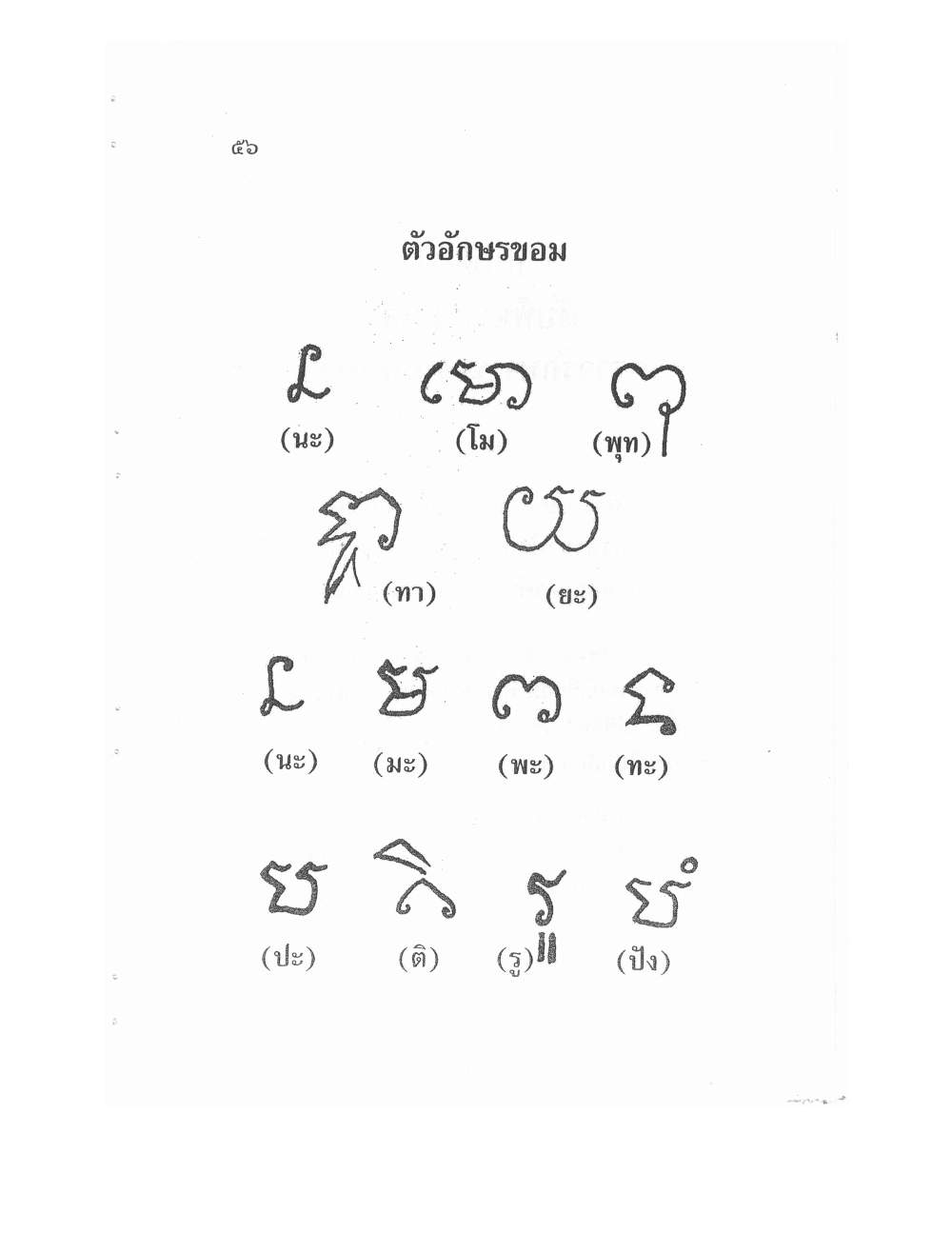
๕๖
ตัวอักษรขอม
[ภาพ: ตัวอักษรขอมโบราณที่เขียนด้วยลายมือ รวม ๑๓ ตัว จัดวางเป็น ๔ แถว แต่ละตัวมีคำอ่านกำกับไว้ในวงเล็บด้านล่าง]
แถวที่ ๑ (นะ) (โม) (พุท) แถวที่ ๒ (ทา) (ยะ) แถวที่ ๓ (นะ) (มะ) (พะ) (ทะ) แถวที่ ๔ (ปะ) (ติ) (รู)๚ (ปัง)
56
The Khom Script Letters
[Image: 13 hand-drawn ancient Khom-script characters, arranged in 4 rows, each with its phonetic Thai reading given below it in parentheses]
Row 1: (na) (mo) (phut) Row 2: (tha) (ya) Row 3: (na) (ma) (pha) (tha) Row 4: (pa) (ti) (ru) [small decorative end-mark ๚] (pang)
๕๗
บทที่ ๒ ดับพิษร้อน และ ตรวจรักษาโรคด้วยพลังจิต
ขั้นที่ ๕ สอนเต็มแบบ ตามพระอาจารย์ในดงสอน สอนการทำน้ำมันรักษาโรค และดับพิษร้อน (ของหลวงตาดำ - อาจารย์ชาญณรงค์)
ดับพิษร้อน ขณะน้ำมันกำลังเดือดเอามือล้วงได้ หรือเอาช้อนตักขึ้นอมพ่นรักษาโรคได้ รู้สึกเพียงอุ่น ๆ เท่านั้น ไม่มีอันตราย คนจะเอามือล้วงหรือตักอมก็ได้ ตักกินได้ไม่มีอันตราย
การเตรียมของ น้ำมันมะพร้าวแท้ ๑ ขวดใหญ่ (ขวดเบียร์ใหญ่หรือขวดแม่โขง) ไพลปอกเปลือกฝานเป็น แว่นไว้ ๕ แว่น ขมิ้นอ้อยปอกเปลือกฝานเป็นแว่นไว้ ๔ แว่น ใบพลู ๓ ใบ กระทะใบเล็กสำหรับเคี่ยวน้ำมัน เตาไฟใช้ถ่านหรือเตาน้ำมันก๊าด
57
Chapter 2 Extinguishing Hot Poison, and Diagnosing and Treating Disease with Mental Power
Stage 5 Full-method teaching, as taught by the teacher-master in the forest — teaching how to make medicinal oil to treat disease, and to extinguish hot poison (the method of Luang Ta Dam — Achan Chan Narong)
Extinguishing hot poison: while the oil is still boiling, one may plunge a hand into it, or scoop it up with a spoon, hold it in the mouth, and spray it out to treat disease with it — one feels only a mild warmth, nothing more; there is no danger. A person may either plunge a hand in or scoop some up and hold it in the mouth; it may even be swallowed, with no danger.
Preparation of materials: 1 large bottle of pure coconut oil (a large beer bottle or a Mekhong [whisky] bottle used as a measure), phlai [cassumunar ginger] peeled and sliced into 5 rounds, wild turmeric (khamin oi) peeled and sliced into 4 rounds, 3 betel leaves, a small pan for simmering the oil, and a stove using charcoal or a kerosene stove.
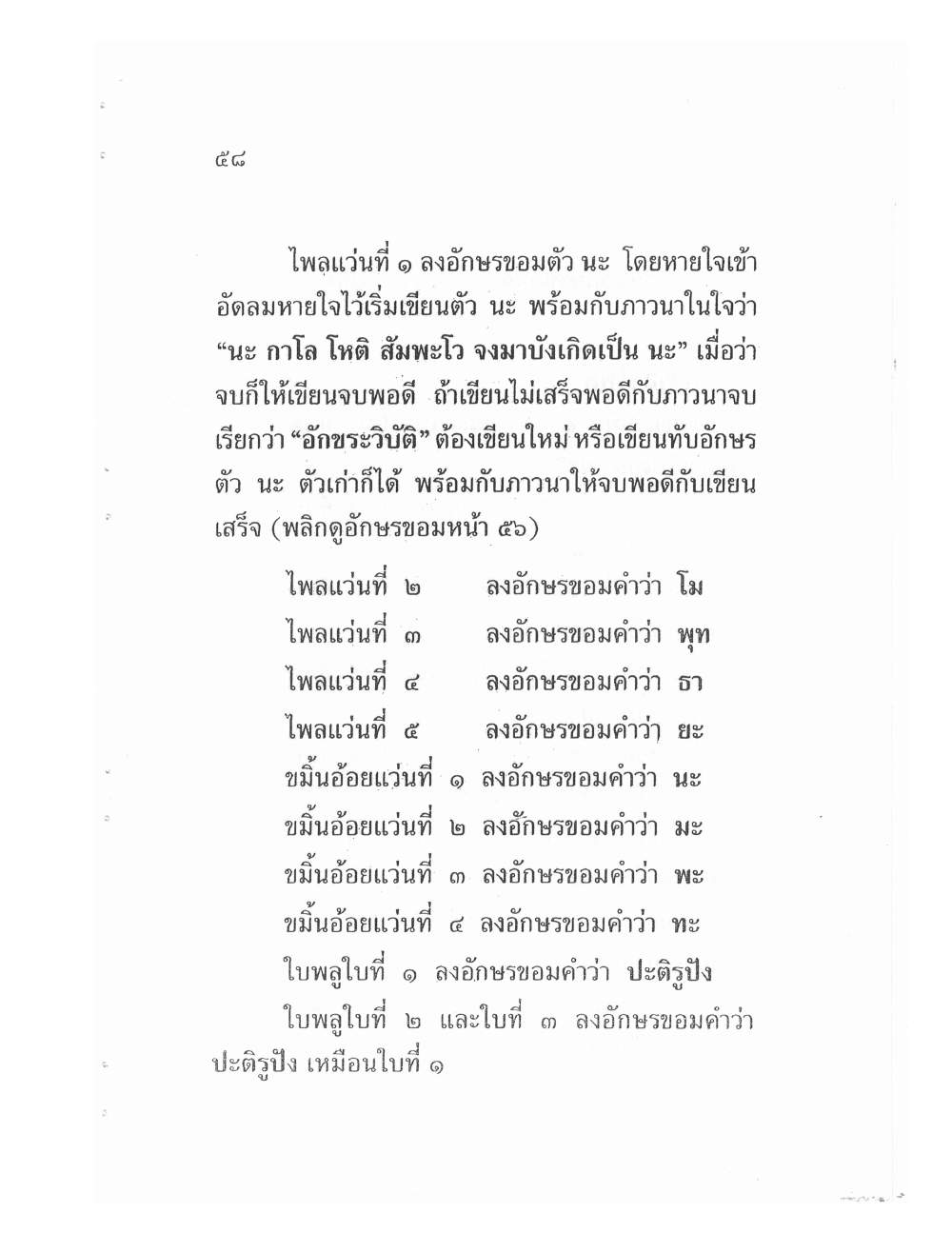
ไพลแว่นที่ ๑ ลงอักษรขอมตัว นะ โดยหายใจเข้า อัดลมหายใจไว้เริ่มเขียนตัว นะ พร้อมกับภาวนาในใจว่า “นะ กาโล โหติ สัมพะโว จงมาบังเกิดเป็น นะ” เมื่อว่า จบก็ให้เขียนจบพอดี ถ้าเขียนไม่เสร็จพอดีกับภาวนาจบ เรียกว่า “อักขระวิบัติ” ต้องเขียนใหม่ หรือเขียนทับอักษร ตัว นะ ตัวเก่าก็ได้ พร้อมกับภาวนาให้จบพอดีกับเขียน เสร็จ (พลิกดูอักษรขอมหน้า ๕๖)
ไพลแว่นที่ ๒ ลงอักษรขอมคำว่า โม ไพลแว่นที่ ๓ ลงอักษรขอมคำว่า พุท ไพลแว่นที่ ๔ ลงอักษรขอมคำว่า ธา ไพลแว่นที่ ๕ ลงอักษรขอมคำว่า ยะ ขมิ้นอ้อยแว่นที่ ๑ ลงอักษรขอมคำว่า นะ ขมิ้นอ้อยแว่นที่ ๒ ลงอักษรขอมคำว่า มะ ขมิ้นอ้อยแว่นที่ ๓ ลงอักษรขอมคำว่า พะ ขมิ้นอ้อยแว่นที่ ๔ ลงอักษรขอมคำว่า ทะ ใบพลูใบที่ ๑ ลงอักษรขอมคำว่า ปะติรูปัง ใบพลูใบที่ ๒ และใบที่ ๓ ลงอักษรขอมคำว่า ปะติรูปัง เหมือนใบที่ ๑
Phlai [cassumunar ginger] slice 1: inscribe the Khom letter "na". Breathe in, hold the breath, and begin writing the letter "na" while reciting mentally: "na kālo hoti sambhavo, jong mā bangkoet pen na" [na — may the moment come to be; let it arise as "na"]. When the recitation finishes, the writing must finish exactly together with it. If the writing is not completed exactly together with the end of the recitation, this is called an "akkhara wibat" (a flawed/spoiled syllable); one must write it again, or write over the old "na" character, reciting again so that the recitation finishes exactly together with the writing being complete. (Turn back to see the Khom letters on page 56.)
Phlai slice 2 inscribe the Khom syllable Mo Phlai slice 3 inscribe the Khom syllable Phut Phlai slice 4 inscribe the Khom syllable Thā Phlai slice 5 inscribe the Khom syllable Ya Turmeric-root slice 1 inscribe the Khom syllable Na Turmeric-root slice 2 inscribe the Khom syllable Ma Turmeric-root slice 3 inscribe the Khom syllable Pha Turmeric-root slice 4 inscribe the Khom syllable Tha Betel leaf 1 inscribe the Khom word Paṭirūpaṃ Betel leaves 2 and 3 inscribe the Khom word Paṭirūpaṃ, the same as leaf 1.
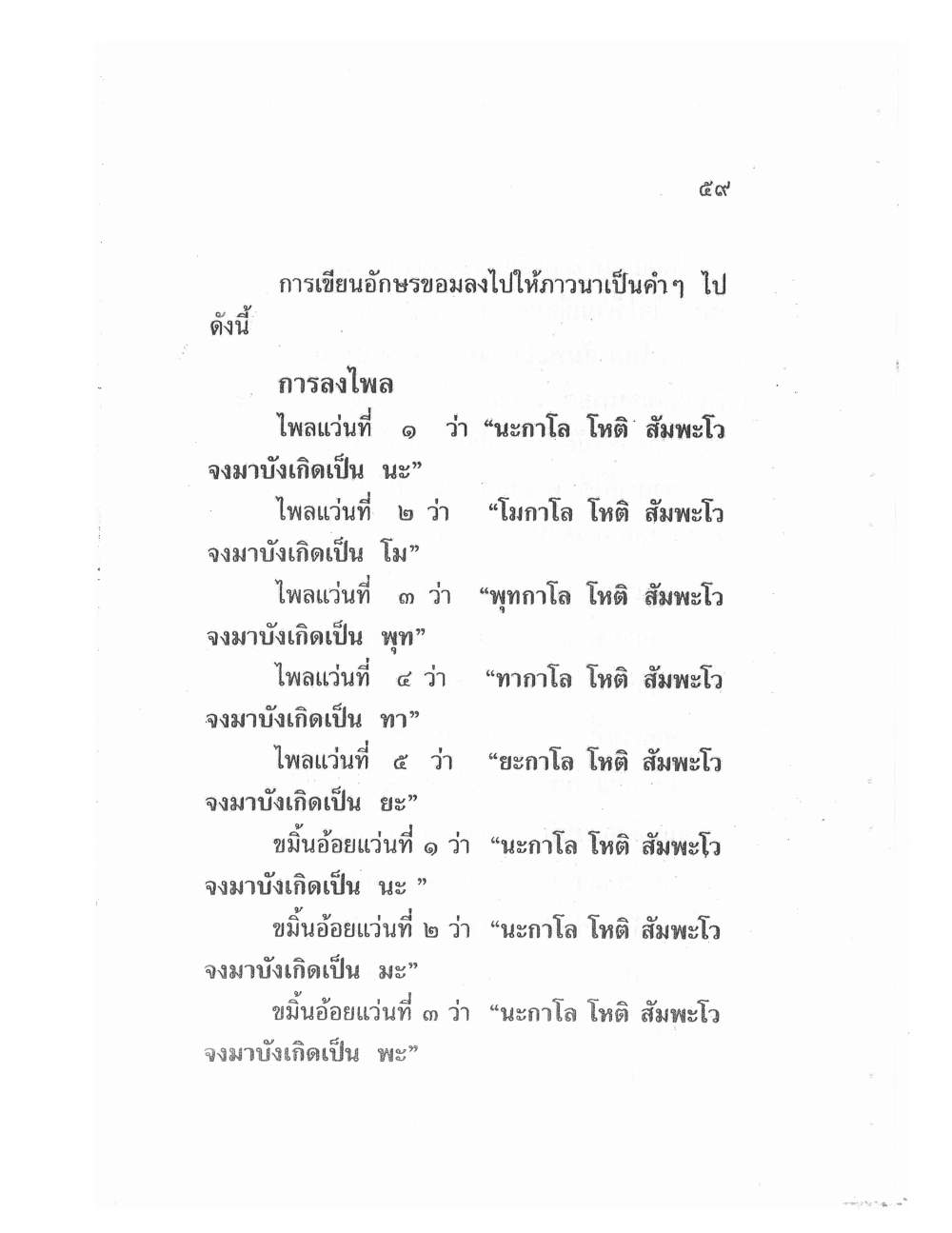
การเขียนอักษรขอมลงไปให้ภาวนาเป็นคำๆ ไป ดังนี้
การลงไพล ไพลแว่นที่ ๑ ว่า “นะกาโล โหติ สัมพะโว จงมาบังเกิดเป็น นะ” ไพลแว่นที่ ๒ ว่า “โมกาโล โหติ สัมพะโว จงมาบังเกิดเป็น โม” ไพลแว่นที่ ๓ ว่า “พุทกาโล โหติ สัมพะโว จงมาบังเกิดเป็น พุท” ไพลแว่นที่ ๔ ว่า “ทากาโล โหติ สัมพะโว จงมาบังเกิดเป็น ทา” ไพลแว่นที่ ๕ ว่า “ยะกาโล โหติ สัมพะโว จงมาบังเกิดเป็น ยะ” ขมิ้นอ้อยแว่นที่ ๑ ว่า “นะกาโล โหติ สัมพะโว จงมาบังเกิดเป็น นะ ” ขมิ้นอ้อยแว่นที่ ๒ ว่า “นะกาโล โหติ สัมพะโว จงมาบังเกิดเป็น มะ” ขมิ้นอ้อยแว่นที่ ๓ ว่า “นะกาโล โหติ สัมพะโว จงมาบังเกิดเป็น พะ”
Writing the Khom letters is done while reciting a formula word by word, as follows:
Inscribing the Phlai
Phlai slice 1: recite "na kālo hoti sambhavo, jong mā bangkoet pen na" [na — may the moment come to be; let it arise as "na"] Phlai slice 2: recite "mo kālo hoti sambhavo, jong mā bangkoet pen mo" [...let it arise as "mo"] Phlai slice 3: recite "phut kālo hoti sambhavo, jong mā bangkoet pen phut" [...let it arise as "phut"] Phlai slice 4: recite "thā kālo hoti sambhavo, jong mā bangkoet pen thā" [...let it arise as "thā"] Phlai slice 5: recite "ya kālo hoti sambhavo, jong mā bangkoet pen ya" [...let it arise as "ya"] Turmeric-root slice 1: recite "na kālo hoti sambhavo, jong mā bangkoet pen na" [...let it arise as "na"] Turmeric-root slice 2: recite "na kālo hoti sambhavo, jong mā bangkoet pen ma" [...let it arise as "ma"] Turmeric-root slice 3: recite "na kālo hoti sambhavo, jong mā bangkoet pen pha" [...let it arise as "pha"]
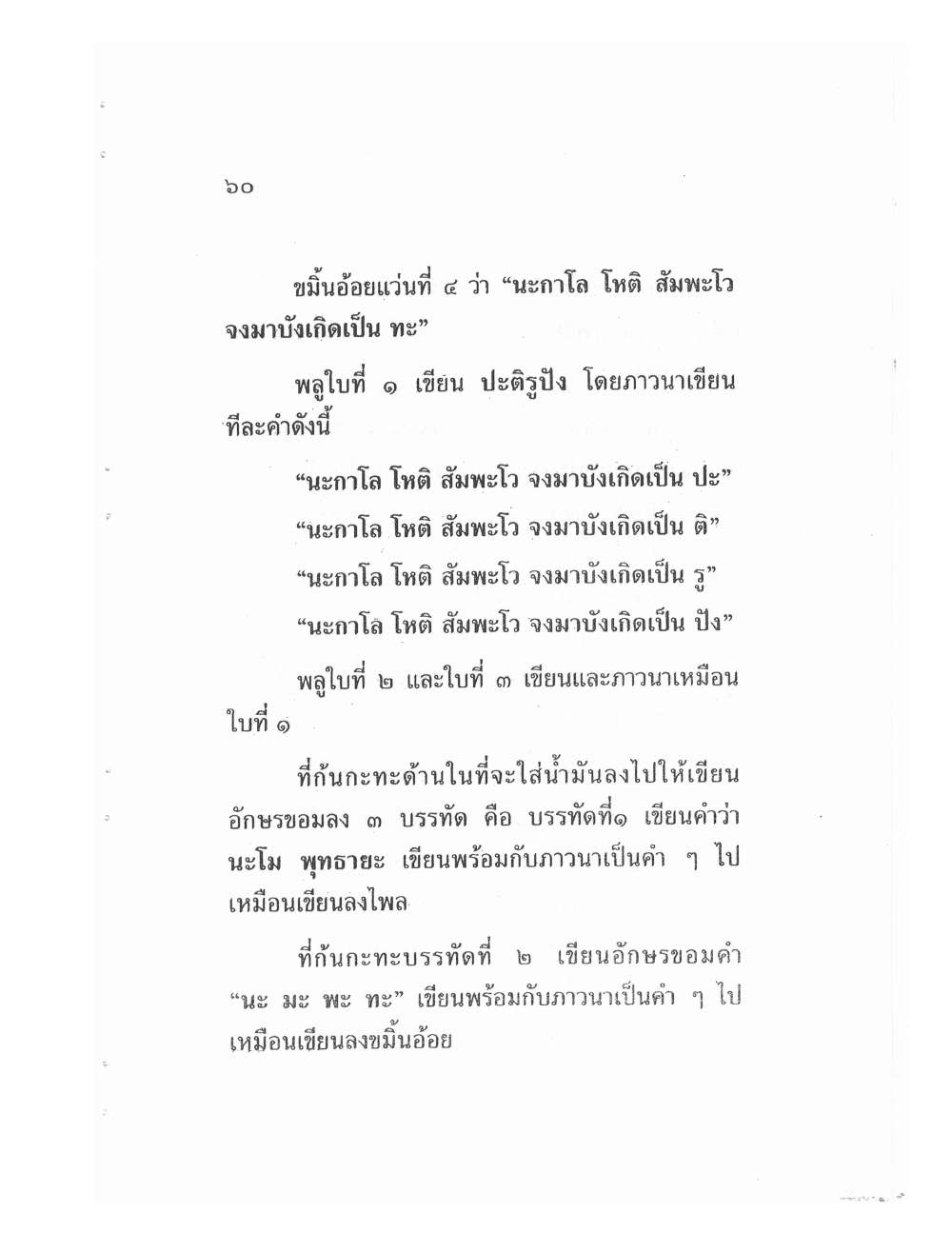
ขมิ้นอ้อยแว่นที่ ๔ ว่า “นะกาโล โหติ สัมพะโว จงมาบังเกิดเป็น ทะ”
พลูใบที่ ๑ เขียน ปะติรูปัง โดยภาวนาเขียน ทีละคำดังนี้
“นะกาโล โหติ สัมพะโว จงมาบังเกิดเป็น ปะ” “นะกาโล โหติ สัมพะโว จงมาบังเกิดเป็น ติ” “นะกาโล โหติ สัมพะโว จงมาบังเกิดเป็น รู” “นะกาโล โหติ สัมพะโว จงมาบังเกิดเป็น ปัง”
พลูใบที่ ๒ และใบที่ ๓ เขียนและภาวนาเหมือน ใบที่ ๑
ที่ก้นกะทะด้านในที่จะใส่น้ำมันลงไปให้เขียน อักษรขอมลง ๓ บรรทัด คือ บรรทัดที่๑ เขียนคำว่า นะโม พุทธายะ เขียนพร้อมกับภาวนาเป็นคำ ๆ ไป เหมือนเขียนลงไพล
ที่ก้นกะทะบรรทัดที่ ๒ เขียนอักษรขอมคำ “นะ มะ พะ ทะ” เขียนพร้อมกับภาวนาเป็นคำ ๆ ไป เหมือนเขียนลงขมิ้นอ้อย
Turmeric-root slice 4: recite "na kālo hoti sambhavo, jong mā bangkoet pen tha" [...let it arise as "tha"]
Betel leaf 1: write "Paṭirūpaṃ", reciting one syllable at a time as follows:
"na kālo hoti sambhavo, jong mā bangkoet pen pa" [...let it arise as "pa"] "na kālo hoti sambhavo, jong mā bangkoet pen ti" [...let it arise as "ti"] "na kālo hoti sambhavo, jong mā bangkoet pen rū" [...let it arise as "rū"] "na kālo hoti sambhavo, jong mā bangkoet pen pang" [...let it arise as "pang"]
Betel leaves 2 and 3: write and recite the same as leaf 1.
On the inside bottom of the pan where the oil will be poured, write the Khom letters in 3 lines: line 1 writes the words "Namo Buddhāya", written while reciting one word at a time, the same as writing on the phlai.
On the bottom of the pan, line 2, write the Khom words "Na Ma Pha Tha", written while reciting one word at a time, the same as writing on the turmeric-root.
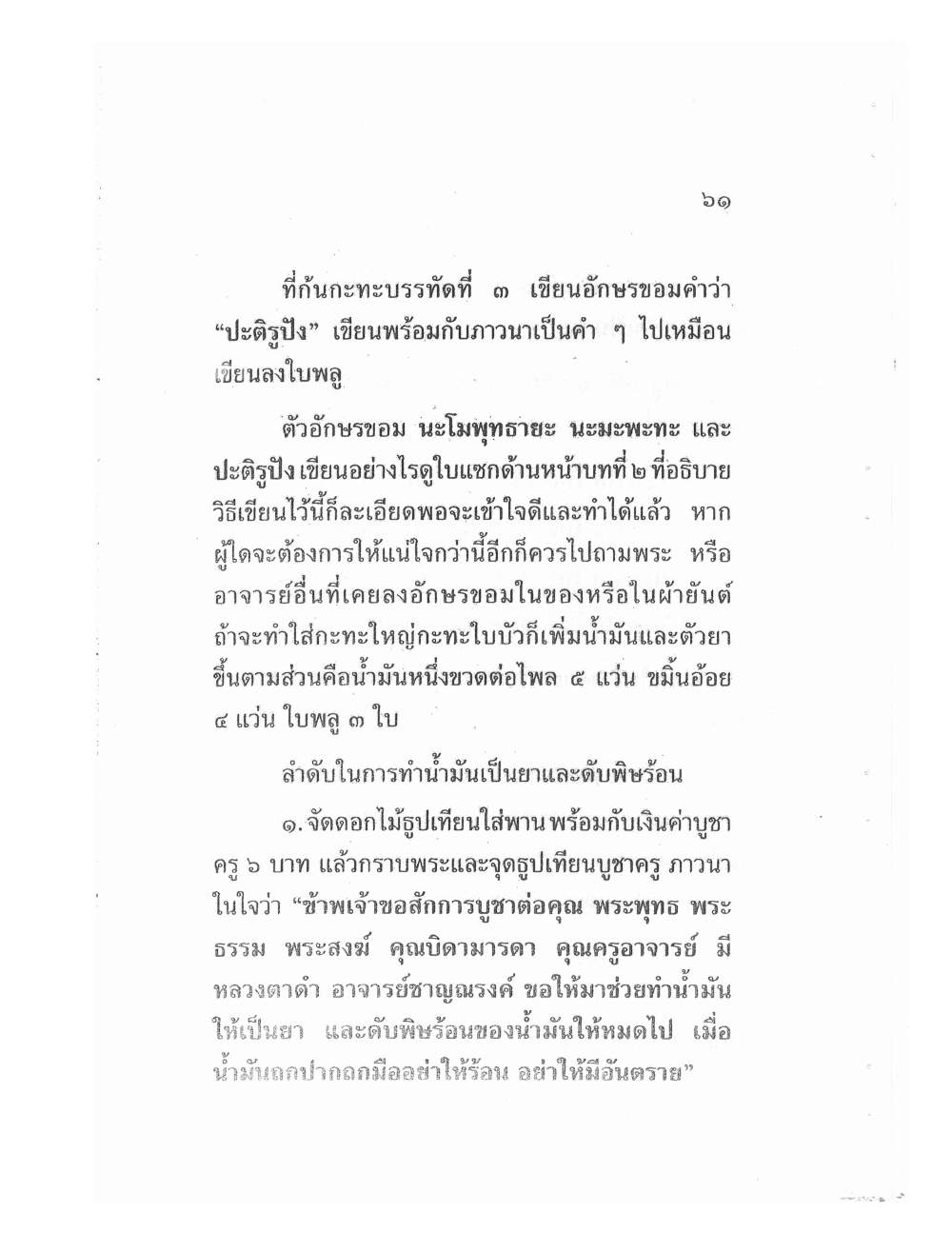
ที่ก้นกะทะบรรทัดที่ ๓ เขียนอักษรขอมคำว่า “ปะติรูปัง” เขียนพร้อมกับภาวนาเป็นคำ ๆ ไปเหมือน เขียนลงใบพลู
ตัวอักษรขอม นะโมพุทธายะ นะมะพะทะ และ ปะติรูปัง เขียนอย่างไรดูใบแซกด้านหน้าบทที่ ๒ ที่อธิบาย วิธีเขียนไว้นี้ก็ละเอียดพอจะเข้าใจดีและทำได้แล้ว หาก ผู้ใดจะต้องการให้แน่ใจกว่านี้อีกก็ควรไปถามพระ หรือ อาจารย์อื่นที่เคยลงอักษรขอมในของหรือในผ้ายันต์ ถ้าจะทำใส่กะทะใหญ่กะทะใบบัวก็เพิ่มน้ำมันและตัวยา ขึ้นตามส่วนคือน้ำมันหนึ่งขวดต่อไพล ๕ แว่น ขมิ้นอ้อย ๔ แว่น ใบพลู ๓ ใบ
ลำดับในการทำน้ำมันเป็นยาและดับพิษร้อน
๑. จัดดอกไม้ธูปเทียนใส่พาน พร้อมกับเงินค่าบูชา ครู ๖ บาท แล้วกราบพระและจุดธูปเทียนบูชาครู ภาวนา ในใจว่า “ข้าพเจ้าขอสักการบูชาต่อคุณ พระพุทธ พระ ธรรม พระสงฆ์ คุณบิดามารดา คุณครูอาจารย์ มี หลวงตาดำ อาจารย์ชาญณรงค์ ขอให้มาช่วยทำน้ำมัน ให้เป็นยา และดับพิษร้อนของน้ำมันให้หมดไป เมื่อ น้ำมันตกปากตกมือฯ อย่าให้ร้อน อย่าให้มีอันตราย”
On the bottom of the pan, line 3, write the Khom word "Paṭirūpaṃ", written while reciting one word at a time, the same as writing on the betel leaf.
For how the Khom letters "Namo Buddhāya", "Na Ma Pha Tha", and "Paṭirūpaṃ" are written, see the insert page facing the front of Chapter 2, which explains the writing method in enough detail to be understood and carried out. Should anyone want to be more certain still, they should go and ask a monk, or another teacher who has previously inscribed Khom letters on objects or on yantra cloths. If preparing this in a large pan or a lotus-leaf-shaped pan, increase the oil and the herbal ingredients in proportion: one bottle of oil to 5 slices of phlai, 4 slices of turmeric-root, and 3 betel leaves.
Sequence for making the oil into medicine and quenching hot poison [fever/burns]
1. Arrange flowers, incense, and candles on a tray, together with the teacher's-fee money, 6 baht, then pay homage to the Buddha image and light the incense and candles in homage to the teachers. Recite mentally: "I offer worship and reverence to the virtue of the Buddha, the Dhamma, the Sangha, the virtue of my father and mother, the virtue of my teachers, including Luang Ta Dam and Ajarn Charnnarong. Please come and help me make this oil into medicine, and quench all the hot poison of the oil until it is gone. When the oil falls onto the mouth or hand, let it not be hot, let it cause no harm."
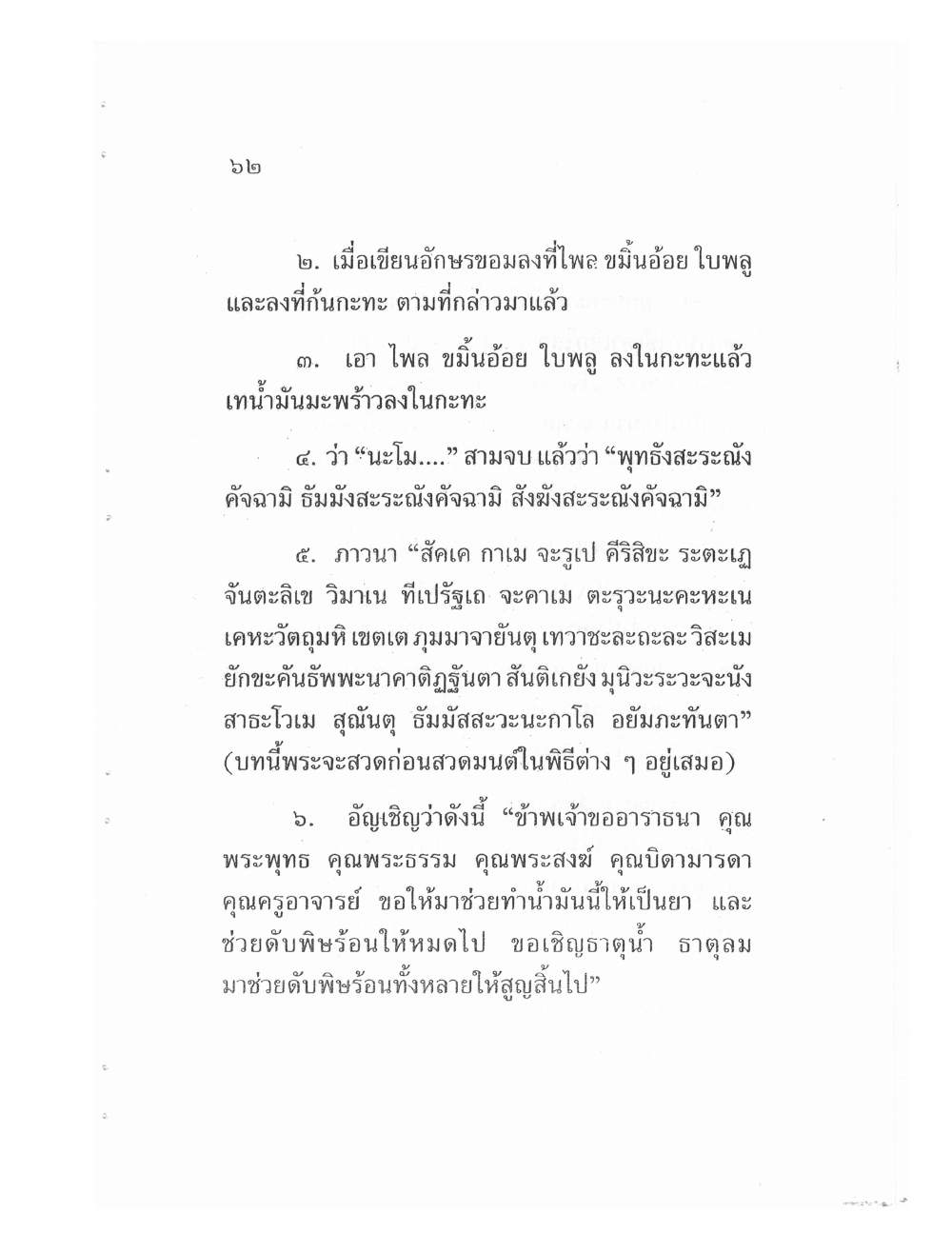
๒. เมื่อเขียนอักษรขอมลงที่ไพล ขมิ้นอ้อย ใบพลู และลงที่ก้นกะทะ ตามที่กล่าวมาแล้ว
๓. เอา ไพล ขมิ้นอ้อย ใบพลู ลงในกะทะแล้ว เทน้ำมันมะพร้าวลงในกะทะ
๔. ว่า “นะโม….” สามจบ แล้วว่า “พุทธังสะระณัง คัจฉามิ ธัมมังสะระณังคัจฉามิ สังฆังสะระณังคัจฉามิ”
๕. ภาวนา “สัคเค กาเม จะรูเป คีริสิขะ ระตะเฏ จันตะลิเข วิมาเน ทีเปรัฏเฐ จะคาเม ตะรุวะนะคะหะเน เคหะวัตถุมหิ เขตเต ภุมมาจายันตุ เทวาชะละถะละวิสะเม ยักขะคันธัพพะนาคาติฏฐันตา สันติเกยัง มุนิวะระวะจะนัง สาธะโวเม สุณันตุ ธัมมัสสะวะนะกาโล อยัมภะทันตา” (บทนี้พระจะสวดก่อนสวดมนต์ในพิธีต่าง ๆ อยู่เสมอ)
๖. อัญเชิญว่าดังนี้ “ข้าพเจ้าขออาราธนา คุณ พระพุทธ คุณพระธรรม คุณพระสงฆ์ คุณบิดามารดา คุณครูอาจารย์ ขอให้มาช่วยทำน้ำมันนี้ให้เป็นยา และ ช่วยดับพิษร้อนให้หมดไป ขอเชิญธาตุน้ำ ธาตุลม มาช่วยดับพิษร้อนทั้งหลายให้สูญสิ้นไป”
2. Inscribe the Khom letters onto the phlai, the turmeric-root, the betel leaves, and onto the bottom of the pan, as described above.
3. Put the phlai, the turmeric-root, and the betel leaves into the pan, then pour coconut oil into the pan.
4. Recite "Namo…" three times, then recite: "Buddhaṃ saraṇaṃ gacchāmi, Dhammaṃ saraṇaṃ gacchāmi, Saṅghaṃ saraṇaṃ gacchāmi" [I go to the Buddha for refuge, I go to the Dhamma for refuge, I go to the Sangha for refuge]
5. Recite: "Sagge kāme ca rūpe, giri-sikhara-taṭe cantalikkhe vimāne, dīpe raṭṭhe ca gāme, taruvana-gahane gehavatthumhi khette, bhummā cāyantu devā, jalathala-visame yakkha-gandhabba-nāgā tiṭṭhantā santike yaṃ, munivara-vacanaṃ sādhavo me suṇantu, dhammassavana-kālo ayaṃ bhadantā" [roughly: in the heavens of sense-desire, the realms of form, on mountain peaks, in sky-palaces, in islands, kingdoms and villages, in thickets, groves, and homesteads, in fields — may the earthbound devas gather, and the spirits of water and land however uneven, the yakkhas, gandhabbas, and nāgas dwelling nearby — may these good ones listen to the excellent word of the Sage; this, good sirs, is the time to hear the Dhamma] (Monks always chant this verse before reciting blessings in various ceremonies.)
6. Invite [the powers] thus: "I invite the virtue of the Buddha, the virtue of the Dhamma, the virtue of the Sangha, the virtue of my father and mother, the virtue of my teachers, to please come and help make this oil into medicine, and help quench all its hot poison until it is gone. I invite the water element and the wind element to come and help extinguish all hot poison until it is utterly destroyed."
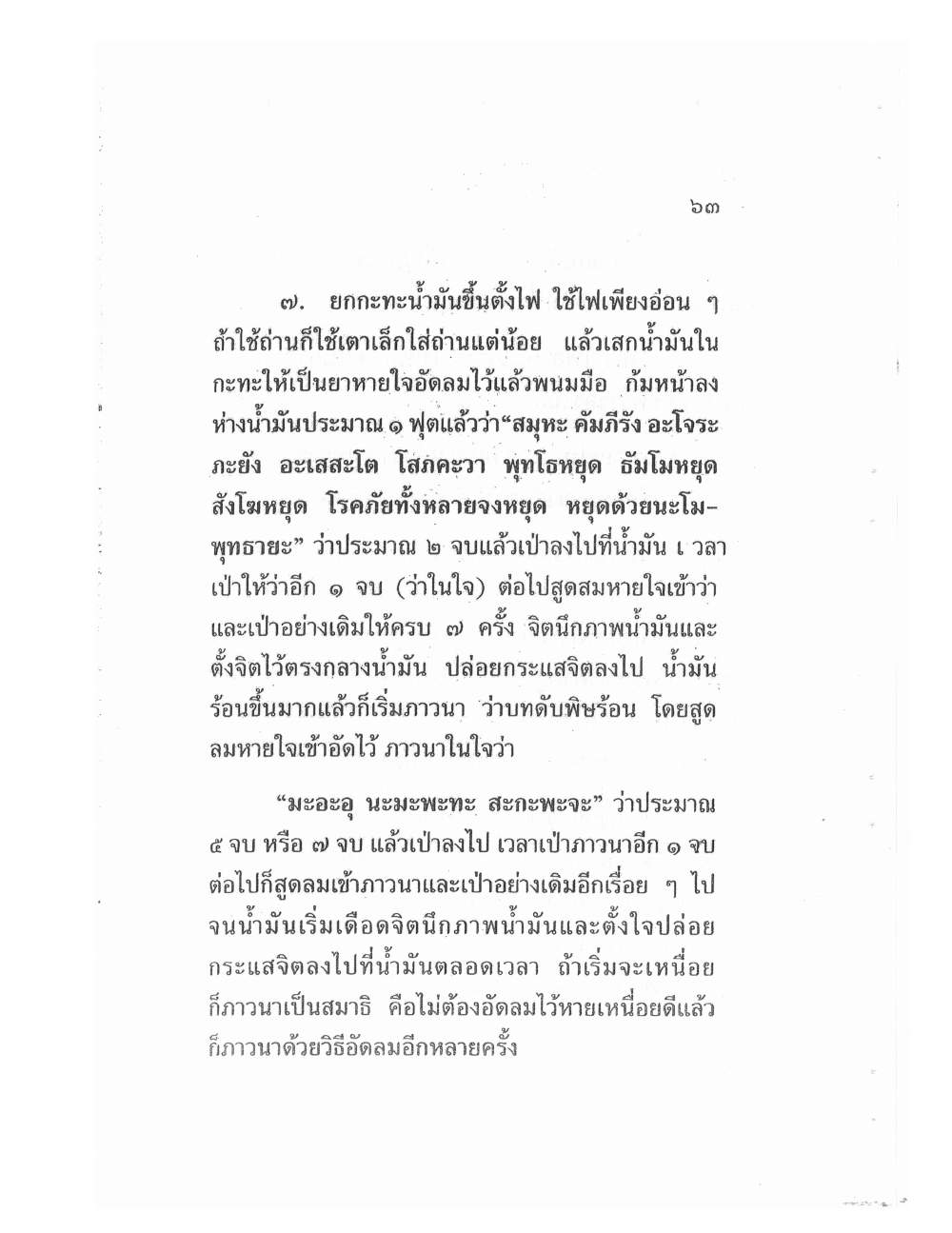
๗. ยกกะทะน้ำมันขึ้นตั้งไฟ ใช้ไฟเพียงอ่อน ๆ ถ้าใช้ถ่านก็ใช้เตาเล็กใส่ถ่านแต่น้อย แล้วเสกน้ำมันใน กะทะให้เป็นยาหายใจอัดลมไว้แล้วพนมมือ ก้มหน้าลง ห่างน้ำมันประมาณ ๑ ฟุตแล้วว่า “สมุหะ คัมภีรัง อะโจระ ภะยัง อะเสสะโต โสภะคะวา พุทโธหยุด ธัมโมหยุด สังโฆหยุด โรคภัยทั้งหลายจงหยุด หยุดด้วยนะโม- พุทธายะ” ว่าประมาณ ๒ จบแล้วเป่าลงไปที่น้ำมัน ๑ วลา เป่าให้ว่าอีก ๑ จบ (ว่าในใจ) ต่อไปสูดสมหายใจเข้าว่า และเป่าอย่างเดิมให้ครบ ๓ ครั้ง จิตนึกภาพน้ำมันและ ตั้งจิตไว้ตรงกลางน้ำมัน ปล่อยกระแสจิตลงไป น้ำมัน ร้อนขึ้นมากแล้วก็เริ่มภาวนา ว่าบทดับพิษร้อน โดยสูด ลมหายใจเข้าอัดไว้ ภาวนาในใจว่า
“มะอะอุ นะมะพะทะ สะกะพะจะ” ว่าประมาณ ๕ จบ หรือ ๗ จบ แล้วเป่าลงไป เวลาเป่าภาวนาอีก ๑ จบ ต่อไปก็สูดลมเข้าภาวนาและเป่าอย่างเดิมอีกเรื่อย ๆ ไป จนน้ำมันเริ่มเดือดจิตนึกภาพน้ำมันและตั้งใจปล่อย กระแสจิตลงไปที่น้ำมันตลอดเวลา ถ้าเริ่มจะเหนื่อย ก็ภาวนาเป็นสมาธิ คือไม่ต้องอัดลมไว้หายเหนื่อยดีแล้ว ก็ภาวนาด้วยวิธีอัดลมอีกหลายครั้ง
7. Lift the pan of oil onto the fire; use only a low flame — if using charcoal, use a small brazier with only a little charcoal. Then consecrate the oil in the pan to become medicine: breathe in, hold the breath, press the palms together, lower the face to about 1 foot from the oil, and recite: "Samuha gambhiram acorabhayam asesato sobhagava — Buddho, stop! Dhammo, stop! Sangho, stop! Let all sickness and danger stop, stop by the power of Namo Buddhāya" [a formula invoking the depth and majesty of the Buddha's virtue to command all danger and sickness to cease]. Recite this about 2 times, then blow onto the oil once, and while blowing recite once more (silently, in the mind). Next, breathe in and recite again, and blow as before, for a total of 3 times. The mind visualizes the oil and fixes itself at the centre of the oil, releasing the stream of mind's power down into it. Once the oil has grown quite hot, begin reciting the verse for quenching hot poison, breathing in, holding the breath, and reciting mentally:
"Ma-a-u na-ma-pha-tha sa-ka-pha-ja" [a mantra of sacred syllables], recited about 5 or 7 times, then blow onto it; while blowing, recite once more, then breathe in again, recite, and blow as before, repeatedly, until the oil begins to boil. The mind visualizes the oil and intentionally releases the stream of mind continuously into it. If one begins to grow tired, recite while resting in samādhi — that is, without holding the breath — until the tiredness has passed; then resume reciting with the breath-holding method again, several times.
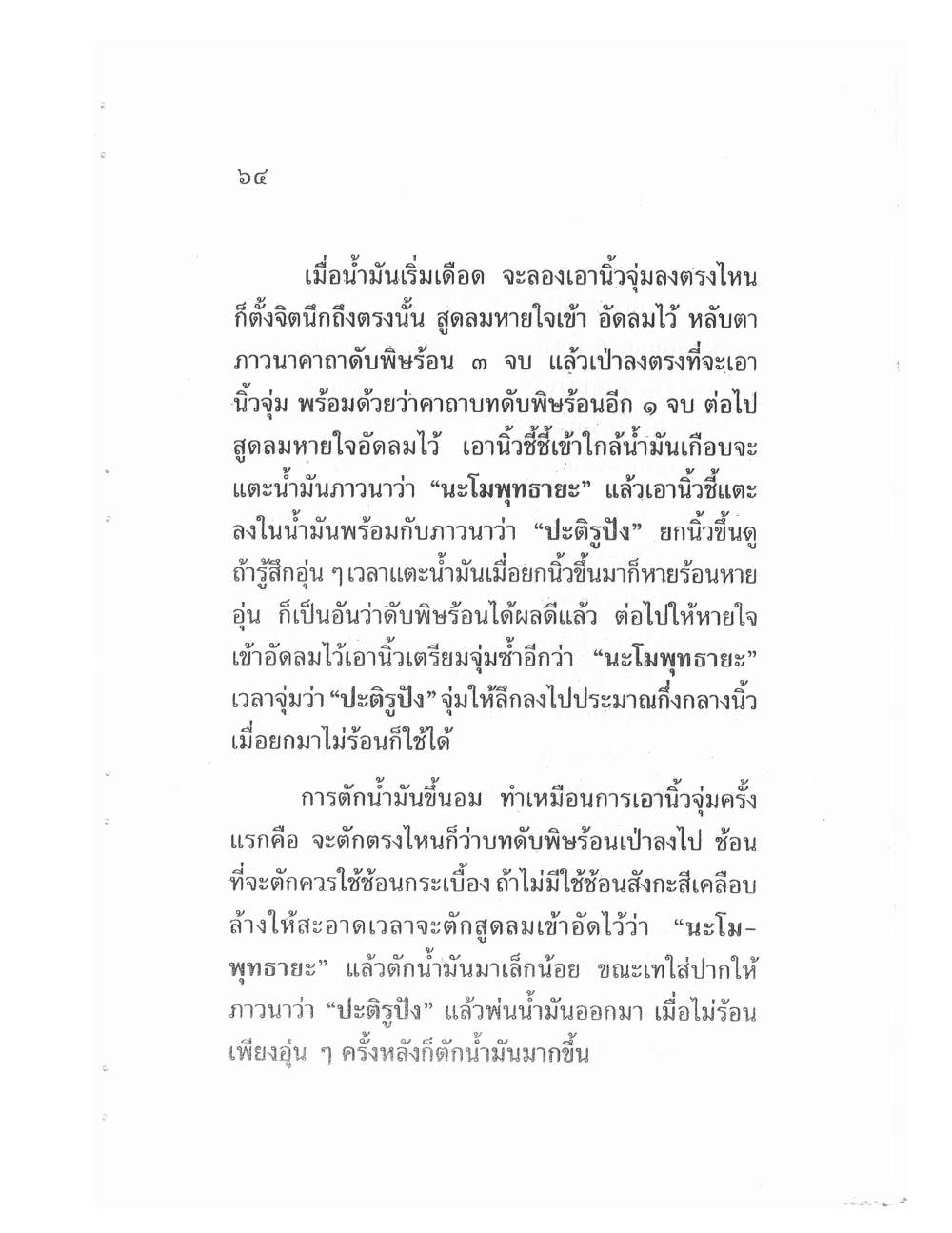
เมื่อน้ำมันเริ่มเดือด จะลองเอานิ้วจุ่มลงตรงไหน ก็ตั้งจิตนึกถึงตรงนั้น สูดลมหายใจเข้า อัดลมไว้ หลับตา ภาวนาคาถาดับพิษร้อน ๓ จบ แล้วเป่าลงตรงที่จะเอา นิ้วจุ่ม พร้อมด้วยว่าคาถาบทดับพิษร้อนอีก ๑ จบ ต่อไป สูดลมหายใจอัดลมไว้ เอานิ้วชี้ชี้เข้าใกล้น้ำมันเกือบจะ แตะน้ำมันภาวนาว่า “นะโมพุทธายะ” แล้วเอานิ้วชี้แตะ ลงในน้ำมันพร้อมกับภาวนาว่า “ปะติรูปัง” ยกนิ้วขึ้นดู ถ้ารู้สึกอุ่น ๆ เวลาแตะน้ำมันเมื่อยกนิ้วขึ้นก็หายร้อนหาย อุ่น ก็เป็นอันว่าดับพิษร้อนได้ผลดีแล้ว ต่อไปให้หายใจ เข้าอัดลมไว้เอานิ้วเตรียมจุ่มซ้ำอีกว่า “นะโมพุทธายะ” เวลาจุ่มว่า “ปะติรูปัง” จุ่มให้ลึกลงไปประมาณกึ่งกลางนิ้ว เมื่อยกมาไม่ร้อนก็ใช้ได้
การตักน้ำมันขึ้นอม ทำเหมือนการเอานิ้วจุ่มครั้ง แรกคือ จะตักตรงไหนก็ว่าบทดับพิษร้อนเป่าลงไป ช้อน ที่จะตักควรใช้ช้อนกระเบื้อง ถ้าไม่มีใช้ช้อนสังกะสีเคลือบ ล้างให้สะอาดเวลาจะตักสูดลมเข้าอัดไว้ว่า “นะโม- พุทธายะ” แล้วตักน้ำมันมาเล็กน้อย ขณะเทใส่ปากให้ ภาวนาว่า “ปะติรูปัง” แล้วพ่นน้ำมันออกมา เมื่อไม่ร้อน เพียงอุ่น ๆ ครั้งหลังก็ตักน้ำมันมากขึ้น
Once the oil begins to boil, try dipping a finger in at a chosen spot, first fixing the mind on that spot. Breathe in, hold the breath, close the eyes, and recite the verse for quenching hot poison 3 times, then blow toward the spot where the finger will be dipped, reciting the verse for quenching hot poison once more. Next, breathe in and hold the breath, bring the index finger close to the oil, almost touching it, and recite "Namo Buddhāya"; then touch the index finger down into the oil while reciting "Paṭirūpaṃ". Lift the finger and check — if it felt only warm when touching the oil, and once lifted the heat and warmth disappear, then the quenching of the hot poison has succeeded well. Next, breathe in, hold the breath, prepare the finger to dip again reciting "Namo Buddhāya"; when dipping recite "Paṭirūpaṃ", dipping to about the middle of the finger; if, on lifting it out, it is not hot, it may be used.
Scooping the oil up to hold in the mouth
This is done the same as dipping the finger the first time: recite the verse for quenching hot poison and blow onto the spot to be scooped from. The spoon used for scooping should be a porcelain spoon; if none is available, use a coated tin spoon, washed clean. When about to scoop, breathe in and hold the breath while reciting "Namo Buddhāya", then scoop up a little oil; while pouring it into the mouth, recite "Paṭirūpaṃ", then spray the oil out. When it is not hot, only warm, scoop more oil the next time.
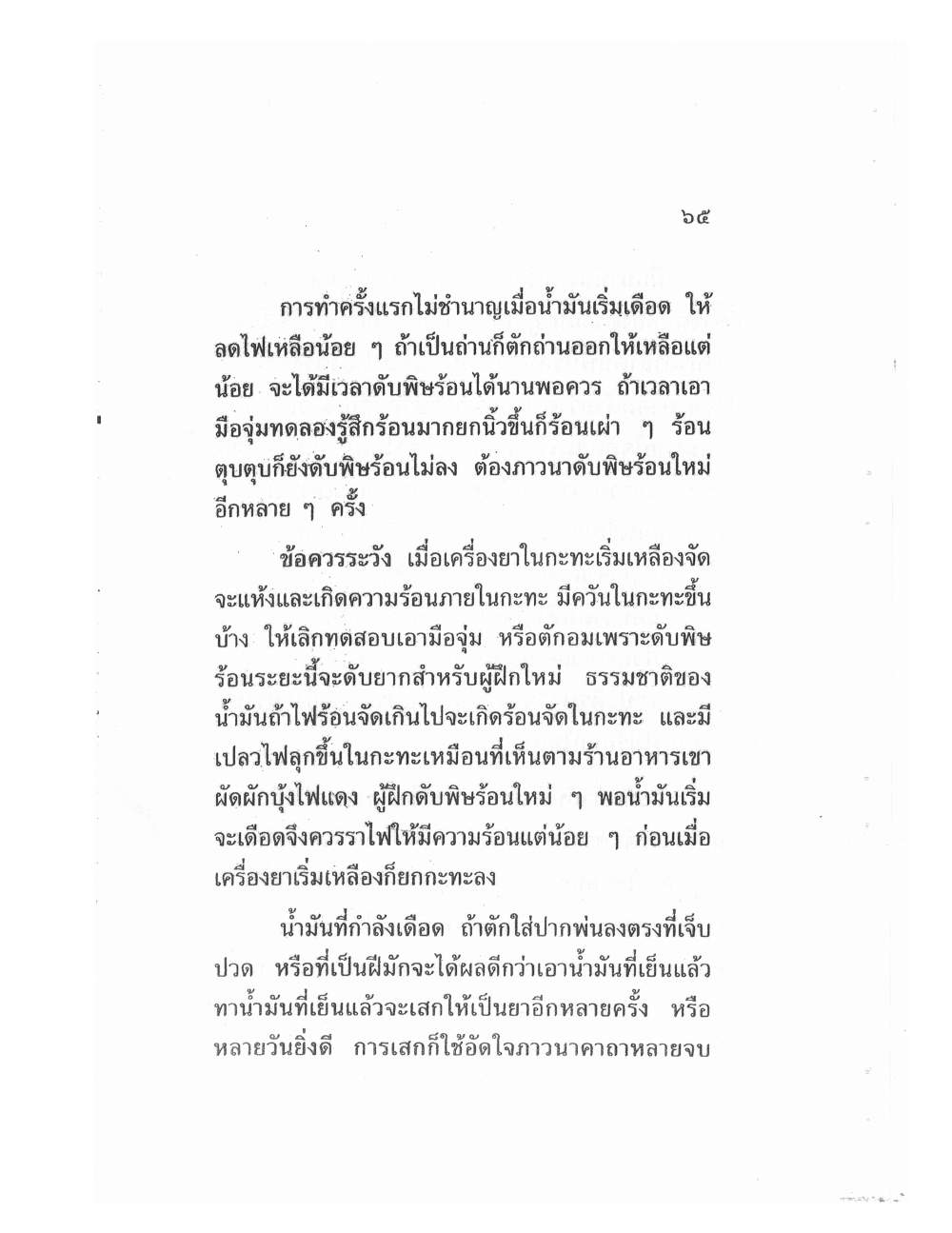
การทำครั้งแรกไม่ชำนาญเมื่อน้ำมันเริ่มเดือด ให้ ลดไฟเหลือน้อย ๆ ถ้าเป็นถ่านก็ตักถ่านออกให้เหลือแต่ น้อย จะได้มีเวลาดับพิษร้อนได้นานพอควร ถ้าเวลาเอา มือจุ่มทดลองรู้สึกร้อนมากยกนิ้วขึ้นก็ร้อนเผา ๆ ร้อน ตุบตุบก็ยังดับพิษร้อนไม่ลง ต้องภาวนาดับพิษร้อนใหม่ อีกหลาย ๆ ครั้ง
ข้อควรระวัง เมื่อเครื่องยาในกะทะเริ่มเหลืองจัด จะแห้งและเกิดความร้อนภายในกะทะ มีควันในกะทะขึ้น บ้าง ให้เลิกทดสอบเอามือจุ่ม หรือตักอมเพราะดับพิษ ร้อนระยะนี้จะดับยากสำหรับผู้ฝึกใหม่ ธรรมชาติของ น้ำมันถ้าไฟร้อนจัดเกินไปจะเกิดร้อนจัดในกะทะ และมี เปลวไฟลุกขึ้นในกะทะเหมือนที่เห็นตามร้านอาหารเขา ผัดผักบุ้งไฟแดง ผู้ฝึกดับพิษร้อนใหม่ ๆ พอน้ำมันเริ่ม จะเดือดจึงควรราไฟให้มีความร้อนแต่น้อย ๆ ก่อนเมื่อ เครื่องยาเริ่มเหลืองก็ยกกะทะลง
น้ำมันที่กำลังเดือด ถ้าตักใส่ปากพ่นลงตรงที่เจ็บ ปวด หรือที่เป็นฝีมักจะได้ผลดีกว่าเอาน้ำมันที่เย็นแล้ว ทาน้ำมันที่เย็นแล้วจะเสกให้เป็นยาอีกหลายครั้ง หรือ หลายวันยิ่งดี การเสกก็ใช้อัดใจภาวนาคาถาหลายจบ
When first learning, one is not yet skilled; once the oil begins to boil, reduce the fire to very low — if using charcoal, remove charcoal until only a little remains, so there will be enough time to quench the hot poison properly. If, when testing by dipping the hand, it feels very hot, and on lifting the finger it burns throbbingly and the hot poison still will not be quenched, one must recite the verse for quenching hot poison again, several more times.
Points to be careful of
When the herbal ingredients in the pan begin to turn deep yellow, they will dry out and heat will build up inside the pan, with some smoke rising in the pan. At this point, stop testing by dipping the hand or scooping to hold in the mouth, because quenching the hot poison at this stage is difficult for a new practitioner. It is the nature of the oil that if the fire is too hot, intense heat will build up in the pan, and flames may flare up in the pan, like what one sees at restaurants stir-frying morning-glory over high flame. Those newly training to quench hot poison, as soon as the oil begins to boil, should lower the fire to only a little heat beforehand; when the ingredients begin to turn yellow, lift the pan off the fire.
Oil that is actively boiling, if scooped into the mouth and sprayed onto a painful spot or an abscess, often works better than oil that has already cooled. Applying the cooled oil, it should be consecrated as medicine again several times, or over several days — the more, the better. The consecration is done by holding the breath and reciting the verse many times,
แล้วเป่าลงพร้อมด้วยภาวนาคาถาด้วย อย่าลืมนึกภาพ น้ำมันตั้งจิตให้ดิ่งลงไปสู่น้ำมันเสมอ
การปล่อยกระแสจิตลงนั้น ถ้าเหนื่อยก็จะปล่อย กระแสจิตลงได้ผลน้อย ดังนั้นเวลาเอาน้ำมันตั้งไฟอยู่ หรือน้ำมันที่เย็นแล้วเมื่อเสกหรือภาวนาแล้วเป่าหลายที เริ่มเหนื่อย ก็ให้ภาวนาโดยหายใจเข้าออกเบา ๆ สบาย ๆ แบบทำสมาธิ ไม่ต้องอัดลมหายใจไว้นึกภาพน้ำมันและ ตั้งจิตดิ่งลงไปในน้ำมัน ทำแบบนี้ไม่เหนื่อยเพราะไม่ได้ อัดลมหายใจไว้เป็นการพักให้หายเหนื่อยไปในตัว แต่ก็ ยังเสกหรือปล่อยกระแสจิตลงไป วิธีนี้เรียกว่า ภาวนา เป็นสมาธิ พอหายเหนื่อยแล้วก็เริ่มใช้วิธีอัดลมหายใจ ภาวนาแล้วเป่า เพราะเป็นวิธีที่ปล่อยกระแสจิตได้ดี แล้ว ก็ภาวนาเป็นสมาธิสลับกันไป
การเป่ารักษาโรค การเป่าดับพิษร้อนให้แก่คน ถูกน้ำร้อนลวกไฟไหม้ ก็อาศัยการเป่าโดยนึกภาพ และ ปล่อยกระแสจิตลงไปคล้ายการเสกน้ำมัน น้ำมันที่ทำ ไว้นั้นใช้ทาแก้ฟกบวมเจ็บปวด ทาตุ่มคันที่เป็นแผลเป็น น้ำเหลือง น้ำหนอง ควรเก็บน้ำมัน พร้อมกับเครื่องยาที่ ใส่กะทะแช่กันไว้นานเข้า น้ำมันจะมีสีเขียว ๆ ถ้าใช้น้ำมัน
then blowing onto it while reciting the verse as well. Never forget to visualize the oil, keeping the mind sinking steadily down into the oil at all times.
As for releasing the stream of mind, if one is tired, the stream of mind released will be weak. So, while the oil is on the fire, or when the oil has already cooled, if one has consecrated or recited and blown many times and begins to tire, one should recite while breathing in and out gently, easily, in the manner of practicing samādhi meditation. There is no need to hold the breath — simply visualize the oil and keep the mind sinking down into it. Done this way it is not tiring, because one is not holding the breath; it serves as a rest that relieves tiredness on its own, while still consecrating or releasing the stream of mind. This method is called "reciting as samādhi." Once the tiredness has passed, resume the breath-holding method, reciting and then blowing, because this method releases the stream of mind well. Then alternate between the two methods of reciting.
Blowing to treat illness
Blowing to quench hot poison for someone scalded by hot water or burned by fire also relies on blowing while visualizing and releasing the stream of mind, similar to consecrating the oil. The oil prepared this way is used to rub on bruises, swelling, and pain, and on itchy sores that are wounds weeping lymph fluid or pus. The oil should be kept together with the herbal ingredients soaking in the pan; the longer it is left, the more the oil takes on a greenish colour. If using oil
มะพร้าวแท้เคี่ยวเอง ปลุกเสกไว้หลายหนจะได้ผลดี น้ำมันมะพร้าวที่ขายส่วนมากปนน้ำมันปุ่น หรือน้ำมันอื่น ใช้มะพร้าวเสียปนจึงนำมาใช้ไม่ค่อยได้ผล
ถ้าจะให้ใช้ได้ผลดีขึ้นใช้ใส่แผลธรรมดาแผลเรื้อรัง มานานใช้รักษาคนถูกน้ำร้อนลวกไฟไหม้ได้ด้วย ให้เอา ไพลหนัก ๕ บาท ขมิ้นอ้อยหนัก ๕ บาท บอระเพ็ดทั้งเถา และใบหนัก ๑๐ บาท ทั้ง ๓ อย่างนี้ตำแหลกพอควร หรือจะหั่นบาง ๆ ก็ได้ เอาพิมเสนหนัก ๒ สลึง ใส่รวม กันลงไปแล้วเอาน้ำมันที่เสกแล้วซึ่งมีไพล, ขมิ้นอ้อยและ ใบพลูอยู่ด้วยประมาณ ๓ ขวด ใหญ่เทปนลงไปใส่กะทะ ยกตั้งไฟเคี่ยวพอตัวยาเหลืองก็ยกลงเก็บไว้ใช้จะปลุกเสก ไว้หลาย ๆ ครั้งอีกยิ่งดี หรือจะมีตัวยาอื่นที่ได้ผลดีมา ผสมน้ำมันที่เสกแล้วก็ได้ผลดีตามต้องการยิ่งขึ้น เช่น น้ำมันเลียงผาชนิดแท้ ว่านที่มีกำลังในการรักษาดีเป็นต้น
ขั้นที่ ๖ สอนวิชารูดโซ่ลุยไฟครบถ้วนแบบเก่า
จะได้สอนวิชารูดโซ่ลุยไฟตามที่เรียนมาจากอาจารย์ ปลื้ม อาจารย์ไปล่ ซึ่งมีคำภาวนาเพียงสั้น ๆ บทเดียวแต่
pressed by hand from real coconut, the effect will be good if consecrated many times. Most coconut oil sold [commercially] is mixed with palm oil or other oils, using spoiled coconut, so bringing it to use rarely gives good results.
To make it more effective for use on ordinary wounds or long-standing chronic wounds, and to treat people scalded by hot water or burned by fire as well, take phlai weighing 5 baht [a traditional Thai unit of weight, ~15g], turmeric-root weighing 5 baht, and the whole vine of boraphet [Tinospora crispa] together with its leaves weighing 10 baht; pound all three roughly, or slice them thin if preferred. Take camphor weighing 2 salueng [a traditional Thai unit of weight], mix it in with the above, then take about 3 large bottles of the already-consecrated oil that already contains phlai, turmeric-root, and betel leaf, and pour it all into the pan. Set it on the fire and simmer until the herbal matter turns yellow, then take it down and store it for use; consecrating it repeatedly again is even better. Other effective herbal ingredients may also be mixed into the already-consecrated oil to achieve even better results as desired — for instance, genuine goral [serow] oil, or roots/tubers with strong healing power, and so on.
Stage 6
Teaching the complete traditional technique of pulling a chain through fire
I will now teach the technique of pulling a chain through fire, as learned from Ajarn Pluem [and] Ajarn Plai, which uses only a single short recitation, but
ดับพิษร้อนได้ผลดีเช่นเดียวกัน ได้กล่าวมาแล้วในขั้นที่ ๓ ก่อนที่จะทำการรูดโซ่ลุยไฟให้จัดพานบูชาดังนี้
พานที่ ๑ ใส่ดอกไม้ธูปเทียนและเงินบูชาครู ๖ บาท ใช้เทียน ๓ เล่ม บูชาครูโดยจุดธูป มือขวาถือธูปที่จุด พร้อมกับมือทั้งสองข้างยกพานที่มีค่าครูขึ้นกล่าวคำบูชา และอาราธนา ทำเหมือนกันทุกวิชา ดูตัวอย่างคำบูชาใน หนังสือแพทย์สามแผนหน้า ๙๗ และในวิชาอื่น ๆ
พานที่ ๒ ใส่ใบพลู ๓ ใบ, ข้าวสาร ๑ กำมือ, ปูน แดงประมาณขนาดหัวแม่มือหรือโตกว่าบ้าง ปูนนี้ใช้ปูน ที่ยังไม่ปนสีเสียดและอาจเอาปูนนี้ใส่บนใบพลูอีก ๑ ใบ, เหล้าขาว ๑ ขวด วางไว้นอกพาน เวลาปลุกเสกเอามือ แตะบนใบพลู ข้าวสารและปูนใช้บทภาวนาบทที่ ๗ ดู ท้ายเล่ม เวลาภาวนาก็นึกภาพสิ่งที่จะเสกในพาน
ขันใส่น้ำ ๑ ใบ สำหรับทำน้ำมนต์, โดยเอามือ ทั้งสองแตะข้างขันน้ำทั้งสองข้างเพื่อให้รู้ขนาดผิวน้ำที่จะ ส่งพลังจิตลงไปมือขวาใช้นิ้วชี้กับนิ้วหัวแม่มือจับเทียน ขี้ผึ้งแท้หนัก ๑ บาทที่ จุดไฟไว้แล้วเพื่อให้น้ำตาเทียน หยดลงน้ำในขันให้กลายสภาพเป็นน้ำมนต์ จะเสกของ
quenches hot poison just as effectively, as already described in Stage 3. Before performing the chain-pulling fire-walk, prepare offering trays as follows:
Tray 1: place flowers, incense, and candles, and 6 baht as the teacher's fee, using 3 candles. Pay homage to the teachers by lighting incense; hold the lit incense in the right hand together with both hands lifting the tray of teacher's-fee money, and recite the words of homage and invitation, done the same way for every subject. See the example homage text in the book "Doctor of the Three Traditions" (แพทย์สามแผน), page 97, and in the other subjects as well.
Tray 2: place 3 betel leaves, a handful of uncooked rice, and red slaked lime about the size of a thumb or larger — this lime should be lime not yet mixed with dye — and this lime may also be placed on one more betel leaf, plus 1 bottle of white liquor, set outside the tray. When consecrating, touch the hand to the betel leaves; for the rice and lime, use the recitation of verse 7, found at the back of the book. While reciting, visualize the objects being consecrated in the tray.
Take a bowl of water, 1, for making holy water, by touching both hands to both sides of the bowl to sense the surface of the water where the power of the mind will be sent down into it. With the right hand, use the index finger and thumb to hold a candle of pure beeswax weighing 1 baht, already lit, so that the wax drippings fall into the water in the bowl, turning it into holy water. The objects [to be consecrated]
ในพานก่อนหรือทำน้ำมนต์ก่อนการเสกของในพานก็ได้ เทียนทำน้ำมนต์เอาเทียนในพานที่ ๑
วิธีภาวนาเสกของในพาน หรือทำน้ำมนต์ให้ภาวนา ปล่อยพลังจิตลงโดยหลับตานึกภาพของที่จะเสก แล้ว ภาวนาบทที่ ๗ ด้วยวิธีคาบผสมอัดใจ พอเริ่มเหนื่อยก็ ภาวนาเป็นสมาธิสลับกันไปเหมือนกับที่กล่าวไว้ในเรื่อง การทำน้ำมันรักษาโรคและดับพิษร้อนที่กล่าวมาแล้วใน ตอนท้ายของการทำน้ำมันเป็นยาและดับพิษร้อน
เมื่อเสกของในพานและทำน้ำมนต์เสร็จแล้วให้ เอาโซ่เหล็กขนาด ๖ หุน หรือ ๔ หุน ยาวประมาณ ๑ เมตร เอาปลายข้างหนึ่งยาวประมาณครึ่งหนึ่งคือยาวครึ่งเมตร ขดลงบนเตาไฟที่มีถ่านไฟติดดีแล้ว โซ่ที่เหลืออีกครึ่ง เมตรห้อยอยู่นอกเตาไฟมีห่วงร้อยที่ปลายเพื่อจับยกโซ่ ขึ้นจากเตา
ผู้ที่เรียนทำครั้งแรกควรใช้ถ่านไฟไม่มากและโซ่ เหล็กก็ใช้ขนาดเล็กเสียก่อน เริ่มต้นโดยอาราธนาคุณ พระและครูอาจารย์มาช่วยดับพิษร้อนของโซ่เหล็กให้ หมดไป ต่อไปเริ่มทำการดับพิษร้อนของโซ่เหล็กโดย
in the tray may be consecrated either before or after making the holy water. For making the holy water, take the candle from Tray 1.
The method for reciting to consecrate the objects in the tray, or to make holy water, is to recite while releasing the power of the mind, closing the eyes and visualizing the object to be consecrated, then reciting verse 7 by the combined method alternating with breath-holding. As soon as one begins to tire, recite in samādhi instead, alternating as already described in the section on making the medicinal oil and quenching hot poison, at the end of the passage on making the oil into medicine and quenching hot poison.
Once the objects in the tray have been consecrated and the holy water made, take an iron chain of 6-hun or 4-hun gauge [a traditional Thai unit of thickness, ~4.7mm per hun], about 1 metre long. Coil one end, about half its length — that is, half a metre — onto a brazier already burning well with charcoal. The remaining half metre of chain hangs outside the brazier, with a ring threaded at its end for grasping and lifting the chain up off the brazier.
Those learning this for the first time should use only a little charcoal fire, and the chain should also be of a small gauge at first. Begin by invoking the virtue of the Buddha and of one's teachers to come and help quench all the hot poison of the iron chain until it is gone. Then begin the process of quenching the hot poison of the iron chain by
พนมมือว่านะโมสามจบแล้ว ภาวนาบทสำรวมเรียกมนต์ ๓ จบ ว่าดังนี้
“วุทธิจุดติ ไวยะปัดตา อัปปะมานะ สำปาเทถะ”
ต่อไปภาวนาคาถาป้องกันว่าดังนี้
“พุทโธล้อม ธัมโมป้อม สังโฆกัน ท้าวเวสสุวรรณโน พุทโธกัน ปิอัดถะโข สุวันโน จะมหาราชา สุวันนะภูมิเมตตา ยักขะเสดถามันหิเก พุทธังกันอิติชาติกันสวาหะ ธัมมังกันอิติชาติกันสวาหะ สังฆังกันอิติชาติกันสวาหะ”
(ใช้กันได้สารพัด สวดมนต์ก่อนนอนก็ได้ กันได้สารพัด คุณไสยทำไม่ได้เลย ดีนักแล..)
(ภูมิ อ่านว่า พูม, ชาติ - อ่านว่า “ชา-ต”)
ก่อนภาวนาบทคาถาป้องกันให้ทำสมาธิรวมจิตไปที่มุมห้องด้านซ้ายข้างหน้า ภาวนาจบแล้ว, ตั้งจิตลากแทนสายสิญจ์มาหยุดที่มุมห้องด้านขวา ภาวนาอีก ๑ จบ, แล้วรวมจิตลากเป็นสายสิญจ์ไปมุมห้องด้านหลังทางขวา ภาวนา ๑ จบ, แล้วตั้งจิตลากเป็นสายสิญจ์ไปหยุดที่มุมห้องด้านหลังทางซ้าย ภาวนาอีก ๑ จบ, แล้วตั้งจิตลาก
Press the palms together, recite Namo three times, then chant the recollection verse to invoke the mantra, 3 times, as follows:
“Vutthi jutti vaiya-patta appamana sampathetha”
Next, recite the protective incantation as follows:
“Buddho surrounds [me], Dhammo shields [me], Sangho protects [me]. Thao Wessuwan (guardian king of the yakshas), Buddho together, pi-at-tha-kho, suwanno, the great king, of Suwannabhumi, with loving-kindness — yakkha-sedtha-man-hi-ke — Buddhang-kan-iti-chat-kan-savaha, Dhammang-kan-iti-chat-kan-savaha, Sanghang-kan-iti-chat-kan-savaha.” (a protective chant; some phrases are given here transliterated as printed, their exact sense not glossed on the page)
(This can be used to guard against anything at all; it may also be recited before sleep. It protects against everything — black magic (khun sai) cannot touch it at all, very excellent indeed..)
(Note: ภูมิ is pronounced “phum”; ชาติ is pronounced “cha-t”)
Before reciting the protective verse, first enter samadhi, gathering the mind and drawing it to the corner of the room ahead on the left. When that recitation is finished, fix the mind and draw it — as though it were a consecrated thread (sai sin) — to come to rest at the corner of the room on the right. Recite once more. Then gather the mind and draw it as a thread to the back-right corner of the room. Recite once. Then fix the mind and draw it as a thread to come to rest at the back-left corner of the room. Recite once more, then fix the mind and draw...
เป็นสายสิญจ์ (ใช้กระแสจิตแทนสายสิญจ์) ไปบรรจบมุมซ้ายด้านหน้า ถ้าไม่ทำในห้องก็ทำโดยกำหนดขอบเขตเป็นสี่เหลี่ยมคล้ายห้อง
เมื่อภาวนาบทป้องกันเสร็จแล้วก็เริ่มดับพิษร้อนของโซ่ในเตาไฟ โดยรวมจิตไว้ที่ขดโซ่ที่อยู่ในเตาไปตรงกึ่งกลางขดโซ่หลับตานึกถึงภาพของโซ่ที่ขดอยู่ตลอดเวลา ภาวนาครั้งละหนึ่งบท บท ๖ ให้ภาวนาหลายจบแล้วจึงภาวนาบทที่ ๗ อีกหลายจบ แล้วภาวนาบทที่ ๘, บทที่ ๙ และ บทที่ ๑๐ อีกบทละหลายจบ (๓ หรือ ๗ จบ) การภาวนาให้ใช้วิธีอัดลมหายใจไว้ (ภาวนาเป็นคาบ) ภาวนาประมาณ ๑ จบ หรือ ๒ จบ แล้วเป่าลมไปยังโซ่ในเตาพร้อมกับภาวนาอีก ๑ จบ แล้วหายใจเข้าอัดลมไว้ ภาวนาแล้วเป่าลมออกเช่นเดิมอีกซ้ำๆ กันถ้ารู้สึกเริ่มเหนื่อยก็ภาวนาเป็นสมาธิไม่ต้องอัดลมสลับกันดังที่กล่าวในวิชาทำน้ำมันเป็นยาจบบทที่ ๑๐ แล้ว ยังไม่แน่ว่าดับพิษร้อนหมดก็เริ่มภาวนาบทที่ ๖ ถึงบทที่ ๑๐ อีก ดูว่าถ่านในเตาซึ่งสีดำนั้นติดไฟจนแดงหมดแล้ว จึงตรวจสอบว่าหมดพิษร้อนหรือยัง โดยเอาใบพลูในพานมา ๑ ใบ จุ่มลงในน้ำมนต์แล้วเอาไปวางบนโซ่ในเตาไฟ ถ้าใบพลู
...to be a consecrated thread (using the flow of the mind in place of an actual thread), to converge at the front-left corner. If this is not done inside an actual room, then mark out a boundary in the shape of a square, resembling a room.
When the protective verse is finished, begin to quench the burning heat of the chain in the fire-brazier. Do this by gathering the mind onto the coiled chain sitting in the brazier, fixing right at the middle of the coil, eyes closed, holding continuously in mind the image of the coiled chain. Recite one verse at a time: recite verse 6 many times through, then recite verse 7 many more times, then verse 8, verse 9, and verse 10, each one many times over (3 or 7 times through). For the recitation, use the method of holding the breath (recite for one held breath at a time). Recite about 1 or 2 times through, then blow the breath toward the chain in the brazier while reciting once more, then breathe in and hold the breath again. Recite, then blow the breath out again the same way, repeating like this. If you begin to feel tired, simply recite while remaining in samadhi, without needing to alternate the held-breath method, as described in the teaching on turning oil into medicine. Once verse 10 is finished, if it is still uncertain whether the burning heat has been fully quenched, begin reciting verse 6 through verse 10 again. Check whether the charcoal in the brazier, which was black, has now caught fire until it has all turned glowing red. Then test whether the burning heat is gone by taking one betel leaf from the tray, dipping it in the consecrated water, and placing it on the chain in the fire-brazier. If the betel leaf...
เหี่ยวและไหม้เป็นรูใหญ่แสดงว่ายังไม่หมดพิษร้อนให้ส่งพลังจิตโดยภาวนาบทที่ ๖ ถึง ๑๐ เช่นเดิมอีก แล้วเอาใบพลูในพานจุ่มน้ำมนต์มาวางบนโซ่ในเตาไฟอีก ถ้าใบพลูเหี่ยวไปไม่ไหม้เป็นรูใหญ่หรือไหม้เป็นรูเล็กๆ ก็แสดงว่าดับพิษหมดแล้ว ยกปลายโซ่ที่อยู่นอกเตาเอาโซ่ออกมานอกเตา ถือให้ห้อยลงหรือแขวนไว้ แล้วภาวนาคาถาบทที่ ๙ โดยหายใจเข้าอัดลมไว้พร้อมกับภาวนา ๑ จบ แล้วเป่าไปยังโซ่ที่เผาแดง ภาวนาอีก ๑ จบ (ซึ่งเรียกว่าภาวนาเป็น ๑ คาบ) ภาวนาบทที่ ๙ นี้ไว้ตลอดเวลาจิตรวมอยู่ที่โซ่เผาไฟนั้น เอานิ้วหรือฝ่ามือเข้าใกล้โซ่ที่เผาไฟไม่รู้สึกร้อนจัดก็เอานิ้วหรือฝ่ามือแตะโซ่ที่ร้อนนั้นและรีบเอามือออกมา ถ้าแตะไปรู้สึกร้อนเล็กน้อย เมื่อเอามือออกมาก็ไม่รู้สึกร้อนที่นิ้วมือ ต่อไปเอาฝ่ามือลูบโซ่ดูโดยแบฝ่ามือการลูบลงดังนี้อาจารย์ท่านเรียกว่า “รูดโซ่” ลองรูดดู ๒ หรือ ๓ หน ต่อไปก็เอาฝ่ามือทั้ง ๒ ชิดกันกอบโซ่จากปลายขึ้นสูงประมาณ ๑ คืบ แล้วรีบปล่อยลง อย่าเอามือแตะโซ่ไว้นาน และอย่าเอามือกำโซ่ไว้ เวลากอบโซ่ขึ้นก็รีบปล่อย เพราะการฝึกครั้งแรกๆ สมาธิยังไม่ดีพอที่จะถูกโซ่ร้อนได้นาน จะให้ถูกได้นานหรือกอบ
...withers and burns into a large hole, this shows the burning heat is not yet fully gone; send psychic power again by reciting verse 6 through 10 as before. Then take a betel leaf from the tray, dip it in consecrated water, and place it on the chain in the brazier again. If the betel leaf merely withers without burning into a large hole, or burns into only a tiny hole, this shows the burning heat is now fully quenched. Lift the end of the chain lying outside the brazier and take the chain out of the brazier, holding it so it hangs down or is suspended. Then recite verse 9, breathing in and holding the breath while reciting once through, then blowing out toward the glowing red chain, reciting once more (this is called reciting for one held breath). Keep reciting this verse 9 continuously, with the mind gathered on that burning chain. Bring a finger or the palm close to the burning chain; if it does not feel very hot, then touch the hot chain with a finger or palm and quickly withdraw the hand. If touching it feels only slightly hot, and on withdrawing the hand there is no sensation of heat left on the finger, then next stroke the chain with the palm, an open-palm stroking motion downward — this the teacher calls “rud so” (chain-stroking). Try stroking it 2 or 3 times. Next, bring both palms together and scoop up the chain from its end to a height of about one khuep (a hand-span), then quickly release it downward. Do not keep the hand touching the chain for long, and do not grip the chain in a fist. When scooping the chain up, release it quickly, because during the first attempts at practice the samadhi is not yet good enough to bear contact with the hot chain for long. To be able to bear contact for longer, or to scoop it...
โซ่ที่ร้อนแดงไว้ได้นานจะต้องฝึกสมาธิให้ได้ถึงสมาธิขั้นกลางเสียก่อน
เมื่อยกโซ่ร้อนแดงขึ้นจากเตาแล้วก็ให้เอาหน้าไปใกล้ๆ โซ่ประมาณ ๑ คืบ ภาวนาคาถาบทที่ ๙ เป็นคาบเป่าไปที่โซ่ตลอดเวลาระหว่างที่จะแตะหรือกอบขึ้นก็ภาวนาไว้เรื่อยๆ ให้ผู้อื่นที่ไม่ได้เรียนวิชานี้มาแตะโซ่กอบโซ่ดูก็ได้ไม่อันตรายอะไร ผู้เรียนวิชานี้ก็เป่าดับพิษด้วยบทที่ ๙ ไว้ตลอดเวลาระหว่างทดลอง
ต่อไปจะ สูบวิชา กลับให้เอาเหล้าในขวดมาอมเล็กน้อย ภาวนาคาถาบทที่ ๑๑ หนึ่งจบพ่นเป็นฝอยไปใส่โซ่ส่วนที่เผาไฟนั้นแล้วสูบลมเข้าทางปากดังวู๊บ พอพ่นเหล้าออกก็สูบลมเข้าต่อเนื่องกัน ทำดังนี้ ๓ ครั้ง โซ่จะรู้สึกร้อนมีพิษร้อนเอานิ้วไปแตะก็ทำให้นิ้วพองได้
ในการที่รูดโซ่หรือกอบโซ่ขึ้นถ้าทำทีแรกยังนึกกลัวก็ใช้ปูนและน้ำมนต์ที่เสกไว้แล้วทาฝ่ามือเสียก่อน จึงรูดโซ่หรือกอบโซ่เมื่อทำได้และเข้าใจดีแล้วก็ไม่ต้องทาด้วยปูนหรือน้ำมนต์
...being able to keep the chain glowing hot in contact for a long time requires first training samadhi until reaching the middle stage of samadhi.
When the glowing-red chain has been lifted out of the brazier, bring the face close to the chain, about one khuep away. Recite verse 9 for one held breath, blowing continuously toward the chain the whole time; during the interval before touching or scooping it up, keep reciting continuously. Others who have not studied this discipline may also come and touch or scoop the chain to try it — there is no danger. The one who has studied this discipline should keep blowing to quench the burning heat using verse 9 throughout the trial.
Next comes what is called “withdrawing the discipline” (sup wicha): take a little liquor from a bottle and hold it in the mouth. Recite verse 11 once through, then spray it as a fine mist onto the part of the chain that was in the fire, then draw breath in through the mouth with a whooshing sound. As soon as the liquor is sprayed out, continue drawing breath in right after. Do this 3 times. The chain will then feel hot again, carrying burning heat — if a finger is touched to it, it can raise a blister.
When first attempting to stroke the chain or scoop it up, if one still feels afraid, one may first apply consecrated lime paste and holy water to the palms before stroking or scooping the chain. Once one is able to do it and understands it well, there is no further need to apply the lime paste or holy water.
ใน การลุยไฟ จัดของจัดพานและเสกเหมือนการรูดโซ่ต่อไปทำกรอบให้สูงขึ้นจากดินเพื่อไม่ให้ถ่านกระจาย กว้างประมาณ ๑ ศอก ยาวประมาณ ๑ วา เอาถ่านที่เผาไฟในเตาใหญ่ที่ติดไฟดีแล้วมาเทลงในกรอบซึ่งกว้างประมาณ ๑ ศอก ยาวประมาณ ๑ วาให้เต็มกรอบแล้วเอาไม้ทุบให้เรียบแล้วดับพิษร้อนด้วยบทที่ ๖ ถึงบทที่ ๑๐ เช่นเดียวกับการดับพิษโซ่ การทดสอบว่าดับพิษหมดแล้วก็ทำเช่นเดียวกับการดับพิษโซ่เหล็ก ก่อนจะเดินลุยไฟครั้งแรก ยังนึกกลัวอยู่บ้างก็ใช้ปูนและน้ำมนต์ทาเท้าทั้ง ๒ ข้าง โดยทาจากส้นเท้าขึ้นไปตามฝ่าเท้าถึงปลายเท้า แล้วเดินไปบนถ่านก้าวไปเร็วๆ อย่าเหยียบไว้นาน ถ้าจะย่ำเท้าบ้างก็รีบยกเท้าเร็วๆ ภาวนาบทที่ ๘ ในเมื่อยังไม่เคยชินและสมาธิยังไม่ดีพอ
เมื่อไฟไหม้จะวิ่งฝ่าไฟไปก็ใช้น้ำลายบ้วนใส่มือเสกด้วย คาถาบทที่ ๘ ถ้าเร่งด่วนก็เสกเป็นคาบ ๑ ครั้ง แล้วเอาน้ำลายที่เสกทาศีรษะและทาฝ่าเท้าจากส้นเท้าไปปลายเท้าทั้ง ๒ ข้าง แล้วลุยไฟออกไป โดยหายใจลึกๆ อัดลมไว้พร้อมกับภาวนาบทที่ ๘ ถ้าไม่มีเวลาเสกต้องรีบวิ่งออกไปก็ไม่ต้องปลุกเสกใช้อัดลมหายใจไว้ ภาวนาถี่ๆ พร้อมกับวิ่งฝ่าไฟออกไป
For fire-walking (kan lui fai), preparing the offerings, the tray, and the consecration is done the same as for chain-stroking. Next, build a raised frame from earth so the coals will not scatter, about 1 sok wide and about 1 wa long. Take charcoal that has been burned in the large brazier until well alight, and pour it into the frame — about 1 sok wide and 1 wa long — until the frame is full. Then tamp it flat with a piece of wood, and quench the burning heat using verses 6 through 10, the same as for quenching the heat of the chain. Testing whether the heat is fully quenched is done the same way as for the iron chain. Before walking on the fire for the first time, if one still feels some fear, apply lime paste and holy water to both feet, applying it from the heel up along the sole to the toes. Then walk onto the coals, stepping quickly; do not keep a foot pressed down for long. If treading in place somewhat, lift the foot quickly. Recite verse 8 while one is not yet accustomed to it and the samadhi is not yet good enough.
When about to run through the burning fire, spit saliva into the hand and consecrate it with verse 8; if pressed for time, consecrate it for a single held breath. Then take the consecrated saliva and rub it on the head, and rub it on the soles of both feet from heel to toes. Then walk through the fire, breathing in deeply and holding the breath while reciting verse 8. If there is no time to consecrate and one must run out at once, there is no need to perform the consecration at all — simply hold the breath and recite rapidly while running through the fire.
ข้อห้าม วิชารูดโซ่ลุยไฟของอาจารย์ปลื้ม อาจารย์ไปล่ นี้ ห้ามไม่ให้กินข้าวเย็นปนข้าวร้อน (ข้าวค้างคืน อย่าเอามาปนกับข้าวที่หุงใหม่กิน)
ผู้เรียนแล้ว ๓ ปี จึงครอบให้เป็นครูผู้อื่น
การตรวจ และรักษาโรคด้วยพลังจิต
การรักษาโรคด้วยอำนาจจิต มีการใช้ยาประกอบกับกำลังงานจิตบ้าง ใช้การนวดการจับเส้นโลหิต เส้นประสาทประกอบอำนาจจิตบ้าง ใช้กำลังงานจิตโดยตรงบ้าง จึงไม่น่าจะมีข้อสงสัยว่าเป็นไปไม่ได้เพราะข้าพเจ้าก็รับที่จะพิสูจน์ทดลองให้เห็นจริงอยู่แล้ว โปรดฟังคำพูดอย่าได้เข้าใจผิดหรือเล่าลือกันไปว่าข้าพเจ้าประกาศตัวเป็นหมอรักษาโรคหรือประกาศว่า พร้อมที่จะรักษาโรค ถ้าขืนเล่าลือกันเช่นนั้นอาจจะเป็นภัยอันใหญ่หลวงแก่ข้าพเจ้าเพราะความอิจฉาและกลัวผู้อื่นจะดีกว่า โปรดเข้าใจแต่เพียงว่า ถ้าเป็นไปเพื่อประโยชน์ส่วนรวมเพื่อการค้นคว้าทดลอง ข้าพเจ้ายินดีจะรับใช้พิสูจน์ทดลองและตอบปัญหาให้เห็นจริงว่า โรคที่ว่ารักษา
Prohibition: in this discipline of chain-stroking and fire-walking taught by Ajarn Pleum [and] Ajarn Pai, it is forbidden to eat cold [leftover] rice mixed together with freshly cooked hot rice (rice left overnight — do not mix it with rice that has just been freshly cooked to eat).
One who has studied for 3 years may then be entrusted [by the teacher] to become a teacher to others.
Examination and Treatment of Illness Using Psychic Power
Treatment of illness by the power of the mind sometimes involves the use of medicine combined with mental power; sometimes it uses massage and the taking hold of blood vessels and nerve lines combined with mental power; and sometimes it uses the power of the mind directly. There should therefore be no doubt that this is impossible, because I myself am ready to prove and demonstrate it to be seen as true. Please listen carefully to what I say and do not misunderstand, or spread the rumor, that I have declared myself a healer of diseases, or have announced that I am ready to treat illnesses. Should such rumors spread, it could bring great harm upon me, on account of jealousy and the fear that others might be thought better. Please understand only this much: if it is for the benefit of the public, for the sake of research and experimentation, I am glad to offer myself to be tested and to answer questions so as to show plainly which illnesses can truly be treated...
ไม่หายนั้นมีหลายอย่างที่รักษาได้ด้วยการลงทุนน้อยแต่หายได้เร็ว
วิธีตรวจโรคด้วยอำนาจจิต
๑. ใช้อำนาจจิตขั้นต้นประกอบกับอำนาจคุณพระ
๒. ใช้อำนาจจิตขั้นสูงและขั้นกลาง
การใช้อำนาจจิตขั้นต้นตรวจโรค
อาศัยการจับ การสัมผัส และการใช้เครื่องมือตรวจอย่างอื่นประกอบกับทำจิตให้นิ่ง ให้สงบเพื่อตัดสินอาการต่างๆ ว่าสรุปรวมเป็นโรคอะไรแน่ หรือรู้ว่าเป็นอะไรแน่แล้วก็ให้รู้รายละเอียดอย่างอื่นๆ เพิ่มขึ้นอีก เช่น จะรักษาให้หายด้วยวิธีใดเป็นต้น
การใช้อำนาจจิตขั้นกลางและขั้นสูง
วิธีนี้กระทำโดยการสร้างภาพขึ้น ซึ่งเรียกว่า มโนภาพ เมื่อจิตเข้าสู่สมาธิขั้นกลางก็จะมีมโนภาพที่ชัดเจนขึ้น ครั้นถึงสมาธิขั้นสูง ก็ยิ่งได้ภาพที่ชัดเจนและถูกต้อง ตรงตามความเป็นจริง การสร้างภาพขึ้นนี้มีวิธีดำเนินการ หลายวิธีเป็นต้นว่า
...as for illnesses that are not [easily] cured, there are many kinds that can be treated with little investment yet cured quickly.
Method of Diagnosing Illness Using the Power of the Mind
1. Using the elementary level of mental power combined with the power of sacred Buddhist objects (khun phra).
2. Using the higher and middle levels of mental power.
Using the Elementary Level of Mental Power to Diagnose Illness
This relies on grasping, touching, and the use of other diagnostic instruments, combined with stilling and calming the mind, in order to judge the various symptoms and determine conclusively what illness they add up to — or, once it is known for certain what it is, to obtain further details, such as by what method it should be treated, and so on.
Using the Middle and Higher Levels of Mental Power
This method is carried out by creating an image, called a “mano-phap” (mental image). When the mind enters the middle level of samadhi, the mental image becomes clearer. Once the higher level of samadhi is reached, the image obtained becomes even clearer and more accurate, corresponding truly to reality. There are several ways of proceeding to create this image, such as:
๑. ทำจิตให้เป็นสมาธิแล้วย้ายจิตไปบริเวณที่เจ็บป่วย ตาคงหลับอยู่ แล้วสร้างภาพใหม่ขึ้นแทนส่วนนั้น เช่นเจ็บป่วยที่แขนก็สร้างภาพแขน หรือนึกภาพแขนนั้นขึ้นให้เห็นภาพทางใจซ้อนทับแขนจริง หรืออยู่ประมาณที่แขนจริงนั้น แล้วพิจารณาอาการ
๒. เมื่อได้เห็นรูปร่างของคนเจ็บป่วย พอจำได้ทั้งรูปร่างและบริเวณเจ็บป่วยแล้ว ก็กลับบ้านไปทำการตรวจสอบด้วยการนั่งสมาธิ ส่วนมากนิยมทำเวลาดึกสงัดเพื่อให้ได้ผลแน่นอน ซึ่งมีวิธีการทำได้หลายอย่าง เช่น
ก. ทำน้ำมนต์และเพ่งดูที่น้ำมนต์บ้าง เพื่อให้เกิดภาพขึ้นเองโดยไม่ต้องใช้น้ำบ้าง ซึ่งเรียกกันว่านั่งเทียนบ้าง, ยกเมฆบ้าง จะอย่างไรก็ตามคงใช้หลักอย่างเดียวกัน คือทำจิตให้สงบให้นิ่งแล้วสร้างภาพทางใจขึ้น
ข. ใช้กระจกเงาแผ่นเล็กถือไว้ที่มืออธิษฐานให้ภาพส่วนที่เจ็บไข้ของคนนั้น มาปรากฏแล้วหลับตาภาวนาให้ปรากฏภาพแล้วตรวจภายใน และบริเวณที่เจ็บป่วย
1. Bring the mind into samadhi, then move the mind to the area of the illness while the eyes remain closed. Then create a new image in place of that part [of the body] — for instance, if the illness is in the arm, create an image of the arm, or picture that arm so that the mental image is seen superimposed on the real arm, or positioned at roughly the location of the real arm. Then examine the symptoms.
2. Once the shape of the sick person has been seen, and both the shape and the site of the illness have been memorized, one returns home and carries out the examination by sitting in samadhi. This is mostly done late at night in quiet solitude, so as to obtain a reliable result. There are several ways of doing this, such as:
a. Make holy water and gaze at the holy water, so that an image arises on its own; or do it without using water at all — this is sometimes called “sitting the candle” (nang thian) or “raising the cloud” (yok mek). Whatever the method, the same principle is used: still and calm the mind, then create a mental image.
b. Hold a small mirror in the hand and make a vow (athithan) for the image of the ailing part of that person to appear; then close the eyes and recite so that the image appears, and examine the interior and the area of the illness.
๓. ใช้วิธีอธิษฐานประกอบอำนาจจิต เช่นเอาก้นเทียนจี้, นิ้วจี้, ถ้าเป็นโรคตรงใดให้ร้อนหรือให้เสียวเป็นต้น หรือใช้วิธีเรียกให้ปรากฏอาการออกมา จูงใจหรือบังคับให้เห็นโรคนั้นขึ้นให้ชัดเจนๆ
๔. ลองใช้รักษาด้วยอำนาจจิตดู หรือลองเพ่งด้วยจิตดู เช่นลองรดน้ำมนต์ดูโรคบางอย่างก็จะปรากฏอาการขึ้นเป็นต้น เช่นโรคที่ถูกของหรือมีวิญญาณมาแทรก
ถึงอย่างไรก็ดี เมื่อมีการคาบเกี่ยวไม่แน่ว่าจะเป็นอะไรก็ตัดสินเอาทางที่จะเป็นไปได้ใกล้เคียงที่สุดแล้วลองรักษาดูด้วยอำนาจจิต เพราะบางโรคก็รักษาให้เห็นผลดี ในชั่วเวลาเพียง ๑๕ นาที ๒๐ นาที บางอย่างก็เห็นผลชัดในระยะ ๓ วัน ๗ วัน
เพื่อให้เข้าใจง่าย ข้าพเจ้าจะได้ยกตัวอย่างการตรวจรักษาพร้อมด้วยวิจารณ์ข้อดีข้อบกพร่อง ในการรักษาตามแผนปัจจุบัน และการรักษาด้วยอำนาจจิตเป็นเรื่องๆ ไป
3. Use the method of making a vow (athithan) combined with the power of the mind — for instance, pressing the burnt end of a candle to the skin, or pressing with a finger; if there is illness at a particular spot, this is used to make it feel hot or to make it tingle, and so on. Or use the method of calling for the symptom to manifest, persuading or compelling the illness to appear clearly.
4. Try treating with the power of the mind and see, or try gazing with the mind and see — for instance, try sprinkling holy water and observing; with some illnesses a symptom will then appear, such as an illness caused by black magic (thuk khong) or one where a spirit has intruded.
Even so, when there is overlap and it is uncertain what the illness is, decide upon whichever possibility seems closest to the truth, and then try treating it with the power of the mind, because some illnesses show good results within as little as 15 or 20 minutes, while others show clear results only after a period of 3 or 7 days.
To make this easy to understand, I will give examples of diagnosis and treatment, together with a critique of the strengths and weaknesses, comparing treatment by the present-day [medical] system with treatment by the power of the mind, case by case.
วิธีรักษาโรคด้วยอำนาจจิต
มีวิธีดำเนินการต่างๆ กันไปแล้วแต่อาจารย์ที่ค้นพบ และถ่ายวิชาให้ แต่ก็คงมีหลักสำคัญเหมือนกัน คือทำจิตให้สงบแล้ว ย้ายจิตไปยังบริเวณที่เจ็บป่วยหรือ ถ้าชำนาญขึ้นก็ตั้งจิตลงตรงที่เจ็บป่วยเลยทีเดียว แล้วถ่ายอำนาจจิตลงไปอย่างต่อเนื่อง วิธีดำเนินการก็เป็นไปตามหลักทั่วๆ ไปดังนี้คือ
๑. ตรวจสาเหตุและชนิดของโรค ตรวจอาการเป็นไปของโรค เรื่องนี้ต้องรอบคอบและอาศัยความรู้ความชำนาญตลอดจนความรู้อื่นๆ ประกอบตามที่กล่าวมาแล้ว
๒. รักษาด้วยอำนาจจิตโดยตรง คือส่งอำนาจจิตไปยังที่เจ็บป่วยโดยตรง หรือจูงให้คนไข้มีอำนาจจิตรักษาตัวเอง
๓. ถ่ายทอดอำนาจจิตลงสู่วัตถุอื่นหรือยา แล้วนำไปใช้รักษาโรค
๔. รักษาด้วยการสร้างรูปหรือสร้างภาพขึ้นแทน เช่น ใช้สร้างภาพทางใจดังที่กล่าวมาแล้วในวิธีตรวจโรค
Method of Treating Illness Using the Power of the Mind
There are various ways of proceeding, depending on the teacher who discovered the method and transmitted the discipline; but there is generally the same essential principle — still the mind, then move the mind to the area of the illness, or, if one has become skilled, fix the mind directly upon the site of the illness at once, then transmit the power of the mind down into it continuously. The procedure generally follows these principles:
1. Diagnose the cause and type of illness, and examine the course of the illness's symptoms. This matter requires care and depends on knowledge, skill, and other kinds of knowledge as described above.
2. Treat directly with the power of the mind — that is, send the power of the mind directly to the site of the illness, or induce the patient to use their own mental power to heal themselves.
3. Transmit the power of the mind into another object or into medicine, then use that to treat the illness.
4. Treat by creating a form or image in its place — for instance, by creating a mental image as described above in the method of diagnosis.
ด้วยอำนาจจิตแล้วทำการรักษาไปยังบริเวณที่เป็นโรค หรือปั้นหุ่นแทนตัวกำหนดบริเวณที่เกิดโรค แล้วรักษาต่อหุ่นแทนรักษาที่ตัวคนไข้ วิธีนี้ใช้รักษาทางไกลโดยไม่ต้องรักษาที่ตัวคนไข้โดยตรง หรือรักษาอยู่ใกล้คนไข้แต่ไม่ส่งอำนาจจิตไปยังตัวคนไข้โดยตรง
๕. ใช้อำนาจจิตผสมกับวิธีอื่นๆ
เพื่อความแจ่มแจ้งจะได้ยกตัวอย่างวิธีปฏิบัติ และแนวทางในการพิจารณาเป็นอย่างๆ ไป และตัวอย่างที่จะยกต่อไปนี้ เป็นโรคที่รักษาได้ผลดี และยังมีผู้รักษาหลายท่านใช้กันอยู่ในปัจจุบันนี้ ไม่ใช่เป็นตัวอย่างชนิดพิสูจน์ไม่ได้ และขอสาบานตัวว่า จะเปรียบเทียบผลการรักษาและข้อดีข้อเสีย ในการรักษาแผนปัจจุบันนี้ของฝรั่งกับโบราณตามความเป็นจริงที่ได้ศึกษาหรือพิสูจน์มาแล้ว
...with the power of the mind, then carry out the treatment toward the area affected by the illness; or model an effigy to stand in for the person, marking on it the area where the illness occurs, and then treat the effigy in place of treating the patient's own body. This method is used to treat from a distance, without needing to treat the patient's body directly; or one may treat while physically near the patient but without sending the power of the mind directly to the patient's body.
5. Using the power of the mind combined with other methods.
For the sake of clarity, I will give examples of practical methods and lines of reasoning for consideration, case by case. The examples given below are illnesses that have been treated with good results, and which a number of practitioners still use today — they are not the kind of example that cannot be verified. And I vow that I will compare the results of treatment, and the strengths and weaknesses, between the present-day Western medical system and the ancient one, according to the truth as I have studied and verified it.
บทที่ ๓
คำบรรยายที่วัดเขมา
สาเหตุที่ฝึกสมาธิวิปัสสนาได้ผลน้อย
๑. ความเข้าใจเรื่องศีล มีการสอนว่า การฝึกสมาธิจะต้องถือศีล ๕ ให้บริสุทธิ์ก่อนจึงจะฝึกสมาธิได้ผล คนจำนวนมากเข้าใจกันอย่างนั้นทำให้ไม่สนใจจะฝึก ไม่สนใจจะเข้าวัดเพราะยังติดในสุขทางโลกอยู่มาก ความจริงจะถือศีลให้บริสุทธิ์ทั้ง ๕ ข้อ หรือจะถือได้เป็นบางข้อก็ฝึกสมาธิวิปัสสนาได้ผล ทั้งนี้แล้วแต่จะได้ผลในระดับใด เพราะธัมมะไม่ประกอบด้วยกาลเวลา คือไม่ประกอบด้วยกาลเวลา ขณะทำสมาธินั้นศีลก็ครบ ๒๒๗ อยู่ เพราะไม่ได้ทำผิด ไม่ได้ทำชั่วทางกายและวาจาย่อมจะฝึกได้ผลในระดับหนึ่ง เพราะธัมมะไม่ประกอบด้วยกาลเวลาทำดีเมื่อใดก็ย่อมได้ผลดีตามส่วน เมื่อฝึกสมาธิได้ผลบ้างเห็นประโยชน์ของสมาธิแล้ว เขาก็เต็มใจถือศีลเพิ่มขึ้นดีขึ้นเอง
Chapter 3
Lecture Given at Wat Khema
Reasons Why Practicing Samadhi-Vipassana Yields Little Result
1. Understanding on the Subject of Precepts (sila). There is a teaching that one must keep the Five Precepts purely before samadhi practice can be effective. Many people understand it this way, and as a result lose interest in practicing, lose interest in going to the temple, because they remain still very attached to worldly happiness. In truth, whether one keeps all five precepts purely, or keeps only some of them, one can still practice samadhi-vipassana with results — it is only a matter of at what level the results occur, because the Dhamma is not bound by time. That is: not bound by time — at the moment one is practicing samadhi, the precepts, all 227 of them, are in effect complete, because one is not committing any wrongdoing, not doing evil by body or speech, and one will therefore naturally obtain results at a certain level, because the Dhamma is not bound by time — whenever good is done, good results follow in due proportion. Once a person practices samadhi and obtains some result, seeing the benefit of samadhi, they then become willing to keep the precepts more fully, improving of their own accord.
๒. การสอนสมาธิวิปัสสนา ส่วนมากจะสอนข้ามขั้น เป็นการฝ่าฝืนคำสอนของพระพุทธองค์ ในเรื่องการแสดงธรรมสอนว่า ให้ธรรมกถึก (ผู้แสดงธรรม) แสดงไปโดยลำดับจากง่ายไปยาก ไม่ข้ามขั้น สอนไม่เสียดสีทับถมผู้อื่น, สอนโดยไม่ยกย่องตนเอง, สอนโดยไม่หวังลาภผล ๆ เป็นต้น ในการสอนสมาธิวิปัสสนาได้เน้นและมุ่งให้ปฏิบัติตามมหาสติปัฏฐาน ๔ มีการพิจารณา กาย, เวทนา, จิต และธรรม. หรือโดยสรุปคือพิจารณาเรื่อง กายกับจิต แต่สอนพิจารณากายยังไม่จบก็ให้พิจารณาจิต จึงเป็นการสอนไม่เป็นไปตามลำดับ คือในมหาสติปัฏฐาน ๔ กายให้พิจารณา ๓ ลำดับ คือ ๑. หายใจเข้ายาวก็ให้รู้ หายใจออกยาวก็ให้รู้ หายใจเข้าสั้นก็ให้รู้ หายใจออกสั้นก็ให้รู้ ๒. ระงับกายสังขาร คือระงับลมหายใจให้ละเอียดให้เบาลงจนไม่ต้องหายใจทางจมูก ซึ่งเป็นระดับฌาน ๔ ๓. เห็นการเกิดขึ้นและการดับ (ความเสื่อม) ในกาย ทั้งภายในและภายนอกของกายตน
ส่วนมากจะสอนข้ามลำดับ ไม่สอนลำดับที่ ๒ และที่ ๓ แล้วข้ามไปสอนจิต คือ เวทนา เป็นต้น ความจริง
2. Teaching samadhi-vipassana. Most [teachers] teach by skipping stages, which is a violation of the Buddha's own teaching on how to give a Dhamma talk: the teaching says that the Dhamma-speaker (the one expounding the Dhamma) should expound in sequence, from easy to difficult, not skipping stages; should teach without disparaging or belittling others; should teach without praising himself; should teach without hoping for gain or reward, and so on. In teaching samadhi-vipassana, [correct practice] emphasizes and aims at practising according to the Four Foundations of Mindfulness (Mahasatipatthana), which involve contemplating body, feeling, mind, and mental objects (dhamma). Or, in summary, contemplating body and mind. But [some] teach contemplation of the body without finishing it, and then move on to contemplation of the mind — this is teaching out of proper order. In the Four Foundations of Mindfulness, the body is to be contemplated in three stages: 1. Know when breathing in long, know when breathing out long; know when breathing in short, know when breathing out short. 2. Calm the bodily formation — that is, make the breath subtle and progressively lighter, until one need not breathe through the nose, which corresponds to the level of the fourth jhana. 3. See the arising and the passing away (decay) in the body, both internally and externally, of one's own body.
Most [teachers] skip the sequence — they do not teach stages 2 and 3, but jump straight to teaching about the mind, that is, feeling and so on. In truth [continued on next page]...
ลำดับที่ ๓ ระงับลมหายใจ และลำดับ ๔ เห็นการเกิดดับในกายทั้งภายในภายนอกนั้นมีความสำคัญมาก สามารถละกามฉันทะ และ ละนิวรณ์ ๕ ได้โดยลำดับจนถึงหมดนิวรณ์ ๕ ก็ได้สมาธิถึงขั้นสูงคือขั้นฌานตรงตามพระไตรปิฎก ละนิวรณ์ ๕ ได้ชั่วระยะหนึ่งก็ได้ฌานชั่วระยะนั้น เพราะเป็นการเห็นกายตามความเป็นจริงเป็นเหตุ ในเรื่องปัญญาสอนเน้นเฉพาะให้พิจารณาไปจะเกิดปัญญาเห็นอนิจจัง ทุกขัง อนัตตา
๓. สอนซ้ำซากอยู่เพียงระดับต้นไม่สอนในระดับสูงขึ้นตัวอย่างการพิจารณากายซึ่งมีความสำคัญมาก มีอานิสงส์ถึง ๑๐ อย่าง ข้อสุดท้ายให้ได้ปัญญาวิมุติและเจโตวิมุติ ในมหาสติปัฏฐาน ๔ ให้พิจารณากายให้เห็นเป็นไม่งาม สกปรกน่ารังเกียจ น่าสะอิดสะเอียน แต่ที่สอนกันส่วนมากจะสอนให้พิจารณาอาการ ๓๒ เกศาโลมา ฯ และพิจารณาซากศพแล้วน้อมมาสู่ตนว่าต่อไปจะเป็นเช่นนั้น ซึ่งเป็นเวลาข้างหน้า อนาคตกาล แต่ที่จะต้องสอนระดับต่อไปซึ่งเป็น ปัจจุบันธรรม นั้นไม่สอนหรือสอนน้อย
Stage 3, calming the breath, and stage 4, seeing arising and passing away in the body both internally and externally, are very important — through them one can eliminate sensual desire (kamachanda) and eliminate, in sequence, the five hindrances (nivarana), until, once all five hindrances are exhausted, one attains samadhi at a high level, that is, the level of jhana, exactly in accordance with the Tipitaka. Eliminating the five hindrances even for a period yields jhana for that period, because it is caused by seeing the body as it truly is. On the matter of wisdom (panna), the teaching emphasizes only that one should contemplate in this way, and wisdom seeing impermanence (anicca), suffering (dukkha), and non-self (anatta) will then arise.
3. [Many] teach repetitively, staying only at the basic level, and do not teach at the higher level. For example, contemplation of the body is very important, carrying as many as 10 benefits, the last of which is attaining liberation through wisdom (panna-vimutti) and liberation of mind (ceto-vimutti). In the Four Foundations of Mindfulness, one is to contemplate the body so as to see it as unbeautiful, filthy, disgusting, and repulsive. But what is mostly taught is to contemplate the 32 parts — hair, body hair, etc. — and to contemplate a corpse and then apply it to oneself, thinking that one will eventually become like this — which concerns a future time yet to come. But what must be taught at the next stage, which is the present-moment phenomenon (present dhamma), is not taught, or is taught only a little.
หลวงปู่แหวนสอนให้พิจารณาปัจจุบันธรรมตามพระอภิธรรมเน้นไว้ กล่าวคือ หลวงปู่แหวนสอนว่า “อดีตคือธรรมเมา อนาคตคือธรรมเมา ปัจจุบันคือธัมโม”
๔. มิจฉาทิฏฐิ ความเห็นผิดเป็นบาปเป็นอุปสรรคที่สำคัญยิ่งในการฝึกสมาธิวิปัสสนา ที่บาปมากคือการสอนขัดแย้งกับคำสอนของพระพุทธเจ้า ตำหนิการฝึกแบบสมถะคือสมาธิและการใช้พลังจิตว่าเป็นเรื่องไม่ดี ไม่ถูก หรือได้ผลช้า ไม่ใช่ทางตรงต่อนิพพาน เป็นการอ้อมค้อมโดยไม่จำเป็น ชักจูงให้ฝึกวิปัสสนากันมาก พยายามย้ำพยายามเน้นให้เห็นอนิจจัง ทุกขัง อนัตตา ซึ่งเป็นจุดหมายของวิปัสสนา คนสมัยใหม่สมัยวิทยาศาสตร์เจริญจะเข้าใจได้ง่ายมาก โดยเฉพาะเรื่อง “อนัตตา” ไม่ใช่ตัวตน ไม่มีตัวตน ไม่ใช่สัตว์ไม่ใช่บุคคล ความไม่เที่ยงไม่จริงจังเป็นเพียงธาตุ ๔ มาประกอบกันอยู่ชั่วคราว เป็น อนิจจัง จะเข้าใจแจ่มแจ้งชัดเจนยากมาก จำเป็นต้องให้มีการทดลองด้วยตนเองจึงจะเข้าใจลึกซึ้งได้ พระอาจารย์ในดงให้ฝึกสมาธิเมื่อเริ่มขั้นสมาธิขั้นกลาง ก็สอนให้ทำใบไม้เป็นตัวสัตว์มีชีวิต วิธีเริ่มที่ง่ายคือ
Luang Pu Waen taught contemplation of present-moment phenomena, in accordance with what is emphasized in the Abhidhamma. That is, Luang Pu Waen taught: "The past is a dhamma of delusion, the future is a dhamma of delusion; the present is [true] Dhamma."
4. Wrong View (miccha-ditthi). Wrong view is a sin (bap) and a most significant obstacle in training in samadhi-vipassana. The gravest sin is teaching that contradicts the Buddha's own teaching — criticizing samatha training, that is, samadhi and the use of mental power, as something bad, incorrect, slow to bear fruit, not a direct path to nibbana, an unnecessary detour — while urging people heavily toward vipassana practice, repeatedly stressing seeing impermanence (anicca), suffering (dukkha), and non-self (anatta), which are the aim of vipassana. Modern people, in this age of advanced science, find this quite easy to understand, especially the matter of "anatta" — not a self, having no self, not a being, not a person; being impermanent and without real substance, merely the four elements combined temporarily — that is anicca. But to understand this clearly and distinctly is very difficult; direct personal experience is necessary in order to understand it deeply. The teacher-monk in the forest, when training students in samadhi, upon reaching the intermediate stage of samadhi, taught them to turn a leaf into a living creature. The easy way to begin is...
ให้ทำใบมะขามเป็นตัวแตน เอาใบมะขามใส่ในบาตร ใช้พลังจิตพลังสมาธิภาวนาพร้อมด้วยนึกภาพตัวแตนตลอดเวลา ใบมะขามจะเริ่มวิ่งวนแล้วกลายเป็นตัวแตน ลักษณะเหมือนตัวแตนจริงทุกอย่าง แต่มีอายุไม่เกิน ๗ วัน ก็กลายเป็นใบไม้ตามเดิม ซึ่งจะรู้เห็นอนิจจังและอนัตตาชัดเจนลึกซึ้งและมั่นใจ เมื่อได้ถึงสมาธิขั้นสูง พระอาจารย์จะให้เดินลอดภูเขาไปมา ทำให้รู้เห็นอนัตตาได้แจ่มชัดว่า ทุกสิ่งทุกอย่างทั้งคนและสัตว์ไม่ใช่ตัวตน จะอธิบายจะพูดให้เข้าใจยากนัก จึงมีภาษิตสอนว่า “ของจริงนิ่งเป็นใบ้ ของพูดได้นั้นไม่จริง” คนไม่เคยกินเค็มเราจะอธิบายว่าเค็มเป็นอย่างไรก็เข้าใจแจ่มแจ้งไม่ได้
พระอาจารย์ในดงจะสอนย้ำมากว่า การใช้พลังจิตพลังคุณพระเป็นวิชาผ่าน เป็นวิชาเด็กเล่น ไม่ให้ยึดติด
ประโยชน์ในการใช้พลังจิต ดังกล่าวโดยย่อคือ
๑. เป็นวิธีวัดขั้นของสมาธิได้แม่นยำว่าได้สมาธิขั้นใดแล้ว เป็นการรู้ชัดทั้งศิษย์และอาจารย์ ถ้าให้อาจารย์ตรวจเองก็รู้เฉพาะอาจารย์
[He] taught them to turn a tamarind leaf into a hornet. Take a tamarind leaf and place it in the alms bowl. Use mental power and the power of meditative concentration, continuously visualizing the image of the hornet the whole time. The tamarind leaf will begin to circle and spin, and then turn into a hornet, resembling a real hornet in every respect — but it lives no more than 7 days, after which it turns back into a leaf as before. Through this one comes to know and see impermanence (anicca) and non-self (anatta) clearly, deeply, and with confidence. When one reaches a high level of samadhi, the teacher-monk will have [the student] walk back and forth through a mountain, which makes one see anatta clearly — that everything, both people and animals, is not a [fixed] self. This is very difficult to explain or put into words so that it can be understood; hence there is a saying that teaches: "The real thing lies silent as if mute; what can be spoken is not the real thing." A person who has never tasted salt — however we explain what salty is like, he still cannot understand it clearly.
The teacher-monks in the forest would strongly emphasize that the use of mental power, the power of the Buddha's virtue, is merely a passing subject, a subject for children to play with — one should not become attached to it.
The benefits of using mental power, stated briefly, are:
1. It is a way to accurately measure the level of samadhi attained — it lets both student and teacher know clearly. If the teacher alone examines it, only the teacher knows.
๒. เป็นวิธีทำให้เข้าใจธัมมะขั้นสูงคือ อนิจจัง ทุกขัง อนัตตา ได้แจ่มแจ้งดังที่กล่าวมาแล้ว
๓. ช่วยให้รู้วิธีใช้พลังจิต พลังคุณพระ เพื่อประโยชน์ต่าง ๆ ได้ เช่น ใช้พลังจิตในการรักษาโรคต่าง ๆ ของตนเองและผู้อื่น ใช้พลังจิตในการช่วยความจำช่วยให้เรียนเก่งใช้พลังช่วยให้การทำงานในการประกอบอาชีพให้ได้ผลดีหรือได้ร่ำรวยได้ด้วยอำนาจของพลังจิตพลังสมาธิ ซึ่งมีตัวอย่างอยู่มากในปัจจุบัน สมดังมีคำสอนว่า “ผู้มีจิตเป็นสมาธิย่อมสำเร็จประโยชน์ได้ทุกอย่าง” หรือ “ผู้มีจิตเป็นสมาธิย่อมทำการงานทุกอย่างได้สำเร็จ” ซึ่งต้องใช้พลังจิตอันเกิดจากสมาธินั่นเอง
การฝึกสมาธิโดยถูกต้องจนได้ฌานเห็นคนเป็นโครงกระดูก ตัวอย่างเช่น พระภิกษุที่กล่าวไว้ในพระวิสุทธิมรรค เห็นคนเป็นโครงกระดูกดับกามฉันทะได้ก็เห็นได้ว่าความสุขขนาดนั้นก็พอแล้วไม่ต้องต่อไปถึงนิพพาน พระพุทธองค์ตำหนิว่าเป็นการปฏิบัติผิด เพราะมีคำสอนว่าไม่ให้สันโดษในกุศลธรรม เมื่อเป็นกุศลธรรมต้องฝึกต่อไปจนถึงที่สุด ไม่ให้ยึดติดอยู่เช่นนั้น ใช้พลังจิตมีประโยชน์โดยย่อ ๓ ประการ ที่กล่าวมาแล้ว
2. It is a way of coming to understand the higher Dhamma, namely impermanence (anicca), suffering (dukkha), and non-self (anatta), clearly, as already stated.
3. It helps one learn how to use mental power, the power of the Buddha's virtue, for various benefits — for example, using mental power to treat various illnesses in oneself and others; using mental power to aid memory and help one study well; using this power to help one's work in one's profession succeed well, or to become wealthy, through the power of mental power and samadhi — of which there are many examples at present. This accords with the teaching: "One whose mind is in samadhi can accomplish every benefit," or "One whose mind is in samadhi can accomplish every task," both of which require use of the mental power that arises from samadhi itself.
Training in samadhi correctly, to the point of attaining jhana [and] seeing people as skeletons — for example, the monk mentioned in the Visuddhimagga, who saw people as skeletons and thereby extinguished sensual desire — one might think that such a degree of happiness is enough and there is no need to go further to reach nibbana. The Buddha criticized this as wrong practice, because there is a teaching that one should not be complacent with [merely] wholesome states (kusaladhamma). Once it is a wholesome state, one must continue training all the way to the end, not clinging and remaining attached at that level. The use of mental power has, in brief, the three benefits already stated.
ถ้าไปยึดติดก็ผิดให้โทษ แต่ไม่ยึดติดก็มีแต่คุณประโยชน์มาก
๔. ในเรื่องปัญญาซึ่งจำเป็นต้องมีทุกขั้นตอน การมีการสอนในขั้นตอนการฝึกสมาธิวิปัสสนาว่าต้องใช้ปัญญาไม่ยกหมวดธรรมว่าด้วยวิธีสร้างปัญญามาประกอบ ซึ่งมี ๓ ขั้นตอน บางโอกาสยกมากล่าวก็อธิบายได้ถูกเพียงครึ่งเดียว เช่น การสร้างปัญญาชั้นที่ ๑ เกิดจากการฟัง มักจะย้ำแต่เรื่องฟัง เช่น ตั้งใจฟัง ฟังโดยเคารพ แต่ไม่กล่าวถึงคำสอน ข้อเขียนที่สอนนั้นต้องถูกต้องตรงตามความจริง
ขอยกตัวอย่างการพิจารณาให้เห็นตามความเป็นจริง ถ้าเราเอาถังสูงประมาณ ๒ ศอก เอาอุจจาระใส่ลงไปหนา ๑ คืบ เอาอาหารที่ดีที่ชอบที่อร่อยใส่ทับอุจจาระจนเต็มถังให้คนตักกิน คนไม่รู้ว่ามีอุจจาระข้างล่างก็กินได้อร่อย แต่คนที่รู้ว่ามีอุจจาระอยู่ข้างล่างเขาจะไม่กล้ากิน เขาจะรังเกียจ คนที่เราหลงรักติดใจ ถ้าพิจารณาเห็นพร้อมกันทั้งภายนอกภายในก็เห็นอุจจาระหลายกองในท้อง ลองถ่ายยาดูจะถ่ายมากหลายครั้ง นอกจากอุจจาระของคนยังมีขี้เยี่ยวของตัวชีวิตหรือตัวเซลล์อยู่ทั่วไปในกาย
If one clings to it, that is wrong and produces harm; but if one does not cling to it, there is only great benefit.
4. On the matter of wisdom (panna), which must be present at every stage — there is teaching, at the stage of training in samadhi-vipassana, that one must use wisdom, yet [teachers] do not bring in the section of Dhamma on the method for generating wisdom to go along with it, which has 3 stages. On some occasions when it is brought up, it is explained correctly only halfway. For example, the generation of the first level of wisdom arises from listening — [teachers] tend to emphasize only the matter of listening, such as listening attentively, listening respectfully — but do not speak of the content of the teaching itself. The written teaching given must be correct and in accordance with the truth.
Let me give an example of contemplation to show things as they truly are. If we take a container about 2 cubits tall, put excrement in it to a depth of 1 span, then put good, favorite, delicious food on top of the excrement, filling the container, and have people scoop it out and eat — a person who does not know there is excrement underneath will find it delicious to eat. But a person who knows there is excrement underneath will not dare eat it; he will be disgusted. As for a person we are infatuated with and attached to — if we contemplate seeing both the outside and the inside together, we will see several piles of excrement in the stomach. Try taking a laxative and see — one will excrete many times over. Besides a person's excrement, there is also the waste of the living cells present everywhere throughout the body...
ตัวชีวิตที่ตายจำนวนมากมายก็มีอยู่ทั่วไปในกายล้วนเป็นซากศพ เป็นของเน่าเหม็น เมื่อครั้งผมไปฝึกภาคทะเลกับพระอาจารย์จนถึงประเทศญี่ปุ่น พักที่เกาหลี ริมฝั่งทะเลจะมีหมอของเกาหลีมาตรวจ ใครไม่มีโรคจึงออกบัตรให้ขึ้นฝั่งได้ คนมีโรคไม่ให้ขึ้นฝั่ง เขาให้โก้งโค้งก้น เอาเหล็กสเตนเลสแหย่เข้าช่องทวารประมาณลึก ๑ นิ้ว หมุนเหล็กแล้วส่องกล้องดู ไม่มีเชื้อโรคจึงออกบัตรให้ขึ้นฝั่งได้ แสดงว่ารูก้นตื้น ๆ ก็มีคราบอุจจาระจับอยู่หนา และมีเชื้อโรคอยู่ด้วย ส่วนผู้หญิงเลือดระดูไหลไม่หยุดถึง ๓ วัน ช่องคลอดจึงมีเลือดเน่าจับอยู่หนา ให้ดูน้ำประปาที่ใสสะอาด ท่อประปา ๔ หุนจะตันภายใน ๑๐ ปี เพราะตะกอนในน้ำประปาจับเป็นหินปูนจนเต็ม เลือดน้ำกามของชายและหญิงซึ่งไม่ใสเหมือนน้ำประปาจึงจับคราบอยู่ในช่องเพศ ช่องทวารหนักของชายและหญิงหนาและขรุขระ มีกลิ่นเหม็น ความเมาในกามจึงไม่รู้สึกขรุขระ ถ้าเห็นด้วยจิต เห็นด้วยกล้องขยายจะน่าขยะแขยงสะอิดสะเอียนมาก จะเห็นจะชอบเป็นส่วน ๆ ก็ให้พิจารณาเห็นทั้งข้างนอกและข้างในพร้อมกัน เมื่อเห็นข้างนอกข้างในข้างบนข้างล่างในขณะเดียวกันนี้แหละ เห็นตามความเป็นจริง
There are also enormous numbers of dead life-units present everywhere in the body — all of it is a corpse, a rotting, stinking thing. Once, when I went to train at sea with my teacher-monk, all the way to Japan, staying in Korea, a Korean doctor would come along the seashore to examine [everyone]; whoever had no disease was issued a card allowing him to go ashore. Those with disease were not allowed ashore. They were made to bend over, and a stainless-steel [probe] was inserted into the anal opening to a depth of about 1 inch, turned, and then examined through a scope. If there was no infection, a card was issued allowing one ashore. This showed that even shallow inside the anal opening there was already a thick layer of fecal residue, together with disease germs. As for women, when menstrual blood flows without stopping for up to 3 days, the vaginal passage develops a thick layer of clotted, rotten blood. Consider tap water that looks clear and clean — a 4-fen tap-water pipe becomes blocked within 10 years, because sediment in the tap water accumulates as limescale until full. The blood [and] sexual fluid of men and women, which is not clear like tap water, likewise accumulates as residue in the sexual organs. The anal passages of men and women are thick, rough, and foul-smelling — but intoxication in sensual pleasure keeps one from noticing the roughness. If one sees it with the mind, or sees it through a magnifying scope, it would be extremely disgusting and repulsive. If one sees and likes things only in isolated parts, one should contemplate seeing both the outside and the inside together. When one sees the outside, the inside, the top, and the bottom all at the same moment — that is seeing according to reality.
เห็นแบบโลกีย์ คือเห็นเป็นส่วน ๆ เพียงภายนอก จึงยินดี อยากเห็นอยากได้ เช่นเห็นผิวว่าสวย เห็นหน้า ตะโพก นม ดูเต่งตึงสวยงามเพราะเกิดปรุงแต่งให้ผิดไปจากความจริง
เห็นแบบโลกุตรธรรม คือเห็นตามความเป็นจริง เห็นตัวทั่วพร้อม เห็นทั้งข้างนอก เห็นทั้งข้างใน เห็นทั้งข้างบน เห็นทั้งข้างล่าง เห็นพร้อมกันหมดทั้งข้างนอกในบนล่าง พร้อมกับความเป็นไปด้วย เห็นการเกิด การดับ ทั้งภายในภายนอก ขั้นแรกให้พิจารณาเห็นบางส่วนแล้วจึงเห็นเป็นส่วนรวม รู้ตามความเป็นจริงของกาย คือกายประกอบด้วยตัวชีวิตในพระไตรปิฎก เรียกว่า “ชีวิตรูป” ในภาษาแพทย์เรียกว่า ตัวชีวิต หรือ เซลล์ เป็นสิ่งมีชีวิต จึงมีการกินอาหาร เคลื่อนไหว ถ่ายออก สืบพันธุ์ และตายเน่าเปื่อย ตลอดเวลา ที่ยังออกมานอกกายไม่ทันก็มีมาก กายจึงคล้ายหลุมฝังศพของตัวชีวิต เต็มไปด้วยขี้เยี่ยวของตัวชีวิต ตัวตายและขี้เยี่ยวผ่านมาทางรูขนที่ยังไม่พ้นรูขน ก็ยังเต็มรูขนอยู่ จึงทรงกล่าวว่า ร่างกายเต็มไปด้วยแผลเน่า รูขนจึงเป็นแผลเน่าขนาดเล็กก็มีอยู่ทั่วร่างกาย เพราะรูขนมีอยู่ถึง ๙ หมื่นรู ดังปรากฏ
Seeing in the worldly (lokiya) manner means seeing only in isolated parts, only the exterior — hence one delights, wants to see, wants to have; for example, seeing the skin as beautiful, seeing the face, the buttocks, the breasts, looking firm and shapely and beautiful — because it has been embellished, made to depart from the truth.
Seeing in the transcendent-Dhamma (lokuttara-dhamma) manner means seeing according to reality — seeing the whole body all together: seeing the outside, seeing the inside, seeing the top, seeing the bottom, seeing all of it together — outside, inside, top, bottom — together with its process [of change] as well; seeing arising and passing away, both internally and externally. At first, contemplate seeing certain parts, and then see it as a whole. Know the body as it truly is: the body is composed of life-units, called in the Tipitaka "jivitarupa" [life-matter]; in medical language these are called life-units, or cells — living things. Being alive, they eat, move, excrete, reproduce, and continually die and decay. Those that have not yet managed to leave the body are also present in great numbers. The body is thus like a mass grave for these life-units, full of the waste of these life-units. The dead ones and their waste pass out through the pores; those not yet through the pores still fill the pores. Hence it is said [in scripture] that the body is full of rotting sores; the pores are thus tiny rotting sores present all over the body, since there are as many as 90,000 pores, as it appears...
อยู่ในพระวิสุทธิมรรค แต่ฝรั่งคำนวณว่ามี ๙ หมื่น ๙ พันรู มองดูหน้าว่าสวย ความจริงก็เต็มไปด้วยรูแผลเน่า และยังมีช่องใหญ่ระบายสิ่งโสโครกและตัวชีวิตที่ตายออกจากรูทวาร ๗ รู คือ ตาสอง รูจมูกสอง รูหูสอง และรูปากอีกหนึ่ง ผิวหน้าก็คือตัวชีวิตที่ตายถูกขับออก ซึ่งเรียกว่า หนังกำพร้า ทุกแห่งทุกจุดในร่างกายหรือผิวหนังที่หลงรักหลงชอบก็คือตัวชีวิตที่ตาย ที่ถูกธาตุลมขับออกมา นั่นคือตัวซากศพของเซลล์หรือตัวชีวิตถูกขับออกมา ทยอยออกมา และทยอยปลิวไปในอากาศตลอดเวลา ตัวชีวิตมีในกายถึง ๕ หมื่นล้านตัว จึงมีการตายนาทีละหลายแสน เมื่อเทียบกับยุงตัวใหญ่ เห็นด้วยตาได้ อายุเพียง ๗ วันก็ตาย ตัวชีวิตเล็กมาก ต้องใช้กล้องขยายอย่างดีดูจึงเห็น เกิดมาไม่ถึงหนึ่งวันก็ตายในพระไตรปิฎกมีบรรยายรายละเอียดไว้มาก เช่น กายเต็มไปด้วยตัวชีวิต (ชีวิตรูป) มีการเคลื่อนไหว การเกิดการตาย มีการพลัดพรากปลิวออกจากร่างกายตลอดเวลา ดังนั้นผิวหนังที่หลงชอบหลงรัก หลงคิดว่าสวย นั่นคือหนังกำพร้าหรือซากศพของตัวชีวิตซึ่งเห็นได้เดี๋ยวเดียวก็ปลิวไปในอากาศหมด เพราะตัวชีวิตที่ตายอยู่ชั้นในทยอยดันออกมาอย่าง
...as it appears in the Visuddhimagga. But Westerners have calculated there are as many as 99,000 pores. One looks at a face and sees it as beautiful, but in truth it is full of rotting sore-holes, and there are also large openings for draining filth and dead life-units — namely the 7 apertures: two eyes, two nostrils, two ears, and one mouth. The skin of the face is itself dead life-units that have been expelled, called the epidermis. Everywhere on the body or skin that one is infatuated with is in fact dead life-units expelled by the wind element — that is, the corpses of cells, or life-units, being expelled, coming out little by little, and being blown away into the air continuously. There are as many as 50,000 million life-units in the body, so deaths occur numbering in the hundreds of thousands every minute. Compared with a large mosquito, visible to the naked eye, which lives only 7 days before dying — [these] life-units are extremely tiny, requiring a good magnifying scope to see them; they are born and die in less than a single day. The Tipitaka gives extensive detail on this, for instance: the body is full of life-units (jivitarupa), which move, are born and die, and are continually separated and blown away out of the body. Therefore the skin that one is infatuated with, fond of, and thinks of as beautiful — that is [merely] the epidermis, or the corpses of life-units, which, the instant one sees them, have already been blown away into the air entirely — because the dead life-units in the deeper layers keep pushing outward continually...
ต่อเนื่อง การแต่งเติมด้วยเครื่องสำอางทาพอกไว้บาง ๆ ก็ลวงให้หลงยิ่งขึ้น พิจารณาจากศีรษะลงมา ผมส่วนที่โผล่ออกมาจากหนังศีรษะ จะตัดก็ไม่เจ็บเพราะเป็นเส้นผมที่ตาย ส่วนขนก็เช่นเดียวกับผมคือส่วนที่โผล่ออกมาให้เห็นก็คือซากศพของขน (โลมา) ส่วนเล็บที่โผล่ออกมาก็คือซากศพของเล็บ (นขา) ฟันส่วนผิวนอกก็เป็นส่วนที่ตาย เวลากรอฟันตอนแรกก็ไม่เจ็บไม่เสียวเพราะเป็นส่วนที่ตาย พอกรอลึกไปหน่อยก็เจ็บก็เสียวเพราะยังไม่ตายทั้งตัวฟันและประสาทฟัน จะเห็นได้ว่าพระพุทธองค์ให้พิจารณา “เกศา โลมา นขา ทันตา ตะโจ” (ผม ขน เล็บ ฟัน หนัง) เป็นส่วนกายภายนอกที่มองเห็นได้ หลงชอบใจว่าสวยงาม ที่จริงคือหลงชอบซากศพ เมื่อเทียบกับคนตายเป็นซากศพแล้วจะตบแต่งทาแป้งเสริมสวยอย่างไร เราก็ไม่ชอบไม่รักและยังรังเกียจไม่อยากเข้าใกล้ ไม่อยากจับหรือกอดจูบ แต่ ผม ขน เล็บ ฟัน และหนัง ที่เห็นนั้นก็ล้วนเป็นซากศพตามความเป็นจริง แต่กลับเห็นว่าสวยงามน่ารักน่าดู นั่นคือไม่เห็นตามความเป็นจริง เป็น “มิจฉาทิฏฐิ” ซึ่งมีโทษมาก มีโทษหนัก ตามคำสอนของพระพุทธเจ้า ปรากฏในพระไตรปิฎกว่า
...continuously. Applying a thin layer of cosmetics deceives one into still greater delusion. Consider, from the head downward: the hair that emerges from the scalp — cutting it does not hurt, because it is dead hair. Body hair is likewise: the part that emerges and is visible is the corpse of the body hair (loma). The nails that emerge are the corpse of the nails (nakha). The outer surface of the teeth is likewise a dead part — when a tooth is first drilled there is no pain or sensitivity, because it is a dead part; only once the drilling goes a bit deeper does it hurt and become sensitive, because the tooth and its nerve are not entirely dead there. One can thus see why the Buddha taught contemplation of "kesa, loma, nakha, danta, taco" (hair, body hair, nails, teeth, skin) — these are the externally visible parts of the body that one is infatuated with, thinking them beautiful, when in truth one is infatuated with corpses. Compare with a dead person, who is a corpse: however one might apply powder and adorn them to enhance their beauty, we would not like or love them, and would still be disgusted, unwilling to go near, unwilling to touch, embrace, or kiss them. Yet the hair, body hair, nails, teeth, and skin that we [ordinarily] see are, in truth, likewise all corpses — yet instead we see them as beautiful, lovely, and pleasing to look at. That is not seeing according to reality; it is "wrong view" (miccha-ditthi), which carries great and heavy fault, according to the Buddha's teaching, as it appears in the Tipitaka, saying:
“ภิกษุทั้งหลาย เราไม่เห็นอะไรจะให้โทษร้ายแรงยิ่งกว่า มิจฉาทิฏฐิ” ทั้งนี้เพราะเป็นต้นเหตุให้ทำความผิดทำบาป มีผลมีโทษไม่สิ้นสุด ซ้ำซากยาวนานหลายชาติจนกว่าจะมีความเห็นถูกเห็นชอบ (สัมมาทิฏฐิ) อนันตริยกรรม คือ กรรมหนัก ได้แก่ การฆ่าพ่อแม่ ฆ่าพระอรหันต์ เป็นต้น เมื่อให้โทษแล้วก็จบสิ้นไม่ซ้ำซาก
คนส่วนมากขาดสติในมหาสติปัฏฐาน ๔ ซึ่งให้เห็นตามความเป็นจริง เห็นรูปกายไม่งาม สกปรกน่ารังเกียจน่าสะอิดสะเอียน แม้แต่รูปคนในแผ่นกระดาษ ซึ่งมีสีบาง ๆ แบนอยู่ยังเห็นเป็นรูปทรงกว้างยาวนูนขึ้นได้ เกิดชอบใจขึ้นได้ อยากดูอยากได้นี่ก็เป็นการเห็นผิด ยึดมั่นในรูปกาย ยิ่งเป็นตัวคนจริงยังมีท่าทางชวนให้หลงชอบหลงรักดังกล่าวมาแล้ว แม้แต่พระในสมัยพุทธกาลฝึกจนเห็นคนเป็นเพียงโครงกระดูก ไม่เกิดชอบใจติดใจ มีความสุขทางใจมากพอจึงพอใจไม่ฝึกให้ดียิ่งขึ้นก็ถูกพระพุทธเจ้าตำหนิ ถ้าเราหมั่นพิจารณาโครงกระดูกจริงหรือภาพโครงกระดูกจนเห็นทางจิตชัดขึ้นได้ก็ย่อมเห็นคนที่แต่งเติมสวยงามนั้นมีโครงกระดูกในกายโดยตลอด น่ากลัวน่าเกลียด ไม่นึกรักไม่นึกชอบไม่เกิดความใคร่
"Monks, I see nothing that gives greater, more severe harm than wrong view (miccha-ditthi)" — this is because it is the root cause that leads one to commit wrongdoing and sin, bearing consequences and fault without end, recurring over and over across many lifetimes, until one attains right view (samma-ditthi). [As for] anantariya-kamma, the "heavy karma" — such as killing one's parents, killing an arahant, and so on — once its retribution has been given, it is finished, and does not recur.
Most people lack mindfulness in the Four Foundations of Mindfulness, which lead to seeing according to reality — seeing the physical form as unbeautiful, filthy, disgusting, and repulsive. Even a picture of a person on a sheet of paper, which is merely flat with a thin layer of colour, can be seen as having breadth, length, and curved fullness, and can give rise to fondness — wanting to look at it, wanting to have it; this too is wrong seeing, clinging firmly to physical form. All the more so with an actual living person, whose mannerisms further invite infatuation and love, as already described. Even monks in the time of the Buddha, having trained until they saw people as mere skeletons and thereby ceased to feel liking or attachment, found in this enough mental happiness that they became content and did not train further to a higher level — and for this they were reproached by the Buddha. If we diligently contemplate an actual skeleton, or an image of a skeleton, until we see it clearly in the mind, we will indeed come to see that a person adorned to look beautiful has, throughout their body, a skeleton — frightening, ugly — with no wish to love, no wish to like, no desire arising...
หรือระงับกามฉันทะซึ่งเป็นนิวรณ์ ๕ เครื่องขัดขวางความสำเร็จที่สำคัญได้ ตัดความหลงผิดหลงชอบหลงรักในรูปกายเสียได้ แม้เห็นรูปเห็นกายก็สักว่าเห็น ไม่เกิดความหมายอะไร ทำให้เห็นตามความเป็นจริง ไม่ชอบไม่รักไม่หลง จิตก็จะเป็นกลางตั้งมั่น มีแต่เมตตาเยือกเย็นสุขุมช่วยให้สมาธิก้าวหน้าสูงขึ้นโดยลำดับ
ขอให้ทุกท่านประสบแต่ความสุขความเจริญ
...or one can suppress sensual desire (kamachanda), one of the five hindrances (nivarana), an important obstruction to success. One can cut off delusion, infatuation, and love regarding the physical form. Even when seeing form, seeing the body, it is seen merely as seeing, with no [attached] meaning arising. This causes one to see according to reality — not liking, not loving, not being infatuated. The mind then becomes neutral and firmly established, possessing only cool, calm, and subtle loving-kindness (metta), which helps samadhi progress to ever-higher levels in due order.
May all of you experience only happiness and prosperity.
บทที่ ๔
วิธีฝึกสมาธิวิปัสสนาให้ได้ผลดีได้ผลเร็ว
การฝึกจิตตามคำสอนตามแนวทางของพระอาจารย์ในดงลึก จะทดลองหรือพิสูจน์ได้ตามหลักวิทยาศาสตร์สมัยใหม่ และตรงกับพระไตรปิฎกครบถ้วน โดยนำเอาคำสอนที่เกี่ยวข้องส่งเสริมกันมาปฏิบัติร่วมกัน เพราะคำสอนที่จะให้ได้ผลดีโดยลำดับจากต่ำไปสูงสุดถึงนิพพานได้แท้จริงนั้นมีธรรม ๓๗ ประการ เรียกว่า "โพธิปักขิยธรรม" ซึ่งมี ๗ หมวด เช่น อิทธิบาท ๔ (คุณธรรมช่วยให้สำเร็จความประสงค์ ๔ อย่าง) พละ ๕ (ธรรมเป็นกำลัง ๕ อย่าง) โพชฌงค์ ๗ (ธรรมเครื่องตรัสรู้) ล้วนนำมาประกอบกันให้ถึงนิพพาน จะได้กล่าวให้เข้าใจง่าย ฝึกได้ผลเร็วดังต่อไปนี้
สมาธิ คือ "การตั้งจิตมั่นอยู่ในอารมณ์เดียว" จึงต้องหา จุดที่ตั้งมั่นของจิต โดยหายใจแรง ๆ ดูหลายครั้ง สังเกตดูว่าลมหายใจกระทบที่ตรงไหนไวและแรงกว่า
Chapter 4
The method of training in samadhi-vipassana to get good results quickly
Training the mind according to the teaching of the tradition of the Teacher in the deep forest can be tested or proven according to modern scientific principles, and it fully accords with the Tipitaka. By bringing together related teachings that reinforce one another to practice jointly - because the teachings that give good results in sequence, from lowest to the very highest of truly reaching Nibbana, number 37 factors, called the "Bodhipakkhiya-dhamma," which have 7 groups, such as the Four Iddhipada (virtues that help accomplish four kinds of purpose), the Five Bala (five qualities that are powers), and the Seven Bojjhanga (factors of enlightenment) - all are brought together to reach Nibbana. I will explain them so they are easy to understand and can be practiced with quick results, as follows.
Samadhi is "the fixing of the mind steadily on a single object." One must therefore find the point where the mind can be fixed, by breathing hard several times and observing where the breath strikes most quickly and most strongly
บริเวณใกล้เคียง ถ้าคนจมูกงุ้มลงมาลมกระทบที่ปลายจมูกก่อน คือกระทบไวกระทบเร็วก่อนที่อื่น กระทบแรงกว่าที่อื่นก็ให้ตั้งจิตคอยรับรู้อยู่ที่ปลายจมูก ถือเป็นที่ตั้งมั่นของจิต ถ้าเป็นคนริมฝีปากบนเชิดขึ้น หายใจแรง ๆ ลมจะกระทบไวกระทบแรงที่ริมฝีปากบน ก็ให้ตั้งจิตคอยรับรู้อยู่ที่ริมฝีปากบน คนไทยโดยทั่วไปจมูกไม่งุ้ม ริมฝีปากไม่เชิดขึ้น พระอาจารย์ในดงให้ตั้งจิตตรงรูจมูกทั้ง ๒ ข้าง ไปรวมเป็นรูเดียวกันที่ดั้งจมูก ซึ่งจะสังเกตได้ว่าลมหายใจเข้าไปกระทบที่รูดั้งจมูกซึ่งเป็นรูลมรูเดียว ถ้าหายใจแรงดูจะกระทบที่รูดั้งจมูก สังเกตดูว่า กระทบไวกระทบแรงที่ส่วนบนส่วนซ้ายหรือขวาหรือกลาง ๆ ของส่วนบน รู้สึกแรงหรือไวที่ใดตรงดั้งจมูกก็ให้ตั้งจิตไว้มั่นตรงนั้น เสมือนเสาเข็มที่ตอกไว้จะเกิดการเห็นภาพคน ภาพสัตว์ภาพต้นไม้ก็ไม่เอาจิตออกไปดูภาพเหล่านั้น จะเกิดการเห็นก็ไม่สนใจ ให้ตั้งจิตมั่นอยู่ที่เดิม ภาพนั้นก็จะหายไปเอง เราไม่มีหน้าที่ไปดู ถ้าจิตย้ายไปดูหรือไปสนใจเข้าสมาธิก็จะถอย เมื่อได้ที่ตั้งของจิตแล้ว ต่อไปให้หา ลมสบาย โดยหายใจยาวขึ้นบ้าง สั้นลงบ้าง หายใจแรงขึ้นบ้าง หายใจเบาลงบ้าง ปรับปรุงดูและสังเกตว่า
the nearby area. If a person's nose curves downward, the breath strikes the tip of the nose first - that is, it strikes there most quickly and soonest, striking more strongly than elsewhere - then fix the mind to keep noticing at the tip of the nose; take that as the mind's point of fixation. If a person's upper lip is raised, when breathing hard the breath will strike quickly and strongly at the upper lip, so fix the mind to keep noticing at the upper lip. Ordinary Thai people generally do not have a curved nose or a raised upper lip. The Teacher in the forest has [the practitioner] fix the mind at the point where the two nostrils join into a single opening at the bridge of the nose, where one can observe that the incoming breath strikes the opening at the bridge of the nose, which is a single airway. If one breathes hard, it will strike at the opening at the bridge of the nose; observe whether it strikes quickly and strongly at the upper part, on the left or right, or in the middle of the upper part. Wherever at the bridge of the nose it feels strong or quick, fix the mind firmly there - just like a post driven into the ground. Visions of people, animals, or trees may arise, but do not take the mind out to look at those images. If seeing arises, pay it no attention; keep the mind fixed in its original place, and that image will disappear by itself. It is not our duty to go and look. If the mind moves to look or becomes interested, the samadhi will regress. Once the fixation point of the mind is obtained, next look for a comfortable breath, by breathing sometimes longer, sometimes shorter, sometimes harder, sometimes lighter - adjust and observe that
ลมหายใจแบบใดที่สบายที่สุดก็ให้หายใจด้วยลมสบาย ซึ่งเป็นลมหายใจที่ทำให้เกิดสมาธิ ให้จำลมสบาย ๆ นี้ไว้ เมื่อฝึกสมาธิครั้งหลังก็ให้ใช้ลมหายใจที่สบายนี้
พระพุทธเจ้าสอนว่า "ความสุขสบายเป็นเหตุให้เกิดสมาธิ" นั่นคือ สมาธิเกิดขึ้นจากความสบาย เปรียบเหมือนเราไปเดินดูดอกไม้งามมีกลิ่นหอมสีสวยถูกใจ ในบริเวณสวนหลายไร่ล้วนเป็นดอกไม้ที่สวยงามถูกใจ ก็ทำให้เพลิดเพลิน หรือนั่นคือความสบายหรือความสุข จึงชอบใจลืมคิดถึงบ้านเรือนผู้คนหรือสิ่งอื่น ๆ ไม่เกิดความฟุ้งซ่าน ไม่นึกรักชังใคร เพราะเพลินและเป็นสุขอยู่ ความพยาบาทก็ไม่มีความง่วงเหงาหาวนอนก็ไม่มี ความลังเลก็ไม่มี นั่นคือ นิวรณ์ ๕ ซึ่งเป็นธรรมกั้นจิตไม่ให้บรรลุความดี ก็เบาบางลงมาจึงทำให้เกิดสมาธิที่ดี เพราะตามพระไตรปิฎกเมื่อนิวรณ์หมดก็ได้สมาธิ (ความมั่นคงแน่วแน่) ขั้นสูง คือได้ถึงขั้นฌาน ถ้าสมาธิก้าวหน้าไปโดยถูกต้อง ความสุขสบายจะเพิ่มมากขึ้นจนถึงฌาน ๔ ก็มีความสุขสูงสุด
ความเพลินความสบายหรือความสุขที่เกิดขึ้นเพราะจัดให้ลมสบายไปได้นั้นจะเกิดความอยากหรือ
whichever kind of breathing is most comfortable, breathe with that comfortable breath, which is the breath that gives rise to samadhi. Remember this comfortable breath; the next time you practice samadhi, use this comfortable breath.
The Buddha taught that "comfort and ease is the cause that gives rise to samadhi" - that is, samadhi arises from comfort. It is comparable to our walking to look at beautiful flowers with fragrant scent and lovely colors that please us, in a garden of many acres entirely full of flowers that are beautiful and pleasing, which brings delight - that is comfort or happiness. One then becomes pleased and forgets to think of home, people, or other things; no distraction arises, no love or hatred toward anyone arises, because one is absorbed and happy. There is no ill will, no drowsiness or sleepiness, no wavering doubt. That is the Five Hindrances (nivarana), which are the things that block the mind from attaining goodness; they become lighter, which then causes good samadhi to arise. Because according to the Tipitaka, when the hindrances are exhausted, one attains samadhi (firm steadiness) at a high level, that is, reaching the level of jhana. If samadhi progresses correctly, comfort and ease will increase more and more until, at the fourth jhana, one has the highest happiness.
The delight, comfort, or happiness that arises because one manages to make the breath comfortable will give rise to craving or
ความโลภ จะให้สบายมากขึ้นอีกก็พยายามจัดลมหายใจให้สบายมากขึ้น จึงทำให้สมาธิถอยหรือไม่เป็นสมาธิ เพราะเหตุว่าความโลภเกิดขึ้น โลภจะให้ได้ผลดีเร็ว ๆ วิธีที่ถูกคือต้องไม่จัดให้ดีขึ้นโดยเจตนา เป็นหน้าที่ของจิตที่จะจัดให้ลมสบายขึ้น สมาธิดีขึ้นเอง
ขอให้ฟังเหตุผลว่าจิตสามารถจัดให้สมาธิดีขึ้นได้อย่างไร ? เรามีร่างกายคือรูป และมีจิตใจคือนาม กายของเราที่ต้องทำงานอย่างมีระเบียบให้กายดำรงอยู่ได้ เช่น หัวใจต้องเต้นประมาณนาทีละ ๗๒ ครั้ง ถ้าเต้นมากเกินไปเช่นนาทีละ ๑๑๐ ครั้งก็เป็นไข้ เต้นต่ำกว่า ๔๐ ครั้งก็เป็นลม ปอดก็ช่วยให้หายใจนาทีหนึ่งประมาณ ๒๐ ครั้ง ตับมีหน้าที่ทำน้ำย่อยส่งไปย่อยอาหาร การทำงานของอวัยวะต่าง ๆ ตั้งแต่กินอาหารย่อยแปลงให้เป็นเลือดเลี้ยงร่างกายและขับถ่ายของเสียออกจากกายนั้น ก็คือการควบคุมการทำงานภายในกายของจิต จิตหวังดีต่อกาย จิตไม่มีตัวตนแต่เป็นธรรมชาติรู้ จึงรู้ควบคุมกายให้เป็นปกติสุข แต่ตัวกายนั้นต้องการเครื่องแต่งกาย ต้องการอาหารที่อยู่เครื่องนุ่งห่มวิทยุ ทีวี รถยนต์ ๆ จิตก็ทำหน้าที่ช่วยคิดช่วยหา แม้การหาความสุขทางโลกทางธรรม
greed. Wanting to become even more comfortable, one tries to arrange the breath to become even more comfortable, which then causes samadhi to regress or fail to become samadhi at all, because greed has arisen. Greed wants to get good results quickly. The correct method is that one must not intentionally arrange for it to become better; it is the duty of the mind itself to arrange for the breath to become comfortable - samadhi improves by itself.
Please listen to the reasoning for how the mind is able to arrange for samadhi to improve. We have a body, which is form (rupa), and a mind, which is mentality (nama). Our body must work in an orderly way in order for the body to continue to exist - for example, the heart must beat approximately 72 times per minute; if it beats too much, such as 110 times per minute, that is a fever; if it beats fewer than 40 times, that is fainting. The lungs help breathing occur about 20 times per minute. The liver has the function of making digestive fluid to send to digest food. The functioning of the various organs, from eating food, digesting and converting it into blood to nourish the body, and excreting waste from the body - that is the mind's control over the workings within the body. The mind wishes the body well; the mind has no self but is the nature that knows, and so it knows how to control the body to keep it in normal well-being. But the body itself needs adornment, needs food, shelter, clothing, radio, television, cars, and so on; the mind performs the function of helping to think and helping to seek. Even the seeking of happiness in worldly and Dhamma ways
จิตก็ทำหน้าที่ช่วยคิดช่วยหา ในการฝึกสมาธิเพื่อความสุขทางธรรมก็ช่วยเหลือเพื่อให้สมประสงค์ โดยช่วยให้มีการหายใจเบาลงแต่สบายมากขึ้น หายใจน้อยครั้งลงแต่สบายมากขึ้นหรือนั่นคือมีความสุขทางธรรมมากขึ้น เราต้องคล้อยตามจิต ทำตามจิต หรืออนุโลมตามจิตไม่ใช่จัดเอาเองเพราะจะเป็นตัณหาความอยากหรือความโลภ เมื่อคล้อยตามจิตก็จะมีการหายใจเบาลงน้อยครั้งลง แต่มีความสบายมากขึ้น ท่านเปรียบไว้ว่าเหมือนว่าวที่ติดลมแล้ว คือจิตสงบสบาย เมื่อมีลมพัดแรงขึ้นก็หย่อนเชือกว่าวตามลมคล้อยตามลม ว่าวก็ขึ้นสูงขึ้นคล้ายกับสมาธิ หรือความสบายความสุขจะดีขึ้นตามการจัดการช่วยเหลือของจิต ขอให้พิจารณาความลึกซึ้งของการทำงานของจิตที่น่าอัศจรรย์อย่างยิ่งคือ
ร่างกายของเราประกอบขึ้นด้วยเซลล์ที่มีชีวิต ซึ่งพระพุทธเจ้าเรียกว่า "ชีวิตรูป" คือรูปกายที่มีชีวิต กระดูกเนื้อหนังตับไตอวัยวะต่าง ๆ ก็ประกอบด้วยเซลล์ที่ตัวเล็กมาก ดูด้วยตาไม่เห็นต้องใช้กล้องขยายขนาดใหญ่จึงจะเห็นได้ เซลล์มีชีวิตจึงต้องกินอาหาร เติบโต สืบพันธุ์ ถ่ายออก และตาย เซลล์ทั่วร่างกายมีอยู่ประมาณ
the mind performs the function of helping to think and to seek. In training samadhi for the sake of happiness in the Dhamma, [the mind] also helps to bring about the desired result, by helping to make the breathing lighter yet more comfortable - breathing fewer times but with more comfort, or in other words having more happiness in the Dhamma. We must go along with the mind, act according to the mind, or accord with the mind - not arrange things ourselves, because that would become craving, desire, or greed. When one goes along with the mind, breathing will become lighter and fewer in number, yet with more comfort. It is compared to a kite that has caught the wind - that is, the mind at peace and ease. When the wind blows harder, one lets out the kite string following the wind, going along with the wind, and the kite rises higher - similar to samadhi, or comfort and happiness improving according to the management and help of the mind. Please consider the profundity of the workings of the mind, which is truly wondrous, namely:
Our body is made up of living cells, which the Buddha called "jivitarupa" (life-form), that is, the bodily form that is alive. Bones, flesh, skin, liver, kidneys, and the various organs are also made up of cells that are extremely small - invisible to the eye, requiring a large magnifying instrument [microscope] to be seen. Since cells are alive, they must eat, grow, reproduce, excrete, and die. The cells throughout the body number approximately
ห้าหมื่นล้านตัว ลองพิจารณาดูลูกหมูและลูกหมา มันมีลูกมากถึง ๑๐ ตัว ก็มีบางตัวโตมาก บางตัวเล็กมาก เพราะกินอาหารหรือนมได้น้อย แย่งสู้เขาไม่ได้ ถ้าจิตไม่ควบคุมให้เซลล์กินอาหารเท่า ๆ กัน แขนข้างหนึ่งก็โตไม่เท่าอีกข้างหนึ่ง ตาข้างหนึ่งก็จะเล็กข้างหนึ่งโต ที่โตได้ส่วนกันก็เพราะจิตเป็นผู้ควบคุม ทั้งห้าหมื่นล้านตัว จิตจึงหวังดีช่วยเหลือกายได้อย่างน่าพิศวง เมื่อเราฝึกสมาธิจิตก็ช่วยปรับลมหายใจให้เบาสบายขึ้นโดยลำดับ เราก็ตามคอยหายใจคล้อยตามจิต เปรียบเหมือนว่าวที่ติดลมแล้ว เมื่อลมแรงขึ้นก็หย่อนตามลมให้ขึ้นสูงไปอีก เราจัดลมหายใจสบายได้แล้วต่อไปจึงต้องคล้อยตามที่จิตจัดให้ไม่ใช่จัดเอง จัดเองจะกลายเป็นความอยากหรือตัณหา สมาธิก็เสียไป นี่เป็นหลักสำคัญมากต้องพิจารณาให้ดี เมื่อสมาธิสูงขึ้นลมหายใจจะเบาจะยาวขึ้น แต่ความสบายความสุขก็มากขึ้น นั่นคือการหายใจจะน้อยครั้งลงในหนึ่งนาที คนธรรมดาหายใจเข้านาทีหนึ่งประมาณ ๒๐ ครั้ง ให้ลองนับการหายใจคนที่หลับแม้กำลังหลับสนิทมีเสียงกรนก็หายใจเข้าประมาณนาทีละ ๒๐ ครั้ง เท่ากับคนที่ตื่นและนั่งอยู่ แต่พอให้ตั้งใจทำสมาธิ การ
fifty billion cells. Try considering piglets and puppies: they may have as many as 10 offspring, and some are very large while others are very small, because they get to eat little food or milk, being unable to compete for it against the others. If the mind did not control the cells to eat equal amounts, one arm would grow to a different size than the other, one eye would be small while the other was large. The fact that growth occurs in due proportion is because the mind is the controller - of all fifty billion cells. The mind therefore wishes the body well and helps it in an astonishing way. When we practice samadhi, the mind helps to adjust the breath to become progressively lighter and more comfortable, and we simply follow along with the breathing, going along with the mind - comparable to a kite that has caught the wind: as the wind grows stronger, one lets it out following the wind so it rises even higher. Once we have arranged the breath to be comfortable, we must then go along with what the mind arranges, not arrange it ourselves; arranging it ourselves turns into desire or craving, and samadhi is then spoiled. This is a very important principle that must be carefully considered. As samadhi becomes higher, the breath becomes lighter and longer, yet comfort and happiness increase. That means the number of breaths per minute decreases. An ordinary person breathes in about 20 times per minute. Try counting the breathing of a person who is asleep - even one sleeping deeply and snoring breathes in about 20 times per minute, the same as a person who is awake and sitting. But as soon as one sets the mind to practice samadhi, the
หายใจเข้าจะลดลง เกือบทุกคนหายใจเข้านาทีละ ๑๒ ครั้ง แต่มีความสบายเพราะจิตเป็นสมาธิ เมื่อทำสมาธิให้ดีขึ้นการหายใจจะเบาและยาวขึ้น แต่สบายมากขึ้น คอยนับการหายใจเข้าว่ากี่ครั้งโดยการดูความกระเพื่อมของหน้าอก แต่เมื่อสมาธิก้าวหน้าดีขึ้นอีกการหายใจเข้าเหลือเพียงนาทีละ ๕ ครั้ง เราจะสังเกตดูไม่เห็นความกระเพื่อม ต้องเอาสำลีเล็ก ๆ มาจ่อที่จมูกจะเห็นสำลีไหวเข้าเมื่อหายใจเข้า เมื่อสมาธิก้าวหน้าดีขึ้นอีก การหายใจเข้าก็ลดลง จนเหลือหายใจเข้าเพียงนาทีละ ๒ ครั้ง ก็นับว่าได้สมาธิถึงขั้นกลาง หรืออุปจาระสมาธิ จิตจะแยกออกจากกาย จึงทำให้รู้สึกว่าไม่มีกาย มีแต่จิตที่มีสติรู้ตัวอยู่ หูจึงไม่ได้ยินเสียงรอบ ๆ ตัว หรือเรียกว่า หูดับ สมาธิขั้นกลางจะละเอียดประณีตขึ้น จนจวนจะเข้าฌาน (สมาธิขั้นสูง) จะพบแสง "โอภาส" เป็นแสงกว้างใหญ่มากปิดบังโลกทั้งโลก กายของเราเองก็ถูกปิดบังหมด แต่ยังรู้ชัดว่ามีแต่จิตนิ่งอยู่กลางแสงโอภาสมีความสุขมากเพราะนิวรณ์ ๕ เกือบหมดสิ้นแล้ว ใจนึกสงสัยมากเพราะไม่เห็นมีกาย คิดเอาว่า น่าจะเป็นพระอริยะ ขั้นพระโสดาหรือพระอรหันต์ คนจำนวนมากได้ขั้นนี้แล้ว
the inhalation will decrease. Almost everyone breathes in 12 times per minute, yet feels comfortable because the mind is in samadhi. As samadhi is made to improve further, the breathing becomes lighter and longer, but more comfortable. Keep counting how many times one breathes in by watching the movement of the chest, but when samadhi progresses and improves further, inhalation is reduced to only 5 times per minute; we will observe and not see any movement - one must bring a small piece of cotton wool close to the nose, and will see the cotton wool sway when breathing in. When samadhi progresses and improves still further, the inhalation decreases further, until only 2 breaths in per minute remain - this is reckoned as having reached the middle level of samadhi, or upacara-samadhi (access concentration). The mind separates from the body, causing one to feel as though there is no body, only a mind that is aware with mindfulness present; the ears no longer hear sounds around oneself - this is called "the ears going silent." The middle level of samadhi becomes ever more refined and subtle, until, as one is about to enter jhana (the higher level of samadhi), one encounters a light called "obhasa" (radiance) - an extremely vast light that covers over the entire world. Even one's own body is entirely covered over, but one still clearly knows that there is only the mind, still, resting in the midst of this radiant light, with great happiness, because the Five Hindrances have almost entirely vanished. The mind becomes very doubtful, because it does not see that there is a body, and thinks: this must surely be a noble one (ariya), at the level of a Stream-enterer or an Arahant. Many people, having reached this level,
จะหลงผิดเข้าใจผิด เลยทำตัวปฏิบัติตัวผิดไปจากเดิม กินข้าวคนเดียวไม่ยอมให้ผู้อื่นกินด้วย ขั้นนี้ต้องระวังมาก ได้เคยสอบถามพระอาจารย์ในดงท่านตอบว่า นั่นคือแสงโอภาส เมื่อสมาธิดีขึ้นอีกก็ทิ้งแสงโอภาสแล้วก็เข้าสู่ "ฌาน" แสงโอภาสจะไม่เหมือนแสงใด ๆ ในโลก ฌานที่ได้นี้ นิวรณ์ ๕ หมดแล้วแต่ยังเป็น ฌานโลกีย์ รักษาไว้ไม่ดีก็เสื่อมได้ รายละเอียดยิ่งกว่านี้อ่านได้จากหนังสือ วิทยาศาสตร์ทางใจฉบับเปิดโลก ฉบับส่องโลกและฉบับส่องจักรวาล
สมาธิขั้นกลาง ก็มีความสามารถที่จะใช้ประโยชน์ได้มากมายหลายอย่าง ผู้ที่ตั้งใจฝึกอย่างจริงจังตามคำสอนของพระพุทธเจ้าก็จะสำเร็จถึงสมาธิขั้นกลางได้ภายใน ๓ เดือน โดยปฏิบัติตาม "หลักสำคัญในการฝึกจิต" ซึ่งรวบรวมจากคำสอนของพระอาจารย์ในดงลึก มี ๗ ข้อ
หลักสำคัญในการฝึกจิต ๗ ประการ
๑. หายใจด้วยลมสบาย เดินลมให้สม่ำเสมอต่อเนื่อง เป็นหลักสำคัญช่วยให้สมาธิก้าวหน้าดีขึ้น ถ้า
will go astray and misunderstand, and end up practicing incorrectly, departing from the original way - for example eating alone and refusing to let others eat with them. At this stage one must be very careful. I once asked the Teacher in the forest, and he answered that this is the obhasa light; when samadhi improves further still, one leaves the obhasa light behind and then enters "jhana." The obhasa light is unlike any light in the world. In this jhana that is attained, the Five Hindrances are gone, but it is still a mundane (lokiya) jhana; if not maintained well, it can degenerate. More details than this can be read in the books "Science of the Mind: The World-Opening Edition," "The World-Viewing Edition," and "The Universe-Viewing Edition."
The middle level of samadhi already has the capability of being put to use in many beneficial ways. One who is determined to train earnestly in accordance with the teachings of the Buddha will succeed in reaching the middle level of samadhi within 3 months, by following the "Important Principles for Training the Mind," which are compiled from the teachings of the Teacher in the deep forest, and number 7 points.
The 7 Important Principles for Training the Mind
1. Breathe with a comfortable breath. Keep the breath flowing evenly and continuously. This is an important principle that helps samadhi progress and improve. If
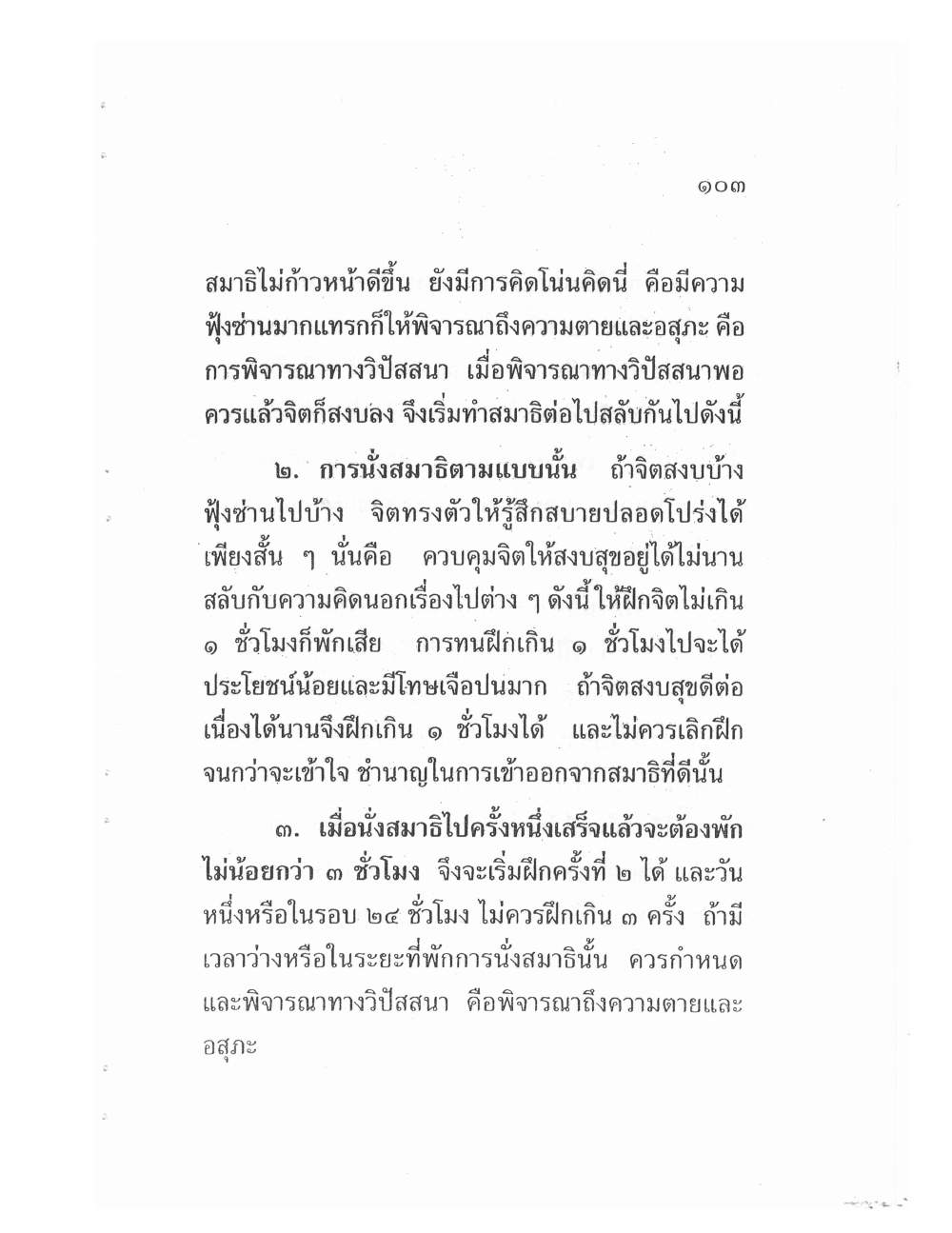
สมาธิไม่ก้าวหน้าดีขึ้น ยังมีการคิดโน่นคิดนี่ คือมีความฟุ้งซ่านมากแทรกก็ให้พิจารณาถึงความตายและอสุภะ คือการพิจารณาทางวิปัสสนา เมื่อพิจารณาทางวิปัสสนาพอควรแล้วจิตก็สงบลง จึงเริ่มทำสมาธิต่อไปสลับกันไปดังนี้
๒. การนั่งสมาธิตามแบบนั้น ถ้าจิตสงบบ้างฟุ้งซ่านไปบ้าง จิตทรงตัวให้รู้สึกสบายปลอดโปร่งได้เพียงสั้น ๆ นั่นคือ ควบคุมจิตให้สงบสุขอยู่ได้ไม่นาน สลับกับความคิดนอกเรื่องไปต่าง ๆ ดังนี้ให้ฝึกจิตไม่เกิน ๑ ชั่วโมงก็พักเสีย การทนฝึกเกิน ๑ ชั่วโมงไปจะได้ประโยชน์น้อยและมีโทษเจือปนมาก ถ้าจิตสงบสุขดีต่อเนื่องได้นานจึงฝึกเกิน ๑ ชั่วโมงได้ และไม่ควรเลิกฝึกจนกว่าจะเข้าใจ ชำนาญในการเข้าออกจากสมาธิที่ดีนั้น
๓. เมื่อนั่งสมาธิไปครั้งหนึ่งเสร็จแล้วจะต้องพักไม่น้อยกว่า ๓ ชั่วโมง จึงจะเริ่มฝึกครั้งที่ ๒ ได้ และวันหนึ่งหรือในรอบ ๒๔ ชั่วโมง ไม่ควรฝึกเกิน ๓ ครั้ง ถ้ามีเวลาว่างหรือในระยะที่พักการนั่งสมาธินั้น ควรกำหนดและพิจารณาทางวิปัสสนา คือพิจารณาถึงความตายและอสุภะ
samadhi does not progress and improve, and there is still thinking of this and that - that is, much distraction interposing itself - then contemplate death and foulness (asubha); that is contemplation through vipassana. Once contemplation through vipassana has been done sufficiently, the mind will then calm down, and one should then resume samadhi practice, alternating in this way as follows:
2. Sitting in samadhi in that manner: if the mind is calm at times and distracted at other times, and the mind can only remain steady, feeling comfortable and clear, for a short while - that is, one can control the mind to remain peacefully happy for only a short time, alternating with thoughts wandering off to various other matters - in that case, train the mind for no more than 1 hour, then rest. Persisting in training beyond 1 hour will yield little benefit and bring much harm mixed in. If the mind can remain well and continuously at peace for a long time, then one may train beyond 1 hour. And one should not stop training until one understands and becomes skilled in entering and leaving that good samadhi.
3. Once a session of sitting in samadhi is finished, one must rest no less than 3 hours before beginning the second session. And in one day, or within a 24-hour period, one should not train more than 3 times. If there is free time, or during the period of resting from sitting in samadhi, one should set aside time and contemplate through vipassana, that is, contemplate death and foulness (asubha).
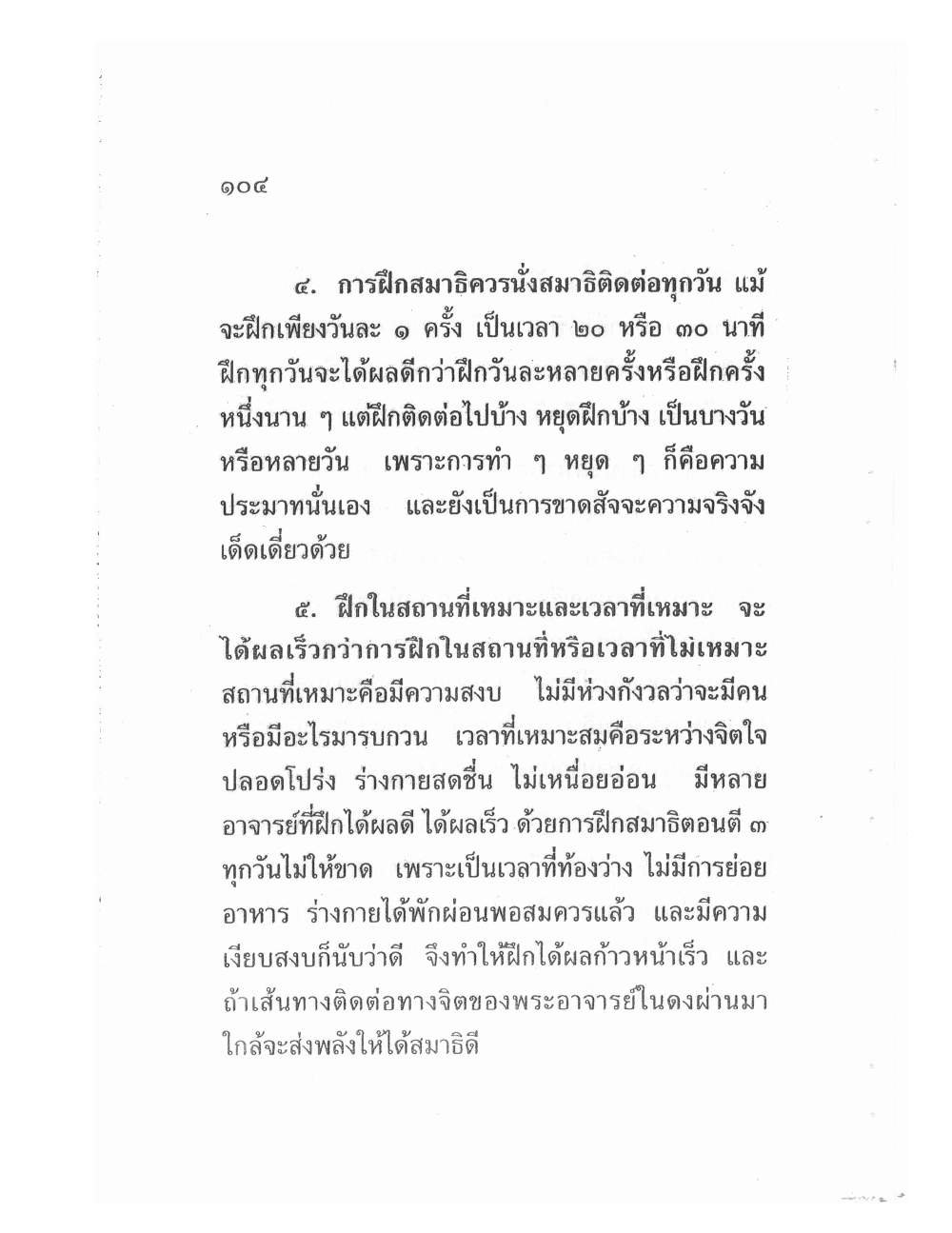
๔. การฝึกสมาธิควรนั่งสมาธิติดต่อทุกวัน แม้จะฝึกเพียงวันละ ๑ ครั้ง เป็นเวลา ๒๐ หรือ ๓๐ นาที ฝึกทุกวันจะได้ผลดีกว่าฝึกวันละหลายครั้งหรือฝึกครั้งหนึ่งนาน ๆ แต่ฝึกติดต่อไปบ้าง หยุดฝึกบ้าง เป็นบางวันหรือหลายวัน เพราะการทำ ๆ หยุด ๆ ก็คือความประมาทนั่นเอง และยังเป็นการขาดสัจจะความจริงจังเด็ดเดี่ยวด้วย
๕. ฝึกในสถานที่เหมาะและเวลาที่เหมาะ จะได้ผลเร็วกว่าการฝึกในสถานที่หรือเวลาที่ไม่เหมาะ สถานที่เหมาะคือมีความสงบ ไม่มีห่วงกังวลว่าจะมีคนหรือมีอะไรมารบกวน เวลาที่เหมาะสมคือระหว่างจิตใจปลอดโปร่ง ร่างกายสดชื่น ไม่เหนื่อยอ่อน มีหลายอาจารย์ที่ฝึกได้ผลดี ได้ผลเร็ว ด้วยการฝึกสมาธิตอนตี ๓ ทุกวันไม่ให้ขาด เพราะเป็นเวลาที่ท้องว่าง ไม่มีการย่อยอาหาร ร่างกายได้พักผ่อนพอสมควรแล้ว และมีความเงียบสงบก็นับว่าดี จึงทำให้ฝึกได้ผลก้าวหน้าเร็ว และถ้าเส้นทางติดต่อทางจิตของพระอาจารย์ในดงผ่านมาใกล้จะส่งพลังให้ได้สมาธิดี
4. In training samadhi, one should sit in samadhi continuously every day. Even if one trains only once a day, for 20 or 30 minutes, training every day will give better results than training several times a day or training for one long session but continuing intermittently, stopping training on some days or for several days - because doing it and then stopping is itself heedlessness, and is also a lack of true, earnest, resolute commitment.
5. Train in a suitable place and at a suitable time - this will give faster results than training in an unsuitable place or time. A suitable place is one that has calm, with no worry about people or anything else coming to disturb one. A suitable time is when the mind is clear and the body is fresh, not tired or weary. Many teachers have obtained good, quick results by practicing samadhi at 3 a.m. every day without fail, because this is a time when the stomach is empty, with no digestion of food taking place, the body has already rested sufficiently, and there is quiet and calm - this is considered good, and so causes training to progress and yield results quickly. And if the mental connection/pathway of the Teacher in the forest passes nearby at that time, it will send power [to the practitioner] to help attain good samadhi.
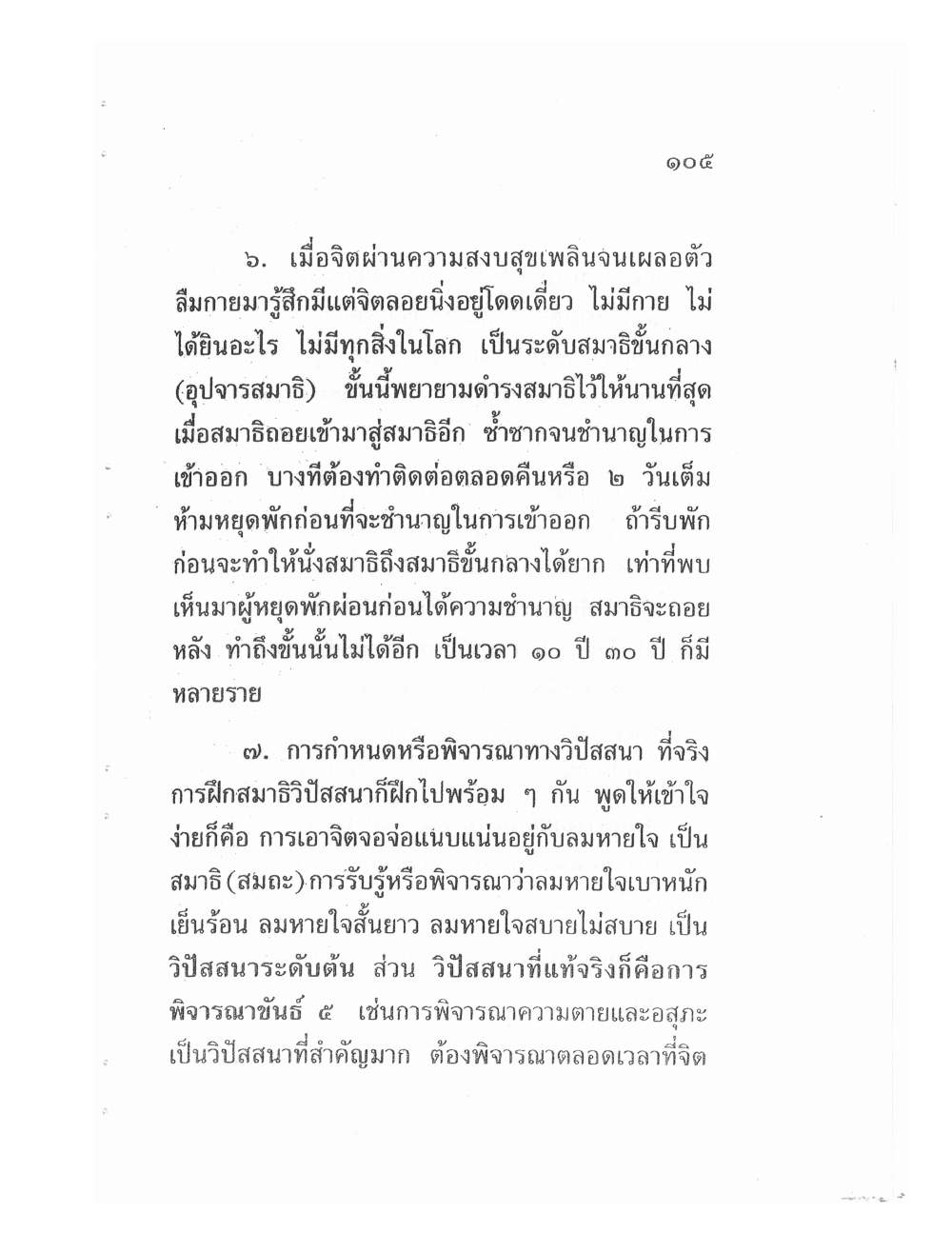
๖. เมื่อจิตผ่านความสงบสุขเพลินจนเผลอตัวลืมกายมารู้สึกมีแต่จิตลอยนิ่งอยู่โดดเดี่ยว ไม่มีกาย ไม่ได้ยินอะไร ไม่มีทุกสิ่งในโลก เป็นระดับสมาธิขั้นกลาง (อุปจารสมาธิ) ขั้นนี้พยายามดำรงสมาธิไว้ให้นานที่สุด เมื่อสมาธิถอยเข้ามาสู่สมาธิอีก ซ้ำซากจนชำนาญในการเข้าออก บางทีต้องทำติดต่อตลอดคืนหรือ ๒ วันเต็ม ห้ามหยุดพักก่อนที่จะชำนาญในการเข้าออก ถ้ารีบพักก่อนจะทำให้นั่งสมาธิถึงสมาธิขั้นกลางได้ยาก เท่าที่พบเห็นมาผู้หยุดพักผ่อนก่อนได้ความชำนาญ สมาธิจะถอยหลัง ทำถึงขั้นนั้นไม่ได้อีก เป็นเวลา ๑๐ ปี ๓๐ ปี ก็มีหลายราย
๗. การกำหนดหรือพิจารณาทางวิปัสสนา ที่จริงการฝึกสมาธิวิปัสสนาก็ฝึกไปพร้อม ๆ กัน พูดให้เข้าใจง่ายก็คือ การเอาจิตจ่อจ่อแน่บแน่นอยู่กับลมหายใจ เป็นสมาธิ (สมถะ) การรับรู้หรือพิจารณาว่าลมหายใจเบาหนักเย็นร้อน ลมหายใจสั้นยาว ลมหายใจสบายไม่สบาย เป็นวิปัสสนาระดับต้น ส่วน วิปัสสนาที่แท้จริงก็คือการพิจารณาขันธ์ ๕ เช่นการพิจารณาความตายและอสุภะ เป็นวิปัสสนาที่สำคัญมาก ต้องพิจารณาตลอดเวลาที่จิต
6. When the mind passes through peaceful happiness and becomes so absorbed that it forgets the body, and one comes to feel that there is only the mind floating, still, in solitude - no body, hearing nothing, nothing at all existing in the world - this is the level of the middle stage of samadhi (upacara-samadhi). At this stage, try to maintain the samadhi for as long as possible. When samadhi recedes, bring it back into samadhi again, repeating over and over until skilled at entering and leaving. Sometimes one must do this continuously through the whole night, or for two full days; one must not stop to rest before becoming skilled at entering and leaving. If one hurries to rest beforehand, it will make it difficult to sit and reach the middle level of samadhi again. As far as has been observed, those who stopped to rest before gaining that skill found that their samadhi regressed and they could not reach that level again - for periods of 10 years, 30 years - there have been many such cases.
7. Setting or contemplating through vipassana: in truth, the practice of samadhi and vipassana are trained together at the same time. To put it simply: fixing the mind closely and firmly on the breath is samadhi (samatha). Perceiving or considering whether the breath is light or heavy, cool or warm, whether the breath is short or long, whether the breath is comfortable or uncomfortable, is a beginning level of vipassana. As for true vipassana, it is the contemplation of the Five Aggregates (khandha), such as the contemplation of death and foulness (asubha) - this is a very important vipassana. One must contemplate it throughout the entire time the mind
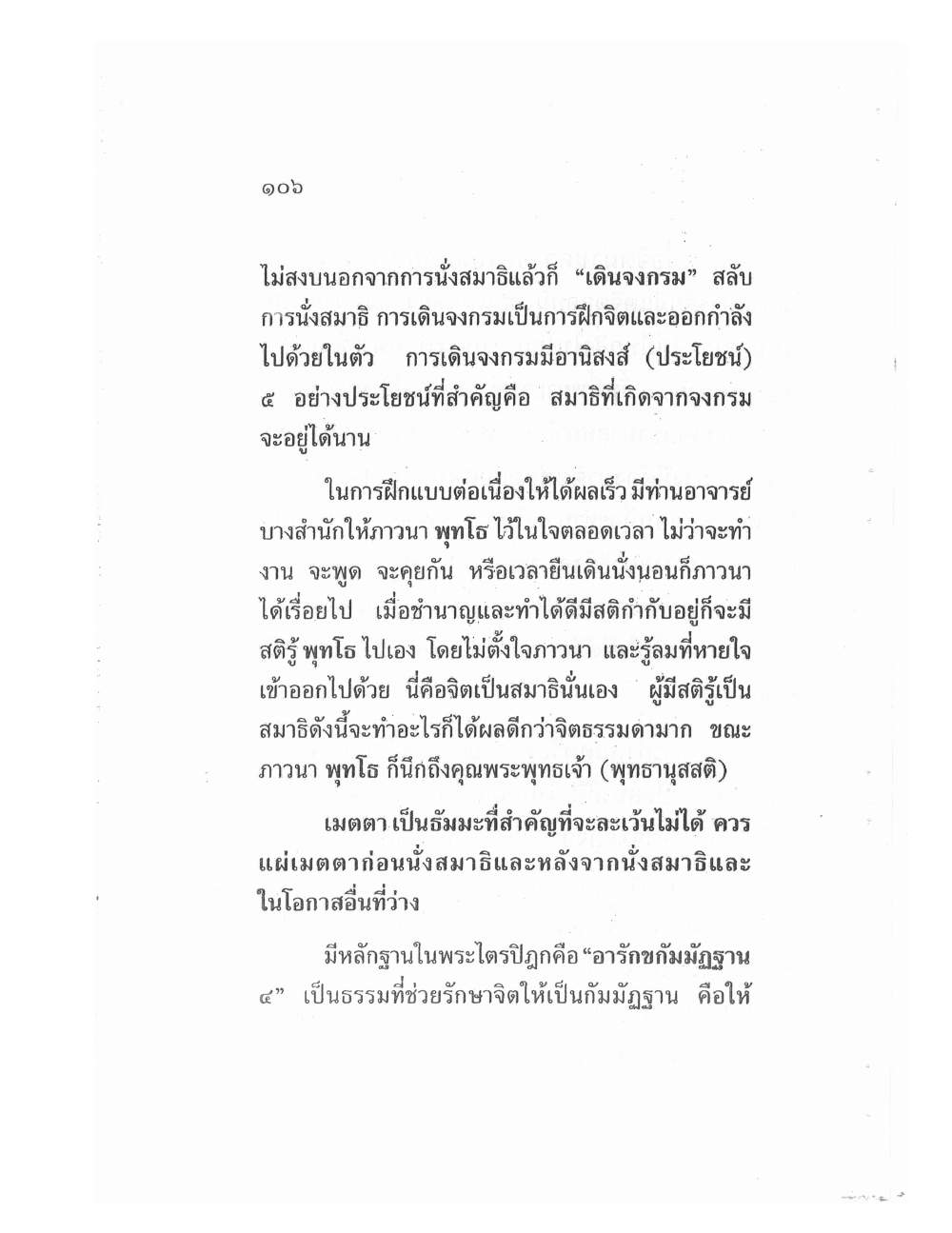
ไม่สงบนอกจากการนั่งสมาธิแล้วก็ "เดินจงกรม" สลับการนั่งสมาธิ การเดินจงกรมเป็นการฝึกจิตและออกกำลังไปด้วยในตัว การเดินจงกรมมีอานิสงส์ (ประโยชน์) ๕ อย่างประโยชน์ที่สำคัญคือ สมาธิที่เกิดจากจงกรมจะอยู่ได้นาน
ในการฝึกแบบต่อเนื่องให้ได้ผลเร็ว มีท่านอาจารย์บางสำนักให้ภาวนา พุทโธ ไว้ในใจตลอดเวลา ไม่ว่าจะทำงาน จะพูด จะคุยกัน หรือเวลายืนเดินนั่งนอนก็ภาวนาได้เรื่อยไป เมื่อชำนาญและทำได้ดีมีสติกำกับอยู่ก็จะมีสติรู้ พุทโธ ไปเอง โดยไม่ตั้งใจภาวนา และรู้ลมที่หายใจเข้าออกไปด้วย นี่คือจิตเป็นสมาธินั่นเอง ผู้มีสติรู้เป็นสมาธิดังนี้จะทำอะไรก็ได้ผลดีกว่าจิตธรรมดามาก ขณะภาวนา พุทโธ ก็นึกถึงคุณพระพุทธเจ้า (พุทธานุสสติ)
เมตตา เป็นธัมมะที่สำคัญที่จะละเว้นไม่ได้ ควรแผ่เมตตาก่อนนั่งสมาธิและหลังจากนั่งสมาธิและในโอกาสอื่นที่ว่าง
มีหลักฐานในพระไตรปิฎกคือ "อารักขกัมมัฏฐาน ๔" เป็นธรรมที่ช่วยรักษาจิตให้เป็นกัมมัฏฐาน คือให้
is not calm, then, apart from sitting in samadhi, do "walking meditation" (jongkrom), alternating with sitting samadhi. Walking meditation is a way of training the mind while also getting exercise at the same time. Walking meditation has 5 benefits (anisamsa); the most important benefit is that the samadhi that arises from walking meditation will last longer.
In continuous training to get quick results, some teachers of certain traditions have [students] recite "Buddho" silently in the mind at all times, whether working, speaking, conversing, or while standing, walking, sitting, or lying down - one can keep reciting continuously. Once skilled and able to do it well with mindfulness present, one will come to be mindfully aware of "Buddho" by itself, without intentionally reciting, and will also be aware of the breath going in and out at the same time - this is itself the mind being in samadhi. One who has mindful awareness that is samadhi in this way will achieve far better results in whatever one does than with an ordinary mind. While reciting "Buddho," one also recollects the virtues of the Buddha (Buddhanussati).
Loving-kindness (metta) is an important dhamma that cannot be omitted; one should radiate loving-kindness before sitting in samadhi and after sitting in samadhi, and on other free occasions.
There is a basis for this in the Tipitaka, namely the "Four Protective Meditation Subjects" (arakkha-kammatthana 4), which are dhammas that help protect the mind so that it remains in a meditation subject - that is, to
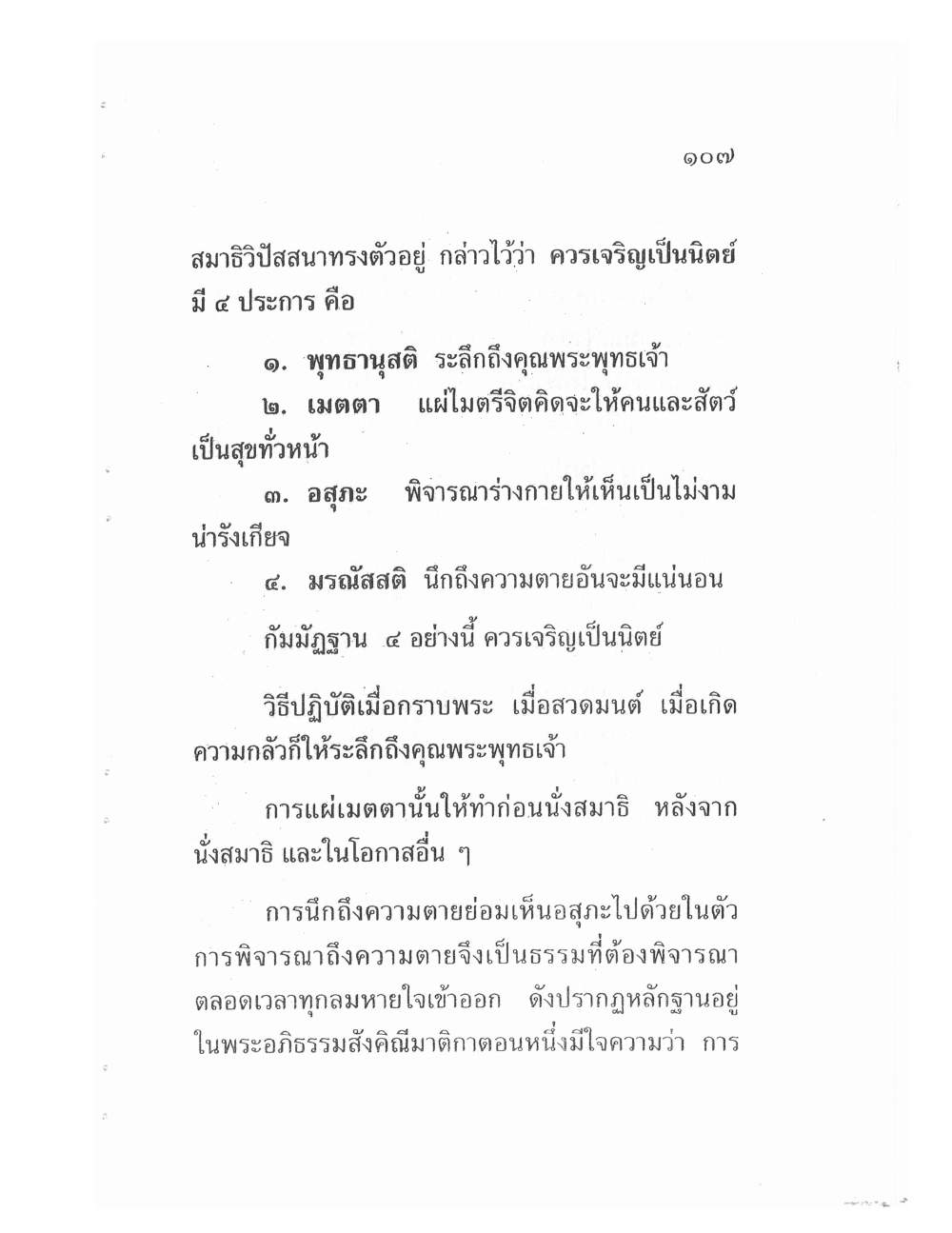
สมาธิวิปัสสนาทรงตัวอยู่ กล่าวไว้ว่า ควรเจริญเป็นนิตย์ มี ๔ ประการ คือ
๑. พุทธานุสติ ระลึกถึงคุณพระพุทธเจ้า ๒. เมตตา แผ่ไมตรีจิตคิดจะให้คนและสัตว์ เป็นสุขทั่วหน้า ๓. อสุภะ พิจารณาร่างกายให้เห็นเป็นไม่งาม น่ารังเกียจ ๔. มรณัสสติ นึกถึงความตายอันจะมีแน่นอน
กัมมัฏฐาน ๔ อย่างนี้ควรเจริญเป็นนิตย์
วิธีปฏิบัติเมื่อกราบพระ เมื่อสวดมนต์ เมื่อเกิด ความกลัวก็ให้ระลึกถึงคุณพระพุทธเจ้า
การแผ่เมตตานั้นให้ทำก่อนนั่งสมาธิ หลังจาก นั่งสมาธิ และในโอกาสอื่น ๆ
การนึกถึงความตายย่อมเห็นอสุภะไปด้วยในตัว การพิจารณาถึงความตายจึงเป็นธรรมที่ต้องพิจารณา ตลอดเวลาทุกลมหายใจเข้าออก ดังปรากฏหลักฐานอยู่ ในพระอภิธรรมสังคิณีมาติกาตอนหนึ่งมีใจความว่า การ
Samādhi-vipassanā that stands firm is said: it ought to be developed constantly, and there are 4 kinds, namely:
1. Buddhānussati — recollecting the virtues of the Buddha 2. Mettā — spreading loving-kindness, wishing that people and animals everywhere be happy 3. Asubha — contemplating the body to see it as unattractive, repulsive 4. Maraṇassati — thinking of death, which is certain to come
These 4 kammaṭṭhāna (meditation subjects) should be developed constantly.
Method of practice: when paying respect to the Buddha image, when chanting, and when fear arises, one should recollect the virtues of the Buddha.
The spreading of loving-kindness should be done before sitting in meditation, after sitting in meditation, and on other occasions.
Thinking of death naturally includes seeing asubha (unattractiveness) within it. Contemplating death is thus a dhamma that must be contemplated at all times, with every in-breath and out-breath, as appears as evidence in the Abhidhamma Saṅgiṇī Mātikā, one part of which has the meaning that...
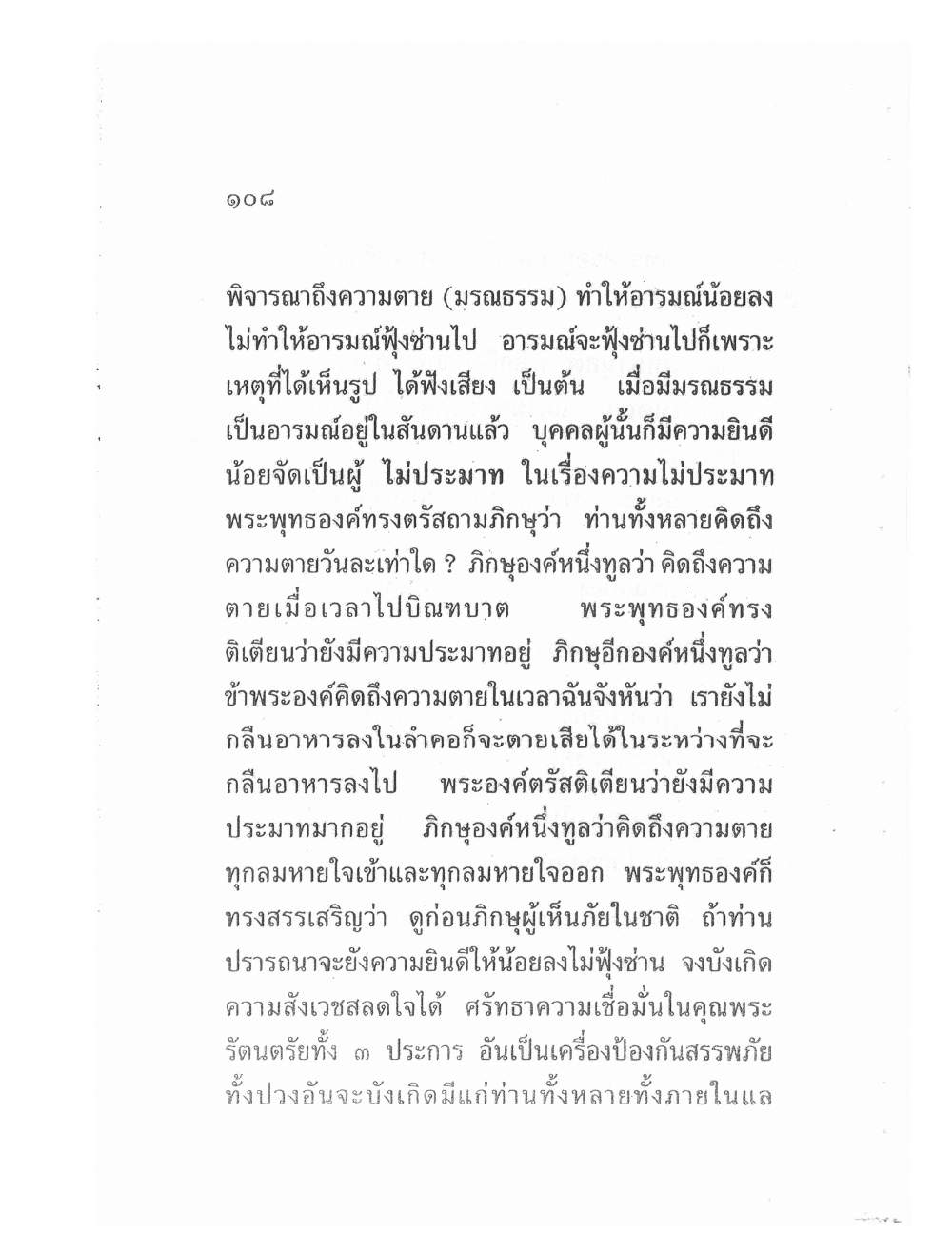
พิจารณาถึงความตาย (มรณธรรม) ทำให้อารมณ์น้อยลง ไม่ทำให้อารมณ์ฟุ้งซ่านไป อารมณ์จะฟุ้งซ่านไปก็เพราะ เหตุที่ได้เห็นรูป ได้ฟังเสียง เป็นต้น เมื่อมีมรณธรรม เป็นอารมณ์อยู่ในสันดานแล้ว บุคคลผู้นั้นก็มีความยินดี น้อยจัดเป็นผู้ ไม่ประมาท ในเรื่องความไม่ประมาท พระพุทธองค์ทรงตรัสถามภิกษุว่า ท่านทั้งหลายคิดถึง ความตายวันละเท่าใด ? ภิกษุองค์หนึ่งทูลว่า คิดถึงความ ตายเมื่อเวลาไปบิณฑบาต พระพุทธองค์ทรง ติเตียนว่ายังมีความประมาทอยู่ ภิกษุอีกองค์หนึ่งทูลว่า ข้าพระองค์คิดถึงความตายในเวลาฉันจังหันว่า เรายังไม่ กลืนอาหารลงในลำคอก็จะตายเสียได้ในระหว่างที่จะ กลืนอาหารลงไป พระองค์ตรัสติเตียนว่ายังมีความ ประมาทมากอยู่ ภิกษุองค์หนึ่งทูลว่าคิดถึงความตาย ทุกลมหายใจเข้าและทุกลมหายใจออก พระพุทธองค์ก็ ทรงสรรเสริญว่า ดูก่อนภิกษุผู้เห็นภัยในชาติ ถ้าท่าน ปรารถนาจะยังความยินดีให้น้อยลงไม่ฟุ้งซ่าน จงบังเกิด ความสังเวชสลดใจได้ ศรัทธาความเชื่อมั่นในคุณพระ รัตนตรัยทั้ง ๓ ประการ อันเป็นเครื่องป้องกันสรรพภัย ทั้งปวงอันจะบังเกิดมีแก่ท่านทั้งหลายทั้งภายในแล
Contemplating death (maraṇa-dhamma) reduces excessive emotion and keeps the mind from becoming distracted. The mind becomes distracted because of seeing forms, hearing sounds, and so on. When maraṇa-dhamma is established as an object within one's mental continuum, that person has little attachment to pleasure and is reckoned a person who is not heedless. On the subject of heedlessness, the Buddha once asked the monks: "How many times a day do you think of death?" One monk replied that he thought of death when going for alms round. The Buddha rebuked him, saying he was still heedless. Another monk said: "I think of death while eating my meal — that I might die before I have even swallowed the food down my throat." The Buddha rebuked him too, saying he was still very heedless. Another monk said he thought of death with every in-breath and every out-breath. The Buddha then praised him, saying: "Monks who see the danger in existence, if you wish to lessen your attachment to pleasure and not be distracted, let a sense of spiritual urgency (saṃvega) arise in you. Faith and confidence in the virtues of the Triple Gem, the three things that protect against all manner of danger that may arise for you, both within and...
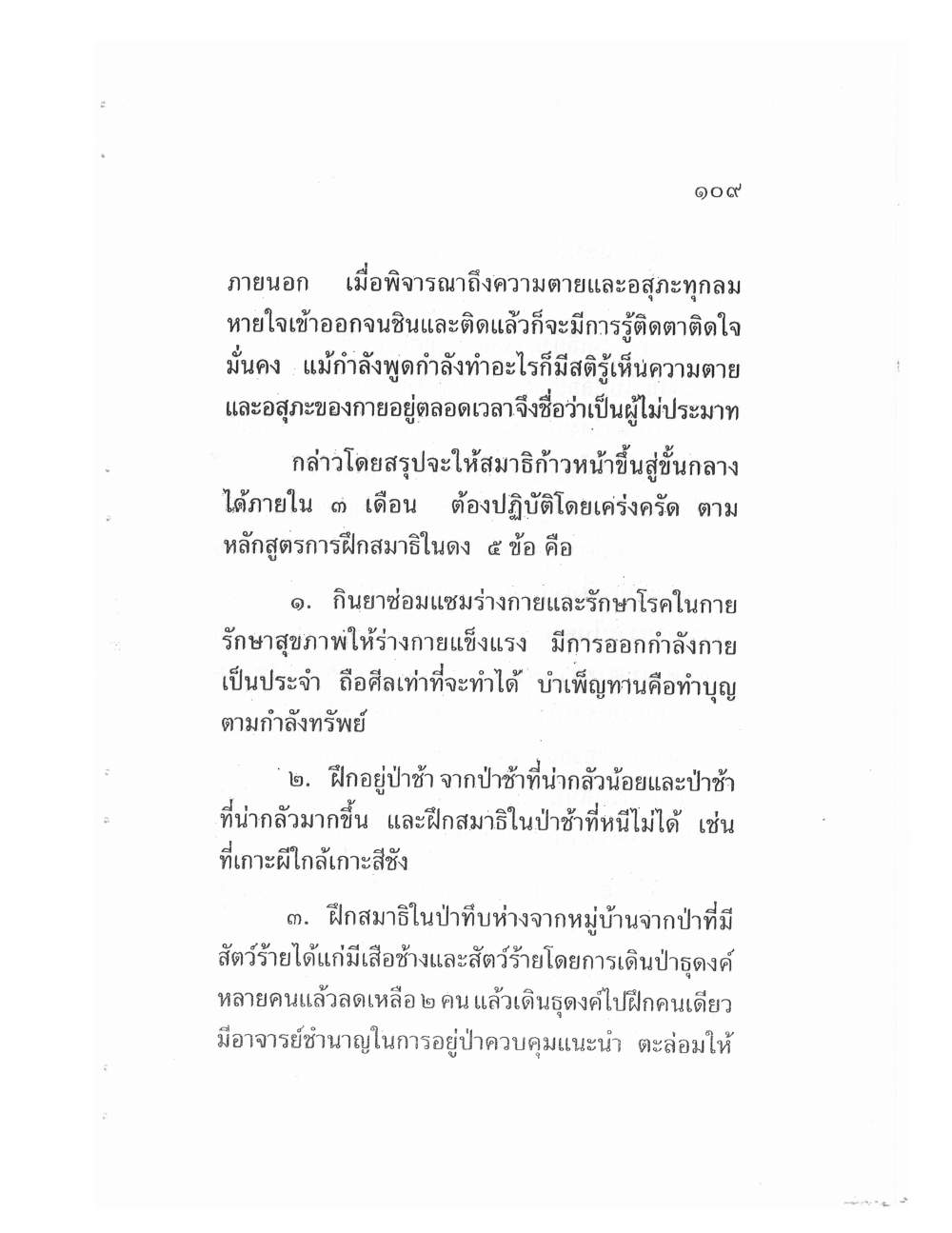
ภายนอก เมื่อพิจารณาถึงความตายและอสุภะทุกลม หายใจเข้าออกจนชินและติดแล้วก็จะมีการรู้ติดตาติดใจ มั่นคง แม้กำลังพูดกำลังทำอะไรก็มีสติรู้เห็นความตาย และอสุภะของกายอยู่ตลอดเวลาจึงชื่อว่าเป็นผู้ไม่ประมาท
กล่าวโดยสรุปจะให้สมาธิก้าวหน้าขึ้นสู่ขั้นกลาง ได้ภายใน ๓ เดือน ต้องปฏิบัติโดยเคร่งครัด ตาม หลักสูตรการฝึกสมาธิในดง ๕ ข้อ คือ
๑. กินยาซ่อมแซมร่างกายและรักษาโรคในกาย รักษาสุขภาพให้ร่างกายแข็งแรง มีการออกกำลังกาย เป็นประจำ ถือศีลเท่าที่จะทำได้ บำเพ็ญทานคือทำบุญ ตามกำลังทรัพย์
๒. ฝึกอยู่ป่าช้า จากป่าช้าที่น่ากลัวน้อยและป่าช้า ที่น่ากลัวมากขึ้น และฝึกสมาธิในป่าช้าที่หนีไม่ได้ เช่น ที่เกาะผีใกล้เกาะสีชัง
๓. ฝึกสมาธิในป่าทึบห่างจากหมู่บ้านจากป่าที่มี สัตว์ร้ายได้แก่มีเสือช้างและสัตว์ร้ายโดยการเดินป่าธุดงค์ หลายคนแล้วลดเหลือ ๒ คน แล้วเดินธุดงค์ไปฝึกคนเดียว มีอาจารย์ชำนาญในการอยู่ป่าควบคุมแนะนำ ตะล่อมให้
...without. When one contemplates death and unattractiveness (asubha) with every in- and out-breath until it becomes habitual and fixed, one's awareness becomes firmly attached. Even while speaking or doing anything, mindfulness that sees death and the unattractiveness of the body remains present at all times; this is called being a person who is not heedless.
In summary, to advance samādhi to the intermediate level within 3 months, one must practice strictly according to the 5-point course of samādhi training in the forest, namely:
1. Take medicine to repair the body and treat bodily illness; maintain health so the body is strong; exercise regularly; keep precepts as far as possible; practice generosity, that is, make merit according to one's means.
2. Train by staying in cemeteries, progressing from less frightening cemeteries to more frightening ones, and train samādhi in a cemetery from which one cannot flee, such as at Ko Phi near Ko Sichang.
3. Train samādhi in dense forest, far from villages, in forest that has dangerous animals such as tigers, elephants and other fierce beasts, by going on forest wandering (dhutanga) with several people, then reducing to 2 people, then going on dhutanga to train alone, with an experienced forest-dwelling teacher supervising and advising, coaxing one to...
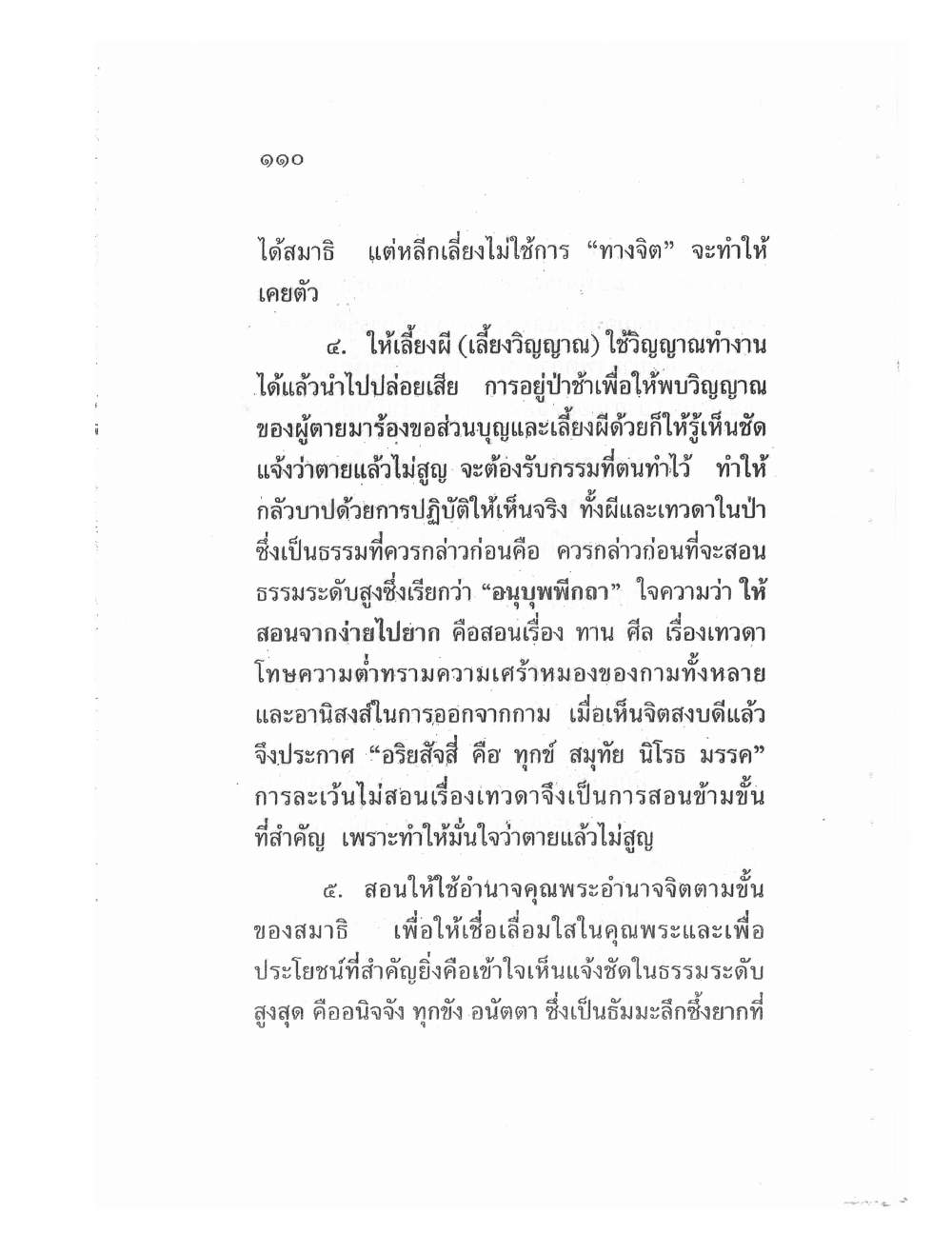
ได้สมาธิ แต่หลีกเลี่ยงไม่ใช้การ "ทางจิต" จะทำให้ เคยตัว
๔. ให้เลี้ยงผี (เลี้ยงวิญญาณ) ใช้วิญญาณทำงาน ได้แล้วนำไปปล่อยเสีย การอยู่ป่าช้าเพื่อให้พบวิญญาณ ของผู้ตายมาร้องขอส่วนบุญและเลี้ยงผีด้วยก็ให้รู้เห็นชัด แจ้งว่าตายแล้วไม่สูญ จะต้องรับกรรมที่ตนทำไว้ ทำให้ กลัวบาปด้วยการปฏิบัติให้เห็นจริง ทั้งผีและเทวดาในป่า ซึ่งเป็นธรรมที่ควรกล่าวก่อนคือ ควรกล่าวก่อนที่จะสอน ธรรมระดับสูงซึ่งเรียกว่า "อนุบุพพีกถา" ใจความว่า ให้ สอนจากง่ายไปยาก คือสอนเรื่อง ทาน ศีล เรื่องเทวดา โทษความต่ำทรามความเศร้าหมองของกามทั้งหลาย และอานิสงส์ในการออกจากกาม เมื่อเห็นจิตสงบดีแล้ว จึงประกาศ "อริยสัจสี่ คือ ทุกข์ สมุทัย นิโรธ มรรค" การละเว้นไม่สอนเรื่องเทวดาจึงเป็นการสอนข้ามขั้น ที่สำคัญ เพราะทำให้มั่นใจว่าตายแล้วไม่สูญ
๕. สอนให้ใช้อำนาจคุณพระอำนาจจิตตามขั้น ของสมาธิ เพื่อให้เชื่อเลื่อมใสในคุณพระและเพื่อ ประโยชน์ที่สำคัญยิ่งคือเข้าใจเห็นแจ้งชัดในธรรมระดับ สูงสุด คืออนิจจัง ทุกขัง อนัตตา ซึ่งเป็นธัมมะลึกซึ้งยากที่
...gain samādhi, but avoiding reliance on the "mental way" alone would let one become habituated to it [i.e., one should not depend on psychic means only].
4. Feed the ghosts (feed the spirits) — make use of a spirit's service, then release it. Staying in a cemetery in order to encounter the spirits of the dead, who come to beg for a share of merit, and feeding the ghosts as well, lets one see and know clearly that death is not annihilation; one must bear the karma one has made. This produces fear of wrongdoing through practice that makes it seen as true. Both ghosts and devas in the forest are subjects that should be spoken of first — it is proper to speak of them before teaching the higher-level dhamma called the "anupubbikathā" (gradual discourse), the meaning of which is: teach from easy to difficult — that is, teach about giving (dāna), morality (sīla), the subject of devas, the faults and the baseness and defilement of sensual pleasures, and the benefit of renouncing sensual pleasure. Once the mind is seen to be well calmed, then proclaim: "The Four Noble Truths are: suffering, the cause of suffering, the cessation of suffering, and the path." Omitting the teaching about devas is thus skipping an important step, because it is what gives confidence that death is not annihilation.
5. Teach the use of the power of the Buddha's virtue and the power of mind according to the level of samādhi, so as to inspire faith and confidence in the Buddha's virtues, and for the most important benefit — to understand and clearly see the highest level of dhamma, namely impermanence (anicca), suffering (dukkha), and non-self (anattā), which is a profound dhamma, difficult...
จะเข้าใจได้ด้วยการอธิบาย จะต้องให้ปฏิบัติด้วยตนเอง คือเมื่อเริ่มได้สมาธิขั้นกลาง ก็ให้ทำใบไม้เป็นตัวสัตว์ เริ่มจากง่ายคือทำใบมะขามเป็นตัวแตน เมื่อเป็นตัวแตน อยู่ไม่เกิน ๗ วันก็จะกลับจากตัวแตนเป็นใบไม้ เมื่อ เรียนจบขั้นกลางแล้วก็ให้เดินลอดภูเขาไปมาได้ ทำให้รู้ เห็นชัดในอนิจจัง ทุกขัง อนัตตา เหมือนคนไม่เคยกิน เกลือจะอธิบายว่า เค็ม คืออย่างไร ก็ไม่เข้าใจ ต้องให้เขา กินเกลือเองถึงจะเข้าใจ วิธีใช้พลังจิตทำใบไม้เป็นตัวสัตว์ วิธีระลึกชาติ วิธีใช้พลังจิตให้เกิดประโยชน์ต่าง ๆ ได้ อธิบายไว้โดยละเอียดตั้งแต่การยกครูจนจบมีกล่าวไว้ใน ฉบับส่องจักรวาลแล้ว ขอให้ตั้งใจปฏิบัติตามหลักสูตร การฝึก ๕ ข้อที่กล่าวมานี้ นอกจากหลักสูตรการฝึกทั้ง ๕ ข้อ ขอให้ทำตามหลักสำคัญในการฝึกจิต ๗ ประการ ที่กล่าวมาแล้วข้างต้น พร้อมด้วยพิจารณาถึงความตาย และอสุภะตลอดเวลา มีการระลึกถึงคุณของพระพุทธเจ้า และแผ่เมตตา ซึ่งเป็นธรรมช่วยรักษาจิตให้มีกรรมฐาน ในบางโอกาส แต่ที่สำคัญคือให้มีตารางกำหนดเวลาใด ทำอะไรแน่นอน จึงจะมีหวังถึงสมาธิขั้นกลางภายใน ๓ เดือน ตัวอย่างตารางกำหนดเวลาตามประวัติของ พระอาจารย์มั่นและพระอาจารย์ฝั้น คือ
...be understood by explanation alone; one must practice it oneself. That is, once one begins to attain intermediate-level samādhi, one should turn a leaf into a creature — beginning with something easy: turn a tamarind leaf into a wasp. Once it becomes a wasp, it will remain so for no more than 7 days before reverting from wasp back to leaf. Once one has finished the intermediate level, one should be able to walk through a mountain and back. This produces clear knowledge of impermanence, suffering and non-self — like a person who has never eaten salt: however much you explain what "salty" means, he will not understand; he must eat the salt himself before he understands. The method of using mental power to turn a leaf into a creature, the method of recalling past lives, and the methods of using mental power to bring about various benefits are explained in detail, from the taking of a teacher through to completion, and are already set out in the volume "Peering Through the Universe" (Chabap Song Chakkrawan). Please intend to practice according to these 5 points of the training course described here. In addition to the 5-point training course, please also follow the 7 essential principles for training the mind mentioned earlier above, together with contemplating death and unattractiveness at all times, recollecting the virtues of the Buddha, and spreading loving-kindness — dhammas which help maintain the mind so as to have a meditation-subject on certain occasions. But the most important thing is to have a fixed schedule of what to do at what time; only then is there hope of reaching intermediate-level samādhi within 3 months. An example schedule, following the biographies of Phra Ajahn Mun and Phra Ajahn Fan, is as follows:
ประวัติของพระอาจารย์มั่น ภูริทัตตเถระ
รวบรวมโดยพระอาจารย์มหาบัว วัดป่าบ้านตาด จ. อุดรธานี (เป็นหนังสือพิมพ์แจกเป็นธรรมทานเล่มหนา พิมพ์หลายครั้ง) ใจความตอนหนึ่งว่า
ข้อวัตรประจำองค์ท่านในปัจฉิมวัย
๑. หลังจังหันแล้ว (ฉันหนเดียว) เข้าทาง จงกรม จวนเที่ยงพัก
๒. หลังพัก เข้าที่ทำสมาธิ รวมชั่วโมงครึ่ง
๓. ลงเดินจงกรม บ่าย ๔ โมง กวาดลานวัด หรือที่พักแล้วสรงน้ำ
๔. เข้าทางจงกรม
๕. หนึ่งถึงสองทุ่ม เข้าที่ทำสมาธิ
๖. ปกติจำวัดราว ๕ ทุ่ม ตื่นตี ๓ ทำสมาธิ
ประวัติพระอาจารย์ฝั้น อาจารเถระ พิมพ์
แจกในงานพระราชทานเพลิง มกราคม ๒๕๒๑ ตอน หนึ่งมีใจความว่า
Biography of Phra Ajahn Mun Bhūridatta Thera
Compiled by Phra Ajahn Mahā Bua, Wat Pa Ban Tat, Udon Thani province (published and distributed as a Dhamma gift, a thick volume, printed many times). One passage reads:
His daily observances in his final years
1. After the meal (eating once a day), he enters the walking-meditation path and paces until nearly noon, then rests.
2. After resting, he enters [his dwelling] to sit in samādhi, for a total of an hour and a half.
3. He goes down to walk in meditation at 4 p.m.; sweeps the temple grounds or his dwelling, then bathes.
4. He enters the walking-meditation path.
5. From 7 to 8 p.m., he enters [his dwelling] to sit in samādhi.
6. He normally retires to sleep around 11 p.m., and wakes at 3 a.m. to sit in samādhi.
Biography of Phra Ajahn Fan, senior teacher (Ajahn Thera), printed
and distributed at the royal cremation ceremony, January 2521 [1978 CE]. One passage reads as follows:
กิจประจำวัน
เวลาตี ๓ ออกล้างหน้าไหว้พระสวดมนต์ และนั่งสมาธิ จนถึงตี ๕ ลงเดิน จงกรมจนสว่างแล้ว ปัดกวาด ลานวัด ๖.๓๐ น. ออกบิณฑบาตไปตามหมู่บ้าน ๙.๐๐ น. หลังจากฉันเช้า (ฉันหนเดียว) ลงเดินจงกรมจนถึง ๑๑.๐๐ น. ท่านจึงขึ้นพัก เวลา ๑๓ น. เศษ รับแขก ถ้าไม่มีแขกท่าน ก็ลงเดินจงกรมจนถึง ๑๕ น. ลง ฉันน้ำร้อนและเภสัชร่วมกับภิกษุ สามเณร แล้วปัดกวาดลานวัด แล้วสรงน้ำ หลังจากสรงน้ำท่าน จะลงเดินจงกรมไปจนมืดจึง ทำวัตรสวดมนต์ ๑๙.๓๐ น. หรือ ๒๐ น. พระอาจารย์ ออกจากห้องมาอบรมพระเณร และแก้ปัญหาที่สงสัยจนถึงเวลา
Daily activities
3:00 a.m. — Rise, wash the face, pay respects to the Buddha, chant, and sit in samādhi until 5:00 a.m.; go down to walk in meditation until it grows light, then sweep and clean the temple grounds. 6:30 a.m. — Go out on almsround through the village. 9:00 a.m. — After the morning meal (eating only once a day), go down to walk in meditation until 11:00 a.m., then he retires to rest. Past 1:00 p.m. — Receive visitors; if there are no visitors he goes down to walk in meditation until 3:00 p.m., then takes hot water and medicine together with the monks and novices, then sweeps and cleans the temple grounds and bathes. After bathing he goes down to walk in meditation until it grows dark, then performs the evening chanting service. 7:30 p.m. or 8:00 p.m. — The Ajahn comes out of his room to instruct the monks and novices and resolve their doubts and questions, until the time...
ประมาณ ๒๒ น. (บางวันถึง ๒๔ น.) ต่อจากนั้นพระเณรเข้า ปฏิบัตินวดเส้นถวาย ท่านบอก เลิกแล้วเข้าห้อง นั่งสมาธิ (เวลา ๓.๐๐ น. เป็นเวลาออกล้างหน้า นั่งสมาธิเป็นประจำ)
ประวัติของพระอาจารย์ผู้มีสมาธิสูงในสายพระ อาจารย์ในดงและสายอาจารย์อื่น ๆ ก็ล้วนแต่ได้ฝึก สมาธิวิปัสสนาจริงจัง กล้าหาญ ไม่กลัวตาย ตัวอย่างศิษย์ นอกดงที่เอาจริงจังเด็ดขาดได้แก่ พระเดชพระคุณ หลวงพ่อจรัญ จิตธมฺโม เจ้าอาวาสวัดอัมพวัน จ. สิงห์บุรี ฝึกหลักสูตรศิษย์นอกดงจบฌานกับหลวงปู่ในดง ซึ่ง โดยทั่วไปใช้เวลา ๓ ปี แต่หลวงพ่อจรัญเรียนจบเพียง ๓ เดือน ดังนั้นการที่จะฝึกให้ได้สมาธิขั้นกลางภายใน ๓ เดือน ก็เป็นไปได้ถ้าเอาจริงตามที่พระพุทธองค์สอน ดังกล่าวมาแล้ว
...around 10:00 p.m. (on some days until midnight). After that the monks and novices come in to massage his legs as an offering of service. He tells them to stop, then enters his room to sit in samādhi. (3:00 a.m. is the time he regularly rises to wash his face and sit in samādhi.)
The biography of teachers of high samādhi attainment, in the lineage of the forest teachers and in other lineages as well, all show that they truly trained in samādhi-vipassanā seriously, bravely, unafraid of death. An example of a disciple from outside the forest tradition who practiced with true, uncompromising seriousness is the venerable Luang Phor Charan Cittadhammo, abbot of Wat Amphawan, Sing Buri province, who trained in the outside-the-forest disciple's course to complete jhāna with a forest-dwelling teacher — a course which generally takes 3 years, but which Luang Phor Charan completed in only 3 months. Therefore, training to attain intermediate-level samādhi within 3 months is indeed possible, if one is truly serious, as taught by the Buddha, as described above.
บทที่ ๕
แก่นคำสอนของอาจารย์ผู้มีสมาธิสูง
ธรรมในพระพุทธศาสนา ละเอียดอ่อนลึกซึ้งมาก บุคคลทั่วไปจะเข้าใจแจ่มชัดหรือรู้เห็นชัดแจ้งได้ ก็ต่อ เมื่อฝึกจิตให้มีปัญญามากพอ ปัญญาจะมากเพียงใดก็ อยู่ที่สมาธิจะดีเพียงใด ตรงกับพระธรรมที่ว่าสมาธิเป็น เหตุใกล้ให้เกิดปัญญา ปัญญาน้อยก็เข้าใจพระธรรมน้อย เป็นแต่เพียงการจำได้ต่อเมื่อสมาธิดีขึ้นจึงเข้าใจชัดขึ้น โดยลำดับ พระอาจารย์มั่นสอนว่า มนุษย์มีกายสมบัติ วจีสมบัติ และมโนสมบัติ จะสร้างสมบัติภายนอกคือ ทรัพย์สินเงินทองก็ได้ จะสร้างสมบัติภายในคือมรรคผล นิพพานธรรมวิเศษก็ได้ ไม่ควรน้อยเนื้อต่ำใจว่าตนมี วาสนาน้อย เมื่อทำกุศลคือ ให้ทานรักษาศีลเจริญภาวนา บางพวกทำน้อยก็ไปสู่สวรรค์ บางพวกขยันและทำจริง พร้อมทั้งวาสนาบารมีหนหลังประกอบกัน ก็สามารถเข้าสู่ พระนิพพานโดยไม่ต้องสงสัย...... กายเป็นเครื่องก่อเหตุ (ตาเห็นรูปทำให้ใจกำเริบ) จึงต้อง พิจารณากาย นี้ก่อน
Chapter 5
The essence of the teachings of teachers of high samādhi
The Dhamma in the Buddhist religion is extremely subtle and profound. Ordinary people can understand it clearly, or see and know it plainly, only when they train the mind to have sufficient wisdom. However much wisdom one has depends on how good one's samādhi is — this accords with the Dhamma teaching that samādhi is the proximate cause for the arising of wisdom. Little wisdom means little understanding of the Dhamma, only something merely memorized; only when samādhi improves does understanding become clearer, progressively. Phra Ajahn Mun taught that human beings possess bodily wealth (kāya-sampatti), verbal wealth (vacī-sampatti), and mental wealth (mano-sampatti). One may build external wealth, that is, property and money, or one may build internal wealth, that is, the path, fruit and Nibbāna, the sublime Dhamma. One should not feel discouraged, thinking oneself to be of little destiny/merit. When doing wholesome deeds — giving alms, keeping precepts, developing meditation — some who do little go to heaven; some who are diligent and act with true sincerity, combined with accumulated pāramī (perfections) from past lives, are able to enter Nibbāna without doubt...... The body is the instrument that gives rise to causes (the eye seeing form causes the mind to become agitated), therefore one must contemplate this body first.
จะได้เป็นเครื่องดับนิวรณ์ ทำให้ใจสงบได้ พึงทำให้มาก พิจารณาไม่ถอยทีเดียว ในเมื่ออุคคหนิมิตปรากฏส่วน ไหนของกายก็ตาม ให้พึงถือเอากายส่วนที่เห็นนั้น พิจารณาให้เป็นหลักไว้ ไม่ต้องย้ายไปพิจารณาที่อื่น......... อุบายแห่งวิปัสสนา คือ ก้าวเข้าสงบจิต (เจริญสมถะ) แล้วถอยออกจากสมาธิมาพิจารณากาย อย่าพิจารณากาย อย่างเดียวหรือสงบจิตอย่างเดียว......... ให้มีสติพิจารณา ในที่ทุกสถาน ทุกกาล ทุกเมื่อ เมื่อยืน เดิน นั่ง นอน ทำ พูด ก็ให้มีสติรอบคอบในกายอยู่เสมอ แล้วพิจารณาแยก ส่วนแบ่งส่วนหรือกระจายเป็นธาตุดินน้ำลมไฟให้เห็นไป ตามนั้นจริง ๆ ......... ถ้าใครกลัวตายเพราะความเด็ดเดี่ยว พากเพียร ผู้นั้นจะต้องกลับมาตายอีกหลายภพหลายชาติ กลับหลังมาหาทุกข์อีก ท่านเอง (อาจารย์มั่น) ทำความ เพียรสลบไปถึง ๓ หน เพราะความเพียรกล้าเวทนาทับ ถมยังไม่เห็นตาย นี่ทำความเพียรยังไม่ถึงขั้นสลบไสลเลย ทำไมจึงกลัวตายกันนักหนาเล่า.........ผู้เคยกลัวผีก็หายกลัว ด้วยวิธีฝืนใจเข้าไปเยี่ยมป่าช้า ผู้เคยกลัวสัตว์ร้ายมีเสือ เป็นต้น ก็หายกลัวด้วยวิธีฝืนใจไปอยู่ที่เปลี่ยวอันเป็น ที่น่ากลัว ผู้เห็นแก่ปากท้องขอบโลเลในอาหารปัจจัย
...it becomes the instrument that extinguishes the hindrances (nīvaraṇa) and calms the mind. One should do this a great deal, contemplating without ever retreating. Whenever the uggaha-nimitta (learning sign) appears in whatever part of the body, one should take hold of that part of the body one has seen and contemplate it as one's fixed basis, without shifting to contemplate elsewhere......... The method (upāya) of vipassanā is: enter into calm of mind (develop samatha), then withdraw from samādhi to contemplate the body. Do not contemplate the body alone, nor calm the mind alone......... One should have mindfulness contemplating in every place, at every time, always — whether standing, walking, sitting, lying down, acting or speaking, one should always maintain thorough mindfulness of the body; then contemplate, dividing it into parts, or dispersing it into the elements earth, water, wind and fire, so as to truly see it as it is......... If anyone fears dying because of the resolve and effort this requires, that person will have to come back to die again through many more existences and births, returning again to suffering. He himself (Ajahn Mun) exerted effort to the point of fainting as many as 3 times, because his effort was so intense that the pain overwhelmed him, yet he still did not see death. This shows that exerting effort to the point of merely fainting is not yet enough — so why then are people so very afraid of dying?......... One who used to fear ghosts lost that fear by forcing himself to go visit cemeteries; one who used to fear dangerous animals such as tigers and the like lost that fear by forcing himself to go and stay in a lonely, deserted place that was frightening. One who is attached to the stomach, indulging carelessly in food as a requisite...
ก็บรรเทาหรือหายเสียได้ด้วยการผ่อนอาหารหรือ ลดอาหาร (ตามกำลังที่จะทำได้) อาหารบางชนิดเป็น คุณต่อร่างกาย แต่กลับเป็นภัยแก่จิตใจ ก็พยายามตัด ต้นเหตุ...... คนหัวดื้อต้องมีสิ่งที่แข็ง ๆ คอยคัดบ้าง จึง จะอ่อน เช่น เสือ เป็นต้น พอเป็นคู่ทรมานกันได้ คน กลัวเสือก็ต้องเอาเสือเป็นครูดีกว่าอาจารย์ที่ตนไม่กลัว กลัวผีก็ควรเอาผีเป็นครูคู่ทรมาน สิ่งที่แข็ง ๆ ช่วยให้ได้ สมาธิขั้นสูงได้เร็วนั้น ผู้เขียนรู้และพบเห็นมาก มี ๔ อย่าง คือ
ประการแรก พบเสือในป่ารู้ดีว่าถ้าหนีตายแน่ ๆ ถ้านั่งสมาธิปล่อยวางหมดก็จะรอด ส่วนมากเมื่อพบเสือ ก็ลงนั่งสมาธิ ไม่ยอมลืมตา สมาธิถอยก็เข้าใหม่ซ้ำซาก ตัวอย่างพบเสือแล้วนั่งสมาธิประมาณตอน ๔ ทุ่ม ไป หยุดทำสมาธิจนรุ่งขึ้นประมาณ ๓ โมงเช้า จึงออกจาก สมาธิ นี่แหละคือการทำเป็นวะสี และได้สมาธิขั้นสูง
ประการที่ ๒ ตายแล้วฟื้น ป่วยจวนตายก็เกิด การ ปล่อยวาง ได้สมาธิขั้นกลางขั้นสูง ก็มีตัวอย่าง หลายท่าน
...can be lessened or cured by moderating or reducing food intake (as far as one's capacity allows). Some kinds of food are beneficial to the body but instead become a danger to the mind, so one should try to cut off the root cause...... A stubborn person needs something hard pressing against him a little, so that he will soften — for example, a tiger. It makes a fitting pair to train against each other. A person who fears tigers should take the tiger as his teacher — better than a teacher he does not fear. One who fears ghosts should likewise take the ghost as a teacher, a partner in ordeal. Hard/harsh things that help one attain high-level samādhi quickly — the writer knows of and has seen many such cases, of which there are 4, namely:
Firstly, encountering a tiger in the forest: one knows well that fleeing surely means death, whereas if one sits in samādhi and lets go of everything completely, one will survive. Mostly, when one encounters a tiger, one sits down in samādhi and refuses to open one's eyes; if the samādhi weakens, one re-enters it again and again. For example, having encountered a tiger, one sits in samādhi from around 10 p.m. and continues sitting in samādhi until about 9 a.m. the next morning before coming out of samādhi. This is what is called making it a vasī (mastery), and thereby attaining high-level samādhi.
Secondly, dying and then reviving — becoming so ill as to nearly die also gives rise to letting go, attaining intermediate-to-high level samādhi. There are examples of many such teachers.
ประการที่ ๓ ตายหรือสลบแล้วฟื้น ตอนสลบ ไปนั้นมีวิญญาณหรือเทวดามาสอนวิชาให้ได้สมาธิดี เมื่อ ฟื้นก็กลายเป็นหมอดูหมอนวด เป็นผู้ได้ไปเห็นนรกสวรรค์ ได้สมาธิดีเปลี่ยนแปลงนิสสัยใจคอไปจากเดิมมาก
ประการที่ ๔ ได้แก่ท่านผู้หลงติดอยู่ในถ้ำลึก หาทางออกไม่ได้ ก็นั่งสมาธิให้ตายกลับได้แสงสว่าง ออกจากถ้ำได้ บางท่านอดอาหารก็ได้สมาธิดี
พระอาจารย์มั่นว่า นักปฏิบัติทำไมจึงกลัวตายนัก ยิ่งกว่าฆราวาสที่ไม่เคยได้รับการอบรมมา ทำไมปล่อยใจ ให้กิเลสย่ำยีหลอกหลอน จนกลายเป็นสิ้นคิดไปได้ ไม่นำ สติปัญญาออกมาใช้เพื่อขับไล่กิเลสอันตุ้มตุ่นที่ซ่องสุม อยู่ในหัวใจ...... ธุดงค์ เป็นคุณธรรมที่สูงอย่างลึกลับ ยาก ที่เราจะทราบได้ตามความจริงของธุดงค์แต่ละข้อ (จะรู้ เห็นได้เมื่อปฏิบัติจริงจังเด็ดเดี่ยว)
พระอาจารย์มหาบัว วัดป่าบ้านตาด อุดรธานี สอนว่า สมาธิขั้นต้นให้พิจารณากายเสียก่อน ส่วนเวทนา และจิตพิจารณาโดยใช้สมาธิขั้นกลางหรือขั้นสูงประกอบ กัน สำหรับตัวท่าน (พระมหาบัว) เมื่อสมาธิติดขัดก้าวขึ้น ไปไม่ได้ก็ใช้การผ่อนอาหารให้น้อยลงนับว่าได้ผลดีทุกครั้ง
Thirdly, dying or fainting and then reviving — during the faint, a spirit or a deva comes to teach knowledge that gives one good samādhi. When one revives, one becomes a fortune-teller or masseur, one who has gone to see hell and heaven; having gained good samādhi, one's character and disposition change greatly from before.
Fourthly, this refers to those who become lost deep in a cave, unable to find the way out; by sitting in samādhi to the point of near-death, they regain light and are able to get out of the cave. Some, by fasting, likewise attain good samādhi.
Phra Ajahn Mun said: Why do practitioners fear death so much, even more than laypeople who have never received any training? Why do they let their minds be trampled and haunted by defilements (kilesa), until they become at their wits' end, failing to bring mindfulness and wisdom to bear in order to drive out the defilements that smolder and accumulate in the heart...... Dhutanga (ascetic wandering practice) is a virtue that is profoundly high and mysterious, difficult for us to know the truth of, item by item (one can only know and see it through serious, resolute practice).
Phra Ajahn Mahā Bua of Wat Pa Ban Tat, Udon Thani, taught that for beginning-level samādhi one should first contemplate the body; as for feeling (vedanā) and mind (citta), one should contemplate them using intermediate or advanced-level samādhi in combination. As for himself (Phra Mahā Bua), when his samādhi became stuck and could not progress further, he used the method of reducing his food intake, which he found to give good results every time.
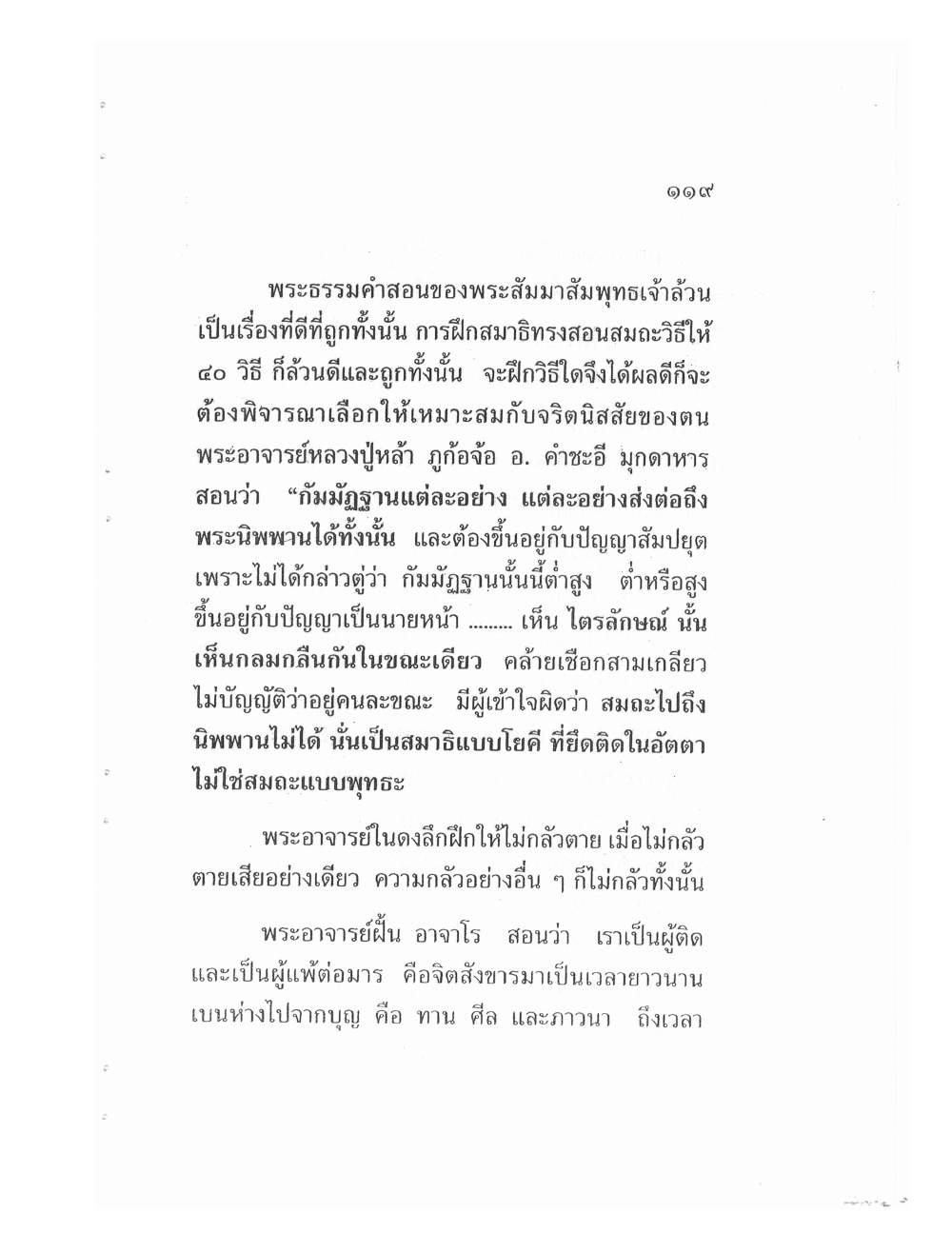
พระธรรมคำสอนของพระสัมมาสัมพุทธเจ้าล้วนเป็นเรื่องที่ดีที่ถูกทั้งนั้น การฝึกสมาธิทรงสอนสมถวิธีให้ ๔๐ วิธี ก็ล้วนดีและถูกทั้งนั้น จะฝึกวิธีใดจึงได้ผลดีก็จะต้องพิจารณาเลือกให้เหมาะสมกับจริตนิสสัยของตน พระอาจารย์หลวงปู่หล้า ภูก้อจ้อ อ. คำชะอี มุกดาหาร สอนว่า "กัมมัฏฐานแต่ละอย่าง แต่ละอย่างส่งต่อถึงพระนิพพานได้ทั้งนั้น และต้องขึ้นอยู่กับปัญญาสัมปยุต เพราะไม่ได้กล่าวตู่ว่า กัมมัฏฐานนั้นนี้ต่ำสูง ต่ำหรือสูงขึ้นอยู่กับปัญญาเป็นนายหน้า ......... เห็น ไตรลักษณ์ นั้น เห็นกลมกลืนกันในขณะเดียว คล้ายเชือกสามเกลียว ไม่บัญญัติว่าอยู่คนละขณะ มีผู้เข้าใจผิดว่า สมถะไปถึงนิพพานไม่ได้ นั่นเป็นสมาธิแบบโยคี ที่ยึดติดในอัตตา ไม่ใช่สมถะแบบพุทธะ
พระอาจารย์ในดงลึกฝึกให้ไม่กลัวตาย เมื่อไม่กลัวตายเสียอย่างเดียว ความกลัวอย่างอื่น ๆ ก็ไม่กลัวทั้งนั้น
พระอาจารย์ฝั้น อาจาโร สอนว่า เราเป็นผู้ติดและเป็นผู้แพ้ต่อมาร คือจิตสังขารมาเป็นเวลายาวนาน เบนห่างไปจากบุญ คือ ทาน ศีล และภาวนา ถึงเวลา
The Dharma teachings of the Fully Enlightened Buddha are entirely good and correct in every respect. The forty methods of samatha meditation that he taught are likewise all good and correct. As for which method will yield good results, one must consider and choose what is suited to one's own temperament. Phra Ajahn Luang Pu La, of Phu Kor Jor, Amphoe Kham Cha-i, Mukdahan province, taught: "Each and every meditation subject (kammatthana) can lead all the way to Nibbana. It depends on being conjoined with wisdom, because it is wrong to claim that this or that meditation subject is 'low' or 'high' — low or high depends on wisdom acting as the broker ......... Seeing the Three Characteristics (tilakkhana) is seeing them blended together in a single instant, like a three-strand rope; it is not the case that they occur in separate moments. Some mistakenly believe that samatha cannot reach Nibbana — that belief belongs to yogic-style samadhi clinging to a self, not samatha in the Buddhist manner."
The teacher deep in the forest trains disciples not to fear death. Once one no longer fears death alone, then all other fears likewise cease.
Phra Ajahn Fan Ajaro taught: We are ones who cling and who have lost to Mara — that is, mental formations have governed us for a long time, drifting away from merit, namely giving, morality, and mental development. When the time comes
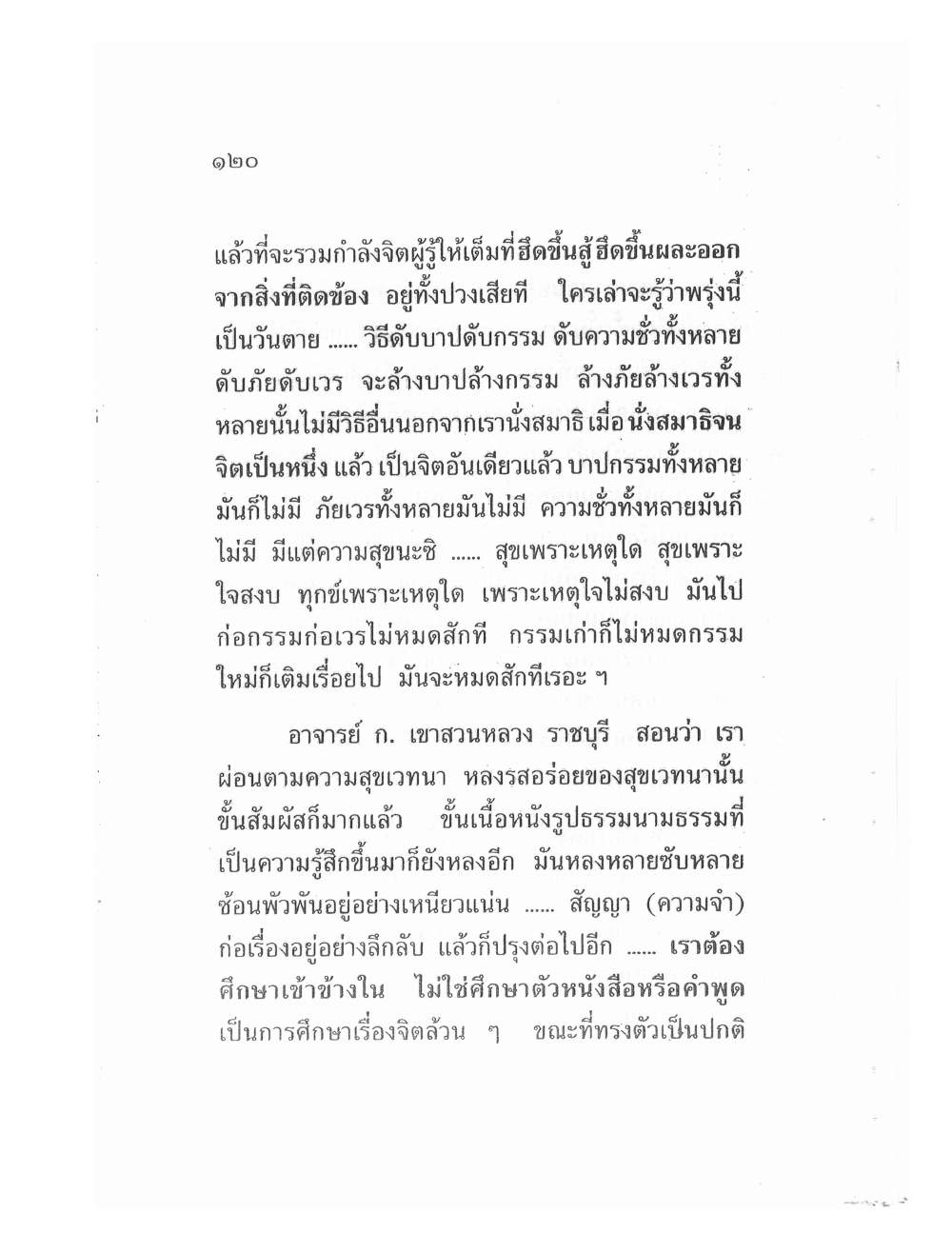
แล้วที่จะรวมกำลังจิตผู้รู้ให้เต็มที่ ฮึดขึ้นสู้ ฮึดขึ้นผละออกจากสิ่งที่ติดข้อง อยู่ทั้งปวงเสียที ใครเล่าจะรู้ว่าพรุ่งนี้เป็นวันตาย ...... วิธีดับบาปดับกรรม ดับความชั่วทั้งหลาย ดับภัยดับเวร จะล้างบาปล้างกรรม ล้างภัยล้างเวรทั้งหลายนั้นไม่มีวิธีอื่นนอกจากเรานั่งสมาธิ เมื่อนั่งสมาธิจนจิตเป็นหนึ่ง แล้ว เป็นจิตอันเดียวแล้ว บาปกรรมทั้งหลายมันก็ไม่มี ภัยเวรทั้งหลายมันไม่มี ความชั่วทั้งหลายมันก็ไม่มี มีแต่ความสุขนะซิ ...... สุขเพราะเหตุใด สุขเพราะใจสงบ ทุกข์เพราะเหตุใด เพราะเหตุใจไม่สงบ มันไปก่อกรรมก่อเวรไม่หมดสักที กรรมเก่าก็ไม่หมดกรรมใหม่ก็เติมเรื่อยไป มันจะหมดสักทีเรอะฯ
อาจารย์ ก. เขาสวนหลวง ราชบุรี สอนว่า เราผ่อนตามความสุขเวทนา หลงรสอร่อยของสุขเวทนานั้นขั้นสัมผัสก็มากแล้ว ขั้นเนื้อหนังรูปธรรมนามธรรมที่เป็นความรู้สึกขึ้นมาก็ยังหลงอีก มันหลงหลายซับหลายซ้อนพัวพันอยู่อย่างเหนียวแน่น ...... สัญญา (ความจำ) ก่อเรื่องอยู่อย่างลึกลับ แล้วก็ปรุงต่อไปอีก ...... เราต้องศึกษาเข้าข้างใน ไม่ใช่ศึกษาตัวหนังสือหรือคำพูด เป็นการศึกษาเรื่องจิตล้วน ๆ ขณะที่ทรงตัวเป็นปกติ
...to gather the full strength of the knowing mind, rousing oneself to fight, rousing oneself to break free at last from all things one is entangled and burdened by. Who indeed knows that tomorrow may be the day of death? ...... The method for extinguishing sin and kamma, extinguishing all evils, extinguishing danger and enmity, for washing away sin, kamma, and all danger and enmity, is none other than for us to sit in samadhi. When one sits in samadhi until the mind becomes one, becomes a single mind, then sin and kamma no longer exist; dangers and enmities no longer exist; all evils no longer exist. There remains only happiness, indeed ...... Why is there happiness? Because the heart is at peace. Why is there suffering? Because the heart is not at peace. It goes on creating kamma and enmity without end — old kamma is never exhausted, and new kamma keeps being added on. When will it ever end?
Ajahn Kor of Suan Luang, Ratchaburi, taught: We indulge according to pleasant feeling, infatuated with the delicious taste of that pleasant feeling — already excessive at the mere level of contact. At the level of flesh and skin, of physical and mental phenomena arising as feeling, one is still further deluded. It is deluded in many layers, folded over and entangled tightly ...... Perception/memory secretly builds up matters, and then goes on fabricating further ...... We must study inwardly — not study texts or words, but study the mind itself alone, at the moment it holds itself in its ordinary state
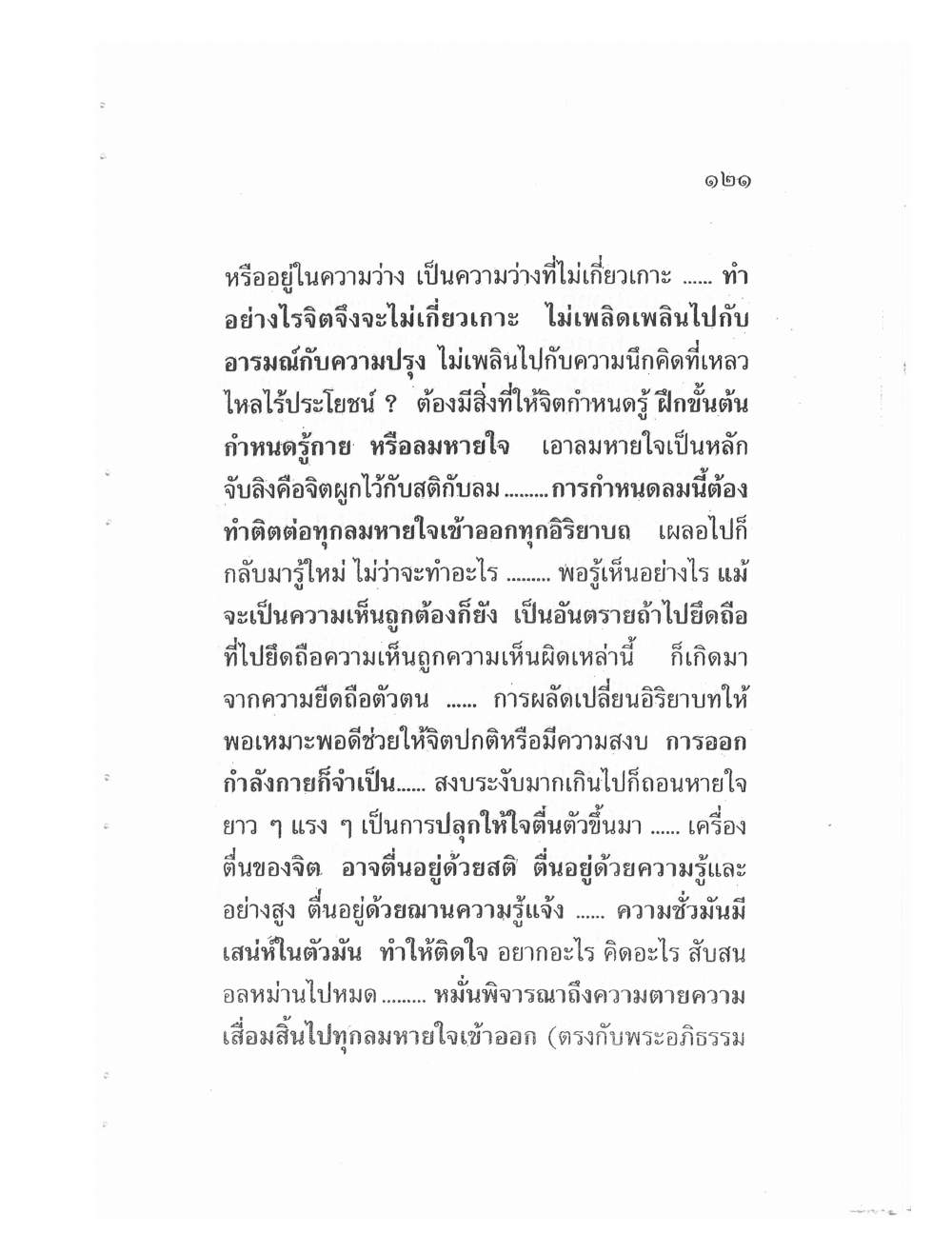
หรืออยู่ในความว่าง เป็นความว่างที่ไม่เกี่ยวเกาะ ...... ทำอย่างไรจิตจึงจะไม่เกี่ยวเกาะ ไม่เพลิดเพลินไปกับอารมณ์กับความปรุง ไม่เพลินไปกับความนึกคิดที่เหลวไหลไร้ประโยชน์ ? ต้องมีสิ่งที่ให้จิตกำหนดรู้ ฝึกขั้นต้นกำหนดรู้กาย หรือลมหายใจ เอาลมหายใจเป็นหลัก จับลิงคือจิตผูกไว้กับสติกับลม ......... การกำหนดลมนี้ต้องทำติดต่อทุกลมหายใจเข้าออกทุกอิริยาบถ เผลอไปก็กลับมารู้ใหม่ ไม่ว่าจะทำอะไร ......... พอรู้เห็นอย่างไร แม้จะเป็นความเห็นถูกต้องก็ยัง เป็นอันตรายถ้าไปยึดถือ ที่ไปยึดถือความเห็นถูกความเห็นผิดเหล่านี้ ก็เกิดมาจากความยึดถือตัวตน ...... การผลัดเปลี่ยนอิริยาบทให้พอเหมาะพอดีช่วยให้จิตปกติหรือมีความสงบ การออกกำลังกายก็จำเป็น...... สงบระงับมากเกินไปก็ถอนหายใจยาว ๆ แรง ๆ เป็นการปลุกให้ใจตื่นตัวขึ้นมา ...... เครื่องตื่นของจิต อาจตื่นอยู่ด้วยสติ ตื่นอยู่ด้วยความรู้และอย่างสูง ตื่นอยู่ด้วยฌานความรู้แจ้ง ...... ความชั่วมันมีเสน่ห์ในตัวมัน ทำให้ติดใจ อยากอะไร คิดอะไร สับสนอลหม่านไปหมด ......... หมั่นพิจารณาถึงความตายความเสื่อมสิ้นไปทุกลมหายใจเข้าออก (ตรงกับพระอภิธรรม
...or dwelling in emptiness — an emptiness not entangled with anything ...... How does the mind become not entangled, not amusing itself with objects and fabrications, not indulging in idle, useless thinking? There must be something for the mind to fix its attention on. As a beginning practice, fix attention on the body, or on the breath — take the breath as the basis. Catching the 'monkey,' that is, binding the mind, with mindfulness on the breath ......... This attending to the breath must be done continuously, with every in- and out-breath, in every posture; if one forgets, one returns to awareness again, no matter what one is doing ......... However one comes to know or see, even if it is a correct view, it is still dangerous if one clings to it — clinging to these correct or incorrect views arises from clinging to a self ...... Changing posture appropriately and suitably helps the mind stay normal or at peace; physical exercise is also necessary ...... If stillness becomes too excessive, drawing long, forceful breaths serves to rouse the heart back to alertness ...... The mind's instrument of wakefulness may be awake through mindfulness, awake through knowledge at a high level, awake through jhana and clear insight ...... Evil has its own charm, making one infatuated — wanting this, thinking that, utterly confused and disordered ......... One should constantly contemplate death and the decay and dissolution [of the body] with every in- and out-breath (in accordance with the Abhidhamma
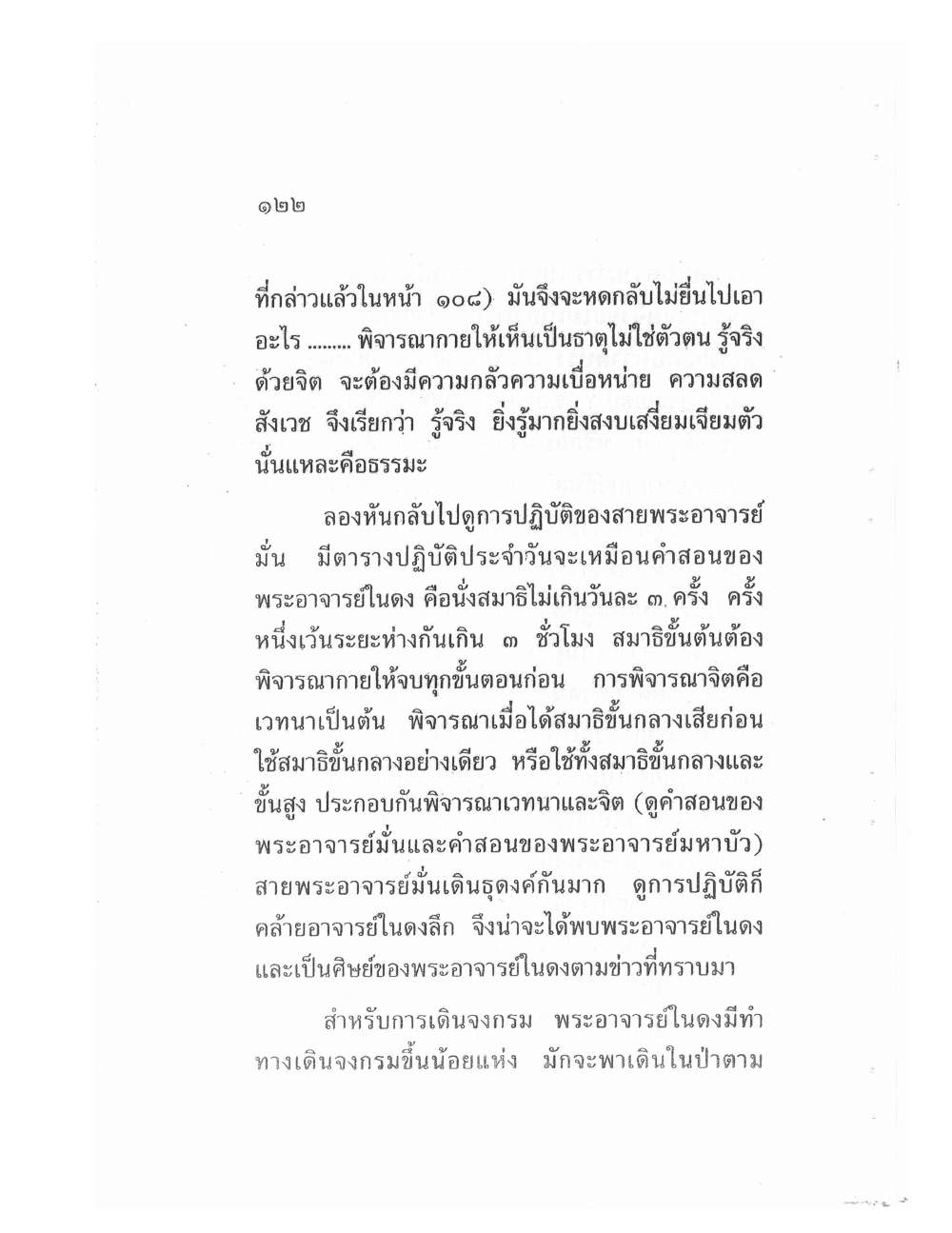
ที่กล่าวแล้วในหน้า ๑๐๘) มันจึงจะหดกลับไม่ยื่นไปเอาอะไร ......... พิจารณากายให้เห็นเป็นธาตุไม่ใช่ตัวตน รู้จริงด้วยจิต จะต้องมีความกลัวความเบื่อหน่าย ความสลดสังเวช จึงเรียกว่า รู้จริง ยิ่งรู้มากยิ่งสงบเสงี่ยมเจียมตัว นั่นแหละคือธรรมะ
ลองหันกลับไปดูการปฏิบัติของสายพระอาจารย์มั่น มีตารางปฏิบัติประจำวันจะเหมือนคำสอนของพระอาจารย์ในดง คือนั่งสมาธิไม่เกินวันละ ๓ ครั้ง ครั้งหนึ่งเว้นระยะห่างกันเกิน ๓ ชั่วโมง สมาธิขั้นต้นต้องพิจารณากายให้จบทุกขั้นตอนก่อน การพิจารณาจิตคือเวทนาเป็นต้น พิจารณาเมื่อได้สมาธิขั้นกลางเสียก่อน ใช้สมาธิขั้นกลางอย่างเดียว หรือใช้ทั้งสมาธิขั้นกลางและขั้นสูง ประกอบกันพิจารณาเวทนาและจิต (ดูคำสอนของพระอาจารย์มั่นและคำสอนของพระอาจารย์มหาบัว) สายพระอาจารย์มั่นเดินธุดงค์กันมาก ดูการปฏิบัติก็คล้ายอาจารย์ในดงลึก จึงน่าจะได้พบพระอาจารย์ในดง และเป็นศิษย์ของพระอาจารย์ในดงตามข่าวที่ทราบมา
สำหรับการเดินจงกรม พระอาจารย์ในดงมีทำทางเดินจงกรมขึ้นน้อยแห่ง มักจะพาเดินในป่าตาม
...mentioned already on page 108) — [the mind] will then withdraw and not reach out to grasp at anything ......... Contemplate the body so as to see it as [mere] elements, not a self; know it truly with the mind. There must be fear, weariness, and a sense of dread — only then is it called true knowledge. The more one truly knows, the more restrained, modest, and humble one becomes — that indeed is the Dhamma.
Let us turn back to look at the practice of the lineage of Phra Ajahn Man. Their daily practice schedule resembles the teaching of the forest-dwelling teacher: sitting in samadhi no more than three times a day, each session spaced more than three hours apart. In the beginning stage of samadhi one must contemplate the body through every stage completely first. Contemplation of the mind — that is, of feeling and so on — is undertaken only after attaining the middle level of samadhi; one then uses only the middle level, or both the middle and higher levels combined, to contemplate feeling and mind (see the teachings of Phra Ajahn Man and the teachings of Phra Ajahn Maha Bua). The lineage of Phra Ajahn Man traveled widely on ascetic wandering (dhutanga); their practice appears similar to that of the teacher deep in the forest, so it seems likely they encountered the forest-dwelling teacher and were his disciples, according to the reports received.
As for walking meditation, the forest-dwelling teacher had few designated walking paths; he would usually lead [disciples] to walk in the forest according to
ธรรมชาติและการฝึกที่หนักไปทางวิปัสสนาในดงก็สอน ตัวอย่างเช่น หลวงพ่อจรัญ วัดอัมพวัน สิงห์บุรี เดิมท่านฝึกแบบอานาปานสติ (สมถะ) ครั้นอายุ ๔๕ ปี ไปเรียนกับหลวงปู่โลกอุดร ที่เขาใหญ่ เปลี่ยนจาก อานา-ปานสติ มาฝึกแบบ "ยุบหนอพองหนอ" เรียนจบฌานใน ๓ เดือน ท่านก็ปิดเรื่องไปเรียนกับใครที่ไหนตามอาจารย์อื่น ๆ ปฏิบัติ แต่ล่วงมา ๒๐ ปี ท่านจึงเปิดเผยว่าไปเรียนที่ไหน จะเห็นว่า พระอาจารย์ในดงก็สอนทั้งแบบสมถะ (หนักไปทางสมาธิถึงฌานแล้วจึงหนักไปทางวิปัสสนา) และสอนทั้งแบบวิปัสสนา คือสมาธิพอประมาณ หนักไปทางวิปัสสนา พิจารณาให้ดีฝึกสมาธิพอประมาณนั้น อย่างน้อยก็จบอุปจารสมาธิ (สมาธิขั้นกลาง) ก่อน จึงจะเริ่มฝึกหนักไปทางวิปัสสนา นี่เป็นคำตอบพระอาจารย์พุทธทาสเมื่อผู้เขียนถามว่า จะฝึกสมาธิถึงขั้นใดจึงจะเริ่มฝึกวิปัสสนา (ฝึกหนักไปทางวิปัสสนา) ได้ถูกต้องไม่ผิดพลาด (ไม่เป็นวิปัสสนึก)
กล่าวโดยสรุป จะให้ฝึกได้จบสมาธิขั้นกลางภายใน ๓ เดือน ต้องฝึกตาม "หลักสำคัญในการฝึกจิต" ของพระอาจารย์ในดง ๗ ประการ และหลักสูตร
...nature; and the training that leans heavily toward vipassana was also taught in the forest. For example, Luang Por Charan of Wat Amphawan, Singburi — originally he trained in the anapanasati method (samatha). When he was 45 years old he went to study with Luang Pu Lok Udorn at Khao Yai, and changed from anapanasati to training in the "Yub-nor Pong-nor" method, completing the jhana training within three months. He then kept this hidden and went off to study elsewhere with other teachers under practice. But after 20 years had passed, he finally revealed where he had studied. One can see that the forest-dwelling teacher taught both the samatha approach (leaning heavily toward samadhi up to jhana, and only then toward vipassana) and the vipassana approach — that is, a moderate level of samadhi, leaning heavily toward vipassana. Consider carefully: training a moderate level of samadhi means, at the very least, completing access concentration (upacara samadhi, the middle level of samadhi) first, before beginning to train heavily toward vipassana. This was Ajahn Buddhadasa's answer when the author asked to what level one should train samadhi before beginning to train vipassana (training heavily toward vipassana) correctly, without error (so as not to become mere intellectual pseudo-vipassana).
In summary: to enable training to complete the middle level of samadhi within three months, one must train according to the "Important Principles for Training the Mind" of the forest-dwelling teacher — seven principles — and the curriculum
การฝึกสมาธิในดง ๕ ข้อ ซึ่งเป็นหลักสูตรโดยย่อ ทั้งต้องพิจารณาความตายและอสุภะทุกลมหายใจเข้าออกคือตลอดเวลา ส่วนการระลึกถึงคุณของพระพุทธเจ้าและการแผ่เมตตาในบางเวลาที่กล่าวมาแล้วข้างต้น เรื่องสำคัญมากที่จะช่วยให้ควบคุมการปฏิบัติก็คือ มีตารางกำหนดข้อปฏิบัติประจำวันซึ่งเรียกว่า ข้อวัตรปฏิบัติ หรือ กิจประจำวัน บอกเวลาใดทำอะไรบ้างในรอบหนึ่งวันตามตัวอย่างกิจประจำวันตองพระอาจารย์มั่นและพระอาจารย์ฝั้น ที่กล่าวแล้ว การที่กล้ากล่าวว่า ปฏิบัติดังกล่าวจะได้ผลจบสมาธิขั้นกลางนั้นเป็นด้วยผู้เขียนเองได้ปฏิบัติได้ผลจริงมาแล้ว ทั้ง ๆ ที่ปฏิบัติบกพร่องย่อหย่อนไปบ้าง แต่ที่สำคัญคือสถานที่ฝึกจะต้องเป็นป่าเขาที่สงบสงัดไกลหมู่บ้าน อีกตัวอย่างหนึ่งคือ หลวงพ่อจรัญฝึกเพียง ๓ เดือนก็จบฌาน ซึ่งเป็นหลักสูตรที่ฝึก ๓ ปี บุญบารมีได้เกิดเป็นคน ก็มีสมาธิขั้นต้นโดยกำเนิดแล้ว และสามารถที่จะเรียนรู้ในการทำสมาธิให้ถูกต้องและสามารถวัดสมาธิด้วยตนเองว่า ได้สมาธิขั้นใดระดับใดแล้ว จะฝึกให้ดีขึ้นทำอย่างไรต่อไป ในด้านการใช้พลังคุณพระพลังจิตก็สามารถ เรียนรู้
The forest training program in five points, which forms an abbreviated curriculum, requires that one contemplate death and unattractiveness (asubha) with every in- and out-breath — that is, constantly. As for recollecting the virtues of the Buddha and radiating loving-kindness at certain times, this was mentioned earlier above. A very important matter that helps control one's practice is having a schedule setting out the daily practice, called the "daily observances" or "daily duties," stating what to do at what time within the course of one day, following the example of the daily routines of Phra Ajahn Man and Phra Ajahn Fan already mentioned. The reason [I] dare to say that following this practice will result in completing the middle level of samadhi is that the author himself has practiced and truly achieved these results — even though the practice was carried out with some lapses and shortcomings. But the important point is that the place of training must be forest and mountain, quiet and secluded, far from villages. Another example is Luang Por Charan, who trained for only three months and completed the jhanas — a level that normally takes a three-year curriculum. Merit and accumulated perfections that led to being born human already confer an initial level of samadhi by birth, and one is able to learn to practice samadhi correctly and to gauge one's own samadhi for oneself — knowing what level and stage one has attained, and how to proceed to train further to improve it. As for the use of the power of the Buddha's virtue and the power of mind, one can likewise learn
การส่งพลังจิตออกไปดับพิษน้ำร้อนหรือน้ำมันกำลังเดือดให้คนเอามือล้วงได้ ตักกินได้ในขณะกำลังเดือด หรือกอบโซ่ที่เผาไฟจนแดงขึ้นได้ เมื่อส่งพลังออกได้ดังนี้แล้ว ก็เรียนรู้และสามารถรักษาโรคที่ฝรั่งรักษาไม่ได้ไม่มียารักษาหลายอย่างก็รักษาได้ผลดีได้ผลเร็ว เช่น สามารถรักษาโรคเอดส์ โรคมะเร็ง วัณโรคที่ดื้อยาบางประเภท โรคเบาหวาน โรคหืด โรคไซนัส โรคพิษสุนัขบ้าที่มีอาการแล้ว โรคทอนซิลอักเสบ โรคไวรัสบี โรคเรื้อนกวางที่เล็บที่ขาชนิดแห้งโรคต่อมลูกหมากโต โรคนิ่ว ฯลฯ เป็นต้น ตั้งแต่การฝึกสมาธิถูกต้องวัดสมาธิได้เองจนถึงรักษาโรคต่าง ๆ ได้ผลดีได้ผลเร็วที่กล่าวมาแล้วนี้สอนให้ทำได้จริงภายใน ๑ วัน (หนึ่งวัน) ที่กล้ายืนยันดังนี้ก็เพราะได้สอนติดต่อมากว่า ๓๕ ปีแล้ว ได้ผลให้เรียนรู้ได้ทำได้ในหนึ่งวันตลอดมา ส่วนการรักษาโรคต่าง ๆ ก็ได้ทำจริงรักษาได้จริงมากว่า ๔๐ ปีแล้ว ความรู้เกือบทั้งหมดพระอาจารย์ผู้เป็นศิษย์ในดงเป็นผู้สอน (ศิษย์ในดงหมายถึงผู้มีบุญที่จะฝึกจนถึงเหาะได้ ล่องหนหายตัวได้)
...sending mental power out to neutralize the sting of boiling water or boiling oil so that people can plunge their hands in or scoop and eat it while it is still boiling, or grasp a chain heated red-hot in fire. Once one can send out power in this way, one then learns and is able to cure diseases that Western [medicine] cannot cure, for which there is no medicine — many such conditions can be treated with good, fast results. For example, one can treat AIDS, cancer, drug-resistant tuberculosis of certain kinds, diabetes, asthma, sinusitis, rabies once symptoms have appeared, tonsillitis, hepatitis B, dry-type ringworm of the nails and legs, enlarged prostate, kidney stones, and so on. From correctly training in samadhi and being able to gauge one's own samadhi, all the way through to treating various diseases with good, fast results as described above — all of this is taught to be genuinely achievable within one day (a single day). I dare affirm this because I have been teaching continuously for more than 35 years, and the result has consistently been that people can learn and do it within one day. As for the treatment of various diseases, this has genuinely been practiced and genuinely cured for more than 40 years. Almost all of this knowledge was taught by the teacher-monks who are disciples in the forest (disciples in the forest meaning those with sufficient merit to train to the point of being able to fly through the air, and to become invisible and vanish).
บทที่ ๖
คำบรรยายโดยย่อ โทษการฝึกผิด มิจฉาทิฏฐิ สัมมาทิฏฐิ
สาเหตุที่ผู้ฝึกสมาธิวิปัสสนาเป็นโรคประสาทหรือเสียสติ เป็นเพราะ ๑. ฝึกไม่ถูกวิธี และพยายามจะให้ได้ผลดี ๒. ฝึกบ่อยครั้งเกินไป หรือฝึกนานเกินควร ๓. เกิดความกลัวหรือตกใจมากขณะจิตเริ่มสงบ ๔. ผู้ฝึกสมาธิเป็นโรคประสาทหรือโรคจิตอยู่ก่อนแล้ว
วิธีแก้ไข ๑. ฝึกผิดวิธีและพยายามจะให้ได้ผลดี ควรเลือกวิธีที่เหมาะกับจิตและนิสัยของตน วิธีที่เหมาะกับคนทั่วไปคือ วิธีกำหนดลมหายใจ ควรมีครูที่ดีควบคุมใกล้ชิดจนเข้าใจและทำถูกต้อง จึงไปฝึกตามลำพังตนเอง การฝึกไม่ถูกวิธี เช่นที่ตั้งจิตไม่เหมาะกับตน การดำเนิน
Chapter 6
Summary Lecture The Harm of Wrong Practice: Wrong View and Right View
The reasons why practitioners of samadhi-vipassana develop nervous disorders or lose their sanity are because: 1. Training with the wrong method, while trying to achieve good results. 2. Training too frequently, or training for too long a duration. 3. Experiencing great fear or shock at the moment the mind begins to grow calm. 4. The practitioner already had a nervous disorder or mental illness before starting to practice.
Methods of Remedy 1. Training with the wrong method while trying to achieve good results — one should choose a method suited to one's own mind and disposition. The method suited to people in general is the method of attending to the breath. One should have a good teacher supervising closely until one understands and practices correctly, and only then go to practice on one's own. Training with the wrong method — for example, setting the mind on an object unsuited to oneself — the proceeding
การฝึกไม่ทำตามขั้นตอน ฝึกข้ามขั้นทำให้ผิดบ้างถูกบ้าง แต่พยายามจะเร่งให้ได้ผลเร็ว เป็นความโลภอยากมีอยากได้โดยไร้เหตุผล และทำให้เกิดความเครียดทางจิต จึงเป็นโรคประสาทหรือเสียสติได้
๒. การฝึกบ่อยครั้งเกินไป โดยธรรมดาการฝึกอย่างเคร่งครัดวันหนึ่งท่านให้ฝึกไม่เกิน ๓ ครั้ง และครั้งหนึ่งให้ห่างกันมากกว่า ๓ ชั่วโมง ถ้าฝึกมากเกินไปจะเกิดความเครียด ส่วนการฝึกแบบสบาย ๆ คือจัดลมหายใจแบบสบาย มีสติรู้ลมโดยไม่ต้องภาวนา ดังนี้ทำได้ตลอดไปทั้งในยามว่างหรือระหว่างทำงาน ระหว่างฟังวิทยุก็ทำได้ไม่เคร่งเครียด เผลอไปก็ทำใหม่ได้เรื่อย ๆ บางท่านให้ภาวนา "พุท-โธ" ไปเรื่อย ๆ ได้ตลอดเวลา หรือนึกถึงความตายอันจะมีแก่ตน บ้างนึกถึงความไม่สะอาด ความไม่น่ารักของร่างกายบ้าง เหล่านี้ก็นับว่าดี ลองทำดู วิธีใดที่ทำให้จิตใจสงบไม่ฟุ้งซ่านก็ใช้วิธีนั้น หรือวิธีใดมากระทบใจก็ใช้วิธีนั้น
การฝึกครั้งหนึ่งอย่าเคร่งครัดนานก็ให้โทษ การฝึกตอนต้น ๆ จิตสงบลงบ้าง แล้วอย่าไปคิดอย่างอื่นอีก ต้องคอยแก้ให้จิตสงบ ๆ ใหม่สลับกันไป ดังนี้ก็เป็นเรื่อง
Training without following the proper stages — skipping steps causes errors here and there — yet trying to force quick results out of an unreasonable greed to possess and attain, creates mental stress, and so can lead to nervous disorder or loss of sanity.
2. Training too frequently. Ordinarily, in strict practice, one should train no more than three times a day, with each session spaced more than three hours apart. If one trains too much, stress will result. As for relaxed-style training — that is, arranging the breath comfortably, being mindfully aware of the breath without needing to recite a meditation word — this can be done continuously, whether during free time or while working. Even while listening to the radio it can be done without strain; if one loses attention, one simply begins again, over and over. Some teachers have one recite "Bud-dho" continuously at all times, or reflect on the death that will come to oneself; some reflect on the impurity and unloveliness of the body — these too are considered good. Try it: whichever method keeps the mind calm and not restless, use that method; or whichever method affects the heart, use that method.
Training too strictly for too long in a single session is also harmful. In the early stages of practice, once the mind settles somewhat, one should not go on thinking of other things; one must keep correcting, letting the mind settle again and again in alternation. This is a matter
ธรรมดา แต่ไม่ควรฝึกนานกว่า ๑ ชั่วโมง ถ้าฝึกนานไปจะให้โทษมากกว่าให้คุณ นอกจากจิตเป็นสมาธิติดต่อกันไปสงบและเพลินไปเรื่อย ก็ฝึกนานกว่า ๑ ชั่วโมงได้
อย่าฝืนฝึกสมาธิวิปัสสนาจนเกินขอบเขตที่จะทนได้ ถ้าง่วงมากหรือเพลียมากฝืนไม่ไหวก็พักเสีย หรือนอนให้สบายเสียก่อนจะดีกว่า พยายามรวมสติอยู่กับลมสบาย ไม่คิดว่าต่อไปจะเป็นอย่างไร คิดให้มั่นว่าการฝึกสมาธิวิปัสสนาเป็นการทำความดีเป็นบุญ ผลที่ได้รับต้องดีแน่ คิดว่าฝึกเพื่อให้เกิดความสบาย ไม่เร่งรีบจะเอาผลให้ทันใจ และหมั่นทำไม่ลดละ การฝึกจิตจะต้องปล่อยวางในเรื่องความรู้และเรื่องอื่น ๆ ไม่สนใจทุกอย่าง สนใจอยู่เฉพาะลมหายใจและมีสติรู้ลม ดูลมด้วยจิตอยู่เสมอ
๓. ความกลัวความตกใจ ให้หมั่นพิจารณาว่าทุกสิ่งทุกอย่างไม่เที่ยง มีการเปลี่ยนแปลงอยู่เสมอ มีการเกิดดับอยู่เสมอไม่มีการหยุดยั้งแม้แต่เพียงขณะเดียว ความกลัวความตกใจอาจมีเพราะคนหรือเสียง หรือเกิดภาพทางใจ (คือนิมิต) ขณะที่จิตสงบ สิ่งเหล่านั้นเป็นเพียงมาร หรือสิ่งหลอกลวง ขัดขวางความดีของเรา ทำร้ายอะไรเราไม่ได้ เกิดแล้วก็ดับไปไม่ยั่งยืน ควบคุมจิตใจให้
...ordinary. But one should not practice longer than one hour. If practiced too long, it will do more harm than good — unless the mind is continuously in samadhi, calm and pleasantly absorbed, in which case one may practice longer than one hour.
Do not force oneself to practice samadhi-vipassana beyond the limit one can endure. If very drowsy or very exhausted and unable to push further, it is better to rest, or to lie down comfortably first. Try to gather mindfulness on the comfortable breath, without thinking about what comes next. Be firmly convinced that practicing samadhi-vipassana is doing good and is meritorious; the result obtained is certain to be good. Think of practicing in order to bring about ease, without rushing to get results quickly, and keep practicing without giving up. Training the mind requires letting go of both knowledge and other matters — paying attention to nothing else, attending only to the breath, being mindfully aware of the breath, and watching the breath with the mind at all times.
3. Fear and shock. One should constantly reflect that all things are impermanent, are constantly changing, are constantly arising and ceasing, without pause even for a single instant. Fear or shock may arise because of a person or a sound, or a mental image may arise (that is, a nimitta) while the mind is calm. Those things are merely Mara, or deceptive appearances, obstructing our goodness; they cannot harm us in any way — once arisen, they cease and do not last. Keep the mind under control so that
ปกติไว้ ทางที่ดีควรรู้วิธีใช้อำนาจจิตอำนาจคุณพระป้องกันอันตราย ก่อนนั่งสมาธิทุกครั้ง ดังนี้จะเป็นการป้องกันที่ดี การปฏิบัติต่อนิมิต หรือการแก้นิมิตดู วิทยาศาสตร์ทางใจฉบับส่องโลก หน้า ๒๕๓
๔. ผู้ฝึกสมาธิวิปัสสนาเป็นโรคประสาทเป็นโรคจิตมาก่อนแล้ว หรือเป็นหลังจากฝึกไม่ถูกวิธี แก้โดยให้หยุดฝึกไปก่อนระยะหนึ่ง หาสิ่งที่เพลิดเพลินอย่างอื่นแทนให้หายจากโรคประสาทดีแล้ว จึงฝึกใหม่ และถ้ามีการรักษาด้วยยาด้วยพลังจิตช่วยด้วยก็จะทำให้ได้ผลดี ถ้าโรคประสาทนั้นเกิดเพราะความเสียใจเป็นเหตุก็แก้ความเสียใจ (ดูหลักแก้ความเสียใจในฉบับเปิดโลกหน้า ๔๑๐)
ตามที่กล่าวมานี้รวบรวมจากพระไตรปิฎก จากท่านผู้รู้ จากพระอาจารย์ในดงและจากประสบการณ์ที่เคยฝึกศิษย์มานานกว่า ๒๕ ปี รายละเอียดการฝึกสมาธิวิปัสสนาและการใช้อำนาจจิตเพื่อประโยชน์ต่าง ๆ มีในวิทยาศาสตร์ทางใจ ฉบับยอดคน ฉบับเปิดโลก และฉบับส่องโลก ส่วนการรักษาต่าง ๆ ด้วยพลังจิตและยา มีในแพทย์สามแผนนำสมัย (๙๐ บาท) ยินดีตอบ
...remain normal. It is best to know how to use the power of the mind and the power of the Buddha's virtue to guard against danger, before every session of sitting in samadhi — this will serve as good protection. For how to deal with a nimitta (meditative vision), or for resolving problems with a nimitta, see Wittayasat Thang Jai [Science of the Mind], the "Illuminating the World" edition, page 253.
4. The practitioner of samadhi-vipassana already had a nervous disorder or mental illness beforehand, or developed one after training with the wrong method. The remedy is to stop training for a period, find some other pleasant pursuit instead, until fully recovered from the nervous disorder, and only then train again. And if there is treatment with medicine along with the aid of mental power, this will produce good results. If that nervous disorder arose because of grief, then treat the grief (see the principles for resolving grief in the "Opening the World" edition, page 410).
What has been related here has been gathered from the Tipitaka, from learned persons, from the forest-dwelling teacher, and from the author's own experience training disciples for more than 25 years. Details of samadhi-vipassana training and the use of mental power for various benefits are found in Wittayasat Thang Jai [Science of the Mind]: the "Champion of Men" edition, the "Opening the World" edition, and the "Illuminating the World" edition. As for the various treatments using mental power and medicine, these are found in Modern Three-Tradition Medicine (90 baht). [The author is] glad to answer
คำถามทั้งผู้ที่มีหนังสือหรือไม่มีหนังสือ ต้องการเรียนให้ทำได้เองก็ยินดีสอนให้ตามวัดนัดหมายโดยไม่คิดค่าสอน
ในเรื่องพิจารณากายให้เป็นของไม่สะอาด ไม่ใช่ตัวตนนั้น มีวิธีพิจารณาหลายวิธี กล่าวไว้หลายแห่งในพระไตรปิฎก ควรนำมาสรุปรวมกันให้เห็นจริงทุกแง่ทุกมุมที่เหมาะจะให้ตนรังเกียจ ขยะแขยง และเห็นเป็นความว่างเปล่า จนจิตปล่อยวางข้ามพ้นรูปกายทั้งปวงได้ จิตจึงจะเป็นอิสระมีปัญญาแหลมคมจัด ละทิ้งความเห็นผิดในกาม แล้วจึงจะวางจิตได้ เช่น พิจารณาอาการ ๓๒ พิจารณาธาตุ ๔ พิจารณาให้เห็นเป็นอสุภะ เพ่งพินิจโดยความเป็นธาตุ โดยความเป็นอายตนะและโดยความเป็นปฏิจจสมุปบาท พิจารณาโดยแยบคายให้เห็นว่า ร่างกายกำลังเน่าเปื่อย กำลังไหวเคลื่อนอยู่เป็นนิจ ร่างกายมีการเกิดดับอยู่เสมอ ร่างกายเต็มไปด้วยหลุมอุจจาระปัสสาวะ ร่างกายมีน้ำเน่ามีของเสียไหลออกมาตลอดเวลา ร่างกายเป็นของไม่เที่ยง เป็นทุกข์ เป็นอนัตตา (มีบรรยายลักษณะของอนิจจังไว้ ๑๐ ประการ ลักษณะทุกข์ ๒๕ ประการ และลักษณะอนัตตา ๕ ประการ รวมเป็น ๔๐ ประการ บางแห่งเรียกว่า โต ๔๐)
...questions, whether from those who own the book or not. For those who want to learn to do it themselves, I am glad to teach at the temple by appointment, without charging any fee for teaching.
Regarding contemplating the body as impure, as not being a self — there are many methods of contemplation, stated in many places throughout the Tipitaka. They should be brought together and summarized so as to be seen as truly so from every angle, in whatever way is suited to make oneself feel disgust and revulsion, and to see it as empty — until the mind can let go and pass beyond the physical body entirely. Only then does the mind become free, with sharp and keen wisdom, abandoning wrong views concerning sensual desire; only then can the mind truly let go. For example: contemplating the thirty-two parts of the body, contemplating the four elements, contemplating so as to see it as foul (asubha), scrutinizing it as element, as sense-base, and as dependent origination. Contemplating thoroughly so as to see that: the body is constantly rotting; it is constantly moving and stirring; the body is constantly arising and ceasing; the body is full of pits of feces and urine; the body has rotten fluid and waste constantly flowing out of it; the body is impermanent, is suffering, is not-self. (There is a description of ten characteristics of impermanence, twenty-five characteristics of suffering, and five characteristics of not-self, totaling forty characteristics — in some places called 'the forty falls.')
พระไตรปิฎก เล่ม ๑๑ หน้า ๒๕๓ กล่าวถึงพระอานนท์ทำความเพียรตลอดคืน ใช้เวลาส่วนมากในการพิจารณากาย ทำให้จิตหลุดพ้นจากกิเลส ไม่ยึดมั่นเป็นพระอรหันต์ ไปสู่ที่ประชุมทำสังคายนาในตอนเช้า
มีพระพุทธพจน์กล่าวว่า "ภิกษุทั้งหลาย เราไม่เห็นอะไรจะให้โทษร้ายแรงยิ่งกว่ามิจฉาทิฏฐิ"
มิจฉาทิฏฐิ คือความเห็นผิด ให้ผลในทางชั่วทางบาป ทำให้ตกต่ำ ในพระไตรปิฎกเล่ม ๒๖ หน้า ๒๘๐ มีใจความว่า "เพราะยึดมั่นในรูปจึงเกิดมิจฉาทิฏฐิ" จึงควรที่จะหมั่นพิจารณาให้เห็นรูปกายตามความเป็นจริง ให้เห็นชัดแจ้งด้วยสมาธิ ด้วยญาณ ให้จงได้ รูปไม่มี คือก้าวล่วงรูป เพิกถอนรูปได้ ด้วยเหตุ ๒ คือ การพิจารณาและโดยเจริญอรูปฌาน ๔ อย่าง
จากพระไตรปิฎกเล่ม ๒๔ อานันทสูตร ที่ ๔ มีใจความว่า พระวังคีสะ บวชใหม่ ๆ มีความกระสันเกิดขึ้น ความกำหนัดยินดีรบกวน เพราะเห็นหญิงแต่งตัวสวยงามหลายคนเที่ยวเดินดูกุฏิพระในวันก่อน ขอให้พระอานนท์บอกวิธีดับราคะ พระอานนท์กล่าวว่า "จิตของท่าน
The Tipitaka, volume 11, page 253, tells of the Venerable Ananda applying diligent effort throughout the night, spending most of the time contemplating the body, which freed his mind from defilements; without clinging, he became an Arahant, and went to the assembly for the [Council] recitation in the morning.
There is a saying of the Buddha: "Monks, I see nothing that gives graver harm than wrong view (miccha-ditthi)."
Wrong view is a mistaken view that yields results on the side of evil and demerit, causing one to fall low. In Tipitaka volume 26, page 280, there is a passage: "Because of clinging to form, wrong view arises." One should therefore diligently contemplate so as to see the physical form as it truly is, seeing it clearly through samadhi and through wisdom-knowledge, so that it may be achieved. The absence of form means transcending form — form can be uprooted by two means: contemplation, and by developing the four formless jhanas.
From Tipitaka volume 24, the fourth Ananda Sutta, there is a passage: the Venerable Vangisa, newly ordained, had arisen in him a longing, a disturbing lustful delight, because he had seen many beautifully dressed women walking about viewing the monks' huts the day before. He asked the Venerable Ananda to tell him a way to extinguish passion. The Venerable Ananda said, "Your mind...
รุ่มร้อนเพราะสัญญาวิปลาส ท่านจงละเว้นนิมิตอันสวยงามอันเป็นที่ตั้งแห่งราคะเสีย ท่านจงเห็นสังขารทั้งหลายโดยความปรวนแปร โดยความเป็นทุกข์ และอย่าเห็นโดยความเป็นตัวตน...... เจริญอสุภะกัมมัฏฐานให้เป็นจิตมีอารมณ์อันเดียวตั้งมั่นด้วยดีเถิด ท่านจงมีกายคตาสติ ท่านจงเป็นผู้มากด้วยความหน่าย ...... ไม่ติดในกามย่อมกำจัดความกระวนกระวายใจเสียได้" ต่อมาไม่นานพระวังคีสะได้บรรลุเป็นพระอรหันต์
พระอาจารย์วัน อ. สว่างแดนดิน จ. สกลนคร ให้อุบายในการฝึกจิตสั้น ๆ ว่า "เมื่อฝึกไม่ได้ผลก็ให้ปลอบใจ เมื่อปลอบใจแล้วก็ไม่ได้ผลอีกให้ใช้วิธีขู่"
กามคุณ พระไตรปิฎก เล่ม ๑๗ มหาทุกขักขันธสูตร มีใจความว่า...... "กามคุณ ๕ คือ รูป รส กลิ่น เสียง และการสัมผัส ที่น่าปรารถนาน่าพอใจน่ารักประกอบด้วยกามเป็นที่ตั้งแห่งความกำหนัดยินดี ...... ความสุขความโสมนัส ที่บังเกิดเพราะอาศัยความงามความเปล่งปลั่งนี้เป็นคุณของรูป"
is inflamed because of distorted perception. Abandon the beautiful sign that is the basis of passion. See all conditioned things as subject to change, as suffering, and do not see them as self...... Cultivate the meditation on foulness so that the mind becomes single-pointed and well established. Maintain mindfulness of the body; be one full of disenchantment...... Not clinging to sensual pleasures removes restlessness of mind." Not long after, the Venerable Vangisa attained Arahantship.
Venerable Ajahn Wan of Sawang Daen Din district, Sakon Nakhon province, gave a short method for training the mind, saying: "When training does not produce results, then console the mind; when consoling produces no result either, then use the method of admonishing/frightening it."
Sensual pleasures (kamaguna): The Tipitaka, volume 17, the Mahadukkhakkhandha Sutta, states...... "The five sensual pleasures are form, taste, smell, sound, and touch, which are desirable, pleasing, likeable, connected with sensuality, being the basis of delight and desire...... The happiness and joy that arise dependent on such beauty and radiance — this is the gratification of form."
การเห็นคุณของรูปดังกล่าวเป็นการเห็นผิดจากความเป็นจริง เป็น "มิจฉาทิฏฐิ" ตรงตามพระไตรปิฎก เล่ม ๒๖ หน้า ๒๘๐ มีใจความว่า "เพราะยึดมั่นในรูปจึงเกิดมิจฉาทิฏฐิ" จึงควรที่จะหมั่นพิจารณาให้เห็นรูปตามความเป็นจริงว่าเป็นสิ่งที่สกปรกน่ารังเกียจน่าสะอิดสะเอียน
พระไตรปิฎก เล่ม ๑๗ อลคัททูปมสูตร กล่าวว่า "โทษแห่งกาม เปรียบด้วยงูพิษ"
พระไตรปิฎก เล่ม ๑๗ นิวาปสูตร กล่าวว่า "กามคุณคือเหยื่อที่ทำให้สัตว์มัวเมา"
มิจฉาทิฏฐิมีโทษร้ายแรงและให้โทษยาวนานไปได้หลายชาติจนกว่าจะมีความเห็นถูกต้อง พระพุทธองค์จึงทรงกล่าวกับพระภิกษุทั้งหลายว่า "ภิกษุทั้งหลาย เราไม่เห็นอะไรจะให้โทษร้ายแรงยิ่งกว่ามิจฉาทิฏฐิ"
อนัตตริยกรรม หรือ กรรมหนัก ๕ อย่าง ได้แก่ การฆ่าพระอรหันต์ ฆ่าบิดามารดา เป็นต้น ล้วนให้ผลตกนรกในชาติถัดไป รับโทษหมดแล้วก็เป็นอันหมดไป แต่มิจฉาทิฏฐิให้ผลมาก ให้ผลยาวนาน และให้ผลแก่คน
To see gratification in form as described above is a mistaken view, contrary to reality — it is "wrong view," in accordance with the Tipitaka, volume 26, page 280, which states: "Because of clinging to form, wrong view arises." One should therefore diligently contemplate so as to see form as it truly is — as something filthy, repugnant, and disgusting.
The Tipitaka, volume 17, the Alagaddupama Sutta, says: "The danger of sensual pleasure is comparable to a venomous snake."
The Tipitaka, volume 17, the Nivapa Sutta, says: "Sensual pleasures are the bait that makes beings intoxicated."
Wrong view carries grave and long-lasting consequences, extending across many lifetimes until right view is attained. The Blessed One therefore said to the monks: "Monks, I see nothing that gives graver harm than wrong view."
The five grave offenses (anantariya-kamma), or the five heavy kammas, include killing an Arahant, killing one's mother or father, and so on — all of which yield results of falling into hell in the next existence; once the penalty is served in full, it is finished. But wrong view yields abundant results, long-lasting results, and results affecting
จำนวนมากมาย มีแต่พระอริยคือจากพระโสดาถึงพระอรหันต์เท่านั้นที่ละความยึดมั่นในรูปดังปรากฏในพระไตรปิฎก เล่ม ๒๖ หน้า ๒๘๐ มีใจความว่า "เพราะยึดมั่นรูปจึงเกิดมิจฉาทิฏฐิ" ก็ เกศา โลมา นขา ทันตา ที่หลงชอบใจอยู่ติดใจอยู่นั้นก็ล้วนเป็นซากศพ ตามที่อธิบายในเรื่องพิจารณากายและที่หลงใหลชอบใจมากนั้น พระอาจารย์ผู้มีสมาธิสูงหลายท่านสอนว่า "หนัง" เป็นสิ่งให้ชอบใจติดใจมากที่สุด ทั้ง ๆ ที่หนังก็คือซากศพที่ทยอยปลิวออกไปในอากาศตลอดเวลา เพราะถูกตัวชีวิตที่ตายทยอยดันออกมา ที่เห็นผิวหนังอยู่นั้นก็เห็นอยู่เดี๋ยวเดียวก็ปลิวไปในอากาศ เห็นแล้วชอบใจถูกใจและเห็นว่าสวยงามนั้นแหละคือความเห็นผิดหรือมิจฉาทิฏฐิ พิจารณาให้ดีให้รอบคอบจะได้รู้ตัวว่าเราเห็นผิด เห็นไม่ตรงตามความเป็นจริง รายละเอียดในการพิจารณากายให้เห็นตามความเป็นจริงให้เห็นเป็นไม่งาม เต็มไปด้วยซากศพนั้นได้อธิบายไว้โดยละเอียดในหนังสือยอดอัศจรรย์และธุดงค์ เมื่อฝึกสมาธิมากขึ้น พิจารณามากขึ้น ก็ถึงขั้น "เห็นสักว่าเห็น" เห็นโดยไม่มีความหมาย เห็นเป็นกลาง ไม่เห็นว่างาม ไม่เห็นว่าสวย ไม่เห็นว่าสกปรก
an enormous number of people. Only the Noble Ones, from the Stream-enterer up to the Arahant, abandon clinging to form, as appears in the Tipitaka, volume 26, page 280, which states: "Because of clinging to form, wrong view arises" — as for the hair, body hair, nails, and teeth that one is infatuated with and attached to, these are, in fact, all corpse-matter, according to what has been explained on contemplation of the body. As for what people are most deeply infatuated with, many teachers of high samadhi teach that "skin" is the thing people find most attractive and most cling to, even though skin itself is corpse-matter continuously shed into the air, pushed out by the living cells that are constantly dying. The skin one sees is present only for a moment before it flies off into the air. Seeing it and being pleased, finding it beautiful — that very perception is wrong view. One should contemplate carefully and thoroughly, so as to recognize that one's view is mistaken, not in accordance with reality. The details of contemplating the body so as to see it as it truly is — as unbeautiful, full of corpse-matter — have been explained in detail in the book Wonders and Ascetic Practice (Dhutanga). As one trains in samadhi more and contemplates more, one reaches the stage of "merely seeing what is seen" — seeing without attaching meaning, seeing neutrally, not seeing as beautiful, not seeing as attractive, not seeing as filthy
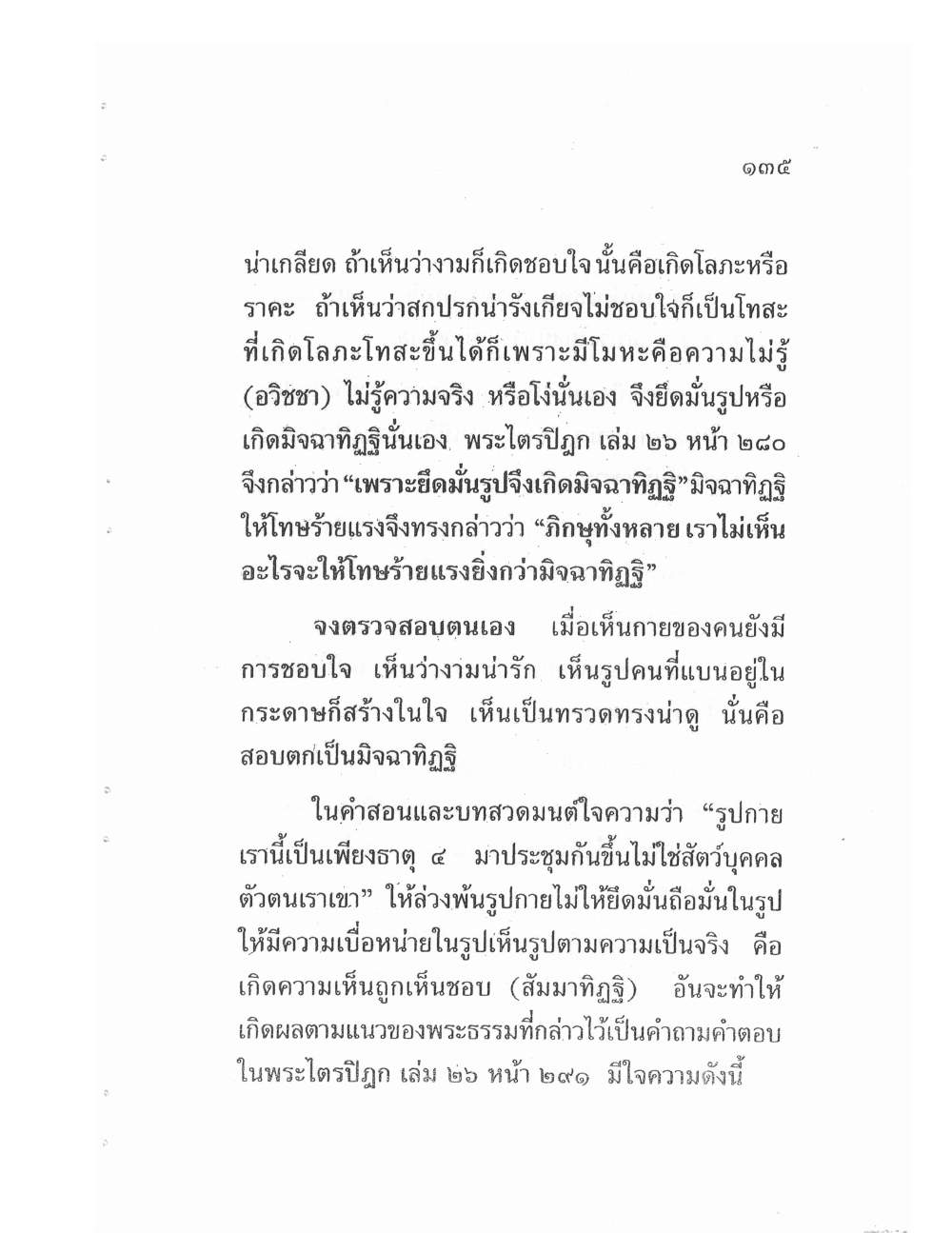
น่าเกลียด ถ้าเห็นว่างามก็เกิดชอบใจ นั้นคือเกิดโลภะหรือราคะ ถ้าเห็นว่าสกปรกน่ารังเกียจไม่ชอบใจก็เป็นโทสะ ที่เกิดโลภะโทสะขึ้นได้ก็เพราะมีโมหะคือความไม่รู้ (อวิชชา) ไม่รู้ความจริง หรือโง่นั่นเอง จึงยึดมั่นรูปหรือเกิดมิจฉาทิฏฐินั่นเอง พระไตรปิฎก เล่ม ๒๖ หน้า ๒๘๐ จึงกล่าวว่า "เพราะยึดมั่นรูปจึงเกิดมิจฉาทิฏฐิ" มิจฉาทิฏฐิให้โทษร้ายแรงจึงทรงกล่าวว่า "ภิกษุทั้งหลาย เราไม่เห็นอะไรจะให้โทษร้ายแรงยิ่งกว่ามิจฉาทิฏฐิ"
จงตรวจสอบตนเอง เมื่อเห็นกายของคนยังมีการชอบใจ เห็นว่างามน่ารัก เห็นรูปคนที่แบนอยู่ในกระดาษก็สร้างในใจ เห็นเป็นทรวดทรงน่าดู นั่นคือสอบตกเป็นมิจฉาทิฏฐิ
ในคำสอนและบทสวดมนต์ใจความว่า "รูปกายเรานี้เป็นเพียงธาตุ ๔ มาประชุมกันขึ้นไม่ใช่สัตว์บุคคลตัวตนเราเขา" ให้ล่วงพ้นรูปกายไม่ให้ยึดมั่นถือมั่นในรูป ให้มีความเบื่อหน่ายในรูปเห็นรูปตามความเป็นจริง คือเกิดความเห็นถูกเห็นชอบ (สัมมาทิฏฐิ) อันจะทำให้เกิดผลตามแนวของพระธรรมที่กล่าวไว้เป็นคำถามคำตอบในพระไตรปิฎก เล่ม ๒๖ หน้า ๒๙๑ มีใจความดังนี้
repulsive. If one sees it as beautiful, delight arises — that is greed or passion. If one sees it as filthy and repulsive and feels aversion, that is hatred. Greed and hatred arise because of delusion, which is ignorance (avijja) — not knowing the truth, or simply foolishness. Thus one clings to form, and wrong view arises. The Tipitaka, volume 26, page 280, therefore states: "Because of clinging to form, wrong view arises." Wrong view causes grave harm, hence it was said: "Monks, I see nothing that gives graver harm than wrong view."
Examine yourself: when you still feel attraction upon seeing a person's body, seeing it as beautiful and lovable, [or] see a flat image of a person on paper and yet form an impression of it in the mind, seeing it as having a fine, attractive shape — that is failing the test, that is wrong view.
In the teachings and translated chants there is a passage: "This physical body of ours is merely the four elements come together; it is not a being, a person, a self — not 'me,' not 'them.'" [The aim is] to transcend the physical body, not to cling to or grasp at form, to become disenchanted with form, to see form as it truly is — that is, to give rise to right view (samma-ditthi), which produces results in accordance with the Dhamma set out as question and answer in the Tipitaka, volume 26, page 291, with the following content:
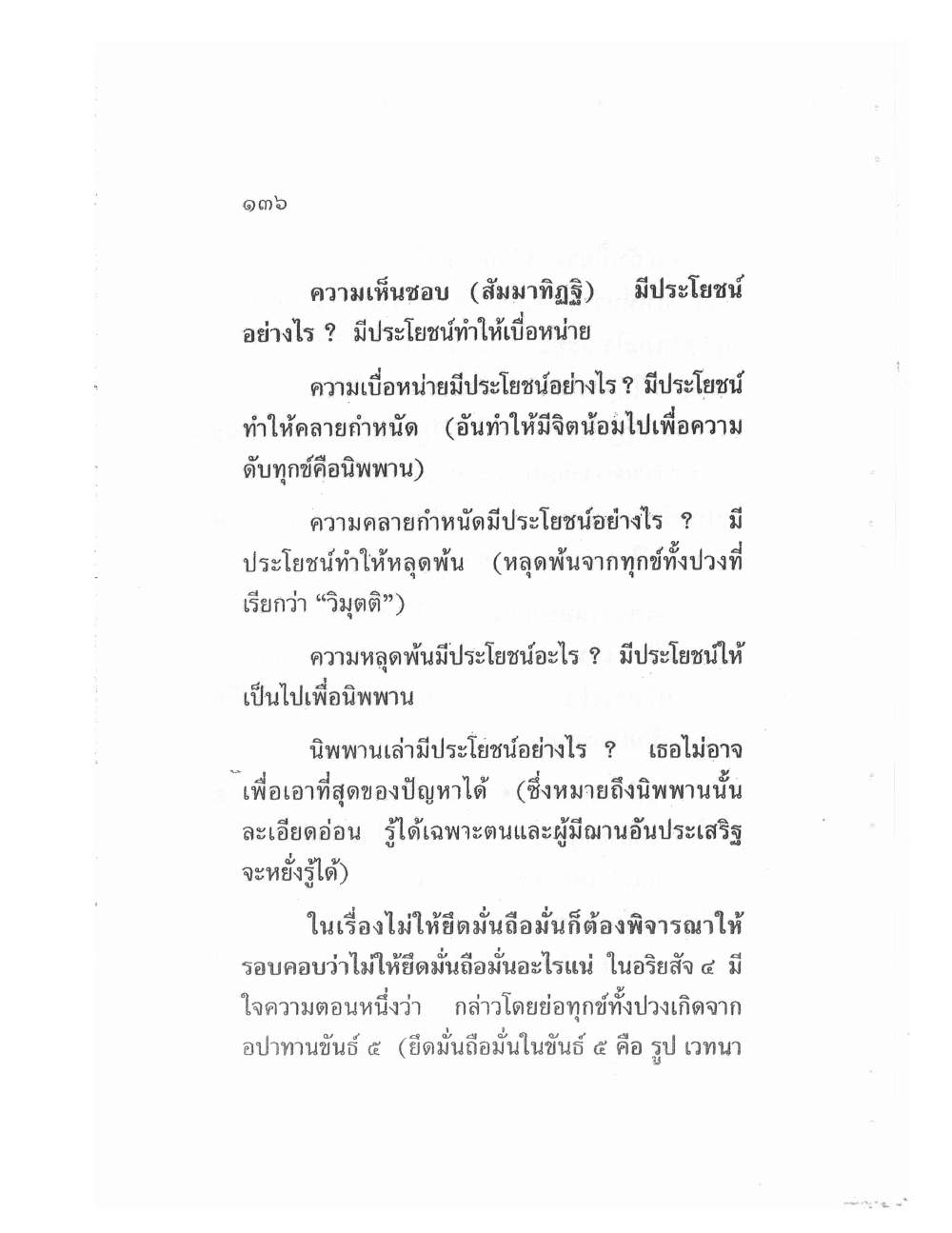
ความเห็นชอบ (สัมมาทิฏฐิ) มีประโยชน์อย่างไร ? มีประโยชน์ทำให้เบื่อหน่าย
ความเบื่อหน่ายมีประโยชน์อย่างไร ? มีประโยชน์ทำให้คลายกำหนัด (อันทำให้มีจิตน้อมไปเพื่อความดับทุกข์คือนิพพาน)
ความคลายกำหนัดมีประโยชน์อย่างไร ? มีประโยชน์ทำให้หลุดพ้น (หลุดพ้นจากทุกข์ทั้งปวงที่เรียกว่า "วิมุตติ")
ความหลุดพ้นมีประโยชน์อะไร ? มีประโยชน์ให้เป็นไปเพื่อนิพพาน
นิพพานเล่ามีประโยชน์อย่างไร ? เธอไม่อาจเพื่อเอาที่สุดของปัญหาได้ (ซึ่งหมายถึงนิพพานนั้นละเอียดอ่อน รู้ได้เฉพาะตนและผู้มีฌานอันประเสริฐจะหยั่งรู้ได้)
ในเรื่องไม่ให้ยึดมั่นถือมั่นก็ต้องพิจารณาให้รอบคอบว่าไม่ให้ยึดมั่นถือมั่นอะไรแน่ ในอริยสัจ ๔ มีใจความตอนหนึ่งว่า กล่าวโดยย่อทุกข์ทั้งปวงเกิดจากอุปาทานขันธ์ ๕ (ยึดมั่นถือมั่นในขันธ์ ๕ คือ รูป เวทนา
"What is the benefit of right view (samma-ditthi)? It has the benefit of producing disenchantment.
What is the benefit of disenchantment? It has the benefit of producing dispassion (an inclining of the mind toward the cessation of suffering, that is, Nibbana).
What is the benefit of dispassion? It has the benefit of producing liberation (liberation from all suffering, called 'vimutti').
What is the benefit of liberation? It has the benefit of leading toward Nibbana.
And what is the benefit of Nibbana itself? You cannot grasp the ultimate answer to that question [in ordinary terms] (this refers to the fact that Nibbana is extremely subtle, knowable only by oneself, fathomable only by one possessing excellent meditative attainment)."
Regarding not clinging or grasping, one must consider carefully exactly what it is one should not cling to or grasp. In the Four Noble Truths there is a passage stating that, in brief, all suffering arises from clinging to the five aggregates (upadanakkhandha) — that is, clinging to and grasping at the five aggregates, namely: form, feeling
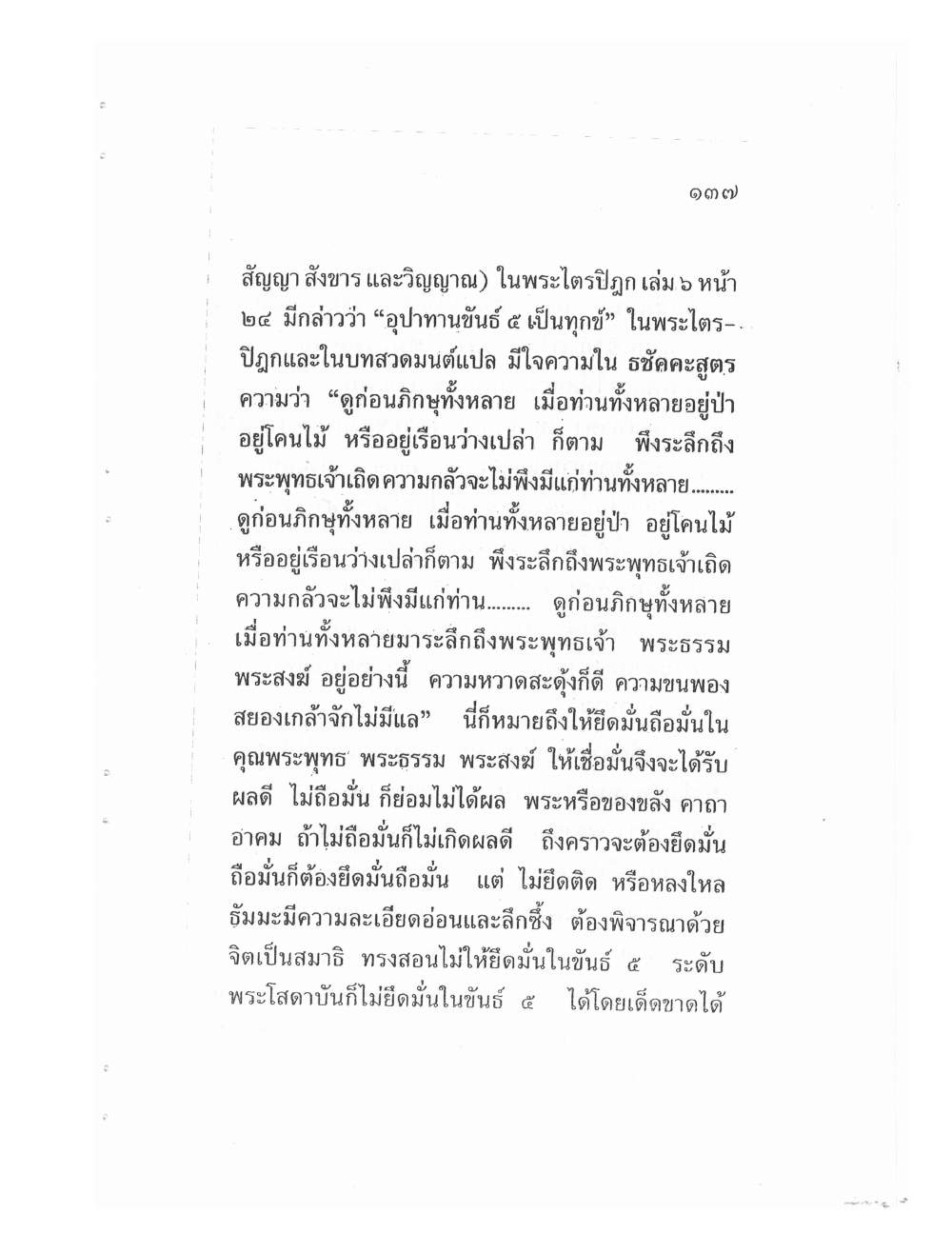
สัญญา สังขาร และวิญญาณ) ในพระไตรปิฎก เล่ม ๖ หน้า ๒๔ มีกล่าวว่า "อุปาทานขันธ์ ๕ เป็นทุกข์" ในพระไตรปิฎกและในบทสวดมนต์แปล มีใจความใน ธชัคคะสูตร ความว่า "ดูก่อนภิกษุทั้งหลาย เมื่อท่านทั้งหลายอยู่ป่า อยู่โคนไม้ หรืออยู่เรือนว่างเปล่า ก็ตาม พึงระลึกถึงพระพุทธเจ้าเถิด ความกลัวจะไม่พึงมีแก่ท่านทั้งหลาย ......... ดูก่อนภิกษุทั้งหลาย เมื่อท่านทั้งหลายอยู่ป่า อยู่โคนไม้ หรืออยู่เรือนว่างเปล่าก็ตาม พึงระลึกถึงพระพุทธเจ้าเถิด ความกลัวจะไม่พึงมีแก่ท่าน ......... ดูก่อนภิกษุทั้งหลาย เมื่อท่านทั้งหลายมาระลึกถึงพระพุทธเจ้า พระธรรม พระสงฆ์ อยู่อย่างนี้ ความหวาดสะดุ้งก็ดี ความขนพองสยองเกล้าจักไม่มีแล" นี้ก็หมายถึงให้ยึดมั่นถือมั่นในคุณพระพุทธ พระธรรม พระสงฆ์ ให้เชื่อมั่นจึงจะได้รับผลดี ไม่ถือมั่น ก็ย่อมไม่ได้ผล พระหรือของขลัง คาถาอาคม ถ้าไม่ถือมั่นก็ไม่เกิดผลดี ถึงคราวจะต้องยึดมั่นถือมั่นก็ต้องยึดมั่นถือมั่น แต่ ไม่ยึดติด หรือหลงใหล ธัมมะมีความละเอียดอ่อนและลึกซึ้ง ต้องพิจารณาด้วยจิตเป็นสมาธิ ทรงสอนไม่ให้ยึดมั่นในขันธ์ ๕ ระดับพระโสดาบันก็ไม่ยึดมั่นในขันธ์ ๕ ได้โดยเด็ดขาดได้
perception, mental formations, and consciousness). In the Tipitaka, volume 6, page 24, it is stated: "The five aggregates of clinging are suffering." In the Tipitaka, and in the translated chanting texts, there is a passage in the Dhajagga Sutta: "Monks, when you dwell in the forest, at the foot of a tree, or in an empty dwelling, you should recollect the Buddha — then fear will not arise in you ......... Monks, when you dwell in the forest, at the foot of a tree, or in an empty dwelling, you should recollect the Buddha — then fear will not arise in you ......... Monks, when you recollect the Buddha, the Dhamma, and the Sangha in this way, dread and terror, and the standing on end of body-hair, will not occur." This means one should place firm trust in the virtues of the Buddha, the Dhamma, and the Sangha, believing with confidence, so as to obtain good results; without firm trust, no results follow. As for sacred objects, amulets, mantras, and incantations — if one does not hold firm faith in them, no good result arises either. When it is necessary to hold firm faith, one must hold it firmly, but without clinging or being infatuated. The Dhamma is subtle and profound; one must contemplate it with a mind in samadhi. He taught not to cling to the five aggregates; even at the level of a Stream-enterer, one can already refrain from clinging to the five aggregates absolutely.
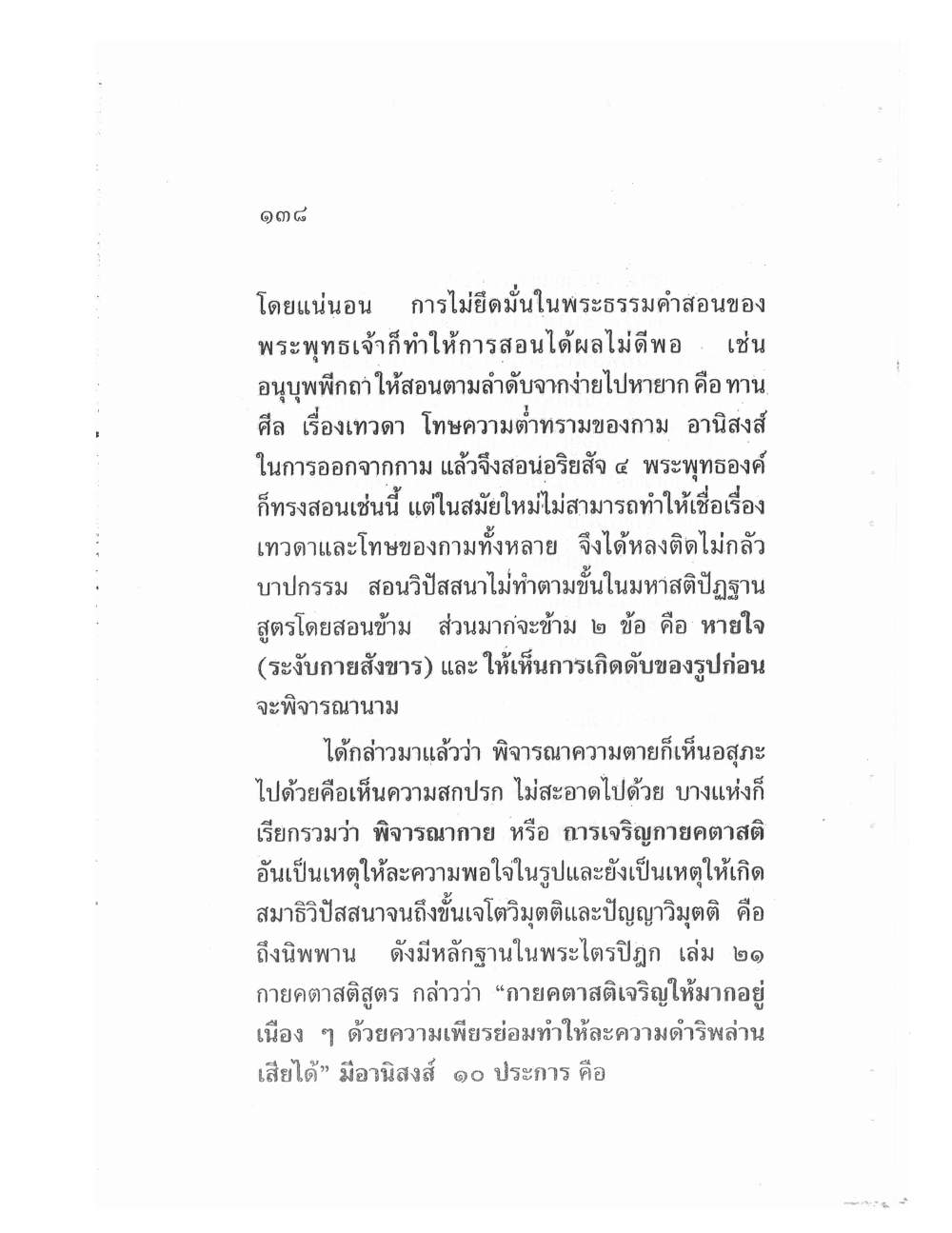
โดยแน่นอน การไม่ยึดมั่นในพระธรรมคำสอนของพระพุทธเจ้าก็ทำให้การสอนได้ผลไม่ดีพอ เช่น อนุบุพพีกถา ถ้าให้สอนตามลำดับจากง่ายไปหายาก คือ ทาน ศีล เรื่องเทวดา โทษความต่ำทรามของกาม อานิสงส์ในการออกจากกาม แล้วจึงสอนอริยสัจ ๔ พระพุทธองค์ก็ทรงสอนเช่นนี้ แต่ในสมัยใหม่ไม่สามารถทำให้เชื่อเรื่องเทวดาและโทษของกามทั้งหลาย จึงได้หลงติดไม่กลัวบาปกรรม สอนวิปัสสนาไม่ทำตามขั้นในมหาสติปัฏฐานสูตรโดยสอนข้าม ส่วนมากจะข้าม ๒ ข้อ คือ หายใจ (ระงับกายสังขาร) และให้เห็นการเกิดดับของรูปก่อนจะพิจารณานาม
ได้กล่าวมาแล้วว่า พิจารณาความตายก็เห็นอสุภะไปด้วยคือเห็นความสกปรก ไม่สะอาดไปด้วย บางแห่งก็เรียกรวมว่า พิจารณากาย หรือ การเจริญกายคตาสติ อันเป็นเหตุให้ละความพอใจในรูปและยังเป็นเหตุให้เกิดสมาธิวิปัสสนาจนถึงขั้นเจโตวิมุตติและปัญญาวิมุตติ คือถึงนิพพาน ดังมีหลักฐานในพระไตรปิฎก เล่ม ๒๑ กายคตาสติสูตร กล่าวว่า "กายคตาสติเจริญให้มากอยู่เนือง ๆ ด้วยความเพียรย่อมทำให้ละความดำริพล่านเสียได้" มีอานิสงส์ ๑๐ ประการ คือ
Certainly, failure to hold firm to the Buddha's Dhamma-teaching also makes the teaching less effective. For example, the gradual discourse (anupubbikatha), if taught in order from easy to difficult, proceeds: generosity, morality, the subject of the heavenly realms, the danger and baseness of sensual pleasure, the benefit of renouncing sensuality — and only then the Four Noble Truths. The Blessed One himself taught in this manner. But in modern times people cannot be made to believe in the heavenly realms and the dangers of sensual pleasure, and so they become infatuated and unafraid of committing sin. Vipassana is taught without following the stages set out in the Mahasatipatthana Sutta, with steps skipped — mostly two points are skipped: the breath (calming the bodily formation), and seeing the arising and ceasing of form before contemplating mental phenomena (nama).
It has already been said that contemplating death also entails seeing foulness — that is, seeing filth and impurity as well. In some places this is together called "contemplation of the body," or "the cultivation of mindfulness of the body" (kayagatasati), which is the cause for abandoning satisfaction in form, and is also the cause for the arising of samadhi and vipassana up to the stage of liberation of mind and liberation by wisdom — that is, reaching Nibbana. As evidenced in the Tipitaka, volume 21, the Kayagatasati Sutta, it states: "Mindfulness of the body, when developed abundantly and continually through diligence, causes restless, scattered thinking to be abandoned." It has ten benefits, namely:
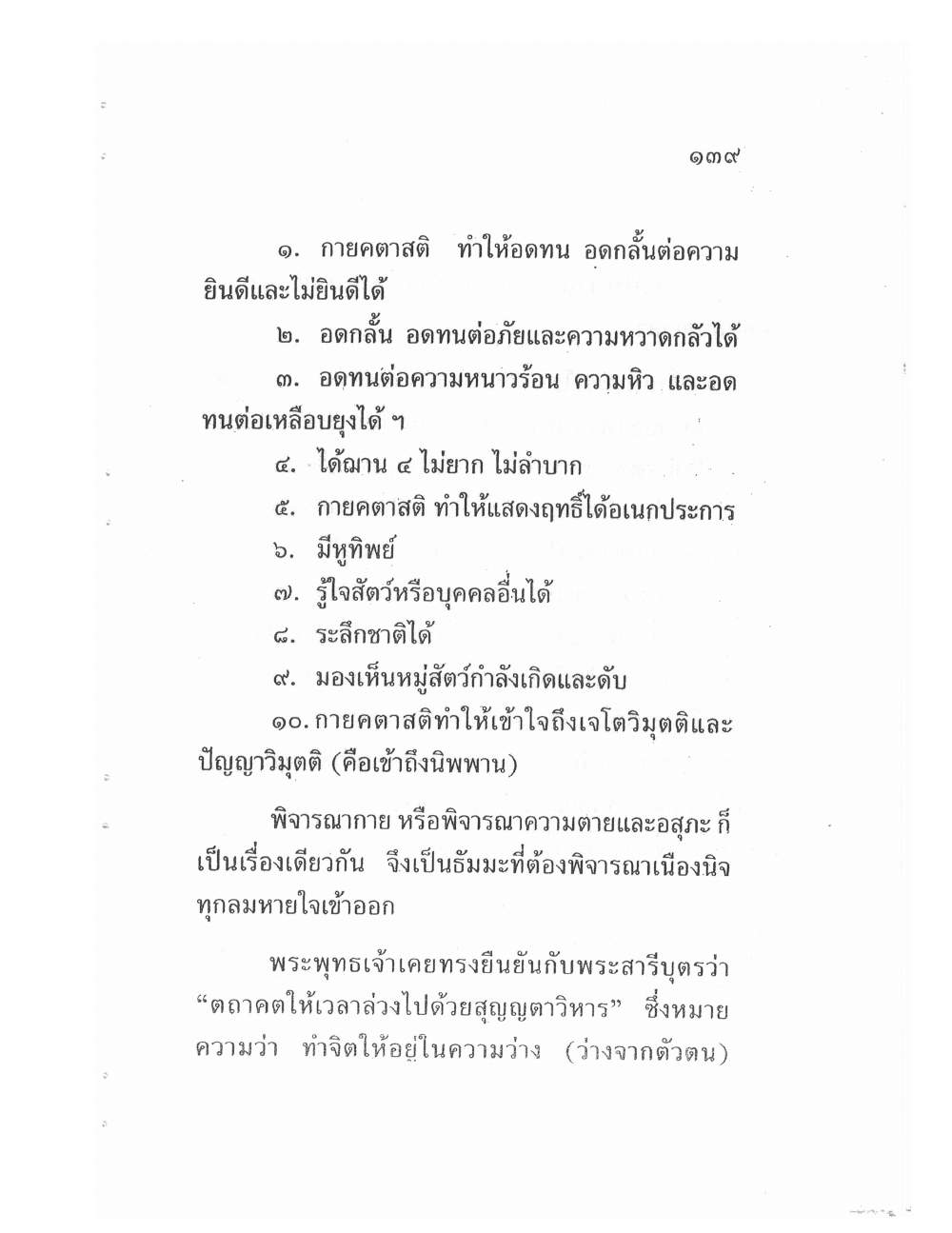
๑. กายคตาสติ ทำให้อดทน อดกลั้นต่อความยินดีและไม่ยินดีได้ ๒. อดกลั้น อดทนต่อภัยและความหวาดกลัวได้ ๓. อดทนต่อความหนาวร้อน ความหิว และอดทนต่อเหลือบยุงได้ ฯ ๔. ได้ฌาน ๔ ไม่ยาก ไม่ลำบาก ๕. กายคตาสติ ทำให้แสดงฤทธิ์ได้เอนกประการ ๖. มีหูทิพย์ ๗. รู้ใจสัตว์หรือบุคคลอื่นได้ ๘. ระลึกชาติได้ ๙. มองเห็นหมู่สัตว์กำลังเกิดและดับ ๑๐. กายคตาสติทำให้เข้าใจถึงเจโตวิมุตติและปัญญาวิมุตติ (คือเข้าถึงนิพพาน)
พิจารณากาย หรือพิจารณาความตายและอสุภะ ก็เป็นเรื่องเดียวกัน จึงเป็นธัมมะที่ต้องพิจารณาเนืองนิจทุกลมหายใจเข้าออก
พระพุทธเจ้าเคยทรงยืนยันกับพระสารีบุตรว่า "ตถาคตให้เวลาล่วงไปด้วยสุญญตาวิหาร" ซึ่งหมายความว่า ทำจิตให้อยู่ในความว่าง (ว่างจากตัวตน)
1. Mindfulness of the body enables one to endure — to bear both delight and displeasure. 2. To endure and bear danger and fear. 3. To endure cold and heat, hunger, and to endure horseflies and mosquitoes, etc. 4. To attain the four jhanas without difficulty, without hardship. 5. Mindfulness of the body enables one to display manifold psychic powers. 6. To possess the divine ear. 7. To know the minds of other beings or persons. 8. To recollect past lives. 9. To see beings passing away and being reborn. 10. Mindfulness of the body brings understanding of liberation of mind and liberation by wisdom (that is, reaching Nibbana).
Contemplation of the body, or contemplation of death and foulness, is one and the same matter; it is therefore a Dhamma that must be contemplated constantly, with every in-breath and out-breath.
The Buddha once affirmed to the Venerable Sariputta: "The Tathagata spends his time abiding in emptiness (sunnata-vihara)," which means keeping the mind dwelling in emptiness (empty of self)
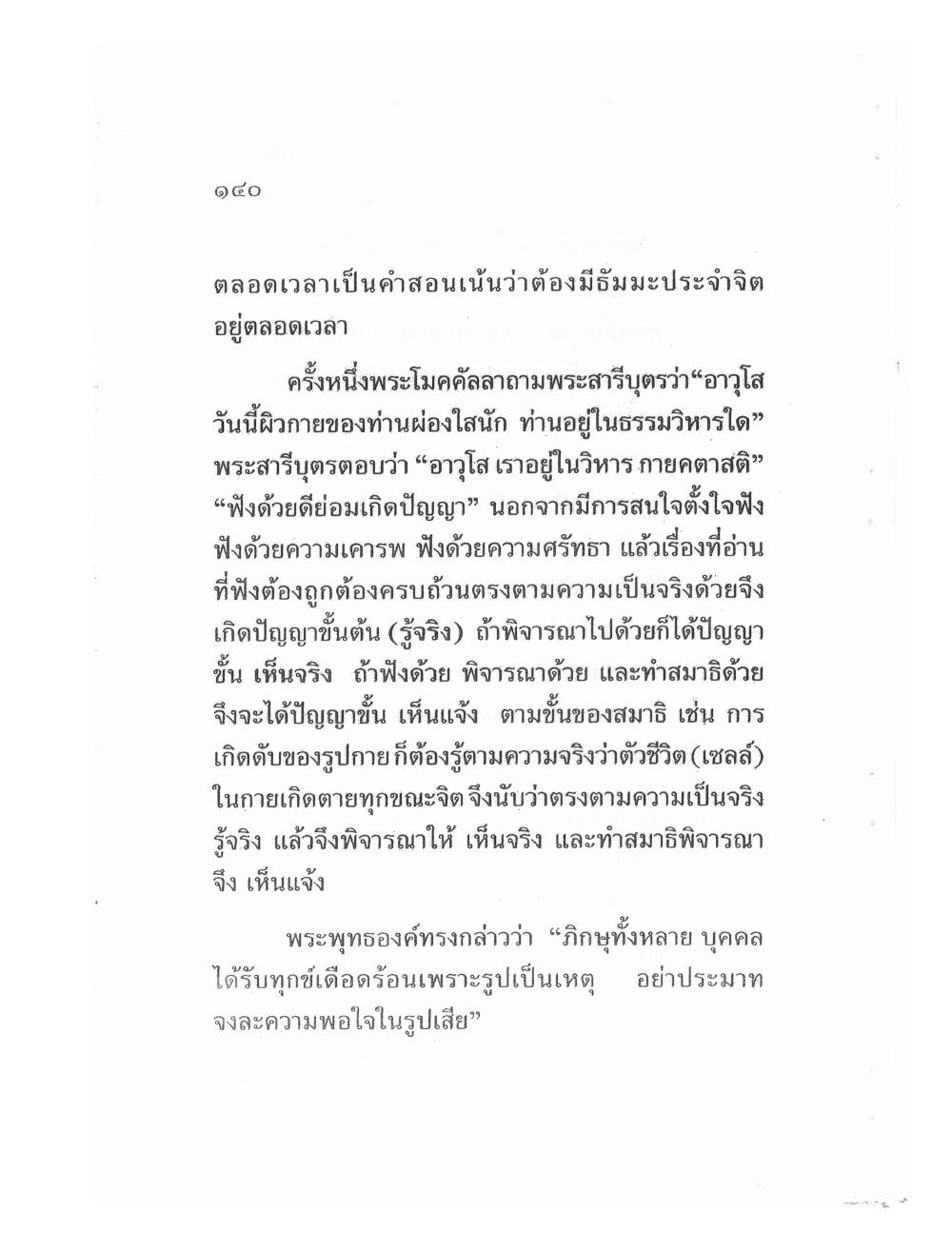
ตลอดเวลาเป็นคำสอนเน้นว่าต้องมีธัมมะประจำจิตอยู่ตลอดเวลา
ครั้งหนึ่งพระโมคคัลลาถามพระสารีบุตรว่า "อาวุโส วันนี้ผิวกายของท่านผ่องใสนัก ท่านอยู่ในธรรมวิหารใด" พระสารีบุตรตอบว่า "อาวุโส เราอยู่ในวิหาร กายคตาสติ" "ฟังด้วยดีย่อมเกิดปัญญา" นอกจากมีการสนใจตั้งใจฟัง ฟังด้วยความเคารพ ฟังด้วยความศรัทธา แล้วเรื่องที่อ่านที่ฟังต้องถูกต้องครบถ้วนตรงตามความเป็นจริงด้วยจึงเกิดปัญญาขั้นต้น (รู้จริง) ถ้าพิจารณาไปด้วยก็ได้ปัญญาขั้น เห็นจริง ถ้าฟังด้วย พิจารณาด้วย และทำสมาธิด้วย จึงจะได้ปัญญาขั้น เห็นแจ้ง ตามขั้นของสมาธิ เช่น การเกิดดับของรูปกายก็ต้องรู้ตามความจริงว่าตัวชีวิต (เซลล์) ในกายเกิดตายทุกขณะจิต จึงนับว่าตรงตามความเป็นจริง รู้จริง แล้วจึงพิจารณาให้ เห็นจริง และทำสมาธิพิจารณาจึง เห็นแจ้ง
พระพุทธองค์ทรงกล่าวว่า "ภิกษุทั้งหลาย บุคคลได้รับทุกข์เดือดร้อนเพราะรูปเป็นเหตุ อย่าประมาท จงละความพอใจในรูปเสีย"
at all times — this is a teaching emphasizing that one must have the Dhamma constantly present in the mind at all times.
Once the Venerable Moggallana asked the Venerable Sariputta: "Friend, today your complexion is remarkably clear and bright — what Dhamma-dwelling are you abiding in?" The Venerable Sariputta replied: "Friend, I am abiding in the dwelling of mindfulness of the body." "Listening well gives rise to wisdom" — besides being interested and attentive in listening, listening with respect, listening with faith, what one reads or hears must also be correct and complete, in accordance with the truth, for wisdom at the initial level ("truly knowing") to arise. If one contemplates it as well, one attains the level of wisdom of "truly seeing." If one listens, contemplates, and also practices samadhi, one then attains the level of wisdom of "clearly seeing," according to the stage of samadhi — for example, the arising and passing away of the physical body must also be known according to truth: that the living cells within the body are dying at every mind-moment; this is then said to accord with reality, to be "truly known." Then one contemplates further so as to "truly see," and practices samadhi in contemplation so as to "clearly see."
The Blessed One said: "Monks, a person receives suffering and distress because of form as the cause; do not be heedless — abandon satisfaction in form."
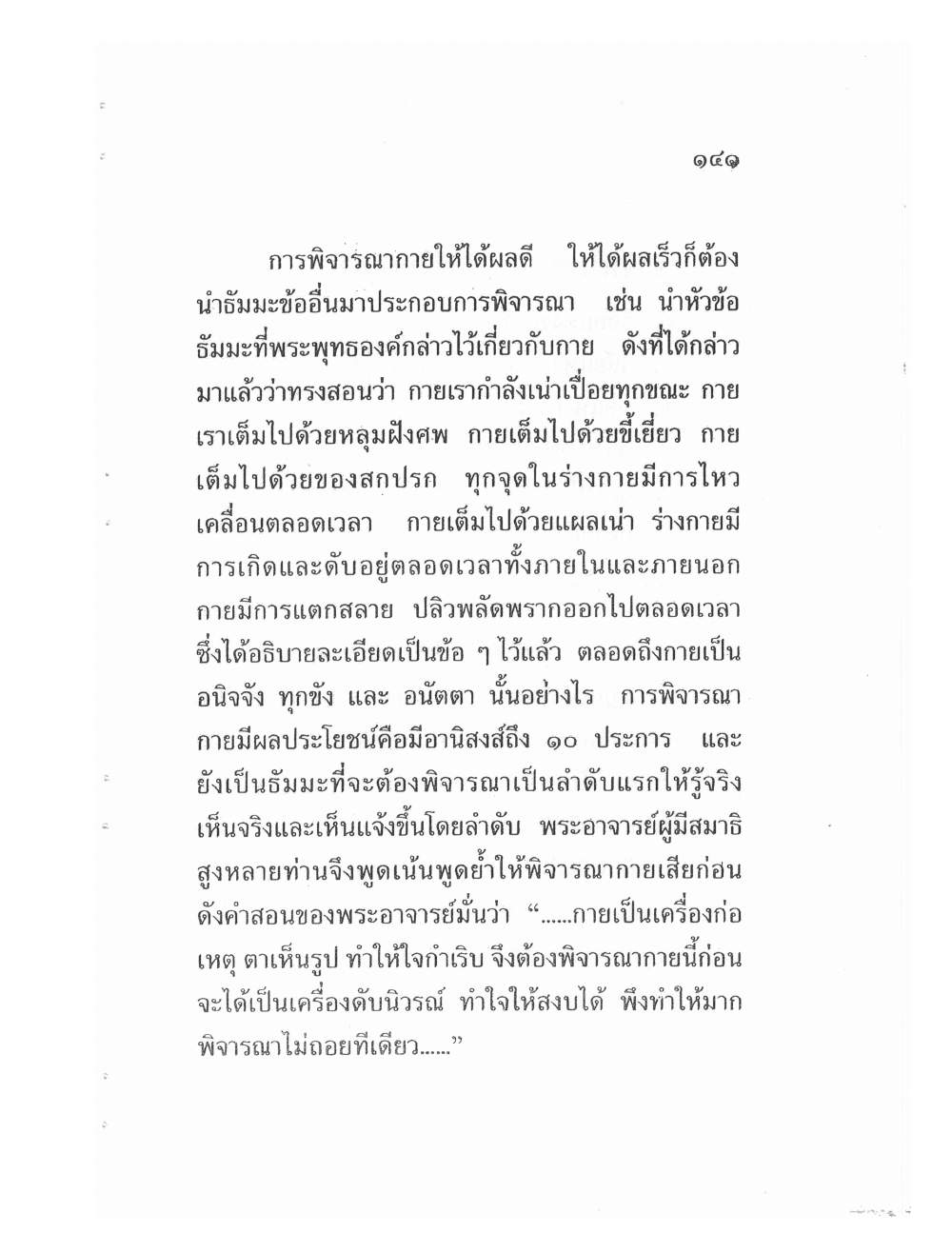
การพิจารณากายให้ได้ผลดี ให้ได้ผลเร็วก็ต้องนำธัมมะข้ออื่นมาประกอบการพิจารณา เช่น นำหัวข้อธัมมะที่พระพุทธองค์กล่าวไว้เกี่ยวกับกาย ดังที่ได้กล่าวมาแล้วว่าทรงสอนว่า กายเรากำลังเน่าเปื่อยทุกขณะ กายเราเต็มไปด้วยหลุมฝังศพ กายเต็มไปด้วยขี้เยี่ยว กายเต็มไปด้วยของสกปรก ทุกจุดในร่างกายมีการไหวเคลื่อนตลอดเวลา กายเต็มไปด้วยแผลเน่า ร่างกายมีการเกิดและดับอยู่ตลอดเวลาทั้งภายในและภายนอก กายมีการแตกสลาย ปลิวพลัดพรากออกไปตลอดเวลา ซึ่งได้อธิบายละเอียดเป็นข้อ ๆ ไว้แล้ว ตลอดถึงกายเป็นอนิจจัง ทุกขัง และ อนัตตา นั้นอย่างไร การพิจารณากายมีผลประโยชน์คือมีอานิสงส์ถึง ๑๐ ประการ และยังเป็นธัมมะที่จะต้องพิจารณาเป็นลำดับแรกให้รู้จริง เห็นจริงและเห็นแจ้งขึ้นโดยลำดับ พระอาจารย์ผู้มีสมาธิสูงหลายท่านจึงพูดเน้นพูดย้ำให้พิจารณากายเสียก่อน ดังคำสอนของพระอาจารย์มั่นว่า "......กายเป็นเครื่องก่อเหตุ ตาเห็นรูป ทำให้ใจกำเริบ จึงต้องพิจารณากายนี้ก่อนจะได้เป็นเครื่องดับนิวรณ์ ทำใจให้สงบได้ พึงทำให้มาก พิจารณาไม่ถอยทีเดียว......"
For contemplation of the body to be effective, to yield results quickly, one must also bring in other points of Dhamma to support the contemplation — for instance, bringing in the topics of Dhamma the Blessed One taught concerning the body, as already mentioned: that our body is decaying at every moment; our body is full of burial pits; the body is full of urine and excrement; the body is full of filthy things; every point in the body is constantly moving and shifting; the body is full of festering wounds; the body arises and ceases at all times both internally and externally; the body is disintegrating, being carried away and scattered at all times — which has already been explained in detail point by point — as well as how the body is impermanent, suffering, and not-self. Contemplating the body yields benefit — it has as many as ten benefits — and it is also the Dhamma that must be contemplated first in sequence, so as to progressively truly know, truly see, and clearly see. Many teachers of high samadhi therefore repeatedly emphasize contemplating the body first, as in the teaching of Venerable Ajahn Mun: "...The body is the instigator of trouble; the eye sees form, and this makes the mind become agitated. One must therefore contemplate this body first, so that it may serve to quell the hindrances and calm the mind. One should do this a great deal, and never retreat from the contemplation......"
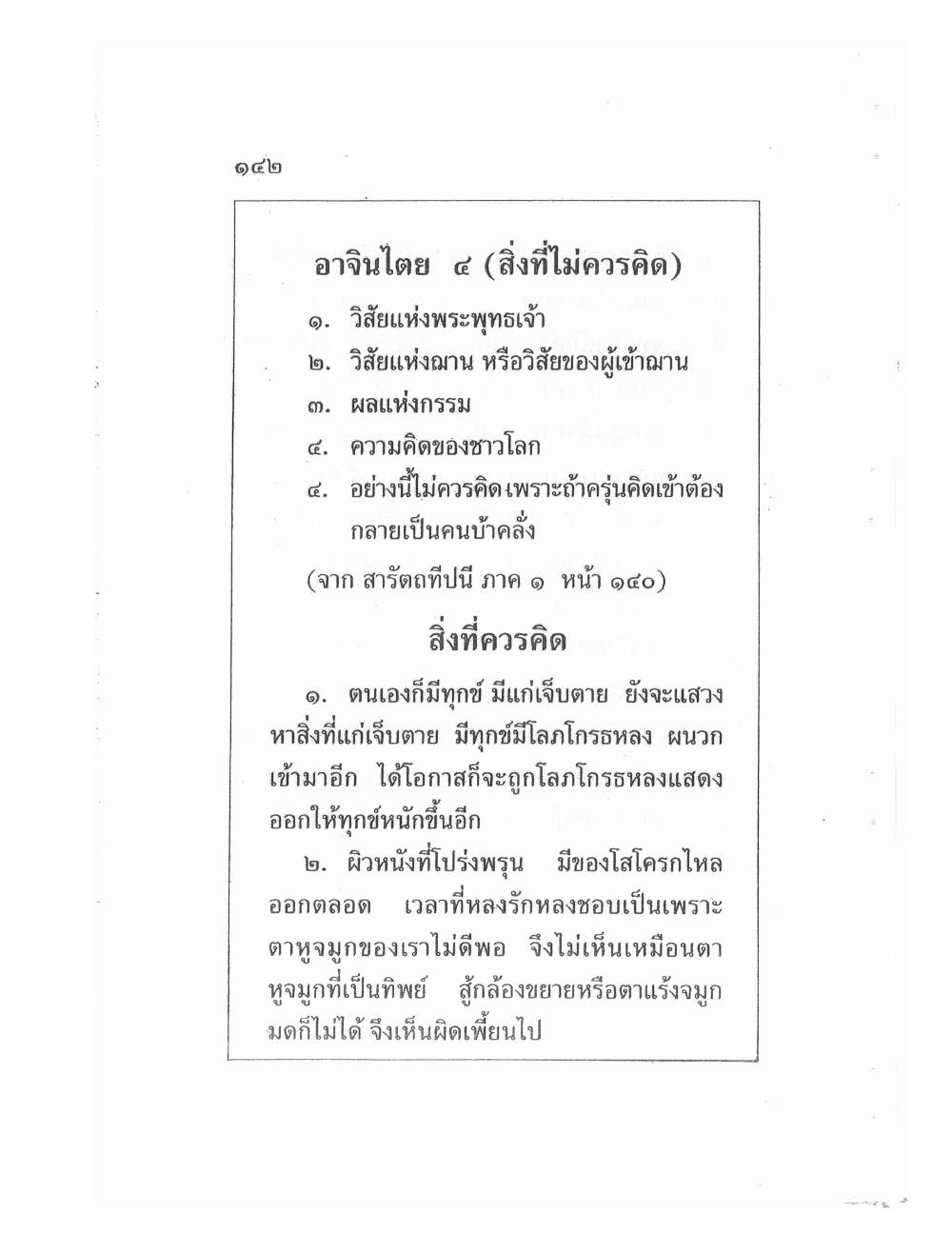
อาจินไตย ๔ (สิ่งที่ไม่ควรคิด)
๑. วิสัยแห่งพระพุทธเจ้า ๒. วิสัยแห่งฌาน หรือวิสัยของผู้เข้าฌาน ๓. ผลแห่งกรรม ๔. ความคิดของชาวโลก ๔. อย่างนี้ไม่ควรคิด เพราะถ้าครุ่นคิดเข้าต้องกลายเป็นคนบ้าคลั่ง
(จาก สารัตถทีปนี ภาค ๑ หน้า ๑๕๐)
สิ่งที่ควรคิด
๑. ตนเองก็มีทุกข์ มีแก่เจ็บตาย ยังจะแสวงหาสิ่งที่แก่เจ็บตาย มีทุกข์มีโลภโกรธหลง ผนวกเข้ามาอีก ได้โอกาสก็จะถูกโลภโกรธหลงแสดงออกให้ทุกข์หนักขึ้นอีก
๒. ผิวหนังที่โปร่งพรุน มีของโสโครกไหลออกตลอด เวลาที่หลงรักหลงชอบเป็นเพราะตาหูจมูกของเราไม่ดีพอ จึงไม่เห็นเหมือนตาหูจมูกที่เป็นทิพย์ สู้กล้องขยายหรือตาแร้งจมูกมดก็ไม่ได้ จึงเห็นผิดเพี้ยนไป
The Four Unthinkables (Things One Should Not Ponder)
1. The domain of the Buddha 2. The domain of jhana, or the domain of one who has entered jhana 3. The results of kamma 4. The speculations of the world 4. [as printed] One should not ponder such matters, because if one broods on them obsessively, one is bound to go mad.
(From Saratthadipani, Part 1, page 150)
Things One Should Ponder
1. One has suffering oneself — one has old age, sickness, and death — and yet still seeks out [a partner] who also has old age, sickness, and death; who has suffering, and greed, hatred, and delusion added on top; when the opportunity arises, one will be exposed to the display of that greed, hatred, and delusion, making one's suffering even heavier.
2. [Consider] the porous skin, with filthy matter constantly oozing out — the times one falls in love and becomes infatuated are because our eyes, ears, and nose are not good enough, and so we do not see as divine eyes, ears, and nose would see. [Our senses] cannot compete with a magnifying lens, or with a vulture's eyes or an ant's nose — hence we perceive things wrongly, mistakenly.
๑๔๓
บทที่ ๗
ประโยชน์การเดินจงกรม ประโยชน์การฝึกสมาธิ ความสามารถของสมาธิ
การเดินจงกรมมีผลดีอย่างไร
จงกรม แปลว่า อิริยาบถในการเจริญกรรมฐาน จะเดินมากน้อยตามแต่ต้องการ เมื่อจิตสงบบ้างไม่สงบบ้าง ไม่ควรเดินให้เกิน ๑ ชั่วโมง การเดินจงกรมเมื่อเดินได้ดีถูกต้องย่อมได้อานิสงส์คือ ผลดีถึง ๕ ประการ (จากพระไตรปิฎก เล่ม ๓๓) คือ
๑. เดินได้ทน ข้อนี้เป็นจริง ผู้ปฏิบัติกรรมฐานจะเห็นด้วยตนเองว่า เขาจะไม่กลัวต่อการเดินทางไกล คงจะเป็นเพราะฝึกเดินอยู่เสมอ คือว่าเป็นการฝึกเดินโดยไม่รู้ตัว
๒. ทำงานได้มาก มีพระอาจารย์เจ้าสำนักวิปัสสนากรรมฐานองค์หนึ่งทำงานได้มากและอย่าง
143
Chapter 7 The Benefits of Walking Meditation, the Benefits of Practicing Samadhi, the Capacities of Samadhi
What good effects does walking meditation have?
Jongkrom (walking meditation) means the posture used in cultivating a meditation subject (kammatthana). One walks more or less as one wishes, since the mind is sometimes calm and sometimes not; one should not walk for more than 1 hour. When walking meditation is done well and correctly, it certainly brings benefit — that is, 5 good results (from the Tipitaka, volume 33), namely:
1. One gains endurance in walking. This is true; a practitioner will see for himself that he does not fear travelling far. This is probably because he is constantly practicing walking — that is, it is a training in walking done without his even realizing it.
2. One is able to work a great deal. There was a certain teacher, head of a vipassana meditation center, who was able to work a great deal and in such a way
๑๔๔
ไม่รู้เหน็ดเหนื่อย ในวันหนึ่ง ๆ มีการสอบอารมณ์กรรมฐานศิษย์ในตอนเย็น สอนนักธรรมในเวลากลางวัน และควบคุมงานบูรณะซ่อมแซมวัดไปด้วย เมื่อมีคนเป็นห่วงในสุขภาพของท่าน ท่านกลับตอบอย่างถ่อมตนว่า เมื่อกำลังพอมีอยู่ก็ทำไป เข้าหลักที่ว่านักกรรมฐานนั้น กินน้อย นอนน้อย พูดน้อย ทำงานมาก
๓. บำบัดโรคบางอย่างได้ บาลีใช้คำว่า อปฺปาพาโธ แปลว่า ไม่ค่อยเจ็บไข้ คือร่างกายแข็งแรง โรคบางอย่างหายไปได้ด้วย
๔. อาหารย่อยง่าย บาลีว่า ปริณตโภชี การเดินจงกรมเป็นยาช่วยย่อยอาหารด้วย จึงควรเดินจงกรมหลังรับประทานอาหารด้วยถ้ามีโอกาส
๕. สมาธิที่ได้จากการเดินจงกรมตั้งอยู่ได้นาน การเดินจงกรมเป็นการปลูกสติและสมาธิ เมื่อเดินจงกรมได้ดี สติสมาธิก็เป็นไปด้วยดี ดังนั้นจึงควรเดินจงกรมก่อนนั่งสมาธิ
144
...never grew tired. Every single day he would review the meditation experiences of his students in the evening, teach Dhamma students during the day, and also oversee the restoration and repair work of the monastery. When people showed concern for his health, he would answer modestly that he simply did as much as his strength allowed. This fits the principle that a meditator eats little, sleeps little, speaks little, and works much.
3. One can cure certain illnesses. The Pali term used is "appābādho," meaning "seldom ill" — that is, the body becomes strong, and certain illnesses can also disappear.
4. Food digests easily. In Pali, "pariṇatabhojī." Walking meditation also acts as a medicine that helps digestion, so one should walk in meditation after eating, if there is an opportunity.
5. The samadhi gained from walking meditation lasts a long time. Walking meditation cultivates mindfulness and samadhi; when walking meditation is done well, mindfulness and samadhi likewise go well. For this reason, one should walk in meditation before sitting in samadhi.
๑๔๕
ประโยชน์ของการฝึกสมาธิในแง่วิทยาศาสตร์และจิตวิทยา
[decorative divider: a small diamond-and-scroll ornament]
มีบทความในหนังสือ รีดเดอร์ไดเจส ของอเมริกา ฉบับเดือนพฤษภาคม พ.ศ. ๒๕๐๘ หน้า ๘๕ มีใจความโดยย่อว่า "มนุษย์เราแต่ละคน ต่างก็มีพลังเพื่อความสมบูรณ์ นั่นคือ พลังของอารมณ์อันแจ่มใส" นายวิลเลียม เจมส์ และคณะ กล่าวว่า "อารมณ์มี ๒ ชนิด คือ อารมณ์ดี และ อารมณ์เสีย" เมื่อคนเรามีอารมณ์เสีย อวัยวะบางส่วนของร่างกายเช่น กล้ามเนื้อหรือต่อมต่าง ๆ จะถูกกระแสประสาทของสมอง กระตุ้นแรงเกินกว่าธรรมดามาก ทำให้ร่างกายเปลี่ยนแปลงไปในทางเสียหาย เกิดทุกข์โทษได้หลายอย่างทำให้เกิดโรคได้ต่าง ๆ อารมณ์เสียนั้นได้แก่ ความโกรธ ความผิดหวัง ความอาฆาต ความวิตกกังวล ความกลัว ความท้อถอย ความเศร้าโศกเสียใจ เป็นต้น เวลาโกรธกล้ามเนื้อส่วนปลายของกระเพาะอาหารจะหดตัวแน่นมากจนอาหารผ่านออก
145
The Benefits of Practicing Samadhi from the Standpoint of Science and Psychology
[decorative divider: a small diamond-and-scroll ornament]
There is an article in the American magazine Reader's Digest, May 1965 (B.E. 2508) issue, page 85, which states in summary: "Each of us human beings has within a power for wholeness — namely, the power of a bright, clear emotion." Mr. William James and colleagues stated: "There are two kinds of emotion: good emotion and bad emotion." When a person has a bad emotion, certain parts of the body — such as muscles or various glands — are stimulated by nerve impulses from the brain far more strongly than normal, causing the body to change for the worse, giving rise to many kinds of suffering and various illnesses. Bad emotions include anger, disappointment, vindictiveness, anxiety, fear, discouragement, and grief/sorrow, among others. When one is angry, the muscles at the far end of the stomach contract so tightly that food cannot pass through
๑๔๖
ไม่ได้ ลำไส้เกิดอาการเกร็ง โลหิตแข็งตัวเร็วในเวลาโกรธมาก ความดันโลหิตจะเพิ่มขึ้นอย่างรวดเร็วเท่าที่ลองวัดดู ความดันโลหิตจะเพิ่มขึ้นจาก ๑๓๐ ขึ้นเป็น ๒๓๐ หรือมากกว่านี้ก็มี การเพิ่มมาเช่นนี้เป็นผลร้ายต่อร่างกายอย่างยิ่ง บางคนต้องเจ็บป่วยลงเพราะความโกรธของตนเอง และเคยพบบ่อย ๆ ที่คนโกรธถึงขีดสุด หัวใจจะขาดโลหิตไปหล่อเลี้ยง เพราะเส้นโลหิตตีบ บางรายถึงกับเป็นลมเสียชีวิตไปก็มี
อารมณ์ดี คือ จิตที่แจ่มใสสดชื่น และเป็นอารมณ์ที่ตรงกันข้ามกับอารมณ์เสีย คนที่มีอารมณ์ดีอยู่เสมอ เป็นยาขนานเอกที่ทำให้ร่างกายมีความสุขสมบูรณ์เท่า ๆ กับยาปฏิชีวนะหรือเป็นพวกยาฮอร์โมนและคอร์ตีโซน วิธีทำให้ร่างกายผลิตฮอร์โมนจำนวนพอดี เพื่อควบคุมให้ร่างกายเป็นปกติสุขดีนั้นก็คือการมีอารมณ์ดีอยู่เสมอ"
อารมณ์ดีนั้นย่อมเกิดขึ้นได้อย่างแน่นอนจากการฝึกสมาธิ ดังที่ได้กล่าวมาแล้ว
146
[...cannot pass through] — the intestines go into spasm, and blood clots more quickly during intense anger. Blood pressure rises very rapidly, as can be verified by testing: it can rise from 130 up to 230 or even higher. Such a rise is extremely harmful to the body. Some people become ill purely from their own anger, and it has often been found that when a person's anger reaches its peak, the heart is deprived of the blood that nourishes it because the blood vessels narrow; in some cases a person even collapses and dies from it.
Good emotion is a mind that is bright and fresh, the emotion directly opposite to bad emotion. A person who is constantly in good emotion possesses a supreme medicine that gives the body health and completeness equal to that of antibiotics, or of hormone and cortisone drugs. The way to make the body produce hormones in just the right amount, so as to keep the body in normal, healthy balance, is precisely to be constantly in good emotion."
Good emotion is certain to arise from the practice of samadhi, as has already been described.
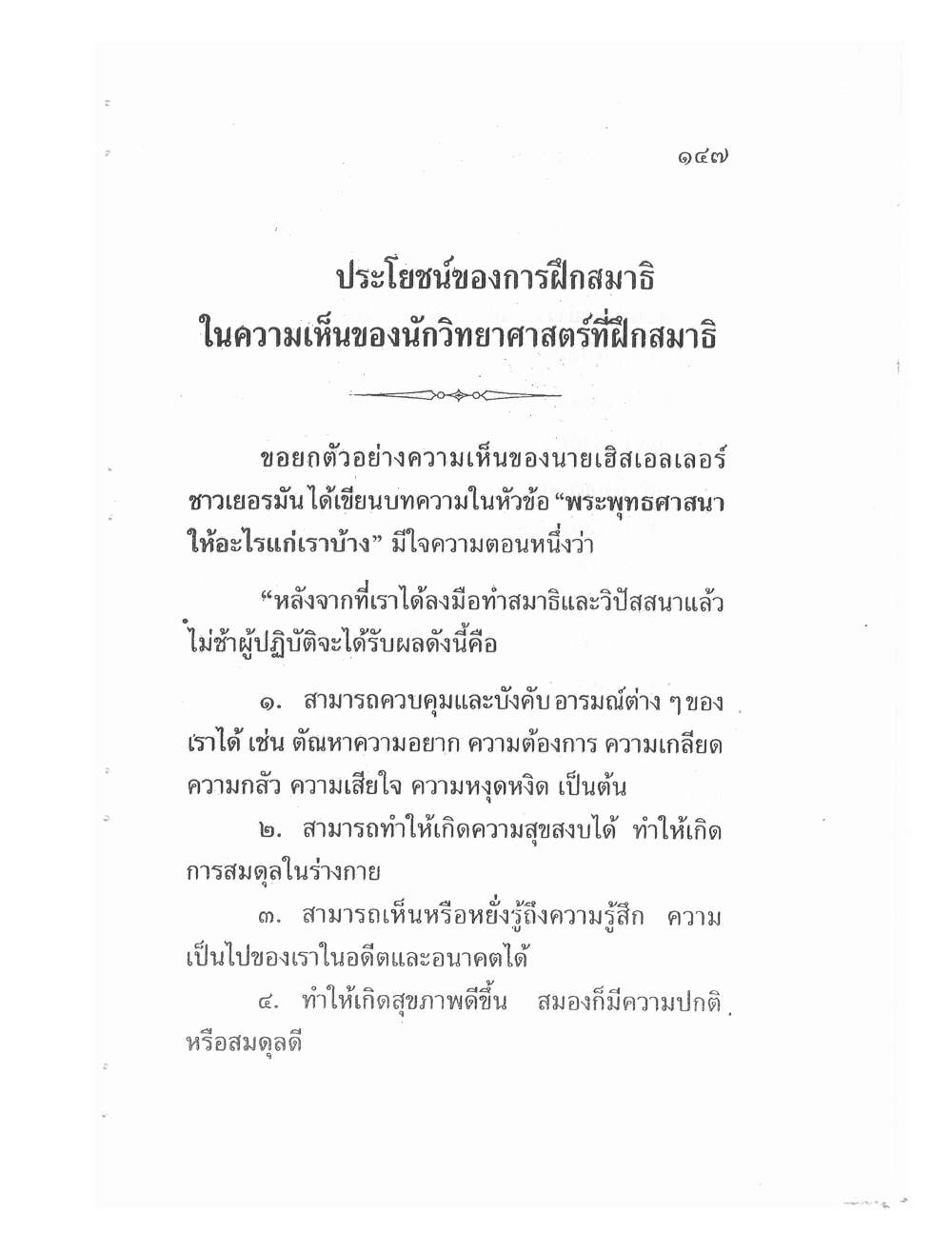
๑๔๗
ประโยชน์ของการฝึกสมาธิในความเห็นของนักวิทยาศาสตร์ที่ฝึกสมาธิ
[decorative divider: a small diamond-and-scroll ornament]
ขอยกตัวอย่างความเห็นของนายเฮิสเอลเลอร์ ชาวเยอรมัน ได้เขียนบทความในหัวข้อ "พระพุทธศาสนาให้อะไรแก่เราบ้าง" มีใจความตอนหนึ่งว่า
"หลังจากที่เราได้ลงมือทำสมาธิและวิปัสสนาแล้วไม่ช้าผู้ปฏิบัติจะได้รับผลดังนี้คือ
๑. สามารถควบคุมและบังคับ อารมณ์ต่าง ๆของเราได้ เช่น ตัณหาความอยาก ความต้องการ ความเกลียด ความกลัว ความเสียใจ ความหงุดหงิด เป็นต้น
๒. สามารถทำให้เกิดความสุขสงบได้ ทำให้เกิดการสมดุลในร่างกาย
๓. สามารถเห็นหรือหยั่งรู้ถึงความรู้สึก ความเป็นไปของเราในอดีตและอนาคตได้
๔. ทำให้เกิดสุขภาพดีขึ้น สมองก็มีความปกติ หรือสมดุลดี
147
The Benefits of Practicing Samadhi in the View of Scientists Who Practice Samadhi
[decorative divider: a small diamond-and-scroll ornament]
Let me give as an example the view of a Mr. Heisseler (เฮิสเอลเลอร์ in the Thai text), a German who wrote an article on the topic "What Does Buddhism Give Us?" It states in part:
"After we take up the practice of samadhi and vipassana, before long the practitioner will obtain the following results:
1. One can control and govern one's various emotions — such as craving and desire (tanha), wanting, hatred, fear, sorrow, and irritability, among others.
2. One can bring about peaceful happiness, producing balance within the body.
3. One can see or intuitively know one's feelings and the course of one's past and future.
4. It brings about improved health; the brain too becomes normal, or well balanced.
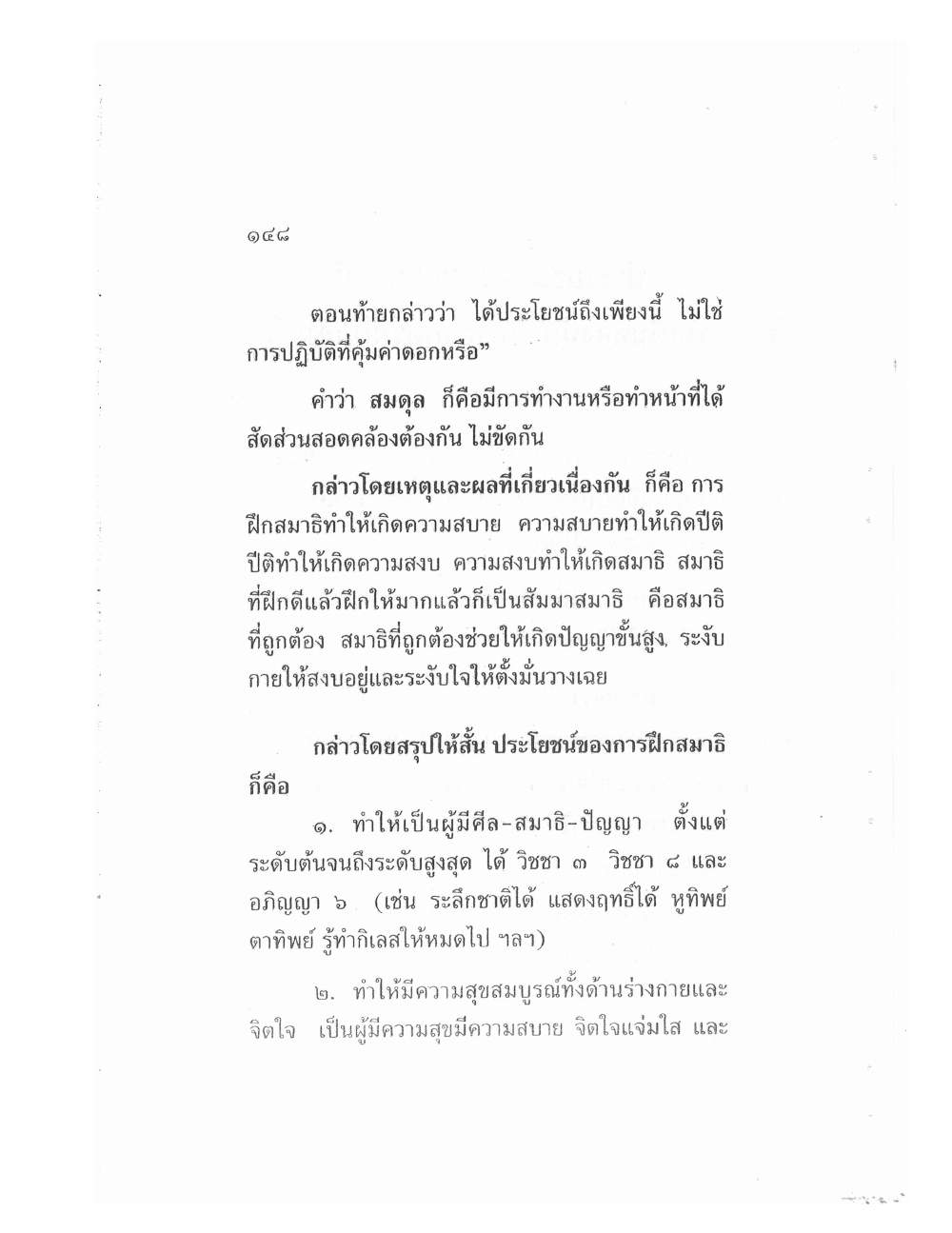
๑๔๘
ตอนท้ายกล่าวว่า ได้ประโยชน์ถึงเพียงนี้ ไม่ใช่การปฏิบัติที่คุ้มค่าดอกหรือ"
คำว่า สมดุล ก็คือมีการทำงานหรือทำหน้าที่ได้สัดส่วนสอดคล้องต้องกัน ไม่ขัดกัน
กล่าวโดยเหตุและผลที่เกี่ยวเนื่องกัน ก็คือ การฝึกสมาธิทำให้เกิดความสบาย ความสบายทำให้เกิดปีติ ปีติทำให้เกิดความสงบ ความสงบทำให้เกิดสมาธิ สมาธิที่ฝึกดีแล้วฝึกให้มากแล้วก็เป็นสัมมาสมาธิ คือสมาธิที่ถูกต้อง สมาธิที่ถูกต้องช่วยให้เกิดปัญญาขั้นสูง ระงับกายให้สงบอยู่และระงับใจให้ตั้งมั่นวางเฉย
กล่าวโดยสรุปให้สั้น ประโยชน์ของการฝึกสมาธิก็คือ
๑. ทำให้เป็นผู้มีศีล-สมาธิ-ปัญญา ตั้งแต่ระดับต้นจนถึงระดับสูงสุด ได้ วิชชา ๓ วิชชา ๘ และอภิญญา ๖ (เช่น ระลึกชาติได้ แสดงฤทธิ์ได้ หูทิพย์ ตาทิพย์ รู้ทำกิเลสให้หมดไป ฯลฯ)
๒. ทำให้มีความสุขสมบูรณ์ทั้งด้านร่างกายและจิตใจ เป็นผู้มีความสุขมีความสบาย จิตใจแจ่มใส และ
148
He concludes by saying: "Having gained benefits as great as this — is this not indeed a practice well worth it?"
The word "balance" means that functions or duties are carried out in proportion, in harmony with one another, without conflict.
Speaking in terms of connected cause and effect: the practice of samadhi gives rise to ease; ease gives rise to rapture (piti); rapture gives rise to calm; calm gives rise to samadhi. Samadhi that has been well trained and trained extensively becomes sammasamadhi — that is, right samadhi. Right samadhi helps generate higher wisdom, stills the body into calm, and stills the mind into steady equanimity.
To summarize briefly, the benefits of practicing samadhi are:
1. It makes one a person possessing morality-samadhi-wisdom (sila-samadhi-panna), from the beginning level up to the highest level, attaining the Three Knowledges (vijja 3), the Eight Knowledges (vijja 8), and the Six Higher Powers (abhinna 6) (such as: recalling past lives, displaying supernormal powers, the divine ear, the divine eye, and knowing how to eliminate defilements entirely, etc.)
2. It brings about happiness complete in both body and mind — one becomes a person of happiness and ease, with a bright, clear mind, and
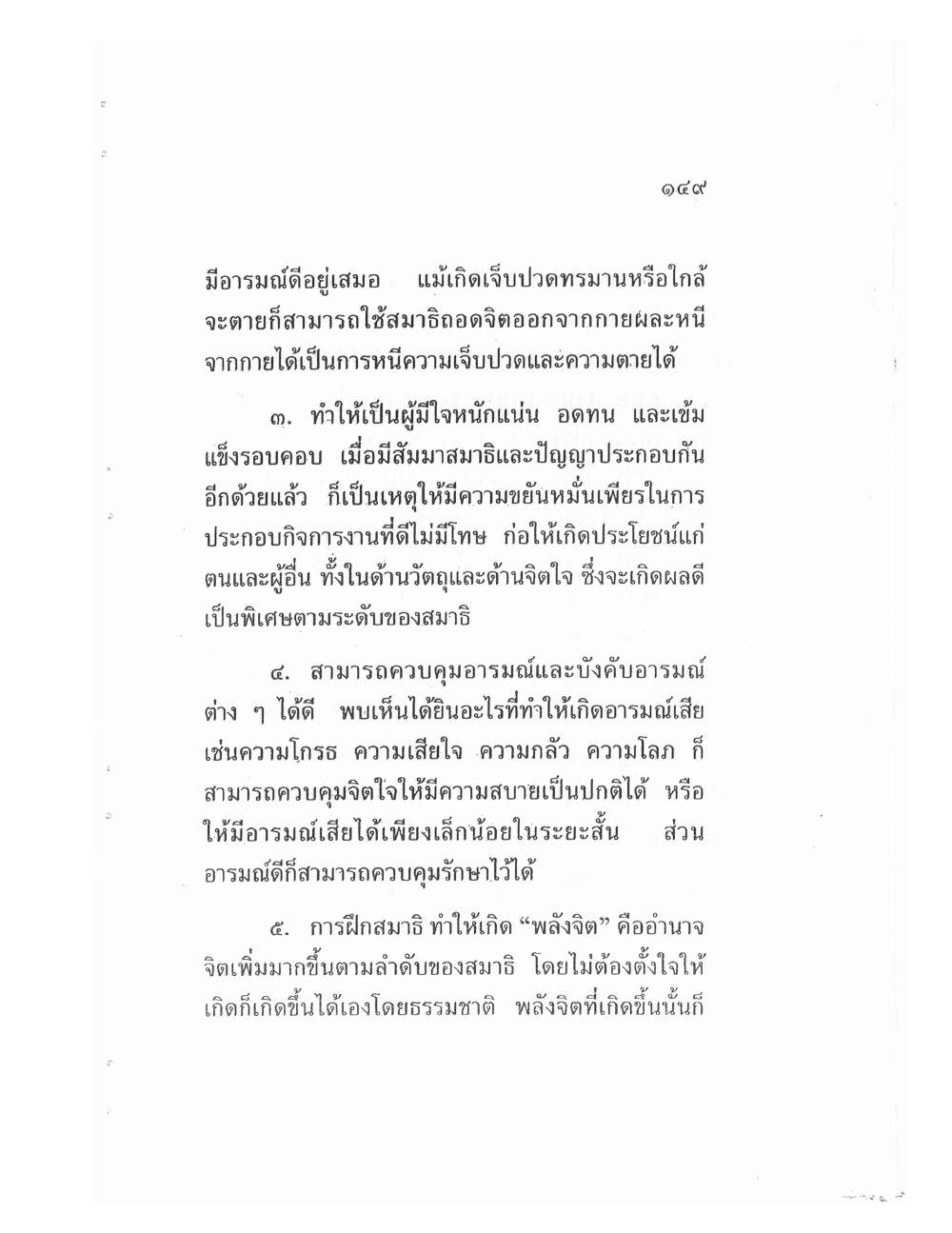
๑๔๙
มีอารมณ์ดีอยู่เสมอ แม้เกิดเจ็บป่วยทรมานหรือใกล้จะตายก็สามารถใช้สมาธิถอดจิตออกจากกายผละหนีจากกายได้เป็นการหนีความเจ็บป่วยและความตายได้
๓. ทำให้เป็นผู้มีใจหนักแน่น อดทน และเข้มแข็งรอบคอบ เมื่อมีสัมมาสมาธิและปัญญาประกอบกันอีกด้วยแล้ว ก็เป็นเหตุให้มีความขยันหมั่นเพียรในการประกอบกิจการงานที่ดีไม่มีโทษ ก่อให้เกิดประโยชน์แก่ตนและผู้อื่น ทั้งในด้านวัตถุและด้านจิตใจ ซึ่งจะเกิดผลดีเป็นพิเศษตามระดับของสมาธิ
๔. สามารถควบคุมอารมณ์และบังคับอารมณ์ต่าง ๆ ได้ดี พบเห็นได้ยินอะไรที่ทำให้เกิดอารมณ์เสีย เช่นความโกรธ ความเสียใจ ความกลัว ความโลภ ก็สามารถควบคุมจิตใจให้มีความสบายเป็นปกติได้ หรือให้มีอารมณ์เสียได้เพียงเล็กน้อยในระยะสั้น ส่วนอารมณ์ดีก็สามารถควบคุมรักษาไว้ได้
๕. การฝึกสมาธิ ทำให้เกิด "พลังจิต" คืออำนาจจิตเพิ่มมากขึ้นตามลำดับของสมาธิ โดยไม่ต้องตั้งใจให้เกิดก็เกิดขึ้นได้เองโดยธรรมชาติ พลังจิตที่เกิดขึ้นนั้นก็
149
[...one becomes a person] always in good emotion. Even when suffering pain and illness, or nearing death, one can use samadhi to draw the mind out of the body and withdraw from the body, thereby escaping suffering and death.
3. It makes one steadfast, patient, and strong and thorough in mind. When right samadhi (sammasamadhi) is combined together with wisdom as well, this causes one to be diligent and persevering in undertaking good, blameless work, producing benefit for oneself and others, both materially and mentally — yielding especially good results according to the level of one's samadhi.
4. One can control and govern one's various emotions well. On encountering, seeing, or hearing anything that would give rise to bad emotion — such as anger, sorrow, fear, or greed — one is able to keep the mind at ease and normal, or to experience bad emotion only slightly and briefly. As for good emotion, one is able to maintain and preserve it.
5. The practice of samadhi gives rise to "mind power" (palang chit) — that is, mental power that increases progressively with the level of samadhi, arising of itself naturally, without needing to be deliberately willed. This mind power that arises
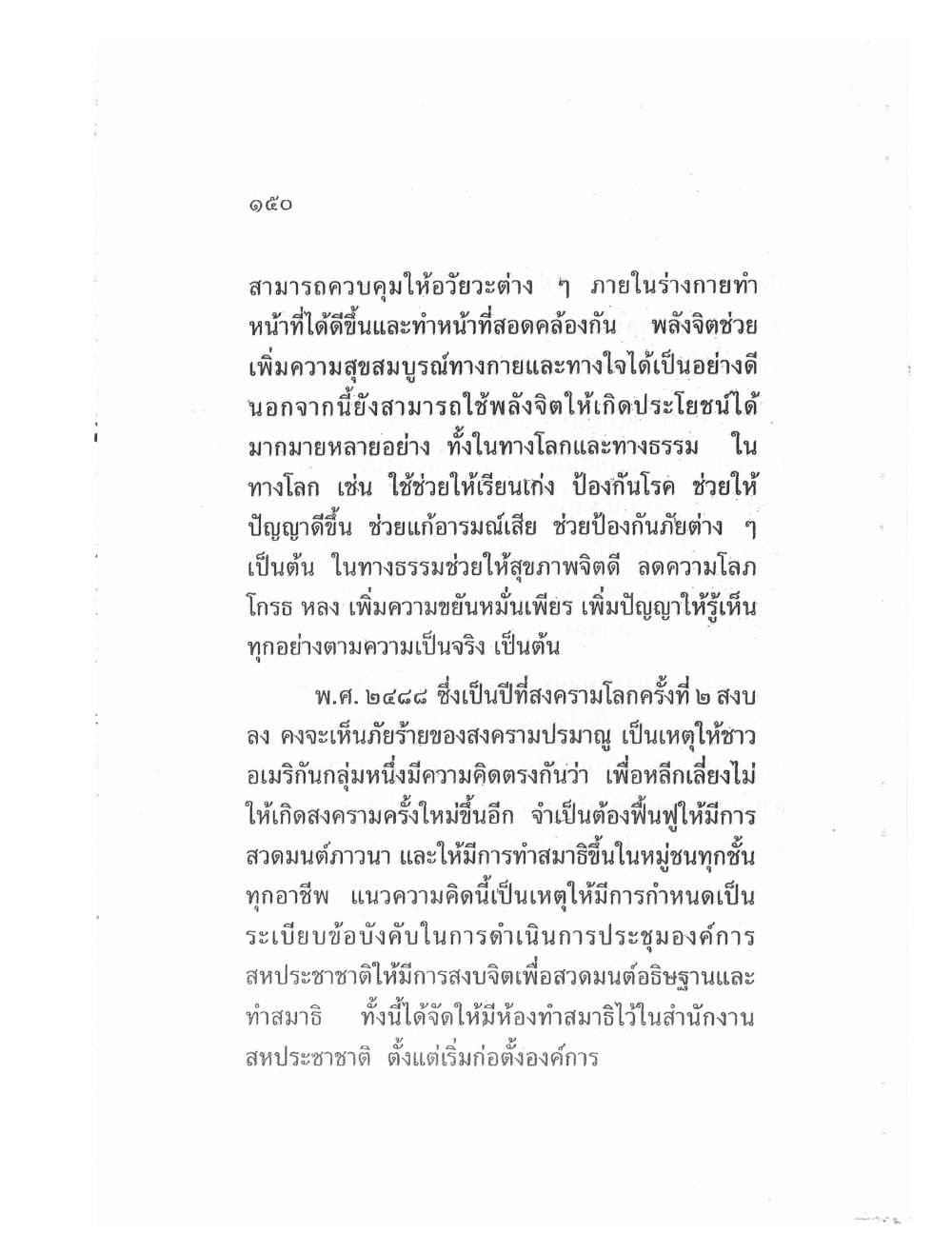
๑๕๐
สามารถควบคุมให้อวัยวะต่าง ๆ ภายในร่างกายทำหน้าที่ได้ดีขึ้นและทำหน้าที่สอดคล้องกัน พลังจิตช่วยเพิ่มความสุขสมบูรณ์ทางกายและทางใจได้เป็นอย่างดี นอกจากนี้ยังสามารถใช้พลังจิตให้เกิดประโยชน์ได้มากมายหลายอย่าง ทั้งในทางโลกและทางธรรม ในทางโลก เช่น ใช้ช่วยให้เรียนเก่ง ป้องกันโรค ช่วยให้ปัญญาดีขึ้น ช่วยแก้อารมณ์เสีย ช่วยป้องกันภัยต่าง ๆ เป็นต้น ในทางธรรมช่วยให้สุขภาพจิตดี ลดความโลภ โกรธ หลง เพิ่มความขยันหมั่นเพียร เพิ่มปัญญาให้รู้เห็นทุกอย่างตามความเป็นจริง เป็นต้น
พ.ศ. ๒๔๘๘ ซึ่งเป็นปีที่สงครามโลกครั้งที่ ๒ สงบลง คงจะเห็นภัยร้ายของสงครามปรมาณู เป็นเหตุให้ชาวอเมริกันกลุ่มหนึ่งมีความคิดตรงกันว่า เพื่อหลีกเลี่ยงไม่ให้เกิดสงครามครั้งใหม่ขึ้นอีก จำเป็นต้องฟื้นฟูให้มีการสวดมนต์ภาวนา และให้มีการทำสมาธิขึ้นในหมู่ชนทุกชั้นทุกอาชีพ แนวความคิดนี้เป็นเหตุให้มีการกำหนดเป็นระเบียบข้อบังคับในการดำเนินการประชุมองค์การสหประชาชาติให้มีการสงบจิตเพื่อสวดมนต์อธิษฐานและทำสมาธิ ทั้งนี้ได้จัดให้มีห้องทำสมาธิไว้ในสำนักงานสหประชาชาติ ตั้งแต่เริ่มก่อตั้งองค์การ
150
[This mind power] enables one to control the various organs within the body so that they function better and function in coordination with one another. Mind power greatly helps increase completeness of happiness in both body and mind. Besides this, mind power can also be used to bring about benefit in many other ways, both in worldly and in Dhamma matters. In worldly matters, for example, it can help one study well, prevent illness, improve wisdom, dispel bad emotion, and guard against various dangers, among other things. In Dhamma matters, it improves mental health, reduces greed, anger, and delusion, increases diligence and perseverance, and increases wisdom so as to know and see everything as it truly is, among other things.
In B.E. 2488 (1945), the year the Second World War ended, seeing no doubt the terrible danger of atomic warfare, a group of Americans came to a shared conclusion: in order to avoid the outbreak of another new war, it was necessary to revive the practice of chanting and prayer, and to establish the practice of samadhi among people of every class and every profession. This line of thinking led to the setting of rules and regulations for the proceedings of the United Nations organization, requiring that the mind be stilled for prayer, invocation, and meditation. To this end, a meditation room was set up within the United Nations headquarters from the very founding of the organization.
๑๕๑
จิต ใจ วิญญาณ หรือ มโน มีความหมายถึงสิ่งเดียวกัน แต่นิยมใช้ในโอกาสต่างกันอยู่บ้าง เช่น จิตของคนที่ตายไปแล้วนิยมเรียกว่า วิญญาณ เป็นต้น จิตเป็นพลังงานพิเศษและเป็นธรรมชาติรู้
เมื่อจิตเป็นสมาธิก็จะมีอำนาจหรือพลังในตัว แต่มีอยู่ในอาการสงบ ทั้งจิตและอำนาจจิต เมื่อสมาธิสูงขึ้น อำนาจหรือพลังของจิตก็เพิ่มขึ้นตามส่วน การแบ่งขั้นตอนของสมาธิและอำนาจจิตแบ่งได้หลายอย่าง หลายประเภท แต่แบ่งแบบง่าย ๆ ซึ่งเป็นที่รู้กันส่วนมากก็คือ สมาธิขั้นต้น ขั้นกลาง และขั้นสูง ส่วนอำนาจจิตก็เรียกเป็นอำนาจจิตขั้นต้น ขั้นกลาง และขั้นสูง
อำนาจจิต หรือจิตที่เป็นสมาธิอยู่ เมื่อควบคุมให้สงบนิ่งอยู่ได้นาน ๆ สมาธิก็สูงขึ้นได้ อำนาจจิตก็ค่อย ๆ สูงขึ้นไปตามส่วน เมื่อใช้สมาธิหรืออำนาจจิตก็จะปรากฏผลต่าง ๆ ที่แปลก ในปัจจุบันประเทศที่เจริญทุ่มงบประมาณระดับชาติค้นคว้าทางจิตเพื่อใช้พลังจิตในทางวิทยาศาสตร์ เช่น ใช้การเห็นทางจิตดูเหตุการณ์ล่วงหน้าหาแหล่งแร่ธาตุและน้ำมัน ใช้พลังจิตบังคับกลไกต่าง ๆ ใช้ติดต่อทางจิตเพื่อการสื่อสารระยะไกล และติดต่อหาความรู้จากโลกอื่นที่เจริญมากกว่า
151
Chit (mind), jai (heart), winyan (consciousness), and mano (mind-faculty) all refer to the same thing, though they are conventionally used on somewhat different occasions — for example, the mind of a person who has died is conventionally called "winyan," among other usages. Mind is a special form of energy and is by nature a knowing thing.
When the mind is in samadhi it possesses power or strength within itself, but this exists in a state of calm — both the mind and the power of the mind. As samadhi rises higher, the power or strength of the mind increases correspondingly. The stages of samadhi and mind-power can be divided in many different ways and categories, but the simple division most commonly known is: samadhi at the beginning, middle, and high level. Correspondingly, mind-power is also called beginning-level, middle-level, and high-level mind-power.
Mind-power, or the mind that abides in samadhi — when controlled to remain calm and still for a long time, samadhi can rise higher, and mind-power gradually rises correspondingly. When samadhi or mind-power is used, various strange results appear. At present, developed countries devote national-level budgets to research into the mind in order to apply mind-power for scientific purposes — for example, using clairvoyant sight to foresee events in advance in order to locate deposits of minerals and oil; using mind-power to control various mechanisms; using mental contact for long-distance communication; and making contact to gain knowledge from other, more advanced worlds.
๑๕๒
สามัญผล - ที่เห็นประจักษ์
[decorative divider: a small diamond-and-scroll ornament]
ความสามารถของสมาธิขั้นต้น อำนาจจิตขั้นต้นจะช่วยให้มีความสามารถทั้งทางกายและทางจิตใจดีขึ้นกว่าปกติ เพิ่มความเข้มแข็งความอดทนและความขยันหมั่นเพียร ช่วยให้มีความจำดีมีสุขภาพดี เพิ่มความรู้ความเข้าใจในวิชาการต่าง ๆ ดีขึ้น ขวัญและกำลังใจดีขึ้น ในกรณีพิเศษหรือการทดสอบอำนาจจิตขั้นนี้ สามารถทดลองฟันหรือแทงด้วยแรงคนไม่เข้า ไม่มีอันตราย น้ำมันที่กำลังเดือดเอามือจุ่มลงไปได้ตักกินได้โดยไม่มีอันตราย สามารถเดินลุยไปบนถ่านที่ติดไฟโดยไม่ต้องใส่รองเท้า สามารถเอามือจับโซ่ขนาดใหญ่ที่เผาไฟจนแดงได้ หรือเอามือกอบขึ้นได้ ใช้ในการรักษาโรคได้ หรือช่วยส่งเสริมการรักษาอย่างอื่นให้โรคหายเร็วขึ้น ใช้ในการสะกดจิตได้ ช่วยให้มองเห็นภาพสิ่งของหรือเหตุการณ์ในปัจจุบันและอนาคตอันใกล้ได้ แต่ก็เป็นภาพเงา ๆ ยังไม่ชัดเจนเหมือนสมาธิขั้นกลาง จึงมีส่วนผิดบ้างถูกบ้าง การใช้อำนาจจิตได้ต่าง ๆ ดังกล่าวมานี้ สามารถเรียนรู้
152
Common Fruits — Which Are Plainly Evident
[decorative divider: a small diamond-and-scroll ornament]
The capacity of beginning-level samadhi: beginning-level mind-power helps one's abilities, both physical and mental, become better than normal — increasing strength, endurance, and diligence; helping memory and health become good; increasing knowledge and understanding of various subjects; improving morale and confidence. In special cases, or as a test of this level of mind-power, one can attempt to be cut or stabbed with the full force of a person's strength and not be pierced, without harm; one can dip the hand into boiling oil and even scoop it up and eat it without harm; one can walk over burning coals without wearing shoes; one can take hold with the bare hand of a large chain heated red-hot in fire, or even scoop it up with the hand. It can be used to cure illness, or to assist other treatments so that illness heals faster. It can be used for hypnosis. It helps one see images of things or events in the present and the very near future, though these are only shadowy images, not yet as clear as with middle-level samadhi, so there is a mixture of error and accuracy. All these various uses of mind-power described above can be learned
๑๕๓
และทำได้เองหลายอย่างในวันเดียว เรียนได้ทั้งชายหญิง โดยไม่ต้องเปลี่ยนศาสนา ความสามารถในทางธรรม สมาธิขั้นต้นช่วยให้ละกิเลสขั้นต้นได้หรือมีศีล
ความสามารถของสมาธิขั้นกลาง
อำนาจจิตขั้นกลางสามารถเพิ่มพูนความเข้มแข็ง ความอดทนและความขยันหมั่นเพียร ช่วยให้เกิดขวัญและกำลัง ช่วยให้มีความจำและความรู้ความเข้าใจได้ดีกว่าอำนาจจิตขั้นต้น ส่วนในกรณีอื่น ๆ ก็มีความสามารถสูงกว่าอำนาจจิตขั้นต้น ตัวอย่างเช่น ในการทดลองฟันหรือแทงแรง ๆ อำนาจจิตขั้นต้นยังปรากฏผลว่ามีอาการบวมแดง และมีอาการเจ็บช้ำได้ บางทีก็มีเลือดซึมออกมาบ้าง แต่อำนาจจิตขั้นกลางจะไม่มีอาการเจ็บไม่ช้ำบวม มองเห็นวัตถุในที่กำบังระยะไกล หรือเห็นเหตุการณ์ปัจจุบันและอนาคตอันใกล้ชัดเจนและถูกต้อง มีส่วนจะผิดพลาดน้อยมาก ในด้านความจำก็สามารถจำได้มากในระยะเวลาอันสั้น สามารถรับส่งข่าวด้วยกระแสจิตได้ (ถามและตอบกันได้ทางจิต) สะเดาะกุญแจให้หลุดได้ สามารถรักษาโรคได้ผลดีกว่าอำนาจจิตขั้นต้น สามารถเปลี่ยนธาตุหรือวัตถุอย่างหนึ่งให้เป็นอีกอย่างหนึ่งได้ และทำให้
153
[...can be learned] and one can do several such things oneself in a single day. This can be learned by both men and women, without needing to change one's religion. As for capacity in the Dhamma sphere: beginning-level samadhi helps one abandon defilements at the beginning level, or attain moral precepts (sila).
The Capacity of Middle-Level Samadhi
Middle-level mind-power can further increase strength, endurance, and diligence; it helps produce morale and vigor; it helps memory, knowledge, and understanding become better than with beginning-level mind-power. In other respects too its capacity is higher than beginning-level mind-power. For example, in the test of being cut or stabbed hard, beginning-level mind-power still shows swelling and redness, and bruising can occur, sometimes even with some bleeding; but middle-level mind-power shows no pain, no bruising, no swelling. One can see objects hidden at a distance, or see present and near-future events clearly and accurately, with very little error. As for memory, one can memorize a great deal in a short time. One can send and receive messages by mental current (asking and answering by mind). One can spring a lock open [by mental power]. One can heal illness more effectively than with beginning-level mind-power. One can transform one substance or object into another, and can
๑๕๔
เป็นตัวสัตว์ที่มีชีวิตและวิญญาณได้ เช่น การทำใบไม้ให้เป็นแมลงภู่หรือเป็นนก และทำข้าวสารให้เป็นกุ้ง ความสามารถดังกล่าวมานี้อาจารย์ในประเทศไทยได้แสดงต่อหน้าที่ประชุมหลายครั้งมาแล้ว ในปัจจุบันก็มีทำได้หลายท่าน ในทางธรรมสมาธิขั้นกลางช่วยให้ละกิเลสขั้นกลาง (นิวรณ์ ๕) ได้ชั่วคราว
ความสามารถของสมาธิขั้นสูง
อำนาจจิตขั้นสูงย่อมใช้ประโยชน์ต่าง ๆ ได้เหมือนอำนาจขั้นต้นและขั้นกลาง แต่มีขีดความสามารถสูงกว่า เช่น ทำได้ดี ทำได้เร็ว ถูกต้องแม่นยำกว่า และนอกนั้นยังมีขีดความสามารถนอกเหนือไปจากอำนาจจิตขั้นต้น และขั้นกลางอีกมากมายหลายอย่าง ตัวอย่างการแสดงอำนาจจิตตลอดจนหลักการและวิธีการที่จะใช้อำนาจจิตขั้นสูงมีอยู่ในพระไตรปิฎกหลายแห่ง จะขอยกมาเพียงบางแห่ง เช่น จากพระไตรปิฎก เล่ม ๑ เล่ม ๑๔ และ เล่ม ๑๙ น้อมจิตไปเพื่ออิทธิวิธีหลายประการคือ คนเดียวเป็นหลายคนก็ได้ ทำให้หายไปก็ได้ (หายตัว) หรือทำให้วัตถุอื่นหายไป เดินทะลุฝากำแพงหรือภูเขาไปได้ น้อมจิตให้เกิดทิพยโสต ได้ยินเสียงทิพย์กับเสียงมนุษย์ใกล้ไกลได้ เจโตปริยญาณ
154
[...can] turn into a living creature endowed with life and consciousness — for example, turning a leaf into a bee or a bird, or turning grains of rice into shrimp. Teachers/masters in Thailand have already demonstrated the above-described ability before assembled audiences on several occasions; at present there are also several who can do it. In the Dhamma sphere, middle-level samadhi helps one abandon the middle-level defilements (the Five Hindrances, nivarana 5) temporarily.
The Capacity of High-Level Samadhi
High-level mind-power can naturally be used for the same purposes as beginning- and middle-level power, but with greater capability — for example, doing things well, doing them quickly, with greater accuracy and precision — and beyond that it also has many further capabilities beyond those of beginning- and middle-level mind-power. Examples of the display of mind-power, together with the principles and methods for using high-level mind-power, are found in many places in the Tipitaka; only a few will be cited here, such as from the Tipitaka, volumes 1, 14, and 19: directing the mind toward several kinds of supernormal powers (iddhividha) — namely, becoming one person as many persons, or making oneself disappear (invisibility), or making other objects disappear; walking through walls or mountains unobstructed; directing the mind to produce the divine ear (dibba-sota), hearing both divine sounds and human sounds near and far; the knowledge of others' minds (cetopariyañāṇa) [text continues, cut off at page bottom]
กำหนดรู้ใจของผู้อื่นได้ ปุพเพนิวาสานุสสติญาณ ระลึก ชาติก่อนได้เป็นอันมาก ผุดขึ้นดำลงแม้ในแผ่นดิน เหมือนในน้ำก็ได้ เดินบนน้ำเหมือนเดินบนดินก็ได้ เหาะ ไปในอากาศเหมือนนกก็ได้น้อมใจทำกองไม้ให้เป็นดินได้ หรือให้เป็นน้ำได้ เป็นลมก็ได้ ทำให้ปรากฏคือมองเห็น อะไรไกลใกล้ได้แม้จะมีอะไรปิดบังก็เห็นได้ และอำนาจ จิตขั้นสูงแม้ถูกเผาทั้งเป็นก็ไม่มีอันตราย โจรไล่ฟันก็ ไม่ได้ สัตว์ร้ายก็ไม่กล้าทำอันตราย จิตขั้นสูงสุดก็อาจ สำเร็จวิชา ๓ อภิญญา ๖ หรือ วิชชา ๘ ประการ (ดูจาก พจนานุกรมฉบับราชบัณฑิตสถานและพระไตรปิฎก) พระอาจารย์สายต่าง ๆ ในดงลึกล้วนแต่ฝึกและสอนทาง เจโตวิมุตติเพราะช่วยให้มีอำนาจจิตใช้ประโยชน์ได้ดี ทั้งทางโลกและทางธรรมช่วยให้คนหายโรค หายทุกข์ หายโศกได้ ช่วยให้ร่ำรวยมีความสุขได้ ฯลฯ ในทางธรรม ช่วยให้ละกิเลสขั้นกลางคือนิวรณ์ ๕ ได้เป็นระยะนาน และจะละกิเลสขั้นละเอียดได้ก็รวมวิปัสสนาเข้าด้วย
เรื่องการใช้พลังจิต อำนาจจิต อำนาจคุณพระ ในระดับสมาธิขั้นต้น ขั้นกลาง หรือการแสดงฤทธิ์ แสดงปาฏิหาริย์ ซึ่งเป็นการใช้อำนาจจิตระดับฌานนั้น
[continued from previous page] ...can discern the minds of others. Pubbenivāsānussati-ñāṇa: recollecting very many past lives. Rising up and diving down into the earth as if into water; walking on water as if walking on land; flying through the air like a bird; inclining the mind to turn a pile of wood into earth, or into water, or into wind; making things appear, that is, seeing what is far or near even if something is blocking it. And with high-level mind-power, even if burned alive one comes to no harm; thieves chasing to strike cannot hit; fierce animals dare not cause harm. At the very highest level of mind, one may attain the 3 vijjā, the 6 abhiññā, or the 8 vijjā (see the Royal Institute Dictionary and the Tipiṭaka). Teacher-lineages deep in the forest all train and teach the path of cetovimutti (liberation of mind) because it helps one gain mind-power that can be used well both for worldly and for Dhamma purposes, helping people recover from illness, from suffering, from grief, helping them become prosperous and happy, etc. On the Dhamma side it helps one abandon the middle-level defilements, that is the 5 hindrances (nīvaraṇa), for long stretches of time, and abandoning the subtle-level defilements requires vipassanā as well.
On the matter of using mind-power, the power of mind, the power of merit/virtue, at the beginner or intermediate level of samādhi, or the display of iddhi (psychic power), the display of miracles, which is the use of mind-power at the level of jhāna—
มีผู้รู้และผู้แตกฉานทางปริยัติหลายท่านไม่เชื่อว่ามีได้ จริงบ้าง บางท่านว่าไม่ใช่คำสอนของพระพุทธเจ้า เป็น การต่อเติมแต่งเอาภายหลัง บางท่านว่าเป็นวิชาขั้นต่ำที่ ไม่ควรเรียนรู้ บางท่านก็เลยเถิดเป็นมิจฉาทิฏฐิไปเสียเอง ก็มี เข้าสุภาษิตที่ว่า "สี่เท้ายังรู้พลาด นักปราชญ์ยังรู้พลั้ง" แต่ผู้เขียนรวบรวมมานี้ได้พบเห็นเรื่องจริงมามาก และ ได้สอนสมาธิวิปัสสนาให้ด้วย ถึงอย่างไรก็ดีท่านผู้รู้ส่วน มากยังเชื่อว่าเป็นเรื่องจริง หรือมีประโยชน์ ในพระไตร ปิฎกก็มีมากมายหลายตอนที่กล่าวถึงการใช้อำนาจจิต และการแสดงฤทธิ์ พร้อมทั้งมีคำสอนวิธีทำไว้หลายแห่ง พระพุทธเจ้าสอนและทรงใช้ให้พระภิกษุแสดงฤทธิ์ก็มี หลายตอน ในพระไตรปิฎก ในบทสวดพาหุง (ถวายพร พระ) กล่าวถึงการแสดงฤทธิ์ทั้ง ๘ ครั้ง พระพุทธองค์ ทรงสอนอุปเท่ห์หรืออุบายในการสู้กับพญานาคให้ พระโมคคัลลา แล้วทรงใช้พระโมคคัลลาแสดงฤทธิ์สู้กับ พญานาค ส่วนการแสดงฤทธิ์อีกเจ็ดครั้ง พระพุทธองค์ ทรงแสดงเอง จะว่าการใช้อำนาจจิตและการแสดงฤทธิ์ มีจริง แต่ว่าเป็นเรื่องไม่ดีไม่ควร ย่อมไม่ใช่ฐานะที่ พระพุทธเจ้าและพระอรหันต์จะกระทำ ถ้าคิดว่าการใช้
There are many learned men, well versed in the scriptural (pariyatti) side, who do not believe such things can really exist. Some say it is not the Buddha's teaching but something appended and embellished afterward. Some say it is a low-level branch of knowledge that should not be studied. Some go so far as to fall into wrong view (micchādiṭṭhi) themselves over it. This fits the proverb, "Even a four-legged animal still stumbles; even a wise man still errs." But the writer who has compiled this has encountered many real cases and has also taught samādhi-vipassanā. Even so, most learned people still believe it is real, or that it has value. In the Tipiṭaka there are also many passages that speak of the use of mind-power and the display of iddhi, together with teachings on the method in many places. The Buddha taught and had monks display iddhi in many passages of the Tipiṭaka. In the Bāhung chant (verses of victory/blessing) it speaks of eight instances of displaying iddhi. The Buddha taught a stratagem or method for fighting the nāga king to Phra Mahā Moggallāna, then had Moggallāna display iddhi to fight the nāga king. As for the other seven instances of displaying iddhi, the Buddha performed them himself. So one may say that the use of mind-power and the display of iddhi truly exist, but that it is not good, not proper, and is not something befitting the station of the Buddha and the Arahants to do. If one thinks that the use—
อำนาจจิต การแสดงฤทธิ์ไม่มี ก็เป็นไปไม่ได้ เพราะมี ตัวอย่างที่ทำได้มากมาย ในพระไตรปิฎกมีทำได้ทั้งพระ ภิกษุและฆราวาส แม้ในปัจจุบันก็มีผู้ทำได้หลายท่าน จะว่าแต่งเติมเอาเองก็ไม่น่าจะเป็นไปได้ จะกลายเป็น ความเห็นผิดซึ่งเป็นอกุศลเป็นบาป และเป็นการ ไม่เคารพนับถือพระรัตนตรัยไปในตัว
การที่จะรู้จะมีความเห็นจะมีความสามารถเพียงใด จะใช้อำนาจจิตใช้ฤทธิ์ได้มากน้อยเพียงใด ก็อยู่ที่ระดับ ของจิต ระดับของสมาธิ พระอาจารย์ใหญ่ในดงลึก ท่านแบ่งระดับของสมาธิจากขั้นต้นจนถึงปลายสุดของ อรูปฌานออกเป็น ๑๗ ระดับสมาธิ ระดับไหนจะทำอะไร ได้ท่านก็สอนและให้ทำดู เมื่อได้ถึงระดับนั้นแล้ว ทำดู พิจารณาดูให้เห็นธรรมชัดแจ้งทุกระดับ ทำแล้วก็ผ่านไป ไม่ให้ยึดติดไม่ให้ยึดมั่นถือมั่น เพราะแม้สิ่งที่ถูกที่ดีที่ สมควรถ้าไปยึดติดก็ให้โทษเป็นการผิด ตัดความก้าวหน้า การใช้อำนาจจิตเป็นการกระตุ้นผลักดันให้เกิดสมาธิดีขึ้น เช่น จะตักน้ำมันเดือดกินหรือจะกอบเหล็กที่เผาไฟแดง ๆ ขึ้นมารู้ว่าอันตรายก็ตั้งใจจริงจังเป็นสมาธิเพื่อไม่ให้มี อันตรายท่านให้ทำใบไม้เป็นตัวสัตว์มีชีวิตดู ก็เพื่อให้
—mind-power, the display of iddhi, did not exist, that too would be impossible, because there are many examples of it being done. In the Tipiṭaka there are cases of both monks and laypeople doing it; even at present there are many people who can do it. To say it was simply invented afterward does not seem plausible; that would become a wrong view, which is unwholesome, a sin, and in itself a form of disrespect toward the Triple Gem.
As for how much one can know, hold a view, or have ability, how much one can use mind-power and use iddhi, that all depends on the level of the mind, the level of samādhi. The great teachers deep in the forest divide the levels of samādhi, from the beginning stage up to the very end of the formless jhānas, into 17 levels of samādhi. Whatever level can accomplish what, the teacher instructs and has the student try it. Once that level is reached, one tries it, examines it so as to see the Dhamma clearly at every level. Having done so, one passes on from it, not clinging to it, not grasping and holding onto it, because even something correct, good, and proper, if one clings to it, becomes harmful, becomes an error, and cuts off one's progress. Using mind-power serves to spur and drive the arising of better samādhi. For example: scooping up and drinking boiling oil, or grasping red-hot burning iron in one's hands — knowing it is dangerous, one resolves wholeheartedly, making it samādhi, so that no harm occurs. The teacher has the student turn a leaf into a living animal to look at, this too is so as to—
เข้าใจชัดในเรื่องอวิชชาเป็นเหตุปัจจัย ทำให้เกิดสังขาร สังขารทำให้เกิดวิญญาณ และวิญญาณทำให้เกิดนามรูป สอนให้เหาะได้ หายตัวได้ เดินบนน้ำได้ ดำดินได้ เดิน ผ่านทะลุภูเขาหรือกำแพงไปได้ ก็เพียงเพื่อให้รู้เห็น ธรรมระดับสูงสุดคือ อนัตตา ความไม่มีตัวตนของทุกสิ่ง ทุกอย่าง ธรรมะเป็นเรื่องละเอียดอ่อนลึกซึ้ง จึงต้อง อาศัยการรู้ทะลุ รู้ตลอด รู้โยงเกี่ยวไปหากันจึงจะเข้าใจได้ เช่น อานิสงส์หรือประโยชน์ของเมตตามีถึง ๑๑ อย่าง ในข้อที่ว่า เมตตาช่วยให้ไฟไม่ไหม้ ยาพิษไม่ทำอันตราย ได้ จะเข้าใจได้ก็ต้องอ่านต้องพิจารณาพระไตรปิฎก หลายเล่ม คือดูการฝึกสมาธิ ๔๐ วิธีนั้น เมตตาก็เป็นวิธี ฝึกสมาธิหรือสมถะอย่างหนึ่ง เล่มต่อไปก็ดูอานิสงส์ของ เมตตา เจริญเมตตาถึงขั้นสุดจะได้ถึงฌานที่ ๔ ไปดู อีกเล่มหนึ่งในพระอภิธรรมปิฎก จะเห็นข้อความว่า "……เมื่อเข้าฌาน อัปปนาชวนะจิตช่วยค้ำชูให้ตั้งอยู่ใน อิริยาบทได้เป็นปกติไม่ให้กำเริบ เมื่อเกิดภัยต่าง ๆ เป็นต้นว่า ไฟไหม้ และช้างเสือโจร งูร้ายจะมาทำร้าย อัปปนาชวนะจิตก็ห้ามอันตรายได้ไม่ให้มีมาถึงโยคา- วะจร……" พูดให้ฟังง่ายก็คือเมื่อเข้าฌาน ๔ จะมีพลังหรือ
—understand clearly the matter of ignorance (avijjā) as a causal condition, which gives rise to volitional formations (saṅkhāra); saṅkhāra gives rise to consciousness (viññāṇa); and viññāṇa gives rise to name-and-form (nāmarūpa). Teaching one to fly, to become invisible, to walk on water, to dive into the earth, to pass straight through a mountain or a wall, is only so as to make one know and see the highest level of Dhamma, which is anattā, the absence of self in every single thing. The Dhamma is a subtle and profound matter, so one must rely on penetrating knowledge, thorough knowledge, knowledge that links and connects things together, in order to understand it. For example, the benefits or advantages of loving-kindness (mettā) number as many as 11, including the point that mettā helps so that fire does not burn one and poison cannot harm one. To understand this one must read and consider several volumes of the Tipiṭaka, that is, look at the 40 methods of samādhi practice; mettā is one method of practicing samādhi or samatha. In the next volume, look at the benefits of mettā: cultivating mettā to its highest degree will reach the 4th jhāna. Looking in yet another volume, in the Abhidhamma Piṭaka, one will find the passage: "…when one enters jhāna, the appanā-javana-citta helps support and maintain one steady in one's posture as normal, not letting it be disturbed. When various dangers arise, such as fire, or an elephant, tiger, robber, or venomous snake coming to cause harm, the appanā-javana-citta prevents the danger, not letting it reach the yogāvacara (meditator)…" Put simply, this means that when one enters the 4th jhāna, one will have the power or—
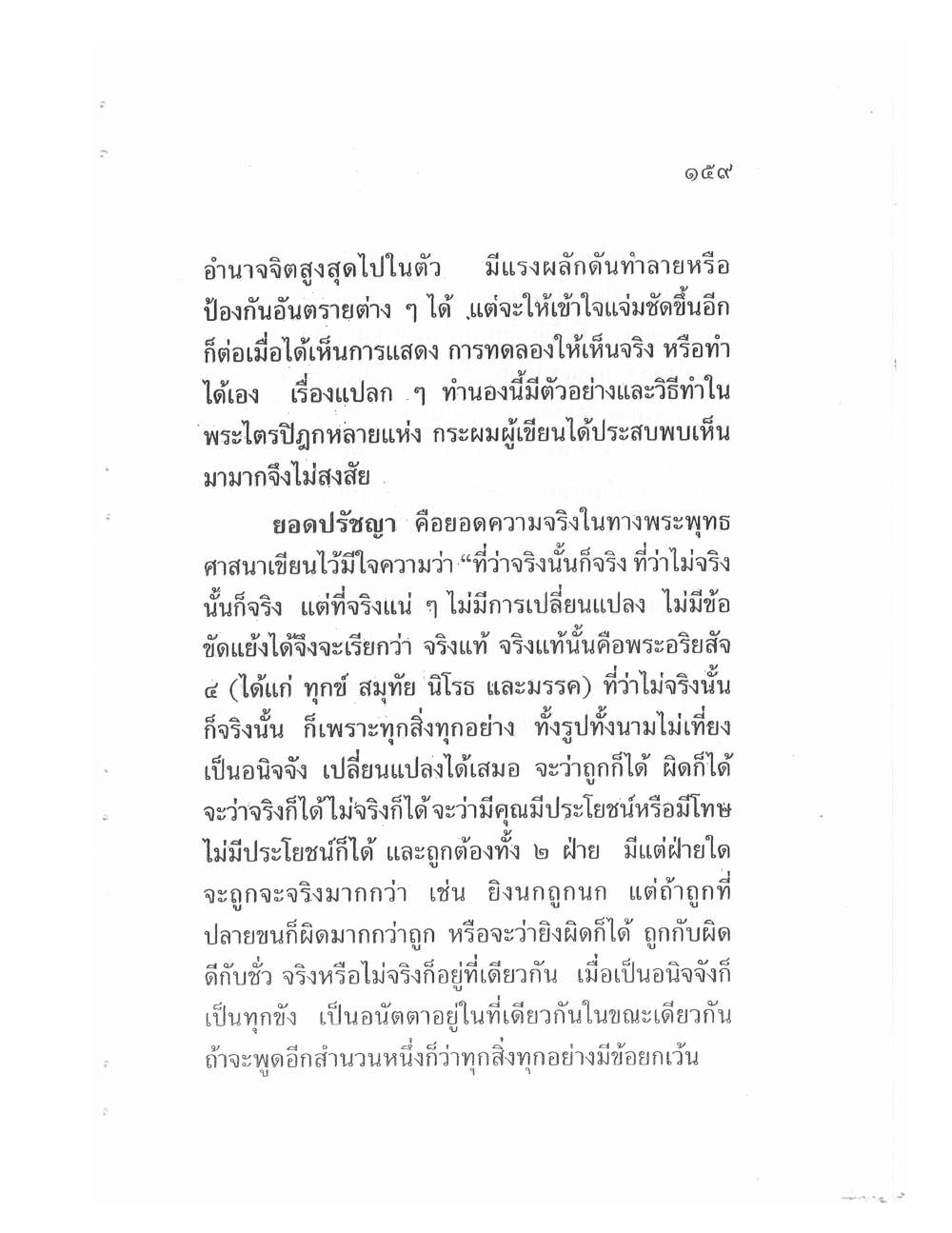
อำนาจจิตสูงสุดไปในตัว มีแรงผลักดันทำลายหรือ ป้องกันอันตรายต่าง ๆ ได้ แต่จะให้เข้าใจแจ่มชัดขึ้นอีก ก็ต่อเมื่อได้เห็นการแสดง การทดลองให้เห็นจริง หรือทำ ได้เอง เรื่องแปลก ๆ ทำนองนี้มีตัวอย่างและวิธีทำใน พระไตรปิฎกหลายแห่ง กระผมผู้เขียนได้ประสบพบเห็น มามากจึงไม่สงสัย
ยอดปรัชญา คือยอดความจริงในทางพระพุทธ ศาสนาเขียนไว้มีใจความว่า "ที่ว่าจริงนั้นก็จริง ที่ว่าไม่จริง นั้นก็จริง แต่ที่จริงแน่ ๆ ไม่มีการเปลี่ยนแปลง ไม่มีข้อ ขัดแย้งได้จึงจะเรียกว่า จริงแท้ จริงแท้นั้นคือพระอริยสัจ ๔ (ได้แก่ ทุกข์ สมุทัย นิโรธ และมรรค) ที่ว่าไม่จริงนั้น ก็จริงนั้น ก็เพราะทุกสิ่งทุกอย่าง ทั้งรูปทั้งนามไม่เที่ยง เป็นอนิจจัง เปลี่ยนแปลงได้เสมอ จะว่าถูกก็ได้ ผิดก็ได้ จะว่าจริงก็ได้ไม่จริงก็ได้ จะว่ามีคุณมีประโยชน์หรือมีโทษ ไม่มีประโยชน์ก็ได้ และถูกต้องทั้ง ๒ ฝ่าย มีแต่ฝ่ายใด จะถูกจะจริงมากกว่า เช่น ยิงนกถูกนก แต่ถ้าถูกที่ ปลายขนก็ผิดมากกว่าถูก หรือจะว่ายิงผิดก็ได้ ถูกกับผิด ดีกับชั่ว จริงหรือไม่จริงก็อยู่ที่เดียวกัน เมื่อเป็นอนิจจังก็ เป็นทุกขัง เป็นอนัตตาอยู่ในที่เดียวกันในขณะเดียวกัน ถ้าจะพูดอีกสำนวนหนึ่งก็ว่าทุกสิ่งทุกอย่างมีข้อยกเว้น
—the very highest power of mind within oneself, with force enough to destroy or to guard against various dangers. But to have it understood even more clearly, that comes only once one has seen it demonstrated, seen an experiment proving it true, or has done it oneself. Strange matters of this kind have examples and methods in many places in the Tipiṭaka; I, the writer, have personally encountered many such things, so I have no doubt.
The supreme philosophy, that is, the highest truth in the Buddhist religion, is written with the sense: "What is said to be true is true; what is said to be not true is also true. But that which is truly certain has no change, admits no contradiction — only that is called the real truth. The real truth is the Four Noble Truths (namely dukkha, samudaya, nirodha, and magga). As for saying that 'not true' is also true, that is because everything, both form and mind (rūpa and nāma), is impermanent, is anicca, always subject to change. One may call it right or wrong, true or not true, beneficial and of merit or harmful and of no benefit, and both sides can be correct; it is only that one side is more right, more true. For example: shooting at a bird and hitting the bird — but if one only hits the tip of a feather, that is more wrong than right; or one could say the shot missed. Right and wrong, good and bad, true and not true, all lie in the same place. Being anicca, it is also dukkha, is also anattā, in the very same place at the very same moment. Put in another way, one could say that everything has its exceptions."
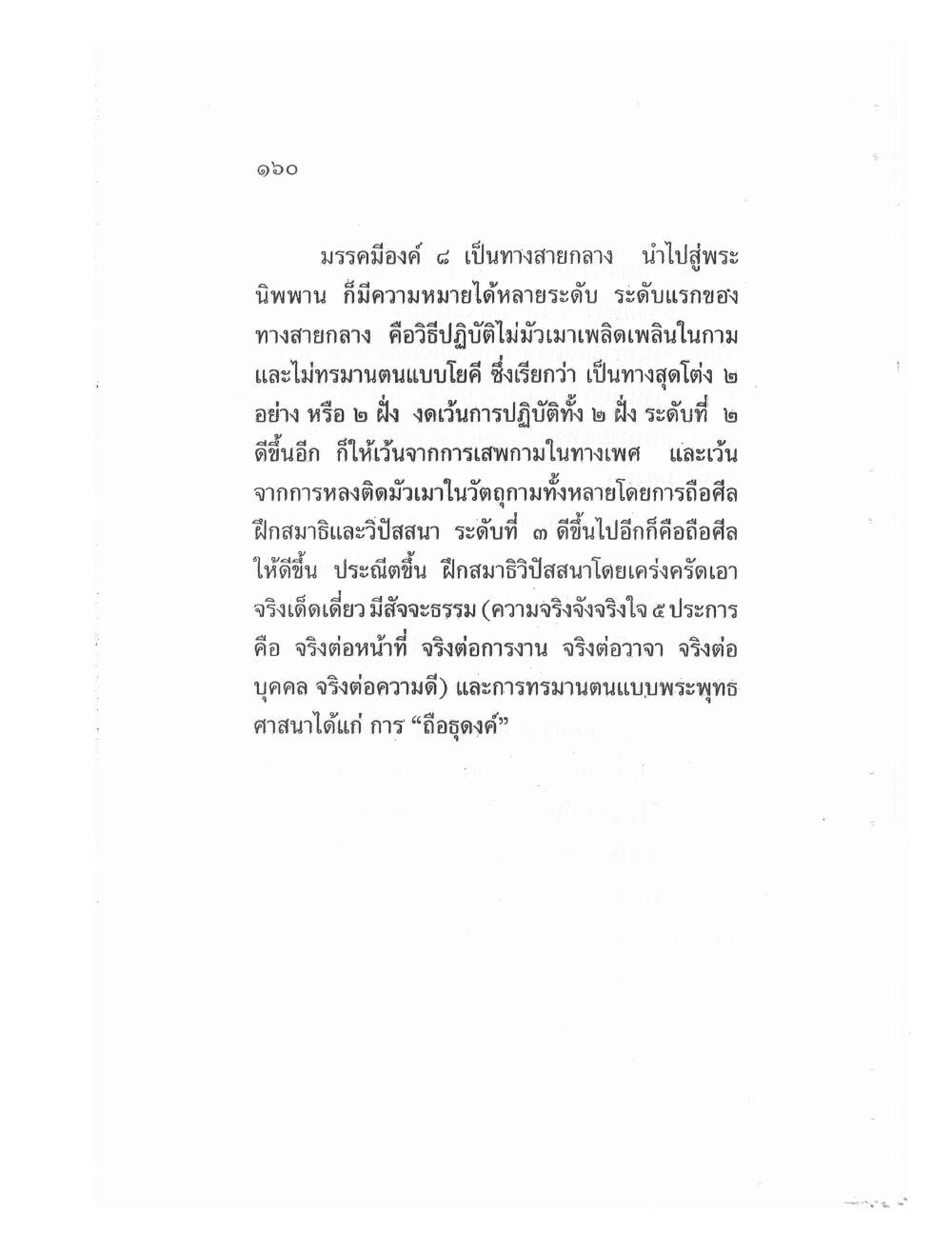
มรรคมีองค์ ๘ เป็นทางสายกลาง นำไปสู่พระ นิพพาน ก็มีความหมายได้หลายระดับ ระดับแรกของ ทางสายกลาง คือวิธีปฏิบัติไม่มัวเมาเพลิดเพลินในกาม และไม่ทรมานตนแบบโยคี ซึ่งเรียกว่า เป็นทางสุดโต่ง ๒ อย่าง หรือ ๒ ฝั่ง งดเว้นการปฏิบัติทั้ง ๒ ฝั่ง ระดับที่ ๒ ดีขึ้นอีก ก็ให้เว้นจากการเสพกามในทางเพศ และเว้น จากการหลงติดมัวเมาในวัตถุกามทั้งหลายโดยการถือศีล ฝึกสมาธิและวิปัสสนา ระดับที่ ๓ ดีขึ้นไปอีกก็คือถือศีล ให้ดีขึ้น ประณีตขึ้น ฝึกสมาธิวิปัสสนาโดยเคร่งครัดเอา จริงเด็ดเดี่ยว มีสัจจะธรรม (ความจริงจังจริงใจ ๕ ประการ คือ จริงต่อหน้าที่ จริงต่อการงาน จริงต่อวาจา จริงต่อ บุคคล จริงต่อความดี) และการทรมานตนแบบพระพุทธ ศาสนาได้แก่ การ "ถือธุดงค์"
The Noble Eightfold Path is the Middle Way, leading to Nibbāna, and can carry meanings at several levels. The first level of the Middle Way is a manner of practice that neither indulges in sensual pleasure nor tortures oneself in the manner of a yogi — these being called the two extremes, or the two sides — one abstains from practicing on either side. At the second, better level, one abstains from indulging in sensual pleasure in the sexual sense, and abstains from becoming infatuated and lost in material sense-objects, by keeping precepts, training in samādhi, and vipassanā. At the third, even better level, one keeps precepts even better, more refined, and trains in samādhi-vipassanā strictly, with genuine, resolute earnestness, having sacca-dhamma (truth/sincerity of intent in 5 respects: true to duty, true to one's work, true in speech, true to persons, true to goodness), and the Buddhist manner of self-mortification, namely the observance of "dhutaṅga (ascetic practices)."
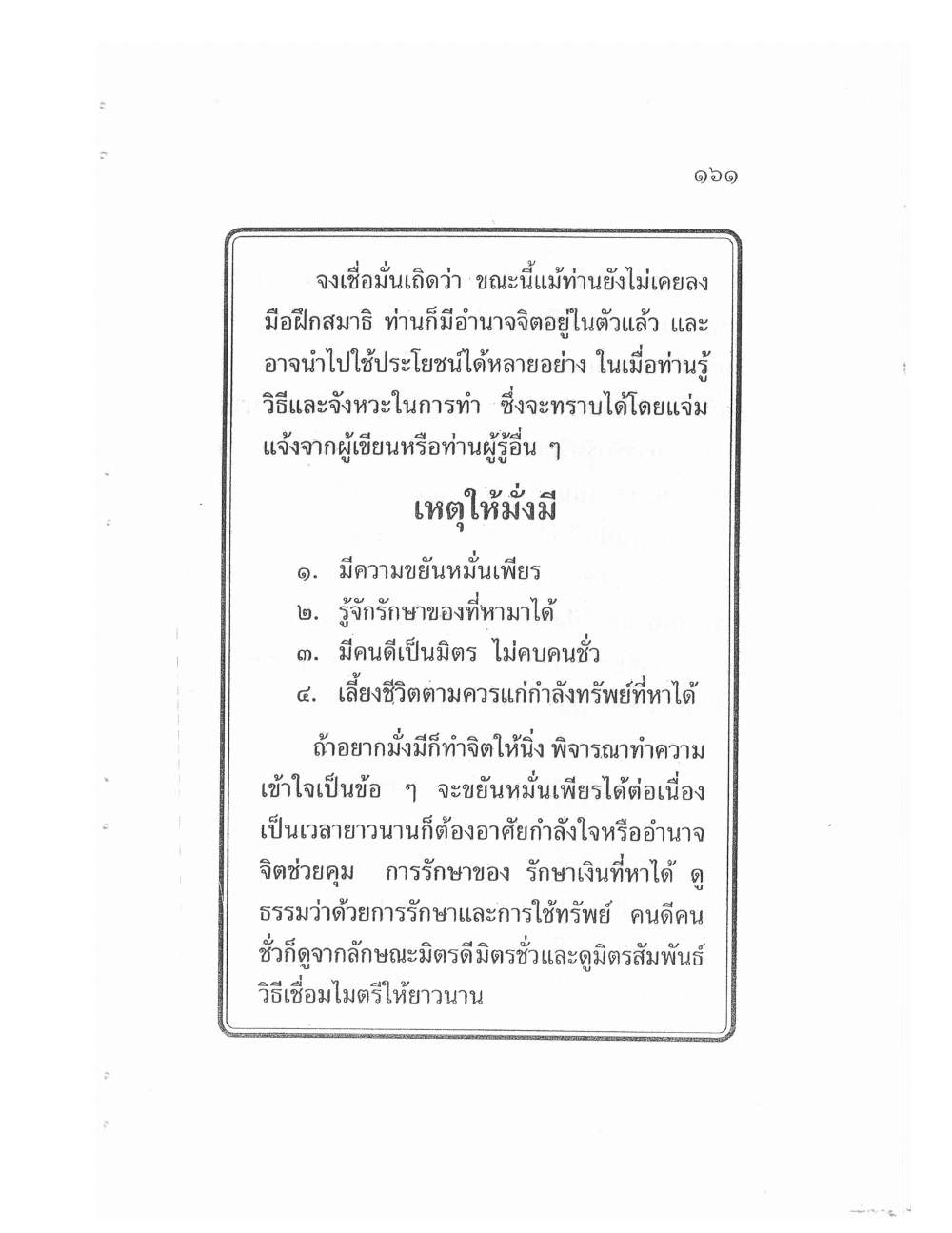
จงเชื่อมั่นเถิดว่า ขณะนี้แม้ท่านยังไม่เคยลง มือฝึกสมาธิ ท่านก็มีอำนาจจิตอยู่ในตัวแล้ว และ อาจนำไปใช้ประโยชน์ได้หลายอย่าง ในเมื่อท่านรู้ วิธีและจังหวะในการทำ ซึ่งจะทราบได้โดยแจ่ม แจ้งจากผู้เขียนหรือท่านผู้รู้อื่น ๆ
เหตุให้มั่งมี
๑. มีความขยันหมั่นเพียร ๒. รู้จักรักษาของที่หามาได้ ๓. มีคนดีเป็นมิตร ไม่คบคนชั่ว ๔. เลี้ยงชีวิตตามควรแก่กำลังทรัพย์ที่หาได้
ถ้าอยากมั่งมีก็ทำจิตให้นิ่ง พิจารณาทำความ เข้าใจเป็นข้อ ๆ จะขยันหมั่นเพียรได้ต่อเนื่อง เป็นเวลายาวนานก็ต้องอาศัยกำลังใจหรืออำนาจ จิตช่วยคุม การรักษาของ รักษาเงินที่หาได้ ดู ธรรมว่าด้วยการรักษาและการใช้ทรัพย์ คนดีคน ชั่วก็ดูจากลักษณะมิตรดีมิตรชั่วและดูมิตรสัมพันธ์ วิธีเชื่อมไมตรีให้ยาวนาน
Believe firmly that, even now though you have never yet put your hand to training in samādhi, you already possess mind-power within yourself, and you may put it to use for many benefits, once you know the method and the right timing for doing it, which you can learn clearly from the writer or from other knowledgeable people.
Causes of Prosperity
1. Having diligence and perseverance 2. Knowing how to preserve what one has earned 3. Having good people as friends, not associating with bad people 4. Living one's life in a manner suited to the wealth one has earned
If you wish to become prosperous, still the mind, and consider and understand each point. To be diligent and persevering continuously over a long period of time requires the support of willpower or mind-power to help maintain it. As for preserving one's possessions, preserving the money one has earned, see the teaching on the preservation and use of wealth. As for good people and bad people, judge by the traits of a good friend versus a bad friend, and consider friendship — the way to maintain a bond of friendship for a long time.
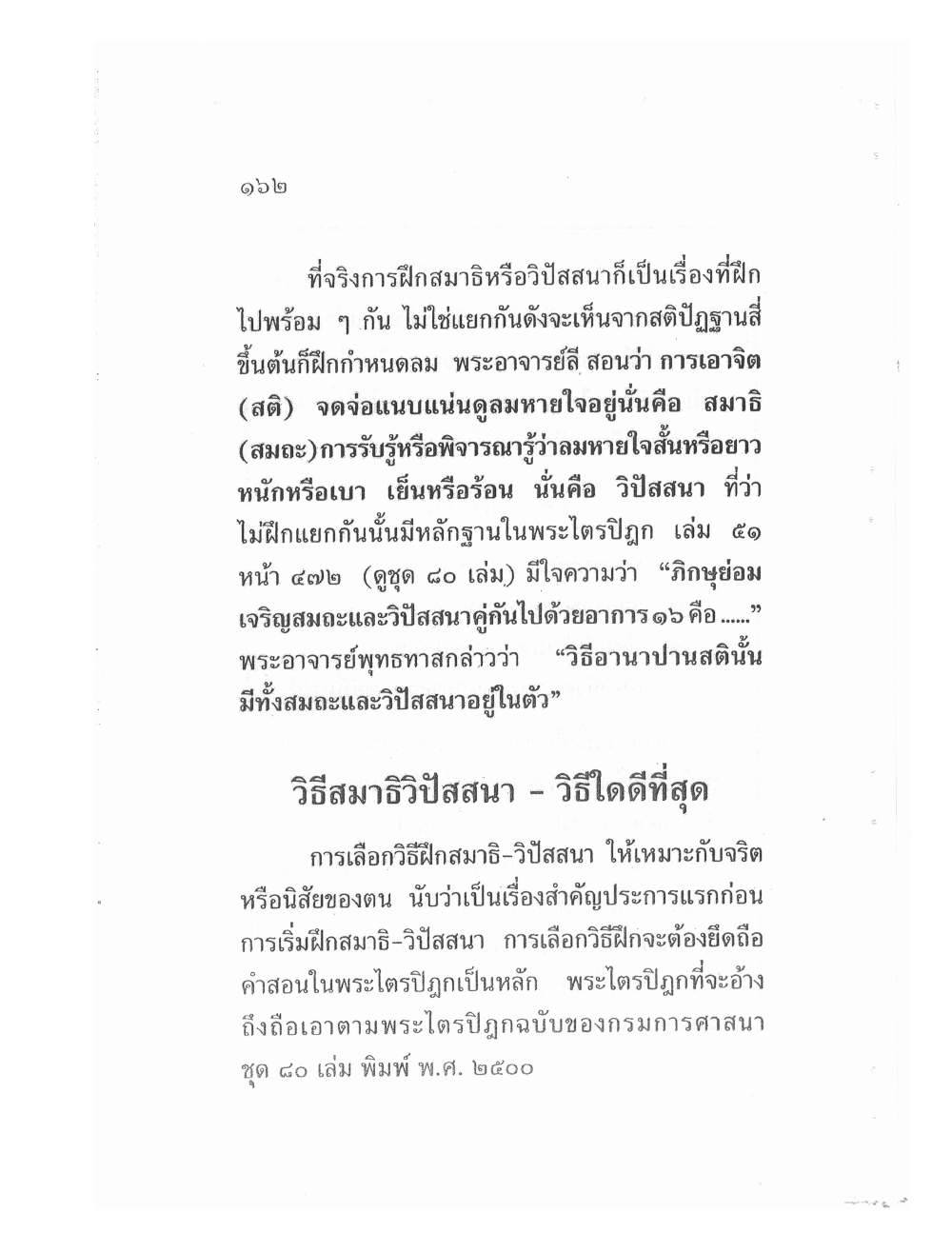
ที่จริงการฝึกสมาธิหรือวิปัสสนาก็เป็นเรื่องที่ฝึก ไปพร้อม ๆ กัน ไม่ใช่แยกกันดังจะเห็นจากสติปัฏฐานสี่ ขึ้นต้นก็ฝึกกำหนดลม พระอาจารย์ลี สอนว่า การเอาจิต (สติ) จดจ่อแนบแน่นดูลมหายใจอยู่นั่นคือ สมาธิ (สมถะ) การรับรู้หรือพิจารณารู้ว่าลมหายใจสั้นหรือยาว หนักหรือเบา เย็นหรือร้อน นั่นคือ วิปัสสนา ที่ว่า ไม่ฝึกแยกกันนั้นมีหลักฐานในพระไตรปิฎก เล่ม ๕๑ หน้า ๔๗๒ (ดูชุด ๘๐ เล่ม) มีใจความว่า "ภิกษุย่อม เจริญสมถะและวิปัสสนาคู่กันไปด้วยอาการ ๑๖ คือ……" พระอาจารย์พุทธทาสกล่าวว่า "วิธีอานาปานสตินั้น มีทั้งสมถะและวิปัสสนาอยู่ในตัว"
วิธีสมาธิวิปัสสนา - วิธีใดดีที่สุด
การเลือกวิธีฝึกสมาธิ-วิปัสสนา ให้เหมาะกับจริต หรือนิสัยของตน นับว่าเป็นเรื่องสำคัญประการแรกก่อน การเริ่มฝึกสมาธิ-วิปัสสนา การเลือกวิธีฝึกจะต้องยึดถือ คำสอนในพระไตรปิฎกเป็นหลัก พระไตรปิฎกที่จะอ้าง ถึงถือเอาตามพระไตรปิฎกฉบับของกรมการศาสนา ชุด ๘๐ เล่ม พิมพ์ พ.ศ. ๒๕๐๐
In truth, practicing samādhi or vipassanā is a matter of training both together at the same time, not separately, as can be seen from the Four Foundations of Mindfulness. At the outset, one trains in noting the breath. Phra Ajahn Lee taught that: taking the mind (mindfulness, sati) to fix and cling closely, watching the breath — that is samādhi (samatha). The awareness or consideration of knowing whether the breath is short or long, heavy or light, cool or warm — that is vipassanā. As for saying they are not trained separately, there is evidence for this in the Tipiṭaka, volume 51, page 472 (see the 80-volume set), which states: "A monk cultivates samatha and vipassanā together, paired, by means of 16 aspects…" Phra Ajahn Buddhadāsa said: "The method of ānāpānasati has both samatha and vipassanā within it."
Methods of Samādhi-Vipassanā — Which Method Is Best
Choosing a method of training in samādhi-vipassanā to suit one's temperament or character counts as the first important matter before beginning to train in samādhi-vipassanā. The choice of training method must take the teachings in the Tipiṭaka as its foundation. The edition of the Tipiṭaka referred to here is taken as the edition of the Department of Religious Affairs, the 80-volume set, printed B.E. 2500.
จากพระไตรปิฎก เล่ม ๖๓ หน้า ๒๖๔ กล่าวถึง สิ่งประเสริฐที่สุด ๓ อย่าง คือ
บรรดาทาง มรรคมีองค์ ๘ ประเสริฐที่สุด บรรดาสัจจะ อริยสัจ ๔ ประเสริฐที่สุด บรรดาธรรม วิราคะธรรมประเสริฐที่สุด
การฝึกสมาธิ-วิปัสสนาจึงควรยึดถือมรรคมี องค์ ๘ เป็นวิธีดีที่สุด เพราะเป็นแนวทางที่ประเสริฐ ที่สุด องค์ประกอบของมรรคมีองค์แปดนั้น มีองค์ สำคัญที่จะต้องพิจารณาให้ชัดแจ้งก่อนที่จะดำเนินการ ฝึก คือ สัมมาสติ และ สัมมาสมาธิ สัมมาสติ อยู่ใน สติปัฏฐาน ๔ (การมีสติรู้อยู่ในกาย เวทนา จิต และธรรม) คือการปฏิบัติวิปัสสนานั้นเอง ส่วน สัมมาสมาธิ ก็คือการ ทำให้จิตสงบตั้งมั่น ได้แก่การปฏิบัติ สมถะ หรือ สมาธิ นั่นเอง
นิพพาน ผู้ยังไม่เป็นพระอรหันต์หรือยังไม่ถึง นิพพานนั้นจะซักถามหรือนึกคิดอธิบายอย่างไรก็ไม่ สามารถจะเข้าใจแจ่มแจ้งได้
ในพระไตรปิฎกกล่าวไว้ว่า มรรคมีองค์ ๘ เป็นทาง ที่ประเสริฐที่สุด และเป็นทางสายเดียว เป็นเอกมรรค หรือ
From the Tipiṭaka, volume 63, page 264, it speaks of the three most excellent things:
Among paths, the Noble Eightfold Path is the most excellent Among truths, the Four Noble Truths are the most excellent Among dhammas, the dhamma of dispassion (virāga-dhamma) is the most excellent
Training in samādhi-vipassanā should therefore hold to the Noble Eightfold Path as the best method, because it is the most excellent path. Among the components of the Eightfold Path, there are important factors that must be considered clearly before undertaking the training, namely: Right Mindfulness (sammā-sati) and Right Concentration (sammā-samādhi). Sammā-sati lies within the Four Foundations of Mindfulness (having mindfulness aware in body, feelings, mind, and dhammas), that is, the practice of vipassanā itself. As for sammā-samādhi, that is making the mind calm and firmly established, namely the practice of samatha, or samādhi, itself.
Nibbāna: one who is not yet an Arahant, or has not yet reached Nibbāna, cannot come to a full and clear understanding of it no matter how one questions, thinks about, or tries to explain it.
In the Tipiṭaka it is said that the Noble Eightfold Path is the most excellent path, and is the sole path, the ekamagga (one path), or—
เป็นมรรคสมังคี คือต้องปฏิบัติให้กลมกลืนกัน ครบทั้งแปดอย่าง ผู้เริ่มฝึกสมาธิควรพิจารณาให้เข้าใจ องค์สำคัญ ๒ องค์ในมรรคมีองค์แปดเสียก่อน คือ สัมมาทิฏฐิ และ สัมมาสมาธิ
ในพระไตรปิฎก เล่ม ๖๓ หน้า ๒๖๕ กล่าวไว้ว่า "สัมมาวาจา สัมมาอาชีวะ ไม่เป็นมรรค แต่เป็นองค์ แห่งมรรค สัมมาทิฏฐิ สัมมาสมาธิ เป็นมรรค" มรรค มีองค์ ๘ เป็นทางประเสริฐสุดให้ถึงนิพพาน
พระไตรปิฎก เล่ม ๒๑ มหาจัตตารีสูตร กล่าวไว้ว่า "สัมมาสมาธิ ประกอบด้วยมรรค ๗ ข้อข้างต้น สัมมาทิฏฐิ เป็นหัวหน้าของมรรคอื่น ๆ" จะเห็นว่า สมาธิ (หรือ สมถะ) ที่ถูกต้องคือสมาธิที่รวมเอามรรคที่เหลือทั้ง ๗ ข้อมาอยู่ร่วมกัน รวมมาเป็นอันเดียวกัน นั่นคือสมาธิ ที่ถูก (สัมมาสมาธิ) ได้รวมเอาสัมมาสติ คือวิปัสสนา อยู่ในตัวแล้ว สมาธิหรือเรียกว่า สมถะกัมมัฏฐานนั้น เมื่อทำถูกต้องถึงที่สุดก็เข้าถึงนิพพาน
วิธีปฏิบัติหรือวิธีสร้างเหตุเพื่อให้เกิดความ เห็นชอบสัมมาทิฏฐินั้นมี ๒ ประการ คือ ในพระไตรปิฎก เล่ม ๑๘ หน้า ๖๑๒ กล่าวไว้ว่า "ปัจจัยให้เกิดสัมมาทิฏฐิ
—is called magga-samaṅgī: it must be practiced so that all eight factors blend harmoniously together. One who is beginning to train in samādhi should first consider and understand two important factors among the Eightfold Path, namely: Right View (sammā-diṭṭhi) and Right Concentration (sammā-samādhi).
In the Tipiṭaka, volume 63, page 265, it is stated: "Right Speech and Right Livelihood are not [themselves] the Path, but are factors of the Path; Right View, Right Concentration, are the Path." The Eightfold Path is the most excellent path leading to Nibbāna.
The Tipiṭaka, volume 21, the Mahācattārīsaka Sutta, states: "Right Concentration is composed together with the preceding seven factors of the Path; Right View is the leader of the other factors of the Path." One can see that the correct samādhi (or samatha) is the samādhi that gathers together the remaining seven factors so that they come together as one; that is correct samādhi (sammā-samādhi), which has already incorporated sammā-sati, that is, vipassanā, within itself. Samādhi, or what is called samatha-kammaṭṭhāna, when practiced correctly to its ultimate conclusion, leads to Nibbāna.
The method of practice, or the method of creating the cause for right view (sammā-diṭṭhi) to arise, has 2 aspects. In the Tipiṭaka, volume 18, page 612, it is stated: "The conditions giving rise to sammā-diṭṭhi—
มีเท่าไร?" มีธรรม ๒ ประการ คือ ได้สดับจากบุคคลอื่น และทำในใจโดยแยบคาย ถ้าสดับคือได้ฟังได้อ่าน คำกล่าวของผู้ที่เห็นถูกเห็นชอบ (ผู้มีสัมมาทิฏฐิ) ประกอบกับการพิจารณาโดยแยบคาย ดูหลักฐานใน พระไตรปิฎก หรือตรวจสอบไต่ถามผู้รู้อื่น ๆ อีก ก็จะ เป็นความรอบคอบและมั่นใจในความเห็นที่ถูกต้องได้ ครบอาจทำให้เกิดความเข้าใจผิดพลาด และปฏิบัติ ผิดพลาดตั้งแต่การเริ่มฝึก กล่าวคือในพระไตรปิฎกกล่าว ไว้หลายตอนว่า การปฏิบัติตามมรรคมีองค์ ๘ ให้ ปฏิบัติเป็นมรรคสมังคี คือปฏิบัติให้กลมกลืนเป็น อันหนึ่งอันเดียวกันทั้ง ๘ องค์ ดังนั้น การแยกฝึกสมาธิ คือสมถะอย่างเดียว หรือจะแยกวิปัสสนาอย่างเดียว โดย ไม่ฝึกสมถะควบคู่กันไปด้วยก็ไม่ถูกต้องตามพระไตรปิฎก ซึ่งจะขอยกข้อความเล่มอื่นมากล่าวดังนี้
พระไตรปิฎก เล่ม ๕๑ หน้า ๔๗๒ มีใจความว่า "……ภิกษุย่อมเจริญสมถะและวิปัสสนาคู่กันไปด้วย อาการ ๑๖……" การฝึกคู่กันไปนี้อาจจะทำได้หลายวิธี
สาเหตุให้เกิดความเห็นผิด (มิจฉาทิฏฐิ) กล่าวไว้ ในพระไตรปิฎกเล่ม ๒๖ หน้า ๒๘๐ ว่า "เมื่อรูปมีอยู่ เพราะอาศัยรูป เพราะยึดมั่นรูปจึงเกิดมิจฉาทิฏฐิ คือ
—how many are there?' There are 2 factors: hearing [teaching] from another person, and applying wise attention (yoniso-manasikāra) in the mind. As for 'hearing,' that means having listened to or read the words of one who sees rightly, who holds right view (one with sammā-diṭṭhi), combined with wise consideration — checking the evidence in the Tipiṭaka, or investigating and asking other knowledgeable people as well; this brings thoroughness and confidence in a correct view. Missing this may lead to mistaken understanding, and to mistaken practice right from the start of training. That is to say, the Tipiṭaka states in many places that practicing according to the Eightfold Path should be practiced as magga-samaṅgī — practiced so as to blend into a single whole across all 8 factors. Therefore, to train in samādhi separately, that is, samatha alone, or to train in vipassanā alone without training in samatha together with it, is not correct according to the Tipiṭaka. I will quote a passage from another volume as follows:
The Tipiṭaka, volume 51, page 472, states: "…a monk cultivates samatha and vipassanā paired together by means of 16 aspects…" This paired training may be accomplished by several methods.
The cause giving rise to wrong view (micchā-diṭṭhi) is stated in the Tipiṭaka, volume 26, page 280: "When form exists, because one relies on form, because one clings to form, wrong view arises, namely—
ความเห็นผิด……" อีกสำนวนหนึ่งพระไตรปิฎกกล่าวว่า เหตุให้เกิดมิจฉาทิฏฐิมี ๒ ประการ คือ ถูกเล่าลือจาก คนอื่น (ฟังเขาพูดหรือเขาเล่าหรือสอนที่ผิดก็เชื่อถือ) นั้นประการหนึ่ง อีกประการหนึ่งคือ ไม่ใช้ความคิดโดย แยบคาย ยึดมั่นรูปคือยึดถือว่ารูปหรือกายนี้เป็นของตน หรือเป็นตัวตน ยึดถือมั่นว่ากายนี้เป็นตน ยากที่จะอธิบาย ให้เข้าใจว่าไม่ใช่ตัวตน ไม่ใช่ตน เปรียบเหมือนคนไม่ เคยกินเค็มจะอธิบายให้เข้าใจว่าเค็มคืออย่างไรก็ไม่เข้าใจ ต้องให้กินเกลือก็จะรู้ว่าเค็มคืออย่างไร จะให้เข้าใจว่า ไม่ใช่ตัวตนไม่ใช่ตนก็ต้องให้ลงมือทำดู ขั้นแรกให้ทำ ใบมะขามเป็นตัวแตนดังที่กล่าวมาแล้ว ไม่เกิน ๗ วัน ตัวแตนก็กลับเป็นใบไม้ไม่ใช่ตัวตน เมื่อฝึกจบสมาธิขั้น กลางจวนขึ้นฌานก็สอนให้ภาวนาเดินลอดภูเขาไปมาได้ จึงจะเห็นชัดว่า กายก็สักว่าเป็นกาย ไม่ใช่ตัวตนเราเขา ที่เห็นว่ารูปกายเป็นตัวตนเป็นของตนนั่นคือ ยึดมั่นรูป เป็นมิจฉาทิฏฐิ คือความเห็นผิดไปจากความจริง คือ ความจริงรูปกายเป็นตัวชีวิตเล็กมากอัดกันอยู่เป็นกระดูก เป็นเนื้อหนัง ผมขนเล็บ ฯลฯ
—wrong view…' In another wording, the Tipiṭaka states that the causes giving rise to wrong view are 2: being led by rumor from other people (hearing what others say, tell, or teach that is mistaken, and believing it) — that is one cause; the other cause is not using wise, careful thought — clinging to form, that is, holding that this form or body belongs to oneself or is one's self, holding firmly that this body is self. It is difficult to explain so as to make one understand that it is not self, not one's self — comparable to a person who has never tasted salt: explaining to make him understand what salty is like will not succeed; he must be given salt to eat, and then he will know what salty is like. To make one understand that it is not self, not one's self, one must be made to actually try it out. The first step is to turn a tamarind leaf into a wasp, as already described; within no more than 7 days the wasp reverts back into a leaf, not a self. When training is completed at the intermediate level of samādhi, nearing the entry into jhāna, one is taught to meditate and walk back and forth straight through a mountain, so that one clearly sees that the body is merely a body, not a self, not 'us' or 'them.' What sees the physical body as a self, as one's own, that is called clinging to form (rūpa) — that is wrong view (micchā-diṭṭhi), a view that departs from reality. The reality is that the physical body is made up of very tiny units of life packed together, forming bone, forming flesh and skin, hair and nails, etc.
สรุปธัมมะที่สำคัญยิ่ง
(๑) สำหรับคนทั่วไป การธุดงค์ไปอยู่ในป่าช้าและในป่าลึกที่มีสัตว์ร้าย โดยการฝึกเป็นขั้น ๆ จากง่ายไปยาก ดังกล่าวมาแล้วจะได้สมาธิขั้นสูงง่าย แต่ต้องไม่ใช่เข้าไปอยู่ด้วยความประมาท ข้ามขั้น เพราะการอยู่ในป่าลึกนั้นพระพุทธองค์ทรงกล่าวว่า "......เมื่อเราเข้ามาอาศัยป่าทึบอยู่ สติยังไม่ปรากฏ ก็ปรากฏจิตที่ยังไม่ตั้งมั่นก็ตั้งมั่น อาสวะที่ยังไม่สิ้นไปก็ถึงความสิ้นไป......" ได้กล่าวตอนต้นว่า เสือเป็นครูที่ดี ให้ได้สมาธิวิปัสสนาระดับสูง เพราะต้องตั้งใจฝึกอย่างจริงจัง ตั้งใจอย่างแรงกล้าจึงไม่มีการปวดการเมื่อยหรือการง่วงตลอดคืน
(๒) ผู้สร้างสมบุญบารมี ทาง ทาน ศีล ภาวนา ฯ (กุศลกรรมบท ๑๐) มามากทั้งในชาตินี้และในชาติก่อน ๆ ก็จะได้บรรลุมรรคผลนิพพานได้เร็ว
(๓) ขอทำความเข้าใจในคำสอนที่พูดที่เขียนกันมากและบ่อยครั้งก็คือ "การฝึกสมาธิวิปัสสนา ฝึกที่ไหนก็ได้" จริงอยู่ฝึกที่ไหนก็ได้ แต่จะได้ผลน้อย ดีกว่าไม่ฝึก เพราะขัดกับพระไตรปิฏกอันเป็นคำสอนของพระพุทธองค์
Summary of the Most Important Dhamma
(1) For ordinary people, going on tudong (forest-wandering practice) to stay in cremation grounds and in deep forests where dangerous animals live, training step by step from easy to difficult as described above, makes it easy to attain a high level of samadhi. But one must not enter carelessly, skipping stages, because regarding staying in deep forest the Lord Buddha said: "......When we come to dwell relying on the dense forest, mindfulness not yet arisen arises; the mind not yet steady becomes steady; the outflows (asava) not yet ended come to their ending......" It was said earlier that the tiger is a good teacher, enabling one to attain a high level of samadhi-vipassana, because one must resolve to train in earnest — with such fierce resolve there is no aching, no fatigue, or drowsiness throughout the night.
(2) One who has accumulated great merit and perfections through giving (dana), morality (sila), meditation (bhavana), etc. (the ten courses of wholesome action) abundantly, both in this life and in past lives, will attain the path, fruit, and Nibbana quickly.
(3) I wish to clarify a teaching that is often spoken and written, namely: "The practice of samadhi-vipassana can be done anywhere." It is true that one can practice anywhere, but the results will be meager — still better than not practicing — because [treating this as a general rule] conflicts with the Tipitaka, which is the teaching of the Lord Buddha.
หลายหมวด ขอยกตัวอย่าง หมวดสัปปายะ การฝึกให้ได้ผลดี ๔ ประการ คือ หนึ่ง - สถานที่ฝึก สงบเงียบอากาศดี กังวลน้อย สอง - อาหารเหมาะกับการฝึก ได้แก่ อาหารที่ย่อยง่าย เคี้ยวละเอียด ไม่เป็นอาหารที่ส่งเสริมให้เกิดกามารมณ์ กินพอควรเพียง ๓ คำจะอิ่มก็พอ สาม - มีครูฝึกที่ดีที่มีความสามารถมาก มีมิตรที่ดี สี่ - วิธีฝึกที่เหมาะกับตน ตัวอย่างการฝึกที่วัดแต่ได้ผลดี คือ ท่านเจ้าคุณนรรัตน์ภิกษุ วัดเทพศิรินทราวาส ฝึกได้ผลดีมากก็เพราะทำตามสัปปายะทั้ง ๔ ข้อ ข้อแรก - สถานที่สงบเงียบ ท่านเจ้าคุณนร ฯ อยู่กุฏิผู้เดียว ไม่รับนิมนต์ไปไหน ไม่รับแขกที่กุฏิ ไม่มีโทรศัพท์ วิทยุ ทีวี และเครื่องกังวล ข้อสอง - อาหาร ท่านฉันอาหารมังสวิรัติ วันหนึ่งฉันมื้อเดียว ฉันไม่มาก ข้อสาม - มีครูฝึกที่ดีมีความสามารถมากมีมิตรที่ดี มีครูฝึกคือพระอาจารย์ในดงที่ได้อภิญญา ได้แก่ท่านเจ้ามาสอนเป็นประจำ ข้อสี่ - วิธีฝึกที่เหมาะกับตนคือฝึกวิธีอานาปานสติ โดยมีการพิจารณาอสุภะและเจริญเมตตาประกอบซึ่งเหมาะกับคนทั่วไปทุกจริต ดังที่กล่าวมาแล้วที่กุฏิท่านมีโครงกระดูกคนไว้พิจารณาอสุภะ มีการเจริญเมตตาทุกวันหลายครั้ง นอกจากนี้ท่านมีการดัดตนเป็นประจำทุกวันได้เขียน
...many categories. To give an example, the category of "sappaya" (favorable conditions) for effective training has 4 factors: One — the training place: quiet, good air, little worry. Two — food suited to training: easily digestible food, chewed thoroughly, not food that stimulates sensual desire; eating only enough — about 3 mouthfuls to be full is sufficient. Three — a good, highly capable teacher and good companions. Four — a training method suited to oneself. An example of training at a temple that nevertheless got good results is the Venerable Chao Khun Narrat Bhikkhu of Wat Thep Sirinthrawat, who trained with great success precisely because he followed all 4 sappaya factors. First factor — a quiet place: Chao Khun Narn stayed alone in his kuti, did not accept invitations to go anywhere, did not receive visitors at his kuti, and had no telephone, radio, television, or other distracting devices. Second factor — food: he ate a vegetarian diet, one meal a day, and not much. Third factor — a good, capable teacher and good companions: his teacher was a forest-dwelling ajarn who had attained the higher powers (abhiñña), who came to instruct him regularly. Fourth factor — a method suited to himself: he practiced anapanasati (mindfulness of breathing), together with contemplation of the foul (asubha) and the development of loving-kindness (metta), which suits people of all temperaments in general, as mentioned above. At his kuti he kept a human skeleton for contemplating asubha, and he cultivated metta many times each day. In addition he stretched/exercised his body regularly every day, and he wrote down...
บันทึกวิธีฝึกตนไว้เพื่อประโยชน์ผู้อื่นด้วย การฝึกก็ทำตามตารางกำหนดโดยเคร่งครัดเพราะไม่รับแขกจึงทำได้ บางโอกาสได้ไปฝึกในป่า
การจะฝึกให้ได้สมาธิขั้นสูงหรือฌานนั้นต้องมีลำดับขั้นตามหลักสูตรของพระอาจารย์ใหญ่ในดงลึก ซึ่งจะจบฌานไม่เกิน ๕ ปี ทุกคน ตามที่กล่าวไว้แล้ว ส่วนการฝึกให้ได้ถึง ขั้นเหาะล่องหนหายตัวได้ จ่อใกล้นิพพาน ก็ได้ กล่าวถึงหลักสูตรที่พระอาจารย์ในดงลึกใช้ฝึก ซึ่งได้ผลสำเร็จทุกคน บางกรณีผู้มีความเพียรอย่างแรงกล้าจะมีโอกาสไปเรียนกับอาจารย์ในดง ตัวอย่างเช่น พระเดชพระคุณ หลวงพ่อจรัญ วัดอัมพวัน จ.สิงห์บุรี อายุ ๔๕ ปี ได้ไปเรียนและเดินธุดงค์กับพระอาจารย์ในดงเพียง ๓ เดือน ก็ได้สมาธิขั้นสูง ท่านไม่เปิดเผยมากว่า ๒๐ ปี จึงเล่าความจริงนี้ต่อหน้าผู้รวบรวมและประชาชน เมื่อต้น พ.ศ.๒๕๓๗ หลวงปู่โง่น วัดเขารวก คูบาลุ่ม อ.หล่มสัก และปู่โทน อ.ตาคลี ทั้ง ๓ ท่านก็เป็นศิษย์พระอาจารย์ในดงองค์เดียวกันกับหลวงพ่อจรัญ (ตามรูปหน้าปก) ที่มีการเปิดเผยกันมากเรื่องพระอาจารย์ในดง เพราะเป็นเวลาที่สมควรเป็นระยะเวลาที่อาจารย์ในดงจำนวนมากเริ่มออกมาแสดงตัวและสอนเพื่อความอยู่รอดของผู้ศรัทธา
...a record of his training method for the benefit of others as well. His training followed a strict fixed schedule, possible only because he did not receive visitors. On some occasions he went to train in the forest.
To train to attain high levels of samadhi or jhana, one must follow a graduated course under the great forest-dwelling ajarns, which everyone completes — the jhana training taking no more than 5 years — as stated earlier. As for training to reach the level of being able to fly, become invisible, and disappear, drawing close to Nibbana, that too is possible; this refers to the curriculum used by the forest-dwelling ajarns, in which everyone who trains succeeds. In some cases a person of exceptionally strong diligence gets the opportunity to study with a forest ajarn — for example, the Venerable Luang Phor Charan of Wat Amphawan, Singburi Province, who at age 45 studied with and did tudong together with a forest ajarn for only 3 months and thereby attained a high level of samadhi. He did not reveal this for more than 20 years, and only recounted this truth in front of the compiler [of this book] and the public in early B.E. 2537 [1994 CE]. Luang Pu Ngoen of Wat Khao Ruak, Khruba Lum of Amphoe Lom Sak, and Pu Thon of Amphoe Ta Khli — all three were also disciples of the same forest ajarn as Luang Phor Charan (as shown in the cover photo). There has been much recent disclosure about these forest ajarns, because this is the proper time — a period when many forest ajarns are beginning to come out, reveal themselves, and teach for the sake of the survival of the faithful.
(๔) การสวดมนต์ ยังมีหลายคนเข้าใจว่ามีประโยชน์น้อย เสียเวลามาก หรือฟังไม่รู้เรื่อง ความจริงมีคุณประโยชน์มาก เพราะการสวดมนต์เป็นการกล่าวธรรม เป็นการกล่าวมนต์คาถา กล่าวถึงคุณพระพุทธ พระธรรม พระสงฆ์ ทำให้ความหวาดกลัวหายไปและหายจากโรค ขับไล่ภูติผีปีศาจได้ ป้องกันอันตรายต่าง ๆ ได้ สวดมนต์ เพื่อทำน้ำมนต์จะได้ผลดีเพียงใดอยู่ที่ความเชื่อมั่น และจิตที่จดจ่อเป็นสมาธิ และความเร็วในการสวดให้พอเหมาะ ความยาวในการสวดพอเหมาะ ผลประโยชน์สูงสุดในการสวดมนต์ก็คือทำให้ได้ผลจนถึงสำเร็จเป็นพระอรหันต์ ได้ ดังมีหลักฐานในพระธรรมกล่าวไว้ว่า
โอกาสจะบรรลุธรรมเป็นพระอรหันต์มี ๕ โอกาส คือ
→ เมื่อฟังธรรม มีตัวอย่างมากในพระไตรปิฎก → เมื่อแสดงธรรมอยู่ → เมื่อสาธยายธรรมอยู่คือการสวดมนต์กล่าวคือภาวนาคาถา → เมื่อตริตรองธรรมอยู่ หรือเพ่งธรรมอยู่ → เมื่อเจริญสมาธิวิปัสสนาอยู่
(4) Reciting Chants. Many people still believe this has little benefit, wastes a lot of time, or is unintelligible. In truth it has great benefit, because chanting is a recitation of Dhamma — a recitation of sacred verses (mantra-katha) — speaking of the virtues of the Buddha, the Dhamma, and the Sangha, which makes fear disappear and cures illness, drives away spirits and demons, and protects against various dangers. As for chanting in order to make holy water, its effectiveness depends on confidence, on a mind concentrated in samadhi, and on chanting at a suitable speed and suitable length. The greatest benefit of chanting is that it can lead all the way to the attainment of Arahantship, as there is evidence for this stated in the Dhamma, as follows:
There Are 5 Occasions on Which One May Attain Arahantship, Namely:
→ When listening to the Dhamma — there are many examples of this in the Tipitaka. → When teaching/expounding the Dhamma. → When reciting the Dhamma — that is, chanting, i.e. reciting sacred verses (bhavana-katha). → When reflecting on or contemplating the Dhamma. → When developing samadhi-vipassana.
ตัวอย่างการแสดงธรรมอยู่ได้แก่พระนาคเสนเทศนาให้โยมสูงอายุฟัง โยมได้ดวงตาเห็นธรรม คือสำเร็จเป็นพระโสดาบันขณะฟังธรรมก่อนพระนาคเสน อาศัยการพิจารณาข้อความที่ตนเองเทศน์ ด้วยพระนาคเสนก็ได้สำเร็จเป็นพระโสดาบันในขณะแสดงธรรมนั้นด้วย
เมื่อตริตรองธรรมหรือเพ่งธรรมอยู่ เช่น เพ่งกายคตาสติ หรืออสุภะ ก็สำเร็จเป็นพระอรหันต์ได้ ตัวอย่าง เช่น อานิสงส์ของกายคตาสติ มีผลถึง ๑๐ ข้อ ข้อสุดท้ายได้สำเร็จเป็นพระอรหันต์ตามที่กล่าวมาแล้ว
(๕) การแปลพระธรรม การอธิบายธรรม และการปฏิบัติธรรม ต้องพิจารณาดูธรรมหลายหมวดที่ขยายความหรือส่งเสริมกัน หรือขัดแย้งกัน เช่น "สันโดษ" ทรงสอนให้สันโดษในปัจจัย ๔ แต่อีกหมวดหนึ่งสอน ไม่ให้สันโดษ ในกุศลธรรม คือ ธรรมในส่วนดี ไม่ให้สันโดษต้องทำให้ดีขึ้นเรื่อยไปจนถึงนิพพาน ถ้าสันโดษในธรรมที่ยังไม่ถึงนิพพานก็เป็นการประมาท ธรรมของพระพุทธเจ้าทุกหมวดทุกข้อย่อมไม่ขัดแย้งกัน ถ้าขัดกันก็จะผิดไปข้างหนึ่ง เช่นคำว่า "สัมภเวสี" ในพระไตรปิฎกและในหนังสือสวดมนต์แปล ได้แปล สัมภเวสี
An example of attaining Arahantship while teaching the Dhamma is Phra Nagasena, who preached to an elderly lay follower. That lay follower attained the eye of Dhamma — that is, became a Stream-enterer (Sotapanna) — while listening, even before Phra Nagasena himself did. Then, by reflecting on the very words he himself had preached, Phra Nagasena also attained Stream-entry during that same discourse.
As for attaining Arahantship while reflecting on or contemplating the Dhamma — such as contemplating mindfulness of the body (kayagatasati) or the foul (asubha) — this too can lead to Arahantship. For example, the benefits of kayagatasati number up to 10, the last of which is attaining Arahantship, as mentioned above.
(5) Translating the Dhamma. In explaining the Dhamma and in practicing it, one must consider the many categories of teaching that expand upon, support, or [appear to] contradict one another. For example, "contentment" (santosa): [the Buddha] taught contentment with the four requisites, but another set of teachings teaches non-contentment — in wholesome qualities, that is, in the good aspects [of practice], one should not be content, but must keep improving continuously until reaching Nibbana. To be content with a level of Dhamma not yet reaching Nibbana is negligence. The Dhamma of the Buddha, in every category and every point, never truly contradicts itself; if there seems to be a contradiction, one side must be mistaken. For example, the word "sambhavesi" in the Tipitaka and in translated chanting books has been translated...
ว่า ผู้กำลังแสวงหาภพ (ที่เกิด) จึงขัดแย้งกับพระอภิธรรมที่ว่าตายแล้วจะเกิดทันที ไม่มีระวาง ไม่มีการรีรออยู่ แต่พระอาจารย์ใหญ่ในดง แปลสัมภเวสีว่า วิญญาณประจำร่าง ซึ่งประจำกายในหรือกายทิพย์ คนตายวิญญาณประจำร่างพร้อมกายในก็แยกออกจากกายหยาบที่ตาย คือเกิดทันทีไม่ขัดกับพระอภิธรรมและพิสูจน์ลงเอยกันได้ดังที่กล่าวมาแล้ว และพระอาจารย์ประยุทธ์ ปยุตฺโต นักปราชญ์ทางศาสนาก็กล่าวตอบเรื่องสัมภเวสีว่า ภาษาบาลีไม่ใช่ภาษาเรา บางคำมีความหมายหลายอย่าง เลือกเอาความหมายที่ผิดมาเขียนก็มี ดังที่กล่าวมาแล้ว
การอธิบายธรรม การปฏิบัติธรรม ที่สอนเรื่องมหาสติปัฏฐานสูตร ขั้นที่ ๑ ให้กำหนดลมหายใจ ให้เห็นกายในกาย มีประเด็นสำคัญอยู่ ๔ ข้อ สองข้อหลัง คือ การระงับลมหายใจให้น้อยลง (ระงับกายสังขาร) และให้เห็นการเกิดและการดับของกายทั้งภายในและภายนอก ไม่ได้สอน ไม่ได้อธิบายไว้ ส่วนมากกล่าวว่า ให้ปฏิบัติไปแล้วจะเห็นเอง แล้วจึงให้ปฏิบัติข้ามขั้นไป พิจารณา เวทนา จิต และธรรม เป็นการข้ามขั้นที่ง่ายไปยาก กล่าวคือ กายเป็นของหยาบเห็นได้ แต่จิตเป็น
...as "one who is seeking a realm of rebirth (bhava)," which then contradicts the Abhidhamma's teaching that after death, rebirth occurs immediately, with no interval and no lingering. But the great forest ajarns translate sambhavesi as "the consciousness attached to the body" — that which occupies the inner body, or the subtle/divine body. When a person dies, this body-attached consciousness, together with the inner body, simply separates from the coarse body that has died — that is, rebirth occurs immediately, which does not conflict with the Abhidhamma, and the two accounts can be reconciled, as explained above. The Venerable Ajarn Payutto, a scholar of religion, also responded on the matter of sambhavesi, saying that Pali is not our language, and some words carry several meanings; sometimes an incorrect meaning has been chosen and written down, as mentioned above.
In explaining the Dhamma and teaching the practice of the Mahasatipatthana Sutta, the first stage teaches one to focus on the breath in order to see the body in the body. There are 4 key points; the latter two are: calming the breath so that it becomes gentler (calming the bodily formations, kaya-sankhara), and seeing the arising and ceasing of the body both internally and externally. These [latter two] are not taught or explained; it is mostly said that one should simply practice and will see for oneself. Practitioners are then made to skip ahead to contemplating feeling (vedana), mind (citta), and mental phenomena (dhamma) — which is skipping from the easy stage to the difficult one. That is to say, the body is coarse and can be seen [clearly], but the mind is...
นามละเอียดอ่อนมาก จึงควรพิจารณากายให้เห็นชัดก่อน เพราะการพิจารณากายเป็นทางให้ถึงนิพพาน ซึ่งมีกล่าวในพระไตรปิฎกเล่ม ๒๘ หน้า ๕๗๕ ว่า "........กายคตาสตินี้เรียกว่าทางให้ถึงอสังขตะ" (คือถึงนิพพาน) บางหมวดก็กล่าวว่า ผู้ไม่ได้พิจารณากายคตาสติ ย่อมไม่ถึงนิพพาน โดยกล่าวไว้ว่า "ภิกษุทั้งหลายผู้ไม่ได้เสพกายคตาสติ ย่อมไม่ถึงอมตะ" พระอาจารย์มั่น สอนว่า "กายเป็นเครื่องก่อเหตุตาเห็นรูป ทำให้ใจกำเริบ จึงต้องพิจารณากายนี้ก่อน จะได้เป็นเครื่องดับนิวรณ์ ทำให้ใจสงบได้ พึงทำให้มาก พิจารณาไม่ถอยทีเดียว........" พระอาจารย์มหาบัว วัดป่าบ้านตาด จ.อุดร สอนว่า "สมาธิขั้นต้นให้พิจารณากายเสียก่อน ส่วนเวทนาและจิตพิจารณาโดยใช้สมาธิขั้นกลางหรือขั้นสูงประกอบกัน"
การพิจารณากายให้ถึงนิพพานได้มีกล่าวไว้ในอาสวะสูตร ว่าให้พิจารณากายให้เห็นเป็นไม่งาม คือเป็นสิ่งไม่สะอาด น่ารังเกียจ น่าขยะแขยง น่าสะอิดสะเอียน ทรงสอนไว้หลายสำนวน หลายแห่ง เช่น ร่างกายกำลังเน่าเปื่อยอยู่ ร่างกายกำลังเคลื่อนไหวอยู่เป็นนิจ ร่างกายเต็มไปด้วยหลุมฝังศพ ร่างกายเกิดและดับอยู่ตลอดเวลา ร่างกายเต็มไปด้วยอุจจาระปัสสาวะ (มูตรคูถ) ร่างกายมีของเน่าไหลออกตลอดเวลา ร่างกายเต็มไป
...a very subtle, delicate mental phenomenon (nama). One should therefore contemplate the body until it is seen clearly first, because contemplation of the body is the path to reaching Nibbana, as stated in the Tipitaka, Volume 28, page 575: "........this mindfulness of the body (kayagatasati) is called the path to the Unconditioned (asankhata)" (that is, to Nibbana). Some sections also say that one who has not contemplated mindfulness of the body will not reach Nibbana, stating: "Monks who have not cultivated mindfulness of the body do not reach the Deathless." Phra Ajarn Mun taught: "The body is what gives rise to the cause — the eye seeing forms — which makes the mind become agitated; one must therefore contemplate this body first, so that it becomes a means of extinguishing the hindrances (nivarana) and calming the mind. One should do this a great deal, contemplating without ever retreating........" Phra Ajarn Maha Bua of Wat Pa Ban Tat, Udon Province, taught: "In the beginning stage of samadhi, contemplate the body first; feeling and mind are to be contemplated using the middle or higher levels of samadhi together with it."
Contemplating the body so as to reach Nibbana is stated in the Asava Sutta, which teaches one to contemplate the body as unbeautiful — that is, as something unclean, disgusting, revolting, and repulsive. This was taught in many different phrasings, in many places, such as: the body is constantly rotting and decaying; the body is constantly, perpetually moving; the body is full of buried graves; the body constantly arises and ceases; the body is full of feces and urine (excrement); the body constantly leaks putrid matter; the body is entirely full of...
ด้วยแผลเน่า กายมีการแยกออกปลิวออกตลอดเวลา ร่างกายเป็นของไม่เที่ยง (อนิจจัง) เป็นทุกข์ (ทุกขัง) ไม่ใช่ตัวตน (อนัตตา) ที่กล่าวทั้งหมดนี้ถ้าพิจารณาตามความเป็นจริง คือร่างกายประกอบไปด้วยตัวชีวิต คือ เซลล์ซึ่งมีชีวิต จึงต้องกินอาหาร ถ่ายออก เคลื่อนไหว เกิดขึ้นและตาย สืบพันธุ์ หายใจ ตัวที่ตายก็ถูกธาตุลมพัดพาออกทางผิวหนัง มีธาตุไฟเผาให้แห้ง ลมพัดเอาตัวชีวิตที่ตายออกมาทางทวารทั้ง ๙ ตัวที่เป็นก็มีการเคลื่อนไหวยุบยับทั่วไป แต่ตาเราเห็นนิ่งอยู่ไม่ตรงตามความจริง ได้กล่าวมาแล้วโดยละเอียด สรุปว่า ที่เราหลงรักหลงชอบนั้นคือซากศพของตัวชีวิต ซึ่งเป็นผิวหนังที่แห้งและทยอยปลิวออก
การฝึกสมาธิวิปัสสนาให้ได้ผลดีต้องทำอย่างจริงจังเด็ดขาดตามตารางที่กำหนด นั่งสมาธิประมาณวันละ ๓ ครั้ง เดินจงกรมประมาณวันละ ๓ ครั้ง เวลาที่เหลือก็พิจารณาอสุภะและเจริญเมตตา ที่สำคัญที่สุดคือรักษาร่างกายให้แข็งแรงปราศจากโรคโดยมียาช่วยซ่อมส่วนที่เสื่อม ฝึกในป่าช้าและที่เงียบสงัด ฝึกในทางเสือเดินนับว่าเป็นเครื่องช่วยให้ได้สมาธิระดับสูงในระยะสั้น ๆ เพราะกระตุ้นให้ตั้งใจอย่างแรงกล้าในการปฏิบัติสมาธิอย่างต่อเนื่องจริงจัง แต่ต้องฝึกเป็นขั้นตอนจากง่ายไปยาก
...rotting sores; the body is constantly disintegrating and shedding. The body is impermanent (anicca), suffering (dukkha), and not-self (anatta). All that has been said, if considered according to reality, is [explained by the fact that] the body is composed of living units — that is, cells, which are alive and therefore must eat, excrete, move, arise and die, reproduce, and breathe. Dying cells are carried away out through the skin by the wind element; the fire element burns them dry; wind carries the dead living matter out through the nine bodily orifices. Living cells are, in general, in constant shrinking and shifting motion — but our eyes see the body as still, which does not match reality. This has been explained in detail above; in summary, what we fall in love with and cherish is [really] the corpse of these living cells — the skin, which is dry and constantly flaking off and shedding.
To practice samadhi-vipassana effectively, one must do so earnestly and without fail, according to a fixed schedule: sitting in samadhi about 3 times a day, walking meditation about 3 times a day, and using the remaining time to contemplate the foul (asubha) and cultivate loving-kindness (metta). Most important of all is keeping the body strong and free of illness, with medicine to help repair what has deteriorated. Training in a cremation ground and in a quiet, secluded place, training on a path where tigers walk — this is considered a great aid in attaining a high level of samadhi in a short time, because it spurs one to resolve with fierce determination to practice samadhi continuously and in earnest. But one must still train in stages, from easy to difficult...
ดังได้กล่าวมาแล้ว เวลาไม่มีเสือเป็นครูบังคับจิตก็ใช้อำนาจคุณพระอำนาจจิตหรือฤทธิ์ของสมาธินั่นแหละ เป็นผู้บังคับให้ตั้งใจฝึกอย่างแรงกล้าเด็ดเดี่ยวจนลืมความปวดเมื่อย ไม่ง่วง จิตตื่นอยู่ตลอดวันตลอดคืนได้ จุดมุ่งก็คือให้หมดกิเลส
ผู้ได้สมาธิขั้นกลาง (อุปจารสมาธิ) เมื่อถึงเวลาตายจะได้เกิดในสวรรค์ชั้นต้น ๖ ชั้น ตามระดับของสมาธิชั้นกลาง ผู้ที่ได้สมาธิขั้นสูง (อัปปนาสมาธิ) ตายแล้วได้เกิดในสวรรค์ชั้นสูง ๒๐ ชั้น (ชั้นพรหม) ในชั้นใดชั้นหนึ่งตามขั้นของสมาธิหรือตามขั้นของฌาน
ผลของการทำทานตามหลักฐานในพระไตรปิฎกสังคีติสูตร ทานสูตร ฯลฯ ทานที่หวังผลจะได้เกิดในสวรรค์ชั้นแรกคือ ชั้นจาตุมหาราช ทานที่ให้โดยไม่หวังผล โดยคิดว่าเป็นความดี ความประเสริฐ จะได้เกิดในสวรรค์ชั้นที่ ๒ คือชั้นดาวดึงส์ ให้ทานโดยไม่นึกคิดว่าเป็นความดีความประเสริฐ แต่ทำตามปู่ย่าตายายพ่อแม่ทำมาไม่ควรให้เสียประเพณี จะได้เกิดในสวรรค์ชั้นที่ ๓ คือชั้นมายา ให้ทานโดยไม่คิดว่าทำตามประเพณี แต่คิดว่าสมณะพราหมณ์ไม่ได้หุงหากินเหมือนเรา ฉะนั้นจึงควรให้ทานจะได้เกิดในสวรรค์ชั้นที่ ๔ คือ ชั้นดุสิต การทำ
...as mentioned above. When there is no tiger to serve as a teacher forcing the mind, one instead uses the power of the Buddha's virtue and the power of mind — the potency (iddhi) of samadhi itself — to compel oneself to train with fierce, resolute determination until one forgets aches and fatigue, feels no drowsiness, and the mind stays awake all day and all night. The goal is the complete elimination of defilements (kilesa).
One who has attained the middle level of samadhi (upacara-samadhi), at the time of death, will be reborn in one of the 6 lower heavens, according to the degree of that middle-level samadhi. One who has attained the high level of samadhi (appana-samadhi), after death, will be reborn in one of the 20 higher heavens (the Brahma realms), in whichever realm corresponds to the level of samadhi or jhana attained.
Regarding the results of giving (dana), according to the evidence in the Tipitaka's Sangiti Sutta, Dana Sutta, etc.: giving done while hoping for a result leads to rebirth in the first heaven, the realm of the Four Great Kings (Catumaharajika). Giving done without hoping for a result, but thinking of it as good and excellent, leads to rebirth in the second heaven, Tavatimsa. Giving done not thinking of it as good or excellent, but simply following what one's grandparents and parents have done, so as not to break with tradition, leads to rebirth in the third heaven, [given here as] the Maya heaven. Giving done not thinking of it as following tradition, but thinking that ascetics and brahmins do not cook for themselves as we do [and so should be supported], leads to rebirth in the fourth heaven, Tusita. The act of...
ทานโดยไม่คิดว่าควรให้ทานเพราะสมณะไม่ได้หุงหาเช่นเรา แต่คิดว่าจะให้ทานตามฤๅษีในปางก่อน จะได้เกิดในสวรรค์ชั้นที่ ๕ คือ ชั้นนิมมานรดี ให้ทานโดยไม่คิดว่าทำตามฤๅษีในปางก่อน แต่ทำทานด้วยความเลื่อมใส ทำเพื่อความโสมนัสยินดีจะได้เกิดในสวรรค์ชั้น ๖ คือ ชั้นปรนิมมิตวสวัตดี การให้ทานโดยไม่คิดว่าทำตามฤๅษีในปางก่อน แต่ทำเพื่อเป็นเครื่องปรุงแต่งจิต จะบังเกิดในชั้นพรหมโลก ได้กล่าวแล้วว่าการพิจารณาธรรมนั้นควรพิจารณาหมวดอื่น ๆ ประกอบ เพื่อให้รู้รายละเอียด รู้ว่าถูกหรือผิด รู้ครบถ้วนสมบูรณ์ เช่นการทำทานที่จะได้ผลดีเต็มที่ก็ต้องประกอบด้วย การริเริ่มด้วยจิตศรัทธาเต็มใจของทำทานนั้นดี ผู้รับทานเป็นผู้มีศีลดีมีศีลบริสุทธิ์ หลังจากทำทานไม่โอ้อวด ไม่นึกเสียดาย และให้ระลึกถึงบุญที่ทำแล้วบ่อย ๆ เป็นต้น แม้เป็นพระอรหันต์แล้วก็ยังต้องทำทาน แต่ไม่ประสงค์จะเพิ่มเติมบุญกุศล เพราะมีเต็มแล้วทำเพื่อสงเคราะห์ ทำเพื่อความอยู่เป็นสุขในชาตินี้และเพื่อเป็นตัวอย่าง ทำด้วยความเมตตากรุณา ทำเพื่อสติสัมปชัญญะ
...giving done not thinking that one ought to give simply because ascetics do not cook as we do, but thinking of giving in the manner of the ancient sages (rishis) of times past, leads to rebirth in the fifth heaven, Nimmanarati. Giving done not thinking of following the ancient sages, but done out of genuine faith and confidence, done for the sake of joy and gladness, leads to rebirth in the sixth heaven, Paranimmitavasavatti. Giving done not thinking of following the ancient sages, but done in order to refine and purify the mind, leads to rebirth in the Brahma world. It has already been said that in contemplating the Dhamma, one should consider other related categories together, so as to know the details fully, to know what is right or wrong, and to understand completely and thoroughly. For example, for giving to yield its fullest results, it must be accompanied by: beginning with a mind of faith, the willingness behind the act of giving being good in itself; the recipient being one of good, pure moral conduct; after giving, not boasting, not regretting it, and frequently recalling the merit one has made, and so on. Even one who has already become an Arahant still continues to give, though not with any wish to accumulate further merit, since that is already complete — rather, giving is done to help others, to live happily in this life, and to serve as an example; done out of loving-kindness and compassion; done for the sake of mindfulness and clear comprehension (sati-sampajañña).
อานิสงส์แห่งธรรมทาน
๑. ความผิดบาปต่าง ๆ ที่แล้วมา ลหุโทษ จะระงับทันที โทษหนักจะกลายเป็นเบา ๒. ได้รับความคุ้มครองจากเทพยดาอยู่เสมอ รอดพ้นจากโรคภัย โจรภัย อุบัติภัย อัคคีภัย อุทกภัย ๓. เจ้ากรรมนายเวรก็ได้รับผลบุญด้วย หนี้เวรจึงได้รับการปลดเปลื้อง พ้นจากการจองเวรตลอดกาล ๔. ภูติผีปีศาจไม่สามารถรังควาน ปลอดภัยจากสัตว์ร้าย ๕. จิตใจชื่นบานเป็นนิจ กลางวันปราศจากภยันตราย กลางคืนปราศจากฝันร้าย สีหน้ามีสง่าราศี พละกำลังสมบูรณ์ กิจการงานรุ่งเรือง ๖. ครอบครัวสามัคคีปรองดอง อาหารอาภรณ์สมบูรณ์ อายุยืนนาน ๗. ไม่ว่าอยู่ที่ใดจะได้รับความรักศรัทธา เคารพนบไหว้จากปวงชน ๘. โง่เขลากลับกลายเป็นฉลาด ป่วยไข้กลับกลายเป็นแข็งแรง ทุกข์ลำบากกลับกลายเป็นสุขสบาย ผู้เป็นสตรีเพศชาติต่อไปจักได้เป็นบุรุษเพศ ๙. ได้บังเกิดในสุคติภูมิ พ้นจากทุคติภูมิตลอดกาล ๑๐. บังเกิด ณ สถานที่ใด ได้พบพระพุทธ พระธรรม ตราบจนเกิดปัญญาสาม อภิญญาหก บรรลุพุทธะโดยพลัน
ธรรมทาน ชนะทานทั้งปวง
(จาก ........ เทวาไขปัญหา)
The Benefits of the Gift of Dhamma (Dhammadana)
1. Past wrongdoings — minor offenses will be alleviated immediately; heavy offenses will become light. 2. One will constantly receive the protection of the devas, safe from illness, robbery, accidents, fire, and floods. 3. One's karmic creditors [those to whom one owes karmic debt] will also receive the benefit of the merit; karmic debts will thereby be released, freeing one from mutual vengeance forever. 4. Spirits and demons will be unable to trouble one; one will be safe from dangerous animals. 5. The mind will be constantly cheerful; by day one will be free of danger, by night free of bad dreams; the face will be radiant with dignity, one's strength will be full, and one's affairs will flourish. 6. The family will be harmonious and united; food and clothing will be abundant; one will live a long life. 7. Wherever one is, one will receive love, faith, respect, and reverence from the people. 8. The foolish will become wise; the sick will become strong; hardship will turn into ease and comfort; a woman [who has done this] will, in a future life, be reborn as a man. 9. One will be reborn in a fortunate realm, forever freed from unfortunate realms. 10. Wherever one is born, one will encounter the Buddha and the Dhamma, until one develops the threefold wisdom (tevijja) and the sixfold higher knowledge (chalabhiñña), and swiftly attains Buddhahood.
The gift of Dhamma conquers all [other] gifts.
(From ........ "The Devas Answer Questions")
ยอดความอัศจรรย์ที่ไปพิสูจน์ได้
เรื่องการใช้อำนาจคุณพระอำนาจจิตทำผ้าขาวม้าให้เป็นเสือที่กล่าวมาแล้วนั้น เป็นขั้นที่ใช้อำนาจจิตในสมาธิถึงขั้นสูงแล้ว การจะพิสูจน์ให้เห็นจริง ขอให้ทำจากง่ายไปก่อน คือ การแปลงธาตุเป็นตัวสัตว์มีชีวิต พระอาจารย์ในดงลึกให้เริ่มจากทำใบมะขามเป็นตัวแตนก่อน แล้วเลื่อนขึ้น ทำยากขึ้น วิธีทำโดยละเอียดได้กล่าวไว้ในวิทยาศาสตร์ทางใจฉบับส่องจักรวาลแล้ว วิธีนี้ใช้เพียงสมาธิขั้นกลาง ประโยชน์ที่จะได้รับคือ ให้เห็นธรรมระดับสูงในข้ออนิจจังความไม่เที่ยง ทั้งจากใบมะขามกลาย เป็นตัวแตน และประมาณ ๓ วันขึ้นไปจะกลับเป็นใบไม้คืน นอกจากนี้ยัง ทำให้เกิดการเข้าใจว่า พลังงานคุณพระและพลังงานจิต สามารถจัดระบบปรมาณูของธาตุขึ้นใหม่ได้ และยังถ่ายทอดพลังไปอยู่ในวัตถุอยู่ใน พระบรมสารีริกธาตุได้ด้วย เป็นความรู้ทางวิทยาศาสตร์ซึ่งจะโยงใยไปเข้าใจในเรื่องหายตัวได้ เหาะได้เดินบนอากาศได้ ตามที่มีกล่าวไว้ในพระไตรปิฎกและในคัมภีร์ศาสนาต่าง ๆ ทำให้พ้นจากความเห็นผิดมิจฉาทิฏฐิ ซึ่งมีโทษมาก
The Greatest Wonder That Can Be Verified
Regarding the use of the power of the Buddha's virtue and the power of mind to turn a white cotton cloth (pha khao ma) into a tiger, as mentioned earlier — that is a stage requiring the use of mental power at a very high level of samadhi. In order to verify and see this for oneself, one should begin from something easier — namely, transmuting elements into a living creature. The forest-dwelling ajarns have students begin by turning a tamarind leaf into a wasp first, then progress upward to more difficult tasks. The detailed method has already been given in the volume "Science of the Mind: The Universe-Viewing Edition." This method requires only the middle level of samadhi. The benefit gained from it is to see, at a high level, the truth of impermanence (anicca) — both from the tamarind leaf transforming into a wasp, and from the fact that after about 3 days or more it reverts back into a leaf. In addition, this brings about the understanding that the power of the Buddha's virtue and the power of mind can rearrange the atoms of matter anew, and can also transfer that power to reside within objects — including into the Buddha's relics (sarīrikadhātu). This is scientific knowledge that connects to, and helps one understand, matters such as making oneself disappear, flying, and walking on air, as stated in the Tipitaka and in various religious scriptures. It frees one from wrong view (miccha-ditthi), which carries great harm.