Contents · 6 chapter(s) · 67 entries
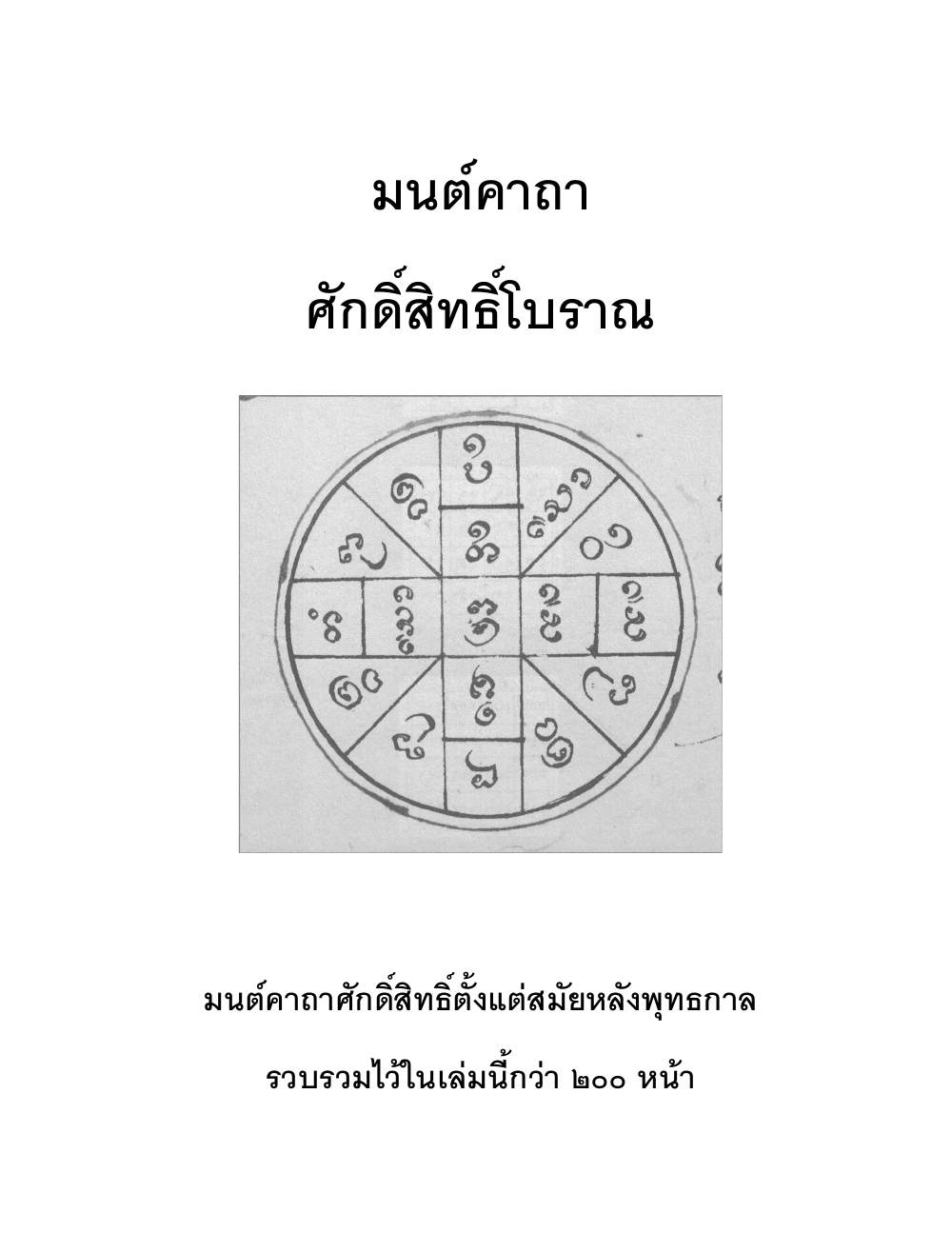
มนต์คาถา ศักดิ์สิทธิ์โบราณ
[diagram: a circular yantra containing a 3×3 grid of numbered cells (a magic square), with four additional triangular cells filling the corners between the square and the circle's rim; each cell holds a Thai numeral written in an old manuscript hand]
มนต์คาถาศักดิ์สิทธิ์ตั้งแต่สมัยหลังพุทธกาล รวบรวมไว้ในเล่มนี้กว่า ๒๐๐ หน้า
Mantra-Kathas Ancient and Sacred
[diagram: a circular yantra containing a 3×3 grid of numbered cells (a magic square), with four additional triangular cells filling the corners between the square and the circle's rim; each cell holds a Thai numeral written in an old manuscript hand]
Sacred mantra-formulas dating from the era after the Buddha's time, gathered together in this volume — over 200 pages.
โปรดอ่านเพื่อความเข้าใจ [ornamental divider: a wavy line with a twisted rope-knot at its center]
คุณอนันต์ของมนต์คาถา เลขยันต์ ในหนังสือเล่มนี้จะประกอบไปด้วยมนต์คาถาและเรื่องราวของยันต์ ในเรื่องของมนต์คาถานั้น ผู้ที่จะสามารถสวดและท่องจำนำไปใช้ได้ ก็คือผู้ที่มีจิตศรัทธาและมีความเชื่อในดวงจิตของตัวเองว่าสามารถนำไปใช้ได้ ส่วนเรื่องราวของยันต์ ซึ่งมีผู้นิยมใช้กันมาก เพราะมีการปลุกเสกไว้แล้ว ไม่ต้องท่องจำเหมือนมนต์ และแทบไม่มีข้อห้ามในการพกติดตัว ไม่ต้องไปยกครู เพียงขอบูชา (เช่า) ก็จะสามารถนำไปใช้ตามคำแนะนำได้เลย ไม่มีการเกี่ยงถึงเรื่องวันเดือนปีเกิดว่าวันนั้นวันนี้จึงจะมีของขลังสามารถพกติดตัวและคุ้มครองได้เลย ไม่ต้องท่องหรือสวดซ้ำซาก ที่สำคัญครูยันต์ท่านรู้ว่าเลขใดใช้ทางใด อักษรใดใช้ทางใด ท่านลงไว้อย่างถูกช่องปลุกเสก ลงเลขงามยามดีไว้แล้ว
Please Read for Understanding [ornamental divider: a wavy line with a twisted rope-knot at its center]
The Boundless Virtue of Mantra-Kathas and Numeral Yantras This book consists of mantra-kathas together with material on yantras. As for the mantra-kathas, those able to chant and memorize them for use are those who hold sincere faith and believe in their own mind that they can be used effectively. As for the yantras, which are popular with many people, because they have already been consecrated (pluk-sek), one need not memorize them the way one memorizes a mantra, and there is almost no restriction on carrying them on one's person. There is no need to perform a teacher-veneration (yok khru) ceremony — one need only ask to venerate (or "rent") it, and it can then be used according to the instructions. There is no concern over which day, month, or year of birth is auspicious before a sacred object can be carried for protection. There is no need for repeated chanting or recitation. Importantly, the yantra-master knows which numeral serves which purpose and which letter serves which purpose; he has inscribed them correctly in their proper places, already consecrated, with the numerals set down at an auspicious day and hour.
พระพุทธเจ้าทรงแจกพุทธมนต์
ในพระธัมมปทัฏฐกถาเล่มที่ ๒ เรื่องภิกษุผู้ปรารภวิปัสสนา เล่าว่า เรื่องที่ ๑ ภิกษุ ๕๐๐ รูป เรียนกัมมัฏฐานในสำนักพระศาสดา ไปปฏิบัติธรรมอยู่ในป่าดงดิบแห่งหนึ่ง ถูกผีหลอกจับไข้หัวโกร๋นกลับมา พระพุทธเจ้าประทานมนต์กันผีให้ (คือกรณียเมตตสูตร) เรื่องที่ ๒ พระภิกษุไปเจริญกัมมัฏฐานในป่าที่มีงูมาก ถูกงูกัดมรณภาพหลายรูป ก็ทรงประทานมนต์กันงูให้ (ขันธปริตตสูตร) เรื่องที่ ๓ พระผู้มีพระภาคทรงเห็นพระสารีบุตรและพระโมคคัลลานะอาพาธหนัก ทรงแสดงธัมมโอสถ (พุทธมนต์) กล่าวคือ โพชฌงค์ ๗ ประการให้ฟัง อาการป่วยก็บรรเทาและหายไปในที่สุด ฯลฯ ทุกคำสอนในพระพุทธศาสนาล้วนแต่เป็น ๑. ทีปา — เป็นเกราะป้องกันภัย ๒. นาถา — เป็นที่พึ่ง ๓. ปติฏฐา — เป็นที่พำนักพักพิงเวลามีทุกข์ ๔. เลณา — เป็นที่หลีกเร้นเพื่อหาความสงบสุข แม้หนังสือบทสวดมนต์ในพุทธศาสนาก็เรียกว่าบทสวดมนต์ อาทิ สวดมนต์เจ็ดตำนาน สวดมนต์สิบสองตำนาน สวดมนต์ฉบับหลวง แม้หนังสือชี้แจงพิธีสวดมนต์ก็ยังเรียกขานว่า "มนต์พิธี" สรุปว่า พระพุทธเจ้ามิได้ทรงแจกยันต์ หากแต่ทรงแจกพุทธมนต์ มิใช่มนตร์มาร
The Buddha Distributes Buddha-Mantras
In the Dhammapada Commentary, Volume 2, the account of the monks who took up insight meditation (vipassanā) relates: Story 1: Five hundred monks learned meditation subjects in the Teacher's presence and went to practice the Dhamma in a certain deep forest. They were tormented by spirits and came back stricken with fever, their hair fallen out. The Buddha bestowed on them a mantra to ward off spirits (this is the Karaṇīya-metta Sutta). Story 2: Monks went to develop meditation in a forest full of snakes; several were bitten and died. He bestowed on them a mantra to ward off snakes (the Khandha-paritta Sutta). Story 3: The Blessed One saw that Ven. Sāriputta and Ven. Moggallāna were gravely ill; he taught the "medicine of the Dhamma" (Buddha-mantra), namely the Seven Factors of Enlightenment (bojjhaṅga), and their illness eased and finally vanished, etc. Every teaching in Buddhism is: 1. Dīpā — an armour that guards against danger 2. Nāthā — a refuge to rely on 3. Patiṭṭhā — a shelter in times of suffering 4. Leṇā — a retreat for seeking peace Even the Buddhist chanting books are called books of chant — e.g. the Seven-Chronicle chants, the Twelve-Chronicle chants, the Royal-edition chants; even the book explaining the chanting rite is still called the "Mantra Rite" (mantra-phithī). In sum: the Buddha did not hand out yantras, but rather Buddha-mantras — not the mantras of Māra.
พระพุทธเจ้าทรงแจกมนต์ แล้วทรงประทานคาถา
พระพุทธองค์ทรงประทานมนต์กันงู เช่น • วิรูปักเขหิ เม เมตตัง ฯลฯ แปลว่า ข้าพเจ้าขอแผ่เมตตากับพญางูตระกูลวิรูปักข์ ฯลฯ เพื่อให้งูทั้งหลายไม่ทำอันตรายเรา แต่ในขณะเดียวกันก็ทรงให้คาถา คือ บทสวดเตือนสติไม่ให้ประมาทว่า • อัปปะมาโท อะมะตังปะทัง แปลว่า ความไม่ประมาทเป็นทางแห่งความไม่ตาย • ปะมาโท มัจจุโน ปะทัง แปลว่า ความประมาทนำไปสู่ความตาย • อัปปะมัตตา นะ ยันติ แปลว่า ผู้ไม่ประมาทย่อมไม่ตาย • เย ปะมัตตา ยะถา มะตา แปลว่า ผู้ประมาทแล้วก็เหมือนคนที่ตายไปแล้ว
The Buddha Distributed Mantras, Then Bestowed Katha
The Buddha bestowed a mantra to ward off snakes, for example: • "Virūpakkhehi me mettaṃ …" — meaning: "I extend loving-kindness to the nāga-lord of the Virūpakkha clan …", so that all snakes will do me no harm. At the same time he gave a katha — a verse warning one to be heedful: • Appamādo amataṃ padaṃ — "Heedfulness is the path to the deathless." • Pamādo maccuno padaṃ — "Heedlessness is the path to death." • Appamattā na mīyanti — "The heedful do not die." • Ye pamattā yathā matā — "The heedless are as though already dead." (These are the opening verses of the Appamāda-vagga of the Dhammapada.)
เรื่องราวของยันต์ที่เกี่ยวกับพระพุทธเจ้า
พระพุทธเจ้าตรัสไว้ในทุกขนิกาย สุตตันตปิฎก ว่า สถานา ภิกขเว วิหรถ มา อนาถา แปลว่า "ภิกษุทั้งหลาย พวกเธอจงอยู่อย่างมีที่พึ่ง อย่าอยู่อย่างไร้ที่พึ่ง" กล่าวคือ อยู่อย่างมีของดีคุ้มครอง เพราะภัยมีอยู่ ๒ อย่างใหญ่ๆ คือ (๑) ภัยที่เราสามารถมองเห็น เราอาจจะหลบเลี่ยงได้ ถ้าไม่สามารถหลบได้ ก็เผชิญอยู่อย่างผู้ชนะ (๒) ภัยที่เราไม่สามารถมองเห็นได้ เช่น ภัยจากภูตผีปีศาจ หรือคุณไสย หรือภัยที่มาเวลาเราหลับ จะได้มีเครื่องคุ้มครองให้เราปลอดภัยนั้น ให้พึงเข้าใจว่า พระพุทธเจ้าประกาศพระศาสนา มิได้ทรงฉายเดี่ยวแต่ประการใด นอกจากสาวกอื่นๆ ที่มาช่วยแล้ว ยังมีสาวกที่เป็นกำลังสำคัญอยู่สองรูปคือ ๑. พระสารีบุตร ผู้เลิศทางปัญญาเสมือนหนึ่งมือขวา จะช่วยโปรดผู้ที่เข้าใจในธรรมยาก ๒. พระโมคคัลลานะ ผู้เลิศทางฤทธิ์ ผู้ใดสอนยาก เป็นนักเลง เช่นพระนันโทปนันทะนาคราช ก็ทรงมอบให้พระโมคคัลลานะปราบหรือทรมานให้หายพยศ ไม่ปรากฏว่าทรงแจกยันต์แต่ประการใด
The Story of Yantras in Relation to the Buddha
The Buddha declared in the Dukkha-nikāya of the Suttanta Piṭaka: "Saṭṭhānā bhikkhave viharatha, mā anāthā" — meaning: "Monks, dwell as those who have a refuge; do not dwell without a refuge" — that is, live protected by something good, because dangers are of two great kinds: (1) dangers we can see, which we may evade — and if we cannot evade them, we face them as a victor; (2) dangers we cannot see, such as those from ghosts and demons, or from black magic (khun-sai), or dangers that come while we sleep — for these one should have a protective object to keep one safe. Understand that when the Buddha proclaimed his teaching he did not act alone: besides the other disciples who came to help, there were two of foremost importance — 1. Ven. Sāriputta, foremost in wisdom, like a right hand, who helps deliver those who find the Dhamma hard to understand; 2. Ven. Moggallāna, foremost in psychic power — anyone hard to teach, a ruffian such as Nandopananda the Nāga-king, the Buddha assigned to Moggallāna to subdue or tame until his stubbornness was cured. It does not appear that the Buddha handed out yantras in any way.

ตอนที่ ๑ บทที่ ๑ เครื่องรางของขลังพลังความเชื่อ
Part One Chapter 1 — Amulets and Charms: The Power of Belief
มีสิ่งลี้ลับสิ่งหนึ่งซึ่งถือเป็นมรดกและภูมิปัญญาของมนุษย์ยุคโบราณที่เล่าสืบต่อกันมา นั่นคือเรื่องราวของคาถา (Magic) เครื่องรางของขลัง (Charm) ผู้รู้ทางด้านเครื่องรางของขลังในอาณาจักรล้านนาเล่าขานสืบต่อกันมาว่า ผู้คนในอาณาจักรโบราณของดินแดนสุวรรณภูมิมีหลักฐานความเชื่อในวิญญาณนิยมผสมผสานความเชื่อในลัทธิมนตรยานของพุทธศาสนาและศาสนาพราหมณ์-ฮินดู เกิดความเชื่อรูปแบบเฉพาะปรากฏอยู่ในระบบเลขยันต์ต่างๆ
ชาวพุทธในสุวรรณภูมิ อาทิ จามมอญ ขอมเขมร พม่า ไทยใหญ่ ไทยเขิน ไทยลื้อ ลาว มลายู และชาวสยาม มักมีวัฒนธรรมที่เกี่ยวข้องกับเวทมนตร์คาถาและเครื่องรางของขลัง ผู้ที่มีความเชี่ยวชาญเรื่องเลขยันต์มากที่สุดก็คือกลุ่มพระสงฆ์ ในสมัยโบราณได้ย่อพระสูตรต่างๆ เป็นอักขระจัดเรียงในรูปแบบตารางหรือลายเส้นเป็นตัวเลข หรือรูปภาพเขียนสักหรือแกะลงบนแผ่นผ้า ผิวหนัง ไม้ โลหะ ฯลฯ ตลอดจนนำไปสร้างพระพิมพ์ พระพุทธรูป และวัตถุมงคลต่างๆ ถือเป็นของศักดิ์สิทธิ์มีอานุภาพในการปกป้องคุ้มครอง
สิ่งที่น่าสนใจเกี่ยวกับเรื่องเครื่องรางของขลังจากอีกแห่งที่มาเชื่อว่ามีมาพร้อมโลกมนุษย์ที่ยังไม่มีพัฒนาการทางความคิดและสติปัญญา เมื่อมีภัยจากสัตว์หรือธรรมชาติก็กลัวตายวิ่งหาที่ป้องกันภัย สิ่งไหนดีก็ยึดเป็นที่พึ่ง ซึ่งนักวิชาการในช่วงหลังเรียกลักษณะการกระทำเช่นนี้ว่า "การถือคุณไสย" ซึ่งแปลว่า ถือเอาคุณสมบัติที่ดีกว่า อาทิ ช่วยให้ดีก็เป็นคุณไสยดีหรือมนตร์ขาว ทำให้ตายหรือฉิบหายก็เป็นคุณไสยดำหรือมนตร์มาร ด้วยคำว่าไสยมาจากภาษาบาลีว่า เสยย แปลว่า ประเสริฐกว่า ดีกว่า ดังคำว่า อกตัง ทุกกฏัง เสยโย แปลว่า ความชั่วไม่ทำเสียเลยดีกว่า เปลี่ยนรูปมาเป็นภาษาไทยว่า ไสย แปลว่า ประเสริฐกว่า ดีกว่า
There is a mystery held to be the inheritance and accumulated wisdom of the ancients, passed down by word of mouth: the lore of katha (magic) and charms (khrueang-rang). Those learned in charms in the Lanna kingdom relate that the people of the ancient realms of Suvarnabhumi held an animist belief fused with the Mantrayāna (tantric) strands of Buddhism and of Brahmanism-Hinduism, producing a distinctive belief-system expressed in the various systems of yantra-numerals (lek yan).
The Buddhist peoples of Suvarnabhumi — Cham-Mon, Khom-Khmer, Burmese, Tai Yai (Shan), Tai Khoen, Tai Lue, Lao, Malay, and Siamese — commonly share a culture bound up with incantation, katha, and charms. Those most expert in yantra-numerals were the monks: in ancient times they condensed the suttas into sacred letters arranged as grids or line-figures rendered as numerals, or as images tattooed or incised on cloth, skin, wood, metal, and so on — and used them to make votive tablets, Buddha images, and sacred objects, held to be holy and to possess protective power.
What is intriguing is another account holding that charms arose together with humankind itself, before thought and intellect had developed: when faced with danger from animals or nature, people feared death and ran seeking protection, and whatever seemed good they clung to as a refuge. Later scholars call this "the holding of khun-sai" — taking hold of a superior quality: what helps toward good is "white" khun-sai (white magic); what brings death or ruin is "black" khun-sai (the magic of Māra). The word sai derives from the Pali seyya, "more excellent, better" — as in akataṃ dukkaṭaṃ seyyo, "the evil deed is better left undone" — which, rendered in Thai as sai, means "more excellent, better."
คือพัฒนารูปแบบให้ดีกว่า จนกว่ามนุษย์ผู้มีปัญญาสูงกว่าจะข้ามพ้นคุณไสยนี้ไปได้ พระพุทธเจ้าทรงเรียนจบมาหมดคัมภีร์พระเวททั้ง ๔ คือ นิรุพเวท ยชุพเวท สามเวท และอาถรรพณพระเวท ไม่เคยประกาศว่านี่คือของจริง แต่ทรงประกาศอย่างห้าวหาญว่า ข้าพเจ้าได้ตรัสรู้เป็นพระสัพพัญญูจากของจริงอันประเสริฐไม่ใช่ของปลอม ๔ อย่าง เรียกว่า
— that is, to develop ever better forms, until humans of higher wisdom can transcend this khun-sai altogether. The Buddha completed the study of all four Vedas — the Ṛg-veda, Yajur-veda, Sāma-veda, and Atharva-veda — yet never proclaimed them to be the truth. Instead he boldly declared: "I have awakened to omniscience (sabbaññū) through four things that are genuine and excellent, not false — called…"
อริยสัจ ๔ ประการ คือ ๑. ทุกข์ คือ ความไม่สบายกายหรือความชำรุดคร่ำคร่า ๒. สมุทัย คือ ตัวการที่ทำให้ทุกข์เกิด ๓. นิโรธ คือ ดับที่สมุทัย (ตัวการ) ทุกข์ก็ดับ ๔. มรรค คือ ทางนำไปสู่ความดับทุกข์ (มี ๘ สาย) มี ๔ อย่างเท่านี้ ไม่มีเครื่องรางของขลังอันใด
…the Four Noble Truths, namely: 1. Dukkha (suffering) — bodily discomfort, or decay and deterioration. 2. Samudaya (origin) — the cause that gives rise to suffering. 3. Nirodha (cessation) — extinguish the origin (the cause), and suffering ceases. 4. Magga (path) — the way leading to the cessation of suffering (it has eight branches). Just these four — no charm or amulet whatsoever.

ตอนที่ ๑ บทที่ ๒ ยันต์กับความเชื่อ
Part One Chapter 2 — Yantras and Belief
ความเชื่อเรื่องเวทมนตร์คาถาและเลขยันต์ต่างๆ ถือเป็นศาสตร์แห่งความเชื่อที่คู่กับมนุษยชาติมาแต่โบราณ ซึ่งมิอาจกล่าวอย่างแน่ชัดลงไปได้ว่าเรื่องราวลึกลับแขนงนี้มีต้นกำเนิดจากชนชาติใดหรือผู้ใดเป็นผู้คิดค้นขึ้นมาเป็นคนแรก แต่อาจกล่าวได้ว่า ในอารยธรรมโบราณของโลกที่ปรากฏหลักฐานทางประวัติศาสตร์โบราณคดีที่หลงเหลือให้คนรุ่นหลังได้ศึกษา อาทิ อารยธรรมอียิปต์ กรีก โรมัน ล้วนแล้วแต่มีรากฐานความเชื่อในเรื่องเทพเจ้า เทวดา ผี เวทมนตร์คาถาและเลขยันต์ ที่มีความเป็นสากลร่วมกันอยู่ทั่วโลก
สำหรับในวัฒนธรรมภูมิภาคเอเชีย ปรากฏอารยธรรมของชาวอารยันในกลุ่มลุ่มแม่น้ำสินธุและกลุ่มอินเดียโบราณกลุ่มอื่นๆ ก็มีความเชื่อในเรื่องนี้เช่นกัน จนสามารถพัฒนาเป็นศาสนาที่ยิ่งใหญ่อันมีความสัมพันธ์กับเทพเจ้าสูงสุด คือ พระศิวะและพระนารายณ์ในความเชื่อของศาสนาฮินดู หรือแม้แต่ในพุทธศาสนาก็ปรากฏความเชื่อเกี่ยวกับเวทมนตร์คาถานี้ในศาสนาพุทธนิกายมหายานที่ดูเหมือนจะเด่นชัดกว่าศาสนาพุทธนิกายเถรวาท
ในเวลาต่อมาวัฒนธรรมจากต้นกำเนิดอารยธรรมแห่งชมพูทวีปนี้ได้เดินทางสู่ดินแดนต่างๆ ในภาคพื้นเอเชียตะวันออกเฉียงใต้ ทั้งในส่วนของการเผยแผ่ศาสนาฮินดูและศาสนาพุทธที่มีอิทธิพลต่อความคิดความเชื่อของกลุ่มชาติพันธุ์ต่างๆ ในภูมิภาคนี้ กลายเป็นรูปแบบเฉพาะพื้นถิ่นเรื่อยมาจนถึงในปัจจุบัน
อีกด้านหนึ่งของต้นกำเนิดวัฒนธรรมที่ยิ่งใหญ่ คืออารยธรรมจีนโบราณ ก็มีความเชื่อเกี่ยวกับเลขยันต์นี้เช่นเดียวกัน ทั้งนี้ในรูปแบบของความเชื่อภายนอกของทั้งสองกลุ่มวัฒนธรรมหลักอาจจะมีความแตกต่างกันไปบ้างในเรื่องของรายละเอียดปลีกย่อย แต่ระบบแนวความคิด
The belief in incantation, katha, and the various yantra-numerals is a science of belief that has accompanied humankind since antiquity. One cannot say for certain from which people this esoteric branch originated, or who first devised it — but it can be said that in the ancient civilizations whose archaeological record survives for later study, such as Egypt, Greece, and Rome, all had a foundational belief in gods, deities, spirits, incantations, katha, and yantra-numerals — a universality shared across the world.
In the cultures of Asia, the civilization of the Aryans of the Indus valley and other ancient Indian groups likewise held this belief, developing it into great religions bound to supreme gods — Shiva and Narayana (Vishnu) in Hinduism. Even in Buddhism this belief in incantation appears — in the Mahayana school seemingly more prominently than in the Theravada.
Later, the culture of this Indian (Jambudvīpa) civilization travelled to the lands of Southeast Asia, through the spread of both Hinduism and Buddhism, shaping the thought and belief of the region's ethnic groups and becoming, ever since, distinctively local forms that persist to the present.
On another side of the great culture-origins — ancient Chinese civilization — there was likewise a belief in these yantra-numerals. The outward forms of the two main streams may differ in minor detail, but the conceptual system…
หรือหัวใจสำคัญนั้นมีความคล้ายคลึงกันอย่างแยกกันไม่ออก กล่าวคือ ในเบื้องต้นจะมีการแสดงแนวคิดในเรื่องของศูนย์กลางจักรวาลหรือแผนภูมิจักรวาล ตลอดจนการแสดงตำนานที่กล่าวถึงอำนาจของบรรดามหาเทพและหมู่มวลเทพยดาองค์ต่างๆ ในสมัยบรรพกาล ซึ่งหากพิจารณาความพิเศษของเลขยันต์นั้นก็คือการแสดงให้เห็นถึงความสัมพันธ์และการให้ความสำคัญกับธาตุทั้งสี่ คือ ดิน น้ำ ลม ไฟ เป็นหลัก โดยมีตัวเลขที่เป็นเสมือนกำลังของแผนผังยันต์และตัวอักษรที่สื่อถึงความศักดิ์สิทธิ์ ที่ผสมผสานกับแนวคิดด้านศาสนาที่เข้ามาใหม่กับความเชื่อดั้งเดิมของกลุ่มชนเข้าด้วยกันอย่างลงตัว
ในภูมิภาคเอเชียยังได้มีการพัฒนาให้เกิดการบูรณาการตะวันออกเฉียงใต้ อันจะยกตัวอย่างได้แก่ เขมร พม่า มอญ ซึ่งเป็นกลุ่มวัฒนธรรมโบราณในดินแดนที่เรียกว่าสุวรรณภูมิ ตลอดจนกลุ่มชาติพันธุ์ไท (ไทย) กลุ่มต่างๆ เช่น ไทยใหญ่ ไทยโยนก ไทยลื้อ ไทยเขิน ไทยอาหม ไทยสยาม ฯลฯ ต่างก็มีแนวความคิดความเชื่อทางศาสนาฮินดูและศาสนาพุทธที่พัฒนามาเป็นเลขยันต์อันศักดิ์สิทธิ์ที่แฝงไว้ด้วยนัยแห่งปรัชญาอันลึกซึ้ง ความศรัทธา ความคิด ความเชื่อ ประเพณี วิถีชีวิต ประกอบไว้เป็นมรดกตกทอดทางวัฒนธรรมจากบรรพชนสู่คนรุ่นหลังอย่างมหัศจรรย์
หากพิจารณาจากพื้นฐานความเชื่อทางด้านพระพุทธศาสนาในประเทศไทยนั้น จะพบว่าในวิถีชีวิตตั้งแต่เกิดจนตายของคนไทยมีความสัมพันธ์และเกี่ยวข้องกับความเชื่อทางไสยศาสตร์อยู่ไม่น้อย โดยบางคนอาจไม่เฉลียวใจพิจารณา หรือมีความคิดว่าไสยศาสตร์นั้นเป็นสิ่งที่เหลือเชื่อ ไม่สามารถเป็นไปได้ในโลกแห่งความเป็นจริง ทั้งนี้ด้วยเหตุว่าไสยศาสตร์นั้นต่างจากทางวิทยาศาสตร์ที่ต้องมีการพิสูจน์อย่างเป็นกระบวนการ
…or their essential heart resembles one another inseparably. That is: at the outset there is the idea of the cosmic center or cosmological diagram, together with myths recounting the powers of the great gods and the hosts of deities of primordial times. What is special about the yantra-numerals is precisely their demonstration of the relationship with — and the primacy given to — the four elements: earth, water, wind, and fire. Numerals stand as the "force" of the yantra diagram, and letters signify sacredness — blended seamlessly with newly arrived religious ideas and the group's original native beliefs.
In the Asian region there also arose a Southeast Asian integration — for example the Khmer, Burmese, and Mon, ancient cultural groups of the land called Suvarnabhumi, and the various Tai (Thai) groups such as the Tai Yai (Shan), Tai Yonok, Tai Lue, Tai Khoen, Tai Ahom, Tai Siam, and so on. All held Hindu and Buddhist ideas that developed into sacred yantra-numerals imbued with deep philosophy — faith, thought, belief, custom, and way of life bound together as a marvelous cultural inheritance from ancestor to descendant.
Considering the Buddhist foundation of belief in Thailand, one finds that in the Thai way of life, from birth to death, there is no small connection with saiyasat (occult) belief. Some may not stop to consider it, or may think saiyasat unbelievable, impossible in the real world — because saiyasat differs from science, which demands systematic proof.
และขั้นตอนการวิจัยที่น่าเชื่อถือมารองรับทฤษฎีต่างๆ แต่หากย้อนดูความเป็นจริงอย่างหนึ่งเกี่ยวกับไสยศาสตร์ เวทมนตร์คาถา และความเชื่อเรื่องยันต์ จะเห็นได้ว่าศาสตร์แขนงนี้สามารถคงความเป็นอมตะมาตลอดระยะเวลายาวนานนับร้อยนับพันปี ซึ่งแก่นสารของสิ่งวิเศษล้ำค่าเหล่านี้ได้มีการรักษาและสืบทอดกันเรื่อยมาอย่างไม่ขาดสายธารแห่งศรัทธา อันหยั่งรากฝังลึกลงไปในจิตสำนึกและประเพณีวิถีชีวิตของคนไทย ดังปรากฏหลักฐานที่ได้มีการบันทึกเลขยันต์ต่างๆ ไว้ในสมุดข่อย พับสา และคัมภีร์ใบลาน ตลอดจนการร่ำเรียนในแบบมุขปาฐะที่ใช้การจดจำปากต่อปาก "จากครูสู่ศิษย์" โดยมีเงื่อนไขแห่งหัวใจ "ศรัทธา" เป็นปัจจัยสำคัญ
หากไม่มีการพิสูจน์จนผู้เรียนนั้นแน่แก่ใจว่าประเสริฐล้ำเลิศจริงดังกล่าวอ้าง ก็ใช่ว่าศิษย์นั้นจะมอบกายถวายชีวิตแก่ครูเพื่อร่ำเรียนวิชาแห่งไสยศาสตร์นั้น ซึ่งหลายคนหลายชีวิตอาจเคยประสบเรื่องราวอันลึกลับน่าเหลือเชื่อจากการถูกคุณไสยมนต์ดำทำร้ายจนถึงแก่ชีวิต หรือแม้แต่การปองร้ายให้ศัตรูได้รับความทุกข์ทรมานมาแล้วก็เป็นได้
อันที่จริงไสยศาสตร์มีทั้งด้านที่เป็นสีขาวอันคือความดีงาม และด้านสีดำคือความชั่วร้ายที่อยู่คู่กันเสมอมา ทั้งนี้เมื่อมีคนผูกก็ต้องมีคนแก้ มีฟ้าก็ต้องมีเหนือฟ้า ซึ่งถ้าท่านผู้อ่านได้ศึกษาอย่างถ่องแท้แล้วเกี่ยวกับเรื่องไสยศาสตร์ เวทมนตร์คาถา เลขยันต์ต่างๆ จะสามารถยืนยันให้เห็นถึงการพัฒนาเกี่ยวกับความเชื่อในด้านนี้อย่างมหาศาล ดังนั้นหากพิจารณาให้ดีด้วยสติปัญญาแล้วจะพบว่า สิ่งเหล่านี้ก็มิน่าจะใช่สิ่งที่เลื่อนลอยไร้เหตุผลเลยเสียทีเดียว
…and reliable research procedures to support various theories. Yet looking back at one truth about saiyasat, incantation-katha, and yantra belief, we see that this branch of knowledge has remained immortal across hundreds and thousands of years. The essence of these precious marvels has been preserved and handed down in an unbroken stream of faith, rooted deep in the consciousness and customary life of the Thai people — as evidenced by yantra-numerals recorded in samut khoi (khoi-paper folding books), phap sa (mulberry-paper books), and bai lan (palm-leaf manuscripts), and by oral learning memorized mouth-to-mouth, "from teacher to pupil," with the heart's condition — "faith" (saddhā) — as the key factor.
Without proof convincing the learner it is truly as excellent as claimed, a pupil would hardly devote body and life to a teacher to study saiyasat. Many people, many lives, may have met mysterious, unbelievable events — harmed unto death by black-magic khun-sai, or inflicting suffering on an enemy through malice.
In truth saiyasat has both a white side — goodness — and a black side — wickedness — always coexisting. Where one binds, another must unbind; where there is a sky, there must be something above it. If the reader studies these matters thoroughly, one can affirm the immense development of belief in this domain. Thus, considered well and with discernment, these are hardly groundless, unreasoning things.
มองอย่างกลางๆ ทุกอย่างจะยุติธรรม หากจะมองอีกมุมหนึ่งอย่างเป็นกลางที่สุดก็อาจเห็นในสิ่งที่บรรพชนของเราทุ่มเทสติปัญญาคิดค้นขึ้นมา นำมาใช้บูรณาการกับการใช้ชีวิตประจำวันของเราได้ รวมทั้งสร้างความเข้าใจอันดีที่จะนำปรัชญาอันลึกซึ้งที่แฝงอยู่ในโครงสร้างของเลขยันต์ต่างๆ มาพินิจพิเคราะห์อย่างเป็นเหตุเป็นผล ซึ่งถ้าหากเราได้ศึกษาให้ลึกซึ้งแล้วอาจพบคำตอบบางอย่างที่ทำให้เห็นวิวัฒนาการของความเชื่อของคนไทยสมัยโบราณ ที่อยู่ได้ด้วยความเชื่อด้วยพลังแห่งความศรัทธาและร่องรอยของศาสนาที่เป็นสิ่งยึดเหนี่ยวจิตใจ อันถ่ายทอดออกมาในลักษณะของความคิด ความเชื่อ และความศรัทธาของชนชาติไทยตลอดมา ด้วยเหตุว่า โบราณาจารย์ผู้ฉลาดรอบรู้มักสอดแทรกรายละเอียดของหลักธรรมคำสอนในพระศาสนาไว้กับความขลังและความศักดิ์สิทธิ์ที่เป็นสิ่งล่อใจให้คนรุ่นหลังได้ศึกษา เสมือนเป็นลายแทงที่ทำให้คนทั้งหลายเข้าไปสู่แก่นแท้ของศาสนา อันเป็นจุดสูงสุดด้วยเสมอ
ดินแดนล้านนา อีกหนึ่งที่มาแห่งเครื่องรางของขลัง อาณาจักร "ล้านนา" นับมีประวัติศาสตร์ความเป็นมายาวนาน ตามตำนานเมืองหรือพงศาวดาร นิทานปรัมปรา คติ และหลักฐานทางประวัติศาสตร์โบราณคดีที่แสดงความสัมพันธ์เกี่ยวเนื่องระหว่างกัน โดยอาจประมาณการกำเนิดของชุมชนหรือรัฐโบราณที่ถือกำเนิดขึ้นลุ่มแม่น้ำสำคัญสายหลักต่างๆ เช่น แม่น้ำโขง แม่น้ำกก แม่น้ำปิง แม่น้ำวัง แม่น้ำยม และแม่น้ำน่าน
ตั้งแต่ราวพุทธศตวรรษที่ ๑๖ เป็นต้นมา จนถึงสมัยประวัติศาสตร์ที่มีหลักฐานการจารึก เช่น ศิลาจารึก ใบลาน พับสา (สมุดที่ทำด้วย
Viewed impartially, everything is fair. Taking another, most impartial view, we may see in what our ancestors devoted their intellect to devising something we can integrate into daily life — cultivating a sound understanding that lets us reasonably examine the profound philosophy embedded in the structure of the yantra-numerals. Studied deeply, it may yield answers revealing the evolution of the beliefs of the ancient Thai — beliefs sustained by the power of faith and by traces of religion that anchor the mind, expressed as the thought, belief, and faith of the Thai people throughout time. For the wise, erudite masters of old habitually wove the fine points of religious doctrine into potency and sacredness — an enticement drawing later generations to study, like a treasure-map (lai thaeng) leading people to the true essence of the religion, its highest point.
The Lanna Land: Another Origin of Charms The kingdom of "Lanna" has a long history — per town-legends or chronicles, myths, lore, and archaeological evidence showing their interrelations. One may reckon the origin of communities or ancient states arising along the major rivers, such as the Mekong, Kok, Ping, Wang, Yom, and Nan.
From around the 16th Buddhist century onward, into the historical period with inscriptional evidence — stone inscriptions, palm-leaf (bai lan), phap sa (books made of…
กระดาษสา) ต่างๆ ได้กล่าวถึงเมืองโบราณหลายเมืองในแคว้นล้านนา อาทิ เมืองโยนกนาคพันธุ์สิงหนวัติไชยบุรีศรีช้างแสน (อำเภอเชียงแสน จังหวัดเชียงรายในปัจจุบัน) เมืองหริภุญไชย (เมืองลำพูนในปัจจุบัน) เมืองไชยนารายณ์ (เมืองเชียงรายในปัจจุบัน) เมืองนพบุรีศรีนครพิงค์เชียงใหม่ (เมืองเชียงใหม่ในปัจจุบัน) เมืองภูกามยาว (เมืองพะเยาในปัจจุบัน) เมืองอาลัมภางค์เขลางค์นคร (เมืองลำปางในปัจจุบัน) เมืองย่างและเมืองวรนคร (อำเภอท่าวังผาและอำเภอปัว จังหวัดน่านในปัจจุบัน) เมืองนันทบุรีศรีนครน่าน (เมืองน่านในปัจจุบัน) เวียงโกษัยนคร (เมืองแพร่ในปัจจุบัน) เป็นต้น
ดังที่ได้กล่าวมานี้เป็นตัวอย่างชื่อเมืองสำคัญที่อยู่ในหน้าประวัติศาสตร์อันยาวนานของอาณาจักรล้านนา ที่มีความเจริญรุ่งเรืองอย่างมากในด้านการเมืองการปกครองและการศาสนา ซึ่งมีศาสนาสำคัญอันเป็นหัวใจแห่งศิลปวัฒนธรรมโบราณที่หลากหลาย ได้แก่ ศาสนาผี ซึ่งเป็นศาสนาดั้งเดิม ศาสนาพราหมณ์ที่เข้ามามีบทบาทผสมผสานกับความเชื่อในศาสนาผี ศาสนาพุทธเถรวาทและศาสนาพุทธมหายาน จนเกิดการหล่อหลอมทางด้านความศรัทธา ความคิด ความเชื่อ วัฒนธรรม ประเพณี วิถีชีวิต ที่ดูเหมือนว่าจะแยกกันไม่ออกระหว่างความเชื่อเรื่องการนับถือผีและการนับถือพระพุทธศาสนา ได้หยั่งรากฝังลึกลงไปในทุกอณูแห่งสายเลือดของชาวล้านนา ซึ่งยังคงเป็นสิ่งเร้นลับอันหาคำตอบมาอธิบายไม่ได้เกี่ยวกับเรื่องราวของไสยศาสตร์ มนตร์ขาวมนตร์ดำ ที่ซุกซ่อนอยู่ในชุมชนโบราณล้านนาโดยจอมขมังเวทผู้มิได้เปิดเผยตัวตนที่แท้จริงออกมาให้ใครต่อใครรู้จัก
…mulberry paper) — mention many ancient cities in the Lanna region, e.g.: Yonok Nakhaphan Singhanawat Chaiburi Si Chang Saen (present-day Chiang Saen district, Chiang Rai); Hariphunchai (present-day Lamphun); Chaiyanarai (present-day Chiang Rai); Noppaburi Si Nakhon Phing Chiang Mai (present-day Chiang Mai); Phu Kam Yao (present-day Phayao); Alampang Khelang Nakhon (present-day Lampang); Mueang Yang and Woranakhon (present-day Tha Wang Pha and Pua districts, Nan); Nanthaburi Si Nakhon Nan (present-day Nan); Wiang Kosai Nakhon (present-day Phrae); and others.
These are examples of important cities in the long history of the Lanna kingdom, which flourished greatly in politics, governance, and religion. Its major religions — the heart of a diverse ancient art and culture — were: the spirit religion (animism), the original faith; Brahmanism, blended with spirit belief; and Theravada and Mahayana Buddhism. From these came a fusion of faith, thought, belief, culture, custom, and way of life — so intertwined that spirit-worship and Buddhism seem inseparable — rooted deep in every particle of the Lanna bloodline. This remains a mystery without ready explanation regarding saiyasat, white and black magic, hidden in the ancient Lanna communities by master adepts (chom khamang wet) who never revealed their true selves to anyone.
รักพรากจากหลง เวทมนตร์ยอดนิยม ผู้รู้ที่อาบน้ำร้อนมาก่อนเล่าให้ฟังสืบมาว่า เวทมนตร์อันวิเศษในดินแดนล้านนาอันลี้ลับนี้มิได้ด้อยไปกว่าไสยศาสตร์ในดินแดนใดในพื้นปฐพี ต่อให้ศาสตร์และมนตร์ใดที่ว่าฉกาจฉกรรจ์มากนัก ทำแล้วแก้ให้หายขาดมิได้ หมอไสยศาสตร์แห่งล้านนาก็สามารถแก้ให้หายขาดได้มานักต่อนัก ถึงขนาดว่าจะให้อยู่ก็อยู่ จะให้ตายก็ตาย จะให้รักให้หลงด้วยมนตร์เสน่ห์ก็ยากจะไถ่ถอน จะให้พรากจากกันหรือให้กลับคืนมาดีกันเหมือนเดิมก็ทำได้ ทั้งนี้ก็ไม่ยากเลยที่จะให้เกิดความเจริญรุ่งเรืองจนสุดประมาณ ด้วยแก้วแหวนเงินทอง ทรัพย์สมบัตินานาประการ ด้วยมหามนตร์อันศักดิ์สิทธิ์ หรือจะให้ล้มหายตายจาก วินาศ ฉิบหาย ทุกข์ทรมานด้วยทุกข์ภัยสารพัด ก็ด้วยมนตร์คาถาทั้งสิ้น
หลายท่านคงเคยได้ยินเรื่องราวของพระอริยสงฆ์ล้านนาที่ทรงด้วยอภิญญา เช่น ครูบาเจ้าศรีวิชัย หรือครูบาศีลธรรม ตามคำเรียกขานของพุทธศาสนิกชนชาวล้านนา ซึ่งเป็นที่เลื่องลือกันทั่วสารทิศเกี่ยวกับบุญบารมีและพลังศรัทธาแห่งคุณงามความดีที่ท่านได้สร้างไว้แก่แผ่นดินล้านนา อันจะสืบสาวไปได้ถึงพระอริยสงฆ์ล้านนาในโบราณที่มีความรอบรู้ในภาษามคธบาลีอย่างถ่องแท้ จึงได้รจนาคัมภีร์ทางพระพุทธศาสนาไว้เหลือคณานับ ซึ่งถือเป็นมหาสมบัติที่คนรุ่นหลังได้ศึกษาอย่างไม่มีที่สิ้นสุดตราบเท่าทุกวันนี้
ด้วยเหตุนี้เองในสมัยปัจจุบันจึงเกิดพระสงฆ์ผู้มีศีลธรรมประเสริฐได้เจริญรอยตามเส้นทางอันดีงาม ซึ่งชาวบ้านทั่วไปให้ความเคารพศรัทธามาก จึงได้ขนานนามว่า "ครูบา" หรือ "ครูบาเจ้า" เพื่อเป็นการยกย่องบารมีธรรมของพระสงฆ์แต่ละท่านผู้ประกอบด้วยคุณงามความดีนั้น ตามความเชื่อว่ามนต์คาถาภาษาบาลีแห่งพระสัมมาสัมพุทธเจ้านั้น เป็น
Love, Loss, Longing — the Most Popular Incantations The experienced elders relate that the extraordinary incantations of this mysterious Lanna land are in no way inferior to the saiyasat of any land on earth. However fierce and formidable a science or spell — one that once worked cannot be undone — the saiyasat healers of Lanna have again and again cured it completely. To the point of: making one live, or die; making one love and be infatuated by love-charms so it can scarcely be reversed; making people part, or return and reconcile as before. It is no hard matter for them to bring boundless prosperity — jewels, rings, silver and gold, all manner of wealth — through holy great-incantations; or to bring collapse, death, ruin, and suffering through every calamity — all by incantation-katha.
Many will have heard of the noble monks (ariya-sangha) of Lanna endowed with higher knowledge (abhiññā), such as Kruba Chao Sri Wichai, or "Kruba Sinlatham" as Lanna Buddhists call him — renowned in every direction for the merit and faith-power of the goodness he established on the Lanna land. This traces back to the noble Lanna monks of old, truly expert in the Magadha-Pali language, who composed countless Buddhist scriptures — a great treasure later generations study endlessly to this day.
For this reason, in the present age too, monks of excellent virtue have arisen who follow that good path — greatly revered by ordinary people, who call them "Kruba" or "Kruba Chao" to honor the dhamma-power of each such virtuous monk, per the belief that the Pali incantation-katha of the Perfectly Self-Awakened Buddha are…
มนต์อันประเสริฐกว่ามนต์ใดๆ และย่อมมีชัยเหนือมนตร์ดำทั้งปวง แต่ก็ต้องขึ้นอยู่กับบุคคลผู้ปฏิบัตินั้นได้เข้าถึงแก่นแห่งพระศาสนามากน้อยเพียงใดด้วย
มหาราชครูอาง การบูชาด้วยไฟ ความเชื่อทางศาสนาที่หล่อหลอมผสมผสานกันกับความเชื่อดั้งเดิมนั้น ได้พัฒนามาเป็นศาสตร์อันลึกลับที่จะได้กล่าวไว้ในหนังสือเล่มนี้ มิใช่เพียงเท่านั้น ในระดับราชสำนักล้านนาโบราณยังปรากฏผู้มีความรู้ความสามารถในเวทมนตร์คาถา ดังที่มีตำแหน่งระดับสูงในราชสำนักล้านนาที่เรียกว่า "มหาราชครูอาง" อยู่ด้วยตำแหน่งหนึ่ง ซึ่งคำว่า "อาง" นี้ก็มีความหมายถึงเวทมนตร์คาถา อันประกอบพิธีการบูชาด้วยแสงไฟแห่งประทีป กล่าวคือ อางนั้นคือวิชาไสยศาสตร์แห่งล้านนาวิชาหนึ่งที่รับอิทธิพลความเชื่อมาจากพม่า ไทยใหญ่ เป็นหลัก โดยที่อางมีคุณวิเศษหลายอย่างเมื่อปฏิบัติตามพิธีกรรมอันศักดิ์สิทธิ์อย่างถูกต้อง ด้วยการบูชามหายันต์อันศักดิ์สิทธิ์ด้วยแสงแห่งประทีป (หรือบูชาเทียนด้วยแสงไฟ ซึ่งมีคำเรียกต่อมาว่า บูชายันต์) ซึ่งให้คุณเป็นเลิศ ไม่ว่าจะเป็นด้านการรักษาโรคร้าย ด้านความรักที่จะทำให้คนรักกันหรือเลิกรากันไป ด้านการขับไล่ภูตผีปีศาจสิ่งชั่วร้าย ด้านการเรียกโชคลาภ อำนาจ วาสนา เงินทองของมีค่าต่างๆ ด้านส่งเสริมให้อยู่ดีมีสุข และสามารถทำให้ตัวเรามีเสน่ห์ เป็นที่นิยมชมชอบ ตามที่เรียกกันว่า มหาเสน่ห์ หรือมหานิยม ที่ไม่ว่าใครๆ ก็ปรารถนา ซึ่งก่อนหน้าที่วิชาอางนี้จะเข้ามาสู่ล้านนานั้น มีการใช้ศาสตร์แขนงนี้อยู่ในดินแดนพม่าหรือแถบชายแดนไทย-พม่า ซึ่งวิชาอางนี้มีทั้งพลังแห่งความชั่วร้ายและพลังแห่งความดีซ่อนอยู่ในตัวเอง ตามแต่ผู้ที่จะนำมาใช้ว่าจะมีความชั่วร้ายหรือความดีงามอยู่ในจิตใต้สำนึกของตนมากน้อยประการใด
…incantations more excellent than any others, bound to triumph over all black magic — though this too depends on how deeply the practitioner has reached the essence of the religion.
The Great Royal Teacher of "Ang": Worship by Fire The religious belief fused with the original native belief developed into the esoteric science this book discusses — and not only that: in the old Lanna royal court there were persons skilled in incantation-katha, as shown by a high court title called "Maha-rat-khru Ang." The word "ang" refers to incantation-katha whose rite involves worship by lamplight. That is, ang is one of the saiyasat disciplines of Lanna, drawing its beliefs chiefly from Burmese and Tai Yai (Shan) influence. Ang has many special virtues when its sacred rite is done correctly — worshipping the sacred great-yantra by lamplight (or worshipping a candle by its flame, later called bucha yan, "yantra-worship"). It confers excellent benefits: healing grave illness; matters of love — making people love or part; driving out ghosts, demons, and evil; summoning fortune, power, destiny, money and valuables; promoting well-being; and making oneself charming and well-liked — what is called maha-saneh or maha-niyom (great charm / great popularity), which everyone desires. Before the ang science entered Lanna, this branch was practiced in Burma or along the Thai-Burmese border. The ang science holds within itself both the power of evil and the power of good, according to how much wickedness or goodness lies in the practitioner's own subconscious.
มหายันต์กับการสืบทอด มหายันต์และพิธีกรรมอันเข้มขลังศักดิ์สิทธิ์ของล้านนาที่สืบทอดกันมารุ่นต่อรุ่น จากครูสู่ศิษย์ที่ต้องคัดเลือกจนได้ผู้ที่มีคุณสมบัติดีเด่นจริงๆ จากคนในตระกูลเดียวกัน เช่น จากพ่อสู่ลูก จากปู่สู่หลาน หรือแล้วแต่ความเหมาะสมของคนในสายเลือดนั้นที่จะถ่ายทอดแก่กัน โดยมีความเชื่อกันว่า อักษรที่จะทำให้ยันต์นั้นมีความศักดิ์สิทธิ์ก็คืออักษรธรรมหรือที่เรียกว่า "ตัวเมือง" ด้วยเหตุว่านับแต่โบราณมา ชาวล้านนาได้จารึกหลักธรรมคำสอนทางพระพุทธศาสนาด้วยตัวอักษรตัวเมืองของล้านนาที่มีมาตราตัวสะกดตามแบบภาษาบาลี
ความเชื่อที่มีต่อไปอีกก็คือ เรื่องราวของภาษาบาลีที่สมเด็จพระสัมมาสัมพุทธเจ้าทรงเลือกมาเป็นตัวอักษรในการเผยแผ่พระธรรมคำสอนนั้นเป็นภาษาศักดิ์สิทธิ์ เวลาที่จารึกลงบนใบลาน เขียนลงบนพับสาหรือสมุดต่างๆ ก็เชื่อว่าจะไม่วางอักษรเหล่านั้นลงบนที่ต่ำหรือวางในที่ซึ่งไม่สมควร อักษรธรรมล้านนาจึงถือเป็นของสูง เป็นของที่ศักดิ์สิทธิ์สมควรแก่การบูชาเท่านั้น แม้เวลาเขียนแล้วคิดจะเอาอักษรธรรมนั้นทิ้งลงไปในถังขยะก็ถือว่าเป็นสิ่งผิดและไม่สมควรยิ่ง บูรพาจารย์ชาวล้านนาจึงใช้อักษรธรรมล้านนาในการลงบนผืนผ้ายันต์ ในการจารจารึกลงบนแผ่นทองเหลือง แผ่นเงิน แผ่นทอง แผ่นนาก
แม้แต่ประกอบพิธีอางที่ต้องใช้การเขียนยันต์และทำเป็นไส้เทียนจุดบูชา ซึ่งพิธีกรรมต่างๆ ก็จะมีรายละเอียดปลีกย่อยออกไปตามที่ครูบาอาจารย์กำหนดมา ซึ่งเป็นลักษณะเดียวกันกับคนไทยในภาคกลางที่นิยมใช้ภาษาเขมรในการลงยันต์พิธีต่างๆ อาจจะด้วยเหตุว่าภาษาของชาวเขมรนอกจากจะได้รับอิทธิพลจากอินเดียเป็นหลัก ยังมีความสัมพันธ์
Great Yantras and Their Transmission The great yantras and the potent, sacred rites of Lanna are handed down generation to generation, from teacher to pupil — who must be selected until one truly of outstanding qualities is found — among people of the same family: father to son, grandfather to grandchild, or as suits a worthy one of that bloodline to receive the transmission. It is believed that the script making a yantra sacred is the dhamma-script, called "tua mueang" (Tham Lanna), because since antiquity the Lanna inscribed the Buddhist teachings in the tua-mueang script, whose spelling follows Pali.
A further belief: the Pali language, which the Perfectly Self-Awakened Buddha chose as the vehicle for his teaching, is a sacred language. When inscribing it on palm-leaf, or writing it in phap sa or other books, one must not place those letters in a low or unfitting place. The Tham Lanna script is thus exalted, sacred, worthy only of reverence. Even throwing written dhamma-script into a rubbish bin is deemed wrong and most improper. The Lanna masters therefore used the Tham Lanna script for yantra-cloth and for inscribing sheets of brass, silver, gold, and nak (gold-copper alloy).
Even in the ang rite — which requires writing a yantra and making it into a candle-wick for worship — the rites vary in fine detail as the teachers prescribe, just as central Thai people favor the Khmer script for yantra rites. This may be because the Khmer language, besides drawing chiefly on Indian influence, also has a relationship…
เกี่ยวข้องกับพิธีกรรมในศาสนาฮินดูอันหรือศาสนาพราหมณ์ ที่ให้ความสำคัญกับมนต์พิธีที่อาศัยเวทมนตร์มาประกอบเป็นสำคัญ
ทั้งนี้หากพิจารณาดูในผืนผ้ายันต์ของชาวล้านนาจะเห็นว่า ในตารางยันต์นั้นใช้ตัวเลขพม่าเป็นหลัก โดยชาวล้านนาเรียกตัวเลขพม่าว่าเป็นเลข "โหรา" ซึ่งเป็นตัวเลขที่ใช้กับพิธีกรรมของไสยศาสตร์จึงจะดีที่สุด ส่วนตัวเลขในการจารึกพระธรรมคำสอนต่างๆ ก็จะใช้ "เลขในธรรม" ที่เป็นตัวเลขล้านนาโดยเฉพาะ ซึ่งท่านผู้อ่านจะพบตัวเลขพม่านี้อยู่เกือบทุกผืนยันต์ที่อยู่ในหนังสือเล่มนี้ เนื่องจากในช่วงต้นของวัฒนธรรมล้านนานั้น ชาวล้านนาได้รับอิทธิพลความเชื่อต่างๆ มาจากดินแดนพุกามที่มีความเจริญรุ่งเรืองมาก่อนหน้า จากนั้นชาวล้านนาก็ได้พัฒนารูปแบบยันต์จนกลายมาเป็นรูปแบบเฉพาะของตนเอง ตามความเชื่อความศรัทธาของกลุ่มชนต่างๆ ไม่ว่าจะเป็นกลุ่มใหญ่ เช่น ไทยโยนก ไทยเขิน ไทยลื้อ และไทยใหญ่ ที่อาศัยอยู่ในดินแดนล้านนา ได้อย่างลงตัว
การสักยันต์บนร่างกายสำคัญฉะนี้ ยันต์นั้นมิได้ปรากฏอยู่บนพื้นกระดาษสา แผ่นทองเหลือง แผ่นทอง แผ่นนาก หรือการเขียนลงบนผืนผ้าแต่อย่างเดียว ซึ่งการเขียนยันต์ลงบนวัสดุเหล่านี้เป็นสิ่งที่ไม่ติดตัวไปในที่ต่างๆ อย่างถาวร บางครั้งเจ้าของอาจลืมไว้ที่บ้าน หรือไม่ได้นำยันต์บางอย่างติดตัวไป เนื่องจากยันต์นั้นมีหลายคุณประโยชน์ที่เลือกใช้ แต่โบราณจึงนิยมที่จะสักยันต์ลงบนร่างกายของตนจึงเป็นการดีที่สุด
ทั้งนี้การสักยันต์ลงบนร่างกายเป็นสิ่งที่นิยมอยู่ในภาคพื้นเอเชียตะวันออกเฉียงใต้ หรือแม้แต่ในทุกมุมโลกก็ปรากฏความเชื่อนี้อยู่เช่นกัน
…connected with the rites of Hinduism or Brahmanism, which give central importance to rites relying on incantation.
If one examines the Lanna yantra-cloth, the yantra grids use Burmese numerals chiefly — the Lanna call the Burmese numerals "hora" numerals, held best for saiyasat rites. For inscribing the Buddhist teachings, however, they use the "numerals within the dhamma" (lek nai tham), the specifically Lanna numerals. The reader will find these Burmese numerals on nearly every yantra-cloth in this book, because in early Lanna culture the Lanna received various beliefs from the land of Pagan (Bagan), which had flourished earlier; the Lanna then developed the yantra forms into their own distinctive style, fitting the beliefs of the various groups — the Tai Yonok, Tai Khoen, Tai Lue, and Tai Yai (Shan) dwelling in Lanna — seamlessly.
Tattooing Yantras on the Body — This Importance Yantras appear not only on mulberry paper, sheets of brass, gold, or nak, or written on cloth. Writing a yantra on such materials means it does not stay permanently on one's person; sometimes the owner leaves it at home or fails to carry a particular yantra along — and since a yantra has many benefits, in old times it was favored to tattoo the yantra onto one's own body, best of all.
Tattooing yantras on the body is popular throughout Southeast Asia — indeed this belief appears in every corner of the world.
ดังนั้นกลุ่มชาติพันธุ์ไทก็เป็นอีกกลุ่มหนึ่งที่ให้ความสำคัญไม่น้อยไปกว่าชนชาติอื่นๆ จนอาจกล่าวได้ว่า ภาพแห่งการสักยันต์กับวิถีชีวิตคนไทยโบราณเป็นสิ่งสำคัญยิ่ง ที่ดูเหมือนว่าจะแยกกันไม่ออกระหว่างชายชาตรีกับการสักยันต์ไว้บนเรือนร่างของตน ดังที่ผู้อ่านได้พบเห็นอยู่ในภาพยนตร์ที่เล่าเรื่องราวทางประวัติศาสตร์ของชาติไทยในปัจจุบัน
ตามหลักฐานความเชื่อเรื่องการสักยันต์ลงบนร่างกายของผู้ชายชาวล้านนา ซึ่งเป็นกลุ่มชนที่อยู่ทางภาคเหนือตอนบนของประเทศไทย ปรากฏภาพจิตรกรรมฝาผนังในวัดสำคัญต่างๆ มากมาย แสดงให้เห็นว่าชายชาวล้านนานั้นนิยมที่จะสักยันต์ลงบนร่างกายจนดูเหมือนนุ่งกางเกงสีดำหรือเสื้อผ้าทั้งตัว ผู้เฒ่าผู้แก่บางคนเล่าว่า ในสมัยโบราณสักขาลายตั้งแต่บั้นเอวเรื่อยลงมาจนถึงข้อเท้า สักตามลำตัวทั้งด้านหน้าและด้านหลัง สักตามแขนหรือแม้แต่นิ้วมือ ทั้งนี้บางคนสักไปจนถึงคอและส่วนบนหัว ซึ่งความนิยมการสักเช่นนี้พบมากในกลุ่มชาวพม่าและชาวไทยใหญ่ ซึ่งก็มีการสักยันต์ลงบนร่างกายไม่น้อยไปกว่าชาวล้านนา
ด้วยเหตุว่าชายใดไม่สักขาและลำตัวก็จะถูกนินทาว่าเป็นผู้หญิงที่ไม่มีน้ำอดน้ำทนต่อการสักที่ต้องทนต่อความเจ็บปวดจากเข็มสัก แล้วจะเป็นผู้นำของครอบครัวได้อย่างไร ถ้าไม่มีรอยสักเลยก็ให้ไปนุ่งผ้าซิ่นเหมือนดังผู้หญิงเสีย ทั้งนี้ถือเป็นสิ่งน่าอับอายสำหรับชายหนุ่มทุกคนในล้านนา ที่จะต้องเรียนคาถาอาคมตลอดจนเข้าหาครูบาอาจารย์ผู้เชี่ยวชาญในการสักยันต์ในชุมชนให้เป็นผู้สักยันต์ให้ โดยจะมีค่าบูชาครู หรือที่เรียกว่า ขันตั้ง ตามที่ครูบาอาจารย์สักยันต์เป็นผู้กำหนด บางที่ต้องใช้เวลาในการสักหลายวันต่อลายสักลายหนึ่ง หรืออาจแรมเดือนแรมปีสำหรับการสักให้ทั่วตัว เพราะลายสักนอกจากจะเป็นการพิสูจน์ความเป็นชายที่อดทน
Thus the Tai ethnic groups are another people who value it no less than others — one may say the image of yantra-tattooing is deeply bound up with the old Thai way of life, seemingly inseparable between the warrior-male and the yantras tattooed on his body, as readers will have seen in films of Thai national history today.
By the evidence for tattooing yantras on the bodies of Lanna men — the people of the upper North of Thailand — many murals in important temples show that Lanna men favored tattooing yantras over their bodies until it looked as if they wore black trousers or a full suit of clothes. Some elders relate that in old times they tattooed the legs in patterns from the waist down to the ankles, the torso front and back, the arms, even the fingers; some tattooed up to the neck and the crown of the head. This fashion was widespread among the Burmese and Tai Yai (Shan), who tattoo yantras no less than the Lanna.
Because any man who did not tattoo his legs and torso would be gossiped about as being like a woman — lacking the endurance to bear the tattoo needle's pain — and how could he then head a family? If he had no tattoos, he might as well wear a sarong like a woman. This was shameful for every young man in Lanna, who had to learn katha and incantations and approach a community master expert in yantra-tattooing to do the work — with a teacher's fee, called khan tang, as the tattoo-master set. Some patterns take many days each; tattooing the whole body may take months or years — for the tattoo is not only proof of a man's endurance…
แล้ว ยังเป็นการนำเอามนตราแลยันต์อันมีฤทธิ์เดช ปาฏิหาริย์ มีความวิเศษติดอยู่ในร่างกายของตน ทั้งเพื่อประโยชน์ทางด้านความคงกระพันชาตรี มหาเสน่ห์ มหานิยม และความงามอันอยู่ภายใต้ลวดลายยันต์ที่ประกอบไว้ด้วยอักษร ตัวเลข สัตว์ที่แข็งแรงต่างๆ จนเกิดความภาคภูมิใจในความเป็นตัวตนของตนเองและสร้างความมั่นใจเมื่ออยู่ในสังคม
แม้ว่าในปัจจุบันความเชื่อเรื่องการสักยันต์ในล้านนาจะเริ่มลดน้อยลงมาก เนื่องจากความเจริญก้าวหน้าทางด้านเทคโนโลยีที่เข้ามาสู่ชุมชนล้านนา ตลอดจนภาระหน้าที่ของผู้ชายที่ต้องเปลี่ยนไปจากอดีต เนื่องจากไม่มีประเพณีการแอ่วสาวแบบโบราณอีกแล้ว เพราะแสงไฟที่เข้ามาสู่ทุกชน ทุกหมู่บ้าน ทำให้ประเพณีอันงดงามต้องเลือนรางจางหายไปจากสังคมล้านนาอย่างน่าเสียดาย หนังสือเล่มนี้จะขอยกตัวอย่างภาพจิตรกรรมที่ปรากฏรูปผู้ชายชาวโยนกล้านนา ชาวพม่า และชาวไทยใหญ่ ที่สักตามร่างกายตามที่ได้กล่าวมาข้างต้น เพื่อประกอบการทำความเข้าใจแก่ท่านผู้อ่าน ดังต่อไปนี้
…but is also the bearing upon one's body of incantations and yantras of miraculous power — for invulnerability (kong-kraphan chatri), great charm (maha-saneh), great popularity (maha-niyom), and the beauty within yantra patterns composed of letters, numerals, and various powerful animals — giving rise to pride in one's identity and confidence in society.
Although today the belief in yantra-tattooing in Lanna has declined greatly — owing to the technological progress entering Lanna communities and the changed duties of men, since the old courtship custom (aew sao) no longer exists because electric light has reached every people and village — this beautiful custom has sadly faded from Lanna society. This book will present examples of murals depicting Yonok-Lanna, Burmese, and Tai Yai (Shan) men tattooed over their bodies as described above, to aid the reader's understanding, as follows.

ตอนที่ ๒ บทที่ ๑ ว่าด้วยคาถาอภิมหาศักดิ์สิทธิ์
Part Two Chapter 1 — On the Supremely Sacred Katha
คาถาถือเป็นสัญลักษณ์ของความศักดิ์สิทธิ์ แรกเริ่มเดิมทีคนโบราณมักใช้คาถาเพื่อเป็นกุศโลบายในการปลุกพลังใจ สร้างความเชื่อมั่นให้เกิดกับตัวเองด้วยความ "ศรัทธา" เป็นที่ตั้ง จึงเกิดความศักดิ์สิทธิ์ ความเชื่อเกี่ยวกับการร่ายมนต์คาถา ผู้ร่ายมนต์จะต้องร่ายตามต้นฉบับภาษาบาลี-สันสกฤตและอักขระโบราณเท่านั้น จะไม่มีการแปล เนื่องจากการแปลจะทำให้ถ้อยคำแห่งความ "ศักดิ์สิทธิ์" นั้นบิดเบือนไม่ขลัง และจะอ่อนทั้งในแง่พลังและความ "แรง" ดังนั้นการแปลหรือการถอดความของคาถาออกมา จึงถือไม่เป็นเรื่องที่ปรากฏ ผู้สนใจใช้มนต์คาถาใดควรยึดจารีตเดิมไว้อย่างเคร่งครัด โดยฝึกท่องให้ได้ตามรากฉบับเดิม และควรท่องคาถาให้ชัดถ้อยชัดคำเหมือนฉบับเดิมทุกประการ...จึงจะสามารถนำไปใช้ได้ผล ข้อสำคัญก่อนจะนำคาถาต่างๆ ไปใช้ ผู้ปฏิบัติควรเป็นผู้ที่ประกอบด้วยศีลธรรมจรรยาสูงและปฏิบัติธรรม จึงสามารถนำ "คาถา" ไปใช้ได้อย่างสมบูรณ์ ก่อนที่จะกล่าวถึงเรื่องราวของคาถาอาคมและมหายันต์อันวิเศษสุดคณานับได้ ผู้จัดทำจะขอยกเอาพระคาถาอันล้ำเลิศแห่งล้านนา เพื่อให้ท่านผู้เจริญได้อ่านและท่องสวด อันจะเกิดอภิมหามงคลแก่ตัวท่านเองตลอดจนครอบครัวของท่าน ด้วยพระคาถาแห่งครูบาเจ้าศรีวิชัย (พระครูบาศรีวิชัย สิริวิชโย) ตนบุญหลวงแห่งล้านนา เป็นการตั้งต้นแห่งการรับมหาคาถาและมหายันต์จากหนังสือเล่มวิเศษนี้แล
บารมี ๓๐ ทัศ ตามแบบครูบาเจ้าศรีวิชัย (ให้คุณทางด้านปฏิบัติดีปฏิบัติชอบ จนเกิดบุญญาบารมี ถึงแก่ความสุขความเจริญ) ทานะ ปาระมี สัมปันโน, ทานะ อุปะปารมี สัมปันโน, ทานะ ปะระมัตถะปารมี สัมปันโน
Katha are regarded as symbols of sacredness. Originally the ancients used katha as a skillful means to rouse the spirit and build self-confidence, founded on "faith" (saddhā) — and from that arose sacredness. As for reciting katha: the reciter must recite according to the original Pali-Sanskrit and ancient letters only — with no translation, because translation distorts the "sacred" wording, robs it of potency, and weakens it in both power and "force" (raeng). Therefore translating or paraphrasing a katha is simply not done. Whoever would use a katha should strictly keep the old tradition, training to recite it exactly per the original root text, pronouncing each word clearly as in the original — only then can it be used effectively. Importantly, before using any katha the practitioner should be endowed with high moral virtue and practice the Dhamma; only then can the "katha" be used to full effect. Before speaking of the innumerable extraordinary katha-incantations and great yantras, the compiler offers a supreme katha of Lanna for the noble reader to read and chant — bringing supreme blessing to yourself and your family — the katha of Kruba Chao Sri Wichai (Phra Kruba Sri Wichai, Sirivichayo), the great "meritorious one" (ton bun luang) of Lanna, as the beginning of receiving the great katha and yantras of this special book.
The Thirty Perfections (Barami 30 That), after the manner of Kruba Chao Sri Wichai (Grants benefit in right practice and good conduct, until merit and perfection arise, reaching happiness and prosperity.) [Pali, transcribed — recited untranslated per the tradition; glossed here for legibility:] Tāna pāramī sampanno, tāna upapāramī sampanno, tāna paramatthapāramī sampanno ("Endowed with the perfection of giving; endowed with the higher perfection of giving; endowed with the ultimate perfection of giving…")
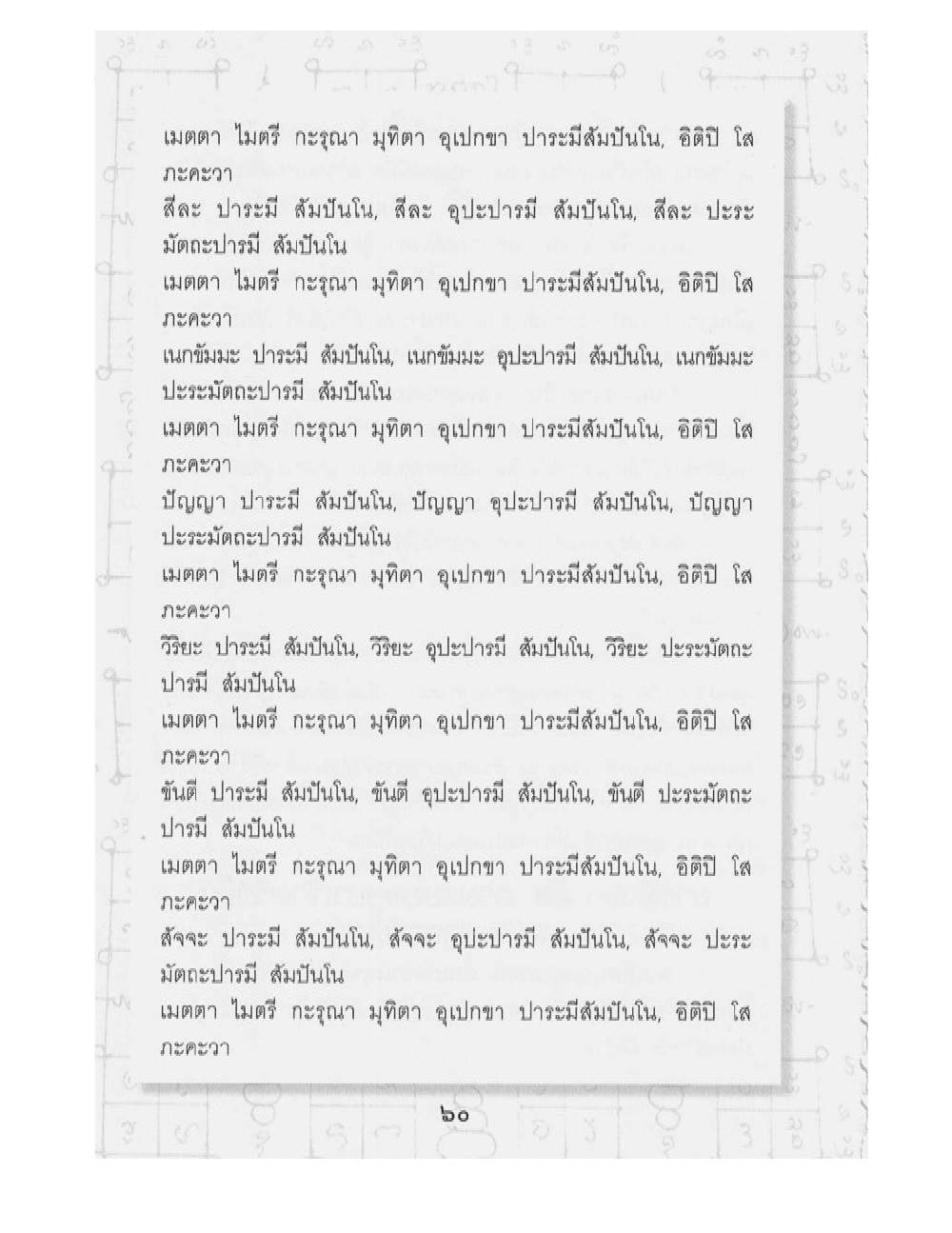
เมตตา ไมตรี กะรุณา มุทิตา อุเปกขา ปาระมีสัมปันโน, อิติปิ โส ภะคะวา สีละ ปาระมี สัมปันโน, สีละ อุปะปารมี สัมปันโน, สีละ ประมัตถะปารมี สัมปันโน เมตตา ไมตรี กะรุณา มุทิตา อุเปกขา ปาระมีสัมปันโน, อิติปิ โส ภะคะวา เนกขัมมะ ปาระมี สัมปันโน, เนกขัมมะ อุปะปารมี สัมปันโน, เนกขัมมะ ประมัตถะปารมี สัมปันโน เมตตา ไมตรี กะรุณา มุทิตา อุเปกขา ปาระมีสัมปันโน, อิติปิ โส ภะคะวา ปัญญา ปาระมี สัมปันโน, ปัญญา อุปะปารมี สัมปันโน, ปัญญา ประมัตถะปารมี สัมปันโน เมตตา ไมตรี กะรุณา มุทิตา อุเปกขา ปาระมีสัมปันโน, อิติปิ โส ภะคะวา วิริยะ ปาระมี สัมปันโน, วิริยะ อุปะปารมี สัมปันโน, วิริยะ ประมัตถะปารมี สัมปันโน เมตตา ไมตรี กะรุณา มุทิตา อุเปกขา ปาระมีสัมปันโน, อิติปิ โส ภะคะวา ขันตี ปาระมี สัมปันโน, ขันตี อุปะปารมี สัมปันโน, ขันตี ประมัตถะปารมี สัมปันโน เมตตา ไมตรี กะรุณา มุทิตา อุเปกขา ปาระมีสัมปันโน, อิติปิ โส ภะคะวา สัจจะ ปาระมี สัมปันโน, สัจจะ อุปะปารมี สัมปันโน, สัจจะ ประมัตถะปารมี สัมปันโน เมตตา ไมตรี กะรุณา มุทิตา อุเปกขา ปาระมีสัมปันโน, อิติปิ โส ภะคะวา ๖๐
[Pali, transcribed — recited untranslated per the tradition; glossed here for legibility, continuing the Barami 30 That litany begun on the preceding page:] Mettā mitrī karuṇā muditā upekkhā pāramī sampanno, iti pi so Bhagavā ("Endowed with the perfections of loving-kindness, amity, compassion, sympathetic joy, and equanimity — thus indeed is the Blessed One." This refrain repeats after every triad below.) Sīla pāramī sampanno, sīla upapāramī sampanno, sīla paramatthapāramī sampanno ("Endowed with the perfection of morality; endowed with the higher perfection of morality; endowed with the ultimate perfection of morality…") Nekkhamma pāramī sampanno, nekkhamma upapāramī sampanno, nekkhamma paramatthapāramī sampanno ("…of renunciation…") Paññā pāramī sampanno, paññā upapāramī sampanno, paññā paramatthapāramī sampanno ("…of wisdom…") Viriya pāramī sampanno, viriya upapāramī sampanno, viriya paramatthapāramī sampanno ("…of effort/energy…") Khantī pāramī sampanno, khantī upapāramī sampanno, khantī paramatthapāramī sampanno ("…of patience/forbearance…") Sacca pāramī sampanno, sacca upapāramī sampanno, sacca paramatthapāramī sampanno ("…of truthfulness…") [page folio marked ๖๐]
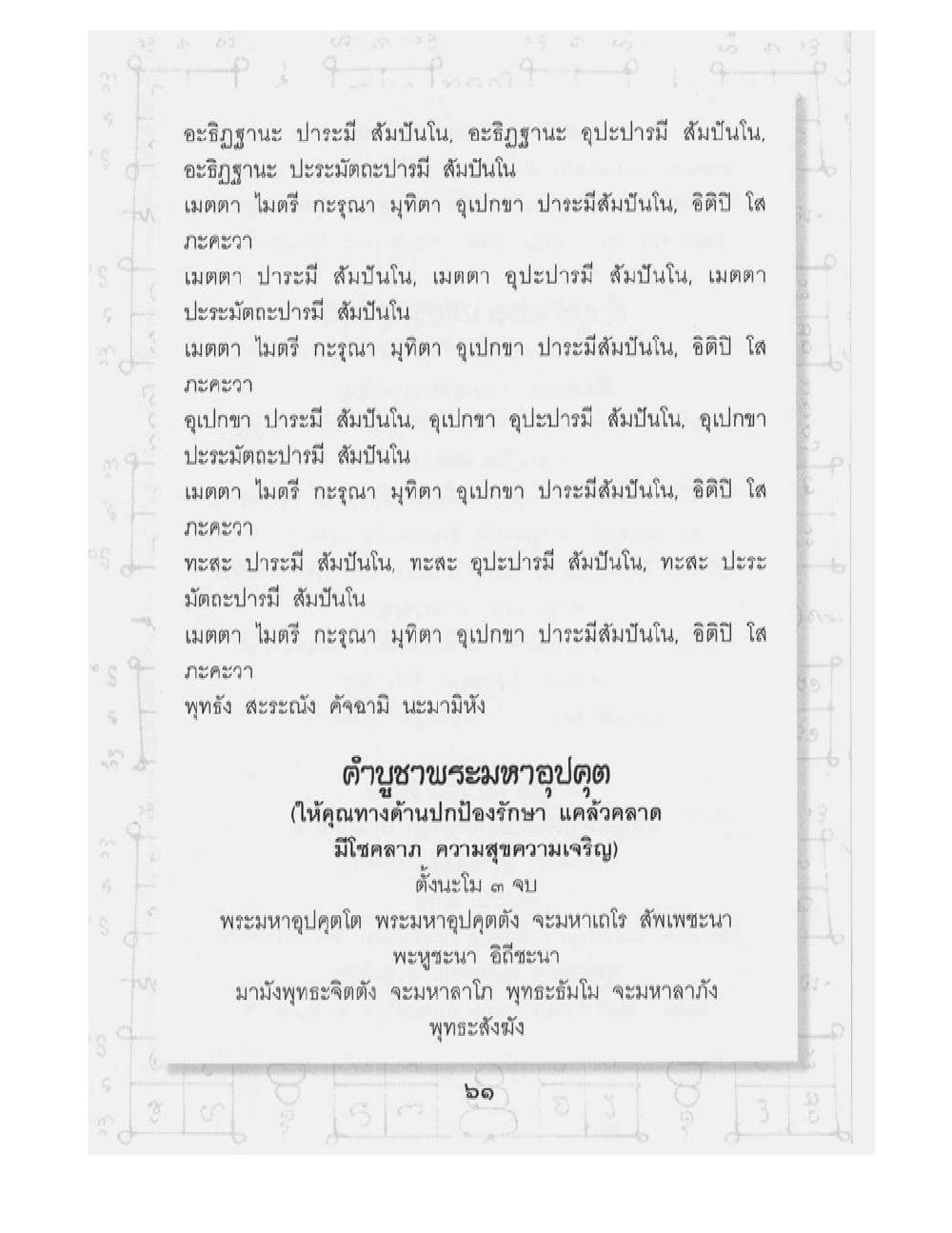
อะธิฏฐานะ ปาระมี สัมปันโน, อะธิฏฐานะ อุปะปารมี สัมปันโน, อะธิฏฐานะ ประมัตถะปารมี สัมปันโน เมตตา ไมตรี กะรุณา มุทิตา อุเปกขา ปาระมีสัมปันโน, อิติปิ โส ภะคะวา เมตตา ปาระมี สัมปันโน, เมตตา อุปะปารมี สัมปันโน, เมตตา ประมัตถะปารมี สัมปันโน เมตตา ไมตรี กะรุณา มุทิตา อุเปกขา ปาระมีสัมปันโน, อิติปิ โส ภะคะวา อุเปกขา ปาระมี สัมปันโน, อุเปกขา อุปะปารมี สัมปันโน, อุเปกขา ประมัตถะปารมี สัมปันโน เมตตา ไมตรี กะรุณา มุทิตา อุเปกขา ปาระมีสัมปันโน, อิติปิ โส ภะคะวา ทะสะ ปาระมี สัมปันโน, ทะสะ อุปะปารมี สัมปันโน, ทะสะ ประมัตถะปารมี สัมปันโน เมตตา ไมตรี กะรุณา มุทิตา อุเปกขา ปาระมีสัมปันโน, อิติปิ โส ภะคะวา พุทธัง สะระณัง คัจฉามิ นะมามิหัง
คำบูชาพระมหาอุปคุต
(ให้คุณทางด้านปกป้องรักษา แคล้วคลาด มีโชคลาภ ความสุขความเจริญ) ตั้งนะโม ๓ จบ พระมหาอุปคุตโต พระมหาอุปคุตตัง จะมหาเถโร สัพเพชะนา พะหูชะนา อิถีชะนา มามังพุทธะจิตตัง จะมหาลาโภ พุทธะธัมโม จะมหาลาภัง พุทธะสังฆัง ๖๑
Adhiṭṭhāna pāramī sampanno, adhiṭṭhāna upapāramī sampanno, adhiṭṭhāna paramatthapāramī sampanno ("Endowed with the perfection of resolution/determination; endowed with the higher perfection of resolution; endowed with the ultimate perfection of resolution…") [refrain repeats: "Endowed with the perfections of loving-kindness, amity, compassion, sympathetic joy, and equanimity — thus indeed is the Blessed One."] Mettā pāramī sampanno, mettā upapāramī sampanno, mettā paramatthapāramī sampanno ("…of loving-kindness…") [refrain repeats] Upekkhā pāramī sampanno, upekkhā upapāramī sampanno, upekkhā paramatthapāramī sampanno ("…of equanimity…") [refrain repeats] Dasa pāramī sampanno, dasa upapāramī sampanno, dasa paramatthapāramī sampanno ("Endowed with the [full set of] Ten Perfections; endowed with the higher set of Ten Perfections; endowed with the ultimate set of Ten Perfections" — closing summary line of the Barami 30 That litany.) [refrain repeats] Buddhaṃ saraṇaṃ gacchāmi, namāmihaṃ. ("I go to the Buddha for refuge; I pay homage.")
Words of Homage to Phra Maha Upagutta
(Bestows protection and safety from harm, and brings good fortune, happiness, and prosperity.) Begin by reciting the Namo three times. [Pali/Thai invocation, transcribed — recited as chanted:] "Phra Maha Upagutto, Phra Maha Upakuttang, the great elder, [protector of] every person — the many people, the women. May my mind [be joined] with the Buddha's mind, [bringing] great fortune; [with] the Buddha's Dhamma, great gain; [with] the Buddha's Sangha…" [page folio marked ๖๑]
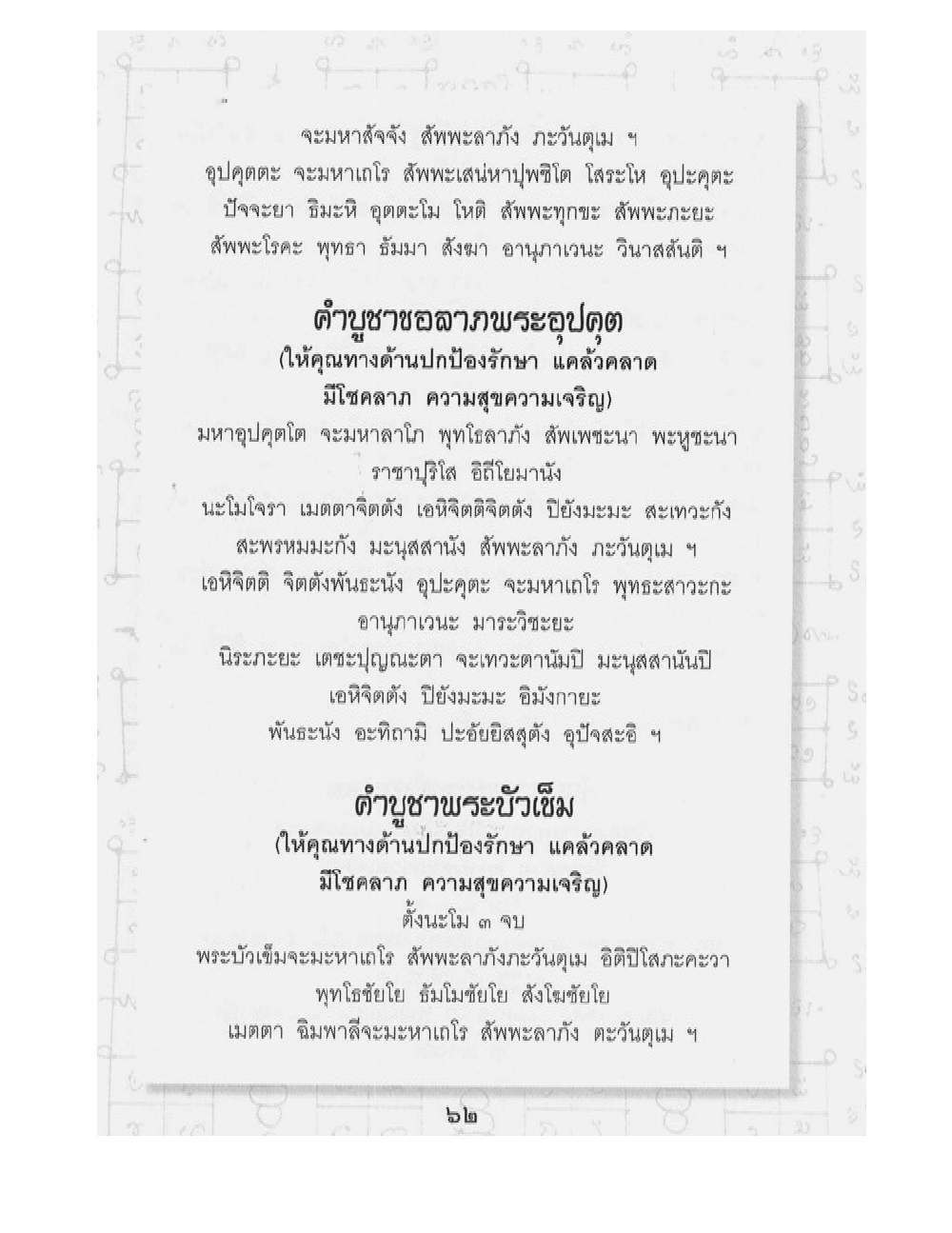
จะมหาสัจจัง สัพพะลาภัง ภะวันตุเม ฯ อุปคุตตะ จะมหาเถโร สัพพะเสน่หาปุพชิโต โสระโห อุปะคุตตะ ปัจจะยา ธิมะหิ อุตตะโม โหติ สัพพะทุกขะ สัพพะภะยะ สัพพะโรคะ พุทธา ธัมมา สังฆา อานุภาเวนะ วินาสสันติ ฯ
คำบูชาขอลาภพระอุปคุต
(ให้คุณทางด้านปกป้องรักษา แคล้วคลาด มีโชคลาภ ความสุขความเจริญ) มหาอุปคุตโต จะมหาลาโภ พุทโธลาภัง สัพเพชะนา พะหูชะนา ราชาปุริโส อิถีโยมานัง นะโมโจรา เมตตาจิตตัง เอหิจิตติจิตตัง ปิยังมะมะ สะเทวะกัง สะพรหมมะกัง มะนุสสานัง สัพพะลาภัง ภะวันตุเม ฯ เอหิจิตติ จิตตังพันธะนัง อุปะคุตตะ จะมหาเถโร พุทธะสาวะกะ อานุภาเวนะ มาระวิชะยะ นิระภะยะ เตชะปุญณะตา จะเทวะดานัมปิ มะนุสสานันปิ เอหิจิตตัง ปิยังมะมะ อิมังกายะ พันธะนัง อะทิถามิ ปะอัยยิสสุดัง อุปัจสะอิ ฯ
คำบูชาพระบัวเข็ม
(ให้คุณทางด้านปกป้องรักษา แคล้วคลาด มีโชคลาภ ความสุขความเจริญ) ตั้งนะโม ๓ จบ พระบัวเข็มจะมหาเถโร สัพพะลาภังภะวันตุเม อิติปิโสภะคะวา พุทโธชัยโย ธัมโมชัยโย สังโฆชัยโย เมตตา ฉิมพาลีจะมะหาเถโร สัพพะลาภัง ตะวันตุเม ฯ ๖๒
[continuing the homage to Phra Maha Upagutta:] "…of great truthfulness; may every kind of gain and blessing come to me. Upagutta, the great elder, beloved and revered by all, the recluse Upagutta — [I take] refuge, may [I] become supreme; may all suffering, all danger, and all sickness be destroyed by the power of the Buddha, the Dhamma, and the Sangha."
Words of Homage Asking for Fortune from Phra Upagutta
(Bestows protection and safety from harm, and brings good fortune, happiness, and prosperity.) [Pali/Thai invocation, transcribed — recited as chanted:] "Maha Upagutto, great fortune, the Buddha's fortune — [may it come] to every person, the many people, kings and officials, and women alike. Homage against thieves, with a loving mind; come, mind to mind, may I be dear to devas, brahmas, and humans alike; may every fortune come to me. Come, mind bound [to mine]; Upagutta the great elder, disciple of the Buddha, by whose power Māra was conquered; freed from danger, of great merit and glory, to devas as well as to humans; come, mind, may I be dear; bind this body [with protection] — thus I ask it."
Words of Homage to Phra Bua Khem
(Bestows protection and safety from harm, and brings good fortune, happiness, and prosperity.) Begin by reciting the Namo three times. [Pali/Thai invocation, transcribed — recited as chanted:] "Phra Bua Khem, the great elder — may every fortune come to me. Thus indeed is the Blessed One. The Buddha is victorious, the Dhamma is victorious, the Sangha is victorious." With loving-kindness, the great elder Chimphali — may every fortune come to me. [page folio marked ๖๒]
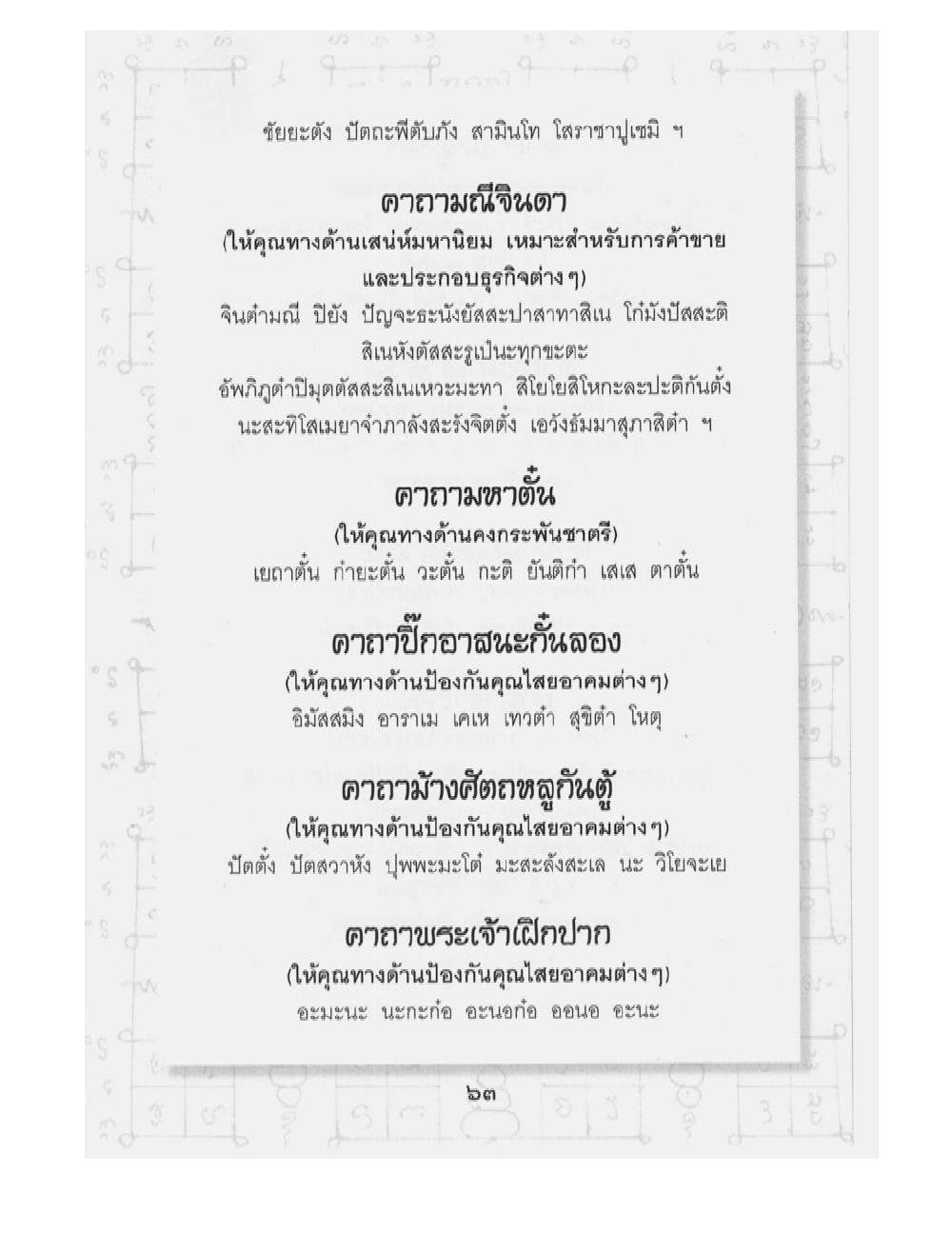
ชัยยะตัง ปัดถะพีตับภัง สามินโท โสราชาปูเซมิ ฯ
คาถามณีจินดา
(ให้คุณทางด้านเสน่ห์มหานิยม เหมาะสำหรับการค้าขาย และประกอบธุรกิจต่างๆ) จินตำมณี ปิยัง ปัญจะธะนังยัสสะปาสาทาสิเน โก่มังปัสสะติ สิเนหังตัสสะรูเป็นะทุกขะตะ อัพภิภูตำปิมุตตัสสะสิเนเหวะมะทา สิโยโยสิโหกละปะติกันตั้ง นะสะทิโลเมยาจำภาลังสะรังจิตตั้ง เอวังธัมมาสุภาสิตำ ฯ
คาถามหาตั๊น
(ให้คุณทางด้านคงกระพันชาตรี) เยถาตั๊น ก่ายะตั๊น วะตั๊น กะติ ยันติก่ำ เสเส ตาตั๊น
คาถาปิ๊กอาสนะกั้นลอง
(ให้คุณทางด้านป้องกันคุณไสยอาคมต่างๆ) อิมัสสมิง อาราเม เคเห เทวตำ สุขิตำ โหตุ
คาถาม้างศัตถหลูกันตู้
(ให้คุณทางด้านป้องกันคุณไสยอาคมต่างๆ) ปัดตั๊ง ปัดสวาหัง ปุพพะมะโต้ มะสะลังสะเล นะ วิโยจเย
คาถาพระเจ้าเฝิกปาก
(ให้คุณทางด้านป้องกันคุณไสยอาคมต่างๆ) อะมะนะ นะกะก่อ อะนอก่อ ออนอ อะนะ ๖๓
[closing line of the preceding spell — Pali/Thai formula, transcribed, recited as chanted:] "…victory; [obstacles] are struck down and destroyed; lord, [I] pay homage to the naga-king."
The Wish-Gem (Mani Chinda) Spell
(Bestows charm and great popularity; suited for trading and running businesses of every kind.) [Pali-style incantation, transcribed — recited untranslated per the tradition, invoking the cintāmaṇi "wish-fulfilling gem" as printed]
The Great Tan Spell
(Bestows invulnerability [khong kraphan] of the body.) [magical syllables, transcribed — recited untranslated per the tradition]
The Seat-Ward Spell
(Protects against black magic and harmful sorcery of every kind.) [Pali invocation, transcribed:] "Imasmiṃ ārāme gehe devatā sukhitā hotu." ("May the deities of this dwelling/monastery be happy.")
The Enemy-Destroying, Cabinet-Warding Spell
(Protects against black magic and harmful sorcery of every kind.) [magical syllables, transcribed — recited untranslated per the tradition]
The Lord-Opens-the-Mouth Spell
(Protects against black magic and harmful sorcery of every kind.) [magical syllables, transcribed — recited untranslated per the tradition] [page folio marked ๖๓]
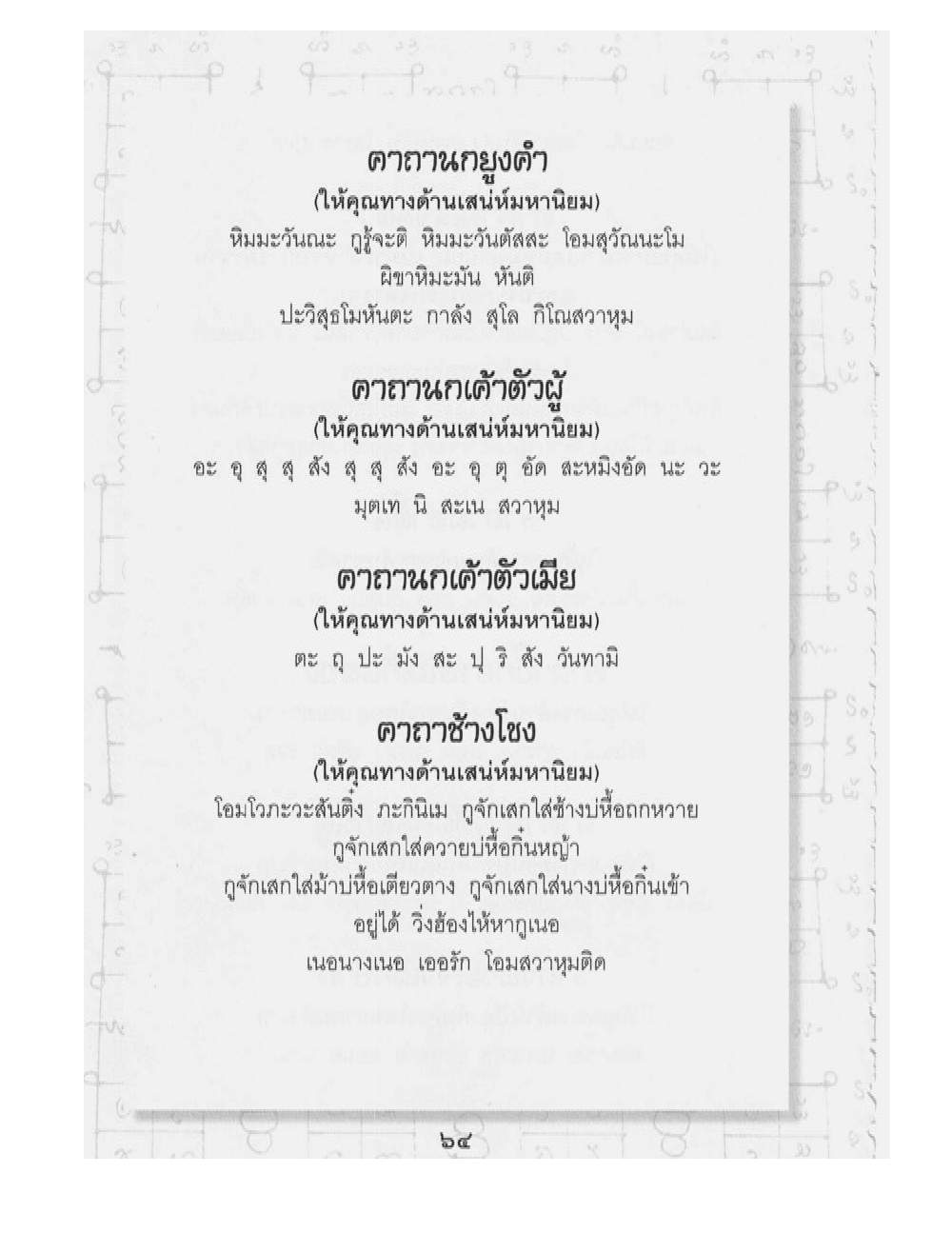
คาถานกยูงคำ
(ให้คุณทางด้านเสน่ห์มหานิยม) หิมมะวันณะ กู้จะติ หิมมะวันตัสสะ โอมสุวัณณะโม ผิขาหิมะมัน หันติ ปะวิสุธโมหันตะ กาลัง สุโล กิโณสวาหุม
คาถานกเค้าตัวผู้
(ให้คุณทางด้านเสน่ห์มหานิยม) อะ อุ สุ สุ สัง สุ สุ สัง อะ อุ ตุ อัด สะหมิงอัด นะ วะ มุตเท นิ สะเน สวาหุม
คาถานกเค้าตัวเมีย
(ให้คุณทางด้านเสน่ห์มหานิยม) ตะ ถุ ปะ มัง สะ ปุ ริ สัง วันทามิ
คาถาช้างโชง
(ให้คุณทางด้านเสน่ห์มหานิยม) โอมโวภะวะสันติ่ง ภะกินิเม กูจักเสกใส่ช้างบ่ให้ถกหวาย กูจักเสกใส่ควายบ่ให้กิ่นหญ้า กูจักเสกใส่ม้าบ่ให้เดียวตาง กูจักเสกใส่นางบ่ให้กิ่นเข้า อยู่ได้ วิ่งฮ้องไห้หากูเนอ เนอนางเนอ เออรัก โอมสวาหุมติด ๖๔
The Golden Peacock Spell
(Bestows charm and great popularity.) [magical/Pali-style syllables, transcribed — recited untranslated per the tradition, invoking the golden Himavanta peacock]
The Male Owl Spell
(Bestows charm and great popularity.) [magical syllables, transcribed — recited untranslated per the tradition]
The Female Owl Spell
(Bestows charm and great popularity.) [magical syllables, transcribed — recited untranslated per the tradition]
The Charging Elephant Spell
(Bestows charm and great popularity.) [Northern-Thai (Kham Mueang) love-charm, transcribed and translated:] "Om, may [she] be at peace, dear sister — I shall enchant the elephant so it cannot slip free of its rattan tether; I shall enchant the buffalo so it cannot eat grass; I shall enchant the horse so it cannot look away; I shall enchant [my] lady so she cannot eat her rice; she cannot bear to stay away, but runs crying out for me. Come to me, my love — om, bound fast [by this charm]." [page folio marked ๖๔]
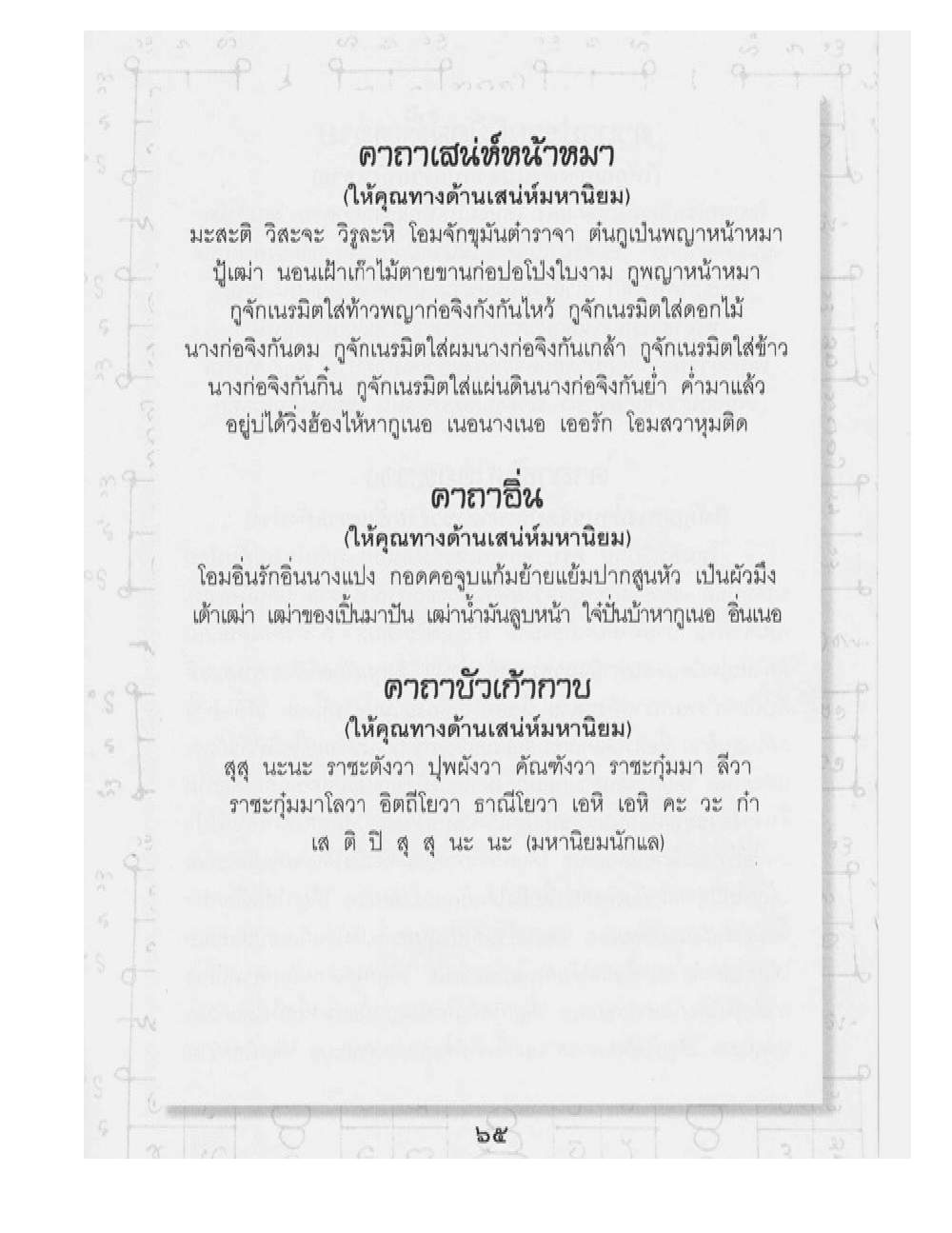
คาถาเสน่ห์หน้าหมา
(ให้คุณทางด้านเสน่ห์มหานิยม) มะสะติ วิสะจะ วิรุละหิ โอมจักขุมันตำราชา ตนกูเป็นพญาหน้าหมา ปู้เฒ่า นอนเฝ้าเก้าไม้ตายขานก่อปอโป่งใบงาม กูพญาหน้าหมา กูจักเนรมิตใส่ท้าวพญาก่อจิงกังกันไหว้ กูจักเนรมิตใส่ดอกไม้ นางก่อจิงกันดม กูจักเนรมิตใส่ผมนางก่อจิงกันเกล้า กูจักเนรมิตใส่ข้าว นางก่อจิงกันกิ่น กูจักเนรมิตใส่แผ่นดินนางก่อจิงกันย่ำ ค่ำมาแล้ว อยู่บ่ได้วิ่งฮ้องไห้หากูเนอ เนอนางเนอ เออรัก โอมสวาหุมติด
คาถาอิ่น
(ให้คุณทางด้านเสน่ห์มหานิยม) โอมอิ่นรักอิ่นนางแปง กอดคอจูบแก้มย้ายแย้มปากสูนหัว เป็นผัวมึง เฒ่าเฒ่า เฒ่าของเปิ้นมาปั้น เฒ่าน้ำมันลูบหน้า ใจ่ปั่นบ้าหากูเนอ อิ่นเนอ
คาถาบัวเก้ากาบ
(ให้คุณทางด้านเสน่ห์มหานิยม) สุสุ นะนะ ราชะตังวา ปุพผังวา คัณฑังวา ราชะกุ่มมา ลีวา ราชะกุ่มมาโลวา อิตถีโยวา ธาณีโยวา เอหิ เอหิ คะ วะ ก่ำ เส ติ ปิ สุ สุ นะ นะ (มหานิยมนักแล) ๖๕
The Dog-Faced Charm Spell
(Bestows charm and great popularity.) [opening line, Pali-style, transcribed — recited untranslated per the tradition; the remainder in Northern-Thai (Kham Mueang), translated:] "…I am the lord of the dog-face, an old guardian who lies watching by nine posts, a withered leg, a fine-leaved banyan — I, the dog-face lord. I shall conjure it so that princes and lords tremble and bow to me; I shall conjure it into flowers so the lady cannot help but smell them; I shall conjure it into her hair so she cannot help but bind it up; I shall conjure it into rice so she cannot help but eat it; I shall conjure it into the very ground so she cannot help but tread it. Evening has come, she cannot bear to stay away, but runs crying out for me. Come to me, my love — om, bound fast [by this charm]."
The Charm of Fondness
(Bestows charm and great popularity.) [Northern-Thai love-charm, transcribed and translated:] "Om, fond one, love the fond lady I have shaped — embrace, kiss the cheek, smile, incline the head, become your husband. Old one, old one, old one whom the maker formed, old one whose oiled face draws [her] mind wild for me. Fondness, [come] to me."
The Nine-Petalled Lotus Spell
(Bestows charm and great popularity.) [magical syllables, transcribed — recited untranslated per the tradition; parenthetical note in the original: "a very powerful charm for popularity."] [page folio marked ๖๕]
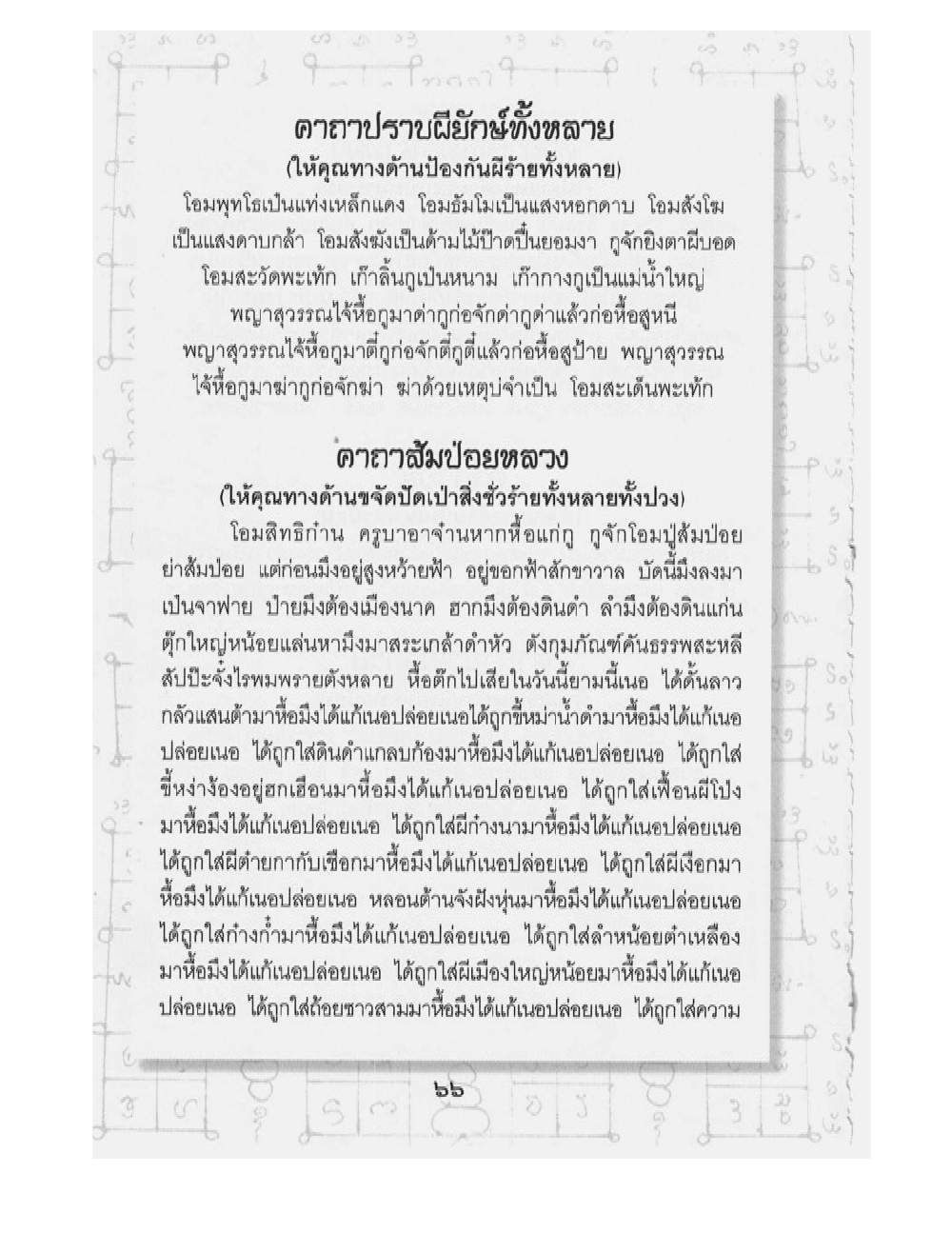
คาถาปราบผียักษ์ทั้งหลาย
(ให้คุณทางด้านป้องกันผีร้ายทั้งหลาย) โอมพุทโธเป็นแท่งเหล็กแดง โอมธัมโมเป็นแสงหอกดาบ โอมสังโฆ เป็นแสงดาบกล้า โอมสังฆังเป็นด้ามไม้ป่าดปิ่นยอมงา กูจักยิงตาผีบอด โอมสะวัดพะเท้ก เก้าลิ้นกูเป็นหนาม เก้ากางกูเป็นแม่น้ำใหญ่ พญาสุวรรณไจ้ให้กูมาด่ากูก่อจักด่ากูด่าแล้วก่อให้สูหนี พญาสุวรรณไจ้ให้กูมาตี่กูก่อจักตี่กูตี่แล้วก่อให้สูป่าย พญาสุวรรณ ไจ้ให้กูมาฆ่ากูก่อจักฆ่า ฆ่าด้วยเหตุบ่จำเป็น โอมสะเด็นพะเท้ก
คาถาส้มป่อยหลวง
(ให้คุณทางด้านขจัดปัดเป่าสิ่งชั่วร้ายทั้งหลายทั้งปวง) โอมสิทธิกำน ครูบาอาจ๋านหากให้แก่กู กูจักโอมปู่ส้มป่อย ย่าส้มป่อย แต่ก่อนมึงอยู่สูงห้วยฟ้า อยู่ขอกฟ้าสักขาวาล บัดนี้มึงลงมา เป็นจาฟาย ป่ายมึงต้องเมืองนาค ฮากมึงต้องดินดำ ลำมึงต้องดินแก่น ตุ๊กใหญ่หน้อยแล่นหามึงมาสระเกล้าดำหัว ดังกุมภัณฑ์คันธรรพ์สะหลี สัปเป้จั้งไรพมพรายตังหลาย ห้อตกไปเสียในวันนี้ยามนี้เนอ ได้ตั้นลาว กลัวแสนต้ามาห้อมึงได้แก้เนอปล่อยเนอ ได้ถูกขี้หม่าน้ำดำมาห้อมึงได้แก้เนอ ปล่อยเนอ ได้ถูกใส่ดินดำแกลบก้องมาห้อมึงได้แก้เนอปล่อยเนอ ได้ถูกใส่ ขี้หง่างองอยู่ฮกเฮือนมาห้อมึงได้แก้เนอปล่อยเนอ ได้ถูกใส่เฟื้อนผีโปง มาห้อมึงได้แก้เนอปล่อยเนอ ได้ถูกใส่ผีก่างนามาห้อมึงได้แก้เนอปล่อยเนอ ได้ถูกใส่ผีตายกากับเชือกมาห้อมึงได้แก้เนอปล่อยเนอ ได้ถูกใส่ผีเงือกมา ห้อมึงได้แก้เนอปล่อยเนอ หลอนต้านจังฝังหุ่นมาห้อมึงได้แก้เนอปล่อยเนอ ได้ถูกใส่กำงก่ำมาห้อมึงได้แก้เนอปล่อยเนอ ได้ถูกใส่ลำหน้อยดำเหลือง มาห้อมึงได้แก้เนอปล่อยเนอ ได้ถูกใส่ผีเมืองใหญ่หน้อยมาห้อมึงได้แก้เนอ ปล่อยเนอ ได้ถูกใส่ถ้อยซาวสามมาห้อมึงได้แก้เนอปล่อยเนอ ได้ถูกใส่ความ ๖๖
The Spell to Subdue All Ghosts and Demons
(Protects against evil spirits of every kind.) Om, the Buddha is a bar of red-hot iron; om, the Dhamma is the flash of a spear and sword; om, the Sangha is the flash of a keen blade; om, the protective cord is the handle of forest-cut wood, tipped with sesame-blessed pins — I will shoot out the eyes of blind ghosts. Om, [I] strike the demon down; my nine tongues become thorns, my nine limbs become a great river. The golden naga-lord bids me come and curse — so I shall curse; having cursed, may you flee. The golden naga-lord bids me come and strike — so I shall strike; having struck, may you scatter. The golden naga-lord bids me come and kill — so I shall kill, killing only from necessity. Om, I strike down the demon.
The Great Tamarind-Leaf Purification Spell
(Cleanses and drives away every kind of evil and misfortune.) [Northern-Thai (Kham Mueang) ritual invocation, transcribed and translated as closely as the archaic dialect allows:] "Om, power granted to me by my teacher-masters — I shall invoke Grandfather Tamarind-leaf and Grandmother Tamarind-leaf. Once you dwelt high by the streams of heaven, at heaven's edge on the white plain; now you have come down to be a cleansing charm. Your leaves belong to the naga realm, your root to the black earth, your trunk to the heartwood soil. Great and small spirits run to wash and bathe the head [of the afflicted] with you, like the kumbhāṇḍa and gandharva of old. May every kind of evil serpent and wandering spirit fall away this very day, this very hour. Whatever fright of the wandering-soul kind has struck you, may it now be released and let go. Whatever black excrement-and-water curse has struck you, may it now be released and let go. Whatever black earth and rice-husk curse has struck you, may it now be released and let go. Whatever curse of filth left lying about the house has struck you, may it now be released and let go. Whatever curse of the wandering phi-pong ghost has struck you, may it now be released and let go. Whatever curse of the forest-edge ghost has struck you, may it now be released and let go. Whatever curse of one who died by hanging has struck you, may it now be released and let go. Whatever curse of the water-serpent ghost has struck you, may it now be released and let go. Whatever effigy-magic has struck you, may it now be released and let go. Whatever [curse] of a bent charm has struck you, may it now be released and let go. Whatever curse of the small yellow-black serpent has struck you, may it now be released and let go. Whatever curse of the spirits of great and small towns has struck you, may it now be released and let go. Whatever curse of twenty-three ill-spoken words has struck you, may it now be released and let go. Whatever…" [continues on the next page] [page folio marked ๖๖]
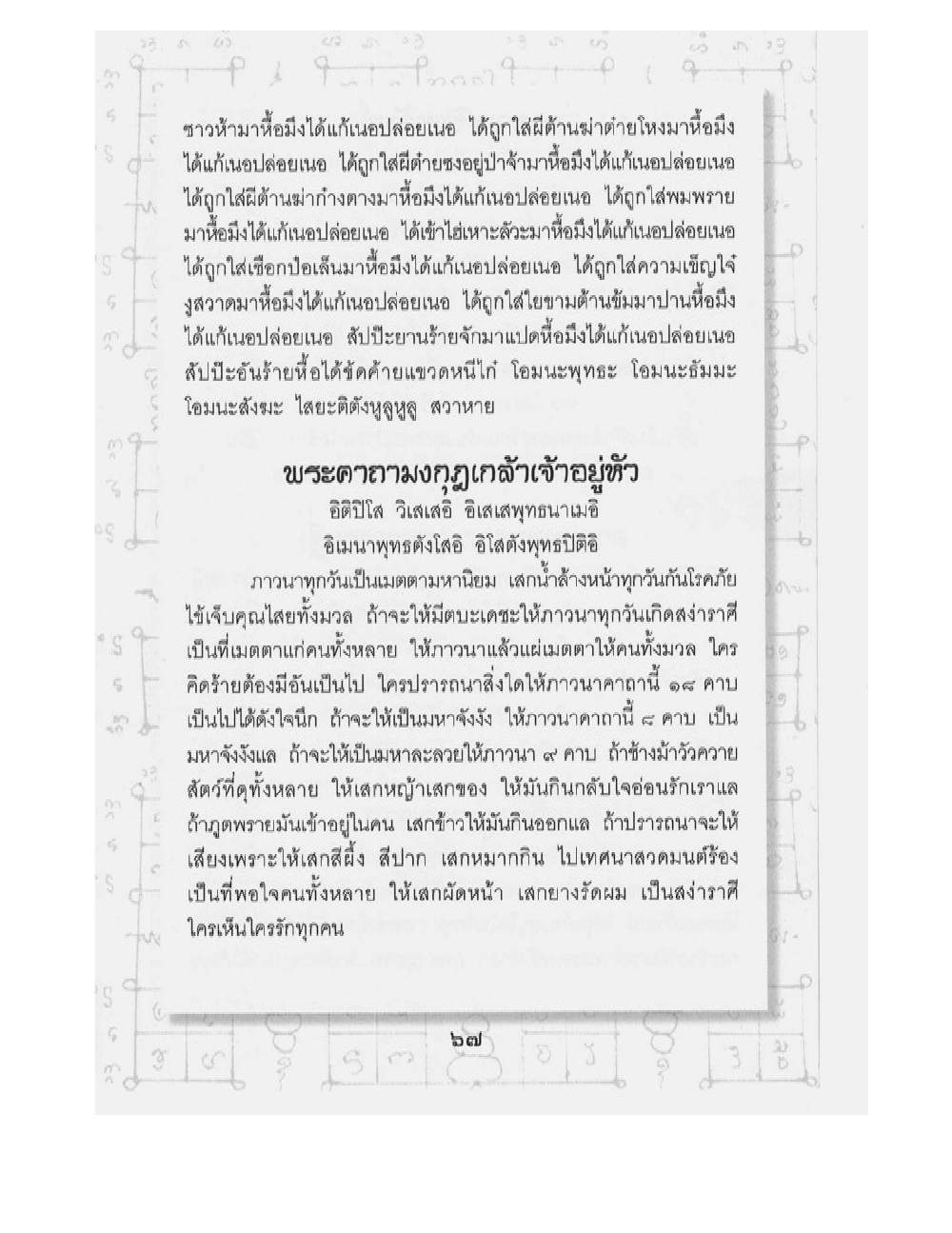
ซาวห้ามาห้อมึงได้แก้เนอปล่อยเนอ ได้ถูกใส่ผีต้านฆ่าตายโหงมาห้อมึง ได้แก้เนอปล่อยเนอ ได้ถูกใส่ผีตายซงอยู่ป่าจ้ามาห้อมึงได้แก้เนอปล่อยเนอ ได้ถูกใส่ผีต้านฆ่าก่างตางมาห้อมึงได้แก้เนอปล่อยเนอ ได้ถูกใส่พมพราย มาห้อมึงได้แก้เนอปล่อยเนอ ได้เข้าไอ่เหาะลัวะมาห้อมึงได้แก้เนอปล่อยเนอ ได้ถูกใส่เชือกป่อเส้นมาห้อมึงได้แก้เนอปล่อยเนอ ได้ถูกใส่ความเข็ญใจ๋ งูสวาดมาห้อมึงได้แก้เนอปล่อยเนอ ได้ถูกใส่ใยขามด้านข้มมาปานห้อมึง ได้แก้เนอปล่อยเนอ สัปเป้ยานร้ายจักมาแปดห้อมึงได้แก้เนอปล่อยเนอ สัปเป้อันร้ายห้อได้ขัดค้ายแขวดหนีไก่ โอมนะพุทธะ โอมนะธัมมะ โอมนะสังฆะ ไสยะติตังหูลูหูลู สวาหาย
พระคาถามงกุฏเกล้าเจ้าอยู่หัว
อิติปิโส วิเสเสอิ อิเสเสพุทธนาเมอิ อิเมนาพุทธตังโสอิ อิโสตังพุทธปิติอิ ภาวนาทุกวันเป็นเมตตามหานิยม เสกน้ำล้างหน้าทุกวันกันโรคภัย ไข้เจ็บคุณไสยทั้งมวล ถ้าจะให้มีตบะเดชะให้ภาวนาทุกวันเกิดสง่าราศี เป็นที่เมตตาแก่คนทั้งหลาย ให้ภาวนาแล้วแผ่เมตตาให้คนทั้งมวล ใคร คิดร้ายต้องมีอันเป็นไป ใครปรารถนาสิ่งใดให้ภาวนาคาถานี้ ๑๘ คาบ เป็นไปได้ดังใจนึก ถ้าจะให้เป็นมหาจังงัง ให้ภาวนาคาถานี้ ๘ คาบ เป็น มหาจังงังแล ถ้าจะให้เป็นมหาละลวยให้ภาวนา ๙ คาบ ถ้าช้างม้าวัวควาย สัตว์ที่ดุทั้งหลาย ให้เสกหญ้าเสกของ ให้มันกินกลับใจอ่อนรักเราแล ถ้าภูตพรายมันเข้าอยู่ในคน เสกข้าวให้มันกินออกแล ถ้าปรารถนาจะให้ เสียงเพราะให้เสกสีผึ้ง สีปาก เสกหมากกิน ไปเทศนาสวดมนต์ร้อง เป็นที่พอใจคนทั้งหลาย ให้เสกผัดหน้า เสกยางรัดผม เป็นสง่าราศี ใครเห็นใครรักทุกคน ๖๗
[continuing the Great Tamarind-Leaf Purification Spell from the previous page:] "…twenty-five [ill-spoken] words has struck you, may it now be released and let go. Whatever curse of one killed and dying a violent death has struck you, may it now be released and let go. Whatever curse of one who died in the forest and remained a wandering ghost has struck you, may it now be released and let go. Whatever curse of one killed at the forest's edge has struck you, may it now be released and let go. Whatever effigy-magic has struck you, may it now be released and let go. Whatever [curse] entered through a Lawa charm has struck you, may it now be released and let go. Whatever curse bound with a single strand of rope has struck you, may it now be released and let go. Whatever curse of misfortune from the striped snake has struck you, may it now be released and let go. Whatever curse of black tamarind-vine fibre has come upon you, may it now be released and let go. May every evil serpent that would infect you now be released and let go. May every evil serpent be driven off, cast out, and flee like a fowl. Om, homage to the Buddha; om, homage to the Dhamma; om, homage to the Sangha; may [all evil] be bound and swept away — svāhā."
The Royal Crown Mantra (Mongkut Klao Chao Yu Hua)
[Pali, transcribed — recited untranslated per the tradition:] "Iti pi so visese-i, isese-buddha-nāme-i, imenā buddhataṅ so-i, i-sotaṅ buddha-pīti-i." Recite it daily as a charm for loving-kindness and great popularity; consecrate water and wash the face with it daily to ward off illness, sickness, and every kind of black magic. If one wishes to gain fearsome power (tabo-decha) and command respect, recite it daily; it will bring radiance and grace, making one an object of goodwill to all people. Recite it, then spread loving-kindness to everyone; whoever thinks to do you harm will meet misfortune of their own making. Whatever one desires, recite this mantra eighteen times and it will come to pass exactly as wished. To induce a swoon (maha changngang) in another, recite this mantra eight times, and it will indeed induce a swoon. To cause great infatuation (maha laluai), recite it nine times. If elephants, horses, cattle, buffalo, or any fierce animal must be calmed, consecrate grass or fodder [and give it to them]; they will eat it, turn gentle, and grow fond of you. If a person is possessed by a malevolent spirit, consecrate rice and have them eat it, and the spirit will leave. If one wishes for a pleasing voice, consecrate beeswax and rub it on the lips, and consecrate a betel quid to chew before giving a sermon or leading chanting, and one will please all who hear. Consecrate face powder and consecrate a hair-tie, and one will gain radiance and grace, so that all who see will love that person. [page folio marked ๖๗]
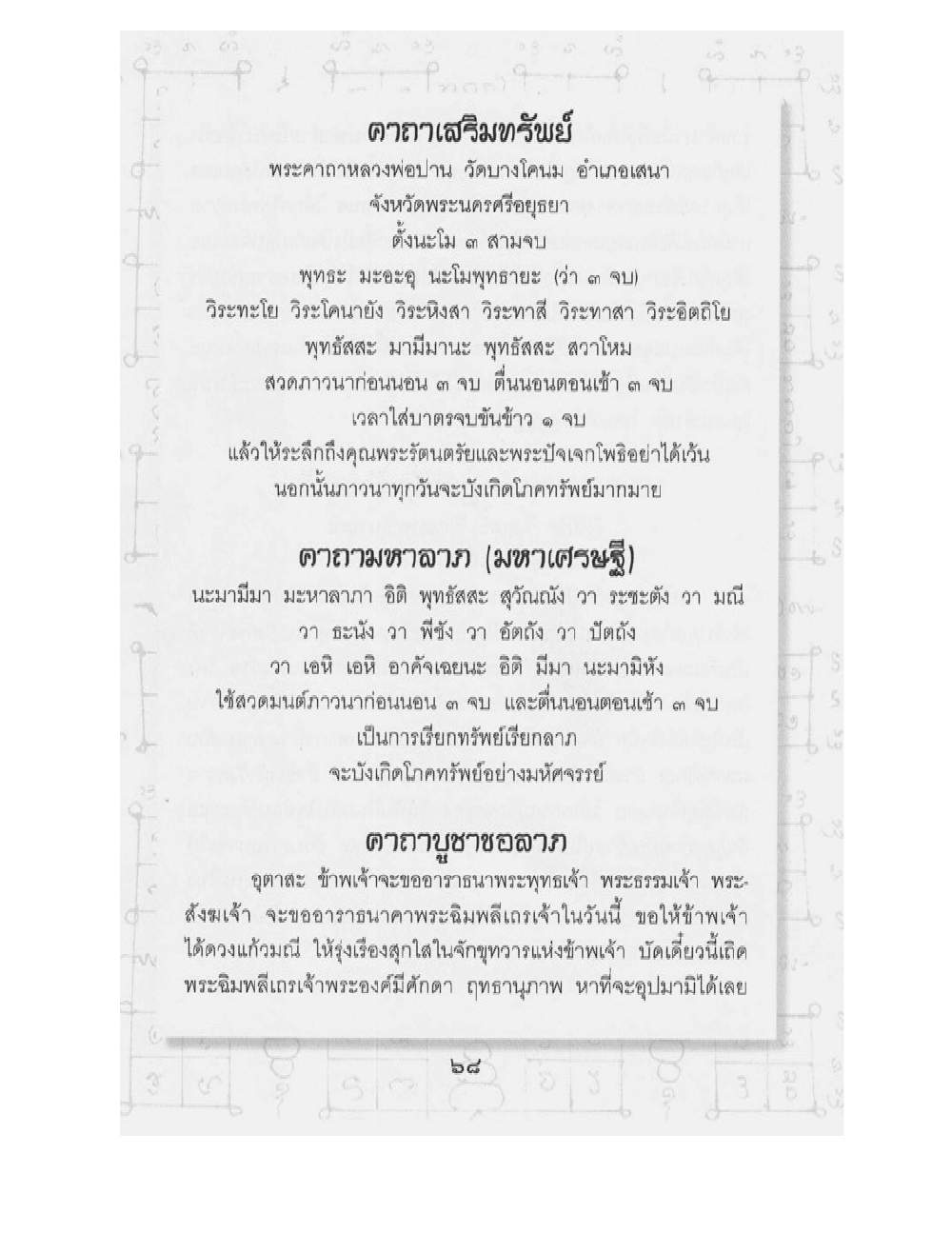
คาถาเสริมทรัพย์
พระคาถาหลวงพ่อปาน วัดบางโคนม อำเภอเสนา จังหวัดพระนครศรีอยุธยา ตั้งนะโม ๓ สามจบ พุทธะ มะอะอุ นะโมพุทธายะ (ว่า ๓ จบ) วิระทะโย วิระโคนายัง วิระหิงสา วิระทาสี วิระทาสา วิระอิตถิโย พุทธัสสะ มามีมานะ พุทธัสสะ สวาโหม สวดภาวนาก่อนนอน ๓ จบ ตื่นนอนตอนเช้า ๓ จบ เวลาใส่บาตรจบขันข้าว ๑ จบ แล้วให้ระลึกถึงคุณพระรัตนตรัยและพระปัจเจกโพธิอย่าได้เว้น นอกนั้นภาวนาทุกวันจะบังเกิดโภคทรัพย์มากมาย
คาถามหาลาภ (มหาเศรษฐี)
นะมามีมา มะหาลาภา อิติ พุทธัสสะ สุวัณณัง วา ระชะตัง วา มณี วา ธะนัง วา พีชัง วา อัตถัง วา ปัตถัง วา เอหิ เอหิ อาคัจเฉยนะ อิติ มีมา นะมามิหัง ใช้สวดมนต์ภาวนาก่อนนอน ๓ จบ และตื่นนอนตอนเช้า ๓ จบ เป็นการเรียกทรัพย์เรียกลาภ จะบังเกิดโภคทรัพย์อย่างมหัศจรรย์
คาถาบูชาขอลาภ
อุตาสะ ข้าพเจ้าจะขออาราธนาพระพุทธเจ้า พระธรรมเจ้า พระสังฆเจ้า จะขออาราธนาคุณพระฉิมพลีเจ้าในวันนี้ ขอให้ข้าพเจ้าได้ดวงแก้วมณี ให้รุ่งเรืองสุกใสในจักขุทวารแห่งข้าพเจ้า บัดเดี๋ยวนี้เถิด พระฉิมพลีเจ้าพระองค์มีศักดา ฤทธานุภาพ หาที่จะอุปมามิได้เลย
Katha for Increasing Wealth
Sacred formula of Luang Pho Pan, Wat Bang Khanom, Sena District, Phra Nakhon Si Ayutthaya Province. Begin with the Namo, three times, three rounds. Buddha ma-a-u, namo buddhāya (recite 3 times). [Pali, transcribed — recited untranslated per the tradition; glossed here for legibility:] Vira-thayo vira-khonāyaṃ vira-hiṃsā vira-thāsī vira-thāsā vira-itthiyo, buddhassa māmīmāna buddhassa svāhom (a protective, wealth-drawing formula invoking "vira" epithets and the power of the Buddha). Recite in meditation before sleep, 3 rounds; on waking in the morning, 3 rounds. When placing food in the alms bowl, 1 round. Then recollect the virtues of the Triple Gem and of the Solitary Buddhas without fail. Apart from that, reciting daily will bring forth abundant wealth.
Katha of Great Fortune (The Great Millionaire)
[Pali, transcribed — recited untranslated per the tradition; glossed here for legibility:] Namāmīmā mahālābhā iti buddhassa suvaṇṇaṃ vā rajataṃ vā maṇi vā dhanaṃ vā bījaṃ vā atthaṃ vā patthaṃ vā, ehi ehi āgaccheyya na iti mīmā namāmihaṃ ("By the power of the Buddha, may gold, or silver, or gems, or wealth, or seed-capital, or goods, or provisions come, come here..."). Use to chant in meditation before sleep, 3 rounds, and on waking in the morning, 3 rounds. This is for calling forth wealth and fortune. It will bring forth wealth in a marvelous way.
Katha of Offering to Request Fortune
By your leave — I wish to invoke the Buddha, the Dhamma, and the Sangha; I wish to invoke the virtue of the Lord Chimphli [Sivali] today. May I obtain a radiant jewel, that it may shine brilliantly through my eyes, right now. Lord Chimphli, whose majesty and miraculous power are beyond all comparison, [grant this].
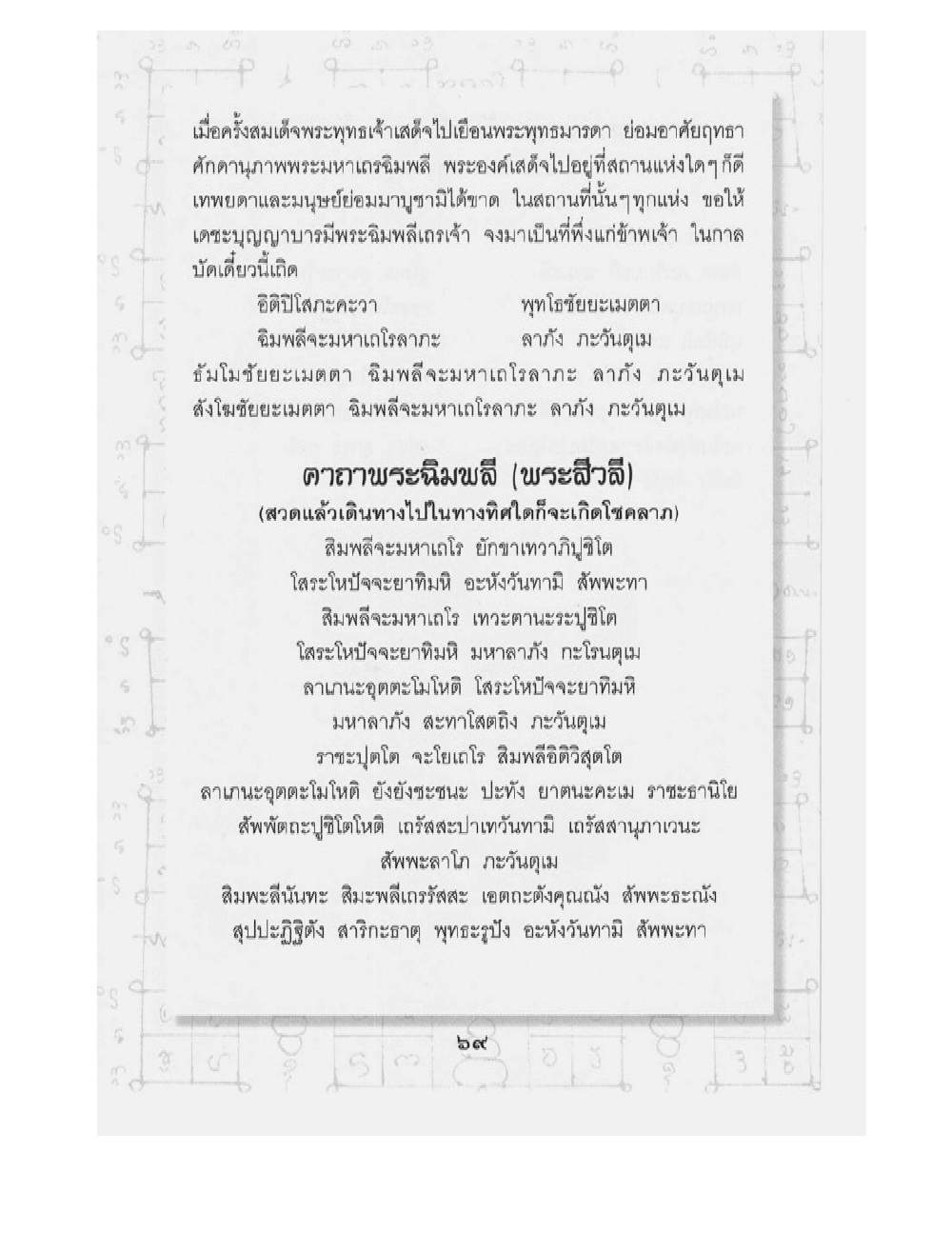
เมื่อครั้งสมเด็จพระพุทธเจ้าเสด็จไปเยือนพระพุทธมารดา ย่อมอาศัยฤทธาศักดานุภาพพระมหาเถรฉิมพลี พระองค์เสด็จไปอยู่ที่สถานแห่งใดๆก็ดี เทพยดาและมนุษย์ย่อมมาบูชามิได้ขาด ในสถานที่นั้นๆทุกแห่ง ขอให้เดชะบุญญาบารมีพระฉิมพลีเจ้า จงมาเป็นที่พึ่งแก่ข้าพเจ้า ในกาลบัดเดี๋ยวนี้เถิด อิติปิโสภะคะวา พุทโธชัยยะเมตตา ฉิมพลีจะมหาเถโรลาภะ ลาภัง ภะวันตุเม ธัมโมชัยยะเมตตา ฉิมพลีจะมหาเถโรลาภะ ลาภัง ภะวันตุเม สังโฆชัยยะเมตตา ฉิมพลีจะมหาเถโรลาภะ ลาภัง ภะวันตุเม
คาถาพระฉิมพลี (พระสีวลี)
(สวดแล้วเดินทางไปในทางทิศใดก็จะเกิดโชคลาภ) สิมพลีจะมหาเถโร ยักขาเทวาภิปูชิโต โสระโหปัจจะยาทิมหิ อะหังวันทามิ สัพพะทา สิมพลีจะมหาเถโร เทวะตานะระปูชิโต โสระโหปัจจะยาทิมหิ มหาลาภัง กะโรนตุเม ลาเภนะอุตตะโมโหติ โสระโหปัจจะยาทิมหิ มหาลาภัง สะทาโสตถิง ภะวันตุเม ราชะปุตโต จะโยเถโร สิมพลีอิติวิสุโต ลาเภนะอุตตะโมโหติ ยังยังชะชนะ ปะทัง ยาตนะคะเม ราชะธานิโย สัพพัตถะปูชิโตโหติ เถรัสสะปาเทวันทามิ เถรัสสานุภาเวนะ สัพพะลาโภ ภะวันตุเม สิมพะลีนันทะ สิมะพลีเถรัสสะ เอตตะดังคุณณัง สัพพะธะณัง สุปปะฏิฐิตัง สาริกะธาตุ พุทธะรูปัง อะหังวันทามิ สัพพะทา
When the Blessed Buddha once went to visit his mother [in the Tāvatiṃsa heaven], he depended on the miraculous power and majesty of the Great Elder Chimphli [Sivali]. Wherever he journeyed to stay, devas and humans, without exception, came to make offerings unceasingly, in every such place. May the merit and glorious power of the Lord Chimphli come to be my refuge, right now. [Pali, transcribed — recited untranslated per the tradition; glossed here for legibility:] Itipiso bhagavā, Buddho jaya-mettā, Chimphli ca mahāthero lābha, lābhaṃ bhavantu me. Dhammo jaya-mettā, Chimphli ca mahāthero lābha, lābhaṃ bhavantu me. Saṅgho jaya-mettā, Chimphli ca mahāthero lābha, lābhaṃ bhavantu me. ("Thus indeed is the Blessed One, of victorious loving-kindness; Chimphli the Great Elder of fortune — may fortune come to be mine." Repeated invoking the Dhamma and the Sangha.)
Katha of Phra Chimphli (Phra Sivali)
(Recite this, then travel in any direction, and fortune will arise.) [Pali, transcribed — recited untranslated per the tradition; glossed here for legibility:] An extended invocation to Sivali the Great Elder, honored by yakkhas and devas, to whom homage is paid at all times; praised as bringing great fortune and constant well-being wherever he is honored — even, it says, in royal capitals where people of every kind gather; homage is paid at the Elder's feet, and by his power may all fortune be mine; homage always to the relics and Buddha-image enshrined with these virtues.
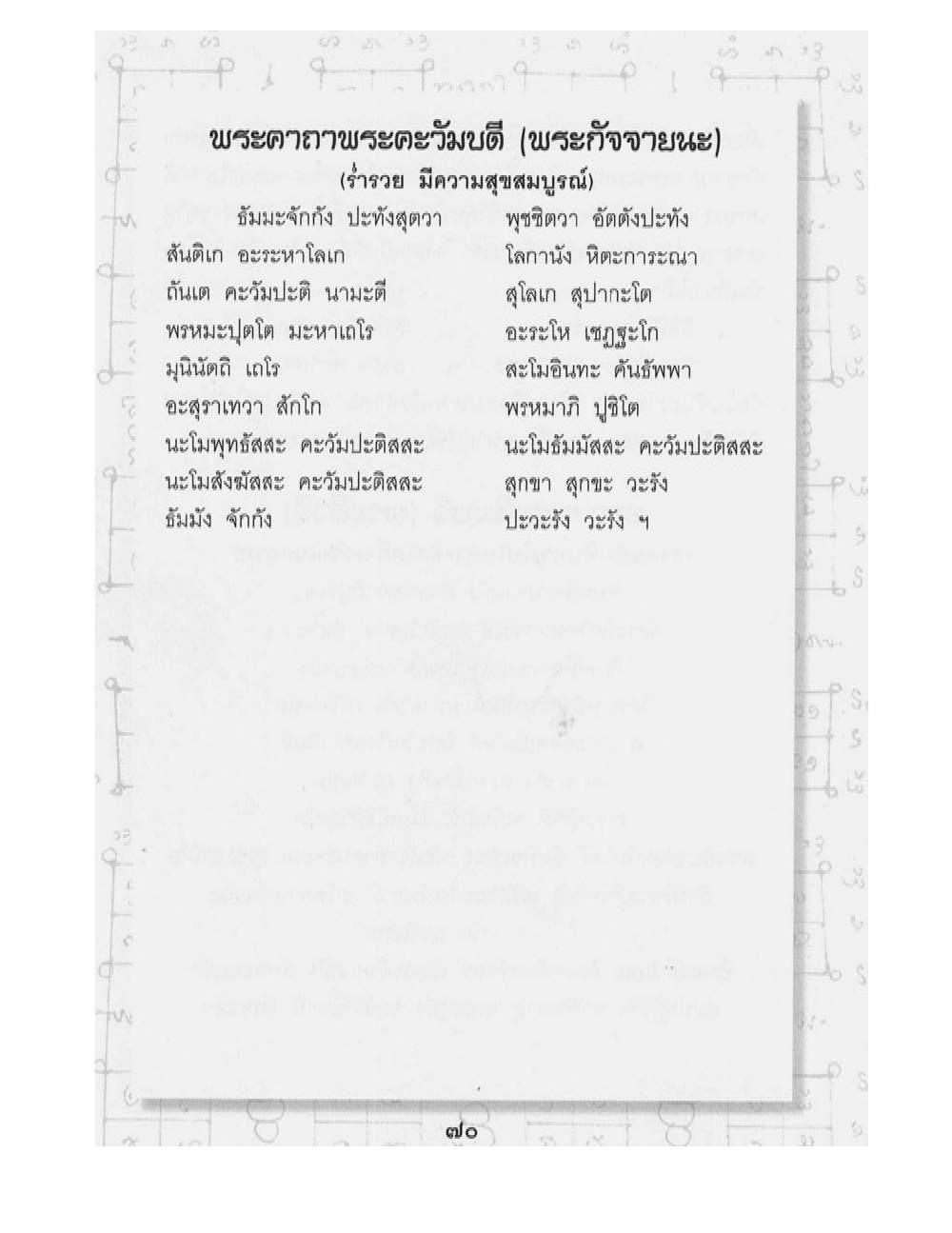
พระคาถาพระคะวัมบดี (พระกัจจายนะ)
(ร่ำรวย มีความสุขสมบูรณ์) ธัมมะจักกัง ปะทังสุตวา พุชชิตวา อัตตังปะทัง สันติเก อะระหาโลเก โลกานัง หิตะการะณา ถันเต คะวัมปะติ นามะตี สุโลเก สุปากะโต พรหมะปุตโต มะหาเถโร อะระโห เชฏฐะโก มุนินัตถิ เถโร สะโมอินทะ คันธัพพา อะสุราเทวา สักโก พรหมาภิ ปูชิโต นะโมพุทธัสสะ คะวัมปะติสสะ นะโมธัมมัสสะ คะวัมปะติสสะ นะโมสังฆัสสะ คะวัมปะติสสะ สุกขา สุกขะ วะรัง ธัมมัง จักกัง ปะวะรัง วะรัง ฯ
Sacred Katha of Phra Khawampati (Phra Kaccayana)
(For wealth and complete happiness) [Pali, transcribed — recited untranslated per the tradition; glossed here for legibility:] Dhammacakkaṃ padaṃ sutvā, bujjhitvā attaṃ padaṃ, santike arahā loke, lokānaṃ hitakāraṇā, tante Gavampati nāmatī, suloke supākaṭo, brahmaputto mahāthero, araho jeṭṭhako, munī n'atthi thero, samo Indā gandhabbā, asurā devā Sakko, brahmābhi pūjito. Namo buddhassa Gavampatissa, namo dhammassa Gavampatissa, namo saṅghassa Gavampatissa. Sukhā sukhaṃ varaṃ, dhammaṃ cakkaṃ pavaraṃ varaṃ. ("Having heard the words of the Wheel of the Dhamma and awakened to his own goal, he became an arahant near at hand in the world, for the benefit of all worlds; known by the name Gavampati, well renowned in the world; a Brahma's son, a great elder, a worthy one, foremost among them; a sage with no equal among elders, honored equally by Indra, the gandhabbas, the asuras, the devas, Sakka, and Brahma. Homage to the Buddha through Gavampati; homage to the Dhamma through Gavampati; homage to the Sangha through Gavampati. May there be happiness, excellent ease, and the excellent, supreme Wheel of the Dhamma.")
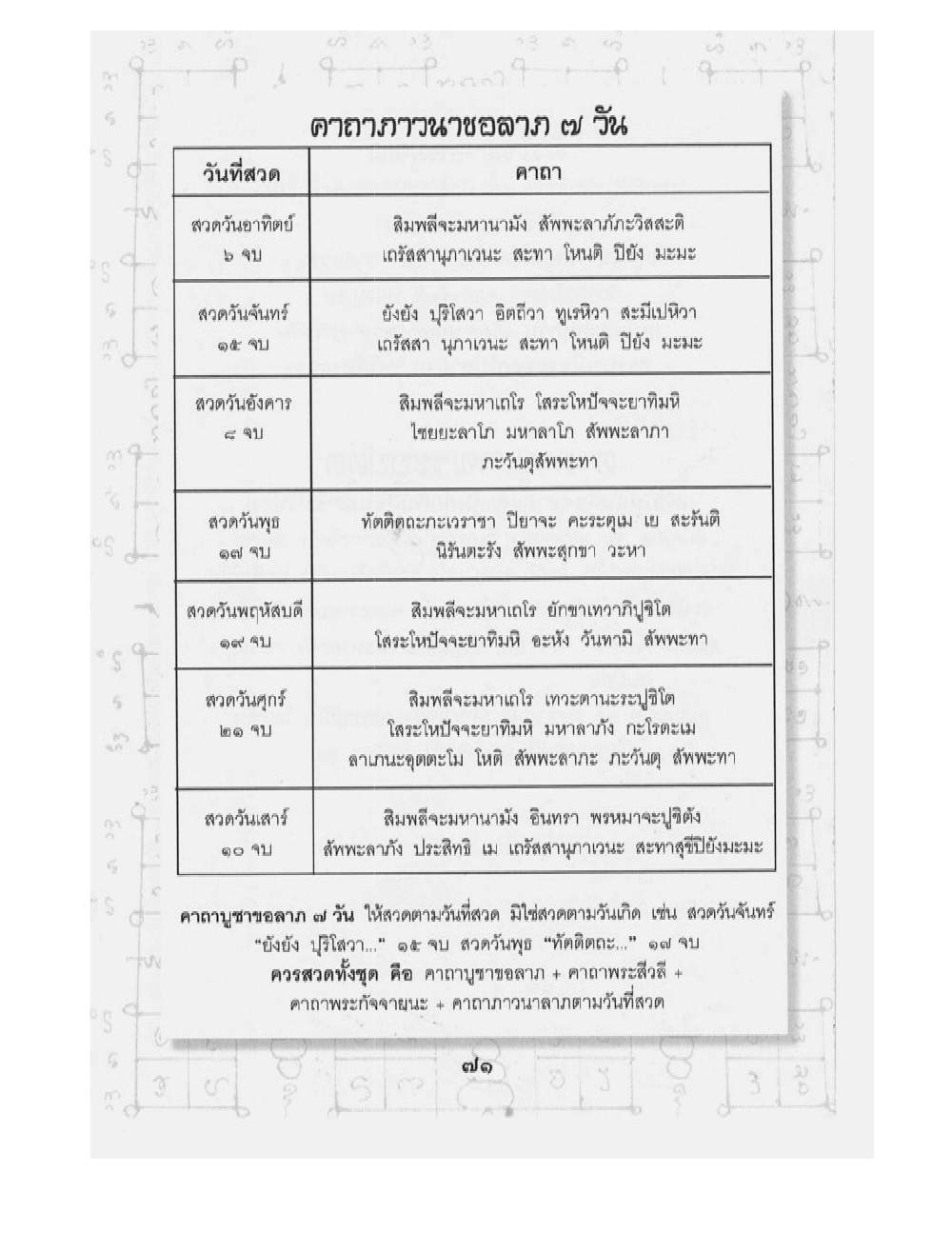
คาถาภาวนาขอลาภ ๗ วัน
[ตาราง: วันที่สวด | คาถา] สวดวันอาทิตย์ ๖ จบ | สิมพลีจะมหานามัง สัพพะลาภภะวิสสะติ เถรัสสานุภาเวนะ สะทา โหนติ ปิยัง มะมะ สวดวันจันทร์ ๑๕ จบ | ยังยัง ปุริโสวา อิตถีวา ทูเรหิวา สะมีเปหิวา เถรัสสานุภาเวนะ สะทา โหนติ ปิยัง มะมะ สวดวันอังคาร ๘ จบ | สิมพลีจะมหาเถโร โสระโหปัจจะยาทิมหิ ไชยยะลาโภ มหาลาโภ สัพพะลาภา ภะวันตุสัพพะทา สวดวันพุธ ๑๗ จบ | ทัตติตถะภะเวราชา ปิยาจะ คะระตุเม เย สะรันติ นิรันตะรัง สัพพะสุขา วะหา สวดวันพฤหัสบดี ๑๙ จบ | สิมพลีจะมหาเถโร ยักขาเทวาภิปูชิโต โสระโหปัจจะยาทิมหิ อะหัง วันทามิ สัพพะทา สวดวันศุกร์ ๒๑ จบ | สิมพลีจะมหาเถโร เทวะตานะระปูชิโต โสระโหปัจจะยาทิมหิ มหาลาภัง กะโรตะเม ลาเภนะอุดตะโม โหติ สัพพะลาภะ ภะวันตุ สัพพะทา สวดวันเสาร์ ๑๐ จบ | สิมพลีจะมหานามัง อินทรา พรหมาจะปูชิตัง สัพพะลาภัง ประสิทธิ เม เถรัสสานุภาเวนะ สะทาสุขีปิยังมะมะ
คาถาบูชาขอลาภ ๗ วัน ให้สวดตามวันที่สวด มิใช่สวดตามวันเกิด เช่น สวดวันจันทร์ "ยังยัง ปุริโสวา..." ๑๕ จบ สวดวันพุธ "ทัตติตถะ..." ๑๗ จบ ควรสวดทั้งชุด คือ คาถาบูชาขอลาภ + คาถาพระสีวลี + คาถาพระกัจจายนะ + คาถาภาวนาลาภตามวันที่สวด
Seven-Day Fortune-Requesting Meditation Katha
[Table: Day to Recite | Katha] Recite Sunday, 6 rounds | [Pali, romanized + gloss:] "Simbali ca mahānāmaṃ, sabba-lābhā bhavissati, therassānubhāvena sadā honti piyaṃ mama" — "By the name of the great Simbali [Sivali], all fortune shall come to be; by the Elder's power, may I always be beloved." Recite Monday, 15 rounds | "Yaṃ yaṃ puriso vā itthī vā, dūrehi vā samīpehi vā, therassānubhāvena sadā honti piyaṃ mama" — "Whatever man or woman, whether far or near, by the Elder's power, may I always be beloved." Recite Tuesday, 8 rounds | "Simbali ca mahāthero...jaya-lābho mahālābho, sabba-lābhā bhavantu sabbadā" — "The great Elder Simbali...; victorious fortune, great fortune — may all fortune arise always." Recite Wednesday, 17 rounds | "Dattitthabhave-rājā piyā ca karotu me, ye saranti nirantaraṃ sabba-sukhā vahā" — "May the king be gracious to me; those who recollect continually, may they bring all happiness." Recite Thursday, 19 rounds | "Simbali ca mahāthero, yakkhadevābhipūjito...ahaṃ vandāmi sabbadā" — "The great Elder Simbali, honored by yakkhas and devas...I pay homage always." Recite Friday, 21 rounds | "Simbali ca mahāthero, devatānara-pūjito...mahālābhaṃ karotu me, lābhena uttamo hoti, sabba-lābhā bhavantu sabbadā" — "The great Elder Simbali, honored by devas and men...may he grant me great fortune; by fortune may I be supreme; may all fortune arise always." Recite Saturday, 10 rounds | "Simbali ca mahānāmaṃ, Indā Brahmā ca pūjitaṃ, sabba-lābhaṃ pasiddhi me, therassānubhāvena sadā sukhī piyaṃ mama" — "By the name of the great Simbali, honored by Indra and Brahma, may all fortune be accomplished for me; by the Elder's power, may I always be happy and beloved."
For the Seven-Day Fortune-Offering Katha, recite according to the day of recitation, not the day of one's birth — for example, recite on Monday "Yaṃ yaṃ puriso vā..." 15 rounds; recite on Wednesday "Dattitthabha..." 17 rounds. The full set should be recited together: the Fortune-Offering Katha + the Katha of Phra Sivali + the Katha of Phra Kaccayana + the day-appropriate Fortune-Meditation Katha.
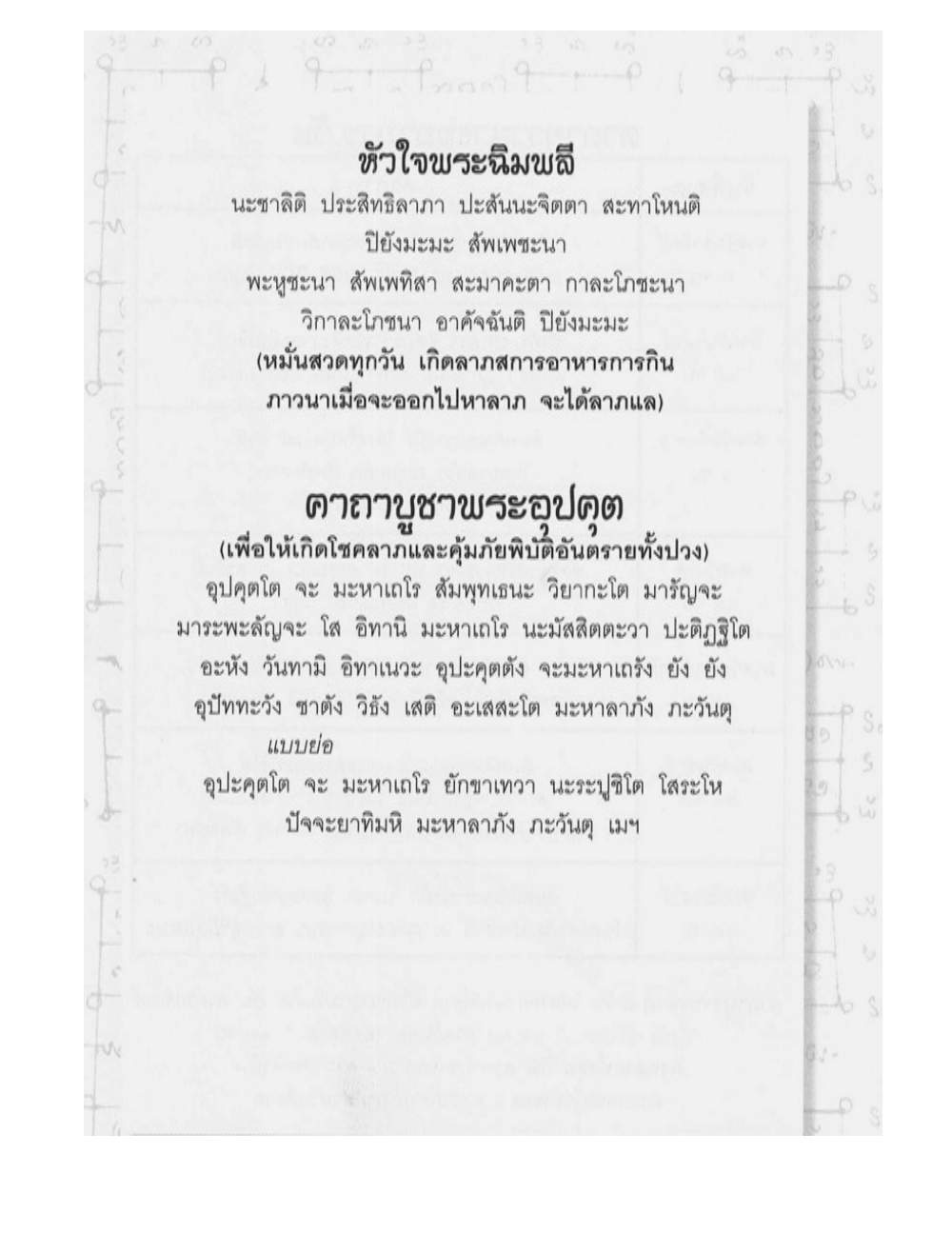
หัวใจพระฉิมพลี
นะซาลิติ ประสิทธิลาภา ปะสันนะจิตตา สะทาโหนติ ปิยังมะมะ สัพเพชะนา พะหูชะนา สัพเพทิสา สะมาคะตา กาละโภชนา วิกาละโภชนา อาคัจฉันติ ปิยังมะมะ (หมั่นสวดทุกวัน เกิดลาภสการอาหารการกิน ภาวนาเมื่อจะออกไปหาลาภ จะได้ลาภแล)
คาถาบูชาพระอุปคุต
(เพื่อให้เกิดโชคลาภและคุ้มภัยพิบัติอันตรายทั้งปวง) อุปคุตโต จะ มะหาเถโร สัมพุทเธนะ วิยากะโต มารัญจะ มาระพะลัญจะ โส อิทานิ มะหาเถโร นะมัสสิตตะวา ปะติฏฐิโต อะหัง วันทามิ อิทาเนวะ อุปะคุตตัง จะมะหาเถรัง ยัง ยัง อุปัททะวัง ชาตัง วิธัง เสติ อะเสสะโต มะหาลาภัง ภะวันตุ แบบย่อ อุปคุตโต จะ มะหาเถโร ยักขาเทวา นะระปูชิโต โสระโห ปัจจะยาทิมหิ มะหาลาภัง ภะวันตุ เมฯ
Heart-Mantra of Phra Chimphli
[Pali, transcribed — recited untranslated per the tradition; glossed here for legibility:] Nasaliti, patisiddhi-lābhā, pasanna-cittā, sadā honti piyaṃ mama sabbe janā, bahu janā sabbā disā samāgatā, kāla-bhojanā, vikāla-bhojanā, āgacchanti piyaṃ mama. ("May success and fortune arise; may hearts be pleased and I always be beloved by all people; may many people gather from every direction, whether at proper mealtimes or improper times, and come to favor me.") (Recite diligently every day; it brings fortune in matters of food and livelihood. Meditate on it before going out to seek fortune, and fortune will be obtained.)
Katha for Venerating Phra Upakut
(To bring about fortune and protection from all calamity and danger) [Pali, transcribed — recited untranslated per the tradition; glossed here for legibility:] Upagutto ca mahāthero, sambuddhena viyākato, māraṃ ca mārabalaṃ ca, so idāni mahāthero namassitvā patiṭṭhito. Ahaṃ vandāmi idāneva Upaguttaṃ ca mahātheraṃ. Yaṃ yaṃ upaddavaṃ jātaṃ vidhaṃ seti asesato, mahālābhaṃ bhavantu. ("Upagutta the Great Elder, foretold by the Fully Enlightened One — who overcame Māra and Māra's host — that Great Elder, having been venerated, is now established. I now pay homage to the Great Elder Upagutta. Whatever calamity has arisen, may it be entirely dispelled; may great fortune arise.") Abbreviated form: Upagutto ca mahāthero, yakkhadevā narapūjito, sorahopajjayātimahi, mahālābhaṃ bhavantu me. ("Upagutta the Great Elder, honored by yakkhas, devas, and men — may great fortune be mine.")
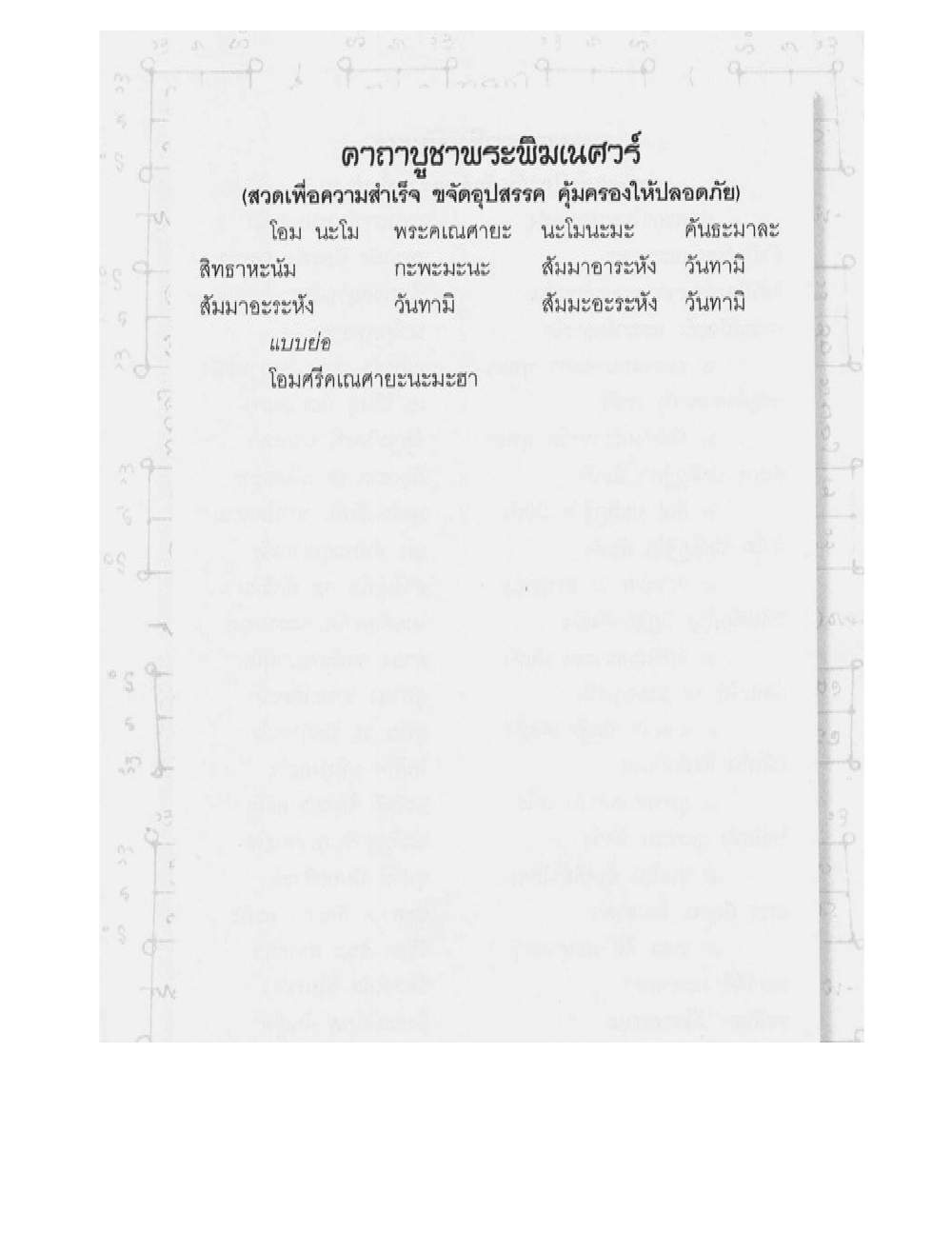
คาถาบูชาพระพิมเนศวร์
(สวดเพื่อความสำเร็จ ขจัดอุปสรรค คุ้มครองให้ปลอดภัย) โอม นะโม พระคเณศายะ นะโมนะมะ คันธมาละ สิทธาหะนัม กะพะมะนะ สัมมาอาระหัง วันทามิ สัมมาอะระหัง วันทามิ สัมมะอะระหัง วันทามิ แบบย่อ โอมศรีคเณศายะนะมะฮา
Katha for Venerating Phra Phikhanet (Ganesha)
(Recite for success, to clear away obstacles, and for protection and safety) [Invocation, transcribed — recited untranslated per the tradition; glossed here for legibility:] Oṃ namo Phra Gaṇeśāya, namo namaḥ, gandha-māla, siddhā-hanaṃ kapa-mana, sammā-arahaṃ vandāmi, sammā-arahaṃ vandāmi, sammā-arahaṃ vandāmi. ("Om, homage to Lord Ganesha, homage, homage; with scented garlands, invoking accomplishment; I pay homage to the truly worthy one, I pay homage to the truly worthy one, I pay homage to the truly worthy one.") Abbreviated form: Oṃ śrī Gaṇeśāya namaḥ — "Om, homage to the glorious Ganesha."
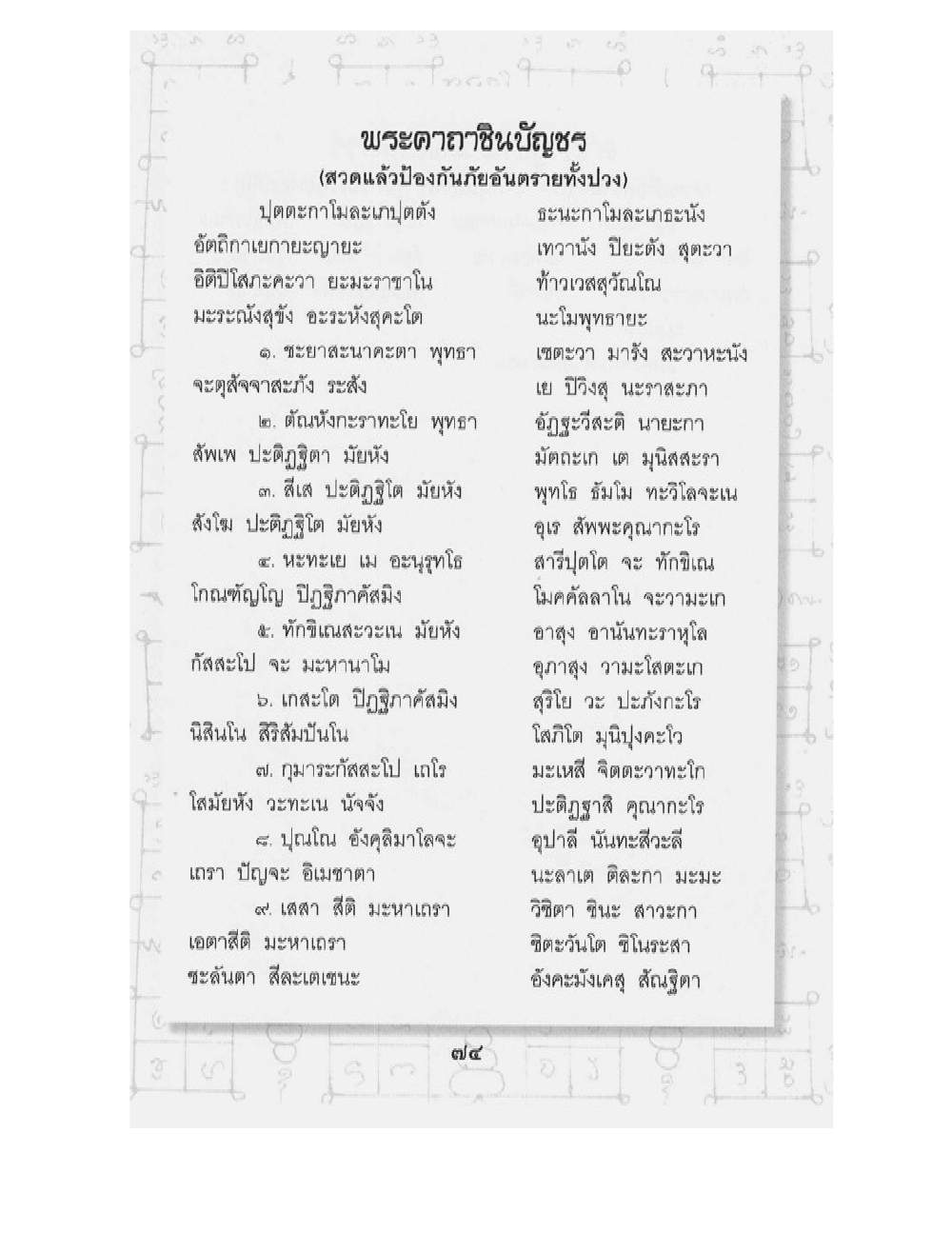
พระคาถาชินบัญชร
(สวดแล้วป้องกันภัยอันตรายทั้งปวง) ปุตตะกาโมละภปุตตัง ธะนะกาโมละภะธะนัง อัตถิกาเยกายะญายะ เทวานัง ปิยะตัง สุตวา อิติปิโสภะคะวา ยะมะราชาโน ท้าวเวสสุวัณโณ มะระณังสุขัง อะระหังสุคะโต นะโมพุทธายะ ๑. ชะยาสะนาคะตา พุทธา เชตะวา มารัง สะวาหะนัง จะตุสัจจาสะภัง ระสัง เย ปิวิงสุ นะราสะภา ๒. ตัณหังกะราทะโย พุทธา อัฏฐะวีสะติ นายะกา สัพเพ ปะติฏฐิตา มัยหัง มัตถะเก เต มุนิสสะรา ๓. สีเส ปะติฏฐิโต มัยหัง พุทโธ ธัมโม ทะวิโลจะเน สังโฆ ปะติฏฐิโต มัยหัง อุเร สัพพะคุณากะโร ๔. หะทะเย เม อะนุรุทโธ สารีปุตโต จะ ทักขิเณ โกณฑัญโญ ปิฏฐิภาคัสมิง โมคคัลลาโน จะวามะเก ๕. ทักขิเณสะวะเน มัยหัง อาสุง อานันทะราหุโล กัสสะโป จะ มะหานาโม อุภาสุง วามะโสตะเก ๖. เกสะโต ปิฏฐิภาคัสมิง สุริโย วะ ปะภังกะโร นิสินโน สิริสัมปันโน โสภิโต มุนิปุงคะโว ๗. กุมาระกัสสะโป เถโร มะเหสี จิตตะวาทะโก โสมัยหัง วะทะเน นิจจัง ปะติฏฐาสิ คุณากะโร ๘. ปุณโณ อังคุลิมาโลจะ อุปาลี นันทะสีวะลี เถรา ปัญจะ อิเมชาตา นะลาเต ติละกา มะมะ ๙. เสสาสีติ มะหาเถรา วิชิตา ชินะสาวะกา เอตาสีติ มะหาเถรา ชิตะวันโต ชิโนระสา ชะลันตา สีละเตเชนะ อังคะมังเคสุ สัณฐิตา
The Great Chinabanchorn (Jinapañjara) Katha
(Recite this to protect against every danger) [Pali, transcribed — recited untranslated per the tradition; glossed here for legibility, verses 1–9 of the Jinapañjara gāthā:] "One who desires a child obtains a child; one who desires wealth obtains wealth. Having heard that right understanding of the body's true nature is dear to the devas — thus indeed is the Blessed One. Homage also to King Yama, King Vessuvaṇṇa; death is peace for the Worthy One, the Well-Gone One. Homage to the Buddha. 1. The Buddhas, arriving at the seat of victory, having conquered Māra together with his mount, having drunk the taste of the Four Noble Truths — these foremost among men. 2. The Buddhas beginning with Taṇhaṅkara, twenty-eight leaders in all, are every one established upon my head, these lords among sages. 3. Established on my head is the Buddha; the Dhamma in my two eyes; the Sangha, source of every virtue, established in my chest. 4. In my heart is Anuruddha; Sāriputta on my right; Koṇḍañña at my back; Moggallāna on my left. 5. In my right ear are Ānanda and Rāhula; Kassapa and Mahānāma both in my left ear. 6. Behind my head, like the radiant sun, sits Sobhita, endowed with glory, foremost among sages. 7. The Elder Kumārakassapa, the sage of eloquent speech, ever established at my mouth, a source of virtue. 8. Puṇṇa, Aṅgulimāla, Upāli, Nanda, and Sīvali — these five elders are as marks upon my forehead. 9. The remaining eighty great elders, the victorious disciples of the Victor — these eighty great elders, conquerors, sons of the Victor, blazing with the power of virtue, are stationed upon every part of my body."
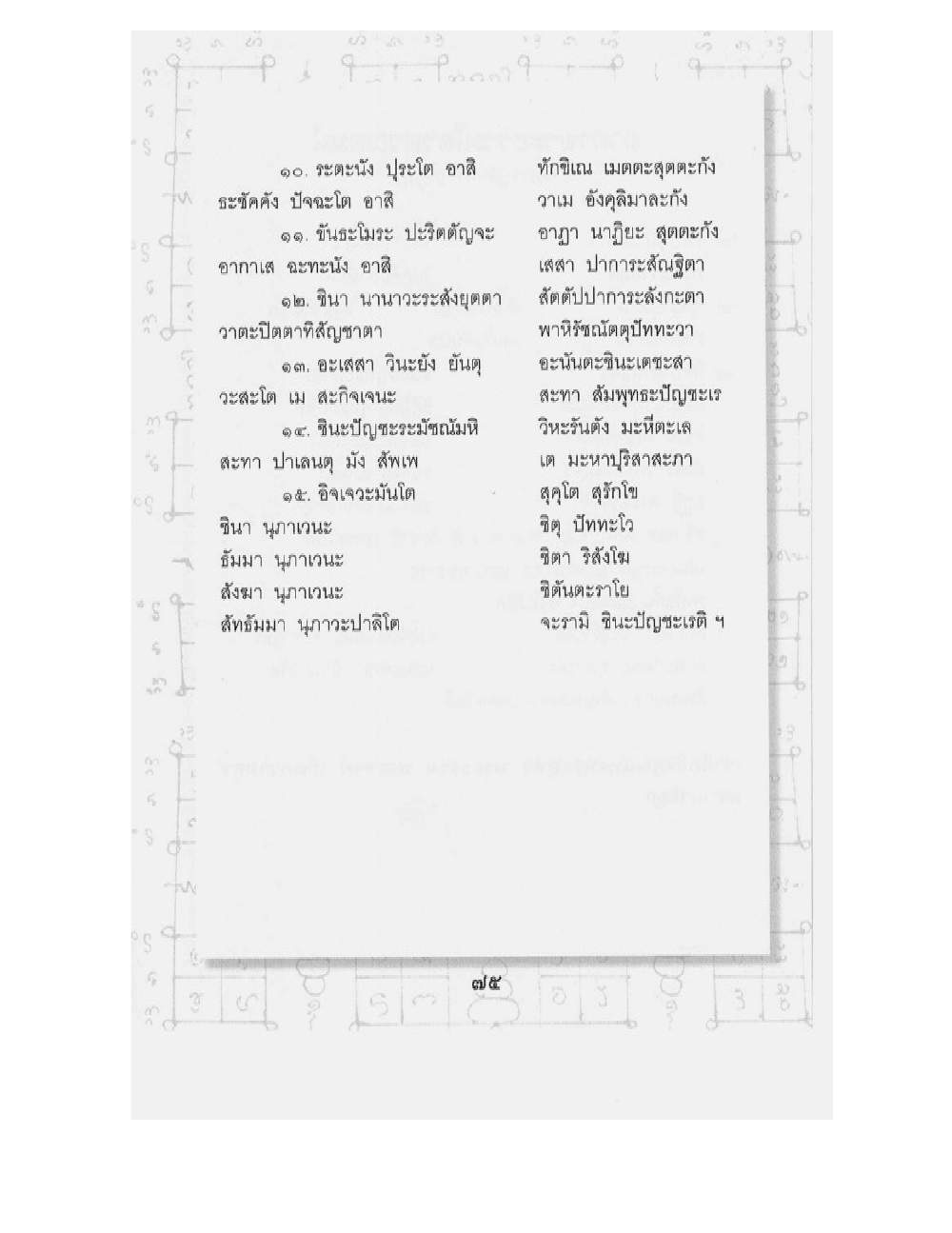
๑๐. ระตะนัง ปุระโต อาสิ ทักขิเณ เมตตะสุตตะกัง ธะชัคคัง ปัจฉะโต อาสิ วาเม อังคุลิมาละกัง ๑๑. ขันธะโมระ ปะริตตัญจะ อาฏานาฏิยะ สุตตะกัง อากาเส ฉะทะนัง อาสิ เสสา ปาการะสัณฐิตา ๑๒. ชินา นานาวะระสังยุตตา สัตตัปปาการะลังกะตา วาตะปิตตาทิสัญชาตา พาหิรัชฌัตตุปัททะวา ๑๓. อะเสสา วินะยัง ยันตุ อะนันตะชินะเตชะสา วะสะโต เม สะกิจเจนะ สะทา สัมพุทธะปัญชะเร ๑๔. ชินะปัญชะระมัชฌัมหิ วิหะรันตัง มะหีตะเล สะทา ปาเลนตุ มัง สัพเพ เต มะหาปุริสาสะภา ๑๕. อิจเจวะมันโต สุคุโต สุรักโข ชินา นุภาเวนะ ชิตุ ปัททะโว ธัมมา นุภาเวนะ ชิตา ริสังโข สังฆา นุภาเวนะ ชิตันตะราโย สัทธัมมา นุภาวะปาลิโต จะรามิ ชินะปัญชะเรติ ฯ
[Pali, transcribed — recited untranslated per the tradition; glossed here for legibility, verses 10–15 of the Jinapañjara gāthā, continued from the previous page:] "10. The Ratana [Sutta] was in front of me; the Mettā Sutta on my right; the Dhajagga [Sutta] was behind me; the Aṅgulimāla [paritta] on my left. 11. The Khandha and Mora parittas, and the Āṭānāṭiya Sutta, formed a canopy above in the sky; the rest formed a surrounding wall. 12. The Victors, endowed with various excellences, adorned as a sevenfold rampart — against dangers arising from wind, bile, and the like, whether external or internal — 13. May all be entirely dispelled by the power of the boundless Victor, as I dwell performing my duties, always within the Fully Enlightened One's cage of protection. 14. May all those great, bull-like beings [the Buddhas] always protect me as I dwell in the middle of the Victor's Cage upon the earth. 15. Thus well-guarded and well-protected: victorious over calamity by the power of the Victors; victorious over enemies by the power of the Dhamma; victorious over dangers by the power of the Sangha; protected by the power of the true Dhamma, I go about within the Victor's Cage."
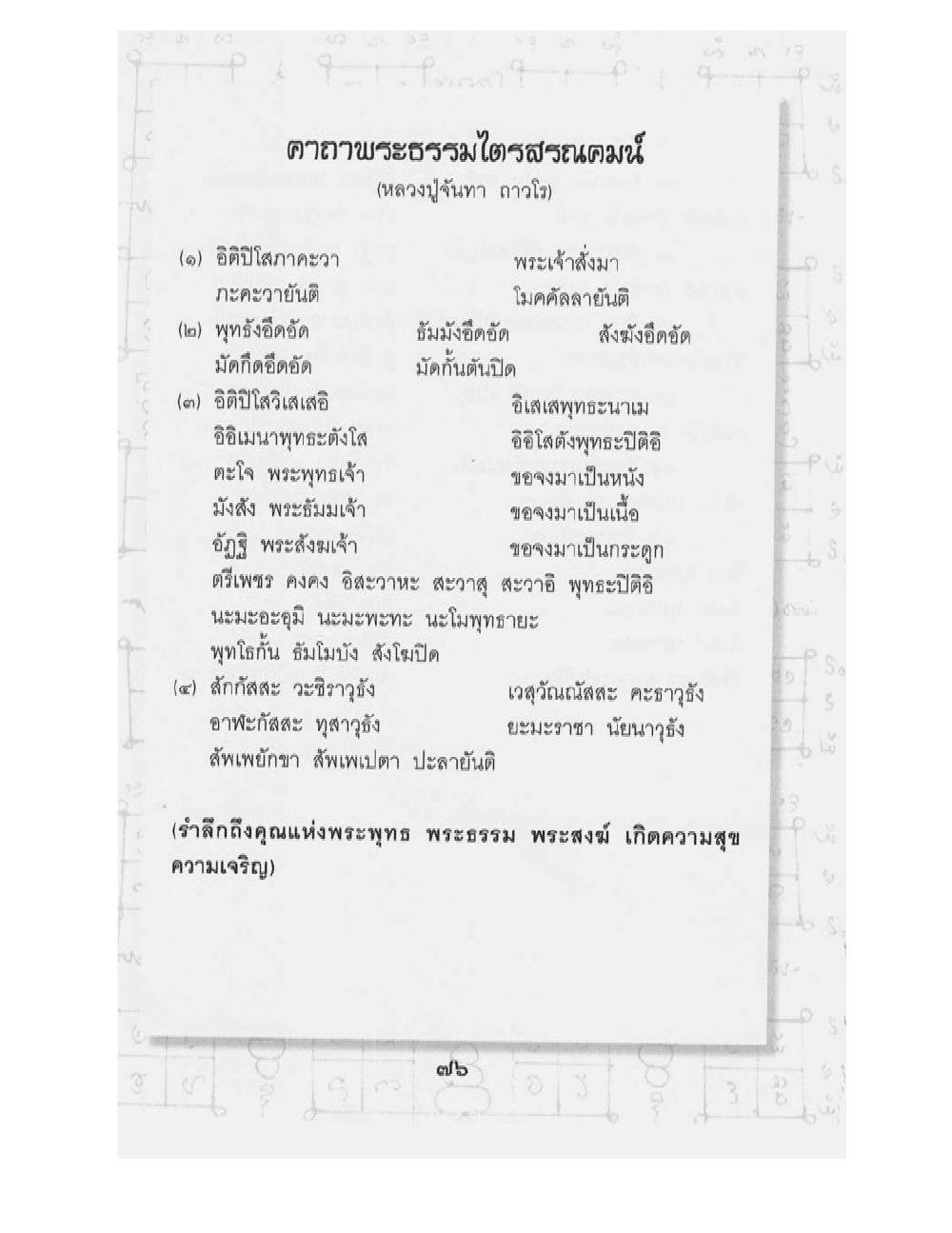
คาถาพระธรรมไตรสรณคมน์
(หลวงปู่จันทา ถาวโร) (๑) อิติปิโสภะคะวา พระเจ้าสั่งมา ภะคะวายันติ โมคคัลลายันติ (๒) พุทธังอึดอัด ธัมมังอึดอัด สังฆังอึดอัด มัดกีดอึดอัด มัดกั้นตันปิด (๓) อิติปิโสวิเสเสอิ อิเสสพุทธะนาเม อิอิเมนาพุทธะตังโส อิอิโสตังพุทธะปิติอิ ตะโจ พระพุทธเจ้า ของจงมาเป็นหนัง มังสัง พระธัมมเจ้า ของจงมาเป็นเนื้อ อัฏฐิ พระสังฆเจ้า ของจงมาเป็นกระดูก ตรีเพชร คงคง อิสะวาหะ สะวาสุ สะวาอิ พุทธะปิติอิ นะมะอะอุมิ นะมะพะทะ นะโมพุทธายะ พุทโธกั้น ธัมโมบัง สังโฆปิด (๔) สักกัสสะ วะชิราวุธัง เวสุวัณณัสสะ คะธาวุธัง อาฬะกัสสะ ทุสาวุธัง ยะมะราชา นัยนาวุธัง สัพเพยักขา สัพเพเปตา ปะลายันติ
(รำลึกถึงคุณแห่งพระพุทธ พระธรรม พระสงฆ์ เกิดความสุข ความเจริญ)
Katha of the Threefold Refuge in the Dhamma
(Luang Pu Chantha Thāwaro) (1) [Pali with interleaved Thai gloss, transcribed as printed:] "Itipiso bhagavā" — the Lord's command has come; "bhagavā yanti" — "Moggallāna yanti." (2) [Sealing-formula syllables, transcribed as printed:] "Buddhaṃ uet-at, Dhammaṃ uet-at, Saṅghaṃ uet-at, mat kīt uet-at, mat kan tan pit" — a mnemonic sound-formula invoking the Buddha, Dhamma, and Sangha to bind and seal against harm. (3) [Pali with interleaved Thai gloss, transcribed as printed:] "Itipiso visese-i, isesa buddhanāme, i-i-mena buddhataṅso, i-i-sotaṅ buddhapiti-i" — the skin: invoking the Lord Buddha, may it become my skin; the flesh: the Lord Dhamma, may it become my flesh; the bone: the Lord Sangha, may it become my bone. "Trīphet khongkhong isavāha savāsu savā-i buddhapiti-i, nama-a-umi nama-phatha namo buddhāya" — the Buddha blocks, the Dhamma shields, the Sangha seals. (4) [Pali, transcribed — recited untranslated per the tradition; glossed here for legibility:] "Sakkassa vajirāvudhaṃ, Vessuvaṇṇassa gadhāvudhaṃ, Āḷakassa dūsāvudhaṃ, Yamarājā nayanāvudhaṃ, sabbe yakkhā sabbe petā palāyanti" — "Sakka's thunderbolt weapon, Vessuvaṇṇa's mace weapon, Āḷaka's poison weapon, King Yama's weapon of the gaze — by these, all yakkhas and all hungry ghosts flee."
(Recollect the virtues of the Buddha, the Dhamma, and the Sangha, and happiness and prosperity will arise.)
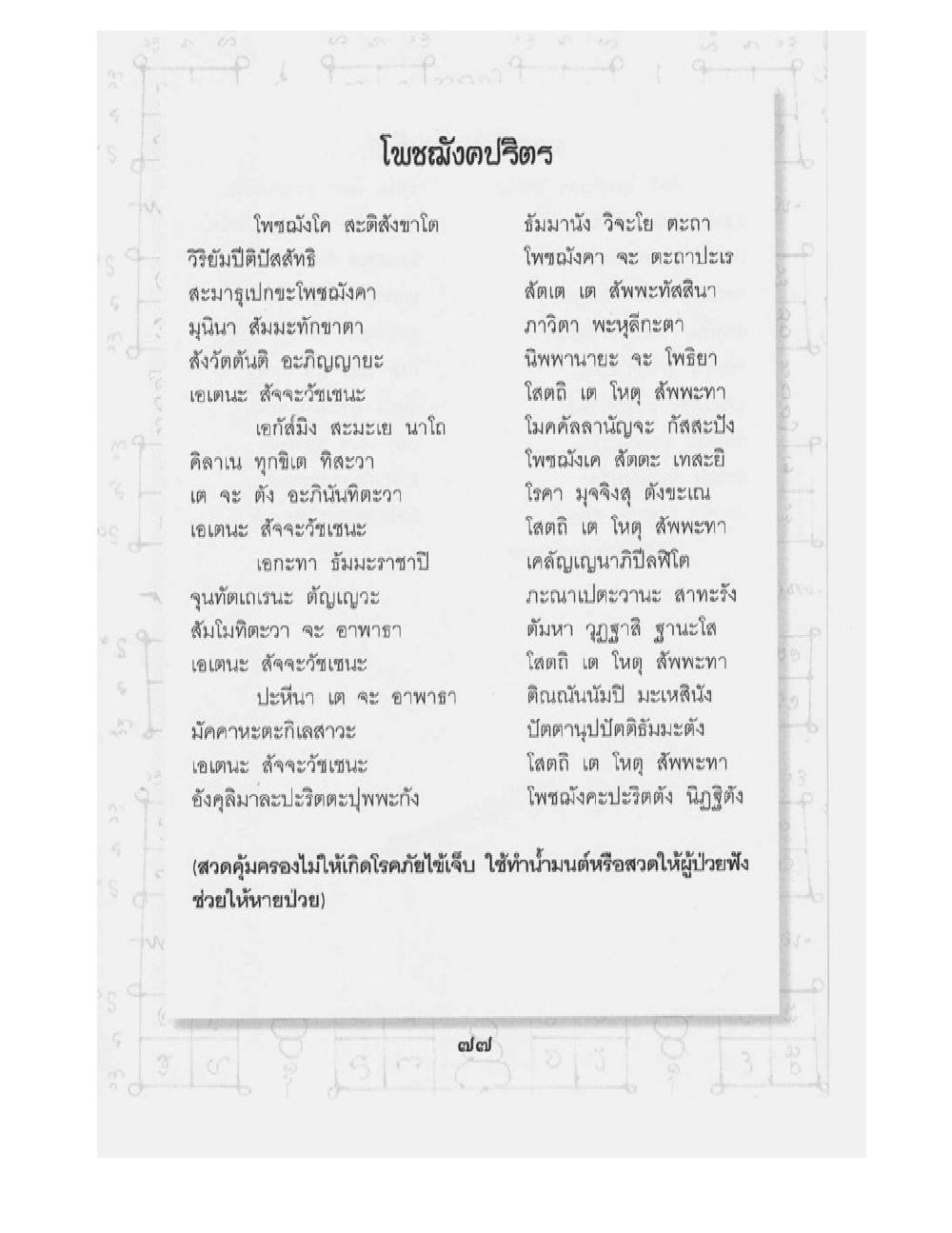
โพชฌังคปริตร
โพชฌังโค สะติสังขาโต ธัมมานัง วิจะโย ตะถา วิริยัมปีติปัสสัทธิ โพชฌังคา จะ ตะถาปะเร สะมาธุเปกขะโพชฌังคา สัตเต เต สัพพะทัสสินา มุนินา สัมมะทักขาตา ภาวิตา พะหุลีกะตา สังวัตตันติ อะภิญญายะ นิพพานายะ จะ โพธิยา เอเตนะ สัจจะวัชเชนะ โสตถิ เต โหตุ สัพพะทา เอกัสมิง สะมะเย นาโถ โมคคัลลานัญจะ กัสสะปัง คิลาเน ทุกขิเต ทิสวา โพชฌังเค สัตตะ เทสะยิ เต จะ ตัง อะภินันทิตวา โรคา มุจจิงสุ ตังขะเณ เอเตนะ สัจจะวัชเชนะ โสตถิ เต โหตุ สัพพะทา เอกะทา ธัมมะราชาปิ เคลัญญะนาภีปีฬิโต จุนทัตเถเรนะ ตัญเญวะ ภะณาเปตวานะ สาทะรัง สัมโมทิตวา จะ อาพาธา ตัมหา วุฏฐาสิ ฐานะโส เอเตนะ สัจจะวัชเชนะ โสตถิ เต โหตุ สัพพะทา ปะหีนา เต จะ อาพาธา ติณณันนัมปิ มะเหสินัง มัคคาหะตะกิเลสาวะ ปัตตานุปปัตติธัมมะตัง เอเตนะ สัจจะวัชเชนะ โสตถิ เต โหตุ สัพพะทา อังคุลิมาละปะริตตะปุพพะกัง อังคุลิมาละปะริตตะตัง นิฏฐิตัง
(สวดคุ้มครองไม่ให้เกิดโรคภัยไข้เจ็บ ใช้ทำน้ำมนต์หรือสวดให้ผู้ป่วยฟัง ช่วยให้หายป่วย)
The Bojjhaṅga Paritta
[Pali, transcribed — recited untranslated per the tradition; glossed here for legibility:] "The factors of enlightenment are: mindfulness, investigation of phenomena, energy, rapture, tranquility, concentration, and equanimity — these the Sage rightly taught, he who sees all beings; when developed and cultivated they lead to direct knowledge, to Nibbāna, and to enlightenment. By the utterance of this truth, may there be well-being for you always. Once, the Protector, seeing the Elders Moggallāna and Kassapa sick and suffering, taught them the seven enlightenment factors; delighting in that teaching, they were freed from their illness in that very moment. By the utterance of this truth, may there be well-being for you always. Once, even the Dhamma-King himself, afflicted by sickness, had the Elder Cunda recite that same teaching to him with reverence; and, delighting in it, he rose up from that illness. By the utterance of this truth, may there be well-being for you always. The sickness of all three great sages was thus abandoned, struck down like a defilement by the path. By the utterance of this truth, may there be well-being for you always. Having attained the natural course realized in due sequence by these three great seers — by the utterance of this truth, may there be well-being for you always. Here ends the Bojjhaṅga Paritta, prefaced by the Aṅgulimāla Paritta; the Aṅgulimāla Paritta section is concluded."
(Recite this to protect against illness and disease; use it to make holy water, or recite it for a sick person to hear, to help them recover.)
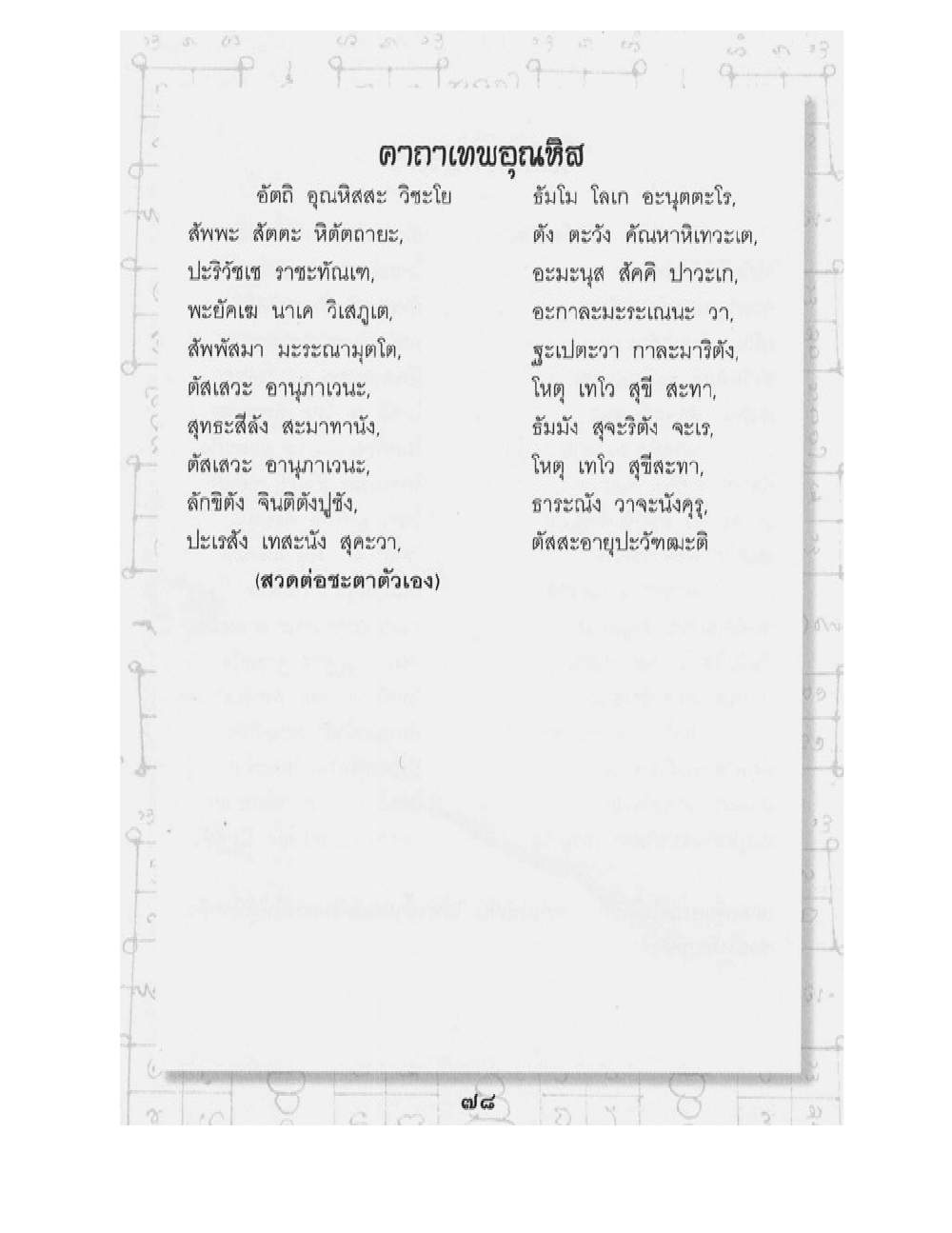
คาถาเทพอุณหิส
อัตถิ อุณหิสสะ วิชะโย สัพพะ สัตตะ หิตัตถายะ, ปะริวัชเซ ราชะทัณเฑ, พะยัคเฆ นาเค วิเสภูเต, สัพพัสมา มะระณามุตโต, ตัสเสวะ อานุภาเวนะ, สุทธะสีลัง สะมาทานัง, ตัสเสวะ อานุภาเวนะ, ลักขิตัง จินติตังปูซัง, ปะเรสัง เทสะนัง สุคะวา, (สวดต่อชะตาตัวเอง)
ธัมโม โลเก อะนุตตะโร, ตัง ตะวัง คัณหาหิเทวะเต, อะมะนุส สัคคิ ปาวะเก, อะกาละมะระเณนะ วา, ฐะเปตะวา กาละมาริตัง, โหตุ เทโว สุขี สะทา, ธัมมัง สุจะริตัง จะเร, โหตุ เทโว สุขีสะทา, ธาระณัง วาจะนังคุรุ, ตัสสะอายุปะวัฑฒะติ
Katha of the Deity's Crown (Unhis)
[Pali, transcribed as printed in two side-by-side columns — recited untranslated per the tradition; the two columns together form one continuous verse (this is the well-known Unhissavijaya protective verse), glossed here for legibility:] Atthi unhissavijayo, dhammo loke anuttaro — "There is the Victory of the Crown-protuberance, the Dhamma unsurpassed in the world," sabbasatta hitatthaya, tang tawang khanhahi thewate — "for the welfare of all beings; may you, O deity, take hold of it," parivaiche rachathanthe, amanut sakki pawake — "[protecting one] from royal punishment, from non-human beings, fire and flame," phayakkhe nake wisephute, akalamaranena wa — "from tigers, nagas and poisonous things, or from untimely death," sappasma maranamutto, thapetawa kalamaritang — "freed from every kind of death, excepting death by its natural time," tassewa anuphawena hotu thewo sukhi satha — "by that very power, may one ever be a happy deva," sutthasilang samathanang, thammang sucharitang chare — "having undertaken pure moral virtue, practicing the Dhamma rightly," tassewa anuphawena hotu thewo sukhisatha — "by that very power, may one ever be a happy deva," lakkhitang chintitangpusang, tharanang wachanangkhuru, paresang thesanang sukhawa — "noted, thought of and revered, upheld and recited with reverence, well taught by others," tassaayupawatthati — "thereby one's lifespan increases." (Chanted for one's own fate/horoscope.)
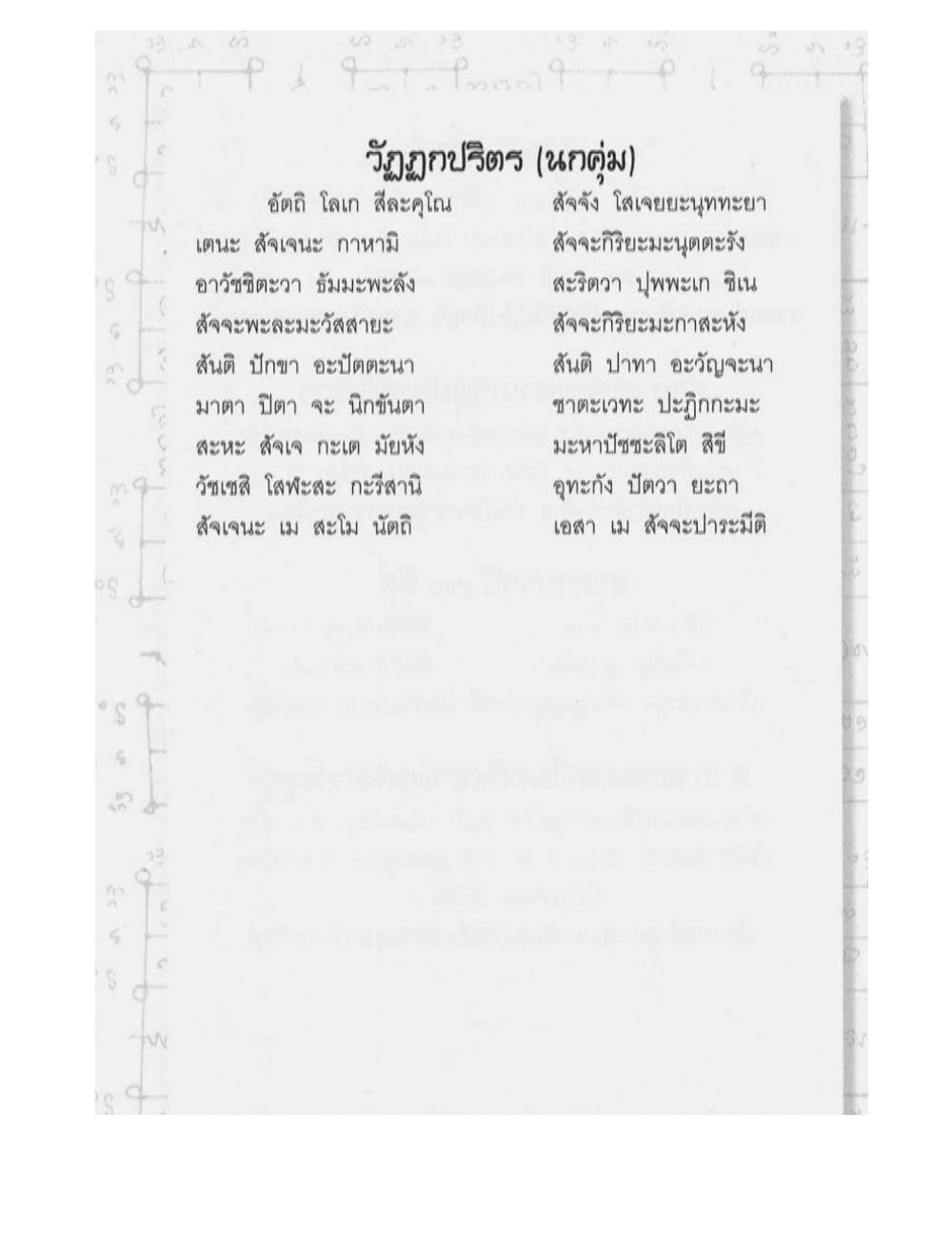
วัฏฏกปริตร (นกคุ่ม)
อัตถิ โลเก สีละคุโณ เตนะ สัจเจนะ กาหามิ อาวัชชิตะวา ธัมมะพะลัง สัจจะพะละมะวัสสายะ สันติ ปักขา อะปัตตะนา มาตา ปิตา จะ นิกขันตา สะหะ สัจเจ กะเต มัยหัง วัชเชสิ โสฬะสะ กะรีสานิ สัจเจนะ เม สะโม นัตถิ
สัจจัง โสเจยยะนุททะยา สัจจะกิริยะมะนุดตะรัง สะริตวา ปุพพะเก ชิเน สัจจะกิริยะมะกาสะหัง สันติ ปาทา อะวัญจะนา ชาตะเวทะ ปะฏิกกะมะ มะหาปัชชะลิโต สิขี อุทะกัง ปัตวา ยะถา เอสา เม สัจจะปาระมีติ
Vaṭṭaka Paritta (The Quail)
[Pali, transcribed as printed in two side-by-side columns — recited untranslated per the tradition; the columns together form one continuous verse (this is the famous Vaṭṭaka-jātaka fire-protection paritta), glossed here for legibility:] Atthi loke sīlaguṇo, saccaṃ soceyyanuddayā — "In this world there is the virtue of morality, of truth, of purity and compassion." Tena saccena kāhāmi saccakiriyamuttamaṃ — "By that truth I shall perform the supreme Act of Truth." Āvajjitvā dhammabalaṃ, saritvā pubbake jine — "Calling to mind the power of the Dhamma, remembering the Conquerors of old," Saccabalamavassāya saccakiriyamakāsahaṃ — "relying on the power of truth, I performed an Act of Truth:" Santi pakkhā apatanā, santi pādā avañcanā — "There are wings that cannot fly, there are feet that cannot walk;" Mātā pitā ca nikkhantā, jātaveda paṭikkama — "my mother and father have gone away — O fire-born one, withdraw!" Saha sacce kate mayhaṃ, mahāpajjalito sikhī — "As soon as I had made this Act of Truth, the great blazing flame" Vajjesi soḷasa karīsāni, udakaṃ patvā yathā [sikhī] — "withdrew sixteen karīsas, as fire does on reaching water." Saccena me samo natthi, esā me saccapāramī ti — "There is none equal to me in truth — this is my perfection of truth."
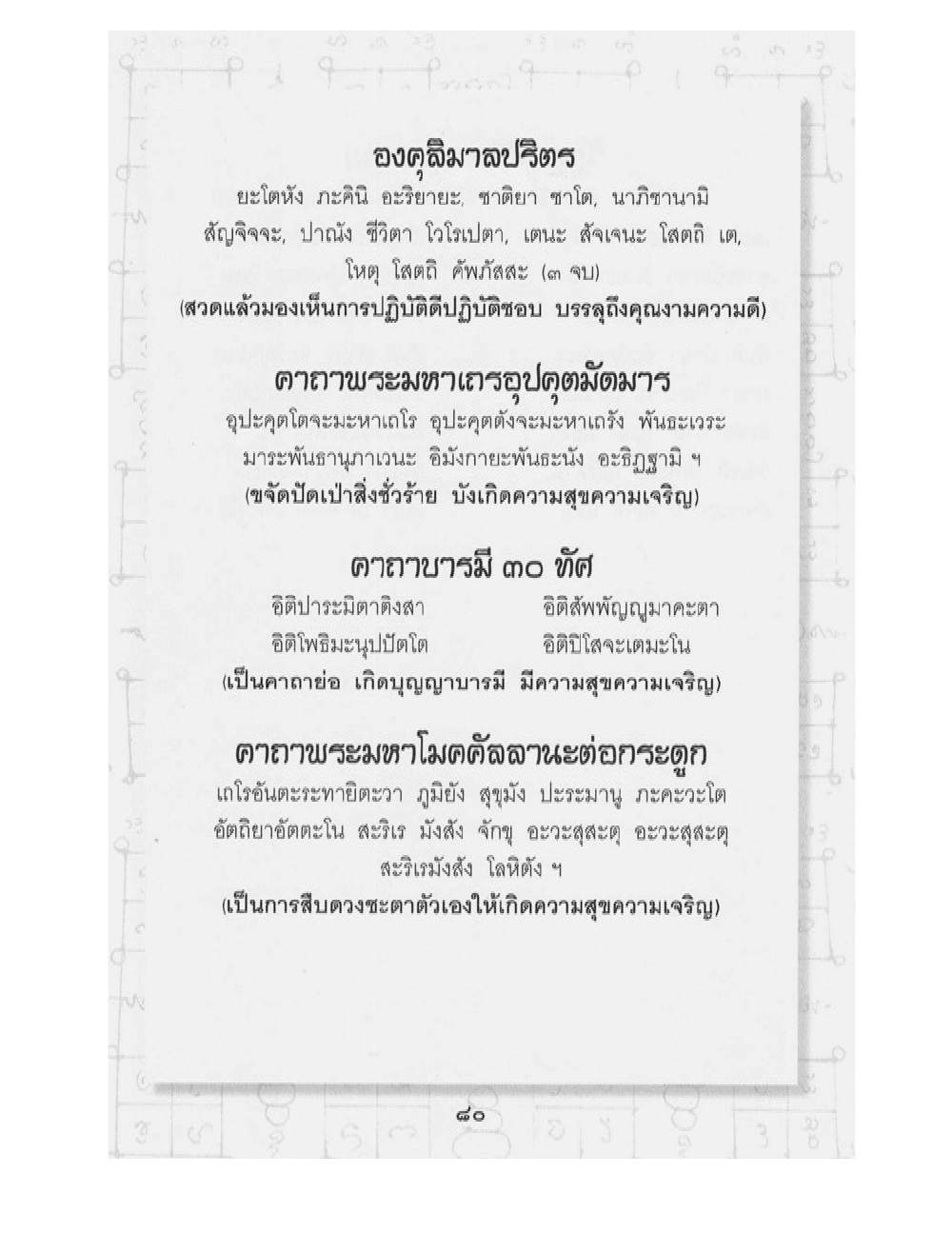
องคุลิมาลปริตร
ยะโตหัง ภะคินิ อะริยายะ ชาติยา ชาโต, นาภิชานามิ สัญจิจจะ ปาณัง ชีวิตา โวโรเปตา, เตนะ สัจเจนะ โสตถิ เต, โหตุ โสตถิ คัพภัสสะ (๓ จบ) (สวดแล้วมองเห็นการปฏิบัติดีปฏิบัติชอบ บรรลุถึงคุณงามความดี)
คาถาพระมหาเถรอุปคุตมัดมาร
อุปะคุตโตจะมะหาเถโร อุปะคุตตังจะมะหาเถรัง พันธะเวระ มาระพันธานุภาเวนะ อิมังกายะพันธะนัง อะธิฏฐามิ ฯ (ขจัดปัดเป่าสิ่งชั่วร้าย บังเกิดความสุขความเจริญ)
คาถาบารมี ๓๐ ทัศ
อิติปาระมิตาติงสา อิติสัพพัญญุมาคะตา อิติโพธิมะนุปปัตโต อิติปิโสจะเตมะโน (เป็นคาถาย่อ เกิดบุญญาบารมี มีความสุขความเจริญ)
คาถาพระมหาโมคคัลลานะต่อกระดูก
เถโรอันตะระทายิตะวา ภูมิยัง สุขมัง ปะระมานุ ภะคะวะโต อัตถิยาอัตตะโน สะริเร มังสัง จักขุ อะวะสุสะตุ อะวะสุสะตุ สะริเรมังสัง โลหิตัง ฯ (เป็นการสืบดวงชะตาตัวเองให้เกิดความสุขความเจริญ)
Angulimala Paritta
[Pali:] "Sister, since I was born of the Noble Birth, I do not recall having intentionally deprived any living being of life. By this truth, may you be well; may the womb be well." (three times) (Chanted, one sees good practice and right conduct, and attains virtue and goodness.)
Katha of the Great Elder Upagutta Binding Māra
[Pali:] "Upagutta the great elder, Upagutta the great elder — by the power that bound Māra's enmity, I now resolve upon this binding of the body." (Dispels and wards off evil things; brings about happiness and prosperity.)
Katha of the Thirty Perfections
[Pali:] "Thus [he attained] the thirty perfections; thus he arrived at omniscience; thus he attained Enlightenment; thus is his mind [purified]." (This is an abbreviated formula; it gives rise to meritorious perfection and to happiness and prosperity.)
Katha of the Great Moggallana for the Bones
[Pali, as printed — its exact sense is obscure in places, rendered here as faithfully as the wording allows:] "The Elder, having passed away upon the ground, as fine as an atom of the Blessed One; the bones of his own body, the flesh, the eye — may they wither away, may they wither away; the flesh and blood of the body." (This is a rite for sustaining one's own fate/life-span, bringing happiness and prosperity.)
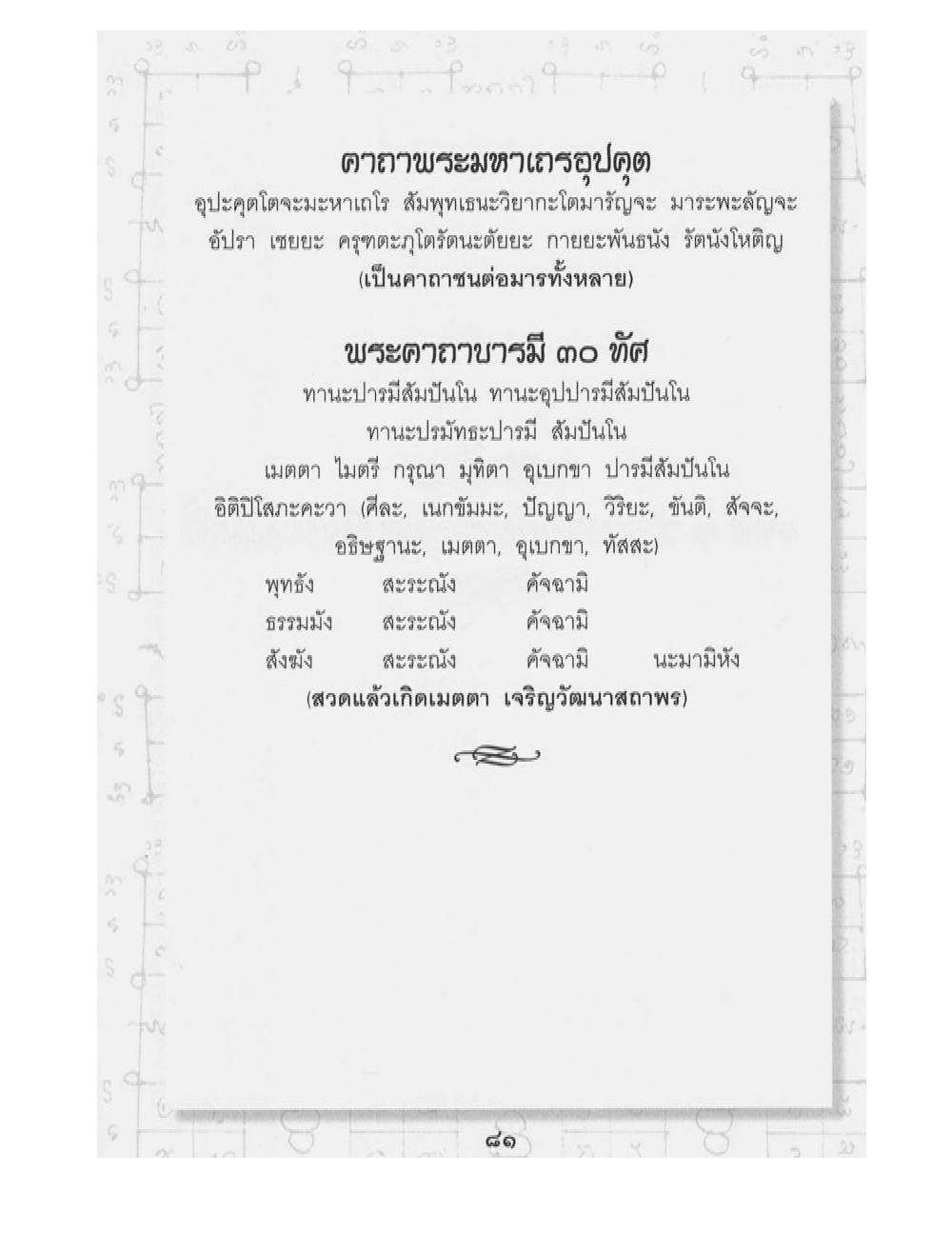
คาถาพระมหาเถรอุปคุต
อุปะคุตโตจะมะหาเถโร สัมพุทเธนะวิยากะโตมารัญจะ มาระพะลัญจะ อัปรา เชยยะ ครุฑตะภูโตรัตนะดัยยะ กายยะพันธนัง รัตนังโหติญ (เป็นคาถาชนต่อมารทั้งหลาย)
พระคาถาบารมี ๓๐ ทัศ
ทานะปารมีสัมปันโน ทานะอุปปารมีสัมปันโน ทานะปรมัตถะปารมี สัมปันโน เมตตา ไมตรี กรุณา มุทิตา อุเบกขา ปารมีสัมปันโน อิติปิโสภะคะวา (ศีละ, เนกขัมมะ, ปัญญา, วิริยะ, ขันติ, สัจจะ, อธิษฐานะ, เมตตา, อุเบกขา, ทัสสะ) พุทธัง สะระณัง คัจฉามิ ธรรมมัง สะระณัง คัจฉามิ สังฆัง สะระณัง คัจฉามิ นะมามิหัง (สวดแล้วเกิดเมตตา เจริญวัฒนาสถาพร)
Katha of the Great Elder Upagutta
[Pali, as printed — a formula proclaiming Upagutta the great elder, declared victorious by the Fully Enlightened One over Māra and Māra's forces, invincible, garuda-like, adorned with jewels, whose binding of the body becomes a jewel:] (This is a formula for warding off all Māras/demons.)
Sacred Katha of the Thirty Perfections
Endowed with the perfection of giving; endowed with the higher perfection of giving; endowed with the ultimate perfection of giving. Endowed with the perfection of loving-kindness, amity, compassion, sympathetic joy, and equanimity. Thus is the Blessed One (virtue, renunciation, wisdom, energy, patience, truthfulness, determination, loving-kindness, equanimity, benevolence). I go to the Buddha for refuge. I go to the Dhamma for refuge. I go to the Sangha for refuge — I pay homage. (Chanted, it gives rise to loving-kindness and brings lasting prosperity and stability.)

ตอนที่ ๒
บทที่ ๒ ล้านนาอภิมหายันต์อันศักดิ์สิทธิ์
Part 2
Chapter 2: The Sacred Great Yantras of Lanna
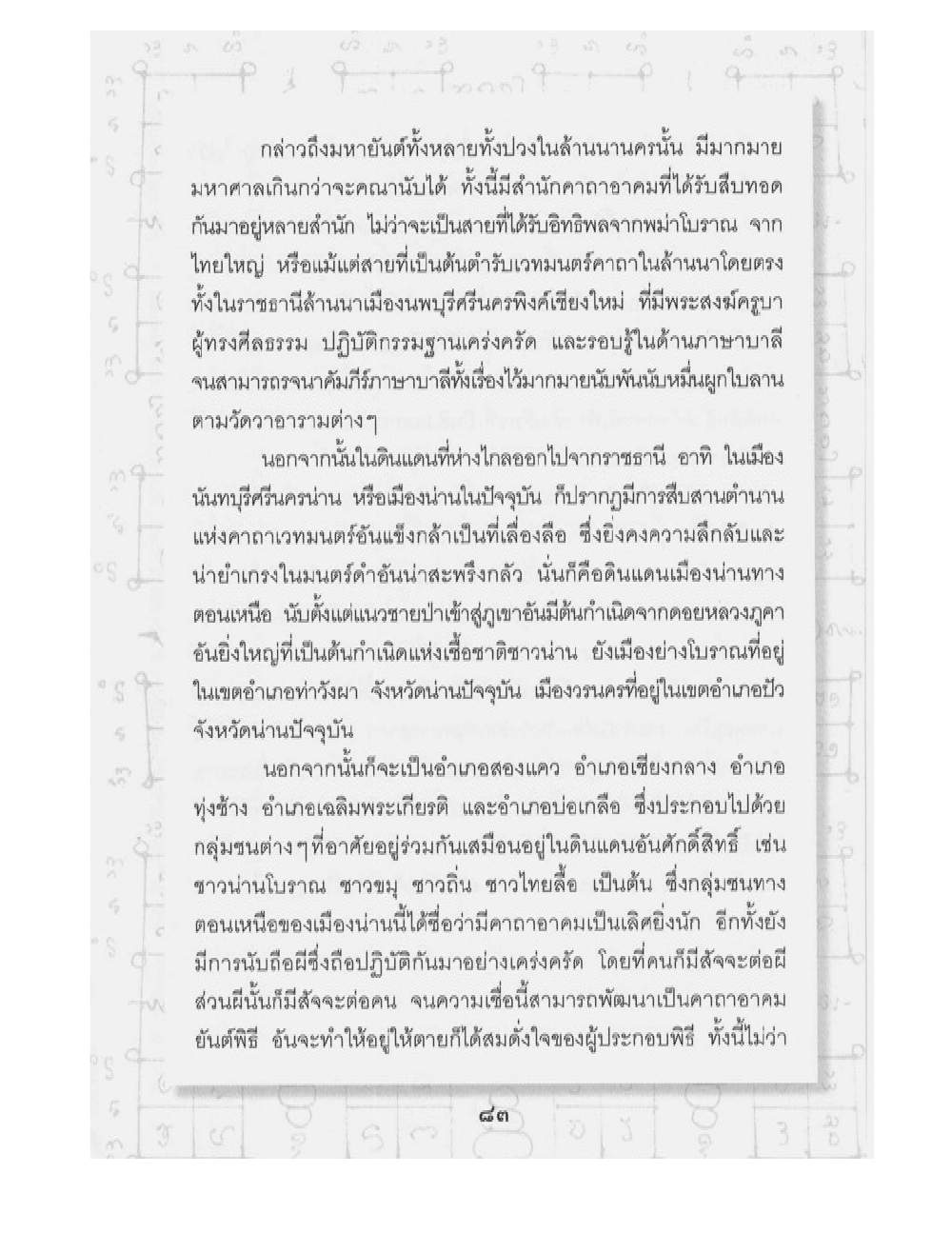
กล่าวถึงมหายันต์ทั้งหลายทั้งปวงในล้านนานครนั้น มีมากมาย มหาศาลเกินกว่าจะคณานับได้ ทั้งนี้มีสำนักคาถาอาคมที่ได้รับสืบทอด กันมาอยู่หลายสำนัก ไม่ว่าจะเป็นสายที่ได้รับอิทธิพลจากพม่าโบราณ จาก ไทยใหญ่ หรือแม้แต่สายที่เป็นต้นตำรับเวทมนตร์คาถาในล้านนาโดยตรง ทั้งในราชธานีล้านนาเมืองนพบุรีศรีนครพิงค์เชียงใหม่ ที่มีพระสงฆ์ครูบา ผู้ทรงศีลธรรม ปฏิบัติกรรมฐานเคร่งครัด และรอบรู้ในด้านภาษาบาลี จนสามารถจนาคัมภีร์ภาษาบาลีทั้งเรื่องไว้มากมายนับพันนับหมื่นผูกใบลาน ตามวัดวาอารามต่างๆ นอกจากนั้นในดินแดนที่ห่างไกลออกไปจากราชธานี อาทิ ในเมือง นันทบุรีศรีนครน่าน หรือเมืองน่านในปัจจุบัน ก็ปรากฏมีการสืบสานตำนาน แห่งคาถาเวทมนตร์อันแข็งกล้าเป็นที่เลื่องลือ ซึ่งยิ่งคงความลึกลับและ น่ายำเกรงในมนตร์ดำอันน่าสะพรึงกลัว นั่นก็คือดินแดนเมืองน่านทาง ตอนเหนือ นับตั้งแต่แนวชายป่าเข้าสู่ภูเขาอันมีต้นกำเนิดจากดอยหลวงภูคา อันยิ่งใหญ่ที่เป็นต้นกำเนิดแห่งเชื้อชาติชาวน่าน ยังเมืองย่างโบราณที่อยู่ ในเขตอำเภอท่าวังผา จังหวัดน่านปัจจุบัน เมืองวรนครที่อยู่ในเขตอำเภอปัว จังหวัดน่านปัจจุบัน นอกจากนั้นก็จะเป็นอำเภอสองแคว อำเภอเชียงกลาง อำเภอ ทุ่งช้าง อำเภอเฉลิมพระเกียรติ และอำเภอบ่อเกลือ ซึ่งประกอบไปด้วย กลุ่มชนต่างๆที่อาศัยอยู่ร่วมกันเสมือนอยู่ในดินแดนอันศักดิ์สิทธิ์ เช่น ชาวน่านโบราณ ชาวขมุ ชาวถิ่น ชาวไทลื้อ เป็นต้น ซึ่งกลุ่มชนทาง ตอนเหนือของเมืองน่านนี้ได้ชื่อว่ามีคาถาอาคมเป็นเลิศยิ่งนัก อีกทั้งยัง มีการนับถือผีซึ่งถือปฏิบัติกันมาอย่างเคร่งครัด โดยที่คนก็มีสัจจะต่อผี ส่วนผีนั้นก็มีสัจจะต่อคน จนความเชื่อนี้สามารถพัฒนาเป็นคาถาอาคม ยันต์พิธี อันจะทำให้อยู่ให้ตายก็ได้สมดั่งใจของผู้ประกอบพิธี ทั้งนี้ไม่ว่า
Speaking of all the great yantras throughout the Lanna kingdom, they are vastly numerous — too many to count. There are many lineages of mantra-and-spell (khatha akhom) practice handed down over generations, whether lineages influenced by ancient Burma, by the Tai Yai (Shan), or even lineages that are the original wellspring of mantric lore native to Lanna itself — both in the Lanna royal capital, the city of Nopburi Si Nakhon Phing (Chiang Mai), where there were monks and kruba of moral discipline who practiced meditation strictly and were deeply learned in Pali, to the point of committing whole Pali scriptures to writing on countless subjects — thousands upon thousands of bundles of palm-leaf manuscripts — kept at temples and monasteries everywhere. Beyond this, in lands far removed from the royal capital — such as the city of Nanthaburi Si Nakhon Nan, present-day Nan province — there also survives a tradition of formidable and renowned mantric lore, all the more shrouded in mystery for its fearsome black magic. That is the northern territory of Nan: from the forest's edge up into the mountains rising from the great Doi Luang Phu Kha, the mighty source from which the Nan people trace their origin, as well as the ancient city of Yang, now within Tha Wang Pha district of present-day Nan province, and the city of Woranakhon, within Pua district of present-day Nan province. Besides this there are also Song Khwae district, Chiang Klang district, Thung Chang district, Chaloem Phra Kiat district, and Bo Kluea district, home to various peoples living together as if in a sacred land — such as the ancient Nan people, the Khmu, the Thin, and the Tai Lue, among others. These peoples of northern Nan are renowned for possessing mantric lore of the highest order. They also maintain, with strict observance, a tradition of spirit worship, in which people keep faith with the spirits and the spirits in turn keep faith with people — a belief that has developed into ritual mantras and yantra rites able to grant life or death exactly as the officiant wishes. And this holds true no matter
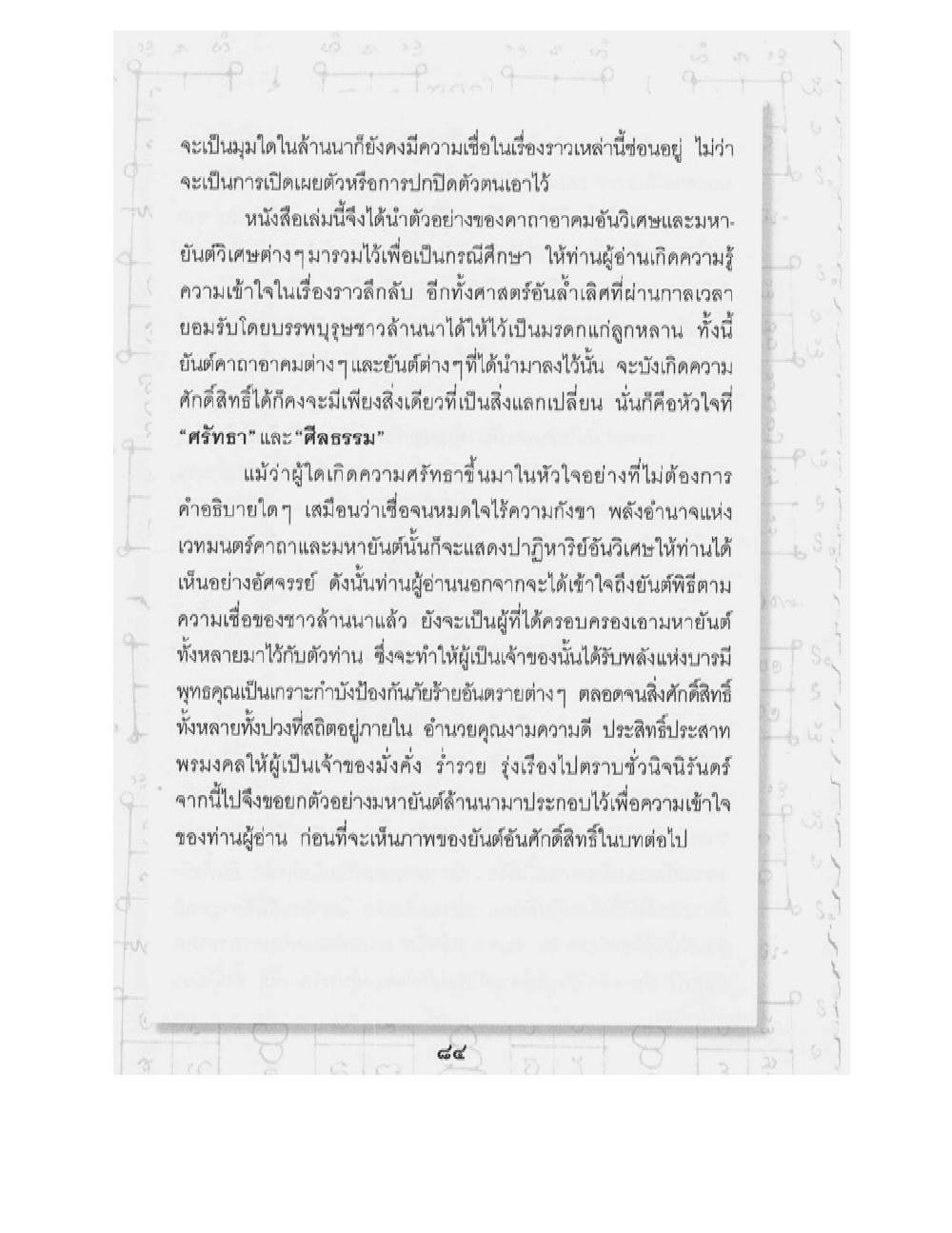
จะเป็นมุมใดในล้านนาก็ยังคงมีความเชื่อในเรื่องราวเหล่านี้ซ่อนอยู่ ไม่ว่า จะเป็นการเปิดเผยตัวหรือการปกปิดตัวตนเอาไว้ หนังสือเล่มนี้จึงได้นำตัวอย่างของคาถาอาคมอันวิเศษและมหา- ยันต์วิเศษต่างๆมารวมไว้เพื่อเป็นกรณีศึกษา ให้ท่านผู้อ่านเกิดความรู้ ความเข้าใจในเรื่องราวลึกลับ อีกทั้งศาสตร์อันล้ำเลิศที่ผ่านกาลเวลา ยอมรับโดยบรรพบุรุษชาวล้านนาได้ให้ไว้เป็นมรดกแก่ลูกหลาน ทั้งนี้ ยันต์คาถาอาคมต่างๆและยันต์ต่างๆที่ได้นำมาลงไว้นั้น จะบังเกิดความ ศักดิ์สิทธิ์ได้ก็คงจะมีเพียงสิ่งเดียวที่เป็นสิ่งแลกเปลี่ยน นั่นก็คือหัวใจที่ "ศรัทธา" และ "ศีลธรรม" แม้ว่าผู้ใดเกิดความศรัทธาขึ้นมาในหัวใจอย่างที่ไม่ต้องการ คำอธิบายใดๆ เสมือนว่าเชื่อจนหมดใจไร้ความกังขา พลังอำนาจแห่ง เวทมนตร์คาถาและมหายันต์นั้นก็จะแสดงปาฏิหาริย์อันวิเศษให้ท่านได้ เห็นอย่างอัศจรรย์ ดังนั้นท่านผู้อ่านนอกจากจะได้เข้าใจถึงยันต์พิธีตาม ความเชื่อของชาวล้านนาแล้ว ยังจะเป็นผู้ที่ได้ครอบครองเอามหายันต์ ทั้งหลายมาไว้กับตัวท่าน ซึ่งจะทำให้ผู้เป็นเจ้าของนั้นได้รับพลังแห่งบารมี พุทธคุณเป็นเกราะกำบังป้องกันภัยร้ายอันตรายต่างๆ ตลอดจนสิ่งศักดิ์สิทธิ์ ทั้งหลายทั้งปวงที่สถิตอยู่ภายใน อำนวยคุณงามความดี ประสิทธิ์ประสาท พรมงคลให้ผู้เป็นเจ้าของมั่งคั่ง ร่ำรวย รุ่งเรืองไปตราบชั่วนิจนิรันดร์ จากนี้ไปจึงขอยกตัวอย่างมหายันต์ล้านนามาประกอบไว้เพื่อความเข้าใจ ของท่านผู้อ่าน ก่อนที่จะเห็นภาพของยันต์อันศักดิ์สิทธิ์ในบทต่อไป
which corner of Lanna one looks to — belief in these matters still lies hidden there, whether openly displayed or kept concealed. This book has therefore gathered examples of extraordinary mantras and spells and various great and wondrous yantras as case studies, so that readers may gain knowledge and understanding of these mysterious matters, as well as of this superb lore which, having passed through the ages, was accepted by the ancestors of the Lanna people and handed down as a legacy for their descendants. As for the various mantric yantras and yantras presented here, their sacred power can arise from only one thing given in exchange: a heart of "faith" and "moral virtue." Even if someone's faith arises in the heart without needing any explanation — as though believing wholly, without a trace of doubt — the power of the mantras and great yantras will then reveal wondrous miracles for that person to behold in astonishment. Thus, besides gaining an understanding of the yantra rites according to Lanna belief, the reader will also become one who possesses these great yantras, which will grant their owner the power of the Buddha's perfections as armor guarding against every danger, along with all the sacred things dwelling within, bestowing virtue and goodness, granting blessings that bring the owner wealth, riches, and prosperity forever and always. From here on, then, examples of Lanna great yantras are offered for the reader's understanding, before the images of these sacred yantras appear in the following chapter.
ยันต์ม้าเสพนาง เจ้าแห่งอภิมหาเสน่ห์
ยันต์ม้าเสพนางเป็นยันต์ที่อยู่ในวัฒนธรรมล้านนามาเป็นเวลา นาน จะมีมาตั้งแต่เมื่อไหร่ไม่มีผู้กล่าวไว้แน่ชัด แต่หากเชื่อกันว่าเป็นยันต์ ที่มาจากทางพม่าและไทยใหญ่ ที่ส่งอิทธิพลมาถึงล้านนาในช่วงสมัยต่างๆ จนได้รับการสืบทอดมาถึงปัจจุบันนี้ เนื่องจากเป็นยันต์ที่ให้คุณทางด้าน มหาเสน่ห์เป็นยิ่ง จากตัวอย่างที่มีการพบเห็นรูปแบบของยันต์ มักมีการแสดงยันต์ มหาเสน่ห์ที่จัดอยู่ในประเภทนี้หลายแบบ เช่น ยันต์ม้าเสพนาง ยันต์ วัวเสพนาง ยันต์หนูกินน้ำนมแมว ยันต์วัวกินน้ำนมเสือ ซึ่งยันต์มหาเสน่ห์นี้ เสมือนมีการแฝงไว้ด้วยคติธรรมและปริศนาธรรมอันสูงส่งยิ่ง ทั้งนี้ไม่มี ยันต์ในลักษณะนี้เป็นรูปแบบของความลามกอนาจาร หากแต่ความเชื่อ เรื่องความอุดมสมบูรณ์โดยใช้การแสดงการมีเพศสัมพันธ์ระหว่างชาย หญิงนั้นมีมาแล้วตั้งแต่สมัยอินเดียโบราณ ซึ่งเป็นจุดแรกเริ่มแห่งการ ก่อกำเนิดแห่งชีวิตและสรรพสิ่งในโลก ดังนั้นยันต์ม้าเสพนาง หรือยันต์อื่นม้าของล้านนาจึงเป็นการได้รับ อิทธิพลความเชื่อทางศาสนาที่พัฒนามาเป็นศาสตร์แห่งมหายันต์อันวิเศษ แม้นผู้ใดมียันต์ม้าเสพนางติดตัวเพื่อบูชาก็ถือว่าเป็นมหาเสน่ห์ มีเมตตา มหานิยม ผู้คนทั้งหลายนิยมชมชอบ ใช้สำหรับการเข้าหาเกี้ยวพาราสี หญิงสาวและเพศตรงข้าม ดึงดูดเกิดความพิศวาส เร้าใจ หลงใหลจน ยากจะลืมหูลืมตา เป็นที่รักใคร่แก่เพศตรงกันข้ามมากยิ่งนัก แม้นว่าจะนำยันต์นี้ติดตัวไปเข้าเจ้าเฝ้านาย เข้าหาผู้หลักผู้ใหญ่ เจ้านายของตนก็จะได้รับความเมตตา ไม่ว่าจะไปเจรจาค้าขายพบปะ พูดคุยกับผู้คนก็จะได้รับความไว้วางใจ เกิดความยินดีต่อเราโดยง่าย
The Horse-Mounting-the-Lady Yantra, Lord of Supreme Charm
The Horse-Mounting-the-Lady Yantra is a yantra that has existed within Lanna culture for a long time. No one has stated definitively since when it has existed, but it is believed to be a yantra that came by way of Burma and the Tai Yai, whose influence reached Lanna across various eras, and which has been passed down to the present day, because it is a yantra that grants, above all, the virtue of supreme charm. Among examples of the design that have been found, this type of charm-yantra is often shown in several forms, such as the Horse-Mounting-the-Lady Yantra, the Ox-Mounting-the-Lady Yantra, the Mouse-Drinking-the-Cat's-Milk Yantra, and the Ox-Drinking-the-Tiger's-Milk Yantra. These charm yantras seem to conceal within them lofty moral teachings and dhamma riddles. None of these yantras is intended as a form of obscenity; rather, the belief concerning fertility and abundance, expressed through depicting sexual union between man and woman, has existed since ancient Indian times, being the very first point of the arising of life and all things in the world. Thus the Horse-Mounting-the-Lady Yantra, or other horse yantras of Lanna, arose from the influence of religious belief developed into the science of wondrous great yantras. If anyone carries the Horse-Mounting-the-Lady Yantra to venerate, it is held to grant supreme charm, loving-kindness, and popularity — people everywhere will be fond of it. It is used for approaching and courting young women and the opposite sex, drawing them in, arousing infatuation and passion until they can scarcely see straight, becoming greatly beloved by the opposite sex. Even if one carries this yantra when approaching a lord or master, or approaching one's elders and superiors, one's employer will show one favor. Whether negotiating trade, meeting people, or conversing with them, one will be met with trust and will easily win people's goodwill.
หากผู้ใดต้องการนำติดตัวไปสมัครงานก็เชื่อว่าจะได้ผลดีมาก ผู้ใดจะ นำไปเสนอขายสินค้าต่างๆก็จะได้รับการอุดหนุนจนร่ำรวย นำมาสู่ความ เจริญรุ่งเรือง มียศถาบรรดาศักดิ์แก้วแหวนเงินทองมากมายก่ายกอง นอกจากนั้นยังสามารถใช้ได้ดีทั้งเพศชายและหญิง หากบุคคลผู้นั้นเป็น ผู้ที่มีศีลธรรมและมีสัจจะก็จะได้ผลที่ดีเป็นทวีคูณ
ยันต์ก่าสะท้อน
อภิมหายันต์แห่งการป้องกันภยันตราย
หากจะพูดถึงชื่อ "ยันต์ก่าสะท้อน" ก็อาจไม่เป็นที่รู้จักในวงการ ยันต์ของภาคกลางของประเทศไทย แต่หากว่ายันต์ก่าสะท้อนนี้เป็นที่ เลื่องลือเป็นอย่างมากในล้านนา ซึ่งเป็นยันต์ที่มีพลังอำนาจสูงส่งยิ่ง อีกทั้งมีกรรมวิธีการสร้างที่ทำได้ยาก เนื่องจากยันต์ก่าสะท้อนนี้ทำมาจาก หนังของลูกวัวที่เกิดแล้วตายคาอวัยวะเพศของแม่เท่านั้นจึงจะวิเศษมาก ที่สุด ส่วนมากแล้วผู้ทำยันต์จะหุ้มหรือพอกยันต์ด้วยครั่งอย่างสวยงาม โดยที่ยันต์ก่าสะท้อนมีคุณสมบัติล้ำเลิศในด้านการป้องกันอันตรายภัยร้าย ทั้งหลายทั้งปวงได้ทั้งหมด อาจกล่าวได้ว่าเป็นยันต์มหาอุดที่อาวุธปืน ยิงไม่ออก ไม่สามารถทำอันตรายใดๆแก่ผู้เป็นเจ้าของได้ ในอดีตนั้นผู้ที่มีชื่อเสียงร่ำลือในการทำยันต์ชนิดนี้ คือ หลวงปู่ ครูบาเจ้าซุ่ม ที่เป็นพระครูบาผู้ปฏิบัติดีปฏิบัติชอบ ประกอบไปด้วยความ เมตตา สามารถทำยันต์ต่างๆให้ได้ผลวิเศษเป็นที่เลื่องลืออิ่ง ทั้งนี้ใน ปัจจุบันจะหาผู้ประกอบพิธีกรรมที่เข้มขลังเช่นนี้ยากมากแล้ว มีเรื่อง
If anyone wishes to carry it while applying for work, it is believed to bring very good results. Whoever carries it while offering goods for sale will receive patronage and grow wealthy, leading to prosperity and advancement, with rank, honor, jewels and gold piling up in abundance. Furthermore, it can be used well by both men and women. If the person who carries it is one of moral virtue and truthfulness, the results will be doubly good.
The Reflecting-Crow Yantra
Great Yantra for Protection Against Danger
Speaking of the name "Reflecting-Crow Yantra," it may be unfamiliar in yantra circles of central Thailand, but this Reflecting-Crow Yantra is very widely renowned in Lanna, being a yantra of exceedingly great power. Moreover, its method of creation is very difficult, since this yantra is made from the hide of a calf that was born and died still caught upon its mother's genitals — only such hide is considered most extraordinary. Most makers of this yantra wrap or coat it beautifully with lac resin. The Reflecting-Crow Yantra possesses supreme qualities, able to protect entirely against every kind of danger and misfortune; it may be said to be a yantra of invulnerability — one that guns cannot fire against, unable to cause any harm at all to its owner. In the past, the one renowned for making this kind of yantra was Luang Pu Khruba Chao Sum, a khruba monk of righteous practice and good conduct, filled with loving-kindness, able to make yantras of many kinds with extraordinary results, greatly renowned. At present, it has become very difficult to find a ritual officiant of such potency. There is a story
เล่าลืออีกว่า การทำยันต์ก่าสะท้อนด้วยหนังลูกวัวตายคาอวัยวะเพศ ของแม่ที่ใช้ครั่งพอกนี้มีคุณวิเศษล้ำเลิศสุดจะประมาณได้ ด้วยเหตุที่เชื่อว่า หากมีผู้ใดประสงค์ร้ายกับเรา กับตัวเรา หรือ มุ่งหวังจะทำคุณไสยตัวเรา จะเกิดปาฏิหาริย์ทำให้ครั่งที่พอกยันต์ก่าสะท้อน นั้นแตกออกมา เมื่อเจ้าของรู้ว่าจะเกิดภัยแก่ตนก็จะนำครั่งที่แตกนั้นไป เผาลนไฟ ก็จะบังเกิดผลในทางย้อนกลับให้ผู้ประสงค์ร้ายทำคุณไสยแก่เรา นั้นได้รับผลสะท้อนกลับไปหาตัวผู้นั้นเองโดยทันใด ทั้งนี้ในขั้นตอน กรรมวิธีการทำยันต์จะต้องมีการเขียนชื่อของผู้ที่จะให้ยันต์ปกป้อง คุ้มครองไว้ด้วย เช่น มีการเขียนชื่อพ่อ แม่ ภรรยา และลูกเอาไว้ แล้ว นำยันต์นั้นเก็บรักษาไว้ที่บ้าน อำนาจของยันต์ก็จะสามารถปกป้องคุ้มครอง ผู้ที่มีชื่อจารึกอยู่ในยันต์ได้ทั้งหมดเช่นกัน
It is further told that making the Reflecting-Crow Yantra from the hide of a calf that died upon its mother's genitals, coated with this lac resin, gives it virtues so extraordinary they can scarcely be measured. It is believed that if anyone harbors ill intent toward us, against our own person, or intends to work black magic against us, a miracle occurs: the lac resin coating the Reflecting-Crow Yantra will crack and break open. When the owner realizes that danger is coming to them, they take the broken piece of resin and burn it in fire, and this brings about a reversal — causing the one who intended us harm through black magic to have that harm reflected back upon themselves at once. In the process of making this yantra, one must also write the names of those the yantra is meant to protect — for instance, writing the names of one's father, mother, wife, and children — and then keep the yantra safe at home. The power of the yantra will then be able to protect and guard all those whose names are inscribed within it as well.
ยันต์หนีบถือเป็นยันต์วิเศษของล้านนาอีกชนิดหนึ่งที่ได้รับความ นิยมมาก ทั้งนี้ยันต์หนีบเป็นยันต์ที่มีการจารเลขยันต์ลงบนแผ่นทองเหลือง แผ่นเงิน หรือแผ่นทอง แล้วหนีบแผ่นยันต์นั้นไว้ในลักษณะการพับเข้าหากัน โดยมีสายสีแดงหรือสีเหลืองผูกหรือสอดเอาไว้เพื่อให้เหมาะสำหรับการ พกพาติดตัวไปในที่ต่างๆ หากผู้ใดต้องการเป็นเจ้าของยันต์หนีบก็จะไป บูชาจากพระครูบาผู้เก่งกล้าด้านเวทมนตร์คาถาที่วัดวาอารามที่ตนเชื่อถือ เพื่อขอให้ท่านทำพิธีกรรมปลุกเสกให้
ซึ่งครูบาผู้เป็นที่เคารพศรัทธาแก่ประชาชนในชุมชนต่างๆมักจะทำ ยันต์หนีบอันเป็นยันต์วิเศษที่ให้คุณทางด้านเมตตามหานิยม เพื่อแจกจ่าย หรือให้บูชากันในโอกาสสำคัญต่างๆ ดังนั้นยันต์หนีบจึงเป็นยันต์ที่หาได้ ง่ายกว่ายันต์ชนิดอื่น อีกทั้งเป็นยันต์ที่ได้รับความนิยมจากพ่อค้าแม่ค้า หรือผู้ที่จะต้องทำธุรกิจการงานในการติดต่อกับผู้อื่น เพราะเชื่อว่ายันต์หนีบ นั้นเป็นยันต์แห่งเมตตามหานิยม จะทำให้ค้าขายดี มีเงินมีทองไหลมา เทมาไม่ขาดสาย
นอกจากนี้ชายชาวล้านนาจะมียันต์หนีบติดตัวเมื่อจะไปเกี้ยวพาราสี หญิงสาว ทั้งนี้การประกอบพิธีกรรมทำยันต์หนีบที่ถูกต้องตามตำนาน ยันต์ล้านนาอันทรงคุณวิเศษเป็นสิ่งสำคัญ เนื่องจากการทำยันต์หนีบให้ ได้ผลที่แท้จริงต้องมีการหาฤกษ์ยามและวันเวลาที่เหมาะสมในการทำ ด้วย ในปัจจุบันนี้หากผู้ใดต้องการจึงต้องแสวงหาผู้ที่ทำยันต์ชนิดนี้ได้ ถูกต้องจึงจะได้ผลดีที่สุดทั้งในทางมหาเสน่ห์และในทางมหานิยม
The "Yant Nib" (folded/pinched yantra) is another special type of Lanna yantra that is highly popular. This yantra is made by inscribing yantra numerals onto a sheet of brass, silver, or gold, then folding the sheet inward upon itself in a pinching manner, with a red or yellow cord tied or threaded through it so it is suitable for carrying on one's person to various places. Anyone who wishes to own a Yant Nib goes to request one from a kruba (revered teacher-monk) skilled in mantras at a temple he trusts, asking him to perform the empowerment rite for it.
Kruba who are respected and trusted by people in various communities often make Yant Nib — a special yantra granting benefits of loving-kindness and popularity (metta mahaniyom) — to distribute or to be venerated on important occasions. Thus the Yant Nib is a yantra easier to obtain than other kinds. It is also popular among merchants and traders, or those who must conduct business with others, because it is believed the Yant Nib is a yantra of loving-kindness and popularity that makes trade prosper, with money and gold flowing in without cease.
Furthermore, Lanna men would carry a Yant Nib when going to court young women. Performing the Yant Nib-making rite correctly, according to the legends of the especially virtuous Lanna yantras, is important, because for the Yant Nib to achieve true effect one must also seek an auspicious time and date suitable for its making. Nowadays, anyone who wants one must seek out someone who can make this type of yantra correctly, in order to obtain the best results in both mahasane (charm) and mahaniyom (popularity).
ตอนที่ ๓
บทที่ ๑ ที่มาของอภิมหายันต์และคาถาศักดิ์สิทธิ์
Part 3
Chapter 1: The Origin of the Great Yantras and Sacred Mantras
มหาวีรบุรุษผู้เก่งกล้า
และมีความสามารถเป็นเลิศด้านคาถาอาคม
ตามตำนานอ้างอิงประวัติศาสตร์ของล้านนาโบราณ กล่าวถึงมหา วีรบุรุษผู้มีคาถาอาคมกล้าแข็ง รอบรู้ด้านการสงครามยุทธ์ด้านไสยศาสตร์ เวทมนตร์คาถา ประกอบด้วยความปรีชาสามารถ คือ พญาเจือง (พญา เจืองธรรมิกราช) หรืออีกพระนามว่าขุนเจือง ถือเป็นวีรบุรุษผู้ยิ่งใหญ่ ของแคว้นพะเยาโบราณตามตำนานเมืองพะเยากล่าว
พระองค์เป็นโอรสคนโตของขุนจอมธรรม ประสูติเมื่อปี พ.ศ. ๑๖๔๒ โหรหลวงได้พยากรณ์ไว้ว่า พระราชกุมารจะได้เป็นจักรพรรดิราช ที่ปราบได้ถึงชมพูทวีป ต่อมาในปี พ.ศ. ๑๖๕๔ พญาเจืองได้ยกไพร่พล ออกไปคล้องช้างในป่าเขตแขวงเมืองน่าน พญาพละเทวะเจ้าเมืองน่าน เห็นว่าขุนเจืองเป็นนักรบที่มีบุญญาธิการ จึงได้ยกธิดาชื่อพระนางจันทร์เทวี ให้เป็นมเหสี
ต่อมาพญาเจืองได้ยกไพร่พลไปคล้องช้างป่าในเขตแขวงเมืองแพร่ พญาพรหมวงศ์เจ้าเมืองแพร่ ก็ยกธิดาชื่อพระนางแก้วกษัตริย์ให้เป็นมเหสี เหตุการณ์ดังกล่าวทำให้ชื่อเสียงของพญาเจืองเลื่องลือไปทั่วสารทิศ พญาเจืองได้ขึ้นครองราชย์เมื่อปี พ.ศ. ๑๖๖๓ เมื่อครองราชย์ได้ ๘ ปี ถึงปี พ.ศ. ๑๖๗๑ ได้มีพวกแกว (ญวน) ยกกำลังมาตีหิรัญนครเงินยาง ซึ่ง มีขุนซิงผู้รับใช้พญาเจืองปกครองอยู่ พญาเจืองได้ยกกองทัพเมืองพะเยา ขึ้นไปช่วยตีกองทัพพวกแกวแตกกลับไป
ด้วยความชอบครั้งนี้ขุนซิงจึงได้ยกพระนางอั้วคำคอนเมือง พระราชธิดา มอบให้แก่พญาเจือง พญาเจืองได้ปกครองเมืองพะเยาด้วย ความสงบสุข จนมีพระชนมายุย่างเข้าวัยกลางคนทรงมีดำริว่าหัวเมืองแกว และพวกขอมข่าทั้งปวงมักจะยกกำลังมาชิงเอาบ้านเมืองตามชายแดน
Great and Valiant Heroes
Who Excelled Supremely in Mantras and Incantations
According to legends referencing the history of ancient Lanna, there is mention of a great hero powerful in mantras and incantations, learned in the arts of warfare and occult science and magic, endowed with wisdom and ability — namely Phaya Chueang (Phaya Chueang Thammikarat), also known by the name Khun Chueang. He is regarded as the greatest hero of the ancient realm of Phayao, according to the legend of Muang Phayao.
He was the eldest son of Khun Chom Tham, born in B.E. 1642. The royal astrologers prophesied that the young prince would become a Chakravartin king who would conquer as far as Jambudvipa. Later, in B.E. 1654, Phaya Chueang led his troops out to capture elephants in the forests of the territory of Muang Nan. Phaya Phala Thewa, lord of Muang Nan, seeing that Khun Chueang was a warrior of great merit, gave his daughter, Princess Chan Thewi, to be his consort.
Later, Phaya Chueang led his troops to capture wild elephants in the territory of Muang Phrae. Phaya Phrommawong, lord of Muang Phrae, likewise gave his daughter, Princess Kaeo Kasat, to be his consort. These events caused Phaya Chueang's fame to spread in every direction. Phaya Chueang ascended the throne in B.E. 1663. After reigning 8 years, in B.E. 1671, the Kaeo (Vietnamese) raised forces to attack Hiran Nakhon Ngoen Yang, governed by Khun Sing, a servant of Phaya Chueang. Phaya Chueang led the army of Muang Phayao to help drive the Kaeo forces back in defeat.
For this meritorious deed, Khun Sing then gave his royal daughter, Princess Ua Kham Khon Mueang, to Phaya Chueang. Phaya Chueang governed Muang Phayao in peace, until, reaching middle age, he came to think that the cities of the Kaeo and all the Khom-Kha peoples often raised forces to seize territory along the borders...
เสมอ ทำให้เป็นที่เดือดร้อน จึงควรยกกำลังไปปราบปราม และได้มอบ เมืองพะเยาให้โอรสชื่อลาวเงินเรืองปกครอง ส่วนพระองค์ได้ยกกองทัพ เมืองพะเยาไปตีเมืองล้านช้างและหัวเมืองแกวจนสามารถรวบรวม อาณาจักรล้านช้างและอาณาจักรแกวทั้งหมดเข้ามาเป็นส่วนหนึ่งของ เมืองพะเยา
ซึ่งในสนามรบนั้น พญาเจืองผู้มีความสามารถการรบเป็นเลิศ อีกทั้งมีคาถาอาคมเก่งกล้าและมหายันต์ต่างๆในการปกป้องรักษาพระองค์ แม้แต่ในสนามรบก็มิอาจมีอาวุธอันใดจะมาถูกต้องพระวรกายของ พระองค์ได้แม้แต่สักอย่างเดียว ทำให้พระองค์มีชัยชนะแก่ข้าศึกศัตรู ทั้งหลายทั้งปวงจนสามารถขยายดินแดนไปได้อย่างกว้างขวาง ดังนั้น เกียรติยศของพญาเจืองก็เป็นที่เลื่องลือแก่ท้าวพญาทั้งหมด โดยมีพระยาห้อ ชื่อเจ้าร่มฟ้าเก้าพิมานเป็นประธานมาชุมนุมกันที่ตำบลภูเทิดในเมืองแกว พากันประกอบพิธีปราบดาภิเษกให้เป็นพญาเจืองธรรมิกราช ให้เป็น พระยาจักราชในเมืองแกวในปี พ.ศ. ๑๖๙๗
หลังจากนั้นได้ประกอบพิธีอภิเษกสมรสกับพระนางอู่แก้ว ธิดา เจ้าเมืองแกว แล้วพญาเจืองก็ได้ครองราชย์เมืองแกว หลังจากครองราชย์ เมืองแกวได้สี่ปี จนถึงปี พ.ศ. ๑๖๙๑ ก็ได้ราชาภิเษกโอรสคือลาวเงินเรือง ให้ไปครองเมืองนครเงินยางสืบไป ทั้งนี้ได้ปรากฏตำนานและมหากาพย์ ในกลุ่มชาติพันธุ์ต่างๆในลุ่มแม่น้ำโขงตอนบนที่มีเนื้อความกล่าวถึงมหา วีรบุรุษผู้นี้ในตำนานพื้นเมืองของตน เช่น ตำนานท้าวฮุ่ง-ท้าวเจือง มหากาพย์ของลาว ตำนานเจ้าเจืองหาญของไทลื้อ สิบสองปันนา
...always, causing trouble, and so he raised forces to suppress them, entrusting Muang Phayao to his son named Lao Ngoen Rueang to govern. He himself led the army of Muang Phayao to attack the kingdom of Lan Chang and the Kaeo cities, until he was able to bring the entire kingdom of Lan Chang and the entire Kaeo realm to become part of Muang Phayao.
On the battlefield, Phaya Chueang, supremely skilled in warfare and possessing powerful mantras and great yantras for his protection, could not be touched by any weapon on his body, not even once, even in battle. This gave him victory over all his enemies, so that he was able to expand his territory widely. Thus the honor and fame of Phaya Chueang spread among all the lords, so that the Ho king named Chao Rom Fa Kao Phiman came as chief to gather together at the district of Phu Thoet in the Kaeo territory, and together performed the coronation rite to install him as Phaya Chueang Thammikarat, to be Phraya Chakrarat of the Kaeo territory in B.E. 1697.
Afterward, he performed a royal marriage rite with Princess Ukaeo, daughter of the lord of Kaeo, and Phaya Chueang then reigned as king of the Kaeo realm. After reigning over the Kaeo realm four years, until B.E. 1691 [as printed], he consecrated his son Lao Ngoen Rueang to go and rule the city of Nakhon Ngoen Yang in succession. Legends and epics have appeared among the various ethnic groups of the upper Mekong river basin containing accounts of this great hero in their own local legends, such as the legend of Thao Hung–Thao Chueang, an epic of the Lao; and the legend of Chao Chueang Han of the Tai Lue of Sipsong Panna.
พ่อเจ้าหนานทิพย์ช้าง ผู้กอบกู้นครลำปาง
(ตัวอย่างเหตุการณ์ในหน้าประวัติศาสตร์ล้านนา กับการใช้ คาถาอาคมและการใช้ยันต์ทางด้านมหาอุดและป้องกันภัยของหนาน ทิพย์ช้าง ผู้ที่เคยบวชเรียนคาถาอาคมจนแข็งกล้า สามารถกอบกู้ บ้านเมืองได้เป็นผลสำเร็จ)
ระหว่าง พ.ศ. ๒๒๗๒-๒๒๗๕ คือสมัยกรุงศรีอยุธยาตอนปลาย ดินแดนล้านนาไทยได้รับความเดือดร้อนจากการรังควานของฝ่ายพม่า ราษฎรมีความเป็นอยู่อย่างลำบาก ทั้งนี้เพราะอาหารการกินขาดแคลน ทรัพย์สมบัติ เรือกสวนไร่นาก็ถูกพม่าริบ ชายฉกรรจ์ถูกเกณฑ์ไปทำ ศึกสงคราม ทำให้เดือดร้อนกันโดยทั่วไป ขณะนั้นพม่าได้เข้ายึดเมืองลำพูน เชียงแสน เชียงราย ส่วนทางเชียงใหม่มีเจ้าองค์คำ (องค์นก) พยายาม รวบรวมกำลังต่อสู้กับพม่า แต่ทางลำปางนั้นยังไม่มีเจ้าเมืองปกครอง มีแต่ขุนเมืองรักษาเมืองไว้ ๔ คน คือ แสนหนังสือ แสนเทพ นายเรือน และจเรน้อย ขุนเมืองทั้งสี่ไม่มีความสามารถจะต่อสู้กับพม่า เพราะมุ่งแต่ จะแก่งแย่งอำนาจกัน ความเดือดร้อนต่างๆของราษฎรร้อนถึงพระภิกษุเจ้า ซึ่งในสมัยนั้นถือว่าพระภิกษุมีหน้าที่ให้คำปรึกษาและเป็นผู้มีความรู้ ประชาชนให้ความเลื่อมใสนับถือเป็นอย่างมาก ได้แก่ พระภิกษุวัดนายาง (นายาบ อยู่ในเขตอำเภอแม่ทะ จังหวัดลำปาง)
พระภิกษุรูปนี้กล่าวกันว่าแกร่งกล้าด้วยวิทยาคม มีความรู้ทาง ไสยศาสตร์ มีชื่อเสียงเป็นที่รู้จักกันโดยทั่วไป ท่านมีลูกศิษย์ที่เลื่อมใส จำนวนมาก จึงได้เข้าร่วมกับพระภิกษุวัดสามขา วัดบ้านฟ่อน โดยการ ลาสิกขาออกมาเพื่อกู้บ้านกู้เมืองจากพม่า แล้วรวบรวมผู้คนตั้งตนเป็นอิสระ ซึ่งขุนเมืองทั้งสี่ที่รักษาเมืองลำปางอยู่ไม่สามารถจะปราบปรามได้ ครั้น ข่าวตั้งตนเป็นอิสระเป็นเหล่าเพื่อต่อสู้พม่าทราบไปถึงท้าวมหายศ ซึ่งเป็น
Phor Chao Nan Thip Chang, Deliverer of the City of Lampang
(An example of an episode from the pages of Lanna history, involving the use of mantras and incantations and of protective and invulnerability yantras by Nan Thip Chang, who had once been ordained and studied mantras until he became powerfully accomplished, and was able to successfully deliver the homeland.)
Between B.E. 2272–2275, that is, during the late Ayutthaya period, the land of Lanna Thai suffered hardship from harassment by the Burmese. The people lived in difficulty because food and wealth were scarce; fields, orchards, and rice paddies were seized by the Burmese; able-bodied men were conscripted to war — causing distress everywhere. At that time the Burmese had occupied Lamphun, Chiang Saen, and Chiang Rai. As for Chiang Mai, Chao Ong Kham (Ong Nok) attempted to gather forces to resist the Burmese, but Lampang at that time still had no ruling lord — only four town officials (khun mueang) keeping the city: Saen Nangsue, Saen Thep, Nai Ruean, and Chalay Noi. These four officials had no ability to fight the Burmese, because they were only intent on contending for power among themselves. The people's sufferings reached the ears of a Buddhist monk — for in that era monks were held to have the duty of giving counsel and to be men of knowledge, in whom the people placed great faith — namely, the monk of Wat Na Yang (Na Yap, located in Mae Tha district, Lampang province).
This monk was said to be powerfully accomplished in occult knowledge, learned in the magical arts, and widely known and famous. He had many devoted disciples. He therefore joined together with the monks of Wat Sam Kha and Wat Ban Fon, disrobing in order to deliver the homeland from the Burmese, then gathered people together and set himself up as independent — a thing the four town officials guarding Lampang were unable to suppress. When news of this rising in independence, banding together to fight the Burmese, reached Thao Mahayot, who was...
ชาวพม่าที่มาครองเมืองลำพูน ก็ได้ยกกองทัพมายังนครลำปางเพื่อจะมา ปราบปรามพระภิกษุที่ลาสิกขาบทออกมารวมทั้งพรรคพวก
เมื่อทราบข่าวการศึก สมภารวัดนายาง วัดสามขา และวัด บ้านฟ่อน จึงได้คุมสมัครพรรคพวกออกต่อสู้กับกองทัพท้าวมหายศ เมือง ลำพูนโดยมิได้ย่อท้อ การรบครั้งนั้นดุเดือดจนถึงขั้นตะลุมบอน ที่ตำบล ป่าตัน กองกำลังฝ่ายสมภารวัดนายางสู้กองทัพท้าวมหายศไม่ได้ก็แตก หนีไปที่วัดพระธาตุลำปางหลวง พม่าตามไปล้อมไว้ ครั้นเวลาค่อนรุ่ง สมภารวัดนายางได้รวบรวมสมัครพรรคพวกที่เหลืออยู่หนีออกจากวัด ลำปางหลวงไปทางทิศใต้ กองทัพท้าวมหายศไล่ติดตามไปทันจึงเกิดต่อสู้ กันอีก สมภารวัดนายางถูกกระสุนปืนของชาวลำพูนตรงหว่างคิ้วล้มลง เสนาซ้ายขวาเข้าประคองก็ถูกกระสุนปืนล้มลงทั้งคู่ เสนาวัดบ้านฟ่อน ถูกกระสุนปืนที่หางตา เสนาวัดสามขาถูกที่หัวเข่า ถึงแก่กรรมทั้ง ๓ ท่าน ส่วนราษฎรที่เหลือ เมื่อเห็นหัวหน้าเกิดอันตรายจึงพากันหลบหนีไป พวกที่หนีไม่ทันก็ถูกทหารท้าวมหายศฆ่าตายจำนวนมาก เมื่อได้รับ ชัยชนะแล้วท้าวมหายศก็ยกทัพเข้ามาตั้งอยู่ในวัดพระธาตุลำปางหลวง แล้วมีบัญชาให้ทหารออกไปเรียกเก็บเงินภาษีชาวบ้าน บังคับเอาข้าวของ ทรัพย์สินเงินทอง เสบียงอาหาร เพื่อนำไปบำรุงกองทัพ ใครขัดขวาง ก็ลงโทษอย่างทารุณ
ส่วนผู้หญิงถูกจุดคร่าไปเป็นนางบำเรอของทหารและแม่ทัพ นายกอง ต่อมาท้าวมหายศหาทางเข้าปกครองเมืองลำปาง โดยคิดหา อุบายฆ่าขุนเมืองลำปางทั้ง ๔ คน ดังนั้นจึงใช้ให้หาญฟ้าแมบ หาญฟ้าน้ำ และหาญฟ้าฟื้น นายทหารเอกซ่อนอาวุธเข้าไปเจรจาความเมืองกับ ขุนเมืองทั้งสี่ของเมืองลำปาง คือ แสนหนังสือ แสนเทพ นายเรือน และจเรน้อย รวมทั้งท้าวขุนทั้งหลาย พวกขุนเมืองที่รอดมาได้คือ ท้าว
...the Burmese ruler occupying Lamphun, who then led his army to Lampang to suppress the monk who had disrobed, together with his followers.
Upon learning of the coming war, the abbots of Wat Na Yang, Wat Sam Kha, and Wat Ban Fon gathered their followers and went out to fight the army of Thao Mahayot of Lamphun without flinching. That battle raged fiercely into hand-to-hand combat at the district of Pa Tan. The forces of the abbot of Wat Na Yang could not withstand Thao Mahayot's army and broke and fled to Wat Phra That Lampang Luang. The Burmese pursued and surrounded them. Toward dawn, the abbot of Wat Na Yang gathered his remaining followers and fled the temple southward. Thao Mahayot's army caught up with them and fighting broke out again. The abbot of Wat Na Yang was struck by a bullet from the Lamphun forces between the eyebrows and fell. The left and right lieutenants who rushed to support him were both struck by bullets and fell as well. The lieutenant of Wat Ban Fon was struck at the corner of the eye; the lieutenant of Wat Sam Kha was struck at the knee. All three perished. As for the remaining people, seeing their leaders fall, they fled; those who could not escape in time were killed in great numbers by Thao Mahayot's soldiers. Having achieved victory, Thao Mahayot then led his army to encamp at Wat Phra That Lampang Luang, and ordered his soldiers to go out and collect taxes from the villagers, forcibly seizing goods, wealth, money, gold, and provisions to supply the army. Anyone who resisted was punished cruelly.
As for the women, they were seized and taken to serve as concubines for the soldiers and their commanding officers. Later, Thao Mahayot sought a way to take control of Lampang, devising a scheme to kill the four town officials of Lampang. He therefore sent Han Fa Maep, Han Fa Nam, and Han Fa Fuen, elite officers, hiding weapons, to go negotiate city affairs with the four officials of Lampang — Saen Nangsue, Saen Thep, Nai Ruean, and Chalay Noi — together with all the lesser lords. Of the town officials, the one who survived was Thao...
ลิ้นก่าน จเรน้อย นายน้อยธรรม และชาวบ้านได้หนีไปอาศัยอยู่ตาม ที่ต่างๆ เช่น ประตูผา เมืองลอง เมืองจีบ เมืองต้า เมืองเมาะ เมืองจาง
เมืองลำปางครั้งนั้นจึงเป็นเมืองร้าง หาคนอยู่อาศัยไม่มี เพราะ เกรงข้าศึกพม่าจะมาทำร้าย ในเวลาต่อมามีพระมหาเถรูปหนึ่งอยู่วัด พระแก้วชมพู (วัดพระแก้วดอนเต้า) ขออาสาเข้าปราบพม่า จึงได้ ปรึกษาหารือกับญาติโยมและสานุศิษย์ ทางญาติโยมทั้งหลายก็ขอ นิมนต์ให้ท่านอยู่วัดก่อน และให้ดูตำราไสยศาสตร์เพื่อหาคนที่มีความรู้ ความสามารถเป็นหัวหน้าชาวบ้านแทน พระมหาเถรวัดพระแก้วชมพู มองเห็นหนานทิพย์ช้างเป็นชาวบ้านคอกวัว มีอาชีพเป็นพรานป่า อยู่แถบ ข้างวัดศรีล้อม จังหวัดลำปาง (บางฉบับว่าเป็นชาวบ้านปงยางคก อำเภอ ห้างฉัตร จังหวัดลำปาง) เป็นผู้มีปัญญาเฉลียวฉลาด กล้าหาญ มีกำลัง ฝีมือเข้มแข็ง ทั้งชำนาญในการใช้อาวุธปืน ให้เป็นผู้นำกำลังเข้าต่อสู้พม่า
แต่หนานทิพย์ช้างก็เกรงว่า ถ้ากู้บ้านเมืองแล้วจะมีปัญหา เรื่องการครองบ้านครองเมืองกับเจ้าผู้ครองนครองค์เก่า จึงขอคำสัญญา จากชาวบ้านชาวเมืองและเจ้าผู้ครองนครองค์เก่าว่า ถ้าทำศึกชนะแล้ว จะยกบ้านยกเมืองให้ครอง ชาวบ้านชาวเมืองก็พร้อมใจกันตกลง หนาน ทิพย์ช้างได้นำกำลังคน ๓๐๐ คนไปล้อมทัพท้าวมหายศที่วัดพระธาตุ- ลำปางหลวง กองทัพเดินทางไปถึงก็เป็นเวลาดึกสงัดแล้ว หนานทิพย์ช้าง จึงวางกำลังคนอยู่เฝ้าจุดสำคัญของพวกพม่า แล้วลอบเข้าทางท่อ ระบายน้ำทิศตะวันตกของวัดพระธาตุลำปางหลวง (ปัจจุบันนี้ยังมีอยู่) ปลอมตัวเป็นผู้ถือหนังสือจากเมืองลำพูนว่าเป็นหนังสือของชายา ท้าวมหายศ และได้สืบถามจากทหารว่าท้าวมหายศเป็นผู้ใด ขณะนั้น ท้าวมหายศ ทหารคนสนิท และนางบำเรอกำลังเล่นหมากรุกที่วิหารหลวง ในวัดพระธาตุลำปางหลวงอยู่
...Lin Kan; Chalay Noi and Nai Noi Tham, and the villagers fled to take refuge in various places such as Pratu Pha, Muang Long, Muang Chip, Muang Ta, Muang Mo, and Muang Chang.
Lampang at that time thus became a deserted city, with no one left living there, for fear the Burmese enemy would come to do harm. Later, there was a senior monk (Maha Thera) at Wat Phra Kaeo Chomphu (Wat Phra Kaeo Don Tao) who volunteered to suppress the Burmese. He consulted with lay relatives and disciples. The lay relatives asked him to remain at the temple for the time being, and to consult texts of the magical arts to find someone with the knowledge and ability to serve as leader of the villagers in his place. The Maha Thera of Wat Phra Kaeo Chomphu saw that Nan Thip Chang, a villager of Ban Khok Wua who worked as a forest hunter, living near Wat Si Lom, Lampang province (some versions say he was a villager of Ban Pong Yang Khok, Hang Chat district, Lampang province), was a man of intelligence and cleverness, brave, of strong physical ability, and skilled in the use of firearms — and so had him lead the force into battle against the Burmese.
But Nan Thip Chang feared that, once the homeland was delivered, there would be trouble over rulership of the city with the former ruling lord. He therefore asked for a pledge from the townspeople and the former ruling lord that, if the war were won, the city would be given over to him to rule. The townspeople all agreed together. Nan Thip Chang led a force of 300 men to surround Thao Mahayot's army at Wat Phra That Lampang Luang. By the time the force arrived it was already deep, silent night. Nan Thip Chang stationed men to watch over key points held by the Burmese, then secretly entered through the western water-drainage channel of Wat Phra That Lampang Luang (which still exists today), disguising himself as a letter-bearer from Lamphun carrying a letter said to be from Thao Mahayot's consort, and inquired of the soldiers as to who Thao Mahayot was. At that moment, Thao Mahayot, his trusted soldier, and his concubine were playing chess (mak ruk) in the Wihan Luang of Wat Phra That Lampang Luang.
หนานทิพย์ช้างจึงทำทีย่นหนังสือให้แล้วถอนมาพอระยะ จากนั้น ใช้ปืนยิงท้าวมหายศตายคาวงหมากรุก ซึ่งลูกปืนทะลุไปถูกกรงเหล็ก ที่ล้อมพระธาตุไว้ (ปัจจุบันนี้ยังมีรอยเหลืออยู่) ทัพท้าวมหายศแตก กระจัดกระจาย ทหารถูกฆ่าตายเป็นจำนวนมาก หนานทิพย์ช้างกลับ ออกมาจากท่อระบายน้ำทางเดิมอีก ชาวเมืองลำปางได้ตั้งชื่อให้เป็นเจ้า ทิพเทพบุญเรือน เมื่อขับไล่ปราบกองทัพพม่าแตกพ่ายไปแล้ว พระมหาเถร วัดพระแก้วชมพู พร้อมด้วยประชาราษฎร์ชาวเมืองนครลำปาง (เมือง ลคอร) พร้อมใจกันตั้งพิธีสรงน้ำมุรธาภิเษกให้หนานทิพย์ช้างเป็นเจ้าผู้ครอง นครลำปาง ในพ.ศ. ๒๒๗๕ (จุลศักราช ๑๐๙๔) มีนามว่า เจ้าพระยา สุลวฤๅชัยสงคราม เจ้าพระยาสุลวฤๅชัยสงคราม (ทิพย์ช้าง) ครองเมือง ลำปางได้นาน ๒๗ ปี พอปี พ.ศ. ๒๓๐๒ (จุลศักราช ๑๑๒๑) ก็ถึงแก่ ทิวงคต รวมอายุได้ ๘๕ ปี มีโอรสธิดากับเจ้าแม่พิมพา (ปิ่มปา) รวมได้ ๖ องค์
ปู่เจ้าสมิงพราย
ทำเสน่ห์ยาแฝดในลิลิตพระลอ
(ตัวอย่างการทำเสน่ห์โดยพิธีกรรมยันต์และคาถาของปู่เจ้าสมิงพราย ที่ปรากฏอยู่ในวรรณกรรมล้านนาอันล้ำเลิศ)
เมืองสรวงกับเมืองสองเป็นศัตรูกัน พระเพื่อนพระแพงเป็นศัตรู กับเมืองสรวงของพระลอ ท้าวแมนสรวงผู้ครองเมืองสรวงซึ่งเป็นพ่อของ พระลอยกกองทัพไปตีเมืองสอง แล้วก็ได้ฆ่าท้าวพิมพิสาธร เจ้าเมืองสอง ตายไป ท้าวพิชัยพิษณุกรซึ่งเป็นพ่อพระเพื่อนพระแพงผู้เป็นลูกเจ้าเมืองสอง บอกว่า ทรงมีมเหสีชื่อว่าดาราวดี แม่พระเพื่อนพระแพง ส่วนเมืองสรวง พระลอได้ครองเมืองแทนพ่อ พระลอมีรูปโฉมงดงามเลื่องลือไปถึงพระเพื่อน
Nan Thip Chang then pretended to hand over the letter, then stepped back to a suitable distance. He then shot Thao Mahayot dead with a gun as he sat at the chessboard; the bullet passed through and struck the iron railing enclosing the reliquary (a mark of which still remains today). Thao Mahayot's army broke and scattered, and many soldiers were killed. Nan Thip Chang escaped back out through the same drainage channel. The people of Lampang gave him the title Chao Thip Thep Bun Ruean. After the Burmese army had been driven out and defeated, the Maha Thera of Wat Phra Kaeo Chomphu, together with the citizens of the city of Nakhon Lampang (Muang La-khon), together held the ceremony of coronation water (murathaphisek) to install Nan Thip Chang as ruling lord of the city of Lampang, in B.E. 2275 (Chulasakkarat 1094), with the title Chao Phraya Sulawaruechaisongkhram. Chao Phraya Sulawaruechaisongkhram (Thip Chang) ruled Lampang for 27 years; in B.E. 2302 (Chulasakkarat 1121) he passed away, having lived to the age of 85 years in total. He had sons and daughters with Chao Mae Phimpa (Pim Pa), six children in all.
Pu Chao Sa-ming Phrai
Working a Love Charm in the Lilit Phra Lo
(An example of love-charm working through yantra and mantra ritual performed by Pu Chao Sa-ming Phrai, as it appears in the supreme Lanna literary work.)
Muang Suang and Muang Song were enemies. Phra Phuean and Phra Phaeng were enemies of Muang Suang, the city of Phra Lo. Thao Maen Suang, ruler of Muang Suang and father of Phra Lo, led an army to attack Muang Song, and killed Thao Phimphisathon, the lord of Muang Song. Thao Phichai Phitsanukon, father of Phra Phuean and Phra Phaeng, the children of the lord of Muang Song, is said to have had a consort named Daravadi, mother of Phra Phuean and Phra Phaeng. As for Muang Suang, Phra Lo came to rule the city in his father's place. Phra Lo's beauty was renowned and word of it reached Phra Phuean...
พระแพง
รอยรูปอินหยาดฟ้า...แหล่งให้คนชมแลฤๅ พระองค์...เอวอ่อนอรอัน...งามบารมี พระองค์งามยิ่งนัก ทุกส่วนพระวรกาย โฉมผจญสามแผ่นแท้ งามเลิศ รูปต้องติดใจบารมี ฯ
ความงามของพระลอเลื่องลือมาก พระเพื่อนพระแพงหลงใหล มาก จึงให้ปู่เจ้าสมิงพรายทำเสน่ห์โดยทำหมากบิน ให้หมากบินไปหา พระลอไปตกอยู่ที่แท่น พระลอเห็นแปลกก็เลยกิน เลยถูกทำเสน่ห์ ต้องเสน่ห์หลงใหลพระเพื่อนพระแพง และไม่สามารถที่จะอยู่ในเมือง ต่อไปได้ ต้องออกไปตามหาพระเพื่อนพระแพงทั้งๆที่ไม่รู้ว่าเป็นใคร ด้วย อำนาจของความรัก พระลอก็อยู่ร่วมกับพระเพื่อนพระแพง ส่วนนายแก้ว นายขวัญ นางรื่นนางโรยก็จับคู่กันเลย เมื่อท้าววิษณุกรทราบก็ทรงมี เมตตาจัดงานอภิเษกสมรสให้ แต่มีปัญหาคือ พระเจ้าย่าซึ่งเป็นมเหสี ท้าวพิมสาธรที่ถูกท้าวแมนสรวงพ่อพระลอฆ่าตายก็โกรธมาก เลยส่ง ทหารไปฆ่าพระลอ พระเพื่อนพระแพงทนไม่ได้ก็เลยปกป้องพระลอ ในที่สุดสามกษัตริย์ก็ตายตามกันหมด ส่วนนายแก้วนายขวัญ นางรื่น นางโรยก็ฆ่าตัวตายตาม สรุปแล้วเป็นเรื่องโศกนาฏกรรม ซึ่งไม่เหมือน กับวรรณกรรมไทยส่วนใหญ่ที่ลงด้วยความสุขทั้งหลาย ท้าวพิชัยวิษณุกร ทรงพิโรธมากที่ย่าสั่งฆ่าหมด ก็เลยมีรับสั่งให้ประหารชีวิตย่าซึ่งเป็น มารดาเลี้ยงของพระองค์ หลังจากนั้นก็มีความคิดโดยหลักพุทธศาสนา ว่า ขืนปล่อยอย่างนี้คงไม่ไหว มีการฆ่ากันมากมาย จึงทำไมตรีกับ เมืองสรวงเจ้าเมืองของพระลอ เพราะผลของความเป็นศัตรูมีแต่ความ คิดร้ายฆ่ากัน ซึ่งไม่ส่งผลดีกับใครเลย
Phra Phaeng
Traces of a form dropped from heaven — a sight for people to behold and marvel His body... slender, entrancing waist... beautiful with royal glory (barami) His body is exceedingly beautiful in every part A face and form supreme in beauty across the three worlds, a form that captures the heart with its glory.
The beauty of Phra Lo was greatly renowned. Phra Phuean and Phra Phaeng became deeply infatuated, and so had Pu Chao Sa-ming Phrai work a love charm by making a flying betel-quid (mak bin), sending it flying to Phra Lo, where it fell upon his dais. Phra Lo, finding it strange, ate it, and was thereby bewitched — falling under the spell and becoming infatuated with Phra Phuean and Phra Phaeng, unable to remain in his own city any longer. He had to go out searching for Phra Phuean and Phra Phaeng even though he did not know who they were. By the power of love, Phra Lo came to live together with Phra Phuean and Phra Phaeng. As for Nai Kaeo, Nai Khwan, Nang Ruen, and Nang Roi, they too paired off with each other. When Thao Witsanukon learned of this, he graciously arranged a marriage ceremony for them. But there was a problem: the royal grandmother (Phra Chao Ya), who had been the consort of Thao Phimsathon — killed by Thao Maen Suang, Phra Lo's father — was greatly angered, and sent soldiers to kill Phra Lo. Phra Phuean and Phra Phaeng could not bear this and protected Phra Lo. In the end all three royals died together. As for Nai Kaeo, Nai Khwan, Nang Ruen, and Nang Roi, they killed themselves in turn. In sum, this is a tragedy, unlike most Thai literary works which end happily. Thao Phichai Witsanukon was greatly enraged that his grandmother had ordered them all killed, and so ordered the execution of his grandmother, who was his own stepmother/foster-mother. Afterward, reflecting according to Buddhist principles, he thought that to continue in this way could not go on, as there had been so much killing, and so he made peace with Muang Suang, the city of Phra Lo's lord, because the fruits of enmity are only malicious thoughts and killing, which brings no benefit to anyone.
ม้าเสพนาง อภิมหาเสน่ห์ มหานิยม
(ตำนานยันต์ด้านมหาเสน่ห์ มหานิยม ค้าขายร่ำรวย เป็นที่รัก เข้าหาเจ้านายชั้นผู้ใหญ่ และทำให้เจริญรุ่งเรือง)
ตามตำนานเล่าไว้ว่า กาลครั้งหนึ่งนานมาแล้ว บริเวณชายป่า เขตเมืองพาราณสีแห่งชมพูทวีป มีครอบครัวสามัญชนธรรมดาครอบครัว หนึ่ง บิดามีนามว่าสุทธะ ส่วนมารดามีนามว่าสาวะดี ทั้งสองมีลูกสาว สวยมากชื่อว่านางอิตถี นางอิตถีในวัยแรกรุ่นเข้าวัยสาวนั้นก็เป็นที่เลื่องลือ ไปทั่วสารทิศว่านางนี้เป็นผู้ที่มีโฉมงามกว่าหญิงอื่นใดในละแวกหมู่บ้าน นั้น ซึ่งนางเองก็มิได้สนใจชายหนุ่มผู้ใดที่เข้ามาหมายปองแต่ประการใด ด้วยเหตุว่านางนั้นเป็นหญิงที่มีความกตัญญูต่อบิดามารดาเป็นยิ่ง นาง จึงช่วยทำงานบ้านทุกอย่างโดยมิได้เกียจคร้าน
หน้าที่หลักของนางอีกอย่างหนึ่งก็คือการที่นางต้องดูแลม้าผู้ ตัวหนึ่ง ซึ่งครอบครัวของนางคิดว่าจะเลี้ยงไว้เพื่อใช้งานและใช้สำหรับ การเดินทางไปในที่ต่างๆ เนื่องจากครอบครัวนางอยู่ห่างไกลจากเมืองหลวง มีความจำเป็นต้องใช้ม้าในการเดินทางจึงจะทำให้เกิดความรวดเร็วและ ส่งข้าวของสินค้าได้ทันเวลา
ม้าหนุ่มตัวนี้มีคุณลักษณะงดงามยิ่งนัก มีกล้ามเนื้ออันแข็งแรง สมบูรณ์ มีกิริยาอาการเป็นที่น่ารักใคร่มากนัก ดังนั้นเมื่อนางอิตถีเลี้ยงดู ม้าอยู่เช่นนั้นทุกวันก็เกิดความรักแก่ม้าหนุ่มเฉกเช่นความรักจากชายหนุ่ม หญิงสาวที่มีให้แก่กัน นานวันเข้าทั้งสองก็เกิดความหลงใหล เกิดความ กระสันอยากเสพกามแก่กันตามสัญชาตญาณที่อยู่เบื้องลึกในหัวใจ จน ความต้องการนั้นได้ทำให้ทั้งม้าหนุ่มและนางอิตถีมีความสัมพันธ์ทางเพศ ระหว่างกันจนลึกซึ้งยากจะห้ามใจ ทุกๆวันนางจะต้องไปหาม้าหนุ่มที่ คึกคะนองด้วยพละกำลังเพื่อให้เสพเมถุนระหว่างกันจนสมใจในที่ลับตา
The Horse That Coupled with the Woman: The Great Charm and Popularity Yantra
(A legend of a yantra for great charm and popularity, for prosperous trade, for being loved, for gaining access to senior patrons, and for bringing prosperity.)
According to legend, once, long ago, on the edge of a forest in the territory of the city of Varanasi in Jambudvipa, there lived an ordinary commoner family. The father was named Suttha, and the mother was named Sawadi. The two had a very beautiful daughter named Nang Ittha. Nang Ittha, in her early youth entering young womanhood, became renowned far and wide as being more beautiful than any other woman in that village district. She herself, however, paid no attention to any of the young men who sought to win her, because she was a woman of the greatest filial devotion to her father and mother, and so she helped with all the housework without any laziness.
Another of her main duties was that she had to look after a horse, which her family thought to keep for work and for traveling to various places, since her family lived far from the capital city and needed a horse for travel, so that goods and merchandise could be delivered quickly and on time.
This young horse was of extremely fine quality, with strong, well-developed muscles, and its manner was extremely endearing. Thus, as Nang Ittha tended to the horse in this way every day, she came to feel love for the young horse just as the love that a young man and young woman have for one another. As the days passed, the two of them became infatuated, and desire arose in both to engage in sexual union with each other, following the instinct that lay deep within their hearts, until this desire caused both the young horse and Nang Ittha to have a sexual relationship with each other so deep it was difficult to restrain. Every day she would go to find the spirited young horse, full of vigor, in order to satisfy their desire in a hidden place, out of sight.
ของคนทั้งหลาย แม้กระทั่งในเวลาค่ำคืนที่ทุกคนนอนหลับใหลแล้ว นางอิตถีก็แอบเข้าไปยังคอกม้าเพื่อทำการเสพสุขกันอย่างยากจะอดกลั้น วันหนึ่งมีบุคคลล่วงรู้ถึงการกระทำที่ไม่เหมือนสัญชาติแห่งมนุษย์ผู้ใดทำ จึงนำเรื่องราวทั้งหมดไปเล่าให้ผู้เป็นบิดาและมารดาของนางได้ทราบ ส่วนบิดาของนางอิตถีเมื่อทราบถึงเหตุการณ์ต่างๆ ก็แอบตามนางอิตถีไปดูเมื่อยามที่นางไปทำงานที่คอกม้าจนเห็นเหตุการณ์ทุกสิ่ง เกิดความโกรธ บันดาลโทสะอย่างรุนแรงแก่นางอิตถีที่ได้ทำการเสพกามกับม้าหนุ่มตัวนั้น นอกจากจะดุด่านางอิตถีจนกระทั่งถึงทุบตีทั้งนางและม้าแล้ว ยังได้ฆ่าม้าหนุ่มตัวนั้นในเวลาเดียวกัน ด้วยเหตุว่าเกิดความละอายต่อประชาชนทั้งหลายที่ลูกสาวของตนกระทำการผิดจารีตศีลธรรมอันพึงปฏิบัติ ส่วนนางอิตถีที่เกิดความรักอย่างสุดซึ้งต่อม้าหนุ่ม เมื่อเห็นเหตุการณ์เช่นนั้นจึงเกิดความเสียใจอย่างรุนแรงหาที่สุดมิได้ จนปัญญาไม่รู้ว่าจะทำเช่นใดกับชีวิตรักของตน นางจึงได้กลั้นใจตาย ณ สถานที่แห่งนั้นตายตามม้าหนุ่มไป ดังตำนานนี้แล้ว จึงมีผู้ทำยันต์ม้าเสพนางขึ้นมาเพื่อประโยชน์แห่งมหายันต์อันเป็นมหาเสน่ห์ มหานิยม เป็นที่รักหลงใหลแก่เพศตรงข้าม ตลอดจนเป็นที่รักแก่คนทั้งหลาย ด้วยเหตุว่ายันต์ม้าเสพนางเป็นยันต์ที่ให้ผลทางด้านราคะ ตัณหากามารมณ์รุนแรง แม้นว่าผู้ใดได้ครอบครองก็จะทำให้เกิดผลทางด้านกามคุณแก่ผู้นั้น หากว่ามีการบูชาและประกอบพิธีกรรมอย่างถูกต้อง จะทำให้ยันต์ม้าเสพนางนี้ให้ผลอันล้ำเลิศยิ่งไปด้วย ดังนั้นยันต์ชนิดนี้จึงเป็นยันต์ที่ได้รับความนิยมเป็นอย่างมากในล้านนา ตลอดจนได้รับความเชื่อถือว่า หากผู้ใดเชื่อถือจริง มีจิตศรัทธาจริง ก็จะได้ทุกอย่างตามความประสงค์ทุกประการ
...of many people. Even at night, when everyone else was fast asleep, the woman would secretly slip into the horse stable to satisfy an urge she could scarcely restrain. One day someone learned of conduct unlike anything a human being would do, and carried the whole story to the woman's father and mother. When the woman's father learned of these events, he secretly followed her to watch when she went to the stable, until he witnessed everything happening. He flew into a violent rage at the woman for having had carnal relations with the young horse. Not only did he scold and beat both the woman and the horse, he also killed the young horse on the spot, feeling deep shame before the people that his daughter had violated the moral conduct she was bound to observe. As for the woman, who had fallen deeply in love with the young horse, when she saw what had happened she was overcome with grief beyond measure, and in her despair could think of nothing to do about her beloved's life. She held her breath until she died on that very spot, dying to follow the young horse. From this legend, people came to make the "horse-that-mates-with-the-woman" (ma sep nang) yantra for the purpose of a great charm of love and popularity — to be adored and infatuated over by the opposite sex, and to be loved by people generally. Because the horse-and-woman yantra is a yantra that produces effects in the realm of lust, craving, and strong sexual passion, whoever possesses it will find it produces effects of sensual favor for them. If it is properly venerated and its rites correctly performed, this horse-and-woman yantra will yield results all the more excellent. For this reason this type of yantra became extremely popular in Lanna, and it came to be believed that whoever truly believed in it, with genuine faith of heart, would obtain everything according to their wishes in every respect.
ผีล้านนา ความนับถือจากคำบอกเล่าของผู้แก่ผู้เฒ่าชาวล้านนา
นับแต่โบราณกาลมาแล้วที่ชาวล้านนานับถือผีเป็นศาสนาหลักก่อนการเข้ามาของศาสนาพุทธในช่วงประมาณพุทธศตวรรษที่ ๑๙ ตามหลักฐานทางประวัติศาสตร์ที่พญากือนาได้นำศาสนาลัทธิลังกาวงศ์มาจากสุโขทัยอีกทอดหนึ่ง เพื่อนำมาเผยแผ่ไว้ยังเมืองเชียงใหม่อันเป็นราชธานีของอาณาจักรล้านนา ในนามว่า "นพบุรีศรีนครพิงค์เชียงใหม่" แต่ถึงอย่างไรก็ตาม ความเชื่อในศาสนาผียังคงดำเนินอยู่ควบคู่กับศาสนาพุทธในลักษณะคู่ตรงข้ามที่เกิดความประนีประนอมกันในวัฒนธรรมล้านนามาจนถึงปัจจุบันนี้ ดังจะเห็นว่าเกือบทุกบ้านในย่านชนบทจะมีหอผีหรือศาลผีปู่ย่าไว้ภายในบ้านของตน ในบ้านเรือนก็จะมีผีบ้านผีเรือน ตามไร่นาก็จะมีผีไร่ผีนา ตามหมู่บ้านก็จะมีผีเสื้อบ้าน หรือแม้แจ่งเมืองก็จะมีเสื้อเมือง ซึ่งเปรียบประดุจผีที่ทำหน้าที่อารักษ์เมืองให้อยู่เย็นเป็นสุข กล่าวกันว่า ในอดีตกาลนานมามีชาวลัวะ ซึ่งเป็นชนพื้นถิ่นตั้งเดิมที่อาศัยอยู่ในเมืองเชียงใหม่และกระจายตัวอยู่ทั่วไปในดินแดนล้านนา ได้หาบเอาผีใส่กระบอกไม้ไผ่ไปขาย โดยคาดเชือกเอาไว้ที่ปากกระบอกผีทั้งหลายไว้ จากนั้นจึงป่าวประกาศว่ามีผีไปขาย ผู้ใดอยากซื้อเอาไปเลี้ยงดูก็เชิญมาซื้อไป ซึ่งชาวลัวะกล่าวว่าผีที่ตนได้นำมาขายนั้นมีอยู่หลายประเภท ทั้งนี้ผีแต่ละประเภทก็ดลบันดาลให้เกิดคุณงามความดีที่ต่างกันไป ใครใครได้สิ่งใดผีก็จะดลบันดาลให้แก่ผู้เป็นเจ้าของให้สมความปรารถนาทุกประการ ผีจำพวกหนึ่งชื่อว่า "ผีกะ" ผีจำพวกนี้สามารถดลบันดาลให้ผู้เป็น
Lanna Spirits: Reverence as Told by the Elders of Lanna
Since ancient times the people of Lanna have revered spirits as their principal religion, before the arrival of Buddhism around the 19th Buddhist century. According to historical evidence, King Kuena brought the Lankavamsa sect of Buddhism from Sukhothai a second time, in order to propagate it in the city of Chiang Mai, capital of the Lanna kingdom, named "Nopburi Si Nakhon Ping Chiang Mai." Nevertheless, belief in the religion of spirits has continued alongside Buddhism, the two existing as complementary opposites reconciled within Lanna culture down to the present day. As can be seen, almost every household in rural areas keeps a spirit shrine or altar to the ancestral spirits within its home. Every house has its house spirits and home spirits; every field has its field spirits; every village has its guardian village spirits; and even every town gate has its town guardian spirit — all comparable to spirits who serve as guardians of the settlement, keeping it cool and at peace. It is said that long ago in ancient times there lived the Lawa people, the original inhabitants who dwelt in Chiang Mai and were scattered throughout the land of Lanna. They would carry spirits packed into bamboo tubes to sell, tying cords at the mouths of the tubes that held the spirits, then announce that they had spirits for sale — whoever wished to buy one to keep was invited to come and purchase it. The Lawa said that the spirits they brought to sell were of many kinds, each kind bestowing different sorts of merit and benefit; whatever anyone obtained, the spirit would grant it to its owner to fulfill every wish. One class of spirit was called "phi ka." This class of spirit could bestow upon
เจ้าของนั้นได้มาซึ่งแก้วแหวนเงินทองมากมาย หากผู้ใดทำการค้าขายผีก็จะช่วยทำนุบำรุงให้กิจการเจริญก้าวหน้า เป็นที่เชื่อถือแก่คนทั้งหลาย แม้นจักไปเจรจาค้าขายกับผู้ใดก็จะได้สมดังใจ โดยผู้เป็นเจ้าของนั้นจะมีชัยชนะต่อศัตรูและคู่แข่งทางการค้าด้วยอำนาจแห่งผีที่จะคอยช่วยเหลือทุกอย่างไป แต่มีข้อแม้ว่า ผีกะนี้หากเลี้ยงไม่ดี ไม่ให้ผีกะได้กินเลือดกินเนื้อ ไม่บูชาด้วยของคาวต่างๆตามสัจอธิษฐาน ผีก็จะกลับกลายมาทำร้ายผู้เป็นเจ้าของให้ล้มตาย เกิดความวินาศฉิบหาย และจะต้องสืบเชื้อสายแห่งผีนี้ตลอดไปชั่วกาลนาน ผีจำพวกหนึ่งชื่อว่า "ผีมด" ผีมดนี้เป็นผีแห่งการรักษาเยียวยาและบันดาลให้เกิดความสุขสงบร่มเย็นแก่ครอบครัวและเครือญาติ เมื่อมีผู้เจ็บป่วยในครอบครัวหรือในวงศ์ตระกูลก็ตาม ผีมดก็จะลงมาขจัดปัดเป่าโรคภัยสิ่งชั่วร้ายให้หายไปหมดสิ้น ทั้งนี้ครอบครัวของผู้เป็นเจ้าของก็จะมีแต่ความชุ่มเย็น มีความสุขความเจริญหาที่สุดมิได้ โดยมีข้อแม้ว่าจะต้องมีการบูชาประกอบพิธีกรรมเลี้ยงดูและฟ้อนรำทุกปีตามกำหนดเวลา ให้ครอบครัวและเครือญาติได้มาพบปะและให้ผีนั้นได้มาขจัดปัดเป่าสิ่งชั่วร้ายแก่ลูกหลาน ตลอดจนให้ผีอวยพรและคอยรักษาทุกคนให้อยู่เย็นเป็นสุข ผีจำพวกหนึ่งชื่อว่า "ผีเม็ง" ผีเม็งนี้เป็นผีในความเชื่อของชาวเม็งคะบุตร (มอญ) ซึ่งเชื่อกันว่าผีนี้จะบันดาลให้เกิดความรักความสามัคคีในครอบครัวและวงศ์ตระกูล ช่วยค้ำชูอุดหนุนให้คนในครอบครัวมีความเจริญรุ่งเรือง มีเงินมีทองไหลมาเทมาไม่มีที่สิ้นสุด ทั้งนี้มีข้อแม้เดียวกับผีมดที่จะต้องมีการบูชาด้วยการฟ้อนรำและเลี้ยงดูถวายแก่ผีเม็ง ในลักษณะของการรวมญาติมาร่วมบูชากันทุกปีตามกำหนดเวลามงคลที่แต่ละวงศ์ตระกูลเลือกไว้ เมื่อกระทำเช่นนี้แล้วก็จะบังเกิดแต่ความดีงาม
...its owner an abundance of gems, rings, silver and gold. If the owner engaged in trade, the spirit would help the business prosper and be trusted by everyone; even in negotiating trade with anyone, the owner would get what they wished, gaining victory over enemies and trade rivals through the power of the spirit's constant help. But there was a condition: if this phi ka was not well cared for — if it was not fed blood and meat, or not venerated with raw offerings according to the vow sworn to it — the spirit would turn and harm its owner, causing death and utter ruin, and the lineage would have to carry this spirit onward forever. One class of spirit was called "phi mot." This phi mot is a spirit of healing and cure, bestowing peace and happiness upon a family and its relatives. Whenever someone in the family or lineage fell ill, the phi mot would descend to drive away illness and evil until it was entirely gone. The owner's family would then know only coolness and comfort, happiness and prosperity beyond measure — on condition that there must be annual worship, feasting, and ritual dance performed on schedule, so that family and relatives could gather together and the spirit could come to drive off evil from the descendants, as well as bestow blessings and watch over everyone so they remain at peace. One class of spirit was called "phi meng." This phi meng is a spirit believed in by the Meng-khabut (Mon) people, who believe this spirit bestows love and unity within the family and lineage, helping to support and uplift the family's prosperity, with money and gold flowing in without end. This has the same one condition as the phi mot — that it must be venerated with ritual dance and feasting offered to the phi meng, in the manner of gathering relatives to worship together each year at the auspicious time chosen by each lineage. When this is done, only goodness will arise
ตามปรารถนาทุกประการ ชาวบ้านชาวเมืองทั้งหลายจึงพากันแย่งซื้อผีของชาวลัวะที่นำมาขายเป็นจำนวนเงินที่ต่างกันออกไป แล้วแต่จะกำหนด เช่น ๙ บาท ๑๒ บาท ๑๖ บาท ๓๒ บาท เป็นต้น ซึ่งต่อมาผีทั้งหลายนั้นก็ทำปาฏิหาริย์ให้บังเกิดกับผู้ที่ซื้อไปครอบครอง หากกระทำดีมีศีลธรรมและบูชาแก่ผีตามที่กำหนดก็จะเกิดความเจริญรุ่งเรือง แต่หากละเลยการบูชาแก่ผีก็จะเกิดความวินาศฉิบหาย ล้มตายไปนักต่อนัก นับแต่นั้นเป็นต้นมาจึงเกิดวัฒนธรรมแห่งการบูชาผีและการเสียค่าผีต่างๆ เมื่อจะมีการกินแขกแต่งงาน การเสียค่าปรับไหม การเรียกร้องอื่นใดในสิทธิของบุคคลก็จะนับเอาค่าผีของวงศ์ตระกูลเป็นหลัก แม้ปัจจุบันนี้ที่ค่าของเงินได้พัฒนาสูงขึ้นเป็นลำดับ ค่าผีในเบื้องต้นนั้นจะต้องใส่ลงไปตามแต่โบราณมีมา ส่วนค่าเงินทองที่จะเรียกร้องกันมากขึ้นไปอีกก็เป็นเงินอีกส่วนหนึ่งที่จะต้องมอบให้แก่ผู้เสียหาย ทั้งนี้ต่อมามีการนำความเชื่อเรื่องเวทมนตร์คาถามหายันต์ต่างๆเข้ามาเกี่ยวข้องกับเรื่องราวของผี เมื่อจะกระทำการใดก็จะต้องมีการบูชาค่าขันตั้งของครู หรือบูชาขันตั้งที่มีผีเป็นประธาน ไม่ว่าจะเป็นผีครูหรือผีที่ศักดิ์สิทธิ์อื่นๆที่คนเคารพเชื่อถือ ทั้งนี้คาถาและยันต์พิธีกรรมนั้นเป็นสิ่งที่เป็นสัญลักษณ์สื่อระหว่างคนกับผี หรือสื่อระหว่างโลกมนุษย์กับโลกแห่งเทพเจ้าบนสวรรค์ ให้ท่านบันดาลความสุขความเจริญ แก้วแหวนเงินทองของมีค่าให้เราอยู่อย่างสุขสมบูรณ์ ผู้คนจึงได้บูชาแก่ผีและมีการทำยันต์ในรูปแบบต่างๆมากมายมาเป็นสิ่งช่วยหนุนนำชีวิตหรือชะตาของตนให้สูงส่ง ทั้งนี้การทำยันต์บางอย่างที่เกี่ยวกับการทำคุณไสยนั้นมีความจำเป็นอย่างยิ่งที่จะต้องอาศัยสิ่งชั่วร้ายจำพวกยักษ์ เปรต พราย ผีต่างๆที่มีความดุ
...according to every wish. So the townspeople and villagers vied with one another to buy the spirits the Lawa brought to sell, for varying sums of money as set — for example, 9 baht, 12 baht, 16 baht, 32 baht, and so on. Thereafter these spirits performed miracles for whoever bought and kept them: if the owner behaved well, kept moral precepts, and worshipped the spirit as required, prosperity would follow; but if the worship of the spirit was neglected, ruin and disaster would follow, with deaths occurring one after another. From that time on there arose a culture of spirit-worship and of paying "spirit fees" of various kinds. Whenever there was a wedding feast, a fine to be paid, or any other claim upon a person's rights, the spirit-fee of the lineage was taken as the basis for reckoning. Even today, as the value of money has risen progressively, the base spirit-fee must still be paid according to ancient custom, while the additional money claimed on top of it is a separate sum that must be given to the injured party. In time, belief in magical spells, mantras, and great yantras came to be entwined with matters concerning spirits. Whenever any undertaking was to be performed, there had to be an offering to the teacher's khan tang (ceremonial offering tray), or an offering to a khan tang presided over by a spirit — whether a teacher-spirit or some other sacred spirit that people revered and trusted. Mantras and yantra rites are symbols that mediate between humans and spirits, or between the human world and the world of the gods in heaven, so that they will bestow happiness and prosperity, and precious gems, rings, silver and gold, that we may live in full contentment. People therefore came to worship spirits and to make yantras in many different forms as things to help support and elevate their lives or fate. Making certain yantras connected with black magic requires, of necessity, drawing upon fierce and malevolent beings — yaksha, preta, phrai spirits, and various spirits of ferocious
และเฮี้ยนมาเป็นตัวช่วยทำให้เราสมความปรารถนา การประกอบพิธีกรรมอันมีคาถาและยันต์เป็นปัจจัยสำคัญ ทั้งนี้เหมือนไปไหว้วานผีให้ช่วยเหลือ เช่น จะต้องประกอบพิธีกรรมในป่าช้าและมีการสังเวยด้วยสิ่งมีชีวิต หรือแม้แต่ประกอบพิธีกรรมในบริเวณทางสามแพร่ง และประกอบพิธีกรรมในสถานที่ศักดิ์สิทธิ์ต่างๆเช่น ที่หอผีเสื้อบ้าน หอผีเสื้อเมือง เป็นต้น ดังกล่าวมานี้จึงเป็นเรื่องราวของตำนานความเชื่อเรื่องผี คาถาอาคม และมหายันต์ของล้านนา
...and potent nature, to serve as agents that help fulfill our wishes. The performance of rites in which mantras and yantras are the essential factors is, in this respect, like asking spirits for help: for example, rites must be performed in a cemetery with a living sacrifice offered, or rites performed at a three-way crossroads, or rites performed at sacred places such as the shrine of the village guardian spirit or the shrine of the town guardian spirit, and so on. All of the above, then, constitutes the legendary lore concerning spirits, magical mantras, and the great yantras of Lanna.
อภิมหายันต์ศักดิ์สิทธิ์
ผู้เฒ่าผู้แก่แห่งล้านนาเล่าสืบมาว่า การที่จะศึกษาเรื่องเลขยันต์อย่างละเอียดนั้น ได้รับการสืบทอดกันมาช้านาน ถือเป็นภูมิปัญญาของบรรพบุรุษ มีการเรียนสืบทอดกันมาเป็นเวลายาวนาน ดังปรากฏหลักฐานที่ถูกบันทึกไว้ในสมุดข่อยและคัมภีร์ใบลาน เรียกขานกันว่า "เอกสารโบราณ" สามารถยืนยันให้เห็นถึงพัฒนาการเกี่ยวกับความเชื่อเรื่องเลขยันต์ สิ่งเหล่านี้ไม่ได้เลื่อนลอยไร้เหตุผล แม้ในปัจจุบันจะถูกมองว่างมงายหรือนักการศึกษาบางท่านอาจมองว่าเป็นความเชื่อของคติชนวิทยาเท่านั้น ทั้งนี้เนื่องจากปัจจุบันเราได้รับเอาระบบการศึกษาสมัยใหม่จากตะวันตกมาใช้ เราจึงไม่ได้มีการศึกษาวิเคราะห์ลึกซึ้งพอที่จะสรุปคุณค่าและประโยชน์ของศาสตร์ดังกล่าวที่บรรพชนได้ทุ่มเทสติปัญญาคิดค้นขึ้นมา หากศึกษาวิเคราะห์ให้ลึกซึ้ง เราอาจพบคำตอบบางอย่างที่ทำให้เห็นถึงวิวัฒนาการความเชื่อของชุมชนไทยสมัยโบราณที่อยู่ภายใต้ความเชื่อตามร่องรอยทางศาสนา อาจเป็นกุศโลบายในการให้คนเข้าหาพุทธธรรม และอาจมีสารัตถะสำคัญซ่อนไว้แบบอาศัยเปลือกหุ้มแก่น เลขยันต์และคาถาอาคมในยุคแรกนั้นแฝงด้วยปรัชญาอันลึกซึ้ง สามารถแสดงถึงคำสอนของพุทธศาสนาได้อย่างชัดเจน พบเห็นในคัมภีร์เก่าแก่ อาทิ คัมภีร์ปรัชญาปารมิตาหฤทัยสูตรโบราณ ก่อนจะให้ท่านได้เห็นเลขยันต์อภิมหาศักดิ์สิทธิ์ ใคร่ขอเชิญชวนทุกท่านอ่าน "คำประกาศสังเวย" ซึ่งอาราธนาวิญญาณเจ้าประคุณสมเด็จพระพุฒาจารย์ (โต) และอาจารย์ผู้บอกกรรมฐาน ในพิธีปลุกเสกผ้ายันต์สมเด็จ ๗ มกราคม ๒๔๙๓ ณ คณะ ๕ วัดกัลยาณมิตร ธนบุรี
The Supreme Sacred Yantra
The elders of Lanna have passed down that the detailed study of numerical yantras has been transmitted for a very long time, regarded as the wisdom of the ancestors, taught and passed down across a long span of years, as attested by evidence recorded in mulberry-paper manuscripts and palm-leaf scriptures, referred to as "ancient documents." These can confirm the development of belief concerning numerical yantras — such things were not conceived at random without reason, even though nowadays they may be regarded as mere superstition, or some educators may view them as belonging only to folklore studies. This is because nowadays we have adopted the modern Western system of education, and so we have not undertaken deep analytical study sufficient to sum up the value and benefit of this discipline that our ancestors devoted their intellect to devising. Were we to study it analytically in depth, we might find answers that reveal the evolution of belief among ancient Thai communities living under religious tradition — it may have been a skillful means for leading people toward the Buddha's teaching, and may contain an essential core hidden as if wrapped in an outer husk. Numerical yantras and magical mantras of the early era were imbued with profound philosophy, capable of clearly expressing the teachings of Buddhism, as found in ancient scriptures such as the ancient Prajnaparamita Hridaya Sutra text. Before presenting the supremely sacred numerical yantra, may we invite everyone to read the "Offering Proclamation" (kham prakat sangwoei), which invokes the spirit of the Venerable Somdet Phra Phutthachan (Toh) and the teacher of the meditation instruction, at the rite of consecrating the sacred cloth yantras, 7 January 2493 (1950), at Section 5, Wat Kalyanamit, Thonburi.
"ข้าพเจ้าขอยอกรอัญชุลีประนมน้อมนมัสการ ซึ่งสมเด็จพระบรมศาสดาจารย์สัมพุทธบพิตร ผู้ทรงพระคุณเป็นอตุลยอุกฤษฏ์หาผู้เสมอมิได้ ทรงพระกรุณาแก่เวไนยสาธุชนพุทธบริษัท ผู้เลื่อมใสโสมนัสในพระพุทธคุณ ละบาปบำเพ็ญบุญด้วยศรัทธาจิต อนึ่ง ข้าพเจ้าขอถวายอัญชลีอภิวันทนาการ แด่พระธรรมล้ำโอฬารอุดมเลิศ ทรงคุณอันประเสริฐแก่ฝูงสัตว์ผู้เชื่อถือปฏิบัติตาม ให้สำเร็จสมบัติสามคือมนุษย์สมบัติและสวรรค์นฤพาน อภิบาลคุ้มครองผู้ปฏิบัติ มิได้พลาดพลัดตกไปสู่จตุราบาย "อนึ่งข้าพเจ้าขอน้อมถวายวจีจิตมนัสจำนง เคารพต่อพระอิริยสงฆ์พุทธสาวกผู้ทรงคุณล้ำเลิศดิลกผล มีคุณคือปฏิบัติดีเป็นเบื้องต้นน่าเลื่อมใส ด้วยอานุภาพที่กราบไหว้อภิวันทนาบูชิต ซึ่งหมวด ๓ แห่งวัตถุศักดิ์สิทธิ์คือพระศรีรัตนตรัย อันทรงคุณเป็นนิรัติศัยประเสริฐสุด ดุจพรรณนา ปุญญ มยา ยํ พร้อมทั้งบุญกิริยาสาธุธรรมสุจริต อันข้าพเจ้าผู้อัญชุลีกล่าวอาศิรพจน์ให้บำเพ็ญปรากฏด้วยกายวาจาใจ ของจงคุ้มกันภัยพิบัติอุปัทวเหตุ บรรดาสรรพกลีภยจงทรงลี้ ขอมงคลสวัสดีอุดมผล จงเกิดมีแก่มงคลยัญญพิธีกรรม ซึ่งข้าพเจ้าจะได้ประกอบกระทำ ณ โอกาสนี้ "อนึ่งข้าพเจ้าขอกระทำอัญชลีอาจารยวาท ป่าวประกาศอัญเชิญเทพยดาซึ่งสิงสถิตอยู่ ณ นานาเทวสถาน ทั่วสกลจักรวาลไตรโลกธาตุ เป็นต้นว่าท้าวมหาราชจาตุโลกบาล ทั้งพระอินทร์ พระพรหม พระยม พระกาฬอันเรื่องเดช ผู้เป็นใหญ่ในอมเรศพิมานแมนเมืองสวรรค์ ทั้งยักษาและคนธรรพ์สุบรรพ นาคินทร์เทพยเจ้าแถวถิ่นสถิตทุกสถลชลมรรคา "อีกพฤกษเทพยดาทั่วทุกรุกขพิมานมาศ พระสยามเทวาธิราช พระเสื้อเมืองทรงเมืองและหลักเมือง ทรงมหิทธานุภาพรุ่งเรืองช่วยบริรักษ์ ซึ่งรัชสีมาอาณาจักรแห่งประเทศไทย ให้นิราศปราศจากภัยเหล่าอรินทราช
"I raise my joined hands in reverent salutation to the Supreme Teacher, the Perfectly Enlightened Buddha, possessed of merit beyond compare and equal to none, who shows compassion to the multitude of virtuous beings, the Buddhist assembly, who rejoice with delight in the Buddha's virtue, forsaking sin and cultivating merit with faithful hearts. Furthermore, I offer reverent homage to the Dharma, vast and supremely excellent, possessed of virtue most sublime for the creatures who trust and follow it, that they may attain the three attainments — the attainment of human estate, and of heaven and Nirvana — protecting and guarding the practitioner from ever slipping and falling into the four states of woe. "Furthermore, I wish to offer in speech, mind, and intention my reverence to the Sangha of noble conduct, the Buddha's disciples of most excellent and supreme virtue, whose virtue of good practice inspires devotion from the very outset — by the power of this bowing and paying homage, [I invoke] the third of the sacred sets, the Triple Gem, of unsurpassed and most excellent virtue, as it is described, puñña mayā yaṃ ("whatever merit I have made"), together with meritorious deeds and righteous good conduct — may I, who offer this reverent invocation, cause these to be manifest in body, speech, and mind. May all misfortune and calamity be warded off, may every kind of danger flee far away; may auspicious blessing and abundant prosperity arise for this auspicious rite which I am about to perform on this occasion. "Furthermore, I wish to perform reverence in the manner of the teachers, proclaiming and inviting the deities who dwell in the various heavenly abodes throughout the entire threefold cosmos — beginning with the Four Great Kings of the four directions, Indra, Brahma, Yama, and the mighty and glorious Kala, lords of the heavenly mansions of the celestial city; as well as the yaksha and the gandharva of the higher realms, and the naga lords and deities dwelling in every place, on every land and waterway. "Also the tree-spirits throughout every tree-mansion, the Siam Guardian Deity, the guardian spirits of the towns and the pillar-spirits of the cities, of great and glorious power, who protect and preserve the sovereign realm of the kingdom of Thailand, that it may be free and far from the danger of hostile enemies.
"สุณนตุ ขอเชิญเทพเจ้าฟังประกาศถ้อยคำแห่งข้าพเจ้า ด้วยกาลบัดนี้เล่าท่านพระมหา ผู้มีสมัญญาว่า เฮง อิฏฐาจาโร วัดกัลยาณมิตร ท่านจงประกอบการมงคลกุศลกิจอันอดิเรก คือจะทำการปลุกเสกซึ่งผ้ายันต์ เป็นวัตถุอันสำคัญอย่างศักดิ์สิทธิ์ ซึ่งได้มาจากมหาเถรลิขิตตำรับโบราณ ของเจ้าประคุณพุฒาจารย์ (พรหมรังสีเถระ) ผู้มีตบะเดชะยิ่งภิญโญ คือสมเด็จพระพุฒาจารย์ (โต) วัดระฆังโฆสิตาวาส ผู้มีนามฤๅนามบันลือลั่นเป็นพระมหาเถระองค์สำคัญแห่งประเทศไทย "ท่านจารึกไว้ในสมุดข่อย ตามสุนทรถ้อยท่านเจ้าคุณพระธรรมถาวร ผู้รับมรดกมาเก่าก่อนจากเจ้าประคุณสมเด็จพระองค์นั้น เก็บรักษาตามชั้นศิษยานุศิษย์ ตลอดจนถึงท่านเจ้าคุณพระธรรมกิติองค์ปัจจุบัน เป็นตำรับปูยันต์อย่างวิจิตร กล่าวว่ามีคุณอันศักดิ์สิทธิ์นานาประการ อันสำเร็จด้วยเถราวิหารเจ้าประคุณสมเด็จพระองค์นั้น ประกอบกับความเชื่อและนับถือ ด้วยบริสุทธิ์สัตย์ซื่อสุจริตท่านมหาเฮง เพ่งพิศเห็นประโยชน์แห่งคุณสมบัติ จึงได้พยายามลอกคัดใส่ในผืนผ้า พิมพ์ออกโฆษณาเพื่อแจกจ่าย แก่ท่านสาธุชนหญิงชายทุกชาติชั้นบรรดามีกมลมั่นอยู่ในธรรมสุจริต ดำเนินกายวจีจิตทางกุศลจริยา จะได้เก็บไว้สักการะป้องกันภัย ให้เกิดสวัสดีมีชัยตามแต่ปรารถนา "และเพื่อให้เกิดมหิทธิมหาสิทธิภาพในทางเจริญยศเจริญลาภโดยอดิเรก จึงได้ตั้งพิธีปลุกเสกตามแบบบุรพาจารย์ และขอเชิญเทพเจ้าทุกสถานมาประชุมช่วยอำนวยกิจ ให้ผ้ายันต์ศักดิ์สิทธิ์สำเร็จความปรารถนา ได้จัดตั้งศาลเพียงตาตามพิธี พร้อมหัวหมูและบายศรีเครื่องขัชโภชน์ อันปลิ้มเปรมเอมโอชโอฬารส ขอเชิญเทพเจ้าทั้งหมดรับเครื่องเทวสักการะ ด้วยกมลเบิกบานโสมนัส แล้วจงช่วยกำจัดภยันตราย อย่าให้สิ่งชั่วร้ายในทางบาปอกุศลกรรมบังเกิดในมงคลพิธีการ "ของจงช่วยบันดาลให้เกิดความสุขสวัสดี เจริญชัยศรีชัยสิทธิ์
"Listen well (suṇantu); I invite the deities to hear the words of my proclamation. At this present time, the Venerable Phra Maha known by the honorific Heng Itthajaro of Wat Kalyanamit is about to perform this special meritorious and auspicious undertaking — namely, the consecration of the sacred cloth yantras, an object of the highest sanctity, obtained from the ancient formula written down by the great elder, the Venerable Phutthachan (Phra Brahmaransi Thera), of ever-increasing ascetic power, that is, Somdet Phra Phutthachan (Toh) of Wat Rakhang Khositaram, whose renowned name resounds as one of the great and important elder monks of Thailand. "He recorded it in a mulberry-paper manuscript, according to the account of the Venerable Phra Dhammathaworn, who inherited it long ago from that same Venerable Somdet, and it was preserved down through the generations of disciples, up to the present Venerable Phra Dhammakiti, forming an exquisite manual of yantras, said to possess sacred virtues of many kinds, accomplished through the monastic residence of that Venerable Somdet, together with belief and reverence. With pure, honest, and upright sincerity, Venerable Maha Heng, perceiving the benefit of these virtuous qualities, made the effort to copy them onto cloth and had them printed and distributed to the virtuous men and women of every class and station whose hearts are firmly established in righteous conduct, so that they might keep them as objects of veneration to ward off danger, and to bring about well-being and victory according to their wishes. "And in order to bring about great power and great efficacy, chiefly for the growth of fame and fortune, the rite of consecration was accordingly established following the manner of the ancient teachers, and the deities of every place were invited to gather and assist, so that the sacred cloth yantras might succeed in fulfilling all wishes. A small ceremonial altar (san phiang ta) was set up according to the rite, together with a pig's head and bai sri offerings and food offerings, abundant and delectable, inviting all the deities to receive the offerings of reverence with joyful and delighted hearts, and thereafter to help dispel all dangers, and not to allow anything evil arising from sin and demerit to occur during this auspicious rite. "May you all help bestow happiness and well-being, prosperity, glory, and victorious power
สถาพร และท่านมหาเฮงโอนอ่อนอภิวันทนาการ อาราธนาทิพวิญญาณอันภิญโญ ของเจ้าประคุณสมเด็จพระพุฒาจารย์ (โต พรหมรังสี) ผู้ล่วงลับดับชีวีไปนาน ยังสถิตอยู่ในทิพยสถานภพใดๆ ผู้ประสิทธิ์ประสาทให้ซึ่งตำรับ ขออาราธนามาช่วยกำกับการพิธี ให้ผ้ายันต์บังเกิดมีประสิทธิขลัง สำเร็จความสมหวังแก่ผู้ที่ได้ไปบูชา "กับขออาราธนาดวงวิญญาณของท่านอาจารย์อันศักดิ์สิทธิ์ คือท่านพระครูปลัดมิสร์และหลวงพ่ออาจารย์ดำ ผู้ทรงประเสริฐเลิศล้ำทางอิทธิฤทธิ์ กับวิญญาณอันศักดิ์สิทธิ์พิเศษสงฆ์ คือท่านพระครูวิสุทธิวงศ์ฯ ผู้ฉลาดหลักแหลม นามเดิมท่านชื่อแช่มชนลือชา เจ้าอาวาสวัดไชยธารา ตำบลฉลองเขต เคยสำแดงคุณวิเศษช่วยภูเก็ตในยุคก่อน ให้ประชาราษฎรพ้นจากจีนร้าย ขออาราธนาท่านมาในพิธีนี้ "กับขออัญชลีน้อมนมัสการ อาราธนาเถรวิญญาณอันบริสุทธิ์แห่งพระเถระผู้ทรงคุณวุฒิทั้ง ๑๖ องค์ ล้วนล้ำเลิศประเสริฐสงฆ์ฝ่ายวิปัสสนาญาณ ซึ่งเคยเป็นพระอาจารย์สอนทางสมถวิปัสสนา ครั้นแผ่นดินพระพุทธเลิศหล้าแห่งกรุงรัตนโกสินทร์ ซึ่งสมเด็จบรมไทยชบดินทรทรงแต่งตั้งในครั้งนั้น ทุกๆรูปกันล้วนสามารถ "หนึ่งคือพระอาจารย์ฟักวัดมหาธาตุและพระอาจารย์จีนคนนับถืออยู่ยังวัดชื่อพระนคร พระอาจารย์บัวผู้ขจรลือชา วัดละมุดสีดาอีกรูปหนึ่ง พระอาจารย์ผู้ซึ่งอาวุโส เรียกว่าพระอาจารย์โชผู้เรืองโรจน์ สถิตอยู่ ณ วัดโบสถ์สังฆาราม พระอาจารย์จันทร์ก็เรืองนามทั่วทวยราษฎร์วัดทองบางระมาดในยุคนั้น สมาธิแปดแม่นมั่นและซ่ำซอง อีกท่านพระอาจารย์ทองวัดศศะกู ผู้เรืองนามมีความรู้อย่างใหญ่หลวง กับพระอาจารย์ด้วงวัดบางขุนพรหม (นอก) บอกวิชาสมาธิอย่างพุ่งเพื่อง "ท่านพระอาจารย์ปลัดเมืองวัดบางจาก ก็เลื่องลือมีชื่อมากทางสอนธรรม อีกท่านพระอาจารย์วัดอรุณราชวราราม ก็ปราดเปรื่อง
...and stability; and Venerable Maha Heng bows in humble reverence, invoking the sublime and glorious spirit of the Venerable Somdet Phra Phutthachan (Toh Brahmaransi), long departed from this life, who yet dwells in whatever heavenly abode, who imparted this formula — I invite him to come and oversee this rite, so that the sacred cloth yantras may arise with true potency and efficacy, fulfilling the hopes of all who come to worship them. "And I also invite the spirits of the sacred teachers — namely the Venerable Phra Khru Palat Mit and the Venerable Ajarn Dam, men of the most excellent supernatural power; and the especially sacred spirit of the monk called the Venerable Phra Khru Wisutthiwong, a man of sharp intelligence, whose original name was Chaem, renowned far and wide, abbot of Wat Chai Thara, Chalong Khet subdistrict, who once in the past demonstrated his extraordinary powers to help Phuket, delivering the populace from a plague of hostile Chinese [raiders] — I invite him to this rite. "And I offer reverent homage, inviting the pure spirit of the sixteen venerable and accomplished elder monks, all of the most excellent and supreme rank among the Sangha of the vipassana insight lineage, who were formerly teachers of samatha-vipassana meditation, in the reign of the illustrious king of Rattanakosin, whom the great Thai sovereign appointed at that time — every one of them fully capable. "One was the Venerable Ajarn Fak of Wat Mahathat, and the Venerable Chinese Ajarn revered by the people, residing at the temple called Wat Phra Nakhon; the Venerable Ajarn Bua, renowned far and wide, of Wat Lamut Sida; another elder monk, called the Venerable Ajarn Cho, of shining renown, residing at Wat Bot Sangkharam; the Venerable Ajarn Chan, also renowned among all the people, of Wat Thong Bang Ramat in that era, with the eight jhanic absorptions firm and thoroughly mastered; another, the Venerable Ajarn Thong of Wat Sasaku, renowned for his vast knowledge; and the Venerable Ajarn Duang of Wat Bang Khun Phrom (Outer), who taught the practice of meditation with great vigor. "The Venerable Ajarn Palat Mueang of Wat Bang Chak was likewise widely famed for teaching the Dharma; and another, the Venerable Ajarn of Wat Arun Ratchawararam, was also accomplished
เรื่องนามทางสอนปีติห้า อาจารย์จันฝ่ายวิปัสสนาวัดสัมเกลี้ยง ผู้มีชื่อเสียงดังกระเดื่อง อีกท่านพระอาจารย์วัดเมืองอินทราราม กับท่านพระอาจารย์นามอยู่วัดช้าง เป็นอาจารย์สอนทางปีติอย่างแคล่วคล่อง อีกท่านพระอาจารย์แก้ววัดพระนอน ก็มีชื่อเรื่องขจรรัญวาสี "อีกท่านพระอาจารย์มีวัดสระบัว ประชาชนรู้จักทั่วทั้งเมืองเพชร พระอาจารย์ผู้เด่นเด็ดวัดบางยี่ขัน ล้วนเป็นผู้สำคัญทางทรงคุณ อีกท่านพระอาจารย์ทรงคุณอยู่วัดกลาง มีความรู้กว้างขวางคนลือลั่น ท่านพระอาจารย์จันก็หลักแหลม อยู่ยังวัดบางแขมเมืองนครปฐม ลือว่าท่านอุดมในทางดี ทั้งท่านอาจารย์มีวัดค้างเลน ก็เคร่งครัดจัดเจนอย่างแน่วแน่ "อีกท่านอาจารย์แก้ววัดปากน้ำ จังหวัดสมุทรสงครามก็ล้ำเลิศ กับท่านอาจารย์คำวัดราชสิทธิ์ ผู้ปราดเปรื่องเรื่องฤทธิ์และทรงศีล พร้อมด้วยท่านอาจารย์จีนผู้สามารถ สถิตวัดมหาธาตุก็เลิศล้วน ยังท่านพระอาจารย์ควรวัดเชตุพนก็ทรงคุณเลิศล้นวิเศษขลัง อีกท่านพระอาจารย์สังข์วัดราชสิทธิ์ก็ชื่อดี และท่านพระอาจารย์วัดน้อยสะไก ประชาชนทั่วไปก็ลือชา "พระอาจารย์ดาก็สามารถ วัดอัมพวันนามอาวาสชื่อหอมฉุย ทั้งท่านพระอาจารย์จุ้ยวัดบางขุนพรหมนอก สมถะจบครบทุกซอกทุกมุมเลิศ และท่านพระอาจารย์เกิดวัดสระเกศ ก็ลือชาว่าวิเศษด้วยทรงคุณ กับท่านอาจารย์บุญวัดโพธิ์ ก็ขึ้นชื่อลือชาทั่วประเทศ "ยังท่านอาจารย์เกษวัดหน้าพระเมรุ ท่านอาจารย์เหม็นวัดบางว้าพระนครศรีอยุธยาคนรู้ทั่ว กับท่านอาจารย์บัววัดขนอน ก็เรืองชื่อขจรว่าเก่งครัน และท่านอาจารย์จันก็ลือนาม วัดพิชัยธารามลพบุรี พระอาจารย์คงองค์นี้ วัดราษฎร์บูรณะ เชี่ยวทางสมถะฝ่ายวิเวก "ยังท่านพระอาจารย์เอกวัดพญาเมือง เกียรติคุณก็ลือเลื่องทั้ง
...renowned for teaching the five kinds of piti (rapture); Ajarn Chan of the vipassana side of Wat Sam Kliang, whose fame resounded widely; another, the Venerable Ajarn of Wat Mueang Inthraram, together with the Venerable Ajarn Nam of Wat Chang, were teachers who taught the way of piti with great skill; another, the Venerable Ajarn Kaeo of Wat Phra Non, was also famed for his skill in ranwasi [solitary ascetic practice]. "Another, the Venerable Ajarn Mi of Wat Sa Bua, was known throughout the whole city of Phetchaburi; the outstanding monk of Wat Bang Yi Khan was likewise an important master of spiritual attainment; another, the Venerable Ajarn of Wat Klang, possessed of vast and widely renowned knowledge; the Venerable Ajarn Chan, also sharp-witted, of Wat Bang Khaem in Nakhon Pathom, was famed for his excellence in goodness; and the Venerable Ajarn of Wat Khang Len was likewise strict and thoroughly expert with unwavering resolve. "Another, the Venerable Ajarn Kaeo of Wat Pak Nam, Samut Songkhram province, was also most excellent; together with the Venerable Ajarn Kham of Wat Ratchasit, accomplished in supernatural power and moral precepts; along with the capable Venerable Chinese Ajarn residing at Wat Mahathat, also most excellent; also the Venerable Ajarn Khuan of Wat Chetuphon, of excellent and extraordinarily potent virtue; another, the Venerable Ajarn Sang of Wat Ratchasit, also of good name; and the Venerable Ajarn of Wat Noi Sakai, renowned among the general populace. "Ajarn Da was also capable, of Wat Amphawan, whose monastery was called Hom Chui; also the Venerable Ajarn Chui of Wat Bang Khun Phrom Nok, thoroughly accomplished in samatha in every corner and detail; and the Venerable Ajarn Koet of Wat Saket, also renowned for his extraordinary virtue; together with the Venerable Ajarn Bun of Wat Pho, also famed throughout the whole country. "Also the Venerable Ajarn Ket of Wat Na Phra Men, the Venerable Ajarn Men of Wat Bang Wa, known to everyone in Phra Nakhon Si Ayutthaya, together with the Venerable Ajarn Bua of Wat Khanon, also renowned far and wide for great skill; and the Venerable Ajarn Chan, also famed, of Wat Phichai Thararam, Lopburi; the Venerable Ajarn Khong of this monastery, Wat Ratburana, expert in the solitary practice of samatha. "Also the Venerable Ajarn Ek of Wat Phaya Mueang, whose fame and renown resounded throughout
ปทุมธานี อีกรูปหนึ่งที่ชาวบุรีเรียกว่าเจ้าคุณวัดพุทไธศวรรย์ เมืองกรุงเก่า คราวนั้นก็แน่นแน่ว กับทั้งท่านพระอาจารย์แก้วผู้สามารถ วัดธรรมุสราช อยุธยา ก็มีชื่อลือชาทางภูมิรู้ ทั้งท่านอาจารย์อยู่วัดญาณเสน ก็สันทัด จัดเจนทางธรรมมาก
"อีกท่านพระอาจารย์นาควัดท่าสะบก ก็มีคนนิยมยกทั้งสระบุรี อายุสี่สิบเจ็ดปียี่สิบเจ็ดพรรษา ทั้งท่านปลัดมาวัดบางขันแตก ทรงคุณ เป็นรุ่นแรกกระบือนาม ทั่วสมุทรสงครามใครไม่สู้ยังท่านพระอาจารย์อยู่ วัดแก้วฟ้า สมุทรสงครามตามที่ว่าก็เลิศดี
"ยังท่านพระอาจารย์ศรีอยู่อารามนามบ้านแหลม ก็ลือนักว่า หลักแหลมแสนวิเศษ คู่กับพระอาจารย์เกษวัดบางแค คุณธรรมท่าน เที่ยงแท้เป็นอย่างดี ทั้งท่านอาจารย์มีวัดปากง่าม เมืองสมุทรสงคราม ก็เยี่ยมยอด มีท่านอาจารย์รอดเป็นคอสอง และท่านอาจารย์รองราชบุรี อยู่อารามนามมีวัดโพธิ์งาม ก็ฟุ้งเฟื่องเรืองนามว่าดีเด็ด
"ยังท่านพระอาจารย์เพชรนครปฐม วัดสุวรรณก็อุดมลือกระฉ่อน ยังท่านพระอาจารย์พรเพชรบุรี วัดพระทรงองค์นี้ก็เก่งกล้า ท่านอาจารย์สา วัดบางเซือกหนัง ก็ชื่อเสียงโด่งดังโดยภูมิรู้กับท่านพระอาจารย์อยู่วัด ดาวดึงส์ ก็ดีเด่นเป็นที่หนึ่งคนขึ้นชุก
"ยังท่านพระอาจารย์สุกอยู่วัดเกาะ ก็มีชื่อลือเฉพาะปีติกรรมฐาน วัดสังข์กระจายก็เชี่ยวชาญ อาจารย์อยู่ชื่อเสียงเฟื่องฟูลือตลอด ยังท่าน พระอาจารย์รอดวัดบ้านกลึง ก็ดีเด่นเป็นที่หนึ่งในอยุธยา ฝ่ายสมถะ วิปัสสนาไม่มีสู้ ยังท่านพระอาจารย์ชูวัดปากกระจับ ชื่อเสียงดีไม่ลี้ลับ หอมออกกรุ่น กับท่านพระอาจารย์ฉุนวัดลอดช่อง ชื่อเสียงก็กึกก้อง ด้วยทรงคุณ
"ยังท่านพระอาจารย์ฉุนวัดกระสัง ชื่อเสียงสำเนียงดังอย่างเด่นเด็ด ท่านพระอาจารย์เพชรก็สามารถ วัดพระศรีรัตนมหาธาตุลพบุรี ชื่อเสียง
Pathum Thani. Another image [of a revered figure] that the people of the province call Chao Khun of Wat Phutthaisawan, of the old capital [Ayutthaya] — in that era he was truly esteemed, along with Phra Ajarn Kaeo, a capable master of Wat Thammusarat, Ayutthaya, who was renowned for his learning. The teacher residing at Wat Yannasen was also highly skilled and well versed in the Dhamma.
"Also Phra Ajarn Nak of Wat Tha Sabok was admired by people throughout Saraburi — forty-seven years of age, twenty-seven vassa [rains-retreats as a monk]. The deputy abbot [Palat] who came to Wat Bang Khan Taek possessed virtue, being of the first generation renowned by the name Krabue [Buffalo]; throughout Samut Songkhram none could rival him. Also the teacher residing at Wat Kaeo Fa, Samut Songkhram, was, as they say, excellent.
"Also Phra Ajarn Sri, residing at the monastery named Ban Laem, was widely renowned as exceptionally sharp and marvelous, paired with Phra Ajarn Ket of Wat Bang Khae, whose virtue was truly upright and good. Also the teacher at Wat Pak Ngam, Samut Songkhram, was likewise outstanding — there was Ajarn Rot ranked second, and Ajarn Rong of Ratchaburi, residing at the monastery named Wat Pho Ngam, whose name flourished and was renowned as excellent.
"Also Phra Ajarn Phet of Nakhon Pathom, Wat Suwan, was abundant and widely renowned. Also Phra Ajarn Phon of Phetchaburi — this Wat Phra Song Ong was truly formidable. Ajarn Sa of Wat Bang Sueak Nang was renowned far and wide for his learning, together with the teacher residing at Wat Dao Duengs, who was outstanding, foremost, with crowds of followers.
"Also Phra Ajarn Suk, residing at Wat Ko, was renowned specifically for piti-kammatthana [the meditation on rapture]; Wat Sangkhrachai was likewise expert — the teacher there was renowned and ever-flourishing. Also Phra Ajarn Rot of Wat Ban Kleung was outstanding, foremost in Ayutthaya; in samatha and vipassana meditation none could surpass him. Also Phra Ajarn Chu of Wat Pak Krachap had a good reputation, nothing hidden, fragrant and renowned. And Phra Ajarn Chun of Wat Lot Chong — his reputation resounded together with his virtue.
"Also Phra Ajarn Chun of Wat Krasang — his reputation and renown resounded outstandingly. Phra Ajarn Phet was likewise capable, at Wat Phra Si Rattana Mahathat, Lopburi, renowned...
ก็เด่นดีทางเสกปลุก คู่กับท่านพระอาจารย์พุกวัดแม่กลอง ผู้มีชื่อลือก้อง ทั้งประเทศ
"อีกท่านพระอาจารย์เกษวัดบางน้อย ชื่อเสียงก็ไม่กร่อยล้วน เยี่ยมยอด ยังท่านพระอาจารย์รอดวัดขุนตรา เพชรบุรีก็แกล้วกล้า คนลือเลื่อง คู่กับพระอาจารย์เมืองวัดถ้ำแกลบ ประชาชนทั่วถิ่นแถบ แถวเมืองเพชร ว่าท่านผู้นี้ดีเด่นทรงคุณเด่น ท่านพระครูศรีปัญญาวิศาลเถร ก็ชื่อดี ชาวปราจีนบุรีลือตลอด
"ยังท่านพระอาจารย์รอดวัดเงินก็เชี่ยวชาญ อยู่สมุทรปราการ คนลือชา ยังท่านพระอาจารย์มาวัดบางโคล่ ก็ร่ำลือในธัมโมทางสมถะ ฝ่ายวิปัสสนาธุระไม่เงื่องงุย ยังท่านพระอาจารย์จุ้ยก็หมดเหมาะ สถิตอยู่ วัดเกาะท่านเก่งมาก ท่านพระอาจารย์นาคลพบุรี วัดปากง่ามนามมี ดังกึกก้อง กับท่านพระอาจารย์ท่องวัดนาโคก เป็นผู้ดีมีโชคเลื่องลือนาม จังหวัดสมุทรสงครามในต้นยุค
"อีกท่านพระอาจารย์สุกวัดขุนตรา อาจารย์สอนวิปัสสนาเพชรบุรี ก็เล่าลือชื่อเสียงอยู่เด่นจ้า เจ้าคุณพระสังฆราชาจันทบุรี ทางอรัญวาสี ชื่อหอมฉุย ท่านพระอาจารย์จุ้ยฉะเชิงเทรา อาจารย์บุญอีกรูปเล่าเมือง เดียวกัน ถัดจากนั้นวัดมหาธาตุ ท่านพระครูธรรมราชก็รู้หลัก ท่าน พระอาจารย์รักผู้อาโภค จังหวัดพิษณุโลกก็เด่นเด็ด
"ท่านพระอาจารย์เพชรเมืองไชยา วัดหลังสวนก็เก่งกล้าลือกำจร พระอาจารย์พุทธสรผู้สามารถ อยู่จังหวัดสุราษฎร์วัดดอนมะพร้าว ก็มี ชื่อลือฉาวทั่วขอบเขต ยังท่านพระอาจารย์เทศวัดดอนตะโก มีชื่อเสียง ใหญ่โตว่าเป็นผู้สำเร็จ คู่กับท่านพระอาจารย์เพชรวัดเดียวกัน คนขึ้นชื่อ ลือลั่นทั่วชุมพร
"รวมแปดสิบนามกรพระเถรานุเถระ ผู้เชี่ยวชาญทางสมถะและ วิปัสสนา ขอนิมนต์ท่านมาประชุมพร้อมด้วยความเคารพนอบน้อม
...also outstanding in the art of consecrating/empowering charms, on par with Phra Ajarn Phuk of Wat Mae Klong, whose name resounded throughout the whole country.
"Also Phra Ajarn Ket of Wat Bang Noi — his reputation was in no way lacking, wholly excellent. Also Phra Ajarn Rot of Wat Khun Tra, Phetchaburi, was bold and widely renowned, paired with Phra Ajarn Mueang of Wat Tham Klaep; the people throughout the region around Phetchaburi said this master was outstanding, of distinguished virtue. Phra Khru Sri Panya Wisan Thera likewise had a good name, renowned continuously among the people of Prachin Buri.
"Also Phra Ajarn Rot of Wat Ngoen was expert, residing in Samut Prakan, renowned among the people. Also Phra Ajarn Ma of Wat Bang Khlo was renowned for his Dhamma in samatha [calm-abiding meditation]; in the duty of vipassana he was by no means lacking. Also Phra Ajarn Chui was thoroughly accomplished, residing at Wat Ko, a very skilled master. Phra Ajarn Nak of Lopburi, at the monastery named Wat Pak Ngam, had a resoundingly loud reputation, together with Phra Ajarn Thong of Wat Na Khok, a good man of renowned fortune, in Samut Songkhram province in the early era.
"Also Phra Ajarn Suk of Wat Khun Tra, a teacher of vipassana in Phetchaburi, was likewise renowned with an outstanding reputation. Chao Khun Phra Sangkharacha of Chanthaburi, of the forest-dwelling [aranyawasi] tradition, had a name as fragrant as musk. Phra Ajarn Chui of Chachoengsao, and Ajarn Bun, another master, told of from the same town. Next, at Wat Mahathat, Phra Khru Thammarat was likewise well versed in the fundamentals. Phra Ajarn Rak, a man of restraint [abhoga], in Phitsanulok province, was also outstanding.
"Phra Ajarn Phet of Chaiya, Wat Lang Suan, was also formidable and widely renowned. Phra Ajarn Phutthason, a capable master residing in Surat Thani province at Wat Don Maphrao, had a name renowned throughout the region. Also Phra Ajarn Thet of Wat Don Tako had a great reputation as one who had attained accomplishment, paired with Phra Ajarn Phet of the same monastery — both renowned and famous throughout Chumphon.
"In total, eighty names of elder monks [thera], experts in samatha and vipassana — we respectfully invite them to gather together with reverence and humility.
โดยจำนง แด่วิญญาณท่านทุกองค์ที่ล่วงลับ โปรดสถิตตามลำดับอาวุโส มีสมเด็จหลวงพ่อโตเป็นประธาน นิมนต์พระคุณเข้าสู่ฌานทางวิเวก ทำพิธีปลุกเสกซึ่งผ้ายันต์ ให้มีคุณคุ้มกันพิบัติภัย สำเร็จประโยชน์แก่ ผู้ใช้ตามปรารถนา ทั้งในทางเมตตาและคงกระพัน ทุกสิ่งสรรพนานา ศัสตราวุธ สำหรับสัปบุรุษมีศีลธรรม มิได้ประพฤติโจรกรรมการทุจริต ให้แคล้วคลาดศัสตรายาพิษทุกประการ ด้วยผ้ายันต์บันดาล คุ้มรักษา ใช้ในทางการค้าขอให้เจริญผล กับขอให้ศักดิ์สิทธิ์อิทธิพลแก่ปวงสตรี ที่มีครรภ์ทุกนารีให้คลอดง่าย โดยสะดวกสบายทั่วทุกคน ด้วยอำนาจ เวทมนตร์เรืองเดช ของพระอาจารย์ผู้วิเศษทุกๆองค์ ที่ได้ตั้งเจตจำนง อาราธนามา
"นอกจากนี้ท่านมหาเฮงเจ้าภาพ ขอประนมก้มกราบนมัสการ อาราธนาดวงวิญญาณอดีตเจ้าอาวาสที่เคยมีอำนาจอันศักดิ์สิทธิ์ ปกครอง วัดกัลยาณมิตรทุกองค์มา ช่วยอนุโมทนาพิธีกิจ เพิ่มความศักดิ์สิทธิ์แก่ ผ้ายันต์ ดุจกล่าวรำพันมาแต่ต้น จะให้ประสิทธิ์สัมฤทธิผลทุกสิ่งสิ้น กับ ขอเชิญวิญญาณเจ้าพระยานิกรบดินทร์ผู้สร้างวัด ให้ท่านมาช่วยกำจัด สรรพโรคา และช่วยอนุโมทนาในพิธีกิจ ให้เกิดมงคลเป็นผลสัมฤทธิ์ ตั้งมโนปณิธาน ให้ผ้ายันต์มีอภินิหารเห็นประจักษ์ชัด ด้วยอำนาจ ความสัตย์อธิษฐาน เกิดจากมโนวิญญาณอันครัดเคร่ง ของท่านพระ- มหาเฮงนั้น เทอญฯ"
[diagram: small decorative printer's flourish / end-of-section ornament]
With this intention: to the spirits of every departed master, may you take your places in order of seniority, with Somdet Luang Pho To presiding. We invite Your Reverences into meditative absorption in solitude, to perform the rite of consecrating [pluk sek] the yantra cloths, so that they carry the virtue of protecting against calamity, and succeed in bringing benefit to whoever uses them as they wish — in both loving-kindness [metta] and invulnerability [khong kraphan] — against every kind of weapon; for virtuous persons of good moral conduct who do not commit theft or wrongdoing, to keep them free of all weapons and poisons of every kind, by the power the yantra cloth bestows, protecting and preserving them. For use in trade, may it bring prosperous results; and may it grant sacred power and influence to all pregnant women, that every woman may give birth easily, in comfort for everyone — by the power of the potent mantra-knowledge of every excellent teacher who has set this intention and been invoked here.
"Furthermore, Than Maha Heng, the host of this rite, respectfully bows in homage, inviting the spirits of the former abbots who once held sacred authority governing Wat Kanlayanamit, every one of them, to help rejoice in this ceremony and increase the sacred power of the yantra cloths, as has been recounted from the beginning, so that everything may be accomplished and succeed. And we invite the spirit of Chao Phraya Nikonbodin, builder of the temple, to come and help dispel all sickness, and to help rejoice in this ceremony, so that auspiciousness may arise as an accomplished result. Setting this resolve firmly in mind, may the yantra cloths display their miraculous power clearly and evidently, by the power of the truthful vow arising from the strict and devout mind of Than Phra Maha Heng. May it be so."
ตอนที่ ๔
รู้จักและเรียนรู้อักขระธรรมล้านนา
[diagram: small decorative printer's flourish beneath the heading]
Part 4
Getting to Know and Learning the Lanna Dhamma Script
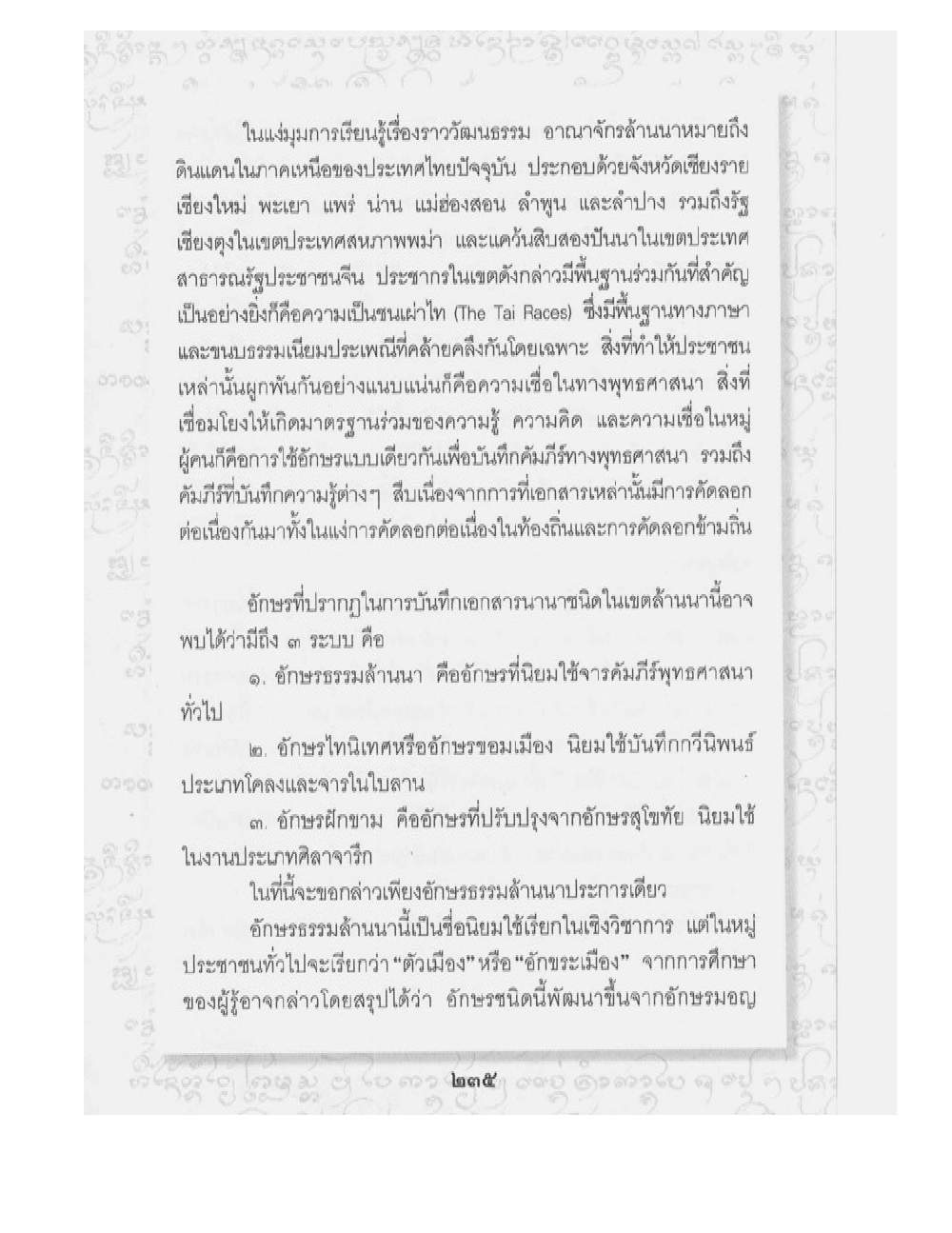
ในแง่มุมการเรียนรู้เรื่องราววัฒนธรรม อาณาจักรล้านนาหมายถึง ดินแดนในภาคเหนือของประเทศไทยปัจจุบัน ประกอบด้วยจังหวัดเชียงราย เชียงใหม่ พะเยา แพร่ น่าน แม่ฮ่องสอน ลำพูน และลำปาง รวมถึงรัฐ เชียงตุงในเขตประเทศสหภาพพม่า และแคว้นสิบสองปันนาในเขตประเทศ สาธารณรัฐประชาชนจีน ประชากรในเขตดังกล่าวมีพื้นฐานร่วมกันที่สำคัญ เป็นอย่างยิ่งก็คือความเป็นชนเผ่าไท (The Tai Races) ซึ่งมีพื้นฐานทางภาษา และขนบธรรมเนียมประเพณีที่คล้ายคลึงกันโดยเฉพาะ สิ่งที่ทำให้ประชาชน เหล่านั้นผูกพันกันอย่างแนบแน่นก็คือความเชื่อในทางพุทธศาสนา สิ่งที่ เชื่อมโยงให้เกิดมาตรฐานร่วมของความรู้ ความคิด และความเชื่อในหมู่ ผู้คนก็คือการใช้อักษรแบบเดียวกันเพื่อบันทึกคัมภีร์ทางพุทธศาสนา รวมถึง คัมภีร์ที่บันทึกความรู้ต่างๆ สืบเนื่องจากการที่เอกสารเหล่านั้นมีการคัดลอก ต่อเนื่องกันมาทั้งในแง่การคัดลอกต่อเนื่องในท้องถิ่นและการคัดลอกข้ามถิ่น
อักษรที่ปรากฏในการบันทึกเอกสารนานาชนิดในเขตล้านนานี้อาจ พบได้ว่ามีถึง ๓ ระบบ คือ ๑. อักษรธรรมล้านนา คืออักษรที่นิยมใช้จารคัมภีร์พุทธศาสนา ทั่วไป ๒. อักษรไทนิเทศหรืออักษรขอมเมือง นิยมใช้บันทึกกวีนิพนธ์ ประเภทโคลงและจารในใบลาน ๓. อักษรฝักขาม คืออักษรที่ปรับปรุงจากอักษรสุโขทัย นิยมใช้ ในงานประเภทศิลาจารึก ในที่นี้จะขอกล่าวเพียงอักษรธรรมล้านนาประการเดียว อักษรธรรมล้านนานี้เป็นชื่อนิยมใช้เรียกในเชิงวิชาการ แต่ในหมู่ ประชาชนทั่วไปจะเรียกว่า "ตัวเมือง" หรือ "อักขระเมือง" จากการศึกษา ของผู้รู้อาจกล่าวโดยสรุปได้ว่า อักษรชนิดนี้พัฒนาขึ้นจากอักษรมอญ
From the perspective of learning about cultural history, the Lanna kingdom refers to the land in the northern region of present-day Thailand, comprising the provinces of Chiang Rai, Chiang Mai, Phayao, Phrae, Nan, Mae Hong Son, Lamphun, and Lampang, as well as extending to Chiang Tung state within the territory of the Union of Myanmar, and the Sipsong Panna region within the territory of the People's Republic of China. The population within this region shares an extremely important common foundation, namely being of the Tai peoples (The Tai Races), who share similar linguistic foundations and customs and traditions in particular. What binds these peoples closely together is their shared belief in Buddhism. What links them into a common standard of knowledge, thought, and belief among the people is the use of the same script to record Buddhist scriptures, as well as scriptures recording various kinds of knowledge, owing to the fact that these documents were continuously copied — both in terms of continuous local copying and cross-regional copying.
The scripts that appear in the recording of various kinds of documents in the Lanna region may be found to number as many as 3 systems, namely: 1. Lanna Dhamma script (Akson Tham Lanna) — the script commonly used to inscribe Buddhist scriptures in general. 2. Tai Nithet script, or Khom Mueang script — commonly used to record poetic literature of the khlong type, and to inscribe palm-leaf manuscripts. 3. Fak Kham script — a script improved upon from the Sukhothai script, commonly used for works such as stone inscriptions.
Here we will speak of the Lanna Dhamma script alone. This "Lanna Dhamma script" is the name commonly used in academic contexts, but among the general populace it is called "Tua Mueang" [town/city letters] or "Akkhara Mueang" [town/city script]. From scholarly study, it may be concluded in summary that this script developed from the Mon script
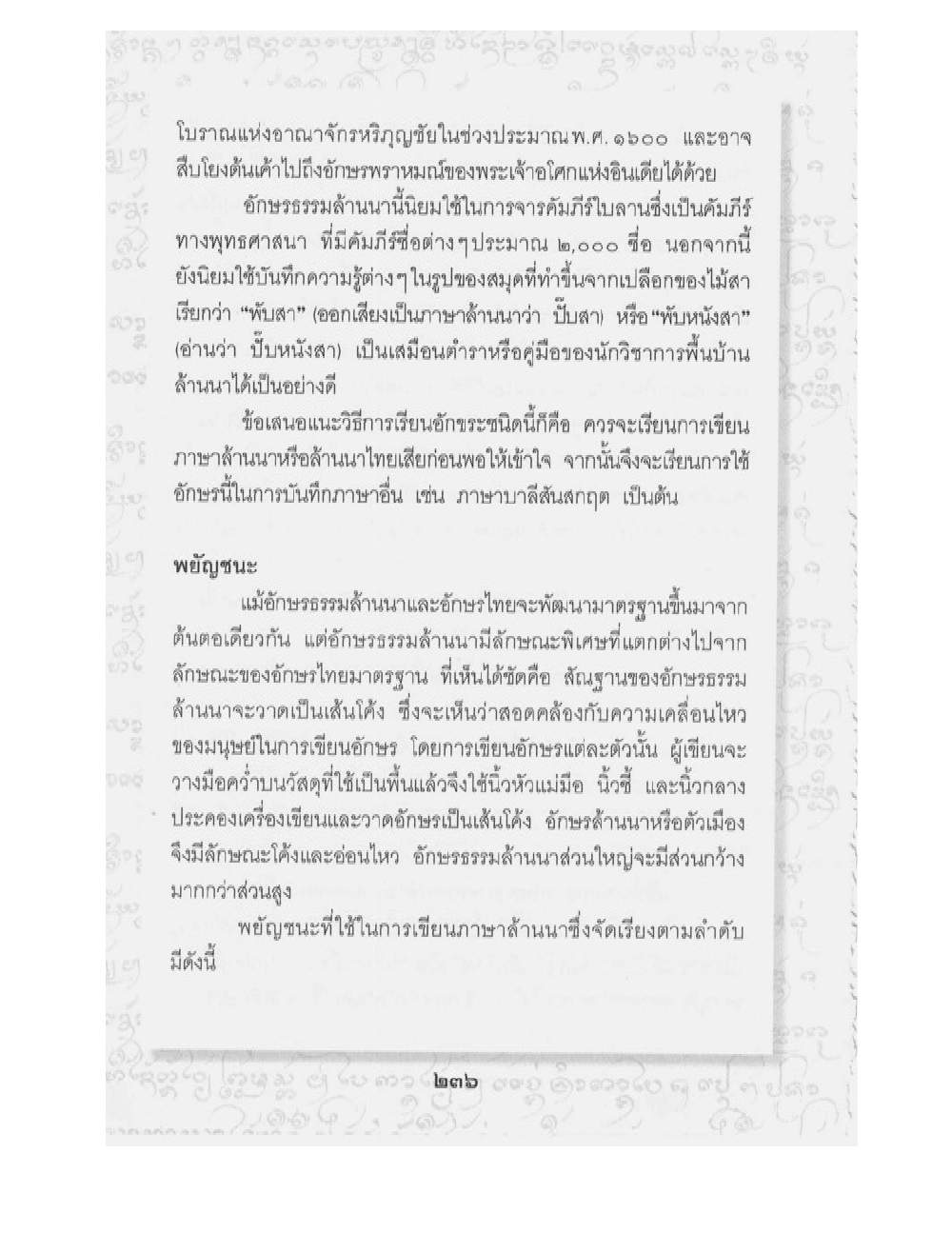
โบราณแห่งอาณาจักรหริภุญชัยในช่วงประมาณพ.ศ. ๑๖๐๐ และอาจ สืบโยงต้นเค้าไปถึงอักษรพราหมณ์ของพระเจ้าอโศกแห่งอินเดียได้ด้วย อักษรธรรมล้านนานี้นิยมใช้ในการจารคัมภีร์ใบลานซึ่งเป็นคัมภีร์ ทางพุทธศาสนา ที่มีคัมภีร์ชื่อต่างๆประมาณ ๒,๐๐๐ ชื่อ นอกจากนี้ ยังนิยมใช้บันทึกความรู้ต่างๆในรูปของสมุดที่ทำขึ้นจากเปลือกของไม้สา เรียกว่า "พับสา" (ออกเสียงเป็นภาษาล้านนาว่า ปั๊บสา) หรือ "พับหนังสา" (อ่านว่า ปั๊บหนังสา) เป็นเสมือนตำราหรือคู่มือของนักวิชาการพื้นบ้าน ล้านนาได้เป็นอย่างดี ข้อเสนอแนะวิธีการเรียนอักขระชนิดนี้ก็คือ ควรจะเรียนการเขียน ภาษาล้านนาหรือล้านนาไทยเสียก่อนพอให้เข้าใจ จากนั้นจึงจะเรียนการใช้ อักษรนี้ในการบันทึกภาษาอื่น เช่น ภาษาบาลีสันสกฤต เป็นต้น
พยัญชนะ แม้อักษรธรรมล้านนาและอักษรไทยจะพัฒนามาตรฐานขึ้นมาจาก ต้นตอเดียวกัน แต่อักษรธรรมล้านนามีลักษณะพิเศษที่แตกต่างไปจาก ลักษณะของอักษรไทยมาตรฐาน ที่เห็นได้ชัดคือ สัณฐานของอักษรธรรม ล้านนาจะวาดเป็นเส้นโค้ง ซึ่งจะเห็นว่าสอดคล้องกับความเคลื่อนไหว ของมนุษย์ในการเขียนอักษร โดยการเขียนอักษรแต่ละตัวนั้น ผู้เขียนจะ วางมือคว่ำบนวัสดุที่ใช้เป็นพื้นแล้วจึงใช้นิ้วหัวแม่มือ นิ้วชี้ และนิ้วกลาง ประคองเครื่องเขียนและวาดอักษรเป็นเส้นโค้ง อักษรล้านนาหรือตัวเมือง จึงมีลักษณะโค้งและอ่อนไหว อักษรธรรมล้านนาส่วนใหญ่จะมีส่วนกว้าง มากกว่าส่วนสูง พยัญชนะที่ใช้ในการเขียนภาษาล้านนาซึ่งจัดเรียงตามลำดับ มีดังนี้
...ancient [script] of the Hariphunchai kingdom in around approximately B.E. 1600, and its origins may possibly also be traced further back to the Brahmi script of King Ashoka of India.
This Lanna Dhamma script is commonly used for inscribing palm-leaf scriptures, which are Buddhist texts — there are approximately 2,000 differently named scriptures. In addition, it is also commonly used to record various kinds of knowledge in the form of notebooks made from the bark of the sa tree, called "phap sa" (pronounced in the Lanna language as "pap sa") or "phap nangsa" (read as "pap nangsa"), which served very well as textbooks or manuals for local Lanna scholars.
A suggested method for learning this type of script is: one should first learn to write the Lanna language, or Lanna Thai, until it is understood, and only then learn to use this script to record other languages, such as Pali and Sanskrit, for example.
Consonants Although the Lanna Dhamma script and the Thai script developed their standards from the same origin, the Lanna Dhamma script has distinctive features that differ from the characteristics of standard Thai script. What is clearly evident is that the shape of Lanna Dhamma letters is drawn in curved lines, which can be seen to correspond to the movement of the human hand in writing. In writing each letter, the writer places the hand face-down on the writing surface, then uses the thumb, index finger, and middle finger to hold the writing implement and draw the letters in curved lines. Lanna script, or "Tua Mueang", therefore has a curved and flexible character. Most Lanna Dhamma letters are wider than they are tall.
The consonants used in writing the Lanna language, arranged in order, are as follows:
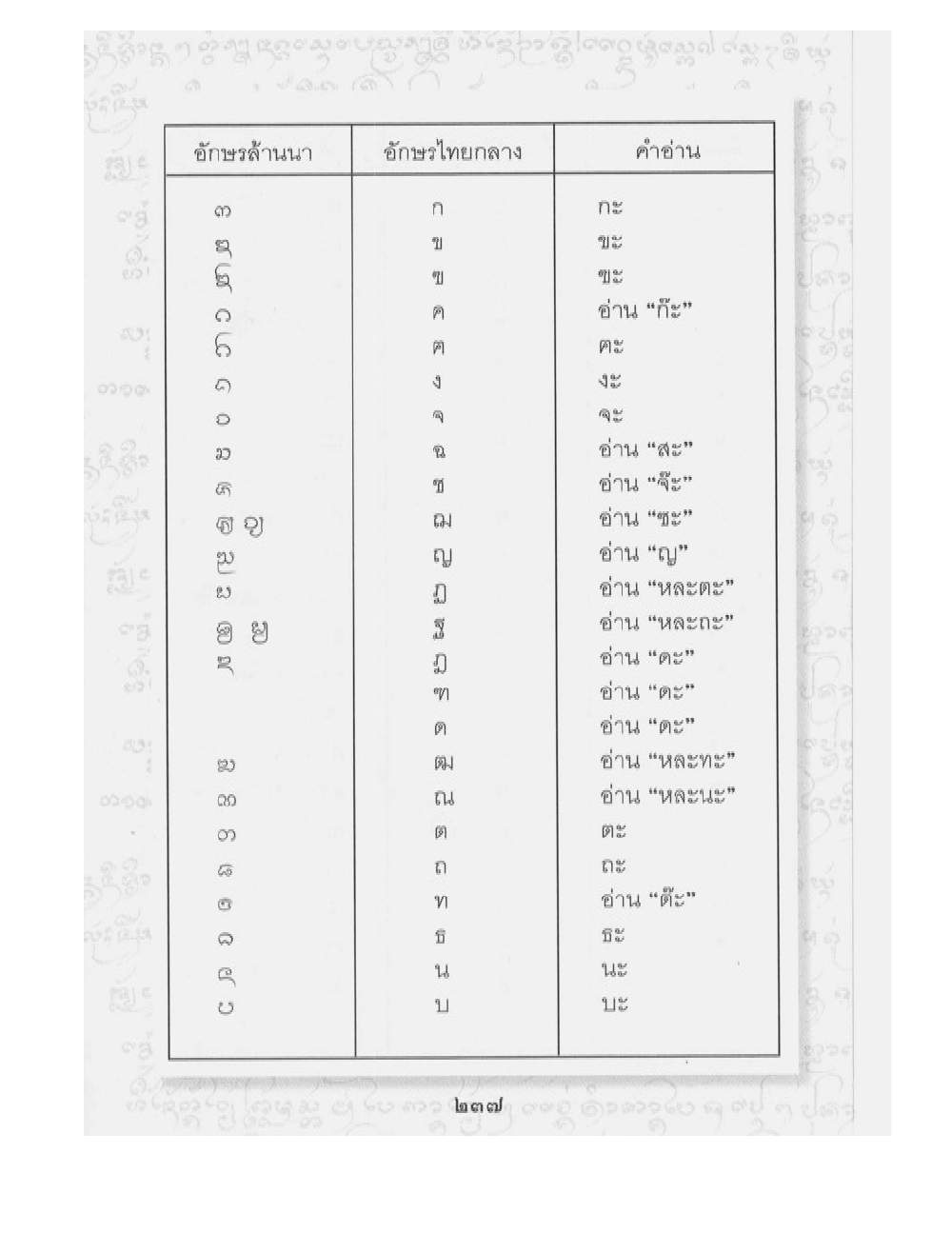
[ตารางเทียบอักษรล้านนา - อักษรไทยกลาง - คำอ่าน]
[diagram: left column headed "อักษรล้านนา" shows the corresponding Lanna Dhamma script letterform for each row — glyphs not reproduced here as they are a separate, non-Thai script]
หัวตาราง: อักษรล้านนา | อักษรไทยกลาง | คำอ่าน แถวข้อมูล (อักษรไทยกลาง / คำอ่าน): ก / กะ ข / ขะ ข / ขะ ค / อ่าน "ก๊ะ" ค / คะ ง / งะ จ / จะ ฉ / อ่าน "สะ" ช / อ่าน "จ๊ะ" ฌ / อ่าน "ชะ" ญ / อ่าน "ญ" ฎ / อ่าน "หละตะ" ฏ / อ่าน "หละถะ" ฏ / อ่าน "ตะ" ฑ / อ่าน "ตะ" ต / อ่าน "ตะ" ฒ / อ่าน "หละทะ" ณ / อ่าน "หละนะ" ต / ตะ ถ / ถะ ท / อ่าน "ตี๊ะ" ธ / ธะ น / นะ บ / บะ
[Table comparing Lanna script — standard Thai script — pronunciation]
[diagram: reference table for learning the Lanna consonants, showing each Lanna Dhamma letterform beside its standard-Thai-script equivalent and its pronunciation guide]
Header: Lanna script | Standard (central) Thai script | Reading Data rows (standard Thai letter / reading): ก (ko) / "ka" ข (kho) / "kha" ข (kho) / "kha" ค (kho) / read "ka" (with high tone mark) ค (kho) / "kha" ง (ngo) / "nga" จ (cho) / "cha" ฉ (cho) / read "sa" ช (cho) / read "cha" (with high tone mark) ฌ (cho) / read "cha" ญ (yo) / read "ya" ฎ (do) / read "la-ta" ฏ (to) / read "la-tha" ฏ (to) / read "ta" ฑ (tho) / read "ta" ต (to) / read "ta" ฒ (tho) / read "la-tha" ณ (no) / read "la-na" ต (to) / "ta" ถ (tho) / "tha" ท (tho) / read "ti" (with high tone mark) ธ (tho) / "tha" น (no) / "na" บ (bo) / "ba"
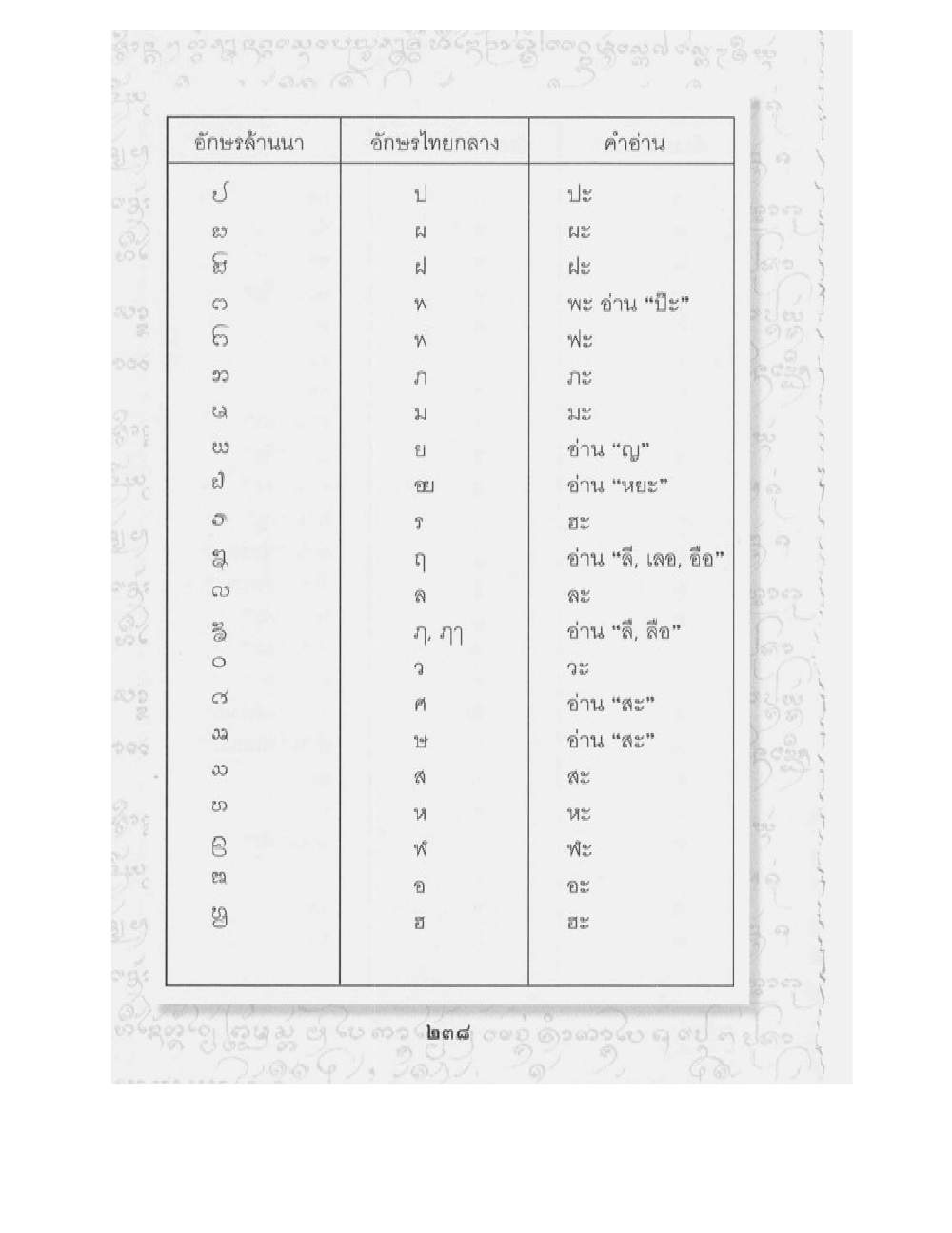
[ตารางเทียบอักษรล้านนา - อักษรไทยกลาง - คำอ่าน (ต่อ)]
[diagram: left column headed "อักษรล้านนา" shows the corresponding Lanna Dhamma script letterform for each row — glyphs not reproduced here as they are a separate, non-Thai script]
หัวตาราง: อักษรล้านนา | อักษรไทยกลาง | คำอ่าน แถวข้อมูล (อักษรไทยกลาง / คำอ่าน): ป / ปะ ผ / ผะ ฝ / ฝะ พ / พะ อ่าน "ปี๊ะ" ฟ / ฟะ ภ / ภะ ม / มะ ย / อ่าน "ญ" ฅ / อ่าน "หยะ" ร / ฮะ ฤ / อ่าน "ลี, เลอ, อือ" ล / ละ ฦ, ฦๅ / อ่าน "ลึ, ลือ" ว / วะ ศ / อ่าน "สะ" ษ / อ่าน "สะ" ส / สะ ห / หะ ฬ / ฬะ อ / อะ ฮ / ฮะ
[Table comparing Lanna script — standard Thai script — pronunciation (continued)]
[diagram: continuation of the consonant reference table]
Header: Lanna script | Standard (central) Thai script | Reading Data rows (standard Thai letter / reading): ป (po) / "pa" ผ (pho) / "pha" ฝ (fo) / "fa" พ (pho) / "pha", read "pi" (with high tone mark) ฟ (fo) / "fa" ภ (pho) / "pha" ม (mo) / "ma" ย (yo) / read "ya" ฅ (kho) / read "ya" (with aspirated/glottal quality) ร (ro) / "ha" ฤ (ru) / read "li, loe, ue" ล (lo) / "la" ฦ, ฦๅ (lue) / read "lue, lue" (long) ว (wo) / "wa" ศ (so) / read "sa" ษ (so) / read "sa" ส (so) / "sa" ห (ho) / "ha" ฬ (lo) / "la" อ (o) / "a" ฮ (ho) / "ha"
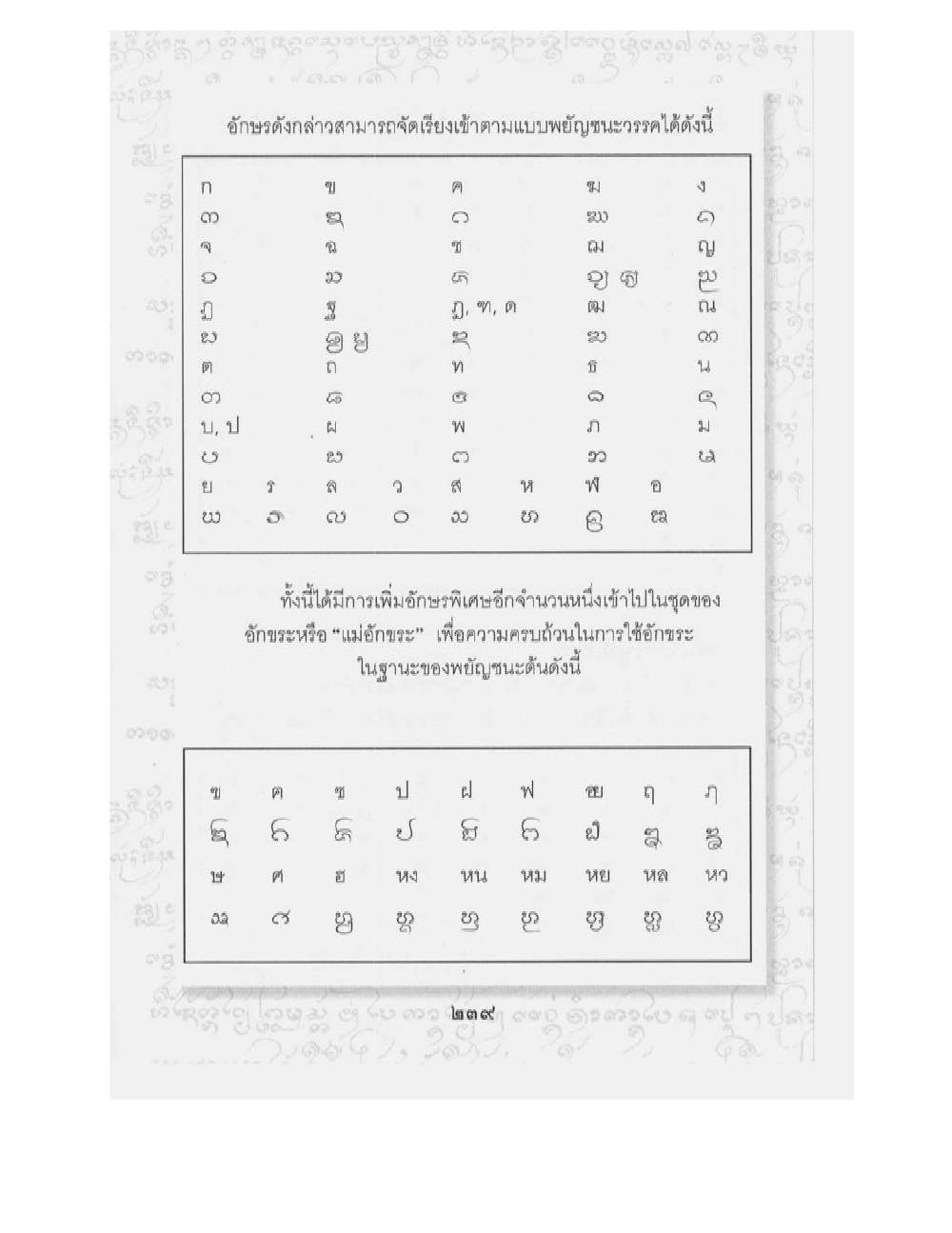
อักษรดังกล่าวสามารถจัดเรียงเข้าตามแบบพยัญชนะวรรคได้ดังนี้
[diagram: boxed table, 5 columns x 10 rows, listing the standard varga (consonant-class) groupings — top row ก ข ค ฆ ง; then จ ฉ ช ฌ ญ; then ฏ ฐ ฑ ฒ ณ; then ต ถ ท ธ น; then บ,ป ผ พ ภ ม; then the เศษวรรค (unclassed) row ย ร ล ว ส ห ฬ อ — with the corresponding Lanna Dhamma script letterform printed beneath each Thai letter, not reproduced here as it is a separate, non-Thai script]
ทั้งนี้ได้มีการเพิ่มอักษรพิเศษอีกจำนวนหนึ่งเข้าไปในชุดของ อักขระหรือ "แม่อักขระ" เพื่อความครบถ้วนในการใช้อักขระ ในฐานะของพยัญชนะต้นดังนี้
[diagram: boxed table, 9 columns x 4 rows, listing additional/special consonants — top row ข ค ซ ป ฝ ฟ ฃ ฤ ฦ; second row ษ ศ ฮ หง หน หม หย หล หว — with the corresponding Lanna Dhamma script letterform printed beneath each Thai letter, not reproduced here]
The letters described above can be arranged according to the consonant-class (varga) system as follows:
[diagram: a boxed table arranging the Lanna consonants into the five traditional Pali/Sanskrit-derived consonant classes (velar, palatal, retroflex, dental, labial), each row headed by the standard Thai equivalents ก ข ค ฆ ง / จ ฉ ช ฌ ญ / ฏ ฐ ฑ ฒ ณ / ต ถ ท ธ น / บ,ป ผ พ ภ ม, plus a final row of unclassed consonants ย ร ล ว ส ห ฬ อ, with the matching Lanna Dhamma letterform shown under each]
In addition, a certain number of special letters have been added to the set of consonants, or "mother letters" [mae akkhara], for completeness in using these letters in the position of initial consonants, as follows:
[diagram: a boxed table of additional special consonants — ข ค ซ ป ฝ ฟ ฃ ฤ ฦ in the top row, ษ ศ ฮ หง หน หม หย หล หว in the second row — with the matching Lanna Dhamma letterform shown under each]
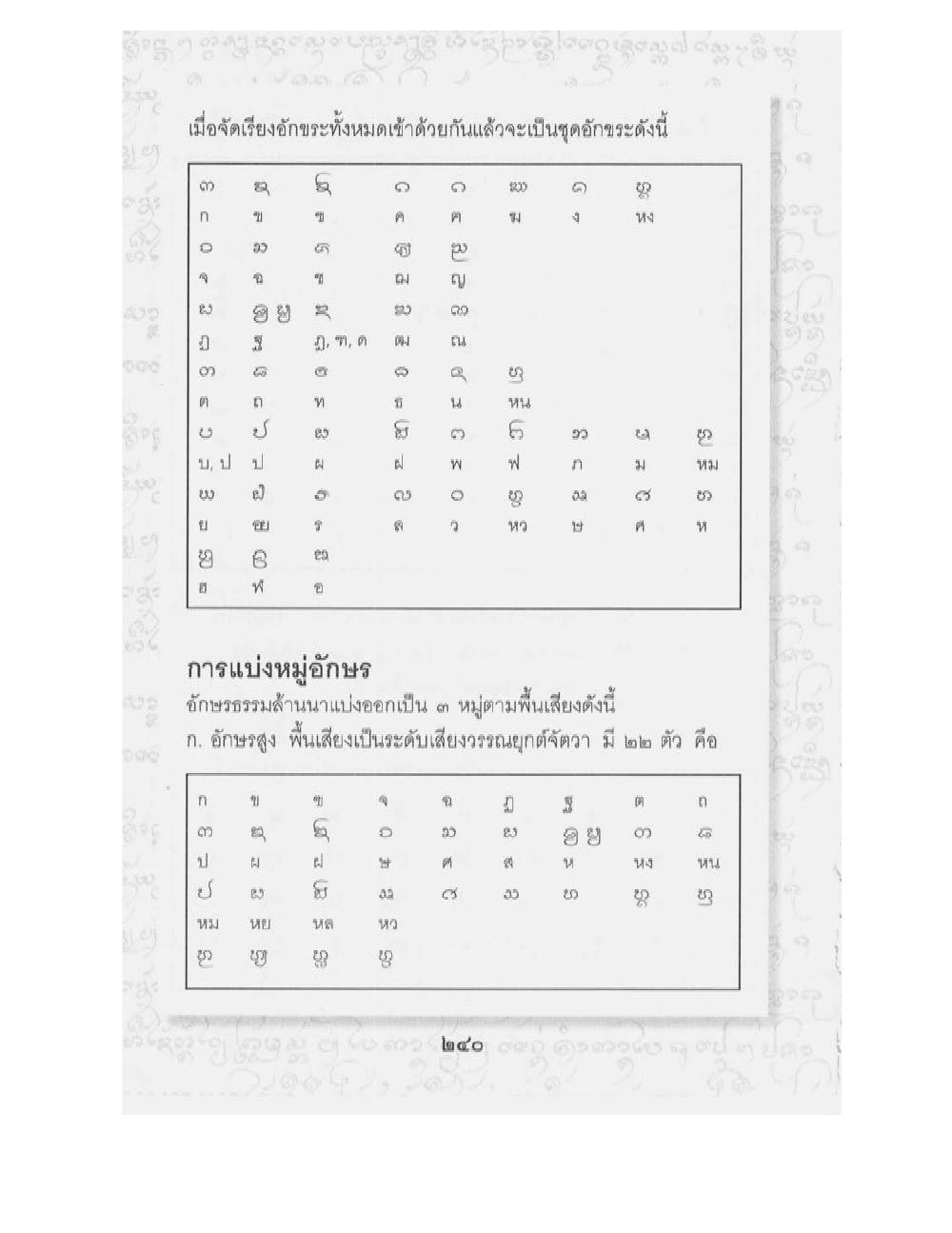
เมื่อจัดเรียงอักขระทั้งหมดเข้าด้วยกันแล้วจะเป็นชุดอักขระดังนี้
[diagram: large boxed table, 8 columns x 11 rows, showing the full combined set of Lanna Dhamma consonants together with their standard Thai equivalents — letterforms not reproduced here]
การแบ่งหมู่อักษร อักษรธรรมล้านนาแบ่งออกเป็น ๓ หมู่ตามพื้นเสียงดังนี้ ก. อักษรสูง พื้นเสียงเป็นระดับเสียงวรรณยุกต์จัตวา มี ๒๒ ตัว คือ
[diagram: boxed table, 10 columns x 5 rows, listing the 22 "high class" (akson sung) consonants — ก ข ข จ ฉ ฎ ฏ ต ถ ป / ผ ฝ ษ ศ ส ห หง หน หม หย / หล หว — with the corresponding Lanna Dhamma script letterform printed beneath each Thai letter, not reproduced here]
When all the letters are arranged together, they form the following complete set of consonants:
[diagram: a large boxed table showing the complete combined set of Lanna Dhamma consonants alongside their standard Thai equivalents]
Grouping of the Letters The Lanna Dhamma script is divided into 3 groups according to their base tone, as follows: a. High-class consonants (akson sung) — their base tone is at the level of the "chattawa" [rising/fourth] tone. There are 22 letters, namely:
[diagram: a boxed table listing the 22 high-class consonants — ก ข ข จ ฉ ฎ ฏ ต ถ ป / ผ ฝ ษ ศ ส ห หง หน หม หย / หล หว — with the matching Lanna Dhamma letterform shown under each]
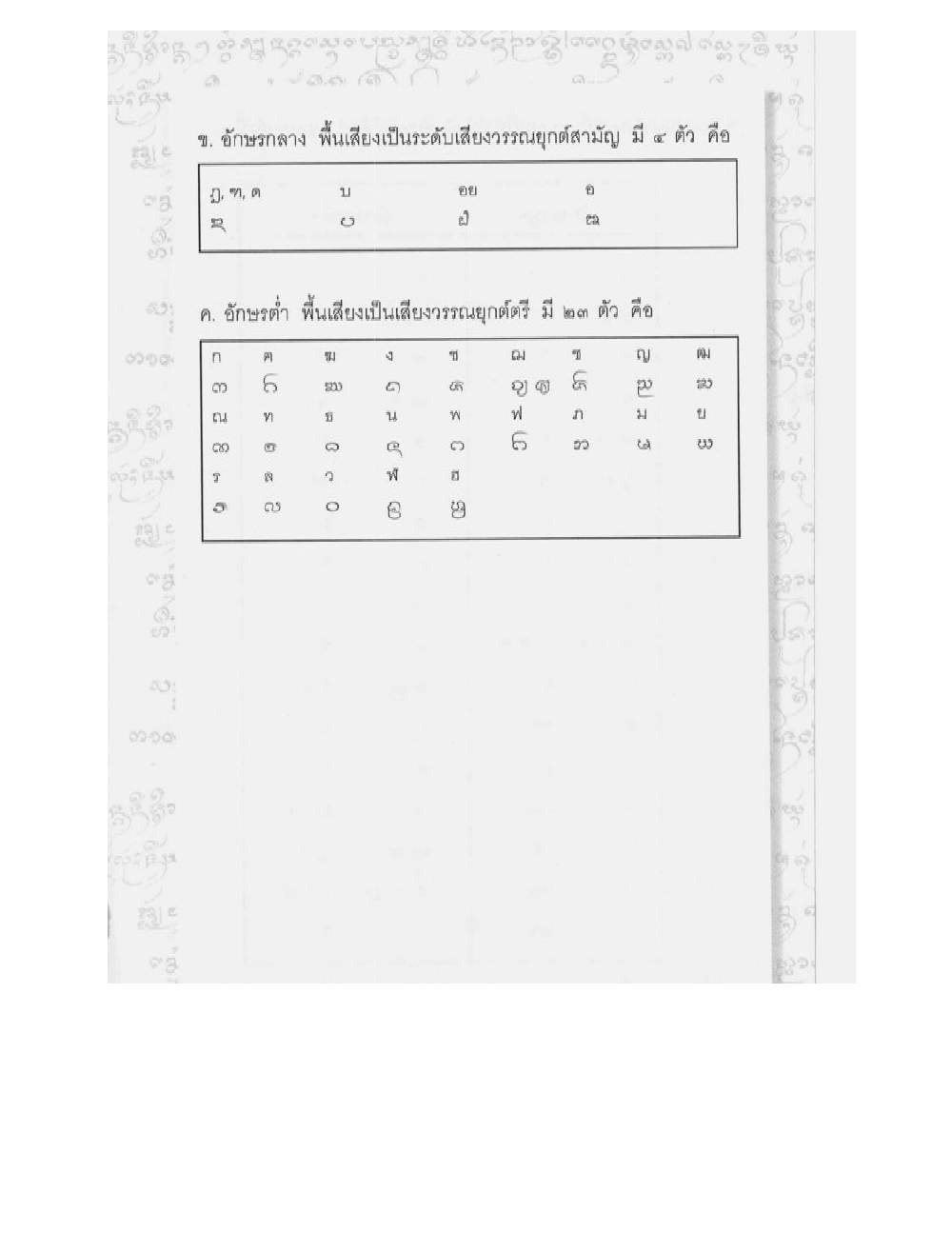
ข. อักษรกลาง พื้นเสียงเป็นระดับเสียงวรรณยุกต์สามัญ มี ๙ ตัว คือ
[ตาราง ๒ แถว ๔ คอลัมน์ แสดงตัวอักษรกลางในอักษรล้านนา — ตัวอักษรล้านนาในตารางมีขนาดเล็กและไม่สามารถถอดความแต่ละตัวได้อย่างมั่นใจ [อ่านไม่ออก]]
ค. อักษรต่ำ พื้นเสียงเป็นเสียงวรรณยุกต์ตรี มี ๒๓ ตัว คือ
[ตาราง ๖ แถว แสดงตัวอักษรต่ำ ๒๓ ตัวในอักษรล้านนา — ตัวอักษรล้านนาในตารางมีขนาดเล็กและไม่สามารถถอดความแต่ละตัวได้อย่างมั่นใจ [อ่านไม่ออก]]
B. Mid-class consonants: their base tone is the common (samanya) tone level. There are 9 of them, namely:
[Table, 2 rows x 4 columns, listing the mid-class consonants in Lanna script — the individual Lanna-script glyphs are small and cannot be confidently transcribed one by one [illegible]]
C. Low-class consonants: their base tone is the third (tri) tone level. There are 23 of them, namely:
[Table, 6 rows, listing the 23 low-class consonants in Lanna script — the individual Lanna-script glyphs are small and cannot be confidently transcribed one by one [illegible]]
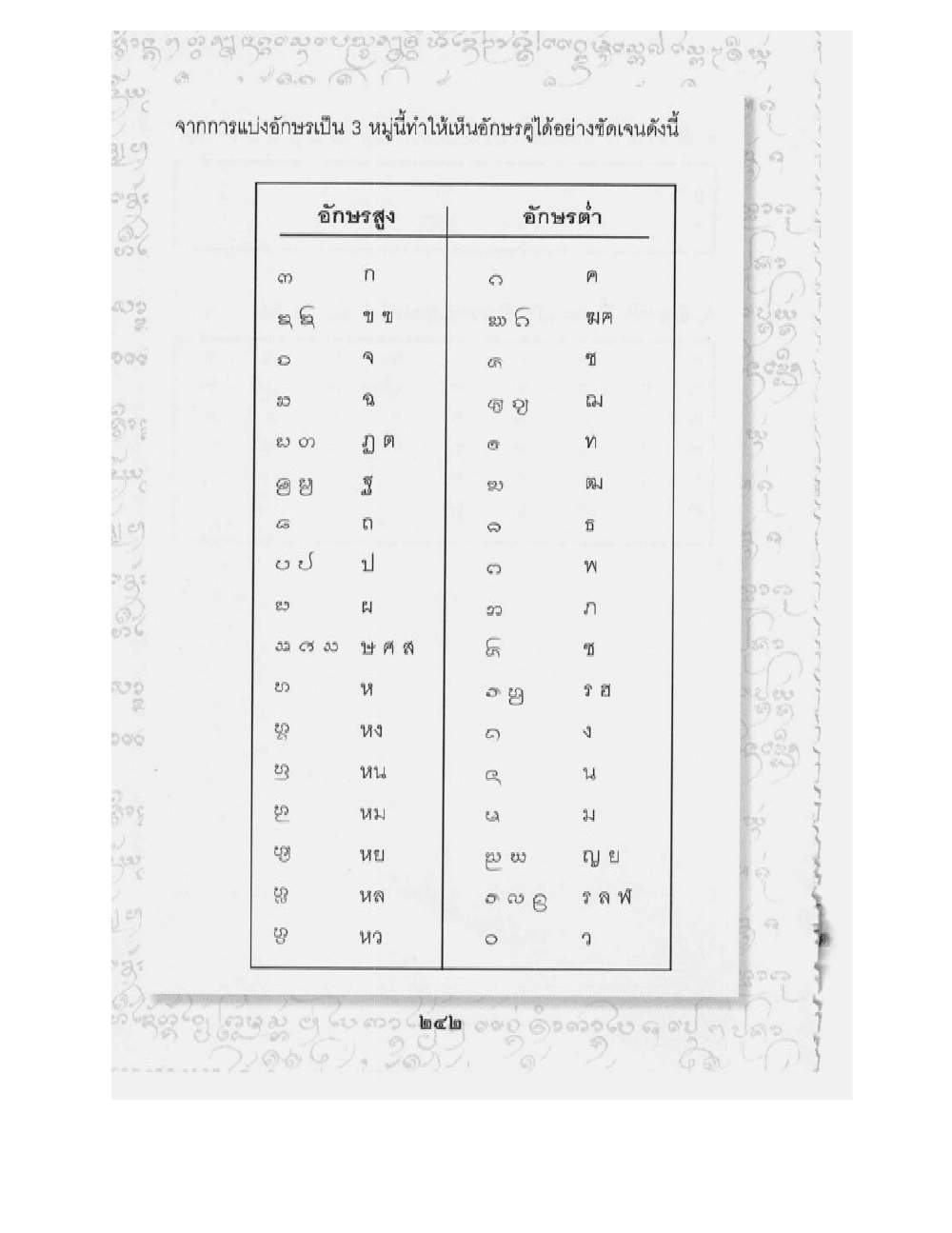
จากการแบ่งอักษรเป็น 3 หมู่นี้ทำให้เห็นอักษรคู่ได้อย่างชัดเจนดังนี้
[ตาราง หัวข้อ "อักษรสูง" และ "อักษรต่ำ" — รายการอักษรล้านนาจับคู่กันประมาณ ๑๗ แถว แสดงคู่อักษรสูง-ต่ำ (แต่ละคู่มีทั้งรูปอักษรล้านนาและอักษรไทยเทียบ) — ตัวอักษรล้านนาในตารางมีขนาดเล็กและไม่สามารถถอดความแต่ละตัวได้อย่างมั่นใจ [อ่านไม่ออก]]
๒๔๒
From dividing the consonants into these 3 groups, the paired consonants can be seen clearly as follows:
[Table headed "High-class consonants" and "Low-class consonants" — roughly 17 rows pairing Lanna-script high-class and low-class consonants (each pair shown with its Lanna form and Thai equivalent) — the individual Lanna-script glyphs are small and cannot be confidently transcribed one by one [illegible]]
242
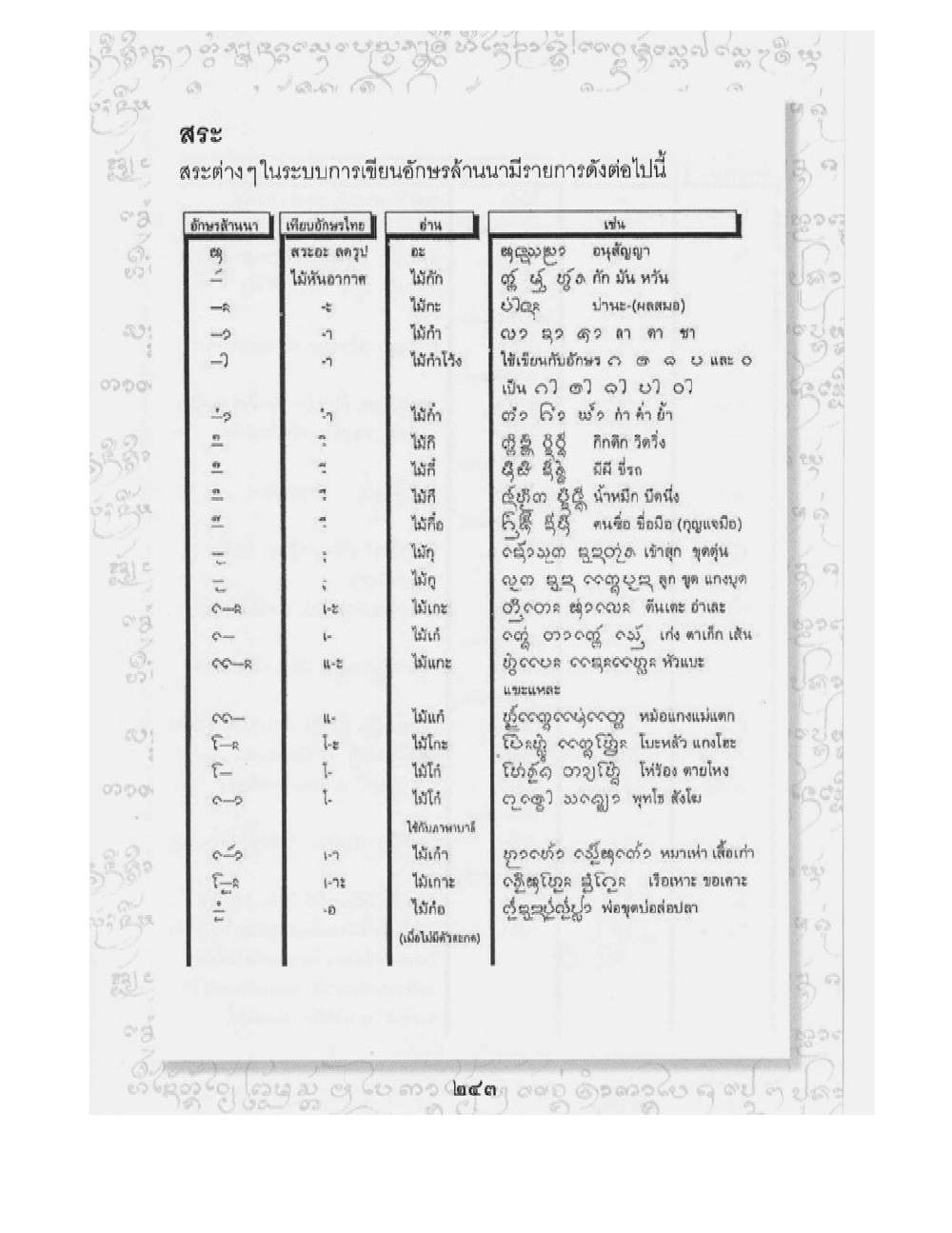
สระ
สระต่างๆในระบบการเขียนอักษรล้านนามีรายการดังต่อไปนี้
[ตาราง หัวตาราง "อักษรล้านนา" | "เทียบอักษรไทย" | "อ่าน" | "เช่น" — รายการสระประมาณ ๒๒ แถว แต่ละแถวให้รูปสระอักษรล้านนา เทียบกับรูปสระอักษรไทย ชื่อเรียก (เช่น ไม้กัก ไม้กะ ไม้กำ ไม้กำโรง ไม้กิ ไม้กี ไม้กึ ไม้กื้อ ไม้กุ ไม้กู ไม้เกะ ไม้เก ไม้แกะ ไม้แก้ ไม้โกะ ไม้โก๋ ไม้เกา ไม้เกาะ ไม้ก่อ) พร้อมคำตัวอย่างผสมอักษรล้านนาและไทย — รูปอักษรล้านนาและคำตัวอย่างในตารางมีขนาดเล็ก ไม่สามารถถอดความทุกช่องได้อย่างมั่นใจ [อ่านไม่ออกบางส่วน]]
๒๔๓
Vowels
The various vowels in the Lanna writing system are listed as follows:
[Table headed "Lanna script" | "Thai equivalent" | "Reading" | "Example" — roughly 22 rows, each giving a Lanna vowel form, its Thai equivalent, its name (e.g. mai kak, mai ka, mai kam, mai kam-rong, mai ki, mai ki, mai kue, mai kue, mai ku, mai ku, mai ke, mai ke, mai kae, mai kae, mai ko, mai ko, mai kao, mai koh, mai kor) together with example words mixing Lanna and Thai script — the Lanna forms and example words in the table are small and not all cells can be confidently transcribed [partly illegible]]
243
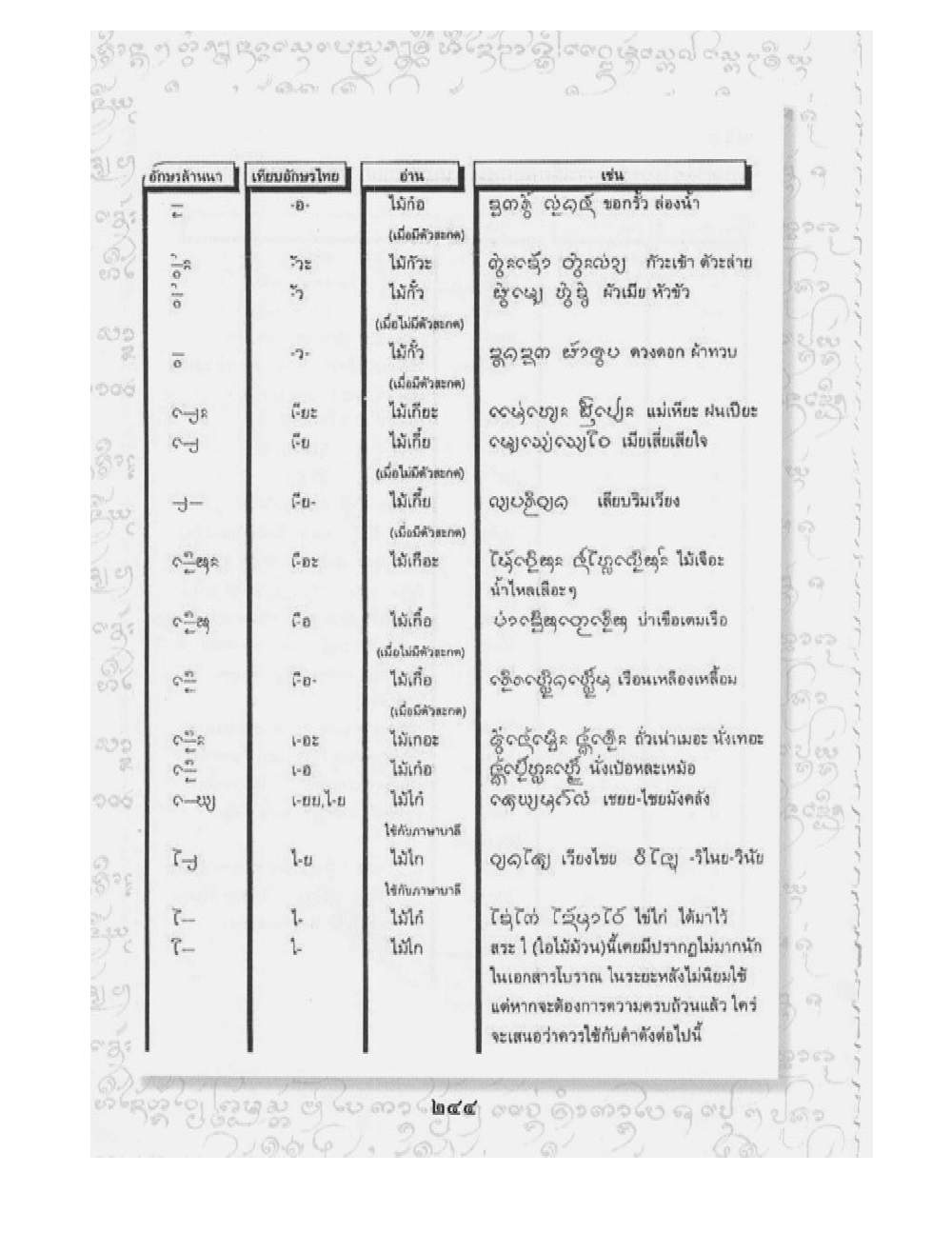
[ตาราง ต่อจากหน้าก่อน หัวตาราง "อักษรล้านนา" | "เทียบอักษรไทย" | "อ่าน" | "เช่น" — รายการสระประสมและสระที่ใช้กับภาษาบาลีประมาณ ๑๔ แถว (ไม้ก่อ, ไม้กัวะ, ไม้กั่ว, ไม้กั่ว, ไม้เกียะ, ไม้เกี่ย, ไม้เกีย, ไม้เกือะ, ไม้เกือ, ไม้เกื้อ, ไม้เกอะ, ไม้เกอ, ไม้ไก, ไม้ไก) พร้อมหมายเหตุ "เมื่อมีตัวสะกด" / "เมื่อไม่มีตัวสะกด" / "ใช้กับภาษาบาลี" และคำตัวอย่าง — ท้ายตารางมีข้อความอธิบายเรื่องสระ ใ (ไอไม้ม้วน) ว่าไม่ค่อยปรากฏในเอกสารโบราณ ในระยะหลังไม่นิยมใช้ แต่หากต้องการความครบถ้วน ใครจะเสนอว่าควรใช้กับคำดังต่อไปนี้ — รูปอักษรล้านนาและคำตัวอย่างในตารางมีขนาดเล็ก ไม่สามารถถอดความทุกช่องได้อย่างมั่นใจ [อ่านไม่ออกบางส่วน]]
๒๔๔
[Table, continued from the previous page, headed "Lanna script" | "Thai equivalent" | "Reading" | "Example" — roughly 14 rows of compound vowels and vowels used with Pali (mai koh, mai kua, mai kua, mai kua, mai kia, mai kia, mai kia, mai kuea, mai kuea, mai kuea, mai koe, mai koe, mai kai, mai kai), with notes such as "when there is a final consonant" / "when there is no final consonant" / "used with the Pali language", and example words — at the foot of the table there is explanatory text about the vowel ใ (ai mai muan), noting that it has not appeared much in ancient documents, and in more recent periods has not commonly been used, but that for the sake of completeness some propose it should be used with the following words — the Lanna forms and example words in the table are small and not all cells can be confidently transcribed [partly illegible]]
244
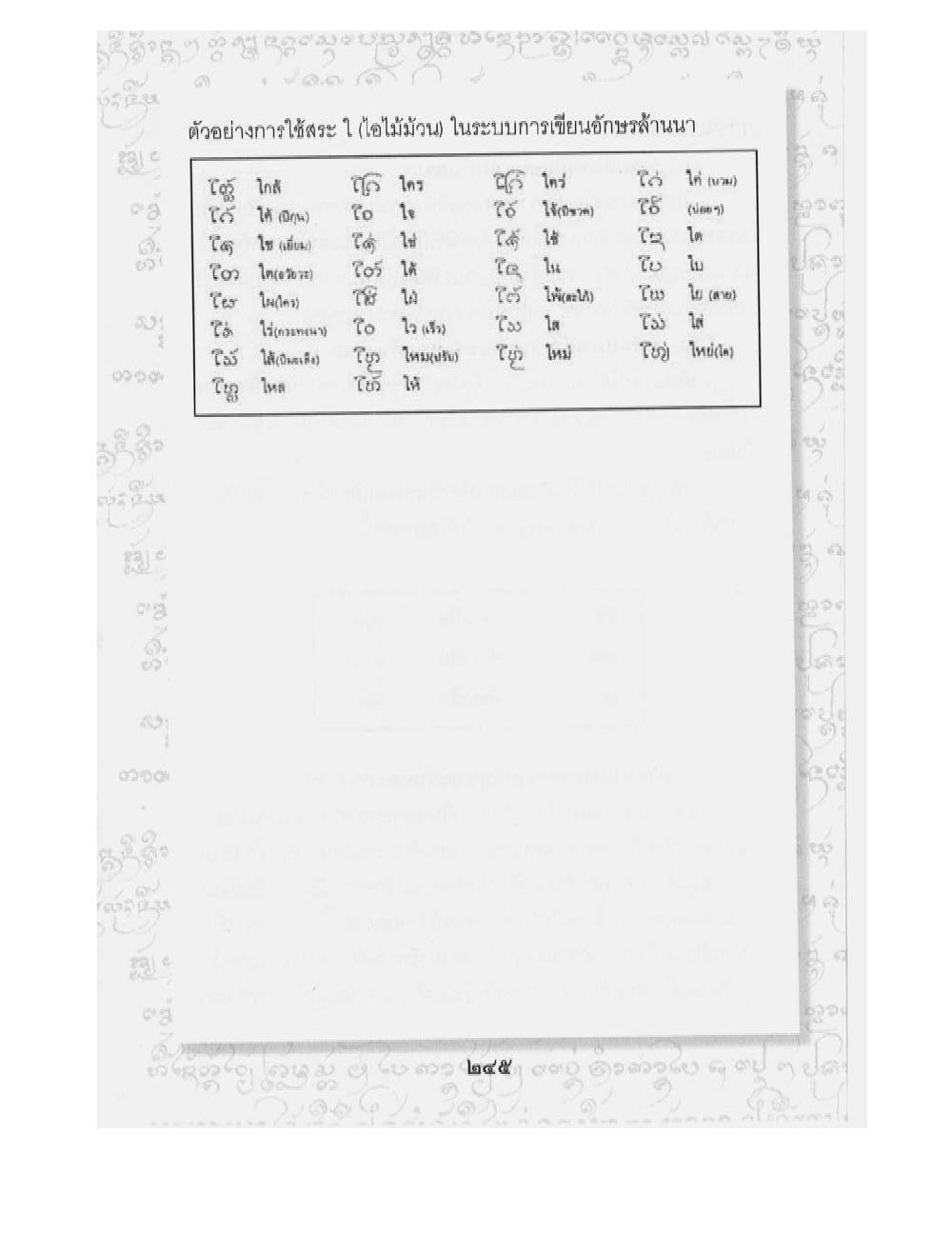
ตัวอย่างการใช้สระ ใ (ไอไม้ม้วน) ในระบบการเขียนอักษรล้านนา
[ตาราง ๘ แถว x ๔ คู่คอลัมน์ แสดงตัวอย่างคำที่ใช้สระใไม้ม้วนในอักษรล้านนาเทียบกับคำไทย เช่น ใกส, ใคร, ใคร่, ใน้ (บวม), ใส้ (มีกุม), ใจ, ใช้ (ปิยวาจา), ใธ (เบดๆ), ใช (เยื่อม), ใช่, ใช่, ใด, ใต (อวชวะ), ใต้, ใน, ใย (สาย), ใผ (ใคร), ใพ่ (ตะไก), ใส่, ใอ (กวยหงนา), ใว (เร็ว), ใส่, ใส่ (เป็นเดิน), ใหม (ปรับ), ใหม่, ใหย่ (ใค), ใหส — รูปอักษรล้านนาในตารางมีขนาดเล็ก ไม่สามารถถอดความทุกช่องได้อย่างมั่นใจ [อ่านไม่ออกบางส่วน]]
๒๔๕
Examples of the use of the vowel ใ (ai mai muan) in the Lanna writing system
[Table, roughly 8 rows x 4 column-pairs, giving example words that use mai-muan ai in Lanna script alongside their Thai equivalents, e.g. glosses resembling: (fishhook), khrai, khrai (uncertain/probably), buem (swollen), sai (with gum), jai, chai (kind speech), various further gloss words such as bedding, cheua, chai/chai, dai, ta (organ), tai, nai, yai (rope/strand), phai (who), phai (tongs), sai, sai, wai (fast), sai, sai (walking), mai (adjust), mai, yai (large), sai — the Lanna forms in the table are small and not all cells can be confidently transcribed [partly illegible]]
245
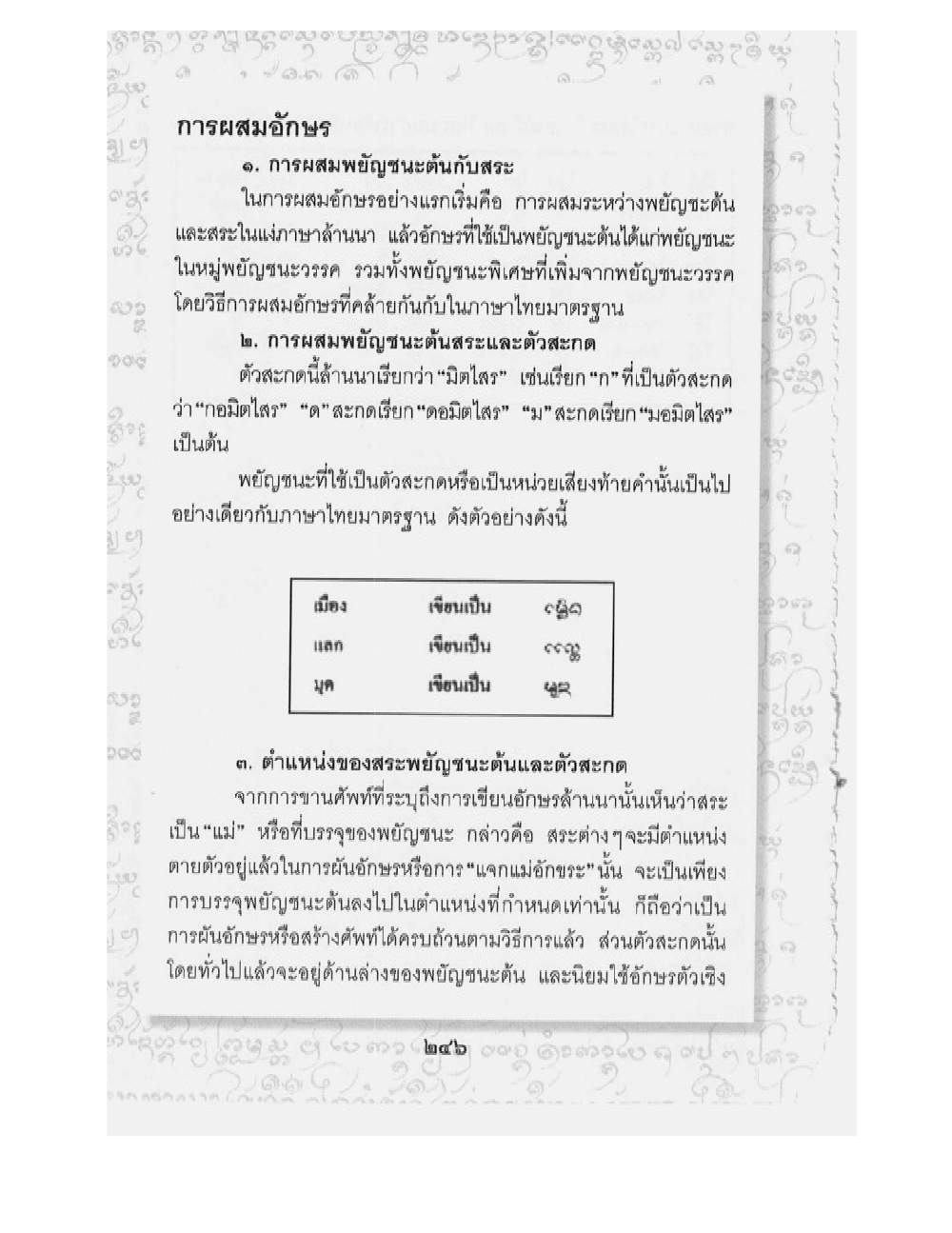
การผสมอักษร
๑. การผสมพยัญชนะต้นกับสระ
ในการผสมอักษรอย่างแรกเริ่มคือ การผสมระหว่างพยัญชนะต้น และสระในแบบภาษาล้านนา แล้วอักษรที่ใช้เป็นพยัญชนะต้นได้แก่พยัญชนะ ในหมู่พยัญชนะวรรค รวมทั้งพยัญชนะพิเศษที่เพิ่มจากพยัญชนะวรรค โดยวิธีการผสมอักษรที่คล้ายกันกับในภาษาไทยมาตรฐาน
๒. การผสมพยัญชนะต้นสระและตัวสะกด
ตัวสะกดนี้ล้านนาเรียกว่า "มิตไสร" เช่นเรียก "ก" ที่เป็นตัวสะกด ว่า "กอมิตไสร" "ด" สะกดเรียก "ดอมิตไสร" "ม" สะกดเรียก "มอมิตไสร" เป็นต้น
พยัญชนะที่ใช้เป็นตัวสะกดหรือเป็นหน่วยเสียงท้ายคำนั้นเป็นไป อย่างเดียวกับภาษาไทยมาตรฐาน ดังตัวอย่างดังนี้
[ตาราง ๓ แถว: เมือง เขียนเป็น [อักษรล้านนา]; แลก เขียนเป็น [อักษรล้านนา]; มุด เขียนเป็น [อักษรล้านนา] — รูปอักษรล้านนาในตารางไม่สามารถถอดความได้อย่างมั่นใจ [อ่านไม่ออก]]
๓. ตำแหน่งของสระพยัญชนะต้นและตัวสะกด
จากการขานศัพท์ที่ระบุถึงการเขียนอักษรล้านนานั้นเห็นว่าสระ เป็น "แม่" หรือที่บรรจุของพยัญชนะ กล่าวคือ สระต่างๆจะมีตำแหน่ง ตายตัวอยู่แล้วในการผันอักษรหรือการ "แจกแม่อักขระ" นั้น จะเป็นเพียง การบรรจุพยัญชนะต้นลงไปในตำแหน่งที่กำหนดเท่านั้น ก็ถือว่าเป็น การผันอักษรหรือสร้างศัพท์ได้ครบถ้วนตามวิธีการแล้ว ส่วนตัวสะกดนั้น โดยทั่วไปแล้วจะอยู่ด้านล่างของพยัญชนะต้น และนิยมใช้อักษรตัวเชิง
๒๔๖
Combining letters
1. Combining an initial consonant with a vowel
The first stage of combining letters is the combination of the initial consonant with a vowel in the Lanna form of the language. The letters used as initial consonants are the consonants of the consonant classes (varga), along with the special consonants added beyond the consonant classes, by a method of combination similar to that in standard Thai.
2. Combining an initial consonant, a vowel, and a final consonant
What is called a "final consonant" (tua sakot) is termed in Lanna "mit sai" [final-consonant marker]. For example, when "k" (ก) is the final consonant it is called "kor mit sai"; when "d" (ด) is the final it is called "dor mit sai"; when "m" (ม) is the final it is called "mor mit sai"; and so on.
The consonants used as final consonants, or as the final sound-unit of a word, follow the same pattern as in standard Thai, as in the following examples:
[Table, 3 rows: "mueang" written as [Lanna script]; "laek" written as [Lanna script]; "muk" written as [Lanna script] — the Lanna-script forms in the table cannot be confidently transcribed [illegible]]
3. The position of the vowel relative to the initial consonant and the final consonant
From the recitation formulas that describe how Lanna script is written, it can be seen that the vowel serves as the "mother" or receptacle of the consonant. That is to say, the vowels already have a fixed position within the declension of letters, or the "reciting of the letter-mother" (chaek mae akkhara); it is merely a matter of inserting the initial consonant into the designated position. This alone is considered to complete the declension of letters or the formation of a word according to the method. As for the final consonant, it is generally placed below the initial consonant, and the subscript ("leg") form of the letter is customarily used
246
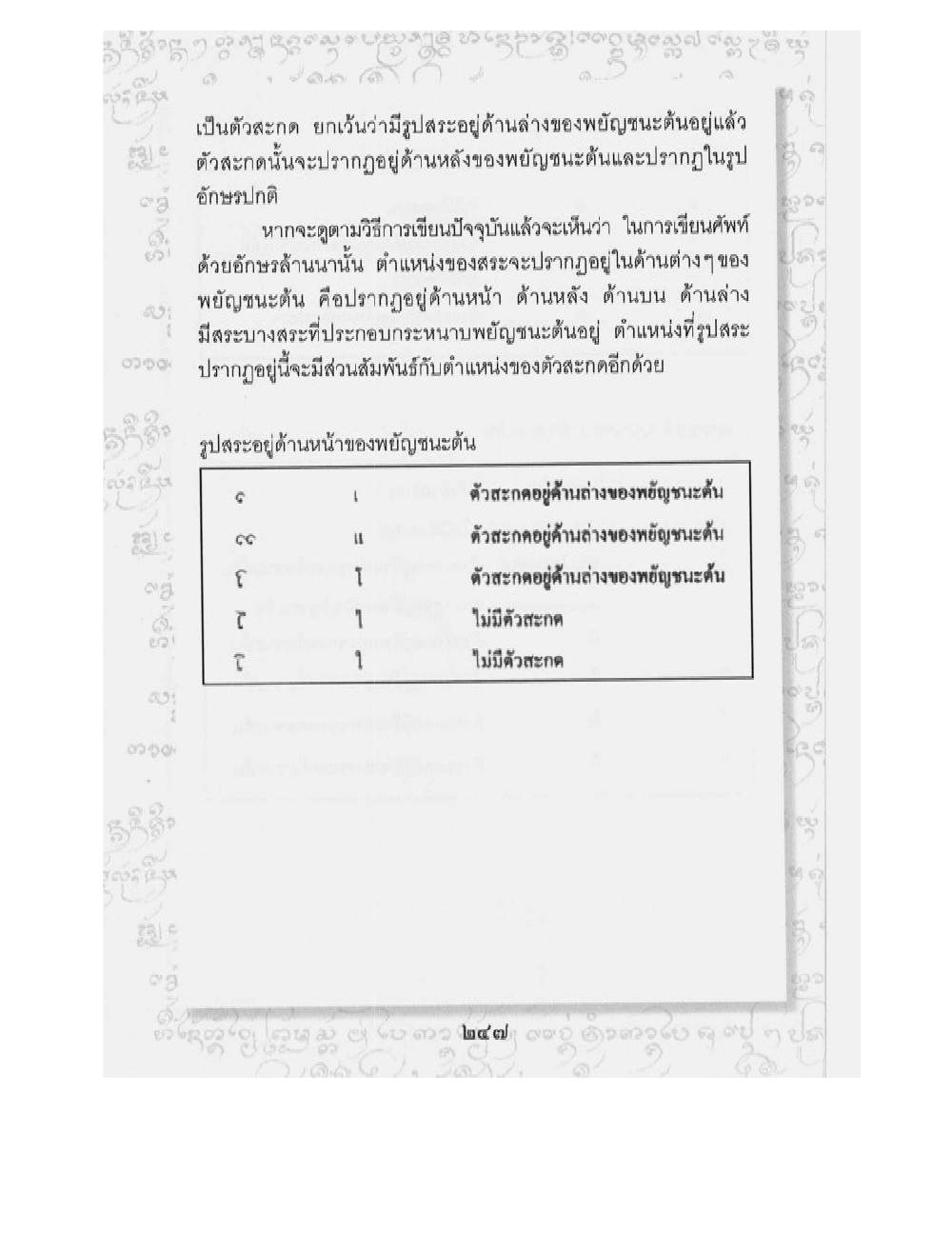
เป็นตัวสะกด ยกเว้นว่ามีรูปสระอยู่ด้านล่างของพยัญชนะต้นอยู่แล้ว ตัวสะกดนั้นจะปรากฏอยู่ด้านหลังของพยัญชนะต้นและปรากฏในรูป อักษรปกติ
หากจะดูตามวิธีการเขียนปัจจุบันแล้วจะเห็นว่า ในการเขียนศัพท์ ด้วยอักษรล้านนานั้น ตำแหน่งของสระจะปรากฏอยู่ในด้านต่างๆของ พยัญชนะต้น คือปรากฏอยู่ด้านหน้า ด้านหลัง ด้านบน ด้านล่าง มีสระบางสระที่ประกอบกระหนาบพยัญชนะต้นอยู่ ตำแหน่งที่รูปสระ ปรากฏอยู่นี้จะมีส่วนสัมพันธ์กับตำแหน่งของตัวสะกดอีกด้วย
รูปสระอยู่ด้านหน้าของพยัญชนะต้น
[ตาราง ๕ แถว หัวคอลัมน์ อักษรล้านนา | เทียบอักษรไทย | คำอธิบาย — แถวที่ ๑: [อักษรล้านนา] / อิ / ตัวสะกดอยู่ด้านล่างของพยัญชนะต้น แถวที่ ๒: [อักษรล้านนา] / แอ / ตัวสะกดอยู่ด้านล่างของพยัญชนะต้น แถวที่ ๓: [อักษรล้านนา] / โอ / ตัวสะกดอยู่ด้านล่างของพยัญชนะต้น แถวที่ ๔: [อักษรล้านนา] / ไอ / ไม่มีตัวสะกด แถวที่ ๕: [อักษรล้านนา] / ไอ / ไม่มีตัวสะกด — รูปอักษรล้านนาในคอลัมน์แรกไม่สามารถถอดความได้อย่างมั่นใจ [อ่านไม่ออกบางส่วน]]
๒๔๗
...as the final consonant, except when there is already a vowel form located below the initial consonant; in that case the final consonant will appear behind the initial consonant and appear in its ordinary letter form.
Looking at present-day writing practice, it can be seen that in writing words with Lanna script, the position of the vowel appears on various sides of the initial consonant — that is, it may appear in front, behind, above, or below. Some vowels are composed so as to flank the initial consonant on both sides. The position in which the vowel form appears is also related to the position of the final consonant.
Vowel forms placed in front of the initial consonant
[Table, 5 rows, column headings: Lanna script | Thai equivalent | note — Row 1: [Lanna script] / i / final consonant is placed below the initial consonant Row 2: [Lanna script] / ae / final consonant is placed below the initial consonant Row 3: [Lanna script] / o / final consonant is placed below the initial consonant Row 4: [Lanna script] / ai / no final consonant Row 5: [Lanna script] / ai / no final consonant — the Lanna-script forms in the first column cannot be confidently transcribed [partly illegible]]
247
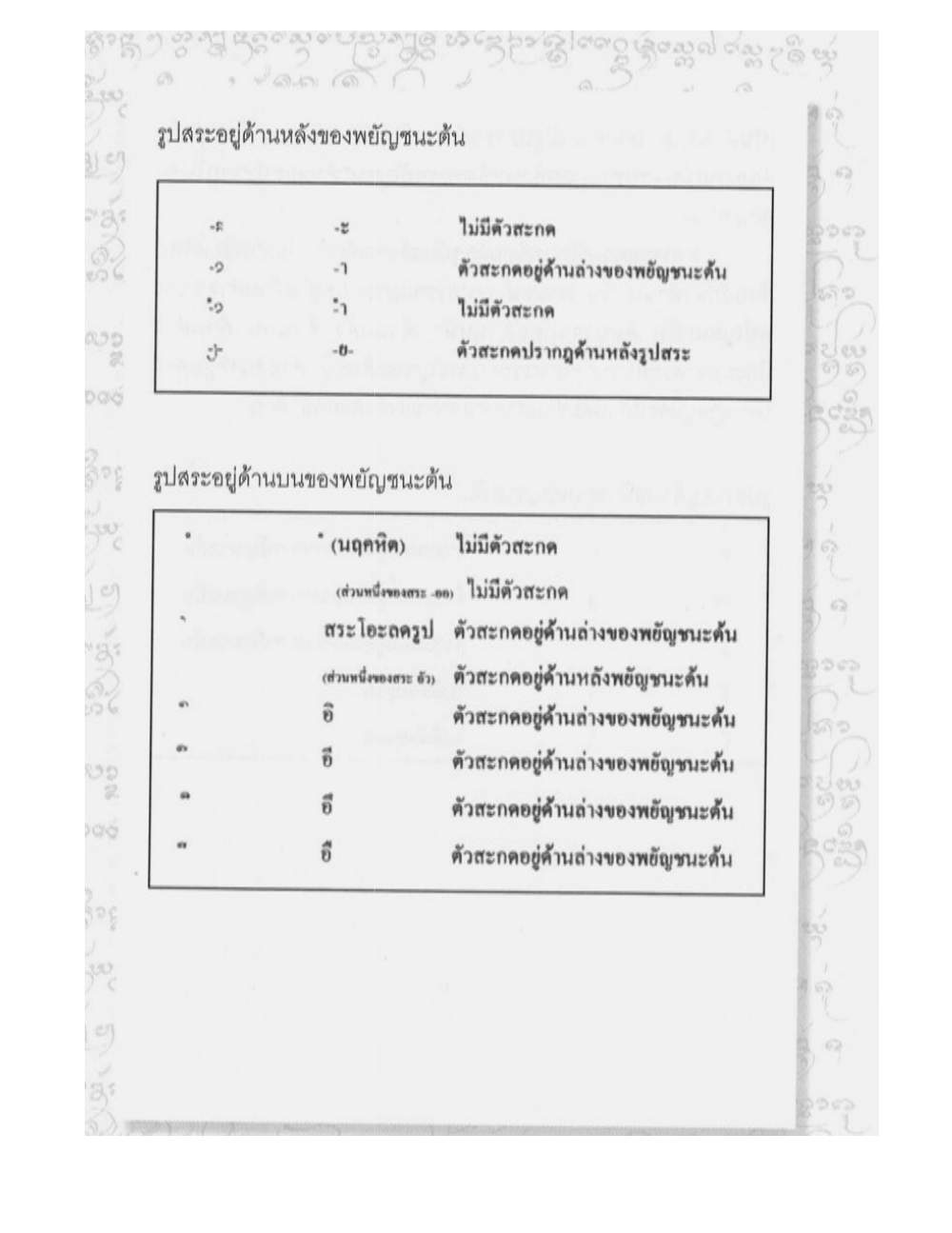
รูปสระอยู่ด้านหลังของพยัญชนะต้น
[ตาราง ๔ แถว หัวคอลัมน์ อักษรล้านนา | เทียบอักษรไทย | คำอธิบาย — แถวที่ ๑: -ะ / -ะ / ไม่มีตัวสะกด แถวที่ ๒: -า / -า / ตัวสะกดอยู่ด้านล่างของพยัญชนะต้น แถวที่ ๓: -๋า / -๋า / ไม่มีตัวสะกด แถวที่ ๔: [อักษรล้านนา] / -อ- / ตัวสะกดปรากฏด้านหลังรูปสระ]
รูปสระอยู่ด้านบนของพยัญชนะต้น
[ตาราง ๘ แถว หัวคอลัมน์ อักษรล้านนา | เทียบอักษรไทย (หรือคำอธิบาย) | คำอธิบายตำแหน่งตัวสะกด — แถวที่ ๑: ◌ั (นฤคหิต) / ไม่มีตัวสะกด แถวที่ ๒: (ส่วนหนึ่งของสระ -อ) / ไม่มีตัวสะกด แถวที่ ๓: สระโอะลดรูป / ตัวสะกดอยู่ด้านล่างของพยัญชนะต้น แถวที่ ๔: (ส่วนหนึ่งของสระ อัว) / ตัวสะกดอยู่ด้านหลังพยัญชนะต้น แถวที่ ๕: -ิ / อิ / ตัวสะกดอยู่ด้านล่างของพยัญชนะต้น แถวที่ ๖: -ี / อี / ตัวสะกดอยู่ด้านล่างของพยัญชนะต้น แถวที่ ๗: -ึ / อึ / ตัวสะกดอยู่ด้านล่างของพยัญชนะต้น แถวที่ ๘: -ื / อื / ตัวสะกดอยู่ด้านล่างของพยัญชนะต้น — รูปอักษรล้านนาในคอลัมน์แรกไม่สามารถถอดความได้อย่างมั่นใจ [อ่านไม่ออกบางส่วน]]
Vowel forms placed behind the initial consonant
[Table, 4 rows, column headings: Lanna script | Thai equivalent | note — Row 1: -a (short) / -a (short) / no final consonant Row 2: -a (long) / -a (long) / final consonant is placed below the initial consonant Row 3: -a (variant) / -a (variant) / no final consonant Row 4: [Lanna script] / -or- / final consonant appears behind the vowel form]
Vowel forms placed above the initial consonant
[Table, 8 rows, column headings: Lanna script | Thai equivalent (or note) | note on the final consonant's position — Row 1: nikkhahit sign / no final consonant Row 2: (part of the vowel -or) / no final consonant Row 3: reduced-form o vowel / final consonant is placed below the initial consonant Row 4: (part of the vowel -ua) / final consonant is placed behind the initial consonant Row 5: -i / i / final consonant is placed below the initial consonant Row 6: -i (long) / i (long) / final consonant is placed below the initial consonant Row 7: -ue / ue / final consonant is placed below the initial consonant Row 8: -ue (long) / ue (long) / final consonant is placed below the initial consonant — the Lanna-script forms in the first column cannot be confidently transcribed [partly illegible]]
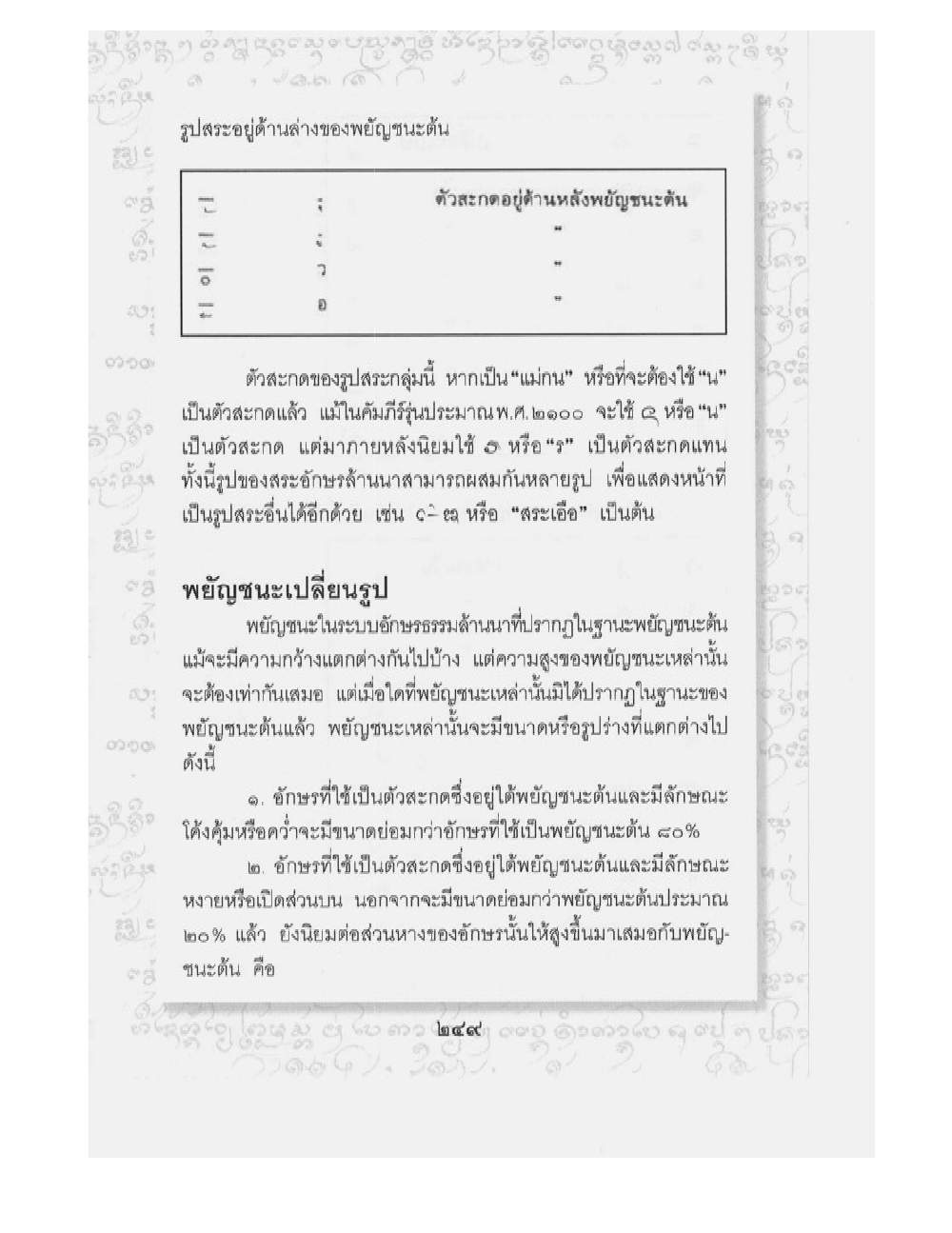
รูปสระอยู่ด้านล่างของพยัญชนะต้น
[ตาราง ๔ แถว หัวคอลัมน์ อักษรล้านนา | เทียบอักษรไทย | คำอธิบาย — ทั้ง ๔ แถวมีคำอธิบายซ้ำกันว่า "ตัวสะกดอยู่ด้านหลังพยัญชนะต้น" — รูปอักษรล้านนาและอักษรไทยเทียบในตารางมีขนาดเล็ก ไม่สามารถถอดความได้อย่างมั่นใจ [อ่านไม่ออกบางส่วน]]
ตัวสะกดของรูปสระกลุ่มนี้ หากเป็น "แม่กน" หรือที่จะต้องใช้ "น" เป็นตัวสะกดแล้ว แม้ในคัมภีร์รุ่นประมาณ พ.ศ. ๒๑๐๐ จะใช้ ญ หรือ "น" เป็นตัวสะกด แต่มาภายหลังนิยมใช้ ร หรือ "ร" เป็นตัวสะกดแทน ทั้งนี้รูปของสระอักษรล้านนาสามารถผสมกันหลายรูป เพื่อแสดงหน้าที่ เป็นรูปสระอื่นได้อีกด้วย เช่น เ–อ หรือ "สระเอือ" เป็นต้น
พยัญชนะเปลี่ยนรูป
พยัญชนะในระบบอักษรธรรมล้านนาที่ปรากฏในฐานะพยัญชนะต้น แม้จะมีความกว้างแตกต่างกันไปบ้าง แต่ความสูงของพยัญชนะเหล่านั้น จะต้องเท่ากันเสมอ แต่เมื่อใดที่พยัญชนะเหล่านั้นมิได้ปรากฏในฐานะของ พยัญชนะต้นแล้ว พยัญชนะเหล่านั้นจะมีขนาดหรือรูปร่างที่แตกต่างไป ดังนี้
๑. อักษรที่ใช้เป็นตัวสะกดซึ่งอยู่ใต้พยัญชนะต้นและมีลักษณะ โค้งคุ้มหรือคว่ำจะมีขนาดย่อมกว่าอักษรที่ใช้เป็นพยัญชนะต้น ๘๐%
๒. อักษรที่ใช้เป็นตัวสะกดซึ่งอยู่ใต้พยัญชนะต้นและมีลักษณะ หงายหรือเปิดส่วนบน นอกจากจะมีขนาดย่อมกว่าพยัญชนะต้นประมาณ ๒๐% แล้ว ยังนิยมต่อส่วนหางของอักษรนั้นให้สูงขึ้นมาเสมอกับพยัญ- ชนะต้น คือ
๒๔๙
Vowel forms placed below the initial consonant
[Table, 4 rows, column headings: Lanna script | Thai equivalent | note — all 4 rows repeat the same note: "final consonant is placed behind the initial consonant" — the Lanna-script and Thai-equivalent forms in the table are small and cannot be confidently transcribed [partly illegible]]
As for the final consonant belonging to this group of vowels, when the syllable belongs to the "mae kon" [-n final] class, requiring "n" (น) as the final consonant, even in manuscripts from roughly 2100 BE [c. 1557 CE] the letter ญ or "n" was used as the final consonant, but later it became customary to use ร, or "r", as the final consonant instead. Furthermore, the forms of Lanna vowels can combine together in several ways so as to serve as other vowel forms as well — for example เ–อ, or "sara uea", and so on.
Consonants that change form
Among the consonants of the Lanna dhamma-script system that appear in the position of an initial consonant, although their widths may differ somewhat, the heights of these consonants must always be equal. However, whenever these consonants do not appear in the position of an initial consonant, they take on a different size or shape, as follows:
1. A letter used as a final consonant positioned beneath the initial consonant, and having a curved or downward-facing ("cwam") shape, will be smaller than the letter as used for an initial consonant, by 80% [i.e. about 80% of the size].
2. A letter used as a final consonant positioned beneath the initial consonant, and having an upward-facing or open-topped shape, will not only be smaller than the initial consonant by roughly 20%, but it is also customary to extend the tail portion of that letter upward until it is level with the initial consonant — namely:
249
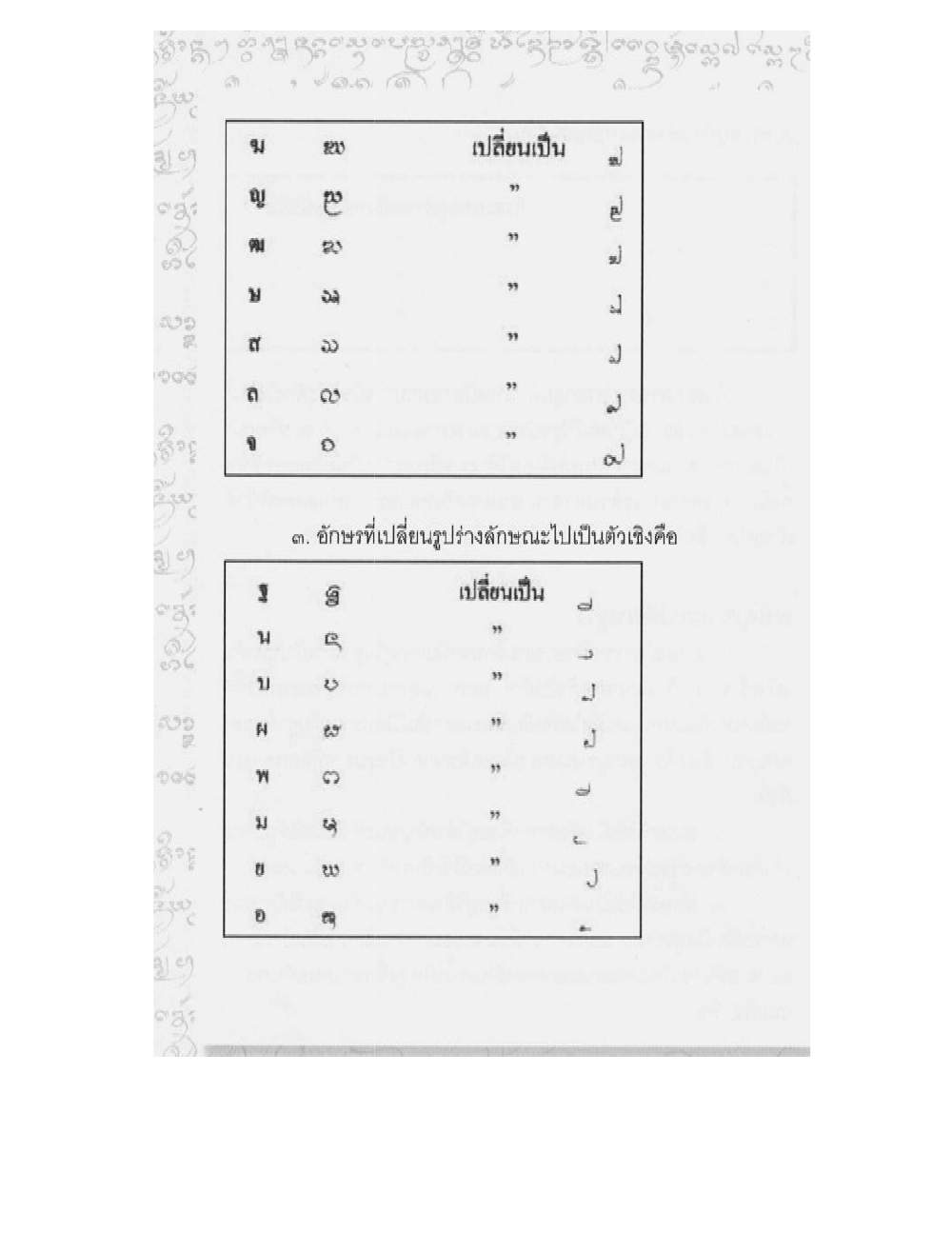
[ตาราง ๗ แถว หัวคอลัมน์ พยัญชนะต้น | รูปตัวสะกด(หงาย) | "เปลี่ยนเป็น" | รูปที่เปลี่ยน — แถวโดยสรุป: ม, ณ, ฒ, ม, ส, ถ, ข แต่ละตัวมีรูปตัวสะกดแบบหงายเปลี่ยนเป็นอีกรูปหนึ่ง — รูปอักษรล้านนาในตารางมีขนาดเล็ก ไม่สามารถถอดความรูปที่แน่ชัดได้ [อ่านไม่ออกบางส่วน]]
๓. อักษรที่เปลี่ยนรูปร่างลักษณะไปเป็นตัวเชิงคือ
[ตาราง ๘ แถว หัวคอลัมน์ พยัญชนะต้น | รูปพยัญชนะ | "เปลี่ยนเป็น" | รูปตัวเชิง — แถวโดยสรุป: ข, น, บ, ผ, พ, ม, ย, อ แต่ละตัวมีรูปพยัญชนะต้นเปลี่ยนเป็นรูปตัวเชิง (พยัญชนะซ้อนใต้บรรทัด) — รูปอักษรล้านนาในตารางมีขนาดเล็ก ไม่สามารถถอดความรูปที่แน่ชัดได้ [อ่านไม่ออกบางส่วน]]
[Table, 7 rows, column headings: initial-consonant form | upward-facing final-consonant form | "changes to" | changed form — rows summarized as: m, n(a heavy nasal), th (heavy), m, s, th, kh — each letter's upward-facing final-consonant form changes into another shown form — the Lanna-script forms in the table are small and the exact resulting shapes cannot be confidently transcribed [partly illegible]]
3. Letters that change their shape into a subscript ("leg") form are:
[Table, 8 rows, column headings: initial-consonant form | consonant form | "changes to" | subscript form — rows summarized as: kh, n, b, ph, ph, m, y, o — each initial-consonant form changes into a subscript form (a consonant stacked beneath the line) — the Lanna-script forms in the table are small and the exact resulting shapes cannot be confidently transcribed [partly illegible]]
ง. อักษรที่เปลี่ยนรูปไปจากเดิมเมื่อทำหน้าที่อื่นคือ
๑ -ง ลดขนาดลงเป็นประมาณหนึ่งในสาม แล้วเขียนหางให้โค้งเปิดเป็น เรียกว่า "ไม้กิ่งไหล" ใช้เขียนบนพยัญชนะตัวที่อยู่ถัดจากตัวที่ต้องการให้ออกเสียง "ง" เป็นตัวสะกด
๒ ฝ มีการดัดแปลงที่ปลายหางเล็กน้อย ใช้เขียนท้ายบาทที่สามของโคลงสี่สุภาพเป็นต้น ออกเสียงว่า "เอ่อ" หรือ "เหย่อ"
๓ -ร ลดขนาดลงเป็นประมาณหนึ่งในสาม ใช้เขียนบนพยัญชนะ ให้ทำหน้าที่อย่างการันต์ หรือทัณฑฆาต
๔ -ร แปรเป็น [glyph: อักษรธรรมล้านนา รูปย่อของ ร] ใช้กำกับพยัญชนะให้ออกเสียงเปลี่ยนไป
[glyph] -กร ให้ออกเสียงเท่ากับ ข [glyph] [glyph] -ขว ให้ออกเสียงเท่ากับ ข [glyph] [glyph] -กร ให้ออกเสียงเท่ากับ ค [glyph] [glyph] -คร ให้ออกเสียงเท่ากับ ด [glyph] [glyph] -ทร ให้ออกเสียงเท่ากับ ธ [glyph] [glyph] -ปร ให้ออกเสียงเท่ากับ ผ [glyph] [glyph] -พร ให้ออกเสียงเท่ากับ ภ [glyph] [glyph] -สร ให้ออกเสียงเท่ากับ สล [glyph] [glyph] -หร ใช้กับการเขียนศัพท์โบราณบางศัพท์ เชื่อว่าเดิมอาจออกเสียง "ห" นำ "ร" แต่ต่อมามักออกเสียงเท่ากับ "ห"
๕ -ล แปรเป็นอักษรที่ "พ่วง" อยู่กับอักษรบางตัวโดยลดขนาดลงเท่ากับขนาดของตัวสะกดทำหน้าที่ร่วมเป็นพยัญชนะต้นของศัพท์และไม่ออกเสียง /ล/ เป็นเสียงกล้ำอย่างในภาษาไทยกลาง การปรากฏรูปอักษรดังกล่าวแสดงให้เห็นว่าภาษาถิ่นนาได้สูญเสียเสียง /ล/ กล้ำนี้ไปแล้ว
๖ -ล แปรเป็น -ว ใช้เขียนซ้อนอยู่ด้านล่างของพยัญชนะต้นซึ่งในการเขียนทั่วไปมักใช้สับสนปนกับ ึ ซึ่งทำหน้าที่เป็น "ตัวพ่วง" แต่เห็นว่าน่าจะกำหนดหน้าที่ของอักษรนี้ให้เป็นที่ชัดเจน จึงกำหนดให้มีหน้าที่ ๒ ประการ คือ
4. Letters that change form when serving another function are:
1. -ง (final ง): reduced to about a third of its normal size, then written with its tail curved open, called "mai king lai" (the flowing-branch mark). It is written above the consonant letter immediately before the one that is to be pronounced with final "ng".
2. ฝ: slightly modified at the tip of its tail. Used to write the ending of the third line (bat) of a four-line khlong-si-suphap verse, among others, pronounced "oe" or "hoey".
3. -ร (final ร): reduced to about a third of its size, written above a consonant to function as a karan/thanthakhat (silencing mark).
4. -ร transforms into [a Lanna reduced form of ร] used to mark a consonant so that its sound changes:
[Lanna cluster form] -กร is pronounced the same as ข [Lanna form for ข] [Lanna cluster form] -ขว is pronounced the same as ข [Lanna form for ข] [Lanna cluster form] -กร is pronounced the same as ค [Lanna form for ค] [Lanna cluster form] -คร is pronounced the same as ด [Lanna form for ด] [Lanna cluster form] -ทร is pronounced the same as ธ [Lanna form for ธ] [Lanna cluster form] -ปร is pronounced the same as ผ [Lanna form for ผ] [Lanna cluster form] -พร is pronounced the same as ภ [Lanna form for ภ] [Lanna cluster form] -สร is pronounced the same as สล [Lanna form for สล] [Lanna cluster form] -หร is used in writing certain archaic words; it is believed the original pronunciation had "h" leading "r", but it later came to be pronounced simply as "h".
5. -ล transforms into a letter that is "attached" (phuang) to certain letters by being reduced to the size of a final consonant, functioning jointly as the initial consonant of the word, and no longer pronounced as a /l/ cluster sound as in central Thai. The appearance of this letter form shows that the Lanna dialect has already lost this /l/ cluster sound.
6. -ล also transforms into -ว, written stacked below the initial consonant; in general writing this is often confused with ึ, which functions as an "attached letter" (tua phuang). But it was felt that the function of this letter should be made clear, so it has been assigned two functions, namely:
๑. ปรากฏอยู่ท้ายศัพท์ทำหน้าที่เป็นตัวสะกด เช่น ดาด เขียนเป็น [glyph: อักษรล้านนา]
๒. ปรากฏร่วมกับพยัญชนะอื่นที่เป็นอักษรนำ เช่น สะหล่า เขียนเป็น [glyph: อักษรล้านนา]
๓ ๓ -สส ที่ตัวแรกเป็นตัวสกดและตัวถัดมาทำหน้าที่เป็นตัวตามในการเขียนภาษาบาลีเป็นต้น ปรับการเขียนเป็น ๓๓ เรียกชื่อว่า "สะ สองห้อง"
หมายเหตุ พยัญชนะที่เปลี่ยนรูปหรือปรากฏในตำแหน่งของตัวเชิงนี้ ในการเขียนแบบโบราณ อาจใช้ในฐานะของพยัญชนะต้นได้ด้วย เช่น ที่น้อง เขียนเป็น [glyph: อักษรล้านนา] บ่มี เขียนเป็น [glyph: อักษรล้านนา]
อักษรพิเศษ ในระบบที่เขียนด้วยอักษรธรรมล้านนานั้น มีอักษรบางตัวที่มีลักษณะเฉพาะ เช่น
1. It appears at the end of a word functioning as a final consonant, for example "dat" is written as [Lanna script form].
2. It appears together with another consonant that is a leading letter, for example "sa-la" is written as [Lanna script form].
3. -สส, where the first letter is the final consonant and the following letter functions as the letter that follows it, as in writing Pali words and the like; the writing is adjusted to สส, called "double-chambered sa" (sa song hong).
Note: a consonant that changes form or appears in the position of this subscript letter may, in the old style of writing, also be used in the capacity of an initial consonant, for example: "thi nong" is written as [Lanna script form] "bo mi" is written as [Lanna script form]
Special letters In the system written with Lanna dhamma script, there are certain letters with special characteristics, for example:
[glyph] นา เช่น [glyph] -นาย [glyph] -น้ำ
[glyph] ฤา ในการเขียนแบบเก่าบางครั้งใช้แทน สระอี เช่น [glyph] ลืม
[glyph] อ่านว่า "อันว่า" จากศัพท์ขอม "รี" แปลว่า อันว่า (หากเป็นศัพท์ล้านนา อ่าน "รี,ลี" แปลว่า เรียว,ยาวเรียว)
[glyph] แล,และ ใช้เป็นคำสันธาน
[glyph] แล้ว
[glyph] แลนา
[glyph] เอ่,เอ่อ เท่ากับ "เหอ" ที่มักใช้ลงท้ายบาทที่สามของโคลงสี่เป็นต้น
[glyph] เอา ใช้เป็นคำกริยา
เครื่องหมาย อักษรล้านนานั้นมีเครื่องหมายอยู่จำนวนหนึ่งที่ใช้เขียนกำกับคำศัพท์เพื่อช่วยให้สามารถบันทึกเสียงและภาษาล้านนาเป็นไปอย่างชัดเจนและสมบูรณ์
[Lanna letter form] "na", for example [form] -nai, [form] -nam (water).
[Lanna letter form] "rue": in old-style writing, sometimes used in place of the vowel sign อี (i), for example [form] "luem" (to forget).
[Lanna letter form] read as "an wa" ("that which is"), from the Khmer word "ri" meaning "an wa" (if it is a Lanna word, read as "ri, li", meaning "slender, long and slender").
[Lanna letter form] "lae", used as a conjunction.
[Lanna letter form] "laeo" (already/then).
[Lanna letter form] "lae na".
[Lanna letter form] "oe, oe": equivalent to "hoe", commonly used to end the third line (bat) of a khlong-si verse, among other uses.
[Lanna letter form] "ao" (to take), used as a verb.
Marks Lanna script has a certain number of marks used to accompany words, to help the recording of Lanna sounds and language be clear and complete.
เครื่องหมาย | เรียกว่า | หน้าที่
่ | ไม้หยัก หรือ ไม้เอก | ใช้เขียนบนคำเพื่อแสดงว่าคำนั้นมีเสียงตก คือเขียนกำกับคำที่ใช้อักษรสูงหรืออักษรกลางเป็นพยัญชนะต้นเพื่อให้ออกเสียงวรรณยุกต์เอก และเขียนกำกับคำที่ใช้อักษรต่ำเป็นพยัญชนะต้น เพื่อให้ออกเสียงวรรณยุกต์โท
๊ | ไม้ขอช้าง | ใช้เขียนบนคำเพื่อแสดงว่าคำนั้นมีเสียงขึ้น คือเขียนกำกับคำที่ใช้อักษรสูงเป็นพยัญชนะต้นเพื่อกำหนดให้ออกเสียงวรรณยุกต์ครึ่งตรีครึ่งโท และเขียนกำกับศัพท์ที่ใช้อักษรต่ำหรืออักษรกลางเป็นพยัญชนะต้นเป็นเพื่อให้ออกเสียงวรรณยุกต์ตรี
ั | ไม้ซัด | ทำหน้าที่อย่างไม้หันอากาศ และเขียนกำกับศัพท์เพื่อให้ออกเสียงสั้น โดยทำหน้าที่อย่างไม้ไต่คู้
์ | ไม้กัก | ใช้เขียนบนพยัญชนะ แทนการใช้ "ก" เป็นตัวสะกด
-ะ | ไม้กะ | นอกจากทำหน้าที่อย่าง "สระ อะ" แล้ว ยังทำหน้าที่คล้ายไม้ไต่คู้ คือหากปรากฏอยู่ท้ายคำศัพท์แล้ว แสดงว่าศัพท์นั้นต้องออกเสียงสั้น
ั่ | ระ ห้าม | ทำหน้าที่อย่างการันต์ หรือทัณฑฆาต
ิ | ไม้กั้ง | ใช้เขียนบนศัพท์ภาษาบาลีเป็นต้น ทำหน้าที่อย่างนิคหิต
่ | ไม้ก่ง | เครื่องหมาย "สระโอะ" เขียนเยื้องไปด้านหน้าของพยัญชนะต้น
๎ | ไม้ซ้ำ หรือเลขสอง | ถ้าเขียน "ท้าย" พยัญชนะ ทำหน้าที่อย่างไม้ยมก ไม้ซ้ำ แต่ถ้าเขียน "บน" พยัญชนะที่ซ้อนกันสองรูป คำนั้นจะออกเสียงเป็นสองพยางค์ เช่น สส เขียนเป็น สะหล่า อ่าน "สะหล่า"
ตัวเลข ตัวเลขที่ใช้ในการเขียนอักษรล้านนามีอยู่ ๒ ระบบ คือ เลขโหรา ใช้ในการเขียนบอกจำนวนในเอกสารต่างๆทั่วไป ส่วนเลขในธัมม์นิยมใช้เขียนเรื่องราวทางศาสนา ซึ่งมักจะเป็นเอกสารประเภทใบลาน
Mark | Called | Function
่ (mai yak / mai ek): written above a word to show that the word has a falling tone, i.e. written to mark a word using a high-class or mid-class consonant as its initial to produce the ek (low) tone, and written to mark a word using a low-class consonant as its initial to produce the tho (falling) tone.
๊ (mai kho chang): written above a word to show that the word has a rising sound, i.e. written to mark a word using a high-class consonant as its initial to fix the tone as half-tri, half-tho, and written to mark a word using a low-class or mid-class consonant as its initial to produce the tri (high) tone.
ั (mai sat): functions like the mai han akat vowel sign, and is written to mark a word so it is pronounced short, functioning like the mai tai khu sign.
์ (mai kak): written above a consonant in place of using "ก" as a final consonant.
-ะ (mai ka): besides functioning as the vowel "a", it also functions like mai tai khu — if it appears at the end of a word, it shows that the word must be pronounced short.
ั่ (ra ham): functions like a karan or thanthakhat (silencing mark).
ิ (mai kang): written on Pali words and the like, functioning like a nikkhahit.
่ (mai kong): the "o" vowel mark, written offset in front of the initial consonant.
๎ (mai sam / "the number two"): if written at the "end" of a consonant it functions like the mai yamok repeat-mark; but if written "above" two stacked consonant forms, the word is then pronounced as two syllables, for example สส is written as "sa-la", read "sa-la".
Numerals There are two systems of numerals used in writing Lanna script: horoscope numerals (lek hora), used to write quantities in documents generally, and dhamma numerals (lek nai tham), commonly used to write religious matters, most often in palm-leaf manuscript documents.
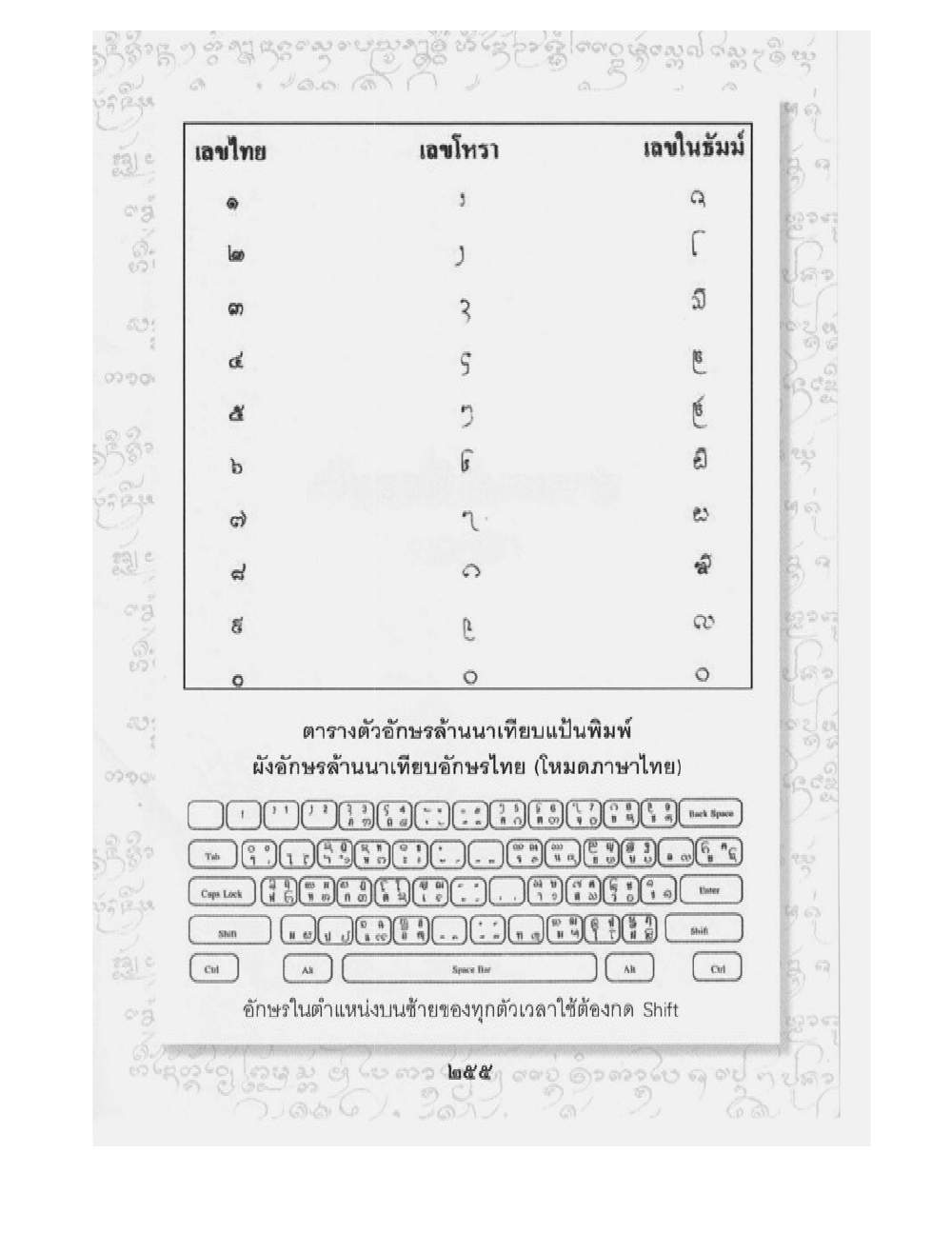
เลขไทย | เลขโหรา | เลขในธัมม์ ๑ | [glyph] | [glyph] ๒ | [glyph] | [glyph] ๓ | [glyph] | [glyph] ๔ | [glyph] | [glyph] ๕ | [glyph] | [glyph] ๖ | [glyph] | [glyph] ๗ | [glyph] | [glyph] ๘ | [glyph] | [glyph] ๙ | [glyph] | [glyph] ๐ | ๐ | ๐
[diagram: computer keyboard layout with Lanna script characters mapped onto each key]
ตารางตัวอักษรล้านนาเทียบแป้นพิมพ์ ผังอักษรล้านนาเทียบอักษรไทย (โหมดภาษาไทย)
อักษรในตำแหน่งบนซ้ายของทุกตัวเวลาใช้ต้องกด Shift
[page number, Lanna numerals: ๒๕๕]
Thai numeral | Horoscope numeral | Dhamma-script numeral 1 | [Lanna form] | [Lanna form] 2 | [Lanna form] | [Lanna form] 3 | [Lanna form] | [Lanna form] 4 | [Lanna form] | [Lanna form] 5 | [Lanna form] | [Lanna form] 6 | [Lanna form] | [Lanna form] 7 | [Lanna form] | [Lanna form] 8 | [Lanna form] | [Lanna form] 9 | [Lanna form] | [Lanna form] 0 | 0 | 0
[diagram: a computer keyboard layout with Lanna script characters mapped onto each key]
Table of Lanna letters mapped to the keyboard Chart of Lanna letters compared to Thai letters (Thai-language mode)
For the letters in the upper-left position of every key, Shift must be pressed to type them.
[page number, in Lanna numerals: 255]

สวดมนต์เพื่ออะไร [decorative flourish]
Why Do We Chant? [decorative flourish]
ความหมายของบทสวดมนต์
๑. นมัสการพระรัตนตรัย ไหว้พระเพื่อบูชาพระพุทธ พระธรรม พระสงฆ์
๒. อาราธนาศีล ทุกครั้งที่จะปฏิบัติธรรมควรรับศีลก่อน อย่างน้อยขณะสวดมนต์และกรรมฐานก็ไม่ได้ผิดศีล จึงมีศีลบริสุทธิ์ ศีลเป็นฐานที่มั่นแห่งสติ (สมาธิ) สติเป็นฐานที่มั่นแห่งปัญญา (วิปัสสนา) จะได้ครบทั้งศีล สมาธิ ปัญญา
๓. คำขอขมา เพื่อโอหสิกรรมต่อพระรัตนตรัย ครูอาจารย์ และสิ่งศักดิ์สิทธิ์
๔. ชุมนุมเทวดา เพื่ออัญเชิญเหล่าเทพเทวดา ยักษ์ คนธรรพ์ นาคา มาชุมนุมกันเพื่อฟังธรรมและเป็นสักขีพยานในการทำความดีของเรา จึงควรสวดมนต์ออกเสียง เผื่อเทวดาที่อยู่ไกลจะได้ยินด้วย เพราะแม้เทวดาจะมีทุทิพย์ก็มีระยะทางจำกัด "ธัมมัสสวนะกาโล อะยัมภะทันตา" แปลว่า ณ กาลบัดนี้ เป็นเวลาแห่งการฟังธรรม ฉะนั้น ควรสวดบทที่มีเนื้อหาของธรรมะด้วย เมื่อเทวดาฟังแล้ว จะได้อำนวยอวยพรให้เรา การเชิญเทวดามาฟังธรรมมีความเชื่อสองฝ่าย ฝ่ายหนึ่งเชื่อว่าเชิญมาแล้วต้องเชิญกลับด้วย แต่ในที่นี้เชื่อว่าเมื่อท่านฟังแล้วจะไปเอง จึงควรสวดบทกรณียเมตตสูตร ให้พรเทวดาด้วยทุกครั้ง
๕. นมัสการ เพื่อถวายความเคารพพระพุทธเจ้า
๖. สรณคมน์ ขอตั้งจิตอธิษฐาน ขอยึดพระพุทธ พระธรรม พระสงฆ์ เป็นที่พึ่ง ไม่มีที่พึ่งอื่นใดจะยิ่งกว่า
๗. สัมพุทเธ เพื่อนมัสการพระพุทธเจ้า ซึ่งมีจำนวนมากมายในกัปที่ล่วงมาแล้ว (๓,๕๘๔,๙๙๒ องค์) ด้วยอานุภาพแห่งการกระทำนอบน้อมนี้ ขอให้พ้นจากภัยอันตรายทั้งปวง
๘. นโมการอัฏฐกะ (นะโม ๘ บท) กล่าว "นะโม" เป็นการนมัสการพระรัตนตรัยเพื่ออำนวยสวัสดิมงคล คาถานี้เป็นพระราชนิพนธ์ในพระบาทสมเด็จพระจอมเกล้าเจ้าอยู่หัว (รัชกาลที่ ๔) ทรงมีรับสั่งว่า "สวดทำน้ำมนต์ มีสรรพคุณขังนัก"
The Meaning of the Chanting Texts
1. Homage to the Triple Gem (Namaskara Ratanattaya): paying homage to venerate the Buddha, the Dhamma, and the Sangha.
2. Requesting the Precepts (Aratthana Sin): every time before practicing Dhamma, one should first receive the precepts. At the very least, during chanting and meditation one must not be breaking the precepts, so that one's precepts are pure. Precepts are the firm foundation of mindfulness (concentration/samadhi); mindfulness is the firm foundation of wisdom (insight/vipassana) — thus one will have precepts, concentration, and wisdom complete together.
3. Words of Apology (Kham Kho Khama): to ask forgiveness (ohasikam) toward the Triple Gem, one's teachers and preceptors, and sacred things.
4. Assembling the Deities (Chumnum Thewada): to invite the various devas, yakshas, gandharvas, and nagas to gather to listen to the Dhamma and to serve as witnesses to our good deeds. One should therefore chant aloud, so that even devas far away may hear, because even though devas have divine hearing, it still has a limited range. "Dhammassavanakalo ayam bhadanta" means "Now is the time for listening to the Dhamma." Therefore one should chant passages containing Dhamma content. When the devas have listened, they will grant us blessings. There are two beliefs about inviting devas to hear the Dhamma: one holds that having invited them, one must also formally send them off; but the belief held here is that once they have listened they will leave of their own accord, so one should chant the Karaniyamettasutta to bless the devas every time.
5. Homage (Namaskara): to pay respect to the Buddha.
6. Taking Refuge (Saranakhom): to resolve in one's mind to take the Buddha, the Dhamma, and the Sangha as one's refuge, there being no other refuge greater than this.
7. Sambuddhe: to pay homage to the Buddhas, who are extremely numerous in the aeons that have passed (3,584,992 of them); by the power of performing this act of reverence, may we be freed from all dangers.
8. Namokara Atthaka (the eight verses of Namo): reciting "Namo" is an act of homage to the Triple Gem for the sake of bringing blessings and good fortune. This verse is a royal composition of King Mongkut (Rama IV), who decreed: "Chanting it to make blessed water gives it especially great virtue."
ธรรมจากพระโอษฐ์สำคัญๆมี ๓ พระสูตร ได้แก่ • ธัมมจักกัปปวัตนสูตร ได้อัญญาโกณฑัญญะเป็นภิกษุสงฆ์องค์แรก • อนัตตลักขณสูตร ได้พระอรหันต์ครั้งแรก คือ ปัญจวัคคีย์ทั้ง ๕ • อาทิตตปริยายสูตร ได้ชฎิล ๓ พี่น้องกับบริวารอีก ๑,๐๐๐ เป็นพระอรหันต์
รวมได้อรหันตสาวกมากพอที่จะเริ่มเผยแผ่ศาสนาต่อไป
๙. ธัมมจักกัปปวัตนสูตร เป็นพระสูตรที่สำคัญมาก เพราะเป็นพระสูตรแรกที่พระพุทธเจ้าทรงแสดงหลังจากตรัสรู้แล้ว ๒ เดือน เป็นปฐมเทศนาซึ่งทรงแสดงโปรดปัญจวัคคีย์ทั้งห้า เนื้อหาธรรมะในพระสูตรนี้มีหลักสำคัญ ดังนี้
๑. ทางสุดโต่ง ๒ ทางที่ภิกษุไม่ควรเสพ ได้แก่ เสพกาม และการทรมานตนเอง
๒. มัชฌิมาปฏิปทา คือ ทางสายกลางที่ควรดำเนินไป เพื่อความรู้แจ้งนั่นคือมรรค ๘
๓. อริยสัจ ๔ คือ ทุกข์ เหตุให้เกิดทุกข์ ความดับทุกข์ และข้อปฏิบัติเพื่อการดับทุกข์
๔. เรื่องญาณ ๑๒ ของอริยสัจ ๔ ซึ่งสามารถรับรองยืนยันได้ว่า พระพุทธองค์เป็นผู้ตรัสรู้ด้วยปัญญาอันสำคัญยิ่ง ที่จะช่วยให้มนุษย์ทั้งหลายได้พ้นจากการเวียนว่ายตายเกิดในสังสารวัฏ
เมื่อจบการแสดงธรรม พระอัญญาโกณฑัญญะได้ดวงตาเห็นธรรม บรรลุโสดาบันในทันที ขอบวชเป็นพระภิกษุสงฆ์องค์แรกของพระพุทธศาสนา ทำให้พระรัตนตรัย คือ พระพุทธ พระธรรม และพระสงฆ์ ครบสมบูรณ์เป็นครั้งแรก กงล้อแห่งธรรมเริ่มต้นเคลื่อนตั้งแต่บัดนั้น และได้เกิดอัศจรรย์ยิ่งใหญ่ เทวดาตั้งแต่ชั้นภุมมเทวดาโห่ร้อง ได้ยินไปถึงชั้นจาตุมมหาราชิกา โห่ร้องรับกันไปจนถึงชั้นอกนิฏฐกา และเกิดแผ่นดินไหวทั้งสามโลก (กามโลก รูปโลก อรูปโลก) เพื่อเป็นการยืนยันการเคลื่อนกงล้อแห่งธรรม
๑๐. อนัตตลักขณสูตร จากการปฐมเทศนาครั้งนั้น พระพุทธองค์ทรงแสดงธัมมจักกัปปวัตนสูตรซ้ำอีก ปัญจวัคคีย์ได้บวชและบรรลุโสดาบันครบทั้ง
Three especially important suttas of Dhamma from the Buddha's own mouth: • Dhammacakkappavattana Sutta — through it, Anna Kondanna became the first ordained bhikkhu. • Anattalakkhana Sutta — through it, the first arahants were attained, namely all five of the Pancavaggiya. • Adittapariyaya Sutta — through it, the three jatila (matted-hair ascetic) brothers together with a further 1,000 followers became arahants.
Together, enough arahant disciples were gained to begin spreading the religion further.
9. The Dhammacakkappavattana Sutta is an extremely important sutta, because it is the first sutta the Buddha taught two months after his enlightenment — the first sermon, delivered for the benefit of the five Pancavaggiya. The Dhamma content of this sutta has the following key points:
1. The two extremes that a monk should not indulge in: sensual indulgence, and self-mortification.
2. The Middle Way (Majjhima Patipada): the middle path that should be followed for the sake of enlightenment, namely the Eightfold Path.
3. The Four Noble Truths: suffering, the cause of suffering, the cessation of suffering, and the practice leading to the cessation of suffering.
4. The matter of the Twelve Kinds of Knowledge (nyana) regarding the Four Noble Truths, which can confirm that the Buddha was one who awakened with truly supreme wisdom, able to help all humankind escape from the cycle of birth and death in samsara.
When the teaching was finished, Anna Kondanna gained the Dhamma-eye and immediately attained stream-entry (sotapanna); he asked to be ordained, becoming the first bhikkhu of the Buddhist religion. This made the Triple Gem — Buddha, Dhamma, and Sangha — complete for the first time. The Wheel of Dhamma began to turn from that moment, and a great wonder occurred: the devas beginning from the earth-dwelling deva realm cried out in joy, and it was heard on up to the Catumaharajika realm, echoing on up to the Akanittha realm, and the earth quaked across all three worlds (the sensuous world, the form world, and the formless world), as confirmation of the turning of the Wheel of Dhamma.
10. The Anattalakkhana Sutta: following that first sermon, the Buddha taught the Dhammacakkappavattana Sutta again, and the Pancavaggiya were ordained and attained stream-entry, all
๕ รูป จึงทรงแสดงอนัตตลักขณสูตร อธิบายเรื่องขันธ์ ๕ ให้เห็นสัจธรรม ความเป็นอนิจจัง ทุกขัง อนัตตา ความไม่เที่ยง มิใช่ตัวตนของเรา บังคับให้เป็นไปตามความต้องการของเราไม่ได้ จึงไม่ควรยึดให้เกิดทุกข์ ผลของการแสดงพระสูตรนี้ ปัญจวัคคีย์ได้บรรลุเป็นพระอรหันต์ทั้ง ๕ รูปพร้อมกัน
๑๑. อาทิตตปริยายสูตร พระพุทธเจ้าทรงแสดงพระสูตรนี้แก่ชฎิลสามพี่น้อง ซึ่งเป็นนักบวชลัทธิบูชาไฟมาก่อน ทรงเปรียบทุกสิ่งว่าร้อนเป็นไฟ เพื่อให้เข้าใจได้ง่าย จะเห็นได้ว่าพระพุทธเจ้าทรงสอนตามจริตของผู้ฟัง พระพุทธองค์ทรงเทศน์ให้ชฎิลผู้พี่พร้อมบริวาร ๕๐๐ คนฟังก่อน ก็สำเร็จเป็นพระอรหันต์ทั้งหมดทุกคน เลิกบูชาไฟและลอยเครื่องบูชาไฟไปตามแม่น้ำ ชฎิลคนกลางพร้อมบริวาร ๓๐๐ เห็นเข้าจึงตามมาดูว่าเกิดอะไรขึ้น เมื่อมาเห็นผู้พี่สำเร็จจึงขอฟังธรรมบ้าง ก็สำเร็จเป็นพระอรหันต์และลอยเครื่องบูชาไฟไป ผู้น้องคนที่ ๓ และบริวารเห็นดังนั้นจึงขอฟังบ้างและสำเร็จเช่นกัน รวมเป็นพระอรหันต์ ๑,๐๐๓ องค์
ใจความสำคัญของพระสูตร คือ ทุกสิ่งร้อนเป็นไฟ ร้อนเพราะภาวะการเกิด แก่ เจ็บ ตาย ความโศก ความคร่ำครวญ ความทุกข์กายทุกข์ใจ และความคับแค้นใจ ร้อนจากไฟกิเลส ๓ ประการ คือ
๑. โลภะ คือ ราคะ ความใคร่ ความอยากได้
๒. โทสะ คือ ความโกรธ เคียดแค้น
๓. โมหะ คือ ความหลง ความไม่รู้จริง
ตราบใดที่มนุษย์ยังจัดการกับไฟกิเลสนี้ไม่ได้ ก็เท่ากับมนุษย์นำกองไฟติดตัวไปตลอดเวลา เมื่อเข้าใจเช่นนี้แล้วจะเกิดความเบื่อหน่ายไม่ยึดติด จึงก้าวสู่การดับทุกข์ได้
๑๒. มหาสมัยสูตร พระพุทธเจ้าแต่ละพระองค์จะมีมหาสมัยเพียงครั้งเดียว ซึ่งครั้งนั้นมีพระอรหันต์ ๕๐๐ องค์มาชุมนุมเฝ้าพระพุทธเจ้าพร้อมกัน เหล่าเทวดาและอมนุษย์ซึ่งปกติสัญจรไปมาอยู่แล้ว เห็นเป็นโอกาสดีที่จะได้กราบพระพุทธเจ้าและพระอรหันต์ถึง ๕๐๐ องค์ พระพุทธองค์ทรงแนะนำให้อรหันตสาวกได้รู้จัก โดยทิพยจักษุว่า เทวดาแต่ละองค์ที่มาเฝ้าชื่ออะไร มีฤทธิ์มีเดชอย่างใด บริวารเท่าไร ผู้มีศักดิ์สูงได้อยู่ใกล้ ศักดิ์ต่ำกว่าจะอยู่ถัดออกไป จำนวนมากมายจน
5 monks all attaining it, and so the Buddha taught the Anattalakkhana Sutta, explaining the five aggregates (khandha) so as to reveal the true nature of impermanence (anicca), suffering (dukkha), and non-self (anatta): that they are not lasting, are not truly our self, cannot be made to conform to our wishes, and so should not be clung to lest suffering arise. As a result of teaching this sutta, all five of the Pancavaggiya attained arahantship together at once.
11. The Adittapariyaya Sutta: the Buddha taught this sutta to the three jatila brothers, who had formerly been ascetics of a fire-worshipping sect. He compared everything to being hot, as if on fire, so it would be easy to understand — showing that the Buddha taught according to the disposition of his listeners. The Buddha first preached to the eldest jatila brother together with his 500 followers, and all of them attained arahantship; they gave up fire worship and floated their fire-offering implements down the river. The middle brother, with his 300 followers, saw this and came to see what had happened; seeing that the elder brother had succeeded, he too asked to hear the teaching, and also attained arahantship and floated away his fire-offering implements. The third, youngest brother and his followers, seeing this, likewise asked to listen and likewise succeeded, making 1,003 arahants in total.
The essential meaning of the sutta is that everything is hot, as if on fire — hot because of the condition of birth, old age, sickness, death, grief, lamentation, physical and mental suffering, and distress — burning with the fire of the three defilements (kilesa), namely:
1. Greed (lobha): lust, desire, craving to acquire.
2. Hatred (dosa): anger, resentment.
3. Delusion (moha): infatuation, not truly knowing.
As long as human beings cannot manage this fire of defilement, it is as if they carry a blazing fire with them at all times. Once one understands this, weariness and non-attachment arise, allowing one to advance toward the cessation of suffering.
12. The Mahasamaya Sutta: each Buddha has only one Great Assembly (mahasamaya) in his lifetime. On that occasion, 500 arahants gathered together to attend upon the Buddha at once. The devas and non-human beings who ordinarily traveled about saw this as a good opportunity to pay homage to the Buddha and to as many as 500 arahants. The Buddha, using his divine eye, introduced the arahant disciples to them, telling what name each deva who came to attend had, what powers and glory they possessed, how large their retinue was — those of higher rank were placed closer, those of lower rank further out — so vast in number that
องค์ท้ายสุดอยู่ไกลไปถึงกลางมหาสมุทร เป็นการยืนยันว่า เทวดา พระอินทร์ พระพรหม ยักษ์ พญานาค มีจริง เพราะพระพุทธเจ้าทรงแนะนำด้วยพระองค์เอง แต่การสรรเสริญหรือบูชาเทวดาเพียงอย่างเดียวไม่สามารถทำให้เราเข้าสู่นิพพานได้ ขอให้ปฏิบัติมรรคมีองค์ ๘ จึงเข้าสู่นิพพานได้ เมื่อสาธยายมนต์บทนี้ เหล่าเทวดาจะชอบฟังเพราะเอ่ยนามแต่ละองค์ เป็นการที่เทวดาจำนวนมากมาประชุมกัน พระสูตรนี้จึงมีอานิสงส์มาก (อานิสงส์ หมายถึง ผลแห่งบุญกุศล ผลแห่งความดี ประโยชน์ ผลดี)
๑๓. พระคัมภีร์อุปปาตะสันติ คัมภีร์นี้เป็นที่รู้จักกันแพร่หลายในหมู่ชนชาวล้านนามาแต่โบราณกาล เรียกว่า "มหาสันติงหลวง" เป็นบทสวดอย่างละเอียด สรรเสริญพระนามและพระพุทธคุณ พระธรรม พระอริยสงฆ์ทั้งในอดีต ปัจจุบัน และอนาคต รวมตลอดไปถึงผู้ทรงคุณ ทรงอำนาจ ทรงฤทธิ์ เช่น เทวดา เพื่อขอความเป็นมงคล ขับไล่ความชั่วร้าย ความลำบากยุ่งยากทั้งปวงให้หมดไป ย่ำยีกำลังข้าศึก ก่อให้เกิดความสงบ เป็นเครื่องป้องกันอมนุษย์และยักษ์ เป็นธรรมะให้พ้นจากความตายก่อนกำหนดเวลา ประสงค์สิ่งใดก็จะได้สิ่งนั้น คัมภีร์นี้จึงมีอานิสงส์มากมายทั้งต่อผู้สวดและผู้ฟัง
พระคัมภีร์นี้มี ๒๗๑ พระคาถา กล่าวสรรเสริญถึง ๑. พระพุทธเจ้าในอดีต ๒๘ พระองค์ (๑-๕๘) ๒. พระพุทธเจ้าในอนาคต ๑ พระองค์ (๕๙) ๓. พระปัจเจกพุทธเจ้า (๖๐-๖๑) ๔. โลกุตรธรรม ๙ และปริยัติธรรม ๑ (๖๒-๖๓) ๕. พระสังฆรัตนะ (๖๔-๖๕) ๖. พระเถระชั้นผู้ใหญ่ ๑๐๘ พระองค์ (๖๖-๑๗๑) ๗. พระเถระชั้นผู้ใหญ่ ๑๓ พระองค์ (๑๗๒-๑๘๖) ๘. พญานาค (๑๘๗-๑๙๑) ๙. เปรตบางพวก (๑๙๒) ๑๐. อสูร (๑๙๓-๑๙๔) ๑๑. เทวดา (๑๙๕-๒๓๕)
the last of them was as far away as the middle of the ocean — confirming that devas, Indra, Brahma, yakshas, and naga kings truly exist, since the Buddha himself introduced them. But praising or venerating devas alone cannot bring us to Nibbana; one must practice the Eightfold Path in order to enter Nibbana. When this text is recited, the devas are pleased to listen because each of them is named — it represents a great many devas gathering together, so this sutta has great merit-benefit (anisong, meaning the fruit of merit and goodness, benefit, and good result).
13. The Uppatasanti Scripture: this scripture has been widely known among the Lanna people since ancient times, called the "Great Santing Luang." It is a detailed chanting text that praises the names and virtues of the Buddha, the Dhamma, and the Noble Sangha of the past, present, and future, extending also to beings of virtue, power, and supernatural ability such as devas. It is recited to invoke good fortune, drive away evil, and dispel all hardship and trouble; to overpower the strength of enemies; to bring about peace; to serve as protection against non-human beings and yakshas; as a Dhamma to escape death before its appointed time; and whatever one desires, one will obtain. This scripture therefore has great merit-benefit for both the reciter and the listener.
This scripture contains 271 verses (gatha), praising: 1. The 28 Buddhas of the past (verses 1-58) 2. The 1 Buddha of the future (verse 59) 3. The Pacceka Buddhas (verses 60-61) 4. The 9 supramundane states (lokuttaradhamma) and the 1 scriptural teaching (pariyattidhamma) (verses 62-63) 5. The Sangha Jewel (verses 64-65) 6. The 108 senior elder monks (verses 66-171) 7. The 13 senior elder monks (verses 172-186) 8. The naga kings (verses 187-191) 9. Certain groups of hungry ghosts (preta) (verse 192) 10. The asuras (verses 193-194) 11. The devas (verses 195-235)
๑๒. พรหม (๒๓๖-๒๕๑) ๑๓. บุคคลประเภทรวม เช่น เทวดา ยักษ์ ปีศาจ และวิชาธร (๒๕๒-๒๕๓) ๑๔. อานุภาพแห่งพระรัตนตรัย (๒๕๔-๒๖๐) ๑๕. อานุภาพแห่งเทวดาต่างๆ (๒๖๑) ๑๖. อานุภาพของอุปปาตะสันติ (๒๖๒-๒๗๑)
มรรคมีองค์ ๘ (มีปัญญาเห็นชอบ ดำริชอบ วาจาชอบ การงานชอบ เลี้ยงชีพชอบ เพียรชอบ ระลึกชอบ ตั้งจิตชอบ) คือ หนทางปฏิบัติเพื่อการดับทุกข์ เมื่อย่อลงแล้วเหลือ ๓ คือ ศีล สมาธิ และปัญญา ซึ่งปัญญาในองค์มรรคนี้แหละ จะส่งผลไปเป็นนิโรธ คือ ดับตัวอวิชชา (ความไม่รู้) ซึ่งจะเกิดผลเป็นการดับตัณหาและดับทุกข์ได้ในที่สุด
๑๔. กรณียเมตตสูตร ใช้สวดให้พรเทวดา เป็นการแผ่ความรัก ความปรารถนาดีแด่เหล่าเทวดาและแก่สรรพสัตว์ทั้งหลาย บอกว่าเรามาดี ไม่เป็นพิษเป็นภัย เหล่าเทวดาจึงไม่ทำอันตราย กลับมีไมตรีจิตตอบและดูแลให้อยู่อย่างผาสุก
ที่มาของบทสวด คือ เมื่อครั้งพุทธกาล ภิกษุจำนวนหนึ่งทูลลาพระพุทธเจ้าไปจำพรรษาอยู่ในป่า รุกขเทวดาลงมาอยู่ที่พื้นเพื่อถวายความเคารพ คิดว่าคงพักชั่วคราว แต่นานวันเข้าเริ่มไม่สะดวก จะขึ้นไปที่สูงกว่าก็ไม่ได้ จึงหลอกหลอนให้ภิกษุเหล่านั้นกลัวจนอยู่ไม่ได้ กลับไปเฝ้าพระพุทธเจ้า พระองค์ทรงแนะนำให้ภิกษุเจริญเมตตา โดยสวดกรณียเมตตสูตร เมื่อเทวดาได้ฟังพระสูตรนี้แล้วเกิดเมตตาจิต ไม่หลอกหลอนอีกต่อไป
๑๕. ขันธปริตร ใช้สวดคุ้มครองป้องกันตัวจากอสรพิษและสัตว์อื่นๆ ด้วยการแผ่เมตตาจิตให้แก่สัตว์มีพิษทั้งหลาย
ที่มาของบทสวดคือ ครั้งพุทธกาล ภิกษุรูปหนึ่งถูกงูกัดตาย พระพุทธองค์จึงทรงเล่าเรื่องอดีตชาติ เมื่อครั้งเป็นพระดาบสได้สอนศิษย์ให้แผ่เมตตาจิตไปยังตระกูลพญางูทั้งสี่แล้วไม่มีใครถูกสัตว์เลื้อยคลานกัดเลย เพราะสัตว์มีพิษทั้งหลายอยู่ใต้อำนาจของพญางูทั้งสี่ตระกูล จึงตรัสให้ภิกษุแผ่เมตตาไปยังตระกูลพญางู ทั้งสี่
12. Brahma gods (verses 236-251) 13. Miscellaneous classes of beings, such as devas, yaksha, evil spirits (peesat), and vidyadhara (verses 252-253) 14. The power of the Triple Gem (verses 254-260) 15. The power of various devas (verse 261) 16. The power of Upabat Santi [pacification of ill omens/calamity] (verses 262-271)
The Noble Eightfold Path (right view, right intention, right speech, right action, right livelihood, right effort, right mindfulness, right concentration) is the path of practice for the cessation of suffering. Reduced to its essentials it comes down to three: sila (morality), samadhi (concentration), and pañña (wisdom) — and it is the wisdom factor within this path that leads on to nirodha (cessation), that is, the extinguishing of avijja (ignorance), which in turn results in the extinguishing of craving and, in the end, the extinguishing of suffering.
14. Karaniya Metta Sutta. Chanted to bestow blessing upon the devas; it is a spreading of loving-kindness and goodwill toward the devas and toward all sentient beings, telling them that we come with good intent, bringing no harm or danger, so that the devas will do us no harm but instead respond with friendliness and watch over us so that we may dwell in peace.
Origin of the chant: In the time of the Buddha, a number of monks took leave of the Buddha to spend the rains retreat in a forest. The tree spirits (rukkha-devata) came down to the ground to pay their respects, thinking the monks would stay only briefly. But as the days went on it became inconvenient for them, and since they could not move to somewhere higher, they haunted the monks to frighten them so they could not stay. The monks went back to see the Buddha, who advised them to cultivate loving-kindness by reciting the Karaniya Metta Sutta. When the devas heard this sutta, loving-kindness arose in their hearts and they ceased haunting the monks.
15. Khandha Paritta. Chanted to protect and guard oneself against venomous creatures and other dangerous animals, by spreading loving-kindness to all poisonous creatures.
Origin of the chant: In the time of the Buddha, a monk was bitten by a snake and died. The Buddha then told a story from a past life: once, as an ascetic (tapasa), he had taught his disciples to spread loving-kindness to the four royal naga (serpent) clans, after which no one was ever bitten by any reptile, because all venomous creatures lived under the authority of the four naga-king clans. He therefore instructed the monks to spread loving-kindness to the four naga-king clans.
๑๖. โมรปริตร ใช้สวดขอพรต่อพระอาทิตย์ พระพุทธเจ้าทั้งหลาย พระปัญญาตรัสรู้ สมณพราหมณ์ผู้รู้ในธรรม และท่านผู้หลุดพ้นทั้งหลาย ขอให้มาคุ้มครองป้องกันภัย
ที่มาของบทสวดคือ เมื่อครั้งที่พระโพธิสัตว์เสวยพระชาติเป็นนกยูงทอง จะสวดมนต์บทนี้เช้า-เย็น ใช้คุ้มครองป้องกันภัยขณะออกหาอาหาร ทำให้นายพรานที่รอดักจับมานานถึง ๗ ปี ไม่สามารถจับพระองค์ได้ อีกหลายปีต่อมานายพรานอีกคนหนึ่งใช้เล่ห์กล นำตัวเมียมาล่อให้หลงจนลืมสวดโมรปริตร จึงถูกจับได้
๑๗. ถวายพรพระ ระลึกถึงพระพุทธคุณ พระธรรมคุณ และพระสังฆคุณ
๑๘. พุทธชัยมงคลคาถา เป็นบทสวดว่าด้วยชัยชนะอันยิ่งใหญ่ของพระพุทธเจ้าที่ได้ทรงปราบมารด้วยวิธีต่างๆ ๘ วิธี (ขันติ เมตตา ฤทธิ์ ฯลฯ) สวดเป็นประจำจะพ้นจากภยันตรายทั้งปวง
๑๙. ไหว้พระพุทธเจ้า ๕ พระองค์ เป็นการตั้งจิตอธิษฐานต่อพระพุทธเจ้าในกัปนี้ทั้ง ๕ พระองค์ เมื่อดับจิตไปขออย่าได้หลงลืม ขอให้ได้พบพระพุทธศาสนา
๒๐. แผ่เมตตา การสวดมนต์ด้วยจิตที่เป็นสมาธิ และบทสวดแสดงถึงหลักธรรมคำสอนของพระพุทธองค์ย่อมเกิดบุญกุศล จึงควรแผ่เมตตาทั้งต่อตนเอง (เมตตาตน) และสรรพสัตว์ทั้งหลาย (พรหมวิหาร) เพื่อให้พ้นจากทุกข์ ให้อยู่เย็นเป็นสุข เลิกจองเวรซึ่งกันและกัน ผู้ใดทำกรรมใดไว้ไม่ว่าจะบุญหรือบาป จะต้องได้รับผลของกรรมนั้น จึงควรหมั่นทำความดี สร้างบุญกุศลสะสมไว้
๒๑. คาถาชินบัญชร สวดเพื่ออัญเชิญพระพุทธเจ้า ๒๘ พระองค์ อะสีติมหาสาวก (๘๐ รูป) พร้อมทั้งพระปริตรต่างๆมาประดิษฐานในร่างกายและรอบตัวเรา เพื่อคุ้มครองให้คลาดแคล้วจากอุบัติเหตุและอันตรายใดๆ ด้วยอานุภาพของพระธรรม พระสงฆ์ ผู้สวดคาถานี้จะรู้สึกปลอดภัยอย่างแท้จริง
๒๒. โพชฌังคปริตร สวดเป็นประจำเพื่อคุ้มครองไม่ให้เกิดโรคภัยไข้เจ็บ มีจิตใจแช่มชื่นเบิกบาน ใช้ทำน้ำมนต์หรือสวดให้ผู้ป่วยฟัง ช่วยให้หายป่วย
ที่มาของบทสวด สมัยหนึ่งเมื่อพระมหากัสสปะเถระและพระมหาโมคคัลลานเถระอาพาธหนัก พระพุทธองค์เสด็จไปเยี่ยมและทรงแสดงประทาน เมื่อฟังจบก็หายอาพาธ แม้เมื่อพระพุทธองค์ทรงประชวรหนัก ก็โปรดให้พระจุนเถระ
16. Mora Paritta. Chanted to ask blessing from the sun, the Buddhas, [those of] awakened wisdom, samana-brahmins learned in the Dhamma, and all liberated ones, asking them to come and protect against danger.
Origin of the chant: When the Bodhisatta was born as a golden peacock, he would recite this chant morning and evening to protect himself while going out to search for food. Because of it, a hunter who lay in wait for him for as long as 7 years was unable to catch him. Many years later, another hunter used a trick: he brought a hen peacock as a lure, which so distracted the peacock that he forgot to recite the Mora Paritta, and so he was caught.
17. Offering of Blessing to the Buddha. Reflecting on the virtues of the Buddha, the virtues of the Dhamma, and the virtues of the Sangha.
18. Buddhajayamangala Gatha. A chant concerning the Buddha's great victories, in which he subdued Mara by eight different means (patience, loving-kindness, psychic power, etc.). Reciting it regularly frees one from all dangers.
19. Homage to the Five Buddhas. An act of setting one's intention toward the five Buddhas of this aeon (kalpa), so that at the moment of death one will not forget or lose one's way, and so that one may again encounter the Buddha's teaching.
20. Spreading Loving-Kindness. Chanting with a mind in concentration; and since the chant expresses the Buddha's own teachings, merit naturally arises. One should therefore spread loving-kindness both to oneself (metta toward oneself) and to all sentient beings (the Brahma-viharas), so as to be free from suffering, to live at ease and in happiness, and to give up mutual enmity. Whoever has done any deed, whether meritorious or unwholesome, must receive the result of that deed; one should therefore diligently do good and accumulate merit.
21. Chinabanchon Gatha. Chanted to invite the 28 Buddhas and the 80 great disciples (asīti-mahāsāvaka), together with various protective paritta, to take up residence within one's body and all around oneself, so as to protect one from any accident or danger through the power of the Dhamma and Sangha. One who recites this gatha will feel truly safe.
22. Bojjhanga Paritta. Recited regularly to protect against sickness and to keep the mind bright and cheerful. Used to make blessed water or recited for a sick person to hear, to help them recover.
Origin of the chant: Once, when the elder Maha Kassapa and the elder Maha Moggallana were gravely ill, the Buddha went to visit them and taught it as a gift; when they heard it through, they recovered. Even when the Buddha himself was gravely ill, he had the elder Cunda [continued on next page]...
แสดงถวาย พระพุทธองค์ทรงพอพระทัย ตรัสว่าดีนัก ทรงหายประชวรในขณะนั้น
๒๓. วัฏฏกปริตร ผู้ที่สวดพระปริตรบทนี้เป็นประจำจะป้องกันอัคคีภัยได้ในทุกที่ทุกสถาน ซึ่งตนอาศัยอยู่ นิยมกันมาก เรียกว่าคาถานกคุ่ม
ที่มาของบทสวด เมื่อครั้งที่พระโพธิสัตว์เสวยชาติเป็นนกคุ่ม ได้เกิดไฟไหม้ป่าลุกลามมาอย่างรวดเร็ว พวกสัตว์ต่างๆรวมทั้งพ่อแม่ของนกคุ่มน้อยก็เตลิดหนีกันหมด นกคุ่มน้อยเห็นไฟจวนจะถึงรังที่ตัวอยู่จึงตั้งสัจจาธิษฐาน เป็นวัฏฏรรกปริตร ระลึกถึงพระพุทธเจ้าทั้งหลายในปางก่อน ว่ามีปีกแต่บินไม่ได้ มีเท้าแต่เดินไม่ได้ พ่อแม่ได้หนีไปแล้ว ขอเปลวไฟจงถอยกลับไปเถิด ทันใดนั้นเปลวไฟได้ถอยร่นลงไปแล้วดับทันที
๒๔. องคุลิมาลปริตร สวดทำน้ำมนต์ให้หญิงมีครรภ์ดื่ม หรือหญิงมีครรภ์สวดเองเพื่อให้คลอดง่าย
...recite it as an offering. The Buddha was pleased and said, "Very good," and he recovered from his illness at that very moment.
23. Vattaka Paritta. One who regularly recites this paritta will be protected from fire in every place they dwell; it is very popular, and is called the "quail chant."
Origin of the chant: Once, when the Bodhisatta was born as a quail, a forest fire broke out and spread rapidly. All the animals, including the parents of the little quail, fled. Seeing that the fire was about to reach the nest where he lived, the little quail made a solemn asseveration of truth (sacca-adhitthana) — this became the Vattaka Paritta — recalling the Buddhas of former ages, [saying]: "I have wings but cannot fly, I have feet but cannot walk; my parents have fled. Let the flames retreat!" At that very instant the flames withdrew and were extinguished immediately.
24. Angulimala Paritta. Recited over water to make blessed water for a pregnant woman to drink, or recited by the pregnant woman herself, so that she may give birth easily.
การปฏิบัติธรรมชำระหนี้กรรม
หลักการ ๑. กรรมดี กรรมชั่ว หักกลบลบล้างกันไม่ได้ ทำกรรมอะไรไว้ อย่างไรเสียก็ต้องรับผลของกรรมนั้น ๒. เมื่อกรรมบรรเทาเบาบางลง จึงจะสร้างบุญใหญ่ช่วยได้ (ทาน ศีล ภาวนา) ๓. เมื่อสร้างบุญแล้วต้องอุทิศบุญให้ถูกต้องด้วย
โรคที่เกิดจากกรรม หรือชีวิตลำบาก มีอุปสรรคต่างๆนานา การค้าล้มเหลว มักมีสาเหตุมาจากการทำผิดศีล ๕ อกตัญญู การปฏิบัติธรรมมิใช่การแก้กรรม แต่เป็นการสร้างบุญชำระหนี้กรรม
การสร้างบุญใหญ่ ๑. ทาน คือ การให้ เพื่อลดความตระหนี่ ได้แก่ ตักบาตร สังฆทาน วิหารทาน (สร้างพระเจดีย์ ฯลฯ) ธรรมทาน (พิมพ์หนังสือธรรมะ หนังสือสวดมนต์แจก ฯลฯ) การให้ทานเพื่อขออโหสิกรรมจากเจ้ากรรมนายเวร ต้องมีบุญมากพอกับระดับกรรมที่ได้ทำไว้ เช่น ทำแท้งโดยเจตนา ก็สร้างพระพุทธรูปถวายวัด หรือปฏิบัติกรรมฐาน
๒. การปฏิบัติธรรม คือ การปฏิบัติมรรคเป็นองค์ ๘ ของอริยสัจ ๔ เพื่อให้จิตตัวในเกิดปัญญาในทางธรรม คือ ความเห็นที่ถูกต้องตามความเป็นจริงของโลก คือ จิตกับกายนั้นแยกจากกันโดยธรรมชาติ จิตนั้นเป็นอมตธรรม ไม่แตกดับ ท่องเที่ยวอยู่ภพน้อยใหญ่ใน ๙ ภพ ๙ ภูมิ
ส่วนกายนั้นไม่เที่ยง เป็นทุกข์ และบังคับบัญชาไม่ได้ เปลี่ยนแปลงตลอดเวลา และเสื่อมสลายไปในที่สุด เมื่อจิตตัวในรู้ตามความเป็นจริงของโลกอย่างนี้แล้ว ก็จะเกิดความเบื่อหน่ายและไม่กลับมาเกิดอีก หากยังไม่ถึงที่สุดแห่งทุกข์ (นิพพาน) ความโลภ โกรธ หลงที่เกิดในจิตก็จะบรรเทาเบาบางลง
Practicing the Dhamma to Clear Karmic Debt
Principles 1. Good karma and bad karma cannot cancel each other out. Whatever karma one has created, one way or another, one must experience the result of that karma. 2. Only once karma has been eased and lightened can the making of great merit then help (giving, morality, meditation). 3. Once merit has been made, it must also be dedicated correctly.
Illnesses caused by karma, or a difficult life full of various obstacles, or failed business ventures, usually have their cause in breaking the Five Precepts, or in ingratitude. Practicing the Dhamma is not "fixing" karma, but rather making merit to pay off karmic debt.
Creating Great Merit 1. Dana (giving). This is giving in order to reduce stinginess, such as offering alms food, sangha-dana, vihara-dana (building a chedi, etc.), and dhamma-dana (printing and distributing Dhamma books, chanting books, etc.). Giving in order to seek forgiveness from one's karmic creditors must be commensurate with the level of the karma committed — for example, if one had an intentional abortion, one might build a Buddha image to offer to a temple, or undertake meditation practice.
2. Dhamma practice. This is the practice of the Eightfold Path within the Four Noble Truths, so that the inner mind gives rise to wisdom in the Dhamma — that is, right view in accordance with the true nature of the world: namely, that mind and body are by nature separate; the mind is the deathless reality (amata-dhamma) which does not perish, but wanders through the many great and small realms of existence, among the 9 states of becoming and 9 planes [as printed].
The body, meanwhile, is impermanent, is suffering, and cannot be commanded; it changes constantly and eventually decays. When the inner mind comes to know the true nature of the world in this way, weariness [with existence] arises and one will not be reborn again. And even if one has not yet reached the utter end of suffering (nibbana), the greed, hatred, and delusion that arise in the mind will gradually lessen and grow lighter.
มรรค ๘ ย่อแล้วเหลือ ๓ คือ ศีล สมาธิ ปัญญา ศีล คือ การสำรวมกาย วาจา ใจ ให้สะอาดบริสุทธิ์ ศีลเป็นฐานที่มั่นแห่งสติ (สมาธิ) มีหลายระดับ ศีล ๕ ศีล ๘ ศีล ๑๐ ศีล ๒๒๗ การได้บวชเป็นพระภิกษุในพระพุทธศาสนาถือว่าได้บุญบารมีมาก (ศีล ๒๒๗ ต้องไม่ด่างพร้อย) สมาธิ (สมถกรรมฐาน) ปัญญา (วิปัสสนากรรมฐาน)
The Eightfold Path, condensed, reduces to three: sila (morality), samadhi (concentration), and pañña (wisdom). Sila is the restraining of body, speech, and mind so that they are clean and pure. Sila is the firm foundation for mindfulness (samadhi). It has many levels: the Five Precepts, the Eight Precepts, the Ten Precepts, and the 227 monastic precepts. Being ordained as a monk in the Buddha's dispensation is considered to earn very great merit (the 227 precepts must be kept without blemish). Samadhi (tranquility meditation / samatha kammatthana). Pañña (insight meditation / vipassana kammatthana).
วิธีปฏิบัติกรรมฐานเบื้องต้น
สมถกรรมฐาน • เป็นการฝึกสติให้รู้เท่าทันจิต รู้ว่าขณะนั้นจิตคิดถึงเรื่องอะไร เรื่องการภาวนาหรือเรื่องอื่น ถ้ารู้ว่าจิตกำลังคิดถึงเรื่องอื่นก็ให้หยุดคิด แล้วเอาจิตมานึกถึงเรื่องภาวนาใหม่ ทำซ้ำแล้วซ้ำเล่าจนจิตหยุดคิดเรื่องอื่นนอกจากภาวนา • การภาวนาจะใช้องค์ภาวนาก็ได้ (เช่น ยุบหนอพองหนอ หรือพุทโธ) หากไม่ใช้องค์ภาวนาก็ให้ตามดูลมหายใจเข้าออก คือรู้ว่าขณะนั้นกำลังหายใจเข้าหรือออก • การสวดมนต์คืออุบายสื่อให้จิตอยู่กับที่ใดที่หนึ่ง คือบทสวด ในการพิจารณากรรมฐานจะเริ่มหลังจากสวดมนต์เสร็จ หรือขณะสวดรู้สึกจิตนิ่ง จะปฏิบัติเลยก็ได้ โดยดูที่การหายใจว่ายังมีลมหายใจอยู่หรือไม่ ให้หายใจตามปกติ พิจารณาดูลม มิใช่การบังคับลมหายใจ • ถ้ายังมีลมอยู่ แต่เริ่มบางเบา แสดงว่ายังอยู่ในสมถกรรมฐาน จิตยังไม่เป็นสมาธิ ก็ดูลมหายใจต่อไป ถ้าลมที่บางเบานั้นเหมือนไม่มีแล้ว แสดงว่าจบสมถกรรมฐาน จิตเป็นสมาธิไปแล้ว
วิปัสสนากรรมฐาน • สิ่งที่ทำต่อไปคือ ดูลมหายใจเป็นระยะๆว่าลมที่ไม่มีนั้นกลับมามีหรือยัง ถ้ายังไม่มีก็คอยสังเกตเป็นระยะๆจนกว่าลมหายใจจะกลับมา เมื่อลมหายใจกลับมามีใหม่ นั่นคือยกจิตขึ้นเป็นวิปัสสนาแล้ว • เฝ้าดูต่อไปว่าลมที่กลับมา เข้าแล้วหยุดเข้าเมื่อไร ดูลมหายใจออกว่าออกแล้วหยุดออกเมื่อไร การดูเช่นนี้คือการดูอนิจจัง ความไม่เที่ยง เดี๋ยวเกิดเดี๋ยวดับ • ในสมถกรรมฐานจะไม่พิจารณาใดๆ เห็นก็สักว่าเห็น (เห็นหนอ) ไม่สนใจว่าภาพอะไรไม่ตามดู แต่ในวิปัสสนากรรมฐานต้องพิจารณารูป-นาม ลมหายใจคือรูป ความรู้สึกว่ามีลมหายใจเข้า-ออกคือนาม ความรู้สึกกับลมหายใจเกิดขึ้น
Basic Method of Meditation Practice
Samatha (Tranquility) Meditation • This is training mindfulness to keep pace with the mind — to know at each moment what the mind is thinking about, whether it is the object of meditation or something else. If one notices the mind thinking of something else, one stops that thought, then brings the mind back to the meditation object again. Repeat this until the mind stops thinking of anything but the meditation. • The meditation may use a meditation formula (e.g. "yub-nor, pong-nor" [rising-falling] or "Buddho"). If not using a formula, one instead follows the in-and-out breath — knowing at each moment whether one is breathing in or out. • Chanting is a device for anchoring the mind to one particular place, namely the chant itself. Contemplation of the meditation subject may begin once chanting is finished, or, if the mind already feels still while chanting, one may begin practicing right then — by observing whether breath is still present, breathing normally, merely observing the breath rather than controlling it. • If breath is still present but has become faint, this shows one is still within samatha meditation and the mind has not yet reached concentration — continue observing the breath. If that faint breath seems to disappear altogether, this shows samatha meditation is complete and the mind has entered concentration (samadhi).
Vipassana (Insight) Meditation • The next step is to observe the breath periodically to see whether the breath that has disappeared has returned yet. If not yet, keep observing periodically until it returns. When breath returns and is present again, that is the mind being raised up into vipassana. • Continue watching: note when the returning in-breath stops entering; watch the out-breath and note when it stops going out. Observing in this way is observing anicca (impermanence) — arising one moment, ceasing the next. • In samatha meditation one does not contemplate anything — seeing is merely seeing ("seeing, hmm"), paying no attention to or following any image. But in vipassana meditation one must contemplate rupa (form) and nama (mental phenomena): the breath itself is rupa; the felt sense of breathing in and out is nama; the felt sense arises together with the breath...
พร้อมกัน หมายถึงว่า รูป-นามเกิดขึ้นพร้อมกันและดับพร้อมกัน • การพิจารณารูป-นามโดยดูลมหายใจนี้ จะดูในรูปของอนิจจัง ทุกขัง หรืออนัตตาก็ได้ คือไตรลักษณ์นั่นเอง ดูความไม่เที่ยง แปรเปลี่ยนตลอด บังคับให้เป็นไปตามใจเราไม่ได้ หายใจเข้าแล้ว จะอยากหรือไม่อยากก็ต้องหายใจออก หายใจออกแล้ว จะอยากหรือไม่อยากก็ต้องหายใจเข้า • เมื่อพลังจิตหมดก็จะย้อนไปสมถกรรมฐานอีก คือ ไม่มีลมหายใจ นิ่งๆ เรียกพักจิต ลมหายใจกลับมา ขึ้นวิปัสสนา เรียกเดินจิต วนเวียนอยู่เช่นนั้น จนกระทั่งจิตดี พอที่จิตจะสอนจิตได้
การปฏิบัติธรรม (ศีล สมาธิ ปัญญา) เป็นวิธีสร้างบุญบารมีที่สูงที่สุดและยิ่งใหญ่ที่สุดในพระพุทธศาสนา เป็นบุญใหญ่ราคาถูก ไม่ต้องลงทุนด้วยเงิน อาศัยความตั้งใจมั่นและความเพียรของตนเอง
...together — meaning that rupa and nama arise together and cease together. • Contemplating rupa-nama by watching the breath in this way can be viewed as anicca (impermanence), dukkha (suffering), or anatta (not-self) — that is, the Three Characteristics (tilakkhana) themselves. Observe its impermanence: it constantly changes and cannot be commanded to go as we wish. Having breathed in, whether one wants to or not, one must breathe out; having breathed out, whether one wants to or not, one must breathe in. • When the mind's energy is spent, it reverts back to samatha meditation — that is, there is no breath, [the mind is] still; this is called "resting the mind." When breath returns, [the mind] rises into vipassana; this is called "the mind walking." It cycles back and forth like this, until the mind becomes good enough that the mind can teach itself.
Dhamma practice (sila, samadhi, pañña) is the way of building merit and spiritual perfection that is highest and greatest in Buddhism. It is great merit at little cost — it requires no investment of money, only firm determination and one's own effort.
สวดมนต์เพื่ออะไร
มักมีคำถามเสมอว่า สวดมนต์เพื่ออะไร สวดไปแล้วก็ยังไม่เข้าใจ บทสวดก็มีมากมาย สวดบทไหนดีกว่ากัน
อุปนิสัยเดิมของผู้จัดทำเป็นคนสวดมนต์ไหว้พระตั้งแต่เด็ก จะไหว้ตามคุณตาเริ่มจากสวดนะโมตัสสะ แล้วก็คำไหว้พระ อะระหังสัมมา...
ต่อมามาใช้ชีวิตในเมืองหลวง ได้พบเจออะไรมากมายในชีวิต ทั้งสุขและทุกข์ แต่ยามใดที่เจอปัญหาและอุปสรรคก็ไม่มีที่พึ่งพิง หรือยากที่จะมีสิ่งใดมายึดเหนี่ยว คงมีแต่การสวดมนต์ก่อนนอนเพื่อขอพรจากพระให้มาปกป้องคุ้มครอง ความรู้สึกอุ่นใจก็เกิดขึ้น สวดแรกๆจะเลือกบทง่ายๆ ใช้เวลาน้อย
จากนั้นมีผู้แนะนำให้สวดพระคาถาชินบัญชร ก็จะสวดชินบัญชรหลังสวดมนต์ สวดจนจำได้ขึ้นใจ ไม่ว่าจะเดินทางไปไหนก็จะสวดเพื่อให้เกิดกำลังใจ ด้วยความเชื่อว่าพลังแห่งการสวดจะสามารถทำให้ใจเราสงบ และนำพาเราไปพบเจอแต่สิ่งดีงาม จากนั้นมีคนนำหนังสือสวดมนต์เล่มเล็กๆ ในบทสวดจะมีพระคาถายอดพระกัณไตรปิฎกอยู่ก็จะสวดควบคู่กันไป
กระทั่งได้มีโอกาสไปปฏิบัติธรรมที่เสถียรธรรมสถาน กอปรกับได้มีโอกาสบวชเป็นแม่ชีสองครั้ง มีโอกาสทำวัตรเช้า ทำวัตรเย็น เมื่อสวดมนต์แล้วสิ่งหนึ่งที่เกิดขึ้นก็คือความสบายใจอย่างบอกไม่ถูก เหมือนมีมนต์วิเศษทำปฏิกิริยาอยู่ในใจให้รับรู้ถึงความสงบสุข มีสมาธิ มีพละกำลัง ภายหลังได้บทสวดเพิ่มเติมอีกหลายบท เช่น บทพาหุง (พระพุทธชนะมาร) โพชฌงค์พระปริตร
ทุกเช้าก่อนลงมือปฏิบัติภารกิจในชีวิตประจำวันก็จะสวดมนต์ไหว้พระและนั่งสมาธิเป็นเวลาหนึ่งชั่วโมง ปฏิบัติเช่นนี้มาเป็นเวลาเกือบสิบปีแล้ว
จากนั้นได้มีโอกาสเข้าปฏิบัติธรรมที่ธรรมธานี ด้วยหลักธรรมคำสอน
What Is Chanting For?
There is often the question: what is chanting for? Even after chanting, [some] still do not understand; there are so many chants — which one is better to chant?
By original habit, the compiler [of this book] has chanted and paid homage to the Buddha since childhood, following her grandfather's example — beginning with reciting "Namo Tassa..." and then the verses of homage, "Arahaṃ sammā..."
Later, living in the capital city, she encountered many things in life, both happiness and suffering. But whenever she met with problems and obstacles she had nowhere to turn, nothing to hold onto — all she had was chanting before bed to ask blessings from the Buddha to protect and watch over her, and a feeling of reassurance would arise. At first she chose simple, short chants.
Later, someone recommended reciting the Chinabanchon Gatha, so she began reciting it after her regular chanting, reciting it until she knew it by heart. No matter where she traveled she would recite it for courage, believing that the power of chanting could calm her mind and lead her to encounter only good things. After that, someone gave her a small chanting book which also contained the "Yot Phra Kan Traipidok" chant, and she began reciting it alongside the others.
Eventually she had the opportunity to practice Dhamma at Sathira-Dhammasathan, and also had the opportunity to be ordained as a Buddhist nun (mae chi) twice, with the chance to perform morning and evening chanting services. Once she chanted, one thing that arose was an indescribable sense of ease — as if a wondrous power were working within her heart, letting her feel peace, concentration, and inner strength. Afterward she picked up several more chants, such as the Phahung verse (the Buddha's Victory over Mara) and the Bojjhanga Paritta.
Every morning, before beginning her daily activities, she would chant and pay homage to the Buddha and sit in meditation for one hour. She has practiced this way for almost ten years now.
After that she had the opportunity to enter Dhamma practice at Dhamma Thani, following the teachings of...
ของท่านสัตยานารายัน โกเอ็นก้า ทุกๆเช้าก็จะมีโอกาสเจริญสติ วิปัสสนากรรมฐาน และฟังคำสวดของท่านเป็นภาษาบาลี แต่สำเนียงเป็นอินเดีย ฟังแล้วเกิดความรู้สึกสนใจ เลื่อมใส ก็ปรารถนาจะฟังในบทแปล จึงบูชาเทปบทสวดมาฟังที่บ้าน มักจะเปิดตอนเช้า ด้วยสามารถรับเรื่องราวและคลื่นเสียงอันสุขสงบของท่านอาจารย์ได้ดีกว่าเวลาใด
ถ้าการสวดมนต์ที่ปฏิบัติเป็นกิจวัตรเสมอมาจะเป็นอานิสงส์ให้เราได้พบแต่สิ่งดี คนดี หรือผู้ที่มีบุญสัมพันธ์กัน ก็เชื่อว่าได้พบเจอกันแล้วอย่างปาฏิหาริย์ แม้แต่การได้พบเจอกับอาจารย์พิพัฒน์พงษ์ หน่อขัด ก็ถือเป็นเรื่องของบุญสัมพันธ์ เพราะอาจารย์พิพัฒน์พงษ์ได้ถ่ายทอดวิชาการไหว้ครูตามล้านนาโบราณ ซึ่งสามารถนำไปช่วยเหลือผู้ที่มีชีวิตเต็มไปด้วยความทุกข์ สามารถขจัดปัดเป่าเรื่องร้ายให้กลายเป็นดี
การสวดมนต์แม้จะยาว อ่านยาก ใช้เวลานานก็จริง แต่เป็นอุบายสื่อให้จิตอยู่กับที่ใดที่หนึ่งคือบทสวด การสวดมนต์จึงถือเป็นสมถกรรมฐานอันสำคัญอีกประการ เสมือนได้เติมพลังงานให้จิตได้เต็มที่ก็ขึ้นวิปัสสนาได้ เมื่อขึ้นวิปัสสนาได้แล้ว โอกาสที่ปัญญาในทางธรรมจะเกิดกับตัวเราย่อมมีมาก จิตก็จะรู้ด้วยปัญญาในทางธรรมว่า จิตนั้นวิมุติหรือหลุดพ้นแล้ว
บทสวดมนต์ทุกบทมีพุทธคุณในตัว มีอานิสงส์หลากหลาย ถึงจะสวดผิดบ้างก็ไม่ต้องกังวล ขอให้ตั้งใจและพยายามต่อไปอย่าท้อถอย สวดแล้วพิจารณากรรมฐานต่อ ใครถนัดวิธีใดก็ทำวิธีนั้น การทำวิปัสสนากรรมฐานอย่างไรเสียก็ต้องเริ่มจากสมถกรรมฐาน ใครภาวนาแล้วจิตยังว้าวุ่นก็ขอให้แก้ด้วยการสวดมนต์ ส่วนเรื่องของการปฏิบัติกรรมฐานนั้น "ไม่มี ทำให้มีได้ มีแล้ว ทำให้มากขึ้นได้" คือใครยังไม่เคยปฏิบัติก็เริ่มได้เดี๋ยวนี้ คนที่ยังปฏิบัติไม่มากพอก็ทำให้มากขึ้น พระพุทธองค์ทรงตรัสไว้ว่า ในทางพุทธศาสนาไม่มีอะไรที่จะยิ่งใหญ่เท่ากับการได้เจริญสติให้กับตัวเอง การเจริญสติจะทำให้เกิดสมาธิ ถือเป็นปฐมบทของการ
...of the Venerable Satya Narayan Goenka. Every morning she would have the opportunity to develop mindfulness through vipassana meditation, and to listen to his chanting in Pali, though with an Indian accent. Hearing it, interest and faith arose in her, and she wished to hear it in translation, so she obtained a cassette tape of the chants to listen to at home. She usually played it in the morning, since that was better than any other time for taking in his teachings and the peaceful, soothing sound of his voice.
If chanting is practiced regularly as a routine, it becomes a source of merit that lets us encounter only good things, good people, or those with whom we share karmic affinity — one comes to believe that such meetings are, in a sense, miraculous. Even meeting Ajarn Pipatpong Nor-khat is considered a matter of karmic affinity, because Ajarn Pipatpong passed down the ancient Lanna tradition of teacher-veneration rites (wai khru), which can be used to help those whose lives are full of suffering, and can dispel misfortune and turn it into good fortune.
Even though chanting can be long, difficult to read, and time-consuming, it is nonetheless a device for anchoring the mind in one place — the chant itself. Chanting is therefore considered an important form of samatha meditation in its own right — like fully recharging the mind's energy so it can then rise into vipassana. Once one is able to enter vipassana, the chances of wisdom in the Dhamma arising within oneself are much greater; the mind then comes to know, through wisdom in the Dhamma, that it has become liberated.
Every chant carries the Buddha's own virtue within it and has many benefits. Even if one occasionally chants incorrectly there is no need to worry — simply keep at it with determination and do not give up. After chanting, continue on to contemplate the meditation subject; whatever method suits a person, let them use that method. However one practices vipassana meditation, one must always begin from samatha meditation. If, after meditating, the mind is still restless, one should remedy this with chanting. As for meditation practice: "What is not there can be made to exist; what already exists can be increased" — meaning whoever has never practiced can begin right now, and whoever has not practiced enough can do more. The Buddha himself taught that in Buddhism there is nothing greater than developing mindfulness for oneself. The development of mindfulness gives rise to concentration, and is considered the first step of...
ปฏิบัติวิปัสสนากรรมฐาน
เมื่อปฏิบัติเช่นนี้แล้ว เราจะได้ครบทั้งศีล สมาธิ และปัญญา จิตจะคลายจากความยึดมั่นถือมั่น พ้นจากทุกข์ได้ ในที่สุดก็จะหลุดพ้นจากการเวียนว่ายตายเกิด การปฏิบัติกรรมฐานจึงเป็นบุญใหญ่ที่ไม่ต้องลงทุนด้วยเงิน แต่ลงทุนด้วยความเพียรและความสม่ำเสมอ
ขอให้อานิสงส์ของการสร้างหนังสือสวดมนต์ร่วมกันนี้ ดลบันดาลให้ท่านทั้งหลายเหล่านั้นมีปัญญาพาทีเหมือนพระศรีมโหสถ มีน้ำใจอดทนเหมือนพระเตมีย์ ขอให้มั่งขอให้มีเหมือนกรุงศรีสัญชัย ขอให้สบายทุกภพทุกชาติ ขอให้ได้มรรค ๔ ผล ๔ นิพพาน ๑ ปัจจโยโหตุ
Practicing Vipassana Meditation
Once one practices in this way, one will have sila, samadhi, and pañña complete together. The mind loosens its grip of clinging and attachment, becomes free of suffering, and in the end will be liberated from the cycle of birth and death. Practicing meditation is therefore great merit that requires no investment of money, only an investment of effort and consistency.
May the merit of jointly creating this chanting book bring it about that all of you have eloquence in speech like Prince Sri Mahosot, have patient-hearted endurance like Prince Temiya, have wealth and abundance like the city of Sanchai, be at ease in every life and every existence, and attain the Four Paths, the Four Fruits, and the One Nibbana. May this be a supporting condition (paccayo hotu).
นมัสการพระรัตนตรัย
อะระหัง สัมมาสัมพุทโธ ภะคะวา, พุทธัง ภะคะวันตัง อภิวาเทมิ (กราบ) สวากขาโต ภะคะวะตา ธัมโม, ธัมมัง นะมัสสามิ (กราบ) สุปะฏิปันโน ภะคะวะโต สาวะกะสังโฆ, สังฆัง นะมามิ (กราบ)
อาราธนาศีล
มะยัง ภันเต ติสะระเณนะ สะหะ ปัญจะ สีลานิ ยาจามะ ทุติยัมปิ มะยัง ภันเต ติสะระเณนะ สะหะ ปัญจะ สีลานิ ยาจามะ ตะติยัมปิ มะยัง ภันเต ติสะระเณนะ สะหะ ปัญจะ สีลานิ ยาจามะ ๑. ปาณาติปาตา เวระมะณี สิกขาปะทัง สะมาทิยามิ ๒. อะทินนาทานา เวระมะณี สิกขาปะทัง สะมาทิยามิ ๓. กาเมสุมิจฉาจารา เวระมะณี สิกขาปะทัง สะมาทิยามิ ๔. มุสาวาทา เวระมะณี สิกขาปะทัง สะมาทิยามิ ๕. สุราเมระยะมัชชะปะมาทัฏฐานา เวระมะณี สิกขาปะทัง สะมาทิยามิ
คำขอขมา
อุกาสะ อัจจะโย โน ภันเต อัจจักขะมา ยะถาพาเล ยะถามุฬเห ยะถาอะกุสะเล เย มะยัง กะรัมหา เอวัง ภันเต มะยัง อัจจะโย โน ปะฏิคัณหะถะ อายะติง สังวะเรยยามะ
ข้าพเจ้าขออโหสิกรรม ต่อพระรัตนตรัย พระบรมธาตุ พระสารีริกธาตุ พระปัจเจกธาตุ พระอรหันตธาตุ และหินธาตุทั้งหลาย รวมทั้งบิดามารดา ครู อุปัชฌาย์ อาจารย์ หากข้าพเจ้าได้เคยล่วงเกินด้วยกายกรรม มโนกรรม วจีกรรม ทั้งต่อหน้าก็ดี ลับหลังก็ดี ทั้งที่ตั้งใจก็ดี ไม่ตั้งใจก็ดี ข้าพเจ้าขออโหสิกรรมด้วย เถิด ขออย่าได้ถือโทษโกรธเคือง เป็นบาป เป็นกรรม เป็นเวรสืบต่อกันเลย
Homage to the Triple Gem
The Blessed One is the Worthy One, the Perfectly Self-Enlightened One; I pay homage to the Buddha, the Blessed One. (bow) The Dhamma is well proclaimed by the Blessed One; I pay homage to the Dhamma. (bow) The Sangha of the Blessed One's disciples has practiced well; I pay homage to the Sangha. (bow)
Requesting the Precepts
Venerable Sir, we ask for the Three Refuges together with the Five Precepts. For the second time, Venerable Sir, we ask for the Three Refuges together with the Five Precepts. For the third time, Venerable Sir, we ask for the Three Refuges together with the Five Precepts. 1. I undertake the training precept to abstain from killing living beings. 2. I undertake the training precept to abstain from taking what is not given. 3. I undertake the training precept to abstain from sexual misconduct. 4. I undertake the training precept to abstain from false speech. 5. I undertake the training precept to abstain from intoxicants that cause heedlessness.
Words of Apology
By your leave, Venerable Sir, may our transgressions be forgiven, whatever we have done out of foolishness, delusion, or unskillfulness. Venerable Sir, please accept our confession of transgression; hereafter we shall exercise restraint.
I ask forgiveness for any karmic offense against the Triple Gem, the Buddha's relics, the bodily relics, the relics of the Pacceka Buddhas, the relics of the Arahants, and all sacred relics, as well as my father and mother, teachers, preceptors, and instructors. If I have ever transgressed against them through bodily action, mental action, or verbal action, whether openly or in secret, whether intentionally or unintentionally, I ask forgiveness for this. May it not be held against me in anger; may it not become sin, karma, or enmity carrying on in succession.
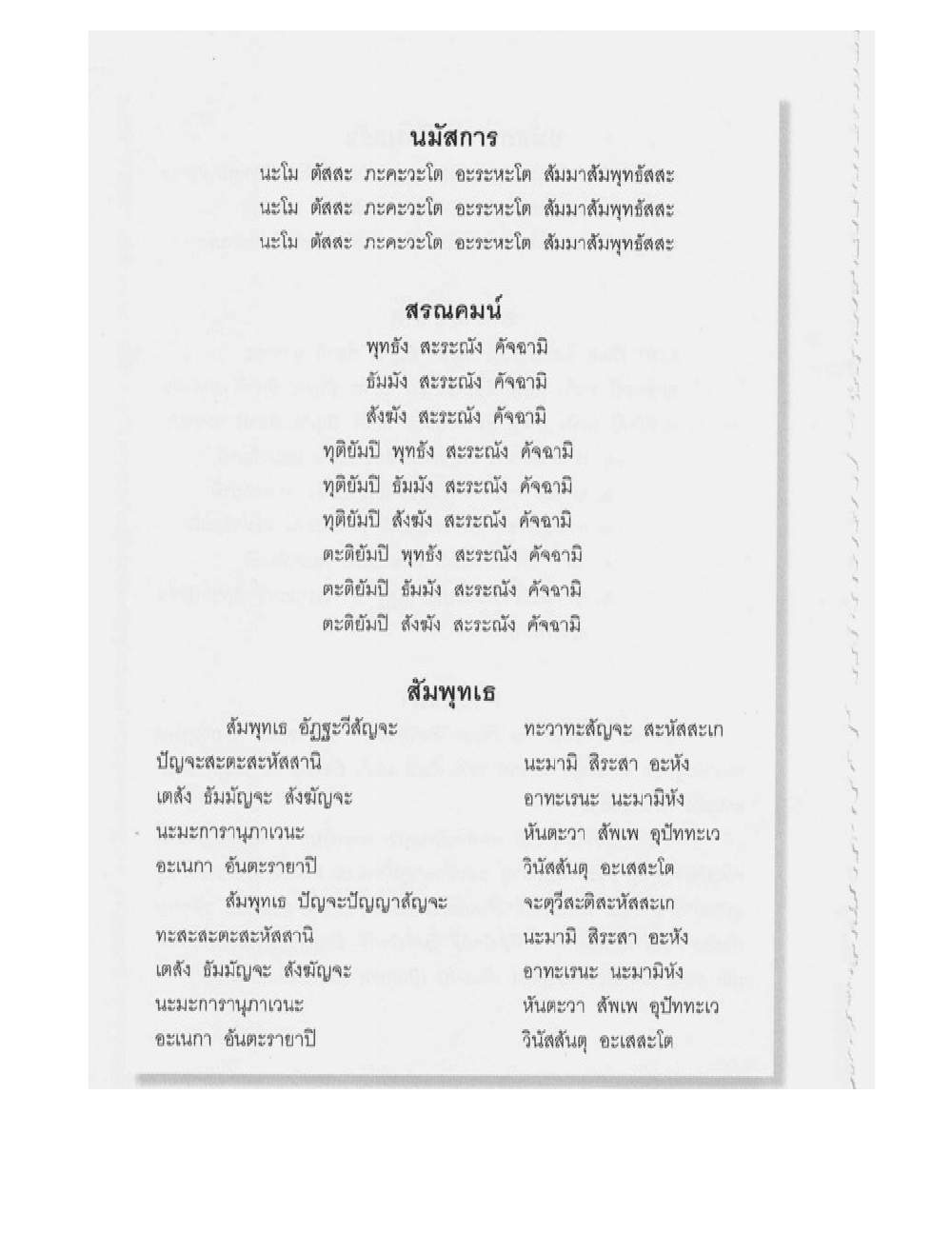
นมัสการ
นะโม ตัสสะ ภะคะวะโต อะระหะโต สัมมาสัมพุทธัสสะ นะโม ตัสสะ ภะคะวะโต อะระหะโต สัมมาสัมพุทธัสสะ นะโม ตัสสะ ภะคะวะโต อะระหะโต สัมมาสัมพุทธัสสะ
สรณคมน์
พุทธัง สะระณัง คัจฉามิ ธัมมัง สะระณัง คัจฉามิ สังฆัง สะระณัง คัจฉามิ ทุติยัมปิ พุทธัง สะระณัง คัจฉามิ ทุติยัมปิ ธัมมัง สะระณัง คัจฉามิ ทุติยัมปิ สังฆัง สะระณัง คัจฉามิ ตะติยัมปิ พุทธัง สะระณัง คัจฉามิ ตะติยัมปิ ธัมมัง สะระณัง คัจฉามิ ตะติยัมปิ สังฆัง สะระณัง คัจฉามิ
สัมพุทเธ
สัมพุทเธ อัฏฐะวีสัญจะ ทะวาทะสัญจะ สะหัสสะเก ปัญจะสะตะสะหัสสานิ นะมามิ สิระสา อะหัง เตสัง ธัมมัญจะ สังฆัญจะ อาทะเรนะ นะมามิหัง นะมะการานุภาเวนะ หันตะวา สัพเพ อุปัททะเว อะเนกา อันตะรายาปิ วินัสสันตุ อะเสสะโต
สัมพุทเธ ปัญจะปัญญาสัญจะ จะตุวีสะติสะหัสสะเก ทะสะสะตะสะหัสสานิ นะมามิ สิระสา อะหัง เตสัง ธัมมัญจะ สังฆัญจะ อาทะเรนะ นะมามิหัง นะมะการานุภาเวนะ หันตะวา สัพเพ อุปัททะเว อะเนกา อันตะรายาปิ วินัสสันตุ อะเสสะโต
Homage
Homage to the Blessed One, the Worthy One, the Perfectly Self-Enlightened One. (recited three times)
Going for Refuge
I go to the Buddha for refuge. I go to the Dhamma for refuge. I go to the Sangha for refuge. For the second time, I go to the Buddha for refuge. For the second time, I go to the Dhamma for refuge. For the second time, I go to the Sangha for refuge. For the third time, I go to the Buddha for refuge. For the third time, I go to the Dhamma for refuge. For the third time, I go to the Sangha for refuge.
Sambuddhe (Homage to the Fully Enlightened Ones)
I bow my head in homage to the twenty-eight Fully Enlightened Ones, together with the twelve hundred and the five hundred thousand [Buddhas], and to their Dhamma and Sangha, with devotion. By the power of this homage, having overcome all misfortunes, may countless dangers too be utterly destroyed.
I bow my head in homage to the Fully Enlightened Ones, fifty-five and twenty-four thousand and one million in number, and to their Dhamma and Sangha, with devotion. By the power of this homage, having overcome all misfortunes, may countless dangers too be utterly destroyed.
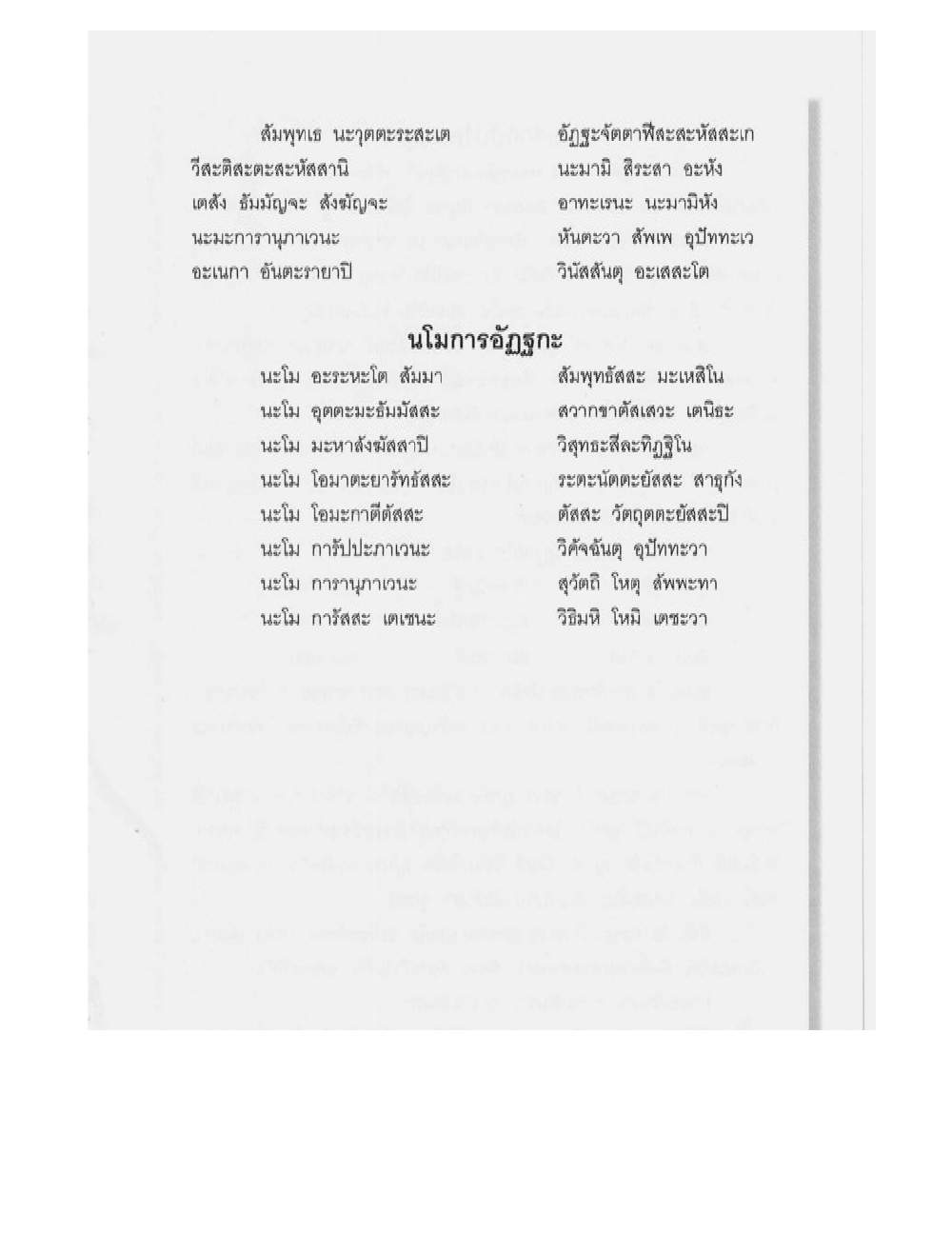
สัมพุทเธ นะวุตตะระสะเต อัฏฐะจัตตาฬีสะสะหัสสะเก วีสะติสะตะสะหัสสานิ นะมามิ สิระสา อะหัง เตสัง ธัมมัญจะ สังฆัญจะ อาทะเรนะ นะมามิหัง นะมะการานุภาเวนะ หันตะวา สัพเพ อุปัททะเว อะเนกา อันตะรายาปิ วินัสสันตุ อะเสสะโต
นโมการอัฏฐกะ
นะโม อะระหะโต สัมมา สัมพุทธัสสะ มะเหสิโน นะโม อุตตะมะธัมมัสสะ สวากขาตัสเสวะ เตนิธะ นะโม มะหาสังฆัสสาปิ วิสุทธะสีละทิฏฐิโน นะโม โอมาตะยารัทธัสสะ ระตะนัตตะยัสสะ สาธุกัง นะโม โอมะกาตีตัสสะ ตัสสะ วัตถุตตะยัสสะปิ นะโม การัปปะภาเวนะ วิคัจฉันตุ อุปัททะวา นะโม การานุภาเวนะ สุวัตถิ โหตุ สัพพะทา นะโม การัสสะ เตเชนะ วิธิมหิ โหมิ เตชะวา
I bow my head in homage to the Fully Enlightened Ones, one hundred and ninety and forty-eight thousand and twenty million in number, and to their Dhamma and Sangha, with devotion. By the power of this homage, having overcome all misfortunes, may countless dangers too be utterly destroyed.
The Eightfold Homage (Namokāra Aṭṭhaka)
Homage to the Worthy One, the Perfectly Self-Enlightened One, the Great Seer. Homage here to his supreme Dhamma, so well proclaimed. Homage also to the great Sangha, pure in virtue and in view. Homage, well made, to the Triple Gem, begun with reverence. Homage also to the essence of these Three, transcending the base. By the power of this homage, may misfortunes depart. By the power of this homage, may there be well-being always. By the might of this homage, may I be full of vigor in every endeavor.
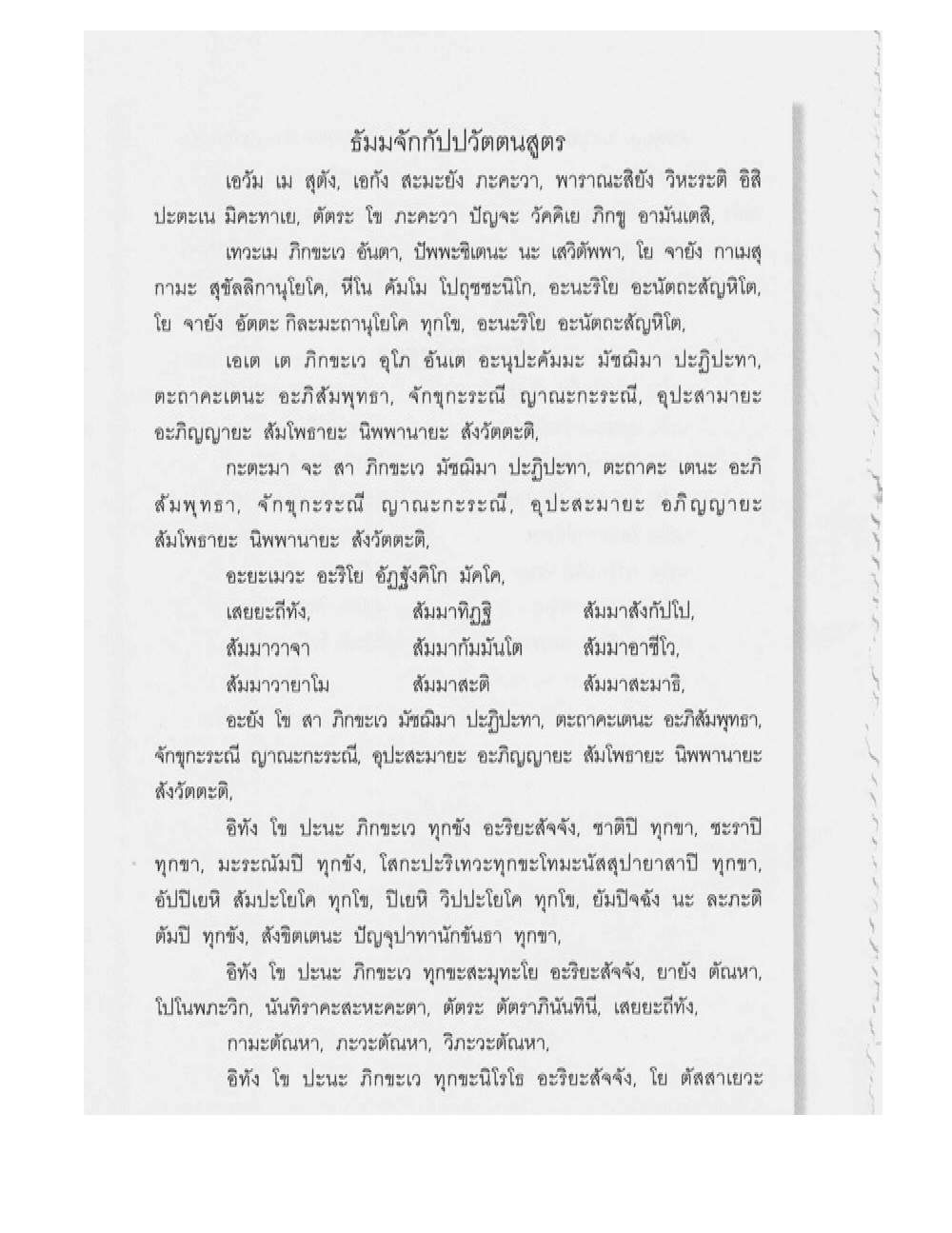
ธัมมจักกัปปวัตตนสูตร
เอวัม เม สุตัง, เอกัง สะมะยัง ภะคะวา, พาราณะสิยัง วิหะระติ อิสิ ปะตะเน มิคะทาเย, ตัตระ โข ภะคะวา ปัญจะ วัคคิเย ภิกขู อามันเตสิ,
เทวเม ภิกขะเว อันตา, ปัพพะชิเตนะ นะ เสวิตัพพา, โย จายัง กาเมสุ กามะ สุขัลลิกานุโยโค, หีนโม คัมโม โปถุชชะนิโก, อะนะริโย อะนัตถะสัญหิโต, โย จายัง อัตตะ กิละมะถานุโยโค ทุกโข, อะนะริโย อะนัตถะสัญหิโต,
เอเต เต ภิกขะเว อุโภ อันเต อะนุปะคัมมะ มัชฌิมา ปะฏิปะทา, ตะถาคะเตนะ อะภิสัมพุทธา, จักขุกะระณี ญาณะกะระณี, อุปะสะมายะ อะภิญญายะ สัมโพธายะ นิพพานายะ สังวัตตะติ,
กะตะมา จะ สา ภิกขะเว มัชฌิมา ปะฏิปะทา, ตะถาคะเตนะ อะภิ สัมพุทธา, จักขุกะระณี ญาณะกะระณี, อุปะสะมายะ อภิญญายะ สัมโพธายะ นิพพานายะ สังวัตตะติ,
อะยะเมวะ อะริโย อัฏฐังคิโก มัคโค, เสยยะถีทัง, สัมมาทิฏฐิ สัมมาสังกัปโป, สัมมาวาจา สัมมากัมมันโต สัมมาอาชีโว, สัมมาวายาโม สัมมาสะติ สัมมาสะมาธิ,
อะยัง โข สา ภิกขะเว มัชฌิมา ปะฏิปะทา, ตะถาคะเตนะ อะภิสัมพุทธา, จักขุกะระณี ญาณะกะระณี, อุปะสะมายะ อะภิญญายะ สัมโพธายะ นิพพานายะ สังวัตตะติ,
อิทัง โข ปะนะ ภิกขะเว ทุกขัง อะริยะสัจจัง, ชาติปิ ทุกขา, ชะราปิ ทุกขา, มะระณัมปิ ทุกขัง, โสกะปะริเทวะทุกขะโทมะนัสสุปายาสาปิ ทุกขา, อัปปิเยหิ สัมปะโยโค ทุกโข, ปิเยหิ วิปปะโยโค ทุกโข, ยัมปิจฉัง นะ ละภะติ ตัมปิ ทุกขัง, สังขิตเตนะ ปัญจุปาทานักขันธา ทุกขา,
อิทัง โข ปะนะ ภิกขะเว ทุกขะสะมุทะโย อะริยะสัจจัง, ยายัง ตัณหา, โปโนพภะวิกา, นันทิราคะสะหะคะตา, ตัตระ ตัตราภินันทินี, เสยยะถีทัง, กามะตัณหา, ภะวะตัณหา, วิภะวะตัณหา,
อิทัง โข ปะนะ ภิกขะเว ทุกขะนิโรโธ อะริยะสัจจัง, โย ตัสสาเยวะ
The Discourse on Setting the Wheel of Dhamma in Motion
Thus have I heard. On one occasion the Blessed One was dwelling at Bārāṇasī, in the Deer Park at Isipatana. There the Blessed One addressed the group of five monks:
'These two extremes, monks, should not be followed by one who has gone forth. What two? The pursuit of happiness in sense pleasures, which is low, vulgar, the way of the ordinary person, ignoble, and unbeneficial; and the pursuit of self-mortification, which is painful, ignoble, and unbeneficial.
Avoiding both these extremes, monks, the middle way has been discovered by the Tathāgata, which gives rise to vision, gives rise to knowledge, and leads to peace, to direct knowledge, to enlightenment, to Nibbāna.
And what, monks, is that middle way discovered by the Tathāgata, which gives rise to vision, gives rise to knowledge, and leads to peace, to direct knowledge, to enlightenment, to Nibbāna?
It is this very Noble Eightfold Path, namely: right view, right intention, right speech, right action, right livelihood, right effort, right mindfulness, right concentration.
This, monks, is that middle way discovered by the Tathāgata, which gives rise to vision, gives rise to knowledge, and leads to peace, to direct knowledge, to enlightenment, to Nibbāna.
Now this, monks, is the noble truth of suffering: birth is suffering, aging is suffering, death is suffering; sorrow, lamentation, pain, grief, and despair are suffering; association with the unloved is suffering, separation from the loved is suffering, not getting what one wants is suffering; in brief, the five aggregates subject to clinging are suffering.
Now this, monks, is the noble truth of the origin of suffering: it is this craving which leads to renewed existence, accompanied by delight and lust, seeking delight now here, now there, namely: craving for sensual pleasures, craving for existence, craving for non-existence.
Now this, monks, is the noble truth of the cessation of suffering: it is the remainderless fading away and cessation of that very [craving],
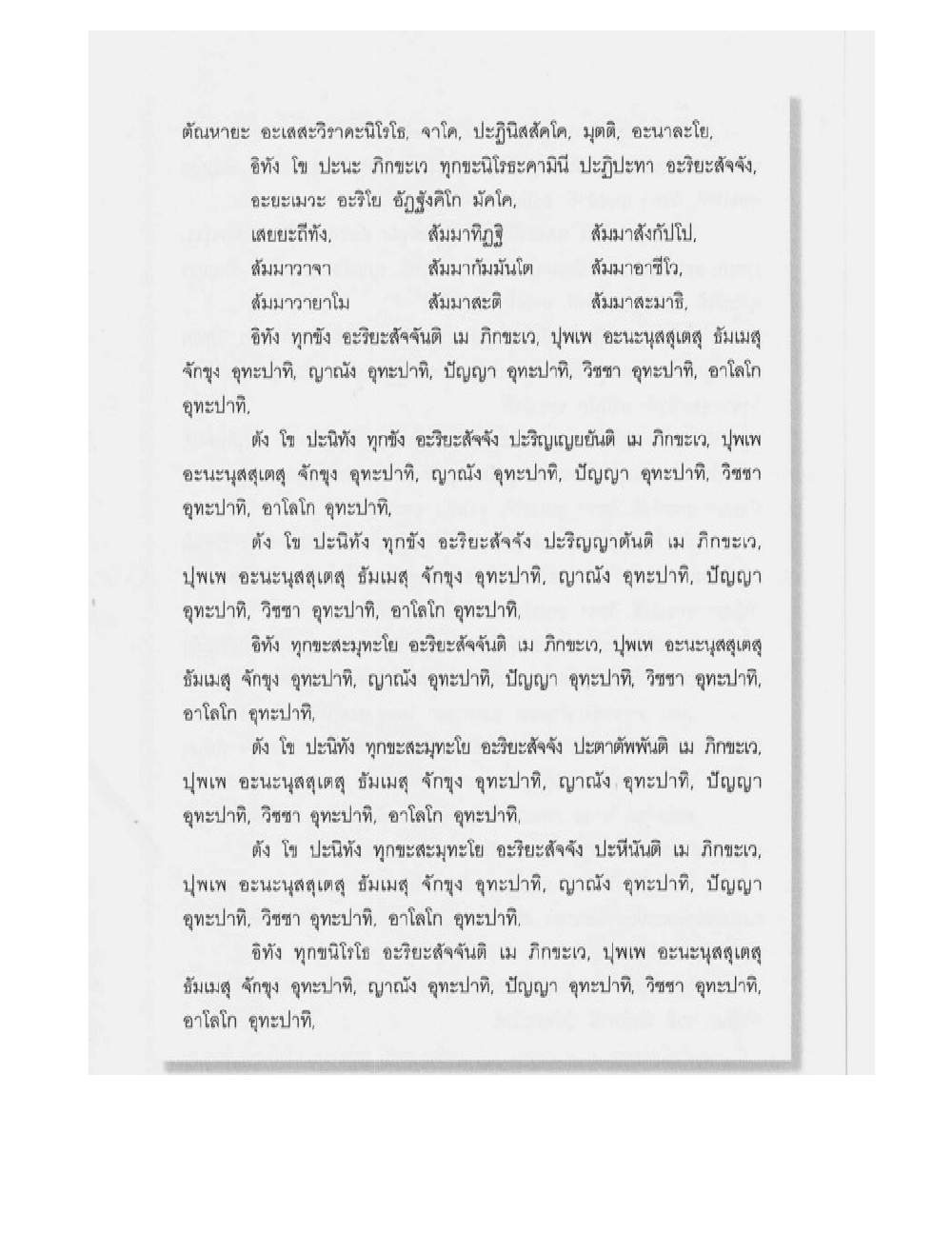
ตัณหายะ อะเสสะวิราคะนิโรโธ, จาโค, ปะฏินิสสัคโค, มุตติ, อะนาละโย,
อิทัง โข ปะนะ ภิกขะเว ทุกขะนิโรธะคามินี ปะฏิปะทา อะริยะสัจจัง, อะยะเมวะ อะริโย อัฏฐังคิโก มัคโค,
เสยยะถีทัง, สัมมาทิฏฐิ สัมมาสังกัปโป, สัมมาวาจา สัมมากัมมันโต สัมมาอาชีโว, สัมมาวายาโม สัมมาสะติ สัมมาสะมาธิ,
อิทัง ทุกขัง อะริยะสัจจันติ เม ภิกขะเว, ปุพเพ อะนะนุสสุเตสุ ธัมเมสุ จักขุง อุทะปาทิ, ญาณัง อุทะปาทิ, ปัญญา อุทะปาทิ, วิชชา อุทะปาทิ, อาโลโก อุทะปาทิ,
ตัง โข ปะนิทัง ทุกขัง อะริยะสัจจัง ปะริญเญยยันติ เม ภิกขะเว, ปุพเพ อะนะนุสสุเตสุ ธัมเมสุ จักขุง อุทะปาทิ, ญาณัง อุทะปาทิ, ปัญญา อุทะปาทิ, วิชชา อุทะปาทิ, อาโลโก อุทะปาทิ,
ตัง โข ปะนิทัง ทุกขัง อะริยะสัจจัง ปะริญญาตันติ เม ภิกขะเว, ปุพเพ อะนะนุสสุเตสุ ธัมเมสุ จักขุง อุทะปาทิ, ญาณัง อุทะปาทิ, ปัญญา อุทะปาทิ, วิชชา อุทะปาทิ, อาโลโก อุทะปาทิ,
อิทัง ทุกขะสะมุทะโย อะริยะสัจจันติ เม ภิกขะเว, ปุพเพ อะนะนุสสุเตสุ ธัมเมสุ จักขุง อุทะปาทิ, ญาณัง อุทะปาทิ, ปัญญา อุทะปาทิ, วิชชา อุทะปาทิ, อาโลโก อุทะปาทิ,
ตัง โข ปะนิทัง ทุกขะสะมุทะโย อะริยะสัจจัง ปะหาตัพพันติ เม ภิกขะเว, ปุพเพ อะนะนุสสุเตสุ ธัมเมสุ จักขุง อุทะปาทิ, ญาณัง อุทะปาทิ, ปัญญา อุทะปาทิ, วิชชา อุทะปาทิ, อาโลโก อุทะปาทิ,
ตัง โข ปะนิทัง ทุกขะสะมุทะโย อะริยะสัจจัง ปะหีนันติ เม ภิกขะเว, ปุพเพ อะนะนุสสุเตสุ ธัมเมสุ จักขุง อุทะปาทิ, ญาณัง อุทะปาทิ, ปัญญา อุทะปาทิ, วิชชา อุทะปาทิ, อาโลโก อุทะปาทิ,
อิทัง ทุกขนิโรโธ อะริยะสัจจันติ เม ภิกขะเว, ปุพเพ อะนะนุสสุเตสุ ธัมเมสุ จักขุง อุทะปาทิ, ญาณัง อุทะปาทิ, ปัญญา อุทะปาทิ, วิชชา อุทะปาทิ, อาโลโก อุทะปาทิ,
of craving: the giving up and relinquishing of it, freedom from it, non-reliance on it.
Now this, monks, is the noble truth of the way leading to the cessation of suffering: it is this very Noble Eightfold Path,
namely: right view, right intention, right speech, right action, right livelihood, right effort, right mindfulness, right concentration.
'This is the noble truth of suffering' — thus, monks, in regard to things unheard before, there arose in me vision, there arose knowledge, there arose wisdom, there arose true knowledge, there arose light.
'This noble truth of suffering is to be fully understood' — thus, monks, in regard to things unheard before, there arose in me vision, there arose knowledge, there arose wisdom, there arose true knowledge, there arose light.
'This noble truth of suffering has been fully understood' — thus, monks, in regard to things unheard before, there arose in me vision, there arose knowledge, there arose wisdom, there arose true knowledge, there arose light.
'This is the noble truth of the origin of suffering' — thus, monks, in regard to things unheard before, there arose in me vision, there arose knowledge, there arose wisdom, there arose true knowledge, there arose light.
'This noble truth of the origin of suffering is to be abandoned' — thus, monks, in regard to things unheard before, there arose in me vision, there arose knowledge, there arose wisdom, there arose true knowledge, there arose light.
'This noble truth of the origin of suffering has been abandoned' — thus, monks, in regard to things unheard before, there arose in me vision, there arose knowledge, there arose wisdom, there arose true knowledge, there arose light.
'This is the noble truth of the cessation of suffering' — thus, monks, in regard to things unheard before, there arose in me vision, there arose knowledge, there arose wisdom, there arose true knowledge, there arose light.
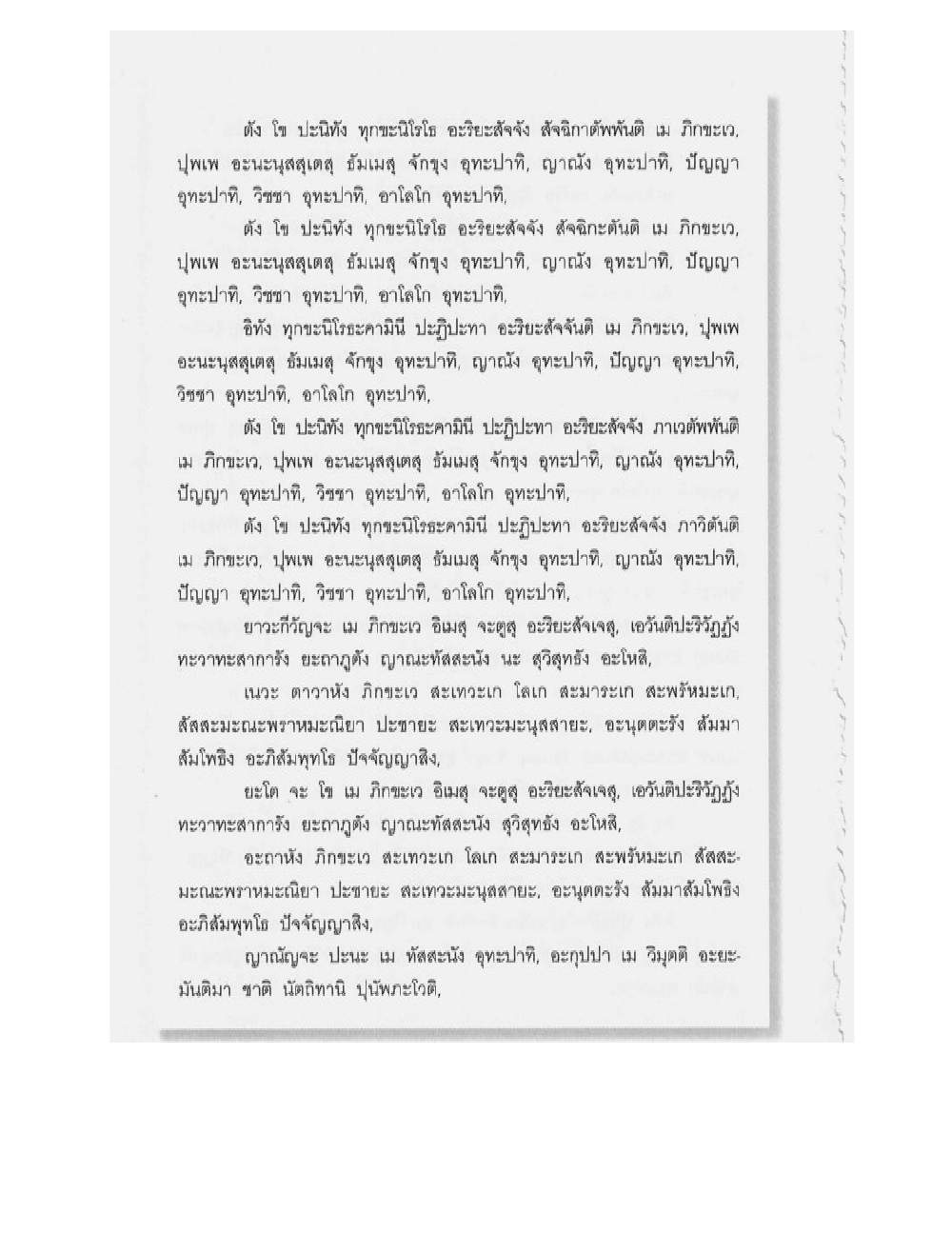
ตัง โข ปะนิทัง ทุกขะนิโรโธ อะริยะสัจจัง สัจฉิกาตัพพันติ เม ภิกขะเว, ปุพเพ อะนะนุสสุเตสุ ธัมเมสุ จักขุง อุทะปาทิ, ญาณัง อุทะปาทิ, ปัญญา อุทะปาทิ, วิชชา อุทะปาทิ, อาโลโก อุทะปาทิ,
ตัง โข ปะนิทัง ทุกขะนิโรโธ อะริยะสัจจัง สัจฉิกะตันติ เม ภิกขะเว, ปุพเพ อะนะนุสสุเตสุ ธัมเมสุ จักขุง อุทะปาทิ, ญาณัง อุทะปาทิ, ปัญญา อุทะปาทิ, วิชชา อุทะปาทิ, อาโลโก อุทะปาทิ,
อิทัง ทุกขะนิโรธะคามินี ปะฏิปะทา อะริยะสัจจันติ เม ภิกขะเว, ปุพเพ อะนะนุสสุเตสุ ธัมเมสุ จักขุง อุทะปาทิ, ญาณัง อุทะปาทิ, ปัญญา อุทะปาทิ, วิชชา อุทะปาทิ, อาโลโก อุทะปาทิ,
ตัง โข ปะนิทัง ทุกขะนิโรธะคามินี ปะฏิปะทา อะริยะสัจจัง ภาเวตัพพันติ เม ภิกขะเว, ปุพเพ อะนะนุสสุเตสุ ธัมเมสุ จักขุง อุทะปาทิ, ญาณัง อุทะปาทิ, ปัญญา อุทะปาทิ, วิชชา อุทะปาทิ, อาโลโก อุทะปาทิ,
ตัง โข ปะนิทัง ทุกขะนิโรธะคามินี ปะฏิปะทา อะริยะสัจจัง ภาวิตันติ เม ภิกขะเว, ปุพเพ อะนะนุสสุเตสุ ธัมเมสุ จักขุง อุทะปาทิ, ญาณัง อุทะปาทิ, ปัญญา อุทะปาทิ, วิชชา อุทะปาทิ, อาโลโก อุทะปาทิ,
ยาวะกีวัญจะ เม ภิกขะเว อิเมสุ จะตูสุ อะริยะสัจเจสุ, เอวันติปะริวัฏฏัง ทวาทะสาการัง ยะถาภูตัง ญาณะทัสสะนัง นะ สุวิสุทธัง อะโหสิ,
เนวะ ตาวาหัง ภิกขะเว สะเทวะเก โลเก สะมาระเก สะพรัหมะเก, สัสสะมะณะพราหมะณิยา ปะชายะ สะเทวะมะนุสสายะ, อะนุตตะรัง สัมมา สัมโพธิง อะภิสัมพุทโธ ปัจจัญญาสิง,
ยะโต จะ โข เม ภิกขะเว อิเมสุ จะตูสุ อะริยะสัจเจสุ, เอวันติปะริวัฏฏัง ทวาทะสาการัง ยะถาภูตัง ญาณะทัสสะนัง สุวิสุทธัง อะโหสิ,
อะถาหัง ภิกขะเว สะเทวะเก โลเก สะมาระเก สะพรัหมะเก สัสสะมะณะ พราหมะณิยา ปะชายะ สะเทวะมะนุสสายะ, อะนุตตะรัง สัมมาสัมโพธิง อะภิสัมพุทโธ ปัจจัญญาสิง,
ญาณัญจะ ปะนะ เม ทัสสะนัง อุทะปาทิ, อะกุปปา เม วิมุตติ อะยะมัน ติมา ชาติ นัตถิทานิ ปุนัพภะโวติ,
'This noble truth of the cessation of suffering is to be realized' — thus, monks, in regard to things unheard before, there arose in me vision, there arose knowledge, there arose wisdom, there arose true knowledge, there arose light.
'This noble truth of the cessation of suffering has been realized' — thus, monks, in regard to things unheard before, there arose in me vision, there arose knowledge, there arose wisdom, there arose true knowledge, there arose light.
'This is the noble truth of the way leading to the cessation of suffering' — thus, monks, in regard to things unheard before, there arose in me vision, there arose knowledge, there arose wisdom, there arose true knowledge, there arose light.
'This noble truth of the way leading to the cessation of suffering is to be developed' — thus, monks, in regard to things unheard before, there arose in me vision, there arose knowledge, there arose wisdom, there arose true knowledge, there arose light.
'This noble truth of the way leading to the cessation of suffering has been developed' — thus, monks, in regard to things unheard before, there arose in me vision, there arose knowledge, there arose wisdom, there arose true knowledge, there arose light.
As long, monks, as my knowledge and vision of these Four Noble Truths as they really are, in their three phases and twelve aspects, was not thoroughly purified, I did not claim, monks, in this world with its devas, with Māra, with Brahmā, in this generation with its ascetics and brahmins, its princes and people, to have awakened to the unsurpassed perfect enlightenment.
But when, monks, my knowledge and vision of these Four Noble Truths as they really are, in their three phases and twelve aspects, was thoroughly purified, then, monks, I claimed in this world with its devas, with Māra, with Brahmā, in this generation with its ascetics and brahmins, its princes and people, to have awakened to the unsurpassed perfect enlightenment.
And the knowledge and vision arose in me: 'My liberation is unshakeable; this is my last birth; now there is no more renewed existence.'
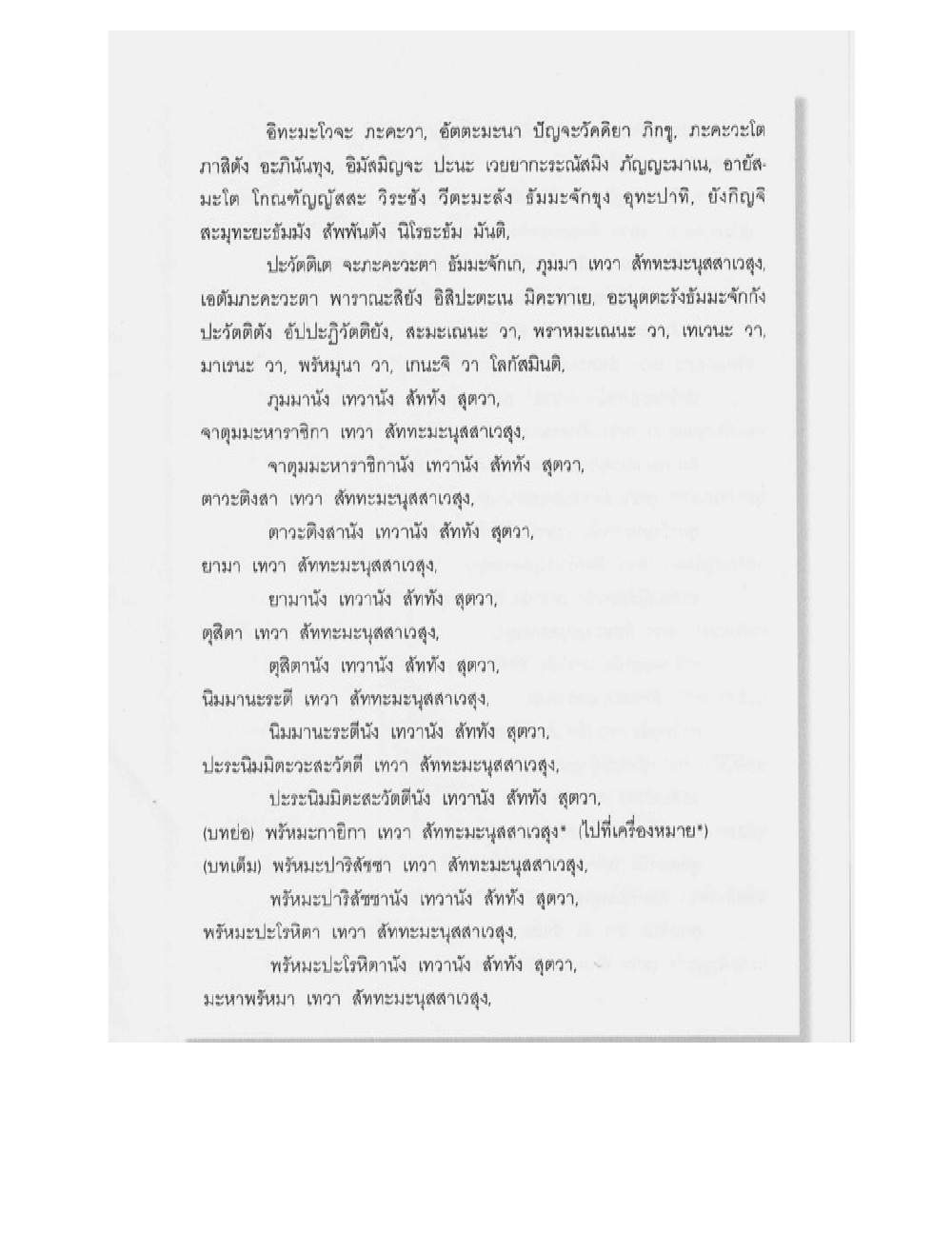
อิทะมะโวจะ ภะคะวา, อัตตะมะนา ปัญจะวัคคิยา ภิกขู, ภะคะวะโต ภาสิตัง อะภินันทุง, อิมัสมิญจะ ปะนะ เวยยากะระณัสมิง ภัญญะมาเน, อายัส- มะโต โกณฑัญญัสสะ วิระชัง วีตะมะลัง ธัมมะจักขุง อุทะปาทิ, ยังกิญจิ สะมุทะยะธัมมัง สัพพันตัง นิโรธะธัมมัง มันติ,
ปะวัตติเต จะ ภะคะวะตา ธัมมะจักเก, ภุมมา เทวา สัททะมะนุสสาเวสุง, เอตัมภะคะวะตา พาราณะสิยัง อิสิปะตะเน มิคะทาเย, อะนุตตะรังธัมมะจักกัง ปะวัตติตัง อัปปะฏิวัตติยัง, สะมะเณนะ วา, พราหมะเณนะ วา, เทเวนะ วา, มาเรนะ วา, พรัหมุนา วา, เกนะจิ วา โลกัสมินติ,
ภุมมานัง เทวานัง สัททัง สุตวา, จาตุมมะหาราชิกา เทวา สัททะมะนุสสาเวสุง, จาตุมมะหาราชิกานัง เทวานัง สัททัง สุตวา, ตาวะติงสา เทวา สัททะมะนุสสาเวสุง, ตาวะติงสานัง เทวานัง สัททัง สุตวา, ยามา เทวา สัททะมะนุสสาเวสุง, ยามานัง เทวานัง สัททัง สุตวา, ตุสิตา เทวา สัททะมะนุสสาเวสุง, ตุสิตานัง เทวานัง สัททัง สุตวา, นิมมานะระตี เทวา สัททะมะนุสสาเวสุง, นิมมานะระตีนัง เทวานัง สัททัง สุตวา, ปะระนิมมิตะวะสะวัตตี เทวา สัททะมะนุสสาเวสุง, ปะระนิมมิตะวะสะวัตตีนัง เทวานัง สัททัง สุตวา, (บทย่อ) พรัหมะกายิกา เทวา สัททะมะนุสสาเวสุง* (ไปที่เครื่องหมาย*) (บทเต็ม) พรัหมะปาริสัชชา เทวา สัททะมะนุสสาเวสุง, พรัหมะปาริสัชชานัง เทวานัง สัททัง สุตวา, พรัหมะปะโรหิตา เทวา สัททะมะนุสสาเวสุง, พรัหมะปะโรหิตานัง เทวานัง สัททัง สุตวา, มะหาพรัหมา เทวา สัททะมะนุสสาเวสุง,
This the Blessed One said. Elated, the group of five monks delighted in the Blessed One's words. Now while this discourse was being spoken, there arose in the Venerable Koṇḍañña the dust-free, stainless eye of Dhamma: 'Whatever has the nature to arise, all that has the nature to cease.'
And when the Wheel of Dhamma had been set in motion by the Blessed One, the earth-dwelling devas raised the cry: 'At Bārāṇasī, in the Deer Park at Isipatana, the unsurpassed Wheel of Dhamma has been set in motion by the Blessed One, which cannot be stopped by any ascetic or brahmin, deva, Māra, or Brahmā, or by anyone in the world.'
Having heard the cry of the earth-dwelling devas, the devas of the Four Great Kings raised the cry. Having heard the cry of the devas of the Four Great Kings, the Tāvatiṃsa devas raised the cry. Having heard the cry of the Tāvatiṃsa devas, the Yāma devas raised the cry. Having heard the cry of the Yāma devas, the Tusita devas raised the cry. Having heard the cry of the Tusita devas, the Nimmānaratī devas raised the cry. Having heard the cry of the Nimmānaratī devas, the Paranimmitavasavattī devas raised the cry. Having heard the cry of the Paranimmitavasavattī devas, [abridged version:] the Brahmā-kāyika devas raised the cry* (see the note marked with an asterisk). [Full version:] the Brahmā-Pārisajjā devas raised the cry. Having heard the cry of the Brahmā-Pārisajjā devas, the Brahmā-Purohita devas raised the cry. Having heard the cry of the Brahmā-Purohita devas, the Mahā Brahmā devas raised the cry.
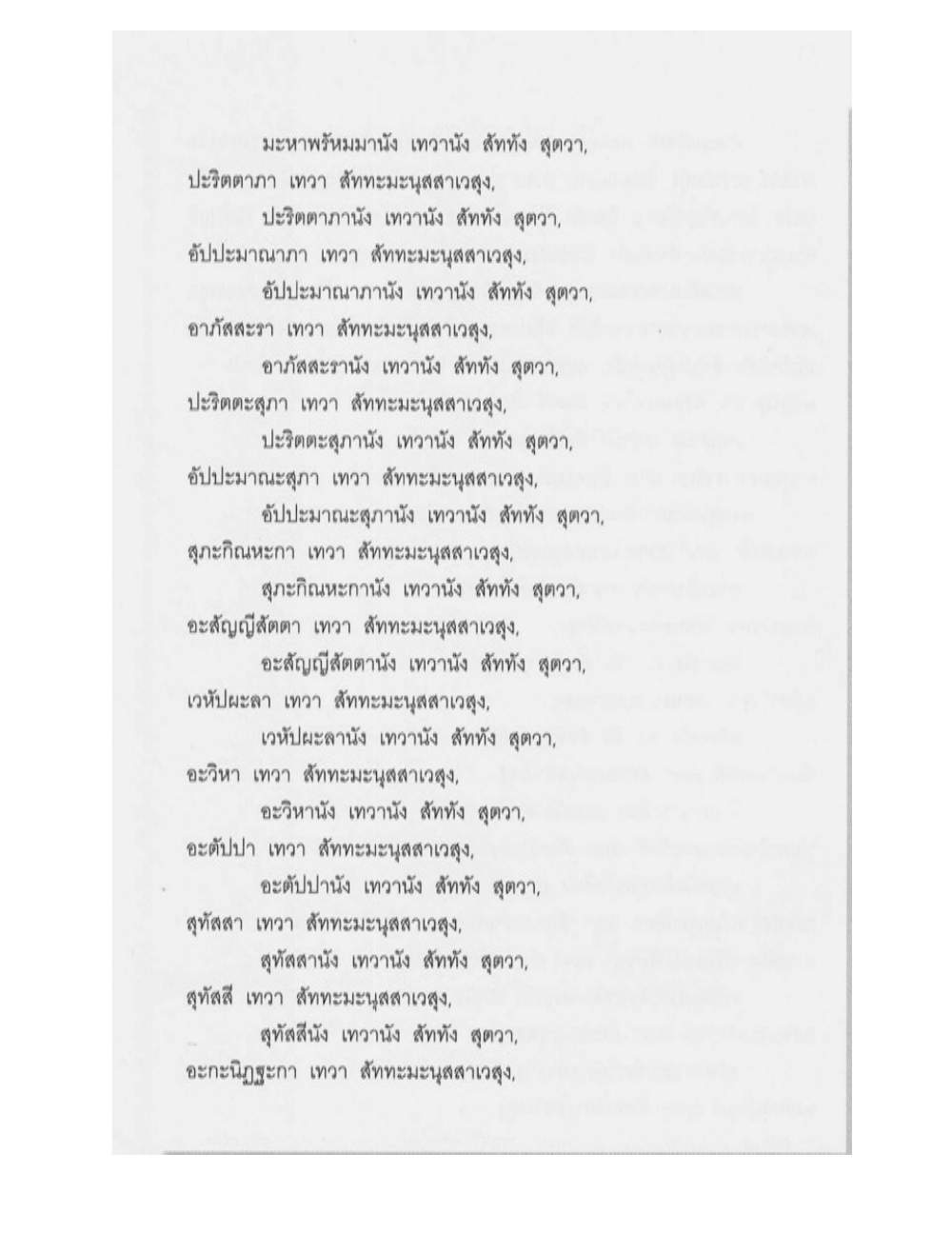
มะหาพรัหมมานัง เทวานัง สัททัง สุตวา, ปะริตตาภา เทวา สัททะมะนุสสาเวสุง, ปะริตตาภานัง เทวานัง สัททัง สุตวา, อัปปะมาณาภา เทวา สัททะมะนุสสาเวสุง, อัปปะมาณาภานัง เทวานัง สัททัง สุตวา, อาภัสสะรา เทวา สัททะมะนุสสาเวสุง, อาภัสสะรานัง เทวานัง สัททัง สุตวา, ปะริตตะสุภา เทวา สัททะมะนุสสาเวสุง, ปะริตตะสุภานัง เทวานัง สัททัง สุตวา, อัปปะมาณะสุภา เทวา สัททะมะนุสสาเวสุง, อัปปะมาณะสุภานัง เทวานัง สัททัง สุตวา, สุภะกิณหะกา เทวา สัททะมะนุสสาเวสุง, สุภะกิณหะกานัง เทวานัง สัททัง สุตวา, อะสัญญีสัตตา เทวา สัททะมะนุสสาเวสุง, อะสัญญีสัตตานัง เทวานัง สัททัง สุตวา, เวหัปผะลา เทวา สัททะมะนุสสาเวสุง, เวหัปผะลานัง เทวานัง สัททัง สุตวา, อะวิหา เทวา สัททะมะนุสสาเวสุง, อะวิหานัง เทวานัง สัททัง สุตวา, อะตัปปา เทวา สัททะมะนุสสาเวสุง, อะตัปปานัง เทวานัง สัททัง สุตวา, สุทัสสา เทวา สัททะมะนุสสาเวสุง, สุทัสสานัง เทวานัง สัททัง สุตวา, สุทัสสี เทวา สัททะมะนุสสาเวสุง, สุทัสสีนัง เทวานัง สัททัง สุตวา, อะกะนิฏฐะกา เทวา สัททะมะนุสสาเวสุง,
Having heard the cry of the Mahā Brahmā devas, the Parittābha devas raised the cry. Having heard the cry of the Parittābha devas, the Appamāṇābha devas raised the cry. Having heard the cry of the Appamāṇābha devas, the Ābhassara devas raised the cry. Having heard the cry of the Ābhassara devas, the Parittasubha devas raised the cry. Having heard the cry of the Parittasubha devas, the Appamāṇasubha devas raised the cry. Having heard the cry of the Appamāṇasubha devas, the Subhakiṇhaka devas raised the cry. Having heard the cry of the Subhakiṇhaka devas, the Asaññasatta devas raised the cry. Having heard the cry of the Asaññasatta devas, the Vehapphala devas raised the cry. Having heard the cry of the Vehapphala devas, the Aviha devas raised the cry. Having heard the cry of the Aviha devas, the Atappa devas raised the cry. Having heard the cry of the Atappa devas, the Sudassa devas raised the cry. Having heard the cry of the Sudassa devas, the Sudassī devas raised the cry. Having heard the cry of the Sudassī devas, the Akaniṭṭha devas raised the cry.
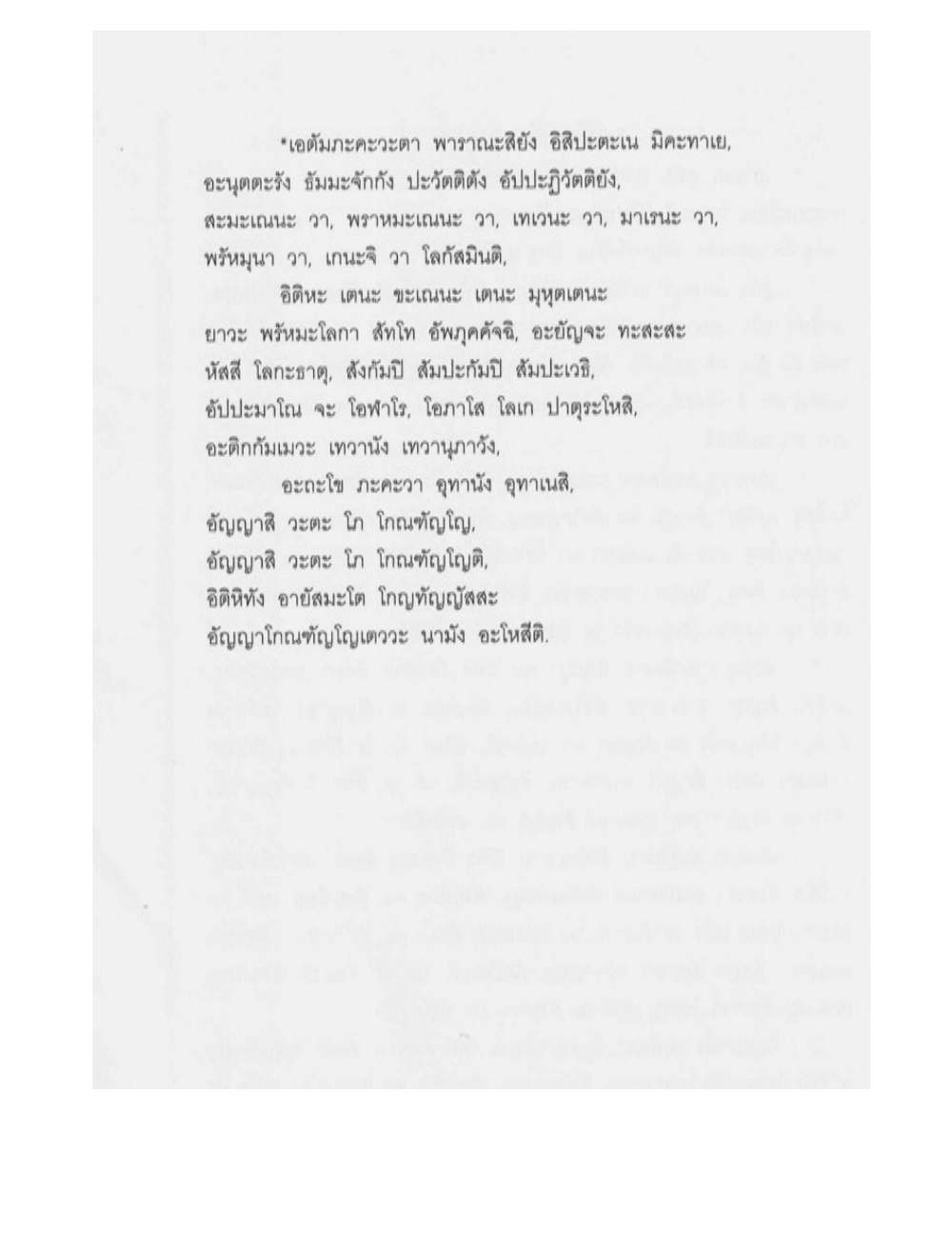
*เอตัมภะคะวะตา พาราณะสิยัง อิสิปะตะเน มิคะทาเย, อะนุตตะรัง ธัมมะจักกัง ปะวัตติตัง อัปปะฏิวัตติยัง, สะมะเณนะ วา, พราหมะเณนะ วา, เทเวนะ วา, มาเรนะ วา, พรัหมุนา วา, เกนะจิ วา โลกัสมินติ,
อิติหะ เตนะ ขะเณนะ เตนะ มุหุตเตนะ ยาวะ พรัหมะโลกา สัทโท อัพภุคคัจฉิ, อะยัญจะ ทะสะสะหัสสี โลกะธาตุ, สังกัมปิ สัมปะกัมปิ สัมปะเวธิ, อัปปะมาโณ จะ โอฬาโร, โอภาโส โลเก ปาตุระโหสิ, อะติกกัมเมวะ เทวานัง เทวานุภาวัง,
อะถะโข ภะคะวา อุทานัง อุทาเนสิ, อัญญาสิ วะตะ โภ โกณฑัญโญ, อัญญาสิ วะตะ โภ โกณฑัญโญติ, อิติหิทัง อายัสมะโต โกณฑัญญัสสะ อัญญาโกณฑัญโญเตววะ นามัง อะโหสีติ.
*'At Bārāṇasī, in the Deer Park at Isipatana, the unsurpassed Wheel of Dhamma has been set in motion by the Blessed One, which cannot be stopped by any ascetic or brahmin, deva, Māra, or Brahmā, or by anyone in the world.'
Thus in that very moment, that very instant, the sound soared up as far as the Brahmā world, and this ten-thousandfold world system shook, quaked, and trembled, and an immeasurable, glorious radiance appeared in the world, surpassing the divine majesty of the devas.
Then the Blessed One uttered this exclamation of joy: 'Koṇḍañña has indeed understood! Koṇḍañña has indeed understood!' And that is how the Venerable Koṇḍañña came to acquire the name 'Aññākoṇḍañña' [Koṇḍañña Who Has Understood].
อนัตตลักขณสูตร
เอวัมเม สุตัง, เอกัง สะมะยัง ภะคะวา, พาราณะสิยัง วิหะระติ อิสิปะตะเน มิคะทาเย, ตัตระ โข ภะคะวา ปัญจะวัคคิเย ภิกขู อามันเตสิ,
รูปัง ภิกขะเว อะนัตตา, รูปัญจะ หิทัง ภิกขะเว อัตตา อะภะวิสสะ, นะยิทัง รูปัง อาพาธายะ สังวัตเตยยะ, ลัพเภถะ จะ รูเป, เอวัง เม รูปัง โหตุ เอวัง เม รูปัง มา อะโหสีติ, ยัสมา จะ โข ภิกขะเว, รูปัง อะนัตตา, ตัสมา รูปัง อาพาธายะ สังวัตตะติ, นะ จะ ลัพภะติ รูเป, เอวัง เม รูปัง โหตุ เอวัง เม รูปัง มา อะโหสีติ,
เวทะนา อะนัตตา, เวทะนา จะ หิทัง ภิกขะเว อัตตา อะภะวิสสะ, นะยิทัง เวทะนา อาพาธายะ สังวัตเตยยะ, ลัพเภถะ จะ เวทะนายะ, เอวัง เม เวทะนา โหตุ เอวัง เม เวทะนา มา อะโหสีติ, ยัสมา จะ โข ภิกขะเว, เวทะนา อะนัตตา, ตัสมา เวทะนา อาพาธายะ สังวัตตะติ, นะ จะ ลัพภะติ เวทะนายะ, เอวัง เม เวทะนา โหตุ เอวัง เม เวทะนา มา อะโหสีติ,
สัญญา อะนัตตา, สัญญา จะ หิทัง ภิกขะเว อัตตา อะภะวิสสะ, นะยิทัง สัญญา อาพาธายะ สังวัตเตยยะ, ลัพเภถะ จะ สัญญายะ, เอวัง เม สัญญา โหตุ เอวัง เม สัญญา มา อะโหสีติ, ยัสมา จะ โข ภิกขะเว, สัญญา อะนัตตา, ตัสมา สัญญา อาพาธายะ สังวัตตะติ, นะ จะ ลัพภะติ สัญญายะ, เอวัง เม สัญญา โหตุ เอวัง เม สัญญา มา อะโหสีติ,
สังขารา อะนัตตา, สังขารา จะ หิทัง ภิกขะเว อัตตา อะภะวิสสังสุ, นะยิทัง สังขารา อาพาธายะ สังวัตเตยยุง, ลัพเภถะ จะ สังขาเรสุ, เอวัง เม สังขารา โหนตุ เอวัง เม สังขารา มา อะเหสุนติ, ยัสมา จะ โข ภิกขะเว, สังขารา อะนัตตา, ตัสมา สังขารา อาพาธายะ สังวัตตะติ, นะ จะ ลัพภะติ สังขาเรสุ, เอวัง เม สังขารา โหนตุ เอวัง เม สังขารา มา อะเหสุนติ,
วิญญาณัง อะนัตตา, วิญญาณัญจะ หิทัง ภิกขะเว อัตตา อะภะวิสสะ, นะยิทัง วิญญาณัง อาพาธายะ สังวัตเตยยะ, ลัพเภถะ จะ วิญญาเณ, เอวัง เม วิญญาณัง โหตุ เอวัง เม วิญญาณัง มา อะโหสีติ, ยัสมา จะ โข ภิกขะเว,
The Discourse on the Characteristic of Non-Self
Thus have I heard. On one occasion the Blessed One was dwelling at Bārāṇasī, in the Deer Park at Isipatana. There the Blessed One addressed the group of five monks:
'Form, monks, is non-self. For if, monks, form were self, this form would not lead to affliction, and one could say of form: "Let my form be thus, let my form not be thus." But because form is non-self, form leads to affliction, and one cannot say of form: "Let my form be thus, let my form not be thus."
Feeling is non-self. For if, monks, feeling were self, this feeling would not lead to affliction, and one could say of feeling: "Let my feeling be thus, let my feeling not be thus." But because feeling is non-self, feeling leads to affliction, and one cannot say of feeling: "Let my feeling be thus, let my feeling not be thus."
Perception is non-self. For if, monks, perception were self, this perception would not lead to affliction, and one could say of perception: "Let my perception be thus, let my perception not be thus." But because perception is non-self, perception leads to affliction, and one cannot say of perception: "Let my perception be thus, let my perception not be thus."
Mental formations are non-self. For if, monks, mental formations were self, these formations would not lead to affliction, and one could say of formations: "Let my formations be thus, let my formations not be thus." But because formations are non-self, formations lead to affliction, and one cannot say of formations: "Let my formations be thus, let my formations not be thus."
Consciousness is non-self. For if, monks, consciousness were self, this consciousness would not lead to affliction, and one could say of consciousness: "Let my consciousness be thus, let my consciousness not be thus." But because, monks, [the sentence is cut off at the bottom of the page]
วิญญาณัง อะนัตตา, ตัสมา วิญญาณัง อาพาธายะ สังวัดตะติ, นะ จะ ลัพภะติ วิญญาเณ, เอวัง เม วิญญาณัง โหตุ เอวัง เม วิญญาณัง มา อะโหสีติ,
ตัง กิง มัญญะถะ ภิกขะเว, รูปัง นิจจัง วา อะนิจจัง วาติ อะนิจจัง ภันเต, ยัมปะนานิจจัง ทุกขัง วา ตัง สุขัง วาติ, ทุกขัง ภันเต, ยัมปะนานิจจัง ทุกขัง, วิปะริณามะธัมมัง, กัลลัง นุ ตัง สะมะนุปัสสิตุง, เอตัง มะมะ เอโสหะมัสมิ เอโส เม อัตตาติ, โน เหตัง ภันเต,
ตัง กิง มัญญะถะ ภิกขะเว, เวทะนา นิจจา วา อะนิจจา วาติ, อะนิจจา ภันเต, ยัมปะนานิจจัง ทุกขัง วา ตัง สุขัง วาติ, ทุกขัง ภันเต, ยัมปะนานิจจัง ทุกขัง, วิปะริณามะ ธัมมัง, กัลลัง นุ ตัง สะมะนุปัสสิตุง, เอตัง มะมะ เอโสหะมัสมิ เอโส เม อัตตาติ, โน เหตัง ภันเต,
ตัง กิง มัญญะถะ ภิกขะเว, สัญญา นิจจา วา อะนิจจา วาติ, อะนิจจา ภันเต, ยัมปะนานิจจัง ทุกขัง วา ตัง สุขัง วาติ, ทุกขัง ภันเต, ยัมปะนานิจจัง ทุกขัง, วิปะริณามะ ธัมมัง, กัลลัง นุ ตัง สะมะนุปัสสิตุง, เอตัง มะมะ เอโสหะมัสมิ เอโส เม อัตตาติ, โน เหตัง ภันเต,
ตัง กิง มัญญะถะ ภิกขะเว, สังขารา นิจจา วา อะนิจจา วาติ, อะนิจจา ภันเต, ยัมปะนานิจจัง ทุกขัง วา ตัง สุขัง วาติ, ทุกขัง ภันเต, ยัมปะนานิจจัง ทุกขัง, วิปะริณามะ ธัมมัง, กัลลัง นุ ตัง สะมะนุปัสสิตุง, เอตัง มะมะ เอโสหะมัสมิ เอโส เม อัตตาติ, โน เหตัง ภันเต,
ตัง กิง มัญญะถะ ภิกขะเว, วิญญาณัง นิจจัง วา อะนิจจัง วาติ, อะนิจจัง ภันเต, ยัมปะนานิจจัง ทุกขัง วา ตัง สุขัง วาติ, ทุกขัง ภันเต, ยัมปะนานิจจัง ทุกขัง, วิปะริณามะ ธัมมัง, กัลลัง นุ ตัง สะมะนุปัสสิตุง, เอตัง มะมะ เอ โสหะมัสมิ เอโส เม อัตตาติ, โน เหตัง ภันเต,
ตัสมา ติหะ ภิกขะเว,
ยังกิญจิ รูปัง, อะตีตานาคะตะปัจจุปันนัง, อัชฌัตตัง วา พะหิทธา วา, โอฬาริกัง วา สุขุมัง วา, หีนัง วา ปะณีตัง วา ยันทูเร สันติเก วา, สัพพัง รูปัง, เนตัง มะมะ เนโสหะมัสมิ นะ เมโส อัตตาติ, เอวะเมตัง ยะถาภูตัง สัมมัปปัญญายะ ทัฏฐัพพัง,
...consciousness is not-self. Therefore consciousness leads to affliction, and one cannot [rightly say] of consciousness: 'Let my consciousness be thus, let my consciousness not be thus.'
What do you think, monks: is form permanent or impermanent? — Impermanent, Venerable Sir. — And that which is impermanent, is it suffering or happiness? — Suffering, Venerable Sir. — And that which is impermanent, suffering, subject to change, is it fitting to regard it thus: 'This is mine, this I am, this is my self'? — No, Venerable Sir.
What do you think, monks: is feeling permanent or impermanent? — Impermanent, Venerable Sir. — And that which is impermanent, is it suffering or happiness? — Suffering, Venerable Sir. — And that which is impermanent, suffering, subject to change, is it fitting to regard it thus: 'This is mine, this I am, this is my self'? — No, Venerable Sir.
What do you think, monks: is perception permanent or impermanent? — Impermanent, Venerable Sir. — [same reasoning] — No, Venerable Sir.
What do you think, monks: are mental formations permanent or impermanent? — Impermanent, Venerable Sir. — [same reasoning] — No, Venerable Sir.
What do you think, monks: is consciousness permanent or impermanent? — Impermanent, Venerable Sir. — And that which is impermanent, is it suffering or happiness? — Suffering, Venerable Sir. — And that which is impermanent, suffering, subject to change, is it fitting to regard it thus: 'This is mine, this I am, this is my self'? — No, Venerable Sir.
Therefore, monks,
whatever form there is — past, future, or present; internal or external; gross or subtle; inferior or superior; far or near — all form should be seen as it really is, with right wisdom, thus: 'This is not mine, this I am not, this is not my self.'
ยากาจิ เวทะนา, อะตีตานาคะตะปัจจุปันนา, อัชฌัตตา วา พะหิทธา วา, โอฬาริกา วา สุขุมา วา, หีนา วา ปะณีตา วา, ยา ทูเร สันติเก วา, สัพพา เวทะนา, เนตัง มะมะ เนโสหะมัสมิ นะ เมโส อัตตาติ, เอวะเมตัง ยะถาภูตัง สัมมัปปัญญายะ ทัฏฐัพพัง,
ยากาจิ สัญญา, อะตีตานาคะตะปัจจุปันนา, อัชฌัตตา วา พะหิทธา วา, โอฬาริกา วา สุขุมา วา, หีนา วา ปะณีตา วา, ยา ทูเร สันติเก วา, สัพพา สัญญา, เนตัง มะมะ เนโสหะมัสมิ นะ เมโส อัตตาติ, เอวะเมตัง ยะถาภูตัง สัมมัปปัญญายะ ทัฏฐัพพัง,
เยเกจิ สังขารา, อะตีตานาคะตะปัจจุปันนา, อัชฌัตตา วา พะหิทธา วา, โอฬาริกา วา สุขุมา วา, หีนา วา ปะณีตา วา, เย ทูเร สันติเก วา, สัพเพ สังขารา, เนตัง มะมะ เนโสหะมัสมิ นะ เมโส อัตตาติ, เอวะเมตัง ยะถาภูตัง สัมมัปปัญญายะ ทัฏฐัพพัง,
ยังกิญจิ วิญญาณัง, อะตีตานาคะตะปัจจุปันนัง, อัชฌัตตัง วา พะหิทธัง วา, โอฬาริกัง วา สุขุมัง วา, หีนัง วา ปะณีตัง วา, ยัน ทูเร สันติเก วา, สัพพัง วิญญาณัง, เนตัง มะมะ เนโสหะมัสมิ นะ เมโส อัตตาติ, เอวะเมตัง ยะถาภูตัง สัมมัปปัญญายะ ทัฏฐัพพัง,
เอวัง ปัสสัง ภิกขะเว สุตวา อะริยะสาวะโก, รูปัสมิงปิ นิพพินทะติ, เวทะนายะปิ นิพพินทะติ, สัญญายะปิ นิพพินทะติ, สังขาเรสุปิ นิพพินทะติ, วิญญาณัสมิงปิ นิพพินทะติ, นิพพินทัง วิรัชชะติ, วิราคา วิมุจจะติ, วิมุตตัสมิง วิมุตตะมิติ ญาณัง โหติ, ขีณา ชาติ วุสิตัง, พรัหมะจะริยัง กะตัง กะระณียัง นาปะรัง, อิตถัตตายาติ ปะชานาตีติ,
อิทะมะโวจะ ภะคะวา, อัตตะมะนา ปัญจะวัคคิยา ภิกขู, ภะคะวะโต ภาสิตัง อะภินันทุง, อิมัสมิญจะ ปะนะ เวยยากะระณัสมิง ภัญญะมาเน, ปัญจะวัคคิยานัง ภิกขูนัง อะนุปาทายะ อาสะเวหิ จิตตานิ วิมุจจิงสูติ.
Whatever feeling there is — past, future, or present; internal or external; gross or subtle; inferior or superior; far or near — all feeling should be seen as it really is, with right wisdom, thus: 'This is not mine, this I am not, this is not my self.'
Whatever perception there is — [same formula] — all perception should be seen as it really is, with right wisdom, thus: 'This is not mine, this I am not, this is not my self.'
Whatever mental formations there are — [same formula] — all formations should be seen as they really are, with right wisdom, thus: 'This is not mine, this I am not, this is not my self.'
Whatever consciousness there is — [same formula] — all consciousness should be seen as it really is, with right wisdom, thus: 'This is not mine, this I am not, this is not my self.'
Seeing thus, monks, the well-instructed noble disciple grows disenchanted with form, disenchanted with feeling, disenchanted with perception, disenchanted with formations, disenchanted with consciousness. Being disenchanted, he becomes dispassionate; through dispassion he is liberated. In liberation there arises the knowledge: 'liberated.' He understands: 'Birth is ended, the holy life has been lived, what had to be done has been done, there is no more coming to any state of being.'
This the Blessed One said. Delighted, the group of five monks approved the Blessed One's words. Now while this exposition was being spoken, the minds of the group of five monks, through not clinging, were liberated from the taints.
อาทิตตปริยายสูตร
เอวัม เม สุตัง, เอกัง สะมะยัง ภะคะวา, คะยายัง วิหะระติ คะยาสีเส สัทธิง ภิกขุสะหัสเสนะ, ตัตระ โข ภะคะวา ภิกขู อามันเตสิ, สัพพัง ภิกขะเว อาทิตตัง, กิญจะ ภิกขะเว สัพพัง อาทิตตัง,
จักขุ ภิกขะเว อาทิตตัง, รูปา อาทิตตา, จักขุวิญญาณัง อาทิตตัง, จักขุสัมผัสโส อาทิตโต, ยัมปิทัง จักขุสัมผัสสะปัจจะยา, อุปปัชชะติ เวทะยิตัง, สุขัง วา ทุกขัง วา อะทุกขะมะสุขัง วา, ตัมปิ อาทิตตัง, เกนะ อาทิตตัง, อาทิตตัง ราคัคคินา โทสัคคินา โมหัคคินา, อาทิตตัง ชาติยา, ชะรามะระเณนะ, โสเกหิ ปะริเทเวหิ, ทุกเขหิ โทมะนัสเสหิ, อุปายาเสหิ, อาทิตตันติ วะทามิ,
โสตัง อาทิตตัง, สัททา อาทิตตา, โสตะวิญญาณัง อาทิตตัง, โสตะสัมผัสโส อาทิตโต, ยัมปิทัง โสตะสัมผัสสะปัจจะยา, อุปปัชชะติ เวทะยิตัง, สุขัง วา ทุกขัง วา อะทุกขะมะสุขัง วา, ตัมปิ อาทิตตัง, เกนะ อาทิตตัง, อาทิตตัง ราคัคคินา โทสัคคินา โมหัคคินา, อาทิตตัง ชาติยา, ชะรามะระเณนะ, โสเกหิ ปะริเทเวหิ, ทุกเขหิ โทมะนัสเสหิ, อุปายาเสหิ, อาทิตตันติ วะทามิ,
ฆานัง อาทิตตัง, คันธา อาทิตตา, ฆานะวิญญาณัง อาทิตตัง, ฆานะสัมผัสโส อาทิตโต, ยัมปิทัง ฆานะสัมผัสสะปัจจะยา, อุปปัชชะติ เวทะยิตัง, สุขัง วา ทุกขัง วา อะทุกขะมะสุขัง วา, ตัมปิ อาทิตตัง, เกนะ อาทิตตัง, อาทิตตัง ราคัคคินา โทสัคคินา โมหัคคินา, อาทิตตัง ชาติยา, ชะรามะระเณนะ, โสเกหิ ปะริเทเวหิ, ทุกเขหิ โทมะนัสเสหิ, อุปายาเสหิ, อาทิตตันติ วะทามิ,
ชิวหา อาทิตตา, ระสา อาทิตตา, ชิวหาวิญญาณัง อาทิตตัง, ชิวหาสัมผัสโส อาทิตโต, ยัมปิทัง ชิวหาสัมผัสสะปัจจะยา, อุปปัชชะติ เวทะยิตัง, สุขัง วา ทุกขัง วา อะทุกขะมะสุขัง วา, ตัมปิ อาทิตตัง, เกนะ อาทิตตัง, อาทิตตัง ราคัคคินา โทสัคคินา โมหัคคินา, อาทิตตัง ชาติยา, ชะรามะระเณนะ, โสเกหิ ปะริเทเวหิ, ทุกเขหิ โทมะนัสเสหิ, อุปายาเสหิ, อาทิตตันติ วะทามิ,
กาโย อาทิตโต, โผฏฐัพพา อาทิตตา, กายะวิญญาณัง อาทิตตัง, กายะสัมผัสโส อาทิตโต, ยัมปิทัง กายะสัมผัสสะปัจจะยา, อุปปัชชะติ เวทะยิตัง, สุขัง วา ทุกขัง วา อะทุกขะมะสุขัง วา, ตัมปิ อาทิตตัง, เกนะ อาทิตตัง,
The Fire Sermon (Adittapariyaya Sutta)
Thus have I heard. At one time the Blessed One was dwelling at Gaya, at Gayasisa, together with a thousand monks. There the Blessed One addressed the monks: 'Monks, all is burning. And what, monks, is the all that is burning?
The eye, monks, is burning; forms are burning; eye-consciousness is burning; eye-contact is burning; and whatever feeling arises conditioned by eye-contact — whether pleasant, painful, or neither-painful-nor-pleasant — that too is burning. Burning with what? Burning with the fire of lust, the fire of hatred, the fire of delusion. Burning, I say, with birth, with aging and death, with sorrows, with lamentations, with pains, with griefs, with despairs.
The ear is burning; sounds are burning; ear-consciousness is burning; ear-contact is burning; and whatever feeling arises conditioned by ear-contact... that too is burning, burning with the fire of lust, hatred, and delusion; burning with birth, aging and death, sorrows, lamentations, pains, griefs, and despairs.
The nose is burning; smells are burning; nose-consciousness is burning; nose-contact is burning; and whatever feeling arises conditioned by nose-contact... that too is burning, [with the same threefold fire and the same list of sufferings].
The tongue is burning; flavors are burning; tongue-consciousness is burning; tongue-contact is burning; and whatever feeling arises conditioned by tongue-contact... that too is burning, [with the same threefold fire and the same list of sufferings].
The body is burning; tangibles are burning; body-consciousness is burning; body-contact is burning; and whatever feeling arises conditioned by body-contact... that too is burning. Burning with what?
อาทิตตัง ราคัคคินา โทสัคคินา โมหัคคินา, อาทิตตัง ชาติยา, ชะรามะระเณนะ, โสเกหิ ปะริเทเวหิ, ทุกเขหิ โทมะนัสเสหิ, อุปายาเสหิ, อาทิตตันติ วะทามิ,
มะโน อาทิตโต, ธัมมา อาทิตตา, มะโนวิญญาณัง อาทิตตัง, มะโนสัมผัสโส อาทิตโต, ยัมปิทัง มะโนสัมผัสสะปัจจะยา, อุปปัชชะติ เวทะยิตัง, สุขัง วา ทุกขัง วา อะทุกขะมะสุขัง วา, ตัมปิ อาทิตตัง, เกนะ อาทิตตัง, อาทิตตัง ราคัคคินา โทสัคคินา โมหัคคินา, อาทิตตัง ชาติยา, ชะรามะระเณนะ, โสเกหิ ปะริเทเวหิ, ทุกเขหิ โทมะนัสเสหิ, อุปายาเสหิ, อาทิตตันติ วะทามิ,
เอวัง ปัสสัง ภิกขะเว สุตวา อะริยะสาวะโก, จักขุสมิงปิ นิพพินทะติ, รูเปสุปิ นิพพินทะติ, จักขุวิญญาเณปิ นิพพินทะติ, จักขุสัมผัสเสปิ นิพพินทะติ, ยัมปิทัง จักขุสัมผัสสะปัจจะยา อุปปัชชะติ เวทะยิตัง, สุขัง วา ทุกขัง วา อะทุกขะมะสุขัง วา, ตัสมิงปิ นิพพินทะติ,
โสตัสมิงปิ นิพพินทะติ, สัทเทสุปิ นิพพินทะติ, โสตะวิญญาเณปิ นิพพินทะติ, โสตะสัมผัสเสปิ นิพพินทะติ, ยัมปิทัง โสตะสัมผัสสะปัจจะยา อุปปัชชะติ เวทะยิตัง, สุขัง วา ทุกขัง วา อะทุกขะมะสุขัง วา, ตัสมิงปิ นิพพินทะติ,
ฆานัสมิงปิ นิพพินทะติ, คันเธสุปิ นิพพินทะติ, ฆานะวิญญาเณปิ นิพพินทะติ, ฆานะสัมผัสเสปิ นิพพินทะติ, ยัมปิทัง ฆานะสัมผัสสะปัจจะยา อุปปัชชะติ เวทะยิตัง, สุขัง วา ทุกขัง วา อะทุกขะมะสุขัง วา, ตัสมิงปิ นิพพินทะติ,
ชิวหายะปิ นิพพินทะติ, ระเสสุปิ นิพพินทะติ, ชิวหาวิญญาเณปิ นิพพินทะติ, ชิวหาสัมผัสเสปิ นิพพินทะติ, ยัมปิทัง ชิวหาสัมผัสสะปัจจะยา อุปปัชชะติ เวทะยิตัง, สุขัง วา ทุกขัง วา อะทุกขะมะสุขัง วา, ตัสมิงปิ นิพพินทะติ,
กายัสมิงปิ นิพพินทะติ, โผฏฐัพเพสุปิ นิพพินทะติ, กายะวิญญาเณปิ นิพพินทะติ, กายะสัมผัสเสปิ นิพพินทะติ, ยัมปิทัง กายะสัมผัสสะปัจจะยา อุปปัชชะติ เวทะยิตัง, สุขัง วา ทุกขัง วา อะทุกขะมะสุขัง วา, ตัสมิงปิ นิพพินทะติ,
มะนัสมิงปิ นิพพินทะติ, ธัมเมสุปิ นิพพินทะติ, มะโนวิญญาเณปิ นิพพินทะติ, มะโนสัมผัสเสปิ นิพพินทะติ, ยัมปิทัง มะโนสัมผัสสะปัจจะยา อุปปัชชะติ เวทะยิตัง, สุขัง วา ทุกขัง วา อะทุกขะมะสุขัง วา ตัสมิงปิ นิพพินทะติ, นิพพินทัง วิรัชชะติ, วิราคา วิมุจจะติ, วิมุตตัสมิง, วิมุตตะมิติ
...burning with the fire of lust, the fire of hatred, the fire of delusion; burning with birth, aging and death, sorrows, lamentations, pains, griefs, and despairs.
The mind is burning; mind-objects are burning; mind-consciousness is burning; mind-contact is burning; and whatever feeling arises conditioned by mind-contact — whether pleasant, painful, or neither-painful-nor-pleasant — that too is burning, burning with the fire of lust, hatred, and delusion; burning with birth, aging and death, sorrows, lamentations, pains, griefs, and despairs.
Seeing thus, monks, the well-instructed noble disciple grows disenchanted with the eye, disenchanted with forms, disenchanted with eye-consciousness, disenchanted with eye-contact, disenchanted with whatever feeling — pleasant, painful, or neither — arises conditioned by eye-contact.
He grows disenchanted with the ear, with sounds, with ear-consciousness, with ear-contact, and with whatever feeling arises conditioned by ear-contact.
He grows disenchanted with the nose, with smells, with nose-consciousness, with nose-contact, and with whatever feeling arises conditioned by nose-contact.
He grows disenchanted with the tongue, with flavors, with tongue-consciousness, with tongue-contact, and with whatever feeling arises conditioned by tongue-contact.
He grows disenchanted with the body, with tangibles, with body-consciousness, with body-contact, and with whatever feeling arises conditioned by body-contact.
He grows disenchanted with the mind, with mind-objects, with mind-consciousness, with mind-contact, and with whatever feeling arises conditioned by mind-contact. Being disenchanted, he becomes dispassionate; through dispassion he is liberated. In liberation...

ญาณัง โหติ, ขีณา ชาติ วุสิตัง, พรัหมะจะริยัง กะตัง กะระณียัง นาปะรัง, อิตถัตตายาติ ปะชานาตีติ,
อิทะมะโวจะ ภะคะวา, อัตตะมะนา เต ภิกขู, ภะคะวะโต ภาสิตัง อะภินันทุง, อิมัสมิญจะ ปะนะ เวยยากะระณัสมิง ภัญญะมาเน, ทะสะสะหัสสัสสะ ภิกขุ-สะหัสสัสสะ อะนุปาทายะ อาสะเวหิ จิตตานิ วิมุจจิงสูติ.
...there arises the knowledge: 'liberated.' He understands: 'Birth is ended, the holy life has been lived, what had to be done has been done, there is no more coming to any state of being.'
This the Blessed One said. Delighted, those monks approved the Blessed One's words. Now while this exposition was being spoken, the minds of the thousand monks, through not clinging, were liberated from the taints.
มหาสมัยสูตร
เอวัมเม สุตัง, เอกัง สะมะยัง ภะคะวา, สักเกสุ วิหะระติ, กะปิละวัตถุส์มิง มะหาวะเน มะหะตา ภิกขุสังเฆนะ สัทธิง, ปัญจะมัตเตหิ ภิกขุสะเตหิ สัพเพเหวะ อะระหันเตหิ, ทะสะหิ จะ โลกะธาตูหิ เทวะตา เยภุยเยนะ สันนิปะติตา โหนติ, ภะคะวันตัง ทัสสะนายะ ภิกขุสังฆัญจะ, อะถะโข จะตุนนัง สุทธาวาสะกายิกานัง เทวานัง เอตะทะโหสิ, อะยัง โข ภะคะวา สักเกสุ วิหะระติ กะปิละวัตถุส์มิง มะหาวะเน, มะหะตา ภิกขุสังเฆนะ สัทธิง, ปัญจะมัตเตหิ ภิกขุสะเตหิ สัพเพเหวะ อะระหันเตหิ, ทะสะหิ จะ โลกะธาตูหิ เทวะตา เยภุยเยนะ สันนิปะติตา โหนติ, ภะคะวันตัง ทัสสะนายะ ภิกขุสังฆัญจะ, ยันนูนะ มะยัมปิ เยนะ ภะคะวา, เตนุปะสังกะเมยยามะ, อุปะสังกะมิตวา, ภะคะวะโต สันติเก ปัจเจกะคาถา ภาเสยยามาติ,
อะถะโข ตา เทวะตา, เสยยาถาปิ นามะ พะละวา บุริโส, สัมมิญชิตัง วา พาหัง ปะสาเรยยะ, ปะสาริตัง วา พาหัง สัมมิญเชยยะ, เอวะเมวะ สุทธาวาเสสุ, เทเวสุ อันตะระหิตา, ภะคะวะโต ปุระโต ปาตุระหังสุ, อะถะโข ตา เทวะตา, ภะคะวันตัง อะภิวาเทตวา, เอกะมันตัง อัฏฐังสุ, เอกะมันตัง ฐิตา โข เอกา เทวะตา, ภะคะวะโต สันติเก อิมัง คาถัง อะภาสิ,
มะหาสะมะโย ปะวะนัสสะมิง, เทวะกายา สะมาคะตา, อาคะตัมหะ อิมัง ธัมมะสะมะยัง, ทักขิตาเยวะ อะปะราชิตะสังฆันติ,
อะถะโข อะปะรา เทวะตา, ภะคะวะโต สันติเก อิมัง คาถัง อะภาสิ, ตัตระ ภิกขะโว สะมาทะหังสุ, จิตตัง อัตตะโน อุชุกะมะกังสุ, สาระถีวะ เนตตานิ คะเหตวา, อินทริยานิ รักขันติ ปัณฑิตาติ,
อะถะโข อะปะรา เทวะตา, ภะคะวะโต สันติเก อิมัง คาถัง อะภาสิ, เฉตวา ขีลัง เฉตวา ปะลีฆัง, อินทะขีลัง โอหัจจะมะเนชา เต, จะรันติ สุทธา วิมะลา, จักขุมะตา สุทันตา สุสู นาคาติ,
อะถะโข อะปะรา เทวะตา, ภะคะวะโต สันติเก อิมัง คาถัง อะภาสิ, เย เกจิ พุทธัง สะระณัง คะตาเส, นะ เต คะมิสสันติ อะปายะภูมิง, ปะหายะ มานุสัง เทหัง, เทวะกายัง ปะริปูเรสสันติติ,
The Great Assembly Discourse (Mahasamaya Sutta)
Thus have I heard. At one time the Blessed One was dwelling among the Sakyans, in the Great Wood at Kapilavatthu, together with a great Sangha of monks — about five hundred monks, all of them arahants. And from ten world-systems devas had, for the most part, gathered to see the Blessed One and the Sangha of monks. Then it occurred to the devas of the four groups of the Pure Abodes: 'This Blessed One is dwelling among the Sakyans, in the Great Wood at Kapilavatthu, together with a great Sangha of monks — about five hundred monks, all of them arahants — and from ten world-systems devas have, for the most part, gathered to see the Blessed One and the Sangha of monks. Suppose we too were to approach the Blessed One, and having approached, each recite a verse in the Blessed One's presence.'
Then those devas — just as a strong man might extend a bent arm or bend an extended arm — vanished from the Pure Abodes and reappeared before the Blessed One. Then those devas, having paid homage to the Blessed One, stood to one side. Standing to one side, one deva recited this verse in the Blessed One's presence:
'There is a great gathering in the forest; the hosts of devas have assembled. We have come to this gathering of the Dhamma to see the Sangha, unconquered.'
Then another deva recited this verse in the Blessed One's presence: 'There the monks are composed, they have made their own minds straight; like a charioteer holding the reins, the wise guard their faculties.'
Then another deva recited this verse in the Blessed One's presence: 'Having cut the post, cut the crossbar, having uprooted the indra-pillar, unshaken, they wander pure, stainless, well-tamed by the One with Vision — fine young nagas.'
Then another deva recited this verse in the Blessed One's presence: 'Whoever has gone to the Buddha for refuge will not go to the plane of misery; having laid down the human body, they will fill up the hosts of devas.'
อะถะโข ภะคะวา ภิกขู อามันเตสิ, เยภุยเยนะ ภิกขะเว ทะสะสุ โลกะธาตูสุ เทวะตา สันนิปะติตา โหนติ, ตะถาคะตัง ทัสสะนายะ ภิกขุสังฆัญจะ, เยปิ เต ภิกขะเว อะเหสุง,
อะตีตะมัทธานัง อะระหันโต สัมมาสัมพุทธา, เตสัมปิ ภะคะวันตานัง, เอตะปะระมาเยวะ เทวะตา, สันนิปะติตา อะเหสุง,
เสยยะถาปิ มัยหัง เอตะระหิ, เยปิ เต ภิกขะเว ภะวิสสันติ, อะนาคะตะมัทธานัง อะระหันโต, สัมมาสัมพุทธา, เตสัมปิ ภะคะวันตานัง เอตะปะระมาเยวะ เทวะตา, สันนิปะติตา ภะวิสสันติ,
เสยยะถาปิ มัยหัง เอตะระหิ, อาจิกขิสสามิ ภิกขะเว, เทวะกายานัง นามานิ, กิตตะยิสสามิ ภิกขะเว, เทวะกายานัง นามานิ, เทสิสสามิ ภิกขะเว, เทวะกายานัง นามานิ ตัง สุณาถะ, สาธุกัง มะนะสิ กะโรถะ, ภาสิสสามีติ, เอวัมภันเตติ โข เต ภิกขู ภะคะวะโต ปัจจัสโสสุง, ภะคะวา เอตะทะโวจะ,
สิโลกะมะนุกัสสามิ ยัตถะ ภุมมา ตะทัสสิตา เย สิตา คิริคัพภะรัง ปะหิตัตตา สะมาหิตา ปุถู สีหาวะ สัลลีนา โลมะหังสาภิสัมภุโน โอทาตะมะนะสา สุทธา วิปปะสันนะมะนาวิลา ภิยโย ปัญจะสะเต ญัตวา วะเน กาปิละวัตถะเว ตะโต อามันตะยิ สัตถา สาวะเก สาสะเน ระเต เทวะกายา อะภิกกันตา เต วิชานาถะ ภิกขะโว เต จะ อาตัปปะมะกะรุง สุตตะวา พุทธัสสะ สาสะนัง เตสัมปาตุระหุ ญาณัง อะมะนุสสานะ ทัสสะนัง อัปเปเก สะตะมัททักขุง สะหัสสัง อะถะ สัตตะริง สะตัง เอเก สะหัสสานัง อะมะนุสสานะมัททะสุง อัปเปเกนันตะมัททักขุง ทิสา สัพพา ผุฏา อะหุง ตัญจะ สัพพัง อะภิญญายะ วะวักขิตตะวานะ จักขุมา ตะโต อามันตะยิ สัตถา สาวะเก สาสะเน ระเต
Then the Blessed One addressed the monks: 'Monks, for the most part devas from ten world-systems have gathered to see the Tathagata and the Sangha of monks. Whatever arahants, perfectly enlightened ones, there were in the past —
for those Blessed Ones too, devas gathered together, at most, only as many as now for me.
Just as now for me — monks, whatever arahants, perfectly enlightened ones, there will be in the future, for those Blessed Ones too, devas will gather together, at most, only as many as now for me.
Just as now for me — I will tell you, monks, the names of the hosts of devas; I will make known, monks, the names of the hosts of devas; I will teach, monks, the names of the hosts of devas. Listen to this and attend carefully; I will speak.' 'Yes, Venerable Sir,' those monks replied to the Blessed One. The Blessed One said this:
'I will recite a set of verses, wherever the earth-bound [devas] are established, who dwell in mountain caves, resolute, composed, many, secluded like lions, overcoming fear, of bright mind, pure, serene-minded, undisturbed. Knowing there were more than five hundred [monks] in the forest at Kapilavatthu, the Teacher then addressed the disciples who delight in the Teaching: 'Hosts of devas have drawn near; perceive them, monks.' And they made effort, having heard the Buddha's Teaching; to them arose the knowledge, the vision of non-human beings. Some saw a hundred, then a thousand, then seventy [thousand]; some saw a hundred thousand non-human beings; some saw an unlimited number, so that all directions were filled. Having fully understood all that, the One with Vision, having surveyed [the assembly], the Teacher then addressed the disciples who delight in the Teaching:'
ทัททัลละมานา อัฏฐังสุ วะเน กาปิละวัตถะเว เตสัง มายาวิโน ทาสา อาคู วัญจะนิกา สะฐา มายา กุฏัณฑุ เวฏัณฑุ วิฏู จะวิฏะโต สะหะ จันทะโน กามะเสฏโฐ จะ กินนุฆัณฑุ นิฆัณฑุ จะ ปะนาโท โอปะมัญโญ จะ เทวะสูโต จะ มาตะลิ จิตตะเสโน จะ คันธัพโพ นะโฬราชา ชะโนสะโภ อาคู ปัญจะสิโข เจวะ ติมพะรู สุริยะวัจฉะสา เอเต จัญเญ จะ ราชาโน คันธัพพา สะหะ ราชุภิ โมทะมานา อะภิกกามุง ภิกขูนัง สะมิติง วะนัง
อะถาคู นาภะสา นาคา เวสาลา สะหะ ตัจฉะกา กัมพะลัสสะตะรา อาคู ปายาคา สะหะ ญาติภิ ยามุนา ธะตะรัฏฐา จะ อาคู นาคา ยะสัสสิโน เอราวัณโณ มะหานาโค โสปาคะ สะมิติง วะนัง
เย นาคะราชา สะหะสา หะรันติ ทิพพา ทิชา ปักขิ วิสุทธะจักขุ เวหายะสา เต วะนะมัชฌะปัตตา จิตตรา สุปัณณา อิติ เตสะ นามัง อะภะยันตะทา นาคะราชานะมาสิ สุปัณณะโต เขมะมะกาสิ พุทโธ สัณหาหิ วาจาหิ อุปะวะหะยันตา นาคา สุปัณณา สะระณะมะกังสุ พุทธัง
ชิตา วะชิระหัตเถนะ สะมุททัง อะสุรา สิตา ภาตะโร วาสะวัสเสเต อิทธิมันโต ยะสัสสิโน กาละกัญชา มะหาภิสมา อะสุรา ทานะเวฆะสา เวปะจิตติ สุจิตติ จะ ปะหาราโท นะมุจี สะหะ
'They stood blazing in the forest at Kapilavatthu. Among them, the servants of the deceivers came — deceitful, crafty ones: Maya, Kutandu and Vetandu, Vitu and Vitata together, Candana and Kamasettha, Kinnughandu and Nighandu, Panada and Opamanna, Devasuta and Matali, Cittasena the gandhabba, Naharaja, Janosabha; Pancasikha also came, with Timbaru and Suriyavacchasa. These and other kings, gandhabbas together with their kings, rejoicing, approached the monks' assembly in the wood.
Then the naga-kings came: those of Nabhasa, of Vesali together with the Tacchakas; the Kambala and Assatara nagas came, the Payaga nagas with their kin, the Yamuna and Dhataraṭṭha nagas came, renowned; Eravana the great naga also came to the monks' assembly in the wood.
Those naga kings whom the divine birds of purified vision swiftly seize — flying through the air, they [the naga kings] reached the middle of the forest; Citra and Supanna are their names. At that time the Buddha gave safety to the naga kings from the Supannas (garudas); with gentle, coaxing words, the nagas and Supannas took the Buddha as their refuge.
Those conquered by the [Buddha's] vajra-hand, the asuras who dwell bound to the ocean, brothers of Vasava [Sakka], possessed of power, renowned; the Kalakanja asuras, greatly terrifying, the Danava asuras of fearsome speed: Vepacitti and Sucitti, and Paharada together with Namuci.'
สัตตะสะหัสสาวะ ยักขา ภุมมา กาปิละวัตถะวา อิทธิมันโต ชุติมันโต วัณณะวันโต ยะสัสสิโน โมทะมานา อะภิกกามุง ภิกขูนัง สะมิติง วะนัง
ฉะสะหัสสา เหมะวะตา ยักขา นานัตตะวัณณิโน อิทธิมันโต ชุติมันโต วัณณะวันโต ยะสัสสิโน โมทะมานา อะภิกกามุง ภิกขูนัง สะมิติง วะนัง
สาตาคิรา ติสะหัสสา ยักขา นานัตตะวัณณิโน อิทธิมันโต ชุติมันโต วัณณะวันโต ยะสัสสิโน โมทะมานา อะภิกกามุง ภิกขูนัง สะมิติง วะนัง
อิจเจเต โสฬะสะสะหัสสา ยักขา นานัตตะวัณณิโน อิทธิมันโต ชุติมันโต วัณณะวันโต ยะสัสสิโน โมทะมานา อะภิกกามุง ภิกขูนัง สะมิติง วะนัง
เวสสามิตตา ปัญจะสะตา ยักขา นานัตตะวัณณิโน อิทธิมันโต ชุติมันโต วัณณะวันโต ยะสัสสิโน โมทะมานา อะภิกกามุง ภิกขูนัง สะมิติง วะนัง
กุมภิโร ราชะคะหิโก เวปุลลัสสะ นิเวสะนัง ภิยโย นัง สะตะสะหัสสัง ยักขานัง ปะยิรุปาสะติ กุมภิโร ราชะคะหิโก โสปาคะ สะมิติง วะนัง
'Seven thousand yakkhas dwelling on the earth at Kapilavatthu, powerful, radiant, comely, renowned, rejoicing, approached the monks' assembly in the wood.
Six thousand yakkhas of the Himalayas, of various forms, powerful, radiant, comely, renowned, rejoicing, approached the monks' assembly in the wood.
Three thousand yakkhas of Satagiri, of various forms, powerful, radiant, comely, renowned, rejoicing, approached the monks' assembly in the wood.
Thus these sixteen thousand yakkhas of various forms, powerful, radiant, comely, renowned, rejoicing, approached the monks' assembly in the wood.
Five hundred Vessamitta yakkhas, of various forms, powerful, radiant, comely, renowned, rejoicing, approached the monks' assembly in the wood.
Kumbhira of Rajagaha, dwelling at Vepulla, attended by more than a hundred thousand yakkhas — Kumbhira of Rajagaha also came to the monks' assembly in the wood.'
ปุริมัญจะ ทิสัง ราชา ธะตะรัฏโฐ ปะสาสะติ คันธัพพานัง อาธิปะติ มะหาราชา ยะสัสสิโส ปุตตาปิ ตัสสะ พะหะโว อินทะนามา มะหัพพะลา อิทธิมันโต ชุติมันโต วัณณะวันโต ยะสัสสิโน โมทะมานา อะภิกกามุง ภิกขูนัง สะมิติง วะนัง
ทักขิณัญจะ ทิสัง ราชา วิรุฬโห ตัปปะสาสะติ กุมภัณฑานัง อาธิปะติ มะหาราชา ยะสัสสิ โส ปุตตาปิ ตัสสะ พะหะโว อินทะนามา มะหัพพะลา อิทธิมันโต ชุติมันโต วัณณะวันโต ยะสัสสิโน โมทะมานา อะภิกกามุง ภิกขูนัง สะมิติง วะนัง
ปัจฉิมัญจะ ทิสัง ราชา วิรูปักโข ปะสาสะติ นาคานัง อาธิปะติ มะหาราชา ยะยัสสิ โส ปุตตาปิ ตัสสะ พะหะโว อินทะนามา มะหัพพะลา อิทธิมันโต ชุติมันโต วัณณะวันโต ยะสัสสิโน โมทะมานา อะภิกกามุง ภิกขูนัง สะมิติง วะนัง
อุตตะรัญจะ ทิสัง ราชา กุเวโร ตัปปะสาสะติ ยักขานัง อาธิปะติ มะหาราชา ยะสัสสิ โส ปุตตาปิ ตัสสะ พะหะโว อินทะนามา มะหัพพะลา อิทธิมันโต ชุติมันโต วัณณะวันโต ยะสัสสิโน โมทะมานา อะภิกกามุง ภิกขูนัง สะมิติง วะนัง
ปุริมะทิสัง ธะตะรัฏโฐ ทักขิเณนะ วิรุฬหะโก ปัจฉิเมนะ วิรูปักโข กุเวโร อุตตะรัง ทิสัง จัตตาโร เต มะหาราชา สะมันตา จะตุโร ทิสา
'The king who governs the eastern direction is Dhataraṭṭha, overlord of the gandhabbas, a great king, renowned. His sons too are many, named Inda, of great power, powerful, radiant, comely, renowned, rejoicing, approached the monks' assembly in the wood.
The king who governs the southern direction is Virulha, overlord of the kumbhandas, a great king, renowned. His sons too are many, named Inda, of great power, powerful, radiant, comely, renowned, rejoicing, approached the monks' assembly in the wood.
The king who governs the western direction is Virupakkha, overlord of the nagas, a great king, renowned. His sons too are many, named Inda, of great power, powerful, radiant, comely, renowned, rejoicing, approached the monks' assembly in the wood.
The king who governs the northern direction is Kuvera, overlord of the yakkhas, a great king, renowned. His sons too are many, named Inda, of great power, powerful, radiant, comely, renowned, rejoicing, approached the monks' assembly in the wood.
In the eastern quarter, Dhataraṭṭha; in the south, Virulhaka; in the west, Virupakkha; Kuvera in the north — these four great kings encompass the four directions on every side.'
สะตัญจะ พะลิปุตตานัง สัพเพ เวโรจะนามะกา สันนัยหิตะวา พะลัง เสนัง ราหุภัททะมุปาคะมุง สะมะโยทานิ ภัททันเต ภิกขุนัง สะมิติง วะนัง
อาโป จะ เทวา ปะฐะวี จะ เตโช วาโย ตะถาคะมุง วะรุณา วารุณา เทวา โสโม จะ ยะสะสา สะหะ เมตตากะรุณากายิกา อาคู เทวา ยะสัสสิโน ทะเสเต ทะสะธา กายา สัพเพ นานัตตะวัณณิโน อิทธิมันโต ชุติมันโต วัณณะวันโต ยะสัสสิโน โมทะมานา อะภิกกามุง ภิกขุนัง สะมิติง วะนัง
เวณฑู จะเทวา สะหะลี จะ อะสะมา จะ ทุเว ยะมา จันทัสสูปะนิสา เทวา จันทะมาคู ปุรักขิตา สุริยัสสูปะนิสา เทวา สุริยะมาคู ปุรักขิตา นักขัตตานิ ปุรักขิตะวา อาคู มันทะพะลาหะกา วะสูนัง วาสะโว เสฏโฐ สักโก ปาคะ ปุรินทะโท ทะเสเต ทะสะธา กายา สัพเพ นานัตตะวัณณิโน อิทธิมันโต ชุติมันโต วัณณะวันโต ยะสัสสิโน โมทะมานา อะภิกกามุง ภิกขุนัง สะมิติง วะนัง
อะถาคู สะหะภู เทวา ชะละมัคคิสิขาริวะ อะริฏฐะกา จะ โรชา จะ อุมมาปุปผะนิภาสิโน วะรุณา สะหะธัมมา จะ อัจจุตา จะ อะเนชะกา สุเลยยะรุจิรา อาคู อาคู วาสะวะเนสิโน ทะเสเต ทะสะธา กายา สัพเพ นานัตตะวัณณิโน อิทธิมันโต ชุติมันโต วัณณะวันโต ยะสัสสิโน โมทะมานา อะภิกกามุง ภิกขุนัง สะมิติง วะนัง
[Continuing, mid-verse, a Pali chant enumerating hosts of devas assembling — apparently the tail end of a stanza begun on an earlier page not in this batch:] ...and the sons/troops of Bali, all named Verocana; having girded on the strength of their army, they came up together with [the sons of] Rāhu; "now is the moment, venerable ones" — [they came] to the monks' gathering-place in the forest.
The water-devas and the earth[-devas], and fire and wind likewise came. Varuṇa and the Vāruṇa-devas, and Soma together with Yasa, and the devas of the loving-kindness-and-compassion group came, glorious. These ten [hosts], in ten bodies, all of varied forms, possessed of psychic power, radiant, of fine form and glorious, rejoicing they approached the monks' gathering-place in the forest.
Veṇḍu and the Sahalī devas, and the unequalled pair of Yama-devas; the devas dependent on the moon came, escorting the moon; the devas dependent on the sun came, escorting the sun; having escorted the constellations, the gentle cloud-devas came; of the Vasu-devas the chief is Vāsava — Sakka, the ancient lord of cities, came. These ten, in ten bodies, all of varied forms, possessed of psychic power, radiant, of fine form and glorious, rejoicing they approached the monks' gathering-place in the forest.
Then the Sahabhū devas came, like flame at a mountain's fiery peak; the Ariṭṭhaka and the Roja [devas], shining like a mass of white blossoms; the Varuṇa [devas] together with the Dhamma-devas, the Accuta and the Anejaka, the graceful and lovely Suleyya [devas] came — the dwellers of Vāsava's realm came. These ten, in ten bodies, all of varied forms, possessed of psychic power, radiant, of fine form and glorious, rejoicing they approached the monks' gathering-place in the forest.
สะมานา มะหาสะมานา มานุสา มานุสุตตะมา ขิฑฑาปะทูสิกา อาคู อาคู มะโนปะทูสิกา อะถาคู หะระโย เทวา เย จะ โลหิตะวาสิโน ปาระคา มะหาปาระคา อาคู เทวา ยะสัสสิโน ทะเสเต ทะสะธา กายา สัพเพ นานัตตะวัณณิโน อิทธิมันโต ชุติมันโต วัณณะวันโต ยะสัสสิโน โมทะมานา อะภิกกามุง ภิกขุนัง สะมิติง วะนัง
สุกกา กะรุมหา อะรุณา อาคู เวฬะนะสา สะหะ โอทาตะคัยหา ปาโมกขา อาคู เทวา วิจักขะณา สะทามัตตา หาระคะชา มิสสะกา จะ ยะสัสสิโน ถะนะยัง อาคา ปะชุนโน โย ทิสา อะภิวัสสะติ ทะเสเต ทะสะธา กายา สัพเพ นานัตตะวัณณิโน อิทธิมันโต ชุติมันโต วัณณะวันโต ยะสัสสิโน โมทะมานา อะภิกกามุง ภิกขุนัง สะมิติง วะนัง
เขมิยา ตุสิตา ยามา กัฏฐะกา จะ ยะสัสสิโน ลัมพิตะกา ลามะเสฏฐา โชตินามา จะ อาสะวา นิมมานะระติโน อาคู อะถาคู ปะระนิมมิตา ทะเสเต ทะสะธา กายา สัพเพ นานัตตะวัณณิโน อิทธิมันโต ชุติมันโต วัณณะวันโต ยะสัสสิโน โมทะมานา อะภิกกามุง ภิกขุนัง สะมิติง วะนัง
สัฏเฐเต เทวะนิกายา สัพเพ นานัตตะวัณณิโน นามันวะเยนะ อาคัญจุง เย จัญเญ สะทิสา สะหะ ปะวุตถะชาติมักขีลัง โอฆะติณณะมะนาสะวัง ทักเขโมฆะตะรัง นาคัง จันทังวะ อะสิตาดิดัง
The Samāna and the Mahāsamāna [devas], the Mānusa and the finest of the Mānusa [devas]; the Khiḍḍāpadūsika came, and the Manopadūsika came; then the Haraya devas came, and those who are blood-hued; the Pāraga and Mahāpāraga devas came, glorious. These ten, in ten bodies, all of varied forms, possessed of psychic power, radiant, of fine form and glorious, rejoicing they approached the monks' gathering-place in the forest.
The Sukkā, the Karumhā, the Aruṇā came, together with the Veḷanasa; the Odātagayha, foremost among them, the discerning devas, came; the ever-intoxicated Hāragaja, the mingled ones, glorious; Pajjunna, the thunder-[deva], came, who rains down upon every quarter. These ten, in ten bodies, all of varied forms, possessed of psychic power, radiant, of fine form and glorious, rejoicing they approached the monks' gathering-place in the forest.
The Khemiya, Tusitā, Yāmā, and the glorious Kaṭṭhaka [devas]; the Lambitaka, the finest of the Lāma, the Jotināma, and the Āsavā; the Nimmānaratī came, and then the Paranimmita came. These ten, in ten bodies, all of varied forms, possessed of psychic power, radiant, of fine form and glorious, rejoicing they approached the monks' gathering-place in the forest.
These sixty deva-hosts, all of varied forms, came each according to name and lineage, together with whatever other similar beings there were — [coming to behold] the one free of the barrenness of [further] birth, who has crossed the flood, without taints, the great guide/elephant who overcomes delusion, like the spotless moon...
สุพรัหมมา ปะระมัตโต จะ สันนังกุมาโร ติสโล จะ ปุตตา อิทธิมะโต สะหะ โลปาคะ สะมิติง วะนัง
สะหัสสะพรัหมะโลกานัง มะหาพรัหมมาภิติฏฐะติ อุปปันโน ชุติมันโต ภิสะมากาโย ยะสัสสิโล ทะเสตถะ อิสสะรา อาคู ปัจเจกะวะสะวัตติโน เตสัญจะ มัชฌะโต อาคา หาริโต ปะริวาริโต
เต จะ สัพเพ อะภิกกันเต มาระเสนา อะภิกกามิ สินเท เทวะ สะพรัหมะเก เอถะ คัณหะถะ พันธะถะ สะมันตา ปะริวาเรถะ ปัสสะ กัณหัสสะ มันทิยัง ราเคนะ พันธะมัตถุ โว
อิติ ตัตถะ มะหาเสโน มา โว มุญจิตถะ โกจิ นัง ปาณินา ตะละมาหัจจะ กัณหะเสนัง อะเปสะยิ ยะถา ปาวุสสะโก เมโฆ สะรัง กัตตะวานะ เภระวัง
ตะทา โส ปัจจุทาวัตติ ถะนะยันโต สะวิชชุโก ตัญจะ สัพพัง อะภิญญายะ สังกุทโธ อะสะยังวะเส ตะโต อามันตะยิ สัตถา วะวักขิตะวานะ จักขุมา มาระเสนา อะภิกกันตา สาวะเก สาสะนะระเต เต วิชานาถะ ภิกขะโว
เต จะ อาทิปปะมะกะรุง สุตะวา พุทธัสสะ สาสะนัง วีตะราเคหิ ปักกามุง เนสัง โลมัมปิ อิญชะยุง สัพเพ วิชิตะสังคามา ภะยาตีตา ยะสัสสิโน โมทันติ สะหะ ภูเตหิ สาวะกา เต ชะเนสุตาติ.
Subrahmā and Paramatta, and Sanaṅkumāra and Tissa — sons of the Powerful One, together they came to the gathering-place in the forest.
Presiding over a thousand Brahmā-worlds, the Great Brahmā stood forth — arisen, radiant, of magnificent form, glorious. Ten lords, each sovereign in his own right, came there; and among them, in their midst, came [one] resplendent, surrounded by his retinue.
And when all these had drawn near, Māra's army also advanced, [Māra crying]: "Bind the gods together with the Brahmās! Come, seize them, bind them, surround them on every side — behold Kaṇha's [the Dark One's] folly! Let them be bound by passion!"
So there the great commander [said]: "Let none of you release them!" — and striking with his hand, he sent forth the army of Kaṇha, like a monsoon rain-cloud, making a fearsome roar.
Then [Māra] turned back, thundering, flashing with lightning; but the Teacher, having fully understood all this, was undisturbed, not falling under [Māra's] sway; then the Teacher, the One with Vision, having observed it, addressed [the assembly]: "Māra's army has advanced — know this, monks: these are the disciples who delight in the Teaching."
And they [Māra's forces], having heard the Buddha's Teaching proclaimed, withdrew — free from passion, [the disciples] could not have even a hair of theirs stirred [by Māra]. All of them, having won the battle, gone beyond fear, glorious, rejoice together with the assembled beings — such were the disciples known to be. Thus it is said.
พระคัมภีร์อุปปาตะสันติ
คันถารัมภะ
ขอความนอบน้อมของข้าพเจ้าจงมีแด่พระผู้มีพระภาค อรหันตสัมมา- สัมพุทธเจ้าพระองค์นั้น
สุทุททะโส อะยัง ธัมโม โลกัตถัง ชินะเทสิโต มหาสันติ กะโร โลเก สัพพะ สัมปัตติทายะโก สัมพุปปาตุ ปะสะมะโณ ภูตะยักขะ นิวาระโณ อะกาละมัจจุ สะมะโณ โลกะโรคะ วินาสะโน ประจักกะ ปะมัททะโน รัญโญ วิชะยะวัฒฒะโน สัพพานิฏฐะหะโร สันโต ธัมมัง วักขามิ ภูตะโต วัตถุต ตะยัสสะ โย ยัตถะ สังวัณเณติ คุณุตตะเม ตัสสะ ตัตถะ สุขา โรคะยะ โลสถิโย โหนติ สัพพะทา
ธรรมที่พระพุทธเจ้าทรงแสดงไว้ เพื่อประโยชน์ของสัตว์โลก เป็นธรรม ที่เห็นได้ยากยิ่ง สำหรับธรรมที่จะกล่าวต่อไปนี้ เป็นธรรมที่สามารถกระทำความสงบ อันประเสริฐ และสามารถประทานซึ่งสมบัติทั้งปวง
เป็นเครื่องสงบเหตุร้ายทั้งปวง เป็นเครื่องป้องกันอมนุษย์และยักษ์ เป็น เครื่องระงับความตายก่อนกำหนดเวลา เป็นเครื่องขจัดความเศร้าโศกและโรค
เป็นเครื่องย่ำยีกำลังของข้าศึก เป็นเครื่องจำเริญชัยชนะแด่พระราชา เป็น เครื่องนำสิ่งที่ไม่น่าปรารถนาทั้งปวงออกไป เป็นธรรมอันประเสริฐ ข้าพเจ้า (พระ- สีละวังสะมหาเถระ) จักแสดงคุณธรรมเช่นนั้น ตามสภาพที่เป็นจริง
ณ ที่ใด มีผู้กล่าววาจาสรรเสริญพระคุณอันประเสริฐของพระรัตนตรัย ด้วยจิตที่เลื่อมใส ณ ที่นั้น ความสุข ความสบาย และความสวัสดี ย่อมมีแก่ผู้นั้น ตลอดกาลทุกเมื่อ
๑. ตัณหังกะโร มะหาวีโร สัพพะ โลกานุกัมปะโก วันตะสัง สาระคะมะโน สัพพะกามะ ทะโท สะทา
๑. พระตัณหังกร สัมมาสัมพุทธเจ้า ผู้แกล้วกล้ามาก ผู้อนุเคราะห์สัตว์โลก ทั้งปวง ผู้คลายตัณหาอันเป็นเหตุท่องเที่ยวไปในสังสารวัฏได้แล้ว ผู้ประทานสิ่งที่
The Uppāta-santi Scripture
Opening of the Treatise (Ganthārambha)
May my homage be to that Blessed One, the Worthy One, the Perfectly Self-Awakened One.
[Pali verse, kept as printed: "สุทุททะโส อะยัง ธัมโม ... ตัสสะ ตัตถะ สุขา โรคะยะ โลสถิโย โหนติ สัพพะทา"] — This Dhamma taught by the Buddha for the benefit of the beings of the world is extremely hard to see. As for the Dhamma to be related below, it is a Dhamma able to bring about a noble peace, and able to bestow every kind of good fortune.
It is a means of pacifying every calamity, a means of protection against non-human beings and yakkhas, a means of holding back untimely death, a means of dispelling sorrow and disease.
It is a means of crushing the strength of enemies, a means of increasing victory for kings, a means of driving away all that is undesired — it is a noble Dhamma. I (the Elder Sīlavaṃsa Mahāthera) shall set forth these virtues just as they truly are.
Wherever there is one who speaks words praising the noble virtues of the Triple Gem with a confident heart, there happiness, ease, and well-being will belong to that person at all times.
1. [Pali verse: "ตัณหังกะโร มะหาวีโร ... สัพพะกามะ ทะโท สะทา"] — The Perfectly Self-Awakened Buddha Taṇhaṅkara, the very valiant one, who had compassion for all the beings of the world, who had cast off the craving that is the cause of wandering in the round of rebirth, who bestowed those things that...
น่าปรารถนาทั้งปวงให้ในกาลทุกเมื่อ
๒. สัพพาภิภู สัพพะวิทู สัพพะเทวะ คะรุตตะโม สัพพา สะวะประกีขีโณ สะทา โลตถิง กะโรตุ โน
๒. ผู้ทรงครอบงำธรรมทั้งปวง ทรงรู้แจ้งธรรมทั้งปวง ทรงเป็นครูผู้ยอดเยี่ยม ของมนุษย์และเทวดาทั้งปวง ทรงสิ้นอาสวะทั้งปวงแล้ว โปรดประทานความสวัสดี แก่พวกข้าพระองค์ ในกาลทุกเมื่อเถิด
๓. วะระลักขะณะ สัมปันโน เมธังกะโร มะหามุนิ ชุตินธะโร มะหาสิรี สุวัณณะคิริส้น นิโภ
๓. พระจอมมุนีพระนามว่า เมธังกร ผู้ถึงพร้อมแล้วด้วยพระลักษณะ อันเลิศ ผู้ทรงไว้ซึ่งพระรัศมี ผู้ทรงมีพระสิริยิ่งใหญ่ รุ่งเรืองดุจสุวรรณคีรี
๔. ทิพพะรูโป มะหากาโย มะหานาโถ มะหัพพะโล มะหากาลุณิโก สัตถา มะหาสันติง กะโรตุ โน
๔. ผู้ทรงมีพระรูปเพียงดังท้าวมหาพรหม มีพระวรกายอันประกอบด้วย มหาปุริสลักษณะ ทรงเป็นที่พึ่งอันประเสริฐมีพระกำลังมาก ทรงประกอบด้วย พระมหากรุณา ทรงเป็นพระศาสดาโปรดประทานความสงบอันยิ่งใหญ่ แก่พวก ข้าพระองค์เถิด
๕. มะหาโมหะตะมัง หันตะวา โย นาโถ สะระณังกะโร เทวา เทวะมะนุสสานัง โลกานัญจะ หิตังกะโร
๕. พระสัมมาสัมพุทธเจ้าพระนามว่า สรณังกร ทรงเป็นที่พึ่ง ทรงกำจัด ความมืดมน คืออวิชชาได้แล้ว ทรงกระทำประโยชน์เกื้อกูลแก่สัตว์โลก กล่าวคือ เหล่าทวยเทพ อสูร และมนุษย์ทั้งหลาย
๖. พะยามัป ประภาภิรุจิโต นิโครธะ ปะริมัณฑะโล นิโครธะ ปักกะพิมโพฏโฐ สะทา โลตถิง กะโรตุ โน
๖. พระสัมมาสัมพุทธเจ้าพระนามว่า สรณังกร พระองค์นั้น ผู้ทรงรุ่งเรือง ด้วยพระรัศมีแผ่ออกไปหนึ่งวาโดยรอบ ผู้ทรงมีพระวรกายเป็นปริมณฑลดุจต้นนิโครธ (ความสูงของกายเท่ากับความยาวของวา) ผู้ทรงมีพระโอษฐ์แดงเรื่อดุจผลตำลึงสุก ที่ต้นนิโครธ (นิสสยะฉบับพม่า แปลว่า ดุจผลนิโครธสุก) โปรดประทานความสวัสดี แก่พวกข้าพระองค์ ในกาลทุกเมื่อเถิด
...desirable, at all times.
2. [Pali verse: "สัพพาภิภู สัพพะวิทู ... สะทา โลตถิง กะโรตุ โน"] — Who overcame all things, who knew all things, who was the foremost teacher of all humans and devas, who had ended all taints — may he grant us well-being at all times.
3. [Pali verse: "วะระลักขะณะ สัมปันโน เมธังกะโร มะหามุนิ ... สุวัณณะคิริส้น นิโภ"] — The chief sage named Medhaṅkara, endowed with excellent bodily marks, possessed of radiance, of great splendor, shining like a golden mountain.
4. [Pali verse: "ทิพพะรูโป มะหากาโย ... มะหาสันติง กะโรตุ โน"] — Who had a form like the great Brahmā, whose body was endowed with the marks of a great man, who was a noble and mighty refuge, endowed with great compassion, the Teacher — may he grant us great peace.
5. [Pali verse: "มะหาโมหะตะมัง หันตะวา ... โลกานัญจะ หิตังกะโร"] — The Perfectly Self-Awakened Buddha named Saraṇaṅkara, who was a refuge, who had dispelled the darkness of ignorance, who worked for the welfare of the beings of the world — that is, devas, asuras, and human beings alike.
6. [Pali verse: "พะยามัป ประภาภิรุจิโต ... สะทา โลตถิง กะโรตุ โน"] — That same Buddha Saraṇaṅkara, resplendent with radiance spreading one fathom all around, whose body was as rounded as a banyan tree (his height equal to the span of his outstretched arms), whose lips were red like a ripe gourd-fruit at the banyan tree (the Burmese recension renders it: like a ripe banyan fruit) — may he grant us well-being at all times.
๗. อะสีติ ระตะนุพเพโธ ทีปังกะโร มะหามุนิ ปะภา นิทธาวะเต ดัสสะ ฐาเน ทวาทะสะ โยชะเน
๗. พระสัมมาสัมพุทธเจ้าพระนามว่า ทีปังกร มีพระวรกายสูงแปดสิบศอก ทรงเป็นพระมหามุนี พระรัศมีของพระองค์แผ่ออกไปในที่สิบสองโยชน์
๘. วัสสัสสะตะ สะหัสสานิ ฐัตตะวา โลเก วินายะโก โลกาโลกะ กะโร สัตถา สะทา โลตถิง กะโรตุ โน
๘. [อ่านไม่ออก] ทรงเป็นพระศาสดาผู้ประทานแสงสว่างแก่โลก โปรดประทานความสวัสดี แก่พวกข้าพระองค์ ในกาลทุกเมื่อเถิด (ในสารกัป ๑ พระองค์)
๙. อัฏฐาสีติ หัตถุพเพโธ โกณฑัญโญนามะ นายะโก สัพพะธัมเมหิ อะสะโม สัพพะปาระ มิตาคะโม
๙. พระสัมมาสัมพุทธเจ้าพระนามว่า โกณฑัญญะ มีพระวรกายสูง แปดสิบแปดศอก ทรงเป็นผู้นำ ทรงเป็นผู้ไม่มีบุคคลเสมอด้วยธรรมทั้งปวง ทรงถึง ความเป็นผู้มีบารมีทั้งปวง
๑๐. วัสสัสสะตะ สะหัสสานิ อายุ ตัสสะ มะเหสิโน โมเจตุ โส สัพพะภะยา สะทา โลตถิง กะโรตุ โน
๑๐. ทรงเป็นพระผู้แสวงหาคุณอันยิ่งใหญ่ มีพระชนมายุหนึ่งแสนปี ขอ พระองค์โปรดเปลื้องพวกข้าพระองค์ ให้พ้นจากภัยทั้งปวง โปรดประทานความ สวัสดี แก่พวกข้าพระองค์ ในกาลทุกเมื่อเถิด (ในสารมัณฑกัป ๔ พระองค์)
๑๑. อัฏฐาสีติ ระตะนานิ อัจจุคคะโต ชุตินธะโร มังคะโล นามะ สัมพุทโธ นะวุติ สะหัสสายุโก
๑๑. พระสัมมาสัมพุทธเจ้าพระนามว่า มังคละ ทรงมีพระวรกายสูง แปดสิบแปดศอก ทรงไว้ซึ่งพระรัศมี ทรงมีพระชนมายุเก้าหมื่นปี
๑๒. ฉัพพัณณะรังสิโย ทะสะสะหัสสะโลกะธาตุโย ผะรันตา ตัสสะ ฉาเทนติ เอสะ โลตถิง กะโรตุ โน
๑๒. พระฉัพพรรณรังสีของพระองค์ แผ่ปกคลุมโลกธาตุหนึ่งหมื่น ขอ พระองค์โปรดประทานความสวัสดี แก่พวกข้าพระองค์เถิด
๑๓. นะวุติ ระตะนุพเพโธ สุมะโน นามะ นายะโก กัญจะนา จะละสังกาโส นะวุติ สะหัสสายุโก
7. [Pali verse: "อะสีติ ระตะนุพเพโธ ทีปังกะโร มะหามุนิ ... ทวาทะสะ โยชะเน"] — The Perfectly Self-Awakened Buddha named Dīpaṅkara, whose body was eighty cubits tall, the great sage — his radiance spread out over a distance of twelve yojanas.
8. [Pali verse: "วัสสัสสะตะ สะหัสสานิ ฐัตตะวา โลเก วินายะโก ... สะทา โลตถิง กะโรตุ โน"] — [illegible — the line naming the Buddha here is unclear in the print] He was the Teacher who gave light to the world; may he grant us well-being at all times (one of the Buddhas of the Sāra kappa).
9. [Pali verse: "อัฏฐาสีติ หัตถุพเพโธ โกณฑัญโญนามะ นายะโก ... สัพพะปาระ มิตาคะโม"] — The Perfectly Self-Awakened Buddha named Koṇḍañña, whose body was eighty-eight cubits tall, the leader, unequalled by anyone in all good qualities, who had attained the state of possessing every perfection.
10. [Pali verse: "วัสสัสสะตะ สะหัสสานิ อายุ ตัสสะ มะเหสิโน ... สะทา โลตถิง กะโรตุ โน"] — The great sage who sought supreme virtue, whose lifespan was one hundred thousand years — may he release us from every danger, and grant us well-being at all times (four Buddhas of the Sāramaṇḍa kappa).
11. [Pali verse: "อัฏฐาสีติ ระตะนานิ อัจจุคคะโต ชุตินธะโร ... นะวุติ สะหัสสายุโก"] — The Perfectly Self-Awakened Buddha named Maṅgala, whose body was eighty-eight cubits tall, possessed of radiance, whose lifespan was ninety thousand years.
12. [Pali verse: "ฉัพพัณณะรังสิโย ทะสะสะหัสสะโลกะธาตุโย ... เอสะ โลตถิง กะโรตุ โน"] — His six-hued radiance spread over ten thousand world-systems; may he grant us well-being.
13. [Pali verse: "นะวุติ ระตะนุพเพโธ สุมะโน นามะ นายะโก กัญจะนา จะละสังกาโส นะวุติ สะหัสสายุโก"] — [verse continues onto the next page]
๑๓. พระสัมมาสัมพุทธเจ้าพระนามว่า สุมนะ ทรงมีพระวรกายสูงเก้าสิบ ศอก ทรงเป็นผู้นำ ทรงเป็นผู้เปรียบประดุจสุวรรณคีรี ทรงมีพระชนมายุเก้าหมื่นปี
๑๔. อุเปโต พุทธะคุเณหิ สัพพะสัตตะ หิเตสะโก กะโรตุ โน มะหาสันติง อาโรคะยัญจะ สุขัง สะทา
๑๔. ทรงประกอบด้วยพระพุทธคุณทั้งหลาย ทรงแสวงหาความเกื้อกูลแก่ เหล่าสัตว์โลกทั้งปวง โปรดประทานความสงบร่มเย็น ความไม่มีโรค และความสุข แก่พวกข้าพระองค์ ในกาลทุกเมื่อเถิด
๑๕. อะสีติ ระตะนุพเพโธ เรวะโต นามะ สัมพุทโธ สัฏฐีสะหัสสะ อายุโก สัพพะโลกุต ตะโร มุนิ
๑๕. พระสัมมาสัมพุทธเจ้าพระนามว่า เรวตะ ทรงมีพระวรกายสูง แปดสิบศอก ทรงมีพระชนมายุหกหมื่นปี ทรงประเสริฐกว่าสัตว์โลกทั้งปวง ทรง รู้แจ้งโลกทั้งปวง
๑๖. ตัสสะ สะรีเร นิพพัตตา ปะภามาลา อะนุตตะรา ผะรันตา โยชะเน นิจจัง สะทา โลตถิง กะโรตุ โน
๑๖. แสงแห่งพระรัศมีอันไม่มีที่เปรียบ อันเกิดแต่พระวรกายของพระองค์ แผ่ไปตลอดแนวหนึ่งโยชน์เป็นนิจ โปรดประทานความสวัสดี แก่พวกข้าพระองค์ ในกาลทุกเมื่อเถิด
๑๗. โสภิโต นามะ สัมพุทโธ นะวุติสะหัสสา ยุโก สังสาระ สาคะเร สัตเต พะหู โมเจติ ทุกขะโต
๑๗. พระสัมมาสัมพุทธเจ้าพระนามว่า โสภิตะ ทรงมีพระชนมายุเก้าหมื่นปี ทรงเปลื้องสัตว์โลกเป็นจำนวนมาก จากทุกข์ในห้วงมหาสมุทร คือสังสารวัฏ
๑๘. อัฏฐะปัญญา สะระตะนัง อัจจุคคะโต มะหามุนิ โอภาเสติ ทิสา สัพพา สะทา โลตถิง กะโรตุ โน
๑๘. พระองค์ทรงมีพระวรกายสูงห้าสิบแปดศอก ทรงเป็นพระมหามุนี ผู้ประเสริฐ ทรงยังทิศทั้งปวงให้สว่างไสว โปรดประทานความสวัสดี แก่พวกข้า พระองค์ ในกาลทุกเมื่อเถิด (ในวรกัป ๓ พระองค์)
๑๙. อะโนมะทัสสี สัมพุทโธ เตชัสสี ทุระติกกะโม อัฏฐะปัณณา สะระตะโน โอภาเสน โต สะเทวะเก ๑๙. พระสัมมาสัมพุทธเจ้าพระนามว่า อโนมทัสสี ผู้อันศัตรูไม่สามารถ
13. The Perfectly Self-Awakened Buddha named Sumana, whose body was ninety cubits tall, the leader, comparable to a golden mountain, whose lifespan was ninety thousand years.
14. [Pali verse: "อุเปโต พุทธะคุเณหิ สัพพะสัตตะ หิเตสะโก ... อาโรคะยัญจะ สุขัง สะทา"] — Endowed with all the Buddha-virtues, who sought the welfare of all beings of the world — may he grant us great peace, freedom from disease, and happiness at all times.
15. [Pali verse: "อะสีติ ระตะนุพเพโธ เรวะโต นามะ สัมพุทโธ ... สัพพะโลกุตตะโร มุนิ"] — The Perfectly Self-Awakened Buddha named Revata, whose body was eighty cubits tall, whose lifespan was sixty thousand years, superior to all beings of the world, who understood the whole world.
16. [Pali verse: "ตัสสะ สะรีเร นิพพัตตา ปะภามาลา อะนุตตะรา ... สะทา โลตถิง กะโรตุ โน"] — The incomparable garland of light arising from his body spread continually for a distance of one yojana — may he grant us well-being at all times.
17. [Pali verse: "โสภิโต นามะ สัมพุทโธ นะวุติสะหัสสา ยุโก ... พะหู โมเจติ ทุกขะโต"] — The Perfectly Self-Awakened Buddha named Sobhita, whose lifespan was ninety thousand years, who released a great many beings of the world from suffering in the great ocean, that is, the round of rebirth.
18. [Pali verse: "อัฏฐะปัญญา สะระตะนัง อัจจุคคะโต มะหามุนิ ... สะทา โลตถิง กะโรตุ โน"] — He whose body was fifty-eight cubits tall, the noble great sage, who made every quarter shine bright — may he grant us well-being at all times (three Buddhas of the Vara kappa).
19. [Pali verse: "อะโนมะทัสสี สัมพุทโธ เตชัสสี ทุระติกกะโม ... โอภาเสนโต สะเทวะเก"] — The Perfectly Self-Awakened Buddha named Anomadassī, whom no enemy could...
กล้ำกรายได้ ทรงมีพระวรกายสูงห้าสิบแปดศอก ทรงกระทำมนุษย์โลกพร้อมทั้ง เทวโลกให้สว่างไสวอยู่
๒๐. นิพพานะ ปาปะโก โลเก วัสสัสะตะ สะหัสสายุ กะโรตุ โน มะหาสันติง สุขิตา จะ มะยัง สะทา
๒๐. พระองค์ทรงยังสัตว์โลกให้ถึงพระนิพพาน ทรงมีพระชนมายุหนึ่ง แสนปี โปรดประทานความสงบร่มเย็น แก่พวกข้าพระองค์ ในกาลทุกเมื่อเถิด อนึ่งขอให้พวกข้าพระองค์จงเป็นผู้มีความสุข ในกาลทุกเมื่อเถิด
๒๑. ปทุโม นามะ สัมพุทโธ โลกะเชฏโฐ นะราสะโภ อัฏฐะปัญญา สะระตะโน อาทิจโจวะ วิโรจะติ
๒๑. พระสัมมาสัมพุทธเจ้าพระนามว่า ปทุมะ ทรงเป็นผู้ประเสริฐกว่า เหล่าสัตว์โลกทั้งปวง ทรงมีพระวรกายสูงห้าสิบแปดศอก ทรงรุ่งโรจน์ประดุจ พระอาทิตย์
๒๒. วัสสัสสะตะ สะหัสสานิ อายุ ตัสสะ มะเหสิโน โสปิ พุทโธ การุณิโก สะทา โลตถิง กะโรตุ โน
๒๒. พระองค์ผู้แสวงหาคุณอันยิ่งใหญ่ ทรงมีพระชนมายุหนึ่งแสนปี แม้พระพุทธเจ้าพระองค์นั้น ทรงมีพระมหากรุณา ขอทรงโปรดประทานความ สวัสดี แก่พวกข้าพระองค์ ในกาลทุกเมื่อเถิด
๒๓. อัฏฐาสีติ ระตะนุพเพโธ นาระโท สัพพะกามะโท นิรันตะรัง ทิวารัตติง โยชะนัง ผะระเต ปะภา
๒๓. พระสัมมาสัมพุทธเจ้าพระนามว่า นารทะ ทรงมีพระวรกายสูง แปดสิบแปดศอก ทรงประทานสิ่งที่น่าชอบใจทั้งปวง พระรัศมีของพระองค์แผ่ ไปสู่ที่หนึ่งโยชน์ ตลอดวันและคืนเป็นนิจ
๒๔. นะวุติวัสสะ สะหัสสานิ ฐัตตะวา โลเก วินายะโก โมเจติ ทุกขะโต สัตเต โสปิ โลตถิง กะโรตุ โน
๒๔. พระองค์ทรงแนะนำสั่งสอนสัตว์โลก ให้หลุดพ้นจากวัฏทุกข์ ทรงมี พระชนมายุเก้าหมื่นปี โปรดประทานความสวัสดี แก่พวกข้าพระองค์เถิด (ใน สารกัป ๑ พระองค์)
๒๕. อัฏฐะปัณณา สะระตะโน ปะทุมุตตะโร มะหามุนิ ตัสสะ ปากะติกา รังสี ผะรันติ ทะวาทะสะโยชะเน
...come near — his body was fifty-eight cubits tall, and he made the human world together with the deva-world shine bright.
20. [Pali verse: "นิพพานะ ปาปะโก โลเก ... สุขิตา จะ มะยัง สะทา"] — He led the beings of the world to Nibbāna, and his lifespan was one hundred thousand years; may he grant us peaceful tranquility at all times; and further, may we ourselves be happy at all times.
21. [Pali verse: "ปทุโม นามะ สัมพุทโธ โลกะเชฏโฐ นะราสะโภ ... อาทิจโจวะ วิโรจะติ"] — The Perfectly Self-Awakened Buddha named Paduma, superior to all the beings of the world, whose body was fifty-eight cubits tall, who shone like the sun.
22. [Pali verse: "วัสสัสสะตะ สะหัสสานิ อายุ ตัสสะ มะเหสิโน ... สะทา โลตถิง กะโรตุ โน"] — He who sought supreme virtue, whose lifespan was one hundred thousand years; may that Buddha too, possessed of great compassion, grant us well-being at all times.
23. [Pali verse: "อัฏฐาสีติ ระตะนุพเพโธ นาระโท สัพพะกามะโท ... โยชะนัง ผะระเต ปะภา"] — The Perfectly Self-Awakened Buddha named Nārada, whose body was eighty-eight cubits tall, who granted every desirable thing; his radiance spread out for one yojana continually, day and night.
24. [Pali verse: "นะวุติวัสสะ สะหัสสานิ ฐัตตะวา โลเก วินายะโก ... โสปิ โลตถิง กะโรตุ โน"] — He instructed the beings of the world so as to free them from the suffering of the round of rebirth; his lifespan was ninety thousand years; may he grant us well-being (one Buddha of the Sāra kappa).
25. [Pali verse: "อัฏฐะปัณณา สะระตะโน ปะทุมุตตะโร มะหามุนิ ตัสสะ ปากะติกา รังสี ผะรันติ ทะวาทะสะโยชะเน"] — [verse continues onto the next page]
๒๕. พระสัมมาสัมพุทธเจ้าพระนามว่า ปทุมุตตระ ทรงมีพระวรกายสูง ห้าสิบแปดศอก พระรัศมีอันมีอยู่โดยธรรมชาติของพระองค์ แผ่ไปถึงสิบสองโยชน์
๒๖. วัสสัสสะตะ สะหัสสานิ ฐัตตะวา โลเก มะตันทะโท โมเจติ พันธะนา สัตเต โสปิ ปาเลตุ โน สะทา
๒๖. พระองค์ทรงประทานอมฤตธรรม คือ พระนิพพาน ทรงดำรงพระชนม์ อยู่ในโลกตลอดหนึ่งแสนปี ทรงเปลื้องหมู่สัตว์โลก ให้พ้นจากกิเลสเครื่องผูกมัด ขอ พระองค์โปรดคุ้มครองพวกข้าพระองค์ ในกาลทุกเมื่อเถิด (ในมัณฑกัป ๒ พระองค์)
๒๗. อัฏฐาสีติ ระตะนานิ อัจจุคคะโต มะหามุนิ สุเมโธ นามะ สัมพุทโธ นะวุติสะหัส สายุโก
๒๗. พระสัมมาสัมพุทธเจ้าพระนามว่า สุเมธะ ทรงมีพระวรกายสูง แปดสิบแปดศอก ทรงเป็นพระมหามุนีผู้ประเสริฐ ทรงมีพระชนมายุเก้าหมื่นปี
๒๘. ตัสสะ ปากะติกา รังสี ผะรันติ โยชะนัง สะทา ผะเลตุ โน สะทา พุทโธ ภะเยหิ วิวิเธหิ จะ
๒๘. พระรัศมีอันมีอยู่โดยปกติของพระองค์ แผ่ไปตลอดหนึ่งโยชน์ในกาล ทุกเมื่อ ขอพระพุทธเจ้าพระนามว่าสุเมธะนั้น โปรดคุ้มครองพวกข้าพระองค์ ให้พ้น จากภัยต่างๆ
๒๙. ปัญญา สะระตะนุพเพโธ สุชาโต นามะ นายะโก เหมะวัณโณ มะหาวีโร มะหาตะมะ วิโนทะโน
๒๙. พระสัมมาสัมพุทธเจ้าพระนามว่า สุชาตะ ทรงมีพระวรกายสูงห้าสิบ ศอก ทรงเป็นผู้นำ ทรงมีพระฉวีประดุจทอง ทรงเป็นผู้แกล้วกล้ายิ่ง ทรงบรรเทา ความมืด คือโมหะ
๓๐. นะวุติวัสสะ สะหัสสานิ อายุ ตัสสะ มะเหสิโน โสปิ พุทโธ การุณิโก สะทา โลตถิง กะโรตุ โน
๓๐. ขอพระพุทธเจ้าพระนามว่า สุชาตะ แม้นั้น ผู้ทรงมีพระชนมายุ เก้าหมื่นปี ทรงมีพระมหากรุณา โปรดประทานความสวัสดี แก่พวกข้าพระองค์ ในกาลทุกเมื่อเถิด (ในวรกัป ๓ พระองค์)
๓๑. อะสีติ ระตะนุพเพโธ ปิยะทัสสี มะหามุนิ นะวุติวัสสะ สะหัสสานิ ฐัตตะวา โลกัตถะ คะนายะโก
๓๑. พระสัมมาสัมพุทธเจ้าพระนามว่า ปิยทัสสี ทรงมีพระวรกายสูง
25. The Perfectly Self-Awakened Buddha named Padumuttara, whose body was fifty-eight cubits tall; his natural radiance spread out as far as twelve yojanas.
26. [Pali verse: "วัสสัสสะตะ สะหัสสานิ ฐัตตะวา โลเก มะตันทะโท ... โสปิ ปาเลตุ โน สะทา"] — He gave the deathless Dhamma, that is, Nibbāna; he lived in the world for one hundred thousand years; he freed the multitude of beings of the world from the defilements that bind; may he protect us at all times (two Buddhas of the Maṇḍa kappa).
27. [Pali verse: "อัฏฐาสีติ ระตะนานิ อัจจุคคะโต มะหามุนิ ... นะวุติสะหัสสายุโก"] — The Perfectly Self-Awakened Buddha named Sumedha, whose body was eighty-eight cubits tall, the noble great sage, whose lifespan was ninety thousand years.
28. [Pali verse: "ตัสสะ ปากะติกา รังสี ผะรันติ โยชะนัง สะทา ... ภะเยหิ วิวิเธหิ จะ"] — His ordinary radiance spread out for one yojana at all times; may that Buddha named Sumedha protect us from every kind of danger.
29. [Pali verse: "ปัญญา สะระตะนุพเพโธ สุชาโต นามะ นายะโก ... มะหาตะมะ วิโนทะโน"] — The Perfectly Self-Awakened Buddha named Sujāta, whose body was fifty cubits tall, the leader, whose complexion was like gold, exceedingly valiant, who dispelled the darkness, that is, delusion.
30. [Pali verse: "นะวุติวัสสะ สะหัสสานิ อายุ ตัสสะ มะเหสิโน ... สะทา โลตถิง กะโรตุ โน"] — May that Buddha named Sujāta, whose lifespan was ninety thousand years, possessed of great compassion, grant us well-being at all times (three Buddhas of the Vara kappa).
31. [Pali verse: "อะสีติ ระตะนุพเพโธ ปิยะทัสสี มะหามุนิ ... โลกัตถะ คะนายะโก"] — The Perfectly Self-Awakened Buddha named Piyadassī, whose body was...
แปดสิบศอก ทรงเป็นมุนีผู้ประเสริฐ ทรงเป็นผู้นำสัตว์โลกสู่พระนิพพาน ทรงดำรง พระชนม์อยู่ตลอดเก้าหมื่นปี
๓๒. โสปิ สัพพะคุณูเปโต สัพพะโลกะ สุขัปปะโท สัพพะโทสัง วินาเสนโต สัพพัง โลตถิง กะโรตุ โน
๓๒. ขอพระพุทธเจ้าพระนามว่า ปิยทัสสี แม้นั้น ผู้ทรงประกอบด้วย คุณทั้งปวง ทรงให้ความสุขแก่โลกทั้งปวง ทรงกำจัดโทษทั้งปวง โปรดประทาน ความสวัสดีทั้งปวง แก่พวกข้าพระองค์เถิด
๓๓. อะสีติ ระตะนุพเพโธ อัตถะทัสสี นะราสะโภ วัสสัสสะตะ สะหัสสานิ โลเก อัฏฐาสิ นายะโก
๓๓. พระสัมมาสัมพุทธเจ้าพระนามว่า อัตถทัสสี ทรงมีพระวรกายสูง แปดสิบศอก ทรงเป็นพระผู้ประเสริฐ ทรงเป็นผู้นำ ทรงดำรงพระชนม์อยู่ในโลก ตลอดหนึ่งแสนปี
๓๔. ตัสสะ ปากะติกา รังสี ผะรันติ โยชะนัง สะทา นิรันตะรัง ทิวารัตติง นาโถ โลตถิง กะโรตุ โน
๓๔. พระรัศมีอันมีอยู่โดยปกติของพระองค์ แผ่ไปได้หนึ่งโยชน์ตลอด กลางวันและกลางคืน ในกาลทุกเมื่อเป็นนิจ พระองค์ผู้เป็นที่พึ่ง โปรดประทาน ความสวัสดี แก่พวกข้าพระองค์เถิด
๓๕. ธัมมะทัสสี จะ สัมพุทโธ อะสีติ หัตถะมุคคะโต อะติโรจะติ เตเชนะ สะเทวา สุระมานุเส
๓๕. พระสัมมาสัมพุทธเจ้าพระนามว่า ธัมมทัสสี ทรงมีพระวรกายสูง แปดสิบศอก ทรงรุ่งโรจน์ด้วยพระเดชานุภาพยิ่งกว่าโลก ซึ่งประกอบด้วยเหล่า ทวยเทพ อสูร และมนุษย์ทั้งหลาย
๓๖. วัสสัสสะตะ สะหัสสานิ ฐัตตะวา โลเก มะหายะโส สัพพะสัตเต ปะโมเจติ ภะยา รักขะตุ โน สะทา
๓๖. พระองค์ผู้ทรงมีชื่อเสียงและบริวารอันยิ่งใหญ่ ดำรงพระชนม์อยู่ ในโลกตลอดหนึ่งแสนปี ทรงเปลื้องสัตว์ทั้งปวงจากภัย โปรดคุ้มครองพวก ข้าพระองค์ให้พ้นจากภัย ในกาลทั้งปวงเถิด (ในสารกัป ๑ พระองค์)
๓๗. สิทธัตโถ นามะ สัมพุทโธ สัฏฐิ ระตะนะมุคคะโต ติภะเว โลตถิชะนะโก สะตัสสะหัสสะ อายุโก
...eighty cubits tall; he was a noble sage, the leader of the beings of the world toward Nibbāna; he lived for ninety thousand years.
32. [Pali verse: "โสปิ สัพพะคุณูเปโต สัพพะโลกะ สุขัปปะโท ... สัพพัง โลตถิง กะโรตุ โน"] — May that Buddha named Piyadassī, endowed with all good qualities, who gave happiness to the whole world, who dispelled every fault, grant us all well-being.
33. [Pali verse: "อะสีติ ระตะนุพเพโธ อัตถะทัสสี นะราสะโภ ... โลเก อัฏฐาสิ นายะโก"] — The Perfectly Self-Awakened Buddha named Atthadassī, whose body was eighty cubits tall, the noble one, the leader, who lived in the world for one hundred thousand years.
34. [Pali verse: "ตัสสะ ปากะติกา รังสี ผะรันติ โยชะนัง สะทา ... นาโถ โลตถิง กะโรตุ โน"] — His ordinary radiance spread out for one yojana continually, day and night, without break; may he, our refuge, grant us well-being.
35. [Pali verse: "ธัมมะทัสสี จะ สัมพุทโธ อะสีติ หัตถะมุคคะโต ... สะเทวา สุระมานุเส"] — The Perfectly Self-Awakened Buddha named Dhammadassī, whose body was eighty cubits tall, who outshone with his majestic power the whole world together with its devas, asuras, and human beings.
36. [Pali verse: "วัสสัสสะตะ สะหัสสานิ ฐัตตะวา โลเก มะหายะโส ... ภะยา รักขะตุ โน สะทา"] — He of great renown and a vast retinue, who lived in the world for one hundred thousand years, who freed all beings from danger; may he protect us from danger at all times (one Buddha of the Sāra kappa).
37. [Pali verse: "สิทธัตโถ นามะ สัมพุทโธ สัฏฐิ ระตะนะมุคคะโต ติภะเว โลตถิชะนะโก สะตัสสะหัสสะ อายุโก"] — The Perfectly Self-Awakened Buddha named Siddhattha, whose body rose sixty cubits, who brought well-being to the three worlds, whose lifespan was one hundred thousand years. [Verse and commentary continue beyond this page.]
๓๗. พระสัมมาสัมพุทธเจ้าพระนามว่า สิทธัตถะ ทรงมีพระวรกายสูงหกสิบศอก ทรงยังความสวัสดีให้เกิดขึ้นในภพทั้งสาม ทรงมีพระชนมายุหนึ่งแสนปี ๓๘. สังสาระ สาคะรา โลเก สันตาเรตวา สะเทวะเก นิพพาเปสิ จะ โส สัตถา สะทา โสตถิง กะโรตุ โน ๓๘. ขอพระศาสดาพระนามว่า สิทธัตถะ นั้น ผู้ทรงยังหมู่มนุษย์พร้อมทั้งเหล่าทวยเทพให้ข้ามพ้นจากห้วงมหาสมุทร คือสังสารวัฏ และให้ถึงพระนิพพาน โปรดประทานความสวัสดี แก่พวกข้าพระองค์ ในกาลทุกเมื่อเกิด (ในมัณฑกัป ๒ พระองค์) ๓๙. สัฏฐิ ระตะนะมุพเพโธ ติสโส โลกัคคะนายะโก อะนุปะโม อะสะทิโส อะตุโล อุตตะโม ชิโน ๓๙. พระสัมมาสัมพุทธเจ้าพระนามว่า ติสสะ ทรงมีพระวรกายสูงหกสิบศอก ทรงเป็นบุคคลผู้นำชั้นเลิศของโลก ไม่มีบุคคลเทียบเท่า ไม่มีบุคคลเสมอเหมือน ไม่มีบุคคลเปรียบปาน ทรงเป็นผู้สูงสุด ทรงเป็นผู้ชนะมารทั้งปวง ๔๐. วัสสัสสตะ สะหัสสานิ อายุ ตัสสะ มะเหสิโน อาโรคะบัญจะ มะหาสุขัง โหตุ โน ตัสสะ เตชะสา ๔๐. ด้วยพระเดชานุภาพของพระพุทธเจ้าพระนามว่า ติสสะ พระองค์นั้น ผู้ทรงมีพระชนมายุหนึ่งแสนปี ขอความไม่มีโรคและความสุขอันประเสริฐ จงมีแก่พวกข้าพระองค์เถิด ๔๑. อัฏฐะปัณณา สะระตะโน ผุสโส โลกัคคะนายะโก ชะนัมพุชัง วิโพเธนโต นิพพาเปนโต สะเทวะเก ๔๑. พระสัมมาสัมพุทธเจ้าพระนามว่า ผุสสะ ทรงมีพระวรกายสูงห้าสิบแปดศอก ทรงเป็นบุคคลผู้นำชั้นเลิศของโลก ทรงยังดอกบัวคือหมู่ชนให้เบิกบาน ทรงยังหมู่มนุษย์ พร้อมทั้งเหล่าทวยเทพให้ถึงพระนิพพาน ๔๒. นะวุติวัสสะ สะหัสสานิ ฐัตตะวา โลเก มะหายะโส อุทธะรันโต พะหู สัตเต สะทา โสตถิง กะโรตุ โน ๔๒. พระองค์ทรงมีชื่อเสียงและบริวารอันยิ่งใหญ่ ทรงดำรงพระชนม์อยู่ในโลกตลอดเก้าหมื่นปี ผู้ทรงนำสัตว์โลกจำนวนมากออกจากสังสารวัฏ โปรดประทานความสวัสดี แก่พวกข้าพระองค์ ในกาลทุกเมื่อเกิด (ในสารกัป ๑ พระองค์)
37. The Perfectly Self-Enlightened Buddha named Siddhattha had a body sixty cubits tall; he brought about well-being in the three realms of existence; he had a lifespan of one hundred thousand years. 38. [Pali:] Saṃsāraṃ sāgaraṃ loke santāretvā sadevake / nibbāpesi ca so satthā sadā sotthiṃ karotu no. 38. May that Teacher named Siddhattha — who brought the multitude of humans, together with the hosts of devas, across the ocean, that is, the round of rebirth (saṃsāra), and to Nibbāna — grant well-being to us, his servants, at every rebirth. (In the Maṇḍa kappa, 2 Buddhas.) 39. [Pali:] Saṭṭhi ratanamubbedho tisso lokaggan āyako / anupamo asadiso atulo uttamo jino. 39. The Perfectly Self-Enlightened Buddha named Tissa had a body sixty cubits tall; he was the foremost leader of the world; there was no one to compare with him, no one equal to him, no one comparable to him; he was the highest one; he was the victor over all Māras. 40. [Pali:] Vassasatasahassāni āyu tassa mahesino / ārogyabañca mahāsukhaṃ hotu no tassa tejasā. 40. By the power of that Lord, the Buddha named Tissa, who had a lifespan of one hundred thousand years, may freedom from illness and excellent happiness be to us. 41. [Pali:] Aṭṭhapaññāsa ratano phusso lokaggan āyako / janambujaṃ vibodhento nibbāpento sadevake. 41. The Perfectly Self-Enlightened Buddha named Phussa had a body fifty-eight cubits tall; he was the foremost leader of the world; he caused the lotus, that is, the multitude of people, to bloom; he brought the multitude of humans, together with the hosts of devas, to Nibbāna. 42. [Pali:] Navuti vassasahassāni ṭhatvā loke mahāyaso / uddharanto bahū satte sadā sotthiṃ karotu no. 42. That Lord had great fame and a vast retinue; he dwelt in the world for ninety thousand years; he who led many beings out of the round of rebirth — may he grant well-being to us, his servants, at every rebirth. (In the Sāra kappa, 1 Buddha.)
๔๓. อะสีติ ระตะนุพเพโธ วิปัสสี โลกะนายะโก ปะภา นิทธาวะเต ตัสสะ สะมันตา สัตตะ โยชะเน ๔๓. พระสัมมาสัมพุทธเจ้าพระนามว่า วิปัสสี ทรงมีพระวรกายสูงแปดสิบศอก ทรงเป็นผู้นำของสัตว์โลก พระรัศมีของพระองค์แผ่ไปตลอดเจ็ดโยชน์โดยรอบ ๔๔. โสปิ เทวะมะนุสสานัง พันธะนา ปะริโมจะยิ อะสีติ สะหัสสายุโก นาโถ โสตถิง กะโรตุ โน ๔๔. ขอพระพุทธเจ้าพระนามว่า วิปัสสี แม้นั้น ผู้ทรงมีพระชนมายุแปดหมื่นปี ทรงเป็นที่พึ่ง ทรงเปลื้องเทวดาและมนุษย์ทั้งหลาย จากเครื่องผูกคือกิเลส โปรดประทานความสวัสดี แก่พวกข้าพระองค์เถิด (ในมัณฑกัป ๒ พระองค์) ๔๕. สัตตะตีหัตถะ มุพเพโธ สิขี นาเมสะ นายะโก ปะภา นิทธาวะเต ตัสสะ สะมันตา โยชะนัตตะเย ๔๕. พระสัมมาสัมพุทธเจ้าพระองค์ใด ทรงมีพระวรกายสูงเจ็ดสิบศอก พระสัมมาสัมพุทธเจ้าพระองค์นั้นพระนามว่า สิขี ทรงเป็นผู้นำ พระรัศมีของพระองค์แผ่ไปตลอดสามโยชน์โดยรอบ ๔๖. โสปิ อะตุลละโย สัมพุทโธ สัตตะตีสะหัสสายุโก กะโรตุ โน มะหาสันติง สุขิตา จะ มะยัง สะทา ๔๖. ขอพระพุทธเจ้าพระนามว่า สิขี แม้นั้น ผู้ทรงไม่มีผู้เปรียบ ทรงมีพระชนมายุเจ็ดหมื่นปี โปรดประทานความสงบอันประเสริฐ แก่พวกข้าพระองค์ อนึ่ง ขอพวกข้าพระองค์จงเป็นผู้ถึงความสุข ในกาลทุกเมื่อเกิด ๔๗. เวสสะภู นามะ สัมพุทโธ เหมะรูปะ สะมูปะโม สัฏฐี ระตะนะมุพเพโธ สัฏฐี จะ สะหัสสายุโก ๔๗. พระสัมมาสัมพุทธเจ้าพระนามว่า เวสสภู ผู้มีพระฉวีประดุจทอง ทรงมีพระวรกายสูงหกสิบศอก ทรงมีพระชนมายุหกหมื่นปี ๔๘. พรัหมะเทวะ มะนุสเสหิ นาคาสุระ ทิเชหิ วา ปูชิโตปิ สะทา นาโถ สะทา โสตถิง กะโรตุ โน ๔๘. ขอพระพุทธเจ้าพระนามว่า เวสสภู แม้นั้น ผู้อันหมู่พรหม เทวดา มนุษย์ นาค อสูร และครุฑพากันบูชาแล้ว ทรงเป็นที่พึ่ง โปรดประทานความสวัสดี แก่พวกข้าพระองค์ ในกาลทุกเมื่อเกิดในภัททกัปนี้ ๕ พระองค์ (ผ่านไปแล้ว
43. [Pali:] Asīti ratanubbedho vipassī lokanāyako / pabhā nidhāvate tassa samantā satta yojane. 43. The Perfectly Self-Enlightened Buddha named Vipassī had a body eighty cubits tall; he was the leader of the beings of the world; his radiance spread out seven yojanas all around. 44. [Pali:] So pi devamanussānaṃ bandhanā parimocayi / asīti sahassāyuko nātho sotthiṃ karotu no. 44. May that Buddha named Vipassī, who had a lifespan of eighty thousand years, who is a refuge, who freed devas and humans from the bonds, that is, the defilements — grant well-being to us, his servants. (In the Maṇḍa kappa, 2 Buddhas.) 45. [Pali:] Sattatī hattha mubbedho sikhī nāmesa nāyako / pabhā nidhāvate tassa samantā yojanattaye. 45. The Perfectly Self-Enlightened Buddha who had a body seventy cubits tall — that Perfectly Self-Enlightened Buddha was named Sikhī; he was the leader; his radiance spread out three yojanas all around. 46. [Pali:] So pi atulaayo sambuddho sattatī sahassāyuko / karotu no mahāsantiṃ sukhitā ca mayaṃ sadā. 46. May that Buddha named Sikhī, who is without compare, who had a lifespan of seventy thousand years, grant excellent peace to us; furthermore, may we always attain happiness. 47. [Pali:] Vessabhū nāma sambuddho hemarūpa samūpamo / saṭṭhī ratanamubbedho saṭṭhī ca sahassāyuko. 47. The Perfectly Self-Enlightened Buddha named Vessabhū, whose complexion was like gold, had a body sixty cubits tall; he had a lifespan of sixty thousand years. 48. [Pali:] Brahmadeva manussehi nāgāsura tijehi vā / pūjito pi sadā nātho sadā sotthiṃ karotu no. 48. May that Buddha named Vessabhū, who is worshipped always by hosts of Brahmas, devas, humans, nagas, asuras and garudas, who is a refuge, grant well-being to us, his servants, at every rebirth in this Bhadda-kappa — 5 Buddhas (having already passed —
๓ พระองค์) ๔๙. ตาฬิสสะระ ตะนุพเพโธ กะกุสันโธ มะหามุนิ ตัสสะ กายา นิจฉะรันติ ปะภา ทะวาทะสะ โยชะเน ๔๙. พระสัมมาสัมพุทธเจ้าพระนามว่า กกุสันธะ ทรงมีพระวรกายสูงสี่สิบศอก ทรงเป็นมุนีผู้ประเสริฐ พระรัศมีจากพระวรกายของพระองค์ แผ่ซ่านไปสิบสองโยชน์ ๕๐. จัตตาฬีสะ สะหัสสานิ ตัสสะ อายุ อะนุตตะโร กะโรตุ โส สะทา นาโถ อายุง สุขัง พะลัญจะ โน ๕๐. ขอพระพุทธเจ้าพระนามว่า กกุสันธะ แม้นั้น ผู้ทรงมีพระชนมายุสี่หมื่นปี ทรงเป็นผู้ไม่มีใครเปรียบ ทรงเป็นที่พึ่ง โปรดประทานอายุ ความสุข และกำลังแก่พวกข้าพระองค์ ในกาลทุกเมื่อเกิด ๕๑. โกนาคะมะนะ สัมพุทโธ ติงสะหัตถะ สะมุคคะโต ติงสะวัสสะ สะหัสสานิ อายุ ตัสสะ มะเหสิโน ๕๑. พระโกนาคมมะ สัมมาสัมพุทธเจ้า ผู้ทรงมีพระวรกายสูงสามสิบศอก ผู้แสวงหาคุณอันยิ่งใหญ่ ทรงมีพระชนมายุสามหมื่นปี ๕๒. ธัมมามะเตนะ ตัปเปตา เทวะสังฆัง สุราละเย มะหีตะเล จะ ชะนะตัง สะทา โสตถิง กะโรตุ โน ๕๒. ทรงยังหมู่ทวยเทพบนสวรรค์ และหมู่มนุษย์บนพื้นโลก ให้อิ่มเอิบด้วยอมตธรรม คือพระนิพพาน โปรดประทานความสวัสดี แก่พวกข้าพระองค์ ในกาลทุกเมื่อเกิด ๕๓. กัสสะโป นามะ สัมพุทโธ ธัมมะราชา ปะภังกะโร วีสะตี หัตถะมุพเพโธ วีสัส สะหัสสะอายุโก ๕๓. พระสัมมาสัมพุทธเจ้าพระนามว่า กัสสปะ ผู้ทรงเป็นพระธรรมราชา ทรงมีพระรัศมี ทรงมีพระวรกายสูงยี่สิบศอก ทรงมีพระชนมายุสองหมื่นปี ๕๔. อะนูปะโม สะมะสะโม เทวะสัตถา อะนุตตะโร กะโรตุ โน มะหาสันติง อาโรคะยัญจะ ชะยังสะทา ๕๔. พระองค์ไม่มีผู้เปรียบปานเสมอเหมือน ทรงเป็นศาสดาของเหล่าทวยเทพ ทรงเป็นผู้ยอดเยี่ยม โปรดประทานความสงบอันประเสริฐ ความไม่มีโรค และชัยชนะ แก่พวกข้าพระองค์ในกาลทุกเมื่อเกิด (พระพุทธเจ้าในปัจจุบัน ๑ พระองค์)
(...continued: having already passed) 3 Buddhas. 49. [Pali:] Cattārīsara tanubbedho kakusandho mahāmuni / tassa kāyā nicchāranti pabhā dvādasa yojane. 49. The Perfectly Self-Enlightened Buddha named Kakusandha had a body forty cubits tall; he was an excellent sage; radiance issued from his body and spread out twelve yojanas. 50. [Pali:] Cattārīsa sahassāni tassa āyu anuttaro / karotu so sadā nātho āyuṃ sukhaṃ balañca no. 50. May that Buddha named Kakusandha, who had a lifespan of forty thousand years, who is unrivalled, who is a refuge, grant long life, happiness and strength to us, his servants, at every rebirth. 51. [Pali:] Konāgamana sambuddho tiṃsahattha samuggato / tiṃsavassa sahassāni āyu tassa mahesino. 51. The Perfectly Self-Enlightened Buddha Konāgamana, whose body was thirty cubits tall, the seeker of great virtue, had a lifespan of thirty thousand years. 52. [Pali:] Dhammāmatena tappetā devasaṅghaṃ surālaye / mahītale ca janataṃ sadā sotthiṃ karotu no. 52. He satisfied the hosts of devas in heaven and the multitude of humans on the earth with the deathless Dhamma, that is, Nibbāna. May he grant well-being to us, his servants, at every rebirth. 53. [Pali:] Kassapo nāma sambuddho dhammarājā pabhaṅkaro / vīsatī hatthamubbedho vīsas sahassa-āyuko. 53. The Perfectly Self-Enlightened Buddha named Kassapa, who was a King of the Dhamma, who possessed radiance, had a body twenty cubits tall; he had a lifespan of twenty thousand years. 54. [Pali:] Anūpamo samasamo devasatthā anuttaro / karotu no mahāsantiṃ ārogyañca jayaṃ sadā. 54. He had no equal, no rival; he was the Teacher of the devas; he was supreme. May he grant excellent peace, freedom from illness, and victory to us, his servants, at every rebirth. (The present Buddha, 1.)
๕๕. อัฏฐา ระสะหัตถุพเพโธ โคตะโม สักกะยะวัฑฒะโน สัพพัญญู สัพพะติละโก สัพพะโลกะ สุขัปปะโท ๕๕. พระสัมมาสัมพุทธเจ้าพระนามว่า โคตมะ ทรงมีพระวรกายสูงสิบแปดศอก ทรงเป็นผู้เชิดชูศากยวงศ์ ทรงตรัสรู้ธรรมทั้งปวง ทรงเป็นผู้โดดเด่นกว่าชนทั้งปวง ทรงประทานความสุขให้แก่สัตว์โลก (ในคัมภีร์พุทธวงศ์แสดงไว้ว่า ทรงมีพระวรกายสูง ๑๖ ศอก) ๕๖. สัมพุทโธ สัพพะธัมมานัง ภะเคหิ ภาคะยะวา ยุโต วิชชาจะระณะ สัมปันโน โลตถะยา โรคะยัง ทะทาตุโน ๕๖. ขอพระสัมมาสัมพุทธเจ้าพระนามว่า โคตมะ ผู้ตรัสรู้ธรรมทั้งปวง ทรงประกอบด้วยบุญ ทรงมีพระบารมีอันสูงสุด ทรงเพียบพร้อมด้วยวิชชาและจรณะ โปรดประทานความสวัสดี และความไม่มีโรค แก่พวกข้าพระองค์เถิด ๕๗. อัพภะตีตา จะ สัมพุทธา อะเนกะ สะตะโกฏิโย สัพพะโลกะ มะภิญญายะ สัพพะสัตตา นุกัมปิโน ๕๗. อนึ่ง พระสัมมาสัมพุทธเจ้าทั้งหลาย หลายร้อยโกฏิซึ่งเสด็จล่วงลับไปแล้ว ทรงประจักษ์โลกทั้งปวงด้วยพระญาณแล้ว จึงทรงอนุเคราะห์เหล่าสรรพสัตว์ ๕๘. สัพพะเวระ ภะยาตีตา สัพพะโลกะ สุขัปปะทา สัพพะโทสัง วินาเสนตา สัพพะโสตถิง กะโรนตุ โน ๕๘. ทรงล่วงพ้นเวรและภัยทั้งปวง ทรงประทานความสุขแก่สรรพสัตว์ ทรงกำจัดโทษทั้งปวง ขอทรงประทานความสวัสดี แก่พวกข้าพระองค์เถิด (พระพุทธเจ้าในอนาคต ๑ พระองค์) ๕๙. อะนาคะเต จะ สัมพุทโธ เมตเตยโย เทวะปูชิโต มะหิทธิโก มะหาเทโว มะหาสันติง กะโรตุ โน ๕๙. ก็ในอนาคต พระสัมมาสัมพุทธเจ้าพระนามว่า เมตเตยยะ ทรงเป็นผู้ที่หมู่ทวยเทพบูชาแล้ว ทรงมีฤทธิ์มาก ทรงเป็นผู้ประเสริฐกว่าเทวดาทั้งปวง โปรดประทานความสงบอันประเสริฐ แก่พวกข้าพระองค์เถิด (พระปัจเจกพุทธเจ้า) ๖๐. สัพเพ ปัจเจกะสัมพุทธา นิโรธะฌานะ นะโกวิทา นิราละยา นิราสังกา อัปปะเมยยา มะเหสะโย ๖๐. พระปัจเจกสัมพุทธเจ้าทั้งปวง ทรงปรีชาญาณในนิโรธสมาบัติ
55. [Pali:] Aṭṭhārasahatthubbedho gotamo sakkayavaḍḍhano / sabbaññū sabbatilako sabbaloka sukhappado. 55. The Perfectly Self-Enlightened Buddha named Gotama had a body eighteen cubits tall; he was the one who exalted the Sakya lineage; he was omniscient; he was pre-eminent over all; he bestowed happiness on all the world. (The Buddhavaṃsa scripture states that his body was 16 cubits tall.) 56. [Pali:] Sambuddho sabbadhammānaṃ bhagehi bhāgyavā yuto / vijjācaraṇa sampanno lotthayā rogayaṃ dadātu no. 56. May the Perfectly Self-Enlightened Buddha named Gotama, who has awakened to all phenomena, who is endowed with merit, who possesses the highest perfection, who is complete with knowledge and conduct, grant well-being and freedom from illness to us, his servants. 57. [Pali:] Abbhatītā ca sambuddhā aneka satakoṭiyo / sabbaloka mabhiññāya sabbasattā nukampino. 57. Furthermore, the many hundred koṭis of Perfectly Self-Enlightened Buddhas who have already passed away, having realized the whole world with their knowledge, thereupon show compassion to all beings. 58. [Pali:] Sabbavera bhayātītā sabbaloka sukhappadā / sabbadosaṃ vināsentā sabbasotthiṃ karontu no. 58. Having transcended all enmity and danger, bestowing happiness on all the world, destroying all faults — may they grant well-being to us, their servants. (The future Buddha, 1.) 59. [Pali:] Anāgate ca sambuddho metteyyo devapūjito / mahiddhiko mahādevo mahāsantiṃ karotu no. 59. And in the future, the Perfectly Self-Enlightened Buddha named Metteyya, who will be worshipped by the hosts of devas, who possesses great power, who will be more excellent than all devas — may he grant excellent peace to us, his servants. (The Paccekabuddhas.) 60. [Pali:] Sabbe paccekasambuddhā nirodhajhāna nakovidā / nirālayā nirāsaṅkā appameyyā mahesayo. 60. All the Paccekabuddhas, who are wise in the attainment of cessation and the jhānas —
และฌานสมาบัติ ทรงปราศจากความกำหนัดยินดี หมดความรังเกียจ ทรงคุณอันหาประมาณมิได้ ทรงแสวงหาคุณอันประเสริฐ ๖๑. ทูเรปิ วิเนยเย ทิสวา สัมปัตตา ตังขะเณนะ เต สันทิฏฐิ กะผะเล กัตวา สะทา สันติง กะโรนตุ โน ๖๑. พระปัจเจกสัมพุทธเจ้าทั้งหลายเหล่านี้ เห็นหมู่เวไนยสัตว์แม้ในที่ไกล ก็ทรงเสด็จไปช่วยเหลือสัตว์เหล่านั้น ให้ได้รับประโยชน์โดยพลัน โปรดประทานความสงบ แก่พวกข้าพระองค์ ในกาลทุกเมื่อเกิด (นวโลกุตตรธรรม ๙ และปริยัติธรรม ๑) ๖๒. สวากขาตตา ทิสัมปันโน ธัมโม สะปะริยัตติโก สังสาระ สาคะรา โลเก ตาเรติ ชินะโคจะโร ๖๒. พระธรรม พร้อมทั้งปริยัติที่สมบูรณ์ด้วยคุณ มีความเป็นธรรม ที่พระพุทธเจ้าตรัสไว้ดีแล้วเป็นต้น เป็นอารมณ์ของพระพุทธเจ้า เป็นเหตุยังสัตว์โลกให้ข้ามพ้นสาคร คือสังสารวัฏ ๖๓. กิเลสะ ชาละวิทธังสี วิสุทโธ พุทธะเสวิโต นิพพานะคะมะโน สันโต สะทา โสตถิง กะโรตุ โน ๖๓. ขอพระธรรมอันบริสุทธิ์ยิ่ง อันมีปกติทำลายข่ายคือกิเลส เป็นธรรมที่พระพุทธองค์ทรงเจริญแล้ว เป็นธรรมอันประเสริฐอันยังสัตว์ให้ถึงพระนิพพาน โปรดประทานความสวัสดี แก่พวกข้าพระองค์ ในกาลทุกเมื่อเกิด (พระสังฆรัตนะ) ๖๔. สีลาทิคุณะสัมปันโน สังโฆ มัคคะผะเล ฐิโต ชิตินทะริโย ชิตะปาโป ทักขิเณยโย อะนุตตะโร ๖๔. พระสงฆ์ผู้สมบูรณ์ด้วยคุณมีศีลเป็นต้น ดำรงอยู่ในมรรคและผล ชนะอินทรีย์แล้ว ชนะบาปแล้ว เป็นทักขิเณยยบุคคลผู้ยอดเยี่ยม ๖๕. อะนาสะโว ปะริสุทโธ นิราสาโส ภะวาภะเว นิพพานะโคจะโร สันโต สะทา โสตถิง กะโรตุ โน ๖๕. ขอพระอริยสงฆ์ผู้ไม่มีอาสวะ ผู้บริสุทธิ์ ผู้หมดความปรารถนาในภพน้อยภพใหญ่ ผู้มีจิตจดจ่อในพระนิพพาน เป็นสัตบุรุษ ของจงประทานความสวัสดี แก่พวกข้าพเจ้า ในกาลทุกเมื่อเกิด (พระเถระชั้นผู้ใหญ่ ๑๐๘ องค์) ๖๖. อัญญาตะโกณฑัญญัตเถโร รัตตัญญูนัง อัคโค อะหุ ธัมมะจักกาภิสะมะโย สะทา โสตถิง กะโรตุ โน ๖๖. พระอัญญาโกณฑัญญะเถระ เป็นผู้เลิศกว่าเหล่าภิกษุผู้รู้ราตรี[นาน]
(...continued) and the attainments of jhāna, who are free from craving, who have destroyed aversion, whose virtue is beyond measure, who seek excellent virtue. 61. [Pali:] Dūre pi vineyye disvā sampattā taṅkhaṇena te / sandiṭṭhi kaphale katvā sadā santiṃ karontu no. 61. These Paccekabuddhas, having seen beings to be trained even from afar, go to their aid at that very instant, causing them to receive benefit swiftly. May they grant peace to us, their servants, at every rebirth. (The nine supramundane states and the one scriptural teaching.) 62. [Pali:] Svākkhātattā disampanno dhammo sapariyattiko / saṃsāra sāgarā loke tāreti jinagocaro. 62. The Dhamma, together with the scriptural teaching complete with virtue, being well-taught by the Buddha and so forth, is the object of the Buddha's mind, and is the cause by which beings of the world are carried across the ocean, that is, the round of rebirth. 63. [Pali:] Kilesa jālaviddhaṃsī visuddho buddhasevito / nibbānagamano santo sadā sotthiṃ karotu no. 63. May the exceedingly pure Dhamma, which habitually destroys the net of defilements, which is the Dhamma the Buddha cultivated, which is the excellent Dhamma that leads beings to Nibbāna, grant well-being to us, its servants, at every rebirth. (The Jewel of the Sangha.) 64. [Pali:] Sīlādiguṇasampanno saṅgho maggaphale ṭhito / jitindriyo jitapāpo dakkhiṇeyyo anuttaro. 64. The Sangha, endowed with virtues such as morality, established in the path and fruit, having conquered the faculties, having conquered evil, is the supreme worthy recipient of offerings. 65. [Pali:] Anāsavo parisuddho nirāsāso bhavābhave / nibbānagocaro santo sadā sotthiṃ karotu no. 65. May the Noble Sangha — free of taints, pure, free of longing for any form of existence great or small, whose mind is fixed on Nibbāna, who are true men — grant well-being to us, their servants, at every rebirth. (The 108 senior elders.) 66. [Pali:] Aññātakoṇḍaññatthero rattaññūnaṃ aggo ahu / dhammacakkābhisamayo sadā sotthiṃ karotu no. 66. The Elder Aññātakoṇḍañña was the foremost of the monks of long standing [in the Dhamma];
ผู้บรรลุเป็นพระโสดาบันด้วยพระธัมมจักกัปปวัตนสูตร ของจงประทานความสวัสดี แก่พวกข้าพเจ้า ในกาลทุกเมื่อเกิด ๖๗. วัปปัตเถโร มะหาปัญโญ มะหาตะมะวินินทะโน มะหาสันติกะโร โลเก มะหาสันติง กะโรตุ โน ๖๗. พระวัปปะเถระ ผู้มีปัญญามาก ผู้กำจัดความมืดคือโมหะ ผู้กระทำความสงบอันประเสริฐในโลก ของจงประทานความสงบอันประเสริฐ แก่พวกข้าพเจ้าเกิด ๖๘. ภัททิโย ภัททะสีโล จะ ทักขิเนยโย อะนุตตะโร โลกัตถะจะริโต เถโร สะทา โสตถิง กะโรตุ โน ๖๘. พระภัททิยเถระ ผู้มีศีลงาม ผู้เป็นทักขิเณยยบุคคลผู้ยอดเยี่ยม ผู้บำเพ็ญประโยชน์แก่โลก ของจงประทานความสวัสดี แก่พวกข้าพเจ้า ในกาลทุกเมื่อเกิด ๖๙. มะหานาโม มะหาปัญโญ มะหาธัมมะวิทู สุโต มะหาขีณาสะโว เถโร มะหาสันติง กะโรตุ โน ๖๙. พระมหานามะเถระ ผู้มีปัญญามาก ผู้ตรัสรู้ธรรมอันประเสริฐ ผู้มีชื่อเสียง เป็นพระขีณาสพผู้ประเสริฐ ของจงประทานความสงบอันยิ่งใหญ่ แก่พวกข้าพเจ้าเกิด ๗๐. อัสสะชิเถโร มะหาปัญโญ ชิตะมาโร ชิตินทริโย ชิตะปัจจัตติโก โลเก สะทา โสตถิง กะโรตุ โน ๗๐. พระอัสสชิเถระ ผู้มีปัญญามาก ผู้ชนะมาร ผู้ชนะอินทรีย์ ผู้ชนะศัตรูในโลก ของจงประทานความสวัสดี แก่พวกข้าเจ้า ในกาลทุกเมื่อเกิด ๗๑. อะนุปุพพิกะถัง สุตวา ยะโส เอกัคคะมานะโส อัคคะธัมมะมะนุปปัตโต โลตถะยาโรคะยัง ทะทาตุ โน ๗๑. พระยสะเถระ ผู้ฟังอนุปุพพิกถาแล้ว มีจิตตั้งมั่นบรรลุพระอรหัตผล อันเป็นธรรมอันเลิศ ของจงประทานความสวัสดี และความไม่มีโรค แก่พวกข้าพเจ้าเกิด ๗๒. จัตุวาชิกา จะ ปัญญาสะ เถรา คิหิละหายะกา ปัตุวานะ ปะระมัง สันติง สะทา โสตถิง กะโรตุ โน ๗๒. และพระเถระผู้เป็นพระอรหันต์ ๕๔ รูป ผู้เคยเป็นสหายของ
(...continued) he attained the state of stream-enterer through the Dhammacakkappavattana Sutta. May he grant well-being to us, his servants, at every rebirth. 67. [Pali:] Vappatthero mahāpañño mahātama vinindano / mahāsantikaro loke mahāsantiṃ karotu no. 67. The Elder Vappa, who has great wisdom, who dispels great darkness, that is, delusion, who brings about excellent peace in the world — may he grant excellent peace to us, his servants, at every rebirth. 68. [Pali:] Bhaddiyo bhaddasīlo ca dakkhiṇeyyo anuttaro / lokatthacarito thero sadā sotthiṃ karotu no. 68. The Elder Bhaddiya, of good virtue, a supreme worthy recipient of offerings, who acts for the welfare of the world — may he grant well-being to us, his servants, at every rebirth. 69. [Pali:] Mahānāmo mahāpañño mahādhammavidū suto / mahākhīṇāsavo thero mahāsantiṃ karotu no. 69. The Elder Mahānāma, of great wisdom, who has realized the excellent Dhamma, of renown, an excellent one whose taints are exhausted — may he grant great peace to us, his servants. 70. [Pali:] Assajitthero mahāpañño jitamāro jitindriyo / jitapaccattiko loke sadā sotthiṃ karotu no. 70. The Elder Assaji, of great wisdom, who has conquered Māra, who has conquered the faculties, who has conquered his enemies in the world — may he grant well-being to us, his servants, at every rebirth. 71. [Pali:] Anupubbikathaṃ sutvā yaso ekaggamānaso / aggadhammam anuppatto lotthayārogayaṃ dadātu no. 71. The Elder Yasa, having heard the gradual discourse, with mind made one-pointed, attained the supreme Dhamma — may he grant well-being and freedom from illness to us, his servants. 72. [Pali:] Catuvāsīka ca paññāsa therā gihilahāyakā / patvāna paramaṃ santiṃ sadā sotthiṃ karotu no. 72. And the 54 elders who were arahants, who had been companions of
พระยสะ เมื่อครั้งยังเป็นผู้ครองเรือน บรรลุแล้วซึ่งพระนิพพานอันประเสริฐ ของจงประทานความสวัสดี แก่พวกข้าพเจ้า ในกาลทุกเมื่อเกิด ๗๓. เย ติงสะ ภัททะวัคคิยา รูเปนาตุละวัณณิโน ขีณาสะวา วะสีภูตา เต กะโรนตุ อะนามะยัง ๗๓. พระภัททวัคคีย์ผู้เป็นเถระสามสิบองค์ ผู้มีรูปทรงและผิวพรรณดึงอันหาใครเปรียบปานมิได้ สิ้นอาสวะแล้ว เป็นผู้ชนะตน มีความชำนาญในการเข้าฌาน ของจงประทานความไม่มีโรค แก่พวกข้าพเจ้าเกิด ๗๔. อุรุเวละกัสสะโปปิ มะหาปะริสานะมุตตะโม ฐะปิโต อัคคัฏฐานัมหิ สะทา โสตถิง กะโรตุ โน ๗๔. แม้พระอุรุเวลกัสสปะ ผู้เป็นเลิศในตำแหน่งแห่งภิกษุผู้มีบริษัทมาก ของจงประทานความสวัสดี แก่พวกข้าพเจ้า ในกาลทุกเมื่อเกิด ๗๕. โย นะทีกัสสะปัตเถโร ปุญญักเขตโต อะนุตตะโร สะสังโฆ สีละสัมปันโน สะทา โสตถิง กะโรตุ โน ๗๕. แม้พระเถระนามว่า นทีกัสสปะ ผู้เป็นเนื้อนาบุญอันประเสริฐ ผู้มีภิกษุเป็นศิษย์ ๓๐๐ เป็นบริวาร ผู้สมบูรณ์ด้วยศีล ของจงประทานความสวัสดี แก่พวกข้าพเจ้า ในกาลทุกเมื่อเกิด ๗๖. ธัมมะปัชชะลิโต สันโต โย เถโร คะยากัสสะโป สังยุตโต ภะวะนิสุเนหะ สะทา โสตถิง กะโรตุ โน ๗๖. พระเถระนามว่า คยากัสสปะ ผู้รุ่งเรืองด้วยธรรม ผู้สงบ ผู้เข้าถึงพระนิพพาน อันเป็นที่ปราศจากภวตัณหา ของจงประทานความสวัสดี แก่พวกข้าพเจ้า ในกาลทุกเมื่อเกิด ๗๗. โลกะนาถัง ฐะเปตวานะ ปัญญะวันตานะ ปาณินัง ปัญญายะ สาริปุตตัสสะ กะลัง นาคฆะติ โสฬะสิง ๗๗. ในบรรดาสรรพสัตว์ผู้มีปัญญาทั้งหลาย เว้นพระพุทธเจ้าผู้เป็นที่พึ่งของโลกแล้ว สัตว์ใดๆ ย่อมไม่ถึงเสี้ยวที่สิบหกแห่งปัญญาของพระสารีบุตร ๗๘. สาริปุตโต มะหาปัญโญ ปะฐะโม อัคคะสาวะโก ธัมมะเสนาปะติ เสฏโฐ สะทา โสตถิง กะโรตุ โน ๗๘. ขอพระสารีบุตตะ ผู้มีปัญญามาก ผู้เป็นอัครสาวกองค์ที่หนึ่ง ผู้เป็นธรรมเสนาบดี ผู้ได้รับการยกย่องว่าเป็นผู้เลิศทางปัญญา ของจงประทานความสวัสดี
(...continued) Yasa in his time as a householder — having attained the excellent Nibbāna, may they grant well-being to us, their servants, at every rebirth. 73. [Pali:] Ye tiṃsa bhaddavaggiyā rūpenātulavaṇṇino / khīṇāsavā vasībhūtā te karontu anāmayaṃ. 73. The thirty elders of the Bhaddavaggiya group, whose forms and complexions were incomparable, whose taints are exhausted, who are self-mastered, skilled in entering jhāna — may they grant freedom from illness to us, their servants. 74. [Pali:] Uruvelakassapo pi mahāparisānam uttamo / ṭhapito aggaṭṭhānamhi sadā sotthiṃ karotu no. 74. Even the Elder Uruvelakassapa, who is foremost among those with a large following, established in the foremost position — may he grant well-being to us, his servants, at every rebirth. 75. [Pali:] Yo nadīkassapatthero puññakkhetto anuttaro / sasaṅgho sīlasampanno sadā sotthiṃ karotu no. 75. Even the Elder named Nadīkassapa, an excellent field of merit, who has 300 monks as disciples and followers, complete with virtue — may he grant well-being to us, his servants, at every rebirth. 76. [Pali:] Dhammapajjalito santo yo thero gayākassapo / saṃyutto bhavanissane[ho] sadā sotthiṃ karotu no. 76. The Elder named Gayākassapa, who blazes with the Dhamma, who is peaceful, who has attained Nibbāna, which is free of craving for existence — may he grant well-being to us, his servants, at every rebirth. 77. [Pali:] Lokanāthaṃ ṭhapetvāna paññavantāna pāṇinaṃ / paññāya sāriputtassa kalaṃ nāgghati soḷasiṃ. 77. Among all wise beings, excepting the Buddha who is the refuge of the world, no being attains even a sixteenth part of the wisdom of Sāriputta. 78. [Pali:] Sāriputto mahāpañño paṭhamo aggasāvako / dhammasenāpati seṭṭho sadā sotthiṃ karotu no. 78. May Sāriputta, of great wisdom, the first chief disciple, the excellent General of the Dhamma, who is renowned as foremost in wisdom, grant well-being
แก่พวกข้าพเจ้า ในกาลทุกเมื่อเกิด ๗๙. ปาทังคุลิกะมัตเตนะ เวชะยันตะปะกัมปะโน ปะฐะวิง มะหะติง สัพพัง สะมัตโถ ปะริวัตติตุง ๗๙. พระมหาเถระใด ผู้สามารถยังเวชยันต์ปราสาท (ปราสาทของพระอินทร์) ให้หวั่นไหวแม้ด้วยเพียงหัวแม่เท้านั้น ผู้สามารถพลิกแผ่นดินผืนใหญ่ทั้งหมดได้ ๘๐. โมคคัลลาโน มะหาเถโร ทุติโย อัคคะสาวะโก อิทธิมันตานัง โส อัคโค สะทา โสตถิง กะโรตุ โน ๘๐. พระมหาเถระนั้นนามว่า โมคคัลลานะ ผู้เป็นพระอัครสาวกองค์ที่สอง เป็นผู้เลิศกว่าบรรดาภิกษุผู้มีฤทธิ์ทั้งหลาย ของจงประทานความสวัสดี แก่พวกข้าพเจ้า ในกาลทุกเมื่อเกิด ๘๑. มะหากัสสะปัตเถโรปิ อุตตัตตะกะนะกะสันนิโภ ฐุตะคุณัคคะนิกขิตโต ตะติโย สัตถุสาวะโก ๘๑. พระมหาเถระนามว่า กัสสปะ ผู้มีผิวพรรณอันงดงามดุจเนื้อทองคำอันบริสุทธิ์ ผู้ได้รับยกย่องให้เป็นผู้เลิศในทางถุดงคคุณ เป็นพระอัครสาวกองค์ที่สามของพระศาสดา ๘๒. อะรัญญะวาสาภิระโต ปังสุกูละธะโร มุนิ สุคะตัสสาสะนะธะโร สะทา โสตถิง กะโรตุ โน ๘๒. เป็นผู้ยินดียิ่งในการอยู่ป่า ผู้ทรงผ้าบังสุกุล เป็นมุนีผู้รู้โลกทั้งภายในและภายนอก ผู้ทรงไว้ซึ่งคำสอนของพระสุคต ของจงประทานความสวัสดี แก่พวกข้าพเจ้า ในกาลทุกเมื่อเกิด ๘๓. อาปัตติอะนาปัตติยา สะเตกิจฉายะ โกวิโท วินะเย อัคคะนิกขิตโต อุปาลิ สัตถุวัณณิโต ๘๓. พระอุบาลีเถระ ผู้ฉลาดในอาบัติและมิใช่อาบัติ และในอาบัติที่เยียวยาได้และเยียวยาไม่ได้ ผู้อันพระศาสดาทรงแต่งตั้งให้ เป็นผู้เลิศในทางพระวินัย ๘๔. วินะเย ปาระมิปปัตโต วินะยัคโคจะโร มุนิ กะโรตุ โน มะหาสันติง โลตถะยาโรคะยัง ทะทาตุ โน ๘๔. ผู้อันพระศาสดาทรงยกย่อง ให้เป็นผู้ถึงซึ่งความเป็นผู้เลิศในทาง
(...continued) to us, his servants, at every rebirth. 79. [Pali:] Pādaṅgulikamattena vejayantapakampano / paṭhaviṃ mahatiṃ sabbaṃ samattho parivattituṃ. 79. That great elder who is able to make the Vejayanta palace (the palace of Indra) tremble with merely the tip of his toe, who is able to overturn the whole of this great earth — 80. [Pali:] Moggallāno mahāthero dutiyo aggasāvako / iddhimantānaṃ so aggo sadā sotthiṃ karotu no. 80. That great elder is named Moggallāna, the second chief disciple, foremost among those possessing psychic power — may he grant well-being to us, his servants, at every rebirth. 81. [Pali:] Mahākassapatthero pi uttattakanakasannibho / thutaguṇaggan[i]kkhitto tatiyo satthusāvako. 81. The great Elder named Kassapa, whose complexion was as radiant as pure refined gold, who was praised and placed foremost in the virtue of ascetic practices, was the third chief disciple of the Teacher. 82. [Pali:] Araññavāsābhirato paṃsukūladharo muni / sugatassāsanadharo sadā sotthiṃ karotu no. 82. He greatly delighted in dwelling in the forest, wore robes made of discarded cloth, was a sage who knew the world both within and without, who upheld the teaching of the Well-Gone One — may he grant well-being to us, his servants, at every rebirth. 83. [Pali:] Āpatti anāpattiyā satekicchāya kovido / vinaye aggan[i]kkhitto upāli satthuvaṇṇito. 83. The Elder Upāli, skilled regarding offences and non-offences, and regarding offences that can be remedied and those that cannot, whom the Teacher appointed as foremost in the Vinaya — 84. [Pali:] Vinaye pāramippatto vinayaggocaro muni / karotu no mahāsantiṃ lotthayārogayaṃ dadātu no. 84. He whom the Teacher praised, granting him foremost status in the [Vinaya] —
ทรงจำพระวินัย ผู้สำรวมกาย วาจา และใจ ของจงประทานความสงบอันประเสริฐ แก่พวกข้าพเจ้า และขอให้ความสวัสดี ความไม่มีโรค จงมีแก่พวกข้าพเจ้าเกิด ๘๕. อะนุรุทธะมะหาเถโร ทิพพะจักขุนะมุตตะโม ญาติเสฏโฐ ภะคะวะโต โลตถะยาโรคะยัง ทะทาตุ โน ๘๕. พระอนุรุทธมหาเถระ เป็นผู้เลิศกว่าบรรดาภิกษุผู้มีตาทิพย์ เป็นพระประยูรญาติผู้ประเสริฐของพระผู้มีพระภาค ของจงประทานความสวัสดี และความไม่มีโรค แก่พวกข้าพเจ้าเกิด ๘๖. อุจจากุลีกานัง อัคโค ภัททิโย สุสะมาหิโต กาฬิโคธายะ ปุตโต จะ สะทา โสตถิง กะโรตุ โน ๘๖. พระภัททิยะเถระ เป็นผู้เลิศกว่าบรรดาภิกษุ ผู้มีตระกูลสูง เป็นผู้มีจิตอันตั้งมั่น เป็นบุตรของนางกาฬิโคธา ของจงประทานความสวัสดี แก่พวกข้าเจ้า ในกาลทุกเมื่อเกิด ๘๗. อานันโท พุทธุปัฏฐาโก สังคีติสาธุสัมมะโต พะหุสสุโต ธัมมะธะโร สะทา โสตถิง กะโรตุ โน ๘๗. พระอานันทเถระ (ผู้อุปัฏฐากพระพุทธเจ้า) ผู้ยังการทำสังคายนาให้สำเร็จ ผู้เป็นพหูสูต ผู้ทรงธรรม ของจงประทานความสวัสดี แก่พวกข้าเจ้า ในกาลทุกเมื่อเกิด ๘๘. กิมิโล สิริสัมปันโน มะหาสุขะสะมัปปิโต มะหาขีณาสะโว ชาโต มะหาสันติง กะโรตุ โน ๘๘. พระกิมพิละเถระ ผู้สมบูรณ์ด้วยสิริ เพียบพร้อมด้วยบรมสุข เป็นพระขีณาสพผู้ประเสริฐ ของจงประทานความสงบอันประเสริฐ แก่พวกข้าพเจ้าเกิด ๘๙. ภะคุวาสัง วะสิตวานะ ปะสันโน พุทธะสาสะเน ภะคุ จะระหะทัง ปัตโต สะทา โสตถิง กะโรตุ โน ๘๙. พระภคุเถระ ผู้เลื่อมใส และอยู่ด้วยความเคารพในคำสอนของพระพุทธเจ้า ผู้บรรลุเป็นพระอรหันต์ ของจงประทานความสวัสดี แก่พวกข้าพเจ้า ในกาลทุกเมื่อเกิด ๙๐. กุลัปปะสาทะชะนะโก กาฬุทายี มะหิทธิโก เอตะทัคคัฏฐิโต เถโร สะทา โสตถิง กะโรตุ โน ๙๐. พระกาฬุทายีเถระ ผู้มีฤทธิ์มาก เป็นผู้เลิศกว่าบรรดาภิกษุผู้ทำให้
(...continued) upholding the Vinaya, who is restrained in body, speech and mind — may he grant excellent peace to us, his servants, and may well-being and freedom from illness be to us, his servants, at every rebirth. 85. [Pali:] Anuruddhamahāthero dibbacakkhunam uttamo / ñātiseṭṭho bhagavato lotthayārogayaṃ dadātu no. 85. The great Elder Anuruddha, foremost among those possessing the divine eye, the excellent kinsman of the Blessed One — may he grant well-being and freedom from illness to us, his servants. 86. [Pali:] Uccakulikānaṃ aggo bhaddiyo susamāhito / kāḷigodhāya putto ca sadā sotthiṃ karotu no. 86. The Elder Bhaddiya, foremost among those of high birth, of well-composed mind, the son of Lady Kāḷigodhā — may he grant well-being to us, his servants, at every rebirth. 87. [Pali:] Ānando buddhupaṭṭhāko saṅgītisādhusammato / bahussuto dhammadharo sadā sotthiṃ karotu no. 87. The Elder Ānanda (the attendant of the Buddha), who brought about the successful accomplishment of the [First] Council, of great learning, an upholder of the Dhamma — may he grant well-being to us, his servants, at every rebirth. 88. [Pali:] Kimilo sirisampanno mahāsukhasamappito / mahākhīṇāsavo jāto mahāsantiṃ karotu no. 88. The Elder Kimbila, complete with glory, endowed with great happiness, one whose taints are exhausted — may he grant great peace to us, his servants. 89. [Pali:] Bhaguvāsaṃ vasitvāna pasanno buddhasāsane / bhagu caraha[ṃ] patto sadā sotthiṃ karotu no. 89. The Elder Bhagu, who dwelt in devotion and reverence within the Buddha's teaching, who attained arahantship — may he grant well-being to us, his servants, at every rebirth. 90. [Pali:] Kulappasādajanako kāḷudāyī mahiddhiko / etadaggaṭṭhito thero sadā sotthiṃ karotu no. 90. The Elder Kāḷudāyī, of great psychic power, foremost among those monks who inspire
คนเลื่อมใส ของจงประทานความสวัสดี แก่พวกข้าพเจ้า ในกาลทุกเมื่อเกิด ๙๑. เสฏโฐ ธัมมะกะถิกานัง ติณณัง เวทานะ ปาระคู ปุณโณ มันตานิยา ปุตโต เถโร โสตถิง กะโรตุ โน ๙๑. พระปุณณะเถระ ผู้เป็นบุตรของนางมันตานี เป็นผู้เลิศกว่าบรรดาภิกษุผู้เป็นธรรมกถึก ผู้จบไตรเพท ของจงประทานความสวัสดี แก่พวกข้าพเจ้าเกิด ๙๒. ภาระทวาโช มะหาเถโร สีหะนาทานะมุตตะโม ฐะปิโต อัคคัฏฐานัมหิ สะทา โสตถิง กะโรตุ โน ๙๒. พระ (ปิณโฑล) ภารทวาชมหาเถระ ผู้อันพระศาสดาทรงตั้งไว้ในตำแหน่ง เป็นผู้เลิศกว่าบรรดาภิกษุผู้บรรลือสีหนาท ของจงประทานความสวัสดี แก่พวกข้าพเจ้า ในกาลทุกเมื่อเกิด ๙๓. สังขิตตะภาสิตะมัตถัง วิตถาเรนะ วิชานะโก กัจจาโน ภะวะนิสสะเนโห เถโร โสตถิง กะโรตุ โน ๙๓. พระกัจจายนะเถระ ผู้สามารถอธิบายเนื้อความที่พระพุทธเจ้าตรัสไว้โดยสังเขปให้พิสดาร ผู้ปราศจากความสิเน่หาในภพ ของจงประทานความสวัสดี แก่พวกข้าพเจ้าเกิด ๙๔. ละกุณฏะภัททิโย เถโร มัญชุสสะรานะมุตตะโม ฐะปิโต อัคคัฏฐานัมหิ สะทา โสตถิง กะโรตุ โน ๙๔. พระลกุณฏกภัททิยะเถระ ผู้อันพระพุทธเจ้าทรงตั้งไว้ ในตำแหน่งเป็นผู้เลิศกว่าบรรดาภิกษุผู้มีเสียงไพเราะ ของจงประทานความสวัสดี แก่พวกข้าพเจ้า ในกาลทุกเมื่อเกิด ๙๕. อะระณะวิหาริณัง อัคโค ทักขิเณยโย อะนุตตะโร สุภูติ ภูตะทะมะโน เถโร โสตถิง กะโรตุ โน ๙๕. พระสุภูติเถระ เป็นผู้แสดงธรรมแก่สัตว์ตามพุทธดำรัส เป็นผู้เลิศกว่าบรรดาภิกษุผู้อยู่ด้วยธรรมอันปราศจากข้าศึก และเลิศกว่าบรรดาภิกษุผู้ควรรับทักษิณาทาน ของจงประทานความสวัสดี แก่พวกข้าพเจ้าเกิด ๙๖. อะรัญญะวาสีนัง อัคโค เรวะโต ขะทิระวะนิโย วิเวกาภิระโต เถโร สะทา โสตถิง กะโรตุ โน ๙๖. พระเรวตะ ผู้อาศัยอยู่ในป่าไม้สีเสียด ผู้ยินดีในความวิเวก เป็นผู้เลิศกว่าบรรดาภิกษุผู้มีปกติอยู่ในป่า ของจงประทานความสวัสดี แก่พวกข้าพเจ้า
(...continued) faith in people — may he grant well-being to us, his servants, at every rebirth. 91. [Pali:] Seṭṭho dhammakathikānaṃ tiṇṇaṃ vedāna pāragū / puṇṇo mantāniyā putto thero sotthiṃ karotu no. 91. The Elder Puṇṇa, son of Lady Mantānī, foremost among those monks who are preachers of the Dhamma, who has mastered the three Vedas — may he grant well-being to us, his servants. 92. [Pali:] Bhāradvājo mahāthero sīhanādānam uttamo / ṭhapito aggaṭṭhānamhi sadā sotthiṃ karotu no. 92. The great Elder (Piṇḍola) Bhāradvāja, whom the Teacher established in the position of foremost among those monks who roar the lion's roar — may he grant well-being to us, his servants, at every rebirth. 93. [Pali:] Saṅkhittabhāsitamatthaṃ vitthārena vijānako / kaccāno bhavanissaneho thero sotthiṃ karotu no. 93. The Elder Kaccāyana, who is able to explain in detail the meaning of what the Buddha stated in brief, who is free of attachment to existence — may he grant well-being to us, his servants. 94. [Pali:] Lakuṇṭakabhaddiyo thero mañjussarānam uttamo / ṭhapito aggaṭṭhānamhi sadā sotthiṃ karotu no. 94. The Elder Lakuṇṭaka Bhaddiya, whom the Buddha established in the position of foremost among those monks with a sweet voice — may he grant well-being to us, his servants, at every rebirth. 95. [Pali:] Araṇavihārinaṃ aggo dakkhiṇeyyo anuttaro / subhūti bhūtadamano thero sotthiṃ karotu no. 95. The Elder Subhūti, who teaches the Dhamma to beings according to the Buddha's word, foremost among those monks who dwell without conflict, and the supreme worthy recipient of offerings — may he grant well-being to us, his servants. 96. [Pali:] Araññavāsīnaṃ aggo revato khadiravaniyo / vivekābhirato thero sadā sotthiṃ karotu no. 96. The Elder Revata, who dwells in the Khadira forest, who delights in seclusion, foremost among those monks who habitually dwell in the forest — may he grant well-being to us, his servants...
ในกาลทุกเมื่อเถิด
๙๗. ฌายีนัง อุตตะโม เถโร กังขาเรวะตะนามะโก สะมาธิมานะกุสะโล สะทา โสตถิง กะโรตุ โน ๙๗. พระเถระนามว่า กังขาเรวตะ เป็นผู้เลิศกว่าบรรดาภิกษุผู้มีปกติยินดีในการเข้าฌาน เป็นผู้ฉลาดในสมาธิและฌาน ของจงประทานความสวัสดี แก่พวกข้าพเจ้า ในกาลทุกเมื่อเถิด
๙๘. โสโณ จะ โกฬิวิโสปิ อารัทธะวีริยานะมุตตะโม ปะหิตัตโต สะทา เถโร โสตถิง ผาสุง กะโรตุ โน ๙๘. แม้พระโสณโกฬิวีสะเถระ เป็นผู้มีจิตดิ่งไปในนิพพาน เป็นผู้เลิศกว่าบรรดาภิกษุผู้ปรารภความเพียร ของจงประทานความสวัสดี และความผาสุก แก่พวกข้าพเจ้า ในกาลทุกเมื่อเถิด
๙๙. กัลยาณะวากกะระณานัง โสโณ กุฏิกัณโณปิ จะ อัคโคติ วัณณิโต เถโร โสตถิง ผาสุง กะโรตุ โน ๙๙. แม้พระโสณกุฏิกัณณะเถระ ผู้อันพระศาสดาทรงสรรเสริญว่าเป็นผู้เลิศกว่าบรรดาภิกษุผู้กล่าววาจาไพเราะ (สาธยายธรรมด้วยเสียงอันไพเราะ) ของจงประทานความสวัสดีและความผาสุก แก่พวกข้าพเจ้าเถิด
๑๐๐. ลาภีนะมุตตะโม เถโร สีวะลิ อิติ วิสสุโต โส ระโต ปัจจยาทิมหิ สะทา โสตถิง กะโรตุ โน ๑๐๐. พระเถระนามว่า พระสีวลิ ผู้มีความสันโดษในปัจจัยสี่ เป็นผู้เลิศกว่าบรรดาภิกษุผู้มีลาภ ของจงประทานความสวัสดี แก่พวกข้าพเจ้า ในกาลทุกเมื่อเถิด
๑๐๑. สัทธาธิมุตตานัง อัคโค วักกะลิ อิติ นามะโก ปาโมชชะพะหุโล เถโร สะทา โสตถิง กะโรตุ โน ๑๐๑. พระเถระนามว่า พระวักกลิ เป็นผู้มากด้วยความปราโมทย์ เป็นเลิศกว่าบรรดาภิกษุผู้มีศรัทธา ของจงประทานความสวัสดี แก่พวกข้าพเจ้า ในกาลทุกเมื่อเถิด
๑๐๒. ราหุโล พุทธะปุตโตปิ สิกขากามานะมุตตะโม ทายาโท สัพพะธัมเมสุ มะหาสันติง กะโรตุ โน ๑๐๒. แม้พระเถระนามว่า ราหุละ ผู้เป็นพุทธบุตร ผู้เป็นทายาทในธรรมทั้งปวง เป็นผู้เลิศกว่าบรรดาภิกษุผู้มุ่งต่อการศึกษา ของจงประทานความสงบ
...at all times, forever.
97. "Jhāyīnaṃ uttamo thero Kaṅkhārevatanāmako, samādhimānakusalo sadā sotthiṃ karotu no" — May the foremost elder among meditators, named Kaṅkhārevata, skilled in concentration and jhāna, ever grant us safety. 97. The elder named Kaṅkhārevata is foremost among monks who habitually delight in entering jhāna; he is skilled in concentration and jhāna. May he grant safety to us all at all times.
98. "Soṇo ca Koḷiviso 'pi ārad-dhavīriyānam uttamo, pahitatto sadā thero, sotthiṃ phāsuṃ karotu no" — May Soṇa Koḷivīsa too, foremost of those with resolute energy, mind bent [on nibbāna], ever grant us safety and ease. 98. The venerable elder Soṇa Koḷivīsa, whose mind inclines toward nibbāna, is foremost among monks who have roused energy. May he grant safety and wellbeing to us all at all times.
99. "Kalyāṇavākkaraṇānaṃ Soṇo Kuṭikaṇṇo 'pi ca, aggoti vaṇṇito thero, sotthiṃ phāsuṃ karotu no" — May the elder Soṇa Kuṭikaṇṇa too, praised as foremost of those of beautiful speech, grant us safety and ease. 99. The venerable elder Soṇa Kuṭikaṇṇa, whom the Teacher praised as foremost among monks of pleasant speech (reciting the Dhamma in a sweet voice), may he grant safety and wellbeing to us all.
100. "Lābhīnam uttamo thero Sīvali iti vissuto, so rato paccayādimhi sadā sotthiṃ karotu no" — May the elder renowned as Sīvali, foremost of those who receive gifts, delighting in the requisites, ever grant us safety. 100. The elder named Sīvali, content with the four requisites, is foremost among monks who receive offerings. May he grant safety to us all at all times.
101. "Saddhādhimuttānaṃ aggo Vakkali iti nāmako, pāmojjabahulo thero sadā sotthiṃ karotu no" — May the elder named Vakkali, foremost of those devoted by faith, abounding in joy, ever grant us safety. 101. The elder named Vakkali, abounding in joyous confidence, is foremost among monks of faith. May he grant safety to us all at all times.
102. "Rāhulo Buddhaputto 'pi sikkhākāmānam uttamo, dāyādo sabbadhammesu mahāsantiṃ karotu no" — May Rāhula, the Buddha's own son too, foremost of those devoted to training, heir in all the Dhamma, grant us great peace. 102. Even the elder named Rāhula, who was the Buddha's son and heir in all the Dhamma, is foremost among monks devoted to training. May he grant peace...
อันประเสริฐ แก่พวกข้าพเจ้าเถิด
๑๐๓. สัทธายะ ปัพพะชิตะวานะ รัฏฐะปาโล ปะรักกะมี เอตะทัคเค ฐิโตเยวะ สะทา โสตถิง กะโรตุ โน ๑๐๓. พระเถระนามว่า รัฏฐะปาละ ผู้มีความเพียรยิ่ง เป็นผู้เลิศกว่าบรรดาภิกษุผู้บวชด้วยศรัทธา ของจงประทานความสวัสดี แก่พวกข้าพเจ้า ในกาลทุกเมื่อเถิด
๑๐๔. กุณฑะธาโน มะหาเถโร สะลากัง ปะฐะมัง คะโต ฐะปิโตเยวะ ฐานัมหิ สะทา โสตถิง กะโรตุ โน ๑๐๔. พระกุณฑธานะมหาเถระ ผู้ถึงซึ่งความเป็นที่หนึ่งในการจับสลาก จึงดำรงอยู่ในตำแหน่งที่เลิศกว่าบรรดาภิกษุผู้ร่วมจับสลาก ของจงประทานความสวัสดี แก่พวกข้าพเจ้า ในกาลทุกเมื่อเถิด
๑๐๕. ปะฏิภานะวันตานัมปิ อัคโคติ พุทธะวัณณิโต วังคีโส อะระหา เสฏโฐ สะทา โสตถิง กะโรตุ โน ๑๐๕. พระอรหันต์นามว่า วังคีสะเถระ ผู้ประเสริฐ เป็นผู้ได้รับการยกย่องจากพระพุทธเจ้าว่า เป็นผู้เลิศกว่าบรรดาภิกษุผู้มีปฏิภาณกวี ของจงประทานความสวัสดี แก่พวกข้าพเจ้า ในกาลทุกเมื่อเถิด
๑๐๖. สะมันตะปาสาทิกานัง อัคคัฏฐานัมหิ ฐะปิโต อุปะเสโน วังคันตะปุตโต สะทา โสตถิง กะโรตุ โน ๑๐๖. พระอุปเสนวังคันตบุตรเถระ พระศาสดาทรงตั้งไว้ในตำแหน่งผู้เลิศกว่าบรรดาภิกษุผู้มีบริษัทอันน่าเลื่อมใส ของจงประทานความสวัสดี แก่พวกข้าพเจ้า ในกาลทุกเมื่อเถิด
๑๐๗. ทัพโพ มัลละปุตโต เถโร เสนาสะนะปัญญาปะโก ฐะปิโต อัคคัฏฐานัมหิ สะทา โสตถิง กะโรตุ โน ๑๐๗. พระทัพพมัลละบุตรเถระ พระศาสดาทรงตั้งไว้ในตำแหน่งที่เลิศกว่าบรรดาภิกษุผู้จัดแจงเสนาสนะ ของจงประทานความสวัสดี แก่พวกข้าพเจ้า ในกาลทุกเมื่อเถิด
๑๐๘. ปิลินทวัจฉะสะมะโน เทวะตานัง ปิโย อะหุ ฐะปิโต อัคคัฏฐานัมหิ โสตถะยาโรคะยัง ทะทาตุ โน ๑๐๘. พระปิลินทวัจฉะเถระ พระศาสดาทรงตั้งไว้ในตำแหน่งที่เลิศ
...excellent, to us all.
103. "Saddhāya pabbajitvāna Raṭṭhapālo parakkamī, etadagge ṭhito 'va sadā sotthiṃ karotu no" — May Raṭṭhapāla, who went forth in faith and is of great energy, established as foremost, ever grant us safety. 103. The elder named Raṭṭhapāla, a man of great energy, is foremost among monks who went forth (ordained) through faith. May he grant safety to us all at all times.
104. "Kuṇḍadhāno mahāthero salākaṃ paṭhamaṃ gato, ṭhapito 'va ṭhānamhi sadā sotthiṃ karotu no" — May the great elder Kuṇḍadhāna, who is always first to draw the lot, established in that place, ever grant us safety. 104. The great elder Kuṇḍadhāna, who attained foremost rank in drawing lots, thereby holds the position of foremost among monks who draw lots together. May he grant safety to us all at all times.
105. "Paṭibhānavantānam pi aggoti Buddhavaṇṇito, Vaṅgīso arahā seṭṭho sadā sotthiṃ karotu no" — May the noblest arahant Vaṅgīsa, praised by the Buddha as foremost even among those of ready wit, ever grant us safety. 105. The arahant named Vaṅgīsa, the excellent one, was praised by the Buddha as foremost among monks of poetic eloquence. May he grant safety to us all at all times.
106. "Samantapāsādikānaṃ aggaṭṭhānamhi ṭhapito, Upaseno Vaṅgantaputto sadā sotthiṃ karotu no" — May Upasena Vaṅgantaputta, established in the foremost place among those all-around inspiring, ever grant us safety. 106. The elder Upasena Vaṅgantaputta was established by the Teacher in the position of foremost among monks with an inspiring following. May he grant safety to us all at all times.
107. "Dabbo Mallaputto thero senāsanapaññāpako, ṭhapito aggaṭṭhānamhi sadā sotthiṃ karotu no" — May the elder Dabba Mallaputta, arranger of lodgings, established in the foremost place, ever grant us safety. 107. The elder Dabba Mallaputta was established by the Teacher in the foremost position among monks who arrange lodgings. May he grant safety to us all at all times.
108. "Pilindavacchasamano devatānaṃ piyo ahu, ṭhapito aggaṭṭhānamhi sotthayārogayaṃ dadātu no" — May the ascetic Pilindavaccha, beloved of the devas, established in the foremost place, grant us safety and freedom from illness. 108. The elder Pilindavaccha was established by the Teacher in the position of foremost...
กว่าบรรดาภิกษุทั้งหลาย ที่เป็นที่รักของเหล่าเทวดา ของจงประทานความสวัสดี และความไม่มีโรค แก่พวกข้าพเจ้าด้วยเถิด
๑๐๙. พาหิโย ทารุจีริโย ขิปปาภิญญานะมุตตะโม กะโรตุ โน มะหาสันติง อาโรคยัญจะ ชะยัง สะทา ๑๐๙. พระพาหิยทารุจีริยะเถระ เป็นผู้เลิศกว่าบรรดาภิกษุผู้ตรัสรู้เร็ว ของจงประทานความสงบอันประเสริฐ ความไม่มีโรค และชัยชนะ แก่พวกข้าพเจ้า ในกาลทุกเมื่อเถิด
๑๑๐. กุมาระกัสสะปัตเถโร จิตตะกะถีนะมุตตะโม มิจฉาวิตักกุปัจเฉโท สะทา โสตถิง กะโรตุ โน ๑๑๐. พระกุมารกัสสปะเถระ เป็นผู้เลิศกว่าบรรดาภิกษุผู้แสดงธรรมได้อย่างวิจิตร ผู้สามารถละมิจฉาวิตกได้ ของจงประทานความสวัสดี แก่พวกข้าพเจ้า ในกาลทุกเมื่อเถิด
๑๑๑. ปะฏิสัมภิทา ปัตตานัง อัคคัฏฐานัมหิ ฐะปิโต โกฏฐิโต อะระหา เสฏโฐ สะทา โสตถิง กะโรตุ โน ๑๑๑. พระอรหันต์นามว่า โกฏฐิตะเถระ เป็นผู้ประเสริฐ เป็นผู้เลิศกว่าบรรดาภิกษุผู้ได้ปฏิสัมภิทา ๔ ของจงประทานความสวัสดี แก่พวกข้าพเจ้า ในกาลทุกเมื่อเถิด
๑๑๒. อัปปาพาโธ มะหาเถโร อัปปาพาธา นะมุตตะโม พากุโล อะระหาชาโต สะทา โสตถิง กะโรตุ โน ๑๑๒. พระพากุละเถระ ผู้เป็นพระอรหันต์ เพราะเหตุที่เป็นผู้มีอาพาธน้อย จึงเป็นผู้เลิศกว่าบรรดาภิกษุผู้มีอาพาธน้อย ของจงประทานความสวัสดี แก่พวกข้าพเจ้า ในกาลทุกเมื่อเถิด
๑๑๓. ปุพเพนิวาสะเวทีนัง อัคโคติ พุทธะวัณณิโต โสภิโต นามะโส เถโร สะทา โสตถิง กะโรตุ โน ๑๑๓. พระเถระนามว่า โสภิตะ ผู้อันพระพุทธเจ้าทรงสรรเสริญว่า เป็นผู้เลิศกว่าบรรดาภิกษุผู้ระลึกชาติในปางก่อนได้ ของจงประทานความสวัสดี แก่พวกข้าพเจ้า ในกาลทุกเมื่อเถิด
๑๑๔. มะหากัปปินัต เถโรปิ ภิกขุโอวาทะโก อะหุ กุสะโล โอวาททะทาเน สะทา โสตถิง กะโรตุ โน
...among monks who are beloved of the devas. May he grant safety and freedom from illness to us all as well.
109. "Bāhiyo Dārucīriyo khippābhiññānam uttamo, karotu no mahāsantiṃ ārogyañ ca jayaṃ sadā" — May Bāhiya Dārucīriya, foremost of those of swift realization, ever grant us great peace, health, and victory. 109. The elder Bāhiya Dārucīriya is foremost among monks of swift enlightenment. May he grant excellent peace, freedom from illness, and victory to us all at all times.
110. "Kumārakassapatthero cittakathīnam uttamo, micchāvitakkupacchedo sadā sotthiṃ karotu no" — May the elder Kumārakassapa, foremost of those who speak with vivid eloquence, cutter-off of wrong thoughts, ever grant us safety. 110. The elder Kumārakassapa is foremost among monks who expound the Dhamma with brilliant variety, able to cut off wrong thoughts. May he grant safety to us all at all times.
111. "Paṭisambhidā pattānaṃ aggaṭṭhānamhi ṭhapito, Koṭṭhito arahā seṭṭho sadā sotthiṃ karotu no" — May the noble arahant Koṭṭhita, established in the foremost place among those who attained the analytical knowledges, ever grant us safety. 111. The arahant named Koṭṭhita, the excellent one, is foremost among monks who attained the four analytical knowledges. May he grant safety to us all at all times.
112. "Appābādho mahāthero appābādhānam uttamo, Bākulo arahā jāto sadā sotthiṃ karotu no" — May the great elder Bākula, born an arahant, foremost of those of little illness, ever grant us safety. 112. The elder Bākula, an arahant by virtue of having little illness, is thus foremost among monks of little illness. May he grant safety to us all at all times.
113. "Pubbenivāsavedīnaṃ aggoti Buddhavaṇṇito, Sobhito nāmaso thero sadā sotthiṃ karotu no" — May the elder named Sobhita, praised by the Buddha as foremost of those who know past lives, ever grant us safety. 113. The elder named Sobhita, whom the Buddha praised as foremost among monks who can recall past lives, may he grant safety to us all at all times.
114. "Mahākappinatthero 'pi bhikkhu-ovādako ahu, kusalo ovādadāne sadā sotthiṃ karotu no" — May the elder Mahākappina too, an instructor of monks, skilled in giving instruction, ever grant us safety...
๑๑๔. แม้พระมหากัปปินะเถระ เป็นผู้ให้โอวาทภิกษุ เป็นผู้เลิศในการให้โอวาท ของจงประทานความสวัสดี แก่พวกข้าพเจ้า ในกาลทุกเมื่อเถิด
๑๑๕. ภิกขุโนวา ทะกานังโค นันทะโก อิติ วิสสุโต ปาเลตุ โน สะทา เถโร โสตถิง ผาสุง กะโรตุ โน ๑๑๕. พระเถระนามว่า นันทะกะ เป็นผู้เลิศกว่าบรรดาภิกษุผู้ให้โอวาทแก่นางภิกษุณี โปรดรักษาพวกข้าพเจ้า ในกาลทุกเมื่อเถิด ของจงประทานความสวัสดี และความผาสุก แก่พวกข้าพเจ้า ในกาลทุกเมื่อเถิด
๑๑๖. อินทะริเยสุ คุตตะทะวาโร อัคคัฏฐาเน ฐิโต อะหุ นันทัตเถโร วะสิปปัตโต สะทา โสตถิง กะโรตุ โน ๑๑๖. พระนันทะเถระ ผู้ได้วสี (ความชำนาญในการเข้า-ออกฌานสมาบัติ) เป็นผู้เลิศกว่าบรรดาภิกษุผู้สำรวมอินทรีย์ ของจงประทานความสวัสดี แก่พวกข้าพเจ้า ในกาลทุกเมื่อเถิด
๑๑๗. เตโชธาตุ กุสะลานัง อัคคัฏฐานัมหิ ฐะปิโต สาคะโต นามะโส เถโร โสตถิง ผาสุง กะโรตุ โน ๑๑๗. พระเถระนามว่า สาคตะ ผู้อันพระศาสดาทรงตั้งไว้ในตำแหน่งเป็นผู้เลิศกว่าบรรดาภิกษุผู้ฉลาดในเตโชธาตุ (เตโชกสิณ คือ กรรมฐานที่เพ่งไฟเป็นอารมณ์) ของจงประทานความสวัสดี และความผาสุก แก่พวกข้าพเจ้า ในกาลทุกเมื่อเถิด
๑๑๘. สัญญาวิวัฏฏะกุสะโล ปะธาโน ภาวะนาระโต พุทธะสิสโล มะหาปันโถ มะหาสันติง กะโรตุ โน ๑๑๘. พระมหาปันถะเถระ ผู้ชำนาญในสัญญาวิวัฏฏะ (ได้แก่ วิปัสสนา) เป็นผู้มีความเพียร มีความยินดีในภาวนา เป็นศิษย์ของพระศาสดา ของจงประทานความสงบอันประเสริฐ แก่พวกข้าพเจ้าด้วยเถิด
๑๑๙. จูฬปันถะกัตเถโรปิ มะโนมะยาภินิมมิโต ฐะปิโต อัคคัฏฐานัมหิ สะทา โสตถิง กะโรตุ โน ๑๑๙. แม้พระจูฬปันถกะเถระ ผู้อันพระศาสดาทรงตั้งไว้ในตำแหน่งผู้เลิศกว่าบรรดาภิกษุผู้นิรมิตกายได้มาก และในตำแหน่งผู้เลิศกว่า บรรดาภิกษุผู้ฉลาดในเจโตวิวัฏฏะ (คือ ฉลาดในฌานสมาบัติ) ของจงประทานความสวัสดี แก่พวกข้าพเจ้า ในกาลทุกเมื่อเถิด
114. Even the elder Mahākappina, an instructor of monks, is foremost in giving instruction. May he grant safety to us all at all times.
115. "Bhikkhunovādakānaṃ aggo Nandako iti vissuto, pāletu no sadā thero sotthiṃ phāsuṃ karotu no" — May the elder renowned as Nandaka, foremost of instructors of nuns, ever protect us and grant us safety and ease. 115. The elder named Nandaka is foremost among monks who instruct the bhikkhunīs. May he protect us all at all times, and grant safety and wellbeing to us all at all times.
116. "Indriyesu guttadvāro aggaṭṭhāne ṭhito ahu, Nandatthero vasippatto sadā sotthiṃ karotu no" — May the elder Nanda, guarded in the sense-doors, who attained mastery, established in the foremost place, ever grant us safety. 116. The elder Nanda, who attained mastery (skill in entering and emerging from jhāna attainments), is foremost among monks who guard the sense faculties. May he grant safety to us all at all times.
117. "Tejodhātukusalānaṃ aggaṭṭhānamhi ṭhapito, Sāgato nāmaso thero sotthiṃ phāsuṃ karotu no" — May the elder named Sāgata, established in the foremost place among those skilled in the fire element, grant us safety and ease. 117. The elder named Sāgata was established by the Teacher in the position of foremost among monks skilled in the fire element (the fire-kasiṇa, the meditation subject that takes fire as its object). May he grant safety and wellbeing to us all at all times.
118. "Saññāvivaṭṭakusalo padhāno bhāvanārato, Buddhasissо Mahāpantho mahāsantiṃ karotu no" — May Mahāpanthaka, the Buddha's disciple, skilled in the reversal of perception, energetic, delighting in meditation, grant us great peace. 118. The elder Mahāpanthaka, skilled in the reversal of perception (that is, insight meditation), is energetic and takes delight in meditation, a disciple of the Teacher. May he grant excellent peace to us all as well.
119. "Cūḷapanthakatthero 'pi manomayābhinimmito, ṭhapito aggaṭṭhānamhi sadā sotthiṃ karotu no" — May the elder Cūḷapanthaka too, who creates mind-made bodies, established in the foremost place, ever grant us safety. 119. Even the elder Cūḷapanthaka, whom the Teacher established in the foremost position among monks who can create many mind-made bodies, and in the foremost position among monks skilled in the reversal of mind (that is, skilled in jhāna attainments), may he grant safety to us all at all times.
๑๒๐. ปะฏิภาเณยยะกานัง ตุ อัคคัฏฐานัมหิ ฐะปิโต ราโธ เถโร มะหาโสตถิง กะโรตุ โน อะนามะยัง ๑๒๐. พระราธะเถระ ผู้อันพระพุทธเจ้าตั้งไว้ในตำแหน่งผู้เลิศกว่าบรรดาภิกษุผู้มีปฏิภาณในคำสอน ของจงประทานความสวัสดีอันประเสริฐ และความไม่มีโรค แก่พวกข้าพเจ้าเถิด
๑๒๑. ลุขะจีวะระธะรานัง ภิกขุนัง อุตตะโม อะหุ โมฆะราชะมะหาเถโร มะหาสันติง กะโรตุ โน ๑๒๑. พระโมฆราชะมหาเถระ เป็นผู้เลิศกว่าบรรดาภิกษุผู้ทรงจีวรที่เศร้าหมอง (คือ ผ้าเก่า ผ้าเนื้อหยาบ สีเศร้าหมอง) ของจงประทานความสงบอันประเสริฐ แก่พวกข้าพเจ้าเถิด
๑๒๒. วิมะโล วิมะลัปปัญโญ สุรูโป สุสะมาหิโต ระโช นะ ลิมปะติ ขันเธ มะหาสันติง กะโรตุ โน ๑๒๒. พระวิมละเถระ ผู้มีปัญญาปราศจากมลทิน ผู้มีรูปงาม ผู้มีจิตตั้งมั่น กิเลสเพียงดังธุลีไม่ฉาบทาขันธ์ห้าของท่าน ของจงประทานซึ่งความสงบอันยิ่งใหญ่ แก่พวกข้าพเจ้าเถิด
๑๒๓. ธัมมะปาโล มะหาปาโล มะหาธัมมะธะโร ยะติ มะหาขีณาสะโว โลเก มะหาสันติง กะโรตุ โน ๑๒๓. พระเถระนามว่า ธัมมปาละ ผู้รักษาธรรมอันประเสริฐ ผู้ทรงไว้ซึ่งธรรมอันประเสริฐ ผู้เป็นพระมหาขีณาสพในโลก ของจงประทานความสงบอันประเสริฐ แก่พวกข้าพเจ้าเถิด
๑๒๔. จักขุปาโล มะหาเถโร ปะธาโน สีละสังวุโต ปะหิตัตโต มะหากาโย มะหาสันติง กะโรตุ โน ๑๒๔. พระจักขุปาละมหาเถระ ผู้มีความเพียร ผู้สำรวมแล้วในศีล ผู้มีจิตดิ่งไปในนิพพาน ผู้มีรูปกายอันประเสริฐ ของจงประทานความสวัสดี แก่พวกข้าพเจ้าเถิด
๑๒๕. สัพพะเวระ ภะยาตีโต นาระโท อาสะวักขะโย มะหาสันติกะโร โลเก สะทา โสตถิง กะโรตุ โน ๑๒๕. พระนารทะเถระ ผู้ก้าวล่วงเวรและภัยทั้งปวงแล้ว สิ้นอาสวะแล้ว กระทำความสงบอันประเสริฐในโลก ของจงประทานความสวัสดี แก่พวกข้าพเจ้า ในกาลทุกเมื่อเถิด
120. "Paṭibhāneyyakānaṃ tu aggaṭṭhānamhi ṭhapito, Rādho thero mahāsotthiṃ karotu no anāmayaṃ" — May the elder Rādha, established in the foremost place among those of ready wit in exposition, grant us great safety and health. 120. The elder Rādha, whom the Buddha established in the foremost position among monks with insight into the teaching, may he grant excellent safety and freedom from illness to us all.
121. "Lūkhacīvaradharānaṃ bhikkhūnaṃ uttamo ahu, Moghajarāmahāthero mahāsantiṃ karotu no" — May the great elder Moghārāja, foremost among monks who wear coarse robes, grant us great peace. 121. The great elder Moghārāja is foremost among monks who wear shabby robes (that is, old, coarse, dull-colored robes). May he grant excellent peace to us all.
122. "Vimalo vimalapañño surūpo susamāhito, rajo na limpati khandhe mahāsantiṃ karotu no" — May Vimala, of stainless wisdom, handsome, well-composed, whose aggregates no dust of defilement stains, grant us great peace. 122. The elder Vimala, whose wisdom is free from stain, of handsome form, of settled mind, whose five aggregates are not smeared with even the dust-like taint of defilement, may he grant us great peace.
123. "Dhammapālo mahāpālo mahādhammadharo yati, mahākhīṇāsavo loke mahāsantiṃ karotu no" — May Dhammapāla, great protector, ascetic who bears the great Dhamma, a great one whose taints are destroyed in the world, grant us great peace. 123. The elder named Dhammapāla, protector of the excellent Dhamma, bearer of the excellent Dhamma, the great arahant in the world, may he grant excellent peace to us all.
124. "Cakkhupālo mahāthero padhāno sīlasaṃvuto, pahitatto mahākāyo mahāsantiṃ karotu no" — May the great elder Cakkhupāla, energetic, restrained in virtue, mind bent [on nibbāna], of great bodily form, grant us great peace. 124. The great elder Cakkhupāla, energetic, restrained in virtue, whose mind inclines toward nibbāna, of excellent bodily form, may he grant safety to us all.
125. "Sabbavera bhayātīto Nārado āsavakkhayo, mahāsantikaro loke sadā sotthiṃ karotu no" — May Nārada, who has passed beyond all enmity and fear, whose taints are destroyed, maker of great peace in the world, ever grant us safety. 125. The elder Nārada, who has passed beyond all enmity and danger and has destroyed the taints, brings about excellent peace in the world. May he grant safety to us all at all times.
๑๒๖. พุทธะปูชายะ นิระโต ขินะภัตติ ปะรายะโน สัทธัมมะ สะวะโน เถโร สะทา โสตถิง กะโรตุ โน ๑๒๖. พระสัทธัมมสวนะเถระ ผู้ยินดีในการบูชาพระพุทธเจ้า มีความภักดีในพระพุทธเจ้าเป็นอย่างยิ่ง ของจงประทานความสวัสดี แก่พวกข้าพเจ้า ในกาลทุกเมื่อเถิด
๑๒๗. ปัจฉิมะ ภะวะสัมปัตโต โคตะโม ภาวะนาระโต ราค์กขยะมะนุปปัตโต สะทา โสตถิง กะโรตุ โน ๑๒๗. พระโคตมะเถระ ผู้เข้าถึงภพสุดท้ายแล้ว ยินดีในภาวนาถึงความสิ้นไปแห่งราคะ ของจงประทานความสวัสดี แก่พวกข้าพเจ้า ในกาลทุกเมื่อเถิด
๑๒๘. เสนาสะเนสุ สัปปายัง ลัทธา ฌานัง สะมาระภิ โคธิโก พุทธะฌายันโต สะทา โสตถิง กะโรตุ โน ๑๒๘. พระโคธิกะเถระ เมื่อเพ่งความตรัสรู้ ได้เสนาสนะที่สัปปายะแล้ว จึงได้บำเพ็ญฌาน ท่านเป็นผู้ที่พระพุทธเจ้าทรงทำฌาปนกิจให้ในเวลาปรินิพพาน ของจงประทานความสวัสดี แก่พวกข้าพเจ้า ในกาลทุกเมื่อเถิด
๑๒๙. พุทเธ ปะสันนะมานะโส สุพาหุ ปัญชะลีกะโต ขีณาสะโว วะสีภูโต มะหาสันติง กะโรตุ โน ๑๒๙. พระสุพาหุ ผู้มีใจเลื่อมใสในพระพุทธเจ้า เคยกระทำอัญชลีมาแล้ว ๙๔ กัป เป็นพระอรหันต์ผู้มีความชำนาญในฌานสมาบัติ ของจงประทานความสงบอันประเสริฐ แก่พวกข้าพเจ้า ในกาลทุกเมื่อเถิด
๑๓๐. วิปัสสะนายะ ปะสุโต วัลลิโย สุสะมาหิโต สะโต ฌายี วะเนวาสี สะทา โสตถิง กะโรตุ โน ๑๓๐. พระวัลลิยะเถระ ผู้ขวนขวายในวิปัสสนากรรมฐาน มีจิตตั้งมั่นดีแล้ว มีสติได้ฌาน มีปกติอยู่ป่า ของจงประทานความสวัสดี แก่พวกข้าพเจ้า ในกาลทุกเมื่อเถิด
๑๓๑. อุตติโย วินะยะธะโร อะติกกันโต นะรามะเร ธาเรณโต อันติมัง เทหัง สะทา โสตถิง กะโรตุ โน ๑๓๑. พระอุตติยะเถระ ผู้ทรงพระวินัย ผู้เป็นจอมแห่งหมู่มนุษย์และทวยเทพ ผู้ทรงร่างกายอันมีที่สุด (คือสำเร็จเป็นพระอรหันต์แล้ว ไม่มีการเกิดต่อไปอีก) ของจงประทานความสวัสดี แก่พวกข้าพเจ้า ในกาลทุกเมื่อเถิด
126. "Buddhapūjāya nirato khīṇabhatti parāyaṇo, Saddhammasavaṇo thero sadā sotthiṃ karotu no" — May the elder Saddhammasavaṇa, delighting in honoring the Buddha, of unfailing devotion, ever grant us safety. 126. The elder Saddhammasavaṇa, who delights in honoring the Buddha and has utmost devotion to the Buddha, may he grant safety to us all at all times.
127. "Pacchimabhavasampatto Gotamo bhāvanārato, rāgakkhayam anuppatto sadā sotthiṃ karotu no" — May Gotama, who has attained his final existence and delights in meditation, having reached the extinction of lust, ever grant us safety. 127. The elder Gotama, who has reached his final existence, delights in meditation on the extinction of lust. May he grant safety to us all at all times.
128. "Senāsanesu sappāyaṃ laddhā jhānaṃ samārabhi, Godhiko buddhajhāyanto sadā sotthiṃ karotu no" — May Godhika, having found a suitable lodging and undertaken jhāna, meditating as a Buddha's disciple, ever grant us safety. 128. The elder Godhika, while striving for enlightenment, having found a suitable lodging, undertook the practice of jhāna; he is the one for whom the Buddha himself performed the cremation rites at the time of his parinibbāna. May he grant safety to us all at all times.
129. "Buddhe pasannamānaso Subāhu pañjalīkato, khīṇāsavo vasībhūto mahāsantiṃ karotu no" — May Subāhu, whose mind is devoted to the Buddha, who has paid homage with joined palms, whose taints are destroyed, a master, grant us great peace. 129. The elder Subāhu, whose heart is devoted to the Buddha, having paid homage with joined palms for 94 aeons, is an arahant with mastery of jhāna attainments. May he grant excellent peace to us all at all times.
130. "Vipassanāya pasuto Valliyo susamāhito, sato jhāyī vanevāsī sadā sotthiṃ karotu no" — May Valliya, devoted to insight, well-composed, mindful, a meditator dwelling in the forest, ever grant us safety. 130. The elder Valliya, devoted to insight meditation, of well-settled mind, mindful and possessed of jhāna, habitually dwelling in the forest, may he grant safety to us all at all times.
131. "Uttiyo vinayadharo atikkanto narāmare, dhārento antimaṃ dehaṃ sadā sotthiṃ karotu no" — May Uttiya, bearer of the Vinaya, who has surpassed gods and men, bearing his final body, ever grant us safety. 131. The elder Uttiya, who upholds the Vinaya, foremost among the assembly of humans and devas, who bears his final body (that is, having attained arahantship, with no further rebirth to come), may he grant safety to us all at all times.
๑๓๒. วิมะโล วิระโชชัลโล ชาโต ปัญฑะระเกตุนา พิมพิสารัทธะโช เถโร สะทา โสตถิง กะโรตุ โน ๑๓๒. พระวิมลโกณฑัญญะเถระ ผู้บังเกิดเป็นโอรสของพระเจ้าพิมพิสาร ผู้มีวัตรปฏิบัติอันขาวสะอาด ของจงประทานความสวัสดี แก่พวกข้าพเจ้า ในกาลทุกเมื่อเถิด
๑๓๓. รัมมารัญญัง วะสิตวานะ ภาเวนโต กุสะลัง พะหุง โยคักเขมะ มะนุปปัตโต สะภิโย สันติง กะโรตุ โน ๑๓๓. พระสภิยะเถระ ผู้อยู่ในป่าอันน่ารื่นรมย์ เจริญกุศลเป็นอเนก บรรลุพระนิพพานอันเป็นที่สิ้นไปแห่งโยคะ (คือกิเลสอันเป็นเครื่องผูกสัตว์ไว้ในสังสารวัฏ) ของจงประทานความสงบ แก่พวกข้าพเจ้าเถิด
๑๓๔. ปุพเพนิวาสัง ชานันโต ทิพพะจักขุวิโสธะโน นาคิตะระหติง ปัตโต โสตถะยาโรคะยัง ทะทาตุ โน ๑๓๔. พระนาคิตะเถระ ผู้ระลึกชาติในปางก่อนได้ ผู้มีทิพจักษุอันบริสุทธิ์ บรรลุถึงความเป็นพระอรหันต์แล้ว ของจงประทานความสวัสดี และความไม่มีโรค แก่พวกข้าพเจ้าเถิด
๑๓๕. ปาติโมกขะ มะนุปปัตโต วิชะโย รัญญะโคจะโร ลาภาลาภี ตะถาสังสี สะทา โสตถิง กะโรตุ โน ๑๓๕. พระวิชยะมหาเถระ ผู้เข้าถึงปาติโมกข์สังวรศีล ผู้มีป่าเป็นที่โคจร ผู้มีปกติกล่าวสรรเสริญ ตามที่ตนได้ปัจจัยมา ของจงประทานความสวัสดี แก่พวกข้าพเจ้า ในกาลทุกเมื่อเถิด
๑๓๖. ตัณหาชะฏัง วิชะฏยิตวา วัฑเฒมัตตะวานะ วิปัสสะนัง สังฆะรักขิโต มะหาเถโร มะหาสันติง กะโรตุ โน ๑๓๖. พระสังฆรักขิตะมหาเถระ ผู้ถางรกชัฏคือตัณหา ยังวิปัสสนาให้เจริญ ของจงประทานความสงบอันประเสริฐ แก่พวกข้าพเจ้าเถิด
๑๓๗. อะรัญญะ วาสาภิระโต ภะวะเนติ สะมูหะโต ธัมมานัง ปาระมิปปัตโต อุตตะโร ปาตุ โน ภะยา ๑๓๗. พระอุตตระเถระ ผู้ยินดียิ่งในการอยู่ป่า ผู้ถอนตัณหา อันเป็นเครื่องนำไปสู่ภพได้แล้ว บรรลุถึงฝั่งแห่งธรรมทั้งหลาย คือมรรค ผล นิพพาน ของจงรักษาพวกข้าพเจ้า ให้พ้นจากภัยเถิด
132. "Vimalo virajojallo jāto Paṇḍarakeṭunā, Bimbisāraddhajo thero sadā sotthiṃ karotu no" — May the elder Vimala Koṇḍañña, born free of dust and stain, banner-bearer of Bimbisāra's line, ever grant us safety. 132. The elder Vimala Koṇḍañña, born as a son of King Bimbisāra, of pure and unblemished conduct, may he grant safety to us all at all times.
133. "Rammāraññaṃ vasitvāna bhāvento kusalaṃ bahuṃ, yogakkhemam anuppatto Sabhiyo santiṃ karotu no" — May Sabhiya, having dwelt in a delightful forest, cultivating much merit, having reached the security from bondage, grant us peace. 133. The elder Sabhiya, who dwells in a delightful forest, cultivates abundant merit, and has attained nibbāna, which is the exhaustion of the bonds (that is, the defilements that bind beings in saṃsāra). May he grant peace to us all.
134. "Pubbenivāsaṃ jānanto dibbacakkhuvisodhano, Nāgito arahattaṃ patto sotthayārogayaṃ dadātu no" — May Nāgita, who knows past lives, whose divine eye is purified, who has attained arahantship, grant us safety and freedom from illness. 134. The elder Nāgita, who can recall past lives and possesses a pure divine eye, has attained the state of an arahant. May he grant safety and freedom from illness to us all.
135. "Pātimokkhaṃ anuppatto Vijayo raññagocaro, lābhālābhī tathā-saṃsī sadā sotthiṃ karotu no" — May the great elder Vijaya, who has attained restraint by the Pātimokkha, whose resort is the forest, who speaks in praise according to what he receives, ever grant us safety. 135. The great elder Vijaya, who has attained the restraint of the Pātimokkha precepts, whose resort is the forest, who habitually speaks in praise according to whatever requisites he receives, may he grant safety to us all at all times.
136. "Taṇhājaṭaṃ vijaṭayitvā vaḍḍhemattavāna vipassanaṃ, Saṅgharakkhito mahāthero mahāsantiṃ karotu no" — May the great elder Saṅgharakkhita, having disentangled the thicket of craving and cultivated insight, grant us great peace. 136. The great elder Saṅgharakkhita, who clears away the thicket of craving and makes insight meditation flourish, may he grant excellent peace to us all.
137. "Araññavāsābhirato bhavanetisamūhato, dhammānaṃ pāramippatto Uttaro pātu no bhayā" — May Uttara, who delights in forest dwelling, who has uprooted the cord that leads to becoming, who has reached the far shore of the Dhammas, protect us from danger. 137. The elder Uttara, who greatly delights in dwelling in the forest, who has uprooted craving, the cord that leads to [renewed] becoming, and has reached the far shore of the Dhammas — that is, the path, the fruit, and nibbāna — may he protect us all and keep us free from danger.
๑๓๘. ปุพเพปุญญานิ กัตตะวานะ ปุพพะโยคัง สะมาระภิ อุสะโภระหะตัง ปัตโต สะทา โสตถิง กะโรตุ โน ๑๓๘. พระอุสภะเถระ ผู้กระทำบุญทั้งหลายไว้ในกาลก่อนแล้ว ปรารภกรรมฐานอันเป็นส่วนเบื้องต้นแห่งอริยมรรค บรรลุความเป็นพระอรหันต์ ของจงประทานความสวัสดี แก่พวกข้าพเจ้า ในกาลทุกเมื่อเถิด
๑๓๙. สะมาปัตติ สะมาปันโน ฉะพะภิญโญ มะหิทธิโก สิวะโก พุทธะฌายันโต สะทา โสตถิง กะโรตุ โน ๑๓๙. พระสิวกะเถระ ผู้ถึงพร้อมด้วยสมาบัติ มีอภิญญาหก มีฤทธิ์มาก เป็นผู้พิจารณาตัณหา ดังที่พระพุทธองค์ทรงพิจารณา ของจงประทานความสวัสดี แก่พวกข้าพเจ้า ในกาลทุกเมื่อเถิด
๑๔๐. สัตตาริยะธะโน เถโร ธะนิโย ธัมมะสาคะโร วันตะสังสาระ คะมะโน สะทา โสตถิง กะโรตุ โน ๑๔๐. พระธนิยะเถระ ผู้มีอริยทรัพย์เจ็ดประการ ผู้เป็นดุจทะเลแห่งธรรม ผู้สำรอกกิเลส อันเป็นเหตุท่องเที่ยวในสังสารวัฏได้แล้ว ของจงประทานความสวัสดี แก่พวกข้าพเจ้า ในกาลทุกเมื่อเถิด
๑๔๑. ปัญจักขันเธ ปะริญญายะ ภาวะยิตตะวานะ นิพพุตัง ปัตตะวานะ ประมัง สันติง โปสิโย ปาตุ โน ภะยา ๑๔๑. พระโปสิยะเถระ ผู้กำหนดรู้เบญจขันธ์แล้ว เสวยอรหัตผลสมาบัติ เข้าถึงพระนิพพานอันประเสริฐ ของจงรักษาพวกข้าพเจ้าให้พ้นจากภัยเถิด
๑๔๒. อุปะนิสสะยะสัมปันโน อุชชะโย พุทธะมามะโก โลกัตถะปะสุโต เถโร สะทา โสตถิง กะโรตุ โน ๑๔๒. พระอุชชยะเถระ ผู้สมบูรณ์ด้วยธรรมอันเป็นเหตุออกจากวัฏฏะ ผู้นับถือพระพุทธเจ้าเป็นอย่างยิ่ง ผู้ขวนขวายประโยชน์เพื่อชาวโลก ของจงประทานความสวัสดี แก่พวกข้าพเจ้า ในกาลทุกเมื่อเถิด
๑๔๓. พุทธัปปะสาทะ สัมปันโน ปัพพะชี ชินะสาสะเน สัญชะโย นามะโส เถโร สะทา โสตถิง กะโรตุ โน ๑๔๓. พระเถระนามว่า สัญชยะ ผู้ถึงพร้อมด้วยความเลื่อมใสในพระพุทธเจ้า บวชแล้วในศาสนาของพระพุทธเจ้า ของจงประทานความสวัสดี แก่พวกข้าพเจ้า ในกาลทุกเมื่อเถิด
138. "Pubbe puññāni katvāna pubbayogaṃ samārabhi, Usabho arahattaṃ patto sadā sotthiṃ karotu no" — May Usabha, having done merit in the past, undertaken his earlier striving, attained arahantship, ever grant us safety. 138. The elder Usabha, who performed meritorious deeds in past lives and undertook the preliminary practice that leads to the noble path, attained arahantship. May he grant safety to us all at all times.
139. "Samāpattiṃ samāpanno chaḷabhiñño mahiddhiko, Sivako Buddhajhāyanto sadā sotthiṃ karotu no" — May Sivaka, accomplished in attainments, possessed of the six higher knowledges, of great psychic power, meditating as the Buddha did, ever grant us safety. 139. The elder Sivaka, accomplished in meditative attainments, possessed of the six higher knowledges and great psychic power, contemplates craving just as the Buddha himself contemplated it. May he grant safety to us all at all times.
140. "Sattāriyadhano thero Dhaniyo dhammasāgaro, vantasaṃsāragamano sadā sotthiṃ karotu no" — May the elder Dhaniya, possessed of the seven noble treasures, an ocean of Dhamma, who has vomited out the wandering in saṃsāra, ever grant us safety. 140. The elder Dhaniya, who possesses the seven noble treasures, is like an ocean of Dhamma, and has purged out the defilements that are the cause of wandering in saṃsāra. May he grant safety to us all at all times.
141. "Pañcakkhandhe pariññāya bhāvayitvāna nibbutaṃ, pattavāna paramaṃ santiṃ Posiyo pātu no bhayā" — May Posiya, having fully understood the five aggregates, having cultivated the extinguished state, having attained supreme peace, protect us from danger. 141. The elder Posiya, who has fully understood the five aggregates, dwells in the attainment of the fruit of arahantship, and has entered supreme nibbāna. May he protect us and keep us free from danger.
142. "Upanissayasampanno Ujjayo Buddhamāmako, lokatthapasuto thero sadā sotthiṃ karotu no" — May the elder Ujjaya, endowed with the supporting condition, a devotee of the Buddha, devoted to the welfare of the world, ever grant us safety. 142. The elder Ujjaya, who is complete with the qualities that lead out of the round of rebirth, who reveres the Buddha most highly, and strives for the benefit of the world, may he grant safety to us all at all times.
143. "Buddhappasādasampanno pabbajī jinasāsane, Sañjayo nāmaso thero sadā sotthiṃ karotu no" — May the elder named Sañjaya, endowed with confidence in the Buddha, who went forth in the Conqueror's dispensation, ever grant us safety. 143. The elder named Sañjaya, who is endowed with confidence in the Buddha, and went forth (ordained) in the Buddha's dispensation, may he grant safety to us all at all times.
๑๔๔. มารัญชะโย มะหาเถโร รามะเณยโย มะหิทธิโก นิพพานะ นินนะจิตโต โส สะทา โสตถิง กะโรตุ โน ๑๔๔. พระมหาเถระนามว่า มารัญชยะ ผู้มีฤทธิ์มาก และพระมหาเถระนามว่ารามะเณยยะ เป็นผู้มีจิตดิ่งสู่พระนิพพาน ของจงประทานความสวัสดี แก่พวกข้าพเจ้า ในกาลทุกเมื่อเถิด
๑๔๕. อุโภ ปาปัญจะ ปุญญัญจะ วีติวัตโต อะนาสะโว วีรัตเถโร ระหัปปัตโต สะทา โสตถิง กะโรตุ โน ๑๔๕. พระวีระเถระ ผู้ข้ามพ้นบาปและบุญทั้งสองประการแล้ว ผู้ไม่มีอาสวะ บรรลุถึงความเป็นพระอรหันต์ ของจงประทานความสวัสดี แก่พวกข้าพเจ้า ในกาลทุกเมื่อเถิด
๑๔๖. ปุณณะมา สะมะหาเถโร ปังสุกูละธะโร ยะติ ปุพพะกิจจะวิจิง กัตตะวา มะหาสันติง กะโรตุ โน ๑๔๖. พระปุณณมาสะมหาเถระ เป็นผู้ทรงผ้าบังสุกุล กระทำบุพกิจเบื้องต้นแล้ว ของจงประทานความสงบอันประเสริฐ แก่พวกข้าพเจ้าเถิด
๑๔๗. ปัญจะฉินโน ปัญจะชะโห ปัญจะจุตตะ ริภาวะโน ปัญจะสังคาติโค เถโร สะทา โสตถิง กะโรตุ โน ๑๔๗. พระปัญจสังคาติกเถระ ผู้ข้ามพ้นกิเลสเป็นเครื่องข้อง (นิวรณ์) ๕ อย่าง ผู้ตัดโอรัมภาคิยะสังโยชน์ (สังโยชน์เบื้องต่ำ) ๕ อย่างได้แล้ว ผู้ละอุทธัมภาคิยะสังโยชน์ (สังโยชน์เบื้องสูง) ๕ อย่างได้แล้ว ผู้เจริญอินทรีย์ ๕ (ศรัทธา วิริยะ สติ สมาธิ ปัญญา) ให้ยิ่งๆขึ้นไป ของจงประทานความสวัสดี แก่พวกข้าพเจ้า ในกาลทุกเมื่อเถิด
๑๔๘. ปุพเพ ราคัง วิจาเรนโต ขินะภัตติ ปะรายะโน เพลัฏฐะสีโส วังสะธะโร สะทา โสตถิง กะโรตุ โน ๑๔๘. พระเพลัฏฐสีสะเถระ ผู้เคยจัดแจงการบูชายัญในกาลที่ตนเป็นฤษี ผู้ถวายความภักดีต่อพระพุทธเจ้า ผู้ทรงไว้ซึ่งวงศ์แห่งอริยะ (วงศ์แห่งอริยะคือสันโดษในจีวร บิณฑบาตเสนาสนะ และยินดีในการภาวนา) ของจงประทานความสวัสดี แก่พวกข้าพเจ้า ในกาลทุกเมื่อเถิด
๑๔๙. ปัญจุปันนานิ อะภะโย นิกันติ นัตถิ ชีวิเต อะชิโต โส มะหาเถโร มะหาสันติง กะโรตุ โน
144. "Māraṃjayo mahāthero Ramaṇeyyo mahiddhiko, nibbānaninnacitto so sadā sotthiṃ karotu no" — May the great elder Māraṃjaya, of great psychic power, and the great elder Ramaṇeyya, whose mind inclines toward nibbāna, ever grant us safety. 144. The great elder named Māraṃjaya, who has great psychic power, and the great elder named Ramaṇeyya, whose mind inclines toward nibbāna, may they grant safety to us all at all times.
145. "Ubho pāpañ ca puññañ ca vītivatto anāsavo, Vīratthero arahatta patto sadā sotthiṃ karotu no" — May the elder Vīra, who has transcended both evil and merit, free of taints, having attained arahantship, ever grant us safety. 145. The elder Vīra, who has gone beyond both evil and merit, who is free of taints and has attained the state of an arahant, may he grant safety to us all at all times.
146. "Puṇṇamāsamahāthero paṃsukūladharo yati, pubbakiccaṃ vicinaṃ katvā mahāsantiṃ karotu no" — May the great elder Puṇṇamāsa, an ascetic who wears rag-robes, having completed his preliminary duties, grant us great peace. 146. The great elder Puṇṇamāsa, who wears rag-robes (paṃsukūla), having already accomplished his preliminary duties, may he grant excellent peace to us all.
147. "Pañcachinno pañcajaho pañcaputtaribhāvano, pañcasaṅgātigo thero sadā sotthiṃ karotu no" — May the elder who has crossed over the five bonds, having cut off five and abandoned five, cultivating the five higher [faculties], ever grant us safety. 147. The elder Pañcasaṅgātika, who has crossed over the five entangling hindrances, who has cut off the five lower fetters, who has abandoned the five higher fetters, and who cultivates the five faculties (faith, energy, mindfulness, concentration, and wisdom) ever more, may he grant safety to us all at all times.
148. "Pubbe rāgaṃ vicārento khīṇabhatti parāyaṇo, Pelaṭṭhasīso vaṃsadharo sadā sotthiṃ karotu no" — May Pelaṭṭhasīsa, who once pursued passion, now of unfailing devotion, bearer of the noble lineage, ever grant us safety. 148. The elder Pelaṭṭhasīsa, who once arranged sacrificial rites when he was a hermit-sage, who now offers devotion to the Buddha, and upholds the lineage of the noble ones (the noble lineage being contentment with one's robes, almsfood, and lodging, and delight in meditation), may he grant safety to us all at all times.
149. "Pañcuppannāni abhayo nikanti natthi jīvite, Ajito so mahāthero mahāsantiṃ karotu no" — Unafraid of the five [dangers] that have arisen, having no clinging to life, may that great elder Ajita grant us great peace.
๑๔๙. พระมหาเถระนามว่า อชิตะ ผู้ไม่มีความกลัวภัย ๕ อย่าง (ราชภัย โจรภัย อัคคีภัย อุทกภัย วาตภัย) ที่กำลังเกิดขึ้น ผู้ไม่มีความเยื่อใยในชีวิต ของจงประทานความสงบอันประเสริฐ แก่พวกข้าพเจ้าเถิด
๑๕๐. วิวัฏฏะนิสสะเย ปุญเญ กัตตะวา สัมพุทธะภัตติมา กุลลัตเถโร ระหัปปัตโต มะหาสันติง กะโรตุ โน ๑๕๐. พระกุลละเถระ ผู้มีความภักดีในพระสัมมาสัมพุทธเจ้า ผู้ได้กระทำบุญบารมี อันมีนิพพานเป็นที่รองรับ บรรลุถึงความเป็นพระอรหันต์ ของจงประทานความสงบอันประเสริฐ แก่พวกข้าพเจ้าเถิด
๑๕๑. วิปัสสี ธัมมะทายาโท เถโร นิโคระ ธะนามะโก นิพพานาคะ มะสันทิฏโฐ สะทา สันติง กะโรตุ โน ๑๕๑. พระเถระนามว่า นิโครธะ ผู้มีปกติเจริญวิปัสสนา ผู้เป็นธรรมทายาท เป็นผู้ได้ประจักษ์แจ้งธรรมที่เป็นเหตุให้ถึงนิพพาน ของจงประทานความสงบ แก่พวกข้าพเจ้า ในกาลทุกเมื่อเถิด
๑๕๒. ติสโส วิชชา อะนุปปัตโต สุคันโธ นามะ โสระหา สัพพะปาปะ ปะริกขีโณ สะทา โสตถิง กะโรตุ โน ๑๕๒. พระอรหันต์นามว่า สุคันธะ ได้บรรลุวิชชาสาม เป็นผู้หมดสิ้นจากบาปทั้งปวง ของจงประทานความสวัสดี แก่พวกข้าพเจ้า ในกาลทุกเมื่อเถิด
๑๕๓. นันทิโย สัทธาสัมปันโน ชิตะกะเลโส มะหาเถโร อะภิญญา ปาระมิปปัตโต สะทา โสตถิง กะโรตุ โน ๑๕๓. พระนันทิยะมหาเถระ ผู้ถึงพร้อมด้วยศรัทธา ผู้ชนะกิเลสทั้งปวง ผู้ถึงที่สุดแห่งอภิญญา ของจงประทานความสวัสดี แก่พวกข้าพเจ้า ในกาลทุกเมื่อเถิด
๑๕๔. กิเลสา ฉาปิตา เยนะ ชิตะธัมมะระเตนะ โส กัมมาระปุตตะวิมะโล สะทา โสตถิง กะโรตุ โน ๑๕๔. พระเถระรูปใด เป็นบุตรของนายช่างทอง เป็นผู้ยินดีในธรรมอันเป็นเครื่องพิชิตมาร ชนะกิเลสด้วยมรรคญาณแล้ว พระเถระนั้นนามว่า วิมละ ของจงประทานความสวัสดี แก่พวกข้าพเจ้า ในกาลทุกเมื่อเถิด
๑๕๕. เทวะโลกะ มะนุสเสสุ อะนุภุตตะวา วิภูติโย ติสสัตเถโร มะหาภูโต มะหาสันติง กะโรตุ โน
149. The great elder named Ajita, who has no fear of the five dangers (danger from kings, from thieves, from fire, from flood, from wind) even as they arise, and who has no attachment to life, may he grant excellent peace to us all.
150. "Vivaṭṭanissaye puññe katvā sambuddhabhattimā, Kullatthero arahattaṃ patto mahāsantiṃ karotu no" — May the elder Kulla, devoted to the Fully Enlightened One, having performed merit that supports liberation, having attained arahantship, grant us great peace. 150. The elder Kulla, devoted to the Perfectly Self-Enlightened Buddha, who performed meritorious perfections having nibbāna as their support, attained the state of an arahant. May he grant excellent peace to us all.
151. "Vipassī dhammadāyādo thero Nigrodha-nāmako, nibbānagāmaṃ sandiṭṭho sadā santiṃ karotu no" — May the elder named Nigrodha, an heir of the Dhamma who practices insight, who has seen for himself the path leading to nibbāna, ever grant us peace. 151. The elder named Nigrodha, who habitually cultivates insight meditation, is an heir of the Dhamma, and has directly realized the Dhamma that leads to nibbāna. May he grant peace to us all at all times.
152. "Tisso vijjā anuppatto Sugandho nāma so arahā, sabbapāpaparikkhīṇo sadā sotthiṃ karotu no" — May the arahant named Sugandha, who has attained the threefold knowledge, entirely freed from all evil, ever grant us safety. 152. The arahant named Sugandha, who has attained the threefold knowledge, is one who has exhausted all evil. May he grant safety to us all at all times.
153. "Nandiyo saddhāsampanno jitakileso mahāthero, abhiññāpāramippatto sadā sotthiṃ karotu no" — May the great elder Nandiya, endowed with faith, who has conquered the defilements, who has reached the perfection of the higher knowledges, ever grant us safety. 153. The great elder Nandiya, who is endowed with faith, has conquered all defilements, and has reached the culmination of the higher knowledges, may he grant safety to us all at all times.
154. "Kilesā jhāpitā yena jitadhammarato so, kammāraputtavimalo sadā sotthiṃ karotu no" — May he by whom the defilements were burnt away, who delights in the Dhamma that conquers [Māra], the goldsmith's son Vimala, ever grant us safety. 154. The elder who was the son of a goldsmith, who delighted in the Dhamma that overcomes Māra, and conquered the defilements through the knowledge of the path — that elder was named Vimala. May he grant safety to us all at all times.
155. "Devaloke manussesu anubhutvā vibhūtiyo, Tissatthero mahābhūto mahāsantiṃ karotu no" — Having enjoyed splendors among devas and among humans, may the great elder Tissa grant us great peace.
๑๕๕. พระติสสะเถระ เสวยสมบัติในเทวโลกและมนุษย์โลกแล้ว สำเร็จเป็นพระอรหันต์ผู้ประเสริฐ ขอจงประทานความสงบอันประเสริฐ แก่พวกข้าพเจ้าเถิด
๑๕๖. สุวิมุตโตมะหานาโค ตีหิ วังเกหิ มุตตะโก สุมังคะโล มะหาเถโร มะหาสันติง กะโรตุ โน
๑๕๖. พระสุมังคละมหาเถระ ผู้หลุดพ้นจากกิเลสแล้ว เป็นพระอรหันต์ผู้ประเสริฐ พ้นแล้วจากกิเลสด้วยกาย วาจา ใจทั้งสาม ขอจงประทานความสงบอันประเสริฐ แก่พวกข้าพเจ้าเถิด
๑๕๗. นิรัคคะโส นิราสาโส มะละขีละ วิโสธะโน วิเวกาภิระโต คุตโต สะทา โสตถิง กะโรตุ โน
๑๕๗. พระมหาเถระนามว่า คุตตะ ผู้ปราศจากลิ่มคืออวิชชา ผู้ปราศจากกิเลสคือความอยาก ผู้ชำระมลทินได้ทั้งหมด ผู้ยินดีในความวิเวก โปรดประทานความสวัสดี แก่พวกข้าพเจ้า ในกาลทุกเมื่อเถิด
๑๕๘. ปะวิเวกะ มะนุปปัตโต คิริมานันทะ นามะโก ภาเวนโต กุสะเล ธัมเม สะทา โสตถิง กะโรตุ โน
๑๕๘. พระเถระนามว่า คิริมานันทะ เจริญกุศลธรรมทั้งหลายอยู่ ได้บรรลุวิเวก ๓ แล้ว (กายวิเวก จิตวิเวก อุปธิวิเวก) ขอจงประทานความสวัสดี แก่พวกข้าพเจ้า ในกาลทุกเมื่อเถิด
๑๕๙. พุทธสาสนะมารัทโธ สะมิทธิ ภาวะนาระโต สะมิทธิคุณะสัมปันโน สะทา โสตถิง กะโรตุ โน
๑๕๙. พระสมิทธิเถระ ผู้ปฏิบัติตามคำสอนของพระพุทธเจ้าผู้ยินดีในภาวนา ผู้สมบูรณ์ด้วยคุณ อันเป็นเหตุแห่งความสำเร็จ ขอจงประทานความสวัสดี แก่พวกข้าพเจ้า ในกาลทุกเมื่อเถิด
๑๖๐. อาราธิตะชิโน สันโต โชติตเถโร มะหาระหา วิมุตโต สัพพะสังสารา สะทา โสตถิง กะโรตุ โน
๑๖๐. พระโชติตเถระ ผู้ชนะตัณหา อันเป็นเหตุให้ยินดีได้แล้ว เป็นผู้สงบ เป็นพระอรหันต์ผู้ประเสริฐ หลุดพ้นแล้วจากสังสาระทั้งปวง ขอจงประทานความสวัสดี แก่พวกข้าพเจ้า ในกาลทุกเมื่อเถิด
๑๖๑. เสนาสะนานิ ปันตานิ เสวันโต ผานะมาระภิ ฉะฬะภิญโญ มะหาจุนโท สะทา โสตถิง กะโรตุ โน
155. Elder Tissa, having enjoyed prosperity in the deva-world and the human world, attained perfection as an excellent Arahant. May he bestow excellent peace upon us.
156. "Suvimutto mahānāgo tīhi vaṅgehi muttako / Sumaṅgalo mahāthero mahāsantiṃ karotu no." 156. The Great Elder Sumangala, who is freed from the defilements, an excellent Arahant, freed from defilement in body, speech, and mind alike — may he bestow excellent peace upon us.
157. "Niraggaso nirāsāso malakhīla visodhano / Vivekābhirato gutto sadā sotthiṃ karotu no." 157. The great elder named Gutta, who is free of the wedge that is ignorance, free of the defilement that is craving, who has purified himself of every stain, who delights in seclusion — may he grant us well-being at all times.
158. "Paviveka manuppatto girimānanda nāmako / Bhāvento kusale dhamme sadā sotthiṃ karotu no." 158. The elder named Girimananda, who cultivates wholesome states, having attained the three kinds of seclusion (bodily seclusion, mental seclusion, seclusion from the substrata of existence) — may he grant us well-being at all times.
159. "Buddhasāsanamāraddho samiddhi bhāvanārato / Samiddhiguṇasampanno sadā sotthiṃ karotu no." 159. Elder Samiddhi, who practices according to the Buddha's teaching, who delights in meditation, who is endowed with the qualities that are the cause of success — may he grant us well-being at all times.
160. "Ārādhitajino santo jotitthero mahārahā / Vimutto sabbasaṃsārā sadā sotthiṃ karotu no." 160. Elder Jotita, who has conquered craving and thereby found delight, who is at peace, an excellent Arahant, wholly freed from the round of rebirth — may he grant us well-being at all times.
161. "Senāsanāni pantāni sevanto phānamārabhi / Chaḷabhiñño mahācundo sadā sotthiṃ karotu no."
๑๖๑. พระมหาจุนทะเถระ อาศัยเสนาสนะอันสงัดอยู่ เข้าฌานได้ อภิญญา ๖ ขอจงประทานความสวัสดี แก่พวกข้าพเจ้า ในกาลทุกเมื่อเถิด
๑๖๒. ฉันนัตเถโร สะหะชาโต สุณันโต ชินะสาสะนัง โยคักเขมะมะนุปปัตโต สะทา โสตถิง กะโรตุ โน
๑๖๒. พระฉันนะเถระ ผู้เป็นสหชาตกับพระพุทธเจ้า เมื่อเชื่อฟังคำสั่งสอนของพระพุทธเจ้า ได้บรรลุธรรมอันเป็นแดนเกษมจากโยคะ (คือพระนิพพาน) แล้ว ขอจงประทานความสวัสดี แก่พวกข้าพเจ้า ในกาลทุกเมื่อเถิด
๑๖๓. เมฆิโย พุทธุปปัฏฐาโก ชินะภัตติปะรายะโน มิจฉาวิตักกุปัจเฉโท สะทา โสตถิง กะโรตุ โน
๑๖๓. พระเมฆิยะเถระ ผู้อุปัฏฐากพระพุทธเจ้า ผู้มีความภักดีในพระพุทธเจ้าเป็นอย่างยิ่ง ตัดมิจฉาวิตกคือความดำริผิดได้แล้ว ขอจงประทานความสวัสดี แก่พวกข้าพเจ้า ในกาลทุกเมื่อเถิด
๑๖๔. อุปะวาโณ มะหาเถโร มะหากาโย มะหาระหา มะหิทธิโก มะหาเตโช สะทา โสตถิง กะโรตุ โน
๑๖๔. พระอุปวาณะ ผู้เป็นมหาเถระ มีร่างกายใหญ่ เป็นพระอรหันต์ผู้ประเสริฐ มีฤทธิ์มาก มีอานุภาพมาก ขอจงประทานความสวัสดี แก่พวกข้าพเจ้า ในกาลทุกเมื่อเถิด
๑๖๕. สังกิจโจ โจระทะมะโน สัพพะสังโยชะนักขะโย ปาละตุ โน สัพพะภะยา โสตถะยาโรคะยัง ทะทาตุ โน
๑๖๕. พระสังกิจจะเถระ ผู้ฝึกโจรห้าร้อย สิ้นสังโยชน์คือกิเลส เครื่องผูกสัตว์ไว้ในสังสารวัฏแล้ว ขอจงรักษาพวกข้าพเจ้าให้พ้นจากภัยทั้งปวง ขอจงประทานความสวัสดี และความไม่มีโรค แก่พวกข้าพเจ้าเถิด
๑๖๖. ปัญหะพยากะระเณ เฉโก เมตตาฌานะระโต ยะติ โสปาโกปายะสัมปันโน สะทา โสตถิง กะโรตุ โน
๑๖๖. พระโสปากะเถระ เป็นภิกษุผู้ฉลาดในการทูลตอบปัญหาของพระพุทธเจ้า ผู้ยินดีในฌานอันประกอบด้วยเมตตา ผู้ถึงพร้อมด้วยอุบาย เพื่อให้ได้มรรคผล ขอจงประทานความสวัสดี แก่พวกข้าพเจ้า ในกาลทุกเมื่อเถิด
๑๖๗. เขตตะสัมปัตติสัมปัตโต วัฑฒะมาโนวะ โสตถินา สุมะโน อะระหา ชาโต สะทา โสตถิง กะโรตุ โน
161(cont.). Elder Mahacunda, who dwells in secluded lodgings, and who has attained meditative absorption together with the six higher knowledges (abhiññā) — may he grant us well-being at all times.
162. "Channatthero sahajāto suṇanto jinasāsanaṃ / Yogakkhemamanuppatto sadā sotthiṃ karotu no." 162. Elder Channa, who was born together with the Buddha, having listened with faith to the Buddha's teaching, attained the state of security from the yoke (that is, Nibbāna) — may he grant us well-being at all times.
163. "Meghiyo buddhupaṭṭhāko jinabhattiparāyano / Micchāvitakkupacchedo sadā sotthiṃ karotu no." 163. Elder Meghiya, attendant of the Buddha, utterly devoted to the Buddha, who has cut off wrong thought, that is, wrong intention — may he grant us well-being at all times.
164. "Upavāṇo mahāthero mahākāyo mahārahā / Mahiddhiko mahātejo sadā sotthiṃ karotu no." 164. The Great Elder Upavana, of great stature, an excellent Arahant, of great psychic power, of great majesty — may he grant us well-being at all times.
165. "Saṅkicco corathamano sabbasaṃyojanakkhayo / Pālatu no sabbabhayā sotthayārogayaṃ dadātu no." 165. Elder Sangicca, who tamed five hundred bandits, who has ended all the fetters, that is, the defilements that bind beings within saṃsāra — may he protect us from every danger; may he grant us well-being and freedom from illness.
166. "Paṇhabyākaraṇe cheko mettājhānarato yati / Sopākopāyasampanno sadā sotthiṃ karotu no." 166. Elder Sopaka, a monk skilled in answering the Buddha's questions, who delights in jhāna endowed with loving-kindness, who possesses the means to attain the path and fruit — may he grant us well-being at all times.
167. "Khettasampattisampatto vaḍḍhamānova sotthinā / Sumano arahā jāto sadā sotthiṃ karotu no."
๑๖๗. พระสุมนะเถระ ผู้สมบูรณ์ด้วยกาลเวลา อันสมควรที่จะบรรลุธรรม ผู้เจริญเติบโตด้วยความสุข เป็นพระอรหันต์แล้ว ขอจงประทานความสวัสดี แก่พวกข้าพเจ้า ในกาลทุกเมื่อเถิด
๑๖๘. ปิโย เทวะมะนุสสานัง สานุตเถโร พะหุสสุโต เมตตาฌายี ตะโมฆาตี สะทา โสตถิง กะโรตุ โน
๑๖๘. พระสานุเถระ ผู้เป็นที่รักของเทวดาและมนุษย์ทั้งหลาย ผู้เป็นพหูสูต ผู้มีปกติเข้าฌานประกอบด้วยเมตตา ผู้ทำลายความมืดคือโมหะ ขอจงประทานความสวัสดี แก่พวกข้าพเจ้า ในกาลทุกเมื่อเถิด
๑๖๙. โย จะ ปุพเพ กะตัง ปาปัง กุสะเลนะ ปิธียะติ อังคุลิมาโล โล เถโร สะทา โสตถิง กะโรตุ โน
๑๖๙. พระเถระใด ได้เคยทำบาปมาก่อน เป็นผู้ตัดบาปอกุศลได้ด้วยอริยมรรค พระเถระนั้นนามว่า องคุลีมาละ ขอจงประทานความสวัสดี แก่พวกข้าพเจ้า ในกาลทุกเมื่อเถิด
๑๗๐. วิปัสสะนาธุรา เยปิ เถรา สะมะถะยานิกา ขีณาสะวา มะหาเตชา มะหาตะมะวิโนทะนา
๑๗๐. พระเถระแม้เหล่าใด ผู้สิ้นอาสวะ ผู้มีอานุภาพอันยิ่งใหญ่ ผู้ขจัดความมืดมิดคือโมหะ ผู้เจริญวิปัสสนาเป็นธุระก็ดี พระเถระเหล่าใด ผู้เป็นสมถยานิกะก็ดี
๑๗๑. ฌานิกาฌานิกา เยปิ ธัมมาภิสะมะยาทะโย สัพเพ โสตถิง สะทา เทนตุ ชะยะมาโรคะยะมายุ โน
๑๗๑. และพระเถระเหล่าใด ผู้ได้ฌานและไม่ได้ฌานก็ดี พระเถระเหล่าใด ผู้ถูกกำหนดด้วยการบรรลุอริยสัจธรรมก็ดี ขอพระเถระทั้งปวง ที่กล่าวมาแล้วนี้ จงประทานความสวัสดี ชัยชนะ ความไม่มีโรค และอายุ แก่พวกข้าพเจ้า ในกาลทุกเมื่อเถิด (พระเถรีชั้นผู้ใหญ่ ๑๓ รูป)
๑๗๒. รัตตัญญุญัง ภิกขุนีนัง โคตะมี ชินะมาตุจฉา ฐะปิตา อัคคัฏฐานัมหิ สะทา โสตถิง กะโรตุ โน
167. Elder Sumana, who was endowed with the right time and season for attaining the Dhamma, who grew up in well-being, and who became an Arahant — may he grant us well-being at all times.
168. "Piyo devamanussānaṃ sānutthero bahussuto / Mettājhāyī tamoghātī sadā sotthiṃ karotu no." 168. Elder Sanu, dear to devas and humans alike, greatly learned, habitually absorbed in jhāna endowed with loving-kindness, destroyer of the darkness that is delusion — may he grant us well-being at all times.
169. "Yo ca pubbe kataṃ pāpaṃ kusalena pidhīyati / Aṅgulimālo lo thero sadā sotthiṃ karotu no." 169. Whichever elder had once committed evil, but who has cut off unwholesome deeds through the noble path — that elder, named Angulimala — may he grant us well-being at all times.
170. "Vipassanādhurā yepi therā samathayānikā / Khīṇāsavā mahātejā mahātamavinodanā." 170. Whichever elders have made insight (vipassanā) their task, or the practice of calm (samatha) their vehicle — those whose taints are exhausted, of great majesty, dispellers of great darkness —
171. "Jhānikājhānikā yepi dhammābhisamayādayo / Sabbe sotthiṃ sadā dentu jayamārogayamāyu no." 171. And whatever elders have attained jhāna, or have not attained jhāna; whatever elders are marked by the realization of the noble truths — may all these elders who have been named grant us well-being, victory, freedom from illness, and long life at all times. (The thirteen senior nuns [therī])
172. "Rattaññuñaṃ bhikkhunīnaṃ gotamī jinamātucchā / Ṭhapitā aggaṭṭhānamhi sadā sotthiṃ karotu no."
๑๗๒. พระโคตมีเถรี ผู้เป็นพระน้านางของพระพุทธเจ้า พระพุทธเจ้าทรงตั้งไว้ในตำแหน่งผู้เลิศกว่าเหล่าบรรดาภิกษุณีผู้รู้ราตรี ขอพระเถรี ได้โปรดประทานความสวัสดี แก่พวกข้าพเจ้า ในกาลทุกเมื่อเถิด
๑๗๓. มะหาปัญญานะมัคคัฏฐา เขมาเถรีติ ปากะฏา สาวิกา พุทธะเสฏฐัสสะ สะทา โสตถิง กะโรตุ โน
๑๗๓. พระพุทธสาวิกาผู้ประเสริฐสุด ปรากฏนามว่า พระเขมาเถรี ผู้ดำรงอยู่ในตำแหน่งผู้เลิศกว่า เหล่าบรรดาภิกษุณีผู้มีปัญญามาก ขอพระเถรีจงประทานความสวัสดี แก่พวกข้าพเจ้า ในกาลทุกเมื่อเถิด
๑๗๔. เถรี อุปปะละวัณณา จะ อิทธิมันตีนะมุตตะมา สาวิกา พุทธะเสฏฐัสสะ สะทา โสตถิง กะโรตุ โน
๑๗๔. พระอุบลวรรณาเถรี เป็นพุทธสาวิกาผู้ประเสริฐสุด เป็นผู้เลิศกว่า เหล่าบรรดาภิกษุณีผู้มีฤทธิ์ ขอจงประทานความสวัสดี แก่พวกข้าพเจ้า ในกาลทุกเมื่อเถิด
๑๗๕. วินะยัทธะรีนัง อัคคา ปะฏาจาราติ วิสสุตา ฐะปิตา อัคคัฏฐานัมหิ สะทา โสตถิง กะโรตุ โน
๑๗๕. พระเถรีผู้ปรากฏชื่อว่า พระปฏาจารา พระพุทธเจ้าทรงตั้งไว้ในตำแหน่งผู้เลิศกว่าเหล่าบรรดาภิกษุณีผู้ทรงพระวินัย ขอจงประทานความสวัสดี แก่พวกข้าพเจ้า ในกาลทุกเมื่อเถิด
๑๗๖. ธัมมักกะถิกะปะวะรา ธัมมะทินนาติ นามิกา ฐะปิตา อัคคัฏฐานัมหิ สะทา โสตถิง กะโรตุ โน
๑๗๖. พระเถรีผู้มีนามว่า ธัมมทินนา พระพุทธเจ้าทรงตั้งไว้ในตำแหน่งผู้เลิศกว่าเหล่าบรรดาภิกษุณีผู้เป็นธรรมกถึก ขอจงประทานความสวัสดี แก่พวกข้าพเจ้า ในกาลทุกเมื่อเถิด
๑๗๗. ฌายิกานัง ภิกขุนีนัง นันทาเถรีติ นาเมสา อัคคัฏฐาเน ฐิตา อะหุ สะทา โสตถิง กะโรตุ โน
๑๗๗. พระสาวิกานามว่า นันทาเถรี เป็นผู้ดำรงอยู่ในตำแหน่งผู้เลิศกว่าเหล่าบรรดาภิกษุณีผู้มีฌาน ขอจงประทานความสวัสดี แก่พวกข้าพเจ้า ในกาลทุกเมื่อเถิด
๑๗๘. อารัทธะวีริยานัง อัคคา โสณาเถรีตินามิกา ฐะปิตา ตัตถะ ฐานัมหิ สะทา โสตถิง กะโรตุ โน
๑๗๘. พระเถรีนามว่า โสณา พระพุทธเจ้าทรงตั้งไว้ในตำแหน่งผู้เลิศกว่าเหล่าบรรดาภิกษุณี ผู้ปรารภความเพียร ขอจงประทานความสวัสดี แก่พวก
172(cont.). Elder nun Gotami, the maternal aunt of the Buddha, whom the Buddha established in the position of foremost among nuns of long standing who know the night — may that Therī grant us well-being at all times.
173. "Mahāpaññānamaggaṭṭhā khemātherīti pakaṭā / Sāvikā buddhaseṭṭhassa sadā sotthiṃ karotu no." 173. The most excellent female disciple of the Buddha, known by the name Khema Therī, who dwells in the position of foremost among nuns of great wisdom — may that Therī grant us well-being at all times.
174. "Therī uppalavaṇṇā ca iddhimantīnamuttamā / Sāvikā buddhaseṭṭhassa sadā sotthiṃ karotu no." 174. Elder nun Uppalavanna, an excellent female disciple of the Buddha, foremost among nuns possessing psychic power — may she grant us well-being at all times.
175. "Vinayadharīnaṃ aggā paṭācārāti vissutā / Ṭhapitā aggaṭṭhānamhi sadā sotthiṃ karotu no." 175. The elder nun known by the name Patacara, whom the Buddha established in the position of foremost among nuns who uphold the Vinaya — may she grant us well-being at all times.
176. "Dhammakathikapavarā dhammadinnāti nāmikā / Ṭhapitā aggaṭṭhānamhi sadā sotthiṃ karotu no." 176. The elder nun named Dhammadinna, whom the Buddha established in the position of foremost among nuns who are preachers of the Dhamma — may she grant us well-being at all times.
177. "Jhāyikānaṃ bhikkhunīnaṃ nandātherīti nāmesā / Aggaṭṭhāne ṭhitā ahu sadā sotthiṃ karotu no." 177. The female disciple named Nanda Therī, who stood in the position of foremost among nuns who practice jhāna — may she grant us well-being at all times.
178. "Āraddhavīriyānaṃ aggā soṇātherītinamikā / Ṭhapitā tattha ṭhānamhi sadā sotthiṃ karotu no." 178. The elder nun named Sona, whom the Buddha established in that position, foremost among nuns who have roused energy — may she grant us well-being [continues on next page]
ข้าพเจ้า ในกาลทุกเมื่อเถิด
๑๗๙. ทิพพะจักขุกานัง อัคคา พะกุลา อิติ วิสสุตา วิสุทธะนะยะนา สาปิ สะทา โสตถิง กะโรตุ โน
๑๗๙. พระเถรีผู้ปรากฏชื่อว่า พกุลา เป็นผู้มีจักษุอันบริสุทธิ์ เป็นผู้เลิศกว่าเหล่าบรรดาภิกษุณีผู้มีตาทิพย์ ขอจงประทานความสวัสดี แก่พวกข้าพเจ้า ในกาลทุกเมื่อเถิด
๑๘๐. กุณฑะละเกสี ภิกขุนี ขิปปาภิญญานะมุตตะมา ฐะปิตาเยวะ ฐานัมหิ สะทา โสตถิง กะโรตุ โน
๑๘๐. ภิกษุณีชื่อว่า กุณฑละเกสี พระพุทธเจ้าทรงตั้งไว้แล้วในตำแหน่ง เป็นผู้เลิศกว่าเหล่าบรรดาภิกษุณีผู้รัสรู้เร็ว ขอจงประทานความสวัสดี แก่พวกข้าพเจ้า ในกาลทุกเมื่อเถิด
๑๘๑. เถรี ภัททะกาปิลานี ปุพพะชาติมะนุสสะรี ตาสังเยวะ ภิกขุนีนัง อัคคา โสตถิง กะโรตุ โน
๑๘๑. พระภัททากาปิลานีเถรี ผู้ระลึกถึงชาติในปางก่อนได้ เป็นผู้เลิศกว่าเหล่าบรรดาภิกษุณีผู้ระลึกชาติปางก่อนได้ ขอจงประทานความสวัสดี แก่พวกข้าพเจ้าเถิด
๑๘๒. เถรี ตุ ภัททะกัจจานา มะหาภิญญานะมุตตะมา ชิเนนะ สุขะทุกขัง สา สะทา โสตถิง กะโรตุ โน
๑๘๒. พระภัททกัจจานาเถรี (พระนางยโสธรา) ผู้ร่วมทุกข์ร่วมสุขเป็นคู่บารมีกับพระชินเจ้า พระพุทธเจ้าทรงตั้งพระนางไว้ในตำแหน่ง เป็นผู้เลิศกว่าเหล่าบรรดาภิกษุณีผู้มีอภิญญาอันพิเศษ ขอจงประทานความสวัสดี แก่พวกข้าพเจ้า ในกาลทุกเมื่อเถิด
๑๘๓. ลูขะจีวะระธารีนัง อัคคา กิสาปิ โคตะมี ฐะปิตา อัคคัฏฐานัมหิ สะทา โสตถิง กะโรตุ โน
๑๘๓. แม่พระกิสาโคตมี พระศาสดาตั้งไว้ในตำแหน่ง เป็นผู้เลิศกว่าเหล่าบรรดาภิกษุณีผู้ทรงจีวรเศร้าหมอง ขอจงประทานความสวัสดี แก่พวกข้าพเจ้า ในกาลทุกเมื่อเถิด
๑๘๔. สิงคาละมาตา ภิกขุนี สัทธาธิมุตตานะมุตตะมา กะโรตุโน มะหาสันติง อาโรคะยัญจะ สุขัง สะทา
(continued) ...upon us at all times.
179. "Dibbacakkhukānaṃ aggā bakulā iti vissutā / Visuddhanayanā sāpi sadā sotthiṃ karotu no." 179. The elder nun known by the name Bakula, possessed of a pure eye, foremost among nuns who possess the divine eye — may she grant us well-being at all times.
180. "Kuṇḍalakesī bhikkhunī khippābhiññānamuttamā / Ṭhapitāyeva ṭhānamhi sadā sotthiṃ karotu no." 180. The nun named Kundalakesi, whom the Buddha established in the position of foremost among nuns of swift understanding — may she grant us well-being at all times.
181. "Therī bhaddakāpilānī pubbajātimanussarī / Tāsaṃyeva bhikkhunīnaṃ aggā sotthiṃ karotu no." 181. Elder nun Bhaddakapilani, who can recall former births, foremost among nuns who can recall former births — may she grant us well-being.
182. "Therī tu bhaddakaccānā mahābhiññānamuttamā / Jinena sukhadukkhaṃ sā sadā sotthiṃ karotu no." 182. Elder nun Bhaddakaccana (Princess Yasodhara), who shared joy and sorrow as a companion in perfections with the Victorious One (the Buddha), whom the Buddha established in the position of foremost among nuns possessing special higher knowledge — may she grant us well-being at all times.
183. "Lūkhacīvaradhārīnaṃ aggā kisāpi gotamī / Ṭhapitā aggaṭṭhānamhi sadā sotthiṃ karotu no." 183. Mother Kisagotami, whom the Teacher established in the position of foremost among nuns who wear coarse robes — may she grant us well-being at all times.
184. "Siṅgālamātā bhikkhunī saddhādhimuttānamuttamā / Karotu no mahāsantiṃ ārogayañca sukhaṃ sadā."
๑๘๔. พระสิงคาลมาตาภิกษุณี เป็นผู้ประเสริฐสุดแห่งเหล่าภิกษุณีผู้มากด้วยศรัทธา ขอจงประทานความสงบอันประเสริฐ ความไม่มีโรค และความสุข แก่พวกข้าพเจ้า ในกาลทุกเมื่อเถิด
๑๘๕. อัญญา ภิกขุนิโย สัพพา นานาคุณะธะรา พะหู ปาเลนตุ โน สัพพะภะยา โลกะโรคาทิสัมภะวา
๑๘๕. พระภิกษุณีเหล่าอื่นทั้งปวงเป็นจำนวนมาก ผู้ทรงคุณธรรมต่างๆกัน ขอจงรักษาพวกข้าพเจ้าให้พ้นจากภัยทั้งปวงอันเกิดจากความเศร้าโศก และโรคเป็นต้น
๑๘๖. โสตาปันนาทะโย เสกขา สัทธาปัญญาสีลาทิกา ภาคะโส กิเลสะทะหะนา สะทา โสตถิง กะโรนตุโน
๑๘๖. พระภิกษุณีทั้งหลาย ผู้เป็นพระเสขบุคคลมีพระโสดาบันเป็นต้น เป็นผู้อิ่งยวดด้วยศรัทธา ปัญญา และศีล เป็นผู้เผากิเลสได้เป็นบางส่วน ขอจงประทานความสวัสดี แก่พวกข้าพเจ้า ในกาลทุกเมื่อเถิด (พญานาค)
๑๘๗. สุมะโน สุมะนะจะโล อะระวา เอฬะปัตตะโก จัมเปยโย มุจะลินโท จะ กัมพะโล ภุชะคิสสะโร
๑๘๗. สุมนะนาคราช สุมนจละนาคราช อรวาฬะนาคราช เอฬปัตตกะนาคราช จัมเปยยะนาคราช มุจลินทะนาคราช กัมพลนาคราช ผู้เป็นใหญ่แห่งนาคราช
๑๘๘. กาละนาโค มะหากาโฬ สังขะปาโล มะโหทะโร มะณิกัณโฐ มะณิอักขิ นันทนาโคปะนันทะโก
๑๘๘. กาละนาคราช มหากาฬะนาคราช สังขปาละนาคราช มโหทระนาคราช มณิกัณฐะนาคราช มณิอักขินาคราช นันทนาคราช อุปนันทนาคราช
๑๘๙. วะรุโณ ธะตะรัฏโฐ จะ กุงคุวิโลปะลาละโก จิตตระนาโค มะหาวีโร ฉัพพะยาปุตโต จะ วาสุกี
๑๘๙. วรุณะนาคราช ธตรัฏฐนาคราช กุงคุวิละนาคราช อปลาลกะนาคราช จิตระนาคราช มหาวีระนาคราช ฉัพยาปุตตะนาคราช วาสุกีนาคราช
๑๙๐. กัณหาโคตะโม ภุชะคินโท อัคคิฐะมะสิโข ตะถา จูโฬทะโร อะหิจฉัตโต นาคา เอราปะถาทะโย
184(cont.). Nun Singalamata, most excellent among the nuns abundant in faith — may she grant us excellent peace, freedom from illness, and happiness at all times.
185. "Aññā bhikkhuniyo sabbā nānāguṇadharā bahū / Pālentu no sabbabhayā lokarogādisambhavā." 185. May all the other nuns, many of them, endowed with various virtues, protect us from every danger arising from grief and illness and the like.
186. "Sotāpannādayo sekkhā saddhāpaññāsīlādikā / Bhāgaso kilesadahanā sadā sotthiṃ karontuno." 186. The nuns who are trainees (sekkha), from stream-enterers upward, abounding in faith, wisdom, and virtue, who have burned away the defilements in part — may they grant us well-being at all times. (Naga kings)
187. "Sumano sumanacalo aravā eḷapattako / Campeyyo mucalindo ca kambalo bhujagissaro." 187. Sumana Nagaraja, Sumanacala Nagaraja, Aravala Nagaraja, Elapattaka Nagaraja, Campeyya Nagaraja, Mucalinda Nagaraja, Kambala Nagaraja — lords of the serpent kind.
188. "Kālanāgo mahākālo saṅkhapālo mahodaro / Maṇikaṇṭho maṇiakkhi nandanāgopanandako." 188. Kala Nagaraja, Mahakala Nagaraja, Sankhapala Nagaraja, Mahodara Nagaraja, Manikantha Nagaraja, Maniakkhi Nagaraja, Nanda Nagaraja, Upananda Nagaraja.
189. "Varuṇo dhataraṭṭho ca kuṅkuvilapalālako / Cittanāgo mahāvīro chabyāputto ca vāsukī." 189. Varuna Nagaraja, Dhatarattha Nagaraja, Kunkuvila Nagaraja, Apalalaka Nagaraja, Citra Nagaraja, Mahavira Nagaraja, Chabyaputta Nagaraja, Vasuki Nagaraja.
190. "Kaṇhāgotamo bhujagindo aggisikho tathā / Cūḷodaro ahicchatto nāgā erāpathādayo." 190. Kanhagotama Nagaraja, lord of serpents, likewise Aggisikha Nagaraja, and Thumasikha, Culodara, Ahicchatta — the naga kings, with Erapatha and the rest [continues on next page]
เอราปะถนาคราชเป็นต้น
๑๙๑. อาสีวิสา โฆระวิสา เย สัพเพ นะยะนาวุธา ชะลัฏฐา วา ถะลัฏฐา วา ปัพพะเตยยา นะทีจะรา กะโรนตุ โน มะหาโสตถิง อายุมาโรคิยัง สะทา
๑๙๑. หมู่นาคราชทั้งปวงเหล่าใด เป็นนาคราชมีพิษร้ายแรง (คือพิษแล่นไปเร็ว) มีพิษน่าสะพรึงกลัว มีนัยน์ตาเป็นอาวุธ ดำรงอยู่ในน้ำ ดำรงอยู่บนบก ดำรงอยู่ที่ภูเขา หรือว่าเที่ยวไปในนที ขอนาคราชทั้งปวงเหล่านั้น จงประทานความสวัสดีอันประเสริฐ ความมีอายุ และความไม่มีโรค แก่พวกข้าพเจ้า ในกาลทุกเมื่อเถิด (เปรต)
๑๙๒. นิชฌามะตัณหิกา เปตา อุสุสัตติ จะ โลมะกา มังสะปิณฑาทะโย เปตา เปตา เวมานิกาทะโย
๑๙๒. นิชฌามตัณหิกะเปรต อุสุโลมกะเปรต สัตติโลมกะเปรต มังสปิณฑะเปรตเป็นต้น เวมานิกะเปรตเป็นต้น ขอเปรตทั้งหลายเหล่านั้นจงมีความสุขในกาลทุกเมื่อ จงรักษาพวกข้าพเจ้าให้พ้นจากภัยทั้งปวง ในกาลทุกเมื่อเถิด (อสูร)
๑๙๓. เย ปะหาราทะสัมพระ- เวปะจิตตาสุระคะณา จะ เย พะละยาสุระคะณา จะ เย จันทาสุระคะณาทะโย
๑๙๓. หมู่อสูรเหล่าใด คือ หมู่ปหาราทอสูร หมู่สัมพระอสูร หมู่พลิอสูร หมู่เวปจิตตะอสูร หมู่จันทะอสูรเป็นต้น
๑๙๔. สัพเพ เตปิ มะหาเตชา ภูตะยักขะนิวาระณา กะโรนตุ โน มะหาโสตถิง อาโรคะยัญจะ ชะยัง สะทา
๑๙๔. แม้หมู่อสูรเหล่านั้นทั้งปวง มีเดชมาก ผู้สามารถป้องกันภูตและยักษ์ ขอจงประทานความสวัสดีอันประเสริฐ ความไม่มีโรค และชัยชนะ แก่พวกข้าพเจ้า ในกาลทุกเมื่อเถิด (เทวดา)
๑๙๕. เย ยักขา สัตตะสะหัสสา ภุมมา กาปิละวัตถุกา อิทธิมันโต ชุติมันโต วัณณะวันโต ยะสัสสิโน
๑๙๕. ยักษ์ผู้เป็นภุมมเทวดาเจ็ดพันตนเหล่าใด อยู่ในเมืองกบิลพัสดุ์ มีฤทธิ์ มีความเจริญรุ่งเรือง มีวรรณะ มีบริวารมาก
(continued) ...with Erapatha Nagaraja and the like, as their leaders.
191. "Āsīvisā ghoravisā ye sabbe nayanāvudhā / Jalaṭṭhā vā thalaṭṭhā vā pabbateyyā nadīcarā / Karontu no mahāsotthiṃ āyumārogiyaṃ sadā." 191. Whatever naga kings there are, of fierce venom (that is, venom that spreads swiftly), of dreadful poison, having their eyes as weapons, dwelling in the water or dwelling on land, dwelling in the mountains, or roaming in the rivers — may all those naga kings grant us excellent well-being, long life, and freedom from illness at all times. (Pretas)
192. "Nijjhāmataṇhikā petā usussatti ca lomakā / Maṃsapiṇḍādayo petā petā vemānikādayo." 192. Nijjhamatanhika pretas, Usulomaka pretas, Sattilomaka pretas, Mamsapinda pretas and the like, Vemanika pretas and the like — may all those pretas have happiness at all times; may they protect us from every danger at all times. (Asuras)
193. "Ye pahārādasambara-vepacittāsuragaṇā ca ye / Balayāsuragaṇā ca ye candāsuragaṇādayo." 193. Whatever hosts of asuras there are — the host of Paharada asuras, the host of Sambara asuras, the host of Bali asuras, the host of Vepacitta asuras, the host of Canda asuras, and the rest —
194. "Sabbe tepi mahātejā bhūtayakkhanivāraṇā / Karontu no mahāsotthiṃ ārogayañca jayaṃ sadā." 194. May all those hosts of asuras too, of great majesty, able to ward off spirits (bhūta) and yakkhas, grant us excellent well-being, freedom from illness, and victory at all times. (Devas)
195. "Ye yakkhā sattasahassā bhummā kapilavatthukā / Iddhimanto jutimanto vaṇṇavanto yasassino." 195. The seven thousand yakkhas who are earth-bound devas (bhūmma-deva) dwelling in the city of Kapilavatthu — possessing psychic power, radiant, of fine complexion, of great retinue —
๑๙๖. สัพเพ ติสะระณา ยักขา มะเหสักขา ชุตินธะรา กะโรนตุ โน มะหาโสตถิง อาโรคะยัญจะ ชะยัง สะทา
๑๙๖. ยักษ์ (เทวดา) ทั้งปวง ผู้มีพระรัตนตรัยเป็นที่พึ่ง มีศักดิ์ใหญ่ ผู้ทรงไว้ซึ่งความรุ่งเรือง ขอยักษ์เหล่านั้น จงประทานความสวัสดีอันประเสริฐ ความไม่มีโรค และชัยชนะ แก่พวกข้าพเจ้า ในกาลทุกเมื่อเถิด
๑๙๗. ฉะสะหัสสา เหมะวะตา ยักขา นานัตตะวัณณิโน พุทธะปูชายะ นิระตา สะทา โสตถิง กะโรนตุ โน
๑๙๗. ยักษ์ (เทวดา) หกพันตน อยู่ที่เขาเหมวตา มีผิวพรรณวรรณะต่างๆกัน ยินดีในการบูชาพระพุทธเจ้า ขอจงประทานความสวัสดี แก่พวกข้าพเจ้า ในกาลทุกเมื่อเถิด
๑๙๘. สาตาคิรา ติสะหัสสา ยักขา นีลาทิวัณณิโน นานาปะภายะ สัมปันนา สะทา โสตถิง กะโรนตุ โน
๑๙๘. ยักษ์ (เทวดา) สามพันตน อยู่ที่เขาสาตาคีรี มีผิวพรรณวรรณะสีเขียวเป็นต้น ผู้สมบูรณ์ด้วยรัศมีต่างๆ ขอจงประทานความสวัสดี แก่พวกข้าพเจ้า ในกาลทุกเมื่อเถิด
๑๙๙. เวสสามิตตา ปัญจะสะตา ยักขา นานัตตะวัณณิโน อิทธิมันโต ชุติมันโต วัณณะวันโต ยะสัสสิโน โมทะมานา อะภิกกามุง สะทา โสตถิง กะโรนตุ โน
๑๙๙. ยักษ์ (เทวดา) ห้าร้อยตน อยู่ที่เขาเวสสามิตตะ มีผิวพรรณวรรณะต่างๆกัน มีฤทธิ์ มีความรุ่งเรือง มีวรรณะ มีบริวาร บันเทิงอยู่ มาชุมนุมกัน ขอจงประทานความสวัสดี แก่พวกข้าพเจ้า ในกาลทุกเมื่อเถิด
๒๐๐. กุมภีโร ราชะคะหิโก เวปุลลัสสะ นิเวสะนัง ภิยโย นัง สะตะสะหัสสัง ยักขานัง ปะยิรุปาสะติ โส ยักเขหิ ปะริวาโร สะทา โสตถิง กะโรตุ โน
๒๐๐. เทวดาชื่อว่า กุมภีระ อยู่ในพระนครราชคฤห์ วิมานของท้าวเธอนั้น ได้แก่ ยอดเขาเวปุลละ ท้าวเธอนั้น เป็นผู้อันหมู่ยักษ์หลายแสนตนเข้ามาปรนนิบัติรับใช้ ขอท้าวกุมภีระผู้มียักษ์เป็นบริวารนั้น จงประทานความสวัสดี แก่พวกข้าพเจ้า ในกาลทุกเมื่อเถิด
196. "Sabbe tisaraṇā yakkhā mahesakkhā jutindharā / Karontu no mahāsotthiṃ ārogayañca jayaṃ sadā." 196. All those yakkhas (devas) who have taken the Three Refuges as their support, who are of great authority, bearers of splendor — may those yakkhas grant us excellent well-being, freedom from illness, and victory at all times.
197. "Chasahassā hemavatā yakkhā nānattavaṇṇino / Buddhapūjāya niratā sadā sotthiṃ karontu no." 197. The six thousand yakkhas (devas) dwelling on Mount Hemavata, of various complexions, devoted to the worship of the Buddha — may they grant us well-being at all times.
198. "Sātāgirā tisahassā yakkhā nīlādivaṇṇino / Nānāpabhāya sampannā sadā sotthiṃ karontu no." 198. The three thousand yakkhas (devas) dwelling on Mount Satagiri, of green and other complexions, endowed with various radiances — may they grant us well-being at all times.
199. "Vessāmittā pañcasatā yakkhā nānattavaṇṇino / Iddhimanto jutimanto vaṇṇavanto yasassino / Modamānā abhikkāmuṃ sadā sotthiṃ karontu no." 199. The five hundred yakkhas (devas) dwelling on Mount Vessamitta, of various complexions, possessing psychic power, radiant, of fine complexion, of great retinue, rejoicing, have come forth — may they grant us well-being at all times.
200. "Kumbhīro rājagahiko vepullassa nivesanaṃ / Bhiyyo naṃ satasahassaṃ yakkhānaṃ payirupāsati / So yakkhehi parivāro sadā sotthiṃ karotu no." 200. The deva named Kumbhira dwells in the city of Rajagaha; his mansion is the summit of Mount Vepulla. That lord is attended upon by many hundred thousand yakkhas. May Lord Kumbhira, attended by yakkhas, grant us well-being at all times.
๒๐๑. ปุริมัญจะ ทิสัง ราชา ธะตะรัฏโฐ ปะสาสะติ คันธัพพานัง อะธิปะติ มะหาราชา ยะสัสสิ โส
๒๐๑. ท้าวมหาราชนามว่า ธตรัฏฐะ ปกครองอยู่ในทิศบูรพา เป็นอธิบดีของพวกคนธรรพ์ ท้าวเธอมีบริวารมาก
๒๐๒. ปุตตาปิ ตัสสะ พะหะโว อินทะนามา มะหัพพะลา โส ราชา สะหะ ปุตเตหิ สะทา โสตถิง กะโรนตุ โน
๒๐๒. แม้บุตรของท้าวเธอก็มีมาก นามว่า อินทะ มีกำลังมาก ขอท้าวธตรัฏฐะกับบุตรทั้งหลาย จงประทานความสวัสดี แก่พวกข้าพเจ้า ในกาลทุกเมื่อเถิด
๒๐๓. ทักขิณัญจะ ทิสัง ราชา วิรุฬโห ตัง ปะสาสะติ กุมภัณฑานัง อะธิปะติ มะหาราชา ยะสัสสิ โส
๒๐๓. ท้าวมหาราชนามว่า วิรุฬหกะ ปกครองอยู่ในทิศทักษิณ เป็นอธิบดีของพวกกุมภัณฑ์ ท้าวเธอมีบริวารมาก
๒๐๔. ปุตตาปิ ตัสสะ พะหะโว อินทะนามา มะหัพพะลา วิรุฬโห สะหะ ปุตเตหิ สะทา โสตถิง กะโรตุ โน
๒๐๔. แม้บุตรของท้าวเธอก็มีมาก นามว่า อินทะ มีกำลังมาก ขอท้าววิรุฬหกะกับบุตรทั้งหลาย จงประทานความสวัสดี แก่พวกข้าพเจ้า ในกาลทุกเมื่อเถิด
๒๐๕. ปัจฉิมัญจะ ทิสัง ราชา วิรูปักโข ปะสาสะติ นาคานัญจะ อะธิปะติ มะหาราชา ยะสัสสิ โส
๒๐๕. ท้าวมหาราชนามว่า วิรูปักขะ ปกครองอยู่ในทิศปัจฉิมเป็นอธิบดีของพวกนาค ท้าวเธอมีบริวารมาก
๒๐๖. ปุตตาปิ ตัสสะ พะหะโว อินทะนามา มะหัพพะลา วิรูปักโข สะหะ ปุตเตหิ สะทา โสตถิง กะโรตุ โน
๒๐๖. แม้บุตรของท้าวเธอก็มีมาก นามว่า อินทะ มีกำลังมาก ขอท้าววิรูปักขะกับบุตรทั้งหลาย จงประทานความสวัสดี แก่พวกข้าพเจ้า ในกาลทุกเมื่อเถิด
๒๐๗. อุตตะรัญจะ ทิสัง ราชา กุเวโร ตัง ปะสาสะติ ยักขานัญจะ อะธิปะติ มะหาราชา ยะสัสสิ โส
๒๐๗. ท้าวมหาราชนามว่า กุเวระ ปกครองอยู่ในทิศอุดร เป็นอธิบดีของพวกยักษ์ ท้าวเธอมีบริวารมาก
201. "Purimañca disaṃ rājā dhataraṭṭho pasāsati / Gandhabbānaṃ adhipati mahārājā yasassi so." 201. The Great King named Dhatarattha rules over the eastern direction. He is the lord of the gandhabbas, a Great King of great retinue.
202. "Puttāpi tassa bahavo indanāmā mahabbalā / So rājā saha puttehi sadā sotthiṃ karontu no." 202. His sons too are many, named Inda, of great strength. May King Dhatarattha, together with his sons, grant us well-being at all times.
203. "Dakkhiṇañca disaṃ rājā virūḷho taṃ pasāsati / Kumbhaṇḍānaṃ adhipati mahārājā yasassi so." 203. The Great King named Virulhaka rules over the southern direction. He is the lord of the kumbhandas, a Great King of great retinue.
204. "Puttāpi tassa bahavo indanāmā mahabbalā / Virūḷho saha puttehi sadā sotthiṃ karotu no." 204. His sons too are many, named Inda, of great strength. May King Virulhaka, together with his sons, grant us well-being at all times.
205. "Pacchimañca disaṃ rājā virūpakkho pasāsati / Nāgānañca adhipati mahārājā yasassi so." 205. The Great King named Virupakkha rules over the western direction. He is the lord of the nagas, a Great King of great retinue.
206. "Puttāpi tassa bahavo indanāmā mahabbalā / Virūpakkho saha puttehi sadā sotthiṃ karotu no." 206. His sons too are many, named Inda, of great strength. May King Virupakkha, together with his sons, grant us well-being at all times.
207. "Uttarañca disaṃ rājā kuvero taṃ pasāsati / Yakkhānañca adhipati mahārājā yasassi so." 207. The Great King named Kuvera rules over the northern direction. He is the lord of the yakkhas, a Great King of great retinue.
๒๐๘. ปุตตาปิ ตัสสะ พะหะโว อินทะนามา มะหัพพะลา กุเวโร สะหะ ปุตเตหิ สะทา โสตถิง กะโรนตุ โน
๒๐๘. แม้บุตรของท้าวเธอก็มีมาก นามว่า อินทะ มีกำลังมาก ขอท้าวกุเวระกับบุตรทั้งหลาย จงประทานความสวัสดี แก่พวกข้าพเจ้า ในกาลทุกเมื่อเถิด
๒๐๙. ปุริมัง ทิสัง ธะตะรัฏโฐ ทักขิเณนะ วิรุฬหะโก ปัจฉิเมนะ วิรูปักโข กุเวโร อุตตะรัง ทิสัง
๒๐๙. ท้าวธตรัฏฐะ ประจำอยู่ในทิศบูรพา ท้าววิรุฬหกะ ประจำอยู่ในทิศทักษิณ ท้าววิรูปักขะ ประจำอยู่ในทิศปัจฉิม ท้าวกุเวระ ประจำอยู่ในทิศอุดร
๒๑๐. จัตตาโร เต มะหาราชา สะมันตา จะตุโร ทิสา ทัททัฬหะมานา อัฏฐังสุ สะทา โสตถิง กะโรนตุ โน
๒๑๐. ท้าวมหาราชทั้งสี่ ผู้รุ่งเรืองดุจประทีป ประจำอยู่ในทิศทั้งสี่โดยรอบ ขอท้าวเธอจงประทานความสวัสดี แก่พวกข้าพเจ้า ในกาลทุกเมื่อเถิด
๒๑๑. เตสัง มายาวิโน ทาสา อาคุ วัญจะนิกา สะฐา มายา กุฏะณฑุ เวฏะณฑุ วิตุจจะ วิตุโภ สะหะ
๒๑๑. พวกบ่าวของท้าวมหาราชทั้งสี่เหล่านั้น ล้วนเป็นผู้มีมายาหลอกลวง เจ้าเล่ห์ ได้แก่บ่าว ชื่อกุฏัณฑุก็ดี ชื่อวิฏัณฑุก็ดี ชื่อวิตุจจะก็ดี ชื่อวิตุภะก็ดี
๒๑๒. จันทะโน กามะเสฏโฐ จะ กินนุมัณฑุ นิมัณฑุ จะ ปะนาโท โอปะมัญโญ จะ เทวะสูโต จะ มาตะลิ
๒๑๒. ชื่อจันทนะก็ดี ชื่อกามเสฏฐะก็ดี ชื่อกินนุมัณฑุก็ดี ชื่อนิมัณฑุ และปนาทะเทวดาก็ดี ชื่อโอปมัญญะเทวดาก็ดี เทพสารถีชื่อว่ามาตลิก็ดี ต่างก็มาแล้วสู่ที่ชุมนุม
๒๑๓. จิตตะเสโน จะ คันธัพโพ นะโฬราชา ชะเนสะโภ วะโร ปัญจะสิโข เจวะ ติมพะรู สุริยะวัจฉะสา
๒๑๓. เทพคนธรรพ์ชื่อว่าจิตตะเสนะ ชื่อว่านโฬราชะ ชื่อว่าชเนสภะ ชื่อว่าปัญจสิขะ (ผู้ปรารถนาให้ได้นางสุริยวัจฉสาเทพธิดา) ชื่อว่าติมพรู ชื่อว่าสุริยวัจฉสาเทพธิดา (ผู้เป็นบุตรีของท้าวติมพรู)
๒๑๔. เอเต จัญเญ จะ ราชาโน คันธัพพา จะ มะหัพพะลา โมทะมานา สะทา โสตถิง โน กะโรนตุ อะนามะยัง
๒๑๔. ขอพระราชาทั้งหลาย เทพคนธรรพ์เหล่านี้ และเทพเหล่าอื่น ผู้มี
208. "Puttāpi tassa bahavo indanāmā mahabbalā / Kuvero saha puttehi sadā sotthiṃ karontu no." 208. His sons too are many, named Inda, of great strength. May King Kuvera, together with his sons, grant us well-being at all times.
209. "Purimaṃ disaṃ dhataraṭṭho dakkhiṇena virūḷhako / Pacchimena virūpakkho kuvero uttaraṃ disaṃ." 209. King Dhatarattha stands guard over the eastern direction; King Virulhaka over the southern; King Virupakkha over the western; King Kuvera over the northern direction.
210. "Cattāro te mahārājā samantā caturo disā / Daddaḷhamānā aṭṭhaṃsu sadā sotthiṃ karontu no." 210. Those four Great Kings, blazing like lamps, stand in the four directions all around. May those kings grant us well-being at all times.
211. "Tesaṃ māyāvino dāsā āgu vañcanikā saṭhā / Māyā kuṭaṇḍu veṭaṇḍu vitucca vitubho saha." 211. The servants of those four Great Kings are all deceitful, treacherous tricksters — the servants named Kutandu, Vetandu, Vitucca, and Vitubha.
212. "Candano kāmaseṭṭho ca kinnumaṇḍu nimaṇḍu ca / Panādo opamañño ca devasūto ca mātali." 212. Those named Candana, Kamasettha, Kinnumandu, and Nimandu, and the devas Panada and Opamañña, and the divine charioteer named Matali — all of them have come to the assembly.
213. "Cittaseno ca gandhabbo naḷorājā janesabho / Varo pañcasikho ceva timbarū suriyavacchasā." 213. The gandhabba deva named Cittasena; the one named Naḷorāja; the one named Janesabha; the excellent one named Pañcasikha (who longs to win the deva-maiden Suriyavaccasa); the one named Timbaru; and the deva-maiden named Suriyavaccasa (daughter of King Timbaru).
214. "Ete caññe ca rājāno gandhabbā ca mahabbalā / Modamānā sadā sotthiṃ no karontu anāmayaṃ." 214. May these kings and the other gandhabba devas of great strength, who rejoice, who possess... [text continues on the next page, beyond this chunk]
กองกำลังมหาศาล บันเทิงอยู่ จงประทานความสวัสดี และความไม่มีโรค แก่พวกข้าพเจ้า ในกาล ทุกเมื่อเถิด
๒๑๕. มะหันตา นาคะสา นาคา เวสาลา สะหะ ตัจฉะกา กัมพะลัสสะตะรา จาปิ เมรุปาทะสิตา พะลา ๒๑๕. เหล่านาคผู้อาศัยอยู่ในสระน้ำชื่อว่า นาคสะ จำนวนมาก พร้อมกับบริวารของท้าวตัจฉกะ และนาคผู้อาศัยอยู่ในนครเวสาลี และกัมพลนาคราช อัสสตระนาคราช ผู้มีพลกำลังผู้อาศัยอยู่ที่เชิงเขาสุเมรุ
๒๑๖. ยามุนา ธะตะรัฏฐา จะ สัพเพ นาคา ยะสัสสิโน เอราวะโณ มะหานาโค โน กะโรนตุ อานามะยัง ๒๑๖. นาคผู้อยู่ในแม่น้ำยมุนา และนาคชื่อว่าธตรัฐ และนาคทั้งหลายทั้งปวง ผู้มีบริวารเป็นจำนวนมาก และท้าวเอราวัณผู้มีชื่อว่ามหานาค จงประทานความไม่มีโรค แก่พวกข้าพเจ้าเถิด
๒๑๗. มะหิทธิกา สุปัณณา เย นาคะราเช มะหัพพะเล คะเหตตะวา ชินะเขตเตวะ ปักขันทิงสุ นะภา พะลา เต พุทธะสะระณา สัพเพ โสตถิง กะโรนตุ โน สะทา ๒๑๗. ครุฑเหล่าใด เป็นผู้มีฤทธิ์เดช ผู้ทรงพลัง จับนาคราชผู้ทรงพลัง ในแดนที่ตนชนะนั่นเทียว แล้วบินไปในท้องฟ้า ครุฑทั้งปวงเหล่านั้น เป็นผู้นับถือพระพุทธเจ้าว่าเป็นที่พึ่ง ของจงประทานความสวัสดี แก่พวกข้าพเจ้า ในกาลทุกเมื่อเถิด
๒๑๘. ปะฐัพพะยาโป จะเตโช จะ วาโย เทวา มะหิทธิกา อุปะจาเรนะ นิพพัตตา สะทา โสตถิง กะโรนตุ โน ๒๑๘. เทวดาชื่อว่า ปฐวี อาโป เตโช และวาโย ผู้มีฤทธิ์มาก บังเกิดด้วยอุปจารมานของตนๆ ของจงประทานความสวัสดี แก่พวกข้าพเจ้า ในกาลทุกเมื่อเถิด
๒๑๙. วะรุณา วาระณา เทวา โสโม จะ ยะสะสา สะหะ เมตตากะรุณิกา สัพเพ สะทา โสตถิง กะโรนตุ โน ๒๑๙. วรุณเทพ วารณาเทพ โสมะเทพ พร้อมทั้งยสะเทพ เมตตาเทพ กรุณาเทพ ของจงประทานความสวัสดี แก่พวกข้าพเจ้า ในกาลทุกเมื่อเถิด
๒๒๐. ปัณณาสะโยชะนายาเม วิมาเน ระตะนามะเย ฐิโต ตะเม วิหันตะวานะ สุริโย โสตถิง กะโรตุ โน
[Preceding sentence, continued] ...the great host, rejoicing, may they grant well-being and freedom from disease to us at all times.
215. (Pali, as printed: มะหันตา นาคะสา นาคา เวสาลา สะหะ ตัจฉะกา กัมพะลัสสะตะรา จาปิ เมรุปาทะสิตา พะลา) The nagas dwelling in great numbers in the pool called Nagasa, together with the retinue of King Tacchaka, and the nagas dwelling in the city of Vesali, and the powerful naga-kings Kambala and Assatara, who dwell at the foot of Mount Meru —
216. (Pali: ยามุนา ธะตะรัฏฐา จะ สัพเพ นาคา ยะสัสสิโน เอราวะโณ มะหานาโค โน กะโรนตุ อานามะยัง) The nagas dwelling in the Yamuna river, and the naga named Dhatarattha, and all the glorious nagas with their great retinues, and the great naga-king Eravana — may they grant freedom from disease to us.
217. (Pali: มะหิทธิกา สุปัณณา เย นาคะราเช มะหัพพะเล คะเหตตะวา ชินะเขตเตวะ ปักขันทิงสุ นะภา พะลา เต พุทธะสะระณา สัพเพ โสตถิง กะโรนตุ โน สะทา) Whatever garudas of great power and might seize the mighty naga-kings within the very territory they have conquered, then fly off through the sky — may all those garudas, who take the Buddha as their refuge, grant well-being to us at all times.
218. (Pali: ปะฐัพพะยาโป จะเตโช จะ วาโย เทวา มะหิทธิกา อุปะจาเรนะ นิพพัตตา สะทา โสตถิง กะโรนตุ โน) May the devas named Earth, Water, Fire, and Wind, of great power, who arise through their own respective spheres, grant well-being to us at all times.
219. (Pali: วะรุณา วาระณา เทวา โสโม จะ ยะสะสา สะหะ เมตตากะรุณิกา สัพเพ สะทา โสตถิง กะโรนตุ โน) May the devas Varuna, Varana, and Soma, together with the devas Yasa, Metta, and Karuna, grant well-being to us at all times.
220. (Pali: ปัณณาสะโยชะนายาเม วิมาเน ระตะนามะเย ฐิโต ตะเม วิหันตะวานะ สุริโย โสตถิง กะโรตุ โน) [continues on the next page]
๒๒๐. สุริยะเทพบุตร ผู้อาศัยอยู่ในสุริยะวิมาน ที่สำเร็จด้วยรัตนะซึ่งมีความยาวห้าสิบโยชน์ ของจงทำลายความมืด แล้วประทานความสวัสดี แก่พวกข้าพเจ้าเถิด
๒๒๑. จันโท สีตะกะโร โลเก ปะภายุชชะลิโตทะโย มะหันธะการะวิทธังสิ สะทา โสตถิง กะโรตุ โน ๒๒๑. จันทะเทพบุตร ผู้ประทานความร่มเย็นแก่ชาวโลก ส่องสว่างปรากฏขึ้นด้วยรัศมี มีปกติทำลายความมืดมน ของจงประทานความสวัสดี แก่พวกข้าพเจ้า ในกาลทุกเมื่อเถิด
๒๒๒. เวณฑุ จะ สะหะสี เทวา อะสะมา จะ ทุเว ยะมา จันทัสสูปะนิสา เทวา เทวา สุริยะนิสสิตา พุทธัสสะ มามะกา สัพเพ สะทา โสตถิง กะโรนตุ โน ๒๒๒. เวณฑุเทพ สหสีเทพ อสมะเทพ ยมะเทพทั้งสอง เทพผู้อาศัยจันทะเทพบุตร เทพผู้อาศัยสุริยะเทพบุตร และเทพทั้งหลายทั้งปวง ผู้นับถือพระพุทธเจ้า ของจงประทานความสวัสดี แก่พวกข้าพเจ้า ในกาลทุกเมื่อเถิด
๒๒๓. นักขัตตานิ ปุรักขัตตะวา เทวา มันทะวะลาหะกา สักโก ปุรินทะโท เสฏโฐ สะทา โสตถิง กะโรนตุ โน ๒๒๓. เทพทั้งหลาย ผู้พึ่งพาอาศัยนักษัตร (ดวงดาว) วลาหกเทพทั้งหลายผู้ยังให้บังเกิดลม ท้าวสักกะผู้เคยให้ทานมาก่อน ผู้ได้รับการยกย่อง ของจงประทานความสวัสดี แก่พวกข้าพเจ้า ในกาลทุกเมื่อเถิด
๒๒๔. มะหันตา สะหะภู เทวา ชะละมัคคิสิขาริวะ อะริฏฐะกา จะ โรชา จะ อุมมาปุปผะนิภาสิโน ๒๒๔. สหภูเทพผู้ประเสริฐ ผู้รุ่งเรืองดุจเปลวไฟ (หรือชลมัคคิเทพ สิขาริจเทพ) อริฏฐะเทพ โรชะเทพ ผู้มีรัศมีเช่นกับดอกอุมมา คือดอกผักตบ
๒๒๕. วะรุณา สะหะธัมมา จะ อัจจุตา จะ อะเนชะกา สูเลยยะรุจิรา เทวา เทวา วาสะวะเนสิโน ทะเสเต ทะสะธา กายา สะทา โสตถิง กะโรนตุ โน ๒๒๕. วรุณะเทพ สหธัมมะเทพ อัจจุตะเทพ อเนชกะเทพ สุเลยยะเทพ รุจิราเทพ วาสวเนสีเทพ ขอเหล่าทวยเทพสิบจำพวกเหล่านี้ จงประทานความสวัสดี แก่พวกข้าพเจ้า ในกาลทุกเมื่อเถิด
220. The sun-deity, who dwells in the solar palace built of jewels fifty yojanas in length, may he destroy darkness and grant well-being to us.
221. (Pali: จันโท สีตะกะโร โลเก ปะภายุชชะลิโตทะโย มะหันธะการะวิทธังสิ สะทา โสตถิง กะโรตุ โน) The moon-deity, who grants coolness to the world, shining forth radiant with light, whose nature is to dispel great darkness — may he grant well-being to us at all times.
222. (Pali: เวณฑุ จะ สะหะสี เทวา อะสะมา จะ ทุเว ยะมา จันทัสสูปะนิสา เทวา เทวา สุริยะนิสสิตา พุทธัสสะ มามะกา สัพเพ สะทา โสตถิง กะโรนตุ โน) The devas Vendu, Sahasi, Asama, and the twin Yama devas, the devas attendant on the moon-deity, the devas attendant on the sun-deity, and all the devas who venerate the Buddha — may they grant well-being to us at all times.
223. (Pali: นักขัตตานิ ปุรักขัตตะวา เทวา มันทะวะลาหะกา สักโก ปุรินทะโท เสฏโฐ สะทา โสตถิง กะโรนตุ โน) The devas who rely upon the constellations (the stars), the cloud-devas who cause the wind to arise, and the eminent Sakka Purindada, who once gave alms and was honored for it — may they grant well-being to us at all times.
224. (Pali: มะหันตา สะหะภู เทวา ชะละมัคคิสิขาริวะ อะริฏฐะกา จะ โรชา จะ อุมมาปุปผะนิภาสิโน) The excellent deva Sahabhu, blazing like a flame (or the devas Jalamaggi and Sikharij), the devas Arittha and Roja, whose radiance resembles the umma flower, that is, the water-hyacinth —
225. (Pali: วะรุณา สะหะธัมมา จะ อัจจุตา จะ อะเนชะกา สูเลยยะรุจิรา เทวา เทวา วาสะวะเนสิโน ทะเสเต ทะสะธา กายา สะทา โสตถิง กะโรนตุ โน) The devas Varuna, Sahadhamma, Accuta, Anejaka, Suleyya, Rucira, and Vasavanesi — may these ten kinds of devas grant well-being to us at all times.
๒๒๖. สะมานา มะหาสะมานา มานุสา มานุสุตตะมา ขิฑฑาปะโทสิกา เทวา เทวา มะโนปะโทสิกา ๒๒๖. สมานะเทพ มหาสมานะเทพ มานุสะเทพ มานุสุตตมะเทพ ขิฑฑาปโทสิกะเทพ มโนปโทสิกะเทพ
๒๒๗. อะถาปิ หะระโย เทวา เทวา โลหิตะวาสิโน ปาระคา มะหาปาระคา สัพเพ เทวา ยะสัสสิโน ทะเสเต ทะสะธา กายา สะทา โสตถิง กะโรนตุ โน ๒๒๗. อนึ่ง หริเทพ โลหิตวาสีเทพ ปารคะเทพ มหาปารคะเทพ เทพทั้งปวงล้วนมีบริวาร ขอเหล่าทวยเทพทั้งสิบจำพวกเหล่านี้ จงประทานความสวัสดี แก่พวกข้าพเจ้า ในกาลทุกเมื่อเถิด
๒๒๘. สุกกา กะรัมภา อะรุณา อาคุง เวฆะนะสา สะหะ โอทาตะคัยหา ปาโมกขา อาคุง เทวา วิจักขะณา ๒๒๘. สุกกะเทพ กรัมภะเทพ อรุณะเทพ มาแล้วพร้อมกับเวฆนสะเทพ โอทาตคัยหะเทพผู้เป็นใหญ่ และวิจักขณะเทพก็มา
๒๒๙. สะทามัตตา หาระคะขา มิสสะกา จะ ยะสัสสิโน ถะยะนัง อาคะปัชชุนโน โย ทิสาสะวะภิวัสสะติ ๒๒๙. สทามัตตะเทพ หาระคะชะเทพ มิสสกะเทพ ผู้มีบริวารก็มา ปัชชุนะเทพ ผู้ทำให้ฝนตกทั่วทิศก็มา
๒๓๐. ทะเสเต ทะสะธา กายา สัพเพ นานัตตะวัณณิโน อิทธิมันโต ชุติมันโต วัณณะวันโต ยะสัสสิโน โมทะมานา ชินะทานา สะทา โสตถิง กะโรนตุ โน ๒๓๐. เหล่าเทวดาสิบจำพวกเหล่านี้ทั้งปวง ล้วนมีรัศมีต่างๆกัน มีฤทธิ์ มีความรุ่งเรือง มีวรรณะ มีบริวาร บันเทิงอยู่ ผู้ประทานชัยชนะ ของจงประทานความสวัสดี แก่พวกข้าพเจ้า ในกาลทุกเมื่อเถิด
๒๓๑. โลกะธาตุสะหัสเสสุ ทะสะสะเวจะ สะมันตะโต เทวาทะโย ปาณะคะนา สะทา โสตถิง กะโรนตุ โน ๒๓๑. ในหมื่นโลกธาตุโดยรอบนั่นเทียว ขอหมู่สัตว์มีเทวาเป็นต้น จงประทานความสวัสดี แก่พวกข้าพเจ้า ในกาลทุกเมื่อเถิด
226. (Pali: สะมานา มะหาสะมานา มานุสา มานุสุตตะมา ขิฑฑาปะโทสิกา เทวา เทวา มะโนปะโทสิกา) The devas Samana, Mahasamana, Manusa, Manusuttama, Khiddapadosika, and Manopadosika —
227. (Pali: อะถาปิ หะระโย เทวา เทวา โลหิตะวาสิโน ปาระคา มะหาปาระคา สัพเพ เทวา ยะสัสสิโน ทะเสเต ทะสะธา กายา สะทา โสตถิง กะโรนตุ โน) And also the devas Hari, Lohitavasi, Paraga, and Mahaparaga, all the devas endowed with retinues — may these ten kinds of devas grant well-being to us at all times.
228. (Pali: สุกกา กะรัมภา อะรุณา อาคุง เวฆะนะสา สะหะ โอทาตะคัยหา ปาโมกขา อาคุง เทวา วิจักขะณา) The devas Sukka, Karambha, and Aruna have come together with the deva Veghanasa; the foremost deva Odatagayha has come, and the deva Vicakkhana has come too.
229. (Pali: สะทามัตตา หาระคะขา มิสสะกา จะ ยะสัสสิโน ถะยะนัง อาคะปัชชุนโน โย ทิสาสะวะภิวัสสะติ) The deva Sadamatta, the deva Haragakha, and the glorious deva Missaka with their retinues have come; the deva Pajjunna, who causes rain to fall in every direction, has come.
230. (Pali: ทะเสเต ทะสะธา กายา สัพเพ นานัตตะวัณณิโน อิทธิมันโต ชุติมันโต วัณณะวันโต ยะสัสสิโน โมทะมานา ชินะทานา สะทา โสตถิง กะโรนตุ โน) All these ten kinds of devas, each with radiance of different colors, possessed of power, splendor, beauty, and retinues, rejoicing, granters of victory — may they grant well-being to us at all times.
231. (Pali: โลกะธาตุสะหัสเสสุ ทะสะสะเวจะ สะมันตะโต เทวาทะโย ปาณะคะนา สะทา โสตถิง กะโรนตุ โน) Throughout the ten thousand world-systems all around, may the multitudes of beings beginning with the devas grant well-being to us at all times.
๒๓๒. เขมิยา กัฏฐะกายา จะ โชตินามา มะหิทธิกา ลัมพีตะกา ลามะเสฏฐา สะทา โสตถิง กะโรนตุ โน ๒๓๒. ขอเขมิยะเทพ กัฏฐกายะเทพ โชติเทพ ผู้มีฤทธิ์มาก ลัมพีตกะเทพ ลามเสฏฐะเทพ ของจงประทานความสวัสดี แก่พวกข้าพเจ้า ในกาลทุกเมื่อเถิด
๒๓๓. ซะลัฏฐา จะ ถะลัฏฐัญเญ เทวากาสัฏฐะกาทะโย ยักขะคันธัพพะกุมภัณฑา ปิสาจา เย มะโหระคา เมตตะจิตตา จะ สัพเพ เต โสตถิง ผาสุง กะโรนตุ โน ๒๓๓. เทพเหล่าอื่นอันมี เทพที่อยู่ในน้ำ เทพที่อยู่บนบก เทพที่อยู่ในอากาศเป็นต้น และยักษ์ คนธรรพ์ กุมภัณฑ์ ปีศาจ และนาคราชทั้งปวง ของจงมีจิตเมตตา ประทานความสวัสดีและความผาสุก แก่พวกข้าพเจ้าเถิด
๒๓๔. ตาวะติงสา จะ เย เทวา ยามา เทวา มะหิทธิกา ตุสิตา จะ มะหาเทวา นิมมานะระติโนมะรา
๒๓๕. วะสะวัตตีสุ ระติโน สัพเพ เทวา สะวาสะวา พุทธะปูชายะ นิระตา สะทา โสตถิง กะโรนตุ โน ๒๓๕. ทวยเทพชั้นดาวดึงส์ ชั้นยามาผู้ทรงฤทธิ์ ทวยเทพชั้นดุสิต ชั้นนิมมานรดี ทวยเทพชั้นปรนิมมิตวสวัตดี ขอทวยเทพทั้งปวงดังที่กล่าวมานี้ พร้อมทั้งท้าววาสวะ (พระอินทร์) ผู้มีความยินดี ในการบูชาพระพุทธเจ้า ของจงประทานความสวัสดี แก่พวกข้าพเจ้า ในกาลทุกเมื่อเถิด (พรหม)
๒๓๖. พรัหมาโน ปาริสัชชา จะ เย จะ พรัหมะปุโรหิตา มะหาพรัหมา จะ สัพเพ เต ปะฐะมัชฌานะสัณฐิโน ๒๓๖. พรหมผู้ดำรงอยู่ในปฐมฌานเหล่านี้คือ ปาริสัชชาพรหม ปุโรหิตาพรหม และมหาพรหมาพรหม
๒๓๗. เมตตาวิหาริโน สันตา สัมพุทธัสสะ ปะรายะนา กะโรนตุ โน มะหาโสตถิง เสกขาเสกขะปุถุชชะนา ๒๓๗. ขอพรหมทั้งปวงเหล่านั้น ผู้มีปกติอยู่ด้วยเมตตา ผู้สงบ ผู้มีพระพุทธเจ้าเป็นที่พึ่ง ผู้เป็นทั้งเสกขะ พระอรหันต์ และปุถุชน จงประทานความสวัสดีอันประเสริฐ แก่พวกข้าพเจ้าเถิด
232. (Pali: เขมิยา กัฏฐะกายา จะ โชตินามา มะหิทธิกา ลัมพีตะกา ลามะเสฏฐา สะทา โสตถิง กะโรนตุ โน) May the devas Khemiya, Katthakaya, the mighty deva named Joti, Lambitaka, and Lamasettha grant well-being to us at all times.
233. (Pali: ซะลัฏฐา จะ ถะลัฏฐัญเญ เทวากาสัฏฐะกาทะโย ยักขะคันธัพพะกุมภัณฑา ปิสาจา เย มะโหระคา เมตตะจิตตา จะ สัพเพ เต โสตถิง ผาสุง กะโรนตุ โน) Other devas as well — those dwelling in water, those on land, those in the sky and so forth — and yakshas, gandharvas, kumbhandas, pisacas, and all the naga-kings: may they all have hearts of loving-kindness and grant well-being and happiness to us.
234-235. (Pali: ตาวะติงสา จะ เย เทวา ยามา เทวา มะหิทธิกา ตุสิตา จะ มะหาเทวา นิมมานะระติโนมะรา / วะสะวัตตีสุ ระติโน สัพเพ เทวา สะวาสะวา พุทธะปูชายะ นิระตา สะทา โสตถิง กะโรนตุ โน) The devas of the Tavatimsa heaven, the mighty devas of the Yama heaven, the great devas of the Tusita heaven, of the Nimmanarati heaven, and of the Paranimmitavasavatti heaven — may all these devas as described, together with King Vasava (Indra), who delights in venerating the Buddha, grant well-being to us at all times. (Brahmas)
236. (Pali: พรัหมาโน ปาริสัชชา จะ เย จะ พรัหมะปุโรหิตา มะหาพรัหมา จะ สัพเพ เต ปะฐะมัชฌานะสัณฐิโน) The brahmas abiding in the first jhana are these: the Parisajja Brahmas, the Purohita Brahmas, and the Mahabrahma Brahmas.
237. (Pali: เมตตาวิหาริโน สันตา สัมพุทธัสสะ ปะรายะนา กะโรนตุ โน มะหาโสตถิง เสกขาเสกขะปุถุชชะนา) May all those brahmas, who dwell in loving-kindness, who are at peace, who take the Fully Enlightened One as their refuge, whether trainees, non-trainees (arahants), or ordinary worldlings, grant excellent well-being to us.
๒๓๘. ปะริตตาภัปปะมาณาภา พรัหมา จาภัสสะรา ตะถา พุทธะปูซายะ นิระตา ทุติยัชฌานะสัณฐิโน ๒๓๘. พรหมผู้ดำรงอยู่ในทุติยฌาน ผู้ยินดีในการบูชาพระพุทธเจ้าเหล่านี้ คือ ปริตตาภพรหม อัปปมาณาภพรหม และอาภัสสราพรหม
๒๓๙. เมตตากะรุณิกา สัพเพ สัพพะสัตตะหิเตสิโน กะโรนตุ โน มะหาสันติง โสตถิมาโรคยะมายุวัง ๒๓๙. ขอพรหมทั้งปวง ผู้มีปกติเมตตา กรุณา แสวงหาความเกื้อกูลให้แก่สัตว์ทั้งปวง จงประทานความสงบอันประเสริฐ ความสวัสดี ความไม่มีโรค และความมีอายุ แก่พวกข้าพเจ้าเถิด
๒๔๐. ปะริตตะสุภาพรัหมาโน อัปปะมาณะสุภา จะ เย สุภะกิณหา จะ พรัหมาโน ตะติยัชฌานะสัณฐิโน ๒๔๐. พรหมผู้ดำรงอยู่ในตติยฌาน เหล่านี้คือ ปริตตสุภาพรหม อัปปมาณสุภาพรหม และสุภกิณหาพรหม
๒๔๑. ปะภายะ ผะระณา โลเก พุทธะฌานะระตา สะทา อะหิงสา สัพพะสัตเตสุ สะทา สันติง กะโรนตุ โน ๒๔๑. ขอพรหมทั้งหลายเหล่านั้น ผู้แผ่รัศมีไปในโลก ผู้ยินดีในพุทธฌาน ผู้ไม่เบียดเบียนสรรพสัตว์ทั้งปวง จงประทานความสงบ แก่พวกข้าพเจ้า ในกาลทุกเมื่อเถิด
๒๔๒. เวหัปผะลาปิ พรัหมาโน จะตุตถัชฌานะสัณฐิโน เสกขะปุถุชชะนาเสกขา สะทา สันติง กะโรนตุ โน ๒๔๒. พรหมผู้ดำรงอยู่ในจตุตถฌาน ผู้เป็นเสกขะ ปุถุชน และอเสกขะ คือเวหัปผลาพรหม ของจงประทานความสงบ แก่พวกข้าพเจ้า ในกาลทุกเมื่อเถิด
๒๔๓. สัมปัตติยา นะ หายันติ พรัหมาโน ชินะสาวะกา อะวิหานามะกา สัพเพ สะทา สันติง กะโรนตุ โน ๒๔๓. พรหมทั้งหลายผู้เป็นสาวกของพระพุทธเจ้า ย่อมไม่เสื่อมจากฌานสมาบัติ เพราะเหตุนั้นจึงได้ชื่อว่า อวิหาพรหม ขออวิหาพรหมทั้งปวงเหล่านั้น จงประทานความสงบ แก่พวกข้าพเจ้า ในกาลทุกเมื่อเถิด
๒๔๔. อะตัปปา นามะ พรัหมาโน จะตุตถัชฌานะสัณฐิโน พรัหมะวิหาริกา สัพเพ โสตถิง ผาสุง กะโรนตุ โน
238. (Pali: ปะริตตาภัปปะมาณาภา พรัหมา จาภัสสะรา ตะถา พุทธะปูซายะ นิระตา ทุติยัชฌานะสัณฐิโน) The brahmas abiding in the second jhana who delight in venerating the Buddha are these: the Parittabha Brahmas, the Appamanabha Brahmas, and the Abhassara Brahmas.
239. (Pali: เมตตากะรุณิกา สัพเพ สัพพะสัตตะหิเตสิโน กะโรนตุ โน มะหาสันติง โสตถิมาโรคยะมายุวัง) May all the brahmas, whose nature is loving-kindness and compassion, who seek the welfare of all beings, grant us excellent peace, well-being, freedom from disease, and long life.
240. (Pali: ปะริตตะสุภาพรัหมาโน อัปปะมาณะสุภา จะ เย สุภะกิณหา จะ พรัหมาโน ตะติยัชฌานะสัณฐิโน) The brahmas abiding in the third jhana are these: the Parittasubha Brahmas, the Appamanasubha Brahmas, and the Subhakinha Brahmas.
241. (Pali: ปะภายะ ผะระณา โลเก พุทธะฌานะระตา สะทา อะหิงสา สัพพะสัตเตสุ สะทา สันติง กะโรนตุ โน) May those brahmas, who suffuse the world with radiance, who ever delight in Buddha-jhana, who are non-violent toward all beings, grant peace to us at all times.
242. (Pali: เวหัปผะลาปิ พรัหมาโน จะตุตถัชฌานะสัณฐิโน เสกขะปุถุชชะนาเสกขา สะทา สันติง กะโรนตุ โน) May the brahmas abiding in the fourth jhana, who are trainees, ordinary worldlings, or non-trainees, namely the Vehapphala Brahmas, grant peace to us at all times.
243. (Pali: สัมปัตติยา นะ หายันติ พรัหมาโน ชินะสาวะกา อะวิหานามะกา สัพเพ สะทา สันติง กะโรนตุ โน) The brahmas who are disciples of the Buddha do not fall away from their jhanic attainment, and for that reason are called the Aviha Brahmas. May all those Aviha Brahmas grant peace to us at all times.
244. (Pali: อะตัปปา นามะ พรัหมาโน จะตุตถัชฌานะสัณฐิโน พรัหมะวิหาริกา สัพเพ โสตถิง ผาสุง กะโรนตุ โน) [continues on the next page]
๒๔๔. ขออตัปปาพรหมทั้งปวง ผู้มีพรหมวิหาร ดำรงอยู่ในจตุตถฌาน จงประทานความสวัสดี และความผาสุก แก่พวกข้าพเจ้าเถิด
๒๔๕. สุทัสสา นามะ พรัหมาโน ภิรูปา ฌานะโภคิโน อะปุนาคะมะนา กาเม สันติง ผาสุง กะโรนตุ โน ๒๔๕. ขอเหล่าพรหมชื่อว่า สุทัสสา ผู้มีรูปงาม ผู้เสวยฌาน ผู้ไม่กลับมาในกามภูมิอีก จงประทานความสงบ และความผาสุก แก่พวกข้าพเจ้าเถิด
๒๔๖. พรัหมะวิหาระสัมปันนา ชินะภัตติปะรายะนา พรัหมาโน สุทัสสี นามะ สะทา โสตถิง กะโรนตุ โน ๒๔๖. ขอเหล่าพรหมชื่อว่า สุทัสสี ผู้สมบูรณ์ด้วยพรหมวิหาร ผู้มีความนับถือพระพุทธเจ้าว่าเป็นสรณะ จงประทานความสวัสดี แก่พวกข้าพเจ้า ในกาลทุกเมื่อเถิด
๒๔๗. อะกะนิฏฐา จะ พรัหมาโน เสฏฐา สัพพะคุเณหิ จะ ปะหีนะภะวะนิสะเนหา สะทา โสตถิง กะโรนตุ โน ๒๔๗. ขอเหล่าพรหมผู้เจริญที่สุดด้วยคุณทั้งปวง ชื่อว่า อกนิฏฐา ผู้ละความสิเน่หาในภพได้แล้ว จงประทานความสวัสดี แก่พวกข้าพเจ้า ในกาลทุกเมื่อเถิด
๒๔๘. ปะฐะมารูปะพรัหมาโน สัพพะรูปะวิราคิโน ชินะภัตติระตา สัพเพ สะทา โสตถิง กะโรนตุ โน ๒๔๘. ขอเหล่าอรูปพรหมชั้นที่ ๑ ทั้งปวง ผู้ปราศจากความกำหนัดในรูป ยินดีในการภักดีพระชินเจ้า จงประทานความสวัสดี แก่พวกข้าพเจ้า ในกาลทุกเมื่อเถิด
๒๔๙. ทุติยารูปะพรัหมาโน เหฏฐาฌานะวิราคิโน ชินะภัตติระตา สัพเพ สะทา โสตถิง กะโรนตุ โน ๒๔๙. ขอเหล่าอรูปพรหมชั้นที่ ๒ ทั้งปวง ผู้ปราศจากความพอใจในฌานเบื้องต่ำ ยินดีในการภักดีพระชินเจ้า จงประทานความสวัสดี แก่พวกข้าพเจ้า ในกาลทุกเมื่อเถิด
๒๕๐. ตะติยารูปะพรัหมาโน เหฏฐาฌานะวิราคิโน ชินะภัตติระตา สัพเพ สะทา โสตถิง กะโรนตุ โน
244. May all the Atappa Brahmas, who possess the divine abidings and dwell in the fourth jhana, grant well-being and happiness to us.
245. (Pali: สุทัสสา นามะ พรัหมาโน ภิรูปา ฌานะโภคิโน อะปุนาคะมะนา กาเม สันติง ผาสุง กะโรนตุ โน) May the brahmas named Sudassa, of beautiful form, who enjoy jhana, who will never again return to the sense-desire realm, grant peace and happiness to us.
246. (Pali: พรัหมะวิหาระสัมปันนา ชินะภัตติปะรายะนา พรัหมาโน สุทัสสี นามะ สะทา โสตถิง กะโรนตุ โน) May the brahmas named Sudassi, endowed with the divine abidings, who take devotion to the Victor (Buddha) as their refuge, grant well-being to us at all times.
247. (Pali: อะกะนิฏฐา จะ พรัหมาโน เสฏฐา สัพพะคุเณหิ จะ ปะหีนะภะวะนิสะเนหา สะทา โสตถิง กะโรนตุ โน) May the brahmas most excellent in every virtue, named Akanittha, who have abandoned all attachment to existence, grant well-being to us at all times.
248. (Pali: ปะฐะมารูปะพรัหมาโน สัพพะรูปะวิราคิโน ชินะภัตติระตา สัพเพ สะทา โสตถิง กะโรนตุ โน) May all the formless brahmas of the first (arupa) plane, who are free from all attachment to form, who delight in devotion to the Victor, grant well-being to us at all times.
249. (Pali: ทุติยารูปะพรัหมาโน เหฏฐาฌานะวิราคิโน ชินะภัตติระตา สัพเพ สะทา โสตถิง กะโรนตุ โน) May all the formless brahmas of the second plane, free from attachment to the lower jhana, who delight in devotion to the Victor, grant well-being to us at all times.
250. (Pali: ตะติยารูปะพรัหมาโน เหฏฐาฌานะวิราคิโน ชินะภัตติระตา สัพเพ สะทา โสตถิง กะโรนตุ โน) [continues on the next page]
๒๕๐. ขอเหล่าอรูปพรหมชั้นที่ ๓ ทั้งปวง ผู้ปราศจากความพอใจในฌานเบื้องต่ำ ยินดีในการภักดีพระชินเจ้า จงประทานความสวัสดี แก่พวกข้าพเจ้า ในกาลทุกเมื่อเถิด
๒๕๑. จะตุตถารูปะพรัหมาโน เหฏฐาฌานะวิราคิโน ชินะภัตติระตา สัพเพ สะทา โสตถิง กะโรนตุ โน ๒๕๑. ขอเหล่าอรูปพรหมชั้นที่ ๔ ทั้งปวง ผู้ปราศจากความพอใจในฌานเบื้องต่ำ ยินดีในการภักดีในพระชินเจ้า จงประทานความสวัสดี แก่พวกข้าพเจ้า ในกาลทุกเมื่อเถิด (บุคคลประเภทรวม)
๒๕๒. เวทเหปะระโคยาเน ชัมพูทีเป กุรุมหิ จะ เทวะยักขะปิสาเจหิ สัทธิง วิชชาธะราทะโย ๒๕๒. ขอเหล่าวิทยาธร กับเทวดา ยักษ์ และปีศาจ ในวิเทหะทวีป อปรโคยานะทวีป ชมพูทวีป และอุตตรกุรุทวีป
๒๕๓. อากาสัฏฐา จะ พรัหมาโน ชะลัฏฐา จันตะลิกขะจา ทะวิปะทา ทะโย เย สัตตา สะทา โสตถิง กะโรนตุ โน ๒๕๓. อากาสัฏฐเทวดา และพรหม สัตว์ทั้งหลายมีสัตว์ ๒ เท้า เป็นต้น ผู้ดำรงอยู่ในน้ำ ผู้เกิดในอากาศ ของจงประทานความสวัสดี แก่พวกข้าพเจ้า ในกาลทุกเมื่อเถิด (อานุภาพแห่งพระรัตนตรัย)
๒๕๔. มาระเสนะวิฆาตัสสะ ชินัสสะ สุขะฌายิโน เตโชพะเลนะ มะหะตา สะทา มังคะละมัตถุ โน ๒๕๔. ด้วยพระเดชานุภาพอันยิ่งใหญ่ ของพระชินเจ้า ผู้ทรงขจัดมารและเสนามาร ผู้เสวยสุขในฌาน ด้วยพลังเดชอันยิ่งใหญ่ ขอมงคลจงมีแก่พวกข้าพระองค์ ในกาลทุกเมื่อเถิด
๒๕๕. นานาคุณะวิจิตตัสสะ รูปะกายัสสะ สัตถุโน สัพพะเทวะมะนุสสานัง มาระพันธะวิโมจิโน เมตตาพะเลนะ มะหะตา สะทา มังคะละมัตถุ โน ๒๕๕. ด้วยอานุภาพแห่งพระเมตตาอันยิ่งใหญ่ ของพระศาสดาผู้ทรงมีพระวรกายอันงามวิจิตรด้วยคุณต่างๆ ผู้ทรงปลดเปลื้องเหล่าทวยเทพและมนุษย์ทั้งปวง ให้หลุดพ้นจากบ่วงแห่งมาร ขอมงคลจงมีแก่พวกข้าพระองค์ ในกาลทุกเมื่อเถิด
๒๕๖. สัพพัญญุตาทิกายัสสะ ธัมมะกายัสสะ สัตถุ โน จักขาทะยะโคจะรัสสาปิ โคจะรัสเสวะ ภูริยา เตโชพะเลนะ มะหะตา สัพพะ มังคะละมัตถุ โน
250. May all the formless brahmas of the third plane, free from attachment to the lower jhana, who delight in devotion to the Victor, grant well-being to us at all times.
251. (Pali: จะตุตถารูปะพรัหมาโน เหฏฐาฌานะวิราคิโน ชินะภัตติระตา สัพเพ สะทา โสตถิง กะโรนตุ โน) May all the formless brahmas of the fourth plane, free from attachment to the lower jhana, who delight in devotion to the Victor, grant well-being to us at all times. (Combined category of beings)
252. (Pali: เวทเหปะระโคยาเน ชัมพูทีเป กุรุมหิ จะ เทวะยักขะปิสาเจหิ สัทธิง วิชชาธะราทะโย) May the knowledge-bearers (vidyadharas), together with the devas, yakshas, and pisacas in the continents of Videha, Aparagoyana, Jambudipa, and Uttarakuru —
253. (Pali: อากาสัฏฐา จะ พรัหมาโน ชะลัฏฐา จันตะลิกขะจา ทะวิปะทา ทะโย เย สัตตา สะทา โสตถิง กะโรนตุ โน) The sky-dwelling devas and brahmas, and beings beginning with the two-footed, who dwell in water or are born in the air — may they grant well-being to us at all times. (The power of the Triple Gem)
254. (Pali: มาระเสนะวิฆาตัสสะ ชินัสสะ สุขะฌายิโน เตโชพะเลนะ มะหะตา สะทา มังคะละมัตถุ โน) By the great power and majesty of the Victor, who destroyed Mara and his army, who abides in the bliss of jhana, may auspiciousness ever be ours.
255. (Pali: นานาคุณะวิจิตตัสสะ รูปะกายัสสะ สัตถุโน สัพพะเทวะมะนุสสานัง มาระพันธะวิโมจิโน เมตตาพะเลนะ มะหะตา สะทา มังคะละมัตถุ โน) By the great power of the loving-kindness of the Teacher, whose form-body is adorned with manifold virtues, who releases all devas and humans from the bonds of Mara, may auspiciousness ever be ours.
256. (Pali: สัพพัญญุตาทิกายัสสะ ธัมมะกายัสสะ สัตถุ โน จักขาทะยะโคจะรัสสาปิ โคจะรัสเสวะ ภูริยา เตโชพะเลนะ มะหะตา สัพพะ มังคะละมัตถุ โน) [continues on the next page]
๒๕๖. ด้วยพระเดชานุภาพอันยิ่งใหญ่ แห่งพระธรรมกาย คือ หมู่ธรรมมีพระสัพพัญญุตญาณเป็นต้น ของพระพุทธเจ้าทั้งหลาย อันไม่ใช่อารมณ์ของจักษุเป็นต้น แต่เป็นอารมณ์ของปัญญาเท่านั้น ขอสรรพมงคล จงมีแก่พวกข้าพระองค์เถิด
๒๕๗. รูปะกายะสะทิสัสสะ นิมมิตัสสะ มะเหสิโน ธัมมัสสะ วัตถุโน สัคเค เทวานัง สุคะตา ปะติ เตโชพะเลนะ มะหะตา สะทา มังคะละมัตถุ โน ๒๕๗. ด้วยพระเดชานุภาพอันยิ่งใหญ่ของพระพุทธปฏิมาที่ทรงเนรมิตขึ้นให้เหมือนรูปจริง แทนพระพุทธองค์ ผู้ทรงแสวงหาคุณอันยิ่งใหญ่ เมื่อทรงแสดงอภิธรรมแก่เหล่าทวยเทพในชั้นดาวดึงส์ ขอมงคลจงมีแก่พวกข้าพระองค์ ในกาลทุกเมื่อเถิด
๒๕๘. สิกขิตตะวา มานุเส เทวะ โมจะยิตตะวา สะเทวะเก สังขาเร ปะชะหันตัสสะ นิพพุตัสสะ มะเหสิโน มะหันเตนานุภาเวนะ สัพพะ มังคะละมัตถุ โน ๒๕๘. ด้วยพระอานุภาพอันยิ่งใหญ่ของพระพุทธเจ้า ผู้ทรงฝึกเหล่ามนุษย์และเทวดา ให้หลุดพ้นจากบ่วงมาร ผู้ทรงละสังขารดับขันธ์ปรินิพพาน ขอสรรพมงคล จงมีแก่พวกข้าพระองค์เถิด
๒๕๙. จะตุราสีติสะหัสสะ-ธัมมักขันธัสสะ เตชะสา นะวังคะสาสะนัสสาปิ นะวะโลกุตตะรัสสะ จะ สัพพะปาปะปะวาเหนะ สัพพะ มังคะละมัตถุ โน ๒๕๙. ด้วยพระเดชานุภาพของพระธรรม แปดหมื่นสี่พันพระธรรมขันธ์ ด้วยพระเดชานุภาพแห่งนวังคสัตถุศาสน์ และด้วยพระเดชานุภาพแห่งนวโลกุตตรธรรม อันนำบาปทั้งปวงออกไป ขอสรรพมงคลจงมีแก่พวกข้าพระองค์เถิด
๒๖๐. มะหะโตริยะสังฆัสสะ ปุญญักเขตตัสสะ ตาทิโน ปะหีนะสัพพะปาปัสสะ สีลาทิกขันธะธาริโน มะหาเตชานุภาเวนะ สัพพะ มังคะละมัตถุ โน ๒๖๐. ด้วยพระเดชานุภาพอันยิ่งใหญ่ ของพระอริยสงฆ์ผู้ประเสริฐ ผู้เป็นเนื้อนาบุญ ผู้ไม่หวั่นไหวต่อโลกธรรม ผู้ละบาปทั้งปวง ผู้ทรงไว้ซึ่งคุณมีศีลเป็นต้น ขอสรรพมงคล จงมีแก่พวกข้าเจ้าเถิด (อานุภาพของเทวดาต่างๆ)
256. By the great power and majesty of the Dhamma-body — the assemblage of qualities, chief among them omniscience — of the Buddhas, which is not an object of the eye and so forth, but is an object of wisdom alone, may all auspiciousness be ours.
257. (Pali: รูปะกายะสะทิสัสสะ นิมมิตัสสะ มะเหสิโน ธัมมัสสะ วัตถุโน สัคเค เทวานัง สุคะตา ปะติ เตโชพะเลนะ มะหะตา สะทา มังคะละมัตถุ โน) By the great power and majesty of the Buddha-image that was magically created to resemble his true form, standing in place of the Blessed One, the great seeker of virtue, when he taught the Abhidhamma to the devas in the Tavatimsa heaven, may auspiciousness be ours at all times.
258. (Pali: สิกขิตตะวา มานุเส เทวะ โมจะยิตตะวา สะเทวะเก สังขาเร ปะชะหันตัสสะ นิพพุตัสสะ มะเหสิโน มะหันเตนานุภาเวนะ สัพพะ มังคะละมัตถุ โน) By the great power of the Buddha, who trained humans and devas and freed them from the snare of Mara, who relinquished the formations and attained final Nibbana, may all auspiciousness be ours.
259. (Pali: จะตุราสีติสะหัสสะธัมมักขันธัสสะ เตชะสา นะวังคะสาสะนัสสาปิ นะวะโลกุตตะรัสสะ จะ สัพพะปาปะปะวาเหนะ สัพพะ มังคะละมัตถุ โน) By the power of the Dhamma's eighty-four thousand teaching-units, by the power of the nine-membered teaching, and by the power of the nine transcendent (lokuttara) states, which wash away all evil, may all auspiciousness be ours.
260. (Pali: มะหะโตริยะสังฆัสสะ ปุญญักเขตตัสสะ ตาทิโน ปะหีนะสัพพะปาปัสสะ สีลาทิกขันธะธาริโน มะหาเตชานุภาเวนะ สัพพะ มังคะละมัตถุ โน) By the great power and majesty of the noble Sangha, the excellent field of merit, unshaken by worldly conditions, who have abandoned all evil, who bear the aggregate of virtues beginning with morality, may all auspiciousness be ours. (The power of the various devas)
๒๖๑. ปาตาเล ภูตะลากาเส เทวะยักขะปิสาจะกา วิชชาธะรา จะ คันธัพพา นาคะกุมภัณฑะรักขะสา สัพเพสะมานุภาเวนะ สัพพะ มังคะละมัตถุ โน ๒๖๑. ด้วยอานุภาพแห่งหมู่เทวดา ยักษ์ ปีศาจ และวิทยาธร คนธรรพ์ นาค กุมภัณฑ์ และรากษส ผู้อาศัยอยู่ในบาดาลก็ดี บนพื้นดินก็ดี ในอากาศก็ดี ขอสรรพมงคล จงมีแก่พวกข้าพเจ้าเถิด (อานุภาพของอุปปาตะสันติ)
๒๖๒. อิจเจวะมุปปาตะสันติง โย วะเทยยะ สุเณยยะ วา วิเชยยะ สัพพะปาปานิ วุฑธัตตัญจะ ภะวิสสะติ ๒๖๒. ผู้ใดสวดหรือฟังคัมภีร์อุปปาตะสันติ อันกล่าวแล้วด้วยประการฉะนี้ จะพึงชนะบาปทั้งปวง และจักเจริญด้วยคุณ ๕ ประการคือ อายุ วรรณะ สุขะ พละ และปฏิภาณ
๒๖๓. โสตถิกาโม ละภะ โสตถิง สุขะกาโม สุขัง ละภะ อายุกาโม ละภะยยายุง ปุตตะกาโม ละภะ สุเต ๒๖๓. ผู้ใดปรารถนาความสวัสดี พึงได้ความสวัสดี ผู้ปรารถนาความสุข พึงได้ความสุข ผู้ปรารถนาอายุ พึงได้อายุ ผู้ประสงค์บุตร พึงได้บุตร
๒๖๔. นะ ตัสสะ โรคา พาเธนติ วาตะปิตตาทิสัมภะวะ อะกาละมะระณัง นัตถิ นะ เทโว วิสะโมสะเร ๒๖๔. โรคที่เกิดจากลม จากดินเป็นต้น ย่อมไม่เบียดเบียนบุคคลนั้น ความตายในกาลอันไม่สมควร ย่อมไม่มีแก่บุคคลนั้น มิจฉาเทวดาย่อมไม่รังแกต่างๆนานา
๒๖๕. นะ จุปปาตะภะตัง ตัสสะ โนปิ ปัตตะภะยัง ตะถา นัสสันติ ทุนนิมิตตานิ ปาปะกัมมัฏฐิตานิ จะ ทีฆะมายุ มะหาโสตถิง อาโรคะยัญจะ สะทา ภะเว ๒๖๕. เคราะห์ร้ายและภัยย่อมไม่มีแก่เขา นิมิตร้ายและสิ่งที่ตั้งขึ้นเพราะบาปกรรมย่อมพินาศไป ความมีอายุยืน ความสวัสดีอันประเสริฐ และความไม่มีโรค จะพึงมีแก่เขา ในกาลทุกเมื่อ
๒๖๖. โย สุตวาปิ มะหาสันติง สังคามัง ปะวิเส นะโร วิชะเย เวริโน สัพเพ นะ สัตเถหะยะภิภูยะเต
261. (Pali: ปาตาเล ภูตะลากาเส เทวะยักขะปิสาจะกา วิชชาธะรา จะ คันธัพพา นาคะกุมภัณฑะรักขะสา สัพเพสะมานุภาเวนะ สัพพะ มังคะละมัตถุ โน) By the power of the multitudes of devas, yakshas, and pisacas, knowledge-bearers, gandharvas, nagas, kumbhandas, and rakshasas, who dwell in the underworld, on earth, or in the sky, may all auspiciousness be ours. (The power of the Uppatasanti)
262. (Pali: อิจเจวะมุปปาตะสันติง โย วะเทยยะ สุเณยยะ วา วิเชยยะ สัพพะปาปานิ วุฑธัตตัญจะ ภะวิสสะติ) Whoever recites or listens to this Uppatasanti text as thus expounded shall overcome all evil, and shall flourish in the five virtues: longevity, beauty, happiness, strength, and eloquence.
263. (Pali: โสตถิกาโม ละภะ โสตถิง สุขะกาโม สุขัง ละภะ อายุกาโม ละภะยยายุง ปุตตะกาโม ละภะ สุเต) Whoever desires well-being shall obtain well-being; whoever desires happiness shall obtain happiness; whoever desires long life shall obtain long life; whoever wishes for a child shall obtain a child.
264. (Pali: นะ ตัสสะ โรคา พาเธนติ วาตะปิตตาทิสัมภะวะ อะกาละมะระณัง นัตถิ นะ เทโว วิสะโมสะเร) Diseases arising from wind, bile, and so forth shall not afflict that person; untimely death shall not befall him; malevolent deities shall not harass him in any way.
265. (Pali: นะ จุปปาตะภะตัง ตัสสะ โนปิ ปัตตะภะยัง ตะถา นัสสันติ ทุนนิมิตตานิ ปาปะกัมมัฏฐิตานิ จะ ทีฆะมายุ มะหาโสตถิง อาโรคะยัญจะ สะทา ภะเว) Misfortune and danger shall not come to him; bad omens and things arising from evil deeds shall perish; long life, excellent well-being, and freedom from disease shall ever be his.
266. (Pali: โย สุตวาปิ มะหาสันติง สังคามัง ปะวิเส นะโร วิชะเย เวริโน สัพเพ นะ สัตเถหะยะภิภูยะเต) [continues on the next page]
๒๖๖. ผู้ใดฟังคัมภีร์อุปปาตะสันติอันประเสริฐแล้ว พึงเข้าไปสู่สมรภูมิ บุคคลนั้นอันศาสตราไม่กล้ำกราย ย่อมชนะข้าศึกทั้งมวล
๒๖๗. สัพพะทา ละภะเต ปีติง วิปัตติง นาวะคาหะติ โรเคหิ นาภิภูยะเต สะวัตถุหิ วิวัฑฒะเต ๒๖๗. เขาย่อมได้ซึ่งความอิ่มใจในกาลทุกเมื่อ ความวิบัติย่อมไม่มากล้ำกราย ย่อมไร้โรคา ย่อมเจริญด้วยทรัพย์ศฤงคาร
๒๖๘. ยัตระ เทเส วะโกวะกา พาฬหะกา รักขะสาทะโย อุปปาตะสันติโฆเสนะ สัพเพ ตัดถะ สะมันติ เต ๒๖๘. สัตว์ร้ายน้อยใหญ่ และรากษสเป็นต้น ผู้อยู่ในป่าเขาลำเนาไพรทั้งหลายทั้งปวง ย่อมสงบด้วยเสียงแห่งการสวดคาถาอุปปาตะสันติ
๒๖๙. ยะมุทธิสสะ วะเท สันติง สะชีวัญจาปะยะชีวังตัง โส มุจจะเต มะหา ทุกขา ปัปโปติ สุคะติง สะทา ๒๖๙. บุคคลสวดคัมภีร์อุปปาตะสันติ อุทิศให้ผู้ใดที่มีชีวิตอยู่หรือไม่มีชีวิตอยู่ บุคคลนั้นย่อมพ้นจากมหันตทุกข์ ย่อมเข้าถึงสุคติภพ ในกาลทุกเมื่อ
๒๗๐. เทวัฏฐาเน นาคะเร วา นิจจะมุปปาตะสันติยา ปาละกา เทวะราชาโน เตชะสิริวิวัฑฒะนา ๒๗๐. ท้าวเทวราชทั้งหลายผู้ปกปักรักษาเนืองนิจ ในสถานที่อันศักดิ์สิทธิ์ หรือในพระนคร เป็นผู้เจริญด้วยเดชและสิริมงคลด้วยคัมภีร์อุปปาตะสันตินี้
๒๗๑. ปะฐุพยาปาทิสัญชาตา อุปปาตา จันตะลิกขะชา อินทาทิชะ นิตุปปาตา ปาปะกัมมะ สะมุฏฐิตา สัพพุปปาตา วินัสสันติ เตชะสุปปาตะ สันติยาติ ๒๗๑. เหตุร้ายอันเกิดจากแผ่นดินไหว และน้ำท่วมเป็นต้น เหตุร้ายที่เกิดจากฟากฟ้า เหตุร้ายอันเกิดจากจันทรุปราคาเป็นต้น เหตุร้ายที่เกิดขึ้นจากบาปกรรม เหตุร้ายทั้งปวงเหล่านั้นจักพินาศไป ด้วยเดชแห่งอุปปาตะสันติ
อุปปาตะสันติ นิฏฐิตา จบอุปปาตะสันติ มนต์สำหรับระงับเหตุร้ายทั้งปวง
266. Whoever, having heard this excellent Uppatasanti text, enters the battlefield, that person shall not be touched by any weapon, and shall be victorious over every foe.
267. (Pali: สัพพะทา ละภะเต ปีติง วิปัตติง นาวะคาหะติ โรเคหิ นาภิภูยะเต สะวัตถุหิ วิวัฑฒะเต) He shall obtain joy at all times; misfortune shall not overtake him; he shall not be overcome by disease; he shall flourish in wealth and prosperity.
268. (Pali: ยัตระ เทเส วะโกวะกา พาฬหะกา รักขะสาทะโย อุปปาตะสันติโฆเสนะ สัพเพ ตัดถะ สะมันติ เต) Wherever fierce beasts, great and small, and rakshasas and the like dwell in forests and mountain wilds, all of them shall be pacified by the sound of the chanting of the Uppatasanti verses.
269. (Pali: ยะมุทธิสสะ วะเท สันติง สะชีวัญจาปะยะชีวังตัง โส มุจจะเต มะหา ทุกขา ปัปโปติ สุคะติง สะทา) Whoever recites the Uppatasanti text dedicating it to another, whether that person is living or deceased, that dedicated person shall be freed from great suffering and shall always attain a fortunate rebirth.
270. (Pali: เทวัฏฐาเน นาคะเร วา นิจจะมุปปาตะสันติยา ปาละกา เทวะราชาโน เตชะสิริวิวัฑฒะนา) The divine kings who ever guard sacred places or the royal city shall flourish in power and glory through this Uppatasanti text.
271. (Pali: ปะฐุพยาปาทิสัญชาตา อุปปาตา จันตะลิกขะชา อินทาทิชะ นิตุปปาตา ปาปะกัมมะ สะมุฏฐิตา สัพพุปปาตา วินัสสันติ เตชะสุปปาตะ สันติยาติ) Calamities arising from earthquakes and floods and the like, calamities arising from the sky, calamities arising from lunar eclipses and the like, and calamities arising from evil deeds — all such calamities shall be destroyed by the power of the Uppatasanti.
The Uppatasanti is concluded. End of the Uppatasanti. A mantra for quelling all calamities.