Contents · 1 chapter(s) · 2 entries
การทำกรรมฐาน
ฉบับ หลวงพ่อ ฤๅษีลิงดำ
เล่มที่ 3
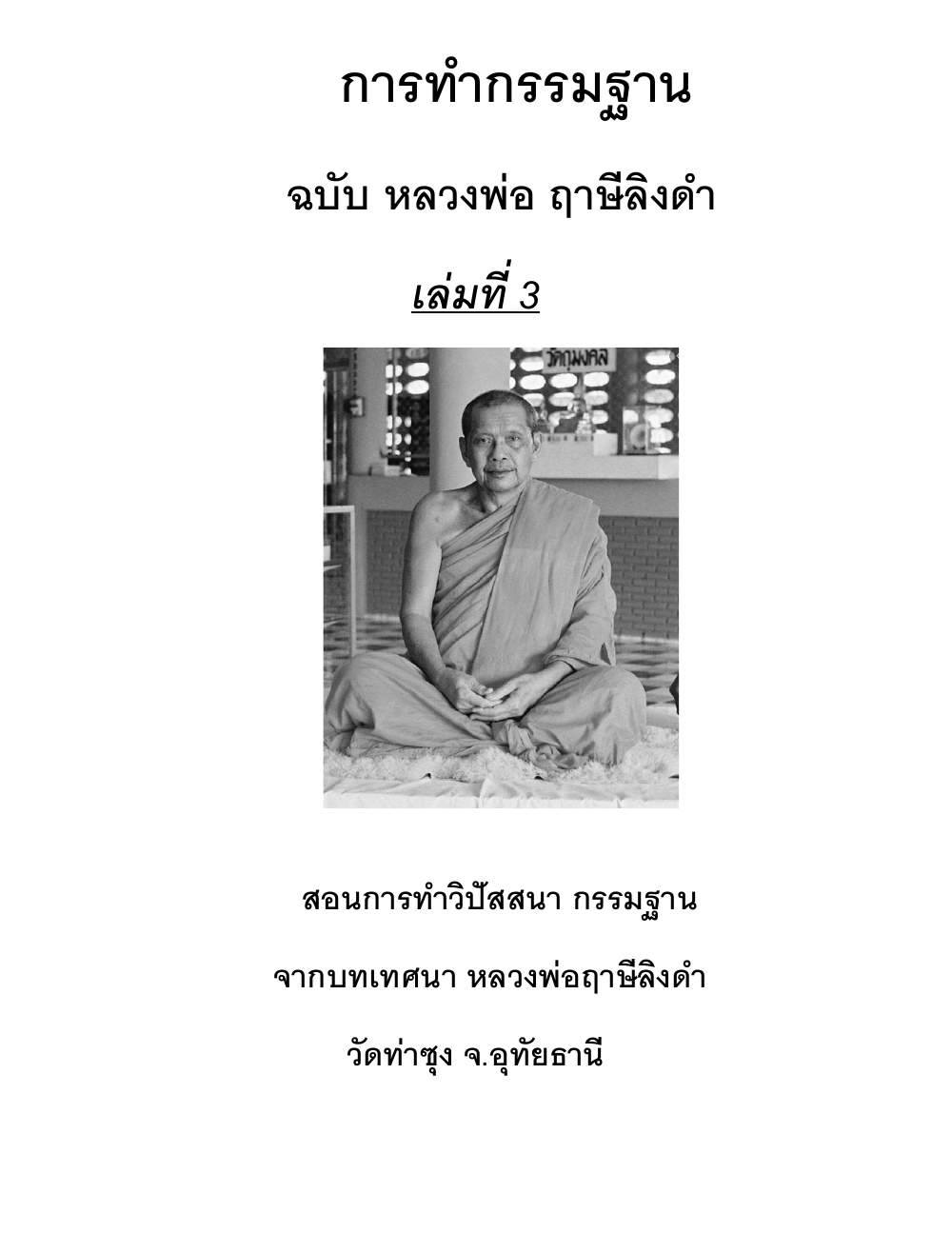
[ภาพ: ภาพถ่ายขาวดำของพระภิกษุสูงอายุนั่งขัดสมาธิ มือประสานวางบนตัก จีวรพาดเฉียงบ่าข้างหนึ่ง อยู่ในอาคารที่มีหน้าต่างบานเกล็ดอยู่ด้านหลัง]
สอนการทำวิปัสสนา กรรมฐาน
จากบทเทศนา หลวงพ่อฤๅษีลิงดำ
วัดท่าซุง จ.อุทัยธานี
The Practice of Meditation (Kammatthana)
Edition of Luang Por Ruesi Ling Dam
Volume 3
[image: black-and-white photograph of an elderly monk seated cross-legged, hands folded in his lap, robe draped diagonally over one shoulder, in a hall with louvered windows visible behind him]
Teaching the practice of vipassanā meditation
From the sermons of Luang Por Ruesi Ling Dam
Wat Tha Sung, Uthai Thani Province
ทีนี้เราจะมองเห็นอย่างไร เราก็ตั้งใจพิจารณาหาความจริง ที่พระพุทธเจ้ากล่าวว่า คนเกิดมาแล้วมันไม่เที่ยง มันเป็นทุกข์ เป็นอนัตตา จริงไหม นั่งมองคนอื่น คนที่เด็กกว่า แล้วก็มองคนที่แก่กว่า สภาพเดิมของเราเป็นเด็ก มาเวลานี้เป็นอย่างนี้ อีกไม่ช้าก็แก่อย่างคนโน้น แล้วก็มองคนที่ตาย ไม่ช้าเราก็ตายอย่างเขานี่แหละ ทีนี้เราจะมามองชีวิตนี้เพื่อมันจะไม่แก่ ไม่เจ็บ ไม่ตาย มีประโยชน์อะไร จะเอาใจเข้าไปยอมรับนับถือว่าเราเกิดมาแล้วมันต้องแก่แน่ และอาการป่วยไข้ไม่สบาย มันก็มีแน่ ทุกข์ประจำกายประจำใจมันก็มีอยู่ตลอดวัน ในที่สุดเราก็ต้องสลายตัว นี่เป็นเพราะอะไร เป็นเพราะความโง่ที่เราเข้ามายึดถือร่างกาย คือ ขันธ์ห้า ถ้าเราไม่ยึดร่างกาย คือขันธ์ห้าเสียอย่างเดียว ถือว่าขันธ์ห้านี่มันไม่ใช่เราไม่ใช่ของเราตามความเป็นจริง ถ้ามันเป็นเราจริงเป็นของเราจริงมันต้องไม่แก่ ไม่ป่วย ไม่ตาย เพราะเราไม่ต้องการให้มันเป็นอย่างนั้น นี่เราห้ามปรามมันไม่ได้
ในเมื่อขันธ์ห้ามันไม่ใช่เราไม่ใช่ของเรา เราควรจะทำอย่างไรเพื่อถึงพระนิพพาน ในเมื่อมันไม่ใช่เราไม่ใช่ของเรา เราก็ปล่อยให้เจ้าของเขาไปเสีย เจ้าของเขาคือกิเลสตัณหา อุปาทาน และอกุศลกรรม เพราะว่าความโลภ ความโกรธ ความหลง นี่เป็นเจ้าของขันธ์ห้า เรากับเขาแยกกันแล้วก็ปล่อยขันธ์ห้าให้เป็นเรื่องของของเขาไปแล้วทำจิตใจของเราให้มีความสุข คิดว่าขันธ์ห้าที่ประกอบไปด้วยธาตุสี่นี่มันไม่ใช่ของเราไม่ใช่เรา มันเป็นเรือนร่างที่เราอาศัยชั่วคราวเหมือนบ้านเช่า เราเข้ามาครองบ้านหลังนี้เมื่อไรก็เต็มไปด้วยความทุกข์เมื่อนั้น นับตั้งแต่บัดนี้เป็นต้นไป เราไม่ต้องการมันอีก เพราะบ้านหลังนี้เต็มไปด้วยความเลว มีความเสื่อมอยู่ตลอดเวลา และมีการสลายตัวไปในที่สุด แล้วก็เต็มไปด้วยความทุกข์ หาความสุขอะไรไม่ได้ ขณะใดถ้าบ้านหลังนี้พังเราสร้างใหม่ บ้านแบบนี้ก็มีทุกข์แบบนี้ เราไม่ต้องการมันอีก เราต้องการบ้านหลังที่ไม่มีกิจต้องทำ มีแต่ความสุข คือความดับจากอารมณ์ของความทุกข์ได้แก่พระนิพพาน
ทำอย่างไร มาปรารภพระนิพพานเป็นอารมณ์นี้ ก็นั่งไล่เบี้ยกันไป โดยย่อนะ พิจารณาว่าร่างกายนี้มันไม่ใช่เรา มันไม่ใช่ของเรา เราไม่มีในร่างกาย ร่างกายไม่มีในเรา แล้วทำอย่างไรเราถึงจะหนีร่างกายไปได้ จะไม่มีร่างกายแบบนี้อีก จะไม่มีการเกิด ทำจิตเข้าถึงพระนิพพานเราก็ใช้ปัญญาพิจารณาคำสอนขององค์สมเด็จพระสัมมาสัมพุทธเจ้าว่า
Now, how shall we look at this? Let us set our mind to contemplate and seek the truth of what the Buddha said: a person who is born is impermanent, is suffering, is not-self. Is this true? Watch other people — those younger than us, then those older than us. Our own original condition was that of a child; now we have become as we are; before long we too will grow old like that other person. Then watch those who have died — before long we too will die just as they did. Now let us look at life itself: for it not to age, not to sicken, not to die — what use is that hope? If we accept and acknowledge that having been born we must certainly grow old, that the state of sickness and unease will certainly come, that suffering of body and mind is present all day long, and that in the end we must dissolve — why is this so? It is because of the folly by which we cling to the body, that is, the five aggregates (khandha). If we simply do not cling to the body — the five aggregates — alone, we hold that these five aggregates, in truth, are not us and are not ours. If they truly were us, truly were ours, they would have to not age, not sicken, not die, because we do not wish them to be that way. This shows we cannot forbid it.
Since the five aggregates are not us and not ours, what should we do to reach Nibbāna? Since they are not us and not ours, we let go and leave them to their true owner. Their owner is the defilements and craving, clinging (upādāna), and unwholesome kamma, because greed, anger, and delusion are the owners of the five aggregates. Once we and they are separated, we release the five aggregates as their affair, and make our own mind happy — thinking that the five aggregates, made up of the four elements, are not ours, are not us; they are a dwelling we inhabit temporarily, like a rented house. From the moment we come to occupy this house, it is filled with suffering. From now on we no longer want it, because this house is filled with badness, constantly deteriorating, and will finally collapse; it is filled with suffering, with no happiness to be found in it at all. Whenever this house collapses and we build a new one, a house of this kind still has suffering of this kind — we no longer want it. We want the house that has no task left to perform, that has only happiness — that is, the cessation of the feeling of suffering, which is Nibbāna.
How is this done — taking Nibbāna itself as the object of contemplation? We sit and go through it point by point, in brief: contemplate that this body is not us, is not ours; we are not in the body, the body is not in us. Then how do we manage to escape the body, so that we will never have a body like this again, so that there will be no more birth? To bring the mind to reach Nibbāna we use wisdom to contemplate the teaching of the Fully Self-Enlightened Buddha, who said:
ควรเชื่อไหม เมื่อพิจารณาด้วยปัญญาเห็นว่าควรเชื่อ พระพุทธเจ้าเทศน์จริงไม่สงสัย ใช้ได้หนึ่งละ เพียงก้าวอีกก้าวหนึ่งก็ถึงพระนิพพาน ในเมื่อเราไม่สงสัยว่าพระพุทธเจ้าเทศน์ตามความเป็นจริงแล้ว อันดับแรกเราก็ต้องตัดอบายภูมิด้วยการรักษาศีลให้บริสุทธิ์ ศีลต้องบริสุทธิ์ทั้งพระเณรและฆราวาส เมื่อถือว่าเป็นพระมีศีล ๒๒๗ นั่นเป็นรูรั่วแห่งจิต ๒๒๗ ข้อใดข้อหนึ่งบกพร่อง แสดงว่าเราเอาเชื้อนรกเข้ามาติดใจ ถ้าเรารักษาศีลบริสุทธิ์ทุกสิกขาบท เราก็ปิดอบายภูมิได้เป็นพระโสดาบัน
ต่อไปทำลายกามฉันทะ ความพอใจในกามคุณ ให้พินาศไปด้วยอำนาจอสุภกรรมฐานกับกายคตาสติกรรมฐาน แล้วทำลายโทสะให้พินาศไปด้วยอำนาจพรหมวิหารสี่ หรือสิณสี่ตามที่กล่าวมา อย่างนี้เราก็เป็นพระอนาคามี อีกก้าวเดียวถึงพระนิพพาน ต่อไปก็ทำกำลังใจเราไม่ให้มัวเมาในรูปฌานและอรูปฌาน ทำลายมานะ ความถือตัวถือตนให้หมดไป ทำลายความฟุ้งซ่านของจิต เราจะตั้งใจภาวนาพิจารณาอย่างไหนตั้งอารมณ์ไว้อย่างนั้นโดยเฉพาะ แล้วก็ตัดความรักความเยื่อใยในมนุษยโลก เทวโลก และพรหมโลก ตัดความเห็นว่ามนุษยโลก เทวโลก และพรหมโลก สวยสดงดงาม เราไม่ต้องการโลกทั้ง ๓ นั้น สิ่งที่เราต้องการคือพระนิพพาน จิตรักพระนิพพานเป็นอารมณ์ หมดจากความโลภ ความโกรธ ความหลง อย่างนี้ชื่อว่าเข้าถึงพระนิพพานในชาติปัจจุบัน
เอาละอุปสมานุสสติวันนี้พูดยาวหน่อย แต่รู้สึกจะสั้นกว่ามรณัสสติกรรมฐาน พูดไว้สำหรับเป็นความรู้แก่บรรดาท่านพุทธบริษัท เป็นนักเจริญกรรมฐานจะต้องศึกษากรรมฐานให้ครบ ๔๐ อย่าง เวลากลางคืนจะพยายามสอนกรรมฐานไปคืนละอย่างสองอย่าง ไอ้สองอย่างมากนักน่ากลัวคงไม่ได้ จะได้เพียงอย่างเดียว บางอย่างก็ใช้สองคืนสามคืนซ้อน ทั้งนี้ก็เพื่อจะได้ให้ท่านทั้งหลายเอาความรู้นี้ไปเป็นเครื่องประดับเวลาที่อารมณ์อย่างใดที่มันเกิดขึ้นในทันทีทันใด ไม่ใช่ว่าเรานั่งภาวนาว่า พุทโธๆ ก็ พุทโธไปเรื่อย ความโลภ ราคะจริตเกิดขึ้นก็พุทโธ โมหะจริตเกิดขึ้นก็พุทโธ โทสะจริตเกิดขึ้น ก็พุทโธ ถ้าศรัทธาจริตเกิดขึ้นนี่พุทโธได้ มีผลแน่นอน ถ้าราคะจริต โทสะจริต โมหะจริต วิตกจริต พุทธจริตเกิดขึ้น พุทโธไม่เป็นเรื่องแน่ ไม่ตรงกัน ต้องใช้กรรมฐานให้ตรงกับอาการของจริตที่เกิดขึ้นในขณะนั้น จึงจะมีผลเข้าถึงพระนิพพานได้ทันที
Should we believe it? When we consider with wisdom and see that it should be believed — that the Buddha's teaching is true beyond doubt — that alone suffices; just one more step and Nibbāna is reached. Once we no longer doubt that the Buddha taught in accordance with truth, the first thing we must do is cut off the woeful states by keeping the precepts pure. The precepts must be pure for both the ordained (monks and novices) and the laity alike. When one holds to the 227 precepts as a monk, each of the 227 is a hole in the mind; a deficiency in any single one shows that we have let the kindling of hell stick to our mind. If we keep every precept pure in every training rule, we can shut off the woeful states and become a Stream-Enterer.
Next, destroy sensual desire — satisfaction in sense pleasures — causing it to perish by the power of the meditation on foulness together with mindfulness of the body. Then destroy anger, causing it to perish by the power of the four Divine Abidings, or the four kasiṇa as already mentioned. In this way we become a Non-Returner — one step more and Nibbāna is reached. Next, strengthen our resolve so as not to be intoxicated by form-jhāna and formless-jhāna; destroy conceit, the holding of self-importance, entirely; destroy the mind's distraction. Whatever object we set our mind to contemplate in meditation, we hold to that object specifically. Then cut off love and attachment to the human world, the deva world, and the Brahma world; cut off the view that the human world, the deva world, and the Brahma world are beautiful and lovely — we want none of these three worlds. What we want is Nibbāna. When the mind loves Nibbāna as its object, free of greed, anger, and delusion — this is called reaching Nibbāna in the present life.
Well then, today's talk on the recollection of peace has run rather long, though I feel it is still shorter than the meditation on recollection of death. It has been given as knowledge for all you Buddhist disciples. One who cultivates meditation must study all 40 kinds of meditation subjects. At night I will try to teach one or two kinds of meditation per night — two might be too much, I'm afraid that won't do; you may only manage one. Some subjects will take two or three nights running. This is so that all of you may take this knowledge as an ornament for whenever some mood arises all at once, suddenly. It is not that we merely sit reciting "Buddho, Buddho" over and over regardless. When greed or a lustful temperament arises, use Buddho; when a deluded temperament arises, use Buddho; when an angry temperament arises, use Buddho — if a temperament of faith arises, then Buddho works and the result is certain. But if a lustful, angry, deluded, speculative, or intellectual temperament arises, Buddho alone will certainly not suffice — it will not match. One must use the meditation subject that matches the state of the temperament arising at that moment; only then will it bear fruit and lead to Nibbāna at once.
เอาละต่อแต่นี้ไปขอท่านทุกคนตั้งกายให้ตรงดำรงจิตให้มั่น กำหนดรู้ลมหายใจเข้าออก เวลาหายใจเข้ารู้อยู่ว่าหายใจเข้า เวลาหายใจออกรู้อยู่ว่าหายใจออก คำภาวนาอย่างอื่นไม่เคยใช้ไม่คล่องอยู่ก็ใช้คำว่า พุทโธ เวลาหายใจเข้านึกว่า พุท เวลาหายใจออกนึกว่า โธ คำภาวนานี้ถ้าบุคคลใดใช้คำภาวนาอย่างอื่นคล่องมาแล้ว ก็ไม่ต้องเปลี่ยน ใช้ภาวนานั้นได้ตามปกติ หรือว่าท่านทั้งหลายจะใช้อารมณ์พิจารณาสมถภาวนาหรือวิปัสสนาภาวนาตามที่กล่าวมาแล้ว ตามที่มีความรู้อยู่เพื่อเป็นการทำลาย ราคะ โทสะ โมหะ ทั้ง ๓ ประการ ก็ให้เป็นไปตามอัธยาศัยจนกว่าจะได้ยินสัญญาณบอกหมดเวลา
***
Well then, from this point on, I ask each of you to hold the body upright and keep the mind firmly established. Note the breath in and out: when breathing in, know that you are breathing in; when breathing out, know that you are breathing out. If you have never used, and are not fluent with, any other word of meditation, then use the word "Buddho": breathing in, think "Bud"; breathing out, think "dho." As for this word of meditation — if a person is already fluent in using some other word of meditation, there is no need to change; that person may continue using it as usual. Or you may use whichever object of contemplation — whether samatha meditation or vipassanā meditation — as already described, according to the knowledge you have, in order to destroy greed, anger, and delusion, these three; let it proceed according to your own inclination, until you hear the signal announcing that time is up.
***
๓๒. อานาปานสติ
สำหรับวันนี้จะได้พูดเรื่องอานาปานสติกรรมฐาน ถือว่าเป็นกรรมฐานอนุสสติข้อสุดท้าย สำหรับอานาปานสติกรรมฐานนี้ ถ้ามหาสติปัฏฐานสูตรท่านขึ้นต้น แต่ว่าด้านอนุสสติท่านเอาวางไว้เป็นข้อสุดท้าย แต่ว่าวิธีปฏิบัติก็ไม่จำเป็นต้องขึ้นมาตั้งแต่พุทธานุสสติก่อน เราจะเอากรรมฐานในอนุสสติ ๑๐ อย่าง อย่างใดอย่างหนึ่งก็ได้ให้เป็นไปตามอัธยาศัย แต่โดยเฉพาะในมหาสติปัฏฐานสูตร ท่านใช้อานาปานสติกรรมฐานเป็นข้อต้น ก็เพราะว่าอานาปานสติเป็นกรรมฐานที่ระงับความฟุ้งซ่านของจิต ถ้าหากจะกล่าวขึ้นโดยจริตก็เป็นกรรมฐานคู่กับวิตกจริตหรือโมหะจริต วิตกแปลว่าตรึกนึกอยู่เสมอ โมหะแปลว่า โง่ ถ้ามันโง่มันก็ตัดสินใจไม่ตกลง ถ้าหากว่าเราจะพูดกันถึงด้านนิวรณ์ โมหะจริตหรือว่าวิตกจริต ก็ได้แก่อุทธัจจะกุกกุจจะคือมีอารมณ์ฟุ้งซ่านและรำคาญ โดยเฉพาะอย่างยิ่งอารมณ์ที่ฟุ้งซ่าน เพราะมันฟุ้งซ่านไม่ทรงอารมณ์ไว้โดยเฉพาะอย่างใดอย่างหนึ่งจึงเกิดความรำคาญ อันนี้การเจริญพระกรรมฐานพระอาจารย์ผู้สอนทั้งหมดที่ปฏิบัติพระกรรมฐานได้มาแล้ว ส่วนใหญ่ท่านให้ขึ้นอานาปานสติก่อนควบกับพุทธานุสสติกรรมฐาน การที่ให้ขึ้นอานาปานสติกรรมฐานก่อน เพราะจิตเราทุกคนมันฟุ้งซ่าน คนทั้งโลกที่จะหาอารมณ์จิตไม่ฟุ้งซ่านไม่มีเลย ฉะนั้นในมหาสติปัฏฐานสูตรจึงขึ้นอานาปานสติกรรมฐานก่อนเพื่อ เพื่อเป็นการระงับอารมณ์ฟุ้งซ่าน
สำหรับอานาปานสตินี้มีการปฏิบัติเป็น ๒ แบบด้วยกัน โดยเฉพาะแบบที่เป็นสุขวิปัสสโกอย่างในมหาสติปัฏฐานสูตร สำหรับมหาสติปัฏฐานสูตรเป็นแบบของสุขวิปัสสโกโดยเฉพาะ ท่านให้กำหนดลมหายใจเข้าออก เวลาหายใจเข้ารู้อยู่ว่าหายใจเข้า เวลาหายใจออกรู้อยู่ว่าหายใจออก เวลาหายใจเข้ายาวหรือสั้น เวลาหายใจออกยาวหรือสั้นให้รู้อยู่ นี่ท่านให้ใช้กำหนดจิตเฉพาะเท่านี้เอง คือไม่มีการปรับพื้นฐานใดๆทั้งสิ้น เพราะว่าสุขวิปัสสโกในอันดับต้นใช้อารมณ์สมาธิเพียงเล็กน้อย แล้วก็พิจารณาวิปัสสนาญาณควบคู่กันไป ไม่จำเป็นต้องตั้งอารมณ์ให้เป็นฌานก่อนทั้งนี้ก็เพราะว่าเป็นการปฏิบัติแบบง่ายๆ
32. Mindfulness of Breathing (Ānāpānasati)
Today I will speak on the meditation of mindfulness of breathing, which is counted as the last of the recollection meditations. Regarding this meditation: in the Mahāsatipaṭṭhāna Sutta it is placed at the very beginning, but among the ten recollections it is placed last. However, the method of practice need not necessarily begin with recollection of the Buddha first — we may take up any one of the ten recollection meditations as we wish, according to inclination. But specifically in the Mahāsatipaṭṭhāna Sutta, mindfulness of breathing is used as the first item, because it is the meditation that calms the mind's distraction. Speaking in terms of temperament, it is the meditation paired with the speculative temperament or the deluded temperament. "Vitakka" means constantly thinking and pondering; "moha" means foolishness — if one is foolish, one cannot make up one's mind. Speaking in terms of the hindrances, the deluded or speculative temperament corresponds to restlessness-and-worry, that is, a distracted and irritated mood — especially the distracted mood, because being distracted it does not hold to any one particular object, and so irritation arises. Now, regarding the cultivation of meditation, all the teaching masters who have already accomplished the practice mostly have students take up mindfulness of breathing first, paired with recollection of the Buddha. The reason for taking up mindfulness of breathing first is that everyone's mind is distracted — there is no one in the whole world whose mind is not distracted. Hence the Mahāsatipaṭṭhāna Sutta places mindfulness of breathing first, in order to calm the distracted mood.
As for this mindfulness of breathing, there are two ways of practicing it together. In particular, the form for the practitioner "liberated by wisdom alone" (sukkhavipassaka), as in the Mahāsatipaṭṭhāna Sutta — the Mahāsatipaṭṭhāna Sutta is specifically the sukkhavipassaka form. In it, one notes the breath in and out: breathing in, know that one is breathing in; breathing out, know that one is breathing out; whether the in-breath is long or short, whether the out-breath is long or short, know it. This is all the fixing of mind that is required — that is, there is no adjusting of any foundation whatsoever, because the sukkhavipassaka practitioner, in the beginning stage, uses only a small degree of concentration, and then contemplates insight-knowledge alongside it. There is no need to first set the object as jhāna, because this is a simple, easy method of practice.
ไม่ต้องการประเภทวิชชาสาม อภิญญา ๖ ปฏิสัมภิทาญาณ ต้องการอย่างเดียว คุมอารมณ์ได้เล็กน้อยก็ควบคุมไปกับวิปัสสนาญาณ แต่เมื่ออาศัยที่พิจารณาวิปัสสนาญาณกับควบคุมกำลังใจเล็กน้อย เมื่อจิตเข้าถึงปฐมญาณ ฌานก็มีอำนาจตัดกิเลสเป็นสมุจเฉทปหานเป็นพระอรหันต์ได้เหมือนกัน เป็นแบบง่ายๆจึงเรียกว่า สุขวิปัสสโก
สำหรับในกรรมฐาน ๔๐ ท่านวางไว้อีกแบบหนึ่ง คือ เฉพาะอานาปานสติกรรมฐานท่านให้กำหนดรู้ลมหายใจเข้าออกเหมือนกัน ทีนี้ในกรรมฐาน ๔๐ ท่านสอนให้ ๔ แบบคือแบบสุขวิปัสสโก เตวิชโช วิชชาสาม ฉฬภิญโญ อภิญญา ๖ ปฏิสัมภิทัปบัตโต คือ ปฏิสัมภิทาญาณ ฉะนั้น การวางอารมณ์พื้นฐานของจิตในตอนต้น จึงวางพื้นฐานอารมณ์ไว้สูงมาก เป็นแบบสายกลางๆ ไม่ใช่ตั้ง ๗ ฐาน ๘ ฐาน นั่นตั้งกันแบบใหม่ สำหรับพระพุทธเจ้าท่านตั้งไว้ ๓ ฐาน คือเวลาหายใจเข้าและหายใจออก เวลาหายใจเข้าให้กำหนดรู้ไว้ที่จมูก ลมจะกระทบที่จมูก ลมจะกระทบไหลเรื่อยไปกระทบที่หน้าอกแล้วกระทบศูนย์เหนือสะดือเล็กน้อย เวลาหายใจออกลมกระทบศูนย์เหนือสะดือกระทบหน้าอก และกระทบริมฝีปากหรือจมูก ถ้าคนริมฝีปากยื่นจะกระทบริมฝีปาก ถ้าริมฝีปากงุ้มรับความรู้สึกที่จมูก นี่จำไว้ให้ดี ถ้าหากว่าท่านทั้งหลายได้อานาปานสติกรรมฐานกองเดียว กรรมฐานอีก ๔๐ กองง่ายมาก กรรมฐานที่ยากจริงๆ ก็คือ อานาปานสติกรรมฐาน แล้วก็เป็นกรรมฐานที่มีความจำเป็นอย่างยิ่งที่จะต้องทำให้ได้ หากว่าท่านไม่ได้อานาปานสติกรรมฐานเสียกองเดียว กรรมฐานกองอื่นไม่มีความหมาย ท่านจะบอกว่าท่านไม่ได้อานาปานสติกรรมฐานแต่ได้กรรมฐานกองอื่นๆด้วย ได้กรรมฐานกองอื่นๆอีก ๓๙ กอง อันนี้ไม่มีใครเขาเชื่อ เพราะมันเชื่อไม่ได้ เราจะเล่นกสิณ ๑๐ อสุภะ ๑๐ อนุสสติ ๑๐ อาหาเรปฏิกูลสัญญา จตุธาตุวัฏฐาน หรือว่าอะไรก็ตาม ถ้าไม่ใช้อานาปานสติกรรมฐานควบคู่แล้วไม่มีทางจะได้ผล เพราะฉะนั้น อานาปานสติกรรมฐานจึงเป็นพื้นฐานใหญ่ที่สุด เป็นตัวนำของกรรมฐานทั้งหมด
นี่เราก็พูดกันมาถึงอนุสสติ ๑๐ ถ้าเรารวบรวม มันจบแค่อานาปานสติ ฉะนั้น อานาปานสติมันก็ต้องพูดกันมากหน่อย เพราะว่าเป็นกรรมฐานใหญ่ ถ้าได้เสียกอง-
There is no need for the type involving the threefold higher knowledge, the six higher knowledges (abhiññā), or the discriminating knowledges. Only one thing is needed: control the mind. Even with only a little control, one proceeds together with insight-knowledge. But relying on contemplating insight-knowledge together with a small degree of mental control, once the mind reaches the first jhāna, that jhāna has the power to cut off defilements by way of total abandonment, and one can become an Arahant all the same. Being an easy method, it is called sukkhavipassaka.
As for the forty meditation subjects, another arrangement is set out: specifically, for mindfulness of breathing, one is likewise told to note the in- and out-breath. Now, within the forty meditation subjects, four methods are taught: the sukkhavipassaka method, the tevijjo (possessor of the threefold higher knowledge), the chaḷabhiñño (possessor of the six higher knowledges), and the paṭisambhidappatto, that is, one who has attained the discriminating knowledges. Therefore the basic mental object set at the outset is set very high, as a middle-course method — not established on seven or eight bases as in the newer arrangement. The Buddha established three bases: that is, during in-breathing and out-breathing. When breathing in, note it at the nose — the breath strikes the nose, then flows on to strike the chest, then strikes the point slightly above the navel. When breathing out, the breath strikes the point above the navel, strikes the chest, and strikes the lips or the nose. If a person's lips protrude, the breath strikes the lips; if the lips curve inward, one takes the sensation at the nose. Remember this well. If you all obtain this one single meditation subject of mindfulness of breathing, the other forty subjects become very easy. The truly difficult meditation subject is precisely mindfulness of breathing, and it is the subject that is absolutely essential to accomplish. If you fail to attain this one subject of mindfulness of breathing, the other meditation subjects have no meaning. You might claim you did not get mindfulness of breathing but got the other subjects instead — got another thirty-nine subjects — but no one will believe this, because it cannot be believed. Whether we practice the ten kasiṇa, the ten foulness-meditations, the ten recollections, the perception of the repulsiveness of food, the four-element meditation, or anything else — if it is not practiced together with mindfulness of breathing, there is no way it will bear fruit. Therefore mindfulness of breathing is the greatest foundation, the leader of all meditation subjects.
So we have now spoken up through the ten recollections. Summing it up, it all ends at mindfulness of breathing. Therefore mindfulness of breathing must be discussed a bit more, because it is a major meditation subject. If one has lost this one...
เดียวกองอื่นก็หมด อานาปานสตินี่ทรงกำลังถึงฌาน ๔ เช่นเดียวกับกสิณ อานาปานสติกรรมฐานเป็นกรรมฐานกองใหญ่ทรงกำลังถึงฌาน ๔ และเป็นกรรมฐานละเอียดจับได้ยาก เมื่อจับอานาปานสติกรรมฐาน ได้กรรมฐานกองอื่นจะรู้สึกเป็นของง่าย
ทีนี้เราทรงอานาปานสติให้คงที่ ให้เข้าถึงระดับฌาน ต้องมีพื้นฐานที่มีความสำคัญตามลำดับ จะยกเรื่องที่พระพุทธเจ้าท่านทรงยกขึ้นไว้ในอุทุมพริกสูตร ในอันดับแรกท่านทั้งหลายจะต้องควบคุมกำลังใจ ให้เรารู้ตัวอยู่เสมอว่าเราจะประพฤติใจของเราให้ตั้งอยู่ในอารมณ์สมาธิหรือว่ามีอารมณ์จิตบริสุทธิ์ เราไม่ยุ่งกับอารมณ์ของบุคคลอื่น จริยาของบุคคลอื่น เขาจะดีหรือเขาจะชั่วแค่ไหนเป็นเรื่องของเขา ไม่เกี่ยวกับเรา เขาดีก็ดีของเขา เขาเลวก็เลวของเขา เราไม่ได้พลอยดี เราไม่ได้พลอยเลวไปด้วย คือเวลานี้เราเข้ามาในเขตของพระพุทธศาสนา องค์สมเด็จพระสัมมาสัมพุทธเจ้าสอนให้เราดี ปฏิบัติความดี คือการที่เราจะปฏิบัติความดีมันจะทำกันอย่างไร พระพุทธเจ้าท่านทรงกล่าวเป็นพระบาลีว่า อตฺตนา โจทยตฺตานํ จงเตือนตนด้วยตนเองอยู่เสมอ อย่าไปเที่ยวนั่งเตือนชาวบ้านเขา เตือนตัวเองแหละเป็นสำคัญ ให้ตัวรู้ตัวไว้ว่าเวลานี้เราทำอะไร เวลานี้เราต้องการอะไร โดยเฉพาะอย่างยิ่งเวลานี้เราเจริญอานาปานสติกรรมฐาน หรือแม้กรรมฐานกองอื่นๆก็เหมือนกัน จะต้องเตือนตนเองไว้เสมอ ให้เรารู้ตัวเองว่า เวลานี้เรารู้ลมหายใจเข้าลมหายใจออก เราต้องการรู้ว่าลมกระทบฐานไหนบ้าง ลมเข้าลมออกกระทบฐานไหนบ้าง นี่เราต้องเตือนตนและบังคับจิตไว้เสมอ
ทีนี้ผลที่จะพึงได้รับ พระพุทธเจ้าท่านทรงกล่าวไว้ว่า อตฺตา หิ อตฺตโน นาโถ ตนแลย่อมเป็นที่พึ่งแห่งตน โก หิ นาโถ ปโร สิยา บุคคลอื่นใครเล่าจะเป็นที่พึ่งเราได้ อตฺตนา หิ สุทนฺเตน นาถํ ลภติ ทุลฺลภํ เมื่อเราฝึกฝนตนของเราดีแล้ว เราจะได้ที่พึ่งอันบุคคลอื่นพึงได้โดยยาก คือ เป็นอันว่าผลของการเจริญสมาธิภาวนาวิปัสสนาญาณ พระพุทธเจ้าทรงยืนยันว่าเราท่านนั้นที่ทำตนเป็นที่พึ่งแห่งตน หมายความว่า ในเมื่อเรารับคำสอนขององค์สมเด็จพระสัมมาสัมพุทธเจ้าแล้วต้องปฏิบัติตามด้วยตนเอง ไม่ใช่จะไปนั่งอ้อนวอนให้ครูบาอาจารย์ช่วยบ้าง ขอบารมีคนนี้ช่วย ขอบารมีพระพุทธเจ้าช่วย ขอบารมีพระปัจเจกพุทธเจ้าช่วย ขอบารมีพระอรหันต์ช่วยขอบารมีเทวดาพรหมช่วย เป็นต้น
...and the other subjects are all mastered. This mindfulness of breathing sustains power all the way to the fourth jhāna, just as the kasiṇa do. Mindfulness-of-breathing meditation is a major meditation subject sustaining power up to the fourth jhāna, and it is a subtle meditation subject that is difficult to grasp. Once one has grasped mindfulness of breathing, the other meditation subjects will feel easy.
Now, to sustain mindfulness of breathing steadily, so that it reaches the level of jhāna, one must have a properly important foundation in due order. I will bring up the matter the Buddha raised in the Udumbarika Sutta. As the first step, you must all control your resolve — keep yourselves constantly aware that we are conducting our minds to remain in a state of concentration, or to have a pure state of mind. We do not concern ourselves with other people's states of mind, other people's conduct. However good or bad they may be is their own affair and has nothing to do with us. If they are good, that is their own goodness; if they are bad, that is their own badness — we do not become good by association, nor do we become bad by association. That is, at this time we have entered the domain of the Buddha's Teaching. The Fully Self-Enlightened Buddha teaches us to be good, to practice goodness. As for how we are to practice goodness, the Buddha spoke in Pali: "Attanā codayattānaṃ" — always admonish yourself by yourself; do not go about sitting in judgment, admonishing other villagers — admonishing yourself is what matters. Keep yourself aware of what you are doing right now, what you need right now — especially, right now, as we cultivate mindfulness-of-breathing meditation, or indeed any other meditation subject as well, we must always remind ourselves, so that we know: right now we know the in-breath and the out-breath; we want to know which base the breath strikes, which base the in-breath and out-breath strike. We must always admonish ourselves and keep the mind under control in this way.
Now, as for the result to be obtained, the Buddha declared: "Attā hi attano nātho" — oneself indeed is one's own refuge; "Ko hi nātho paro siyā" — who else could be a refuge for us? "Attanā hi sudantena nāthaṃ labhati dullabhaṃ" — when we have trained ourselves well, we obtain a refuge that others can obtain only with difficulty. That is, this is the result of cultivating concentration meditation and insight-knowledge. The Buddha affirms that it is we ourselves who make ourselves our own refuge — meaning that once we have received the teaching of the Fully Self-Enlightened Buddha, we must practice it ourselves, not go and sit begging teachers and masters to help now and then — asking for this person's merit-power to help, asking for the Buddha's merit-power to help, asking for a Silent Buddha's merit-power to help, asking for an Arahant's merit-power to help, asking for devas' and Brahmas' merit-power to help, and so on.
เรานึกน้อมถึงความดีขององค์สมเด็จพระสัมมาสัมพุทธเจ้าและท่านอื่นๆ ที่กล่าวมานั้นเป็นของดี แต่ท่วาอย่านึกว่าจะมาให้พระพุทธเจ้าทำจิตเราให้เป็นสมาธิอันนั้นไม่ได้ พระพุทธเจ้าทรงยืนยันไว้แล้วว่า อกฺขาตาโร ตถาคตา ตถาคตเป็นแต่เพียงผู้บอกเท่านั้น ความดีหรือความชั่วเป็นเรื่องของพวกท่านเองจะพึงปฏิบัติ อันนี้จำไว้ให้ดี จำไว้แล้วจงอย่าลืม ลืมเมื่อไรบรรลัยเมื่อนั้น คำว่า บรรลัยนี้เขาแก้ศัพท์ให้มันหย่อนลงมา ตามหลักพระพุทธศาสนาท่านบอกว่า ลืมเมื่อไรฉิบหายเมื่อนั้น เป็นผู้ฉิบหายเสียแล้วจากความดี ศัพท์นี้รู้สึกว่าจะเป็นปกติในทางพระพุทธศาสนา บุคคลใดถ้าจะสลายซึ่งผลซึ่งตนจะพึงได้ พระพุทธเจ้าท่านกล่าวว่าผู้นั้นเป็น ผู้ฉิบหายเสียแล้ว อย่างท่านอาฬารดาบสและอุทกดาบส ซึ่งเป็นพระอาจารย์ สอนให้พระพุทธเจ้าได้สมาบัติ ๔ และสมาบัติ ๘ เมื่อพระองค์ทรงบรรลุอภิเษกสัมมาสัมโพธิญาณใหม่ๆ องค์สมเด็จพระจอมไตรทรงได้ระลึกถึงพระอาจารย์ทั้งสองว่าทั้งสองฟังธรรมของเราเพียงครั้งเดียว จะได้บรรลุอรหัตผล แต่ว่าทั้งสองท่านเวลานี้ ตายจากความเป็นคนไปเกิดเป็นอรูปพรหม ไม่มีโอกาสที่จะรับสัมผัสในการแสดงพระธรรมเทศนา เพราะไม่มีอายตนะ ไม่มีหู ไม่มีตา ไม่มีกายทั้งหมด จึงกล่าวว่าเป็นที่น่าเสียดายที่อาจารย์ทั้งสองเป็นผู้ฉิบหายเสียแล้วจากความดี นี่คำว่าฉิบหายนี้เป็นของธรรมดา เป็นพวกสลายตัวหมดเท่าที่จะได้รับ ถ้าพวกเราบอกว่าฉิบหายนี่เราโกรธ จะไปโกรธเขาทำไม ถ้าเราดี เราก็ไม่ฉิบหาย ไม่บรรลัย ไม่สลายตัว อันนี้เป็นเครื่องเตือนให้ท่านทั้งหลาย ว่าจงอย่าลืมถ้อยคำตามที่กล่าวมาแล้ว จำไว้ว่าเราท่านนั้นที่จะเป็นผู้ช่วยตัวของเราเองได้
ในอันดับแรกจงจำไว้ว่าเราจะไม่ยุ่งกับอารมณ์ของบุคคลใด เราจะไม่ยุ่งกับจริยาของบุคคลใด เราจะสนใจอย่างเดียว ระงับอารมณ์ของเราให้ทรงอยู่ในด้านของกุศลเป็นอันดับแรก เราตั้งใจไว้ว่า เรากำหนดจิตแต่เฉพาะอารมณ์ใดเราจะทรงอารมณ์นั้นไว้ โดยเฉพาะ นี่เป็นจุดเริ่มต้น ถ้าหากว่าท่านทำใจได้ดีอย่างนี้องค์สมเด็จพระสัมมาสัมพุทธเจ้ากล่าวว่าท่านเข้าถึงสะเก็ดของพระพุทธศาสนา เห็นไหมเมื่ออารมณ์ที่ไม่ยุ่งกับความดีและความชั่วของชาวบ้านนั้นเข้าถึงสะเก็ดของพระพุทธศาสนา ถ้าอารมณ์ใจของเรายังยุ่งอยู่ เราก็เข้าไม่ถึงสะเก็ด วัดใจของท่านเองไว้ด้วยนะ นี่เวลานี้เราตั้งใจจะกำหนดรู้ลมหายใจเข้าออก เราก็ตั้งใจกำหนดรู้ลมหายใจเข้าออก เราก็ตั้งใจกำหนดรู้เฉพาะลมหายใจเข้าออก
We call to mind and incline toward the goodness of the Fully Self-Enlightened Buddha and the others just mentioned; that is indeed good. But do not imagine that we can have the Buddha come and make our mind concentrated for us — that cannot be done. The Buddha himself already affirmed: "Akkhātāro Tathāgatā" — Tathāgatas are only those who point the way. Goodness or badness is a matter for each of you yourselves to practice. Keep this well in mind; once remembered, do not forget it. Whenever you forget, that is when ruin comes. This word for "ruin" here is a softened form of the term; according to Buddhist doctrine, it is properly said that whenever you forget, that is when destruction comes — one has already become destroyed from goodness. This term seems to be the ordinary one used in Buddhism. If anyone destroys the result they were due to obtain, the Buddha said that such a person has "already been destroyed" — like the ascetics Āḷāra and Udaka, who were teachers and who taught the Buddha-to-be the four attainments and the eight attainments. When he had newly attained the awakening of full self-enlightenment, the Lord of the Triple World called to mind both his teachers, thinking that had the two of them heard his teaching just once, they would have attained arahantship. But at that time, both of them had already died out of the human state and been reborn as formless Brahma beings, with no opportunity to receive contact through the exposition of the Dhamma, because they had no sense faculties whatsoever — no ears, no eyes, no body at all. Hence it is said to be a pity that both teachers had already become destroyed from goodness. This word "destroyed" is an ordinary term, referring to those who have entirely dissolved away from what they were due to receive. If we call this "destroyed" and get angry about it — why be angry at them? If we ourselves are good, we will not be destroyed, will not come to ruin, will not dissolve away. This serves as a reminder to all of you: do not forget the words spoken above. Remember that we ourselves are the ones who can help ourselves.
As the first step, remember that we will not concern ourselves with any other person's state of mind; we will not concern ourselves with any other person's conduct. We will attend to only one thing: keeping our own state of mind settled on the side of wholesomeness, as the first priority. We resolve that whatever object we fix our mind upon, we will hold to that object specifically. This is the starting point. If you can manage your mind well in this way, the Fully Self-Enlightened Buddha said that you have reached the outer crust of the Buddhist Teaching. You see — when the mind does not concern itself with the goodness or badness of other villagers, that reaches the crust of the Teaching. If our state of mind is still entangled, we do not even reach the crust. Test your own mind on this. Now, at this time, we intend to note the in-breath and out-breath; we intend to note the in-breath and out-breath; we intend to note specifically the in-breath and out-breath.
เพื่อเป็นการกันความฟุ้งซ่านของจิต แต่อีกอีกจะมาตั้งอารมณ์ให้ทรงตัวแบบนี้มันไม่ง่ายนัก พระกรรมฐานไม่ใช่ของง่าย แต่ก็ไม่ใช่ของยาก เมื่อควบคุมอารมณ์ไว้ได้ดีไม่ยุ่งในจริยาของคนอื่นแล้วก็จงรักษาศีลให้บริสุทธิ์ นี่เป็นอันดับสอง เพราะว่าเมื่อพยายามรักษาศีลให้บริสุทธิ์ไม่ทำลายศีลด้วยตัวเอง ไม่ยุให้ชาวบ้านชาวเมืองอื่นเขาทำลายศีล ไม่ยินดีเมื่อบุคคลอื่นทำลายศีลแล้ว
แล้วต่อไปก็ระงับนิวรณ์ห้าประการ นิวรณ์ห้าประการนี้เราต้องเป็นผู้ชนะ ไม่ใช่ผู้แพ้ ถ้าท่านแพ้นิวรณ์ห้าท่านก็เขียนไว้เลือกเอาจะเอานรกขุมไหน ถ้าเป็นพระเป็นเจ้าด้วยยิ่งสบายดีนัก ลงอเวจีมหานรกจะนึกว่าทำไมเข้มข้นนัก ที่อื่นทำไมไม่พูดกัน ก็ที่อื่นเขาไม่ได้สนใจนี่ อยากจะลงนรกขุมไหนเขาก็ตามใจตนเองแต่ว่าสำนักนี้ไม่ต้องการให้ใครลงนรก แต่ว่าถ้าอยากจะลงก็ห้ามไม่ได้เหมือนกัน ได้แต่แนะนำ ทีนี้การที่เราจะทรงสมาธิได้ดี ไม่ยุ่งกับอารมณ์ของบุคคลอื่น มีศีลบริสุทธิ์แล้วยังเอาดีไม่ได้ เคยบอกแล้วว่ามีศีลบริสุทธิ์มันยังไม่ดี พระพุทธเจ้ายังไม่ได้บอกไว้ ยังไม่ถือเป็นสมมติสงฆ์แท้ จะต้องมีอารมณ์ชนะนิวรณ์ห้า ขณะที่เราทรงสมาธิจิตกำหนดลมหายใจเข้าออก จิตจะไม่พะวงถึง
๑. กามฉันทะ คือ รูปสวย เสียงเพราะ รสอร่อย กลิ่นหอม สัมผัสนิ่มนวล อารมณ์ใคร่ครวญในกามารมณ์ ไอ้การอย่างนี้ต้องไม่มีในขณะที่เราทรงสมาธิ หรือกำหนดรู้ลมหายใจเข้าออก
๒. เราจะไม่มีอารมณ์ความโกรธหรือความพยาบาทคิดอยู่ในใจขณะนั้น ๓. ขณะที่เรากำหนดรู้ลมหายใจเข้าออก เราจะตัดความง่วงไม่ให้เป็นเจ้าหัวใจของเรา ๔. เราจะคุมอารมณ์ใจของเราโดยเฉพาะในเวลาที่เราตั้งไว้ ๕. เราจะไม่สงสัยในคำสั่งสอนขององค์สมเด็จพระสัมมาสัมพุทธเจ้าเชื่อว่าผลการปฏิบัตินี้มีผลดีจริงๆ
นิวรณ์ห้าประการนี้ทุกขณะที่ท่านต้องการทรงสมาธิ ทุกท่านจะต้องป้องกันไม่ให้มันเข้ามายุ่งกับจิตเป็นอันขาด แต่ถ้าหากมัวแต่คิดว่า ถ้าหากจะชนะแต่เวลาที่จะเจริญพระกรรมฐานมันยังเบาเกินไป วันหนึ่งเรามานั่งเจริญกรรมฐานกี่นาที เราปล่อยอารมณ์ให้มัน
...so as to guard against the mind's distraction. But moreover, setting the mind to hold steady in this way is not so easy. Meditation practice is not something easy, but neither is it something difficult. Once you have controlled your state of mind well, not becoming entangled in other people's conduct, then keep the precepts pure — this is the second step. Because when one tries to keep the precepts pure, one does not destroy the precepts oneself, does not incite other villagers or townspeople to break the precepts, and does not rejoice when others have already broken the precepts.
Next, one must subdue the five hindrances. As for these five hindrances, we must be the victor, not the loser. If you lose to the five hindrances, it is as if you had written down and chosen for yourself which hell-pit to descend into. If you are ordained as well, all the more comfortable it will be — you will descend into the great Avīci hell wondering why it is so intense. Why is it that elsewhere no one speaks of this? It is because elsewhere they simply are not concerned with it — whichever hell-pit one wishes to descend into is left to one's own will, but this establishment does not want anyone to descend into hell. Still, if someone truly wants to descend, that too cannot be prevented; we can only advise. Now, for us to sustain concentration well, not becoming entangled in others' states of mind, and having pure precepts, is still not enough to attain the good result. I have already told you that having pure precepts alone is still not sufficient — the Buddha has not yet declared it so; it is not yet reckoned as truly belonging to the community of the noble ones. One must also have the state of mind that has conquered the five hindrances. While we sustain concentration, the mind fixed on the in- and out-breath, the mind must not be preoccupied with:
1. Sensual desire — that is, beautiful forms, pleasant sounds, delicious tastes, fragrant smells, soft and pleasing touch, the mood of dwelling upon sense-objects with desire. This sort of activity must not be present while we sustain concentration, or while noting the in- and out-breath.
2. We will have no mood of anger or ill-will occupying the mind at that time.
3. While we note the in- and out-breath, we will cut off drowsiness so that it does not become master of our heart.
4. We will control our own state of mind specifically during the time we have set.
5. We will have no doubt in the teaching of the Fully Self-Enlightened Buddha, believing that the result of this practice truly bears good fruit.
These five hindrances — at every moment you wish to sustain concentration, every one of you must guard against letting them come and entangle the mind, absolutely without exception. But if one merely goes on thinking, "Well, as for winning, the time given to cultivating meditation is still too light" — how many minutes a day do we actually sit and cultivate meditation? We let the mood...
เลื่อนลอยกี่นาที ดูปริมาณของเวลามันพอกันหรือไม่ ถ้าเวลาปริมาณมันพอกัน ก็ยังเรียกว่าเป็นคนกึ่งนรกกึ่งสวรรค์ ความจริงนิวรณ์ห้าประการนี้ โดยเฉพาะอย่างยิ่งถ้าเป็นพระไม่ควรจะให้มันเข้ามายุ่งในจิต แม้แต่วินาทีหนึ่งของ ๒๔ ชั่วโมง ถ้าหากว่านิวรณ์ไม่เข้ามายุ่งกับจิตของท่านเมื่อไร เวลานั้นจิตของท่านทรงตัวเป็นฌานทันที ถ้านิวรณ์ตัวใดตัวหนึ่งเข้ามายุ่งกับใจ เวลานั้นคำว่าสมาธิจิตไม่มีแก่จิตของท่าน เข้าใจไว้ด้วย
เมื่อระงับนิวรณ์จิตใจของเราชนะนิวรณ์ได้โดยเด็ดขาดแล้ว ก็ต้องทรงพรหมวิหารสี่ คือ เมตตา ความรัก แผ่ความรัก ความปรานี ปรารถนาความเป็นมิตรไปในทั่วจักรวาลทั้งปวง ถือว่าเราเป็นคนไม่มีศัตรู สัตว์และบุคคลทั้งหมดย่อมเป็นที่รักของเรา กรุณามีจิตสงสาร ใครจะสงเคราะห์ให้เขามีความสุขทั้งคนและสัตว์ มุทิตา มีจิตอ่อนโยน ยินดีเมื่อบุคคลอื่นได้ดี ไม่อิจฉาริษยาใคร อุเบกขา สิ่งใดที่มันเกินวิสัยซึ่งเกิด แก่ เจ็บ ตาย ความพลัดพรากจากของรักของชอบใจ ความตายจะเข้ามาถึง จิตใจเราไม่ดิ้นรน ปล่อยเป็นเรื่องธรรมดาวางเฉย
หากว่าท่านทรงศีลบริสุทธิ์ ระงับนิวรณ์ห้าประการ ทรงพรหมวิหารสี่ โดยเฉพาะตลอดวันตลอดคืน อย่างนี้พระพุทธเจ้ากล่าวว่า ท่านมีความดีเข้าถึงเปลือกของพระพุทธศาสนา นี่ต้องให้ดีนะ อานาปานสตินี่เราต้องคุยกันมาก เพราะเป็นกรรมฐานกองใหญ่ ก็จะต้องพูดถึงฌาน ๔ หรือฌาน ๘ ว่ากันตามลำดับ นักศึกษาใหม่พึงแล้วก็ตั้งใจทำให้ดีนะ เพราะการสอนพระกรรมฐานตอนกลางคืนนี้ไม่ซ้ำกัน จนกว่าจะจบกรรมฐาน ๔๐ และวิปัสสนาญาณ ใครจะมาก่อนมาหลังไม่รับทราบ เพราะถ้าขึ้นไปดูแล้วเวลานี้เราต้องการอธิบายให้เข้าใจเพื่อผลในการปฏิบัติเท่านั้น ก็จะสอนไปตามประเภทไม่ถอยหลัง
ทีนี้อันดับแรกนี้ก่อนที่จะจบก็ขอให้ท่านทั้งหลายตั้งใจฟังว่า เวลานี้เราจะรู้ลมหายใจเข้าหายใจออก จนกว่าจะสิ้นเวลา ก็จนกว่าจะได้ยินสัญญาณบอกหมดเวลา เอากันเท่านี้ก่อนนะ วันพรุ่งนี้ต่อไปใหม่ ต่อไปนี้ขอให้ทุกท่านตั้งกายให้ตรง ดำรงจิตให้มั่น กำหนดรู้ลมหายใจเข้าออก ใช้คำภาวนาและพิจารณาตามอัธยาศัย จนกว่าจะได้ยินสัญญาณบอกหมดเวลา
***
...drift, for how many minutes? Look at whether the amount of time is comparable or not. Even if the amount of time is comparable, one is still to be called a person half in hell, half in heaven. In truth, these five hindrances — especially if one is ordained — should not be allowed to come and entangle the mind even for a single second out of the 24 hours. Whenever the hindrances do not come to entangle your mind, at that moment your mind is fixed as jhāna immediately. If any one of the hindrances comes to entangle the heart, at that moment the word "concentration" does not apply to your mind — understand this well.
Once the hindrances are subdued and the mind has decisively conquered them, one must then sustain the four Divine Abidings: that is, mettā (loving-kindness) — love, spreading love, compassion, wishing to be a friend throughout the whole universe, holding that we have no enemy, that all beings and persons are dear to us; karuṇā (compassion) — a compassionate mind, wishing to help both people and animals attain happiness; muditā (sympathetic joy) — a gentle mind, rejoicing when others prosper, not envying or begrudging anyone; upekkhā (equanimity) — regarding whatever lies beyond one's control — birth, aging, sickness, death, separation from what is loved and cherished, the arrival of death — the mind does not struggle, but lets it be an ordinary matter and remains equanimous.
If you sustain pure precepts, subdue the five hindrances, and sustain the four Divine Abidings continuously, day and night, in this way the Buddha said that you possess goodness reaching the outer bark of the Buddhist Teaching. This point truly must be done well. As for mindfulness of breathing, we must discuss it at length, because it is a major meditation subject; we will also have to speak of the four jhānas or the eight jhānas, in due order. New students, please set your mind to practice this well, because the teaching of meditation given here at night does not repeat, until the forty meditation subjects and the insight-knowledges are completed. Whoever comes earlier or later, I take no responsibility for that, because right now what we need is to explain so as to be understood, for the sake of the result in practice only; so I will teach according to the proper sequence without going backward.
Now, as the first point, before we finish, I ask you all to listen with intent: at this time we will know the in-breath and the out-breath, until the time runs out — that is, until we hear the signal announcing that time is up. Let us leave it at this much for now; tomorrow we continue anew. From here on, I ask everyone to hold the body upright, keep the mind firmly established, note the in- and out-breath, use the word of meditation and contemplate according to your own inclination, until you hear the signal announcing that time is up.
***
๓๓. พรปีใหม่
ปีใหม่ก็จะคืบคลานเข้ามาถึง ก็เป็นอันว่าชีวิตของเราก้าวเข้ามาอีก ๑ ปี ปีใหม่ที่เคลื่อนเข้ามาเราก็จะแก่เข้าไปอีก ชีวิตของเราก็จะเดินเข้าไปหาความดับ เพราะธรรมดาของชีวิตเมื่อมีความเกิดขึ้นในเบื้องต้นและก็มีความเปลี่ยนแปลงไปในท่ามกลาง และมีการตายแตกทำลายพันธุ์ไปในที่สุด นี่เป็นกฎธรรมดาของสิ่งมีชีวิตที่เราไม่สามารถหลีกเลี่ยงให้พ้นได้ และโดยเฉพาะอย่างยิ่ง พ.ศ. ๒๕๑๙ ที่จะเข้ามาถึงจัดว่าเป็น พ.ศ. ที่มีความวิกฤตที่สุดของชีวิตประเทศไทยในยุคนี้ เพราะว่าตกอยู่ในเขตที่มีความวิกฤตอย่างหนัก ความแปรปรวนเป็นไปของโลก ของชีวิตมนุษย์
อันนี้ก็ถือว่าเป็นปกติธรรมดา องค์สมเด็จพระสัมมาสัมพุทธเจ้าตรัสว่า โลกมีอันจะต้องฉิบหายไปในที่สุด ไม่มีอะไรทรงตัว ทีนี้สำหรับเราเหล่าพุทธบริษัทในฐานะที่ท่านทั้งหลายเป็นพุทธมามกะ คือนับถือพระพุทธเจ้าเป็นสำคัญ พระบาลีกล่าวว่า บุคคลผู้เข้าถึงพระรัตนตรัยย่อมจะไม่สลาย คือจะต้องไม่พินาศไปด้วยอำนาจของโลกซึ่งเต็มไปด้วยความแปรปรวน ทั้งนี้ก็เพราะว่าองค์สมเด็จพระทรงธรรม์บรมศาสดาสัมมาสัมพุทธเจ้าทรงพยากรณ์ไว้ว่าสิ้นเวลา ๒,๕๐๐ ปีเศษ สมเด็จพระบรมโลกเชษฐ์ทรงมีพระพุทธฎีกาตรัสแก่พระอานนท์ว่า อานนฺท ดูก่อน อานนท์ เมื่อพระพุทธศาสนาล่วงไป ๒,๕๐๐ ปีเศษ คือหลังจากกึ่งพุทธกาล ก่อนกึ่งพุทธกาล ๑๕ ปี คือ พ.ศ. ๒๔๘๕ เป็นต้นมา โลกจะเต็มไปด้วยความวิกฤต ไฟจะตกจากอากาศ ไฟจะลุกในอากาศ ฝนเหล็กจะตกจากอากาศ บรรดาคนจะมีความทุกข์ยากล้มตายเป็นอันมาก และองค์สมเด็จพระผู้มีพระภาคเจ้าก็ทรงกล่าวต่อไปอีกว่า อานนฺท ดูก่อน อานนท์ ความวิกฤตคือความร้ายแรงของโลกก่อนกึ่งพุทธกาล ๑๕ ปี จะมีความร้ายแรงก็จริงแหล่ แต่ท่วายังไม่ร้ายแรงเท่าหลังกึ่งพุทธกาล อันนี้องค์สมเด็จพระพิชิตมารบรมศาสดาสัมมาสัมพุทธเจ้าตรัสว่า ดูก่อน อานนท์ ยักษ์หินที่ถูกสาปจะลุกขึ้นอาละวาด ยักษ์นอกพุทธศาสนาจะรบราฆ่าฟันล้มตายกันผ่ายละครึ่งจึงจะหยุดยั้ง - สมณะชีพราหมณ์จะล้มตาย แต่ว่าประเทศที่นับถือพระพุทธศาสนาจะมีภัยอันนี้เหมือนกัน แต่ท่วาไม่ร้ายแรงนัก ไม่ถึงกับพินาศ นี่เป็นคำพยากรณ์ขององค์สมเด็จพระบรมโลกนาถศาสดาสัมมาสัมพุทธเจ้าทรงพยากรณ์ไว้
33. New Year's Blessing
The new year will come creeping in step by step; this simply means our life has advanced one more year. As the new year that is moving in arrives, we too will grow older still; our life will keep walking on toward its extinction, because it is the nature of life that once there is arising at the beginning, there is change in the middle, and finally there is death, breaking apart, and destruction of the lineage. This is the ordinary law of living things, which we cannot escape or avoid. And especially, the coming year B.E. 2519 [1976] is reckoned to be the most critical year of Thai national life in this era, because it falls within a period of very heavy crisis — the turbulence occurring in the world, in human life.
This too is to be regarded as perfectly ordinary. The Fully Self-Enlightened Buddha declared that the world is bound to perish in the end; nothing remains fixed. Now, as for us Buddhists, in our position as followers who hold the Buddha as foremost, the Pali text states: a person who has attained the Triple Gem will not be destroyed — that is, will not perish through the power of the world, which is filled with turbulence. This is because the Fully Self-Enlightened Lord and Great Teacher prophesied that when 2,500-odd years had passed, the Lord and Elder of the World spoke a royal utterance to Ānanda, saying: "Ānanda, Ānanda, behold! When the Buddhist religion has passed 2,500-odd years" — that is, after the midpoint of the Buddhist era, [namely] 15 years before that midpoint, that is, from B.E. 2485 [1942] onward — "the world will be filled with crisis. Fire will fall from the sky, fire will blaze in the sky, iron rain will fall from the sky. People will suffer greatly and die in great numbers." And the Blessed One went on to say further: "Ānanda, behold, Ānanda! The crisis — that is, the severity of the world — 15 years before the midpoint of the Buddhist era, will indeed be severe, but it will not be as severe as after the midpoint of the Buddhist era." On this the Fully Self-Enlightened Lord, Conqueror of Māra, the Great Teacher, declared: "Behold, Ānanda! The stone giant that was cursed will rise up and rampage. Giants outside the Buddhist religion will make war and slaughter one another, falling by half their number, before it will cease — ascetics, monks, and brahmins will perish. But the countries that hold to Buddhism will face this same danger, though not so severely — not to the point of total ruin." This is the prophecy that the Fully Self-Enlightened Lord, Refuge of the World, the Teacher, has prophesied.
ที่นี้คำพยากรณ์ขององค์สมเด็จพระจอมไตรบรมศาสดาสัมมาสัมพุทธเจ้าปรากฏเป็นความจริง คือก่อนกึ่งพุทธกาล ๑๕ ปี คือตั้งแต่ปี ๒๔๘๕ สงครามโลกครั้งที่ ๒ ก็เกิดขึ้น เมื่อสงครามสงบแล้วความวิกฤตของโลกก็ยังไม่สงบ มีการรบราฆ่าฟันเป็นปกติ ระยะนี้เป็นระยะหลังกึ่งพุทธกาลมีสมณะชีพราหมณ์ทั้งหลายล้มตายเป็นอันมาก คำพยากรณ์ขององค์สมเด็จพระผู้มีพระภาคเจ้าจึงตรงตามความเป็นจริง อีกข้อหนึ่งที่องค์สมเด็จพระผู้มีพระภาคเจ้ากล่าวว่าประเทศที่นับถือพระพุทธศาสนาจะมีภัยเหมือนกันแต่ไม่ร้ายแรงนัก โดยเฉพาะอย่างยิ่งประเทศไทยก็ถือกันว่าเป็นประเทศที่ทรงพระพุทธศาสนา
ถ้าเราจะพิจารณากันตามความเป็นจริงจะเห็นว่าประเทศที่นับถือพระพุทธศาสนาทั้งหมดไม่มีประเทศใดที่ทรงคำสั่งสอนขององค์สมเด็จพระบรมสุคตบรมศาสดาสัมมาสัมพุทธเจ้าไว้ได้ครบถ้วนเช่นประเทศไทย ในประเทศไทยเรามีทั้ง พระสูตร พระวินัย ปรมัตถ์ คือพระอภิธรรม สำหรับประเทศอื่น เช่น ประเทศพม่า โดยมากจะไม่เคร่งครัดในเรื่องของพระวินัย โทษในเรื่องพระวินัยเขาไม่เคร่งครัดเพราะถือว่าไม่สำคัญ จะนิยมแต่ในเฉพาะด้านของปรมัตถ์ คือ อภิธรรมเท่านั้น ตามบาลีว่า พระสูตร คือประเทศไทย พระวินัยคือ มอญ อภิธรรม พม่า หมายความว่าในประเทศไทย เรานิยมพระสูตร แต่ว่าเรามีพระวินัยและพระอภิธรรมครบถ้วน สำหรับวินัยมอญก็หมายถึงว่าประเทศมอญเขาเคร่งครัดในพระวินัยแบบชาวมอญ สำหรับพม่านั้นยกพระสูตรทิ้งไป พระวินัยทิ้งไป เหลือพระอภิธรรม เราก็จะเห็นว่าในประเทศไทยยังคงทรงไว้ได้ทั้ง ๓ ประการ คือพระสูตร พระวินัย และพระอภิธรรม ทั้ง ๓ ประการ เมื่อเราพิจารณาตามกระแสพระสัทธรรมเทศนาขององค์สมเด็จพระพุทธญาณท่านทรงพยากรณ์กับพระอานนท์แล้ว จะเห็นว่าประเทศไทยเราคงพระวินัย คือ เคารพองค์สมเด็จพระจอมไตรไว้ตามพระพุทธพยากรณ์ จึงถือว่าประเทศไทยอยู่ในเขตคำพยากรณ์ที่พระพุทธเจ้าทรงพยากรณ์คืออาจจะต้องไม่สลายไป ในการนับถือองค์สมเด็จพระจอมไตรบรมศาสดาที่มีพระบาลีว่า พุทฺโธ อัปปมาโณ คือว่า คุณของพระพุทธเจ้าหาประมาณมิได้ การเคารพในพระธรรมว่า ธมฺโม อัปปมาโณ การเคารพในพระธรรมว่าหาประมาณมิได้ หรือคุณของพระธรรมหาประมาณไม่ได้ สังโฆ อัปปมาโณ คุณของพระอริยสงฆ์หาประมาณมิได้
Now, the prophecy of the Fully Self-Enlightened Lord of the Triple World, the Great Teacher, has proven true: 15 years before the midpoint of the Buddhist era, that is, from the year 2485 [1942] onward, the Second World War broke out. When that war ended, the crisis of the world still did not settle down — fighting and killing continued as the normal state of things. This period, being after the midpoint of the Buddhist era, saw great numbers of ascetics, monks, and brahmins perish. Thus the prophecy of the Blessed One turned out to be exactly true. Another point that the Blessed One stated was that countries which hold to Buddhism would likewise face danger, but not so severely; and Thailand in particular is held to be a country that upholds Buddhism.
If we consider matters truthfully, we shall see that among all the countries that hold to Buddhism, no country has preserved the teaching of the Fully Enlightened Well-Gone Great Teacher as completely as Thailand. In Thailand we have all three: the Sutta, the Vinaya, and the ultimate teaching (paramattha), that is, the Abhidhamma. As for other countries, such as Burma, for the most part they are not strict in matters of the Vinaya — faults regarding the Vinaya are not treated strictly there, because it is considered unimportant; they favor only the side of the paramattha, that is, the Abhidhamma alone. According to the Pali saying: the Sutta belongs to Thailand, the Vinaya belongs to the Mon, the Abhidhamma belongs to Burma — meaning that in Thailand we favor the Sutta, but we also possess the Vinaya and the Abhidhamma in full. As for the Vinaya of the Mon, this means that the Mon country is strict in the Vinaya in the Mon manner. As for Burma, they have set aside the Sutta, set aside the Vinaya, leaving only the Abhidhamma. We can thus see that Thailand still upholds all three — the Sutta, the Vinaya, and the Abhidhamma — together. When we consider this in light of the stream of true Dhamma teaching of the Fully Enlightened Lord of Buddha-knowledge, as he prophesied to Ānanda, we shall see that Thailand upholds the Vinaya — that is, reveres the Lord of the Triple World — in accordance with the Buddha's prophecy. Thailand is therefore held to fall within the scope of the prophecy the Buddha made, meaning it may well not be destroyed. In revering the Fully Self-Enlightened Lord of the Triple World, the Great Teacher, there is the Pali saying: "Buddho appamāṇo" — that is, the virtues of the Buddha are beyond measure. Reverence for the Dhamma: "Dhammo appamāṇo" — reverence for the Dhamma, that it is beyond measure, or that the virtues of the Dhamma are beyond measure. "Saṅgho appamāṇo" — the virtues of the Noble Sangha are beyond measure.
การเคารพในคุณพระรัตนตรัย คือ พระพุทธ พระธรรม พระสงฆ์ สามารถจะยังชีวิตและความสุขของเราให้คงอยู่ได้ปลอดภัยจากอันตราย ดูตัวอย่าง เมื่อองค์สมเด็จพระจอมไตรบรมศาสดาสัมมาสัมพุทธเจ้ายังทรงชีวิตอยู่ในขณะนั้นองค์สมเด็จพระบรมครูเสด็จประทับอยู่ที่พระเวฬุวันมหาวิหาร ในขณะนั้นปรากฏว่าพระเจ้าพิมพิสารบรมกษัตริย์ถูกพระยาชมภูบดีรุกราน เหาะขึ้นมาในอากาศเห็นยอดปราสาทของพระเจ้าพิมพิสารบรมกษัตริย์มีความสวยสดงดงามยิ่งกว่า ความริษยาก็เกิดขึ้น จึงได้ลงมาจากอากาศมายืนอยู่บนยอดปราสาท ชักพระขรรค์อันประจำพระองค์ขึ้นฟันยอดปราสาท ความจริงพระขรรค์นั้นแม้แต่เหล็กท่อนใหญ่ๆ กระทบแล้วไม่หนักนักก็จะขาดไปทันที แต่อาศัยที่พระเจ้าพิมพิสารมีความเคารพในองค์สมเด็จพระมหามุนี คือ พระพุทธ พระธรรม พระสงฆ์ เป็นไตรสรณาคมน์ทั้ง ๓ ประการ โดยเฉพาะอย่างยิ่งพระองค์เป็นพระโสดาบัน ด้วยอำนาจของพุทธานุภาพ ธรรมานุภาพ สังฆานุภาพ จึงป้องกัน แทนที่ยอดปราสาทจะขาด พระขรรค์ของพระยาชมภูก็บิ่นทำลายไป พระยาชมภูมีความเจ็บใจ จึงได้ยกเท้าขึ้นกระทืบยอดปราสาท ก็เป็นเหตุให้เหล็กยอดปราสาทที่มีทะลุองเท้าไป โดนเท้าบาดเจ็บ ถึงกับมีความโกรธมาก จึงเหาะกลับประเทศของพระองค์ และก็ใช้อวิตาศรไปร้อยพระกรรณคือ ร้อยหูของพระเจ้าพิมพิสารบรมกษัตริย์ คือมีศรเป็นกรณีพิเศษ เมื่อศรเข้ามาประกาศว่า เราจะร้อยหูของพระเจ้าพิมพิสารบรมกษัตริย์ พระเจ้าพิมพิสารได้ทราบแล้ว ได้ยินแล้ว เห็นแล้ว ก็มีความกลัว จึงเสด็จไปเผ้าองค์พระประทีปแก้วบรมศาสดาสัมมาสัมพุทธเจ้า ในที่สุดบารมีของพระรัตนตรัยมีพระพุทธเจ้าทรงเป็นประมุขก็ระงับอันตรายนั้นเสียได้ ในที่สุดบังคับให้พระยาชมภูบดีเข้ามาเผ้าสมเด็จพระจอมไตรบรมศาสดา ได้ฟังพระธรรมเทศนามีความเลื่อมใสอุปสมบทในพระพุทธศาสนา และก็ได้สำเร็จอรหัตผล เป็นอริยบุคคลในพระพุทธศาสนา แสดงว่าที่พระเจ้าพิมพิสารบรมกษัตริย์พระบาทท้าวเธอพ้นจากอันตรายได้เพราะอาศัยคุณพระรัตนตรัยเป็นสำคัญ ในฐานะที่พระองค์เข้าถึงความเป็นพระโสดาบัน มีความมั่นคงในคุณของพระพุทธ พระธรรม พระสงฆ์ มีศีลห้าเป็นสมุจเฉท คือ รักษาศีลห้าเป็นปกติ
ฉะนั้น วันนี้เป็นวันที่สุดของปี ๒๕๑๘ ปี พ.ศ. ๒๕๑๙ เข้ามาถึง ก็เป็นปีที่เต็มไปด้วยความวิกฤตของประเทศไทย ฉะนั้น บรรดาท่านพุทธบริษัททั้งหลาย พระภิกษุ
Reverence for the virtues of the Triple Gem — the Buddha, the Dhamma, and the Sangha — can sustain our life and happiness and keep us safe from danger. Consider an example: when the Lord, the Supreme Teacher, the Perfectly Self-Enlightened Buddha, was still living, at that time the Great Teacher was residing at Veluvana Mahavihara. It happened that King Bimbisara, the great monarch, was invaded by King Campabodi. He flew up into the sky and saw that the spire of King Bimbisara's palace was even more beautiful than his own; envy arose in him, so he descended and stood upon the palace spire, drew the sword that was always with him, and struck at the spire. In truth, that sword was so keen that even a thick bar of iron would be severed instantly with no great force. But because King Bimbisara had reverence for the Great Sage — that is, the Buddha, the Dhamma, and the Sangha — the Threefold Refuge in all three respects, and especially because he was a Stream-Enterer (Sotapanna), by the power of the Buddha's might, the Dhamma's might, and the Sangha's might, the spire was protected. Instead of the spire being severed, King Campabodi's sword chipped and broke. Feeling aggrieved, he then stamped his foot upon the spire, which caused the iron of the spire to pierce through his foot and wound it. He became extremely angry, flew back to his own country, and then used an "Avitasorn" (a magical arrow) to pierce through the royal ear — that is, to pierce the ear of King Bimbisara. This was an arrow of a special kind; when it arrived it proclaimed, "We shall pierce the ear of King Bimbisara." When King Bimbisara learned of this, heard it, and saw it, he became afraid, and so went to pay homage to the Lord, the Jewel Lamp, the Great Teacher, the Perfectly Self-Enlightened Buddha. In the end, the power of the Triple Gem, with the Buddha foremost, was able to avert that danger. In the end, King Campabodi too was compelled to come and pay homage to the Supreme Teacher; having heard the Dhamma teaching, he became devoted, was ordained in the Buddhist religion, and attained the fruit of Arahantship, becoming a Noble One within the Buddhist religion. This shows that King Bimbisara escaped danger chiefly by relying on the virtue of the Triple Gem, by virtue of his having attained the state of Stream-Enterer, being firmly established in the virtues of the Buddha, the Dhamma, and the Sangha, and having the Five Precepts as an eradicated defilement — that is, keeping the Five Precepts as a matter of course.
Therefore, today is the last day of the year 2518 [1975 CE]; the year 2519 [1976 CE] B.E. is now arriving, and it will be a year filled with crisis for the country of Thailand. Therefore, may all you Buddhist devotees, monks...
สามเณร อุบาสก อุบาสิกา จงอย่าประมาทในชีวิต จงทรงจิตของท่านให้มีความมั่นคงในคุณพระรัตนตรัยทั้ง ๓ ประการ คือ คุณพระพุทธ พระธรรม พระสงฆ์ ปฏิบัติจิตให้ตรงต่อเฉพาะพระพุทธองค์ว่าที่องค์สมเด็จพระบรมโลกนาถทรงสั่งสอนไว้ เราทำอย่างไรที่ว่าทรงความดีตามที่องค์สมเด็จพระจอมไตรบรมศาสดาสัมมาสัมพุทธเจ้าท่านทรงกล่าวให้พวกเราทุกคนเป็นผู้มีศีลบริสุทธิ์ทุกสิกขาบท คือ โดยเฉพาะอย่างยิ่ง ภิกษุ และสามเณร มีความจำเป็นจะต้องทรงสิกขาบททั้งหมดให้ครบถ้วนบริบูรณ์ สำหรับฆราวาสก็มีความจำเป็นอยู่เหมือนกัน แต่ท่วาบางท่านก็สามารถรักษาสิกขาบทให้ครบถ้วนได้ เพราะความจำเป็นในชีวิต ฉะนั้นขอให้ตั้งสัจธรรมไว้ว่า ถ้าศีลข้อใดก็ดีใน ๕ ข้อนี้ เราจะทรงไว้ได้ตลอดชีวิต จะไม่ละเมิด ให้ตั้งจิตถึงองค์สมเด็จพระสัมมาสัมพุทธเจ้าว่า ในชีวิตของเรานี้ สิกขาบทใดสิกขาบทหนึ่งหรือ ๒ สิกขาบทก็ตามที ซึ่งไม่เกินวิสัยเราจะทรงไว้ให้ครบถ้วน ไม่ยอมให้มัวหมอง สำหรับท่านผู้ใดสามารถจะทรงสิกขาบททั้ง ๕ ประการได้ หรือ ๘ ประการได้ก็ยิ่งดี อย่างนี้ได้ชื่อว่ามีความเคารพในองค์สมเด็จพระชินสีห์บรมศาสดาสัมมาสัมพุทธเจ้า ในการปฏิบัติกาย วาจา ใจ และสำหรับกำลังใจนั้นมีความสำคัญ บรรดาพุทธบริษัททุกท่านทรงความดี คือ นึกถึงบารมีขององค์สมเด็จพระสัมมาสัมพุทธเจ้า พระธรรม และพระสงฆ์ โดยเฉพาะอย่างยิ่งให้มีจิตยึดพระพุทธคุณไว้เป็นสำคัญ
การนึกถึงพระพุทธคุณทำอย่างไร ว่ากันมากไปก็ไม่ถนัด อิติปิโส ภควา ฯลฯ จนจบก็ไม่ไหว ฉะนั้น โบราณาจารย์จึงกำหนดไว้ว่าบุคคลใดผู้ใดมีความนึกถึงบารมีขององค์สมเด็จพระสัมมาสัมพุทธเจ้าก็ให้ภาวนาว่า "พุทโธ" ใช้คำว่า พุทโธ ให้เป็นปกติ ภาวนาไว้ทุกวันทุกคืนตลอดเวลา และการที่เราจะภาวนาไปได้ตลอดเวลา และการที่เราจะภาวนาไปได้ตลอดวันตลอดคืนก็ย่อมเป็นไปไม่ได้ เพราะจิตย่อมมีภาระนึกคิดอย่างโน้นคิดอย่างนี้ บางทีก็ต้องสนทนาปราศรัย ในการที่จะนึกทุกวันทุกเวลาเป็นไปไม่ได้แล้วทำอย่างไรจึงจะไม่ขาด พระโบราณาจารย์ที่มีความฉลาดได้สั่งสอนไว้ว่า ถึงเวลาก่อนจะหลับให้บรรดาพุทธบริษัทกำหนดใจนึกถึงคุณของสมเด็จพระสัมมาสัมพุทธเจ้าเป็นอารมณ์ จะกำหนดการเข้าออกของลมหายใจว่า พุทโธ เวลาหายใจเข้านึกว่า พุท เวลาหายใจออกนึกว่า โธ อย่างนี้เป็นความดี หรือนึกถึงคุณความดีของสมเด็จพระสัมมาสัมพุทธเจ้า และก็เป็นการป้องกันภัยอันตรายเวลาที่ท่านทั้งหลายภาวนาว่า พุทโธ อมน้ำลายไว้ในปาก ภาวนาไว้
Novices, laymen, and laywomen — do not be heedless of your lives. Keep your minds firm in the virtues of the Triple Gem in all three respects, that is, the virtues of the Buddha, the Dhamma, and the Sangha. Direct the mind to be correct specifically toward what the Buddha, the World Protector, has taught. How do we go about upholding goodness according to what the Lord, the Supreme Teacher, the Perfectly Self-Enlightened Buddha, told all of us — to be pure in every training precept? That is, especially for monks and novices, it is necessary to fully and completely uphold all the training precepts. For lay people it is likewise necessary, though some are able to keep the precepts fully while others are limited by the necessities of life. Therefore let us establish this as truth: whichever precept among these five we resolve to uphold for our whole life, we shall not violate it. Set the mind toward the Lord, the Perfectly Self-Enlightened Buddha, [and resolve] that in this life, whichever one or two precepts are not beyond our capacity, we shall uphold them fully, not allowing them to become tainted. For whoever is able to uphold all five precepts, or all eight, so much the better; this is called having reverence for the Lord, the Victorious One, the Supreme Teacher, the Perfectly Self-Enlightened Buddha, in one's conduct of body, speech, and mind — and as for resolve of heart, that is of great importance. All Buddhist devotees who maintain goodness recollect the merit of the Lord, the Perfectly Self-Enlightened Buddha, the Dhamma, and the Sangha, holding the Buddha's virtues especially firmly in mind as paramount.
How does one recollect the Buddha's virtues? To recite at great length is unwieldy — "Itipiso Bhagavā..." and so on to the end is not feasible. Therefore the teachers of old established that whoever wishes to recollect the merit of the Lord, the Perfectly Self-Enlightened Buddha, should recite "Buddho." Use the word "Buddho" as a habitual practice, reciting it every day and every night, at all times. But being able to recite it continuously all day and all night is in fact impossible, because the mind necessarily has the burden of thinking this and that; sometimes one must converse with others. Since it is impossible to be mindful every moment of every day, what then should one do so as not to lapse? The wise teachers of old taught: just before sleeping, let all Buddhist devotees fix the mind on recollecting the virtue of the Lord, the Perfectly Self-Enlightened Buddha, as the meditation object, noting the in-and-out of the breath as "Buddho": on the in-breath think "Bud," on the out-breath think "dho." This is a form of goodness — or simply recollecting the virtuous qualities of the Lord, the Perfectly Self-Enlightened Buddha — and this also protects against danger. At the time when you all recite "Buddho," hold saliva in the mouth while reciting.
จนขึ้นใจ ในจิตมีความสุข ค่อยกลืนน้ำลายลงไป อย่างนี้คุณพระรัตนตรัยมีพระพุทธเจ้าเป็นต้นจะคุ้มครองสรรพอันตรายแก่พุทธบริษัทได้ และเวลาตื่นขึ้นมาใหม่ๆ และก่อนหลับทุกวัน ทำแบบนี้เป็นปกติ เวลาที่ยังตื่นอยู่ ถ้าคิดขึ้นมาได้เมื่อไรก็ทำใจให้นึกถึงความดีขององค์สมเด็จพระสัมมาสัมพุทธเจ้า ภาวนาว่า พุทโธ เป็นปกติ อย่างนี้จิตของบรรดาท่านพุทธบริษัท ชื่อว่าเป็นผู้เข้าถึง พุทธรัตนะ ธรรมรัตนะ และสังฆรัตนะ ทั้ง ๓ ประการ แล้วการนึกถึงความดีของสมเด็จพระพิชิตมารก็ได้ชื่อว่าเข้าถึงความดีทั้ง ๓ ประการครบถ้วน คือ พระพุทธเจ้าจะเป็นพระพุทธเจ้าได้ก็ต้องอาศัย พระธรรม เมื่อทรงธรรมแล้วพระองค์ก็บรรลุอภิเษกสัมมาสัมโพธิญาณเป็นพระพุทธเจ้า ธรรมะของพระพุทธองค์ที่เราจะพบได้ก็อาศัยบรรดาพระอริยสงฆ์ทั้งหลาย ประชุมสังคายนากันร้อยกรองเอาไว้ จึงได้ตกทอดถึงพวกเรา ฉะนั้น การนึกถึงความดีขององค์สมเด็จพระสัมมาสัมพุทธเจ้าจึงชื่อว่าเข้าถึงความดีครบไตรสรณาคมน์ทั้ง ๓ ประการ
การนึกถึงความดีขององค์สมเด็จพระพิชิตมาร ใช้คำว่า พุทโธ เป็นปกติ ถ้าหากว่ากล่าวโดยธรรม์ ถ้าเรามีอารมณ์อ่อน ที่ว่ามีอารมณ์จิตเข้าไม่ถึงฌาน เวลาตายแล้วก็ไปสู่สวรรค์เทวโลก มีชั้นดาวดึงส์เป็นต้น ดูตัวอย่าง มัฏฐกุณฑลีเทพบุตร หรือ สุปติฏฐิตเทพบุตร เป็นต้นหรือสาดะกีเทพธิดา นี่ใช้กำลังจิตมีศรัทธายังอ่อน นึกถึงความดีขององค์สมเด็จพระชินวรบรมศาสดาสัมมาสัมพุทธเจ้าชั่วเวลาเล็กน้อย โดยเฉพาะอย่างยิ่ง สุปติฏฐิตเทพบุตร ทำความชั่วคือฆ่าสัตว์ตัดชีวิตมาตลอดชีวิต เมื่อเวลาจะตายไม่กี่นาที จึงได้นึกถึงความดีขององค์สมเด็จพระสัมมาสัมพุทธเจ้า ได้อาศัยนึกถึงความดีขององค์สมเด็จพระสัมมาสัมพุทธเจ้าในเวลานั้น จิตผ่องใสเวลาตายแทนที่จะไปรับกุศลในอบายภูมิ กลับไปเกิดในสวรรค์ชั้นดาวดึงส์เทวโลก ต่อมาเมื่อองค์สมเด็จพระสัมมาสัมพุทธเจ้าได้ไปเทศน์โปรดพระพุทธมารดา สุปติฏฐิตเทพบุตรได้ฟังอุณหิสวิชัยสูตร จบลง ปรากฏว่าได้บรรลุพระโสดาบัน บาปทั้งหลายที่ท่านทำไว้ไม่มีโอกาสจะให้ผล
นี่การนึกถึงคุณความดีขององค์สมเด็จพระทศพลมีผลต่อบรรดาท่านพุทธบริษัท ถึงแม้ว่าเราจะทำบาปทำกรรมมากมายเพียงใดก็ตามที่อาศัยความดีขององค์สมเด็จพระชินสีห์...
...until it becomes second nature, the mind at ease, gradually swallowing the saliva. In this way, the virtue of the Triple Gem, with the Buddha foremost, will protect Buddhist devotees from every danger. Do this habitually right upon waking and before sleeping every day. While still awake, whenever it occurs to you, direct the mind to recollect the goodness of the Lord, the Perfectly Self-Enlightened Buddha, reciting "Buddho" as a habit. In this way, the minds of all Buddhist devotees are said to have reached the Buddha-Jewel, the Dhamma-Jewel, and the Sangha-Jewel in all three respects. Recollecting the goodness of the Lord, the Conqueror of Māra, is likewise said to fully attain goodness in all three respects: the Buddha could only become a Buddha by relying on the Dhamma; having attained the Dhamma, he attained the consecrated Perfect Self-Awakening and became a Buddha. The Dhamma of the Buddha that we are able to encounter, we owe to the Noble Sangha of old, who assembled in council and compiled it in verse, and so it has been handed down to us. Therefore recollecting the goodness of the Lord, the Perfectly Self-Enlightened Buddha, is said to fully attain the goodness of all three aspects of the Threefold Refuge.
As for recollecting the goodness of the Lord, the Conqueror of Māra, one uses the word "Buddho" as a habit. Strictly speaking, if our faculty is still weak — that is, the mind has not yet entered jhāna — then at death one goes to the heavenly deva-realms, such as the Tāvatiṃsa heaven. Consider the examples of Maṭṭhakuṇḍalī the deva-son, or Supatiṭṭhita the deva-son, and the deva-daughter Sādakī — these used mental power while faith was still weak, recollecting the goodness of the Lord, the Victorious One, the Supreme Teacher, the Perfectly Self-Enlightened Buddha, for only a brief moment. Especially Supatiṭṭhita the deva-son, who committed evil — killing living beings — his whole life; but a few minutes before dying, he recollected the goodness of the Lord, the Perfectly Self-Enlightened Buddha. By relying on that recollection at that moment, his mind became clear at death, and instead of going to the realms of misery, he was reborn in the Tāvatiṃsa heaven. Later, when the Lord, the Perfectly Self-Enlightened Buddha, went to preach to his mother [in the deva realm], Supatiṭṭhita the deva-son heard the Uṇhissavijaya Sutta, and upon its conclusion attained Stream-Entry. All the sins he had committed had no opportunity to bear fruit.
This shows that recollecting the virtuous qualities of the Lord, the Ten-Powered One (Dasabala), brings benefit to all Buddhist devotees. Even though we may have committed sins and evil deeds ever so much, by relying on the goodness of the Lord, the Victorious One...
สามารถจะบำบัดให้เราพ้นไปจากภัยพิบัติ คือพ้นจากอบายภูมิได้ ฉะนั้น ขอบรรดาท่านพุทธบริษัททั้งหลายจงอย่าประมาทในชีวิต คิดว่านับตั้งแต่บัดนี้เป็นต้นไป ปีเก่าจะหมดไป ปีใหม่จะเข้ามาถึง เราจงรักษาสัจธรรม ทรงความดีเข้าไว้ คือ จะนึกถึงความดีขององค์สมเด็จพระจอมไตรบรมศาสดาสัมมาสัมพุทธเจ้าไม่หยุดยั้ง คือว่าปี พ.ศ. ๒๕๑๙ เป็นปีที่จะเต็มไปด้วยวิกฤติการณ์อย่างที่สุด โดยวิธีที่เราจะใช้ในฐานะที่เป็นมนุษย์ธรรมดาเพื่อความพ้นอันตราย ดูตัวอย่างพระเจ้าพิมพิสารบรมกษัตริย์พระบาทท้าวเธอต้องถูกทำร้ายจากพระยาชมภูบดี แต่อาศัยที่มีความเคารพในองค์สมเด็จพระชินสีห์บรมศาสดาอย่างมั่นคง ในที่สุดอันตรายก็ยุติลงด้วยอำนาจของพระพุทธเจ้า นี่ในสมัยพระพุทธเจ้า ถ้ามาในสมัยหลังเมื่อสมัยที่พระมหากษัตริย์มีอำนาจเป็นพิเศษ ขณะนั้น ปรากฏว่าข้าราชบริพารของพระองค์ท่านหลายท่านที่อาตมารู้จักเป็นกลุ่มๆ บุคคลกลุ่มใหญ่มีความเคารพองค์สมเด็จพระจอมไตรบรมศาสดาสัมมาสัมพุทธเจ้าเป็นปกติ คือในยามปกติพวกเขาเหล่านั้นจะไม่คล้องพระเครื่องอยู่ในตัว เขาถือว่าจิตใจของเขาเข้าถึงพระอยู่เป็นปกติ แต่ว่าภาวนาของบุคคลพวกนี้ไม่ขาด พอตื่นขึ้นมาเช้าก็จับคำว่า พุทโธ อยู่เป็นปกติ เวลายามว่าง เมื่อจิตว่างจากกิจอื่นก็จะใช้คำภาวนาว่า พุทโธ เวลาที่ไม่ลืมเกรงว่าจะลืม เวลาเช้า เวลาที่จะไปไหนหรืออยู่บ้านก็ตามเกรงว่าอันตรายจะมีต่อเขา เขาแนะนำ นี้อาตมาเคยได้รับทราบมาเอง คือได้รับคำแนะนำจากคนผู้นั้นจากปากเขาเอง บอกว่า เวลาที่เราเกรงว่าจะเกิดอันตรายต่อร่างกายให้อมน้ำลายไว้ในปาก ภาวนาว่า พุทโธ ให้ขึ้นใจเป็นการเสกทำลายแล้วกลืนลงไป ๓ ครั้ง บุคคลประเภทนี้แม้จะปะทะข้าศึกหนักศัตรูหนักเพียงใดก็ตาม ก็มีการแคล้วคลาด
ถ้ามีความดีเป็นที่สุดขนาดหนัก ถ้ามีจิตทรงความดีขนาดกลางเขาบอกว่ายิงของเขาไม่ออก ถ้าว่าทรงความดีขนาดเบา ใจยังเบาอยู่ ยังไม่เข้าถึงที่สุด ยิงไม่เข้า เขาว่าอย่างนั้น ความจริงก็เป็นไปตามนั้น เพราะเคยไปด้วยกัน เขาปลอดจากอันตรายจากสรรพาวุธทุกอย่าง ฉะนั้น ขอบรรดาท่านพุทธบริษัทจงอย่าวางใจ จงอย่าประมาทในชีวิต จงคิดว่า คุณของพระพุทธเจ้า คุณของพระธรรม คุณของพระสงฆ์ทั้ง ๓ ประการ จะ
...are able to cure us and free us from calamity, that is, free us from the realms of misery. Therefore, may all Buddhist devotees not be heedless of life. Consider that from this moment on, the old year will pass away and the new year will arrive; let us maintain the truth and hold to goodness — that is, recollect the goodness of the Lord, the Supreme Teacher, the Perfectly Self-Enlightened Buddha, without ceasing. The year 2519 B.E. [1976] will be a year utterly full of crisis. As for the method we, as ordinary human beings, will use to escape danger — consider the example of King Bimbisara, whose royal person was attacked by King Campabodi, but because of his firm reverence for the Lord, the Victorious One, the Great Teacher, in the end the danger was ended by the power of the Buddha. That was in the Buddha's own time. Coming to later ages, in a time when kings held special power, it happened that there were royal attendants — many of whom I personally knew, forming groups — a large group of people who habitually revered the Lord, the Supreme Teacher, the Perfectly Self-Enlightened Buddha. That is, in ordinary times they would not wear amulets on their bodies at all; they held that their minds were habitually already established with the Buddha. But their recitation never lapsed. As soon as they woke each morning, they would take up the word "Buddho" as a habit. In free moments, whenever the mind was free of other duties, they used the recitation "Buddho" — at times when they feared they might forget, in the morning, whenever going anywhere or staying at home, fearing danger might befall them, they were so advised. I myself once learned this directly — that is, I received the advice from that very person, from his own mouth. He said: "At times when we fear physical danger, hold saliva in the mouth, recite 'Buddho' fixing it firmly in mind as an act of consecration, then swallow it down three times." People of this sort, however heavy the clash with the enemy, however formidable the foe, always came through unharmed.
If one's goodness is at the utmost, heaviest degree [danger is fully averted]. If the mind holds goodness at a medium degree, they say the enemy's weapon will not fire at all. If one holds goodness at only a light degree, the mind still light, not yet reaching the utmost, the shot will not penetrate — so they say, and in truth it happens exactly so, because I went through it together with them; they were safe from every kind of weapon. Therefore, may all Buddhist devotees not be complacent, not be heedless of life. Think that the virtue of the Buddha, the virtue of the Dhamma, and the virtue of the Sangha, in all three respects, will...
สามารถทรงเราให้มีชีวิตอยู่ได้ นี่กล่าวโดยเฉพาะ ถ้าเราสิ้นอายุขัย การนึกถึงความดีขององค์สมเด็จพระจอมไตรบรมศาสดาสัมมาสัมพุทธเจ้าก็จะทำให้เราพ้นทุกข์
ฉะนั้น นับตั้งแต่นี้ต่อไป ตั้งใจไว้ว่าจนกว่าจะสิ้นปี พ.ศ. ๒๕๑๙ ที่เต็มไปด้วยความวิกฤตทุกทิศของโลกจะเต็มไปด้วยความเร่าร้อน เราจะยึดเอาคุณความดีขององค์สมเด็จพระชินวรบรมศาสดาสัมมาสัมพุทธเจ้าเข้าไว้เป็นประจำ คือ คำภาวนาว่า พุทโธ พุทโธ เป็นปกติ ถ้าเป็นอย่างนี้บรรดาท่านพุทธบริษัททั้งหลายจะมีความสุขในชีวิต คือ จิตของท่านจะทรงสมาธิ อำนาจบารมีของพระพุทธเจ้าจะทำจิตใจของท่านให้เยือกเย็นมีความสุข อันตรายจะเกิดขึ้นกับท่านทั้งหลายก็จะพ้นภัยและด้วยอำนาจของพุทธานุภาพ ธรรมานุภาพ สังฆานุภาพ แต่ถ้าชีวิตอายุขัยที่จะสิ้นไปเมื่อไร ความดีขององค์สมเด็จพระจอมไตรบรมศาสดาสัมมาสัมพุทธเจ้าก็จะบันดาลให้เราพ้นอบายภูมิทั้ง ๔ ประการ คือ ไม่เกิดเป็นสัตว์นรก เป็นเปรต เป็นอสุรกาย เป็นสัตว์เดรัจฉาน อย่างเลวที่สุดเราก็จะเป็นเทวดา ถ้าจิตใจมีสมาธิแรงกล้าเราจะเข้าถึงการเป็นพรหม ถ้าจิตของเราโดยนิยมไม่ยึดในขันธ์ห้า หรือว่ารูป เวทนา สัญญา สังขาร วิญญาณ ไม่ใช่เรา ไม่ใช่ของเรา จิตเราเกาะองค์สมเด็จพระสัมมาสัมพุทธเจ้า ว่าพระพุทธเจ้าอยู่ที่ไหนเราจะไปที่นั่น เอาใจตรงนี้ยึดองค์สมเด็จพระทรงธรรม์บรมศาสดานั้นเอง ถ้าเป็นอย่างนี้แล้วพุทธบริษัททั้งหลายถ้าจะพ้นจากกิเลสจะเข้าถึงพระนิพพานได้
เอาละบรรดาท่านพุทธบริษัททั้งหลาย สำหรับปีเก่าจะสิ้นไป ปีใหม่จะเข้ามา ขออำนาจพุทธบารมีขององค์สมเด็จพระชินสีห์บรมศาสดาสัมมาสัมพุทธเจ้าเป็นประธาน และพระธรรมคำสั่งสอนขององค์สมเด็จพระพิชิตมารบรมศาสดาสัมมาสัมพุทธเจ้าพร้อมไปด้วยพระอริยสงฆ์ทั้งหมดที่มีความเคารพในองค์สมเด็จพระบรมสุคตศาสดาสัมมาสัมพุทธเจ้าเป็นที่สุด จงปกปักรักษาบรรดาท่านพุทธบริษัททุกท่านให้มีความมั่นในคุณพระรัตนตรัย ขอให้ปลอดภัยจากภัยอันตรายทั้งหมด ภัยใดๆ ที่ปรากฏต่อโลกจงอย่ามีกับพุทธบริษัท ขอให้จิตใจของท่านพุทธบริษัทมีความปลอดโปร่งพ้นจากกิเลสเป็นสมุจเฉทปหาน เข้าถึงซึ่งพระนิพพานได้ในชาตินี้
...is able to sustain us and keep us alive. This applies especially to the time our lifespan is about to end: recollecting the goodness of the Lord, the Supreme Teacher, the Perfectly Self-Enlightened Buddha, will free us from suffering.
Therefore, from now on, resolve that until the end of the year 2519 B.E. [1976], a year full of crisis when every direction of the world will be filled with turmoil, we shall hold constantly to the virtuous goodness of the Lord, the Victorious One, the Supreme Teacher, the Perfectly Self-Enlightened Buddha — that is, the recitation "Buddho, Buddho" as a habit. If this is done, all Buddhist devotees will have happiness in life, for their minds will be established in concentration; the power and merit of the Buddha will make their minds cool and at ease. Whatever danger may arise for them will be averted by the power of the Buddha's might, the Dhamma's might, and the Sangha's might. But when the time comes that our lifespan ends, the goodness of the Lord, the Supreme Teacher, the Perfectly Self-Enlightened Buddha, will cause us to escape all four realms of misery — that is, not being reborn as a hell-being, a hungry ghost, an asura, or an animal. At the very least we would become a deva; if the mind has strong concentration we would attain the state of a Brahma. If our mind, as a matter of habit, does not cling to the Five Aggregates — [knowing that] form, feeling, perception, mental formations, and consciousness are not us, not ours — and our mind clings instead to the Lord, the Perfectly Self-Enlightened Buddha, [thinking] "wherever the Buddha is, there I shall go," fixing the heart here, clinging to the Lord, the Dhamma-holder, the Great Teacher himself — if this is done, then all Buddhist devotees, once freed from defilements, will be able to attain Nibbāna.
Well then, all you Buddhist devotees, as the old year is about to end and the new year is about to come, may the power and merit of the Lord, the Victorious One, the Supreme Teacher, the Perfectly Self-Enlightened Buddha, be foremost, and may the Dhamma teaching of the Lord, the Conqueror of Māra, the Great Teacher, the Perfectly Self-Enlightened Buddha, together with all the Noble Sangha who hold the utmost reverence for the Lord, the Well-Gone One, the Great Teacher, the Perfectly Self-Enlightened Buddha, protect and guard all of you Buddhist devotees, keeping you firm in the virtue of the Triple Gem. May you be safe from every danger. Whatever danger appears in the world, may it not befall the Buddhist devotees. May the minds of you Buddhist devotees be clear and free, released from defilements through total eradication, and may you attain Nibbāna in this very life.
เราท่านพุทธบริษัททุกท่าน กาลเวลาที่จะพูดก็เลยมาแล้ว ต่อแต่นี้ไปขอบรรดาท่านพุทธบริษัททั้งหลายจงปฏิบัติตามคำสั่งสอนขององค์สมเด็จพระประทีปแก้ว ยึดอานาปานสติเป็นอารมณ์ กำหนดรู้ลมหายใจเข้าออก เวลาหายใจเข้ารู้อยู่ว่าหายใจเข้า เวลาหายใจออกรู้อยู่ว่าหายใจออก เวลาหายใจเข้านึกว่า พุท เวลาหายใจออกนึกว่า โธ หรือว่าท่านพุทธบริษัทท่านใดจะพิจารณาวิปัสสนาญาณ กรรมฐานบทใดไปตามความประสงค์ จนกว่าจะได้ยินสัญญาณบอกหมดเวลา
***
[ส่วนที่เหลือของหน้านี้จางมากจนอ่านไม่ออก]
We, all you Buddhist devotees — the time allotted for speaking has now run out. From here on, may all you Buddhist devotees practice according to the teaching of the Lord, the Jewel Lamp. Hold mindfulness of breathing (ānāpānasati) as your object [of meditation]. Note the in-breath and out-breath: on the in-breath, know that you are breathing in; on the out-breath, know that you are breathing out. On the in-breath think "Bud," on the out-breath think "dho." Or, if any of you Buddhist devotees wish to contemplate insight-knowledge (vipassanā-ñāṇa), or any other meditation subject, according to your own wish, [continue] until you hear the signal announcing that the time is up.
***
[The remainder of this page is too faint to read]
๓๔. อานาปานสติ
บัดนี้บรรดาท่านพุทธบริษัททั้งหลายได้พากันสมาทานศีลและสมาทานพระกรรมฐานแล้ว ต่อนี้ไปก็เป็นโอกาสที่บรรดาพุทธบริษัททั้งหลายจะพึงกำหนดจิตให้เป็นสมาธิวิปัสสนาญาณ
สำหรับวันนี้ก็จะพูดถึงอานาปานสติกรรมฐานต่อ แต่ว่าก่อนที่บรรดาท่านพุทธบริษัทจะใช้อารมณ์เป็นอานาปานสติกรรมฐานหรือว่ากรรมฐานกองใดก็ตามที่ได้เคยศึกษามา ในตอนต้นขอบรรดาท่านพุทธบริษัทกำหนดใจหาความจริงของขันธ์ห้าไว้เป็นปกติ ความจริงที่เราควรจะยอมรับนับถือที่เราเรียกว่าอริยสัจ กล่าวโดยย่อ คือ อนิจจัง–ความไม่เที่ยง ทุกขัง–ความทุกข์ อนัตตา การสลายตัว
เมื่อความเกิดมีขึ้นร่างกายย่อมมีความเปลี่ยนแปลงเป็นปกติ คือ จากความเป็นเด็กถึงความเป็นผู้ใหญ่ ความมีสภาพร่างกายแข็งแรงสมบูรณ์บริบูรณ์เข้าถึงความเสื่อม การทรงตัวในฐานะเป็นคนปกติมาถึงความเป็นคนป่วยไข้ไม่สบาย จากความเป็นหนุ่มเป็นสาวมาถึงคราวเป็นคนแก่ นี่เรียกว่าความเสื่อม คือความไม่เที่ยง ความไม่เที่ยงอย่างนี้ย่อมมีเป็นปกติธรรมดาของคนและสัตว์ที่เกิดมาในโลก
แต่ความไม่เที่ยงปรากฏมันก็มีความทุกข์ คือความไม่สบายกายไม่สบายใจเกิดขึ้น เราไม่ต้องการความไม่เที่ยง แต่ความไม่เที่ยงมันก็จะต้องมี เราห้ามอาการมันไม่ได้เพราะมันเป็นปกติธรรมดา ถ้าเราไม่ใช้ปัญญาพิจารณาหาความจริง อารมณ์ทุกข์มันก็เกิด เกิดตรงไหน เกิดตรงที่เราไม่ต้องการความเปลี่ยนแปลงของร่างกาย เราไม่ต้องการความป่วยไข้ของร่างกาย เราไม่ต้องการความปรารถนาไม่สมหวังที่เกิดขึ้นกับจิตแต่มันก็ต้องมี มีความไม่ต้องการความไม่ปรารถนา การมีอารมณ์ความรู้สึกฝ่าฝืนอาการที่เป็นไปตามปกติ อย่างนี้เรียกว่าคนที่ไร้ปัญญา ขาดการพิจารณาหาความจริง เมื่อขาดการพิจารณาตามความเป็นจริง เมื่อความจริงมาปรากฏเราไม่ต้องการ ความทุกข์มันก็เกิด เพราะมันมีอารมณ์ฝืน
เมื่อองค์สมเด็จพระสัมมาสัมพุทธเจ้าทรงสอนให้เรายอมรับนับถือกฎของความเป็นจริง เรามีอารมณ์รู้อยู่เสมอว่าเมื่อความเกิดมีขึ้นแล้ว ความเปลี่ยนแปลงมันย่อมปรากฏ
34. Mindfulness of Breathing (Ānāpānasati)
Now that all of you Buddhist devotees have together undertaken the precepts and undertaken the meditation subject, this next period is an occasion for you all to fix the mind in concentration and insight-knowledge.
For today I shall continue speaking on the ānāpānasati meditation subject. But before you take up ānāpānasati, or any other meditation subject you may have studied before, as your object, I first ask all of you to fix your minds habitually on the truth of the Five Aggregates. The truth we should accept and hold to, which we call the Noble Truths, stated briefly, is: aniccaṃ — impermanence; dukkhaṃ — suffering; anattā — dissolution/non-self.
When birth occurs, the body naturally undergoes change as a matter of course — from being a child to being an adult, from having a strong and complete body to reaching decline, from maintaining the state of an ordinary healthy person to becoming a sick and unwell person, from being young to becoming old. This is called decline, that is, impermanence. Such impermanence is the ordinary nature of people and creatures born into the world.
But when impermanence manifests, suffering also arises — that is, physical and mental discomfort occurs. We do not want impermanence, yet impermanence must occur regardless. We cannot forbid its occurrence, because it is ordinary nature. If we do not use wisdom to contemplate and seek the truth, painful feeling arises. Where does it arise? It arises precisely where we do not want change in the body, do not want the body's sickness, do not want unfulfilled desires that arise in the mind — yet these must occur regardless. Having the wish for things to be otherwise, having a feeling that resists what naturally occurs — this is called being a person devoid of wisdom, lacking contemplation of the truth. When one lacks contemplation according to reality, when the truth appears and we do not want it, suffering then arises, because there is a resisting mental state.
When the Lord, the Perfectly Self-Enlightened Buddha, taught us to accept and respect the law of reality, we maintain constant awareness that once birth has occurred, change will inevitably appear.
ความแก่เข้ามาถึง ความป่วยไข้ไม่สบายเข้ามาถึง ความตายจะเข้ามาถึงในที่สุด อาการพลัดพรากจากของรักของชอบใจยังมีอยู่ ในเมื่อจิตของเรายอมรับความเป็นจริงยอมรับนับถือกฎธรรมดาแบบนี้แล้ว ถ้าอาการเหล่านี้ทั้งหลายปรากฏ จิตเราก็มีความสบาย เรารู้อยู่แล้วว่าอาการมันจะต้องเป็นอย่างนั้น ต่อมาเมื่อความตายมันเข้ามาถึงเราก็ถือว่าเป็นเรื่องธรรมดา เพราะว่าอะไร เพราะว่ามันเกิดแก่เจ็บแล้วก็ตายในที่สุด เป็นอันว่าความเกิดมีขึ้นก็มีความตายคู่กันเป็นของธรรมดา
เมื่อความตายมันมีแล้วก็หันไปพิจารณาร่างกายมันเป็นเราเป็นของเราจริงหรือเปล่า ก็จะเห็นว่าร่างกายมันไม่ใช่เราไม่ใช่ของเรา เพราะว่ามันมีความเกิดในเบื้องต้น มันมีความแก่ในท่ามกลางมีการแตกสลายไปในที่สุด เราไม่ต้องการอย่างนั้น แต่เราก็ไม่สามารถจะห้ามปรามมันได้ ถ้ามันเป็นเราจริงเป็นของเราจริง เราก็ห้ามมันได้ ในเมื่อเห็นว่ามันไม่ใช่เรา ไม่ใช่ของเรา ถ้าเราจะหลงความเกิดต่อไป เราก็ต้องพบกับความตายอย่างนี้อีก นี่พระพุทธเจ้าท่านให้วางภาระในการเกิดเสีย เมื่อเราไม่เกิดมันก็ไม่ตาย
แล้วการที่เราไม่เกิดเราจะทำอย่างไร เราก็ต้องทำจิตให้บริบูรณ์ไปด้วยทาน ตัดโลภะ ความโลภ จิตบริบูรณ์ไปด้วยศีล ตัดโทสะ ความโกรธ เพราะศีลจะมีได้เพราะอำนาจเมตตาบารมีเป็นสำคัญ แล้วก็ตัดความหลงการยึดถือสภาพร่างกายเป็นเราเป็นของเราเสีย ถือว่ามันมีความเกิดในเบื้องต้นก็ต้องมีการเปลี่ยนแปลงไปในท่ามกลาง มีความแตกสลายไปในที่สุด อย่างนี้เป็นภาระที่มีความทุกข์ อย่างนี้เราไม่ต้องการมันอีก ไม่ยึดถือขันธ์ห้าว่าเป็นเราเป็นของเราต่อไป ที่นี้จิตใจของเราก็มีความสุข นี่พูดถึงวิปัสสนาญาณ โดยย่อควรคิดไว้เป็นปกติ แล้วควรคิดให้มันแนบเนียนไปกว่านี้ แต่นี้มันเบื้องต้นธรรมดา ท่านพุทธศาสนิกชนคิดได้ก็จะมีความสบายใจขึ้นมาก
ที่นี้อารมณ์ที่จะทรงวิปัสสนาญาณได้จริงๆ อารมณ์ของบรรดาท่านพุทธบริษัทชายหญิงจะต้องมีสมาธิจิตเป็นสำคัญ ต้องระงับอารมณ์ฟุ้งซ่านให้สิ้นไป ไม่ยอมให้อารมณ์ใดๆ เข้ามายุ่งกับร่างกายในเมื่อเราพิจารณาในวิปัสสนาญาณ การระงับอารมณ์ฟุ้งซ่านนั้นองค์สมเด็จพระพิชิตมารบรมศาสดากล่าวว่าต้องใช้อานาปานสติกรรมฐานเป็นสำคัญ เพราะอานาปานสติกรรมฐานเป็นกรรมฐานที่ระงับอารมณ์ฟุ้งซ่านของจิต อานาปานสติกรรม-
Old age arrives, sickness and discomfort arrive, and death will arrive in the end; the experience of separation from what is loved and cherished still occurs. Once our minds accept this reality and accept and respect this ordinary law, then when all these conditions appear, our minds remain at ease, for we already know that it must be so. Later, when death itself arrives, we regard it as an ordinary matter — why so? Because birth is followed by aging, illness, and finally death; thus, once birth occurs, death is its natural counterpart.
Once death has [thus been accepted], we turn to consider whether the body is truly us, truly ours, or not; we will see that the body is not us, not ours, because it has a beginning in birth, undergoes aging in the middle, and disintegrates in the end. We do not want this, yet we cannot prevent it. If it were truly us, truly ours, we would be able to prevent it. Seeing that it is not us, not ours — if we continue to be deluded about birth, we will again meet with death in this way. This is why the Buddha taught us to lay down the burden of birth; when we are not reborn, there is no death.
And how do we go about not being reborn? We must make the mind complete through giving (dāna), cutting off greed; make the mind complete through virtue (sīla), cutting off anger — for virtue can exist chiefly through the power of loving-kindness (mettā); and then cut off the delusion of holding the body's condition to be us, to be ours. We hold that it has a beginning in birth, undergoes change in the middle, and disintegrates in the end — this is a burden bringing suffering, and we no longer want it; we no longer cling to the Five Aggregates as being us, being ours. Then our minds have happiness. This concerns insight-knowledge (vipassanā-ñāṇa); in brief one should think this habitually, and should refine the thought further than this — though this is only the ordinary starting point. Buddhist practitioners who can think in this way will feel considerably more at ease.
Now, as for the mental state that truly sustains insight-knowledge, the mental state of all Buddhist devotees, men and women, must have concentration of mind as essential. One must suppress and eliminate distraction entirely, not allowing any mental state to interfere with [contemplation of] the body while considering insight-knowledge. The Lord, the Conqueror of Māra, the Great Teacher, said that suppressing distraction requires the use of ānāpānasati meditation as essential, because ānāpānasati is the meditation subject that suppresses the mind's distraction. Ānāpānasati medita-
ฐานก็คือกำหนดรู้ลมหายใจเข้าออก เมื่อเวลาที่จิตมันซ่านจริงๆ ก็ไม่ต้องใช้คำภาวนา ใช้กำหนดลมหายใจเข้าหายใจออกเป็นสำคัญอย่างเดียวเท่านั้น ถ้ามันซ่านจริง ถ้าเราภาวนามันจะยิ่งซ่านกันใหญ่
ที่นี้การกำหนดลมหายใจเข้าออกทำอย่างไร ตั้งใจไว้โดยเฉพาะเวลาหายใจเข้ารู้อยู่ว่าหายใจเข้า หายใจออกรู้อยู่ว่าหายใจออก นี้เบื้องต้น นี้เริ่มฝึกในจุดต้น ถ้ากำหนดรู้โดยเฉพาะ ให้รู้ลมหายใจเข้าออก หายใจเข้าสั้นหรือยาว หายใจออกสั้นหรือยาว อย่างนี้เป็นต้น อย่างนี้เป็นด้านของมหาสติปัฏฐานสูตร เรียกว่าเป็นพื้นฐานของสุกขวิปัสสโก ถ้าหากเราต้องการศึกษาเพื่อเตวิชโชคือวิชชาสาม ฉฬภิญโญ อภิญญา ๖ ปฏิสัมภิทัปปัตโต ปฏิสัมภิทาญาณ ก็ต้องกำหนดฐานลมหายใจเข้าออก เวลาหายใจเข้าลมหายใจกระทบจมูก กระทบหน้าอก กระทบศูนย์เหนือสะดือ กระทบหน้าอก กระทบจมูกหรือริมฝีปาก ถ้าคนริมฝีปากเชิดลมจะกระทบริมฝีปาก ริมฝีปากคุ้มจะกระทบจมูก
การเจริญอานาปานสติกรรมฐานนี้แยกออกเป็น ๒ ประเภทด้วยกันตามขั้นสุดท้าย ถ้ารักแค่สุกขวิปัสสโกก็ไม่ต้องกำหนดลม ๓ ฐาน ถ้าจะใช้สมาธิให้ได้ถึง วิชชาสาม อภิญญาหก ปฏิสัมภิทาญาณ ก็ใช้ ๓ ฐาน ให้เลือกเอาตามอัธยาศัย นี่การกำหนดรู้ลมหายใจเข้าออกมันเป็นของยาก ถ้าเราพูดกันนี่มันไม่ยาก เวลาทำจริงๆ มันยากเพราะว่าจิตของเรามันชอบซ่านชอบคิดเป็นปกติ จิตมีสภาพกลับกลอกดิ้นรนตลอดเวลามีความไวมาก การจะบังคับจิตให้อยู่นิ่งๆ เหมือนบังคับลิงไม่ให้มันเคลื่อนไหว มันก็ยากเหมือนกัน แต่ทว่ามันก็ไม่เกินวิสัยที่เราจะทำได้
ในระดับแรกถ้าเราบังเอิญเราไม่เคยปฏิบัติทางด้านจิตกับสมาธิ ท่านให้ใช้เวลาสั้นๆ อย่าใช้เวลายาวเกินไป โดยตั้งใจไว้ว่าในช่วงเวลาเพียงเท่านี้ เราจะไม่ยอมให้อารมณ์จิตคิดเรื่องอื่นอย่างใดอย่างหนึ่งนอกจากที่เรากำหนดไว้ว่ารู้ลมหายใจเข้าออก ถ้าจิตมันไม่พุ่งซ่านเพียงใดจะควบคำภาวนาใดๆ ก็ได้ตามอัธยาศัย แล้วให้ทรงอยู่เฉพาะอย่างนั้นเพราะจะกำหนดจิตไว้ว่า ๑๐ ช่วง เฉพาะลมหายใจเข้าออก หายใจเข้าหายใจออกนับเป็นหนึ่ง เข้าออกอีก ๑ คู่นับเป็น ๒ อย่างนี้เป็นต้น แล้วก็ช่วงจังหวะ ๑๐ คู่ของลมหายใจเข้าลมหายใจออก เราจะไม่ยอมให้จิตคิดถึงเรื่องอื่นอย่างหนึ่งอย่างใดทั้งหมด นอกจากแต่เพียง
...ānāpānasati meditation consists of noting the in- and out-breath. At a time when the mind is truly scattered, there is no need to use a recitation-word at all — use noting the in- and out-breath alone as the sole essential. If it is truly scattered, reciting will only make it more scattered still.
Now, how does one note the in- and out-breath? Set the intention specifically: on the in-breath know that you are breathing in, on the out-breath know that you are breathing out. This is the basic stage, the starting point of training. If one notes more specifically — noting whether the in-breath is short or long, whether the out-breath is short or long, and so on — this belongs to the side of the Mahāsatipaṭṭhāna Sutta, called the foundation for the "dry-insight" (sukkhavipassaka) practitioner. If we wish to study for the sake of the Threefold Knowledge (tevijjā), the six Higher Knowledges (chaḷabhiññā), or the attainment of analytical knowledge (paṭisambhidā-ñāṇa), then we must note the base-points of the breath: on the in-breath, the breath touches the nose, touches the chest, touches the point above the navel; [on the out-breath] it touches the chest, touches the nose or the lips. If a person's lips protrude, the breath will touch the lips; if the lips are drawn in, it will touch the nose.
The cultivation of ānāpānasati meditation divides into two kinds according to the final goal. If one is content with only sukkhavipassaka, there is no need to note the three base-points of breath. If one wishes concentration sufficient for the Threefold Knowledge, the six Higher Knowledges, or analytical knowledge, then the three base-points must be used — choose according to your own inclination. Now, noting the in- and out-breath is a difficult thing; when we merely speak of it, it seems not difficult, but in actual practice it is difficult, because our minds habitually like to be scattered and to think as a matter of course. The mind has the nature of flickering and struggling constantly, being extremely quick. Forcing the mind to remain still is like forcing a monkey not to move — likewise difficult. But it is not beyond our ability to accomplish.
At the first level, if we happen to have never practiced concentration of mind before, one should use only short periods, not too long, resolving that within just this short span we will not allow the mind to think of anything else at all, aside from what we have set — namely, to know the in- and out-breath. If the mind is not too scattered, one may combine any recitation-word as one wishes, and hold to just that, setting the mind at ten rounds specifically of the in- and out-breath: one in-breath and out-breath counts as one, another pair counts as two, and so on. Within this span of ten pairs of in- and out-breaths, we will not allow the mind to think of anything else whatsoever, except only...
ว่ารู้ลมหายใจเข้าออก อย่างนั้นก็ดี หรือว่าเราจะใช้พุทธานุสสติ ธรรมานุสสติ สังฆานุสสติ ควบก็ได้ไม่บังคับ ถ้าจิตมันซ่านเกินไป ท่านใช้พุทธานุสสติควบ เวลาหายใจเข้านึกว่า พุท เวลาหายใจออกนึกว่า โธ อย่างนี้ก็ได้ หรือว่าจะภาวนาว่าอย่างไรก็ได้ นี่สอนเลยอานาปานสติ แต่ก็ไม่เป็นไรมันไม่ผิด ถ้าจิตไม่ซ่านเกินไปก็ใช้ได้ ในชั่วช่วง ๑๐ คู่ของลมหายใจเข้าออก หรือบางทีท่านพุทธบริษัทที่ฝึกใหม่ก็อย่าให้มันน้อยเกินไป เราอย่าถือปริมาณของเวลาเป็นสำคัญ การเจริญพระกรรมฐานควรจะถือคุณภาพเป็นสำคัญ การใช้ปริมาณของเวลานั่งครึ่งชั่วโมง หนึ่งชั่วโมง ๒ ชั่วโมง ๓ ชั่วโมง ถ้าหากจิตซ่านล็อกแล็กๆ หาการทรงตัวไม่ได้ มันก็จะมีสภาพไม่ต่างอะไรกับการเอาตะกร้าไปตักน้ำ ตักทั้งวันทั้งคืนไม่มีน้ำติดขึ้นมา อย่างดีที่สุดก็เป็นตะกร้าเปียกๆ เท่านั้น สู้เราเอาจอกเล็กๆ เข้าไปตักจ้วงทีเดียวน้ำติดขึ้นมาหน่อยหนึ่งไม่ได้ ไม่ต้องเสียเวลามากข้อนี้มีอุปมาฉันใด ท่านนักปฏิบัติพระกรรมฐานหวังเอาความดีกันจริงๆ นี่เราพูดเอาดีกันจริงๆ ตามที่เขาปฏิบัติกันมามันมีผล เขาใช้เวลาน้อยๆ อย่าให้มากนัก แต่ว่าไม่ใช่เกณฑ์ให้น้อยเสมอไป คือใช้เวลาช่วงสั้นๆ สัก ๑๐ คู่ของลมหายใจเข้าออก ในช่วง ๑๐ คู่นี้เราจะไม่ยอมให้จิตคิดอย่างอื่นเลย ถ้าเราจะไม่ภาวนาด้วย หรือว่าภาวนาด้วยจิตจะอยู่เฉพาะภาวนาที่เราต้องการ ถ้าบังเอิญในช่วง ๑๐ คู่นี้ในระหว่างที่มันไม่ทันถึง ๑๐ จิตมันแวบไปสู่อารมณ์อื่น พอรู้สึกตัวมันเริ่มต้นใหม่ ทรงมามันเสีย อย่าตามใจมัน อย่างนี้ใน ๑ ถึง ๑๐ ภาวนาไป ก็จับลมหายใจได้ ๑ คู่ จะนับนิ้วมือได้ ให้จิตมันทรงตัว คือบังคับให้จิตอยู่ที่อารมณ์ใดอารมณ์หนึ่ง เรียกว่าสมาธิ แล้วถ้าบังเอิญนับ ๑ ถึง ๑๐ แล้วมันยังดีอยู่ เราถือว่าเป็นทุนที่เราตั้งใจไว้ จิตยังไม่ซ่านนับต่อไปอีก ๑๐ ตอนนี้ถือว่าเป็นกำไร ถ้านับต่อไปถึง ๑๐ ยังดีอยู่ ก็นับต่อไปอีก ๑๐ การที่จะคิดว่าการนับอยู่นี่จะเป็นสมาธิได้อย่างไร อารมณ์แนบสนิทในสมาธิไม่ต้องรู้อะไร ถ้าคิดอย่างนี้ผิดถนัด
การรู้ลมหายใจเข้าออก รู้อยู่ ๑ ถึง ๑๐ เราคิดว่าเรากำหนดรู้เพียงเท่านี้ ถ้าจิตมันทรงอยู่แบบนี้ เขาเรียกกันว่าสมาธิ เพราะว่าสมาธิแปลว่าความตั้งใจมั่น คือว่าตั้งใจไว้ว่าจะรู้อะไรเราก็รู้อยู่เท่านั้น เราเรียกกันว่าสมาธิ คือเวลาฝึกใหม่ๆ ท่านทั้งหลายอย่าใช้เวลามาก คือว่าเราจะไม่ต้องการไม่บังคับในการใช้เวลามาก ถ้าจิตยังทรงอารมณ์ดีอยู่ จะทรง
...know the in- and out-breath — that alone is fine. Or one may combine recollection of the Buddha, the Dhamma, and the Sangha with it as well; there is no strict rule. If the mind is too scattered, use recollection of the Buddha combined with it: on the in-breath think "Bud," on the out-breath think "dho" — that too is acceptable, or one may recite whatever formula one wishes. This last part is teaching ānāpānasati proper, but it is not wrong to combine it either; if the mind is not too scattered it may be used, within a span of ten pairs of in- and out-breaths. Or, for Buddhist devotees newly in training, do not make the period too short either — we should not take the quantity of time as most important. In cultivating meditation one should hold quality as paramount. Using a quantity of time — sitting half an hour, one hour, two hours, three hours — if the mind is scattered and wobbling, unable to hold steady, it is no different from taking a basket to scoop water: scooping all day and all night, no water collects; at best, the basket only gets wet. It would be better to take a small dipper and scoop just once, so that a little water collects — that requires no great expenditure of time. This is the analogy. Practitioners who genuinely wish for good results — we are speaking of genuinely achieving good results, following what has actually been practiced and shown to be effective — should use brief periods, not overly long ones. But this is not a rule that shorter is always better; that is, use a short span, about ten pairs of in- and out-breaths. Within these ten pairs, we will not allow the mind to think of anything else at all. Whether or not we recite along with it, if we do recite, the mind stays fixed only on the recitation we intend. If it happens that within these ten pairs, before reaching ten, the mind flickers away to another object, as soon as we notice, we start over from the beginning — do not indulge it. In this way, reciting from one to ten, once we catch one pair of breaths we may count it on a finger, so the mind becomes steady — that is, forcing the mind to remain on one single object; this is called concentration (samādhi). And if, having counted from one to ten, the mind is still doing well, we regard this as the capital we set out to establish; if the mind is still not scattered, we count another ten — this we regard as profit. If we continue counting to ten and it is still fine, we continue for another ten. As for thinking, "how can this counting be concentration — true concentration should be intimately absorbed, needing to know nothing" — if you think this way, you are quite mistaken.
Knowing the in- and out-breath, being aware from one to ten — we consider that we are noting only this much. If the mind remains steady in this way, this is called concentration, because samādhi means firmness of intention — that is, having resolved to know only what we intend, and knowing only that much, we call this concentration. That is, when first training, do not use too much time; we do not wish to, nor need to, force the use of a great deal of time. If the mind is still maintaining a good state, it will maintain...
อยู่เท่าไรก็ได้ไม่ห้าม ถ้าเห็นว่าอารมณ์จิตซ่านเกินไป ทำอย่างไรมันจึงจะหยุดหรือควรจะปฏิบัติอย่างไร นี่มีความสำคัญมากต้องพึ่งคำแนะนำขององค์สมเด็จพระสัมมาสัมพุทธเจ้าทรงแนะนำถึงการบังคับจิตไม่ให้อารมณ์จิตซ่าน
นักปฏิบัติถ้าเขาฉลาดละก็เรื่องสมาธิไม่เป็นของยาก โดยเฉพาะอานาปานสตินี้ก็ต้องใช้เวลาพูดหลายคืนหน่อย เพราะว่าเวลาพูดแต่ละคืนมีจำกัด ถ้าอารมณ์จิตดีซ่านจริงๆ ก็มีวิธีปฏิบัติอยู่ ๒ อย่าง ถ้าซ่านจริงๆ บังคับไม่ไหวจริงๆ ให้เลิกเสียอย่างหนึ่ง อย่าฝืนทำต่อไปจิตมันจะดิ้นรน ถ้าจิตมันซ่านเราบังคับไม่ได้มันจะกลุ้ม ความกลุ้มเกิดความกระวนกระวายปรากฏ ความทุกข์กายไม่สบายใจปรากฏ ดีไม่ดีถ้าคิดมากไปก็เลยกลายเป็นโรคเส้นประสาท ไอ้ที่ทำกรรมฐานแล้วคลั่งขาดสติสัมปชัญญะ เพราะไม่รู้จักการประมาณตัวเป็นสำคัญ ยังมีวิธีหนึ่งถ้ามันซ่านจริงๆ พระพุทธเจ้าให้เลิกเสีย
แล้วมีอีกวิธีหนึ่งพระพุทธเจ้าแนะนำให้ใช้การยึดหยุ่น การยึดหยุ่นเป็นของสำคัญ อันนี้เคยปฏิบัติมาแล้วทั้ง ๒ อย่าง มันมีผลจริงๆ แต่ว่าวิธีที่ ๒ นี้ เป็นวิธีที่อาตมาชอบที่สุด แต่ว่าทั้ง ๒ อย่างนี้เป็นวิธีของพระพุทธเจ้าที่จะต้องการอย่างไหนก็ได้ วิธีที่ ๒ พระพุทธเจ้าทรงแนะนำไว้ว่าถ้าบังคับไม่หยุดจริงๆ มันอยากจะคิดอยากจะซ่าน เราอย่าคิดว่าเราจะชนะมันได้ เวลามันซ่านจริงๆ บังคับไม่อยู่แน่ๆ เว้นไว้แต่เพียงว่าถ้าเราเป็นพระอริยแล้วขึ้นไปถึงอรหัตผล หรือว่าเป็นผู้ทรงฌานได้จริงๆ ก็บังคับได้ชั่วระยะเวลา ยามว่างเข้าเวลาปกติก็ดิ้นรนตึงตังๆ ถ้าเป็นพระอริยเจ้าตั้งแต่พระโสดาบันไปมันยังไม่หมดได้ แต่ตั้งอยู่ในอารมณ์ของกุศล อกุศลไม่มี ถ้าถึงพระอรหันต์แล้วสบายมาก วันทั้งวันสบาย น้อมอยู่ในกุศลตลอดเวลา มีแต่ความเยือกเย็นของจิต
หวนกลับมาวิธีที่ ๒ ถ้ามันซ่านจริงๆ พระพุทธเจ้าบอกให้ปล่อยให้มันคิดไปส่งเดชเลยเพราะบังคับๆ ไม่อยู่ มันอยากจะคิดอะไรก็เชิญคิดตามอัธยาศัยอย่าขัดคอมัน แต่ตั้งใจไว้ว่ามันเลิกคิดเมื่อไรจะเริ่มต้นกันใหม่ วิธีนี้เป็นวิธีที่มีความสำคัญมาก เหมือนคนที่บังคับม้าพยศ ถ้าม้ามันพยศมันยังมีกำลังอยู่ไม่สามารถจะบังคับให้เข้าทางได้ ท่านบอกให้กอดคอถือแส้เข้าไว้มันจะไปไหนให้มันวิ่ง ปล่อยให้มันวิ่งให้มันหมดฤทธิ์ ในเมื่อมันหมดฤทธิ์ที่มันจะวิ่งไปได้แล้ว กำลังมันก็น้อยเราจะบังคับให้มันวิ่งไปสบาย ไปขวาไปหน้า
...for as long as it may, without restraint. If you see that the mental state has become too scattered, what should be done to stop it, or how should one proceed? This is a very important matter, requiring reliance on the guidance the Lord, the Perfectly Self-Enlightened Buddha, gave on how to control the mind so that it does not scatter.
For a skillful practitioner, the matter of concentration is not difficult. Especially with ānāpānasati, it takes a number of nights of talking, because the time available for speaking each night is limited. If the mental state is truly badly scattered, there are two methods of practice. If it is truly scattered and truly cannot be controlled, one option is simply to stop — do not force yourself to continue, or the mind will struggle. If the mind is scattered and we cannot control it, it becomes distressed; distress brings agitation, and physical and mental discomfort appears. If one is careless and thinks too much about it, it can turn into a nervous disorder — there are cases of people who practiced meditation and went mad, losing mindfulness and clear awareness, because they did not know how to properly gauge themselves, which is essential. So there is one method: if it is truly too scattered, the Buddha says to stop.
And there is another method the Buddha recommended, using flexibility — flexibility being important. I myself have practiced both of these methods, and they truly work. But this second method is the one I like best. Both, however, are methods taught by the Buddha, and one may use whichever is preferred. In the second method, the Buddha taught: if it truly cannot be stopped, if it wants to think, wants to be scattered, do not think that you will be able to defeat it. When it is truly scattered, it truly cannot be controlled — except in the case where one is already a Noble One up to the fruit of Arahantship, or one who truly has mastery of jhāna, who can control it for a period of time; [even they,] in ordinary free time, would still be restless and agitated. If one is a Noble One from the level of Stream-Enterer upward, it is not yet entirely eliminated, but one remains established in wholesome mental states, with no unwholesome ones present. Once one reaches Arahantship, it becomes very comfortable — the whole day is at ease, inclined toward wholesomeness at all times, with nothing but coolness of mind.
Returning to the second method: if [the mind] is truly scattered, the Buddha says to let it think recklessly, since it cannot be controlled anyway. Whatever it wants to think, let it think as it pleases — do not oppose it. But resolve that as soon as it stops thinking, begin again. This method is very important — like a person controlling an unruly, wild horse. If the horse is wild and still has energy, one cannot force it onto the path. The teaching says: hold the reins loosely around its neck, and wherever it wants to go, let it run; let it run until it exhausts its energy. Once it has exhausted its capacity to run, its strength diminishes, and then we can direct it to run comfortably, to the right, forward...
ไปหลังก็ได้เพราะหมดแรงพยศ ข้อนี้มีอุปมาฉันใด จิตของเราก็เหมือนกันถ้ามันจะพุ่งบังคับไม่อยู่ ก็เชิญมันคิดตามอัธยาศัย ลองดูนะ ลองดูแล้ว ลองดูหลายครั้งเพราะว่าตอนระยะแรกๆ คุมมันไม่อยู่เหมือนกัน ก็เลยปล่อยให้มันคิดไปตามที่ท่านแนะนำมันก็ไม่เกิน ๑๕ นาทีถึง ๒๐ นาที มันเลิกคิด ปล่อยไปตามอัธยาศัยจะเข้าบ้านเข้าช่องใครก็ช่างหัวมัน พอมันเลิกคิดก็กลับมาจับอารมณ์ใหม่ คราวนี้มาจับอารมณ์เพียงวินาที หรือ ๒ วินาที อารมณ์มันจะหยุดซ่านทันที เพราะมันเหนื่อยอารมณ์จะดึงเป็นฌานนานแสนบางทีชั่วโมง หรือครึ่งชั่วโมง มันยังไม่ถอน อารมณ์จะเยียบจริงๆ จะทรงเป็นสมาธิจริงๆ
วิธีทั้ง ๒ ประการขอบรรดาพุทธบริษัททั้งหลายทั้งชายหญิงและพระภิกษุสามเณร จงพยายามกำหนดเอาชนะจิตด้วยวิธีนี้คือว่าสู้มันไม่ไหวจริงๆ ปล่อยมันคิด ถ้ามันเลิกคิดแล้วดึงมันกลับเข้ามาสู่ลมหายใจเข้าออกภาวนาด้วยก็ได้ อันนี้จิตจะแนบสนิทเป็นฌานได้อย่างดีมาก อันนี้คำแนะนำขององค์สมเด็จพระสัมมาสัมพุทธเจ้าต้องพยายามประพฤติปฏิบัติตลอดเวลา เพราะเป็นวิธีเดียวกับที่องค์สมเด็จพระผู้มีพระภาคเจ้าปฏิบัติมาแล้วก็มีผล ตลอดจนท่านอริยชนทั้งหมดคือพระอริยเจ้าที่บรรลุมาแล้วก็ปฏิบัติเช่นเดียวกัน ตามคำแนะนำขององค์สมเด็จพระพิชิตมารก็มีผลเช่นเดียวกัน ไม่ควรจะทอดทิ้งเสีย ควรจะยึดถือเอาไว้ปฏิบัติเพราะอานาปานสติกรรมฐานเป็นตัวคุมอารมณ์จิตไม่ให้ฟุ้งซ่าน ตัวนี้เป็นกรรมฐานสำคัญมาก เราจะเจริญวิชชาสาม อภิญญาหก ปฏิสัมภิทา ทำกสิณ ทำอสุภะ อะไรก็ตามถ้าไม่ยึดอานาปานสติกรรมฐาน จิตมันจะไม่ลงเป็นสมาธิ เพราะฉะนั้น อานาปานสติกรรมฐานจึงถือเป็นกรรมฐานใหญ่อย่างยิ่งครอบกรรมฐานทั้งหมด เพราะฉะนั้นในมหาสติปัฏฐานสูตร องค์สมเด็จพระบรมสุคตจึงขึ้นอานาปานสติกรรมฐาน พอเริ่มต้นก็สอนอานาปานสติกรรมฐานก่อน เป็นการคุมใจไม่ให้ฟุ้งซ่าน เอาละบรรดาท่านพุทธบริษัททั้งหลาย เวลากาลที่เราจะพูดกันก็หมดลงแล้วก็ขอยุติไว้แต่เพียงเท่านี้
ต่อไปนี้ขอบรรดาท่านพุทธบริษัททั้งหลายพยายามตั้งกายให้ตรง ดำรงจิตให้มั่น กำหนดรู้ลมหายใจเข้าออกภาวนาและพิจารณาตามอัธยาศัย จนกว่าจะได้ยินสัญญาณบอกหมดเวลา
***
...backward as well, since it has spent all its wildness. This is the analogy: our mind is the same — if it is surging and cannot be controlled, invite it to think as it pleases. Try it, try it and see, try it many times, because in the early stages it is likewise hard to control. So one lets it think as advised, and it will not take more than fifteen to twenty minutes before it stops thinking. Let it wander wherever it pleases, into whatever house or alley, never mind that. As soon as it stops thinking, bring it back to catch hold of the meditation object again — this time holding the object for only a second or two — and the mind's scattering will stop at once, because it is tired. The mental state may then be drawn into jhāna for a very long time, sometimes an hour or half an hour, without withdrawing; the mental state will be truly settled, truly established in concentration.
For these two methods, may all Buddhist devotees, men and women, monks and novices alike, try to overcome the mind by this means — that is, when you truly cannot fight it, let it think; once it stops thinking, draw it back to the in- and out-breath, reciting along with it if you wish. By this the mind will become very intimately settled into jhāna. This is the guidance of the Lord, the Perfectly Self-Enlightened Buddha, which one must strive to practice at all times, because it is the very method that the Blessed One himself practiced and which bore fruit, as did all the Noble Ones who have attained, practicing likewise. Following the guidance of the Lord, the Conqueror of Māra, likewise bears fruit. One should not abandon it, but should hold to and practice it, because ānāpānasati meditation is what controls the mental state against distraction. This is a very important meditation subject. Whether we are cultivating the Threefold Knowledge, the six Higher Knowledges, analytical knowledge, kasiṇa practice, contemplation of foulness (asubha), or anything else — if we do not hold to ānāpānasati meditation, the mind will not settle into concentration. Therefore ānāpānasati meditation is regarded as the greatest of all meditation subjects, encompassing them all. This is why, in the Mahāsatipaṭṭhāna Sutta, the Blessed, Well-Gone One placed ānāpānasati first; at the very outset he taught ānāpānasati meditation first, as a means of controlling the mind against distraction. Well then, all you Buddhist devotees, the time allotted for our talk has now run out, so let us conclude here.
From now on, may all you Buddhist devotees try to hold the body upright, keep the mind firm, note the in- and out-breath, reciting and contemplating according to your own inclination, until you hear the signal announcing that time is up.
***
๓๕. อานาปานสติ
วันนี้ก็จะขอพูดเรื่องอานาปานสติกรรมฐานต่อ เพราะเป็นกรรมฐานใหญ่ แต่ก่อนที่จะพูดถึงอานาปานสติกรรมฐานก็ขอเตือนท่านทั้งหลายโปรดทราบว่า คุณธรรมที่ท่านทั้งหลายปฏิบัติอยู่นี้มีผลเป็นประการใดสำหรับสมาธิจิต ถ้าอารมณ์ทรงสมาธิได้แค่ขณิกสมาธิจะเป็นกรรมฐานกองไหนก็ตาม คำว่าขณิกสมาธิแปลว่าสมาธิเล็กน้อย ถ้าอารมณ์ของท่านทรงได้เล็ก ๆ น้อย ๆ ชั่วภาวนาหรือพิจารณาหรือแค่กำหนดรู้ลมหายใจเข้าออก ครั้งหนึ่งวาระหนึ่งสมมติว่าเรานั่งครึ่งชั่วโมงหรือว่าหนึ่งชั่วโมง เราทรงอารมณ์ได้จริง ๆ ๒-๓ นาที ที่เป็นสมาธิชัด ๆ ถ้าจิตไม่เข้ายุ่งในนิวรณ์ห้าประการ คือ ความรัก ความโกรธ ความหลับ ความฟุ้งซ่านหรือความสงสัย ทั้งหลายเหล่านี้ไม่มี จิตอยู่ในอารมณ์สงบ คำว่าอารมณ์สงบก็หมายความว่ารู้ลมหายใจเข้าออก รู้คำภาวนา หรือรู้การพิจารณาอยู่เป็นปกติ ชั่วเวลา ๑ ชั่วโมงหรือครึ่งชั่วโมง แต่ว่าท่านทรงได้จริง ๆ ๒-๓ นาทีเท่านั้น อย่างนี้เรียกว่า ขณิกสมาธิ
ความจริงขณิกสมาธินี้เกิดในสวรรค์ชั้นดาวดึงส์ได้ และก็เป็นจุดเกิดแน่นอน คือ ความเป็นเทวดา ตัวอย่างเช่น อังกุรเทพบุตร หรือสุปติฏฐิตเทพบุตร มัฏฐกุณฑลีเทพบุตร อย่างนี้เป็นต้น ก่อนที่เขาจะตายเขานึกถึงความดีขององค์สมเด็จพระผู้มีพระภาคเจ้าเพียงชั่วขณะเดียว แล้วก็ตาย อย่างนี้ก็ไปเกิดบนสวรรค์ชั้นดาวดึงส์เป็นเทวดา เป็นข้อเปรียบเทียบ ทีนี้สำหรับท่านทั้งหลายที่ทำกันอยู่ตั้งหลายวัน นับเป็นวันเป็นเดือนเป็นปี การทรงสมาธิจิตแม้แต่เพียงเล็กน้อย แต่ว่าเราทำทุกวัน ทำบ่อย ๆ ซึ่งมีคุณภาพดีกว่าท่านมัฏฐกุณฑลีเทพบุตร สุปติฏฐิตเทพบุตร โดยเฉพาะอย่างยิ่งจิตของท่านทั้งหลายก็มีอารมณ์เป็นกุศลอยู่ตลอดเวลา สำหรับท่านทั้งหลายที่กล่าวมาแล้ว คือ สุปติฏฐิตเทพบุตรและมัฏฐกุณฑลีเทพบุตร นี้ในตอนต้นไม่เคยมีความเคารพนับถือในองค์สมเด็จพระสัมมาสัมพุทธเจ้าเรื่องบุญกุศล ทานใด ๆ ก็ตามไม่เคยให้ แต่เวลาจะตายก็นึกถึงความตาย คิดถึงพระพุทธเจ้าเพียงชั่วขณะจิตเดียวเขาก็ไปดาวดึงส์ได้ เราดีกว่าเขามาก ความมั่นคงดีกว่าเขา ความแน่นอนดีกว่าเขา ฉะนั้น ผลที่จะเกิดบนดาวดึงส์คงเกิดได้แน่ อันนี้ขอให้มั่นใจในความดีของท่าน นี่เป็นอันดับหนึ่ง
35. Anapanasati (Mindfulness of Breathing)
Today I will continue speaking about the anapanasati kammatthana, because it is a major kammatthana. But before speaking about it, I want to remind you all: what result does the practice you have all been doing have for your mental concentration? If your mental state can hold only khanika samadhi (momentary concentration), no matter which kammatthana it is — the word khanika samadhi means "small concentration." If your mental state can hold only a little at a time, whether chanting, contemplating, or just noting the in-and-out breath — say we sit for half an hour or an hour, we can actually hold clear concentration for only 2-3 minutes. If the mind does not get entangled in the five hindrances — lust, anger, drowsiness, restlessness, or doubt — none of these present, the mind stays calm. "A calm state" means knowing the in-and-out breath, the words of chanting, or the contemplation as normal, for an hour or half an hour, but you can actually hold it for only 2-3 minutes. This is called khanika samadhi.
In truth, this khanika samadhi can cause rebirth in the Tavatimsa heaven — it is indeed a definite cause of becoming a deva. For example: Angkura the deva-son, or Supatitthita the deva-son, Matthakundali the deva-son, and so on. Before dying, they recollected the goodness of the Blessed One for just a single moment, and then died. Doing so, they were reborn in Tavatimsa as devas — this is a comparison. Now, for all of you who have practiced for many days, months, years — holding even a little concentration, but doing it every day, often — this has better quality than Matthakundali or Supatitthita the deva-sons, especially since your minds have wholesome states all the time. As for those mentioned — before, they had never revered the Lord Buddha regarding merit; they had never given any alms. But when about to die, they thought of the Buddha for just a single mind-moment and were able to go to Tavatimsa. We are far better than them — our stability and certainty are better. Therefore, the result that will arise in Tavatimsa should surely arise for us too. I ask you to be confident of your own goodness. This is the first point.
อันดับที่สองเมื่อจิตของท่านเข้าสู่อุปจารสมาธิ ผ่านบีติ มีความชุ่มชื่น มีความเบิกบาน จิตใจเยือกเย็น เต็มตื้นไปด้วยความดี บีติมีความอิ่มอยู่เสมอ ไม่อิ่มไม่เบื่อในการทรงสมาธิ ถึงแม้ว่าท่านจะทรงอยู่ได้ชั่วเวลา ๕ นาที ๑๐ นาที ๒๐ นาทีก็ตาม สำหรับอุปจารสมาธินี้มันมีความชุ่มชื่น มีความดี มีความอิ่มใจ ไม่มีความเบื่อในการปฏิบัติ จิตใจมีความเยือกเย็นแต่ยังไม่ถึงปฐมฌาน ถ้าท่านทรงอยู่ในอุปจารสมาธิ เป็นปกติ วันหนึ่งหรือครั้งหนึ่งจะมากหรือน้อยก็ตาม อย่างนี้ก็เกิดเป็นเทวดาบนสวรรค์ชั้นยามา ได้เป็นเทวดาที่บำเพ็ญบารมีต่อ
ถ้าหากว่าจิตของท่านเข้าสู่ปฐมฌาน อาการของปฐมฌานมีแบบนี้ เราภาวนาพิจารณาอยู่หรือใคร่ครวญอยู่ก็ตาม หูได้ยินเสียงภายนอกชัดแต่ว่าเราไม่สนใจ เราไม่รำคาญในเสียง หรือว่าเวลาเดินไปเดินมา อาศัยบีติความปลื้มใจ เดินไปเดินมาแต่ว่าภาวนาไปเล็ก ๆ น้อย ๆ กระจุ้มกระจิ้มตลอดวัน คำว่าตลอดวันนี้ไม่ใช่หมายความว่าว่ากันตลอดวันไม่ขาดเลย ไม่ใช่อย่างนั้น ว่างจากอารมณ์ขึ้นมาก็ภาวนาไปพิจารณาไปตามเรื่อง ได้มากบ้าง ได้น้อยบ้าง แต่ว่าเวลาพิจารณาหรือว่าภาวนาไม่รำคาญในเสียงของบุคคลอื่น จะมีเวลามากก็ตามน้อยก็ตาม ขึ้นชื่อว่าจิตของท่านเข้าสู่ปฐมฌาน นับตั้งแต่ปฐมฌานขึ้นไป เป็นอันว่าท่านตายแล้วไปเป็นพรหมได้แน่นอน ขึ้นชื่อว่าอานิสงส์ที่ท่านทำไว้เบื้องต้นนี้เรายังไม่พูดกันถึงวิปัสสนาญาณ นี่พูดกันให้ทราบ ไม่งั้นไม่รู้ว่าจะไปทางไหนกัน ทางจะไปทางไหนก็ไม่รู้ ถ้าไม่รู้จุดหมายปลายทาง กำลังใจมันก็ตก วันนี้ก็จะได้พูดถึงอานาปานสติต่อไป
เมื่อคืนได้พูดถึงการยืดหยุ่นทั้งวัน พิจารณาอานาปานสติกรรมฐาน ทีนี้สำหรับเวลากลางคืนนี้พูดเพื่อการศึกษา คือว่าจะพูดเรื่อยไปจนกว่าจะจบ ๔๐ กอง ท่านทั้งหลายที่ฟังแล้วก็จำไว้ด้วย อย่าให้มันผ่านหูแล้วก็เลยไปเลย และอารมณ์อะไรจะเกิดขึ้นใช้กรรมฐานที่บอกไว้แล้วว่าเหมาะกับอะไร เอาไปใช้ในขณะนั้นให้เหมาะกับเวลา การใช้กรรมฐานให้เหมาะสมกับอัธยาศัยหรืออารมณ์ที่มันเกิดขึ้น มันก็ไม่มีอะไรเป็นผล เข้าทำนองนกแก้วนกขุนทองพูดได้ แต่ฟังไม่เข้าใจ เพราะว่าการเจริญพระกรรมฐานไม่มีผลไม่เป็นความจริง เพราะตำราของเรามีอยู่แล้ว คือคู่มือปฏิบัติพระกรรมฐานก็ไม่น่าจะมาพูดกัน ก็ไม่น่าจะพูดกันอีก แต่ที่พูดอีกก็เพื่อให้เข้าทางหู เพราะตำรามันเข้าทางตา ถ้า
The second stage: when your mind enters upacara samadhi (access concentration), having passed through piti (rapture), there is freshness, elation, the mind is cool and calm, full and brimming with goodness. The piti has a constant sense of fullness — never bored with maintaining concentration. Even if you sustain it for only 5, 10, or 20 minutes, this upacara samadhi has freshness, goodness, a satisfied heart, no boredom in the practice. The mind is cool and calm but has not yet reached the first jhana. If you maintain yourself in upacara samadhi normally, once a day or once per session, whether much or little, this results in being reborn as a deva in the Yama heaven, continuing to cultivate perfections there.
If your mind enters the first jhana, its characteristics are like this: whether chanting, contemplating, or reflecting, the ear clearly hears outside sounds but we pay no attention, we are not annoyed by them; or when walking back and forth, relying on the piti of joy, we walk but chant a little here and there, on and off throughout the day. "Throughout the day" does not mean continuously without any break — it is not like that. When free from other mental objects, we chant and contemplate as occasion allows, sometimes more, sometimes less — but when contemplating we are not annoyed by others' sounds, whether there is much time or little. This is called the mind entering the first jhana. From the first jhana upward, it is certain that upon death you become a Brahma. As for the merit from this initial stage, we have not yet spoken of vipassana-nana (insight knowledge) — this is told so you know, otherwise you would not know which way to go; if you don't know the destination, your spirit sinks. Today I will continue speaking about anapanasati.
Last night I spoke of flexibility throughout the day in contemplating the anapanasati kammatthana. Now tonight's talk is for study — I will keep speaking until all 40 kammatthana subjects are covered. All of you who listen should remember it, not let it pass through your ears and be forgotten. Whatever mental state arises, use the kammatthana already described as suited to it, applying it at that moment to fit the occasion. Using the kammatthana to suit one's disposition or arising state — otherwise it produces no result, like a parrot or myna that can speak but does not understand. To say that practicing kammatthana produces no result is untrue, because our textbook already exists — the meditation practice manual — so there should be no need to discuss it again. But it is spoken again so it enters through the ear, since the textbook enters through the eye. If
ไม่รู้อีกก็ไปนรกกันสบาย ๆ นี่มันเกินวิสัย เรียกว่าปทปรมะ พระพุทธเจ้าก็สอนไม่ได้ นี่เราก็ควรจะใช้ให้มันเป็นประโยชน์ ตำรามีอยู่แล้วใช้ให้มันเป็นประโยชน์ จะเอาเรื่องอื่นที่ไม่เข้าเรื่องเข้าราวมาพูดกันจุ้นจ้าน ๆ แล้วก็เป็นภารกิจที่สมณะจะต้องไม่ทำ อย่างนี้ผิดไป นี่การเจริญสมาธิในด้านอานาปานสติ พูดกันมาแล้วว่าเมื่อคืนนี้ใช้อาการยึดหยุ่นเมื่อทำก็จะเกิดเป็นอารมณ์เป็นฌานขึ้นมาได้
ว่ากันถึงขณิกสมาธิ ขณิกสมาธินี้เราจะกำหนดรู้ลมหายใจเข้าออกว่าไปถึงว่าเป็นหลักสูตรใหญ่ในกรรมฐาน ๔๐ เราจะจับขณิกสมาธิได้ตอนจุดแบบนี้ จุดจับลม คือเวลาที่เราหายใจเข้าหรือหายใจออก เราไม่สามารถจะกำหนดได้ทั้ง ๓ ฐาน เรื่องลมหายใจนี่ต้องระมัดระวัง อย่าไปบังคับให้มันเร็วให้มันช้าให้มันหนักให้มันเบาเพื่อให้เกิดความรู้สึกไม่ได้ ต้องปล่อยไปตามปกติของมัน แต่ว่าเอาสติเข้าไปจับ วิธีจับ
ถ้ารู้ลมผ่านแค่จมูก หายใจเข้าหรือหายใจออกรู้แค่จมูก แต่มันรู้ทรงตัวอยู่ได้ ๒ นาที ๓ นาที ๕ นาที ก็ตาม อย่างนี้เรียกว่าขณิกสมาธิ เป็นสมาธิเล็กน้อย ไม่ใช่เครื่องวัด
เมื่อลมหายใจเข้ารู้กระทบถึงอกด้วย ทั้งเข้าทั้งออก เข้ากระทบจมูกรู้ กระทบอกข้างในรู้ แต่ศูนย์ไม่รู้ เวลาออกกระทบหน้าอกรู้กระทบจมูกหรือริมผีปากรู้ มันได้แค่ ๒ จุด ใน ๓ จุดที่ท่านกำหนดไว้ เมื่อทรงได้ ๒ จุดแบบนี้แสดงว่าท่านเข้าถึงอุปจารสมาธิ นี่เป็นเรื่องละเอียดในอานาปานฯ
ถ้าหากว่าท่านกำหนดรู้ความสัมผัสของลมที่กระทบจมูก หน้าอก กระทบศูนย์เหนือสะดือ เวลาหายใจออกกระทบศูนย์เหนือสะดือ กระทบจมูกหรือริมผีปาก ได้ทั้ง ๓ ฐาน อย่างนี้ได้ชื่อว่าจิตของท่านเข้าสู่ปฐมฌาน นี่จัดว่าเป็นฌาน
นี่อย่างหนึ่งที่เราจะสังเกต เพราะว่าการเจริญพระกรรมฐานและเจริญสมาธิในด้านโลกียสมาธิ อาการของจิตย่อมไม่ทรงตัวตลอดกาล มันมีอาการขึ้นลงได้ เฉลาใด มีใครเขาสวยนึกชอบใจ เห็นใครเขาทำอะไรไม่ชอบใจก็โกรธเป็นทุกข์ใจเราเอง หรือมีอารมณ์จิตคิดฟุ้งซ่านนอกลู่นอกทาง มีความสงสัยในคำสั่งสอนของพระพุทธเจ้าหรือความง่วงเข้ามาครอบงำ อย่างนี้สมาธิมันก็ถอย วันนี้ทำได้ถึงปฐมฌาน แต่พรุ่งนี้ทำได้
If we still don't know it, we might as well go to hell cheerfully — that is beyond redemption, called padaparama; even the Buddha could not teach such a person. So we should make use of what we have — the textbook already exists, use it for benefit. To bring up unrelated matters and chatter noisily is a duty a monk must not perform — that would be wrong. As for cultivating concentration in anapanasati, as said last night, using the method of flexibility when practiced can give rise to a state that becomes jhana.
Speaking of khanika samadhi — this is where we note the in-and-out breath, considered a major subject within the 40 kammatthana. We can grasp khanika samadhi at this point: the point of catching the breath, the moment we breathe in or out — we cannot fix attention at all 3 bases at once. This matter of the breath needs caution; do not force it fast, slow, heavy, or light to produce sensation — that must not be done. Let it follow its own natural course, but bring mindfulness in to catch it. The method:
If you know the breath only at the nose — in or out known only at the nose — but it holds steady for 2, 3, or 5 minutes, this is called khanika samadhi, a small concentration; it is not the measuring standard.
When the in-breath is also known touching the chest — both in and out — in-breath touching the nose known, touching inside the chest known, but the center point not known; out-breath touching the chest known, touching the nose or lip-edge known — this reaches only 2 of the 3 set points. Holding these 2 points like this shows you have reached upacara samadhi. This is a detailed matter within anapana practice.
If you can note the sensation of breath touching the nose, the chest, and the center above the navel — on the out-breath touching the center above the navel, the nose or lip-edge — attaining all 3 bases, this is called the mind entering the first jhana. This is classified as jhana.
Here is one thing to observe: in cultivating the kammatthana and mundane (lokiya) concentration, the mind's condition does not remain constant forever — it rises and falls. For instance, finding something beautiful and liking it, or seeing something disliked and becoming angry, creating one's own suffering; or the mind becoming restless off the path; or doubt in the Buddha's teachings, or drowsiness overcoming the mind — in such cases concentration recedes. Today one may reach the first jhana, but tomorrow one may only reach
แค่ขณิกสมาธินี่มันเป็นอย่างนี้ได้ก็อย่าไปน้อยใจอย่าไปเสียใจ อย่าไปกังวลใจ สมมติว่าวันนี้เราทรงได้แค่ปฐมฌาน ตัวปฐมฌานอานิสงส์นี้มันก็ทรงอยู่ พรุ่งนี้ได้แค่ขณิกสมาธิ ขณิกสมาธิมันก็เพิ่มขึ้นมา เรียกว่าสั่งสมบุญสั่งสมบารมีให้มันดีขึ้น ของเก่ามันไม่ได้เสียไป แต่ของใหม่มันได้น้อย วันนี้ได้ ๑ บาท พรุ่งนี้ได้ ๑๐ สตางค์ รวมกันเข้ามาก็เป็นบาทสิบสตางค์
ทีนี้อารมณ์ที่มันจะทรงฌานได้ดี มันเป็นฌานเร็ว ๆ และทรงได้ดี ทำกันแบบนี้ไม่ใช่จะมาถือเวลาตามนัด ตามนัดก็บอกว่า ๒ ทุ่มเอามารวมกัน หรือท่านจะกะเวลาว่าต้องเช้ามืดต้องหัวค่ำต้องสาย เวลานั้นเวลานี้จึงจะทำ ถ้าจิตยังมีความรู้สึกแบบนี้ละก็ยังอีกนาน คำว่าฌานยังอีกนาน คำว่าฌาน ฌานัง แปลว่า เพ่ง คำว่าเพ่งในที่นี้ ศัพท์นี้รู้สึกว่ามันจะตึงเกินไป เพ่งหมายถึงว่าจ้องมองไม่กระพริบตา แต่เพ่งในที่นี้ของอารมณ์ฌานไม่ใช่จ้องมอง มันจดจ่อ จะนั่งอยู่ เดินอยู่ ยืนอยู่ จิตยังคิดอยู่เสมอถึงอารมณ์ภาวนา พิจารณา หรือว่าใคร่ครวญ ยังคิดอยู่เวลาคุยกับใครก็คุย ทำงานก็ทำ เวลาทำงานดีไม่ดีนึกขึ้นมาได้ก็ พุทโธ ธัมโม สังโฆ กำหนดรู้ลมหายใจเข้าออกเสียอีกแล้ว เดินไปเดินมามันว่างจากอารมณ์ที่คนเข้ามากวน จากการคุยกับคนเข้าจิตก็จับอารมณ์ นึกถึงคำภาวนาหรือการพิจารณาการเพ่งจุด อย่างใดอย่างหนึ่ง บางทีถ้าอารมณ์มันชุ่มชื่นจริง ๆ คุยอยู่กับเพื่อนนั่นแหละ เวลาว่างจังหวะนิดก็นึกขึ้นมาถึงภาพที่เราเพ่งไว้ถึงอารมณ์ที่เราใคร่ครวญ นึกถึงบทภาวนาที่เราภาวนา ชั่วระยะเวลานิดเดียวเราก็เอา ใจมันจดจ่ออยู่อย่างนี้เป็นปกติ นั่งอยู่ เดินอยู่ นอนอยู่ ทำงานอยู่ คุยอยู่ ว่างนิดว่างหน่อยจิตมันจ้องอยู่ตลอดเวลา สนใจตลอดเวลา อย่างนี้ก็แสดงว่าท่านได้ชื่อว่าเป็นผู้ทรงฌาน จำไว้ด้วยนะว่าอาการทรงฌาน หมายความว่าทุกเวลาที่มีจุดว่าง อารมณ์มันเกาะ
สมมติว่าเราติดอยู่ในอานาปานสติ มันก็จับลมหายใจเข้าออก เราใช้ภาวนาว่า พุทโธ ธัมโม สังโฆ หรือว่าเราพิจารณากรรมฐานกองใดกองหนึ่ง อารมณ์นั้นมันติดใจอยู่เสมอ มันไม่กล้า ก็มีลืมบ้างเผลอบ้าง เป็นของธรรมดา แต่พอมีจังหวะมันเอาทันที จิตมันจับทันที อย่างนี้เขาเรียกว่าฌาน ตัวนี้เป็นฌานที่แน่นอน เป็นทั้งผู้ได้ฌานด้วย และเป็นผู้ทรงฌานอีกด้วย นี่เป็นประโยชน์มาก อารมณ์นี้ขอให้ท่านพยายามทำกันไว้ให้
That khanika samadhi alone can be like this — do not feel discouraged, do not feel sad, do not feel anxious. Suppose today we hold only the first jhana — the merit of that first jhana still stands. Tomorrow we get only khanika samadhi — that adds on. This is called accumulating merit and perfections to improve things. What was gained before is not lost, but what is newly gained may be little. Today we get 1 baht, tomorrow 10 satang, together it becomes 1 baht 10 satang.
Now, the mental state that will hold jhana well becomes jhana quickly and holds it well. This is not achieved by fixing a set appointed time — such as "let's gather at 8pm," or insisting it must be at early dawn, dusk, or late morning, only at that particular time. If the mind still feels this way, jhana is still far off. The word "jhana" — jhanam — means "to focus intently" (pheng). This term here might feel too tense if taken literally — "pheng" normally means staring fixedly without blinking, but here regarding jhana it does not mean staring, it means being continuously focused. Whether sitting, walking, or standing, the mind still constantly thinks of the object of chanting, contemplation, or reflection — still thinking even while talking with someone or working; while working, whenever it comes to mind, one recalls "Buddho, Dhammo, Sangho," or notes the breath again. Walking about, whenever free from mental objects that people bring to disturb, free from talking, the mind grasps the object again — recalling the chant or the contemplation or the point of focus, whichever it is. Sometimes, if the state is truly fresh, even while chatting with a friend, in a brief free moment one recalls the image focused on, the object reflected on, the verse chanted — for just a moment one takes it up. The mind stays continuously focused like this as a matter of course — sitting, walking, lying down, working, talking — whenever there is the slightest free moment the mind watches and attends constantly. This shows you are entitled to be called one who maintains jhana. Remember: "maintaining jhana" means that at every free moment, the mental object clings.
Suppose we are attached to anapanasati — it grasps the in-and-out breath; we chant "Buddho, Dhammo, Sangho," or contemplate some kammatthana subject — that object is always clinging in the mind. It does not let go. There may be some forgetting, some lapses — that is natural — but as soon as there is opportunity it seizes it immediately, the mind grasps it immediately. This is called jhana. This is truly jhana — one is both a person who has attained jhana and one who maintains it. This is very beneficial. I ask you to try to practice maintaining this so that
เป็นปกติ การเดินไปเดินมา นั่งอยู่คุยกันอยู่ กระจุ๋มกระจิ๋มอะไรก็ตามนึกไว้เสมอ ๆ ระลึกไว้เสมอ ๆ อย่างนี้ก็เป็นผู้ทรงฌานได้ ฌานของท่านทรงตัว เมื่อฌานทรงตัวแล้ว เมื่อตายแล้วก็ไปพรหม นี่ว่ากันถึงการที่ฌานทรงตัว อาจเป็นปฐมฌาน ทุติยฌาน ตติยฌานหรือว่าจตุตถฌาน อะไรก็ตาม เมื่อเป็นฌานแล้วก็ตายเป็นพรหม
นี่เรามาพิจารณาอานาปานสติกรรมฐาน การกำหนดรู้ลมหายใจเข้าออก อานาปานฯ นี้เราวัดฌานที่ ๑ วัดได้ ฌานที่ ๒ ที่ ๓ คงจะวัดยากสักหน่อย แต่ก็เป็นที่สังเกตว่า
เมื่อจิตเข้าสู่ปฐมฌานที่ ๑ ลมเริ่มเบาลง ใจมีความเยือกเย็นสบาย ไม่มีความรำคาญในเสียงภายนอก
เมื่อจิตเข้าถึงฌานที่ ๒ ลมหายใจเริ่มเบามากขึ้น จิตชักไม่ติดในลมหายใจ จิตมีความสุข การสัมผัสลมเบาลงเบามาก จิตมีความเอิบอิ่มมีความชุ่มชื่น ไม่ค่อยจะสนใจในการกำหนดรู้เท่าใดนัก จิตมันเริ่มทรงตัว ทรงตัวมากขึ้น อันนี้เป็นฌานที่ ๒ หรือทุติยฌาน
สำหรับฌานที่ ๓ นี้ สังเกตง่ายนิดหนึ่ง คือความชุ่มชื่นหายไปและลมหายใจรู้สึกว่าน้อยลงไปมาก อาการทางร่างกายเหมือนเคร่งตึงคล้าย ๆ เขาจับมัดไม่ให้กระดุกกระดิก อาการทางร่างกายไม่ต้องการความเคลื่อนไหว ทรงตัวแน่นถนัดมันถอนได้ยาก มีอารมณ์แนบสนิทหูได้ยินเสียงภายนอกเบา ๆ ลมหายใจรู้สึกว่าเบาลงไปมากจนเกือบจะไม่รู้สึก แต่ว่ายังรู้ชัด อันนี้เป็นอาการของฌานที่ ๓ พิจารณายากนิดต้องจิตละเอียดจริง ๆ
ว่าถึงฌานที่ ๔ เข้าใจง่าย คือ ลมละเอียดลงมากเบาจนกระทั่งเราไม่รู้สึกว่าเราหายใจที่เขาว่าขาดหายไปเลยไม่จริง หนังสือเขาเขียนให้เข้าใจง่ายว่าไม่มีลมหายใจ ร่างกายถ้าไม่มีลมหายใจละก็ตายเมื่อนั้น นั่นเป็นกฎของความจริง ความจริงร่างกายมันมีลมหายใจชัดแต่ว่าจิตมันแยกออกจากกายเด็ดขาด มันไม่ยอมรับสัมผัสทางประสาท เข้าใจว่าเราไม่หายใจ นี่สำหรับฌานที่ ๔ นี้มันมีอยู่ ๒ จังหวะ คือว่าอย่างหยาบกับอย่างละเอียด คือขณะที่เราไม่รู้ลมหายใจคล้าย ๆ กับเราไม่หายใจแต่หูได้ยินเสียงภายนอกบ้างแต่ว่าเบา ๆ เต็มที่ อย่างนี้เป็นฌาน ๔ หยาบ ทีนี้เราไม่รู้ลมหายใจ หูไม่สัมผัสภายนอก อาการสัมผัสภายนอกเราไม่รู้เรื่องเลย แต่ว่าข้างในโพลงเหมือนกับคนตื่นอยู่เป็นปกติส่วนมีการทรงตัวดี เสียงภายนอกดังก็ไม่รู้ ยุงกินริ้นกัดก็ไม่รู้
...as a matter of course. Whether walking, sitting and talking, whatever small activities, always keeping it in mind, always mindful of it — this way one can be a person who maintains jhana. Your jhana becomes stable; once jhana is stable, upon death you go to be a Brahma. This concerns jhana being stable — it may be first, second, third, or fourth jhana, whichever; once it is jhana, one dies to become a Brahma.
Now let us consider the anapanasati kammatthana, noting the in-and-out breath. With this anapana, we can measure the first jhana; the second and third will be a little harder, but there are signs to observe:
When the mind enters the first jhana, the breath begins to lighten, the mind feels cool and comfortable, with no annoyance at outside sounds.
When the mind reaches the second jhana, the breath becomes much lighter, the mind starts to detach from the breath, the mind has happiness, the sensation of breath grows lighter and lighter, the mind is full and fresh, less interested in noting the breath, the mind begins to stabilize more — this is the second jhana.
As for the third jhana, it is a little easier to notice: the freshness disappears and the breath feels much reduced. The body feels tensed and rigid, as if bound to prevent any movement at all. The body wants no movement, holds firm and steady, difficult to withdraw from. There is an intimate mental state; the ear hears outside sounds only faintly; the breath feels reduced almost to nothing, yet is still clearly known. This is the third jhana — a little hard to discern, requiring a truly refined mind.
As for the fourth jhana, it is easy to understand: the breath becomes so subtle and light that we do not feel we are breathing at all — but the claim that it "disappears entirely" is not literally true. Books simplify it by saying there is "no breath" — but if the body truly had no breath it would die at that moment; that is the law of truth. In truth the body clearly still breathes, but the mind separates from the body absolutely, refusing sensory contact, so one understands it as "we are not breathing." This fourth jhana has 2 stages, coarse and refined: when we do not know the breath, as if not breathing, but the ear still faintly hears outside sound — this is the coarse fourth jhana. Then, when we do not know the breath, the ear has no contact with outside at all, we know nothing of outside sensation, yet inwardly it is bright like a person normally awake, with good stability — outside sound however loud is not known; mosquitoes or gnats biting are not known.
คำว่ายุงไม่กินริ้นไม่กัด ฌานที่ ๔ นี่รับรองว่ายุงมันจะเกลียด ริ้นมันจะเกลียด มดก็ไม่กัด ยุงมันไม่กินนี้จะเป็นเพราะเลือดมันขมหรืออย่างไรก็ไม่รู้ นี่มันไม่กวนจริง ๆ ไม่ใช่ว่ากวนแต่เราไม่รู้สึก ที่ยังกวนอยู่นี้จิตยังเข้าไม่ถึงฌาน ๔ นี้ผมลองดูแล้ว ลองนั่งในป่าช้ายุงมันเยอะ ป่าช้ามันรก เข้าไปใหม่ ๆ มันตอม มันล่อตะ เรียกว่ามันกัดตะบั้ด ไม่หวาดไม่ไหว ครวหลังลองใหม่ ไม่บิด เรากับยุงนี้ใครจะเก่งกว่ากัน เริ่มเข้าไปใหม่ ๆ ก็เริ่มกัด กัดจำจุดเอาไว้ ทีนี้ไปถึงนั่งลงบั๊บจิตมันจับเป็นฌาน ๔ เป็นปฐม แทนที่เราขึ้นฌาน ๑, ๒, ๓, ไม่เอา พุ่งเข้าไปหาฌาน ๔ พอพุ่งเข้าไปหาฌาน ๔ ตัวนี้มันไม่รับสัมผัสภายนอกเมื่อจิตไม่รับสัมผัสภายนอกเราก็ไม่รู้ละยุงกัดหรือไม่กัดไม่รู้ อันนี้ตอนที่มันกัดตอนแรกเราจำจุดมันไว้จำตุ่มมันไว้ว่ามันกัดกี่จุดมันเจ็บกี่จุดมันคันเท่าไร นี่ตั้งเวลาไว้ชั่วโมงหรือสองชั่วโมงก็ตาม ส่วนมากลองกับยุงนี้ใช้เวลามาก ไม่น้อยกว่า ๒ ชั่วโมง อันนี้เป็นเรื่องของการทรงฌานนะ อย่าตามกันนะ ถ้ายังทรงฌานไม่ได้อย่าเพ่อตาม ยิ่งตามเดี๋ยวจะยิ่งยุ่ง มันจะกลุ้ม เอาแต่แค่พอดี ๆ พอจิตมันจะซ่านหรือจะเมื่อยมากเกินไปทน ไม่ไหวก็เลิก นั่งไม่ไหวก็นอน นอนก็ว่าต่อไปเรื่อย ไม่จำเป็นต้องนั่ง นี่พอเลิกมาแล้วปรากฏว่าจุดหรือตุ่มหรือรอยที่ยุงมันอยู่ตามปกติมันไม่เกิดขึ้น นี่เป็นอันว่าจิตเข้าถึงฌาน ๔ ยุงไม่ตอมนี้เป็นเครื่องสังเกต เอาละสำหรับวันนี้เรามาพูดกันแค่นี้พอ นี่วันนี้พูดถึงฌาน ๔ แล้วนะ เมื่อเราพูดกันไว้ฟังกันไว้แล้วนำไปปฏิบัติให้มันเหมาะสม
แล้วขอย้ำอีกนิดว่าอานาปานสตินี้กันอารมณ์ฟุ้งซ่านของจิต ที่จิตของเราไม่เป็นสมาธินี้ เพราะจิตของเราฟุ้งซ่าน วิธีที่เราจะระงับอาการฟุ้งซ่านก็คือ ทรงอานาปานสติไว้ให้มาก อานาปานสตินี้ทิ้งไม่ได้ การกำหนดรู้ลมหายใจเข้าออกนี้ทิ้งไม่ได้ ถ้าทรงไว้เสมอ ๆ ละก็เรื่องการทรงฌานนี้ไม่ยากเลย เป็นของง่าย แล้วอย่าลืมว่าเวลากลางวันเราทำงานอยู่ เที่ยวอยู่ เมื่อก่อนนี้เวลาผมบิณฑบาต ตั้งแต่ไปจนกลับนี้ผมไม่คลาดจากอารมณ์นี้ นี่ไม่ใช่อวด แต่พูดถึงวิธีปฏิบัติ การที่มันจะทรงได้โดยเร็ว ทีนี้เวลาจะไปธุระที่ไหนก็ตามถ้าไม่มีเพื่อนคุยเดินไปคนเดียวสบายมาก ตั้งแต่เริ่มเดินไปจนถึงจุดโน้นไม่เคยละจากนิมิต คือสมมติว่าถือนิมิตไว้ในอกเป็นพระพุทธรูป พระพุทธรูปอาจจะเปลี่ยนแปลง เราดูพระนั่ง
As for "mosquitoes will not bite, gnats will not bite" — the fourth jhana ensures that mosquitoes find it distasteful, gnats find it distasteful, ants too will not bite. Whether it is because the blood tastes bitter or some other reason, I don't know. They truly do not disturb — it is not that they disturb but we don't feel it; if they are still disturbing, the mind has not yet reached the fourth jhana. I have tried this myself — sitting in an overgrown graveyard full of mosquitoes. Entering newly, they swarm and bite relentlessly, unbearable. Trying again another time, I did not flinch. Between us and the mosquitoes, who would prove tougher? At first they bite, marking their spots. Then, once seated, the mind suddenly caught hold directly as the fourth jhana — instead of rising through jhana 1, 2, 3, we leap straight to the fourth. As soon as we leap into the fourth jhana, it does not accept outside sensory contact; once the mind rejects outside contact we no longer know whether mosquitoes bite or not. At first, when they were biting, we had noted the spots and welts — how many bites, how many painful spots, how much itching — setting aside an hour or two hours. Mostly, testing with mosquitoes takes a long time, not less than 2 hours. This concerns the maintaining of jhana — do not try to imitate it. If you cannot yet maintain jhana, do not rush to copy this; the more you force it, the more trouble and distress it causes. Just do it to a fitting degree; as soon as the mind begins to scatter or becomes too fatigued, if you cannot continue, stop. If sitting becomes unbearable, lie down; lying down, continue as before — there is no need to insist on sitting. Once finished, it turned out that the spots or welts where mosquitoes usually would appear did not occur. This means the mind reached the fourth jhana — mosquitoes not swarming is the sign to observe. Well, for today let us stop here — we have covered up through the fourth jhana. Having heard this, take it and put it into fitting practice.
Let me stress once more that anapanasati wards off the restless, scattered mind. Our mind fails to attain concentration because it is scattered. The way to suppress this scattering is to maintain anapanasati as much as possible. Anapanasati cannot be abandoned; noting the in-and-out breath cannot be abandoned. If maintained constantly, the matter of maintaining jhana is not difficult at all — it is easy. And do not forget: during the day while we work and go about — in the past, when I went on alms round, from leaving until returning I never departed from this mental state. This is not boasting, but describes the method by which it can be maintained quickly. Now, whenever going somewhere on an errand, if there is no companion to talk with, walking alone is very comfortable — from starting to walk until reaching the destination, I never departed from the mental image, that is, holding an image in the chest as a Buddha figure. The Buddha image may change in appearance — we watch the seated Buddha
เข้าไว้ เดินไปธรรมดาไม่ต้องหลับตา ลืมตา กำหนดรู้พระพุทธรูปเข้าไว้ในอก ดีไม่ดี
พระนั่งกลายเป็นพระนอน หรือกลายเป็นพระยืนไป อะไรก็ตามเมื่อภาพเป็นอะไรก็ตาม เราก็จับพระองค์นั้นถือว่าพระเหมือนกัน ใช้ได้ นี่ผมใช้แบบนี้ นี่อารมณ์จิตมันก็ทรง เราจะใช้จิตเมื่อไรก็ได้ เมื่อได้ทิพยจักขุญาณแล้วเมื่อไรก็ได้ นั่ง ๆ คุยอยู่ก็พูดว่าบ้านโน้นดี บ้านนี้ดี คนนั้นดีคนนี้ดี แล้วก็นึกว่าบ้านหลังนี้รูปร่างเป็นอย่างไร คนนี้รูปร่างมันเป็นอย่างไร ก็นึกดูจิตมันก็บอกไป ใหม่ ๆ ก็ชักจะหนักอยู่นิดหนึ่ง ถ้าว่าเก่า ๆ เข้าความรู้สึกมันก็รู้สึกคล้ายคนอยู่ใกล้ ๆ อย่างนี้เรียกว่าทิพยจักขุญาณ นี่การใช้งาน เวลาของจิตให้มันอยู่ในด้านของกุศลให้มันตลอด คำว่าตลอดวันไม่ใช่หมายความว่าไม่ขาดเลย แต่เวลาว่างจากการพูด เวลาว่างจากกิจใช้ภาระอื่นเข้ามาจับองค์ภาวนาหรือนิมิตไว้ตามปกติ อันนี้หายเหนื่อยง่าย มีความสุขตลอดวัน ทีนี้เวลาเราจะใช้ญาณขึ้นมาเมื่อไรก็ได้เพราะทรงตัวอยู่
อันนี้ท่านทั้งหลายเข้าใจให้ดี เวลาที่เราเจริญภาวนาหรือพิจารณาในด้านสมถ-วิปัสสนา เมื่อใจสบายแล้วอย่าลืมลงท้ายว่า มาพิจารณาขันธ์ห้าเมื่อจิตมันเป็นสุขแล้ว เพราะร่างกายของเรานี้มันเป็นเพียงธาตุ ๔ คือ ธาตุดิน, ธาตุลม, ธาตุน้ำ, ธาตุไฟ มีสภาพไม่เที่ยง เป็นทุกข์ มีการสลายตัวไปในที่สุด มีสภาพเต็มไปด้วยความสกปรก ถ้าเราจะเกิดอีกกี่ชาติก็ตามก็มีสภาพแบบนี้ จะหาสภาพที่สุดของความทุกข์ไม่ได้ ฉะนั้น เมื่อร่างกายเป็นเพียงแต่ธาตุ ๔ เป็นเรือนร่างที่อาศัยชั่วคราว เราต้องถือว่าเวลานี้เราอาศัยส้วมอยู่ แล้วเราก็อยู่ในส้วมเต็มไปด้วยความสกปรก มันมีสภาพน่าเกลียด เมื่อเราตายไปคราวนี้ ขึ้นชื่อว่าขันธ์ห้านี้จะไม่มีสำหรับเรา ไม่ต้องการ ความเป็นเทวดาหรือพรหมเราไม่ต้องการ ถ้าเราไปนิพพานไม่ได้เราก็จะพักอยู่แค่เทวดาหรือพรหม เรามุ่งไปถึงพระนิพพาน เมื่อจิตใจเราพิจารณาแบบนี้อยู่เสมอ อย่างนี้เขาเรียกว่าวิปัสสนาญาณ ถ้าใช้วิปัสสนาในระหว่างมีจิตสบายจากสมาธิจิตจะมีอานุภาพมาก มีปัญญาเฉียบแหลมมาก ตัดกิเลสให้ขาดได้โดยฉับพลัน ง่ายดาย นี่อย่าลืมถืออารมณ์แบบนี้ การพิจารณาแบบนี้เป็นไปได้ตลอดวันโดยไม่ภาวนาเลยผมก็ชอบมาก เพราะการเจริญสมาธิจิตเราต้องการให้จิตทรงตัว มันมีสภาพเหมือนกดคอเสือ ถ้าเราปล่อยเมื่อไรเสือกัดตายเมื่อนั้น วิปัสสนาญาณ ฌานกดคอเสือเข้าไว้ วิปัสสนาเหมือนกับอาวุธที่มีความคมกล้า ฌานเป็นกำลังใหญ่ จับอาวุธฟันคอเสือขาด เสือตาย คือตัดกิเลสเป็นสมุจเฉทปหานอย่างนี้ฉันใด ฌานของเราก็จะ
...hold it in mind. Walking normally, no need to close the eyes — eyes open, note the Buddha image held in the chest, whether clear or not.
The seated Buddha may turn into a reclining Buddha, or a standing Buddha — whatever the image becomes, we simply regard that figure as the Buddha all the same — it works. This is how I have used it, and the mental state holds steady; we can employ the mind whenever we wish. Once one has attained the divine eye (dibba-cakkhu-nana), it can be used any time. Sitting and chatting, saying "that house is nice, this one is nice, that person is good, this one is good," then thinking about what that house looks like, what that person looks like — just thinking about it, the mind tells you. At first it feels a bit forced, but with practice it feels like [seeing] someone nearby. This is called the divine-eye knowledge. This is putting it to use — keeping the mind's time on the wholesome side continuously. "Continuously" does not mean without any break, but that in time free from talking or other duties, one takes up the chanting-object or mental image as usual. This way one tires less easily and has happiness all day. Then, whenever we want to bring up this knowledge, we can, because it is stably maintained.
I want all of you to understand this well: when we cultivate chanting or contemplation in samatha-vipassana, once the mind is at ease, do not forget to conclude by contemplating the five khandhas [aggregates] once the mind has become happy — because our body is merely the four elements: earth, wind, water, fire — impermanent, suffering, ultimately disintegrating, full of filth. However many more lifetimes we are born, it will have this same nature; there is no state worse in suffering to be found. Therefore, since the body is merely the four elements, a temporary dwelling, we must consider that right now we dwell in a latrine, full of filth, repulsive in nature. When we die this time, these five khandhas will no longer exist for us — we do not want them. We do not want to be a deva or a Brahma. If we cannot reach Nibbana, we would only rest as a deva or Brahma temporarily — but we aim straight for Nibbana. When the mind contemplates constantly like this, it is called vipassana-nana. If vipassana is applied while the mind is at ease from samadhi, it has great power, very sharp wisdom, able to cut off defilements suddenly and easily. Do not forget to hold this mental state — this contemplation can go on all day even without formal chanting; I like this very much, because in cultivating concentration we want the mind stable, like gripping a tiger by the throat — the moment we let go, the tiger bites and kills. Vipassana-nana with jhana grips the tiger's throat; vipassana is like a sharp weapon, jhana is the great strength behind it. Seizing the weapon and cutting the tiger's throat through, the tiger dies — that is, cutting off defilements by total eradication (samuccheda-pahana). Just as this is so, our jhana will...
[ข้อความหัวหน้ากระดาษด้านบนจางมากอ่านไม่ออก]
ไม่เสื่อมเพราะตัวกดมันไม่มี นี่ละความดีที่เราต้องการปฏิบัติ คือพระนิพพาน ถ้าหากว่าท่านใช้อารมณ์ถูกรู้สึกว่ามันจะง่ายมีความสบายในการปฏิบัติ อย่าให้มันเคร่งเครียดเกินไป อย่าขี้เกียจเกินไป หรือย่อหย่อนเกินไปก็ไม่มีมรรคผล เคร่งเครียดเกินไปทั้งจิตใจและกาย ให้ลำบากมันก็ไม่มีมรรคผล สมเด็จพระบรมสุคตทรงบอกให้เดินสายกลาง ๆ ใช้แบบสบาย ๆ อย่าเครียดเกินไป อย่าขี้เกียจเกินไปเท่านี้เป็นพอ
เอาละต่อแต่นี้ไปขอท่านทั้งหลายตั้งกายให้ตรง ดำรงจิตให้มั่น กำหนดรู้ลมหายใจเข้าออกใช้คำภาวนาและพิจารณาตามอัธยาศัย จนกว่าจะได้ยินสัญญาณบอกหมดเวลา
* * *
[Faint running header text at top of page, illegible]
...does not degrade, because there is nothing pressing it down. This is the goodness we wish to practice for — Nibbana. If you use the correct mental approach, it should feel easy and comfortable in practice. Do not let it become too tense; do not be too lazy, and do not be too slack either, or there will be no path or fruit. Being too tense in both mind and body, making it difficult, likewise yields no path or fruit. The Blessed Sugata taught to walk the middle way, practicing in a relaxed manner — not too tense, not too lazy — this much is enough.
Well then, from here on I ask all of you to hold the body upright, keep the mind firm, note the in-and-out breath, use the chanting words and contemplate according to your own disposition, until you hear the signal announcing that time is up.
* * *
๓๖. อานาปานสติ
สำหรับวันนี้ก็จะได้พูดถึงอานาปานสติต่อ แต่ว่าก่อนที่จะพูดอะไรทั้งหมดรับฟังอะไรทั้งหมดก็จงอย่าลืมให้พิจารณาไว้เสมอว่า พิจารณาไว้เป็นปกติว่าอัตภาพนี้ไม่ใช่เรา ไม่ใช่ของเรา เราไม่มีในร่างกาย ร่างกายไม่มีในเรา ร่างกายเป็นแต่เพียงธาตุน้ำ ธาตุดิน ธาตุลม ธาตุไฟ เป็นเพียงร่างที่มาอาศัยชั่วคราว เมื่อความเกิดมีขึ้นแล้วก็มีความแปรปรวน มีความป่วยไข้ ความแก่ ไม่สบาย มีการสลายตัวไปในที่สุด ขณะใดที่มีอัตภาพอยู่ ขณะนั้นชื่อว่าเรามีความทุกข์ ฉะนั้นเราไม่ต้องการอัตภาพนี้อีก ความปรารถนาในความเป็นมนุษย์ก็ดี ความเป็นเทวดาก็ดี ไม่เป็นเหตุให้หมดทุกข์ เราไม่ต้องการ สิ่งที่เราต้องการ คือพระนิพพาน และตั้งใจไว้เสมอว่าเราจะยอมรับนับถือคำสั่งสอนขององค์สมเด็จพระสัมมาสัมพุทธเจ้าด้วยเหตุผล และจะใช้ปัญญาพิจารณาตามความเป็นจริง จะได้เกิดความมั่นใจว่าพระพุทธเจ้าสอนจริงถูกจริง อย่าน้อมใจเชื่อ เมื่อเราไม่สงสัยในคำสั่งสอนขององค์สมเด็จพระสัมมาสัมพุทธเจ้าแล้ว ทำใจให้เข้าถึงคุณพระรัตนตรัย ยอมรับนับถือ พระพุทธ พระธรรม พระสงฆ์ด้วยความจริงใจ สำหรับพระสงฆ์นี้ต้องเลือกนะ เพราะถือว่าตั้งแต่พระอริยสงฆ์ขึ้นไป แต่ถึงแม้ว่าสงฆ์ที่เป็นปุถุชนเราก็ไม่ดูถูก หากว่าองค์ไหนไม่ปฏิบัติตามพระธรรมวินัยเราก็งดเว้นการยอมรับนับถือเสีย เพราะอันนั้นเป็นการยอมรับนับถือโจรให้ปล้นพระพุทธศาสนา ตัดการสงเคราะห์เสีย ดูตัวอย่าง เช่นอนาถบิณฑิกคหบดีตัดการสงเคราะห์พระสุธรรมเถร เพราะการปฏิบัติไม่ดี อันนี้องค์สมเด็จพระชินสีห์บรมศาสดาสัมมาสัมพุทธเจ้าทรงสรรเสริญว่า ช่วยกันกำจัดโจรร้ายที่ปรากฏในพระพุทธศาสนา แต่นี้ในเมื่อเรายอมรับนับถือความดีของพระสงฆ์คือพระอริยสงฆ์ ตั้งแต่พระโสดาบันขึ้นไปด้วยความมั่นคงถือว่าเป็นสรณะ จากนั้นก็พยายามรักษาศีลห้าให้บริสุทธิ์ สำหรับศีลแปดนี้ก็ให้เป็นไปตามกาลตามสมัย แต่ว่าบุคคลใดจะรักษาได้ก็เป็นการดี บุคคลใดรักษาศีลห้าเป็นปกติ มีจิตใจยอมรับนับถือพระพุทธ พระธรรม พระสงฆ์อย่างมั่นคง อย่างนี้องค์สมเด็จพระสัมมาสัมพุทธเจ้าทรงกล่าวว่าท่านเป็นพระโสดาบัน จำองค์พระโสดาบันไว้ให้ครบว่า
เรายอมรับนับถือคำสั่งสอนขององค์สมเด็จพระสัมมาสัมพุทธเจ้าโดยไม่มีข้อสงสัย การที่จะไม่สงสัย ก็ต้องใช้ปัญญาพิจารณาเสียก่อนว่าพระพุทธเจ้าสอนเกิด แก่ เจ็บ ตาย
36. Anapanasati (Mindfulness of Breathing)
For today I will continue speaking about anapanasati, but before speaking or hearing anything at all, do not forget to always contemplate as a matter of course that this body/individuality is not us, is not ours; we do not exist within the body, the body does not exist within us. The body is merely water-element, earth-element, wind-element, fire-element — merely a form temporarily relied upon. Once birth has occurred, there follows change, sickness, old age, discomfort, and eventual disintegration. Whenever there is a body/individuality present, at that moment we are said to have suffering. Therefore we no longer want this body. The wish to be human, or to be a deva, is likewise no cause for ending suffering — we do not want it. What we want is Nibbana. And always resolve that we will accept and revere the teachings of the Lord Buddha with reason, and will use wisdom to contemplate according to truth, so as to gain confidence that the Buddha taught truly and correctly — do not simply bow to belief blindly. Once we no longer doubt the teachings of the Lord Buddha, make the mind reach the virtues of the Triple Gem, accepting and revering the Buddha, the Dhamma, the Sangha with sincerity. As for the Sangha, one must choose carefully, because it is held to mean the Ariya-sangha (noble Sangha) upward. But even monks who are ordinary worldlings, we should not look down on them — however, if any monk does not practice according to the Dhamma and Vinaya, we should refrain from according him reverence, because that would be like revering a thief allowing him to plunder the Buddhist religion — cut off support for him. Take the example of the householder Anathapindika, who cut off support for the Elder Sudhamma because of his poor conduct. This the Lord Buddha, the Victorious One, the Supreme Teacher, praised, saying we should help eliminate the wicked thieves who appear within the Buddhist religion. But now, as for according reverence to the goodness of the Sangha — that is, the Ariya-sangha, from Sotapanna upward — with firm conviction, holding them as refuge — then one should try to keep the five precepts pure. As for the eight precepts, let that be according to occasion, but whoever is able to keep them, it is good. Whoever keeps the five precepts as a matter of course, with a mind that firmly accepts and reveres the Buddha, the Dhamma, the Sangha — such a person the Lord Buddha declared to be a Sotapanna. Remember the qualities of a Sotapanna completely, as follows:
We accept and revere the teachings of the Lord Buddha without any doubt. In order not to doubt, one must first use wisdom to contemplate that the Buddha taught birth, old age, sickness, death
อนิจจัง ทุกขัง อนัตตา มันเป็นความจริงไหม ถ้าจริง เชื่อได้ใจเรายึดถือได้มั่นคงก็ยอมรับนับถือคำสอนของพระพุทธเจ้ายอมรับนับถือพระพุทธ พระธรรม พระสงฆ์ ในเมื่อเกิด แก่ เจ็บ ตาย เป็นของมีจริงเราต้องการพ้นจากการเกิด ความแก่ ความเจ็บ ความตาย อย่างแรกเราปิดอบายภูมิเสียก่อน โดยที่ไม่ยอมเป็นสัตว์นรก เปรต อสุรกาย สัตว์เดรัจฉาน ก็เพราะว่าเรามีศีลห้าบริสุทธิ์ เรียกว่าศีลห้าเป็นสิ่งที่สำคัญที่สุด ให้ระมัดระวัง ทรงให้ได้ ความเป็นพระโสดาบันจะเข้าถึงเรา สำหรับการเป็นพระอริยเจ้าเบื้องสูงเอาไว้ว่ากันทีหลัง อันดับแรกเป็นพระโสดาให้ได้เสียก่อนเท่านี้ดีพอแล้ว แล้วก็อย่าเพ่อหยุดยั้งตั้งใจระงับกิเลสทำลายกิเลสให้เป็นสมุจเฉทปหานจริง ๆ แล้วอารมณ์ใจจุดนี้ก็ควรรักษาไว้ตลอดชีวิต และทุกลมหายใจเข้าออกว่าร่างกายไม่ใช่เรา ไม่ใช่ของเรา เราไม่มีในร่างกาย ร่างกายไม่มีในเรา ร่างกายเป็นธาตุสี่ เป็นเรือนร่างที่อาศัยชั่วคราว ไม่ช้ามันก็สลายพัง ปกติมันก็เต็มไปด้วยความสกปรกโสมม มันเป็นแดนนำมาซึ่งความทุกข์เราไม่ต้องการมันอีก ขึ้นชื่อว่าความเป็นมนุษย์ก็ดี ความเป็นเทวดาก็ดีไม่เป็นแดนที่หมดทุกข์ เราไม่ต้องการ เราต้องการความสิ้นทุกข์ คือ พระนิพพาน แล้วทำจิตให้มั่นในคุณพระรัตนตรัย รักษาศีลห้าให้เป็นปกติเป็นการป้องกันอบายภูมิไว้ก่อน พระโสดาบันคุ้มตัวได้เพียงไม่ลงอบายภูมิ แต่ก็ต้องเกิดเป็นมนุษย์กับเทวดา แต่ว่าจำกัดเขต อันนี้ชื่อว่าเราเข้าถึงความดี องค์สมเด็จพระบรมโลกเชษฐ์เบื้องแรกก็ได้กระแสพระนิพพาน คือพระโสดาบัน มั่นใจเหนี่ยวหัวหาดเข้าไว้ยึดให้ได้ต่อไปก็ตะลุยเข้าถึงพระอรหัตผล วันนี้ก็จะขอพูดถึงอานาปานสติกรรมฐานต่อไป การใคร่ครวญแบบที่จะพูดต่อไปนี้ท่านจะไม่ภาวนากรรมฐานกองไหนเลยก็ยิ่งดี พิจารณาตามนี้เป็นการตัดกิเลสโดยเฉพาะ
วานนี้เราพูดถึงอานาปานสติกรรมฐานเข้าถึงฌานสี่ หวังว่าพอเข้าใจ ถ้าไม่เข้าใจไปพลิกหนังสือดู ทีนี้เมื่ออานาปานฯเข้าถึงฌานสี่แล้ว เราก็ทำกรรมฐานอีก สามสี่ห้ากอง กองไหน นี่เป็นของง่าย เราจะต้องฝึกซ้อมฌานสี่ให้มีความคล่องแคล่ว เข้าเมื่อไรออกเมื่อไรให้มีการทรงตัวตามอัธยาศัย จึงค่อยย้ายไปหาฌานอื่น นี่เป็นแต่เพียงอานาปานสติกรรมฐานอย่างเดียว ถ้าเราเข้าถึงฌานสี่หรือเข้าไม่ถึงฌานสี่ก็ตาม ถามว่าจะไปนิพพานได้ไหม อันนี้ก็ต้องขอตอบว่าได้ ใช้อานาปานสติอย่างเดียวเป็นพื้นฐาน เป็นกำลังแค่ขณิกสมาธิก็ดี อุปจารสมาธิก็ดี ปฐมฌานก็ดี เราก็ทำวิปัสสนาญาณควบคู่กันไป แต่ความจริง
...impermanence, suffering, non-self — is this true? If it is true, if I can believe and hold it firmly, then I accept and revere the Buddha's teaching, accept the Buddha, the Dhamma, the Sangha. Since birth, old age, sickness, and death truly exist, we want to be free from them. First we close off the four woeful states beforehand, by refusing to become a hell-being, hungry ghost, asura, or animal — achieved because we keep the five precepts pure; the five precepts are the most important thing. Take care, maintain them well, and Sotapanna-hood will be attained by us. Becoming a higher noble one is a matter for later; the first step is to attain Sotapanna — this much is already good enough. And then, do not stop there — resolve to suppress and destroy the defilements to the point of total eradication for real, and this state of mind should be maintained for the whole of life — with every in- and out-breath reflecting that the body is not us, is not ours; we do not exist in the body, the body does not exist in us; the body is the four elements, a temporary dwelling; before long it disintegrates and collapses; normally it is full of filth and foulness; it is a source that brings suffering — we no longer want it. Being human, or being a deva, are likewise not a realm free of suffering — we do not want them. We want the ending of suffering, that is, Nibbana. Then make the mind firm in the virtues of the Triple Gem, keep the five precepts as a matter of course — a defense against the woeful states beforehand. A Sotapanna is protected only to the extent of not falling into the woeful states, but must still be reborn as a human or a deva, though within a limited range. This is called reaching goodness. The Great Foremost One of the World himself first attained the stream of Nibbana, that is, Sotapanna. Have confidence, grip the shore firmly, hold on, and then press onward to break through to Arahantship. Today I will continue speaking about the anapanasati kammatthana. For the kind of reflection about to be described, it is even better if you are not chanting any kammatthana subject at all — contemplating in this way specifically cuts off defilements.
Yesterday we spoke of the anapanasati kammatthana reaching the fourth jhana — I hope that is understood; if not, go back and check the book. Now, once anapana has reached the fourth jhana, do we then practice another kammatthana — three, four, five subjects, whichever? This is easy — we must drill the fourth jhana until skillful, entering and exiting at will, maintaining it according to disposition, and only then gradually move to another jhana. This is merely the anapanasati kammatthana alone. Whether we reach the fourth jhana or not, if asked whether we can still go to Nibbana — the answer must be: yes. Using anapanasati alone as the base and strength — whether only khanika samadhi, or upacara samadhi, or the first jhana — we practice vipassana-nana alongside it. But in truth
มันต้องคู่กันทุกบท ไม่ว่ากำหนดกรรมฐานกองใดก็ต้องยึดอารมณ์วิปัสสนาญาณไว้ให้ควบคู่ให้ทรงตัวอยู่ด้วยกัน
การที่เรามีอานาปานสติกรรมฐานเข้ามาเป็นวิปัสสนาญาณ เราทำได้อย่างไร ความจริงอานาปานสติกรรมฐานจริง ๆ เป็นวิปัสสนาญาณไม่ได้ นอกจากว่าเราดัดแปลงให้เป็นวิปัสสนาญาณเท่านั้น แล้วก็มีผลเท่ากัน
คือในอันดับแรกอานาปานสติกรรมฐาน เราอาศัยการทรงจิตให้อยู่ตัวเสียก่อน ให้จิตมันไม่กระสับกระส่ายในอารมณ์อื่น ด้วยอำนาจอานาปานสติเป็นเครื่องควบคุม
เมื่อจิตสบายแล้วก็มาน้อมถึงกาย คือมาน้อมถึงลมหายใจเข้าออก ว่าลมหายใจเข้าก็ดีออกก็ดีว่ามันไม่ใช่ของเก่า เราดึงลมข้างนอกหายใจเข้ามาช่วยบริหารร่างกายภายใน เมื่อปอดขยายตัวแล้ว การทำงานของอวัยวะภายในทรงตัว เวลาหายใจออกลมหายใจในท้องออกไป และหายใจเข้าใหม่ ความจริงมันไม่ใช่ลมเก่ามันเป็นลมใหม่ ส่วนของเก่ามันก็หมดไปของใหม่เข้ามาแทนที่ ชีวิตเรายังทรงอยู่ได้
นี่เรามานั่งพิจารณาว่าถ้าเราหายใจออกแล้วเราไม่หายใจเข้ามันจะเป็นอย่างไร หรือหายใจเข้าแล้วไม่หายใจออกมันจะเป็นอย่างไร ก็ต้องตอบว่าตาย ถ้าขาดลมหายใจเสียอย่างเดียวก็ต้องตาย ที่เราทรงอาการอยู่ได้เพราะอาการสันตติ คือความสืบต่อของชีวิต ลมหายใจเข้าหายใจออกท่านกล่าวว่าเป็นอาหารอย่างหนึ่งที่เรียกว่าผัสสาหาร คืออาหารของการสัมผัส ถ้าขาดอาหารจุดนี้เสียแล้วจะมีอาหารจุดไหนก็ตามมีกินมีใช้เท่าไรก็ตามไม่มีประโยชน์ การที่เราทรงชีวิตอยู่ได้ก็เพราะอาศัยการหายใจเข้าหายใจออกไม่หยุด มันติดต่อตลอดไป ถ้าอาการหายใจเข้าหายใจออกหยุดเมื่อไรเราก็ตาย หรือถ้าหายใจออกแล้วไม่หายใจเข้า หายใจเข้าแล้วไม่หายใจออกมันก็ตายหมดชีวิตกัน
ชีวิตที่มันต้องสลายไปมันเป็นเราเป็นของเราหรือเปล่า ชีวิตที่มันเป็นเรามันเป็นของเรามันเป็นความเป็นอยู่แต่ขันธ์ห้าคือร่างกายล่ะมันไม่ใช่เราไม่ใช่ของเราเสียแล้ว เรามาอาศัยอยู่ ขันธ์ห้ามันก็สลายตัวมันก็พังไปสิ้นลมปราณเรียกกันว่าเป็นผีไป นี่เราก็มานั่งดูการเกิดไปเป็นคนแล้วก็ไปเป็นผี เป็นผีแล้วก็กลายมาเป็นคน เป็นคนแล้วก็กลายเป็นผี
...it must always go together — no matter which kammatthana subject is being practiced, one must hold vipassana-nana together with it, keeping both stable simultaneously.
How can we bring anapanasati kammatthana in as vipassana-nana? In truth, anapanasati kammatthana as such cannot itself be vipassana-nana, unless we adapt it into vipassana-nana — then it produces the same result.
That is: at the first stage of anapanasati kammatthana, we rely on stabilizing the mind first, so it does not become restless with other mental objects, through the power of anapanasati as a controlling instrument.
Once the mind is at ease, we incline toward the body — that is, incline toward the in-and-out breath, reflecting that the in-breath and out-breath are not the same as before. We draw outside air in by breathing to help maintain the body's internal workings; once the lungs expand, the internal organs' function is sustained. When breathing out, air within the abdomen goes out, and we breathe in anew — in truth it is not the old air but new air; the old portion is used up and new comes to replace it — thus our life continues.
Now let us consider: if we breathe out and do not breathe in, what happens? Or breathe in and not breathe out, what happens? The answer must be: death. If breath is cut off even once, death follows. We maintain our condition because of santati — the continuity of life. The in-and-out breath is said to be a kind of nutriment called phassahara, the nutriment of contact. If this nutriment is lacking, whatever other nutriment exists, however much eaten or used, is of no benefit. We sustain life because we rely on the in-and-out breath never stopping — it continues without break. The moment breathing stops, we die; or if we breathe out and not in, or in and not out, life ends entirely.
Is this life that must disintegrate really us, really ours? The life that seems to be us is a state of existing, but the five khandhas, that is, the body, are not us, not ours at all — we merely dwell in them. The five khandhas disintegrate, collapse, the life-breath ends, and this is called becoming a ghost. So let us observe: being born, one becomes a person, then becomes a ghost; being a ghost, one turns again into a person; being a person, one turns into a ghost—
มันไม่มีอะไรจะสนุก ถ้าเป็นผีดี อย่างไปเป็นเทวดาหรือเป็นพรหมก็พอทำเนา เป็นผีชั่วอย่างเป็นสัตว์นรก เป็นเปรต อสุรกาย เป็นสัตว์เดรัจฉาน ไม่เป็นเรื่อง มันมีความทุกข์หนัก ทุกข์มาจากไหน ทุกข์มาจากความหลง คือ โลภะ ความโลภ หรือราคะ ความรัก โทสะ ความโกรธ โมหะ ความหลงมันอยู่ในใจ
เวลานี้เรามีแต่อานาปานสติกรรมฐานมันเป็นอย่างไร เราก็กำหนดทั้งร่างกายว่า ชีวิตของเราไม่ต่างอะไรกับลมหายใจเข้าออก ร่างกายที่มันทรงอยู่ได้ก็เพราะอาหารใหม่เข้าไปเลี้ยง อาหารเก่าสลายตัวไปหมดคุณภาพ ร่างกายต้องการใหม่คือความหิว แสดงความหิวให้ปรากฏ แสดงความอยากให้ปรากฏ ร่างกายหิวแสดงว่าอาหารเก่าที่เข้าไปเลี้ยงร่างกายหมดกำลังหมดสมรรถภาพไปแล้ว ต้องการอาหารใหม่เข้าไปแทนที่ เราก็หาให้ นี่มันก็เหลือลมหายใจ ลมหายใจเก่าหมดไปลมหายใจใหม่ก็พอดีเข้ามามันก็ทรงตัว ถ้าเราไม่ส่งอาหารใหม่เข้าไปมันก็ตาย พัง เพราะมันขาดการช่วยเหลือ นี่มันเป็นจุดหนึ่งที่เราควรจะคิดเพราะว่าชีวิตของเรานี้มันเป็นของไม่เที่ยงแท้แน่นอน เมื่อเกิดขึ้นมาแล้วก็ยังมีความต้องการในอาหาร ความต้องการในอาหารมี ๒ ประเภท คือหิวธรรมดา แสดงว่าอาหารที่ปรนปรือร่างกายหมดสมรรถภาพต้องการอาหารใหม่เข้าไป ทีนี้อารมณ์อยากเปรี้ยว อยากขม อยากเผ็ด อยากเค็ม อยากร้อนอะไรก็ตาม ถ้าอยากเป็นกรณีพิเศษ นั่นก็เป็นความต้องการของร่างกายที่ร่างกายขาดตกบกพร่อง ร่างกายต้องการสิ่งทั้งหลายเหล่านั้นเข้าไปจุนเจือ
อันนี้ถ้าหากว่าเราไม่จุนเจือมัน หรือเราจุนเจือมันอยู่อย่างนี้แหละ ถ้าเราบอกอย่าแก่เลยนะ เธออยากจะกินอะไรฉันจะหาให้ มันอยากอะไรเราก็หามาให้มันอย่ายอมแก่ไหม มันไม่ยอม ไม่ยอมเลิกแก่ มันก็ต้องแก่ไปตามสภาพของมัน
ความแก่เราไม่ว่า อย่าบ่วยเลยนะอย่างไรฉันก็ช่วยลูกช่วยหลานดูปลาดูไก่ไปตามเรื่อง เลี้ยงหลานได้ แต่อาการอย่างนี้มันจะเชื่อเราที่ไหน เราจะปรนเปรอมันขนาดไหนก็ตาม หาอาหารอย่างดีมาให้มันก็ไม่เกิดประโยชน์ ไม่เกิดประโยชน์ มันอยากจะป่วยเสียอย่างมันก็ป่วย นี่แสดงถึงการที่เราบังคับไม่ได้
จะป่วยก็ไม่ว่าละ จะนอนซมอยู่กับบ้านมีลืมตาเห็นลูกหลานคุยกับลูกคุยกับหลาน มองดูทรัพย์สินที่เราหาได้ อย่าตายเลยนะ เอาแค่ป่วยก็แล้วกันต่อไปมันเชื่อไหม มันก็ตาย
There is nothing enjoyable in it. If becoming a good ghost — such as a deva or a Brahma — that is tolerable enough. But becoming a wicked ghost — a hell-being, a hungry ghost, an asura, an animal — that is no good at all; it brings heavy suffering. Where does suffering come from? Suffering comes from delusion — that is, greed, or lust/attachment; hatred, anger; delusion — confusion residing in the heart.
Right now we have only the anapanasati kammatthana — what is it like? We note the whole body too: our life is no different from the in-and-out breath. The body endures because new nutriment enters to nourish it; old nutriment breaks down and loses quality; the body needs new nutriment — that is hunger, making hunger and craving manifest. The body's hunger shows that the old food nourishing it has lost strength and capacity, needing new food to replace it, and so we seek it out. Likewise, what remains is the breath: old breath is used up and new breath comes in just enough, so the body is sustained. If we do not send in new food, it dies, collapses, from lack of support. This is one point we should reflect on, because our life is not truly permanent or certain at all. Once born, there remains a need for food, of 2 kinds: ordinary hunger, showing that the food nourishing the body has lost capacity and needs new food; and the craving to taste something sour, bitter, spicy, salty, hot, or whatever — if craving is for something special, that too is a need arising from the body's deficiency; the body wants those things to come in and supplement it.
Now, whether we do not supplement it, or we keep supplying it just like this — if we tell it "please don't grow old, whatever you want to eat I will find it for you," whatever it wants we provide — will it then agree not to age? It will not agree; it will not agree to stop aging; it must age according to its own nature.
As for old age, it pays no heed — "please don't get sick, in any case I will help, care for the children and grandchildren, look after the fish and chickens as needed, I can raise the grandchildren" — but will such a condition ever heed us? No matter how much we pamper it, however well we feed it, it produces no benefit at all; if it wants to fall ill, it falls ill regardless. This shows it is beyond our control.
If it wants to fall ill, so be it — it may lie listless at home, barely opening its eyes to see the children and grandchildren, talking with them, gazing at the wealth we have accumulated — "please don't die, just being sick is enough" — will it heed that, going forward? It dies regardless.
นี่หากว่าเราจะเกิดมาใหม่มันก็มีสภาพแบบนี้ถ้าเป็นคน เป็นสัตว์ก็มีสภาพเหมือน คนมีเกิดแก่เจ็บตายเหมือนกัน เป็นเทวดาหรือพรหมถ้าหากหมดบุญวาสนาบารมีก็ต้อง หล่นลงมา ดีไม่ดีเลยไปหานรก เพราะกรรมที่เป็นอกุศลมันมีอยู่ นี่เราจึงนำอานาปานสติ กรรมฐาน เป็นกรรมฐานที่องค์สมเด็จพระบรมครูสอนว่าเวลาหายใจเข้า นึกว่า พุท หรือ โธ ก็ตาม หายใจออกนึกยังไงก็ตาม แล้วกลับมาพิจารณาใหม่ ว่าลมหายใจเข้าหายใจออก นี่มันเป็นอนิจจัง นะ มันเป็นของไม่เที่ยง ถ้ามันเที่ยงจริงๆ มันก็ไม่ต้องหายใจเข้าใหม่ หรือไม่ต้องหายใจออกใหม่ อันนี้มันไม่ทรงตัว ไอ้การไม่ทรงตัวแบบนี้มันก็ต้องทุกข์ ถ้า บังเอิญจมูกหายใจไม่ออกต้องหายใจทางปากมันก็ทุกข์ หรือจมูกหายใจได้ข้างหนึ่งไม่เต็ม สองข้าง อย่างนี้เราก็ทุกข์ และต่อไปแม้ว่าเราจะบำรุงร่างกายสักเท่าไรก็ตามแต่ร่างกายมัน แก่ไปมากกว่านี้เราก็ทุกข์ เป็นอันว่าการเกิดนี้มันเป็นบ่อเกิดของความทุกข์ ลมหายใจเลี้ยง ร่างกายเราไว้เพื่อให้ทนต่อสู้กับความทุกข์ เราไม่เอาแล้ว มันทุกข์ เราไม่เอา เราต้องการ ความสุข
ต้องการความสุขทำยังไง แทนที่จะบอกว่าตัดราคะเสีย ตัดโลภะ ตัดโทสะ ตัดโมหะ ความหลง ไม่บอก เอาอย่างนี้ดีกว่า ให้คิดไว้เสมอว่าร่างกายนี้มันเป็นบ่อเกิดของความทุกข์ มันไม่เที่ยง และมันสลายตัวไปในที่สุด เราต้องการมันทำไมนั่นก็ดูร่างกายว่าอะไรมันดี บ้าง มองดูแล้วจริงๆ ด้วยความจริงใจจะเห็นว่าไม่มีอะไรในร่างกายมันทรงตัวอยู่ได้เลย คำว่า ดี ไม่มี มันมีแต่แก่ลงไปทุกวันๆ หาความพัง ก่อนจะพังก็เต็มไปด้วยความทุกข์ นานา ประการ จากความหนาว ความร้อน ความหิว ความกระหาย ความกระทบกระทั่งจาก อารมณ์ที่ไม่ถูกใจ และมีการสัมผัสที่ไม่เป็นไปตามความปรารถนาทุกอย่างนี้ เราแบกทุกข์ ไว้ทั้งหมด แต่เราไม่เป็นทุกข์ นี่เรามองทุกข์แล้วเราทำยังไงดีล่ะ เกิดมีร่างกายไม่ดีแล้ว ว่าร่างกายมีเพียงใด ความเป็นเทวดาหรือพรหมก็หวังยากเพียงนั้น ไม่ต้องพูดถึงเรื่อง นิพพาน ถ้ายังมัวเมาในร่างกายแล้วละก็ ไป แหมลำบาก แล้วก็ไปโน่นแหละ นรก การ ขึ้นสวรรค์มันก็ไม่มี ที่นี้ทำใง
เราก็มานั่งปลงตัวเดียวว่าร่างกายเป็นเพียงธาตุ ๔ คือ ธาตุน้ำ ธาตุดิน ธาตุลม ธาตุไฟ ถ้าใจมันยังทรงอยู่ก็ไม่ต้องไปทำลมมันหรอกคิดพิจารณาไปเลย แล้วมันก็สลายตัว
Now, if we were to be born again, it would be with a condition just like this — if human, if animal, they would have a similar condition; humans too experience birth, aging, sickness and death just the same. Being a deva or a Brahma, if merit and accumulated perfections run out, one must fall back down — if unlucky, straight to hell, because unwholesome karma still remains. This is why we bring in the anapanasati meditation (mindfulness of breathing), a meditation subject the Great Teacher taught: when breathing in, think 'Phut' or 'Dho' as you wish; breathing out, think however you wish; then return to contemplate again that this in-breath and out-breath is impermanent (anicca), a thing that does not last. If it were truly permanent, one would not need to breathe in again or breathe out again. This inability to hold steady is itself suffering. If by chance the nose cannot breathe out and one must breathe through the mouth, that too is suffering; or if one nostril cannot breathe fully while the other can, that too is suffering. And further, however much we nourish the body, the body still ages beyond this, and that too is suffering. So birth itself is the wellspring of suffering. The breath sustains our body so it can endure the struggle against suffering — we do not want this any longer. It is suffering. We do not want it. We want happiness.
How do we obtain happiness? Instead of simply saying to cut off lust, cut off greed, cut off anger, cut off delusion and confusion — let us not put it that way. Better to always keep in mind that this body is the wellspring of suffering, that it is impermanent, and that it will eventually disintegrate. Why do we want it? Look at the body — what good is there in it? Look truly and honestly, and you will see there is nothing in the body that can hold its own state at all. There is no such thing as 'good' — there is only aging more each day, heading toward ruin. Before it breaks down it is already full of every kind of suffering — from cold, from heat, from hunger, from thirst, from friction with disagreeable sense-objects, and from contacts that do not go as one wishes — all of this we carry as suffering, yet we ourselves need not become suffering. Now that we have looked at suffering, what shall we do? Having been born with a body that is imperfect — however much of a body one has, becoming a deva or Brahma is that much harder to hope for, not to mention Nibbana. If one is still infatuated with the body, then — oh, how difficult — one goes there indeed, to hell. Going up to heaven simply will not happen. So what do we do now?
We come to settle the matter by ourselves: the body is merely the four elements — the water element, the earth element, the wind element, the fire element. If the mind still holds steady, there is no need to go and destroy it — just contemplate it thoroughly, and it will disintegrate on its own...
เราจะไปม้วยยึดถือร่างกายนี้ มันเป็นเราเป็นของเราเพื่อประโยชน์อะไร มันอยากจะตายก็ เชิญตายมันอยากจะแก่ก็เชิญแก่ มันอยากจะป่วย ที่เชิญนี่ไม่ใช่อะไร มันห้ามไม่ได้ ถ้า มันเป็นเข้าจริงๆ แล้วเราก็ไม่ดิ้นรน ถือว่าเป็นเรื่องธรรมดา ชื่อว่าเป็นธรรมดาของมัน พอเราจับธรรมดาได้แล้ว พอจิตมันตกอยู่ในธรรมดาเป็นปกติ อย่างนี้เขาเรียกว่า ลงทาง ตรง เข้าทางตรง ความเป็นพระโสดา สกิทาคา อนาคา เป็นของไม่ยาก เมื่อจิตยอมรับ นับถือกฎของธรรมดา อะไรมันเกิดขึ้นมาก็ตาม ถือว่านี่เป็นธรรมดาของโลก ชาวบ้านเขา ด่าต่อหน้าแทนที่จะโกรธ กลับสงสารเขา เพราะเขาไม่น่าจะทำอย่างนี้เลย ใจมันสบาย ถือว่าเป็นเรื่องธรรมดา มีใครเขามายั่วยวนให้เกิดกามราคะ ถือว่าเป็นธรรมดา แต่ว่า บ่จัยนี้มันเป็นบ่จัยของความทุกข์เราไม่เอาด้วย ใครเขามาแนะนำสั่งสอนให้คดโกง ชาวบ้านชาวเมืองเราไม่เอาด้วย นี่ใครเขาบอกว่า จงคิดให้ดีนะ ชาตินี้เกิดแล้วชาติหน้า เราก็มาเกิดกันใหม่ เราสั่งสมบุญบารมีเพื่อความเกิดเป็นมนุษย์ เราก็บอกเขา ไม่เอา ฉัน จะไปนิพพาน ฉันต้องการจุดเดียว คือไปพระนิพพาน
มองดูตัวทุกข์ให้เห็นว่ามันเป็นทุกข์จริง และบ่จัยที่ทำลายความทุกข์ได้คือการ ตัดตัณหาความทะยานอยาก ตัดอยากเสียให้หมด อยากเที่ยว อยากกิน อยากหวาน อยากเผื่อน อยากทำอะไรก็ช่าง อยากสวย อยากงาม อยากแก่ อยากหนุ่ม เลิกกัน ไม่อยาก แล้ว ขี้เกียจ อยากไปเท่าไรๆ ก็อยากไม่ได้นาน ไม่ช้าก็ตาย ก็เลยไม่อยากต่อไป ทำ อารมณ์ว่าเราจะยอมรับนับถือคำสั่งสอนของพระพุทธเจ้าว่าร่างกายไม่ใช่เรา ไม่ใช่ของเรา แล้ว เราจะรักษาศีลห้าให้บริสุทธิ์ เราจะพยายามทำลายกามราคะให้สิ้นไป เราจะพยายาม ทำลายโทสะให้สิ้นไป นี่เป็นพระอนาคามีแล้ว
เราจะไม่เมาในรูปฌาน อรูปฌาน เราไม่ถือตัวถือตนว่าเราดีกว่าเขา เลวกว่าเขา เรา เสมอเขา ทำใจสบายใครมาอย่างไรก็รับรองได้ ไม่ถือว่าใครใหญ่ใครเล็ก เราจะระงับอารมณ์ พุ่งซ่านด้วยอานาปานสติกรรมฐานคุมไว้ตลอดเวลา ให้จิตจับอยู่เฉพาะพระนิพพานเป็น อย่างเดียว ตัดฉันทะความพอใจในการเกิดเป็นมนุษย์ เป็นพรหม เป็นเทวดา ตัดราคะที่ เห็นว่าโลกมนุษย์มีความสวยสดงดงามด้วยอำนาจของความโง่สั่งสอนเราไม่เอา ต่อแต่นั้น เราก็มาตัดราคะ คือความกำหนัดยินดีว่าโลกนี้สวยสดงดงาม พรหมโลกและเทวโลกสวยสด งดงาม เราไม่เอา เราต้องการพระนิพพานเป็นอารมณ์ แล้วเราก็ดูใจของเรา พิจารณา
We will not go on clinging to this body — it is 'me,' it is 'mine' — for what purpose? If it wants to die, let it die; if it wants to age, let it age; if it wants to fall sick — that invitation is nothing else, it simply cannot be forbidden. If this is truly so, then we do not struggle against it — we treat it as an ordinary matter, call it the ordinary nature of things. Once we have grasped the ordinary nature of things, once the mind settles into that ordinariness as its normal state, this is called entering the straight path, the direct way. Becoming a Stream-enterer, a Once-returner, a Non-returner then becomes not difficult. When the mind accepts and respects the law of the ordinary, whatever arises, one regards it as the ordinary way of the world. If villagers curse us to our face, instead of getting angry, we feel pity for them instead, because they really should not act this way — the mind stays at ease, regarding it as ordinary. If someone comes to tempt us into sensual desire, we regard it as ordinary too, but this condition is a condition of suffering — we do not accept it. If someone comes to advise and teach us to cheat and defraud the villagers and townsfolk, we do not accept that either. If someone tells us: think carefully now, having been born in this life, in the next life we will be born again, so let us accumulate merit and perfections for the sake of being reborn human — we tell them: no, I will go to Nibbana. I want only one single point: to go to Nibbana.
Look at suffering itself so as to truly see that it is suffering, and the condition that destroys suffering is cutting off craving, the thirsting desire — cut off wanting entirely: wanting to go out, wanting to eat, wanting sweets, wanting variety, wanting to do whatever one pleases, wanting to be beautiful, wanting to be lovely, wanting to be old, wanting to be young — let it all go, want it no more, become indifferent to it. However much one wants, wanting cannot last long; sooner or later one dies, so one no longer wishes to continue wanting. Resolve in your mind that you will accept and respect the Buddha's teaching that the body is not you, is not yours. We will keep the Five Precepts pure. We will strive to destroy sensual lust until it is gone. We will strive to destroy anger until it is gone. This is already the state of an Anagami (Non-returner).
We will not be intoxicated by form-jhana or formless-jhana. We do not hold the conceit that we are better than others, or worse than others — we are equal to them. We keep the mind at ease; whoever comes at us in whatever way, we can bear it — we do not regard anyone as great or small. We will suppress the mind's scattering with anapanasati meditation, controlling it constantly, keeping the mind fixed exclusively on Nibbana as its one object. We cut off the desire and satisfaction in being reborn human, being a Brahma, being a deva. We cut off the lust that regards the human world as beautiful and splendid through the power of foolish teaching — we do not accept it. From there we go on to cut off lust, that is, the delight in thinking this world is beautiful and splendid, that the Brahma-world and deva-world are beautiful and splendid — we do not want it. We want Nibbana as our object, and then we look at our own mind, contemplating...
อารมณ์ของเราว่าเรารักร่างกายไหม หรือว่าถือว่าเรื่องธรรมดาที่มันจะพังร่างกายเต็มไปด้วย ความสกปรกไม่มีสาระไม่มีแก่นสาร อารมณ์นี้มีกับเราหรือเปล่ามีตลอดวันไหม ถ้าเป็นได้ ตลอดวันละก็ ชื่อว่าใจของเราเข้าสู่เข้าถึงจุดแห่งพระนิพพานแล้ว
เอาละท่านพุทธบริษัททั้งหลาย ต่อไปนี้ขอให้ท่านตั้งกายให้ตรงดำรงจิตให้มั่น กำหนดรู้ลมหายใจเข้าออก ใช้คำภาวนาและพิจารณาตามอัธยาศัย จนกว่าจะได้ยิน สัญญาณบอกหมดเวลา
* * *
[We examine] our own mood: do we love the body? Or do we regard it as the ordinary matter that it will inevitably break down — that the body is full of filth, without substance, without any real essence? Is this the mood we hold, or not — do we hold it all day long? If we can hold it all day, then it can be said that our mind has entered into, has reached, the point of Nibbana.
Now then, all you Buddhist devotees, from here on please hold the body upright, keep the mind firm, note the in-breath and out-breath, use your meditation word and contemplate as you find suitable, until you hear the signal announcing the end of the time.
* * *
๓๗. อารมณ์สมาธิ
สำหรับวันนี้เรามาสรุปอารมณ์กันอีกครั้งหนึ่ง เพื่อบรรดาท่านนักปฏิบัติทั้งหลาย จะได้มีความเข้าใจหรือเผื่อว่าจะลืมไป สำหรับอารมณ์สมาธินี้ตั้งใจให้ดีนะ จะเป็นกรรม- ฐานกองใดก็ตาม ในด้านสมถภาวนา เราต้องการอย่างเดียว คือ ทรงสติสัมปชัญญะ คำว่า สติ แปลว่า คอยนึกเข้าไว้ สัมปชัญญะแปลว่ารู้ตัว สติเข้ามานึกไว้ ก็หมายความว่าคอย นึกอยู่เสมอว่า เวลานี้เราเจริญพระกรรมฐานกองไหน สัมปชัญญะรู้ตัวว่าเราทรงอารมณ์ อยู่อย่างนั้นบ้างหรือเปล่า ว่าเราสามารถควบคุมอารมณ์ได้อย่างนั้นหรือเปล่า มีอะไรบ้าง ที่เรากำลังควบคุมอยู่
เป็นอันว่าการเจริญสมถภาวนาเขาเจริญกันลืม ถ้ามีสติสัมปชัญญะอยู่เป็นปกติ ก็หมายถึงว่าเราก็ไม่ลืม เพราะกันลืมกัน กันลืมตรงไหน อารมณ์สมถภาวนาจะต้องการ อารมณ์สงบของจิต คำว่าสมถะ แปลว่าอุบายเป็นเครื่องสงบจิต หรือทำจิตให้สงบ วิปัสสนา เป็นเครื่องทำให้ปัญญาเกิดขึ้น หรืออุบายเป็นเครื่องเรืองปัญญา คือให้มีปัญญา คำว่า ปัญญาในที่นี้ ต่างคนต่างก็มีด้วยกันทั้งนั้น แต่ก็เจาะจงลงไป เจาะจงลงไปให้อยู่เฉพาะ ปัญญาพิจารณารู้เท่าทันตามความเป็นจริงของขันธ์ห้า
นี่เรายังไม่พูดกันถึงเรื่องวิปัสสนา พูดกันถึงเรื่องสมถะ ทำจิตให้สงบ สมถะเป็นอุบาย ให้จิตสงบตรงไหน จับใจความให้ดีให้เกิดความเข้าใจชัด เขาสงบกันตรงนี้ คือสงบตรงที่ ไม่ปล่อยให้อารมณ์จิตเข้าไปยุ่งกับจริยาของคนอื่น อันดับต้น เมื่อเราจะดี ใครเขาจะดีจะชั่ว ก็ช่างเขา เราไม่เกี่ยว เขาดีเขาก็ดีของเขา เขาชั่วก็ชั่วของเขา ที่พูดแบบนี้ไม่ใช่หมาย ความว่าพระพุทธเจ้าดี พระอริยสงฆ์ดีละก็ไม่เอา ไม่ใช่อย่างนั้น นี่เราพูดถึงความดีชั่วตาม จริยาของโลก ใครเขาจะกินจุ ใครเขาจะกินน้อย เดินก้าวยาวหรือเดินก้าวสั้น เขาจะเสียงดัง หรือจะเสียงเบาช่างเขา เราไม่ยุ่ง เรามาควบคุมกำลังใจของเราเองโดยเฉพาะ ว่าไม่ยอม ให้อารมณ์แห่งความชั่วทั้งหมดมันมาเกิดกับใจ หรือว่าอารมณ์นอกรีตนอกรอยทั้งหมดมัน เกิดขึ้นกับใจ
อารมณ์ของความชั่วมันมีอะไรบ้าง คืออารมณ์ที่ชอบทำลายศีลด้วยตัวเอง หรือ ว่ายุชาวบ้านให้เขาทำลายศีล เมื่อเห็นบุคคลอื่นทำลายศีลแล้วดีใจ ว่า เขาไม่รักษาศีลทำ
37. The Object of Concentration (Arom Samadhi)
For today let us summarize the object [of meditation] once more, so that all you practitioners will have understanding, or in case you should have forgotten. As for this object of concentration, set your intention on it well: whichever meditation subject it may be, in the aspect of samatha-bhavana (calm-development), we want only one thing — to maintain mindfulness and clear comprehension (sati-sampajañña). The word sati means to keep recollecting; sampajañña means self-awareness. Sati coming to keep recollecting means to keep constantly noting: right now, which meditation subject are we cultivating? Sampajañña is being aware whether we are holding that mood or not, whether we can control the mood in that way or not, and exactly what we are controlling.
So then, the cultivation of samatha-bhavana is practiced as a guard against forgetting. If mindfulness and clear comprehension are present as the normal state, that means we do not forget — because it is precisely a guard against forgetting. Where exactly does it guard against forgetting? The object of samatha-bhavana requires the calm object of mind. The word samatha means the technique that is the instrument for calming the mind, or for making the mind calm. Vipassana is the instrument that causes wisdom to arise, or the technique that illuminates wisdom — that is, to bring about wisdom. As for the word 'wisdom' here, everyone has it in their own way, but it must be pinpointed specifically to the wisdom that contemplates and knows, in accordance with reality, the five aggregates (khandha ha).
Here we are not yet speaking of vipassana — we speak of samatha, making the mind calm. Exactly where does samatha serve as the technique for calming the mind? Grasp the meaning well so a clear understanding arises. This is where the calm lies: calm in the sense of not letting the mind's mood go meddling in other people's conduct. As a first point: when we ourselves wish to be good, whoever else is good or bad, that is their affair — we are not concerned. If they are good, that is their own good; if they are bad, that is their own bad. Saying this does not mean that we reject that the Buddha is good, that the Noble Sangha is good — not that at all. Here we speak of good and bad according to worldly conduct: whoever eats a lot, whoever eats little, walks with long strides or short strides, is loud or is quiet — that is their affair, we do not get involved. Instead we come to control our own mental strength specifically, refusing to let any mood of evil arise in the mind at all, or any mood that is deviant or off the path arise in the mind at all.
What are the moods of evil? They are the moods that delight in destroying morality (sila) themselves, or in inciting villagers to destroy morality, or in feeling glad upon seeing another person destroy morality, thinking that he does not keep the precepts, doing...
ลายศีลเสียได้ก็ดี อารมณ์ชั่วอย่างนี้อย่าให้มี คือ ศีลทุกสิกขาบท พระ เณร อุบาสก อุบาสิกา รู้สภาวะว่าเรามีอะไรเป็นศีล พระนี้สำคัญมาก ๒๒๗ ดีไม่ดีไม่รู้หรอกว่า ๒๒๗ มีอะไรบ้าง แต่ของเรายังดี นั่งพึ่งกันทุกวันจำได้หรือเปล่าไม่ทราบ ความจริงพระนี้ต้องถือว่าบวชเข้า มาในวันนั้นต้องรู้ศีลของตัว ไม่ใช่บวชเข้ามาสัก ๑๐ วันยังไม่รู้ อันนี้ไม่ได้ คือเรียกว่า เราจะต้องควบคุมว่าเราจะไม่ทำลายศีลด้วยตัวเอง ศีลของใครมีเท่าไรรู้ไว้ด้วย เราจะไม่คิด ยุยงให้คนอื่นคิดทำลายศีล เราจะไม่ดีใจในเมื่อบุคคลอื่นทำลายศีลแล้ว นี่สงบตรงนี้ สงบ ตรงที่ไม่ทำจิตให้ชั่ว
ข้อต่อไป เมื่อคุมศีลอยู่แล้วก็คุมพร้อมกันนั้นแหละ ไม่ได้เฉพาะอย่าง ก็ระวังให้ จิตสงบจากนิวรณ์ห้าประการ คือ
๑. กามฉันทะ เราจะไม่ยอมรับทราบเรื่อง รูปสวย รสอร่อย เสียงเพราะ กลิ่น หอม การสัมผัส สัมผัสระหว่างเพศ หรืออารมณ์ที่เกลือกกล้วไปด้วยกามารมณ์ คือคิด สร้างวิมานในอากาศ การมีคู่ครองดีอย่างนั้น ดีอย่างนี้ มีทรัพย์สินสวยๆ มีบ้านสวยๆ มีรถสวยๆ ราคาแพงๆ มีตู้เย็นสวยๆ มีเครื่องปรับอากาศสวยๆ ของสวยสดงดงาม เสียง เพราะๆ กลิ่นหอม หอมหวนยวนใจไม่ติดใจไม่สนใจอะไรทั้งหมด เห็นว่าสิ่งทั้งหลาย เหล่านี้ไม่มีการทรงสภาพ มันสวยไม่จริง เดี๋ยวมันก็เก่า เก่าแล้วมันก็พัง เสียงเพราะผ่าน หูแล้วมันก็หายไป กลิ่นหอมผ่านจมูกแล้วก็หายไป รสอร่อยผ่านปลายลิ้นถึงกลางลิ้นถึง โคนลิ้นแล้วก็หายไป การสัมผัสๆ แล้วก็ผ่านไป ไม่มีอะไรเอาใจเข้าไปเกาะอยู่ มันก็ไม่ ติดอยู่ อารมณ์ที่เกลือกกล้วนึกสร้างวิมานในอากาศก็ไม่มีในใจ นี่เป็นข้อที่หนึ่ง
๒. มีเมตตาเป็นปกติ ระงับความโกรธ ความพยาบาท ไม่ให้เกิดขึ้นกับใจเห็นโทษ ของความโกรธความพยาบาทว่า ไม่ดี อารมณ์โกรธ อารมณ์พยาบาท พยายามตัดทิ้งเสีย
๓. เมื่อปฏิบัติความดีอยู่ ระงับความง่วง อย่าให้ความง่วงเข้ามาครอบงำจิตข้อนี้ ต้องระวัง ต้องดูเองว่า คำว่าระงับความง่วงนี้หมายถึงความง่วงที่เกิดจากนิวรณ์นะ เรา ต้องดูว่าร่างกายของเราเพลียหรือเปล่า อดนอนมากไหม ตรากตรำงานมามากหรือเปล่าต้อง ดูด้วย คำว่าระงับความง่วงที่เกิดจากนิวรณ์นี้ เป็นอย่างนี้ คือว่าเวลาปกติเราสบายๆ มี ใจโปร่งสว่างไสวดี ยังไม่มีอะไรทำท่าจะง่วง เราไม่อดนอน ไม่เพลียจนเกินไป แต่ทว่า
...destroying the precepts, that too is welcome. Do not let such evil moods arise at all — this concerns every precept-item, whether monk, novice, layman, or laywoman: know the true state of what precepts we hold. This matters greatly for monks — the 227 precepts. Whether good or not, one might not even know what all 227 items are, but for us it's still not bad — we lean on one another every day; whether it's remembered or not, I don't know. In truth a monk should be considered obliged to know his own precepts from the very day he is ordained — not to be ordained for even ten days and still not know them. This will not do. That is to say, we must control ourselves so that we do not destroy the precepts ourselves. We should also know how many precepts anyone else holds. We will not think of inciting others to think of destroying precepts. We will not feel glad when another person has destroyed the precepts. This is where calm lies — calm in the sense of not letting the mind become evil.
Next point: once we control the precepts, we control everything together at once — not just some particular thing. We also take care that the mind is calm and free from the Five Hindrances, namely:
1. Sensual desire (kamachanda) — we will not accept or entertain matters of beautiful forms, delicious tastes, pleasant sounds, fragrant smells, touch, sexual contact, or any mood steeped in sensuality — that is, thinking of building castles in the air: having a fine spouse in this way, in that way, having beautiful possessions, a beautiful house, a beautiful and expensive car, a beautiful refrigerator, a beautiful air-conditioner, beautiful and splendid things, pleasant sounds, fragrant smells that entice and charm the mind — not clinging, not interested in any of it at all. See that all these things have no lasting state — their beauty is not real; soon they grow old, and once old they fall apart. A pleasant sound passes through the ear and then vanishes; a fragrant smell passes the nose and then vanishes; a delicious taste passes the tip of the tongue, the middle of the tongue, the root of the tongue, and then vanishes; touch, too, passes and is gone. There is nothing for the mind to cling and attach to, so it does not stick. The mood steeped in fantasy, building castles in the air, no longer exists in the mind. This is item one.
2. Maintain loving-kindness (metta) as the normal state — suppress anger and vindictiveness, do not let them arise in the mind, seeing the fault of anger and vindictiveness as bad. Try to cut off entirely the mood of anger, the mood of vindictiveness.
3. While practicing goodness, suppress drowsiness — do not let drowsiness come to overpower the mind. This point requires caution; one must observe for oneself. The term 'suppressing drowsiness' here refers to the drowsiness that arises from the hindrance (nivarana), mind you. We must check whether our body is tired or not, whether we have gone without sleep too much, whether we have overworked — this too must be checked. 'Suppressing drowsiness arising from the hindrance' means this: at an ordinary time when we feel comfortable, the mind clear and bright, with no sign yet of drowsiness, we have not gone without sleep, we are not overly exhausted, but then...
พอจับจิตเป็นสมาธิบั่บเราก็เริ่มง่วงนี่คือตัวนิวรณ์ หากว่าเราเพลียเกินไปหรือว่าอดนอน เกินไปตรากตรำเกินไป เกิดความเพลียขึ้นมา มีอาการคล้ายง่วง นั่นมันเพลียจากการงาน เพลียจากการง่วงนอน อันนี้ห้ามทนนะต้องรีบนอนต้องรีบพัก ทรงสติจับอารมณ์ลมหายใจ เข้าออก คำภาวนาพิจารณาเล็กน้อย ปล่อยให้มันหลับไปเลย อย่างนี้ไม่ใช่นิวรณ์ ร่างกาย มันอ่อนแอมันเพลียมา อย่าไปฝืนมัน มันจะเป็นโรคเส้นประสาท ถ้าหากว่าร่างกายเราดีๆ อยู่สว่างไสวอยู่ พอเริ่มจับจิตเป็นสมาธิพักง่วงจิตมันจะเป็นนิวรณ์ นี้ต้องรู้ ถ้าไม่รู้แบบนี้ โรคเส้นประสาทมันจะกิน
๔. อุทธัจจกุกกุจจะ ข้อนี้สำคัญมาก ขณะที่เราทรง เราหวังในการทรงสมาธิจิต จับอารมณ์สมถภาวนาอย่างใดอย่างหนึ่ง เราจะไม่ยอมให้อารมณ์ของเราพุ่งซ่าน แต่ก็อย่า ลืมข้อนี้เราชนะมันไม่ได้แน่ จะชนะตลอดกาลตลอดสมัยไม่ได้ ต้องชนะชั่วคราว เพราะอุทธัจจะคือความพุ่งซ่าน ตัวนี้ที่ตัดได้จริงๆ คือพระอรหันต์ อันนี้เรากันไม่ให้ พุ่งซ่านกันตรงไหน กันความพุ่งซ่านตัวนี้ คือไม่ยอมให้อารมณ์ที่เป็นอกุศลเข้ามาถึงจิต กำลังของจิตในด้านสมถะต้องแบ่งเป็น ๒ ตอนด้วยกัน ตอนที่เรายังไม่เป็นผู้ทรงฌาน ตอนหนึ่ง และตอนที่เราเป็นผู้ทรงฌานแล้วตอนหนึ่ง ที่เรายังมีอารมณ์ยังไม่เป็นทรงฌาน นั้น บังคับจิตมันอยู่ในอารมณ์เดียวนานๆ นั้นย่อมเป็นไปไม่ได้ ประเดี๋ยวก็วิ่งหลัง วิ่งหน้าวิ่งหน้าวิ่งหลัง อันนี้จะทำอย่างไร ระยะที่จิตเป็นขณิกสมาธิ อุปจารสมาธิ หรือว่า เป็นอัปปนาสมาธิ ขั้น ฌาน ๑, ฌาน ๒, ฌาน ๓ นี่มันก็โดดหน้า โดดหลังเป็นเหมือนกัน เว้นไว้แต่ว่าถ้าเข้าถึงฌานแล้ว เราสามารถกำหนดจิตทรงฌานได้ก็เป็นฌานโลกีย์ แม้แต่ ฌาน ๔ ก็ตาม จิตจะทรงความดีอยู่แต่เฉพาะในเวลาที่จิตเข้าฌานเท่านั้น ถ้าเวลาถอน จากฌานมาแล้ว จิตก็เป็นเรื่องธรรมดาๆ ก็วิ่งไปวิ่งมาเหมือนกับม้าที่ถูกขัง ถ้าปล่อยแล้ว มันก็โผยกไปตามเรื่อง
ที่นี้ตัวอุทธัจจะตัวนี้เราคุมมันไม่ได้ตลอดเวลา ถ้าเป็นกิจในเบื้องต้นก็เอาจิตคุม ไว้ว่า ถึงแม้ว่ามันจะส่ายจากจุดเดิม แต่ทำโดยเฉพาะก็ตั้งใจไว้ภาวนาว่า พุทโธ ตั้งใจ กำหนดรู้ลมหายใจเข้าออก หรือว่าตั้งใจพิจารณากรรมฐานกองใดกองหนึ่ง เราจะกำหนดจิต ไว้ว่า ในช่วงระยะเวลาสั้นๆ ห้านาที สิบนาที นี้เป็นกำลัง เราจะไม่ยอมให้จิตพล่านไปสู่
As soon as we grasp the mind into concentration, we begin to feel drowsy — this itself is the hindrance. However, if we are too exhausted, or have gone without sleep too much, or have overworked too much, and tiredness arises with a drowsy-like feeling, that is tiredness from labor, tiredness from sleepiness — this kind we must not endure; we must hurry to sleep, hurry to rest. Hold mindfulness on the mood of the in-and-out breath, recite the meditation word and contemplate a little, then simply let it fall asleep — this is not the hindrance. If the body has grown weak and tired, do not fight against it, or it will turn into a nerve disorder. But if our body is quite well, bright and clear, and as soon as we begin to hold the mind in concentration drowsiness sets in, then it is the hindrance — this we must know. If we do not know this, nerve disease will consume us.
4. Restlessness and worry (uddhacca-kukkucca) — this point is very important. While we are maintaining [concentration], while we hope to hold the mind in samadhi, gripping some one object of samatha-bhavana, we will not allow our mood to scatter — but do not forget this: we certainly cannot conquer it completely; we cannot win forever, for all time — we can win only temporarily, because uddhacca is precisely the scattering itself. The one who can truly cut this off entirely is the Arahant. As for us, exactly where do we prevent this scattering? We prevent it by not allowing unwholesome moods to reach the mind. The mind's strength in the samatha aspect must be divided into two periods together: one period when we have not yet attained jhana, and another period when we have already attained jhana. During the period when our mood has not yet become jhana, forcing the mind to remain on a single object for a long time is simply not possible — it will run backward and forward, forward and backward. What is to be done about this? During the stage when the mind is momentary concentration (khanika-samadhi), access concentration (upacara-samadhi), or absorption concentration (appana-samadhi) at the level of first jhana, second jhana, third jhana — it likewise leaps forward and back. Except that once one has entered jhana, one can fix the mind to hold jhana — though this is still mundane jhana (jhana lokiya); even the fourth jhana is the same — the mind maintains its goodness only during the time the mind is actually within jhana. Once withdrawn from jhana, the mind reverts to its ordinary state, running back and forth like a tethered horse; once released, it simply wanders off as it pleases.
Now, this restlessness itself we cannot control all the time. If it is a task for the beginning stage, we hold the mind in check this way: even though it may waver from its original point, we do so specifically by setting the intention to recite 'Buddho,' setting the intention to note the in-and-out breath, or setting the intention to contemplate some one meditation subject. We fix the mind, telling it: for this short period — five minutes, ten minutes — this is our allotted strength; we will not allow the mind to stray off toward...
จุดอื่นอารมณ์อื่นนอกจากที่เราตั้งใจไว้จะภาวนาหรือยังไม่ถึงกำหนดนั้นมันพล่านไปตั้งต้น ใหม่ให้มันเข็ด แต่อย่าให้นานนัก จนกว่าอารมณ์จิตจะชิน ก็ขยับให้มากขึ้นมาทีละน้อย นี้ในเมื่อจิตธรรมดาต้องพล่าน ในเมื่อจิตมันเลยอารมณ์มาแล้ว ในเมื่อจิตทรงอยู่ใน กรรมฐานโดยเฉพาะตามที่เราตั้งไว้ ฌานโลกีย์ก็เป็นอย่างนั้นแหละ ถ้ามันไม่นึกอะไรเสีย เลย จิตไม่วอกแวกเสียเลย จิตไม่พุ่งซ่านเสียเลย อันนี้เป็นไปไม่ได้ มันเป็นไปแต่ว่า พยายามควบคุมว่า นอกจากเวลาที่เราควบคุมไว้โดยเฉพาะเป็นเวลาสั้นๆ เวลาเหลือจาก นั้นมันจะซ่านก็ซ่านเถอะ แต่ว่าให้จิตน้อมอยู่ในกุศลตลอดเวลา มันคิดไปถึงว่าการ ให้ทานมันดี เป็นเทวดาน่ะมันดีอย่างนั้นดีอย่างนี้ก็ว่าไป ให้ทานดีเป็นการผูกมิตรทำลาย ศัตรูไปในตัว เราให้ทาน ทานัง สัคคโสปาณัง ทานเป็นบันไดไปสู่สวรรค์ การให้ทานดีมาก ตายแล้วไปเป็นเทวดา มีทิพยสมบัติมาก เกิดมาเป็นคนก็เป็นคนร่ำรวย ไม่ยากจนเข็ญใจ ถ้า มันจะพุ่งซ่านก็ให้อยู่ในขอบเขตนี้ ให้มันอยู่ในด้านของกุศล
ที่นี้อยากจะถามว่าเราบังคับมันอย่างนี้กุศลมาได้ไหมล่ะ มันมาได้แน่ มันมาได้ แล้วละก็พอรู้ตัวก็ขับมันไป มันต้องมา ไม่มาไม่ได้หรอกเพราะจิตเรายังไม่ชนะมัน เมื่อเวลา เรายังมีอารมณ์พุ่งซ่านอยู่ หมายความว่าถึงผู้ทรงฌานแล้วก็ยังมีอารมณ์แทรก นี่หมายถึง ผู้ทรงฌานตั้งเวลาเฉพาะไว้ แต่เวลาอยู่ในฌานมันดีจริงๆ ออกนอกฌานมันก็เอาอีกแหละ มันก็เหมือนกับรูปเดิม ดีไม่ดีก็คิดถึง รูป เวทนา สัญญา สังขาร วิญญาณ ถึงอสุภกรรม- ฐาน กสิณและอนุสสติ ๑๐ อะไรก็ตาม ไปๆ มาๆ มันก็พรวดพราดกลับไปหาทางอื่นอีก เพราะมันยังไม่พ้นวิสัยของกามารมณ์ยังไม่พ้นวิสัยของความพยาบาท ความหลง แต่ก็ต้อง คอยเอาสติยับยั้งไว้ ถ้ามันพรวดพราดเข้าไปในด้านอกุศลก็บอกว่าไม่เป็นเรื่องแล้ว ที่นาย ทำความดีมาตั้งนาน นายจะลงนรกน่ะมันจะใช้ได้หรือ นี่อารมณ์มันเป็นอย่างนี้ ก็คอย ตั้งว่าคอยสงบอารมณ์ที่มันเป็นความชั่ว อย่าให้อารมณ์ที่เป็นความชั่วเข้ามาสิงใจ
ที่นี้วิธีที่จะปฏิบัติพระกรรมฐาน เอาด้านที่สรุปง่ายๆ จากสมาธิ ถ้าจะให้ดีมันดี ตรงไหน วิปัสสนาญาณนี้ก็เหมือนกันหรอก จะให้ดีก็มีว่าเวลาที่เราตั้งเวลาไว้เฉพาะๆ นั้น เป็นเวลาหนึ่งเวลาเท่านั้นเท่านี้เราจะเจริญสมาธิ นี้เวลาที่เหลือจากนั้น นั่งอยู่ กินอยู่ เดิน อยู่ ทำการงานใดอยู่ อะไรก็ตาม ถ้าจังหวะมันดีก็ให้นึกถึงอารมณ์สมาธิที่เราตั้งใจไว้ ใน
Any other point, any other mood apart from what we have set our intention to recite, or before the appointed time is reached — if it strays off, start it over again to let it get 'chastened,' but do not let this go on too long, until the mind's mood becomes accustomed to it, then gradually extend it a little at a time. Now, since the ordinary mind must inevitably stray — when the mind has already passed beyond its object, when the mind is fixed specifically within the meditation subject as we have set it — mundane jhana is exactly the same way. That it should think of nothing at all, that the mind should never waver at all, that the mind should never scatter at all — this is not possible. What is possible is only this: try to control it so that, apart from the specific short time we control it, during the remaining time, if it wants to scatter, let it scatter — but let the mind incline toward wholesomeness at all times. Let it think along the lines that giving alms is good; that being a deva is good in this way, good in that way, and so on. Giving alms well forges friendship while destroying enmity at the same time. We give alms — 'danam saggasopanam,' giving is a stairway to heaven. Giving alms is very good — after death one becomes a deva with abundant heavenly wealth; if reborn as a human, one is born wealthy, not poor or destitute. If [the mind] must scatter, let it stay within this boundary — let it stay on the side of wholesomeness.
Now I want to ask: can we really force it like this into wholesomeness? Yes, it can certainly come. Once it has come, and we become aware, we then drive it onward. It must come — it cannot fail to come, because our mind has not yet conquered it. At the time we still have a scattering mood, that means even one who has attained jhana still has intruding moods. This refers to one who has attained jhana and set aside a specific time for it; but while within jhana it is truly good — once outside jhana, it takes hold again just the same, back to its original state. Whether skillfully or not, one thinks of form, feeling, perception, mental formations, consciousness, or the foulness meditation, the kasina, and the ten recollections, whatever it may be — back and forth it goes, then suddenly darts off again toward some other path, because it has not yet escaped the range of sensual desire, has not yet escaped the range of vindictiveness, of delusion. But one must keep restraining it with mindfulness. If it suddenly darts into the unwholesome side, then tell it: this will not do — you, sir, have done good for so long, are you now going to go down to hell? Will that really do? This is how the mood behaves — so keep at it, keep calming the mood that is evil, do not let the evil mood come to possess the mind.
Now, as for the method of practicing meditation — taking the aspect that sums it up simply, starting from concentration: if we want it to be good, where exactly is the good in it? Vipassana-nana is likewise the same. To make it good means that during the specific time we have set aside — this much time, that much time — we will cultivate concentration. As for the time remaining after that, whether sitting, eating, walking, doing any work, whatever it may be — if the timing feels right, then call to mind the object of concentration we have set our intention on. In...
กรรมฐานสี่สิบกองไม่จำกัดให้เฉพาะบุคคลใดว่าต้องทำอย่างนั้นอย่างนี้ จะพิจารณาก็ได้ จะเพ่งก็ได้ ใครควรจะให้เป็นไปตามอัธยาศัยในกรรมฐาน ๔๐ กอง อย่างใดอย่างหนึ่ง ก็ได้ไม่ต้องเลือก เวลาไหนจิตมันอยากจะคิดก็ให้มันคิดอยู่ในขอบเขตของกรรมฐานที่จะ พิจารณา เวลาไหนจิตมันจะทรงอารมณ์สงัดตามที่มันต้องการ ระวังไว้อย่างเดียวว่าอย่าให้ อกุศลเข้ามายุ่งกับใจเท่านั้น นี่เป็นระเบียบแห่งการปฏิบัติที่ควบคุมด้วย เรียกว่าจิตสงบ เป็นสมาธิ สมาธิคือการตั้งใจมั่น ก็หมายความว่าตั้งใจไว้เฉพาะอารมณ์ในอารมณ์กรรมฐาน ๔๐ อย่าง อย่างใดอย่างหนึ่งใช้ได้หมด ไม่ใช่เฉพาะเวลานี้กำหนดลมหายใจเข้าออกภาวนา ว่า พุทโธ อาจารย์บอกอย่างนั้น แต่บางเวลาจิตมันอยากจะล่อ ธัมโม สังโฆ ขึ้นมา นึกถึง ความดีของศีลขึ้นมา นึกถึงความดีของฌาน นึกถึงความดีของเทวดา นึกถึงมรณัสสติ การ นึกถึงความตายนี้ดีนะ เราจะได้ไม่ประมาท นึกถึงความดีของพระนิพพานอะไรอย่างนี้ นึก ถึงร่างกายเป็นของไม่เที่ยง เป็นทุกข์ เป็นอนัตตา ร่างกายเต็มไปด้วยของสกปรก ร่างกาย เราตายแล้วขึ้นอืด เป็นของน่าเกลียด ร่างกายประกอบไปด้วยธาตุสี่อาหารที่เรากินเข้าไป ปรากฏว่ามันเป็นของสกปรก ถ้ามันคิดอย่างนี้มันดีทั้งนั้น ในกรรมฐาน ๔๐ ดีหมด
มาพูดถึงกรรมฐาน ๔๐ ในกรรมฐาน ๔๐ ควรศึกษาว่ามันมีอะไรบ้าง ถ้าวันไหน จิตมันไปชนข้อใดข้อหนึ่ง ปล่อยมันเลยใช้ได้ทั้งนั้น ดีกว่าปล่อยให้มันยุ่งกับอกุศล คำว่า เป็นกุศลก็คืออยู่ในขอบเขตของกรรมฐาน ๔๐ หรือว่าในมหาสติปัฏฐานสูตรอย่างใด อย่างหนึ่ง สติปัฏฐานสูตรตามจริงที่มีแบบไว้นะ ไม่ใช่ตามแบบย่อที่ใครเขาตั้งไว้ใหม่ๆ น่ะไม่เอา เอาแบบของพระพุทธเจ้าโดยตรง ในมหาสติปัฏฐานสูตรอย่างใดอย่างหนึ่งถ้า จิตมันข้องอยู่ ใคร่ครวญตามนั้นได้ทันทีอย่างนี้เราจิตสงบหรือว่าจิตเป็นสมาธิตั้งมั่น มัน อยู่เฉพาะในอารมณ์ที่เป็นความดีที่พระพุทธเจ้าตรัส อันนี้ดีควรทำ อย่างนี้ชื่อว่าเป็น อารมณ์สมาธิที่เราต้องการ
ถ้าถามถึงผล ผลของสมถภาวนา อย่าเผลอเชียวนะ ถ้าอารมณ์จิตมันเป็นฌาน จริงๆ มันกดอารมณ์จิตแน่นสนิทดีไม่ดี นึกว่าเป็นพระอรหันต์ส่งเดชไป ถ้าจะเอาอะไรละ จะไปติดรูปสวยๆ เห็นว่าสวยหรือเปล่าให้เฉย ได้ยินเสียงเพราะๆ รสอร่อย กลิ่นหอม จะ ไปติดในรูป รส กลิ่น เสียง หรือก็เปล่าไม่เป็นเรื่อง ไม่เอาๆ เสียแล้ว อย่างไรๆ เราก็ไม่ ต้องการมันเป็นเรื่องเล็ก นี่เวลาจิตมันทรงฌาน มันกดหนึ่ง สบายๆ จิตมันแนบสนิท พูด
The forty meditation subjects are not restricted to any particular person having to do it this way or that way. One may contemplate them, or one may fix-gaze on them; whoever finds it suitable may follow their own inclination among the forty meditation subjects, any one at all — there is no need to choose. Whenever the mind wants to think, let it think within the bounds of the meditation subject being contemplated. Whenever the mind wishes to hold the secluded mood it desires — guard against only one thing: do not let unwholesomeness come to meddle with the mind, that is all. This is the discipline of practice that must also be controlled, called the mind being calm, being in concentration. Concentration (samadhi) is the firm setting of intention — meaning setting the intention specifically on the object among the forty meditation-subject objects, any single one may be used; not only, at this particular moment, noting the in-and-out breath while reciting 'Buddho' as the teacher instructed, but at other times the mind may wish to draw upon 'Dhammo,' 'Sangho,' recalling the goodness of the precepts, recalling the goodness of jhana, recalling the goodness of the devas, recalling mindfulness of death — recalling death is good, mind you, so that we will not be heedless — recalling the goodness of Nibbana or things of this sort; recalling that the body is impermanent, is suffering, is not-self; that the body is full of filth; that our body, once dead, swells up and becomes a disgusting thing; that the body is composed of the four elements and the food we have eaten, which turns out to be filthy matter. If it thinks along these lines, it is all good — among the forty meditation subjects, all are equally good.
Speaking of the forty meditation subjects — among the forty, one should study what they actually consist of. If on any given day the mind happens to land on any one item, simply let it go along with that — it is all usable, better than letting it get entangled with unwholesomeness. The word 'wholesome' here means staying within the bounds of the forty meditation subjects, or within any one aspect of the Mahasatipatthana Sutta. The Satipatthana Sutta according to the genuine form that has been handed down, mind you — not according to some abbreviated version that someone has newly set up — that we do not accept; we take the Buddha's own original form directly. If, within any one aspect of the Mahasatipatthana Sutta, the mind becomes stuck on something, being able to reflect along those lines at once — in this way our mind is calm, or the mind is firmly established in concentration; it remains exclusively within the object that is the goodness the Buddha proclaimed. This is good, this should be done; this is what is called the object of concentration that we want.
If one asks about the result — the result of samatha-bhavana — do not be careless about this, mind you! If the mind's mood truly becomes jhana, it presses the mind's mood down firmly and tightly — whether wisely or not, thinking oneself an Arahant and acting recklessly. If one were to take anything at all — would one go on clinging to beautiful forms? Whether one sees it as beautiful or not, remain indifferent. Hearing pleasant sounds, delicious tastes, fragrant smells — would one go clinging to form, taste, smell, sound, or not? It is not worth it, not a big matter — we do not want it, we have already let it go; however it may be, we do not need it, it is a small matter. Now, when the mind holds jhana, it presses down as one, comfortably, the mind clinging closely, so to speak...
จาไม่อยากพูดกับใคร ขยับเขยื้อน ไปไหนก็ไม่เอา ถ้าการงานมันเคร่งครัด นี่ความ เที่ยงแท้แน่นอนจิตมันไม่อยากจะล็อกแล็กไปไหน ไม่สอดส่ายเพราะเกรงสมาธิจะเคลื่อน จิตมีอารมณ์สงัดบางทีเผลอไปว่า นี่เราเป็นพระอรหันต์เสียแล้ว นี่ความพลาดมันอยู่ตรงนี้ นี่จงทราบให้ดี จงระมัดระวังให้ดีอย่าประมาทคิดว่าเราดีแล้ว ถ้าเราคิดว่าเราดีแล้วเมื่อไร มันก็เป็นทางแห่งความตาย คือการสลายตัวแห่งสมาธิหรือความดี
วันนี้เราก็แนะนำไว้อย่างนี้เป็นจุดรวมๆ จะได้ว่าการเจริญสมาธิเขาเอาตรงไหน เขามีความเข้าใจกันตรงไหน รวมสรุปอีกครั้งว่าการเจริญสมาธิในด้านสมถภาวนา เรา ต้องการสงบจากอารมณ์ที่เป็นอกุศล คืออารมณ์ที่ค้านกับศีล หรืออารมณ์ที่ตามใจนิวรณ์ ห้า ไม่เอาเราต้องค้านกับนิวรณ์ห้า ศีลนี้ค้านกันได้ ต้องตามใจศีลแต่ว่าคัดค้านนิวรณ์ ห้าประการ ถ้าจะให้สูงไปกว่านั้นก็ต้องตามใจพรหมวิหารสี่ อันนี้ดีมาก ถ้าตามใจพรหม วิหารสี่เสียอย่างเดียว นิวรณ์ก็พัง ถ้าไปจับวิปัสสนาญาณก็เบี่ยงวิ่งแน่บ ไปเร็วจริงๆ
เวลาที่จะพูดก็หมดนานแล้วขอยุติไว้แต่เพียงเท่านี้ ต่อแต่นี้ไปขอให้ท่านตั้งกาย ให้ตรงดำรงจิตให้มั่นกำหนดรู้ลมหายใจเข้าออก ใช้คำภาวนาและพิจารณาตามอัธยาศัยจน กว่าจะได้ยินสัญญาณบอกหมดเวลา
* * *
...one no longer wants to speak with anyone, to move about, to go anywhere at all, as if the task at hand were strict and exacting. This absolute, unwavering steadiness means the mind no longer wants to wobble off anywhere, does not wander about for fear that the concentration might shift. The mind holding a secluded mood sometimes slips into thinking: 'Now I have already become an Arahant!' This is exactly where the mistake lies. Know this well; be very careful, do not be heedless and think 'we are already good enough.' The moment we think we are already good enough, that becomes the path toward death — that is, the dissolution of concentration or of goodness.
Today we have given this guidance as an overall summary point, so that you may know exactly where the cultivation of concentration is aimed, exactly where mutual understanding lies. To sum up once more: the cultivation of concentration in the aspect of samatha-bhavana — we want calm away from moods that are unwholesome, that is, moods that conflict with the precepts, or moods that indulge the Five Hindrances. We do not want these; we must oppose the Five Hindrances. As for the precepts, these can be reconciled — one must go along with the precepts, while opposing the Five Hindrances. If one wishes to go higher still, one must go along with the Four Brahmavihara (divine abodes) — this is very good. If one goes along with the Four Brahmavihara alone, the hindrances collapse entirely. If one then takes up vipassana-nana, it veers off and runs swiftly — it truly moves fast indeed.
The time for speaking has long since run out; let us conclude with just this much. From here on, please hold the body upright, keep the mind firmly established, note the in-breath and out-breath, use your meditation word and contemplate as you find suitable, until you hear the signal announcing the end of the time.
* * *
๓๘. อสุภกรรมฐาน
อสุภกรรมฐานนี้องค์สมเด็จพระสัมมาสัมพุทธเจ้าทรงแนะนำไว้เหมาะกับราคจริต เพราะว่าเป็นการทำลายความรู้สึกกายของคนและสัตว์เต็มไปด้วยความสวยสดงดงาม สำ- หรับอสุภกรรมฐานนี้ถ้าหากว่าท่านทั้งหลายพิจารณาเป็นเอกัคตารมณ์หรืออารมณ์เป็นปกติ ก็จะเป็นบ่จัยเข้าถึงพระอนาคามีโดยง่าย จะว่าเฉพาะพระอนาคามีก็ไม่ได้ เพราะพระ อนาคามีแล้วอีกประเดี๋ยวใจก็เดินไปถึงอรหัตผล นี่จงจำไว้ให้ดีว่าสำหรับอสุภกรรมฐานนี้ ไม่ใช่กรรมฐานเพ่ง เป็นกรรมฐานพิจารณา แต่ว่าเราจะเพ่งก็ได้ แต่ถือว่าไม่สำคัญ
ก่อนที่จะพิจารณาอสุภกรรมฐานอันดับแรกพยายามจับลมหายใจเข้าออก ภาวนา ว่า พุทโธ ไว้ก่อนให้จิตสบาย พอจิตสบาย จิตทรงอารมณ์ดี ก็มาพิจารณาอสุภกรรมฐาน อสุภ แปลว่า ไม่สวย ไม่งาม จำไว้ให้ดี นี่องค์สมเด็จพระสัมมาสัมพุทธเจ้าทรงให้พิจารณา คนตาย ตายแล้ว วันหนึ่ง สองวัน สามวัน นี่เป็นคนตายขึ้นอืด มีน้ำเหลืองไหลตลอดถึง ร่างกายทรุดโทรม เหลือแต่หนังหุ้มกระดูก แล้วรู้สึกว่าหน้าหายไป เหลือแต่กระดูก กระ- ดูกเป็นท่อน แต่ว่าทรงเป็นรูปอยู่ แล้วต่อมากระดูกก็แตกขาดไปเป็นชิ้นเป็นท่อนเป็นอัน แล้วในที่สุดก็แตกเล็กน้อยเรี่ยราดไป ในที่สุดก็จมพื้นแผ่นดิน ก็จะขอกล่าวแต่โดยย่อว่า อสุภความจริงมี ๑๐ อย่าง เมื่อรวมแล้วก็พิจารณาเรื่องของคนตาย ตามธรรมดาคนเรา ถ้ายังไม่ตายก็มีความรักกัน มีความผูกพันกันอยู่ ประคับประคองกันได้ ไม่มีการรังเกียจ รักกันปานจะกลืนกิน แต่ทว่าพออีกคนสิ้นลมปราณไปแล้วเท่านั้น บางทีขณะที่ขาตาย ลงไปใหม่ๆ เราก็ไม่อยากเข้าไปแตะต้อง รังเกียจว่า ร่างกายมันเย็น มันมีสภาพเป็น ซากศพ ดีไม่ดีก็เลยกลัว หว่าเป็นผี
ต่อไปนี้นั่งนึกถึงความจริงที่องค์สมเด็จพระจอมไตรเอามาสอน ความจริงพระ- พุทธเจ้าท่านไม่ได้เอาอะไรมาสอนเรา เอาของจริงๆ ที่มีอยู่ แต่ว่าเราไม่ยอมรับรู้ตามความ เป็นจริง ทั้งนี้ก็หมายความว่าของน่ะมีจริงแต่เราไม่เคยคิดว่ามันเป็นอย่างนั้น คนและสัตว์ ที่อยู่กับเรา ถ้ายังไม่สิ้นลมปราณแล้ว เราไม่เคยคิดว่ามันสกปรก แต่ความจริงถ้าเรา พิจารณากายคตาสติกรรมฐานมาแล้วมันก็พอแล้ว ที่นี้ถ้าหากว่ามันยังไม่พอ กายคตา- สติกรรมฐานและอสุภกรรมฐาน สองอย่างรวมกัน แต่อสุภแยกเป็น ๑๐ ประเภท กาย
38. Asubha Kammatthana (Meditation on Foulness)
This meditation on foulness was recommended by the Lord Buddha as suitable for those of a lustful temperament, because it destroys the feeling that the bodies of people and animals are full of beauty and loveliness. As for this meditation on foulness, if all of you contemplate it as a single-pointed object, or make it a constant mood, it becomes a condition for reaching the state of Anagami (Non-returner) easily. It cannot be said to stop only at Anagami, because once one is an Anagami, shortly after the mind proceeds on to the fruit of Arahantship. So remember this well: this meditation on foulness is not a fixed-gazing meditation subject, it is a contemplative meditation subject — though one may fix-gaze on it as well, but that is held to be not important.
Before contemplating the foulness meditation, first try to grasp the in-and-out breath, reciting 'Buddho' beforehand to make the mind comfortable. Once the mind is comfortable, once the mind holds a good mood, then contemplate the foulness meditation. Asubha means 'not beautiful, not lovely' — remember this well. This is what the Lord Buddha had us contemplate: a dead person. Once dead — one day, two days, three days — this is a dead person swollen up, with lymph fluid flowing continuously, the body deteriorating, leaving only skin covering the bones; then one senses the face has disappeared, leaving only bones — bones in segments, though still holding a bodily form; then later the bones break apart into pieces, into segments, into fragments, and finally crumble into small bits scattered about, and at last sink into the ground. Let me state only briefly: in truth there are ten kinds of foulness. Taken all together, one contemplates the matter of the dead person. Ordinarily, while people are still alive, they love one another, remain bound to one another, support one another, feel no revulsion — loving each other as if wanting to devour one another — but the moment the other person's life-breath has ended, that is it: sometimes right at the moment a person has just died, we no longer want to go near and touch them, feeling revulsion that the body has gone cold, that it has taken on the condition of a corpse; if unlucky, we even grow afraid, thinking it has become a ghost.
Now let us sit and reflect on the truth that the Lord of the Three Worlds (the Buddha) brought to teach us. In truth the Buddha did not bring us anything invented to teach — he took what truly exists, but we refuse to acknowledge it as it truly is. This means that the thing genuinely exists, but we have never thought of it in that way. As for the people and animals who live with us — as long as they have not yet expired, we never think they are filthy. But in truth, if we have already contemplated the kayagatasati kammatthana (mindfulness of the body), that alone would be sufficient. Now, if that should still not be enough, the kayagatasati kammatthana and the asubha kammatthana — the two combined — [suffice]; but foulness itself divides into ten categories. The body...
คตาสติ ๑ เป็น ๑๑ เป็นตัวตัดราคจริต ความเห็นสวยสดงดงาม นี่เราที่จะเดินทาง ไปสู่พระนิพพานไม่ได้ ทำใจให้ถึงพระอนาคามีไม่ได้ ทำลายกามราคะให้สิ้นไปไม่ได้ ก็เพราะอารมณ์ผืนความเป็นจริง กายคตาสติกรรมฐาน ให้พิจารณาว่ากายมันสกปรก กายเป็นชิ้น เป็นท่อน ผม ขน เล็บ ฟัน หนัง เนื้อ กระดูก ตับ ไต ไส้ ปอด มัน แต่ ละส่วนแยกกันออกไป แล้วก็เต็มไปด้วยความสกปรก แต่ว่ามันยังสกปรกน้อยไป ส่วน ที่มันยังแข็งแกร่ง มีความสะอาดสดชื่นมันยังมีอยู่
ที่นี้เรามานั่งนึกดูถึงคนตาย ตายแล้วหนึ่งวัน มีสภาพเป็นอย่างไร สิ้นลมปราณ ตัวแข็ง ธาตุไฟหายไป ธาตุลมหายไป เหลือแต่ธาตุน้ำกับธาตุดิน เราไม่อยากจะแตะต้อง ไม่อยากจะมองทั้งที่รู้จะขาดใจตาย
ตายแล้ววันที่สองเป็นอย่างไร เริ่มท้องเขียวๆ ขึ้นมาแล้ว
ตายแล้ววันที่สามดีขึ้นไปหน่อย ผิวพรรณชักจะเริ่มเปล่งปลั่งขึ้น ชักจะมีความ อ้วนพีขึ้น ตอนนี้ชักมีกลิ่น กลิ่นที่ปรากฏขึ้นเป็นกลิ่นที่เราไม่ต้องการ
วันที่สี่ วันที่ห้า ดีแล้ว ขึ้นอืดน้ำเหลืองไหล ต่อไปก็มีมันจุก เนื้อหนังปริ มัน ขึ้นอืดเต็มที่ ตอนนี้ดูซิสิ่งสกปรกในร่างกายมันก็หลั่งไหลออกมาดูไม่ไหว เดินไปท้ายลม ทนไม่ไหว เดินเข้าไปใกล้ก็ไม่อยากจะเข้าไป มันน่าเกลียดน่ากลัว เราก็มานั่งพิจารณา กันตอนนี้ว่าทุกสิ่งทุกอย่างที่สกปรกนี้มันมีอยู่ที่ไหนมันมาจากที่ไหน มันมาทีหลังหรือว่า มาระหว่างที่คนๆ นั้นมีชีวิตอยู่ ถ้าเราพิจารณาจริงๆ มันไม่ได้มาจากไหน ความจริง ขณะที่ท่านมีลมปราณ เดินไปไหนมาไหน พูดได้ สิ่งทั้งหลายเหล่านี้มันมีอยู่ในตัวครบ- ถ้วนบริบูรณ์ ได้อาศัยจิตที่มีการทรงตัวอยู่ และมีการบังคับระบบประสาทต่างๆ ก็มีกำลัง ที่จะปกปิดความสกปรกไว้ได้ เราจึงไม่เห็นสภาพอย่างนั้น หรือว่าไปอีกที ธาตุสี่มีกำลัง เสมอกัน บางอย่างจะอ่อนไปบ้างแต่ก็มีกำลังจะปกบิดไว้ได้ นี่พอตายธาตุลมหายไปไม่มีใคร ปรนเปรอ จักรกลภายในหยุดทำงาน
ต่อมาความอบอุ่น คือ ธาตุไฟหายไปเหลือแต่น้ำกับดิน เมื่อเหลือแต่น้ำกับดิน น้ำ มีสภาพซึมซับมันก็ละลายดิน ดินทนไม่ไหวก็พังยุ่ยไป ที่นี่สิ่งสกปรกที่อยู่ภายในก็ปรากฏ หาอะไรดีไม่ได้ เมื่อพิจารณานึกถึงซากศพทั้งหลายแล้วก็นึกถึงตัวเราว่ามันมีสภาพอย่าง นั้น ถ้านึกถึงคนอื่นบุคคลอื่นสัตว์อื่นมันก็มีสภาพอย่างนี้ เมื่อเห็นหน้าคนเมื่อไร เห็น
...mindfulness of the body — one item becomes eleven. It is what cuts off lustful temperament, the view of beauty and loveliness. Without this, we cannot travel the path toward Nibbana, cannot bring the mind to the state of Anagami, cannot destroy sensual lust entirely — all because our mood still clings to a false sense of reality. The kayagatasati kammatthana has us contemplate that the body is filthy: the body is made of pieces, of segments — hair, body hair, nails, teeth, skin, flesh, bones, liver, kidneys, intestines, lungs, fat — each part separated out, and each one full of filth. But while alive it is still only slightly filthy — the part that is still strong, that still has cleanliness and freshness, still remains.
Now let us sit and reflect on a dead person. One day after death, what is the condition? The life-breath has ended, the body stiffens, the fire element vanishes, the wind element vanishes, leaving only the water element and the earth element. We do not want to touch it, do not want to look at it, even though we know full well the life has ended.
What is it like on the second day after death? The belly begins to turn greenish already.
On the third day after death, it progresses a bit further — the complexion begins to grow mottled and shiny, it begins to swell somewhat, and now an odor begins — the odor that appears is one we do not want.
On the fourth day, the fifth day — by now it has swollen with lymph fluid flowing; further on it becomes bloated with gas, the flesh and skin split open, it has swollen to its fullest. Now look — the filthy matter within the body pours out, unbearable to watch; walking downwind one cannot stand it; walking close to it one does not even want to go near — it is disgusting and frightening. Now let us sit and contemplate at this point: where does all this filthy matter exist, where does it come from? Did it appear only afterward, or was it there all along while that person was alive? If we truly contemplate, it did not come from anywhere else. In truth, while that person still had the life-breath, walking here and there, able to speak — all these things existed within the body completely and in full; it relied on the mind that was maintaining it, and on the control of the various nervous systems, which had the strength to conceal the filth — that is why we did not perceive that condition. Or put another way: the four elements have equal strength; some may be somewhat weaker, but they still have the strength to keep it concealed. As soon as death occurs, the wind element vanishes, no one tends to it any longer, the internal mechanism ceases to function.
Next, the warmth — that is, the fire element — vanishes, leaving only water and earth. When only water and earth remain, water has an absorbing nature and dissolves the earth; the earth cannot withstand it and crumbles and disintegrates. At this point the filth that lay within becomes apparent — nothing good can be found in it. When we contemplate and call to mind all these corpses, we then think of ourselves, that we too have that same condition. If we think of other people, other individuals, other animals, they too have this same condition. Whenever we see a person's face, whenever we see...
หน้าสัตว์เมื่อไร ก็นึกถึงภาพว่าคนนี้คือศพ มีสภาพขึ้นอืด มีน้ำเหลืองไหล ร่างกายเต็ม ไปด้วยความสกปรก น่าเกลียดโสโครก แล้วมานึกถึงตัวเรา ร่างกายที่เราอาศัยอยู่นี่ ก็เหมือนกันก็มีสภาพแบบนั้น ไม่มีอะไรจะน่ารัก
การพิจารณาอสุภกรรมฐาน ถ้าจิตเข้าถึงจริงๆ พิจารณาทีละเล็กทีละน้อย ต่อไป เมื่อจิตเข้าถึงเอกัคตารมณ์ มีอารมณ์เป็นหนึ่ง เป็นอะไรก็ตามมันเป็นซากศพไปหมด เรา ก็มีความรังเกียจในร่างกายของเราในร่างกายของบุคคลอื่นและสัตว์อื่น เมื่อความรังเกียจ มีขึ้นกามราคะคือความพอใจในผิวพรรณวรรณะหรือการสัมผัสมันก็ไม่มี เพราะขณะใด มองเห็นทีไรมันเป็นศพไปทุกที เห็นความเน่า เห็นความอืด เห็นความสกปรกมันจับอยู่ ที่ชั่วหัวใจ
แล้วผลแห่งการพิจารณาอย่างนี้จะเป็นผลอย่างไร ถ้ากำลังใจของเราเข้มแข็งแล้ว มานั่งนึกในใจว่า โอหนอร่างกายของคน ของเราก็ดี ของบุคคลอื่นก็ดี สัตว์ก็ดี มีความ สกปรกอย่างนี้ แต่เนื้อแท้ที่จริง เรามันหลงว่าร่างกายนี้มันเป็นเราเป็นของเรา เรามีใน ร่างกาย ร่างกายมีในเรา แต่ความจริงร่างกายมันไม่ใช่เรา ไม่ใช่ของเรา เราไม่มีในร่างกาย ร่างกายไม่มีในเรา เพราะร่างกายมันเป็นเพียงธาตุที่เข้ามาประชุมกันทรงสภาวะชั่วคราว เราคือจิตหรืออทิสมานกายที่มาอาศัยอยู่ในร่างนี้ เราไปหลงใหลผืนว่ามันเป็นเรา เป็น ของเราแล้ว นอกจากนั้นเราก็หลงใหลผืนว่ามันมีสภาพน่ารักน่าชื่นชม ดีไม่ดีเราก็ไป นิยมในร่างกายของบุคคลอื่นเข้าอีก เนื้อแท้ที่จริงที่เรามีอารมณ์คิดอย่างนี้เพราะอาศัย ความโง่เป็นบ่จัย ไม่มองหาความเป็นจริง
ความจริงแล้วร่างกายเต็มไปด้วยความสกปรก มันเต็มไปด้วยความทุกข์สกปรก ไม่พอ มันก็ทุกข์อีก เพราะอะไร ทุกข์เพราะมันไม่เที่ยง มันเปลี่ยนแปลงไปตามปกติ ใน ที่สุดมันก็มีการสลายตัว นี้ถ้ามันเป็นเราจริงเป็นของเราจริง เราก็บังคับมันได้ มันจงอย่า สกปรกนะ จงสะอาด จงพยายามอาบน้ำ ซักสีฉวีวรรณทุกวัน แต่มันก็เป็นเพียงแต่ภาย- นอกเท่านั้น แค่หนังกำพร้า ในความจริงเราทำความสะอาดได้ชั่วหนึ่งในล้านคือหนัง กำพร้านิดเดียว แต่มันก็สะอาดไม่จริง ทุกวันมันเต็มไปด้วยความสกปรก และต้องชำระ ล้างมันตลอดวัน แต่เราไม่ได้ใช้ปัญญามองลงไปว่า สิ่งที่เราซึมซาบออกมาจากภายใน ร่างกายมันเป็นของสกปรก นี่ส่วนข้างในจริงๆ เลอะเทอะ ดูอะไรไม่ได้ เมื่อมันดูอะไร
...an animal's face, whenever we do, we call to mind the image that this being too is a corpse, in a swollen condition, with lymph fluid flowing, the body full of filth, disgusting and foul. Then we call our own selves to mind — the body we inhabit is exactly the same, has that very same condition; there is nothing lovable about it at all.
When contemplating the foulness meditation, if the mind truly penetrates it, contemplating bit by bit, further on, when the mind reaches single-pointedness (ekaggata), holding one unified mood, whatever it perceives becomes entirely a corpse. We then develop revulsion toward our own body, toward the bodies of other people and other animals. Once revulsion has arisen, sensual lust — that is, the delight in complexion, skin tone, or touch — no longer exists at all, because whenever we look, every single time it appears as a corpse; seeing decay, seeing bloating, seeing filth — it takes hold right at the heart.
And what will be the result of contemplating in this way? If our mental strength is already firm, we sit and think in our mind: 'Oh! The bodies of people — mine as well, others' as well, animals' as well — all have this same filthiness.' But in true essence, we have been deluded into thinking this body is 'us,' is 'ours' — that we exist within the body, the body exists within us. But in truth the body is not us, is not ours; we do not exist within the body, the body does not exist within us, because the body is merely the elements that have come together to hold a temporary condition. We are the mind, or the manomayakaya (the subtle, invisible body) that comes to dwell within this form. We have gone astray, deluded into thinking it is us, is ours. Beyond that, we have also gone astray, deluded into thinking it has a lovable, admirable condition — if unlucky, we go on to become enamored of other people's bodies as well. In true essence, the reason we hold this kind of thought is because it relies on ignorance as its condition — we do not look for the truth.
In truth, the body is entirely full of filth; it is entirely full of suffering. Filthiness alone is not enough — it is suffering as well. Why? It suffers because it is impermanent; it changes constantly according to its nature; in the end it undergoes disintegration. Now, if it were truly us, truly ours, we would be able to control it — we would tell it: do not be filthy, be clean, try to bathe, scrub and cleanse the skin every day — but that is merely on the outside only, just the epidermis. In truth we can make clean only about one part in a million, just that tiny epidermis, and even that is not truly clean — every day it is full of filth and must be washed continuously all day long. But we have not used wisdom to look down and see that what seeps out from within the body is filthy matter. This part inside is truly a mess, unbearable to look at. Whenever it looks at anything...
ไม่ได้ เราก็หลงมันเป็นเราเป็นของเราเสียอีก ทีนี้ในเมื่อมันเป็นเราจริง เป็นของเราจริง เราก็บังคับมัน อย่าแก่นะ มันก็ไม่ยอมมันต้องแก่ จงอย่าป่วยนะมันก็ไม่ยอมมันจะป่วย อวัยวะบางส่วนบอกอย่าเพ่อเสื่อมซิ ผมอย่าเพ่อหงอก มันยอมหรือ มันก็ไม่ยอม ตาอย่าเพ่อฝ้าฟาง มันก็ไม่ยอม ฟันอย่าเพ่อหัก มันก็ไม่ยอม เป็นอันว่าร่างกาย กำลัง จงอย่าสลายไปเราจะทำงาน มันก็ไม่ยอม นี่แสดงว่านอกจากความสกปรกโสโครกแล้วมันก็ไม่ใช่เรา ไม่ใช่ของเรา มันพังไปตามสภาพ แล้วเราจะมานั่งยึดถือว่ามันเป็นเรา เป็นของเราแล้ว จะมาหลงใหลใฝ่ฝันว่าเป็นของสะอาด น่ารัก น่าชม น่านิยม น่าประคับประคอง เพื่อประโยชน์อะไร
นี่พยายามคิดนึกถึงสภาพซากศพที่ตายแล้วใหม่ๆ จนกระทั่งตายแล้วขึ้นอืด แล้วก็ร่วงโรยลงไปถึงหนังหุ้มกระดูก ถึงกระดูก กระดูกยังทรงร่างอยู่ และต่อมากระดูกก็หลุดเป็นชิ้นๆ เป็นท่อนเป็นอัน มันสวยตรงไหนบ้าง เริ่มตายใหม่ๆ เราก็รังเกียจแล้ว นี่นั่งพิจารณาแบบนี้ทุกๆ วัน เวลาพิจารณาไป ใจมันเริ่มส่ายไปสู่อารมณ์ ก็ทิ้งอารมณ์นี้เสีย จับลมหายใจเข้าออก เพื่อให้จิตมันทรงตัว เวลาที่จับลมหายใจเข้าออกเราจะภาวนาว่าอย่างไรก็ได้ ว่า พุทโธ ธัมโม สังโฆ ก็ได้ อย่างไรก็ช่าง
เรามาพิจารณาตอนนี้ว่า ถ้าหากว่าจิตเราเห็นว่าร่างกายของคนและสัตว์เต็มไปด้วยความสกปรกเหมือนกับผีเดินได้ เราจับภาพไหนก็ตามถ้าชัดถ้าชอบร่างกระดูก เราก็พิจารณานึกถึงภาพกระดูกอยู่ตลอดเวลา และก็มองมาในร่างกายของเราเห็นว่าเป็นโครงกระดูกอยู่ตลอดเวลา เห็นร่างกายของบุคคลอื่นเห็นเป็นโครงกระดูก โครงกระดูกเดินได้ แล้วมองดูเฉพาะโครงกระดูกมันสวยตรงไหน ตาโบ๋ พื้นซี่โต ไม่มีเนื้อ ไม่มีหนังหุ้ม มีแต่ซี่โครงระย้วระเยี้ยไปหมด ร่างกายเต็มไปด้วยความน่าเกลียด นี่ภาพกระดูกนะ บางคนพอใจในจุดนี้ บางคนก็พอใจในสภาพคนตายใหม่ๆ ชอบพิจารณาตรงนั้นเห็นชัด บางคนก็ชอบร่างกายมีสีเขียวบ้าง ขึ้นอืดบ้าง เป็นชิ้น เป็นท่อน เป็นตอนบ้าง เห็นสภาพของแร้งกากัดกินบ้าง อันนี้ก็ตามอัธยาศัย ว่าชอบตรงไหน พิจารณาตรงนั้น อยากจะรู้ละเอียด กลับไปดูสุภะ ๑๐ ประการว่าเราชอบจุดไหนก็พิจารณาจุดนั้นให้มันเห็นชัด เมื่อมันเห็นชัดแล้วก็พิจารณาว่ามันไม่ใช่เรา มันไม่ใช่ของเรา มันมีสภาพเป็นทุกข์ ไม่เที่ยง เป็นอนัตตา ไม่ช้าเราก็ได้อนาคามีผล เมื่อทำลายกามราคะเสียได้ ถ้าไม่ได้ชาตินี้ทำอย่างไร
...it is impossible. We are deluded all over again, thinking it is us, it is ours. Now, if it really were us, really ours, we could command it: 'don't age' — it would not obey, it would age regardless. 'Don't get sick' — it would not obey, it would get sick regardless. Tell certain parts 'don't deteriorate yet' — would hair not go grey? It does not obey. Tell the eyes 'don't go dim yet' — it does not obey. Tell the teeth 'don't break yet' — it does not obey. So too the body's strength: 'don't decay yet, we still have work to do' — it does not obey. This shows that, aside from being filthy and foul, it is not us, not ours; it falls apart according to its own nature. So why do we sit here clinging to it as us, as ours, deluding ourselves into dreaming it is something clean, lovable, admirable, prized, to be cherished and protected — for what benefit?
Try to bring to mind the state of a corpse freshly dead, until it swells and bloats, then decays down to skin over bone, down to bone — the bones still holding their shape for a while — and later the bones come loose piece by piece, into sections, into separate parts. Where is there anything beautiful in that? From the moment of fresh death we already feel disgust. Sit and contemplate this way every day. As you contemplate, when the mind begins to stray toward other objects, drop that object and take hold of the in-and-out breath so the mind becomes steady. While holding the breath, recite whatever formula you like — 'Buddho, Dhammo, Sangho' will do, whatever suits.
Let us now consider: if our mind sees that the bodies of people and animals are full of filth, like walking corpses — whichever image we grasp, if the skeleton is clearest and most preferred, we keep the image of bones in mind at all times, and look at our own body seeing it as a skeleton at all times; we see others' bodies as skeletons, walking skeletons. Then look only at the skeleton — where is it beautiful? Eye-sockets hollow, ribs jutting, no flesh, no skin, only rows of ribs sticking out every which way, the whole body full of ugliness. That is the bone-image. Some are satisfied focusing on this point; some are satisfied with the state of the freshly dead, preferring to contemplate that clearly; some prefer the body turning greenish, swelling and bloating, breaking into pieces, sections, parts, or being pecked and eaten by crows and vultures. This follows individual temperament — whichever point you prefer, contemplate that point. If you want detail, go back to the ten forms of foulness (asubha); whichever point you prefer, contemplate it until clear. Once clear, consider that it is not us, not ours; it has the nature of suffering, impermanence, not-self. Before long we attain the fruit of Non-Returner, once lust has been destroyed. If not attained in this life, what then?
ถ้าไม่ได้ในชาตินี้ เกิดไปชาติหน้าไปเป็นเทวดาหรือพรหมสุดแต่กำลังของสมาธิ ถ้าสมาธิอ่อนก็เป็นเทวดาแน่ กลับมาเกิดเป็นคนอีกที ถ้าพบพระอรหันต์หรือพบพระพุทธเจ้า ฟังเทศน์ในเรื่องราวของอสุภกรรมฐาน หรืออนุปุพพิกถาอย่างท่านพระยศ ฟังครั้งแรกเป็นพระโสดาบัน ฟังซ้ำอีกครั้งชั่วระยะเวลาใกล้ๆ เป็นพระอรหัตผล
นี่เป็นผลที่เราเจริญอสุภกรรมฐานจงพยายามทำใจให้เข้าถึง คือมีอารมณ์ดึงสภาวะให้เห็นเป็นปกติแล้วก็แสดงความรังเกียจ ไม่ใช่ว่าเห็นว่าเป็นอสุภแล้วไม่เป็นไร ต่างคนต่างสกปรก มันจะประทะกันอย่างไรก็ช่าง อย่างนี้ใช้ไม่ได้ ต้องพิจารณาให้เห็นสภาพเป็นที่น่ารังเกียจ น่าโสโครก นึกขึ้นมาทีไรนึกสะอิดสะเอียนเมื่อนั้น นี่สภาพบุคคลและสัตว์ เห็นหน้าคนและสัตว์จะแต่งตัวสวยสดงดงาม จะมีร่างกายทรวดทรงเป็นอย่างไรก็ตาม เห็นบิ๊บเห็นผ้าตะลุเข้าไปถึงหนัง ทะลุหนังเข้าไปหาเนื้อ ทะลุเนื้อเข้าไปภายในเห็นว่าร่างกายเต็มไปด้วยความสกปรก เป็นกายคตาสติ มองไปอีกที ที่ไหนได้เจ้านี่เป็นศพขึ้นอืด เห็นเป็นโครงกระดูกเดินได้ รังเกียจใหญ่เลยตอนนี้ นี่อย่างนี้จึงจะเรียกว่าการเจริญอสุภกรรมฐานเข้าถึงจุด เข้าถึงที่ของอสุภกรรมฐาน ในขณะที่เจริญไปแบบนี้แล้วต้องนั่งดูพิจารณาดูเห็นด้วยปัญญาว่า เออ ร่างกายนี่มันสกปรกอย่างนี้หนอ แต่ความจริงมันก็ไม่ใช่เราไม่ใช่ของเรา เราจะมานั่งมัวเมามันเพื่อประโยชน์อะไรในทั้งร่างกายเราและกายคนอื่น เป็นของที่เราควรครอบครอง นี่เราโง่จัด แล้วองค์สมเด็จพระทรงสวัสดิโสภาคย์ พระองค์ไม่โง่ มีความฉลาด สมเด็จพระบรมโลกนาถจึงเข้าสู่พระนิพพานได้ มีความสุข
สำหรับเรายังพอใจอยู่ในความทุกข์นี้มันน่าสลดใจอย่างยิ่ง นี่คิดย้อนไปย้อนมา ย้อนมาย้อนไป จนจิตมันช่ำก็ตั้งอารมณ์ใหม่ในอานาปานสติกรรมฐาน ถ้าทำอย่างนี้จริงๆ ไม่นาน ใช้เวลาเท่าไร อย่าไปคิดแต่เฉพาะกลางคืน และก็อย่ามานั่งนึกเฉพาะเวลาเจริญกรรมฐาน กรรมฐานกองใดก็ตามถ้าจับขึ้นมาเป็นอารมณ์แล้ว ว่ามันตลอดไป ไม่ใช่ไปนั่งท่องอสุภะ อัฏฐิกังๆ ปฏิกุลังๆ อะไรพรรค์นี้ไม่เอา
แล้วอสุภกรรมฐานไม่ใช่กรรมฐานมานั่งภาวนากัน เป็นตัวใช้ปัญญามามองหาความจริง อันดับแรกเรียกใช้สัญญาความจำ จำสภาพของคนตายแต่ละจุดว่ามันเป็นอย่างไร แล้วก็ใช้ปัญญาลวงเข้าไปดูสิ่งที่โสโครกว่ามันมาจากไหน มันมีทรงอยู่ก่อนหรือว่าตายแล้ว
If not attained in this life, one is reborn next life as a deva or a brahma, depending on the strength of one's concentration. If concentration is weak, one certainly becomes a deva; coming back to human birth again, if one meets an Arahant or the Buddha, hears a sermon on the meditation on foulness, or the graduated discourse as in the case of Venerable Yasa — hearing it the first time, one becomes a Stream-Enterer; hearing it again a short while later, one attains Arahantship.
This is the result of cultivating the meditation on foulness — try to bring the mind to it: that is, having a state of mind that draws the actual condition into view as it normally is, and expressing disgust toward it. It is not that once seen as foul one thinks 'never mind.' Everyone is equally filthy — whatever clashes, never mind — this attitude will not do. One must contemplate until the state is seen as disgusting, foul; whenever it comes to mind, feel revulsion each time. This is the state of people and animals: seeing faces of people and animals dressed up beautifully, whatever bodily shape they have — see through the skin as if piercing it, through the skin to the flesh, through the flesh to inside, seeing the body entirely filled with filth. This is mindfulness of the body. Look again — lo, this very person is a bloated corpse; see it as a walking skeleton. Feel great disgust now. Only thus can it be called reaching the essence of the meditation on foulness. While cultivating this way, sit and contemplate with wisdom: 'Ah, this body is this filthy' — but in truth it is not us, not ours. Why sit deluded over it, for what benefit, in both our body and others' bodies, as something to be possessed? We are utterly foolish. But the Blessed Lord of Auspicious Glory was not foolish, was wise — the Great Lord of the World thus entered Nibbana, attaining happiness.
As for us, still content in this suffering, it is deeply lamentable. Think it over again and again, until the mind is saturated, then set a fresh object in mindfulness of breathing. If you truly do this, it will not take long, however much time. Don't think of it only at night, and don't sit and think of it only during formal practice. Whichever meditation subject you take up, let it be continuous — not just sitting reciting 'asubha, atthikang, patikulang' and the like — that we do not want.
The meditation on foulness is not a subject for merely sitting and reciting; it is a tool for using wisdom to search out truth. First, call on perception and memory: remember the state of the dead at each stage. Then use wisdom to probe the filthy thing, asking where it came from, whether it existed like that before, or only after death.
มันถึงจะมา ย้อนไปย้อนมาล้วงหาความจริงให้ปรากฏอย่างนี้แหละ ขึ้นชื่อว่าเราเป็นพระสาวกขององค์สมเด็จพระบรมสุคต ถ้าทราบแล้วนี่ถ้าชาตินี้เราไม่ได้ แต่จิตใจมันทรงอยู่ในความสุข มันเกิดกับใจมาก เพราะความหลงใหลใฝ่ฝันในร่างกายของเราของบุคคลอื่นไม่มี ถ้าความรักความติดใจในความสวยสดงดงามไม่มี มันเป็นความสุขใจอย่างบอกไม่ถูกเพราะหมดห่วง เมื่อรักตัวเราว่าสวย รักในคนอื่นว่าสวย ติดในของสวยทั้งคนก็ดีทั้งวัตถุก็ดี มันยุ่งใจบอกไม่ถูก ถ้าอะไรสกปรกนิดรู้สึกว่าสมองหมุน นี่แค่วัตถุ เห็นคนที่เรารัก เราปรารถนาไปคุยกับคนอื่น ชักไม่ชอบใจเสียแล้ว ดีไม่ดีคนนั้นป่วยไข้ไม่สบายหมุนคว้างเลย ทั้งเหน็ดทั้งเหนื่อย ทั้งมีความทุกข์กาย ทุกข์ใจ เสียทรัพย์สิน ถ้าไปโดนคนที่รักตายเข้า ดีไม่ดีจะตายตามเขาเลย ทำอะไรต่ออะไรไม่ถูก อย่างนี้เป็นเพราะอะไร เป็นเพราะความโง่ ถ้าคนมันสกปรกเรารู้ว่ามันสกปรก คนมันต้องแก่เราก็รู้ว่าแก่ คนมันต้องตายเราก็รู้ว่าตาย ตายแล้วไปห่วงทำไม ในเมื่อป่วยไข้ไม่สบายก็รักษาพยาบาลเป็นการสงเคราะห์ เป็นการระงับบรรเทาเวทนา เป็นเรื่องธรรมดาอยู่ ก็สงเคราะห์ซึ่งกันและกัน คิดไว้เสมอว่าคนนี้ก็คือซากศพนั้นเอง แล้วเราก็ซากศพ ต่างคนต่างสกปรกมันผูกพันอะไรกันนัก นี่จิตใจถ้าเราวางได้อย่างนี้มันก็สบาย ความสุขมันก็มี มันไม่มีความหนักใจ ใครจะตายก็ตาย พลัดพรากจากกันไปก็เป็นของธรรมดา วางเสียได้มันก็มีความสุขไม่มีอะไรดึงใจ
เอาละบรรดาท่านพุทธบริษัททั้งหลาย เรื่องอสุภกรรมฐานพูดไปพูดมามันก็วนอยู่กับตัวสกปรก แต่เมื่อวนก็ให้วน แต่ใจของตนให้เห็นเป็นอารมณ์ปกติ วันทั้งวัน คืนทั้งคืน มองดูหน้าใคร นึกถึงใครขึ้นมา เห็นมันขึ้นอืดเน่าอืดสกปรก หรือจิตคิดอยู่ในร่างกายในกระดูก ก็เห็นเป็นร่างกระดูก นอนก็เห็นเป็นร่างกระดูกเหยียด นั่งก็เป็นร่างกระดูกนั่ง มันสวยไหมร่างกระดูก ว่างๆ ก็ไปเอามาดู จะเดินก็เป็นร่างกระดูกเดิน ถ้าติดใจในร่างกระดูก ถ้าติดใจถ้าพอใจในการพิจารณาในการขึ้นอืด น้ำเหลืองไหลเฟะ ตาโป่น แลบลิ้นปลิ้นตา มีผิวกายแตกน้ำเหลืองไหลโซม ดูมันน่าเกลียดบอกไม่ถูก นี่ใจมันติดแบบนี้ เห็นหน้าคนบ๊บมีความรู้สึกเป็นอย่างนั้น เห็นหน้าสัตว์นั้นมีความรู้สึกเป็นอย่างนั้น นึกถึงใครขึ้นมามีความรู้สึกเป็นอย่างนั้น ถ้าจิตมันติดอย่างนี้จริงๆ ละก็ บรรดา
...it comes to be like this. Go back and forth, digging for truth until it is made plain in just this way. To be called a disciple of the Blessed Well-Farer — knowing this, even if not attained in this life, the mind still abides in happiness, arising greatly in the heart, because infatuation and dreaming over one's own body or others' bodies is gone. If love and attachment to beauty are gone, it is a happiness beyond words, because one is free of all care. When we love our own body as beautiful, love another's as beautiful, become attached to beautiful things whether people or objects, the mind becomes entangled beyond words. If something even slightly dirty touches it, we feel our head spin — and that is only over an object. If it is someone we love, and we wish to be with someone else, we become displeased at once. Worse, if that person falls ill, we are utterly whirled about, exhausted, suffering in body and mind, losing wealth. If the one we love happens to die, we might as well die along with them — unable to do anything right. Why is this? Because of foolishness. If a thing is dirty and we know it is dirty; if a person must age and we know they age; if a person must die and we know they die — once dead, why keep grieving? When someone is sick, nursing them is an act of kindness, easing their suffering — it is simply natural, and we help one another. Always keep in mind that this person too is just that same corpse, and we ourselves are also a corpse. Each of us equally filthy — what is there to be so bound to one another? If the mind can let go like this, it becomes at ease; happiness arises; there is no heaviness of heart. Let whoever dies, die; separation is simply natural. Once let go, there is happiness, with nothing pulling at the heart.
Now then, all you Buddhist disciples — talk of the meditation on foulness, however much discussed, always circles back to this same filthy self. But even as it circles, let it circle; let your own mind see it as its normal state. All day, all night, whomever you look at, whomever comes to mind, see them as swollen, rotting, filthy; or let the mind, dwelling on the body and bones, see it as a skeleton — lying down, a skeleton lying stretched out; sitting, a skeleton sitting. Is the skeleton beautiful? In free moments, go look at it; walking, a walking skeleton. If the mind becomes fixed on the skeleton, if satisfied contemplating the swelling, the pus oozing, eyes bulging, tongue lolling, eyelids everted, skin split with fluid pouring out — see how disgusting, beyond words. Once the mind is fixed like this, any person's face gives that same feeling; any animal's face gives that same feeling; thinking of anyone gives that same feeling. If the mind truly becomes fixed like this, then, all...
ท่านพุทธบริษัทชายหญิง แล้วควบกับวิปัสสนาญาณตามที่กล่าวแล้วว่ามันไม่ใช่ร่างของเรา มันเป็นเรือนร่างที่เราอาศัยชั่วคราว ไม่ช้ามันพัง มันก็สลายตัว นี่ความเป็นพระอนาคามี จะปรากฏแก่ท่านภายในระยะเวลาไม่ช้า
เวลาการพูดมันก็ย้อนไปย้อนมา ต่อไปนี้ขอทุกท่านตั้งกายให้ตรงดำรงจิตให้มันกำหนดรู้ลมหายใจเข้าออกใช้คำภาวนาและพิจารณาตามอัธยาศัย จนกว่าจะได้ยินสัญญาณบอกหมดเวลา
* * *
You lay Buddhist disciples, both men and women, combine this with insight-knowledge as already explained — that it is not our body, only a dwelling we inhabit for a while; before long it collapses, it disintegrates. This state of a Non-Returner will appear to you within a time not far off.
As for the talking, it keeps going back and forth. From here on, may all of you set the body upright, steady the mind, keep aware of the in-and-out breath, use the recitation and contemplate according to your own inclination, until you hear the signal announcing the time is up.
* * *
๓๙. กสิณแบบภาวนา
สำหรับวันนี้จะขอแนะนำถึงกสิณ ๑๐ ประการ กสิณนี้มี ๑๐ อย่าง คำว่ากสิณแปลว่า นิมิต ในที่บางแห่งกสิณเขาแปลว่า สะดึง เป็นนิมิตสำหรับจับ กสิณนี้เป็นกรรมฐานหยาบ มีสภาวะจับได้ง่าย คือมีการทรงฌานสี่ทั้งหมด แล้วก็กสิณทั้งหมดเป็นพื้นฐานของอภิญญาสมาบัติ
สำหรับกสิณทั้ง ๑๐ อย่างนี้ แบ่งออกเป็น ๒ พวกด้วยกัน กสิณพวกหนึ่งเป็นกรรมฐานกลาง จริตทั้งหมดทำได้โดยไม่ต้องเลือก นี่จุดหนึ่ง อีกพวกหนึ่งเป็นกรรมฐานเฉพาะจริต สำหรับกสิณที่เป็นกรรมฐานกลางนี้มี ๖ อย่าง คือ ปถวีกสิณ เพ่งดิน, เตโชกสิณ เพ่งไฟ, อาโปกสิณ เพ่งน้ำ, วาโยกสิณ เพ่งลม, อากาสกสิณ เพ่งอากาศ และอาโลกกสิณ เพ่งแสงสว่าง ๖ อย่างนี้เป็นกสิณกลาง สำหรับจริต บรรดาพุทธบริษัททุกจริตทำได้ โดยไม่ต้องเลือก เพราะเป็นของกลางๆ จะเป็นคนมีจริตไหนก็ตามใช้ได้ทั้งหมด นี่เรื่องกรรมฐานกับจริตนี้มีความสำคัญมาก ต้องจำให้ดีนะ ถ้าจำพลาดไปทำขวางกันเข้า มันไม่ค่อยเดิน มันไปเหมือนกันไปช้าๆ ไปขวางๆ
สำหรับกสิณอีก ๔ อย่างคือ โลหิตกสิณ กสิณสีแดง, นีลกสิณ กสิณสีเขียว, ปีตกสิณ กสิณสีเหลือง, โอทาตกสิณ กสิณสีขาว ทั้ง ๔ อย่างนี้เป็นกสิณที่เป็นคู่ปรับกับโทสะจริต คนที่โมโหโทโสมาก โกรธง่าย เจริญกสิณ ๔ อย่างนี้ อย่างใดอย่างหนึ่ง เมื่อกสิณเกิดขึ้นเป็นฌานแล้ว อารมณ์ของโทสะก็จะคลายสลายตัวไป นี่การเจริญกรรมฐานให้เหมาะสมกับจริต คำว่าจริตแบบไหนมันนำหน้า เราก็ควรแบบนั้นทำเสียก่อน ทำลายให้พินาศไปแล้วผลที่จะพึงได้ก็คือจิตสบาย
ตัวอย่างพระลูกชายนายช่างทอง ในสมัยที่องค์สมเด็จพระสัมมาสัมพุทธเจ้ายังทรงพระชนม์อยู่ เวลานั้นอัครสาวกขององค์สมเด็จพระบรมครู คือ พระสารีบุตรมีกุลบุตรมาบวชด้วย เป็นลูกชายนายช่างทอง เป็นคนหนุ่มและเป็นคนรวย ท่านก็มาคิดว่าคนหนุ่มคนรวยก็มักจะหนักไปในความเจ้าชู้ นี่พูดแบบภาษาไทยๆ ถ้าพูดแบบภาษาธรรมะก็ว่าเป็นคนมีราคจริต เพราะในฐานะที่คุณเธอเป็นคนโสดก็เลยคิดอย่างนั้น ในเมื่อท่านคิดแบบนี้แล้ว ท่านก็เลยให้กรรมฐานคืออสุภกรรมฐาน และกายคตาสติกรรมฐานที่เราผ่านมา
39. Kasina as Meditation
Today I wish to introduce the ten kasinas. This kasina has ten kinds. The word 'kasina' means 'sign' (nimitta); in some places kasina is rendered as 'disc' — a sign for the mind to grasp. This kasina is a coarse meditation subject, its nature easy to grasp — that is, it involves sustaining all four jhanas — and all the kasinas together form the basis for the attainments of the higher psychic powers.
As for these ten kasinas, they divide into two groups. One group are neutral meditation subjects, which any temperament can practice without needing to choose — that is one point. The other group are subjects specific to particular temperaments. Of the neutral kasinas there are six: the earth kasina (gazing at earth), the fire kasina (gazing at fire), the water kasina (gazing at water), the wind kasina (gazing at wind), the space kasina (gazing at space), and the light kasina (gazing at brightness). These six are neutral kasinas for temperament — every Buddhist disciple of any temperament can practice them without choosing, because they are neutral; whatever one's temperament, all can use them. This matter of matching meditation subject to temperament is very important — remember it well. If you mismatch it and work against the grain, it does not proceed smoothly; it still moves, but slowly, awkwardly.
As for the remaining four kasinas — the blood-red kasina (red), the blue-green kasina (green), the yellow kasina (yellow), the white kasina (white) — these four counter the temperament of hatred (dosa-carita), for those prone to anger, quick to anger. Cultivating any one of these four, once the kasina arises as jhana, the emotion of anger dissolves and disperses. This is cultivating a subject matched to temperament. Whichever temperament predominates, deal with that one first; once destroyed, the resulting benefit is peace of mind.
An example: the goldsmith's son. In the time when the Fully Self-Enlightened Lord was still alive, the chief disciple of the Great Teacher, Venerable Sariputta, had a young man of good family ordain under him — the goldsmith's son, young and wealthy. He thought that a young, wealthy man tends to be much inclined toward lustfulness — in plain language; in Dhamma terms, of lustful temperament — since, being a bachelor, he thought this of him. Having thought so, he gave him the meditation subject of foulness and mindfulness of the body which we have already covered.
แล้ว ให้เธอเจริญเพื่อเป็นการทำลายราคจริตคือความรักสวยรักงาม เป็นอันว่าพรรษาหนึ่งทั้งพรรษาลูกชายนายช่างทองจะว่าไม่ได้ก็ไม่ได้ นั่งหลับตาภาวนาพิจารณาไปแต่จิตใจไม่มีอะไรเป็นผล เมื่อถึงเวลาออกพรรษาแล้ว พระสารีบุตรก็คิดว่ากุลบุตรผู้นี้ไม่ใช่วิสัยของตนที่ควรจะฝึก ควรจะเป็นวิสัยของพระพุทธเจ้า
นี่ตอนนี้อาจจะไม่เข้าใจ ว่านี่อย่างไรกันแน่ ความจริงมีอยู่ว่าบุคคลบางคนเขาบำเพ็ญบารมีมาเพื่อพระพุทธเจ้าทรงฝึกโดยตรง อันนี้คนอื่นฝึกไม่มีผล บางคนบำเพ็ญมาให้ใครจะฝึกก็ได้ อันนี้พระสาวกฝึกได้ผล ในสมัยเวลานี้ก็เหมือนกัน คนที่มาคณะเราทุกคนจะให้เขาได้ผลเหมือนกันกับเราอย่างน้อยที่สุดเกิดสัทธาก็ไม่ได้เหมือนกัน ว่าโดยอัธยาศัยเดิมบารมีเดิมมาไม่มีมาเพื่อเราจะฝึกฝนได้ จะไปกะเกณฑ์ให้เขาได้มรรคได้ผลอันนี้ไม่ต้องพูดถึง หรือได้ฌานโลกีย์ก็ไม่ต้องพูดถึง แม้แต่ให้เขาเลื่อมใสศรัทธามันก็ไม่มี นี่เรียกว่าไม่ใช่คนเป็นคู่ปรับกัน
เมื่อพระสารีบุตรดำริดังนั้นก็นำพระลูกชายนายช่างทองไปเฝ้าพระพุทธเจ้ากราบทูลให้ทรงทราบว่าอยู่กับท่านมา ๓ เดือน คือ ๑ พรรษา สอนอสุภกรรมฐานกับกายคตาสติในฐานะที่เป็นคนหนุ่มให้ระงับความพอใจในความสวยสดงดงามแล้วเธอไม่ได้อะไรเลย พระพุทธเจ้าทรงพิจารณาแล้วได้ความทราบชัด คือพระพุทธเจ้าไม่ต้องนั่งเสียเวลาภาวนา เห็นเข้าก็รู้เลยว่าคนนี้ควรจะฝึกแบบไหนจึงได้ บอกพระสารีบุตร ดูก่อน สารีบุตร เธอกลับได้กุลบุตร ผู้มีสัทธาที่ถากถางไม่สามารถจะสอนให้ได้มรรคผลนั้นไม่มี เมื่อพระสารีบุตรลุกไปแล้ว องค์สมเด็จพระชินสีห์ทรงทราบว่าพระลูกชายนายช่างทองไม่ใช่เป็นคนมีราคจริต เป็นคนหนักไปในทางโทสะจริตคือ เป็นคนโมโหง่าย ฉะนั้น องค์สมเด็จพระจอมไตรจึงให้โลหิตกสิณแทนที่จะให้อสุภกรรมฐาน โดยทรงเนรมิตดอกบัวทองคำขึ้นมาดอกหนึ่งมีสีแดง กสิณสีแดงนี่เขาเรียกว่า โลหิตกสิน แล้วก็สั่งให้พระลูกชายนายช่างทองไปนั่งที่กองทรายหน้าวิหารโน่น เอาดอกบัวสีแดงไปปัก เอาก้านปักเข้ากับกองทรายจำภาพให้ได้ เวลาหลับตานึกถึงภาพแล้วนั่งภาวนาว่าสีแดงๆ ให้ภาวนาไม่ใช่อะไร ให้ค้ำใจเข้าไว้ เกรงว่าใจมันยังจะกระสับกระส่าย คำภาวนาเป็นเครื่องโยงใจให้เข้าถึงจุด และถ้าหากว่าบังเอิญจิตใจมันฟุ้งซ่าน ภาพมันเลือนไปก็ลืมตาขึ้นมาดูใหม่ จำภาพได้แล้วภาวนาสีแดงๆๆ จนกระทั่งพระลูกชายนายช่างทองก็ไปปฏิบัติแบบนั้น คือเอาก้านปักลงไปกับ
...and had her cultivate it to destroy her lustful temperament — that is, love of beauty and adornment. So it was that for one entire rains-retreat, the goldsmith's son — one could not say he did not practice — sat with eyes closed, contemplating, yet nothing came of it in his mind. When the time came to end the retreat, Sariputta thought this young man was not within his own capacity to train, but must be within the Buddha's capacity.
At this point you may not understand just how this works. The truth is: some individuals build their perfections specifically to be trained directly by the Buddha — anyone else training them gets no result. Some build their perfections so that anyone can train them with effect — this the disciples can train successfully. It is the same today: not everyone who joins our group will get the same result as we do; at the very least, even faith does not arise equally in everyone. It is a matter of original inclination and accumulated perfections — if not accumulated with intention to be trained by us, expecting them to attain path and fruit is out of the question, let alone mundane jhana — even inspiring faith in them is not possible. This is called not being a suitable match.
Having reflected thus, Sariputta took the goldsmith's son to the Buddha and reported that the young man had been with him three months — one rains-retreat — taught the contemplation of foulness together with mindfulness of the body, on the grounds that being young he should curb his fondness for beauty, yet he gained nothing at all. The Buddha, having considered, understood clearly — the Buddha need not sit and spend time meditating; upon seeing him he knew at once how this person should be trained. He said to Sariputta: 'Sariputta, take back this young man. There is no faithful young man of good family whom rough handling cannot teach to attain path and fruit.' When Sariputta had left, the Lord of Victory knew that the goldsmith's son was not, in fact, of lustful temperament, but heavily inclined toward the temperament of hatred — that is, quick to anger. So the Lord of Wisdom gave him the blood kasina instead of the meditation on foulness, conjuring a golden lotus, one blossom, colored red — this red kasina is called 'lohita-kasina' — and instructed the goldsmith's son to go sit at the sand mound in front of the shrine hall, plant the red lotus there, plant the stem into the sand mound, and memorize the image well. When closing the eyes and recalling the image, recite 'red, red' — this recitation is not for any special purpose, only to anchor the mind, in case it becomes restless. The recitation is a device to draw the mind to the point of focus. If by chance the mind becomes agitated and the image fades, open the eyes and look again; once memorized, recite 'red, red, red' — until the goldsmith's son practiced in that way, that is, planting the stem into the...
ทราย ทำเนินทรายขึ้นลืมตาจำภาพดอกบัว จำภาพได้แล้วก็หลับตา นึกถึงภาพว่าสีแดงๆ พอภาพนั้นมันเลื่อนไปจากใจก็ลืมตาไปดูใหม่ ทำอย่างนี้ ๒-๓ ครั้ง ปรากฏว่าเธอได้ฌาน ๔ ให้ดอกบัวนั้นเป็นสีแดง แต่ถ้าเวลาหลับตาไปภาวนาไปนึกถึงภาพดอกบัว ภาพของดอกบัวกลายจากสีแดง เป็นสีเหลือง จากสีเหลืองเป็นสีขาว กลายจากสีขาวเป็นสีประกายพรึกแพรวพราวจะบังคับให้ใหญ่ก็ได้ จะบังคับให้เล็กก็ได้ ให้สูงได้ ให้ต่ำได้ อยู่ข้างหน้าอยู่ข้างหลังก็ได้ จนคล่องแคล่วดีแล้ว
องค์สมเด็จพระประทีปแก้วอยู่ ณ พระมหาวิหาร สมเด็จพระพิชิตมารจึงได้ดำริว่า เวลานี้พระลูกชายนายช่างทองได้ฌาน ๔ แล้ว ต่อไปเป็นตอนของวิปัสสนาญาณ ถ้าเราไม่ช่วยเธอๆ จะสามารถได้บรรลุมรรคผลไหม องค์สมเด็จพระจอมไตรก็ทรงทราบด้วยอำนาจพระพุทธญาณว่า ถ้าเราไม่ช่วยไม่ได้มรรคผลแน่ เราต้องช่วย วิธีช่วยของพระองค์พระองค์นั้นกำลังเพลิน เพลิดเพลินมีความสุขใจ จิตเป็นอุเบกขารมณ์ก็ทรงสบาย ไม่ต้องลืมตาเลย เห็นภาพดอกบัวแพรวพรายสวยสดงดงามบังคับให้ใหญ่ก็ใหญ่ บังคับให้เล็กก็เล็ก บังคับให้สูงก็สูง บังคับให้ต่ำก็ต่ำ บังคับให้อยู่ข้างซ้ายข้างขวาข้างหน้าข้างหลังนึกไปให้อยู่ที่ไหนก็ได้ตามความประสงค์เกิดความชื่นใจ
องค์สมเด็จพระจอมไตรจึงทรงเนรมิตดอกบัวเดิมให้มีสีเศร้าหมองเหี่ยวแห้งลงไป พระลูกชายนายช่างทองเล่นฌานจนเพลิน มีความชุ่มชื่นดีแล้วก็ลืมตาขึ้นมาดูใหม่ดูดอกบัวสีแดง คราวนี้ความสดใสของดอกบัวไม่ปรากฏ สีเศร้าหมอง กลีบก็เหี่ยว เกสรก็แห้ง เอ๊ะ นี่มันเป็นอย่างไรกันแน่ ท่านก็มานึกในใจว่ามันอย่างไรกันนี่ เมื่อกี้ยังดีๆ อยู่ เอา มันจะเหี่ยวมันจะแห้งก็ช่างมัน ก็มานึกในใจว่า ชีวิตและร่างกายของคนกับดอกบัวนี้ มันมีสภาพคล้ายคลึงกัน เมื่อมีความเกิดขึ้นแล้วก็มีความเปลี่ยนแปลงไป สึกหรอร่อยหรอลงไปแบบนี้ มันหาอะไรคงที่ไม่ได้ พิจารณาแบบนี้ไปจนชื่นใจ เห็นภาพก็คงเป็นไปตามเดิม สำหรับภาพเป็นประกายตามเดิม แต่ว่าดอกบัวจริงๆ เศร้าหมอง จิตใจก็คงที่ลดลงไปจากอำนาจกิเลส
ต่อมา องค์สมเด็จพระบรมโลกเชษฐ์ทรงเห็นจิตของเธอหดเหี่ยวลงไปเล็กน้อยแล้วชักจะหมดกำลัง เห็นว่าร่างกายมันไม่เที่ยง มันเป็นทุกข์แบบนี้มันหาอะไรทรงตัวไม่ได้
...sand, forming a mound of sand. Opening his eyes to memorize the image of the lotus, then closing his eyes, recalling the image as 'red, red.' As soon as the image faded from mind, he would open his eyes and look again. Doing this two or three times, it appeared he attained the fourth jhana, with the lotus remaining red. But then, closing his eyes and continuing to recall the image, the lotus changed from red to yellow, from yellow to white, and from white into a sparkling, dazzling brilliance; he could make it large or small at will, higher or lower, in front or behind, until thoroughly skilled at it.
The Blessed Lord, dwelling at the great monastery, the Conqueror of Mara, then reflected: 'Now the goldsmith's son has attained the fourth jhana. Next comes the stage of insight-knowledge. If we do not help him, will he be able to attain the path and fruit?' The Lord of Wisdom, knowing by the power of Buddha-knowledge that without help he certainly would not attain the path and fruit, resolved: 'We must help him.' The Lord's method of help was this: while the young man was absorbed in bliss, delighted, his mind in equanimity, at ease, not needing to open his eyes at all, seeing the dazzling, beautiful lotus image, able to make it large or small, high or low, left, right, front, or back, wherever he wished, giving rise to delight —
the Lord of Wisdom then conjured the original lotus to take on a dull, withered appearance. The goldsmith's son continued in jhana, delighted, feeling refreshed, then opened his eyes to look at the red lotus again. This time the freshness of the lotus was gone; the color dull, petals wilted, stamens dried. 'Eh — what on earth is this?' he thought: 'How can this be? It was fine just now.' Well, let it wither, let it dry, never mind. He then reflected: 'The life and body of a person and this lotus share a similar nature. Once arisen, it changes, wears down, decays in this way — nothing in it can be found permanent.' Contemplating thus, he felt refreshed. The image remained sparkling as before, but the actual lotus had become dull — and his mind correspondingly grew calmer, diminished under the power of defilements.
Then the Great Lord of the World saw that the young man's mind had shrunk a little and was starting to lose energy, seeing the body as impermanent, suffering in this way, with nothing in it able to hold steady...
องค์สมเด็จพระจอมไตรจึงได้ทรงเนรมิตดอกบัวให้มีกลีบหล่น เกสรหล่น ความเหี่ยวแห้ง ปรากฏก้านค้อมลงไปจนทนไม่ไหว เรียกว่าหมดสภาพของความเป็นดอกบัว เธอพิจารณาตามปกติพอสบายใจลืมตามาดูดอกบัวใหม่ เอาแล้ว เมื่อกี้แค่เหี่ยวเท่านั้น เวลานี้กลีบหล่นหมดแล้วหรือนี่เกสรก็ร่วง มันงอหงิกเหี่ยวจะตายอยู่แล้ว มันแห้งไปเสียหมดแล้ว ก็เลยหลับตาใหม่ มานั่งนึกถึงชีวิตของตัว โอ หนอ ร่างกายของเรานี้ไม่ต่างกับพืชพรรณธัญญาหารถึงดอกบัวนี้เดิมก็ดีเป็นสาระเป็นแก่นสาร มีความแข็งแรงมาก เป็นดอกบัวทองคำแล้วอยู่ๆ ต่อมาก็เหี่ยวแห้งลงไป เวลานี้กลีบดอกบัวทั้งหลายก็หล่นหมด เกสรร่วงหมดความแห้งปรากฏมาก ก้านที่เหี่ยวแห้งลงไปไม่สามารถจะต้านทานแม้แต่ผึ่งเล็กๆ ที่เป็นของเดิมภายในก็หักลงไป
แล้วมานั่งพิจารณาว่าชีวิตและร่างกายของเรานี้ก็เหมือนกับดอกบัว มันไม่มีอะไรเป็นของจริงยั่งยืน ไม่มีอะไรที่ทั้งนี้เพราะว่ามันมีความเกิดขึ้นในเบื้องต้น แปรปรวนไปในท่ามกลาง สลายตัวไปในที่สุด ขณะที่ทรงตัวก็เต็มไปด้วยความทุกข์ ดอกบัวเหี่ยวดอกบัวไม่รู้ตัวว่ามันจะทุกข์ เพราะมันไม่มีจิตใจ แต่เราเป็นคนที่มีจิตใจ ใจจับอยู่ในกายไปยึดถือว่าร่างกายเป็นเราเป็นของเรา มันก็มีความทุกข์เพราะว่าร่างกายนี้เป็นของธรรมดา มันมีความทรุดโทรมเป็นของธรรมดา เป็นเรื่องต่อไปข้างหน้า อันนี้เป็นความจริงแท้ นี่ดอกบัวกับเรามีสภาพอย่างนั้น ในเมื่อทรุดโทรมลงไปแล้ว ในที่สุดมันก็สลายตัวลงไปหมดสภาพฉันใด แม้ชีวิตและร่างกายเราก็มีสภาพเช่นนั้น คือว่ามันเกิดแล้วไม่ช้ามันก็สลาย มันก็พังลงไป
ตอนนี้ละบรรดาท่านพุทธบริษัททั้งหลาย ท่านก็เลยหมดอาลัยในชีวิต หมดอาลัยในร่างกาย คิดอยู่ว่านี่เรามาหลงร่างกายว่ามันเป็นเรามันเป็นของเรา มันจะสภาพคงที่ แต่เนื้อแท้ที่จริง เวลาที่เราเกิดใหม่ๆ มันเกิดเป็นเด็ก เวลานี้มันโตเป็นผู้ใหญ่ มันมีการเจริญขึ้นเหมือนกับดอกบัวที่เกิดมาใหม่ๆ มันก็เล็กเป็นตุ่มน้อย ต่อมามันก็ขยายตัวมีความเจริญถึงบานเต็มที่ บานเต็มที่แล้วในที่สุดดอกบัวก็คลายตัวมาถึงความเหี่ยวแห้งแล้วก็สลายตัว ชีวิตของเราก็เหมือนกัน ร่างกายของเราก็จะมีสภาพเหมือนดอกบัวอย่างนี้ ในที่สุดก็จะล้มทับบนพื้นปฐพี เรียกว่าตาย มีประโยชน์อะไร เป็นอันว่าร่างกายของเรานี้มีสภาพใช้ไม่ได้ ไม่ควรคบ คือมันมีสภาพกลับกลอกไม่คงที่ จะบำรุงบำเรออย่างไรก็ตามที
The Lord of Wisdom then conjured the lotus's petals to fall, its stamens to fall, its withering to appear, the stem to bend down until it could bear no more — this is called the flower losing its entire condition as a lotus. He contemplated as usual, felt at ease, opened his eyes to look at the lotus again. 'Well now — a moment ago it was merely wilted; now the petals have all fallen, and the stamens have scattered too. It is bent and shriveled, about to die; it has completely dried up.' He then closed his eyes again and sat pondering his own life: 'Oh! This body of ours is no different from a plant or a grain crop. This lotus, too, was originally fine, full of substance, very strong, a golden lotus — and yet, before long, it withered and dried up. Now all its petals have fallen, its stamens scattered, dryness is extensive; the withered stem cannot withstand even the slightest pressure — even what was intact within has now broken.'
He then reflected that his own life and body were just like the lotus — nothing in them is truly permanent or lasting; nothing endures, because everything has arising at the beginning, change in the middle, and disintegration in the end. Even while holding together, it is full of suffering. The withered lotus does not know it suffers, because it has no mind; but we are beings with minds — the mind clings to the body, holding it to be 'us,' 'ours,' and so it suffers, because the body is naturally subject to decay — this is only natural, a matter yet to come. This is the plain truth. The lotus and we share that same condition: once decayed, in the end it disintegrates completely — just so, our own life and body have that same condition, that is, once born, before long it disintegrates and collapses.
Now then, all you Buddhist disciples, he thereupon lost all attachment to life, all attachment to the body, reflecting: 'Here we have been deluded, holding the body to be us, to be ours, imagining it will remain fixed, but in true reality, when newly born it was a child; now it has grown into an adult — it develops, just like the lotus that, newly arisen, was small, a tiny bud; later it expanded, growing until fully bloomed. Once fully bloomed, in the end the lotus shrinks back to a withered state, then disintegrates. Our life is the same; our body too will have a condition like this lotus; in the end it will fall and collapse upon the earth — this is called death. What benefit is there in it? So this body of ours has a condition of no use, not worth cherishing — its condition is ever-shifting, never fixed, however much one nurtures and pampers it.
มันก็ไม่หยุดยั้งในการเสื่อมเพื่อจะสลายตัว เมื่อท่านมาพิจารณาแบบนี้แล้วก็คิดว่า ถ้าร่างกายเกิดขึ้นมามันไม่มีประโยชน์ไม่มีอะไรเป็นเราเป็นของเรา ขึ้นชื่อว่าร่างกายที่มีสภาพไม่เที่ยง เป็นทุกข์ เป็นอนัตตา อย่างนี้คิดว่าไม่ควรจะมีกับเราอีก
เพราะอาศัยอารมณ์ที่จับอยู่ในฌาน ๔ เกิดปัญญา มันเกิดมาก ความแหลมคมมาก กำลังใจมีกำลังสูง ชั่วครู่เดียวเธอก็สำเร็จอรหัตผล เป็นพระอริยบุคคลในพระพุทธศาสนา
นี่ตัวอย่างในการเจริญกสิณ กสิณทุกกองมีสภาพเหมือนกัน เกี่ยงแต่เพียงว่าสีสันวรรณะเท่านั้น ให้เป็นไปตามอัธยาศัยของแต่ละบุคคล โดยเฉพาะอย่างยิ่งกสิณ ๔ อย่าง กสิณสีแดง สีเหลือง สีเขียว สีขาว นี่เป็นกสิณสำหรับทำลายโทสะ ความโกรธและความพยาบาทความคิดประทุษร้าย จะเป็นเพราะเหตุใดก็ไม่เข้าใจเหมือนกัน ลักษณะแห่งการเพ่งเหมือนกัน ทำไมจะเข้าไปทำลายโทสะ ทำลายพยาบาท อันนี้ห้ามถาม ถามตอบไม่ได้ ถ้าจะตอบให้ได้ก็ต้องถามต่อ ไม่ถามดีกว่า ไม่จำเป็น ให้จำไว้ก็แล้วกัน ว่ากสิณ ๑๐ อย่าง ๖ อย่างเป็นกสิณสำหรับกสิณกลาง จริตอย่างไหนทำได้หมด คือ ปถวีกสิณ เตโชกสิณ วาโยกสิณ อาโปกสิณ อากาสกสิณ โอทาตกสิณ ๖ อย่างนี้เป็นกรรมฐานกลาง ขอบอกไว้เลยมันมี ๑๐ อย่าง มีรูปฌานอีก ๔ เป็นกรรมฐานกลาง แต่รูปฌานต้องได้กสิณอย่างใดอย่างหนึ่งก่อนแล้วจึงจะได้ สำหรับกสิณอีก ๔ อย่าง คือ สีแดง สีเหลือง สีเขียว สีขาว นี้เป็นกสิณสำหรับชำระจิตที่ประกอบด้วยความโกรธ ความพยาบาท เป็นการจองล้างจองผลาญ แต่ว่าทั้ง ๔ อย่างนี้เราก็ไม่จำเป็นที่ต้องว่าครบ ๔ อย่าง แต่อย่างใดอย่างหนึ่งก็ได้ เช่น พระลูกชายนายช่างทอง และถ้าทำตรงกับจริตจริงๆ ไม่วางมือไม่ละภาระเสีย จะบรรลุมรรคผลได้โดยง่าย
เอาละสำหรับวันนี้ก็ขอเริ่มต้นกสิณไว้แต่เพียงเท่านี้ เพราะเวลาการพูดหมดแล้ว ฟังไว้แล้วจงจำไว้ด้วย ที่เราให้ภาวนากันว่า พุทโธ และให้นึกถึงภาพพระ นึกถึงภาพพระพุทธรูปเป็นพุทธานุสสติกรรมฐาน ถ้าหากว่าพระสีเหลืองเป็นทองคำ เป็นปีตกสิณ พระสีเขียวหรือสีดำเป็น นีลกสิณ พระสีขาวเป็นโอทาตกสิณ นี่เป็นได้ทั้ง ๒ อย่าง และก็เป็นกสิณด้วย ทั้งพยายามทำจิตจับภาพพระพุทธรูปไว้ในใจ คือเห็นลอยอยู่ตรงหน้าอยู่ตรงไหนก็ได้ ไม่ว่าอะไรใช้ได้หมด อย่างนี้ไม่ช้าอารมณ์จิตก็จะเป็นฌานโดยง่าย ทั้งเวลาเราจับภาพพระ จิตก็นึกถึงลมหายใจเข้าออกไว้ด้วย ลมหายใจเข้าออกนี้เราทั้งไม่ได้
...it does not cease decaying on its way to disintegration.' Having reflected thus, he thought: 'If the body has arisen, it has no benefit, nothing in it is us or ours.' Anything called 'body,' with a nature that is impermanent, suffering, not-self — reflecting so, he thought it should never again belong to him.
Because, relying on the mental state held in the fourth jhana, wisdom arose abundantly, exceedingly sharp, mental strength exceedingly high — in a mere instant he attained the fruit of Arahantship, becoming a Noble One in the Buddha's Dispensation.
This is an example concerning cultivation of the kasinas. Every kasina has the same underlying nature, differing only in color and hue, to be pursued according to each individual's inclination. In particular, the four kasinas — red, yellow, blue-green, white — are kasinas for destroying anger, ill-will, and malicious intent. Why this should be so, even I do not fully understand; the manner of gazing is the same — why should it destroy anger, destroy ill-will? This is a question one must not ask; if asked it cannot be answered, and to try to answer would only raise further questions — better not to ask. It is not necessary; just remember: of the ten kasinas, six are neutral kasinas usable by any temperament — namely the earth, fire, wind, water, space, and light [white] kasinas — these six are neutral subjects. Let me say now, there are ten in all, with the four form-jhana [color] kasinas also being neutral subjects — but the form-jhana requires first attaining one of the [six neutral] kasinas before it can be attained. As for the remaining four kasinas — red, yellow, blue-green, white — these are for purifying a mind possessed of anger and ill-will, of vengeful destructive intent. But we need not use all four; any one alone will do — as with the goldsmith's son. And if it truly matches one's temperament, without letting go or abandoning the effort, one can attain path and fruit easily.
Well then, for today let us begin the topic of kasinas here, as the time for speaking has run out. Having listened, remember it well. As we recite 'Buddho' and picture the Buddha, picturing a Buddha image is recollection-of-the-Buddha meditation. If the Buddha image is yellow, like gold, it is the yellow kasina; if green or black, the blue-green kasina; if white, the white kasina. This serves as both, and is also a kasina. Keep trying to fix the mind on the image of the Buddha in the heart — seeing it floating in front of you, or anywhere at all, anything works. Doing this, before long the mental state will easily become jhana. And while holding the image of the Buddha, the mind should also keep track of the in-and-out breath. This breathing in and out, we ought not...
แต่ก่อนที่จะจับภาพพระ เราก็นึกถึงลมหายใจเข้าออกเสียก่อนก็ได้ ทำใจให้สบายแล้วค่อยจับภาพพระ จนกระทั่งจิตนี้จะทรงตัว นั่งอยู่ เดินอยู่ ยืนอยู่ ไปทางไหนอยู่ ภาพนั้นปรากฏติดตาติดใจอยู่ตลอดเวลาอย่างนี้ชื่อว่าเราได้ฌานในกสิณ สำหรับเรื่องฌานในกสิณนั้น รายละเอียดจะพูดวันหน้า วันนี้ขอบรรดาท่านทั้งหลายที่ฟังแล้ว ถ้าชอบใจก็นำไปปฏิบัติ หรือวันนี้ไม่ชอบใจ แต่ว่าชอบใจเรื่องราวของวันก่อนๆ ที่ศึกษามาแล้ว ก็นึกเอาส่วนใดส่วนหนึ่งมานั่งใคร่ครวญพิจารณาหรือภาวนา ถ้าพิจารณาไปด้วยภาวนาไปๆ แตก วันไหนจิตมันชอบภาวนาก็ให้มันภาวนา บางวันบางทีมันไม่อยากจะภาวนา มันอยากจะพิจารณาก็ให้มันพิจารณา อย่าไปฝืนมัน ถ้าใช้วิธียืดหยุ่นอย่างนี้ ไม่ช้าจิตก็เป็นฌาน ก็จะได้บรรลุมรรคผล
เอาละต่อแต่นี้ไป ขอบรรดาท่านพุทธศาสนิกชนตั้งกายให้ตรงดำรงจิตให้มั่น กำหนดรู้ลมหายใจเข้าออก ใช้คำภาวนาและพิจารณาตามอัธยาศัย จนกว่าจะได้ยินสัญญาณบอกหมดเวลา
* * *
But before taking up the image of the Buddha, we may first recall the in-and-out breath, settling the mind comfortably, and only then take up the Buddha image, until the mind becomes steady — whether sitting, walking, standing, going anywhere at all, that image appears fixed to the eye and mind at all times. In this way it is said we have attained jhana within the kasina. The details of jhana within the kasina will be spoken of another day. Today, for all of you who have listened, if pleased with it, go and practice it; or if today's topic does not please you but you were pleased with material from previous days already studied, then take up whichever part and sit to ponder, contemplate, or recite upon it. If you contemplate together with reciting, that too is fine. Whichever day the mind feels inclined to recite, let it recite; some days it does not want to recite, it wants to contemplate — then let it contemplate. Do not force it against its will. Using this flexible method, before long the mind will become jhana, and you will attain path and fruit.
Now then, from this point on, may all you Buddhist faithful set the body upright, steady the mind firmly, keep aware of the in-and-out breath, use the recitation and contemplate according to your own inclination, until you hear the signal announcing the time is up.
* * *
๔๐. กสิณ ๑๐ แบบวิปัสสนา
โอกาสนี้บรรดาท่านพุทธบริษัททั้งหลายได้พากันสมาทานศีล สมาทานพระกรรมฐานแล้ว สำหรับวันนี้จะได้พูดถึงกสิณในแบบของวิปัสสนาญาณ สำหรับการเจริญกสิณในด้านสมถภาวนา เราต้องการนิมิตเป็นสำคัญ เมื่ออารมณ์จับนิมิตของกสิณสิบอย่างได้แล้วทรงตัวอยู่ ถ้านิมิตนั้นเป็นรูปเดิม มีสภาวะเป็นอย่างเดิม เราก็เรียกว่าอุคหนิมิต เพราะว่าเป็นอุคหนิมิตเบื้องต้น และนิมิตกลายตัวมาจากสีเดิมเป็นสีขาว สีประกายพรึก แล้วก็จัดเป็นอุคหนิมิตเบื้องปลาย ถ้าสีเป็นประกายมากหนาทึบ จิตทรงตัว ก็เป็นฌาน นี่เป็นกสิณเบื้องต้น
สำหรับในด้านสมถภาวนา มีการเจริญกสิณให้เป็นวิปัสสนาภาวนา เป็นการเจริญพระกรรมฐานโดยที่ไม่ต้องวิ่งไปหาที่ไหน เพราะว่าเราศึกษากันแล้ว จะเห็นว่าองค์สมเด็จพระจอมไตรบรมศาสดาสัมมาสัมพุทธเจ้าสอนสมถภาวนาที่ไหน ก็ใช้วิปัสสนาญาณที่นั่น อย่างในมหาสติปัฏฐานสูตรทุกบรรพ ทุกตอน พระพุทธเจ้าสอนตอนต้นเป็นสมถภาวนา ก็ลงท้ายเป็นวิปัสสนาภาวนา ที่นี้การนำกสิณเข้ามาเป็นวิปัสสนาญาณ ก็จะขอเล่าเรื่องขององค์พระพิชิตมารบรมศาสดาสอนนายช่างทอง จะได้หมดสงสัย ประเดี๋ยวจะว่ามานั่งคิดไปเอง นี่กสิณ นี่เป็นสมถภาวนา มาสอนเป็นวิปัสสนาภาวนา เป็นการดัดแปลงแก้ไขคำขององค์สมเด็จพระสัมมาสัมพุทธเจ้า ความจริงไม่ใช่อย่างนั้น พระพุทธเจ้าสอนไว้ตรงๆ กสิณทุกกองใช้นิมิตเหมือนกันและใช้อารมณ์อย่างเดียวกันในด้านวิปัสสนาญาณ นี่จะขอยกตัวอย่าง ในสมัยขององค์สมเด็จพระสัมมาสัมพุทธเจ้าท่านยังมีชีวิตอยู่ ขณะนั้นลูกชายนายช่างทองออกบวชในสำนักพระสารีบุตร ซึ่งเป็นอัครสาวกขององค์สมเด็จพระบรมครู เธอเป็นคนหนุ่มเป็นคนสวย เป็นคนรวย พระสารีบุตรก็คิดดูว่าเธอคงจะมากไปด้วยกามคุณ มีราคจริต จึงให้กรรมฐานเหมาะกับราคจริต เป็นอสุภกรรมฐานและกายคตาสติกรรมฐาน ที่พระสารีบุตรให้ไม่ตรงกับอัธยาศัย ปรากฏหมดไป ๑ พรรษา พระลูกชายนายช่างทองไม่ได้อะไร เมื่อออกพรรษาแล้ว พระสารีบุตรจึงนำไปเฝ้าองค์สมเด็จพระประทีปแก้ว พระพุทธเจ้าสอนใหม่ สั่งให้พระสารีบุตรกลับ แล้วก็สอนให้เธอพิจารณากสิณใหม่ในด้านของโลหิตกสิณ คือกสิณสีแดง โดยทรงนิมิตดอกบัวทองคำเป็น
40. The Ten Kasinas as Insight Practice
On this occasion, all you Buddhist disciples have together taken the precepts and taken up the meditation subject. Today we shall speak of the kasinas in the manner of insight-knowledge (vipassana-ñana). For cultivating the kasinas on the side of calm (samatha) meditation, we need the mental sign (nimitta) as essential. Once the mind has grasped the sign of any of the ten kasinas and becomes steady — if that sign remains the original form, with the original appearance, we call it the acquired sign, because it is the acquired sign in its early stage; and when the sign changes from its original color into white, into sparkling brilliance, it is classed as the acquired sign in its later stage. If the color becomes an intensely thick brilliance and the mind becomes steady, that is jhana. This is the kasina in its preliminary stage.
As for the samatha side, there is a way to cultivate the kasina so it becomes insight meditation — cultivating the Dhamma practice without needing to run elsewhere, because, as we have studied, wherever the Lord of Wisdom, the Fully Self-Enlightened Teacher, taught samatha, he used insight-knowledge right there. For example in the Mahasatipatthana Sutta, in every section, every part, the Buddha taught the beginning as samatha practice and concluded it as insight practice. Now, as for bringing the kasina into insight-knowledge, let me tell the story of the Conqueror of Mara, the Great Teacher, teaching the goldsmith's son, so all doubt is removed — otherwise you might think I am simply making this up myself: 'This is the kasina, a samatha practice — how can it be taught as insight practice? This distorts the Fully Self-Enlightened Buddha's own words.' In truth it is not so; the Buddha taught it directly: every kasina uses the same sign and the same mental object with regard to insight-knowledge. Let me give an example. In the time when the Fully Self-Enlightened Lord was still living, the goldsmith's son had gone forth to ordain under Venerable Sariputta, chief disciple of the Great Teacher. He was young, handsome, wealthy. Sariputta thought he must be much given to sensual pleasure, of lustful temperament, and so gave him a subject suited to lustful temperament — the meditation on foulness and mindfulness of the body. Since what Sariputta gave did not suit his true inclination, after a whole rains-retreat had passed, the goldsmith's son had gained nothing. When the retreat ended, Sariputta took him to see the Blessed Lord of Light. The Buddha taught him anew, telling Sariputta to go back, and then taught the young man to contemplate a new kasina, this time the blood kasina — that is, the red kasina — by conjuring a golden lotus into...
สีแดงมาดอกหนึ่ง แล้วก็ให้เธอออกไปนั่งที่กองทรายหน้าวิหาร เอาดอกบัวปักลงไปตรงนั้น แล้วก็ให้ลืมตามองดูดอกบัว ภาวนาว่า สีแดง สีแดง แล้วก็หลับตานึกไว้เสมอว่า สีแดง สีแดง เมื่อลืมตาหลับตา นึกถึงภาพนั้น ถ้าภาพเลือนไป ก็ให้ลืมตามองดู ขอเล่าลัดๆ เป็นอันว่าท่านลูกชายนายช่างทอง พิจารณาซึ่งดอกบัวสีแดงชั่วครู่เดียว เธอก็ได้ฌาน ๔ ฌานสี่นี้หมายถึงจิตจับอยู่ในอารมณ์ดอกบัวสีแดงจนเป็นประกายพรึก จะบังคับให้สูงก็ได้ เล็กก็ได้ อยู่ข้างหน้าก็ได้อยู่ข้างหลังก็ได้ อยู่ข้างๆ ก็ได้เป็นไปตามใจชอบ เอาจิตนึกบังคับ
ในขณะนั้นสมเด็จพระสัมมาสัมพุทธเจ้าใคร่ครวญด้วยพระพุทธญาณ ว่าถ้าหากว่าเราไม่ช่วยเธอในตอนวิปัสสนาญาณนี้ เธอจะบรรลุมรรคผลไหม องค์สมเด็จพระจอมไตรก็ทรงทราบด้วยอำนาจพระญาณของพระองค์เองว่า หากว่าเราไม่ช่วยเธอก็จะได้แต่เพียงฌานโลกีย์ ถ้าเราช่วยเธอจักสำเร็จอรหัตผลในวันนี้ ฉะนั้น องค์สมเด็จพระจอมไตรจึงได้ทรงเนรมิตดอกบัวทองคำที่มีสีสดใส ให้มีสภาพเหี่ยวแห้งลงไป ครั้นพระลูกชายนายช่างทองลืมตาขึ้นมาดูเห็นดอกบัวก็แปลกใจว่า เอ๊ะ เมื่อตะกี้มีสภาพผ่องใส แจ่มใสดี เวลานี้ทั้งกลีบก็ร่วงโรยเหี่ยวแห้งลงไป น่าแปลกใจ เธอก็ยังไม่ได้นึกอะไร นั่งหลับตานึกถึงภาพของดอกบัวไปใหม่
ตอนนี้องค์สมเด็จพระจอมไตรบรมศาสดาทรงเนรมิตให้ดอกบัวกลีบแห้งหมด แล้วร่วงโรยไปบ้างตามสมควร เธอลืมตาขึ้นมาดูอีกก็เห็นดอกบัวเหี่ยวแห้งมีกลีบหล่นก็แปลกใจ ก็นึกในใจว่า ดอกบัวนี้คือนิมิตกสิณนี้มีสภาวะผิดปกติ คือ เดิมทีเดียวมีสภาพผ่องใสสดสวย สวยสดงดงาม แล้วเพียงชั่วครู่ขณะเดียวก็ปรากฏว่ากลับเหี่ยวแห้งลงไป นี่เราลืมตาขึ้นมาใหม่ก็ปรากฏว่ากลับร่วงหล่นไปมาก เธอก็หลับตาลงไปอีก คราวนี้องค์สมเด็จพระจอมไตรทรงเนรมิตดอกบัวให้แห้งเกสรร่วงหมดแล้วก็ก้านหักลงไป สลายบี้แบนลงไป ละเอียดลออ เธอลืมตาขึ้นมาอีกที ไม่เห็นดอกบัวตั้งอยู่ เห็นดอกบัวเรี่ยรายกระจัดกระจายไปในพื้นแผ่นดิน เธอจึงนำภาพกสิณคือดอกบัวนั้นเข้ามาเทียบกับจิต เข้ามาเทียบกับร่างกายว่าสภาพร่างกายของเรานี้ก็มีสภาพเหมือนดอกบัว คือ ดอกบัวหรือภาพกสิณนี้ เดิมมีสภาวะแจ่มใส พังสลายตัว แต่ว่าเดี๋ยวนี้ร่วงโรยลงไปเป็นขณะๆ ในที่สุดก็พังสลายตัวเรี่ยรายไปในพื้นปฐพี แต่สภาพร่างกายของเรานี้ที่มีสภาพเหมือนกัน คือ เมื่อมีความเกิด
...a red color, one blossom, and then had him go out to sit at the sand mound in front of the shrine hall, plant the lotus there, and open his eyes to look at the lotus, reciting 'red, red,' then close his eyes, keeping in mind always: 'red, red.' Opening and closing the eyes, recalling that image — if the image faded, opening the eyes to look again. To tell it briefly: the goldsmith's son, contemplating the red lotus for only a short while, attained the fourth jhana. This fourth jhana means the mind fixed on the object of the red lotus until it became a dazzling brilliance, which he could make higher, or smaller, place in front, or behind, or to the side, entirely as he wished, using the mind to direct it at will.
At that time the Fully Self-Enlightened Lord reflected, by Buddha-knowledge, whether, if he did not help this young man at this stage of insight-knowledge, he would attain the path and fruit. The Lord of Wisdom knew, by the power of his own knowledge, that without help he would attain only mundane jhana; but with help he would attain Arahantship that very day. So the Lord of Wisdom conjured the bright, fresh golden lotus to take on a withered, dried appearance. When the goldsmith's son opened his eyes to look, he saw the lotus and was puzzled: 'Eh — a moment ago it was bright and clear; now the petals have already withered and dried — how strange.' He still did not think anything further, and sat with closed eyes recalling the image of the lotus anew.
At this point the Great Teacher, the Lord of Wisdom, conjured the lotus's petals to dry up completely and fall, scattering as fitting. The young man opened his eyes again and saw the withered lotus with fallen petals, and was surprised; he thought to himself: 'This lotus — this kasina sign — has an abnormal condition. Originally it had a bright, fresh, beautiful, splendid appearance, yet in just a brief instant it turned out to have withered and dried. Now that I open my eyes again, it has fallen apart even more.' He closed his eyes again. This time the Lord of Wisdom conjured the lotus to dry completely, its stamens all scattered, its stem broken, collapsing flat, crumbling into fine fragments. He opened his eyes once more and did not see the lotus standing there at all — he saw it scattered and dispersed across the ground. He then brought the image of the kasina — that lotus — to compare with his own mind, compared it with his own body: that the condition of our body has the same nature as this lotus — that is, the lotus, or the kasina-image, originally had a bright, radiant nature, then collapsed and disintegrated; and now had decayed moment by moment, in the end collapsing entirely, scattered upon the earth. But the condition of our own body has that very same nature — that is, when there is arising...
ขึ้นในเบื้องต้น ก็รุ่งเรืองขึ้นมาทีละน้อยละน้อย ถึงความเป็นหนุ่มเป็นสาว ต่อมาความเป็นหนุ่มเป็นสาวหมดไป ร่างกายก็ค่อยสลายตัวลงไป คือทรุดโทรมลงไป เหมือนกับดอกบัวที่ค่อยๆ เหี่ยวแห้งลงไป แล้วไม่ช้าไม่นานเท่าใด กลับก็จะหล่นลงบ้างตามสมควร ไก้การที่กลับร่วงหล่นลงมาเปรียบให้รู้ว่า ร่างกายของเรา ผมมันเคยดำก็กลับขาวหมดสวย สายตาที่เคยยาวก็กลับสั้น ฟันดีๆ ก็โยกก็คลอนหักไป ร่างกายที่เคยทรงกำลังกายดีก็ร่วงโรยลงไป ในที่สุดความตายก็เข้ามาถึง เลือดและเนื้อทั้งหลายก็เรี่ยรายลงไปทั่วปฐพี เช่นเดียวกับดอกบัวที่เราเห็นนี้ คือเรี่ยรายจมพื้นปฐพีลงไปหมดสภาพ เมื่อเธอพิจารณาอย่างนี้แล้วก็นึกถึงกระแสพระสัทธรรมเทศนาขององค์สมเด็จพระประทีปแก้วที่ทรงตรัสในตอนต้นว่า
ภิกขเว ดูก่อนภิกษุทั้งหลาย ชาติปิ ทุกขา ความเกิดเป็นทุกข์ ชราปิ ทุกขา ความแก่เป็นทุกข์ มรณัมปิ ทุกขัง ความตายเป็นทุกข์ โสกปริเทวทุกขโทมนัส เป็นต้น ซึ่งแปลว่าความเศร้าโศกเสียใจเป็นทุกข์ ความพลัดพรากจากของรักของชอบใจเป็นทุกข์ ทุกข์เพราะอะไร ทุกข์เพราะร่างกายของคนก็ดี ของสัตว์ก็ดี สภาวะต่างๆ ก็ดี เกิดมาแล้วมันหาความเที่ยงไม่ได้ มันไม่เที่ยง นี่ชีวิตของเรา ร่างกายของเราก็มีสภาวะเหมือนภาพกสิณที่เราเห็น แต่เดิมที่มันแจ่มใสแล้วก็ร่วงโรยลงไป ที่สภาพของมันไม่เที่ยง แล้วในที่สุดมันก็จบ คือตายไปในที่สุดเรียกว่าอนัตตา นี่เราจะมานั่งมัวเมากับร่างกายเพื่อประโยชน์อะไร แล้วในที่สุด เราก็จะต้องสลายตัวไปเช่นเดียวกับดอกบัวทองคำ นี่พูดถึงดอกบัวทองคำนะ
ถ้าบรรดาท่านพุทธบริษัททั้งหลายใช้ภาพกสิณอย่างใดอย่างหนึ่ง เช่น ปฐวีกสิณใช้ดิน เตโชกสิณใช้ไฟ อาโปกสิณใช้น้ำ วาโยกสิณ ใช้ลม แล้วก็โลหิตกสิณใช้สีแดง นิลกสิณ ใช้สีเขียว ปีตกสิณใช้สีเหลือง โอทาตกสิณใช้สีขาว อากาสกสิณใช้อากาศ อาโลกกสิณใช้แสงสว่างก็ตาม พอเราเพ่งภาพของกสิณจนติดตาติดใจ เป็นอารมณ์ฌานตามที่กล่าวมาแล้วในเบื้องต้น แล้วราก็ปล่อยใจสักประเดี๋ยวหนึ่งเมื่อจิตมันเคลื่อนก็ปรากฏว่าภาพกสิณนี้มันหายไป แล้วเราก็ดึงเอาภาพกสิณตั้งจิตให้เป็นฌานใหม่ภาพกสิณมันก็เกิดที่เกิดนี้หลับตาเห็นนะ ไม่ใช่ลืมตาเห็น เห็นชัดด้วยอำนาจจิตเป็นสมาธิ ถ้าปล่อยให้จิตเคลื่อนไปสักนิดหนึ่ง เคลื่อนจากสมาธิไป ภาพกสิณนั้นก็หายไป ถ้าจิตเคลื่อนลงไปน้อยหรือเสื่อมลงไปน้อย ยังทรงฌานอันดับต่ำ ภาพกสิณก็หมองมัวลงไป ถ้าจิตใจของเราทรงฌานสูงภาพกสิณก็จะชัดเจนแจ่มใส เมื่อจิตเคลื่อนลงไปมาก เลยปฐมฌานลงไปภาพกสิณ
...arose in the beginning, gradually flourishing bit by bit, until reaching youth. Then, when youth passed, the body gradually decayed — that is, it deteriorated, like a lotus flower that slowly withers away. Before long, it will fall accordingly in due course. This falling and dropping serves as a comparison to let us know: our body — hair that was once black turns all white, no longer beautiful; eyes that once had long sight become short-sighted; good teeth loosen, wobble, and break; the body that once had strong physical power wastes away. In the end death arrives. Blood and flesh scatter over the earth, just like the lotus flower we see here — that is, scattering and sinking into the ground, losing all form. When you contemplate in this way, you recall the stream of the true Dhamma teaching of the Lord of the Precious Lamp, who spoke at the beginning thus:
'Bhikkhave — O monks, jātipi dukkhā, birth is suffering; jarāpi dukkhā, aging is suffering; maraṇampi dukkhaṃ, death is suffering; sokaparidevadukkhadomanassa, and so on' — which means: sorrow, lamentation, and grief are suffering; separation from what is loved and cherished is suffering. Suffering because of what? Suffering because the body of a person, or of an animal, or any condition whatsoever — once arisen, cannot remain constant. It is impermanent. Such is our life: our body has the same nature as the kasina image we see — originally bright and clear, then it wastes away, its condition impermanent, and in the end it ceases, that is, dies in the end — this is called anatta [non-self]. So why should we sit here infatuated with the body? In the end we too must dissolve, just like the golden lotus. This is what is meant by 'the golden lotus.'
If any of you Buddhist disciples use any kasina image — such as the earth kasina using earth, the fire kasina using fire, the water kasina using water, the wind kasina using wind, the blood kasina using red color, the [blue-black] kasina using green color, the yellow kasina using yellow color, the white kasina using white color, the space kasina using space, or the light kasina using bright light — once we gaze at the kasina image until it becomes fixed in the eye and mind, becoming the object of jhāna as described earlier, and then we release the mind for just a moment, when the mind shifts it appears that this kasina image disappears. Then we draw the kasina image back, settling the mind into jhāna again, and the kasina image arises once more. This arising is seen with the eyes closed, mind you — not seen with the eyes open. It is seen clearly by the power of a concentrated mind. If we let the mind shift even slightly, moving away from concentration, that kasina image disappears. If the mind shifts down only a little, or declines only slightly, it still holds a lower level of jhāna, and the kasina image becomes dim and blurred. If our mind holds a high level of jhāna, the kasina image will be clear and bright. When the mind shifts down a great deal, falling below the first jhāna, the kasina image [continues on next page]...
จะสลายตัว ที่นี้ในเมื่อเราพิจารณาภาพกสิณอย่างนี้ เราพิจารณาอย่างนี้จัดว่าเป็นสมถภาวนา
ที่นี้เรามาพิจารณาดูภาพกสิณว่าภาพกสิณนี้เราสร้างให้มันเกิดขึ้นได้ แต่ถึงเวลาที่สมาธิคลายเมื่อไรมันก็หายไป ก็มานั่งเทียบกับชีวิตของเราว่าชีวิตของเรากับภาพกสิณนี้มีสภาพเหมือนกัน เมื่อเกิดขึ้นแล้วไม่ช้านานเท่าไรมันก็สลายตัวไปตามอายุของมัน
ฉะนั้นเราก็พิจารณาต่อไปว่าที่องค์สมเด็จพระจอมไตรบรมศาสดาสัมมาสัมพุทธเจ้าให้พวกเราทั้งหลายละอุปาทานในขันธ์ห้า ว่าการยึดมั่นถือมั่นในขันธ์ห้าว่าคือร่างกายเรานี้เป็นเราเป็นของเรา เรามีในร่างกายร่างกายมีในเรา อันนี้องค์สมเด็จพระศาสดาสัมมาสัมพุทธเจ้าให้ทรงละเสีย ให้พิจารณาตามความจริงว่าอัตภาพร่างกายนี้ไม่ใช่เรา ไม่ใช่ของเรา เราไม่มีในร่างกาย ร่างกายไม่มีในเรา ร่างกายเป็นแต่เพียงธาตุ ๔ ที่เข้ามาประชุมกันอยู่ชั่วคราวเหมือนกับภาพของกสิณหรือนิมิตของกสิณที่ปรากฏ เมื่อบัจจัยที่จะหล่อเลี้ยงมันหมดลงไปเมื่อไร มันก็สลายตัวลงไปเมื่อนั้น และขณะที่ร่างกายทรงอยู่มันก็เต็มไปด้วยความไม่เที่ยง มีความเสื่อมเป็นปกติ เมื่อมันไม่เที่ยงจิตเราเข้าไปเกาะ ไปคิด ไปติดมัน คิดว่ามันเป็นเราเป็นของเรา มันก็เกิดความทุกข์ เพราะเราต้องการให้เที่ยง ไม่ว่าเราจะทุกข์ จะร้อน จะดิ้น จะดื้อ จะดัน จะรั้งไว้สักเพียงใดก็ตามที ร่างกายก็ไม่ทรงตัว ในที่สุดมันก็มีการสลายตัวที่เรียกกันว่าอนัตตา
การที่องค์สมเด็จพระสัมมาสัมพุทธเจ้าทรงให้ละจากอุปาทานขันธ์ห้า คือไม่ยึดถือในขันธ์ห้าว่า เป็นเราเป็นของเราคือให้ยึดถือตามความเป็นจริง แต่รู้ตัวไว้เสมอว่าร่างกายมีความเกิดในเบื้องต้น มีความเปลี่ยนแปลงในท่ามกลาง มีการสลายตัวไป ในที่สุด ขณะทรงตัวอยู่ก็มีแต่ความทุกข์ หาความสุขไม่ได้ ถ้าเรายึดถือมั่นว่ามันเป็นเราเป็นของเราอยู่เพียงใด เราก็พบกับความเกิด พบกับความทุกข์ พบกับความสลายตัว คืออนัตตาแบบนี้ แต่องค์สมเด็จพระมหามุนีให้ละความยึดถือในร่างกายว่าเป็นเราเป็นของเรา คือว่าไม่ต้องการความเกิดอีกต่อไป สิ่งที่ต้องการนั้นคือความดับ คือความดับกิเลสทั้ง ๓ ประการได้แก่ โลภะ ความโลภ โทสะ ความโกรธ โมหะ ความหลง
...will dissolve. Now, when we contemplate the kasina image in this way, this contemplation is classified as tranquility meditation (samatha-bhāvanā).
Now let us consider the kasina image further: this kasina image, we can create it so it arises, but when the time comes that concentration relaxes, it disappears. We then compare this with our own life, that our life and this kasina image share the same nature — once arisen, before long it dissolves according to its own lifespan.
Therefore we go on to consider that the Lord of the Triple World, the Fully Enlightened Buddha, teaches us all to abandon clinging (upādāna) to the five aggregates — that firmly grasping and holding the five aggregates, taking this body to be 'us' or 'ours,' [thinking] 'we exist within the body, the body exists within us' — this the Enlightened Teacher had us abandon. We are to contemplate according to truth that this physical being is not us, is not ours; we do not exist within the body, the body does not exist within us. The body is merely the Four Elements that have temporarily assembled together, like the image or sign (nimitta) of a kasina that appears. When the conditions that sustain it run out, at that moment it dissolves. And while the body persists, it is entirely filled with impermanence, with decline as its normal state. When it is impermanent and our mind clings to it, dwells on it, becomes attached to it, thinking it is 'us' or 'ours,' suffering arises — because we want it to be constant. No matter how much we suffer, burn, struggle, resist, push, or try to hold it back, the body will not remain stable. In the end it dissolves — this is called anattā.
The reason the Fully Enlightened Buddha had us abandon clinging to the five aggregates is not that we should not acknowledge them according to truth, but that we should always be aware that the body has arising at the start, change in the middle, and dissolution in the end. Even while it persists there is only suffering, no happiness to be found. However much we cling to it as 'us' or 'ours,' we meet with arising, meet with suffering, meet with dissolution — that is, anattā of this kind. But the Great Sage had us abandon clinging to the body as 'us' or 'ours' — meaning we no longer desire further birth. What is desired instead is cessation — the cessation of the three defilements, namely: lobha, greed; dosa, anger; moha, delusion.
โลภะ ความโลภ โทสะ ความโกรธ โมหะ ความหลง จะมีได้ก็เพราะอาศัยร่างกายเป็นสำคัญ ถ้าร่างกายเราหมดไปแล้วนั้น ความโลภคือการแสวงหาทรัพย์สินเข้ามาก็ไม่มีสำหรับเรา ความโกรธที่ใครเขานินทาว่าร้ายว่าไม่ดีว่าชั่ว ไม่เป็นไปตามความประสงค์ของเรามันไม่มี คำว่าอนัตตา คือร่างกายมันจะสลายตัวนี้ก็ไม่ปรากฏถ้าเราไม่มีร่างกาย เราไม่มีการเกิด ฉะนั้น จะพิจารณาเห็นว่าคำสั่งสอนขององค์สมเด็จพระผู้มีพระภาคเจ้านี้มีความประเสริฐ ที่เราจะไม่เกิดเป็นมนุษย์ได้เพราะอาศัยอะไรเป็นสำคัญ ก็ต้องถือต่อไปว่า เราจะต้องไม่สงสัยในคำสั่งสอนขององค์สมเด็จพระสัมมาสัมพุทธเจ้า ใช้ปัญญาพิจารณาคำสั่งสอนขององค์สมเด็จพระพุทธเจ้าทุกแง่ทุกมุมทั้งหมดที่องค์สมเด็จพระบรมสุคตสอน เช่น พระพุทธเจ้ากล่าวว่า ชาติปิ ทุกขา ความเกิดเป็นทุกข์ ชราปิ ทุกขา ความแก่เป็นทุกข์ มรณัมปิ ทุกขัง ความตายเป็นทุกข์ ก็นั่งพิจารณาดูว่ามันจริงหรือไม่จริง ถ้าเรายังเห็นว่าไม่จริงก็แสดงว่าเรายังไม่เข้าถึงคำสั่งสอนของพระพุทธเจ้า ถ้าเราเห็นว่าสิ่งนั้นเป็นทุกข์จริงก็แสดงว่าเราเข้าถึงคำสั่งสอนขององค์สมเด็จพระสัมมาสัมพุทธเจ้าแล้ว
ที่นี้ในเมื่อเราหนีความทุกข์ข้อนี้ ในอันดับแรกเราต้องเป็นผู้มีศีลบริสุทธิ์ สำหรับพระมีศีล ๒๒๗ บริสุทธิ์ สามเณรมีศีล ๑๐ บริสุทธิ์ ฆราวาสมีศีล ๕ บริสุทธิ์เป็นอันดับแรก อย่างนี้เรียกว่าตัดสีลัพพตปรามาสเสียได้ จิตใจเราก็มุ่งเฉพาะอย่างเดียว คือ พระนิพพานเป็นอารมณ์ ถ้าบรรดาท่านพุทธบริษัททั้งหลายมีอารมณ์ถึงขนาดนี้องค์สมเด็จพระมุนีกล่าวว่าท่านเป็นพระโสดาบันหรือพระสกิทาคามี แต่ถ้าได้เพียงเท่านี้อย่าคิดว่าดี มันยังต้องเกิดอีก เรายังต้องหนีความเกิดต่อไป
ในอันดับต่อไป องค์สมเด็จพระจอมไตรทรงแนะนำให้ตัดกามราคะด้วยอำนาจอสุภกรรมฐานและกายคตาสติกรรมฐาน เราก็พิจารณาร่างกายของเรากับบุคคลอื่นด้วยอำนาจของสมถภาวนาทั้ง ๒ ประการ เห็นว่าเป็นของน่าเกลียด มีความโสโครกเป็นปกติ นี้เป็นสมถภาวนา แล้วก็จับเอาสภาวะนั้นเข้ามาว่า นอกจากมันจะน่าเกลียดโสโครกแล้ว
Greed, dosa - anger, moha - delusion, can only exist because they depend crucially on the body. If our body were to be no more, greed — that is, seeking to acquire wealth and possessions — would no longer apply to us. Anger — at people slandering or speaking ill or saying we are bad or wicked, not going according to our wishes — would not exist. The word anattā — meaning that the body will dissolve — would not even arise if we had no body. We would have no birth at all. Therefore, one contemplates and sees that the teaching of the Blessed One is excellent: that not being reborn as a human depends crucially on something. We must hold further that we should never doubt the teaching of the Fully Enlightened Buddha. Use wisdom to examine the Buddha's teaching from every angle, all of what the Well-Gone One taught — for example, the Buddha said: jātipi dukkhā, birth is suffering; jarāpi dukkhā, aging is suffering; maraṇampi dukkhaṃ, death is suffering. Sit and consider whether this is true or not. If we still see it as untrue, that shows we have not yet reached the Buddha's teaching. If we see that these things are truly suffering, that shows we have reached the teaching of the Fully Enlightened Buddha.
Now, in order to escape this suffering, first of all we must be one of pure precepts. For monks, the 227 precepts must be pure; for novices, the 10 precepts must be pure; for lay people, the 5 precepts must be pure as the first step. This is called cutting off sīlabbataparāmāsa [attachment to rites and rituals]. Our mind then aims single-mindedly at Nibbāna as its object. If any of you Buddhist disciples have your mind at this level, the Great Sage says you are a Sotāpanna or a Sakadāgāmī. But if you attain only this much, do not think it is enough — there is still further birth to come. We must still continue to escape birth.
In the next stage, the Lord of the Triple World advises cutting off sensual lust by means of the meditation on foulness (asubha-kammaṭṭhāna) and mindfulness of the body (kāyagatāsati-kammaṭṭhāna). We then contemplate our own body and the bodies of others by the power of these two forms of tranquility meditation, seeing them as disgusting, naturally filthy — this is tranquility meditation. Then we take hold of that condition further, saying: apart from being disgusting and filthy...
มันก็เป็นอนิจจังหาความเที่ยงไม่ได้ ไม่มีใครสวยจริง สวยแล้วไม่นานก็เสื่อมไป ทุกขัง ถ้าเราครองอยู่เท่าใดก็มีแต่ความทุกข์ อนัตตา จะรักกันสักเพียงไหนก็ตามที ในที่สุดต่างคนต่างก็ตายจากกันไปไม่มีประโยชน์
เช่นเดียวกับสภาวะนิมิตของกสิณที่เราเห็นเป็นโทษ คือเกิดแล้วก็ดับไปฉันนั้น ในที่สุดจิตใจของเราก็จะคลายจากความกำหนัดยินดีในรูป เสียง กลิ่น รส และสัมผัส
ต่อมาองค์สมเด็จพระผู้ทรงสวัสดิโสภาคย์ ได้แนะนำให้เราตัดโทสะพยาบาทด้วยอำนาจการเจริญพรหมวิหารสี่ แล้วก็พิจารณาว่าคนทุกคนนี้ต้องการความรัก ต้องการความเอ็นดูเหมือนกัน ไม่ต้องการให้ใครพิฆาตเข่นฆ่าซึ่งกันและกัน และชีวิตของบุคคลนั้นมันไม่เที่ยง มันจะต้องตายไปเป็นปกติ เราก็ไม่ควรจะถือโทษโกรธเคือง เราจะมีจิตให้อภัยแก่คนทั้งหลายด้วยอำนาจเมตตาความรัก กรุณาความสงสาร พร้อมไปด้วยวิปัสสนาญาณ คือเห็นว่ามันไม่เที่ยง เป็นทุกข์ เป็นอนัตตา จะไปเข่นไปฆ่าเพื่อประโยชน์อะไร จิตใจของบรรดาท่านพุทธบริษัททั้งหลายก็จะคลายจากความโกรธ ความพยาบาท ในที่สุดจิตก็จะตัดเสียได้ เมื่อบรรดาท่านพุทธบริษัททั้งหลายทรงความดีได้ถึงเพียงนี้ องค์สมเด็จพระมหามุนีกล่าวว่าท่านเป็นพระอนาคามีผล
ต่อไปก็ระลึกนึกถึงแนวทางที่องค์สมเด็จพระทศพลทรงสอนเพื่อบรรลุมรรคผลเบื้องสูง คือ อรหัตผล ว่าองค์สมเด็จพระพิชิตมารทรงแนะนำว่าท่านทั้งหลายจงอย่าติดในรูปฌานและอรูปฌาน เพราะอรูปฌานและรูปฌานทั้ง ๒ ประการนี้เป็นเพียงกำลังเพื่อส่งใจเข้าสู่วิปัสสนาญาณเท่านั้น แต่เราก็ไม่ทิ้งรูปฌานและอรูปฌาน แต่ว่าทรงไว้แล้วจับเอาวิปัสสนาญาณมาเป็นเครื่องมือในการตัดกิเลส ต่อไปก็พิจารณาตามกระแสพระสัทธรรมเทศนาขององค์สมเด็จพระศาสดาสัมมาสัมพุทธเจ้าที่ทรงบอกว่าอย่าถือตัวถือตนว่าเราดีกว่าเขา เราเลวกว่าเขา เราเสมอเขา คิดเสียว่าคนและสัตว์ทั้งหลายมีสภาพเหมือนกัน มีความเกิดในเบื้องต้น มีความแก่ในท่ามกลางและมีความสลายตัวไปในที่สุดเหมือนกัน ทุกคนก็มีธาตุ ๔ คือธาตุน้ำ ธาตุดิน ธาตุลม ธาตุไฟเหมือนกัน ทุกคนมีร่างกายเต็มไปด้วย
...it is impermanent, one cannot find any permanence in it. No one is truly beautiful — however beautiful, before long it fades. Dukkha — however long we hold onto it, there is only suffering. Anattā — however much people love one another, in the end each dies apart from the other, and it is of no benefit.
It is just the same as the nature of the kasina sign we see as flawed: arising and then ceasing, just so. In the end our mind will loosen its passion and delight in forms, sounds, smells, tastes, and touch.
Next, the Blessed One of Auspicious Well-being taught us to cut off anger and ill-will by the power of cultivating the Four Brahmavihāras. We then reflect that every person wants love, wants to be cherished just the same, does not want anyone to kill or destroy one another, and that any person's life is impermanent — they must die in the natural course of things. So we should not hold grudges or anger. We shall have a mind that forgives all people by the power of mettā (loving-kindness) and karuṇā (compassion), together with vipassanā-ñāṇa — that is, seeing that it is impermanent, suffering, and non-self. What benefit would there be in killing or destroying? The minds of all you Buddhist disciples will then loosen from anger and ill-will, and in the end the mind will be able to cut it off entirely. When you Buddhist disciples have attained goodness to this extent, the Great Sage says you have attained the fruit of Anāgāmī.
Next, recall the path that the Ten-Powered One taught for attaining the higher path and fruit, that is, Arahatta-phala: the Conqueror of Māra advised that you should not become attached to the form-jhānas and formless-jhānas, because both these kinds of jhāna are merely a force to send the mind into vipassanā-ñāṇa. But we do not abandon the form-jhānas and formless-jhānas; rather, having sustained them, we take up vipassanā-ñāṇa as the tool for cutting off defilements. Next we contemplate following the stream of the true Dhamma teaching of the Fully Enlightened Teacher, who taught not to hold the conceit that 'I am better than him,' 'I am worse than him,' 'I am equal to him' — think instead that people and animals alike share the same nature: arising at the beginning, aging in the middle, and dissolving in the end, all alike. Everyone has the same Four Elements: water element, earth element, wind element, fire element. Everyone's body is full of...
ความสกปรกโสมมเหมือนกัน เขากับเราก็มีสภาวะเหมือนกัน จะมาเบ่งว่าเราดีกว่าเขา เราเลวกว่าเขา เราเสมอเขาเพื่อประโยชน์อะไร ใจเราก็มีความสุขไม่มีความรังเกียจในตัวบุคคลและสัตว์
ต่อไปก็รวบรวมกำลังใจตามที่องค์สมเด็จพระทรงสวัสดิ์ทรงแนะนำ ควบคุมกำลังใจไว้เฉพาะพระนิพพานเป็นอารมณ์ โดยนิยมนับถือเอาสังขารุเบกขาญาณเป็นกำลัง คือ อะไรที่จะเกิดขึ้นกับเรา จะเป็นของที่ชอบใจหรือไม่ชอบใจก็ตามช่างมัน ร่างกายมันจะแก่ก็ช่างมัน มันจะป่วยไข้ไม่สบายก็ช่างมัน การรักษาร่างกายที่เป็นโรคภัยไข้เจ็บถือว่าเป็นการระงับทุกขเวทนาร่างกาย จะระงับได้หรือไม่ได้ก็ช่างมัน ความตายจะเข้าถึงเราเมื่อไรก็ช่างมันถือว่าดีเสียอีกเราไม่ต้องแบกขันธ์ ๕ คือร่างกายเพราะมันเป็นปัจจัยของความทุกข์ เมื่อจิตใจเราลงคำว่าช่างมันได้ก็ถึงความสุขที่พระพุทธเจ้าเรียกว่าสังขารุเบกขาญาณ ความวางเฉยในร่างกายและวางเฉยในอารมณ์ต่างๆ ที่ชาวโลกนำมาให้ เขาสรรเสริญเขานินทาบ้างเราก็ช่างมัน ไม่ถือเป็นอารมณ์อย่างนี้โดยที่จิตนิยมถือว่าเป็นสังขารุเบกขาญาณ ซึ่งเป็นญาณที่มีความสำคัญ
ต่อไปเหลือกิเลสตัวท้ายอีกตัวเดียวได้แก่ อวิชชา แต่ความที่จิตเข้าถึงตอนนี้แล้ว มันด้านเต็มที่แล้ว อวิชชามันจะไม่เหลือ เหลือก็เพียงอนุสัยนิดหน่อย จะกล่าวว่าไม่เหลือเลยก็ได้ ในการตัดตอนท้ายก็พิจารณาถือว่าอวิชชาคือธรรมะที่เป็นเหตุ ๒ ประการคือ ฉันทะกับราคะ ฉันทะได้แก่ความพอใจในการเกิดเป็นคน เป็นพรหม หรือว่าเป็นเทวดา ราคะ เห็นว่าโลก คือเทวโลกหรือว่าพรหมโลกเป็นของสวยสดงดงาม เราตัดเสีย ถือว่าการเกิดเป็นมนุษย์ก็ดี เป็นเทวดาก็ดี เกิดเป็นพรหมก็ดี ไม่เป็นปัจจัยแห่งการพ้นทุกข์ ไม่ใช่อธิโมกขธรรมคือธรรมเป็นเครื่องพ้น จะเกิดอยู่ในแดนทั้งสามนี้ตายจากความเป็นพรหมเป็นเทวดา จากเทวดาแล้วก็เป็นพรหม หมดจากพรหมแล้วมาเกิดเป็นคน ดีไม่ดีมาเป็นคนหรือเป็นสัตว์เดรัจฉานหรือสัตว์นรกเสียอีก เราไม่ต้องการ เราต้องการพ้นจากอำนาจกิเลสเป็นสมุจเฉทปหาน เราต้องการพระนิพพานอย่างเดียว ความพอใจในความเป็นมนุษย์หรือเทวดาไม่มี ความรักในสภาวะในความเป็นพรหมหรือความเป็นเทวดาไม่มีสำหรับเรา
นี่แหละบรรดาพุทธบริษัททุกท่าน องค์สมเด็จพระสัมมาสัมพุทธเจ้าทรงยกกสิณขึ้นเป็นประธาน เพราะองค์สมเด็จพระพิชิตมารทรงเห็นว่าถ้าจิตทรงฌานดีแล้วองค์สมเด็จ
...the same dirty filth. He and I share the same nature. Why should we go about boasting 'I am better than him,' 'I am worse than him,' 'I am equal to him'? Our mind will then have happiness, with no disgust toward any person or animal.
Next, gather your resolve as the Blessed One of Auspiciousness advised, keeping the resolve fixed solely on Nibbāna as its object, customarily relying on saṅkhārupekkhā-ñāṇa [knowledge of equanimity toward formations] as one's strength. That is: whatever happens to us, whether pleasing or displeasing, let it be. If the body ages, let it be. If it falls sick and unwell, let it be. Treating the body's ailments and illnesses is considered a means of easing the body's painful feelings — whether it succeeds in easing them or not, let it be. Whenever death reaches us, let it be — consider it a good thing that we no longer have to carry the burden of the five aggregates, since the body is the cause of suffering. When our mind can settle into saying 'let it be,' we reach the happiness the Buddha called saṅkhārupekkhā-ñāṇa — equanimity toward the body and equanimity toward the various feelings that the world brings us. Whether people praise us or slander us, let it be — not taking it to heart in this way, the mind habitually holds this as saṅkhārupekkhā-ñāṇa, which is a very important knowledge.
Next, only one defilement remains at the very end: avijjā (ignorance). But by the time the mind has reached this stage, it has become thoroughly blunted; avijjā will hardly remain — what remains is only a slight residual tendency (anusaya). One might even say nothing remains at all. In cutting off this final stage, we consider that avijjā is the dhamma that is the cause, consisting of two things: chanda and rāga. Chanda is satisfaction in being reborn as a human, a Brahmā, or a deva. Rāga is seeing that the world — the deva-world or the Brahmā-world — is a beautiful, splendid thing. We cut this off, holding that being reborn as a human, as a deva, or as a Brahmā is not a cause for liberation from suffering; it is not adhimokkha-dhamma, the dhamma that liberates. To be born in any of these three realms means eventually dying from being a Brahmā, becoming a deva; from a deva then becoming a Brahmā; when done with being Brahmā, coming to be born as a human — and if unlucky, coming to be born as an animal or even a hell-being instead. We do not want this. We want liberation from the power of defilements through utter eradication (samuccheda-pahāna). We want Nibbāna alone. There is no satisfaction in being human or deva; there is no love for the condition of being Brahmā or deva — not for us.
This, then, all you Buddhist disciples, is why the Fully Enlightened Buddha raised the kasina to prominence — because the Conqueror of Māra saw that if the mind holds jhāna well, the...
พระประทีปแก้วก็ทรงใช้วิปัสสนาญาณ ความจริงวิปัสสนาญาณก็เหมือนกับว่าเมื่อจิตมีการทรงฌานจิตก็มีการทรงตัว ปัญญามันก็เกิด เกิดแล้วก็พิจารณาตามที่กล่าวมาแล้วข้างต้น
เท่านี้แหละบรรดาท่านพุทธศาสนิกชนทั้งหลาย เราใช้แต่กสิณเพียงกองเดียวก็ได้อย่างใดอย่างหนึ่งเช่นลูกชายของพระช่างทองใช้โลหิตกสิณก็ถึงอรหัตผลได้ เป็นอันว่าเวลานี้กล่าวถึงกสิณในด้านของวิปัสสนาญาณก็ขอยุติไว้แต่เพียงเท่านี้ วันนี้จะพูดยาวและก็พูดไวไปหน่อย ถ้อยคำที่กล่าวมาอาจจะจับได้ยากก็ต้องขออภัย เพราะต้องการให้กสิณนี้เป็นตำราต่อไป
ต่อแต่นี้ไปขอทุกท่านตั้งกายให้ตรงดำรงจิตให้มั่นกำหนดรู้ลมหายใจเข้าออก เวลาหายใจเข้ารู้อยู่ว่าหายใจเข้า เวลาหายใจออกรู้อยู่ว่าหายใจออก เวลาหายใจเข้านึกว่า พุท เวลาหายใจออกนึกว่า โธ นี่เป็นอานาปานสติและพุทธานุสสติกรรมฐาน ถ้าทรงอารมณ์อยู่อย่างนี้ตลอดเวลาที่กำหนดไว้ถือว่าท่านทรงสมาธิได้ดีมาก แต่บรรดาพุทธบริษัทท่านใดจะพิจารณาในวิปัสสนาญาณหรือกรรมฐานกองใดก็ได้ตามความประสงค์ จนกว่าจะได้ยินสัญญาณบอกหมดเวลา
* * *
...the Precious Lamp Buddha likewise used vipassanā-ñāṇa. In truth, vipassanā-ñāṇa is just like this: when the mind holds jhāna, the mind becomes stable, wisdom then arises; once arisen, one contemplates as described above.
That is all, all you Buddhist faithful — we may use even just a single kasina, any one kind, such as the son of the goldsmith who used the blood-kasina and thereby attained Arahatta-phala. So then, for now, discussion of the kasina from the angle of vipassanā-ñāṇa shall conclude here. Today's talk has run long, and perhaps rambled a bit; if what has been said is hard to follow, I ask your forgiveness, for the aim is to have this kasina material serve as a textbook going forward.
From this point on, I ask everyone to sit with the body upright, steady the mind, and note the in-and-out breath. When breathing in, know that you are breathing in; when breathing out, know that you are breathing out. When breathing in, think 'Bud'; when breathing out, think 'dho.' This is ānāpānasati combined with buddhānussati-kammaṭṭhāna. If you maintain this state of mind throughout the allotted time, it is considered that you have attained very good concentration. But any of you Buddhist disciples may instead contemplate vipassanā-ñāṇa or any other meditation subject as you wish, until you hear the signal announcing that time is up.
* * *
๔๑. อาหาเรปฏิกูลสัญญา
สำหรับวันนี้มาศึกษากันต่อ วันที่แล้วมาได้พูดเรื่องกสิน ๑๐ โดยย่อพอที่ท่านทั้งหลายเข้าใจ วันนี้ขอพูดกรรมฐานวิเศษเฉพาะอย่างคืออาหาเรปฏิกูลสัญญา สำหรับอาหาเรปฏิกูลสัญญานี้พระพุทธเจ้าตรัสไว้ เพื่อประโยชน์แก่ท่านที่มีจริตเป็นพุทธจริตคือคนฉลาด ขณะใดที่เรามีอารมณ์ฉลาด คำว่าฉลาดในที่นี้ก็มีความไม่หวั่นไหวในความเสื่อมไปของขันธ์ห้า หรือว่าความตายเป็นที่สุด มีอารมณ์ปลอดโปร่งมีความเฉลียวฉลาด มีความคิดว่องไว ตัดสินใจได้ถูกต้องได้โดยง่าย อย่างนี้เรียกว่าพุทธจริต หมายความว่า ขณะนั้นจิตของเราท่องเที่ยวไปในเขตของความฉลาดคือความเป็นผู้รู้
สำหรับพุทธจริตหรือจริตต่างๆ ก็ดี ขอท่านทั้งหลายจงคิดว่ามันมีอยู่กันทุกๆ คน มีอยู่ประจำทั้งหมดเว้นไว้แต่เวลาไหนจะมีจริตอะไร อารมณ์อย่างใดจะเกิดกับใจเท่านั้น อย่างคนที่มีโมหจริตและวิตกจริตที่เราเรียกว่าคนโง่ ความจริงความโง่ของคนไม่ได้มีตลอดชีวิต ในบางจังหวะก็มีความฉลาดเหมือนกัน ในขณะใดจิตใจเราตกอยู่ในความโง่ ตัดสินใจไม่เด็ดขาด ไม่สามารถจะพิจารณาอะไรให้ลุล่วงไปได้ มันก็เป็นไปชั่วขณะหนึ่ง ในบางขณะความฉลาดมันก็เกิด ความฉลาดเกิดก็เรียกพุทธจริต จิตท่องเที่ยวไปในอารมณ์ของความรู้ บางขณะจิตของเราก็มีอารมณ์หมกมุ่นในอารมณ์ของความโกรธความพยาบาท เรียกว่าโทสจริต ในบางขณะจิตที่เราตกอยู่ในสภาวะที่รักสวยรักงาม ขณะนั้นเรียกว่าราคจริต ในบางครั้งบางคราวอารมณ์ของเรากลายเป็นคนเชื่อง่ายไม่ได้พิจารณาเหตุผล ขณะนั้นเราเรียกกันว่าสัทธาจริต
คำว่าจริตคืออาการเที่ยวไปของจิตมันมีอาการอยู่ ๖ อย่างด้วยกัน ขณะใดที่มีจิตผ่องใสใจรู้สึกว่ามีความรู้มีความคิดเฉลียวฉลาดมีเหตุมีผลพิจารณาตามพระธรรม
คำสั่งสอนขององค์สมเด็จพระทศพลบรมศาสดาสัมมาสัมพุทธเจ้าก็มีความเข้าใจง่าย โดยเฉพาะอย่างยิ่งมีความเชื่อชัดว่าองค์สมเด็จพระบรมทรงสวัสดิโสภาคย์กล่าวว่า
ชาติปิ ทุกขา ความเกิดเป็นทุกข์ เรามองเห็นความทุกข์ของความเกิดตามที่กล่าวมาแล้ว
41. Āhāre Paṭikūlasaññā [Perception of the Repulsiveness of Food]
For today, let us continue our study. Last time, I spoke briefly about the ten kasinas, enough for you all to understand. Today I wish to speak about a special meditation subject in particular, namely āhāre paṭikūlasaññā, perception of the repulsiveness of food. The Buddha spoke of this āhāre paṭikūlasaññā for the benefit of those whose temperament is of the wisdom type (buddhi-carita), that is, intelligent people. Whenever our mind is in an intelligent state — 'intelligent' here means being unshaken by the decline of the five aggregates, or by death as the final end — having a clear, unclouded state of mind, being sharp-witted, quick in thought, able to decide correctly and easily: this is called buddhi-carita [wisdom temperament]. It means that at that moment our mind is wandering within the domain of wisdom, that is, the state of being a knower.
As for buddhi-carita or the various temperaments, please consider that everyone has all of them present at all times; it is only a matter of which temperament, which mood, arises in the mind at a given moment. Take, for example, people with moha-carita [deluded temperament] and vitakka-carita [restless-thought temperament], whom we call foolish. In truth, a person's foolishness is not present throughout their whole life; at certain moments they too have intelligence. Whenever our mind falls into foolishness, unable to decide firmly, unable to consider anything through to completion, this is only for a passing moment. At other moments intelligence arises — when intelligence arises, this is called buddhi-carita, the mind wandering in the mood of knowledge. At other moments our mind becomes absorbed in the mood of anger and ill-will — this is called dosa-carita [aggressive temperament]. At other moments, when our mind dwells in a state that loves beauty and adornment, that moment is called rāga-carita [lustful temperament]. At still other times our mood becomes credulous, believing easily without considering reasons — that moment we call saddhā-carita [faithful temperament].
The word 'carita' [temperament] refers to the wandering behavior of the mind; it has six modes altogether. Whenever the mind is clear and one feels one has knowledge, sharp and intelligent thought, reasoning things out according to the Dhamma,
the teaching of the Ten-Powered Fully Enlightened Teacher is then easy to understand, especially when one has clear confidence in what the Blessed One of Auspicious Well-being said:
Jātipi dukkhā — birth is suffering. We see the suffering of birth as already described.
ชราปี ทุกขา ความแก่เป็นทุกข์ ได้เห็นความแก่ที่เต็มไปด้วยความยาก คือทำอะไรไม่คล่องแคล่วตามความประสงค์ มันเป็นอาการของความทุกข์
มรณัมปี ทุกขัง ความตายเป็นทุกข์ เพราะก่อนที่จะตายมีความทุกข์และอย่างหนัก โสกปริเทวทุกขโทมนัส สุปายาส ความเศร้าโศกเสียใจเป็นทุกข์ หรือความพลัดพรากจากของรักของชอบใจเป็นทุกข์
นี้พระพุทธเจ้าทรงกล่าวอย่างนี้ แล้วในขณะนั้นบัญญาของเราก็เกิด พิจารณาคำสอนของพระพุทธเจ้าเห็นว่าเป็นทุกข์จริง เห็นด้วยกับพระพุทธเจ้าด้วยอำนาจของบัญญาพิจารณา ไม่ใช่น้อมใจเชื่อ อย่างนี้เรียกว่าพุทธจริต เมื่อขณะที่จิตของเรามีความเปรื่องปราดมีความฉลาดเกิดขึ้นในช่วงนั้นก็ให้บรรดาทุกท่านใช้อาหาเรในกรรมฐาน ๔ อย่างที่เหมาะกับพุทธจริตมีอาหาเรปฏิกูล มรณัสสติกรรมฐาน จตุธาตุววัฏฐานสี่ และอุปสมานุสติคือนึกถึงพระนิพพานเป็นอารมณ์ อย่างใดอย่างหนึ่งเข้ามาใช้ทันที จะได้รับรองเอาความดีของจิตที่มีความฉลาด
เฉพาะวันนี้จะพูดเรื่องอาหาเรปฏิกูลสัญญาที่เราหมายถึงคนฉลาดจะมองเห็นง่าย การพิจารณาอาหารที่เราบริโภคเข้าไปเราหาความจริงของอาหารว่ามันเกิดมาจากมูลธาตุที่มีความสะอาดหรือว่าสกปรก การกินอาหารของพระ ถ้าหากว่าขาดอาหาร อยู่ๆ ได้กับข้าวมา ได้ข้าวมา ได้ขนมมา ก็จวงดะ มีหวังลงนรกแน่นอน ถ้าฆราวาสทำไม่ลงนรกแต่ว่าถือว่าตกอยู่ในความประมาท ถ้าติดในรสอาหารก็จัดว่าเป็นกิเลสอย่างหนัก ในขณะใดที่จิตใจยังติดในรสอาหารว่าอร่อย อย่างโน้นอร่อย อย่างนี้อร่อย อย่างนี้ไม่อร่อย อย่างโน้นไม่อร่อย อย่างนี้แสดงว่าเรายังไม่สามารถจะข้ามอบายภูมิไปได้ เพราะจิตมันยังเศร้าหมอง ถ้าขณะใดที่มีอาหารไม่เป็นที่ถูกใจเรา ใจไม่สบาย พระพุทธเจ้าตรัสว่าขณะใดที่จิตเศร้าหมองตายแล้วก็ไปอบายภูมิ
อันนี้อาหารทำไมจึงไม่ถือรส เพราะรสของอาหารไม่มีอะไรแน่นอน ความอร่อยของรสมันอยู่ที่ปลายลิ้นกับกลางลิ้นพอถึงโคนลิ้นเราก็หมดรสไม่มีความรู้สึกในรส ประสาทสำหรับรับสัมผัสแห่งการรู้รสไม่มี ถ้าของนี้มีรสอร่อยหรือรสไม่อร่อย เรากินแล้วมันไม่ได้อิ่มตลอดกาลตลอดสมัย กินแล้วเดี๋ยวก็หิวใหม่ อาหารประเภทไหนก็ตามกินแล้วก็แก่
Jarāpi dukkhā — aging is suffering: we see aging as full of difficulty, that is, unable to do anything smoothly as we wish — this is the nature of suffering.
Maraṇampi dukkhaṃ — death is suffering, because before death there is suffering, and heavily so. Sokaparidevadukkhadomanassupāyāsā — sorrow, lamentation, grief, and despair are suffering, or separation from what is loved and cherished is suffering.
The Buddha spoke thus, and at that moment our wisdom arises, contemplating the Buddha's teaching and seeing that it is truly suffering — agreeing with the Buddha by the power of contemplative wisdom, not merely by inclining the mind to believe. This is called buddhi-carita. Whenever our mind has this sharpness, this intelligence arising in that moment, all of you should then immediately take up one of the four meditation subjects [āhāra] suited to buddhi-carita: āhāre paṭikūla, maraṇassati-kammaṭṭhāna, the fourfold analysis of the four elements (catudhātuvavatthāna), and upasamānussati — that is, recollecting Nibbāna as the object. Taking up any one of these immediately will secure the goodness of a mind endowed with intelligence.
Today specifically I will speak of āhāre paṭikūlasaññā, which we mean for the intelligent person to see easily. In considering the food we consume, we seek the truth of the food — whether it arises from elements that are clean or filthy. As for monks eating food: if lacking food, one just gets by with whatever rice comes, whatever rice is received, whatever sweets are received — grumbling about it risks certainly falling into hell. If a layperson does so it does not send them to hell, but it is considered to be dwelling in heedlessness. If one is attached to the taste of food, this is reckoned a serious defilement. Whenever the mind is still attached to the taste of food, thinking 'this is delicious,' 'that is delicious,' 'this is not delicious,' 'that is not delicious' — this shows that we are still unable to cross beyond the states of misery (apāya-bhūmi), because the mind is still defiled. Whenever there is food not to our liking, and the mind is displeased, the Buddha declared: whenever the mind is defiled at the moment of death, one goes to the states of misery.
Now, why should one not hold to the taste of food? Because the taste of food has nothing certain about it. The deliciousness of taste is located at the tip of the tongue and the middle of the tongue; once it reaches the root of the tongue, the taste is already gone — there is no sensation of taste there, no nerve for the sense-contact of tasting. Whether a thing has a delicious taste or an unpleasant taste, once we have eaten it, it does not keep us full forever and always — having eaten, before long we grow hungry again. Whatever kind of food, once eaten, we age...
กินแล้วก็ตายเหมือนกัน เราจะมัวไปหลงในรสอาหารกันเพื่อประโยชน์อะไร ทำให้จิตใจมัวหมอง ถือว่าอาหารประเภทใดที่จะยังอัตภาพให้เป็นไปได้ เราก็กินได้ กินเพื่อทรงอัตภาพให้เป็นอยู่ เพราะว่ามันยังไม่ตาย นี้เป็นจุดหนึ่งในเรื่องอาหารที่เราควรจะระมัดระวัง
ทุกคนก็ควรจะพิจารณาตัวเองว่าเรื่องอาหารนี้ เราพอจะละมันได้หรือยัง ยังติดในรสอย่างนี้ ติดในรสอย่างนี้เกินสมควร ถ้าไม่มีแล้วกินไม่ได้ ถ้าไม่มีแล้วทนไม่ไหว ต้องแสวงหามาให้ได้เพราะติดในรสนั้นๆ การติดในรสอาหารเป็นของไม่ดีทำให้จิตไม่บริสุทธิ์ จิตเศร้า เป็นเหตุให้ถึงอบายภูมิ มาในเรื่องตัวของอาหารอีกก็มานั่งดูซิมีชนิดพืชพรรณธัญญาหารที่เรากินเข้าไป มันเกิดมาจากความสะอาดหรือความสกปรก เนื้อสัตว์ทุกชนิดที่เรากินเข้าไปมันเกิดมาจากความสะอาดหรือความสกปรก พระพุทธเจ้าทรงบอกว่าอาหาเรปฏิกูลสัญญา คำว่าปฏิกูลแปลว่า สกปรกโสโครกนั้นเอง มันเป็นความสกปรก
มานั่งนึกดูว่าสัตว์แต่ละประเภทมันสะอาดตรงไหนบ้าง มีกลิ่นคาวเต็มไปหมด มีน้ำเลือดน้ำเหลืองน้ำหนอง มีอุจจาระ ปัสสาวะ แสดงว่าร่างกายของสัตว์ทุกประเภทที่เราโปรดปรานมันก็คือสภาพแห่งความสกปรกนั้นเอง พืชพรรณธัญญาหารที่มันจะมีความงอกงามความเจริญก่อนที่จะมาเป็นอาหารของเราได้ ปุ๋ยที่มันดูดเข้าไปจากลำต้นของมันนั้นมันมาจากความสะอาดหรือความสกปรก เราก็จะเห็นได้ว่าทั้ง ๒ ประการนี้ ทั้งสัตว์ก็ดี พืชพรรณธัญญาหารก็ดีมันเป็นพื้นฐานของความสกปรก
เวลาที่เรามาปรุงอาหาร พยายามปรุงแบบนั้น พยายามปรุงแบบนี้ เข้าใจว่ามันดี เวลาทำคิดว่าสะอาดที่สุด แต่มันสะอาดจริง ตามเราพูดหรือเปล่า ถ้ามันสะอาดจริงๆ เวลากินเข้าไปแล้วอิ่มแล้วไม่ต้องล้างปากไม่ต้องล้างคอไม่ต้องล้างมือ ที่เราต้องล้างต้องบ้วนปากเพราะอะไร เพราะมันเหม็นคาวเกิดความรังเกียจในกลิ่นของอาหาร เดิมมันมีพื้นฐานแห่งความสกปรกอยู่แล้ว เวลากินก็ปรากฏความสกปรกขึ้นมาอีก
เมื่อบริโภคอาหารเข้าไป อาหารเข้าไปอยู่ในร่างกายของเรา เราก็คิดว่ามันมีประโยชน์ แต่ว่ากากที่เราถ่ายออกมาแล้ว เราก็รังเกียจหนัก เพราะถือว่าเป็นอุจจาระเป็นของสกปรกอย่างยิ่ง เนื้อแท้จริงๆ ก็ของที่เรากินเข้าไปที่เลือกแล้วเลือกอีกนั้นเอง ที่เรา
...having eaten, we still die just the same. Why should we go about being infatuated with the taste of food, only clouding our mind? We should consider: whatever kind of food will sustain the body, we may eat — we eat in order to sustain the body so it may continue, because it has not yet died. This is one point regarding food that we ought to be careful about.
Everyone should consider for themselves whether, regarding this matter of food, we are able to let go of it yet — still attached to taste in this way, attached to taste excessively. If it is not available we cannot eat; if it is not available we cannot bear it, and must seek it out because of attachment to that taste. Attachment to the taste of food is a bad thing, making the mind impure; a sorrowful mind is a cause for reaching the states of misery. Turning again to the matter of the food itself — consider: whatever kind of plant or grain food we eat, does it arise from cleanliness or filth? Every kind of animal flesh we eat, does it arise from cleanliness or filth? The Buddha taught this as āhāre paṭikūlasaññā — the word paṭikūla means filthy, dirty precisely; it is filthiness itself.
Sit and consider where each kind of animal is clean at all — full of a fishy stench, full of blood, lymph, and pus, full of feces and urine — showing that the body of every kind of animal that we relish is itself simply the condition of filth. As for plants and grains, before they can grow and flourish enough to become our food, the nutrients they draw up through their stalks — do these come from cleanliness or from filth? We can see that in both these respects, both animals and plant-grain foods alike have filth as their foundation.
When we come to prepare food, trying this method of preparation, trying that method, thinking it makes it good; when preparing we think it is the cleanest — but is it truly clean, as we claim? If it were truly, truly clean, then after eating and being full, we would not need to rinse the mouth, rinse the throat, or wash the hands. Why must we rinse and gargle the mouth? Because it smells fishy, causing disgust at the smell of the food. Originally it already had a foundation of filth; when eaten, that filth appears once more.
When we consume food, the food enters and resides in our body, and we think it is beneficial. But the waste we then excrete, we find deeply disgusting, considering it feces, something utterly filthy. In truth, the very flesh we so carefully chose and chose again to eat, that we...
ถือว่ามันสะอาด เราจึงได้กิน เราถือว่าเป็นของที่มีรสอร่อยเป็นที่ชอบใจของเรา เราจึงได้กิน เมื่อของมันดีจริงๆ เวลาถ่ายมา แล้วทำไมจึงไม่กลับกินเข้าไปอีก
เราจะเห็นได้ชัดว่า อาหารนั้นเป็นพื้นฐานของความสกปรก และมันก็สกปรกแน่นอน เมื่ออาหารนั้นมันสกปรกแล้ว เวลาที่เรากินเข้าไป มันเข้าไปหล่อเลี้ยงร่างกายเป็นน้ำเลือดน้ำเหลืองน้ำหนอง เป็นเครื่องบำรุงบำเรอร่างกายของเราให้มีความอุดมสมบูรณ์บริบูรณ์ และเราก็นั่งดูว่าเราใช้ของสกปรกเข้าไปบำรุงร่างกาย และร่างกายของเราจะสะอาดหรือมันจะสกปรก นั่งพิจารณาหาความจริงกัน ใช้บัญญาเป็นเครื่องพิจารณา ในเมื่อร่างกายของเรามีพื้นฐานมาจากความสกปรกแล้วเราจะมาหลงใหล่ผื่นร่างกายของเรา ร่างกายของบุคคลอื่นว่ามันเป็นของวิเศษด้วยเหตุอันใด ที่เรามีอารมณ์อย่างนั้น ถ้าไม่ใช่เพราะเป็นความโง่จะมีอะไรมากล่าวอ้าง เพราะการขาดใช้บัญญาพิจารณาหาความเป็นจริง จึงได้มีความหลงใหล่เพ้อฝันในร่างกายของตนและร่างกายของบุคคลอื่นว่าเป็นของสะอาด เป็นของสวยสดงดงาม เป็นของน่ารัก น่าปรารถนา น่าประคับประคอง ความรู้สึกอย่างนี้มาจากไหน ถ้าไม่มาจากความโง่แล้วมันจะมาจากไหน เพราะมันฝืนกฎของความเป็นจริง
ในเมื่อเราพิจารณาเป็นอาหาเรปฏิกูลสัญญา แล้วเราก็มามองดูขันธ์ห้า คือร่างกายของเรา ถ้าร่างกายของเรามาจากพื้นฐานของความสกปรกมีอาหารเป็นที่ตั้ง พระพุทธเจ้ากล่าวว่า สัพเพ สัตตา อาหารัฏฐิติกา สัตว์ทั้งหลายยังทรงชีวิตอยู่ได้ก็เพราะอาหาร อาหารทุกอย่างมันสกปรก ก่อนจะกินก่อนจะบริโภคก่อนจะฉันนึกหาความจริงเสียก่อน ต้องพิจารณาเสียก่อนเสมอไป พระไม่ใช่ฆราวาส เณรไม่ใช่ฆราวาส พระเณรเป็นปูชนียบุคคล ถ้าทำใจทำกริยาของเราเท่ากับคนธรรมดาหรือฆราวาสก็แสดงว่าเราลงนรกแน่นอน โดยเฉพาะอย่างยิ่ง อาหาเรปฏิกูลสัญญาพระพุทธเจ้าทรงย้ำไว้มาก
ท่านกล่าวว่า การบริโภคอาหาร ถ้าเราไม่พิจารณาเสียก่อน เมาในรสอาหาร เมาในกลิ่นของอาหาร เมาในสีของอาหาร ถ้ามีความเมาๆ แบบนี้ ท่านบอกว่ากินก้อนเหล็กแดงดีกว่า ก้อนเหล็กที่เขาเผาแดงจนลุกโชน เรากินไปถึงปากปากพัง ถึงคอก็คอพัง ถึงอกก็อกพัง ถึงท้องก็ท้องพัง มันร้อนเราก็ตาย พอตายแล้วเราก็เลิกร้อน ถ้าพระที่ฉันอาหาร
...consider clean, is why we eat it — we consider it something with a delicious taste, pleasing to us, and that is why we eat it. If the thing were truly, truly good, then when excreted, why do we not go back and eat it again?
We can see clearly that food is founded on filth, and it is certainly filthy. Since that food is filthy, when we eat it, it enters and nourishes the body, becoming blood, lymph, and pus — serving as a means to nourish and sustain our body so that it may be abundant and complete. And we sit and observe that we use filthy things to nourish the body, and whether our body then is clean or whether it is filthy — let us sit and seek the truth together, using wisdom as the tool of contemplation. Given that our body is founded on filth, why then do we become infatuated, deluded about the surface of our own body, and the bodies of others, as though they were something marvelous? For what reason do we hold such a feeling? If not simply out of foolishness, what else could be claimed? Because of the lack of using wisdom to contemplate and seek the truth, we come to have delusion and fantasy about our own body and the bodies of others, thinking them clean, thinking them beautiful and splendid, thinking them lovable, desirable, worth cherishing and protecting. Where does such a feeling come from? If not from foolishness, then where could it come from? Because it goes against the law of what is true.
When we have contemplated āhāre paṭikūlasaññā, we then turn to look at the five aggregates, that is, our body. If our body arises from a foundation of filth, with food as its basis, the Buddha said: sabbe sattā āhāraṭṭhitikā — all beings continue to live because of food. All food is filthy. Before eating, before consuming, before partaking, one should first seek out the truth — one must always contemplate first. A monk is not a layperson; a novice is not a layperson. Monks and novices are persons worthy of veneration. If we make our mind and conduct the same as an ordinary person or layperson, that shows we will certainly go to hell. Especially regarding this, the Buddha emphasized āhāre paṭikūlasaññā a great deal.
He said: in consuming food, if we do not contemplate first, becoming intoxicated with the taste of the food, intoxicated with the smell of the food, intoxicated with the color of the food — if we have this kind of intoxication, he said it would be better to eat a red-hot iron ball. A ball of iron heated red until it blazes — if we ate it, by the time it reaches the mouth the mouth is destroyed, by the time it reaches the throat the throat is destroyed, by the time it reaches the chest the chest is destroyed, by the time it reaches the stomach the stomach is destroyed; it is so hot we die. Once dead, we are done with the heat. But if a monk eats food...
โดยไม่ได้พิจารณาเป็นอาหาเรปฏิกูลสัญญาตายแล้วต้องลงนรก มันร้อนนานแสนนาน นี่จำไว้ให้ดี ในการพิจารณาเป็นอาหาเรปฏิกูลสัญญา มีประโยชน์อะไรบ้าง
ในด้านสมถภาวนา ก็เป็นอสุภสัญญาพิจารณาว่าอาหารเป็นของน่าเกลียด โสโครก เมื่อเข้าไปในร่างกาย ร่างกายก็เป็นของน่าเกลียด โสโครก เป็นของที่ไม่น่ารัก ความจริงเรารู้อยู่แล้วตั้งแต่กายคตาสติ ว่าร่างกายของเรามันดีอยู่แค่ผิวหนัง ผิวหนังจริงๆ มันก็ไม่ดี เข้าไปมันมีแต่ความสกปรก ผิวหนังนี้ถ้าเราไม่ชำระล้าง ถ้าไม่อาบน้ำอาบท่า ไม่เอาเครื่องประทินผิวมาชำระล้างร่างกายของเรา ร่างกายหนังมันก็สกปรกดีเหมือนกัน ฉะนั้นเมื่อเราใช้อาหารเป็นเครื่องบริโภค อาหารมันสกปรก ร่างกายของเรา ร่างกายของบุคคลอื่นใครเล่าจะเป็นคนที่มีร่างกายสะอาด นี่เราก็จะมองเห็นได้ว่าร่างกายของเราไม่สะอาด มันเป็นร่างกายที่มีความสกปรกเต็มไปด้วยความน่ารังเกียจ ในเมื่อรู้ว่าร่างกายของเราน่ารังเกียจสกปรกเราก็เห็นว่าร่างกายของคนอื่นน่ารังเกียจ มันเป็นของสกปรกเหมือนกัน เพราะร่างกายของเราโดยมากเราจะไม่ค่อยเห็น ไปเห็นของคนอื่นมากกว่าเหมือนกับหน้าของตนเอง เราไม่ค่อยพิจารณา มองแต่หน้าคนอื่นว่าสวยบ้างไม่สวยบ้าง ขาวบ้าง ดำบ้าง เอิบอิ่มบ้าง เหี่ยวแห้งบ้าง แล้วหน้าของเราอาจจะทรุดโทรมกว่าเขาเราไม่เคยคิด
นี่องค์สมเด็จพระธรรมสามิศร์ทรงมีความรู้ว่าคนเราส่วนมากมีความประมาทแบบนี้ องค์สมเด็จพระชินสีห์จึงสอนอาหาเรปฏิกูลสัญญาแล้วมาเทียบกับร่างกาย และเมื่อเราเห็นว่าร่างกายเรา ร่างกายของบุคคลอื่นสกปรก กามราคะมันก็ตกลงไป ความปรารถนาในร่างกายของบุคคลอื่น ที่อยากจะได้มาเทียบกับทรัพย์สินประจำชีวิตของตนมันก็หมดไป ก็มารังเกียจว่ามันสกปรก เพราะเราต้องการความสะอาดเราไม่ต้องการความสกปรก ในเมื่อเห็นว่าร่างกายสกปรกแล้วเราก็มาพิจารณาขันธ์ห้าเป็นวิปัสสนาญาณ ว่าร่างกายของเรานั้นนอกจากสกปรกแล้วยังไม่มีการทรงตัว เป็นเหตุนำมาซึ่งความทุกข์ คือมันขังทุกข์เข้าไว้ ที่ว่าทุกขัง ชาติปิ ทุกขา ความเกิดแสนลำบาก กว่าจะคลอดจากมารดาได้ ออกมาแล้วก็กระทบความร้อนความหนาว ร่างกายก็แสบไปทั้งกาย มีอาการปวดเมื่อยไปทั้งกาย อาการของความเกิดมันเป็นทุกข์
ชราปี ทุกขา ความเข้าไปสู่ความชราภาพมันก็มีทุกข์เป็นขบวน หูผ้าตาฝางใช้งานไม่สะดวกกำลังร่างกายก็อิดโรยเรี่ยวแรงก็หมดไปทำอะไรไม่สมความปรารถนา นี้พูดกัน
...without having contemplated it as āhāre paṭikūlasaññā, upon dying must go to hell — the heat there lasting an extremely long time. Remember this well. In contemplating āhāre paṭikūlasaññā, what benefits are there?
On the side of tranquility meditation (samatha-bhāvanā), it functions as asubhasaññā, contemplating that food is disgusting, filthy; when it enters the body, the body too is disgusting, filthy, unlovable. In truth we already know this from kāyagatāsati [mindfulness of the body]: that our body is only good as far as the skin, and the skin itself is really not good either — beneath it there is only filth. This skin, if we did not cleanse it, if we did not bathe or wash, if we did not apply cosmetics to cleanse our body, the skin of the body would be equally filthy. Therefore, when we use food as our nourishment, and the food is filthy, our body — and everyone else's body — who then could have a truly clean body? Here we can see clearly that our own body is not clean; it is a body full of filth, full of things to be disgusted by. Once we know that our own body is disgusting and filthy, we then see that the bodies of others are disgusting too, equally filthy — because we mostly do not see our own body, we see others' more, just as with our own face: we do not usually examine it, only looking at other people's faces, whether beautiful or not, fair or dark, plump or withered — while our own face may be even more worn and haggard than theirs, though we never think of it.
This is why the Lord of the Dhamma, knowing that most people are heedless in this way, the Conqueror taught āhāre paṭikūlasaññā and then compared it to the body. And when we see that our body, and the bodies of others, are filthy, sensual lust then subsides; the desire for another's body — wanting to acquire it as though comparing it to one's own life's possessions — then disappears too, replaced by disgust at its filthiness, because we want cleanliness, we do not want filth. Once we see the body as filthy, we then further contemplate the five aggregates with vipassanā-ñāṇa: that our body, besides being filthy, is also unstable, and this is the cause bringing suffering — that is, it confines suffering within it. As for dukkhaṃ: jātipi dukkhā, birth is extremely difficult — before one can be born from the mother, and once born, one meets with heat and cold, the whole body stinging, aching all over — the condition of birth is suffering.
Jarāpi dukkhā — entering into old age likewise comes with a procession of sufferings: ears and eyes become dim and hard to use, the body's strength wanes, vigor is spent, nothing can be done as one wishes. This we have discussed...
โดยย่อเสียงแหบไปไม่ค่อยไหว มาความบ่วยไข้ไม่สบายมันก็เป็นอาการของทุกข์ โรคะ แปลว่า การเสียดแทง
มรณัมปี ทุกขัง เวลามันจะตาย ทุกขเวทนามีหนัก มันบีบคั้นจนหนักจนตาย นี่เราก็จะเห็นได้ว่าการเกิดของร่างกายไม่มีอะไรจะเป็นของดี มันเต็มไปด้วยอาการของความทุกข์ และมันทุกข์แล้วร่างกายมันเป็นเราหรือเปล่าเป็นของเราหรือเปล่า ความจริงมันก็ไม่ใช่ เป็นของกิเลสตัณหามันเกิดขึ้นแล้วมันก็สลายตัวไป เราจะมานั่งมัวเมาในร่างกายเพื่อประโยชน์อะไร เราจงมาตัดความกระสันในร่างกายเสียโดยยกอาหาเรปฏิกูลสัญญาเป็นพื้นฐานแล้วพิจารณาร่างกายของเราว่าพื้นฐานมาจากความสกปรกคืออาหาร ร่างกายมันก็สกปรก สกปรกจนเราจะหาความไม่น่าเกลียดไม่ได้ เต็มไปด้วยความทุกข์มีการสลายตัวไปในที่สุด เรายังต้องการมันอีกหรือ เมื่อพิจารณาตอนนี้ถ้าบัญญาดีจริงๆ มีบัญญาหลักแหลมก็จะเกิดนิพพิทาญาณ ความเบื่อหน่ายในร่างกายเกิดขึ้น เพราะว่ามีความสกปรกเป็นพื้นฐาน
เมื่อนิพพิทาญาณ ความเบื่อหน่ายเกิดขึ้น เราก็ก้าวเข้าไปสู่สังขารุเบกขาญาณ คือจับอาหาเรปฏิกูลสัญญาเป็นพื้นฐานเดิม สังขารุเบกขาญาณก็มานั่งนึกว่ามันก็เกิดขึ้นแล้ว สกปรกก็ช่างมัน แต่ว่าเราจะไม่ต้องการความสกปรกต่อไปอีก เวลานี้เราจะยอมทน เราจะยอมปรนเปรอร่างกายไว้ให้ทรงตัว ให้ทุกเวทนามันมีน้อย แต่พร้อมกันนั้นเราก็ทำใจของเราให้บริสุทธิ์เพื่อตัดความเกิด หนีความเกิดต่อไป เรื่องความตายไม่ต้องกลัว กลัวความเกิดอย่างเดียวพอ ถ้าเราไม่เกิดเสียแล้วมันจะตายได้อย่างไร ถ้าเราไม่เกิดแล้วความไม่เที่ยงมันจะมาได้อย่างไร เราไม่เกิดแล้วความทุกข์มันจะมาได้อย่างไร ถ้าเราไม่เกิดความป่วยไข้ไม่สบายมันจะมีมาได้อย่างไร สิ่งทั้งหลายเหล่านี้ เราจะป้องกันได้โดยอาศัยความไม่เกิดเป็นสำคัญ เราไม่เกิดเราจะต้องทำอย่างไรบ้าง
๑. ตัดโลภะ ความโลภ โดยการให้ทาน ๒. ตัดโทสะ ความโกรธ โดยการเจริญพรหมวิหาร ๔ ๓. ตัดโมหะ ความหลง โดยพิจารณาหาความจริงของร่างกายนี้ ว่ามันมาจากธาตุ ๔ คือ ธาตุน้ำ ธาตุดิน ธาตุลม ธาตุไฟ มันไม่ยอมอยู่ภายใต้ในอำนาจของเรา มีเท่านี้ ในเมื่อไม่อยู่ในอำนาจของเรา เราจะไปประคับประคองมันเพื่อประโยชน์อะไร มันไม่เกิดประโยชน์
...In brief, the voice grows hoarse and barely functions; then comes illness and discomfort, which is likewise the nature of suffering. 'Roga' [disease] means 'that which pierces and stabs.'
Maraṇampi dukkhaṃ — when the time comes to die, the painful feelings grow heavy, crushing one down until, under such heaviness, one dies. Here we can see that the arising of the body has nothing good about it at all; it is entirely filled with the marks of suffering. And since it is suffering, is this body 'us,' or 'ours'? In truth it is neither — it belongs to defilement and craving; having arisen, it then dissolves. Why should we sit here infatuated with the body? Let us instead cut off our restless craving for the body by taking āhāre paṭikūlasaññā as the foundation, and then contemplate that our body's foundation is filth, namely food — so the body too is filthy, filthy to the point that we cannot even find anything not disgusting about it, full of suffering, and in the end it dissolves. Do we still want it? Contemplating in this way, if one's wisdom is truly good, sharp and penetrating wisdom will give rise to nibbidā-ñāṇa, disenchantment with the body arising because it has filth as its foundation.
When nibbidā-ñāṇa, disenchantment, arises, we then advance into saṅkhārupekkhā-ñāṇa — that is, still taking āhāre paṭikūlasaññā as the original foundation, with saṅkhārupekkhā-ñāṇa we sit and reflect: it has already arisen, so let its filthiness be — but we no longer want further filth going forward. For now, we will endure it; we will consent to sustain the body so that it may remain stable, so that painful feelings are kept to a minimum. But at the same time, we purify our mind in order to cut off further birth, to continue escaping birth. Death need not be feared — fearing birth alone is enough. If we are not born at all, how could death come? If we are not born, how could impermanence come? If we are not born, how could suffering come? If we are not born, how could illness and discomfort come to exist? All these things we can prevent by relying crucially on non-birth. In order not to be born, what must we do?
1. Cut off lobha, greed, through giving (dāna). 2. Cut off dosa, anger, through cultivating the four Brahmavihāras. 3. Cut off moha, delusion, by contemplating the truth of this body — that it comes from the Four Elements: the water element, earth element, wind element, and fire element — which do not submit to remaining under our control. That is all there is to it. Since it is not under our control, why should we go on preserving and nurturing it? It brings no benefit.
สำหรับวันนี้เราพูดกันเพียงเท่านี้ เพราะการเจริญพระกรรมฐานด้านวิปัสสนาญาณ เราพูดกันแล้ว ให้พระทุกองค์ สามเณรทุกองค์ อุบาสกอุบาสิกา ใช้บัญญาพิจารณาอาหาร ตามความจริง แล้วจงอย่าเป็นผู้เมาในรสอาหาร จงอย่าเป็นผู้เมาในกลิ่นอาหาร อย่าเป็น ผู้เมาในสีสันวรรณะของอาหาร จงอย่าหลงใหลผิดฝันว่าอาหารเป็นของสะอาดอาหารเป็น ของประเสริฐความจริงไม่ใช่ของดีอะไร มันเต็มไปด้วยความสกปรก ถ้าถือว่ามันเลี้ยง ร่างกายได้ร่างกายของเรามันก็สกปรก ร่างกายของเรามันก็เลวหาความคงที่ไม่ได้ จง พยายามตั้งกำลังใจเสียว่า ขึ้นชื่อว่าอาหารเราจะไม่เมาในรสอาหาร เราจะกินอาหารพอยัง อัตภาพให้คงไว้เท่านั้น ไม่ใช่กินเพื่อความสวยสดงดงาม กินเพื่อความอร่อย กินเพื่อให้ ผิวพรรณผ่องใส ถ้าใจต้องการอย่างนั้นแล้วถือว่าเราจมลงไปในอบายภูมิเลยหัวแล้ว ยังขึ้น ไม่ได้ ยังไม่พ้นอบายภูมิ เพราะมันเป็นโทษอย่างหนัก มีอุปาทานความติดเป็นตัวกิเลส ใหญ่
บรรดาท่านพุทธบริษัททั้งหลาย กาลเวลาที่จะพูดก็เลยมามากแล้ว เสียงก็ไปไม่ ไหว ต่อจากนี้ไปขอทุกท่านตั้งกายให้ตรง ดำรงจิตให้มั่นกำหนดรู้ลมหายใจเข้าออก ใช้ คำภาวนาและพิจารณาตามอัธยาศัย จนกว่าจะได้ยินสัญญาณบอกหมดเวลา
* * *
For today we will speak only this much, because we have already spoken about developing the kammaṭṭhāna in its vipassanā-ñāṇa aspect. Let every monk, every novice, and every layman and laywoman use wisdom to contemplate food as it truly is. Do not be one who is intoxicated by the taste of food, do not be intoxicated by the smell of food, do not be intoxicated by the color and appearance of food. Do not fall into the delusion of dreaming that food is something clean, that food is something excellent — in truth it is nothing good at all; it is full of filth. Even granting that it nourishes the body, our body itself is filthy; our body is base and cannot be relied upon for constancy. Strive to set your resolve firmly: that whatever is called food, we will not be intoxicated by its taste — we will eat only enough to sustain this compounded body, not eat for the sake of beauty and loveliness, not eat for deliciousness, not eat to make the complexion glow. If the heart desires that, we may consider that we have already sunk headfirst into the lower realms (apāya-bhūmi) and cannot rise up — we are not yet free of the lower realms, because this is a very grave fault; the clinging attachment (upādāna) fixated on it is itself a great defilement.
To all the assembly of Buddhist followers, the time allotted for speaking has already run long, and the voice can go no further. From this point on, may everyone hold the body upright, keep the mind firm, note the breath in and out, use the recitation word and contemplate according to one's own inclination, until the signal is heard marking the end of the time.
* * *
๔๒. จตุธาตุววัฏฐาน ๔
สำหรับวันนี้ จะขอพูดเรื่องสมถภาวนาจนจบ คำว่าจบในที่นี้หมายความว่าจะเว้น อรูปฌานทั้ง ๔ เสียเพราะถือว่าไม่มีความจำเป็น สำหรับวันนี้จะพูดเรื่องจตุธาตุววัฏฐานสี่ หรือเรียกกันง่ายๆ ว่า ธาตุ ๔ สำหรับกรรมฐานบทนี้เป็นกรรมฐานพิจารณา ไม่ใช่ กรรมฐานภาวนา คำว่าภาวนาหมายความว่า จับคาถาบทใดบทหนึ่งเข้ามาภาวนาให้จิต ทรงตัว แต่ว่าสำหรับกรรมฐานกองนี้เป็นกรรมฐานพิจารณา เป็นกรรมฐานที่เหมาะ สำหรับท่านที่เป็นพุทธจริต คำว่าพุทธจริตเป็นอารมณ์รู้ หมายถึงว่าคนทุกคนก็มีด้วยกัน ทุกคน เวลาใดที่มีอารมณ์ปลอดโปร่งเห็นว่าโลกเป็นทุกข์ อัตภาพร่างกายมีสภาพเกิดขึ้น ในเบื้องต้นมีความเปลี่ยนแปลงเป็นท่ามกลาง มีความแตกสลายไปในที่สุด เห็นว่าเป็น อนิจจังหาความเที่ยงไม่ได้ เป็นทุกขังเป็นความทุกข์ อนัตตามันจะสลายตัว ถ้าอารมณ์ ของเราเกิดขึ้นอย่างนี้ เห็นว่าร่างกายไม่เป็นเรื่องเป็นราว มีความตายไปในที่สุด ชื่อว่า เวลานั้นอารมณ์จิตเราเป็นพุทธจริต เป็นจิตที่ตกอยู่ในความฉลาด
ฉะนั้นกรรมฐานบทหนึ่งในพุทธจริตที่เรายังไม่ได้พูดกันมาก็เหลือจตุธาตุววัฏฐานสี่ คือท่านให้พิจารณาว่า ร่างกายของเรานี้เป็นแต่เพียงธาตุ ๔ คือ ธาตุน้ำ ธาตุดิน ธาตุลม ธาตุไฟ เอามาผสมกันเข้าเป็นเรือนร่าง แล้วก็มีอากาศธาตุ มีวิญญาณธาตุเข้ามาสิงรวม เป็นธาตุ ๖ ประการด้วยกัน เนื้อแท้เดิมจริงๆ มันมี ๔
ธาตุดินได้แก่ของที่แข็ง มีหนัง มีเนื้อ มีกระดูก เป็นต้น
ธาตุน้ำได้แก่น้ำเลือด น้ำเหลือง น้ำหนอง น้ำลาย น้ำปัสสาวะ เป็นต้น
ธาตุไฟได้แก่ความอบอุ่นในร่างกาย
ธาตุลมได้แก่การที่พัดไปมาในร่างกาย มีลมหายใจเป็นต้น
รวมความว่าร่างกายนี้ต้องมีธาตุ ๔ ประกอบกัน ทั้งธาตุแต่ละธาตุก็ต้องมีความ แข็งแรงสม่ำเสมอกัน ร่างกายของเราจึงจะมีความสมบูรณ์พูนสุข อันการที่ร่างกายป่วยไข้ ไม่สบายแสดงว่าธาตุอย่างใดอย่างหนึ่งมันบกพร่อง มีการทรงตัวไม่เสมอกัน เหมือนกับ เรามีโต๊ะ ๔ ขา แต่ขาหนึ่งมันหักหรือมันร่อยไปเสียก็แสดงว่าตั้งไม่สนิท ถ้ามันร่อยลงไป ๒ ขา ก็แสดงว่าเอียงลงไปแล้ว แม้แต่ก้านกล้วยมันก็หนัก ร่างกายของเราก็เหมือนกัน
๒๙๘
42. The Four-Element Analysis (Catudhātu-vavatthāna)
For today I will speak of samatha-bhāvanā until it is complete. By 'complete' here I mean I will leave out the four formless jhānas, considering them unnecessary. Today I will speak of the four-element analysis, or, simply put, the four elements (dhātu 4). This kammaṭṭhāna topic is one of contemplation, not one of recitation. The word 'recitation' (bhāvanā) means taking hold of some verse or formula and reciting it so that the mind becomes steady, but this particular kammaṭṭhāna topic is a contemplative one — suited for those of buddhi-carita (intellectual temperament). The term buddhi-carita is a knowing mental state, meaning every single person has it. Whenever the mind is clear and open and sees that the world is suffering, that the physical body has the nature of arising at the outset, changing in the middle, and disintegrating in the end; sees it as impermanent (anicca), impossible to find constancy in; as suffering (dukkha), being itself suffering; as not-self (anattā), that it will disintegrate — if our mental state arises this way, seeing that the body amounts to nothing substantial and ends in death — at that moment, our mental state is called buddhi-carita, a mind abiding in wisdom.
Therefore, one kammaṭṭhāna topic within the buddhi-carita category that we have not yet discussed remains: the four-element analysis. In it one is instructed to contemplate that this body of ours is nothing but four elements — the water element, the earth element, the wind element, the fire element — mixed together to form this dwelling-body. Then there is also the space element and the consciousness element that come to inhabit and combine, making six elements altogether, though the true original essence is really only four.
The earth element is that which is hard: the skin, the flesh, the bones, and so on.
The water element is the blood, the lymph, the pus, the saliva, the urine, and so on.
The fire element is the warmth within the body.
The wind element is that which moves back and forth within the body, such as the breath, and so on.
In summary, this body must have these four elements combined, and each element must be of even strength for the body to be complete and at ease. That the body becomes sick and unwell shows that one element or another has become deficient, its balance uneven — like a table with four legs: if one leg is broken or worn down, it shows the table does not stand firm; if it wears down on two legs, it shows it is already leaning. Even a banana-stalk support carries weight unevenly. Our own body is the same.
298
มีความสมบูรณ์แข็งแรงปกติใช้งานได้สะดวก ก็ได้แก่ธาตุทรงตัวอยู่สม่ำเสมอกัน เมื่อธาตุ ส่วนใดส่วนหนึ่งมีความทรุดโทรมเกียกว่าพอเสื่อมตัวลงไป ร่างกายก็ต้องแสดงถึงการทรุด- โทรมให้ปรากฏ แล้วในที่สุดธาตุแต่ละธาตุทั้ง ๔ ธาตุนี้มันก็จะต้องสลายตัวไป
ถึงเวลาตายเราจึงว่าธาตุลมหายไป
ธาตุไฟหายไป เหลือ ๒ ธาตุ คือธาตุน้ำกับธาตุดิน
ในเมื่อมีดินกับน้ำ ไม่มีความอบอุ่นเข้าประคับประคอง น้ำก็ละลายดิน ดินก็เกิด อาการยุ่ย เกิดอาการอืดพองขึ้นมา หนังเปื่อยเนื้อเปื่อย เน่า ทว่าไม่เน่าเปล่ามีการส่งกลิ่น เหม็น แล้วก็ค่อยสลายตัวไปทีละน้อยละน้อย
ธาตุน้ำแห้งไป ธาตุดินก็ยุบตัวลงสลายไป
เป็นอันว่าร่างกายของเราประกอบไปด้วยธาตุ ๔ คือ ธาตุดิน ธาตุน้ำ ธาตุลม ธาตุไฟ มันมีความเกิดขึ้นในเบื้องต้น แล้วก็มีความเสื่อมไปลดน้อยถอยลงไปทีละน้อยๆ เราจะเห็นว่าความเป็นเด็กเกิดขึ้น เรามีการเจริญขึ้นด้วยธาตุ จนถึงความเป็นหนุ่มเป็นสาว แสดงว่าธาตุ ๔ ประกอบสมบูรณ์
พออายุมากลงความสมบูรณ์กับเวลาที่เสื่อมลงไปยามแก่มาถึง สิ่งที่เข้าไปปรนเปรอ ไม่พอกับสิ่งที่เสื่อมสลายตัวไป ของที่เต็มอยู่มันก็พร่องคือว่าเนื้อหนัง เนื้อมันน้อยลงหนังก็ เริ่มเหี่ยว ความเปล่งปลั่งไม่ปรากฏ มีการสลายตัวของธาตุดินมองเห็นชัด
แล้วในที่สุดธาตุดินก็สลายตัวทรงไม่ได้ กายทรงตัวอยู่ไม่ได้ นี่มันตาย มานั่ง พิจารณาดู ร่างกายเราเป็นธาตุดิน ธาตุน้ำ ธาตุลม ธาตุไฟ ขณะใดที่ธาตุทั้ง ๔ ไม่สามัคคี กันเมื่อไหร่ก็พังเมื่อนั้น
แล้วมาดูการพิจารณาดูธาตุ ๔ เพื่อประโยชน์อะไร พิจารณาเพื่อตัดความเมาใน ธาตุคือร่างกายเสีย ว่าเราจะไปนั่งเมามันในร่างกายของเราว่า มันจะทรงตัวนั้นมันไม่มี เราจะหาความผ่องใสในร่างกายตลอดกาลตลอดสมัยมันก็ไม่มี หาความแข็งแรงหาการ คล่องตัวตลอดไปมันก็ไม่มี เพราะธาตุทั้ง ๔ นั้นมันจะทรงตัวความแข็งแรงไม่เสมอกัน มัน จะพร้อมเพรียงกันก็อยู่ชั่วขณะหนึ่ง สักวันหนึ่งปีหนึ่งอาจจะหลายครั้งที่มีธาตุบางอย่าง กะพร่องกะแพร่งร่อยหรอไปเสื่อมตัวลงไป อาการป่วยมันก็เกิด นี่มองเห็นสภาวะของธาตุ มันไม่ดี มันไม่ทรงตัว
๒๙๙
...has completeness, ordinary strength and functions conveniently — that is, the elements holding steady evenly together. When one part of the elements becomes more worn down than merely fading, the body must show that deterioration outwardly. In the end each of the four elements must disintegrate.
When the time of death arrives, we say the wind element departs first.
The fire element departs, leaving two elements: water and earth.
When there is only earth and water with no warmth to sustain and support them, the water dissolves the earth, and the earth becomes soggy, bloated and swollen; the skin rots, the flesh rots, decays — though it does not decay silently, it gives off a foul odor — and then gradually disintegrates little by little.
The water element dries up, and the earth element collapses and disintegrates.
Thus our body is composed of the four elements — earth, water, wind, fire. It arises at the outset, then declines, diminishing little by little. We see a child arise, we grow through the elements until reaching youth and young womanhood/manhood, showing the four elements complete and full.
Once age advances, fullness declines as time wears the body down and old age arrives; what is fed in no longer matches what wastes away. What was once full becomes deficient — the flesh and skin: the flesh diminishes, the skin begins to wrinkle, the glow disappears; the disintegration of the earth element becomes clearly visible.
Then finally the earth element disintegrates and can no longer hold; the body can no longer sustain itself — this is death. Sit and contemplate: our body is earth, water, wind, fire elements. Whenever the four elements are no longer in harmony, at that moment it collapses.
Now, why do we contemplate the four elements — for what benefit? We contemplate in order to cut off intoxication with the elements, that is, with the body — so we no longer sit intoxicated in our own body thinking it will hold together, for that does not exist. We seek radiance in the body forever, throughout all time, but that does not exist. We seek lasting strength, lasting agility, but that does not exist either, because the four elements do not hold their strength evenly. They may be in harmony together only for a moment; some day, some year, perhaps many times, some element becomes deficient, worn down, deteriorated, and sickness arises. This shows the true nature of the elements — that it is not good, that it does not hold steady.
299
แล้วก็มองดูต่อไปด้วยว่าธาตุนี้มันเกิดมาแล้วมันไม่ทรงตัว ในที่สุดมันเป็นอย่างไร มันก็พังสลายตัวไปในที่สุด แล้วเราจะไปนั่งมัวเมาในธาตุเพื่อประโยชน์อะไร ธาตุ ๔ ไม่ทรงตัว ธาตุของเราไม่ทรงตัว ธาตุของบุคคลอื่นก็ไม่ทรงตัว การปรารถนาในการมี คู่ครองก็เพราะว่าเรามีโมหจิต คือ ความโง่ไม่ได้คิดถึงความเป็นจริง เพราะการมีคู่ครอง นี้สร้างความเป็นห่วงให้เกิดขึ้น มีอารมณ์ยึดถือให้เกิดขึ้น ความจริงเราปรารถนาจะเปลื้อง ความทุกข์ แต่การแสวงหาร่างกายของบุคคลอื่นๆ มาคู่กับร่างกายเรา หวังจะเป็นคู่ครอง ซึ่งกันและกัน มันไม่ใช่เปลื้องทุกข์มันเพิ่มทุกข์ ต้องรับภาระร่างกายของเราเองด้วย รับ ภาระร่างกายของบุคคลอื่นด้วย ที่แรกเราก็ทุกข์แต่ตัวเรา เมื่อเอาบุคคลอื่นเข้ามาเราก็ทุกข์ เพื่อบุคคลอื่นอีกทุกข์เพราะอยู่เป็นคนคู่ไม่พอ ความโง่ยังสร้างต่อไป อยากจะมีลูก อยากจะ มีลูกผู้หญิง อยากจะมีลูกผู้ชาย อยากจะมีหลาน นี่มันเป็นอาการของความโง่ไม่มีที่สุด สร้าง ความห่วง สร้างอุปาทาน สร้างความยึดมั่นผูกพันในสิ่งที่ไม่ทรงตัว ฉะนั้นในความทุกข์ ไม่มีถึงที่สุด หาที่จบก็ไม่ได้
องค์สมเด็จพระจอมไตรบรมศาสดาสัมมาสัมพุทธเจ้า ทรงบรรลุอภิเษกสัมมาสัม- โพธิญาณแล้ว องค์สมเด็จพระประทีปแก้วเห็นโทษของการมัวเมาอยู่ในธาตุ ๔ คือเมาใน ธาตุของตัวหรือว่าเมาในธาตุของบุคคลอื่นด้วย คนเมาแต่ธาตุของตัวยังพอดี เรียกว่า ทุกข์น้อย ถ้าเมาในธาตุของบุคคลอื่นด้วยเรียกว่าทุกข์หนักขึ้นไป ถ้ายิ่งเมาอยากจะมีลูก เมาอยากจะมีหลาน เมาอยากจะมีเหลนก็ยิ่งหนักเข้าไปทุกที ของที่มันอยู่บนบ่าเราชั้นหนึ่ง ก็หนักอยู่แล้ว ไปเพิ่มเข้ามาอีกชั้นหนึ่ง มันก็หนักเข้าไปอีกเท่าตัว เพิ่มเข้ามาอีกชั้นหนึ่ง หนักเข้าไปอีก ของยิ่งหนักอยู่แล้วไปแสวงหามาให้หนักมากขึ้น พระพุทธเจ้ากล่าวว่า ภาราหะเว บัญจักขันธา ขันธ์ทั้งห้าเป็นภาระอันหนัก แต่เพียงธาตุ ๔ ของเราประกอบ เข้าเรียกว่าขันธ์ห้า เท่านี้ก็ปรนเปรอมันไม่ไหวอยู่แล้ว ไปเลี้ยงมันทั้งวันมันก็ไม่รู้จักอิ่ม มันก็ไม่รู้จักพอ ปรนเปรอมันตลอดกาลตลอดสมัย มันก็ไม่มีความหยุดยั้งในความต้องการ บำรุงร่างกายขนาดไหนก็ดีมันก็ไม่วายจะทรุดโทรม ประคับประคองเท่าไรก็ตามมันก็ไม่พ้น ที่จะตายไม่พ้นที่จะพัง นี่คือร่างกายของเราคนเดียว พระพุทธเจ้าท่านก็บอกหนักแสนหนัก มันแบกจะไม่ไหวอยู่แล้ว ต้องไปแบกร่างกายของบุคคลอื่นเข้า เราจะเป็นคนโง่หรือ คนฉลาด มันเพิ่มทุกข์ แสดงว่าอารมณ์โง่มันเกิดขึ้น
๓๐๐
And we further observe that once this element-body has arisen, it does not remain stable; in the end what happens to it? It ultimately collapses and disintegrates. So why should we sit intoxicated in the elements — to what benefit? The four elements do not hold steady; our own elements do not hold steady; the elements of other people likewise do not hold steady. The desire to have a spouse arises simply because we have a deluded mind (moha-citta) — foolishness that fails to consider the truth. Having a spouse creates worry, creates a clinging mental state. In truth we wish to be free of suffering, yet seeking another person's body to pair with our own, hoping to become partners to one another, does not free us from suffering — it increases suffering. We must bear the burden of our own body, and also bear the burden of the other person's body. At first we suffered only for ourselves; once we bring in another person, we also suffer for that person — suffering because being merely a couple is not enough. The foolishness keeps building: wanting children, wanting a daughter, wanting a son, wanting grandchildren — this is the endless manifestation of foolishness, creating worry, creating clinging (upādāna), creating attachment binding us to things that do not hold steady. Hence in suffering there is no end; no conclusion can be found.
The Lord of the Three Worlds, the Supreme Teacher, the Perfectly Self-Awakened Buddha, having attained the consecrated supreme self-awakening — the Lord, the Jewel Lamp — saw the fault of being intoxicated within the four elements, that is, intoxicated with one's own elements, or intoxicated also with the elements of others. One intoxicated only with one's own elements is still relatively fine, called lesser suffering. If also intoxicated with another's elements, this is called heavier suffering. And the more one is intoxicated wanting children, wanting grandchildren, wanting great-grandchildren, the heavier it becomes each time. What already rests on our shoulders as one layer is already heavy; adding another layer makes it heavier again by that much; adding yet another makes it heavier still — something already heavy, yet we go seeking to make it heavier still. The Buddha said: 'bhārā have pañcakkhandhā' — the five aggregates are a heavy burden. Yet merely our own four elements combined, called the five aggregates, are already more than we can bear to feed and sustain. Feeding it all day, it never knows fullness, never knows satisfaction; sustaining it forever, throughout all time, it has no cessation in its wants. However much we nourish the body, it will not fail to deteriorate; however much we protect it, it cannot escape death, cannot escape ruin. This is our own body alone, and the Buddha already said it is exceedingly heavy, already more than we can carry — yet we go on to carry the body of another person as well. Are we being foolish, or wise? It increases suffering — showing that a foolish mental state has arisen.
300
การที่จะตัดความโง่ตัวนี้ได้ก็ต้องปลดร่างกายของคนอื่นทิ้ง แล้วก็หาทางมาปลด ร่างกายของเรา มานั่งนึกดูว่าเราคนเดียวเราก็ยังแย่ หาที่สุดของความทุกข์ไม่ได้ ถ้าเรา ไปแบกเข้าอีกขันธ์ห้าหนึ่งก็หนักอีกเท่าตัว เพียงแต่ตัวของเราเราก็เอาชีวิตไม่รอด ร่างกาย ของเราคนเดียวจะประคับประคองให้มันทรงอยู่ขนาดนี้ตลอดไปก็ยังทรงไม่ไหว เดิมทีเรา ถึงความเป็นหนุ่มเป็นสาวร่างกายสมบูรณ์บริบูรณ์ เวลานั้นอายุกาลผ่านวัยไป มาถึงอายุนี้ แล้วความเสื่อมมันก็ปรากฏ องค์สมเด็จพระบรมสุคตบอกว่าร่างกายของบุคคลอื่นเสีย เป็นปัจจัยของความทุกข์ เห็นเรามาแบกแต่ร่างกายของเราแต่ผู้เดียว
เมื่อต้องมาแบกร่างกายของเราคนเดียวก็นั่งมองดูว่ามันหนักหรือมันเบา มันหนัก ไปด้วยภาระทั้งปวงต้องหาอาหารมาให้อีม เวลานี้จะกินอย่างนี้ เวลาโน้นจะกินอย่างโน้น เวลานั้นต้องกินอย่างนั้น ความอยากของมันไม่สิ้นสุด หนักเฉพาะการกินก็หนักแย่อยู่แล้ว เครื่องประดับประดาเครื่องแต่งตัวมันก็อยากจะได้ไอ้นั้น มันก็อยากจะได้ไอ้นี้ อาหาร แต่ละชิ้น ผ้าแต่ละชิ้นที่จะได้ก็ได้มาด้วยความทุกข์ความเหนื่อยยาก ต้องประกอบ กิจการงานอย่างหนัก จึงจะได้อาหารมาเพิ่มให้แก่ตัวมาหล่อเลี้ยงร่างกาย เอามาหนักเท่านี้ ก็ยังไม่พอ ประเดี๋ยวก็ป่วยโน่นประเดี๋ยวก็ป่วยนี่ ป่วยอย่างนั้น ป่วยอย่างนี้ ต้องรักษา พยาบาลมัน อาการป่วยก็เป็นทุกข์ การจะหาเงินมารักษาก็แสนจะทุกข์ แสนจะเหนื่อยยาก นั้นก็เป็นอาการของความทุกข์ของร่างกาย มันดีตรงไหน และถึงแม้จะประคับประคอง ประการใดก็ดี จะรักษาอย่างไรก็ดี บำรุงอย่างไรก็ดี ในที่สุดมันก็ตาย
ในเมื่อมันจะต้องตายแบบนี้เราจะไปแบกมันทำไมต่อไป ถ้าเรายังจะต้องเกิดอีกเรา ก็แบกมันรูปนี้ตลอดไป เราเลิกแบกมันเสียดีกว่า โยนมันทิ้งไป การที่โยนมันทิ้งก็ไม่ได้ หมายความว่า จะไปเชือดคอตาย ผูกคอตายโยนทิ้ง ไม่ใช่อย่างนั้น โยนมันออกไปเสีย จากใจจะได้ไม่ต้องห่วงมันมากนัก ถือว่ามันเป็นที่อาศัยชั่วคราว ขณะใดที่เรายังอาศัยมัน อยู่ ก็ประคับประคองมันตามหน้าที่ ให้มีความรู้สึกว่านี้เราทำตามหน้าที่เท่านั้น เรา ไม่ได้รักมันเราไม่ได้ห่วงมัน ขณะที่เรายังอาศัยมันอยู่ ถ้ามันทรุดโทรมมากเกินไปแบบ เดียวกับบ้านที่อาศัย ปล่อยให้หลังคารั่วปล่อยให้พื้นผุ ผลที่สุดเราเองก็เป็นผู้ลำบากมาก เกินไป ทั้งๆ ที่รู้ว่าบ้านมันเก่าอยู่ทุกวัน หลังคารั่วพอฝนมันรั่วแดดส่อง หาอะไรมาปกปิด กันความร้อนชั่วขณะ พื้นมันผุก็หาสิ่งของเท่าที่จะซ่อมแซมได้มาซ่อมแซมมัน ประคับ-
๓๐๑
To cut off this foolishness, one must release the bodies of other people, and then find a way to release even our own body. Sit and consider: even alone, we are already in trouble — we cannot find the end of suffering. If we also go and carry another set of five aggregates, that is doubly heavy again. Just our own self alone, we cannot even keep our own life safe. Our own body alone, to maintain and keep it standing at this level forever, we already cannot sustain. Originally, when we reached young adulthood, the body was full and complete; then as the years passed, arriving at this age, decline began to appear. The Well-Gone One (Sugata) said that taking on another person's body as a burden is a cause of suffering — so see that we should carry only our own body alone.
When we must carry only our own body alone, sit and observe whether it is heavy or light. It is heavy with every kind of burden: we must find food to feed it — now it wants to eat this, then it wants to eat that, at another time it must eat this other thing; its craving never ends. The burden of feeding alone is already heavy enough, and then there are ornaments and clothes it wants — it wants this, it wants that. Each piece of food, each piece of cloth obtained comes only through suffering and hardship; one must labor hard indeed to get food to add and sustain the body. Even carrying this much, it is still not enough — one moment sick with this, another moment sick with that, sick this way, sick that way, requiring treatment and nursing. The state of sickness is itself suffering; finding money for treatment is extremely painful, extremely wearisome — that too is a manifestation of the body's suffering. Where is anything good in it? And no matter how one maintains it, no matter how one treats it, no matter how one nourishes it, in the end it dies anyway.
Since it must die like this regardless, why go on carrying it further? If we must still be reborn again, we would carry this same form forever. Better to stop carrying it — cast it away entirely. But 'casting it away' does not mean going to cut one's own throat or hang oneself and discard it — it is not like that. It means casting it out of the heart so we need not worry over it so much; consider it merely a temporary dwelling. As long as we still depend on it, we maintain it as a matter of duty only, with the feeling that we are merely fulfilling our duty — we do not love it, we do not worry over it. While we still depend on it, if it deteriorates too much — like a rented house, letting the roof leak, letting the floor rot — in the end we ourselves become the ones who suffer greatly, even though we know the house is old every day; when the roof leaks, as soon as it rains it leaks and the sun shines through, so we find something to cover it temporarily against the heat; when the floor rots, we find whatever materials can be used to patch it and patch it up. Maintain—
301
ประคองมันไว้ แต่ว่าไม่ได้รักมัน กำหนดจิตว่าเมื่อถึงเวลาที่จะต้องจากกันเมื่อไร เราก็ จะไม่ห่วงใยขันธ์ห้านี้เป็นอันขาดและเราก็ไม่ต้องการมันอีก เพราะเราไปพบมันอีกเมื่อไร ก็จะพบกับความทุกข์แบบนี้ไม่มีที่สิ้นสุด
วิธีที่เราไม่ต้องการจะพบมันก็พิจารณาสักกายทิฏฐิ พิจารณาว่ามันไม่ใช่เรา มัน ไม่ใช่ของเรา เราไม่มีในมัน มันไม่มีในเรา ธาตุ ๔ มันเป็นเรือนร่างที่เราอาศัยชั่วคราว เราไม่เห็นว่ามันสวยที่ไหน ไม่เห็นว่ามันดีที่ไหน มันเต็มไปด้วยความทุกข์ ขึ้นชื่อว่าธาตุ แบบนี้เราไม่ต้องการมันอีก คิดไว้อย่างนี้เสมอ เราไม่ต้องการมันอีก คิดไว้อย่างนี้เสมอ เรา ไม่ต้องการธาตุ ๔ เป็นเรือนร่างต่อไป ขึ้นชื่อว่าความเกิดที่มีธาตุ ๔ ไม่มีสำหรับเรา
และแล้วต้องหาทางอ้อมต่อไปว่า ถ้าเราจะไม่ต้องมาเกิดจะทำอย่างไร
อันดับแรกเราต้องตัดโลภะความโลภ โดยการให้ทาน อย่างนี้ต้องมีอารมณ์เป็น ปกติ ไม่ใช่จะมานึกว่าจะไม่เกิด จะไม่เกิด มันเป็นไปไม่ได้หรอก เราต้องตัดมัจฉริยะ ความตระหนี่ ตัดโลภะความโลภ อย่าให้มันข้องอยู่ในใจ อย่าทะเยอทะยานเกินไปจะมี ความผูกพันในทรัพย์สินเกินไป ตายแล้วไม่มีใครเอาไปได้ เมื่อตัดความโลภ โดยการ ให้ทานโดยการบริจาค จิตจะได้มีความเบา
เราต้องตัดโทสะ ความโกรธ โดยการทรงพรหมวิหาร ๔ เป็นปกติ เราต้องตัดตัว ยึดถือ คืออุปาทานในขันธ์ห้าเสีย ได้แก่การพิจารณาพบความจริงของร่างกายว่ามันเป็น ทุกข์ ความผูกพันมันจึงจะไม่มี
นี้ถ้าเราพิจารณาแบบนี้ชื่อว่าพิจารณาทั้งด้านสมถะและวิปัสสนาร่วมกัน สมถ ภาวนาจำต้องมีอยู่เสมอ แต่สมถะจะทรงตัวได้ก็ต้องอาศัยวิปัสสนาญาณประคับประคอง วิปัสสนาญาณจะติดอยู่กับจิตใจของเราได้ตลอดกาลตลอดสมัยก็ต้องมีสมถะเป็นเครื่องสนับ สนุน ทั้ง ๒ อย่างนี้แยกกันไม่ออก ถ้าแยกกันเหลือส่วนใดส่วนหนึ่ง เราก็ซวยเต็มที เพราะความดีมันจะไม่ทรงตัว
การพิจารณาธาตุ ๔ เราควรจะเห็นว่าถ้าเราพิจารณาแล้วก็ควรจะน้อมเข้าไปหา อสุภกรรมฐานในตัวด้วย เพราะธาตุ ๔ นอกจากมันจะไม่ทรงตัวเป็นปกติ ยังมีความไม่เที่ยง มีการเปลี่ยนแปลงเป็นทุกข์มีการสลายตัวไปในที่สุด และยังเต็มไปด้วยความสกปรกโสมม อีกด้วย เป็นของน่าเกลียดของโสโครก นี่มองกรรมฐานจุดใดจุดหนึ่งแล้วอ้อมลงไปหา จุดจบเพื่อเป็นการทำลายจิตที่ผูกพันไว้ได้ ฉะนั้น การเจริญพระกรรมฐานจึงจำเป็นจะต้อง
๓๐๒
Maintain it, but do not love it. Resolve in mind that whenever the time comes to part from it, we will not be concerned for these five aggregates in the least, and we will no longer want it, because whenever we encounter it again, we will meet with this same endless suffering.
The way to avoid encountering it again is to contemplate sakkāya-diṭṭhi — contemplate that it is not us, it is not ours; we are not in it, it is not in us. The four elements are merely a dwelling we temporarily inhabit. We do not see it as beautiful anywhere, do not see it as good anywhere; it is full of suffering. Regarding elements of this kind, we no longer want them again — always think this way. We do not want it again — always think this way. We no longer want the four elements as a dwelling further. Regarding the birth that comes with the four elements — that is not for us.
And then we must find an indirect way forward: if we are not to be reborn, what should we do?
First, we must cut off greed (lobha) through giving (dāna). This must become a normal habit of mind, not merely thinking 'I will not be reborn, I will not be reborn' — that alone is impossible. We must cut off stinginess (macchariya) and greed; do not let it lodge in the heart; do not be too ambitious, too attached to wealth and possessions — when we die, no one can take it with them. When greed is cut through giving, through generosity, the mind becomes lighter.
We must cut off anger (dosa) by maintaining the four brahmavihāra as a habit. We must cut off clinging — the attachment (upādāna) in the five aggregates — by contemplating and discovering the truth of the body, that it is suffering; then attachment to it ceases.
If we contemplate this way, it is called contemplating both samatha and vipassanā together. Samatha-bhāvanā must always be present, but for samatha to remain steady it must rely on vipassanā-ñāṇa to sustain it. For vipassanā-ñāṇa to remain with our mind forever, it must have samatha as its support. These two cannot be separated. If separated, leaving only one part, we are utterly doomed, because goodness will not hold steady.
In contemplating the four elements, we should see that after contemplating we should also incline toward the meditation on foulness (asubha-kammaṭṭhāna) as well, because besides the four elements not remaining steady as their normal nature, they are also impermanent, undergo change, are suffering, and ultimately disintegrate — and moreover are full of filth and impurity, something disgusting and foul. Thus, looking at one point of the kammaṭṭhāna, one circles down toward the endpoint in order to destroy the mind's attachment. Therefore, developing the kammaṭṭhāna necessarily requires—
302
รู้กรรมฐานหมดทั้ง ๔๐ อย่าง ไม่ใช่อย่างใดอย่างหนึ่ง ต้องศึกษาให้ครบแล้วก็รู้จักวิธีใช้ พร้อมๆ กันไป จิตใจก็ควรจะตัดอุปาทานขันธ์ห้าให้ได้ ตอนนี้ก็จบเพียงแค่นี้
ต่อไปสำหรับท่านที่ปรารถนาจะเจริญพระกรรมฐานเพื่อผลทิพจักขุญาณ โดยใช้บท ภาวนาว่า นะ มะ พะ ทะ บทนี้สำคัญมากถ้าใช้เป็นทิพจักขุญาณจะมีความแจ่มใสเป็นพิเศษ ในตอนต้นก็ขอให้ทุกท่านใช้คำภาวนาและพิจารณาตามอัธยาศัยเสียก่อน การพิจารณาใน สมถบทใดก็ตามนั้นและวิปัสสนาญาณก็ดีเป็นของดีมากถ้ายังทรงจิตอยู่ได้ จิตไม่วอกแวก ไม่คลาดเคลื่อนไปให้พิจารณาไปเสมอๆ จะเป็นการตัด ถ้าเราเจริญกรรมฐานเราต้องการ ตัดกิเลสจริงๆ ไม่ใช่สักแต่ว่าทำ ถ้าตัดได้ตัดให้มันหมดไป เมื่อเห็นว่าการพิจารณาจิตมัน จะซ่านเกินไปก็จับคำภาวนา รักษาอารมณ์ให้ทรงตัว ในอันดับแรกเราเคยภาวนาว่า อย่างไรให้ทรงตัวก็ภาวนาอย่างนั้นเสียก่อนจนกว่าจิตจะสบายถึงที่สุด เมื่อมีความอิ่มของจิต ดีเรียบร้อยแล้ว จิตเรียบเป็นระเบียบดีจึงจับคำว่า นะ มะ พะ ทะ ภาวนาต่อไปแทน แต่ เมื่อภาวนาว่า นะ มะ พะ ทะ ไม่ใช่จะอยากเห็นโน่น อยากเห็นนี่ อยากให้ปรากฏความ สว่าง ถ้าทำอย่างนี้ไม่มีผล ให้รักษาอารมณ์ตนโดยเฉพาะ ใช้คำภาวนาว่า นะ มะ พะ ทะ อย่างเดียว จะมืดจะสว่างอย่างไรก็ช่าง อะไรจะปรากฏหรือไม่ปรากฏก็ช่าง ไม่สนใจ สนใจ รักษาคำว่า นะ มะ พะ ทะ อย่างเดียว พอจิตเป็นสมาธิทรงตัวดีแล้ว ถึงขั้นอุปจารสมาธิ อารมณ์จิตจะสว่างไสว หลับตาจะมีความรู้สึกเหมือนว่าเรานั่งอยู่ในเวลากลางวัน มัน มีความสว่างทั่วตัว ถ้าบังเอิญจิตเป็นทิพจักขุญาณเห็นภาพใดๆ ตามที่เราต้องการ จะมี ความแจ่มใสเป็นพิเศษ เห็นชัดแม้แต่ผมแต่หนวดเส้นเล็กๆ ก็สามารถจะมองเห็นได้ คุณ ประโยชน์ของการเจริญกรรมฐานกองนี้ก็เพื่อว่าจะได้ทรงวิชชาสาม สามารถค้นคว้า พิจารณาหาความจริงในหลักเกณฑ์ของพุทธศาสนาได้อย่างแท้จริง
ต่อจากนี้ไปขอให้บรรดาภิกษุสามเณร พุทธบริษัทชายหญิงพากันตั้งกายให้ตรง ดำรงจิตให้มั่น กำหนดรู้ลมหายใจเข้าออก ใช้คำภาวนาและพิจารณาต่อไป จนกว่าจะได้ยิน สัญญาณบอกหมดเวลา
* * *
๓๐๓
...know all forty kinds of kammaṭṭhāna, not just any single one — one must study them all completely and know how to apply them together. The mind should also be able to cut off attachment (upādāna) to the five aggregates. This concludes this section.
Next, for those who wish to develop the kammaṭṭhāna in order to attain the divine-eye knowledge (dibbacakkhu-ñāṇa), using the recitation formula 'na ma pha tha' — this formula is very important; used for the divine eye it produces exceptional clarity. At the outset, may everyone first use the recitation word and contemplate according to their own inclination. Contemplating within any samatha topic together with vipassanā-ñāṇa is very good, as long as the mind can still be sustained, the mind does not waver or stray — keep contemplating continuously; this constitutes cutting off [defilements]. If we develop kammaṭṭhāna, we must genuinely intend to cut off defilements, not merely go through the motions. If it can be cut, cut it until it is entirely gone. When we see that the contemplating mind is becoming too scattered, take hold of the recitation word and keep the mental state steady. At first, whichever way of reciting used to make the mind steady, recite that way first until the mind becomes utterly at ease. Once the mind is well satisfied and settled, orderly and calm, then take up the word 'na ma pha tha' and recite it instead. But when reciting 'na ma pha tha,' it is not a matter of wanting to see this or that, or wanting brightness to appear. Done that way, it bears no result. Maintain one's own mental state specifically; use only the word 'na ma pha tha' alone — whether it becomes dark or bright, no matter; whatever appears or does not appear, no matter — pay no attention; attend only to maintaining the word 'na ma pha tha' alone. Once the mind is well-steadied in concentration, reaching the level of access concentration (upacāra-samādhi), the mental state becomes radiant. With eyes closed one feels as though sitting in broad daylight — brightness throughout the body. If by chance the mind attains divine-eye knowledge and sees whatever images one wishes, there will be exceptional clarity — able to see clearly even the smallest strand of hair or whisker. The benefit of developing this kammaṭṭhāna is so one may attain the threefold knowledge (vijjā tisso), able to genuinely investigate and discover the truth within the principles of Buddhism.
From here on, may all monks, novices, and lay Buddhist followers, men and women, together hold the body upright, keep the mind firm, note the breath in and out, use the recitation word and continue contemplating, until the signal is heard marking the end of the time.
* * *
303
๔๓. พรหมวิหาร ๔
สำหรับวันนี้ ความจริงคิดว่าจะจบสมถภาวนา เว้นไว้แต่รูป ๔ ประการ ยังมี พระท้วงว่าขาดพรหมวิหาร ๔ ไปอาจจะพลั้งเผลอไป วันนี้ก็จะขอพูดเรื่องพรหมวิหาร ๔ ในด้านสมถภาวนา ความจริงพรหมวิหาร ๔ นี้เป็นกรรมฐานเลี้ยงทั้งศีล เลี้ยงทั้งสมาธิ เลี้ยงทั้งปัญญา เพราะว่ามีพรหมวิหารสี่เสียอย่างเดียว อารมณ์จิตก็สบาย มีความเยือกเย็น เราจะเห็นว่าเมตตาความรัก กรุณาความสงสาร สองอย่างนี้ก็สามารถจะคุ้มศีลให้บริบูรณ์ ทุกอย่าง เพราะศีลทุกข้อคำจะทรงอยู่ได้ก็ต้องอาศัยเมตตาและกรุณาทั้งสองอย่าง
เมตตาแปลว่าความรัก กรุณาแปลว่าความสงสาร ถ้าเรามีความรักเรามีความ สงสารเสียแล้ว เราก็ทำลายชีวิตสัตว์ไม่ได้ ลักขโมยของเขาไม่ได้ ยื้อแย่งความรักเขา ไม่ได้ พูดโกหกมดเท็จไม่ได้ ดื่มสุราเมรัยไม่ได้ และโดยเฉพาะอย่างยิ่งข้อดื่มสุราเมรัย ถ้าเรามีความรักความสงสารคนทางบ้าน เพื่อน บิดามารดา เราก็ไม่สามารถจะทำความชั่ว โดยขาดสติสัมปชัญญะ
เป็นอันว่าในพรหมวิหาร ๔ โดยเฉพาะสองประการ คือ เมตตา กรุณาทั้งสอง ประการนี้ สร้างความเยือกเย็นให้เกิดกับจิตสามารถทำศีลให้บริสุทธิ์ เมื่อศีลบริสุทธิ์สมาธิ ก็ตั้งมั่น ความเร่าร้อนของจิตไม่มี จิตไม่มีความกระวนกระวายก็เป็นสมาธิ มีข้อหนึ่ง สำหรับด้านสมาธิจะใช้เฉพาะเมตตากรุณาทั้งสองประการก็ไม่พอ ต้องมีมุทิตา อุเบกขา อารมณ์จึงจะทรงสมาธิได้มั่นคง
มุทิตาความมีจิตอ่อนโยน ตัดความอิจฉาริษยาออกจากจิต พลอยยินดีเมื่อบุคคล อื่นได้ดีแล้ว อารมณ์อิจฉาริษยาตัวนี้เป็นอารมณ์ที่มีความร้ายแรงมาก เมื่อเห็นใครเขาได้ดี ก็ทนไม่ได้เกรงเขาจะเกินหน้าเกินตาตัวไป หากมีมุทิตาคือตัดอิจฉาริษยาออก มันพ้นไป จากจิต ความเร่าร้อนมันก็ไม่มี เห็นใครเขาได้ดีแทนที่เราจะคิดว่าเขาเกินหน้าเกินตาไป กลับพลอยยินดีกับความดีที่เขาจะพึงได้ เพราะอาศัยความสามารถและบุญวาสนาบารมี ของเขาเป็นสำคัญ อารมณ์แบบมุทิตาจิตนี้สร้างความดีให้เกิด ในเมื่อใครเขาทำความดีได้ เราพลอยยินดีกับเขาด้วยเป็นอันช่วยให้เราดีขึ้น แทนที่จะทำลายเราให้เสื่อมไป คนที่เขา
๓๐๔
43. The Four Brahmavihāra
For today — truthfully I had thought to conclude samatha-bhāvanā, leaving only the four formless states — but a monk pointed out that the four brahmavihāra were omitted, perhaps through an oversight. Today then I will speak of the four brahmavihāra on the side of samatha-bhāvanā. In truth, these four brahmavihāra are a kammaṭṭhāna that nourishes morality, concentration, and wisdom all together, because with the four brahmavihāra alone, the mental state becomes at ease, with coolness and calm. We see that mettā (loving-kindness) and karuṇā (compassion), these two, are able to protect and complete morality entirely, because every precept of morality can be maintained only by relying on both mettā and karuṇā.
Mettā means love; karuṇā means compassion. If we already have love and compassion, we cannot destroy the life of any being, cannot steal others' belongings, cannot snatch away another's beloved, cannot tell lies, cannot drink intoxicating liquor — and especially regarding the precept against drinking intoxicants: if we have love and compassion for our family, friends, and parents, we cannot bring ourselves to commit wrongdoing through loss of mindfulness and clear awareness.
Thus, of the four brahmavihāra, these two in particular — mettā and karuṇā — create coolness arising in the mind, capable of making morality pure. When morality is pure, concentration becomes firmly established; there is no agitation of mind; when the mind has no restlessness, it becomes concentration (samādhi). There is one point, however: for the side of concentration, using only mettā and karuṇā is not sufficient — one must also have muditā (sympathetic joy) and upekkhā (equanimity) for the mental state to hold concentration firmly.
Muditā is having a gentle, tender mind, cutting envy and jealousy out of the mind, rejoicing when another person attains something good. This envy-jealousy state is an extremely dangerous mental state — seeing someone else do well, one cannot bear it, fearing that person will outshine oneself. But with muditā — cutting away envy and jealousy — it departs from the mind; agitation ceases. Seeing someone else do well, instead of thinking they have outshone us, we instead rejoice in the goodness they rightly deserve, because it depends importantly on their own ability and accumulated merit and perfections (bāramī). This muditā mental state produces goodness: whenever someone does good, we rejoice with them, which helps us improve rather than destroying us and causing our decline. The person who—
304
ได้ดีมีความชอบก็เกิดมีความรักในเรามีความเมตตาในเรา แทนที่เขาจะเหยียดหยามกลับ จะคบเป็นมิตรที่ดี เราก็มีความสุข
สำหรับอุเบกขาในด้านสมถภาวนามีอารมณ์วางเฉยคือ เฉยแต่เฉพาะอารมณ์ที่เข้า มายุ่งกับจิตที่ไม่เนื่องกับอารมณ์ที่เราต้องการ อย่างเรากำหนดรู้ลมหายใจเข้าออก จิตมัน หยุดอยู่เฉพาะลมหายใจเข้าออกอย่างเดียว ไม่ไปยุ่งกับอารมณ์ภายนอกทั้งหมด คือไม่ สนใจกับแสงสีใดๆ อย่างนี้เป็นต้น จะเห็นผลว่าอุเบกขาคือความวางเฉยในด้านสมถ ภาวนา มีอารมณ์ทำจิตให้ทรงตัว มีอารมณ์จิตเป็นฌาน
รวมความว่าพรหมวิหาร ๔ มีประโยชน์ทั้งในด้านศีลและด้านสมาธิทั้งสองประการ ขอให้ท่านนักปฏิบัติผู้มีความปรารถนาในการทรงฌานให้เป็นปกติ ถ้าเราสามารถทรง พรหมวิหาร ๔ จิตก็ประกอบด้วยพรหมวิหาร ๔ ตลอดเวลา คืออารมณ์เบาตลอดวัน ทั้ง วันมีความรู้สึกรักในคนและสัตว์เสมอด้วยเรา ไม่คิดประทุษร้ายสัตว์ ไม่คิดจะทำลายสัตว์ เพราะมีความรักและมีความสงสาร จิตใจก็จะมีแต่ความเยือกเย็นเพราะอารมณ์ไม่เกิดเป็น ศัตรูกับใคร อย่างนี้ใจสบาย ศีลไม่ขาด สมาธิก็ทรงตัว
ต่อมาข้อมุทิตาเราก็ไม่มีความอิจฉาริษยา เมื่อบุคคลอื่นได้ดีกลับมีจิตปรานีพลอย ยินดีกับบุคคลที่เขามีความดี แสดงความยินดีร่วมกับเขา อันนี้ก็มีความสบายใจ
ถ้ามีอุเบกขาเข้ามาควบคุมใจเข้าไว้ไม่ยอมให้อารมณ์อื่นใดเข้ามายุ่งกับจิตไม่ทำ อารมณ์ให้กระสับกระส่าย อุเบกขาแปลว่าความวางเฉย ในเมื่อจับกรรมฐานกองใด กองหนึ่งขึ้นพิจารณาหรือภาวนา ก็ให้จิตทรงอยู่ในอารมณ์นั้น แสดงว่าจิตของเราจิตของ บุคคลใดที่ทรงพรหมวิหาร ๔ ได้ จิตของบุคคลนั้นก็จะเป็นผู้ทรงฌานตลอดเวลาจำไว้ให้ ดีนะ
การที่เราทำอะไรไม่ได้ดีในด้านสมาธิจิตหรือวิปัสสนาญาณ เริ่มแต่การรักษาศีล ให้บริสุทธิ์ไม่ได้ก็แสดงว่าเราขาดพรหมวิหาร ๔ ถ้าอารมณ์จิตของเราตั้งอยู่ในพรหมวิหาร ๔ ตลอดเวลา เรื่องฌานสมาบัติเป็นเรื่องเล็กจริงๆ เพราะฌานสมาบัติจะทรงขึ้นมาได้และ ศีลบริสุทธิ์ได้เพราะความเยือกเย็นของจิต ไม่มีความเร่าร้อนของจิต เมื่อจิตมีความเยือก เย็นไม่กระวนกระวายไม่กระสับกระส่าย ไม่มีความโหดร้าย ไม่คิดอิจฉาริษยา ทำร้ายใคร
๓๐๕
...has attained something good and praiseworthy will come to have love for us, kindness toward us. Instead of scorning us, they will befriend us as good friends, and we too will have happiness.
As for upekkhā (equanimity) on the side of samatha-bhāvanā, it is a state of indifference — indifferent specifically to those mental impressions that come to disturb the mind which are unrelated to the object we desire. For instance, as we note the breath in and out, the mind stops solely on the in-and-out breath, not becoming entangled with any external sensations at all — that is, paying no attention to any lights or colors, and so on. One sees the result that upekkhā, this equanimity in samatha-bhāvanā, is a mental state that makes the mind steady, a mental state that is jhāna.
In summary, the four brahmavihāra are beneficial both for morality and for concentration. May practitioners who wish to maintain jhāna as their normal state take heed: if we can maintain the four brahmavihāra, the mind will be endowed with the four brahmavihāra at all times — a light-hearted state throughout the day; all day feeling love toward people and animals equal to ourselves, not thinking of harming any being, not thinking of destroying any being, because of having love and compassion; the mind then has only coolness, because no mental state arises as an enemy toward anyone. In this way the heart is at ease, morality unbroken, concentration remains steady.
Next, regarding muditā, we then have no envy or jealousy; when another person attains something good, we instead have a kind, pleased mind, rejoicing with the person who has done well, expressing joy together with them. This too brings ease of heart.
If upekkhā comes to govern and hold the mind, not permitting any other mental impression to disturb the mind, not letting the mental state become agitated — upekkhā means the state of indifference. Whenever we take up any kammaṭṭhāna topic to contemplate or recite, we let the mind remain steady in that object. This shows that the mind of whoever can maintain the four brahmavihāra — that person's mind will be one who maintains jhāna at all times. Remember this well.
The reason we cannot succeed in matters of concentration or vipassanā-ñāṇa, beginning from being unable to keep morality pure, shows that we lack the four brahmavihāra. If our mental state remains established in the four brahmavihāra at all times, the matter of jhāna-samāpatti becomes truly a small matter, because jhāna-samāpatti can become established, and morality can become pure, owing to the coolness of mind — there being no agitation of mind. When the mind has coolness, is not restless, not agitated, has no cruelty, does not think with envy or jealousy, harms no one—
305
ใจก็เป็นสุข อารมณ์ก็เป็นกุศล เราจะทรงจิตในพระกรรมฐาน ๔๐ กอง แยกอย่างใดอย่าง หนึ่งก็ทรงไว้ได้ดีนี้เป็นอารมณ์ของฌาน
มาว่ากันถึงวิปัสสนาญาณพรหมวิหาร ๔ เลี้ยงวิปัสสนาญาณให้มีการทรงตัวด้วย การที่มีพรหมวิหาร ๔ ครบถ้วนบริบูรณ์จึงเป็นพระอริยเจ้าได้ง่าย เราจะเห็นว่าการเป็น พระอริยเจ้าอย่างพระโสดาบันจะต้องทรงศีลห้าบริสุทธิ์ แล้วเคารพในพระพุทธ พระธรรม พระสงฆ์ที่เรียกว่าสรณาคมน์ครบถ้วนบริบูรณ์ คนที่มีพรหมวิหาร ๔ มีอารมณ์เมตตา กรุณาทั้ง ๒ ประการแสดงว่าศีลไม่ขาดสักตัว เป็นอันว่าข้อที่เรียกว่า สีลัพพตปรามาส ย่อมไม่ปรากฏขึ้นกับจิต ถ้าทำลายสีลัพพตปรามาสเสียได้ มีศีลบริสุทธิ์บริบูรณ์ เข้าเป็น จุดพระโสดาบันข้อที่หนึ่ง
สำหรับการเคารพในไตรสรณาคมน์ การที่เราทรงศีลบริสุทธิ์ก็แสดงว่าเรามีความ เคารพในพระพุทธ พระธรรม พระสงฆ์ เมื่อเราสมาทานว่า พุทธัง ธัมมัง สังฆัง สรณัง คัจฉามิ ข้าพเจ้าขอถึงซึ่งพระพุทธ พระธรรม พระสงฆ์เป็นที่พึ่ง เมื่อพระสงฆ์ให้ที่พึ่งคือ ศีลห้าประการและศีลแปดประการศีลอุโบสถก็ตาม โดยเฉพาะอย่างยิ่ง ศีลห้าประการให้ ปฏิบัติเป็นปกติ ให้เป็นประจำวันทุกวัน ในเมื่อเรามีพรหมวิหาร ๔ ศีลไม่ขาดทรงได้ ก็ เป็นอันว่าเราเป็นพระโสดาบันได้อย่างง่ายดาย มีพรหมวิหาร ๔ เป็นของดีแบบนี้
และประการที่ ๒ นอกจากความเป็นพระโสดาบัน เราจะเป็นพระอนาคามีเห็นว่า ไม่ยากอีกเพราะเหตุว่าพรหมวิหาร ๔ เป็นเหตุทำลายความโกรธความพยาบาท ที่นี้มา เหลือแต่กามฉันทะ ในเมื่ออาศัยอารมณ์มีจิตทรงฌาน พิจารณาอสุภกรรมฐานประกอบ อีกเพียงเล็กน้อยจิตก็จะเข้าถึงความเป็นพระอนาคามี
พูดถึงความเป็นพระอรหันต์ ถ้าจิตเที่ยงจริงถึงขนาดนี้แล้วก็เป็นของไม่ยาก เพราะ พระอรหันต์ตัดเหตุที่เป็นอนุสัย คือ รูปราคะ อรูปราคะ มานะ อุทธัจจะ อวิชชา นี้เป็น ของไม่ยาก แต่เป็นของละเอียด ความจริงก้าวเข้าสู่การเป็นพระอนาคามีนั้นก็มีความสุข เพราะว่าการจากชาตินี้ไปแล้วจะไปเกิดเป็นเทวดาหรือพรหมก็ตาม เราก็ไม่กลับลงมาเกิด เป็นมนุษย์อีก เราก้าวเข้าไปสู่พระนิพพานเลยโดยไม่ถอยหลังลงมา
๓๐๖
...the heart becomes happy, the mental state becomes wholesome. We will be able to maintain the mind in the forty kammaṭṭhāna topics; whichever one we take up separately, we will maintain it well — this is the mental state of jhāna.
Now let us speak of vipassanā-ñāṇa: the four brahmavihāra nourish vipassanā-ñāṇa, giving it stability too. Having the four brahmavihāra complete and fulfilled makes it easy to become a noble one (ariya). We see that becoming a noble one such as a stream-enterer (sotāpanna) requires maintaining the five precepts purely, and having respect for the Buddha, the Dhamma, and the Sangha — what is called taking refuge (saraṇāgamana) fully and completely. A person with the four brahmavihāra, with mettā and karuṇā, these two, shows that not a single precept is broken. Thus, what is called sīlabbata-parāmāsa (clinging to mere rites) does not arise in the mind. If sīlabbata-parāmāsa is destroyed, with pure and complete morality, this constitutes the first point of stream-entry.
As for respect for the Triple Refuge, our maintaining pure morality shows that we have respect for the Buddha, the Dhamma, and the Sangha. When we undertake: 'Buddhaṃ dhammaṃ saṅghaṃ saraṇaṃ gacchāmi' — 'I go to the Buddha, the Dhamma, and the Sangha as my refuge' — when the Sangha grants refuge, that is, the five precepts and the eight precepts, the uposatha precepts as well — especially the five precepts should be practiced as a normal habit, every single day. When we have the four brahmavihāra, morality remains unbroken and can be maintained, and thus we can become a stream-enterer quite easily. The four brahmavihāra are a good thing in this way.
And secondly, besides stream-entry, becoming a non-returner (anāgāmī) is also not difficult, because the four brahmavihāra are the cause that destroys anger and ill-will (vyāpāda). What remains then is only sensual desire (kāmacchanda). Relying on a mental state that maintains jhāna, and contemplating the meditation on foulness (asubha-kammaṭṭhāna) a little further, the mind will attain the state of non-returner.
Speaking of arahantship — if the mind is truly steadfast to this degree already, it is not difficult, because the arahant cuts off the underlying tendencies (anusaya): attachment to form (rūparāga), attachment to formlessness (arūparāga), conceit (māna), restlessness (uddhacca), and ignorance (avijjā). This is not difficult, but it is subtle. In truth, stepping into the state of non-returner already brings happiness, because upon departing this life, whether reborn as a deva or a brahma, one will never come back down to be born as a human again — one steps directly toward Nibbāna without ever turning back.
306
ฉะนั้นองค์สมเด็จพระสัมมาสัมพุทธเจ้าจึงแนะนำให้บรรดาพุทธบริษัทผู้ปรารถนา จะเข้าถึงฌานสมาบัติและทรงมรรคผล ให้บรรดาพุทธศาสนิกชนทุกคนแผ่เมตตาจิตไปใน ทิศทั้งปวงเสียก่อน ในอันดับแรกก่อนที่เราจะทรงจิตเป็นสมาธิ ก็ตั้งใจแผ่เมตตาจิตและ กรุณาความสงสารไปในทิศที่ครอบจักรวาลทั้งหมด โดยกำหนดจิตไว้เสมอว่าเราจะไม่เป็น ศัตรูกับใคร เราจะเป็นมิตรกับคนและสัตว์ทั้งหมด เราจะสงเคราะห์คนและสัตว์ที่ได้รับ ความทุกข์ยากให้มีความสุขตามฐานะของกำลังที่เราพอจะช่วยได้ เราเปล่งวาจาและคิดออกไป แบบนี้ด้วยความจริงใจเป็นปกติทุกวัน ต่อไปก็จะเกิดอาการชิน อารมณ์จิตของเราจะไม่มี ความโกรธไม่มีความพยาบาท ไม่มีความเคียดแค้นมุ่งประทุษร้ายใคร
ขึ้นชื่อว่าศีล ๕ ประการที่จะละเมิดมันจะขาดไปได้ก็เพราะอาศัยความชั่ว ความเลว ทรามของจิต ความโหดร้ายของจิต เมื่อจิตมีความโหดร้าย เราก็ฆ่าสัตว์ได้ ฆ่าคนได้ ลัก ขโมยเขาได้ ยื้อแย่งความรักเขาได้ พูดโกหกมดเท็จได้ ทั้งนี้จิตประกอบไปด้วยความรัก ความสงสารมันก็ทำอะไรไม่ได้ทุกอย่างที่ชื่อว่าความชั่ว อารมณ์แบบนี้ถ้าเรานึกอยู่ตลอดวัน ว่าเราจะเป็นมิตรกับคนและสัตว์ทั้งหมด เราจะมีความรักและเกื้อกูลให้ทุกคนมีความสุข ใหม่ๆ มันก็ลืมบ้างเหมือนกัน อาจจะมีอาการเผลอ เมื่อทำนานๆ จะเกิดอาการเคยชินมัน ก็เป็นปกติของจิต เรียกว่าไม่ต้องระมัดระวังเรื่องความโกรธจริงๆ ความคิดประทุษร้าย พยาบาทจองล้างจองผลาญบุคคลอื่นก็ไม่มี ถ้าเราจะสงสัยว่ามันจะชินได้อย่างไร ก็ดูตัวอย่าง บทสวดมนต์ที่พวกเราท่องกัน ท่องกันเกือบลืมเกือบตายกว่าจะได้แต่ละบท และต่อมาก็ได้ ตั้งหลายๆ บททั้ง ๗ ตำนาน ๑๒ ตำนาน เราก็ได้กัน ปาฏิโมกข์เราก็สามารถจะสวดได้ ภายหลังที่สวดได้คล่องแคล่วโดยมากเราสวดอย่างชนิดไม่ต้องนึก ใครเขาขึ้นต้นบทมาเราก็ ว่าไปได้โดยไม่ต้องคิด เพราะว่าอาการชินของจิตที่มีความจดจำเป็นปกติ พอขึ้นนะโมก็ว่า ไปได้เรื่อยๆ ทุกบท ใครเขาขึ้นบทไหนก็ว่าบทนั้นได้โดยไม่ต้องไปนึกถึงตัวหนังสือ ข้อนี้ เป็นข้อเปรียบเทียบให้เห็นว่า
แม้แต่การใช้พรหมวิหาร ๔ เป็นปกติ ใหม่ๆ เราก็มีการอดลืมไม่ได้อาการเคยชิน จิตที่เป็นพรหมวิหาร ๔ ก็เกิดเป็นสภาวะปกติ
มีความรักเป็นปกติ
๓๐๗
Therefore the Perfectly Self-Enlightened Buddha advised all Buddhist followers who wish to attain jhāna-samāpatti and the paths and fruits, that all Buddhist followers should first spread loving-kindness in all directions. As the very first step, before we settle the mind into concentration, we intend to spread loving-kindness and compassionate concern in every direction covering the entire universe, always fixing the mind with the thought that we will be an enemy to no one; we will be a friend to all people and animals; we will help people and animals who are suffering hardship to find happiness according to whatever capacity of strength we can provide. We utter these words and think this way with sincerity, as a normal daily habit; in time this becomes habitual, and our mental state will have no anger, no ill-will, no resentment or intent to harm anyone.
As for the five precepts, the reason they come to be violated is due to reliance on evil, the base corruption of the mind, the cruelty of the mind. When the mind is cruel, we can kill animals, kill people, steal from others, snatch away another's beloved, tell lies. But when the mind is endowed with love and compassion, it cannot do any of these things called evil. If we hold this mental state throughout the day — that we will be a friend to all people and animals, that we will have love and helpfulness so everyone may be happy — at first we too will forget sometimes, we may be careless; but with prolonged practice a state of habituation arises, and it becomes the mind's normal condition. This means we no longer need to actively guard against real anger; thoughts of malice, vengeance, wishing to destroy others simply cease to exist. If we doubt how such habituation can occur, look at the example of the chanting texts we memorize — we recited them almost to the point of forgetting, almost dying of effort, before mastering each verse; and later we came to know many such verses, both the Seven Suttas and the Twelve Suttas — we managed it. We can even recite the Pāṭimokkha. After becoming fluent, for the most part we recite without even having to think — whoever begins a verse, we can continue without needing to think, because the mind's habituation carries the memory automatically. As soon as someone starts with 'Namo,' we can continue through every verse; whoever starts whichever verse, we can continue that verse without needing to recall the written text. This serves as a comparison to show:
Even using the four brahmavihāra as a normal habit — at first we too will forget and be unable to sustain it, but with habituation, the mind that has become the four brahmavihāra arises as a normal condition.
Having love as one's normal state—
307
มีความสงสารเป็นปกติและ มีจิตอ่อนโยนไม่อิจฉาริษยาใคร พลอยยินดีกับบุคคลอื่นที่ได้ดีเป็นปกติ
สำหรับอุเบกขาความวางเฉยในด้านวิปัสสนาญาณไม่ช้ามันก็ปกติคือ วางเฉยใน สังขารที่เรียกว่า สังขารุเบกขาญาณ ร่างกายมันจะแก่มันจะเสื่อม มันจะป่วยไข้ไม่สบาย จะมีอาการพลัดพรากจากของรักของชอบใจหรือความตายจะเข้ามาถึงตัว อารมณ์มันก็เฉย อุเบกขานี่เฉย เฉยตอนไหน เฉยตอนคิดว่ามันเป็นเรื่องธรรมดาของคนที่เกิดมาและสัตว์ที่ เกิดมา มันมีสภาพความไม่เที่ยงเป็นปกติ เมื่อไม่เที่ยงแล้วมีความเปลี่ยนแปลงไปเราก็กลับ ไม่ทุกข์ เพราะถือว่าปกติของมันเป็นอย่างนั้น เมื่อความตายจะเข้ามาถึงจริงๆ ก็ถือว่าเป็น เรื่องธรรมดา
เมื่อจิตยอมรับนับถือว่ามันเป็นธรรมดา ความหวั่นไหวก็ไม่เกิดขึ้น จิตมีความ วางเฉยมีอารมณ์สบาย ทางด้านวิปัสสนาญาณถ้าวางเฉยต่ออารมณ์ทั้งหลายได้มี โลภะความ โลภ ราคะความรัก โทสะความโกรธ โมหะความหลง สิ่งทั้งหลายเหล่านี้มันยั่วยวนจิต ให้เกิดอารมณ์เยือกเย็นและความเร่าร้อน แปลว่าจิตของเรา ถ้าวางเฉยจากอารมณ์ทั้งหลาย เหล่านี้ได้ถือว่ามันไม่เป็นสาระไม่เป็นแก่นสาร ไม่มีความสำคัญชื่อว่าเราใช้พรหมวิหาร ๔ โดยเฉพาะอุเบกขาได้ครบถ้วน อยู่ในขั้นที่เรียกว่าสังขารุเบกขาญาณ คือวางเฉยใน ขันธ์ห้า โดยยึดถือว่า ขันธ์ห้า มันไม่ใช่เรา ไม่ใช่ของเรา เราไม่มีในขันธ์ห้า ขันธ์ห้า ไม่มีในเรา เพียงแค่นี้จะเห็นว่าความเยือกเย็นของจิตเมื่อเกิดขึ้นเต็มที่ โดยเฉพาะวิปัสสนา ญาณที่เราเจริญมากก็ไม่เสื่อมคลาย ในเมื่อการทรงวิปัสสนาญาณ คือสังขารุเบกขาญาณได้ เพราะอาศัยอุเบกขาจิตเป็นสำคัญ นี่ความเป็นพระอริยเจ้าก็เข้ามาใกล้ เรียกว่าถึงความ เป็นพระอริยเจ้าได้ทันทีทันใด เพราะอะไรล่ะ เพราะเราปลดร่างกายเสียได้แล้ว ปลด สักกายทิฏฐิ คือความเห็นว่าสภาพร่างกายเป็นเราเป็นของเรา ยึดถือว่าเป็นเรื่องธรรมดา จิตสบายเป็นสังขารุเบกขาญาณ ในเมื่อวางขันธ์ห้าเสียได้แล้วอย่างนี้ก็ชื่อว่าการปฏิบัติ จิตของเราเข้าขั้นถึงความเป็นพระอรหัตผล เป็นพระอริยบุคคลสูงสุดในพระพุทธศาสนา
ต่อนี้ไปกาลเวลาที่จะพูดก็หมดแล้ว ขอทุกท่านตั้งกายให้ตรงดำรงจิตให้มั่น กำหนดรู้ลมหายใจเข้าออกใช้คำภาวนาและพิจารณาตามอัธยาศัยจนกว่าจะได้ยินสัญญาณ บอกหมดเวลา
* * *
๓๐๘
...having compassion as one's normal state, and having a gentle mind that envies no one, rejoicing with others who do well as a normal habit.
As for upekkhā, equanimity on the side of vipassanā-ñāṇa, before long this too becomes normal — that is, equanimity toward conditioned formations (saṅkhāra), called saṅkhārupekkhā-ñāṇa. The body will age, will decline, will fall sick and unwell, there will be separation from what is loved and cherished, or death will come — the mental state remains indifferent. This is upekkhā — indifference. Indifferent about what? Indifferent in the sense of considering it simply the ordinary nature of beings who are born, whether human or animal — having impermanence as their normal condition. When it is impermanent and undergoes change, we no longer suffer, because we hold that this is simply its normal nature. When death truly arrives, we likewise consider it an ordinary matter.
When the mind accepts and acknowledges it as ordinary, no agitation arises; the mind has equanimity, an easeful mental state. On the side of vipassanā-ñāṇa, if one can remain indifferent toward all mental states — greed (lobha), lustful attachment (rāga), anger (dosa), delusion (moha) — all these things entice the mind into states of coolness or of agitation — meaning our mind, if it can remain indifferent to all these states, considers them to have no substance, no essence, no importance. This is called having used the four brahmavihāra, especially equanimity, completely — reaching the stage called saṅkhārupekkhā-ñāṇa, that is, equanimity toward the five aggregates, holding that the five aggregates are not us, are not ours; we are not within the five aggregates, the five aggregates are not within us. With just this much, one sees that the coolness of mind, once it arises fully — especially the vipassanā-ñāṇa that we have developed extensively — does not decline. When one can sustain vipassanā-ñāṇa, that is, saṅkhārupekkhā-ñāṇa, relying essentially on the equanimous mind — then the state of a noble one (ariya) draws near; one may be said to reach the state of a noble one immediately, instantaneously. Why is that? Because we have already released the body — released sakkāya-diṭṭhi, that is, the view that the condition of the body is 'us,' is 'ours.' Holding it to be simply ordinary, the mind is at ease as saṅkhārupekkhā-ñāṇa. Once the five aggregates are thus released, this is called the practice whereby our mind enters the stage of arahantship, the highest noble person in Buddhism.
From here on, the time for speaking has run out. May everyone hold the body upright, keep the mind firm, note the breath in and out, use the recitation word and contemplate according to one's own inclination, until the signal is heard marking the end of the time.
* * *
308
๔๔. วิปัสสนาญาณ
โอกาสนี้ บรรดาท่านพุทธศาสนิกชนทั้งหลายได้สมาทานศีลและสมาทานพระกรรมฐานแล้ว การเจริญพระกรรมฐานแบ่งออกเป็น ๒ ประการด้วยกันก็คือ สมถกรรมฐานอย่างหนึ่ง วิปัสสนากรรมฐานอย่างหนึ่ง สำหรับสมถกรรมฐานเป็นอุบายเพื่อสงบใจคือว่าพยายามรักษากำลังใจให้สงบจากความวุ่นวาย อันเป็นอารมณ์ของความชั่ว ได้แก่นิวรณ์ ๕ ประการ คือ
๑. มัวเมาอยู่ในรูป เสียง กลิ่น รส สัมผัส เป็นต้น ๒. พยายามระงับความโกรธ ความพยาบาท ๓. ระงับความง่วงเหงาหาวนอน ในขณะที่จิตทรงความดี ๔. ระงับการพุ่งซ่านของจิต คือตั้งอารมณ์จิตไว้อย่างใดอย่างหนึ่งให้ทรงอารมณ์นั้นไว้โดยเฉพาะ ๕. สงสัยในการปฏิบัติความดีว่าจะมีผลหรือไม่มีผล
สำหรับสมถภาวนา มีความมุ่งหมายอย่างนี้
สำหรับวิปัสสนาภาวนานั้นค้นคว้าหาความเป็นจริงของร่างกาย คือพิจารณาหาความจริงให้พบว่าการเกิดนั้นมันเป็นสุขหรือเป็นทุกข์ ถ้าเกิดมาแล้วมีความทรงตัวเปล่าหรือว่าร่างกายของเราเปลี่ยนแปลงไปตามปกติ และการเกิดร่างกายเราจะทรงตัวตลอดไป หรือว่ามีความตายแน่นอนในขั้นสุดท้าย ความจริงประเภทนี้มีอยู่ ความเกิดมีขึ้น ร่างกายก็เปลี่ยนแปลงไปตามลำดับ ในที่สุดก็ถึงความทรุดโทรม มีความป่วยไข้ไม่สบาย และก็มีความตายไปในที่สุด ความจริงสิ่งทั้งหลายเหล่านี้มันเป็นของปกติธรรมดา แต่ว่าพวกเราลืมคิดกัน โดยเฉพาะอย่างยิ่งความแก่กับความตายโดยมากคนไม่ค่อยจะคิดถึง พระพุทธเจ้าเห็นว่าจะเป็นการลืมความจริงไป ฉะนั้น จึงหาแนวทางแนะนำบรรดาท่านพุทธบริษัทชายหญิงว่าอย่าลืมของจริงที่มาปรากฏจริงกับเราที่เราไม่สามารถจะหลีกเลี่ยงได้นั้นก็คือเมื่อเกิดขึ้นมาแล้วก็แก่ และมีความป่วยไข้ไม่สบาย มีความตายไปในที่สุด
นี่การเจริญสมถกรรมฐาน วิปัสสนากรรมฐานรวมแล้วว่า พระพุทธเจ้าต้องการให้เรามีอารมณ์สงบจากความชั่ว ให้จิตรักษาความดีเข้าไว้ เมื่อจิตรักษาความดี อารมณ์เรา
44. Vipassana-ñana
On this occasion, all you Buddhist devotees have received the precepts and undertaken the practice of kammatthana. The cultivation of kammatthana divides into two parts: one is samatha kammatthana, the other vipassana kammatthana. Samatha kammatthana is a method for calming the mind, that is, trying to keep the mind's strength calm and free from agitation, which is the feeding-ground of evil, namely the five hindrances (nivarana), which are:
1. Being infatuated with forms, sounds, smells, tastes, touch, and so on. 2. Trying to suppress anger and ill-will. 3. Suppressing drowsiness and sleepiness while the mind is maintaining goodness. 4. Suppressing the scattering of the mind — fixing the mind on one particular object and keeping it fixed there specifically. 5. Doubt as to whether the practice of goodness bears fruit or not.
For samatha bhavana, this is its purpose.
As for vipassana bhavana, it investigates the truth of the body — contemplating to discover whether being born is happiness or suffering; whether, once born, the body simply remains fixed, or whether our body changes as is natural, and whether it will remain steady forever, or whether death is certain in the final stage. This kind of truth exists: birth occurs, the body changes in sequence, and in the end it declines, becomes ill and unwell, and finally dies. In truth all of this is perfectly ordinary, yet we forget to think of it — especially old age and death, which most people rarely consider. The Buddha saw that this was forgetting the truth, and so sought a way to remind all Buddhist devotees, men and women, not to forget the truth that truly confronts us and cannot be avoided: that once born, one grows old, becomes ill and unwell, and in the end dies.
This is the cultivation of samatha and vipassana kammatthana together: the Buddha wants us to have a mood calmed from evil, to keep goodness maintained in the mind. When the mind maintains goodness, our mood...
ก็จะมีความผ่องใส ความสุขใจก็จะเกิด เบื้องต้นก่อนที่พระพุทธเจ้าจะสอนให้บรรดาท่านพุทธบริษัทภาวนา องค์กรรมฐานอย่างใดอย่างหนึ่ง หรือว่าพิจารณาอย่างใดอย่างหนึ่ง ทั้งนี้พระพุทธเจ้าสอนแนะแนวทางปฏิบัติในเบื้องต้น ทำให้จิตเป็นสุขไว้ ส่วนที่เราจะภาวนาอะไรก็ตาม หรือว่าจะพิจารณาอะไรก็ตามยามปกติให้พยายามแผ่เมตตาและกรุณาทั้งสองประการไปในจักรวาลทั้งหมด คำว่าแผ่เมตตาในที่นี้ เมตตาแปลว่าความรัก กรุณาแปลว่าความสงสาร เป็นอันว่าเราพยายามรวบรวมกำลังใจของเราไม่เป็นศัตรูกับบุคคลอื่น หาทางประนีประนอม หาทางประสานความสามัคคี ความรัก ความเมตตาปรานีให้เกิดขึ้นแก่กัน แทนที่เราจะเห็นคนอื่นเป็นศัตรูเรากลับเห็นคนอื่นเป็นมิตร และเมื่อบุคคลอื่นประกาศตนเป็นศัตรูกับเรา เราก็พยายามทุกทางเท่าที่จะทำได้ ให้เขาเห็นว่าเราเป็นมิตรกับเขา ในเมื่อจิตใจของเราไม่เป็นศัตรูกับบุคคลอื่นใด ใจก็มีความสุข มีอารมณ์เยือกเย็น การประกาศตนเป็นศัตรูกับบุคคลอื่น บุคคลใดก็ตามเราอยากจะฆ่าเขาจะตีเขา จะกลั่นแกล้งเขา จะทำร้ายเขา ความจริงบุคคลที่เราคิดจะทำเขายังไม่มีทุกข์ เพราะว่าเขายังไม่ถูกทำ พอเราเริ่มคิดตั้งแต่จะทำร้ายเขา เราก็กินไม่ได้นอนไม่หลับไปตั้งแต่ต้น เพราะอารมณ์มันขุ่นมัว วางแผนอยากจะคิดประทุษร้ายเขาด้วยประการทั้งปวง ถ้ายังทำร้ายเขาไม่ได้เพียงใดความกลัดกลุ้มใจก็เกิดขึ้นกับเรา ถ้าเราทำอันตรายแก่เขาได้ ภัยอันตรายมันจะเกิดขึ้นก็ดี ก็สร้างความกลุ้มยิ่งขึ้น เกรงว่าเขาจะแก้มือบ้าง เกรงว่าเจ้าหน้าที่จะมาจับไปติดคุกติดตะรางบ้างถูกลงโทษ นี่เป็นอันว่าจิตที่คิดประทุษร้ายให้แก่บุคคลอื่น ไม่มีความสุขตั้งแต่เริ่มคิด และเมื่อทำได้แล้วก็หาความสุขไม่ได้
องค์สมเด็จพระจอมไตรบรมศาสดาสัมมาสัมพุทธเจ้า จึงทรงแนะนำให้บรรดาพวกเราหาความสุขด้วยการเป็นมิตรกับบุคคลและสัตว์ทั้งหลาย ให้ท่านทั้งหลายลองพิจารณาดูว่า ถ้าเราเป็นมิตรกับบุคคลอื่นทั้งหมดและสัตว์ทั้งหมดไม่มีใครเป็นศัตรูกับเรา ความสุขของเราจะมีมากขึ้นหรือว่าเราจะมีความทุกข์มากขึ้น ขอบรรดาพุทธบริษัทวินิจฉัยเอาเอง โดยกิจสำคัญเบื้องต้นก่อนที่เราจะเจริญพระกรรมฐานหรือว่าถ้าวันทั้งวันทำได้ก็จะเป็นการดีว่าให้จิตของเราเป็นจิตที่ประกอบไปด้วยความเมตตาอารีกับคนและสัตว์ทุกประเภทไม่เลือกชั้นวรรณะ เห็นคนทุกคนเป็นมิตร เจอะหน้าใครก็แสดงการยิ้มแย้มแจ่มใสเป็นปกติ
...will become clear and bright, and happiness will arise. At the outset, before the Buddha would teach any of you Buddhist devotees to cultivate any particular kammatthana subject, or to contemplate anything at all, he taught a guiding method of practice as a preliminary, to make the mind happy first. As for whatever we go on to meditate on or contemplate, ordinarily we should try to spread loving-kindness (metta) and compassion (karuna), both of these, throughout the whole universe. The word 'spread metta' here — metta means love, karuna means compassion. This means we try to gather our mind's strength so as not to be an enemy to anyone else, seeking a way of reconciliation, seeking a way to build harmony, love, and compassionate kindness toward one another. Instead of seeing others as enemies, we come to see others as friends, and even when another person declares himself our enemy, we try every way we can to make him see us as his friend. When our mind is not hostile to anyone, the heart is happy, the mood cool and calm. As for declaring oneself an enemy of another — whoever it may be that we want to kill, to beat, to harass, to harm — in truth, the person we intend to harm has not yet suffered, because he has not yet actually been harmed. But as soon as we begin thinking of harming him, we ourselves cannot eat or sleep from the very start, because our mood turns turbid, scheming to do him every kind of harm. So long as we have not yet managed to harm him, worry already arises in us. If we do manage to do him harm, danger may arise for us in turn — this only builds greater worry: fearing he will retaliate, fearing officials will come and arrest us, that we will be jailed and imprisoned, or punished. This shows that a mind intent on harming another has no happiness from the very moment such thinking begins, and even once it has been carried out, happiness still cannot be found.
The Lord Buddha, the Fully Self-Enlightened One, therefore advised all of us to seek happiness by being a friend to all people and animals. Let all of you consider: if we are friends with all other people and all animals, with no one as our enemy, will our happiness increase, or will our suffering increase? Let all Buddhist devotees judge for themselves. As an essential foundation, before we cultivate kammatthana — or if we can manage it every single day, it would be good — let our mind be one endowed with loving-kindness and compassion toward people and animals of every kind, without distinction of caste, seeing every person as a friend; whoever's face we meet, we show a smiling, bright expression as a matter of course.
ถ้าเราทำอย่างนี้เป็นปกติ คนทั้งหลายก็จะเห็นว่าเราเป็นคนมีอารมณ์ดี มีความเยือกเย็น มีความเมตตาปรานี อย่างนี้ก็จะมีคนรักมากกว่าคนเกลียด เมื่อเรามีคนรักมาก มีความสบายใจมาก เพราะอะไร
การไม่ต้องระวังศัตรู นี่เป็นผลที่เราจะเห็นในบัจจุบัน การเจริญพระกรรมฐานพระพุทธเจ้าไม่ได้มุ่งหวังให้ได้รับผลในชาติหน้า คำสอนขององค์สมเด็จพระสัมมาสัมพุทธเจ้านี้ต้องการผลในชาติบัจจุบัน ไม่ใช่ว่าเราจะมาอ้างกันว่าในชาติหน้าได้อย่างนั้น ชาติหน้าได้แบบนี้ นั่นมันเป็นผลพลอยได้ ความจริงผลจริง ๆ นั้นองค์สมเด็จพระสัมมาสัมพุทธเจ้าต้องการผลชาตินี้เป็นสำคัญ
ผลในชาตินี้ที่เราจะพึงได้เพราะอะไร การเจริญพระกรรมฐานต้องมีอย่างน้อย ศีลห้าต้องบริสุทธิ์ ถ้าศีลห้าไม่บริสุทธิ์เราก็หาความเป็นสมาธิจิตได้ยาก เพราะจิตยังมีความโหดร้ายขาดความปรานี ถ้าเรามีศีลห้าบริสุทธิ์เสียอย่างเดียวความสุขมันก็เกิดขึ้น ศีลห้าทำไมจึงว่าเป็นบัจจัยให้เกิดความสุข
ข้อที่ ๑ ก็ลองคิดดูตามธรรมดาร่างกายของเราก็ดี ชีวิตของเราก็ดี ไม่ต้องการให้ใครมาทำร้ายร่างกายเรา ไม่ต้องการให้ใครมาทำลายชีวิต เมื่อคนเรามีอารมณ์คิดอย่างนี้แล้ว คนอื่นและสัตว์อื่นละ มีใครที่ไหนที่ต้องการให้เรามาทำร้ายเขา ประทุษร้ายเขา การที่เราจะละปาณาติบาตคือไม่ละเมิดศีลข้อหนึ่งได้ คือเราอาศัยจิตเมตตาและกรุณาทั้งสองประการ คือมีความรักกับความสงสาร เมื่อเรารักเสียแล้วสงสารเสียแล้ว เราก็ฆ่าเขาไม่ได้ ทำอันตรายเขาไม่ได้ แกล้งเขาไม่ได้ ถ้าเราไม่ฆ่าเขาไม่ทำอันตรายเขา ไม่กลั่นแกล้งเขา ได้ความเป็นมิตร บุคคลอื่นแทนที่จะเป็นศัตรูกลับเข้ามาเป็นมิตรของเรา นี่เราสบายใจไปได้ด้านหนึ่ง เรามีเพื่อนมากคนรักมาก
ข้อที่ ๒ ทรัพย์สินของเรา เราไม่ต้องการให้ใครมาลักมาโขมยยื้อแย่ง เราลักทรัพย์สินของบุคคลอื่น มีใครที่ไหนบ้างที่ต้องการให้เราไปปลักโขมย ไปยื้อแย่งทรัพย์สินของเรา ก็ไม่มีเหมือนกัน ถ้าเราเว้นข้อนี้ได้ มันก็เป็นเสน่ห์อีกอันหนึ่งที่เราจะเป็นที่รักของบุคคลทั้งปวง
ข้อที่ ๓ คนรักโดยที่เราไม่ต้องการให้ใครมายื้อแย่งคนรักของเรา แล้วก็ใครบ้างละที่จะต้องการให้ใครมายื้อแย่งความรักของบุคคลอื่น เมื่อเรามีสันโดษในเรื่องนี้ก็จัดว่าเป็นเสน่ห์ที่เป็นเหตุหนึ่ง เป็นคนที่ไว้วางใจได้สำหรับบุคคลอื่นในด้านความรัก เราก็ปราศจากศัตรูไป
If we habitually act this way, everyone will see us as a person of good disposition, cool and calm, endowed with loving-kindness and compassion. Being like this, we will have more people who love us than who hate us. When we have many people who love us, we have great ease of mind. Why?
Not having to be wary of enemies is a result we can see in the present. The Buddha's cultivation of kammatthana was not intended to hope for results only in the next life. The teaching of the Fully Self-Enlightened One requires results in the present life; it is not that we can merely claim we will attain such-and-such in the next life, or such-and-such a next birth. That is only a by-product. In truth, the real result the Fully Self-Enlightened One wants is the result in this very life, as what is essential.
Why do we deserve a result in this present life? Cultivating kammatthana must at the very least have the five precepts pure. If the five precepts are not pure, it is hard to find concentration of mind, because the mind still has cruelty and lacks compassion. If we simply keep the five precepts pure, happiness already arises from that alone. Why do the five precepts count as a condition for happiness?
Point 1: Just consider ordinarily — our own body is dear to us, our own life is dear to us; we do not want anyone to harm our body or destroy our life. Once a person thinks this way, what of other people and other animals? Is there anyone anywhere who wants us to harm or injure him? Our being able to refrain from taking life, that is, not breaking the first precept, relies on the mind of metta and karuna together — that is, having love and compassion. Once we have love and compassion, we cannot kill him, cannot do him harm, cannot trick him. If we do not kill him, do not harm him, do not trick him, we gain friendship — other people, instead of being enemies, come to be our friends instead. This gives us ease of mind on one side; we gain many friends, many people who love us.
Point 2: Our own property — we do not want anyone to steal, pilfer, or seize it from us. So who is there who would want us to go and steal or seize their property? There is likewise no one. If we can refrain from this, it becomes another charm by which we become beloved by all people.
Point 3: Regarding [not seizing] another's beloved — we do not want anyone to seize our own beloved. So who is there who would want someone to seize the affection of his beloved? When we are content in this matter, it counts as a charm, one further cause; being someone others can trust in matters of the heart, we too become free from enemies.
ข้อที่ ๔ ข้อมุสาวาทเรางดเว้นได้ พูดแต่ความจริง ข้อนี้จะทำให้เราเป็นคนมีวาจาศักดิ์สิทธิ์ พูดอะไรก็มีคนเชื่อถือ มันก็เป็นความสุขใจอีกอย่างหนึ่ง
ข้อที่ ๕ สุราและเมรัย ทำลายประสาท ทำลายสติสัมปชัญญะ เมื่อดื่มเข้าไปแล้ว กลายเป็นคนอีกคนหนึ่ง ไร้สติสัมปชัญญะ ลืมรู้จักผิดชอบ สามารถจะทำสิ่งที่ไม่ควรทำได้ทุกเวลานาที การล่วงเกินกับเพื่อนที่รัก ย่อมปรากฏขึ้นมาได้ในเมื่อเราเมามายสุรา ถ้าเราปราศจากการดื่มสุราและเมรัยก็ประกอบไปด้วยสติและสัมปชัญญะสมบูรณ์รู้จักผิด รู้จักชอบ รู้จักประกอบในความดี ความชั่วเราไม่ทำนี่ก็เป็นการป้องกันศัตรู ป้องกันบุคคลอื่นเขาจะเกลียดหน้าเราได้ เราย่อมเป็นที่รักของบุคคลอื่น
เป็นอันว่าก่อนที่เราจะเจริญพระกรรมฐาน จิตของเราทรงอยู่ในศีลทั้ง ๕ ประการ ก็ชื่อว่าเป็นเสน่ห์สำคัญ เป็นบัจจัยแห่งความสุข เพราะเราไม่เป็นที่รังเกียจของบุคคลอื่น ไปไหนก็มีคนอยากจะคบหาสมาคมด้วยเป็นที่ไว้วางใจสำหรับบุคคลอื่น จะพูดอะไรก็มีคนเชื่อถือ ถ้าอาการเป็นอย่างนี้เราจะเห็นอาการสบายใจของจิตนี้เป็นข้อหนึ่ง ถ้าเรารักษาศีลห้าครบถ้วนแล้ว องค์สมเด็จพระสัมมาสัมพุทธเจ้าทรงสั่งสอนให้เราทรงสติสัมปชัญญะโดยสมบูรณ์ การเจริญพระกรรมฐานก็เป็นการระมัดระวังไม่ให้ความชั่วเข้ามาสู่จิตเรา ดึงแต่ความดีเข้ามาไว้ในใจ เมื่อจิตและใจของเราดีเสียอย่างเดียวแล้วทุกสิ่งทุกอย่างมันก็ดีหมด ที่พระพุทธเจ้าตรัสว่า ธรรมทั้งหลายมีใจเป็นหัวหน้า ประเสริฐสุด การจะทำก็ตาม การจะพูดก็ตามอาศัยใจเป็นสำคัญ ใจเป็นผู้สั่ง ถ้าใจสั่งดี วาจาก็พูดดี กายก็ทำดี ถ้าใจสั่งเลว วาจาก็พูดเลว กายก็ทำเลว ฉะนั้นการเจริญกรรมฐานองค์สมเด็จพระพิชิตมาร ให้รวมกำลังใจของความดี ให้นึกถึงความดีไว้โดยเฉพาะ เมื่อระลึกถึงความดีไว้เวลาจะพูดก็พูดแต่เรื่องที่ดี เวลาจะทำก็ทำแต่เรื่องที่ดีเป็นสาระ เป็นประโยชน์
ฉะนั้น องค์สมเด็จพระสัมมาสัมพุทธเจ้า จึงทรงโปรดแนะนำให้บรรดาพุทธบริษัทรักษาความดีไว้ การที่จะควบคุมกำลังใจให้ทรงความดี อันนี้สมเด็จพระชินสีห์ทรงทราบดีว่าจิตของเราในอารมณ์กระสับกระส่ายไม่ทรงตัว อะไรจะบังคับจิตของเราให้ทรงตัวไว้อย่างใดอย่างหนึ่งโดยเฉพาะ สักประเดี๋ยวเดียวมันก็ดิ้นรนเข้าสู่อารมณ์อย่างอื่น แต่ถึงกระนั้นก็ยังดี ถ้าเราสามารถบังคับจิตของเราให้ทรงอยู่ในความดี อย่างใดอย่างหนึ่งโดย
Point 4: We can refrain from false speech, speaking only the truth. This point will make us a person of authoritative speech — whatever we say, people believe it. This too is another form of happiness of mind.
Point 5: Liquor and intoxicants destroy the nervous system, destroy mindfulness and clear awareness. Once one has drunk it, one becomes as if another person, lacking mindfulness and clear awareness, forgetting right from wrong, capable of doing whatever is improper at any moment. Transgression against a loved one can arise when we are drunk on liquor. If we abstain from drinking liquor and intoxicants, we are endowed with complete mindfulness and clear awareness, know right from wrong, know how to conduct ourselves in goodness; we do not do evil — this is itself a guard against enemies, guarding against others coming to hate our face; we become beloved by others.
This means that before we cultivate kammatthana, if our mind abides in all five precepts, this is called an important charm, a condition for happiness, because we are not despised by others. Wherever we go, there are people who want to associate with us, we are someone others can trust; whatever we say, people believe it. If our conduct is like this, we will see this ease of mind as one point. If we keep the five precepts fully, the Fully Self-Enlightened One taught us to have complete mindfulness and clear awareness. Cultivating kammatthana is then a matter of guarding carefully against letting evil enter our mind, drawing only goodness into the heart. When our mind and heart are good in this one respect alone, everything becomes good. As the Buddha declared: all dhammas have mind as chief, as supreme; whether one acts or speaks, the heart is what matters — the heart is the commander. If the heart commands well, speech is good and the body acts well; if the heart commands badly, speech is bad and the body acts badly. Therefore, in cultivating the kammatthana of the Conqueror of Mara, gather the strength of goodness, bring goodness specifically to mind; when goodness is kept in mind, when we speak we speak only of good matters, and when we act we act only on matters that are good, substantial, and beneficial.
Therefore the Fully Self-Enlightened One kindly advised all Buddhist devotees to maintain goodness. As for controlling the mind's strength to maintain goodness — the Reverend Jinasih knew well that our mind's mood is restless and unsteady. What can compel our mind to remain fixed specifically on any one thing? Even for a moment it struggles to rush off into some other mood. But even so, it is still good — if we can compel our mind to remain in goodness, in any one particular way...
เฉพาะในเวลาขณะหนึ่ง เพียง ๒-๓ นาทีก็ได้ชื่อว่าทรงความดีไว้ได้ การทรงความดีไว้คราวหนึ่ง ๒-๓ นาทีอย่างนี้ องค์สมเด็จพระชินสีห์เรียกว่า ขณิกสมาธิ เพียงแค่ขณิกสมาธิเพียงเท่านี้ เราตายแล้วเราก็เป็นเทวดาได้ ในขณะที่เรามีความเป็นอยู่คือทรงอยู่ในฐานะความเป็นคน อารมณ์ของเราก็มีความแจ่มใส มีความเยือกเย็น เป็นที่รักของบุคคลอื่น ไม่มีเวรมีภัยสำหรับบุคคลอื่น ในเมื่อเราเป็นบุคคลไม่มีเวรไม่มีภัยสำหรับบุคคลอื่น บุคคลอื่นก็แสดงความเป็นมิตร เราก็มีความสุขใจ สุขกาย นี่การที่จะทรงความดีไว้ได้นั้น
ทรงจิตให้อยู่ในอารมณ์ของความดี องค์สมเด็จพระสัมมาสัมพุทธเจ้าทรงกล่าวว่า การระงับจิตไม่ให้พุ่งซ่าน ก็ได้แก่อานาปานสติกรรมฐาน คือพยายามกำหนดรู้ลมหายใจเข้าออก เวลาหายใจเข้ารู้อยู่ว่าหายใจเข้า เวลาหายใจออกรู้อยู่ว่าหายใจออก รู้อยู่แต่เพียงเท่านั้น คือไม่ให้จิตถึงอารมณ์อื่น ขณะใดที่เรารู้ลมหายใจเข้าหายใจออกโดยไม่มีอารมณ์อื่นเข้ามาคุม ขณะนั้นก็เรียกกันว่าสมาธิจิต สมาธิจิตแบ่งออกเป็น ๓ ชั้นด้วยกัน เป็นขณิกสมาธิ ทรงไว้ได้ชั่วเวลาเล็กน้อย จิตก็เคลื่อนไปสู่อารมณ์อื่น
อุปจารสมาธิจิตมีความชุ่มชื่นมีความเอิบอิ่มไม่เบื่อไม่หน่ายในการทรงสมาธิอย่างนี้ก็เรียกว่า อุปจารสมาธิ
ถ้าอัปปนาสมาธิคือจิตเข้าสู่การทรงฌาน
ขณะที่เราภาวนาหรือพิจารณาอยู่ จับลมหายใจเข้าออกอยู่ หูได้ยินเสียงภายนอกชัด แต่เราไม่รำคาญในเสียง อย่างนี้เรียกกันว่าปฐมฌาน ถ้าฌานที่ ๒ ยิ่งมีอารมณ์ชุ่มชื่นจะทรงตัวยิ่งไปกว่านั้น มีความสบายใจมากกว่า มีความเอิบอิ่มมากกว่า แต่ทว่าเวลาที่เราภาวนาไป ๆ อารมณ์การภาวนามันจะหยุดเฉย ๆ มีใจสบาย อันนี้เรียกว่าฌานที่ ๒
ลมหายใจเบาลง ถ้าอาการสูงขึ้นไปกว่านี้ ที่เรียกว่าฌานที่ ๓ รู้สึกว่าลมหายใจเบาลงมาก หูได้ยินเสียงภายนอกเบาลง จนเกือบจะไม่ได้ยิน เป็นการทรงตัวคล้าย ๆ หลักปักแน่น ๆ ไม่อยากจะเคลื่อนไหวกำลังใจ อย่างนี้เรียกว่า ฌานที่ ๔ สำหรับฌานที่ ๔ จะไม่รู้สึกว่าเราหายใจแต่ความจริงเราหายใจอยู่แต่จิตมีสมาธิมากขึ้น ดูเหมือนว่าเราไม่หายใจแล้วหูไม่ได้ยินเสียงภายนอก การไม่รับสัมผัสหรือการไม่รับรู้ในการสัมผัสภายนอก ยุงจะกินริ้นจะกัด เสียงจะดัง เราก็ไม่ได้ยิน อย่างนี้เราเรียกว่าฌานที่ ๔ ถ้าจิตของท่านผู้ใดสามารถทรงฌานอยู่ ในฌานที่ ๔ ได้เป็นปกติ ท่านผู้นั้นก็แสดงว่ามีอารมณ์สบายมากที่สุด
...specifically for a moment, just two or three minutes, that already counts as having maintained goodness. Maintaining goodness for a stretch of two or three minutes like this, the Reverend Jinasih calls khanika-samadhi (momentary concentration). With just this much momentary concentration, were we to die then, we could become a deva. During the time we exist as a human being, our mood becomes clear and bright, cool and calm, beloved by others, free of enmity and danger toward others. When we are a person free of enmity and danger toward others, others show themselves as friends, and we then have happiness of mind and of body. This is what it means to be able to maintain goodness.
As for fixing the mind in the mood of goodness, the Fully Self-Enlightened One said that restraining the mind from scattering is achieved through anapanasati kammatthana (mindfulness of breathing) — that is, trying to keep aware of the breath coming in and going out. When breathing in, know that one breathes in; when breathing out, know that one breathes out; knowing only this much, that is, not letting the mind reach any other object. Whatever moment we know the in-breath and out-breath without any other mood taking control, that moment is called samadhi-citta (concentrated mind). Samadhi-citta divides into three levels together: khanika-samadhi, maintained for only a brief moment before the mind moves on to another object;
Upacara-samadhi — the mind is full and joyful, not weary or bored in maintaining this state of concentration — this is called upacara-samadhi.
Appana-samadhi is when the mind enters into the state of jhana.
While we are meditating or contemplating, holding the in-breath and out-breath, the ear clearly hears sounds outside, but we are not disturbed by the sound — this is called the first jhana. In the second jhana there is even greater fullness, holding steadier still, greater ease of mind, greater fullness — but as we continue meditating, the meditative sensation gradually just stops, leaving the mind at ease; this is called the second jhana.
The breath grows lighter; if the state rises higher than this, called the third jhana, one feels the breath has become very light, the ear hears outside sounds faintly, almost inaudibly, the body holds steady like a firmly planted post, unwilling to stir its strength — this is called [described further as] the fourth jhana. As for the fourth jhana, one does not feel oneself breathing, though in truth one still breathes, but the mind has greater concentration; it seems as though one no longer breathes, and the ear no longer hears outside sounds. Not receiving contact, or not perceiving contact from outside — even if mosquitoes bite, or sounds are loud, we do not hear them. This we call the fourth jhana. If any practitioner's mind can maintain the fourth jhana as a matter of course, that person shows the most at-ease mood of all.
วันทั้งวันนับตั้งแต่ปฐมฌานขึ้นไปถ้าจิตของเราทรงไว้ได้วันหนึ่ง ชั่วโมงหนึ่งหรือสองชั่วโมงก็ตาม เมื่อจิตถอนจากอารมณ์ฌานแล้ว วันนั้นทั้งวันเราจะมีแต่ความสุขมีแต่ความชุ่มชื่นไม่มีอารมณ์ขัดข้องใจ นี่เป็นความสบายในชาติบัจจุบัน เมื่อชาติบัจจุบันเราสร้างความสบายใจได้ ตายแล้วเราก็มีความสุขเพราะเวลาตายแล้วเราไม่ได้เอากายไป เราเอาใจไป ถ้าใจชาตินี้มันเป็นใจสบาย ตายแล้วท่านจะไปเกิดที่ไหนก็ตามใจมันก็ไปที่นั้น มันก็เกิดมีแต่ความสบายหาความทุกข์ไม่ได้ นี่เป็นอานิสงส์ของการเจริญพระกรรมฐานในการเจริญพระกรรมฐานในเบื้องต้น
องค์สมเด็จพระทศพลทรงแนะนำวิธีปฏิบัติไว้อย่างนี้ คือให้กำหนดรู้ลมหายใจเข้าหายใจออก เวลาหายใจเข้านึกว่าพุท หายใจออกนึกว่าโธ ใช้เท่านี้พอ ไม่ต้องใช้อะไรมากกว่านี้ ควบคุมกำลังใจให้มันรู้อยู่ ขณะใดที่จิตรู้ว่าเราหายใจเข้าแล้วนึกว่าพุท เวลาหายใจออกนึกว่าโธ จะได้มากได้น้อยก็ตาม ขณะที่จิตทรงอยู่แบบนี้ไม่นึกถึงอารมณ์อื่น เราเรียกว่าสมาธิ ถ้าจิตมันพลัดซ่านไปสู่อารมณ์อื่น เมื่อรู้ตัวก็ดึงกลับมาใหม่ ตั้งใจกำหนดลมหายใจเข้าออกภาวนาว่า พุทโธ ต่อไปทำอย่างนี้บ่อย ๆ เข้า ครั้งละ ๑๐ นาที ๒๐ นาทีก็ตาม แต่ความจริง ๑๐ นาที ๒๐ นาที มันจะทรงความดีตลอดเวลาไม่ได้ อารมณ์จิตมันจะส่ายไปสู่อารมณ์อื่นแต่หากว่าท่านทั้งหลายทำไว้ทุก ๆ วัน วันละ ๑๐ นาที ๔ นาทีก็ตาม ทรงไว้ให้ดี อย่างนี้เพียงระยะเดือนเดียว ท่านจะรู้สึกว่าท่านมีความสุขใจมาก และโดยเฉพาะอย่างยิ่งถ้ามีบัญหาเฉพาะหน้าเกิดขึ้นเราจะตัดสินใจได้โดยฉับพลันและถูกต้อง นี่เป็นผลประโยชน์ในบัจจุบันบรรดาพุทธบริษัททุกท่าน การที่จะอธิบายให้บรรดาพุทธบริษัทฟังก็หมดเวลาแล้ว
ต่อจากนี้ไปขอให้บรรดาท่านพุทธบริษัททั้งหลายพยายามตั้งกายให้ตรงดำรงจิตให้มั่น กำหนดรู้ลมหายใจเข้าออก ใช้คำภาวนาและพิจารณาตามอัธยาศัย จนกว่าจะได้ยินสัญญาณบอกหมดเวลา
* * *
Throughout the whole day, from the first jhana onward, if we can maintain our mind for one day, one hour, or two hours, once the mind withdraws from the jhanic state, that whole day we will have nothing but happiness, nothing but fullness, with no obstructed mood. This is ease in the present life. When in this present life we can create ease of mind for ourselves, once we die we will have happiness, because at the time of death we do not carry the body with us — we carry the mind. If in this life the mind is at ease, once dead, wherever you go to be reborn, following wherever the mind goes, birth there will bring nothing but ease, and suffering cannot be found. This is the benefit of cultivating kammatthana, in its preliminary stage.
The Reverend Thotsaphon [Tathagata, the Ten-Powered One] advised this method of practice: fix awareness on the breath coming in and going out; when breathing in, think 'Bud'; breathing out, think 'dho'. Use just this much — no need to use more than this. Control the mind's strength so it stays aware; whenever the mind knows we are breathing in and thinks 'Bud', breathing out and thinks 'dho' — however much or little is achieved — while the mind remains this way without thinking of any other mood, we call this samadhi. If the mind strays off to another mood, once aware of it, draw it back again, intending to fix on the breath coming in and out, reciting 'Buddho'. Continue doing this often, ten minutes at a time, twenty minutes, whatever it may be — but in truth, ten or twenty minutes, it will not maintain goodness the entire time; the mood will stray to something else. But if all of you do this every single day, ten minutes a day, or even just four minutes, and maintain it well — after only about a month you will feel that you have great happiness of mind. And especially, if some pressing problem arises, we will be able to decide on it swiftly and correctly. This is a benefit in the present for all Buddhist devotees. To explain this fully to all Buddhist devotees would already exceed the time we have.
From here on, I ask all you Buddhist devotees to try to keep the body upright and the mind firmly established, keeping aware of the breath coming in and going out, using the recitation-word and contemplating as suits your disposition, until you hear the signal marking the end of the time.
* * *
๔๔. วิปัสสนาญาณ
วันนี้ขอเริ่มที่จุดวิปัสสนาภาวนาเป็นแบบง่าย ๆ แต่การเจริญพระกรรมฐาน บรรดาท่านพุทธบริษัททั้งหลายขออย่าทำแต่แค่เป็นอุปนิสัย ถ้าคิดอย่างนี้ก็ขาดทุนเกินไป การเจริญพระกรรมฐานเราต้องมุ่งหาจุดหมายปลายทาง คือพระนิพพาน เป็นที่ไป ความจริงการไปพระนิพพานเป็นของไม่ยาก เว้นไว้แต่ว่าไม่มีใครอยากไปเท่านั้น เพราะว่าการไปพระนิพพานก็คือทำจิตให้บริสุทธิ์ ทำกาย วาจา ทั้ง ๒ ประการให้บริสุทธิ์ เมื่อจิตบริสุทธิ์แล้ว กาย วาจา ทั้ง ๒ ประการมันก็บริสุทธิ์ด้วย ความมีจิตบริสุทธิ์เป็นของเยือกเย็นในชาติบัจจุบัน จะมีความสุขในชาตินี้ ถ้าชาตินี้มีความสุข ชาติหน้าก็มีความสุข หรือว่าเราทำเดี๋ยวนี้ให้มีความสุข โดยการไม่นึกถึงอกุศลกรรมอย่างหนึ่งอย่างใด ขึ้นชื่อว่าอกุศลทั้งหมดเราไม่ยอมนึกถึง และก็ไม่ยอมปฏิบัติ
อกุศล แปลว่าไม่ฉลาด คนไม่ฉลาด คือคนโง่ กุศล แปลว่าฉลาด คนประเภทใดขึ้นชื่อว่าฉลาด คนประเภทใดที่ว่าไม่ฉลาด คนประเภทใดที่มีอารมณ์จิต คิดจะพูด คิดจะทำ ให้คนอื่นเขาเร่าร้อนมีความทุกข์ คนประเภทนี้เป็นคนไม่ฉลาด เพราะเมื่อทำให้เขาเร่าร้อนแล้ว เราจะมีความสุขได้อย่างไร เราก็ต้องเร่าร้อนไปด้วย พระพุทธเจ้าตรัสว่า ผู้ไหว้จะได้ไหว้ตอบ ผู้บูชาจะได้บูชาตอบ ถ้าเราด่าเขา เขาก็ด่าตอบ เราแช่งเขา เขาก็แช่งตอบ เราติเตียนเขา เขาก็นินทาตอบ สิ่งทั้งหลายเหล่านี้เราไม่ชอบใจ แต่ว่าเราทำไมจึงทำให้เขา ทำเพื่อเขา มันก็ย้อนมาถึงตัวเรา นี่เป็นของธรรมดา นี่คนที่ทำแบบนี้เป็นคนไม่ฉลาด คนที่ฉลาดแล้วก็ต้องยกเว้นโทษที่จะพึงทำให้บุคคลอื่นเร่าร้อน เราก็ไม่ทำแบบนั้น เราทำเพื่อความสุขของบุคคลอื่น ความสุขมันก็สะท้อนย้อนมาหาตัวเรา
คือการที่เราจะทำความสุขให้เกิดกับตัวเราหรือเกิดกับบุคคลอื่น มันก็เป็นของไม่ยาก สิ่งใดที่เราไม่ชอบ เราจงอย่าทำแก่บุคคลอื่น เช่น หนึ่งทรัพย์สินของเราที่มีอยู่ เราไม่ต้องการให้ใครมาลักมาโขมยของเรา เราก็อย่าไปลักไปขโมยของๆเขา ประการที่สอง ร่างกายของเรา เราไม่ต้องการให้ใครมาประทุษร้าย ไม่ต้องการให้ใครเขามาเข่นฆ่า เราก็จงอย่าทำแบบนั้น ประการที่ ๓ ความมามีชีวิตเป็นบัจจัยให้เกิดความทุกข์ เพราะเราไม่ยอมรับนับถือกฎของความเป็นจริง แค่นี้จิตใจเราก็เป็นสุข นี่การกระทำแบบนี้เป็นการ
44. Vipassana-ñana
Today I wish to begin at the point of vipassana bhavana in a simple form. But in cultivating kammatthana, may all you Buddhist devotees please not do it as a mere habitual practice. To think that way is to lose far too much. In cultivating kammatthana we must aim for the ultimate destination, that is, Nibbana, as where we are heading. In truth, going to Nibbana is not difficult — except that there is no one who wants to go there, that's all — because going to Nibbana simply means making the mind pure, making both body and speech pure. Once the mind is pure, both body and speech become pure as well. Having a pure mind is a cool and calm state in the present life; one will have happiness in this life. If this life has happiness, the next life will also have happiness. Or: we make this present moment happy by not thinking of any unwholesome deed (akusala) whatsoever — anything called unwholesome we refuse even to think of, and refuse to practice.
Akusala means 'not clever'; an unclever person is a foolish person. Kusala means clever. What kind of person is called clever, and what kind called not clever? A person whose mood inclines to think, speak, or act so as to make others burn with distress and suffer — this type of person is not clever, because once he has made another person burn, can he himself have happiness? He too must burn along with him. The Buddha declared: whoever bows will receive a bow in return, whoever pays homage will receive homage in return. If we curse someone, he curses back; if we damn him, he damns back; if we criticize him, he gossips back. All these things we ourselves dislike — yet why do we do them to him, for his sake? It rebounds back upon ourselves — this is the natural way of things. A person who acts like this is not clever; a clever person must forgo the fault of making others burn with distress. We do not act that way; we act for the happiness of others, and happiness then reflects back upon ourselves.
That is: creating happiness for ourselves or for others is not difficult. Whatever we ourselves dislike, we should not do to others. For instance: first, our own property — we do not want anyone to steal or pilfer it, so we should not go and steal or pilfer another's. Second, our own body — we do not want anyone to harm it, do not want anyone to kill us, so we should not do that to others. Third, having life itself is a condition giving rise to suffering, because we refuse to accept and respect the law of reality; yet even so our mind can be at ease. This kind of conduct is...
กระทำเพื่อพระนิพพาน ดูเป็นของไม่ยาก เราทำเพื่อความสุขของเรา แต่โปรดจงอย่าให้โทษแก่บุคคลอื่น ถ้าเป็นแบบนี้แล้ว เราก็เป็นสุข บุคคลอื่นเขาก็เป็นสุข
การก้าวเข้าไปสู่พระนิพพาน พระพุทธเจ้าบอกว่าจงละสักกายทิฏฐิเสีย สักกายทิฏฐิก็คือ การถือว่าร่างกายนี้เป็นเราเป็นของเรา เรามีในร่างกาย ร่างกายมีในเรา เมื่ออารมณ์อย่างนี้มันโกหกตัวเอง ถ้าเราช่วยกันนั่งคิด ลองนั่งคิดดูว่าคนที่เกิดมาในโลกนี่ คนที่ไม่ตายมีไหม เพราะว่าสัตว์ที่เกิดมาในโลกทั้งหมดที่ไม่ตายจริง ๆ มีไหม หรืออยู่ไปชั่วฟ้าดินสลาย โลกทรงอยู่ตลอดไป เขาก็ทรงอยู่ตราบนั้น โลกสลายไปแล้วเขาก็ไม่ตายมีไหม เรื่องนี้ไม่เห็นต้องน่าอธิบาย มันไม่มี
คำว่าตายนี่อะไรมันตาย ร่างกายมันพัง มันสิ้นลมปราณ ธาตุสี่มันไม่สามัคคีกัน ธาตุลมหนีไป ธาตุไฟก็ตามไปทีหลัง เหลือแต่ธาตุน้ำกับธาตุดิน ดินไม่มีไฟก็ไม่มีความอุ่นช่วย เหลือแต่น้ำ น้ำก็ละลายดิน ร่างกายก็พัง เพราะว่าร่างกายเป็นแต่เพียงธาตุสี่ ร่างกายนี้สร้างขึ้นด้วยอะไร สร้างขึ้นด้วยธาตุสี่ คือ ธาตุดิน ธาตุน้ำ ธาตุลม ธาตุไฟ
ธาตุน้ำ ได้แก่น้ำบ็สาวะ น้ำเลือด น้ำเหลือง น้ำหนอง น้ำลาย ที่มีการสร้างความชุ่มชื้นให้กับร่างกาย นี่เรียกว่า ธาตุน้ำ
ธาตุดิน ได้แก่ของแข็ง มีหนัง มีเนื้อ มีกระดูก เป็นต้น
ธาตุลม ได้แก่ลมหายใจ หรือลมพัดไปในร่างกาย
ธาตุไฟ ได้แก่ความอบอุ่นในร่างกาย
ร่างกายเป็นธาตุสี่รวมกันเข้าเป็นเรือนร่าง เราคือจิตเข้ามาอาศัยอยู่ในเรือนกายนี้ เมื่อร่างกายนี้จะไม่ทรงสภาพ มันมีความเกิดขึ้นในเบื้องต้น ร่างกายดีสมบูรณ์บริบูรณ์เป็นเด็กเนื้อหนังเต่งตึง เป็นหนุ่มเป็นสาวเนื้อหนังมันก็เปล่งปลั่งตึง พอโรยลงมาจากความเป็นหนุ่มเป็นสาวเริ่มหย่อนแล้ว เนื้อก็น้อยไปนิดหนังก็ยุ่นลงมา คือสภาพต่าง ๆ ที่เคยเปล่งปลั่งสูญหายไปหมด เหลือแต่ความเหี่ยวแห้ง หูที่เคยฟังอะไรชัด ก็ชักจะฟังอะไรไม่ชัด สายตาที่เคยยาวกลับสั้น พื้นที่เคยดีมันกลับหัก เนื้อหนังมันก็ยุ่นยู่ยี่ ร่างกายที่มีความแข็งแรงก็เปลี่ยนแปลงไปกลายเป็นคนอ่อนแอ สัญญาความจำก็เลอะเลือน นี่สภาพความจริงของร่างกาย ที่มันมีความไม่เที่ยง ในเมื่อมันไม่เที่ยง ความเป็นทุกข์มันก็เกิด เพราะเราต้องการให้มันเปล่งปลั่ง มันไม่เปล่งปลั่ง ดีไม่ดีก็ย่องเข้าไปในร้าน
...done for the sake of Nibbana. It appears not difficult. We act for our own happiness, but please, let us not cause harm to others. If it is like this, then we are happy, and others too are happy.
Stepping forward into Nibbana: the Buddha said one must abandon sakkaya-ditthi (personality-view). Sakkaya-ditthi is holding this body to be 'me', to be 'mine' — that I exist within the body, that the body exists within me. Once this attitude is deceiving oneself, if we together sit and think — let's try sitting and thinking: among people born into this world, is there anyone who does not die? For among all the creatures born in this world, is there any that truly does not die, or that lives on until the sky and earth themselves dissolve, the world persisting forever, and it persists that long too? Once the world dissolves, does it not also die then? There is no such case. This matter needs no explanation — it simply does not exist.
What is it that 'dies' when we say someone dies? The body collapses, the life-breath ends, the four elements no longer cohere with one another. The wind element flees, and the fire element follows after; what remains is only the water element and the earth element. Earth without fire has no warmth to sustain it; only water remains, and water dissolves the earth — the body collapses. Because the body is nothing but the four elements. What was this body built from? It was built from the four elements: the earth element, the water element, the wind element, the fire element.
The water element consists of: urine, blood, lymph, pus, saliva — that which produces moisture for the body; this is called the water element.
The earth element consists of: the hard parts — the skin, the flesh, the bones, and so on.
The wind element consists of: the breath, or the wind moving through the body.
The fire element consists of: the warmth within the body.
The body, being these four elements joined together, becomes a 'house of flesh'; we — that is, the mind — come to dwell within this house of the body. When this body is about to lose its condition, it first arose as a state of birth: the body, whole and complete, is a child with taut, firm skin; being a young man or woman, the flesh glows and is firm. Once one declines from youth, it begins to sag — the flesh diminishes somewhat, the skin loosens — that is, the various conditions that once glowed have all vanished, leaving only withering and dryness. Ears that once heard clearly begin to hear unclearly; eyes that once saw far now see less clearly; ground [teeth?] that were once sound now break; the flesh and skin become wrinkled and crumpled. A body once strong changes into a feeble person; memory becomes muddled. This is the true condition of the body — it has the nature of impermanence. Because it is impermanent, suffering arises, since we want it to stay firm and glowing, yet it will not remain so; whether we like it or not, it slips into the shop...
เสริมสวย หนังย่นก็ไปดึงหน้า หนังหน้าหนังเนื้ออะไร ๆ ก็ตามมันจะตึงได้ก็ชั่วขณะ เวลาเขาปรับปรุงให้ก็ชื่อว่าทำให้เกิดความเจ็บ ต้องเสียอวัยวะบางส่วนบางชิ้นไป เสียไม่มากก็เสียน้อยมันก็เสีย การเสียอย่างนี้เป็นความทุกข์ เสียส่วนใดส่วนหนึ่งก็อวัยวะ มันก็ต้องเสียแรงงานแสวงหาทรัพย์สินมา เอาไปแลกกับความสวยสดงดงามที่มันไม่จริง นี่เรียกว่าเราไม่ยอมรับกฎของความจริง คิดอยู่เสมอว่าร่างกายมันจะทรงตัว ร่างกายจะเปล่งปลั่ง ร่างกายจะแข็งแรงมีความสวยสดงดงามอยู่เป็นปกติ
เราลืมนึกถึงความจริงว่ามันทรงอยู่ไม่ได้ ในเมื่อสภาวะของร่างกายทรุดโทรมแบบนี้ก็ยังไม่พอ ในที่สุดมันก็พัง สลายตัวและสิ่งเหล่านี้เราห้ามมันไม่ได้ เราเป็นหนุ่มเป็นสาวเราไม่ต้องการให้มันแก่ มันห้ามได้หรือเปล่า มันก็ห้ามไม่ได้ เราเกิดมาต้องการความสมบูรณ์ของร่างกาย ไม่ต้องการความป่วยไข้ไม่สบายห้ามได้หรือไม่ เราไม่ใช่หมอ ห้ามไม่ได้ แม้แต่หมอเองก็ห้ามไม่ได้ หมอก็แก่ หมอก็ป่วย หมอก็ตาย ไม่มีใครห้ามได้ ในที่สุดเมื่อความตายมันจะเข้ามาถึง เราห้ามได้หรือเปล่า เราห้ามไม่ได้
เมื่อรู้ว่าเราห้ามไม่ได้อย่างนี้ ที่พระพุทธเจ้าท่านทรงกล่าวว่า ร่างกายมันไม่ใช่เรา ไม่ใช่ของเรา จริงหรือไม่จริง ลองคิดดู ถ้าเป็นเราจริง เป็นของเราจริง เราต้องห้ามมันได้ นี่มันไม่ยอมเชื่อฟังเราด้วยประการทั้งปวง ก็ชื่อว่าร่างกายไม่ใช่เรา ไม่ใช่ของเรา เราไปเมามันเพื่อประโยชน์อะไร คำว่าเราก็คือจิตที่สถิตอาศัยอยู่ในร่างกาย ถ้าจะพูดกันให้ตรงละก็เรียกว่า อทิสมานกาย เป็นกายที่ไม่ได้ประกอบไปด้วยธาตุสี่ จัดเป็นนามธรรม อย่างนี้ ถ้าได้ทิพพจักขุญาณ เราจะเห็นนามธรรม คือ อทิสมานกาย กายที่มาสิงอยู่ในกายเนื้อได้อย่างชัดเจน คือพระพุทธเจ้าท่านได้อารมณ์อย่างนี้ ท่านมีทิพพจักขุญาณ ท่านทรงทราบ พระอรหันต์ตั้งแต่วิชชาสามขึ้นไปท่านทราบ ท่านจึงไม่หลงอยู่ในร่างกาย คือ การที่ไม่หลงอยู่ในร่างกายเราทำอย่างไร ก็ต้องยอมรับนับถือกฎของความเป็นจริง คิดไว้เสมอว่าร่างกายนี้ไม่ใช่เรา ไม่ใช่ของเรา เราไม่มีในร่างกาย ร่างกายไม่มีในเรา เราไม่ยอมยึดถือว่าร่างกายเป็นที่พำนักพักพิงตลอดกาลตลอดสมัย คือมีความรู้สึกว่า ร่างกายเป็นบ้านเช่าชั่วคราวเท่านั้น ในเมื่อมันพังแล้วเราก็ต้องตาย
...to enhance beauty — sagging skin is pulled taut at the face; whatever skin, whatever flesh, it will only stay taut for a while regardless. When they 'improve' it this way, it counts as causing pain; some part or piece of the body must be sacrificed. Losing little or losing much, it is still a loss. This kind of loss is suffering — losing any part is losing part of the bodily organs; one must also spend labor seeking wealth, to trade for beauty and glamour that is not real. This is called refusing to accept the law of truth, always thinking the body will hold steady, the body will glow, the body will be strong and beautiful as a matter of course.
We forget the truth that it cannot remain so. Even when the body's condition has already declined this much, it is still not the end — eventually it collapses and disintegrates, and these things we cannot forbid. We who are young men and women do not want it to age — can we forbid that? We cannot. We are born wanting the completeness of the body, not wanting illness and discomfort — can we forbid that? We are not physicians — we cannot forbid it. Even physicians themselves cannot forbid it: physicians too grow old, physicians too fall ill, physicians too die — no one can forbid it. In the end, when death is about to arrive, can we forbid it or not? We cannot forbid it.
Knowing that we cannot forbid it like this — this is what the Buddha meant when he said the body is not us, is not ours. Is this true or not? Let us think it over: if it truly were us, truly were ours, we ought to be able to forbid it. Yet it refuses to obey us in any way whatsoever — hence it is said the body is not us, is not ours. What benefit is there in being infatuated with it? The word 'we' refers to the mind that resides, taking refuge, within the body. To put it precisely, it should be called 'atisamana-kaya' [the subtle/foreign body] — a body not composed of the four elements, classed as a mental phenomenon (namadhamma). If one attains the divine eye (dibbacakkhu-ñana), one will see this mental phenomenon — the atisamana-kaya, the body that comes to inhabit this fleshly body — clearly and distinctly. The Buddha attained this state; he possessed the divine eye, he knew it; arahants from the threefold knowledge (tevijja) upward know it too. That is why he was not deluded, dwelling attached within the body. How does one avoid being deluded, dwelling attached within the body? One must accept and respect the law of truth, always thinking that this body is not us, is not ours; we do not exist within the body, the body does not exist within us. We refuse to hold that the body is a dwelling place forever and always — that is, having the sense that the body is only a rented house for a time. When it collapses, we must die.
ไปเกิดเป็นสัตว์นรก พ้นจากความเป็นสัตว์นรกก็มาเกิดเป็นเปรตอสุรกาย พ้นจากความเป็นเปรตมาเป็นอสุรกาย พ้นจากความเป็นอสุรกายมาเป็นสัตว์เดรัจฉาน พ้นจากความเป็นสัตว์เดรัจฉานมาเกิดเป็นคนก็จะหาความเป็นคนสมบูรณ์บริบูรณ์ย่อมไม่ได้ นี่ถ้าผลลอยไปหน่อยเดียวเราก็จะไปอบายภูมิก็ไม่เป็นของดี ถ้าเราทำความดีน้อยไปเกิดเป็นเทวดาหรือเป็นพรหม เมื่อหมดบุญแล้วก็ต้องกลับมาเกิดอีก ถ้าเกิดมาเป็นคนมันก็ต้องทุกข์แบบนี้ ถ้าไปเกิดในอบายภูมิก็ต้องทุกข์มาก องค์สมเด็จพระผู้มีพระภาคเจ้าจึงสอนให้ตัดความเกิดเสียเลย อย่าเกิดเลย เป็นคนก็ไม่เกิด เป็นสัตว์เดรัจฉานก็ไม่เกิด เป็นสัตว์นรก เปรต อสุรกายก็ไม่เกิด เกิดเป็นเทวดาก็ไม่เกิด เป็นพรหมก็ไม่เกิด ไปไหน ไปนิพพาน
นิพพานอยู่ที่ไหน นิพพานอยู่ที่ความบริสุทธิ์ พอจิตเราเข้าถึงความบริสุทธิ์เมื่อไร เราก็ชื่อว่าเราเข้าถึงนิพพานเมื่อนั้น คำว่า นิพพะ แปลว่า ดับ คือดับจากความชั่ว ความชั่วทุกอย่างย่อมไม่มีในจิตของเรา เมื่อความชั่วไม่มีในจิตใจของเราเมื่อไร เราก็เข้าถึงพระนิพพานเมื่อนั้น นี่การก้าวเข้าไปสู่พระนิพพาน เราต้องก้าวสั้น ๆ ก่อน จับหัวหาดยึดถือต้นทางไว้ให้ได้เสียก่อน นั่นก็คือการเป็นพระโสดา เรียกว่าพระโสดาบัน ความจริงพระโสดาบันนี้ไม่มีอะไรมาก ของง่าย ๆ ความจริงเราจะหุงข้าวกินยังจะยากเสียกว่าอีก ถ้าเราเป็นคนมีความฉลาด มีจิตเป็นกุศล องค์ของพระโสดาบันมีอยู่ ๓-๔ อย่างด้วยกัน ๔ อย่างรวมแล้วเป็น ๒ อย่าง
๑. ความเคารพในพระพุทธเจ้า ๒. เคารพในพระธรรม ๓. เคารพในพระสงฆ์ ไม่เห็นมีอะไร ๔. รักษาศีลห้าเป็นปกติ คือ เป็นสมุจเฉท ไม่ยอมละเมิดศีลห้า
พระโสดาบันนี่ง่าย ง่ายกว่าปอกกล้วยเข้าปากเสียอีก เพราะอะไร พระพุทธเจ้าทรงยกย่องว่าเป็นผู้เข้าถึงกระแสของพระนิพพาน เพราะว่าผู้ตัดอบายภูมิเสียได้แล้ว ถ้าถึงพระโสดาบันแล้วก็ต้องไม่เกิดเป็นสัตว์นรก เป็นเปรตอสุรกาย เป็นสัตว์เดรัจฉาน ความเกิดของเราวนไปเวียนมาระหว่างสวรรค์พรหมกับมนุษย์เท่านั้น มีขอบเขตจำกัด นี่การจะเป็นพระโสดาบันกล่าวโดยย่อ ทำง่าย ๆ คิดอยู่เสมอว่าเราจะต้องตาย คิดไว้ว่าเราจะต้องแก่ เราจะต้องป่วย เราจะต้องถูกนินทาว่าร้าย หรือถูกสรรเสริญเยินยอ ทรัพย์ที่
...to be reborn as a hell-being. Freed from being a hell-being, one is reborn as a preta with a demon-body (asurakaya). Freed from being a preta, one becomes a demon-body. Freed from being a demon-body, one becomes an animal. Freed from being an animal, one comes to be born a human — yet cannot attain a fully complete humanity. If the result is only slightly off, one goes to the realms of misery (apaya-bhumi), which is no good. If we do a small amount of good, we are reborn as a deva or a Brahma; once the merit runs out, we must come back to be born again. If reborn as a human, we must suffer in this same way; if reborn in the realms of misery, the suffering is even greater. The Blessed One, endowed with the six-fold glory, therefore taught us to cut off birth altogether — do not be born at all: not as a human, not as an animal, not as a hell-being, a preta, or a demon-body, not as a deva, not as a Brahma. Where then does one go? One goes to Nibbana.
Where is Nibbana? Nibbana lies at the point of purity. As soon as our mind reaches purity, we are said to have reached Nibbana at that very moment. The word 'nibbana' means 'extinguished' — that is, extinguished from evil. When every kind of evil no longer exists in our mind, the moment evil ceases to exist in our heart, we reach Nibbana at that moment. To step into Nibbana, we must take short steps first — grasp and hold firmly to the starting point of the path first. That is becoming a Sotapanna, called a stream-enterer. In truth, the state of Sotapanna is not much at all; it is easy — in truth, even cooking rice to eat is harder than this. If we are a clever person, with a mind inclined to wholesomeness, the qualities of a Sotapanna number three or four together; four qualities combined make two [pairs]:
1. Respect for the Buddha. 2. Respect for the Dhamma. 3. Respect for the Sangha — nothing more to it than that. 4. Keeping the five precepts as a matter of course — that is, absolutely, never willing to break the five precepts.
Being a Sotapanna is easy — easier even than peeling a banana to eat. Why? The Buddha praised such a one as having entered the stream of Nibbana, because he has already cut off the realms of misery. Once one is a Sotapanna, one must never again be reborn as a hell-being, a preta with a demon-body, or an animal; one's cycle of rebirth then only revolves between the heavens/Brahma-world and the human world, nothing more — it has a limited scope. To become a Sotapanna, stated briefly, is done simply: always think that we must die; think that we must grow old, must fall ill, must be spoken ill of or slandered, or be praised and flattered; as for the wealth that...
มีไว้เฉพาะเพื่อตนมันจะต้องพลัดพรากจากไป เมื่อเราตายแล้วหรืออยู่ก็ตาม สักวันหนึ่งข้างหน้ามันกับเราจะต้องพลัดพรากจากกัน รู้ตัวแบบนี้ เราคิดว่าเราต้องตายแน่ และความตายนี้อย่าคิดว่าก็บีตาย ต้องคิดว่าตายเดี๋ยวนี้ ต่อไปก็รวบรวมความดีเข้าไว้ว่า ร่างกายนี้จะพัง มันไม่เป็นเรื่องแล้ว รอไม่ได้ มันอาจจะพังเดี๋ยวนี้ก็ได้ รวบรัดตัดสินใจเข้ามานึกถึงความตายเป็นอารมณ์ เกิดตายเมื่อไรก็ช่างมัน ตายเมื่อไรฉันจะเลิกเกิดเมื่อนั้น แต่ก่อนที่จะเลิกเกิด มันจะเลิกเกิดได้หรือไม่ก็ตาม ฉันจะยึดหัวหาดไว้ให้ได้เสียก่อน นั่นคือ พระโสดาบัน
ทำอย่างไร เราก็ต้องตั้งใจมีความเคารพในพระพุทธคุณ พระธรรม พระสงฆ์ พระสงฆ์คือพระปกติ ไม่ใช่พระเดินขบวน พวกนั้นไม่ใช่พระ เป็นเปรตเป็นสัตว์นรกมาเกิด นิสัยของสัตว์นรกเกิดมาใช้ไม่ได้ ทำให้ศาสนาบรรลัย พระ, นักบวชประเภทนี้ ถ้าเราไปไหว้เราก็เป็นเปรตด้วย เพราะจริยาเขาเสีย เมื่อเรายอมรับความเสียของเขา เราก็เสียด้วย การเคารพพระสงฆ์ควรจะนึกเอาพระอริยเจ้าเป็นสำคัญ เรายกมือไหว้นักบวชเราถือว่าเราไหว้พระอริยสงฆ์ ถ้าท่านผู้นั้นไม่บริสุทธิ์ก็เชิญเสด็จลงนรกไปเอง เพราะยอมให้ชาวบ้านเขาไหว้ นั่นเป็นเรื่องของท่านไม่ใช่เรื่องของเรา นี่เนื้อนาบุญต้องเลือก
ต้องทำอย่างท่านอนาถบิณฑิกคหบดีที่ทรมานพระสุธรรมเถระ เพราะพระสุธรรมเถรมีความอิจฉาริษยาพระโมคคัลลาน์และพระสารีบุตร เมื่อพระโมคคัลลาน์และพระสารีบุตรมาสู่สำนักของตัว ตัวอยู่ตามลำพังมีชาวบ้านเขาเคารพนับถือ เพราะอยู่ในป่าไม่มีพระอื่น แต่ความจริงท่านเป็นผู้ทรงพระไตรปิฎก พอพระสารีบุตรเข้าไปเทศน์ ทั้งคนทั้งเทวดาแซ่ซ้องสรรเสริญกันอย่างหนัก เพราะอะไร เพราะท่านเป็นพระอรหันต์ ท่านเทศน์แบบท่านเป็นผู้บริสุทธิ์ เพราะอาศัยเหตุนี้เองพระสุธรรมเถรจึงอิจฉาริษยาพระโมคคัลลาน์และพระสารีบุตร เมื่อตอนเช้าตื่นขึ้นเช้ามืด ตี ๔ ตีระฆัง ตีแรงกลัวท่านทั้ง ๒ องค์จะตื่น จะแกล้งว่าตอนเช้าจะไม่ยอมชวนไปบิณฑบาต ให้อดตายเสีย เอาเล็บค่อย ๆ เคาะระฆังน้อย ๆ พึงใกล้ ๆ ยังไม่ค่อยได้ยิน เวลาตีระฆังเสร็จแล้วมากวาดลานวัด ค่อย ๆ กวาด เกรงว่าเสียงจะดัง พระโมคคัลลาน์และพระสารีบุตรจะตื่น ท่าน ๒ องค์ ท่านเป็นพระอรหันต์ท่านเป็นปฏิสัมภิทาญาณ ท่านทราบจิต ท่านแกล้งนอนนิ่ง เช้าท่านสุธรรมเถรไปบิณฑบาต ท่านอนาถบิณฑิกคหบดี เจ้าของบ้านทำอาหารเพื่อถวายพระโมคคัลลาน์และ
...one has kept only for oneself, one will inevitably be parted from it. Whether we die or continue to live, some day ahead we and it must be parted from each other. Knowing this, we think that we must certainly die, and as for this death, do not think 'someday I'll die' — one must think 'I could die right now.' Going forward, gather goodness into mind, thinking: this body will collapse — there is nothing to be done about it, it cannot wait; it may collapse right now. Decide swiftly, bring the thought of death to mind as one's meditation object: whenever death comes, let it come — whenever I die, I will cease being reborn at that point. But before ceasing to be reborn, whether it can cease or not, I will grasp the starting point firmly first — that is the Sotapanna.
How is it done? We must resolve to have respect for the virtue of the Buddha, the Dhamma, the Sangha. The Sangha means the ordinary [genuine] monk, not a 'parading monk' — those are not [true] monks; they are pretas and hell-beings come to be reborn; the character of a reborn hell-being is unusable, and it ruins the religion. Monks and ascetics of this sort — if we go and pay them homage, we too become pretas, because their conduct is corrupt; when we accept their corruption, we too become corrupted. In venerating the Sangha, we should keep the noble ones (ariya) foremost in mind; when we raise our hands to a monk, we consider that we are paying homage to the Noble Sangha. If that person is not pure, then let him go to hell on his own account, because he allowed villagers to venerate him — that is his affair, not ours. This 'field of merit' must be chosen with care.
One should do as the householder Anathapindika did in testing the venerable Suddhammathera, because Suddhammathera was jealous and envious of the venerable Moggallana and the venerable Sariputta. When Moggallana and Sariputta came to his dwelling — he lived alone and had villagers who revered him, because there were no other monks in that forest — but in truth he was one versed in the Tipitaka. As soon as Sariputta went in to preach, both people and devas praised him loudly. Why? Because he was an arahant, and preached as one who was pure. Because of this very fact, Suddhammathera became jealous and envious of Moggallana and Sariputta. In the early morning, waking at four o'clock, he would strike the gong hard, fearing the two venerables would wake — he intended, come morning, to refuse to invite them on alms round, to let them starve. He tapped the gong very softly with his fingernail, close by, barely audible. Once done striking the gong, he went and swept the temple grounds, sweeping slowly, fearing the sound would be loud and wake Moggallana and Sariputta. The two venerables, being arahants possessed of analytical insight (patisambhida-ñana), knew his mind, and pretended to lie still asleep. In the morning the venerable Suddhammathera went on alms round alone. The householder Anathapindika prepared food to offer to Moggallana and...
พระสารีบุตร เมื่อท่านไปเขาก็ถามว่าท่านพระโมคคัลลาน์พระสารีบุตรไม่มาหรือ พระสุธรรมเถรก็ตอบว่า พระอะไรแบบนั้นตอนเช้ามืดตีระฆังหูจะแตกไม่ตื่น ไม่ได้ยิน แล้วก็ไม่ตื่น ตีระฆังแล้วกวาดลานวัดดังหูจะแตกก็ไม่ตื่น ตอนสายบ่านนี้ก็ยังไม่ตื่น จึงได้มาบิณฑบาตแต่ผู้เดียว ท่านอนาถบิณฑิกคหบดีก็บอกว่า ถ้าท่านไม่มาแล้วก็จะนำอาหารไปถวายท่าน ท่านสุธรรมเถรไม่พอใจเข้าไปตู่อาหาร ถามว่าท่านคหบดี ทุกสิ่งทุกอย่างมีหมด แต่ขนมแตกงายังไม่มี ทำไมไม่ทำไปด้วยล่ะ ท่านคหบดีทราบว่าพระสุธรรมเถรประชด จึงได้อัปเปหิกลับออกไปจากบ้าน ว่าพระอย่างท่านเราไม่ยอมนับถือ แล้วเราก็จะไม่ให้อะไรกิน จงไปหาที่อื่น แล้วเขาก็นำของไปถวายพระโมคคัลลาน์ พระสารีบุตร
นี่ท่านอนาถบิณฑิคหบดี ท่านเป็นพระอนาคามี ดีกว่าสุธรรมเถร สำหรับฆราวาสพระอริยเจ้าย่อมบูชาพระสงฆ์เฉพาะแต่พระที่ดีเท่านั้น ไม่ใช่สักแต่ว่าห่มผ้าเหลืองโกนหัวแล้วก็บูชา เวลาที่เราถวายความเคารพให้พระพุทธเจ้านี้ไม่ต้องเลือก พระพุทธเจ้าดีแน่ ถวายความเคารพในพระธรรมก็คือเชื่อในพระธรรมคำสั่งสอน ว่าเกิดมาร่างกายเป็นอนิจจัง เป็นของไม่เที่ยง ทุกขัง เป็นทุกข์ เป็นอนัตตา มีความสลายตัวไปในที่สุด ยอมรับนับถือ ปฏิบัติศีลห้าให้ครบ เพราะว่าการละเมิดศีลห้าเป็นการทำลายความสุขของตนและของผู้อื่น เป็นการสร้างความลำบากยากแค้นให้แก่คนอื่น เราไม่เอา การเคารพในพระสงฆ์ต้องเลือก เนื้อนาบุญ พระพุทธเจ้าทรงบอกว่า ปุญญักเขตตัง พระสงฆ์เป็นเนื้อนาบุญของโลก ถ้าไปโดนนาดอนเข้าข้าวมันก็ม้วนหมด ถ้าไปโดนนาลุ่มข้าวก็จมน้ำ ต้องเลือกนาที่พอเหมาะพอดี นี่การเคารพพระสงฆ์ในศาสนาของพระชินสีห์ พระพุทธเจ้าให้เลือกบูชาเฉพาะพระอริยเจ้า ถ้าท่านผู้นั้นไม่ถึงความเป็นพระอริยเจ้าก็เลือกบูชาเฉพาะพระที่มีความเคารพในพระธรรมวินัย ไม่คัดค้านคำสั่งสอนของพระพุทธเจ้า คำคัดค้านหมายความว่าไม่ปฏิบัติตาม ก็เป็นการคัดค้านโดยตรง การเคารพพระสงฆ์เราต้องเลือกเคารพ ถ้าพระไม่ดีเราก็ต้องตำหนิ นักบวชไม่ดีเราต้องตำหนิ อย่างนี้อย่าเรียกว่าพระเลย ท่านไม่ว่า แต่ขึ้นชื่อว่าพระสงฆ์ คือพระที่มีความเคารพในพระธรรมวินัยขึ้นไปจนถึงพระอริยเจ้าตั้งแต่พระโสดาบันขึ้นไปจนถึงพระอรหันต์ อย่างนี้เรียกว่าเราเคารพด้วยความจริงใจ
หลังจากนั้นก็ตั้งใจละเวรห้าประการ คือไม่ยอมละเมิดศีลห้า จิตใจตั้งไว้ว่านี่เป็นหัวหาดที่เราจะยึดเข้าสู่พระนิพพาน ขอบรรดาท่านพุทธบริษัททั้งหลายยึดไว้ให้เป็น
...Sariputta. When he went, he was asked whether the venerables Moggallana and Sariputta had not come. The venerable Suddhammathera answered: 'What kind of monks are these — in the early dawn the gong was struck so loud the ears would nearly split, yet they did not wake, did not hear it, and still slept on. Once the gong was struck and the temple grounds swept so loudly the ears would nearly split, still they did not wake. Even into the late morning they still had not woken.' So he came to receive alms alone. The householder Anathapindika then said that if they had not come, he would bring food to offer to them himself. The venerable Suddhammathera, displeased, went in to seize the food, asking the householder: 'Everything else you have in full, but the broken sweet cake you still don't have — why don't you make that too?' The householder, realizing Suddhammathera was being spiteful, banished him from the house, saying: 'A monk like you, we refuse to revere; we will give you nothing to eat — go find somewhere else.' He then took the offerings to give to Moggallana and Sariputta.
This householder Anathapindika was himself an anagami (non-returner), superior to Suddhammathera. As for lay noble disciples, they venerate the Sangha specifically only among the good monks — not merely because someone has donned the yellow robe and shaved his head do they then venerate him. When we pay respect to the Buddha, there is no need to be selective — the Buddha is certainly worthy. Paying respect to the Dhamma means believing in the Dhamma's teaching: that once born, the body is impermanent (anicca), unstable; suffering (dukkha), unsatisfactory; not-self (anatta), and must ultimately disintegrate — accepting and honoring this, practicing the five precepts fully, because breaking the five precepts destroys the happiness of oneself and of others, creating hardship and misery for others — we will not do this. Respect for the Sangha must be selective, [choosing] the field of merit. The Buddha said: puññakkhettam — the Sangha is the field of merit of the world. If planted in barren upland, the rice all withers; if planted in a flooded lowland, the rice drowns — one must choose a field that is exactly suitable. This is respect for the Sangha in the religion of the Conqueror [the Buddha]: the Buddha allows us to choose to venerate specifically the noble ones. If that person has not attained the state of a noble one, then choose to venerate specifically those who have respect for the Dhamma-Vinaya, who do not contradict the Buddha's teaching — 'contradiction' meaning not practicing accordingly, which is direct contradiction. In venerating the Sangha we must choose whom to venerate; if a monk is not good we must criticize him, if an ascetic is not good we must criticize him — such a one should not even be called a monk at all, whoever he may be — but as for the very name 'Sangha', it refers to a monk who has respect for the Dhamma-Vinaya, up to the level of the noble ones, from Sotapanna up to Arahant. This is called venerating with a sincere heart.
After that, resolve to abandon the five kinds of enmity — that is, refuse to break the five precepts; keep the mind resolved that this is the starting point we must grasp firmly to reach Nibbana. May all you Buddhist devotees hold on to this as...
ปกติ ขึ้นชื่อว่าท่านเป็นพระโสดาบัน ไม่เห็นจะยาก วันนี้พูดย้ำแค่พระโสดาบันก็เพราะ พระและบรรดาญาติโยมมาใหม่ แต่ความจริงที่นี่เขาสอนเลยไปแล้ว การอธิบายก็ต้อง ขอเว้นไว้เพียงเท่านี้
จงคิดไว้เสมอว่าเรามีร่างกายที่ไม่ใช่ของเรา ไม่ใช่เรา เราไม่มีในร่างกาย ร่างกาย ไม่มีในเรา ร่างกายเป็นของไม่เที่ยง เป็นทุกข์ มีการสลายตัวไปในที่สุด ร่างกายไม่ใช่เรา ไม่ใช่ของเรา ร่างกายเป็นเรือนเช่าชั่วคราวเท่านั้น เราจะไม่ติดใจในร่างกาย จะไม่เมาใน ร่างกาย เราจะไม่หวังในร่างกายต่อไปอีก ขึ้นชื่อว่าความเกิดจะไม่มีสำหรับเรา และก็ตั้งใจ ตัดความโลภด้วยการให้ทาน ตัดความโกรธด้วยการเจริญพรหมวิหารสี่ ตัดความหลง ด้วยการยอมรับนับถือกฎของธรรมดาตามที่กล่าวมาแล้ว ไม่หวั่นไหวในเมื่อร่างกายมันจะ เป็นอะไรเกิดขึ้น และจงมีความเคารพในพระพุทธ พระธรรม พระสงฆ์ เป็นสรณะ คือ เป็นที่พึ่งอย่างแท้จริง ด้วยความจริงใจ เมื่อเคารพแล้วก็ปฏิบัติตามคำแนะนำของท่าน ตามที่กล่าวว่า พุทธัง ธัมมัง สังฆัง สรณัง คัจฉามิ และท่านก็บอกว่า ปาณาติปาตาเวรมณี เป็นต้น เป็นอันว่าองค์สมเด็จพระทศพลทรงบอกว่า หากว่าท่านต้องการให้เราเป็นที่พึ่ง ละก็ จงปฏิบัติตามนี้ คืออย่าฆ่าสัตว์ตัดชีวิตด้วยเจตนา อย่าลักของเขา อย่าประพฤติ ผิดในกาม อย่าพูดโกหกหมดเท็จ และก็อย่าดื่มสุราและเมรัย ถ้าท่านทั้งหลายทำได้ทั้ง ๕ ประการนี้ ชื่อว่าเราถือ ตถาคตเจ้าเป็นที่พึ่งแน่ เมื่อท่านปฏิบัติได้ดังนี้ ผลที่จะพึงได้คือ สีเลน สุคติง ยันติ ท่านจะมีความสุขต่อไปในเบื้องหน้า สีเลน โภคสัมปทา ท่านจะมี สมบัติบริบูรณ์ เต็มไปด้วยความเยือกเย็น สีเลน นิพพุติง ยันติ ศีลจะเป็นปัจจัยให้ เข้าถึงพระนิพพานของท่านโดยง่าย เห็นไหมไม่ยาก
ต่อไปนี้ขอท่านพุทธบริษัททั้งหลาย พากันตั้งกายให้ตรงดำรงจิตให้มั่น กำหนด รู้ลมหายใจเข้าออก เวลาหายใจเข้ารู้อยู่ว่าหายใจเข้า เวลาหายใจออกรู้อยู่ว่าหายใจออก แล้วใช้คำภาวนาและพิจารณาตามอัธยาศัย จนกว่าจะได้ยินสัญญาณบอกหมดเวลา
* * *
Normally, being called a Stream-Enterer (Sotapanna) — it isn't hard to see. Today I keep repeating just the Sotapanna level because monks and lay relatives have newly arrived, but in truth the teaching here has already moved on. So the explanation must be limited to just this much.
Always keep in mind that we have a body that is not ours, is not us; we are not in the body, the body is not in us. The body is impermanent, it is suffering, it will eventually disintegrate. The body is not us, not ours; the body is only a rented house for a while. We will not be attached to the body, will not be intoxicated by the body. We will no longer hope for anything from the body. Let it be said there will be no more birth for us. And resolve to cut off greed through giving (dana), cut off anger by cultivating the Four Brahmavihara, cut off delusion by accepting and respecting the law of nature as already explained. Do not waver, whatever happens to the body. And have respect for the Buddha, the Dhamma, and the Sangha as refuge — a true refuge, with sincerity of heart. Once you respect them, practice according to their instruction, as in the formula: Buddham Dhammam Sangham saranam gacchami ("I go to the Buddha, the Dhamma, the Sangha as refuge"). And he told us: panatipata veramani ("abstention from killing living beings"), and so on. Thus the Ten-Powered One (the Buddha) said: if you want us to be your refuge, then practice this — do not kill living beings intentionally, do not steal others' belongings, do not commit sexual misconduct, do not tell lies, and do not drink intoxicating liquor. If you all can do these five things, it is said that we truly take the Tathagata as our refuge. When you practice like this, the results you will gain are: sīlena sugatiŋ yanti ("by virtue one goes to a good destination") — you will have happiness ahead; sīlena bhogasampadā ("by virtue, abundance of wealth") — you will have complete possessions, filled with coolness of heart; sīlena nibbutiŋ yanti ("by virtue one attains extinguishment") — precepts will be the cause for you to reach Nibbana easily. See, it isn't hard, is it?
Now I ask all Buddhist disciples together to set the body upright and keep the mind firm. Note the breath going in and out — when breathing in, know that you are breathing in; when breathing out, know that you are breathing out. Then use your recitation word and contemplate as you wish, until you hear the signal marking the end of the time.
* * *
๔๖. พรหมวิหาร ๔ คุมศีล
ต่อนี้ไปขอทุกท่านตั้งใจเจริญสมาธิจิต คำว่าสมาธิแปลว่าการตั้งใจมั่น คำว่าตั้งใจ มั่นถ้าว่ากันตามประสาปกติก็ตั้งใจธรรมดา คือจับอารมณ์ไว้อย่างใดอย่างหนึ่งเป็นสำคัญ การเจริญพระกรรมฐานมีความสำคัญคือที่ฌานสมาบัติ ทีนี้เรื่องของฌานสมาบัติ การที่ จะก้าวเกินไปคิดว่าฌานสำคัญอย่างยิ่งมันก็ไม่ได้ ก่อนที่เราจะเข้ามาถึงฌานนั้นก็คือ ต้อง ระมัดระวังศีลให้มาก อย่าเป็นผู้บกพร่องในศีล ถ้าเราเป็นผู้บกพร่องในศีลก็ชื่อว่าเราจะหา สมาธิจิตในฌานสมาบัติไม่ได้เลย ยิ่งวิปัสสนาญาณด้วยแล้วยิ่งแล้วกันใหญ่ เพราะการใช้ บัญญาผู้ที่มีจิตเข้าถึงวิปัสสนาญาณเป็นผู้มีบัญญารู้แจ้งเห็นจริง ตามความเป็นจริง นี่การที่ รู้แจ้งเห็นจริงตามความเป็นจริง ยอมรับนับถือความเป็นจริงเขาไม่มีศีลขาด ไม่บกพร่อง ในศีล ซึ่งบัญญาไม่ได้ คนที่บกพร่องในศีลจะถือว่าเป็นผู้มีบัญญาไม่ได้ โดยคนที่บกพร่อง ในศีลจะหาว่าจิตทรงไว้
ถ้าเราระลึกนึกถึงอยู่ว่า ศีลสิกขาบท ๒๒๗ ข้อ มีอะไรบ้าง เรามีความระมัดระวัง ไม่ยอมละเมิดศีล ไม่ยอมให้ศีลบกพร่องตั้งใจควบคุมศีลไว้ด้วยดี อย่างนี้เขาเรียกว่าศีลา- นุสสติกรรมฐานจิตเองก็เป็นฌาน ฌานโดยอำนาจของศีล ถ้าศีลของเราบกพร่องก็แสดง ว่าอารมณ์ใจของเราเลวเกินไป เมื่ออารมณ์เลวอารมณ์ชั่วแม้แต่ศีลซึ่งหยาบกว่าสมาธิเรา ยังทรงไม่ได้ เราจะเอาสมาธิมาจากไหน ฉะนั้นการเจริญพระกรรมฐานความสำคัญอันดับ ต้นก็คือศีล ต้องทรงไว้
การที่จะทรงศีลไว้จะทำอย่างไร ก็ต้องมีพรหมวิหาร ๔ โดยเฉพาะอย่างยิ่งมีเมตตา ความรัก กรุณาความสงสาร มุทิตาไม่อิจฉาริษยาใคร พลอยยินดีเมื่อบุคคลอื่นได้ดี อุเบกขา มีอารมณ์วางเฉยตามกฏของกรรม อะไรที่หลีกเลี่ยงไม่ได้ก็ไม่ทำใจให้เร่าร้อน เพราะอะไร เพราะเรามีศีลบริสุทธิ์ มันจะเป็นยังไงก็ช่างมัน ศีลย่อมไม่ยังบุคคลให้เดือดร้อน ตาย แล้วไม่ได้รับความลำบาก การที่จะมีศีลได้ก็ต้องมีพรหมวิหาร ๔ การเป็นคนไม่นั่งนิ่งดูดาย ใช้เป็นเครื่องสังเกต ใครเขาทำอะไรเราก็มีจิตเมตตา กรุณา มีความรัก มีความสงสาร สิ่งใด ที่ไม่เกินวิสัยที่เราจะช่วยได้ เราก็ช่วย สิ่งใดที่ไม่เกินวิสัยที่เราจะแนะนำได้เราก็แนะนำ นี้ด้วยอำนาจพรหมวิหาร ๔ จะสังเกตว่าคนที่มีพรหมวิหาร ๔ ไม่มีอาการนิ่งดูดาย ไม่มอง
46. The Four Brahmavihara Govern the Precepts
From now on, I ask everyone to set the mind to cultivating concentration (samadhi). The word samadhi means firm intention, steadiness of mind. In ordinary terms, 'firm intention' just means holding onto some object as the chief focus. The cultivation of meditation practice has its importance at the level of jhana-attainment (jhana-samabatti). Now, as for jhana-samabatti — to go so far as to think jhana alone is supremely important is also wrong. Before we can reach that jhana, we must be very careful about precepts (sila). Do not be one who is deficient in precepts. If we are deficient in precepts, it is said we can never find concentration of mind in jhana-samabatti at all. This matters even more with vipassana-nana (insight knowledge), because through the use of wisdom (panna) — one whose mind reaches vipassana-nana is one possessing wisdom that truly knows and truly sees according to reality. This truly knowing, truly seeing according to reality, accepting and respecting the truth — such a person has no broken precepts, no deficiency in precepts; without that, wisdom is impossible. A person deficient in precepts cannot be considered to possess wisdom; a person deficient in precepts will merely claim the mind is 'held steady' [when it is not].
If we keep recalling what the 227 monastic training rules contain, we become careful, unwilling to transgress the precepts, unwilling to let them be deficient, intent on maintaining them well — this is called sīlānussati-kammatthāna (recollection of virtue); the mind itself becomes jhana — jhana by the power of precepts. If our precepts are deficient, it shows our state of mind is too bad. When the mental state is bad and evil, even precepts — which are coarser [more basic] than concentration — we still cannot maintain; where then would we get concentration from? Therefore, in cultivating meditation practice, the first and foremost importance is precepts — they must be upheld.
As for how to uphold precepts, one must have the Four Brahmavihara, especially loving-kindness (metta) — love; compassion (karuna) — pity; sympathetic joy (mudita) — not envying anyone, rejoicing when others do well; and equanimity (upekkha) — a mind that remains neutral according to the law of kamma. Whatever cannot be avoided, do not let the heart become inflamed over it — why? Because we have pure precepts; whatever happens, let it be. Precepts never cause a person distress; having died, one does not suffer hardship. To have precepts, one must have the Four Brahmavihara. Being a person who does not sit idly watching, use them as a means of observation. Whatever anyone else does, we have a mind of loving-kindness, compassion, love, and pity. Whatever is not beyond our capacity to help, we help; whatever is not beyond our capacity to advise, we advise. This is by the power of the Four Brahmavihara. You will observe that a person with the Four Brahmavihara shows no sign of idly looking on, does not regard —
เห็นความทุกข์ของบุคคลอื่นเป็นกีฬาของเรา มีจิตใจใคร่อยู่เสมอที่จะเกื้อกูลบุคคลอื่น ให้มีความสุข
นี้เป็นเครื่องสังเกตใจเรานะ ใจบุคคลอื่นเขาเป็นอย่างไรก็ช่างเขา พระพุทธเจ้า กล่าวว่า อัตตนา โจทยัตตานัง จงเป็นผู้เตือนตนด้วยตนเอง ที่เราจะใช้มหาสติปัฏฐานสูตร เราก็ใช้จิตเป็นตัวยืน เรายืนตรงไหนล่ะ เวลานี้เราก็มายืนอยู่ที่ตรงพรหมวิหาร ๔ วัน ทั้งวัน เราเคยอยากจะไปฆ่าใครเขาไหม อยากจะไปประทุษร้ายเขาไหม อยากจะลักทรัพย์ ลักโฉมยของเขาไหม อย่างนี้เป็นต้น โดยเฉพาะอย่างยิ่งฆราวาสก็ควบคุมด้วยศีลห้าหรือ ศีล ๘ สามเณรควบคุมในศีล ๑๐ พระควบคุมในศีล ๒๒๗ แต่ความจริงศีล ๒๒๗ นี้ ยัง ไม่ครบถ้วน สำหรับพระ อภิสมาจารย์มีมากกว่านั้น จะต้องระมัดระวังจริยาให้มาก นี่ถ้าเรา ไม่แน่ใจว่าเราจะมีศีลบริสุทธิ์หรือไม่บริสุทธิ์ ก็เอานวโกวาทไปนั่งอ่านไว้เสมอ จะได้รู้ว่า อะไรมันเป็นศีลสำหรับพระ อย่าให้บกพร่องในศีล ความบกพร่องในศีลไม่มีเราก็ทราบ ได้ว่า เราต้องเป็นผู้ทรงพรหมวิหาร ๔ การที่จะทรงพรหมวิหาร ๔ ครบถ้วนหรือไม่ก็ต้อง อาศัยพิจารณาจิตของตัวเอง ในจิตตานุปัสสนา ท่านว่าอย่างไรก็ช่าง ท่านว่าเราเอาใจจับ ทรงไว้ซึ่งพรหมวิหาร ๔ และศีลให้บริสุทธิ์ วันทั้งวัน คืนทั้งคืน ใคร่ครวญอยู่เสมอ ถึง ศีลของเรา ในเมื่อเราใคร่ครวญแบบนั้นแล้วศีลมันก็ไม่ไปไหน
อย่าใช้คำว่าไม่เป็นไร เอะอะอะไรนิดอะไรหน่อยนักปริยัติเขาสอนกันอย่างนั้น อาบัติทุกกฏไม่เป็นไร อาบัติปาจิตตีย์ไม่เป็นไร ตัวมันเล็ก อาบัตินิสสัคคียืดีไม่เป็นไร หนักๆ เข้าก็อาบัติสังฆาทิเสสไม่เป็นไร ผลที่สุดอาบัติปาราชิกก็ไม่เป็นไร นี่ถ้ามันเสีย น้อยได้มันก็เสียใหญ่ได้ เพราะใจมันด้านใจมันกำเริบ ถ้าเสียแบบนั้นเราก็ไปอบายภูมิ เสียที่เกิดมาเป็นคน เวลานี้เรามีสภาวะดีกว่าสัตว์ในนรก ดีกว่าเปรตดีกว่าอสุรกาย ดี กว่าสัตว์เดรัจฉาน เพราะเราเกิดมาเป็นมนุษย์มีความอยู่เป็นสุขเลือกอาหารการบริโภค ได้ เลือกผ้านุ่งผ้าห่มได้ เลือกสถานที่อยู่ได้ที่นี่มันหนาวจัดก็ไปแอบที่โน่น มันหนาว หนักๆ เข้ามันทนไม่ไหวก็เอาผ้าใบไปขึงก็ยังทำได้ สัตว์ทำไม่ได้ นรกในอบายภูมิทั้งหมด ทำไม่ได้ ถ้าเราบกพร่องในศีลก็ไปที่ไหนล่ะ เราก็ต้องกลับไปเกิดในนรก เป็นอันว่าถอย หลังเข้าคลอง ไม่ได้เรื่อง เพราะกว่าจะมาเป็นมนุษย์ได้ก็แสนยาก
seeing the suffering of others as mere entertainment for ourselves. The mind is constantly inclined to support others so that they may have happiness.
This is a way of observing our own mind — how other people's minds are is their own business. The Buddha said: attana codayattanam — be one who admonishes oneself by oneself. As for using the Mahasatipatthana Sutta, we use the mind as our fixed reference point. Where do we stand? Right now we stand right at the Four Brahmavihara, all day long. Have we ever wanted to go kill someone? Wanted to harm someone? Wanted to steal someone's property or belongings? And so on. In particular, lay people are governed by the Five Precepts or the Eight Precepts; novices are governed by the Ten Precepts; monks are governed by the 227 Precepts. But in truth, these 227 precepts are not yet complete — for monks, there is more in higher conduct (abhisamacara); one must be very careful of one's conduct. If we are unsure whether our precepts are pure or not, take the Navakovada [basic monastic manual] and sit and read it regularly, so as to know what constitutes precepts for a monk. Do not let there be deficiency in precepts. When there is no deficiency in precepts, we will know that we must be one who upholds the Four Brahmavihara. Whether one upholds the Four Brahmavihara completely or not depends on examining one's own mind, in mind-contemplation (cittanupassana). Whatever others say doesn't matter — grasp with the heart and hold on to the Four Brahmavihara and keep the precepts pure, day and night, constantly reflecting on our own precepts. When we reflect like this constantly, the precepts will not go anywhere.
Do not use the phrase 'it doesn't matter.' Those who study only the scriptural side teach it this way: a minor offence (dukkata) doesn't matter, a pacittiya offence doesn't matter, it's a small thing, a nissaggiya offence doesn't matter either, and when it gets heavier, a sanghadisesa offence doesn't matter, and finally even a parajika offence doesn't matter. If small losses are let go, big losses will follow too, because the heart becomes numb and unruly. If we deteriorate like that, we go to the lower realms (apayabhumi) — a waste of having been born human. Right now we have a condition better than beings in hell, better than hungry ghosts (preta), better than asura-beings, better than animals — because we were born human we can live happily: choosing our food, choosing our clothing, choosing where to live — if it's too cold here, we can go hide somewhere else; if it's very cold and we can't stand it, we can stretch out a canvas [for shelter] — we can still do that. Animals cannot do that. None of the beings in all the lower realms can do that. If we are deficient in precepts, where would we go? We would have to go back and be reborn in hell. This is what's called 'going backwards up the canal' — no good at all, because it is extremely difficult to become human again.
ฉะนั้นการเกิดมาเป็นมนุษย์โดยเฉพาะอย่างยิ่งเราพบพระพุทธศาสนาแล้วก็มา บวชเป็นพระด้วย การบวชนี้ได้กำไรมาก ถ้าบวชไม่ดีก็ขาดทุนมาก เราก็ตั้งหน้าตั้งตาไว้ เสมอว่าเราจะไม่ยอมถอยหลังไปไหน ถอยหลัง ถอยหลังกลับไปเป็นเปรตเป็นอสุรกายเป็น สัตว์เดรัจฉาน เราเป็นมนุษย์แล้วอย่างเลวที่สุด เราตายแล้วเราก็ควรจะเป็นเทวดา ถ้า เป็นเทวดาแล้วหมดสภาวะเทวดา อย่างเลวที่สุดเราก็ควรจะเป็นพรหม เมื่อเป็นพรหม แล้วหมดสภาวะเป็นพรหม ที่นี้ไม่มีทางเลวแล้ว ไม่มีทางจะลดไปไหนอีก นอกจากพระ นิพพาน หรือมิฉะนั้นเราเกิดมาเป็นคนพบพระพุทธศาสนา ตายจากความเป็นคนไปเป็น พรหม หรือไม่เอา ตายจากความเป็นคนไปพระนิพพานเลย โอกาสมีสำหรับเราทุกอย่าง
เมื่อโอกาสประเภทนี้จะมีได้อันดับแรกจะต้องเป็นผู้มีศีลบริสุทธิ์ก่อน การทรงศีล บริสุทธิ์ นึกถึงศีลเป็นปกติ นึกไว้เสมอจนอารมณ์ชิน เรื่องของศีลไม่ต้องระมัดระวัง คำว่า ไม่ต้องระมัดระวังไม่ได้หมายความว่าจะขาดก็ช่างมัน คือมันคุมเสียจนเป็นปกติ ไม่มีอะไร จะเป็นที่หนักใจ ไม่มีอะไรที่จะต้องกังวล เพราะว่าเราไม่ละเมิดในศีลแน่นอน อารมณ์ ใจเป็นอัตโนมัติ สิ่งใดที่จะพลาดจากศีลใจไม่ยอมทำ อย่างนี้เรียกว่าเข้าถึงจิตตานุปัสสนา มหาสติปัฏฐานสูตรในบทว่า อัตตนา โจทยัตตานัง เราเตือนตนด้วยตนเอง
การทรงศีลบริสุทธิ์จิตมันอยู่ในศีลท่านเรียกว่าฌาน จิตจะไปอย่างไรก็ช่าง ใคร จะไปเหนือไปใต้อย่างไรก็ช่าง เราควบคุมศีลไว้เป็นปกติมีศีลเป็นอารมณ์ ระมัดระวังศีล เป็นปกติ จนกระทั่งเป็นอัตโนมัติของจิต จิตไม่เคลื่อนไหวไม่เคลื่อนไปจากศีลมีอารมณ์ สบาย อย่างนี้เป็นอารมณ์ฌาน คำว่าฌานก็หมายความว่าจิตทรงอยู่ ฌานัง เรียกว่าการ เพ่ง แต่คำว่าเพ่งในที่นี้ ไม่ได้หมายความว่าจ้องอยู่เป๋งไม่ใช่อย่างนั้น คือมีอารมณ์ทรง คุมศีลอยู่เป็นปกติ อันนี้แหละเป็นฌาน เพ่งก็หมายความว่าตั้งจิตไว้เฉพาะในอารมณ์ของ ศีลศีลานุสสตินี้พูดตามปกติมันก็ฌานสูงไม่ได้ ใช้เป็นเครื่องพิจารณา ได้เป็นแต่เพียง อุปจารสมาธิ ถ้าเราจะทำให้เป็นฌานสมาบัติเบื้องสูง ตั้งแต่ปฐมฌานขึ้นไป เวลายาม ว่างตั้งกายให้ตรงดำรงจิตให้มั่น กำหนดรู้ลมหายใจเข้าออก เวลาหายใจเข้ารู้อยู่ว่าหายใจ เข้า เวลาหายใจออกรู้อยู่ว่าหายใจออก แล้วภาวนาว่า ศีลัง เฉยๆ แบบนี้ คือเอาเสียงจับ ที่คำว่าศีลเป็นเครื่องผูกใจ จับลมหายใจเข้าออก ศีลานุสสติ หรือศีลังอะไรก็ได้นะ ให้ใช้
Therefore, being born human — especially having encountered the Buddha's teaching and having ordained as a monk as well — this ordination brings great profit. If one ordains badly, one suffers a great loss. We should always keep firmly in mind that we will never retreat backward. To retreat — retreating back means becoming a hungry ghost, an asura being, an animal. Having become human, that is the very worst. When we die, we ought instead to become a deva (celestial being). Once we are a deva, that state of being a deva ends eventually; at the very worst we ought then to become a Brahma. When we are Brahma, that state of Brahma also ends. At that point there is no more room to decline further, no way to go lower — except toward Nibbana. Otherwise, having been born human and encountered Buddhism, we die from being human and go to become Brahma — or if not that, we die from being human and go straight to Nibbana. The opportunity exists for us in every way.
For this kind of opportunity to arise, the first requirement is to be one with pure precepts. Maintaining pure precepts means keeping the precepts in mind as a matter of course, keeping it in mind constantly until it becomes second nature. Regarding precepts, there is then no need to be 'careful' [in a strained sense] — the phrase 'no need to be careful' does not mean it's fine to let them lapse; rather, it means they are so thoroughly controlled that it becomes normal — nothing weighs on the mind, nothing to worry about, because we definitely do not transgress the precepts; the state of mind becomes automatic. Whatever would deviate from the precepts, the mind simply refuses to do. This is called reaching mind-contemplation (cittanupassana) in the Mahasatipatthana Sutta, in the passage: attana codayattanam — we admonish ourselves by ourselves.
Maintaining pure precepts, the mind abiding in precept, is what is called jhana. Wherever the mind might wander, whoever goes above or below, no matter — we control the precepts as a matter of course, holding precepts as the object [of mind], being careful about precepts as a matter of course, until it becomes automatic to the mind; the mind does not waver, does not move away from precepts, and has a state of ease. This is the jhana state. The word jhana means the mind is fixed/sustained. Jhāna is called 'gazing' (pheng), but the word 'gazing' here does not mean staring fixedly — not like that; rather it means having the mind sustained, holding to the precepts as a matter of course — this indeed is jhana. 'Gazing' means fixing the mind specifically on the object of precepts. This recollection of precepts (sīlānussati), spoken of in the ordinary way, cannot become a high jhana; it is used merely as a subject for contemplation, achieving only access concentration (upacara samadhi). If we want to make it into higher jhana-attainment, from the first jhana upward — in a spare moment, set the body upright, keep the mind firm, note the breath in and out; when breathing in, know that you are breathing in; when breathing out, know that you are breathing out; then recite simply 'sīlaŋ' — that is, take hold of the sound of the word 'sīla' as an anchor for the mind, holding the breath in and out. Sīlānussati, or 'sīlaŋ,' whatever — use it —
คำว่าเป็นศีลก็แล้วกัน จิตไปจับลมหายใจเข้าออกรู้หายใจเข้ารู้อยู่ว่าหายใจเข้า อย่างนี้ เป็นต้น จนกระทั่งจิตของเราเข้าสู่ระดับของฌาน คือไม่รำคาญเสียงภายนอก หูได้ยินเสียง ไม่รำคาญเสียงภายนอก อย่างนี้เป็นปฐมฌาน นี่ต้องรู้จักดัดแปลงนะ ดัดแปลงให้เป็น อารมณ์
ความจริงศีลานุสสติกรรมฐานนี้เราพูดกันมาแล้ว ต่อนี้เราจะมาย้ำกันเรื่องฌาน สมาบัติทุกองค์ต้องระมัดระวังกันด้วยฌานสมาบัติให้มาก เพราะอะไร เพราะว่าถ้าเราขาด ฌานสมาบัติอย่างเดียว ศีลมันก็ไม่บริสุทธิ์ถ้าใจมันโยกโคลงวิปัสสนาญาณเกิดขึ้นไม่ได้เลย ที่เขาสอนกันบอกว่าไม่เจริญสมถะแต่เจริญวิปัสสนาญาณเลยพัง คือพังเพราะสมถะไม่ สำคัญ พระพุทธเจ้าก็ไม่สอน ที่เรียนลัดตามแบบ ก็แสดงว่าอวดตัวดีกว่าพระพุทธเจ้า รวมกับพระพุทธเจ้าไม่ได้ต้องไปรวมอยู่กับพระเทวทัต หมดเรื่องกัน
ในอันดับแรกทุกท่านให้ระมัดระวังสมาบัติเป็นสำคัญ ทรงอารมณ์จิตให้บริสุทธิ์นี้ กรรมฐานทั่วไป เราก็สอนกันมาแล้ว ที่นี้เตือนเก็บเล็กเก็บน้อยเท่านั้น ระมัดระวังใน ตอนต้น ระมัดระวังในพรหมวิหาร ๔ ให้ทรงไว้เป็นปกติ ถ้ามีพรหมวิหาร ๔ แล้วเรา ก็นอนตาหลับ เพราะอะไร ศีลไม่ขาด สมาธิก็ทรงตั้งมั่นไว้ดี ทีนี้ฌานเป็นปกติ จะไปหยิบที่ วิปัสสนาญาณมันก็ง่าย อารมณ์ใจมีความสบาย อันนี้การที่จะเป็นคนถอยหลัง มันถอย ได้ตรงไหนล่ะ จะไปเป็นสัตว์นรกรึ เขาก็ไม่เอาหรอก หรือจะเป็นเปรตเขาก็ไม่ต้องการ จะไปเป็นอสุรกายเขาก็ไล่ไม่ให้เป็น จะเป็นสัตว์เดรัจฉานเขาก็ไม่เอา
ถ้าพรหมวิหารของเราเบาไปหน่อย ถ้าเกิดเป็นคนก็มีรูปร่างหน้าตาสวยสดงดงาม ทุกสิ่งทุกอย่างสมบูรณ์บริบูรณ์หมดไม่มีอะไรบกพร่องได้เกิดเป็นคน แต่ความจริงการกลับ มาเกิดมาเป็นคนอีกที ก็ว่ามันซวยเหมือนกัน เราตายแบบคนเกิดเป็นคนมันก็ไม่ไหว แสดงว่าเราไม่ก้าวหน้าเป็นคนยืนอยู่เฉยๆ หยุดอยู่เฉยๆ ก็มีอาการถอยหลังมา ก็ไม่เกิด ประโยชน์อย่างนั้นเราก็ควรจะเป็นเทวดา
เทวดาเป็นอย่างไร เทวดาทั้งว่าต้องมีหิริและโอตตัปปะ คุณธรรม ๒ ประการของ เทวดา อันนี้เรามีพรหมวิหาร ๔ พรหมวิหาร ๔ ก็ประกอบด้วยหิริและโอตตัปปะ เพราะ ไม่ทำความชั่ว เมื่อพรหมวิหาร ๔ มีอยู่ ความชั่วก็ไม่เกิดเราระมัดระวังศีลบริสุทธิ์ แสดง
— call it the word 'precept,' that's fine. The mind grasps the breath in and out, knowing the breath coming in, knowing that it is breathing in, and so on, until our mind enters the level of jhana — that is, no longer annoyed by outside sounds; the ear hears sound but is not disturbed by external sounds. This is the first jhana. One must know how to adapt this, adapt it into the object of meditation.
We have already discussed sīlānussati-kammatthāna (recollection of virtue). Now let us reiterate the matter of jhana-samabatti. Every one of you must be very careful about jhana-samabatti. Why? Because if we lack jhana-samabatti alone, the precepts will not be pure; if the mind wavers, vipassana-nana cannot arise at all. What some teach — that one should not cultivate calm (samatha) but cultivate vipassana-nana directly — completely fails. It fails precisely because they think samatha is unimportant. The Buddha himself did not teach that. Those who take a shortcut method are, in effect, showing off as though better than the Buddha; they cannot be counted together with the Buddha — they must instead be grouped with Devadatta. End of story.
First and foremost, everyone must be careful about jhana-samabatti as the most important thing, maintaining a pure state of mind — this is meditation practice in general, which we have already taught. Now I am only reminding of small details. Be careful at the outset — be careful about the Four Brahmavihara, maintaining them as normal. If we have the Four Brahmavihara, we can sleep with our eyes closed [without worry]. Why? Because the precepts do not lapse, concentration is well established. Then jhana becomes normal, and it becomes easy to move on to vipassana-nana; the state of mind is at ease. As for becoming a person who regresses — where could that regression even go? Would we become a hell-being? They won't have us. Would we become a hungry ghost? They don't want us. Would we become an asura? They chase us away, won't let us be one. Would we become an animal? They won't take us either.
If our Brahmavihara is a bit weak, and we happen to be reborn as a human, we might have a beautiful appearance, everything complete and perfect, nothing lacking — having been reborn human. But in truth, coming back to be born human again is, in a way, unlucky too. If we die as a human and are reborn a human, that's not good enough — it shows we haven't progressed, we're a person just standing still, stopped in place — and standing still is itself a kind of regression. That brings no benefit. So instead, we ought to become a deva.
What is a deva like? A deva is said to have hiri and ottappa (moral shame and moral dread) — the two virtues of a deva. We already have the Four Brahmavihara; the Four Brahmavihara themselves comprise hiri and ottappa, because [with them] one does not do evil. When the Four Brahmavihara are present, evil does not arise; we are careful, our precepts are pure — this shows —
ว่าเราอายความชั่วคือการศีลขาด แล้วผลของความชั่วที่ให้ผล ถ้าเมื่อศีลขาดแล้วผลร้าย มันจะเกิดความเร่าร้อนของใจ นี้แสดงว่าเราก็มีหิริและโอตตัปปะครบถ้วนเราก็เป็น เทวดาได้
แต่ผมก็ยังว่าต่อไปอีก ถ้าเป็นเทวดาปุถุชน ผมก็ว่าใช้ไม่ได้ เพราะอะไร เพราะว่า การเป็นเทวดาปุถุชนนี้ เมื่อหมดสภาวะจากเทวดาก็กลับลงมาเป็นคนต๊อกแต๊กๆ มันก็เอา ดีไม่ได้เหมือนกัน คือความดีที่ควรจะได้มันควรจะมากไปกว่านั้น เพราะอะไร เพราะ ศาสนาขององค์สมเด็จพระทรงธรรม์เวลานี้ก็ครบถ้วนบริบูรณ์ ถ้าอย่างเลวที่สุดได้ไปเป็น เทวดาก็ควรเป็นเทวดาพระอริยเจ้า เพราะอะไรพระอริยเจ้าก็มีศีลบริสุทธิ์ มีสรณคมน์ ครบถ้วน คือมีความเคารพในพระพุทธ พระธรรม พระสงฆ์ ไม่ผ่าฝืนคำสั่งสอนขององค์ สมเด็จพระสัมมาสัมพุทธเจ้า มีศีลครบถ้วน มีพระนิพพานเป็นอารมณ์ ไม่มีอะไรเป็น ของยากลำบาก ฉะนั้นถ้าเราเกิดมาเป็นคนพบพระพุทธศาสนา ตายแล้วเป็นเทวดาปุถุชน แล้วระย่ำเต็มที เป็นคนเอาดีไม่ได้ เป็นคนยืนทรงตัวอยู่ เสียดายที่มาพบพระพุทธศาสนา ขององค์สมเด็จพระบรมครู ถ้าเราพูดกันเท่านี้ ต่อไปก็ตั้งใจทรงอารมณ์ให้แน่นอนกำหนด รู้ลมหายใจเข้าออกให้ทรงอยู่ พยายามรักษาเวลาให้นานเท่าที่จะนานได้ แล้วใช้คำภาวนา หายใจเข้านึกว่าพุท หายใจออกนึกว่าโธ ใครจะภาวนาว่าอะไรยังไงไม่ว่า เพราะคำ ภาวนานี้เป็นของโยงจิตเท่านั้น แต่ว่าระมัดระวังให้รักษาภาวนากับคำภาวนาและการรู้ลม หายใจเข้าออกให้ทรงตัว ถ้าภาวนาไปๆ จิตใจชุ่มชื่น ภาวนาขาดหายไปเอง ใจสบายอัน นี้ก็ไม่ต้องรีบภาวนา เพราะเป็นฌานที่ ๒
ต่อจากนี้ไปขอให้ทุกท่านตั้งกายให้ตรงดำรงจิตให้มั่น กำหนดรู้ลมหายใจเข้าออก ใช้คำภาวนาและพิจารณาตามอัธยาศัย จนกว่าจะได้ยินเสียงสัญญาณบอกหมดเวลา
* * *
— that we are ashamed of evil, that is, of breaking precepts. And as for the results that evil produces — when precepts are broken, the bad result is that it produces a burning distress in the heart. This shows that we have both hiri and ottappa complete, and we can indeed become a deva.
But I will go further still. If it is only an ordinary worldling deva (puthujjana deva), I say that's still not good enough. Why? Because being an ordinary worldling deva means that when that deva-state ends, one falls back down to being a shabby, second-rate human being again — that's no good either. That is, the goodness we ought to attain should be greater than that. Why? Because the teaching of the Fully Self-Enlightened One is, at this time, complete and perfect. So even at the very worst, if we are to become a deva, we ought to become a deva who is a Noble One (ariya). Why? Because a Noble One has pure precepts, complete refuge in the Triple Gem — that is, respect for the Buddha, Dhamma, and Sangha, not transgressing the instructions of the Fully Self-Enlightened One, complete precepts, and Nibbana as the object of mind. Nothing is difficult for such a person. Therefore, if we are born human and encounter Buddhism, and then upon death become merely an ordinary worldling deva, that is truly regrettable — being a person who cannot attain the good, a person merely standing still — what a pity to have encountered the teaching of the Great Teacher. If we've discussed this much, let us go on and firmly maintain our state of mind, keeping awareness of the breath in and out steady, trying to maintain it for as long as possible, then use the meditation word: breathing in, think 'Bud'; breathing out, think 'dho.' Whatever word anyone recites doesn't matter, because the recitation word is only a means to bind the mind. But be careful to maintain the recitation together with awareness of the breath in and out, keeping it steady. If, as you recite on and on, the mind becomes moist and joyful, and the recitation drops away on its own, and the mind is at ease — then there is no need to hurry back to reciting, because this is the second jhana.
From here on, I ask everyone to set the body upright, keep the mind firm, note the breath in and out, use the meditation word, and contemplate as you wish, until you hear the signal sound marking the end of the time.
* * *
๔๗. ข้อบกพร่องของนักปฏิบัติ
ท่านพุทธศาสนิกชนทั้งหลาย สำหรับวันนี้ก็มาคุยกันเรื่องพระโสดาบัน ความจริง ก็น่ารำคาญ เมื่อวานนี้ไปถึงพระนิพพานแล้ว วันนี้ทำไมถึงได้ย่องมาพระโสดาบันกันอีก เมื่อวานนี้ที่ว่ากันถึงพระนิพพานน่ะความจริงเราย่องๆ กันไปเท่านั้น เนื้อแท้ที่จริงน่ะ เรา ยังไม่ได้ไปถึงพระนิพพาน ลองจับจุดหมายปลายทางว่าเราตั้งใจจะไปพระนิพพานกัน สำหรับวันนี้ก็ย่องกันมาถึงพระโสดาบันใหม่ เพราะอะไร เพราะว่าชักไม่แน่ใจเสียแล้วว่า สาวกขององค์สมเด็จพระประทีปแก้วที่กำลังฟังกันอยู่นี่จะเป็นพระโสดาบันหรือยัง นี่การ เป็นพระโสดาบันถ้าเราจะศึกษากันแต่เพียงเท่านี้รู้สึกว่าจะง่ายเกินไป แต่ความจริงเท่าที่ ได้ปฏิบัติมาแล้ว ถ้าเป็นคนที่มีบัญญาดีพอสมควร ท่านทั้งหลายเหล่านั้นก็จะบอกว่ารำคาญ เจ้านี่จริงๆ พูดเช้าพูดซ้ำอยู่ได้ นี่ฉันเป็นพระโสดาบันมาตั้งนานแล้ว ก็นายขยับแต่เพียง หน้าตันเพียงเท่านั้น ฉันก็เป็นพระโสดาบันแล้ว มานั่งตะบันพูดกันทำไม ท่านที่มี อารมณ์ดีมีกำลังใจดีท่านจะกล่าวอย่างนี้ ถ้าบังเอิญเป็นเช่นนั้นละก็ อาตมาก็จะต้องขอ ประทานอภัยบรรดาท่านพุทธบริษัททั้งหลายที่มีบารมีเข้าถึงแล้วด้วย นึกว่าช่วย สงเคราะห์กับสาวกขององค์สมเด็จพระสัมมาสัมพุทธเจ้าซึ่งมีความรู้ไม่เท่าทัน ไม่ใช่ สัพพัญญูวิสัย แม้แต่ตัวเองก็ยังไม่สามารถจะเอาตัวรอดได้ เพราะอะไร เพราะว่าเวลานี้ยัง ด็อกแด็กๆ เดินไปเดินมากันอยู่นี่ ร่างกายทั้งร่างกายหาความดีไม่ได้ ทรัพย์สินทั้งหลาย ที่บรรดาท่านพุทธบริษัททั้งหลายให้มาก็ชอบใช้เงินผิดประเภท ทั้งนี้เพราะอะไร เพราะ เชื่อในองค์สมเด็จพระบรมโลกเชษฐ์ทรงกล่าวว่า มีเท่าไรใช้เท่านั้นก็ยังดี แต่เชื่อเลย กว่าองค์สมเด็จพระชินสีห์บอกไว้ ใช้มากเกินไป
เอาละบรรดาท่านพุทธบริษัททั้งหลาย คนเราที่เกิดมาจะเป็นชายหรือหญิงหรือ จะเป็นสัตว์หรือคนก็ตาม ตายเหมือนกันหมด ไม่มีใครเหลือ ฉะนั้น องค์สมเด็จพระ ผู้มีพระภาคเจ้าจึงทรงแนะนำให้เราหาพระนิพพานเป็นที่ไป ตายแล้วไปพระนิพพาน มีความสบาย มีความสุขกายมีความสุขใจไม่มีทุกข์ มีแต่ความสุขเป็นปกติ ที่นี้เรื่องของ พระนิพพานนี้บรรดาท่านพุทธบริษัท โรคร้ายทางกายที่หมอจะรักษาให้หายได้ก็ต้องรู้
47. Deficiencies of the Practitioner
Fellow Buddhists, today we come again to talk about the Sotapanna (Stream-Enterer). Truthfully, it's rather tiresome — yesterday we had already reached Nibbana; why today do we sneak back to Sotapanna again? What we said yesterday about reaching Nibbana — in truth we were only tiptoeing near it. The real truth is that we have not yet reached Nibbana at all. Let's just fix our final destination — that we intend to go to Nibbana. For today, we sneak back once more to the Sotapanna level. Why? Because I have become unsure whether the disciples of the Lord Buddha who are listening right now have become Sotapanna or not. Studying to become a Sotapanna, if we study only this much, it might feel too easy. But truthfully, based on actual practice, if someone has fairly good wisdom, such people would say: 'How annoying he is, repeating the same thing morning and again! I've already been a Sotapanna for ages!' — while in fact they've only nudged the front edge [barely scratched the surface] and think, 'I'm already a Sotapanna, why keep chewing over it?' Those with good spirits and strong morale would speak this way. If that should happen to be the case, then I must ask forgiveness of all Buddhist disciples who have already attained such paramis (perfections) — thinking I am only helping those disciples of the Fully Self-Enlightened One whose knowledge is not yet up to par; this is not omniscience — even I myself cannot yet save myself. Why? Because right now I am still tottering about, walking back and forth here; this whole body has no goodness to speak of. As for the wealth that all you Buddhist disciples have donated, I tend to spend it on the wrong sort of things. Why is that? Because I believe what the Lord of the World said — 'however much you have, use only that much, and that is still good' — but I believe even more strongly what the Victorious Lord said — that I use too much.
Well then, all you Buddhist disciples — whether a person is born male or female, or even as an animal or a human, all die the same, none survive. Therefore the Blessed One advises us to seek Nibbana as our destination. Having died, going to Nibbana brings comfort, bodily ease and mental ease, free of suffering, with only happiness as the normal state. Now, regarding this matter of Nibbana, fellow disciples — a serious bodily illness that a doctor is to cure must first be understood —
สมุฏฐาน ไม่ใช่ว่าปวดท้องก็ให้กินยาแก้ปวดท้อง ปวดหัว ก็ให้กินยาแก้ปวดหัว ได้การ ที่รักษาปลายเหตุเช่นนี้ มันไม่ถูกแน่ ถ้าบังเอิญโรคจะหายก็เป็นอันว่าหมอบังเอิญถูก อุจจาระตรงร่อง ความจริงอาการทางกายปรากฏ หมอจะต้องตรวจดูเสียก่อนว่าเหตุที่ มันจะปรากฏอย่างนี้มีอะไรเป็นสมุฏฐาน หรือที่เราเรียกกันตามภาษาพระว่ามีอะไรเป็น ปัจจัย เป็นเครื่องให้เกิดขึ้น ปวดท้องเพราะลำไส้อักเสบ กระเพาะอักเสบ หรือว่าปวดท้อง เพราะมดลูกอักเสบ
การที่เราจะเข้าถึงธรรมะขององค์สมเด็จพระชินสีห์บรมศาสดาสัมมาสัมพุทธเจ้า ก็เหมือนกัน ไม่ใช่ว่าการอยู่ๆ แล้วเราจะเข้าถึงธรรมะได้ ตามที่พูดมาในตอนต้นก็เพื่อว่า บรรดาท่านพุทธศาสนิกชนผู้มีบารมีพอสมควรตามที่พูดมาแล้วนั้นก็เข้าถึงความเป็น พระโสดาบันได้
ตอนนี้บังเอิญท่านพุทธบริษัทบางท่านมีกำลังใจยังไม่ถึงที่เรียกกันว่ามีบารมี ยังไม่พอ คำว่าบารมียังไม่พอ บารมีนี้แปลว่ากำลังใจ ถ้ากำลังใจของเรายังไม่พอ เราทำอย่างไรถึงจะให้พอได้ ตอนนี้ก็มาตรวจสมุฏฐานที่มันจะทำลายกำลังใจ ว่ากำลังใจ ของเราที่ยังไม่พอนี้เพราะอะไรเป็นสาเหตุ ก็หวนไปดูคำสั่งสอนขององค์สมเด็จพระบรม- โลกเชษฐ์ศาสดาสัมมาสัมพุทธเจ้า เราก็จะมองพบมันแล้วซิ ที่องค์สมเด็จพระประทีปแก้ว ทรงกล่าวว่าคนที่เกิดมาในโลกนี้ อารมณ์สร้างให้จิตใจไม่ดีมีอยู่ ๖ อย่างด้วยกัน คือ
๑. ราคจริต รักสวยรักงาม
๒. โทสจริต ชอบโกรธ
๓. โมหจริต ชอบหลง คิดว่าตนเกิดมาแล้วมันจะไม่แก่ไม่บ่วยไม่ตาย ของ ทั้งหลายที่มีอยู่มันจะไม่พลัดพรากจากเราเลย
๔. วิตกจริต คิดไม่ตกลงใจ ๕. สัทธาจริต เชื่อง่าย ๖. พุทธจริต เป็นคนฉลาด
นี่องค์สมเด็จพระทรงสวัสดิโสภาคย์ทรงกล่าวถึงจุดอ่อนของจิตใจว่ามีอยู่ ๖ ประการ ด้วยกัน เหตุทั้ง ๖ ประการนี้แหละพุทธบริษัททั้งหลาย ที่เป็นสมุฏฐานทำให้ใจเราเข้าถึง
the underlying cause (samutthana). It's not simply a matter of giving medicine for a stomachache when the stomach aches, and medicine for a headache when the head aches. Treating only the symptom in this way is certainly not correct. If the disease happens to be cured, it's only because the doctor happened by luck to hit the right spot — like hitting the groove by accident. In truth, when a bodily symptom appears, the doctor must first examine what the root cause behind its appearance is — or, as we say in the language of monks, what is the 'condition' (paccaya), the factor that causes it to arise. A stomachache may be from intestinal inflammation, stomach inflammation, or a stomachache may be from uterine inflammation.
Reaching the Dhamma of the Victorious Lord, the Supreme Teacher, the Fully Self-Enlightened One, is the same. It is not that simply by existing we will reach the Dhamma. What was said at the beginning was meant so that Buddhist devotees with sufficient paramis, as described, could attain the state of Sotapanna.
Now it happens that some Buddhist disciples' morale has not yet reached what is called having enough parami. The phrase 'parami not yet enough' — parami here means moral strength/willpower. If our willpower is not yet enough, what should we do to make it enough? Now let us examine the root cause that destroys our willpower — what is the reason our willpower is insufficient? Let us go back and look at the teaching of the Supreme Teacher, the Fully Self-Enlightened One, and we will see it clearly. The Lord Buddha declared that people born in this world have six things that create a bad state of mind, namely:
1. Raga-carita (lustful/vain temperament) — loving beauty and refinement
2. Dosa-carita (angry temperament) — prone to anger
3. Moha-carita (deluded temperament) — prone to delusion, thinking that having been born, one will never grow old, never fall ill, never die, and that all one's possessions will never be separated from oneself
4. Vitakka-carita (speculative temperament) — indecisive, unable to make up one's mind 5. Saddha-carita (faithful temperament) — overly credulous 6. Buddhi-carita (intelligent temperament) — being clever
This is what the Auspicious and Blessed One declared as the six weaknesses of the mind. These six causes, fellow disciples, are the root causes that prevent our minds from reaching —
พระนิพพานไม่ได้ แล้วโดยเฉพาะอย่างยิ่งหญ้าปากคอกคือ พระโสดาบัน ที่เราเข้าได้ ไม่ถึงนั้นก็เพราะว่าเราไม่สามารถที่จะชนะอารมณ์ของความชั่วทั้ง ๖ ประการนี้ได้
ตอนนี้ในเมื่อเรารู้สมุฏฐานแล้วว่าโรคประจำใจของเราที่เกิด ที่ติดอยู่ในความรัก ติดอยู่ในความโลภ ติดอยู่ในความหลง ตัดสินใจไม่ตกลงเชื่อง่าย อาศัยความฉลาดเป็น สมุฏฐานนี้ว่ากัน ๖ อย่างด้วยกัน มันมีอยู่ ๖ ประการนี้
เวลานี้โรคอะไรเล่าที่เกิดกับใจของเรา ที่เป็นสมุฏฐานใหญ่กั้นกางความดีให้เรา เข้าไม่ถึงความเป็นพระโสดาบัน นี่เราต้องมานั่งคลำกัน ว่ากำแพงอะไรหนอมากั้นกาง ขวางหน้าเราไว้ ทำใจของเราให้เข้าถึงความบริสุทธิ์ไม่ได้ ก็มานั่งดูซิว่าใจของเราน่ะ คบอะไรเข้าไว้ คบความรักสวยรักงามหรือ หรือว่าคบความโกรธ ความพยาบาท คบความ หลง คบความตัดสินใจไม่ตกลง หรือว่าเชื่อดะไม่มีเหตุมีผล หรือว่าใจของตนเป็นคนฉลาด คนที่สอนนี่นะฉลาดไม่พอสำหรับเรา มานั่งดูใจของเราว่ามันตกอยู่ในสมุฏฐานอะไร
สมุฏฐานทั้ง ๖ ประการนี้ ส่วนมากจะมีอยู่ประจำใจของท่านพุทธบริษัททั้ง ๖ อย่าง แต่ว่าต้องดูว่ากำลังอะไรมันมีกำลังเป็นใหญ่ ที่ว่าใหญ่เกินกว่าพวกทั้งหมด กำลัง ส่วนไหนใหญ่มากกำลังส่วนนั้นเราต้องทำลายก่อน นี่องค์สมเด็จพระชินวรบรมศาสดา ทรงแนะนำไว้อย่างนี้ ในฐานะที่เราเป็นสาวกขององค์สมเด็จพระชินสีห์นี่ก็ต้องเชื่อว่า พระองค์ทรงแนะนำแบบนี้ เราต้องจัดการตามนั้น แล้วมาดูด้านวิชาความรู้ที่องค์สมเด็จ พระบรมครูท่านสอนไว้ให้ ว่าจริตใดๆ หรืออาการใดๆ ที่ปรากฏบังเกิดกับใจ เราจะแก้ไข ด้วยวิธีไหน วิธีที่ท่านจะแก้ท่านบอกว่าอย่างนี้ พึงกันไว้แต่โดยย่อก่อน แล้วเราจึงจะรู้ รายละเอียดต่อภายหลัง
เป็นอันว่าราคจริตมันเกิดหนักในใจ อาการของราคจริตหมายความถึงการรักสวย รักงาม ทุกอย่างต้องสะอาดสะอ้านมีความเรียบร้อย ดีไม่ดีจะไปทำนา ทำไร่ ทำงาน หนัก ต้องหวีผมให้มันเรียบแปร้ เสื้อต้องขาวสะอาด รีดให้ดี บ้านช่องหรือสิ่งของต่างๆ นี้ต้องสะอาดทุกอย่าง อย่างนี้ท่านเรียกกันว่าราคจริต ถ้าอารมณ์อย่างนี้มีปรากฏขึ้นใน จิต องค์สมเด็จพระธรรมสามิศร์ทรงแนะนำให้ใช้กรรมฐานในสมถภาวนา ๑๑ อย่าง เข้าประหัตประหารเป็นเครื่องต่อต้านให้ทำลายไป เพราะว่ากำลังใจที่รักสวยรักงาม เกินพอดีนี้ทำให้เราไม่เข้าถึงความเป็นพระโสดาบัน ความจริงถ้าแก้ได้ละก็ไม่ใช่พระ
Nibbana, and in particular even the most basic, easiest attainment — the Sotapanna level. We cannot even reach that because we are unable to overcome the mental states of these six evils.
Now that we know the root cause of our chronic mental disease — being attached to love/desire, attached to greed, attached to delusion, unable to decide, overly credulous, or relying on cleverness as the cause — these are the six categories altogether.
Now, what disease is it that has arisen in our own mind — what is the great root cause blocking our goodness so that we cannot reach the state of Sotapanna? We must sit and feel our way through this — what wall is it that blocks and obstructs us, keeping our mind from reaching purity? Let us sit and examine what our mind has taken up with — has it taken up with love of beauty and refinement, or with anger and vindictiveness, or with delusion, or with indecisiveness, or with believing everything without reason, or does one think one's own mind is clever? Being clever the way this teacher describes is not clever enough for us — sit and examine what root cause our mind has fallen into.
These six root causes are, for the most part, all present at once in the minds of Buddhist disciples, in all six forms — but one must see which force is dominant, greater than all the rest combined; whichever force is strongest, that is the one we must destroy first. This is what the Victorious Lord, the Supreme Teacher, has instructed. As we are disciples of the Victorious One, we must believe that he has instructed this way, and we must act accordingly. Then let us look at the branch of knowledge the Great Teacher has taught us — what temperament, what condition appears and arises in the mind, and by what method we should correct it. The method he taught to correct it, he described as follows — let us set it out briefly first, and we will learn the details later.
As for raga-carita (the lustful temperament), it weighs heavily on the mind. The symptom of raga-carita means loving beauty and refinement — everything must be clean, tidy, and orderly; whether or not it's good to go and farm rice fields or plow fields or do hard labor, one still must comb one's hair perfectly smooth, one's clothes must be white and clean, well-ironed; the house or one's belongings must be clean in every way. This is what is called raga-carita. If such a state appears in the mind, the Lord of the Dhamma advises using the eleven kinds of calm-meditation (samatha) subjects to combat and destroy it, because an excessive craving for beauty and refinement prevents us from reaching the state of Sotapanna. In truth, if this alone could be fully overcome, one would not stop at —
โสดาบันหรอก ยันอรหัตผลเลย แต่นี่พูดกันในขอบเขตของพระโสดาบัน ก็เลยพูดยั้งไว้ แค่นี้
สำหรับราคจริต ที่องค์สมเด็จพระชินสีห์บอกว่าใช้กรรมฐาน ๑๑ อย่าง เป็น เครื่องแก้เป็นยารักษาโรครัก ยา ๑๑ ขนานนี้คือ หนึ่งกายคตาสติกรรมฐาน พิจารณา อาการกายเห็นเป็นอาการ ๓๒ นี่ว่ากันโดยย่อนะ แล้วก็มีสุภกรรมฐานคือดูสภาวะ การตายของคน นับตั้งแต่วันตายใหม่ๆ ถึงกระดูกเรี่ยราดจมแผ่นดินไปหมด อาการตาย อย่างนี้ปรากฏขึ้นมา แล้วก็มีสภาพอย่างนั้น เอามาเทียบกับสภาพกายของเรา ว่า ความสวยความงามที่เราเห็นว่าดีนั้นมันไม่จริง มันไม่ใช่สวยจริง ไม่ทรงความสวย มัน เต็มไปด้วยความสกปรก
สำหรับถ้ามีโทสจริตประจำ โรคนี้แก้ด้วยยา ๔ ขนาน คือว่าใช้พรหมวิหารสี่ คือ เมตตา กรุณา มุทิตา อุเบกขา แล้วก็วรรณกสิณอีก ๔ คือ กสินมีสีแดง สีเขียว สีเหลือง สีขาว นี้ต้องแก้อย่างนี้ เวลาที่ความโกรธมันเกิดขึ้นต้องแก้ด้วยยา ๔ ขนาน อย่างใดอย่างหนึ่งตามชอบใจ
ที่นี้อาการตัดสินใจไม่แน่นอน และความหลงตกลงใจไม่ได้ คิดว่าโน่นก็ของกู นั่นก็ของกู นี่ก็ของกู นี่องค์สมเด็จพระบรมครูทรงบอกว่าไม่ใช่ ร่างกายไม่ใช่เราไม่ใช่ ของเรา สภาวะของโลกเป็นอนิจจัง มันไม่เที่ยง ทุกขัง เป็นทุกข์ อนัตตา มันมีการ สลายตัวไปในที่สุด เราชักไม่แน่ใจ ว่าองค์สมเด็จพระจอมไตรทรงพูดอย่างนี้มันแน่หรือ ความจริงมันไม่แน่ ถ้ามันพังจริงละก็เรายังอยู่นี่ ไร่นาสาโทของเราก็ยังมี บ้านช่อง ก็ยังมี บิดามารดาก็ยังอยู่ ร่างกายของเราก็ยังไม่ตาย นี่เราอายุ ๘๐ แล้วนะ มันยังไม่แก่ นี่นะ ยังเบ่าฝุ่นพุ่งตะปึ่บดัง ทำไมองค์สมเด็จพระผู้มีพระภาคจึงได้ตรัสว่ามันไม่ใช่เราไม่ใช่ ของเรา เราก็บังคับมันได้ตามอัธยาศัย เราไม่แน่ใจ อารมณ์พุ่งซ่านเกิดขึ้น อย่างนี้องค์ สมเด็จพระชินสีห์ให้แก้ด้วยอานาปานสติกรรมฐานคือกำหนดรู้ลมหายใจเข้าออก
ตอนนี้ต่อไป ใจเราเชื่อหรือสัทธาจริต อารมณ์เชื่อง่าย ใครเขาว่าอะไรไม่ได้ ดีไปหมด เขาบอกว่าขาวดี เอาตามเขา เขาบอกว่าดำดี เอาใจเราก็เชื่อ ดีเหมือนกัน เขาบอกว่าแดงดี เอาแดงก็ใช้ได้ รวมความบอกว่า ชี้นกเป็นนก ชี้ไม้เป็นไม้ ชี้ไก่เป็น ปลาเราก็เชื่อ ชี้ช้างเป็นหนูเราก็เชื่อ อย่างนี้เขาเรียกว่า สัทธาจริต ถ้าจิตมีอย่างนี้แล้ว
Sotapanna, but would reach even Arahantship. But here we are speaking within the scope of Sotapanna, so I will stop the discussion here.
As for raga-carita, the Victorious Lord said to use the eleven kinds of meditation subjects as the cure, as medicine for the disease of lust/vanity. These eleven remedies are: first, kayagatasati-kammatthana (mindfulness of the body), contemplating the bodily parts, seen as the 32 components — this is briefly stated. Then there is asubha-kammatthana (contemplation of foulness), that is, observing the condition of a person's death, from the day right after death until the bones are scattered across the ground. This condition of death appears, and that is its true state; compare it with the condition of our own body — that the beauty we think is so good is not real, is not truly beautiful, does not retain its beauty, and is full of filth.
As for one who habitually has dosa-carita (the angry temperament), this disease is cured with four kinds of medicine — that is, using the Four Brahmavihara: metta (loving-kindness), karuna (compassion), mudita (sympathetic joy), upekkha (equanimity) — and also the four color-kasinas: kasina of red, green, yellow, and white. This must be cured in this way. Whenever anger arises, it must be cured with one of these four remedies, as one prefers.
As for the symptom of indecisiveness and inability to settle one's mind due to delusion — thinking, 'that's mine, this is mine, this too is mine' — the Great Teacher said this is not so: the body is not us, is not ours. The nature of the world is anicca (impermanent), it does not last; dukkha (suffering); anatta (not-self) — it will eventually disintegrate. We become unsure whether what the Omniscient Lord said is really true. In truth it does not seem certain — if it were really going to fall apart, then we're still here; our rice fields and lands are still here, our house is still here, our parents are still alive, our body has not yet died. We are already 80 years old, yet not old at all — still kicking up dust and making a racket! Why then did the Blessed One say it is not us, not ours? We can still command it as we please — we are not sure. When such scattered thoughts arise, the Victorious Lord tells us to correct them with the meditation on mindfulness of breathing — that is, noting the breath in and out.
Next, as for our being overly credulous, or saddha-carita — a mind that believes too easily. Whatever anyone says is good, we accept as entirely good. If someone says white is good, we go along with it; if someone says black is good, we believe that too, thinking it's just as good; if someone says red is good, we accept red as fine too. In sum, this means: pointing at a bird and calling it a bird, we believe it; pointing at wood and calling it wood, we believe it; pointing at a chicken and calling it a fish, we still believe it; pointing at an elephant and calling it a mouse, we still believe it. This is what is called saddha-carita. If the mind is like this —
องค์สมเด็จพระธรรมสามิศร์ทรงแนะนำให้ใช้อนุสสติ ๖ อย่าง คำว่าอนุสสตินี้แปลว่า ตามนึกถึง เช่น ตามนึกถึงความดีขององค์สมเด็จพระสัมมาสัมพุทธเจ้า ตามนึกถึงความดี ของพระธรรม ตามนึกถึงความดีของพระสงฆ์ การนึกถึงความดีนี้ก็หมายถึงปฏิปทาการ ปฏิบัติ ว่าพระพุทธเจ้าท่านเข้าพระนิพพานแล้วท่านปฏิบัติอย่างไร พระธรรมคำสั่งสอน ที่องค์สมเด็จพระจอมไตรทรงกล่าวว่า เราเองมีความเคารพในพระธรรม พระธรรมนั้นเป็น อย่างไร แต่ว่าความดีของพระสงฆ์ พระสงฆ์ที่เรียกว่าพระสุปฏิบันโน เป็นต้น ที่องค์สมเด็จ พระทศพลทรงสรรเสริญว่าท่านทั้งหลายเหล่านี้หมดทุกข์แล้วเข้าพระนิพพาน ท่านปฏิบัติ กันอย่างไร เราทำตามท่าน
แล้วก็ต่อไป จาคานุสสติกรรมฐาน นึกใคร่ครวญประสงค์ในการบริจาคทาน เป็นปกติ แล้วก็ศีลานุสสติกรรมฐานเอาใจเข้าประคับประคองศีลไว้เป็นปกติ ไม่ให้ศีล บกพร่อง แล้วก็เทวตานุสสติกรรมฐานนึกถึงความดีที่ทำให้บุคคลเป็นเทวดา ได้แก่หิริและ โอตตัปปะที่เรียกกันว่าเทวธรรม ถ้าโรคเชื่อง่ายมันเกิดขึ้นกับใจ องค์สมเด็จพระจอมไตร บรมศาสดาสัมมาสัมพุทธเจ้าทรงแนะนำให้ใช้อนุสสติทั้ง ๖ ประการเป็นยารักษาโรค
โรคใจโรคสุดท้ายที่เราเรียกว่า พุทธจริต คือความฉลาด คนฉลาดนี่องค์สมเด็จ พระบรมโลกนาถทรงเรียกว่าโรคฉลาดมันเกิดขึ้น ความฉลาดนี้มันก็เป็นโรคเหมือนกัน ถ้าเราหลงอยู่ในความฉลาดเราก็ไปไหนไม่ได้ เป็นพระโสดาบันไม่ได้ เป็นพระอรหันต์ ไม่ได้ ไปนิพพานไม่ได้ ไปสวรรค์ไม่ได้เหมือนกัน เพราะอะไร เพราะความฉลาดของเรา นั้นมันไปติดอยู่กับโลก ดีไม่ดีใช้ความฉลาดในทางที่ผิดคิดมิชอบประกอบกิจในส่วนที่เป็น อกุศล อย่างนี้องค์สมเด็จพระทศพลทรงกล่าวว่าไม่เกิดประโยชน์เลย ไม่ดี ต้องเวียนว่าย ตายเกิดในวัฏฏสงสาร ความฉลาดถ้าเกิดขึ้นกับใจของบุคคลใดหวังจะเข้าถึงพระนิพพาน ได้ในชาตินี้ แต่ท่วาความฉลาดไปคบกับความไม่ดี บรรดาพุทธบริษัทเราแก้ไม่ได้นะ หาความสุขไม่ได้ มันจะมีแต่ความทุกข์ เราจะทำอย่างไร ดูสิโรคนี้มันเกิดขึ้นกับใจ องค์สมเด็จพระจอมไตรบรมศาสดาสัมมาสัมพุทธเจ้าทรงแนะนำให้ใช้ยาขนานใดบ้าง ถ้า โรคนี้มันเกิดขึ้นกับใจองค์สมเด็จพระจอมไตรทรงมียาอยู่ ๔ ขนานที่จะเข้ามาแก้ โรคนี้ก็คือ
๑. มรณัสติกรรมฐานให้นึกถึงความตายเป็นปกติ ๒. อาหาเรปฏิกูลสัญญา พิจารณาอาหารว่าเป็นของสกปรก
the Lord of the Dhamma advises using the six recollections (anussati). The word anussati means 'to recollect repeatedly' — for example, recollecting the virtues of the Fully Self-Enlightened One, recollecting the virtues of the Dhamma, recollecting the virtues of the Sangha. Recollecting these virtues means [reflecting on] the way of practice: how did the Buddha practice after he entered Nibbana? As for the Dhamma teaching that the Omniscient Lord declared — we ourselves have respect for the Dhamma; what is that Dhamma like? As for the virtue of the Sangha — the Sangha called supatipanno ('those who have practiced well') and so on, whom the Ten-Powered One praised as having ended suffering and entered Nibbana — how did they practice? We follow their example.
Next comes caganussati-kammatthana (recollection of generosity) — reflecting habitually on the intention behind giving alms/charity. Then silanussati-kammatthana (recollection of virtue) — keeping the mind guarding the precepts as normal, not allowing the precepts to be deficient. Then devatanussati-kammatthana (recollection of the deities) — recalling the good qualities that make a person a deva, namely hiri and ottappa, called the 'divine qualities' (devadhamma). If the disease of over-credulity arises in the mind, the Omniscient Supreme Teacher, the Fully Self-Enlightened One, advises using these six recollections as the medicine to cure the disease.
The last mental disease we call buddhi-carita — that is, cleverness. The Lord of the World called this 'the disease of cleverness' when it arises. This cleverness is itself a kind of disease. If we get lost in our own cleverness, we cannot go anywhere — cannot become a Sotapanna, cannot become an Arahant, cannot go to Nibbana, cannot go to heaven either. Why? Because our cleverness gets stuck attached to the world; at worst, we use cleverness in a wrong, misguided way, applying it to unwholesome ends. The Ten-Powered One said this brings no benefit at all — it is bad, and one must continue to be reborn and die in the cycle of samsara. If cleverness arises in someone's mind, hoping to reach Nibbana in this very life, but that cleverness instead consorts with what is bad — fellow disciples, we cannot fix this ourselves, we cannot find happiness, there will only be suffering. What should we do? Look — this disease that arises in the mind — the Omniscient Supreme Teacher, the Fully Self-Enlightened One, has advised using which remedies? If this disease arises in the mind, the Omniscient Lord has four remedies to cure it:
1. Maranassati-kammatthana — recollecting death as a normal matter 2. Aharepatikulasañña — contemplating food as something unclean
๓. จตุธาตุววัฏฐาน ๔ เห็นว่าร่างกายนี้ประกอบไปด้วยธาตุ ๔ ดิน น้ำ ลม ไฟ ๔. อุปสมานุสสติกรรมฐาน นึกถึงพระนิพพานเป็นอารมณ์
นี่ยา ๔ ขนานนี้แก้ความฉลาดหรือว่าแก้โรคฉลาดที่เกิดขึ้นกับใจ แทนที่จะให้ ความฉลาดของเราใช้นอกลู่นอกทาง กลับไม่เป็นเช่นนั้น องค์สมเด็จพระภควันต์ให้ใช้ ให้ถูกทาง คือ ใช้ให้เป็นปกติ เอามาแก้กันเข้าไว้ มันคิดความฉลาดอยากจะไปโกง ชาวบ้านเขา อยากจะไปข่มเหงชาวบ้านเขาว่าเราฉลาดกว่า ก็มานั่งนึกดูว่า ถ้าเราตายแล้วน่ะ ทรัพย์สมบัติทั้งหลายที่เราได้มาจากการโกงเราแบกไปได้ไหม อย่างนี้เป็นต้น
เอาละ ตอนนี้ยังไม่ใช่ตอนอธิบาย ขอบรรดาท่านโยคาวจรและบรรดาท่านพุทธ- บริษัททั้งหลายที่หวังจะเข้าถึงพระนิพพาน โดยเฉพาะอย่างยิ่งหญ้าปากคอกคือพระโสดาบัน ถ้าพยายามใคร่ครวญจริตทั้ง ๖ ประการ ท่องจำให้ได้ แล้วก็ท่องจำยารักษาโรคใจที่เรียก กันว่าจริต ทั้ง ๖ ประการนี้ใช้ให้จำให้ได้ ว่าโรคอะไรเกิดขึ้นกับใจเราจะใช้ยาขนานไหน อย่าลืมนะว่าโรคทั้ง ๖ อย่างนี้มันมีกับพุทธบริษัททุกคน องค์สมเด็จพระทศพลทรงแนะนำ จะต้องมียารักษาประจำใจ เตรียมเครื่องยาแก้เข้าไว้ หรือถ้าจะเปรียบเทียบกันไป ก็ เปรียบเทียบกับคำว่าศัตรู คือข้าศึก ข้าศึกมีอาวุธอยู่ ๖ อย่าง หรือว่ามีกองทัพอยู่ ๖ กองทัพ แต่ละกองทัพมีกลยุทธ์หรือยุทธวิธีไม่เหมือนกัน มาในทำนองหวานชื่นบ้างคือราคจริต มาในท่าทางดุดันใช้อำนาจคือโทสจริตบ้าง มาทำเป็นแบบโง่ซึมได้แก่วิตกจริตหรือโมห- จริต มาในรูปแสดงตัวว่ายอมเป็นทาสจะพูดอะไรก็เชื่อทุกอย่าง หรือว่ามาในรูปของความ ฉลาด นี่เราต้องมีอาวุธเป็นเครื่องแก้ มีกลยุทธ์หรือยุทธวิธีเป็นเครื่องแก้กัน มิฉะนั้น บรรดาข้าศึกทั้งหลายจะได้เปรียบเรา
เอาละบรรดาท่านพุทธบริษัททุกท่าน การที่เราจะปฏิบัติพระกรรมฐานให้เข้าถึงจุด ในตอนต้นนะเราจะพูดถึงเรื่องเบาๆ เป็นอันว่าถ้าจิตใจของท่านพุทธบริษัททั้งหลายเข้าสู่ จุดระดับดีก็สามารถจะเอาชนะกิเลสได้ เข้าถึงความเป็นพระโสดาบันได้โดยไม่ยาก มาถึง ตอนนี้บังเอิญเราเป็นผู้กลายเป็นคนมีโรคใจมาก กำลังของโรคมันหนัก เราก็จำเป็นจะต้อง พยายามชำระกัน ที่พูดกันมาในตอนต้นนั้นก็พูดถึงคนมีโรคเหมือนกัน แต่ว่าโรคมันเบา ถ้าจะเป็นไข้ก็แค่ครั่นเนื้อครั่นตัว แต่ถ้าเป็นไต เป็นกษัย ก็ปวดเมื่อยบ้างเล็กน้อย กินยา นิดหน่อยมันก็หาย แต่ถ้าหากว่าโรคนี้เป็นโรคใจมีอาการสาหัส ก็มีความจำเป็นอยู่เอง
3. Catudhatuvavatthana, the four elements: seeing that this body is composed of the four elements — earth, water, wind, fire 4. Upasamanussati-kammatthana — recollecting Nibbana as the object of mind
These four remedies cure cleverness, or cure the disease of cleverness that arises in the mind. Instead of letting our cleverness be used off the proper path, it should not be so; the Blessed One has us use it correctly — that is, use it as a matter of course. Take this as the remedy to guard against it. If cleverness inclines us to want to cheat villagers, to want to oppress villagers, thinking ourselves cleverer than them — then sit and reflect: when we die, can we carry with us the wealth we gained by cheating? And so on.
Now, this is not yet the section of full explanation. I ask all you meditators (yogavacara) and all Buddhist disciples who hope to reach Nibbana, especially the most basic, easiest attainment — the Sotapanna level — try to reflect on and memorize all six temperaments (carita); memorize as well the medicines that cure these mental diseases called the six caritas. Use this and remember it well — whatever disease arises in the mind, which remedy should we use? Do not forget that these six diseases exist in every Buddhist disciple. The Ten-Powered One advises that we must have a remedy ready in our heart at all times, keeping the medicine prepared. Or if we wish to make a comparison, compare it to the word 'enemy,' that is, an adversary. The enemy has six kinds of weapons, or six armies — each army has its own strategy or tactics, not the same as the others. One comes in a sweet, charming manner — this is raga-carita; one comes in a fierce, domineering manner, using force — this is dosa-carita; one comes disguised as foolish and dull — this is vitakka-carita or moha-carita; one comes appearing to submit as a slave, agreeing with and believing everything said; or one comes in the guise of cleverness. We must have weapons as our remedy, strategy or tactics as our countermeasure — otherwise all these enemies will get the better of us.
Now then, fellow Buddhist disciples — as for practicing meditation to reach the goal, at the outset we will speak of lighter matters. That is, if the minds of all you Buddhist disciples reach a good level, you will be able to overcome defilements, and reach the state of Sotapanna without difficulty. But now it happens that we have become people with a great deal of mental disease; the strength of the disease is heavy, so we necessarily must try to cleanse it. What was discussed earlier also spoke of people having disease, but the disease was mild — if it were a fever, it would be only slight chills and aches; if it were kidney disease or a wasting illness, there would only be some minor aches, and taking a little medicine would cure it. But if this disease is a mental disease with severe symptoms, then there is necessarily —
ที่ท่านพุทธบริษัทมีความจำเป็นมากจะต้องหาสมุฏฐานของโรคให้ได้ และก็พยายามทำลาย โรคร้ายทีละน้อยๆโรคก็จะค่อยทุเลาหมดไป เมื่อโรคหมดไปเมื่อไรเราก็มีใจบริสุทธิ์ พ้นจากอารมณ์ที่เป็นอกุศลกรรม มีอารมณ์จิตคิดถูกคือว่า มีอารมณ์มั่นในพระพุทธ พระธรรม พระสงฆ์ อย่างมั่นคง มีอารมณ์ตั้งใจทรงอยู่ในศีล คือว่าทรงศีลให้บริสุทธิ์ จิตใจหวังซึ่งวิมุตติ กล่าวคือความหลุดพ้น ได้แก่พระนิพพาน เราตั้งใจยึดพระนิพพาน เป็นอารมณ์ได้ การที่เราจะทำใจของเราให้ถึงความเป็นอริยเจ้า คือ พระโสดาบันก็รู้สึก ว่าจะเป็นของง่าย ถ้าทำลายโรคร้ายประจำใจนี้หมด นี้องค์สมเด็จพระบรมสุคตทรงแนะนำ อย่างนี้
ฉะนั้น ขอบรรดาท่านพุทธบริษัทผู้เป็นสาวกขององค์สมเด็จพระชินสีห์บรมศาสดา สัมมาสัมพุทธเจ้าจงเดินตามสายที่องค์สมเด็จพระบรมศาสดาทรงวางไว้ แต่ถ้าหากว่า ถ้า เราไม่ถือตามสายของพระพุทธเจ้า ท่านแล้วไซร้ บรรดาท่านพุทธบริษัททั้งหลาย โรคร้าย มันจะไม่หมด ในที่สุดมันก็จะปรากฏว่าเราจะต้องเวียนว่ายตายเกิดในวัฏฏสงสารอย่างไม่ มีทางที่จะพ้นการเกิดการตายได้ เอาละบรรดาท่านพุทธบริษัททั้งหลาย สำหรับคราวนี้ มองดูเวลาเห็นว่าครบ ๓๐ นาทีพอดี สำหรับในวันนี้ก็ขอยุติไว้เพียงเท่านี้
ต่อจากนี้ไปขอบรรดาท่านพุทธบริษัททั้งหลายพยายามตั้งกายให้ตรงดำรงจิตให้มั่น กำหนดรู้ลมหายใจเข้าออก ทำใจให้สบาย แล้วก็ใช้คำภาวนาและพิจารณาตามอัธยาศัย จนกว่าจะได้ยินสัญญาณบอกหมดเวลา
* * *
You Buddhists have great need to find the root cause of the disease, and to strive to destroy the harmful disease bit by bit; the disease will then gradually subside. Whenever the disease is gone, our minds become pure, free from emotions that are unwholesome kamma. Having a mind that thinks rightly means having a mind firmly established in the Buddha, the Dhamma, and the Sangha. Having a mind resolved to uphold the precepts (sila) means keeping the precepts pure. The heart hopes for liberation (vimutti) - that is, release, namely Nibbana. We resolve to hold Nibbana as our mental object. Bringing our minds to the state of a Noble One, that is, a Stream-Enterer (Sotapanna), will feel easy if we destroy this chronic harmful disease of the heart completely. This is what the Blessed Lord Sugata has advised.
Therefore, may all of you Buddhists who are disciples of the Victorious One, the Fully Enlightened Supreme Teacher, walk the path that the Blessed Supreme Teacher has laid down. But if we do not hold to the Buddha's path, then, all you Buddhists, the harmful disease will never end. In the end it will turn out that we must endlessly wander through birth and death in samsara with no way to escape birth and death. Well then, all you Buddhists, for this session - looking at the time, it has been exactly 30 minutes, so for today let us stop here.
From now on, may all you Buddhists try to hold the body upright and steady the mind firmly, noting the in-and-out breath, keeping the mind at ease, then use a meditation word and contemplate as you wish, until you hear the signal marking the end of the session.
* * *
๔๔. ใช้ปัญญาคุมศีลและสมาธิ
โอกาสนี้บรรดาท่านทั้งหลายได้สมาทานศีล สมาทานพระกรรมฐานแล้ว ต่อไปนี้ เป็นโอกาสที่จะชำระจิตให้หมดจากกิเลส คือการที่เราจะชำระจิตจากกิเลสเบื้องสูงหรือ ว่ากิเลสใหญ่ให้ออกไปจากจิต ครวนี้เราต้องมาดูกิเลสประจำใจที่เรียกว่ากิเลสเล็กยังมีอยู่ ในใจหรือเปล่า นี้การเจริญพระกรรมฐาน ไม่ใช่ว่าเราจะมานั่งกำหนดรู้ลมหายใจเข้าออก แล้วภาวนาอย่างเดียวจะใช้ได้ ถ้าเราทำเพียงเท่านี้มันก็เอาดีจริงๆไม่ได้ คนทำแบบนั้น ท่านจะเรียกว่าเป็นการเจริญสมาธิจิตให้เกิด ในเมื่อสมาธิจิตเกิด แต่ความประมาทมีมา เมื่อไร สมาธิก็พังเมื่อนั้น ที่เราเรียกกันว่าเสื่อม
ศีล สมาธิ ๒ ประการที่จะทรงอยู่ได้ดี ก็ต้องอาศัยปัญญาเป็นเครื่องพิจารณา ถ้า ปัญญามีความเข้าใจ มีการทรงตัว สมาธิก็บริสุทธิ์ ศีลก็บริสุทธิ์ เรื่องปัญญาเป็นเรื่อง สำคัญต้องควบคู่กันไปกับศีล สมาธิ ทั้ง ๒ ประการอยู่เสมอ ถ้าปราศจากปัญญาเสียอย่าง เดียวเราก็เอาดีไม่ได้ ในที่สุดเราก็หวนกลับไปอบายภูมิ ดูตัวอย่างเทวทัต อยู่กับองค์ สมเด็จพระสัมมาสัมพุทธเจ้าจนท่านได้อภิญญาสมาบัติ เนรมิตอะไรต่ออะไรได้ทุกอย่าง เหาะเหินเดินอากาศก็ได้ แต่ว่าเทวทัตไร้ปัญญา ในที่สุดอาศัยศีล สมาธิ และอภิญญา สมาบัติที่ทรงตัวอยู่ก็ทะนงตัวคิดว่าเป็นผู้วิเศษ กล้าที่จะกบฏต่อสมเด็จพระบรมโลกเชษฐ์ ศาสดาสัมมาสัมพุทธเจ้า ในที่สุดก็ลงอเวจีทั้งเป็น พวกเราก็เหมือนกัน ตัวอย่างใน พระพุทธศาสนานี้ทั้งตัวอย่างที่ดีและตัวอย่างที่เลว นี้ถ้าเราจะปรารถนาความดีก็ควรจะ ศึกษาหาความเลวไว้ด้วยว่าใครเขาทำอะไรที่พระพุทธเจ้าทรงกล่าวว่าเลว เราก็ต้องจำ จำเพื่อ งด ไม่ใช่จำเพื่อปฏิบัติ ถ้าความปฏิบัติดีปฏิบัติชอบอันใดที่องค์สมเด็จพระสัมมาสัมพุทธเจ้า ทรงกล่าวว่าเป็นของดี ส่งเสริมให้ทำกิจนั้นโดยเฉพาะโดยไม่ยอมสงเคราะห์กับความชั่วแต่ ประการใด อย่างนี้จึงจะเอาตัวรอด ตัวอย่างเช่น พระโลพุทธายี พระโลพุทธายีก็ดี พระเทวทัต ก็ดี มีสภาวะคล้ายคลึงกัน พระโลพุทธายีไม่ได้มองตัวเองเป็นสำคัญ ตัวเองน่ะเลวแสนเลว แต่ตัวโลพุทธายีเองมองไม่เห็น กลับไปมองหน้าคนอื่นโดยเฉพาะ และในที่สุดคนอื่นเขาก็ เลิกเลว โลพุทธายีก็กลายเป็นคนเลวต่อไปและก็เลวยิ่งขึ้น เป็นอันว่าพระโลพุทธายีองค์นี้ ไม่ปรากฏในประวัติว่าได้แม้ฌานโลกีย์ ทั้งนี้ก็เพราะอะไร เพราะไร้ปัญญา มองแต่หน้า คนอื่น มองแต่จริยาคนอื่น ไม่ได้ใช้ปัญญาพิจารณาใจของเราเป็นสำคัญ
๓๓๔
44. Using Wisdom to Govern Precepts (Sila) and Concentration (Samadhi)
On this occasion all of you have taken the precepts and taken up the meditation subject. From here on is the occasion to cleanse the mind of defilements - that is, we will cleanse the mind of the higher defilements, or the great defilements, so they leave the mind. This time we must look at the defilements that dwell habitually in the heart, called the small defilements, to see whether they are still present in the mind or not. This practice of meditation is not merely a matter of sitting to note the in-and-out breath and chanting alone - that will not do. If we do only this, we truly cannot attain the good result. A person who practises only that way is said to be developing mental concentration to arise. When concentration of mind arises, but the moment carelessness comes, the concentration collapses at that very moment - this is what we call "decline."
For the two things, precepts and concentration, to stand firm and well, they must rely on wisdom as the instrument of reflection. If wisdom has understanding and stability, concentration becomes pure and precepts become pure. The matter of wisdom is important; it must always go hand in hand with both precepts and concentration. If wisdom alone is lacking, we cannot attain the good; in the end we fall back to the woeful states. Look at the example of Devadatta: he stayed with the Fully Self-Enlightened Blessed One until he attained the higher powers and could conjure anything at all, fly through the air - yet Devadatta lacked wisdom. In the end, relying on the precepts, concentration, and higher-power attainments he had established, he grew conceited, thinking himself an extraordinary being, and dared to rebel against the Supreme Teacher of the World, the Fully Self-Enlightened Buddha. In the end he fell alive into the Avici hell. We are the same. Examples within the Buddha's Dispensation include both good examples and bad examples. If we wish for goodness, we should also study badness - what anyone has done that the Buddha declared to be bad; we must remember it, remember it in order to refrain from it, not remember it in order to practise it. If there is any good and right practice that the Fully Self-Enlightened Buddha declared to be good, we should promote doing precisely that, without any compromise whatsoever with evil - only in this way can one save oneself. Take for example: the monk Lo-Phutthayi and Devadatta - they were of similar character. Lo-Phutthayi did not regard himself as important; he himself was exceedingly bad, but he himself could not see it - instead he turned to look specifically at others' conduct. In the end, others reformed, but Lo-Phutthayi went on being bad and became even worse. Thus it is recorded that this monk Lo-Phutthayi does not appear in the histories as having attained even mundane jhana. Why is this? Because he lacked wisdom - he looked only at others' faces, only at others' conduct, and did not use wisdom to examine his own mind as the important thing.
ฉะนั้น องค์สมเด็จพระผู้มีพระภาคเจ้าจึงทรงแนะนำว่า นิสัมมะ กรณัง เสยโย ก่อนที่จะทำ ก่อนที่จะพูด ก่อนที่จะคิด เพื่อการกระทำ พระองค์ทรงให้ใคร่ครวญด้วย อำนาจปัญญาเสียก่อนว่าการกระทำนี้ดีหรือชั่ว เป็นจริยาของคนดีหรือจริยาของคนเลว ถ้าทำไปแล้วบัณฑิตติเตียน แม้ว่าคนพาลจะชมว่าดีขนาดไหน เราก็ดีไปไม่ได้ ถ้าทำไป แล้วบัณฑิตสรรเสริญคนพาลจะติเตียนขนาดไหนก็ตาม เราก็เลวไม่ได้เหมือนกัน ข้อนี้ขอ ทุกท่านจงสังวรไว้ให้มาก ความทุกข์ความเดือดร้อนใดๆที่เกิดขึ้นก็เพราะขาดเรื่องปัญญา เป็นเครื่องใคร่ครวญ การสร้างความเลวมักจะนิยมกันว่าเป็นความดี นี่แสดงว่าน้ำใจของ บุคคลนั้นมาจากอบายภูมิ ไม่มีจุดรักสงบ ไม่มีจุดรักความดี การกระทำความชั่วก็เป็นการ แสดงออกของกิเลส การพูดชั่วเป็นการแสดงออกของกิเลสเหมือนกัน
ก็มามองดูคำสั่งสอนขององค์สมเด็จพระบรมโลกเชษฐ์ ท่านว่า อัตตนา โจทยัต- ตานัง จงเตือนตนด้วยตนเองอยู่เสมอ เราต้องเตือนตัวเราเองให้มาก คือเตือนใจว่าที่องค์- สมเด็จพระจอมไตรทรงสั่งสอนไว้ว่า
สัพพปาปัสสะ อกรณัง เธอทั้งหลายอย่าทำความชั่วทั้งหมด หมายความว่าพูด ก็ทำความชั่ว คิดก็ทำความชั่ว กรรมแปลว่าการกระทำ ทำชั่วก็ไม่ทำ พูดชั่วก็ไม่พูด อย่างนี้จึงจะได้ชื่อว่าเป็นสาวกขององค์สมเด็จพระสัมมาสัมพุทธเจ้า และเราจะดีได้
กุสลัสสูปสัมปทา ทรงแนะนำบอกว่าทำแต่ความดีฝ่ายเดียว
สจิตตะ ปริโยทปนัง ชำระจิตของเราให้ผ่องใสแสดงว่าจิตดี จิตดีมีอาการอย่างไร จิตดีก็ควบคุมศีลให้บริสุทธิ์ คุมอารมณ์ให้ทรงตัว ไม่ยอมให้จิตเป็นทาสของนิวรณ์ทั้งห้า ประการ เจริญวิปัสสนาญาณรู้เท่าทันตามความเป็นจริงไม่มีความประมาท นี่ดี
การทำอย่างนี้องค์สมเด็จพระชินสีห์ทรงแนะนำว่า ท่านทั้งหลายจงอย่าสนใจใน ปฏิปทาของบุคคลอื่น แล้วจงมามองใจของเราอยู่เสมอไปว่าใจของเราเลวหรือยัง ถ้ายังคิด อยากจะนินทาชาวบ้าน คิดอยากจะติเตียนชาวบ้าน อยากจะประณามชาวบ้าน ซึ่งเป็นคน อื่นนอกเสียจากตัวเรา ก็จงทราบว่าเราเลวเกินพอดีแล้ว ตายคราวนี้ดินแดนมนุษย์ไม่มี ที่อยู่ ดินแดนของพรหมเทวดาพระนิพพานไม่มีที่อยู่ ที่อยู่ของเราคืออบายภูมิ โดยเฉพาะ อย่างยิ่งนรก เพราะอะไร การเพ่งโทษของบุคคลอื่นเป็นจริยาของความเลว แสดงถึงจิตใจ มัวหมอง แสดงว่าใจของเราขังความเลวไว้มาก เราไม่ได้ปล่อยความเลว
๓๓๕
Therefore the Blessed One thus advised: "Nisammakaranam seyyo" - before acting, before speaking, before thinking, for any deed, he had us consider carefully first, by the power of wisdom, whether this deed is good or bad, whether it is the conduct of a good person or the conduct of a bad person. If, having done it, the wise condemn it, then even if fools praise it however greatly, we cannot call it good. If, having done it, the wise praise it, then no matter how much fools may condemn it, we likewise cannot call it bad. On this point I ask all of you to be very heedful: whatever suffering and trouble arises is because of the lack of wisdom as an instrument of reflection. The creation of badness is often mistaken for goodness - this shows that such a person's heart comes from the woeful realms, having no seed of love for peace, no seed of love for goodness. Doing evil is an expression of defilement; speaking evil is likewise an expression of defilement.
Let us now look at the teaching of the Supreme Teacher of the World, who said: "Attana codayattanam" - always admonish yourself by yourself. We must admonish ourselves a great deal - that is, remind our hearts of what the Lord of the Triple Realm taught:
"Sabbapapassa akaranam" - do not do any evil whatsoever - meaning: whether speaking evil or thinking evil - "kamma" means action - do not do evil, do not speak evil. Only thus can one be called a true disciple of the Fully Self-Enlightened Buddha, and only thus can we become good.
"Kusalassupasampada" - he advised us to do only good.
"Sacittapariyodapanam" - purify our own mind to be bright and clear, which shows the mind is good. What is the mark of a good mind? A good mind keeps the precepts pure, controls the emotions so they remain steady, does not allow the mind to become the slave of the five hindrances, and develops insight-knowledge to know things as they truly are, without heedlessness - this is good.
Doing it this way, the Victorious One advised: all of you must not be interested in the conduct of other people; instead always look back at your own mind, asking whether our own mind is bad or not yet. If we still wish to gossip about villagers, wish to condemn villagers, wish to denounce villagers - who are people other than ourselves - then know that we have become excessively bad. Should we die at such a time, there will be no place for us in the human realm, no place in the realm of the Brahmas, the devas, or Nibbana; our dwelling will be the woeful states, especially hell. Why? Because finding fault with others is the conduct of badness, showing a defiled mind, showing that our heart holds much badness within, because we have not released that badness.
องค์สมเด็จพระสัมมาสัมพุทธเจ้าจึงทรงแนะนำว่าใครเขาเป็นอย่างไร ช่างเขา หน้าที่ที่อยู่ด้วยกัน จะตักเตือน จะแนะนำ เราก็พูดด้วยความดี มีเหตุมีผล ไม่ใช่แสดงตน ว่าฉันเด่น ฉันเป็นใหญ่ ฉันเป็นผู้รู้ นั่นแสดงถึงความโง่อย่างหนัก ใจมันไม่สบาย การ แสดงเด่นนี้ ถ้าเด่นได้ไม่จริงเราก็ไม่สบายใจ มันเป็นทุกข์ จิตใจเศร้าหมองเป็นปัจจัยของ อบายภูมิ ถ้าเราไม่สนใจกับจริยาของบุคคลอื่น มุ่งเตือนตนด้วยตนเอง มองดูใจของเราเป็น ปกติว่า อารมณ์ใจของเราชั่วหรือดี ถ้าอารมณ์ใจดี คุมใจตัวเดียวพอ กาย วาจา ไม่ต้องคุม เพราะกาย วาจาที่จะทำก็เพราะอาศัยใจสั่ง ใจสั่งแบบไหนปากพูดแบบนั้น กายทำแบบนั้น เมื่อเราจะคุมก็คุมจุดใหญ่คือใจ ถ้าเราควบคุมอารมณ์ได้อย่างนี้ คือสนใจแต่เฉพาะจริยา ของเรา คนอื่นเขาทำความชั่ว ถือตามคติของพระพุทธเจ้าว่า อักขาตาโร ตถาคตา มีหน้าที่ ที่จะบอกตามระเบียบวินัยก็บอกไป แต่ว่าอย่าเอาใจเข้าไปกลุ้ม จงอย่าเห็นคนเป็นคนชั่ว พยายามเห็นคนเป็นคนดีอยู่เสมอ ใจเราจะได้สบาย ถ้าเขาทำความชั่ว ก็ถือว่านั่นเป็น กรรมของเขา ไม่ใช่เรื่องของเรา ถ้าใจคิดได้อย่างนี้ องค์สมเด็จพระสัมมาสัมพุทธเจ้าถือว่า บุคคลนั้นมีความดีเท่าสะเก็ดของพระพุทธศาสนา
แล้วต่อไปพระองค์ก็ทรงแนะนำให้รักษาศีลให้บริสุทธิ์ ไม่ทำลายศีลด้วยตนเอง ไม่ยุยงให้ใครทำลายศีล และก็ไม่ยินดีเมื่อบุคคลอื่นทำลายศีลแล้ว ทำใจให้สบายมีอำนาจ เหนือนิวรณ์ ไม่ยอมให้กิเลสความชั่วเข้ามายุ่งกับใจ คือ
พยายามระงับความพอใจในรูปสวย เสียงเพราะ กลิ่นหอม รสอร่อย สัมผัส ตามที่ต้องการ หรืออารมณ์ที่เกลือกกลั้วไปด้วยกามารมณ์
ละความโกรธ ความพยาบาท
สำหรับทางกามารมณ์ห้าประการตามที่กล่าวมา เราจะระงับได้ด้วยการเจริญ อสุภสัญญา หรือกายคตาสติ พิจารณาเห็นว่าร่างกายเราสกปรก มันเบื่อย มันเน่า มัน เหม็นตลอดเวลา อย่างนี้จะระงับความพอใจในกามคุณห้าได้
แต่ความโกรธความพยาบาทมีตามปกติ เราใช้เมตตา พรหมวิหาร เป็นเครื่อง ระงับ
ถ้ามีความง่วงเหงาหาวนอนเกิดขึ้นก็ลืมตาให้กว้าง เดินไปเดินมา เอามือขยี้ตา เอา น้ำล้างหน้าเป็นการคลายความง่วง
๓๓๖
The Fully Self-Enlightened Buddha thus advised: whatever anyone else is like, let it be their own affair. Our duty is only toward those with whom we live together - to admonish, to advise; we should speak with goodness, with reason, not to show off that "I am outstanding, I am superior, I am the knowledgeable one" - that shows heavy foolishness, and the heart becomes uneasy. This display of being outstanding - if it is not even true, we become uneasy, it becomes suffering, the mind grows clouded, which is a cause for the woeful states. If we are not concerned with others' conduct, and instead focus on admonishing ourselves, and look at our own mind as a matter of course - is our emotional state bad or good? If the mind's state is good, controlling the mind alone suffices; body and speech need not be separately controlled, because whatever body and speech do is only because they are commanded by the mind. However the mind commands, so the mouth speaks that way, so the body acts that way. When we are to control something, we control the main point, which is the mind. If we can control our emotions in this way - that is, being concerned only with our own conduct - then even when others do evil, hold to the Buddha's maxim: "Akkhataro Tathagata" [the Tathagatas are only pointers-out] - our duty is only to point out according to the discipline, and having pointed it out, do not let the heart become entangled and troubled over it. Do not see people as bad people; try always to see people as good people, so our own heart stays at ease. If someone does evil, consider that it is their own kamma, not our concern. If the mind can think this way, the Fully Self-Enlightened Buddha considers that such a person's goodness has reached even the outer bark of the Buddhist teaching.
Then further, he also advised us to keep the precepts pure: do not break the precepts ourselves, do not incite anyone else to break the precepts, and do not take pleasure when others have broken the precepts. Keep the heart at ease, having power over the hindrances, not allowing evil defilements to come and disturb the mind, that is:
Try to suppress satisfaction in beautiful forms, pleasant sounds, fragrant smells, delicious tastes, desired contact, or any emotion entangled with sensual desire.
Abandon anger and vindictiveness.
As for the five aspects of sensual desire mentioned above, we can suppress them by developing the perception of foulness or mindfulness of the body, reflecting and seeing that our body is dirty, that it decays, that it rots, that it stinks all the time - this way we can suppress satisfaction in the five strands of sensual pleasure.
But anger and vindictiveness arise as a matter of course; for these we use loving-kindness, one of the divine abidings, as the remedy.
If drowsiness and sleepiness arise, open the eyes wide, walk back and forth, rub the eyes with the hand, wash the face with water - these relieve drowsiness.
แล้วถ้ามีอารมณ์ฟุ้งซ่าน ใช้อานาปานสติกรรมฐาน ควบคุมใจ
ถ้ามีความสงสัยในคำสั่งสอนของพระพุทธเจ้าก็ใช้ปัญญาเป็นเครื่องพิจารณาคำ- สอนของพระองค์ ที่พระองค์ทรงกล่าวว่าโลกเป็นอนิจจัง หาความเที่ยงไม่ได้ ทุกขัง โลก เต็มไปด้วยความทุกข์ทนได้ยาก อนัตตา ในที่สุดมันก็สลายตัวไป อันนี้จริงหรือไม่จริง ดู ว่าเราเกิดมาใหม่ๆตัวเท่าไหน เวลานี้โตเท่าไร แสดงถึงอาการเปลี่ยนแปลงของร่างกาย เป็นอนิจจัง เมื่อระงับนิวรณ์ห้าประการได้แล้ว ก็ทรงพรหมวิหารสี่ให้เป็นปกติ ถ้ามี ความดีอย่างนี้พระพุทธเจ้าทรงกล่าวว่าเข้าถึงเปลือกของพระศาสนา การระงับนิวรณ์ห้าได้ มีศีลบริสุทธิ์ แล้วมีปัญญารู้เท่าทันสภาวะความเป็นจริงตามสมควร อาการอย่างนี้เป็น อาการของบุคคลผู้ทรงฌานตลอดวัน
นี่เรามานั่งนับความดีตั้งแต่สะเก็ดถึงเปลือก เราเข้าไปถึงไหนแล้ว นิสัมมะ กรณัง เสยโย ใคร่ครวญอยู่เสมอ วัดใจอยู่ทุกลมหายใจเข้าออก ว่าเวลานี้ใจเราดีหรือเลว จะ สังเกตได้ กลุ่มใดบุคคลใดมีความเร่าร้อน บุคคลนั้นเต็มไปด้วยความเลว ขาดการใคร่- ครวญ ขาดการตักเตือนใจของตนเอง นี่เรามาเจริญพระกรรมฐานกัน เรามาเจริญเพื่อ ตัดความเร่าร้อน ทำอย่างไรในตอนต้น ตอนต้นพยายามรักษาศีลให้บริสุทธิ์ รักษา ให้เป็นอัตโนมัติ ว่าไม่ต้องสั่งบังคับ ศีลจะทรงตัวเป็นปกติ ศีลจะไม่ยอมขาด ไม่ยอมพลาด อย่างนี้เรียกว่าเรามีศีลเป็นสมุจเฉท ถ้าลงคุมให้บริสุทธิ์ได้ตลอดกาลตลอดสมัย เรื่องความ เป็นพระโสดาบันนี้เรื่องเล็ก ไม่มีอะไรหนัก เมื่อศีลบริสุทธิ์แล้ว คุมกำลังใจเป็นสมาธิ การคุมกำลังใจให้เป็นสมาธินี้พระพุทธเจ้าตรัสไว้ถึง ๔๐ แบบด้วยกัน สำหรับวันนี้ก็จะขอ พูดหัวข้อแนะนำ ชอบใจแบบไหนให้ทำแบบนั้น
วันนี้จะขอแนะนำในเบื้องต้นที่พระโบราณาจารย์ แม้แต่องค์สมเด็จพระผู้มีพระ- ภาคเจ้าก็ตรัสไว้ในมหาสติปัฏฐานสูตร อันดับแรกให้กำหนดรู้ลมหายใจเข้าออก หายใจเข้า รู้อยู่ว่าหายใจเข้า หายใจออกรู้อยู่ว่าหายใจออก หายใจเข้ายาวหรือสั้น หายใจออกยาว หรือสั้น นี้ถ้าเป็นอย่างนี้ จิตของเราก็จะปราศจากความฟุ้งซ่าน หมดฟุ้งกันไปแล้ว ระงับ เสีย อันดับแรกนี้พระโบราณาจารย์ท่านสอนกันไว้แบบนี้ จำกันด้วยนะ การกำหนดรู้ ลมหายใจเข้าออกเป็นกรรมฐานละเอียด ใครสามารถทรงลมหายใจได้ คนนั้นทรงฌานได้ ทรงฌานสมาบัติ เป็นของไม่ยาก ของง่ายๆ ถ้ามีเวลาและมีกำลังใจ
๓๓๗
And then if the mind becomes agitated, use anapanasati (mindfulness of breathing) meditation to control the mind.
If there is doubt about the Buddha's teachings, then use wisdom as the instrument to examine his teaching - that he declared the world to be impermanent, that permanence cannot be found; that it is suffering, the world is filled with suffering hard to bear; that it is not-self, and in the end it all dissolves. Is this true or not? Look at how big we were when newly born, and how big we are now - this shows the changing nature of the body, proof of impermanence. When the five hindrances have been suppressed, then maintain the four divine abidings as a matter of course. If one has this kind of goodness, the Buddha said one has reached the "outer bark" of the religion. Having suppressed the five hindrances, having pure precepts, and having wisdom that keeps up with the true nature of things as is fitting - this condition is the condition of a person who maintains jhana throughout the day.
Now, we have been counting our goodness from the "splinter" level up to the "bark" level - how far have we gotten? "Nisammakaranam seyyo" - always reflect carefully, measuring the heart with every in- and out-breath, asking whether our heart right now is good or bad. It can be observed: whichever group or person has agitation and heat in their mind, that person is full of badness, lacking reflection, lacking self-admonition. This is why we come to practise meditation - we practise to cut off this agitation. How is it done, at the start? At the start, try to keep the precepts pure, to keep them automatic, so that they need no commanding or enforcing - the precepts will maintain themselves as a matter of course, will never break, never lapse. This is called having precepts as "samuccheda" [cut off at the root]. If we can keep them pure permanently, for all time, the matter of becoming a Sotapanna is then a small matter, nothing difficult. When the precepts are pure, then control the mental strength into samadhi. The Buddha taught as many as 40 methods for controlling the mind into samadhi; for today I will only mention the topic as an introduction - whichever method you like, practise that one.
Today I want to recommend, as a beginning, what the ancient teachers taught - even the Blessed One himself declared, in the Mahasatipatthana Sutta, that the very first step is to note the in-and-out breath: breathing in, know that one is breathing in; breathing out, know that one is breathing out; whether the in-breath is long or short, whether the out-breath is long or short. If it is done this way, our mind will be free from agitation - the agitation will all subside and be suppressed. This first step is what the ancient teachers taught this way - remember this well. Noting the in-and-out breath is a refined meditation subject; whoever can maintain the breath can attain jhana, can attain jhana-samapatti. It is not difficult - it is quite easy, if one has the time and the will.
ฉะนั้น การเจริญพระกรรมฐาน เขาต้องมองความเลวของตัวไว้เสมอ ไม่ว่าพวก ไหนละ แม้แต่พระอรหันต์ก็เหมือนกัน ยิ่งพระอรหันต์จะเห็นความเลวของร่างกาย หนักขึ้น เพราะอารมณ์ของท่านไม่เลวเสียแล้ว แล้วพวกเราจะมองแต่ร่างกายไม่ได้ ต้อง มองอารมณ์ด้วย มองใจ เวลานี้ใจของเรามีราคะไหม ใจของเรามีโทสะไหม ใจของเรามี โมหะไหม ต้องเป็นคนฉลาดรู้จริงๆ ไม่เป็นคนเข้าข้างตัวเอง นี้ถ้าเราใคร่ครวญอยู่อย่างนี้ เสมอ ความพลาดก็ไม่มี ศีลไปทางไหน ศีลอยู่แล้วสมาธิจะทรงตัว
ถ้าจิตฟุ้งซ่านขึ้นมา ใช้อานาปานสติกรรมฐานเข้าคุม
จิตรักสวยรักงามใช้อสุภกรรมฐานกับกายคตาสติกรรมฐาน เลือกเอาตามชอบใจ แต่ว่าทั้ง ๒ อย่างนี้ต้องทำควบกัน อสุภกรรมฐานกับกายคตาสติ ถ้าทำอย่างเดียวจะพัง ต้องใช้อารมณ์คุมกันไป ว่าร่างกายเป็นท่อนเป็นชิ้น ไม่เป็นแท่งทึบ ในที่สุดมันก็มีแต่ ความสกปรก การเป็นชิ้นเป็นท่อนนั้นแหละ เป็นกายคตาสติ เห็นว่ามันสกปรกเลอะ เทอะ สกปรกน่าเกลียด อุจจาระ ปัสสาวะ เป็นสิ่งที่เราไม่พึงปรารถนา อันนี้ก็ชื่อว่าเรา ใช้สัมปชัญญะเข้าคุม ให้รู้อยู่เสมอ รู้ทำไม เพราะว่าต้องการรู้อยู่ว่าสภาวะมันไม่ทรงตัว
ทีนี้ เรารู้ลมหายใจเข้าออกได้แล้วโดยการทรงตัวคุมเข้าไว้ จิตก็หายฟุ้งซ่าน นิวรณ์ ห้าประการไม่เข้ามายุ่ง อันนี้จิตก็ทรงฌาน เมื่อจิตทรงฌานแล้วปล่อยไว้เฉยๆ พังแน่ ฌานไม่มีการทรงตัว ต้องใช้พรหมวิหารสี่เข้าคุมอยู่เสมอ ถ้ามีเมตตา กรุณา ทั้ง ๒ ประการ ใจมันเย็น ฌานไม่ชอบร้อน ฌานชอบอารมณ์เย็น เพราะอารมณ์ร้อนเมื่อไรฌานก็พัง ฌานละลายง่าย ฌานเหมือนขี้ผึ้งอ่อนๆ ปวกเปียก แต่หากว่าใช้พรหมวิหารเข้าควบคุม แล้ว ใจมันจะเย็นลงตลอดเวลา มันก็มีการทรงฌานตลอด ฉะนั้นก็ไม่เป็นของยาก แต่ ผู้ที่ทรงฌานเขาไม่พูดอะไรพล่อยๆ เขาไม่ทำอะไรส่งเดช เขามีสติสัมปชัญญะควบคุม พวกนี้พูดยาก ไม่ใช่พูดง่าย ถ้าจะพูดมาแล้วไม่มีอะไรผิด เพราะเพียงแต่พูดผิดคำเดียว สมาธิผิดไปถึงเดือน ดีไม่ดีเลยเดือนไปอีก ถ้าพูดในสิ่งที่เป็นปฏิบักษ์กับสมาธิละก็ระวัง สมาธิมันไม่งอเรา การทรงฌานแบบนี้ คือการหายใจเข้าออกเป็นการระงับการฟุ้งซ่าน เพราะคนมันฟุ้งซ่านผิดปกติ
ถ้าหากเราใช้คำภาวนา ภาวนานี้ไม่ห้ามนะ ท่านไม่ห้ามเหมือนกัน จะใช้คำ ภาวนาว่าอย่างไรก็ได้ไม่จำกัด มีผลเสมอกัน อย่าเอาคำภาวนาไปเถียงกัน ของเธอภาวนา
๓๓๘
Therefore, in the practice of meditation, one must always look at one's own badness, no matter which group - even an Arahant is the same; indeed an Arahant sees the badness of the body even more heavily, because his own emotions are no longer bad. So we cannot look only at the body; we must also look at the emotions, look at the mind. Right now, does our mind have lust? Does our mind have anger? Does our mind have delusion? One must be a person who truly and honestly knows, not one who takes one's own side. If we reflect in this way constantly, there will be no mistake - wherever the precepts go, with precepts in place, samadhi will hold steady.
If the mind becomes agitated, use anapanasati meditation to bring it under control.
For a mind that loves beauty and adornment, use asubha (foulness) meditation together with kayagatasati (mindfulness of the body) - choose according to preference, but the two must be done together; if only one is done, it will collapse. One must use both together to control the mind - contemplating that the body is made of pieces and segments, not a solid mass; in the end there is only filth. That very quality of being segments and pieces is kayagatasati - seeing it as filthy, messy, disgustingly dirty; excrement and urine are things we should not desire. This is called using clear comprehension to control the mind, to keep it always aware. Why be aware? Because one needs to always know that this condition does not hold steady.
Now, once we can note the in-and-out breath and maintain steadiness by controlling it, the mind loses its agitation, and the five hindrances do not come to disturb it - this is the mind maintaining jhana. But once the mind maintains jhana, if left alone carelessly, it will certainly collapse - jhana does not maintain itself; one must use the four divine abidings to control it constantly. If one has loving-kindness and compassion, these two, the mind becomes cool; jhana does not like heat, jhana likes a cool emotional state, because whenever the emotional state becomes hot, jhana collapses - jhana dissolves easily, jhana is like soft wax, flabby. But if one uses the divine abidings to control it, the mind will become cool constantly, and there will be constant maintenance of jhana - so it is not difficult at all. But those who maintain jhana do not speak carelessly, do not act recklessly; they have mindfulness and clear comprehension in control. Such people are difficult to talk with - not easy to talk with. If they do speak, there must be nothing wrong in it, because even a single wrong word can set back samadhi for a month; if unlucky, even longer. If one speaks something opposed to samadhi, one must be careful - samadhi will not bend for us. This kind of jhana-maintenance - that is, the in-and-out breathing - is a way of suppressing agitation, because a person is abnormally agitated.
If we use a chanting word, chanting is not forbidden - it is not forbidden for anyone. One may use whatever chanting word one likes, without restriction; the results are the same for all. Do not take chanting words and argue over them - [saying] "your chanting...
อย่างนั้น ของฉันภาวนาอย่างนี้ ของฉันดีกว่าเธอ ของเธอดีกว่าฉัน ของเธอภาวนา อย่างนั้น ของฉันภาวนาอย่างนี้ มันลงนรกทั้งคู่ คำภาวนาทุกอย่างมีผลเสมอกัน เพราะ เป็นเครื่องโยงจิตให้เป็นสมาธิ
เมื่อจิตเป็นสมาธิแล้วปัญญามันก็เกิด มันก็มองดูร่างกายว่า นี่เป็นเพียงธาตุสี่ เป็นเรือนร่าง เดี๋ยวเจ็บโน่น เดี๋ยวปวดนี่ เดี๋ยวหิว เดี๋ยวร้อน เดี๋ยวกระหาย เดี๋ยวปวด อุจจาระปัสสาวะ มันยุ่งไปหมด ภาวะที่เราเกิดมามันก็หนักแสนหนัก บ้านช่องเรือนโรง ทรัพย์สินที่หาไว้ เวลาตายเอาไปไม่ได้สักอย่าง แม้แต่ผมสักเส้นหนึ่งหนวดสักเส้นหนึ่ง จะติดตามเราไปหิ้วไปก็เอาไปไม่ได้ นี้ใช้ปัญญาพิจารณาแบบนี้
การเกิดเป็นของไม่ดี เป็นอาการของความทุกข์ ต่อไปนี้แล้วเราไม่เกิดดีกว่า ถ้า เราไม่เกิดเป็นอย่างไร พิจารณาร่างกายของเราอย่างเดียว รักษาอารมณ์ของใจ อย่าให้ ใจมันเหลิง อย่าทะนงตนว่าเป็นคนดี คนเจริญสมาธิจิตไม่มีใครเขามองเห็นตัวเองดี เขามองเห็นความเลวของร่างกายทุกส่วนสัด ฉะนั้น เขาจึงมีอำนาจตัดกิเลสเป็นสมุจเฉท ปหานได้
เวลาที่บอกว่าเราทำอะไรไม่ได้นั้น แสดงถึงความอ่อนแอของเรา เราเป็นคน ไม่เอาจริง มันเข้าทำนองท่านเทวทัตหรือโลพุทธายี ชอบมองหน้าคนโน้น มองหน้าคนนี้ กล่าวโทษคนนั้น กล่าวโทษคนนี้ แต่ตัวเราน่ะเลวกว่าเขาไม่ยักโทษ บาปมันเกาะใจเสีย จนมองไม่เห็น ฉะนั้น การที่ท่านเจริญสมาธิจงอย่าหมกมุ่นแต่เฉพาะการรักษาศีล หรือ เจริญสมาธิ ใช้จิตเข้าเพ่งภาพภาวนาอย่างใดอย่างหนึ่งโดยเฉพาะ ยังดีไม่พอ ต้องใช้ ปัญญาพิจารณาช่วยเข้าควบคุมตลอดเวลา จึงจะมีผลใหญ่ ความเป็นพระอริยเจ้า คือ พระโสดา สกิทา อนาคา อรหันต์ เป็นสมบัติของเราได้ง่าย เวลานี้พระอริยเจ้ามีเยอะใน ประเทศไทย แต่ใครล่ะจะมานั่งบอกว่าท่านเป็นพระอริยเจ้า บอกให้เมื่อยปาก คนเขา ไม่อยากจะได้รางวัลอะไร
ขอให้บรรดาท่านพุทธบริษัททั้งหลายนักเจริญสมถภาวนาและวิปัสสนาภาวนา จำ ความดีขั้นถึงเปลือกพระพุทธศาสนาเข้าไว้ แล้วมองดูใจตัวเองว่าเรามีความดีเข้าถึงเปลือก แล้วหรือยัง ถ้าดีไม่ถึงเปลือกก็แสดงว่าเรายังไม่ถึงเปลือกของความดี
ต่อไปนี้ขอให้บรรดาท่านพุทธบริษัททั้งหลายพยายามตั้งกายให้ตรงดำรงจิตให้มั่น กำหนดรู้ลมหายใจเข้าออกให้ดีนะ ลมหายใจ เวลาหายใจเข้ารู้อยู่ว่าหายใจเข้า เวลา
๓๓๙
...is like this, my chanting is like that, mine is better than yours, yours is better than mine - your chanting is like this, my chanting is like that - both fall into hell. Every chanting word has the same effect, because it is merely a device to bind the mind into samadhi.
When the mind is in samadhi, wisdom then arises; it looks at the body and sees: this is merely the four elements, a dwelling-body - now aching here, now hurting there, now hungry, now hot, now thirsty, now needing to pass stool or urine - it is all trouble. The condition of our being born is exceedingly burdensome. The house, the buildings, the wealth we have accumulated - at death none of it can be taken; not even a single strand of hair or a single whisker will follow us, carried along - none of it can be taken. This is using wisdom to reflect in this way.
Being born is not good; it is a condition of suffering. From now on, it is better that we not be born again. If we are not to be born, how do we achieve it? Reflect on the body alone, guard the state of the heart, do not let the heart become arrogant, do not be conceited that one is a good person. A person who cultivates samadhi of mind - no one who does so sees himself as good; he sees the badness of the body in every part and measure. Therefore he has the power to cut off defilements at the root.
Whenever we say "we cannot do this," that shows our own weakness - we are people who are not truly committed. It follows the pattern of Devadatta or Lo-Phutthayi - fond of looking at this person's face, that person's face, blaming this one, blaming that one, while we ourselves are worse than they, yet we do not blame ourselves - sin clings to the heart until we cannot see it. Therefore, in cultivating samadhi, do not be absorbed only in keeping precepts, or in cultivating samadhi by fixing the mind on some particular image or chant alone - that alone is still not enough. One must use wisdom to reflect and help control the mind at all times; only then will there be great result. The state of being a Noble One - that is, Stream-Enterer, Once-Returner, Non-Returner, Arahant - can become our possession easily. At this time there are many Noble Ones in Thailand, but who would sit and tell you that you are a Noble One? It would tire the mouth to say it - such people do not want to receive any reward.
May all you Buddhists diligently cultivate samatha meditation and vipassana meditation; remember goodness up to the level of the "bark" of the Buddhist teaching, and look at your own heart, whether our goodness has reached the "bark" level yet or not. If our goodness has not reached the bark, that shows we have not yet reached the bark of goodness.
From now on, may all you Buddhists try to hold the body upright and steady the mind firmly, note the in-and-out breath well; the breath - when breathing in, know that one is breathing in; when...
หายใจออกรู้อยู่ว่าหายใจออก เวลาหายใจเข้าถ้าไม่รู้จะภาวนาว่าอย่างไร เอาตามแบบท่าน ที่เคยเป็นพระอรหันต์มาแล้ว หายใจเข้านึกว่า พุท หายใจออกนึกว่า โธ ให้ใจสบาย พอใจสบายดีก็คลายจิตมาพิจารณาขันธ์ห้าว่า
ร่างกายไม่ใช่เรา ไม่ใช่ของเรา เราไม่มีในร่างกาย ร่างกายไม่มีในเรา ร่างกายเป็นแต่เพียงธาตุสี่เข้ามารวมกัน ตกอยู่ในความเป็นอนิจจัง หาความเที่ยงไม่ได้
ทุกขัง เต็มไปด้วยความทุกข์ อนิจจัง หาความเที่ยงไม่ได้ พิจารณาตอนนี้ไม่ใช่ ว่านึกว่าให้คล่อง แล้วนั่งมองว่ามันไม่เที่ยงตรงไหน ทุกขังมันเต็มไปด้วยความทุกข์ ไม่ใช่ นั่งนึกว่าทุกข์ ก็นั่งมองว่ามันทุกข์ตรงไหน เราทุกข์หรือเปล่า
อนัตตา ในที่สุดก็พัง ร่างกายตายเราไม่ไปด้วย อย่างวันนี้เขาเผา ๒ ศพ เขา เกิดมาเหมือนเรา พูดได้ทำได้เหมือนเรา แต่เขาตายเป็นตัวอย่างถือเป็นครู กำหนดจิต รู้เสมอว่าเราจะต้องตาย การทำไม่ดี พูดไม่ดี คิดไม่ดี จะไม่มีสำหรับเราอีก สมาคมพระ ก็ต้องระวังด้วยนะ พระนี้มีความสำคัญ ถ้าทำปากพล่อยๆ อย่างฆราวาสละก็ เขียนไว้ ลงบัญชีไว้ว่าฉันจะยอมลงอเวจี ตัวเราดีเสียแล้ว เราไม่ว่าใครเขาชั่ว จะตักจะเตือนกัน ด้วยความหวังดี พูดด้วยวาจาไพเราะ อาศัยความเมตตาเป็นสำคัญ
ต่อจากนี้ไปขอทุกๆ ท่าน ตั้งกายให้ตรง ดำรงจิตให้มั่น กำหนดรู้ลมหายใจเข้า ออก ใช้คำภาวนาและพิจารณาตามอัธยาศัย จนกว่าจะได้ยินสัญญาณบอกหมดเวลา
* * *
...breathing out, know that one is breathing out. If, while breathing in, one does not know what to recite, follow the model of those who were formerly Arahants: breathing in, think "Bud," breathing out, think "dho" [reciting "Buddho"]; keep the heart at ease. Once the heart is sufficiently at ease, relax the mind and go on to contemplate the five aggregates, thus:
The body is not us, is not ours; we are not in the body, the body is not in us. The body is merely the four elements come together, Subject to the state of impermanence, no permanence to be found.
Dukkha - full of suffering; anicca - no permanence to be found. Reflecting at this point is not merely reciting words fluently and then sitting to consider where it is impermanent - dukkha means it is full of suffering; it is not merely sitting and thinking "suffering," but sitting and observing where it is suffering - are we suffering or not?
Anatta - in the end it all collapses; the body dies, but we do not go with it. For instance, today they are cremating two corpses; those people were born like us, could speak and act like us, but their death serves as an example, to be taken as a teacher. Fix the mind, always aware that we too must die. Doing bad, speaking bad, thinking bad - these will no longer exist for us. Those in the monastic community must also be careful about this - being ordained carries great importance. If one speaks carelessly like a layperson, it is as if writing it down, entering it into a ledger, saying "I am willing to fall into Avici hell." Once we ourselves are good, we do not speak ill of anyone else who is bad; we admonish each other with goodwill, speak with pleasant words, relying above all on loving-kindness.
From here on, I ask each and every one of you to hold the body upright, steady the mind firmly, note the in-and-out breath, use a chanting word and reflect as you wish, until you hear the signal marking the end of the session.
* * *