Contents · 1 chapter(s) · 2 entries
การทำกรรมฐาน
ฉบับ หลวงพ่อ ฤๅษีลิงดำ
เล่มที่ 2
[photograph: an elderly monk seated cross-legged in meditation posture on a rug, one shoulder bare with the robe draped over the other, hands folded in his lap, seated in a hall with glass display cabinets and a sign reading “วัดท่ามงคล” visible behind him]
สอนการทำวิปัสสนา กรรมฐาน
จากบทเทศนา หลวงพ่อฤๅษีลิงดำ
วัดท่าซุง จ.อุทัยธานี
Kammatthana Practice
Edition of Luang Por Ruesi Ling Dam
Volume 2
[photograph: an elderly monk seated cross-legged in meditation posture on a rug, one shoulder bare with the robe draped over the other, hands folded in his lap, seated in a hall with glass display cabinets and a sign reading “Wat Tha Mongkhon” visible behind him]
Teaching the practice of vipassana kammatthana
From the sermons of Luang Por Ruesi Ling Dam
Wat Tha Sung, Uthai Thani Province
๑๔. ศีลานุสสติโดยพิสดาร
ต่อแต่นี้ไปบรรดาท่านทั้งหลายได้สมาทานศีลและสมาทานพระกรรมฐานแล้ว ก็ตั้งใจเจริญสมาธิจิตและวิปัสสนาญาณ การเจริญสมาธิจิตวันนี้ก็จะขอพูดต้นยันปลาย และเป็นการพูดแต่เพียงโดยย่อ การเจริญสมาธิจิตนี้ตามแบบขององค์สมเด็จพระสัมมาสัมพุทธเจ้านี้แบ่งออกเป็นสองสายด้วยกัน คือตามแบบของกรรมฐาน ๔๐ นี้สายหนึ่ง และตามหลักสูตรของมหาสติปัฏฐานอีกสายหนึ่ง โดยเฉพาะอย่างยิ่งในส่วนของมหาสติปัฏฐานสูตรเป็นการเจริญพระกรรมฐานเพื่อสุกขวิปัสสโกแต่อย่างเดียว สำหรับในกรรมฐาน ๔๐ เป็นสูตรสำหรับเจริญพระกรรมฐานรวมทั้งสุกขวิปัสสโก เตวิชโช ฉฬภิญโญ และปฏิสัมภิทัปปัตโต การปฏิบัติก็ขอให้บรรดาพุทธบริษัทเลือกปฏิบัติกันตามอัธยาศัย การที่จะปฏิบัติแบบไหนก็ตาม ก็ขึ้นกับอารมณ์จิตอย่างเดียว
อันดับแรก ให้มีสัจจธรรมประจำใจเข้าไว้ สัจจะแปลว่าความจริงใจ ทรงความจริงเข้าไว้ว่า เราตั้งใจจะทรงสมาธิจิต ขอให้จิตมันทรงอยู่ในขั้นของสมาธิ คำว่าสมาธินี้ไม่ใช่แปลว่านอนหลับ หมายถึงว่าจิตทรงอารมณ์อย่างใดอย่างหนึ่งไว้โดยเฉพาะ เช่นเราจะทรงอานาปานสติกรรมฐาน คือกำหนดรู้ลมหายใจเข้าออก ก็ให้จิตจับอยู่เฉพาะลมหายใจเข้าออก ไม่ปล่อยให้จิตซ่านไปสู่อารมณ์อื่น หรือว่าเราจะเจริญพุทธานุสสติกรรมฐานในด้านอนุสสติ ๑๐ ก็ดี อสุภ ๑๐ ก็ดี กสิณ ๑๐ ก็ดี อาหาเรปฏิกูลสัญญา จตุธาตุววัฏฐาน ๔ หรือพรหมวิหาร ๔ ก็ตาม อย่างใดอย่างหนึ่ง ก็ให้จิตจับเฉพาะอยู่อย่างนั้นโดยเฉพาะ อารมณ์ที่ทรงอยู่ตามที่เราปรารถนานั้นเรียกกันว่าจิตเป็นสมาธิ
นี้ การที่เราจะได้ดีหรือไม่ได้ดี มันก็อยู่ที่ความจริงใจของเราเท่านั้น การเจริญพระกรรมฐาน ที่บอกว่าทำแล้วไม่ได้ดีก็เพราะคนเราหาความจริงใจไม่ได้นั้นเอง ไม่ใช่มีอะไรยากลำบากอะไรที่ไหน เป็นของธรรมดา องค์สมเด็จพระสัมมาสัมพุทธเจ้าไม่ได้ทรงหาอะไรมาสอนเรา นอกจากนำภฏธรรมดาที่เรามีอยู่ให้เรามาใช้มาปฏิบัติให้ถูกทางเท่านั้น โดยเฉพาะอย่างยิ่งสมาธิจิตเราก็ใช้กันอยู่เป็นปกติ เช่นเรารู้อยู่ว่าเวลานี้เรานั่งอยู่ เราคุยกันอยู่ด้วยเรื่องอะไร เราคุยตามเรื่องตามนั้น ได้เป็นไปตามปกติไม่ผิดพลาด เราทำกิจการงานอะไรอยู่เราก็ทำกิจการอย่างนั้นโดยไม่ผิดพลาด อย่างนี้ชื่อว่าจิตเป็นสมาธิ เรา
๑๑๒
14. Sīlānussati in Full Detail
From this point on, now that all of you have taken the precepts and taken up the kammatthana, please settle your intention to cultivate concentration of mind and vipassana insight. Today's talk on cultivating concentration of mind will run from beginning to end, and will speak only briefly. The cultivation of concentration of mind according to the model of the Lord Buddha divides into two lines together: one according to the model of the 40 Kammatthana, and another according to the curriculum of the Mahasatipatthana. In particular, the Mahasatipatthana Sutta is for cultivating kammatthana toward sukkhavipassaka (dry-insight liberation) alone. As for the 40 Kammatthana, it is the formula for cultivating kammatthana comprising sukkhavipassaka, tevijjo, chalabhiñño, and paṭisambhidappatto. As for practice, may all the Buddhist congregation choose to practice according to their own disposition. Whichever way one practices, it depends on the state of mind alone.
First of all, hold truthfulness (sacca-dhamma) fixed in the heart. Sacca means sincerity of heart. Hold firm the truth that we intend to maintain concentration of mind; let the mind remain steady at the level of samadhi. The word samadhi here does not mean sleeping. It means the mind holds fast to one particular object of attention. For example, if we are to practice anapanasati kammatthana, that is, being aware of the in-and-out breath, let the mind hold only to the in-and-out breath, not letting the mind wander off to other objects. Or if we are to cultivate buddhanussati kammatthana, or any of the ten anussati, the ten asubha, the ten kasina, aharepatikulasañña, the four dhatu-vavatthana, or the four brahmavihara — whichever one it may be — let the mind hold specifically to that one alone. The state that is held as we wish is what is called the mind being in samadhi.
Now, whether we succeed well or not depends only on our sincerity of heart. When it is said that practicing kammatthana did not turn out well, it is only because the person could not find sincerity of heart in himself — it is not that there is anything difficult or hard anywhere; it is an ordinary matter. The Lord Buddha did not have to search for anything new to teach us, other than taking the ordinary things we already have and showing us how to use and practice them correctly. Especially concentration of mind — we already use it as a matter of course. For instance, we know that right now we are sitting; whatever subject we are conversing about, we converse accordingly, proceeding normally without error; whatever task we are doing, we do that task without error. This is what is called the mind being in samadhi. We —
112
อ่านหนังสืออยู่เราก็รู้ว่าอ่านหนังสือ เราทำงานอย่างใดอยู่เราก็รู้ว่าทำงานอย่างนั้น รวมความว่าสมาธิจิตของเรามันมี
แต่ว่าองค์สมเด็จพระชินสีห์เห็นว่า สมาธิแบบนั้นเป็นโลกียสมาธิ ไม่เป็นทางหมดทุกข์ องค์สมเด็จพระสัมมาสัมพุทธเจ้าต้องการให้เรามีความสุข จึงให้ใช้สมาธิในด้านกุศลจิตคิดหากุศลเข้าใส่ใจไว้เป็นประจำ ให้จิตมันจำไว้เฉพาะด้านกุศลอย่างเดียว ถ้าจิตจำไว้ได้เฉพาะกุศลอย่างเดียวจนเป็นเอกัคตารมณ์ อย่างน้อยที่สุดถ้าเราตายจากความเป็นมนุษย์ก็เป็นเทวดาหรือว่าเป็นพรหม
เมื่อจิตทรงสมาธิได้ดีแล้ว องค์สมเด็จพระประทีปแก้วก็สอนวิบัสสนาญาณมีอริยสัจ เป็นต้น ให้พิจารณาเห็นทุกข์ที่มันเกิดขึ้นแก่ร่างกายและจิตใจ เพราะอาศัยความเกิดเป็นปัจจัย พิจารณาไปให้รู้ ให้ปัญญาพิจารณาให้เห็น เรื่องที่จะให้ใครเขามาชี้ว่าอะไรมันเป็นทุกข์ นี่มันไม่ใช่ภาระ ก็ต้องใช้ปัญญาพิจารณาว่าอะไรมันเป็นทุกข์ สิ่งใดก็ตามที่เราจำจะต้องทน สิ่งนั้นเป็นอาการของความทุกข์ทั้งหมด
ความหิวเป็นทุกข์ ความกระหายเป็นทุกข์ ความร้อนเป็นทุกข์ ความหนาวเกินไปเป็นทุกข์ การป่วยไข้ไม่สบายเป็นทุกข์ ความปรารถนาไม่สมหวังเป็นทุกข์ ร่างกายมีสภาวะเคลื่อนไปมีการแก่การเฒ่า ร่างกายไม่สมประกอบก็เป็นทุกข์ อาการที่เราจะตายเป็นทุกข์ ทุกข์ทั้งหลายเหล่านี้มันมีอยู่เป็นประจำ แต่ว่าเราไม่พยายามจะคิดถึงกัน ฉะนั้นองค์สมเด็จพระภควันต์เห็นว่าพวกเราโง่เกินไป สมเด็จพระจอมไตรจึงได้สอนให้เรารู้ว่าการเกิดมันเป็นทุกข์ ตามพระบาลีว่า ชาติปิ ทุกขา ความเกิดเป็นทุกข์ ชราปิ ทุกขา ความแก่เป็นทุกข์ มรณัมปิ ทุกขัง ความตายเป็นทุกข์ โสกปริเทวทุกข โทมนัสสุปายาส เป็นต้น เป็นอันว่าความเศร้าโศกเสียใจเป็นทุกข์ ความพลัดพรากจากของรักของชอบใจเป็นทุกข์ นี้เป็นอันว่าเราเกิดมาแล้วเราก็พบแต่ความทุกข์ เราไม่มีความสุข แต่ว่าความทุกข์นั้นมีอยู่ บุคคลใดใครเห็นทุกข์บ้าง นี่เราชินต่อความทุกข์เสียจนชินจนไม่รู้ว่าเราเป็นทุกข์ อาการที่เราไม่รู้ว่าเราเป็นทุกข์ก็เพราะอาศัยความโง่เป็นปัจจัย ตามพระบาลีที่เรียกกันว่า อวิชชา
ความทุกข์ที่มันจะเกิดขึ้นมันก็ต้องมีเหตุ พระพุทธศาสนาพระพุทธเจ้าทรงสอนแสดงเหตุกับผลเป็นปกติ ไม่มีอะไรไร้เหตุไร้ผล ทุกข์ที่มันจะเกิดขึ้นกับเราเพราะอาศัยใจเราคบกับตัณหา คือความทะยานอยาก
๑๑๓
We know we are reading when we are reading a book; whatever work we are doing, we know we are doing that work. All this taken together means that our mind does have concentration.
But the Lord Victorious One saw that concentration of that kind is worldly (lokiya) samadhi — it is not the path to the ending of suffering. The Lord Buddha wants us to have happiness, and so has us use samadhi on the side of the wholesome mind, thinking of and holding wholesome things in the heart constantly, so that the mind remembers only the wholesome side. If the mind can hold to the wholesome alone until it becomes one-pointed (ekaggatarammana), then at the very least, when we die out of the human state we become a deva or a Brahma.
Once the mind holds samadhi well, the Lord of the Jeweled Lamp then teaches vipassana insight, beginning with the Noble Truths, having us contemplate and see the suffering that arises in body and mind because it depends on birth as its condition. Contemplate it through to knowing; let wisdom contemplate and see. As for having someone else point out what is suffering — that is not our task; we must use our own wisdom to contemplate what is suffering. Whatever it is that we must endure, that thing is entirely a manifestation of suffering.
Hunger is suffering, thirst is suffering, heat is suffering, excessive cold is suffering, sickness and discomfort is suffering, unfulfilled desire is suffering. The body has the nature of changing, of aging and growing old; the body's imperfection is also suffering; the condition of our dying is suffering. All these sufferings are present as a constant matter, but we do not try to think of them. Therefore the Blessed Lord, seeing that we are too foolish, the Lord of the Triple Knowledge taught us to know that birth itself is suffering, as in the Pali: jātipi dukkhā — birth is suffering; jarāpi dukkhā — aging is suffering; maraṇampi dukkhaṁ — death is suffering; sokaparidevadukkha-domanassupāyāsā and so on — meaning that grief and sorrow are suffering, and separation from what is loved and cherished is suffering. This means that once we are born we meet with nothing but suffering; we have no happiness, yet that suffering is present. Who is there who sees the suffering? We have become so accustomed to suffering that we no longer recognize that we are suffering. The reason we do not recognize that we are suffering is because of the condition of ignorance, called in the Pali avijjā.
Suffering that is to arise must have a cause. The Buddhist religion, the Buddha, teaches showing cause and effect as the norm; nothing is without cause or effect. The suffering that is to arise for us arises because our heart keeps company with craving (taṇhā), that is, restless wanting.
113
ตัณหาที่เราจะคิดว่ามันเป็นตัณหาด้านกิเลสก็ต้องคิดกันดู พิจารณาดูว่า ถ้าความต้องการของร่างกายคือความหิวก็ดี ความกระหายก็ดี อาการหนาวก็ดี อาการร้อนก็ดี ถ้าความหนาวเกิดขึ้น เราต้องการเครื่องอบอุ่น ความร้อนเกิดขึ้น เราต้องการความเย็น ความหิวปรากฏขึ้น เราต้องการอาหาร ทรัพย์ศฤงคารมีจะใช้จะสอยหามาพอดีพอใช้สอย ความปรารถนาอย่างนี้ไม่เรียกว่าตัณหา เพราะว่าเป็นอาการที่เป็นไปตามปกติที่เราจะต้องปรนเปรอหล่อเลี้ยงร่างกาย
ความทะยานอยากเกินไป อันนี้เป็นตัณหา ที่เรามีการพอกินพอใช้แล้วก็ยังตะเกียกตะกายหาความพอมิได้ ความไม่พอมีความปรารถนาสูงเกินกว่าความพอดี นี้เป็นอาการของตัณหา คือเป็นการแสวงหาให้เป็นการลำบากเปล่า ฉะนั้น องค์สมเด็จพระสัมมาสัมพุทธเจ้ากล่าวว่า ถ้าบุคคลใดต้องการจะให้พ้นทุกข์ ก็พยายามละตัณหาเสีย คือสร้างความพอให้มันเกิด ทำความพอในใจให้ทรงอยู่ พอตรงไหนกัน การแสวงหาอาชีพพอแก่การอาศัยถือว่าเป็นการพอ คำว่าพอจะถือว่ามีปริมาณเท่าใดนั้นก็แล้วแต่ฐานะและความจำเป็น ไม่ตะเกียกตะกายเกินพอดี อย่างนี้เรียกว่าพอ เมื่อความพอปรากฏ ความสุขใจมันก็เกิดขึ้น
การที่จะตัดตัณหาได้จริง ๆ จะมานึกเอาแค่พอ แค่พอตามภฏธรรมดามันก็เป็นไปไม่ได้ องค์สมเด็จพระจอมไตรบรมศาสดาจึงสอนต่อไปว่า ถ้าเราจะต้องการความพอของชีวิตก็ให้จิตเกาะอยู่ในคุณธรรมทั้ง ๓ ประการ คือ ศีล สมาธิ ปัญญา ที่เราเรียกกันว่าอริยมรรค ๘ อริยมรรค ๘ นี้เรายุบลงมาแล้วเหลือ ๓ เหลือ ศีล สมาธิ ปัญญา
ศีล รักษากายวาจาใจของเราให้บริสุทธิ์ เราจะไม่ทำลายศีลด้วยตนเอง จะไม่ยุยงส่งเสริมให้บุคคลอื่นเขาทำลายศีล เมื่อเห็นบุคคลอื่นทำลายศีลแล้วเราไม่ยินดีด้วย นี้แบบนี้เป็นจริยาอารมณ์จิตของพระอริยเจ้า เราต้องทำตามนั้น ให้มีอารมณ์ทรงอยู่ในศีลเป็นปกติ ระมัดระวังศีลเป็นปกติ จนกระทั่งเราไม่ต้องระวัง ให้จิตเป็นอัตโนมัติ จิตทรงศีลอยู่ตลอดเวลา ขึ้นชื่อว่าความพลาดพลั้งของศีลนิดหนึ่งย่อมไม่มีแก่ใจ อย่างนี้องค์สมเด็จพระจอมไตรบรมศาสดาเรียกว่าศีลานุสสติกรรมฐาน ถ้าเรามีศีลบริสุทธิ์ เราก็ปิดอบายภูมิได้ เป็นปัจจัยส่วนหนึ่งของพระโสดาบัน
การที่เราจะทรงศีลให้บริสุทธิ์ ก็ต้องอาศัยอารมณ์สมาธิจิตเป็นเครื่องควบคุม เป็นอันว่าถ้าอารมณ์ของเราทรงศีลได้ตลอดเวลา ระมัดระวังศีลได้เป็นปกติ อย่างนั้นแสดงว่า
๑๑๔
As for the craving we think of as craving on the side of defilement, we must think it through and consider: if the body's needs are hunger, thirst, cold, or heat — if cold arises, we need something to warm us; if heat arises, we need coolness; if hunger appears, we need food; and we obtain wealth and possessions to use only enough to be adequate for use — a want of this kind is not called craving, because it is the ordinary condition by which we must nourish and sustain the body.
Excessive restless wanting, however, is craving — where, having enough to eat and use, one still scrambles about seeking more and can never find enough; not being satisfied, having desire that rises higher than sufficiency — this is the manifestation of craving, that is, seeking that only creates needless hardship. Therefore the Lord Buddha said: if anyone wishes to be free from suffering, let him try to abandon craving, that is, create contentment and let it arise; make contentment settle in the heart. Where does “enough” lie? Seeking a livelihood sufficient for one's support is counted as “enough.” As for how much quantity is held to be “enough,” that depends on one's station and necessity — not scrambling about beyond what is sufficient. This is called “enough.” When sufficiency appears, happiness of heart then arises.
As for actually cutting off craving, merely thinking “enough” — enough according to the ordinary state of things — that alone cannot be done. So the Lord of the Triple Knowledge, the Great Teacher, further taught that if we want sufficiency in life, let the mind cling to the three virtues, namely sila (precepts), samadhi (concentration), and paññā (wisdom) — what we call the Noble Eightfold Path. This Eightfold Path, when condensed, reduces to these three: sila, samadhi, paññā.
Sila keeps our body, speech, and mind pure. We will not destroy the precepts ourselves; we will not incite or encourage another person to destroy the precepts; and when we see another person destroy the precepts, we do not take delight in it. This manner is the conduct and mental disposition of the Noble Ones (ariya); we must act accordingly, keeping the mind holding to the precepts as a normal state, guarding the precepts as a matter of course, until we no longer need to guard them — letting the mind do it automatically, the mind holding the precepts at all times, such that even the slightest lapse of the precepts never occurs to the heart. This the Lord of the Triple Knowledge, the Great Teacher, calls sīlānussati-kammaṭṭhāna. If we have pure precepts, we can close off the states of loss (apāya-bhūmi); it is one of the conditions of the Stream-Enterer (Sotāpanna).
As for our keeping the precepts pure, it must rely on the state of concentration of mind as the controlling instrument. Thus, if our state of mind can hold the precepts at all times, guarding the precepts as a matter of course, that shows that —
114
จิตของเรามีสมาธิอยู่แล้ว สมาธิแปลว่าการตั้งใจ (ถ้าพูดกันตามภาษาไทย) เพราะตั้งใจรักษาศีลให้เป็นปกติ
ศีล เรารักษากันเวลาไหน? การสมาทานศีลนี้เป็นแต่เพียงการศึกษาศีลเท่านั้น ถ้าเราไม่มีโอกาสสมาทานศีลมันจะเป็นศีลได้หรือไม่?
ข้อนี้ ถ้าบรรดาท่านพุทธบริษัทสงสัยก็พึงทราบว่า ศีลนี้เราจะสมาทานหรือไม่สมาทานก็ไม่ได้มีความหมายอะไร ความสำคัญอยู่ที่การงดเว้นเท่านั้นมันจึงจะเป็นศีล ถ้าเราไม่มีโอกาสสมาทาน แต่ทว่าสิกขาบททั้ง ๘ ประการก็ดี หรือว่าสิกขาบท ๕ ประการก็ดี เราระงับได้อย่างครบถ้วน อย่างนี้เราไม่สมาทานเลยมันก็เป็นศีล แล้วก็มีอานิสงส์เท่ากับที่สมาทาน นี่หากว่าเราจะสมาทานศีลสักวันละพันครั้ง แต่ว่าจิตใจของเราไม่ได้ผูกพันอยู่ในศีลก็ไม่ได้เกิดประโยชน์อะไร ศีลไม่ได้มีกับใจของเรา
ฉะนั้น การที่เราจะระงับตัณหาได้ ในอันดับแรก ต้องเป็นผู้มีศีลบริสุทธิ์ คือมีอารมณ์ทรงศีลเป็นปกติธรรมดา ไม่ใช่แต่เฉพาะมานั่งขัดสมาธิหลับตา หรือว่านั่งสมาธิจึงจะมีศีลบริสุทธิ์ ถ้าเราต้องการศีลบริสุทธิ์เพียงเท่านี้ก็มีหวังตายลงนรกแน่นอน วันหนึ่งมี ๒๔ ชั่วโมง เราทำจิตบริสุทธิ์กี่นาที นี่ต้องวัดวันเวลาที่มันผ่านไป เราขาดทุนเท่าไร แล้วได้กำไรเท่าไร นับเวลาที่เราปฏิบัติ ถ้าเราใช้จิตของเราปฏิบัติในความดี ใช้เวลาน้อยแต่ขาดทุนมาก มันก็ไม่มีทางไปสวรรค์หรือเกิดเป็นมนุษย์ได้ ฉะนั้น องค์สมเด็จพระจอมไตรจึงสอนให้ทรงสมาธิในด้านศีลานุสสติกรรมฐาน คือให้จิตใจของเราทรงศีลเป็นอารมณ์เป็นปกติ ไม่เอาเรื่องการนั่งหลับตาวันละ ๙ ชั่วโมง ๑๐ ชั่วโมงไม่มีความหมาย ความสำคัญมีอยู่ว่า ทุกลมหายใจเข้าออก จิตของเราทรงอยู่ในศีล อันนี้จึงจะชื่อว่าเป็นสมาธิที่มีผลแน่นอน เรียกว่าศีลานุสสติกรรมฐาน นี้ว่ากันถึงด้านศีลเพื่อระงับ กาย วาจา ใจ เป็นเหตุปิดอบายภูมิ เป็นด้านของกามาวจรสวรรค์ ถ้าเราทรงศีลได้บริสุทธิ์ เราก็เป็นเทวดาในกามาวจรสวรรค์ได้
ต่อไป ความดีที่มียิ่งไปกว่านั้นก็คือ มีพรหมโลกเป็นที่ไป ถ้าเราจะไปพรหมโลก เราก็เอาศีลนี้แหละเป็นสมาธิไปพรหมโลกให้ได้ ก็ตั้งใจทรงศีลให้เป็นสมาธิ ให้ทรงฌาน ศีลของเราจะเป็นสมาธิจิตในด้านของศีลานุสสติกรรมฐานให้เข้าถึงระดับฌาน ทำอย่างไร? และทำอย่างไร เราจึงจะรู้ว่าศีลของเราเข้าถึงระดับฌาน?
๑๑๕
Our mind already has samadhi — samadhi means the act of settling one's intention (if we speak in plain Thai), because we intend to keep the precepts as a matter of course.
As for precepts, when do we keep them? Taking the formal precept-vow is only a matter of studying the precepts. If we have no occasion to take the vow, can it still be a precept?
On this point, should any of the Buddhist congregation have doubt, know this: whether we formally take the precept-vow or not has no significance in itself. What matters is only the abstention — that alone is what makes it a precept. If we have no occasion to take the vow, yet we can fully restrain ourselves according to the eight training rules, or the five training rules, then even without ever taking the vow it is still a precept, and it carries the same merit as if we had taken it. Conversely, even if we took the precept-vow a thousand times a day, if our heart is not bound to the precepts, no benefit arises at all — the precept has no hold on our heart.
Therefore, for us to be able to restrain craving, the first requirement is to be one of pure precepts — that is, to have the mind holding the precepts as an ordinary, constant state, not merely by sitting cross-legged with eyes closed, or sitting in meditation, that one becomes pure in precepts. If we think that pure precepts means only this much, we can certainly expect to die and fall into hell. In one day there are 24 hours — how many minutes do we keep the mind pure? We must measure the time that passes: how much do we lose, and how much do we gain? Counting the time we practice — if we use our mind to practice goodness for only a little time but lose a great deal otherwise, there is no way to reach heaven or even to be reborn human. Therefore the Lord of the Triple Knowledge teaches us to hold samadhi on the side of sīlānussati-kammaṭṭhāna — that is, to have our heart hold the precepts as its constant object. It is not a matter of sitting with eyes closed for 9 or 10 hours a day — that has no meaning. What matters is that with every in-breath and out-breath, our mind holds to the precepts. This alone is what is called samadhi with a certain result, called sīlānussati-kammaṭṭhāna. This concerns the aspect of precepts for restraining body, speech, and mind — the cause for closing off the states of loss, on the level of the sense-sphere heavens (kāmāvacara). If we can hold our precepts pure, we can become a deva in the sense-sphere heavens.
Further, the goodness that goes even beyond that is having the Brahma world as one's destination. If we wish to go to the Brahma world, we take this very precept-keeping as our samadhi to reach the Brahma world — intending to hold the precepts as samadhi, to attain jhana. Our precepts become concentration of mind on the side of sīlānussati-kammaṭṭhāna reaching the level of jhana. How is it done? And how would we know that our precepts have reached the level of jhana?
115
อันนี้ เราก็จะสังเกตได้ว่า วันทั้งวัน จิตของเราใคร่ครวญอยู่ในศีลเป็นปกติ มีการระมัดระวังศีลเป็นปกติ บัญจเวร ๕ ประการ คือการฆ่าสัตว์ตัดชีวิตหรือทำร้ายสัตว์ การลักขโมยของ การยื้อแย่งความรัก การโกหกมดเท็จ การดื่มสุราเมรัย เป็นต้น เรียกว่าบัญจเวร ๕ ประการ อย่างนี้เราทรงได้แบบสบาย ใครจะนินทาว่าร้าย ส่งเสียงรบกวนเพียงใดก็ตาม จิตใจของเราไม่รำคาญในเสียงของบุคคลนั้น ไม่สะทกสะท้านกับคำนินทาว่าร้ายหรือไม่ยินดีต่อคำสรรเสริญใด ๆ มีจิตใจอารมณ์สบายเป็นศีล อย่างนี้ชื่อว่า สมาธิจิตของท่านเข้าสู่เป็นสภาพของฌาน ฌานนี้ เขาต้องการแบบนั้นนะ ไม่ใช่ต้องการนั่งฌานหรือนั่งขัดสมาธิกันหามรุ่งหามค่ำ แล้วพอลืมตาขึ้นมาแล้วก็ด่าโวย โวย โวย แบบนี้ทำไปสักแสนปีมันก็ไม่เกิดประโยชน์ องค์สมเด็จพระสัมมาสัมพุทธเจ้าโปรดให้จิตทรงสมาธิเป็นอารมณ์เป็นประจำวัน คือจิตใจของเรามันอยู่ในอาการของศีล ไม่ไปยุ่งกับสิ่งที่เป็นอกุศล จนกระทั่งจิตของตนเป็นเอกัคตารมณ์ คือมีอารมณ์เป็นหนึ่ง อยู่ในศีลโดยเฉพาะ ใครจะชวนไปไหน จะแนะอะไรก็ตาม ถ้าเป็นเครื่องทำลายศีล เราไม่ยินดีด้วย ไม่คล้อยใจไปตาม อย่างนี้ชื่อว่าศีลของเราทรงเป็นฌาน นี่เอาศีลเข้ามาเป็นฌาน ก็ไม่เห็นมันยากลำบากอะไรนี่ ของง่าย ๆ การทรงสมาธิจิต ถ้าเรารู้จักใช้เสียแล้ว แม้แต่ศีลเราทำศีลข้อเดียวก็ไปนิพพานได้
เมื่อสมาธิจิตของเราทรงศีลเป็นฌาน มีจิตใจผูกมั่นอยู่ในศีลเป็นปกติ จะไปทางไหนก็ตามอยู่ในสถานที่ใดก็ตามอยู่ในสังคมใดก็ตาม เราจะไม่ยอมละเมิดศีลอย่างเด็ดขาด ไม่ยุยงส่งเสริมให้ใครละเมิดศีล ไม่ยินดีเมื่อบุคคลอื่นทำลายศีลแล้ว จิตใจของเรามีความชุ่มชื่นในศีลอย่างนี้เป็นฌาน ถ้าอารมณ์จิตเป็นฌาน เราตายไปจากความเป็นมนุษย์เราก็เกิดเป็นพรหม นี้เป็นความดีระดับที่สอง
ที่นี้ เราก็เอาศีลานุสสติกรรมฐานนี้แหละเป็นวิปัสสนาญาณต่อไป เราก็มาพิจารณาร่างกายของเราว่า
เวลานี้ เราเป็นผู้ทรงศีล
แล้วให้รู้จักคำว่า “เรา” เราคือใคร?
เลือดเนื้อ ร่างกายของเรานี้มันเป็นเรา หรือว่าเราคือใคร?
๑๑๖
This we can observe: throughout the whole day our mind dwells in the precepts as a constant state, guarding the precepts as a matter of course. The five perils (pañca-vera) are: killing or harming living beings, stealing others' property, seizing another's beloved, lying and deceiving, and drinking intoxicants — these are called the five perils. Holding to this we manage with ease: no matter how much anyone slanders or speaks ill of us, or makes disturbing noise, our heart is not annoyed by that person's voice, is not shaken by slander or abuse, nor delighted by any praise — the heart's state remains comfortable, resting in precepts. This is what is called: your concentration of mind has entered the condition of jhana. This is the kind of jhana that is wanted — not wanting to sit in jhana or cross-legged meditation from dawn to dusk, and then, upon opening one's eyes, cursing and shouting at everyone. Doing that for a hundred thousand years brings no benefit. The Lord Buddha has the mind hold samadhi as its object every single day — that is, our heart abides in the condition of precepts, not getting entangled with what is unwholesome, until one's own mind becomes ekaggatārammaṇa, one-pointed, resting in precepts specifically. Whoever invites us anywhere, whatever they suggest, if it is something that would destroy the precepts, we take no delight in it, we do not go along with it. This is what is called our precepts being held as jhana. Bringing precepts in to become jhana — there is really nothing difficult about it; it is an easy thing. Holding concentration of mind, if we know how to use it properly, then even keeping just a single precept can take us to Nibbana.
When our concentration of mind holds the precepts as jhana, with the heart bound firmly to the precepts as a normal state, wherever we go, in whatever place, in whatever society, we will absolutely refuse to violate the precepts, will not incite or encourage anyone to violate the precepts, and will not take delight when another person destroys the precepts. Our heart having such freshness and satisfaction in the precepts is jhana. If the state of mind is jhana, when we die out of the human state we are reborn as a Brahma. This is the second level of goodness.
Now, we take this very sīlānussati-kammaṭṭhāna onward as vipassana insight. We come to contemplate our body, thus:
At this moment, we are one who holds the precepts.
Then let us know the word “we” — who is “we”?
Is this flesh and blood, this body of ours, actually “us” — or who are we?
116
เมื่อพิจารณากันไปจริง ๆ แล้วก็เห็นว่า เลือดเนื้อร่างกายนี้ มันไม่ใช่เรา ไม่ใช่ของเรา เราไม่มีในเลือดเนื้อร่างกาย และเลือดเนื้อร่างกายไม่ใช่เรา เราจริง ๆ ก็คือ “จิต” ที่มาสถิตอาศัยอยู่ในกายชั่วคราว ร่างกายมีสภาพเหมือนบ้านเช่าชั่วคราวเท่านั้น เราไม่สามารถจะทรงร่างกายอยู่ตลอดกาลตลอดสมัย ร่างกายมีความเกิดขึ้นในเบื้องต้น มีความเสื่อมไปในท่ามกลาง มีการสลายตัวไปในที่สุด
การทรงศีล อะไรมันทรงศีล? กายทรงศีล หรือว่าจิตทรงศีล?
เมื่อเราพิจารณากันจริง ๆ แล้ว เราก็จะเห็นว่า ศีลที่มันทรงอยู่ได้ ก็เพราะอาศัยจิตเท่านั้นเป็นตัวสั่ง กายมันมีสภาพเหมือนหุ่น มันไม่มีการรู้สึกรับผิดชอบใด ๆ ทั้งหมด ความรู้สึกรับผิดชอบใด ๆ ความดีหรือว่าความชั่วจะปรากฏกับกายก็อาศัยใจเป็นผู้สั่ง คำว่า “เรา” ในที่นี้ก็ได้แก่จิต คือจิตใจ คือ อารมณ์ที่สั่งกาย
เรามาดูกันซิว่า เรารักษาศีลบริสุทธิ์ มีจิตสบาย แต่กายมันมีความสบายไหม?
คนที่มีศีลบริสุทธิ์ ใจสบาย ไม่มีความเดือดร้อน คนที่มีความเดือดร้อนก็เพราะอาศัยจิตมันทุศีล หาศีลไม่ได้ มันถึงได้มีแต่ความเดือดร้อน มีกายไม่อยู่สุข ชอบเอากายไปสร้างความทุกข์ ไปเบียดเบียนบุคคลอื่น เอากายไปยื้อแย่งสินสมบัติของบุคคลอื่น เอากายไปยื้อแย่งความรักของบุคคลอื่น แล้วก็มีปากไม่ดี ชอบพูดปด พูดส่อเสียด พูดคำหยาบ พูดเพ้อเจ้อเหลวไหลหาสารประโยชน์ไม่ได้ ไม่รู้จักเหตุของความทุกข์ และเอากายไปดื่มสุราเมรัย
นี้ บุคคลที่ไม่เคารพในศีลก็มีความทุกข์ คนเลวประเภทนี้มักจะไม่เห็นตัวของตัวเองว่าได้สร้างความชั่ว ทั้ง ๆ ที่เลวแสนเลวก็ไม่มีความรู้สึกนึกว่าตัวเองอยู่เสมอ นี่จึงเข้าใจไว้ว่าศีลนี้ ถ้าเราทรงไว้ได้ เราก็มีความสุข มันไม่มีความทุกข์เข้ามาเจือปน ฉะนั้น ขอบรรดาท่านพุทธศาสนิกชนผู้ยากปรารถนาทรงความสุขก็ขอให้รักษาศีลเป็นปกติ
การที่จะรักษาศีลเป็นปกติ ก็อาศัยกำลังใจเป็นสำคัญ ไม่ใช่กายรักษาศีล ใจรักษาศีล ที่พระเทศน์บอกว่า การทรงศีล ศีลรักษากายวาจาให้เรียบร้อยเป็นสองประการ อันนี้ไม่ใช่ความจริง ตัวจริง ๆ แล้ว ศีลก็รักษาจิตให้มันเรียบร้อยนั้นเอง จิตมันเรียบร้อยแล้ว กายก็เรียบร้อย ตามที่พระพุทธเจ้าตรัสว่า “มโนปุพพังคมา ธัมมา มโนเสฏฐา
๑๑๗
When we truly consider this through, we see that this flesh and blood body is not us, is not ours; we are not present in the flesh and blood body, and the flesh and blood body is not us. What we truly are is the mind that comes to dwell temporarily in the body. The body has the nature of a rented house occupied only for a while; we cannot hold the body forever, for all time. The body has arising in its beginning, has decay in its middle, and has dissolution in the end.
As for holding the precepts — what is it that holds the precepts? Does the body hold the precepts, or does the mind hold the precepts?
When we truly consider this, we see that the precepts are able to be maintained only because the mind alone is what commands. The body has the nature of a puppet; it has no sense of responsibility of any kind at all. Any sense of responsibility, any good or evil that manifests through the body, depends on the heart as the one who commands. The word “we” here refers to the mind — that is, the heart, the disposition that commands the body.
Let us look and see: we keep the precepts pure, our mind is at ease — but is the body at ease?
A person of pure precepts has an easy heart and no trouble. A person who has trouble has it because his mind is unvirtuous, cannot find precepts, and so has nothing but trouble — the body cannot rest at ease, likes to use the body to create suffering, to oppress others, to use the body to seize the property of others, to use the body to seize the beloved of others, and moreover has a bad mouth — likes to lie, to speak divisively, to speak coarsely, to babble nonsense of no benefit, does not know the cause of suffering, and uses the body to drink intoxicants.
So, a person who does not respect the precepts has suffering. This wretched type of person usually cannot see in himself that he has created evil; even being utterly wretched, he never has the sense of it in himself. So understand this: if we can maintain the precepts, we have happiness; no suffering comes to mix in. Therefore, may all Buddhist followers who wish to have happiness please keep the precepts as a matter of course.
As for keeping the precepts as a matter of course, this relies importantly on the strength of the heart. It is not the body that keeps the precepts — the heart keeps the precepts. As the sermons say, holding precepts keeps body and speech in order as two matters — that is not actually the truth. In truth, precepts actually keep the mind in order; once the mind is in order, the body is also in order, according to what the Buddha declared: “Manopubbaṅgamā dhammā, manoseṭṭhā —
117
มโนมยา ธรรมทั้งหลายมีใจเป็นหัวหน้า มีใจประเสริฐสุด สำเร็จด้วยใจ” นี่แสดงว่าใจของเราถ้าบริสุทธิ์ กายวาจามันก็บริสุทธิ์ ความเลวที่เกิดจากกายและวาจาก็เพราะอาศัยใจของเราเลว ถ้าเราเอาศีลเข้ามาควบคุมใจไว้เสียแล้ว ใจมันก็มีความดี กายวาจามันก็ดีด้วย คนที่มีปากเสีย มีวาจาเสีย มีร่างกายเสียก็เพราะอาศัยใจเสีย อยู่ที่ไหนมันก็มีแต่ความทุกข์ หาความสุขไม่ได้
เราก็มาพิจารณากันไปว่า ร่างกายของเรานี้มันเป็นเราหรือ มันเป็นของเราหรือ มันไม่เป็นเรา ไม่ใช่ของเรา ตามที่พระพุทธเจ้ากล่าวว่า อัตภาพร่างกายนี้มันไม่ใช่เรา มันไม่ใช่ของเรา เราไม่มีในร่างกาย ร่างกายไม่มีในเรา เราคือจิต นี่องค์สมเด็จพระธรรมสามิสร์พระองค์ทรงสอนแบบนี้ เราใช้ปัญญาพิจารณาตาม ท่านกล่าวว่า คนเราถ้าสร้างความดีไว้ ทำอารมณ์ให้ดี ตายจากความเป็นคนก็ไปเกิดบนสวรรค์บ้าง เป็นพรหมบ้าง ไปพระนิพพานบ้าง ถ้าสร้างความชั่วไว้ เมื่อตายจากความเป็นคน ก็ไปเกิดเป็นสัตว์นรกบ้าง เป็นเปรตบ้าง เป็นอสุรกายบ้าง สัตว์เดรัจฉานบ้าง ถ้าเป็นมนุษย์ ก็เป็นมนุษย์ที่มีความชั่วเลวทราม มีแต่ความเดือดร้อน
เราก็มานั่งดู เวลาที่เราไปนรกก็ดี ไปสวรรค์ก็ดี ไปพรหมก็ดี เราเอากายไปด้วยหรือเปล่า? เวลาตายแล้ว ไม่มีใครแบกกายไปด้วย นี่เราจะเห็นได้ว่า ร่างกายนี้ไม่ใช่เรา ไม่ใช่ของเรา เราไม่มีในร่างกาย ร่างกายไม่มีในเรา เราก็ทำศีลของเราให้บริสุทธิ์ ทรงสมาธิจิตเข้าในอำนาจของศีล คุมศีลให้เป็นฌาน แล้วก็มาพิจารณาตามพระธรรมคำสั่งสอนขององค์สมเด็จพระพิชิตมารว่า
เหตุแห่งความทุกข์ที่มันจะพึงมีขึ้นมาได้
ก็เพราะอาศัยตัณหามีความผูกพันในร่างกายซึ่งมันไม่ใช่เรา ไม่ใช่ของเรา
เราไปยึดถือว่ามันเป็นเราเป็นของเรา
เราก็วางร่างกายเสียเพื่อพระนิพพาน
การไปพระนิพพานนี้ตัดเฉพาะสักกายทิฏฐิตัวเดียวเท่านั้น ในสังโยชน์ ๑๐ ประการ องค์สมเด็จพระพิชิตมารไม่ได้ทรงตัดที่ไหน สังตัดตัวเดียวคือสักกายทิฏฐิ คือสังโยชน์ตัวแรก เมื่อจิตใจไม่ผูกพันในร่างกายเสียแล้ว ทุกสิ่งทุกอย่างเราก็ไม่ผูกพัน เพราะสมบัติในโลกทั้งหมดนั้น อะไรที่เราจะรักยิ่งไปกว่าร่างกายของเราไม่มี นี่องค์สมเด็จพระชินสีห์
๑๑๘
manomayā — all phenomena have mind as their forerunner, have mind as their chief, are accomplished by mind.” This shows that if our mind is pure, body and speech are also pure; whatever wickedness arises from body and speech arises because our mind is wicked. If we bring the precepts in to control the mind, the mind then becomes good, and body and speech become good too. A person with a bad mouth, bad speech, a wicked body, has these because the mind is wicked; wherever such a person is, there is nothing but suffering, and happiness cannot be found.
Let us go on considering: is this body of ours actually us? Is it ours? It is not us, it is not ours — as the Buddha said, this physical body is not us, is not ours; we are not present in the body, the body is not present in us; we are the mind. This is what the Lord of the Dhamma himself taught. We use wisdom to consider accordingly. He said that if a person has built up goodness, made his mental state good, then when he dies out of the human state he goes to be reborn in heaven, or as a Brahma, or to Nibbana. If he has built up evil, then when he dies out of the human state he goes to be reborn as a hell-being, or a hungry ghost (peta), or an asura, or an animal. If reborn human, he is a human of wicked, degraded character, having nothing but trouble.
Let us sit and consider: at the time we go to hell, or go to heaven, or go to the Brahma world — do we take the body along with us or not? At the time of death, no one carries the body along. Here we can see that this body is not us, is not ours; we are not present in the body, the body is not present in us. So we make our precepts pure, hold concentration of mind under the power of the precepts, control the precepts so they become jhana, and then consider according to the Dhamma teaching of the Lord Conqueror of Māra:
The cause of suffering that is able to arise
is due to craving having attachment to the body, which is not us, is not ours.
We grasp it as being us, as being ours.
We therefore lay the body down for the sake of Nibbana.
Going to Nibbana here cuts only the single fetter of sakkāyadiṭṭhi (self-view). Among the ten fetters (saṃyojana), the Lord Conqueror of Māra did not cut anywhere else — the single fetter cut is sakkāyadiṭṭhi, the very first fetter. Once the heart is no longer attached to the body, we are unattached to everything else as well, because among all the possessions in the world, there is nothing we could love more than our own body. This the Lord Victorious One —
118
ชี้เหตุผลให้ทราบ ถ้าร่างกายของเราไม่ทรงอยู่ บ้านช่องเรือนโรงทรัพย์สินทั้งหลายมันจะมีคุณประโยชน์อะไรสำหรับเรา มันจะมีคุณอยู่บ้างก็แต่เฉพาะในขณะที่เราทรงร่างกายเท่านั้น เราตายไปแล้วมันก็หมดเรื่องกันไป ทรัพย์สินทั้งหลายก็ตกทอดเป็นของบุคคลอื่น ฉะนั้น ถ้าเราตัดร่างกายเสียได้แล้ว เราก็ตัดทุกสิ่งทุกอย่างได้หมด
วิธีพิจารณาตัดร่างกาย
เราต้องอาศัยกายคตาสติกรรมฐาน อสุภกรรมฐาน มรณัสสติกรรมฐาน อาหาเรปฏิกูลสัญญา จตุธาตุววัฏฐาน ๔ เป็นต้น และก็มีมรณัสสติกรรมฐานเป็นพื้นฐาน จิตใจคิดไว้เสมอว่า
เราจะต้องตาย
ความตายเป็นของธรรมดา เรามีความเกิดขึ้นในเบื้องต้นแล้ว เราก็มีความตายไปในที่สุด
การที่เราทรงชีวิตอยู่นี้ เราไม่ได้ทรงชีวิตหนีความตาย
แต่เราทรงไว้เพื่อเดินเข้าไปหาความตาย
พิจารณาให้เห็นว่า
ความตายนี้มันเป็นของธรรมดาที่เราจะต้องเข้าถึง
ในขณะที่เราทรงชีวิตอยู่ ก็เต็มไปด้วยความทุกข์
ถ้าเราต้องการความเกิดอีก มันก็ต้องทุกข์แบบนี้
จะเกิดมันอีกเพื่อประโยชน์อะไร
เราต้องการตัดความเกิด คือตัดชีวิตและร่างกาย
ไม่มัวเมาในชีวิต คิดเสียว่าร่างกายประกอบไปด้วยธาตุ ๔ คือ
ดินน้ำลมไฟ เป็นเรือนร่างที่อาศัยชั่วคราว
เป็นแดนของความทุกข์
เป็นโรคนิทธัง คือเป็นรังของโรค
ปภังคุณัง มันจะต้องเบื่อยเน่าเป็นของธรรมดา
แต่ถ้าเราเกิดมามันก็มีสภาพแบบนี้อีก เราจะเกิดมาทำไม
ดินแดนที่เราจะไม่ต้องเกิดต่อไปก็มีอยู่ คือพระนิพพาน
๑๑๙
points out the reason to know: if our body were not to exist, of what benefit would houses, dwellings, buildings, and all possessions be to us? They have some value only for the time we hold this body. Once we have died, the matter is entirely finished; all possessions then pass down to become the property of others. Therefore, if we can cut off the body, we can cut off everything else as well.
The method of contemplating to cut off the body
We must rely on kāyagatāsati-kammaṭṭhāna, asubha-kammaṭṭhāna, maraṇassati-kammaṭṭhāna, āhāre-paṭikūla-saññā, the four dhātu-vavatthāna, and so on, with maraṇassati-kammaṭṭhāna as the foundation. Keep the heart thinking constantly:
We must die.
Death is an ordinary matter. We had arising in the beginning, and we will have death in the end.
The fact that we hold onto life now is not that we are holding life to escape death,
but we hold it in order to walk toward death.
Contemplate and see that
this death is an ordinary thing that we must inevitably reach.
While we hold this life, it is entirely full of suffering.
If we want to be born again, it must be this same kind of suffering.
What benefit would there be in being born again?
We want to cut off birth, that is, to cut off life and body.
Do not be intoxicated with life; think instead that the body is composed of the four elements, namely
earth, water, wind, and fire — it is a temporary dwelling-house borrowed for a while,
it is a domain of suffering,
it is rogha-nīḍaṃ, that is, a nest of disease,
pabhaṅguṇaṃ — it must inevitably decay and rot, as an ordinary matter.
But if we are born again, it will have this same condition once more — why should we be born?
There is a land where we need not be born again — that is Nibbana.
119
ทำอย่างไร เราจะถึงพระนิพพานได้?
เราก็ตัดขันธ์ ๕ คือร่างกายโยนทิ้งไป คำว่า “ตัด” ในที่นี้ไม่ใช่ฆ่าขันธ์ ๕ คือคิดไว้เสมอว่า
ร่างกายนี้มันเป็นอนิจจัง เป็นของไม่เที่ยง
ทุกขัง เต็มไปด้วยความทุกข์
อนัตตา มันสลายไปในที่สุด
เราเกิดมาเพราะอำนาจของความโง่เป็นปัจจัย
เวลานี้เรามาพบศาสนาของสมเด็จพระจอมไตรบรมศาสดาผู้ทรงความฉลาด
องค์สมเด็จพระบรมโลกนาถ สอนให้เรารู้เหตุรู้ผล
ว่าการเกิดนี้องค์สมเด็จพระทศพลถือว่ามันเป็นทุกข์
เราจะแสวงหาความสุขได้ก็ตัดเหตุและตัดปัจจัยเสีย คือตัดความเกิดเสียให้ได้
เราจะไม่เกิดได้เพราะอาศัยอะไรเป็นปัจจัย
ก็คือ หนึ่งกิเลส หาทางกำจัดกิเลสให้สิ้นไป
กิเลสมี ๓ ประการ คือ โลภะ โทสะ โมหะ ได้แก่ความโลภเกินพอดี การทรงอารมณ์โทสะเกินพอดี มีโมหะความหลง คิดว่านั้นเป็นเรา นี่เป็นของเรา ความโลภเราก็ตัดด้วยการให้ทาน โทสะเราก็ตัดด้วยการทรงพรหมวิหาร ๔ โมหะตัวนี้ เรายอมรับนับถือกฎของธรรมดา
อะไรมันเป็นธรรมดา?
ความเกิดขึ้น มันเป็นธรรมดา
ความแก่ เป็นธรรมดา
ความป่วยไข้ไม่สบายเป็นของธรรมดา
ความตายเป็นของธรรมดา
ยอมรับนับถือมันเสีย อาการอย่างใดมันเกิดขึ้นเราไม่หวั่นไหว ถือว่า นี่มันเป็นเรื่องธรรมดา
แล้วก็คิดไว้ว่า ธรรมดานี่มันเป็นอาการของความทุกข์ ไม่ใช่อาการของความสุข เราไม่คบมันต่อไป เมื่อจิตใจของเราทรงไว้ได้ เห็นว่าทุกสิ่งทุกอย่างมันเป็นของธรรมดา
๑๒๐
How is it that we can reach Nibbana?
We cut off the five khandha, that is, we throw the body away. The word “cut off” here does not mean to kill the five khandha; it means keeping constantly in mind that
this body is aniccaṃ, an impermanent thing;
dukkhaṃ, full of suffering;
anattā, it will dissolve in the end.
We were born because of the power of ignorance as our condition.
At this time we have come to meet the religion of the Lord of the Triple Knowledge, the Great Teacher of wisdom.
The Lord Protector of the World teaches us to know cause and effect —
that this birth the Lord of the Ten Powers regards as suffering.
We will find happiness only by cutting off the cause and cutting off the condition, that is, by managing to cut off birth itself.
What is it that we depend on as the condition by which we are not to be born again?
It is, firstly, defilement (kilesa) — we must find the way to eliminate defilement entirely.
There are three defilements: greed (lobha), hatred (dosa), and delusion (moha). Greed is wanting beyond what is sufficient; holding the state of anger beyond what is fitting is dosa; moha is delusion, thinking that this is “us,” this is “ours.” We cut off greed by giving alms (dāna); we cut off hatred by holding the four brahmavihāra; as for this delusion, we accept and pay respect to the law of the ordinary (dhammadā).
What is it that is ordinary?
Arising is ordinary.
Aging is ordinary.
Sickness and discomfort is ordinary.
Death is ordinary.
Accept and pay respect to it — whatever condition arises, we are not shaken by it, holding that this is merely an ordinary matter.
Then think further that this “ordinary” is itself a manifestation of suffering, not a manifestation of happiness; we no longer keep company with it. When our heart can hold to this, seeing that everything whatsoever is an ordinary matter —
120
การกระทบกระทั่งกับวาจา การเสียดสีหรือการกลั่นแกล้งของบุคคลอื่น มีอารมณ์ใจไม่หวั่นไหว คิดว่าเราทรงกายไม่เท่าไร ถ้าร่างกายของเราพังเมื่อใด เราก็ถึงซึ่งพระนิพพานเมื่อนั้น จิตใจของเราไม่ผูกพันในขันธ์ ๕ คือร่างกาย เพียงเท่านี้แหละบรรดาพุทธบริษัท เพราะอาศัยพื้นฐานเดิมของเรามีศีลบริสุทธิ์อยู่แล้ว จิตใจของเรามีความเคารพในองค์สมเด็จพระประทีปแก้ว มีปัญญาเห็นแล้วว่า ร่างกายมันไม่ใช่เรา มันไม่ใช่ของเรา เราไม่มีในร่างกาย ร่างกายไม่มีในเรา ร่างกายเป็นบ่อเกิดของความทุกข์ เราไม่ต้องการร่างกายอันนี้อีก เรามีความมั่นคงในคำสั่งสอนขององค์สมเด็จพระสัมมาสัมพุทธเจ้า เพราะเราไม่ยอมพลัดจากศีล เราไม่ยอมละเมิดศีลโดยเฉพาะอย่างยิ่ง ศีลนี้มีวาจาเป็นสำคัญ วาจาที่กล่าวออกไปนั้นจะต้องระมัดระวัง การกระทำทางกายก็ต้องระมัดระวัง นิสสัมมะกะระณัง เสยโย สมเด็จพระสัมมาสัมพุทธเจ้ากล่าวว่า ก่อนจะทำก่อนจะพูดน่ะใคร่ครวญเสียก่อน อย่าไปคิดเห็นบุคคลอื่นว่าเขาเลว การเห็นคนอื่นเลวนี้ก็กลายเป็นการสร้างความเลวให้เกิดขึ้นแก่ใจของเรา อัตตะนา โจทะยัตตานัง องค์สมเด็จพระสัมมาสัมพุทธเจ้าสอนให้กล่าวโทษโจทก์ตัวเองว่ามันเลวไว้เสมอ หาจุดความเลวของกาย หาจุดความเลวของใจ อย่าไปหาจุดของความดี ถ้าพบความเลวจุดไหนทำลายความเลวจุดนั้นให้หมดไป แล้วความดีมันก็ปรากฏเอง
ถ้าจิตใจของเรามีความระมัดระวังอยู่อย่างนี้ แล้วก็เชื่อองค์สมเด็จพระชินสีห์ว่า
ร่างกายเป็นอนิจจังไม่เที่ยง ทุกขังเป็นทุกข์ อนัตตามันสลายตัว
และจิตใจไม่ผูกพันในร่างกาย
เรามีศีลบริสุทธิ์
มีจิตใจรักพระนิพพานเป็นอารมณ์
อย่างนี้องค์สมเด็จพระสัมมาสัมพุทธเจ้าทรงเรียกว่า พระโสดาบัน นี่ก็ไม่เห็นจะมีอะไรยาก คำว่าพระโสดาบันก็มีสภาวะเป็นชาวบ้านชั้นดีเท่านั้น ความเป็นพระโสดาบันมีความดีแค่ตุ่ม ถ้าเราทำไม่ได้มันก็เลวเต็มที หวังว่าบรรดาท่านพุทธบริษัททั้งหลายที่ได้รับสดับฟังนี้คงจะเข้าใจดี ว่าความเป็นพระโสดาบันเป็นธรรมะเล็กน้อย เป็นผู้เข้าถึงกระแสพระสัทธรรมเทศนาขององค์สมเด็จพระสัมมาสัมพุทธเจ้า เพิ่งจะเข้าถึงกระแสพระนิพพานแต่ยังไกลอยู่เท่านั้น แต่ว่าพระโสดาบันนี้จะถือว่าไกลพระนิพพานเกินไปก็ยังไม่ได้
๑๒๑
As for encountering harsh speech, or being mocked or maligned by other people, our state of mind is not shaken; we think that we hold this body for so short a time — whenever our body breaks apart, that is when we reach Nibbana. Our heart is no longer attached to the five khandha, that is, to the body. That much alone, fellow Buddhist followers, because we already have as our original foundation pure precepts, our heart holds respect for the Lord of the Jeweled Lamp, has the wisdom to see that the body is not us, is not ours, we are not present in the body, the body is not present in us, the body is a source of suffering, we no longer want this body again. We are firm in the teaching of the Lord Buddha, because we refuse to depart from the precepts, we refuse to violate the precepts — especially since, for these precepts, speech is of great importance. Whatever speech we utter must be guarded carefully; bodily action must likewise be guarded carefully. Nisammakaraṇaṃ seyyo — the Lord Buddha said: before acting, before speaking, one should reflect carefully first. Do not go about thinking that other people are wicked — seeing others as wicked only becomes a way of creating wickedness in our own heart. Attanā codayattānaṃ — the Lord Buddha teaches us to accuse and blame ourselves constantly as being wicked; search for the point of wickedness in the body, search for the point of wickedness in the mind; do not go searching for the point of goodness. Wherever a point of wickedness is found, destroy that point of wickedness completely, and goodness will then manifest of itself.
If our heart holds this kind of watchfulness, and then believes the Lord Victorious One, that
the body is aniccaṃ, impermanent; dukkhaṃ, suffering; anattā, it dissolves away;
and the heart is not attached to the body;
we have pure precepts;
we have a heart with love for Nibbana as its object —
this condition the Lord Buddha calls Sotāpanna (Stream-Enterer). There is really nothing difficult about this. The word Sotāpanna is merely the state of being a fine, decent layperson. Being a Sotāpanna has only a modest, jar-sized measure of goodness. If we cannot even manage that, then we are utterly wretched indeed. I hope that all the Buddhist followers who have listened to this will understand well that being a Sotāpanna is only a small portion of Dhamma — one who has entered the stream of the Lord Buddha's true teaching, only just reaching the stream toward Nibbana, still far from it. Yet this Sotāpanna state cannot be said to be too far from Nibbana either.
121
ถ้าอารมณ์จิตของเราเบาบางเกินไปจิตใจยังไม่แน่บแน่นนัก ก็ยังเกิดเป็นมนุษย์อีก ๗ ชาติ เราจึงจะได้อรหัตผล ถ้าจิตใจของบรรดาท่านพุทธศาสนิกชนมีความมั่นปานกลาง เราก็เกิดอีก ๓ ชาติได้อรหัตผล ถ้าจิตใจของบรรดาท่านพุทธศาสนิกชนมีความมั่นคงแนบสนิท เราก็เกิดเป็นมนุษย์อีกชาติเดียวได้อรหัตผลเข้าถึงพระนิพพาน
นี้เป็นอันว่าขอบรรดาพุทธบริษัททุกท่านที่มีกำลังใจยังหย่อนอยู่ ยังเข้าไม่ถึงธรรมขององค์สมเด็จพระบรมครู คือพระโสดาบัน ก็จงตั้งใจกำหนดจิตของเรานั้นทรงความเป็นพระโสดาบันให้ได้ ถ้าเราไม่สามารถจะทรงความเป็นพระโสดาบันได้ ก็ชื่อว่าเกิดมาเสียชาติเกิดที่พบกับพระพุทธศาสนา ไม่สามารถจะทรงความดีขั้นเล็กน้อยที่องค์สมเด็จพระบรมศาสดาสัมมาสัมพุทธเจ้าประทานไว้ได้ก็เป็นที่น่าเสียดายความดีของเรา
เอาละบรรดาพุทธบริษัททุกท่าน กาลเวลาที่จะพูดเวลานี้ก็พูดนานเกินไป ต่อแต่นี้ไปขอบรรดาพุทธบริษัททั้งหลายพยายามตั้งกายให้ตรง ดำรงจิตให้มั่น กำหนดรู้ลมหายใจเข้าออก เวลาหายใจเข้ารู้อยู่ว่าหายใจเข้า เวลาหายใจออกรู้อยู่ว่าหายใจออก แล้วใช้คำภาวนาควบคู่กันไป หายใจเข้านึกว่า พุท หายใจออกนึกว่า โธ พอใจสบายแล้วท่านทั้งหลายจะพิจารณากรรมฐานกองใดกองหนึ่ง ก็ให้เป็นไปได้ตามอัธยาศัยจนกว่าจะได้ยินสัญญาณบอกหมดเวลา
***
If our state of mind is still too light, our heart not yet firmly settled, we will still be born as a human seven more times before we attain arahantship. If the hearts of the Buddhist followers have moderate firmness, we will be born three more times and attain arahantship. If the hearts of the Buddhist followers have complete, intimate firmness, we will be born as a human only one more time and attain arahantship, reaching Nibbana.
This means that for all Buddhist followers whose resolve is still weak, who have not yet reached the Dhamma of the Great Teacher — that is, the state of Sotāpanna — please make the determined intention to hold your mind to attain the state of Sotāpanna. If we are unable to hold to the state of Sotāpanna, it is as if we were born wasting the birth that met with the Buddhist religion, unable to hold even the small measure of goodness that the Lord Buddha, the Great Teacher, has bestowed — and that would be a pity, a waste of our own goodness.
Well then, all you Buddhist followers, the time for speaking now has already gone on too long. From this point on, may all you Buddhist followers try to hold the body upright, keep the mind firm, be aware of the in- and out-breath. When breathing in, know that you are breathing in; when breathing out, know that you are breathing out. Then use a recitation word paired along with it: on the in-breath think “Phut,” on the out-breath think “Tho.” Once the heart is at ease, all of you may go on to contemplate whichever kammatthana subject you wish, proceeding according to your own disposition until you hear the signal announcing that the time is up.
* * *
๑๙. พุทธานุสสติเป็นวิปัสสนา
วันนี้ก็จะขอพูดเรื่องพุทธานุสสติต่อ เพราะว่าพุทธานุสสติตามที่อธิบายมาแล้วเราจัดเป็นระดับ ๔ ระดับด้วยกัน คือ
อันดับแรก การพิจารณาตามแบบ คือพิจารณาความดีของพระพุทธเจ้า โดยใช้คำว่า อิติปิโสภควา อรหัง สัมมาสัมพุทโธ เป็นต้น ใช้จิตใคร่ครวญในด้านของจริยาของพระองค์ สร้างความเลื่อมใสให้เกิด สร้างความผูกใจให้เกิดในพระพุทธเจ้า อย่างนี้ผลจะพึงมีได้เพียงแค่อุปจารสมาธิ
ถ้าเราจะทำพุทธานุสสติกรรมฐานให้เป็นฌานสมาบัติ ท่านสอนให้จับภาพพระพุทธรูปองค์ใดองค์หนึ่งที่เราพอใจ เวลาที่ภาวนาไปว่าพุทโธหรืออรหังก็ตาม เอาจิตนึกถึงภาพนั้นเป็นอารมณ์ อย่างนี้ถือว่าเอาภาพพระพุทธรูปเป็นกสิณ ถ้าปฏิบัติแบบนี้ก็สามารถทรงเข้าถึงฌานที่ ๔ ได้ จัดว่าเป็นรูปฌาน
ถ้าจะทำพุทธานุสสติให้เป็นอรูปฌานเป็นสมาบัติ ๘ ก็ให้จับภาพพระพุทธรูปนั้นทรงอารมณ์จิต ให้เข้าถึงฌาน ๔ เมื่อทรงจิตสบายดีแล้วก็เพิกภาพกสิณนั้นทิ้งไป คือถอนภาพออกจากใจ พิจารณาอากาศวิญญาณ ความไม่มีอะไรทั้งหมด แล้วสัญญาหรือไม่มีสัญญา ที่เรียกว่าอากาสานัญจายตนะ วิญญาณัญจายตนะ อากิญจัญญายตนะ เนวสัญญานาสัญญายตนะ คือไม่พิจารณารูปเป็นสำคัญ ไม่ต้องการรูป ต้องการแต่นามฝ่ายเดียว เพราะท่านที่ปฏิบัติแบบนี้เพราะมีความรังเกียจในรูป ถือว่ารูปเป็นปัจจัยนำมาซึ่งความทุกข์ เกิดไปชาติหน้าไม่ต้องการรูปอีก และเป็นสมถภาวนาจัดเป็นอรูปฌาน
ในอันดับนี้ เราต้องการจะใช้พุทธานุสสติกรรมฐานให้เป็นวิปัสสนาญาณ ท่านก็ให้ตั้งอารมณ์จิตของเรายึดภาพพระพุทธรูปเป็นอารมณ์ ทำภาพให้เห็นชัดด้วยจิตเป็นสมาธิถึงฌาน ๔ แล้วก็สามารถจะบังคับรูปนั้นให้เล็กก็ได้ ให้โตก็ได้ แล้วบังคับให้หายไปก็ได้ เป็นไปตามความต้องการ บังคับให้รูปนั้นปรากฏขึ้นก็ได้ หายไปก็ได้ สลับกันไป สลับกันมาอย่างนี้ แล้วก็จับภาพนั้นเป็นอารมณ์ พิจารณาว่าพระรูปโฉมขององค์สมเด็จพระสัมมาสัมพุทธเจ้านี้ ความจริงพระพุทธเจ้าทรงเป็นอัจฉริยมนุษย์ เป็นมนุษย์ผู้ประเสริฐสุด มนุษย์ผู้มีความอัศจรรย์ ไม่มีบุคคลใดจะเสมอเหมือน แต่ว่าพระรูปโฉม
๑๒๓
19. Buddhānussati as Vipassana
Today I will continue speaking on the topic of Buddhānussati, because Buddhānussati, as already explained, we classify into four levels together, namely:
First, contemplation according to the standard form, that is, contemplating the goodness of the Buddha by using the words itipi so bhagavā arahaṃ sammāsambuddho and so on, using the mind to reflect on the aspect of his conduct, generating faith, generating an attachment of heart toward the Buddha. Practicing this way, the result attainable is only up to access concentration (upacāra-samādhi).
If we wish to make Buddhānussati-kammaṭṭhāna into jhāna-samāpatti, the teachers instruct us to fix upon the image of whichever Buddha statue we find pleasing; while reciting “Buddho” or “Arahaṃ,” bring the mind to recall that image as the object. Practicing this way is considered taking the image of the Buddha statue as a kasiṇa. Practicing in this manner one is able to attain up to the fourth jhāna, classified as rūpa-jhāna (form jhāna).
If one wishes to make Buddhānussati into arūpa-jhāna, the eight attainments, one fixes on that Buddha image holding the mental state until reaching the fourth jhāna; once the mind is well settled and at ease, one then discards that kasiṇa image, that is, withdraws the image from the mind, and contemplates the space-consciousness, the total absence of anything, and then perception or the absence of perception — what is called ākāsānañcāyatana, viññāṇañcāyatana, ākiñcaññāyatana, nevasaññānāsaññāyatana — that is, not regarding form as important, not wanting form, wanting only the mental (nāma) side alone, because those who practice this way do so out of aversion to form, holding that form is the condition that brings about suffering, and in the next birth do not want form again; and this is samatha-bhāvanā classified as arūpa-jhāna.
At this level, we want to use Buddhānussati-kammaṭṭhāna as vipassanā insight. The teachers have us set our state of mind holding the image of the Buddha statue as the object, making the image appear clearly with the mind in samadhi up to the fourth jhāna, and then we are able to make that image small, or make it large, and make it disappear, according to our wish; make that image appear, or make it disappear, alternating back and forth like this; then fix on that image as the object and contemplate that this form and appearance of the Lord Buddha — in truth the Buddha was an extraordinary human being, the most excellent of humans, a human of wondrous nature, with no other person his equal — yet the form and appearance —
123
ขององค์สมเด็จพระสัมมาสัมพุทธเจ้าในสมัยที่มีชีวิตอยู่ ก็มีความเกิดขึ้นในเบื้องต้น มีความเปลี่ยนแปลงไปในท่ามกลาง มีการสลายตัวไปในที่สุด ถึงแม้ว่าพระองค์จะเป็นผู้ประเสริฐกว่ามนุษย์ เทวดาหรือพรหมก็ตาม ก็ไม่สามารถจะทรงขันธ์ ๕ ให้ยืนยงคงอยู่ได้ตลอดกาลตลอดสมัย เมื่อเกิดขึ้นมาแล้วก็มีความเสื่อมไปในท่ามกลาง มีการสลายตัวไปในที่สุด
ทีนี้มานั่งมองตัวของเราเอง พิจารณาตัวของเราเองว่าพระพุทธเจ้านะดีกว่าเราหลายล้านเท่า ความดีของเราได้หยดหนึ่งในหลายล้านเท่าของท่านก็ไม่ได้ ในเมื่อขันธ์ ๕ ขององค์สมเด็จพระจอมไตรบรมศาสดาก็ไม่สามารถจะทรงอยู่ได้ เราซึ่งมีความดีไม่ถึงขันธ์ ๕ มันจะทรงอยู่ได้ยังไง มันก็ต้องมีความเกิดขึ้น มีการสลายตัวไปในที่สุดเหมือนกัน ขณะที่ทรงตัวอยู่ก็เต็มไปด้วยอำนาจของความทุกข์ นี่มองเห็นขันธ์ ๕ ของพระพุทธเจ้าว่าไม่มีความจีรังยั่งยืน แล้วก็เข้ามาเปรียบเทียบกับขันธ์ ๕ ของเรา
ที่พระพุทธเจ้ากล่าวว่า ขันธ์ ๕ นี้มันไม่ใช่เรา ไม่ใช่ของเรา เราไม่มีในขันธ์ ๕ ขันธ์ ๕ ไม่มีในเรา ขันธ์ ๕ คือร่างกายประกอบไปด้วยธาตุ ๔ คือธาตุน้ำ ธาตุดิน ธาตุลม ธาตุไฟ มันทรงกายอยู่ได้ชั่วคราวแล้วมันก็สลายตัวไปในที่สุด เมื่อการสลายตัวของมันปรากฏขึ้น ถ้ากิเลสของเรายังไม่หมดเพียงใด มันก็ต้องไปเกิดแสวงหาความทุกข์อีก เมื่อตายใหม่กิเลสมันยังไม่หมดมันก็ต้องไปเกิดใหม่ ให้มีความทุกข์เกิดขึ้นมาอีกหาที่สุดมิได้ จะเทียบกันได้กับพระรูปโฉมขององค์สมเด็จพระสัมมาสัมพุทธเจ้าที่เรายกขึ้นเป็นกสิณ ถ้าเราต้องการให้พระรูปโฉมปรากฏก็ปรากฏขึ้น เราต้องการให้หายไป สลายตัวไป การสลายตัวไปไม่ใช่จะสลายไปหมด เราต้องการให้ภาพนี้ปรากฏ ก็กลับมาปรากฏตามเดิม สลับกันไปสลับกันมาอย่างนี้ การที่ภาพหายไปถือว่าเป็นสภาวะของอนัตตา เราบังคับไม่ได้ แล้วภาพที่ทรงอยู่ก็ถือว่าอัตตา ทรงอยู่ แต่เป็นอัตตาชั่วคราว ต่อไปก็เป็นอนัตตา คือสลายตัว
นี้เราก็มานั่งพิจารณาร่างกายของเราที่พระพุทธเจ้ากล่าวว่า ชาติปิ ทุกขา ความเกิดเป็นทุกข์ ชราปิ ทุกขา ความแก่เป็นทุกข์ มรณัมปิ ทุกขัง ความตายเป็นทุกข์ โสกปริเทวทุกขโทมนัส เป็นต้น ความพลัดพรากจากของรักของชอบใจเป็นทุกข์ นี้เรียกว่าทุกอย่างเราเกิดมามันเต็มไปด้วยความทุกข์ หาความสุขอะไรไม่ได้ ในเมื่อร่างกายของเราไม่มีความสุข ร่างกายของพระพุทธเจ้าเองท่านก็ไม่มีความสุข เมื่อขันธ์ ๕ มันเป็นปัจจัยนำมา
๑๒๔
of the Lord Buddha during the time he lived also had arising in its beginning, had change in its middle, and had dissolution in the end. Even though he was more excellent than humans, devas, or Brahmas, he still could not hold the five khandha to remain forever, for all time. Once arisen, there was decay in the middle, and dissolution in the end.
Now let us sit and look at ourselves, considering that the Buddha was better than us by many millions of times; our own goodness cannot match even one drop of his many millions of measures. Given that the five khandha of the Lord of the Triple Knowledge, the Great Teacher, could not be maintained, how could ours — whose goodness does not even approach a fraction of the five khandha — be maintained? It too must have arising, and dissolution in the end all the same; and while it is maintained it is entirely full of the power of suffering. Seeing here that the five khandha of the Buddha have no permanence, we then come to compare this with our own five khandha.
As the Buddha said: these five khandha are not us, are not ours; we are not present within the five khandha, the five khandha are not present within us. The five khandha, that is, the body, is composed of the four elements — water, earth, wind, fire — it holds together as a body only temporarily and then dissolves in the end. When its dissolution appears, if our defilements are not yet exhausted, we must go on being reborn to seek out suffering again. When we die anew with defilements not yet exhausted, we must be reborn again, so that suffering arises endlessly without limit. This can be compared to the form and appearance of the Lord Buddha that we raised up as a kasiṇa: if we want that form to appear, it appears; if we want it to disappear, to dissolve — yet its dissolving does not mean it dissolves completely, for if we want this image to appear again, it comes back and appears as before, alternating back and forth like this. The image's disappearing is regarded as the condition of anattā — we cannot control it; and the image while it remains is regarded as attā, as existing, but only as a temporary attā; afterward it becomes anattā, that is, it dissolves.
Now let us sit and contemplate our own body, of which the Buddha said: jātipi dukkhā — birth is suffering; jarāpi dukkhā — aging is suffering; maraṇampi dukkhaṃ — death is suffering; soka-parideva-dukkha-domanassa and so on — separation from what is loved and cherished is suffering. This means that everything about our being born is entirely full of suffering; no happiness whatsoever can be found. Given that our own body has no happiness, the Buddha's own body likewise had no happiness, since the five khandha are the condition that brings about —
124
ซึ่งความทุกข์ ดูตัวอย่างพระรูปโฉมของพระพุทธเจ้าไม่สามารถจะทรงตัวได้ฉันใด ร่างกายของเราที่เต็มไปด้วยความทุกข์มันก็ไม่สามารถจะทรงตัวไว้ได้ฉันนั้น มีความเกิดขึ้นแล้ว มีความเสื่อมไป แล้วมีการสลายตัวไปในที่สุด ในขณะที่ทรงกายอยู่ก็เต็มไปด้วยความทุกข์ ร่างกายเต็มไปด้วยความสกปรกโสมม มีเหงื่อ มีไคล มีอุจจาระปัสสาวะ น้ำเลือด น้ำเหลือง น้ำหนอง เต็มไปทั้งร่างกาย ไม่มีอะไรเป็นของน่ารัก ไม่มีอะไรเป็นของน่าชม มีแต่ของน่าเกลียด ฉะนั้น ถ้าตายแล้วคราวนี้ ถ้าเราต้องเกิดใหม่ เราก็ต้องไปแบกทุกข์ใหม่
การที่เราจะไม่แบกทุกข์ต่อไป จะทำอย่างไร?
องค์สมเด็จพระจอมไตรบรมศาสดาสัมมาสัมพุทธเจ้าสอนให้เราละสังโยชน์ ๑๐ ประการ อาศัยสักกายทิฏฐิตัวเดิมเป็นตัวปฏิบัติ คือเป็นตัวตัด เอามาพิจารณาร่างกายว่า อัตภาพร่างกายนี้มันไม่ใช่เรา ไม่ใช่ของเรา เราไม่มีในร่างกาย ร่างกายไม่มีในเรา มันเกิดขึ้นแล้วมันต้องตายแน่ ถ้าการเกิด เกิดแล้วตายมีอยู่ตราบใด เราก็ยังไม่พ้นทุกข์ตราบนั้น ฉะนั้น ขันธ์ ๕ ที่เต็มไปด้วยความสกปรก ขันธ์ ๕ ที่เต็มไปด้วยความไม่แน่นอน นี้เราไม่ต้องการ สิ่งที่เราต้องการนั้นก็คือพระนิพพานอย่างเดียว
การที่เราต้องการพระนิพพานได้นั้น เราจะต้องปฏิบัติอย่างไรต่อไป?
ในเมื่อเราเห็นว่าขันธ์ ๕ มันไม่ใช่เรา ไม่ใช่ของเรา พระพุทธเจ้าทรงกล่าวว่า เกิดเป็นทุกข์ เราเชื่อท่าน ชราปิ ทุกขา ความแก่เป็นทุกข์ เราเชื่อท่าน มรณัมปิ ทุกขัง เมื่อความตายเข้ามาถึงเป็นทุกข์ เราเชื่อพระองค์พร้อมไปด้วยของจริง เพราะความตายร่างกายต้องถูกบีบคั้นอย่างหนัก มีทุกขเวทนาอย่างหนัก มันจึงจะตายได้ คำสอนของพระพุทธเจ้าเป็นความจริง นี่เราไม่สงสัยในคำสอนของพระพุทธเจ้า
แล้วต่อไปเราก็ตั้งใจเกาะศีลให้บริสุทธิ์ ศีลถ้าเราเกาะได้แล้วก็ชื่อว่าเป็นการตัดอบายภูมิทั้ง ๔ ประการ มีนรก เปรต อสุรกาย สัตว์เดรัจฉาน เป็นต้น ฆราวาสตั้งใจทรงศีล ๕ ให้บริสุทธิ์ สำหรับสามเณรทรงศีล ๑๐ ให้บริสุทธิ์ สำหรับพระทรงศีล ๒๒๗ ให้บริสุทธิ์
แล้วก็นั่งพิจารณาร่างกายว่า มันไม่ใช่เรา ไม่ใช่ของเรา มันแก่ลงไปทุกวัน มันพังลงไปทุกวัน ไม่ช้าก็สลายตัว ตัดความเมาในร่างกายเสีย อย่างนี้ก็ถือว่าเข้าถึงความดีเป็นอันดับแรก การตัดสังโยชน์ทั้ง ๓ ประการได้จัดว่าเป็นพระโสดาบัน นี่เป็นทุนแล้ว
๑๒๕
that suffering. Just as, looking at the example of the Buddha's own form and appearance, it could not maintain itself forever, so too our body, entirely full of suffering, cannot maintain itself either. It has arising, then decay, and dissolution in the end. While the body is maintained it is entirely full of suffering; the body is entirely full of filth — there is sweat, there is grime, there is feces and urine, blood, lymph, and pus filling the whole body; there is nothing lovable about it, nothing admirable about it, only things that are repulsive. Therefore, once we die this time, if we must be born again, we will have to go on carrying new suffering.
What should we do so as not to go on carrying suffering?
The Lord of the Triple Knowledge, the Great Teacher, the Buddha, teaches us to abandon the ten fetters (saṃyojana), relying on the original fetter of sakkāyadiṭṭhi as the point of practice, that is, as the thing to be cut. We take this to contemplate the body: this physical body is not us, is not ours; we are not present in the body, the body is not present in us; having arisen, it must certainly die. As long as this cycle of being born and then dying exists, for that long we are still not free of suffering. Therefore the five khandha, full of filth, the five khandha, full of uncertainty — this we do not want. What we do want is Nibbana alone.
As for our being able to want Nibbana, how must we go on to practice?
Given that we see that the five khandha are not us, are not ours — the Buddha declared that birth is suffering, and we believe him; jarāpi dukkhā, aging is suffering, we believe him; maraṇampi dukkhaṃ, when death arrives it is suffering, we believe him along with the actual truth of it, because in dying the body must be crushed under heavy strain, must undergo heavy painful feeling, before it can die. The Buddha's teaching is the truth; we have no doubt in the Buddha's teaching.
Then further we intend to hold fast to pure precepts. If we can hold to the precepts, this is called cutting off the four states of loss — hell, the realm of hungry ghosts, the asura realm, and the animal realm, and so on. Laypeople intend to hold the five precepts pure; novices hold the ten precepts pure; monks hold the two hundred and twenty-seven precepts pure.
Then we sit and contemplate the body: it is not us, it is not ours; it grows older every day, it breaks down every day, before long it will dissolve. Cut off intoxication with the body — this is considered reaching the first level of goodness. Cutting off these three fetters is classified as attaining Sotāpanna. This much is now the foundation already laid.
125
ต่อไปก็ขยับจิตให้สูงขึ้นไปกว่านั้น เพราะมันยังต้องเกิดอยู่อีก นี่พระโสดาบันนะ เราก็มาพิจารณาร่างกายเป็นอสุภกรรมฐาน ร่างกายของเราก็ดี ร่างกายของบุคคลอื่นก็ดี
ในอันดับแรกพิจารณาเป็นกายคตาสติกรรมฐานว่า ร่างกายนี้เป็นชิ้นเป็นท่อน มันไม่ได้เป็นแท่งทึบ แท่งอันเดียวกัน ข้างในเป็นโพรงเต็มไปด้วยอวัยวะต่าง ๆ
น้อมกายคตาสติกรรมฐานเข้าไปหาอสุภกรรมฐาน เห็นว่าอัตภาพร่างกายนี้เต็มไปด้วยความสกปรกโสโครก มีอุจจาระปัสสาวะน้ำเลือดน้ำเหลืองน้ำหนอง เป็นต้น อยู่ข้างใน ใช้ปัญญาพิจารณาให้เห็นทั้งร่างกายของเรา มีสภาพเหมือนกับซากศพที่เคลื่อนที่ได้ หรือเหมือนกับส้วมที่เคลื่อนที่ได้ มันเต็มไปด้วยความสกปรกไม่มีอะไรจะเป็นที่น่ารัก
เมื่อพิจารณาในด้านอสุภกรรมฐานแล้วก็จับกายคตาสติขึ้นมาพิจารณาต่อว่าร่างกายของเราก็ดี ร่างกายของบุคคลอื่นก็ดีก็มีสภาพเหมือนกัน มันมีแต่ความสกปรกเหมือนกัน เราจะมัวไปนั่งยึดถือว่าร่างกายนี้เป็นเราเป็นของเราเพื่อประโยชน์อะไร เพราะว่านอกจากสกปรกแล้วยังเต็มไปด้วยความทุกข์ ความแก่เข้ามาท่วมทับ แล้วก็มีความตายไปในที่สุด พิจารณาแบบนี้ค่อย ๆ พิจารณาไป ปัญญามันจะเกิด เกิดนิพพิทาญาณ คือความเบื่อหน่าย เห็นว่าขันธ์ ๕ คือร่างกายไม่เป็นแก่นสาร ไม่เป็นสาระ ไม่เป็นที่พึงปรารถนาสำหรับเรา
เมื่อนิพพิทาญาณความเบื่อหน่ายบังเกิดขึ้นก็พิจารณาเรื่อยไปให้จิตเข้าถึงสังขารุเบกขาญาณ
– ความหนาวความร้อนปรากฏขึ้น การกระทบกระทั่งจากวาจาที่ชอบใจบ้าง ไม่ชอบใจบ้างปรากฏขึ้น อาการของจิตมีความรู้สึกว่านี่มันเป็นของธรรมดา ไม่มีอะไรเป็นทุกข์
– ความป่วยไข้ไม่สบายบังเกิดขึ้น ก็ถือว่านี่มันเป็นหน้าที่ มันเป็นภาระของขันธ์ ๕ คือร่างกายมันต้องป่วย
– ความทรุดโทรมเกิดขึ้น ก็ถือว่าเป็นเรื่องธรรมดา เมื่อมันมีความเกิดแล้ว ก็มีความแก่ไปในที่สุด
Next, raise the mind higher still, because it must still be born again — this is the Sotāpanna level. We then consider the body as a foundation of foulness (asubha-kammaṭṭhāna) — whether it is our own body or someone else's body.
First, contemplate it as the body-mindfulness foundation (kāyagatāsati-kammaṭṭhāna): this body is made of pieces and segments, it is not one solid block; inside it is hollow, filled with various organs.
Bend the body-mindfulness foundation toward the foulness foundation — see that this bodily form is full of filth and foulness, containing feces, urine, blood, lymph, pus and so on inside. Use wisdom to see that our whole body has the nature of a moving corpse, or a moving latrine. It is full of filth, with nothing lovable about it.
Having contemplated the foulness aspect, take up body-mindfulness again and consider further: our body and other people's bodies alike have the same nature — they are equally filthy. Why should we cling to this body as "us" or "ours"? Because besides being filthy, it is also full of suffering; old age comes and overwhelms it, and in the end death comes. Contemplating this way, little by little, wisdom will arise — the knowledge of disenchantment (nibbidā-ñāṇa) will arise, that is, disenchantment, seeing that the five aggregates — the body — have no essence, no substance, are not something to be desired by us.
When the knowledge of disenchantment has arisen, continue contemplating so the mind reaches the knowledge of equanimity toward formations (saṅkhārupekkhā-ñāṇa):
– Cold and heat appear; contact from speech, whether pleasing or displeasing, appears — the mind's response is the feeling that this is just natural, nothing here is suffering.
– Sickness and discomfort arise — regard this as simply its duty, the burden of the five aggregates; the body must get sick.
– Deterioration occurs — regard it as an ordinary matter; once there is birth, there is aging in the end.
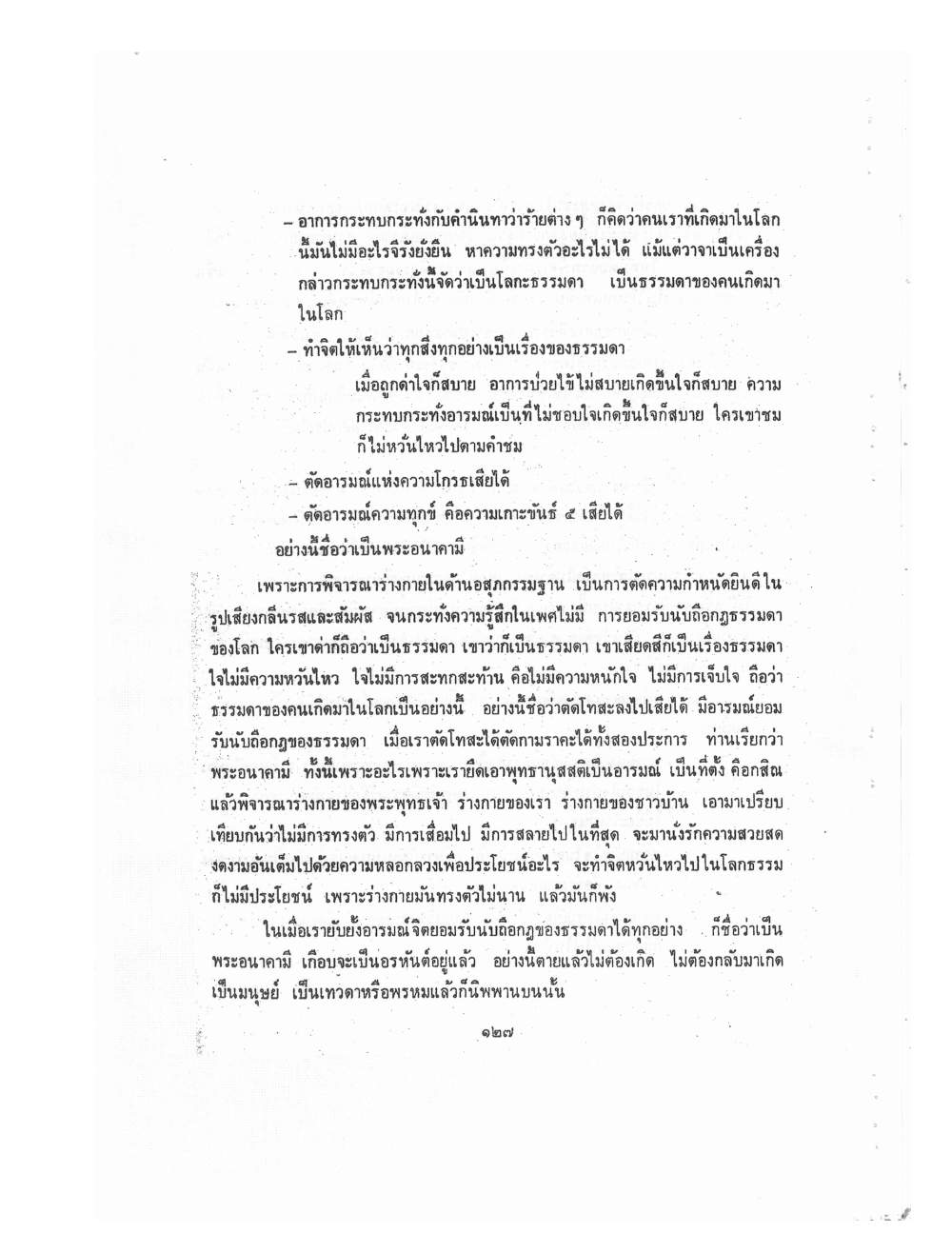
– อาการกระทบกระทั่งกับคำนินทาว่าร้ายต่าง ๆ ก็คิดว่าคนเราที่เกิดมาในโลกนี้มันไม่มีอะไรจีรังยั่งยืน หาความทรงตัวอะไรไม่ได้ แม้แต่วาจาเป็นเครื่องกล่าวกระทบกระทั่งนี้จัดว่าเป็นโลกะธรรมดา เป็นธรรมดาของคนเกิดมาในโลก
– ทำจิตให้เห็นว่าทุกสิ่งทุกอย่างเป็นเรื่องของธรรมดา
เมื่อถูกด่าใจก็สบาย อาการป่วยไข้ไม่สบายเกิดขึ้นใจก็สบาย ความกระทบกระทั่งอารมณ์เป็นที่ไม่ชอบใจเกิดขึ้นใจก็สบาย ใครเขาชมก็ไม่หวั่นไหวไปตามคำชม
– ตัดอารมณ์แห่งความโกรธเสียได้
– ตัดอารมณ์ความทุกข์ คือความเกาะขันธ์ ๕ เสียได้
อย่างนี้ชื่อว่าเป็นพระอนาคามี
เพราะการพิจารณาร่างกายในด้านอสุภกรรมฐาน เป็นการตัดความกำหนัดยินดีในรูปเสียงกลิ่นรสและสัมผัส จนกระทั่งความรู้สึกในเพศไม่มี การยอมรับนับถือภูธรรมดาของโลก ใครเขาด่าก็ถือว่าเป็นธรรมดา เขาว่าก็เป็นธรรมดา เขาเสียดสีก็เป็นเรื่องธรรมดา ใจไม่มีความหวั่นไหว ใจไม่มีการสะทกสะท้าน คือไม่มีความหนักใจ ไม่มีการเจ็บใจ ถือว่าธรรมดาของคนเกิดมาในโลกเป็นอย่างนี้ อย่างนี้ชื่อว่าตัดโทสะลงไปเสียได้ มีอารมณ์ยอมรับนับถือภูของธรรมดา เมื่อเราตัดโทสะได้ ตัดกามราคะได้ทั้งสองประการ ท่านเรียกว่าพระอนาคามี ทั้งนี้เพราะอะไร เพราะเรายึดเอาพุทธานุสสติเป็นอารมณ์ เป็นที่ตั้ง คือกสิณ แล้วพิจารณาร่างกายของพระพุทธเจ้า ร่างกายของเรา ร่างกายของชาวบ้าน เอามาเปรียบเทียบกันว่าไม่มีการทรงตัว มีการเสื่อมไป มีการสลายไปในที่สุด จะมานั่งรักความสวยสดงดงามอันเต็มไปด้วยความหลอกลวงเพื่อประโยชน์อะไร จะทำจิตหวั่นไหวไปในโลกธรรมก็ไม่มีประโยชน์ เพราะร่างกายมันทรงตัวไม่นาน แล้วมันก็พัง
ในเมื่อเรายับยั้งอารมณ์จิตยอมรับนับถือภูของธรรมดาได้ทุกอย่าง ก็ชื่อว่าเป็นพระอนาคามี เกือบจะเป็นอรหันต์อยู่แล้ว อย่างนี้ตายแล้วไม่ต้องเกิด ไม่ต้องกลับมาเกิดเป็นมนุษย์ เป็นเทวดาหรือพรหมแล้วก็นิพพานบนนั้น
– When the contact of various slanders and abuse arises, think that people born into this world have nothing lasting or stable, nothing that can be found to remain firm — even words used to attack and offend are classed as ordinary worldly things (lokadhamma), the natural way of those born into the world.
– Make the mind see that everything whatsoever is an ordinary matter.
When cursed, the mind stays at ease; when sickness and discomfort arise, the mind stays at ease; when contact with disagreeable feelings arises, the mind stays at ease; when praised, one is not swayed by the praise either.
– One can cut off the emotion of anger.
– One can cut off the suffering that is clinging to the five aggregates.
This is called being an Anāgāmī (Non-returner).
Because contemplating the body as foulness cuts off desire and delight in forms, sounds, smells, tastes and touch, until even the sense of gender/sex disappears. One accepts and respects the ordinariness of the world — whoever curses, it's ordinary; whoever speaks ill, it's ordinary; whoever mocks, it's an ordinary matter; the mind is not shaken, the mind does not flinch, meaning there's no heaviness of heart, no hurt feelings — one holds that this is simply the ordinary nature of those born into the world. This is called having cut off aversion, having an attitude that accepts and respects the ordinary. When we can cut off both hatred and sensual lust, this is called an Anāgāmī. Why is this so? Because we take recollection of the Buddha (buddhānussati) as the object, as the basis — that is, the kasiṇa — and then contemplate the body of the Buddha, our own body, the bodies of villagers, comparing them all: none holds its form, all decline, all disintegrate in the end. Why sit and cherish beauty and loveliness, which is full of deception? There is no benefit in letting the mind be shaken by the vagaries of the world (lokadhamma), because the body does not hold its form for long, and then it collapses.
When we can restrain the mind's emotions to accept and respect the ordinary in every way, this is called being an Anāgāmī — almost an Arahant already. In this state, after death one need not be born again — need not return to be born as a human, a deva, or a Brahma, and then attains Nibbāna there.
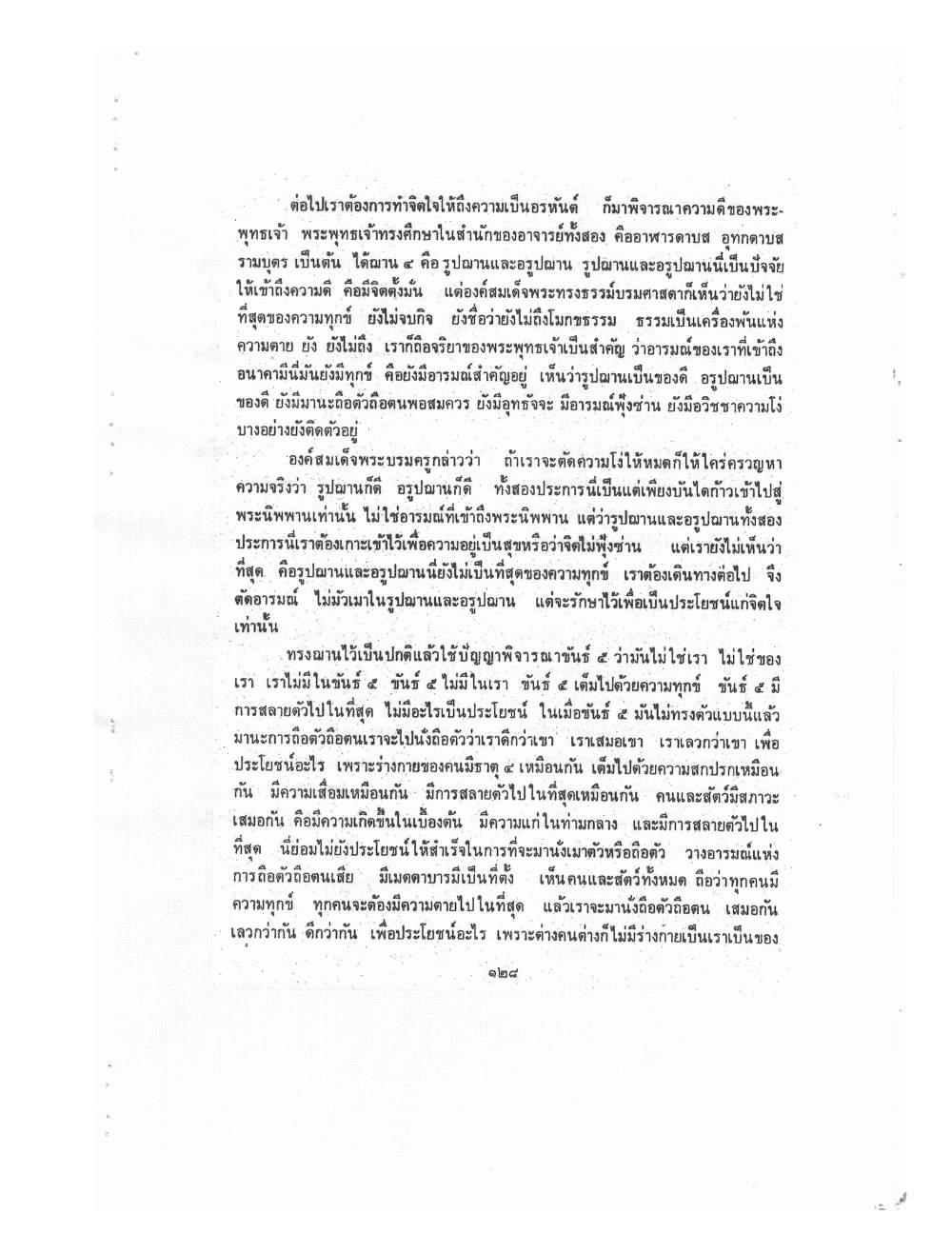
ต่อไปเราต้องการทำจิตใจให้ถึงความเป็นอรหันต์ ก็มาพิจารณาความดีของพระพุทธเจ้า พระพุทธเจ้าทรงศึกษาในสำนักของอาจารย์ทั้งสอง คืออาฬารดาบส อุทกดาบสรามบุตร เป็นต้น ได้ฌาน ๔ คือรูปฌานและอรูปฌาน รูปฌานและอรูปฌานนี้เป็นปัจจัยให้เข้าถึงความดี คือมีจิตตั้งมั่น แต่องค์สมเด็จพระทรงธรรม์บรมศาสดาก็เห็นว่ายังไม่ใช่ที่สุดของความทุกข์ ยังไม่จบกิจ ยังชื่อว่ายังไม่ถึงโมกขธรรม ธรรมเป็นเครื่องพ้นแห่งความตาย ยัง ยังไม่ถึง เราก็ถือจริยาของพระพุทธเจ้าเป็นสำคัญ ว่าอารมณ์ของเราที่เข้าถึงอนาคามีนี้มันยังมีทุกข์ คือยังมีอารมณ์สำคัญอยู่ เห็นว่ารูปฌานเป็นของดี อรูปฌานเป็นของดี ยังมีมานะถือตัวถือตนพอสมควร ยังมีอุทธัจจะ มีอารมณ์ฟุ้งซ่าน ยังมีวิชชาความโง่บางอย่างยังติดตัวอยู่
องค์สมเด็จพระบรมครูกล่าวว่า ถ้าเราจะตัดความโง่ให้หมดก็ให้ใคร่ครวญหาความจริงว่า รูปฌานก็ดี อรูปฌานก็ดี ทั้งสองประการนี้เป็นแต่เพียงบันไดก้าวเข้าไปสู่พระนิพพานเท่านั้น ไม่ใช่อารมณ์ที่เข้าถึงพระนิพพาน แต่ว่ารูปฌานและอรูปฌานทั้งสองประการนี้เราต้องเกาะเข้าไว้เพื่อความอยู่เป็นสุขหรือว่าจิตไม่ฟุ้งซ่าน แต่เรายังไม่เห็นว่าที่สุด คือรูปฌานและอรูปฌานนี้ยังไม่เป็นที่สุดของความทุกข์ เราต้องเดินทางต่อไป จึงตัดอารมณ์ ไม่มัวเมาในรูปฌานและอรูปฌาน แต่จะรักษาไว้เพื่อเป็นประโยชน์แก่จิตใจเท่านั้น
ทรงฌานไว้เป็นปกติแล้วใช้ปัญญาพิจารณาขันธ์ ๕ ว่ามันไม่ใช่เรา ไม่ใช่ของเรา เราไม่มีในขันธ์ ๕ ขันธ์ ๕ ไม่มีในเรา ขันธ์ ๕ เต็มไปด้วยความทุกข์ ขันธ์ ๕ มีการสลายตัวไปในที่สุด ไม่มีอะไรเป็นประโยชน์ ในเมื่อขันธ์ ๕ มันไม่ทรงตัวแบบนี้แล้ว มานะการถือตัวถือตนเราจะไปนั่งถือตัวว่าเราดีกว่าเขา เราเสมอเขา เราเลวกว่าเขา เพื่อประโยชน์อะไร เพราะร่างกายของคนมีธาตุ ๔ เหมือนกัน เต็มไปด้วยความสกปรกเหมือนกัน มีความเสื่อมเหมือนกัน มีการสลายตัวไปในที่สุดเหมือนกัน คนและสัตว์มีสภาวะเสมอกัน คือมีความเกิดขึ้นในเบื้องต้น มีความแก่ในท่ามกลาง และมีการสลายตัวไปในที่สุด นี่ย่อมไม่ยังประโยชน์ให้สำเร็จในการที่จะมานั่งเมาตัวหรือถือตัว วางอารมณ์แห่งการถือตัวถือตนเสีย มีเมตตาบารมีเป็นที่ตั้ง เห็นคนและสัตว์ทั้งหมด ถือว่าทุกคนมีความทุกข์ ทุกคนจะต้องมีความตายไปในที่สุด แล้วเราจะมานั่งถือตัวถือตน เสมอกัน เลวกว่ากัน ดีกว่ากัน เพื่อประโยชน์อะไร เพราะต่างคนต่างก็ไม่มีร่างกายเป็นเราเป็นของ
Next we want to bring the mind to the state of Arahantship, so we contemplate the virtue of the Buddha. The Buddha studied in the schools of two teachers — Āḷāra Kālāma and Uddaka Rāmaputta — and attained the four jhānas, that is, form-jhāna and formless-jhāna. Form-jhāna and formless-jhāna are conditions leading to goodness, that is, a firmly established mind. But the Blessed One, the Great Teacher, saw that this was not yet the end of suffering, the task not yet finished, not yet reaching the liberating Dhamma, the Dhamma that is the means of escape from death — not yet, not yet reached. We hold the conduct of the Buddha as important: our emotional state on reaching Anāgāmī still has suffering, meaning it still has an important attachment — seeing form-jhāna as good, formless-jhāna as good — still has a fair amount of conceit and self-regard, still has restlessness (uddhacca), a distracted mind, some remaining ignorance still clinging.
The Great Teacher said: if we wish to cut off ignorance completely, we should reflect and find the truth that form-jhāna and formless-jhāna, both of these, are merely a ladder-step toward Nibbāna, not themselves the state that reaches Nibbāna. But these two, form-jhāna and formless-jhāna, we must still hold onto in order to dwell in happiness, so the mind does not become distracted — yet we do not yet see them as the end; that is, form-jhāna and formless-jhāna are not yet the end of suffering. We must continue the journey, therefore cut off the attachment — not intoxicated by form-jhāna and formless-jhāna, but keeping them only for the benefit of the mind.
Having maintained the jhāna as normal, use wisdom to contemplate the five aggregates: that they are not us, not ours; we are not within the five aggregates, the five aggregates are not within us; the five aggregates are full of suffering; the five aggregates disintegrate in the end; nothing about them is of benefit. Since the five aggregates do not hold their form like this, what use is there in sitting with conceit, holding ourselves as better than others, equal to others, worse than others? Because everyone's body has the same four elements, is equally full of filth, equally subject to decline, and equally disintegrates in the end. People and animals are of the same nature — arising at the beginning, aging in the middle, and disintegrating in the end. This yields no benefit in sitting there intoxicated with self-conceit or self-regard. Set aside the attitude of self-conceit and self-regard; establish loving-kindness (mettā-pāramī) as the foundation; see all people and animals — hold that everyone has suffering, everyone must eventually die — so why sit holding to conceit of equal, worse, or better? Because no one at all actually has a body that is "self" or "belonging to
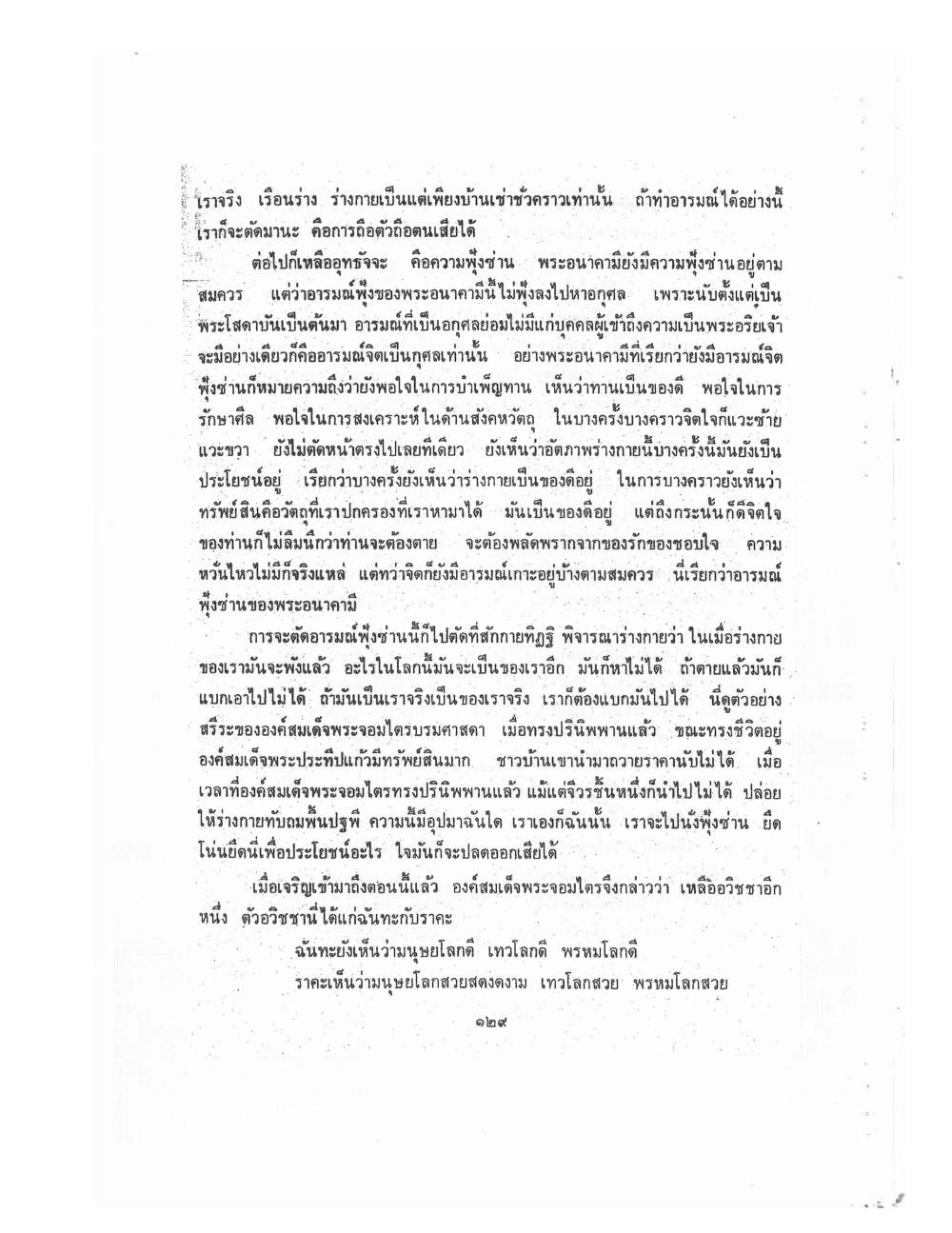
เราจริง เรือนร่าง ร่างกายเป็นแต่เพียงบ้านเช่าชั่วคราวเท่านั้น ถ้าทำอารมณ์ได้อย่างนี้ เราก็จะตัดมานะ คือการถือตัวถือตนเสียได้
ต่อไปก็เหลืออุทธัจจะ คือความฟุ้งซ่าน พระอนาคามียังมีความฟุ้งซ่านอยู่ตามสมควร แต่ว่าอารมณ์ฟุ้งของพระอนาคามีนี้ไม่ฟุ้งลงไปหาอกุศล เพราะนับตั้งแต่เป็นพระโสดาบันเป็นต้นมา อารมณ์ที่เป็นอกุศลย่อมไม่มีแก่บุคคลผู้เข้าถึงความเป็นพระอริยเจ้า จะมีอย่างเดียวก็คืออารมณ์จิตเป็นกุศลเท่านั้น อย่างพระอนาคามีที่เรียกว่ายังมีอารมณ์จิตฟุ้งซ่านก็หมายความถึงว่ายังพอใจในการบำเพ็ญทาน เห็นว่าทานเป็นของดี พอใจในการรักษาศีล พอใจในการสงเคราะห์ในด้านสังคหวัตถุ ในบางครั้งบางคราวจิตใจก็แวะซ้ายแวะขวา ยังไม่ตัดหน้าตรงไปเลยที่เดียว ยังเห็นว่าอัตภาพร่างกายนี้บางครั้งนี้มันยังเป็นประโยชน์อยู่ เรียกว่าบางครั้งยังเห็นว่าร่างกายเป็นของดีอยู่ ในการบางคราวยังเห็นว่าทรัพย์สินคือวัตถุที่เราปกครองที่เราหามาได้ มันเป็นของดีอยู่ แต่ถึงกระนั้นก็ดีจิตใจของท่านก็ไม่ลืมนึกว่าท่านจะต้องตาย จะต้องพลัดพรากจากของรักของชอบใจ ความหวั่นไหวไม่มีก็จริงแหล่ แต่ทว่าจิตก็ยังมีอารมณ์เกาะอยู่บ้างตามสมควร นี่เรียกว่าอารมณ์ฟุ้งซ่านของพระอนาคามี
การจะตัดอารมณ์ฟุ้งซ่านนี้ก็ไปตัดที่สักกายทิฏฐิ พิจารณาร่างกายว่า ในเมื่อร่างกายของเรามันจะพังแล้ว อะไรในโลกนี้มันจะเป็นของเราอีก มันก็หาไม่ได้ ถ้าตายแล้วมันก็แบกเอาไปไม่ได้ ถ้ามันเป็นเราจริงเป็นของเราจริง เราก็ต้องแบกมันไปได้ นี่ดูตัวอย่างสรีระขององค์สมเด็จพระจอมไตรบรมศาสดา เมื่อทรงปรินิพพานแล้ว ขณะทรงชีวิตอยู่ องค์สมเด็จพระประทีปแก้วมีทรัพย์สินมาก ชาวบ้านเขานำมาถวายราคานับไม่ได้ เมื่อเวลาที่องค์สมเด็จพระจอมไตรทรงปรินิพพานแล้ว แม้แต่จีวรชิ้นหนึ่งก็นำไปไม่ได้ ปล่อยให้ร่างกายทับถมพื้นปฐพี ความนี้มีอุปมาฉันใด เราเองก็ฉันนั้น เราจะไปนั่งฟุ้งซ่าน ยึดโน่นยึดนี่เพื่อประโยชน์อะไร ใจมันก็จะปลดออกเสียได้
เมื่อเจริญเข้ามาถึงตอนนี้แล้ว องค์สมเด็จพระจอมไตรจึงกล่าวว่า เหลืออวิชชาอีกหนึ่ง ตัวอวิชชานี้ได้แก่ฉันทะกับราคะ
ฉันทะยังเห็นว่ามนุษยโลกดี เทวโลกดี พรหมโลกดี
ราคะเห็นว่ามนุษยโลกสวยสดงดงาม เทวโลกสวย พรหมโลกสวย
of theirs" — the body is truly nothing more than a temporary rented house. If we can maintain this attitude, we will be able to cut off conceit, that is, self-regard.
Next remains restlessness (uddhacca), that is, distraction. The Anāgāmī still has a fitting degree of distraction, but the Anāgāmī's distracted state of mind does not tend toward the unwholesome, because from the Sotāpanna stage onward, unwholesome states of mind do not occur in one who has attained the state of a Noble One; there remains only wholesome states of mind. When it is said the Anāgāmī still has a distracted state of mind, this means he is still content in the practice of giving (dāna), seeing giving as good, content in keeping precepts, content in helping others through the bases of sympathy (saṅgahavatthu). Sometimes the mind still wanders left and right, not yet cutting straight through entirely; it still sees that this bodily existence is sometimes still useful — that is, sometimes still seeing the body as something good; on some occasions still seeing that property, the things we own and have earned, are good things. But even so, his mind never forgets that he must die, must be separated from what is loved and liked. It's true there's no agitation, but the mind still has some attachment clinging appropriately — this is called the distracted state of the Anāgāmī.
To cut off this distracted state, one must cut at the root of personality-view (sakkāya-diṭṭhi) — contemplate the body: since our body will collapse, what in this world could still be ours? None can be found. If we die, we cannot carry it with us. If it were truly us, truly ours, we would be able to carry it along. Look at the example of the body of the Great Teacher, the Lord of the Three Worlds: when he attained final Nibbāna — while alive, the Jewel Lamp Lord had great wealth, villagers brought offerings of incalculable value; but when the Lord of the Three Worlds attained final Nibbāna, not even a single robe could be taken along; the body was left to lie upon the earth. Just as this is an example, so are we the same. Why should we sit distracted, grasping this and that? The mind can then be released from it.
Having progressed to this point, the Lord of the Three Worlds said: there remains one more ignorance. This ignorance consists of desire (chanda) and lust (rāga).
Chanda is still seeing the human world as good, the deva world as good, the Brahma world as good.
Rāga is seeing the human world as beautiful and lovely, the deva world as beautiful, the Brahma world as beautiful.
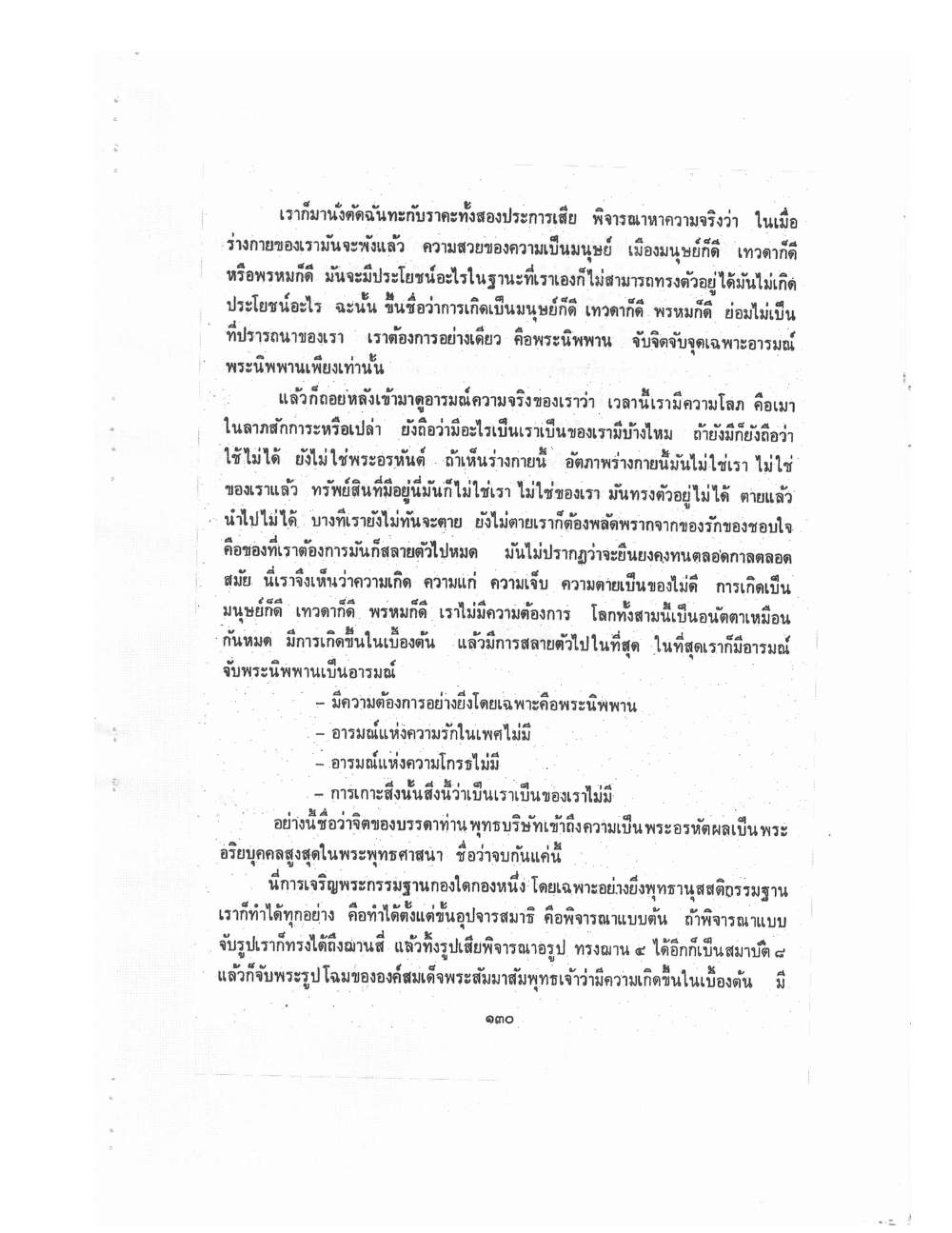
เราก็มานั่งตัดฉันทะกับราคะทั้งสองประการเสีย พิจารณาหาความจริงว่า ในเมื่อร่างกายของเรามันจะพังแล้ว ความสวยของความเป็นมนุษย์ เมืองมนุษย์ก็ดี เทวดาก็ดี หรือพรหมก็ดี มันจะมีประโยชน์อะไรในฐานะที่เราเองก็ไม่สามารถทรงตัวอยู่ได้ มันไม่เกิดประโยชน์อะไร ฉะนั้น ขึ้นชื่อว่าการเกิดเป็นมนุษย์ก็ดี เทวดาก็ดี พรหมก็ดี ย่อมไม่เป็นที่ปรารถนาของเรา เราต้องการอย่างเดียว คือพระนิพพาน จับจิตจับจุดเฉพาะอารมณ์พระนิพพานเพียงเท่านั้น
แล้วก็ถอยหลังเข้ามาดูอารมณ์ความจริงของเราว่า เวลานี้เรามีความโลภ คือเมาในลาภสักการะหรือเปล่า ยังถือว่ามีอะไรเป็นเราเป็นของเรามีบ้างไหม ถ้ายังมีก็ยังถือว่าใช้ไม่ได้ ยังไม่ใช่พระอรหันต์ ถ้าเห็นร่างกายนี้ อัตภาพร่างกายนี้มันไม่ใช่เรา ไม่ใช่ของเราแล้ว ทรัพย์สินที่มีอยู่นี้มันก็ไม่ใช่เรา ไม่ใช่ของเรา มันทรงตัวอยู่ไม่ได้ ตายแล้วนำไปไม่ได้ บางทีเรายังไม่ทันจะตาย ยังไม่ตายเราก็ต้องพลัดพรากจากของรักของชอบใจ คือของที่เราต้องการมันก็สลายตัวไปหมด มันไม่ปรากฏว่าจะยืนยงคงทนตลอดกาลตลอดสมัย นี่เราจึงเห็นว่าความเกิด ความแก่ ความเจ็บ ความตายเป็นของไม่ดี การเกิดเป็นมนุษย์ก็ดี เทวดาก็ดี พรหมก็ดี เราไม่มีความต้องการ โลกทั้งสามนี้เป็นอนัตตาเหมือนกันหมด มีการเกิดขึ้นในเบื้องต้น แล้วมีการสลายตัวไปในที่สุด ในที่สุดเราก็มีอารมณ์จับพระนิพพานเป็นอารมณ์
– มีความต้องการอย่างยิ่งโดยเฉพาะคือพระนิพพาน
– อารมณ์แห่งความรักในเพศไม่มี
– อารมณ์แห่งความโกรธไม่มี
– การเกาะสิ่งนั้นสิ่งนี้ว่าเป็นเราเป็นของเราไม่มี
อย่างนี้ชื่อว่าจิตของบรรดาท่านพุทธบริษัทเข้าถึงความเป็นพระอรหัตผล เป็นพระอริยบุคคลสูงสุดในพระพุทธศาสนา ชื่อว่าจบกันแค่นี้
นี่การเจริญพระกรรมฐานกองใดกองหนึ่ง โดยเฉพาะอย่างยิ่งพุทธานุสสติกรรมฐาน เราก็ทำได้ทุกอย่าง คือทำได้ตั้งแต่ขั้นอุปจารสมาธิ คือพิจารณาแบบต้น ถ้าพิจารณาแบบจับรูปเราก็ทรงได้ถึงฌานสี่ แล้วทิ้งรูปเสียพิจารณาอรูป ทรงฌาน ๔ ได้อีกก็เป็นสมาบัติ ๘ แล้วก็จับพระรูปโฉมขององค์สมเด็จพระสัมมาสัมพุทธเจ้าว่ามีความเกิดขึ้นในเบื้องต้น มี
We then sit and cut off both chanda and rāga, contemplating to find the truth that, since our body will collapse, what use is the beauty of human existence, whether in the human world, the deva world, or the Brahma world, given that we ourselves cannot maintain our own form? There is no benefit at all. Therefore, being born as a human, a deva, or a Brahma is not something we desire. We want only one thing: Nibbāna. Take hold of the mind, fix the point exclusively on the object of Nibbāna alone.
Then step back and examine the true state of our own mind: do we still have greed right now, that is, intoxicated with gain and honor? Do we still hold that anything is "us" or "ours"? If there is still anything, then it is still unusable — not yet an Arahant. If we see that this body, this bodily existence, is not us, not ours, then the property we possess is likewise not us, not ours; it cannot hold its form; when we die we cannot take it along. Sometimes, even before we die, while still alive, we must be separated from what is loved and liked — that is, the things we want all disintegrate; nothing appears able to remain permanently for all time. Thus we see that birth, aging, sickness, and death are not good things. Being born as a human, a deva, or a Brahma — we have no desire for it. All three worlds are equally without-self (anattā), arising at the beginning and disintegrating in the end. In the end we take Nibbāna alone as our object:
– Having supreme desire specifically for Nibbāna alone.
– No emotion of sexual love remains.
– No emotion of anger remains.
– No clinging to anything as "me" or "mine" remains.
This is called the mind of the Buddhist faithful reaching the fruit of Arahantship, the highest Noble Person in the Buddhist religion. This concludes here.
As for cultivating any one kammaṭṭhāna, especially the recollection-of-the-Buddha kammaṭṭhāna, we can do all of it — from the level of access concentration (upacāra-samādhi), that is, the initial mode of contemplation. If contemplating by taking hold of form, we can attain up to the fourth jhāna; then, letting go of form, contemplating the formless, attaining the four jhānas again, this becomes the eight attainments (samāpatti). Then take up the bodily image of the Fully Enlightened Buddha, [seeing that it] had
ความแปรปรวนเปลี่ยนแปลงไปในท่ามกลาง มีการแก่เฒ่าไปในที่สุด แล้วก็สลายตัวไปในขั้นสุดท้าย ถือว่าไม่เป็นสาระไม่เป็นแก่นสาร ไม่มีสภาพจีรังยั่งยืนเป็นประการใด มาเทียบกับกายของเราแบบนี้เป็นวิปัสสนาญาณ นี่แหละบรรดาพุทธบริษัททุกท่าน กรรมฐานทุกกองเราทำได้ถึงขั้นอุปจารสมาธิ ทางด้านรูปฌานและอรูปฌาน และวิปัสสนาญาณทำได้หมด ตัวอย่างที่องค์สมเด็จพระบรมสุคตสอนโลหิตกสิณแก่พระลูกนายช่างทอง อย่างเดียวสามารถให้ทำฌานได้แล้ว องค์สมเด็จพระประทีปแก้วก็ทำโลหิตกสิณนั้นแหละให้เป็นวิปัสสนาญาณในที่สุดเธอก็ได้บรรลุอรหัตผล
เอาละบรรดาท่านพุทธบริษัททุกคน เวลาแห่งการจะพูดมันก็เลยมานานแล้ว ต่อแต่นี้ไป ขอบรรดาท่านพุทธบริษัททั้งหลายพยายามตั้งกายให้ตรง ดำรงจิตให้มั่น กำหนดรู้ลมหายใจเข้าออก ใช้คำภาวนาและพิจารณาตามอัธยาศัยจนกว่าจะได้ยินสัญญาณบอกหมดเวลา
* * *
transformation and change in the middle, and finally aging, and disintegrated at the last stage — regard it as having no substance, no essence, no lasting permanent nature of any kind. Comparing this with our own body in this way is insight-knowledge (vipassanā-ñāṇa). This, all you members of the Buddhist assembly, is how every kammaṭṭhāna we can practice up to the level of access concentration — on the side of form-jhāna and formless-jhāna, and insight-knowledge — can all be done. An example is when the Blessed Well-Gone One taught the blood-kasiṇa to the goldsmith's son; with that alone he was able to attain jhāna. The Jewel Lamp Lord then took that same blood-kasiṇa and turned it into insight-knowledge, and in the end that monk attained the fruit of Arahantship.
Well then, all you members of the Buddhist assembly, the time for speaking has already run long. From this point on, may all you members of the Buddhist assembly try to hold the body upright, keep the mind firm, note the in-breath and out-breath, use the recitation formula and contemplate as you see fit until you hear the signal marking the end of time.
[divider: three asterisks marking a section break; remainder of page blank]
๒๐. ตอบปัญหาข้องใจ
โอกาสนี้บรรดาท่านพุทธบริษัททั้งหลายได้พากันสมาทานศีลและสมาทานพระกรรมฐานเสร็จแล้ว ต่อแต่นี้ไปเป็นโอกาสที่บรรดาท่านพุทธบริษัททั้งหลายจะเจริญพระกรรมฐานและวิปัสสนาภาวนา และขอให้ทุกคนตั้งกายให้ตรงดำรงจิตให้มั่นกำหนดรู้ลมหายใจเข้าออก เวลาหายใจเข้ารู้อยู่ว่าหายใจเข้า เวลาหายใจออกรู้อยู่ว่าหายใจออก เวลาหายใจเข้านึกว่า พุท เวลาหายใจออกนึกว่า โธ การกำหนดรู้ลมหายใจเข้าลมหายใจออกและคำภาวนาคู่กันไปนี้เป็นหลักเริ่มต้นของการปฏิบัติพระกรรมฐาน
การเจริญพระกรรมฐานที่จะให้ดีก็ต้องรู้จักเอาชนะใจตนเอง ตนเองรู้อยู่ว่าเวลานี้เรามีกิจอะไรจะพึงทำและตั้งใจเฉพาะอยู่ กิจนั้นจึงจะมีผลในการเจริญพระกรรมฐาน นี่เป็นปัญหาเฉพาะวันนี้ที่มีคนมาถามว่าทำอย่างไรจึงจะควบคุมกำลังจิตให้เป็นสมาธิ และทำอย่างไรจึงจะให้ใจเข้าอยู่ถึงฌานสมาบัติ ความจริงการทำจิตให้เป็นสมาธิหรือทำจิตให้เป็นฌานสมาบัติเป็นของไม่ยาก ถ้าเราเป็นคนไม่มีใจโลเลหลอกแหลก ถ้าหากว่าเป็นคนมีอารมณ์จิตตั้งมั่น รู้จักกิจที่เราจะพึงกระทำ การที่เจริญพระกรรมฐานและเอาดีไม่ได้ เพราะว่าเราไม่รู้กิจไม่รู้หน้าที่ที่จะพึงกระทำ เป็นคนไร้สติสัมปชัญญะไม่รู้จักควบคุมกำลังใจตนเองมันก็เอาดีกันไม่ได้ เราจะดีได้หรือจะชั่วได้อยู่ที่เราคนเดียวเท่านั้น ไม่มีใครที่เขาจะมายกยอปั้นให้เราดีหรือเราเลว แม้แต่พระพุทธองค์ก็ตรัสว่า อักขาตาโร ตถาคตา ตถาคต เป็นแต่เพียงผู้บอกเท่านั้น สำหรับความดีหรือความชั่วที่เราจะได้ก็ต้องเราเป็นผู้ทำเองโดยเฉพาะ
เมื่อฟังคำสั่งสอนขององค์สมเด็จพระสัมมาสัมพุทธเจ้าแล้ว ที่ทำได้ดีก็เพราะท่านนำไปประพฤติปฏิบัติตาม เวลาที่จะฟังก็ใคร่ครวญไปตามกระแสพระสัทธรรมเทศนาที่องค์สมเด็จพระสัมมาสัมพุทธเจ้าทรงพูด เมื่อพระพุทธเจ้าทรงพูดเขาก็ใช้ปัญญาคิดตาม
คนที่จะได้ดีเขาทำกันแบบนี้ ขณะที่ฟังก็ดี ขณะที่ตั้งใจทรงสมาธิจิตก็ดี เขาไม่ให้อารมณ์ส่งไปสู่อารมณ์อื่น รู้จักควบคุมใจของเราให้อยู่เฉพาะกิจที่เราจะพึงทำคือกำหนดรู้ลมหายใจเข้าออกและคำภาวนา เมื่อเรารู้กิจอย่างนั้นขณะที่เราทรงสมาธิจิตตั้งใจทรงความดี เราก็บังคับจิตให้รู้เฉพาะลมหายใจเข้าออก ลมหายใจเข้านึกว่า พุท ลมหายใจออกนึกว่า โธ
20. Answering Questions of Doubt
On this occasion, all you members of the Buddhist assembly have together undertaken the precepts and undertaken the meditation practice. From here on is the occasion for all you members of the Buddhist assembly to cultivate the meditation practice and insight meditation. Please have everyone hold the body upright, keep the mind firm, and note the in-breath and out-breath. When breathing in, know that you are breathing in; when breathing out, know that you are breathing out. When breathing in, think "Bud"; when breathing out, think "dho." Noting the in-breath and out-breath together with the recitation is the foundational basis for the practice of meditation.
To cultivate meditation well, one must know how to conquer one's own mind. One must know for oneself what task is to be done right now and keep one's intention focused specifically on it; only then will that effort bear fruit in the cultivation of meditation. This is a question specific to today that someone asked: how does one control the power of the mind so it becomes concentrated, and how does one bring the mind to abide in the jhāna attainments? In truth, making the mind concentrated or bringing the mind into jhāna attainment is not difficult, if we are not a person of a fickle, scattered mind — if we are a person with a firmly established emotional state of mind, who knows the task that must be done. The reason cultivating meditation does not succeed is that we do not know the task, do not know the duty to be performed; being a person devoid of mindfulness and clear comprehension, not knowing how to control one's own mental strength, one cannot succeed. Whether we turn out good or bad depends on ourselves alone; no one else will come and flatter us into being good or bad. Even the Buddha himself said: "akkhātāro tathāgatā" — Tathāgatas are only those who point the way. As for the goodness or evil that we will attain, we ourselves specifically must be the ones who act.
When one listens to the teachings of the Fully Enlightened Buddha, those who can practice well do so because they take it and put it into practice. At the time of listening, one reflects along with the flow of the true Dhamma teaching that the Fully Enlightened Buddha speaks; when the Buddha speaks, one uses wisdom to think along with it.
Those who will attain good practice in this way: while listening, and while intent on maintaining mental concentration, they do not let their attention scatter toward other objects; they know how to control their mind to stay specifically on the task to be done, that is, noting the in-breath and out-breath and the recitation. When we know the task in this way, while we maintain concentration and intend to hold to goodness, we force the mind to know only the in-breath and out-breath — in-breath thinking "Bud," out-breath thinking "dho."
นี้อยู่ควบคุมกำลังอยู่เท่านี้ตามเวลาที่เรากำหนดไว้ เราจะไม่ยอมให้อารมณ์จิตเราเข้าไปสู่อารมณ์อื่นนอกจากลมหายใจเข้าออกหรือว่าคำภาวนาว่า พุทโธ ถ้าเราบังคับจิตของเราให้ได้อย่างนี้ไปทุกคราวทุกครั้งที่เจริญพระกรรมฐาน เราจะใช้เวลามากก็ตามเวลาน้อยก็ตาม หรือว่ายามว่างกิจอื่นนั่งอยู่ ยืนอยู่ นอนอยู่ ทำการงานอยู่ อารมณ์ว่างจากอารมณ์อื่นที่จะพึงคิด แล้วก็จิตจับลมหายใจเข้าออกและคำว่า พุทโธให้เป็นปกติ จนกระทั่งให้จิตมีอารมณ์ชินอย่างนี้จิตของเราก็เป็นฌาน หรือว่ายามว่างจากกิจอื่นจิตก็จับคำ พุทโธ เป็นอารมณ์หรือกำหนดจิตรู้ลมหายใจเข้าออกอย่างนี้ท่านเรียกว่าฌาน
แต่นักปฏิบัติพระกรรมฐานที่เอาดีไม่ได้ก็เพราะปล่อยให้จิตไปคบกับอารมณ์ชั่วต่าง ๆ คือวันทั้งวันไม่ได้น้อมเข้าไปหาความดี ไปมองแต่ความชั่ว อารมณ์ของความชั่วชอบเอาจิตเข้าไปคบ แล้วก็ชอบเอาอารมณ์เข้าไปยุ่งกับกิจของคนอื่น คนนั้นดีแบบนั้นคนนี้เลวแบบนี้ คนนี้เป็นอย่างนี้คนนั้นเป็นอย่างโน้น ไม่ได้มองดูตัวเอง การที่เอาอารมณ์จิตเข้าสู่อารมณ์จิตริยาของคนอื่น เป็นอารมณ์จิตที่เลว
อารมณ์จิตที่ดีนั้นจะต้องเป็นอารมณ์จิตที่ควบคุมอารมณ์ของตนเองกำลังจิตของตนเอง ควบคุมความรู้สึกของตนเองเข้าไว้ ว่าเวลานี้อารมณ์จิตของเราเป็นกุศลหรืออกุศล เช่นเราจะนึกจับใจไว้ว่า เราจะจับลมหายใจเข้าออก เราจะกำหนดคำภาวนาว่า พุทโธ เวลาหายใจเข้านึกว่า พุท เวลาหายใจออกนึกว่า โธ เราคุมอยู่อย่างนี้ได้ตลอดวันหรือเปล่า อารมณ์อย่างนี้เป็นอารมณ์จิตที่เป็นกุศล การควบคุมกำลังใจรู้ลมหายใจเข้าหายใจออกรู้คำภาวนาว่า พุทโธ วันหนึ่งถ้าท่านจะทรงได้ ๒๐ นาที หรือ ๑๐ นาที หรือ ๕ นาทีต่อหนึ่งครั้งหนึ่งคราว เพียงเท่านี้ถ้าทำเป็นปกติทุกวัน
ตายแล้วก็ไปสู่สวรรค์ได้
พ้นจากอบายภูมิ นี้เป็นความดีที่เราช่วยตัวเองหรือควรจะระมัดระวัง และก็คนที่ควบคุมกำลังจิตได้แบบนี้ เวลาที่มีชีวิตอยู่อารมณ์จิตเป็นสุข ไม่มีอารมณ์กระวนกระวาย ไม่มีความวุ่นวายของจิต เพราะจิตทรงอยู่ในอารมณ์ที่เป็นกุศล นี่เราควรปฏิบัติให้ได้ตามนี้ คือเอาชนะจิต เอาจิตให้ชนะความชั่ว
การที่เราเจริญพระกรรมฐานเราทำเพื่อประโยชน์อะไร กรรมฐานมีอยู่ ๒ แบบ คือ สมถภาวนาและวิปัสสนาภาวนา สมถภาวนาแปลว่าอุบายเป็นเครื่องสงบใจ ทำจิตให้สงบ
This is controlling the [mind's] power only to this extent, for the length of time we have set. We will not allow our emotional mind to go toward any object other than the in- and out-breath or the recitation "Buddho." If we can control our mind like this every single time we cultivate meditation — whether we use a long time or a short time, or whether during free moments from other duties we are sitting, standing, lying down, or working — with the mind free of other objects to think about, and the mind holding onto the in-and-out breath and the word "Buddho" as normal, until the mind becomes accustomed to this state, our mind becomes jhāna. Or, during free time from other tasks, the mind holds the word "Buddho" as its object, or fixes on knowing the in- and out-breath like this — this is called jhāna.
But practitioners of meditation who fail to succeed do so because they let their minds consort with various bad states — that is, the whole day is not inclined toward goodness, but looks only at evil; they like to let the mind consort with states of evil, and like to bring their attention meddling into other people's affairs — that person is good like that, this person is bad like this, this person is like this, that person is like that — without looking at themselves. Bringing one's mental state into the conduct of other people's minds is a bad state of mind.
A good state of mind must be one that controls one's own emotions, one's own mental strength, controls one's own feelings, [knowing] whether at this moment our state of mind is wholesome or unwholesome — for instance, we resolve in our heart: we will hold to the in- and out-breath, we will fix the recitation "Buddho," breathing in thinking "Bud," breathing out thinking "dho." Can we maintain this control throughout the whole day or not? A state like this is a wholesome state of mind. Controlling the mental strength, knowing the in-breath and out-breath, knowing the recitation "Buddho" — if in one day you can maintain it for 20 minutes, or 10 minutes, or 5 minutes per single session, this much alone, if done as a regular practice every day —
After death, one can go to heaven.
Freed from the states of loss — this is a good deed that helps ourselves, one we should be careful to maintain. And a person who can control the mental strength like this — while alive, their emotional state is happy, with no agitation, no turmoil of mind, because the mind abides in a wholesome state. We should practice to achieve this: conquering the mind, making the mind conquer evil.
What benefit do we cultivate meditation for? There are two kinds of kammaṭṭhāna: samatha-bhāvanā and vipassanā-bhāvanā. Samatha-bhāvanā means a method that is a means of calming the mind, making the mind calm
จากอารมณ์ที่เป็นอกุศล คือความชั่ว หมายความว่าป้องกันความชั่วไม่ให้เข้ามาสู่จิต จิตของเราจะไม่ยอมคิดนึกความชั่วอย่างใดอย่างหนึ่งเป็นอันขาด ความชั่วเป็นปัจจัยให้ตกนรก นอกจากตกนรกแล้วก็มาเป็นเปรตอสุรกายเป็นสัตว์เดรัจฉาน เกิดเป็นคนก็เอาดีไม่ได้ การที่พระพุทธเจ้าทรงสั่งสอนให้เราเจริญพระกรรมฐานก็เป็นการให้เราทรงสติสัมปชัญญะ กำหนดไว้แต่เฉพาะให้ความดีอย่างย่อที่กล่าวมาแล้ว คือคำว่า พุทโธ หรือการกำหนดรู้ลมหายใจเข้าออก ถ้าทรงได้อย่างนี้ตลอดกาลตลอดสมัย อย่างเลวเราก็เป็นเทวดา อย่างดีขึ้นไปกว่านั้นเราก็เกิดเป็นพรหม ดีกว่าเป็นมนุษย์เดินตกแตก ๆ อยู่อย่างในสมัยปัจจุบัน อารมณ์ปัจจุบันที่เรามีชีวิตอยู่อารมณ์ใจของเราก็มีความสุข มีความทรงจำดี มีความเฉลียวฉลาด อาจหาญรื่นเริงในการกระทำความดี ปราศจากความเศร้าหมองของจิต ทั้งนี้เพราะอาศัยบารมีขององค์สมเด็จพระสัมมาสัมพุทธเจ้าทรงสงเคราะห์เข้าสู่ประจำจิตของเรา
ว่ากันด้านสมถภาวนาให้ทรงอารมณ์จิตไว้อย่างนี้โดยเฉพาะ นี่เราจะไปเกณฑ์ไปถามใครเขาว่าเมื่อไรเราจะได้ดี ขายหน้าชาวบ้านเขา ความดีหรือว่าความชั่วมันอยู่ที่เราผู้ปฏิบัติ ถ้าเราปฏิบัติเอาดีไม่ได้ ก็แสดงว่าเราเลวเกินไป เพราะการเจริญสมถภาวนาหรือวิปัสสนาภาวนาไม่มีการลงทุนอะไร นั่งอยู่ เดินอยู่ นอนอยู่ ทำได้ทั้งนั้นทุกอิริยาบถ ไม่มีการจำกัด เราจะนั่งท่าไหน นอนท่าไหน ยืนท่าไหน เดินแบบไหนก็ใช้ได้ทั้งนั้น เพราะเราควบคุมกำลังใจให้มันทรงอยู่ และอีกประการหนึ่งการเจริญสมถภาวนาเราไม่ต้องการภาพแสงสีใด ๆ ทั้งหมด อาการใด ๆ จะปรากฏ จะเป็นภาพก็ดีแสงก็ดีเสียงก็ดีที่ปรากฏ เราไม่สนใจ อย่าไปสนใจกับภาพแสงสีหรือเสียงใด ๆ ที่ปรากฏ ถ้าหากว่ามีภาพปรากฏเสียงสีหรือแสงปรากฏจะควบคุมอารมณ์ของตนเองไว้โดยเฉพาะ เสียงอะไรก็ช่างจะมาอย่างไรก็ช่างเสียง
รูปอะไรจะปรากฏก็ช่างรูป เพราะเราต้องการอย่างเดียวคือคำภาวนาหรือกำหนดรู้ลมหายใจเข้าออกเท่านี้เป็นพอ ถ้าท่านทรงอารมณ์จิตอยู่ได้อย่างนี้ถือว่าอารมณ์จิตเป็นฌาน นี่ว่ากันเฉพาะนักปฏิบัติตอนต้น ที่เขาเจริญพระกรรมฐานให้ทรงอารมณ์ไว้ได้เพียงเท่านี้พอแล้ว ให้จิตมีกำลังดีพอ แล้วก็พยายามทรงให้ได้ทุกวันอย่าสักแต่ว่าทำ
away from unwholesome states, that is, evil, meaning guarding against evil so it cannot enter the mind. Our mind will absolutely refuse to think of any kind of evil whatsoever. Evil is a condition leading to hell; besides falling to hell, one then becomes a hungry ghost, a demon, an animal; even if born a human, one cannot succeed at goodness. The reason the Buddha taught us to cultivate meditation is to give us mindfulness and clear comprehension, fixed specifically on the abbreviated good already mentioned, that is, the word "Buddho" or noting the in- and out-breath. If we can maintain this for all time, at the very least we become a deva; at best, better than that, we are reborn as a Brahma — better than being a human stumbling and falling in the present age. In our present emotional state while alive, our state of mind has happiness, good memory, cleverness, is bold and joyful in doing good, free from the mind's gloom — all this due to the merit-power of the Fully Enlightened Buddha extending his help into our habitual mind.
Speaking of samatha-bhāvanā, maintain the state of mind specifically like this. We need not go asking anyone else when we will become good, embarrassing ourselves before others — goodness or evil rests with us, the practitioner. If we practice and cannot achieve good, that shows we are too depraved, because cultivating samatha-bhāvanā or vipassanā-bhāvanā requires no investment at all. Sitting, walking, lying down — it can be done in any posture whatsoever, with no restriction. Whatever position we sit in, whatever position we lie in, whatever position we stand in, whatever way we walk — all are usable, because we are controlling our mental strength to keep it steady. Another point: in cultivating samatha-bhāvanā we do not want any images, lights, or colors at all. Whatever phenomena appear — be it an image, a light, or a sound that appears — we pay no attention. Do not pay attention to any image, light, color, or sound that appears. If any image, sound, color, or light appears, control your own emotional state specifically regardless — whatever sound comes, let it be, however it comes let it be sound.
Whatever image appears, let it be image, because we want only one thing: the recitation or noting of the in- and out-breath — this alone is enough. If you can maintain your state of mind like this, this is considered jhāna. This applies specifically to beginning practitioners — for them, cultivating meditation to maintain this state of mind is enough already; let the mind have sufficient strength, then try to maintain it every day — do not merely go through the motions.
อย่าสักแต่ว่าศึกษา ศึกษาไว้ไปที่ไหนก็ตาม ไปที่นี่ถามที่นี่ ไปที่โน่นถามที่โน่น ไปที่ไหนก็ถามที่นั้น เป็นอันว่าจิตของเรามีอารมณ์สอดส่ายไม่เฉพาะจุดอารมณ์อย่างใดอย่างหนึ่ง อย่างนี้ก็ชื่อว่าเอาดีไม่ได้ เพราะอารมณ์ของกรรมฐานที่องค์สมเด็จพระสัมมาสัมพุทธเจ้าทรงสอน มี ๔๐ กองด้วยกัน ผลที่จะพึงถึงก็คือ เอกัคตารมณ์ การมีอารมณ์เป็นฌานเหมือนกันหมด ที่องค์สมเด็จพระบรมสุคตทรงสอนไว้มาก ก็ให้เป็นไปตามอัธยาศัยของผู้ปฏิบัติ
ฉะนั้นขอบรรดาท่านพุทธบริษัทในอันดับแรกขอให้ควบคุมกำลังใจ กำหนดรู้ลมหายใจเข้าออก หายใจเข้านึกว่า พุท หายใจออกนึกว่า โธ ไว้ให้เป็นปกติ ยามว่างมีอารมณ์จิตอย่างนั้นเสมอ ต่อไปพิจารณาดูเวลาว่างจากอารมณ์อื่น อารมณ์จิตก็จับลมหายใจเข้าออกจับคำภาวนาขึ้นมาเฉย ๆ ขึ้นชื่อว่าอาการชินของจิต อย่างนี้ท่านเรียกว่าเป็นผู้มีจิตเข้าถึงฌาน เมื่อจิตเข้าถึงฌานได้ท่านจะไปสวรรค์ก็ได้ ไปพรหมก็ได้ ที่อื่นก็ได้ตามอัธยาศัย สำหรับบุคคลที่ปฏิบัติมาเก่า เมื่อทำจิตของเราให้ทรงได้ดีแล้ว ก็จงพิจารณาอริยสัจสี่
การที่องค์สมเด็จพระประทีปแก้วบรมศาสดาสัมมาสัมพุทธเจ้าทรงสอนไว้ในด้านวิปัสสนาญาณ เพราะอริยสัจนี้มีเรื่องที่จะศึกษาจริง ๆ ก็มี ๒ อย่าง คือ ทุกข์ กับสมุทัย
นี่พิจารณาว่าการเกิดของเรานี้เต็มไปด้วยความทุกข์ ทุกข์ตรงไหน เกิดมาจากครรภ์มารดากระทบอากาศหนัก อยู่ในครรภ์ของมารดามีแต่ความอบอุ่นมีความสบาย ออกจากครรภ์มารดาใหม่ ๆ มากระทบกับความร้อนความหนาว ร่างกายแสบทั้งกาย ก็เกิดการร้องจ้าขึ้นมา นี่แสดงว่าร่างกายเป็นทุกข์ ต่อแต่นั้นมาการหิวอาหารก็เป็นอาการของความทุกข์ การปวดอุจจาระปัสสาวะเป็นอาการของความทุกข์ ความป่วยไข้ไม่สบายเป็นอาการของความทุกข์ ความแก่ชราเข้ามาครอบงำเป็นอาการของความทุกข์ ความตายเข้ามาถึงตัว
ทุกขเวทนาหนักเป็นอาการของความทุกข์ ถ้าเรายังไม่สิ้นความทุกข์เมื่อไรเราต้องไปเกิดใหม่พบกับความทุกข์เข้าอีก เป็นอันว่าความเกิดเป็นของไม่ดีเป็นความทุกข์
พระพุทธเจ้าจึงสอนให้คนเราปฏิบัติตนให้พ้นความเกิด กล่าวคือโมกขธรรม ได้แก่ธรรมเป็นเครื่องพ้น
Do not merely study — studying, wherever one goes, one asks here, asks there, asks over there — wherever one goes, one asks there — this means our mind's attention is scattered, not fixed on any one particular point. This too is called failing to succeed, because the meditation subjects taught by the Fully Enlightened Buddha number 40 in total; the result to be attained is one-pointedness (ekaggatārammaṇa) — having a state of mind that is jhāna, the same in every case. What the Blessed Well-Gone One taught extensively is to be followed according to the disposition of the practitioner.
Therefore, may all you members of the Buddhist assembly, first of all, control your mental strength, note the in- and out-breath, breathing in thinking "Bud," breathing out thinking "dho," keep this as normal; in free time, always maintain this state of mind. Next, observe: during time free from other concerns, the mind simply takes hold of the in- and out-breath and the recitation naturally — this is called the mind's habituated condition. This is called being one whose mind has reached jhāna. When the mind can reach jhāna, you may go to heaven, or to the Brahma realm, or elsewhere according to your disposition. For a person who has practiced for a long time, once we have made our mind maintain [concentration] well, then contemplate the Four Noble Truths.
What the Jewel Lamp Lord, the Fully Enlightened Buddha, taught regarding insight-knowledge — because the Noble Truths have really only two things to be studied: suffering (dukkha) and its origin (samudaya).
Now contemplate that our birth is full of suffering. Where is the suffering? Being born from the mother's womb, one meets the heavy impact of the air; while in the mother's womb there is only warmth and comfort; newly emerged from the mother's womb, one meets heat and cold, the whole body stings, and one cries out — this shows the body is suffering. From then on, hunger is a manifestation of suffering; the urge to defecate or urinate is a manifestation of suffering; sickness and discomfort are manifestations of suffering; old age coming to overwhelm is a manifestation of suffering; death arrives at the body.
Severe painful feeling is a manifestation of suffering. As long as we have not ended suffering, whenever that may be, we must be reborn and meet suffering again. Thus birth is not good; it is suffering.
The Buddha therefore taught people to practice so as to be free from birth — that is, the liberating Dhamma (mokkha-dhamma), the Dhamma that is the means of escape
ก่อนที่เราจะปฏิบัติตนให้พ้นจากความทุกข์ก็ต้องรู้จักเหตุให้มันเกิดทุกข์เสียก่อนว่า ความทุกข์มันมาจากไหน เราต้องทำลายเหตุ องค์สมเด็จพระบรมโลกเชษฐ์ทรงกล่าวว่า เหตุของความทุกข์ได้แก่ ตัณหา คือความทะยานอยาก สิ่งใดที่ยังไม่มี อยากให้มี สิ่งใดที่มีอยู่แล้วอยากให้มันทรงตัว เวลากาลที่มันจะเคลื่อนไปจิตใจก็ไม่อยากให้มันเคลื่อนไปหาทางดึง อย่างนี้เป็นอาการของความทุกข์ สิ่งที่มันไม่มีเราต้องการให้มีขึ้น หมายความว่าเป็นสิ่งที่เราต้องการเกินจากความเป็นจริง ถ้าสิ่งใดที่เป็นไปตามความประสงค์หรือมีความจำเป็นจะต้องกินต้องใช้ ก็แสวงหามาพอกินพอใช้ ไม่ตะเกียกตะกายเกินไป นี่เป็นอาการของความทุกข์เหมือนกัน แต่เป็นความทุกข์ที่อยู่ในขอบเขต
แต่ทุกข์ของตัณหานี้มันยิ่งไปกว่านั้น มีพอกินพอใช้แล้วมันไม่พอ ตะเกียกตะกายอยากจะให้มันมีมากไปกว่านั้นขึ้นไปเท่าไรก็ไม่รู้จักจบ นี่เป็นอาการของตัณหา การแสวงหาเลี้ยงชีพตามธรรมดาถือเป็นปกติในการทรงชีพเป็นสัมมาอาชีวะ อย่างนี้ไม่จัดว่าเป็นตัณหาใหญ่ ถ้าจะเป็นก็เป็นตัณหาเล็ก ตัณหาเล็ก ๆ ไม่มีโทษมากนัก
ถ้าจะว่าการแสวงหานั้นได้มาจากการทุจริตมันก็เป็นภัยใหญ่ องค์สมเด็จพระภควันต์บรมศาสดาสัมมาสัมพุทธเจ้าจึงบอกให้ตัดความอยากเสีย ในเมื่อเรายังทรงชีวิตอยู่การหากินต้องมีเป็นของธรรมดา พระพุทธเจ้าไม่ทรงปฏิเสธการหากินหาเลี้ยงครอบครัวและบริวารตามความจำเป็น ถือว่าเป็นหน้าที่ที่เราพึงปฏิบัติ เราจะไม่ติดในมันจนเกินไป เราคิดว่าหามาได้แล้วก็แล้วกันไป มีกินมีใช้ไปวันหนึ่งก็พอ หรือว่ามันจะเหลือกินเหลือใช้ก็ตามที คิดว่านี้เราทำตามหน้าที่เท่านั้น เราจะไม่มีอารมณ์ผูกพันใด ๆ ทั้งหมด และคิดไว้เสมอว่าทรัพย์ที่เราหามาได้ทั้งหมดเราตายแล้วมันก็เลิกกันไป เราไม่สามารถจะแบกไปโลกอื่นได้
การจะตัดอำนาจความอยากมันจะตัดได้ในตอนไหน ก็ต้องมาพิจารณาสักกายทิฏฐิ คือพิจารณาร่างกายว่าร่างกายของเรานี้มันเต็มไปด้วยความทุกข์ ที่จริงร่างกายของเรานี้มันไม่ใช่เราไม่ใช่ของเรา เราไม่มีในร่างกาย ร่างกายไม่มีในเรา ร่างกายเป็นแต่เพียงธาตุ ๔ เข้ามาประชุมกัน คือ ธาตุน้ำ ธาตุดิน ธาตุลม ธาตุไฟ มันทรงตัวอยู่ชั่วคราว ไม่ช้ามันก็จะสลายไป ร่างกายมีอุปมาประดุจหนึ่งดังบ้านเช่า เราอยู่ได้ชั่วคราวเท่านั้น เช่าอยู่ได้
from death — still not yet reached.
Before we can practice to be free from suffering, we must first know the cause that gives rise to suffering — where suffering comes from — so we can destroy that cause. The Great World-Elder said that the cause of suffering is craving (taṇhā), that is, the urge of desire: wanting something to exist that does not yet exist; wanting something that already exists to remain stable. When the time comes for it to change, the mind does not want it to change, and pulls against it — this is a manifestation of suffering. Wanting something to exist that does not exist means wanting something beyond what is real. If something is according to one's actual need or necessity to eat or use, then seeking just enough to eat and use, without excessive struggle, is also a manifestation of suffering, but suffering that stays within bounds.
But the suffering of craving goes further than that — having enough to eat and use is not enough; one struggles, wanting more and more without limit, never knowing when to stop — this is the manifestation of craving. Seeking a livelihood in the ordinary way is considered normal in maintaining life as right livelihood; this is not classified as major craving. If it is craving at all, it is minor craving; minor cravings carry no great fault.
But if that seeking comes from dishonesty, that is a great danger. The Blessed Fully Enlightened Buddha therefore told us to cut off desire. As long as we are still alive, earning a living must naturally occur; the Buddha did not reject earning a living to support one's family and dependents as necessary — this is considered a duty we should perform. We should not become attached to it excessively; we think that once we have earned it, that is that; having enough to eat and use for the day is enough — or whether there is a surplus or not, no matter — thinking that we are simply doing our duty. We will have no emotional attachment to it at all, and always think that all the wealth we have earned, once we die, is finished with — we cannot carry it to another world.
Where can the power of craving be cut off? We must contemplate personality-view (sakkāya-diṭṭhi), that is, contemplate the body: that our body is full of suffering; in truth this body is not us, not ours; we are not within the body, the body is not within us; the body is merely the four elements come together — water element, earth element, wind element, fire element — it holds together temporarily, and before long it will disintegrate. The body is comparable to a rented house; we dwell there only temporarily, renting
ชั่วคราวเท่านั้น เมื่อถึงกาล ถึงสมัย หรือเมื่อหมดอายุแห่งการเช่าเราก็ต้องไป เราคือจิตที่มาสถิตอยู่ในร่างกาย เมื่อร่างกายมันไม่ใช่เราไม่ใช่ของเรา เราไม่มีในร่างกาย ร่างกายไม่มีในเรา ร่างกายเหมือนบ้านเช่าชั่วคราว เราจะมาปรารถนาความเกิดเพื่ออะไร ถ้าเราไม่ปรารถนาความเกิดก็แสดงว่า เราไม่ปรารถนาความอยากคือตัณหา ถ้าเราจะเกิดอีกมันก็มีทุกข์อย่างนี้ จะพบกับบ้านเช่าที่ไม่มีการทรงตัว
เราจะไม่ต้องการความเกิดอีก เราจะทำอย่างไร เราก็ใช้ปัญญาพิจารณาคำสั่งสอนขององค์สมเด็จพระสัมมาสัมพุทธเจ้า ว่าคำสอนของพระพุทธเจ้าที่กล่าวว่าเกิดแก่เจ็บตายเป็นของจริงหรือของไม่จริง ถ้าจริงเราก็เชื่อพระพุทธเจ้าได้ และคำแนะนำขององค์สมเด็จพระสัมมาสัมพุทธเจ้าท่านกล่าวว่า ทานเป็นปัจจัยตัดความโลภ คือสร้างมิตร ศีลเป็นปัจจัยตัดความโกรธ การใช้ปัญญาพิจารณาตัดขันธ์ห้าคือร่างกายที่ผูกพันในการเกิดต่อไป การติดความหลงนี้มันจริงหรือไม่จริง ถ้าเรามีปัญญาพิจารณาเห็นว่าจริงแล้วเราก็เชื่อว่าเรามีความเชื่อมั่นในคุณพระรัตนตรัย อย่างนี้เป็นปัจจัยอีกอันหนึ่งที่จะทำให้เราไม่เกิด
แต่ว่าเรามาเชื่อในคำสั่งสอนของพระพุทธเจ้าแล้วก็ต้องปฏิบัติตามด้วย วิธีที่จะปฏิบัติตามในขั้นต่อไปก็ต้องมีการรักษาศีลห้าให้เป็นปกติ เราจะไม่ทำลายศีลด้วยตนเอง ไม่ยุยงบุคคลอื่นทำลายศีล และไม่ยินดีเมื่อบุคคลอื่นทำลายศีล มีความเมาในร่างกายน้อยลงไป เห็นว่าเราต้องตายเป็นปกติ มีความเคารพในพระรัตนตรัย มีศีลห้าบริสุทธิ์ทั้ง ๒ ประการนี้ถ้าทรงไว้ให้ได้ตลอดกาลตลอดสมัย องค์สมเด็จพระจอมไตรบรมศาสดาทรงกล่าวว่าเป็นโสดาปัตติผล หรือว่าสกิทาคามีผล เป็นพระอริยเจ้า อันนี้ก็เป็นของไม่ยาก เมื่อเป็นพระอริยเจ้า พระโสดาและพระสกิทาคามก็ยังต้องมีความเกิด แต่ว่าเกิดน้อยลง เกิดเฉพาะสวรรค์กับมนุษย์หรือว่าพรหมกับมนุษย์ ไม่ต้องลงอบายภูมิ การที่จะมีความเกิดอยู่แบบนี้มันก็ยังไม่มีความสุข มันยังต้องการตัดทุกข์ให้มันสิ้นไป
ในข้อต่อไปองค์สมเด็จพระบรมศาสดาทรงแนะนำให้ตัดกามราคะ ความต้องการในเพศเสีย เพราะความต้องการในร่างกายของบุคคลอื่นมีความกำหนัดยินดีในร่างกายบุคคลอื่นนี้เป็นความโง่ของบุคคลที่มีกิเลสเข้าถึงใจ เพราะการมีคู่ครองไม่ใช่ปัจจัยของความสุข ไม่ใช่เป็นเหตุนำมาซึ่งความสุข มันเป็นเหตุนำมาซึ่งความทุกข์ คนเราจะต้องแบกภาระจากคู่ครอง บิดามารดาญาติพี่น้องเพื่อนฝูงของคู่ครองอีกมากมาย สร้างความทุกข์ให้เกิดขึ้นแก่จิตใจและร่างกายของเราไม่ให้เป็นอิสรภาพ ต้องอยู่ในขอบเขต การแสวงหาคู่ครองเราก็ดู
temporarily only. When the time, the season arrives, or when the lease term expires, we must go. We are the mind that comes to reside in the body. Since the body is not us, not ours, we are not within the body, the body is not within us — the body is like a temporarily rented house — why should we wish for birth at all? If we do not wish for birth, that shows we do not wish for craving, that is, taṇhā. If we are born again, there will be suffering like this, meeting again with a rented house that has no permanence.
We do not want birth anymore — what shall we do? We use wisdom to contemplate the teaching of the Fully Enlightened Buddha: is the Buddha's teaching that birth, aging, sickness, and death are real, true or not true? If true, we can believe the Buddha. And the Fully Enlightened Buddha's advice states that giving (dāna) is a condition that cuts off greed, that is, it builds friendship; precepts (sīla) are a condition that cuts off anger. Using wisdom to contemplate and cut through the five aggregates, that is, the body bound up in future rebirth — is this attachment and delusion true or not true? If we have the wisdom to see that it is true, then we come to believe that we have firm confidence in the virtue of the Triple Gem — this is another condition that will prevent our being reborn.
But having come to believe in the Buddha's teaching, we must also practice accordingly. The method of practicing accordingly at the next stage requires maintaining the five precepts as normal. We will not break the precepts ourselves, will not incite others to break the precepts, and will not approve when others break the precepts; have less intoxication with the body, seeing that we must die as a matter of course; have respect for the Triple Gem. If these two things — pure five precepts — are maintained for all time, the Lord of the Three Worlds, the Great Teacher, said this is the fruit of Stream-entry (Sotāpatti) or the fruit of Once-returning (Sakadāgāmi), a Noble One. This is not difficult. When one is a Noble One, the Sotāpanna and Sakadāgāmī must still be reborn, but reborn less — only between heaven and the human world, or Brahma-world and human world — need not fall into states of loss. But having birth remain like this still has no happiness; there is still a need to cut off suffering entirely.
In the next point, the Great Teacher advises cutting off sexual lust, desire for sex, because desire for another person's body, having delight and desire in another's body, is the folly of a person whose defilements have penetrated the heart. Because having a spouse is not a condition for happiness, is not a cause bringing happiness — it is a cause bringing suffering. One must bear the burden from one's spouse, and the spouse's parents, relatives, siblings, and friends besides, creating suffering arising in our mind and body, depriving us of freedom, confining us within bounds. As for seeking a spouse, consider
แล้วดูอีก ว่าเป็นคนที่เหมาะสมมีหน้าตาทรวดทรงเป็นที่น่ารัก แต่ว่าคู่ครองของเราก็ดี เราเองก็ดีมันไม่ทรงอยู่ตามนั้น ไม่ช้าความเหี่ยวแห้งมันก็ปรากฏ ความทรุดโทรมมันก็ปรากฏ ความทุกข์มันก็แบกหนักเข้ามาเป็นภาระใหญ่
นี่องค์สมเด็จพระจอมไตรบรมศาสดาทรงแนะนำว่าถ้าเราไม่ต้องการความเกิด ก็ให้ตัดอารมณ์ความกำหนัดยินดีในการมีคู่ครองเสียโดยการพิจารณาร่างกายคือเรียกว่า
กายคตาสติกรรมฐาน เห็นว่าร่างกายของเรานี้เป็นชิ้นเป็นท่อนเป็นอันเต็มไปด้วยอาการ ๓๒ มีความสกปรกเป็นปกติ หาความดีอะไรไม่ได้ เมื่อขณะที่ทรงกายอยู่ก็เต็มไปด้วยความทุกข์ ขณะที่ทรงกายอยู่ความสกปรกมันก็ปรากฏ ถ้าเราไม่อาบน้ำสัก ๒-๓ วัน ร่างกายก็จะเหม็นสาบทนไม่ไหว และทุกสิ่งทุกอย่างในร่างกายที่หลั่งไหลออกมา เช่น อุจจาระ ปัสสาวะ ก็เป็นที่รังเกียจของเราเอง นี่แสดงว่าร่างกายของเราภายในเต็มไปด้วยความสกปรกอย่างยิ่ง
ฉะนั้นองค์สมเด็จพระสัมมาสัมพุทธเจ้าจึงทรงสอนให้บรรดาท่านพุทธบริษัทชายหญิงพิจารณาว่าร่างกายของเราเหมือนกับอสุภคือศพ และเหมือนกับศพที่ตายแล้ว คือความจริงมันยังไม่ตาย ร่างกายเหมือนผีเดินได้ เพราะข้างในมันสกปรก น้ำลายเวลาเราอมอยู่ในปาก เรากลืนได้ แต่ว่าเวลาบ้วนออกมาเราไม่กล้าจะเอามือแตะเพราะรังเกียจน้ำลาย น้ำลายของเรามันอยู่ที่ไหน ความจริงมันก็อยู่ในร่างกายของเรานั่นเอง พระพุทธเจ้าทรงพิจารณาร่างกายเทียบกับศพที่ตายแล้วหนึ่งวัน สองวัน สามวัน สี่วัน ห้าวัน มันขึ้นอืดขึ้นมามีน้ำเหลืองไหลและเต็มไปด้วยความน่าเกลียด ความสกปรกทั้งหลายเหล่านี้มันไม่ได้มีมาใหม่ มันอยู่ในร่างกายของเรา ขณะเมื่อร่างกายมีจิตใจควบคุมมันก็ปกปิดเข้าไว้ ความสกปรกหลั่งไหลมาไม่ได้ทุกอย่าง แต่ว่ามันจะระบายของที่คั่งมาได้เพียงอุจจาระปัสสาวะเท่านั้น มันบังคับไม่ได้หลั่งไหลมาให้เราดู
นี่องค์สมเด็จพระบรมครูให้พิจารณาร่างกายของเราก็ดีของบุคคลอื่นก็ดีว่าเต็มไปด้วยความสกปรกความโสโครกเป็นของน่าเกลียด ทำจิตใจให้เป็นนิพพิทาญาณความเบื่อหน่ายในร่างกายของเราเองและของบุคคลอื่น จนกระทั่งเรามีความสะอิดสะเอียนเห็นหน้าคนก็เหมือนกับเราเห็นซากศพ จิตใจมีความเบื่อหน่ายไม่มีความผูกพันในร่างกายของเราและบุคคลอื่น
whether one is a suitable-looking person with an attractive figure, lovable in appearance — but both our spouse and ourselves do not remain that way. Before long, withering appears, deterioration appears, and suffering is carried in as a heavy burden.
So the Lord of the Three Worlds, the Great Teacher, advises that if we do not want rebirth, we should cut off the emotion of delight and desire in having a spouse, by contemplating the body, called:
Body-mindfulness meditation (kāyagatāsati-kammaṭṭhāna) — seeing that our body is made of pieces and segments, entirely full of the 32 parts, ordinarily filthy, with nothing good to be found. While maintaining the body it is full of suffering; while maintaining the body, filth manifests — if we do not bathe for 2-3 days, the body becomes so foul-smelling it is unbearable, and everything that flows out of the body, such as feces and urine, is repulsive even to ourselves. This shows that inside, our body is extremely full of filth.
Therefore the Fully Enlightened Buddha taught all Buddhist men and women disciples to contemplate that our body is like a foul thing, a corpse, and like a corpse already dead — though in truth it is not yet dead; the body is like a walking ghost, because inside it is filthy. Our saliva, while held in the mouth, we can swallow, but when spat out we dare not touch it with our hand because we find the saliva repulsive. Where is our saliva? In truth it is right there inside our own body. The Buddha contemplated the body compared to a corpse dead one day, two days, three days, four days, five days — it swells up, oozes lymph fluid, and becomes entirely repulsive. All this filth is not something newly arisen — it is [already] in our body. While the body is under the mind's control, it conceals it; the filth cannot all pour out, but it discharges what accumulates only as feces and urine — that it cannot help but let flow for us to see.
So the Great Teacher [has us] contemplate our own body and other people's bodies as equally full of filth and foulness, repulsive things, making the mind attain the knowledge of disenchantment (nibbidā-ñāṇa), disenchantment with our own body and the bodies of others, until we have such disgust that seeing a person's face is like seeing a corpse; the mind becomes disenchanted, with no attachment to our body or the bodies of others.
เราจะเข้าจุดจบของกรรมฐานกองนี้ได้อย่างไร เราจะพิจารณาดูร่างกายของเราว่า กามราคะคืออารมณ์ของเพศจะไม่ปรากฏในจิต เห็นคนก็เหมือนกับไม้ท่อนวางไว้ในกลางบ่า ไร้ค่าสำหรับการสัมผัส ความต้องการในเพศไม่มี ถ้าทำถึงแบบนี้ก็เท่ากับท่านก้าวเข้าสู่ความเป็นพระอนาคามีอันดับที่ ๑ อันดับที่ ๒ พระพุทธเจ้าทรงให้ระงับโทสะ ความพยาบาท ด้วยการเจริญพรหมวิหารสี่มีเมตตาเป็นต้น มีจิตคิดให้อภัยแก่คนและสัตว์ที่กระทำความผิด
คิดเสียว่าคนที่เขาทำความชั่วนั้นเป็นเพราะเขาทำด้วยความเข้าใจผิด คิดไม่ถึงว่าการที่ทำอย่างนั้นมันจะเป็นความชั่ว เข้าใจว่าเป็นความดี มีการให้อภัยเป็นปกติจนกระทั่งอารมณ์อย่างนี้เป็นปกติ ใครเขาจะด่าจะว่าไม่รู้สึกโกรธไม่รู้สึกเกลียด เห็นว่าเป็นของธรรมดา เมื่อจิตใจของท่านละจากกามคุณและความโกรธเสียได้อย่างนี้ องค์สมเด็จพระสัมมาสัมพุทธเจ้าท่านทรงกล่าวว่าท่านถึงความเป็นพระอนาคามี
แต่ความรู้สึกที่จะมีอย่างนี้ได้ก็ต้องอาศัยสักกายทิฏฐิ คือนั่งพิจารณาว่าร่างกายมันไม่ใช่เรา ไม่ใช่ของเราเป็นของธรรมดาควบคุมกันอยู่ ร่างกายนี้ความจริงไม่ใช่ใคร ไม่ใช่ของใคร ต่างคนต่างถือบ้านเช่าเป็นของตัวชั่วคราว แต่บ้านเช่าหลังนี้เต็มไปด้วยความสกปรก ความโสโครก มีกลิ่น มีไอ มีสาบ มีสาง เหม็นเลอะเทอะ เป็นสิ่งน่าเกลียด เราก็มีความเบื่อหน่ายขึ้นมาเอง ค่อย ๆ คิด ค่อย ๆ ทำ แล้วเราก็มีเมตตาบารมี มีจิตสงเคราะห์และสงสารบุคคลอื่นและสัตว์อื่นที่เขาทำความชั่วแทนที่จะทำตัวเป็นศัตรู กลับจะมีจิตคิดสงสารปรารถนาจะสงเคราะห์เขาให้มีความสุข จะแนะนำให้เข้าทางตรง มีจิตประสงค์ในด้านเมตตาบารมีอย่างนี้ ขึ้นชื่อว่าเป็นพระอนาคามี ถ้าท่านทรงความเป็นพระอนาคามีได้แล้ว องค์สมเด็จพระประทีปแก้วกล่าวว่าตายจากชาตินี้ไปแล้วเกิดเป็นเทวดาหรือพรหม ไม่ต้องกลับมาเกิดเป็นมนุษย์อีก เสวยความสุขในฐานะเป็นเทวดาหรือพรหมเมื่อถึงกาล เมื่อถึงสมัยก็นิพพานบนนั้น
สำหรับวันนี้ก็จะขอแนะนำแต่เพียงเท่านี้เพราะใช้เวลามากเกินไป ต่อแต่นี้ไปขอบรรดาท่านพุทธบริษัททั้งหลายพยายามตั้งกายให้ตรงดำรงจิตให้มั่น กำหนดรู้ลมหายใจเข้าออก ใช้คำภาวนาและพิจารณาตามอัธยาศัยจนกว่าจะได้ยินสัญญาณบอกหมดเวลา เป็นเวลาอุทิศส่วนกุศล
* * *
How do we reach the endpoint of this meditation subject? We contemplate our body: sensual lust, that is, sexual attraction, will not appear in the mind; seeing a person is like seeing a log of wood placed across the shoulder — worthless for touch; no desire for sex. If one achieves this, it is equivalent to stepping into the first level of Anāgāmī. At the second level, the Buddha has us subdue hatred and vindictiveness by cultivating the four divine abodes (brahmavihāra), beginning with loving-kindness, having a mind that thinks to forgive people and animals who do wrong.
Think instead that the person who does evil does so because they act out of misunderstanding, not realizing that what they do is evil, believing it to be good; have forgiveness as a matter of course until this state becomes normal — whoever curses or speaks ill, one feels no anger, no hatred, seeing it as ordinary. When your mind can let go of sensual desire and anger like this, the Fully Enlightened Buddha says you have reached the state of Anāgāmī.
But to have this feeling, one must rely on personality-view [contemplation] — that is, sit and contemplate that the body is not us, not ours, is an ordinary thing that is merely being maintained; this body in truth belongs to no one, is no one's; each person merely holds a rented house as their own temporarily. But this rented house is full of filth, foulness, has odor, has vapor, has stench, has staleness, is foul and messy, a repulsive thing. We then naturally develop disenchantment — thinking gradually, practicing gradually — and then we have the perfection of loving-kindness, a mind of compassion and pity for other people and animals who do evil; instead of making them our enemy, we instead have a mind of pity, wishing to help them to happiness, wishing to guide them onto the right path; having a mind intent on the perfection of loving-kindness like this is called being an Anāgāmī. If you can maintain the state of Anāgāmī, the Jewel Lamp Lord says that after dying from this life you will be reborn as a deva or Brahma, and need not return to be born as a human again; you will enjoy happiness in the state of a deva or Brahma, and when the time comes, when the season arrives, you attain Nibbāna there.
For today, this much guidance will be given, as it has already taken too much time. From here on, may all you members of the Buddhist assembly try to hold the body upright, keep the mind firm, note the in- and out-breath, use the recitation and contemplate as you see fit, until you hear the signal marking the end of time, which is the time for dedicating merit.
[divider: three asterisks marking a section break]
๒๑. เตือนพระ
ทุกข์จากความร้อน ความกระหาย จากการป่วยไข้ไม่สบาย ความแก่เฒ่าเข้ามารบกวน ความปรารถนาไม่สมหวัง นี่เป็นอาการของความทุกข์ทั้งหมด ทีนี้ถ้าเราเกิดแล้วเราก็ต้องทุกข์ ถ้าเราตายไปแล้วจะต้องเกิดใหม่มันก็เป็นทุกข์อีก การที่เราจะหนีความทุกข์ที่เรามาปฏิบัติความดีกันนี้ เรามาปฏิบัติเพื่อหนีทุกข์ เราจะพ้นจากความทุกข์ได้ก็ต้องถึงพระนิพพานเป็นสำคัญ แต่ถ้าขณะใดที่จิตใจของเรายังเข้าไม่ถึงพระนิพพานเพียงใด เราก็เป็นผู้ไม่พ้นจากความทุกข์
การที่จะทำจิตใจของเราให้เข้าถึงพระนิพพานมันก็เป็นของไม่ยาก พยายามตัดอารมณ์ของความชั่วให้หมด ขึ้นชื่อว่าอารมณ์ใดเป็นปัจจัยของความชั่ว โดยเฉพาะอย่างยิ่งที่เราเห็นกันง่าย ๆ ก็อารมณ์ที่มีการผ่าฝืนศีล ๕ ประการ ศีล ๕ ประการนี้จัดว่าเป็นสภาวะคือเป็นอารมณ์ของความดี ถ้าหากว่าละเมิดศีลห้าประการข้อใดข้อหนึ่งก็ตามที นั่นชื่อว่าเราสร้างความชั่วให้เกิดขึ้นกับจิต ขึ้นชื่อว่าความชั่วทั้งหมด พระพุทธเจ้าทรงกล่าวว่าจงพยายามละเสีย คือการละด้วยกำลังของจิต เมื่อจิตเราละความชั่วแล้ว กาย วาจา ทั้ง ๒ ประการมันต้องละด้วย เพราะกายวาจานี้จะทำหรือจะพูด พูดไปตามจิตสั่ง ถ้าจิตสั่งดี วาจาก็พูดดี กายก็ทำดี ถ้าจิตสั่งชั่วกายก็ทำชั่ว วาจาก็พูดชั่ว นี่เรามานั่งคุมกำลังที่ใจของเรา เราจะเป็นผู้มีศีลบริสุทธิ์
การเจริญพระกรรมฐานเขาทำกันแบบนี้ ไม่ใช่สักแต่เพียงว่าทำกัน ทำกันเป็นพี ๆ เอาดีอะไรกันไม่ได้เพราะว่าใจเลว ตัวอย่างในสมัยองค์สมเด็จพระผู้มีพระภาคเจ้า เขาฟังเทศน์กันจบเดียวเขาก็เป็นพระอรหันต์บ้าง ฟังเทศน์จบเดียวก็เข้าป่าไปฝึกปฏิบัติ รวบรวมกำลังใจตามกระแสพระสัทธรรมเทศนาของพระพุทธเจ้า ไม่ช้านานเท่าไรเขาก็เป็นพระอรหันต์กันหมด เขาไม่มานั่งฟังกันทุกวัน ๆ อย่างกับเราทั้งหลายที่ฟังกัน ดีไม่ดีฟังไปฟังมาเลยกลายเป็นของธรรมดาไป ผลที่ฟังไม่ได้ปฏิบัติ ทั้งไปเสีย ปฏิบัติแต่ความชั่วเข้ามาแทน
คนเราจะดีหรือไม่ดีมันอยู่ที่ใจ ถ้าใจมีสภาพจำเสียอย่างเดียวมันก็ไม่มีความชั่ว ความชั่วที่จะมีกับเราได้ก็เพราะอาศัยใจไม่จำ ดูตัวอย่างพระราธะ บวชต่อเมื่อวัยแก่ ขอพระกรรมฐานพระพุทธเจ้าจันพระนิพพาน พระพุทธเจ้าสอนแค่เพียงย่อ ๆ ท่านก็
21. Admonishing the Monks
Suffering from heat, from thirst, from sickness and discomfort, old age coming to trouble one, wishes not fulfilled — these are manifestations of suffering altogether. Now, if we are born, we must suffer; if we die and must be reborn again, that too is suffering. As for our escaping suffering by practicing goodness here — we practice in order to escape suffering. We can only be free from suffering by reaching Nibbāna, most importantly. But for as long as our mind has not yet reached Nibbāna, we remain one not yet free from suffering.
Making our mind reach Nibbāna is not difficult — try to cut off all emotions of evil completely. Whatever emotion is a condition for evil — especially, what we see most easily, is any attitude that violates the five precepts. These five precepts are considered the natural state, that is, the state of goodness. If one violates any single one of the five precepts, that means we have created evil arising in the mind. As for all evil whatsoever, the Buddha said to try to abandon it — abandoning by the power of the mind. Once our mind abandons evil, both body and speech must abandon it too, because body and speech, whether acting or speaking, act according to the mind's command. If the mind commands well, speech speaks well, the body acts well; if the mind commands evil, the body acts evil, speech speaks evil. So we sit and control the strength at our mind — we will become a person of pure precepts.
Cultivating meditation is done in this manner — not merely going through the motions, doing it perfunctorily, achieving nothing good because the mind is bad. An example from the time of the Blessed One: some, on hearing a single sermon, became Arahants; having heard a single sermon, they went into the forest to train and practice, gathering their mental strength following the flow of the Buddha's true Dhamma teaching — before long they all became Arahants. They did not sit listening every single day like we all do, listening — good or not, listening on and on until it becomes just an ordinary routine; the result is that what is heard is not put into practice; it is all wasted, and evil is practiced instead in its place.
Whether a person is good or not depends on the mind. If the mind has one single quality of retaining [what it hears], there is no evil; the evil that can come to us arises because the mind does not retain. Look at the example of the Venerable Rādha — ordained only in old age, requesting a meditation subject from the Buddha [to reach] Nibbāna; the Buddha taught him only in brief, yet he
ไปอยู่กับพระสารีบุตร ไม่ทันจะถึงพรรษาท่านก็เป็นอรหัตผล นี่เขาทำกันอย่างไร วิธีทำได้แบบนั้นก็เพราะจิตมันมีสภาพจำ จำแล้วก็นำไปประพฤติปฏิบัติ คือว่าทำหูของเราให้มันเป็นหูเนื้อ ตาของเราก็เป็นตาเนื้อ ไม่ใช่ทำตาเป็นตากระทู้ หูเป็นหูกระทะ ไอ้ตากระทู้นี่ตามันมาก แต่มันมองไม่เห็นอะไร หูกระทะมันใหญ่แต่พึ่งอะไรไม่ได้ยิน สภาพหูของเรามันต้องเป็นหูเนื้อ ตาเนื้อ มองเห็นได้ พึ่งอะไรได้ยินได้ และจิตมีสภาพจำ ที่ว่าจำแล้วนั้นจำอย่างไร นี่เราพูดกันมานาน สำหรับพวกนักปฏิบัติที่มาใหม่จำไว้ด้วยว่า
๑. เราต้องเป็นผู้มีศีลบริสุทธิ์ จำแล้วก็นำไปปฏิบัติว่าจะไม่ทำลายศีลด้วยตนเอง ไม่ยุให้ใครเขาทำลายศีล ไม่ยินดีในเมื่อบุคคลอื่นทำลายศีลแล้ว นี่พึ่งกันเพียงแค่จบเดียวก็ต้องจำกันไปเลย ฆราวาสก็มีศีลห้า พระมีศีลสองร้อยยี่สิบเจ็ด สำหรับพระที่มีจริยาไม่ดี ก็เพราะว่ามีศีลสองร้อยยี่สิบเจ็ดไม่ครบถ้วน ถ้าศีล ๒๒๗ นี้พูดให้พึ่งกันทุกวันไม่กี่วันมันก็จบ ย้อนกันไปย้อนกันมา ถ้ายังมีจริยาไม่ดีก็แสดงว่ามันเลวเกินไป ไม่สมควรกับผ้ากาสาวพัสตร์
๒. มีสมาธิตั้งมั่น ถ้าจิตมีสภาพจำ ตัวจำนี่เป็นตัวสมาธิ เป็นของง่ายๆ จำอย่างไร จำว่าจะไม่ละเมิดศีล นี่เป็นปัจจัยตัวหนึ่งที่จะทำให้เราเข้าถึงพระนิพพาน ประการที่สองนี้ อารมณ์จิตจ่าสภาวะของศีลไว้ รักษาอารมณ์ของศีลให้ครบถ้วน เพราะว่าถ้าศีลมีอารมณ์ครบถ้วนและปฏิบัติได้ครบถ้วนจริงๆ เราก็ตัดอบายภูมิ เราไม่ไปเกิดในนรก นี่เป็นผลอันหนึ่งที่จิตมีสภาพจำศีลและก็ปฏิบัติในศีล ถ้าอารมณ์มันทรงอยู่ในศีลบริสุทธิ์ได้ก็ชื่อว่ามีจิตเป็นสมาธิ เมื่อจิตมีสมาธิ จิตเป็นกำลัง ก็ใช้ปัญญาช่วยให้เราทำลายความทุกข์ให้หมดไป อาการจิตมีสภาพจำศีล และก็ทรงศีลให้บริสุทธิ์มีสมาธิในศีลานุสสติกรรมฐาน นี่มันยังไม่ถึงพระนิพพาน แต่ว่าใกล้เข้าไปแล้ว ถ้าจิตทรงศีลได้เป็นสมาธิเราก็เกิดเป็นพรหมได้ จัดว่าเป็นพรหมจรรย์ เพราะเรามีความประพฤติอย่างพรหม มีธรรมปีติเป็นปกติ
ทีนี้การที่เราจะก้าวเข้าไปสู่พระนิพพานตัวนี้ต้องใช้ปัญญา ตัวปัญญานี้ความจริงก็หาไม่ยาก แต่ว่าสภาพจิตนะมีสภาพจำหรือเปล่า ถ้าเรามีสันดานไม่จำละมันก็ลงนรกทั้งนั้นเหมือนกันหมด ไม่มีใครเหลือ กรรมเล็ก กรรมใหญ่ การแนะนำพร่ำสอนตามกระแสพระสัทธรรม เทศนาขององค์สมเด็จพระสัมมาสัมพุทธเจ้าในเรื่องของศีล ในเรื่อง
...went to stay with the Venerable Sariputta, and before the rains retreat was even over he had attained the fruit of Arahantship. How did they manage this? The method that made this possible is that the mind has the nature of "remembering" — once remembered, one puts it into practice. That is, we must make our ears into ears of flesh and our eyes into eyes of flesh — not turn the eyes into eyes like a spit-skewer or the ears into ears like a frying pan. A "skewer-eye" looks a great deal but sees nothing; a "frying-pan-ear" is big but cannot hear anything to rely on. Our ears and eyes must be of flesh — able to see, able to hear and rely on what is heard — and the mind must have the nature of remembering. As for what "remembering" means, we have discussed this for a long time; for practitioners who are new, let it be remembered that:
1. We must be a person of pure precepts. Having remembered this, we put it into practice: we will not break the precepts ourselves, we will not incite anyone else to break them, and we will not approve when another person has broken them. Relying on this alone, this one point, is enough to remember for good. Lay people keep five precepts; monks keep two hundred and twenty-seven. For monks whose conduct is not good, it is because the two hundred and twenty-seven precepts are not kept in full. If these 227 precepts were recited for mutual reminder every day, within a few days it would be complete, going back and forth. If conduct is still not good after that, it shows one is simply too corrupt — unworthy of the ochre robe.
2. Firm concentration (samadhi). If the mind has the nature of remembering, this "remembering" itself is the concentration — a simple thing. Remembering what? Remembering not to transgress the precepts. This is one condition that will bring us to Nibbana. As for the second point — keep the mental state that guards the condition of the precepts, preserve it in full — because if the precepts are held in mind fully and practiced fully in truth, we cut off the states of loss; we do not go to be born in hell. This is one result of the mind having the nature of remembering and practicing the precepts. If the mental state can remain in pure precepts, this is called having a mind in concentration. When the mind has concentration, the mind has strength, and wisdom can then be used to help us destroy suffering entirely. The condition of the mind remembering the precepts, and maintaining them purely with concentration in the recollection-of-virtue meditation subject — this does not yet reach Nibbana, but it draws near. If the mind can hold the precepts in concentration we can be reborn as a Brahma — this is called the holy life, because we behave in the manner of a Brahma, having the joy of Dhamma as our normal state.
Now, stepping forward into Nibbana requires the use of wisdom. Wisdom itself is in truth not hard to find, but the question is whether the state of mind has the nature of remembering or not. If our disposition does not remember, we will all fall into hell alike, without exception — whether the karma is small or great. The guidance and constant teaching following the current of the true Dhamma — the sermon of the Lord Buddha, the Fully Self-Enlightened One, on the subject of precepts, on the subject...
ของสมาธิ ในเรื่องของปัญญา เราพูดกันมาจนน่าเบื่อ พูดกันจนเป็นของธรรมดาไป สิ่งสภาพวัตถุทั้งหลายของสงฆ์ถูกทำลาย ไม่มีใครมอง นี่แสดงว่าจิตมันมีสภาพไม่จำ พอใจในอบายภูมิ อยากลงนรกกันดี อยากจะไปอเวจี หรืออยากจะไปโลกันต์ก็ไปตามอัธยาศัย ดูตัวอย่างพระเทวทัตเป็นสำคัญ อยู่ในสำนักขององค์พระจอมไตรบรมศาสดาก็มีสันดานชั่วๆ แบบนี้จึงได้ไปอเวจีมหานรก นี่ถ้าเราปรารถนาจะไปพระนิพพานจิตเราจำหรือเปล่า พระพุทธเจ้าทรงบอกว่า ชาติปิ ทุกขา ความเกิดเป็นทุกข์ ชราปิ ทุกขา ความแก่เป็นทุกข์ มรณัมปิ ทุกขัง ความตายเป็นทุกข์ โสกปริเทวทุกข โทมนัสอุปายาส เป็นต้น การพลัดพรากจากของรักของชอบใจเป็นทุกข์ ความบ่วยไข้ไม่สบายเป็นทุกข์ ทีนี้จิตของเราก็มองเห็นอยู่ ตาเราถ้าเรามีตาเนื้อเราจะเห็นสภาพของคนที่เกิดมาก่อนเรา ก็แก่ไปกว่าเรา
ชาติปิ ทุกขา ความเกิดเป็นทุกข์
ชราปิ ทุกขา ความแก่เป็นทุกข์ เมื่อความบ่วยไข้ไม่สบายปรากฏ มันก็มีอยู่แล้วให้เราเห็น ตัวเรามันก็บ่วย ตัวเราก็แก่ เด็กก็แก่ลงทุกวัน ผู้ใหญ่ก็แก่ลงทุกวัน
มรณัมปิ ทุกขัง ความตายเป็นทุกข์ ชาวบ้านชาวเมืองเขาก็ตายให้เราดูอยู่ทุกวัน นี่สภาพจิตเราจำบ้างหรือเปล่า เคยนึกบ้างไหมว่าสภาพของเราจะเป็นอย่างนั้น
แล้วก็เรามีสภาพจำบ้างหรือเปล่าว่าเราเกิดมาได้กี่วันแล้วมันเต็มไปด้วยความทุกข์ ตั้งแต่วันเกิดมาถึงวันนี้มันมีความสุขบ้างหรือเปล่า ถ้าเรานึกว่าชีวิตของเราวันใดวันหนึ่งมีความสุขก็แสดงว่าจิตใจของเราพอใจในอบายภูมิ เพราะมันหลอกตัวเอง มันไม่มีปัญญา ถ้าเรามีปัญญาจริงๆ เราจะเห็นว่าตอนตื่นขึ้นมาเช้าๆ นะไม่ได้ล้างหน้ามันก็เกิดความไม่สบายกายไม่สบายใจ ความทุกข์เขาแปลว่า ความไม่สบายกายไม่สบายใจ หน้ามันกร้งหน้าตาเกรอะกรังพื้นไม่ได้แปรง เราไม่สบายกายไม่สบายใจ นี่เป็นอาการของความทุกข์ จิตจำหรือเปล่า เราตื่นขึ้นมาแล้วก็ต้องเข้าห้องน้ำ ถ่ายอุจจาระ ปัสสาวะ การปวดอุจจาระปัสสาวะเป็นอาการของความทุกข์ไม่ใช่ความสุข ดิ้นรนด้วยประการทั้งปวง ถ้าหาที่ถ่ายไม่ได้มันก็มีอาการกระสับกระส่ายเสียดแทงด้วยประการทั้งปวง นี่เป็นอาการของความทุกข์ จิตจำหรือเปล่า หรือว่าอยากจะถ่ายอุจจาระปัสสาวะ พอถ่ายแล้วก็สบายใจ ถือว่ามันเป็นความสุข การถ่ายครั้งหนึ่งพอแล้วหรือยังในชีวิตเรา มันมีตลอดวัน จัดเป็นนิพัทธทุกข์ ทำไมเราจึงไม่จำกัน นี่คนที่เขาจะไปนิพพานเขาจำหมด เมื่อถ่ายอุจจาระปัสสาวะแล้ว
...of concentration, on the subject of wisdom — we have discussed this so much it grows tiresome, discussed until it feels utterly ordinary. The physical possessions of the Sangha are being destroyed and no one pays attention. This shows the mind has no state of remembering; it is content in the states of loss, wants to go down to hell willingly, wants to go to Avici, or wants to go to Lokantarika — following its own inclination. Look above all at the example of Devadatta: living in the very presence of the Lord of the Threefold World, the supreme teacher, he still had such a wicked disposition that he went to the great hell of Avici. Now, if we wish to go to Nibbana, does our mind remember or not? The Buddha declared: jatipi dukkha — birth is suffering; jarapi dukkha — old age is suffering; maranampi dukkham — death is suffering; soka-parideva-dukkha-domanassa-upayasa, and so on — being parted from what is loved and liked is suffering, sickness and discomfort is suffering. Now our mind can already see this. Our eyes, if they are eyes of flesh, will see the condition of people born before us — they are already older than us.
Jatipi dukkha — birth is suffering.
Jarapi dukkha — old age is suffering. When sickness and discomfort appear, they are already there for us to see. Our own body falls ill, our own body ages; children grow older every day, adults grow older every day.
Maranampi dukkham — death is suffering. People of the village and town die before our eyes every day. Does our mental state remember this? Have we ever considered that our own condition will be just like that?
And do we have any state of remembering how many days we have lived, and how filled with suffering it has been? From the day we were born until today, has there been any happiness at all? If we think that on some day of our life there was happiness, this shows our mind is satisfied with the states of loss, because it deceives itself — it has no wisdom. If we truly had wisdom, we would see that the moment we wake in the morning, before even washing the face, discomfort of body and mind already arises. Suffering is defined as discomfort of body and discomfort of mind. The face is gritty, the eyes crusted, teeth unbrushed — we are uncomfortable in body and mind. This is a symptom of suffering. Does the mind remember? Once we wake we must go to the bathroom, to defecate, to urinate. The urge to defecate and urinate is itself a symptom of suffering, not happiness — struggling in every way. If we cannot find a place to relieve ourselves there is restlessness and stabbing discomfort in every way. This is a symptom of suffering — does the mind remember? Or is it that we want to defecate or urinate, and once we have, we feel relieved and take that to be happiness? Is going once in our life enough, or not? It happens all through the day — this is classed as constant suffering (nibaddha-dukkha). Why do we not remember this? Those bound for Nibbana remember all of it. Once we have defecated and urinated...
สิ่งอื่นที่จะต้องมีมาคือ หิวข้าว อยากกินอาหาร ความหิวข้าวมาเบียดเบียน ตัวความหิวความกระหายเป็นอาการของความทุกข์ ถ้าไม่ได้กินก็มีอาการเสียดแทงตลอดเวลา ทีนี้ถ้าเรากินอิ่มเดียวมันอิ่มตลอดชีวิตไหม มันก็ไม่ตลอดชีวิต วันหนึ่งกินหลายครั้ง หลายหิว หิวกี่ครั้งก็ทุกข์เท่านั้น อยากกี่ครั้งก็ทุกข์เท่านั้น แล้วกินไปจนตายมันก็ไม่เลิกกิน ถ้ามันยังไม่ตายมันก็กินต่อไป ขึ้นชื่อว่าความทุกข์ มันมีอยู่ประจำทุกวัน สภาพจิตของเรามองเห็นกันบ้างหรือเปล่า จิตของเรามองไม่เห็นก็แสดงว่าจิตของเราเป็นจิตที่ไร้ปัญญา นี่ทุกข์มีจริงแต่เราไม่เคยมองเห็นความทุกข์ ถ้าเรามองเห็นความทุกข์แล้วจะมีประโยชน์อะไรบ้าง
ทุกข์นี้พระพุทธเจ้าทรงเรียกว่าอริยสัจ ความจริงที่พระอริยเจ้าเข้าถึง และความจริงที่จะทำให้บุคคลเป็นพระอริยเจ้า พระอริยเจ้าทุกท่านที่เป็นพระอริยเจ้าได้ก็เพราะเห็นทุกข์เป็นสำคัญ รู้อาการเกิดมานี้มันก็มีความทุกข์ทุกลมหายใจเข้าออก นี่มันตัวทุกข์ ถ้าเราเกิดต่อไปข้างหน้าอีก ทุกข์แบบนี้จะเกิดไปอีกกี่แสนชาติกี่แสนกัป มันก็เท่านี้แหละ ทุกข์แบบนี้เหมือนกัน ถ้าเราไม่ต้องการเกิด เราต้องการพระนิพพาน เราก็เดินเข้าไปหาว่าอะไรเป็นปัจจัยของความทุกข์ เหตุที่จะทำให้เกิดทุกข์ได้แก่ ตัณหา คือความอยาก อยากตะเกียกตะกาย อยากจะเกิดอีก อยากจะให้ชีวิตมันทรงอยู่ ไม่อยากจะให้มันตายต่อไป หรือว่าเกิดแล้วก็อยากจะให้มันทรงตัว ไม่อยากจะแก่ ไม่อยากจะตาย ความแก่เข้ามาถึง ความตายเข้ามาถึงก็ดิ้นรน อยากจะให้พ้นความแก่ความตาย
ตัวอยากนี้มันเป็นตัวโง่ ตัวตัดปัญญา ไม่ใช่ตัวปัญญา ตัวของอบายภูมิ เราจะเข้าถึงพระนิพพานได้เราก็ต้องตัดตัวอยาก คือความโง่เสีย มันอยากอะไรที่เราพึงตัด เราก็ตัดความอยากเกิดเป็นมนุษย์ เกิดเป็นเทวดา เกิดเป็นพรหม การเกิดเป็นมนุษย์ก็ดี เทวดาก็ดี พรหมก็ดี เป็นปัจจัยแห่งความทุกข์ เราไม่เอา เราจะไปพระนิพพาน คนที่ไปพระนิพพานเขาทำกันอย่างไร ก็มีเหตุอยู่ ๓ อย่างเท่านั้นที่จะไปพระนิพพานได้ คือ
หนึ่ง รู้จักให้ทาน การให้เป็นการทำลายโลภะ ความโลภ เราให้ทานเพื่อเป็นการตัดกิเลส ไม่ใช่ให้ทานเพื่อหวังผลตอบแทน ให้แล้วก็ให้ไปเลย เป็นการตัดความโลภที่อยู่ในจิต
The next thing that must arise is hunger for food, wanting to eat, the hunger pressing in upon us. Hunger and thirst themselves are symptoms of suffering. If we do not eat there is constant stabbing discomfort. Now, if we eat one meal, does it satisfy us for a whole life? It does not last a whole life; in a single day we eat many times, hungry many times. However many times we are hungry, that many times is suffering; however many times we crave, that many times is suffering. And we go on eating until we die — it never stops; as long as we are not yet dead we keep eating. What is called suffering is present with us every single day. Does our mental state perceive this or not? If our mind does not see it, this shows our mind is a mind devoid of wisdom. Suffering truly exists, but we have never seen it as suffering. If we did see suffering, what benefit would there be?
This suffering the Buddha called the Noble Truth (ariyasacca) — the truth which the Noble Ones have penetrated, and the truth that makes a person a Noble One. Every Noble One who became one did so because they saw suffering as of central importance. Knowing that this very arising is full of suffering with every in-breath and out-breath — this is the essence of suffering itself. If we are born again in future, this same kind of suffering will occur again for however many hundreds of thousands of lives, however many hundreds of thousands of aeons — it is always just the same, this same suffering. If we do not want to be born again, if we want Nibbana, we must walk toward finding what is the condition of suffering. The cause giving rise to suffering is craving (tanha) — that is, wanting: struggling and scrambling, wanting to be born again, wanting life to continue, not wanting it to die; or, having been born, wanting it to remain stable, not wanting to age, not wanting to die. When old age arrives, when death arrives, one struggles, wanting to escape old age and death.
This "wanting" is itself the foolish thing, the thing that cuts off wisdom — it is not wisdom itself; it belongs to the states of loss. To reach Nibbana we must cut off this wanting — that is, cut off this very foolishness. Whatever it wants that we ought to cut off, we cut off: the wanting to be born human, born a deva, born a Brahma. Being born human is fine, a deva is fine, a Brahma is fine — all are conditions for suffering. We will not have it; we are going to Nibbana. How do those who go to Nibbana manage it? There are only three causes by which one can reach Nibbana, namely:
First, knowing how to give alms (dana). Giving destroys greed, covetousness. We give in order to cut off defilement, not in hope of return. Once given, it is given — let it go. This is the cutting off of the greed that resides in the mind.
ประการที่สอง เรามีศีลบริสุทธิ์ด้วยอำนาจของพรหมวิหารสี่ ถ้าเรามีพรหมวิหารสี่ ศีลเราบริสุทธิ์ ถ้าเราไม่มีพรหมวิหารสี่ ศีลก็ไม่บริสุทธิ์ นี่ทั้งพระทั้งเณรทั้งฆราวาสเหมือนกัน พระมีศีลขาบถึง ๒๒๗ ที่ต้องปฏิบัติ แต่ความจริงมีมากกว่านั้น ถ้าปฏิบัติศีลได้ครบ ๒๒๗ สิกขาบท เรื่องที่ต้องว่าต้องตักเตือนกันไม่มี ไม่มีจุดบกพร่องอะไรสักนิดหนึ่ง หาข้อตำหนิเตียนกันไม่ได้เลย ที่เราเป็นผู้บกพร่องอยู่ก็เพราะเราไม่มีศีล ก็ต้องพูดว่าเป็นนักบวชที่ไม่มีศีล ถ้าศีลพร่องก็แสดงว่าไม่มี ไม่มีแล้วเป็นอะไร เป็นฆราวาส สิกขาบททั้ง ๒๒๗ นี้ละเอียดลออพอแล้ว ถ้าเราเคารพและปฏิบัติทั้งหมดนี้ก็ไม่มีเรื่องที่จะต้องเกรงกันเลย สบาย และไปนิพพานง่าย ช่องว่างที่จะไปอบายภูมิสำหรับพระไม่มี ถ้ามีความเคารพในสิกขาบททั้ง ๒๒๗ แต่ว่าที่เรามีช่องว่าง เปิดช่องโหว่ให้อาบัติมันกิน ก็แสดงว่าใจเราไม่รักศีล เมื่อใจไม่รักศีล ศีลก็ไม่มีในใจ ก็เหลือแต่เปลือก ถ้าเหลือแต่เปลือกแล้วยังครองผ้ากาสาวพัสตร์ก็เอาเวจีเป็นที่ไป
เป็นอันว่าเราต้องการจะไปพระนิพพาน ในเมื่อเรามีพรหมวิหารทั้ง ๔ ประการ ศีลก็ตั้งมั่น ศีลตั้งมั่นจิตทรงพรหมวิหารสี่ เรียกว่าจิตที่ทรงสมาธิ นี่อารมณ์เยือกเย็น มีความสบาย มีสติสัมปชัญญะสมบูรณ์เพราะใจเย็น คนที่ไร้สติสัมปชัญญะ ขาดละเมิดสิกขาบทต่างๆ เพราะขาดพรหมวิหารสี่ จิตมันร้อน มันถูกไฟนรกเผาใจ มันคิดไม่ออก นึกไม่ได้จำไม่ได้เพราะไฟนรกมันเผาใจ เมื่อจิตเราทรงพรหมวิหารสี่ได้ปกติ ศีลก็บริสุทธิ์
การทรงพรหมวิหารสี่นี้ตัด เป็นการตัดโทสะและพยาบาท เป็นกิเลสตัวที่สองที่เราจะเข้าพระนิพพาน เราจะพังมันได้ด้วยอำนาจพรหมวิหารสี่ พรหมวิหารสี่ของคนไหนจะบกพร่อง ดูกันแค่ศีล ดูศีลเท่านั้นแหละพอ ถ้าศีลบกพร่องละก็พรหมวิหารสี่ไม่มี ถ้าพรหมวิหารสี่ไม่มีทำอย่างไร ก็ไปนรก
ถ้าพรหมวิหารสี่ครบถ้วน ศีลไม่บกพร่อง แสดงว่าจิตคนนั้นเป็นสมาธิ มีอารมณ์ตั้งมั่น มีความเยือกเย็น การเจริญสมาธิเราต้องการอย่างเดียว คือ อารมณ์เยือกเย็นของใจ ในเมื่อใจเย็น ไฟนรกไม่เผา ความสบายใจก็เกิด ตัวปัญญาเกิดเพราะอารมณ์จิตเย็น ที่ปัญญาไม่เกิดเพราะอารมณ์จิตร้อน เหมือนกับคนที่ถูกแดดเผาจัดๆ ร้อนก็คิดอะไรไม่ออก ถ้าอารมณ์ใจเย็นเหมือนนั่งเย็นๆ สบายเมื่อนั่งในห้องแอร์ สมองโปร่ง
Second, we have pure precepts by the power of the four Brahmaviharas. If we have the four Brahmaviharas, our precepts are pure; if we lack them, the precepts are not pure. This applies equally to monks, novices, and lay people. Monks have 227 precept-rules to practice, but in truth there is even more than that. If one practices all 227 rules in full, there is nothing left to be admonished about — not the slightest flaw remains; no fault can be found at all. That we are found wanting is because we lack precepts; we must then say we are monastics without precepts. If the precepts are deficient this shows they are absent — and being absent, what are we then? We are laypeople. These 227 training rules are thorough enough already. If we respect and practice all of them there is nothing to fear at all; we are at ease, and going to Nibbana is easy. For a monk who respects all 227 rules there is no gap through which to fall to the states of loss. But if we do have such a gap, opening a hole for offenses to feed on, this shows our heart does not love the precepts. When the heart does not love the precepts, the precepts are not in the heart — only the husk remains. If only the husk remains, and one still wears the ochre robe, then Avici is where one is headed.
So then, if we want to go to Nibbana, when we have all four Brahmaviharas the precepts become firm. Firm precepts mean the mind holds the four Brahmaviharas — this is called a mind that holds concentration. This brings a cool, tranquil mood, ease, complete mindfulness and clear comprehension because the heart is cool. A person devoid of mindfulness and clear comprehension lapses into violating the training rules because they lack the four Brahmaviharas; their mind is hot, burned by the fire of hell in their own heart, so they cannot think clearly, cannot recall, cannot remember, because the fire of hell is burning their heart. When our mind holds the four Brahmaviharas as its normal state, the precepts become pure.
Holding the four Brahmaviharas cuts off anger and ill will — this is the second defilement we must overcome to reach Nibbana. We can destroy it by the power of the four Brahmaviharas. Whose four Brahmaviharas are deficient? Just look at the precepts — that alone is enough. If the precepts are deficient, the four Brahmaviharas are absent. If the four Brahmaviharas are absent, what happens? One goes to hell.
If the four Brahmaviharas are complete and the precepts not deficient, this shows that person's mind is in concentration, with a firm and cool mental state. In cultivating concentration we want just one thing: a cool, tranquil state of heart. When the heart is cool, the fire of hell does not burn; ease of heart arises. Wisdom arises because the mental state is cool; wisdom fails to arise when the mental state is hot — like a person scorched fiercely by the sun, who when hot cannot think of anything. If the mental state is cool, like sitting comfortably as when sitting in an air-conditioned room, the mind is clear and open.
ข้อนี้มีอุปมาฉันใด จิตของเราก็เหมือนกัน ถ้าถูกกิเลส ไฟคือ ราคัคคิ ไฟคือราคะ โมหัคคิ ไฟคือโมหะ โทสัคคิ ไฟคือโทสะ ไฟกิเลสทั้งสามประการนี้เผาให้เราร้อน ก็คิดอะไรไม่ออก ไฟสามกองนี้เผาอย่างไร มันเผาแทนไฟนรก ถ้าถูกเจ้าไฟสามกองเผา มันเร่าร้อนในขณะที่เป็นอยู่ ตายแล้วก็ดึงลงนรกไป เขาเรียกว่าไฟนรก
เมื่ออารมณ์จิตสบายแล้ว ปัญญาก็เกิด เกิดอย่างไร คนนั่งสบายๆ มีอารมณ์สบาย ก็มองเห็นได้เลยว่าเกิด แก่ เจ็บ ตาย เป็นของมีจริง และโลกนี้ทั้งโลกหรือโลกไหนก็ตาม ถ้ามีเกิดอีกก็เต็มไปด้วยความทุกข์ จะหลบไปเป็นเทวดาหรือพรหมก็หลบได้ชั่วคราว หลบไปไม่ได้ตลอดกาลตลอดสมัย หมดบุญวาสนาจากเทวดาและพรหม ก็ลงมาเกิดเป็นคน เป็นสัตว์ เป็นสัตว์นรก เป็นเปรต เป็นอสุรกาย ไม่เป็นเรื่อง เราไม่เอา ตัดสินใจเด็ดขาด
ขึ้นชื่อว่าความเกิดต่อไปไม่มีสำหรับเรา เราไม่ต้องการความเป็นคน ไม่ต้องการความเป็นเทวดา ไม่ต้องการความเป็นพรหม เราต้องการเฉพาะพระนิพพาน เราจะไม่มัวเมาในชีวิต เราจะไม่มัวเมาในทรัพย์สิน ถือว่าชีวิตและทรัพย์สินไม่ใช่เรา ไม่ใช่ของเรา ตายแล้วร่างกายก็จะอยู่กับพื้นดิน ทรัพย์สมบัติเราก็เอาไปกับเราไม่ได้ ขณะมีชีวิตอยู่ เราก็ทรงกายอยู่ ทรงเข้าไว้เพื่อรักษาไว้ชั่วขณะ ตายแล้วก็แล้วกันไป ตัดความห่วงเสีย ตั้งแต่บัดนี้เป็นต้นไป เลิก อยู่ก็ต้องทำมาหากิน แต่ว่าทำมาหากิน เมื่อตายแล้วมันจะไปไหนก็ช่างมันไม่ต้องเป็นห่วง ไม่ห่วงอย่างไร เราไม่ต้องการร่างกายคือขันธ์ห้าต่อไปอีก ไม่เอาอีกแล้ว ขันธ์ห้าคือร่างกายที่เป็นคนก็ดี ขันธ์ทิพย์ คือร่างกายที่เป็นเทวดาหรือร่างกายที่เป็นพรหมก็ดี เราไม่เอา ตั้งใจไว้โดยเฉพาะว่าเราไม่ต้องการ เราต้องการอย่างเดียว คือพระนิพพาน
เห็นใครเขาตาย ก็นึกว่าไม่ช้าเราต้องตายอย่างเขา เห็นใครเขาแก่ ก็นึกว่าไม่ช้าเราก็ต้องแก่ตามเขา เห็นใครเขาบ่วย ก็นึกว่าไม่ช้าเราก็บ่วยตามเขา ถ้ามันตายแล้วไปไหนก็นึกว่าช่างมันไม่เอาอีกแล้ว ความเกิดที่เต็มไปด้วยความระยำ เต็มไปด้วยความทุกข์ เราไม่ต้องการมันอีก เราต้องการอย่างเดียว คือ แดนพระนิพพาน เป็นแดนอมตะ ไม่มีความแก่ ไม่มีความเจ็บ ไม่มีความบ่วยไข้ ไม่มีความไม่สบาย ไม่มีทุกข์แม้แต่เท่าขี้เล็บ ไม่มีทุกข์เลยในแดนพระนิพพาน
This point has an analogy: our mind is just the same. If it is struck by the fires of defilement — ragaggi, the fire of lust; mohaggi, the fire of delusion; dosaggi, the fire of hatred — these three fires of defilement burn us and make us hot, so we cannot think clearly. How do these three fires burn? They burn in place of the fire of hell. If one is burned by these three fires, one suffers scorching heat while still alive, and when one dies, they drag one down into hell — that is why they are called the fires of hell.
When the mental state is at ease, wisdom arises. How? A person sitting comfortably, with an easeful mental state, can see clearly that birth, aging, sickness, and death are real, and that this world — indeed any world whatsoever — if there is birth again, is filled with suffering. One may escape temporarily by becoming a deva or a Brahma, but this escape does not last forever; once the merit that brought one there as a deva or Brahma is exhausted, one falls back down to be born as a human, an animal, a hell-being, a hungry ghost, or an asura — none of it is any good. We will not have it; we decide firmly, once and for all.
As for further birth, it is no longer for us. We do not want to be a human, do not want to be a deva, do not want to be a Brahma. We want only Nibbana. We will not be intoxicated by life; we will not be intoxicated by possessions. We hold that life and possessions are not us, not ours. When we die the body will remain lying on the ground; our wealth cannot go with us. While alive we maintain the body, maintaining it only in order to preserve it for a while; once dead, that is the end of it. Let go of the attachment from now on. While living we must still work to earn a living, but as for where it goes after death, let it be — no need to worry. What does "no worry" mean? We no longer want this body, the five aggregates, ever again — we will not take it up again. The five aggregates are the body of a human being; the divine aggregates are the body of a deva or of a Brahma — we do not want any of it. We are resolved specifically that we do not want it. We want only one thing: Nibbana.
Seeing someone die, we think: before long we too must die like them. Seeing someone age, we think: before long we too must age like them. Seeing someone fall ill, we think: before long we too will fall ill like them. When it dies, wherever it goes, let it go — we will not take it up again. Birth, so full of wretchedness, so full of suffering — we do not want it anymore. We want only one thing: the realm of Nibbana. It is the deathless realm: no aging, no sickness, no illness, no discomfort, not even the tiniest speck of suffering — no suffering at all in the realm of Nibbana.
เราตั้งใจดำรงไว้เฉพาะพระนิพพานอย่างเดียว นี่จิตของเราปลงจริงๆ พระนิพพานไปง่ายๆ เหมือนพระโคธิกะ จิตท่านปลงโดยเฉพาะตายแล้วไปพระนิพพาน ไปไม่ยาก พระนิพพานไปง่ายๆ แต่ว่าขอให้ทำจิตของเราให้มีสภาพจำ หูของเราเป็นหูคน ตาของเราเป็นตาคน ใช้ได้ ถ้าหูเป็นหูกระทะ ตาเป็นตากระทู้ ก็ไม่ไหว ไปไม่ได้ นี่ปรับปรุงกาย ปรับปรุงใจให้ดี ความบกพร่องในสำนักของเรายังมีอยู่มาก เกินพอดีไป คือว่าคำสอนมีอยู่ทุกวันๆ วันละ ๓ เวลา แต่ว่าจุดบกพร่อง อารมณ์จิตบกพร่อง จริยาบกพร่องนี้มีอยู่มาก มากเกินกว่าในสำนักต่างๆ ในสมัยโบราณที่เขาปฏิบัติกัน โดยมากเขาไม่ได้รับการสอนกันทุกวันเหมือนที่นี่และหลายเวลาแบบนี้ เดือนหนึ่ง สองเดือน หรือว่าครึ่งเดือน จึงจะรับคำสอนจากครูอาจารย์สักครั้งหนึ่งเมื่อเวลาจำเป็น มิฉะนั้นเขาสอนกันรวดเดียวคราวเดียว ต่างคนต่างทำกัน และผลที่สุดท่านก็เอาดีกันไปได้ แต่ว่าของเราสอนมากเกินไป ออกจะมีความประมาท จะรู้ได้อย่างไร จะรู้ได้
ประการที่ ๑ จริยา แสดงออกมาบางทีไม่ใช่จริยาของพระ
ประการที่ ๒ ทรัพย์สินของสงฆ์ เตือนกันแล้วเตือนกันอีก แต่ว่ายังพบหล่นเรี่ยราดเสียหายกันอยู่นั้นแหละ ไม่มีใครสนใจ นี่แสดงว่าจิตใจของเราไม่มีสภาพจำ นี่ปรับปรุงตัว ปรับปรุงใจเสียให้ทัน ไม่อย่างนั้นจะลงโลกันต์ไปเสียก่อน
ทำสัญญาเป็นสัญญาดื้อ ทำสัญญาเป็นสัญญาด้าน ทำจิตเป็นจิตบอด ผลที่สุดจะเห็นทางไปสวรรค์ เห็นทางไปพรหม เห็นทางไปพระนิพพานได้อย่างไร ต้องทำสัญญาเป็นต้นว่าสัญญาที่มีความสว่างไสว มีความระมัดระวัง มีความรู้สึกตัวอยู่เสมอ พระธรรมวินัยพึ่งกันทุกวัน วินัยนี่น่าจะคล่องกันทุกองค์ แต่เปล่า กลับเป็นคล่องไม่จำเสียนี่ ไม่ใช่คล่องจำ ต่อแต่นี้ไปก็ตั้งใจสำรวมกันเสียให้ดี ไม่น่าจะเตือนกันนะ เรื่องพรรค์นี้ไม่น่าจะต้องเตือน พึ่งกันทุกวันยังจะต้องเตือนกัน นี่เราลงโทษตัวเรา พิจารณาตัวเอง โดยนั่งนึกว่านี่เราเลวมาแล้วเท่าไร ไปบวกความดีที่จะมีมาข้างหน้าได้ไหม แต่ถ้าศีลบกพร่อง ไปสวรรค์ไม่ได้ มาเกิดเป็นมนุษย์ไม่ได้ ปรับปรุงเสียให้ทันนะ อย่าทำตนให้เสียโดยคะนองเกินไป จริยาคะนองเกินไป แสดงว่าใจมันเลว มีสภาพไม่จำ
เอาละต่อแต่นี้ไป ขอทุกท่านตั้งกายให้ตรง ดำรงจิตให้มั่น เอาใจจับลมหายใจเข้าออก กำหนดจิตให้รู้ไว้โดยเฉพาะ ว่าชั่วเวลา ๓๐ นาทีนี้ เราจะไม่ยอมให้จิตพลาด
We fix our resolve on Nibbana alone — this shows the mind truly lets go. Nibbana is reached easily, like the venerable Godhika: his mind let go specifically, and upon death he went straight to Nibbana. It is not hard to go; Nibbana is reached easily — but only if our mind is made to have the state of remembering. Let our ears be a human's ears, our eyes a human's eyes — that will serve. If the ears are like a frying pan and the eyes like a spit, it will not do; one cannot get there. This means improving the body, improving the mind properly. There are still many deficiencies in our own community, more than is fitting. That is, teaching is given every single day, three times a day, yet the flaws — flaws of mental state, flaws of conduct — are still many, more than in other centers. In ancient times, when people practiced, for the most part they did not receive teaching every day and at so many times as here; only once a month, two months, or half a month would they receive instruction from their teacher, when truly necessary. Otherwise they were taught all at once, on a single occasion, and each practiced on their own — and in the end they still attained goodness. But with us, we teach too much, so perhaps carelessness grows. How can we know? We can know by this:
First: conduct sometimes displayed is not the conduct of a monk.
Second: the property of the Sangha — we warn about it again and again, yet we still find it scattered about, damaged, and no one cares. This shows our minds have no state of remembering. Improve yourselves, improve your minds in time, or else you will fall to Lokantarika first.
Turning memory into stubborn memory, turning memory into callused memory, turning the mind into a blind mind — in the end how will one see the way to heaven, the way to the Brahma-world, the way to Nibbana? One must cultivate a memory that is, for instance, full of brightness, full of caution, always self-aware. The Dhamma and Vinaya are recited daily for mutual reliance; this Vinaya ought to be fluent for every one of you by now — but no, instead it has become "fluent at not remembering," which is not the fluency of remembering at all. From now on, resolve to restrain yourselves properly — this sort of matter should not need reminding. Relying on it every day and still needing reminders — this is us punishing ourselves; examine yourselves, sitting and considering how corrupt we have already been, and whether we can add any goodness yet to come. But if the precepts are deficient, one cannot go to heaven, cannot even come back as a human. Improve in time — do not ruin yourself through excessive recklessness. Reckless conduct shows a corrupt heart, a state without remembering.
Now then, from this point on, may everyone hold the body upright, keep the mind firm, fix the mind on the in-breath and out-breath, determine to know specifically that for this period of thirty minutes we will not allow the mind to stray
จากลมหายใจเข้าออก เวลาหายใจเข้าเรารู้อยู่ว่าหายใจเข้า หายใจออกรู้อยู่ว่าหายใจออก จับไว้เฉพาะอารมณ์แรก ว่าเราต้องการพระนิพพาน ตั้งใจไว้ก่อนเลยทีเดียวว่า การทำอย่างนี้เราต้องการพระนิพพาน และเวลากำหนดรู้ลมหายใจเข้าออกก็นึกตามไปด้วย หายใจเข้านึกว่า พุท หายใจออกนึกว่า โธ พุทโธเป็นพระนามความดีของพระพุทธเจ้า เวลานี้พระพุทธเจ้าเข้าสู่พระนิพพานแล้ว ถ้าขณะใดจิตใจของเรายังจับคำว่า พุทโธอยู่ และจิตตั้งไว้เฉพาะพระนิพพาน ตายเมื่อไรไปนิพพานเมื่อนั้น
ต่อแต่นี้ไป ขอบรรดาพุทธบริษัททุกท่านตั้งกายให้ตรง ดำรงจิตให้มั่น กำหนดรู้ลมหายใจเข้าออก ใช้คำภาวนาและพิจารณาตามอัธยาศัย จนกว่าจะได้ยินสัญญาณบอกหมดเวลา
***
from the in-breath and out-breath. When breathing in, we know we are breathing in; when breathing out, we know we are breathing out. Hold only to this first object: that we want Nibbana. Resolve this from the very start — that in doing this practice we want Nibbana. And while noting the in-breath and out-breath, think along with it: on the in-breath think "Bud," on the out-breath think "dho." Buddho is the name of the goodness of the Buddha. At this time the Buddha has already entered Nibbana. If at any moment our mind is still holding to the word "Buddho," and the mind is fixed specifically on Nibbana, then whenever we die, at that very moment we go to Nibbana.
From this point on, may all members of the Buddhist assembly hold the body upright, keep the mind firm, note the in-breath and out-breath, use the recitation word and reflect according to your own inclination, until you hear the signal announcing that time is up.
***
๒๒. ธรรมานุสสติแบบพิจารณา
การอธิบายเรื่องการปฏิบัติพระกรรมฐานในวันนี้ ขออธิบายเรื่องธรรมานุสสติกรรมฐาน อนุสสติทั้ง ๑๐ ประการ มีพุทธานุสสติเป็นต้น และมีอานาปานสติเป็นปริโยสาน ตามแบบฉบับท่านบอกว่า ทรงได้แค่เฉพาะอุปจารสมาธิ ไม่สามารถจะเข้าถึงฌานได้ แต่ว่าถ้าเรามีความฉลาด เราก็สามารถจะทำอนุสสติทั้งหมดเข้าถึงสมาบัติ ๘ ก็ได้ แล้วก็เป็นบาทของวิปัสสนาญาณ เข้าถึงวิปัสสนาญาณเบื้องสุด ถึงอรหัตผลก็ได้ นี่เป็นเรื่องของความฉลาด หรือความโง่ของนักปฏิบัติ
สำหรับธรรมานุสสติกรรมฐาน ท่านแปลว่า นึกถึงความดีของพระธรรมคำสั่งสอนขององค์สมเด็จพระสัมมาสัมพุทธเจ้าเป็นปกติ อนุสสติแปลว่าตามนึกถึง ธรรมา คือธรรมะที่พระพุทธเจ้าทรงสอนไว้
ธรรมะที่พระพุทธเจ้าทรงสอนไว้มีทั้งหมดด้วยกัน ๘๔,๐๐๐ พระธรรมขันธ์ เราจะไปนำเอาธรรมะทั้ง ๘๔,๐๐๐ พระธรรมขันธ์มาใคร่ครวญในเวลาเดียวกันย่อมเป็นไปไม่ได้ เพราะเวลาจำกัด เพราะฉะนั้นเราก็ต้องถือเอาหัวใจของพระศาสนาที่องค์สมเด็จพระสัมมาสัมพุทธเจ้าสอนเป็นบัจฉิมวาจา คือว่าเป็นการประกาศให้บรรดาพระสงฆ์ทั้งหลายที่ไปประกาศพระศาสนาถือเป็นแบบฉบับ เรียกว่าโอวาทปาฏิโมกข์ว่า
สัพพปาปัสสะ อกรณัง ท่านทั้งหลายจงแนะนำให้ชาวบ้านทั้งหลาย จงละความชั่วเสียทั้งหมด
กุสลัสสูปสัมปทา จงประพฤติปฏิบัติแต่ความดี สจิตตปริโยทปนัง จงทำอารมณ์จิตของตนให้ผ่องใส เอตัง พุทธาน สาสนัง ท่านทรงรับรองว่า พระพุทธเจ้าทุกพระองค์ ตรัสอย่างนี้เหมือนกันหมด
เวลาที่เราจะพิจารณาพระธรรมตามแบบของอนุสสติที่เรียกว่าเป็นอุปจารสมาธิเป็นอันดับสูงสุด ก็มาพิจารณากันใน ๓ ข้อนี้ เรานึกไว้เสมอว่า ขึ้นชื่อว่าความชั่วทั้งหมดเราจะไม่ทำ แล้วความชั่วอันดับหยาบที่เราจะมองเห็นกันได้ง่าย ก็คือ การละเมิดศีล ๕ ประการ เราจะไม่ยอมละเมิดเด็ดขาด หากว่าเราไม่ละเมิดศีล ๕ ประการได้ ก็ชื่อว่าเรา
22. Recollection of the Dhamma, the Reflective Method
Today's explanation of the practice of meditation will explain the meditation on recollection of the Dhamma (dhammanussati). Among the ten recollections, foremost is recollection of the Buddha, and last is mindfulness of breathing (anapanasati). According to the traditional texts it is said that recollection of the Dhamma attains only access concentration (upacara-samadhi) and cannot reach jhana. But if we are clever, we can bring all the recollections to reach even the eight attainments (samapatti), and this becomes the basis for insight-knowledge, reaching the highest insight-knowledge, even attaining Arahantship. This is a matter of the practitioner's cleverness or foolishness.
As for the meditation on recollection of the Dhamma, it is explained as: constantly recollecting the goodness of the Dhamma taught by the Lord Buddha, the Fully Self-Enlightened One. "Anussati" means to recollect repeatedly; "Dhamma" is the teaching the Buddha taught.
The Dhamma the Buddha taught amounts in total to 84,000 units of Dhamma. It is impossible for us to take up all 84,000 units and contemplate them at the same time, because time is limited. Therefore we must take hold of the heart of the religion, which the Lord Buddha taught as his final utterance — that is, the proclamation given to all the monks who go out to proclaim the religion, to hold as the standard, called the Ovada-Patimokkha, which says:
Sabbapapassa akaranam — All of you, teach the people to abandon all evil entirely.
Kusalassupasampada — practice only goodness. Sacittapariyodapanam — make your own mental state bright and clear. Etam Buddhana sasanam — this, he affirmed, is the teaching that every Buddha proclaims the same way, without exception.
When we are to contemplate the Dhamma according to the recollection method called the highest level of access concentration, we consider these three points. We hold in mind always: as for anything called evil, we shall not do it at all. And the coarsest, most easily seen level of evil is the transgression of the five precepts. We shall absolutely never transgress them. If we can avoid transgressing the five precepts, then we are said to...
ไม่ทำความชั่ว ถ้าเรายังละเมิดศีล ๕ ประการอยู่ ก็ชื่อว่า เรายังทำความชั่วอยู่ ใช้ไม่ได้ นี้เราก็มานั่งใคร่ครวญจิตของเราว่า จิตของเรายอมรับนับถือความดีในศีล ๕ ประการแล้วหรือยัง ถ้ายังก็พยายามหาทางริดรอนความชั่วเสีย ถือว่าการละเมิดศีล ๕ ประการข้อใดข้อหนึ่งก็ตาม ไม่มีความจำเป็นสำหรับชีวิตที่จะต้องละเมิด
การฆ่าสัตว์ตัดชีวิตเอามาเลี้ยงชีพไม่มีความจำเป็น อยากจะกินเนื้อสัตว์ ชาวบ้านเขาฆ่าขายอยู่แล้ว เราไปซื้อมากินได้ หรือว่าจะไม่กินเนื้อสัตว์เลย เขากินเจกันอิ่มหมีพีมัน อ้วนพีกันด้วยประการทั้งปวง ช้างก็ดีควายก็ดีม้าก็ดี กินหญ้ามีกำลังดีกว่าคนตั้งเยอะแยะ นี่ขึ้นชื่อว่าอาหารไม่จำเป็นต้องใช้เนื้อสัตว์เป็นมาตรฐาน แต่ว่าถ้ามีโดยเราไม่จำเป็นจะต้องฆ่าเราก็กินได้ ถ้าเราจำเป็นจะต้องฆ่าสัตว์ให้ตาย เป็นการทำลายชีวิต เป็นการสร้างความชั่ว เราไม่เอา นี่ถือว่าข้อนี้ก็ไม่มีความจำเป็นที่ต้องละเมิด
ข้อที่ ๒ การลักการขโมยทรัพย์สินของบุคคลอื่น การยื้อแย่งคดโกงเขา ก็ไม่มีความจำเป็น เราจะยื้อแย่งคดโกงเขามาได้มากสักเท่าไรก็ตาม เราก็ต้องแก่ต้องเจ็บต้องตายเหมือนกันหมด มีมากก็แก่ก็เจ็บก็ตาย มีน้อยก็แก่ก็เจ็บก็ตายเหมือนกัน ซึ่งมันไม่มีความสำคัญในการที่มีชีวิตมีทรัพย์มากทรัพย์น้อย
ข้อที่ ๓ การละเมิดศีลข้อที่สาม คือข้อกาเมสุมิจฉาจาร การร่วมรักในสตรีระหว่างเพศ อยู่ในเขตแห่งการหวงแหน ก็ไม่ได้เกิดประโยชน์อะไร ไม่ได้สร้างตนให้เป็นคนดี ไม่ได้สร้างตนให้เป็นคนหนุ่ม ไม่ได้สร้างคนให้เป็นมหาเศรษฐีอนุเศรษฐีขึ้นมาได้ มีเมียมาก มีเมียน้อย มีผัวมาก มีผัวน้อย มันก็แก่ มันก็เจ็บ มันก็ตายเหมือนกัน
การทรงชีวิตอยู่ เราทรงอยู่ด้วยความสุจริต เราไม่มีการทุจริต แล้วก็ทรงชีวิตอยู่ได้ แต่การกล่าววาจาทุจริตหมายถึงว่าการโกหกมดเท็จเพื่อยังชีพความเป็นอยู่ เราปรารถนาความสุข มันก็หาความสุขจริงๆ ไม่ได้ มันก็แก่ก็เจ็บก็ตายเหมือนกัน เราจะไปโกหกเขาทำไม
การดื่มสุราเมรัยเป็นการบั่นทอนชีวิต บั่นทอนปัญญา สร้างโรคภัยไข้เจ็บให้เกิดแก่ร่างกาย ทำลายประสาทให้มัวหมอง เป็นคนไร้สติสัมปชัญญะ มีสติพื้นเพื่อน มันก็ไม่เกิดประโยชน์ คนที่เขาไม่กินเหล้าเมายา เขาก็ทรงชีวิตอยู่ได้ ไม่เห็นมีความจำเป็นอะไรที่เราจะต้องละเมิด
not doing evil. If we still transgress the five precepts, then we are still doing evil — that will not do. So we sit and examine our own minds: has our mind come to accept and honor the goodness in the five precepts, or not? If not yet, we must strive to root out the evil. We hold that transgressing any one of the five precepts, whichever it may be, is not necessary for life at all.
Killing living beings to sustain one's own life is not necessary. If one wants to eat meat, villagers are already slaughtering animals for sale — we can go and buy it to eat; or one need not eat meat at all. Those who eat vegetarian food grow full and stout and fat in every way. Elephants, water buffalo, horses — they eat only grass yet have far greater strength than people, plenty of it. This shows that food need not use meat as its standard. But if meat is available without our having had to kill for it, we may eat it. If we must kill an animal ourselves to have it, that is destroying a life, creating evil — we will not have it. So this precept, too, is one we have no need to transgress.
Second: stealing another person's property, seizing it by fraud or deceit, is not necessary either. However much we might seize by fraud, we must still age, still fall ill, still die, just the same. Whether we have much or little we age, fall ill, and die alike — having much or little wealth makes no difference to life.
Third: transgressing the third precept, that is, sexual misconduct — union with a woman who belongs to another or is guarded — brings no benefit at all. It does not make one a good person, does not make one young, does not create a great or minor wealthy person out of anyone. Whether one has many wives or few, many husbands or few, one still ages, still falls ill, still dies just the same.
As for sustaining one's life, we sustain it through honesty; we do not engage in dishonesty, and we can still live. Speaking falsely means lying in order to sustain one's livelihood. We wish for happiness, yet this cannot truly bring happiness — we still age, still fall ill, still die the same. Why should we go about lying to others?
Drinking alcohol and intoxicants wears down life, wears down wisdom, brings disease and illness upon the body, damages the nerves leaving them clouded, makes one a person devoid of mindfulness and clear comprehension, dull-witted — it brings no benefit at all. Those who do not drink alcohol or take intoxicants can still live their lives — there is no need at all for us to transgress this precept.
นี่เราก็ใคร่ครวญดูว่าพระธรรมคำสั่งสอนข้อแรกขององค์สมเด็จพระสัมมาสัมพุทธเจ้า เราทำได้ไหม นี่เราถือธรรมานุสสติกรรมฐานไม่ใช่ไปนั่งภาวนาว่าพุทโธเฉยๆ ภาวนาว่าพุทโธเฉยๆ นั้นเป็นการทรงอารมณ์จิตเป็นฌาน แต่ว่าเราต้องควบคุมอารมณ์อย่างนี้ไว้ด้วยว่าเราจะไม่ละเมิดข้อห้ามที่พระพุทธเจ้าทรงห้ามในด้านศีล แล้วในส่วนธรรมะที่พระพุทธเจ้าทรงแนะนำว่าไม่สมควรปฏิบัติ อย่างอคติ ๔ เป็นต้น และตัวอิจฉาริษยาก็ตาม อย่างนี้เราก็ต้องไม่มีในใจของเรา เป็นอันว่าถ้าสิ่งทั้งหลายเหล่านี้จิตใจของเราไม่คบมันได้ ไม่สนใจกับมัน คอยระมัดระวังไว้ไม่ให้เกิดขึ้นกับใจของเรา ก็ชื่อว่าเราไม่ทำความชั่วตามที่พระพุทธเจ้าทรงกล่าวไว้แล้วในข้อต้น อย่างนี้ก็ถือว่าเป็นธรรมานุสสติกรรมฐานได้หนึ่งในสาม
ธรรมานุสสติในข้อที่สอง พระพุทธเจ้าสอนให้เราทำแต่ความดี ก็คือให้เราทรงศีลห้าประการให้บริสุทธิ์ ทรงพรหมวิหารสี่ให้ปกติ พรหมวิหารสี่ก็คือเมตตา ความรัก กรุณา ความสงสาร มุทิตา มีจิตอ่อนโยนไม่อิจฉาริษยาใคร อุเบกขา วางเฉย กฏธรรมดาเข้ามาถึงตัว ความบ่วยไข้ไม่สบาย การกระทบกระทั่งแห่งจิต ที่มันเป็นกฏธรรมดาของชีวิตของบุคคลที่เกิดมา ถือว่าเป็นเรื่องธรรมดา จิตใจของเราไม่หวั่นไหว อย่างนี้ชื่อว่าเราทำความดีแล้ว รักษาความดีนี้ไว้ให้เหมือนกับเกลือรักษาความเค็ม ถ้าจิตใจของเราทรงไว้ได้อย่างนี้ แสดงว่าเราได้สองในสามของความดีที่จัดว่าเป็นธรรมานุสสติกรรมฐาน
สจิตตปริโยทปนัง พระพุทธเจ้าทรงแนะนำให้เราทำจิตให้ผ่องใส อันนี้องค์สมเด็จพระจอมไตรทรงแนะนำให้เรานึกถึงกฏธรรมดาไว้เป็นปกติ ว่าสภาพของชีวิต สิ่งที่มีชีวิตก็ตาม ไม่มีชีวิตก็ตาม ในโลกทั้งหมดมันเป็นอนิจจัง หาอะไรเที่ยงไม่ได้ มันเป็นทุกขัง ในเมื่อมันไม่เที่ยงมันก็มีความทุกข์ อนัตตาในที่สุดมันก็สลายตัว ไม่มีอะไรยืนตัว เราจะไปเกาะโลกธรรมหมายถึงว่าเกาะชีวิต ร่างกายของเรานี้ว่ามันเป็นเรา เป็นของเรา ก็ชื่อว่าเราก็โง่เต็มที ร่างกายนี้มันไม่ใช่เรา มันไม่ใช่ของเรา เราไม่มีในร่างกาย ร่างกายไม่มีในเรา ร่างกายเป็นแต่เพียงธาตุสี่ คือ ธาตุน้ำ ธาตุดิน ธาตุลม ธาตุไฟ เข้ามาประกอบ เป็นเรือนร่างชั่วคราว เป็นเหมือนกับบ้านพักบ้านอาศัยชั่วคราวหรือว่าบ้านเช่า ถ้ามันเป็นบ้านเช่ามันก็เก็บค่าเช่าแพงเกินไป เจ้าของบ้านคือกิเลสตัณหาอุปาทานและอกุศลกรรมที่ดันให้เรามาเกิดมาอาศัยอยู่ในกาย มันเก็บค่าเช่า มันมีความโหดร้ายมาก เรามา
So we consider: can we fulfill this very first teaching of the Lord Buddha, the Fully Self-Enlightened One? This is what we hold as the recollection-of-Dhamma meditation — it is not merely sitting and reciting "Buddho" blankly. Reciting "Buddho" blankly is simply holding the mental state in jhana; but we must also control the mental state in this way: that we will not transgress the prohibitions the Buddha forbade concerning precepts. And as for the teachings the Buddha advised against practicing — such as the four kinds of bias and also jealousy and envy — these too we must not have in our hearts. So then, if our mind can refuse to associate with all these things, pay them no attention, and remain constantly on guard so they do not arise in our hearts, this is called not doing evil as the Buddha stated in the first clause. This much can be counted as one out of the three parts of the recollection-of-Dhamma meditation.
The second point of recollection of Dhamma: the Buddha taught us to do only good — that is, to keep the five precepts pure and maintain the four Brahmaviharas as our normal state. The four Brahmaviharas are: metta, loving-kindness; karuna, compassion, pity; mudita, having a gentle heart, not envying anyone; upekkha, equanimity — letting natural law come as it will, illness and discomfort, friction of the mind, that being the natural law of the life of any being that is born, taking it as an ordinary matter, our mind unshaken. This is called having done good. Preserve this goodness the way salt preserves its saltiness. If our mind can hold to this, it shows we have achieved two of the three parts counted as the recollection-of-Dhamma meditation.
Sacittapariyodapanam — the Buddha advised us to make the mind bright and clear. In this, the Lord of the Threefold World advised us to recollect natural law as our normal state — that the condition of life, whether of living things or non-living things, everything in the world entire, is impermanent (anicca); nothing at all can be found stable. Being impermanent, it is subject to suffering (dukkha); when it is impermanent it suffers. In the end it is not-self (anatta) — it dissolves; nothing stands fixed. If we go clinging to worldly phenomena, meaning clinging to life, taking this body of ours to be "us," to be "ours," this shows we are utterly foolish. This body is not us, is not ours; we are not within the body, the body is not within us. The body is merely the four elements — water, earth, wind, fire — come together to form a temporary dwelling, like a temporary lodging house, a rented house. If it is a rented house, then it charges far too much in rent. The landlord is defilement, craving, clinging, and unwholesome kamma, which push us to come and dwell in this body. It collects rent, and it is exceedingly cruel. We come to...
อาศัยบ้านหลังนี้อยู่ บ้านหลังนี้เต็มไปด้วยความทุกข์ ต้องซ่อมทุกวัน วันหนึ่งๆ ซ่อมหลายครั้ง ซ่อมด้วยอะไรบ้างล่ะ ซ่อมด้วยอาหารการบริโภค ถ้าไม่ซ่อมมันก็รวนเรโยเย สร้างความทุกข์ให้เกิดกับเรา ให้อาหารการบริโภคตลอดเวลาแล้วมันก็ยังไม่พอ บางครั้งมันก็โซซัดโซเซ หมายความว่าความบ่วยไข้ไม่สบายปรากฏ ความสุขความสบายกายความสบายใจมันก็ไม่มี ต้องทุกข์ทรมานกายทรมานใจ ทรัพย์สินมีเท่าไรก็ต้องจับจ่ายใช้สอยเอามารักษาตัวจนหมดจนสิ้น เราหามาด้วยความลำบาก นี่แสดงว่าเจ้าของบ้านนี้มันใจร้ายมาก แล้วยิ่งไปกว่านั้น เราจะทะนุบำรุงมันเท่าไรก็ตาม เจ้าของบ้านมันก็พยายามทำให้ร่างกายคือบ้านที่เราอาศัยอยู่นี้ทรุดโทรมตลอดเวลา เราจะเห็นว่าร่างกายของเราแก่ลงไป ทรุดโทรมลงไปตลอดกาลตลอดสมัย นี่เห็นความใจร้ายของเจ้าของบ้านว่ามันร้ายขนาดไหน แล้วในที่สุดมันก็ทำลายบ้านเสีย นี่เรียกว่าเราอาศัยบ้านหรือเช่าบ้าน เสียค่าเช่าแพงแล้วยังไม่พอ ในที่สุดเจ้าของบ้านมันก็ทำลายบ้านนี้ให้เราแสวงหาบ้านอยู่ต่อไปใหม่
ก็เป็นอันว่าบ้านเหล่านี้ก็ดี บ้านหลังต่อไปก็ดี ที่จะมีต่อไป เราก็จะพบแต่ความทุกข์ มันไม่มีอะไรเป็นสุข ฉะนั้น องค์สมเด็จพระสัมมาสัมพุทธเจ้าจึงสอนให้บรรดาท่านพุทธบริษัทว่า สจิตตปริโยทปนัง จงทำจิตใจให้ผ่องใส คิดไว้เสมอว่า บ้านเช่าคือร่างกายหลังนี้มันเต็มไปด้วยความทุกข์ ถ้าเราจะต้องมีบ้านแบบประเภทนี้ต่อไป เราก็จะพบแต่ความทุกข์อีก ให้วางภาระบ้านหลังนี้เสีย หมายความว่า เราไม่สนใจกับบ้านหลังนี้ ในขณะที่เราอาศัยอยู่ เราจะต้องทะนุบำรุงมันตามปกติ เพราะเรายังอาศัยอยู่ ข้าวปลาอาหารหาให้มันกิน มันหนาวหาผ้ามาห่ม มันร้อนหาน้ำให้อาบสร้างความเย็นให้ปรากฏ ถ้ามันบ่วยไข้ไม่สบาย รักษาเพื่อเป็นการระงับเวทนา ถ้ามันจะพังจริงๆ ก็ยอมให้ ทำใจไว้เสมอว่า ไอ้บ้านจัญไรแบบนี้จะไม่มีสำหรับเราอีก ทั้งนี้เพราะอะไร เพราะมันเป็นปัจจัยของความทุกข์ มันเป็นเชื้อสายของกิเลสตัณหาอุปาทานและอกุศลกรรม หรือจะกล่าวกันว่ามันเป็นเรือนจำที่กิเลสตัณหาอุปาทานและอกุศลกรรมส่งจิตคือเราเข้ามาขังไว้เป็นการทรมานก็เป็นไปได้ ฉะนั้น บ้านหรือเรือนจำประเภทนี้เราจะไม่มีมันต่อไป ชาติก่อนเราโง่แล้ว เวลานี้เรามาพบคำสั่งสอนขององค์สมเด็จพระประทีปแก้วทรงแนะนำให้เรารู้แล้วว่า บ้านหลังนี้มันเป็นปัจจัยของความทุกข์ เป็นเรือนร่างแห่งความทุกข์ เราไม่ต้องการมันอีก
to dwell in this house; this house is entirely filled with suffering. It must be repaired every day, several times a day. Repaired with what? Repaired with food and nourishment. If not repaired, it falls into disorder, creating suffering for us. We feed it constantly, yet it is still never enough. Sometimes it staggers and totters — meaning sickness and discomfort appear; happiness, physical ease, and peace of mind vanish, and there is only torment of body and torment of mind. However much wealth we have, we must spend it all trying to nurse this body back, until it is entirely used up — wealth we earned through such hardship. This shows that the landlord of this house is exceedingly cruel-hearted. And more than that — however much we try to nurture and maintain it, the landlord still works constantly to make this house, this body we dwell in, deteriorate all the time. We see our own body growing older, deteriorating continually, forever. This reveals just how cruel-hearted this landlord truly is. And in the end it destroys the house entirely. This is what is meant by dwelling in, or renting, this house: having already paid such a high rent, and it is still not enough — in the end the landlord destroys this very house, forcing us to go seek out another house to dwell in.
So it is that these houses, and whatever house comes after, that we may have in future, we will meet with nothing but suffering; there is nothing at all that is happiness in it. Therefore the Lord Buddha, the Fully Self-Enlightened One, taught the Buddhist assembly: Sacittapariyodapanam — make the mind bright and clear. Think always: this rented house, this body, is entirely filled with suffering. If we must go on having this kind of house in future, we will only meet suffering again. Set down the burden of this house — meaning we take no more interest in this house. Yet while we still dwell in it, we must still maintain it as usual, because we still live here — finding food to feed it, finding clothing when it is cold, finding water to bathe it when it is hot, bringing coolness to it. If it becomes sick or uncomfortable, we treat it to relieve the pain. But if it is truly going to collapse, let it. Keep the mind resolved always: this wretched house of ours will not be for us any longer. Why is this? Because it is the very condition of suffering; it is the lineage of defilement, craving, clinging, and unwholesome kamma — or one might say it is the prison to which defilement, craving, clinging, and unwholesome kamma have sent our mind, confining us as a form of torment. Therefore, this type of house, or prison, we will not have any longer. In our past lives we were foolish; but now we have come to encounter the teaching of the Lord, the Jewel Lamp [the Buddha], who has taught us to know that this house is the condition of suffering, the dwelling-body of suffering — we do not want it anymore.
วิธีที่จะไม่ต้องการมันเราทำยังไง ?
เราก็ล้วงไปหาพระธรรมคำสั่งสอนที่องค์สมเด็จพระจอมไตรสอนไว้เป็นหลัก เป็นการทำลายบ้านหลังนี้ คือไม่ต้องการพบบ้านหลังนี้ต่อไป นั่นก็คือมีการให้ทาน ใคร่ครวญไว้เสมอว่าเราจะต้องให้ทานตามที่พระพุทธเจ้าทรงสั่ง ว่าเราจะไม่มีบ้านอันเต็มไปด้วยความทุกข์ ความเดือดร้อนแบบนี้อีก เราต้องเป็นคนให้ทานเป็น ให้ทานในที่นี้ไม่ใช่ให้ทานเอาหน้า ให้เอาชื่อเสียง เราให้ทานเอาศักดิ์ศรี หมายความว่าให้ทานเพื่อเป็นการตัดกิเลส คือโลภะ ความโลภที่จะอยากมีบ้านนี้ต่อไป เราไม่อยากมีบ้านนี้ต่อไป เราให้ทานเพื่อเป็นการตัดรากตัดเหง้าของการที่จะมีบ้านประเภทนี้ ให้ทานไปด้วยดีเป็นการสงเคราะห์ เป็นการทำจิตให้สบาย
ประการที่สอง เราจะเป็นผู้มีศีลบริสุทธิ์ ประกอบไปด้วยพรหมวิหารสี่ ถ้าไม่มีพรหมวิหารสี่ ศีลมันไม่บริสุทธิ์ เป็นการกำจัดโทสะความโกรธให้พินาศไป
ประการที่สาม เราจะเชื่อองค์สมเด็จพระจอมไตรบรมศาสดาว่า ชาติปิ ทุกขา ความเกิดเป็นทุกข์ ชราปิ ทุกขา ความแก่เป็นทุกข์ มรณัมปิ ทุกขัง ความตายเป็นทุกข์ โสกปริเทวทุกขโทมนัสอุปายาส ความเศร้าโศกเสียใจเป็นทุกข์ ความพลัดพรากจากของรัก ของชอบใจเป็นทุกข์ นี้ถ้าเรายึด ในเมื่อสิ่งทั้งหลายเหล่านี้ ร่างกายของเรานี้มันไม่ใช่เรา เราไม่ยึดถือมันเสีย คิดเสียว่าในเมื่อมันมีความเกิดขึ้นแล้ว ก็รู้ว่ามันจะเจ็บ มันจะแก่ มันจะตาย ก็ถือว่าเมื่อเกิดขึ้นมาแล้วประเดี๋ยวมันก็แก่ มันแก่ไปทุกวันเรารู้ แก่ก็แก่ไป เราไม่ทุกข์กับภาวะของมัน มันจะเป็นยังงั้นก็ช่างมันปะไร อยากจะแก่ก็เชิญแก่ ถ้ามันบ่วยไข้ไม่สบาย เรารักษามันหายก็หาย ไม่หายหรือมันจะตายก็ช่างมัน เราไม่ต้องการมันอีกแล้ว ในเมื่อความตายมันจะเข้ามาถึงจริงๆ เราก็สร้างความภูมิใจว่า ที่สุดของความทุกข์ของเราเข้ามาถึงแล้ว องค์สมเด็จพระประทีปแก้วสอนไม่ให้เรายึดถือ บ้านประเภทนี้เราไม่ยึดถือมัน มันพังเสียได้ก็ดีแล้ว ชื่อว่าชาตินี้เป็นชาติสุดท้ายสำหรับเราที่มีร่างกายเลวๆ แบบนี้ ที่เต็มไปด้วยความทุกข์ ต่อไปเราจะแสวงหาความสุข กล่าวคือ เป็นผู้ไม่เกิดเป็นคน ไม่เกิดเป็นเทวดา ไม่เกิดเป็นพรหม ส่วนที่เราต้องการจะไปนั้นก็คือ พระนิพพานสายเดียว นี่การพิจารณาแบบนี้ที่พระโบราณาจารย์ท่านเขียนไว้ว่า เป็นได้เข้าถึงอุปจารสมาธิ วันนี้ก็ขอพูดจบไว้แต่เพียงเท่านี้
How do we go about not wanting it any longer?
We reach back to the teaching that the Lord of the Threefold World laid down as the guiding principle for destroying this house — that is, no longer wanting to encounter this house again. That means practicing giving (dana). Always consider that we must give as the Buddha commanded, so that we will no longer have a house so full of suffering and trouble as this. We must become a person who knows how to give properly — giving here does not mean giving for the sake of appearance, or for reputation. We give for the sake of dignity — meaning we give in order to cut off the defilement of greed, the greed that wants to keep having this house any longer. We no longer want to have this house; we give in order to cut the very root and stem of the cause that would give us another house of this kind. Give well, as a way of supporting others and as a way of making the mind at ease.
Second point: we shall be a person of pure precepts, endowed with the four Brahmaviharas. Without the four Brahmaviharas, precepts are not pure. This is the elimination of hatred and anger so that they perish entirely.
Third point: we shall believe what the Lord of the Threefold World, the great teacher, proclaimed: jatipi dukkha — birth is suffering; jarapi dukkha — old age is suffering; maranampi dukkham — death is suffering; soka-parideva-dukkha-domanassa-upayasa — grief and lamentation and sorrow are suffering; being parted from what is loved and liked is suffering. If we cling — since all these things, this body of ours, is not us — we should not cling to it. Consider instead that once it has arisen, we know it will grow ill, will age, will die. We hold that once born, before long it ages — it ages more every day, we know this; let it age, we are not troubled by its condition, let it be as it will. If it wants to age, let it age. If it becomes sick and uncomfortable, we treat it — if it recovers, it recovers; if not, or if it is going to die, let it be — we no longer want it anyway. When death truly does arrive, we take pride instead, thinking: the very end of our suffering has arrived at last. The Lord, the Jewel Lamp, taught us not to cling — we do not cling to this type of house; it is good that it collapses. Let this life be the very last life for us with such a poor body as this, so full of suffering. From now on we will seek happiness — that is, being one who is not born as a human, not born as a deva, not born as a Brahma. What we truly want to attain is Nibbana alone, one single path. This kind of contemplation, as the ancient masters wrote, brings one to reach access concentration. For today I will end the talk here.
อย่างนี้เขาเรียกว่า ธรรมานุสสติกรรมฐานแบบพิจารณา สำหรับธรรมานุสสติกรรมฐานแบบภาวนาให้เป็นฌานสมาบัติ วันพรุ่งนี้มีโอกาสจะพูดต่อไป
ต่อแต่นี้ไป ขอบรรดาพุทธบริษัททุกท่านพยายามตั้งกายให้ตรง ดำรงจิตให้มั่น กำหนดรู้ลมหายใจเข้าออก ใช้คำภาวนาว่า พุทโธ หรือว่าธัมโม หรือว่าสังโฆก็ได้ แต่ว่าถ้าภาวนาว่าพุทโธ ก็ให้จิตอยู่แค่พุทโธ อย่าให้มันเลยไปถึงธัมโม หรือ สังโฆ ถ้าภาวนาว่าธัมโมก็ให้จิตอยู่แค่ธัมโมอย่างเดียว อย่าไปถึงพุทโธหรือสังโฆ ถ้าภาวนาว่า สังโฆ ก็ให้จิตมันอยู่แค่สังโฆอย่างเดียว อย่าให้มันไปถึงพุทโธ ธัมโม จิตมันจะส่าย รักษาอารมณ์อย่างไหนก็รักษาอารมณ์อย่างนั้นไว้เป็นปกติ เวลาหายใจเข้านึกว่าพุท หายใจออกนึกว่าโธ ถ้าเจริญธรรมานุสสติกรรมฐาน เวลาหายใจเข้านึกว่า ธัม เวลาหายใจออกนึกว่า โม ธัมโม ธัมโม หากว่าเจริญสังฆานุสสติกรรมฐาน หายใจเข้านึกว่า สัง หายใจออกนึกว่า โฆ อย่างใดอย่างหนึ่งโดยเฉพาะ อย่าให้จิตมันสอดส่ายไปสู่อารมณ์อื่น ถ้าเราสามารถจะทรงความดีได้ชั่วขณะหนึ่งในช่วงเวลา ๓๐ นาทีที่จะให้เวลาต่อไปนี้ ถ้าทรงความดีได้อย่างนี้สัก ๓ นาที ก็ชื่อว่าเรามีความดีพอสมควร
***
This is called the recollection-of-Dhamma meditation, the reflective method. As for the recollection-of-Dhamma meditation done by way of absorption to reach jhana-attainment, there will be an opportunity to continue tomorrow.
From this point on, may all members of the Buddhist assembly try to hold the body upright, keep the mind firm, note the in-breath and out-breath, using the recitation word "Buddho," or "Dhammo," or "Sangho" — but if reciting "Buddho," keep the mind only at "Buddho"; do not let it stray to "Dhammo" or "Sangho." If reciting "Dhammo," keep the mind only at "Dhammo" alone; do not go to "Buddho" or "Sangho." If reciting "Sangho," keep the mind only at "Sangho" alone; do not let it go to "Buddho" or "Dhammo" — the mind will scatter. Whichever mental state you maintain, maintain that same one as your normal practice. When breathing in think "Bud"; breathing out think "dho." If cultivating recollection of Dhamma, breathing in think "Dham," breathing out think "mo" — Dhammo, Dhammo. If cultivating recollection of Sangha, breathing in think "San," breathing out think "gho." Whichever one specifically, do not let the mind wander to another object. If we are able to maintain this goodness even for a moment within the thirty minutes now to be given, if we can hold this goodness for even three minutes, then we may be said to have done a fair amount of good.
***
๒๓. ธรรมานุสสติแบบอารมณ์ปัก
สำหรับวันนี้จะได้พูดเรื่องธรรมานุสสนาหรือว่าธรรมานุสสติต่อ เมื่อวานนี้ได้พูดธรรมานุสสติตามแบบปฏิบัติที่พระโบราณาจารย์ได้เขียนไว้ว่ามีอารมณ์เข้าถึงอุปจารสมาธิ วันนี้จะได้พูดเรื่องธรรมานุสสติกรรมฐานในด้านระดับของฌาน เพราะว่าถ้าเรามีความฉลาดเราก็ทำได้ ฉะนั้นการเจริญพระกรรมฐานตามแบบฉบับโดยเฉพาะ ท่านอาจจะกล่าวว่าบรรดาอนุสสติทั้งหมดเว้นไว้แต่อานาปานสติอย่างเดียว จึงจะเข้าเป็นฌานได้ นอกนั้นเข้าถึงอุปจารสมาธิ แต่ว่าอาจารย์ผู้ฉลาดเช่นหลวงพ่อปั้งวัดมะกอก อสุภกรรมฐาน ท่านสามารถจะเนรมิตเอารูปอสุภขึ้นมาได้เลยทีเดียว เราจะเพ่งรูปตายแล้ววันหนึ่ง สองวัน สามวัน สี่วัน ห้าวัน หกวัน ลักษณะไหนก็ตาม เมื่อพูดถึงลักษณะอสุภคือคนตายแบบนั้น ภาพนั้นจะปรากฏเป็นคนนอนอยู่ข้างหน้า นี่ก็เพราะว่าอาศัยใช้อนุสสติบวกกับกสิณ นี่ความฉลาดเขามีได้เขาทำได้แบบนี้
สำหรับธรรมานุสสติก็เหมือนกัน ถ้าเราเจริญธรรมานุสสติกรรมฐานใคร่ครวญพระธรรมคำสั่งสอนขององค์สมเด็จพระสัมมาสัมพุทธเจ้าอย่างนั้นมีผลแค่อุปจารสมาธิ แต่ว่าถ้าพิจารณาเป็นจริงก็บวกวิปัสสนาญาณเข้าไปด้วย แล้วนานๆ เข้ากำลังก็จะรวมเข้าถึงปฐมฌาน ก็สามารถตัดกิเลสได้เหมือนกัน นี่เรามาพูดกันถึงว่า ทำอย่างไรถึงจะเป็นฌาน ๔ หรือฌาน ๘ ได้ แล้วก็ทำได้
อันดับแรก เรื่องตอนต้นเห็นจะไม่ต้องพูดกัน เราตั้งใจจับรูปพระพุทธเจ้าองค์ใดองค์หนึ่งคือพระพุทธรูปไว้เป็นนิมิตจากพุทธานุสสติกรรมฐาน การเจริญพุทธานุสสติกรรมฐานเป็นฌานเรายึดถือพระพุทธรูปเป็นนิมิตอยู่แล้ว คราวนี้เราก็ถือพระพุทธรูปองค์นั้นเป็นพุทธานุสสติตั้งขึ้นไว้เป็นกสิณเดิม เวลาที่จะพิจารณาถึงธรรมานุสสติ ท่านให้ตั้งจิตเพ่งไปคิดให้เห็นว่า มีดอกมะลิแก้วหล่นออกมาจากพระโอษฐ์ขององค์สมเด็จพระสัมมาสัมพุทธเจ้าหรือพระพุทธรูปองค์นั้น นี่สร้างภาพเป็นภาพกสิณขึ้นมาว่าเป็นดอกมะลิแก้ว พระพุทธรูปนั้นเผยพระโอษฐ์อ้าพระโอษฐ์ขึ้นมา ดอกมะลิแก้วหล่นลงมาเป็นสีใส แล้วก็สวยเป็นแก้วสวยแก้วใส แล้วแก้วนี้ถือว่าเป็นธรรมานุสสติ คือพระธรรมที่ไหลออกจากพระโอษฐ์ของพระพุทธเจ้า นี่เขาจับนิมิตแบบนี้ แล้วขอบอกไว้
23. Recollection of the Dhamma, the Method of Fixed Mental Impression
Today we shall continue speaking on recollection of the Dhamma. Yesterday we spoke of recollection of the Dhamma according to the reflective method the ancient masters wrote of, which brings the mental state to access concentration. Today we shall speak of recollection-of-Dhamma meditation at the level of jhana, because if we are clever, we can indeed do it. Thus, in cultivating meditation according to the specific traditional formula, the texts may state that among all the recollections, only mindfulness of breathing can lead into jhana; the rest reach only access concentration. But a clever teacher, such as Luang Phor Pang of Wat Makok, master of the meditation on foulness (asubha-kammatthana), was able to conjure up an image of a corpse at will. We contemplate the image of a corpse dead for one day, two days, three days, four days, five days, six days — whichever stage — and when we speak of the characteristic of foulness, that is, a corpse in such a state, the image will appear as a person lying there before us. This is because one uses the recollection combined with a kasina. This is the kind of cleverness one may have, and it can be done this way.
For recollection of the Dhamma it is the same. If we cultivate the recollection-of-Dhamma meditation by contemplating the teaching of the Lord Buddha, the Fully Self-Enlightened One, in that manner, the result is only access concentration. But if we truly contemplate it while also adding insight-knowledge, then over time the strength gathers and merges into the first jhana, and defilements can likewise be cut off. Now let us speak of how to reach the fourth jhana or the eighth jhana — and indeed, it can be done.
First of all, the beginning stage need not be discussed again — we already resolve to hold the image of some Buddha, that is, a Buddha statue, as the object arising from recollection of the Buddha. In cultivating recollection of the Buddha to the level of jhana, we already hold the Buddha image as our object; now we take that same Buddha image, already established as recollection of the Buddha, as our original kasina. When it comes time to contemplate recollection of the Dhamma, one is instructed to fix the mind and visualize that a crystal jasmine flower falls from the mouth of the Lord Buddha, the Fully Self-Enlightened One, or from the mouth of that Buddha image. This creates a kasina-image of a crystal jasmine flower: the Buddha image opens its mouth, parting its lips, and the crystal jasmine flower falls down, clear in color, and becomes beautiful, like a clear, beautiful crystal. This crystal is held to be the recollection of Dhamma — that is, the Dhamma flowing out from the mouth of the Buddha. This is how the object is grasped in this method, and I must add...
เสียเลยว่า การที่เห็นเป็นดอกมะลิแก้วไหลออกจากพระโอษฐ์ของพระพุทธเจ้านั่น คำว่าแก้วนี่ใส ใสก็เป็นได้สองอย่างคือโอทาตกสิณหรือว่าอาโลกกสิณ ถ้าเราถือภาพเป็นสี ใสก็เป็นอาโลกกสิณ ถ้าเราถือว่าดอกมะลิแก้วนี่ขาวใส ใสแล้วก็ขาวก็เป็นโอทาตกสิณ แล้วเราก็จับภาพนั้นนึกถึงลมหายใจเข้าหายใจออก หายใจเข้าก็นึกว่า ธัม หายใจออกนึกว่า โม ภาวนาว่า ธัมโม แล้วจับภาพดอกมะลิแก้วนั้นให้ติดตาติดใจ เป็นปกติ
ถ้าหากว่าจิตของเราเป็นอุปจารสมาธิเบื้องต้น ก็จะเห็นดอกมะลิแก้วตามที่อารมณ์นึก เห็นบ้างไม่เห็นบ้าง มันก็ย้อนกันไปย้อนกันมา พอจิตเลื่อนลงไปนิดหนึ่งจิตไม่เป็นสมาธิ อารมณ์ที่จะรู้สึกว่าเห็นดอกมะลิแก้วมันก็หายไป นี่เป็นเครื่องวัด ถ้าอารมณ์ใจเป็นสมาธิขึ้นมา อารมณ์ที่เราต้องการเห็นดอกมะลิแก้วมันก็ปรากฏ ถ้าหากว่าเราชำนาญมาจากพุทธานุสสติกรรมฐานได้ฌาน ๔ หรือฌาน ๘ แล้วเรื่องนี้ก็เป็นของไม่ยาก เราก็สามารถจะผลิตธรรมานุสสติกรรมฐานให้ได้ถึงฌาน ๘ ภายใน ๗ วัน ไม่ใช่ของยากเลย ๗ วันนี้ภายใน ๗ วันนะ ไม่ใช่ครบ ๗ วัน
เมื่อพิจารณาแบบนั้นแล้ว จิตเป็นอุปจารสมาธิทรงตัว ดอกมะลิแก้วจะหยุดอยู่ เรียกว่ากองลงมาหรือลอยอยู่ข้างหน้า หยุดอยู่โดยเฉพาะ เมื่อหยุดอยู่อย่างนั้นเราสามารถจะบังคับให้ทรงอยู่ได้นานแสนนานตามกำลังที่เราต้องการ นี่ยังเป็นสมาธิเบื้องต้น เขาเรียกว่าอุคหนิมิต อุคหนิมิตตัวนี้ต่อไปจะขยายไปมองเห็นแล้วปรากฏว่าเรานึกว่าดอกมะลิแก้วใหญ่ไปหรือว่าเล็กลงมา สูงขึ้นต่ำลง แล้วมีความสดใสสวยกว่าเรียกว่าอุปจารนิมิต เห็นเท่าภาพเดิมที่เรานึกอยู่ว่าจะเห็น อย่างนี้เรียกว่าเป็นอุคหนิมิต ถ้าบังคับให้ภาพนั้นเคลื่อนไปได้ ใหญ่ได้ เล็กได้ ใสกว่า เป็นอุปจารนิมิต อุปจารนิมิตนี้มีความสดใสมากขึ้น จิตทรงตัวมากขึ้น ดอกมะลิแก้วจะใส ขยายใหญ่โต ตัวเป็นประกายพรึก
เมื่อดอกมะลิแก้วเป็นประกายพรึกแล้ว นี่เรากำลังปฏิบัติธรรมานุสสตินะ ภาวนาว่าธัมโมแล้วก็สังเกตอารมณ์ใจ อารมณ์ใจ ใจเราสามารถได้ยินเสียงภายนอกได้ชัดเจนแจ่มใส แต่ว่าเราไม่รำคาญในเสียง นี่แสดงว่านิมิตนั้นเป็นปฏิภาคนิมิต จิตเข้าถึงปฐมฌานองค์ภาวนาคงภาวนาอยู่ ภาพดอกมะลิแก้วสดใสสวยกว่าปกติขึ้นมา แล้วทรงตัวได้นาน
I must also mention: as for seeing the crystal jasmine flower flow out from the mouth of the Buddha, the word "crystal" here means clear. Clear can be of two kinds: the white kasina (odata-kasina) or the light kasina (aloka-kasina). If we hold the image as colored, [and] clear, it is the light kasina. If we hold that the crystal jasmine flower is white and clear — clear and also white — it is the white kasina. Then we hold that image, noting the in-breath and out-breath: breathing in, think "Dham"; breathing out, think "mo," reciting "Dhammo." Hold that image of the crystal jasmine flower fixed before the eyes and in the mind, as one's normal state.
If our mind is at the beginning stage of access concentration, we will see the crystal jasmine flower according to what the mind visualizes — sometimes seeing it, sometimes not, going back and forth. As soon as the mind slips even slightly it is no longer in concentration, and the sense of seeing the crystal jasmine flower disappears — this is the measure of it. If the mental state becomes concentrated, the sense of seeing the crystal jasmine flower we want appears. If we are already skilled, coming from recollection-of-Buddha meditation having attained the fourth jhana or the eighth jhana, then this matter is not difficult at all — we can produce the recollection-of-Dhamma meditation to reach the eighth jhana within seven days. It is not difficult at all — within these seven days, note well, meaning within seven days, not necessarily a full seven days.
Once contemplated in this way, the mind becomes stable in access concentration, and the crystal jasmine flower will stay still — it is said to settle down or float in front of one, staying still specifically. Once it stays still like that we can command it to remain for as long as we wish, according to the strength we desire — this is still the beginning level of concentration, called the uggaha-nimitta (the "grasped" image). This uggaha-nimitta will next expand: on looking it appears that the crystal jasmine flower seems to grow larger or shrink smaller, rise higher or sink lower — seeing only the same image originally conceived is called the uggaha-nimitta; if one can make that image move, grow larger, grow smaller, become clearer, it becomes more radiant and beautiful, and this is called the upacara-nimitta. This upacara-nimitta becomes even more radiant, the mind becomes even more stable, and the crystal jasmine flower becomes clear, expands, grows large, and becomes a brilliant point of light like the morning star.
Once the crystal jasmine flower becomes this brilliant point of light, we are now truly practicing recollection of Dhamma. Reciting "Dhammo," we then observe the mental state — the mind can hear outside sounds very clearly and distinctly, yet we are not disturbed by the sound. This shows that the image (nimitta) has become the counterpart-image (patibhaga-nimitta); the mind has reached the first jhana, the recitation continues on; the image of the crystal jasmine flower becomes more radiant and beautiful than usual, and remains stable for a long time.
เมื่อภาวนาไปภาวนาไป อารมณ์แห่งการภาวนาหยุดเฉยๆ ดอกมะลิแก้วใสกว่าเดิม ผิดปกติขึ้นมาอีกเป็นประกายพรึกสวยกว่าเก่า อย่างนี้เป็นอาการของฌานที่ ๒ คำภาวนาหายไปมีความชุ่มชื่นปรากฏ
ต่อไป ความชุ่มชื่นหายไป ลมหายใจน้อยลง รู้สึกว่าลมหายใจมันเบามากเกินปกติ หูได้ยินเสียงภายนอกเบา แผ่วเบามาก แล้วก็มีอาการเครียด ตัวตึง มีความรู้สึกเหมือนกับตัวตึง นั่งตรง ถ้านอนก็เหมือนกับนอนตรงตึงตัวเข้าไว้ แต่เราไม่ได้เกร็ง ความรู้สึกเป็นยังงั้น สีของดอกมะลิแก้วสดใสเป็นกรณีพิเศษ ใสแพรวพราว บอกไม่ถูก มันจับใจ ใหญ่ได้ เล็กได้ เคลื่อนไปข้างหน้าได้ เคลื่อนไปข้างหลังได้ เราจะให้อยู่สูงได้ อยู่ต่ำได้ รู้สึกว่ามีการคล่องตัวมากขึ้น อาการอย่างนี้เป็นอาการของฌานที่ ๓ ตอนนี้ภาวนาหายไปหมดแล้ว
แล้วต่อมาดอกมะลิแก้วเป็นประกายพรึกหนาทึบ เป็นประกายแพรวพราว จับใจไม่ปรากฏลมหายใจ อย่างนี้เป็นอาการของฌานที่ ๔
นี่ ว่ากันถึงว่าเราทำธรรมานุสสติให้เข้าถึงฌานที่ ๔ ได้ จำอาการไว้ด้วยนะ ตอนหัวค่ำนี่ต่อๆไป ก็จะถือว่าให้เป็นการศึกษาพระกรรมฐานครบ ๔๐ กอง แต่ว่าเวลาปฏิบัติจริงๆ ภาวนาจริงๆ พิจารณาจริงๆ เราก็เลือกเอาตามอัธยาศัย ศึกษาไว้เพื่อเป็นความรู้ เพราะอะไรมันเกิดขึ้น ก็จะได้รู้ว่านี่เป็นอะไรแน่
ต่อไปเมื่อจิตจับภาพเป็นประกายพรึกของธรรมานุสสติคือดอกมะลิแก้วสดใสเป็นกรณีพิเศษทรงอยู่ได้นานแสนนาน เพราะว่าเราได้ฌานมาจากพุทธานุสสติกรรมฐานแล้วเป็นของไม่ยาก โดยมากเขาทำกันวันเดียว หนเดียวเขาได้ฌาน ๘ เพราะว่าฌานเดิมมันเป็นฌาน ๘ มาแล้ว อารมณ์มันเป็นแบบเดียวกัน อย่างมากมันก็จะขลุกขลักอยู่ในวันแรก พอวันที่สองก็ตรงทางโผงถึงฌาน ๘ ไป
ที่กล่าวมาแล้วนี้เรียกว่ารูปฌาน เต็มฌาน ๔ แล้ว รูปฌานเต็ม ๔ ต่อไปเราก็จะทำธรรมานุสสติกรรมฐานให้เป็นฌาน ๘ ก็จับอรูปฌานตั้งภาพนิมิตคือดอกมะลิแก้วที่เราคิดว่าเป็นพระธรรมคำสั่งสอนขององค์สมเด็จพระสัมมาสัมพุทธเจ้านั้นให้ทรงตัวอยู่มีอารมณ์จับนึ่ง เมื่อนึ่งพอจิตสบายเป็นอุเบกขารมณ์ จิตขยับนึกว่าภาพนี้จงหายไป ขออากาศจงปรากฏ อากาสานัญจายตนะ พิจารณาว่าเวลานี้ไม่มีอะไร ภาพหมดไปแล้ว มีแต่สภาพว่างเหลือแต่
As one continues meditating on and on, the mind-state of the meditation stops for a moment. The crystal jasmine flower becomes clearer than before, changing abnormally again into a more sparkling glow, more beautiful than before. This is the character of the second jhana. The recitation word disappears and a feeling of moist freshness appears.
Next, the feeling of freshness disappears, the breath grows fainter, one feels that the breath has become abnormally light, the ears hear outside sounds faintly, very faint indeed. Then there arises a tense feeling, the body stiffens, one feels as if the body is rigid, sitting upright; if lying down it feels as if lying stretched out rigidly held, though we have not deliberately tensed — the feeling is simply like that. The color of the crystal jasmine becomes especially bright, dazzlingly clear, indescribable, gripping the mind. It can become large, it can become small, it can move forward, it can move backward, we can make it stay high or low, feeling more and more agile. This character is the character of the third jhana. At this point the recitation has completely disappeared.
Then afterward the crystal jasmine becomes a dense, thick sparkling glow, a dazzling shimmer that grips the mind, and the breath no longer appears. This is the character of the fourth jhana.
This, then, is how we practice dhammanussati (recollection of the Dhamma) to reach the fourth jhana. Remember these signs. From this evening onward, this shall count as the complete study of the forty kammatthana subjects. But when actually practicing, actually meditating, actually contemplating, choose according to your own inclination — we study this in order to have the knowledge, so that when something arises we will know for certain what it is.
Next, when the mind grasps the image as the special sparkling glow of dhammanussati — that is, the especially clear, bright crystal jasmine — it can hold for a very long time, because we have already attained jhana from buddhanussati kammatthana, so it is not difficult. Mostly people accomplish it in a single day; in one sitting they attain the eighth jhana, because the original jhana was already the eighth jhana — the mind-state is of the same kind. At most it will feel awkward on the first day; by the second day it goes straight through to the eighth jhana.
What has been described so far is called rupa-jhana, the four jhanas complete. The rupa-jhana being complete at four, we next make dhammanussati kammatthana into the eighth jhana. We take up the formless (arupa) jhana, setting up the mental image — the crystal jasmine that we consider to be the Dhamma-teaching of the Lord Buddha — letting it stand still, holding a fixed mind-state. When it is still and the mind is at ease as an equanimous mind-state, the mind shifts, thinking: let this image vanish, let space (akasa) appear — akasanañcayatana. Contemplate that at this moment there is nothing; the image has entirely vanished, there remains only an empty condition, leaving only
อากาศ ขึ้นชื่อว่าอากาศนี้หาที่สุดมิได้ ไม่มีอะไรทรงตัว ชีวิตของเราก็เหมือนกัน ถ้ายังหลงอยู่ในรูป รส กลิ่น เสียง และสัมผัสอยู่ มันก็จะมีแต่ความทุกข์หาที่สุดมิได้ นี่มันใกล้วิปัสสนาญาณเข้าไปเต็มที่ แต่มันยังไม่ถึง ถ้าหากว่าเรายังมีตัวอยู่อย่างนี้ เราก็พบความทุกข์หาที่สุดมิได้ ความร้อนความหนาวความกระหาย ทุกข์ภัยต่างๆที่เกิดมากเพราะอาศัยร่างกายเป็นสำคัญ นับตั้งแต่นี้ไป เราไม่ต้องการร่างกาย เราไม่ต้องการอะไรทั้งหมด ขึ้นชื่อว่าขันธ์ ๕ เป็นที่รับแห่งทุกข์ทั้งปวง เราไม่ต้องการ ต้องการอย่างเดียว ความหมดไปจากขันธ์ ๕ มีสภาพเหมือนอากาศ จิตใจมันก็จะทรงตัวมีความปกติ จิตนึ่งเป็นอารมณ์ของฌาน ๔ จิตทรงความสบายเป็นฌาน ๔ ได้ตามอัธยาศัย อย่างนี้เรียกว่าได้อากาสานัญ-จายตนฌาน
เมื่อได้อากาสานัญจายตนฌานพิจารณาอากาศแล้ว ต่อไปก็ขยับขึ้นไปอีกนิดหนึ่ง ขึ้นไปวิญญาณัญจายตนฌาน พิจารณาว่า ขึ้นชื่อว่าวิญญาณถ้ายังทรงสภาพอยู่ มันก็ยังรับรู้สภาวะของความสุขหรือความทุกข์ เราไม่ต้องการให้วิญญาณทรงสภาพ จับเป็นกลุ่มเป็นก้อน ต้องการให้วิญญาณนี้สลายไปเหมือนอากาศ มันจะได้ไม่มีความรับสัมผัสใดๆทั้งหมด แล้วอารมณ์จิตก็ตั้งเพ่งไปเฉพาะข้างหน้าเห็นภาพของวิญญาณโดยนิมิตจัดขึ้น แล้วกระจายวิญญาณให้สลายตัวไป ไม่มีอะไรเหลือ ถ้าอารมณ์อย่างนี้มันทรงอยู่ จิตได้ถึงฌาน ๔ ก็ชื่อว่าเราได้วิญญาณัญจายตนฌาน
ตอนนี้อากิญจัญญายตนฌาน ฌานที่ ๓ จับภาพกสิณตั้งขึ้น ภาพกสิณนี้มีสภาพเหมือนกับสภาพของจิต ขึ้นชื่อว่าขันธ์ ๕ ก็ดี เราว่ายังงั้น วิญญาณก็ดี ถ้ามันยังมีอยู่ตราบใด มันก็ใช้ไม่ได้ มันก็จะประสบกับความทุกข์ ต่อไปนี้แม้แต่วิญญาณนิดหนึ่งก็จะไม่ปรากฏสำหรับเรา อากิญจัญญายตนะแปลว่าไม่มีอะไรเลย เราเป็นผู้ไม่มีอะไรเหลือแม้แต่นิดเดียว แม้แต่ความรู้สึกนิดหนึ่งก็จะไม่ปรากฏ จิตทำลายภาพกสิณให้หายไป คือภาพดอกมะลิแก้วให้หายไป มีแต่อากาศว่างเปล่า จิตมีความสุข เพ่งอยู่เสมอว่า เราต้องการไม่มีรูป ไม่มีสภาพแบบนี้ เราจะไม่มีทุกข์ นี้ถ้าจิตทรงถึงฌาน ๔ แล้วก็ชื่อว่าเราได้ฌาน ๗ แล้ว อรูปฌานที่ ๓ เป็นฌาน ๗
อรูปฌานที่ ๔ ว่าเนวสัญญานาสัญญายตนะ หวนกลับมาจับกาย จับวิญญาณ จับจิต จับร่างกายของเรา ว่าเวลานี้เรายังมีร่างกายอยู่ มันรับทุกข์ เรามีอายตนะมันรับทุกข์
space. Space, by definition, is boundless; nothing about it stays fixed. Our life is the same — if we are still lost in form, taste, smell, sound, and touch, there will be only boundless suffering. This is very close to vipassana insight, but it has not yet arrived. If we still have a self existing like this, we will meet boundless suffering — heat, cold, thirst, the various sufferings that arise largely because we depend on the body as essential. From now on we do not want the body, we do not want anything at all. What is called the five aggregates is the receptacle of all suffering; we do not want it — we want only one thing: the ending of the five aggregates, having a nature like space. The mind will then hold steady, having normalcy; a still mind is the mind-state of the fourth jhana; the mind holding ease as the fourth jhana can be attained as one wishes. This is called attaining akasanañcayatana-jhana.
Having attained akasanañcayatana-jhana and contemplated space, next we move up a little further into viññanañcayatana-jhana. Contemplate that: as long as what is called consciousness (viññana) still holds its state, it still receives the condition of happiness or suffering. We do not want consciousness to hold its state, gathered into a mass; we want this consciousness to dissolve like space, so it will have no reception of any contact at all. Then the mind fixes its gaze straight ahead, seeing the image of consciousness set up as a mental sign, then scatters the consciousness so it dissolves away, nothing remaining. If this mind-state is sustained, the mind reaches the fourth jhana, and this is called attaining viññanañcayatana-jhana.
Now akiñcaññayatana-jhana, the third [formless jhana]: take up the kasina image. This kasina image has a condition like the condition of the mind. What is called the five aggregates, as we have said, and consciousness too — as long as these still exist, they are useless, they will still meet with suffering. From now on, even the slightest consciousness will not appear for us. Akiñcaññayatana means having nothing at all; we are one who has nothing left, not even the slightest bit — not even a single feeling will appear. The mind destroys the kasina image so it vanishes — that is, makes the crystal jasmine image vanish, leaving only empty space. The mind has happiness, contemplating constantly: we want to have no form, no such condition, we will have no suffering. If the mind sustains this to the fourth jhana, then it is said we have attained the seventh jhana — the third formless jhana is the seventh jhana.
The fourth formless jhana is neva-saññā-nāsaññāyatana: we turn back to grasp the body, grasp consciousness, grasp the mind, grasp our own body, [contemplating] that at this time we still have a body, it receives suffering, we have sense-bases and they receive suffering.
เรามีวิญญาณ เรายังมีอาการรับสัมผัสมันรับทุกข์ ไม่ใช่รับสุข ชีวิตของเรามันไม่มีการรับสุข มันรับแต่ทุกข์ ต่อไปนี้ถึงแม้ว่าเรายังจะอยู่ในร่างกายนี้ก็ตามที เราจะทำความรู้สึกเหมือนว่าเป็นคนไม่มีสัญญา เนวสัญญานาสัญญายตนะ ท่านบอกว่ามีสัญญาและมีอายตนะ แต่ทำเหมือนคนไม่มีสัญญา ทำเป็นเหมือนคนไม่มีอายตนะ อายตนะก็ได้แก่ ตา หู จมูก ลิ้น กาย ใจ สัญญาก็ได้แก่ความจำ จำว่านี่หนาว นี่ร้อน นี่เปรี้ยว นี่เค็ม นี่เผ็ด นี่อุ่น อะไรก็ตาม มันจำได้ สัญญาแปลว่าความจำ ตอนนี้ไม่อยากจะจำ ปล่อย มันจะร้อนมา มันจะหนาวมา มันจะยังไงก็ช่างหัวมัน ทำเหมือนกับคนตายแล้ว ทำเหมือนคนไม่รู้สึก แล้วจิตมันก็ทรงได้ มันจะหนาว มันจะร้อน มันจะหิว มันจะกระหายก็ตาม ฉันไม่หิวด้วย แกอยากหิวก็หิว ฉันไม่หิว จิตมันอยู่ในความสงบ อันความหิวมันก็ไม่เกิด เมื่อหนาวมาจริงๆ เอ้า มันจะยังไงก็ช่าง ฉันไม่หนาว เอาจิตเข้าไปตั้งฌาน ๔ มันก็ไม่หนาว เรียกว่ามีสัญญาเหมือนกะไม่มีสัญญา มีวิญญาณเหมือนกะไม่มีวิญญาณ มีอายตนะ ตาเห็นรูป หูฟังเสียง รูปสวยเสียงเพราะฉันไม่สนใจ รูปไม่สวยเสียงไม่เพราะฉันไม่สนใจ รสอาหารมันจะเป็นยังไงฉันไม่สนใจ มีอายตนะแล้วทำเหมือนไม่มีอายตนะ ตาเห็นรูปเหมือนไม่เห็น เห็นแล้วก็ไม่มีความสนใจ ว่าไอ้พวกนี้มันสลายตัวหมด ต่อไปมันก็ไม่มี นี่มันใกล้วิปัสสนาญาณมาก ฉะนั้น พวกที่ได้สมาบัติ ๘ จึงเจริญวิปัสสนาญาณไม่เกิน ๑ อาทิตย์ ได้อรหัตผล และเป็นปฏิสัมภิทาญาณ นี่พิจารณาตามนี้จนจิตชิน ก็ชื่อว่าเราได้เนวสัญญานาสัญญายตนะ นี่มันก็ไม่ยากนะ ยากไหม มันไม่ยากนี่ เราพูดกันมาถึงพุทธานุสสติมาแล้ว ไอ้การระงับนิวรณ์ การทรงเมตตา การทรงพรหมวิหารสี่ การทรงศีล เราพูดกันมาแล้ว แล้วเราก็ได้พุทธานุสสติกรรมฐานเป็นสมาบัติ ๘ มาแล้ว แล้วก็เรื่องอะไรล่ะจะต้องมานั่งคล้ำธรรมานุสสติกรรมฐานกันถึง ๗ วัน ๘ วัน เขาคล้ำกันไม่เกิน ๓ วัน เป็นอย่างช้า คือวันแรกจะฉุกจะลักนิดหนึ่ง วันที่สองเอาไปกินเสียหมดแล้ว วันที่สามซ้อมให้มีการทรงตัว แล้วหลังจากนั้นเขาจับสังฆานุสสติต่อไปถึงฌาน ๘ อีก
นี่เป็นวิธีการที่พึงรู้ เป็นหลักวิชา แต่ว่าหลักวิชาจริงๆ น่ะอนุสสติท่านบอกว่าให้ใช้ได้แต่เพียงอุปจารสมาธิเท่านั้น นี่ตามแบบอนุสสติเดิม ตอนนี้เราก็มาดัดแปลง แก้ไขให้เกิดเป็นฌานได้ มันจะเป็นไรไป ไม่ผิด ก็เอาอนุสสติมาเป็นกสิณเสียมันก็หมดเรื่องกันไป นี่เขาทำกันได้แล้วจิตมันก็ทรงตัวดี ถ้าจิตมีความมั่นคง แล้วได้ถึงสมาบัติ ๘
We have consciousness, we still have the condition of receiving contact and it receives suffering, not receiving happiness. Our life has no reception of happiness at all — it receives only suffering. From now on, even though we still remain in this body, we shall make ourselves feel as if we were a person without perception (saññā) — neva-saññā-nāsaññāyatana. It is said one has perception and has sense-bases, but acts as if having no perception, acts as if having no sense-bases. Sense-bases are: eye, ear, nose, tongue, body, mind. Perception (saññā) is memory — remembering 'this is cold,' 'this is hot,' 'this is sour,' 'this is salty,' 'this is spicy,' 'this is warm,' whatever it may be, it is remembered. Saññā means memory. Now we do not wish to remember; let go — whether it becomes hot, whether it becomes cold, whatever it does, never mind it. Act as if already dead, act as if feeling nothing, and then the mind can hold steady. Whether it is cold, whether it is hot, whether it is hungry, whether it is thirsty — 'I am not hungry.' Let it want to be hungry and be hungry — I am not hungry. The mind stays in calm, and so hunger does not even arise. When cold truly comes — well, whatever it does, never mind, 'I am not cold' — bring the mind into the fourth jhana and it is not cold. This is called having perception as though having none, having consciousness as though having none, having sense-bases — the eye sees form, the ear hears sound — a beautiful form or pleasant sound, I am not interested; an unattractive form or unpleasant sound, I am not interested; whatever the taste of food may be, I am not interested. Having sense-bases yet acting as if having none; the eye sees form as if not seeing; having seen, there is no interest, [knowing] that all these things dissolve completely, and going forward they will cease to exist at all. This is very close to vipassana insight. Therefore those who attain the eightfold absorption develop vipassana insight in no more than one week, attain arahantship, and gain the analytical knowledges (patisambhida-ñana). Contemplating along these lines until the mind grows accustomed to it is called attaining neva-saññā-nāsaññāyatana. This is not difficult, is it? Is it hard? It is not hard. We have already spoken of buddhanussati — the suppression of the hindrances, the maintaining of loving-kindness, the maintaining of the four brahmavihara, the maintaining of precepts — we have discussed these already, and we have already attained buddhanussati kammatthana as the eightfold absorption. So what reason is there to sit fumbling over dhammanussati kammatthana for 7 or 8 days? People fumble with it for no more than 3 days at the slowest — on the first day there is a bit of stumbling, on the second day it is fully absorbed, on the third day one practices to make it steady, and after that one takes up sanghanussati onward to the eighth jhana again.
This is the method one should know, a principle of doctrine. But as for the true principle regarding the recollections (anussati), it is said they can be used only up to access concentration (upacara samadhi) — this is according to the original method of anussati. Now we have adapted and modified it so jhana can arise from it. What harm is there in that — it is not wrong. We simply take the recollection and turn it into a kasina, and the matter is settled. Having done this, the mind holds steady well. If the mind has firmness, one attains the eightfold absorption
หรือถึงสมาบัติ ๔ แล้ว เวลาจะเจริญวิปัสสนาญาณมันก็เป็นของง่าย มันไม่มีอะไรจะยาก นี่จำไว้เป็นพื้นฐาน เพราะว่ามีคนเขาพูดกัน ไอ้พวกเกาะตำราว่าอนุสสติทั้งหมดจะเป็นฌานไม่ได้นอกจากอานาปานสติกรรมฐาน เราก็จะตอบเขาว่าเฉพาะอนุสสติจริงๆ ละก็เป็นเช่นนั้น แต่เราดัดแปลงอนุสสติเป็นกสิณได้ เป็นกสิณแล้วก็ถือเอาพระธรรม เอาพระพุทธ เอาพระสงฆ์ เอาเข้ามาเป็นกสิณนั่นเอง เมื่อเป็นกสิณแล้วเราก็ทำฌาน ๘ ให้เกิดขึ้นได้ อย่าว่าแต่ฌาน ๔ เลย นี่การทรงตัวมันดีอย่างนี้
เอาละ ต่อแต่นี้ไปก็ขอทุกท่าน พยายามตั้งกายให้ตรง ดำรงจิตให้มั่น กำหนดรู้ลมหายใจเข้าออก เวลาหายใจเข้าภาวนาว่า พุท เวลาหายใจออกภาวนาว่า โธ อย่างนี้ก็ได้นะ หรือว่าใครถนัดแบบไหนก็ให้พิจารณาหรือภาวนาตามอัธยาศัย จนกว่าจะได้ยินสัญญาณบอกหมดเวลา
***
or having already attained the fourth jhana, then when the time comes to develop vipassana insight it becomes an easy matter — there is nothing difficult about it. Keep this in mind as a foundation, because there are people — those clinging to the texts — who say that none of the recollections (anussati) can become jhana except anapanasati kammatthana. We would answer them that this is true only for the recollections strictly as such. But we can adapt a recollection into a kasina; once it is a kasina, we take the Dhamma, the Buddha, the Sangha, and bring them in precisely as that kasina. Once it is a kasina, we can make even the eighth jhana arise from it — let alone the fourth jhana. This is how well the steadying works.
Well then, from here on I ask everyone: try to keep the body upright, keep the mind firm, be mindful of the in- and out-breath. When breathing in, recite 'Bud'; when breathing out, recite 'dho.' This is fine, or if anyone is accustomed to a different way, contemplate or meditate as you prefer, until you hear the signal announcing that the time is up.
***
๒๔. ธรรมานุสสติเป็นวิปัสสนาญาณ
สำหรับวันนี้ก็จะขอให้ท่านทั้งหลายได้ศึกษาธรรมานุสสติต่อ วานนี้ได้พูดถึงเรื่องธรรมานุสสติกรรมฐานใช้เป็นอารมณ์ฌาน ตั้งแต่รูปฌานและอรูปฌานมาแล้ว วันนี้ก็จะใช้ธรรมานุสสติกรรมฐานในด้านสมถภาวนาเป็นวิปัสสนาภาวนา
แต่ว่าการที่เราจะเจริญวิปัสสนาภาวนาเป็นบาทแห่งการพิจารณาถึงร่างกายว่าไม่เที่ยงเป็นทุกข์ เป็นอนัตตา อันดับแรกก็ขอให้บรรดาท่านพุทธบริษัทพยายามจับภาพธรรมานุสสติกรรมฐานตามที่กล่าวมาแล้ว ให้จิตทรงอารมณ์เป็นฌานเสียก่อน คำว่าเป็นฌานก็คือว่ามีอารมณ์แน่นสนิท จิตอยู่ในอุเบกขารมณ์ เป็นเอกัคตารมณ์ มีอารมณ์เป็นหนึ่ง แล้วก็มีอารมณ์ว่างเฉยจากอารมณ์ทั้งปวง มีจิตสดใส มีความสบายมีความสดชื่น มีจิตหยุดจากอารมณ์ต่างๆ ทั้งหมด เมื่อมีอารมณ์จิตสบายแล้ว ก็ถอยหลังจิตมาสู่อุปจาร-สมาธิ คำว่าถอยหลังในที่นี้ความจริงน่ะพูดตามหลักวิชา อันเนื้อแท้จริงๆ แล้วก็ไม่ต้องถอยหลัง เมื่อจิตมันแน่นสนิทแล้ว เราก็คิดว่าต่อไปนี้เราจะใคร่ครวญอย่างนี้ สมาธิมันก็ลดลงมาเอง เมื่อสมาธิลดลงมาจิตมันก็ยังมีความสดชื่นอยู่ในขอบเขตของฌาน ตอนนี้เราก็มาใช้ธรรมานุสสติกรรมฐานที่ท่านเรียกว่าสมถะมาเป็นวิปัสสนาญาณ
ในอันดับแรกเราก็พิจารณาถึงรูปของพระพุทธเจ้าก่อน ว่าพระพุทธเจ้านี้ทรงเป็นอัจฉริยมนุษย์ ประเสริฐสุดกว่ามนุษย์ทั้งหมด ประเสริฐกว่าเทวดาหรือพรหม แต่ว่าร่างกายของพระองค์คือขันธ์ ๕ ย่อมไม่ทรงอยู่ได้ ย่อมเป็นไปตามกฎของธรรมดา คือเมื่อความเกิดขึ้นในเบื้องต้น แล้วก็มีความแปรปรวน มีโรคภัยไข้เจ็บรบกวนเหมือนกับร่างกายของเรา แล้วต่อมาความแก่เฒ่าไม่สบายก็ปรากฏ ในที่สุดสังขารขององค์สมเด็จพระพิชิตมารบรมศาสดาสัมมาสัมพุทธเจ้าก็แตกสลายลง เราเรียกกันว่านิพพาน เมื่อพระพุทธเจ้าทรงมีชีวิตอยู่ แล้วเมื่อดับขีพสังขารไปแล้ว ที่เราใช้คำว่านิพพาน นิพพะนี้เขาแปลว่าดับ ดับจากการเวียนว่ายตายเกิดในวัฏฏสงสาร พระพุทธเจ้าไม่มีทางที่จะมาเกิดเป็นมนุษย์ เทวดาหรือเกิดเป็นพรหม หรือว่าแม้แต่จะเฉียดเข้าไปสู่อบายภูมิก็ย่อมไม่มี มีแดนเป็นที่อยู่แดนเดียวคือพระนิพพาน
ตอนนี้เราก็ต้องมาดูว่าพระพุทธเจ้าท่านก็เป็นลูกมนุษย์อย่างเรา แล้วทำไมเล่า พระพุทธเจ้าจึงไปนิพพานได้ ท่านกับเรานี้ไม่มีอะไรแตกต่างกัน มีอาการ ๓๒ เหมือนกัน
24. Dhammanussati as Vipassana Insight
For today, I ask you all to continue studying dhammanussati. Yesterday we spoke of using dhammanussati kammatthana as an object of jhana, covering both the form (rupa) jhanas and the formless (arupa) jhanas. Today we will use dhammanussati kammatthana on the side of calm (samatha) meditation as vipassana meditation.
But in order for us to develop vipassana meditation as the basis for contemplating the body as impermanent, as suffering, as not-self, first of all I ask all the Buddhist faithful to try to grasp the image of dhammanussati kammatthana as already described, letting the mind hold the mind-state as jhana first. To say it is jhana means having a firmly fixed mind-state; the mind rests in an equanimous state, a one-pointed state, having a single mind-state, and then having a mind-state empty and detached from all mind-states, having a bright, clear mind, having ease and freshness, having the mind stopped from all the various mind-states. When the mind-state is at ease, the mind then withdraws back to access concentration (upacara samadhi). The word 'withdraws' here, in truth, is spoken according to doctrine; in essence there is truly no need to withdraw. When the mind is already firmly fixed, we then think that from here on we will contemplate in this way, and the concentration lowers by itself. When the concentration lowers, the mind still retains freshness within the bounds of jhana. Now we take this dhammanussati kammatthana, which is called samatha, and turn it into vipassana insight.
First of all, we contemplate the form of the Buddha. The Buddha was an extraordinary being, supreme above all humans, superior to devas or Brahma. But His body — that is, the five aggregates — could not remain forever; it followed the law of nature: when arising occurs at the beginning, then there is change, there is illness and affliction just as with our own bodies; then old age and discomfort appear; and finally the conditioned formations of the Conqueror of Mara, the Great Teacher, the Fully Enlightened Buddha, broke apart and dissolved — we call this nibbana. While the Buddha was alive, and then when the life-formation was extinguished, we use the word nibbana — nibbana is translated as 'extinguished,' extinguished from the cycle of birth and death in samsara. The Buddha has no way to come back to be born as a human, a deva, or Brahma, or even to come close to the realms of woe — there is no such possibility; His sole abiding place is Nibbana alone.
Now we must consider that the Buddha too was a human child like us — so why then could the Buddha attain Nibbana? He and we have nothing different between us; we both have the same 32 physical characteristics
มีความรู้สึกนึกคิดเหมือนกัน ที่แตกต่างกันอยู่สักหน่อยหนึ่ง ก็คือการบำเพ็ญบารมีมาต่างกัน ท่านบำเพ็ญบารมีมาเพื่อบรรลุภิเษกสัมมาสัมโพธิญาณโดยไม่ต้องรับคำสอน แล้วเราเป็นสาวกบำเพ็ญบารมีมาเพื่อรับคำสอน รู้สึกว่าจะได้กำไรดีกว่าพระพุทธเจ้า เพราะว่าพระพุทธเจ้าทรงค้นคว้าพระธรรมเอง มีความเหนื่อยมาก เราเป็นแต่เพียงพึ่งคำสั่งสอนขององค์สมเด็จพระผู้มีพระภาคเจ้าที่ทรงบรรลุแล้ว หามาป้อนให้แก่พวกเรา พวกเรามากินสำรับที่ตั้งอยู่ข้างหน้าเฉยๆ เขาปรุงมาแล้ว ทำมาแล้วด้วยดีทุกอย่าง เท่านี้ก็ชื่อว่าเราเป็นผู้ได้เปรียบกว่าบุคคลผู้หามาให้เรา อาหารที่พระพุทธเจ้าทรงหามาให้เรา อาหารชั้นที่โอชารสที่สุดก็ได้แก่อริยสัจสี่ อริยสัจสี่นี้องค์สมเด็จพระมหามุนีบรมศาสดาสัมมาสัมพุทธเจ้าค้นคว้าได้เองโดยไม่ผ่านอาจารย์องค์ใดทั้งหมด
ตอนนี้เรามาเจริญธรรมานุสสติ อริยสัจนี้เป็นธรรมานุสสติ หรือว่าการที่เรามาพิจารณาร่างกายของพระพุทธเจ้าว่ามีความเกิดขึ้นในเบื้องต้น พระองค์ก็เป็นเด็กเหมือนกัน ต่อมาค่อยโตขึ้นมา ต่อมาเป็นหนุ่ม ต่อมาค่อยๆ แก่ลงทีละน้อยๆ มีโรคภัยไข้เจ็บเบียดเบียน ในที่สุดก็สิ้นชีพสังขารที่เรียกกันว่านิพพาน แสดงว่าความเกิดมันไม่เที่ยง มันมีความแก่สนับสนุน มีความป่วยไข้ไม่สบายสนับสนุน มันมีความตายเป็นที่สุด ด้วนเป็นธรรมะ จะถือว่าเป็นพุทธานุสสติไม่ได้แล้ว ต้องถือว่าเป็นธรรมานุสสติ เอาร่างกายของพระพุทธเจ้ายกขึ้นมาเป็นธรรม เดินไปตามกฎของธรรมดา นั่งพิจารณาดูว่า พระพุทธเจ้าทรงเป็นอัจฉริยมนุษย์ ร่างกายของพระองค์ยังเป็นเช่นนั้น ในฐานะที่พระองค์เป็นลูกกษัตริย์มีสมบัติมาก ทำไมจึงไม่ทรงหลงใหลใฝ่ฝันในรูปโฉมโนมพรรณ หรือสมบัติที่มีอยู่ ทั้งนี้เพราะว่าองค์สมเด็จพระบรมครูเห็นว่า มันไม่จีรังยั่งยืนเป็นวัฏฏะ คือวนไปวนมา เป็นเหตุของความทุกข์หาความสุขจริงจังอะไรไม่ได้ องค์สมเด็จพระผู้มีพระภาคเจ้าจึงแสวงหาธรรมที่ไม่เกิดต่อไปที่เรียกว่าโมกขธรรม โมกขธรรมแปลว่าธรรมเป็นที่พ้นจากความเกิด
นี่เราก็ดูตัวอย่างของพระพุทธเจ้า ท่านดีกว่าเราโดยฐานะ ดีกว่าเราโดยบารมี ถ้าเป็นฆราวาสท่านก็จะได้เป็นพระเจ้าจักรพรรดิราชปกครองโลกโดยธรรม เมื่อมาบวช ท่านก็เป็นพระพุทธเจ้า จัดว่าเป็นผู้เด่นที่สุด แต่ท่านก็ยังเห็นว่าร่างกายของมนุษย์มันเป็นของไม่ดี ความเกิดเป็นของไม่ดี แล้วพวกเราจะมานั่งนึกหาความดีถึงว่าการเกิดเป็นของดี
we have the same feelings and thoughts. What differs a little is the accumulation of perfections (parami): He accumulated perfections in order to attain full self-awakening (sammasambodhiñana) without needing to receive teaching, while we, as disciples, accumulate perfections in order to receive teaching. It feels as though we get a better bargain than the Buddha, because the Buddha had to search out the Dhamma Himself, with great weariness, while we merely rely on the teaching of the Blessed One who has already attained it, brought and fed to us. We simply come and eat the meal already set out before us — prepared, made well in every way. For this alone we may be said to be better off than the person who provided it for us. The food that the Buddha sought and brought for us — the most delicious food of all — is the Four Noble Truths. These Four Noble Truths the Great Sage, the Supreme Teacher, the Fully Enlightened Buddha, discovered entirely by Himself, without passing through any teacher whatsoever.
Now we come to develop dhammanussati. This truth [of suffering] is itself dhammanussati — that is, our contemplating the body of the Buddha as having arising at the beginning: He too was a child like anyone, then gradually grew up, then became a young man, then gradually, little by little, grew old, was afflicted by illness, and in the end His life-formation ended, which is called Nibbana. This shows that arising is impermanent; it is accompanied by aging, accompanied by sickness and discomfort, and has death as its end. That alone is Dhamma; it can no longer be considered buddhanussati — it must be considered dhammanussati, taking up the Buddha's body as Dhamma, proceeding according to the law of nature. Sit and contemplate: the Buddha was an extraordinary being, yet His body was still subject to this. Being the son of a king, possessing great wealth, why then was He not infatuated, enamored of physical beauty or the wealth He possessed? This is because the Great Teacher saw that it was not lasting, was cyclical — going round and round — being a cause of suffering, unable to yield any true happiness. Therefore the Blessed One sought the Dhamma that does not arise again, called moksha-dhamma — moksha-dhamma meaning the Dhamma that is liberation from birth.
Now we look at the Buddha's example: He was better than us in status, better than us in accumulated merit. Had He remained a layman He would have become a universal monarch ruling the world righteously. Having gone forth, He became the Buddha, reckoned the most eminent of all. Yet He still saw that the human body is not a good thing, that birth is not a good thing — so why should we sit and think up reasons that birth is a good thing?
เพื่อประโยชน์อะไร แล้วพระองค์เองก็ทรงเห็นภัยในวัฏฏะ เห็นว่าการครองร่างอยู่อย่างนี้ มันเต็มไปด้วยความทุกข์ ความทุกข์มีอะไรบ้างเราพูดกันมานานแล้ว ใครครวญหาความทุกข์ให้เจอ บุคคลใดถ้าไม่เห็นทุกข์ บุคคลนั้นก็ชื่อว่ายังมีวิชชาหรือโมหะบังหน้าอยู่เต็มที่ องค์สมเด็จพระชินสีห์ทรงกล่าวว่าคนโง่ย่อมมองไม่เห็นทุกข์ ทั้งนี้เพราะอะไร เพราะเห็นว่าความทุกข์เป็นความสุขไปหมด ยังมีความปรารถนาในความทุกข์เห็นเป็นปัจจัยของความสุข จะเหน็ดเหนื่อยยากลำบากสักเท่าไรก็ตามที่เห็นว่าดีอยู่เสมอ นี้เป็นอารมณ์ของความโง่คืออวิชชาเข้าปิดบังใจ
แต่องค์สมเด็จพระจอมไตรไม่ได้คิดอย่างนั้น เวลาใกล้รุ่งอรุณแห่งวันเพ็ญกลางเดือนหก พระองค์ก็ทรงยกจิตขึ้นสู่วิปัสสนาญาณ เห็นอริยสัจสี่คือทุกข์เป็นจุดต้น สัตว์และคนทั้งหลายที่เกิดมาทั้งหมดจะเป็นเทวดา หรือพรหมก็ตามเป็นผู้ไม่พ้นจากความทุกข์ หาความสุขจริงจังอะไรไม่ได้ แล้วตัวทุกข์ทั้งหลายเหล่านี้มันมาจากไหน พระองค์ก็ใคร่ครวญต่อไปว่ามันมาจากเหตุของความทุกข์คือสมุทัย ได้แก่ความอยาก คือว่าอยากเกิด อยากสวย อยากงาม อยากร่ำรวย อยากมีฐานะใหญ่ อยากเป็นผู้มีอำนาจวาสนาบารมีสูง อยากอย่างนี้อยากได้ แต่ไม่อยากตายไม่อยากป่วยทั้งๆ ที่มันจะต้องตายจะต้องป่วย ความอยากตัวนี้เป็นภัยอย่างยิ่งเพราะเป็นการปิดใจบังใจของท่านบรรดาพุทธบริษัทชายหญิงให้เห็นว่านั่นเป็นของดี แต่องค์สมเด็จพระชินสีห์ย่อมมองไม่เห็นด้วย เจ้าความอยากตัวนี้แหละเป็นปัจจัยให้เราเวียนว่ายตายเกิดอยู่ในวัฏฏะ เกิดเป็นคน เกิดเป็นเทวดา เกิดเป็นพรหมน้อยนัก ส่วนใหญ่แห่งการเกิดของพวกเรา ก็คือเกิดในอบายภูมิมีนรกเป็นต้น เกิดเป็นเปรต อสุรกาย เกิดเป็นสัตว์เดรัจฉานมีมากต่อมาก แสดงว่าดินแดนแห่งการเกิดในเมื่อเราเวียนว่ายอยู่ในวัฏฏะมันมีทุกข์มากกว่าความสุข นี้ถ้าหากว่าเราไม่พึงปรารถนาความเกิดเสียแล้ว มันก็จะมีแต่ความสุขอย่างยิ่งหาความทุกข์เจือปนไม่ได้ สมเด็จพระจอมไตรบรมศาสดา จึงทรงพิจารณาว่าการตัดตัณหาเป็นของดี การตัดตัณหาตัวนี้ไม่ต้องตัดที่ไหน ตัดกันที่ตัวเราเป็นสำคัญ ไม่ต้องไปตัดที่ชาวบ้าน ชาวบ้านเป็นเรื่องของเขา ถ้าเราตัดตัวเราเสียได้อย่างเดียว เราก็ตัดคนอื่นได้หมด เพราะทุกสิ่งทุกอย่างในโลกที่เราจะพอใจยิ่งไปกว่าร่างกายของเราไม่มี ส่วนที่เราห่วงใยมากที่สุดก็คือร่างกายของเรา
for what benefit? And He Himself saw danger in the round of existence, saw that maintaining a body like this is full of suffering. What sufferings are there? We have discussed this for a long time; whoever ponders will find suffering. Any person who does not see suffering is a person still fully covered over by ignorance or delusion. The Victorious One declared that the foolish do not see suffering — why is this? Because they see suffering as happiness entirely; they still have desire within suffering, seeing it as a cause of happiness; no matter how exhausting or difficult it may be, they still see it as good all along. This is the mind-state of foolishness — ignorance closing over and covering the mind.
But the Lord of the Threefold Wisdom did not think this way. Near the dawn of the full-moon day of the sixth month, He raised His mind to vipassana insight, and saw the Four Noble Truths — that suffering is the starting point. All beings and people who are born at all, whether becoming devas or Brahma, cannot escape suffering, cannot find any true happiness. And where do all these sufferings come from? He further contemplated that they come from the cause of suffering, which is craving (samudaya) — that is, desire: wanting to be born, wanting to be beautiful, wanting to be handsome, wanting to be wealthy, wanting a great position, wanting to have power, fortune, high standing — wanting this, wanting that, but not wanting to die, not wanting to be sick, even though one must inevitably die and be sick. This desire is an extreme danger, for it closes and covers the minds of the Buddhist faithful, men and women, making them see it as good — but the Victorious One did not see it that way at all. This very desire is the condition that causes us to wander through birth and death in the round of existence — born as a human, born as a deva, rarely born as Brahma. Mostly, our births are in the realms of woe, beginning with hell; born as hungry ghosts, as asuras, born as animals — very often indeed. This shows that the realm of birth, as we wander in the round of existence, holds more suffering than happiness. If we did not desire birth at all, there would be only the greatest happiness, with no suffering mixed in. The Lord of the Threefold Wisdom, the Great Teacher, therefore contemplated that cutting off craving is good. This cutting off of craving need not be done anywhere else — it is cut at oneself, that is what matters; there is no need to go and cut it at others — others are their own affair. If we can cut off only ourselves, we cut off everyone else as well, because there is nothing in the whole world that we could be more pleased with than our own body; the thing we care about most is our own body.
วิธีตัดร่างกายเราจะตัดกันอย่างไร? ก็มานั่งพิจารณาร่างกายดู นี่ธรรมานุสสติกรรมฐานนะ ทั้งหมดนี่เป็นธรรมะทั้งนั้น ว่าร่างกายของเรานี่มันมาจากไหน? ดูเป็นอันดับแรก จะเห็นว่า ร่างกายของเรานี่มันมาจากธาตุ ๔ คือ ธาตุน้ำ ธาตุดิน ธาตุลม ธาตุไฟ
แล้วมันตั้งอยู่นานไหม? มันทรงตัวไหม? ก็จะเห็นว่ามันตั้งอยู่ไม่ได้นาน มันไม่มีการทรงตัว มันเคลื่อนไปหาความสลายตัวในที่สุด
ขณะที่มันตั้งอยู่มันสกปรกหรือมันสะอาด? เราก็จะเห็นว่ามันสกปรกด้วยประการทั้งปวง
การทรงชีวิตอยู่เต็มไปด้วยความสุขหรือความทุกข์? ใคร่ครวญไปด้วยปัญญา จิตทรงฌานจะเห็นชัด เห็นว่าเต็มไปด้วยความทุกข์
เราดูซิว่า ร่างกายของเรานี่น่ารักตรงไหน? น่าประคับประคองตรงไหน? มองไปจะเห็นแต่ความสกปรกทั้งกาย ไม่มีอะไรเป็นที่น่าประคับประคอง
แล้วก็ดูต่อไปว่า ร่างกายของเรานี่มันเป็นเราหรือไม่ใช่เรา เราเป็นเจ้าของมันหรือว่ามันเป็นเจ้าของเรา เรามีการควบคุมมันได้ตลอดกาลตลอดสมัย หรือว่ามันให้เราอยู่กับมันตลอดกาลตลอดสมัย? พิจารณาไปด้วยกำลังฌานสนับสนุน เราก็จะเห็นได้ว่าร่างกายนี้มันไม่ใช่เรา ไม่ใช่ของเรา มันเป็นเรือนร่างที่อาศัยสำหรับเราชั่วคราวเท่านั้น ในที่สุดมันก็สลายตัว ถ้าเรายังแบกความโง่เข้าไว้ เราก็ต้องไปหาร่างกายเป็นที่เกิดใหม่ ถ้าเจอะร่างกายคนก็พอทำเนา ถ้าเป็นคนดี ถ้าไปเจอะเอาร่างกายคนง่อยเปลี้ยเสียขาทุพ-พลภาพเข้าก็จะมีอารมณ์หนัก นี่เพราะอาศัยการอยากเกิดมันไม่แน่นัก ดีไม่ดีก็ไปคว้าเอาร่างกายสัตว์เดรัจฉานเข้าเพราะกรรมที่เป็นอกุศลสนับสนุน หรือมิฉะนั้นก็ไปคว้าเอากายของสัตว์นรกหรือกายเปรต กายอสุรกายเข้ามันก็ไม่เป็นเรื่อง มิฉะนั้นเราไปคว้ากายเทวดาหรือพรหมมันก็สุขชั่วคราว หมดบุญวาสนาบารมีก็หล่นลงมาใหม่
เป็นอันว่าการปรารถนาในร่างกายนี้ไม่เกิดประโยชน์ ร่างกายที่เราได้แต่ละคราวมันก็ไม่คงทนถาวร ไม่อยู่ตลอดกาลไม่อยู่ตลอดสมัย การที่เราจะตัดความอยาก คือตัณหา ตัวนี้ได้ก็คือตัดร่างกายของเราเสีย พิจารณาว่าร่างกายนี้มีความเกิดขึ้นในเบื้องต้น แล้วก็มีความแปรปรวนไปในท่ามกลาง มีการแตกสลายไปในที่สุด ชาติปิ ทุกขา ความเกิด
How shall we cut off the body?
We sit and contemplate the body — this is dhammanussati kammatthana, all of this is entirely Dhamma — [asking] where does this body of ours come from? Looking first, we see that our body comes from the four elements: the water element, the earth element, the wind element, the fire element.
Does it remain long? Does it hold steady? We see that it cannot remain long, it has no stability, it moves toward eventual dissolution.
While it exists, is it dirty or clean? We see that it is dirty in every respect.
Is the maintaining of life full of happiness or full of suffering? Contemplating with wisdom, the mind holding jhana will see clearly that it is full of suffering.
Let us see — where in this body of ours is there anything lovable? Where is there anything worth cherishing and preserving? Looking, we see only filth throughout the body; there is nothing worth cherishing.
Then we look further: is this body of ours 'us' or not 'us'? Are we its owner, or is it the owner of us? Do we control it for all time, in every era, or does it make us stay with it for all time, in every era? Contemplating with the support of jhana power, we can see that this body is not us, not ours; it is merely a dwelling we rely on temporarily. In the end it dissolves. If we still carry this ignorance with us, we must go seek a body to be born into anew. If we happen upon a human body, that is tolerable, if it is a good person's body. If we happen instead to grasp a crippled, disabled body missing a leg, we will have a heavy burden of feeling — because relying on the desire to be born is unreliable. If unlucky, one might grasp an animal's body because of unwholesome kamma supporting it; or else one might grasp the body of a hell-being or a hungry ghost, an asura body, which is no good at all; or else one might grasp the body of a deva or Brahma, which is only temporarily pleasant — once merit and fortune run out, one falls back down again.
So it is that desiring this body brings no benefit. The body we obtain each time is not permanent, does not last forever, does not remain through every era. Our cutting off of desire — that is, craving — is accomplished precisely by cutting off our own body. Contemplate that this body arises at the beginning, then undergoes change in the middle, and finally disintegrates in the end. 'Jati pi dukkha' — birth
เป็นทุกข์ ชราปิ ทุกขา ความแก่เป็นทุกข์ มรณัมปิ ทุกขัง ความตายเป็นทุกข์ นั่งนึกมันอยู่แค่นี้พอ ว่าเกิดมันก็ทุกข์ แก่ก็ทุกข์ เจ็บก็ทุกข์ ตายก็ทุกข์ ในเมื่อมันทุกข์ทุกอย่างแล้ว ในขณะที่แบกทุกข์อยู่เราก็ทนไม่เป็นไร มันจะทุกข์ก็ไม่ว่า ขอให้มันอยู่กับเราตลอดกาลตลอดสมัย มันก็ไม่ยอมอยู่เสียอีก มันก็พัง ยังงี้เราจะคบมันไปเพื่อประโยชน์อะไร เราก็ไม่คบมันดีกว่า
วิธีที่เราจะไม่คบเราทำยังไง? เราก็พิจารณาเห็นโทษของความเกิดเป็นสำคัญ ว่ามันเป็นทุกข์ เมื่อเห็นโทษของความเกิดแล้วเราก็พยายามหนีความเกิด ด้วยการยอมรับนับถือคำสั่งสอนของพระพุทธเจ้า ว่าให้ละความชั่ว ประพฤติความดี ทำจิตให้ผ่องใส ตัดโลภะ ความโลภ ด้วยการให้ทาน ตัดโทสะ ความโกรธ ด้วยอภัยทาน คือเมตตา ตัดโมหะ ความหลง ด้วยการมองหาความจริงให้พบอยู่เสมอว่า ร่างกายเป็นทุกข์ ความเกิดเป็นทุกข์ แล้วก็ตัดสินใจไว้โดยเฉพาะว่า กรรมใดที่มีเยื่อใยกับความเกิดเราไม่ต้องการกรรมนั้น หมายความว่าธรรมอันใดก็ตามที่เป็นปัจจัยให้เราจะต้องเกิด เราไม่ต้องการมันอีก ธรรมที่ต้องการให้เราเกิดก็คือ ความรัก ความรักในบุคคล ความรักในสัตว์ ความรักในวัตถุ ที่ยึดถือว่าเป็นเรา เป็นของเรา นี่จะไม่มีสำหรับเราต่อไป ถ้าความเมตตาปรานีในด้านความรักเพื่อการสงเคราะห์ ปรารถนาให้มีความสุข อย่างนี้มีอยู่ แต่ว่าเราจะไม่ยึดไม่ถือว่าคนนั้นเป็นคนของเรา สัตว์ตัวนี้เป็นสัตว์ของเรา วัตถุนั้นเป็นวัตถุของเรา ร่างกายนี้เป็นร่างกายของเรา ไม่มีอีก ถือว่ามันเกิดขึ้นในเบื้องต้นแล้วก็มีความเปลี่ยนแปลงไปในท่ามกลาง มีการแตกสลายไปในที่สุด พระพุทธเจ้าตรัสอย่างนี้ เราก็เชื่อว่าพระองค์พูดถูก พูดจริง เมื่อเชื่อแล้วก็คุมตัวไว้ไม่ให้ลงอบายภูมิ คือมีศีลบริสุทธิ์ เมื่อมีศีลบริสุทธิ์แล้วก็จะรู้ได้ว่าเราเป็นพระโสดาบัน แต่ว่ายังดีไม่พอ เพราะว่าอะไร เพราะว่ากามราคะมันยังมีอยู่ ความโกรธความพยาบาทมันยังมีอยู่
ก็ใช้อสุภกรรมฐาน พิจารณาควบกับวิปัสสนาญาณว่า ร่างกายมันไม่ใช่เรา ไม่ใช่ของเรา แล้วทุกสิ่งทุกอย่างในโลกไม่มีเราไม่มีของเรา เราจะมัวสุมเพื่อกามารมณ์ เพื่อความมัวเมาเพื่อกามารมณ์เป็นปัจจัยของความทุกข์เพื่อประโยชน์อะไร เพราะว่าร่างกาย
is suffering. 'Jara pi dukkha' — aging is suffering. 'Maranam pi dukkham' — death is suffering. Sit and reflect just on this much: that birth is suffering, aging is suffering, sickness is suffering, death is suffering. Since everything is suffering, while carrying this suffering we simply endure it, thinking it does not matter — let it suffer, never mind, so long as it stays with us for all time, in every era. But it will not even agree to stay — it breaks down. So why should we associate with it for any benefit at all? Better that we not associate with it.
How do we go about not associating with it?
We contemplate and see the fault of birth as the essential point — that it is suffering.
Having seen the fault of birth, we then try to escape birth by accepting and honoring the Buddha's teaching: to abandon evil, to do good, to purify the mind.
Cut off greed by giving alms (dana). Cut off anger by the gift of forgiveness, that is, loving-kindness (metta). Cut off delusion by constantly seeking to find the truth: that the body is suffering, that birth is suffering. Then decide specifically: whatever kamma has any connection to birth, we do not want that kamma. This means: whatever dhamma is a condition causing us to be reborn, we no longer want it. The dhamma that causes us to be born is love — love of persons, love of animals, love of possessions, holding them as 'me' and 'mine' — this shall no longer exist for us. If there is loving-kindness and compassion in the sense of caring for others through helping them, wishing them happiness — this may still exist, but we shall not cling to or hold that this person is 'our person,' this animal is 'our animal,' this object is 'our object,' this body is 'our body' — no longer. Consider that it arises at the beginning, changes in the middle, and disintegrates in the end. The Buddha spoke thus, and we believe He spoke rightly, spoke truly. Believing this, we then restrain ourselves from falling into the realms of woe — that is, keeping pure precepts (sila). With pure precepts, one may know that one is a Stream-enterer (sotapanna). But this is still not good enough — because why? Because sensual desire still exists, anger and ill-will still exist.
So we use the meditation on foulness (asubha kammatthana), contemplating together with vipassana insight, that the body is not us, not ours, and that everything in the whole world has no 'us' and no 'ours.' Why should we indulge for the sake of sensual pleasure, for the sake of intoxication with sensual pleasure, which is a condition of suffering — for what benefit? Because the body
ของคนทุกคนเต็มไปด้วยความสกปรก เราไปมั่วสุมอยู่ก็ชื่อว่าหลงใหลใฝ่ฝันในสิ่งสกปรก เห็นว่าเป็นของสะอาด มันเป็นสิ่งที่น่ารังเกียจอย่างยิ่ง ทำใจให้เห็นตามความเป็นจริง จนกระทั่งอารมณ์เกิดนิพพิทาญาณมีความเบื่อหน่ายในขันธ์ ๕ คือร่างกายของเราและบุคคลอื่น พิจารณาตัวเราให้มาก ว่ามันสกปรก เมื่อเห็นเราสกปรก แล้วเราก็เห็นคนอื่นสกปรก ความรู้สึกในเพศมันก็จะหมดไป
แล้วต่อไปก็เจริญเมตตาพรหมวิหารหรือกสิณสี คือ กสิณสีแดง สีเขียว สีเหลือง สีขาว อย่างใดอย่างหนึ่งเข้ามาตัดอารมณ์ของโทสะ บวกไปด้วยเมตตาบารมี เอาร่างกายของคนและสัตว์นี้เข้ามาเทียบกับคนเรา มันเกิดแก่เจ็บตายเหมือนกัน เราจะโกรธจะเคืองเขาเรื่องอะไร คิดประทุษร้ายเขาด้วยเรื่องอะไร มันไม่เป็นประโยชน์ จนกระทั่งอารมณ์ใจของเราดับความโกรธเสียได้ อย่างนี้เรียกว่าอนาคามี เพียงเท่านี้อย่างย่อก็เรียกว่าพอแล้ว ชื่อว่าการเจริญธรรมานุสสนามหาสติปัฏฐาน หรือว่าธรรมานุสสติกรรมฐานเท่านี้เรียกว่าพอจุดหนึ่ง คือเป็นพระอนาคามีแล้ว เราเกิดเป็นเทวดาหรือพรหมเราก็นิพพานบนนั้น
แต่ทว่าถ้าขันธ์ ๕ ของเรายังทรงอยู่ก็ยังไม่ควรพอ เพราะการตัดกิเลสหยาบตัดได้แล้ว เหลือกิเลสละเอียดอีก ๕ ตัว คือ
ความหลงใหลในรูปฌานและอรูปฌานว่าเป็นของประเสริฐไม่มีอะไรเลิศยิ่งกว่า ไม่มีความรู้สึกในเรา เราเห็นว่าพระนิพพานมีความสำคัญ จึงไม่เมาอยู่ในรูปฌานและอรูปฌาน ทำจิตให้ก้าวหน้าต่อไปว่า เราจะเอาฌานเป็นกำลังก้าวเข้าไปสู่พระนิพพาน
แล้วก็หันเข้าไปตัดมานะความถือตัวถือตน ว่าเราดีกว่าเขา เราเสมอเขา เราเลวกว่าเขา ถือว่าอารมณ์อย่างนี้ไม่มีสำหรับเรา คือว่าคำว่าเขาว่าเรามันไม่มี ทุกคนไม่มีใครเป็นเราเป็นเขา ทั้งนี้เพราะว่าอะไร เพราะว่าร่างกายไม่ใช่เรา ไม่ใช่ของเรา ชาวบ้านก็เหมือนกัน ร่างกายไม่ใช่เขา ไม่ใช่ของเขา ไอ้ที่เรารังเกียจกันนะมันรังเกียจเปลือก รังเกียจสิ่งที่ไม่ใช่สมบัติของตัว ฉะนั้น ใครจะเป็นคนจน ใครจะเป็นคนรวย ใครจะสกปรก ใครจะสะอาดหรือจะเป็นสัตว์เดรัจฉานอะไรก็ช่าง ถือว่ามันเป็นเพื่อนแห่งความสกปรกเหมือนกัน เกิดมาแบกความสกปรก เกิดมาแบกความทุกข์เหมือนกัน ไม่มีใครดีกว่ากัน ไม่มีใครเลวกว่ากัน ตกอยู่ในอำนาจของกฎธรรมดา คือ เกิดแก่เจ็บตายเหมือน
of every person is full of filth. If we indulge in it, we are said to be deluded and infatuated with something dirty, seeing it as clean — it is something extremely disgusting. Make the mind see according to the truth, until there arises the insight of disenchantment (nibbida-ñana), having weariness with the five aggregates — that is, our own body and the bodies of others. Contemplate ourselves a great deal, that we are dirty; when we see ourselves as dirty, we will then see others as dirty too, and sexual feeling will disappear.
Then next, develop metta-brahmavihara or the color kasinas — that is, the red kasina, green, yellow, or white — any one of these, brought in to cut off the mind-state of anger, combined with the perfection of loving-kindness. Bring the bodies of people and animals to compare with our own — they are born, age, and die the same; why should we be angry or resentful toward them, for any reason? Why think of harming them for any reason? It brings no benefit — until the anger in our mind-state is extinguished. This is called being an anagami (non-returner). Just this much, in brief, may be considered sufficient; this is called developing dhammanussati as the great foundation of mindfulness, or dhammanussati kammatthana — this much is enough for one stage, that is, becoming an anagami. If we are born as a deva or Brahma, we attain final nibbana there.
But if the five aggregates still remain with us, it is still not enough, for we have cut off only the coarse defilements; there remain five more subtle defilements, namely:
Infatuation with rupa-jhana and arupa-jhana, considering them supreme, with nothing more excellent — having no self-awareness within them. We see that Nibbana is what matters, and so we do not become intoxicated in rupa-jhana or arupa-jhana; we make the mind advance further, thinking: we shall take jhana as the strength to advance into Nibbana.
Then we turn to cut off conceit (mana), the holding of self-importance — thinking 'I am better than him,' 'I am equal to him,' 'I am worse than him.' We hold that such mind-states no longer exist for us — that is, the words 'him' and 'me' do not exist. No one is 'me' or 'him' — because why? Because the body is not us, not ours; likewise for others, the body is not theirs, not their own. What we find distasteful in each other is merely distaste for the shell, distaste for what is not truly one's own possession. So, whoever may be poor, whoever may be rich, whoever may be dirty or clean, or whatever kind of animal — never mind — consider that they are all fellow beings sharing the same filth, born carrying the same filth, born carrying the same suffering; no one is better than another, no one is worse than another. All fall under the power of the natural law: being born, aging, becoming ill, and dying alike
กันหมด เห็นสัตว์เห็นคนเราสัมพันธ์ได้ตลอด ถือว่าเป็นเพื่อนเกิดแก่เจ็บตายเหมือนกัน มันสกปรกเหมือนกัน จนกระทั่งมีอารมณ์สบายไม่ถือชั้นวรรณะ
ต่อไปก็ตัดอุทธัจจะ มีจิตจับเฉพาะพระนิพพานเป็นอารมณ์ ไม่ถือมงคลตื่นข่าว พอเขาบอกอะไรที่โน่นดีอะไรที่นี่ดีก็ช่างเขา ไม่ถือว่ามีความสำคัญ สิ่งที่มีความสำคัญอยู่อย่างเดียว คือมันดีหรือชั่วมันอยู่ที่ตัวเรา มันอยู่ที่ใจของเรา ถ้าเรามีเมตตารู้ว่าการให้ทาน รู้ว่าการสงเคราะห์ มีศีลบริสุทธิ์ ไม่เมาในชีวิต ไม่เมาในทรัพย์สินต่างๆ นี้มันเป็นความดี เราไม่มีอารมณ์ฟุ้งซ่านไปอย่างอื่น เราต้องการตัดร่างกาย เราหวังพระนิพพานโดยเฉพาะ อารมณ์ใดใครจะบอกว่าโน่นดีนั่นดีเราไม่เอา เรามีจิตอย่างเดียวคือทำใจเฉพาะพระนิพพาน ไม่เกาะโลก ทั้งโลก คือเทวโลก มนุษยโลก พรหมโลกไม่เกาะ เราไม่เกาะเขา ไม่เกาะทรัพย์สินต่างๆ เมื่อมีชีวิตอยู่เราหามาเพื่อใช้สอย คิดไว้เสมอว่า มันหมดก็หมดไป ตายแล้วก็เลิกกัน ไม่มีใคร เวลาตายไม่มีใครแบกทรัพย์สมบัติไปได้ ใจมันก็สบาย ทำจิตตรงแต่โดยเฉพาะอารมณ์พระนิพพาน อารมณ์ใจของเราก็จะผ่องใส มีอารมณ์แนบสนิท มีแต่ความสุข เห็นทุกสิ่งทุกอย่างในโลกเป็นของธรรมดาไปหมด ความเร่าร้อนเกิดขึ้นในโลกก็ถือว่าเป็นธรรมดา ความเยือกเย็นเกิดขึ้นในโลกก็ถือว่าเป็นเรื่องธรรมดา ใจมันสบาย
ต่อจากนั้นไปเหลืออีกนิดเดียว คือตัวอวิชชา ความจริงตัวนี้ไม่ต้องตัดก็ได้ มันตัดมาหมดแล้ว ไม่มีอะไรเหลือ เอา ตัดสักนิดก็ได้ การตัดอวิชชา คือตัดฉันทะกับราคะ ก็ตัดกันมาหมดแล้วนี่ ความจริงถ้าตัดมาได้ ๙ ตัวมันก็ตัดหมด อวิชชามันก็ไม่เหลือ ถ้าเราโง่เสียแล้ว เราก็ไม่สามารถจะตัดร่างกายแยกไปว่า มันไม่ใช่เรา ไม่ใช่ของเราได้ นี่เพราะเรามีความฉลาดแล้ว อวิชชามันไม่มีแล้ว เราจึงไม่เมาในขันธ์ ๕ คือร่างกาย ไม่เมาในทรัพย์สิน ไม่เมาในบุคคล ไม่เมาในชีวิต
ที่นี้จิตใจของเราที่มีอารมณ์เข้าถึงจุดนี้ คือว่าทำลายอวิชชาไปได้แล้ว มีความรู้สึกยังไง นี่อารมณ์ของพระอรหันต์ ความรู้สึกของพระอรหันต์ มีอารมณ์ปกติอยู่เสมอ ไม่มีอะไรผิดปกติ หาความทุกข์อะไรไม่ได้สำหรับพระอรหันต์ พระอรหันต์ไม่มีทุกข์ ทางกายพระอรหันต์เราจะเห็นว่าทุกข์ แต่ใจพระอรหันต์ไม่มีทางทุกข์ เพราะท่านถือว่ามันเป็นเรื่องธรรมดา เห็นคนเลวถือว่าธรรมดา ในโลกมันก็ต้องมีคนเลว เห็นคนดีเข้า
all alike. Seeing animals, seeing people, we relate to them constantly, considering them fellow beings sharing birth, aging, illness, and death, equally dirty — until we reach a mind-state at ease, no longer holding to caste or class.
Next, cut off restlessness (uddhacca): keep the mind fixed only on Nibbana as its object, not taking auspicious signs or exciting news as significant. When people say this place is good or that place is good, never mind them — do not consider it important. The only thing that matters is whether it is good or bad within ourselves, in our own mind. If we have loving-kindness, know how to give alms, know how to help others, have pure precepts, are not intoxicated with life, not intoxicated with wealth and possessions — this is goodness. We have no mind-state scattering off toward other things; we want only to cut off the body, we hope for Nibbana specifically. Whatever mind-state anyone else says is good, we do not take it up; we have only one mind — fixing the mind exclusively on Nibbana, not clinging to the world — the whole world, that is, the deva-world, the human world, the Brahma-world — we do not cling to it. We do not cling to others, do not cling to various possessions. While alive we seek things merely for use, always thinking: whatever runs out, let it run out; when dead, it is all over — no one, when dying, can carry their wealth and possessions along. The mind is then at ease. Fixing the mind exclusively on the object of Nibbana, our mind-state becomes bright and clear, the mind-state closely unified, containing only happiness, seeing everything in the world as entirely ordinary. Heat arising in the world is considered ordinary; coolness arising in the world is considered an ordinary matter too — the mind is at ease.
After that there remains only a tiny bit — the matter of ignorance (avijja). In truth this need not even be cut, it has already all been cut away, nothing remains. Well, let us cut just a little more. Cutting ignorance means cutting desire (chanda) and lust (raga) — these have already all been cut away here. In truth, if the first nine [fetters] have been cut, all is cut; ignorance has nothing left. If we were still foolish, we could not have cut the body away, saying it is not us, not ours. This is because we already have wisdom; ignorance no longer exists; therefore we are no longer intoxicated with the five aggregates — that is, the body — not intoxicated with possessions, not intoxicated with persons, not intoxicated with life.
Now, when our mind-state reaches this point — that is, having destroyed ignorance — what feeling arises? This is the mind-state of an arahant. The feeling of an arahant: the mind-state is always normal, nothing is abnormal; no suffering can be found for an arahant. The arahant has no suffering. Bodily, we will see the arahant as suffering, but the arahant's mind has no path to suffering, because he considers it all ordinary. Seeing a bad person, he considers it ordinary — the world must have bad people. Seeing a good person...
แล้วก็รู้สึกธรรมดา ในโลกมันก็มีคนดี ความป่วยไข้ไม่สบายเกิดขึ้นแก่ตัว ท่านก็ถือว่าเป็นเรื่องธรรมดา การถูกนินทาว่าร้ายปรากฏขึ้นก็ถือว่าเป็นเรื่องธรรมดา ถ้าร่างกายมันเกิดทุพพลภาพก็ถือว่าเป็นเรื่องธรรมดา
จะยกตัวอย่างพระให้ฟังสักองค์หนึ่ง คือท่านเจ้าคุณเทพประสิทธินายก คือว่าหลวงปู่นาค วัดระฆังองค์เดียวกัน เวลาที่ท่านใกล้จะมรณภาพ ท่านก็นอนไม่หลับ ข้าวก็ฉันไม่ได้ จะกลืนข้าวมันก็ไม่ลง ก็เลยเข้าไปเยี่ยมถามว่าหลวงปู่ครับจำวัดหลับดีไหม บอกเออ เวลานี้เขาไม่ให้นอนว่ะ เขาไม่ให้หลับ เขาให้นอนเหมือนกันเขาไม่ให้หลับ ถามว่าฉันข้าวล่ะเป็นยังไงครับ ฮือ มันก็ไม่อยากให้กินอีกนั่นแหละ ท่านว่ายังงั้น ท่านบอกว่ามันไม่อยากให้กิน ก็ถามว่าหลวงปู่มีความรู้สึกเป็นยังไงครับ บอกว่า ตามใจมัน มันให้หลับก็หลับ มันไม่ให้หลับก็แล้วไป มันให้กินก็กิน มันให้กินหรือไม่ให้ก็แล้วไป ทั้งๆ ที่ร่างกายของท่านโทรมมีอาการไข้หนักท่านก็พูดเป็นปกติ ถามว่าหลวงปู่มีความรู้สึกเป็นยังไงกับการที่นอนไม่หลับกินไม่ได้ ท่านก็ตอบว่าไม่เห็นมันจะเป็นยังไง เห็นเป็นเรื่องธรรมดา เป็นเรื่องของมัน ไม่ใช่เรื่องของฉัน มันจะหลับหรือไม่หลับก็เป็นเรื่องของมัน อยากหลับก็ให้มันหลับ มันไม่อยากหลับก็ช่างมัน ในเมื่อเขามีข้าวมาให้กินมันจะกินก็กิน มันไม่กินก็ช่างมัน ตามเรื่องของมันปะไร ถามว่าหลวงปู่ฉันยาไหมล่ะ ท่านบอกยาเขาก็ฉัน เขาให้ฉันก็ฉัน แล้วเวลาที่จะฉันมีความรู้สึกเป็นยังไง ท่านบอก เอ้า หนึ่งเป็นการฉลองศรัทธา สองถ้าหากมันจะเป็นไปได้เป็นการระงับเวทนา ทุกเวทนา ถ้าระงับได้ก็ได้ ระงับไม่ได้ก็แล้วไป ก็ไม่ได้ตั้งใจว่ามันจะระงับได้จริงจัง นี่อารมณ์ของหลวงปู่นาควัดระฆังพวกเราส่วนใหญ่เราก็ถือว่าท่านมีอารมณ์เสมอด้วยพระอรหันต์ เพราะรู้สึกว่าอารมณ์จิตใจของท่านไม่เอาไหนเลย แต่ใครจะมีความรู้สึกว่ายังไงก็ช่าง นี่เราไปนั่งเปรียบเทียบกับพระอรหันต์ตามประวัติต่างๆ ในเวลาที่พระพุทธเจ้ายังทรงชีวิตอยู่ เราก็จะเห็นว่าสาวกขององค์สมเด็จพระบรมครูมีอารมณ์จิตคล้ายหลวงปู่นาควัดระฆังหรือเจ้าคุณเทพประสิทธินายก ท่านถือว่าร่างกายไม่มีความหมาย ร่างกายไม่มีความสำคัญ เวลาท่านจะนิพพาน ท่านไปลาพระพุทธเจ้านิพพาน รู้สึกว่าเป็นของธรรมดาอย่างพระอานนท์จะนิพพาน ก็ตั้งใจไปนิพพานในระหว่างแม่น้ำ คือมีญาติทั้งสองฝั่ง นิพพานบนอากาศ พระสารีบุตรจะนิพพาน ก็ไปลาพระผู้มีพระภาคเจ้าไปนิพพานในห้องที่เกิด ดูท่านไม่มีความทุกข์ ไม่มี
he likewise feels it is ordinary — the world has good people too. Illness and discomfort arising in himself, he considers an ordinary matter. Being slandered and spoken ill of, he considers an ordinary matter. If the body becomes disabled, he considers it an ordinary matter.
Let me give an example of a monk. That is, the Venerable Chao Khun Thep Prasitthinayok — that is, Luang Pu Nak of Wat Rakhang, the same temple [as the author]. When he was near death, he could not sleep, and could not eat rice; he could not even swallow it. So I went in to visit him and asked, 'Luang Pu, are you sleeping well?' He said, 'Well, now they won't let me sleep.' 'They won't let you sleep — they let you lie down, but they won't let you sleep.' I asked, 'And how about eating rice?' 'Hmm, it just doesn't want to let me eat either,' he said, just like that. He said 'it' doesn't want to let him eat. So I asked, 'Luang Pu, how do you feel about it?' He said, 'It's up to it. If it wants to sleep, let it sleep; if it doesn't let me sleep, then so be it. If it wants to eat, let it eat; whether it lets me eat or not, so be it.' Even though his body was wasted and he had a severe fever, he spoke as if it were ordinary. I asked, 'Luang Pu, how do you feel about not being able to sleep or eat?' He answered, 'I don't see that it matters at all — I see it as an ordinary matter, it's its own business, not mine. Whether it sleeps or not is its own affair — if it wants to sleep, let it sleep; if it doesn't want to, never mind. When they bring rice to eat, if it wants to eat, let it eat; if it doesn't, never mind — it's simply its own affair.' I asked, 'Luang Pu, do you take your medicine?' He said, 'The medicine, I take it; when they give it to me, I take it.' 'And when you're about to take it, how do you feel?' He said, 'Well, first, it's to honor the faith [of those who give it]; second, if it can help, it relieves the discomfort — any discomfort. If it can relieve it, fine; if it can't, so be it — I don't insist that it will truly relieve it.' This is the mind-state of Luang Pu Nak of Wat Rakhang. Most of us consider that he had a mind-state equal to an arahant, because his mind-state seemed utterly unattached to anything — but whoever feels however they wish, never mind. Here we come to compare with arahants according to various accounts: at the time the Buddha was still alive, we would see that the disciples of the Great Teacher had mind-states similar to Luang Pu Nak of Wat Rakhang or Chao Khun Thep Prasitthinayok. They considered the body to have no meaning, the body to have no importance. When it was time for them to attain final Nibbana, they went to take leave of the Buddha before doing so; it seemed an ordinary matter, as with the Venerable Ananda's Nibbana — he intended to attain final Nibbana in the middle of a river, that is, with relatives on both banks, attaining Nibbana in mid-air. The Venerable Sariputta, when about to attain final Nibbana, went to take leave of the Blessed One and attained Nibbana in the room where he was born. See — they had no suffering, none...
ความร้อนแก่การแตกดับของขันธ์ ๕ เลย นี่มาถึงหลวงปู่นาคก็เหมือนกัน เราไปนั่งดูๆ แล้วใคร่ครวญดูพิจารณาว่าท่านมีอาการเหมือน หรือว่าคล้ายคลึงพระอริยเจ้าสมัยนั้นฉะนั้น จึงปักใจกันว่าหลวงปู่นาคอย่างน้อยที่สุดก็เป็นพระ ท่านเป็นพระแน่นอน จะเป็นพระอันดับไหนนั้นไม่แน่ ที่แนะนำในตอนนี้ให้รู้อารมณ์ว่า ถ้าอารมณ์เราเข้าถึงความเป็นพระอรหันต์มันมีความรู้สึกเป็นยังไง คือมันไม่มีความขึ้นลงแห่งความรู้สึกของจิต ได้ของดีมากแค่นั้นแหละ ได้ของชั่วมากแค่นั้นแหละ แต่ก็มีความรู้สึกพอใจอยู่นิดว่า เอ้อ มันมีของใช้ มันมีความสะดวกสบาย แต่ก็จิตใจก็รู้อยู่เสมอว่าไอ้เรากับมันไม่ช้าก็จากกัน เมื่อจากกันแล้ว ใครจะเอาไปไหนก็ช่าง ก็หมดเรื่องกันไป หน้าที่ของเราก็ใช้เพียงแค่มันอยู่
นี่เราเจริญธรรมานุสสติกรรมฐานหรือว่าธรรมะในอนุสสติ ๑๐ ทำจิตใจอย่างนี้ ชื่อว่าธรรมานุสสติให้เข้าถึงวิปัสสนาญาณ แต่ความจริงธรรมานุสสตินี้ถ้าเจริญเข้าถึงวิปัสสนาญาณไม่ได้ก็ช่วยเต็มที่ เพราะว่าวิปัสสนาญาณมันเป็นธรรมานุสสตินั้นเอง
ที่พูดมานี้ก็เพื่อให้ท่านทั้งหลายได้มีความเข้าใจ กลางคืนถือว่าเป็นการศึกษา คือว่าจะแนะกรรมฐาน ๔๐ ให้หมด โดยใช้วิธีคำกล่าวย่อๆ ตามนี้แหละ มากบ้างน้อยบ้างตามสมควรแก่กรรมฐานในบางกอง จะได้ไว้เป็นเครื่องประดับใจ เวลาจะใช้อะไรขึ้นมา เวลาไหนจะได้ใช้ให้ครบถ้วน แต่ว่าเวลาสงบสงัดเช่นเวลาภาวนา เมื่อเลิกจากคำอธิบายแล้วก็ให้ปฏิบัติตามอัธยาศัยของตัว ถ้าชอบใจอะไรอยู่แล้วปฏิบัติอะไรอยู่แล้วได้ดี ปฏิบัติอย่างนั้น หรือว่าจะใคร่ครวญไปในตามทำนองธรรมะที่กล่าวในปัจจุบันก็ทำได้ตามอัธยาศัย
ต่อแต่นี้ไปขอทุกท่านพยายามตั้งกายให้ตรง ดำรงจิตให้มั่น กำหนดรู้ลมหายใจเข้าออก เวลาหายใจเข้านึกว่า พุท เวลาหายใจออกนึกว่า โธ หรือว่าจะนึกยังไงก็ได้ตามสบาย หรือว่าพิจารณากรรมฐานกองใดกองหนึ่งก็ได้ตามอัธยาศัย จนกว่าจะได้ยินสัญญาณบอกหมดเวลา
***
anguish at all regarding the dissolution of the five aggregates. Now, coming to Luang Pu Nak, it is the same. We sit and observe, and reflect and contemplate whether he shows the same, or similar, signs as the noble ones of that era, and so we conclude that Luang Pu Nak is, at the very least, a genuine monk — he is certainly an ariya, though which stage exactly is uncertain. What is being taught here is to understand the mind-state: if our mind-state reaches the state of an arahant, what feeling does it have? That is, there is no rising and falling of the mind's feeling. Getting something good, only that much good is felt; getting something bad, only that much bad is felt — yet there remains a slight sense of contentment, thinking, 'oh, it's useful, it's convenient.' But the mind still always knows that 'I' and 'it' [the body] will part before long. When they part, whoever takes it wherever, never mind — the matter is finished. Our duty is merely to make use of it while it remains.
This — our developing dhammanussati kammatthana, or the Dhamma among the ten recollections — making the mind like this is called dhammanussati leading to vipassana insight. But in truth, if dhammanussati is developed and does not reach vipassana insight, it still helps fully, because vipassana insight is itself that very dhammanussati.
What has been said is so that all of you may understand. The evening session is considered study, meaning we will explain all forty kammatthana subjects, using this method of brief summarized explanation — more for some, less for others, according to what suits each particular subject — so that you have them as an ornament for the mind. Whenever something comes up to be used, whichever time it may be, you will be able to use it fully. But in quiet, solitary times such as meditation time, once the explanation is finished, practice according to your own inclination. If you are satisfied with something you are already practicing and it is going well, continue practicing that way; or if you wish to contemplate along the lines of the Dhamma just explained, you may do that too, as you prefer.
From here on, I ask everyone to try to keep the body upright, keep the mind firm, be mindful of the in- and out-breath. When breathing in, think 'Bud'; when breathing out, think 'dho.' Or think however you like, comfortably; or contemplate any one kammatthana subject as you prefer, until you hear the signal announcing that the time is up.
***
๒๕. สังฆานุสสติ
สำหรับวันนี้ก็จะได้พูดเรื่องสังฆานุสสติกรรมฐาน สังฆานุสสติกรรมฐานนี้มีการปฏิบัติเป็น ๓ ประการเหมือนกัน ตามแบบท่านให้พิจารณาคุณของพระสงฆ์ อันนี้จะเข้าถึงอุปจารสมาธิเป็นที่สุด ถ้ายึดรูปของพระสงฆ์เป็นอารมณ์ อันนี้จะเข้าได้ถึงฌาน ๔ หรือฌาน ๘ แล้วก็ในตอนท้ายพิจารณาธรรมที่ทำให้เป็นพระสงฆ์ ได้แก่วิปัสสนาญาณ อันนี้ได้ถึงนิพพานเหมือนกัน วิธีปฏิบัติเบื้องต้นก็จะขอไม่พูด ก็เพราะว่าให้ปฏิบัติมาเช่นเดียวกับพุทธานุสสติหรือว่าธรรมานุสสติกรรมฐาน คือพยายามตัดอารมณ์ อารมณ์ที่เรามีความห่วงใยเสียให้หมด
ในอันดับแรก ท่านกล่าวว่าคุณของพระสงฆ์ การพิจารณาความดีของพระสงฆ์ที่ตามพระบาลี ท่านกล่าวว่า สุปฏิปันโน ภควโต สาวกสังโฆ เป็นต้น เรียกว่าพระสงฆ์สาวกขององค์สมเด็จพระสัมมาสัมพุทธเจ้าผู้มีความปฏิบัติดีปฏิบัติชอบ การปฏิบัติดีปฏิบัติชอบที่เราจะปฏิบัติตามพระสงฆ์ ปฏิบัติยังไง เราใช้อารมณ์แบบย่อๆ พอให้เกิดความเข้าใจง่ายไม่ใช่ว่าไปนั่งไล่แบบกันเสียจนกระทั่งเกาะแบบไม่ติด เผลอแบบแล้วก็ทำอะไรไม่ได้ อย่างนี้ไม่ใช่วิสัยของนักปฏิบัติ นักปฏิบัติเขาจะต้องเก็บของที่กระจายออกไปมากมายเข้ารวมอยู่ในจุดเดียวกัน แล้วเราจึงจะค้นคว้าจับเอาได้ให้เป็นประโยชน์ได้โดยง่าย ฉะนั้นชื่อว่าคุณของพระสงฆ์มีมากมายด้วยกัน ถ้าจะกล่าวกันไปก็คือพระธรรมขันธ์ ๘๔,๐๐๐ พระธรรมขันธ์นั้นแหละที่เป็นคุณของพระสงฆ์ เพราะว่าพระพุทธเจ้าทรงเทศน์ความรู้ให้พระสงฆ์ปฏิบัติถึง ๘๔,๐๐๐ พระธรรมขันธ์ ย่อให้สั้นลงได้แก่มรรค ๘ มีสัมมา-ทิฏฐิเป็นต้น ย่อมรรค ๘ ลงมาให้เหลือเพียงแค่ศีล สมาธิ ปัญญา เมื่อศีลสมาธิปัญญายังยาวไป ก็ย่อลงมาเหลือรูปกับนาม เมื่อรูปกับนามนี้ก็ยังยาวเกินไป เราย่อมาเป็นสังขาร ที่เรียกว่าบุญญาภิสังขาร คำว่าบุญญาภิสังขารก็หมายถึงว่ามีอารมณ์เป็นบุญเป็นกุศลอยู่ตลอดเวลา เท่านี้ก็ถึงพระนิพพานได้แล้ว
การย่อมากเกินไปบรรดาท่านทั้งหลายจะไม่เข้าใจ ขอขยายออกไปอีกนิด ย่อลงมาถึงบุญญาภิสังขาร ทำยังไงถึงจะเป็นบุญญาภิสังขาร คำว่าอภิสังขารตัวนี้ไม่ใช่ร่างกาย อภิสังขารตัวนี้ได้แก่อารมณ์ของจิต อารมณ์ของจิตที่เป็นบุญก็หมายถึงว่าอารมณ์จิตที่มีความสะอาด หรืออารมณ์จิตที่มีความดีไม่เกลือกกลั้วไปด้วยความชั่วนั้นเอง อารมณ์จิตของเราที่มันจะไม่เกลือกกลั้วกับความชั่วตามนัยของพระอริยเจ้าที่เรียกกันว่าพระอริยสงฆ์ก็คือ
25. Sanghanussati (Recollection of the Sangha)
Today we shall speak of sanghanussati kammatthana. This sanghanussati kammatthana likewise has three modes of practice, according to the traditional method of contemplating the virtues of the Sangha. This alone will lead to access concentration at most. If one holds the form of the Sangha as the object, this can reach the fourth jhana or the eighth jhana. Then, in the final stage, contemplating the Dhamma that makes one a member of the Sangha — that is, vipassana insight — this too leads to Nibbana. As for the preliminary method of practice, I will not repeat it, because it is to be practiced the same way as buddhanussati or dhammanussati kammatthana — that is, try to cut off mind-states, cut off entirely whatever mind-states we still cling to with concern.
First of all, it is said, [contemplate] the virtues of the Sangha. Contemplating the goodness of the Sangha according to the Pali texts, it is said: 'Supatipanno bhagavato savakasangho' and so on, meaning the disciple-Sangha of the Fully Enlightened Buddha, who practice well, practice rightly. As for practicing well and rightly in the way we shall follow the Sangha — how do we practice? We use a brief, summarized mind-state, enough to bring about easy understanding — not going about tracing the full formula so exhaustively that we cling to the form without flexibility, so that if we forget the form we can do nothing at all. This is not the way of a true practitioner. A practitioner must gather up what is scattered widely into a single point, and only then can we investigate and grasp it for easy benefit. So, it is said, the virtues of the Sangha are many indeed; to state them fully, they are the 84,000 units of the Dhamma (dhammakhandha) — those 84,000 units of the Dhamma are themselves the virtue of the Sangha, because the Buddha taught the Sangha to practice up to 84,000 units of Dhamma. Reduced to brevity, these come down to the Eightfold Path, beginning with right view; reducing the Eightfold Path further leaves only precepts (sila), concentration (samadhi), and wisdom (panna). When precepts, concentration, and wisdom are still too long, we reduce further to name-and-form (nama-rupa); when name-and-form is still too long, we reduce to formations (sankhara), called meritorious formations (puññabhisankhara). The word puññabhisankhara means having a mind-state that is meritorious, wholesome, at all times. This much is enough to reach Nibbana.
Reducing this too much, all of you would not understand, so let me expand a little. Reducing down to meritorious formations — how does one achieve meritorious formation? The word 'abhisankhara' here does not refer to the body; abhisankhara here refers to the mind-state. A mind-state that is meritorious means a mind-state that is clean, or a mind-state of goodness not mixed with evil at all. Our mind-state, not mixing with evil, according to the way of the noble ones called the Ariya-sangha, is
เราพิจารณาศีลตามฐานะของเรา ทรงศีลให้บริสุทธิ์ จำไว้ที่เดียวว่าศีลต้องบริสุทธิ์ทุกสิกขาบท พระมีศีล ๒๒๗ สิกขาบทต้องบริสุทธิ์หมด ความจริงบริสุทธิ์แค่ ๒๒๗ สิกขาบทนี่ยังไม่ดีพอ เพราะว่ายังมีสิกขาบทยิ่งไปกว่านี้อีก สิกขาบทที่มีในพระปาฏิโมกข์ ๒๒๗ สิกขาบท ถึงแม้ว่าจะน้อยเกินไปก็ควรจะรักษาให้บริสุทธิ์ เณรรักษาศีล ๑๐ ให้บริสุทธิ์ ฆราวาสรักษาศีล ๕ หรือศีล ๘ ให้บริสุทธิ์ ถ้าเราพิจารณาว่าศีลของเรามีสภาพเป็นยังไงแล้วก็ทรงศีลให้บริสุทธิ์ทุกลมหายใจเข้าออกอย่างนี้ชื่อว่าเป็นสังฆานุสสติ อันดับแรก ยังไม่เป็นพระแท้ ยังไม่เข้าถึงพระแท้ นี่เข้าถึงเปลือกพระ
คราวนี้มาเข้าถึงกระพี้พระ เมื่อทรงศีลบริสุทธิ์แล้วก็ทำจิตให้ทรงสมาธิ คำว่าสมาธิคือจิตตั้งไว้เฉพาะส่วนที่เป็นกุศลอย่างเดียว เป็นเอกัคตารมณ์ หมายความว่าอารมณ์ของเรานี้อยู่ในส่วนที่เป็นกุศลโดยเฉพาะ จะเลือกเอาในมหาสติปัฏฐานสูตรหรือว่าในกรรมฐานทั้ง ๔๐ ก็ได้ตามใจชอบ มีผลเสมอกัน ทรงอารมณ์อย่างนี้ได้ตลอดคืนตลอดวัน อารมณ์ของเราไม่ไปยุ่งกับอารมณ์ของความชั่ว ตั้งอยู่ในขอบเขตของความดี แล้วก็มีพรหมวิหารสี่เป็นอัปปมัญญา คำว่าพรหมวิหารสี่ก็มีเมตตา กรุณา มุทิตา อุเบกขา คำว่าอัปปมัญญาคือไม่มีขอบเขต เรามีพรหมวิหารสี่ทรงความดีประเภทนี้ไม่จำกัดบุคคลและสัตว์ ไม่เลือกหมู่ไม่เลือกคณะ ไม่เลือกประเภทของคนและสัตว์ เรามีเมตตา กรุณา มุทิตา อุเบกขา สม่ำเสมอกันหมด อันนี้ชื่อว่าเข้าถึงกระพี้พระสงฆ์แล้ว ยังไม่ถึงแก่น
ตอนที่จะเข้าถึงแก่น เราก็มาพิจารณาว่าพระสงฆ์สาวกขององค์สมเด็จพระสัมมา-สัมพุทธเจ้าที่ท่านเป็นพระอริยเจ้าได้ พระพุทธเจ้ายอมรับว่าเป็นพระสงฆ์นั้นน่ะท่าน ปฏิบัติยังไง เราก็จะเห็นได้ว่าท่านปฏิบัติตามกระแสพระสัทธรรมเทศนาขององค์สมเด็จพระจอมไตรคือปฏิบัติในอริยสัจทั้ง ๔ ประการ มีสภาวะรู้ความทุกข์ว่าขันธ์ ๕ มันเต็มไปด้วยความทุกข์ ไม่ต้องไปหาทุกข์ที่ไหน หาทุกข์ที่ร่างกายเราให้พบ ไอ้การที่ไปหาทุกข์ของชาวบ้านนั้นน่ะมันไม่เห็นทุกข์ของร่างกาย หน้าของชาวบ้านเขาอมเขมุกขมัวมอมแมมผมเผ้ารุงรัง ผิวหน้าตาไม่สะสวย มองเห็นหน้าเขาได้ แต่ว่าหน้าของเรามันเลวกว่าเรากลับมองไม่เห็น นี่เราก็พยายามมองดูหน้าของเราให้ชัด ว่าหน้าของเรามันสะอาดหรือว่ามันสกปรก ข้อนี้มีอุปมาฉันใด การมองดูทุกข์ก็เหมือนกัน
we contemplate our precepts according to our own station, keeping precepts pure. Remember this one point: precepts must be pure in every training rule. A monk has 227 precepts, all of which must be pure. In truth, purity in just these 227 rules is still not enough, because there are training rules that go further still beyond these — the training rules contained in the Patimokkha number 227; even though that may seem too few, one should still keep them pure. A novice keeps the 10 precepts pure; a layperson keeps the 5 or 8 precepts pure. If we contemplate what condition our precepts are in, and then maintain them pure with every in- and out-breath — this is called sanghanussati. This first stage is not yet the true monk, has not yet reached the true monk — this reaches only the bark of the monk [tree].
Now we come to reach the sapwood of the monk [tree]. Once precepts are held pure, then make the mind hold concentration. The word 'samadhi' means the mind fixed exclusively on what is wholesome, being a one-pointed mind-state — meaning our mind-state rests specifically within what is wholesome. One may choose from the Mahasatipatthana Sutta or from any of the forty kammatthana subjects as one likes — the result is the same. Holding this mind-state all night and all day, our mind-state does not become entangled with evil mind-states, remaining within the bounds of goodness. Then there are the four brahmavihara as appamañña (boundless states). The four brahmavihara are loving-kindness, compassion, sympathetic joy, and equanimity; 'appamañña' means without limit or boundary. We maintain the four brahmavihara, this kind of goodness, without restriction to any person or animal — not choosing groups, not choosing factions, not choosing types of people or animals. We have loving-kindness, compassion, sympathetic joy, and equanimity equally toward all. This is called reaching the sapwood of the Sangha — not yet the heartwood.
As for reaching the heartwood, we then contemplate that the disciple-Sangha of the Fully Enlightened Buddha who are noble ones (ariya) — the Buddha accepted them as Sangha — how did they practice? We can see that they practiced according to the stream of the true Dhamma teaching of the Lord of the Threefold Wisdom — that is, they practiced the Four Noble Truths, having the state of knowing suffering: that the five aggregates are full of suffering; there is no need to go looking for suffering elsewhere — find the suffering right in our own body. As for going to find fault ('suffering') in other people, that does not see the suffering of one's own body. The faces of villagers may be grimy, dusty, disheveled hair, unattractive complexion — we can see their faces clearly, but our own face, which may be even worse, we cannot see in return. So here we try to look at our own face clearly, whether our face is clean or dirty. This matter serves as a simile — looking at suffering is exactly the same.
ในอันดับแรกมองให้เห็นทุกข์ของร่างกายเป็นสำคัญ ว่าความเกิดเป็นทุกข์ มันเป็นทุกข์ยังไง บรรยายกันมากเวลาไม่พอ การอยู่ในท้องแม่คุดคู้อยู่ตลอดเวลา ๑๐ เดือน มันสบายหรือ ออกมาข้างนอกแล้วมากระทบกับอากาศความร้อนความหนาวปวดแสบร่างกายทั้งตัว เมื่อออกมาแล้วมีความหิวมีความกระหาย มีการปวดอุจจาระปัสสาวะ มีความป่วยไข้ไม่สบาย มีความปรารถนาไม่สมหวัง นี่เป็นอาการของความทุกข์ทั้งหมด เมื่อโตขึ้นแล้วก็มีประการหนึ่งคือการประกอบกิจการงานเต็มไปด้วยความเหนื่อยยาก มันก็เป็นอาการของความทุกข์ แล้วยิ่งกว่านั้นกิเลสยั่วยุให้หาทุกข์เพิ่มขึ้นไป เป็นหนุ่มเป็นสาวแล้วอยู่คนเดียวไม่พอหาว่ามันสุขน้อยเกินไป พยายามแสวงหาคู่ครองเข้าไว้อีก นี่มันเพิ่มทุกข์หนักเข้าไปอีก เมื่อมีคู่ครองแล้วมักก็ยังไม่พอ อยากจะมีลูกอยากจะมีหลาน อยากจะมีเหลน เมื่อลูกผลออกมาแต่ละคนก็เต็มไปด้วยความทุกข์ แล้วความป่วยไข้ไม่สบายเบียดเบียนร่างกายก็เต็มไปด้วยความทุกข์ ความแก่ชราเข้ามาถึงตัว ร่างกายเป็นไปไม่ได้ตามปกติ หาความสุขหาความสะดวกของร่างกายไม่ได้ นี่ก็เป็นอาการของความทุกข์ ในที่สุดการพลัดพรากจากของรักของชอบใจก็เป็นอาการของความทุกข์ เมื่อความตายเข้ามาถึง เราไม่อยากตายมันก็ทุกข์ นี่ทุกข์โดยย่อที่กล่าวมาแล้วมันก็แค่นั้นแหละ ถ้าเยอะแยะมันก็ทุกข์ มองหาทุกข์ให้มันพบ หาความไม่เที่ยงของร่างกายให้มันพบ เมื่อความไม่เที่ยงเกิดขึ้นมันก็เป็นทุกข์ ผลที่สุดมันก็สลายตัว เมามันทำไม
เมื่อเราเห็นทุกข์แล้ว ก็หาทางตัดความทุกข์ อะไรมันเป็นเหตุของความทุกข์ ก็ได้แก่ความอยากคือตัณหา อยากเกิด อยากมีผัว อยากมีเมีย อยากมีลูก อยากมีหลาน อยากมีเหลน อยากมีทรัพย์สินต่างๆ มีความอยากไม่รู้จักจบ เรียกกว่าอยากนอกรีตนอกรอย อยากตะเกียกตะกายหาความทุกข์เข้ามาใส่ใจ เห็นว่ามันเป็นความสุข นี่เพราะอาศัยความโง่เขลาเป็นสำคัญ องค์สมเด็จพระภควันต์บรมศาสดาจึงสอนให้ อยากใหม่ เอาความอยากแก้อยาก จิตมันอยากอยู่แล้ว แก้มัน ทำลายความอยากมันไม่ได้ ก็หันเข้ามาอยาก เปลี่ยนอยากเสียใหม่ แทนที่จะอยากเกิดเราก็อยากไม่เกิด มันอยากแก่มาก่อนเราก็อยากไม่แก่ มันอยากตายมาก่อนเราก็อยากไม่ตาย ไอ้อยากไม่ตายนี้อยากด้วยกันทุกคน อยากยังไงมันถึงจะอยากไม่เกิด อยากไม่แก่ อยากไม่ตาย เราก็ต้องมีความอยากคืออยากตัด
First, take it as essential to see the suffering of the body — that birth is suffering. How is it suffering? There is too much to say and not enough time. Being curled up inside the mother's womb for 10 months the whole time — is that comfortable? Coming out afterward, one is struck hard by the air, by heat and cold, the whole body aching and stinging. Once born, there is hunger, there is thirst, the pain of needing to defecate and urinate, sickness and discomfort, wishes that go unfulfilled — these are all manifestations of suffering entirely. Growing up, there is one more matter — having to carry out work full of exhaustion and hardship — that too is a manifestation of suffering. Worse still, defilements incite one to seek out even more suffering: becoming a young man or woman, being alone is said not to be enough, thought too little happiness, so one strives to seek out a partner as well — this only piles on heavier suffering. Once one has a partner, it is often still not enough — one wants children, wants grandchildren, wants great-grandchildren. When the children come out, each one is full of suffering. Then sickness and discomfort afflicting the body is also full of suffering. Old age arrives at the body; the body can no longer function as it normally would; no happiness or bodily ease can be found — this too is a manifestation of suffering. In the end, separation from what is loved and cherished is a manifestation of suffering. When death arrives, we do not want to die, and that too is suffering. This is suffering in brief as described — that is all there is to it. If elaborated at length it is still suffering. Look for suffering until you find it; look for the impermanence of the body until you find it. When impermanence arises, that is suffering. In the end it all disintegrates — why be intoxicated by it?
Once we have seen suffering, we look for a way to cut off suffering. What is the cause of suffering? It is craving, that is, taṇhā — wanting to be born, wanting a husband, wanting a wife, wanting children, wanting grandchildren, wanting great-grandchildren, wanting various kinds of wealth. Wanting that knows no end is called wanting that has gone off the path and off the track — struggling to drag suffering in to fill one's heart, seeing it as happiness. This is because it relies chiefly on foolishness. The Blessed Lord and Great Teacher therefore taught us to want anew — to use wanting to cure wanting. The mind already wants; to cure it, since we cannot destroy wanting itself, we turn instead toward wanting and change what we want. Instead of wanting to be born, we want not to be born. It wanted to grow old first — we want not to grow old. It wanted to die first — we want not to die. This wanting-not-to-die, everyone wants alike. However we must want it, so that we come to want not to be born, want not to grow old, want not to die — we must have the wanting that is the wanting to cut off...
โลภะความโลภ โทสะความโกรธ โมหะความหลง ตัดโลภะความโลภด้วยการให้ทาน ตัดโทสะความโกรธด้วยการทรงพรหมวิหารสี่และเจริญกสิณสี่ ตัดโมหะความหลงด้วยสักกายทิฏฐิ นี่พระสงฆ์สาวกขององค์สมเด็จพระสัมมาสัมพุทธเจ้าปฏิบัติอย่างนี้ถึงได้เป็นพระสงฆ์ตามที่พระพุทธเจ้าทรงรับรอง
ตอนนี้เราจะทำยังไงมันถึงจะตัดโมหะได้ โมหะตัวเดียวหมดเรื่องกันไป การตัดโมหะที่เราจะพึงตัดได้ตามรูปของอริยสัจ ก็พิจารณาว่าร่างกายนี่มันเป็นเราหรือเป็นของเรา อริยสัจนี้เราพูดกันทุกวัน พิจารณากันบ้างหรือเปล่าว่าร่างกายนี่มันเป็นเราจริง เป็นของเราจริงหรือเปล่า เนื้อแท้มันไม่ใช่ของเรา มันไม่เคยตามใจเรา เราปรนเปรอมันด้วยประการทั้งปวง มันไม่เคยเชื่อเรา เราไม่ต้องการให้มันแก่ มันก็แก่ เราไม่ต้องการให้มันป่วย มันก็จะป่วย เราไม่ต้องการให้มันตายมันก็จะตาย นี่เราจะไปนั่งมัวเมามันทำไม ในเมื่อร่างกายมันไม่เชื่อเรา ไม่ใช่เรา ไม่ใช่ของเรา ตัดมันทิ้งไปเสีย ตัดทิ้งแบบไหน?
เอาอย่างง่ายๆที่สุด อย่างพระโคธิกะ นี่พูดถึงสังฆานุสสติ ใช้วิธีรวบรัดแบบง่ายๆ เอาอย่างพระโคธิกะเป็นสำคัญ แต่อย่าเอาเยี่ยงพระโคธิกะนะเอาแต่อย่าง อย่างพระโคธิกะท่านปลงขันธ์ ๕ เมื่อเวลาร่างกายของท่านป่วยหนัก ท่านไม่มีโอกาสที่จะปฏิบัติความดีให้เป็นพระโสดาสกิทาคาอนาคาหันต์ ได้แต่อารมณ์จิตทรงฌานโลกีย์ ฌานก็ย่อแย่ง่อนแง่นเต็มที เพราะร่างกายมันป่วย ท่านจึงมาพิจารณาว่า
ร่างกายนี้มันเป็นโทษ ร่างกายเป็นภัย ร่างกายเป็นมาร มันรุกรานจิตใจของเรา ทำลายความดีของเรา นี่เราเกิดในสำนักขององค์สมเด็จพระสัมมาสัมพุทธเจ้า เพื่อนเขา เป็นพระโสดาสกิทาคาอนาคาอรหันต์แล้ว แต่เราอยู่กับองค์สมเด็จ พระประทีปแก้วกลับได้ฌานโลกีย์ ก็ง่อนแง่นคลอนแคลนไม่ทรงตัว ที่เป็นอย่างนี้ก็เพราะร่างกายเป็นปัจจัย ร่างกายเป็นอุปสรรค เราถือว่าร่างกายเป็นมารร้ายคอยทำลายความดี ขึ้นชื่อว่าร่างกายที่ประกอบไปด้วยขันธ์ ๕ อย่างนี้เราไม่ต้องการมันอีก เมื่อเราตายจากภาวะคราวนี้แล้วขึ้นชื่อว่าขันธ์ ๕ จะเป็นส่วนใดๆ
Greed is lobha; anger is dosa; delusion is moha. One cuts off greed through giving; one cuts off anger through the four brahmavihāras and the cultivation of the four kasiṇas; one cuts off delusion through sakkāyadiṭṭhi (the view of self-identity). The disciples of the Blessed Lord and Perfectly Enlightened One practiced this way, and it was through this that they became monks as the Buddha himself confirmed.
Now how do we go about cutting off delusion? Delusion alone, once cut, ends the whole matter. The cutting off of delusion that we should be able to do follows the pattern of the Noble Truths — we consider whether this body is us, or is ours. We speak of the Noble Truths every day; have we actually considered whether this body is truly us, is truly ours or not? In its true nature it is not ours. It never obeys us. We indulge it in every way, yet it never trusts us. We do not want it to grow old, yet it grows old. We do not want it to fall sick, yet it will fall sick. We do not want it to die, yet it will die. Why then sit intoxicated by it, when the body does not trust us, is not us, is not ours? Cut it off and discard it. Discard it in what way?
Take the simplest example — that of Phra Godhika. This concerns recollection of the Sangha (saṅghānussati); use the simplest, most condensed method. Take Phra Godhika as the essential example — but do not imitate what he actually did, only take the principle. Phra Godhika relinquished the five khandhas when his body fell gravely ill. He no longer had the opportunity to practice good to attain the stages of Stream-Enterer, Once-Returner, Non-Returner, or Arahant; he could only maintain the mundane jhāna states, and even those jhānas grew weak and unstable, because his body was sick. He therefore reflected thus:
This body is a fault, the body is a danger, the body is Māra. It encroaches on our mind, it destroys our goodness. We were born in the tradition of the Blessed Perfectly Enlightened One; our companions have already become Stream-Enterers, Once-Returners, Non-Returners, Arahants — yet we, who live with the Blessed Jewel Lamp, have only attained the mundane jhānas, and even these are shaky and unsteady. The reason for this is that the body is the condition, the body is the obstacle. We hold that the body is a wicked Māra, forever destroying our goodness. This body, made up of the five khandhas as it is, we no longer want it. When we die out of this present state, let the five khandhas, whatever part they may be,
ก็ตาม จะอยู่ในฐานะใดๆ ก็ตาม เราไม่ต้องการทั้งหมด ต้องการลดสมรรถภาพของขันธ์ ๕ ตัดให้ขาดกระเด็นไป ทำหนังสือหย่าขาดกัน แล้วไม่ผูกพันในขันธ์ ๕ ต่อไป ขึ้นชื่อว่าขันธ์ ๕ จะไม่มีสำหรับเราอีก
เมื่อพิจารณาดังนี้แล้ว แกก็หยิบมีดโกนขึ้นมาเชือดคอตาย เมื่อตายแล้วพระโคธิกะก็ไปนิพพาน นี่อารมณ์ที่เราจะเข้าถึงเป็นสังฆานุสสติได้สมบูรณ์บริบูรณ์ก็ตัวตัดขันธ์ ๕ แต่ว่าไม่ใช่เชือดคอ ไม่เอานะ วิธีเชือดคอไม่เอา แต่ใช้อารมณ์เช่นเดียวกับพระโคธิกะ มันง่ายดีเป็นตัวอย่าง ลืมตาอยู่ทุกขณะยังไม่หลับ มีความคิดอยู่เสมอว่าร่างกายนี้เป็นภัย ร่างกายนี้เป็นโจรร้ายที่มันพยายามปล้นความสุขเราอยู่ตลอดเวลา เราปรนเปรออาหารให้มันกินวันละ ๓ เวลา ๕ เวลามันก็ไม่พอ มันก็ยังอยากโน่นอยากนี่อีก ยังมีความทุกข์ กินอาหารแล้วมันหิว หิวแล้วกินอาหาร อิ่ม อิ่มแล้วมันร้อน มันอยากจะอาบน้ำ มันหนาวอยากจะหาความอุ่น กินของคาวแล้วมันก็จะกินของหวาน หาให้มันทุกอย่างมันก็ยังแกล้งไป ทุกวันมันก็ป่วยไปทุกวัน ต้องประกอบกิจการงานด้วยความเหนื่อยยาก แต่มันไม่มีความรักเราสักนิดหนึ่ง เลี้ยงดูมันขนาดไหนมันก็ไม่ยอมเชื่อไม่ยอมเห็นใจเรา มันทรุดโทรมอยู่ตลอดเวลา ฉะนั้น ขึ้นชื่อว่าขันธ์ ๕ คือร่างกายนี้เราจะไม่คบมันต่อไป เราต้องการอย่างเดียว คือไม่มีขันธ์ ๕ ได้แก่พระนิพพาน
พระนิพพานนี้มีอะไร พระพุทธเจ้าท่านบอกว่าพระนิพพานนี้ตัดธาตุทั้งหมด อุปาทานรูปทั้งหมดได้แก่ดินน้ำลมไฟ ไม่มีในพระนิพพาน ไม่มีร่างกายอย่างนี้ แต่ว่าอายตนะยังมีอยู่ อายตนะได้แก่ตาหูจมูกลิ้นกายใจ นี่เอากายมาจากไหน กายมันก็เป็นกายทิพย์พิเศษ ตามี หูมี มือมี เท้ามี แขนมี ขามี มีทุกอย่าง แต่ว่าร่างกายของเทวดาก็ดี พรหมก็ดี พระนิพพานก็ดี ขาดอวัยวะภายใน เครื่องจักรกลภายในคือลำไส้ ตับ ไต ไส้ ปอด อุจจาระปัสสาวะ น้ำเลือดน้ำเหลืองน้ำหนองไม่มี มีสภาพเบาคล้ายลม มันก็หมดกัน ไม่มีเส้น ไม่มีเอ็น ไม่มีเส้นไม่มีเอ็นจะปวด มันจะปวดที่ไหนล่ะ ไม่มีกระเพาะจะใส่อาหาร มันจะหิวได้ยังไงไม่มีประสาทจะรับสัมผัสความร้อนความหนาวมันจะรู้สึกได้ยังไง เป็นอันว่าพระนิพพาน ไม่รู้สึกทุกข์ อารมณ์แห่งพระนิพพานทุกข์นิดหนึ่งไม่มี
whatever they may be, wherever they may reside — we do not want any of it at all. We want the capacity of the five khandhas reduced, cut so it snaps clean off. We write a bill of divorce between us, and no longer bind ourselves to the five khandhas henceforth. As for what is called the five khandhas, there shall be none of it for us again.
Having reflected in this way, he picked up a razor and cut his own throat, and died. Once dead, Phra Godhika went to Nibbāna. This state of mind that we should attain, to make the recollection of the Sangha complete and perfect, is precisely this cutting-off of the five khandhas — but not by cutting one's throat, no, that method is not to be taken. But use the same state of mind as Phra Godhika; it is a good, simple example. Keep the eyes open at every moment, not asleep, always holding the thought that this body is a danger, that this body is a wicked thief constantly trying to rob us of our happiness. We indulge it with food three times, five times a day, and still it is not enough; it still wants this and that besides, still there is suffering. Having eaten, it grows hungry; hungry, it eats again; full, then it grows hot and wants to bathe; cold, it wants to find warmth; having eaten savory food it then wants something sweet. Give it everything and still it plays tricks. Every day it falls ill again. It must carry out its business with exhaustion and hardship, yet it has not one shred of love for us. However much we care for it, it will not trust us, will not have any sympathy for us; it deteriorates all the time. Therefore, as for what is called the five khandhas, that is, this body, we will no longer keep company with it. We want only one thing: the absence of the five khandhas, that is, Nibbāna.
What is Nibbāna? The Buddha said that Nibbāna cuts off all the elements; all the clung-to material form, that is, earth, water, wind, fire, does not exist in Nibbāna; there is no body like this one. But the sense bases still exist — the sense bases being eye, ear, nose, tongue, body, mind. Where then does this 'body' come from? That body is a special divine body: it has eyes, ears, hands, feet, arms, legs — everything. But the bodies of devas, of Brahmas, and in Nibbāna alike lack internal organs; the internal machinery — intestines, liver, kidneys, bowels, lungs, feces, urine, blood, lymph, pus — none of that exists; it has a light quality like air, and that is the end of it. No sinews, no tendons; without sinews or tendons there is nothing to ache — where would it ache? Without a stomach to hold food, how could it feel hungry? Without nerves to sense heat and cold, how could it feel anything? Thus it is that Nibbāna feels no suffering; in the state of Nibbāna there is not even the slightest particle of suffering.
นี่การเจริญสังฆานุสสติกรรมฐาน ถ้ามุ่งเอาระดับฌานให้ปฏิบัติเช่นเดียวกับพุทธานุสสติกับธรรมานุสสติเป็นพระกรรมฐานที่ปฏิบัติมาแล้ว เมื่อได้ฌาน ๔ แล้วจะทำเป็นรูปฌานให้เกิด ก็ยกภาพพระสงฆ์องค์ใดองค์หนึ่งที่เรากำหนดขึ้นมาเป็นกสิณ เมื่อเป็นกสิณแล้วก็เพิกกสิณทั้งไปถืออรูปฌานเป็นสำคัญ แต่ว่านั้นต้องระวังนะ ฌาน คืออรูปฌานก็ดีรูปฌานก็ดีทำลายความดีของคนมามากแล้ว ถ้าไปหลงอยู่ในรูปฌานและอรูปฌาน มันเข้าใจว่าจิตใจของตัวเข้าถึงพระนิพพาน ความหลงตัวนี้เป็นเหตุร้ายแรงมาก ต้องคิดไว้เสมอว่า อารมณ์แน่นสนิทอย่างเดียวไม่มีความพอ เราต้องการอย่างเดียวคืออารมณ์ตัด
ตัดความสวย ความงาม ทั้งคนและสัตว์และวัตถุ เห็นอะไรเข้ามาก็ตามไม่รู้สึกว่ามันจะสวยสดงดงามตรงไหน หาความดีอะไรไม่ได้ ร่างกายของคนและสัตว์เต็มไปด้วยความโสโครก ไม่มีความทรงตัว มีการสลายตัวไปในที่สุด ไปหลงมันทำไม วัตถุก็เหมือนกัน
ตัดความโลภ การแสวงหาอาชีพเพื่อการครองชีพเป็นของธรรมดา เป็นหน้าที่ แต่ว่าจิตใจไม่ทะเยอทะยานเกินพอดี ไม่ต้องการอาชีพนอกรีตนอกรอยคดโกงเขา ทำตัวให้ลำบาก ไม่เอา อย่างนี้เป็นความโลภ ถ้าเป็นฆราวาสก็ประกอบกิจวัตรเป็นสัมมาอาชีวะ หาเลี้ยงชีพโดยชอบธรรมไม่เป็นบาปไม่เป็นโทษ ทำตามหน้าที่ แต่คิดไว้เสมอว่าทรัพย์สมบัติทั้งหลายเหล่านี้ตายแล้วก็เลิกกัน ไม่ห่วงไม่ใยมัน ตายแล้วมันจะไปทางไหนก็ช่างเราไม่ใช่มัน
ตัดความโกรธด้วยอำนาจพรหมวิหาร ๔
ตัดความหลงเสียด้วยอำนาจของสักกายทิฏฐิ พิจารณาว่า ร่างกายไม่ใช่เรา ไม่ใช่ของเรา ตามที่กล่าวมาแล้ว เมื่อจิตใจของเรามีอารมณ์ทรงอยู่ตลอดเวลา ความโลภไม่ปรากฏ ความทะเยอทะยานไม่ปรากฏ ความผูกพันในร่างกายของเราของบุคคลอื่นไม่ปรากฏ ความโกรธความพยาบาทไม่มีในใจ ไม่เห็นอะไรเป็นสาระแก่นสารคือไม่มีความหลง อารมณ์มันก็มีความสุข มันมีความสุขจริงๆไม่มีความทุกข์ ทำให้ถึงเถอะมันสุขบอกไม่ถูก ถ้าจิตเราเข้าถึงพระนิพพานแต่กายมันยังทรงอยู่ ยังมีความรู้สึกหนาว ร้อน หิวกระหาย แต่ใจมันก็สบาย มันถือเป็นเรื่องธรรมดาเสียทั้งหมด จิตมีความสุขบอกไม่ถูก นี่การเจริญสังฆานุสสติกรรมฐานโดยย่อขอกล่าวไว้แต่เพียงเท่านี้
This is the cultivation of recollection of the Sangha. If one aims to bring it to jhāna level, one practices it the same way as recollection of the Buddha and recollection of the Dhamma, which have already been practiced. Once one has attained the fourth jhāna, to produce a rūpa-jhāna one raises up an image of some particular monk, whom we have fixed upon, as a kasiṇa. Once it becomes a kasiṇa, one then removes the kasiṇa and holds instead to the arūpa-jhāna as the essential point. But one must be careful here — jhāna, whether arūpa-jhāna or rūpa-jhāna, has already destroyed the goodness of many people. If one becomes lost in rūpa-jhāna and arūpa-jhāna, one comes to believe that one's mind has reached Nibbāna. This particular delusion is an extremely dangerous cause. One must always bear in mind: a mental state that is merely firmly fixed is never enough in itself; what we want is only the state of cutting-off.
Cut off beauty and loveliness, whether of people, animals, or objects. Whatever comes before the eyes, feel that there is nothing beautiful or lovely about it anywhere; find nothing good in it at all. The bodies of people and animals are full of filth, have no stability, and in the end disintegrate — why be infatuated with them? Objects are the same.
Cut off greed. Seeking a livelihood to support oneself is an ordinary matter, a duty; but the mind should not be ambitious beyond what is fitting. One does not need an occupation that goes off the path and off the track, cheating others, making things difficult for oneself — that is not to be taken; that is greed. If one is a layperson, one carries out one's affairs as right livelihood, earning a living righteously, without sin or fault, doing one's duty — but always bearing in mind that all these possessions, once one dies, are finished with; do not be attached to them or concerned for them. After death, wherever they go, it does not matter — they are not us.
Cut off anger through the power of the four brahmavihāras.
Cut off delusion through the power of sakkāyadiṭṭhi, reflecting that the body is not us, is not ours, as already described. When our mind holds this state continually, greed does not appear, ambition does not appear, attachment to our own body or to others' bodies does not appear, anger and ill will are not in the heart, nothing is seen as having essence or substance — that is, there is no delusion. That state of mind then has happiness; it truly has happiness, without suffering. Try it and see — the happiness cannot be described. If our mind has reached Nibbāna while the body still persists, there is still the feeling of cold, heat, hunger and thirst, but the heart is at ease; it treats all of it as an entirely ordinary matter. The mind's happiness cannot be put into words. This, in brief, is what may be said of the cultivation of recollection of the Sangha.
เอ้า ต่อแต่นี้ไปขอทุกท่าน พยายามตั้งกายให้ตรงดำรงจิตให้มั่น กำหนดรู้ลมหายใจเข้าออก อย่าทิ้งนะ อานาปานสติกรรมฐาน ถ้าทิ้งละก็เสร็จ พยายามกำหนดรู้ลมหายใจเข้าออกหายใจเข้านึกว่าพุท หายใจออกนึกว่าโธ หรือว่าจะภาวนาว่ายังไงก็ได้ตามอัธยาศัย จนกว่าจะได้ยินสัญญาณบอกหมดเวลา
* * *
Well then, from this point on I ask every one of you to try to keep the body upright and steady the mind, maintaining awareness of the breath going in and out — do not abandon this, the ānāpānasati meditation. If you abandon it, that is the end of it. Try to keep awareness of the breath going in and out: breathing in, think 'Bud'; breathing out, think 'dho' — or recite whatever formula suits you, according to your own inclination, until you hear the signal announcing that the time is up.
* * *
๒๖. จาคานุสสติ
ลำดับต่อนี้ไป เป็นโอกาสที่บรรดาท่านพุทธบริษัททั้งหลายจะพากันเจริญพระกรรมฐาน คือ ทรงอารมณ์เป็นสมาธิและใช้ปัญญาพิจารณาขันธ์ ๕ เพื่อผลที่จะพึงได้ก็คือโมกขธรรม ธรรมเป็นเครื่องพ้นจากความตายหรือว่าพ้นจากความเกิด เพราะอะไร เพราะว่าพระพุทธเจ้ากล่าวว่า ความเกิดเป็นทุกข์ ความแก่เป็นทุกข์ ความตายเป็นทุกข์ ความพลัดพรากจากของรักของชอบใจเป็นทุกข์ ความเศร้าโศกเสียใจเป็นทุกข์ อันนี้อาศัยความเกิดตัวเดียว ถ้าเราไม่เกิดเสียแล้ว ความแก่ ความป่วยไข้ไม่สบาย ความตาย การพลัดพรากจากของรักของชอบใจย่อมไม่มีกับเรา นี้การที่เราจะไม่เกิดได้ ก็เพราะอาศัยทำจิตให้เป็นปรมัตถจิต เรียกว่าเข้าถึงธรรมก็เป็นปรมัตถธรรม ถ้าจะเรียกว่าบารมีก็เป็นปรมัตถบารมีเป็นบารมีอย่างยิ่ง ถ้าเป็นการปฏิบัติก็เรียกกันว่าปรมัตถปฏิบัติ เป็นการปฏิบัติอย่างยิ่ง คือเป็นการควบคุมใจให้ทรงอยู่ในกุศลธรรม
ทุกวันเราก็ได้ศึกษากันมาตั้งแต่พุทธานุสสติกรรมฐาน เมื่อวานนี้ก็ได้มาจบลงถึงศีลานุสสติกรรมฐาน วันนี้จะได้พูดถึงจาคานุสสติกรรมฐาน การจะทรงอารมณ์ให้สบาย อันดับแรกองค์สมเด็จพระสัมมาสัมพุทธเจ้าสอนให้บรรดาท่านทั้งหลายกำจัดนิวรณ์เสียก่อน คือว่าเวลาที่เราจะเข้ามาเจริญสมาธิจิต ให้ตัดอารมณ์ที่มีความห่วงใยที่เรียกกันว่าปลิโพธ คิดเสียว่าเวลานี้เราเป็นบุคคลคนเดียว เราไม่มีเพื่อน เราไม่มีพี่เราไม่มีน้อง เราไม่มีอะไรทั้งหมด แม้แต่ร่างกายนี้ก็เหมือนกัน เราก็ไม่ถือว่าเป็นสาระเป็นแก่นสาร เป็นร่างกายจริงๆจังๆ อะไรของเรา เพราะมันมีความเกิดขึ้นในเบื้องต้น มีความแก่ไปในท่ามกลาง แล้วมีการสลายตัวไปในที่สุด เป็นอันว่าร่างกายนี้ก็ไม่ใช่ภาระของเราที่จะต้องห่วงเกินไป เป็นอันว่าเวลานี้เราเป็นคนไม่มีห่วง เรามีภาระอย่างเดียวคือจับจิตเฉพาะอารมณ์ใดอารมณ์หนึ่งซึ่งเป็นมหากุศล จะพาตนไปสู่สวรรค์ก็ได้ ไปสู่พรหมโลกก็ได้ ไปสู่พระนิพพานก็ได้ ทำใจตรงให้สบายไม่นึกถึงเรื่องอื่นเข้ามาแทรกแซงใจ ต่อแต่นี้ไปก็ขอได้โปรดศึกษาจาคานุสสติกรรมฐาน
คำว่า จาคานุสสติกรรมฐาน แปลว่า การตามระลึกนึกถึงความดีในการให้ แต่ว่าจริยาตัวนี้ยังไม่ใช่ตัวให้ แต่ใจเราคิดว่าเราจะให้ แล้วก็พร้อมที่จะให้อยู่เสมอ ถ้าให้ไปแล้ว
26. Recollection of Generosity (Cāgānussati)
Next in order, this is an occasion for all the Buddhist faithful together to cultivate meditation — that is, to hold the mind in concentration and use wisdom to contemplate the five khandhas, so that the result to be gained is the liberating Dhamma, the Dhamma that is the means of escape from death, or escape from birth. Why? Because the Buddha said: birth is suffering, old age is suffering, death is suffering, separation from what is loved and cherished is suffering, grief and sorrow are suffering. All this depends on birth alone; if we were not born at all, then old age, sickness and discomfort, death, and separation from what is loved and cherished would not exist for us. Now, that we may come not to be born depends on making the mind into the ultimate mind (paramattha-citta) — this is called reaching the Dhamma, which is then ultimate Dhamma (paramattha-dhamma); if called a pāramī, it is the ultimate pāramī, the supreme pāramī; if it is a practice, it is called the ultimate practice, the supreme practice — that is, it is the control of the mind so that it remains in wholesome states.
Every day we have been studying together, starting from recollection of the Buddha. Yesterday we came to conclude with recollection of morality (sīlānussati). Today we shall speak of recollection of generosity (cāgānussati). In order to hold the mind at ease, first the Blessed Perfectly Enlightened One taught all of you to remove the hindrances first — that is, at the time we are about to cultivate concentration of mind, cut off the states of mind involving worry that are called impediments (palibodha). Think instead that at this moment we are a single individual; we have no friends, no elder or younger siblings, we have nothing at all — even this body is the same; we do not hold it to have essence or substance, to truly and seriously be ours in any way, because it has arising at the beginning, aging in the middle, and disintegration in the end. Thus this body is not a burden of ours that we need worry over excessively. Thus at this moment we are a person with no worries; we have only one task, which is to fix the mind exclusively on some one wholesome object, whether it will bring us to heaven, to the Brahma world, or to Nibbāna. Keep the heart steady and at ease, not thinking of other matters that would intrude upon the mind. From here on, please study the meditation of recollection of generosity.
The term 'cāgānussati-kammaṭṭhāna' means the recollecting of the goodness found in giving. But this virtue is not yet the act of giving itself; rather, our heart thinks that we will give, and stands ready to give at all times. Once one has given,
เราก็ไม่ลืม คำว่าไม่ลืมในที่นี้ก็ไม่ได้หมายความว่าจะไปทวงหนี้ ทวงบุญทวงคุณทั้งหลายแก่เขา เราไม่ลืมความดีอันนั้น นี่เป็นที่เกาะใจส่วนหนึ่งที่พระพุทธเจ้าทรงแนะนำว่าควรจะทำ ควรจะคิดอยู่ตลอดเวลา อันนี้องค์สมเด็จพระสัมมาสัมพุทธเจ้าทรงยกพุทธภาษิตไว้เป็นเครื่องยืนยันว่า กัมมัง สัตเต วิภัชติ กรรมย่อมเป็นเครื่องจำแนกสัตว์ คำว่ากรรมคือการทำด้วยกาย กล่าวด้วยวาจา หรือว่านึกด้วยใจ ทำด้วยกายเรียกว่ากายกรรม ทางวาจาเรียกว่าวจีกรรม ทำด้วยใจเรียกว่ามโนกรรม อีกอันหนึ่งพระพุทธเจ้ากล่าวว่า เจตนาหัง ภิกขเว ปุญญัง วทามิ ภิกขเว ดูกรภิกษุทั้งหลาย เรากล่าวว่า การตั้งใจย่อมเป็นบุญหรือว่า เจตนาหัง ภิกขเว กัมมัง วทามิ ท่านถือว่าการตั้งใจไว้โดยเฉพาะเป็นบุญ วันนี้เรามาศึกษาทางใจกัน ไม่ได้ศึกษาทางวัตถุ
อันดับแรกก็ให้จิตนึกอยู่เสมอว่า เราจะใช้จาคานุสสตินึกถึงการให้อยู่ตลอดเวลา แต่การให้นี้เราก็ต้องเลือกให้ เพราะว่าถ้าเราเอาพืชพันธุ์ธัญญาหารไปหว่านในที่ดอนเกินไปมันก็จะเสียเพราะไม่มีน้ำช่วย ไปหว่านในมหาสมุทรน้ำมากเกินไปมันก็จะจมน้ำตาย เราต้องหว่านลงในที่อันพอดีพอควร น้ำไม่มากเกินไป น้ำไม่น้อยเกินไป ไม่ขาดแคลนอาหารที่ต้นไม้พึงต้องการอาศัยเป็นอาหาร ข้อนี้มีอุปมาฉันใด เรานึกไว้เสมอว่าเราจะบริจาคทานเพื่อเป็นการทำลายความโลภในจิตของตน แล้วก็ใคร่ครวญในเขตศาสนาขององค์สมเด็จพระทศพลบรมศาสดาว่าจุดไหนหนอที่เป็นน้ำเป็นแหล่งใหญ่ ที่เราจะอาศัยสร้างความเยือกเย็นได้ดี เราไปทำบุญที่นั้น นี่หมายถึงว่าเรามีเวลาที่จะเลือก อานิสงส์มันก็สมบูรณ์บริบูรณ์ ถ้าไม่มีเวลาที่จะเลือกถึงแม้ว่าคนทุศีลเราก็ให้ได้ แต่ว่าให้ไปแล้วถึงแม้ผลจะไม่เต็มเม็ดเต็มหน่วยก็ชื่อว่าเรายังได้ให้ ให้ด้วยความเต็มใจ ให้ด้วยความปรารถนาในการสงเคราะห์ มันก็เป็นปัจจัยตัดความโลภเหมือนกัน
นี้มาตอนเจริญจาคานุสสติกรรมฐานเขาเจริญกันยังไง ก็เอาใจเข้าไปจับนึกถึงว่า ตั้งแต่เกิดมานี้เราเคยให้ทานกับคน เคยให้ทานกับสัตว์เดรัจฉาน เคยถวายทานแก่พระสงฆ์สาวกขององค์สมเด็จพระผู้มีพระภาคเจ้า ด้วยกริยาอย่างใดบ้างที่เราเคยมีมา เอาอารมณ์เข้าไปจับนึกถึงวัตถุทาน นึกถึงกริยาที่เราเคยให้ นึกถึงบุคคลผู้รับ นึกไว้ในใจเสมอว่ากิจนี้เราเคยได้ทำแล้ว ตัวอย่างที่บรรดาท่านพุทธบริษัทมาสร้างศูนย์ศิษย์หลวงพ่อปาน วัดบางนมโค อันนี้ไม่ได้หมายความให้มาสร้างที่นี่ ที่นี่ถึงจะได้บุญ เราอยู่ใกล้จุดนี้ เรา
we do not forget it. The term 'not forgetting' here does not mean going to collect a debt, to demand repayment of merit or favor from that person; rather we simply do not forget that good deed. This is one point of attachment that the Buddha recommended we should hold, that we should think of at all times. On this the Blessed Perfectly Enlightened One raised a saying of the Buddha as confirmation: 'kammaṃ satte vibhajati' — kamma is what distinguishes beings. The word kamma means action done by body, speech uttered by voice, or thought conceived by mind. Done by body it is called bodily kamma; by speech, verbal kamma; by mind, mental kamma. In another instance the Buddha said: 'cetanāhaṃ bhikkhave puññaṃ vadāmi, bhikkhave' — Monks, I say that intention is merit; or 'cetanāhaṃ bhikkhave kammaṃ vadāmi' — he held that the setting of intention specifically is merit. Today we come to study on the level of the mind, not on the level of material things.
First, let the mind hold constantly in thought that we will use recollection of generosity to think of giving at all times. But as for this giving, we must also choose where to give, because if we take seed grain and scatter it on ground too high and dry, it will be ruined for lack of water to help it; if we scatter it into the ocean where there is too much water, it will drown. We must scatter it on ground that is just right — water not too much, not too little — so that there is no lack of the nourishment the plant requires as its food. Just as this is an analogy, we should always bear in mind that we will give alms in order to destroy greed in our own mind, and then consider carefully within the domain of the religion of the Blessed Ten-Powered Great Teacher as to where the great wellspring of water might be, where we might rely on to create good coolness, and go make merit there. This means that we have time to choose, and so the merit gained is complete and full. If we do not have time to choose, even an unvirtuous person we may still give to; but having given, even if the result is not full measure, it is still said that we have given — given willingly, given out of the wish to help — and that too becomes a factor cutting off greed all the same.
Now as for how one actually cultivates the recollection of generosity in practice: one takes hold of the mind to recall that, ever since we were born, we have given alms to people, given alms to animals, offered alms to the monk-disciples of the Blessed One, in whatever manner we may have done so. Take hold of the mind and recall the object given, recall the act of giving that we performed, recall the person who received it; keep it always in mind that this deed we have indeed already done. As an example — the faithful who came together to build the Luang Phor Pan Disciples' Center at Wat Bang Nom Kho — this does not mean that one must build here, specifically at this place, in order to gain merit. We happen to live near this place; we
ก็คิดว่าสิ่งทั้งหลายเหล่านี้ที่เรานั่งกันอยู่นี่ ฝั่งนี้ก็ดี ฝั่งโน้นก็ดี เป็นสมบัติของเรา เป็นสมบัติตรงไหน เพราะการร่วมกันสร้าง สร้างให้เป็นความดี เป็นที่อาศัยสะดวกสบายเกิดขึ้นเวลาที่เจริญพระกรรมฐานจิตสงัด จิตก็จับเอาอารมณ์คือภาพนั้นอย่างใดอย่างหนึ่งที่เราพอใจในเขตนั้นยกขึ้นไปสู่อารมณ์ว่า วัตถุธาตุหรือสถานที่อาศัยทั้งหลายเหล่านี้ เป็นฝีมือของเราผู้ช่วยกันสร้าง ผู้ร่วมกันสร้าง เราถือว่าเป็นสมบัติของเรา การจับภาพอย่างใดอย่างหนึ่งให้มีความรู้สึกขึ้นในใจอย่างนี้ ท่านเรียกว่ากสิณ ทำจาคานุสสติกรรมฐานขึ้นเป็นกสิณ แล้วมีจิตใคร่ครวญอยู่ตลอดเวลาจนกระทั่งภาพนั้นคลายตัวเป็นสีขาว แล้วก็เป็นแก้ว แล้วก็เป็นประกายพรึก มีจิตทรงอยู่ได้ดีอย่างนี้เรียกว่าเอาจาคานุสสติกรรมฐานเข้ามาเป็นฌาน ๔ เป็นรูปฌาน อันนี้เราทำได้ ถ้าเราต้องการเป็นอรูปฌานก็จับภาพอันนั้นขึ้นมาทรงฌาน ๔ ให้เป็นปกติ มีความแจ่มใสดีก็เพิกอาการอย่างนั้นทิ้งไป ถือว่าภาพที่เรารักษาอยู่ย่อมเป็นปัจจัยของความทุกข์ เพราะยังมีความเกิด เราไม่ต้องการความเกิด เราก็ใช้อรูปฌานแทน จิตทรงฌาน ๔ แล้วพิจารณาของสี่อย่าง คือ
อากาสานัญจายตนะ พิจารณาว่าอากาศมีความกว้างขวางหาประมาณมิได้
วิญญาณัญจายตนะ อารมณ์ของวิญญาณก็กว้างขวางเกินไปหาที่กำหนดหมายไม่ได้
อากิญจัญญายตนะ สิ่งใดที่มีแล้วเราก็ทำเหมือนว่ามันไม่มี คือไม่มีความสนใจกับวัตถุธาตุ บุคคลและสัตว์อะไรทั้งหมด มีแล้วเหมือนไม่มี อย่างที่หลวงพ่อกบวัดถ้ำสาริกา ท่านทำ ใครจะไปใครจะมามากมายยังไงก็ช่าง ท่านทำเป็นไม่รู้ไม่ชี้ คนไปหาท่านบางที ๓ วัน ๔ วัน บางทีไม่ได้พูดสักคำ นี่เรียกว่าใช้อากิญจัญญายตนฌานและเนวสัญญานาสัญญายตนฌาน
เมื่ออากิญจัญญายตนะเป็นฌาน ๔ แล้ว ก็จับเนวสัญญานาสัญญายตนะ มีสัญญาความจำทำเหมือนว่าเราเป็นคนไม่มีสัญญาความจำ ไม่รู้เรื่องอะไรมันเสียเลย นี่หลวงพ่อกบวัดถ้ำสาริกาท่านก็ทำมาแล้วเหมือนกัน มันหนาวมันร้อนยังไงก็ช่าง ท่านนอนเฉย มันหนาวจัดชาวบ้านเขาเอาผ้ามาห่มให้ ขโมยมันก็มาดึงเอาไปท่านก็ไม่ว่าอะไร ท่านนอนเฉยมีความรู้สึกเหมือนกัน แต่ทำใจสบายเหมือนกับเกิดความไม่รู้สึก ถือว่าเป็นเรื่องธรรมดา
รูปฌานหรืออรูปฌานนี้ทำให้คนหลงผิดว่าเข้าถึงพระนิพพานเสียมากมายแล้ว นี่เราทำกสิณหรือว่าทำจาคานุสสติกรรมฐานให้เป็นกสิณแล้วก็เป็นอรูปฌาน
think that all these things among which we are sitting — this side as well as that side — are our own property. In what sense are they our property? Because of joining together to build, building it up into goodness, into a place of convenient and comfortable dwelling. When cultivating meditation with a quiet mind, the mind then takes hold of that mental image, whichever one we are satisfied with in that area, and raises it up into the thought: these material objects or dwelling-places, all of them, are the handiwork of us who helped build them together, who joined in building them; we regard them as our own property. Taking hold of some particular image so that this feeling arises in the mind — this, they call a kasiṇa. Making the recollection of generosity into a kasiṇa in this way, and keeping the mind contemplating it continuously until that image loosens into a white color, then becomes crystal, then becomes the morning star — holding the mind well fixed like this is called bringing the recollection of generosity up to the fourth jhāna, as a rūpa-jhāna. This we can do. If we want it to become an arūpa-jhāna, we take up that same image to hold the fourth jhāna as normal, and once it is bright and clear we then discard that entire state, considering that the image we have been maintaining is still a condition for suffering, because it still involves arising; we do not want arising, so we use the arūpa-jhāna instead. With the mind holding the fourth jhāna, we then contemplate four things, namely:
Ākāsānañcāyatana: contemplating that space is vast without limit or measure.
Viññāṇañcāyatana: the object of consciousness is likewise too vast to be fixed or measured.
Ākiñcaññāyatana: whatever exists, we treat as though it did not exist — that is, having no interest at all in material objects, persons, or animals; though they exist, treat them as though they did not. As Luang Phor Kob of Wat Tham Sarika did — no matter who came or went, however many, he paid it no attention at all, feigning to know and see nothing. People who went to see him sometimes waited three or four days, sometimes he did not say a single word. This is called using the sphere of nothingness and the sphere of neither-perception-nor-non-perception jhānas.
Once the sphere of nothingness has become the fourth jhāna, one then takes up neither-perception-nor-non-perception: one has memory and recollection, yet acts as though one were a person with no memory at all, as though one knew nothing whatsoever. This too Luang Phor Kob of Wat Tham Sarika did. However cold or hot it was, he paid no mind, lying still. When it was bitterly cold, villagers would bring cloth to cover him; a thief would come and pull it away, and he said nothing about it. He lay still, still having the sensation, but keeping his mind at ease as though there were no feeling at all, treating it as an entirely ordinary matter.
This rūpa-jhāna or arūpa-jhāna has caused a great many people to be mistakenly deluded into thinking they have reached Nibbāna. Here we make a kasiṇa, or make the recollection-of-generosity meditation into a kasiṇa and then into an arūpa-jhāna.
ถ้าเราจะคิดเอาจาคานุสสติกรรมฐาน มาเป็นวิปัสสนาญาณเพื่อเข้าถึงมรรคผลนิพพานมันก็ไม่ยาก เราก็ดูวัตถุทานที่เราให้ พิจารณาคนที่เราให้ ที่รับทานไปจากเรา ขณะที่เขารับอาจจะมีรูปร่างหน้าตาผ่องใส มีความสวยสดงดงาม นานๆไปเราจะเห็นว่าความโทรมมันเกิดขึ้นมาทีละน้อยๆ ปัจจัยของทานที่เราให้ ไม่ใช่ว่าจะช่วยให้เขาหนุ่มสาวอยู่ได้ตลอดเวลา เป็นแต่เพียงว่าเป็นการประทังทุกขเวทนาที่จะเกิดกับเขาเท่านั้น ในกาลบางครั้ง ถ้าหมดปัจจัยเสียแล้วทุกขเวทนามันก็เกิด
คราวนี้เราไปดูตึกรามบ้านช่อง ตั้งแต่สมัยโบราณ สร้างด้วยศิลาแลง เป็นของใหญ่แข็งแรงมากไม่น่าจะพัง ของตั้งแต่สมัยอยุธยา สุโขทัย มันพังไปจนเกือบจะหมดแล้วไม่มีอะไรปรากฏ เหลือซากก็แสนจะทุเรศ ไม่สามารถจะทำอะไรขึ้นมาให้ดีขึ้นมาได้ นี่เราก็เห็นว่าอาคารสถานที่เราสร้างไว้ถวายแก่สงฆ์ในพระพุทธศาสนา มันก็ต้องมีสภาพอย่างนั้น เมื่อสภาวะความเปลี่ยนแปลงการทำลายตัวปรากฏขึ้น เราไม่หนักใจปล่อยมันตามสบาย ทำได้ซ่อมได้ก็ซ่อมไป ทำได้ก็ทำ ทำไม่ได้แล้วไป ไม่มีทุนไม่มีมรอนก็แล้วไป ในเมื่อวัตถุทั้งหลายเหล่านั้นเป็นของแข็งมันยังเก่าแก่คร่ำคร่า แล้วก็ผุพังในที่สุดได้ คราวนี้มาเปรียบเทียบกับร่างกายของเรา ร่างกายของเรามันไม่แข็งอย่างนั้น มันอ่อนนุ่มนิ่มปวดเบียกไปหมด แต่ว่าในที่สุดเราก็มาพิจารณาว่าเมื่อสิ่งทั้งหลายเหล่านั้นทรงอยู่ไม่ได้ ร่างกายของเรามันก็ทรงอยู่ไม่ได้ ความจริงเราต้องการให้ร่างกายมันทรงอยู่ แต่มันทรงไม่ได้ ก็เพราะว่าเป็นเรื่องของกฏธรรมดาที่เราจะหลีกเลี่ยงไม่ได้ การที่องค์สมเด็จพระจอมไตรบรมศาสดาสัมมาสัมพุทธเจ้าทรงแนะนำให้เราพิจารณาเห็นว่าร่างกายนี้มันไม่ใช่เราไม่ใช่ของเรา เราไม่มีในร่างกาย ร่างกายไม่มีในเราเหล่านี้เป็นของจริง นี่เราก็ยกเอาวัตถุทานคืออาคารสถานที่ใช้ต่างๆ มันมีความแข็งแรงขึ้นมาเปรียบเทียบว่าสร้างแล้วมันก็เก่า มันก็ทรุดโทรม ร่างกายเราจะทรงอยู่ที่ไหน ในเมื่อร่างกายมันทรงอยู่ไม่ได้ ก็เป็นปัจจัยที่จะต้องหาความเกิดต่อไป แล้วมันเกิดได้ยังไงล่ะ ปัจจัยที่จะทำให้เราเกิด คิดว่าถ้าเราไปเกิดจะไปเกิดที่ไหน ถ้าเราเกิดเป็นมนุษย์มันก็มีความลำบากอย่างนี้ เกิดเป็นเทวดาหรือพรหมหมดบุญวาสนาบารมีก็ต้องหล่นลงมาเป็นคน เป็นสัตว์ เป็นสัตว์นรกไป ไม่แน่นัก แต่จุดหมายปลายทางที่เราต้องการนั้นก็คือพระนิพพาน จิตจับเฉพาะพระนิพพานเป็นอารมณ์
If we wish to think of taking recollection of generosity as insight-knowledge (vipassanā-ñāṇa) in order to reach the path and fruit of Nibbāna, it is not difficult. We look at the object of the alms we gave, and consider the person to whom we gave, who received the offering from us. At the moment they received it they may have had a bright and radiant appearance, with lovely and attractive looks; over a long time we will see that decay arises little by little. The support of the alms we gave does not mean that it will keep them young forever; it is only a means of staving off the painful feelings that will arise for them, for a certain time. If the support runs out, painful feeling will then arise.
Now let us look at buildings and houses from ancient times, built of laterite, huge and very sturdy, not likely to collapse — things from the Ayutthaya and Sukhothai periods — they have nearly all crumbled away now, with nothing remaining visible; what is left is utterly pitiful ruins, and nothing can be done to restore them. So too we see that the buildings we build and offer to the Sangha in the Buddhist religion must have this same nature. When the condition of change and self-destruction becomes apparent, we should not be troubled by it, but let it be as it will — repair what can be repaired, do what can be done, and let go of what cannot be done; if there is no fund, no means, then let it be. Given that those solid objects still grow old and worn and eventually crumble away, let us now compare this to our own body. Our body is not solid like that; it is soft and yielding, aching all over — but in the end we come to consider that, since those things cannot endure, our body likewise cannot endure. In truth we want the body to endure, but it cannot, because this is a matter of natural law that we cannot escape. That the Blessed Perfectly Enlightened Great Teacher taught us to reflect and see that this body is not us, is not ours; we do not exist within the body, the body does not exist within us — these things are true. Here we take the offered object, that is, the buildings and various facilities, as sturdy as they are, to compare that once built they grow old, they deteriorate — where then will our body endure? Since the body cannot endure, it becomes a condition requiring us to seek further rebirth. And how does that rebirth come about? The condition that causes us to be reborn — think of where we would be reborn if we were reborn. If reborn as a human, we would have hardship such as this; reborn as a deva or Brahma, once merit and pāramī run out, we must fall back down to become a human, an animal, or a hell being — it is not certain. But the final destination we want is Nibbāna. Let the mind fix exclusively on Nibbāna as its object.
เมื่อจิตจับเฉพาะนิพพานเป็นอารมณ์แล้ว เราจะไปพระนิพพานได้ยังไง เราก็มานั่งดูซิ การที่จะไปพระนิพพานทำตรงไหน
๑. โลภะ ตัดความโลภ ๒. โทสะ ตัดความโกรธ ๓. โมหะ ตัดความหลง
ทั้งสามประการนี้เราตัดตรงไหน เขาตัดกันที่สักกายทิฏฐิ การพิจารณาร่างกายว่ามันไม่ใช่เรา ไม่ใช่ของเรา ใช้ปัญญาพิจารณาว่าร่างกายนี้มันเป็นเพียงธาตุ ๔ เข้ามาประชุมกัน มีเครื่องหล่อลื่นให้มีการทรงตัวไว้ได้แก่อาหาร และสิ่งใดที่เป็นการเกินวิสัยที่จะรักษาไว้ได้ มันเป็นของเสีย มันก็ทำลายโยนทิ้งไป เช่น อุจจาระ ปัสสาวะ น้ำหนอง เหงื่อไคล เป็นต้น เมื่อมันหลั่งไหลออกมาแล้วเป็นที่สกปรกเราก็โยนทิ้งไป ไม่สนใจกับสภาวะอย่างนั้น แม้แต่ร่างกายเราเอง เราก็ไม่สนใจเป็นยังไงก็ช่าง ป่วยไข้ไม่สบายรักษาถ้าหายก็หายไม่หายก็ช่างมัน จิตใจเราตั้งไว้เฉพาะอย่างเดียวคือพระนิพพาน เมื่อทุกสิ่งทุกอย่างมันไม่ใช่เรา มันไม่ใช่ของเราแล้ว เราก็สร้างให้มันเป็นสาระประโยชน์เป็นแก่นสาร คิดไว้ในใจว่าคนที่เขาจะไปนิพพานได้
๑. ตัดความโลภ เราจะตัดยังไง นี่เรานั่งคิดกัน ใคร่ครวญกัน ตัดความโลภด้วยการให้ มันอยากได้จริงดึงเข้ามา แต่การให้มันผลักออกไป ถ้าเราให้ทานได้บ่อยเท่าไร มีใจสบายเท่าไร ก็แสดงว่าบารมีของเราก็ถึงระดับนั้น ถ้าจิตใจของเราทุกวันนี้เราพร้อมในการสงเคราะห์ ละก็เวลานี้จิตของท่านเป็นปรมัตถจิตแล้ว
ประการที่ ๒ นี่มาถึงอีกก้าวหนึ่งที่เราจะเข้าถึงนิพพาน เราก้าวเข้าไปแล้ว ๓ ก้าวเท่านั้น ข้อที่สองตัดความโกรธ ก็มานั่งเจริญพระกรรมฐานระงับเหตุระงับผล แผ่เมตตาจิตไปในทิศทั้งปวงว่าเราจะไม่มีเวร ไม่มีภัยต่อใคร แล้วก็ตั้งใจทรงอารมณ์สมาธิคือเมตตาพรหมวิหารสี่ให้เป็นปกติ อย่างนี้จะทำลายความโกรธ ความพยาบาทหลงไปได้
สำหรับความหลงนั้นไม่ต้องอะไรมาก เมื่อพิจารณากายว่ามันมีสภาวะต้องพัง ไม่จีรังยั่งยืนไม่ถาวร ใจมันก็เริ่มสบาย คิดว่าร่างกายของเรา เรายังไม่สามารถจะนำไปได้ สำมะหาอะไรกับทรัพย์สมบัติส่วนอื่นภายนอก เมื่อตายแล้วจะเอาไปได้ แต่ว่าความดีที่องค์สมเด็จพระจอมไตรบรมศาสดาสัมมาสัมพุทธเจ้าให้ไว้นี้มีประโยชน์มาก คือเราเชื่อ
Once the mind has fixed exclusively on Nibbāna as its object, how are we to reach Nibbāna? Let us sit and consider — where exactly does the path to Nibbāna lie?
1. Lobha — cut off greed 2. Dosa — cut off anger 3. Moha — cut off delusion
All three of these — where do we cut them off? They are cut off at sakkāyadiṭṭhi — the contemplation of the body as not being us, not being ours. We use wisdom to contemplate that this body is merely the four elements come together in assembly, with a lubricant to keep it functioning, namely food, and whatever is beyond the capacity to be maintained is spoiled matter, which is destroyed and discarded — such as feces, urine, pus, sweat and grime, and so on. Once these have flowed out and become filth, we throw them away, paying no attention to that condition. Even our own body — we pay no attention to however it may be; if it falls ill we treat it, and if it recovers, it recovers, if not, let it be. Our mind is set exclusively on one thing alone: Nibbāna. Once everything is seen as not us, not ours, we make it into something of substance and value by holding in mind that this is how a person can reach Nibbāna.
1. Cutting off greed — how do we cut it off? Let us sit and think this through, consider it carefully. Greed is cut off through giving. Wanting truly pulls things in toward oneself, but giving pushes them back out. However often we are able to give alms, however much ease of mind we have in doing so, that shows the level our pāramī has reached. If our state of mind today is one of constant readiness to help others, then at this moment your mind has already become the ultimate mind (paramattha-citta).
The second matter — here we come to another step toward reaching Nibbāna; we have taken only three steps so far. The second point, cutting off anger: we sit and cultivate meditation to still both cause and effect, spreading loving-kindness in all directions, that we shall bear no enmity, no danger toward anyone, and resolve to hold the state of concentration, that is, loving-kindness among the four brahmavihāras, as a constant state. In this way anger and ill will can be destroyed and dispelled.
As for delusion, not much more is needed. When we contemplate the body as having the nature of certain collapse, not lasting, not permanent, the heart begins to ease. We think that even our own body we cannot take with us — how much less any other external possessions? When we die, can we take them along? But the goodness that the Blessed Perfectly Enlightened Great Teacher has given us is of great benefit, in that we believe
องค์สมเด็จพระผู้มีพระภาคเจ้าว่าเราจะเข้าสู่พระนิพพานในชาตินี้แล้ว แล้วหลังจากนั้นก็ตั้งหน้าตั้งตาสร้างความดีในเรื่องจาคานุสสติกรรมฐาน ใส่บาตรกับพระหน้าบ้านบ้าง เอาของไปถวายกับพระที่วัดบ้าง คนยากจนเข็ญใจมีมา มีอะไรพอจะแบ่งจะปันให้ เราก็แบ่งปันให้ตามสมควร ใจมันก็จะเริ่มสบาย จิตมีความสุข อาศัยทานบารมีหรือจาคานุสสตินี้เป็นพื้นฐานที่นำตนให้เข้าถึงพระนิพพาน หรือด้วยฌานสี่ ฌานแปดก็ได้ อันนี้เป็นการศึกษากันไว้ ถ้าบรรดาท่านพุทธบริษัททั้งหลายไม่ศึกษาไว้ให้หมดทั้ง ๔๐ ประการมันจะมีความลำบาก
เอ้า กาลเวลาที่จะพูดก็หมดไปนานแล้ว ต่อแต่นี้ไปขอบรรดาท่านพุทธบริษัททั้งหลายพยายามตั้งกายให้ตรง ดำรงจิตให้มั่น กำหนดรู้ลมหายใจเข้าออก เวลาหายใจเข้านึกว่าพุท เวลาหายใจออกนึกว่าโธ ให้ทรงอารมณ์ไว้เฉพาะเท่านั้นเท่านั้น ไม่ต้องไปคิดอย่างอื่นว่ามันจะมีมรรคมีผลเป็นประการใด จงอย่าคิด เพราะเวลานี้เป็นอารมณ์จิตที่เราต้องการเงียบสงัดให้เป็นเอกัคตารมณ์ เอาละต่อแต่นี้ไปขอทุกท่านตั้งกายให้ตรงดำรงจิตให้มั่น กำหนดรู้ลมหายใจเข้าออกใช้คำภาวนาและพิจารณาตามอัธยาศัยจนกว่าจะได้ยินสัญญาณบอกหมดเวลา
* * *
the Blessed One's word that we shall enter Nibbāna in this very lifetime. After that, we set our mind and face firmly toward building goodness in the matter of recollection of generosity — putting food in monks' bowls in front of the house sometimes, taking offerings to monks at the temple sometimes; when poor and needy people come, whatever we have that we can share and divide, we share it with them as is fitting. The heart then begins to feel at ease, the mind has happiness. Relying on the pāramī of giving, or this recollection of generosity, as the foundation that leads oneself to reach Nibbāna, whether through the fourth jhāna or the eighth jhāna, either is possible. This is something to be studied and kept in mind. If all of you the Buddhist faithful do not study and retain all forty subjects of meditation, it will bring difficulty.
Well then, the time for speaking has long since run out. From here on, I ask all of you the Buddhist faithful to try to hold the body upright, steady the mind firmly, maintain awareness of the breath going in and out; when breathing in think 'Bud', when breathing out think 'dho'. Hold the mental state fixed on this alone, nothing else; do not go thinking about what path or fruit might come of it — do not think of that at all, because at this time this is the mental state we want to be quiet and still, to become one-pointedness of mind. Now then, from here on I ask everyone to hold the body upright, steady the mind firmly, maintain awareness of the breath going in and out, using your chosen formula of recitation and contemplation according to your own inclination, until you hear the signal announcing that the time is up.
* * *
๒๗. เทวตานุสสติ
สำหรับวันนี้จะได้ให้ท่านทั้งหลายได้มีโอกาสศึกษาพระกรรมฐานตามลำดับ ที่แล้วมาที่พูดไว้แล้วได้พูดถึงจาคานุสสติ วันนี้จะได้พูดถึงเทวตานุสสติ รวมความว่าอนุสสติทั้ง ๖ ประการตามที่กล่าวมาแล้ว ๕ ประการและวันนี้อีก ๑ รวมเป็น ๖ ประการนี้ พระพุทธเจ้ากล่าวว่าเหมาะสำหรับบุคคลผู้มีสัทธาจริต คือมีจิตยอมรับนับถือโดยง่าย ฉะนั้น องค์สมเด็จพระจอมไตรบรมศาสดาจึงมีกรรมฐานไว้โดยเฉพาะสำหรับท่านที่มีสัทธาจริต คือมีความเชื่ออยู่แล้วให้พยายามหันเหความเชื่อเข้ามาอยู่ในขอบเขตของความดี ไม่ใช่เชื่อเลอะเทอะไป ให้เชื่อในความดีของพระพุทธ ของพระธรรม ของพระสงฆ์ ของศีล ของการบริจาค ตัดโลภะ เป็นความดีอย่างประเสริฐ เป็นปัจจัยให้เข้าถึงพระนิพพานได้โดยง่าย
สำหรับอันดับที่ ๖ นี้ องค์สมเด็จพระจอมไตรบรมศาสดาทรงแนะนำให้ใช้เทวตานุสสติ คำว่าเทวตานุสสติแปลว่านึกถึงความดีของเทวดาเป็นอารมณ์ อนุสสติแปลว่าตามนึกถึง เราก็มานั่งมองดูกันถึงความดีของเทวดา เทวดาท่านทำยังไงถึงได้ว่าดี ทำไมพระพุทธเจ้าจึงทรงให้นิยมนับถือเทวดา ก็พระพุทธเจ้ามีอยู่แล้ว ทำไมไม่แนะให้นับถือเฉพาะพระพุทธเจ้าอย่างเดียว ทั้งนี้ก็เพราะว่าพระพุทธเจ้าทรงเป็นสัพพัญญูรู้ดีจริงๆ คือว่าอารมณ์ของคนนี้จะไปเกณฑ์ให้จิตจับอยู่แต่พระนิพพาน โดยเฉพาะอย่างเดียวนั้นย่อมเป็นไปไม่ได้ คือกำลังใจหรือว่ากำลังบารมีของบุคคลไม่เสมอกัน องค์สมเด็จพระทรงธรรม์จึงใช้วิธีผ่อนปรนในอันดับแรก ให้ทำจิตของตนในระยะต่ำเสียก่อน คือว่าให้นึกถึงความดีของเทวดาแล้วก็ปฏิบัติอย่างเทวดา เมื่อตายแล้วก็เป็นเทวดาได้ คราวนี้เทวดาท่านบอกว่าอยู่บนสวรรค์ชั้นกามาวจร หากว่าเป็นเทวดาบนสวรรค์ชั้นกามาวจรได้ เราก็เป็นพรหมได้ เพราะก้าวขึ้นไปอีกก้าวเดียวเราก็เป็นพรหม คราวนี้ถ้าขึ้นไปเป็นพรหมได้แล้ว ก็ไปนิพพานได้ เพราะขยับขึ้นไปอีกนิดเดียวก็ไปนิพพาน นี่จะเห็นความฉลาดขององค์สมเด็จพระพิชิตมารบรมศาสดาสัมมาสัมพุทธเจ้านะมีมาก นี่กล่าวมาโดยย่อจะต้องรวบรัดเพราะเวลาจำกัด
สำหรับเทวตานุสสตินี้ พระพุทธเจ้าให้นึกถึงความดีของเทวดา แต่ว่าไม่ใช่ให้นึกจับใจจับภาพของเทวดา ว่าเทวดาองค์นั้นสวย เทวดาองค์นี้สวย นางฟ้าองค์นั้นสวย นางฟ้าองค์นี้สวย ไม่ใช่อย่างนั้น หรือว่าเทวดาองค์นั้นๆมีวิมานแก้ว ๗ ประการ แก้ว ๓ ประการ
27. Recollection of Devas (Devatānussati)
Today you will all have the opportunity to study meditation subjects in order. Previously we spoke of recollection of generosity; today we shall speak of recollection of devas. In sum, of the six recollections, we have covered 5 of them as already described, and today one more, making 6 in total. The Buddha said these are suitable for a person of faith-temperament (saddhā-carita), that is, one whose mind readily accepts and reveres. Therefore the Blessed Great Teacher provided meditation subjects specifically for those of faith-temperament — that is, for those who already have faith, to try to redirect that faith to remain within the bounds of goodness, not to believe carelessly in just anything, but to believe in the goodness of the Buddha, of the Dhamma, of the Sangha, of morality, of charity — cutting off greed is an excellent goodness, a condition making it easy to reach Nibbāna.
For this sixth subject, the Blessed Great Teacher recommends the use of recollection of devas. The term 'devatānussati' means recalling the goodness of devas as one's object; 'anussati' means recollecting repeatedly. Let us sit and look together at the goodness of devas. How do devas act, that they are said to be good? Why did the Buddha have us hold devas in esteem? The Buddha already exists — why not recommend reverence for the Buddha alone? This is because the Buddha, being omniscient, truly understood that it is not possible to force everyone's mind to grasp Nibbāna directly and exclusively from the start — because people's strength of mind, or strength of pāramī, is not equal. The Dhamma-holding Blessed One therefore used a method of gradual accommodation, having one work first on the lower level of one's mind — that is, to recall the goodness of devas and then practice as devas do; upon death one can then become a deva. Now, devas are said to dwell in the sensuous heavens (kāmāvacara); if one can become a deva in the sensuous heavens, one can then become a Brahma, for it is only one further step upward to become a Brahma. Then, once one has become a Brahma, one can go to Nibbāna, because moving up just a little further leads to Nibbāna. Here one sees the great wisdom of the Blessed Conqueror-of-Māra, Perfectly Enlightened Great Teacher. This has been stated briefly and must be condensed, as time is limited.
For this recollection of devas, the Buddha has us recall the goodness of devas, but not to fix the mind on an image of a deva — thinking that deva is beautiful, this deva is beautiful, that celestial maiden is beautiful, this celestial maiden is beautiful — not that at all; nor that such-and-such a deva has a crystal palace of 7 kinds of gems, or 3 kinds of gems,
แก้ว ๕ ประการ ก็ไม่ใช่อย่างงั้น การนึกถึงเทวตานุสสติ การนึกถึงเทวดาเป็นอารมณ์ คือจับเอาหัวใจของเทวดามาใช้ เพื่อเราจะได้เป็นเทวดาไปด้วย หัวใจของเทวดานั้นมีอยู่ ๒ อย่าง เป็นธรรมะ ท่านเรียกว่า หิริและโอตตัปปะ ที่ท่านกล่าวว่าเป็นเทวธรรม คือธรรมที่ทำบุคคลให้เป็นเทวดา ธรรมที่ทำบุคคลให้เป็นเทวดามีสองจุด คือ หิริอย่างหนึ่ง โอตตัปปะอย่างหนึ่ง หิริแปลว่าความละอายต่อบาป โอตตัปปะ ความกลัวผลของบาปจะให้ผลเป็นเครื่องเดือดร้อน นี่คนที่ทรงคุณธรรมความดี ๒ ประการ เป็นเทวดาได้อย่างสบาย และเป็นเทวดาชั้นสูง
ที่พระพุทธเจ้าให้เรารู้จักหัวใจของเทวดาหรือธรรมที่ทำบุคคลให้เป็นเทวดา ให้นึกถึงเทวดา แม้แต่ภุมมเทวดาก็ตาม ที่เราพากันยกศาลพระภูมิเจ้าที่ ความจริงเราก็เลยนึกว่าท่านเป็นเจ้าของพื้นที่ดิน แต่ความจริงไม่ใช่ พระภูมิเจ้าที่ท่านเรียกว่าภุมมเทวดา ซึ่งแปลว่าเป็นเทวดาผู้มีบุญน้อยวาสนาบารมีน้อย วิมานอยู่กับพื้นดิน การยกศาลพระภูมิก็ไม่ใช่ว่าจะให้เทวดามาอยู่บนศาลพระภูมิ เป็นแต่ว่าเรายอมรับนับถือเทวดา การยกศาลพระภูมิ ถ้าเราจะไหว้พระภูมิหรือไหว้ภุมมเทวดา อย่างชนิดเรียกว่าท่านมาเป็นยามรักษาบ้าน อันนี้ก็ไม่เข้าถึงจุดความจริง ถ้าเราเห็นศาลของภุมมเทวดาเมื่อไรก็นึกว่า นี่ท่านเกิดมาเป็นเทวดา ไม่แก่ ไม่เจ็บ ไม่ตาย ไม่ป่วย ไม่เมื่อย ไม่มีภาระ ไม่ต้องหุงข้าว หุงปลา ไม่ต้องทำนา ค้าขาย ไม่ต้องรับราชการ รับจ้าง ความเสื่อมโทรมของร่างกายไม่มี มีแต่ความสุข ความร้อนเกินไป ความหนาวเกินไปสำหรับเทวดาไม่มี มีแต่ความเยือกเย็น มองไปเห็นศาลของเทวดาหรือภุมมเทวดาละก็คิดอย่างนี้ แล้วก็คิดต่อไปว่าความดีที่เป็นเทวดา แม้แต่เทวดาหางแถวก็ยังดีกว่าเราซึ่งเป็นคนหัวแถว คนหัวแถวของคนก็ได้แก่กษัตริย์หรือว่าประธานาธิบดี เรียกว่าเป็นใหญ่กว่าคนทั้งหมดในชาตินั้น ก็มีความแก่ ความป่วย ความตาย ความกระหาย ความกระทบกระทั่งกับอารมณ์ต่างๆ พอใจบ้างไม่พอใจบ้าง มีความทุกข์ตลอดเวลา มีความทรุดโทรม มีความกระสับกระส่าย มีความตายไปในที่สุด แต่เทวดาไม่มี จะมีก็เพียงแต่ว่าจุติเวลาหมดบุญวาสนาบารมี ยามปกติเทวดามีความสุข นี่การยกศาลพระภูมิ ถ้าไหว้พระภูมิเป็นละก็ขอให้ไหว้แบบนี้
เราก็ดูกันต่อไปว่าท่านเป็นเทวดาได้ยังไง ความสำคัญจริงๆที่เป็นเทวดาได้แบบเทวดาชั้นดีก็มีหิริความละอายต่อความชั่ว ลองนึกดู ขึ้นชื่อว่าความชั่วทั้งหมดเราอาย
or 5 kinds of gems — not that either. Recollecting devas, taking devas as one's mental object, means grasping the heart of the devas to make use of it, so that we too may become devas. That heart of the devas consists of two things, which are Dhamma — called hiri and ottappa, said to be the deva-dhammas, that is, the qualities that make a person into a deva. The qualities that make a person into a deva have two points: hiri on the one hand, ottappa on the other. Hiri means shame at wrongdoing; ottappa means fear of the consequences of wrongdoing bringing suffering as its result. A person who upholds these two virtues can become a deva with ease, and a deva of a high order.
As for the Buddha having us know the heart of the devas, or the qualities that make a person a deva, having us recall the devas — even the earth-bound devas (bhummadevatā) as well, the ones for whom we together raise up spirit-house shrines. In truth we tend to think of them as owners of the land, but in truth that is not so. The guardian spirit is called a bhummadevatā, which means a deva of little merit and little store of pāramī, whose dwelling is at ground level. Raising a spirit house does not mean that a deva will come to live upon that spirit house; it is only that we express our reverence for the deva. As for raising a spirit house, if we pay respect to the guardian spirit or the earth-deva as though he had come to serve as a watchman guarding the house, this does not reach the point of truth. Whenever we see the shrine of an earth-deva, we should instead think: this being was born as a deva — not aging, not sick, not dying, not ill, not weary, without burdens, need not cook rice or fish, need not farm or trade, need not hold government office or take employment. There is no deterioration of the body; there is only happiness. Excessive heat, excessive cold do not exist for devas — there is only coolness. Whenever we look and see the shrine of a deva or an earth-deva, think this way, and then think further that the goodness of being a deva — even the lowliest deva at the back of the line — is still better than us who are at the head of the line among humans. Those at the head of the human line are kings or presidents, called greater than all people in that nation, yet they too have old age, sickness, death, thirst, friction with various emotions, sometimes satisfied, sometimes not, suffering all the time, deterioration, restlessness, and death in the end. But devas do not have this. All they have is passing away when their store of merit and pāramī is exhausted; in ordinary times a deva has happiness. This is the raising of the spirit-house shrine — if you are to pay respect to the guardian spirit, please pay respect in this manner.
Let us continue looking at how one can become a deva. The truly essential point for becoming a deva of the good sort is having hiri, shame at wrongdoing. Try to consider — of everything called wrongdoing, we should feel shame at it,
โอตตัปปะ เกรงกลัวผลของความชั่วจะเข้ามาทับใจให้เกิดความทุกข์ ความชั่วนี่มันเข้าที่ไหนมันก็สร้างความทุกข์ที่นั่น มันหาความสุขกายสุขใจอะไรไม่ได้เลย นี่สองจุดนี่ อายความชั่ว แล้วก็เกรงกลัวผลของความชั่ว เมื่อเราทั้งอายทั้งกลัวความชั่ว เราก็ทำชั่วไม่ได้ ไม่ว่าในที่ลับหรือในที่แจ้ง เราทำไม่ได้แน่ อายแล้ว อายไม่พอแถมกลัวด้วย นี่คนอายชั่วกลัวชั่ว ไม่กล้าทำความชั่วมันเหลืออะไร ในเมื่อเราไม่ทำความชั่ว มันก็เหลือแต่ความดี อารมณ์จิตของเรามันมี ๒ อย่างเท่านั้น รับอารมณ์ ๒ อย่าง ไม่รับชั่วมันก็รับดี
ทีนี้ อารมณ์จิตของเราไม่รับชั่ว เหลือแต่ความดีโดยเฉพาะ เข้าในพระบาลีที่พระพุทธเจ้าทรงกล่าวว่า สัพพปาปัสสะ อกรณัง ว่าท่านทั้งหลายจงอย่าทำความชั่วทั้งหมด นี่การเจริญเทวตานุสสติเข้าในพระพุทธภีกาที่องค์สมเด็จพระสัมมาสัมพุทธเจ้าทรงตั้งเป็นธรรมนูญของพระศาสนาเข้าไว้ว่า สัพพปาปัสสะ อกรณัง จงอย่าทำความชั่วทั้งหมด แล้วก็ กุสลัสสูปสัมปทา จงทำแต่ความดี การเจริญเทวตานุสสติตามแบบของอนุสสติเดิม เรามานั่งใคร่ครวญ นั่งคิดถึงอยู่ตลอดเวลาว่า อันดับอย่างต่ำของความดีขั้นมีความสุขก็คือเทวดา สูงขึ้นไปอีกนิดก็คือพรหม สูงที่สุดก็คือพระนิพพาน เวลานี้เราตั้งใจว่าเราจะไปนิพพาน แต่ว่าเรามีความดีถึงระดับของเทวดาแล้วหรือยัง นี่เป็นเครื่องวัดใจของเรา ต้องวัดไว้เสมอนะ พระพุทธเจ้ากล่าวว่า อัตตนา โจทยัตตานัง จงเตือนตนด้วยตนเอง แล้วจะมานั่งนึกว่า เอ๊ะนี่เราดีเท่าเทวดาแล้วหรือยัง เราจะไปนิพพาน เทวดาท่านดีตรงไหนล่ะ เทวดาท่านดีตรงที่ท่านไม่ทำความชั่ว เพราะอาย เป็นคนขี้อาย อายชั่วแล้วเกรงกลัวชั่ว เป็นคนขี้ขลาดไม่อยากจะทำชั่ว กลัวความชั่ว นี่เวลานี้ใจของเราเท่าใจของเทวดาแล้วหรือยัง ความชั่วทั้งหมด ทั้งในด้านศีล เป็นพระ เป็นเณร ฆราวาสก็เหมือนกัน อยู่ในขอบเขตของศีลของตัวโดยเฉพาะตามหน้าที่ ขึ้นชื่อว่าความชั่วเฉพาะศีลนี้เป็นขอบเขตของพระพุทธศาสนา เราไม่ละเมิด แล้วก็ไม่ละเมิดระเบียบประเพณีของแต่ละชาติ แต่ละภาษา แต่ละหมู่ แต่ละคณะที่เราอยู่ ไม่ละเมิดต่อกฏหมายของบ้านเมือง คือไม่ทำด้วยความเต็มใจ ถ้าเรารู้สึกว่าจะละเมิดกฏหมายบ้านเมืองระเบียบประเพณีหรือศีลเมื่อไร ความอายนี่มันปรากฏ รู้สึกสั่นสะท้านเกรงกลัวผลของศีลผลของการละเมิดศีลประเพณีและกฏหมายของบ้านเมือง นี่อย่างนี้เรียกว่าเราก้าวเข้าไปสู่ความเป็นเทวดา เราอายแล้วเราก็กลัว ไม่ยอมปฏิบัติตามนั้น คือไม่ยอมละเมิด นี่ที่ใจของเราบ่กอยู่อย่างนี้โดยเฉพาะแล้วเราก็คิดไว้ว่า
and ottappa, dreading that the result of wrongdoing will come to weigh upon the heart and give rise to suffering. Wherever wrongdoing enters, it creates suffering there; it can find no happiness of body or mind at all. These two points — shame at wrongdoing, and dread of the result of wrongdoing. When we both feel shame and fear toward wrongdoing, we cannot do wrong, whether in private or in public; we surely cannot do it — we are ashamed, and not only ashamed but fearful as well. Such a person, ashamed of and afraid of wrongdoing, dares not do wrong — what then remains? Since we do not do wrong, only goodness remains. Our state of mind has only these two possibilities; it accepts one of two states — if it does not accept wrongdoing, it accepts goodness.
Now, when our state of mind does not accept wrongdoing, only goodness specifically remains — this accords with the Pali passage where the Buddha said: 'sabbapāpassa akaraṇaṃ' — that all of you should do no wrong whatsoever. This cultivation of recollection of devas falls within the Buddha's teaching that the Blessed Perfectly Enlightened One established as the constitution of the religion: 'sabbapāpassa akaraṇaṃ' — do no wrong at all; and then 'kusalassūpasampadā' — cultivate only goodness. Cultivating recollection of devas according to the original pattern of recollection, we sit and reflect, thinking constantly that the lowest level of goodness bringing happiness is that of devas; a bit higher is Brahma; the highest is Nibbāna. At this moment we intend to go to Nibbāna, but have we yet reached the level of goodness of a deva? This is a measure of our own heart; we must always measure it. The Buddha said: 'attanā codayattānaṃ' — admonish yourself by yourself. Then sit and think: well now, are we as good as a deva yet? We intend to go to Nibbāna — where exactly is a deva's goodness? A deva's goodness lies in not doing wrong, out of shame, being one who feels shame, ashamed of wrong and fearful of wrong, a coward who does not want to do wrong, afraid of wrongdoing. Now then, is our heart yet equal to the heart of a deva? All wrongdoing — in the matter of precepts, whether monk, novice, or layperson alike — staying within the bounds of one's own precepts according to one's duty. What is called wrong specifically regarding precepts is the boundary of the Buddhist religion; we do not transgress it. Nor do we transgress the customs and traditions of each nation, each language, each group, each community we belong to. We do not transgress the laws of the land — that is, we do not act willingly against them. If we feel that we are about to transgress the laws of the land, customs and traditions, or precepts, this sense of shame will appear; we feel a trembling dread of the consequence of breaking precepts, traditions, and the laws of the land. This is what is called stepping toward the state of being a deva — we feel shame, and then fear, and refuse to act in that way, that is, refuse to transgress. When our heart abides specifically in this manner, we then hold in mind that
นี่เราทำอย่างนี้เราเป็นเทวดาได้ ถ้าหากว่าท่านทั้งหลายทำได้อย่างดีก็ไม่ใช่ภุมมเทวดา ลงอายความชั่วจริงๆ เกรงกลัวผลของความชั่วจริงๆ เอาจิตจับจิตไว้อยู่เสมอ เรียกว่าจิตตานุปัสสนามหาสติปัฏฐาน ถ้าเราเจริญในด้านนี้ เช้าเราก็มองดูจิตว่า เอ ตั้งแต่เช้าเมื่อวานถึงเช้าวันนี้นะเราหน้าด้านใจด้านบ้างหรือเปล่า คือหมายความว่าละเมิดหิริและโอตตัปปะเวลาไหนที่เราไม่อายชั่ว เวลาไหนที่เราไม่เกรงกลัวผลของความชั่ว มีบ้างไหม นั่งจับอารมณ์ใจให้รู้ ถ้าบังเอิญมันจะมีขึ้นละก็ตั้งใจไว้เสียใหม่ว่า วันนี้ตลอดวันเราจะไม่ยอมให้ความชั่วเข้ามาสิงใจ เพราะมันจะเป็นปัจจัยให้ไปสู่อบายภูมิ นี่ใคร่ครวญจิตอยู่อย่างนี้ตลอดเวลาเรียกว่าเจริญเทวตานุสสติกรรมฐาน ถ้าท่านเจริญเทวตานุสสติกรรมฐานแบบนี้โดยใช้อารมณ์เบาๆ คือจิตของท่านเข้าสู่อุปจารสมาธิ ถ้าใครครวญคิดจิตจะทรงอยู่แค่นี้ อย่างนี้ตายแล้วก็เป็นเทวดา แล้วก็บอกแล้วว่าคนที่มีจิตเป็นอุปจารสมาธิแล้วเป็นเทวดาได้ หรือว่าขณิกสมาธิก็เป็นเทวดาได้ หากว่าเราเอาจิตจับไว้ โดยเฉพาะ หิริและโอตตัปปะ มันจุดตรง อย่างนี้สมเด็จพระพุทธองค์บอกว่าเป็นเทวดาได้ แล้วชั้นดีเสียด้วย
ถ้าเราเจริญเทวตานุสสติกรรมฐานเราจับหิริและโอตตัปปะ ใคร่ครวญพิจารณาอยู่ป้องกันอยู่ตลอดเวลา เมื่อนานๆเข้าอารมณ์จิตมันชิน ทีแรกก็ต้องระมัดระวัง ระวังเช้า ระวังกลางวัน ระวังกลางคืนจนกว่าจะหลับ คอยตรวจหน้าตรวจหลัง ระมัดระวังการพูด การทำ การคิด ว่ามันจะน้อมเข้าไปในความชั่ว การทำบ่อยๆมันชิน ตอนชินนี้แหละบรรดาท่านพุทธบริษัท จะนั่งอยู่ก็ดี จะยืนอยู่ก็ดี จะเดินอยู่ก็ดี ทำอะไรอยู่ก็ตาม อารมณ์จิตมันทรงอารมณ์อยู่เป็นปกติ เรียกว่ามันเป็นอัตโนมัติ ไม่ยอมพูดชั่ว ไม่ยอมทำชั่ว ไม่ยอมคิดชั่ว อารมณ์มันทรงตัว ใครทำอะไรจู้จี้จ้าจ้าวุ่นวายพล่านยังไงก็ตามเถอะ ส่งเสียงเอะอะโวยวาย ใจของเราก็ไม่น้อมไปในความชั่ว ไม่กวัดแกว่งไปสู่อารมณ์ของความชั่ว อย่างนี้องค์สมเด็จพระสัมมาสัมพุทธเจ้ากล่าวว่า อาศัยที่ท่านใคร่ครวญแต่ความดี คือ หิริและโอตตัปปะ หรือเกลี่ยงผลของความชั่ว เกรงกลัวผลของความชั่ว อารมณ์จิตของท่านเป็นฌาน คำว่าฌานนี้คือว่าอารมณ์มันทรงอยู่ตลอดเวลา คำว่าตลอดเวลาก็หมายถึงว่าเราหมดจากภาระอย่างอื่นแล้วจิตมันก็ทรงอยู่แบบนี้ ป้องกันความชั่ว จิตทรงตัว ขึ้นชื่อว่าความชั่วไม่ยอมละเมิด อารมณ์มันสบายใจเป็นสุข ใจเป็นสุขตลอดคืนตลอดวัน มีความภูมิใจว่า เวลานี้เราดี เราสะอาดพอแล้ว จิตใจของเราสะอาดตามที่องค์สมเด็จพระประทีปแก้วทรง
acting in this way, we can become devas. And if all of you can do this truly well, then it is not merely an earth-bound deva you become — feeling real shame at wrongdoing, real dread of the results of wrongdoing, holding the mind fixed upon the mind at all times. This is called cittānupassanā within the Great Foundations of Mindfulness (mahāsatipaṭṭhāna). If we cultivate along this line, each morning we look at our own mind and ask: well now, from yesterday morning to this morning, have we been shameless or hard-hearted at all? That is, has there been any moment when we transgressed hiri and ottappa — any moment when we felt no shame at wrongdoing, any moment when we felt no dread of its results? Is there any such moment? Sit and take hold of this state of mind to know it. If it happens that such a lapse occurred, then resolve anew: today, throughout the whole day, we will not allow wrongdoing to possess our heart, because it would become a condition leading to the lower realms. Reflecting on the mind continuously in this way is called cultivating recollection of devas. If you cultivate recollection of devas in this manner using a light degree of concentration, your mind enters access concentration (upacāra-samādhi); if you reflect and your mind holds steady at just this level, then upon death you become a deva — and it has already been said that one whose mind has reached access concentration can become a deva, or even one with momentary concentration (khaṇika-samādhi) can become a deva. If we fix the mind specifically on hiri and ottappa and it hits the mark precisely, the Blessed Buddha himself said one can become a deva in this way — and a deva of a fine order at that.
If we cultivate recollection of devas, holding to hiri and ottappa, reflecting and guarding constantly, then over a long time the state of mind becomes habitual. At first one must be careful — careful in the morning, careful at midday, careful at night until one falls asleep, watching front and back, careful in speech, action, and thought, lest they incline toward wrongdoing. Doing this often, it becomes habitual. It is at the point of habituation, dear Buddhist faithful, that whether sitting, standing, or walking, whatever one is doing, the state of mind maintains itself as normal — it becomes automatic: unwilling to speak wrong, unwilling to do wrong, unwilling to think wrong; the mind holds itself steady. No matter who is being noisy, chaotic, frantic, shouting and clamoring, our heart does not incline toward wrongdoing, does not waver toward the state of wrongdoing. In this way the Blessed Perfectly Enlightened One said: because you have reflected only on goodness, that is, hiri and ottappa, or avoidance of the results of wrongdoing, dread of the results of wrongdoing, your state of mind becomes jhāna. The word 'jhāna' here means that the state of mind maintains itself constantly; 'constantly' means that once we are free of other burdens, the mind maintains itself in this way, guarding against wrongdoing, the mind steady, refusing to transgress anything called wrongdoing. The state of mind is then at ease and happy, the heart happy throughout the night and throughout the day, with the pride of thinking: at this time we are good, we are clean enough; our heart is clean in accordance with what the Blessed Jewel Lamp has
สอน อารมณ์สบาย ใจมันเป็นฌาน พอใจมันเป็นฌาน ตายแล้วมันไปไหนล่ะ แทนที่ เราจะอยู่ที่เทวดาก็ย่องไปพรหมแล้ว นี่เทวดานุสสติ อนุสสติเขาบอกว่าได้แค่อุปจารสมาธิ นี่ถ้าทำไม่เป็นล่ะมันก็แค่นั้นแหละ ถ้าเรามีความเข้าใจสักนิดหนึ่งละก็ เราก็ไปเป็นพรหม ได้ คือทรงอารมณ์จิตนั้นให้มันทรงตัว วันทั้งวัน คืนทั้งคืน เราไม่ยอมน้อมจิตเข้าไปหาใน ความชั่ว คอยระวังมันไว้ เวลาจะพูดระวังปาก เวลาจะทำระวังกาย เวลาจะคิดระวังใจ ใจทรงอยู่ในความดีเป็นปกติ เขาเรียกว่าทรงฌาน เราก็ไปเป็นพรหม
คราวนี้เมื่อจิตทรงฌานได้แล้ว นี้ก้าวเดียวก็ไปพระนิพพาน เราก็มานั่งนึกว่า ความชั่วที่องค์สมเด็จพระพิชิตมารทรงห้ามเราละได้แล้วทั้งหมด แล้วองค์สมเด็จพระบรม สุคตกล่าวว่า อีกจุดหนึ่ง สจิตตปริโยทปนัง จงทำใจให้ผ่องใส แต่ความจริงเราทรง อยู่ในหิริและโอตตัปปะ คือ เกรงความชั่ว กลัวความชั่ว จนอารมณ์จิตเป็นฌาน มันก็ใส แล้ว อารมณ์จิตเป็นแก้วควรแก่การเจริญวิปัสสนา เราก็มานั่งนึกดูว่า การเป็นเทวดาก็ดี การเป็นพรหมก็ดี ถ้าหมดวาสนาบารมีเมื่อไร เราก็ต้องจุติมาเกิดเป็นมนุษย์ ความดีที่สุด คือพระนิพพาน ทำยังไงล่ะ เราก็ตั้งใจว่านี่เรารักษาความดีถึงระดับพรหมได้แล้ว องค์ สมเด็จพระประทีปแก้วว่าเราไม่ต้องการมาเกิดเราจะไปนิพพาน เราก็ตัดขันธ์ ๕ โยนทิ้งไป คราวนี้ใจมันสะอาด ใจมันบริสุทธิ์ ใจมันทรงตัวมีกำลัง มันก็ทำไม่ยาก เราก็ตั้งใจตัด สักกายทิฏฐิ ถือว่าร่างกายของมนุษย์มันเลว มันเต็มไปด้วยความสกปรก เต็มไปด้วยความ โสโครก เต็มไปด้วยความทุกข์ เต็มไปด้วยความเสื่อม เต็มไปด้วยความกระสับกระส่าย เต็มไปด้วยโรคภัยไข้เจ็บ ปรนเปรอเท่าไรก็ไม่มีการทรงตัว หาความเที่ยงไม่ได้ ในเมื่อ มันไม่เที่ยงแล้วก็มันมีแต่ความทุกข์ ในที่สุดมันก็สลายตัว เราจะมานั่งมัวเมาหวังอยู่ในกาย เพื่อประโยชน์อะไร ร่างกายเป็นธาตุ ๔ คือ ธาตุน้ำ ธาตุดิน ธาตุลม ธาตุไฟ เป็นเรือนร่าง ที่อาศัยชั่วคราว เป็นปัจจัยของความทุกข์ ถ้าเรามีความอยาก คืออยากเกิดต่อไป เราก็ อยากทุกข์ เวลานี้เราเป็นเทวดาได้แล้ว เราเป็นพรหมได้แล้ว มีความดีมีความสุขในฐานะ ที่เป็นเทวดาหรือพรหม แล้วทำไมเราจึงจะนิยมกลับลงมาเกิดให้มันมีความทุกข์ต่อไป จึง ต้องจับกำลังใจให้คงที่ว่า ขึ้นชื่อว่าอัตภาพที่ประกอบไปด้วยขันธ์ ๕ นี้จะไม่มีสำหรับเรา ในกาลต่อไป เราจะยอมโง่ชาตินี้เป็นชาติสุดท้าย ต่อไปขึ้นชื่อว่าความโง่ที่จะปรารถนามีอีก ขันธ์ ๕ คือร่างกายอย่างนี้ไม่มีอีก เรามีความต้องการอย่างเดียวคือพระนิพพาน แล้วก็
Teaching: a comfortable mood, the mind becoming jhana — once the mind is content it becomes jhana, and when we die, where would it go? Instead of remaining at the level of a deva we would already have risen further, to Brahma. This is devatanussati (recollection of the devas); mere recollection, they say, gives only access concentration (upacara-samadhi). If we do not know how to do it, this is all we get. But if we have even a little understanding, we can go on to become a Brahma. That is, we hold the mind's mood so that it stays fixed all day and all night: we refuse to let the mind bend toward evil, we watch over it — when about to speak we guard the mouth, when about to act we guard the body, when about to think we guard the mind. The mind stays constantly established in goodness — this is called holding jhana, and we go on to become a Brahma.
Now, once the mind holds jhana, it is only one step further to Nibbana. We sit and consider: all the evils that the Lord who Conquered Mara forbade, we have already abandoned every one. And the Lord who is Well-Gone Supreme said further — sacittapariyodapanam, purify your own mind — but in truth we already abide in hiri and ottappa, that is, dread of evil and fear of evil, until the mood of mind becomes jhana, and it is already clear. The mood of mind is like a jewel fit for the development of vipassana. We sit and consider: whether being a deva or being a Brahma, whenever our store of merit and perfections runs out we must fall and be reborn as a human being again. The highest good is Nibbana. How is it done? We resolve: having already kept goodness up to the level of Brahma, the Lord of the Blazing Lamp (the Buddha) said we need not be reborn — we shall go to Nibbana. So we cut off the five aggregates and cast them away.
Now that the mind is clean, the mind is pure, the mind holds firm with strength, this is not hard to do. We resolve to cut off sakkaya-ditthi (belief in a self-body), holding that the human body is base, full of filth, full of foulness, full of suffering, full of decay, full of restlessness, full of sickness and disease. However much it is indulged it never holds steady, no constancy can be found in it. Since it is impermanent, it holds nothing but suffering, and in the end it disintegrates. What benefit is there in sitting infatuated, hoping in this body? The body is the four elements — water, earth, wind, fire — a temporary dwelling, a cause of suffering. If we still crave, that is, wish to be reborn again, we wish for suffering. Right now we have already become a deva, we have already become a Brahma, we have goodness and happiness in the status of deva or Brahma — why then would we wish to come back down and be reborn to suffer again? So we must fix the resolve firmly: that whatever is called a person made up of the five aggregates shall no longer exist for us in future. We will let this be the last life of our folly; henceforth the folly of wishing to have the five aggregates — that is, a body like this — again shall be no more. We want only one thing: Nibbana. And then...
รวบรวมกำลังใจเพื่อทำให้เข้าถึงซึ่งพระนิพพาน ตอนนี้มันง่ายเพราะใจมันดีชะแล้ว มัน สะอาด แล้วก็มองไปว่า โลภะ ความโลภ เป็นปัจจัยของความไม่สะอาด เราต้องการมันหรือ คนที่มีหิริและโอตตัปปะ มันก็ตัดอยู่แล้ว ตัดความโลภอยู่แล้ว มีความสันโดษพอใจ ในทรัพย์สินที่มีอยู่เฉพาะที่เราหาได้ คือหาได้โดยไม่คดไม่โกงใคร แล้วก็มองให้ละเอียด ลงไปว่า ทรัพย์สินทั้งหลายเหล่านี้มันไม่เป็นปัจจัยของความดีจริง ๆ มันเป็นประโยชน์ สำหรับเมื่อมีร่างกายอยู่ แต่ว่าเป็นปัจจัยของความทุกข์ จะต้องห่วงจะต้องระมัดระวังหวง- แหนมันอยู่ตลอดเวลา เป็นอันว่ามันไม่ใช่ความสุขจริง เราก็วางภาระเสีย ไม่ใช่วางแล้ว โยนทิ้ง มันจำจะต้องหามาก็หามาตามหน้าที่ มีกินมีใช้แต่จิตใจไม่ผูกพัน ตายเมื่อไร ก็ช่างมัน มันจะไปไหนก็ช่างหัวมัน ตายแล้วก็แล้วกัน แม้แต่ร่างกายของเราก็ไม่คำนึงถึง
โทสะ ความโกรธ อันนี้มันเป็นปัจจัยของความทุกข์ โกรธทำไม โกรธมันทำลายใจ ให้ผิดปกติ คือว่าทำลายความสุขของใจ อารมณ์โกรธเป็นอารมณ์เผาผลาญให้เกิดความ เร่าร้อน ดีไม่ดีอารมณ์โกรธก็เป็นตัวก่ออันตรายก่อภัยให้เกิดแก่ตน คนทุกคนเกิดมาแล้ว ก็ป่วย คนทุกคนเกิดมาแล้วก็ตาย เต็มไปด้วยความทุกข์ มันไม่มีอะไรเป็นความสุข เรา จะไปสนใจกับความโกรธเพื่ออะไร นอกจากจะไม่โกรธแล้วก็มีเมตตากรุณา คือความรัก และความสงสารเข้ามาแทนที่ อารมณ์อย่างนี้มันมีความสุข นี่เราทำลายความโกรธเสีย ด้วยอำนาจของเมตตาพรหมวิหาร คือความกรุณาความสงสาร จิตใจของเราทรงอารมณ์ อย่างนี้ตลอดวัน
ต่อไปก็ทำลายรากฐานตัวสุดท้าย คือความหลง คือมองปลงไปว่าร่างกายเต็มไปด้วย ความทุกข์ โลกเต็มไปด้วยความสกปรก หาความเที่ยงแท้แน่นอนไม่ได้ ยึดอารมณ์ใจ คือ ตัดอารมณ์ฉันทะ คือความพอใจที่เราจะมาเกิดเป็นมนุษย์ เกิดเป็นเทวดา เกิดเป็นพรหม เรามีความนิยมเฉพาะพระนิพพาน ตัดราคะ ความกำหนัดยินดี เห็นว่าโลกสวย เทวดา สวย พรหมสวย สามสวย ความจริงมันก็มีสวยอยู่เหมือนกัน แต่มันสวยไม่คงที่ ไม่ ตลอดกาล ไม่ตลอดสมัย ถึงจะเป็นต้นไม้ก็เป็นต้นไม้ล้มลุกคลุกคลานต้องสร้างกันบ่อย ๆ ที่มีความสวยคงทนถาวรได้จริง ๆ ก็คือพระนิพพาน เราจับใจไปเฉพาะที่นั่น เราจะไม่ มัวเมาในทรัพย์สินทั้งหลาย จะเป็นสิ่งที่มีชีวิตหรือไม่มีชีวิต แม้แต่ร่างกายของเราก็ดี เรา ไม่มีความยินดีที่จะปกครองมันต่อไป ถ้าเราตายแล้วเมื่อไร เราก็เลิก ใจเราก็มีความสุข
Gathering the strength of mind to reach Nibbana — now it is easy because the mind has already become good, it is clean. Then we consider: greed, covetousness, is a cause of uncleanliness — do we want it? For one who has dread and fear (of wrongdoing), it is already cut off, greed is already cut off. There is contentment, satisfaction with the wealth we have obtained only by our own honest effort — that is, obtained without cheating or defrauding anyone. Then we look more closely and see that all this wealth is not truly a cause of goodness; it is useful only while we have a body, but it is a cause of suffering — we must worry, must guard, must jealously protect it all the time. So it is not true happiness after all. We set down this burden — not by throwing it away, but we must still seek it as our duty, having enough to eat and use, but the mind is not attached. Whenever we die, let it be; wherever it goes, let it go; once dead, that's the end — we do not even concern ourselves with our own body.
Hatred, anger — this is a cause of suffering. Why be angry? Anger destroys the mind, making it abnormal, that is, it destroys the happiness of the mind. The mood of anger is a mood that burns and produces heat. At worst, the mood of anger becomes a source of danger and harm to oneself. Every person who is born falls sick; every person who is born dies — full of suffering, nothing in it is happiness. Why should we bother with anger? Apart from not being angry, there is loving-kindness and compassion — love and pity — to take its place. Such a mood is happy. This is how we destroy anger, by the power of metta, one of the brahmaviharas — that is, compassion and pity. Our mind holds this mood all day.
Next we destroy the last foundation, delusion — that is, seeing clearly that the body is full of suffering, the world is full of filth, no true, certain constancy can be found in it. We seize the mind and cut off the mood of chanda, that is, the wish to be reborn as a human being, reborn as a deva, reborn as a Brahma. We have a wish only for Nibbana. We cut off raga, lustful delight, seeing that the human world is beautiful, the deva world beautiful, the Brahma world beautiful — all three beautiful. In truth there is beauty in them, but it is not constant beauty, not eternal, not lasting through every age. Even a tree is a tree that falls and struggles up again, having to be replanted often. What has beauty that is truly permanent and lasting is Nibbana alone. We fix the mind only there. We shall not be infatuated with any possessions, whether living or non-living things — even with our own body. We have no wish to keep ruling over it any longer. Whenever we die, we are finished with it, and the mind is happy.
ความโลภไม่มีก็มีความสุขใจ ความโกรธความพยาบาทไม่มี ความเดือดร้อนมันก็ไม่มี ความกระสับกระส่ายของจิตก็ไม่เกิดขึ้น ใจมันก็สบาย เราไม่ยึดถือแม้แต่ร่างกาย ว่ามัน เป็นเราเป็นของเรา แล้วในเมื่อเราไม่ยึดถือร่างกายเสียอย่างเดียว เราปล่อยร่างกายเสีย อย่างเดียวก็ชื่อว่าปล่อยหมดทุกสิ่งทุกอย่างในโลก ความเมามันก็ไม่เกิด เพียงเท่านี้เราก็ถึง พระนิพพานได้ไม่ยากนัก ที่ว่าไม่ยากก็เพราะว่าเทวดานุสสติทำให้ใจของเราสะอาดผิดปกติ มันสะอาดมากอยู่แล้ว ที่องค์สมเด็จพระประทีปแก้วสอนให้ขึ้นต้นว่าเทวตานุสสติจงนึกถึง ความดีของเทวดาเป็นอารมณ์ นี้ถ้าเรามีความโง่เสียหน่อยเดียว จะนึกว่าแหมพระพุทธเจ้านี้ สอนต่ำเกินไป ทำไมไม่สอนตรงเฉพาะพระนิพพาน ทั้งนี้ก็เพราะองค์สมเด็จพระพิชิตมาร รู้อัธยาศัยของคนว่า คนที่มีความเชื่อต้องใช้อะไรเป็นเครื่องมือสำหรับสนับสนุนให้เข้าถึง สวรรค์ เข้าถึงพรหมโลก แล้วก็เข้าถึงพระนิพพาน
เอาละบรรดาทุกท่าน ขึ้นชื่อว่าการปฏิบัติพระกรรมฐานทุกกอง ถ้ามีความฉลาด ก็จับกรรมฐานกองนั้น ๆ เป็นสมถะด้วย เป็นวิปัสสนาญาณด้วย ช่วยให้ไปถึงพระนิพพาน ได้โดยเฉพาะ ถ้าทำเป็นจริง ๆ กรรมฐานกองเดียวเป็นประโยชน์ถึงพระนิพพานหมด
เอาละต่อแต่นี้ไป นี่พูดให้เข้าใจเพื่อเป็นการศึกษา แต่ฟังแล้วเอาไปใช้ก็ดี เหมือนกัน เทวตานุสสติกรรมฐานนี้ถ้าใช้ทุกวันละก็เรื่องนิพพานเป็นของง่าย ก็บอก แล้วนี่ ถ้าจิตสะอาดเสียอย่างเดียวมันก็ไปนิพพาน
ต่อแต่นี้ไป ขอทุกท่านตั้งกายให้ตรง ดำรงจิตให้มั่น ตอนนี้สำคัญนะทั้งกันไม่ได้ กำหนดรู้ลมหายใจเข้าออก ใช้คำภาวนาและพิจารณาตามอัธยาศัยจนกว่าจะได้ยินสัญญาณ บอกหมดเวลา
* * *
When there is no greed, there is happiness of mind; when there is no anger, no ill-will, there is no distress; the restlessness of the mind does not arise; the mind is at ease. We do not cling even to the body, thinking it is 'us' or 'ours.' And once we no longer cling to the body alone, letting go of the body alone is as good as letting go of everything else in the world. Infatuation does not arise. With just this much, reaching Nibbana is not so difficult. It is not difficult because devatanussati has already made our mind unusually clean — it is already very clean. The Lord of the Blazing Lamp taught, as a starting point, that in devatanussati one should recall the virtues of the devas as the object of meditation. If we are a little foolish, we might think: my, is the Buddha teaching too low a level? Why not teach directly toward Nibbana alone? This is because the Lord who Conquered Mara understood people's dispositions: those who have faith need something to serve as a tool to support them in reaching heaven, reaching the Brahma world, and then reaching Nibbana.
Now then, all of you — as for the practice of any and every kammatthana (meditation subject), if one is skillful, one can take up that very meditation subject as both samatha and vipassana-nana, helping one to reach Nibbana specifically through it. If truly practiced, a single meditation subject is of benefit all the way to Nibbana.
Now then, from here on — this has been explained so as to be understood as study, but having heard it, it is also good to put it into practice. If this devatanussati meditation is used every day, then the matter of Nibbana becomes an easy thing. As has already been said: if the mind is clean, that alone leads to Nibbana.
From here on, may everyone sit with the body straight, keep the mind firm. This part now is important — it cannot be neglected. Note the in-breath and out-breath, use the recitation-word, and contemplate as one's disposition inclines, until the signal sounds telling that the time is up.
* * *
๒๘. กายคตาสติ
ต่อนี้ไป ตั้งใจศึกษาพระกรรมฐานตามลำดับ วันนี้จะได้พูดเรื่องกายคตาสติ กรรมฐาน การเจริญกรรมฐานกองใดกองหนึ่งก็ตาม ย่อมมีผลทำจิตให้เป็นสมาธิ แต่ว่า ผลพิเศษย่อมเป็นไปตามอำนาจของกรรมฐานกองนั้น ๆ การที่เราจะเจริญพระกรรมฐาน ให้ได้ดีจริง ๆ เราก็ต้องเป็นผู้มีอารมณ์ชนะใจของตัวเองไม่ใช่ผู้แพ้ คำว่าชนะก็หมายถึงว่า การเจริญสมถภาวนา เราต้องการให้จิตเป็นสมาธิ เมื่อจิตจับอารมณ์อย่างใดอย่างหนึ่งอยู่ ให้ทรงอยู่ในอารมณ์นั้น ไม่ใช่ว่าจะปล่อยให้อารมณ์อื่นเข้ามายุ่งกับใจ แล้วจงรักษาเวลา ตามสมควรตั้งเวลาไว้เฉพาะเท่านั้น เราจะไม่ยอมให้อารมณ์อื่นเข้ามายุ่งกับจิต แล้วก็ทรง อารมณ์ให้ตรงตามนั้นได้จริง ๆ รักษาอารมณ์ให้คงที่ไว้อย่างนี้จึงชื่อว่าเป็นนักปฏิบัติที่ดี แล้วจึงจะได้ดี สำหรับด้านวิปัสสนาญาณก็ใช้ปัญญาพิจารณาหาความจริงของขันธ์ ๕ ให้พบ ที่เราต้องเกิดแก่เจ็บตายกันเป็นปกติ เพราะว่าเราโง่ไม่ยอมรับนับถือกฎของความเป็นจริง ฉะนั้น เราก็ต้องมีอารมณ์ชนะใจอยู่เสมอ ทำปัญญาให้เกิด พิจารณาหาความจริงให้พบ เมื่อหาความเป็นจริงพบก็ยอมรับนับถือกฎของความเป็นจริง มีอารมณ์ว่าง คือปล่อยขันธ์ ๕ เสีย ถือว่ามันไม่ใช่เรา ไม่ใช่ของเรา เราไม่มีในขันธ์ ๕ ขันธ์ ๕ ไม่มีในเรา เมื่อเรา ปล่อยขันธ์ ๕ ได้เมื่อไร เราก็ถึงพระนิพพานเมื่อนั้น
นี้พูดถึงกฎธรรมดาที่ว่าการเจริญพระกรรมฐานเอาดีไม่ได้ก็เพราะใจมันไม่รักดี ใจ ไม่ทรงอารมณ์ ภาวนาว่าพุทโธ ธัมโม สังโฆ เดี๋ยวก็ส่งกระแสจิตไปสู่อื่น ยอมให้อารมณ์ อื่นเข้ามาทับจิต อย่างนี้ที่เราเรียกว่ายอมแพ้กิเลส ถ้าจิตใจฟุ้งซ่านไม่ทรงตัวอย่างนี้จะไป หาใครสอนที่ไหนก็เอาดีไม่ได้ การจะดีหรือไม่ดีก็ขึ้นอยู่กับตัวเราเอง
สำหรับวันนี้จะขอพูดเรื่องกายคตาสติกรรมฐานเป็นลำดับต่อมา กายคตาสติ กรรมฐาน พระพุทธเจ้าให้พิจารณาร่างกายของเราเป็นอารมณ์ สำหรับกรรมฐานกองนี้ เป็นกรรมฐานทำลายอำนาจราคจริต เป็นกรรมฐานกองหนึ่งใน ๑๑ กองที่ทำลายความรัก ในการรักสวยรักงาม ราคจริตมีอารมณ์รักสวยรักงาม คือมีอารมณ์ที่ยอมโกหกใจตัวเองอยู่ ตลอดเวลา เพราะว่าของในโลกนี้ทั้งหมดจะเป็นสิ่งที่มีชีวิตก็ดี สิ่งที่ไม่มีชีวิตก็ดี ไม่มีอะไร สวยจริง ไม่มีอะไรงามจริง มันเต็มไปด้วยความสกปรก ก่อนที่เราจะเห็นสิ่งอื่นเป็นของ
28. Kayagatasati
From here on, resolve to study the meditation subjects in sequence. Today I will speak on the meditation of kayagatasati (mindfulness of the body). Developing any meditation subject whatsoever always has the result of bringing the mind to concentration, but the special result depends on the power of that particular meditation subject. For us to truly develop a meditation subject well, we must be one whose mood conquers one's own mind, not one who is defeated. The word 'conquer' here refers to the development of samatha meditation: we want the mind to become concentrated. When the mind grips one or another mood, let it remain fixed in that mood — not letting other moods come in to disturb the mind. And keep to time as appropriate, fixing a definite period. We shall not allow other moods to come and disturb the mind, and we truly keep the mood steady according to that — maintaining the mood constant like this is what is called being a good practitioner, and only then will one succeed. As for the vipassana side, one uses wisdom to contemplate and find the truth of the five aggregates, seeing that we must be born, age, sicken, and die as a matter of course, because out of foolishness we refuse to accept and honor the law of what is true. Therefore we must always have the mood that conquers the mind, generate wisdom, contemplate to find the truth. When we find the truth, we accept and honor the law of what is true, and have the mood of emptiness — that is, letting go of the five aggregates, holding that they are not us, not ours; we are not within the five aggregates, the five aggregates are not within us. Whenever we can let go of the five aggregates, at that moment we reach Nibbana.
This speaks to the ordinary rule that one cannot succeed in developing a meditation subject because the mind does not love the good; the mind does not hold its mood. One recites 'Buddho, Dhammo, Sangho' and in a moment the current of mind is sent off elsewhere, allowing another mood to come and overwhelm the mind. This is what we call surrendering to defilement. If the mind is scattered and cannot hold steady like this, wherever one goes to seek a teacher, one cannot succeed. Whether one succeeds or not depends on oneself.
For today I will speak next on the kayagatasati meditation subject. In kayagatasati meditation, the Buddha has us contemplate our own body as the object. This meditation subject destroys the power of raga-carita (lustful temperament); it is one of the 11 subjects that destroys the love of beauty and adornment. One of raga-carita temperament has the mood of loving beauty and adornment, that is, a mood that constantly deceives one's own mind, because everything in this world, whether living things or non-living things, nothing is truly beautiful, nothing is truly lovely — it is all full of filth. Before we come to see other things as...
สกปรก ก็ต้องเห็นใจตัวของเราเองเสียก่อน คนอื่นเป็นยังไงช่างเขา เขาจะเห็นว่าตัวเขา สะอาด เขาจะเห็นว่าตัวเขาสกปรก เขาจะเห็นตัวเขาสวยสดงดงามยังไงก็ช่างเขา อย่า เอาใจเข้าไปยุ่ง เรามานั่งดูตัวของเราเองดีกว่า ที่พระพุทธเจ้าตรัสว่า
อัตถิ อิมัสมิง กาเย มีอยู่ในกายนี้ เกสา โลมา นขา ทันตา ตโจ เป็นต้น มีผม ขน เล็บ ฟัน หนัง เนื้อ ตับ ไต ไส้ ปอด อาหารใหม่ อาหารเก่า อุจจาระ บัสสาวะ น้ำเลือด น้ำเหลือง น้ำหนอง มันขัน เสลด น้ำลาย อย่างนี้เป็นต้น รวม ความง่าย ๆ ไม่ต้องไปนั่งว่าคาถาให้มันเพลิน การสวดคาถานี้ได้ยินพระสวดอยู่เสมอ เขา ว่ากันคล่องปากแบบนกแก้วนกขุนทองไม่มีประโยชน์อะไร ความจริงคาถานี้อาการทั้ง ๓๒ ประการ พระพุทธเจ้าให้พิจารณาว่าเป็นของสกปรกโสโครก โดยไม่เอาจิตเข้าไปยึด การ ท่องไว้จนคล่องปาก แล้วก็สวดกันไปตามอารมณ์ของการคล่องไม่มีผล ผลก็มีอยู่อย่างหนึ่ง ว่าเราจำได้ แต่ว่าการจำได้แล้วไม่นำเข้ามาพิจารณาร่างกายของเราให้เห็นไปตามนั้นมันก็ ไม่เกิดประโยชน์อะไร
วิธีที่จะเกิดประโยชน์ก็มานั่งนึกซิว่า
ผม สะอาดหรือสกปรก ขน สะอาดหรือสกปรก เล็บ สะอาดหรือสกปรก หนัง สะอาดหรือสกปรก เนื้อ สะอาดหรือสกปรก เลยเนื้อเข้าไป มีอุจจาระบัสสาวะ น้ำเลือดน้ำเหลือง น้ำหนอง เสลด ไขมัน น้ำลาย แล้วก็ไส้ใหญ่ไส้น้อย อาหารใหม่ อาหารเก่า ตับไตไส้ปอด ลองนั่งนึกดูซิ ว่าอย่างไหนมันสะอาดบ้าง เอาปัญญาเข้าไป พิจารณาหาความเป็นจริง เราจะรู้ว่าของทั้งหลายเหล่านี้มันสกปรกจริง ๆ ขณะใดจิต ของเราเห็นว่าร่างกายของเราก็ดี ร่างกายของบุคคลอื่นก็ดี เต็มไปด้วยความสกปรกตาม ความเป็นจริง เรื่องนี้ไม่ต้องอธิบายมาก เพราะเรารู้กันอยู่แล้ว แต่ขณะใดเรายังเห็นว่า สะอาด ขณะนั้นจิตเราเข้าสู่อบายภูมิ แสดงว่าเป็นจิตของสัตว์นรกแล้ว ไม่ใช่จิตของ เทวดา เพราะว่าอะไร เพราะว่าสัตว์นรกมันโง่ มีอารมณ์ที่เป็นอกุศล อกุศลก็แปลว่าไม่ ฉลาด คำว่าไม่ฉลาดก็แปลว่าโง่ ของมันสกปรกเห็น ๆ อยู่ยังไปคิดว่ามันสะอาด ของมัน เลวเราก็ไปเห็นว่ามันดี อารมณ์จิตอย่างนี้เป็นอารมณ์จิตของอบายภูมิ อย่าไปกันเลย นิพพาน แค่สวรรค์หรือเป็นมนุษย์ก็เป็นไม่ได้ เพราะอารมณ์ใจมันเศร้าหมอง
ในเมื่อร่างกายของเราเต็มไปด้วยความสกปรก นึกเอา หยิบเอามาสักชิ้นหนึ่ง น้ำลายที่อยู่ในปาก กลืนก็ได้ อมก็ได้ แต่ว่าบ้วนออกมา มือของเราแตะน้ำลายไม่ได้ นั่น
filthy, we must first see through our own selves. Whatever other people are like, that is their business — they may see themselves as clean, they may see themselves as dirty, they may see themselves as beautiful and lovely, however they like — never mind them. Do not let the mind get entangled with that; better that we sit and examine our own selves, as the Buddha said:
'Atthi imasmim kaye' — there exists in this body — 'kesa, loma, nakha, danta, taco' and so on — hair of the head, body hair, nails, teeth, skin, flesh, liver, kidneys, intestines, lungs, new food, old food, feces, urine, blood, lymph, pus, marrow, phlegm, saliva, and so on. To put it simply, one need not merely sit reciting the formula for enjoyment. This chant is heard recited by monks all the time; people recite it glibly like parrots or mynah birds, with no benefit at all. In truth, this formula of the 32 parts is meant so that the Buddha has us contemplate that they are filthy and foul, without the mind clinging to them. Reciting it until it is fluent on the tongue, and then chanting it merely by the habit of fluency, has no result. There is one result — that we can memorize it — but if, having memorized it, we do not bring it in to contemplate our own body so as to see it accordingly, then it produces no benefit.
The way to produce benefit is to sit and consider:
Is the hair clean or dirty? Is the body hair clean or dirty? Are the nails clean or dirty? Is the skin clean or dirty? Is the flesh clean or dirty? Going beyond the flesh, there is feces, urine, blood, lymph, pus, phlegm, fat, saliva, and then the large and small intestines, new food, old food, liver, kidneys, intestines, lungs — try sitting and considering which of these is clean. Bring wisdom in to contemplate and seek the truth; we will know that all these things are truly filthy. At whatever moment our mind sees that our own body, or the body of another person, is full of filth according to the truth — this matter needs no further explanation, because we already know it. But at whatever moment we still see it as clean, at that moment our mind enters the lower realms (apaya-bhumi), showing that it has become the mind of a hell-being, not the mind of a deva. Why is that? Because a hell-being is foolish, having an unwholesome mood — akusala means not clever; not clever means foolish. Its things are visibly filthy, yet it still thinks they are clean; its things are base, yet we see them as good. Such a mood of mind is the mood of the lower realms — do not go anywhere near Nibbana with that; one cannot even reach heaven or remain human, because the mood of the mind is defiled.
Since our body is full of filth, just consider — pick up, say, one thing: the saliva in our mouth. We may swallow it, or hold it in the mouth, but once spat out, our hand cannot bear to touch that saliva. That...
แสดงว่ามันสกปรกหรือมันสะอาด อาหารที่เราจะกินเข้าไปเลือกแล้วเลือกอีก เอาของดี ที่สุด ทำปรุงดีที่สุด สะอาดที่สุด แต่ส่วนที่เป็นกากหลั่งไหลออกมาที่เราเรียกกันว่าอุจจาระ เราก็แตะต้องไม่ได้ มันสะอาดหรือสกปรก น้ำที่เราจะดื่มเข้าไป ต้องเลือกน้ำที่สะอาด ปราศจากโรค ดีไม่ดีก็กินน้ำกลั่นมันสะอาดดี แต่น้ำที่ร่างกายไม่ต้องการไขออกมาทิ้งไป คือมันล้นจากความต้องการทิ้งออกมา ที่เราเรียกกันว่าปัสสาวะ เราก็ไม่อยากเอามือเข้าไป แตะ เราถือว่าสกปรก คราวนี้น้ำเลือดน้ำเหลืองน้ำหนองที่มีอยู่ในร่างกายเป็นสิ่งที่เรา ต้องการบำรุงให้เลือดดีร่างกายจะได้งาม ร่างกายจะได้แข็งแรง แต่พอเลือดไหลออกมาจาก ร่างกายเราก็เกิดความรังเกียจเหม็นคาว ไม่อยากแตะต้องหาว่ามันสกปรก ของทั้งหลาย เหล่านี้มันอยู่ที่ไหน มันอยู่ในร่างกายเราหรือมันอยู่ที่ไหน เราเอามาจากที่อื่นหรือยังไง
นี้นั่งนึกด้วยอำนาจของปัญญาพิจารณาเห็นตามความเป็นจริง กรรมฐานกองนี้ เป็นกรรมฐานสำคัญที่สุดที่ตัดราคะความรักและเป็นกรรมฐานที่พระอรหันต์ทุกองค์จะต้อง ผ่าน ไม่ว่าพระอรหันต์องค์ไหน ถ้าจะเป็นพระอริยเจ้าคือตั้งแต่พระอนาคามีขึ้นไป ถ้าบอกว่า ไม่เคยผ่านกรรมฐานกองนี้ละก็อย่าไปเชื่อใคร เป็นไปไม่ได้แน่นอน จึงจัดว่าเป็นกรรมฐาน พื้นฐานใหญ่ ที่องค์สมเด็จพระจอมไตรบรมศาสดาถือว่ามีความสำคัญ ฉะนั้น พระก็ดี เณร ก็ดี ที่จะบวชเข้ามาในพระพุทธศาสนา พระอุปัชฌาย์จึงสอนตจปัญจกกรรมฐาน ๕ ประ การขึ้น ผม ขน เล็บ ฟัน หนัง เป็นต้น วันนั้นท่านสอนย่อเพราะเวลาน้อย ความจริง ก็สอนอาการ ๓๒ ทั้งหมดให้เห็นว่าเป็นของสกปรก ส่วนที่สอนเพียง ๕ ประการ เพราะ สิ่งที่มันเห็นอยู่ ผม ถ้ามันสะอาดจริง ๆ ไม่ต้องสระ ไม่ต้องสาง ไม่ต้องฟอก ไม่ต้องชะ ไม่ต้องล้าง ปล่อยมันตามนั้นแล้วมันไหวไหมล่ะ สักเจ็ดแปดวันก็เหม็นเป็นแร้งทึ้ง ทน ไม่ไหว นี่แสดงว่าผมมันสกปรก นี่ในเมื่อผมนั้นความจริงมันมีสภาพเน่าไม่ได้เพราะมัน เป็นของแข็ง ไม่มีส่วนใดที่เป็นน้ำจะซึมเข้าไปได้ แต่มันก็ยังสกปรก เพราะเหงื่อไคล ที่ไหลมาจากร่างกายเข้ามาทับมัน นี่ถ้าของประเภทนี้ถ้าสกปรกได้ เนื้อหนังถ้าสกปรกยิ่ง ไปกว่านั้น
การพิจารณาเห็นเป็นของสกปรก เราพิจารณาทำไม ? ก็เป็นการพิจารณาตัดความรักที่เราเห็นว่ามันสวยมันงามมันสะอาด
shows whether it is dirty or clean. The food we are about to eat, we select and select again, taking only the best, best cooked, cleanest — but the part that becomes waste and comes flowing out, which we call feces, we cannot even touch. Is it clean or dirty? The water we are about to drink, we must choose water that is clean, free of disease — at best we drink distilled water, thinking it very clean — but the water the body does not need and drains out and discards, that is, the excess it discards, which we call urine, we do not want to touch with our hand; we consider it dirty. Now, the blood, lymph, and pus present in the body are things we wish to nourish so the blood will be good, so the body will look fine, so the body will be strong — but as soon as blood flows out of the body we feel disgust at its fishy stench, unwilling to touch it, calling it dirty. Where are all these things? Are they in our body, or where are they? Did we bring them from somewhere else, or how?
Sit and consider by the power of wisdom, seeing according to the truth. This meditation subject is the most important subject that cuts off raga, lustful attachment, and is a meditation that every arahant must pass through. Whichever arahant it is, if one is to be a Noble One, that is, from the level of anagami upward, if anyone says they never passed through this meditation subject, do not believe them — it is certainly impossible. Hence it is classed as a major foundational meditation subject, one that the Lord, the Great Teacher of the Three Worlds, held to be important. Therefore, whether monk or novice, entering the Buddhist monkhood, the preceptor teaches the taca-pancaka-kammatthana, the five items: hair of the head, body hair, nails, teeth, skin, and so on. On that day the teaching is given in brief because time is short; in truth it teaches all 32 parts, to see them as filthy things; the reason only 5 items are taught is because of what is visibly evident. Hair — if it were truly clean, one would not need to wash it, comb it, bleach it, rinse it, or scrub it. Leave it as it is and see if it holds up — after just seven or eight days it stinks so that even a vulture would tear at it, unbearable. This shows that hair is dirty. And in truth, hair cannot actually rot, because it is a solid substance with no part that water can seep into — yet it still becomes dirty, because sweat and grime flowing from the body come to cover it. If a thing of this kind can become dirty, flesh and skin are dirtier still.
Why do we contemplate seeing things as dirty? It is to contemplate and cut off the love/attachment by which we see things as beautiful, lovely, clean...
นี่พิจารณาไป ของจริงมันมีอยู่ ทำจิตให้รู้กฎของความเป็นจริง ไม่ต้อง ไปหาตำรับตำราที่ไหน ถ้าสงสัยก็บ้วนน้ำลายออกมา แล้วเอามือเข้าไปละเลงเล่น แล้วก็ กลืนเข้าไปใหม่ก็ได้ ถ้าทำได้ยังงั้นมันก็สะอาด แล้วก็บัสสาวะออกมาถือว่าน้ำที่เราจะกิน เข้าไป เลือกกินน้ำที่สะอาดที่สุด เวลาบัสสาวะออกมาเอากลับเข้าไปดื่มใหม่ได้ไหมล่ะ ถ้าดื่มได้มันก็สะอาด ถ้าดื่มไม่ได้มันก็สกปรก อาหารเลือกให้มันดีที่สุด ปรุงให้มันดีที่สุด ปราศจากโรคเป็นอาหารที่สะอาด แล้วกากที่ถ่ายออกมา ลองกลับเข้าไปกินใหม่ได้หรือ ไม่ได้ ถ้าไม่ได้มันก็สกปรก แล้วของเหล่านี้มันอยู่ที่ไหน มันอยู่ในกาย ในเมื่อกาย ของเราสกปรก แล้วกายของคนอื่นที่ไหนจะสะอาด ที่ให้พิจารณาตัวเองเป็นสำคัญ ก็เพราะว่าตามปกติเราย่อมไม่มองเห็นตัวเรา ย่อมมองเห็นแต่บุคคลอื่น คิดว่าตัวนี้มันดีเลิศ ประเสริฐเสียทั้งหมด
ในเมื่อพิจารณาร่างกายเป็นของสกปรก ที่เรียกกันว่ากายคตาสติกรรมฐาน กรรมฐานกองนี้ควรจะใช้ทุกลมหายใจเข้าออก เพราะเป็นกรรมฐานสำคัญ ถ้าเราเห็นว่า ร่างกายสกปรก มีความเบื่อหน่ายในร่างกาย ร่างกายเราก็เห็นว่าสกปรก เห็นคนอื่นก็เห็น ว่าสกปรก ให้มันสกปรกจริง แต่ใช้สัญญาน้อมเข้าไป ใช้ปัญญาพิจารณาเห็นตามความ เป็นจริงให้เกิดความรังเกียจ ที่เรียกว่านิพพิทาความเบื่อหน่าย ถ้าจิตทรงอยู่อย่างนี้ตลอดกาล ตลอดสมัย เห็นร่างกายเราเมื่อไร เห็นร่างกายบุคคลอื่นเมื่อไร เห็นว่าสกปรกน่าเกลียด โสโครกไม่เป็นของน่ารัก อย่างนี้ก็ชื่อว่าเข้าถึงกรรมฐานกองนี้ได้เต็มที่ ที่เรียกกันว่า สมถภาวนา เมื่ออารมณ์เข้าจับจุดสมถภาวนา ถ้ามันทรงได้ตลอดกาลตลอดวัน เห็น เมื่อไรเห็นว่าสกปรกเมื่อนั้น อย่างนี้เราเรียกกันว่าปฐมฌาน ไม่ใช่อุปจารสมาธิ ถ้า บางขณะยังเห็นว่ามันสวยสะอาด อย่างนี้ใช้ไม่ได้ ไม่มีการให้คะแนนกัน ถ้าเป็นการสอบ ก็ถือว่าใช้อะไรไม่ได้เลย จิตยังทรามอยู่มาก ยังไม่เข้าถึงจุดที่เป็นกุศล บางวาระเห็นว่า สะอาด บางวาระเห็นว่าสกปรกอย่างนี้เขาเรียกว่าเอาดีไม่ได้ ก้าวขึ้นไปยังไม่ถึงขั้นประถม โดยนิยมแล้วต้องเห็นว่ามันสกปรกตลอดเวลา ไม่มีอารมณ์พิสมัยเพราะเห็นว่ามันสกปรก นี่เราไม่ต้องการของสกปรก ถ้าจิตมันทรงยังนี้ได้ตลอดเวลา ก็ชื่อว่าเราถึงกรรมฐานกองนี้ แล้ว เห็นเมื่อไร เห็นกายเราเมื่อไร เห็นกายบุคคลอื่นเมื่อไรเราก็เบื่อหน่ายเมื่อนั้น รังเกียจ เมื่อนั้น ให้มีความรังเกียจเป็นปกติ แล้วก็รังเกียจจริง ๆ ไม่ใช่สักแต่ใช้สัญญาเป็นเครื่อง
Contemplating in this way, the truth is really there; it makes the mind know the law of what is true. There is no need to go seeking any textbook anywhere. If in doubt, spit out saliva, then put your hand in and smear it around, then swallow it again — if you can do that, then it is clean. And as for urine coming out — since we consider that the water we drink should be chosen as the cleanest — when urine comes out, can it be taken back in and drunk again? If it can be drunk, then it is clean; if it cannot be drunk, then it is dirty. Food is chosen to be the very best, cooked the very best, free of disease, a clean food — then as for the residue that is excreted, try taking it back in to eat again, can you or can't you? If you cannot, then it is dirty. And where are all these things? They are in the body. Since our own body is dirty, how could another person's body be clean anywhere? The reason we are told to contemplate ourselves as most important is that ordinarily we never look at ourselves — we only ever look at other people, thinking that we ourselves are excellent and supreme in every way.
When we contemplate the body as a filthy thing, this is called the kayagatasati meditation subject. This meditation subject should be used with every in-breath and out-breath, because it is an important subject. If we see that the body is filthy, feel weariness with the body — we see our own body as filthy, we see others' bodies as filthy too, let it be truly filthy — but use recollection to draw it in, use wisdom to contemplate and see according to the truth so that disgust arises, which is called nibbida, weariness. If the mind holds to this constantly, at all times, whenever we see our own body, whenever we see another's body, we see it as filthy, repulsive, foul, not a lovable thing — this is called having fully attained this meditation subject, called samatha-bhavana. When the mood catches hold of the point of samatha-bhavana, if it can be sustained constantly, all day, whenever one sees, one sees it as filthy at that very moment — this we call the first jhana, not merely access concentration. If at some moments one still sees it as beautiful and clean, this will not do — there is no partial credit given; if this were an examination, it would be considered entirely unusable, the mind still very weak, not yet reaching the point of being wholesome. Sometimes seeing it as clean, sometimes seeing it as dirty — this is called not being able to succeed, not yet having advanced even to the elementary level. By the proper standard, one must see it as dirty at all times, with no mood of fondness, because one sees it as filthy — we do not want filthy things. If the mind can hold like this at all times, then it is said that we have reached this meditation subject. Whenever we see, whenever we see our own body, whenever we see another's body, at that very moment we feel weariness, feel disgust at that very moment; let disgust be constant, and let it be genuine disgust, not merely using recollection as a tool...
ความจำว่า ครูบาอาจารย์หรือพระพุทธเจ้าท่านสอนบอกว่าร่างกายคนเรานี่น่ารังเกียจ มัน สกปรก แต่ไอ้ใจหนึ่งมันเกิดความรักความปรารถนา อันนี้ใช้ไม่ได้ มันต้องเห็นรังเกียจ จริง ๆ ในเมื่ออารมณ์รังเกียจปรากฏอย่างนี้ชื่อว่าอารมณ์สมถภาวนาปรากฏ
คราวนี้เราทำกรรมฐานกองนี้ให้เป็นวิปัสสนาภาวนา สมถะทุกกองเป็นวิปัสสนา ได้หมด ต้องควบกัน ถ้าไม่ควบกันมันก็เอาดีไม่ได้ เราก็มานั่งพิจารณาที่พระพุทธเจ้า กล่าวว่า
อัตภาพร่างกายที่เกิดมาแล้ว มันเป็นอนิจจัง หาความเที่ยงไม่ได้ ทุกขัง เต็มไปด้วยความทุกข์ อนัตตา มันสลายตัว
เราก็มานั่งพิจารณาร่างกายที่เต็มไปด้วยความสกปรกนี่มันเป็นนิจจังหรืออนิจจัง ? นิจจังแปลว่าเที่ยง อนิจจังแปลว่าไม่เที่ยง ความจริงความสกปรกมันเป็น นิจจัง คือความเที่ยง มันสกปรกเป็นปกติ นับตั้งแต่วันเกิดถึงวันตาย ร่างกายไม่เคยสะอาด เราอาจจะเถียงว่าอาบน้ำฟอกสบู่แล้วชำระร่างกายดีแล้ว นั้นมันเพียงแต่ผิวกำพร้า แต่ อุจจาระบัสสาวะน้ำเลือดน้ำเหลืองน้ำหนองที่มีอยู่ในกายเรารีดออกมาหมดได้รึเปล่าล่ะ มัน เอาออกมาไม่ได้มันก็สกปรกอยู่ตลอดเวลา แล้วร่างกายที่เต็มไปด้วยความสกปรกนี่มัน ทรงตัวไหม มันมีความแข็งแรงมันมีความสมบูรณ์ทรงตัวรึเปล่า หรือว่ามันมีความเสื่อม ความโทรมอยู่เป็นปกติ นี้หันเข้ามาหาวิปัสสนาญาณว่ามันสกปรกแล้วเราก็พอทน คือว่า จำจะต้องอยู่ อยู่ด้วยอาการทนอยู่ ด้วยความรังเกียจ ตอนนี้เจ้าร่างกายที่เต็มไปด้วยความ สกปรก แล้วมันไม่ใช่เท่านั้น มันยังมีความเสื่อม มันยังมีความโทรมเป็นปกติ มันมี ความต้องการ ต้องการให้เราต้องบำรุงอยู่เสมอ ความต้องการของมันก็คือว่า หาของมาซ่อม มาแซมความเสื่อมของมัน ความเสื่อมก็ได้แก่ความเป็นเด็กเล็กมาเป็นเด็กใหญ่ จากผู้ใหญ่ มาเป็นคนแก่ อันนี้เราก็เห็นความเสื่อมความโทรม หูก็ผ้าตาก็ฝาง ฟันก็หัก ผมก็หงอก กายก็ค่อม เรี่ยวแรงก็หมดไป สติปัญญาก็เสื่อมทราม ไอ้นี่เป็นอาการเสื่อมที่เราเห็นถนัด แต่ทว่าคนไม่ยอมเห็นกัน เห็นแล้วไม่ยอมคิด นี้เป็นความโง่ สำหรับวิปัสสนาภาวนาก็เห็น ด้วยปัญญาจริง ๆ ว่ามันเสื่อมลงไปทุกขณะจิต ความเสื่อมก็คือตัวไม่เที่ยง มันไม่ทรงตัว พระพุทธเจ้ากล่าวว่า มันไม่เที่ยงแล้วมันเป็นทุกข์ ตรงไหน ?
Merely recollecting that teachers or the Buddha taught and told us the human body is repulsive, filthy, while inwardly a feeling of love and longing still arises — this will not do. One must genuinely see it as repulsive. When the mood of disgust appears in this way, this is called the mood of samatha-bhavana appearing.
Now we make this meditation subject into vipassana-bhavana. Every samatha subject can become vipassana; they must go together. If they do not go together, one cannot succeed. We sit and contemplate what the Buddha said:
The physical selfhood that has arisen is anicca — no constancy can be found in it. Dukkha — full of suffering. Anatta — it disintegrates.
We sit and contemplate: is this body, full of filth, nicca (constant) or anicca (inconstant)? Nicca means constant; anicca means inconstant. In truth, filthiness is nicca — that is, constant; it is filthy as its normal state, from the day of birth to the day of death, the body has never once been clean. We might argue that bathing and washing with soap cleanses the body well — but that is only the outer skin. As for the feces, urine, blood, lymph, and pus present within the body, can they all be squeezed out entirely? They cannot be removed, so it remains filthy at all times. And this body, full of filth — does it hold steady? Does it have strength, is it whole and stable, or does it have decay and deterioration as its normal state? Here we turn to vipassana-nana: that it is filthy, and so we merely endure it — that is, we must remain, remaining by way of enduring, with disgust. At this point the body, full of filth — and it is not only that, it also has decay, it also has deterioration as its normal state. It has needs, needing us to constantly tend to it. Its need is that we must find things to mend and patch its decay. Decay is, for instance, going from being a small child to a bigger child, from an adult to becoming an old person. Here we see the decay and deterioration: the ears grow deaf, the eyes grow dim, the teeth break, the hair turns grey, the body stoops, strength is spent, wits and wisdom deteriorate — these are signs of decay we can clearly see, yet people refuse to see them; having seen, they refuse to think — this is foolishness. As for vipassana-bhavana, one truly sees with wisdom that it decays every mind-moment; decay is itself impermanence, it does not hold steady. The Buddha said: since it is impermanent, it is suffering — in what way?
ร่างกายเกิดมามีอวัยวะสมบูรณ์ตามปกติ แต่มันมีความเสื่อมสลาย ตัวเสื่อม นี่เอง มันต้องการให้เพิ่มเติมให้สมบูรณ์บริบูรณ์ เราก็ต้องแสวงหาอาหาร ต้องประกอบ กิจการงานทุกอย่างเพื่อนำมาบำรุงร่างกาย ความต้องการเกิดขึ้นคือความหิวเป็นอาการของ ความทุกข์ การแสวงหาอาหารต้องประกอบกิจการงานทุกอย่างเต็มไปด้วยความเหนื่อยยาก เป็นอาการของความทุกข์ นอกจากนั้นความป่วยไข้ไม่สบายปรากฏ โรคะแปลว่าเสียดแทง มันทำให้เกิดความลำบาก นี่เป็นอาการของความทุกข์ นี่เพราะมันไม่เที่ยงจึงเป็นทุกข์ เราเป็นเด็กแล้วโตขึ้นเป็นหนุ่มเป็นสาวเต็มตัว มีกำลังร่างกายแข็งแรงเราพอใจ แต่ทว่า เราก็ลืมมัน นับตั้งแต่วันเกิดจนถึงวันนี้มันทุกข์อยู่ตลอดเวลา ทุกข์จากความหิวความ กระหายความหนาวความร้อนความป่วยไข้ไม่สบายความปรารถนาไม่สมหวัง มันเบียด- เบียนเรามาตลอดเวลา เป็นอาการของความทุกข์ คนที่มีปัญญาเท่านั้นจึงจะมองเห็น ใน เมื่อถึงความเป็นหนุ่มเป็นสาวเราพอใจ แต่มันก็ทรงอยู่ได้ไม่นานมันก็กลับแก่ นี่ทุกข์ เพราะความแก่เข้ามาอีก ทุกข์เพราะร่างกายไม่สมบูรณ์ มีกำลังวังชาไม่คงที่ ไม่สามารถ จะทำงานได้ตามปกติได้ สายตาที่เคยยาวก็กลับสั้นมองอะไรไม่ใคร่เห็น ฟันที่เคยเคี้ยว อาหารได้ดี ๆ ก็หัก เคี้ยวไม่ถนัดกินของไม่สะดวก หูก็ตักจะผ้าตาก็ตักจะฝาง ร่างกายก็ ทรุดโทรม นี่เป็นอาการของความทุกข์ ในที่สุดพระพุทธเจ้ากล่าวว่าเป็นอนัตตา อนัตตา คือการสลายตัว ในที่สุดมันก็พัง
นี้ ในเมื่อร่างของเรามันสกปรกแล้วก็ไม่เที่ยง มีความทุกข์ มีการพังไปในที่สุด แล้วเราจะมานั่งหลงใหลใฝ่ปรารถนาร่างกายของเรา ปรารถนาร่างกายของบุคคลอื่นเพื่อ ประโยชน์อะไร ไม่ว่าร่างกายของใครทั้งหมด จะมีฐานะเช่นใดก็ตาม มีความรู้แบบไหน ก็ตามจะมีอำนาจวาสนาเท่าไหนก็ตาม มันก็มีความเสื่อม มีความทุกข์มีการสลายตัวไปใน ที่สุด แล้วเราก็มานั่งมัวเมาร่างกายของเรา มัวเมาร่างกายของบุคคลอื่น ก็ชื่อว่าเต็มไปด้วย ความโง่ แล้วจะต้องเกิดใหม่ ความมัวเมาปรารถนามันเป็นกิเลส กิเลสแปลว่าอารมณ์ เศร้าหมองของจิต คือจิตมันเต็มไปด้วยความโง่ เพราะความเศร้าหมองเกิดขึ้น ความทะเยอ ทะยานคือตัณหาความอยากได้มันก็เกิด อยากจะได้กายคนอื่นมาเป็นกายของเรา อยากจะ ให้กายของเราทรงอยู่ตามปกติ อยากจะให้ร่างกายของเราไม่สลายตัว มันเป็นไปได้ที่ไหน ไอ้การเกิดขึ้นแล้วการเสื่อมไปสลายตัวไปมันเป็นของธรรมดา ห้ามมันไม่ได้ เหมือนกับ
The body is born with complete organs as normal, but it has decay and disintegration built into it. This very decaying wants to be replenished, made whole and complete, so we must seek food, must engage in every kind of work to bring back and nourish the body. The arising of this need, that is, hunger, is a symptom of suffering. Seeking food and having to engage in all kinds of work is full of hardship, a symptom of suffering. Besides that, sickness and illness appear — roga (disease) means to pierce and torment — it causes distress; this too is a symptom of suffering. Because it is impermanent, it is therefore suffering. We were a child, then grew up to be a full young man or woman, having strength and a strong body, and we are pleased — but we forget: from the day of birth until today it has been suffering all along, suffering from hunger, thirst, cold, heat, sickness, unfulfilled longing — it oppresses us constantly; this is a symptom of suffering. Only one with wisdom can see this. When we reach youth we are pleased, but it does not last long before it turns to old age — this is suffering, because old age comes in again; suffering because the body is no longer whole, its vigor unsteady, unable to work as before. Eyesight that used to see far now grows short, hardly able to see anything; teeth that used to chew food well now break, chewing becomes awkward, eating inconvenient; the ears grow deaf, the eyes grow dim, the body becomes worn down — this is a symptom of suffering. In the end the Buddha said it is anatta; anatta is disintegration — in the end it collapses.
Now then, since our body is filthy, impermanent, suffering, and ultimately collapsing, why should we sit infatuated, longing for our own body, longing for the bodies of others — for what benefit? No matter whose body it is, whatever status, whatever kind of knowledge, whatever power or fortune, it too has decay, has suffering, has disintegration in the end. And if we sit infatuated with our own body, infatuated with others' bodies, this is called being full of foolishness, and we shall have to be reborn again. This infatuated longing is a defilement (kilesa); kilesa means a defiled mood of the mind, that is, the mind full of foolishness, because defilement arises. Craving — that is, tanha, the desire to acquire — then arises: wanting another's body to become our own, wanting our own body to remain as it is forever, wanting our own body not to disintegrate. How could that ever be possible? This arising and then decaying and disintegrating is simply the nature of things; it cannot be forbidden — just like...
พระอาทิตย์ที่ขึ้นในเวลาเช้าก็กลับไปในเวลาเย็น ใครจะไปห้ามดวงอาทิตย์ได้ ถ้าเราห้าม ดวงอาทิตย์ไม่ได้ฉันใด เราก็ห้ามความแก่ห้ามความตายของร่างกายไม่ได้
ในเมื่อร่างกายมันต้องแก่มันต้องตายมันเต็มไปด้วยความทุกข์ เราห้ามมันไม่ได้ มันเป็นอะไรล่ะ ก็เรียกว่ากายคตาสติในตอนต้น แล้วก็มาเป็นสักกายทิฏฐิที่พระพุทธเจ้า เห็นบอกว่าร่างกายนี้มันไม่ใช่เรา ไม่ใช่ของเรา เราไม่มีในร่างกาย ร่างกายไม่มีในเรา ถ้ามันเป็นเราจริง มันเป็นของเราจริง มันสกปรกไม่ได้ เพราะเราไม่ต้องการให้มันสกปรก เราก็ต้องบังคับให้มันสะอาดให้มันทรงตัวได้ แต่นี้ด้านการสกปรกบังคับให้มันสะอาดเราก็ ทำไม่ได้ มันเป็นเราจริง ๆ รึ ไอ้เรื่องความสะอาดความสกปรก ช่างเถอะปล่อยไปนิดหนึ่ง นี่เราเป็นหนุ่มเป็นสาวแล้ว เราไม่อยากแก่ ห้ามได้ไหม ห้ามความแก่ได้ไหม เราก็ห้าม ไม่ได้ เรามีร่างกายสมบูรณ์บริบูรณ์เราไม่อยากป่วย เราห้ามความป่วยได้ไหม เราก็ห้าม ไม่ได้ แล้วในที่สุดมันจะป่วยก็ว่า มันจะแก่ก็ว่า เอาละมันจะยังไงก็ช่างมันห้าม ไม่ได้ เราไม่ต้องการตาย เพราะยังห่วงลูกห่วงหลานห่วงทรัพย์สินที่เราหามาได้ด้วยความ ลำบาก แล้วเราบังคับมันไม่ให้ตายได้ไหม เราก็บังคับไม่ได้ ในเมื่อเราบังคับไม่ได้อย่างนี้ พระพุทธเจ้าจึงกล่าวว่า มันไม่ใช่เรา มันไม่ใช่ของเรา เราไม่มีในมัน มันไม่มีในเรา
ในเมื่อมันไม่ใช่เรา ไม่ใช่ของเรา เราห้ามปรามไม่ได้ ทะนุถนอมมันก็ไม่ทรงตัว ก็จะคบมันทำไมต่อไป วางขันธ์ ๕ คือร่างกายเสียให้หมด พิจารณาตามความจริง เอา กายคตาสติเป็นที่ตั้ง ว่ามันสกปรก สร้างความรังเกียจแม้แต่ตัวเอง ไม่ใช่ไปนั่งรังเกียจ เฉพาะบุคคลอื่น แม้แต่ร่างกายของเราเองนี้ก็ถือว่ามันมีสภาพเหมือนส้วมเคลื่อนที่ หรือว่า โลงศพเคลื่อนที่ ข้างในเต็มไปด้วยศพแล้วก็สกปรกสิ้นดี กลิ่นในร่างกายก็เต็มไปด้วย ความเหม็น ถ้าข้างในมันหอมละก็ ดูอุจจาระบัสสาวะ มันเคลื่อนออกมามันเหม็นหรือ มันหอมมันเหม็น แล้วเป็นส่วนหนึ่งเท่านั้น แต่ส่วนใหญ่จริง ๆ มันเหม็นยิ่งไปกว่านั้น นี้มันสกปรกอย่างนี้เราต้องการอะไรมัน มองเข้าไปหาจุดของความสกปรกให้เห็น นิพพิทา ญาณจะเกิด คือเป็นวิปัสสนาญาณตัวที่ ๖
เมื่อนิพพิทาญาณเกิด ความเบื่อหน่ายในร่างกายเกิด ก็เบื่อมันต่อไปว่ามันสกปรก แล้วยังไม่พอ มันยังไม่เที่ยงเป็นทุกข์เป็นอนัตตามีการสลายตัว ไม่มีการทรงตัว ในเมื่อ มันไม่เที่ยงเป็นทุกข์ มีการสลายตัวไปอย่างนี้เราจะเมามันเพื่อประโยชน์อะไร เราก็ทำใจ
The sun that rises in the morning also sets in the evening — who could stop the sun? Just as we cannot stop the sun, we cannot stop the body's aging, we cannot stop its dying.
Since the body must age, must die, is full of suffering, and we cannot forbid it — what is this? This is called kayagatasati at the outset, and then it becomes sakkaya-ditthi (view of self-body), whereby the Buddha showed us that this body is not us, not ours; we are not in the body, the body is not in us. If it truly were us, truly were ours, it could not be filthy, because we do not want it to be filthy — we would be able to force it to be clean, to hold steady. But as it is, on the matter of filth, forcing it to be clean is something we cannot do. Is it really us? As for the matter of clean or dirty, let that be, set it aside a moment. Here we are young men and women, we do not want to age — can we forbid it? Can we forbid aging? We cannot. We have a complete, whole body, we do not want to fall ill — can we forbid illness? We cannot. And in the end, whether it falls ill, or whether it ages, well, whatever happens, we cannot forbid it. We do not want to die, because we still worry over children, grandchildren, the wealth we obtained with such hardship — can we then force it not to die? We cannot force that either. Since we cannot force it in this way, the Buddha therefore said: it is not us, it is not ours; we are not in it, it is not in us.
Since it is not us, not ours, we cannot forbid or restrain it, and cherishing it does not make it hold steady — so why continue to keep company with it? Let go of the five aggregates, that is, the body, entirely. Contemplate according to the truth, taking kayagatasati as the basis: that it is filthy, creating disgust even toward oneself — not merely sitting in disgust toward other people only. Even toward our very own body, we should hold that it has a condition like a moving latrine, or a moving coffin — inside full of a corpse, and utterly filthy. The smell within the body is likewise full of stench. If what is inside were fragrant, then look at the feces and urine that come out of it — is it foul-smelling or fragrant? It is foul, and that is only one part; the greater part in truth is even more foul than that. Since it is filthy like this, what do we want from it? Look in to find the point of filthiness and see it, and nibbida-nana will arise — this is the sixth vipassana-nana.
When nibbida-nana arises, weariness with the body arises; we continue to be weary of it, that it is filthy — and yet that is not enough; it is also impermanent, suffering, anatta, undergoing disintegration, having no stability. Since it is impermanent, suffering, undergoing disintegration like this, why should we be infatuated with it for any benefit? So we make up our mind...
ให้เข้าถึงสังขารุเบกขาญาณ วิปัสสนาญาณนี้ไม่ต้องว่าตามลำดับ โจนมันไปเลย สังขารุ- เบกขาญาณมีอารมณ์วางเฉย ความต้องการในร่างกายไม่ต้องมีขึ้นมาอีก เลิก คิดว่านับ ตั้งแต่บัดนี้เป็นต้นไป ร่างกายของเราก็ดี ร่างกายของบุคคลอื่นก็ดี ที่เต็มไปด้วยความ สกปรกเต็มไปด้วยความไม่เที่ยงเต็มไปด้วยความทุกข์มีการสลายตัวไปในที่สุด เราไม่ต้องการ มันอีก เราจะถือว่าเรามีร่างกายชาตินี้เป็นชาติสุดท้าย ชาติต่อไปร่างกายแบบนี้เราจะไม่มี เพราะเราไม่ต้องการมัน ปลดร่างกายเสีย ถือว่าร่างกายเป็นศัตรูใหญ่ เป็นภัยใหญ่ที่ทำ ให้เรามีความทุกข์ ที่เราต้องมาเกิดแก่เจ็บตาย เต็มไปด้วยความทุกข์แบบนี้ก็เพราะอาศัย เราโง่มาในกาลก่อน เห็นว่าร่างกายมันเป็นของดี มันเป็นเราเป็นของเรา ฉะนั้น จึงได้ ตกเป็นทาสของกิเลสตัณหาอุปาทานและอกุศลกรรม
คราวนี้มาสังขารุเบกขาญาณ เขาทำกันยังไง ?
ผมมันจะหงอก ถือว่าเป็นเรื่องของธรรมดา ฟันจะหักถือว่าเป็นเรื่องธรรมดา หูจะผ้าตาจะฝางมันจะแก่หลังค่อม ถือว่าเป็นเรื่องธรรมดา ความป่วยไข้ไม่สบายเกิดขึ้น ถือว่าเป็นเรื่องธรรมดา แล้วความตายจะเข้ามาถึง ถือว่าเป็นเรื่องธรรมดา สังขารุเบก- ขาญาณแปลว่าความวางเฉยในสังขาร คือในขันธ์ ๕ ไม่ดิ้นไม่รน ไม่กระวนกระวายปล่อย เป็นเรื่องธรรมดา มันเกิดได้ก็แก่ได้ มันเกิดได้ แล้วมันก็ป่วยได้ มันเกิดได้มันก็ตายได้ มันจะตายก็ช่างมัน เพราะเราไม่ต้องการมัน ถือว่ามันไม่ใช่เรา ไม่ใช่ของเรา เป็นภาระ ของมัน เมื่อจิตใจของเราไม่ยึดถือร่างกาย เรามีความเบื่อหน่ายในร่างกายของเราแล้ว ร่างกายใครที่ไหนล่ะเราจะเห็นว่าสะอาด ในเมื่อเราไม่มีความต้องการ ไม่ต้องการร่างกาย ของเราต่อไปอีก แล้วเราจะต้องการร่างกายของใคร เป็นอันว่าเมื่อถึงสังขารุเบกขาญาณ อารมณ์วางเฉยมันก็วางได้ไม่สนใจกับร่างกาย มันจะเป็นยังไงก็ช่าง เมื่อมันยังมีลมปราณ อยู่ เราก็ปรนเปรอมัน เพราะเราต้องอาศัยมันเมื่อมันจะพังก็ชิญพังตามใจ คิดว่าร่างกาย อย่างนี้จะไม่มีสำหรับเราอีก เราเลิก ไม่ต้องการ ขันธ์ ๕ จะมีในสภาพเช่นใดก็ตามเราไม่ ต้องการทั้งหมด เมื่อจิตเราไม่ต้องการในขันธ์ ๕ เสียอย่างเดียว กิเลสทั้งหมดมันก็หมด เมื่อมีอารมณ์ไม่ต้องการในขันธ์ ๕ เห็นว่าร่างกายขันธ์ ๕ เป็นอนิจจังไม่เที่ยง ทุกขัง เป็นทุกข์ อนัตตามีการสลายตัว ร่างกายเต็มไปด้วยความสกปรก อย่างนี้ก็ชื่อว่าเราเข้าถึง ความเป็นผู้ไม่สงสัยในคุณพระรัตนตรัย
to reach sankharupekkha-nana. This vipassana-nana need not be gone through in strict order — one can leap straight to it. Sankharupekkha-nana has the mood of equanimity, of no longer needing anything more concerning the body — stop; think that from this moment onward, our own body and the bodies of others, full of filth, full of impermanence, full of suffering, undergoing disintegration in the end, we no longer want any of it. We shall hold that having this body in this life is the last time; in the next life we shall not have a body like this, because we do not want it. Let go of the body; hold that the body is a great enemy, a great danger causing us suffering — that we must be born, age, sicken, and die, full of suffering like this, is only because we were foolish in the past, seeing the body as a good thing, as being us, as being ours. Therefore we fell into slavery to defilements, craving, clinging, and unwholesome kamma.
Now then, how is sankharupekkha-nana practiced?
Let the hair turn grey — consider it an ordinary matter. Let the teeth break — consider it ordinary. Let the ears grow deaf, the eyes grow dim, let it age, let the back stoop — consider it ordinary. Let sickness and illness arise — consider it ordinary. And let death arrive at last — consider it ordinary. Sankharupekkha-nana means equanimity regarding conditioned things, that is, regarding the five aggregates — not struggling, not agitating, not fretting, letting it be an ordinary matter. What can arise can also age; what can arise can also fall sick; what can arise can also die. Let it die if it will, because we do not want it — hold that it is not us, not ours, it is its own burden. When our mind no longer clings to the body, we already have weariness with our own body — whose body anywhere would we then see as clean? Since we have no need, no longer want our own body — whose body then would we want? So it is: when sankharupekkha-nana is reached, the mood of equanimity can simply be set down, no longer caring about the body — let it be whatever it will. While it still has breath in it, we tend to it, because we still need to depend on it; when it is about to collapse, let it collapse as it will. We think that a body like this shall no longer exist for us; we give it up, we do not want it. Whatever condition the five aggregates may be in, we do not want any of it. When our mind no longer wants the five aggregates alone, all defilements are exhausted. When one has the mood of not wanting the five aggregates, seeing that the body, the five aggregates, is anicca, impermanent; dukkha, suffering; anatta, undergoing disintegration; the body full of filth — this is called reaching the state of one who no longer doubts the virtues of the Triple Gem.
แล้วในเมื่อเราไม่ต้องการร่างกายอีก เราก็ต้องจับบันไดขั้นต้น นั่นคือทำศีลให้ บริสุทธิ์ เพื่อจะก้าวเข้าไปสู่พระนิพพาน เมื่อศีลบริสุทธิ์ดีแล้ว เราก็เข้าไปจับทำลาย กามราคะ คือกามฉันทะ มีความพอใจในรูปสวย เสียงเพราะ กลิ่นหอม รสอร่อย เป็นต้น นี้เราก็พิจารณากายคตาสติ อาการอย่างนี้มันก็ไม่ปรากฏ รูปสวยมันก็ไม่มี เสียงเพราะ มันก็ไม่มี รสอร่อยมันก็ไม่มี กินเพื่อยังอัตภาพให้เป็นไปเท่านั้น ไม่หลงในรสอาหาร ถ้าเรายังหลงในรสอาหารอยู่ นี่ก็ชื่อว่าเราหลงอบายภูมิ เราหลงในรูปสวย ในเสียงเพราะ ก็ชื่อว่าเราหลงในอบายภูมิ อบายเป็นดินแดนของความเร่าร้อน มันเป็นทุกข์ นี่เราก็ ไม่มีความหลง ช่างมันปะไร ร่างกายมันจะเป็นยังไงก็ช่าง เราไม่ติด ไม่ติดในรูป ในเสียง ในรส ในกลิ่น แล้วไม่ติดในสัมผัส มีความรังเกียจเห็นว่าสกปรก กามฉันทะ มันก็ตัดไป
เมื่อกามฉันทะปลดไปแล้ว โทสะมันยังเหลือ เราก็คิดว่าร่างกายนี้ไม่ใช่เรา ไม่ใช่ ของเรา แล้วก็ไม่ใช่ของคนอื่นด้วย มันเป็นเพียงส่วนกลาง เป็นธาตุ ๔ มาประชุมกัน เป็นเรือนร่างที่อาศัยชั่วคราว เราจะโกรธคิดประหัตประหารเขาเพื่อประโยชน์อะไร ไม่ต้อง ไปฆ่ามันชาวบ้าน มันตายหมด ไม่ต้องไปทรมานเขา เขาก็เป็นทุกข์หมด เขาทุกข์อยู่แล้ว จะตายอยู่แล้ว จะไปทำอะไรเขา นอกจากจะไม่ทำแล้วก็ยังมีจิตเมตตาสงสาร ความรัก ความสงสาร ว่าเออะ นี่เขาโง่นะที่มาหลงในร่างกาย มาแกล้งทำตัวเป็นเด่น ทำให้เกิด โทสะกับบุคคลอื่น นี่เขาโง่จริง ๆ เขาหลงในอบายภูมิ เราไม่เอาด้วย ปลดเปลื้องความโกรธ เสียด้วยอำนาจของเมตตาบารมีหรือพรหมวิหาร ๔ นี่มันเป็นสังขารุเบกขาญาณนี้ มันก็ วางเสียซิ จะว่ายังไงก็เชิญด่ายังไงก็เชิญฉันไม่ยุ่ง ไอ้ที่เขาด่านะเขาไม่ได้ด่าเรา เขาด่าขันธ์ ๕ ในเมื่อขันธ์ ๕ มันไม่ใช่เรา ไม่ใช่ของเราจะไปโกรธเขาทำไม นี่สังขารุเบกขาญาณเป็น แบบนี้ เมื่อเราวางอารมณ์โทสะเสียได้แล้วเราก็เป็นพระอนาคามี เห็นไหมล่ะสักกายทิฏฐิ ถึงพระนิพพาน จะว่าสมถะไม่ดี นี่ก็เพราะความโง่เท่านั้น พระอรหันต์ก็ยังใช้สมถะเป็น ปกติเพื่อความอยู่เป็นสุข
ในเมื่อเข้าถึงอนาคามีแล้ว เราก็เหลืออนุสัยตัวเล็ก ๆ เรามองดูรูปฌานและอรูปฌาน ว่า เอ้อ เอ้อไอ้นี้ไม่ใช่ตัวนิพพานไม่พ้นทุกข์ เรายึดรูปฌานและอรูปฌานเป็นกำลังเพื่อก้าว เข้าไปสู่พระนิพพาน ไม่ใช่ได้ฌานแล้วก็มาเอิบอิ่มพุง ว่าเราเป็นผู้วิเศษแล้ว นั่นมัน
And once we no longer want the body anymore, we must grasp the first rung of the ladder, that is, making our morality (sila) pure, in order to step forward into Nibbana. Once sila is well purified, we take hold and destroy sensual lust, that is, kama-chanda — delight in beautiful forms, pleasant sounds, fragrant scents, delicious tastes, and so on. Here we contemplate kayagatasati, and such delights no longer appear: there is no beautiful form, no pleasant sound, no delicious taste; we eat only to sustain the body, not infatuated with the taste of food. If we are still infatuated with the taste of food, this is called being infatuated with the lower realms; if we are infatuated with beautiful forms or pleasant sounds, this too is called being infatuated with the lower realms — the lower realms are the land of burning torment, of suffering. So we have no infatuation; never mind it, whatever the body may be like, let it be — we are not attached, not attached to forms, sounds, tastes, or smells, and not attached to tactile sensation; we have disgust, seeing it as filthy, and kama-chanda is thereby cut off.
Once kama-chanda is released, hatred (dosa) still remains. We then think that this body is not us, not ours, and not another's either — it is merely a meeting-place, the four elements come together to form a temporary dwelling. Why should we be angry and think of harming another for any benefit? There is no need to go killing the villagers over it — they all die anyway; no need to go tormenting them — they are already all suffering, already suffering, already about to die — what is there to do to them? Apart from not harming them, we should further have a mind of loving-kindness and compassion — love and pity — thinking: ah, this person is foolish, infatuated with the body, pretending to stand out, causing anger to arise in others — this person really is foolish, infatuated with the lower realms; we will not join in that. We release anger by the power of the perfection of loving-kindness, or the four brahmaviharas. This then is sankharupekkha-nana — simply set it down. Let them say whatever they like, let them curse however they like, I will not get entangled — for when they curse, they are not really cursing us, they are cursing the five aggregates. Since the five aggregates are not us, not ours, why be angry at them for it? This is what sankharupekkha-nana is like. Once we can set down the mood of hatred, we become an anagami (non-returner). See now how sakkaya-ditthi (view of self) leads to Nibbana? To say that samatha is no good is only out of foolishness — even the arahant still uses samatha as normal practice, for the sake of dwelling in happiness.
Once one has reached anagami, only small latent tendencies (anusaya) remain. We look at rupa-jhana and arupa-jhana and think: ah, this is not Nibbana itself, it does not free one from suffering. We hold on to rupa-jhana and arupa-jhana as a strength to step forward into Nibbana, not that having attained jhana one becomes complacent and self-satisfied, thinking oneself already a wondrous being — that would be...
ใจนรก ไม่ใช่ใจสวรรค์ ไม่ใช่ใจนิพพาน เพราะรูปฌานและอรูปฌาน ยังไม่สามารถ จะปลดเปลื้อง ยังไม่สามารถจะตัดความเกิดได้ นี่เราก็เห็นรูปฌานและอรูปฌานเป็นกำลัง ใหญ่ทรงกำลัง มีกำลัง รักษากำลังให้ทรงตัว รักษาฌานไว้แต่ไม่ตั้งอยู่เท่านั้น ก้าวต่อไป ใช้กำลังของฌานเป็นกำลังใหญ่เข้าไปตัดมานะความถือตัวถือตน เห็นว่าเราดีกว่า เขา เราเสมอเขา เราเลวกว่าเขา ยกทิ้งไปว่าไม่มีอะไรดี ไม่มีอะไรเลว มันเป็นไปตาม สภาวะของมันเป็นเรื่องธรรมดา ไม่มีอะไรน่ารังเกียจแล้วไม่มีอะไรน่ารัก ไม่รักด้วย ไม่รังเกียจด้วย คือรังเกียจคนอื่น รังเกียจกายของบุคคลอื่น รังเกียจกายเขาว่าเขาต่ำกว่า เรา เลวกว่าเรา อันนี้ไม่มี มันสกปรกเหมือนกัน มันพังเหมือนกัน มันเป็นเรือนร่างเป็น ที่อาศัย เราจะเข้าไปยุ่งกับมันทำไม
แล้วก็รักษาอารมณ์ใจให้ตรงเฉพาะพระนิพพาน ตัดอุทธัจจะความฟุ้งซ่านทั้งเสีย อารมณ์อื่นไม่ต้องการ ต้องการอารมณ์อย่างเดียว คือพระนิพพาน อารมณ์พระนิพพาน เป็นยังไง จิตมีความสุข ไม่สนใจกับขันธ์ ๕ ยอมรับนับถือ เจ็บก็เจ็บซิ ป่วยก็ป่วยซิ ร้อน ก็ร้อน หนาวก็หนาวตามใจ มันร้อนก็อาบน้ำ มันหนาวก็เอาผ้ามาห่ม มันทนไหวก็ไหว ทนไม่ไหวตายช่างมัน นี่อารมณ์เราไม่ยอมไปยุ่งกับขันธ์ ๕ มากเกินไป เราปรนเปรอ มันบ้างตามเวลา เพราะมันจะหิวก็ต้องหาให้มันกิน มันร้อนก็ต้องหาน้ำมาอาบ เมื่อมัน หนาวก็หาผ้ามาห่ม เป็นการทำลายทุกขเวทนาเพราะเราต้องอาศัย แล้วคิดว่าที่เราทำยังงี้ ทำไปเพื่อรักษากำลังใจให้คงที่ มันจะพังเมื่อไรก็เชิญ นี่สังขารุเบกขาญาณ ใจมันสบาย แบบนี้
เมื่อทำลายอุทธิจจะได้แล้วก็ทำลายอวิชชา ความโง่ ก็ตัดฉันทะ ความพอใจใน ร่างกายเสียให้สิ้น ตัดราคะความเห็นว่าร่างกายเป็นของสวยสดงดงามเสียให้หมด ตัดความ พอใจ คือฉันทะต้องการที่จะมีร่างกายต่อไปอีก ตัดมันทิ้งไป เราไม่ต้องการมันอีก เรา จะไม่มองเห็นว่าร่างกายประเภทนี้มีความสวยสดงดงามหรือมีความสะอาด เมื่อตัดได้แล้ว อารมณ์ก็มีความสุข อย่างอารมณ์พระอรหันต์ อารมณ์พระอรหันต์นี่มีความสุขจริง ๆ ไม่มีอาการขึ้นไม่มีอาการลง ไม่ติดในขันธ์ ๕ ไม่ติดในร่างกาย ในเมื่อไม่ติดในร่างกาย เสียอย่างเดียว ร่างกายเรา เรายังไม่ติดมันแล้วจะติดร่างกายใคร ในเมื่อเราไม่ติดในร่างกาย
a mind of hell, not a mind of heaven, not a mind of Nibbana, because rupa-jhana and arupa-jhana are still not able to release, still not able to cut off rebirth. Here we see rupa-jhana and arupa-jhana as a great strength, holding power; we maintain that strength so it stays steady, preserving the jhana, but not stopping there — we step further on.
We use the power of jhana as great strength to go in and cut off mana, conceit, holding oneself as this or that — seeing that we are better than others, equal to others, worse than others. Cast all that away: nothing is truly good, nothing is truly bad, it all follows its own nature, an ordinary matter; nothing is repulsive, nothing is lovable — we neither love nor feel disgust, that is, disgust toward others, disgust toward another's body, disgust at another's body thinking them lower than us, worse than us — none of this exists; it is equally filthy, it equally collapses, it is a dwelling, a temporary residence — why should we get entangled with it?
Then we keep the mind's mood fixed only on Nibbana, cutting off uddhacca, restlessness and distraction, entirely; we want no other mood, wanting only one mood, that is, Nibbana. What is the mood of Nibbana like? The mind is happy, unconcerned with the five aggregates, accepting them as they are: if it hurts, let it hurt; if it is sick, let it be sick; if hot, let it be hot; if cold, let it be cold, as it will. If it is hot, we bathe; if cold, we wrap ourselves in cloth; if it can bear it, let it bear; if it cannot bear it and dies, let it die. Here our mood does not get too entangled with the five aggregates; we tend to it somewhat, according to time, because when it grows hungry we must find it food, when hot we must find water to bathe, when cold we must find cloth to wrap it — this is to destroy painful feeling because we still must depend on it. And we think that what we do is done only to preserve the steadiness of the mind's strength; let it collapse whenever it will. This is sankharupekkha-nana; the mind is at ease in this way.
Once uddhacca is destroyed, we then destroy avijja, ignorance; we cut off chanda, delight in the body, entirely; we cut off raga, the view that the body is beautiful and lovely, entirely; we cut off the delight, that is, the chanda that wishes to have a body again in future — cut it away entirely, we no longer want it. We shall no longer see this kind of body as beautiful or as clean. Once this is cut off, the mood becomes happy, like the mood of the arahant. The mood of the arahant is truly happy, with no rising, no falling, not attached to the five aggregates, not attached to the body. Once one is no longer attached to the body — our own body, we are not even attached to that, so how could we be attached to anyone else's body? Since we are not attached to the body...
เราและไม่ยึดถือร่างกายเราว่า ร่างกายนี่มันเป็นเรา เป็นของเราแล้ว เราจะเห็นว่าร่างกาย ของบุคคลอื่นเป็นเราเป็นของเราได้ยังไง แล้วทรัพย์สินนอกกายยังจะเห็นว่าเป็นเราเป็น ของเราอยู่ได้ยังไง มันก็ตัดไปหมด เมื่อตัดเสียแล้วยอมรับนับถือกฎของธรรมดา อารมณ์ ใจมันก็สบาย แบบเราเห็นพอสว่างขึ้นมาเรารู้ว่าวันนี้แดด แสงแดดมันเป็นความร้อน เรารู้ว่ามันจะเป็นยังงั้น ใจมันก็ปกติไม่ดิ้นรน พอค่ำลงไปอากาศเย็นเรารู้ว่าอากาศมันเย็น เราก็ไม่กระวนกระวาย นี่สิ่งใดถ้ามันเป็นธรรมดาเรายอมรับนับถือมัน ใจเราก็เป็นสุข ร่างกายก็เหมือนกัน มันสกปรกเราก็รู้ว่ามันสกปรก มันไม่เที่ยงเราก็รู้ว่ามันไม่เที่ยง มัน เป็นทุกข์เราก็รู้ว่ามันเป็นทุกข์ มันจะต้องสลายตัวเราก็รู้ว่ามันต้องสลายตัว เราก็ไม่ฝืนมัน มันฝืนไม่ได้ใจก็สบาย ตายก็เชิญฉันไม่ต้องการ เป็นอันว่าทำจิตได้อย่างนี้ก็ชื่อว่าเราใช้ สมถะกับวิปัสสนาควบกันไปในขณะเดียวกัน การเข้าถึงพระนิพพานมันก็ของไม่ยาก
ขอท่านทั้งหลายผู้รับฟังและหวังดีกับตัวเองนำไปพิจารณาทุกลมหายใจเข้าออก อัตตนา โจทยัตตานัง เตือนใจของตนเองไว้ ว่าวันไหนมันหลงร่างกายของเราบ้างไหม ว่า ร่างกายของเราแข็งแรงดี สวยสดงดงามผิวพรรณผ่องใส มีอารมณ์ใจสบายเพราะว่าร่างกาย เราแข็งแรงมันสวยมีไหม ถ้ามีจงรู้ว่านั้นโง่เต็มที่แล้ว เป็นอารมณ์ของอบายภูมิ ตอนนี้ วันไหนล่ะที่เราเห็นว่า แหม ร่างกายคนอื่น มันสวยมีไหม ถ้ามันมีก็แสดงว่าเราโง่เต็มที่ เราพึงคิดไปว่าไอ้เจ้าโง่ตัวนี้เราไม่คบ เพราะร่างกายมันเป็นยังไง เรารู้อยู่แล้ว สกปรก เรา ก็สกปรกคนอื่นก็สกปรก ร่างกายมันไม่ใช่เรา มันเป็นบ้านเช่าชั่วคราว เราเลิกไม่ต้องการ มันอีก สังขารุเบกขาญาณใช้ให้เป็นอารมณ์ วางเฉยต่อสิ่งที่จะเข้ามากระทบ คือโลกธรรม ๘ มีลาภเสื่อมลาภ มียศเสื่อมยศ นินทาสรรเสริญ สุขทุกข์ อารมณ์ ๘ ประการเกิดขึ้น เรามีอารมณ์สบาย ปกติ ไม่มีอะไรหวั่นไหว ถือว่าเป็นเรื่องธรรมดา มีจิตใจจับเฉพาะ อย่างเดียว คือพระนิพพาน ทำศีลให้บริสุทธิ์ ทำสมาธิให้ตั้งมั่น ใช้ปัญญายอมรับนับถือ กฎของความเป็นจริง ไม่ดิ้นรน มีอารมณ์สบาย เป็นอันว่ากรรมฐานกองนี้ ถ้าทำได้แค่นี้ ท่านก็เป็นอรหันต์ มันก็ไม่ยากคิดไว้ทุกวัน คิดไว้เสมอทุกวัน ทุกลมหายใจเข้าออก ตื่นขึ้นมาแล้วก็ดูกายสกปรก ดูกายไม่เที่ยง ดูกายเป็นทุกข์ ดูกายเป็นอนัตตา อารมณ์ มันจะชิน จะเป็นปกติ ในที่สุดมันก็เปลื้องได้
and we no longer cling to our body, thinking this body is us, is ours — how then could we see another person's body as being us or ours? And how could we still see external possessions as being us or ours? All of it is cut away entirely. Once cut away, we accept and honor the law of nature, and the mood of mind becomes at ease — just as when we see it grow light, we know today there is sunshine, that sunlight brings heat; we know it will be so, and the mind stays normal, does not struggle. When evening comes and the air turns cool, we know the air is cool, and we do not get agitated. Whatever is natural, if we accept and honor it, our mind is at peace. It is the same with the body: it is filthy, and we know it is filthy; it is impermanent, and we know it is impermanent; it is suffering, and we know it is suffering; it must disintegrate, and we know it must disintegrate. We do not resist it — it cannot be resisted anyway — and the mind is at ease. Let death come, I do not need anything otherwise. Being able to hold the mind like this is called using samatha and vipassana together at the same time; reaching Nibbana then is not a difficult thing.
May all of you listeners, wishing yourselves well, take this to contemplate with every in-breath and out-breath: attana codayattanam — remind yourself: is there any day when we are infatuated with our own body, thinking our body is strong and fine, beautiful, lovely, with clear bright complexion, feeling pleased in mind because our body is strong and beautiful — is there such a day? If there is, know that this is utter foolishness, a mood of the lower realms. And is there any day when we see, 'my, that other person's body — how beautiful!'? If there is, it shows we are utterly foolish. We should think: this foolish one, we will not keep company with — because we already know what the body is like: filthy. We are filthy, others are filthy too; the body is not us, it is a rented house for a while; we give it up, we no longer want it. Use sankharupekkha-nana as the mood, remaining equanimous toward whatever comes to affect us, that is, the eight worldly conditions (lokadhamma 8): gain and loss of gain, status and loss of status, blame and praise, pleasure and pain — when these eight moods arise, we have an easy, normal mood, nothing shaken, holding it as an ordinary matter, with the mind fixed on one thing only: Nibbana. Purify sila, establish samadhi firmly, use wisdom to accept and honor the law of truth, without struggling, with an easy mood. So then, for this meditation subject, if one can do just this much, one is already an arahant — it is not difficult. Keep this in mind every day, always keep it in mind every day, with every in-breath and out-breath. On waking, look at the body as filthy, look at the body as impermanent, look at the body as suffering, look at the body as not-self; the mood will become familiar, will become normal, and in the end it can be released.
ต่อแต่นี้ไปขอทุกท่านพยายามตั้งกายให้ตรง ดำรงจิตให้มั่น กำหนดรู้ลมหายใจเข้า ออก เวลาหายใจเข้ารู้อยู่ว่าหายใจเข้า เวลาหายใจออกรู้อยู่ว่าหายใจออก ท่านจะพิจารณา กรรมฐานกองใดกองหนึ่งก็ตามที่ศึกษามาแล้วก็ให้เป็นไปตามอัธยาศัย หรือจะภาวนาว่า ยังไงก็ได้ ถ้าทางที่ดีภาวนาอย่างอื่นมันยั่วเกินไป เวลาใกล้จะตายจะลำบากมันจะเหนื่อย ก็ควรใช้คำภาวนาว่าพุทโธง่ายด้วย แล้วก็มีคุณใหญ่เพราะว่าเป็นพุทธานุสสติกรรมฐาน เอาต่อแต่นี้ไปทุกท่านตั้งกายให้ตรง ดำรงจิตให้มั่นกำหนดรู้ลมหายใจเข้าออก ใช้คำภาวนา และพิจารณาตามอัธยาศัย จนกว่าจะได้ยินสัญญาณบอกหมดเวลา
* * *
From here on, may all of you try to keep the body upright, keep the mind firm, note the in-breath and out-breath — when breathing in, know that you are breathing in; when breathing out, know that you are breathing out. Contemplate whichever meditation subject you have studied, as your disposition inclines, or recite whatever word of meditation you wish. If it is better, other recitations may be too enticing; when close to death it will be difficult, it will be tiring, so it is best to use the recitation word 'Buddho,' which is also easy, and moreover has great merit, being the Buddhanussati meditation subject. Now then, from here on, may everyone keep the body upright, keep the mind firm, note the in-breath and out-breath, use the recitation word and contemplate as your disposition inclines, until you hear the signal telling that time is up.
* * *
๒๙. มรณัสสติ
โอกาสนี้บรรดาท่านพุทธบริษัททั้งหลายได้พากันสมาทานศีลและสมาทานพระกรรมฐานแล้ว ต่อไปนี้ก็เป็นโอกาสที่บรรดาท่านพุทธบริษัทจะได้รวบรวมกำลังใจให้เป็นสมาธิ คำว่าสมาธิแปลว่าการตั้งใจมั่น ก็ตั้งใจไว้เฉพาะอารมณ์ใดอารมณ์หนึ่ง คือระยะนี้ที่สอนกันมาเป็นพื้นฐานคือให้บรรดาท่านพุทธบริษัททุกท่านพยายามกำหนดจิตให้รู้ลมหายใจเข้าหายใจออก เวลาหายใจเข้านึกว่า พุท เวลาหายใจออกนึกว่า โธ เอาเท่านี้พอ ถ้าขณะใดที่จิตของท่านยังรู้ลมหายใจเข้าหายใจออก รู้คำว่า พุทโธ ก็แสดงว่าจิตของท่านเป็นสมาธิ เป็นมหากุศลใหญ่ตั้งใจไว้เพียงเท่านี้ก็เป็นบุญอนันต์ คือว่าจะนับประมาณอานิสงส์ไม่ได้ ถ้าทรงจิตไว้ได้ตามปกติตายแล้วก็เกิดเป็นพรหม นี่ว่ากันถึงสมถภาวนา อารมณ์นี้ขอบรรดาท่านพุทธบริษัททั้งหลายทรงไว้ให้เป็นปกติ จะเป็นเวลานี้หรือเวลาอื่นใดก็ตามทำงานอยู่ นั่งรถนั่งเรือเดินทางไปไหนก็ตาม นึกถึงอารมณ์นี้ไว้เป็นปกติ เวลาตายจะไม่หลงตาย จุดที่ไปอย่างเลวก็ต้องสวรรค์ อย่างดีก็ต้องพรหมโลก เพราะว่าสมถภาวนามีผลถึงพรหมโลก และเราจะไปนิพพานได้ ถ้ามีสมถภาวนาแจ่มใสพอสมควร ปัญญาก็จะเกิดเป็นวิปัสสนาญาณขึ้นมาเอง
ในวันนี้ก็จะขอแนะนำอนุสสติข้อต่อไปเพื่อเป็นการศึกษาไว้เวลาปฏิบัติ วันนี้จะสอนเรื่องมรณัสสติกรรมฐาน สำหรับมรณัสสติกรรมฐานนี้เป็นกรรมฐานสำหรับบุคคลที่มีจริตเป็นพุทธจริตคือเป็นบุคคลฉลาด บุคคลที่มีความฉลาดแล้วย่อมไม่กลัวความตาย รู้จักสภาวะปกติของขันธ์ห้าคือร่างกายว่ามันมีความเกิดขึ้นในเบื้องต้น มีความแปรปรวนในท่ามกลางและก็ตายไปในที่สุด ทีนี้การที่นึกถึงความตายไว้เป็นปกติ การนึกถึงความตายจงอย่านับอายุว่าเวลานี้เรายังหนุ่มอยู่ เรายังสาวอยู่ ยังไม่แก่ ยังไม่ตาย เวลานี้เราเป็นบุคคลวัยกลางคน มันยังไม่แก่ มันยังไม่ตาย หรือว่าเวลานี้เราแก่แล้วแต่ก็ยังคงไม่ตาย อารมณ์อย่างนี้ไม่ควรคิด เพราะว่าความตายย่อมไม่มีนิมิตเครื่องหมาย คนที่ตายไม่ใช่ว่าแก่หง่อมแล้วถึงจะตายเสมอไป บางคนเข้าอยู่ในครรภ์มารดาไม่ทันที่จะออกมาเห็นเดือนเห็นตะวันก็ตาย บางรายคลอดจากครรภ์มารดาไม่ทันจะเห็นเดือนเห็นตะวัน ไม่รู้ว่าโลกนี้เป็นอย่างไรก็ตาย บางรายเกิดมาแล้วไม่กี่วันก็ตาย หนุ่มก็ตาย เด็กก็ตาย
29. Mindfulness of Death (Maranassati)
On this occasion, all you Buddhist devotees have together taken the precepts and taken up the meditation practice. Now follows the occasion for all you devotees to gather your strength of mind into concentration (samadhi). The word samadhi means "firm setting of the mind" — fixing the mind on one particular object. At this stage, what is taught as the foundation is for every one of you to try to fix the mind on knowing the in-breath and out-breath. When breathing in, think "Phut"; when breathing out, think "Tho." That much is enough. If at any moment your mind still knows the in-breath and out-breath, knowing the word "Phutdho," this shows your mind has become concentrated. Just holding the mind this way is already a great wholesome deed, an endless merit whose benefits cannot even be counted. If you can maintain the mind like this as a matter of course, then when you die you will be reborn as a Brahma. This concerns calm-meditation (samatha bhavana). I ask all you devotees to maintain this object as your normal state — whether now or at any other time, whether working, riding in a car or a boat, traveling anywhere — keep this object in mind as normal, so that at the time of death you will not die in confusion. At worst you will go to a heavenly realm; at best, the Brahma world, because calm-meditation bears fruit up to the Brahma world. And we can go to Nibbana if our calm-meditation becomes sufficiently clear and bright — wisdom will then arise as insight-knowledge (vipassana-ñana) of itself.
Today I would like to introduce the next item of recollection for your study in practice. Today I will teach the meditation on mindfulness of death (maranassati kammatthana). This subject suits a person of intelligent temperament (buddhi-carita) — a clever person. A truly intelligent person does not fear death; they know the ordinary nature of the five aggregates, the body — that it arises at the beginning, changes in the middle, and dies in the end. Now, in keeping death in mind as a matter of course, one should not count by age, thinking "right now I am still young," "I am still a young woman," "not yet old, not yet dead," "right now I am middle-aged, not yet old, not yet dying," or "right now I am already old but still not dead." One should not think this way, because death has no fixed sign or mark. Those who die are not always the aged and decrepit. Some die while still inside the mother's womb, before ever coming out to see the moon or sun. Some are born from the womb but do not live long enough to see the moon or sun, not knowing what this world is like, and die. Some are born and die within a few days. The young die; children die.
แก่ก็ตาย วัยกลางคนก็ตาย นี่ความตายหาความแน่นอนไม่ได้ องค์สมเด็จพระจอมไตรบรมศาสดาสัมมาสัมพุทธเจ้าจึงทรงแนะนำให้บรรดาท่านพุทธบริษัทนึกถึงความตายเป็นอารมณ์ จงคิดไว้ว่าวันนี้เป็นเวลาค่ำเรายังมีชีวิตอยู่ แต่ว่าเราอาจจะไม่เห็นพระอาทิตย์ของวันรุ่งขึ้นก็ได้ ความตายอาจมาถึง
ทีนี้คนที่นึกถึงความตายเป็นปกติดีหรือเลวเป็นประการใด อันองค์สมเด็จพระจอมไตรบรมศาสดาสัมมาสัมพุทธเจ้าทรงแนะนำว่าคนที่นึกถึงความตายเป็นปกติเป็นคนดี ไม่มีความประมาท เมื่อรู้ว่าเราจะตายสภาวะความตายไม่ใช่สภาวะสูญ ถ้าเรายังไม่หมดกิเลสเป็นสมุจเฉทปหานเป็นอรหันต์เมื่อไร ความเกิดก็ปรากฏ เมื่อตายแล้วก็เกิด ไม่ใช่หมายความว่าเกิดเป็นคนเสมอไป ถ้าทำกรรมชั่วไว้ จิตใจสั่งสมอยู่ในอารมณ์ชั่วก็ไปเกิดเป็นสัตว์นรกบ้าง เป็นเปรตบ้าง อสุรกายบ้าง เป็นสัตว์เดรัจฉานบ้าง ถ้าเกิดเป็นคนมีความอุดมสมบูรณ์มีความสุขสมบูรณ์กับใครเขาไม่ได้ นี่เป็นปัจจัยของความชั่วที่เราเรียกกันว่าบาป ทีนี้คนที่มีความดีมีศีลห้า กรรมบถสิบบริสุทธิ์ก็เกิดเป็นมนุษย์ได้ แล้วก็เกิดเป็นมนุษย์ชั้นดี หรือมิฉะนั้นมีการภาวนาอยู่บ้าง มีศีลมีทานเป็นปกติเกิดเป็นเทวดาก็ได้ ถ้ามีกำลังใจเป็นฌาน มีจิตทรงความดีไว้เป็นปกติ คำว่าฌานแปลว่าการเพ่ง เป็นอารมณ์ที่ทรงอยู่ ทรงอยู่แต่เฉพาะในอารมณ์ที่เป็นกุศล เวลาจะตายจิตก็ทรงอยู่ตามนั้น อย่างนี้ตายแล้วเกิดเป็นพรหม ถ้าตัดกิเลสเป็นสมุจเฉทปหานได้ เราก็ไปพระนิพพาน
เป็นอันว่าความตายมีอยู่ แต่ว่าตายแล้วก็ไม่สูญต้องเกิด จะเกิดเป็นอะไรก็ช่างสุดแล้วแต่กรรมที่จะพึงกระทำ เมื่อเรารู้แล้วเราทำความดีไปเกิดใหม่ในส่วนผลดีที่มีความสุข ทำความชั่วต้องไปเสวยทุกข์ในอบายภูมิ อย่างนี้เราก็ควรจะหลีกเลี่ยงความชั่วไว้เป็นสำคัญ จงระลึกถึงความตายเป็นปกติ อาจจะคิดว่าวันนี้เรามีชีวิต พรุ่งนี้เราอาจจะตายก็ได้ หรือว่าเวลานี้ขณะที่เรานั่งอยู่อาจจะตายไปก่อนเวลาที่เราจะนอนเสียอีกก็ได้ ถ้าเราคิดไว้อย่างนี้เสมอ จิตใจของเราก็ไม่ประมาท พยายามแสวงหาความดีไว้เป็นปกติ การแสวงหาความดีไว้เป็นปกติจะเอาความดีกันทางไหนล่ะ เรารู้ตัวอยู่ว่าเราจะตายเราก็เลือกทางเอา ถ้าเราต้องการเกิดเป็นมนุษย์ ก็พยายามรักษาศีลให้บริสุทธิ์ พยายามรักษากรรมบถ ๑๐ ให้บริสุทธิ์ เราก็พยายามคุมอารมณ์ศีลให้เป็นปกติ อย่างนี้ตายแล้วเป็น
The old die; the middle-aged die too. So death offers no certainty at all. The Lord Buddha, the Supreme Teacher, therefore advised all Buddhist devotees to keep death in mind as their meditation object. Think: "Today, this evening, I am still alive, but I may not see tomorrow's sunrise." Death may arrive.
Now, is it good or bad for a person to keep death in mind habitually? The Lord Buddha taught that a person who habitually recollects death is a good person, free of heedlessness. When one knows one will die, the state of death is not a state of annihilation. As long as we have not eradicated our defilements through total abandonment (samuccheda-pahana) — that is, until we become an arahant — rebirth will occur. When we die we are reborn; this does not mean we are always reborn as a human being. If we have done evil and the mind has accumulated evil states, we may be reborn as a hell-being, a hungry ghost (peta), an asura, or an animal. Even if reborn human, one may not have abundance or complete happiness compared to others — this is the outcome of the evil we call sin. Now, a person of goodness who keeps the five precepts, with the ten courses of wholesome action pure, can be reborn human, and indeed as a superior human being. Or, if one has practiced some meditation, keeping precepts and generosity as a matter of course, one may be reborn a deva. If one's mental strength reaches jhana, with the mind habitually holding to goodness — the word "jhana" means "fixed contemplation," a state sustained specifically in a wholesome object — then at death the mind remains in that state; dying like this, one is reborn a Brahma. If one can cut off the defilements through total abandonment, one goes to Nibbana.
So it is that death exists, but dying is not annihilation — one must be reborn. Whatever one is reborn as depends entirely on the kamma performed. Once we know this, we should do good in order to be reborn into a happy result; doing evil, we must go to suffer in the states of misery (apayabhumi). For this reason we should make avoiding evil our priority. Keep recollecting death as normal. We may think: "today I am alive, tomorrow I may die," or "right now, while sitting here, I may die even before I lie down to sleep." If we always think this way, our mind will not be heedless, and we will strive to seek goodness as a matter of course. In seeking goodness habitually, which direction should we take? Knowing we will die, we get to choose our path. If we want to be reborn human, we should try to keep the precepts pure, try to keep the ten courses of action pure, and try to control our conduct within the precepts as a matter of course. Dying like this, one becomes—
มนุษย์ได้แบบสบาย ๆ แล้วก็เป็นมนุษย์ชั้นดี ตามพระบาลีว่า สีเลน สุคติ ยนติ เวลาตายแล้วคนมีศีลจะไปสู่สุคติ มีความสุขสมบูรณ์ สีเลน โภคสมปทา เราจะมีโภคทรัพย์มากมาย สีเลน นิพพุติ ยนติ ย่อมเป็นปัจจัยให้ถึงพระนิพพานได้โดยง่าย ทีนี้ถ้าเราเป็นคนมีศีล เรานึกถึงความตายไว้แล้ว ถ้าเราต้องการดีเราก็รักษาศีลให้เป็นปกติ
ทีนี้ถ้าเราต้องการความสุขยิ่งไปกว่านั้น ต้องการไปสวรรค์หรือว่าพรหมโลก เราก็เจริญสมถกรรมฐานเป็นปกติอย่างที่แนะนำว่า เวลาหายใจเข้านึกว่า พุท เวลาหายใจออกนึกว่า โธ หายใจเข้าหายใจออกเป็นอานาปานสติกรรมฐาน กันอารมณ์ฟุ้งซ่านทางจิตได้ คำว่า พุทโธ เป็นพุทธานุสสติกรรมฐาน คือ ระลึกนึกถึงความดีของพระพุทธเจ้าเป็นอารมณ์ ถ้าเราทำอย่างนี้เป็นปกติ เราก็ไปพรหมโลกได้
ทีนี้การเจริญมรณัสสติกรรมฐานเราจะไปได้แต่เฉพาะพรหมโลกหรืออย่างไร ความจริงไม่ใช่อย่างนั้น เราสามารถจะไปพระนิพพานได้โดยยกสมถภาวนาขึ้นเป็นวิปัสสนาภาวนา การนึกถึงความตายเป็นอารมณ์เป็นสมถภาวนา มีผลตั้งแต่กามาวจรสวรรค์ถึงพรหมโลก ทีนี้การที่มีผลถึงสวรรค์หรือพรหมโลกเมื่อกี้ยังหาความสุขให้เพียงพอไม่ได้ เราก็ต้องแสวงหาความสุขให้ยิ่งไปกว่านั้น ความสุขที่ยิ่งไปกว่านั้นเราก็ต้องถือความตายเป็นอารมณ์ ว่าเราเกิดมานี้มันต้องตายแน่เราไม่สามารถจะทรงชีวิตอยู่ได้ ความตายเป็นของปกติ เราจะตายเช้า ตายสาย ตายบ่าย ตายเย็น ตายเที่ยง เมื่อไรนี้เราไม่รู้ แต่ว่ามันต้องตายแน่ ฉะนั้นเราก็ต้องเตรียมความตายไว้เฉพาะทุกลมหายใจเข้าออก คำว่ามรณัสสติ การนึกถึงความตายเป็นอารมณ์นี้ องค์สมเด็จพระสัมมาสัมพุทธเจ้าท่านทรงกล่าวกับพระอานนท์ ถามพระอานนท์ว่า อานันทะ ดูก่อนอานันท์ เธอนึกถึงความตายวันละกี่ครั้ง พระอานนท์ทูลตอบว่าข้าพระพุทธเจ้านึกถึงความตายประมาณวันละ ๗ ครั้ง พระเจ้าข้า สมเด็จพระบรมศาสดาทรงกล่าวว่า อานันทะ ดูก่อนอานนท์ มันยังไกลเกินไปสำหรับตถาคตนึกถึงความตายทุกลมหายใจเข้าออก นี้แม้แต่พระพุทธเจ้าเองก็ยังไม่ละความตาย
นี่เรานึกถึงความตายแล้วปรารถนาความดี มีการให้ทาน การรักษาศีล มีการเจริญภาวนา ถ้าภาวนาเป็นด้านสมถภาวนาก็เป็นปัจจัยให้เกิดเป็นพรหมหรือไปสวรรค์ได้
a human being with ease, indeed a superior human being. As the Pali text says: "Sīlena sugatiṃ yanti" — when one dies, a person of virtue goes to a good destination. "Sīlena bhogasampadā" — we will have abundant wealth. "Sīlena nibbutiṃ yanti" — virtue is a condition leading easily to Nibbana. So then, if we are a virtuous person who has already kept death in mind, and if we want what is good, we should keep the precepts as a matter of course.
Now, if we want happiness beyond that — to go to heaven or the Brahma world — we should cultivate calm-meditation (samatha) as a matter of course, as advised: breathing in, think "Phut"; breathing out, think "Tho." Breathing in and out like this is the meditation of mindfulness of breathing (anapanasati kammatthana), which restrains distraction of mind. The word "Phutdho" is the recollection-of-the-Buddha meditation (Buddhanussati kammatthana) — recollecting the virtues of the Buddha as one's object. If we do this as a matter of course, we can go to the Brahma world.
Now, can the cultivation of mindfulness-of-death meditation only take us to the Brahma world, or is there more? In truth it is not so limited — we can reach Nibbana by raising calm-meditation up into insight-meditation (vipassana bhavana). Recollecting death as an object is calm-meditation, whose results range from the sense-sphere heavens up to the Brahma world. But since the result of reaching heaven or the Brahma world is not yet sufficient happiness, we must seek happiness greater still. For that greater happiness we must take death as our object, reflecting that since we are born, we are certain to die — we cannot maintain life forever. Death is normal; we may die in the morning, mid-morning, afternoon, evening, or at noon — we do not know when, but die we certainly will. Therefore we must prepare for death with every single in-breath and out-breath. As for this recollection of death called "maranassati" — the Lord Buddha once said to the Venerable Ananda, asking: "Ananda, how many times a day do you recollect death?" Ananda replied: "I recollect death about seven times a day, Lord." The Blessed One said: "Ananda, that is still much too infrequent. The Tathagata recollects death with every single in-breath and out-breath." Thus even the Buddha himself never abandoned the recollection of death.
Now, having recollected death, we should aspire to goodness — giving alms, keeping precepts, and cultivating meditation. If the meditation is of the calm (samatha) type, it becomes a condition leading to rebirth as a Brahma or in a heavenly realm.
การให้ทานรักษาศีลก็ไปเกิดบนสวรรค์ได้ เกิดเป็นมนุษย์ได้ แต่มันยังไม่ถึงที่สุดของความทุกข์ เพราะมันยังต้องมีการเกิดต่อไป เราก็มาหาทางตัดความเกิดเสีย ถ้าเราไม่เกิดเสียอย่างเดียวเราก็หาความตายไม่ได้
ทีนี้ถ้าเราจะทำมรณัสสติกรรมฐานให้เป็นวิปัสสนาญาณเราทำอย่างไรมันจะเข้าถึงพระนิพพานได้ ความจริงสมถะทุกกองแปลงเป็นวิปัสสนาญาณได้หมด เราเจริญพระกรรมฐานกองไหนจนอารมณ์จิตเป็นฌานมีความมั่นคง เราใช้กรรมฐานกองนั้นเป็นวิปัสสนาญาณ เวลานี้เรามาพิจารณามรณัสสติกรรมฐานเป็นอารมณ์ อันนี้ไม่ควรจะลืม ต้องคิดไว้เสมอ แล้วจงอย่าคิดว่าเราจะมีชีวิตยืนยาว ถ้าคิดอย่างนี้มันเป็นความประมาท จงคิดไว้ว่าความตายจะเข้ามาถึงเราเมื่อไรก็ได้ หายใจเข้าแล้วไม่หายใจออกมันก็ตาย หายใจออกแล้วไม่หายใจเข้ามันก็ตาย กินข้าวไม่ทันอิ่มมันอาจจะตายคาชามข้าวก็ได้ ในเมื่อเรานึกถึงความตายเป็นปกติ คิดว่าเราจะต้องตาย แล้วก็ย้อนถอยหลังขึ้นมาสักนิดหนึ่งว่าก่อนที่เราจะตาย นับตั้งแต่ที่เราเกิดจนถึงวันนี้เราจะตาย เราเป็นคนมีความสุขหรือมีความทุกข์ ใช้ปัญญาเป็นเครื่องพิจารณาหาความจริง ความทุกข์แปลว่าจำจะต้องทน คือทนทำ ทนอยู่ ทนคิด ทนประกอบกิจการงานทุกอย่าง นี่เป็นอาการของความทุกข์ ทีนี้เรามานั่งคิดดูว่าความทุกข์ที่มันปรากฏมันมีอะไรบ้าง
เราเกิดมานี้เราพบกับความทุกข์บ้างหรือเปล่า ก็นั่งใคร่ครวญกันดูนับตั้งแต่เกิดจากครรภ์มารดานี้เรามีความสุขหรือความทุกข์ ขณะที่เราไปนั่งคุดคู้อยู่ในครรภ์มารดานี้ เราดูสภาพของคนที่นั่งกอดเข่า นั่งคุดคู้อยู่ในครรภ์มารดา จะเหยียดมือเหยียดเท้าก็เหยียดไม่ได้ เพราะรังของมดลูกมันมีอยู่นิดเดียว นั่งกอดเข่าอยู่สิ้นเวลา ๑๐ เดือน เวลา ๑๐ เดือนนี้มันนาน นี่เราเป็นคนโตแล้ว เรามานั่งกอดเข่าเล่นโก้ ๆ สัก ๑ วัน จะทนไหวไหม เราก็ทนไม่ไหว เพราะมันเมื่อยมันปวด ไม่มีการขยับขยายอิริยาบถ นี่แสดงว่าความทุกข์มันมีมาตั้งแต่เกิดอยู่ในครรภ์มารดา นี่มันทุกข์ อยู่ในครรภ์มารดาอาศัยความอบอุ่นจากธาตุไฟของมารดา พอเคลื่อนมาจากครรภ์มารดาแล้วมากระทบกับอาการของความหนาวและความร้อน แม้ว่าจะเป็นอาการปกติ แต่ว่าเราไม่เคยสัมผัสกับอากาศ เด็กที่เกิดจากครรภ์มารดาใหม่ๆ ส่งเสียงร้องจ้า นั่นแสดงว่าร่างกายมันแสบเต็มทน เพราะว่ากระทบความหนาวนิดหนึ่งแล้ว ความร้อนนิดหนึ่งมันไม่เคยสัมผัส มัน
Giving alms and keeping precepts can lead to rebirth in heaven, or as a human being — but this is still not the ultimate end of suffering, because further rebirth is still required. So we come to seek the way to cut off rebirth entirely. If we do not stop being reborn, we cannot escape from finding death again and again.
Now, if we wish to turn the mindfulness-of-death meditation into insight-knowledge (vipassana-ñana), how do we do it so as to reach Nibbana? In truth, every kind of calm-meditation subject can be transformed into insight-knowledge. Whichever meditation subject we cultivate until the mind reaches jhana with firm stability, we use that same subject as our insight-meditation. Right now we are considering the mindfulness-of-death meditation as our object. This should not be forgotten; it must always be borne in mind. Do not think that we will live a long life — thinking this way is heedlessness. Think instead that death may reach us at any moment. Breathing in without breathing out again, one dies; breathing out without breathing in again, one dies. One may die before finishing a meal, even with the bowl of rice still in front of one. When we keep death in mind as a matter of course, thinking we must die, let us then step back a little and consider: from the time we were born until today, when we are to die, have we been a person of happiness or of suffering? Use wisdom to examine and find the truth. Suffering (dukkha) means "that which must be endured" — enduring action, enduring existence, enduring thought, enduring the carrying out of every task. This is the nature of suffering. Now let us sit and consider what forms of suffering have actually appeared.
Since we were born, have we encountered suffering or not? Let us sit and reflect, considering from the time we were in our mother's womb, whether we experienced happiness or suffering. While curled up sitting in our mother's womb — consider the condition of someone sitting hugging their knees, curled up in the womb, unable to stretch out hand or foot, because the space of the womb is so very small. Sitting hugging one's knees for a full ten months — ten months is a long time. We who are now grown up — if we tried sitting hugging our knees for fun for just one day, could we bear it? We could not, because of the aching and soreness, with no ability to shift position at all. This shows that suffering has existed ever since we were in our mother's womb — that is suffering. While in the womb we relied on the warmth of the mother's fire-element; once we move out of the womb we are struck by sensations of cold and heat. Even though this is a normal occurrence, we had never before been exposed to open air. A newborn baby cries loudly — this shows the body feels an unbearable stinging sensation, because having never before been exposed even slightly to cold or heat, it—
ก็มีความแสบกาย จึงร้อง แพทย์สมัยปัจจุบันมีความรู้พอ มีความฉลาดพอ เมื่อเด็กออกใหม่ ๆ เขาจึงนำผ้าสำลีมาหุ้มกายเด็กทันทีป้องกันการสัมผัสอากาศ มีอาการแสบตัว
ทีนี้เมื่อเกิดมาเป็นคนแล้ว ความหิวมันก็เป็นทุกข์ ความหิวเป็นอาการเสียดแทงมันทุกข์ ไม่ใช่สุข ถ้าใครคิดว่าเป็นสุขลองปล่อยให้มันหิวตลอดกาล ไม่กินข้าว ไม่กินน้ำ ไม่กินอาหาร ลองดูซิมันจะทนไหวไหม และความกระหาย การปวดอุจจาระปัสสาวะมันก็เป็นทุกข์ นอนไม่หลับก็เป็นทุกข์ นั่งมากเกินไป ยืนมากเกินไป นอนมากเกินไป กินมากเกินไปเลยความต้องการ มันก็เป็นทุกข์ ปวดเมื่อยไปทั้งตัว ความป่วยไข้ไม่สบายเกิดขึ้นกับเราก็เป็นทุกข์ มันทุกข์ ความปรารถนาไม่สมหวังก็เป็นทุกข์ การประกอบอาชีพต่างๆ การแสวงหาเงิน เราต้องใช้แรงงาน เราต้องใช้ความคิด เราจะนั่งเฉยๆ นอนอยู่เฉยๆ มันไม่ได้ เพราะอะไร เพราะว่ามันต้องทำงาน อาการที่มันต้องทำงานมันก็ต้องทน จะหนาวก็ทน จะร้อนก็ทน จะปวด จะเมื่อยก็ทน ต้องทน อยู่ดีไม่ดีกระทบกระทั่งกับบุคคลใต้บังคับบัญชาก็ดี ผู้บังคับบัญชาที่เหนือกว่าก็ดี เขาสร้างความกระทบกระเทือนใจเราก็ต้องทน ในเมื่อเราพบกับอารมณ์ที่เราไม่ชอบใจ ก็พบกับอาการกลัดกลุ้ม มันเป็นอาการของความทุกข์
ทีนี้อาการป่วยไข้ไม่สบายเกิดขึ้นกับเรา มันก็เป็นอาการของความทุกข์ พออายุลงเข้าหน่อยหนึ่งหูตาฝ้าฟาง ฟันหัก ผมหงอก ร่างกายไม่ดี สติปัญญาฟั่นเฟือน จะทำอะไรก็ไม่คล่องแคล่ว นี่เป็นอาการของความทุกข์ ในที่สุดเมื่อความตายจะเข้ามาถึง เวลาตายจริง ๆ มันไม่ได้ตายแบบสบาย ๆ หรือนอนหลับ คนที่จะตายนั้นถูกทุกขเวทนาบีบคั้นอย่างหนัก มีทุกขเวทนาอย่างหนัก มันเหลืออดเหลือทน ถ้ายังพอทนได้มันไม่ตาย อันทุกขเวทนามาบีบคั้นจนเหลือจะทนได้มันจึงตาย อันนี้เป็นอันว่า กว่าเราจะตายเรามีความทุกข์ตั้งแต่วันเกิดจนกระทั่งถึงวันตาย นี้เราไม่มีความสุข ถ้าหากว่าเราจะปรารถนาความเกิดต่อไปก็ชื่อว่าโง่เต็มที ถ้าท่านจะเกิดเป็นคนอีกกี่แสนชาติก็ตาม มันก็ต้องพบกับความทุกข์อย่างนี้ตลอดเวลา ถ้าเราไปเกิดเป็นพรหม หรือเทวดาเมื่อหมดอายุขัย หมดบุญวาสนาบารมี มันก็พบกับความทุกข์ กลับมาเกิดเป็นคนก็ทุกข์แบบนี้ ดีไม่ดีเลยไปเกิดเป็นสัตว์นรกมันก็ยิ่งทุกข์ใหญ่ ไฟไหม้ตลอดทั้งวัน มีสรรพาวุธสับอยู่ตลอดเวลา นึกถึงภาพดู
the sensation of unbearable rawness makes it cry. Modern-day doctors have enough knowledge and cleverness that, when a baby is newly born, they immediately wrap the baby's body in soft cotton cloth, to guard against exposure to air which causes a stinging sensation.
Now, once one has been born as a human being, hunger too is suffering. Hunger is a piercing, stabbing sensation — it is suffering, not happiness. If anyone thinks it is happiness, let them try being hungry forever, eating no rice, drinking no water, taking no food, and see whether they can bear it. Thirst is the same. The urge to defecate or urinate is also suffering. Not being able to sleep is suffering. Sitting too long, standing too long, lying down too long, eating beyond what is needed — all of this is suffering. Aching all over the body, falling ill — this too is suffering, it is suffering. Wishes that go unfulfilled are suffering. Earning a livelihood in various trades, seeking money — we must use physical labor, we must use mental effort; we cannot simply sit idle or lie idle. Why not? Because we must work. And the condition of having to work means we must endure — endure cold, endure heat, endure aches and pains, we must endure. Whether things go well or not, we may clash with subordinates, or with superiors above us who cause us distress, and we must endure it. Whenever we meet with circumstances we dislike, we meet with distress — this too is a form of suffering.
Now, falling ill is also a form of suffering. Once age advances somewhat, the eyes grow dim, teeth fall out, hair turns gray, the body weakens, the mind becomes confused, and one can no longer act with ease — this too is suffering. Finally, when death approaches — at the actual moment of death, one does not die peacefully or as if falling asleep. A dying person is crushed by intense painful feeling (dukkha-vedana); the pain is severe, unbearable. As long as one can still bear it, one does not die; only when the painful feeling crushes one beyond endurance does death occur. So it is that from the day of our birth until the day of our death, we have nothing but suffering — we have no true happiness. If we still wish to be reborn again after this, that is utter foolishness. However many hundreds of thousands of lives we may be reborn into, we will meet with this same suffering the whole time. Even if we are reborn as a Brahma or a deva, once our lifespan and store of merit run out, we will meet with suffering again, coming back to be reborn human, suffering in this same way. If things go badly, we may be reborn as a hell-being, and the suffering is far greater still — engulfed in fire all day long, with every kind of weapon constantly hacking at one. Picture this scene—
เมื่อเกิดเป็นเปรตมีความทุกข์แสนสาหัส มีไฟท่วมตัวอยู่ตลอดเวลา จะเกิดเป็นอสุรกายก็ไม่ไหวมันหิวโหย ต้องไปหาอาหารที่เททิ้งแล้วจะเน่าเบื่อแล้วกิน คอยหลบซ่อนตนไม่ให้คนเห็น ถ้าเกิดเป็นสัตว์เดรัจฉานแม้จะมีคนเมตตาปรานีประการใดก็ดี ย่อมมีความปรารถนาไม่สมหวัง บางทีต้องการอยากจะกินอย่างโน้นมีความปรารถนานั้น เขาก็ให้อย่างโน้นบ่วยไข้ไม่สบายก็บอกใครเขาไม่ได้ เมื่อเจ้านายบุคคลเลี้ยงเขายังไม่ให้ก็ทนทุกขเวทนา
นี่เป็นอันว่าถ้าเราจะเกิดต่อไปอีกมันก็เต็มไปด้วยความทุกข์ พระพุทธเจ้าจึงทรงแนะนำให้หนีความเกิด โดยยกมรณัสสติกรรมฐานขึ้นเป็นอารมณ์ ว่าเราเกิดมาแล้วมันต้องตาย ก่อนที่จะตายเต็มไปด้วยความทุกข์ ทำยังไงถึงจะได้ไม่เกิด อาการที่ทำให้เราเกิดเล่ามันเกิดเพราะอะไร เกิดเพราะกิเลสความเศร้าหมองของจิต ตัณหามีความทะยานอยาก อยากจะเป็นคนอยู่ตลอดเวลา อยากจะเกิด อุปาทานยึดมั่นถือมั่นว่าเกิดเป็นคนนี้เป็นของวิเศษ อกุศลกรรมเราไม่ยอมทำใจของเราให้บริสุทธิ์ มีอารมณ์เศร้าหมองอยู่ตลอดเวลา เศร้าหมองบ้าง ไม่เศร้าหมองบ้างก็ตาม ถือว่าอยู่ในเกณฑ์ของการเศร้าหมอง อาการทั้ง ๔ ประการนี้มันเป็นปัจจัยของการเกิดมาเสวยความทุกข์
ทีนี้เราหนีความทุกข์ไปหาความสุข ที่เรียกกันว่า แดนอมตะ คือ พระนิพพาน เราหากันยังไงวิธีหาแดนพระนิพพานก็ต้องจับจุดกันเสียก่อน ว่าอะไรเป็นตัวดึงเราให้เกิด ให้ไปพระนิพพานไม่ได้ อาการที่ดึงให้เราเกิด ไปนิพพานไม่ได้รากใหญ่มันก็มีอยู่ ๓ อย่าง คือ โลภะ ความโลภ โทสะ ความโกรธ โมหะ ความหลง นี่หากว่าเราตัดความโลภ ความโกรธ ความหลง เสียได้แล้วเราก็ไปนิพพาน เราจะตัดความโลภ ความโกรธ หรือว่าความหลงได้ ก็อาศัย กายคตา สักกายทิฏฐิ คือ การพิจารณาเห็นว่าร่างกายนี้ไม่ใช่เรา ไม่ใช่ของเรา เราไม่มีในร่างกาย ร่างกายไม่มีในเรา ร่างกายเป็นแต่เพียงธาตุ ๔ คือ ธาตุน้ำ ธาตุดิน ธาตุลม ธาตุไฟ มาผสมเป็นเรือนร่างชั่วคราว แล้วมันก็มีความเสื่อม ความทุกข์อยู่ตลอดเวลา และในที่สุดมันก็พัง ถ้ามันเป็นเราจริง มันเป็นของเราจริง มันย่อมไม่เป็นไปตามนั้น เพราะเราเป็นหนุ่มแล้วเราก็ไม่ต้องการแก่ เรามีร่างกายแล้วเราก็ไม่ต้องการป่วย ถ้าเราทรงตัวมาได้เร็วเราไม่ต้องการตาย แต่เราห้ามมันได้ไหม ถ้าเราห้ามมันไม่ได้ มันจะแก่เสียอย่างใครจะไปห้ามมัน มันจะป่วยใครจะไปห้ามความป่วย
When one is reborn as a hungry ghost (peta), the suffering is extreme, engulfed in fire at all times. If reborn as an asura, one cannot bear the hunger, and must go searching for food that has been thrown away, already rotten and spoiled, and eat it, all the while hiding oneself so no one will see. If reborn as an animal, even if some people show kindness and compassion, one's wishes still go unfulfilled. Sometimes one wants to eat a certain thing and has that wish, and if someone offers something else instead, or if one falls ill, one cannot tell anyone; when the master who keeps the animal does not yet provide what is needed, one must simply endure the painful feeling.
So it is that if we continue to be reborn, it will be full of suffering. The Buddha therefore advised us to escape from rebirth by raising the mindfulness-of-death meditation as our object — reflecting that since we are born, we must die, and before death comes we are full of suffering. How, then, can we avoid being reborn? What causes our rebirth in the first place? It is caused by the defilements, the corruption of the mind. Craving (tanha) has thirsting desire — wanting to exist as a person forever, wanting to be reborn. Clinging (upadana) grasps and holds firmly that being born as a person is something wonderful. Through unwholesome kamma we refuse to purify our own minds, keeping the mind corrupted at all times — whether corrupted a little or a lot, it still counts as within the range of corruption. These four factors are the conditions for being reborn to suffer.
Now, we flee from suffering in search of happiness, called the "deathless realm" — Nibbana. To find the way to this realm, we must first grasp the key point: what is it that pulls us into rebirth, preventing us from reaching Nibbana? The factors that pull us into rebirth have three main roots: greed (lobha), anger (dosa), and delusion (moha). If we can cut off greed, anger, and delusion, we will go to Nibbana. To cut off greed, anger, or delusion, we rely on contemplation of the body (kayagata-sati) and on overcoming the view of self (sakkaya-ditthi) — contemplating and seeing that this body is not us, is not ours; we do not exist within the body, and the body does not exist within us. The body is merely the four elements — water, earth, wind, fire — combined temporarily into a dwelling; and it continually deteriorates, is full of suffering at all times, and in the end collapses. If it were truly us, if it were truly ours, it would not behave this way — because once young we would not want to grow old, once we have a body we would not want to fall ill; if we could maintain ourselves quickly as we are we would not want to die. But can we forbid it from doing so? If we cannot forbid it, then when it grows old, who can stop it? When it falls ill, who can stop that illness?
แม้แต่หมอยังป่วย ถ้ามันจะตายจริงๆ ใครก็ห้ามไม่ได้ การที่เราห้ามไม่ได้ แสดงว่าร่างกายนี้มันไม่ใช่เราไม่ใช่ของเรา เราไม่มีในร่างกาย ร่างกายไม่มีในเรา เราก็คือจิต ที่เราเรียกว่าจิต หรือ อทิสมานกาย คือ การที่เข้ามาอาศัยอยู่ในเรือนร่าง อาศัยเนื้อหนังกระดูกเป็นต้นเป็นเรือนร่างที่อาศัย การต้องการอะไร เราคือจิตเป็นผู้สั่ง ร่างกายมีอุปมาเหมือนหุ่นเท่านั้น
ทีนี้เราก็มาคิดว่า ในเมื่อร่างกายมันไม่เป็นเรา มันไม่ใช่ของเรา มันเป็นแดนของความทุกข์ เป็นที่อาศัยของความทุกข์ เราก็วางเสีย คิดไว้เสมอว่าร่างกายนี้ไม่มีประโยชน์ มันเต็มไปด้วยความสกปรก เต็มไปด้วยความไม่แน่นอน เต็มไปด้วยอาการของความทุกข์ เราไม่ต้องการร่างกายอีก เราเกิดมาแล้วชาตินี้ถือว่าเป็นชาติสุดท้าย เพราะพบธรรมขององค์สมเด็จพระบรมศาสดาสัมมาสัมพุทธเจ้าแล้ว ขอยึดถือพระธรรมคำสั่งสอนของสมเด็จพระประทีปแก้วเป็นสำคัญ
ส่วนที่เป็นสำคัญที่สุดก็คือ อยู่เสมอว่าร่างกายนี้ไม่ใช่เรา ไม่ใช่ของเรา มันเสื่อมทุกวัน มันพังทุกวัน มันเต็มไปด้วยความทุกข์ สร้างความเบื่อหน่ายในการที่จะเกิดต่อไป เห็นโทษของความเกิด และประการที่สองตั้งใจยอมรับพระธรรมคำสั่งสอนขององค์สมเด็จพระสัมมาสัมพุทธเจ้า โดยใช้ปัญญาเข้าพิจารณาด้วย ไม่ใช่เชื่อเฉย ๆ ที่พระพุทธเจ้าตรัสไว้ว่าอย่างไร ว่าความเกิดมาแล้วมันเป็นอนิจจัง หาความเที่ยงไม่ได้ ทุกขัง เป็นทุกข์ อนัตตา มีการสลายตัว ลองคิดดูว่ามันจริงไหม
อีกอย่างหนึ่ง พระองค์ทรงตรัสว่า ชาติปิ ทุกขา ความเกิดเป็นทุกข์ ตามที่พูดมาแล้ว ชราปิ ทุกขา ความแก่เป็นทุกข์ มรณัมปิ ทุกขัง ความตายเป็นทุกข์ โสกปริเทวทุกขโทมนัสสุปายาส เป็นต้น การเศร้าโศกเสียใจเป็นทุกข์ การพลัดพรากจากของรักของชอบใจเป็นทุกข์ มันทุกข์เพราะอะไร มันทุกข์เพราะความปกติอันเป็นอนิจจังนั้นเป็นธรรมดาของการเกิด สภาวะมันเป็นอย่างนั้น แต่อุปาทานมันเข้าไปยึด อวิชชามันบังหน้า อวิชชาบังใจไม่ให้เกิดปัญญา ทีนี้เมื่อเราเห็นว่าพระพุทธเจ้าว่าเป็นทุกข์ นี่มันทุกข์จริงไหม ถ้าเราเห็นจริงตามนี้ แสดงว่าเรายอมรับนับถือองค์สมเด็จพระสัมมาสัมพุทธเจ้า เมื่อยอมรับนับถือแล้วเราก็คิดต่อไปว่า พระพุทธเจ้าบอกเราว่าตายแล้วมันไม่ถึงที่สุด มีเกิด
Even a doctor still falls ill. If it is truly time to die, no one can stop it. The fact that we cannot stop it shows that this body is not us, is not ours; we do not exist within the body, the body does not exist within us. What we truly are is the mind — what we call "the mind" or the "invisible body" (atisamana-kaya) — that which comes to dwell within this fleshly form, relying on flesh, skin, bones, and so on as its dwelling. Whatever is wanted, it is we, the mind, who give the command; the body is merely comparable to a puppet.
Now we should think further: since the body is not us, is not ours, and is a realm of suffering, a dwelling place of suffering, we should let it go. Keep thinking always that this body is of no benefit; it is full of filth, full of uncertainty, full of the marks of suffering. We no longer want a body. Since we have been born and have encountered the Dhamma of the Lord Buddha, the Supreme Teacher, let this life be considered our final birth; let us hold fast to the Dhamma teachings of the Blessed Lamp-Jewel [the Buddha] as our foremost guide.
The most essential point is to constantly bear in mind that this body is not us, is not ours; it deteriorates every day, it decays every day, it is full of suffering — this creates weariness toward further rebirth, seeing the danger of being born. The second point is to resolve to accept the Dhamma teachings of the Lord Buddha, using wisdom to examine them as well, not merely believing blindly. What did the Buddha teach? That once born, all is impermanent (anicca), unable to remain constant; suffering (dukkha); non-self (anatta), subject to disintegration. Consider carefully whether this is true.
Furthermore, the Blessed One declared: "Jātipi dukkhā" — birth is suffering, as already discussed; "Jarāpi dukkhā" — old age is suffering; "Maraṇampi dukkhaṃ" — death is suffering; "soka-parideva-dukkha-domanassa-upāyāsā," and so on — sorrow, lamentation, pain, grief, and despair are suffering; separation from what is loved and cherished is suffering. Why is it suffering? It is suffering because that which is naturally impermanent is simply the ordinary nature of existence — that is how it actually is. But clinging (upadana) grasps at it, and ignorance (avijja) obscures the truth; ignorance blinds the mind and prevents wisdom from arising. Now, when we see that the Buddha declared this to be suffering — is it truly suffering? If we truly see it as such, this shows that we accept and revere the Lord Buddha. Having accepted and revered him, we then go on to think further: the Buddha told us that death is not the final end — there is further rebirth—
อันดับแรกก็เลือกทางเกิดในทางดีเสียก่อน แล้วก็จำกัดความเกิดให้มันน้อยลง ถ้าเราไม่สร้างความดี มันเกิดอีกกี่แสนวาระเราก็นับไม่ได้ นี่เราจะจำกัดความเกิดให้มันน้อยที่สุดที่จะน้อยได้เมื่อยังไปไม่พ้น นั้นก็คือ การทำตนให้เป็นพระโสดาบัน อย่าลืมนะที่ว่าร่างกายมันไม่ใช่เรา ไม่ใช่ของเรา คิดไว้เสมอเป็นปกติ ไม่ช้ามันจะพัง มันเต็มไปด้วยความทุกข์ เรายอมเชื่อถือคำสั่งสอนของพระพุทธเจ้า สองจุดนี้คลานเข้าไปจะเต็มอัตราพระโสดาบันแล้ว
ต่อไปก็ยอมรับนับถือองค์สมเด็จพระประทีปแก้วที่ให้สร้างความดีในเบื้องต้น นั้นก็คือทรงศีลห้าให้บริสุทธิ์ ไม่ยอมละเมิดศีลห้า นี่เป็นหลักใหญ่ ๓ ประการ แล้วมีอารมณ์รักพระนิพพานเป็นอารมณ์เพียงเท่านั้น เรานั่งพิจารณากันแบบง่ายๆ ว่าศีลห้าของเราบริสุทธิ์ตลอดกาลตลอดสมัยไหม เราจะต้องไม่ละเมิดไม่ทำลายศีลด้วยตนเอง ไม่ยุยงส่งเสริมให้ผู้อื่นทำลายศีล ไม่ยินดีเมื่อบุคคลอื่นทำลายศีลแล้ว ยอมรับนับถือความดีของพระพุทธ พระธรรม พระอริยสงฆ์ มีจิตตั้งตรงเฉพาะพระนิพพานอย่างนี้เขาเรียกกันว่าพระโสดาบัน ไม่เห็นมีอะไรยาก มันของง่ายๆ น่าจะทำกันได้ทุกคน คือว่าถ้าเราถึงพระโสดาบันแล้วเราจำกัดความเกิดได้ จำกัดเขตเฉพาะการเกิดได้ด้วย เมื่อเราเป็นพระโสดาบันแล้ว สิ่งที่เราไม่มีสิทธิ์ไปเกิดมี ๔ จุด นั้นก็คือ นรก เปรต อสุรกาย และสัตว์เดรัจฉาน เราไม่มีสิทธิ์เป็น สัตว์นรก เปรต อสุรกาย เป็นสัตว์เดรัจฉาน ไปเขาก็ไม่รับ มีสิทธิ์ที่เราจะเกิดได้ก็เกิดเป็นคนกับเทวดา หรือว่าพรหมกับคน สลับกันไปสลับกันมาอยู่แค่นี้ไม่ลงอบายภูมิ นี่ถ้าหากว่าเรามีกำลังใจอ่อนไปสักนิดหนึ่งท่านกล่าวว่าจะเกิดเป็นมนุษย์อีก ๗ ชาติ โดยสลับกับเทวดา ตายจากคนไปเกิดเป็นเทวดา พ้นจากภาวะเทวดามาเกิดเป็นคน สลับกันไปสลับกันมาอย่างละ ๗ เราก็ถึงพระนิพพาน เป็นพระอรหันต์ ทั้งนี้ถ้าหากว่ากำลังใจเข้มข้นขึ้นไปหน่อยหนึ่ง ขนาดกลาง เราก็เกิดเป็นมนุษย์อีกแค่ ๓ ชาติ แล้วเกิดเป็นเทวดาหรือพรหมอีก ๓ ชาติ สลับกันไปแค่นี้ เราก็ถึงพระนิพพาน ถ้าเรามีอารมณ์เข้มข้นจริงๆ มีจิตจับดิ่งโดยเฉพาะคิดว่าร่างกายไม่เป็นเรื่อง ธรรมะของพระพุทธเจ้าดีแล้วทรงศีลบริสุทธิ์มีความเข้มข้น แล้วมีการระมัดระวังมัธยัสถ์ในการปฏิบัติในการพูด การกระทำในความคิด ให้อยู่ในขอบเขตของความดีในกุศล มีจิตรัก
First we should choose the good path of rebirth, and then limit our future births to fewer in number. If we do not build up goodness, we will be reborn countless hundreds of thousands of times more, beyond counting. So we aim to limit our rebirths to the fewest possible while we are still unable to escape entirely — and that means making ourselves a Stream-Enterer (Sotapanna). Do not forget: the body is not us, is not ours — keep this in mind always as a matter of course; before long it will collapse, it is full of suffering. We accept and believe the teachings of the Buddha. These two points alone, taken together, already bring us close to the full measure of stream-entry.
Next, we accept and revere the Blessed Lamp-Jewel [the Buddha], who taught us to build goodness at the outset — that is, to keep the five precepts pure, never willing to break them. This is the first of the three main principles. Then, having a mind that loves Nibbana as its sole aspiration [completes the three]. Let us examine simply: are our five precepts pure at all times, in every era? We must not break or destroy the precepts ourselves, must not incite or encourage others to destroy the precepts, and must not take delight when others have destroyed their precepts; we accept and revere the virtues of the Buddha, the Dhamma, and the Noble Sangha, with the mind fixed steadily on Nibbana alone — this is what is called a Stream-Enterer. There is nothing difficult about it at all; it is something simple that everyone should be able to do. That is, once we reach stream-entry, we can limit our rebirths, restricting the range of where we can be reborn. Once we are a Stream-Enterer, there are four destinations we no longer have the right to be reborn into: hell, the realm of hungry ghosts, the realm of asuras, and the animal realm. We have no right to become a hell-being, a hungry ghost, an asura, or an animal — even if we tried, we would not be accepted there. The only births open to us are as a human being and a deva, or as a Brahma and a human, alternating between these only, never falling into the states of misery. If our resolve happens to be somewhat weak, it is said we will be reborn as a human seven more times, alternating with devahood — dying as a human to be reborn a deva, then passing from the deva state to be reborn human again, alternating seven times each — and we will then reach Nibbana, becoming an Arahant. If our resolve is somewhat stronger, of medium degree, we will be reborn human only three more times, then reborn as a deva or Brahma three more times, alternating just this much, and we will reach Nibbana. If our resolve is truly intense, with the mind fixed single-pointedly, thinking specifically that the body does not matter, that the Buddha's Dhamma is excellent, keeping the precepts pure with great intensity, and being careful and moderate in speech, action, and thought, keeping within the bounds of goodness and wholesomeness, with a mind of love—
พระนิพพานเป็นอารมณ์ ถ้าจิตเป็นเอกัคตารมณ์อย่างนี้ องค์สมเด็จพระชินสีห์ทรงกล่าวว่า ตายจากความเป็นคนไปเกิดเป็นเทวดาและพรหม ลงจากเทวดาและพรหมมาเป็นมนุษย์อีกเพียงครั้งเดียว พึงเทศน์จากพระอีกเพียงครั้งเดียวเป็นอรหันต์ทันที เข้าถึงพระนิพพาน หมดความทุกข์
นี่เพราะอะไร เพราะนึกถึงความตายเป็นอารมณ์ เพราะก่อนที่จะตายมันเป็นทุกข์ การนึกถึงความตายเป็นสมถภาวนา เราลองคิดดูว่าตั้งแต่วันเกิดจนถึงวันตาย มันเต็มไปด้วยอาการของคนทุกข์ มันไม่เที่ยง มันสลายตัว ที่เรียกว่าอนัตตา อันนี้เป็นวิปัสสนาภาวนา บวกกันเข้าไปทั้ง ๒ อย่าง การเจริญพระกรรมฐานอย่าใช้อย่างเดียว มันไม่ทรงสภาพ เพียงเท่านี้ท่านพุทธบริษัทท่านจะได้ชื่อว่ายับยั้งการเกิดไว้ได้มาก คือการกำจัดเวลาความเกิดให้สั้นเข้ามา แทนที่จะเกิดเป็นแสน ๆ ครั้ง อย่างเลวที่สุดเราก็เกิดอีก ๗ ครั้ง อย่างกลางเราก็เกิด ๓ ครั้ง ถ้าเราทำได้ดีที่สุดเราก็เกิดอีกครั้งเดียว แล้วเราก็ไม่มีโอกาสไปเกิดในดินแดนที่เต็มไปด้วยความทุกข์ คือ สัตว์นรก เป็นเปรต เป็นอสุรกาย เป็นสัตว์เดรัจฉาน อย่างนี้ไม่มีทางจะไป
เอาละสำหรับวันนี้ บรรดาท่านพุทธบริษัททั้งหลายให้ท่านศึกษาไว้เพียงเท่านี้ เวลามันเกินมานานแล้ว จงนึกถึงความตายเป็นอารมณ์ เรานึกถึงไว้เสมอว่าก่อนจะตายนี้มันสุขหรือมันทุกข์ ถ้าเรายังเห็นว่ามุมหนึ่งมุมใดของความเป็นมนุษย์ว่าเป็นสุขก็แสดงว่าใช้ไม่ได้ นึกถึงบารมีที่สมเด็จพระจอมไตรทรงรัสไว้ว่า อัตตนา โจทยัตตานัง ตื่นขึ้นมาตอนเช้าเตือนใจไว้เสมอว่า เราจะต้องตายนะ ร่างกายมันไม่ใช่เรา มันไม่ใช่ของเรา ความดีที่พระพุทธเจ้าทรงสอน ทำให้ครบถ้วน เราจะเป็นคนมีศีลบริสุทธิ์อยู่ตลอดเวลา จิตใจของเรามีความปรารถนาอย่างเดียวคือ พระนิพพาน นี่เป็นอาการของพระโสดาบัน ถ้าทำอย่างนี้ได้ทุก ๆ วัน บรรดาท่านพุทธบริษัททุกท่านจงรู้ตัวว่าท่านเป็นพระโสดาบันแล้ว แล้วยังมีผลตามที่กล่าวมา ที่กล่าวว่าต้องเกิดเป็นคนอีก ๗ ชาติ ๓ ชาติ ๑ ชาติ นั้นว่ากันตามตำรา ถ้าโดยจริยาแล้วคนที่เป็นพระโสดาบัน ถ้าตายไปเป็นเทวดาหรือเป็นพรหม ไม่ช้าพระศรีอาริยเมตไตรย์ทรงตรัส พึงเทศน์จากพระศรีอาริย์จบเดียวก็เป็นพระอรหันต์ ถ้าเผอิญเราลงมาเกิดเสียก่อนพระศรีอาริย์ตรัสยังไม่ได้เป็นเทวดาหรือพรหม เมื่อเกิดมาเป็นมนุษย์ธรรมดาพระพุทธเจ้าก็ดี พระอรหันต์แต่วิชชา ๓ ขึ้นไปก็ดี ย่อมจะรู้อัธยาศัย
with Nibbana as one's object — if the mind reaches such one-pointedness, the Lord Buddha, the Victorious Lion, declared: dying from the human state, one is reborn as a deva and a Brahma; descending from deva and Brahma to become human just once more, hearing the Dhamma taught once more, one becomes an Arahant on the spot, attaining Nibbana, entirely free from suffering.
Why is this so? Because of keeping death in mind as one's object. Because before death, everything is suffering — recollecting death is calm-meditation. Let us consider: from the day of birth until the day of death, everything is full of the marks of a suffering being; it is impermanent, it disintegrates — this is called non-self (anatta). This part is insight-meditation (vipassana bhavana). Combine both of these together — do not cultivate meditation using only one approach, or it will not hold firm. With just this much, you devotees can be said to have greatly restrained further rebirth — that is, shortening the duration of future rebirths. Instead of being reborn hundreds of thousands of times, at worst we will be reborn only 7 more times; at medium level, 3 more times; and if we do our very best, only once more. And then we will no longer have any chance of being reborn into realms full of suffering — as a hell-being, a hungry ghost, an asura, or an animal. There is simply no way for us to go there.
Well then, for today, all you devotees, please take just this much for your study — the time has run on quite long already. Keep death in mind as your object. Always reflect on whether, before death, life is happiness or suffering. If we still see any single facet of human existence as happiness, that shows our understanding is inadequate. Recall the teaching the Lord Buddha, the Supreme Teacher, gave: "Attanā codayattānaṃ" — waking up each morning, remind yourself always: "I must die. The body is not me, is not mine." Fulfill completely the goodness the Buddha taught; be a person of pure precepts at all times, with the mind having but one single aspiration: Nibbana. This is the condition of a Stream-Enterer. If we can do this every single day, all you devotees should know that you have already become a Stream-Enterer. There is still the matter mentioned of needing to be reborn 7 times, 3 times, or 1 time more — that is according to the texts. But in actual practice, a person who is a Stream-Enterer, if they die and are reborn as a deva or Brahma, will not have to wait long: when Lord Sri Ariya Metteyya preaches, hearing his teaching just once is enough to become an Arahant. But if by chance we come down to be reborn as a human before Lord Sri Ariya has spoken, not yet having become a deva or Brahma — when born as an ordinary human being, whether encountering the Buddha himself or an Arahant possessing the three higher knowledges (tevijja) or above, they will surely perceive our disposition—
ของคนว่า คนนี้มีบุญบารมีอะไรมาเป็นสำคัญ ท่านจะเทศน์เจาะเฉพาะกำลังใหญ่ที่มีทุนมาแล้วเท่านั้น เทศน์ซ้ำของเดิม เมื่อเทศน์ซ้ำของเดิม ความตั้งใจมันก็ปรากฏ ธรรมปีติก็ปรากฏ ทั้งๆ ที่เราไม่รู้ว่าเป็นของเดิม แต่มันถูกใจเหลือเกิน มีความถูกใจ ปลื้มใจ เลื่อมใส พึงเทศน์จบเดียวก็เป็นพระอรหันต์ นี่เป็นอันว่าถ้าเราคุมกำลังใจของเรานั้น เป็นพระโสดาบันได้ในชาตินี้เพียงแค่เวลาอีกประเดี๋ยวเดียวที่พระศรีอาริย์ตรัส เราก็เป็นพระอรหันต์ได้ ขึ้นชื่อว่าหมดความทุกข์ หมดความเกิด
พระนิพพานไม่มีสภาพสูญ เขาเรียกว่าทิพยวิเศษ เป็นแดนอมตะ ไม่มีการเคลื่อน ไม่เหมือนเทวดาหรือพรหม เทวดาหรือพรหมหมดวาสนาบารมีก็ต้องลงมา ถ้าเข้าถึงแดนพระนิพพานเสร็จไม่มีการลง คงอยู่อย่างนั้นเป็นปกติ มีความสุขเป็นปกติ ไม่มีความหนักแม้แต่อารมณ์ข้องขัดแม้แต่เพียงนิดเดียว ขึ้นชื่อว่าเป็นความดี
เอาละวันนี้เตือนกันเพียงเท่านี้ เป็นการศึกษา เมื่อเวลานี้ก็จะสอนกรรมฐาน ๔๐ ไปแต่ละวันจะได้รับจุดหนึ่งๆ ฉะนั้น ท่านที่มาใหม่อาจจะแปลกว่าสอนกันยังไง การที่สอนกรรมฐานครบ ๔๐ ก็จะได้มีไว้ใช้ เก็บไว้ใช้ได้ครบถ้วนว่าอะไรมันเกิดขึ้นยังไง เราชอบใจกองไหนทำกองนั้นให้หนัก แล้วอย่าลืมบวกวิปัสสนาญาณ เอาละต่อแต่นี้ไป ขอให้ทุกท่านตั้งกายให้ตรงดำรงจิตให้มั่น พยายามกำหนดลมหายใจเข้าออก หายใจเข้ารู้อยู่ว่าหายใจเข้า หายใจออกรู้อยู่ว่าหายใจออก แต่การหายใจนี้อย่าบังคับมัน มันจะสั้นมันจะยาว มันจะเบามันจะแรง ช่างมัน ปล่อยมันไปตามปกติ เวลาหายใจเข้านึกว่า พุท เวลาหายใจออกนึกว่า โธ
***
"This person's merit and store of virtue must be significant" — he will preach specifically directed toward those with great inner strength who already possess the spiritual capital. He repeats the original teaching once more. When the original teaching is repeated, one's earlier resolve becomes manifest again, and joy in the Dhamma (dhamma-piti) arises — even though we do not realize it is the same teaching as before, it strikes us as deeply fitting. There arises a sense of rightness, of delight and confidence. Hearing that teaching just once, one becomes an Arahant. So it is that if we can control our own resolve, we can become a Stream-Enterer in this very life, and then, after just a little more time until Lord Sri Ariya speaks, we can become an Arahant. This is called being free of all suffering, free of all further rebirth.
Nibbana is not a state of annihilation — it is called a divine and wondrous state, the deathless realm, without any further movement. It is unlike the deva or Brahma states, where once one's merit and accumulated virtue are exhausted, one must come back down. But once one has fully entered the realm of Nibbana, there is no coming down; one simply remains there permanently, with happiness as the norm, with no heaviness at all — not even the slightest trace of discomfort. This is what is called true goodness.
Well then, that is enough for today's reminder, as study material. At this point I will now teach the 40 meditation subjects (kammatthana), one point given each day. So for those who have newly joined, it may seem unfamiliar as to how the teaching proceeds. Once the teaching of all 40 subjects is complete, you will have them all to use, kept in full, knowing what arises and how. Whichever subject you find most agreeable, practice that one intensively — and do not forget to add insight-knowledge (vipassana-ñana) to it as well. Now then, from this point on, please everyone sit with the body upright and the mind firmly established. Try to fix your attention on the in-breath and out-breath — breathing in, know that you are breathing in; breathing out, know that you are breathing out. But do not force the breath — let it be short or long, light or strong, as it will; let it go along naturally. When breathing in, think "Phut"; when breathing out, think "Tho."
***
๓๐. มรณัสสติ
สำหรับวันนี้จะได้พูดมรณัสสติกรรมฐานต่อ เพราะว่าเมื่อวานนี้พูดมายังยั้งอยู่แค่พระโสดาบันเวลามันหมด แต่ก่อนที่จะพึ่งและใคร่ครวญถึงมรณัสสติในเบื้องสูง ในอันดับแรกก็ขอให้ทุกท่านพยายามควบคุมกำลังใจให้เป็นสมาธิ การพึ่งกันอารมณ์จิตฟุ้งซ่าน ให้จิตทรงอารมณ์เป็นสมาธิ คือกำหนดรู้ลมหายใจเข้าออก เวลาหายใจเข้ารู้อยู่ว่าหายใจเข้า เวลาหายใจออกรู้อยู่ว่าหายใจออก สำหรับการกำหนดรู้ลมหายใจเข้าหายใจออกที่เรียกว่าอานาปานสติกรรมฐาน เป็นการควบคุมอารมณ์จิตฟุ้งซ่าน การพึ่งถ้าอารมณ์จิตไม่ฟุ้งซ่านก็จะจำได้ดี และการจำก็ไม่มีการลืมเลือน ที่เราจำอะไรไม่ได้ หรือพึ่งแล้วจำได้แต่ลืมง่ายก็เพราะว่าอาศัยจิตขาดจากสมาธิ คือ ปล่อยให้อารมณ์จิตฟุ้งซ่านเกินไป สัญญาไม่ทรงตัว คือการเจริญสมาธิเป็นการผูกสัญญาให้ทรงตัวนั่นเอง
ต่อแต่นี้ไปขอให้ท่านทั้งหลายใคร่ครวญ รับพึงแล้วใคร่ครวญเรื่องมรณัสสติกรรมฐานต่อไป สำหรับเมื่อคืนนี้เรามายับยั้งกันไว้แค่พระโสดาบัน ก็หมายความว่าเรารู้แล้วว่าเราจะตาย เมื่อความตายมีอยู่ ก่อนจะตายเต็มไปด้วยความทุกข์ พิจารณาทุกข์ตามอริยสัจ คำว่าอริยสัจหมายถึงความจริงที่มันทรงอยู่ เอาจิตของเรายอมรับนับถือภูมิของความเป็นจริง แสดงว่าไม่ทำจิตให้ดิ้นรนฝืนความเป็นจริง
อะไรมันจริงบ้าง ความเกิดเป็นทุกข์ ความแก่เป็นทุกข์ ความป่วยไข้ไม่สบายเป็นทุกข์ ความหิวความกระหายเป็นทุกข์ การปวดอุจจาระปัสสาวะเป็นทุกข์ ความปรารถนาไม่สมหวังเป็นทุกข์ การประกอบกิจการงานเต็มไปด้วยความเหนื่อยยากเป็นทุกข์ และการพลัดพรากจากของรักของชอบใจเป็นทุกข์ ความตายเป็นทุกข์ ที่คำว่าทุกข์มีอยู่ก็เพราะเราไม่ยอมรับนับถือกฎของความเป็นจริง เพราะความจริงไม่น่าจะมีอะไรเป็นทุกข์ เพราะว่าทุกสิ่งทุกอย่างมันเป็นของธรรมดา เมื่อความเกิดมีขึ้น ความแก่ก็ตามมา ความป่วยไข้ไม่สบายก็ตามมา ความหิว ความกระหาย ความหนาวความร้อน การปวดอุจจาระปัสสาวะ การพลัดพรากจากของรักของชอบใจตลอดจนความตายมันก็ต้องตามมา เพราะความเกิดเป็นต้น นี่เพราะอาศัยความเกิดมันจึงมีความทุกข์ คือของมันเป็นธรรมดาอยู่อย่างนี้ ถึงแม้ว่าเราจะทำใจเป็นทุกข์มันก็ไม่เกิดประโยชน์อะไร ทั้งนี้เพราะอะไร เพราะเราฝืนมันไม่ได้
30. Mindfulness of Death (continued)
Today I will continue speaking on the meditation on mindfulness of death, because yesterday we had to stop at the level of stream-entry as time ran out. But before we go on to consider mindfulness of death at a higher level, first of all, please everyone try to control your mental strength into concentration. To restrain the wandering mind, let the mind hold an object in concentration — that is, be aware of the in-breath and out-breath. When breathing in, be aware that you are breathing in; when breathing out, be aware that you are breathing out. This awareness of the in-breath and out-breath is called the meditation of mindfulness of breathing (anapanasati kammatthana); it controls the wandering mind. If the mind does not wander, one remembers well, and what is remembered is not forgotten. The reason we cannot remember something, or remember it but then easily forget it, is because the mind lacks concentration — that is, we allow the mind to wander too much, and memory (sañña) does not stay stable. Cultivating concentration is precisely the binding of memory so that it remains stable.
From here on, please everyone reflect — having listened, reflect further on the subject of mindfulness-of-death meditation. Last night we stopped at the level of stream-entry, meaning we already know that we will die. Since death exists, before death comes we are full of suffering. Consider suffering according to the Noble Truths (ariyasacca). The word "ariyasacca" refers to the truth that remains constant. Let our minds accept and acknowledge the plane of reality — this means not letting the mind struggle against and resist reality.
What is actually true? Birth is suffering; old age is suffering; sickness and illness are suffering; hunger and thirst are suffering; the need to defecate and urinate is suffering; unfulfilled wishes are suffering; carrying out work, full of weariness, is suffering; and separation from what is loved and cherished is suffering; death is suffering. The reason suffering exists at all is because we refuse to accept and acknowledge the law of reality — for in truth, nothing should really need to be suffering, because everything is simply the ordinary course of nature. Once birth occurs, old age follows; sickness and illness follow; hunger, thirst, cold, heat, the need to defecate and urinate, separation from what is loved and cherished, and finally death — all of these must follow, because of birth and so forth. It is because of relying on birth that suffering exists — this is simply how things ordinarily are. Even if we make our minds suffer over it, nothing beneficial comes of it. Why is that? Because we cannot resist it.
ถ้าจิตของเรายอมรับนับถือกฎของธรรมดาว่าความเป็นจริงของมันเป็นอย่างนี้ เมื่อเกิดขึ้นมาแล้วก็ต้องรู้ตัวว่ามันแก่ขึ้นมาทุกวัน ร่างกายมันเสื่อมโทรมลงทุกวัน ต้องประกอบกินอาหารทุกวันมันจึงจะพออยู่ได้ มันก็ต้องมีความป่วยไข้ไม่สบายเป็นปกติ ของรักของชอบใจต้องพลัดพรากจากไปแล้วมีความตายไปในที่สุด ถ้าจิตเรายอมรับนับถือความเป็นจริงอย่างนี้ เราจะมีอะไรเป็นทุกข์
ทีนี้ถ้าเรากลัวทุกข์ เมื่อมันทุกข์มาแล้วจะทำอย่างไร ร่างกายเป็นโรคนิทธัง เป็นรังของโรค ปภังคุณัง มันจะต้องเบื่อเน่าเป็นธรรมดา ถ้ารู้ว่ามันธรรมดาก็ยอมรับนับถือกฎของธรรมดา ถ้ากฎของธรรมดาแบบนี้เป็นธรรมดาที่บีบคั้นให้เราเป็นทุกข์ เราไม่ต้องการมันอีก เราจึงพิจารณาเห็นว่าอัตภาพร่างกายนอกจากมันจะตายมันจะทุกข์แล้ว มันก็ไม่ใช่เรา ไม่ใช่ของเรา มันมีความตายไปในที่สุด เมื่อตายแล้วถ้าพกความชั่วก็ตกลงไปสู่อบายภูมิ พกความดีก็ไปสู่สุคติ ถ้าจิตบริสุทธิ์ก็ไปนิพพาน
นี่ความจริงมันเป็นอย่างนี้ เมื่อรู้ตัวว่าเราจะตายก็เตรียมต่อสู้ไว้ เราไม่ต้องการความทุกข์ต่อไป การเปลื้องความทุกข์เบื้องต้นเป็นการผ่อนคลายความทุกข์ คือ ความเกิดได้แก่การนึกถึงความตายเป็นปกติ เห็นอัตภาพร่างกายไม่ใช่เราไม่ใช่ของเรา เราไม่มีในร่างกาย ร่างกายไม่มีในเรา ร่างกายเป็นแต่เพียงธาตุ ๔ ประชุมกัน เป็นแต่ร่างกายที่อาศัยชั่วคราวเท่านั้น เราก็คือจิตหรืออทิสมานกายที่อาศัยอยู่ในกาย ถ้าร่างกายมันพังแล้ว เราก็ต้องไปจากมัน เรานึกอยู่เสมอว่าความตายเป็นของธรรมดา จะตายเมื่อไรก็ช่าง ร่างกายไม่ใช่เราไม่ใช่ของเรา
แล้วต่อแต่นั้นไป เพื่อเป็นการบรรเทาความทุกข์ บรรเทาการเกิด ยอมรับนับถือคำสั่งสอนขององค์สมเด็จพระสัมมาสัมพุทธเจ้าด้วยปัญญา ไม่ใช่สักแต่เพียงว่ายอมรับนับถือ ต้องพิจารณาเสียก่อนว่าความจริงมันเป็นอย่างไร เมื่อเราเห็นว่าพระพุทธเจ้าเทศน์จริง ตรงต่อความเป็นจริงแล้ว ต้องยอมรับนับถือ อันนี้ต้องใช้ปัญญาเป็นเครื่องพิจารณา
แล้วต่อมาก็ต้องรักษาศีลห้าให้เป็นปกติให้บริสุทธิ์ เพื่อเป็นการป้องกันอบายภูมิ มีจิตรักพระนิพพานเป็นอารมณ์ นี่สำหรับฆราวาส สำหรับพระเณรก็ต้องรักษาศีลของตน
If our mind accepts and acknowledges the law of nature — that this is simply how reality is — then once born, we must know that we grow older every day, our body deteriorates every day, we must eat food every day just to stay alive, we will naturally fall ill, we must be separated from what is loved and cherished, and in the end death comes. If our mind accepts this reality, what is there left for us to suffer over?
Now, if we fear suffering, once it comes what should we do? The body is a nest of disease (roga-nidhaṃ), a heap subject to decay (pabhaṅguṇaṃ) — it must naturally become wearisome and decompose. If we know this is simply natural, we accept and acknowledge the law of nature. If this law of nature is what oppresses us into suffering, we no longer want it. So we come to see that this physical existence, besides being subject to death and suffering, is also not us, not ours; it will eventually die. When it dies, if we carry evil with us, we fall into the states of misery; if we carry goodness, we go to a good destination; if the mind is pure, we go to Nibbana.
This is simply how reality is. Knowing that we will die, we prepare to fight back — we no longer want further suffering. Relieving suffering at the outset is a way of easing suffering — that is, relieving rebirth, through habitually recollecting death, seeing that this physical existence is not us, not ours; we do not exist within the body, the body does not exist within us; the body is merely a gathering of the four elements, merely a temporary dwelling. What we truly are is the mind, or the invisible body, that dwells within the body. If the body collapses, we must depart from it. We should always keep in mind that death is simply natural; whenever it comes, so be it — the body is not us, is not ours.
Then, further, in order to lessen suffering and lessen rebirth, we accept and revere the teachings of the Lord Buddha with wisdom — not merely accepting them blindly, but first considering carefully what the truth actually is. When we see that the Buddha's teaching is true, in accordance with reality, then we must accept and revere it. This requires using wisdom as the tool of consideration.
After that, we must keep the five precepts pure at all times, as a way of guarding against the states of misery, with the mind loving Nibbana as its object. This is for lay people. For monks and novices, they must keep their own precepts—
ให้บริสุทธิ์ไม่ให้บกพร่อง แล้วมีพระนิพพานเป็นอารมณ์ อย่างนี้ชื่อว่าเป็นพระโสดาบัน มันไม่ยาก
ทีนี้ในเมื่อนึกถึงความตายเป็นปกติ การเป็นพระโสดาบันนี้มันต้องเกิดเป็นคนใหม่ ถึงมันจะเกิดเป็นคนเป็นแค่มนุษย์ เทวดาหรือพรหม ตอนที่เป็นเทวดาหรือพรหมมันก็มีความสุข แต่การที่จะเกิดมาเป็นมนุษย์มันก็ต้องมาทนกับความทุกข์ ถึงแม้ว่าการเกิดจะอยู่ในเขตจำกัด เรามีอารมณ์อ่อนเกิดเป็นมนุษย์ ๗ ชาติ มีอารมณ์อย่างกลางเป็นมนุษย์ ๓ ชาติ มีอารมณ์อย่างละเอียดเป็นมนุษย์ ๑ ชาติ แม้แต่คำว่า ๑ ชาติมันก็เต็มไปด้วยความบีบคั้น เราจะเกิดกันทำไมต่อไป ทีนี้การที่เราไม่ต้องการจะเกิดมันทำยังไง มันก็ต้องก้าวเข้าไปสู่ความเป็นพระอนาคามีหรือพระอรหันต์ ถ้าเป็นพระอนาคามีแล้ว ถ้าตายจากความเป็นมนุษย์ก็เกิดเป็นเทวดาหรือพรหม แล้วก็นิพพานบนนั้น มีความสุข ทำอย่างไรเราจึงจะเป็นพระอนาคามีได้ เราก็ยกความตายขึ้นมาเป็นเหตุว่าร่างกายของเรามีความตายไปในที่สุด ก่อนที่มันจะตายการทรงชีวิตอยู่ก็เต็มไปด้วยความทุกข์ ทีนี้คนเราเมื่อตายแล้วมีสภาพอย่างไร ประกอบไปด้วยความสกปรกโสโครก สิ่งทั้งหลายที่หลั่งไหลออกมาจากร่างกายล้วนแต่เห็นได้ชัดแล้วว่าสิ่งทั้งหลายเหล่านี้มันสกปรก ร่างกายของคนเราหันไปดูสักกายทิฏฐิหรือกายคตาสติกรรมฐานที่พูดมาแล้ว ว่าร่างกายเต็มไปด้วยความสกปรก ร่างกายเต็มไปด้วยความโสโครก มีความแก่ลงทุกวัน มีความทรุดโทรม เต็มไปด้วยความทุกข์ แล้วก็มีความตายไปในที่สุด การปรารถนาในการครองคู่เนื่องด้วยกามารมณ์ และอาศัยการสัมผัสเป็นปัจจัย มันไม่มีอะไรเป็นแดนของความสุข มันกลับเพิ่มความทุกข์เข้ามา เมื่อเราแสวงหาความสุข การมีคู่ครองต้องรับภาระการเอาใจคู่ครอง เอาใจบุคคลที่เป็นญาติของคู่ครอง เพื่อนของคู่ครอง ที่นี้จะมีอะไรเป็นสุข ต้องมีบุตรมีธิดามาอีกก็ปรากฏว่าเพิ่มทุกข์หนักเข้ามา นี่การแสวงหาคู่ครองหวังว่ามันเป็นความสุข แต่มันเป็นปัจจัยของความโง่ของคน ไม่ใช่ความฉลาด เห็นอาการของความทุกข์เป็นอาการของความสุข คนโง่จึงจะทำอย่างนั้น
ทีนี้เรามาพิจารณาถึงร่างกายของบุคคลทั้งหลายที่เราต้องการในการครองคู่ว่ามันสะอาด มันสวยสดงดงามมันดีตรงไหน ในเมื่อเราพิจารณาถึงร่างกายของเราว่ามันสกปรก
pure and without deficiency, with Nibbana as their object. This is what is called being a Stream-Enterer; it is not difficult.
Now, given that we habitually recollect death — becoming a Stream-Enterer still requires being reborn as a new being. Even if reborn as a mere human, deva, or Brahma — during the time as a deva or Brahma there is happiness, but being reborn human means having to endure suffering again. Even though rebirth is limited in range — with weak resolve we are reborn human 7 times, with moderate resolve 3 times, with refined resolve just 1 time — even that "1 time" is still full of oppression. Why should we continue being reborn at all? Now, how do we go about no longer wanting to be reborn? We must advance into the state of a Non-Returner (Anagami) or an Arahant. Once one is a Non-Returner, if one dies from the human state one is reborn as a deva or Brahma, and then attains Nibbana there, in happiness. How can we become a Non-Returner? We take up death as the cause for reflection: our body will eventually die; before it dies, being alive is already full of suffering. Now, what condition is a person's body in once dead? It consists of filth and foulness; everything that flows out of the body is clearly seen to be filthy. Turning to look at the body through the contemplation of self-view (sakkaya-ditthi) or the body-contemplation meditation (kayagatasati kammatthana) discussed earlier — the body is full of filth, full of foulness, growing older every day, deteriorating, full of suffering, and finally dying. The desire to have a spouse, bound up with sexual desire, relying on physical contact as its basis, offers nothing that is truly a realm of happiness — it merely adds more suffering. When we seek happiness this way, having a spouse means bearing the burden of pleasing one's spouse, pleasing the spouse's relatives, the spouse's friends — where is the happiness in that? Having children on top of it turns out to add even heavier suffering. So seeking a spouse, hoping it will bring happiness, is in fact a mark of human foolishness, not wisdom — seeing the marks of suffering as marks of happiness; only a fool would do such a thing.
Now let us consider the bodies of the people we desire as partners — are they clean, are they truly beautiful and lovely, where exactly is the goodness in them? When we consider our own body, seeing that it is filthy—
กายของชาวบ้านที่ไหนเขาจะสะอาด การปรารถนาในการครองคู่นี้เราไม่ต้องการให้พรากจากกันเพราะอาศัยความรักเป็นปัจจัย เพราะว่าเราห้ามได้ไหมล่ะ คู่ครองของเราเราไม่ต้องการให้แก่ เราไม่ต้องการให้ทรุดโทรม เราไม่ต้องการให้ป่วยไข้ไม่สบาย เราไม่ต้องการให้ตาย เราห้ามได้ไหม ในที่สุดเราก็ห้ามไม่ได้ เมื่อห้ามไม่ได้แล้วเราจะปรารถนาในการมีคู่ครองเพื่อประโยชน์อะไร รูปไม่มีการทรงตัวมันมีความทรุดโทรมเป็นปกติ เสียงสัมผัสหูแล้วก็ผ่านไป กลิ่นสัมผัสนาสิกแล้วก็ผ่านไป รสสัมผัสปลายลิ้นกับกลางลิ้น เลยเข้าไปถึงโคนลิ้นก็หมดรส ไม่มีความรู้สึกอย่างนี้เป็นต้น แล้วเราจะพะวงหลงใหลทำไม เพราะเป็นปัจจัยแห่งความทุกข์ ให้เกิดความทุกข์อยู่ตลอดเวลา ตั้งใจตัดเสีย ถือว่าเราจะตายอยู่แล้ว เราทรุดโทรมอยู่ทุกวัน เราจะมาแบกภาระในการมีคู่ครองอยู่เพื่อประโยชน์อะไร ไม่มีประโยชน์มันเต็มไปด้วยความทุกข์ ไม่ใช่ปัจจัยของความสุข
นี่เราเห็นทุกข์โดยเฉพาะ แล้วเราพิจารณาดูกายคตาสติว่าร่างกายของคนเต็มไปด้วยความสกปรก มันน่าสะอิดสะเอียน พิจารณาแบบนี้เป็นปกติธรรมดาวันละเล็กละน้อยให้เกิดมีอารมณ์ชิน เราเห็นว่ามันสกปรกแล้วไม่มีอะไรทรงตัว มีความไม่เที่ยงเป็นปกติ ความสลายตัวไปในที่สุด เรามาหาความรักความปรารถนาความต้องการเพื่อประโยชน์อะไร เมื่อทำใจพิจารณาอย่างนี้เป็นปกติถือว่านี้เราจะตาย เราจะเอาซากศพมาเป็นของเราเพื่อประโยชน์อะไร ร่างกายของเราก็เป็นซากศพ ร่างกายบุคคลอื่นก็เป็นซากศพ เต็มไปด้วยความโสโครก เมื่อเราพิจารณาเรื่องนี้เป็นปกติ เราก็สามารถตัดกามฉันทะได้ ความพอใจในรูป เสียง กลิ่น รส หรือสัมผัส จะไม่มีกับเรา นี่ค่อยๆ ทำค่อยๆ ไปทำใจให้สบาย ควบคุมกำลังใจให้เป็นสมาธิด้วยอำนาจอานาปานสติ และพุทธานุสสติควบคู่กันไป เมื่อใจมีอารมณ์สบาย ใจมีอารมณ์สงบ ก็หันมาพิจารณากายคตาสติกรรมฐานคู่กับวิปัสสนาญาณ ว่าร่างกายมันไม่เที่ยง มันเป็นทุกข์ เป็นอนัตตา มันไม่ใช่เราไม่ใช่ของเรา ร่างกายเต็มไปด้วยความสกปรก ไม่ช้าจิตก็จะเกิดความเคยชิน มีความเบื่อหน่ายที่เรียกว่านิพพิทาญาณ เมื่อนิพพิทาญาณเกิดขึ้น มีความเบื่อหน่ายอยากจะทำลายขันธ์ห้าเสียให้สิ้นไป นี่อารมณ์อย่างนี้มันต้องการอย่างนี้ มันอยากจะทำลายเสียให้หมดเปลือกหมดชาติกันต่อไป แต่ว่า
where in the world would any layperson's body be clean? This desire for companionship — we do not want to be separated from our partner because love is the driving factor. But can we prevent it? We do not want our partner to age, we do not want them to deteriorate, we do not want them to fall ill, we do not want them to die — can we prevent it? In the end, we cannot prevent it. Once we cannot prevent it, what benefit is there in desiring to have a partner at all? Physical form has no permanence; it deteriorates as a matter of course. Sound touches the ear and then passes away; scent touches the nose and then passes away; taste touches the tip and middle of the tongue, and once it passes to the root of the tongue the taste is gone, there is no more sensation of it, and so on. So why should we be so infatuated and obsessed? Because it is a cause of suffering, producing suffering constantly. Resolve to cut it off — consider that we are already going to die, we deteriorate every single day; why should we bear the burden of having a partner? There is no benefit in it; it is entirely full of suffering, not a cause of happiness.
Here we see suffering specifically, and we consider through body-contemplation (kayagatasati) that the human body is full of filth, something truly repulsive. Contemplating this ordinarily, a little each day, produces familiarity in the mind. We see that it is filthy, that nothing about it holds together, that it is constantly impermanent, and that it finally disintegrates — so what benefit is there in seeking love, desire, and want? When we habitually reflect this way, considering that we are going to die, why should we take a corpse to be our own for any benefit? Our own body is a corpse; other people's bodies are corpses too, full of foulness. When we habitually reflect on this matter, we are able to cut off sensual desire (kamachanda) — delight in forms, sounds, scents, tastes, or tactile sensations will no longer arise in us. Do this gradually, gradually calming the mind, controlling one's strength of mind into concentration by the power of mindfulness of breathing together with recollection of the Buddha. When the mind feels at ease, when the mind is at peace, then turn to contemplate the body-contemplation meditation together with insight-knowledge — that the body is impermanent, is suffering, is non-self, is not us, is not ours, the body is full of filth. Before long the mind will grow accustomed to this, developing a sense of disenchantment called "nibbida-ñana" (knowledge of disenchantment). When this disenchantment arises, one feels weary and wishes to destroy the five aggregates entirely. This is the state one desires — one wishes to destroy them completely, to end the shell and the round of further rebirth. But—
การทำลายไม่มีประโยชน์เพราะว่าเป็นอุปฆาตกรรมเป็นการทำลายชีวิตจิตมัวหมอง พระพุทธเจ้าทรงห้าม
ในเมื่อมันจะทรงตัวอยู่ก็ตามใจมัน แต่เราไม่ติดใจในมันทำใจให้เป็นสังขารุเบกขาญาณ มันจะเป็นอะไรก็ช่างมัน บ่วยไข้ก็ช่าง หิวก็ช่าง มันจะมีการพลัดพรากจากของรักของชอบใจก็ช่าง มันจะตายก็ช่าง ช่างมัน หิวมีอาหารกิน ไม่มีก็แล้วไป อาหารที่กินเข้าไปก็ไม่จำเป็นจะต้องเลือกอย่างนั้นอย่างนี้ มันก็แก้ความแก่ไม่ได้ กันความป่วยไม่ได้ กันความตายไม่ได้ คนที่ติดในรสอาหารก็เป็นคนโง่นั่นเอง ไม่ใช่เป็นคนฉลาด อาหารประเภทไหนจะมีรสประเภทใดก็ตามกินเข้าไปแล้วมันก็บ่วย มันก็แก่ มันก็ตายเหมือนกัน ร่างกายก็เต็มไปด้วยความสกปรก นี่เราก็ไม่ติดในรสอาหาร อาหารดีหรือไม่ดี อร่อยหรือไม่อร่อยไม่สำคัญ เพราะมีใจเป็นอุเบกขา ถือว่ากินเพื่อยังชีพยังอัตภาพให้เป็นไป ถ้าใจเป็นสังขารุเบกขาญาณ การตัดกามฉันทะก็หมดไปด้วย
เพราะอะไร ใจมันเฉย เห็นรูป เสียง กลิ่น รส สัมผัสใดๆ ก็ตาม ใจไม่ต้องการ ก็มีความเบื่อหน่ายเป็นอารมณ์ ความวางเฉยเป็นปกติ นี่เราก็ถือว่าเราจะตายแล้วนี้ เราไม่ต้องการอะไรกับใคร ร่างกายของบุคคลอื่นที่เราต้องการเขาเข้ามา เขาก็แก่เขาก็ตายเหมือนกัน เต็มไปด้วยความสกปรก อย่างนี้เรียกว่าเราสามารถตัดกามฉันทะได้แบบไม่ยาก เมื่อตัดกามฉันทะได้แล้วก็ต้องตัดความพยาบาทเพื่อความเป็นพระอนาคามี
การตัดความพยาบาทเราก็ยกเอาความตายขึ้นมาเป็นเหตุ ว่าร่างกายของเราจะต้องตาย ร่างกายของบุคคลอื่นก็ต้องตาย นอกจากมันจะตายแล้วมันก็เต็มไปด้วยความทุกข์ เต็มไปด้วยความบีบคั้น แล้วเราจะต้องการมันเพื่ออะไร ไม่มีแล้วความต้องการในขันธ์ห้า คือความต้องการในขันธ์ห้าสำหรับเราไม่มี เราจะโกรธจะฆ่าใครเพื่อประโยชน์อะไร นี่คนเราทุกคนสัตว์ทุกประเภทเกิดมาแล้วมันก็ต้องตาย ไม่ต้องฆ่า ทีนี้เราไม่ต้องการจะฆ่า เราอยากจะทรมานให้เขาเป็นทุกข์ เขาก็เป็นทุกข์อยู่แล้ว ทีนี้การที่แก้ความโกรธ องค์สมเด็จพระสัมมาสัมพุทธเจ้าให้ใช้เมตตาในพรหมวิหารเป็นสำคัญ ทำจิตใจของเราให้รักในบุคคลและสัตว์ทั้งหลาย ว่าสัตว์และบุคคลทั้งหลายเป็นเพื่อน เกิด แก่ เจ็บ ตาย เต็มไปด้วยความทุกข์เหมือนกัน เราจะไม่พยาบาทพิฆาตเข่นฆ่า จะไม่ทำอันตรายชีวิตของใคร
destroying it serves no purpose, because that would be an act of self-destruction (upaghatakamma), a taking of life that leaves the mind defiled — the Buddha forbade this.
Since the body will maintain itself for as long as it will, let it be as it pleases; but we should not become attached to it, cultivating the mind into the knowledge of equanimity toward formations (sankharupekkha-ñana). Whatever happens to it, so be it — let it fall ill, so be it; let it hunger, so be it; let it be separated from what is loved and cherished, so be it; let it die, so be it — let it be. If hungry, eat if there is food; if not, let it go. There is no need to be particular about what food one eats, this way or that — it cannot cure old age, cannot prevent illness, cannot prevent death. Those attached to the taste of food are simply foolish, not wise. Whatever kind of food, whatever kind of flavor, once eaten it still falls ill, still ages, still dies just the same; the body remains full of filth regardless. So we should not be attached to the taste of food; whether the food is good or bad, delicious or not, is unimportant, because the mind holds equanimity, regarding eating merely as sustaining the body so life may continue. When the mind reaches the knowledge of equanimity toward formations, the cutting off of sensual desire is likewise complete.
Why is that? The mind is indifferent; seeing any form, sound, scent, taste, or touch, the mind no longer wants it, feeling only disenchantment as its object, with equanimity as the ordinary state. So we hold that, since we are going to die anyway, we want nothing from anyone. The bodies of other people that we might desire will also age and die just the same, full of filth. In this way we can cut off sensual desire without difficulty. Once sensual desire is cut off, we must also cut off ill-will (vyapada) in order to become a Non-Returner.
To cut off ill-will, we again take up death as the reason for reflection: our own body must die; other people's bodies must die too. Besides dying, they are also full of suffering, full of oppression — so what would we even want from them? There is then no more desire regarding the five aggregates — that is, desire regarding the five aggregates no longer exists for us. Why would we be angry at or wish to kill anyone? Every person, every kind of creature, once born, must die — there is no need to kill them. So we no longer wish to kill; if we wished to torment someone into suffering, they are already suffering as it is. Now, as for remedying anger, the Lord Buddha taught that we should use loving-kindness (metta) within the divine abidings (brahmavihara) as the key method — making our minds love all beings and persons, regarding all beings and persons as companions in birth, aging, sickness, and death, all likewise full of suffering. We shall not bear ill-will, destroy, or kill; we shall not harm the life of anyone.
และร่างกายของใคร นอกจากจะไม่คิดทำร้าย อารมณ์ใจของเราจะเยือกเย็น มีแต่ความสงสาร มีแต่จิตเมตตา มีความปรารถนาต้องการให้เขามีความสุข อารมณ์จิตใจของเราเยือกเย็น หรือมิฉะนั้นถ้าเมตตาพรหมวิหารไม่เป็นที่ถูกใจ เราใช้กสิณ ๔ ประการ กล่าวคือ กสิณสีแดง สีเขียว สีเหลือง สีขาว อย่างใดอย่างหนึ่งรักษาอารมณ์ใจให้เป็นปกติ ในที่สุดเราจะสงบใจ กล่าวคือทำลายความโกรธความพยาบาทเสียได้ เมื่อความโกรธความพยาบาทไม่ปรากฏกับใจเราก็ชื่อว่าเราตัดเสียได้แล้วซึ่งพยาบาทหรือโทสะ ความโกรธความพยาบาทหวังในการคิดประทุษร้ายกับบุคคลอื่นไม่มี
เมื่อเราตัดความรักในเพศ ความโกรธความพยาบาทเสียได้โดยยกเอามรณัสสติกรรมฐานเป็นอารมณ์ โดยนิยมคิดว่าเราจะต้องตาย จะไปฆ่าเขาทำไม ถ้าไม่ฆ่าเขาก็ตาย เขามีความทุกข์อยู่แล้ว เราจะไปทรมานเขาทำไม นอกจากว่าเราจะผูกใจเป็นมิตรซึ่งกันและกัน เราจะผูกมิตรโดยใช้พรหมวิหาร ๔ เป็นปัจจัย คือ เมตตา ไม่ใช่หมายความว่ามีเยื่อใย ต้องการเมตตาจุนเจือเอาไว้เป็นสำคัญ ไม่มีอารมณ์อย่างนี้ ถือแต่เพียงเมื่อเราจะตายเขาจะตาย การพลัดพรากจากของรักของชอบใจมันจะเกิดขึ้น ก็ถือว่ามันเป็นเรื่องธรรมดา แต่ในขณะที่มีชีวิตอยู่ก็มีความเมตตาปรานีสงเคราะห์ซึ่งกันและกันเป็นการผูกมิตรเอาไว้ทำให้ใจมีความสุข นี่อย่างนี้เราเป็นพระอานาคามีได้อย่างเต็มที่
เมื่อเป็นพระอนาคามีได้แล้วเราก็ไม่ต้องเกิดเป็นคน จะมานั่งเกิดเป็นคนอย่างพระโสดา สกิทาคา ไม่มีอีกแล้วสำหรับเรา เรามีแต่ใจใสเป็นแก้ว ไม่มีความผูกพันในกามารมณ์ ไม่มีความผูกพันในความโกรธ ความพยาบาท จิตใจก็มีความสุข เมื่อตายเป็นเทวดาหรือพรหมอยู่ที่นั้นจนเข้าถึงซึ่งพระนิพพาน
ที่นี้เมื่อเราเป็นพระอนาคามี ระยะเวลาอีกไม่ช้าเท่าไร เราก็เป็นพระอรหันต์ได้ ถ้ายกความตายเป็นมาตรฐานเป็นตัวต้น เพราะคนเราแม้ว่าเป็นพระอนาคามี แต่ว่ายังต้องตายอีก มันเป็นความทุกข์ ทุกข์ตอนไหน เพราะมันเป็นมนุษย์อยู่ต้องอาศัยลมหายใจ ต้องหายใจมีอาหารเป็นเครื่องเกื้อกูล มันยังเป็นภาระ ทีนี้ถ้าตายเป็นเทวดาหรือพรหมแล้วมันก็ยังมีภาระที่จะต้องปฏิบัติให้พ้นจากความเป็นเทวดาหรือพรหมเพื่อเข้าถึงซึ่งพระนิพพานต่อไป ไหนๆ เราก็เป็นพระอนาคามีได้แล้ว ก็เป็นพระอรหันต์ไปเสียเลยดีกว่า
And whosever body it may be — apart from having no thought to harm it, our mood grows cool and calm. There is only compassion, only a heart of loving-kindness, only the wish that they be happy. Our mind's mood is cool and calm. Or else, if the loving-kindness brahmavihara does not suit one's temperament, we use one of the four kasinas — the red kasina, green, yellow, white — whichever one, to keep the mind's mood normal. In the end we calm the mind, that is, we destroy anger and ill-will. When anger and ill-will no longer appear in the mind, we may say we have cut off ill-will, or hatred (dosa). Anger and the ill-will that hopes to harm another person no longer exist.
When we have cut off sexual desire, and destroyed anger and ill-will by taking maranassati (mindfulness of death) as our object, habitually thinking that we must die — why go and kill him? Even if we don't kill him he will die anyway; he already has suffering — why go torment him? Except that we should bind our hearts as friends to one another. We form that friendship using the four brahmaviharas as the basis — namely metta (loving-kindness). This does not mean sentimental attachment, wanting loving-kindness as an essential clinging support — we do not have that feeling. We hold only that when we are to die, he too will die. Parting from what is loved will happen; we regard it as ordinary. But while alive, we have loving-kindness and compassion, helping one another — this bond of friendship brings happiness to the heart. In this way we can become a full Anagami (Non-returner).
Once we have become an Anagami, we no longer need to be reborn as a human. To sit and be reborn as a human like a Sotapanna or Sakadagami — that is no longer for us. We have only a heart clear as crystal, with no bondage to sensual desire, no bondage to anger or ill-will; the mind is happy. When we die we become a deva or a Brahma, remaining there until we reach Nibbana.
Now, once we are an Anagami, it will not be long before we can become an Arahant, if we take death as the basic standard. Because even an Anagami must still die again — and this is suffering. Where is the suffering? Because while still human one must depend on the breath, must breathe, must have food as sustenance — this is still a burden. Now if one dies and becomes a deva or Brahma, there is still the duty of practicing to escape being a deva or Brahma in order to reach Nibbana further on. Since we have already become an Anagami, it is better to go all the way and become an Arahant.
ตอนนี้ไม่ต้องยกความตายขึ้นมาเป็นอารมณ์ เห็นว่าเทวดาหรือพรหมมันยังไม่หมดความทุกข์ ก็ยกเอาอริยสัจเป็นเบื้องหน้า ความเป็นเทวดามีภาระในการทำคือต้องทำกิจที่จะต้องให้เข้าถึงซึ่งพระนิพพาน เมื่อจิตเข้ามาถึงตอนนี้แล้วนั้น เราก็ตัดไปพระนิพพานเสียเลยทีเดียว ไม่ต้องไปเกิดเป็นเทวดาหรือเป็นพรหม ตอนนี้เป็นของง่าย ง่ายตอนไหน ง่ายตอนเป็นพระอนาคามีแล้วจิตละเอียดมากพอแล้ว
ต่อไปนี้ก็ตัดกิเลสที่เป็นอนุสัย นั้นก็คือความมัวเมาในรูปฌานและอรูปฌาน อย่าไปนั่งมัวเมาในรูปฌานและอรูปฌานจะยึดถือเอารูปฌานและอรูปฌานว่าดีเลิศประเสริฐยังใช้ไม่ได้ ถือว่ารูปฌานและอรูปฌานเป็นบันไดก้าวเข้าไปสู่พระนิพพาน เป็นกำลังของจิต เป็นเกราะควบคุมกำลังของจิตให้ทรงสมาธิเท่านั้น แล้วเราก็ไม่ได้ทั้งรูปฌานและอรูปฌาน ใช้รูปฌานและอรูปฌานเป็นบันไดก้าวขึ้นไปสู่พระนิพพาน คุมกำลังฌานให้เป็นปกติ
ตัดมานะความถือตัวถือตนเสีย การที่คิดว่าเราดีกว่าเขา เราเลวกว่าเขา เราเสมอเขา ยกยอดทั้งไป คิดว่าสภาพร่างกายมันเป็นธาตุ ๔ มันไม่มีความคงที่ มีการเปลี่ยนแปลงและมีความตายไปในที่สุด เราจะเอาอะไรมาเป็นเครื่องเปรียบเทียบว่าเราดีกว่าเขา เราเลวกว่าเขา เราเสมอเขา ร่างกายของใครมันก็เป็นของใคร ความจะดีกว่ามันไม่ปรากฏ เพราะอะไร มันเกิดแก่เจ็บตายเหมือนกัน จะว่าเสมอกันก็ไม่ได้ จะว่าเขาหิวเราไม่หิว เราง่วงเขาไม่ง่วง เราแก่เขาไม่แก่ เราตายเขายังไม่ตาย จะมีอะไรมาเสมอกัน ก็หาความเสมอกันมันก็ไม่ได้ จะหาว่าใครเลวกว่ากันมันก็ไม่ได้ เพราะอะไร เพราะเราเกิดแก่เจ็บตายเสมอกัน เป็นอันว่า มานะ ความถือตัวถือตนว่าเราเสมอเขา เราสูงกว่าเขา เราเลวกว่าเขา ไม่มีสำหรับเรา แม้แต่สัตว์เดรัจฉานเราก็ไม่รังเกียจ เพราะมันเป็นเพื่อนเกิดแก่เจ็บตายเหมือนกัน มีร่างกายประกอบด้วยธาตุ ๔ เหมือนกัน มีความหิวความกระหาย มีความป่วยไข้ไม่สบาย มีความแก่เฒ่า และความตายไปในที่สุดเหมือนกัน ถือมันคือเพื่อนเกิดแก่เจ็บตายเหมือนกับเรา คิดได้อย่างนี้แล้วใจก็ใกล้พระนิพพานเต็มที เหลืออีก ๒ อัน ก็คือ อุทธัจจุ ความฟุ้งซ่าน
ความจริงเป็นพระอนาคามีนี้จิตก็ยังฟุ้งซ่าน ที่เราบอกว่านั่งสมาธิที่ยังคงจิตใจไม่ได้ตลอดกาล ไม่ใช่อะไร เพราะเรายังไม่ใช่พระอรหันต์ ถ้ายังไม่ถึงพระอรหันต์เพียงใด
At this point we no longer need to bring up death as our object. Seeing that being a deva or a Brahma still has not exhausted suffering, we take up the Four Noble Truths as what lies ahead. Being a deva carries the duty of practice — one must still perform the task needed to reach Nibbana. Once the mind has reached this stage, we cut straight through to Nibbana at once — no need to go be reborn as a deva or a Brahma. At this point it becomes easy. Easy at what point? Easy once one is already an Anagami, because by then the mind is refined enough.
Next we cut off the defilements that are the latent tendencies (anusaya) — that is, intoxication with fine-material jhana (rupa-jhana) and formless jhana (arupa-jhana). Do not sit intoxicated with rupa-jhana and arupa-jhana, clinging to them as excellent and supreme — that will not do. Regard rupa-jhana and arupa-jhana as a ladder-step into Nibbana, as a strength of mind, as armor that controls the strength of mind only so as to maintain concentration. Then we do not cling to either rupa-jhana or arupa-jhana; we use them as a ladder-step upward into Nibbana, controlling the power of jhana to keep it normal.
Cut off conceit (mana) — the pride of holding oneself as this or that. Thinking 'I am better than him, I am worse than him, I am equal to him' — throw all of it away. Think that the condition of the body is the four elements; it has no constancy, it changes, and in the end it dies. What can we use as a measure to say we are better, worse, or equal to him? Whosever body it is, it belongs to that person. The claim of being better does not hold up. Why? Because it is born, ages, sickens, and dies just the same. One cannot say we are equal either — one may say he is hungry and we are not, we are drowsy and he is not, we are old and he is not, we die and he has not yet died — so what is there to be equal in? Equality cannot be found either way. Nor can one say who is worse than whom — why? Because we are born, age, sicken, and die equally. Thus conceit — the pride of holding oneself as equal to another, superior to another, inferior to another — has no place for us. Even toward animals we feel no aversion, because they are our fellows in birth, aging, sickness and death; they too have a body made of the four elements; they too feel hunger and thirst, sickness and discomfort, old age, and death in the end. We hold them as fellow-beings in birth, aging, sickness and death just like us. Thinking this way, the mind draws fully close to Nibbana. Two things remain: uddhacca — restlessness/distraction.
In truth, even as an Anagami the mind is still restless. When we say that sitting in meditation cannot keep the mind still forever, it is for no other reason than that we are not yet an Arahant. As long as one has not yet reached Arahantship...
ใจมันก็จะยังไม่คงตัว แต่ว่าการฟุ้งซ่านของพระอนาคามีมันไม่ถึงทำลายศีล ไม่เข้าไปถึงการทำลายธรรมะ แต่มันยับยั้งทำให้ช้า คือ มีความสุข ยังคิดว่าการมีความสุขเป็นปัจจัยให้เกิดบนสวรรค์ หรือมีความสุขเป็นปัจจัยให้มีความสุขในชาตินี้และสัมปรายภพ จิตมันจะคิดนอกลู่นอกทางไม่จับพระนิพพานเป็นอารมณ์ จิตยังไม่ตรงเลยทีเดียว หมายความว่าจิตยังตั้งไม่ตรงจุด คือจิตที่จะไปให้ใกล้ถึงพระนิพพานนั้น ไม่ค่อยจะไป มันขวางหน้าขวางหลัง อยู่ข้างหน้าข้างหลัง นึกถึงอย่างโน้นอย่างนี้ แต่ในส่วนที่เป็นความดีอย่างนี้ องค์สมเด็จพระชินสีห์บรมศาสดาจะให้ใช้อานาปานสติควบไปกับวิปัสสนาญาณ ทรงใจของเราให้ดี โดยเฉพาะจับพระนิพพานเป็นอารมณ์ และจุดอื่นเราไม่ต้องการ เราต้องการพระนิพพานอย่างเดียว จะทำอะไรก็ตามในส่วนที่เป็นกุศล เราไม่ต้องการพบกับความเป็นมนุษย์ เทวดา หรือพรหม เราต้องการเฉพาะพระนิพพาน ถ้าจิตเรารู้สึกแต่อย่างนี้อยู่ตลอดเวลาตลอดกาลตลอดสมัย ใจทรงแต่เฉพาะพระนิพพาน ชื่อว่าเราตัดอุทธัจจุความฟุ้งซ่านลงได้แล้ว จิตมีน้ำใจใสเหมือนแก้ว เข้าสู่พระนิพพานได้
เมื่อจิตจับพระนิพพานเป็นอารมณ์แล้ว ก็เหลืออนุสัยเพียงตัวเดียว คือ อวิชชา ความโง่ โง่นิดเดียวมันไม่โง่มาก คือว่ามีอารมณ์ปรารถนา มีความต้องการในโลกมนุษย์ พรหมโลก เทวโลก เห็นว่าเกิดมาแล้วก็แก่ แล้วก็เจ็บเต็มไปด้วยความทุกข์ คือถ้าเราเกิดเป็นเทวดา ยังมีภาระที่จะต้องปฏิบัติมันไม่มีความสุขจริงๆ นะ เทวดายังมีกามฉันทะการที่ยังมีผู้หญิงผู้ชายเราไม่ต้องการ และมีความวุ่นวายสำหรับใจ ถึงแม้จะมีความสุขกว่ามนุษย์ทั้งหลายหลายล้านเท่าก็ตามที แต่มันยังดีไม่ถึงที่สุด ยังมีอารมณ์หนัก เรายังต้องการเป็นพรหม พรหมก็ยังมีอารมณ์ที่จะปฏิบัติ ก็อาศัยพระธรรมปีติเป็นอาหาร ต้องการพระนิพพานแต่ใจยังมีความสุขยังไม่ถึงพระนิพพานยังมีภารกิจที่จะต้องทำ ยังมีอยู่ ฉะนั้นองค์สมเด็จพระบรมครูจึงสอนให้ตัดเทวดาหรือพรหมเสีย เราไม่ต้องการ เราต้องการอย่างเดียวคือ พระนิพพาน
เมื่อจิตเข้าถึงจุดพระนิพพานแล้วเราก็จะสังเกตได้ว่า โลภก็ดี ราคะ ความกำหนัดยินดีในรูป เสียง กลิ่น รส และสัมผัสก็ตาม ความปรารถนาในทรัพย์สิน ความต้องการในความร่ำรวย เป็นเศรษฐี มหาเศรษฐี ย่อมไม่มีในเรา เพราะว่ายังมีชีวิตอยู่ก็ต้องประกอบ
The mind will still not be settled. But the restlessness of an Anagami does not go so far as to break precepts; it does not reach the point of destroying the Dhamma. But it holds one back, making progress slow — that is, because of happiness. One still thinks that happiness is a cause for being reborn in heaven, or that happiness is a cause for happiness in this life and the next. The mind thinks off the track, not fixing on Nibbana as its object. The mind is still not exactly on target — meaning it has not yet settled precisely on the point. The mind that should go close to Nibbana does not readily go; it is blocked in front and behind, thinking of this and that. But regarding what is wholesome in this respect, the Lord Buddha, the Great Teacher, has us use anapanasati (mindfulness of breathing) together with vipassana-nana (insight knowledge), to keep our mind well-fixed, specifically taking Nibbana as the object, wanting nothing else. We want Nibbana alone. Whatever wholesome deed we do, we do not wish to encounter being human, deva, or Brahma again — we want only Nibbana. If our mind feels this way at all times, forever, the heart holding only Nibbana — this is called having cut off uddhacca, restlessness. The mind becomes clear as crystal, and can enter Nibbana.
Once the mind has taken Nibbana as its object, only one latent tendency remains: avijja, ignorance — a small amount, not much. That is, there is still a lingering wish, a desire for the human world, the Brahma world, the deva world. Seeing that once born one ages, then sickens, full of suffering — even if we are born as a deva, there is still a duty to perform; it truly is not happy. A deva still has sensual desire (kamacchanda) — there still being women and men, which we do not want, and there is disturbance for the heart. Even though it is happier than human beings many millions of times over, it is still not good to the utmost; there is still a heavy burden of feeling. We still wish to become a Brahma. But a Brahma still has states to be practiced, subsisting on the rapture of the Dhamma (piti) as food. One wants Nibbana, but the heart still has happiness, has not yet reached Nibbana, still has duties left to perform — they still remain. Therefore the Great Teacher taught us to cut off being a deva or Brahma — we do not want it; we want only one thing: Nibbana.
Once the mind reaches the point of Nibbana, we will observe that greed, as well as lust (raga) — delight and attachment in forms, sounds, smells, tastes, and touch — and the wish for wealth, the desire to be rich, to be a rich man, a very rich man — these no longer exist in us. Because as long as we are alive we must still engage...
กิจการงานเพื่อความเป็นอยู่ ทำฐานะให้เจริญรุ่งเรืองอย่างนี้ องค์สมเด็จพระบรมครูไม่ทรงติ แต่ทว่าเราต้องไม่ติดในทรัพย์สินทั้งหลาย คือว่าเราอยู่ก็หากันไปเพื่อทรงอัตภาพให้เป็นไปเพื่อตัวเรา เพื่อบุตรธิดาสามี แต่ทว่าทรัพย์สมบัติทั้งหลายมันจะสลายตัวไป จะหายไป พังไป เราก็ถือเป็นเรื่องธรรมดา จิตใจไม่หวั่นไหว ถ้าเราจะต้องพลัดพรากจากมันไป เราจะต้องตายจากทรัพย์สินเราก็ไม่หนักใจถือเป็นเรื่องธรรมดา เป็นอันว่าความปรารถนาในความเป็นมนุษย์ไม่มีสำหรับเรา ความต้องการเป็นเทวดาก็ไม่มี ความต้องการเป็นพรหมก็ไม่มี เมื่อความรักไม่มี ความโลภไม่มี ความโกรธมันก็ไม่มี ใจก็สบาย อันจิตที่จะนึกว่ามันเป็นเรา นั่นเป็นเรา โน่นเป็นเรา เป็นของเรามันไม่มีในใจ คือว่ามันเป็นสมบัติของโลกีย์ เราตายแล้วนำไปไม่ได้ แม้ถ้าเรามีชีวิตอยู่ก็ครองมันไม่ได้นาน สิ่งทั้งหลายเหล่านี้เราไม่ต้องการ อารมณ์เต็มไปด้วยความสุข ยอมรับนับถือกฎธรรมดาเป็นปกติ อะไรจะมาทางไหนก็ตามใจไม่หวั่นไหว ถูกนินทาก็จิตใจเฉยๆ สบาย มีใครเขาสรรเสริญไม่ยินดีด้วย จิตใจของเราไม่ยอมรับนับถือในความดีความชั่วที่บุคคลเขายกย่องปั้นให้ จิตใจของเรามีความสบาย ตัดกิเลสเป็นสมุจเฉทปหาน ไม่มีอารมณ์อย่างใดที่สร้างจิตใจให้หวั่นไหว จิตใจประเภทนี้องค์สมเด็จพระจอมไตรบรมศาสดาถือว่าเป็นจิตใจที่เข้าถึงพระนิพพานแล้ว สมใจตามที่องค์สมเด็จพระประทีปแก้วต้องการให้เราทุกคนเข้าถึง
ที่พูดในมรณัสสติกรรมฐานอย่างย่อ ๒ ตอน คือ เมื่อคืนที่แล้วและคืนนี้ หากว่าท่านทั้งหลายจะพิจารณากันให้ดีละก็ เฉพาะกรรมฐานกองนี้กองเดียวบวกกับวิปัสสนาญาณแล้วก็ไปพระนิพพานได้แบบสบาย สำหรับมรณัสสติกรรมฐานที่องค์สมเด็จพระจอมไตรให้เราพิจารณาเมื่อจิตมันเป็นพุทธจริตเท่านั้น จิตมีความฉลาด ถ้าจิตยังประกอบด้วยราคะจริต โทสะจิต โมหะจริต วิตกจริต ศรัทธาจริต ยังมรณัสสติกรรมฐานเรายังใช้ไม่ได้ แต่เมื่อใดจิตใจมีความสบายมีความเหนื่อยหน่ายใน รูป เสียง กลิ่น รส และสัมผัสเป็นต้น ไม่นิยมในความโกรธ ความพยาบาทจิตใจมีความปลอดโปร่ง จึงควรหยิบยกเอามรณัสสติกรรมฐานมาบวกกับวิปัสสนาญาณ เพื่อหวังพระนิพพานโดยปกติ ที่พูดมาเท่านี้เป็นทัศนะให้ท่านฟังไว้พิจารณา คือฟังไว้แล้วต้องจำ จำแล้วต้องคิด คิดแล้วก็เอาไปเปรียบเทียบว่าความสุขความทุกข์เป็นประมาณใด เราควรจะปฏิบัติตัวเราเช่นไร คือการฟังแล้วก็โยนทิ้งนี้ไม่เกิดประโยชน์ มันมีโทษกล่าวคือ เกิดมาเสียเวลาเปล่า ตาย
...work for one's livelihood, making one's status prosper and flourish — this the Great Teacher does not forbid. But we must not cling to possessions. While we live we seek things to sustain our person, for our own sake, for our children and spouse. But all wealth and possessions will eventually disintegrate, disappear, or crumble — we regard this as ordinary; the mind is not shaken. If we must be parted from it, if we must die away from our wealth, we do not feel burdened, we regard it as ordinary. Thus the desire to be human no longer exists for us; the wish to be a deva does not exist; the wish to be a Brahma does not exist. When there is no craving, no greed, then there is no anger either, and the mind is at ease. The mind that would think 'this is me,' 'that is mine,' 'this is mine' no longer has a place in the heart — because these are worldly possessions; when we die we cannot take them along, and even while alive we cannot hold onto them for long. We do not want these things. The mood is full of happiness, accepting the ordinary law of nature as normal. Whatever comes from any direction, the heart is unshaken. If slandered, the mind remains indifferent and at ease; if someone praises us, we do not delight in it either. Our mind does not accept or value the 'goodness' or 'badness' that people ascribe to us. Our mind is at ease, having cut off defilements by utter eradication (samuccheda-pahana); there is no feeling of any kind that can shake the mind. This type of mind the Great Teacher, Lord of the Three Worlds, considers a mind that has already reached Nibbana — fulfilling the wish of the Lord of the Jeweled Lamp (the Buddha) that every one of us attain it.
What has been said about maranassati-kammatthana briefly in two sessions — last night and tonight — if you all consider it carefully, this single meditation subject alone, combined with vipassana-nana, can bring one comfortably to Nibbana. As for the maranassati-kammatthana that the Lord of the Three Worlds has us contemplate, it applies only when the mind is of the buddhi-carita (intelligent) temperament — the mind is clever. If the mind is still composed of raga-carita (lustful), dosa-carita (hateful), moha-carita (deluded), vitakka-carita (speculative), or saddha-carita (faithful) temperament, then maranassati-kammatthana cannot yet be used by us. But whenever the mind is at ease, feeling weariness toward forms, sounds, smells, tastes, and touch and so on, not inclined toward anger and ill-will, the mind clear and unobstructed — then one should take up maranassati-kammatthana combined with vipassana-nana, in the ordinary hope of Nibbana. What has been said so far is a viewpoint given for you to listen to and consider — having listened, you must remember; having remembered, you must think it over; having thought it over, take it and compare how much happiness and suffering there is, and how you should conduct yourself. Because listening and then throwing it away brings no benefit; it brings harm — namely, being born and wasting time for nothing, then dying...
ลงไปแล้วแทนที่เราจะดี ถ้าจิตใจเศร้าหมองเราก็ไปสู่อบายภูมิ มีนรก เปรต อสุรกาย สัตว์เดรัจฉาน ถ้าเรามีสันดานดี กล่าวคือ มีอารมณ์เป็นกุศล ต้องการให้ตนมีความสุข พึ่งแล้วจำ จำแล้วก็คิดใคร่ครวญอยู่ตลอดเวลา ไม่ใช่จะมานั่งใคร่ครวญ เอาเวลานี้ว่าเราจะตาย ร่างกายเป็นทุกข์ถ้าคิดอย่างนี้ก็ไม่พ้นนรกแน่ เพราะมันห่างความดี เอาละพูดเท่านี้ หวังว่าพอจะเข้าใจบ้าง ต่อไปนี้ขอให้ทุกท่านตั้งกายให้ตรงดำรงจิตให้มั่น กำหนดรู้ลมหายใจเข้าออก ใช้คำภาวนาและพิจารณาตามอัธยาศัย จนกว่าจะได้ยินสัญญาณบอกหมดเวลา
* * *
...and instead of us doing well, we go down. If the mind becomes clouded and defiled, we go to the states of loss (apaya-bhumi) — hell, the peta (hungry ghost) realm, the asurakaya realm, and the animal realm. If we have a good disposition — that is, a wholesome state of mind, wanting oneself to be happy — then having relied on this, remember it; having remembered, think it over and reflect at all times. It is not a matter of sitting down to reflect only occasionally — take this very moment to consider that we shall die, that the body is suffering. If one thinks this way, one certainly will not escape hell, because it is far from goodness. Well, that is enough said for now; I hope you have understood at least somewhat. From here on, may everyone hold the body upright and steady the mind firmly, note the breath going in and out, use your recitation word and contemplation as you are inclined, until you hear the signal announcing that time is up.
* * *
๓๑. อุปสมานุสสติ
ต่อจากนี้ไป บรรดาท่านพุทธบริษัททั้งหลายได้พากันสมาทานศีล สมาทานพระกรรมฐานเสร็จแล้วก่อนอื่นทั้งหมด ท่านพยายามรวบรวมกำลังใจให้เป็นสมาธิ คำว่าสมาธิหมายถึงว่ามีจิตตั้งมั่นอยู่ในอารมณ์ใดอารมณ์หนึ่งโดยเฉพาะ คือ ความสำคัญอยู่ที่จิตทรงอยู่ นั่นคือ รักษาอานาปานสติกรรมฐานได้แก่ลมหายใจเข้าออก เวลาหายใจเข้ารู้อยู่ว่าหายใจเข้า เวลาหายใจออกรู้อยู่ว่าหายใจออกไม่นึกถึงเรื่องอื่น อย่างนี้เรียกว่าจิตเป็นสมาธิ และต่อจากนี้ไปขอบรรดาท่านพุทธบริษัททั้งหลายตั้งใจสดับการศึกษาพระกรรมฐานตามลำดับ
เมื่อวานนี้ได้พูดถึงมรณัสสติกรรมฐานแล้ว วันนี้ต่อไป ขอให้ท่านศึกษาข้อต่อไปถึงอนุสสติข้อ ๙ นั้นก็คือ อุปสมานุสสติกรรมฐาน ทุกคนที่ศึกษาพระกรรมฐานเรียงตามลำดับก็เพื่อบรรดาท่านพุทธบริษัททั้งหลายจะได้ทรงความรู้ไว้ ว่าการเจริญพระกรรมฐานถ้ามีความรู้ไม่รอบจริงๆ ก็เป็นเครื่องหนักใจ เพราะว่าถ้าไม่ศึกษาให้ครบถ้วนดีไม่ดีถ้ามีบุคคลใดบุคคลอื่นที่เขาปฏิบัติเหมือนเรา ถ้าสมมติว่าอยู่ในขอบเขตพระกรรมฐานที่องค์สมเด็จพระสัมมาสัมพุทธเจ้าทรงสอนไว้ เราก็อย่าไปค้านว่าเขาปฏิบัติผิด อย่างนี้ก็จะถือว่าเราเองเป็นผู้ทำลายความดีของบุคคลอื่นและเราเองก็ดีไม่ถึง อย่างนี้ถือว่าเป็นกรรมใหญ่ เป็นการทำลายความดีของเขา และเราก็หมดดีไปด้วย ฉะนั้นเพื่อเป็นการช่วยให้เป็นการทรงตัวอยู่ในคำสอนขององค์สมเด็จพระสัมมาสัมพุทธเจ้า แต่ละคืนจึงได้นำกรรมฐานแต่ละกองมาแนะนำแก่บรรดาพุทธบริษัทให้มีความรู้รอบตัวไว้ เพราะว่ากรรมฐานทุกกองมีผลเสมอกันทางด้านสมถภาวนาคือทำจิตให้เป็นสมาธิ
วันนี้ขอพูดเรื่องอุปสมานุสสติกรรมฐาน สำหรับอุปสมานุสสติกรรมฐานเป็นกรรมฐานใช้เฉพาะท่านที่มีจริตเป็นพุทธจริต หรืออีกนัยหนึ่งจะพูดว่าเวลาใดที่จิตใจของเราเกิดความฉลาด เราใช้เวลาที่เกิดความฉลาดขึ้น ถ้าอารมณ์มันโง่อยู่ละก็ใช้ไม่ได้ไม่ตรงกับอัธยาศัย คำว่าอุปสมานุสสติกรรมฐานนั้นก็แปลว่านึกถึงพระนิพพานเป็นอารมณ์ กรรมฐานบทนี้สูงมาก ท่านที่จะมีจิตเข้าถึงและนึกถึงพระนิพพานเป็นอารมณ์จริง โดยไม่วางพระนิพพานนั้นก็คือพระโสดาบันขึ้นไป แต่สำหรับเรายังไม่ถึงพระโสดาบันเราก็ใช้ได้ เพราะว่าเราก็จะสังเกตได้ว่ามันมีอารมณ์ขาดตกบกพร่องอยู่ได้บ้างเป็นธรรมดา ไม่
31. Upasamanussati (Recollection of Peace/Nibbana)
From this point on, all of you Buddhist disciples have together undertaken the precepts and the meditation subject; that done, first of all, you try to gather your mental strength into concentration (samadhi). The word samadhi means having the mind firmly established in one particular object — the important thing is where the mind is fixed. That is: maintain anapanasati-kammatthana, namely the in-and-out breath. When breathing in, know that you are breathing in; when breathing out, know that you are breathing out, without thinking of anything else. This is called the mind being in samadhi. And from here on, may all you Buddhist disciples set your minds to listen and study the meditation subjects in their proper order.
Yesterday we spoke of maranassati-kammatthana. Today, going further, please study the next topic, the ninth of the recollections (anussati), which is upasamanussati-kammatthana. Everyone studies the meditation subjects in sequence so that you may retain the knowledge — that in developing meditation, if one's knowledge is not truly thorough, it becomes a burden to the mind. Because if one does not study fully, it will not be good; should some other person be practicing as we do — supposing it is within the scope of the meditation taught by the Lord Buddha — we should not object that they are practicing wrongly. To do so would be to consider ourselves destroyers of another's goodness, while we ourselves gain no benefit either — this is considered a grave karma, a destruction of another's good, and we ourselves lose our own goodness along with it. Therefore, to help everyone remain steady within the teaching of the Lord Buddha, each night a different meditation subject has been brought forward to introduce to the Buddhist disciples, so that they gain thorough knowledge — because every meditation subject has an equal result on the side of calm-meditation (samatha-bhavana), that is, making the mind into concentration.
Today I wish to speak about upasamanussati-kammatthana. This meditation subject is used specifically by those whose temperament is buddhi-carita (the intelligent temperament) — or, put another way, it is used at whatever time the mind becomes clever. We use the time when cleverness arises. If the mood is still foolish, it cannot be used; it does not suit the temperament. The word upasamanussati-kammatthana means to recollect Nibbana as one's object. This meditation topic is very high. Those whose minds can truly reach and recollect Nibbana as an object, without ever letting go of Nibbana, are from the level of Sotapanna (Stream-enterer) upward. But for us, who have not yet reached Sotapanna, we can still use it, because we will notice that our attention has some deficiencies and lapses here and there — this is normal. Not...
ค่อยสม่ำเสมอ ถ้าตามวาระจิตของเราเข้าถึงตั้งแต่พระโสดาบันขึ้นไปแล้ว อารมณ์ที่ต้องการพระนิพพานนี้ไม่มีการบกพร่อง และก็มีการทรงตัวอยู่เป็นปกติ การนึกถึงพระนิพพานเป็นอารมณ์ก็รู้สึกว่ามันไม่ยาก ตกลงจะนั่งภาวนาว่า นิพพานัง นิพพานัง และก็นึกถึงพระนิพพานเป็นอารมณ์ ถ้าหากว่าเราคิดไปถึงคำว่านิพพานัง นิพพานังเฉยๆ นี้ก็ดูเหมือนว่าจะกลายเป็นภาวนาแบบนกแก้วนกขุนทองไป แต่เราต้องใช้
คือก่อนที่จะใช้คำว่า นิพพานัง มันต้องหมายพิจารณาคำว่า นิพพาน คืออะไร นิพพะนี้เขาแปลว่าดับ ดังนั้นเป็นวิภัติไม่ต้องไปสนใจ คำว่านิพพานนี้ดับ ดับอะไร ก็ดับกิเลส ตัณหา อุปาทานและอกุศลกรรม รวมความว่าดับอารมณ์ความชั่วทั้งหมด ความชั่วที่มันเป็นรากใหญ่ที่มันเกาะกินใจคน ก็ได้แก่ ความรัก หรือว่าความโลภ ความโกรธ ความหลง มันเป็นรากเหง้าของความชั่ว ความชั่วอย่างอื่นๆ มันเป็นกิ่งก้านของรากของความชั่ว ๓ ประการที่กล่าวมานี้ ถ้าเราตัดต้นโค่นรากเสียได้หมดแล้ว คือเราตัดความรัก ความโลภ ความโกรธ ความหลง (ความจริงความรักกับความโลภมันตัวเดียวกัน) เสียได้หมดแล้ว เราก็ถึงพระนิพพานเรียกว่าดับ ถึงแม้ว่าจะยังไม่ตาย ก็ได้ชื่อว่าพูดถึงพระนิพพาน คำว่าพระนิพพานนี้ก็ไม่ได้หมายความว่าจะต้องตายเสมอไป นิพพานแปลว่าดับ คือ ดับกิเลส ตั้งแต่เล็กกระทั่งใหญ่หมด
แล้วเราก็มานั่งดูว่า ทำไมจะต้องดับกิเลส นี้เราใช้อุปสมานุสสติกรรมฐาน ก็ต้องใช้บัญญา คือบอกแล้วว่าคนโง่ใช้ไม่ได้ คือถามว่าใครฉลาด บอกว่าตัวเราน่ะฉลาด เพราะบางวันบางเวลามันมีอารมณ์ฉลาด บางเวลามันมีอารมณ์ติดอยู่ใน ราคะ รักสวย รักงาม บางเวลาอารมณ์ติดอยู่ในความโกรธ ที่เรียกว่าโทสะจริต บางเวลามันก็มีอารมณ์อยู่ในความหลงและวิตก คิดอะไรก็ไม่ตกลงใจ บางเวลาก็เกิดสัทธาปสาทะ บางเวลามีอารมณ์จิตผ่องใส นี่เรียกว่าจริตทั้ง ๖ มันมีอยู่กับเราในบุคคลคนเดียวกันแต่เป็นไปตามเวลาตามกาลตามสมัย
ที่นี้ถ้าหากใจเราผ่องใสคิดว่า พระนิพพานมีความสุข เกิดเป็นมนุษย์มันมีความทุกข์ เกิดเป็นเทวดาหรือพรหม ก็ไม่พ้นจากความทุกข์ นี่ถ้าอารมณ์คิดอย่างนี้เรียกว่าใจมันสบายใช้ได้ ใช้อุปสมานุสสติกรรมฐานได้ ว่าไอ้มนุษย์มันก็ทุกข์ เป็นความสุขชั่วคราว คือเมื่อหมดอำนาจวาสนาบารมีก็ต้องกลับมาทุกข์ใหม่ เราก็ไม่เอาเราไปพระนิพพานดีกว่า
...steady and constant. But if, according to the level of one's mind, one has attained from Sotapanna upward, then the wish for Nibbana has no deficiency, and it remains steady as normal. Recollecting Nibbana as one's object then feels not difficult at all. So one settles down to recite: 'Nibbanam, Nibbanam,' and thinks of Nibbana as the object. But if we merely think the word 'Nibbanam, Nibbanam' blankly, this seems to turn into a parrot-like or myna-bird-like recitation — but we must use it properly.
That is, before using the word 'Nibbanam,' one must consider what 'Nibbana' is. The word 'nibba' is translated as 'extinguishing.' As for its grammatical form, there is no need to pay attention to that. The word 'Nibbana' means to extinguish — extinguish what? It extinguishes defilements (kilesa), craving (tanha), clinging (upadana), and unwholesome kamma. In sum, it means extinguishing all evil states of mind. The evil that forms the great root that clings and consumes people's hearts is: attachment, or greed, anger, and delusion. These are the roots of evil; other kinds of evil are just the branches and stems growing from these three roots just mentioned. If we can cut down the trunk and uproot these roots entirely — that is, if we cut off attachment, greed, anger, and delusion (in truth, attachment and greed are one and the same) — completely, then we reach Nibbana, called 'extinguishing.' Even though one has not yet died, one is already said to speak of Nibbana. The word Nibbana does not always mean one must die. Nibbana means to extinguish — that is, to extinguish defilements, from the smallest to the greatest, entirely.
Then we sit and consider: why must defilements be extinguished? To use this upasamanussati-kammatthana, one must use wisdom (pañña) — as already said, a foolish person cannot use it. One might ask, who is wise? One might say oneself is wise, because on some days, at some times, one has a wise state of mind; at other times the mind is caught up in lust, in loving beauty and adornment; at other times the mind is caught up in anger, called dosa-carita (hateful temperament); at other times the mind is caught up in delusion and worry, unable to settle on any thought; at other times faith and serene confidence (saddha-pasada) arise; at other times the mind's mood is bright and clear. This is called the six temperaments (carita) — they all exist within us, in the same one person, but occur according to time, occasion, and circumstance.
Now, if our mind happens to be clear and we think: Nibbana has happiness; being born human brings suffering; being born a deva or Brahma still does not escape suffering — if the mood thinks this way, it is called the mind being at ease, and it is usable; one can use upasamanussati-kammatthana, reflecting that being human is indeed suffering, a happiness that is only temporary — that is, once the power of one's merit and accumulated virtue (vasana-baramee) runs out, one must return to suffering again. So it is better that we not take ourselves back — better to go to Nibbana.
แล้วการที่ไปพระนิพพานดีกว่ามันต้องคลำหาทางไปพระนิพพานได้อย่างไร ท่านบอกว่าต้องตัดกิเลสต้องขุดรากขุดเหง้าของกิเลสโยนทิ้งไป ขุดรากของความโลภ ขุดรากของความโกรธ ขุดรากของความหลงทั้งไปเสีย เมื่อทั้งความโลภ ความโกรธ ความหลงทั้ง ๓ ประการ หมดไปแล้วจะมีอะไรเหลือ เครื่องเชื่อมกิเลส ตัณหา อุปาทาน อกุศลกรรมไม่มี คือ จิตเกิดความเบา กิเลสทั้งหมดดับ นิพพานแปลว่าดับ มันดับไปจริงๆ ดับหมด เมื่อกิเลสดับหมด จิตมันก็มีความโปร่ง จิตมีความสบาย จิตเป็นอัปปนาจิต ไม่กระทบกระทั่งทั้งฝ่ายดีและฝ่ายชั่ว มันเต็มเสียแล้ว เข้าถึงพระนิพพาน
เมื่อคิดอย่างนี้มันก็คิดได้ แต่ว่ายังก่อน คิดว่าเราจะตัดความโลภ ตัดความโกรธ ตัดความหลง แล้วเอาอะไรมาตัด มานั่งคิด เราเอาทานเข้ามาตัดความโลภ ความโลภกับความรักมันตัวเดียวกัน เพราะเรารักเราจึงอยากได้ เพราะเรารักสิ่งนั้นสิ่งนี้เราจึงอยากได้ ตัวอยากได้นี่คือตัวดึงเข้า ที่นี้เราต้องหาทางที่มันเป็นศัตรูกันคือตัวดันออก ก็ได้แก่การให้ทานกันอยู่เป็นปกติ ความโลภมันจะค่อยลดน้อยลง และในที่สุดเราจะสังเกตได้ว่า โลภะที่มันจะปลดหมดไปได้ เพราะว่ากำลังใจของเราไม่ติดในทรัพย์สินต่างๆ ได้ทรัพย์สินต่างๆ มาตามหน้าที่ ที่กล่าวว่าตามหน้าที่ หมายความว่าคนเราเกิดมาต้องทำมาหากิน จะเป็นพระเป็นเณร ก็ต้องอาศัยอยู่ อาศัยการใช้สอยเหมือนกัน เมื่อได้ทรัพย์สินมาก็มีความพอใจในทรัพย์สินนั้น แต่ว่าถึงแม้เราจะมีไว้เพื่อยังอัตภาพให้เป็นไปเท่านั้น เราไม่มัวเมาในทรัพย์สินต่างๆ ถือว่าทรัพย์สินทั้งหลายเหล่านี้หามาได้ เมื่อหามาได้มันก็มีโอกาสที่จะหมดไปได้เหมือนกัน ถ้ามันไม่หมดไป ไม่สูญไปในสมัยที่เรามีชีวิตอยู่ เราตายแล้วเราก็ต้องจากมัน หามาเกือบตายก็ไม่มีโอกาสได้เป็นเจ้าของ เป็นอันว่าเราใช้อุเบกขา วางเฉย ถือว่าทรัพย์สินต่างๆ ได้มาก็ดีใจ ได้มาก็ได้ใช้ ใช้ในขอบเขตของความจำเป็น ถ้าบังเอิญมันหมดไปก็ไม่สะทกสะท้าน หรือว่าเราตายจากมันไปก็ไม่เป็นไร เพราะเป็นเรื่องธรรมดาใจไม่หวั่นไหว อย่างนี้ชื่อว่าโลภะความโลภสลายตัว นี่สังเกตได้จากการประสบพบลาภสักการะ นอกจากนั้นก็มีจิตยินดีในการสงเคราะห์ เราให้ทานง่าย เราสงเคราะห์ง่าย ใครเขามีความทุกข์เดือดร้อน ถ้าไม่เกินวิสัยเราให้ได้ทันที และไม่มีการรีรอ มีจิตคิดอยู่เสมอตลอดกาลตลอดสมัย หมายความถึงว่าทุกลมหายใจเข้าออก เราพร้อมที่จะเสียสละเพื่อเป็นการสงเคราะห์ นี่แสดงว่าความโลภมันหมดไปจากใจ ต้องพิจารณาอย่างนี้นะ แต่ต้องระวังให้ดี มันต้องเป็นปกติ
Then, as for how going to Nibbana is better, one must feel out the way to get to Nibbana. It is said one must cut off defilements, must dig up the roots and rhizomes of defilements and throw them away — dig up the root of greed, dig up the root of anger, dig up the root of delusion, and throw them all away. Once greed, anger, and delusion, all three, are gone, what remains? The connecting agents — defilement, craving, clinging, unwholesome kamma — no longer exist. That is, the mind becomes light; all defilements are extinguished. Nibbana means extinguishing — it truly is extinguished, completely extinguished. When defilements are wholly extinguished, the mind becomes open and unobstructed, the mind is at ease, the mind becomes an absorbed mind (appana-citta), untouched by either good or bad — it is complete. It reaches Nibbana.
Thinking this way, one can indeed think it — but wait. Thinking that we will cut off greed, cut off anger, cut off delusion — then what do we use to cut with? Sitting and considering: we bring in giving (dana) to cut off greed. Greed and craving/attachment are the same thing — because we love, we therefore want to get; because we love this thing or that thing, we therefore want to get it. This 'wanting to get' is the force that pulls inward. Now we must find a way that is its enemy, that is, the force that pushes outward — namely, giving alms regularly as a normal practice. Greed will gradually diminish, and in the end we will notice that greed can be completely released, because our resolve no longer clings to various possessions. We acquire possessions according to duty. Saying 'according to duty' means that people, once born, must earn a living; whether monk or novice, one must still depend on things, depend on using things just the same. When we obtain possessions, we feel satisfaction in them, but even so we keep them only to sustain our being — we are not intoxicated with various possessions, regarding all these possessions as things merely obtained. Since they were obtained, there is likewise a chance they will run out. If they do not run out, do not vanish during the time we are alive, then when we die we must leave them anyway. Having toiled almost to death to acquire them, one never gets the chance to truly own them. Thus we practice equanimity (upekkha), remaining indifferent — regarding it that when possessions come we are glad, when they come we use them, using them within the bounds of necessity. If by chance they run out, we are not shaken; or if we die and leave them, it does not matter, because it is an ordinary matter and the mind is unshaken. This is called greed dissolving away. This can be observed from encountering gain and honor. Besides that, one has a mind delighting in helping others — we give alms easily, we help easily; whoever is in suffering and trouble, if it is not beyond our ability, we give help at once without any delay, with the mind thinking this way constantly, at all times, in every era — meaning with every in- and out-breath we are ready to sacrifice in order to help others. This shows that greed has vanished from the heart. One must reflect in this way — but one must be very careful; it must be a natural, steady state.
เมื่อตะกี้ว่าความโลภหมดไป จะบอกว่าความโลภหมดไป จะรับทรัพย์สินมาทำไมเมื่อคนอื่นให้ ก็พระพุทธเจ้าเองท่านเป็นผู้หมดกิเลส หมดความโลภ มีคนถวายท่านก็ยังรับ เมื่อรับแล้วเราไม่เมา ไม่ติดในลาภสักการะ เมื่อมีสำหรับใช้ก็ใช้ไป เมื่อหมดแล้วก็แล้วกันไป ถือว่าเมื่อเราตายมันจะจากกันไป ก็จากกันไป ไม่มีความเสียดมเสียดาย ถือเป็นเรื่องธรรมดา แต่เวลาทรงชีวิตอยู่ต้องระมัดระวังอย่าปล่อยรุ่มร่าม ตามพระวินัย จะเห็นว่าพระพุทธเจ้ามีความละเอียดอ่อนในการรักษาทรัพย์สินมาก นี่ไม่ใช่ว่าคนหมดโลภแล้วจะไม่เอาอะไรเลยไม่ใช่อย่างนั้น เรา เขาให้ก็รับ แต่ใจมันไม่เกาะ มันไม่บ้าลาภ บ้ายศ บ้าสรรเสริญ บ้าสุข
มาข้อที่ ๒ จะไปนิพพานนี้ อุปสมานุสสติทำอย่างไรตัดความโกรธ แต่ว่าความโลภตัดลงแล้วความโกรธมันก็มีกำลังอ่อน กิเลส ๓ ตัวนี้ ลองตัวใดตัวหนึ่งพังลงไปสักตัวแล้ว อีก ๒ ตัวมันก็มีกำลังอ่อนเต็มที่แล้ว ทำลายง่าย การทำลายความโกรธท่านให้ทำลายด้วยอำนาจพรหมวิหาร ๔ โดยเฉพาะอย่างยิ่งเมตตาจิต กรุณา เมตตาจิตแปลว่าความรัก กรุณา แปลว่าความสงสาร พอเห็นหน้าคนเห็นหน้าชาวบ้าน แทนที่จะเห็นว่าเป็นคนน่าเกลียด แทนที่จะเห็นเขาเป็นศัตรู กลับเห็นเป็นคนที่น่ารักน่าสงสาร ทั้งนี้เพราะว่าอะไร เพราะความน่ารักก็ได้แก่คนทุกคนที่มีความเกิด แก่เจ็บตายเหมือนกัน ถือว่าเป็นเพื่อนกัน ทีนี้ถ้าเราเห็นว่าเขามีความทุกข์ เราก็สงสาร ถ้าบังเอิญเขาทำความผิด ทำความผิดอย่างใดอย่างหนึ่งให้เกิดขึ้น เป็นเหตุที่บางคนโดยเฉพาะอย่างยิ่งเป็นที่ไม่ชอบใจของเราในอดีตกับเวลานี้แทนที่เราจะโกรธกลับสงสารเพราะว่าอะไร เพราะว่าการกระทำผิดของเขา เป็นการยั่วยุให้คนอื่นให้เกิดความเดือดร้อน นั่นมันเป็นอาการสร้างศัตรู สร้างความเดือดร้อนให้กับตัวเอง เขาทำอย่างนั้น เขาพูดอย่างนั้น คิดอย่างนั้น ความจริงจิตใจของเขาไม่มีความสุข เขาทำให้เรามีความโกรธ แต่เรากลับมีความเมตตาปรานี คิดว่าไม่น่าเลยนะ อาการอย่างนี้มันเป็นอาการของความทุกข์ เป็นเหตุของความเร่าร้อน เขาไม่น่าโง่แบบนี้ ที่สร้างศัตรูให้เกิดกับตน มันเป็นอาการของความทุกข์อย่างหนึ่ง คนที่มีศัตรูมากจะกินก็ไม่ถนัด จะนอนก็ไม่ถนัด จะตื่นอยู่ก็ไม่ไหว จะต้องระมัดระวังอยู่ตลอดเวลา เพราะเกรงว่าจะมีคนมาทำอันตราย นี่เห็นคนอื่นทั้งหลายที่เขามีอารมณ์ผิด มีจริตคิดผิดไปอย่างนั้น แทนที่เราจะโกรธกลับมีความสงสาร มีความเมตตาปรานี แต่ทว่าถ้าเราหวังดี
Just now it was said that greed is gone. Someone might say: if greed is gone, why accept possessions at all when others give them? Well, the Buddha himself was one who had exhausted defilements, exhausted greed — yet when people offered things to him, he still accepted them. Having accepted, we are not intoxicated, not attached to gain and honor. When there is something to use, we use it; when it runs out, that is that. We hold that when we die we will part from it anyway — so we part from it, with no regret or longing; we regard it as ordinary. But while living, one must be careful not to be careless or slovenly, according to the monastic discipline (Vinaya) — one can see that the Buddha was extremely meticulous about the care of possessions. This does not mean that a person who has exhausted greed will refuse everything — not at all. When someone gives, we accept, but the heart does not cling; it is not mad for gain, not mad for status, not mad for praise, not mad for pleasure.
Now to the second point on the way to Nibbana — how does upasamanussati cut off anger? Once greed has been cut down, anger too becomes weaker in strength. Among these three defilements, if any one of them collapses, the other two also become considerably weakened, easy to destroy. To destroy anger, one is told to destroy it by the power of the four brahmaviharas, especially loving-kindness (metta) and compassion (karuna). Metta-citta means love; karuna means compassion/pity. As soon as one sees a person's face, sees a fellow villager's face, instead of seeing someone repulsive, instead of seeing them as an enemy, one instead sees someone lovable and pitiable. Why is this? Because what is lovable belongs to every person who shares the same birth, aging, sickness, and death — we regard them as fellow beings. Now, if we see that they suffer, we feel compassion. If it happens that they do something wrong — commit some wrongdoing of one kind or another, and this becomes a cause of dislike for us, especially someone we disliked in the past and even now — instead of getting angry, we instead feel compassion. Why? Because their wrongdoing provokes trouble for others — that is itself an act of creating enemies, creating trouble for oneself. They act that way, speak that way, think that way; in truth their own heart has no happiness. They make us angry, but we instead have loving compassion, thinking: 'how regrettable — this kind of behavior is itself a symptom of suffering, a cause of burning distress. How foolish of them to create enemies for themselves this way.' It is itself one symptom of suffering. A person with many enemies cannot eat comfortably, cannot sleep comfortably, cannot even stay awake in peace — must be on guard at all times, fearing that someone will come to harm them. Seeing other people who have wrong states of mind, wrong temperaments thinking that way, instead of being angry we instead feel compassion, loving-kindness — but if we wish them well...
แล้วเขาไม่ยอมรับความหวังดีด้วยกับเรา ก็ทรงความอุเบกขาความวางเฉยเข้าไว้ อย่างนี้ ถ้าอารมณ์จิตปกติเป็นอย่างนี้ ไม่สามารถเข้าทำลายความโกรธได้ หรือว่าใช้พรหมวิหาร ๔ ไม่ตรงกับอัธยาศัย สมเด็จพระสัมมาสัมพุทธเจ้าก็ให้ใช้กสิณ ๔ อย่าง คือ กสิณสีแดง สีเขียว สีเหลือง สีขาว อย่างใดอย่างหนึ่ง ทำให้เป็นฌานสมาบัติ เพราะกสิณ ๔ ประการนี้เป็นไปเพื่อการทำลายโทสะโดยเฉพาะให้หมดให้พินาศไป
ในเมื่อเราใช้พรหมวิหารทั้ง ๔ ประการ อย่างใดอย่างหนึ่งกดอารมณ์ของความโกรธหมดไปแล้ว ก็ใช้อารมณ์วิปัสสนาญาณ คือ สักกายทิฏฐิ พิจารณาเห็นว่าสภาพร่างกายนี้ไม่ใช่เรา ไม่ใช่ของเรา เราไม่มีในร่างกาย ร่างกายไม่มีในเรา มันเป็นแต่เพียงธาตุ ๔ ที่เข้ามารวมกันเป็นเรือนร่างที่เราอาศัย ชาวบ้านชาวเมืองก็เหมือนกันสัตว์อื่นก็เหมือนกัน ทีนี้คนที่โกรธกันด่ากัน เขาไม่ได้ด่าใจนะ เขาด่าตัว เขาด่าธาตุ ๔ เขาด่าดินน้ำลมไฟ เขาไม่ได้ด่าเรา เพราะไอ้ตัวเราจริงๆ นั้นคือจิต เขามองไม่เห็น นี่เขาด่าธาตุ ๔ ก็ช่างเขาเป็นไร ในเมื่อเราไม่รับเสียอย่างเดียว คำด่าก็ตกอยู่กับเขา ความสบายใจเราก็เกิด อารมณ์จิตมันก็จะสบาย ก็คิดว่าคนเรามันจะต้องตายกันไปหมด จะไปนั่งโกรธ นั่งคิดอาฆาตมาดร้ายกันเพื่อประโยชน์อะไร เราจะฆ่าเขาก็ตาย ไม่ฆ่าเขาก็ตาย เราประทุษร้ายเขา เขาก็มีความทุกข์ เราไม่ประทุษร้ายเขา เขาก็มีความทุกข์ ก็ปล่อยให้เขาทุกข์เขาเอง เขาตายเขาเองดีกว่า ไม่ต้องไปทำให้เหนื่อย ถ้าไปเจอะคนเขาทำไม่ดี เขาย้วยุด้วยประการต่างๆ ให้เราเกิดโทสะ เราก็ยิ้มได้ว่าคนประเภทนี้ไม่ใช่คนดีเป็นคนทำลายตัวเอง เป็นคนที่น่าสงสาร แทนที่จะเป็นคนที่น่าโกรธ ถ้าจิตเราคิดอย่างนี้ ความสบายมันก็เกิดขึ้นในที่สุด เราก็ทำลายความโกรธไปเสียได้ นี่เป็นก้าวที่ ๒ ที่เราเดินใกล้เข้าไปสู่พระนิพพานเพราะว่าดับไปแล้ว ความโลภก็ดับ ความโกรธก็ดับ
มันก็เหลือแต่ความหลง หลงอะไร หลงสภาพร่างกายว่าเป็นเราเป็นของเรา เรามีในร่างกายร่างกายมีในเรา เราคิดว่าสภาพร่างกายของเราจะทรงสภาพอยู่ตลอดเวลา ไม่มีการพัง การแก่ การตาย การเจ็บ ทั้งๆ ที่มันแก่ลงทุกวัน เราก็มองไม่เห็นความแก่ มีการทรุดโทรมลงทุกวัน เราก็ไม่เห็นอาการทรุดโทรม มันตายไปทุกๆ วัน มันหมดไป ลมหายใจเข้ามาที่ออกไปที่ชีวิตมันก็หมดไป เราก็มองไม่เห็น ไอ้ตัวมองไม่เห็นนี้มันเป็นตัวโมหะความหลง
...and they do not accept our good will towards them, then we maintain equanimity, remaining indifferent, holding to that. If the mind's normal state is like this, it will be unable to break through and destroy anger; or if using the four brahmaviharas does not suit one's temperament, the Lord Buddha also allows the use of one of the four kasinas — the red kasina, green, yellow, or white — whichever one, to bring about jhana-attainment, because these four kasinas serve specifically to destroy and utterly annihilate hatred (dosa).
Once we have used one of the four brahmaviharas to suppress and remove the feeling of anger, we then apply vipassana-nana, that is, contemplation on sakkaya-ditthi (the view of self), reflecting and seeing that this bodily condition is not us, is not ours; we are not within the body, the body is not within us. It is merely the four elements that have come together to form the dwelling we inhabit — the same for townspeople and villagers, the same for other creatures too. Now, when people get angry and curse one another, they are not cursing the mind — they are cursing the body, cursing the four elements, cursing earth, water, wind, and fire. They are not cursing us, because our true self is actually the mind (citta), which they cannot see. So they curse the four elements — so what does it matter? As long as we simply refuse to accept it, the curse falls back on them; ease of mind arises for us; the mood of the mind becomes comfortable. One thinks: people are all bound to die eventually — why sit and be angry, sit plotting harm and vengeance against one another, for what benefit? Whether we kill them or not, they die anyway. If we harm them, they suffer; if we do not harm them, they still suffer — so just let them suffer on their own; better that they die on their own; no need to go tire ourselves over it. If we happen to meet someone who acts badly, provoking us in various ways to make us feel hatred, we can simply smile, thinking that this kind of person is not a good person, is a person destroying themselves, a person deserving of pity rather than anger. If our mind thinks this way, ease will eventually arise, and we will have succeeded in destroying anger. This is the second step by which we walk closer toward Nibbana, because it has been extinguished — greed is extinguished, anger is extinguished.
What remains then is only delusion (moha). Deluded about what? Deluded about the bodily condition, taking it as 'us,' as 'ours' — thinking we exist within the body and the body exists within us. We think that our bodily condition will remain unchanged forever, with no decay, no aging, no death, no sickness — even though it ages every day, we fail to see the aging; it deteriorates every day, we do not see the deterioration; it dies a little every day, it wastes away — the breath that comes in and goes out, life itself, is wasting away, and we fail to see it. This very failure to see is itself the delusion, moha.