Contents · 1 chapter(s) · 11 entries
การทำกรรมฐาน
ฉบับ หลวงพ่อ ฤาษีลิงดำ
เล่มที่ 1
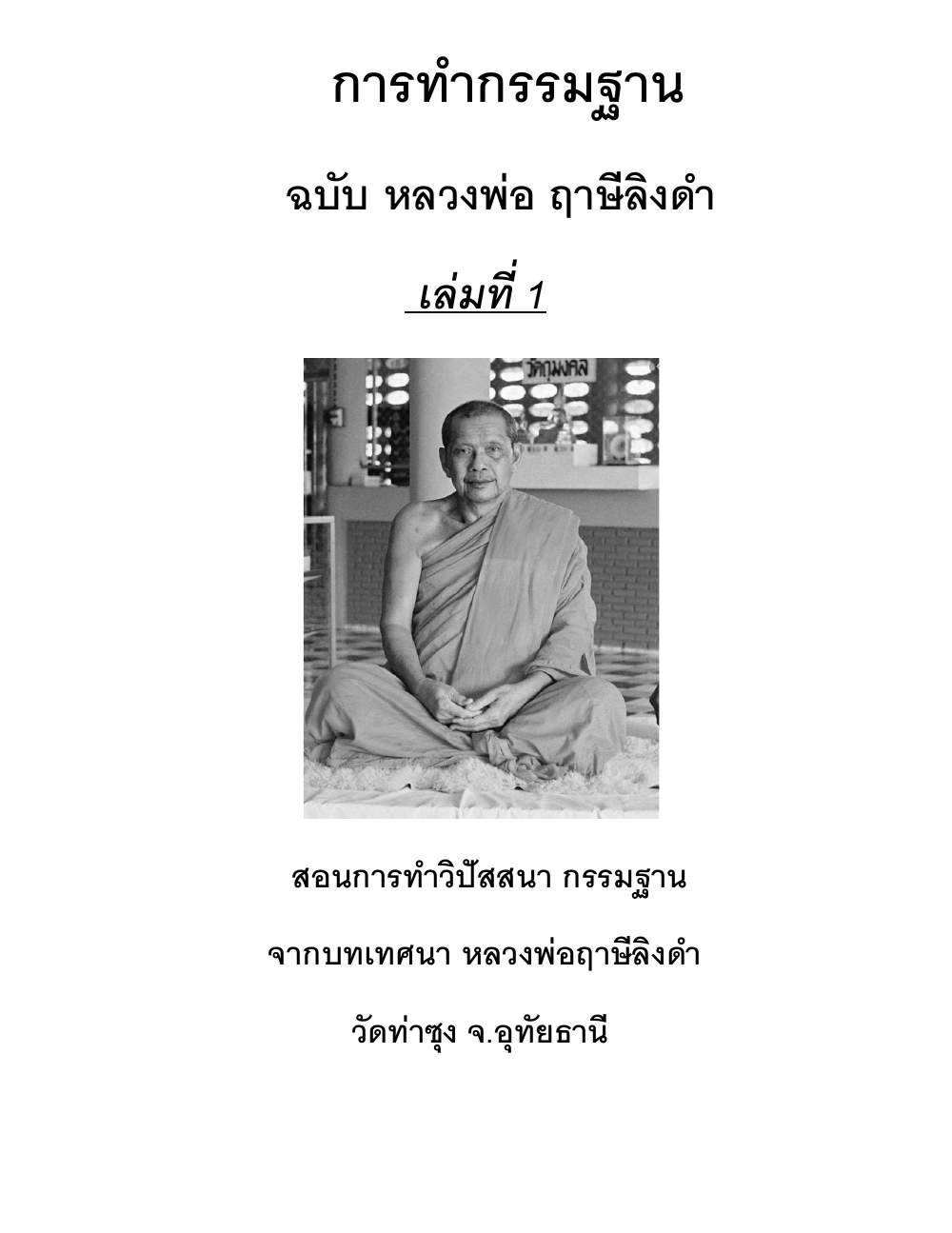
[ภาพถ่าย: พระภิกษุครองจีวรนั่งขัดสมาธิบนผ้าปูสีขาว มือประสานกันบนตัก ด้านหลังเป็นศาลาวัดมีเสาและผนังอิฐ ป้ายมุมซ้ายบนอ่านได้ว่า "วัดถ้ำมงคล"]
สอนการทำวิปัสสนา กรรมฐาน
จากบทเทศนา หลวงพ่อฤาษีลิงดำ
วัดท่าซุง จ.อุทัยธานี
Practicing Kammatthana
Luang Por Ruesi Ling Dam edition
Volume 1
[photograph: a monk in robes seated cross-legged on a white cloth, hands folded in his lap, in front of a temple hall with pillars and a brick wall; a sign in the upper-left corner reads "Wat Tham Mongkhon"]
Teaching the practice of vipassanā kammaṭṭhāna
From the sermons of Luang Por Ruesi Ling Dam
Wat Tha Sung, Uthai Thani Province
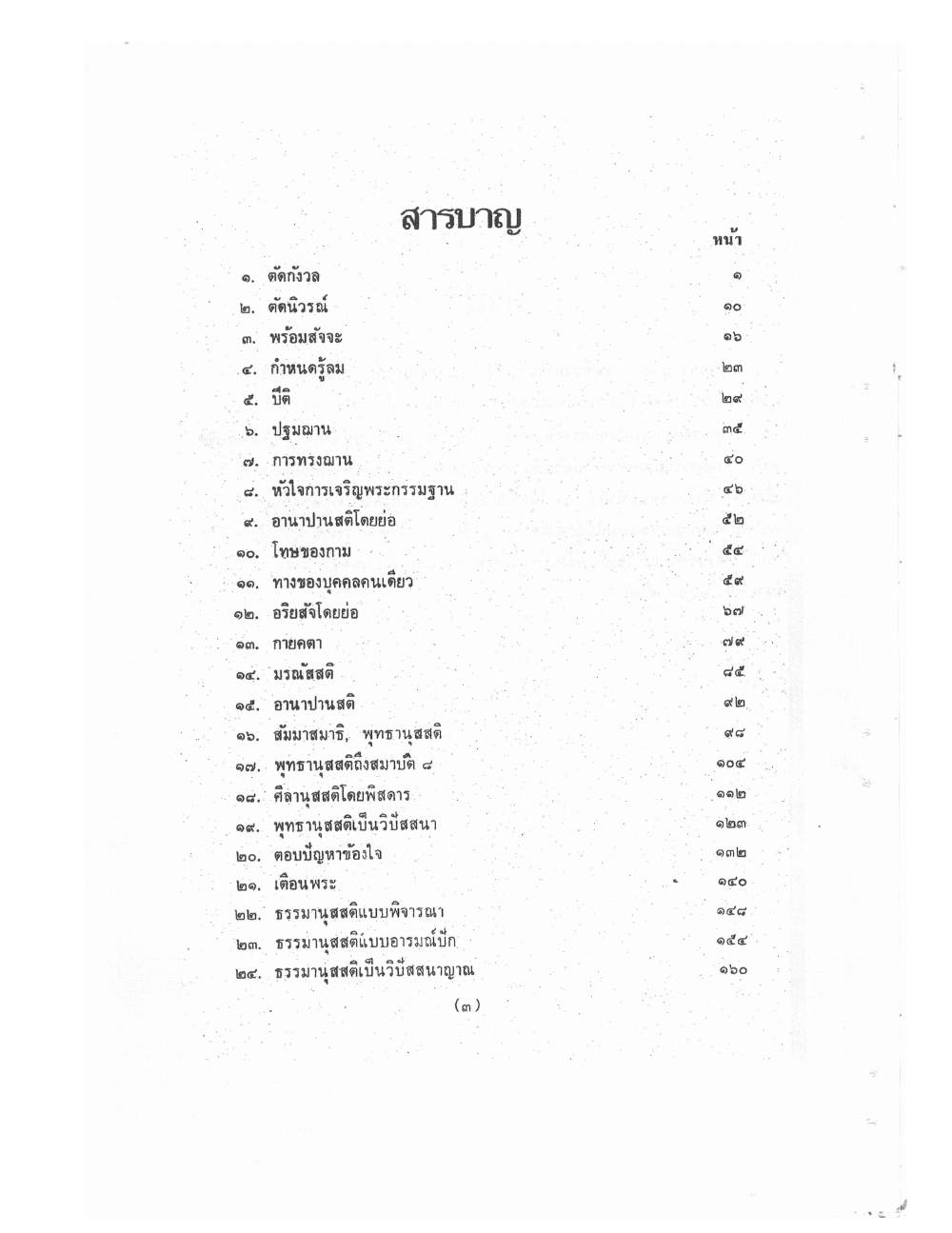
สารบาญ หน้า ๑. ตัดกังวล ๑ ๒. ตัดนิวรณ์ ๑๐ ๓. พร้อมสัจจะ ๑๖ ๔. กำหนดรู้ลม ๒๓ ๕. ปีติ ๒๙ ๖. ปฐมฌาน ๓๕ ๗. การทรงฌาน ๔๐ ๘. หัวใจการเจริญพระกรรมฐาน ๔๖ ๙. อานาปานสติโดยย่อ ๕๒ ๑๐. โทษของกาม ๕๕ ๑๑. ทางของบุคคลคนเดียว ๕๙ ๑๒. อริยสัจโดยย่อ ๖๗ ๑๓. กายคตา ๗๙ ๑๔. มรณัสสติ ๘๕ ๑๕. อานาปานสติ ๙๒ ๑๖. สัมมาสมาธิ, พุทธานุสสติ ๙๘ ๑๗. พุทธานุสสติถึงสมาบัติ ๘ ๑๐๕ ๑๘. ศีลานุสสติโดยพิสดาร ๑๑๒ ๑๙. พุทธานุสสติเป็นวิปัสสนา ๑๒๓ ๒๐. ตอบปัญหาข้องใจ ๑๓๒ ๒๑. เตือนพระ ๑๔๐ ๒๒. ธรรมานุสสติแบบพิจารณา ๑๔๘ ๒๓. ธรรมานุสสติแบบอารมณ์[อ่านไม่ออก] ๑๕๔ ๒๔. ธรรมานุสสติเป็นวิปัสสนาญาณ ๑๖๐ (๓)
Contents Page 1. Cutting off worry 1 2. Cutting off the hindrances 10 3. Together with truthfulness 16 4. Mindful awareness of the breath 23 5. Piti (rapture) 29 6. The first jhana 35 7. Maintaining jhana 40 8. The heart of practising kammatthana 46 9. Anapanasati in brief 52 10. The perils of sensuality 55 11. The path of the solitary person 59 12. The Noble Truths in brief 67 13. Kayagata (mindfulness of the body) 79 14. Maranassati (recollection of death) 85 15. Anapanasati 92 16. Right concentration, Buddhanussati 98 17. Buddhanussati up to the 8 attainments 105 18. Silanussati in detail 112 19. Buddhanussati as vipassana 123 20. Answering troubling questions 132 21. Admonishing the monks 140 22. Dhammanussati by way of contemplation 148 23. Dhammanussati by way of the [illegible] mental state 154 24. Dhammanussati as vipassana-nana 160 (3)
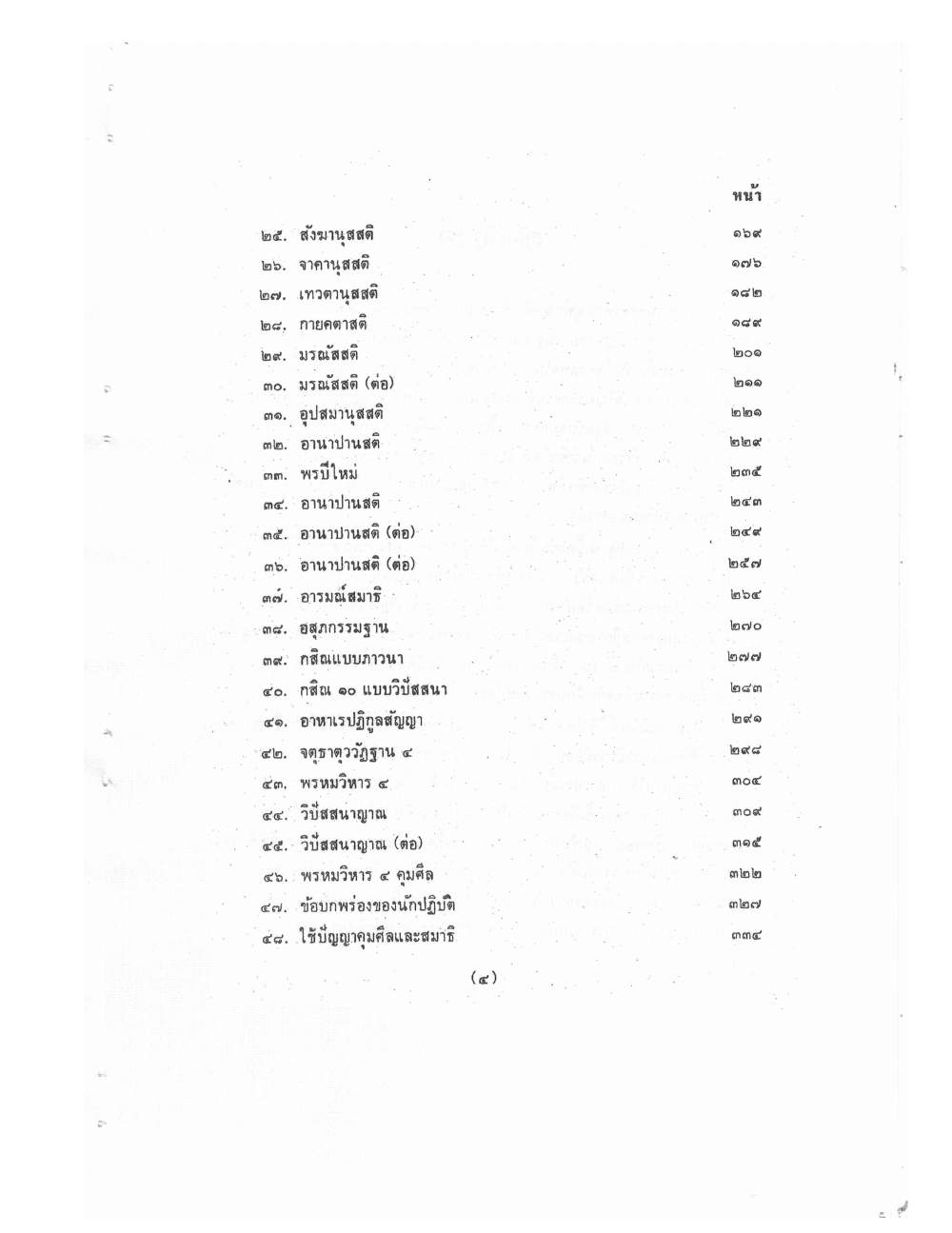
หน้า ๒๕. สังฆานุสสติ ๑๖๙ ๒๖. จาคานุสสติ ๑๗๖ ๒๗. เทวตานุสสติ ๑๘๒ ๒๘. กายคตาสติ ๑๘๙ ๒๙. มรณัสสติ ๒๐๑ ๓๐. มรณัสสติ (ต่อ) ๒๑๑ ๓๑. อุปสมานุสสติ ๒๒๑ ๓๒. อานาปานสติ ๒๒๙ ๓๓. พรปีใหม่ ๒๓๕ ๓๔. อานาปานสติ ๒๔๓ ๓๕. อานาปานสติ (ต่อ) ๒๔๙ ๓๖. อานาปานสติ (ต่อ) ๒๕๗ ๓๗. อารมณ์สมาธิ ๒๖๔ ๓๘. อสุภกรรมฐาน ๒๗๐ ๓๙. กสิณแบบภาวนา ๒๗๗ ๔๐. กสิณ ๑๐ แบบวิปัสสนา ๒๘๓ ๔๑. อาหาเรปฏิกูลสัญญา ๒๙๑ ๔๒. จตุธาตุววัฏฐาน ๔ ๒๙๘ ๔๓. พรหมวิหาร ๔ ๓๐๔ ๔๔. วิปัสสนาญาณ ๓๐๙ ๔๕. วิปัสสนาญาณ (ต่อ) ๓๑๕ ๔๖. พรหมวิหาร ๔ คุมศีล ๓๒๒ ๔๗. ข้อบกพร่องของนักปฏิบัติ ๓๒๗ ๔๘. ใช้ปัญญาคุมศีลและสมาธิ ๓๓๔ (๔)
Page 25. Sanghanussati (recollection of the Sangha) 169 26. Caganussati (recollection of generosity) 176 27. Devatanussati (recollection of the devas) 182 28. Kayagatasati (mindfulness of the body) 189 29. Maranassati (recollection of death) 201 30. Maranassati (continued) 211 31. Upasamanussati (recollection of peace) 221 32. Anapanasati 229 33. New Year blessing 235 34. Anapanasati 243 35. Anapanasati (continued) 249 36. Anapanasati (continued) 257 37. The mental state of concentration 264 38. Asubha kammatthana (meditation on foulness) 270 39. Kasina by way of recitation-meditation 277 40. The 10 kasinas by way of vipassana 283 41. Ahare-patikula-sanna (perception of the loathsomeness of food) 291 42. Catudhatuvavatthana, the 4 elements 298 43. The 4 Brahmaviharas 304 44. Vipassana-nana 309 45. Vipassana-nana (continued) 315 46. The 4 Brahmaviharas guarding virtue 322 47. Shortcomings of practitioners 327 48. Using wisdom to govern virtue and concentration 334 (4)
ตัดกังวล
โอกาสนี้บรรดาท่านพุทธบริษัททั้งหลายได้พากันสมาทานศีลและสมาทานพระ- กรรมฐานแล้ว การเจริญพระกรรมฐานสำหรับวันนี้มีภาวะไม่เสมอกัน เพราะคนเก่าบ้าง คนใหม่บ้าง ฉะนั้น วันนี้จะขอพูดในเรื่องกิจเบื้องต้นของพระกรรมฐาน ตอนสุดท้ายอาจ จะพูดในตอนจบ การเจริญพระกรรมฐานมีอยู่ ๒ แบบ แบบที่ ๑ คือสมถภาวนา แบบที่ ๒ ได้แก่วิปัสสนาภาวนา สำหรับสมถภาวนานั้นเรามีความต้องการอย่างเดียว คือทรงสติสัมป- ชัญญะให้สมบูรณ์ ที่เรียกกันว่าจิตมีสมาธิ สำหรับวิปัสสนาภาวนานั้นใช้ปัญญาเป็นเครื่อง ภาวนาตามความเป็นจริงของขันธ์ห้า เรียกว่าพยายามยอมรับนับถือกฎของความเป็นจริง นั่นเป็นบทของวิปัสสนาภาวนา
การเจริญกรรมฐานเบื้องต้นก็จำต้องใช้สมถภาวนา คือควบคุมอารมณ์จิตให้ทรงอยู่ ถ้าสมถภาวนาของเราไม่ทรงตัว เราจะเห็นว่าวิปัสสนาภาวนาก็ไม่มีผล ถ้าหากว่าเรา ทรงจิตทรงสมถะทรงสมาธิได้มั่นคง ได้ถึงฌาน ๔ การเจริญวิปัสสนาภาวนาก็แสนง่าย การที่จะบรรลุมรรคผลก็กำหนดเวลาได้ตามที่พระพุทธเจ้าตรัสว่า ถ้ามีบารมีแก่กล้าก็จะได้ สำเร็จอรหัตผลภายใน ๗ วัน ถ้ามีบารมีอย่างกลางก็จะได้สำเร็จอรหัตผลภายใน ๗ เดือน ถ้ามีบารมีอย่างทรามที่สุดก็จะได้บรรลุอรหัตผลภายใน ๗ ปี
คำว่าบารมีในที่นี้ก็ได้แก่กำลังใจ ถ้าเรามีกำลังใจครบถ้วนก็ได้ชื่อว่ามีบารมีเต็ม การที่จะใช้ศัพท์ว่าเรามีบารมีอ่อน อันนี้ไม่เป็นความจริง เดิมทีก่อนจะเกิดมาถ้าจะมีบารมี อ่อนอาจจะเป็นไปได้ แต่ว่าบารมีนี่เราสร้างใหม่กันได้ ถ้าเกิดมาแล้วพบพระพุทธศาสนา ยังบอกว่าอ่อนอีกก็แสดงว่าขี้เกียจมากเกินไป ไม่รู้จักควบคุมกำลังใจ ปล่อยไปตามสภาวะ ของกิเลสมันจะมีผลอะไร แล้วมานั่งบ่น มันก็ไม่เกิดประโยชน์ ชาวบ้านเขาทำได้ เรา ทำไม่ได้ จะมานั่งบ่นว่าทำไม่ได้ ก็เพราะว่าเรามันดีไม่พอ ใช้กำลังใจเป็นสำคัญ การ จดจำถ้อยคำ คำแนะนำสั่งสอน การมีวิริยะอุตสาหะ มีสติมีปัญญาควบคุม อันนั้นเป็นของ สำคัญ การเจริญสมถภาวนาในตอนต้น ตอนต้นหรือตอนปลายมีสภาวะเหมือนกัน นั่น ก็คือ
๑
Cutting Off Worry
On this occasion, all of you members of the Buddhist assembly have together taken the precepts and taken up the practice of kammatthana. Today's practice of kammatthana is not on an even footing, because some are old hands and some are newcomers. Therefore, today I will speak on the preliminary business of kammatthana; at the very end I may speak of the concluding stage. The practice of kammatthana is of 2 kinds: kind 1 is samatha-bhavana (tranquillity meditation), kind 2 is vipassana-bhavana (insight meditation). As for samatha-bhavana, we want one thing only: to maintain mindfulness and clear comprehension until they are complete — what is called the mind having samadhi. As for vipassana-bhavana, it uses wisdom as the instrument of meditation according to the true nature of the five aggregates; that is, striving to accept and honour the law of reality. That is the lesson of vipassana-bhavana.
In the beginning stage of practising kammatthana one must necessarily use samatha-bhavana, that is, controlling the moods of the mind so that they hold steady. If our samatha-bhavana is not stable, we will find that vipassana-bhavana bears no fruit either. If we can hold the mind, hold samatha, hold samadhi firmly, reaching the 4th jhana, then practising vipassana-bhavana is exceedingly easy. As for attaining the paths and fruits, the time can be reckoned according to what the Buddha said: if one's parami (perfections) are mature and strong, one will attain arahatship within 7 days; if one's parami are middling, one will attain arahatship within 7 months; if one's parami are of the very poorest, one will attain arahatship within 7 years.
The word parami here means strength of heart (willpower). If our strength of heart is complete, we are said to have full parami. To use the expression that our parami is weak — that is not true. Originally, before being born, it may have been possible for parami to be weak; but this parami is something we can build anew. If, having been born and having met the Buddha's religion, one still says it is weak, that shows one is far too lazy, not knowing how to control one's strength of heart, letting it drift along according to the condition of the defilements — what fruit will that have? And then to sit grumbling brings no benefit. Other folk can do it and we cannot, and we sit grumbling that we cannot do it — that is because we are simply not good enough. Use strength of heart as the key thing. Remembering the words, the counsel and teaching; having effort and perseverance; having mindfulness and wisdom in control — those are what matter. Practising samatha-bhavana at the start — the start and the finish have the same character, namely:
1
อันดับแรก จงอย่าสนใจกับอารมณ์ภายนอกทั้งหมด เรื่องราวของชาวบ้านต่าง ๆ ยกประโยชน์ไป เราไม่สนใจ เรื่องราวของเราก็เหมือนกัน ตัดความกังวลเสียให้หมด ที่เรียกว่าปลิโพธ พระพุทธเจ้าบอกว่าอันดับแรก จงตัดความกังวลทิ้งเสียให้หมด ดำริไว้ อย่างเดียว คือกำหนดจิตจับเฉพาะอารมณ์สมถภาวนาที่เราต้องการ อารมณ์อย่างอื่นเรา ไม่ต้องการทั้งหมด นี่ต้องทำอย่างนี้มันถึงจะมีผล ไม่ใช่สักแต่ว่าทำ สักแต่ว่าภาวนา สัก แต่ว่าพิจารณา อย่างนี้ทำเท่าไรมันก็ไม่มีผล จงจำให้ดีอันดับแรกจงตัดความกังวลเสีย ให้หมด กังวลภายนอกและกังวลภายใน คือกังวลเรื่องของคนอื่น มีบุตรภรรยาสามีญาติ พี่น้อง มิตรสหาย ยกยอดทิ้งประโยชน์ไป ไม่สนใจ ใครจะเป็นอย่างไรก็ช่างมัน ตัวใคร ตัวมัน ตายแล้วก็ไม่ใช่ชวนกันไปตกนรกขึ้นสวรรค์ได้ นี่พูดถึงว่าอารมณ์ที่เราใช้ในการ ทรงสมาธิจิต
และอารมณ์กังวลของเราก็เหมือนกัน มันจะเป็นจะตายก็ช่างมัน เราต้องการ อย่างเดียว คือความบริสุทธิ์และความตั้งมั่นของจิต ไม่ใช่มีสัญญลักขณ์อะไรอย่างใด อย่างหนึ่งเกิดขึ้นมาทางกายก็ระแวงโน่นระแวงนี่ กลัวจะเป็นอย่างนั้น กลัวจะเป็นอย่างนี้ อารมณ์จิตเป็นอย่างนี้จะเจริญสักกี่โกฏิชาติมันก็ไม่มีผล
แล้วมาประการที่สอง องค์สมเด็จพระสัมมาสัมพุทธเจ้าให้รักษาศีลให้บริสุทธิ์ ศีลห้า ก็ดี ศีลแปดก็ดีที่เราสมาทาน โดยเฉพาะอย่างยิ่งอันดับต้นศีลห้าเป็นของสำคัญที่สุด จะใช้ คำว่าไม่สามารถ ไม่ได้ เราต้องเป็นผู้สามารถเสมอในการทรงศีล จะมาเอาสาเหตุใดมาอ้าง ว่ามันจำเป็นอย่างนั้นจำเป็นอย่างนี้ อันนี้ไม่ใช่ เพราะทางการเจริญพระกรรมฐาน มอง ไม่เห็นความจำเป็นใด ๆ ที่จะต้องละเมิดศีล ประการที่สองนี้พระพุทธเจ้าทรงให้ทรงศีล ให้บริสุทธิ์ คือ
๑. เราจะไม่ละเมิดศีลด้วยตนเอง หรือว่าทำลายศีลด้วยตนเอง ๒. เราจะไม่ยุให้ชาวบ้านทำลายศีล ๓. เราจะไม่ยินดีเมื่อบุคคลอื่นทำลายศีลแล้ว
นี่เป็นหลักใหญ่ ต้องทำให้ได้ ไม่ใช่ฟังแล้วก็ลืม ต้องทำให้ได้ด้วย จำให้ได้ด้วย และทำให้ได้ด้วยจึงจะมีผล เพียงแค่นี้ยังมีผลแค่สะเก็ดเท่านั้น
๒
First of all, do not take interest in any external concerns whatsoever. The affairs of other folk of every kind — set them aside, we take no interest. Our own affairs likewise. Cut off all worry completely — what is called palibodha (impediments). The Buddha said that first of all one must cut away all worry entirely, keeping one resolve only: fixing the mind to grasp solely the samatha-bhavana object that we want. All other mental objects we do not want at all. It must be done like this for it to bear fruit — not merely going through the motions, merely reciting, merely contemplating; done that way, however much one does, it bears no fruit. Remember well: first of all, cut off all worry — worry outside and worry inside, that is, worry over other people's affairs: children, wife, husband, relatives, brothers and sisters, friends and companions — set them all aside, take no interest. Whatever happens to anyone, let it be; each to his own. When we die, we cannot invite one another to fall into hell or rise to heaven together. This concerns the mental state we use in maintaining the concentrated mind.
And our own worrying moods are the same: whether it lives or dies, let it be. We want one thing only: the purity and firm establishment of the mind. It is not that when some sign or sensation of one kind or another arises in the body we grow suspicious of this and that, afraid it will be like this, afraid it will be like that. With the mind in such a state, one could practise for however many kotis of lifetimes and it would bear no fruit.
Then comes the second point: the Lord, the Perfectly Self-Awakened Buddha, has us keep our virtue pure — whether the five precepts or the eight precepts that we have undertaken; above all, in the first rank, the five precepts are the most important thing. The phrase "I cannot" may not be used; we must always be one who is able in maintaining virtue. To bring up whatever cause as a claim that it was necessary this way or necessary that way — that will not do, because from the standpoint of practising kammatthana one can see no necessity whatsoever that would require breaking the precepts. In this second point the Buddha has us maintain virtue purely, namely:
1. We will not transgress the precepts ourselves, nor destroy the precepts ourselves. 2. We will not incite others to destroy the precepts. 3. We will not rejoice when another person has destroyed the precepts.
This is the great principle. It must be achieved — not heard and then forgotten. One must both do it, and remember it, and accomplish it, for it to bear fruit. And even this much bears fruit only at the level of the outer bark-flakes.
2
เมื่อทรงศีลให้บริสุทธิ์แล้ว พร้อมกันนั้นจิตก็ต้องระงับนิวรณ์ห้าประการ นิวรณ์ ห้าประการ คือ ความต้องการในรูปสวย เสียงเพราะ กลิ่นหอม รสอร่อย สัมผัสตามความ ประสงค์ และอารมณ์หมกมุ่นอยู่ในกามารมณ์ คือ พอใจอยู่ใน ลาภ ยศ สรรเสริญ สุข อารมณ์ประเภทนี้ต้องทิ้งไป ไม่เอา
แล้วประการที่สองต้องระงับความโกรธ ความพยาบาท ประการที่สามระงับความง่วงเหงาหาวนอน ประการที่สี่ ควบคุมกำลังจิตให้คิดเฉพาะอารมณ์อย่างใดอย่างหนึ่งที่เราต้องการ ไม่ปล่อยให้อารมณ์ฟุ้งซ่านและรำคาญในเสียง ประการที่ห้า ไม่สงสัยในคำสั่งสอนของพระพุทธเจ้า ยอมรับนับถือคำสั่งสอนของ พระพุทธเจ้า นี่เป็นหลักอันหนึ่ง ยังไม่จบ
แล้วประการต่อไปพระพุทธเจ้าให้ทรงจิตให้อยู่ในพรหมวิหาร๔ คือแผ่เมตตาไป ในจักรวาลทั้งหมด เราจะไม่ไปเป็นศัตรูกับใคร เราจะเป็นมิตรกับสัตว์และบุคคลทั้งหมด จิตใจเราจะมีความชุ่มชื่นมองไม่เห็นว่าใครเป็นศัตรูของเรา ผลของเมตตา แปลว่าความรัก เรามีความรักในเพื่อนเกิด แก่ เจ็บ ตาย เสมอด้วยตัวเรา
ประการที่สองมีกรุณามีความสงสารปรารถนาจะให้มีความสุข เรามีอารมณ์จิตคิด อยู่เสมอว่าเรามีความต้องการจะเกื้อกูลบุคคลอื่นและสัตว์อื่นที่มีความทุกข์ ให้มีความสุข ตามความสามารถที่เราจะพึงทำได้ ถ้าแนะนำเองไม่ได้ สงเคราะห์เองไม่ได้ ก็แนะนำให้ ไปหาบุคคลที่มีความสามารถ ที่เขาจะช่วยได้สงเคราะห์ได้
ประการที่สาม มุทุตา มีจิตอ่อนโยน คือระงับความอิจฉาริษยาเสีย ตัดโยนทิ้งไป เมื่อใครได้ดีก็พลอยยินดีกับความดีนั้นด้วย
สี่อุเบกขา ความวางเฉย กฎของกรรมใด ๆ ที่เกิดขึ้นกับร่างกายหรือหมู่คณะ มัน เป็นเหตุที่เราปฏิเสธไม่ได้ อย่างความแก่ ความเจ็บ ความตาย กับการพลัดพรากจากของรัก ของชอบใจอย่างนี้เป็นต้น มันเป็นของธรรมดา ในเมื่อมันเกิดขึ้นมากับตัวเรา กับหมู่ คณะก็ตามวางเฉย ถือว่าเป็นเรื่องปกติไม่สามารถจะหลีกเลี่ยงได้
ในเมื่อท่านทั้งหลายทรงคุณธรรมตามที่กล่าวมา คือ ๑. ตัดปลิโพธทั้งหมด
๓
When virtue has been maintained in purity, then at the same time the mind must still the five hindrances (nivarana). The five hindrances are: desire for beautiful forms, sweet sounds, fragrant scents, delicious tastes, touches according to one's wishes, and the mood of being absorbed in sensuality — that is, taking pleasure in gain, rank, praise, and happiness. Moods of this type must be thrown away; do not take them.
Then, the second point: one must still anger and vindictiveness. The third point: still drowsiness, listlessness and yawning sleepiness. The fourth point: control the strength of the mind so that it thinks only of the one particular object that we want, not letting the mind wander in distraction or be irritated by sounds. The fifth point: have no doubt in the teachings of the Buddha; accept and honour the teachings of the Buddha. This is one principle — and it is not yet the end.
Then, as the next point, the Buddha has us keep the mind dwelling in the 4 Brahmaviharas, that is: radiating metta (loving-kindness) throughout the entire universe. We will not go and be an enemy to anyone; we will be a friend to all beings and persons. Our heart will be refreshed, seeing no one as our enemy. The fruit of metta — the word means love — is that we have love for our fellows in birth, aging, sickness, and death, equally with ourselves.
The second is having karuna (compassion), having pity, wishing others to have happiness. We keep the constant attitude of mind that we want to assist other people and other beings who are suffering, so that they may have happiness according to the ability we can bring to bear. If we cannot advise them ourselves, cannot help them ourselves, then we direct them to go to a person who has the ability, who can help and assist them.
The third is mudita, having a gentle mind — that is, stilling envy and jealousy, cutting it off and throwing it away; when anyone attains something good, we share in gladness at that goodness too.
Fourth is upekkha, equanimity. Whatever workings of the law of kamma arise concerning the body or the community, they are causes we cannot refuse — such as aging, sickness, death, and separation from what is loved and pleasing, and so forth. They are natural things. When they arise for ourselves or for the community, we remain even-minded, regarding it as a normal matter that cannot be avoided.
When all of you possess the virtues as described, namely: 1. Cutting off all palibodha (impediments)
3
๒. ทรงศีลบริสุทธิ์ ๓. ระงับนิวรณ์ห้าประการได้เด็ดขาดในขณะที่ทรงสมาธิ ๔. ทรงพรหมวิหารสี่ได้
อย่างนี้องค์สมเด็จพระศาสดาทรงตรัสว่า ท่านทรงความดีแค่เปลือกของพระศาสนา วัดตัวเราให้ดี วัดใจให้ดีว่าเวลานี้เราทรงความดีเข้าถึงเปลือกของพระศาสนาแล้วหรือยัง จุดนี้จุดเปลือกนี้เป็นจุดที่สำคัญที่สุด ต้องระมัดระวังให้มาก ต้องให้ทรงตัวอยู่ตลอดเวลา โดยเฉพาะอย่างยิ่งการทรงศีลหรือทรงพรหมวิหารสี่ ไม่ใช่จะมาทรงอยู่เฉพาะสมาทานพระกรรมฐานเท่านั้น สำหรับศีล พรหมวิหารสี่ กับการตัดปลิโพธ ความกังวล จะต้องทรงอยู่ตลอด ๒๔ ชั่วโมง พูดกันง่าย ๆ ว่าทรงอยู่ตลอดชีวิต ทุกเวลาทุกนาทีและทุกวินาที นี่ต้องคุมจิตแบบนี้ สำหรับนิวรณ์ห้าประการนี้เป็นของธรรมดา เดี๋ยวเราก็ชนะมัน เดี๋ยวมันก็ชนะเรา แต่ก็พยายามควบคุมเข้าไม่ช้ามันก็จะเป็นลูกไล่สำหรับเรา คือเราชนะมัน คือเป็นผู้ทรงฌาน ถ้าท่านไม่สามารถจะระงับนิวรณ์ห้าได้ เรื่องสมาธิก็ไม่ต้องพูดถึง ไม่มีอะไรเป็นประโยชน์ เราจะมีสมาธิเข้าถึงปฐมฌานได้ เพราะเราระงับนิวรณ์ห้าประการได้ การระงับได้วันหนึ่งชั่วขณะหนึ่งก็ใช้ได้ แต่ก็ยังไม่ดี ทางที่ดีแล้วจะต้องระงับนิวรณ์ได้ตลอดวัน นี่มันถึงจะดี
การจะระงับนิวรณ์จะทำอย่างไร ถ้าเราชอบใจในของสวยสดงดงาม เราก็เจริญอสุภกรรมฐานหรือกายคตานุสสติ
ถ้าหากว่าเราจะปราบโทสะ คือความโกรธหรือความพยาบาท ก็ใช้พรหมวิหารสี่ หรือใช้วรรณกสิณสี่ คือ กสิณสีแดง สีเหลือง สีเขียว สีขาว อย่างใดอย่างหนึ่ง
เราระงับความง่วงด้วยการเดินบ้าง เปลี่ยนอิริยาบถบ้าง ลืมตาให้กว้างบ้าง เอาน้ำล้างหน้าบ้าง เอามือขยี้ตาบ้าง แหงนดูดาวบ้าง ถ้าหากอารมณ์จิตฟุ้งซ่านไม่ทรงตัวอยู่ ให้นับลมหายใจเข้าออก
ถ้าความสงสัยในคำสั่งสอนขององค์สมเด็จพระสัมมาสัมพุทธเจ้ามีขึ้น เราก็นั่งดูตัวเรา ว่าพระพุทธเจ้าทรงกล่าวว่า เมื่อมีความเกิดขึ้นมาแล้ว มันก็มีความเปลี่ยนแปลง แล้วก็มีความสลายไปในที่สุด มาดูตัวเราเวลานี้โตเท่าพ่อเท่าแม่ เวลาคลอดมาใหม่ ๆ โตเท่านี้หรือเปล่า ถอยหลังไป ๑๐ ปี ๒๐ ปี เราแก่เท่านี้ไหม เท่านี้เราก็จะรู้ว่าพระพุทธเจ้า
๔
2. Maintaining pure sila (morality). 3. Suppressing the five nivarana (hindrances) decisively while maintaining samadhi. 4. Being able to maintain the four Brahmavihara.
Thus the Lord Buddha, the Teacher, said: you possess goodness only at the shell (outer bark) of the religion. Measure yourself well; measure your heart well as to whether, at this time, our goodness has yet reached the shell of the religion. This point, this shell-point, is the most important point. You must be very careful; you must keep it steady at all times, especially the maintaining of sila or of the four Brahmavihara. It is not that you maintain them only while formally undertaking kammatthana practice. As for sila, the four Brahmavihara, and the cutting off of palibodha — worry and concern — these must be maintained the full 24 hours. To put it simply, maintain them all your life, every hour, every minute, and every second. The mind must be governed like this. As for the five nivarana, they are ordinary things: now we defeat them, now they defeat us. But keep trying to control them and before long they will become mere underlings for us — that is, we defeat them; that is, we become one who maintains jhana. If you cannot suppress the five nivarana, then samadhi need not even be spoken of; nothing will be of any benefit. We can have samadhi reaching the first jhana because we can suppress the five nivarana. Suppressing them for one day, for one moment, is usable, but still not good. Ideally you must be able to suppress the nivarana all day long — only then is it truly good.
How does one suppress the nivarana? If we delight in beautiful, attractive things, we cultivate asubha-kammatthana (contemplation of foulness) or kayagatanussati (mindfulness of the body).
If we would subdue dosa — that is, anger or vindictiveness — then use the four Brahmavihara, or use the four color kasinas, namely the red kasina, yellow, green, or white, any one of them.
We suppress drowsiness by walking sometimes, changing posture sometimes, opening the eyes wide sometimes, washing the face with water sometimes, rubbing the eyes with the hands sometimes, or tilting the head back to look at the stars sometimes. If the mind's mood is scattered and will not hold steady, count the in-and-out breaths.
If doubt about the teaching of the Lord Buddha arises, we sit and look at ourselves: the Buddha said that once arising has occurred, there is change, and finally there is dissolution. Look at ourselves now, grown as big as father and mother — when newly born, were we this big? Go back 10 years, 20 years — were we as old as this? With just this much we will know that the Buddha
4
ท่านเทศน์ถูก แล้วคนที่เกิดมาแล้วตายเราเห็นบ้างไหม สัตว์และคนเหมือนกัน ถ้าสิ่งนี้มันจริงเราก็เลิกสงสัยได้ พระพุทธเจ้าท่านสอนจริง นี่เป็นหลักใหญ่ในการเจริญวิปัสสนาภาวนาและสมถภาวนาด้วย
หลักทั้งหมดนี้บรรดาท่านพุทธบริษัททั้งหมดหลีกเลี่ยงไม่ได้ จะขอยกงดเว้นข้อใดข้อหนึ่งไม่ได้เลย นี่พูดถึงว่าเราจะเอาดีกัน ถ้าเราไม่เอาดีกันก็ไม่เป็นไร แล้วก็อย่ามานั่งบ่นว่าการเจริญพระกรรมฐานทำมาตั้งสามปี สี่ปี ห้าปี ไม่มีอะไรเป็นผล ที่ไม่มีอะไรเป็นผลก็เพราะว่าเราไม่สามารถจะตัดกังวลได้ ไม่สามารถจะทรงศีลให้บริสุทธิ์ได้ ไม่สามารถจะระงับนิวรณ์ทั้งห้าได้ ไม่สามารถจะทรงพรหมวิหารสี่ได้ สำหรับท่านที่เจริญกันไม่ช้าประเดี๋ยวท่านก็ถึงโน่นถึงนี่ก็เพราะว่าคุณธรรมสี่อย่างนี้ท่านครบอยู่ตลอดเวลา
แล้วก็ขออย่าอ้างว่าเพราะบารมีท่านมาก ควรจะอ้างว่ากำลังใจท่านดี ท่านขยันหมั่นเพียรดี คนที่อ้างว่าบารมีไม่พอ แสดงว่าขี้เกียจมากกำลังใจไม่ดี นี่ไม่มีอะไร บารมีมันเป็นของสร้างใหม่ได้ ไม่ใช่จะต้องเป็นของสร้างมาแต่ชาติปางก่อนเสมอไป ไม่อย่างนั้นก็ไม่มีใครบรรลุมรรคผล
การที่จะเจริญพระกรรมฐานอันดับต้นก่อนที่จะภาวนา สมเด็จพระสัมมาสัมพุทธเจ้าสอนให้พิจารณา เอาง่าย ๆ ถึงความตายกันก่อน เรานึกรู้อยู่เสมอว่าเราต้องตายแน่ ชีวิตนี้ไม่ใช่ของเรา ร่างกายไม่ใช่ของเรา ทั้งนี้เพราะเกิด แก่ เจ็บ แล้วก็ตายเหมือนกัน คำว่าแก่ในที่นี้ไม่ได้หมายถึงว่าแก่หง่อม ไม่จำเป็นต้องแก่หง่อมเสมอไป การที่เราเกิดขึ้นมาแล้ววันหนึ่ง เคลื่อนไปหนึ่งนาทีสองนาที มันก็แก่ไปทุกที ทีแรกมันอ่อนปวกเปียก เมื่อเติบใหญ่ขึ้นมาทุกที การที่เคลื่อนเข้ามาสู่ความเจริญเขาเรียกว่าแก่ขึ้น พอถึงวัยยี่สิบห้าไปแล้ว ทีนี้ก็แก่ลง มันโค้งลง มันก็แก่ทั้งนั้น คำว่าแก่ของพระพุทธเจ้าไม่ได้หมายถึงต้องถือไม้เท้ายันเสมอไป เกิดมาวันสองวันสามวันก็ชื่อว่าแก่ นี่มีความเกิดขึ้นแล้ว ความแปรปรวนมันก็ปรากฏขึ้น คือความแก่มันปรากฏ ในที่สุดมันก็ตาย
ทีนี้ร่างกายของเรา เราไม่ต้องการความแก่ ไม่ต้องการความป่วย เราไม่ต้องการความลำบาก เราไม่ต้องการความตาย แต่เราก็ต้องตายแน่ ทำอย่างไร ๆ เราก็หลีกเลี่ยงความตายไม่ได้ คิดไว้เสมอว่าเราตายแน่ แล้วก็เมื่อไรจะตาย ก็คิดไว้ว่านี่เราหายใจเข้า
๕
preached rightly. And have we ever seen people who were born and then died? Animals and people are alike. If this is true, we can stop doubting: the Buddha taught truly. This is the great principle in cultivating vipassana-bhavana, and samatha-bhavana as well.
All these principles none of you in the whole Buddhist assembly can avoid; not a single item may be excused or omitted. This is speaking of when we mean to attain something good. If we do not aim for the good, that is all right — but then do not come and sit complaining that you have practiced kammatthana for a full three years, four years, five years with nothing to show for it. The reason there is no result is that we cannot cut off worry, cannot keep sila pure, cannot suppress all five nivarana, cannot maintain the four Brahmavihara. As for those who practice and before long reach this or that attainment, it is because these four virtues are complete in them at all times.
And please do not claim it is because their parami (accumulated perfections) is great. One should rather say their strength of heart is good, that they are diligent and persevering. A person who claims their parami is insufficient thereby shows they are very lazy and their strength of heart is poor. There is nothing to it: parami is something that can be built anew; it does not always have to be something built in previous lives. Otherwise no one would ever attain the paths and fruits.
In practicing kammatthana, as the very first step before meditating, the Lord Buddha taught us to contemplate — to take it simply — death first. We keep in mind always that we must certainly die; this life is not ours, this body is not ours, because there is birth, aging, sickness, and then death all the same. The word 'aging' here does not mean decrepit old age; it need not always be decrepitude. Once we have been born, as a day passes, as one minute or two minutes move by, it grows older every moment. At first it is soft and limp; then it grows bigger all the time — this movement toward growth they call 'growing older.' Once past the age of twenty-five, it now ages downward, it bends down — all of that is aging. The Buddha's word 'old' does not mean one must always lean on a staff. Born only two or three days, one is already called old — here arising has occurred, and change appears, that is, aging appears; in the end it dies.
Now, as for our body: we do not want aging, we do not want sickness, we do not want hardship, we do not want death — but we certainly must die. Whatever we do, we cannot avoid death. Think always: we will certainly die. And when will we die? Think: here we breathe in —
5
ถ้าไม่หายใจออกมันก็ตาย หายใจออกแล้วไม่หายใจเข้ามันก็ตาย จะไปรอตายกันเมื่อไร ต้องคิดไว้เสมอว่าความตายมีแก่เราทุกขณะจิต เราจะต้องเป็นผู้ไม่ประมาท
ในเรื่องนี้องค์สมเด็จพระบรมโลกนาถตรัสถามพระอานนท์ว่า อานันทะ ดูก่อนอานนท์ เธอนึกถึงความตายวันละกี่ครั้ง พระอานนท์ทูลตอบว่า ข้าพระพุทธเจ้านึกถึงความตายวันละ ๗ ครั้งพระเจ้าข้า พระพุทธเจ้าตรัสว่า อานันทะ ดูก่อน อานนท์ ยังห่างเกินไป ตถาคตเองนี่นึกถึงความตายทุกลมหายใจเข้าออก นี่เราเอาอย่างพระพุทธเจ้า ความตายนี่ต้องคิดไว้ทุกขณะว่าเราอาจจะตายเวลานี้ แล้วเราพร้อมหรือยัง พร้อมที่จะตายแล้วหรือยัง เมื่อเราพร้อมที่จะตายแล้ว เราเลือกทางที่จะไปแล้วหรือยัง ก่อนที่จะตายนี่เราพบพระพุทธศาสนานี่เราควรจะเลือกไปได้แล้ว ถ้าเราเป็นคนมีกำลังใจ ไม่ขี้เกียจ มีอารมณ์จิตมั่นคง เพราะยังไง ๆ มันก็จะต้องตาย ก่อนจะตาย ร่างกายมันเหมือนกับบ้านที่เช่าอยู่ เมื่อถึงเวลาที่จะไล่ออกก็ต้องไป แต่ก่อนจะไปก็ควรจะหาบ้านไว้เสียก่อน เราจะไปหากระต๊อบหรือบ้านเท่าเดิมหรือว่าบ้านที่ดีกว่า หรือเราจะไปอยู่ในตำแหน่งมหาเศรษฐี นี่เราก็จะต้องสะสมทรัพย์สินของเข้าไว้เพื่อประโยชน์ส่วนใหญ่ ถ้าเราจะไปเลวก็ไม่เป็นไร มันเลวได้ตามอัธยาศัย
ถ้าเราจะไปดีกว่าเดิมนี่ต้องเลือกทางไป การที่จะไปดีกว่าเดิม สำหรับทานและศีล นี่จะไม่พูดละเพราะว่าปกติอยู่แล้ว เราจะพูดเฉพาะเวลาภาวนา นี่เป็นเกณฑ์ภาวนา ถ้าหากว่าเราภาวนาในสมถภาวนาหรือวิปัสสนาภาวนาจิตตกอยู่ในภาวะขณิกสมาธิ ทรงอารมณ์สมาธิได้บ้างเล็กน้อยตามสมควรไม่นานนัก แล้วจิตมันกระโดดไปโน่นกระโดดไปนี่สอดส่ายไปสู่อารมณ์อื่น พอจับได้พอรู้ตัวก็ดึงกลับเข้ามาใหม่ ภาวนาหรือจับลมหายใจเข้าออกไป ประเดี๋ยวหนึ่งมันก็กระโดดไปอีก เราก็ไม่ยอมแพ้ พอรู้ตัวก็ดึงกลับมาเล่นชักเขย่อกันอยู่แบบนี้ดึงกันไปดึงกันมา ท่านเรียกว่าขณิกสมาธิ แต่ขณิกสมาธินี้ถ้าทรงตัวได้ ดึงกันไปดึงกันมาแบบนี้ เวลาตายแล้วไปเกิดบนสวรรค์ชั้นดาวดึงส์แบบสบาย นี่เรียกว่าเตรียมหาบ้านใหม่ รู้คุณสมบัติที่เราจะพึงได้จากการภาวนา
ถ้าจิตมีกำลังสูงขึ้นไป มีความเอิบอิ่ม มีความชุ่มชื่นทรงสมาธิได้ดีกว่า มีความสบายใจดีกว่า มีการสดใสทางจิตดีกว่า อย่างนี้ท่านเรียกว่าอุปจารสมาธิ ทีนี้ถึงแม้จิตใจจะมีความสดใสชุ่มชื่นเอิบอิ่มก็ตาม มันก็มีการโดดเหมือนกัน จิตมันก็มีการโดด ไม่ใช่
๖
if we do not breathe out, it dies; having breathed out, if we do not breathe in, it dies. When are we going to wait around to die? We must always keep in mind that death is with us at every mind-moment; we must be one who is not heedless.
On this matter the Lord, Refuge of the World, asked Phra Ananda: 'Anantha — behold, Ananda — how many times a day do you think of death?' Phra Ananda replied: 'I think of death seven times a day, Lord.' The Buddha said: 'Anantha — behold, Ananda — that is still too far apart. The Tathagata himself thinks of death with every in-and-out breath.' Here we take the Buddha as our model. Death must be thought of at every moment: we might die at this very time — and are we ready yet? Ready to die, or not yet? When we are ready to die, have we chosen the way we will go? Before dying — we have met Buddhism, so we ought to have chosen where to go already, if we are people with strength of heart, not lazy, with a firm state of mind, because whatever happens it must die. Before dying: the body is like a rented house; when the time comes to be evicted, we must go. But before going we should find a house first. Will we go find a hut, or a house the same as before, or a better house? Or will we go take up the station of a great millionaire? For that we must accumulate the goods to bring in for the sake of the greater benefit. If we mean to go badly, never mind — one can be as bad as one pleases.
If we would go better than before, we must choose the way to go. As for going better than before: dana and sila I will not discuss, because they are already normal; we will speak only of the time of meditation. This is the criterion of meditation: if we meditate, in samatha-bhavana or vipassana-bhavana, and the mind rests in the state of khanika-samadhi (momentary concentration), maintaining the concentrated mood a little, as is fitting, not very long, then the mind leaps off over there, leaps over here, flitting away to other objects; as soon as we catch it, as soon as we are aware, we pull it back in again, meditating or catching the in-and-out breath; a moment later it leaps away again; we do not give in — as soon as we are aware we pull it back — playing tug-of-war like this, pulling back and forth: this they call khanika-samadhi. But this khanika-samadhi, if it can hold — pulling back and forth like this — then when you die you go to be born in the Tavatimsa heaven in comfort. This is called preparing to find a new house, knowing the qualities we shall obtain from meditation.
If the mind has higher power — there is rapture and fullness, there is refreshment, concentration holds better, there is greater ease of heart, greater brightness of mind — this they call upacara-samadhi. Now, even though the heart may be bright, refreshed, and full of rapture, it still jumps as well; the mind still jumps — it is not
6
ไม่โดด มันก็วิ่งไปโน่นวิ่งไปนี่ พอจับได้ก็ดึงเข้ามา พอดึงเข้ามามันก็ทรงตัว มีความชุ่มชื่น มีความสบายใจ มีความรื่นเริงหรรษา พร้อมที่จะเจริญพระกรรมฐานตลอดเวลา แล้วสมาธิก็ทรงได้ดี แต่นี่ก็ไม่แน่นัก วันนี้ดีพรุ่งนี้อาจจะไม่ดีก็ได้ อย่างนี้เรียกว่า อุปจาร-สมาธิ ถ้าทรงได้อย่างนี้พอตายแล้วไปเกิดเป็นเทวดาชั้นยามา ตั้งใจไว้ดีนะจะเอาชั้นไหนก็เอา
ทีนี้ถ้าหากเราทรงฌาน การทรงฌานเบื้องต้น โดยเฉพาะอย่างยิ่งปฐมฌาน วันนี้จะพูดเฉพาะปฐมฌาน เวลาพูดมันเลยมาแล้ว การที่จะรู้ว่าจิตเราเข้าถึงปฐมฌานหรือไม่ การเข้าถึงปฐมฌานนี่มันอาจจะถึงไม่ได้นาน สักสองนาทีสามนาทีมันก็พลัดจากฌาน คืออารมณ์พลัดเข้าสู่ธรรมดาที่เราเรียกกันว่าภวังค์ ศัพท์ที่เรียกว่าภวังค์ พยายามใช้ให้มันถูก ภวังค์นี่ไม่ใช่แปลว่าหลับสนิท หรือไม่ใช่แปลว่าลืมตัว ภวังค์แปลว่าอารมณ์ปกติ มีความรู้อยู่เป็นอยู่ตามสภาพเดิม เรียกว่าภวังค์ นี่เคยได้ยินบ่อย ๆ แต่ใช้กันไม่ถูก อย่าไปใช้มันเลย ภาษาบาลี ถ้าใช้ไม่เป็น มันจะเสียเรื่อง คนรู้เขาจะหัวเราะเยาะเอา
ถ้าจิตจะเข้าสู่ปฐมฌานให้สังเกตแบบนี้ เมื่อจิตเข้าสู่ปฐมฌานนี่เราชนะนิวรณ์ นิวรณ์ห้าระงับ จิตเข้าสู่ปฐมฌานทันที หรือว่าขณะที่เราภาวนาอยู่ก็ตามหรือพิจารณาอยู่ก็ตาม หูได้ยินเสียงภายนอกชัดเจนแจ่มใส แต่ทว่าใจเราก็ทำงานได้เป็นปกติ ไม่ดิ้นรนไปในเสียง ไม่รำคาญในเสียง อย่างนี้เรียกว่าปฐมฌาน ปฐมฌานก็ยังมีหยาบมีละเอียด จะอธิบายก็เวลาหมดแล้ว เราทรงปฐมฌานอย่างหยาบ วันหนึ่งได้สองนาที สามนาที ห้านาที สิบนาที เรียกว่าช่าง ไม่ต้องไปตั้งเวลามันทั้งวัน ไม่ถึงปฐมฌาน จิตมันก็สู่สมาธิเล็กน้อย เมื่อจิตหยั่งดีก็เข้าสู่ปฐมฌานอาจจะได้บ้างไม่ได้บ้าง ก็ดึงกันไปดึงกันมา อย่างนี้เรียกว่าปฐมฌานอย่างหยาบ ตายแล้วไปเกิดเป็นพรหมชั้นที่หนึ่ง
ถ้ามีอารมณ์ชุ่มชื่นทรงเวลาได้มากกว่านั้นครึ่งชั่วโมงหรือหนึ่งชั่วโมง อย่างนี้เป็นพรหมชั้นที่สอง ถ้าทรงอาการดีอย่างนี้ตั้งเวลาได้เลย ว่าเราจะนั่งสักสองชั่วโมง ทรงปฐมฌานเข้าปั๊บทรงได้เลย ถึงเวลาสองชั่วโมงจิตมันตัดทันที อย่างนี้เป็นปฐมฌานละเอียดเป็นพรหมชั้นที่สาม ฌานแต่ละระดับก็เป็นชั้นสูง ๆ ขึ้นไป นี่เราเลือกของเราได้นี่ก่อนที่เราจะตาย ก่อนที่เราจะตายเราก็ต้องเลือกเอา จะเอาอะไร
๗
that it does not jump: it runs off over there and over here; when we catch it we pull it in, and once pulled in it holds steady, with refreshment, ease of heart, cheerfulness and delight, ready to practice kammatthana at all times; and concentration holds well. But even this is not certain: good today, tomorrow it may not be good. This is called upacara-samadhi. If you can maintain it like this, then when you die you go to be born as a deva of the Yama level. Set your intention well — whichever level you want, you can take it.
Now, if we maintain jhana — maintaining the beginning jhana, above all the first jhana (pathama-jhana); today I will speak only of the first jhana; in speaking, the time has already run on. As for knowing whether our mind has reached the first jhana or not: reaching the first jhana may not last long — some two or three minutes and it slips from jhana; that is, the mood slips back into the ordinary state that we call bhavanga. The term bhavanga — try to use it correctly. Bhavanga does not mean being sound asleep, nor does it mean losing awareness of oneself. Bhavanga means the normal mood, having awareness and existing according to its original condition — that is called bhavanga. You have heard this often, but it is used incorrectly. Better not to use it at all — Pali, if you cannot use it properly, will spoil the matter; people who know will laugh at you.
If the mind is about to enter the first jhana, observe like this: when the mind enters the first jhana, we defeat the nivarana; the five nivarana are stilled and the mind enters the first jhana at once. Or, whether we are reciting our meditation or contemplating, the ear hears outside sounds clearly and distinctly, but our heart can still work as normal, does not go struggling after the sound, is not annoyed by the sound — this is called the first jhana. The first jhana also has coarse and refined grades; to explain them — the time is already up. We maintain the coarse first jhana: in a day we get two minutes, three minutes, five minutes, ten minutes — call it 'so be it'; there is no need to go setting a timer for the whole day. When it does not reach the first jhana, the mind still enters a little samadhi; when the mind settles well it enters the first jhana, perhaps sometimes succeeding, sometimes not, pulling back and forth. This is called the coarse first jhana; after death one goes to be born as a Brahma of the first level.
If, with a refreshed mood, one can hold longer than that — half an hour or one hour — this is a Brahma of the second level. If one maintains this condition well, one can set the time outright: say we will sit for about two hours — enter the first jhana and hold it straight through; at the two-hour mark the mind cuts off at once. This is the refined first jhana, a Brahma of the third level. Each level of jhana is a step higher and higher. Here we can choose our own place before we die. Before we die we must choose — what will we take?
7
ถ้าหากว่าเราตั้งใจไม่เอาละการเกิดเป็นมนุษย์ เป็นเทวดาหรือเป็นพรหมไม่ดี เราต้องการไปนิพพาน ไม่อยากเกิดอีก ทำจิตใจให้สบายด้วยอำนาจของฌาน หวนกลับมาพิจารณาว่าร่างกายนี้มันไม่ใช่เราไม่ใช่ของเรา มันเป็นแต่เพียงธาตุสี่มาประชุมกันเป็นกายชั่วคราว ไม่ช้ามันก็พังลง มันเสื่อมตลอดเวลา ขึ้นชื่อว่าขันธ์ห้าแล้วเราไม่ต้องการมันอีก ชาตินี้เป็นชาติสุดท้ายในการเกิดสำหรับเรา ความรักในรูป เสียง กลิ่น รส มีประโยชน์อะไร เมื่อร่างกายของเรามันไม่ดีแล้ว ร่างกายของชาวบ้านที่ไหนเขาจะดี ร่างกายเราสกปรก ร่างกายเขาก็สกปรก ในเมื่อเราต้องการสะอาด เราจะเอาร่างกายคนอื่นมาทำไมมันสกปรกนี่ แล้วก็ไม่มีการทรงตัว มีการสลายตัวไปในที่สุด
เมื่อพิจารณากายของเราไม่ดี มันไม่ทรงตัวแล้ว มันจะต้องพัง ความรักด้วยอำนาจของตัณหามันก็น้อยไป ดีไม่ดีมันก็หมดเลย เขาตัดตรงนี้ ความโลภจะตะเกียกตะกายไปเพื่อประโยชน์อะไร การหากินด้วยสัมมาอาชีวะ การหากินด้วยการเลี้ยงชีพอันชอบ พระพุทธเจ้าท่านไม่เคยเรียกว่าโลภ คำว่าโลภนี่มันต้องโกงเขายื้อแย่งเขา ทำลายทรัพย์สินของเขาที่มีประโยชน์ให้มันพินาศไป คือได้มาด้วยอาการไม่สุจริตนั่นเอง อย่างนี้เรียกว่าโลภ ถ้าเราทำมาค้าขายตามธรรมดา ทำไร่ทำนา รับราชการ เป็นลูกจ้าง รับเงินเดือนเงินดาวน์ตามความสามารถ อันนี้ไม่เป็นโลภ จะได้เงินเดือนมากเท่าไรก็ตาม ค้าขายได้กำไรมากเท่าไรก็ตาม ยังไม่ชื่อว่าโลภ เว้นไว้แต่ของเลวบอกว่าเป็นของดีนี่ซิ โลภ โกงเขา ทีนี้ถ้าเราจะต้องตายนี่เราจะโกงเขา เพื่อประโยชน์อะไร หากินด้วยสัมมาอาชีวะ เราตายแล้วมันก็ไม่ไปกับเรา ใจมันก็สบาย ความโลภมันก็ตัดได้
ทีนี้ความโกรธอยากจะฆ่าเขา เราจะต้องตาย เขาก็จะต้องตายเหมือนกัน จะไปฆ่ามันทำไม ไม่จำเป็นจะต้องฆ่า มันตายของมันเอง
ทีนี้ความหลงนั่นเป็นของกูนี่เป็นของกู ก็นั่งดู แม้แต่ร่างกายของเรามันยังไม่เป็นของกูเลย เพราะว่าร่างกายของเรามันยังพังนี่ แล้วร่างกายคนอื่น วัตถุอื่นมันจะเป็นของเราหรือ ทรัพย์สมบัติของโลกมันเป็นประโยชน์เมื่อมีร่างกายเท่านั้น ถ้าร่างกายสลายตัวแล้ว ทรัพย์สมบัติของโลกไม่มีอะไรมีประโยชน์เลย เราจะไปหลงใหลใฝ่ฝันว่านั่นเป็นเรา เป็นของเราเพื่อประโยชน์อะไร มันไม่มี มันไม่ใช่เราไม่ใช่ของเรา ตัดร่างกายทั้งไปด้วยกำลังใจ
๘
If we resolve that we will have none of it — that birth as a human, as a deva, or as a Brahma is no good — we want to go to Nibbana, not wishing to be born again: make the heart at ease by the power of jhana, and turn back to contemplate that this body is not us and not ours; it is merely the four elements come together as a temporary body; before long it collapses; it degenerates all the time. Whatever bears the name of the five khandhas, we do not want it any more; this life is the final life of birth for us. Love of forms, sounds, smells, tastes — of what use is it? When our own body is no good, how would the bodies of other folk anywhere be good? Our body is filthy; their bodies are filthy too. Since what we want is cleanliness, why would we take another person's body — it is filthy; and it has no stability, dissolving away in the end.
When we contemplate that our body is no good, that it no longer holds steady, that it must collapse, then love by the power of tanha (craving) lessens; quite possibly it is finished entirely — this is where they cut it. Greed (lobha): why scramble and claw — for what benefit? Making a living by samma-ajiva, making a living by right livelihood, the Buddha never called greed. This word greed means one must cheat others, snatch and wrestle things from others, destroy others' useful possessions to ruin — that is, obtaining things by dishonest means. That is called greed. If we trade in the ordinary way, farm fields and paddies, serve in government, work as employees receiving salary and wages according to our ability, this is not greed. However large a salary we receive, however much profit we make in trade, it is still not called greed — except passing off bad goods as good goods: that, indeed, is greed, cheating them. Now, if we must die, why would we cheat them — for what benefit? Make a living by right livelihood. When we die it does not go with us; the heart is at ease; greed can be cut off.
Now anger — wanting to kill someone: we must die, and he must die just the same. Why go and kill him? There is no need to kill; he will die by himself.
Now delusion — 'that is mine, this is mine' — just sit and look: even our own body is not ours, because our body still collapses; then will other people's bodies, other objects, be ours? The wealth of the world is useful only while there is a body. Once the body has dissolved, none of the wealth of the world is of any use at all. Why should we be infatuated, dreaming that that is us, that it is ours — for what benefit? There is none; it is not us and not ours. Cut the body away entirely by strength of mind
8
ไม่ใช่เอามันมาเชื่อด เพราะร่างกายนี้มันเป็นโทษ มันเป็นทุกข์ ไม่มีประโยชน์ ขึ้นชื่อ ว่าขันธ์ห้าคือร่างกายอย่างนี้จะไม่มีสำหรับเราอีก ทำใจให้สบาย จิตมันจะเป็นสุข ยอมรับ นับถือกฏของธรรมดา ความแก่ปรากฏก็สบายใจรู้ว่ามันจะแก่ ความป่วยไข้ปรากฏก็สบายใจ รู้แล้วว่าเกิดมามันต้องป่วย ความตายปรากฏหรือการพลัดพรากจากของรักของชอบใจ ปรากฏไม่มีการร้องไห้ ไม่มีการเสียดายเพราะเป็นของธรรมดา ถ้าจิตของท่านยอมรับ นับถือกฏของธรรมดาแบบนี้เขาเรียกว่าพระอรหันต์ อย่างนี้ก็ไปนิพพานได้ มีความสุข ที่สุด
เอาละบรรดาท่านพุทธบริษัทเวลาตั้งไว้สองระยะมันก็หมดทั้งสองจุดแล้ว ต่อแต่นี้ ขอทุกท่านอันดับแรกจับลมหายใจเข้าออก เวลาหายใจเข้ารู้อยู่ว่าหายใจเข้า เวลาหายใจออก รู้อยู่ว่าหายใจออก เวลาหายใจเข้านึกว่า พุท เวลาหายใจออกนึกว่า โธ จนกว่าจะได้ยิน สัญญาณบอกหมดเวลา
* * *
It is not to be clung to, because this body is a fault, it is suffering, of no benefit. Known as the five khandhas — a body such as this will no longer be ours. Make the mind at ease, and it will be at peace, accepting and respecting the law of nature. When old age appears, be at ease, knowing it will age. When sickness appears, be at ease, knowing that once born, one must fall ill. When death appears, or separation from what is loved and cherished appears, there is no crying over it, no regret, because it is natural. If your mind accepts and respects the law of nature in this way, this is called an Arahant. In this way one can go to Nibbana, and has the greatest happiness of all.
Well then, fellow Buddhist followers, the two periods of time set aside are now both finished. From this point on, I ask everyone, first of all, to take hold of the in-and-out breath. When breathing in, know that you are breathing in; when breathing out, know that you are breathing out. When breathing in, think "Phut"; when breathing out, think "Tho" [together forming "Buddho"], until you hear the signal announcing that the time is up.
* * *
๒. ตัดนิวรณ์
การอธิบายพระกรรมฐานคืนนี้ ก็ขอต่อเมื่อคืนนี้ เมื่อคืนนี้เราได้ย้ำกันถึงว่า จุด ของการเจริญพระกรรมฐานที่จะพึงให้ได้ดีก็คือ
๑. ตัดกังวลเสียให้หมด ขึ้นชื่อว่ากังวลภายนอกได้แก่บุคคลอื่น นอกจากตัวเรา หรือว่าวัตถุ กังวลภายใน ได้แก่ร่างกายของเรา ตัดทิ้งไปเสียเลย ถือว่าภาระอันนี้เราไม่มีอีก เรามีแต่เฉพาะอย่างเดียวคือ คุมจิตให้เป็นสมาธิ หรือว่าใช้ปัญญาพิจารณารับรองความรู้ ตามความเป็นจริง
๒. เราเป็นผู้มีศีลบริสุทธิ์ ๓. ระงับนิวรณ์ห้าประการ และ ๔. ทรงพรหมวิหารสี่
นี่เป็นหลักใหญ่ในการควบคุมกำลังใจ ถ้าหากว่าเราไม่สามารถจะควบคุมกำลังใจ ได้ตามนี้การเจริญพระกรรมฐานก็ไม่มีผล กฏสี่ประการนี้ขอบรรดาท่านพุทธบริษัททุกคน จะต้องรักษาไว้ให้ได้จะต้องทรงไว้ให้ได้ด้วย ไม่ใช่สักแต่ว่าทำ ถ้ากฏสี่ประการนี้ประจำ จิตของท่านบรรดาพุทธบริษัททุกขณะจิต จนเป็นเอกัคคตารมณ์ คือมีอารมณ์ทรงตัว ขึ้นชื่อ ว่ากังวลไม่มี มีศีลบริสุทธิ์ ระงับนิวรณ์ห้าได้ตามกำลังใจที่เราต้องการ จิตทรงพรหมวิหาร ๔ ตลอดวันอย่างนี้ พระพุทธเจ้าตรัสว่า เข้าถึงเปลือกความดีของพระพุทธศาสนา นี่เราได้ แค่เปลือกเท่านั้น ๔ ประการนี้
ทีนี้การทรงความดีระดับเปลือก วันนี้จะขอพูดต่อ การทรงความดีระดับเปลือก ความจริงระดับเปลือกนี้เป็นฌาน ๔ ถ้าเราไม่สามารถจะทรงฌาน ๔ ได้ เรายังไม่ถึงเปลือก เว้นไว้แต่เพียงว่า ถ้าจิตเราเข้าถึงปฐมฌานแล้วก็ทรงวิปัสสนาญาณได้ นี่เข้าถึงแก่น ถ้า แม้ว่าอารมณ์จิตจะไม่เข้าถึงฌาน ๔ แต่เป็นแต่เพียงปฐมฌาน แต่ว่าจิตทรงวิปัสสนาญาณ ได้ตัดสังโยชน์ตั้งแต่สังโยชน์สามขึ้นไป อย่างนี้ชื่อว่าถึงแก่นเป็นสาระเป็นแก่นสารอย่าง ยอดเยี่ยมที่พระพุทธเจ้าต้องการ
การจะทรงอารมณ์ได้ เราจะไม่พูดกันถึงพวกศีล พวกอะไรต่อไปอีก อันดับแรก เราต้องการทรงสมถภาวนา สมถภาวนานี้แปลว่า อุบายเป็นเครื่องสงบใจ เป็นกำลังสำคัญ
2. Cutting Off the Hindrances
Tonight's explanation of the meditation practice continues from last night. Last night we emphasized that the key points for developing the meditation practice well are:
1. Cut off all concerns completely. What is called external concern refers to other people besides ourselves, or to objects. Internal concern refers to our own body. Cut it away entirely — consider that this burden we no longer have. We have only one single thing left: to control the mind so it rests in concentration (samadhi), or to use wisdom to examine and confirm knowledge according to the truth.
2. We are one whose precepts are pure. 3. Suppress the five hindrances (nivarana), and 4. Maintain the four Brahmavihara (divine abodes of mind).
This is the major principle for controlling the power of the mind. If we are unable to control the power of mind according to this, the development of the meditation practice bears no fruit. These four rules — I ask every one of you Buddhist followers — must be kept without fail, must be maintained without fail; it must not be done merely for form's sake. If these four rules dwell constantly in the mind of every one of you Buddhist followers, at every mind-moment, until it becomes one-pointedness (ekaggatarammana) — that is, a settled mental state — then it can be said that concern is absent, precepts are pure, the five hindrances are suppressed as fully as we wish, and the mind maintains the four Brahmavihara throughout the day. Even so, the Buddha said this only reaches the outer shell of the goodness of the Buddhist religion — this that we have attained is only the shell, these four things.
Now, as for maintaining goodness at the level of the shell — today I will continue on this. Maintaining goodness at the level of the shell, in truth, this shell-level is the four jhanas. If we cannot maintain the four jhanas, we have not yet even reached the shell, except for this one case: if our mind has reached the first jhana, it can then maintain vipassana-insight — this is reaching the core. Even if the mental state does not reach the fourth jhana, but is only the first jhana, if the mind can maintain vipassana-insight and cut off the fetters (samyojana) from the third fetter upward, this is called reaching the core, being the essence, being the supreme core that the Buddha intended.
To be able to maintain such a state of mind, we will not speak further of precepts or other such matters. First of all, we need to maintain samatha-bhavana (calm-meditation). Samatha-bhavana means: a technique that serves as an instrument for calming the mind; it is an important force
ใหญ่สำหรับนักปฏิบัติเพื่อความดี ถ้าจิตใจของเราไม่สงบเสียแล้ว ความกังวลมันก็เกิด ศีลมันก็ไม่ทรงตัว การจะทรงพรหมวิหาร ๔ มันก็ไม่เป็นไปตามความมุ่งหมาย จะเจริญ วิปัสสนาญาณก็ไม่ได้ผล ความสงบนี้จึงชื่อว่าเป็นตัวทรงไว้ทั้งศีลทั้งสมาธิและปัญญามี ความสำคัญมากจัดว่าเป็นกำลังใหญ่
การที่เราจะสงบจิตทำยังไง ก็มองดูหน้าของนิวรณ์ ตอนนี้เราศึกษากันด้านนิวรณ์ ถ้าอารมณ์ใจของเราที่พอใจในรูปสวย รสอร่อย กลิ่นหอม หรือว่าเสียงเพราะอย่าง นี้เป็นต้น เรียกว่าพอใจในเรื่องสวยสดงามก็แล้วกัน ของสวย คนสวย สัตว์สวยใช้ ได้หมด คือว่าสวยสวยเราข้องใจอยู่ในสวย เราสวยคนอื่นสวย มันก็เหมือนกัน รวมความ ว่าจิตพอใจในความสวยสดงาม พระพุทธเจ้าให้ระงับอารมณ์นี้ด้วยกายคตาสติและ อสุภกรรมฐาน ต้องใช้อารมณ์ถูก นี่เราว่ากันถึงนิวรณ์ ถ้าเราปราบนิวรณ์ได้จิตเราก็เข้าถึง ปฐมฌานได้ การเจริญพระกรรมฐานไม่จำเป็นเฉพาะใช้อย่างใดอย่างหนึ่งตลอดกาลตลอด สมัย ให้เป็นไปตามอารมณ์ที่เกิด แต่สิ่งที่ใช้โดยเฉพาะก็มีอยู่ ประเดี๋ยวจะกล่าวให้ฟัง
เมื่อจิตมีความรักสวยรักงามเกิดขึ้น ก็ให้ใช้พิจารณาในด้านอสุภกรรมฐานเป็น สำคัญ อสุภะแปลว่าความไม่สวยไม่งาม นี่พระพุทธเจ้าให้มองตามความเป็นจริง ไอ้สิ่งที่ เราเห็นว่าสวยนี้ มันสวยจริงๆ หรืออย่างไร ถ้าเราเห็นคนสวย คนสวยถ้าสวยจริงๆ มัน ต้องไม่สกปรก ถ้าลงสกปรกแล้วจะให้มันสวยยังไงก็ใช้ไม่ได้ แม้คนก็ดี สัตว์ก็ดีเราเห็นว่า สวย เราก็มองดูหาความจริง ถ้ามันสวยจริงๆ ดีจริงๆ สะอาดจริงๆ ละก็ ไม่ต้องอาบน้ำ ไม่ ต้องชำระร่างกายปล่อยมันเป็นอย่างนั้นร่างกายจะทรงความดีอยู่ตลอดเวลา นี้คนก็ดีสัตว์ก็ดี ที่เราว่าสวยนะ ต้องชำระร่างกายหรือเปล่า นี้ดูกันแบบผิวเผินที่เราจะเห็นกันได้ง่ายๆ คราวนี้ ถ้าหากว่าจะไม่อาบน้ำสัก ๗ วัน นี่มันก็ทนไม่ไหว เจ้าตัวเองมันก็ทนไม่ไหว มัน เกรอะกรังไปด้วยเหงื่อไคลเต็มไปด้วยความโสโครก จะมาเอาสวยอะไรกันตรงนี้ นี่ใจของ เรามันหลอกตัวเอง ไอ้ของที่มันไม่ดีไปหาว่ามันดี มันก็ลงนรกกัน ที่ต้องมาเวียนว่ายตาย เกิดในวัฏฏะเป็นเทวดาบ้าง เป็นพรหมบ้าง เป็นคนบ้าง เป็นสัตว์บ้าง เป็นสัตว์นรกบ้าง เป็นเปรตบ้าง เป็นอสุรกายบ้าง นี่หมุนกันไปหมุนกันมาอย่างนี้ ก็เพราะไอ้ความโง่ของจิต ของเลวหาว่าเป็นของดี
คราวนี้มองเข้าไปอีกที ทั้งคนและสัตว์ ทะลุหน้าเข้าไปหาเนื้อ ถ้าเราลอกหนังกำพร้า ออกหมดจะมีสภาพเป็นอย่างไร สิ่งที่เราคิดว่าสวย สิ่งที่เราคิดว่าดี นี่มันติดอยู่ที่หนัง
...great force for the practitioner who seeks goodness. If our mind is not calm, then worry will arise, precepts will not hold steady, and maintaining the four Brahmavihara will not go according to intention; developing vipassana-insight will bear no fruit either. This calm is therefore what sustains precepts, concentration, and wisdom together — it is very important, and is reckoned a great force.
As for how we go about calming the mind — we must look into the face of the hindrances (nivarana). We now study the topic of the hindrances. If our mental state is one that delights in beautiful forms, delicious tastes, fragrant smells, or pleasant sounds, and so on — this is called delighting in beauty and attractiveness, let us say. Beautiful things, beautiful people, beautiful animals — all included. That is, we are caught up in beauty; whether we ourselves are beautiful or others are beautiful, it is the same thing. In sum, the mind delights in beauty and attractiveness. The Buddha had us suppress this state with mindfulness of the body (kayagatasati) and the foulness meditation (asubha-kammatthana); the correct object of meditation must be used. This is what we mean by the hindrances. If we can subdue the hindrances, the mind can attain the first jhana. Developing the meditation practice does not require using only one method at all times and in all seasons — it should follow whatever mental state arises. But there are specific methods that are used for this purpose; I will explain them shortly.
When the mind develops love of beauty and attractiveness, one should use contemplation on the foulness meditation (asubha) as the key method. Asubha means not beautiful, not attractive. The Buddha had us look according to the truth: this thing we see as beautiful — is it truly beautiful, or how is it really? If we see a beautiful person — if a beautiful person is truly beautiful, they must not be dirty. If they become dirty, then however one tries to make it beautiful, it will not work. Whether it is a person or an animal that we see as beautiful, we should look and seek the truth. If it were truly beautiful, truly good, truly clean, then there would be no need to bathe, no need to cleanse the body — leave it as it is and the body would maintain its goodness at all times. Now, whether person or animal, the ones we call beautiful — do they need to cleanse the body or not? This is looking at it superficially, in a way we can see easily. Now then, suppose one were not to bathe for as long as 7 days — one could not bear it, the person themself could not bear it. It would become crusted with sweat and grime, full of filth — where then is the beauty in this? This is the mind deceiving itself, taking something not good and claiming it is good. This is what leads down to hell — this is why beings must keep circling through death and rebirth in the cycle (vatta), sometimes as a deva, sometimes as a Brahma, sometimes as a human, sometimes as an animal, sometimes as a hell-being, sometimes as a hungry ghost (peta), sometimes as an asura — spinning round and round like this, all because of the foolishness of the mind that takes something bad and calls it good.
Now let us look further still. Both humans and animals — cut through the surface to reach the flesh beneath: if we peel off the outer skin entirely, what condition would remain? The things we think are beautiful, the things we think are good — these are stuck only at the skin
กำพร้านิดเดียวนี่เท่านั้น ถ้าลอกเข้าไปแล้วมันจะพบกับเลือด น้ำเลือดน้ำเหลืองน้ำหนอง ปรากฏอยู่ภายใน เลิกเนื้อขึ้นไปมีโครงกระดูก เหลือแต่ตับไตไส้ปอดอาหารใหม่อาหารเก่า มีเครื่องจักรกลทั้งหลายภายใน มันเต็มไปด้วยความสกปรก อย่างนี้เขาเรียกว่าใช้ทั้งกาย- คตาสติและอสุภกรรมฐานร่วมกัน นี่หาจุดนี้ให้มันพบหาความจริง เราเจริญพระกรรม- ฐานนี้เราค้นคว้าต้องการหาความจริง แล้วลองคิดดูซิว่า ถ้าสถาวะมันเป็นอย่างนั้นนะ ความจริงมันเป็นอย่างนั้น ร่างกายมันสกปรกหรือมันสะอาด
ถ้าเราไม่สามารถจะมองเห็นภายในได้ จิตมันตื้อ ก็สิ่งที่มันหลั่งไหลจากภายในดูมัน ก็แล้วกัน น้ำลายที่เราอมอยู่ในปากได้ เวลาบ้วนออกมาแล้วหยิบได้ไหม น้ำลายอยู่ในปาก เราเรอมได้เรากลืนได้พอบ้วนออกมาแล้วกลืนไปอีกได้ไหม เอ้าไม่กลืนละ เอาเข้าไปอม ได้ไหม ถ้าไม่อมเราเอามือแตะแล้วมาละเลงหน้าทำได้ไหม เราก็จะบอกว่ามันสกปรก แล้วไอ้ของที่มันสกปรกเหล่านี้มันอยู่ที่ไหน มันอยู่ในกายเราใช่ไหม อุจจาระบ่สาวะ ก็เหมือนกัน เรารังเกียจว่ามันสกปรก แล้วมันมาจากไหน อุจจาระมาจากอาหารที่เราเลือก แล้วด้วยดี ของอย่างนี้ดี ของอย่างนี้ร่อย ของอย่างนี้สะอาดแก่การกิน ถ้ามันสกปรกเรา ก็ไม่กิน เราคิดว่ามันสะอาด แต่ความจริงมันสกปรก กินเข้าไปแล้ว เลือกแล้วด้วยประการ ทั้งปวง พอเวลามันเป็นกากถ่ายออกมา เอามือหยิบได้ไหมออกมาจากกายเราใช่ไหม นี่พูด ถึงร่างกาย สิ่งที่สกปรกพูดกันสักสิบวันมันก็ไม่จบ พิจารณากันแต่นี้ ใช้ปัญญาพิจารณาหา ความจริง ตัดความรู้สึกในคำว่า เห็นว่าสวยสดงามสะอาดสะอ้านตามที่เราต้องการ
ถ้าเราว่ากันถึงด้านวัตถุ เราเห็นว่าสวย ก็ต้องดู วัตถุนี้ที่มันใหม่แล้วมันเก่าได้ไหม ก่อนที่มันจะเก่าถ้าเราปล่อยไว้ไม่มีอะไรบีดบัง ไม่คอยขัดสีฉวีวรรณ สักไม่กี่วันผุ่นละออง จะเข้ามาจับ ความเศร้าหมองมันก็จะเกิด นี่เกิดจากอาการภายนอกเข้ามายุ่งกับมัน นี่ถ้า อาการภายนอกไม่มายุ่งกับมันปล่อยไว้นานความเศร้าหมองก็จะเกิดขึ้นเอง เพราะมันเก่า มันเสื่อมลง แล้วในที่สุดมันก็สลายตัว นี้ถ้าเราใช้ปัญญาพิจารณาอย่างนี้เป็นปกติ อารมณ์ ที่รักในความสวยงดงามก็จะระงับไป ความดิ้นรนในความสวยงดงามก็หมดไป ถ้าความ ดิ้นรนอย่างนี้หมดไปก็ชื่อว่าเราชนะนิวรณ์ตัวที่หนึ่ง เรากำลังจะก้าวเข้าไปสู่ปฐมฌานซึ่ง เป็นหลักชัยที่จะเจริญวิปัสสนาญาณให้ได้พระอริยเจ้า
...only this thin outer skin. If we peel further in, we will meet blood, and lymph and pus appearing within. Beyond the flesh lies the bony skeleton; what remains is liver, kidneys, intestines, lungs, new food and old food, all sorts of machinery within. It is entirely full of filth. This is called using mindfulness of the body (kayagatasati) and the foulness meditation (asubha-kammatthana) together. This is finding this point in order to find the truth. In developing this meditation practice we are searching, seeking to find the truth. Now try thinking: if the state of things is really like that, then the truth is that it is like that — is the body dirty, or is it clean?
If we are unable to see inside, and the mind is obstructed, then let us look instead at what flows out from within. As for the saliva we hold in our mouth — once we spit it out, can we pick it up again? While saliva is in the mouth we are able to swallow it; but once we have spat it out, can we swallow it again? Well — suppose we do not swallow it — can we take it back into our mouth and hold it there? If we do not hold it in the mouth, can we touch it with our hand and smear it on our own face? We would say it is dirty. And this dirty matter — where is it? It is inside our own body, is it not? Feces and urine are the same. We find them disgusting, calling them dirty — but where do they come from? Feces come from food that we ourselves have chosen with care — this food is good, this food is delicious, this food is clean enough to eat. If it were dirty we would not eat it. We think it is clean, but in truth it is dirty; once eaten — chosen with every care — once it becomes waste and is excreted, can we pick it up with our hand? It came out of our own body, did it not? This is speaking of the body. Speaking of what is dirty could go on for ten days and never finish. Let us contemplate only this much — use wisdom to contemplate and find the truth, cutting off the feeling in the phrase "seeing as beautiful, attractive, clean and tidy" according to how we wish it to be.
If we speak of material objects — we see something as beautiful — we must look: this object that is new now, can it become old? Before it becomes old, if we leave it with nothing covering it, without ever polishing its surface, within just a few days dust will come to settle on it, and tarnish will arise. This arises from external conditions coming to interfere with it. But even if external conditions do not interfere with it, if left alone for a long time, tarnish will arise by itself, because it is old, it deteriorates, and in the end it disintegrates. Now if we use wisdom to contemplate in this way as a regular practice, the mental state of loving beauty and attractiveness will subside. The striving after beauty and attractiveness will come to an end. If this striving comes to an end in this way, it is said that we have conquered the first hindrance. We are about to step into the first jhana, which is the milestone for developing vipassana-insight so as to attain the status of a noble one (ariya).
นิวรณ์ตัวที่ ๒ ได้แก่โทสะ ความโกรธ หรือความพยาบาท ความคิดประทุษร้าย ผู้อื่นที่มีในใจ อันองค์สมเด็จพระจอมไตรบรมศาสดาตรัสบอกว่า ให้ใช้เมตตากับกรุณา ทั้งสองประการ เข้าประหัดประหาร เมตตาความรัก กรุณาความสงสาร ให้คิดเสียว่า เขากับเรามีสภาวะเช่นเดียวกัน เกิด แก่ เจ็บ ตาย มีความทุกข์เหมือนกัน ถ้าเขามีความ ผิดขึ้นมาบ้างก็จงนึกถึงจิตใจของเราว่าบุคคลทุกคนนี้ที่กระทำไปแล้วทั้งหมด จะพูดก็ดี จะ ทำก็ดี ก็คิดว่ามันดีจึงทำ ถ้าหากว่าเขารู้ว่ามันเลว มันจะเป็นเหตุความเดือดร้อน ก็ไม่ทำ แต่ทำไมถึงได้ทำความชั่ว ทั้งนี้เพราะว่าจิตที่เป็นอกุศล อกุศลจิตคือความเลวมันเข้ามา สิงใจ คล้ายกับผีสิง มันย้อมใจให้มัวเมาเข้าใจว่าความเลวเป็นความดี คนที่ถูกผีสิงหรือผี คือกิเลสสิงแบบนี้ ก็เป็นการสมควรแก่การให้อภัย เห็นเขาทำผิดไม่ผิดระเบียบวินัยก็ชื่อ ว่าเราให้อภัยได้สำหรับส่วนตัว ถ้าผิดกฎหมายผิดวินัยผิดระเบียบอันนี้ต้องลงโทษตามวินัย ตามระเบียบ ไม่ใช่ถือว่าเป็นเรื่องส่วนตัว เพราะว่าระเบียบและวินัยทั้งหมดเขาวางไว้เพื่อ ให้บุคคลทำความดี นี่ถ้าไปละเมิดเข้าก็แสดงว่าชั่ว ถ้าเราไม่ลงโทษก็แสดงว่า เราปล่อย ให้เขาชั่วตลอดไป อย่างนี้ก็ไม่ชื่อว่ามีจิตเมตตาความรัก กรุณาความสงสาร คนที่รักกัน สงสารกันจะต้องระมัดระวังกันไว้ไม่ให้ใครชั่ว ไม่ให้ใครเลว การลงโทษตามระเบียบตาม วินัยถือว่าเป็นการเมตตาปราณี เพื่อป้องกันไม่ให้เขาทำความชั่ว ในเมื่อเรามีความรัก ความสงสารแล้ว ไอ้ความโกรธความพยาบาทคิดประทุษร้ายมันก็ไม่มี
ถ้าอารมณ์รักอารมณ์สงสารประเภทนี้เราทรงใจไม่อยู่ องค์สมเด็จพระบรมครูก็มี วิธีแนะนำอีก ให้ใช้กสิณ ๔ อย่าง คือกสิณสีเรียกว่าวรรณกสิณ คือกสิณสีแดง สีเหลือง สีขาว สีเขียว อย่างใดอย่างหนึ่งจับเข้าไว้ให้เป็นอารมณ์ ให้จิตทรงในภาพกสิณนั้นไว้ ก็สามารถที่จะทำลายโทสะจริตได้ เมื่อจิตใจของเราทำลายโทสะจริตได้ ก็จะมีแต่อารมณ์ เยือกเย็น เพราะโทสะเป็นอารมณ์เร่าร้อน ถ้าเราทำลายเสียได้ก็มีแต่ความเย็น จิตจะมี ความสุข จะทรงสมาธิอยู่ได้นาน เรียกว่าเราก็ใกล้จะถึงนิพพานเต็มที่เข้าไปแล้ว แม้แต่ จะเจริญสมถภาวนา
นิวรณ์ตัวที่ ๓ ความง่วงเหงาหาวนอน ตัวนี้แก้ไม่ยาก ให้ลืมตาให้กว้างบ้าง เอา มือขยี้ตาบ้าง เอาน้ำล้างหน้าบ้าง แหงนดูดาวบ้าง เดินไปเดินมาบ้าง นี่ตามวิธีที่พระพุทธ-
The second hindrance is dosa — anger, or ill-will, the thought of wishing harm on others that arises in the mind. The Lord of the Three Worlds, the Great Teacher, taught that we should use loving-kindness (metta) together with compassion (karuna), both of these, to strike it down and destroy it. Metta is love; karuna is compassion. We should think that others and ourselves share the very same condition — birth, old age, sickness, death — we suffer just the same. If another does something wrong, we should reflect in our own mind that every person, in everything they have done — whether speaking or acting — thought it was good, and so did it. If they had known it was bad, that it would cause trouble, they would not have done it. But why then do they still do evil? This is because an unwholesome state of mind — an unwholesome mind, that is, badness — has come to possess the heart, much like being possessed by a ghost. It steeps the mind in delusion, making one believe that badness is goodness. A person possessed by a ghost, or by defilements possessing them in this way, deserves to be forgiven for it. Seeing them do wrong that does not break rules or discipline, it may be said that we can forgive them on a personal level. But if it breaks the law, breaks discipline, breaks the rules, then this must be punished according to the discipline, according to the rules — it is not to be treated as a personal matter, because all rules and discipline are laid down in order to make people do good. If someone violates them, that shows wrongdoing; if we do not punish it, that shows we are letting that person remain wicked forever. This would not be called having a mind of loving-kindness and compassion. People who love one another and feel compassion for one another must be careful to guard against letting anyone become wicked, become bad. Punishing according to the rules and the discipline is considered an act of loving mercy, meant to prevent them from doing evil. When we already have love and compassion, then anger, ill-will, and the thought of doing harm simply cannot exist.
If this kind of loving, compassionate state of mind is one we cannot hold steady, our Great Teacher has another method to recommend: to use one of the four kasinas — that is, the color kasinas (vannakasina): the red kasina, the yellow, the white, the green — take up whichever one and hold it as the object of meditation, letting the mind rest fixed in that kasina image; this too is able to destroy an aversion-type (dosa-carita) temperament. When our mind has destroyed the aversion temperament, there will be only a cool, tranquil state of mind, because aversion is a hot, agitated state. If we can destroy it, there will be only coolness; the mind will have happiness, and will be able to maintain concentration for a long time. This means we are already very close to reaching Nibbana in full, even just from developing samatha-bhavana [calm meditation].
The third hindrance is drowsiness and sleepiness. This one is not hard to remedy: open the eyes wide, rub the eyes with the hand, wash the face with water, look up at the stars, walk back and forth — this follows the method that the Buddha—
เจ้าทรงแนะนำแก่พระมหาโมคคัลลานะ เพราะว่าพระมหาโมคคัลลานะไปปฏิบัติกับพระ- พุทธเจ้า ท่านนั่งหลับนั่งงีบ พระพุทธเจ้าท่านแนะนำให้ปฏิบัติตามนี้ นี่ถ้าอารมณ์อย่าง นี้เกิดขึ้นก็แก้แบบนี้
นิวรณ์ตัวที่ ๔ คืออุทธัจจกุกกุจจะ ความฟุ้งซ่านและรำคาญ อันองค์สมเด็จ พระพิชิตมาร บรมศาสดาทรงแนะนำให้ใช้อานาปานสติกรรมฐานโดยเฉพาะไม่ต้อง ภาวนาบทใดๆ ทั้งหมด ถ้าขืนไปภาวนาหรือพิจารณาเข้าไอ้จิตมันซ่านอยู่แล้ว ก็จะช่วย กันซ่านใหญ่ ท่านให้กำหนดรู้ลมหายใจเข้า หายใจออก เวลาหายใจเข้ารู้อยู่ว่าหายใจเข้า เวลาหายใจออกรู้อยู่ว่าหายใจออกเอาเพียงเท่านี้ จับเฉพาะลมหายใจเข้าหายใจออก ถ้าจับ อย่างนี้มันยังไม่อยู่ เอาละ ไม่เอาเฉยๆ เอานิมิตเข้าไปด้วย นิมิตอันนี้ไม่ใช่ภาพ หายใจ เข้าหายใจออกหนึ่งคู่นับเป็น ๑ นับไปด้วยหายใจเข้าหายใจออกนับเป็น ๒ เป็นคู่ที่ ๒ คู่ที่ ๓ คู่ที่ ๔ ถึงคู่ที่ ๑๐ ตั้งเกณฑ์ไว้ว่า ตั้งแต่ ๑ ถึง ๑๐ นี้ เราจะไม่ยอมให้อารมณ์จิต คิดอย่างอื่น เราจะจับอยู่เฉพาะลมหายใจเข้าหายใจออกเท่านั้น แล้วไม่ต้องทำมาก แค่ ๑๐ ก็เลิก ถ้าจิตมันซ่าน เพราะว่าในกาลบางครั้ง การนับมันก็ไม่ทรงตัวเหมือนกัน มันดิ้น ไม่ยอมหยุด อันนี้พระพุทธเจ้าทรงแนะนำบอกว่า ถ้ามันดิ้นไม่ยอมหยุด ก็ให้เลิกเสีย ถ้าเราไม่เลิกก็มีวิธีอย่างหนึ่ง นั้นก็คือปล่อยให้มันคิดไปตามอารมณ์ มันอยากจะคิดอะไร เชิญคิดตามอัธยาศัย แล้วควบคุมกำลังใจเข้าไว้ ถ้ามันเลิกคิดเมื่อไร เราจะทรงสมาธิเมื่อ นั้น ถ้าเราปล่อยอารมณ์คิดไปแบบนี้ไม่นานประมาณ ๔ นาที ๑๐ นาที ไม่เกิน ๒๐ นาที เป็นอย่างช้า อารมณ์จิตมันก็จะเหนื่อย มันจะเลิกคิด พอมันเลิกคิดเราก็มาจับเอาลมหายใจ เข้าออก ตอนนี้จะมือารมณ์ดึงเป็นฌานทันที แล้วก็จะทรงสมาธิอยู่ได้นาน นี่เป็นวิธี การที่จะระงับนิวรณ์ ค่อยๆ ระงับมันไป
นิวรณ์ข้อที่ ๕ ความสงสัยในคำสั่งสอนขององค์สมเด็จพระสัมมาสัมพุทธเจ้า ไอ้ เรื่องนี้เห็นจะไม่ต้องบอก ถ้าสงสัยแล้วจะมานั่งทำเกลืออะไรกันอยู่ที่นี่เล่า ไปนอนอยู่บ้าน ไม่ดีกว่าริ ข้อนี้ไม่ต้องอธิบาย เพราะคนที่มานั่งที่นี่ทั้งหมดแสดงว่าไม่มีความสงสัย เลิก กัน ยกยอดกันไป
นี่ ถ้านิวรณ์ทั้งห้าประการนี้ ถ้าเราสามารถระงับด้วยวิธีนี้ ใหม่ๆ มันก็จะระงับ ไม่ได้นาน สัก ๒ นาที ๓ นาที ๔ นาที ๕ นาที หรือ ๑๐ นาทีเป็นอย่างมาก ถ้า ๑๐
...taught to Phra Maha Moggallana, because Phra Maha Moggallana, while practicing with the Buddha, kept sitting there falling asleep, dozing off. The Buddha instructed him to practice as follows. So if this kind of state arises, this is how it is remedied.
The fourth hindrance is uddhacca-kukkucca — restlessness, distraction, and irritation. The Victor over Mara, the Great Teacher, taught that specifically the mindfulness-of-breathing meditation (anapanasati) should be used, with no need to recite any formula at all. If one insists on reciting or contemplating while the mind is already scattered, it will only help it scatter all the more. He taught us to note the in-breath and the out-breath: when breathing in, know that one is breathing in; when breathing out, know that one is breathing out — just this much. Take hold only of the in-breath and out-breath. If holding on like this it still does not settle, then — very well, do not simply leave it at that; also bring in a counting device. This device is not a mental image. One in-breath and one out-breath together count as 1; continuing, the next in-breath and out-breath count as 2, forming the second pair; the third pair, the fourth pair, up through the tenth pair. Set the rule that from 1 to 10, we will not allow the mind to think of anything else. We will hold only to the in-breath and out-breath, nothing more; and there is no need to do more than that — just up to 10 and then stop. If the mind is still scattered — because at times even the counting itself does not stay steady — it thrashes about, refusing to settle. For this, the Buddha's teaching says: if it thrashes about and refuses to settle, then let it go. If we do not let it go, there is one further method: that is, to let it think according to its own inclination — whatever it wishes to think, let it think as it pleases — while still keeping hold of the power of mind. Whenever it stops thinking, at that very moment we will attain concentration. If we let the mind think in this way, it will not be long — about 4 minutes, 10 minutes, no more than 20 minutes at the very slowest — before the mental state grows weary and stops thinking. As soon as it stops thinking, we then take hold of the breath in and out once more; at that point the mental state will be drawn straight into jhana, and will then be able to maintain concentration for a long time. This is the method for suppressing the hindrances — suppressing them little by little.
The fifth hindrance is doubt regarding the teachings of the Fully Self-Enlightened Buddha. This matter, I think, needs no explanation — if one still had doubt, what would one be doing sitting here at all? Would it not be better to go home and sleep? This point needs no explanation, because everyone who has come to sit here shows by that very fact that there is no doubt. Let us drop this and move along.
Now then — as for these five hindrances, if we are able to suppress them by this method, at first the suppression will not last long — perhaps 2 minutes, 3 minutes, 4 minutes, 5 minutes, or at most about 10 minutes. If [these] 10...
นาทีมันก็ก่งแล้ว อารมณ์จิตมันก็จะซ่าน เราก็จับดึงเข้ามาใหม่ มันไปไหนก็ให้มันไป มันเผลอนี่ก็ให้มันไป ไอ้จิตนี่มันซ่านมาเป็นแสน ๆ กัป อยู่ ๆ เราก็จะมาจับให้มันนิ่ง เฉย ๆ มันอยู่ไม่ได้นาน เราก็ถือว่าถ้าทรงจิต เราทรงอยู่ได้บ้าง พอมันไปเรารู้ว่ามันไป ใช้เวลาไม่มากนัก แล้วก็ดึงกลับเข้ามาอีกให้ทรงอารมณ์อยู่สักครู่หนึ่งมันก็หนีไปอีก อย่าง นี้ก็ยังดีกว่าสภาวะเดิมที่มันไม่รู้ว่ามันท่องเที่ยวไป แสดงว่าจิตของเราเริ่มมีสมาธิแล้ว องค์ สมเด็จพระประทีปแก้วกล่าวว่า อาการที่ปรากฏแล้วอย่างนั้นท่านเรียกว่า ขณิกสมาธิ คือ ทรงได้บ้างไม่ได้บ้าง ดึงกันไปดึงกันมา แล้วก็จับเอามาทรงไว้ชั่วขณะหนึ่งมันก็ดึงออกไป ดึงออกไปแล้วคิดอะไรต่ออะไรเพลิน พอรู้สึกตัวอ้าวนี่เพ่นพล่านไปเสียแล้วรี แล้วก็ดึง กลับเข้ามาใหม่ อย่างนี้องค์สมเด็จพระจอมไตรเรียกว่าขณิกสมาธิ
ขณิกสมาธิ แปลว่า สมาธิเล็กน้อย การทรงอยู่องค์สมเด็จพระบรมครูกล่าวว่า ผู้ที่ได้ขณิกสมาธิ วันหนึ่งสามารถทรงจิตให้สงบเพียงชั่วขณะจิตเดียว พระพุทธเจ้ากล่าวว่า เราเรียกว่าบุคคลนั้นเป็นผู้ไม่ว่างจากฌาน ขณิกสมาธิที่ท่านทรงไว้ได้ เวลาตายไปอยู่ สวรรค์ชั้นดาวดึงส์ได้แบบสบาย เราไปสวรรค์ได้ เราก็เหยียบมนุษย์ได้ ถึงแม้จะบอกว่า ไปสวรรค์นี้สู้ไปพรหมไม่ได้ ไปพรหมสู้ไปนิพพานไม่ได้ แต่ขั้นแรกให้เกาะสวรรค์ไว้ ก่อน ชื่อว่าเป็นกำไรถมเถไป เป็นความดีมีความสุข ต่อไปเราก็ก้าวไปเพื่อสู่สภาวะความ เป็นพรหมหรือพระนิพพาน
เอาละสำหรับเวลากาลที่จะพูดมันก็เลยมามากแล้ว เพราะสัญญาณบอกหมดเวลา ปรากฏแล้วต่อแต่นี้ไป ขอบรรดาท่านพุทธบริษัททั้งหลาย พยายามตั้งกายให้ตรง ดำรง จิตให้มั่น สำหรับนักปฏิบัติพระกรรมฐานใหม่ ใหม่หรือเก่าก็ตาม พยายามจับลมหายใจ เข้าออกให้รู้ลมเข้าลมออกอยู่ ถ้าเราจะภาวนา ก็ภาวนาตามอัธยาศัย หรือว่าจะพิจารณา อะไรก็ได้ ให้เป็นไปตามอัธยาศัย จนกว่าจะได้ยินสัญญาณบอกหมดเวลา
* * * ๑๕
The minute [of holding it] has passed and the mental state will start to wander. We catch and pull it back in again — wherever it goes, let it go; when it slips away, let it go too. This mind of ours has been wandering for hundreds of thousands of aeons; now and then we come and catch it to make it still. Held quietly, it cannot stay long. We reckon that if we can sustain the mind, we can sustain it for a while; as soon as it goes we know it has gone — it doesn't take long — then we pull it back in, hold its object for a moment, and it slips out again. Even so, this is still better than the original condition where it did not even know it was wandering off. This shows our mind has begun to have concentration. His Holiness the Jeweled Lamp [an epithet of the Buddha] said: the state that appears like this is called khanika samadhi — that is, sometimes able to hold, sometimes not, pulled back and forth; we catch and sustain it for a moment and it pulls away again, pulls away and goes off thinking pleasantly of this and that; then when we come to our senses — oh, it has gone scattering off again! — and we pull it back in once more. This is what His Holiness the Lord of the Three Worlds calls khanika samadhi.
Khanika samadhi means 'minor concentration.' Concerning sustaining it, His Holiness the Great Teacher said: one who has attained khanika samadhi can, in a given day, hold the mind calm for only a single mind-moment. The Buddha said: we call such a person one never apart from jhana. Whoever can keep the khanika samadhi they have attained, when they die they go comfortably to the Tavatimsa heaven. We can go to heaven, and we can also walk among humans. Even though it is said that going to heaven cannot compare with going to the Brahma realm, and the Brahma realm cannot compare with Nibbana, still, for the first step, let us hold on to heaven first — call that already a great gain, a goodness, a happiness; after that we advance further toward the state of Brahma or Nibbana.
Well then, as for the time left to speak, it has run on quite a while already, since the signal announcing time is up has now appeared. From here on, may all you Buddhist devotees try to keep the body upright and the mind firmly established. For those newly practising the meditation exercise — whether new or old — try to hold the breath, aware of it going in and out. If we wish to recite, recite as we are inclined; or if we wish to contemplate something, we may do so as we are inclined, until we hear the signal that time is up.
* * * 15
๓.พร้อมสัจจะ
โอกาสนี้บรรดาท่านพุทธบริษัททั้งหลาย ได้พากันสมาทานอุโบสถศีลและสมาทาน พระกรรมฐานแล้ว คำสมาทานทั้งหมดขอให้บรรดาท่านพุทธบริษัทถือเป็นหัวใจของการ ปฏิบัติ
เราสมาทานศีลจงตั้งใจรักษาศีลให้บริสุทธิ์ อย่าเพียงสักแต่ว่าสมาทาน แล้วการ รักษาศีลให้บริสุทธิ์นี้ก็ไม่ใช่เฉพาะเวลานี้ ถือว่าการสมาทานศีลครั้งแรกในชีวิต เราก็ ต้องรักษากันไปตลอดจนกว่าจะถึงวันตาย อย่างนี้จึงจะชื่อว่าใช้ได้ รวมทั้งพระทั้งเณร ก็เหมือนกัน การเป็นผู้ทรงศีลบริสุทธิ์ย่อมเป็นปัจจัยตัดความเดือดร้อน เรามีศีลบริสุทธิ์ นึกถึงศีลเป็นปกติ พระพุทธเจ้าเรียกว่าเป็นผู้เจริญศีลานุสสติกรรมฐาน นี่เป็นความดี อันหนึ่งที่จะทำให้เราเข้าถึงอย่างเลวก็กามาวจรสวรรค์ หรือมิฉะนั้นก็เป็นพรหม ถ้าศีล บริสุทธิ์จริง ๆ เราก็ไปพระนิพพานได้ ถ้ามีความเข้าใจในศีล
ประการที่สอง เมื่อเราสมาทานพระกรรมฐานว่า อิมาหัง ภควา อัตตภาวัง ตุมหากัง ปริจัชชามิ ซึ่งแปลเป็นใจความว่า ข้าพเจ้าขอมอบกายถวายชีวิต แด่องค์สมเด็จ พระสัมมาสัมพุทธเจ้า คำนี้เป็นถ้อยคำที่สำคัญที่สุด เราจงเป็นผู้ไม่ลืม ถ้าเราไม่ลืมคำนี้ แล้วตั้งใจปฏิบัติตามคำนี้ ก็ชื่อว่าเป็นผู้เอาความดีได้ไม่ยาก
คำว่า มอบกายถวายชีวิตแด่องค์สมเด็จพระสัมมาสัมพุทธเจ้า ก็หมายความว่า เรา จะปฏิบัติตามที่พระองค์ทรงสั่งสอนทุกอย่าง
พระพุทธเจ้าทรงสั่งสอนว่าอย่างไร ?
พระพุทธเจ้าบอก พยายามละความชั่ว ประพฤติความดี และทำใจให้ผ่องใส การละความชั่ว คือไม่ละเมิดในศีลห้า หรือศีลแปด ประพฤติความดี คือประพฤติตามนัยของศีลที่กล่าวมาแล้วนั้น ไม่ละเมิด แล้วก็ปฏิบัติตามศีล ทำจิตใจให้ผ่องใส ก็ได้แก่การระงับจิตจากความรัก ความโลภ ความโกรธ ความหลง ทำไมพระพุทธเจ้าจึงสอนเราอย่างนั้น ? ๑๖
3. Ready with Sacca
On this occasion, all you Buddhist devotees have together undertaken the uposatha precepts and undertaken the meditation exercise. May all you Buddhist devotees hold the whole of this undertaking as the very heart of the practice.
Having undertaken the precepts, intend firmly to keep them pure — do not merely go through the motion of undertaking them. And keeping the precepts pure is not only for this present occasion; count it that from the first time in our life we undertook the precepts, we must keep them continuously until the day we die — only then can it be called valid. This applies equally to monks and novices. Being one who upholds pure precepts is naturally a cause that cuts off trouble. When we have pure precepts and habitually keep the precepts in mind, the Buddha calls this one who cultivates sīlānussati [recollection of virtue] as a meditation subject. This is one goodness that will bring us, at the very least, to the sensuous heavens, or else to the Brahma realm; and if the precepts are truly pure, we can go to Nibbana — if we have understanding of the precepts.
Second: when we undertake the meditation exercise we recite — imāhaṃ bhagavā attabhāvaṃ tumhākaṃ paricajjāmi — which translates in meaning as: 'I offer my body, I dedicate my life, to the Lord, the Perfectly Self-Awakened Buddha.' This phrase is the most important of all; let us be one who does not forget it. If we do not forget this phrase and intend to practise according to it, then we may be said to be one for whom taking up goodness is not difficult.
The phrase 'offer the body, dedicate the life to the Lord, the Perfectly Self-Awakened Buddha' means that we will practise according to everything He taught.
What did the Buddha teach?
The Buddha said: strive to abandon evil, practise good, and purify the mind. Abandoning evil means not transgressing the Five Precepts or the Eight Precepts. Practising good means conducting oneself according to the sense of the precepts already mentioned — not transgressing, and then following the precepts. Purifying the mind means calming the mind from passion, greed, anger, and delusion. Why did the Buddha teach us in that way? 16
ก็เพราะว่า พระองค์ทรงทราบดีว่า
– อัตภาพร่างกายนี้มันไม่ใช่เรา ไม่ใช่ของเรา เราไม่มีในร่างกาย ร่างกาย ไม่มีในเรา
– ร่างกายเป็นแต่เพียงธาตุสี่ คือธาตุน้ำ ธาตุดิน ธาตุลม ธาตุไฟ ประกอบ เข้าเป็นเรือนร่างชั่วคราว
– และเมื่อเกิดขึ้นในเบื้องต้นแล้ว มันก็มีความเสื่อมโทรมลงไปทุกขณะ แล้ว ก็มีการสลายตัวไปในที่สุด ที่เราเรียกว่าตาย
– ถ้าหากว่าร่างกายมันเป็นเราจริง เป็นของเราจริง มันก็ต้องไม่แก่ ก็ต้อง ไม่ป่วย แล้วก็ต้องไม่ตาย เราไม่ต้องการให้มันเป็นอย่างนั้น เมื่อถึงจังหวะ นั้น แล้วมันก็มีสภาพเป็นอย่างนั้น ฉะนั้น พระพุทธเจ้าจึงกล่าวว่า มัน ไม่ใช่เรา ไม่ใช่ของเรา
– ทีนี้คำว่า "เรา" คือใคร ?
คำว่าเรา คือจิต ที่อาศัยอยู่ในร่างกาย ร่างกายมีสภาพเหมือนบ้านเช่า ชั่วคราว เมื่อหมดอายุการเช่าแล้ว เขาก็ไล่เราไป บ้านนี้ก็พัง มันเป็น บ้านชั่วคราวเท่านั้น อาการพังอย่างนี้ เราเรียกกันตามภาษาชาวบ้าน เขาเรียกว่าตาย
– ความตายนี่มันไม่มีนิมิต มันไม่มีเครื่องหมาย มันไม่มีเวลาแน่นอน ไม่ใช่ ว่าเราเกิดมาแล้วจะต้องครบอายุขัย ๗๕ ปี หรือ ๑๐๐ ปีจึงจะตาย มันก็ ไม่ใช่อย่างนั้น มันจะตายเมื่อไรก็ได้ คนเกิดทีหลังเรา ตายให้เราเห็น ก็ตั้งเยอะ คนเกิดพร้อม ๆ มากับเรา เขาตายให้เราเห็นก็มาก คนที่เขา เกิดก่อนแล้วตายก็มี นี้ชื่อว่าความตายเป็นของเที่ยง ชีวิตเป็นของ ไม่เที่ยง
ฉะนั้น ขอบรรดาท่านพุทธบริษัททั้งหลายจงอย่าเมาในชีวิต อย่าเมาในร่างกาย ที่เรามาปฏิบัติตามพระธรรมคำสั่งสอน เราต้องการเอาดีกัน จงนึกไว้เสมอว่า เราต้องตายแน่ คิดไว้ แล้วก็อย่าไปหลงในความสวยสดงดงาม ๑๗
That is because He knew well that —
— This physical body is not us, is not ours; we are not in the body, and the body is not in us.
— The body is merely the four elements — the water element, the earth element, the wind element, the fire element — combined into a temporary dwelling-frame.
— And once it has come into being at the start, it deteriorates moment by moment, and in the end it disintegrates — what we call dying.
— If the body truly were us, truly were ours, then it must not age, must not fall sick, and must not die. We do not want it to be so, but when the moment comes it takes on that condition anyway. Therefore the Buddha said: it is not us, it is not ours.
— Now then, who is this "us"?
The word "us" means the mind that dwells within the body. The body's condition is like a rented house, temporary; when the term of the lease is up, [the owner] evicts us, and this house collapses — it was only ever a temporary house. This kind of collapsing, in ordinary people's language, is called dying.
— This death has no omen, no sign, no fixed time. It is not that once we are born we must live out a full lifespan of 75 years or 100 years before we die — it is not like that at all. It can die at any time. Plenty of people born after us have died before our eyes; many people born at the same time as us have also died before our eyes; and there are people born before us who have died [later] too. This is why death is called the constant, and life is called the inconstant.
Therefore, may all you Buddhist devotees not be intoxicated with life, not be intoxicated with the body. In coming to practise according to the Dhamma teaching, we want to attain goodness together — so keep always in mind:
"We are certain to die" — hold this thought. And then do not become infatuated with beauty and loveliness. 17
อย่าไปหลงในความอ้วนพีของร่างกาย อย่าไปหลงในความผ่องใสของผิวพรรณ จงคิดเห็นตามความเป็นจริงว่า
ร่างกายของเรานั้น มันเต็มไปด้วยความสกปรก มันมีอุจจาระบูดสาวะ น้ำเลือด น้ำเหลือง น้ำหนอง อยู่ภายในร่างกาย สิ่งที่ปิดตาเราไว้ก็คือหนังกำพร้านิดเดียว เท่านั้น คนที่ถูกน้ำร้อนลวก หรือไฟลวกหนังกำพร้าถลอกปอกเปิก เราก็จะไม่เห็นความ สวยงามของร่างกายของบุคคลนั้นเลย
การทรงอยู่ของร่างกายมันก็ไม่แน่ มันแก่ลงไปทุกวัน มันทรุดโทรมลงไปทุกวัน แล้วในที่สุดมันก็ตาย เราจะไปหวังอะไรกับมัน ความโง่เท่านั้นที่หลงร่างกายว่ามันยังทรง ตัวอยู่ มันจะไม่ตาย การเมากายนี้เป็นเหตุให้เกิด เป็นเหตุนำมาซึ่งความทุกข์
ฉะนั้น ถ้าเราไม่มีความเมาในร่างกาย ในเบื้องต้นคิดว่าเราจะต้องตายอยู่เสมอ จงคิดไว้ตามแบบของพระ พระคิดว่า
ตื่นขึ้นมาเวลาเช้านี้ เราจะได้กินข้าวเช้าหรือไม่ก็ไม่ทราบ กินข้าวเช้าแล้ว เราก็จะได้กินข้าวกลางวันหรือไม่ก็ไม่แน่ อาจจะตาย เสียก่อนก็ได้ กินข้าวกลางวันแล้ว อาจจะได้กินข้าวเย็นหรือไม่ ก็ไม่แน่ กินข้าวเย็นแล้ว เราก็ไม่แน่ใจว่า เราจะได้เห็นพระอาทิตย์ในวันรุ่งขึ้น
นี้ คนที่นึกถึงความตายอยู่อย่างนี้ เราก็ต้องเลือกปฏิบัติ ว่าเวลาที่เราจะตาย เรา จะไปไหน เราจะไปนรก หรือเป็นเปรต อสุรกาย หรือสัตว์เดรัจฉาน เราจะเกิดเป็นคน จะเป็นคนชั้นดีหรือคนชั้นเลว หรือว่าเราจะเกิดเป็นเทวดา จะเกิดเป็นพรหม จะไป พระนิพพานหมดความทุกข์ นี่เราเลือกกันเอาได้
ถ้าเราต้องการเป็นสัตว์นรก เปรต อสุรกาย สัตว์เดรัจฉาน เราก็ไม่ต้องเคารพ ในศีลห้าหรือศีลแปด เราทำลายมันเสียให้หมดทุกอย่าง แล้วก็ไปนรกได้แบบสบาย นี่ เลือกเอา
ถ้าเราต้องการเกิดเป็นคน ถ้าเป็นคนชั้นดี เราก็เป็นคนมีศีลบริสุทธิ์ เมื่อมีศีล บริสุทธิ์แล้วเราก็ให้ทานการบริจาค เจริญภาวนาไว้เป็นปกติ เกิดขึ้นมาแล้วก็จะมีรูปร่าง ๑๘
Do not become infatuated with the plumpness of the body. Do not become infatuated with the radiance of the complexion. Reflect and see according to the truth that —
Our body is full of filth; it has excrement, rotten discharge, blood, lymph, and pus inside it. The only thing that hides this from our eyes is a thin sheet of skin. A person who is scalded by hot water, or burned by fire so that the skin peels away raw, would then let us see no beauty at all in that person's body.
The persistence of the body is never certain; it grows older every day, it deteriorates every day, and in the end it dies. What is there to hope for from it? Only foolishness clings to the delusion that the body still holds together, that it will not die. This intoxication with the body is a cause giving rise to, a cause bringing about, suffering.
Therefore, if we are to be without this intoxication with the body, at the outset we should think that we must always be on the verge of death. Think in the manner of the noble ones — they think:
"Waking this morning, whether we shall get to eat breakfast or not, we do not know. Having eaten breakfast, whether we shall get to eat lunch or not is not certain — we may die before then. Having eaten lunch, whether we shall get to eat dinner or not is not certain. Having eaten dinner, we cannot even be certain we shall see the sun again on the next day."
Now, a person who keeps death in mind like this must choose how to act — as to where we will go at the time we die. Will we go to hell, or become a hungry ghost, an asura-body being, or an animal? Will we be born as a human — a fine person or a base person? Or will we be born as a deva, be born as a Brahma, go to Nibbana free of all suffering? This is ours to choose.
If we want to be a hell-being, a hungry ghost, an asura-body, an animal, then we need not respect the Five Precepts or the Eight Precepts — we destroy them entirely, and then we can go to hell quite comfortably. That is the choice.
If we want to be born human — and if a fine kind of human — then we must be one with pure precepts. Once our precepts are pure, we then give alms and make donations, and cultivate meditation habitually; when we are then born [as human], we will have a form... 18
หน้าตาสวย มีทรัพย์สินไม่ถูกโจรกรรม โจรภัย อัคคีภัย วาตภัย อุทกภัย มีคนในบังคับ บัญชา มีสามีภรรยามีบุตรธิดา คนใช้ก็เป็นคนว่านอนสอนง่ายอยู่ในโอวาท จะกล่าววาจา กับใครก็เป็นวาจาศักดิ์สิทธิ์ มีคนยอมรับฟัง ชอบฟัง แล้วก็เป็นคนไม่ไร้สติสัมปชัญญะ จะมีทรัพย์สินบริบูรณ์สมบูรณ์ด้วยประการทั้งปวง นี่ถ้าเราต้องการเกิดเป็นคนชั้นดี
ถ้าหากว่าเราเห็นว่าความเป็นมนุษย์ไม่พ้นความแก่ ไม่พ้นความตาย ไปพักความดี หนีทุกข์ อยู่แค่เทวดาก็ได้ การไปพักความทุกข์อยู่แค่เทวดาก็มีว่า ถ้าศีลของเราบริสุทธิ์ การบริจาคทานเป็นปกติ การเจริญภาวนาไว้เสมอ การเจริญภาวนานี้เป็นตัวดึงจิตให้ขึ้นสูง กันลืมความดี ทำจิตของเราเข้าสู่ขณิกสมาธิ หรืออุปจารสมาธิ เราก็ไปเป็นเทวดาได้ ถ้า จะปฏิบัติแบบธรรมดา เรามีหิริและโอตตัปปะ คืออายความชั่ว เกรงกลัวความชั่ว ขึ้นชื่อ ว่าความชั่วเราไม่ทำทั้งในที่ลับและที่แจ้ง เราไม่ยอมละเมิดศีล ทั้งในที่ลับและในที่แจ้ง อารมณ์ใดที่เป็นไปเพื่อความโลภ ความโกรธ ความหลง จะไม่มีเกิดขึ้นมาในใจ เพราะ อารมณ์อย่างนี้เป็นอารมณ์ของความชั่ว ชื่อว่าเป็นความชั่วเกิดในที่ลับ คนอื่นเห็นไม่ได้ แต่เราเห็น เมื่อเราระงับอารมณ์อย่างนี้ได้ไว้เป็นปกติ ตายเราก็เกิดเป็นเทวดา
ถ้าเราต้องการเกิดเป็นพรหม เราก็เจริญสมาธิจิตให้ได้ถึงฌานสมาบัติ อย่างนี้เรา ก็เกิดเป็นพรหม
ถ้าเราต้องการนิพพาน เราก็วางขันธ์ห้า คือ ร่างกาย เห็นว่าร่างกายนี้ มันไม่ใช่เรา ไม่ใช่ของเรา เราไม่มีในร่างกาย ร่างกายไม่มีในเรา จนกระทั่งเราไม่ยึดถือในร่างกาย และทรัพย์สมบัติภายนอกว่ามันเป็นเรา เป็นของเรา ทุกสิ่งทุกอย่างถือว่าเป็นกฎธรรมดา โลกทั้งโลกเราเห็นว่าเป็นความทุกข์ เราไม่ปรารถนาความเกิดอีก มีใจชุ่มชื่น มีอารมณ์ เบิกบาน มีจิตจับเฉพาะพระนิพพานเป็นอารมณ์ อย่างนี้เราก็ถึงพระนิพพาน นี่กล่าว โดยย่อ
ให้ตั้งใจไว้โดยเฉพาะว่า เราเกิดมาแล้ว เป็นคน ถ้ากลับลงไปนรกใหม่รู้สึกว่า ซวยเต็มที่ แทนที่เราจะปฏิบัติดีกลับปฏิบัติเลว นี่เราสว่างมาแล้วกลับมืดไป มันก็ไม่เกิด ประโยชน์ นี่พูดถึงความหมายในการที่เราต้องเจริญความดีในฐานะที่เราเป็นมนุษย์ ต่อนี้ไป เราก็จะพูดถึงการปฏิบัติทรงสมาธิให้มีประโยชน์ ๑๙
...a handsome face, wealth not lost to robbery, theft, fire, storm, or flood; people under one's authority; a husband or wife, sons and daughters; even one's servants are compliant and easy to instruct, staying within one's guidance; whatever one says to anyone becomes an authoritative word that people accept and are glad to hear; and one is never without mindfulness and clear awareness; one's wealth is complete and abundant in every respect. This is what happens if we want to be born a fine kind of human being.
But if we see that the state of being human cannot escape old age, cannot escape death, we may instead go and rest in goodness, escape suffering, at just the level of a deva. As for resting from suffering at the deva level, it is said: if our precepts are pure, we give alms habitually, we cultivate meditation regularly — this cultivation of meditation is what draws the mind upward, keeps us from forgetting goodness, brings our mind into khanika samadhi or upacara samadhi — then we can become a deva. If we practise in the ordinary way, we have hiri and ottappa, that is, shame at evil and fear of evil; we do not do evil either in private or in public; we do not consent to transgress the precepts either in private or in public. Whatever mental state tends toward greed, anger, or delusion will not arise in the mind, because such a state is a state of evil — called evil arising in private, which others cannot see but we ourselves see. When we can restrain such states habitually, then when we die we are born as a deva.
If we want to be born as a Brahma, then we cultivate concentration of mind until we attain jhana-samapatti; in this way we are born as a Brahma.
If we want Nibbana, then we set down the five khandhas — that is, the body — seeing that this body is not us, is not ours; we are not in the body, the body is not in us — until we no longer cling to the body, or to external possessions, as being us or ours. We regard everything as [subject to] ordinary law. We see the whole world as suffering; we no longer wish for further birth; the heart is refreshed, the mood is joyful, the mind fixes exclusively on Nibbana as its object. In this way we reach Nibbana. This has been said in brief.
Let us set our intention especially on this: we have already been born as a human; if we should fall back down into hell again, that would feel utterly wretched — instead of practising well we would revert to practising badly; having already become bright, we would turn dark again, and that would serve no purpose. This has been speaking of the meaning of why we must cultivate goodness in the position of being human. From here on, we will speak of the practice of sustaining concentration so that it is of benefit. 19
การเจริญความดีในพระพุทธศาสนา เราต้องทรงอารมณ์เป็นผู้ชนะไว้เสมอ ไม่ ทำตนเป็นบุคคลผู้แพ้ เราต้องมีสัจจะคือความจริง มีวิริยะคือความเพียร มีสติการทรง ระลึกนึกขึ้นมาได้ มีปัญญาเป็นเครื่องพิจารณาว่า อะไรมันดี อะไรมันชั่ว อะไรมันควร อะไรมันไม่ควร มีขันติความอดทนเป็นเครื่องประจำใจ มีอธิษฐานทรงเจตนาเข้าไว้ว่า เราจะทำความดี สิ่งทั้งหลายเหล่านี้ เราทิ้งไม่ได้ เราต้องมีไว้เป็นประจำ
การที่พวกเราทั้งหลายปฏิบัติเพื่อความดี อันดับแรก ต้องทรงจิตให้เป็นสมาธิ สมาธินี้มีความสำคัญมากเป็นกำลังใหญ่
สมาธิอันดับแรกที่บอกให้รับฟัง นั่นก็คือ การกำหนดรู้ลมหายใจเข้าออก ตัวนี้ เป็นตัวสำคัญมาก กรรมฐานกองนี้เป็นกรรมฐานกองใหญ่ และแนะนำต่อไปว่า เวลา หายใจเข้านึกว่าพุท เวลาหายใจออกนึกว่าโธ นี่มีความสำคัญ คำว่า พุทโธ เป็นพระนาม ความดีของพระพุทธเจ้า ชื่อว่าเราเกาะพระพุทธเจ้าด้วยการทรงสติสัมปชัญญะไว้พร้อมกัน นี่เป็นความดีใหม่ที่เราจะชนะความชั่วของใจได้เพราะอะไร ข้อสำคัญที่สุดคืออารมณ์ พุ่งซ่านของจิต อาการพุ่งซ่านของจิตนี้ ถ้าเรามีความเข้าใจ ก็ไม่เห็นมีอะไรจะหนักใจ ถ้า จิตมันพุ่งซ่าน สมเด็จพระสัมมาสัมพุทธเจ้าให้จับอานาปานสติกรรมฐานอย่างเดียว คือ ลมหายใจเข้าออก กำหนดรู้อยู่ว่า นี่เราหายใจเข้า นี่เราหายใจออก รู้มันอยู่เสมอ บังคับ จิต ถ้ามันจะซ่านจริง ๆ มันคุมนานไม่ได้ เราบังคับจิตไว้ว่า ชั่วระยะเวลา ๕ นาทีหรือ ๑๐ นาทีนี้ เราจะไม่ยอมให้อารมณ์จิตของเราไปสู่อารมณ์อื่น เราจะรู้เฉพาะลมหายใจ เข้าออกหรือว่าคำภาวนา เวลาหายใจเข้านึกว่า พุท เวลาหายใจออกนึกว่า โธ จับมันอยู่ จุดนี้ ชั่วระยะเวลาสั้น ๆ พอถึง ๕ นาที ๑๐ นาทีเราก็เลิก ผ่อนมัน เพราะว่าตามธรรมดา จิตเรามีสภาพท่องเที่ยวอยู่นานแล้วเป็นหลายแสนกัป อยู่ ๆ เราจะมาบังคับให้มันอยู่ใน อำนาจนึ่ง ๆ นาน ๆ มันย่อมเป็นไปไม่ได้ เมื่อมีอารมณ์ใจสบาย มีความปลอดโปร่ง เรา ก็เริ่มทำใหม่ การปฏิบัติแบบนี้จะเป็นกลางวันจะเป็นกลางคืน เวลาไหนมันก็ได้ทั้งนั้น จะนั่งขัดสมาธิ จะนั่งพับเพียบ นั่งห้อยขา จะลงนอนตะแคงซ้าย นอนตะแคงขวา นอน หงาย นั่งเก้าอี้ เดินไปเดินมา หรือยืนก็ทำได้ทุกอย่าง คือไม่จำเป็นอยู่ว่าเฉพาะจะมานั่ง สมาธิรวมกัน ถ้าเราคิดว่าจะให้อารมณ์ของเราคุมสติสัมปชัญญะ การกำหนดรู้ลมหายใจ เข้าออก และคำภาวนาเฉพาะเวลานี้เวลาเดียวต่อหนึ่งวัน นั่นแสดงว่า เรายังห่างจาก ๒๐
Cultivating goodness in the Buddha's teaching, we must always sustain the mental state of one who is victorious, not make ourselves a defeated person. We must have sacca, truthfulness; viriya, diligent effort; sati, the ability to call things to mind and recollect; paññā as the instrument for considering what is good, what is evil, what is proper, what is improper; khanti, patient endurance, as a constant quality of mind; and adhiṭṭhāna, sustaining the firm intention that 'we will do good.' All of these things we cannot discard; we must keep them constantly.
For all of us to practise toward goodness, the very first step must be to bring the mind into concentration. This concentration is extremely important — it is the great strength.
The first level of concentration I will tell you to attend to is this: noting the in-breath and out-breath. This is a very important factor; this meditation subject is a major meditation subject. And it is further recommended: when breathing in, think 'Bud'; when breathing out, think 'dho.' This matters. The word 'Buddho' is the Name expressing the goodness of the Buddha; it is said that we hold on to the Buddha by sustaining mindfulness and clear awareness together with it. This is the fresh goodness by which we can overcome the evil of the mind — why is that? The most important point is the mind's tendency to dart and scatter. As for this scattering of the mind, if we understand it, there is really nothing to be burdened about. If the mind is scattering, the Lord, the Perfectly Self-Awakened Buddha, has us take up only the ānāpānasati meditation subject — that is, the in-breath and out-breath — noting continually: 'this is our in-breath, this is our out-breath,' being aware of it constantly, restraining the mind. If it is truly going to scatter, it cannot be restrained for long. We fix the mind, saying: for this period of 5 minutes or 10 minutes, we will not allow our mental state to go to any other object; we will be aware only of the breath in and out, or of the recitation-word — when breathing in think 'Bud,' when breathing out think 'dho' — holding it at this point for a short period; once 5 minutes, 10 minutes is reached, we stop, we let it rest, because ordinarily our mind has had the nature of wandering for a very long time already, for many hundreds of thousands of aeons; to suddenly force it to stay under one single power for a long, long time is simply not possible. When the mood becomes comfortable, with a feeling of ease and clarity, we begin again. This kind of practice can be done by day or by night — any time will do. Whether sitting cross-legged, sitting with legs folded to the side, sitting with legs hanging down, lying on the left side, lying on the right side, lying face-up, sitting in a chair, walking back and forth, or standing — all of it can be done. That is, it is not necessary that it be done only by coming to sit together in formal meditation. If we think that we will let our mind hold mindfulness and clear awareness, noting the breath in and out and the recitation-word, only during this one particular time, once a day, that shows that we are still far from... 20
ความดีอยู่มาก จงอย่าเป็นผู้แพ้ต่ออารมณ์ของความชั่ว เราจงเป็นผู้ชนะ วันหนึ่งเราชนะไม่ได้ เราก็ชนะเป็นพัก ๆ ตลอดวันไม่ได้ ไม่ช้าไม่นานเท่าไร จิตก็เกิดความเคยชิน เวลาปฏิบัติเอาดีได้จริง ๆ เป็นการวัดจิตของเรามีจุดหนึ่ง จะเป็นวิปัสสนาญาณก็ดี สำหรับผู้ปฏิบัติเก่า เราก็รู้กันอยู่แล้วอะไรเป็นสมถะ อะไรเป็นวิปัสสนา พอใจกองไหนใน ๔๐ กอง หรือในมหาสติปัฏฐานกองไหน ถ้าเราชอบใจทำได้เลย แต่ว่า อันดับแรก อย่าลืมกำหนดรู้ลมหายใจเข้าออกไว้ก่อน จะเป็นผู้ใหม่ก็ดี ผู้เก่าก็ดี ถ้าเราตั้งใจว่าจะเป็นผู้ทรงฌานตามปกติทุกวัน แต่ละวันเราจะเป็นผู้ไม่ขาดจากฌาน ถึงอย่างไรก็จะทรงฌานให้ได้ ทั้งเวลาหัวค่ำและเช้ามืด หมายถึงว่าถ้าเวลามันน้อย
เวลาหัวค่ำทำใจสบาย สวดมนต์สวดพรสมาทานพระกรรมฐานทำกรรมฐานร่วมกับเพื่อนแล้ว กลับไปถึงสถานที่อยู่ นอน เวลานอนจิตใจก็จับถืออารมณ์ของพระเข้าไว้ ตั้งใจคิดว่าเราต้องการพระนิพพาน อารมณ์นี้จงอย่าทิ้ง คิดไว้เสมอว่าเราต้องการพระนิพพาน จำไว้ให้ดี ถ้าเราต้องการพระนิพพานเราทำอย่างไร ? เราจะต้องเกาะองค์สมเด็จพระสัมมาสัมพุทธเจ้าไว้ นั่นคือคำภาวนาว่า พุทโธ เพราะว่า พระพุทธเจ้าท่านอยู่นิพพานนี้ ถ้าหากว่าเราต้องการจะไปนิพพาน เราก็นึกถึงความดีของพระพุทธเจ้า เมื่อจิตเกาะพระพุทธเจ้าอยู่ มันจะไปไหน ตายก็ไปตามพระพุทธเจ้า
เวลานอนลงไปก็ภาวนา จับลมหายใจเข้าออก ภาวนาว่า พุทโธ ภาวนาไปจนกว่าจะหลับ ถ้าใหม่ ๆ มันไม่หลับมันเกิดความรำคาญ ก็เลิกเสียก็ได้ นอนนะ แล้วนอนให้หลับต่อไปถ้าอารมณ์มันชินภาวนาไปภาวนาไป ไม่ช้าก็หลับ หรือบางทีมีการคล่องเข้า พอพุทแล้วไม่ทันจะโธ มันจะหลับ ปล่อยเลยอย่าห้าม เพราะว่านี่เราต้องการจะหลับ แล้วจงมีความเข้าใจว่า ถ้าจิตเราเข้าไม่ถึงปฐมฌานมันจะหลับไม่ได้ มันจะเกิดความรำคาญ
ถ้าภาวนาจนหลับไปพร้อมกับคำภาวนา ไม่รู้มันไปหลับอยู่ตรงไหน นั่นแหละคือจิตเราเข้าไปถึงปฐมฌาน คือฌานที่หนึ่ง เราเป็นพรหมได้สบาย แล้วในช่วงแห่งการหลับทั้งหมดตลอดเวลาหลับ ท่านถือว่าหลับอยู่ในระหว่างสมาธิ ถ้าบังเอิญเราเป็นอะไรจะต้องตายในระหว่างการหลับ ก็จะไปเป็นพรหมทันที
แต่ถ้าตื่นขึ้นมาแล้วยังไม่มีกิจสำคัญที่ต้องลุกไป ก็นอนอยู่แบบนั้น จับลมหายใจเข้าออกกับภาวนาต่อไปให้จิตมันสบาย ถ้าหากจิตใจของท่านมีความชุ่มชื่นมากเท่าไร เวลา
There is much goodness in this; do not let yourself be defeated by the mood of evil — we must be the one who wins. If we cannot win in a single day, then we win in stretches, though not the whole day through. Not long after, the mind grows accustomed to it. When the practice truly succeeds, it is, at one point, a measure of our own mind — it may serve as insight-knowledge (vipassana-nana) too. For those who are already experienced practitioners, we already know what is calm (samatha) and what is insight (vipassana), and which of the forty kammatthana subjects, or which subject of the Mahasatipatthana, we are drawn to. If we are content, we may go ahead and do it. But first — never forget to establish awareness of the in-and-out breath beforehand. Whether one is a new practitioner or an old one, if we intend to be one who habitually sustains jhana every day, then each day we should be one who is never without jhana. However it may be, we must manage to sustain jhana, both in the early evening and at dawn — meaning, even if the time is short.
In the early evening, make the mind at ease: chant, recite the blessings, undertake the meditation subject, do the meditation together with friends, then return to where you are staying, and go to sleep. As you lie down to sleep, hold fast to the mood of the Buddha. Resolve firmly that we want Nibbana — do not let go of this mood; keep thinking always that we want Nibbana. Remember this well. If we want Nibbana, what do we do? We must cling to the Lord Buddha, the Fully Self-Enlightened One — that is, the recitation word 'Buddho' — because the Buddha himself dwells in this Nibbana. If we truly wish to go to Nibbana, we reflect on the goodness of the Buddha. When the mind clings to the Buddha, where can it go? Even in death, it follows the Buddha.
As you lie down, recite: hold the in-and-out breath, recite 'Buddho', keep reciting until you fall asleep. If at first it does not bring sleep and becomes irritating, you may stop for now — lie down, and let yourself fall asleep afterward. If the mood grows accustomed through continued recitation, before long you will sleep. Or sometimes it becomes fluent — you say 'Bud' and before you can say 'dho' you are already asleep; let it happen, do not resist, because this is what we want — to fall asleep. And understand this well: if the mind has not reached the first jhana, it will not be able to fall asleep — it will only grow irritated instead.
If you recite until you fall asleep together with the recitation word, not even aware of where sleep overtook you — that is exactly the mind reaching the first jhana, the first level of absorption. We become a Brahma at ease. And throughout the whole period of sleep, it is held to be sleep within a state of samadhi. If, by chance, something should happen and we die during that sleep, we would go to be a Brahma instantly.
But if you wake and there is no urgent task requiring you to rise, then remain lying as you are, holding the in-and-out breath together with the recitation, keeping the mind at ease. However much moisture (freshness of contentment) your mind has, the time...
เช้ามืดจิตทรงตัวอยู่เท่าไร วันทั้งวันในวันนั้นก็จะมีแต่ความสุข นี่แสดงว่าเราเป็นผู้ทรงฌานตั้งแต่หัวค่ำยันเช้ามืด ถ้าทำได้เป็นปกติอย่างนี้ คำว่านรก เปรต อสุรกาย สัตว์เดรัจฉาน ไม่มีสำหรับท่าน ถ้าตายไปแล้วเราก็จะเป็นพรหมทันทีใกล้พระนิพพาน
เอาละ การพูดตักเตือนบรรดาท่านพุทธบริษัททุกท่าน ก็ขอให้เราจำไว้ว่า เราจะต้องเป็นผู้ชนะ คือว่า ชนะจุดใดจุดหนึ่งตามกฏของพระกรรมฐาน ๔๐ อะไรก็ได้ ให้เป็นไปตามอัธยาศัย ถ้ายังไม่เข้าใจก็ไปเอาคู่มือปฏิบัติพระกรรมฐานมาอ่าน หรือไปเอามหาสติปัฏฐานสูตรมาอ่าน ชอบใจตรงไหน ภาวนาตรงนั้น ชอบตรงไหน พิจารณาตรงนั้น เพื่อให้ถูกอัธยาศัยของเรา แต่สิ่งสำคัญที่สุด คือกำหนดรู้ลมหายใจกับคำภาวนาว่าพุทโธ พุทโธนี้อย่าทิ้ง ให้ทรงเข้าไว้ เมื่อใจสบาย เราก็พิจารณาตามพระกรรมฐานที่เขากล่าวไว้ในตำรา นี่จะไม่ผิด แล้วจะมีประโยชน์สำหรับท่าน
เอาละต่อแต่นี้ไป ขอให้บรรดาท่านพุทธบริษัททุกท่าน พยายามตั้งกายให้ตรง ดำรงจิตให้มั่น กำหนดรู้ลมหายใจเข้าออก ใช้คำภาวนาและพิจารณาตามอัธยาศัยจนกว่าจะได้ยินสัญญาณบอกหมดเวลา
***
However long the mind can hold steady at dawn, that whole day will be nothing but happiness. This shows that we have sustained jhana from early evening all the way through to dawn. If one can do this as a regular habit, then the words hell, hungry ghost, asura, and animal do not apply to you. If you should die, you would become a Brahma at once, close to Nibbana.
Well then — in speaking these words of advice to all of you, the Buddhist faithful, let us remember that we must be the one who wins — that is, winning at some one point according to the rule of the forty kammatthana subjects, whichever it may be, according to one's own temperament. If you still do not understand, go and get the meditation manual and read it, or get the Mahasatipatthana Sutta and read it. Wherever you find it pleasing, recite there; wherever you find it pleasing, contemplate there — so that it suits your own temperament. But the most important thing is the awareness of the breath together with the recitation word 'Buddho'. Do not abandon this 'Buddho' — keep sustaining it. When the mind is at ease, then contemplate according to the meditation subjects as stated in the texts — this will not be wrong, and it will be of benefit to you.
Well then, from now on, may all of you, the Buddhist faithful, strive to keep the body upright, keep the mind firm, maintain awareness of the in-and-out breath, and use the recitation word and contemplation according to your own temperament until you hear the signal announcing that the time is up.
***
๔. กำหนดรู้ลม
สำหรับวันนี้ก็มาศึกษาต่อจากวันก่อน วันก่อน ๆ ได้พูดกันถึงพื้นแห่งการปฏิบัติพระกรรมฐานในเบื้องต้น ขอให้บรรดาท่านพุทธบริษัทเข้าใจถึงวิธีของการปฏิบัติ วันนี้ก็มาศึกษาต่อเรื่องอารมณ์ของสมาธิ การฟังพระกรรมฐานในตอนกลางคืน ก็ขอได้โปรดให้ถือว่า ให้ฟังติดต่อกันไปตามลำดับ ถ้าหากว่าท่านมีอะไรไม่เข้าใจ ก็ไปเปิดคู่มือพระกรรมฐานอ่านดู จะมีอยู่ในนั้นทั้งหมด เวลากลางคืนต่อแต่นี้ไป ก็จะสอนตามลำดับไปจนกว่าจะจบ เพราะว่าถ้าขึ้นย้อนกันไปย้อนกันมา คนเก่าอยู่ คนใหม่มา แล้วก็ย้อนต้นกันอยู่เสมอ ๆ ความรู้ก็คงจะรู้กันไม่จบ สำหรับบางท่านมีหนังสือก็ไม่ได้อ่าน อันนี้น่าตำหนิอยู่มาก ตำรับตำรามีอยู่ไม่ได้อ่านนี้รู้สึกว่าจะหยาบเกินไป เป็นการปฏิบัติไม่หวังดีในการปฏิบัติ สักแต่ว่าทำ อย่างนี้มันไม่เกิดประโยชน์ การศึกษาข้อวัตรปฏิบัติตามหลักตามเกณฑ์ จำจะต้องรู้กันไปให้ตลอด ถ้าไม่รู้แล้ว ก็เหมือนกับการดำน้ำหาเข็ม มันก็ไม่เกิดประโยชน์อะไร เป็นการบังเอิญเท่านั้นที่เราจะทำได้ดี ระเบียบปฏิบัติของเรามีครบถ้วน นักศึกษานักปฏิบัติน่าจะมีความฉลาดมานานแล้ว
ต่อนี้ไปก็จะพูดถึงอารมณ์สมาธิ เรื่องเบื้องหลังจะไม่ขอพูดต่อไป ใครมาศึกษาใหม่ก็ไปค้นคว้าเอาตามตำรา คำว่าสมาธินี้มีอยู่ด้วยกันสามระดับ คือ
ขณิกสมาธิ แปลว่า สมาธิเล็กน้อย
อุปจารสมาธิ แปลว่า สมาธิปานกลาง เฉียดฌานเข้าไป
อัปนาสมาธิ เป็นสมาธิอันดับหนัก คือเริ่มตั้งแต่ปฐมฌานขึ้นไปถึงฌานสี่ เป็นสมาธิที่มีความมั่นคง
การเจริญพระกรรมฐาน เราควรจับจุดเอาอานาปานสติกรรมฐานเป็นสำคัญ เพราะว่าอานาปานสติกรรมฐานนี้ จะเป็นคนประเภทไหนก็ตาม มีความจำเป็นทั้งหมด เพราะว่าอานาปานสติกรรมฐานเป็นกรรมฐานระงับอาการฟุ้งซ่านของจิต เราจะเจริญอะไรก็ตาม ถ้าเราไม่สามารถระงับความฟุ้งซ่านของจิตได้ สมาธิมันก็ไม่เกิด แล้วใครที่ไหนเล่า มีบ้างไหม ที่มีอารมณ์ไม่ฟุ้งซ่าน มีบ้างหรือเปล่า หาไม่ได้ คนที่มีอารมณ์ไม่ฟุ้งซ่านจริง ๆ ก็มีพระอรหันต์เท่านั้น องค์สมเด็จพระทรงธรรม์ คือพระพุทธเจ้าท่าน
4. Establishing Awareness of the Breath
For today, we continue our study from the previous day. On the previous days we spoke about the foundation of meditation practice in its beginning stages. Let all of you, the Buddhist faithful, understand the method of practice. Today we continue on to the subject of the mood of samadhi. As for listening to the Dhamma talk on meditation at night, please take it that you should listen continuously, in sequence. If there is anything you do not understand, go open the meditation manual and read it — everything will be found there. From tonight onward, teaching will proceed in sequence until it is finished, because if we keep going back and forth — with old students staying and new students arriving, and so returning again and again to the beginning — the knowledge will never come to a conclusion. As for some of you who have the book but have not read it, this is much to be reproached. To have the texts available and not read them seems far too careless; it is practicing without real wish for good in one's practice, doing it merely for form's sake — this yields no benefit. Studying the rules of practice according to the principles and criteria must be known thoroughly. If it is not known, it is like diving underwater searching for a needle — it yields no benefit at all; it would only be by chance that we could do well. Our rules of practice are complete in full; students and practitioners ought to have grown wise by now, after so long.
From here we will speak of the mood of samadhi; the background matters we will not speak of further — anyone newly studying may go research it in the texts. The word 'samadhi' has three levels, namely:
Khanika-samadhi, meaning momentary samadhi, a small samadhi.
Upacara-samadhi, meaning approaching samadhi, a middling samadhi, drawing near to jhana.
Appana-samadhi, the heaviest, foremost level of samadhi — that is, beginning from the first jhana up through the fourth jhana, a samadhi of firm stability.
In cultivating meditation, we should take hold of anapanasati (mindfulness of breathing) as the essential point, because this anapanasati kammatthana is necessary for every type of person without exception, since anapanasati is the meditation subject that quells the mind's distraction. Whatever we cultivate, if we cannot quell the mind's distraction, samadhi will not arise. And who, where, has a mood that is never distracted? Is there anyone? None can be found. Those whose moods are truly never distracted are only the Arahants. The Lord who upholds the Dhamma, that is, the Buddha himself...
เป็นสัพพัญญูรู้ความจริง ฉะนั้น ในมหาสติปัฏฐานสูตร ท่านจึงขึ้นอานาปานสติก่อน นี่เป็นแบบฉบับของการสอน ที่เราสอนกันก็สอนตามแบบของพระพุทธเจ้า เรื่องแบบของชาวบ้านชาวเมืองที่เขาสร้างขึ้นมาใหม่นี่ไม่เอาด้วย เพราะอะไร เพราะว่าคนสร้างไม่ใช่พระพุทธเจ้า ดีไม่ดีคนสร้างก็ไม่ใช่พระอรหันต์ ในเมื่อคนสร้างแบบไม่ได้อะไร แล้วคนปฏิบัติตามแบบมันจะได้อะไร
ในเมื่อพระพุทธเจ้าเห็นว่าอานาปานสติเป็นของสำคัญ ถึงได้ขึ้นต้นไว้ในมหาสติปัฏฐานสูตร เมื่อทรงอานาปานสติถึงอารมณ์ฌาน โดยเฉพาะอย่างยิ่งอานาปานสตินี้ ทรงอารมณ์ได้ถึงฌานสี่ สำหรับผู้มีอุปนิสัยเป็นสาวกภูมิ ถ้าผู้มีอุปนิสัยเป็นพุทธภูมิ ก็ทรงได้ถึงฌานห้า จัดว่าเป็นกรรมฐานที่มีความสำคัญมาก แล้วก็เป็นกรรมฐานระงับกายสังขาร ในเมื่อร่างกายของเราป่วยไข้ไม่สบายมีทุกขเวทนา เราใช้อานาปานสติกรรมฐานทรงฌานเข้าไว้ ทุกขเวทนามันจะคลายลงไป ดีไม่ดีก็ไม่รู้สึกในทุกขเวทนานั้นถ้าได้ถึงฌานสี่
อีกประการหนึ่ง ท่านที่คล่องในอานาปานสติกรรมฐาน รู้เวลาตายของตัว ว่าเราจะตายเวลาไหนแน่ ตายด้วยอาการแบบไหน ตายเมื่อไร นี่เรารู้ ก็กลายเป็นคนไม่มีความหวาดหวั่นในความตาย แล้วยิ่งไปกว่านั้นอานาปานสติกรรมฐานยังเป็นกรรมฐานมีความสำคัญใหญ่ เราจะทำกรรมฐานกองอื่น ๆ ในสมถภาวนา หรือว่าวิปัสสนาภาวนาก็ตาม ต้องใช้อานาปานสติกรรมฐานเอาเป็นพื้นฐานให้จิตสงบเสียก่อน ถ้ามิฉะนั้นการเจริญกรรมฐานในกองอื่น ๆ ในด้านสมถภาวนาหรือวิปัสสนาภาวนา จะไม่มีอะไรเป็นผล องค์สมเด็จพระทศพลบรมศาสดาสัมมาสัมพุทธเจ้าทรงเห็นคุณของอานาปานสติกรรมฐานแบบนี้ ฉะนั้น องค์สมเด็จพระมหามุนีจึงให้ขึ้นอานาปานสติกรรมฐานก่อนในมหาสติปัฏฐานสูตร
การเจริญอานาปานสติกรรมฐานตามแบบปฏิบัติที่นิยมกัน ก็ให้ใช้พุทธานุสสติกรรมฐานควบคุมไปด้วย ช่วยกำลังใจให้เกิดขึ้น การทำความดีในพระพุทธศาสนา ถ้าขาดกำลังใจเสียอย่างเดียวไม่มีอะไรเป็นผล เพราะการฝึกนี้ เราฝึกใจ เราไม่ได้ฝึกกาย ถ้ามีแต่การกำหนดรู้ลมหายใจเข้าออก เราก็คิดว่าจิตมันว่างไป นึกถึงความดีขององค์สมเด็จพระจอมไตรใช้คำ พุทโธ รู้สึกว่าจิตใจมันมั่นคง อันนี้อาตมาก็ไม่ปฏิเสธว่าเป็นความดี
...is the omniscient one, who knows the truth. Therefore, in the Mahasatipatthana Sutta, he placed anapanasati first. This is the pattern of teaching; what we teach, we teach according to the Buddha's own pattern. As for the patterns that ordinary townsfolk have newly invented, we do not accept those. Why? Because the ones who created them are not the Buddha — at best, whoever created them is not even an Arahant. Since the creators of such patterns gained nothing from them, what could those who practice according to such patterns possibly gain?
Since the Buddha saw that anapanasati was of such importance, he placed it at the very beginning of the Mahasatipatthana Sutta. When one sustains anapanasati to the mood of jhana — this anapanasati especially — one can sustain the mood up to the fourth jhana, for one whose disposition is of the disciple-vehicle (savaka-bhumi); but for one whose disposition is of the Buddha-vehicle (buddha-bhumi), one can sustain it up to the fifth jhana. It is reckoned a meditation subject of very great importance, and it is also the meditation subject that quells the bodily formations (kaya-sankhara). When our body is sick, unwell, afflicted with painful feeling, we use anapanasati kammatthana to sustain jhana, and the painful feeling will ease; at best, if one reaches the fourth jhana, one will not even feel that painful sensation at all.
Another point: one who is skilled in anapanasati kammatthana knows the time of one's own death — knowing exactly when we will die, in what manner we will die, when we will die. Knowing this, one becomes a person free of dread toward death. And furthermore, anapanasati kammatthana is a meditation subject of great importance in yet another way: whatever other meditation subject we practice, whether in calm-meditation (samatha-bhavana) or insight-meditation (vipassana-bhavana), we must use anapanasati kammatthana as the foundation to calm the mind first. Otherwise, cultivating meditation in any other subject, whether in calm- or insight-meditation, will yield no result at all. The Lord of the Ten Powers, the Supreme Teacher, the Fully Self-Enlightened One, saw the virtue of anapanasati kammatthana in just this way; therefore the Great Sage had it placed first among the meditation subjects in the Mahasatipatthana Sutta.
In cultivating anapanasati kammatthana according to the commonly favored method of practice, one should also use buddhanussati kammatthana (recollection of the Buddha) to accompany and control it, helping to generate strength of will. In doing good within the Buddha's Dispensation, if one lacks strength of will alone, nothing will come of it, because this training is a training of the mind — we do not train the body. If there is only the awareness of the in-and-out breath, we might think the mind has simply become empty; but by recollecting the goodness of the Lord Supreme Conqueror, using the word 'Buddho', one feels that the mind becomes firm. This, too, I do not deny is a form of goodness.
เพิ่มขึ้นมาอีกชั้นหนึ่ง คือ หนึ่งเราได้อานาปานสติกรรมฐาน สองเราได้พุทธานุสสติกรรมฐาน ได้เป็นกรรมฐานสองอย่างร่วมกัน คือไม่สร้างความเหน็ดเหนื่อยเพราะใช้คำเพียงสองคำ หายใจเข้านึกว่า พุท หายใจออกนึกว่า โธ อย่างนี้ ไม่ขัดกับอานาปานสติกรรมฐาน
ในเมื่อรู้คุณสมบัติของอานาปานสติกรรมฐานแล้ว สำหรับคุณสมบัติของพุทธานุสสติกรรมฐาน กรรมฐานกองนี้เป็นกำลังใหญ่มาก มีอานิสงส์สูงมาก ถ้าตายเป็นเทวดา ก็มีรัศมีกายผ่องใสยิ่งกว่าเทวดาที่บำเพ็ญกุศลอย่างอื่น เทวดาเขาถือว่าใครมีรัศมีกายผ่องใสมาก เทวดาองค์นั้นมีบุญญาธิการมาก แล้วการเจริญพุทธานุสสติกรรมฐานเป็นเหตุดึงใจให้บรรดาท่านพุทธบริษัทเข้าถึงพระนิพพานได้รวดเร็ว นี่จำไว้ด้วย นี่เป็นอานิสงส์หรือเป็นผล
คราวนี้เรามาว่ากันในตอนต้น การกำหนดรู้ลมหายใจเข้าออก เรียกว่าอานาปานุสสติกรรมฐาน พระพุทธเจ้าทรงแนะนำว่าให้เรากำหนดรู้ว่า นี่เราหายใจเข้า นี่เราหายใจออก เราหายใจเข้ายาวหรือสั้น หายใจออกยาวหรือสั้น ก็ให้รู้ด้วย เป็นการทำจิตให้สะดวก ทำจิตให้มีความละเอียดลออ ทำสติสัมปชัญญะให้ทรงตัว ท่านมีอุปมาไว้ว่า คล้าย ๆ กับนายช่างกลึงชักเชือกกลึง เวลาที่ชักเชือกกลึงยาวหรือสั้น ก็รู้อาการชักเชือกกลึงนั้นยาวหรือสั้น นี่ทำจิตให้รู้อยู่
ถ้าจะถามว่าจิตรู้อยู่นี้ใช้กี่เวลา ก็จะต้องขอตอบว่า ให้รู้อยู่ทุกลมหายใจเข้าออกตั้งแต่ตื่นจนกว่าจะหลับนั่นแหละเป็นการดี การเจริญพระกรรมฐานแบบนี้ ก็รู้สึกว่าหนักอยู่สำหรับคนใหม่หรือยังไม่ได้ฌาน อานาปานสติกรรมฐานไม่ใช่ของกล้วย ๆ มีกำลังมากอยู่ แต่ว่าถ้ามากไปจนแบกไม่ไหว ก็ไม่มีใครเขาได้กัน เมื่อมีคนได้นับไม่ถ้วนก็แสดงว่าไม่หนักเกินไป พอกำลังของท่านบรรดาพุทธบริษัทที่มีศรัทธาจริงจะพึงทำได้
แล้วเรามาเจริญกันแบบไหน จึงจะมีคุณ นี่เราควบพุทธานุสสติ เวลาหายใจเข้ารู้อยู่ว่าหายใจเข้าพร้อมกับนึกว่า พุท เวลาหายใจออกนึกว่า โธ อย่างนี้ไม่เหนื่อยเพราะไม่ต้องเร่งการหายใจ นี่ก็ต้องปล่อยการหายใจให้เป็นไปตามปกติ อย่าเร่งรัดให้เร็วหรือว่าอย่าผ่อนให้ช้า อย่ากลั้นลมหายใจ ปล่อยไปตามสบาย บางทีสติสัมปชัญญะของเราไม่ดีพอ การหายใจธรรมดาไม่รู้สึก ก็เร่งหายใจให้หนัก ๆ อันนี้ใช้ไม่ได้ ต้องปล่อยลมหายใจไป
There is one more layer added: first, we have anapanasati kammatthana; second, we have buddhanussati kammatthana. These become two meditation subjects combined together, without creating any extra fatigue, since only two words are used — breathing in, think 'Bud'; breathing out, think 'dho'. Done this way, it does not conflict with anapanasati kammatthana.
Having understood the qualities of anapanasati kammatthana, now for the qualities of buddhanussati kammatthana: this meditation subject is a very great power, with very high benefit. If one dies and becomes a deva, one's bodily radiance will be even more brilliant than that of devas who accumulated merit by other means. Devas themselves hold that whoever has the most brilliant bodily radiance is the deva with the greatest store of merit. And cultivating buddhanussati kammatthana is a cause that draws the mind, enabling all of you, the Buddhist faithful, to reach Nibbana swiftly. Remember this well — this is the benefit, the result.
Now let us return to the beginning. The practice of maintaining awareness of the in-and-out breath is called anapanussati kammatthana. The Buddha instructed that we should maintain awareness thus: 'this is my in-breath, this is my out-breath'; whether our in-breath is long or short, whether our out-breath is long or short, we should also know this. This makes the mind convenient to work with, makes the mind refined and meticulous, and makes mindfulness-and-clear-comprehension (sati-sampajanna) steady. He gave a simile: it is like a turner drawing the cord of a lathe — as he draws the cord long or short, he is aware of whether the drawing motion is long or short. This is what makes the mind aware, ever-present.
If one asks how long this awareness of mind should be maintained, the answer must be: be aware of it with every single in-and-out breath, from the moment you wake until you fall asleep — that indeed is the ideal. Cultivating meditation in this manner does feel burdensome for a newcomer, or for one who has not yet attained jhana. Anapanasati kammatthana is not something trivial — it holds great power. But if it is so great that one cannot bear to carry it, then no one at all would ever attain it. Since there are countless people who have attained it, this shows that it is not, in fact, too heavy — it is well within the strength of those among the Buddhist faithful who have genuine faith to accomplish it.
So then, in what manner should we cultivate it so that it bears merit? Here we combine it with buddhanussati: while breathing in, be aware that you are breathing in while thinking 'Bud'; while breathing out, think 'dho'. Done this way it is not tiring, because there is no need to force the breathing. One must let the breath proceed naturally — do not force it to go quickly, and do not slow it down either; do not hold the breath — let it go comfortably. Sometimes our mindfulness and clear comprehension are not good enough, so that ordinary breathing is not felt, and so we force the breath to be heavy — this will not do. The breath must be allowed to proceed...
ตามธรรมดา แล้วเอาจิตของเรานี้เข้าไปวัด จับมันเข้าไว้ นี่หายใจเข้า นี่หายใจออก ถ้าอารมณ์ธรรมดามันเผลอ ก็แสดงว่าสติสัมปชัญญะของเรามันเพื่อนไป จิตใจไม่ทรงอยู่ในสมาธิ นี่เป็นเครื่องสังเกต นี่เป็นคำแนะนำขององค์สมเด็จพระบรมโลกเชษฐ์
การเจริญสมาธิจิต ในด้านอานาปานสติเป็นศัตรูกับอารมณ์ที่ฟุ้งซ่าน และรำคาญในเสียงภายนอก ตามธรรมดาของจิตเรานี้มันท่องเที่ยวมาหลายแสนกัป ไม่มีใครบังคับมัน หรือว่าเรามีเกณฑ์บังคับอยู่บ้างในชาติก่อนก็อาจเป็นได้ แต่ทว่าในชาตินี้ เราเพิ่งมาใช้มัน เพิ่งบังคับ มันก็ลืมทำลืมทางเหมือนกัน ในระยะต้น ๆ เราจะมาตั้งเวลาครึ่งชั่วโมง หนึ่งชั่วโมง สองชั่วโมง บังคับจิตให้อยู่ตามใจชอบนั้นมันเป็นไปไม่ได้ ต้องดูแบบฉบับที่องค์สมเด็จพระจอมไตรบรมศาสดาสัมมาสัมพุทธเจ้าทรงอธิบายไว้ในวิสุทธิมรรค เพราะว่าในวิสุทธิมรรคท่านอธิบายวิธีบังคับจิตไว้ละเอียดดี ว่าให้สังเกตการพิจารณาจิต ถ้าเรากำหนดรู้ลมหายใจเข้าออกพร้อมด้วยคำภาวนา หรือไม่ภาวนาก็ตาม ถ้าใช้ระยะเวลาที่ไม่จำกัด จิตมันฟุ้งซ่านไม่ทรงตัว ไม่สามารถจะควบคุมอารมณ์จิตให้มันทรงตัวอยู่ได้ องค์สมเด็จพระจอมไตรบรมศาสดาให้ปฏิบัติแบบนี้ คือให้นับลมหายใจเข้าออก นับไปด้วย หายใจเข้าหายใจออกนับเป็นหนึ่ง นี่เป็นจังหวะที่หนึ่ง แล้วก็หายใจเข้าหายใจออกหนึ่ง หายใจเข้าหายใจออกสอง นับไปถึงสอง แล้วก็มาขึ้นต้นใหม่นับไปถึงสาม ขึ้นต้นใหม่นับไปถึง ๔ ขึ้นต้นใหม่นับไปถึง ๕ แล้วขึ้นต้นใหม่นับไปถึง ๖ ถึง ๗ ถึง ๘ แล้วก็ถึง ๑๐ พอถึง ๑๐ แล้วก็ย้อนมาขึ้นต้นใหม่นับ ๑ แล้วขึ้นต้นใหม่นับ ๑ ถึง ๒ ไปตามลำดับ ท่านให้ทำอย่างนี้ จะได้เป็นการควบคุมกำลังจิต คือนับไปด้วยจะได้ห่วงนับ อารมณ์แห่งการรู้ของจิตมันจะหยาบไปหน่อยก็ช่างมัน เราเอาผลกัน เราไม่ใช่ปฏิบัติเอาปริมาณของเวลา เราต้องการอารมณ์จิตเป็นสมาธิจริง ๆ
คราวนี้เราก็มาตั้งต้นกันว่า ขั้นแรกเราตั้งใจนับ ๑ ถึง ๕ ในเกณฑ์ ๑ ถึง ๕ นี้ เราจะไม่ยอมให้อารมณ์จิตของเราฟุ้งซ่านไปสู่อารมณ์อื่นเป็นอันขาด ต้องมีความเข้มแข็ง การสร้างความดีเพื่อสวรรค์ เพื่อพรหมโลก หรือเพื่อนิพพาน ถ้าอ่อนแอสักแต่ว่าทำละก็ ระวังจะหลงตัวว่าเป็นผู้ได้ดีแล้วลงนรกไป พวกนี้ไปกันมาก คนเจริญกรรมฐานนี้ไม่ใช่ไปสวรรค์เสมอไป ถ้าหลงตัวเมื่อไรลงนรกเมื่อนั้น คนที่จะมีดีหรือไม่มีดีนี้เราสังเกตกันง่าย คนที่มีความดี มีสมาธิเข้าถึงใจ เขาไม่พูดฟุ้งส่งเดช มีกริยาเรียบร้อย ถ้าจะพูดก็มีเหตุ
...as it normally would, and then take our mind and measure it, hold it fast: 'this is breathing in, this is breathing out'. If, under ordinary conditions, the mood should slip and become inattentive, this shows that our mindfulness and clear comprehension have wandered off — the mind is not sustained in samadhi. This is a sign to watch for; this is the advice of the Supreme Lord of the World.
In cultivating mental samadhi, the anapanasati side is the enemy of the distracted mood and irritation at outside noise. Ordinarily, our mind has been wandering for many hundreds of thousands of aeons, with no one to control it — or perhaps in past lives we did have some measure of control over it, that may be so — but in this present life, we have only just begun to use it, only just begun to control it, and so it forgets the way, forgets the path, just the same. In the early stages, we set a time — half an hour, one hour, two hours — but forcing the mind to stay as we please for that long is simply not possible. We must look to the pattern that the Lord Supreme Conqueror, the Fully Self-Enlightened Teacher, explained in the Visuddhimagga, because in the Visuddhimagga he explained the method of controlling the mind in fine detail — that one should observe and examine the mind. If we maintain awareness of the in-and-out breath together with a recitation word, or without a recitation word, and use an unlimited span of time, the mind will become distracted and unsteady, unable to control the mood of mind so that it stays firm. The Lord Supreme Conqueror had us practice in this way: count the in-and-out breaths as we go — breathing in and out counted as one; this is the first beat. Then breathe in and out — one; breathe in and out — two; count up to two. Then start again from the beginning, counting up to three; start again, counting up to four; start again, counting up to five; then start again, counting up to six, seven, eight, and then to ten. Once you reach ten, go back and start again counting one; then start again counting one to two, and so on in sequence. He instructed us to do it this way so that it would control the power of the mind — that is, counting alongside gives the mind something to be occupied with in counting. The mood of the mind's awareness may become a little coarse in the process — never mind that; we are after the result, we are not practicing for the sake of accumulating a quantity of time. We want the mood of mind to become genuine samadhi.
Now then, we begin: in the first stage, we intend to count from 1 to 5. Within this range of 1 to 5, we will absolutely not allow the mood of our mind to become distracted toward any other object. One must have real firmness of resolve. In building goodness for the sake of heaven, for the Brahma world, or for Nibbana — if one is weak and merely goes through the motions, beware of becoming conceited, thinking oneself already accomplished, and falling into hell instead. Many people go this way. Those who cultivate meditation do not always go to heaven — the moment one becomes conceited, that is the moment one falls to hell. Whether a person has real goodness or not is easy for us to observe: a person with true goodness, whose samadhi reaches the heart, does not speak carelessly or ramble; their manner is composed and proper. If they do speak, there is reason behind it...
มีผล ไม่สักแต่ว่าพูด นี่เป็นเครื่องสังเกตภายนอก สังเกตง่าย คนที่ทรงสมาธิ ถ้ายิ่งทรงสมาธิเป็นฌาน ทรงฌานอยู่ด้วยแล้ว พวกนี้ขี้เกียจพูดมากที่สุด เห็นหน้าคนแล้วก็เบื่อในการพูด ไม่อยากจะพูด เพราะถ้าไปพูดเข้าละมันเสียเวลาทรงสมาธิของเขา ดีไม่ดีไปชวนเขาพูดเหลวไหลเป็นการทำฌานเขาเสื่อม พวกนี้รังเกียจในการพูด ถ้าไม่มีความจำเป็นแล้วเขาจะไม่พูด นี่เป็นเครื่องสังเกต
ถ้าเราจะกำหนดให้รู้ง่าย ตั้งนับ ๑ ถึง ๕ ขั้นต้น ๑ แล้วขั้นต้น ๑๒ ขั้นต้น ๑๒๓ ขั้นต้น ๑๒๓๔ ขั้นต้น ๑๒๓๔๕ เอาแค่ ๕ นี่เท่านั้น นี่ตามแบบของพระพุทธเจ้า ในช่วง ๑ ถึง ๕ นี้เราจะไม่ยอมให้อารมณ์อื่นมายุ่งกับอารมณ์จิตของเราเป็นอันขาด ในเมื่อทรงได้ดีแล้ว เวลานับทรงตัวอยู่ได้ดีแล้ว อารมณ์อื่นไม่ยุ่งถึง ๕ แล้ว เลิกเลย นี่หมายถึงว่าจิตเรายังไม่ทรงอารมณ์พอ ยังไม่แน่นึ่งพอ เลิกเสียเป็นการผ่อนคลาย ในเมื่อเรามีความสบายใจ แล้วก็มาว่ากันใหม่ นับ ๑ ถึง ๕ อีกสักครั้ง ตอนเลิกนี่เลิกให้มันสบาย คุยกันบ้าง อ่านหนังสือบ้าง นอนเล่นบ้าง ฟังวิทยุบ้าง ปล่อยมันตามสบาย เราบังคับมันชั่วขณะหนึ่งแล้วปล่อยมันวิ่งเล่นไปตามสบาย แล้วต่อมาก็มานับตั้งต้น ๑ ถึง ๕ ใหม่ จนตั้งต้น ๑ ถึง ๑๐ ในจังหวะรอบแรก รู้สึกว่าทรงตัวได้ดี แต่พอจิตเริ่มจะส่ายก็เลิกเสีย ต่อไปสักสองสามวันมีอารมณ์ชิน มาตั้งต้น ๑ ถึง ๑๐ สัก ๒ วาระ คุมให้มันอยู่ตามจังหวะนี้ นี่ตามแบบฉบับขององค์สมเด็จพระสัมมาสัมพุทธเจ้า ให้ปฏิบัติแบบนี้ นี่เขาลองทำกันมาแล้ว คนที่ผ่านมาแล้ว แล้วได้อยู่นี่ บุคคลผู้ใดจะไม่ปฏิบัติตามกระแสพระดำรัสขององค์สมเด็จพระบรมครูนี้ไม่มี เขาไม่ผืนกัน ถ้าพวกผืนที่บอกว่าได้ นั่นก็คือหลง ไม่ใช่ของจริง เป็นความหลงผิด ความจริงไม่ได้จริงคิดว่าได้ นี่เป็นวิธีหนึ่งที่เราจะรวบรวมกำลังใจในด้านอานาปานสติกรรมฐาน
อีกแบบฉบับหนึ่ง นั่นก็คือว่า เวลาที่จิตมันซ่านจริง ๆ ๑ ถึง ๕ หรือ ๑ ถึง ๓ มันก็ทนไม่ไหว อย่างนี้มันมีอยู่เหมือนกัน บางทีวันนี้มีความสบายใจ พรุ่งนี้จะเอาให้ได้ดี มันกลับไม่เอาเรื่องเอาราวฟุ้งซ่านบอกไม่ถูก บังคับมันไม่อยู่อย่างนี้องค์สมเด็จพระบรมครูทรงแนะนำให้บรรดาท่านพุทธบริษัทพากันปล่อยจิตไปตามอารมณ์ มันอยากคิดนี่ควบคุมไม่อยู่แล้ว ปล่อยให้มันคิดไป แล้วเราเอากำลังใจเข้าควบคุมไว้ มันจะคิดไปไหนให้มันคิดไป แล้วถ้ามันเลิกคิดเมื่อไร เราจะใช้งานให้เป็นสมาธิทันที ท่านอุปมาเหมือนกับคน
...bears result — not just speaking for the sake of speaking. This is an outward sign, easy to observe. A person who sustains samadhi — and even more so, one who sustains samadhi as jhana, truly maintaining jhana — such people are the most reluctant to speak at all. On seeing someone's face they already feel weary of talking, not wanting to speak, because if they engage in speech it wastes the time of their sustained samadhi. At worst, if someone invites them into idle chatter, it causes their jhana to deteriorate. Such people are averse to speaking; unless there is real necessity, they will not speak. This is a sign to observe.
If we want to set this up so it is easy to grasp: count from 1 to 5 — first stage 1, then stage 1-2, stage 1-2-3, stage 1-2-3-4, stage 1-2-3-4-5 — only up to 5, that's all; this is according to the Buddha's own pattern. Within this span of 1 to 5, we will absolutely not allow any other mood to intrude upon the mood of our mind. Once we can sustain it well, once the counting stays steady well, and no other mood intrudes up to 5, then stop right there. This means our mind does not yet sustain the mood enough, is not yet settled firmly enough — stop and let it relax. When we feel at ease again, start over: count 1 to 5 once more. When you stop, stop in a relaxed way — chat a bit, read a book a bit, lie down and rest a bit, listen to the radio a bit — let it go comfortably. We control it for a short while, then let it run about freely and comfortably; then afterward we come back and count 1 to 5 anew, until we can begin counting 1 to 10. In the first round of this rhythm, it may feel well-sustained, but as soon as the mind begins to waver, stop. After a few more days, once the mood grows accustomed, come to counting 1 to 10 for about two rounds, keeping it steady to this rhythm. This is according to the pattern set by the Fully Self-Enlightened One — practice this way. This has been tried by others already, by people who have gone through it and are still here today. There is no one who fails to practice according to the flow of the Supreme Teacher's own words — no one resists it. As for those who resist and yet claim to have attained it, that is simply delusion, not the real thing — it is a mistaken delusion; the truth is they have not really attained it, but merely think they have. This is one method by which we gather strength of resolve in the practice of anapanasati kammatthana.
There is another pattern too, namely: when the mind is truly so scattered that even 1 to 5, or 1 to 3, cannot be endured — this does happen as well. Sometimes today the mind is at ease, and tomorrow one intends to do even better, yet instead the mind refuses to cooperate, scattering in ways one cannot even describe, impossible to control. In such a case, the Supreme Teacher advises all of you, the Buddhist faithful, to simply let the mind go along with its mood. If it wants to think and cannot be controlled, let it think; and we take hold of our resolve to keep watch over it. Let it think wherever it wants to think; and the moment it stops thinking, we put it to use as samadhi immediately. He gave a simile, likening it to a person...
ที่ผึกม้า ม้าตัวพยศ ทำยังไงขณะที่มันมีแรง เอาเข้าทางไม่ได้ จะผึกให้เป็นไปตามอัธยาศัยที่เราต้องการไม่ได้ ในเมื่อไม่ได้จริง ๆ ก็อดคอมันไว้ ปล่อยให้มันวิ่งไปตามอัธยาศัย มันอยากพยศ วิ่งไปวิ่งไป ถ้ามันหมดแรง เราก็จูงเข้าทาง มันหายพยศเพราะไม่มีแรงจะพยศ นี่กำลังจิตของเราก็เหมือนกัน ถ้ามันซ่านจริง ๆ บังคับไม่อยู่ก็อย่าไปยุ่งกับมัน ดีไม่ดีจะเป็นโรคประสาทตาย ท่านบอกให้ปล่อยไป ปล่อยมันแล้วก็ควบคุมเข้าไว้ มันเลิกคิดก็ไม่เกิน ๒๐ นาทีเป็นอย่างมาก นี่เคยลองมาแล้ว พอเลิกคิดปั๊บจับอารมณ์เป็นสมาธิ กำหนดรู้ลมหายใจเข้าออก คราวนี้เพียงชั่วขณะเดียวเท่านั้น อารมณ์มันจะดึงทรงเข้าเป็นฌานทันที มันจะนึ่งสบาย ดีไม่ดีครึ่งชั่วโมง หนึ่งชั่วโมงไม่อยากเลิก อารมณ์มันสบาย มันเป็นฌาน
นี่เป็นการฝึกสมาธิเบื้องต้น ขอบรรดาท่านพุทธบริษัทจำไว้ ถ้าจะพูดมากไปมันก็ไม่มีอะไรมาก ก็มีเท่านี้แหละ วิธีฝึก เรื่องอารมณ์สมาธิในแต่ละขั้นในวันต่อไปค่อยพูดกัน
ต่อแต่นี้ไปบรรดาท่านพุทธบริษัททั้งหลาย พยายามตั้งกายให้ตรง ดำรงจิตให้มั่น กำหนดรู้ลมหายใจเข้าออก ใช้คำภาวนาหรือพิจารณาตามอัธยาศัยจนกว่าจะได้ยินสัญญาณบอกหมดเวลา
***
...training a horse. With a wild, unbroken horse — while it still has strength, whatever you try, you cannot bring it onto the path; you cannot train it to go according to the manner we want. When it truly cannot be done, one simply holds it back, letting it run about as it pleases. It wants to be wild, so it runs and runs; once it has spent its strength, then we lead it onto the path — it stops being wild simply because it no longer has the strength to be wild. Our own mental power is exactly the same. If it is truly scattered and cannot be controlled, do not go struggling with it — at worst you would make yourself ill with a nervous breakdown from it. He tells us to let it go — let it go, and then keep watch over it. It will stop thinking within twenty minutes at the very most — this has been tried and tested. The very instant it stops thinking, catch hold of the mood into samadhi — maintain awareness of the in-and-out breath. This time, in just a single moment, the mood will be drawn in and will settle firmly into jhana at once; it becomes calm and at ease. At best, half an hour, even a full hour, may pass without your wanting to stop — the mood is so pleasant, it has become jhana.
This is the basic training of samadhi; may all of you, the Buddhist faithful, remember it. If I were to say more it would not amount to much more than this — this much is the method of training. As for the mood of samadhi at each stage, we will speak of that gradually on the days to come.
From here on, may all of you, the Buddhist faithful, strive to keep the body upright, keep the mind firm, maintain awareness of the in-and-out breath, and use the recitation word or contemplation according to your own temperament, until you hear the signal announcing that the time is up.
***
๕. ปิด
วันก่อนเราได้พูดกันถึงอารมณ์ของสมาธิ พูดมาได้เล็กน้อยเวลาก็หมดไป ก่อนที่บรรดาท่านพุทธบริษัททั้งหลายจะนึกถึงอะไรทั้งหมด อันดับแรกให้นึกถึงความตายเป็นอารมณ์เสียก่อน เพราะว่าชีวิตเป็นของไม่เที่ยง แต่ความตายเป็นของเที่ยง เรามาสร้างความดีกันก็เพื่อว่าจะได้เป็นทุนไว้ในเวลาที่เราจะตาย นี่การนึกถึงความตายเป็นอารมณ์ พระพุทธเจ้ากล่าวว่าเป็นมรณัสสติกรรมฐาน และจัดว่าเป็นความไม่ประมาทในชีวิต เพราะเราจะคิดอยู่เสมอว่า ถ้าเราตายแล้ว ถ้าเรายังไม่เป็นพระอรหันต์เพียงใด เราก็ต้องเวียนว่ายตายเกิดอยู่ในวัฏฏะ ก่อนจะตายเราก็แสวงหาความดีเข้าไว้
ความดีที่องค์สมเด็จพระจอมไตรบรมศาสดาสัมมาสัมพุทธเจ้าทรงแนะนำเบื้องต้นนั้นก็คือการให้ทาน ทานเป็นปัจจัยแห่งความรัก ทานเป็นปัจจัยแห่งการผูกมิตร คนที่ให้ย่อมมีจิตเป็นสุข หมายความว่าจะไปในที่ไหนก็ตาม บุคคลผู้รับทานจากเราย่อมแสดงความเป็นมิตรกับเรา เว้นไว้แต่คนบางเหล่าเท่านั้นที่ไม่รู้คุณคน อันนี้เราก็ยกให้ด้วยอำนาจของเมตตาบารมี ตายจากความเป็นมนุษย์ไปแล้ว คนที่ให้ทานไว้ก็จะไม่พบกับความยากจนเข็ญใจ ถ้าเรายังไม่ถึงพระนิพพานเพียงใด เราก็จะมีความสุขในการเสวยทรัพย์สมบัติ นี่เป็นผลของทานที่เราพึงได้
อีกประการหนึ่งความดีเบื้องต้นของการเตรียมตัวเพื่อตาย ก็คือการมีศีลบริสุทธิ์ คนที่มีศีลบริสุทธิ์ตายไปแล้วมีอายุยืนนาน มีรูปร่างหน้าตาสะสวย ถ้าเกิดเป็นมนุษย์ มีทรัพย์สมบัติไม่ถูกอัคคีภัย โจรภัย อุทกภัย วาตภัยทำอันตรายเพราะอำนาจของศีลเป็นขอบเขต มีคนในปกครองก็รู้สึกว่าอยู่ในโอวาท ไม่มีใครผ่าฝืน วาจาเป็นที่รักของบุคคลอื่น สติสัมปชัญญะสมบูรณ์ นี่เป็นความดีอันดับที่สองที่เราจะเตรียมตัวเพื่อตาย
อันดับที่สาม องค์สมเด็จพระจอมไตรให้ภาวนานึกถึงความดีที่องค์สมเด็จพระสัมมาสัมพุทธเจ้าทรงปฏิบัติมาเป็นต้น อันนี้องค์สมเด็จพระทศพลให้ทรงยึดไว้เพื่อกันลืมสติสัมปชัญญะเป็นการทรงสติสัมปชัญญะ ไม่ให้เราลืมในขณะที่เราจะตาย เพราะว่าเวลาเราจะตายถ้าเราผูกภาวนาเข้าไว้ อารมณ์จิตจะชินในด้านของกุศล ถ้าในขณะนั้นจิตของเรานึกถึงกุศลส่วนใดส่วนหนึ่ง หรือคำภาวนาว่าพุทโธ ธัมโม สังโฆ เป็นต้น อย่างใดอย่างหนึ่ง
5. Closing
The other day we spoke of the mood of samadhi; we spoke only a little before the time ran out. Before any of you, the Buddhist faithful, think of anything else at all, the very first thing you should think of is death, taken as the object of contemplation, because life itself is impermanent, but death is certain. We come together to build goodness precisely so that it will serve as capital stored up for the time when we die. This taking of death as an object of contemplation the Buddha called maranassati kammatthana (mindfulness of death), and it is reckoned as heedfulness in life, because we should always think: if we should die, then for as long as we have not yet become an Arahant, we must still wander on through birth and death in the round of samsara. Before we die, then, let us seek out goodness to store up.
The first form of goodness that the Lord Supreme Conqueror, the Fully Self-Enlightened Teacher, recommended at the outset is the giving of alms (dana). Giving is the cause of love; giving is the cause of forming friendship. One who gives naturally has a mind that is happy — meaning that wherever one goes, the person who has received our gift will show us friendship in return, except only for certain rare people who do not recognize kindness — and even this we forgive, through the power of loving-kindness (metta-parami). After passing from human existence, one who has given alms will never encounter poverty or hardship; and for as long as we have not yet reached Nibbana, we shall have happiness in enjoying our wealth and possessions. This is the fruit of giving that we are entitled to receive.
Another point — a foundational goodness in preparing oneself for death — is keeping one's precepts pure. One who dies with pure precepts (sila) will have a long life and a handsome, pleasing appearance, if reborn as a human being; will have wealth and possessions that are not destroyed by fire, thieves, flood, or storm, owing to the protective power of the precepts as a boundary; those under one's care will feel bound to follow one's instruction, with no one transgressing; one's speech will be beloved by others; and one's mindfulness and clear comprehension will be complete. This is the second form of goodness we should prepare in readiness for death.
Third, the Lord Supreme Conqueror has us recite in contemplation, calling to mind the goodness that the Fully Self-Enlightened Buddha himself practiced, and so forth. This the Lord of the Ten Powers had us hold onto so as to prevent forgetting mindfulness and clear comprehension — it is a way of sustaining mindfulness and clear comprehension, so that we do not forget at the very moment we are to die. Because at the time we are to die, if we have bound ourselves to recitation beforehand, the mood of the mind will have grown accustomed to the wholesome side; and if, at that moment, our mind calls to mind some portion of wholesomeness, or the recitation word 'Buddho, Dhammo, Sangho', or the like, any one of these...
แล้วก็ตาย อบายภูมิไม่มีสำหรับเรา มีที่ไปอย่างเลวเราก็เป็นมนุษย์ชั้นดี หรือมิฉะนั้นก็เป็นเทวดา หรือมิฉะนั้นก็เป็นพรหม บทใดที่เราภาวนาไว้จนขึ้นใจ ต่อไปถ้าไปพบองค์สมเด็จพระจอมไตรบรมศาสดาสัมมาสัมพุทธเจ้าหรือพระอรหันต์ ท่านจะเทศน์อานิสงส์ของบทนั้น เราพึงเพียงจบเดียวก็ได้บรรลุอรหัตผลเข้าถึงพระนิพพาน
นี่ก่อนที่เราจะตายตั้งใจไว้ว่า เราตายแล้วจะไม่เป็นผู้ลำบาก เราตายแล้วจะเป็นผู้ไม่มีความทุกข์ เราจะมีความสุขพอสมควรแม้ว่าจะยังไม่เข้าถึงพระนิพพานเพียงใดก็ตามที นี่คุณธรรมแบบนี้ที่พระพุทธเจ้าทรงแนะนำ ขอบรรดาท่านพุทธบริษัทจดจำแล้วปฏิบัติไว้เป็นปกติ จึงจะชื่อว่าเราไม่เสียทีในการเกิด เพราะถ้าเราเกิดเป็นมนุษย์แล้วตายไปแล้ว ต้องไปเกิดในอบายภูมิเป็นสัตว์นรก เป็นเปรต เป็นอสุรกาย เป็นสัตว์เดรัจฉาน ก็ชื่อว่าเราก็แย่มาก เป็นการขาดทุน การสร้างความดีที่เรียกกันว่าทำบุญเป็นเหตุเป็นปัจจัยให้เรามีความสุขยิ่ง ๆ ขึ้นไป อันนี้ขอบรรดาท่านพุทธบริษัททั้งหลายเตรียมไว้ทุกขณะจิต
ต่อแต่นี้ไปก็จะขอพูดถึงอารมณ์ของสมาธิ ที่เราจะพึงเข้าถึง เมื่อคืนนี้พูดถึงอานาปานสติไว้หน่อยหนึ่ง ว่าจะต่อมันก็หมดเวลาที่จะพูด การผูกอารมณ์ การข่มใจเนื่องเพราะจิตฟุ้งซ่านเราก็ทราบแล้ว ที่กล่าวมาแล้วเมื่อคืนนั้น ไม่ต้องย้อนกลับไป
คราวนี้เราก็มาดูกำลังใจคือผลที่เราจะพึงได้จากการเจริญสมาธิ การเจริญสมาธินี้ เราต้องมีอารมณ์รู้จักผึก รู้จักกำหนดจิต รู้กิจที่เราทำว่าผลมันได้แค่ไหน ไม่ใช่ว่าเราจะมานั่งทำประเภทดำน้ำกันเรื่อยไป อย่างนั้นมันก็ไม่มีผล ดีไม่ดีเราพบของดีเข้าแล้วก็ทิ้งไป บางคราวเรามาพบเหตุเป็นศัตรูกับอารมณ์ของสมาธิในด้านสมถภาวนา หรือวิปัสสนา ภาวนาเป็นเครื่องคุณธรรมทำลายความดี เราก็เข้าใจว่าของดีไปยึดถือเอาเข้าไว้ เป็นอันว่าเราเหนื่อยเปล่าในการปฏิบัติ ฉะนั้น ในฐานะที่บรรดาท่านพุทธบริษัทมีความเคารพในองค์สมเด็จพระสัมมาสัมพุทธเจ้า ก็จงตั้งใจกำหนดไว้เพื่อความรู้
การทรงอานาปานสติกรรมฐานหรือว่าพุทธานุสสติกรรมฐาน หรือว่ากรรมฐานกองใดกองหนึ่งก็ดี ถ้าเราสามารถทรงความดีนี้ได้แล้ว แล้วต่อไปก็จงกำหนดใจคิดถึงอารมณ์ที่เราพึงได้ ถ้าเราทรงความดี คือทั้งระงับความฟุ้งซ่าน ระงับความโกรธ ความพยาบาท ระงับความรู้สึกพอใจในกามารมณ์หรือระงับความสงสัยในความดีขององค์สมเด็จพระจอมไตรบรมศาสดา ครั้งหนึ่งได้ชั่วขณะเดียว ได้เพียงนาทีสองนาที อารมณ์จิตก็ซ่าน
...and then dies — the realms of misery (apaya-bhumi) hold no place for us. At worst, we will be a fine human being, or else a deva, or else a Brahma. Whichever verse we have recited until it has become second nature — later on, should we encounter the Lord Supreme Conqueror, the Fully Self-Enlightened Teacher, or an Arahant, he will preach the benefits of that verse, and we need only hear it through once to attain the fruit of Arahantship and reach Nibbana.
This, then, is what we should resolve before we die: that after death we will not be one who suffers hardship; that after death we will be one free of misery; that we will have a reasonable measure of happiness, even if we have not yet reached Nibbana. This is the kind of virtue the Buddha recommended. May all of you, the Buddhist faithful, remember this and practice it as a matter of course, so that it may be said we have not wasted our chance at this birth. For if we are born human and then, upon death, must be reborn in the realms of misery — as a hell-being, a hungry ghost, an asura, or an animal — then it must be said we have fared very badly indeed; it is a net loss. Building goodness, what is commonly called 'making merit', is the cause and condition that gives us ever-increasing happiness. This, I ask all of you, the Buddhist faithful, to keep prepared in every moment of mind.
From here on, I would like to speak of the mood of samadhi that we ought to attain. Last night we spoke a little of anapanasati, intending to continue, but the time to speak ran out. The binding of the mood, the restraining of the mind on account of its distraction — this we already know, as explained last night; there is no need to go back over it.
Now then, let us look at the strength of resolve — that is, the result we ought to gain from cultivating samadhi. In cultivating samadhi, we must have the disposition to know how to train, to know how to fix the mind, and to know, of the task we are performing, just how far its results extend — it is not a matter of simply sitting there doing something like endless diving underwater; that yields no result. At worst, we might even come across something good and then throw it away. Sometimes we encounter a cause that becomes an enemy to the mood of samadhi, whether on the side of calm-meditation or insight-meditation; the practice itself becomes an instrument that destroys virtue, while we believe we are holding onto something good — and so it turns out we have merely exhausted ourselves for nothing in our practice. Therefore, insofar as all of you, the Buddhist faithful, hold respect for the Fully Self-Enlightened One, please resolve firmly to fix this in mind for the sake of understanding.
Whether one sustains anapanasati kammatthana, or buddhanussati kammatthana, or any other single meditation subject — if we are able to sustain this goodness, then next we should fix the mind to consider the mood we ought to gain from it. If we sustain the goodness — that is, quelling distraction, quelling anger and ill-will, quelling the feeling of satisfaction in sensual objects, or quelling doubt regarding the goodness of the Lord Supreme Conqueror — even once, for just a single moment, for a mere minute or two, the mood of mind still tends to scatter...
คิดเรื่องโน้นเรื่องนี้ไป แล้วสักประเดี๋ยวหนึ่งเรารู้ตัวดึงเข้ามาใหม่ สลับกันมาสลับกันไปอย่างนี้ ท่านเรียกว่าขณิกสมาธิ อาการที่น่าสงสัยยังไม่มี
ผลเพียงแค่ขณิกสมาธิแบบนี้ ถ้าบรรดาท่านพุทธบริษัททรงไว้ได้ทุก ๆ วัน ผลที่เราจะพึงได้ ยิ่งไปกว่านั้นก็คือเวลาที่ท่านจะตายท่านจะไม่หลงตาย เวลาที่ป่วยหนักมาก ๆ อารมณ์ใจมันก็เข้ามารวมตัว จะทรงจิตเป็นฌานได้ หรือมิฉะนั้นจะทรงจิตเป็นสมาธิ สูงขึ้นไปกว่านั้นถึงขั้นอุปจารสมาธิ เพราะคนถ้ารู้ตัวว่าจะตายก็จะรวบรวมกำลังกายกำลังใจไว้เพื่อช่วยตัวเองเสมอ นี่เป็นกฎธรรมดา ผลที่ได้มาจากขณิกสมาธิ ส่วนมากเขาไม่เกิดเป็นคนแล้ว เขาไม่เกิดเป็นสัตว์เดรัจฉาน เป็นเปรต เป็นอสุรกาย เป็นสัตว์นรก ขณิกสมาธิส่งผลให้บรรดาท่านพุทธศาสนิกชนถึงสวรรค์ชั้นดาวดึงส์เทวโลก
ตัวอย่างในพระพุทธศาสนามีมาก เช่นท่านมัฏฐกุลฑลีเทพบุตร เป็นคนที่ไม่เคยทำบุญมาเลยในกาลก่อน เพราะพ่อเป็นคนขี้เหนียว นามของพ่อก็คือ อทินนปุพพกพราหมณ์ แปลว่าพราหมณ์ผู้ไม่เคยให้อะไรมาเลยในกาลก่อน ขี้เหนียวมาก บุญก็ไม่เคยทำ กรรมดีก็ไม่เคยสร้าง เพราะความเหนียวแน่นเสียดายทรัพย์ ท่านมัฏฐกุลฑลีเทพบุตรตอนที่เป็นลูกชายป่วยไข้ไม่สบายลง พ่อก็ไม่หาหมอมารักษา เพราะความขี้เหนียว เก็บยามารักษาอย่างเดียว ในที่สุดลูกก็ตาย เมื่อลูกชายใกล้จะตายคิดว่าพ่อแม่ก็ดีทรัพย์สินทั้งหลายที่มีมากถึง ๔๐ โกฏิ ไม่มีประโยชน์สำหรับตน คิดว่าองค์สมเด็จพระทศพลคงจะมีพระมหากรุณาโปรดให้มีความสุข จึงนึกถึงความดีขององค์สมเด็จพระสัมมาสัมพุทธเจ้า อย่างที่พวกเราภาวนาว่า พุทโธ ท่านคำนึงถึงความดีของพระพุทธเจ้าเพียงเล็กน้อยเท่านั้น จิตก็ออกไปจากร่างกายที่เราเรียกกันว่าตาย ผลความดีเล็กน้อยที่คิดถึงคุณความดีขององค์สมเด็จพระจอมไตรเรียกว่าขณิกสมาธิ ท่านก็ได้ไปเกิดบนดาวดึงส์เทวโลกมีวิมานทองคำ มีต่างหูเกลี้ยง มีนางฟ้า ๕๐๐ เป็นบริวาร จัดว่ามีความสุขพอสมควร ทั้ง ๆ ที่ท่านไม่เคยทำบุญมาในกาลก่อนเลย ถ้าพวกเราทำอย่างนั้น ได้กำไรกว่ามัฏฐกุลฑลีเทพบุตรมาก เพราะเราทำบุญในศาสนาขององค์สมเด็จพระผู้มีพระภาคเจ้ามานับไม่ถ้วน แล้วเราก็ให้ทานภายนอกเขตของพระพุทธศาสนามานับไม่ถ้วน เช่นให้ทานแก่คนขอทาน ให้ทานแก่คนรับความลำบาก ให้ทานแก่สัตว์เดรัจฉาน อย่างนี้ก็มีอานิสงส์ใหญ่ อานิสงส์
...thinking of this matter and that matter, and then after a moment we become aware of it and pull the mind back in again, alternating back and forth like this — this is called momentary concentration (khanika samadhi). There is nothing here yet that need cause suspicion (of wrongness).
Just from this kind of momentary concentration alone, if all the Buddhist faithful maintain it every single day, the benefit we will gain — even more than that — is that at the time we are to die, we will not die in confusion. At a time of very serious illness, the mind gathers itself together and can hold itself in jhana, or if not that, can hold itself in concentration; higher still, up to the level of access concentration (upacara samadhi) — because a person who knows they are about to die will always gather the strength of body and mind to help themselves. This is a natural law. The results gained from momentary concentration: for the most part such a person will not be reborn as a human again — not reborn as an animal, as a hungry ghost (peta), as an asura, or as a hell-being. Momentary concentration brings the Buddhist faithful to the Tavatimsa heaven, the heavenly realm of the Thirty-Three.
There are many examples in Buddhism, such as the deity Matthakuladi [as printed], who had never made merit in any past life, because his father was a stingy man. The father's name was Atinnapubbaka the brahmin, meaning 'the brahmin who had never given anything before.' Extremely miserly — he never made merit, never did a good deed, because his attachment begrudged spending wealth. When the young Matthakuladi, as a son, fell gravely ill, his father would not fetch a doctor to treat him, out of stinginess, and only kept medicine to treat him with alone. In the end the son died. As the son neared death he thought: even if my parents are kind, all this wealth of up to forty koti is of no benefit to me. He thought the Lord of the Ten Powers must have great compassion to grant happiness, and so he called to mind the goodness of the Fully Self-Enlightened Buddha, in the way we recite 'Buddho.' He reflected on the Buddha's goodness for only a brief moment, and his mind left the body — what we call dying. This small merit of recollecting the virtue of the Lord of Wisdom is called momentary concentration. He was then reborn in the Tavatimsa heaven with a golden mansion, with smooth earrings, with 500 celestial maidens as retinue — a considerable happiness, even though he had never made merit in any past life. If we were to do the same, we would gain far more than the deity Matthakuladi, because we have made merit in the religion of the Blessed One countless times, and we have also given charity outside the bounds of Buddhism countless times — such as giving to beggars, giving to those in hardship, giving to animals. Giving of this kind carries great blessing — the blessing
ทั้งหลายจะรวมตัว เราก็จะมีความดียิ่งกว่ามัฏฐกุลฑลีเทพบุตร มีความสุขกว่า มีอำนาจวาสนาบารมีดีกว่า
สำหรับสมาธิที่น่ากลัวก็คืออุปจารสมาธิ อุปจารสมาธินี้ทำลายความดีคนลงไปเสียมาก อาการของอุปจารสมาธิก็มีความอิ่มอกอิ่มใจ มีความปลื้มปีติยินดี มีความขยันในการปฏิบัติสมถภาวนาวิปัสสนาภาวนา ทั้งนี้เพราะว่ามีปีติเป็นเครื่องค้ำจุนใจ แล้วก็มีความสุขกายสุขใจเพราะอำนาจสมาธิเป็นเครื่องส่งเสริม เป็นเหตุให้เราไม่อิ่มไม่เบื่อในการเจริญสมาธิ หรือว่าในการเจริญวิปัสสนาญาณ นักปฏิบัติพระกรรมฐาน พอเข้าถึงปีติ คืออุปจารสมาธิ มีปีติเต็มที่ พวกนี้ได้ดีทุกคน เว้นไว้แต่คนที่หลงเท่านั้น
อาการของอุปจารสมาธิที่จะเกิดขึ้น ในอันดับหนึ่งจะมีการขนลุกซู่ซ่า เรียกว่าขนพองสยองเกล้า นั่ง ๆ อยู่ก็มีอาการขนลุกชันขึ้นมาเป็นปกติ ซึ่งในกาลก่อนความหนาวไม่มี การสัมผัสกับลมไม่มี แต่มันขนลุกขึ้นมาเฉย ๆ อย่างนี้จัดว่าเป็นปีติเบื้องต้น ไม่ต้องแก้ไข ถ้ากำลังใจของเราตกกว่านั้นอาการอย่างนั้นมักไม่เกิด ถ้ากำลังใจสูงขึ้นไปอีกหน่อยอาการอย่างนั้นมันก็หายไป อาการที่เกิดทางกายนี้ขอบรรดาท่านพุทธบริษัททั้งหลายจงอย่าเอาจิตเข้าไปยุ่ง มันจะเป็นยังไงก็ช่างมัน เรารวบรวมกำลังใจไว้อย่างเดียวดีกว่า ทรงอารมณ์จิตให้เป็นสมาธิ บางท่านก็เอาใจเข้าไปยุ่งจนเสียผล มีเยอะแยะไป แล้วมีบางรายอธิบายให้ฟังอยู่อย่างนี้แล้วก็ยังไม่หายความสงสัย ย้อนไปย้อนมาถึงอาการที่เกิดทางกาย ถ้าอารมณ์ใจเป็นอย่างนี้ละก็ ชาตินี้ทั้งชาติเอาดีอะไรไม่ได้ จงจำไว้ว่าการฝึกสมถภาวนาวิปัสสนาภาวนาเราฝึกใจ อารมณ์จิตมันละเอียดลงไปก็ปรากฏทางกายขึ้นมาบ้าง มันจะเป็นยังไงก็ปล่อยมัน อย่าไปสนใจ รักษาใจเป็นสมาธิแล้วเป็นพอ
อาการที่ ๒ เมื่อขนพองสยองเกล้าผ่านไป คราวนี้เกิดน้ำตาไหล นั่งไป นั่งพอใจสบาย น้ำตามันไหล ดีไม่ดีมันก็ไหลเอามาก ๆ แล้วก็ไม่ไหลแต่เวลาที่นั่งเจริญสมาธิ บางทีไปพบอะไรสะดุดใจเข้า ใครเขาพูดอะไรสะดุดใจเข้า จิตมันทรงปีติอยู่แล้วนี่ เราไม่รู้มัน เพราะเราไม่ได้ระวัง ไอ้ปีติตัวนี้มันขังอยู่ในใจ น้ำตามันก็ไหลออกมาเฉย ๆ แต่ก็ไม่ใช่ร้องไห้ มันไหลอย่างยับยั้งมันไม่ได้ แล้วไม่มีเหตุไม่มีผล นี่อาการอย่างนี้มันเกิดขึ้นแก่บรรดาท่านพุทธศาสนิกชน จงคิดว่ากำลังใจของเราก้าวขึ้นไปแล้ว มีสมาธิสูงขึ้นเข้าถึงระดับปีติที่ ๒ ปีตินี้แปลว่าความอิ่มใจ อาการอย่างนี้ความชุ่มชื่นในการที่บำเพ็ญ
...will all gather together, and we will have goodness even greater than the deity Matthakuladi, more happiness, and better power and merit-based fortune.
As for the concentration that is to be feared, it is access concentration (upacara samadhi). This access concentration destroys a great deal of a person's goodness. The signs of access concentration are a feeling of being full and gratified, a feeling of joyful rapture, and diligence in the practice of tranquility meditation and insight meditation — all because rapture (piti) serves as a support for the mind, and there is bodily and mental happiness because the power of concentration reinforces it, causing us not to feel sated or bored in developing concentration or insight-knowledge. When a meditator reaches rapture — that is, access concentration — with rapture at its fullest, all such people fare well, except only those who go astray.
The signs of access concentration that arise: first there is a sudden rush of goosebumps, called 'hair standing on end.' While simply sitting, one has the sensation of hair standing on end as though it were normal, even though beforehand there was no cold and no contact with wind, yet the hair rises on its own for no reason — this is counted as the first stage of rapture. There is no need to correct it. If our mental strength is lower than that, this sign tends not to occur; if our mental strength rises a bit higher, this sign then disappears. As for this bodily sign, may all the Buddhist faithful please not let the mind get entangled with it. Let it be whatever it will be — we had better simply gather our mental strength and hold the mind's state in concentration instead. Some people let the mind get entangled with it until they lose the result — there are many such cases — and some, even after this has been explained to them, still do not lose their doubt, going back and forth over the bodily sign that occurs. If the state of mind is like this, then in this whole lifetime nothing good can be achieved. Bear in mind that the training of tranquility and insight meditation is a training of the mind; as the mental state becomes more refined, it will show up somewhat in the body — let it be whatever it will be, pay it no attention. Keep the mind in concentration, and that is enough.
The second sign: once the goosebump sensation has passed, this time tears flow. One sits, sits at ease, and the tears flow — whether one likes it or not they flow rather heavily — and then they stop; but at the time of sitting in concentration, sometimes one encounters something that touches the heart, or someone says something that touches the heart. The mind is already holding rapture at that point; we do not realize it because we were not being careful — this rapture is pent up within the mind, and the tears simply flow out on their own. But it is not crying; it flows in a way that cannot be restrained, without cause and without reason. This kind of sign occurs among the Buddhist faithful — one should think that our mental strength has advanced further, that concentration has risen to reach the level of the second rapture. This rapture means a feeling of fullness of heart. This kind of sign is the freshness in the practice of merit
กุศลมักจะมากขึ้นตามลำดับ มีความเชื่อมั่นในความดีของพระพุทธศาสนา คนประเภทนี้ที่องค์สมเด็จพระสัมมาสัมพุทธเจ้าห้ามขอวัตถุใด ๆ เพราะว่าขอแล้ว ท่านมีกำลังใจสูง ท่านก็ให้ ถ้าพระขอพระก็เป็นโทษเป็นอาบัติ นอกจากแต่เพียงว่าเราขาดอะไร ท่านเห็นใจท่านถวายพระ อันนี้ไม่เป็นไร ถ้าพระองค์ไหนไปอ้าปากขอก็มีหวังลงนรกทันที อาการอย่างนี้เป็นอันดับที่ ๒ ถ้าจิตมีกำลังสูงขึ้นไป อาการน้ำตาไหลมันก็จะหายไป
คราวนี้อาการมาใหม่ คือร่างกายโยกไปโยกมาโยกข้างหน้าโยกข้างหลัง บางทีก็หมุนไปทั่วตัว บางทีก็แสดงอาการตึงตังตึงตังคล้ายปลุกพระ อาการอย่างนี้เขาเรียกว่าโอตกันติกาปีติ เป็นปีติที่ ๓ อาการเคลื่อนไหวของกายมันจะแรงมันจะเบาประการใดก็ตามที จะรู้สึกว่ากำลังใจของเราตั้งมั่นอยู่ในอารมณ์สมาธิไม่เสื่อมคลาย นี่อาการกายอย่างนี้ถ้าปรากฏก็ต้องใช้ศัพท์ว่าช่างมัน มันจะแสดงเป็นยังไงก็ช่างหัวมัน เมื่อใจเราสบายแล้วก็แล้วกัน เรื่องทางกายเราไม่เกี่ยว อันนี้ต้องจำไว้ให้ดี อาการประเภทนี้ปรากฏมีคนเป็นจำนวนมากมาถามกันมาก โดยเฉพาะอย่างยิ่งเข้าไปในกรุงเทพฯ เขาถามกัน อธิบายให้ฟังแล้วแกก็ไม่ฟัง ไม่ยอมรับทราบแล้วย้อนหน้าย้อนหลัง ก็เลยนึกในใจว่าคนประเภทนี้ทำจนตายก็ไม่ได้ดี เพราะอาการที่เกิดขึ้นแก่ตัว ตัวไม่รู้ คนที่เขาผ่านมาแล้วบอกก็ยังไม่รับฟัง ยังนั่งตั้งหน้าตั้งตาสงสัย ไอ้ตัวสงสัยมันเข้ามาข้องอยู่เมื่อไร เราก็บรรลัยเมื่อนั้น ผลแห่งการปฏิบัติมันก็ไม่ปรากฏ นี่อาการอย่างนี้ปรากฏเราจะรู้สึกว่าจิตใจของเราตั้งมั่นมากขึ้น เราต้องการอย่างเดียวให้จิตใจตั้งมั่น ร่างกายมันจะเป็นยังไงก็ช่างมัน
ต่อมาเป็นปีติที่ ๔ เรียกว่า อุพเพงคาปีติ ปีติอันดับนี้จะมีตัวลอยขึ้นไปบนอากาศ แต่ว่าใจเราก็สบาย ไอ้ตัวลอยขึ้นไปนี่มันไม่ใช่เหาะ เมื่อใจเข้าถึงระดับ ปีติตัวนี้มันลอยของมันขึ้นไปเอง ถ้ากำลังจิตจะคลายนิดหนึ่งมันก็จะเลื่อนมานั่งที่เดิมตามปกติ ไม่ต้องกลัวว่าจะลอยไปแล้วก็กลับไม่ได้ อารมณ์ใจจะมีความชุ่มชื่น มีความชื่นบานมากกว่าปีติที่แล้วมา
ถ้ากำลังใจของเราสูงขึ้นไปอีกนิดหนึ่ง อาการอย่างนั้นมันก็หายไป จะมีอาการซาบซ่าเหมือนกับกายเบา กายโปร่งคล้ายกับกายไม่มีอะไร จะมีเพียงหนังบาง ๆ ผสมอยู่ เนื้อกระดูกภายในมันจะไม่ปรากฏ มีความรู้สึกยังงั้น นั่งอยู่อย่างนี้ดูอาการมันเหมือนกว่าตัวเราโตขึ้นบ้าง หน้าใหญ่บ้าง ร่างกายสูงขึ้นไปบ้าง แต่มีอารมณ์ใจชุ่มชื่น มีจิตเป็นปกติ
...merit tends to increase progressively, with confidence in the goodness of Buddhism growing firm. It is people of this type whom the Fully Self-Enlightened Buddha forbade from asking for any material object — because once they ask, since their mental strength is high, the giver will give. If a monk himself asks, it is a fault, an offense — except for the case where we simply see that we are lacking something, and the giver, out of sympathy, offers it to the monk; that is not wrong. But if any monk goes and opens his mouth to beg, he has every prospect of falling straight into hell. This sign is the second stage. If the mind's strength rises further, the sign of flowing tears will then disappear.
Now a new sign arises: the body sways back and forth, forward and backward. Sometimes it spins all around the body; sometimes it shows a stiff, jerking motion like a puppet being roused. This kind of sign is called Okkantika-piti [as printed], the third rapture. Whatever the strength or lightness of this bodily movement, one will feel that one's mental strength remains firmly established in the state of concentration without decline. As for this kind of bodily sign, if it appears one must use the phrase 'let it be' — whatever it shows itself to be, let it be. Once our mind is at ease that is enough; the matter of the body does not concern us. This must be well remembered. This kind of sign appears in a great many people, and many have come to ask about it, especially in Bangkok — they ask about it, and after it has been explained to them they still do not listen, do not accept it, and go back and forth in doubt. So one thinks to oneself that people of this type will achieve nothing good even until death, because as for the sign that arises in themselves, they themselves do not know it; even when someone who has already been through it tells them, they still will not listen, still sit there full of doubt. Wherever this doubt comes in and lodges, that is where ruin follows. The fruit of the practice then fails to appear. When this sign appears, we will feel that our mind has become more firmly established. We want only this one thing — that the mind be firmly established; let the body be whatever it will be.
Next comes the fourth rapture, called Uppenga-piti [as printed]. At this stage of rapture there will be a sensation of the body floating up into the air, yet the mind remains at ease. This floating sensation is not levitation — when the mind reaches this level, this rapture floats up on its own. If the mind's strength eases even slightly, it will drift back down to sit in its original place as usual; there is no need to fear that once floated up it cannot come back down. The state of mind will have a freshness, more joy and delight than the previous rapture.
If our mental strength rises a little further still, that sensation will disappear, and instead there will be a tingling sensation as if the body were light, the body feeling airy as though it were nothing — there will seem to be only a thin layer of skin mixed in, with the flesh and bones within not appearing at all; one has this kind of feeling. Sitting like this, the sensation seems as if one's body has grown larger somewhat, the face bigger somewhat, the body taller somewhat, yet the state of mind remains fresh, the mind stays normal
มีอารมณ์ตั้งมั่นในสมาธิ อาการอย่างนี้ท่านเรียกว่า ผรณาปีติ เป็นปีติตัวสุดท้าย แล้วก็มันมีอาการใกล้กับความสุข เมื่อปีติตัวนี้ปรากฏขึ้นแล้วพอระงับหายไป ความสุขก็ปรากฏ คำว่าความสุขปรากฏนี่มันสุขจริง ๆ เราจะนั่งสัก ๒๐-๓๐ วันโดยไม่ลุกเลยก็ได้ ความป่วยความเมื่อย ความไม่สบายกายไม่สบายใจมันจะไม่มี มีแต่ความสดใสชุ่มชื่น บรรยายกันไม่ถูก
นี่พอจิตเข้าสู่ระหว่างปีติก็ดี เข้าถึงสุขก็ดี เรียกว่าเป็นอุปจารสมาธิ ถ้าถึงตัวสุขจัดว่าเป็นอุปจารสมาธิเต็มที่ เริ่มตั้งแต่ปีติแรกก็เรียกว่าอุปจารสมาธิเบื้องต้น อาการของปีติที่กล่าวมาแล้วถึงห้าขั้นนั้นไม่ได้หมายความว่าจะต้องผ่านเหมือนกันทุกคน บางคนก็ผ่านเพียงอย่างใดอย่างหนึ่ง บางคนที่มีอารมณ์สูงกว่าไม่ผ่านเลย คือผ่านอย่างไม่มีความรู้สึก เข้าไปถึงปฐมฌานเลยทันที นี่ถ้าเคยได้ฌานมาในกาลก่อน
แล้วตอนที่มีอารมณ์จิตเข้าถึงอุปจารสมาธิตัวตั้งแต่ปีติเป็นต้นไปต้องระมัดระวัง แสงสีภาพต่าง ๆ มันจะปรากฏ ตอนนี้พระคณาจารย์ทั้งหลายกำหนดไว้บอกว่าจงอย่าสนใจกับภาพแสงสีใด ๆ ทั้งหมด ถ้าไปสนใจกับภาพแสงสีใด ๆ เข้า จิตใจของเราจะเคลื่อนจากสมาธิ เราตั้งใจไว้อย่างเดียวว่าอะไรจะมาก็เชิญมา อะไรจะไปก็เชิญไป เราไม่สนใจ เราสนใจอย่างเดียวคือสมาธิที่ทรงไว้ รักษากำลังใจให้ตั้งมั่นไว้ตามเดิม เช่นเรากำหนดรู้ลมหายใจเข้าออก คำภาวนาว่ายังไงก็ตาม ทรงอาการอย่างนั้นไว้ให้เป็นปกติ จิตก็จะได้เข้าถึงปฐมฌานได้รวดเร็ว ถ้าเราลงไปหลงในภาพแสงสีแล้วความดีมันก็จะสลายตัวลงไป
สำหรับท่านทั้งหลายที่มีจิตใจเข้าถึงอุปจารสมาธิแบบนี้ เมื่อตายจากความเป็นมนุษย์ส่วนใหญ่ไปเป็นเทวดาชั้นยามา คือว่าเป็นเทวดาที่ต่อวาสนาบารมี
เอาละบรรดาท่านพุทธบริษัท สำหรับวันนี้ กาลเวลาที่จะพูดก็หมดแล้ว ต่อแต่นี้ไปขอบรรดาท่านพุทธบริษัททั้งหลายพยายามตั้งกายให้ตรง ดำรงจิตให้มั่น กำหนดรู้ลมหายใจเข้าออก ใช้คำภาวนาและพิจารณาตามอัธยาศัยจนกว่าจะได้ยินสัญญาณบอกหมดเวลา
* * *
...the mind is firmly established in concentration. This sign is called Pharana-piti [as printed], the final rapture. It also carries a sensation close to happiness. Once this rapture has appeared and then subsides, happiness then appears. This 'appearance of happiness' is truly happiness — one could sit for twenty or thirty days without ever getting up. There will be no illness, no fatigue, no bodily or mental discomfort at all — only a sense of brightness and freshness that cannot be adequately described.
Now, once the mind enters between the stage of rapture and the stage of happiness, or reaches happiness itself, this is called access concentration. If it reaches the stage of happiness it is considered full access concentration; beginning from the first rapture onward it is called preliminary access concentration. The signs of rapture described above, through these five stages, do not mean that everyone must pass through them all in the same way. Some pass through only one or another of them; some whose mental state is higher do not pass through them at all — that is, they pass through without any noticeable sensation, entering straight into the first jhana at once. This applies to those who have attained jhana in a past life.
Then, at the point when the mental state reaches access concentration, from the stage of rapture onward, one must be careful, because various lights, colors, and images will appear. At this point the meditation masters have all instructed: do not pay attention to any such images, lights, or colors at all. If one pays attention to any image, light, or color, our mind will move away from concentration. We set our intention on one thing only: whatever comes, let it come; whatever goes, let it go — we pay it no attention. We are interested only in the concentration we are holding; maintain our mental strength firmly as before, such as continuing to note the breath in and out, whatever the word of recitation may be — hold that state as normal, and the mind will then reach the first jhana quickly. If we fall into getting lost in the lights and colors, our goodness will dissolve away.
For all of you whose mind reaches access concentration in this way, when you die from the human state, for the most part you will become a deva of the Yama heaven — that is, a deva who is continuing to build merit and fortune.
Well then, Buddhist faithful, for today the time for speaking has ended. From here on, may all the Buddhist faithful try to keep the body upright, keep the mind steady, note the breath going in and out, and use the word of recitation and contemplate according to your own inclination, until you hear the signal announcing that time is up.
* * *
๖. ปฐมฌาน
วันนี้ก่อนที่จะศึกษาอย่างอื่น ก็ให้นึกถึงกฎธรรมดาไว้เป็นสำคัญ กฎธรรมดาที่จะมีสำหรับเรานั้นก็คือ ชาติปิ ทุกขา เกิดความเป็นทุกข์ ชราปิ ทุกขา ความแก่เป็นทุกข์ มรณมปิ ทุกขํ ความตายเป็นทุกข์ โสกปริเทวทุกขโทมนัสเป็นต้น ความเศร้าโศกเสียใจเป็นทุกข์ ความพลัดพรากจากของรักของชอบใจเป็นทุกข์ มีอารมณ์ขัดข้องหรือความปรารถนาไม่สมหวังเป็นทุกข์ พระพุทธเจ้าทรงกล่าวว่า เราเกิดมาเพื่อมาประสบกับความทุกข์ คนที่เกิดมาแล้วทุกคนที่จะไม่มีทุกข์ ไม่มี ถ้าหากว่าเรายังยึดถือว่า ร่างกายเป็นของเรา ทรัพย์สินเป็นของเรา ญาติพี่น้องเพื่อนฝูงเป็นของเรา อารมณ์ทุกข์มันก็เกิด เกิดเพราะว่าเราเกาะ ที่เรียกว่าอุปาทาน โดยเฉพาะอย่างยิ่งโลกธรรมทั้ง ๘ ประการ คือ มีลาภ ดีใจ ลาภสลายตัวไป เสียใจ มียศ ดีใจ ยศสลายตัวไป เสียใจ มีความสุขในกามสุข ดีใจ ความสุขหมดไป ร้อนใจ ได้รับคำนินทา เดือดร้อน ได้รับคำสรรเสริญ มีสุข นี่ก็ถือว่าเป็นอารมณ์ของอุปาทาน สร้างความทุกข์ สร้างความหวั่นไหวให้เกิดขึ้นกับเรา
ทำอย่างไร เราจึงจะพ้นทุกข์ ?
องค์สมเด็จพระสัมมาสัมพุทธเจ้า แนะนำให้พวกเราถือว่าใช้อารมณ์คิดอยู่เสมอว่า กฎนี้เป็นกฎธรรมดาของโลกที่เราไม่สามารถจะหลีกเลี่ยงมันไปได้ ถ้ามันเกิดขึ้นกับเราก็ถือว่าช่างมัน ตามศัพท์ภาษาบาลีท่านเรียกว่า ขันติ ความอดทน ถ้าใช้คำว่าอดทนมันเข้าใจยาก ใช้ภาษาไทยธรรมดาดีกว่า ว่ามันจะเกิดขึ้นมาประเภทไหนก็ช่างมัน
เกิดเป็นทุกข์ ทุกข์เพราะการแสวงหา การเลี้ยงชีวิต การประกอบอาชีพ การบริหารร่างกาย การบริหารหมู่คณะ กิจที่จะต้องทำมันเหนื่อยยาก ได้รับความขัดข้องใจ เราถือว่าเราทำตามหน้าที่ เราทำไว้เต็มความสามารถแล้วใครจะติว่าดีหรือไม่ดี ไม่ถือ ไม่ปรารภว่าเป็นเรื่องสำคัญ เพราะองค์สมเด็จพระทรงธรรม์กล่าวว่า นตฺถิ โลเก อนินฺทิโต คนที่ไม่ถูกนินทาเลยไม่มีในโลก ฉะนั้น การนินทาว่าร้ายอะไรก็ตาม ก็ถือว่าช่างมันเป็นธรรมดา ทุกอย่างเราทำงานตามหน้าที่
ถ้าความเกิดมันเป็นทุกข์อย่างนี้ เราก็ถือว่านี่เพราะว่าอาศัยเราโง่เราจึงเกิด โง่เพราะอะไร ? โง่เพราะยึดมั่นว่า ร่างกายมันเป็นเรา เป็นของเรา เรามีในร่างกาย ร่างกายมันมีในเรา เมื่อยึดร่างกายเสียอย่างเดียว ก็เลยยึดทรัพย์สินภายนอกไปด้วย แต่ความจริง
6. The First Jhana
Today, before studying anything else, let us bear in mind the natural law as something important. The natural law that applies to us is: 'Jatipi dukkha' — birth is suffering; 'Jarapi dukkha' — old age is suffering; 'Maranampi dukkham' — death is suffering; sorrow, lamentation, pain, and grief and so on — sorrow and grief are suffering; separation from what is loved and cherished is suffering; having frustration or an unfulfilled wish is suffering. The Buddha said: we are born in order to encounter suffering. Among all who are born, there is no one at all who will be free of suffering. If we still hold to the view that the body is ours, that wealth is ours, that relatives and friends are ours, then the feeling of suffering arises — it arises because we cling, which is called clinging (upadana), especially with regard to the eight worldly conditions (lokadhamma): gaining wealth — joy; wealth dissolving away — sorrow; gaining status — joy; status dissolving away — sorrow; having happiness in sensual pleasure — joy; that happiness ending — distress; receiving slander — trouble; receiving praise — happiness. This too is considered a state of clinging, creating suffering, creating agitation for us.
What should we do, then, to be free of suffering?
The Fully Self-Enlightened Buddha advises us to hold the thought constantly in mind that this is the natural law of the world which we cannot avoid. If it happens to us, we regard it as 'let it be.' In the Pali language this is called khanti, patience. But if we use the word 'patience' it is hard to understand — better to use plain Thai: whatever kind of thing arises, let it be.
Being born is suffering — suffering through seeking a livelihood, earning a living, pursuing an occupation, managing the body, managing a group; the tasks that must be done are wearisome, and one meets with frustration. We regard it as simply doing our duty; we have done it to the best of our ability, and whether anyone criticizes it as good or bad, we do not hold on to that, we do not consider it important — because the Blessed One said: natthi loke aninditto — there is no one in the world who is never criticized. Therefore, whatever slander or ill-speech may come, we regard it as 'let it be,' as only natural. Everything we do, we do according to duty.
If being born is suffering in this way, we should regard it thus: this is because, through our own foolishness, we are born. Foolish because of what? Foolish because of clinging to the view that the body is us, is ours, that we exist within the body, that the body exists within us. Once we cling to the body alone, we then also cling to external possessions as well — but in truth
สิ่งทั้งหลายเหล่านี้มันไม่ใช่เรา ไม่ใช่ของเรา ถ้ามันเป็นเราจริง เป็นของเราจริง มันต้องไม่แก่ มันต้องไม่ป่วย มันต้องไม่ตาย ที่เกิดมาแล้ว มันต้องแก่ มันต้องป่วย มันต้องตาย ทำไมจิตใจเราจะต้องไปทุกข์มันด้วย ถ้าเราคิดไว้เสมอว่า เราเกิดเพื่อแก่ เกิดมาเพื่อป่วยไข้ไม่สบาย เกิดมาเพื่อมากระทบกระทั่งกับอารมณ์ที่เราไม่ชอบใจ เกิดมาเพื่อความพลัดพรากจากของรักของชอบใจ ซึ่งมีความตายไปในที่สุด รวมความว่าเราเกิดมาเพื่อตาย ในเมื่อหน้าที่ของเราเกิดมาต้องประสบด้วยเหตุอย่างนี้ เราจะไปทุกข์มันทำไมเมื่ออาการทั้งหลายเหล่านั้นมันเกิด ถือว่านี่มันเป็นเรื่องธรรมดา ภายในไม่ช้าเราก็จะสิ้นทุกข์
วิธีสิ้นทุกข์ทำยังไง ?
เราก็มีการให้ทานเป็นปกติ ถ้าอารมณ์เราพร้อมเพรียงในทาน ก็ชื่อว่าเป็นการตัดโลภะ ความโลภ เรามีเมตตาเป็นปกติ อารมณ์ของเมตตาที่เราทรงอยู่คือรักษาศีลได้ ถ้ามีเมตตาอยู่ศีลมันก็ไม่ขาด ถ้ามีเมตตาอยู่เป็นปกติ นอกจากมีเมตตาอยู่ศีลไม่ขาดแล้ว เมตตามันยังเป็นตัวทำลายโทสะ เราก็มาพิจารณาหาความจริงว่า ชาติปิ ทุกขา ความเกิดเป็นทุกข์ เจ้าอยากเกิดนี่ มันจะทุกข์อย่างไรก็ช่างมัน ใจเราก็วางเฉยไว้ ชราปิ ทุกขา ความแก่เป็นทุกข์ อาการงก ๆ เงิ่น ๆ ร่างกายไม่แข็งแรง ไม่กระปรี้กระเปร่า มีความปรารถนาไม่สมหวัง เพราะทำเองไม่ได้ แล้วเราก็เลยมีทุกข์ ถือว่านี่เป็นเรื่องธรรมดาของคนแก่ เกิดมาเพื่อแก่ มรณมปิ ทุกขํ ความตายเป็นทุกข์ เรื่องของชาวบ้านธรรมดา เราไม่ทุกข์ ถือว่าเป็นกฎธรรมดา ตายเสียได้ก็ดี เพราะมันจะได้หมดเรื่องยุ่ง แล้วเราเห็นว่าขันธ์ห้าเป็นโทษ เป็นทุกข์สำหรับเรา เราก็เลยคิดต่อไปว่า ขึ้นชื่อว่าขันธ์ห้า ความเกิดมามีร่างกายขันธ์ห้า แบบนี้จะไม่มีสำหรับเราอีก เราจะไม่โง่ยอมรับนับถือให้มีร่างกายต่อไป ถ้าอารมณ์ใจของเราคิดไว้อย่างนี้เป็นปกติ เราก็จะหมดความทุกข์ มันค่อย ๆ เข้าใจไปเอง
นี่เป็นบทที่บรรดาพุทธบริษัทควรจะคิดให้เป็นปกติ เพื่อความเข้าถึงซึ่งพระนิพพาน นี่เป็นวิปัสสนาญาณตัวสุดท้าย
ต่อแต่นี้ไป ก็จะขอพูดต่อเมื่อวานนี้ เมื่อวานเรามาพูดกันถึงจบอุปจารสมาธิ วันนี้ก็จะขอพูดเข้าถึงจุดของฌาน การรักษาลมหายใจเข้าออกและคำภาวนาว่าพุทโธ ความจริงการภาวนานี้ไม่ได้จำกัด ท่านจะภาวนาอย่างใดก็ได้ตามอัธยาศัย การภาวนาใด ๆ ก็ตาม ให้กำหนดรู้ลมหายใจเข้าออกไปด้วย เวลาหายใจเข้านึกว่าพุท เวลาหายใจออกนึกว่าโธ
All these things are not us, are not ours. If they were truly us, truly ours, they could not grow old, could not fall ill, could not die. But once born, they must grow old, must fall ill, must die. Why then should our mind go on suffering over it? If we always bear in mind that we are born in order to grow old, born in order to fall ill, born in order to encounter states we dislike, born for the sake of separation from what is loved and cherished, which results in death in the end — in sum, we are born in order to die. Since it is our very lot, upon being born, to encounter matters of this kind, why should we suffer over it when such things occur? We should regard this simply as a natural matter, and before long we will be free of suffering.
How does one become free of suffering?
We practice giving as a matter of course. If our mind is fully engaged in giving, this is called cutting off greed. We keep loving-kindness (metta) as a matter of course. The state of loving-kindness that we maintain is what preserves our precepts (sila). If we have loving-kindness, our precepts will not be broken. If we have loving-kindness as a matter of course, besides keeping the precepts unbroken, loving-kindness also serves to destroy anger (dosa). We then contemplate to find the truth: 'Jatipi dukkha' — birth is suffering. You wish to be born — however much suffering it may bring, let it be; we keep the mind at rest regardless. 'Jarapi dukkha' — old age is suffering: the trembling, faltering movements, the body no longer strong, no longer sprightly, having wishes that go unfulfilled because one can no longer do things oneself — and so we then have suffering. We regard this as simply a natural matter for the aged; one is born in order to grow old. 'Maranampi dukkham' — death is suffering: an ordinary matter for common folk, but we do not suffer over it; we regard it as a natural law. It is even good to die, because then all this trouble comes to an end. And seeing the five aggregates (khandha) as a fault, as suffering for us, we then think further: as for what is called the five aggregates — this coming to be born with a body of the five aggregates — let this not happen to us again. We will not foolishly consent to having a body again. If our state of mind holds this thought as a matter of course, we will then be free of suffering; it will gradually come to be understood on its own.
This is a lesson that all Buddhist followers should keep in mind as a matter of course, in order to reach nibbana. This is the final insight-knowledge (vipassana-nana).
From here on, I will continue from yesterday. Yesterday we spoke up to the completion of access concentration. Today I will speak about reaching the point of jhana. As for maintaining the breath in and out and the recitation word 'Buddho' — in truth this recitation is not restricted; you may recite in whatever way suits your own inclination. Whatever recitation is used, note the breath going in and out along with it. When breathing in, think 'Bud'; when breathing out, think 'dho.'
ขณะใดจิตใจเรายังมีความรู้สึก จิตยังอยู่ในขอบเขตคำว่าพุทโธ หรือลมหายใจเข้าออก พึงทราบว่าขณะนั้นจิตของเราตั้งอยู่ในอารมณ์ของสมาธิ
การทรงสมาธิวันละนิดหนึ่ง องค์สมเด็จพระผู้มีพระภาคเจ้ากล่าวว่า ท่านผู้นั้นเป็นผู้ไม่ว่างจากฌาน คือมีคุณธรรมสูงพอที่จะเอาตัวรอดได้ ถ้าเราทรงสมาธิได้ดีกว่านั้น หมายความว่าขณะที่ท่านทั้งหลายกำหนดรู้ลมหายใจเข้าออกแล้วก็กำหนดคำภาวนา ภาวนาไปด้วยจิตใจมีอารมณ์สบาย หูได้ยินเสียงภายนอกชัดเจนดี สุนัขเห่า สุนัขหอน คนพูด เสียงร้องเพลงร้องละคร เสียงชาวบ้านทะเลาะกัน เขานินทากัน หรือแม้ว่านินทาว่าร้ายเรา เราได้ยินหมด แล้วก็ปรากฏว่าใจของเราไม่รำคาญ เราไม่มีความรำคาญในเสียง สามารถกำหนดรู้ลมหายใจเข้าออกและคำภาวนาได้แบบสบาย อารมณ์อย่างนี้ถ้าทรงไว้ได้ ๒,๓ นาที ๕ นาที ๑๐ นาทีก็ตาม ท่านถือว่าอารมณ์อย่างนี้เป็นอารมณ์ของปฐมฌาน จิตเราเข้าถึงปฐมฌาน เป็นฌานที่ ๑
ฌานที่ ๑ นี่เรามีภูสังเกตไว้อย่างนี้ คือว่า เราไม่รำคาญในเสียง เพราะเสียงนี่เป็นศัตรูของปฐมฌาน ให้สังเกตไว้ แต่การเข้าถึงปฐมฌานกับการทรงปฐมฌานมันต่างกัน การทรงหมายความว่าเราบังคับจิตให้ทรงอยู่ในอารมณ์นั้น ๆ เวลาเท่าใดก็ได้ตามที่เราตั้งใจไว้ อย่างนี้ชื่อว่าเป็นผู้ทรงฌาน ถ้าอารมณ์จิตเข้าถึงปฐมฌาน มันเข้าไม่ได้นาน บางทีมันทรงอยู่ได้นาทีสองนาที ๓ นาที มันก็ลดตัวตัดลงมา ลดลงมาต่ำ เมื่อลดลงมาต่ำแล้ว เราก็ตั้งใจจะก้าวขึ้นไปอีก มันขึ้นไปได้หรือไม่ได้ก็ตามใจ
การที่จะเข้าถึงปฐมฌานในตอนต้น มันมีเรื่องอยู่ที่เป็นเรื่องน่าสงสัย นั่นคืออารมณ์เบื้องต้น ถ้าอารมณ์ของเราหยาบ มันจะมีอาการมืดตื้อ เคลิ้มคล้ายหลับ จะมีอารมณ์มืด บางทีเรามีความรู้สึกตัวเหมือนจะหลับไป ถ้าจิตมันตกจากอารมณ์นั้นลงมา จิตใจก็จะมีอารมณ์สว่าง เราก็คิดว่าเราเผลอหลับไปหรือไงก็ไม่ทราบ เราจะสังเกตได้ว่าเราหลับหรือไม่หลับ หรือว่าจิตเข้าสู่อารมณ์ฌานอย่างนี้เขาเรียกว่าฌานหยาบ ถ้าเราหลับ หลับมันต้องโงกไปข้างหน้า หรือหงายไปข้างหลังเป็นอาการของคนหลับ ถ้าร่างกายมันนั่งอยู่เฉย ๆ แล้วมีอาการเคลิ้มอย่างนั้น เกือบจะหมดความรู้สึกตัวเผลอไปแล้วก็รู้สึกขึ้นมาใหม่ อย่างนี้แสดงว่าจิตของท่านเข้าถึงปฐมฌาน แต่มันหยาบ มันทรงไม่ได้นาน ต่อไปจิตมันก็จะละเอียดเอง นี่เป็นลักษณะหนึ่งที่บรรดานักปฏิบัติทั้งหลายมีความสงสัย
At whatever moment our mind still has awareness, the mind still remains within the bounds of the word 'Buddho' or of the breath going in and out — one should know that at that moment our mind is established in the state of concentration.
As for maintaining concentration even a little each day, the Blessed One said: such a person is one who is never without jhana — that is, one whose virtue is high enough to save oneself. If we can maintain concentration better still — meaning that at the moment when you are noting the breath in and out and holding the word of recitation, reciting with a mind at ease — the ears clearly hear outside sounds: dogs barking, dogs howling, people talking, the sound of singing or a play, the sound of villagers quarreling, people gossiping, or even speaking ill of us — we hear it all, yet it appears that our mind is not annoyed; we have no irritation at the sound, and we are able to note the breath in and out and hold the recitation with ease. If this state can be maintained for two or three minutes, five minutes, or even ten minutes, this state is considered the state of the first jhana. Our mind has reached the first jhana — this is the first jhana.
For this first jhana we have a rough guide to observe: that is, we are not annoyed by sound, because sound is the enemy of the first jhana — take note of this. But reaching the first jhana and maintaining the first jhana are different things. Maintaining means we command the mind to remain in that state for however long we intend; this is called being one who maintains jhana. If the state of mind reaches the first jhana, it cannot stay long — sometimes it holds for a minute or two, three minutes, then it reduces and drops down, drops down low. Once it has dropped down low, we then intend to rise up again; whether it rises again or not is up to it.
In the early stage of reaching the first jhana, there is a matter that tends to cause doubt — that is, the initial sensation. If our mental state is coarse, there will be a sensation of dimness, a dozing feeling similar to falling asleep; there will be a dark sensation. Sometimes we have the feeling as if we are about to fall asleep. If the mind drops down out of that state, the mind will then have a sensation of brightness, and we think we may have dozed off or not, we are not sure. We can observe whether we were asleep or not asleep, or whether the mind entered a jhanic state of this kind, which is called 'coarse jhana.' If we were really asleep, we would have to nod forward or tilt backward, as is the manner of a sleeping person. If the body sits still and simply has this kind of dozing sensation, almost losing awareness and then becoming aware again — this shows that your mind has reached the first jhana, but it is coarse; it cannot be maintained for long. Later the mind will refine itself on its own. This is one characteristic that many practitioners have doubts about.
อีกลักษณะหนึ่งนั้นคือว่า เวลานั่ง ๆ ไป มีอาการหวิวคล้ายกับตกจากที่สูง ทำให้ตกใจเสียวใจขึ้นมาทันที บางทีก็มีการใจเต้นแรงเหมือนเราตกจากที่สูง เมื่อมีความรู้สึกเป็นเช่นนี้ อารมณ์ดิ่งจะไม่มี เราจับได้ต่อไปก็จะมีแต่อารมณ์สบาย อาการอย่างนี้ขอบรรดาท่านทั้งหลายพึงเข้าใจ ว่านั้นจิตมันเข้าไปสู่ปฐมฌานแล้ว แต่ว่าจิตมันทรงอยู่ไม่ได้นาน มันพลัดจากฌาน คือมันพลัดแรงเกินไป ตกเข้าสู่สภาวะภวังค์ที่เรียกว่าจิตปกติ
ถ้าเป็นปฐมฌานอย่างละเอียด มันจะมีอารมณ์สบายเฉย ๆ มีความสว่างของจิต จิตจะมีอารมณ์สงบสงัด หูจะได้ยินเสียงทั้งหมด แต่ก็มีใจสบายไม่รำคาญในเสียง นี่เป็นปฐมฌานละเอียด
ถ้ามีอารมณ์อย่างนี้ทั้งสองประการ ขอบรรดาท่านพุทธบริษัททุกท่านก็ควรจะภูมิใจว่าจิตเราเข้าสู่ปฐมฌาน วันหนึ่งชั่วขณะหนึ่งก็ดี นาทีหนึ่ง ๒ นาที ๓ นาทีก็ดี ถ้าจิตทรงได้อย่างนี้ทุก ๆ วันก็ชื่อว่าเราเป็นผู้ไม่ว่างจากฌาน เวลาที่ตายไปแล้วเราก็จะกลายเป็นพรหม เวลาที่เราป่วยหนัก อารมณ์ของสมาธิจิตมันจะเข้ามารวมตัว เมื่ออารมณ์จิตเข้ามารวมตัวแล้วเราก็จะมีความสุข นี่เราจะไปรู้กันเวลาป่วยหนัก ๆ ว่ามันมีคุณขนาดไหน ถ้าจิตรวมตัวได้จิตทรงปฐมฌานอยู่ เวลาป่วยนี่มันได้ผลจริง ๆ มันจะทรงตัวได้ดีมาก เมื่อจิตทรงตัวได้ดีมากเวลาตาย ตายในระหว่างปฐมฌาน ถ้าหากว่าเราได้ฌานอย่างหยาบ เราก็เกิดเป็นพรหมชั้นที่ ๑ ถ้าเป็นฌานอย่างกลางเราก็เป็นพรหมชั้นที่ ๒ ถ้าเป็นฌานอย่างละเอียดก็เป็นพรหมชั้นที่ ๓ นี่พูดกันถึงด้านโลกียวิสัย เป็นฌานโลกีย์
ถ้าอารมณ์เข้าถึงปฐมฌานแบบนี้ ถ้าเราพิจารณาอย่างตอนต้นแบบง่าย ๆ ถึงอัตภาพร่างกายนี้ มันไม่ใช่เรา ไม่ใช่ของเรา เราไม่มีในร่างกาย ร่างกายไม่มีในเรา เราไม่ยึดมั่นถือมั่นในร่างกาย มันจะป่วยมันจะแก่ มันจะตายก็ช่างมัน ถือว่าเป็นเรื่องธรรมดา ใครจะนินทาใครจะสรรเสริญเราไม่สนใจ ความร่ำรวยมีเท่าใด มันยากจนอย่างไร ก็ช่างมัน หากินไปตามหน้าที่ มีมากกินมาก มีน้อยกินน้อย ถือว่ามีมากก็ตาย มีน้อยก็ตาย มีมากก็แก่ มีน้อยก็แก่ มีมากก็ป่วย มีน้อยก็ป่วย มีมากก็กลุ้ม มีน้อยก็กลุ้ม มันก็ไอ้กลุ้มเหมือนกัน สิ่งทั้งหลายเหล่านั้น มันเป็นของธรรมดา เราทำใจให้สบาย
ถ้าจิตใจของเราไม่ยึดมั่นถือมั่นในร่างกาย เห็นว่าร่างกายมีความเกิด มีความแก่ เจ็บตายไปในที่สุด เป็นของธรรมดา มีอารมณ์แรงกล้า คือยอมรับนับถือคำสั่งสอนของพระพุทธเจ้าอย่างมั่นคงมีศีลบริสุทธิ์ มีอารมณ์รักพระนิพพานเป็นอารมณ์ นี่แค่ปฐมฌาน
Another characteristic is this: while continuing to sit, there is a dizzy, swooping sensation resembling falling from a height, causing a sudden startled, heart-lurching feeling. Sometimes there is also a strong pounding of the heart as if falling from a height. Once one has had this sensation, the plunging feeling will not occur again; from then on there will only be a feeling of ease. This kind of sign — may all of you please understand — means that the mind has entered the first jhana, but the mind cannot hold there for long; it slips out of the jhana, meaning it slips out too forcefully, falling back into the ordinary state of consciousness (bhavanga) called the normal mind.
If it is the first jhana in refined form, there will simply be a feeling of ease, a brightness of mind; the mind will have a sense of calm stillness — the ears will hear all sounds, but the mind stays at ease, not annoyed by the sound. This is the refined first jhana.
If one has both of these signs, all Buddhist followers should feel proud that their mind has entered the first jhana — whether for just a moment, one minute, two minutes, or three minutes. If the mind can hold this every single day, one is then called one who is never without jhana. At the time of death one will become a Brahma deity. At a time of serious illness, the concentrated state of mind will gather itself together; once the mind has gathered together we will then have happiness. This is something we come to know only at a time of serious illness — how valuable it truly is. If the mind can gather and hold the first jhana, at a time of illness this truly bears fruit; it will be able to hold steady very well. When the mind can hold steady well at the time of death, dying while within the first jhana — if we have attained jhana in its coarse form we will be reborn as a first-level Brahma; if the middling kind, a second-level Brahma; if the refined kind, a third-level Brahma. This is speaking of the mundane (lokiya) side — this is mundane jhana.
If one's mental state reaches the first jhana in this way, and if we contemplate simply, in the elementary manner, this physical existence — this body is not us, is not ours; we do not exist within the body, the body does not exist within us; we do not cling to or hold on to the body; let it fall ill, let it grow old, let it die, let it be — we regard it as a natural matter. Whether anyone slanders or praises us, we pay no attention. However much wealth one has, however poor one may be, let it be — we earn our living according to our duty. Having much, we eat much; having little, we eat little. We consider: having much, one still dies; having little, one still dies. Having much, one still grows old; having little, one still grows old. Having much, one still falls ill; having little, one still falls ill. Having much, one still worries; having little, one still worries — it is worry all the same. All these things are natural; we keep our mind at ease.
If our mind does not cling to or hold on to the body, seeing that the body has birth, has old age, has illness and death in the end as its natural course, and has a firm resolve — that is, accepting and honoring the Buddha's teaching steadfastly, keeping the precepts pure, having the love of nibbana as one's constant state of mind — this is merely the first jhana
ที่ได้แล้วขนาดนี้ เพราะกำลังของปฐมฌานมีกำลังพอที่จะตัดกิเลส อย่างนี้องค์สมเด็จพระบรมโลกเชษฐ์เรียกว่าพระโสดาบั้นติผล ถ้าอารมณ์ใจของเราเข้าถึงความเป็นพระโสดาบันหรือโสดาบั้นติผลนั้นเอง อารมณ์จิตมันก็จะไม่ตกต่ำ ไม่เคลื่อนไปอบายภูมิ ถ้าเราตายจากความเป็นมนุษย์ ก็เกิดเป็นมนุษย์บ้างเป็นเทวดาบ้างสลับกันไป ถ้าได้พระโสดาอย่างหยาบ ก็เกิดเป็นมนุษย์อีก ๗ ชาติแล้วไปนิพพาน เป็นพระโสดาบันอย่างกลางก็เกิดเป็นมนุษย์อีก ๓ ชาติ เป็นพระโสดาบันอย่างละเอียดก็เป็นมนุษย์อีก ๑ ชาติ นี่พูดกันถึงตามหลักการที่เราจะได้พระโสดาบันหรือจะไม่ได้พบพระพุทธเจ้า อย่าลืมว่าพระโสดาบันทรงคุณธรรมเพียงสามประการเท่านั้น คือนึกอยู่เสมอว่าเราจะต้องตายเป็นปกติ เห็นความเกิด ความแก่ ความกลัดกลุ้มใด ๆ ก็ตามมันเป็นของธรรมดา แต่ความโลภอยากรวยยังมีอยู่ ความอยากสวยยังมีอยู่ ความโกรธยังมีอยู่ ความหลงยังมีอยู่ แล้วความอยากสวยอยากรวยอยากโกรธอยากหลงมันอยู่ในขอบเขตของศีล อยากสวยก็สวยโดยไม่ผิดศีล อยากรวยได้มาโดยไม่ผิดศีล ไม่คดไม่โกงใคร โกรธได้แต่ทำร้ายใครเขาไม่ได้กลัวศีลขาด ยังหลงในร่างกายว่าเป็นเรา เป็นของเรา มีอยู่แต่ว่ารู้อยู่เสมอว่าเราจะต้องตาย จิตใจมันปล่อยได้ งานทุกอย่างทำตามหน้าที่แล้วมีอารมณ์ยอมรับนับถือคำสั่งสอนของพระพุทธเจ้า มีศีลห้าบริสุทธิ์ มีอารมณ์รักพระนิพพานเป็นปกติ นี่แค่เนื้อพระโสดาบัน
ถ้าจะพูดย่อให้สั้นลงมา องค์พระโสดาบันก็คือ
๑) มีความเคารพในพระพุทธ พระธรรม พระสงฆ์อย่างแน่นอน
๒) มีศีลห้าเป็นปกติ ศีลห้าไม่ขาด
อาการของพระโสดาบันก็คือชาวบ้านชั้นดี การปฏิบัติแบบนี้เพื่อจะเข้าถึงพระโสดาบันมันก็เป็นของไม่ยาก
เอาละต่อแต่นี้ไปบรรดาท่านพุทธบริษัททั้งหลาย พยายามตั้งกายให้ตรง ดำรงสติให้มั่นกำหนดรู้ลมหายใจเข้าออก ใช้คำภาวนาและพิจารณาตามอัธยาศัย จนกว่าจะได้ยินสัญญาณบอกหมดเวลา
* * *
...attained to this extent, because the power of the first jhana has enough strength to cut off the defilements. In this way the Great Lord of the World calls it the fruit of stream-entry [sotapatti-phala, as printed]. If our state of mind reaches the condition of being a Stream-Enterer, or the fruit of stream-entry itself, the state of mind will no longer decline, will no longer move toward the states of misery (apaya). If we die from the human state, we will be reborn sometimes as a human, sometimes as a deva, alternating. If one attains stream-entry in its coarse form, one is reborn as a human for another 7 lifetimes and then goes to nibbana. A Stream-Enterer of the middling kind is reborn as a human for another 3 lifetimes. A Stream-Enterer of the refined kind is reborn as a human for only 1 more lifetime. This is spoken of according to the principle of whether we attain stream-entry, whether or not we get to meet a Buddha in person. Do not forget that the Stream-Enterer possesses only three qualities of virtue: constantly bearing in mind that we must die as a matter of course; seeing birth, old age, and any kind of distress as natural — yet greed, the desire to be wealthy, still remains; the desire to be beautiful still remains; anger still remains; delusion still remains. But this desire to be beautiful, to be wealthy, to be angry, to be deluded stays within the bounds of the precepts: wanting to be beautiful, one is beautiful without breaking the precepts; wanting to be wealthy, one obtains it without breaking the precepts, without cheating or defrauding anyone; one may become angry but cannot bring oneself to harm anyone, for fear of breaking the precepts; one is still deluded about the body as being 'self' and 'mine' — yet one still constantly knows that one must die, and the mind is able to let go. All work is done according to duty, with the attitude of accepting and honoring the Buddha's teaching, keeping the five precepts pure, and having the love of nibbana as a normal state of mind — this is merely the substance of the Stream-Enterer.
To put it briefly, the Stream-Enterer is:
1) One who has firm and certain respect for the Buddha, the Dhamma, and the Sangha.
2) One who keeps the five precepts as a matter of course, the five precepts never broken.
The sign of a Stream-Enterer is simply that of a fine, upstanding person. Practicing in this way to reach the state of Stream-Enterer is not a difficult thing.
Well then, from here on, all Buddhist faithful, try to keep the body upright, keep mindfulness steady, note the breath going in and out, use the word of recitation and contemplate according to your own inclination, until you hear the signal announcing that time is up.
* * *
๗. การทรงฌาน
โอกาสนี้บรรดาท่านพุทธบริษัททั้งหลาย ได้พากันสมาทานพระกรรมฐานและสมาทานอุโบสถศีลแล้ว ต่อแต่นี้ไปก็เป็นโอกาสที่ท่านทั้งหลายจะพากันเจริญสมาธิจิต ในอันดับแรกของการเจริญสมาธิจิต สิ่งที่ต้องตั้งไว้เป็นอารมณ์รักษาไว้ด้วยดี นั้นก็คือลมหายใจเข้าออก พยายามรักษากำหนดรู้ลมหายใจเข้าออก เวลาหายใจเข้ารู้อยู่ว่าหายใจเข้า หายใจออกรู้อยู่ว่าหายใจออก เวลาหายใจเข้านึกว่าพุท เวลาหายใจออกนึกว่าโธ อารมณ์นี้อย่าให้เป็นอันขาด ให้มันทรงอยู่เป็นปกติ ทั้งนี้เพราะอะไร เพราะการฝึกสมาธิ การรู้ลมหายใจเข้าหายใจออก ความรู้คำว่าพุทโธ นี้เป็นอาการของสมาธิ แล้วก็จงอย่าสนใจกับภาพและแสงสีต่าง ๆ ที่ปรากฏขึ้นแก่จิต ถ้าภาพแสงสีใด ๆ ปรากฏขึ้นแก่จิต จงเพิกเฉยต่ออาการของภาพนั้นเสีย รักษาอารมณ์เดิมให้เป็นปกติ อย่างนี้จึงจะชื่อว่าเป็นไปตามความมุ่งหมายขององค์สมเด็จพระสัมมาสัมพุทธเจ้า อาการอย่างนี้ขอทุกท่านจงทรงไว้ตลอดชีวิต
แล้วอีกประการหนึ่งสำหรับการที่เราเจริญพระกรรมฐาน ก็ต้องใคร่ครวญอยู่เสมอว่าเราเจริญพระกรรมฐานเพื่อต้องการความรู้เป็นเครื่องพ้น พ้นจากความเกิด ความแก่ ความเจ็บ ความตาย เพราะความเกิดเป็นทุกข์ พระพุทธเจ้ากล่าวว่า ชาติปิ ทุกขา, ความเกิดเป็นทุกข์ ชราปิ ทุกขา, ความแก่เป็นทุกข์ มรณมปิ ทุกขํ ความตายเป็นทุกข์ ถ้าเรายังต้องเกิด แก่ เจ็บ ตายอยู่แบบนี้ เราก็มีแต่ความทุกข์ เวียนว่ายตายเกิดอยู่ในวัฏฏะ การเจริญสมถกรรมฐานวิปัสสนากรรมฐาน เราทำเพื่อสิ้นความเกิด เพราะเราไม่ต้องการความทุกข์ต่อไป จงพิจารณาหาทุกข์ให้พบในอริยสัจ
ต่อแต่นี้ไปก็จะขอพูดต่อเมื่อคืนที่แล้ว เมื่อคืนที่แล้วได้พูดถึงอารมณ์ปฐมฌาน โดยย่อก็ให้สังเกตอารมณ์หรือว่าเท่าที่เราภาวนาว่าพุทโธ หรือกำหนดรู้ลมหายใจเข้าออก ถ้าอารมณ์จิตของเราได้ยินเสียงภายนอกชัดเจนแจ่มใส รู้เรื่องทุกอย่าง แต่เราไม่รำคาญในเสียง สามารถจะควบคุมอารมณ์ใจของเราให้อยู่เป็นปกติ หรือรู้ลมหายใจเข้าออกได้ รู้คำภาวนาได้เสียงจะสอดแทรกเข้ามาเพียงใดก็ตามที่ เราไม่รำคาญ จิตใจไม่กระสับกระส่ายไปตามเสียง อาการอย่างนี้เป็นอาการของปฐมฌาน
7. Maintaining Jhana
On this occasion, all of you Buddhist faithful have together undertaken the meditation subject and undertaken the Uposatha precepts. From here on this is the occasion for all of you to together develop concentration of mind. In the very first stage of developing concentration of mind, the thing that must be set up as the object and maintained well is the breath going in and out. Try to maintain awareness of the breath going in and out — when breathing in, be aware that you are breathing in; when breathing out, be aware that you are breathing out. When breathing in, think 'Bud'; when breathing out, think 'dho.' Do not let go of this state at all; let it be maintained as normal. Why is this? Because the practice of concentration — the awareness of the breath in and out, the awareness of the word 'Buddho' — this is the sign of concentration. And then do not pay attention to any images or lights and colors that appear to the mind. If any image, light, or color appears to the mind, disregard the sign of that image; maintain the original state as normal. Only in this way can it be said to accord with the intention of the Fully Self-Enlightened Buddha. This state — may all of you please maintain it throughout your whole life.
And then, another matter: in developing the meditation subject, we must also constantly reflect that we develop the meditation subject because we want knowledge as a means of liberation — liberation from birth, old age, illness, and death, because birth is suffering. The Buddha said: 'Jatipi dukkha' — birth is suffering; 'Jarapi dukkha' — old age is suffering; 'Maranampi dukkham' — death is suffering. If we must still be born, grow old, fall ill, and die in this way, we have nothing but suffering, revolving through birth and death within the round of existence (vatta). We develop tranquility meditation and insight meditation in order to put an end to birth, because we no longer want suffering any further. Contemplate and seek to find suffering within the Four Noble Truths.
From here on I will continue from last night. Last night we spoke about the state of the first jhana. In brief, observe the state of mind, or the extent to which we recite 'Buddho' or note the breath going in and out. If our mental state hears outside sounds clearly and distinctly, understanding everything, yet we are not annoyed by the sound, and we are able to control our state of mind to remain normal, or able to note the breath in and out, able to hold the recitation — however much sound intrudes, we are not annoyed, the mind does not become agitated by the sound. This kind of state is the state of the first jhana.
การที่เราจะควบคุมอารมณ์ให้ทรงอยู่ตลอดได้นานหรือไม่ได้นานนั้นก็เป็นเรื่อง ของการฝึกจิต ฝึกวิธีทรงสมาธิ วิธีที่ฝึกทรงสมาธินั้นนะ ในอันดับแรก พระพุทธเจ้าใช้ การนับเป็นสำคัญ คือนับตั้งแต่ ๑ ถึง ๑๐ ของลมหายใจเข้าออก นับเป็นคู่ เราจะบังคับ ให้อารมณ์ของเราทรงอยู่ตามนี้ ว่าในขณะที่ ๑ ถึง ๑๐ นี้ เราจะไม่ยอมให้อารมณ์อื่นเข้า มาแทรกเป็นอันขาด แล้วจิตก็ทรงอยู่ได้อย่างนั้นจริงๆ พอมาถึง ๑๐ แล้วเราก็ปล่อยเลย หรือเริ่มต้นใหม่ ถ้าจิตยังสบาย คือเราจะทรงอารมณ์ให้ได้ ๑ ถึง ๑๐ อีก ถ้าถึง ๑๐ แล้ว ก็ยังทรงได้ อย่างนี้เรียกว่าเป็นการฝึกทรงสมาธิ เมื่อฝึกอาการอย่างนี้จนคล่องแล้วเราก็ สามารถจะใช้วิธีนับ ๑ ถึง ๒๐ หรือกำหนดให้นับ ๑ ถึง ๓๐ ถึง ๕๐ ถึง ๑๐๐ ก็ได้
วิธีการฝึกการทรงฌานทรงสมาธิที่ทรงได้แน่นอน สมัยโบราณท่านทำแบบนี้ ท่านใช้เทียนปักเข้าข้างหน้า วิธีใช้เทียนนี้ต้องปักในขันหรือว่าปักในสถานที่อย่างใดอย่าง หนึ่งกันเทียนล้มไปไหม้บ้านไหม้วัด นี้ต้องเป็นคนที่มีสติสัมปชัญญะสมบูรณ์ มีความฉลาด ไม่ใช่ทำอะไรแบบโง่ๆ ปล่อยให้อันตรายเกิดขึ้นอย่างนี้ ไม่สรรเสริญ แล้วไม่ใช่ทางดี ดีไม่ดีมันจะไหลลงนรกไป การทำอะไรต้องมีสติสัมปชัญญะสมบูรณ์ นิสัมมะ กรณัง เสยโย ใครครวญเสียก่อนแล้วจึงทำดีกว่า การทำอะไรไม่ใคร่ครวญไม่พิจารณา ไม่ใช่ หนทางแห่งความดี มันเป็นหนทางแห่งความเลว ก่อนการเจริญกสิณ เตโชกสิณ เป็นต้น ถือว่าการทรงสมาธิจิต หัดวิธีทรงอารมณ์ เราต้องใช้ความระมัดระวังไม่ใช่สักแต่ว่าทำส่งเดช จุดธูปจุดเทียนบูชาพระก็เหมือนกัน จุดแล้วก็ต้องระมัดระวังว่าธูปเทียนจะไปไหม้อะไร หรือเปล่า เสร็จแล้วก็เอาก้านธูปขี้เทียนทิ้งไป ไม่ให้เป็นเชื้อสายอันตรายแก่ทรัพย์สิน
การทดลองการทรงสมาธิ การฝึกทรงสมาธิของพระโบราณ ท่านใช้เทียนขี้ผึ้ง แล้ว ก็เอาสตางค์หรือเหรียญบาทไปติดเข้าไว้จุดใดจุดหนึ่ง โดยคิดว่าถ้าจิตเรายังไม่ถึงจุดนี้เพียงใด เราจะไม่ยอมให้จิตเคลื่อนไปสู่อารมณ์อื่น เวลานั่งภาวนาไปก็ตั้งใจเฉพาะภาวนาอย่างเดียว พอเทียนไหม้ลงไปถึงสตางค์หรือเหรียญบาทที่ติดไว้ สตางค์ก็หล่นเป๊งลงไป แสดงว่าเรา ควบคุมจิตเราได้แบบสบายโดยจิตไม่เคลื่อน จิตของเราทรงฌานถึงระดับนั้น "ทรงสมาธิ ทรงเวลาได้ตามที่เราต้องการ
การฝึกสมาธิจิตหรือการฝึกอารมณ์ให้ทรงตัวนี้มีความสำคัญมาก มิฉะนั้นอารมณ์ จิตของเราจะไม่สามารถควบคุมได้เป็นปกติ นี้เป็นวิธีการคุมอารมณ์ให้ทรงตัวอยู่ เรียกว่า
Whether we can control our emotional state to remain steady for a long time or not is a matter of mind training — training the method of sustaining concentration (samadhi). As for the method of training to sustain samadhi: in the first stage the Buddha used counting as the key technique — that is, counting from 1 to 10 of the in-and-out breath, counted in pairs. We compel our mental state to remain fixed on this: that during the count from 1 to 10 we will not allow any other mental state to intrude at all, and then the mind truly remains steady like that. When we reach 10 we then let go, or begin again if the mind is still at ease — that is, we hold the mental state steady for another 1 to 10. If, having reached 10, we can still hold it, this is called training to sustain samadhi. Once we have practiced this manner until fluent, we can then use the method of counting 1 to 20, or set the count at 1 to 30, to 50, to 100.
The method of training to attain jhana and samadhi with certainty — in ancient times they did it this way: they used a lit candle set up in front of them. This method of using a candle must be done with the candle stuck in a bowl, or in some fixed place, to prevent the candle from falling over and burning down the house or the temple. This must be done by a person who is fully possessed of mindfulness and clear comprehension, who has intelligence — not doing things in some foolish way, letting danger arise like that; that is not to be praised, and it is not the good way. If it goes badly it will lead one down into hell. Whatever one does, one must have full mindfulness and clear comprehension — "nisammakaranam seyyo" [it is better to act having reflected] — one should reflect carefully first and then act; that is better. To do anything without reflecting, without considering, is not the path of good; it is the path of ruin. Before cultivating a kasina, the fire-kasina (tejo-kasina) for instance, in fixing the mind in samadhi, training the method of sustaining the mental state, we must exercise care — not simply do it carelessly. Lighting incense and candles to worship the Buddha is the same — once lit, one must take care as to whether the incense or candle will go on to burn anything or not. When finished, one should remove the incense stub and candle-wax and dispose of them, so that they do not become a source of danger to property.
Testing one's ability to sustain samadhi — the training method of the ancient monks: they used a beeswax candle, then attached a coin or a one-baht coin at some particular point, reasoning that as long as the mind had not yet reached that point, they would not allow the mind to move toward any other mental object. While sitting in meditation, one focuses the intention solely on the recitation. When the candle burns down to the coin or one-baht coin fixed there, the coin drops off with a clink — this shows that we have been able to control our mind comfortably, with the mind not wavering. Our mind has sustained jhana to that degree — "sustaining samadhi, sustaining the duration for as long as we wish."
Training the mind in samadhi, or training the mental state to remain steady, is a matter of great importance; otherwise our mental state will not be able to be controlled as a matter of course. This is the method of controlling the mental state so that it remains steady, called...
ทรงฌาน แบบนี้บรรดาท่านทั้งหลายต้องฝึกให้เป็นปกติ ถ้ามานั่งอยู่ตรงนี้ (บนหอ พระกรรมฐาน) ไม่แน่นัก เพราะเราใช้เวลาจำกัดเพียง ๓๐ นาที แล้วควรจะไปฝึกที่กุฏิด้วย การทรงสมาธิอารมณ์มันถึงจะได้ดี ถ้าเราสักแต่เพียงว่าทำไปชั่วขณะที่มาทำที่นี่ กลับไป กุฏิก็ปล่อยไปตามอารมณ์ อันนี้แสดงว่าเรายังขาดทุนอยู่มาก การทรงสมาธิ ถ้าเรา ไม่สามารถจะทรงสมาธิได้นาน วิปัสสนาญาณมันก็แย่ การที่เราจะมีวิปัสสนาญาณดี เพียงไร ก็ดูจริยาที่เราปฏิบัติในงาน ฝึกในงาน ประกอบการงาน ถ้ามีความละเอียดลออ เพียงไหนหรือไม่ ถ้าขาดการระมัดระวังนั้นก็แสดงว่า เรายังห่างจากอารมณ์ของสมาธิ คือ สติสัมปชัญญะอยู่มาก การทำกิจการงานทุกอย่างต้องใช้อารมณ์พระกรรมฐานเข้าไปช่วย ไม่ใช่สักแต่เพียงว่าทำ ทำด้วยการพินิจพิจารณา ทำด้วยการใคร่ครวญ ทำด้วยการใช้ บัญญาเอาเป็นเครื่องพิจารณาว่าอะไรมันจะดี อะไรมันจะเสียไม่เสีย อย่างนี้เขาเรียกว่าเรา ทำงานด้วยแล้วเอาจิตช่วยเป็นสมถะเป็นวิปัสสนาทุกฝีก้าว หรือทุกอิริยาบถที่เราขยับไป ให้มันเป็นสมาธิแล้วเป็นวิปัสสนาควบไปทุกขณะ นี้ถ้าหากว่ากิจการงานใดๆ ถ้ามีการ พลั้งพลาด ยังมีความหยาบก็จะรู้ถึงจิตใจของตัวว่ามันยังห่างจากมรรคผลมากนัก ยังห่าง กว่าฌานสมาบัติ
ต่อนี้ไปก็จะขอพูดถึงฌานที่ ๒ เมื่อคืนนี้ได้พูดถึงฌานที่ ๑ ฌานที่ ๑ มีองค์ห้า คือ มีวิตก วิจารณ์ ปีติ สุข เอกัคตา
คำว่าวิตกแปลว่านึก นึกว่าเราจะหายใจ นึกว่าเราจะภาวนา
วิจารณ์ตัวนี้ก็รู้อยู่ ว่าการหายใจเราหายใจอยู่หรือเปล่า หายใจสั้นหรือหายใจยาว ภาวนาอยู่หรือเปล่า คำภาวนาถูกหรือผิด เรียกว่าวิจารณ์
ปีติ ก็ตามที่กล่าวมาแล้ว ปีติมีอาการห้าอย่าง
สุข มีอารมณ์สบาย ทรงจิตสบายมีความชื่นอกชื่นใจ
เอกัคตา คือมีอารมณ์เป็นอันเดียว มีการทรงอารมณ์ไว้ ภาวนาก็ภาวนาอยู่ อย่างนั้น จับลมหายใจเข้าออก รู้แต่ว่าจับลมหายใจเข้าออกอยู่อย่างนั้น อาการอย่างนี้ เรียกว่าปฐมฌาน
สำหรับฌานที่ ๒ ตัดวิตกวิจารณ์ออกเสียได้ เหลือแต่ปีติ สุข เอกัคตา วิธีที่ตัด วิตกวิจารณ์นี้ ส่วนมากนักปฏิบัติมักจะเข้าใจพลาด เหมือนกันทุกคนนักปฏิบัติตอนใหม่ๆ
...sustaining jhana. All of you must train to make this normal. If you come and sit here (in the meditation hall) it is not really certain, because we use only a limited time of 30 minutes; you should also go and train at your own dwelling, then sustaining the samadhi mental state will really be good. If we merely do it for the brief moment we come to practice here, and then go back to our dwelling and let the mind go however it pleases, this shows that we are still at a great loss. As for sustaining samadhi — if we are not able to sustain samadhi for long, insight-knowledge (vipassana-ñana) will be poor. How good our insight-knowledge is can be seen from the conduct with which we act in our work, train in our work, and carry out our tasks — whether or not we are thorough and careful. If we lack carefulness in this, it shows that we are still far from the mental state of samadhi, that is, mindfulness and clear comprehension are still greatly lacking. In doing any task whatsoever we must bring the mental state of the meditation subject in to help — not merely go through the motions. Do it by examining closely, do it by reflecting, do it using wisdom as the instrument for considering what will be good, what will be bad or not bad. This is what is called: we work while also using the mind to help, making every step, every movement we make into calm (samatha) and insight (vipassana) together, so that it becomes samadhi and then vipassana continuously at every moment. If, in any task, there is a slip, if there is still coarseness, one will know in one's own mind that it is still very far from the path and fruit [of attainment], still further than jhana-attainment.
Next I will speak about the second jhana. Last night I spoke about the first jhana. The first jhana has five factors, namely: initial application (vitakka), sustained application (vicara), rapture (piti), happiness (sukha), and one-pointedness (ekaggata).
The word vitakka means to think of — thinking that we are going to breathe, thinking that we are going to recite.
Vicara is this: knowing whether we are breathing or not, whether the breath is short or long, whether we are reciting or not, whether the recitation-word is correct or wrong — this is called vicara.
Piti is as already described; piti has five modes.
Sukha is having an at-ease mental state, sustaining a comfortable mind with a feeling of joy and gladness.
Ekaggata is having the mental state as one single thing, sustaining the mental state — reciting and simply continuing to recite like that, holding the in-and-out breath, knowing only that one is holding the in-and-out breath like that. This condition is called the first jhana.
As for the second jhana, vitakka and vicara are cut away, leaving only piti, sukha, and ekaggata. As for the method of cutting away vitakka and vicara, most practitioners tend to misunderstand it — it is the same for everyone, practitioners in their early stage...
คือว่าเวลาภาวนาหรือจับลมหายใจเข้าออกไป ภาวนาไป ภาวนาไป จิตใจมันสบายมีความ ชุ่มชื่นมากขึ้น ไป ไป คำภาวนามันหยุดลงมาเสียเฉยๆ แต่ลมหายใจยังคงอยู่ แต่ว่าลม หายใจเบาไปเล็กน้อย มีความชุ่มชื่น มีความเอิบอิ่ม มีจิตทรงสมาธิได้ดี คำภาวนาไม่มี อาการอย่างนี้เรียกว่า ทุติยฌาน คือ ฌานที่ ๒
บางรายหรือทั่วๆ ไป เห็นจะเป็น ๑๐๐ เปอร์เซ็นต์ เท่าที่ผ่านกันมาเองก็ดี พบกัน มาเองก็ดี ขณะที่จิตอยู่ฌานที่ ๑ พอเข้าถึงฌานที่ ๒ พอรู้สึกตัวลงมา จิตตกจากฌานที่ ๒ มารู้สึกว่าเอ๊ะนี่ตายจริง เราลืมภาวนาไปเสียแล้วนี่ น่ากลัวจะหลับไปหรือจะเผลอไป แล้ว ก็เลยจับต้นชนปลายไม่ใคร่จะถูก คว้าคำภาวนาไม่ใคร่จะถูก ที่มีความรู้สึกเป็นอย่างนี้ ก็เพราะว่า เราเข้าใจผิดคิดว่า เราทิ้งคำภาวนาลืมภาวนา เคลิ้มไปหรือหลับไป อาการ อย่างนั้นเป็นการเข้าใจพลาด แต่มันก็เป็นเหมือนกันทุกคนนั่นแหละ ถ้าเคยผ่านมาแล้ว ก็โดนเหมือนกันทุกคน นี่เราก็จงเข้าใจว่า ถ้าบังเอิญอาการอย่างนั้นปรากฏ คือ ภาวนาไป ภาวนาไปปรากฏว่าคำภาวนาหายไป มีจิตใจชุ่มชื่น มีอารมณ์ดิ่งสบาย ที่นี้เวลาจิตมันตก ลงมา รู้สึกว่านี่เราลืมภาวนาไปแล้วนี่ ถ้าอย่างนี้ก็จงรู้ว่าขณะที่ตกมานึกว่าเราลืมภาวนา ไขว่คว้าคำภาวนาเกือบจะไม่ถูก มันเป็นอาการของจิตที่ตกลงมาจากทุติยฌาน ฌานที่ ๒
ฌานที่ ๒ นี้ถ้าเราทรงได้ พอตายแล้วก็ไปเป็นพรหมชั้นที่ ๔ ที่ ๕ ที่ ๖ ตามกำลัง ของฌาน ฌานอย่างหยาบก็เป็นพรหมชั้นที่ ๔ อย่างกลางเป็นพรหมชั้นที่ ๕ อย่างละเอียด เป็นพรหมชั้นที่ ๖
การทรงสมาธินี้มีความสำคัญ การเจริญสมาธิ ถ้าเราจะมีแต่สมาธิธรรมดา รู้สึก ว่ากำลังใจของเราไม่มั่น เมื่อทรงสมาธิแบบสบายๆ สบายใจพอสมควร เราก็น้อมเข้าไป หาวิปัสสนาญาณ โดยใช้อย่างย่อ คือ พิจารณาร่างกายว่า อัตภาพร่างกายนี่มันไม่ใช่เรา มันไม่ใช่ของเรา เราไม่มีในร่างกาย ร่างกายไม่มีในเรา เรามีความเกิดขึ้นในเบื้องต้น แล้วก็มีการสลายตัวไปในที่สุดอย่างนี้ก็ชื่อว่า ร่างนี้มันไม่ใช่เรา มันเป็นเรือนร่างที่อาศัย ชั่วคราวเท่านั้น โดยเฉพาะอย่างยิ่ง ถ้าเราจะคิดกันให้สั้นๆ ก็เรียกว่าร่างกายของเรานี้ มันตายแน่ เมื่อเราจะตายเราก็คิดไว้ว่า ถ้ามันตายแล้วก็แล้วกันไป ขึ้นชื่อว่าความตาย วาระต่อไปไม่มีสำหรับเรา เพราะร่างกายเต็มไปด้วยความทุกข์ ที่เรามีทุกข์ต่างๆ ก็เพราะ
That is, when reciting or holding the in-and-out breath, reciting on and on, the mind becomes at ease with increasing freshness — on and on — the recitation word simply stops of itself, but the breath continues, only the breath becomes slightly softer. There is freshness, there is a feeling of fullness, the mind sustains samadhi well, though there is no recitation-word. This condition is called the second jhana, that is, jhana 2.
In some cases, or generally — I should say 100 percent of those who have gone through this themselves, or whom I have met — while the mind is in the first jhana, as soon as it reaches the second jhana, as soon as one becomes aware, the mind falls from the second jhana and one feels: "Oh no, this is really dying! I've forgotten to recite!" — fearing that one has fallen asleep or lost awareness — and then one grasps at the beginning and end without quite getting it right, reaches for the recitation-word without quite getting it right. The reason one has this feeling is because we misunderstand, thinking that we have dropped the recitation-word, forgotten to recite, drifted off or fallen asleep. That feeling is a mistaken understanding, but it happens to everyone just the same — if you have been through it, you get hit by it just like everyone else. So we should understand this: if by chance that condition appears — that is, reciting on and on, and it turns out the recitation-word has disappeared, the mind is fresh, the mental state is settled and at ease — then, at the moment the mind drops down and one feels "I've forgotten to recite," if this is what happens, know that at the moment it drops, one thinks one has forgotten to recite, and one almost cannot get hold of the recitation-word properly — this is the condition of the mind falling from the second jhana, jhana 2.
If we can sustain this second jhana, then when we die we go to be a Brahma of the 4th, 5th, or 6th level, according to the strength of the jhana. Jhana at the coarse level becomes a 4th-level Brahma; at the middling level, a 5th-level Brahma; at the refined level, a 6th-level Brahma.
Sustaining samadhi is important. In cultivating samadhi, if we have only ordinary samadhi, we feel that our resolve is not firm. Once we sustain samadhi comfortably, at ease to a reasonable degree, we then incline toward vipassana-insight, using it briefly — that is, contemplating the body: that this physical body is not us, it is not ours; we are not present in the body, the body is not present in us; we have arising at the beginning and then dissolution in the end — this is called: this body is not us, it is only a dwelling temporarily lodged in. Especially, if we think of it briefly, we may simply say that this body of ours will certainly die. When we are going to die, we think: if it dies, then that is that; once it is called death, there is no further turn for us [to take], because the body is full of suffering — whatever suffering we have is because...
อาศัยร่างกายเป็นสำคัญ ในเมื่อร่างกายเต็มไปด้วยความทุกข์อย่างนั้นแล้ว ต่อไปเราไม่ต้องการ ความทุกข์อย่างนี้อีก คือไม่ต้องการร่างกาย นี่เป็นกำลังใจข้อที่ ๑ คิดเอาไว้
ประการที่ ๒ เราจะไม่สงสัยในคำสั่งสอนขององค์สมเด็จพระสัมมาสัมพุทธเจ้า เรา แน่ใจในผลแห่งคำสอนที่พระพุทธเจ้าสอนแล้ว พระพุทธเจ้าเองก็ทรงเป็นพระอรหันต์ แล้วท่านผู้ปฏิบัติตามอย่างเรา ท่านก็เป็นอรหันต์มานับไม่ถ้วน ไม่มีอะไรเป็นเครื่องน่าสงสัย
ประการที่ ๓ ตั้งใจรักษาศีลให้บริสุทธิ์ ฆราวาสก็มีศีล ๕ บริสุทธิ์ ให้มั่นคง ถึงพระ เณรก็รักษาศีลของตนให้บริสุทธิ์
ประการที่ ๔ จิตใจเรารักพระนิพพานเป็นอารมณ์
ถ้าอารมณ์จิตของเราคิดอยู่อย่างนี้ ปฏิบัติได้อย่างนี้เป็นอัตโนมัติโดยไม่ต้องมีการ ระมัดระวังอย่างนี้เขาเรียกว่าพระโสดาบัน
ถ้าอารมณ์ใจของเราก้าวขึ้นไปสูงมากกว่านี้อีกหน่อยหนึ่ง จะเป็นพระอนาคามี ก็ ต้องพิจารณาสักกายทิฏฐิ หรือว่าอสุภกรรมฐานอย่างใดอย่างหนึ่ง พิจารณาให้เห็นว่า ร่างกายของคนและสัตว์ทั้งหมดไม่ใช่แท่งทึบ มีอาการ ๓๒ ประกอบขึ้น มีตับ ไต ไส้ ปอด อาหารใหม่ อาหารเก่า อุจจาระปัสสาวะ ร่างกายเต็มไปด้วยความโสโครก เต็มไปด้วยความ สกปรก ไม่มีอะไรที่น่ารักน่าปรารถนา ไม่มีความสะอาด เรารังเกียจร่างกาย จนกระทั่ง จิตใจของเรามีความเบื่อหน่าย เห็นคนก็ดี เห็นสัตว์ก็ดี บุคคลอื่นก็ดี ตัวเราก็ดี รู้สึกว่า มันเต็มไปด้วยความสกปรก เห็นว่าร่างกายที่ประกอบไปด้วยธาตุสี่ของแต่ละบุคคลสกปรก น่าเกลียด ไม่พึงปรารถนาในการร่วมควบคู่อยู่ด้วย จนกระทั่งจิตใจของเรามีความสุข ปราศจากความรักในรูปสวย เสียงเพราะ กลิ่นหอม รสอร่อย การสัมผัสที่นิ่มนวล แล้ว หลังจากนั้นไปก็เจริญเมตตาพรหมวิหารสี่เป็นเครื่องตัดความโกรธ ความพยาบาท จน กระทั่งเห็นใครเขาทำอะไรเคยไม่ชอบใจ ใจมันก็มีอารมณ์สบาย แทนที่จะโกรธ แทนที่จะ พยาบาทประทุษร้ายเขา ก็กลับมีเมตตาความรัก กรุณามีความสงสาร ว่าคนที่ทำความชั่ว อย่างนั้นนั้นเป็นบุคคลที่น่าสงสารอย่างยิ่ง เพราะว่าเป็นการทำลายตัวเอง นี่ค่อยๆ ลูบคลำ กันไป
สำหรับอารมณ์วิปัสสนาญาณจะพึงยกไว้เฉพาะในด้านอนาคามี เพราะเวลานี้ เวลา กาลที่จะพูดก็มากเกินไปแล้ว เพราะสัญญาณบอกเวลาปรากฏแล้ว อันดับแรกก็ขอให้จับ
...depending mainly on the body. Since the body is full of suffering like that, from now on we no longer want this kind of suffering — that is, we do not want the body. This is the first article of resolve; keep this in mind.
The second article: we will not doubt the teachings of the Fully Self-Enlightened One. We are certain of the result of the teaching that the Buddha taught — the Buddha himself became an Arahant, and those who practiced following it as we do also became Arahants, countless of them; there is nothing to be doubtful about.
The third article: resolve to keep one's precepts pure — laypeople keep the Five Precepts pure and firm; monks and novices likewise keep their own precepts pure.
The fourth article: our mind holds love of Nibbana as its object.
If our mental state thinks in this way, and we can practice like this automatically, without needing to exercise this kind of caution — this is called a Sotapanna [Stream-Enterer].
If our mental state advances a little higher still than this, one becomes an Anagami [Non-Returner]. One must then contemplate personality-view (sakkaya-ditthi), or some form of foulness meditation (asubha-kammatthana), contemplating so as to see that the bodies of people and animals are not solid masses — they are composed of the 32 parts, having liver, kidneys, intestines, lungs, new food, old food, feces and urine; the body is full of filth, full of dirtiness, nothing lovable or desirable about it, no cleanliness. We come to be disgusted with the body, until our mind grows weary — seeing people, seeing animals, other persons, or ourselves — feeling that it is all full of dirtiness, seeing that the body composed of the four elements of each person is dirty and repulsive, not to be desired for coupling and living together with, until our mind attains happiness free from love of beautiful form, pleasant sound, fragrant smell, delicious taste, and soft touch. After that, one cultivates loving-kindness, the four Brahma-viharas, as a means of cutting off anger and ill-will, until, seeing anyone do something one used to dislike, the mind has an easy, comfortable feeling — instead of anger, instead of harboring ill-will and wishing to harm them, there arises instead loving-kindness and love, compassion and pity, thinking that a person who does evil in that way is a person exceedingly pitiable, because it is self-destruction. This is gradually smoothed over, little by little.
As for the subject of vipassana-insight, I will reserve it specifically for the topic of the Anagami level, because at this time — the time for speaking has already gone on too long, as the time-signal has already appeared. First of all, please take hold...
ลมหายใจเข้าออกกับคำภาวนา พยายามตั้งอารมณ์เข้าไว้ว่า ต่อแต่นี้ไปเวลา ๓๐ นาที เราจะ ไม่ยอมให้อารมณ์อื่นเข้ามายุ่งกับใจของเราเป็นอันขาด นอกจากว่าเราจะทรงสติสัมปชัญญะ รู้ลมหายใจเข้าออกรู้คำภาวนาว่าพุทโธไว้เป็นปกติ นี้ต้องทำใจให้เข้มแข็ง ทรงอารมณ์อยู่ ให้ได้ ถ้าแม้อิ่มพอใจสบายแล้ว เมื่อจิตมันกลับไปคิดก็คิดว่าร่างกายของเรานี่มันไม่ใช่เรา ไม่ใช่ของเรา เดี๋ยวมันก็พัง เดี๋ยวมันก็ตาย เราจะยึดถือมันไว้เพื่อประโยชน์อะไร เมื่อ ร่างกายของเราจะพัง ร่างกายของคนอื่นเราจะปรารถนาเพื่อประโยชน์อะไร แล้วในเมื่อ นอกจากร่างกายแล้วทรัพย์สินทั้งหลายมันก็ไม่มีประโยชน์ แต่ว่าเราต้องทำต้องหาในเมื่อ ยังต้องกินต้องใช้ ถ้าหากว่าเราจะพึงต้องตายก็ตายไป ไม่เสียดายทรัพย์สิน ไม่เสียดาย ร่างกาย เราเชื่อองค์สมเด็จพระจอมไตรบรมศาสดา แล้วก็พยายามควบคุมศีลให้บริสุทธิ์ เรื่องศีลนี้จะถือว่าจำเป็นข้อหลีกเลี่ยง จำเป็นอย่างนั้น จำเป็นอย่างนั้น อันนี้ไม่มีสำหรับ นักเจริญสมถกรรมฐานวิปัสสนากรรมฐาน ต้องถือว่าเป็นปกติของเราเท่านั้นที่เราจะต้อง พึงปฏิบัติ ถ้าอย่างนี้อารมณ์ของท่านพุทธบริษัทก็จะเข้าถึงอารมณ์ของพระโสดาบัน อันนี้ มีความจำเป็นอย่างยิ่ง ในตอนต้นถ้าเราปฏิบัติไม่ถึงจุดนี้แล้ว ก็เสียทีที่เกิดมาพบพระพุทธ- ศาสนา
เอาละต่อแต่นี้ไป ขอบรรดาท่านพุทธบริษัททั้งหลายโดยถ้วนหน้า จงพยายาม ตั้งกายให้ตรงดำรงจิตให้มั่น กำหนดรู้ลมหายใจเข้าออก ใช้คำภาวนาและพิจารณาตาม อัธยาศัยจนกว่าจะได้ยินสัญญาณบอกหมดเวลา
***
...the in-and-out breath together with the recitation-word. Try to fix the mental resolve firmly, thinking: "From now on, for 30 minutes, I will absolutely not allow any other mental state to come and disturb my mind" — except that we sustain mindfulness and clear comprehension, knowing the in-and-out breath, knowing the recitation-word "Buddho" as normal. This requires making the mind strong, sustaining the mental state throughout. If one has become full and satisfied and at ease, when the mind turns back to thinking, let it think that this body of ours is not us, is not ours — sooner or later it will fall apart, sooner or later it will die; for what benefit should we cling to it? Since our own body will fall apart, for what benefit should we desire the bodies of others? And then, apart from the body, all wealth and possessions likewise have no benefit; yet we must still work and seek [a livelihood], since we still must eat and use things. If it should happen that we must die, then let us die — without regret for wealth, without regret for the body. We believe in the Lord of the Triple World, the Supreme Teacher, and then strive to keep our precepts pure. This matter of precepts should be regarded as a necessary point that cannot be avoided — necessary, absolutely necessary; there is no exception to this for one who cultivates calm-meditation and insight-meditation. It must be held as our normal, ordinary practice that we must observe. If it is like this, the mental state of the Buddhist congregation will attain the mental state of a Sotapanna. This is a matter of the greatest necessity; at the outset, if we do not practice to reach this point, then it is a waste of having been born to encounter the Buddha's Dispensation.
Very well, from now on, may all of you members of the Buddhist congregation, every one of you, strive to hold the body upright and steady the mind firmly, note the in-and-out breath, use the recitation-word, and contemplate according to inclination, until you hear the signal announcing that the time is up.
***
๔. หัวใจการเจริญพระกรรมฐาน
วันนี้ก็จะขอย้อนพูดถึงหัวใจของการเจริญสมถภาวนาและวิปัสสนาภาวนา เมื่อ ฟังแล้วก็จำกันไว้ด้วย ตามธรรมดาพระพุทธเจ้าท่านพูดไม่ซ้ำ ตามแนวของพระพุทธเจ้า มีคำอยู่ว่า อักขาตาโร ตถาคตา ตถาคตเป็นแต่เพียงผู้บอก ไม่ใช่ยกยอปั้นให้ใครได้ฌาน สมาบัติ การปฏิบัติจะให้ได้ดีในเขตของพระพุทธศาสนา เรามีความจำเป็นอย่างยิ่งต้อง ปฏิบัติตามกระแสพระสัทธรรมเทศนาขององค์สมเด็จพระสัมมาสัมพุทธเจ้า สิ่งใดที่พระ พุทธเจ้าทรงห้ามหรือแนะนำว่าไม่สมควร สิ่งนั้นเราต้องเว้นเด็ดขาด ถ้าสิ่งใดที่องค์สมเด็จ พระพุทธเจ้าทรงสนับสนุน สิ่งนั้นต้องทำด้วยชีวิต จงพยายามทำด้วยจิตใจที่แท้จริง
การเจริญหรือปฏิบัติความดีในพระพุทธศาสนาเพื่อมรรคผล ที่บรรดาท่านพุทธ- ศาสนิกชนยังมีความเข้าใจผิดกันอยู่มาก ว่าการปฏิบัติด้วยอาการเคร่งเครียดเป็นของดี นี่เรา ก็ต้องหันไปดูพระธรรมเทศนาขององค์สมเด็จพระสัมมาสัมพุทธเจ้าที่จัดว่าเป็นปฐมเทศนา ที่แสดงกับท่านปัญจวัคคีย์ฤาษีทั้งห้า มีท่านอัญญาโกณฑัญญะเป็นต้น ในสมัยเมื่อองค์ สมเด็จพระทศพลบรมศาสดาสัมมาสัมพุทธเจ้า ทรงบรรลุอภิเษกสัมมาสัมโพธิญาณใหม่ๆ เวลานั้นองค์สมเด็จพระจอมไตร ตั้งใจมาเทศน์โปรดพุทธบริษัททั้งห้า หัวใจแห่งการ แสดงพระสัทธรรมเทศนาเวลานั้นมีอยู่ ๓ อย่างด้วยกัน คือ
๑. อัตตกิลมถานุโยค
๒. กามสุขัลลิกานุโยค
๓. มัชฌิมาปฏิปทา
สามอย่างนี้ เพราะว่าเวลานั้นเป็นเวลาเชื่อมระหว่างพระพุทธศาสนากับศาสนา พราหมณ์ เดิมทีพราหมณ์ชอบปฏิบัติตัวในด้านอัตตกิลมถานุโยค มีการทรมานตัวบ้าง นั่งไม่กินข้าวบ้าง กินข้าวเวลาเดียวบ้าง กินข้าวเฉพาะบ้านที่เขาให้บ้านเดียวบ้าง กินข้าว แต่เพียงเล็กน้อยบ้าง ไม่ยอมนอนบ้าง มีการทรมานกายมีการอดข้าวบ้าง อย่างนี้เป็นต้น พราหมณ์เขาชอบทรมานตน วิธีนี้องค์สมเด็จพระทศพลบรมศาสดาสัมมาสัมพุทธเจ้า สมัยที่ออกแสวงหาโมกขธรรมใหม่ๆ องค์สมเด็จพระจอมไตรก็ลองเหมือนกัน เพราะว่า สมัยนั้นเขาถือว่าดี องค์สมเด็จพระชินสีห์ก็ทำ ทำมาสิ้นเวลาหกปีจนร่างกายซูบผอมมาก
4. The Heart of Cultivating the Meditation Subject
Today I would like to go back and speak about the heart of the cultivation of calm-meditation (samatha-bhavana) and insight-meditation (vipassana-bhavana). Once you have heard it, please remember it. As a rule, the Buddha never repeated himself. In line with the Buddha's teaching there is a saying: "akkhataro tathagata" — Tathagatas are only those who point the way; the Buddha is not one who flatters or grants anyone the attainment of jhana. For practice to go well within the domain of the Buddha's Dispensation, we have the greatest necessity to practice in accordance with the current of the True Dhamma teaching of the Fully Self-Enlightened One. Whatever the Buddha prohibited, or advised was unsuitable, that we must avoid absolutely. If there is anything that the Buddha supported, that thing must be done with our whole life; strive to do it with a truly sincere mind.
Regarding the cultivation or practice of goodness within the Buddha's Dispensation for the sake of the Path and Fruit — many Buddhists still have a great deal of mistaken understanding about this, thinking that practicing with a strained, tense manner is a good thing. For this we must turn to look at the Dhamma-teaching of the Fully Self-Enlightened One, reckoned as the First Sermon, delivered to the Group of Five ascetics, headed by the Venerable Anna Kondanna, in the time when the Lord of the Ten Powers, the Supreme Teacher, the Fully Self-Enlightened One, had newly attained the consecration of Perfect Self-Enlightenment. At that time the Lord of the Triple World intended to come and preach for the benefit of the five members of the assembly. The heart of the True Dhamma teaching delivered at that time consisted of three things together, namely:
1. Attakilamathanuyoga [devotion to self-mortification]
2. Kamasukhallikanuyoga [devotion to sensual pleasure]
3. Majjhima patipada [the Middle Way]
These three, because at that time it was a time bridging between the Buddha's Dispensation and the Brahmanical religion. Originally the Brahmins liked to practice in the way of self-mortification — torturing the body in various ways: sitting without eating, eating only once a day, eating only from one house that offered it, eating only a very small amount, refusing to sleep, torturing the body, fasting, and so on. The Brahmins liked to torture themselves. This method — when the Lord of the Ten Powers, the Supreme Teacher, the Fully Self-Enlightened One, was newly going forth in search of the liberating Dhamma, the Lord of the Triple World also tried it likewise, because in that era it was held to be good. The Lord Jinasiha [the Victorious Lion] also did it — did it for a span of six years, until his body became extremely emaciated...
เดินซวนจะล้ม เอามือลูบร่างกายรู้สึกว่าขนมันหลุดมาตามมือ แสดงว่าเลือดไม่มีจะเลี้ยง มันก็ไม่สำเร็จผล ต่อมาองค์สมเด็จพระทศพลอาศัยที่มีบารมีเก่ากล้าเต็มบริบูรณ์ จึงมี อารมณ์เกิดขึ้นทางใจว่า การบรรลุผลเห็นจะไม่ใช่มาในทางส่วนอัตตกิลมถานุโยค คือ การทรมานตน องค์สมเด็จพระทศพลจึงได้ทรงฉันพระกระยาหารมีกำลังดีแล้ว องค์ สมเด็จพระประทีปแก้วจึงเอาหญ้าคาที่เขาถวาย ๘ กำปูลงข้างต้นโพธิ แล้วนั่งหันหลังพิง โคนโพธิ หันหน้าไปทางทิศตะวันออก ทรงอธิษฐานพระทัยว่า ถ้าเราไม่สำเร็จพระสัมมา สัมโพธิญาณเพียงใด เลือดและเนื้อของเราจะเหือดแห้งไปก็ตามที หรือว่าชีวิตนี้จะสิ้นไป เราจะไม่ยอมลุกจากที่นี้ เป็นอันว่าวันนั้นเอง องค์สมเด็จพระชินสีห์บรมศาสดาสัมมา สัมพุทธเจ้า ก็ทรงบรรลุอภิเษกสัมมาสัมโพธิญาณในวันนั้น คือวันเพ็ญกลางเดือนแปด ที่องค์สมเด็จพระสัมมาสัมพุทธเจ้าทรงแสดงพระธรรมเทศนาโปรดปัญจวัคคีย์ องค์สมเด็จ พระชินสีห์จึงได้มีพระพุทธฎีกาว่า
ดูก่อนท่านทั้งหลาย ส่วนสุดสองอย่าง เราปรารถนามรรคผลจงอย่าเข้าไปแตะต้อง คืออัตตกิลมถานุโยค การปฏิบัติตนด้วยความลำบาก มีการเคร่งเครียด มีการทรมานกาย นี้ก็เห็นว่าเวลานี้เราก็นิยมกันมากสำหรับนักปฏิบัติที่ชอบผิดสาย คือชอบนั่งกันนานๆ ทรมานเป็นชั่วโมงๆ ถือว่าเป็นการดี อันนี้ผิด เป็นอันว่าการทรมานกายนี้ องค์สมเด็จ พระจอมไตรบรมศาสดาถือว่าผิด ไม่ใช่ทางบรรลุมรรคผล มันเครียดเกินไป
ส่วนสุดเบื้องต่ำอีกอย่างหนึ่งคือ กามสุขัลลิกานุโยค เวลาที่เรานั่งภาวนาไปก็นึก อยากจะถึงนั่น อยากจะถึงนี่ อยากจะเป็นอย่างนั้น อยากจะเป็นอย่างนี้ ไอ้ตัวอยากนี้ มันเป็นตัณหา คือเป็นกิเลส แล้วทำไมเราจึงไปอยากกัน
นี้อาการสองอย่างนี้ องค์สมเด็จพระทรงธรรม์บรมศาสดาทรงให้ละเสียอย่าเข้าไป แตะต้อง ส่วนที่สมควรเป็นการบรรลุมรรคผลได้จริงๆ ก็คือมัชฌิมาปฏิปทา การปฏิบัติตน พอดีพอควร นั่งมันเมื่อยก็นอน นอนไม่สบายก็ยืน ยืนไม่ถนัดก็เดิน ใช้ได้ในอิริยาบถ ทั้งสี่ เอาแต่พอดีพอควร ไม่กินพอดีเกินไป แล้วทำจิตใจให้ตรงเฉพาะต่ออารมณ์ที่เรา ต้องการ นี่อย่างนี้เขาเรียกว่ามัชฌิมาปฏิปทา ที่นักปฏิบัติจะต้องพยายามปฏิบัติให้ตรงสาย จริง นี่เป็นกฎใหญ่
ต่อไปเราก็หันเข้าไปดูในอุทุมพริกสูตร หรือพรที่พระเทวทัตขอต่อพระพุทธเจ้า มีส่วนที่เป็นอุปกิเลสหลายอย่างด้วยกัน ที่นักปฏิบัติในสมัยปัจจุบันมีความต้องการ แล้ว
...walking would sway as if about to fall; running his hand over his body he felt that the hair fell out along with his hand, showing that there was no blood to nourish it — and it brought no success. Then the Lord of the Ten Powers, relying on the fact that his old accumulated merit (parami) was fully mature and complete, had a thought arise in his mind that attainment was, it seemed, not to be found by way of self-mortification, that is, torturing oneself. The Lord of the Ten Powers therefore took solid food until his strength was restored. The Lord, the Jewel Lamp [of the world], then took the eight bundles of kusa grass offered to him and laid them at the foot of the Bodhi tree, then sat with his back resting against the base of the Bodhi tree, facing the east, and made a resolution in his heart: "For as long as I have not attained Perfect Self-Enlightenment, let my blood and flesh dry up, or let this life come to an end — I will not consent to rise from this spot." And so it was that on that very day, the Lord Jinasiha, the Supreme Teacher, the Fully Self-Enlightened One, attained the consecration of Perfect Self-Enlightenment on that day — that is, the full-moon day of the eighth month, the same day on which the Buddha delivered his Dhamma teaching for the benefit of the Group of Five. The Lord Jinasiha then made this Buddha-utterance:
"Behold, monks, there are two extremes which one who seeks the Path and Fruit should not go near." That is, attakilamathanuyoga — practicing oneself with hardship, being tense and strained, torturing the body. This, I see, is much favored nowadays among practitioners who like to follow the wrong track — that is, they like to sit for a long time, torturing themselves for hours on end, holding this to be good. This is wrong. So it is that this torturing of the body is held by the Lord of the Triple World, the Supreme Teacher, to be wrong — it is not the way to attain the Path and Fruit; it is too tense.
The other low extreme is kamasukhallikanuyoga — the time when we sit reciting, and we think, wanting to reach this, wanting to reach that, wanting to become like this, wanting to become like that. This wanting is craving (tanha), that is, it is a defilement (kilesa) — so why then should we go wanting things?
These two conditions, the Lord who holds the Dhamma, the Supreme Teacher, had us abandon — do not go near them. The part that is truly proper for attaining the Path and Fruit is the Middle Way (majjhima patipada) — conducting oneself moderately, just enough: if sitting makes one tired, lie down; if lying down is uncomfortable, stand; if standing is inconvenient, walk — usable in all four postures. Take only what is just right and proper, not eating to excess, and make the mind steady, focused specifically on the mental object we require. This is what is called the Middle Way, which practitioners must strive to practice truly on the right track. This is the great rule.
Next let us turn to look at the Udumbarika Sutta, or the boon that Devadatta asked of the Buddha, which contains several matters that are minor defilements (upakkilesa), which present-day practitioners feel a need for, and then...
มันก็จะไปได้อะไร ยังมีความเห็นว่าการกินข้าวหนเดียว การไม่กินเนื้อสัตว์เลยเป็นการ บรรลุมรรคผล เราก็ดูองค์สมเด็จพระทศพลสมัยนั้น พระเทวทัตขอพรต่อพระพุทธเจ้าว่า พระที่อยู่ป่าจงอยู่ป่าอย่าเข้าบ้าน พระที่อยู่ในบ้านจงอย่าออกป่า โดยเฉพาะอย่างยิ่ง พระ ทั้งหลายจงอย่าฉันเนื้อสัตว์ เพราะเป็นการสนับสนุนชาวบ้านให้ทำบาป เมื่อชาวบ้าน อยากจะทำบุญก็เอาเนื้อสัตว์มาถวาย อันนี้องค์สมเด็จพระจอมไตรบรมศาสดาไม่ยอมปฏิบัติ ตาม เพราะอันนี้ก็เป็นส่วนหนึ่งของอัตตกิลมถานุโยค เพราะว่าถ้าชาวบ้านเขากินเนื้อสัตว์ พระไม่กินเนื้อสัตว์ ชาวบ้านก็เกิดความลำบาก จะต้องทำอาหารเป็นสองประการ แล้ว อีกประการหนึ่งพระเองก็จะมีความลำบาก ลำบากด้วยอาหารเพราะชาวบ้านเขาไม่มีจะให้
การบริโภคอาหารนี้ องค์สมเด็จพระจอมไตรมีระเบียบอยู่แล้ว จะเป็นอาหาร ประเภทไหนก็ตาม ถ้าเว้นไว้จากที่พระวินัยบังคับและอาหารที่เป็นโทษกับร่างกาย ก่อนที่ จะฉันอาหารองค์สมเด็จพระจอมไตรให้พิจารณาเป็นอาหาเรปฏิกูลสัญญา พิจารณาว่าอาหาร นี้มันมีพื้นฐานมาจากความสกปรก พืชพันธุ์ธัญญาหารก็สกปรก เนื้อสัตว์ก็สกปรก ที่เรา กินของสกปรกเข้าไป ร่างกายของเราก็สกปรก มันจะเอาอะไรมาสะอาด ร่างกายของเรา ก็ดี ร่างกายของสัตว์ก็ดี มีสภาพน่าเกลียด แต่ว่าเรากินไปเพื่อยังอัตภาพให้เป็นไปเท่านั้น เราจะไม่เมาชีวิต เราจะไม่เมาในร่างกาย เราจะไม่ติดในรสอาหาร ระเบียบนี้องค์สมเด็จ พระพิชิตมารมีอยู่แล้ว
สำหรับในอุทุมพริกสูตร องค์สมเด็จพระประทีปแก้วตรัสถึงอุปกิเลสหลายประการ รวมแล้ว ๔๐ ประการด้วยกันว่า ที่องค์สมเด็จพระสัมมาสัมพุทธเจ้ากล่าวว่า เจ้าจงอย่า คิดว่าบุคคลอื่นเขาโลภในอาหาร อย่าทะนงตนว่าเป็นบุคคลดี เป็นคนกินน้อยบริโภคน้อย บุคคลนั้นกินมากบริโภคมาก บุคคลนั้นเป็นผู้ไม่เลือกอาหารอย่างนี้เป็นต้น นี่เป็นอันว่า การปฏิบัติภายนอกนี้ องค์สมเด็จพระทศพลบรมศาสดาไม่ทรงสรรเสริญ เพราะไม่ใช่ทาง บรรลุมรรคผล ทางที่จะบรรลุมรรคผลมันมีอยู่เฉพาะที่ใจเท่านั้น ทำตัวให้สบาย เราไป ทางไหนเข้ากับสังคมนั้นเขาได้ ถ้าหากว่าเราปฏิบัติอย่างใดอย่างหนึ่งไม่เหมือนกับสังคมนั้น ก็จะเกิดการทะนงตัว เป็นกิเลสไปว่า สมาคมนั้นสู้เราไม่ได้ สมาคมนี้สู้เราไม่ได้ สมาคม นั้นดีกว่าเรา สมาคมนี้เลวกว่าเรา กลายเป็นมานะถือตัวถือตนไป นี่เป็นอารมณ์ของ อุปกิเลสใช้ไม่ได้
...what would that achieve? There is still the view that eating only once a day, or never eating meat at all, constitutes attainment of the Path and Fruit. Let us consider the Lord of the Ten Powers in that era: Devadatta asked a boon of the Buddha, that monks who dwell in the forest should remain in the forest and not enter villages, that monks who dwell in villages should not go out to the forest, and especially, that monks should never eat meat, because it encourages the laity to commit sin — when lay people wish to make merit they bring meat to offer. This the Lord of the Triple World, the Supreme Teacher, refused to comply with, because this too is a part of self-mortification (attakilamathanuyoga). Because if the villagers eat meat and the monks do not eat meat, the villagers would find it troublesome, having to prepare food in two separate ways; and further, the monks themselves would also have difficulty — difficulty over food, because the villagers would have nothing to give them.
Regarding the consumption of food, the Lord of the Triple World already has an established discipline for this. Whatever kind of food it may be, apart from what the monastic discipline (Vinaya) prohibits and food that is harmful to the body, before eating, the Lord of the Triple World has [us] contemplate it as "loathsome-food-perception" (ahare patikulasanna) — contemplating that this food has its basis in filth: plant crops and grains are also dirty, meat is also dirty; since we take in dirty things, our body too is dirty — what could make it clean? Our own body, and the bodies of animals alike, are in a disgusting condition, but we eat only in order to keep the physical being going. We shall not be intoxicated with life, we shall not be intoxicated with the body, we shall not become attached to the taste of food. This discipline the Lord Vanquisher of Mara already has in place.
As for the Udumbarika Sutta, the Lord, the Jewel Lamp [of the world], spoke of many kinds of minor defilements (upakkilesa), forty in total altogether, in which the Fully Self-Enlightened One said: "You should not think that other people are greedy for food; do not be conceited, thinking yourself a good person because you eat little, consume little, [while thinking] that person eats much, consumes much; that such a person does not choose their food," and so on. So it is that this kind of outward practice the Lord of the Ten Powers, the Supreme Teacher, did not praise, because it is not the way to attain the Path and Fruit. The way to attain the Path and Fruit exists only in the mind. Keep yourself at ease; wherever we go, we can fit in with that society. If we should practice in some way that is unlike that society, conceit will arise, becoming a defilement, thinking: "that society cannot compare with us, this society cannot compare with us, that society is better than us, this society is worse than us" — turning into pride and self-conceit. This is a mental state of upakkilesa [minor defilement] that is of no use.
ดูองค์สมเด็จพระสัมมาสัมพุทธเจ้า พระอรหันต์เป็นจำนวนมากที่บรรลุมรรคผล องค์สมเด็จพระทศพลไม่เคยสั่งให้ระงับนั่นระงับนี่ นอกจากอาการปกติ การฉันภัตตาหาร ให้เป็นไปตามระเบียบที่ชาวบ้านเขานำมาถวายเท่าที่มันมี เขามีมาแค่นี้เราไม่เลือกอย่างโน้น ถือว่ายังอัตภาพให้เป็นไป เขาให้มากก็กินมาก ให้น้อยก็กินน้อย เขาให้มากกินมากเกินไป ก็ไม่ได้ การบริโภคอาหารให้เป็นไปตามโภชเน มัตตัญญุตา การรู้จักประมาณกินอาหาร กินไม่มากไม่น้อยเกินไปเอาตามสมควร ไม่นั่งเพ่งโทษบุคคลอื่น นี่เป็นอารมณ์อันหนึ่ง
อีกอันหนึ่งต้องทำใจของเราให้หยุดอยู่ในจุดสงบ หมายความว่า เราเพ่งเล็งจิต ของเราแต่ผู้เดียว ตามพระบาลีว่า อัตตนา โจทยัตตานัง จงเตือนตนด้วยตนเองไว้เสมอว่า คำสอนขององค์สมเด็จพระสัมมาสัมพุทธเจ้าสอนไว้ว่ายังไงให้เราปฏิบัติ ห้ามไว้แบบไหน ไม่ให้เราทำ นี่อันนี้ต้องปฏิบัติให้เคร่งครัด ไม่ใช่จะไปนึกเอาตามอารมณ์ที่ชาวบ้านเขา ทำกัน เห็นชาวบ้านเขาทำ ชาวบ้านไม่ใช่พระพุทธเจ้า ถ้าคนนั้นเขาดีจริงๆ เขาก็ต้อง เป็นพระพุทธเจ้าที่เขาสร้างแบบแผนขึ้นมาหักล้างคำสั่งสอนของพระพุทธเจ้า นี่เราเป็น พุทธสาวกปฏิบัติตามไม่ได้ ถ้าขืนปฏิบัติตามเราก็ไม่มีมรรคผลใดๆ ตามที่พระพุทธเจ้า ทรงสอน เพราะคัดค้านคำสั่งสอนของพระพุทธเจ้าเสียแล้ว
สำหรับอารมณ์ทางใจ อารมณ์ทางใจก็มีอยู่ว่า อันดับแรก องค์สมเด็จพระจอมไตร- บรมศาสดาให้พิจารณาแต่จิตของตัวเท่านั้น จริยาของบุคคลอื่นจะเป็นยังไงก็ช่าง ที่ว่า อักขาตาโร ตถาคตา ตถาคตเป็นแต่เพียงผู้บอก อัตตนา โจทยัตตานัง จงเตือนตนด้วยตนเอง เตือนไว้ว่าพระพุทธเจ้าสอนเราไว้แบบไหน เราทำตามนั้น พระพุทธเจ้าห้ามแบบไหน เราเว้นตามนั้น นี่เป็นประการหนึ่งที่เราจะต้องปฏิบัติโดยเคร่งครัด
วิธีปฏิบัติที่ให้จิตเข้าถึงฌานหรือวิปัสสนาญาณขั้นดี จงจำไว้ว่า สมถะ แปลว่าอุบาย เป็นเครื่องสงบใจ สมถภาวนาไม่ใช่อุบายเป็นเครื่องเห็นผีเห็นเทวดา เห็นนรกเห็นสวรรค์ เห็นภาพต่างๆ ไม่ใช่ยังงั้น จำคำแปลให้ดี สมถะแปลว่าอุบายเป็นเครื่องสงบใจ ทำใจให้ สงบจากอารมณ์ภายนอก ยึดถืออารมณ์ผ่ายเดียวที่เราตั้งใจไว้
อันดับแรกองค์สมเด็จพระจอมไตรให้ระงับความคิดที่จะไปนั่งเพ่งเล็งชาวบ้านเขา คนนั้นดีคนนี้เลว ดูใจเราเฉพาะเท่านั้นว่าใจของเรามันดีหรือว่าใจของเรามันเลว ใช้ สติสัมปชัญญะควบคุม
Look at the Fully Self-Enlightened One — the great number of Arahants who attained the Path and Fruit: the Lord of the Ten Powers never ordered [anyone] to suppress this or suppress that, apart from ordinary conduct. As for eating meals, let it follow the ordinary practice of whatever the villagers bring to offer, according to what they have — they have only this much, we do not pick and choose otherwise, holding that it is only to sustain the physical being. If they give much, eat much; if they give little, eat little — though if they give too much, one should not eat to excess. Consuming food should follow "bhojane mattannuta" — knowing moderation in eating, eating neither too much nor too little, taking what is suitable, without sitting in judgment finding fault with others. This is one mental attitude.
Another point: we must make our mind come to rest at a point of calm. This means: we look only at our own mind, according to the Pali saying "attana codayattanam" — always admonish yourself by yourself, reminding yourself what the teaching of the Fully Self-Enlightened One has taught us to practice, and in what way it has forbidden us to act. This we must practice strictly — not go thinking according to the mental attitude of what the villagers happen to do. Seeing the villagers do something — the villagers are not the Buddha. If that person were truly so good, he would have to be a Buddha himself, [for anyone else] who sets up a new pattern to overturn the Buddha's teaching — we, as disciples of the Buddha, cannot follow that. If we insist on following it, we will attain no Path or Fruit whatsoever as taught by the Buddha, because we would already be contradicting the Buddha's teaching.
As for the mental attitude regarding the mind: the mental attitude is this — first of all, the Lord of the Triple World, the Supreme Teacher, has us consider only our own mind; whatever the conduct of other people may be, never mind. As it is said, "akkhataro tathagata" — Tathagatas are only those who point the way; "attana codayattanam" — admonish yourself by yourself, reminding yourself of what manner the Buddha taught us, [and] we act accordingly; whatever manner the Buddha forbade, we abstain from accordingly. This is one point we must practice strictly.
As for the method of practice for bringing the mind to attain jhana or a good level of vipassana-insight, remember this: samatha means the technique that is an instrument for calming the mind. Samatha-bhavana is not a technique for seeing ghosts or seeing devas, seeing hell or seeing heaven, seeing various visions — it is not like that. Remember the translation well: samatha means the technique that is an instrument for calming the mind, making the mind calm from external mental objects, holding to only the single mental object that we have resolved upon.
First of all, the Lord of the Triple World has us suppress the thought of going to sit in judgment over the villagers — that this person is good, that person is bad. Look only at our own mind — whether our own mind is good or whether our own mind is bad. Use mindfulness and clear comprehension to control it.
ประการที่ ๒ ให้มีศีลบริสุทธิ์
ประการที่ ๓ ระงับนิวรณ์ห้าประการได้ทุกขณะ นิวรณ์ห้า คือ
ระงับจากความปรารถนาในกามารมณ์ รูปสวย เสียงเพราะ รสอร่อย กลิ่น หอม สัมผัสที่เราต้องการ อารมณ์กลอกกลิ้งไปด้วยกามารมณ์ อันนี้ต้องระงับได้ทันทีทันใด แล้วก็เสมอ
ระงับจากความโกรธความพยาบาท
ระงับจากความง่วงเหงาหาวนอน
อย่างวันนี้ได้ยินเสียงแว่วๆ เข้ามา เราต้องไม่สนใจในเสียง อุทธัจจะ กุกกุจจะ จิตไม่พุ่งซ่านไปตามเสียง แล้วก็ไม่รำคาญตามเสียง จับองค์ภาวนาและพิจารณา ตามอัธยาศัยให้ทรงอยู่
ไม่สงสัยในคำสั่งสอนขององค์สมเด็จพระสัมมาสัมพุทธเจ้า
นอกจากนั้นองค์สมเด็จพระผู้มีพระภาคเจ้าให้ทรงพรหมวิหารสี่ คือ
มีเมตตาเป็นปกติ คิดว่าเราไม่เป็นศัตรูกับใคร เราจะเป็นมิตรกับคนและ สัตว์ทั้งหมดทั่วโลก ทำใจให้สบาย
กรุณา เรามีความสงสาร จะสงเคราะห์คนและสัตว์ให้มีความสุขตามกำลังที่ เราจะทำได้
มุทิตา มีจิตอ่อนโยน ไม่อิจฉาริษยาใคร พลอยยินดีเมื่อบุคคลอื่นได้ดี
อุเบกขา วางเฉยไว้ อย่างเสียงเขาเบิดขยายเสียงกันวันนี้ นั่นเขาถูกคอกัน เขาก็ต้องใช้เสียงประเล้าประโลมเป็นเรื่องของเขา งานการทำสมาธิจิตเป็นเรื่องของเรา
นี่ หลักใหญ่ในการเจริญพระกรรมฐาน มีเท่านี้ ถ้าหากว่าเราทรงอารมณ์ได้ ตามนี้แล้ว ไม่ผ่าฝืนคำตักเตือน ขององค์สมเด็จพระประทีปแก้วแล้วก็ปฏิบัติตามคำสอน ประเดี๋ยวมันก็ได้ฌานสมาบัติ
เอ้า วันนี้เราลองสอบใจกัน วันนี้แหละดีมาก เพราะว่ามีเสียงขยายเสียงเข้ามา รบกวนยิ่งดี ไม่ใช่ของไม่ดี อันดับแรกเราก็พยายามจับลมหายใจเข้าออก เพราะลมหายใจ เข้าออกนี่ระงับอารมณ์ฟุ้งซ่านของจิต หายใจเข้ารู้อยู่ว่าหายใจเข้า หายใจออกรู้อยู่ว่าหายใจ ออก หรือนับก็ได้ หายใจเข้าหายใจออกนับเป็น ๑ ลองนับดูซิมันจะได้สักเท่าไร นับมัน
The second article: keep one's precepts pure.
The third article: suppress the five hindrances (nivarana) at every moment. The five hindrances are:
Suppress desire for sensual objects — beautiful forms, pleasant sounds, delicious tastes, fragrant smells, the touch we desire; the mind rolling about after sense-desire — this must be suppressed instantly, at once, every single time.
Suppress anger and ill-will.
Suppress drowsiness and sleepiness.
Such as today, hearing faint sounds drifting in — we must pay no attention to the sound; [suppress] restlessness and worry (uddhacca-kukkucca); the mind must not shoot off after the sound, and must not be irritated by the sound; hold onto the object of recitation and contemplate according to inclination, so as to sustain it.
Have no doubt in the teachings of the Fully Self-Enlightened One.
Besides this, the Blessed One has us sustain the four Brahma-viharas, that is:
Have loving-kindness (metta) as the normal state — think that we are enemies with no one, that we will be a friend to all people and animals throughout the world; make the mind at ease.
Compassion (karuna) — we have pity, and will help people and animals to have happiness according to our ability to do so.
Sympathetic joy (mudita) — have a gentle mind, envy no one, and rejoice when others attain good fortune.
Equanimity (upekkha) — remain unmoved; such as the sound of people amplifying sound today — that is a matter for those who are gathered together [in that situation]; they must use enticing sound as their own business; the work of cultivating samadhi of the mind is our own business.
This — this is the main principle in the cultivation of the meditation subject; that is all there is to it. If we can sustain the mental state according to this, without transgressing the admonitions of the Lord, the Jewel Lamp [of the world], and practice according to the teaching, before long we will attain jhana-attainment.
Well then, today let us test our own minds together. Today is actually very good, because there is a sound of amplified noise coming in to disturb us — all the better; it is not a bad thing. First of all, let us try to hold the in-and-out breath, because the in-and-out breath suppresses the wandering, distracted state of the mind. Breathing in, know that one is breathing in; breathing out, know that one is breathing out — or one may count. Breathing in and breathing out counts as 1. Try counting and see how far it gets — count it...
แค่ ๑๐ คู่ พอถึง ๑๐ คู่แล้วเราก็ขึ้นต้นใหม่ ดูซิชั่วเวลา ๓๐ นาทีนี้เราจะแพ้เสียงหรือว่าเราจะชนะเสียง
ถ้าหูเรายังได้ยินเสียงถนัด รู้เขาร้องเพลงทุกอย่าง แต่ว่าใจไม่รำคาญ อันนี้ชื่อว่าจิตของเราเป็นปฐมฌาน ถ้าหากว่าเสียงเราได้ยินเบาลง อารมณ์แช่มชื่น ขาดคำภาวนาขาดไป อันนี้ชื่อว่าเป็นฌานที่ ๒ ถ้าลมหายใจเข้าออกรู้สึกว่าแผ่วเบาลงมามาก อาการตึงเป่ง ร่างกายเหมือนเครียด หูได้ยินเสียงแว่วๆ น้อยๆ จิตทรงสมาธิได้ดี อันนี้เป็นฌานที่ ๓ ขณะใดถ้าภาวนาไป พิจารณาไป บังเอิญหูไม่ได้ยินเสียงเลย คิดว่าเขาเลิกไปแล้ว ใจสบาย โปร่ง อันนี้เป็นฌานที่ ๔
นี่เป็นเครื่องวัดสำหรับวันนี้ว่าการเจริญ เราเจริญพระกรรมฐานกันมาตั้งนานแล้ว นี้มีผลเป็นประการใด
เอาละ ต่อแต่นี้ไป ขอบรรดาท่านพุทธบริษัททุกท่าน พยายามตั้งกายให้ตรง ดำรงจิตให้มั่น กำหนดรู้ลมหายใจเข้าออก ใช้คำภาวนาและพิจารณาตามอัธยาศัย จนกว่าจะได้ยินสัญญาณบอกหมดเวลา ลองซ้อมใจดูนะว่า สมาธิเราฝึกกันมามีผลหรือไม่มีผล วันนี้มันดีมากเป็นการซ้อมไปในตัวเสร็จ
***
...just 10 pairs. Once we reach 10 pairs, we start over again. Let's see — within this 30-minute period, will we lose to the sound, or will we win against the sound?
If our ears still hear the sound clearly, we can tell they are singing every kind of song, but our mind is not annoyed by it — this is called: our mind has reached the first jhana. If the sound we hear grows fainter, our mood turns pleasant and refreshed, but the recitation-word drops away and is lost — this is called the second jhana. If the in-and-out breath feels like it has grown very faint and light, there is a tense, tight sensation, the body feels as if strained, the ears hear the sound only faintly, now and then, and the mind holds concentration well — this is the third jhana. At whatever moment, while continuing to recite and to contemplate, it happens that the ears no longer hear the sound at all, and one thinks the singer must have stopped, the mind feels at ease and open — this is the fourth jhana.
This is the measuring device for today, for [testing] the progress [of practice] — we have been developing meditation together for a long time now; what results has this had?
Well then — from this point on, may all of you Buddhist devotees please try to hold the body upright and steady the mind firmly, noting the in-and-out breath, using the recitation-word and contemplation as suits your own temperament, until you hear the signal announcing that time is up. Try testing your own mind to see whether the concentration we have been training has borne fruit or not. Today it went very well — this itself served as the practice, and it's now complete.
***
๙. อานาปานสติโดยย่อ
ต่อแต่นี้ไปเป็นวาระที่ท่านทั้งหลายจะเจริญสมาธิจิตและวิปัสสนาญาณ ขอได้โปรดทราบว่าการเจริญพระกรรมฐาน ไม่ว่าจะเป็นการเจริญสมถภาวนาหรือวิปัสสนาภาวนาก็ตามที อย่างนี้ท่านเรียกว่าเป็นปรมัตถปฏิบัติ ถ้าจัดเป็นบารมีก็เรียกว่าเป็นปรมัตถบารมี เป็นการสร้างกำลังใจในส่วนของกุศล
วันนี้จะขอพูดย่อพอเล็กน้อย การที่เราทำแบบนี้ก็เพราะองค์สมเด็จพระสัมมาสัมพุทธเจ้าทรงแนะนำไว้ว่าความเกิดเป็นทุกข์ ชาติปิ ทุกขา ความเกิดเป็นทุกข์ เราก็จะเห็นได้ง่ายๆว่า การเกิดเป็นทุกข์ การเกิดนี้เราหยุดไม่ได้ ต้องทำงานทุกอย่างเพื่อความเป็นอยู่ของเราและความเป็นอยู่ของครอบครัว แม้ว่าเราจะประกอบกิจการงานใดก็ตาม มีทรัพย์สินมากมายเพียงใดก็ตาม ในที่สุดเราก็ต้องตาย ถ้าหากว่าเราตายไปแล้วและความชั่วมันเกาะใจ มันก็จะพาไปลงอบายภูมิ ไปเกิดเป็นสัตว์นรก เป็นเปรตอสุรกาย สัตว์เดรัจฉานเป็นต้น ถ้าเรามีความดีเกาะจิตของเรา เราก็ไปเกิดอย่างเลวที่สุดก็เป็นมนุษย์ชั้นดี หรือเป็นเทวดาเป็นพรหม ถ้าบริสุทธิ์เต็มที่ก็ถึงพระนิพพาน
การที่จิตของเราจะเกาะความดีหรือว่าความดีจะเกาะจิตเราไปได้ก็ต้องอาศัย ๑. การให้ทาน ๒. การรักษาศีล ๓. การเจริญภาวนา
โดยเฉพาะอย่างยิ่งการภาวนานี้องค์สมเด็จพระสัมมาสัมพุทธเจ้าต้องการทำจิตให้ชินกับจิตที่เป็นกุศล เพราะว่าการเจริญพระกรรมฐานฝ่ายกรรมฐาน ๔๐ ก็ดี วิปัสสนาญาณก็ดี จัดว่าเป็นกุศลทั้งหมด ที่องค์สมเด็จพระบรมสุคตทรงกล่าวว่าเป็นปัจจัยให้เข้าถึงพระนิพพาน เพราะฉะนั้น ขอบรรดาท่านพุทธบริษัททั้งหลายโปรดทราบว่าการเจริญพระกรรมฐานอันดับแรกก็มีความประสงค์ให้ทรงสติสัมปชัญญะ คือให้มีสติสัมปชัญญะสมบูรณ์ ไม่ลืมความดี มีการให้ทานรักษาศีล มีการเจริญภาวนา
การเจริญสมถภาวนานี้เราต้องการให้จิตสงบจากอกุศล และจิตน้อมอยู่ในส่วนของกุศลเป็นปกติ โดยปกติพระโบราณาจารย์ท่านแนะนำให้นึกถึงความดีของพระพุทธเจ้าเป็นอารมณ์ โดยใช้คำภาวนาว่า พุทโธ แต่ว่าถ้าภาวนาเฉยๆ จิตก็จะลอยเกินไป ไม่มีที่เกาะ เพราะจิตมีสภาพกวัดแกว่ง เพราะฉะนั้น ท่านจึงแนะนำให้จับอานาปานสติ
๕๒
9. Anapanasati in Brief
From this point on it is the occasion for all of you to develop concentration of mind and insight-knowledge. Please understand that the development of meditation practice — whether it is the development of calm (samatha) meditation or of insight (vipassana) meditation — is, in either case, what is called "ultimate practice" (paramattha-patibatti). If classed as a perfection, it is called "ultimate perfection" (paramattha-parami); it is the building of resolve within the wholesome side [of the mind].
Today I will speak briefly, just a little. The reason we do it this way is because the Lord Buddha, the Fully Self-Enlightened One, taught that birth is suffering — "jatipi dukkha," birth is suffering. We can see this easily: birth is suffering. This birth cannot be stopped; we must do every kind of work for our own livelihood and that of our family. No matter what occupation we take up, no matter how much wealth we may have, in the end we must die. If, after we die, evil still clings to the mind, it will drag us down into the states of loss — to be born as a hell-being, a hungry ghost, an asura, an animal, and so on. If we have goodness clinging to our mind, then at worst we are reborn as a fine human being, or as a deva or a Brahma. If [our mind] is fully pure, we reach Nibbana.
For our mind to cling to goodness, or for goodness to be able to cling to our mind, we must rely on: 1. Giving (dana) 2. Keeping the precepts (sila) 3. Developing meditation (bhavana)
Especially with regard to meditation, the Lord Buddha, the Fully Self-Enlightened One, wants to make the mind accustomed to wholesome states of mind, because the development of the forty kammatthana meditation subjects, as well as insight-knowledge, are all classed as wholesome — which the Great Blessed One declared to be the condition for reaching Nibbana. Therefore, may all you Buddhist devotees please understand that the first aim of developing meditation practice is to establish mindfulness and clear comprehension — that is, to have full mindfulness and clear comprehension, not forgetting goodness: giving, keeping precepts, and developing meditation.
In developing calm meditation, we want the mind to be at peace, away from unwholesome states, and for the mind to incline habitually toward the wholesome. Normally the ancient teachers advise recollecting the goodness of the Buddha as the object [of meditation], using the recitation-word "Buddho." But if one simply recites without more, the mind tends to drift too far, having nothing to hold onto, because the mind's nature is restless and wavering. For this reason, the teachers therefore advise taking up mindfulness of breathing (anapanasati) [as the anchor]...
52
กรรมฐาน จับลมหายใจเข้าออก กำหนดรู้ลมหายใจเข้าออก เวลาหายใจเข้านึกว่า พุท เวลาหายใจออกนึกว่า โธ สำหรับอานาปานสติกรรมฐานหรือการกำหนดลมหายใจเข้าออกนี้เป็นกรรมฐานที่ลดความฟุ้งซ่านของจิต อีกอย่างหนึ่งเรียกว่าเป็นกรรมฐานที่ระงับกายสังขาร เวลาที่เราป่วยไข้ไม่สบาย อาการมันมาก มีอาการเครียดจัด ให้ใช้อานาปานสติกรรมฐานเข้าระงับ จับลมหายใจเข้าออกจนอารมณ์จิตเป็นฌาน หรืออุปจารสมาธิ อาการหรือว่าทุกขเวทนาจะบรรเทาลง ความจริงอาการมันไม่ได้ลดลง แต่ว่าจิตเราไม่ยอมรับความรู้สึกจากอาการทางกายก็ทำให้สบายได้ แล้วประการที่สอง สำหรับอานาปานสตินี้เป็นกรรมฐานระงับโมหจริตและวิตกจริต รวมความว่าตัดความโง่ของจิต โมหะก็คือความโง่ ทำให้จิตฉลาดขึ้น
สำหรับพุทธานุสสติกรรมฐานการนึกถึงคุณของพระพุทธเจ้าเป็นอารมณ์ ประเภทนี้ถ้าไปเกิดเป็นคนก็มีแต่ความรุ่งเรือง ไม่ถอยหลัง ไม่น้อยหน้ากว่าใคร ถ้าเป็นเทวดาหรือพรหมก็มีรัศมีกายมาก เทวดากับพรหมเขาวัดความดี บารมีกันด้วยรัศมีกาย โดยเฉพาะอย่างยิ่งการเจริญพุทธานุสสติกรรมฐานนี้ท่านกล่าวว่า เข้าถึงพระนิพพานได้ง่ายที่สุด
เอาละต่อแต่นี้ไป ขอบรรดาท่านพุทธบริษัททั้งหลายตั้งใจกำหนดรู้ลมหายใจเข้าออก เวลาหายใจเข้านึกว่า พุท เวลาหายใจออกนึกว่า โธ ขณะใดที่เรารู้ลมหายใจเข้าลมหายใจออก รู้คำภาวนาว่า พุทโธ ขณะนั้นชื่อว่าจิตของเราเป็นสมาธิตามความต้องการ ถ้าหากว่าภาวนาไปๆ ใจมันเกิดความสบาย คำภาวนาหยุดไปเฉยๆ เป็นความสุขที่ยิ่งกว่าอย่างนี้ก็จงอย่าตกใจ อย่างนี้เป็นอาการของฌานที่ ๒ ซึ่งเป็นอารมณ์ดีขึ้น หากว่าทำไปความชุ่มชื่นหายไป มีอาการเครียด ลมหายใจเบาลง หูได้ยินเสียงภายนอกเบามาก จิตใจทรงตัวแนบสนิทอย่างนี้เป็นอาการของฌานที่ ๓ ถ้าบังเอิญภาวนาไป กำหนดรู้ลมหายใจเข้าออก ปรากฏว่าไม่รู้ว่าลมหายใจเข้าออกมีหรือเปล่า มันมีอาการเฉยๆ มีอาการจิตใจสบาย อย่างนี้เป็นอาการของฌานที่ ๔ จัดว่าเป็นอารมณ์ฌานที่มีความสำคัญที่สุดของพุทธศาสนา
ต่อจากนี้ไปขอบรรดาท่านพุทธบริษัททั้งหลายโดยถ้วนหน้า พยายามตั้งกายให้ตรง ดำรงจิตให้มั่น กำหนดรู้ลมหายใจเข้าออก ใช้คำภาวนาและพิจารณาตามอัธยาศัย จนกว่าจะได้ยินสัญญาณบอกหมดเวลา
***
๕๓
...meditation subject: hold the in-and-out breath, note the in-and-out breath — while breathing in, think 'Bud,' while breathing out, think 'dho.' As for this anapanasati meditation, or the noting of the in-and-out breath, it is a meditation subject that lessens the mind's distraction. It is also called a meditation subject that calms the bodily formations (kayasankhara). At times when we are sick and unwell, when the symptoms are severe, when there is intense tension, one should use anapanasati meditation to calm it — hold the in-and-out breath until the mind-state becomes jhana, or access concentration (upacara-samadhi); the painful feeling will then subside. In truth, the [physical] symptom itself has not lessened, but because our mind no longer accepts the sensation from the bodily condition, it brings ease. And second, this anapanasati is a meditation subject that calms delusion-temperament (moha-carita) and worry-temperament (vitakka-carita) — in sum, it cuts off the mind's foolishness; moha is foolishness — it makes the mind sharper.
As for buddhanussati — the meditation subject of recollecting the virtues of the Buddha as the object — this kind, if one is reborn as a human being, brings only prosperity, never falling back, never inferior to anyone. If reborn as a deva or a Brahma, one has great bodily radiance; devas and Brahmas measure goodness and merit by bodily radiance. It is said that, especially, developing this buddhanussati meditation is the easiest way to reach Nibbana.
Well then, from this point on, may all you Buddhist devotees please intend to note the in-and-out breath — while breathing in, think 'Bud,' while breathing out, think 'dho.' At whatever moment we know the in-breath and out-breath, and know the recitation-word 'Buddho,' at that moment our mind is said to be in the concentration we seek. If, as we go on reciting, the mind grows at ease and the recitation-word simply stops on its own, this is a happiness even greater than before — so do not be alarmed by this. This is the state of the second jhana, which is an improved state of mind. If, continuing on, the sense of freshness disappears, there is a feeling of tension, the breath grows faint, the ears hear outside sounds only very faintly, and the mind stays firmly and closely fixed — this is the state of the third jhana. If, by chance, while continuing to recite and note the in-and-out breath, it turns out one does not know whether the breath is coming in or going out at all, there is simply a neutral feeling, a feeling of ease of mind — this is the state of the fourth jhana, reckoned to be the most important jhana-state in the Buddhist religion.
From here on, may all you Buddhist devotees, each and every one, try to hold the body upright, steady the mind firmly, note the in-and-out breath, using the recitation-word and contemplation as suits your own temperament, until you hear the signal announcing that time is up.
***
53
๑๐. โทษของกาม
นี่เป็นอันว่าการสมาทานพระกรรมฐานจบลง ต่อแต่นี้ไปก็ขอทุกท่านพากันสำรวมใจทำจิตให้เป็นสมาธิ คือทรงสติสัมปชัญญะ กำหนดรู้ลมหายใจเข้าหายใจออกเป็นพื้นฐาน หายใจเข้าหายใจออกนี้เป็นพื้นฐานใหญ่ พร้อมกันนั้นก็ใช้คำภาวนาตามอัธยาศัยว่า พุทโธ ธัมโม สังโฆ หรือว่า อรหัง หรือว่าอย่างใดอย่างหนึ่งก็ได้ตามถนัด แต่ทว่าขอให้จิตใจน้อมน้อมต่อองค์สมเด็จพระทรงสวัสดิโสภาคย์เป็นสำคัญ ว่าเราเข้ามาในเขตพระพุทธศาสนานั้นก็เพราะว่ามีความเชื่อในพระองค์ ไม่มีความสงสัยในคำสั่งสอนของพระองค์ และอธิษฐานความตั้งใจของเราไว้ว่าเราจะยอมรับนับถือในพระรัตนตรัย คือพระพุทธ พระธรรม และพระอริยสงฆ์ ว่าเป็นผู้นำเราไปสู่ความสุขทั้งในชาติปัจจุบันและสัมปรายภพ
เมื่อน้อมใจนึกถึงความดีขององค์สมเด็จพระสัมมาสัมพุทธเจ้าแล้ว ก็นำเอาพระธรรมคำสั่งสอนขององค์สมเด็จพระประทีปแก้วที่ทรงสั่งสอนเราว่า โลกนี้เป็นอนิจจัง หาความเที่ยงไม่ได้ ทุกขัง มีแต่ความทุกข์ อนัตตา ทุกสิ่งทุกอย่างมีการสลายตัวไปในที่สุด การเกิดเป็นมนุษย์ เกิดเป็นเทวดา เกิดเป็นพรหม เกิดเป็นสัตว์ก็ตาม ย่อมเต็มไปด้วยความทุกข์ เราต้องบริหารประกอบกิจการงานเพื่อความเป็นอยู่ของตน ในงานทุกประเภทนี้ไม่มีที่สิ้นสุด ทำแล้วมันก็ต้องทำอีก ทำแล้วก็ต้องทำอีกอยู่อย่างนี้ตลอดเวลา ทำไปจนจะตายเราก็ยังไม่ว่าง ตายแล้วถ้าหากว่ายังไม่หมดกิเลสเพียงใดเราก็ยังต้องเวียนว่ายตายเกิดในวัฏฏะ ก้าวลงไปเป็นสัตว์นรก เปรต อสุรกาย สัตว์เดรัจฉาน เราก็ชื่อว่าเราขาดทุน ถ้าหากว่าเราวนมาแค่มนุษย์เราชื่อว่าขาดทุนเหมือนกัน เพราะว่าถ้าเราเป็นมนุษย์แล้วเรากลับเกิดเป็นมนุษย์อีกก็ชื่อว่าเราไม่มีอะไรดีขึ้น เรายังเป็นทาสกิเลส ตัณหา อุปาทานและอกุศลกรรมอยู่ เราก็จะขอยึดถือคำสั่งสอนขององค์สมเด็จพระบรมครู อย่างเลวที่สุด เมื่อตายแล้วชาตินี้เราก็จะเป็นเทวดา หรือว่าเราจะทำความดีอย่างกลางเราก็จะเกิดเป็นพรหม หรือมิฉะนั้นสิ่งที่เราต้องการที่สุดนั้นก็คือพระนิพพาน นี่เพราะพระนิพพานเป็นที่แห่งเดียวเท่านั้นเป็นที่เสร็จกิจ ไม่ต้องทำอะไรต่อไป กิจอื่นที่จะต้องทำไม่มีอีกแล้ว องค์สมเด็จพระประทีปแก้วทรงเทศน์ไว้ในธรรมจักกัปปวัตนสูตรก็ดี อาทิตตปริยายสูตรก็ดี อนัตตลักขณสูตรก็ดี ลงท้ายองค์สมเด็จพระชินสีห์บรมศาสดาสัมมาสัมพุทธเจ้าทรงเทศน์แบบนี้
๕๔
10. The Faults of Sensual Desire
With this, the undertaking of the meditation precepts is concluded. From here on, may all of you please compose your minds and bring the mind into concentration — that is, holding mindfulness and clear comprehension, noting the in-and-out breath as the foundation. Breathing in and breathing out is the great foundation. Together with this, use whatever recitation-word suits your own temperament: "Buddho," "Dhammo," "Sangho," or "Arahang," or any other, as you find fitting — but let the mind incline, above all, toward the Blessed One who is endowed with well-being and glory, [reflecting] that we have entered within the bounds of the Buddhist religion because we have faith in Him, having no doubt in His teaching, and let us resolve our intention that we will accept and revere the Triple Gem — the Buddha, the Dhamma, and the Noble Sangha — as the ones who lead us to happiness both in this present life and in the life to come.
Having inclined the mind to recollect the goodness of the Lord Buddha, the Fully Self-Enlightened One, let us then take up the Dhamma-teaching of the Blessed Lamp of the World, who taught us that this world is impermanent (anicca), nothing lasting can be found; it is suffering (dukkha), there is only suffering; it is non-self (anatta) — everything, every single thing, ultimately disintegrates. Being born as a human, born as a deva, born as a Brahma, or born as an animal — all are full of suffering. We must manage and carry out work for our own livelihood; in every kind of work there is no end — once done, it must be done again, done again and it must be done yet again, on and on like this all the time. We work until we die, and even then we are never free of it. After death, for as long as our defilements are not yet exhausted, we must still wander round in the cycle of birth and death — stepping down to become a hell-being, a hungry ghost, an asura, an animal — we would then be said to have suffered a loss. Even if we merely circle back to being reborn human again, we are likewise said to have suffered a loss, because if, having been human, we are reborn human once more, it is said that nothing has improved for us — we remain a slave to defilement, craving, clinging, and unwholesome kamma. So let us hold fast to the teaching of the Great Teacher: at the very least, when we die in this life, may we become a deva; or, doing good to a middling degree, may we be reborn as a Brahma; or else, what we want most of all is Nibbana — for Nibbana is the one and only place where the task is finished, where nothing more needs to be done; there is no other task left to perform. The Blessed Lamp of the World taught this in the Dhammacakkappavattana Sutta, the Adittapariyaya Sutta, and the Anattalakkhana Sutta as well; in the end, the Blessed Conqueror, the Great Teacher, the Fully Self-Enlightened One, taught in this manner.
54
ว่าสิ่งที่เราจะต้องทำเราทำเสร็จแล้ว กิจอื่นที่เราจะต้องทำไม่มี นี่หมายความว่าเราเป็นพระอรหันต์ ถ้ายังไม่ถึงพระอรหันต์เพียงใดเราก็ยังคงต้องทำต่อไป กิจประเภทนั้นก็คือกิจที่จะต้องทำ ต้องปฏิบัติบริหารเพื่อตัวเอง เพื่อครอบครัว เพื่อเพื่อนฝูง เพื่อหมู่คณะ หรือเพื่อประเทศชาติเป็นต้น มันก็เป็นกิจเหน็ดเหนื่อย
การเบื่อกิจที่ทำแล้วทำอีกอย่างนี้มีตัวอย่างในพระธรรมบท ขุททกนิกาย สมัยเมื่อองค์สมเด็จพระจอมไตรบรมศาสดา สัมมาสัมพุทธเจ้าทรงอุบัติขึ้นแล้วประมาณ ๑๐ ปี ในระยะนี้ไม่เกิน ๑๐ ปี ในระหว่างนั้นในบรรดาศากยราชก็ดี เทวทหะก็ดี ศากยราช คือพระญาติขององค์สมเด็จพระชินสีห์บรมศาสดาสัมมาสัมพุทธเจ้า เทวทหะเป็นญาติของทางฝ่ายพระนางพิมพาราชเทวี ตระกูลทั้ง ๒ นี้เป็นพระญาติในเครือเดียวกัน ต่างคนต่างก็ออกบวชในพระพุทธศาสนากันมาก ที่นี้สมัยนั้น ท้าวมหานามเป็นกษัตริย์ทางศากยราชที่กบิลพัสดุ์ ท่านท้าวมหานามทรงมีพี่น้องอยู่ ๒ คน คือ ท่านท้าวมหานาม พระอนุรุทธ และพระนางโรหิณี สำหรับพระนางโรหิณีนี้เห็นจะไม่ต้องเกี่ยวเพราะเธอเป็นผู้หญิง ท้าวมหานามจึงเรียกพระอนุรุทธเข้ามาว่า ศากยะก็ดี เทวทหะนครก็ดี ต่างคนต่างบวชตามองค์สมเด็จพระชินสีห์กันหมด เหลือแต่ตระกูลเรา ๒ คนนี้เท่านั้นที่ยังไม่มีคนบวช ก็จะกลายเป็นคนหมันไป ถ้ากระไรก็ดีพี่จะขอบวช ขอน้องจงอยู่ครองสมบัติขึ้นเป็นพระราชา พระอนุรุทธก็นิ่งฟัง แล้วท่านท้าวมหานามก็กล่าวว่าถ้าเจ้าจะเป็นพระราชาปกครองคน จงเรียนถึงกิจของพระราชาหรือของประชาชนทั่วไปที่มีความต้องการ สมัยนั้นพระราชามีงานมาก ต้องทำนา แต่พระอนุรุทธเป็นพระอนุชาไม่เคยลำบากต้องทำงานกับเขา จึงถามว่าวิธีทำนาเป็นอย่างไร
ท่านท้าวมหานามก็กล่าวว่า เวลาที่จะทำระยะแรกก็นำวัวควายออกไป นำไถออกไป นำอุปกรณ์ออกไป ไถให้เป็นรอย แล้วก็เอาข้าวหว่านลงไป แล้วก็ไถกลบ เอาคราดคราด แล้วก็เก็บขี้หญ้า
พระอนุรุทธถามว่าเสร็จหรือ ท้าวมหานามก็บอกว่ายังไม่เสร็จ ต่อนี้ไปก็ดูน้ำ พืชข้าวว่าจะเกิดขึ้นดีหรือไม่ ถ้าปรากฏว่ามีวัชชพืช คือพืชที่จะเป็นอันตรายแก่ต้นข้าวก็ต้องถากต้องถางต้องถอน เป็นการรักษาต้นข้าว ถ้ามีตัวเพลี้ยตัวหนอนก็ต้องหาวิธีไล่เพลี้ยหนอนที่กินกอข้าว
๕๕
...that whatever we needed to do, we have finished doing, and there is no other task left to do — this means we have become an Arahant. So long as we have not yet attained Arahantship, we must continue to act. That kind of task is the task that still must be done — one must carry out and manage [affairs] for oneself, for one's family, for one's friends, for one's group, or for the nation, and so on — it is a wearisome task indeed.
There is an example of growing weary of a task that, once done, must be done again and again, found in the Dhammapada, in the Khuddaka Nikaya, from the time when the Blessed Lord of the Triple World, the Great Teacher, the Fully Self-Enlightened One, had arisen for about 10 years — within this period, no more than 10 years. During that time, among the Sakya royal house and the Devadaha royal house alike — the Sakya being the royal relatives of the Blessed Conqueror, the Great Teacher, the Fully Self-Enlightened One, and Devadaha being the relatives on the side of Princess Phimpha, the [Buddha's] royal consort — both of these two lineages were royal relatives within the same clan, and, one after another, many of them went forth and were ordained in the Buddhist religion. Now at that time, King Mahanama was the ruler of the Sakya line at Kapilavatthu. King Mahanama had two siblings, namely King Mahanama [himself], Prince Anuruddha, and Princess Rohini. As for Princess Rohini, it seems she need not be counted in this, since she was a woman. [The people of] Sakya as well as [those of] Devadaha city had, one after another, all gone forth as monks following the Blessed Conqueror, so that only our two [from this] lineage remained who had not yet gone forth — [King Mahanama said,] 'we shall become as if barren [of ordained descendants].' [He said,] 'If it must be so, then I, elder brother, will ask to be ordained; may you, younger brother, remain and inherit the estate, becoming king.' Prince Anuruddha listened in silence. Then King Mahanama said, 'If you are to be king and govern the people, you must learn the duties of a king, or of the common people in general, and what they need.' In those days a king had much work to do — he had to farm the rice fields. But Prince Anuruddha, being the younger brother, had never had to endure hardship or do such work, and so he asked how farming was done.
King Mahanama then said: 'When the time comes to begin, first you take the oxen and buffaloes out, take out the plough, take out the equipment, plough to make furrows, then scatter the rice seed down, then plough it under, then use the harrow to harrow it, and then gather up the weeds.'
Prince Anuruddha asked, 'Is that finished, then?' Mahanama said it was not yet finished. 'Next you must watch the water, and see whether the rice plants are coming up well or not. If it turns out there are weeds — that is, plants that would harm the rice plants — you must hack them, clear them, and pull them up; this is tending the rice. If there are insect pests or worms, you must find a way to drive off the pests and worms that eat the rice clusters.'
55
พระอนุรุทธถามว่าเสร็จหรือยัง มหานามก็บอกว่ายังไม่เสร็จ ต่อไปเมื่อข้าวโตขึ้นมาก็เป็นรวง เมื่อเป็นรวงแล้วก็มีเมล็ดแก่เต็มที่ก็ต้องเก็บเกี่ยว เกี่ยวเสร็จแล้วก็มานวด นวดเสร็จแล้วก็เก็บไว้ในยุ้งในฉาง
ท่านพระอนุรุทธถามว่าเสร็จหรือยัง ท่านมหานามก็บอกว่ายัง ก็บอกต่อไปว่า ต่อไปก็ต้องนำข้าวมาสะสางมาสีให้พร้อมเป็นข้าวสารแล้วก็นำมา
ท่านพระอนุรุทธถามว่าเสร็จแล้วหรือยัง ท่านท้าวมหานามก็บอกว่ายัง กินข้าวบ่นเก่าเข้าไปแล้ว เมื่อถึงฤดูทำนาใหม่ก็ต้องนำเอาข้าวเก่าไปทำพันธุ์ข้าวปลูกมาใหม่ แล้วทำมันอย่างนี้เรื่อยไป ถึงปีก็ต้องทำใหม่ ได้ข้าวก็เกี่ยวอย่างนี้ตลอดชีวิต
ท่านพระอนุรุทธถามว่า กิจของการทำนาทำมาหากินนี้มันไม่มีการหยุดกันหรือ ท่านท้าวมหานามก็บอกว่าหยุดไม่ได้เพราะเราต้องกิน ญาติผู้ใหญ่ของเราทุกกระดับชั้นก็ทำแบบนี้ ถึงแม้ว่าจนกระทั่งตายท่านก็ไม่มีโอกาสหยุด เพราะเป็นกิจที่เราจะต้องทำ นี่ท่านพระอนุรุทธบอกว่าถ้าเช่นนั้นเราจะบวช ท่านเป็นพระราชาต่อไป
เป็นอันว่าท่านท้าวมหานามก็ตามใจ ความจริงเวลานั้นท้าวมหานามเป็นกษัตริย์ก็จริง แต่ว่าปฏิบัติธรรมะได้ถึงพระอนาคามี เมื่อพระอนุรุทธได้รับคำอนุญาตจากพี่ชายแล้วก็เชิญชวนเพื่อนอีก ๔ คนด้วยกัน มีพระเทวทัตร่วมไปด้วย และมีพระอุบาลีที่เป็นช่างตัดผมติดตามไปด้วย เวลาที่จะบวชก็ให้พระอุบาลีบวชก่อน ทั้งนี้เพราะว่าในพระพุทธศาสนาถือว่าใครบวชก่อนเป็นผู้อาวุโส ผู้เป็นพี่ คนที่บวชทีหลังจะต้องเคารพเป็นลำดับกัน การที่ให้พระอุบาลีบวชก่อนในฐานะที่เป็นคนรับใช้ก็มีความอยู่ในใจว่าเราได้ตัดมานะไม่ถือตัวว่าเป็นเจ้าเป็นนาย ถือว่าเขาเป็นนายจะละมานะตัวนี้เป็นขั้นแรก ต่อมาท่านก็บวชในพระพุทธศาสนา อาศัยที่ได้ฟังธรรมจากท้าวมหานามบอกว่าเกิดเป็นมนุษย์หวความหยุดไม่ได้ ต้องทำมาหากินกันต่อไป แล้วมาเกิดเป็นมนุษย์ใหม่ก็ต้องหากินกันแบบนี้ไม่มีที่สิ้นสุด ท่านจึงไม่ต้องการหากินต่อไป เมื่อบวชแล้วก็ไปเฝ้าองค์สมเด็จพระจอมไตร องค์สมเด็จพระผู้มีพระภาคก็ตรัสพระนิพพานเป็นที่หมาย ว่าพระนิพพานเป็นเอกันตบรมสุข มีความสุขอย่างยิ่ง ขึ้นชื่อว่าความทุกข์ชนิดหนึ่งย่อมไม่มีในขันธ์ ๕ มีความสุขบริสุทธิ์เต็มไปด้วยความเบา
๕๖
Prince Anuruddha asked whether it was finished yet. Mahanama said not yet. 'Next, when the rice grows up it forms into ears; once it has formed ears and the grains are fully ripe, they must be harvested. Once harvested, they must be threshed. Once threshed, they must be stored away in the granary or the rice-barn.'
Prince Anuruddha asked whether it was finished yet. Mahanama said not yet, and went on to say: 'Next, the rice must be brought to be cleaned and milled to make it ready as milled rice, and then it can be brought [to eat].'
Prince Anuruddha asked whether it was finished yet. King Mahanama said not yet: 'Once we have eaten our way through the old rice, when the new farming season arrives, we must take the old rice to make new seed rice for planting again, and go on doing it this way continually. Every year it must be done anew; once the rice is harvested it goes on this way for a whole lifetime.'
Prince Anuruddha asked: 'Is there truly no stopping this business of farming and making a living?' King Mahanama said it cannot be stopped, because we must eat. 'Our elders, of every generation, all do it this way; even right up until death they never get the chance to stop, because it is a task we are obliged to do.' At this Prince Anuruddha said, 'If that is so, then I shall be ordained — you shall go on being king.'
So it was that King Mahanama let him have his way. In truth, at that time, though Mahanama was indeed a king, he had practiced the Dhamma to the point of attaining the state of Anagami (Non-returner). Once Prince Anuruddha received his elder brother's permission, he invited four other companions to go along with him, Devadatta among them, and Upali, who was a barber, went along too. When the time came to be ordained, [Anuruddha] had Upali ordained first — this was because, in the Buddhist religion, it is held that whoever is ordained first is the senior, the elder; those ordained afterward must show respect in due order. Having Upali ordained first, in his position as a servant, carried the inner intention: 'we have cut off our pride, not regarding ourselves as master or lord' — taking him as their senior would let go of that pride as a first step. After this, [Anuruddha] himself was ordained in the Buddhist religion. Having had the chance to hear the Dhamma from King Mahanama's account, that being born human means one cannot ever stop — one must go on making a living, and being reborn human again means having to make a living in just the same way, without end — he therefore no longer wanted to go on making a living [in that sense]. Once ordained, he went to attend upon the Blessed Lord of the Triple World. The Blessed One, the Lord, then spoke of Nibbana as the goal, [saying] that Nibbana is the single, supreme happiness, a happiness of the highest degree; it is said that not even one kind of suffering exists at all within the five aggregates [in that state] — it is a pure happiness, entirely filled with lightness.
56
แต่ว่าคนที่จะถึงพระนิพพานได้ก็ต้องพยายามตัดโลภะ ความโลภ โทสะ ความโกรธ โมหะ ความหลง เห็นว่าร่างกายไม่เป็นสาระเป็นแก่นสาร เป็นอนิจจัง เกิดมาแล้วมันหาความเที่ยงไม่ได้ ทุกขัง เต็มไปด้วยความทุกข์ อนัตตา มีความสลายตัวไปในที่สุด ถ้าเรายังโง่รอความเกิดต่อไปก็ไม่มีประโยชน์ องค์สมเด็จพระผู้มีพระภาคเจ้าทรงชี้โทษให้พระอนุรุทธและบรรดาพระทั้งหลายฟัง ว่าร่างกายเป็นโรคนิทธัง เป็นรังของโรค เกิดมาแล้วทุกวันมีแต่โรค ไม่มีมนุษย์คนใดไม่มีโรคแม้แต่ ๑ วินาที อาการโรคอย่างอื่นไม่มีก็มีโรคอย่างหนึ่งขังอยู่ในกาย คือ ชิฆัจฉา ปรมา โรคา ซึ่งกล่าวว่าความหิวเป็นโรคอย่างยิ่ง โรคเขาแปลว่าเสียดแทง เวลามันหิวขึ้นมามันหาความสบายไม่ได้ มันไม่มีความสบาย ถ้าหากว่าเราตัดความหิวเสียได้ โรคร้ายคือความอยากเสียได้เราก็จะมีความสุข
พระอนุรุทธถามว่าทำอย่างไรพระพุทธเจ้าข้า สมเด็จพระบรมศาสดาก็บอกว่า พิจารณาเห็นว่าร่างกายมันไม่ใช่เรา ไม่ใช่ของเรา เราไม่มีในร่างกาย ร่างกายไม่มีในเรา เมื่อเราตัดร่างกายเสียได้แล้ว ไม่เห็นว่าร่างกายเป็นเราเป็นของเรา ก็ตัดทุกสิ่งทุกอย่างในโลกได้หมด เพราะว่าที่เราต้องการทรัพย์สินหรือต้องการมีครอบครัวก็เพราะถือว่าคำว่าร่างกายนี้เป็นสำคัญ ฉะนั้น ถ้าหากว่าตัดความเป็นของเราในร่างกายเสียได้ ก็ชื่อว่าเป็นพระอรหันต์ ท่านฟังเทศน์จากองค์สมเด็จพระพิชิตมารแต่เพียงเท่านี้ก็เข้าป่าเจริญสมณธรรม คือกรรมฐาน ทรงจิตให้เป็นสมาธิดีแล้วก็พิจารณาขันธ์ห้าว่า ไม่ใช่เรา ไม่ใช่ของเรา เราไม่มีในขันธ์ห้า ขันธ์ห้าไม่มีในเรา ร่างกายเป็นแต่เพียงธาตุสี่ คือ ธาตุดิน ธาตุลม ธาตุไฟ ธาตุน้ำ ผสมกันเป็นกองชั่วขณะหนึ่ง และก็มีความตายไปในที่สุด ในระหว่างที่ยังไม่ตายร่างกายก็เป็นอนิจจัง หาความเที่ยงแท้แน่นอนไม่ได้ ทุกขัง เต็มไปด้วยความทุกข์ โรคนิทธัง เป็นรังของโรค ปภังคุณัง มันจะต้องเบื่อเน่าไปในที่สุด ร่างกายของเราก็ดีร่างกายของบุคคลอื่นก็ดี ไม่มีสิ่งใดที่เป็นสาระแก่นสาร ไม่มีความสะอาด มีแต่ความสกปรก ความเยือกเย็นไม่ได้ เต็มไปด้วยความเร่าร้อน ท่านพิจารณาตามกระแสพระสัทธรรมเทศนาขององค์สมเด็จพระชินวรเพียงเท่านี้ ปรากฏว่าได้บรรลุพระอรหัตผล เป็นพระอริยบุคคลในพระพุทธศาสนา
ฉะนั้น ต่อแต่นี้ไปขอภิกษุสามเณรโดยถ้วนหน้าตลอดจนบรรดาท่านญาติโยมพุทธบริษัทจงตั้งจิตกำหนดจิตของตนให้เป็นสมาธิ คือกำหนดรู้ลมหายใจเข้าออก และ
๕๗
But one who would reach Nibbana must strive to cut off greed (lobha), desire; hatred (dosa), anger; delusion (moha), confusion — seeing that the body is without substance, without essence, that it is impermanent (anicca) — once born, nothing lasting can be found in it; suffering (dukkha), full of suffering; non-self (anatta), disintegrating in the end. If we remain foolish and continue awaiting further rebirth, there is no benefit in it. The Blessed One, the Lord, pointed out this fault for Prince Anuruddha and the assembly of monks to hear, [saying] that the body is a den of disease, a nest of illness — from the day one is born, every day there is nothing but sickness; there is no human being without some sickness, not even for a single second. Even if no other kind of sickness is present, one sickness always dwells confined within the body, namely: 'jighacchā paramā rogā' — it is said that hunger is the very worst of diseases. 'Roga' [disease] is explained as meaning something that stabs and pierces; when hunger arises, one can find no comfort at all — there is no ease in it. If we could cut off hunger, cut off this evil disease that is craving/wanting, then we would have happiness.
Prince Anuruddha asked, 'How is that done, Lord Buddha?' The Blessed Teacher then said: contemplate and see that the body is not us, is not ours; we do not exist within the body, the body does not exist within us. Once we have cut off [attachment to] the body, no longer seeing the body as ourselves or as ours, then we can cut off everything else in the world as well, because the reason we want possessions or want to have a family is because we hold the notion of 'body' to be important. Therefore, if we can cut off the sense of 'mine-ness' regarding the body, we are then said to be an Arahant. Having heard just this much of the teaching from the Blessed Conqueror of Mara, [Anuruddha] entered the forest to develop the ascetic's practice, that is, meditation. Having steadied his mind well into concentration, he then contemplated the five aggregates thus: not us, not ours; we do not exist within the five aggregates, the five aggregates do not exist within us. The body is merely the four elements — the earth element, the air element, the fire element, the water element — mixed together as a temporary mass, and in the end it must die. Even while it has not yet died, the body is impermanent, nothing lasting or certain can be found in it; it is suffering, filled with suffering; it is a den of disease, a nest of illness; 'pabhaṅguṇaṃ' — it must eventually decay and rot away. Neither our own body nor anyone else's body has anything of substance or essence in it — there is no cleanliness, only filth, no coolness, only being full of burning heat. Having contemplated along the stream of this true Dhamma-teaching of the Blessed Victorious One to just this extent, it is said that he attained the fruit of Arahantship, becoming a Noble One within the Buddhist religion.
Therefore, from this point on, may the monks and novices, every one of them, as well as all you lay devotees, please settle your minds and fix your minds into concentration — that is, note the in-and-out breath, and...
57
คำภาวนาและเมื่อจิตสบายแล้วก็พิจารณาเช่นเดียวกับพระอนุรุทธ ผลที่ท่านจะพึงได้ก็คือความสุขกายสุขใจในชาตินี้และในสัมปรายภพ เอาละต่อแต่นี้ไปขอบรรดาท่านทั้งหลาย จงตั้งใจเจริญพระกรรมฐาน จะนั่งก็ได้ ยืนก็ได้ นอนก็ได้ เดินก็ได้ ตามอัธยาศัย และให้ทรงสติสัมปชัญญะไว้ว่าเราจะรู้ลมหายใจเข้าออก หรือว่าเราจะรู้คำภาวนา หรือว่าภาวนาไว้ตลอดเวลาที่เรากำลังปฏิบัติอยู่ การปฏิบัตินี้เวลาจะไม่แจ้งให้เป็นไปตามอัธยาศัย ถ้านอนอยู่ก็อาศัยการภาวนาหรือพิจารณาไปจนหลับได้ก็ยิ่งดี คือว่าถ้าภาวนาหรือพิจารณาแล้วหลับก็แสดงว่าจิตถึงปฐมฌานจัดเป็นความดี ที่นี้สำหรับการเจริญพระกรรมฐานของเรานี้ในด้านปัญญารู้สึกว่าบกพร่องกันอยู่มาก ขอให้ใช้ปัญญาใคร่ครวญกันให้มาก ใช้สติสัมปชัญญะเข้าควบคุม คือทำใจให้สบาย แล้วใช้ปัญญาพิจารณาขันธ์ห้าและอาการรอบๆ กันไป ผลดีจะเกิดแก่ท่านทั้งหลาย เอาละต่อไปนี้ขอท่านทั้งหลายตั้งกายให้ตรง ดำรงจิตให้มั่น กำหนดรู้ลมหายใจเข้าออก ภาวนาและพิจารณาตามอัธยาศัย จนกว่าจะถึงเวลาที่ท่านต้องการจะเลิก
***
...the recitation-word, and once the mind is at ease, contemplate just as Prince Anuruddha did. The result you may then obtain is bodily and mental happiness in this life and in the life to come. Well then, from this point on, may all of you please intend to develop meditation practice — you may sit, or stand, or lie down, or walk, as you find fitting, and hold mindfulness and clear comprehension in mind, that we shall know the in-and-out breath, or that we shall know the recitation-word, or keep reciting throughout the whole time we are practicing. In this practice, the timing need not be strictly fixed — let it proceed as suits your own temperament. If you are lying down, it is even better if you can rely on reciting or contemplating until you fall asleep — that is, if, having recited or contemplated, you fall asleep, this shows that the mind has reached the first jhana, which is reckoned a good sign. Now, as for the development of our meditation practice, it seems there is still much lacking on the side of wisdom (panna). Please make much use of wisdom in reflecting carefully; use mindfulness and clear comprehension to keep control — that is, keep the mind at ease — and then use wisdom to contemplate the five aggregates and the conditions surrounding them continually. Good results will come to all of you. Well then, from now on, may all of you hold the body upright, steady the mind firmly, note the in-and-out breath, recite and contemplate as suits your own temperament, until the time comes when you wish to stop.
***
๑๑. ทางของบุคคลคนเดียว
โอกาสนี้บรรดาท่านพุทธบริษัทได้พากันสมาทานศีลและสมาทานพระกรรมฐานแล้ว การเจริญพระกรรมฐานย่อมมีแนวปฏิบัติต่างๆ ๔๐ อย่างด้วยกัน ในด้านสมถภาวนาโดยเฉพาะอย่างยิ่งวิปัสสนาภาวนาก็มีอย่างเดียว คือการพิจารณาขันธ์ห้า แต่ว่าสำนวนของพระพุทธเจ้าย่อมไม่ซ้ำกัน แสดงไว้หลายอย่างด้วยกัน ต่อแต่นี้ไปก่อนที่บรรดาท่านพุทธบริษัทจะทำอารมณ์เป็นอารมณ์ฌาน ในอันดับแรกต้องทำจิตให้เข้าถึงวิปัสสนาญาณเสียก่อน แต่ความจริงวิปัสสนาญาณนี้มีความสำคัญมาก แต่ก็ต้องอาศัยควบคุมกับสมถะ ถ้าปราศจากสมถะเสียแล้ววิปัสสนาภาวนาก็ไม่มีผล ท่านพระโบราณาจารย์ทั้งหลายก็พยายามสอนศิษยานุศิษย์ว่าก่อนที่จะภาวนาว่าอย่างไรก็ขอให้ท่านทั้งหลายพิจารณาเสียก่อนตามหลักของวิปัสสนาญาณ ถ้าพิจารณาไปตามแบบนี้จนกระทั่งท่านทั้งหลายตั้งอยู่ครบกำหนดเวลาที่จะนั่งอยู่โดยไม่ใช้คำภาวนาเลยก็ดี อย่างนี้องค์สมเด็จพระชินสีห์ถือว่าเป็นยอดของนักปฏิบัติ คือมีจิตเข้าถึงความเป็นธรรมจริงๆ การเจริญสมถะ ก็คือการผูกใจเป็นภาคพื้นเท่านั้น แต่ตัวตัดกิเลสจริงๆ ก็คือการพิจารณาตามแบบฉบับของวิปัสสนาญาณ
ตามแบบของของวิปัสสนาญาณที่เราจะเห็นกันได้ง่ายๆ กล่าวคือ พระพุทธเจ้าทรงกล่าวว่า เอกายโน อยัง ภิกขเว มัคโค สัตตานัง วิสุทธิยา เป็นต้น กล่าวเป็นใจความว่า ทางนี้เป็นทางเอกเป็นทางของบุคคลคนเดียว เมื่อปฏิบัติเข้าถึงแล้วก็จะพากันสิ้นความทุกข์เข้าถึงที่สุดแห่งความทุกข์ คือพระนิพพาน นี่เป็นอารมณ์ของบุคคลที่เข้าถึงพระนิพพานได้ ก็ต้องเป็นอารมณ์ที่ปล่อย มีจิตใจที่รู้เท่าทันสภาวะตามความเป็นจริง ยอมรับนับถือความเป็นจริงและไม่ยึดมั่นถือมั่นในสิ่งที่เป็นอุปาทาน คือสร้างอารมณ์จิตให้เข้าถึงความมัวหมอง มีใจสบาย มีใจเป็นปกติ มีใจโปร่ง อย่างนี้เรียกว่าเป็นอารมณ์ของพระนิพพาน อารมณ์อย่างนี้ที่เราต้องการ อารมณ์อย่างนี้จะเกิดขึ้นมาได้ก็ต้องอาศัยปัญญาพิจารณาว่า
ชาติปิ ทุกขา ความเกิดเป็นทุกข์ ชราปิ ทุกขา ความแก่เป็นทุกข์ มรณัมปิ ทุกขัง ความตายเป็นทุกข์
โสกปริเทวทุกขโทมนัสสุปายาส ความเศร้าโศกเสียใจก็เป็นทุกข์ ความพลัดพราก จากของรักของชอบใจก็เป็นทุกข์
๕๙
11. The Path of a Single Person
On this occasion, all you Buddhist devotees have together undertaken the precepts and undertaken meditation practice. The development of meditation practice naturally has forty different approaches. On the side of calm meditation [there are many]; insight meditation especially has only a single approach — namely, the contemplation of the five aggregates — though the wording used [in the various expositions] naturally is not repeated exactly the same, being presented in many different ways. From here on, before you Buddhist devotees make the mind-object into a jhana-object, first of all the mind must be brought to reach insight-knowledge (vipassana-nana). But in truth this insight-knowledge is very important, yet it must still rely on being controlled together with calm (samatha). If calm is absent, insight-meditation bears no fruit. The ancient teachers have always tried to instruct their pupils that, before reciting in whatever manner, you should all first contemplate according to the principles of insight-knowledge. If you contemplate in this way until you all remain seated for the full allotted time without using any recitation-word at all, this the Blessed Conqueror regards as the pinnacle of practitioners — that is, having a mind that has truly reached the state of Dhamma itself. Developing calm is merely the laying of the groundwork; but what truly cuts off defilement is contemplation according to the pattern of insight-knowledge.
As for the pattern of insight-knowledge that we can easily see for ourselves, that is to say, the Buddha declared: "Ekayano ayam, bhikkhave, maggo sattanam visuddhiya," and so on — meaning in substance that this path is the sole path, the path of a single person; when practiced to the point of attainment, one will together be freed from suffering, reaching the utmost end of suffering, which is Nibbana. This is the mind-object of a person who is able to reach Nibbana — it must be a mind-object of letting-go, a mind that knows and keeps pace with reality as it truly is, that accepts and respects what is true, and does not grasp firmly at what is [merely] clinging (upadana) — that is, [not] creating a state of mind that reaches defilement, having an easy mind, a normal mind, an open mind — this is called the mind-object of Nibbana. It is this kind of mind-object that we want. For such a mind-object to arise, one must rely on wisdom to contemplate that:
"Jatipi dukkha" — birth is suffering. "Jarapi dukkha" — old age is suffering. "Maranampi dukkham" — death is suffering.
"Sokaparidevadukkhadomanassupayasa" — sorrow, lamentation, pain, grief, and despair are also suffering; separation from what is loved and cherished is also suffering.
59
อาการทั้งหลายเหล่านี้เป็นอาการปกติของคนและสัตว์ทั้งหลายที่เกิดมาในโลก ชาติปิทุกขา พระพุทธเจ้าว่าความเกิดเป็นทุกข์ เราก็มานั่งพิจารณาดูว่าคนและสัตว์ที่เกิดมาในโลก มีทุกข์เป็นประจำ หาความสุขอะไรไม่ได้ ถ้าเราใช้ปัญญาพิจารณาจริงๆ ละก็เราจะไม่เห็นว่าความสุขมีเลยนับตั้งแต่วาระที่ลืมตาตื่นนอนจนกระทั่งหลับลงไป เราจะไม่พบกับความสุข เราจะพบแต่กับความทุกข์เท่านั้น เว้นไว้แต่เพียงว่าเราจะไร้สติสัมปชัญญะ เราจะขาดสติปัญญาเป็นเครื่องพิจารณาเราก็จะมองเห็นความทุกข์ไม่ได้ มีความทุกข์ก็เพราะอาการเกิดของคน เราเห็นกันได้ง่ายๆ ตอนเด็กก็จะไม่พูด พูดกันแต่บัจจุบันว่าชาติปิทุกขา ความเกิดเป็นทุกข์ คำว่าทุกข์ในที่นี้ก็หมายความว่ากิจที่จะต้องพึงทน อะไรก็ตามที่จำจะต้องทนทำ จำที่จะต้องทนคิด นี้มันเป็นเรื่องของความทุกข์ทั้งหมด กิจที่จำจะต้องพึงทำคือความหิว เมื่อความหิวเกิดขึ้นพระพุทธเจ้ากล่าวว่า ชิฆัจฉา ปรมา โรคา ความหิวเป็นโรคอย่างยิ่ง ความหิวนี้ก็แปลว่าเสียดแทงความไม่สบายกายไม่สบายใจเกิด ความไม่สบายกายไม่สบายใจนี้เองที่พระพุทธเจ้าเรียกว่าเป็นทุกข์ เมื่อความหิวมันบังคับเราต้องทำมาหากินด้วยประการต่างๆ ประกอบกิจด้วยสัมมาอาชีวะ มิจฉาอาชีวะบ้าง คำว่าสัมมาอาชีวะ หาเลี้ยงชีพโดยชอบบ้าง บางทีมีความจำเป็นบังคับก็เลยหาเลี้ยงชีพโดยไม่ชอบธรรม ถึงแม้ว่ามันจะผิดมันจะเสียด้วยประการใดก็ดี เราก็พร้อมที่จะปฏิบัติเพื่อความอยู่เป็นสุขของร่างกาย แต่ใจก็เต็มไปด้วยความทุกข์ ในเมื่อเราหากินด้วยสัมมาอาชีวะ ความเหนื่อยยากมันก็เกิดขึ้นกับเราก็เป็นอาการของความทุกข์ นี้เวลามันน้อยก็เอาใจความแต่ย่อๆ ให้พิจารณากันเอง การทำกิจการงานทุกอย่างเพื่อให้การบริโภคเข้าไปนี้มันเป็นความทุกข์ ที่เราเหนื่อยมากที่สุดก็เรื่องการบริโภคเป็นสำคัญ ผ้าผ่อนท่อนสไบเราซื้อมาคราวหนึ่งมันอยู่ได้นาน แต่ว่าจะกินนี้กินเข้าไปประเดี๋ยวเดียวมันบอกว่าอิ่ม แต่ว่าไม่นานนักไม่ช้านักมันก็บอกว่าหิวต้องหากินใหม่ กินเข้าไปแล้วถ้าไม่เตรียมอาหารไว้ต่อไปไม่เตรียมทรัพย์สินไว้ ต่อไปหิวก็ไม่รู้จะทำอย่างไร ก็ต้องเตรียมต่อไป เป็นอันว่าคนเราทำกิจการงานทุกอย่างได้มา หาเวลาพักผ่อนหย่อนใจไม่ได้ ก็เพราะอาศัยความหิวเป็นสำคัญ เราก็จะเห็นว่าความหิวนี้เป็นยอดของความทุกข์จริงๆ นี้เราต้องลำบากตรากตรำด้วยกิจการงานทั้งปวง พ้นผ่านอุปสรรคเอาชีวิตเข้าแลกก็เพื่อความหิวเท่านั้น เพื่อป้องกันไม่ให้ร่างกายมันหิว นี่เฉพาะความหิวตัวเดียวเราก็จะเห็นว่ามันเป็นทุกข์ตลอดชีวิต ไม่ว่าในขณะใดที่ทรงชีวิตอยู่ยังมี
๖๐
All these conditions are the ordinary condition of human beings and animals alike who are born into the world. 'Jatipi dukkha' — the Buddha said that birth is suffering. Let us sit and contemplate that people and animals born into the world have suffering constantly, finding no happiness anywhere. If we truly use wisdom to contemplate, we will see that there is no happiness at all, from the very moment we open our eyes and wake up until the moment we fall asleep — we will never meet with happiness, we will meet only with suffering. The only exception is if we are devoid of mindfulness and clear comprehension — if we lack the mindful wisdom to contemplate with, then we will be unable to see the suffering at all. There is suffering simply because of the condition of a person's being born; we can see this easily — as children we do not yet speak of it, but nowadays it is said: 'jatipi dukkha,' birth is suffering. The word 'suffering' (dukkha) here means: a task that must be endured — whatever must be endured in doing, whatever must be endured in thinking — this is entirely a matter of suffering. The task that must be endured is hunger. When hunger arises, the Buddha said: 'jighaccha parama roga' — hunger is the very worst disease. This hunger means something that stabs and pierces; discomfort of body and mind arises from it — and it is precisely this bodily and mental discomfort that the Buddha called suffering. When hunger compels us, we must make a living by various means, undertaking work through right livelihood in some cases, wrong livelihood in others. As for 'right livelihood' — earning a living rightly in some cases; sometimes, when necessity compels us, we end up earning a living wrongfully. Even though it may be wrong, even though it may bring loss in whatever way, we are still ready to act for the sake of the body's comfortable existence — yet the mind remains full of suffering. Even when we earn our living through right livelihood, weariness and hardship still arise for us, and this too is a condition of suffering. Since time is limited, let this be taken only in brief summary, for you to contemplate further on your own. Doing every kind of work in order to obtain what is to be consumed — this itself is suffering. What tires us most of all is chiefly the matter of consumption. A set of clothes, once bought, lasts a long time; but as for eating, once eaten it says 'full' only for a moment, and before long, not too long, it says 'hungry' again — one must go and find food anew. Having eaten, if we do not prepare food for next time, do not set aside resources for next time, then when hunger comes again we will not know what to do — so we must keep on preparing, over and over. Thus it is that people do every kind of work to get by, and can never find time to rest and relax the mind, all because hunger is what matters most. We can thus see that this hunger truly is the very pinnacle of suffering. It is for this — enduring all this hardship and toil through every kind of work, passing through obstacles, staking our very life — all only for the sake of hunger, only to prevent the body from being hungry. Just from this one thing, hunger alone, we can see that it is suffering throughout the whole of life, no matter at what moment one continues to live, there still is [this hunger]...
60
ลมปราณอยู่เราก็ต้องลำบากกับความหิว เมื่อความหิวปรากฏขึ้นมาแล้วเราหาอาหารให้มัน กินเข้าไปแล้วต้องการถ่ายอุจจาระปัสสาวะอีก นี่เขาเรียก นิพัทธทุกข์ อย่างนี้มันก็เป็น อาการของความทุกข์
ทีนี้ ชราปิ ทุกขา ความแก่เป็นทุกข์ แก่นี้หมายความว่าชีวิตเคลื่อนไปทุกวัน จาก ความเป็นเด็กถึงความเป็นหนุ่มสาว แต่ว่าแก่ตัวนี้เรากลับใช้คำว่าเจริญขึ้น ใหญ่โตขึ้น ดี ขึ้น ความจริงร่างกายมันโตจริง แต่ว่าในเมื่อร่างกายมันโตขึ้นท่านบอกว่าความแก่ ทุกข์ มันก็เพิ่มมาเท่าๆ กับร่างกายที่โต ในขณะที่เราเป็นเด็ก ภาระที่เราจะต้องปฏิบัติก็คือหากิน จากพ่อแม่ พ่อแม่ผู้บังคับบัญชาผู้ปกครองเป็นผู้หาให้ จะถ่ายอุจจาระปัสสาวะท่านก็ชำระ ให้ จะอาบน้ำอาบท่าท่านก็อาบน้ำอาบท่าให้ รวมความเด็กมีความทุกข์แค่ หนึ่งอยากกิน ขอให้ได้กินตามความประสงค์ สองอยากเล่นขอให้ได้เล่นตามความประสงค์ ทีนี้ความแก่ มันเกิดขึ้น ร่างกายมันโตขึ้น ความทุกข์มันก็เพิ่มตามตัว เพราะว่าความปรารถนามันก้าว ขึ้น จิตมีความปรารถนามากขึ้น อยากมีทรัพย์สินมากขึ้น เด็กๆละมันไม่อยากมี นี่ต้องการ มีความต้องการอย่างเดียว หวังอยู่ที่พ่อแม่บิดามารดา หรือท่านผู้ปกครองเป็นผู้ให้ พอโตขึ้นมาแล้วการได้เท่านั้นมันไม่พอ ต้องการได้มากกว่านั้นขึ้นไปอีก ความปรารถนา มีความต้องการมากกว่าเด็ก ความปรารถนาความต้องการเมื่อไม่สมหวังขึ้นมาก็เกิดความ กลุ้มใจ ความกลุ้มนี้มันเป็นความทุกข์ ทีนี้อารมณ์มันก็เกิดความทุกข์มากขึ้น มีความ ปรารถนาในการครองคู่มีขึ้น จิตใจมันก็ดิ้นรนทนไม่ไหว แต่พอแต่งงานเข้าเราก็จะพบ กับความทุกข์อย่างมหันต์ ถ้าเราใช้ปัญญาพิจารณาว่าเราคนเดียว กินเมื่อไร นอนเมื่อไร ตื่นเมื่อไรก็ได้ ไม่อยากอาบน้ำสัก ๗ วัน ๘ วันก็ไม่เห็นจะเป็นอย่างไร ไม่บ่นเสียคนเดียว ก็ไม่มีใครจะมาบ่น เพราะเราเป็นคนๆเดียว จะทำอะไรๆก็ได้ตามอัธยาศัย แต่ว่า พอแต่งงานเข้าไม่ใช่อย่างนั้น ต้องมานั่งเอาใจคู่ครอง เอาใจคณะของคู่ครองทั้งหมด เพิ่ม ความหนักใจให้อีกไม่น้อย นี่ต้องใช้ปัญญาพิจารณาจะเห็นว่าการมีคู่เป็นทุกข์ ฉะนั้น พระพุทธเจ้าจึงตรัสว่า เอกายโน อยัง ภิกขเว มัคโค สัตตานัง วิสุทธิยา ทางของบุคคล ผู้เดียวเป็น ทางอันเอกเป็นทางนำมาซึ่งความสิ้นทุกข์ ก็หมายความว่าถ้าเราเป็นบุคคล คนเดียว ถ้าไม่มีใครเข้ามาเกี่ยวข้องเข้ามาเป็นกังวล เราสามารถจะเข้าถึงความสิ้นทุกข์ ได้ง่าย เพราะภาระอื่นใดไม่มีนอกจากภาระของตัวเราเท่านั้น มีความแก่ขึ้นมันก็ทุกข์ ความปรารถนามันมากขึ้น คนเป็นเด็กกับคนเป็นหนุ่มสาวมีความต้องการไม่เหมือนกัน
๖๑
...the life-breath continues we must struggle with hunger. When hunger appears, we look for food to feed it; having eaten, one then needs to pass stool and urine again — this is called nibaddha-dukkha (recurring suffering); this too is a symptom of suffering.
Now, jarāpi dukkhā — old age is suffering. This 'old age' means that life moves on every day, from being a child to being a young man or woman. But for this ageing we instead use the word 'growing up' — becoming greater, growing bigger, becoming better. In truth the body really does grow, but when the body grows, the Teacher says that ageing/suffering also increases just as much as the body that grows. While we are children, the only duty we must perform is to seek food from our parents; our parents, our guardians in authority, are the providers. When we need to pass stool or urine, they clean us; when we need to bathe, they bathe us. In sum, a child's suffering amounts only to this: first, wanting to eat — wishing to eat as one pleases; second, wanting to play — wishing to play as one pleases. Now, as ageing arises and the body grows, suffering increases along with it, because desire advances further; the mind's desire grows greater, one wants more and more possessions — a small child does not want this, a child has only one want, depending entirely on father and mother, or the guardian, as provider. Once grown, merely receiving as before is no longer enough; one wants to obtain still more. Desire and want become greater than a child's. When desire and want go unfulfilled, distress arises; this distress is itself suffering. Now the emotions produce even more suffering; desire to form a partnership arises, the mind becomes restless and cannot bear it. But once married, we meet with suffering on a tremendous scale. If we use wisdom to consider: alone, one may eat whenever, sleep whenever, wake whenever one likes; not bathing for seven or eight days, nothing seems wrong with that; complaining troubles no one but oneself, and no one else will complain either, because we are a single person, free to do anything as we please. But once married it is not like that — one must sit and please one's spouse, please the spouse's whole family as well, adding no small heaviness to the heart. Here we must use wisdom to see that having a partner is suffering. Hence the Buddha declared: 'ekāyano ayaṃ, bhikkhave, maggo sattānaṃ visuddhiyā' — the path of the solitary person is the one path that leads beings to the ending of suffering. This means that if we are a single person, if no one else becomes entangled with us or a cause for worry, we can reach the ending of suffering easily, because there is no other burden apart from the burden of oneself alone. As ageing increases, suffering increases; as desire increases, [so does suffering]. A child and a young adult do not have the same wants...
61
จิตใจดิ้นรนมากกว่ากัน ชราปิ ทุกขา เมื่อความเป็นหนุ่มเป็นสาวพ้นไป ความเป็นคนแก่ จริงๆ ของร่างกายปรากฏ อันนี้มันก็สร้างความเป็นทุกข์ ตาเคยดีมันก็ไม่ดี มองอะไร ไม่ค่อยจะเห็น หูเคยฟังได้ยินถนัด ก็ฟังได้ยินไม่ถนัด ของที่เคยใช้คล่องตัวมาแล้วก็เริ่ม ความทุกข์ความหนักใจมันเกิดขึ้น ต้องยืมจมูกคนอื่นเขาหายใจ ก็ไม่สะดวก นอกไปจาก หูตาจะไม่ดีแล้ว ร่างกายมันก็ทรุดโทรม มันเกิดความกระปรกกระเปรี้ย เอาความดีอะไร ไม่ได้ มันเต็มไปด้วยความทุกข์ เราเคยเดินคล่องทำอย่างนั้นได้อย่างนี้ได้ ใช้คนอื่นเขา มันไม่ได้ตามความประสงค์ อารมณ์ความทุกข์หนักมันก็เกิด มันตัวทุกข์ที่เราเห็นได้ชัด
ทีนี้มรณัมปิ ทุกขัง ความตายเป็นทุกข์ แก่มันก็ทุกข์หนักอยู่แล้ว ความใกล้จะตาย มันเข้ามา ความทุกข์มันก็เกิด มันเกิดอย่างไร คนที่จะตายนี้มันมีทุกขเวทนาอย่างสาหัส ทุกขเวทนามันบีบคั้น มันสร้างความไม่สบายกายไม่สบายใจ มันปวดโน่นเสียดนี่แทงนั่น มีทั้งอารมณ์กลัดกลุ้ม เพราะว่าเราไม่ต้องการอาการอย่างนั้นมันก็จะมี ความตายจริงๆ มันไม่น่าจะทุกข์ แต่ว่าเราทุกข์กันก่อนที่มันจะตาย ความไม่อยากตายมันทำให้เราเป็นทุกข์ ทำไมถึงจะต้องแก่ ทำไมถึงจะต้องตาย เพราะกฎธรรมดาของคนที่เกิดขึ้นมา ความเกิด มีขึ้นการเปลี่ยนแปลงย่อมปรากฏ ความสลายตัวย่อมปรากฏ นี่เป็นกฎธรรมดา สิ่งทั้งหลาย เหล่านี้ถ้าเรารู้ว่าเป็นธรรมดาเสียอย่างเดียว อารมณ์ที่มันเป็นความทุกข์มันก็ไม่เกิด ท่าน ที่เป็นพระอรหันต์ส่วนมากไม่ได้ศึกษาอะไรมาก เพียงแต่ยอมรับนับถือกฎของธรรมดา เท่านั้น ท่านเรียกว่าเป็นพระอรหันต์
แล้วต่อไปที่ท่านเรียกว่าเป็นโสกปริเทวทุกขโทมนัสสุปายาส คือความเศร้าโศกเสีย ใจ และการพลัดพรากจากของที่รัก ทำให้เกิดความทุกข์ นึ่งองค์สมเด็จพระสัมมาสัมพุทธเจ้า ท่านทรงบอกว่าทุกสิ่งทุกอย่างในโลกมันเป็นอนิจจัง หาความเที่ยงไม่ได้ โลกมันเป็น อนิจจัง หาความเที่ยงไม่ได้ ทุกขัง เป็นอาการของความทุกข์ อนัตตา เราไม่สามารถ บังคับใครได้แม้แต่ร่างกายของเรา เราก็บังคับมันไม่ได้ ถ้าหากว่ามันจะแก่ มันจะตาย มัน จะพัง ทีนี้สิ่งของที่เรารักเราคิดอยู่เสมอว่ามันต้องอยู่กับเรา เราต้องอยู่กับมัน อาการ อย่างนี้เป็นอาการของความยึดมั่นอุปาทาน เป็นยอดของกิเลส คืออวิชชาคือความไม่รู้ ถ้าหากเราจะวางอวิชชา เอาวิชชาเข้ามาใช้ เราจะเอาตัวรู้เข้าใช้ รู้ตามความเป็นจริง ที่พระพุทธเจ้าท่านบอกว่าความเกิด ความแก่ ความเจ็บ ความตาย ความพลัดพรากจาก
๖๒
...the mind becomes even more restless. Jarāpi dukkhā — when youth has passed, real old age of the body appears, and this itself creates suffering. Eyes that used to be good are no longer good; looking at things, one can barely see. Ears that used to hear clearly no longer hear clearly. Things one used to use with ease begin [to give trouble]; suffering and heaviness of heart arise. One must borrow another's nose to breathe [i.e., depend on others], which is inconvenient. Besides the eyes and ears failing, the body also deteriorates, becoming shaky and unsteady; nothing good can be had from it — it is filled entirely with suffering. We who used to walk with ease and do this and that with ease must now rely on others, and things no longer go as we wish; heavy feelings of suffering arise — this is the suffering we can see clearly.
Now, maraṇampi dukkhaṃ — death is suffering. Old age is already heavy suffering; as nearness to death draws near, suffering arises. How does it arise? One who is about to die has severe painful feeling (dukkha-vedanā), which presses and crushes, producing bodily and mental discomfort — aching here, stabbing there — together with distress of mind, because we do not want such a condition, yet it will occur regardless. Death itself may not truly be suffering, but we suffer beforehand, before it happens; not wanting to die is what makes us suffer. Why must one grow old? Why must one die? Because it is the natural law of one who has been born — once birth has occurred, change inevitably appears, dissolution inevitably appears; this is the natural law. If we simply know that all these things are natural, the emotion that is suffering will not arise. Most who are Arahants did not study a great deal; they simply accepted and respected the law of nature — that alone is called being an Arahant.
Next comes what is called soka-paridēva-dukkha-domanassa-upāyāsa — grief, lamentation, sorrow, and separation from what one loves — which produces suffering. The Fully Self-Enlightened Buddha declared that everything in the world is aniccaṃ, impermanent, nothing constant can be found; the world is aniccaṃ, nothing constant can be found; dukkhaṃ is a mark of suffering; anattā — we cannot control anyone, not even our own body, we cannot control it; if it is to age, it will age, if it is to die, it will die, if it is to fall apart, it will fall apart. Now, the things we love, we always think must stay with us, that we must stay with them — this condition is the condition of clinging, of upādāna, the very peak of defilement, which is avijjā, ignorance. If we would set aside avijjā and bring in vijjā (knowledge) instead, bringing the knowing mind into use, knowing according to truth — as the Buddha told us — that birth, old age, sickness, death, separation from...
62
ของที่รักของชอบใจย่อมมีแก่คนและสัตว์ที่เกิดมา นี่เราก็นั่งนึกดูว่าคนที่เกิดมาแล้วนี่มัน จะต้องมีการเปลี่ยนแปลงไหม เราเองเราก็นั่งเปลี่ยนแปลงอยู่ตลอดเวลา โดยเฉพาะอย่างยิ่ง ร่างกาย เพราะว่าเติบใหญ่ขึ้นมาหรือว่าแก่ลง คนรุ่นราวคราวเดียวกันสมัยเมื่อเป็นเด็ก นักเรียน เวลานั้นร่างกายยังมีความกระฉับกระเฉงยังมีความคล่องตัว เวลานี้เราไปพบ เพื่อนสมัยนั้น แต่ว่าระยะเวลามันเป็นสมัยนี้เราจะไปดูว่ารูปร่างของเขานั้นเปลี่ยนไปมาก ไม่เหมือนกับเมื่อสมัยเราเป็นเด็กนักเรียนด้วยกัน เราเห็นเขาแก่เขาเปลี่ยนแปลงไปได้แล้ว เราคิดหรือเปล่าว่าเราก็ต้องเปลี่ยนแปลงไปตามนั้น นี่ความเป็นอนิจจังของร่างกายมัน ปรากฏ
ทีนี้ความเป็นอนิจจังของอารมณ์มันก็มีอีก อารมณ์ที่เรารักเรายึดมั่นถือมั่นในสิ่ง เหล่านี้ว่ามันจะคงอยู่ไปกับเราตลอดกาลตลอดสมัย อารมณ์ประเภทนี้แหละบรรดาท่าน พุทธบริษัทเป็นอารมณ์ที่สร้างความทุกข์ เพราะว่าตามกฎธรรมดาของโลก มีอะไรที่มัน จะมีการทรงตัว คนหรือสัตว์ที่เรารัก มันจะอยู่กับเราตลอดกาลตลอดสมัยไม่พลัดพราก จากกันมันก็เป็นไปไม่ได้ เพราะว่าความเป็นอนิจจัง ความไม่เที่ยงมันบังคับ ทุกขัง อารมณ์ที่มันไม่ทรงตัวมันบังคับ อนัตตาการสลายตัวมันบังคับ คนและสัตว์ที่ปรากฏว่า อยู่กับเรามันก็มีอาการแก่ อาการเสื่อม มีการสลายตัว การสลายตัวมีอยู่ ๒ อย่าง สลายตัว เพราะการสิ้นลมปราณ ที่เราเรียกว่าตาย หรือว่าสลายไปจากใจของเรา เอาจิตห่างออกไป ก็เรียกว่าสลายตัวไป ถ้าหากว่าเราเอาปัญญาพิจารณาไว้เสมอว่าสิ่งทั้งหลายในโลกไม่มีอะไร เป็นเรา เป็นของเรา เราไม่มีในสิ่งนั้น สิ่งนั้นไม่มีในเรา ทุกสิ่งทุกอย่างเราเป็นแต่เพียง อาศัยอยู่ชั่วคราวเท่านั้น และไม่ช้ามันกับเราก็ต้องพลัดพรากจากกัน ทำใจให้สบายไว้ แบบนี้ เวลาร่างกายที่ความแก่มันเกิดเราก็ไม่หนักใจ เรารู้ตัวว่ามันจะแก่ เวลาความป่วย ไข้ไม่สบายเกิดขึ้นเราก็ไม่หนักใจเพราะว่าเรารู้ตัวว่ามันจะเกิด นี่รู้ตัวไว้ก่อน ทีนี้ความตาย จะเข้ามาถึงเราก็ไม่หนักใจ เพราะรู้ว่ามันจะตาย รู้ว่าเกิดมาแล้วมันต้องตาย ทีนี้อาการ อย่างหนึ่งอย่างใด อาการพลัดพรากจากของรักของชอบใจเกิดขึ้น เราก็ไม่หนักใจ เพราะ เราคิดอยู่แล้วว่าคนก็ดีสัตว์ก็ดี วัตถุก็ดี สิ่งทั้งหลายเหล่านี้มันจะต้องพลัดพรากจากเรา เรา จะต้องพลัดพรากจากมัน มันเป็นของธรรมดาของชาวโลก มันไม่เป็นของแปลกสำหรับ เรา ถ้าเราใช้ปัญญาพิจารณาตัวนี้เข้า จิตใจของเราก็จะมีความสุข เหมือนอย่างพระอรหันต์
๖๓
Beloved and cherished things naturally belong to people and creatures who are born. Now let us sit and consider: must a person who has been born undergo change? We ourselves are constantly changing, especially the body, because we grow up or grow old. People of the same generation — when they were schoolchildren together — at that time the body was still lively and agile, still supple. Now if we meet a friend from that era, though it is the same span of time, we will see that his appearance has changed a great deal, not like when we were schoolchildren together. We see he has aged, has changed — do we ever think that we too must change in the same way? This is the impermanence (aniccaṃ) of the body made visible.
Now the impermanence of feeling exists too. The feelings we love and cling to firmly, believing they will remain with us forever, for all time — this very kind of feeling, dear members of the Buddhist assembly, is the feeling that creates suffering, because according to the natural law of the world, is there anything at all that stays fixed? A person or creature we love staying with us forever, never separating from us, is impossible, because impermanence, inconstancy, compels it so; dukkhaṃ — the feeling that cannot remain fixed compels it; anattā — dissolution compels it. People and creatures that appear to be with us undergo ageing, decline, and dissolution. Dissolution occurs in two ways: dissolution through the ending of the life-breath, which we call death; or dissolution away from our heart, when the mind grows distant — this too is called a form of dissolution. If we always apply wisdom to consider that nothing in the world is 'us' or 'ours' — we do not exist within that thing, that thing does not exist within us; everything, we merely dwell with temporarily, and before long it and we must separate — keeping the mind at ease in this way: when ageing of the body occurs we will not be burdened at heart, because we already know it will age; when illness and discomfort arise we will not be burdened at heart, because we already know it will occur — knowing beforehand. Now, when death comes to us we will not be burdened at heart, because we know it will die, we know that once born, one must die. Now, whichever condition — separation from what is loved and cherished — arises, we will not be burdened at heart, because we have already considered that people, animals, and objects, all these things, must separate from us, and we must separate from them; it is an ordinary matter for the people of this world, nothing strange for us. If we apply wisdom to consider this, our mind will have happiness, just like an Arahant.
63
เราจะเห็นว่าพระอรหันต์ทั้งหลายท่านไม่มีอารมณ์ความทุกข์ แต่ว่าท่านรู้ว่าร่างกายหรือ ขันธ์ห้าหรือวัตถุเป็นปัจจัยของความทุกข์ ท่านไม่หนักใจ ขันธ์ห้ามันจะเป็นอย่างไรก็ ช่างมัน ขันธ์ห้ามันจะป่วยก็ถือว่าเป็นเรื่องธรรมดาก็รู้จะป่วย เมื่อป่วยแล้วก็มีการรักษา เพื่อเป็นการบรรเทาเวทนา หายก็หาย ไม่หายจะตายก็ช่าง นึกเป็นเรื่องธรรมดา เมื่อ ร่างกายมันจะตายเราก็ไม่แปลกใจ รู้ตัวว่าเราจะตาย ถึงแม้ว่ารู้ตัวว่าเราจะตาย คิดไว้อยู่ เสมอว่าเราจะตาย นี่จิตเราคิดไว้ตลอดเวลา ของรักของชอบใจที่มันมีไม่ว่าจะเป็นคน สัตว์ หรือวัตถุก็ตาม ต้องคิดไว้เสมอว่าวันหนึ่งข้างหน้ามันจะต้องพลัดพรากจากเราไป นี่จงมี ความเข้าใจตามนี้ มีความรู้สึกอยู่เสมอว่า ถ้าสิ่งใดก็ตามที่เรารักแล้วพลัดพรากจากเราไป ก็ถือว่าเป็นเรื่องธรรมดา เพราะเรารู้ว่ามันไม่ใช่เรา เราไม่ใช่มัน ให้มันเป็นปกติวิสัย
แล้วถือไว้อย่างเดียวว่าเราเกิดมานี้เป็นบุคคลคนเดียว ถึงแม้จะมีคู่ครองมีพี่มีน้อง มีพ่อมีแม่ แต่ว่าความหิวเกิดกับเราเราหิวคนเดียว ชาวบ้านเขาไม่ได้มานั่งหิวกับเราด้วย ถ้าเราป่วยไข้ไม่สบายทุกขเวทนาเกิดกับเราผู้เดียว การพลัดพรากจากของรักของชอบใจ การกระทบกระทั่งทางอารมณ์ใจมันก็มีกับเราผู้เดียว คนอื่นเขาไม่มายุ่งด้วย เวลาที่เราจะ ตายเข้ามาจริงๆ ไม่มีใครเขามาแบ่งเบาภาระทุกขเวทนาไปได้ เราผู้เดียวเท่านั้นเป็นผู้รับ ฉะนั้น เมื่อเราผู้เดียวจะต้องเป็นผู้รับอารมณ์ทั้งหมด องค์สมเด็จพระบรมสุคตจึงได้บอกว่า ก็ต้องใช้คำว่าเราผู้เดียวเท่านั้นที่ไม่ยอมรับนับถือกฎธรรมดาใดๆว่าเป็นเราเป็นของเรา เมื่อความเกิดปรากฏขึ้น ความแก่จะปรากฏก็ชิงฉันไม่ยุ่งกับนาย จะป่วยไข้ไม่สบาย ฉัน ไม่ยุ่งด้วย มันจะพลัดพรากจากของรักของชอบใจเราก็ยิ้มได้ว่าธรรมดา ฉันรู้แล้วว่านาย จะต้องเป็นอย่างนั้น แก้วที่ชอบใจหล่นลงไปแตกแทนที่จะโมโหกลับชอบใจว่าฉันรู้แล้วว่า มันจะแตก คนเป็นที่รัก สัตว์เป็นที่รักมันจะตายมันจะพลัดพรากจากกันไป เราก็ยิ้มได้ว่า มันเป็นกฎธรรมดา อย่าว่าแต่เขาเลย ไม่ช้าเราก็มีสภาพเป็นอย่างนั้น อารมณ์ของพระ- อรหันต์ท่านยอมรับนับถือกฎธรรมดา ท่านใช้กฎของธรรมดา ยิ้มให้กับอาการทั้งหมดที่ ปรากฏกับตัว พระอรหันต์ดูเหมือนท่านไม่มีความทุกข์ แต่ความจริงท่านรู้ทุกข์ของขันธ์ห้า ขันธ์ห้าคือร่างกายมันแก่เดินไม่ค่อยจะไหวท่านก็รู้ว่ามันเป็นทุกข์ แต่ใจท่านมีความสุข เพราะรู้ว่ามันเป็นเรื่องธรรมดา แก่ก็แก่ไป เกิดมาเพื่อแก่ ของที่รักของที่ชอบใจปรากฏ บังเกิดไปท่านก็ยิ้มให้ไม่รู้สึกหนักใจอะไร
๖๔
We can see that all the Arahants have no emotion of suffering, but they know that the body, or the five khandhas, or material things, are the condition of suffering — they are not burdened by it. Whatever happens to the five khandhas, let it be. If the five khandhas fall ill, that is regarded as an ordinary matter, and one knows it will fall ill; once ill, there is treatment to relieve the painful feeling — recover, and it recovers; if it does not recover and one dies, so be it — one thinks of it as ordinary. When the body is about to die, we are not surprised, knowing that we will die. Even knowing that we will die, we keep thinking always that we will die — the mind thinks this at all times. Whatever we love or cherish, whether person, animal, or object, we must always think that one day it will be separated from us. Hold this understanding, feeling always that if anything we love is separated from us, it is regarded as ordinary, because we know it is not us, and we are not it — let it be a normal condition.
And hold to this one thing alone: that being born, we are a single individual. Even though we may have a spouse, siblings, father and mother, hunger that arises in us, we alone are hungry — other villagers do not sit hungry along with us. If we fall ill and suffer painful feeling, it arises with us alone. Separation from what we love and cherish, disturbance of the emotions, occurs with us alone; others do not get involved. When death truly comes to us, no one else can share the burden of painful feeling — we alone are the one who must receive it. Hence, since we alone must be the one to receive all these feelings, the Lord Sugata therefore said that one must use the phrase 'I alone,' who does not accept and hold to any natural law as being 'me' or 'mine.' When birth appears, when ageing appears — it does not concern me, it is not my business; when illness and discomfort come, I am not concerned with it; when separation from what is loved and cherished occurs, we can still smile and say it is ordinary — I already knew it would be so. A beloved glass falls and shatters; instead of getting angry, one is instead pleased, saying, I already knew it would shatter. A beloved person, a beloved animal, will die, will be separated from us — we can still smile, saying it is the natural law. Let alone others — before long we ourselves will be in that same condition. This is the disposition of the Arahants: they accept and respect the natural law, they apply the law of nature, and they smile at every condition that appears to them. An Arahant appears to have no suffering, but in truth he knows the suffering of the five khandhas. The five khandhas — the body — grow old, walking becomes difficult, and he knows this is suffering; but his mind has happiness, because he knows it is an ordinary matter. Let ageing age; one is born in order to age. When what is loved and cherished appears and then perishes, he still smiles, feeling no heaviness of heart at all.
64
ตัวอย่างภรรยาของท่านอำมาตย์ชื่อพันธุลเสนา เป็นคู่การศึกษากับพระเจ้าปเสนทิ โกศลและพระเจ้าพิมพิสาร มีกำลังมาก มีฤทธิ์มาก มีความรู้มาก ต่อมาพระราชาใช้ให้ ไปปราบโจรพร้อมด้วยลูก แต่ปรากฏว่าถูกโจรฆ่าตายหมด มีคนเขามีใบบอกมาถึงภรรยา วันนั้นภรรยาของท่านพันธุลเสนากำลังทำบุญที่บ้านพอดี เมื่อได้รับอ่านจดหมายแล้วท่าน ก็เก็บไว้ในอกเสื้อ มานั่งบำเพ็ญกุศลรับศีลถวายของพระเป็นปกติ เมื่อสมาทานศีลแล้ว พระกำลังฉันอาหารอยู่ก็ปรากฏว่ามีสาวใช้นำแก้วน้ำมาให้ มาไม่ถึงก็ปรากฏว่าแก้วน้ำหล่น แม่นั้นล้มลงมา แก้วแตกเสียหายหมด เป็นของดีทั้งนั้น พระจึงเตือนใจบอกว่า โยม สิ่ง ทั้งหลายเหล่านี้มันเป็นของนอกกาย แล้วก็ร่างกายเหมือนกันมันเป็นอนิจจัง หาความ เที่ยงไม่ได้ ทุกขัง ประกอบไปด้วยความทุกข์ แล้วก็อนัตตามันก็ต้องสลายตัวไปในที่สุด โยมอย่าหนักใจเลยนะ คือวันนั้นเป็นวันทำบุญ พระเกรงว่าจิตของนางจะเศร้าหมอง พอ พระเตือนเช่นนั้นนางก็ยิ้ม แต่ความจริงนางไม่แสดงความสลดใจเลย ที่รู้ข่าวว่าผัวกับลูก ตายทั้งหมด นางก็หยิบจดหมายมาส่งให้กับพระ พระรับมาอ่านดูก็ตกใจถามว่า ภคินี ดูกร น้องหญิง เมื่อข่าวนี้ปรากฏเธอมีความรู้สึกเป็นอย่างไร นางก็ตอบว่าเรื่องนี้ดิฉันทราบเมื่อ พระคุณเจ้ามาถึงบ้านแล้ว แต่พระคุณเจ้าสังเกตบ้างหรือเปล่าว่าดิฉันมีความรู้สึกเป็น อย่างไร พระก็มองเห็นว่าท่านมีอาการเป็นปกติท่านไม่มีความรู้สึกเป็นอย่างไร พระก็ดีใจ กล่าววาจาว่า คิดว่าโยมเพิ่งได้ยินข่าว ความจริงได้ยินข่าวมาก่อนหน้านั้นแล้ว นางจึง บอกว่าแก้วมันเป็นของนอกกายเจ้าข้า นี่สามีชื่อว่าเป็นที่รักยิ่งของข้าพเจ้า ลูกก็ถือว่าเป็น เลือดในอกตายพร้อมกันข้าพเจ้ายังไม่หนักใจ จะมาหนักใจอะไรกับแก้วแตกเพียงเท่านั้น มันเป็นเพียงของหาได้ง่าย พระทั้งหลายจึงได้รู้ว่าเมียของพันธุลเสนาเป็นพระอริยเจ้า นี่แหละบรรดาท่านพุทธบริษัท ถ้าจะทำอารมณ์ของเราให้เป็นสุข ก็ต้องทำใจอย่างเมียของ พันธุลเสนา ทำจิตให้เป็นปกติยอมรับนับถือกฎของธรรมดา คิดว่าอะไรที่มันมีมาได้มัน ก็ต้องหมดไปได้เป็นธรรมดา ช่างมัน จะเป็นสิ่งที่มีชีวิตหรือไม่มีชีวิตก็ตาม แต่ในเมื่อ มันยังอยู่กับเรา เราก็หวงแหนรักษาไว้ให้ดีที่สุดที่จะทำได้ และเมื่อโอกาสที่จะต้องพลัด- พรากจากของรักของชอบใจถือว่าเป็นเรื่องธรรมดา แทนที่จะเอาจิตไปเกาะเป็นห่วงก็ต้อง ถือว่าช่างมัน มันเป็นของธรรมดาที่มันจะเป็นเช่นนั้น มันเป็นกฎธรรมดาไม่สามารถ จะหลีกเลี่ยงได้ แล้วก็ทำใจให้เป็นธรรมดาว่าสิ่งทั้งหลายที่เหล่านี้มันพลัดพรากจากเราไป
๖๕
An example is the wife of the minister named Phanthulasēnā, who had studied together with King Pasenadi of Kosala and King Bimbisāra; she had great strength, great power, and great knowledge. Later the king sent [her husband] to suppress bandits, together with his sons, but it happened that they were all killed by the bandits. Someone brought a written report of this to the wife. That day, the wife of Phanthulasēnā happened to be making merit at home. When she received and read the letter, she tucked it into the front of her blouse and continued performing meritorious deeds, receiving precepts and offering things to the monk as usual. After the precepts had been undertaken and the monk was eating, a maidservant happened to bring a glass of water; before it arrived, the glass slipped and fell — the woman stumbled, the glass shattered and was completely ruined — it had been a fine glass. The monk therefore admonished her, saying, 'Lay devotee, all these things are external to the body; and the body too is the same — it is aniccaṃ, nothing constant can be found; dukkhaṃ, it is composed of suffering; and anattā, it must eventually dissolve. Lay devotee, do not be troubled at heart.' — for that day was a merit-making day, and the monk feared the woman's mind would become sorrowful. When the monk gave this admonition the woman smiled, but in truth she showed not the slightest sign of distress — even upon learning that her husband and all her sons had died. She then took out the letter and handed it to the monk. The monk received it, read it, and was shocked, and asked, 'Bhaginī, sister, now that this news has appeared, how do you feel?' She answered, 'This matter, I learned of it before Your Reverence arrived at the house. But did Your Reverence notice at all how I was feeling?' The monk observed that she appeared perfectly normal, showing no particular feeling. The monk was pleased and said, 'I thought you, lay devotee, had only just heard the news.' In truth she had heard the news even earlier than that. The woman then said, 'The glass is a thing external to the body, Venerable Sir. As for my husband, whom I called my dearest beloved, and my sons, whom I regarded as the very blood of my heart, even their dying together does not trouble me — why then should I be troubled over a mere broken glass? It is only a thing easily obtained.' The monks thus came to know that the wife of Phanthulasēnā was a Noble One. This, dear members of the Buddhist assembly, is exactly it: if we wish to make our emotions peaceful, we must train the mind as the wife of Phanthulasēnā did — make the mind normal, accepting and respecting the law of nature, thinking that whatever has come into being must, as a matter of course, come to an end. Let it be — whether it is a living thing or a non-living thing. But while it still remains with us, we should cherish and care for it as best we can; and when the occasion comes for separation from what is loved and cherished, we should regard it as an ordinary matter. Instead of clinging to it anxiously with the mind, we must regard it as 'let it be' — it is natural that it will be so; it is the law of nature, impossible to avoid — and so make the mind accept as ordinary that all these things will separate from us.
65
แล้ว เหลือแต่เราเท่านั้นที่จะต้องพลัดพรากจากร่างกาย และก่อนที่จะพลัดพรากจาก ร่างกายเราจะไปไหนก็ต้องเลือกทางเอง
เมื่อวันก่อนพูดถึงฌาน ๒ วันนี้ก็จะพูดถึงฌาน ๓ ฌาน ๓ ก็คือการทรงสติสัมปชัญญะ รู้ลมหายใจเข้าออกและคำภาวนา เวลาหายใจเข้านึกว่า พุท เวลาหายใจออกนึกว่า โธ เอา เท่านี้พอ เวลานึกใช้ลมหายใจเข้าออกคู่กับคำภาวนาว่า พุทโธ เท่านี้แหละมีอานิสงส์ เหลือแหล่เหลือกินเหลือใช้ ทีนี้มาดูอารมณ์ใจถ้าจิตใจของเราสบาย หูได้ยินเสียงไม่รำคาญ ในเสียง เวลานั้นเป็นปฐมฌาน ถ้าภาวนาๆ คำภาวนาหายไปเอง มันหายไปเฉยๆ โดย เราไม่ได้หยุดมันหยุดเอง และจิตใจชุ่มชื่นดีขึ้นอย่างนี้เป็นฌานที่ ๒ ถ้าเป็นอาการของ ฌานที่ ๓ คำภาวนามันจะไม่ปรากฏมันจะหายไป ลมหายใจแผ่วเบาลงไปมาก ร่างกาย ทรงตัวดีมีจิตใจทรงตัวไม่หวั่นไหว มีความรู้สึกทางกายคล้ายกับเรานั่งตรงเป๊ง หรือว่านอน ทรงเป๊งคล้ายกับเชือกมัดไว้ มันมีความรู้สึกตรงแบบนั้นมันตรงแบบนั้น มันมีความรู้สึกว่า ตั้งตัวตรงมาก เพราะทรงอารมณ์มาก หูได้ยินเสียงภายนอกเบาจัด ลมหายใจเบาจัด จิต ไม่อยากจะเคลื่อนจากอารมณ์ ไม่อยากจะคุยกับใคร จิตมันนิ่งจากอารมณ์ต่างๆ มีความ สบาย นี่เป็นอาการของฌาน ๓ ถ้าหากว่าท่านทั้งหลายทรงอารมณ์ของฌาน ๓ ได้แล้ว ตายจากความเป็นมนุษย์ก็เป็นพรหมชั้นที่ ๗ ที่ ๘ ที่ ๙ สามชั้นด้วยกัน อย่างหยาบก็เป็น พรหมชั้นที่ ๗ อย่างกลางก็เป็นพรหมชั้นที่ ๘ อย่างละเอียดเป็นพรหมชั้นที่ ๙ แสดงว่า ใกล้นิพพานเข้ามา ถ้ามีอารมณ์ถึงฌาน ๓ ด้วย แล้วก็พิจารณาตามวิปัสสนาญาณดังที่กล่าว มาแล้วเมื่อสักครู่นี้ การเป็นพระอรหันต์ก็เป็นของไม่ยาก การวางภาระคือความโง่ อวิชชา เป็นของไม่หนักนัก เป็นไปได้ง่ายเพราะจิตทรงตัว
เอาละต่อแต่นี้ไปขอบรรดาท่านพุทธบริษัททั้งหลายตั้งกายให้ตรงดำรงจิตให้มั่น กำหนดคำภาวนาและพิจารณาตามอัธยาศัยจนกว่าจะได้ยินสัญญาณบอกหมดเวลา
***
๖๖
...only we remain, who must separate from the body; and before we separate from the body, wherever we go, we must choose the path ourselves.
The other day we spoke of the second jhāna; today we will speak of the third jhāna. The third jhāna is the maintaining of mindfulness and clear comprehension, knowing the in-breath and out-breath together with the meditation word. When breathing in, think 'Bud'; when breathing out, think 'dho' — that much is enough. Using the in-and-out breath paired with the recitation 'Buddho' — this alone brings benefit beyond what one could ever exhaust, use up, or spend. Now look at the state of mind: if our mind is at ease, the ear hears sound without being annoyed by the sound — that state is the first jhāna. If, while reciting and reciting, the words of recitation disappear by themselves, simply vanishing without our stopping them ourselves, and the mind becomes more refreshed and pleasant — this is the second jhāna. As for the condition of the third jhāna, the words of recitation will not appear at all, they will vanish; the breath grows very much fainter; the body is well settled, the mind is settled and unwavering; there is a bodily sensation as if we were sitting perfectly upright and rigid, or lying perfectly rigid, as though bound with rope — that is the exact feeling, exactly that; one feels extremely upright and fixed, because the state of mind is held very firmly. The ear hears outside sounds very faintly, the breath is very faint, the mind does not wish to move away from its object, does not wish to converse with anyone; the mind is still, away from all various emotions, and at ease — this is the condition of the third jhāna. If you are all able to hold the state of the third jhāna, then upon dying out of the human state you will become a Brahma of the seventh, eighth, or ninth level — three levels together: the coarse attainment becomes a seventh-level Brahma, the middling attainment becomes an eighth-level Brahma, the refined attainment becomes a ninth-level Brahma — showing that one has drawn near to Nibbāna. If one's mind reaches the third jhāna, and also contemplates according to the insight-knowledge (vipassanā-ñāṇa) as described just now a moment ago, becoming an Arahant is then not difficult. Laying down the burden — that is, foolishness, ignorance (avijjā) — is not a very heavy matter; it becomes easy, because the mind is settled.
Very well, from this point on, I ask all of you members of the Buddhist assembly to hold the body upright, keep the mind firm, fix upon the word of recitation, and contemplate as you see fit, until you hear the signal indicating that the time is up.
***
66
๑๒. อริยสัจโดยย่อ
ต่อไปนี้เป็นเวลาที่ท่านทั้งหลายจะเจริญสมาธิจิตและวิปัสสนาญาณ สำหรับวันนี้ก็ จะขอพูดอริยสัจย่อเพื่อเป็นเครื่องเตือนใจท่านพุทธบริษัททั้งหลาย ความจริงเรื่องใจนี้เรา บอกให้เตือนกันมาทุกวัน แต่ว่ายังมีบางท่านลืมเตือนตลอดจนกระทั่งลืมกาลลืมสมัยไม่รู้ กาลอันใดควรอันใดไม่ควร อันนี้ก็เป็นที่น่าสลดใจอย่างยิ่ง คือว่าคำสอนตลอดพรรษาไม่มี ประโยชน์ จงรู้ตัวไว้ด้วยว่าการทำอะไรไม่รู้กาลไม่รู้สมัย มันเป็นโทษสำหรับตัวเอง คือเป็น คนขาดเสน่ห์สำหรับตนเอง คือไปอยู่สังคมไหนเขาก็รังเกียจ ไม่ว่าไปอยู่กลุ่มไหนทั้งหมด ไปอยู่ในกลุ่มบัณฑิตๆ ก็รังเกียจ ไปอยู่กลุ่มโจรๆ ก็รังเกียจ นี่เราจะดีได้อีกมุมหนึ่งก็คือ กาลัญญุตา รู้จักกาลรู้จักสมัย เมื่อเวลาใดควร เวลาไหนไม่ควร ปริสัญญุตา รู้จักบริษัท คือ คณะของบุคคล กิจที่เราจะทำ คำที่เราจะพูด ในบุคคลนั้น คณะนั้น เวลานั้น จะควรหรือ ไม่ควร อันนี้เป็นเรื่องสำคัญ และจริยาที่เราพึงปฏิบัติก็เหมือนกัน ดูกาล ดูสมัย ดูบริษัท ดูคณะบุคคล ถ้าเราทำตนไม่เหมาะสมกับกาลสมัยก็กลายเป็นแกะดำในกลุ่มนั้นไป นี่บรรดา ท่านทั้งหลายที่จะอยู่ต่อไปก็ดีหรือว่าจะสึกก็ดี จงใคร่ครวญเรื่องนี้ไว้เป็นเรื่องสำคัญและ เป็นเรื่องปกติธรรมดาของการปฏิบัติเพื่อการอยู่เป็นสุข ถ้าเรากลายเป็นคนที่ไม่รู้กาลไม่รู้ สมัยไม่รู้บริษัทคือหมู่คณะหรือบุคคลว่ากาลใดมันควรหรือไม่ควร การใดที่ไม่ควรเราทำ ก็จะเห็นเป็นเครื่องแสลงใจของบุคคลบริษัทหรือหมู่คณะเหล่านั้น นี่ก็เป็นภัยใหญ่สำหรับ เรา พอที่จะได้กินข้าวเลยไม่ได้กิน ถ้าจะไปอาศัยที่พักนอนเขาเลยไม่ให้พักไม่ให้นอน ไม่ให้อาศัยมันเป็นภัยใหญ่คือความเดือดร้อนของเราเอง คือการที่จะทรงตัวอยู่อย่างเป็นสุข ก็ต้องรู้จักระมัดระวัง รู้จักกาลรู้จักวาระ รู้จักเวลาที่เราจะต้องพูด ควรพูดหรือไม่ควรพูด กิจที่เราควรทำหรือไม่ควรทำ พระวินัยเราพึงกันมาทุกวันจะดีได้เหมือนกัน แต่ว่าเข้าใจ ว่าพึงเข้าหูซ้ายแล้วก็ออกหูขวา บางทีก็เลยหัวไปเลย จำอะไรไม่ได้ นี่มันเป็นโทษใหญ่ สำหรับเราเอง นี่เราจะพิสูจน์กันได้ว่าท่านทั้งหลายจะสนหรือไม่สนใจในธรรมวินัย กรรม- ฐานทำทุกคืน เช้ามืดก็มีกลางวันก็มี และตอนเย็นมีพระวินัย แต่ว่าพวกเราก็ยังไม่ สนใจ แต่จริยาที่ประพฤติปฏิบัติออกมามันเป็นการไม่สมควรนั้นเป็นอาการแสดงออกชัด ว่าเราบวชเข้ามาในศาสนาขององค์สมเด็จพระทรงสวัสดิโสภาคย์นี่สักแต่ว่าบวชเท่านั้น ไม่ ได้ตั้งใจบวชด้วยดี อย่างนี้บวชแล้วเอานรกไป ไม่ได้เกิดแม้แต่มนุษย์ เกิดมาอย่างไรเล่า
๖๗
12. The Noble Truths, in Brief
From now on is the time for you all to cultivate concentration of mind and insight-knowledge. For today I will speak briefly on the Noble Truths, as a reminder for you all, members of the Buddhist assembly. In truth this matter of the mind we remind one another of every day, yet there are still some of you who forget to be mindful, to the point of forgetting time and season altogether, not knowing what occasion is fitting and what is not. This is extremely disheartening — the teaching given throughout the whole rains-retreat would then be of no benefit. Know well that acting without knowing the proper time and occasion is harmful to oneself — it makes one a person lacking charm for oneself; wherever one goes in society, one is disliked. No matter which group one joins — among scholars, one is disliked; among thieves, one is disliked too. Here is another way we can improve ourselves: kālaññutā, knowing the time, knowing the occasion — which time is fitting, which is not. Parisaññutā, knowing the assembly — that is, the group of persons; the task we are to do, the words we are to speak, before that person, that group, at that time — whether it is fitting or not. This is an important matter, and likewise the conduct we should practice: observe the time, observe the occasion, observe the assembly, observe the group of persons. If we act unsuited to the time and occasion, we become a black sheep within that group. So all of you, whether you intend to remain [as monks] or to disrobe, please consider this matter carefully as important, and as an ordinary matter of practice for living happily. If we become a person who does not know the time, does not know the occasion, does not know the assembly — the group or the individuals — as to what occasion is fitting or not, and we do what is unfitting, it will be seen as an irritant to those persons, that assembly, or that group — this too is a great danger for us. We may even be denied food we would otherwise get to eat; if we go to lodge somewhere for the night, they may refuse to let us stay, refuse to let us sleep, refuse to let us take shelter — this is a great danger, that is, trouble of our own making. To maintain oneself happily, one must know how to be careful, know the time, know the occasion, know the moment when we must speak, whether it is fitting to speak or not, the duties we should perform or should not perform. The monastic discipline (Vinaya) we recite every day could likewise serve us well, but it is understood to go in one ear and out the other — sometimes it flies clean out of the head, nothing at all is remembered. This is a great fault for ourselves. Here we can put to the test whether you all are interested or not interested in the Dhamma and Vinaya. Meditation practice is done every night; early morning there is some, daytime there is some, and in the evening there is the Vinaya — yet we still do not take interest. But the conduct that we display, being unfitting, is a clear outward sign that we have ordained into the religion of the Blessed One Who Bears Well-Being and Glory merely for the sake of ordaining — we did not intend to ordain properly. Ordaining like this only leads one to hell; one is not even reborn as a human — how, then, is one to be reborn...
67
ปฏิบัติตนไม่ครบถ้วนไม่มีใจสนใจในธรรมวินัย ความเป็นพระมันก็ไม่ปรากฏ ในเมื่อ ความเป็นพระไม่มี แต่แต่งกายอย่างพระมันก็มีเวจีเป็นที่ไป ขอท่านทั้งหลายจงระวัง ใครที่มีจิตบกพร่องไม่สนใจในพระธรรมวินัยและยังปรารถนาจะอยู่ในเขตพระพุทธศาสนา ต่อไปก็ตั้งใจปฏิบัติในพระธรรมวินัยให้มันครบถ้วน เวลากาลที่ผ่านมาเป็นเวลา ๓ เดือน นี้มันควรแล้ว สำหรับเก่ายิ่งกว่านั้นยิ่งร้ายไปใหญ่ คือเป็นเวลาสมควร คือเวลา ปฏิบัติกัน ๓ เดือนนี้ตามปกตินี่มันเลยฌาน ๔ กันไปไหนๆ ว่ากันถึงด้านสมถภาวนา สำหรับผู้ทรงฌานโดยมากเขาไม่เผลอ ในด้านจริยาที่เป็นกุศลและอกุศล แต่ความบกพร่อง ก็ยังมีอยู่บ้างสำหรับผู้ทรงฌานแต่ก็น้อยเต็มที
ต่อแต่นี้ไปเรามาพูดกันถึงเรื่องอริยสัจย่อ พระอัสสชิ แสดงกับพระสารีบุตรว่า เย ธัมมา เหตุปั๊ปภวา เตสัง เหตุง ตถาคโต เต สัญจโย นิโรโธจ เอวัง วาที มหาสมโณ ซึ่งแปล เป็นใจความว่า ธรรมใดเกิดแต่เหตุ พระพุทธเจ้าตรัสเหตุแห่งธรรม และความดับแห่ง ธรรมนั้น พระพุทธเจ้าตรัสอย่างนี้ นี้เพียงธรรมะหัวข้อย่อเพียงเท่านี้ พระสารีบุตร เมื่อเป็นปริพาชกฟังจบก็ได้พระโสดาบัน จึงกลับไปหาพระโมคคัลลานะที่เป็นปริพาชก ร่วมกัน บอกว่าเวลานี้เราได้ดวงตาเห็นธรรมแล้ว พระโมคคัลน์จึงว่าได้อย่างไรจงว่า ให้ฟังซิ ท่านเลยว่า ธรรมใดเกิดแต่เหตุ พระพุทธเจ้าตรัสเหตุแห่งธรรมนั้น และความ ดับของธรรมนั้น พระพุทธเจ้าตรัสอย่างนี้ พอฟังเพียงเท่านี้พระโมคคัลลาน์ก็ได้พระ- โสดาบัน ง่ายไหมบรรดาท่านทั้งหลาย รู้สึกว่าเขาได้กันง่าย เพราะท่านทั้งหลายเหล่านั้น เป็นผู้สนใจเป็นปกติ การบวชของท่านมุ่งหวังอย่างเดียว คือ โมกขธรรม ธรรมอันเป็น เครื่องหลุดพ้น หลุดพ้นจากความเกิด
เหตุที่ท่านทั้งหลาย จะบวชก็เพราะว่าวันหนึ่งท่านไปดูมหรสพ ความจริงท่านดู ทุกวันเสมอมา องค์หนึ่งมีบริวาร ๒๕๐ คนเป็นลูกมหาเศรษฐีด้วยกันทั้งคู่ รวมสององค์ มีบริวาร ๕๐๐ เวลาไปดูมหรสพชอบใจก็ให้รางวัล มีอาการรื่นเริงหรรษา แต่ว่าวันนั้น เป็นประหลาด ท่านทั้ง ๒ นั่งดูมหรสพทั้งวัน เขาก็แสดงดี แต่ว่าทั้งสององค์ปรากฏว่ามีจิต สลดอยู่ตลอดเวลา เมื่อมหรสพจบแล้ว การแสดงเลิกแล้ว ท่านอุปติสสะ คือ พระสารีบุตร จึงได้ถามท่าน โกลิตะ คือ พระโมคคัลลาน์ว่า ทำไมเวลานี้หงอยเหงา ไม่รื่นเริงเหมือน วันก่อน ท่านโกลิตะ จึงถามท่านอุปติสสะ คือพระสารีบุตรว่า ท่านก็เหมือนกันวันนี้ทำไม
๖๘
One who does not practice fully, has no interest in the Dhamma and Vinaya — the true state of being a monk will not appear. Where the true state of being a monk is absent, but one is only dressed as a monk, then there is only the latrine-pit [i.e., a bad destination] as one's destination. I ask you all to be careful — whoever has a deficient mind, not interested in the Dhamma-Vinaya, yet still wishes to remain within the boundary of the Buddhist religion, should from now on determine to practice the Dhamma-Vinaya fully. The time that has passed, being three months, is now sufficient; anything older would be even worse — that is, it is a fitting length of time. As for practicing together these three months, ordinarily this period is enough to go well beyond the fourth jhāna, wherever one wishes. Speaking of the side of calm-meditation (samatha-bhāvanā), for those who hold jhāna, for the most part they do not lapse in matters of wholesome and unwholesome conduct; but some deficiency still remains for those who hold jhāna, though it is quite minor.
From here let us go on to speak of the Noble Truths in brief. The Venerable Assaji taught Venerable Sāriputta thus: 'Ye dhammā hetuppabhavā tesaṃ hetuṃ tathāgato / tesañ ca yo nirodho ca evaṃ vādī mahāsamaṇo' — which translates in essence as: whatever phenomena arise from a cause, the Buddha has declared their cause, and also their cessation — the Buddha spoke thus. This is merely the brief essential heading of the Dhamma, only this much. Venerable Sāriputta, when he was still a wandering ascetic, attained stream-entry (sotāpanna) upon hearing this to the end. He then went back to Venerable Moggallāna, his fellow wandering ascetic, and told him, 'Now we have gained the eye that sees the Dhamma.' Moggallāna then said, 'How did you attain it — tell me, let me hear.' So he said: 'Whatever phenomena arise from a cause, the Buddha has declared the cause of that phenomenon, and the cessation of that phenomenon — the Buddha spoke thus.' Upon hearing only this much, Venerable Moggallāna also attained stream-entry. Was that easy, all of you? It seems they attained it easily, because those venerable ones were persons of habitual interest [in the Dhamma]; their ordaining aimed at one thing only — the liberating Dhamma (mokkha-dhamma), the Dhamma that is the means of liberation, liberation from birth.
The reason those two venerable ones came to ordain was this: one day they went to watch an entertainment — in truth they went to watch every day as usual. One of them had a retinue of 250, both being sons of great wealthy men; together the two had a retinue of 500. Whenever they went to watch the show and were pleased, they would give rewards, showing joyful, merry behavior. But that day was strange — the two of them sat watching the show the whole day; the performers performed well, but it turned out that both of them had minds that remained melancholy the entire time. When the show ended, the performance over, Venerable Upatissa, that is, Sāriputta, asked Venerable Kolita, that is, Moggallāna, 'Why are you so listless now, not joyful as on previous days?' Venerable Kolita then asked Venerable Upatissa, that is, Sāriputta, 'You are the same — why...
68
จึงไม่รื่นเริง เรานั่งดูมหรสพทุกวันจิตใจเราก็รื่นเริง แต่วันนี้จิตใจมันประหลาด มานั่ง ดูไปดูมาว่า นักแสดงเหล่านี้ไม่ช้าก็ตายหมด คนที่มาดูมหรสพนี้ไม่ช้าก็ตายทั้งหมด เราก็ไม่ช้าก็ตายเหมือนกัน เพราะชีวิตมีความเกิดขึ้นในเบื้องต้น มีความแปรปรวน เปลี่ยนแปลงไปแก่ลงไปในชั้นกลางและมีความตายในที่สุด ทีนี้เมื่อคนเราเกิดแล้วตาย เหมือนกันหมด ทีนี้เมื่อความตายมีอยู่ ธรรมที่ทำให้บุคคลเกิดแล้วตายมี ธรรมที่ทำให้ บุคคลเกิดแล้วไม่ตายก็ต้องมีอยู่ เราทั้งสองไปแสวงหาธรรมที่ทำให้บุคคลเกิดแล้วไม่ตาย ดีไหม เลยท่านขี้เกียจตายกัน เพราะว่าตายแล้วมันก็เกิดใหม่ เกิดแล้วมันก็ลำบากลำบน แล้วก็ตาย เวลานั้นท่านยังไม่พบพระพุทธเจ้า ธรรมะก็เกิดขึ้นกับใจ นี่เป็นเรื่องของคน มีปัญญา คนมีปัญญาเขาคิดอย่างนี้ เขาคิดหาความเป็นจริง วิปัสสนาญาณหรือว่าธรรมะ ของพระพุทธเจ้าไม่ได้อยู่ในตำรา อยู่กับความเป็นจริง ถ้าจิตใจของเราเข้าถึงความเป็นจริง ก็ชื่อว่าจิตของเราเข้าถึงธรรมะของพระพุทธเจ้า นี่เมื่อท่านทั้งสองตกลงกันแล้วก็กลับบ้าน มาจะมาบอกพ่อแม่ ทั้ง ๒ ฝ่าย บอกว่าจะมาแสวงหาธรรมที่จะให้ไม่ตาย พ่อแม่ก็ดีใจอาย อนุญาต ท่านก็พาบริวารของท่านองค์ละ ๒๕๐ เป็น ๕๐๐ ด้วยกัน รวมแล้ว ๕๐๒ ท่าน ออกจากสำนักไปหาธรรมที่ไม่ตาย คือโมกขธรรมเป็นเครื่องพ้น พ้นจากความตาย ก็ ไปพบอาจารย์ใหม่เข้าองค์หนึ่ง คือ สัญชัยปริพาชก ท่านเป็นคณาจารย์ใหญ่ สอนลูกศิษย์ ลูกหลามาก ท่านพระโมคคัลลานะและพระสารีบุตร คือท่านอุปติสสะและท่านโกลิตะ ทั้ง ๒ ท่านนี้ก็เข้าไปอยู่ในสำนักนั้นพร้อมด้วยบริวาร ๕๐๐ ท่านเป็นลูกมหาเศรษฐี เมื่อ ทั้ง ๒ ท่านมาอยู่พวกพ้องบริวารคนที่เขาเคารพนับถือบูชาสำนักนั้นมาก ทำให้เจ้าของสำนัก ร่ำรวยไปด้วยลาภสักการะ เป็นที่ชอบใจของคณาจารย์ ต่อมาเมื่อท่านเรียนจบในสำนักของ ท่านสัญชัยปริพาชกแล้วก็พิจารณาดูว่า นี่ไม่ใช่ธรรมเป็นเครื่องพ้นจากความตาย คน ที่เขามีปัญญาเขาทำกันแบบนี้ เขาคิดกันแบบนี้ ไม่ใช่พึ่งส่งเดช พึ่งไปพึ่งมาพึ่งจนสิ้น จนไม่ได้พึ่ง พึ่งแล้วก็ไม่ได้สนใจ ในที่สุดสามเดือนแล้วก็เอาดีอะไรไม่ได้ แต่ที่ดีก็มีเยอะ ที่ไม่รู้กาลรู้สมัยก็มี นี่น่าสลดใจอย่างยิ่ง
นี่ท่านใช้ปัญญาพิจารณาว่าสัญชัยปริพาชกบอกว่าจบแล้วอย่างนี้เป็นพระอรหันต์ แต่ว่าท่านทั้ง ๒ บอกว่าไม่ใช่อย่างนี้ไม่ใช่พระอรหันต์ เราแสวงหาต่อไปกันดีกว่า ท่าน ทั้งสองจึงนัดหมายกันว่าถ้าใครพบธรรมที่เป็นเครื่องพ้นจากความตายนี้ต้องมาบอกกัน ก็
๖๙
...are you not joyful. We sit and watch shows every day and our minds are joyful, but today the mind feels strange. Sitting and thinking it over: these performers, before long, will all die; the people who came to watch this show, before long, will all die too; we too will die before long, in the same way, because life has arising at the beginning, has fluctuation and change and ageing in the middle stage, and has death in the end. Now, when people are born, they all die alike. Now, since death exists, there must exist a phenomenon (dhamma) that causes a being to be born and then die, and there must also exist a phenomenon that causes a being to be born and not die. Should the two of us go seek out the phenomenon that causes a being to be born and not die? They had thus grown weary of dying, because after dying one is reborn again, and once reborn one suffers hardship again, and then dies again. At that time they had not yet met the Buddha, yet the Dhamma arose within their hearts on its own — this is the way of a wise person; a wise person thinks in this way, seeking out what is true. Insight-knowledge, or the Dhamma of the Buddha, is not found in texts — it dwells with truth itself. If our mind reaches true reality, then our mind is said to have reached the Dhamma of the Buddha. So when the two of them had agreed on this, they returned home to tell their parents, both families, saying they would go seek the Dhamma that grants freedom from death. Their parents were glad and gave permission. They then took their respective retinues of 250 each, making 500 together, 502 in all, and set out from their [former] school in search of the deathless Dhamma — that is, the liberating Dhamma (mokkha-dhamma) as the means of release, release from death. They went and found a new teacher, one Sañjaya the wandering ascetic; he was a great teacher, teaching very many disciples. Venerable Moggallāna and Venerable Sāriputta — that is, Venerable Upatissa and Venerable Kolita — the two of them entered that teacher's school together with their retinue of 500. They were sons of great wealthy families; when the two of them came to reside there, their many followers who respected and revered that school made its master rich with gifts and offerings, which pleased the teacher greatly. Later, when they had finished their studies in the school of Sañjaya the wandering ascetic, they reflected and saw that this was not the Dhamma that is the means of release from death. People of wisdom act this way, think this way — one should not rely on things blindly or foolishly, relying here and relying there, relying until nothing is left to rely on, and once relied upon, no longer paying it any interest. In the end, after three months, nothing good could be got out of it. Yet there was also much that was good [elsewhere], and there were also those who did not know the proper time and occasion — this is extremely disheartening.
So they used wisdom to consider: Sañjaya the wandering ascetic said that having completed the training in this way made one an Arahant, but the two of them said this was not so, this was not an Arahant — 'Let us go on searching further, it would be better.' The two of them then made an agreement that whichever of them found the Dhamma that is the means of release from death must come and tell the other...
69
พอดีพระสารีบุตรเดินออกไปหลังบ้าน ไปในระหว่างทาง เวลานั้นพระพุทธเจ้าทรงอุบัติ ขึ้นในโลกใหม่ๆ เทศน์สอนปัญจวัคคีย์ทั้ง ๕ มีท่านอัญญาโกญทัญญะ ท่านวัปปะ ท่าน มหานามะ ท่านภัททิยะ และท่านอัสสชิ เป็นพระอรหันต์ ๕ องค์ ๖ องค์ทั้งพระพุทธเจ้า เมื่อเป็นพระอรหันต์แล้ว องค์สมเด็จพระประทีปแก้วก็ทรงส่งท่านทั้ง ๕ นี้ไปประกาศ พระศาสนา แต่ไปคนเดียว สายหนึ่งคนเดียว ไม่ให้ไปด้วยกันเพราะมีบริษัทน้อย พอดี พระอัสสชิเดินไปทางนี้ ไปบิณฑบาต ท่านอุปติสสะหรือท่านสารีบุตรเห็นพระอัสสชิ เดินสงบเสงี่ยมมีความสำรวมทอดจักษุแค่ชั่วแอก มีลีลาแห่งการเดินสำรวมจึงคิดว่าสมณะ องค์นั้นน่าเคารพ น่าเลื่อมใส น่าบูชา น่าไหว้ เราอยากจะทราบว่าท่านเป็นสาวกของใคร ถ้าจะถามเวลาเดินไปบิณฑบาตก็เห็นจะเป็นการไม่สมควร นี้คนที่มีปัญญาเป็นคนรู้กาล รู้สมัย ไม่ใช่นึกว่าอยากจะทำอะไรก็ทำส่ง ก็รอเวลาท่านกลับ นั่งคอยอยู่ทางนั้นนึกว่า ถ้าท่านมาทางนี้ก็ต้องกลับทางนี้ พอพระอัสสชิท่านกลับก็กลับทางนั้น ท่านพระสารีบุตร ก็เข้าไปไหว้ ยกมือไหว้ว่าท่านพระคุณเจ้าข้า ท่านเป็นสาวกของใคร ท่านชอบใจธรรมะ ของใคร พระศาสดาของท่านสอนว่าอย่างไร
พระอัสสชิท่านเป็นพระอรหันต์รุ่นแรกมีความสำคัญ มองหน้าอุปติสสปริพาชก หรือพระสารีบุตรทราบชัดได้ทันที ว่าปริพาชกคนนี้มีความฉลาดมาก ถ้าเราพูดมากไปถ้า จะไม่สมควร เราต้องพูดคำโดยย่อ ท่านก็กล่าวว่าเราเป็นสาวกของพระสมณโคดม พระ- พุทธเจ้าทรงเป็นศาสดาสอนเราๆ เป็นผู้ใหม่ในศาสนา เราจะกล่าวเนื้อความยาวก็เป็นไป ไม่ได้ ถ้าเป็นเนื้อความโดยย่อละก็พอได้ ความจริงท่านถ่อมตัว พระอรหันต์พูดยาวไม่ได้ ไม่มี พระสารีบุตรก็กล่าวว่าท่านจงกล่าวเนื้อความยาวเพื่อประโยชน์อะไร เราต้องการ เนื้อความย่อ พระอัสสชิท่านจึงกล่าวว่า เย ธัมมา เหตุปั๊ปภวา เตสัง เหตุง ตถาคโต เตสัญจ โย นิโรโธ จ เอวังวาที มหาสมโณ ว่าธรรมใดเกิดแต่เหตุ พระพุทธเจ้าตรัสเหตุ ของธรรมนั้น และความดับของธรรมนั้น พระพุทธเจ้าทรงตรัสอย่างนี้ พอท่านฟังจบ ท่านก็เป็นพระโสดาบัน ธรรมปีติก็เกิด จึงถามว่าเวลานี้พระศาสดาของเราอยู่ที่ไหน พระอัสสชิก็บอกว่าพระองค์เสด็จอยู่ที่เวฬุวันมหาวิหาร ฉะนั้น พระอัสสชิก็หลีกไป
พระสารีบุตรก็ลากลับ จึงนำพระโมคคัลลาน์ และบริษัทอีก ๕๐๐ ไปเผ้าพระ- พุทธเจ้า พอพระพุทธเจ้าเห็นเข้าท่านนั้นก็ประกาศกับพระสงฆ์ทั้งหลายว่าอัครสาวกทั้ง ๒
๗๐
It so happened that Venerable Sāriputta walked out to the back of the house, and along the way — at that time the Buddha had just newly arisen in the world and was teaching the group of five (pañcavaggiya): Venerable Aññā Koṇḍañña, Venerable Vappa, Venerable Mahānāma, Venerable Bhaddiya, and Venerable Assaji — [they] became five Arahants, six including the Buddha. Once they had become Arahants, the Blessed One, the Jewel Lamp [of the world], sent these five out to proclaim the religion, but each going alone, one route each alone, not going together, because their following was still small. It happened that Venerable Assaji was walking this way, going for almsround. Venerable Upatissa, that is, Venerable Sāriputta, saw Venerable Assaji walking calmly and composedly, restrained, his gaze cast down no further than a yoke's length ahead, with a restrained manner of walking, and thought: that ascetic is worthy of respect, worthy of confidence, worthy of veneration, worthy of homage. 'I would like to know whose disciple he is. If I ask while he is walking on almsround, that would surely be improper' — for a person of wisdom is one who knows the time and the occasion, not one who thinks he may do whatever he pleases carelessly. So he waited for the time of his return, sitting and waiting along that way, thinking: 'If he came this way, he must return this way.' When Venerable Assaji returned, he indeed returned that way. Venerable Sāriputta then approached and paid respects, raising his hands in homage, saying: 'Venerable Sir, whose disciple are you? Whose Dhamma do you delight in? What does your Teacher teach?'
Venerable Assaji, being of the very first generation of Arahants, was of great importance; looking at the face of Upatissa the wandering ascetic, that is, Sāriputta, he knew at once that this wandering ascetic was very intelligent. [He thought:] 'If I speak too much, it may not be proper; I must speak briefly.' He said: 'I am a disciple of the ascetic Gotama. The Buddha is the Teacher who teaches us; we are newly ordained in this religion. It would not be possible for us to state the matter at length; but if it is to be stated briefly, that we can manage.' In truth he was being modest — there is no such thing as an Arahant who cannot speak at length. Sāriputta then said, 'Why would you need to speak the matter at length? We want only the brief essence.' Venerable Assaji then spoke: 'Ye dhammā hetuppabhavā tesaṃ hetuṃ tathāgato / tesañ ca yo nirodho ca evaṃ vādī mahāsamaṇo' — that whatever phenomena arise from a cause, the Buddha has declared the cause of that phenomenon, and the cessation of that phenomenon — the Buddha spoke thus. As soon as he finished hearing this, he attained stream-entry (sotāpanna); rapture in the Dhamma arose. He then asked, 'Where does our Teacher now dwell?' Venerable Assaji told him the Blessed One was residing at Veḷuvana Mahāvihāra. With that, Venerable Assaji then took his leave.
Venerable Sāriputta then took his leave in turn, and went to bring Venerable Moggallāna and the remaining assembly of 500 to go pay homage to the Buddha. As soon as the Buddha saw them arrive, he announced to the assembly of monks that the two chief disciples...
70
ของเรามาแล้ว พอเข้าไปพระพุทธเจ้าก็เทศน์อริยสัจย่อตามเดิม ตามนิสัยเดิม แต่คราวนี้ เห็นจะเทศน์พิสดารกว่าปกติอยู่สักหน่อย คือว่าเวลาที่พระองค์เทศน์ก็บอกว่า เย ธัมมา เหตุปัปภวาเหมือนกัน ธรรมใดเกิดแต่เหตุ ทรงตรัสเหตุของธรรมนั้น และความดับ ของธรรมนั้น ก็หมายความว่าอาการเกิดของเราทุกคนมาจากกิเลส ความเศร้าหมองของใจ ความอยาก ตัณหาความทะยานอยาก ความอยากทุกอย่าง อยากได้โน่นอยากได้นี่ อยาก เป็นอย่างนั้นอยากเป็นอย่างนี้ อยากเกลือกกลั้วอยู่กับกามารมณ์ คำว่ากามารมณ์ในที่นี้ ไม่ได้หมายความว่าคลุกคลีระหว่างผู้หญิงกับผู้ชายเสมอไป อยากรวยอยากจน อยากมี ยศฐาบรรดาศักดิ์ อยากมีศักดิ์ศรีใหญ่ เขาเรียกว่ากามารมณ์ทั้งนั้น คืออารมณ์ที่ประกอบ ไปด้วยกามความใคร่ มีอารมณ์ไม่รู้จักหยุด และอุปาทานตัวยึดมั่นว่านั่นเป็นของเรา ร่างกาย เป็นเราเป็นของเรา นั่นลูกเราเมียเราผัวเรา ข้าทาสบริวารหญิงชายของเรา บ้านของเรา และอกุศลกรรม เมื่อจิตมันเลวเสียแล้วก็ทำในกรรมที่เป็นอกุศล อกุศลนี้แปลว่าบาป กุศล แปลว่าฉลาด อกุศลก็แปลว่าโง่ ไม่ฉลาด ก็ประกอบกรรมที่เป็นอกุศล คือ โง่ ๆ กอบโกย ทุกสิ่งทุกอย่าง ปรารภตนเป็นสำคัญ ไม่ได้ปรารภการปลดเปลื้องความทุกข์ ความทุกข์ ก็มาหาตัว
ความจริงในพระพุทธศาสนานี้ก็สอนให้เข้ามาหาตัวอย่างเดียว ตัดภายนอกออกไป ให้หมดเหลือแต่กาย เอกายโน อยัง ภิกขเว มัคโค สัตตานัง ทางเป็นทางสายเดียวเป็น ทางเอก เป็นทางหมดทุกข์ เป็นทางที่เข้าถึงซึ่งพระนิพพาน หมายความว่าพระพุทธเจ้า ทรงสอนว่าเราคนเดียวนี้เราไม่มีใคร ในโลกนี้ถ้าเราบอกว่า มีพ่อมีแม่ มีพี่มีน้อง มีผัวมีเมีย มีลูกมีหลาน มันจริงตามสมมติ แต่เนื้อแท้จริง ๆ เราคนเดียว เราหิว หิวคนเดียว ไม่มี ใครเขามาหิวด้วย บางทีเราหิวเกือบตาย ชาวบ้านเขายังไม่หิว เขานั่งคุยหัวเราะกัน ฮา ๆ เราไปไม่ไหวแล้ว หิวจัด นี่แสดงว่าโลกนี้มีเราคนเดียว ป่วยก็ป่วยคนเดียว พ่อแม่ ปู่ย่า ตายาย ญาติพี่น้อง ข้าทาสหญิงชาย เพื่อนฝูงมาเยี่ยมกันเป็นกลุ่มเขาไม่ยอมป่วยกับเราด้วย นี้เราเป็นผู้เดียว ป่วยเราก็ป่วยคนเดียว เวลาตายเราก็ตายคนเดียว คนที่เรารักหรือหวง แหนถือว่าเป็นเราเป็นของเราก็ไม่ยอมมาป่วยด้วย ไม่ยอมมาตายพร้อมกับเรา ที่นี้เราจะ ตกนรกเราจะขึ้นสวรรค์เราก็เป็นบุคคลคนเดียว ถ้าเราทำความชั่วเราก็ตกนรกคนเดียว ทำความดีไปสวรรค์ไปพรหมโลกไปนิพพานคนเดียว คำว่าคนเดียวในที่นี้เราเป็นแต่เพียง
๗๑
...that had come to us. As soon as he arrived, the Buddha preached the Four Noble Truths in brief as before, in his usual manner, but this time it seemed his sermon went into somewhat more detail than usual. That is, when he preached he said: "Ye dhammā hetuppabhavā" likewise — whatever phenomena arise from a cause, he declared the cause of that phenomenon, and the cessation of that phenomenon. This means that the arising which happens in every one of us comes from defilement, from the tarnishing of the mind, from wanting — craving, the yearning-desire, wanting everything: wanting to get this, wanting to get that, wanting to be this way, wanting to be that way, wanting to wallow in sense-pleasure. The word "sense-pleasure" here does not always mean intimacy between a woman and a man — wanting to be rich, wanting to be poor, wanting rank and title, wanting great status, all of this is called sense-pleasure, that is, a mind-state bound up with sensual desire, a state that knows no stopping, together with clinging, the grasping that holds "that is mine": the body is us, is ours; that is our child, our spouse, our servants and dependents, our home — and unwholesome action. When the mind has turned bad it acts in ways that are unwholesome; "unwholesome" means sin, "wholesome" means wise, "unwholesome" means foolish, unwise — so one commits unwholesome deeds, foolishly grasping at everything, taking oneself as what matters, not taking the release from suffering as what matters. And so suffering comes looking for us.
In truth the Buddhist teaching teaches us to turn inward to ourselves alone, cutting away everything external until only the body is left: "Ekāyano ayaṃ bhikkhave maggo sattānaṃ" — the path is a single path, the foremost path, the path that ends suffering, the path that leads to Nibbāna. This means the Buddha taught that each of us, alone, has no one else. In this world, if we say we have a father and mother, brothers and sisters, a husband or wife, children and grandchildren — that is true by convention, but in true essence we are alone. We alone are hungry; we hunger alone, no one hungers along with us. Sometimes we are hungry almost to death while the villagers are not yet hungry — they sit chatting and laughing, ha-ha — while we can bear it no longer, starving. This shows that in this world we have only ourselves. If we fall ill, we fall ill alone. Father, mother, grandparents, relatives, servants, friends who come to visit in a group — they do not consent to be sick together with us. We are alone in this; sick, we are sick alone; when the time comes to die, we die alone. Those we love or cherish, whom we regard as "us" and "ours," will not consent to fall ill with us, will not consent to die together with us. Now, whether we fall to hell or rise to heaven, we are a single individual. If we do evil we alone fall to hell; if we do good we alone go to heaven, to the Brahma-world, to Nibbāna. The word "alone" here means we are but...
ตัวคนเดียว พระพุทธเจ้าว่า ร่างกายนี้ผู้เดียวสำหรับเรา ยังสอนตัดเข้าไปอีกว่าร่างกายนี้ ก็ไม่ใช่ของเรา มันเป็นเรือนร่างที่เราอาศัยอยู่ชั่วคราวเป็นบ้านเช่าเท่านั้น กิเลส ตัณหา อุปาทาน และอกุศลกรรม สร้างขึ้นมาให้เราเช่าชั่วคราว และมันก็อยู่ได้ไม่นาน ไม่มี การทรงตัว ทรุดโทรมอยู่ตลอดเวลา ไม่ช้ามันก็พัง ถึงเวลาแล้วมันก็ไล่เราออกจากบ้าน ไป ปล่อยเอาไฟเผาบ้านเสียอีก หรือไม่งั้นก็เอาบ้านไปฝังดิน นี่พูดถึงตาย
เราคือใคร เราคือจิตที่ติดอยู่ในบ้านหลังนี้ คือร่างกาย พระพุทธศาสนาท่านสอน ให้ตัดภายนอกมาเหลือแค่กาย ตัดกายออกไปเหลือแค่ใจเราคือใจเท่านั้น ในเมื่อร่างกาย ของเราจะดีขึ้นมาได้มันก็ต้องอาศัยเหตุเป็นปัจจัย ธรรมใดเกิดแต่เหตุพระพุทธเจ้าตรัสเหตุ ของธรรมนั้น การเกิดที่มันจะปรากฏ เราไม่ต้องการความเกิดอีก เพราะความเกิดมัน ปรากฏขึ้นมาได้ก็เพราะอาศัยกิเลส ตัณหา อุปาทาน และอกุศลกรรม อันนี้พังยากนิด จะให้ง่ายขึ้นมาอีกหน่อยก็เกิดจากความโลภ ความโกรธ ความหลง โลภอยากเกิดใหม่ก็โลภ โลภอยากมีผัวอยากมีเมีย อยากมีลูก อยากมีทรัพย์สินทั้งหลาย อยากอะไรต่ออะไรจิปาถะ อย่างชาวโลก เรียกว่าโลภะ แปลว่าอยากได้
ที่นี้อยากได้ในส่วนที่สร้างความเกิดให้ปรากฏ ปัจจัยใดมันเป็นปัจจัยแห่งความทุกข์ ใจเราชอบแบบนั้น อยู่คนเดียวสบาย ๆ ไม่ไหวมันเหงา ต้องหาคู่ครอง พอได้คู่ครองมา ก็แสนลำเค็ญละทีนี้ พ่อเทวดาแม่นางฟ้าถ้าดีก็ดี ถ้าไม่ดีก็กลุ้มใจตาย เขาบอกว่าปลูก เรือนผิดคิดจนเรือนทลาย มีผัวมีเมียผิดคิดจนผัวตายเมียตายหรือไม่ก็ต้องหาใหม่ มีความ ช้ำใจความลำบากใจมันเกิดขึ้นในระหว่างการครองคู่ มีผัวมีเมียแล้วยังไม่พอ ยังอยากมีลูก กันต่อไป พ่อเทวดาแม่นางฟ้าเล็ก ๆ โผล่ขึ้นมาเจ้าพ่อเจ้าแม่ก็นอนไม่ค่อยได้แล้ว ดีไม่ดี ตอนดึก ๆ นอนกำลังสบาย ๆ พ่อเทวดาแม่นางฟ้าโผล่ขึ้นมาแล้ว ขี้แตกไม่สบายขึ้นมา เจ้าแม่ก็ต้องลุกขึ้นมา เจ้าแม่ก็ต้องลุกจากตื่น ง่วงเหงาหาวนอนเพียงใดก็ตามที เพราะ ความรักลูกมันจะเป็นอย่างไรช่างมัน ยอมลำบากทุกอย่าง นี่เพราะความรักลูกเป็นสำคัญ นี่เราต้องการแบบนี้ มันเป็นตัณหาหรือว่าเป็นโลภะความโลภมันเป็นตัวอยาก ถ้าเราอยู่ คนเดียวมันจะมีหรือ มันก็ไม่มี คนเดียวจะกินเมื่อไรจะนอนเมื่อไรก็ไม่มีใครว่า
แต่ว่าคนเดียวนี้มันก็ยังไม่ดีมันก็ยังมีความทุกข์ ฉะนั้น พระพุทธเจ้าจึงทรงกล่าวว่า ความทุกข์เกิดจากตัณหา คือความอยาก อยากรวย อยากมีคู่ครอง อยากมีทรัพย์สิน มีบ้าน
๗๒
...alone. The Buddha said this body alone belongs to us — yet he taught us to cut even further, that this body is not even ours. It is merely a dwelling we inhabit temporarily, a rented house only. Defilement, craving, clinging, and unwholesome action built it for us to rent temporarily, and it does not last long — it cannot stand firm, it decays all the time, and before long it collapses. When the time comes it evicts us from the house, and lets fire burn the house down besides, or else the house is buried in the ground — this refers to death.
Who are we? We are the mind that clings inside this house, which is the body. The Buddhist teaching teaches us to cut away the external until only the body remains, then cut away the body until only the mind remains — we are only the mind. Since our body can only improve by relying on a cause as condition — "whatever phenomena arise from a cause, the Buddha declared the cause of that phenomenon" — as for the arising that will appear, we no longer want further arising, because arising appears only because it relies upon defilement, craving, clinging, and unwholesome action. This is a bit hard to break down; to make it simpler, it arises from greed, anger, and delusion. Greed wanting rebirth is greed; greed wanting a husband, wanting a wife, wanting children, wanting all manner of possessions, wanting this and that endlessly as worldlings do — this is called greed, meaning wanting to get.
Now, this wanting-to-get, in the part that brings about arising — whatever condition is a condition of suffering, our heart likes it that way. Living alone comfortably is not bearable, it feels lonely, so one must find a partner. Once a partner is found, then comes real hardship. If the "father-deva, mother-angel" is good, fine; if not good, one worries oneself to death. They say: build the house wrongly and worry until the house collapses; take a spouse wrongly and worry until husband or wife dies, or else one must find another. Heartache and hardship arise in the midst of married life. Having husband and wife is still not enough — one still wants children as well. When a little "father-deva, mother-angel" appears, the lord-father and lady-mother can hardly sleep anymore. For better or worse, in the dead of night while sleeping comfortably, the little deva appears, soils itself and is unwell, and the mother must get up, must rouse herself from sleep, however drowsy she may be — because of love for the child, come what may, she accepts every hardship. This is because love for children matters most; this is what we want — is it craving, or is it greed? Greed is the wanting itself. If we lived alone, would this exist? It would not. Alone, one eats when one pleases, sleeps when one pleases, and no one has anything to say.
But being alone like this is still not good either — it too still has suffering. Therefore the Buddha said: suffering arises from craving, that is, wanting — wanting to be rich, wanting a partner, wanting possessions, having a house...
มีช่อง อยากโกรธอยากพิฆาตเข่นฆ่า อยากเหมือนกันหมด ถ้าหากว่าเราจะตัดความเกิด ให้ได้ ความอยากตัวนี้มันทำให้เกิด ธรรมใดเกิดแต่เหตุพระพุทธเจ้าตรัสเหตุของธรรม นั้น แลความดับของธรรมนั้น ก็ต้องตัดตัวอยากเสีย ให้เข้าถึงความดับความโลภเสีย หากินโดยสัมมาอาชีวะ แต่คิดอยู่เสมอว่าทรัพย์สินทั้งหลายหามาได้นี้มันเป็นเครื่องพยุงกาย เท่านั้น แต่มันก็พยุงไม่ได้ดี มันถึงแค่บรรเทาทุกขเวทนา เวลามาถึงมันก็ห้ามความตาย ของเราไม่ได้ เมื่อความตายมันเข้ามาถึง ความป่วยไข้ไม่สบายมันจะเข้ามาถึง ความ พลัดพรากจากของรักของชอบใจมาถึง ทุกข์ต่าง ๆ จะเข้ามาถึง ทรัพย์สินต่าง ๆ ช่วยเรา ไม่ได้เลย เวลาตายไปนี้ หนวดเส้นหนึ่งก็เอาไปไม่ได้ เราก็คิดไว้เสมอว่าเวลาเรามีชีวิตอยู่ สัตว์ทั้งหลายต้องการอาหารเลี้ยงชีพ นี่เราก็ต้องหาทรัพย์สินมาเพื่อเป็นการใช้ประโยชน์ ในการพยุงตัว เป็นการระงับเวทนา แต่เราจะไม่ยึดว่าทรัพย์สินทั้งหลายเหล่านี้ทั้งหมด ที่ปรากฏเราหามาได้เป็นเราเป็นของเรา ว่าเราจะอาศัยมันได้เมื่อร่างกายทรงอยู่เท่านั้น ตายแล้วก็เลิกกัน มีทรัพย์กี่ล้านกี่โกฏิ์ก็ตามที ตายแล้วใช้ไม่ได้ ที่สำนักพญายมจะไป เสียแป๊ะเจี๊ยะเขาก็ไม่เอา แล้วเราก็แบกไปไม่ได้ด้วย ธรรมแบบนี้มันทำให้เราเกิดแล้ว ก็ตาย
การพ้นจากความตายเราก็ละความอยากไปเสีย อะไรก็ตามถือว่าทำตามหน้าที่ เป็นพ่อบ้านแม่เรือนต้องหาทรัพย์สินมาเพื่อเป็นการประคับประคองการทรงตัวเราก็ต้องหา ไม่ใช่ไม่หา พระพุทธเจ้าไม่เคยห้ามหา หามาแล้วจงอย่ายึดถือเป็นสำคัญ เราต้องเก็บ รักษาเป็นที่อาศัยในขณะที่มีชีวิตอยู่ ตายแล้วก็เลิกกัน นั่นก็อยู่เสมอว่าเจ้าทรัพย์สิน กับเรานี้ไม่ช้ามันก็เลิกกัน เลิกคบกันต่อไป เราตายแล้วมันไม่ไปกับเรา ทำใจให้สบาย ไม่ติดอยู่กับลาภ ยศ สรรเสริญ สุข ไม่เมาในชีวิต คิดว่าเราจะตาย คิดไว้เสมอว่าร่างกาย นี้ไม่ช้ามันก็พัง มันทรงอยู่ด้วยอาการของความเป็นทุกข์ เมื่อตายแล้วจิตเรายังเกาะใน กิเลส ตัณหา อุปาทาน และอกุศลกรรม กิเลสคือความเศร้าหมองของจิต มีความโลภ เป็นต้น ตัณหามีความทะยานอยากตามที่กล่าวมา อุปาทานยึดมั่นว่าเรากับมันจะทรงตัว อยู่ตลอดเวลา ไม่จากกัน และอกุศลกรรมเป็นการทำแบบโง่ ๆ เป็นการสร้างกิเลส ตัณหา อุปาทาน เราตัดโยนทิ้งไป ในเมื่อเกิดขึ้นมาแล้วมันต้องตายมันมีความลำบาก เราก็เชื่อองค์ สมเด็จพระผู้มีพระภาคเจ้าว่า ธรรมคือตัณหานี้มันเป็นตัวแห่งความทุกข์ เราไม่เอามัน
๗๓
...there is room for it. Wanting to be angry, wanting to destroy and kill — wanting is the same for all of these. If we are to succeed in cutting off arising, this very wanting is what causes it. "Whatever phenomena arise from a cause, the Buddha declared the cause of that phenomenon and its cessation" — so we must cut off wanting itself, so as to reach the cessation of greed. Earn a living by right livelihood, but always keep in mind that all the wealth we obtain is merely a support for the body, nothing more. Even so it cannot support well — it can only relieve painful feeling for a time. When the time comes it cannot prevent our death. When death arrives, sickness and discomfort arrive, separation from what is loved and cherished arrives, every kind of suffering arrives — wealth of every kind cannot help us at all. When we die, we cannot even take a single hair with us. So we should always keep in mind: while we are alive, all beings need food to sustain life, so we must seek wealth in order to use it to support the body, to quiet painful feeling — but we should not cling to all this wealth we have gathered as being "us" or "ours"; we may only rely on it while the body still stands. Once dead, it is finished. However many millions one has, once dead it is useless. At the office of Yama the King of Death, even if you offered a bribe, he would not take it, and we cannot carry it along either. This kind of principle is what causes us to be born and then to die.
To be free from death we must abandon wanting. Whatever the case, consider it simply doing one's duty: as a householder, husband or wife, one must seek wealth in order to sustain one's standing — we must indeed seek it; it is not that we should not seek it. The Buddha never forbade seeking wealth. Having sought it, do not hold it as something essential. We must keep and preserve it as a support while we are alive; once dead, it is finished. Keep in mind always that we and our possessions will before long part ways, will cease to associate further — when we die, they do not go with us. Put the mind at ease, not attached to gain, status, praise, and pleasure; do not be intoxicated with life; think that we will die; keep in mind always that this body will before long collapse — it persists only in a condition of suffering. When we die, if our mind still clings to defilement, craving, clinging, and unwholesome action — defilement is the tarnishing of the mind, chief among them greed; craving is the yearning-desire as already described; clinging is the firm grasp that we and it will remain together always, never parting; and unwholesome action is acting foolishly, building up defilement, craving, and clinging — we cut these off and cast them away. Since once born one must die, and this brings hardship, we place our faith in the Blessed One's teaching that the principle of craving is the very essence of suffering. We will not take it up...
ต่อไป ถ้าเราละตัณหาได้ทุกข์ก็ไม่มีสำหรับเราต่อไปทั้งในชาติปัจจุบันและสัมปรายภพ เมื่อ ตัดตัณหาความอยากความทะเยอทะยานได้เสียแล้ว ใจมันก็สบาย อะไรจะมาในรูปไหน ก็ถือเป็นกฏธรรมดา มีความเข้าใจทุกอย่าง ใช้ปัญญาพิจารณาหาความจริง สิ่งที่ประสบ มันมีอยู่ทุกวันสำหรับเรา เห็นเด็ก เห็นคนหนุ่มคนสาว เห็นคนวัยกลางคน เห็นคนแก่ เห็นคนตายอยู่ตลอดเวลา ให้ถือว่าร่างกายนี้มันไม่ดี มันเป็นทุกข์ มีการเสื่อมโทรม มีการ ตายไปในที่สุด เราไม่เอากับมันต่อไป เลิก
วิธีเลิกทำอย่างไร ก็ให้ทานเป็นการตัดความโลภ รักษาศีลเป็นการตัดโทสะ เจริญภาวนาเป็นการค้นคว้าหาความจริงในการวางขันธ์ห้าเสีย คิดว่าร่างกายนี้เราไม่ต้องการ มันเป็นโทษ ขึ้นชื่อว่าร่างกายอย่างนี้ ต่อไปภายหน้าจะไม่มีสำหรับเรา เราไม่สนใจในมัน มันจะแก่ก็เชิญแก่ รู้ตัวอยู่แก่ก็ดี มันจะป่วยก็เชิญป่วย ป่วยก็ดี ภาวะมันเป็นอย่างนั้น ห้ามมันไม่ได้ ก็ดีมันเสียส่งไปเลย ใจมันจะได้สบาย นี่พระอรหันต์ท่านคิดอย่างนั้น มันป่วยก็ธรรมดาของการป่วย แต่ว่าท่านก็นึกว่ามันจะป่วยก็ป่วยไปซิ เราใช้เวลาไม่ถึง ร้อยปีเราก็พ้นมันไปแล้วนี่ ไปนิพพาน ถ้ามันจะตายก็ถือว่าเป็นเรื่องธรรมดา ถ้าของรัก ของชอบใจพลัดพรากจากไปก็ถือว่าเป็นเรื่องธรรมดา มันจะหายก็หายไป มันจะพังก็พังไป มันเกิดมาเพื่อพัง มันมีอยู่เพื่อพัง เราหามาได้เมื่อหายหกตกหล่น มันจะหายไปก็ช่างมัน ใจมันก็สบาย พอใจสบายอย่างนี้แบบนี้ในวัตถุภายนอกเข้ามาถึงกาย ว่ากายนี้มันแก่ แบบนี้ มันป่วยแบบนี้ไม่เอามันอีกแล้ว ไม่ช้ามันก็ตาย ถ้ามันตายแล้วเราเลิกไม่ต้องการ มันอีก ขึ้นชื่อว่าขันธ์ห้าที่มันประกอบไปด้วยธาตุน้ำ ธาตุดิน ธาตุลม ธาตุไฟ จะไม่มี สำหรับเรา ไม่ว่าจะเป็นขันธ์ประเภทไหนก็ตาม แม้แต่ทรงกายอยู่ในขั้นทิพย์อย่างต่ำ คือ พรหมหรือเทวดาอย่างนี้เราก็ไม่ต้องการ เพราะไม่เป็นแดนของความพ้นทุกข์ แดนที่มี ความพ้นทุกข์ มีความสุขอย่างยิ่งมีแดนเดียว คือแดนของพระนิพพาน
เราก็ตั้งใจให้ทาน เป็นจาคานุสสติกรรมฐาน เป็นอารมณ์ คิดจะสงเคราะห์เมตตา แผ่ความดีให้กับคนและสัตว์ที่มีความทุกข์ให้มีความสุขเท่าเทียมเท่าที่จะทำได้
กรุณา มีความสงสารเอื้อเฟื้อตลอดเวลา มีศีลบริสุทธิ์ผ่องใส
๗๔
...further on. If we can abandon craving, suffering will no longer exist for us, either in the present life or in the life to come. Once craving — wanting, ambition — is cut off, the mind becomes at ease; whatever comes, in whatever form, is simply held to be natural law. One understands everything, using wisdom to investigate and find the truth. What we encounter is present every day for us: we see children, we see young men and women, we see the middle-aged, we see the elderly, we see the dying, constantly. Take it that this body is no good, it is suffering, it deteriorates, and in the end it dies. We will no longer go along with it — we let it go.
How does one let go? Giving cuts off greed; keeping the precepts cuts off anger; cultivating meditation is the search for truth in setting down the five aggregates. Think that we no longer want this body, that it is a fault. Once something is called a "body" like this, in the future it will no longer exist for us; we take no interest in it. Let it age — let it age; being aware that it is aging is fine too. Let it fall sick — let it fall sick; being sick is fine too — such is its nature, it cannot be prevented, so it is better to simply release it, and the mind will be at ease. This is how the Arahants thought. Sickness is simply the nature of sickness, but they thought: let it be sick, then — we won't even use a hundred years before we are free of it, going to Nibbāna. If it is to die, take it as a natural matter. If what is loved and cherished is to be parted from us, take it as a natural matter. If it is to be lost, let it be lost; if it is to break, let it break — it was born to break, it exists in order to break. What we have gained, when it slips away and is lost, let it be lost, never mind — the mind stays at ease. Once the mind is at ease like this regarding external objects, it extends to the body itself: that this body ages like this, falls sick like this — we no longer want it. Before long it will die; once it dies we let go, we no longer want it. As for the five aggregates composed of the water element, earth element, wind element, and fire element — they will no longer exist for us, whatever kind of aggregate it may be, even existing at the lowest divine level, that is, as a Brahma or a deva — we do not want even that, because it is not the realm free of suffering. The one realm free of suffering, of supreme happiness, is the realm of Nibbāna alone.
We resolve to give, taking giving as our meditation subject and object of mind, intending to help and show loving-kindness, spreading goodness to people and creatures who suffer, so that they may have happiness as equally as we are able to bring about.
Compassion: have pity and be helpful at all times. Keep the precepts pure and radiant.
มีกำลังใจแจ่มใสทรงฌานสมาบัติ มีอารมณ์นึง มีอารมณ์ทรงตัว พึ่งอะไรครั้งเดียว จำได้ เพราะนึกอยู่ การทรงฌานนี้จิตทรงนี้เขาไม่ต้องเกณฑ์กันหรอก พึ่งคราวเดียว ก็ร้อยปีจิตมันก็จำได้จิตมันก็ทรงตัว นึกได้อยู่เสมอ
และมีสติสัมปชัญญะ รู้กาลที่ควรหรือไม่ควร นี่ลักษณะของผู้ทรงฌาน คือจิตใจ มันไม่รุ่มร่ามมันไม่พุ่งมันไม่เพ่อ จิตใจมันอยู่ในขอบเขตของสมาธิจิต คือสติสัมปชัญญะ
เมื่อจิตทรงอารมณ์ฌาน มีอารมณ์แจ่มใส มีอารมณ์เข้มแข็ง มันก็เห็นอริยสัจ ว่า เกิดเป็นทุกข์ แก่เป็นทุกข์ เจ็บเป็นทุกข์ ตายเป็นทุกข์ การพลัดพรากจากของรักของ ชอบใจเป็นทุกข์ อยากโลภ อยากโกรธ อยากหลง ไม่อยากเสียอย่างเดียว ตัวโลภ ตัวโกรธ ตัวหลงมันก็ไม่มา มันก็ไม่มี
เราก็ตัดความโลภเสียด้วยการให้ทาน ตัดความโกรธเสียด้วยการรักษาศีล ตัดโมหะความหลง คือความโง่ ด้วยการเจริญภาวนา เจริญภาวนาไม่ใช่ว่านั่งว่า อย่างนกแก้วนกขุนทอง มองดูอะไรก็ดี กลางวันก็ดีกลางคืนก็ดี ลืมตาอยู่ เห็นตึกใหม่ ๆ นี้ไม่ช้ามันก็เก่าแล้วมันก็พัง ถนนหนทางเราสร้างดี ๆ ไม่ช้าก็ต้องซ่อม รู้ ก็ดูร่างกายเรานี้ ไม่ช้าก็พัง มันทรุดโทรมทุกวัน เห็นชาวบ้านเขาป่วย ไม่ช้าเราก็ป่วย เตรียมพร้อมเข้าไว้ ไม่ใช่เตรียมพร้อมหนีป่วย เตรียมพร้อมว่าเวลาเราป่วยนี้เราจะวางอารมณ์เป็นอย่างไร อารมณ์ที่เราจะวางก็ช่างมันสิ ก็ธรรมดาของมัน การรักษาถือว่าเป็นการบรรเทาความ เวทนา ไม่ใช่ตัดป่วยให้หายไป มันจะไหวก็ไหว ไม่ไหวก็พังก็ช่างมัน พังเมื่อไร ก็นิพพานเมื่อนั้น เราไม่สนใจในขันธ์ห้าต่อไป
เพียงเท่านี้แหละ ท่านที่ปฏิบัติอย่างนี้ละก็ไม่ใช่ได้ดวงตาเห็นธรรม ไม่ใช่พระ โสดาบันอย่างพระสารีบุตรพระโมคคัลลาน์ คือเป็นพระอรหันต์ นี่อริยสัจโดยย่อ ถ้าเรา พิจารณากัน พิจารณากันแค่นี้ ไม่ต้องไปนั่งเบิ่งตำรากันให้เมื่อยลูกตา ของดูอยู่ตลอด เวลา ที่นั่งกันอยู่นี้อายุเท่ากันที่ไหน เดิมทีเดียวก็ออกมาจากท้องพ่อท้องแม่เป็นเด็ก เหมือนกัน โตขึ้นมาเป็นหนุ่มเหมือนกัน แต่ว่าแก่ไม่เท่ากัน เกิดไม่เท่ากันนี้ ในที่สุด คนที่เคยมาคุยกับเรานี้ตายไปกี่คนแล้ว แล้วเราล่ะ จะไม่เป็นอย่างนั้นหรือ การเกิดมา มีสภาพอย่างนี้มันดีหรือมันเลว มันเลวไม่ใช่ดี เมื่อมันไม่ดีแล้วจะเกิดขึ้นมาทำไมต่อไป
๗๕
...having a clear, radiant spirit, sustaining jhāna-attainment — hold a single mind-state, hold the mind steady; call upon it just once and it is remembered, because it is kept in mind. In sustaining jhāna like this, the mind does not need to be repeatedly retrained — call upon it just once, and even after a hundred years the mind still remembers it, the mind still holds steady, always able to recall it.
And one has mindfulness and clear comprehension, knowing the right time and the wrong time — this is the character of one who sustains jhāna: the mind is not restless, does not dart about, does not become distracted; the mind stays within the bounds of concentrated mind — that is mindfulness and clear comprehension.
When the mind sustains the jhāna-state, with a clear mind-state, a strong mind-state, it then sees the Noble Truth: that birth is suffering, aging is suffering, sickness is suffering, death is suffering, separation from what is loved and cherished is suffering; wanting through greed, wanting through anger, wanting through delusion — wanting nothing at all except to be free of it; the very greed, the very anger, the very delusion no longer come, they no longer exist.
We cut off greed by giving; We cut off anger by keeping the precepts; We cut off delusion — that is, foolishness — by cultivating meditation. Cultivating meditation does not mean sitting and reciting like a parrot or a mynah bird. Look at anything at all — day or night alike, eyes open — see a new building: before long it will be old, and it will collapse. A well-built road: before long it must be repaired. Know this, and look at our own body likewise: before long it too will collapse; it deteriorates every day. See the villagers falling ill — before long we too will fall ill. Be prepared for it — not prepared to flee from sickness, but prepared as to how we will settle our mind-state when we ourselves fall sick. Whatever mind-state we settle on, never mind — it is simply its nature. Treatment is held to be a relief of painful feeling, not a cutting-off of sickness so that it disappears entirely. If it can be endured, endure it; if it cannot, let it collapse, never mind. Whenever it collapses, that is when Nibbāna comes. We take no further interest in the five aggregates.
This much alone — for one who practices in this way, it is not yet attainment of the Dhamma-eye, not yet Stream-entry like the Venerable Sāriputta or Moggallāna, that is, an Arahant — this is the Noble Truth in brief. If we consider it — consider just this much — there is no need to sit staring at texts until our eyes ache; the lesson is there before us at all times. Those of us sitting here — are we the same age? At the very start we all came out from our father's and mother's womb as infants alike, grew up to be young alike, but we do not age at the same rate, we are not born at the same time. In the end, how many of those who used to talk with us have already died? And as for us — will we not be the same? Being born into a condition like this — is it good or is it bad? It is bad, not good. If it is not good, then why go on being born again?
เราไม่เกิด เราเกิดเพราะความโลภ ความโกรธ ความหลง เราไม่ต้องการความเกิด เราก็ ต้องไม่คบความโลภ ความโกรธ ความหลง ก็หมดกันเท่านั้น นี่เรื่องของอริยสัจ ถ้าเรา พิจารณากันจริง ๆ ก็ง่ายจะตายไป
ความเป็นพระโสดา สกิทาคา อนาคา อรหันต์ ไม่ใช่ของยาก ถ้าใจของเราดีพอ เว้นไว้แต่อารมณ์ใจของเราจะไม่ยอมรับนับถือความดีที่องค์สมเด็จพระชินสีห์บรมศาสดา สัมมาสัมพุทธเจ้าทรงให้ เห็นว่าพระธรรมวินัยขององค์สมเด็จพระจอมไตรบรมศาสดา เป็นของที่เราจะเกาะไว้หากินเท่านั้น จิตเราคิดอย่างนี้ละก็มันถึงไม่ได้พระโสดา สกิทาคา อนาคา อรหันต์ เพราะว่าพระธรรมวินัยขององค์สมเด็จพระจอมไตรเป็นสิ่งที่เราจะต้อง ปฏิบัติตามสร้างความสุขให้จิตเราตั้งกันจริง ๆ อย่างนี้ไม่เห็นใครเขาเกิน ๓ เดือน เขาเป็น พระโสดาบันกันทั้งนั้น นี่พูดถึงเอาจิตตั้งกันจริง ๆ
นี่เราจะพูดถึงพระโสดาบันเรารู้ได้อย่างไร พระวินัยทุกสิกขาบท ระมัดระวังไว้ เต็มที่ ถ้ามีอารมณ์เคยชิน สติของเราทรงสติสัมปชัญญะอยู่ตลอดเวลา ที่นี้เราก็ดู ว่าเรา จะดีตามนั้นหรือยัง ก็ดูกิจการงานที่เราทำแม้แต่ของหยาบ รู้ว่าอะไรบ้างที่จะวางแรง อะไร ที่จะวางเบา อะไรจะวางที่ไหน จะยืนที่ไหน จะนอนที่ไหน จะนั่งที่ไหนถึงจะเป็นสุข ไม่ ใช่นอนหลบงานนะ เวลานอนเวลาไหนควรจะนอน เวลายืนควรจะยืนตรงไหนจะเหมาะ ต่อหน้าผู้ใหญ่เขาห้ามยืนข้างหน้าผู้ใหญ่ ห้ามยืนข้างผู้ใหญ่เกินไป และห้ามยืนข้างหลัง เพราะเวลาผู้ใหญ่พูดด้วยไม่ได้ยิน ยืนเฉียงหน้าไปทางซ้ายหรือทางขวานิดหน่อยพอไม่บัง ท่านไม่ต้องเหลียวไปหาลำบาก นี่คนมีสติสัมปชัญญะสมบูรณ์ กิจเล็ก ๆ น้อย ๆ เท่านี้ก็พึง ระวัง มีความละเอียดในจิต และอารมณ์เราก็คิดรักษาเป็นปกติ ธรรมวินัยของพระ- พุทธองค์ทั้ง ๒ ประการ คือ ทั้ง ธรรมะ และวินัย ไม่ยอมข้ามแม้แต่ ๑ สิกขาบท เอาจิต กำหนดไว้แล้วด้วยทุกอย่างไม่ยอมให้บกพร่อง ขึ้นชื่อว่าคำสั่งสอนของพระพุทธเจ้าแล้ว ไม่ยอมข้าม ไม่มีการแก้ไข ปกตินึกถึงความตายเป็นธรรมดา มีอารมณ์รักพระนิพพาน เป็นอารมณ์ เพียงเท่านี้ก็เป็นพระโสดาบัน ไม่เห็นจะยากตรงไหน แต่ที่ยากก็เพราะเรา ไม่สนใจ ชินกับพระศาสนาเกินไป บวชเข้ามาแล้วไม่ได้อะไร สักแต่ว่าบวช ใครเขาพูด อะไรบ้างเรื่องเล็กฉันไม่ฟังเสียอย่างหนึ่งก็หมดเรื่อง ฟังแล้วฉันไม่สนใจเสียอย่างก็ไม่เป็น ไร ความจริงไม่เป็นไรสำหรับผู้บอกเขาก็ไม่เป็นไร เราผู้รับมันก็ไม่เป็นไร เวลาตายแล้ว
๗๖
...We are not born again. We are born because of greed, anger, and delusion. We do not want further birth, so we must not associate with greed, anger, and delusion — that alone is enough to end it. This is the matter of the Four Noble Truths. If we consider it seriously, it becomes so easy it is almost trifling.
Becoming a Stream-enterer, Once-returner, Non-returner, or Arahant is not difficult, if our mind is good enough — except that our mind-state may refuse to accept and honor the goodness given by the Blessed Lord, the Supreme Teacher, the Perfectly Enlightened One. If we regard the Dhamma-Vinaya of the Lord of the Three Worlds, the Supreme Teacher, merely as something to cling to for making a living — if our mind thinks this way, then we cannot attain Stream-entry, Once-returning, Non-returning, or Arahantship, because the Dhamma-Vinaya of the Lord of the Three Worlds is something we must practice, to bring genuine happiness by truly settling our mind. Set the mind firmly like this, and there is no one who takes more than three months — they all become Stream-enterers. This refers to truly settling the mind.
Now let us speak of how we can know a Stream-enterer. Every precept of the Vinaya is guarded with utmost care. If we have a habituated mind-state, our mindfulness sustains clear comprehension at all times. Now we examine: are we good in accordance with this or not yet? Look even at the coarse tasks we do — know what should be done with force, what should be done gently, what goes where, where to stand, where to lie down, where to sit so as to be at ease — not sleeping to shirk work. What time is proper to sleep; where is proper to stand — in front of an elder one is forbidden to stand directly in front, forbidden to stand too close beside an elder, and forbidden to stand behind, because when the elder speaks one cannot hear. Stand slightly to the left or right, just enough not to block, so the elder need not turn and strain. This is someone of complete mindfulness and clear comprehension — even such small, minor matters as these must be heeded. There is refinement of mind, and we think to maintain our mind-state as a constant habit. The Dhamma-Vinaya of the Buddha has two parts: both Dhamma and Vinaya — not willing to transgress even a single precept. Having fixed the mind on everything, not willing to allow any deficiency. Once it is called the teaching of the Buddha, one does not transgress it, there is no altering it. Ordinarily one keeps death in mind as a natural matter, with the mind-state of loving Nibbāna as one's object of mind. This much alone makes one a Stream-enterer — I see nothing difficult about it. But it seems difficult only because we pay no attention, being too used to the religion. Having ordained, one gains nothing, ordaining in name only. Whatever anyone says, on trivial matters I simply don't listen — that settles it. Having heard, I simply pay it no mind — no harm done. In truth it makes no difference to the one who spoke either; it makes no difference to us who received it. When we die...
ถึงแน่ คือ อเวจีมหานรกสำหรับพระเป็นที่ไป พระนี้ไม่ไปไหน ไปอเวจีแน่นอน ถ้าเรา อยู่ในศาสนาขององค์สมเด็จพระชินวร ถ้าเราไม่ไปปฏิบัติตาม ไม่ต้องเป็นห่วงไม่ต้องเป็น กังวลว่าเราจะไม่ได้ไปอเวจีมหานรก เพราะว่าเราเอาเพศเข้ามาหลอกชาวบ้านเขา ให้ชาว บ้านเขามาไหว้บูชา เอาของมาถวาย ท่านทั้งหลายเหล่านี้เขาถวายแก่พระรัตนตรัยเท่านั้น ไม่ใช่ถวายแก่ลูกชาวบ้านที่บวชเข้ามาไม่มีศีล มีศีลไม่ครบ ไม่สนใจในพระธรรมวินัย นี่ที่ เราบกพร่องขาดความเป็นอริยเจ้ากัน เราเป็นไม่ได้เพราะบกพร่องตรงนี้ คือว่าบวช สักแต่ว่าบวช คือ อุปสมชีวิกา อาศัยศาสนาเลี้ยงชีวิต นี่ขอท่านทั้งหลายจงกำหนดจิตไว้ ให้ดีว่าเราบวชเพื่อมรรคผล บวชเข้ามาในศาสนาขององค์สมเด็จพระทศพลไม่ใช่สักแต่ว่า บวชเป็นประเพณี เราตั้งใจไว้ในเรื่องนี้ ตั้งใจไว้เสมอว่า เราจะเป็นผู้ทรงศีลบริสุทธิ์ เรา จะเป็นผู้มีสมาธิตั้งมั่น คือมีสติสัมปชัญญะบริบูรณ์ ทำงานทำอะไรก็เหมือนกัน ไม่สัก แต่ว่าทำ การปฏิบัติตามพระธรรมวินัยก็เหมือนกันไม่สักแต่ว่าทำ ถ้าหากว่าธรรมวินัยดี การงานหยาบ ๆ ที่เราทำมันก็ดีด้วย ดูได้เลยสังเกตเห็นได้เวลาทำงานนี้ ถ้าหยาบ ๆ ซุ่ย ๆ และก็อีกนานนัก จะได้พระโสดานะ แต่ว่าอเวจีนี้ได้แน่ เพราะจิตละเอียดไม่พอ นี่เป็นเครื่องสังเกตในการปฏิบัติ อะไรที่เป็นประเพณีตามคำสั่ง พอรับคำสั่งเขาจะต้องจำ เวลาตามกำหนดทันที ปฏิบัติตามอย่างเคร่งครัด ไม่ใช่รับคำสั่งแล้วทำเฉย ไม่รู้ไม่ชี้เสีย อย่างนี้ เราก็สังเกตได้ว่านี่เราลงอเวจีไปแค่ไหนแล้วไม่รู้ เมื่อไรเราจะขึ้นเสียที เราจะขึ้น จากอเวจีก็โดยสติสัมปชัญญะเราดี ระมัดระวังไม่ให้ความชั่วปรากฏ โลกไม่ให้ช้ำธรรม ไม่ให้เสีย ประเพณีของโลกเราไม่ขัด ถ้าจิตของเราไม่ยึดถือ ไม่สงสัย คือไม่ผ่าฝืนใน คำสั่งสอนของพระพุทธเจ้า มีศีลบริสุทธิ์ นึกถึงความตายเป็นอารมณ์ ว่าเราต้องตายแน่ ไม่เสียดายในชีวิตในขณะที่เราจะตาย ใจนึกถึงพระนิพพานเป็นอารมณ์ เท่านี้เราก็เป็น พระโสดาบัน
นี่เราพูดกันมานานแล้ว เช้ามืดเราก็พูดกันถ้าหากว่าท่านทั้งหลายสามสี่เดือนยัง ไม่ได้พระโสดาบันละก็น่าสลดใจอย่างยิ่งเพราะว่าเราจ้าจี้จ้าไชกันอย่างบอกไม่ถูก ที่จริง ที่เขาได้กันเขาไม่ได้เรียนกันแบบนี้นะ ผมก็ไม่ได้เรียนแบบนี้ ผมพึ่งจากหลวงพ่อปาน วันหนึ่งผมก็เข้าป่าไปแปดวันสิบวัน โผล่หน้ามาถามท่านเสียที อะไรที่เราสงสัยก็มาถาม ท่านเฉพาะจุดแล้วเราก็เข้าป่าไปอีก เราก็ไปฝึกใจของเราในป่า พระที่ท่านได้ดีท่านทำ
๗๗.
...it comes for certain — that is, the Avīci great hell is where such a monk is destined to go. He goes nowhere else; he goes to Avīci for certain, if he remains in the religion of the Blessed Conqueror without practicing accordingly. If we do not go and practice accordingly, there is no need to worry or be anxious — we will surely go to the Avīci great hell, because we have used monastic form to deceive the villagers, making the villagers come to pay homage and worship, bringing offerings. All these people offer to the Triple Gem alone, not to some village boy who has ordained without keeping the precepts, whose precepts are incomplete, who has no interest in the Dhamma-Vinaya. This is where we fall short, lacking the quality of a Noble One. We cannot attain it because we are deficient in this very point — that is, ordaining in name only, that is, "upasamajīvikā," relying on the religion to make a living. So I ask you all to fix your minds well: we ordain for the sake of the Path and Fruit, we ordain into the religion of the Blessed One of the Ten Powers, not merely as convention. We set our resolve on this matter, always resolving: we will be one who keeps the precepts pure, we will be one whose concentration is firmly established, that is, whose mindfulness and clear comprehension is complete — whatever work we do is done the same way, not done merely for form's sake; practicing according to the Dhamma-Vinaya likewise is not done merely for form's sake. If the Dhamma-Vinaya is good, even the coarse work we do will also be good — you can see it, you can observe it at the very time of working. If it is done coarsely, carelessly, and this goes on for a very long time, one will not attain Stream-entry — but Avīci is certain, because the mind is not refined enough. This is the mark by which to observe one's practice. Whatever is customary according to instruction — once instructions are received, one must remember and act precisely at the appointed time, practicing strictly, not receiving instructions and then acting indifferently, feigning ignorance like this. We can then observe how far we have already sunk into Avīci without knowing it — when will we ever rise out of it? We rise out of Avīci through our own good mindfulness and clear comprehension, taking care not to let evil appear; not letting the world be tainted, not letting the Dhamma be spoiled; we do not oppose the customs of the world. If our mind does not cling, does not doubt — that is, does not transgress the teaching of the Buddha — keeps the precepts pure, keeps death in mind as its object, knowing that we must certainly die, with no regret for life at the moment we are to die, the mind keeping Nibbāna in mind as its object — this much alone makes us a Stream-enterer.
We have been speaking of this for a long time now. Even at dawn we spoke of it — if after three or four months you all still have not attained Stream-entry, it would be most disheartening indeed, because we have been chattering on and on in a way that cannot properly convey it. In truth, those who attained it did not learn it this way — I myself did not learn it this way. I had only just come from Luang Phor Pan. One day I went into the forest for eight or ten days, then came out to ask him just once — whatever we were unsure of, we came and asked him on that one specific point, then went back into the forest again. We went to train our own minds in the forest. The monks who attained goodness did...
กันอย่างนี้ ไม่ต้องมานั่งสอนกันอยู่ทุกวันเขานั่งสอนเขาเองกันอยู่ตลอดเวลา อัตตนา โจทยัตตานัง จงเตือนตนด้วยตนเอง นี่พระพุทธเจ้าทรงสั่งอย่างนี้ นี่เราสอนกันเพื่อ เกินไป ผมรู้ตัวเหมือนกันว่าคำสอนนี้มันเพื่อเกินไป แต่ว่าผมก็ถือว่าผมทำตามหน้าที่ ในฐานะที่เป็นสาวกขององค์สมเด็จพระสัมมาสัมพุทธเจ้า ใครรักดีก็รับเอาไป ใครไม่รักดี ก็ปฏิบัติเอาตามชั่ว ใครอยากเอาแค่สวรรค์ก็เอาสวรรค์ไป ใครอยากไปพรหมก็เอาพรหม ไป ใครอยากไปนิพพานก็เอานิพพานไป สอนกันทุกระดับ ใครอยากจะลงนรกก็เอานรก ไปไม่ได้ว่าอะไรใคร
ต่อแต่นี้ไปให้ทุกท่านตั้งกายให้ตรง ดำรงจิตให้มั่น พยายามกำหนดรู้ลมหายใจ เข้าออก และคำภาวนาและพิจารณาตามอัธยาศัยจนกว่าจะได้ยินสัญญาณบอกหมดเวลา
***
...like this — there is no need to sit and teach them every day; they sit and teach themselves at all times. "Attanā codayattānaṃ" — admonish yourself by yourself. This is what the Buddha himself instructed. Now, what we are teaching here may go too far — I am aware myself that this teaching goes too far, but I consider that I am simply doing my duty as a disciple of the Blessed, Fully Enlightened One. Whoever loves goodness may take it up; whoever does not love goodness may go on practicing evil. Whoever wants only heaven may take heaven; whoever wants to go to the Brahma-world may take the Brahma-world; whoever wants to go to Nibbāna may take Nibbāna — the teaching is given at every level. Whoever wants to fall into hell may take hell — there is nothing to be said against anyone for it.
From now on, let everyone sit with the body upright, keep the mind firm, endeavor to note the breath going in and out, and recite and reflect according to one's own disposition, until the signal is heard marking the end of the session.
***
๑๓. กายคตา
บัดนี้บรรดาท่านพุทธบริษัททั้งหลายได้พากันสมาทานศีลและสมาทานพระกรรม ฐานแล้ว ต่อไปนี้ก็เป็นโอกาสที่บรรดาท่านจะได้เจริญสมาธิจิตและวิปัสสนาญาณ วันนี้ ก็จะขอพูดเรื่อง สมถะ คือ กายคตานุสสติกรรมฐาน กับวิปัสสนาญาณควบคู่กันไป แต่ ก่อนที่บรรดาท่านทั้งหลาย จะพิจารณาอย่างอื่น อันดับแรกให้กำหนดรู้ลมหายใจเข้าออก อยู่เป็นปกติ เวลาหายใจเข้ารู้อยู่ว่าหายใจเข้า เวลาหายใจออกรู้อยู่ว่าหายใจออก เป็นการ ทรงอารมณ์เข้าไว้ และก็พร้อมกันนั้นก็ใช้หูฟังเสียงอารมณ์จิตคิดตามเสียง ถ้าหูได้ยินเสียง อยู่ จิตคิดตามเสียงอยู่ก็ไม่ต้องกำหนดรู้ลมหายใจเข้าออก ขณะใดหูยังฟังเสียง จิตคิด ตามเสียงรู้เรื่อง แสดงว่าสติสัมปชัญญะของเรานั้นดีมีสมาธิ ถ้าหากว่าจิตของเราพิจารณาตาม เสียงไปด้วย มีความเข้าใจตามเสียงเกิดนิพพิทาญาณปรากฏก็จัดว่าเกิดปัญญาเป็นวิปัสสนา ญาณ นี่เป็นการศึกษาพระกรรมฐานต้องศึกษาแบบถูกต้อง เป็นของไม่ยาก เพราะ กรรมฐานขององค์พระผู้มีพระภาคไม่ได้สอนให้ยาก สอนแบบง่าย ๆ แต่ที่ทำกันไม่ได้ เพราะไม่สนใจจริงเท่านั้น ถ้าเป็นของยากจริง ๆ ละก็ จะไม่มีใครได้กันเลย เวลานี้หรือ กาลต่อมาตั้งแต่องค์สมเด็จพระสัมมาสัมพุทธเจ้าได้เสด็จมาโปรดพุทธบริษัทจนกระทั่งถึงสมัย บัจจุบัน ประเทศไทยยังไม่เคยขาดพระอริยเจ้า ก็แสดงว่ากรรมฐานขององค์สมเด็จ พระผู้มีพระภาคเจ้าไม่ยาก แต่ที่ยากก็เพราะว่าเราไม่ต้องการ
การเจริญพระกรรมฐานอันดับแรกต้องกำหนดรู้ลมหายใจเข้าออก อันนี้เป็นการ ป้องกันความฟุ้งซ่านของจิต แล้วต่อมาก็มาติดถึงเรื่องกาย เพราะกรรมฐานนี้สอนเฉพาะ ในร่างกายเท่านั้น ให้มีความเบื่อหน่ายในร่างกายว่าความเกิดมันเป็นทุกข์ ถ้าเกิดแล้วมีแก่ มีเจ็บ มีป่วยไข้ไม่สบาย มีการพลัดพรากจากของรักของชอบใจ มีความปรารถนาไม่สมหวัง มีความตายไปในที่สุด ถ้าเอาจิตไปเกาะจิตมันก็เป็นทุกข์ เอาจิตเข้าไปเกาะอยู่ในร่างกาย ก็แสดงว่าเราไม่พ้นจากโลกธรรม ต้องเวียนว่ายตายเกิดอยู่ในวัฏฏะ ก็แสดงว่าเรายังรักโง่ เกลียดดี ถ้าเรารักดีเกลียดโง่เราก็ต้องทิ้งวัฏฏะ การทิ้งวัฏฏะก็คือการทิ้งขันธ์ห้าคือร่างกาย เท่านั้น นี่การพิจารณาร่างกายนั้นพระอรหันต์ทุกองค์จะต้องผ่าน หมายความว่าท่านที่ เป็นพระอรหันต์จะต้องผ่านกรรมฐานกองนี้ ถ้าไม่ผ่านกองนี้ทั้งหมดจะเป็นพระอริยเจ้า
๗๙
13. Mindfulness of the Body (Kāyagatāsati)
Now that the assembly of Buddhist lay followers have together undertaken the precepts and undertaken the meditation subject, this is now the occasion for you all to develop concentration of mind and insight-knowledge. Today I wish to speak on the topic of samatha, that is, the meditation subject of mindfulness of the body, together with insight-knowledge, hand in hand. But before you all go on to consider anything else, first of all establish awareness of the breath going in and out as a constant practice. When breathing in, know that you are breathing in; when breathing out, know that you are breathing out — this is a way of sustaining the mind-state. And at the same time, if you use the ear to listen to sound and the mind follows the sound in thought — if the ear is hearing a sound and the mind is following the sound in thought, then there is no need to also note the breath going in and out. At whatever moment the ear is still listening to a sound and the mind, following the sound, understands its meaning, this shows that our mindfulness and clear comprehension is good, that we have concentration. If our mind also reflects along with the sound, and understanding arises following the sound such that disenchantment-knowledge appears, this is reckoned as wisdom arising, that is, insight-knowledge. This is how to study the meditation subject — one must study it correctly; it is not a difficult thing, because the meditation subject taught by the Blessed One was not taught to be difficult — it was taught simply. But the reason people cannot accomplish it is only because they are not truly interested. If it were truly difficult, no one at all would ever attain it. Now, or in the time since the Blessed, Fully Enlightened One came to liberate the Buddhist assembly up until the present age, the land of Siam has never once been without Noble Ones — this shows that the meditation subject of the Blessed One is not difficult; what makes it difficult is only that we do not want it.
In cultivating the meditation subject, the first step must be to establish awareness of the breath going in and out — this is a way of preventing the mind's distraction. Then afterward one moves on to attend to the matter of the body, because this meditation subject teaches specifically about the body alone, so as to bring about disenchantment with the body — seeing that being born is suffering; once born, there is aging, there is illness and sickness and discomfort, there is separation from what is loved and cherished, there is wanting that goes unfulfilled, and in the end there is death. If the mind clings to it, the mind then suffers. If the mind goes and clings within the body, this shows that we are not yet free from worldly conditions, that we must still wander through death and rebirth in the round of existence — this shows that we still love foolishness and hate goodness. If we love goodness and hate foolishness, we must abandon the round; abandoning the round means abandoning the five aggregates, that is, the body, alone. This contemplation of the body is something every Arahant must pass through — meaning that those who become Arahants must pass through this meditation subject. If one does not pass through this entire subject, one cannot become a Noble One...
ไม่ได้ กรรมฐานกองสำคัญนี้ก็คือกองที่ชื่อว่า กายคตานุสสติกรรมฐาน มีการพิจารณา กายร่วมกับอสุภกรรมฐาน สองอย่างควบกัน การที่พระพุทธเจ้าพิจารณากายว่ามี ผม ขน เล็บ ฟัน หนัง เนื้อ ตับ ไต ไส้ ปอด อาหารใหม่ อาหารเก่า อุจจาระ ไส้ใหญ่ ไส้เล็ก และน้ำเลือด น้ำหนองที่มันมีอยู่ในกาย นั่งนึกไปด้วยนะ นึกไปด้วยว่าในกายของเรา มีอะไร อย่างนี้ ความจริงร่างกายไม่ใช่เป็นสภาพแท่งทึบ มันเป็นโครง ภายในเต็มไปด้วย จักรกล
อาการที่เห็นว่าร่างกายเต็มไปด้วยจักรกลนี้เป็นเรื่องสำคัญ ที่องค์สมเด็จพระภควันต์ ให้พิจารณาว่าร่างกายนี้มันมีสภาพเที่ยงหรือไม่เที่ยง ถ้าเที่ยงจริง มันย่อมมีการทรงตัว ไม่มีการเปลี่ยนแปลง ร่างกายของเราเที่ยงไหม นึกดู ถ้าเราเที่ยงจริง เมื่อเกิดมาร่างกายเรา เป็นเด็กมันก็ต้องไม่รู้จักโต เรายังพูดภาษาที่ชาวบ้านไม่รู้เรื่องมันก็ต้องยังพูดไม่ได้ เกิด วันแรกเป็นอย่างไรก็ต้องเป็นอย่างนั้น เวลานี้เรากับเด็กมีสภาพเหมือนกันไหม มัน ไม่เหมือนแล้ว มันโตกว่า พูดรู้เรื่อง ทำงานได้ทุกอย่างรับผิดชอบ ดีไม่ดีก็ไม่ใช่ตัวคนเดียว มีสามี มีภรรยา มีบุตรธิดา แสดงว่าร่างกายมันมีสภาพไม่เที่ยง สภาพความเป็นเด็กหายไป ความเป็นผู้ใหญ่เข้ามาถึง นี่มันไม่เที่ยง แล้วไม่เที่ยงมันเป็นสุขหรือเป็นทุกข์ นั่งนึกให้ถึง นี่เป็นอริยสัจ มันเป็นสุขหรือเป็นทุกข์ ร่างกายมันเต็มไปด้วยความทุกข์ เพราะอาศัย ความไม่เที่ยงมันจึงเป็นทุกข์ ถ้าอาการเที่ยง ถ้ากินข้าวอิ่มเดียวมันก็ต้องอิ่มไม่มีการหิว นี่ กินแล้ว เดี๋ยวก็หิวใหม่ อาการหิวมันเป็นความทุกข์ กินข้าวแล้วก็มีอาการปวดอุจจาระ ปัสสาวะ การปวดอุจจาระปัสสาวะมันเป็นสุขหรือเป็นทุกข์ นี่ถ้าตอบกันแบบธรรมดา การปวดปัสสาวะมันก็เป็นทุกข์ การป่วยไข้ไม่สบายมีแก่ร่างกายเป็นปกติ การป่วยไข้ ไม่สบายมันเป็นสุขหรือเป็นทุกข์ ท่านก็ต้องเห็นว่ามันเป็นทุกข์ นี่เราเกิดขึ้นมาแล้วมี ความปรารถนาไม่สมหวัง อยากได้อะไรไม่ได้ตามใจนึก แสวงหาธรรมะทุกอย่างไม่ได้ตาม ปรารถนา อาการอย่างนี้มันเป็นสุขหรือเป็นทุกข์ นึกเอา ถ้ายังเห็นว่าเป็นสุขก็เกิดต่อไป ก็แล้วกัน มันก็ทุกข์ แล้วนี้ของที่รักพลัดพรากจากเราไป คนที่รักตายจากเราไป ของที่รัก สลายตัวไป มันเป็นสุขหรือเป็นทุกข์ ถ้าเราเกาะอยู่มันก็ไม่ทุกข์ ถ้าชีวิตเราใกล้จะตายมัน เป็นสุขหรือเป็นทุกข์ มันก็เป็นอาการของความทุกข์ ร่างกายของเรามีขึ้นมาก็เพราะอาศัย เหตุ คือปัจจัยให้เกิดความทุกข์ ไม่ใช่เป็นปัจจัยให้เกิดความสุข ร่างกายเป็นทุกข์
๘๐
...cannot become a Noble One. This important meditation subject is the one called mindfulness of the body, which involves contemplating the body together with the contemplation of foulness — the two combined together. The Buddha's contemplation of the body considers that it consists of hair, body hair, nails, teeth, skin, flesh, liver, kidneys, intestines, lungs, new food, old food, feces, large intestine, small intestine, and the blood and pus-fluid present within the body — sit and reflect on this too, reflect on what is present within our own body, thus. In truth the body is not a solid mass — it is a framework, filled within with mechanism.
Perceiving that the body is filled with mechanism like this is an important matter. The Blessed Lord had us consider whether this body's condition is permanent or impermanent. If it were truly permanent, it would necessarily remain fixed, without change. Is our body permanent? Consider it. If we were truly permanent, then when we were born as children our body would never come to know how to grow up; we still spoke a language the villagers could not understand, so we would still be unable to speak. Whatever we were like on the first day of birth, we would have to remain exactly that way. Now, do we and a child have the same condition? No, we are no longer the same — we are bigger, we speak intelligibly, we can do every kind of work and take responsibility; for better or worse, we are no longer a single individual alone — we have a husband, a wife, children — this shows that the body's condition is impermanent; the condition of childhood has vanished, the condition of adulthood has arrived. This is impermanence. And being impermanent, is it happiness or is it suffering? Sit and reflect on this to the end — this is the Noble Truth. Is it happiness or suffering? The body is filled with suffering, because owing to impermanence it is therefore suffering. If the condition were permanent, if we ate one meal to fullness, we would remain full with no hunger — but here, having eaten, before long we are hungry again; the state of hunger is itself suffering. Having eaten, there then arises the urge to defecate and urinate — is the urge to defecate and urinate happiness or suffering? If we answer this in an ordinary way, the urge to urinate is itself suffering. Sickness and discomfort naturally befall the body — is sickness and discomfort happiness or suffering? You must see that it is suffering. Here we are, born, and we have wants that go unfulfilled — wanting something and not getting it as we wish, seeking after every good thing and not obtaining it as desired — is a condition like this happiness or suffering? Consider it. If one still sees it as happiness, then let one go on being born again, that's up to them — but it is suffering. And further, what is loved being separated from us, loved ones dying and leaving us, what is loved falling apart and dissolving — is this happiness or suffering? If we cling to it, it is not without suffering. If our life is drawing near to death, is it happiness or suffering? It is itself a condition of suffering. Our body came to exist owing to a cause — that is, a condition that gives rise to suffering, not a condition that gives rise to happiness. The body is suffering.
ร่างกายก็มีอะไรอีก ร่างกายก็เต็มไปด้วยความสกปรกโสโครก น้ำเลือด น้ำเหลือง น้ำหนอง อุจจาระ ปัสสาวะ เป็นต้น เราเห็นว่ามันสกปรกหรือเห็นว่ามันสะอาด เห็นจะ ไม่ต้องตอบกัน จะเห็นว่าสะอาดก็ตามใจ ฝืนความจริงใจ ใจก็พ้นจากร่างกายไปไม่ได้ พ้น จากโลกไปไม่ได้ เป็นอันว่ามันสกปรก เมื่ออาหารใหม่อาหารเก่าน้ำเลือดน้ำเหลืองน้ำหนอง ในร่างกาย เราจะเห็นว่าร่างกายมันสะอาดได้อย่างไร ทีนี้สิ่งทั้งหลายภายนอก เช่น ผม ขน เล็บ ฟัน หนัง เนื้อ อย่างนี้เป็นต้น เอาเฉพาะหนังไม่ต้องถึงเนื้อ มันอยู่ภายนอก ที่เราเห็นความสวยสดงดงามมันก็แค่หนังกำพร้าที่มันหลอกตาเรา เราชอบหลอกตัวเอง ร่างกายของเราเต็มไปด้วยความสกปรก เวลาที่จะโชว์ก็อาบน้ำอาบท่า ชำระร่างกายขัดสี ฉวีวรรณ เอาโน่นมาแต้มนิดเอานี่มาแต้มหน่อย ทาโน่นนิดทานี่หน่อย หวีผมเสียให้ เรียบร้อย เอาผ้าที่สีสวยๆ เข้ามาแต่งร่างกาย แล้วก็ไปส่องกระจกแล้วก็มาชมตัวเองว่าสวย นี่เราก็หลอกตัวเอง หลอกชาวบ้าน มันจะสวยที่ไหน ในเมื่อร่างกายของเรามีสภาพ เหมือนกับส้วมเดินได้ ภายในเหมือนส้วม แล้วท่านเห็นว่าส้วมสะอาดหรือส้วมสกปรก นี่เป็นอันว่าร่างกายของเราเต็มไปด้วยความสกปรก กายคตานุสสติกรรมฐาน เห็นว่า ร่างกายเป็นชิ้นเป็นท่อนเป็นอันไม่เป็นแท่งทึบ อสุภกรรมฐานบวกเข้ามาเห็นว่าร่างกาย เต็มไปด้วยความสกปรกโสมม นี่เป็นของจริง ต้องพิจารณาสิ่งทั้งหลายเหล่านี้ให้เป็น เอกัคตารมณ์ คำว่าเอกัคตารมณ์ แปลว่าอารมณ์เดียว นั่งอยู่ นอนอยู่ เดินอยู่ ยืนอยู่ จะ เป็นเวลาไหนก็ตาม จิตใจเห็นอยู่เสมอว่าร่างกายเป็นแต่เพียงเต็มไปด้วยความทุกข์ ร่างกาย เต็มไปด้วยความสกปรก คนอื่นเดินผ่านมาเราอย่าเอาตาไปติดแค่ผ้าหรือแค่หนัง มองเลย หนังทะลุเนื้อเข้ามาถึงตับ ไต ไส้ ปอด เห็นอุจจาระ ปัสสาวะ น้ำเหลืองน้ำหนองอยู่ภายใน ไส้น้อย ตับ ไต ไส้ ปอด ปรากฏอยู่ แล้วก็ดูให้ดี เห็นคนเดินมานี่ว่านี่ส้วมเคลื่อนที่ มาแล้ว นี่ส้วมมันเป็นของสกปรก เราจะต้องการส้วมเข้ามาประคับประคองหรืออย่างไร นี่ใจของเรานี้องค์สมเด็จพระสัมมาสัมพุทธเจ้าสอนให้หาความจริงจากกายให้พบ อันนี้แหละเป็นกรรมฐาน ถ้าเราปฏิบัติกองนี้กองเดียวจนจิตเป็นเอกัคตารมณ์ เรื่องการ เป็นพระโสดา สกิทาคา อนาคา อรหันต์ มันก็เป็นของไม่ยาก มันจบแค่กองนี้กองเดียว เท่านั้น ถ้าเราเอาจริงๆ สำคัญจะลืมซิ พระวินัยพึ่งทุกวัน ธรรมะพึ่งทุกวันยังลืม ถ้าลอง พึ่งทุกวันลืมละก็ตั้งใจไว้เลยว่าจะนรกขุมไหน อย่าไปนั่งนึกเลยว่าจะไปเกิดเป็นมนุษย์ เป็น
๘๑
What else does the body have? The body is full of filth and foulness — blood, lymph, pus, feces, urine, and so on. Whether we see it as dirty or see it as clean, I suppose there is no need to answer that. If you want to see it as clean, that is up to you, but it goes against the truth in your heart; the heart cannot escape the body, cannot escape the world. It amounts to this: it is dirty. When new food, old food, blood, lymph, and pus are in the body, how can we see the body as clean? Now, as for the things outside — hair, body hair, nails, teeth, skin, flesh and so on — take just the skin, not even the flesh: it lies on the outside. What we see as beautiful and lovely is merely the outer cuticle that deceives our eyes. We like to deceive ourselves. Our body is full of filth. When we want to show it off, we bathe and wash, scrub the body, polish the complexion, dab a bit of this here, a bit of that there, apply a little of this, a little of that, comb the hair neatly, put on beautifully colored cloth to adorn the body, then go look in the mirror and admire ourselves as beautiful. This is deceiving ourselves, deceiving other people. How could it be beautiful, when our body's condition is like a walking latrine — inside it is like a latrine. Now would you say a latrine is clean or a latrine is dirty? This means our body is full of filth. In kāyagatāsati (mindfulness of the body) one sees the body as pieces, as chunks, as something not solid. Adding in asubha-kammaṭṭhāna (meditation on foulness), one sees that the body is full of filthy foulness — this is the truth. One must contemplate all these things until they become ekaggatārammaṇa. The word ekaggatārammaṇa means a single object of mind — whether sitting, lying, walking, or standing, at whatever time, the mind sees constantly that the body is nothing but full of suffering. The body is full of filth. When someone else walks past, do not let your eyes fix only on the cloth or only on the skin — look right through: through the skin, through the flesh, right to the liver, kidneys, intestines, lungs; see the feces, urine, lymph and pus within. See the small intestine, liver, kidneys, intestines, lungs as they truly are, and look closely. See a person walking by as a moving latrine that has arrived. This latrine is a filthy thing — do we really want to embrace and cherish a latrine, or what? This mind of ours — the Lord Fully Self-Enlightened Buddha taught us to seek the truth from the body until we find it. This very thing is the meditation subject. If we practice this one subject alone until the mind becomes ekaggatārammaṇa, becoming a stream-enterer, once-returner, non-returner, or arahant is no difficult matter — it is finished with just this one subject alone. If we really mean it — but the important thing is, will we forget? We rely on the Vinaya every day, we rely on the Dhamma every day, and still we forget. If we try relying on it every day and still forget, then resolve firmly which hell realm we will go to — do not even sit and imagine that we will be reborn as a human being, or become
81
เทวดาหรือว่าเป็นพรหม เลือกไว้ให้ดีเชียวว่าจะเอานรกขุมไหนจะได้ตั้งใจไปให้มันตรง ไม่ต้องไปผ่านสำนักของพญายม ถ้าหูยังสัมผัสอยู่กับธรรมะเรากยังเลว หูสัมผัสกับพระวินัย เราก็ลืม นี่แสดงว่าเราลืมดี ถ้าไปไหนเราลืมสตางค์ก็กลายเป็นคนไม่มีสตางค์ คนที่ไม่มี ทรัพย์ ไปไหนก็มีแต่ความลำบาก มีธรรมะขององค์สมเด็จพระผู้มีพระภาคเจ้าเป็นทรัพย์ เป็นอริยทรัพย์ คือ ทรัพย์อันประเสริฐ การที่จิตออกจากร่างกายนำทรัพย์สินไปไม่ได้ แต่ นำอริยทรัพย์ไปได้ ถ้าหากว่าเวลาเรามีชีวิตอยู่เราลืมอริยทรัพย์ ตายมันก็ลืม ไม่มีโอกาส จะเอาไป การที่องค์สมเด็จพระจอมไตรสอนให้เราภาวนาหรือว่าพิจารณาเป็นปกติก็เพื่อให้ จิตมันชิน จิตมันจะได้เกาะ จะมีอารมณ์เป็นฌาน คือทรงอารมณ์ไว้ไปไหนก็ตาม ข้อนี้ ถ้าอารมณ์เป็นฌานนะ เห็นคนเห็นสัตว์เดินมา เห็นร่างกายของเรามันเป็นของสกปรก อยู่ตลอดเวลา มันมีความรังเกียจในร่างกาย ร่างกายของเราเองมันก็แสนที่จะรังเกียจ แล้ว ร่างกายของคนอื่นล่ะ ถ้าเรารังเกียจร่างกายของเราเอง แล้วไปรักร่างกายของคนอื่น ก็ น่ากลัวจะสติไม่ดี คนสติสัมปชัญญะดีเขาไม่ทำแบบนั้น นี่ในเมื่อเราพิจารณาร่างกาย ของเราเป็นของสกปรก แล้วก็เต็มไปด้วยความทุกข์ นี้ต้องคิดกันทุกวันและทุกลมหายใจ เข้าออก เต็มไปด้วยความสกปรกแล้วก็เต็มไปด้วยความทุกข์ ไม่มีอะไรเป็นที่น่ารัก ถ้า เอาจิตของเราเข้าถึงฌานจริงๆ มันจะเกิดความรังเกียจกายว่ามันสกปรกเต็มไปด้วยความทุกข์ หาความสุขไม่ได้ นี่ทำอย่างไรมันรังเกียจเสียแล้วนี่ ก็ไม่อยากจะมีมันอีกร่างกาย คือ ขันธ์ห้า ความรังเกียจร่างกายปรากฏ พระพุทธเจ้าทรงเรียกว่านิพพิทาญาณ เป็นวิปัสสนา ญาณตัวที่ ๖ นี่ใกล้จะจบวิปัสสนาญาณอยู่แล้ว
เห็นว่าร่างกายไม่เที่ยงเป็นทุกข์ เป็นอนัตตามีความสกปรกโสมมเป็นที่สุด จิต ของเราจะมีความรู้สึกอย่างไรกับร่างกาย ร่างกายมันหิว ร่างกายมันร้อน ร่างกายมันหนาว จิตของเรามันก็ตั้งอยู่ในสังขารุเบกขาญาณ ถือว่าอาการทั้งหมดเป็นเรื่องธรรมดาของร่าง- กาย มันจะประสบใจของเราไม่เดือดร้อน ถ้ามันร้อนเกินไปก็หาเครื่องเย็นให้มัน มันหิว ก็หาอาหารให้มัน เพราะว่าเราต้องอาศัยมัน มันหนาวก็หาความอบอุ่นให้ แต่ก็ใจคิดไว้ เสมอว่าร่างกายกับเรานี้มันสกปรก เราอาศัยมันอยู่เราก็ปฏิบัติตามหน้าที่ ถ้ามันสลายตัว เมื่อไร เรากับมันก็เลิกกัน ขึ้นชื่อว่าร่างกายจะไม่มีกับเราต่อไปอีก จะมีกันได้อย่างไร ร่างกายมันสกปรกอย่างเดียวยังไม่พอ เต็มไปด้วยความทุกข์ สร้างความทุกข์ความยากให้
๘๒
...become a deva or a Brahma. Choose well, mind you, which hell realm you will go to, so you can set your intention straight toward it, without needing to pass through the office of Phraya Yom (King Yama). If our ears still come into contact with the Dhamma, we are still bad off; when our ears come into contact with the Vinaya, we forget it — this shows we are good at forgetting. If we go anywhere and forget our money, we become a person without money. A person without wealth has nothing but hardship wherever he goes. Having the Dhamma of the Lord Blessed One as wealth is having ariya-dhana, noble wealth — that is, excellent wealth. When the mind leaves the body it cannot carry worldly wealth away, but it can carry ariya-dhana away. If, while we are alive, we neglect ariya-dhana, then at death it too will be forgotten — there will be no chance to take it. The reason the Lord of the Triple World taught us to meditate or to contemplate as a regular habit is so that the mind becomes accustomed to it, so the mind has something to hold onto, so it will have jhāna as its object — that is, sustaining that state of mind wherever one goes. On this point: if the state of mind is jhāna, then seeing a person or animal walking by, one sees that one's own body is a dirty thing at all times; there arises revulsion toward the body. Our own body is disgusting enough to loathe — what then of other people's bodies? If we are disgusted by our own body, yet go and love someone else's body, that is a worrying sign of poor mindfulness. A person with good mindfulness and clear comprehension does not act that way. So then, when we contemplate our body as a dirty thing, full of suffering — this must be thought about every day, with every in-breath and out-breath. Full of filth, and full of suffering — there is nothing lovable about it. If we bring our mind to true jhāna, revulsion toward the body will arise, seeing that it is dirty, full of suffering, that no happiness can be found in it. Once this revulsion has arisen, we no longer wish to have this body again — that is, the five khandhas. The arising of revulsion toward the body the Buddha called nibbidā-ñāṇa, the sixth insight-knowledge (vipassanā-ñāṇa). This is already close to completing the insight-knowledges.
Seeing that the body is impermanent, is suffering, is not-self, utterly filthy and foul — what feeling should our mind have toward the body? The body feels hunger, the body feels heat, the body feels cold — our mind should abide in saṅkhārupekkhā-ñāṇa (equanimity toward formations), regarding all these conditions as merely ordinary matters of the body, so that they do not trouble our heart. If it is too hot, find something cooling for it; if it is hungry, find food for it, because we still depend on it; if it is cold, find warmth for it — but always keep in mind that this body of ours is a dirty thing. As long as we depend on it we perform our duty toward it, but whenever it disintegrates, we and it part ways. Once it is called "body," it will no longer be with us — how could it remain with us? It being merely dirty is not enough on its own — it is also full of suffering, creating suffering and hardship for...
82
เกิดขึ้น นี่เมื่อสังขารุเบกขาญาณเกิดขึ้นแล้ว เราไม่เมาในร่างกาย นึกว่าร่างกายไม่ดี มัน ไม่ใช่เรา ไม่ใช่ของเรา มักสกปรกและเต็มไปด้วยความทุกข์ มันจะแก่ก็ใจสบาย เรารู้แล้ว ว่ามันจะแก่ อย่างนี้เรียกว่าสังขารุเบกขาญาณ ถ้าป่วยไข้ไม่สบาย เราก็ไม่เดือดร้อน เพราะ ว่าธรรมดาของมันต้องป่วยไข้ไม่สบาย อย่างนี้เรียกว่าสังขารุเบกขาญาณ การรักษาตัว เป็นการระงับเวทนาเป็นเรื่องธรรมดา แต่คิดไว้เสมอว่าถ้าจะพังเมื่อไรก็เชิญพัง พังเมื่อไร ก็เลิกกันเมื่อนั้น ทีนี้เมื่อจิตใจเราทรงได้อย่างนี้แล้ว การกระทบกระทั่งกับอารมณ์ภายนอก การนินทา ความสรรเสริญ ความมีลาภ ได้ลาภ ความมียศ อะไรก็ตามที่บังเกิดขึ้นกับใจเรา ถือว่าเป็นเรื่องธรรมดา มีอารมณ์ไม่หวั่นไหว เห็นว่าเป็นเรื่องปกติ เป็นอาการของร่างกาย ที่ทรงอยู่ในโลกมันต้องเป็นอย่างนั้น ให้เป็นปกติไม่เดือดร้อน อย่างนี้เรียกว่าสังขารุเบก- ขาญาณ ถึงเวลาที่มันจะตายเข้ามาจริงๆ เราก็ถือว่ามันเป็นเรื่องธรรมดา เกิดมาแล้วมันก็ ต้องตาย เราหนีความตายไม่ได้ ใจปกติ จะตายก็เชิญตาย เราพร้อมแล้ว กิจที่จะพึงทำ เราทำครบถ้วนแล้ว ทางใดที่จะไปสวรรค์เราสร้างแล้ว ทางที่จะไปพรหมโลกเราสร้างแล้ว ทางใดที่จะไปพระนิพพานเราทำแล้ว เมื่อสิ่งทั้ง ๓ ประการครบถ้วน ความตายเป็นของ ปกติ ตายจากความเป็นมนุษย์ดีกว่า ไปเป็นเทวดาสบายกว่ามนุษย์มาก ถ้าเป็นพรหม ก็สบายกว่าเทวดา ถ้าไปนิพพานสบายที่สุดไม่กลับถอยหลังลงมาอีก นี่อารมณ์ใจของเรา ที่มีเป็นปกติอยู่อย่างนี้ ก็ชื่อว่าจิตใจเราเข้าถึงธรรมะขององค์สมเด็จพระชินสีห์แน่นอน องค์สมเด็จพระชินวรได้กล่าวว่าสิ่งที่ท่านจะต้องทำได้ทำแล้ว กิจอื่นที่จะต้องทำไม่มีอีก นั้นคือความเป็นพระอรหันต์
นี่กล่าวโดยย่อการเจริญพระกรรมฐานความมุ่งหมายมีเท่านี้ แล้วก็ทำกันจริงๆ แค่นี้มันก็เป็นพระอรหันต์ แต่ขอให้เรารักจริงๆ เท่านั้น อย่าหลอกตัวเอง อย่าหลอก ชาวบ้าน อย่าเมาในความชั่ว คิดว่าเป็นของดี จงเป็นผู้มีสติสัมปชัญญะสมบูรณ์ สตินึกไว้ สัมปชัญญะรู้ตัว สิ่งใดที่ควรไม่ควรมันต้องรู้ ไม่ใช่จะไปนึกว่าควรไม่ควรตามอัธยาศัย พระวินัยมีอยู่ ศีลมีอยู่ คำสอนของพระพุทธเจ้ามีอยู่ ศึกษาคำสอนขององค์สมเด็จพระ บรมครูให้ครบถ้วน แล้วปฏิบัติตามนั้นให้มันตรงตามจุดที่พระพุทธเจ้าทรงสอน คำว่าดี มันจึงจะปรากฏ ถ้าจิตใจของเรามันยังไม่เคารพในพระธรรมคำสั่งสอนของพระพุทธเจ้า คือไม่ยึดถือเป็นกำลัง ไม่ค้นคว้า ไม่สนใจ แล้วปฏิบัติตามอัธยาศัย สิ่งที่ไม่ควรว่าควร
๘๓
...arise. Now, once saṅkhārupekkhā-ñāṇa has arisen, we are no longer intoxicated with the body; we regard the body as not good, as not us, not ours — habitually dirty and full of suffering. When it ages, the heart remains at ease, for we already know that it will age — this is called saṅkhārupekkhā-ñāṇa. If it falls sick, we are not troubled, because it is the body's nature to fall sick — this too is called saṅkhārupekkhā-ñāṇa. Caring for the body is simply a matter of easing the physical feeling, an ordinary matter, but we always keep in mind: whenever it is to collapse, let it collapse; whenever it collapses, that is when we part ways with it. Now, once our mind can sustain this state, then contact with external sense-objects — being criticized, being praised, gaining wealth, receiving gain, receiving status — whatever arises for our mind, we regard as an ordinary matter. The mind is unshaken, seeing it as normal, as simply a condition of the body which, existing in the world, must be like that. Keeping it normal and untroubled — this is called saṅkhārupekkhā-ñāṇa. When the time truly comes for death to arrive, we regard it too as an ordinary matter: having been born, one must die; we cannot escape death. The mind stays normal — if it is to die, let it die, we are ready. The duties that ought to be done we have done in full. Whatever path leads to heaven, we have already built it; whatever path leads to the Brahma world, we have already built it; whatever path leads to Nibbāna, we have already made it. When these three things are complete, death becomes an ordinary matter. Better to die out of the human state — going to be a deva is far more comfortable than being human; if one becomes a Brahma, that is more comfortable than a deva; if one goes to Nibbāna, that is the most comfortable of all, with no falling back down again. This state of mind, when it remains normal like this, means that our mind has certainly reached the Dhamma of the Lord Jinasīha (the Victorious Lion, the Buddha). The Lord Jinavara has said: what one had to do has been done; there is no other task remaining — that is, the state of being an Arahant.
This, briefly, is the practice of meditation — its purpose amounts to just this. Then simply do it in earnest — just this much, and one becomes an Arahant. But you must truly be earnest about it, that is all. Do not deceive yourself, do not deceive other people, do not become intoxicated with wrongdoing while thinking it is something good. Be one who is fully endowed with mindfulness and clear comprehension: sati keeps things in mind, sampajañña knows oneself. Whatever is proper or improper, one must know it — it is not a matter of deciding what is proper or improper according to one's own inclination. The Vinaya exists, the precepts exist, the Buddha's teaching exists. Study the teaching of the Great Teacher thoroughly, then practice according to it, exactly matching the point the Buddha taught — only then will "goodness" appear. If our mind still does not respect the Dhamma and the teachings of the Buddha — that is, does not hold to it as a foundation, does not investigate it, is not interested in it, and instead acts according to its own inclination — taking what is improper for proper...
83
สิ่งที่ควรคิดว่าไม่ควร ไปคว้าอารมณ์ผิดเข้ามาปฏิบัติ แทนที่จะมีผลตามที่องค์สมเด็จพระ- ทรงสวัสดิโสภาคย์ทรงแนะนำ ว่าเราจะไปสวรรค์ พรหมโลก หรือว่านิพพาน ก็ไม่ต้อง ไปกันแล้ว กลับไปเหลียวหลังตั้งต้นจากนรกขึ้นมาใหม่ เราเป็นสาวกขององค์สมเด็จ พระจอมไตรจริงๆ ถ้าเราไม่หลอกลวงชาวบ้านเขา ทั้งบรรดาภิกษุสามเณรและพุทธบริษัท ทั้งชายและหญิง เรื่องการเป็นพระอริยเจ้านี้มันเป็นของไม่ยาก ที่ยากก็เพราะมันเลว เกินไป ถ้าเราไม่ชอบเลวเสียอย่าง ถ้าเราชอบดีมันก็ได้ดีมา นี่จิตใจของเราบางทีปาก ก็พูดอยากจะดีอย่างนั้นอย่างนี้ แต่อารมณ์ของความดีเราไม่บูชาเราบูชาความเลว แล้วมัน จะเอาดีมาจากไหน
ต่อแต่นี้ไปขอบรรดาท่านพุทธบริษัททั้งหลายจงพยายามตั้งกายให้ตรงดำรงจิตให้ มั่น กำหนดรู้ลมหายใจเข้าออก ใช้คำภาวนาและพิจารณาตามอัธยาศัยจนกว่าจะได้ยิน สัญญาณบอกหมดเวลา
***
That which one should think improper, and instead seizes on a wrong state of mind to put into practice — rather than getting the result that the Lord, the One of Blessed Fortune, advised, namely that we would go to heaven, the Brahma world, or Nibbāna — none of that would happen at all. We would go right back to looking behind us, starting all over again from hell. We are truly disciples of the Lord of the Triple World only if we do not deceive other people — monks, novices, and the Buddhist laity alike, both men and women. Becoming a Noble One (ariya) is not in itself a difficult matter; what makes it difficult is that we are too fond of what is base. If we simply do not like what is base — if we like what is good, then good will come to us. Sometimes our mind, our mouth, says we want to be good in this way or that, but as for the disposition toward goodness, we do not honor it — we honor baseness instead. Then where would goodness come from?
From this point on, may all of you, the assembly of Buddhist followers, please try to keep the body upright and hold the mind firm, noting the in-breath and out-breath, using the meditation word and contemplating according to your own inclination, until you hear the signal announcing that the time is up.
***
๑๔.มรณัสสติ
สำหรับวันนี้จะขอพูดถึงเรื่องสมถะและวิปัสสนาควบกัน เพราะว่าสมถะและ วิปัสสนานี้ถ้าเราจะปฏิบัติให้ได้ผลจริงๆ ก็ต้องควบกันอยู่เสมอๆ เมื่อวานนี้เราพูดกันถึง กายคตาสติ และอสุภกรรมฐานบวกกับวิปัสสนาญาณ คำว่ามรณัสสติกรรมฐาน คือการนึกถึงความตายเป็นอารมณ์ กรรมฐานกองนี้เป็นกรรมฐานที่มีความสำคัญกองหนึ่ง คือบรรดาพระอรหันต์ทั้งหลายแม้กระทั่งพระพุทธเจ้าก็ดี ไม่ยอมละ แม้แต่พระองค์ทรง เป็นพระพุทธเจ้าแล้วเป็นพระอรหันต์แล้วก็ตามก็ไม่ทรงยอมละกรรมฐานกองนี้เหมือนกัน
เราจะเห็นได้ว่าการที่สมเด็จพระผู้มีพระภาคเจ้าทรงเรียกพระอานนท์เข้ามาหาแล้ว องค์สมเด็จพระศาสดาทรงถามว่า อานันทะ ดูก่อน อานนท์ เธอนึกถึงความตายวันละ กี่ครั้ง พระอานนท์ทรงตอบว่า ข้าพระพุทธเจ้านึกถึงความตายวันละเจ็ดครั้ง สมเด็จพระผู้ มีพระภาคเจ้าจึงทรงมีพระพุทธฎีกาตรัสว่า อานันทะ ดูก่อน อานนท์ ยังห่างมากนัก ความ จริงท่านเป็นพระโสดาบัน ท่านนึกถึงความตายวันละประมาณ ๗ ครั้ง พระพุทธเจ้าท่าน ทรงบอกห่างมากเกินไป ตถาคตนึกถึงความตายทุกลมหายใจเข้าออก การนึกถึงความตาย นี่เป็นสมถภาวนา ถ้าใครเขาว่าสมถภาวนาไม่มีความสำคัญ ไม่ใช่จุดหมายปลายทางของ การบรรลุมรรคผล ก็อย่าไปเชื่อเขา เพราะสมถภาวนาถ้าไม่ดีจริงๆ พระพุทธเจ้าก็ไม่ทรง สอนให้เราปฏิบัติ และพระพุทธเจ้าก็จะไม่ยึดสมถภาวนาไว้เป็นอารมณ์ ทั้งๆ ที่พระองค์ ทรงเป็นพระพุทธเจ้าแล้ว นี่จงอย่าลืมว่าพระอรหันต์ทุกท่าน แม้แต่องค์สมเด็จพระสัมมา- สัมพุทธเจ้าก็ดี ใช้กรรมฐาน ๔๐ กอง ควบกับวิปัสสนาญาณเพื่อความอยู่เป็นสุข ไม่ใช่ ว่าเป็นพระอรหันต์แล้วเลิกกัน อย่างนั้นเข้าใจผิด พระอรหันต์นี่เขากลับขยันกว่าเรา ทั้งหมด เพราะเป็นผู้มีสติสัมปชัญญะสมบูรณ์ คำว่ามีสติสัมปชัญญะสมบูรณ์ก็หมายถึงว่า การเห็นสภาวะตามความเป็นจริงของขันธ์ห้า ท่านเห็นเป็นปกติ ท่านไม่ยอมปล่อย ไม่ยอม ละ เพราะการทรงขันธ์ห้าเป็นอาการของความทุกข์ ถ้าเราละสมถะและภาวนาทั้ง ๒ ประการเสียแล้ว อารมณ์มันปล่อย มันไม่ยอมรับความเป็นจริง อาการความทุกข์มันเกิด ถ้าอารมณ์จิตของเราทรงสติสัมปชัญญะเป็นปกติ นึกถึงสมถภาวนาเป็นอารมณ์จิตใจมันก็
๘๕
14. Maraṇassati (Mindfulness of Death)
Today I would like to speak about samatha and vipassanā together, because if we are to practice samatha and vipassanā to get real results, they must always go together. Yesterday we spoke about kāyagatāsati and asubha-kammaṭṭhāna combined with vipassanā-ñāṇa. The term maraṇassati-kammaṭṭhāna means taking the thought of death as one's object of mind. This meditation subject is one of the important ones — because all the Arahants, even the Buddha himself, would not give it up. Even though he was already the Buddha, already an Arahant, he still would not give up this meditation subject either.
We can see this from the occasion when the Lord Blessed One called Venerable Ānanda to come to him, and the Lord Teacher asked: "Ānanda, listen, Ānanda — how many times a day do you think of death?" Venerable Ānanda answered: "I, your disciple, think of death seven times a day." The Lord Blessed One then gave this Buddha-utterance: "Ānanda, listen, Ānanda — that is still far too little. In truth, you are a stream-enterer (sotāpanna), and you think of death only about seven times a day." The Buddha told him it was much too infrequent — the Tathāgata thinks of death with every in-breath and out-breath. This thinking of death is samatha-bhāvanā. If anyone tells you that samatha-bhāvanā is not important, that it is not the final goal of attaining the path and fruit, do not believe them — because if samatha-bhāvanā were not truly good, the Buddha would not have taught us to practice it, and the Buddha would not have kept samatha-bhāvanā as his own object of mind, even though he was already the Buddha. So do not forget that every Arahant, even the Lord Fully Self-Enlightened One himself, used the forty meditation subjects together with vipassanā-ñāṇa in order to dwell in happiness. It is not the case that once one is an Arahant, one is finished with it — that is a misunderstanding. Arahants, in fact, are more diligent than all of us, because they are ones fully endowed with mindfulness and clear comprehension. To be fully endowed with mindfulness and clear comprehension means seeing the true nature of the five khandhas as it really is; they see it as a normal, constant matter; they do not let it go, do not abandon it, because sustaining the five khandhas is itself a condition of suffering. If we were to abandon both samatha and bhāvanā, the mind would let go, would refuse to accept reality, and the condition of suffering would arise. But if our mind's state maintains mindfulness and clear comprehension as normal, and keeps samatha-bhāvanā as its object, then the mind...
85
สบาย ปล่อย ยอมรับนับถือกฎของธรรมดา นี่การนึกถึงความตายเป็นอารมณ์เป็นของดี เพราะเราจะได้ไม่ประมาท และจงอย่าคิดว่าอายุของเรายังน้อย ยังไม่ตาย คิดอย่างนี้ก็ผิด การคิดถึงความตายต้องคิดอยู่ทุกขณะจิตว่าเราจะตายเมื่อไรก็ได้ ทีนี้ก่อนที่เราจะนึกว่าเรา จะตาย เราก็ต้องหาทางไปให้มันเหมาะสม เวลานี้ การเกิดมาเวลานั้นนับว่าเป็นโชคดีมาก พระศาสนาขององค์สมเด็จพระผู้มีพระภาคเจ้ายังมีความสมบูรณ์บริบูรณ์ดีอยู่ เว้นไว้แต่ เพียงว่าเราจะไม่ยอมรับนับถือคำสั่งสอนขององค์สมเด็จพระบรมครู กลายเป็นแกะดำใน พระพุทธศาสนา นั้นแหละความทุกข์มันจะเข้ามาถึงใจ
เมื่อเรารู้ว่าเราจะตาย เราก็ตั้งใจไว้ มันเป็นของไม่ยาก ถ้าเราไม่อยากไปอบายภูมิ เราก็รักษาศีลห้าให้บริสุทธิ์ อันนี้ถ้าเรารักษาศีลห้าให้บริสุทธิ์แล้ว เราก็ไม่ไปอบายภูมิ เรามีการเกิดเป็นมนุษย์เป็นส่วนใหญ่ ถ้าเราอยากจะเกิดเป็นเทวดาก็ทรงหิริและโอตตัปปะ หิริแปลว่าความละอาย ละอายต่อความชั่ว โอตตัปปะเกรงกลัวผลของความชั่วจะให้ผลเป็น ทุกข์ นี่คนที่นึกถึงความตายเป็นอารมณ์ต้องหาทางเลือกแบบนี้ อาการที่เราจะเลือกก็เลือก อยู่ทุกวัน หิริ ความละอายต่อความชั่ว ขึ้นชื่อว่าความชั่วคนอย่างเราไม่ทำ โอตตัปปะ ความเกรงต่อความชั่วจะให้ผลเป็นความทุกข์ เราก็ไม่ทำ เพราะกลัวเสียแล้ว จะทำได้ อย่างไร ความชั่วมี ๒ ฝ่าย ได้แก่ฝ่ายวินัยคือศีล และฝ่ายธรรมะ ธรรมะส่วนใดที่องค์ สมเด็จพระจอมไตรทรงกล่าวว่าเป็นอธรรม เป็นธรรมที่ทำให้เกิดความทุกข์ ตัวอย่างเช่น นิวรณ์ห้าประการ ถ้าเราไปพบนิวรณ์ห้าประการเข้าถึงแม้ว่าเราไม่ขาดศีล เราก็ไปอบายภูมิ ได้ เพราะจิตมันมัวหมอง นี่การนึกถึงความตายเป็นอารมณ์มันดีอย่างนี้
ถ้าเราต้องการเป็นพรหมก็ทรงสมาธิจิตให้เข้าถึงอารมณ์ฌาน ถ้าทรงฌานไว้ตลอด เวลา ทีนี้ถ้าหากว่าเราคิดว่าการเกิดเป็นมนุษย์ก็ดี เทวดาก็ดี หรือพรหมก็ดี ย่อมไม่ยัง ประโยชน์ให้สำเร็จ กล่าวคือไม่สามารถจะทรงความสุขได้ตลอดกาลตลอดสมัย มันสุขชั่ว ขณะแล้วก็กลับมาแสวงหาทุกข์ใหม่ ในเมื่อหมดบุญวาสนาบารมี เราไม่เอา เราก็ตั้งใจไป พระนิพพาน
การที่จะไปพระนิพพานก็ตั้งใจเอามรณานุสสติกรรมฐานเป็นเครื่องนำทาง การ นึกถึงความตายเป็นอารมณ์ นึกถึงตัวเราจะต้องตาย ถ้าเราหวังจะอาศัยใครเขาเป็นที่พึ่ง
๘๖
...becomes at ease, at peace, accepting and respecting the law of nature. This — taking the thought of death as one's object — is a good thing, because it makes us heedful, not negligent. And do not think that we are still young in years, not yet due to die — thinking this way is wrong. Thinking of death must be done at every mind-moment, knowing that we might die at any time. Now, before we think that we are going to die, we must find the right way to go, befitting this present time. Being born at this particular time counts as very great fortune — the Dispensation of the Lord Blessed One is still complete and in good condition. The only exception is if we refuse to accept and respect the teaching of the Great Teacher, becoming a black sheep within the Buddhist religion — that is when suffering will reach into the heart.
When we know that we are going to die, we set our intention — it is not difficult. If we do not wish to go to the states of loss, we keep the five precepts pure. If we keep the five precepts pure, we will not go to the states of loss; we will mostly be reborn as human beings. If we wish to be reborn as a deva, then maintain hiri and ottappa. Hiri means shame — shame toward wrongdoing. Ottappa means fear of the results of wrongdoing, that it will yield suffering as its result. A person who takes the thought of death as an object must seek out this kind of choice — the way we choose is something we choose every day. Hiri, shame toward wrongdoing: people like us, being of good repute, do not do wrong. Ottappa, fear that wrongdoing will yield suffering as its result: we also do not do it, because we are already afraid — how could we do it? Wrongdoing has two sides: the side of discipline, that is, the precepts, and the side of Dhamma. Whatever part of the Dhamma the Lord of the Triple World declared to be adhamma (non-Dhamma), is Dhamma that causes suffering to arise — for example, the five hindrances (nīvaraṇa). If we encounter the five hindrances, even though we have not broken the precepts, we can still go to the states of loss, because the mind is defiled. This is how good it is to take the thought of death as one's object.
If we wish to become a Brahma, then maintain concentration of mind to reach the state of jhāna, sustaining jhāna at all times. Now, if we consider that being reborn as a human being, or a deva, or a Brahma, does not in itself accomplish the ultimate benefit — that is, one cannot sustain happiness forever, for all time — it is happiness only for a moment, and then one goes back to seeking out new suffering once one's merit, disposition, and accumulated perfections are exhausted. We do not want that. So we set our intention toward Nibbāna instead.
To go toward Nibbāna, we set our intention using maraṇānussati-kammaṭṭhāna as our guide — taking the thought of death as an object, thinking that we ourselves must die. If we hope to rely on someone else as our refuge...
86
เราก็ต้องนึกว่าที่พึ่งของเราคนนั้น ไม่ช้าท่านก็ต้องตายเหมือนกัน ถ้าเราหวังจะเอาวัตถุ ได้เป็นที่พึ่งก็จงรู้ว่า วัตถุส่วนนั้นก็จะสลายเช่นกัน ไม่มีอะไรทรงตัว นี่การที่เราจะเข้าถึง ที่พึ่งได้จริงๆ ก็ต้องเข้าถึงตัวเองเป็นสำคัญ การที่พระพุทธเจ้าทรงกล่าวว่า อัตตาหิ อัตตโน นาโถ โก หิ นาโถ ปโรสิยา อัตตาหิ สุทันเตนะ นาถัง ลภติ ทุลลภัง แปลเป็นใจความว่า ตนแลย่อมเป็นที่พึ่งแห่งตน บุคคลอื่นใดใครเล่าจะเป็นที่พึ่งได้ เมื่อเราฝึกฝนตนเองดีแล้ว เราจะได้ที่พึ่ง อันบุคคลอื่นจะได้โดยยาก นี่เป็นพุทธภาษิตที่องค์สมเด็จพระสัมมาสัมพุทธ- เจ้าทรงเตือน อัตตาหิ อัตตโน นาโถ ตนแลย่อมเป็นที่พึ่งแห่งตน คำนี้ก็ไม่ได้หมายความ ว่า เราจะละพระพุทธ พระธรรม พระสงฆ์ และความดีทั้งหมด เราจะเข้าถึงความดีได้ก็ เพราะอาศัยการฝึกฝนตนเอง คือ จิต คำว่าตนในที่นี้ได้แก่จิต ไม่ใช่ร่างกาย คือเอาจิต ของเราเข้าไปเกาะความดีเข้าไว้ ธรรมส่วนใดที่สามารถจะทำให้เราเข้าถึงพระนิพพานได้ เราทำส่วนนั้น ธรรมที่มีความสำคัญที่เราเห็นได้ง่าย คือตัดรากเหง้าของกิเลส ได้แก่
โลภะ ความโลภ เราตัดด้วยการให้ทาน ทำจิตอยู่เสมอว่า เราจะให้ทานเพื่อทำลาย โลภะ ความโลภ แล้วความโลภจะได้ไม่เกาะใจ
ทีนี้อีกประการหนึ่งรากเหง้าของกิเลส ได้แก่ความโกรธ เมื่อจิตเราทรงพรหมวิหาร สี่เป็นปกติ เพื่อเป็นการหักล้างความโกรธ เมื่อจิตเราทรงพรหมวิหารสี่ ความโกรธ ความพยาบาท มันก็ไม่มี
ประการที่ ๓ โมหะ ความหลง ตัวนี้เป็นตัวสำคัญ เป็นรากเหง้าใหญ่ เป็นตัว บัญชาการให้เกิดความรัก ความโลภ ความโกรธ ถ้าหลงไม่มีเสียอย่างเดียว ถ้าเราตัด ความหลงได้ตัวเดียวละก็ เราตัดได้หมด ทีนี้การตัดตัวหลงเป็นอย่างไร ตัดตรงมรณานุสสติ กรรมฐาน ก็คิดเสียว่าคนเราและสัตว์ทั้งหมดเกิดมาแล้วก็มีความตายเป็นที่สุด วัตถุต่างๆ ที่เป็นสมบัติของโลก มันมีการเกิด มีการก่อตัวเป็นเบื้องต้น และก็สลายตัวไปในที่สุด เหมือนกัน พัง วัตถุเรียกว่า พัง คนและสัตว์เรียกว่าตาย นี่เป็นอันว่าความแน่นอนของ ชีวิตที่ทรงอยู่มันไม่มี หาความแน่นอนอะไรไม่ได้ มันมีการสลายตัวไปในที่สุด เราก็มา หวนกลับจับเอาวิปัสสนาญาณ จะแลเห็นว่ามันเกิด มันตายนะเป็นสมถะ ถ้าหันมาจับตัว ตายนี่ก็เป็นสักกายทิฏฐิเป็นวิปัสสนาญาณไปว่าทำไมมันถึงต้องตาย ร่างกายนี้มันเป็นของเรา
๘๗
...we must also think that this person who is our refuge will not be long before he too must die. If we hope to take some object as our refuge, we should know that that object too will disintegrate just the same — nothing remains permanent. For us to truly reach a real refuge, we must, above all, reach into ourselves. This is what the Buddha meant when he said: attā hi attano nātho, ko hi nātho paro siyā; attanā hi sudantena nāthaṃ labhati dullabhaṃ — which in meaning says: oneself indeed is one's own refuge; what other person could possibly be a refuge? When we have trained ourselves well, we will gain a refuge that is difficult for anyone else to obtain. This is the Buddha's saying by which the Lord Fully Self-Enlightened One admonished us: attā hi attano nātho — oneself indeed is one's own refuge. This saying does not mean that we should abandon the Buddha, the Dhamma, the Sangha, and all goodness. We can reach goodness precisely because we rely on training ourselves — that is, training the mind. The word "self" here refers to the mind, not the body — that is, taking our mind and fastening it onto goodness. Whatever part of the Dhamma is able to bring us to reach Nibbāna, that is the part we should practice. The Dhamma of great importance that is easy for us to see is the cutting of the roots of defilement, namely:
Lobha, greed — we cut this by giving alms, keeping the mind constantly thinking: we give in order to destroy greed, so that greed will have no more hold on the heart.
Now, another root of defilement is anger. When our mind maintains the four Brahmavihāras as its normal state, this serves to counteract anger. When our mind maintains the four Brahmavihāras, anger and ill will simply do not exist.
The third, moha, delusion — this is the important one, the great root, the one that commands the arising of lust, greed, and anger. If delusion alone were absent, the others would not arise. If we can cut delusion, this one thing alone, then we can cut everything. Now, how is delusion cut? It is cut precisely through maraṇānussati-kammaṭṭhāna. We think to ourselves that human beings and all animals, once born, have death as their end. Various objects that are possessions of the world also have an arising, an initial forming, and in the end likewise disintegrate. For an object we call it "breaking down"; for people and animals we call it "dying." This means there is no certainty in the life that exists — no certainty of any kind can be found; there is disintegration in the end regardless. We then come back and take hold of vipassanā-ñāṇa: seeing that it is born, that it dies, is still samatha. But if we turn to grasp the very fact of death as sakkāya-diṭṭhi (personality view), it becomes vipassanā-ñāṇa, asking why must it die at all. This body — is it truly ours...
87
หรือเปล่า ถ้าร่างกายเป็นเราเป็นของเราจริงมันจะตายได้อย่างไร เราคือจิต คิดอยู่เสมอ ว่าเราประคบประหงมร่างกายของเราให้เป็นปกติ สร้างสรรค์ความเจริญขึ้นให้เกิดกับ ร่างกาย อาหารประเภทไหนที่เขากล่าวว่ามีประโยชน์ เราพยายามหามากินถึงว่ามันจะแพง มันจะเหนื่อยมันจะยากอย่างไรก็ตาม ก็หามาบำรุงบำเรอร่างกายให้มันทรงตัว แต่แล้ว ในที่สุดร่างกายของเรามันทรงตัวหรือเปล่า มันหาความทรงตัวไม่ได้ มันเดินเข้าไปหา ความตายทุกวัน ทรุดโทรมไปตลอดเวลา ทุกวันเวลาเรากินอาหารเข้าไป ถ้ามันเป็นเรา จริงเป็นของเราจริง เราไม่ต้องการให้มันหิว กินแล้วให้มันอิ่มตลอดกาลมันก็ไม่ยอม เรา ไม่ต้องการให้มันแก่มันก็จะแก่ เราไม่ต้องการให้มันป่วยมันก็จะป่วย เราไม่ต้องการให้มัน ตาย มันก็จะตาย นี่เราไม่ต้องการให้มันทุกข์ แต่เราห้ามไม่ได้ ห้ามแก่ไม่ได้ ห้ามป่วยไม่ได้ ห้ามทรุดโทรมไม่ได้ ห้ามตายไม่ได้ ก็ไม่เป็นไร แต่ว่าป้องกันความทุกข์ไม่ให้เกิดแก่มัน หมอชั้นดีที่ไหนมีอยู่ นักวิชาการที่ไหนปรากฏอยู่ เข้าไปพยายามทำทุกอย่างให้ร่างกาย มันมีความสุข เราหาความสุขจากร่างกายได้หรือเปล่า มันก็เปล่า ร่างกายมันมีแต่ความ ทุกข์ทุกลมหายใจเข้าออก
ในเมื่อมีร่างกายอยู่ ทุกข์จากความหิวมันก็เกิด ทุกข์จากความหนาวความร้อน มันก็เกิด ทุกข์จากความป่วยอุจจาระปัสสาวะมันก็เกิด ทุกข์เพราะความไม่สบายกายไม่ สบายใจ ไม่สบายกายได้แก่โรคภัยไข้เจ็บรบกวนมันก็เกิด ทุกข์จากความไม่สบายใจได้แก่ ความปรารถนาไม่สมหวัง กระทบกับอารมณ์ที่เราไม่ต้องการมันก็เกิด เป็นอันว่าตลอด ๒๔ ชั่วโมง เราหาความดีจากร่างกายไม่ได้เลย โดยเฉพาะอย่างยิ่ง ซิมจฉา ปรมา โรคา โรคที่ประจำกายอย่างยิ่งนั้น ก็คือ โรคหิว หิวในอาหารมันก็หิว มันก็สร้างความทุกข์ให้ เกิดแต่ความหิวในอาหาร เราไม่มีโอกาสบริโภคอาหารได้ ความทุรนทุรายมันก็เกิด อาการ เสียดแทงทางร่างกายมันก็เกิด ใจก็ไม่สบาย ตัวหิวนี่มันตลอดวันมันมีตลอดกาลตลอด สมัยจนตาย ความหิวมันเป็นเครื่องเสียดแทงร่างกาย เสียดแทงจิตใจ มันจะเป็นความสุข ได้อย่างไร มันก็เป็นความทุกข์ หิวมันก็ไม่ใช่หิวแค่อาหาร หิวอยากจะได้อย่างโน้น หิว อยากจะได้อย่างนี้ มันหิวทางใจ ความปรารถนาทางใจมันเกิดขึ้นมา และความต้องการ ความปรารถนามันเกิดขึ้นมันก็มีความทุกข์อีก ถ้าความปรารถนาไม่สมหวัง คือว่าความ ปรารถนาจะสมหวังได้ก็ต้องตั้งใจตะเกียกตะกายประกอบกิจการงาน รวบรวมทรัพย์เพื่อจะ
๘๘
...or not. If the body were truly us, truly ours, how could it die? We are the mind. We keep thinking that we care for and nurture our body to keep it normal, building up growth and improvement for the body. Whatever type of food is said to be beneficial, we try to get it and eat it, no matter how expensive, how tiring, or how difficult it may be — we seek it out to nourish and pamper the body so that it stays sound. But in the end, does our body actually stay sound? It cannot find soundness — it walks toward death every day, deteriorating all the time. Every day, when we eat food, if it were truly us, truly ours, we would not want it to be hungry; having eaten, we would want it to stay full forever, but it will not comply. We do not want it to age, yet it ages; we do not want it to fall ill, yet it falls ill; we do not want it to die, yet it dies. We do not want it to suffer, but we cannot forbid these things — we cannot forbid aging, cannot forbid illness, cannot forbid deterioration, cannot forbid death. That would be fine, except that we cannot even prevent suffering from arising in it. Wherever there is the finest doctor, wherever there is a scholar or expert, they go in and try everything to make the body happy. Can we actually find happiness from the body, or not? We cannot — the body has nothing but suffering with every in-breath and out-breath.
As long as there is a body, suffering from hunger arises; suffering from cold and heat arises; suffering from sickness, from defecation and urination, arises; suffering from bodily and mental discomfort arises — bodily discomfort meaning disease and illness disturbing it. Suffering from mental discomfort means unfulfilled desires; contact with conditions we do not want also produces it. In sum, for the full 24 hours, we can find nothing good from the body at all — especially [what is described as] the worst of diseases: the disease that is constantly present in the body above all is the disease of hunger. Hunger for food is hunger; it creates suffering arising simply from hunger for food. When we have no opportunity to eat, agitation arises; pain that stabs through the body arises; the heart, too, is uncomfortable. This hunger persists all day, existing continually for all time until death. Hunger is a thing that stabs the body, stabs the mind — how could it possibly be happiness? It is only suffering. And hunger is not only hunger for food — hunger to obtain this thing, hunger to obtain that thing — it is hunger of the heart. Mental desire arises, and wanting and desiring arise, and there is suffering again from that. If a desire is not fulfilled — that is, for a desire to be fulfilled, one must resolve, struggle, and strive, engage in work and occupation, gather wealth in order to...
88
ได้ของสิ่งนั้นมาเป็นสมบัติของเรา นี่ก็เป็นภัยใหญ่ คือความเหน็ดเหนื่อยของร่างกาย เป็น การทรมานร่างกาย แล้วทุกสิ่งทุกอย่างที่เราปรารถนาได้มาสมหวังแล้ว ถ้าตายเราเอาไปได้ หรือเปล่า มันก็ไม่ได้ ไม่มีอะไรเอาไปได้เลย
เป็นอันว่าร่างกายนี้ไม่มีประโยชน์ การเกิดมามีร่างกายมีแต่โทษ มีแต่ความทุกข์ มีแต่ความเดือดร้อน มันหาประโยชน์อะไรไม่ได้ นี่เราจะมานั่งเมาร่างกายเพื่อประโยชน์ อะไร ทีนี้เรามาตัดตัวหลงกัน ในเมื่อเรามาหลงตัวเป็นสำคัญ ที่เราต้องมีความเหน็ดเหนื่อย ด้วยประการทั้งปวงก็เพราะเราหลงตัวเรา การทำทุกอย่าง แสวงหาของทุกอย่าง ก็เพื่อ ประโยชน์แก่ร่างกายอย่างเดียว สำหรับจิตใจเป็นแต่แค่ความปรารถนาเท่านั้น หากว่าเรา ตายไปแล้วทุกสิ่งทุกอย่างมันก็ไม่มีประโยชน์ แต่ว่าการหากิน การแสวงหาทรัพย์ถือว่า เป็นหน้าที่ของการทรงอยู่ แต่ว่าทำใจของเราปลดไปเสีย อย่าไปเมาในทรัพย์สิน ที่คิดว่า จะอยู่กับเราตลอดกาลตลอดสมัยทำใจให้สบาย เหมือนกับในสมัยที่องค์สมเด็จพระจอมไตร บรมศาสดาสัมมาสัมพุทธเจ้ายังอยู่ มีพระองค์หนึ่งท่านเคยเป็นพระราชามาก่อน ท่านจำ พรรษาอยู่ในป่าซึ่งไม่ห่างไกลจากบ้านเมืองนัก วันหนึ่งเขามีงานนักขัตฤกษ์ประจำปี เห็น โคมไฟสว่างไสวทั้งเมือง เรียกว่ามีความสวยสดตระการตาอย่างยิ่งในเวลาราตรี แสงไฟทำ ให้สว่างทำให้สวย ตัวท่านเองยืนอยู่ในป่า นั่งอยู่ในป่าอยู่ผู้เดียว มองไปดูแสงไฟก็มานั่ง นึกอยู่ในใจ อจิรัง วต ยัง กาโย ปฐวิง อธิเสสสติ ฉุฑโท อเปตวิญญาโณ นิรัตถังวะ กลิงครัง แปลเป็นใจความโดยย่อว่า ตัวเรานี้เวลานี้มีอุปมาเหมือนท่อนไม้ที่เขาทิ้งอยู่ในป่า ย่อม ไม่มีใครมีความสนใจ ร่างกายของเรานี้หาสาระประโยชน์อะไรไม่ได้ เวลานี้ไม่มีประโยชน์ ไม่ต่างอะไรกับท่อนไม้ที่เคลื่อนที่ได้ ในไม่ช้าความตายจะเข้ามาถึง นี่ท่านคิดเพียงเท่านี้ พออารมณ์จับเข้าจริงๆ ท่านก็ได้สำเร็จอรหัตผล ที่การจะนึกว่าร่างกายมันจะต้องตายหรือ ร่างกายไม่มีประโยชน์ เราไม่เกาะในร่างกายเสียอย่างเดียว ในเมื่อเราเห็นว่าร่างกายมันไม่ ดี เราไม่ยึดถือร่างกายเป็นสรณะ แต่ว่าการบริหารร่างกายก็มีความจำเป็น ในเมื่อมันยัง ไม่ตาย ถ้าเราไม่บริหารร่างกาย ไม่หาอาหารให้กิน ไม่ประคบประหงมมัน ทุกเวทนา มันก็บีบคั้นหนัก ในการที่เราจะหาอาหารให้มันกิน หาเครื่องนุ่งห่ม หายารักษาโรคให้ หาเครื่องทำความเย็นความร้อนให้ ก็คิดว่าเราหามาเพื่อบรรเทาทุกขเวทนาชั่วขณะเท่านั้น
๘๙
...obtain that thing as our possession — this is itself a great danger, namely the exhaustion of the body, a torment of the body. And even once we have obtained everything we desired and our hopes are fulfilled, when we die, can we take it with us or not? We cannot — nothing at all can be taken along.
This means the body has no benefit. Being born with a body brings only harm, only suffering, only trouble; nothing beneficial can be found in it at all. So then, why should we sit here intoxicated with the body, for what benefit? Now let us come to cutting off delusion itself. Since we are deluded about ourselves as the important thing, all the exhaustion we must undergo in every way is because we are deluded about ourselves. Doing everything, seeking out everything, is solely for the benefit of the body; as for the mind, it is merely a matter of desire. If we die, then everything becomes without benefit. But earning a living, seeking wealth, is to be regarded as the duty of staying alive — yet let our mind release its grip; do not become intoxicated with possessions, thinking they will stay with us forever, for all time — keep the mind at ease. This is like the time when the Lord of the Triple World, the Great Teacher, the Fully Self-Enlightened Buddha, was still living: there was one monk who had formerly been a king. He was spending the rains retreat in a forest not very far from a town. One day there was an annual festival, and he saw lanterns lit up brightly throughout the whole town — it was said to be exceedingly beautiful and dazzling to the eye at night; the light made it bright, made it beautiful. He himself was standing in the forest, sitting in the forest alone, and as he watched the light, he sat and reflected in his mind: "Aciraṃ vata ayaṃ kāyo pathaviṃ adhisessati chuddho apetaviññāṇo niratthaṃva kaliṅgaraṃ" — which, translated briefly in meaning, says: this body of mine, at this time, is comparable to a log discarded in the forest — no one takes any interest in it. This body of ours has no worthwhile benefit at all; right now it is useless, no different from a log that happens to be able to move about. Before long, death will arrive. Just from thinking this much, as soon as this state of mind truly took hold, he attained the fruit of Arahantship. As for thinking that the body must die, or that the body has no benefit — we simply do not cling to the body alone. Since we see that the body is no good, we do not hold the body as our refuge. But maintaining the body is still necessary, as long as it has not yet died. If we do not maintain the body, do not find food to eat, do not care for it, then every painful feeling presses upon us heavily. In seeking food for it to eat, seeking clothing, seeking medicine to treat illness, seeking things to provide coolness or warmth — we should think that we seek these only to relieve painful feeling for the moment...
89
ไม่ใช่ว่าจะหามาให้ทรงกายตลอดกาลตลอดสมัย และก็จำไว้เสมอว่าร่างกายมันจะต้องตาย ร่างกายเต็มไปด้วยความทุกข์ ร่างกายไม่ใช่แดนแห่งความสุข เป็นบ่อจัยสร้างความทุกข์ ให้เกิด เราเกิดชาติใดก็ดีต่อไป ในชาติต่อๆไป ชาตินี้มีภาวะเป็นอย่างไรชาติต่อไปก็มี ภาวะเป็นอย่างนั้น คือ มันจะเต็มไปด้วยความทุกข์ เราก็ไม่ต้องการขันธ์ห้า และตั้งจิตใจ ไว้ว่า นับตั้งแต่บัดนี้เป็นต้นไปขึ้นชื่อว่าขันธ์ห้าคือร่างกายจะไม่มีสำหรับเรา เราไม่ต้องการ การเกิดที่มีร่างกายต่อไป สิ่งที่เราต้องการคือพระนิพพาน
แต่การคิดเฉยๆ มันก็นิพพานไม่ได้ ก็ต้องหันเข้ามา
ตัดความรักในรูป เสียง กลิ่น รส และสัมผัส ด้วยอำนาจอสุภสัญญา ก็เรียนกัน มาแล้ว
มาตัดความโลภด้วยการให้ทาน มาตัดความโกรธด้วยการทรงพรหมวิหารสี่ ตัดความหลงด้วยเห็นว่า สักกายทิฏฐิ คือ ร่างกายของเรานี้ไม่ใช่เราไม่ใช่ของเรา เราไม่มีในร่างกายร่างกายไม่มีในเรา
เดินไปเดินมาคิดอยู่เสมอว่าร่างกายมันจะพังเมื่อไรก็ได้ ร่างกายเต็มไปด้วยความ ทุกข์ ร่างกายเต็มไปด้วยความโสโครก คือความสกปรกโสมม มันเป็นดินแดนนำมาซึ่ง ความทุกข์ ร่างกาย คือ โรคนิทธัง มันเป็นรังของโรค ปภังคุณัง มันต้องมีความเปื่อยเน่า เป็นธรรมดา เราไม่ต้องการมันอีก ชาตินี้ถือเป็นชาติสุดท้ายสำหรับเรา เราไม่ต้องการ ร่างกายอีก การเป็นพระโสดา สกิทาคา อนาคา อรหันต์ หมดเพียงแค่นี้เท่านั้น แล้วจง พยายามรักษาศีลให้บริสุทธิ์ มีสติสัมปชัญญะควบคุมไว้ เรื่องของศีล เรื่องของทาน เรื่อง ของการเจริญภาวนา ถ้าบรรดาท่านพุทธบริษัททั้งหลายโดยถ้วนหน้ามีจิตแบบนี้เป็น เอกัคตารมณ์ คืออารมณ์อันเดียว หมายความว่าเห็นว่าร่างกายเป็นแดนแห่งความทุกข์ ร่างกายเป็นอนิจจัง หาความเที่ยงไม่ได้ ทุกขัง เป็นทุกข์ อนัตตา มันจะสลายตัวไปใน ที่สุด เราไม่ต้องการร่างกายอีก ทรงสติสัมปชัญญะให้ดี ทรงอสุภสัญญาเป็นปกติ มีจาคะ จาคานุสสติกรรมฐาน จิตใจต้องการให้ทานเป็นปกติ มีศีลานุสสติกรรมฐาน มีการทรง ศีลเป็นปกติ มีพรหมวิหารสี่เป็นปกติ เห็นว่าร่างกายไม่ใช่เรา ไม่ใช่ของเรา มันจะพัง เมื่อไรก็ช่างมัน ยอมรับนับถือกฎธรรมดาเป็นปกติ อย่างนี้เราก็เข้าอริยมรรค อริยผลได้
๙๐
It is not that we seek these things to maintain the body forever, for all time. And always keep in mind that the body must die; the body is full of suffering; the body is not a realm of happiness — it is a source that gives rise to suffering. Whatever birth we take next, in future lives, whatever condition this present life has, the next life will have that same condition — that is, it will be full of suffering. So we do not want the five khandhas, and we set our mind firmly: from this moment onward, whatever is called the five khandhas, that is, the body, will not exist for us. We do not want any future birth that has a body. What we want is Nibbāna.
But merely thinking about it will not bring Nibbāna — we must actually turn and take up the practice.
Cutting off attachment to forms, sounds, smells, tastes, and tactile sensations by the power of asubha-saññā (perception of foulness) — this we have already studied.
Now cutting off greed through giving; cutting off anger by maintaining the four Brahmavihāras.
Cutting off delusion by seeing sakkāya-diṭṭhi (personality-view) as it is: that this body of ours is not us, is not ours; we are not in the body, the body is not in us.
Walking back and forth, we constantly think that the body may collapse at any time; the body is full of suffering; the body is full of filth — that is, dirty foulness; it is a land that brings suffering. The body is roganīḍaṃ (a nest of disease) — it is a nest of disease; pabhaṅguṇaṃ (subject to decay) — it must inevitably decay and rot, as a matter of course. We no longer want it. This life is held to be our final life; we no longer want a body. Attaining stream-entry, once-returning, non-returning, and Arahantship ends with just this much. Then strive to keep the precepts pure, maintaining mindfulness and clear comprehension over them — matters of precepts, matters of giving, matters of cultivating meditation. If all of you, the entire assembly of Buddhist followers, hold this mind as ekaggatārammaṇa, that is, a single object of mind — meaning seeing that the body is a realm of suffering, that the body is anicca (impermanent), with no constancy to be found, dukkha (suffering), anattā (not-self), that it will disintegrate in the end, and we no longer want the body — maintaining mindfulness and clear comprehension well, maintaining asubha-saññā as our normal state, having generosity, cāgānussati-kammaṭṭhāna, the mind wanting to give as its normal state, having sīlānussati-kammaṭṭhāna, maintaining the precepts as normal, having the four Brahmavihāras as normal, seeing that the body is not us, is not ours, and however soon it may collapse, so be it — accepting and respecting the law of nature as our normal state — in this way we can enter the Noble Path and attain the Noble Fruits...
90
โดยไม่ยากนัก ธรรมะขององค์สมเด็จพระผู้มีพระภาคเจ้ามีความสำคัญอยู่เพียงเท่านี้ ใน การเข้าถึงอริยมรรคอริยผล ไม่ใช่จะมาศึกษากัน พึ่งแล้วก็ลืม พึ่งแล้วก็จำ จำแล้วก็คิด คิดตลอดกาลตลอดสมัย ทำใจให้สบาย ไม่มีอารมณ์หวั่นไหวเมื่อร่างกายเกิดทุกเวทนา เพียงเท่านี้จิตใจของทุกท่านโดยถ้วนหน้าก็จะเข้าถึงความสุข คือ อริยมรรค อริยผล ตาม ที่ตนพึงปรารถนา
ต่อจากนี้ไปขอทุกท่านตั้งกายให้ตรงดำรงจิตให้มั่น กำหนดรู้ลมหายใจเข้าออก เวลาหายใจเข้ารู้อยู่ว่าหายใจเข้า หายใจออกรู้อยู่ว่าหายใจออก เมื่อจิตสบายแล้วก็พิจารณา ตามที่กล่าวมาแล้ว จนกว่าจะได้ยินสัญญาณบอกหมดเวลา
* * *
...without much difficulty. The Dhamma of the Blessed One is important to this extent only: in reaching the Noble Path and Noble Fruit, one does not come merely to study it — relying on it and forgetting, relying on it and remembering, remembering and then thinking, thinking at all times, in every era. Make the mind at ease, without agitation of feeling whenever the body experiences any sensation. To this extent alone, the minds of everyone, without exception, will attain happiness — that is, the Noble Path and the Noble Fruit — as one wishes for oneself.
From this point on, I ask everyone to hold the body upright and keep the mind firm, noting the in-and-out breath. When breathing in, know that you are breathing in; when breathing out, know that you are breathing out. When the mind is at ease, contemplate as has been said, until you hear the signal announcing that the time is up.
* * *
๑๔. อานาปานสติ
วันนี้จะขอพูดเรื่องอานาปานสติกรรมฐานต่อ อานาปานสติกรรมฐานเป็นสมถ ภาวนา ได้แก่การพิจารณากำหนดรู้ลมหายใจเข้าออก อานาปานสติกรรมฐานนี้เป็น กรรมฐานที่มีความสำคัญที่สุด และเป็นกรรมฐานที่มีกำลังใหญ่อย่างยิ่ง เพราะกรรมฐาน ทั้ง ๔๐ กอง ยกอานาปานฯ เสียกองหนึ่งเหลือ ๓๙ กองย่อมขึ้นอยู่กับอานาปานสติกรรมฐาน เพราะว่าการบำเพ็ญพระกรรมฐานให้เป็นสมาชิกกองใดกองหนึ่งก็ตาม ต้องขึ้นอานาปาน สติกรรมฐานก่อนเสมอไป คืออันดับแรกให้จับลมหายใจเข้าออก เวลาหายใจเข้ารู้อยู่ ว่าหายใจเข้า เวลาหายใจออกรู้อยู่ว่าหายใจออก หายใจเข้ายาวหรือสั้น หายใจออกยาว หรือสั้นก็รู้อยู่ หายใจเข้ายาวหรือสั้นออกยาวหรือสั้น นี้เป็นแบบฉบับตามในมหาสติ ปัฏฐานสูตร ซึ่งก็ได้ผลเหมือนกัน ได้ผล สามารถจะทรงฌานได้เหมือนกัน มีผลมาก
ตามอีกนัยหนึ่งที่องค์สมเด็จพระผู้มีพระภาคเจ้าเทศน์ไว้ในกรรมฐาน ๔๐ ท่าน พิจารณาไว้อีกอย่างหนึ่งว่า เวลาหายใจเข้าให้จับลมหายใจเข้าว่ามันจะกระทบจมูก แล้ว กระทบที่หน้าอก แล้วกระทบศูนย์เหนือสะดือนิดหน่อย หายใจออกกระทบศูนย์เหนือ สะดือ กระทบหน้าอก แล้วก็กระทบที่จมูกหรือว่าริมฝีปาก ถ้าเป็นคนริมฝีปากงุ้มจะรู้สึก กระทบที่จมูก ถ้าเป็นคนริมฝีปากเชิดมันก็จะกระทบที่ริมฝีปาก
สำหรับในกรรมฐาน ๔๐ ให้รู้อารมณ์กระทบ หากว่าท่านทั้งหลายจะสงสัยถามว่า เฉพาะอานาปานสติกรรมฐานทำไมพระพุทธเจ้าตรัสคนละแบบ ความจริงก็แบบเดียวกัน แต่ใช้อาการสังเกตต่างกัน ในมหาสติปัฏฐานนั้นให้สังเกตลมหายใจเข้ายาวหรือสั้น หายใจ ออกยาวหรือสั้น หรือว่าหายใจเข้าหรือว่าหายใจออก ในกรรมฐาน ๔๐ ให้สังเกตอารมณ์ กระทบของจิต อารมณ์กระทบสัมผัสทางกาย คือกระทบจมูก หน้าอก และที่ศูนย์เหนือ สะดือ เป็นต้น โดยเฉพาะอย่างยิ่ง สำหรับมหาสติปัฏฐานสูตรนี้พระพุทธเจ้าเทศน์เฉพาะ ชาวแคว้นกุรุเท่านั้น เป็นกรรมฐานละเอียด เพราะว่าชาวแคว้นกุรุนี้มีอารมณ์จิตละเอียด มาก ถ้าหากว่าจะไปในแคว้นนั้นเมื่อไรก็ตาม พระพุทธเจ้าจะเทศน์เฉพาะมหาสติปัฏฐาน สูตร ไม่เทศน์เรื่องอื่น อาการอย่างอื่นนั้นนะพระพุทธเจ้าเทศน์ในสายอื่น จริยาอาการ ของคนพึงที่มีความเข้าใจย่อมไม่เสมอกัน โดยเฉพาะอย่างยิ่งชาวกุรุรัฐเป็นปกติของเขา
๙๒
14. Mindfulness of Breathing (Anapanasati)
Today I will continue speaking about the anapanasati kammatthana [meditation subject]. Anapanasati kammatthana is a form of samatha bhavana [calm-abiding meditation], namely the contemplation and noting of the in-and-out breath. This anapanasati kammatthana is the most important of all the kammatthana, and is a kammatthana of exceedingly great power, because among all 40 kammatthana subjects, if the anapana subject is set aside, the remaining 39 subjects all depend upon anapanasati kammatthana. This is because, whatever kammatthana subject one undertakes to cultivate, one must always first take up anapanasati kammatthana. That is, the first step is to take hold of the in-and-out breath: when breathing in, know that one is breathing in; when breathing out, know that one is breathing out; whether the in-breath is long or short, whether the out-breath is long or short, one knows it too — in-breath long or short, out-breath long or short. This is the standard method as in the Mahasatipatthana Sutta, which likewise yields results — it works, and one can likewise attain and sustain jhana through it; it yields great results.
According to another approach that the Blessed One taught within the 40 kammatthana, he gave another consideration: when breathing in, take hold of the in-breath and note that it strikes the nose, then strikes the chest, then strikes the point slightly above the navel. Breathing out, it strikes the point above the navel, strikes the chest, and then strikes the nose or the lips. If a person has drawn-in lips, they will feel it strike the nose; if a person has protruding lips, it will strike at the lips.
For the 40 kammatthana, one is to know the sensation of contact. Should any of you wonder and ask why the Buddha taught anapanasati kammatthana in different ways in different places — in truth it is the same method, but the manner of observation differs. In the Mahasatipatthana [Sutta], one observes whether the breath in and out is long or short, or simply whether one is breathing in or breathing out. In the 40 kammatthana, one observes the sensation of contact of the mind — bodily contact, that is, striking the nose, the chest, and the point above the navel, and so on. In particular, this Mahasatipatthana Sutta the Buddha taught specifically to the people of the Kuru country only; it is a subtle kammatthana, because the people of the Kuru country had very refined mental dispositions. Whenever he would go into that country, the Buddha would teach only the Mahasatipatthana Sutta, and no other teaching. Other manners [of practice] the Buddha taught along other lines; the dispositions of people's understanding are not all equal. In particular, the people of the Kuru state had this as their normal habit...
92
แต่ตั้งแต่ก่อนที่จะพบพระพุทธเจ้า เขาก็เจริญมหาสติปัฏฐานสูตรเป็นปกติ ตาม พระบาลีท่านกล่าวว่า แม้แต่นกที่เขาเลี้ยงไว้อย่างนกแขกเต้านางภิกษุณีเลี้ยงไว้ คำว่า นางภิกษุณีนี้ ก็ในสมัยที่พระพุทธเจ้าทรงอุบัติแล้ว แต่ว่าจริยาของชาวกุรุรัฐทั้งหมด เขาเจริญมหาสติปัฏฐานสูตรทั้งสี่มาก่อนที่พระพุทธเจ้าจะสอน ในเมื่อแคว้นนั้นเขาปฏิบัติ อย่างนั้นเป็นปกติ องค์สมเด็จพระสัมมาสัมพุทธเจ้าทรงรับรองผล จึงเข้าไป แล้วอธิบาย ให้มันสูงไปกว่านั้น ให้เขาเข้าใจว่านอกจากจะทรงสติสัมปชัญญะแล้ว ก็ยังมีวิปัสสนาญาณ อันนี้พระพุทธเจ้าต่อท้ายด้วยอำนาจวิปัสสนาญาณ มีอริยสัจ เป็นต้น เพื่อให้เข้าถึง มรรคผลนิพพาน
นี่คนแดนนี้เป็นคนที่มีจิตละเอียด ท่านบอกว่าแม้แต่นกแขกเต้าซึ่งนางภิกษุณี เลี้ยงไว้ เมื่อถูกเหยี่ยวเฉี่ยวเข้าไปในอุ้งเล็บ นางสามเณรีเห็นเข้าก็ส่งเสียงดังให้เหยี่ยว ตกใจ เหยี่ยวตกใจคลายกรงเล็บนกแขกเต้าตกลงมา สามเณรีถามนกว่าขณะที่เหยี่ยวเฉี่ยว เจ้าไปอยู่ในอุ้งเล็บ เจ้ามีความรู้สึกอย่างไร นกแขกเต้าบอกว่า เวลานั้นมีความรู้สึกเหมือน ว่า ร่างกระดูกกำลังนำร่างกระดูกจะไปกิน นี่แสดงว่านกแขกเต้าตัวนั้นสนใจในอัฏฐิกัง ปฏิกูลัง ในกรรมฐาน ๔๐ หรือว่าในมหาสติปัฏฐานสูตรที่เรียกว่าสนใจในนวสี ๙ และก็ อสุภสัญญา มหาสติปัฏฐานสูตรพระพุทธเจ้าจึงเทศน์เฉพาะแคว้นนั้น ในด้านกรรมฐาน ๔๐ เทศน์ในวงการภายนอกเพราะอารมณ์ไม่เสมอกัน
การกำหนดรู้ลมหายใจเข้าหายใจออก ลมหายใจเข้าหายใจออกนี้ เป็นอาการที่ ละเอียด เราต้องสนใจมาก ถ้าเราผละเผลอนิดเดียวก็จะรู้สึกว่าเราเผลอไป ว่าเราไม่รู้ว่าลม หายใจเข้าหรือหายใจออก นี่เป็นการบังคับจิตให้ทรงสติสัมปชัญญะให้ดีขึ้น การเจริญ สมถภาวนานี้ต้องการสติสัมปชัญญะเป็นสำคัญ ขณะใดที่รู้ลมหายใจเข้าหายใจออก ขณะ นั้นชื่อว่าจิตเป็นสมาธิ สมาธิในอานาปานสติกรรมฐาน แล้วก็เป็นกรรมฐานกำจัด โมหจริต คือวิตกจริต เรียกว่ากำจัดความโง่ของจิต ป้องกันอารมณ์ฟุ้งซ่าน คืออุทธัจจะ กุกกุจจะในนิวรณ์ห้าประการ ใครที่อารมณ์ฟุ้งซ่านไม่ทรงตัวละก็ ถ้าใช้อานาปานสติ กรรมฐานเป็นปกติจิตจะทรงสมาธิเอง
การเจริญอานาปานสติกรรมฐานนี้ก็ต้องสังเกตไว้ เวลาหายใจเข้าหายใจออก ถ้า เราจะภาวนาด้วยก็ใช้คำภาวนาว่าพุทโธ เวลาหายใจเข้านึกว่าพุท หายใจออกนึกว่าโธ
๙๓
But even before they encountered the Buddha, they had cultivated the Mahasatipatthana Sutta as their normal practice. According to the Pali text, it says that even the parrot which a bhikkhuni kept — this term 'bhikkhuni' refers to the time after the Buddha had already arisen in the world — but as for the conduct of the entire Kuru people, they had cultivated the fourfold Mahasatipatthana Sutta even before the Buddha taught it. Since in that land they practiced this as their custom, the Blessed Fully Self-Enlightened One acknowledged the result, and so entered [that land] and then explained it to raise it higher, so that they would understand that beyond simply maintaining mindfulness and clear comprehension, there was also insight-knowledge (vipassana-nana). This the Buddha appended by the power of insight-knowledge, including the Four Noble Truths, so as to bring them to the Path, Fruit, and Nibbana.
So the people of that land were people of refined mind. It is said that even the parrot which a novice nun kept, when it was snatched up by a hawk's talons, the young female novice, seeing this, cried out loudly, startling the hawk. The startled hawk released its talons and the parrot fell down. The novice asked the bird what it had felt at the moment the hawk snatched it up into its talons. The parrot replied that at that moment it felt as though a skeleton were carrying off a skeleton to eat. This shows that this parrot was interested in the contemplation of bones as loathsome (atthika-patikulam) within the 40 kammatthana, or, in terms of the Mahasatipatthana Sutta, interested in what is called the nine charnel-ground contemplations (navasi) and the perception of foulness (asubha-sanna). It was for this reason that the Buddha taught the Mahasatipatthana Sutta specifically to that land, while teaching the 40 kammatthana to outside circles in general, because their mental dispositions were not the same.
The noting of the in-breath and out-breath — this in-breath and out-breath is a subtle matter; we must pay close attention to it. If we are the least bit careless, we will notice that we have drifted off, not knowing whether the breath is coming in or going out. This is a way of compelling the mind to maintain and improve its mindfulness and clear comprehension. The cultivation of this calm-abiding meditation requires mindfulness and clear comprehension as its essential factor. Whatever moment one knows the in-breath and out-breath, at that moment the mind is said to be in concentration — concentration within anapanasati kammatthana. It is also a kammatthana that eliminates the deluded temperament (moha-carita), that is, the discursive temperament (vitakka-carita) — called eliminating the foolishness of the mind — and it guards against a distracted, scattered mental state, that is, restlessness and worry (uddhacca-kukkucca) among the five hindrances. Whoever has a scattered, unsteady mental state — if they practice anapanasati kammatthana regularly, the mind will settle into concentration by itself.
In cultivating anapanasati kammatthana one must also observe, while breathing in and out — if one wishes to recite along with it, one may use the recitation word 'Buddho': on the in-breath think 'Bud,' on the out-breath think 'dho.'
93
สำหรับพุทโธเป็นพุทธานุสสติกรรมฐาน เวลาหายใจจงอย่าหายใจให้แรงกว่าปกติหรือ เบากว่าปกติ ปล่อยลมหายใจให้เป็นไปตามปกติ ให้จิตกำหนดรู้เอาเอง ไม่ใช่ว่าเวลา กำหนดรู้ลมหายใจเข้าออกบางทีมันจะไม่รู้สึกเลยหายใจแรง ๆ แบบนี้ใช้ไม่ได้ ต้องปล่อย ให้เป็นปกติแล้วก็รู้ตัวอยู่
อานาปานสติกรรมฐานจะเข้าฌานได้ง่าย จะสังเกตได้ในฌานสูงสุด คือว่าเวลา จับลมหายใจเข้าออก จะมีคำภาวนาด้วยหรือไม่ก็ช่าง ใช้ได้ เมื่อถึงฌานสี่แล้วจะรู้สึกว่า เรามีสภาวะเหมือนไม่หายใจ ไม่รู้ลมหายใจมีหรือไม่มี แต่จิตใจสบาย มีความโปร่งมีความ สว่างไสวภายในจิต มีสติสัมปชัญญะสมบูรณ์แบบ มีความรู้สึกอยู่ตลอดเวลา แต่ว่าไม่รับ สัมผัสภายนอก ยุงจะกินริ้นจะกัด ไอ้นี่ความจริงยุงไม่กิน นักเจริญฌานนี้จะไปนั่งที่ไหน ก็ตาม ถ้าจิตเข้าถึงระดับฌานแล้วยุงไม่กิน ยุงกินริ้นกัดท่านว่าอย่างงั้นไม่รู้สึก แต่ว่าสิ่ง ที่สังเกตได้คือเสียง เสียงจะดังขนาดไหนก็ตามถ้าจิตตกอยู่ในฌานสี่ละก็เราไม่ได้ยินเสียง นั้น อย่างนี้เป็นอาการของฌานสี่
การเจริญพระกรรมฐานก็ยังไม่แน่นัก การเข้าถึงฌานย่อมเป็นไปได้ แต่การ ทรงฌานอาจจะยากสักหน่อย เพราะการทรงฌานหมายถึงว่า เราตั้งเวลาไว้ ตั้งแต่เวลานี้ ถึงเวลานี้เราจะเข้าฌานสี่ หรือจะออกเวลานั้น แล้วมันก็ออกตรงตามจุดหมายปลายทาง ที่กำหนดไว้ อย่างนี้ชื่อว่าเป็นผู้ทรงฌาน สำหรับอานาปานสตินี้ก็บอกแล้วว่าเป็นกรรม- ฐานที่ทรงฌานได้ง่าย เป็นกรรมฐานที่ระงับการฟุ้งซ่านของจิต เป็นกรรมฐานที่ระงับวิตก คือ โมหะ คือระงับความโง่ เพราะฉะนั้นก็เหลือแต่ความฉลาด ความโง่มันก็หายไป เมื่อ ความฉลาดเกิดขึ้น สมาธิเกิดขึ้น ในระหว่างนั้นอารมณ์มันก็จะมีความรู้สึกต่อไปอีก พอจิต ทรงฌานไว้เต็มที่แล้ว ถ้ามันคลายตัวนิดหน่อย ปัญญามันก็จะเกิดเมื่อนั่งนึกดูว่า คนเรานี้ มีชีวิตอยู่แค่เพียงลมหายใจเข้าออกเท่านั้นเอง ถ้าลมปราณนี้สิ้นไปแล้วเมื่อไร ขณะนั้น ก็เรียกกันว่าตาย อาการตายของคนที่เป็นการตายตามปกติ
ความจริงถ้าเข้าถึงจริง ๆ แล้วปัญญามันดีกว่านี้มากนะ ไอ้ที่พูดนี้ก็เพื่อจะให้เทียบ เข้าไปหาของจริง ๆ ตามความรู้สึกของอารมณ์จิตมันไม่ถึงหรอก ๑๐ เปอร์เซ็นต์มันก็ไม่ได้ แต่พูดกันเป็นแนวแล้วมันก็จะเห็นชัดถึงร่างกายว่า ร่างกายนี้มันเป็นแต่เพียงธาตุสี่ คือ ธาตุน้ำ ธาตุดิน ธาตุลม ธาตุไฟ แล้วก็เต็มไปด้วยความสกปรกโสมม เต็มไปด้วยอาการ
๙๔
As for 'Buddho,' it is a Buddhanussati kammatthana [recollection of the Buddha]. While breathing, do not breathe harder than normal or lighter than normal — let the breath proceed naturally, and let the mind note it on its own. It is not the case that when noting the in- and out-breath one should force it so as not to feel it at all — breathing hard like that will not do. One must let it be natural and simply remain aware.
Anapanasati kammatthana allows one to enter jhana easily; this can be observed at the highest jhana level — that is, when taking hold of the in- and out-breath, whether or not a recitation word accompanies it does not matter, either is fine. When one reaches the fourth jhana, one will feel as though in a state of not breathing at all — not knowing whether the breath exists or not — yet the mind is at ease, with a sense of openness and inner radiance, with fully complete mindfulness and clear comprehension, with awareness present at all times, yet not receiving external sense-contact. Mosquitoes may feed, gnats may bite — in truth mosquitoes will not bite. One who cultivates jhana, wherever he goes to sit, if the mind reaches the level of jhana, mosquitoes will not bite; even if mosquitoes do feed and gnats do bite, as is said, he will not feel it. But the one thing that can still be observed is sound — no matter how loud a sound may be, if the mind rests within the fourth jhana, we will not hear that sound. This is the characteristic of the fourth jhana.
Cultivating the kammatthana this way is still not entirely certain — attaining jhana is possible, but sustaining jhana (mastery over entering and emerging at will) may be somewhat difficult, because sustaining jhana means that we set a time: from this time to this time we will enter the fourth jhana, or we will emerge at that time, and it emerges exactly at the destination point set. This is called being one who has mastery over jhana. As for anapanasati, it has already been said that it is a kammatthana by which jhana is easily sustained; it is a kammatthana that suppresses the mind's distraction; it is a kammatthana that suppresses discursive thought (vitakka), that is, delusion (moha) — that is, it suppresses foolishness. Therefore only cleverness remains; foolishness disappears. When cleverness arises, concentration arises; in the meantime the mental state will continue to have further feeling. Once the mind has fully sustained jhana, if it relaxes slightly, wisdom will arise, as when sitting and reflecting that a person's life consists of nothing but the in- and out-breath alone; whenever this life-breath comes to an end, that moment is called death — the death that occurs as an ordinary death for people.
In truth, if one truly reaches it, wisdom is far better than this. What is being said here is only so as to give a comparison toward the real thing; going by the feeling of the mental state, it does not even reach — not even 10 percent of it is possible. But speaking of it as a general approach, it will become clear regarding the body: that this body is merely the four elements — the water element, the earth element, the air element, the fire element — and it is full of filth and impurity, full of conditions...
94
ของความทุกข์ จะทุกข์จากความหิว ความกระหาย การป่วยไข้ไม่สบาย การปวดอุจจาระ ปัสสาวะ ทุกข์จากการพลัดพรากจากของรักของชอบใจ กระทบกระทั่งกับอารมณ์ที่ไม่ ชอบใจ เป็นต้น มันมองเห็นทุกข์ชัด ปัญญามันเกิดเอง นี่เขาเรียกว่าปัญญามันเกิดด้วย อำนาจของสมาธิ อย่างที่พระท่านบอกศีลราคะ ท่านบอกต้องทำศีลให้บริสุทธิ์ เมื่อศีล บริสุทธิ์แล้ว จิตจะเกิดสมาธิ เมื่อสมาธิตั้งมั่นแล้ว ปัญญาก็จะเกิด ในที่สุดจะถึงซึ่ง พระนิพพาน ทำอริยมรรคอริยผลให้เกิดขึ้น สำหรับอานาปานสติก็เหมือนกัน ถ้าทำ ใจสบาย จิตเข้าถึงฌานสี่ หรือฌานหนึ่ง ฌานสอง ฌานสามก็ตาม เวลาที่จิตสงัด ปัญญามันจะเกิดเอง มันจะบอกชัด มันจะมีความเบื่อหน่ายในร่างกายขึ้นมาเอง มีความ รู้สึกว่าร่างกายนี้มันไม่เป็นสาระ ไม่เป็นแก่นสาร ไม่มีการทรงตัว เพราะอะไร เพราะ เมื่อมีความเกิดขึ้นแล้วก็มีความแก่ ความป่วย ความตาย แต่ว่าในขณะที่ทรงกายอยู่ก็เต็ม ไปด้วยความทุกข์ หาความสุขอะไรไม่ได้ เราจะบริหารร่างกายสักเพียงใดก็ดี ร่างกายก็ เต็มไปด้วยความทรุดโทรมอยู่ตลอดเวลา เป็นอันว่าทำให้เกิดนิพพิทาญาณ ความเบื่อหน่าย ในขันธ์ห้า คือร่างกายเสีย นี่ตัวปัญญามันจะเห็น เมื่อเบื่อหน่ายในร่างกายแล้วก็คิดต่อไป ถึงโมกขธรรม ถ้าเราไม่เกิดเสียอย่างเดียว ขึ้นชื่อว่าความแก่ ความเจ็บ ความตาย การ พลัดพรากจากของรักของชอบใจมันก็ไม่มี นี่อาการอย่างนี้ที่มันจะมีขึ้นมาได้ก็อาศัย ความเกิดเป็นปัจจัย
อานาปานสติกรรมฐานนี้สร้างจิตให้เกิดปัญญา มันก็จะสอนต่อไปว่า ถ้าหาก ว่าเราไม่ต้องการการเกิดต่อไปแล้ว ก็ตัดรากเหง้าของกิเลสทั้ง ๓ ประการทั้งเสียให้หมด คือตัดอำนาจของความโลภ ด้วยการให้ทาน ตัดรากเหง้าของกิเลสคือความโกรธ ด้วยการ เจริญเมตตาบารมี แล้วก็ตัดรากเหง้าที่ ๓ ความหลงด้วยการพิจารณาหาความจริงของ ขันธ์ห้า โดยเฉพาะอย่างยิ่งเราก็มาตัดกันตัวเดียว ตัดตรงพิจารณาหาความจริงของขันธ์ห้า คือร่างกายที่เรียกกันว่า รูป เวทนา สัญญา สังขาร วิญญาณ ปัญญามันจะเห็นชัดว่าร่างกาย เป็นแต่เพียงธาตุสี่ ไม่มีการทรงตัว มีการเปลี่ยนแปลง ภายในเต็มไปด้วยความสกปรก อย่างนี้เขาเรียกว่าสมถะและวิปัสสนาญาณ มันไปด้วยกันเสมอ ถ้าไปกันอย่างเดียวเฉพาะ สมถะ ไม่ช้าก็พัง ถ้าวิปัสสนาญาณมันเดินคู่ไปด้วยละก็มันไม่พัง มันมีแต่ก้าวไป
๙๕
...of suffering — suffering from hunger, thirst, sickness and discomfort, the discomfort of needing to defecate or urinate, suffering from separation from what is loved and cherished, being struck by disagreeable mental states, and so on. One sees suffering clearly; wisdom arises by itself. This is what is called wisdom arising by the power of concentration, just as the teachers say regarding morality — they say the precepts must be made pure. When the precepts are pure, the mind will give rise to concentration; when concentration is firmly established, wisdom will then arise; and in the end one will reach Nibbana, bringing about the Noble Path and Noble Fruit. It is the same for anapanasati: if one makes the mind at ease and the mind reaches the fourth jhana, or the first, second, or third jhana, whenever the mind is withdrawn and still, wisdom will arise by itself; it will declare itself clearly; a sense of disenchantment with the body will arise of its own accord; there will be a feeling that this body has no essence, no substance, no stability. Why? Because once there is birth, there is also aging, sickness, and death; and even while the body persists, it is full of suffering — no happiness whatsoever can be found in it. However much we may care for and maintain the body, it remains full of decay at all times. This gives rise to the knowledge of disenchantment (nibbida-nana) — disenchantment with the five aggregates, that is, with the body itself. This is what wisdom will see. Once disenchanted with the body, one then thinks further of the liberating Dhamma (mokkha-dhamma): if only we did not have to be born again, then what is called aging, sickness, death, and separation from what is loved and cherished would not exist at all. These conditions can only arise in dependence upon birth as their cause.
This anapanasati kammatthana builds the mind so that wisdom arises. It will go on to teach further: if we no longer wish for further rebirth, then we must cut off the roots of all three defilements entirely — that is, cut the power of greed through giving (dana); cut the root of the defilement of anger through cultivating the perfection of loving-kindness (metta); and cut the third root, delusion, through contemplating and seeking the truth of the five aggregates. In particular, we come to cut just this one — cutting directly through contemplation and seeking the truth of the five aggregates, that is, the body, which is called form, feeling, perception, mental formations, and consciousness. Wisdom will clearly see that the body is merely the four elements, has no stability, is subject to change, and is inwardly full of impurity. This is called samatha and vipassana-nana going together always. If one proceeds with samatha alone by itself, before long it will collapse; but if vipassana-nana walks alongside it, it will not collapse — there is only forward progress.
95
ร่างกายเป็นเพียงธาตุสี่ คือ ธาตุน้ำ ธาตุดิน ธาตุลม ธาตุไฟ มันโทรมตลอดเวลา มันทุกข์ตลอดเวลา อาการเห็นว่าโทรมตลอดเวลา ทุกข์ตลอดเวลา นี่เป็นวิปัสสนาญาณ ถ้าหากว่าเราจะทรงร่างกายอยู่แบบนี้ ต้องการแบบนี้ต่อไปในชาติหน้ามันก็จะมีแต่ความ ทุกข์อย่างนี้ ถ้าเราจะตัดความทุกข์เสียได้ก็ต้องตัดโลภะ โทสะ โมหะ โลภะโทสะโมหะนี้ ถ้าตัดจริง ๆ ด้วยกำลังใจละก็ เขามาตัดกันที่กายนี้เอง มาพิจารณาหาความจริงว่าร่างกาย นี้มันเป็นเราหรือมันไม่ใช่ของเรา นี่มันจะบอกชัด ปัญญามันดีกว่านี้มาก มันมีความ หลักแหลมมาก ถ้ามันได้ถึงจริง ๆ มันจะเห็นชัดว่าร่างกายนี้ไม่เป็นสาระ ไม่เป็นแก่นสาร เป็นของน่าเบื่อ เต็มไปด้วยของสกปรกโสโครก เต็มไปด้วยอาการไม่เที่ยงแท้แน่นอน มีการ สลายตัวไปในที่สุด แล้วเราก็ไปคิดว่ามันเป็นเราเป็นของเรา แต่ความจริงไม่ใช่ ร่างกาย ไม่ใช่เรา ไม่ใช่ของเรา มันเป็นบ้านเช่าอาศัยชั่วคราวเท่านั้น ไม่ช้าเราก็ต้องจากมันไป เพราะมันพัง ถ้าพังแล้ว ถ้าต้องการความเกิดอีกมันจะไหวไหม มันก็ไม่ไหว มันก็ เป็นทุกข์แบบนี้ ถ้าเราไม่ต้องการจะเกิดอีก เราจะทำยังไง เราก็ใช้หลักการตามอำนาจ ของจิตให้จิตของเราบอกเองเป็นระยะไปว่าเราปล่อยร่างกายเสีย เราไม่ต้องการความเกิด ต่อไป ขึ้นชื่อว่าความเกิด จะเป็นคนก็ดี จะเป็นสัตว์ก็ดี จะเป็นเทวดาก็ดี เป็นพรหมก็ดี จะไม่มีสำหรับเรา สิ่งที่เราต้องการก็คือพระนิพพาน นี่จิตมันจะเกิดมีความใสสะอาดด้วย อำนาจของฌาน มันจะคิดไปในทำนองนี้ แต่มันดีกว่านี้มาก มันชัดมาก
ต่อแต่นั้นไป เมื่ออาศัยความคลายความพอใจในร่างกายเสียแล้ว อำนาจความรัก ในเพศก็ดี ความโลภก็ดี ความโกรธก็ดี ความหลงก็ดี มันก็คลายตัว สิ่งทั้งหลายเหล่านี้ ที่มันปรากฏแก่จิตเพราะว่าจิตไปมัวสุมอยู่กับกิเลส คือหลงในกายของตัวเองเป็นสำคัญ เมื่อหลงในร่างกายของตัวว่ามันจะคงอยู่ มันเป็นของดี ก็เห็นว่าร่างกายของบุคคลอื่น วัตถุอื่นดีไปด้วย และความโง่เข้าสิงใจ คิดว่าร่างกายของเราและร่างกายของเขา ร่างของ วัตถุใดจะไม่สลายตัว อาศัยอานาปานสติทำลายความโง่ คือโมหจริตหรือวิตกจริต ทั้งสองประการ แล้วขับไล่ความฟุ้งซ่านของจิต จิตจึงเป็นสมาธิได้เร็ว ปัญญาเกิดได้ง่าย เป็นอันว่าคำสั่งสอนอันใดที่องค์สมเด็จพระจอมไตรบรมศาสดาสัมมาสัมพุทธเจ้าสอนไว้ เพื่อพระนิพพาน ถ้าเราเจริญอานาปานสติกรรมฐานไว้เป็นปกติ จิตของเราก็จะมี
๙๖
The body is merely the four elements — water, earth, air, fire — it decays constantly, it suffers constantly. Perceiving that it decays constantly and suffers constantly — this is vipassana-nana. If we were to maintain a body like this, wanting it to continue this way into the next life, there would only be suffering like this. If we wish to cut off suffering, we must cut off greed, hatred, and delusion. As for greed, hatred, and delusion — if one truly cuts them off with firmness of will, one comes to cut them right here at this very body — coming to contemplate and seek the truth of whether this body is us or is not ours. This will declare itself clearly; wisdom is far better than this — it is very sharp and penetrating. If it truly reaches [the truth], it will see clearly that this body has no essence, no substance; it is a thing to be wearied of, full of filth and impurity, full of conditions of impermanence and instability, and in the end it disintegrates. Yet we go on thinking it is us, is ours — but in truth it is not. The body is not us, is not ours; it is merely a rented house we dwell in temporarily. Before long we must part from it, because it will collapse. Once it has collapsed, if we still wanted further rebirth, would it hold up? It would not hold up — it would only be suffering like this again. If we do not want to be born again, what should we do? We apply the principle by the power of the mind, letting our own mind declare to itself periodically that we release the body, that we do not want further rebirth. Whatever is called birth — whether as a human, an animal, a deva, or a Brahma — none of it shall be for us. What we want is Nibbana alone. At this the mind will become clear and pure by the power of jhana; it will think along these lines — though in reality it is far better than this, far clearer.
From that point on, once one has come to rely on a lessening of satisfaction in the body, then the power of sexual desire, greed, anger, and delusion all loosen their grip. All these things that appear to the mind do so because the mind has been absorbed in defilements — that is, chiefly deluded about its own body. When deluded about one's own body, thinking it will endure, thinking it is a good thing, one then also sees the bodies of others and other objects as good too; and foolishness possesses the mind, thinking that our body and another's body, or the body of any object, will not disintegrate. By relying on anapanasati, one destroys this foolishness — that is, the deluded temperament or the discursive temperament, both — and drives away the mind's distraction; the mind therefore attains concentration quickly, and wisdom arises easily. Thus, whatever teaching the Blessed Lord of the Three Worlds, the Fully Self-Enlightened Teacher, taught for the sake of Nibbana — if we cultivate anapanasati kammatthana as our regular practice, our mind will have...
96
ความผ่องใส จะสามารถตัดสังโยชน์ คือเป็นพระโสดา สกิทาคา อนาคา อรหันต์ได้ภาย ในไม่ช้า
เอาละต่อแต่นี้ไปขอบรรดาท่านทั้งหลายจงพยายามตั้งกายให้ตรงดำรงสติให้มั่น กำหนดรู้ลมหายใจเข้าออก ใช้อานาปานสติเป็นพื้นฐาน แล้วก็ใช้คำภาวนาและคำ พิจารณาไปด้วย ตามอัธยาศัยจนกว่าจะได้ยินสัญญาณบอกหมดเวลา
* * *
...clarity, and will be able to cut off the fetters (samyojana) — that is, becoming a Stream-enterer (Sotapanna), Once-returner (Sakadagami), Non-returner (Anagami), or Arahant — before long.
Very well, from this point on I ask all of you to strive to hold the body upright and keep mindfulness firm, noting the in- and out-breath, using anapanasati as the foundation, and also using the recitation word together with contemplation, according to your own disposition, until you hear the signal announcing that the time is up.
* * *
๑๖. สัมมาสมาธิ, พุทธานุสสติ
ต่อไปนี้ขอบรรดาท่านทั้งหลาย จงพยายามรวบรวมกำลังใจให้เป็นสมาธิ คำว่า สมาธิ คือ รวบรวมกำลังใจให้อยู่ในจิตที่เป็นกุศลอย่างใดอย่างหนึ่งเรียกว่าสัมมาสมาธิ สมาธิแบ่งออกเป็น ๒ ประการด้วยกันคือ สัมมาสมาธิอย่างหนึ่ง มิจฉาสมาธิอย่างหนึ่ง สมาธิถ้าพูดกันตามภาษาไทยก็เรียกว่าการตั้งใจไว้หรือว่าการทรงอารมณ์ไว้ ตั้งใจไว้อย่าง ใดอย่างหนึ่ง คิดไว้อย่างใดอย่างหนึ่งโดยเฉพาะ อย่างนี้เรียกว่าสมาธิ ถ้าหากว่าเราคิดใน สิ่งที่ชั่วเป็นการประทุษร้ายตนเองและบุคคลอื่นให้ได้รับความลำบากอย่างนี้เรียกว่ามิจฉา- สมาธิ คิดให้จิตของเรามีความสุขเป็นไปในทำนองคลองธรรมอย่างนี้ เรียกว่าสัมมาสมาธิ อารมณ์จะตั้งอยู่อารมณ์อย่างใดอย่างหนึ่งก็ตาม ถ้าทรงอยู่ในอารมณ์นั้นจะน้อยหรือใช้ เวลาได้มากก็ตามหรือว่าน้อยก็ตามก็เรียกว่าสมาธิ
ในส่วนของสัมมาสมาธินี้ องค์สมเด็จพระสัมมาสัมพุทธเจ้าทรงแยกไว้ถึง ๔๐ ประการ เราก็ได้เคยพูดถึงอานาปานสติกรรมฐานมาแล้ว สำหรับวันนี้จะพูดถึงพุทธา- นุสสติกรรมฐานพอเป็นที่เข้าใจของท่านบรรดาพุทธบริษัทโดยย่อ
คำว่า พุทธานุสสติ หมายถึงว่าการนึกถึงคุณของพระพุทธเจ้าเป็นอารมณ์ การที่ คิดถึงคุณของพระพุทธเจ้าโดยเฉพาะเราก็พรรณนากันไม่จบ ใคร่ครวญกันไม่จบ ตามพระ บาลีท่านมีอยู่ว่าถึงแม้ว่าจะปรากฏ มีพระพุทธเจ้าขึ้นมา ๒ องค์ นั่งถามกันตอบกันถึงความ ดีของพระพุทธเจ้าที่ทรงอุบัติขึ้นมาแล้วในโลก แม้แต่สิ้นเวลา ๑ กัปก็ไม่จบความดีของ พระพุทธเจ้าได้ ฉะนั้นท่านโบราณาจารย์จึงกล่าวไว้ว่า พุทโธ อัปปมาโณ คุณของพระ พุทธเจ้านี้หาประมาณมิได้ ในเมื่อคุณของพระพุทธเจ้าหาประมาณไม่ได้ เราพิจารณาไม่ จบ เราจะพิจารณาว่ายังไงกันดี โบราณาจารย์ที่ประพันธ์ไว้โดยตรงว่า อิติปิโส ภควา อรหัง สัมมา สัมพุทโธ เป็นต้น ซึ่งแปลเป็นใจความว่า เพราะเหตุนี้แม้องค์สมเด็จพระ สัมมาสัมพุทธเจ้าที่ทรงบรรลุแล้วโดยชอบ อรหัง เป็นพระอรหันต์ อย่างนี้เป็นต้น อย่างนี้ เราก็พิจารณาไม่ไหวเหมือนกัน เป็นอันว่าจะกล่าวโดยย่อว่า คุณของพระพุทธเจ้าที่มีต่อ เราก็คือว่า
๙๘
16. Right Concentration, Recollection of the Buddha (Sammasamadhi, Buddhanussati)
From here on, I ask all of you to try to gather your inner strength into concentration. The word 'samadhi' (concentration) means gathering one's inner strength so that it rests in the mind on some wholesome object; this is called sammā-samadhi (right concentration). Concentration is divided into two kinds together: right concentration on the one hand, and wrong concentration (miccha-samadhi) on the other. Concentration, if spoken of in Thai, may be called 'setting the mind' or 'holding a mental object.' Setting the mind on any one particular thing, thinking of any one particular thing specifically — this is called samadhi. If we think of something evil, doing harm to ourselves and to others, causing suffering — this is called wrong concentration. Thinking so that our mind is happy, in accordance with the way of the Dhamma — this is called right concentration. Whatever mental object the mind may rest upon, if it remains fixed on that object — whether for a short or a long duration of time — it is called samadhi.
As for right concentration, the Blessed Fully Self-Enlightened One distinguished it into as many as 40 kinds. We have already spoken of anapanasati kammatthana. For today I will speak of Buddhanussati kammatthana, briefly, to the extent needed for the understanding of the Buddhist congregation.
The word 'Buddhanussati' means taking the virtues of the Buddha as the object of recollection. As for reflecting on the virtues of the Buddha in particular, we could never finish describing them, never finish contemplating them. According to the Pali texts, it is said that even if two Buddhas were to appear and sit questioning and answering one another about the goodness of a Buddha who had already arisen in the world, even after the passing of a full aeon (kappa) they still could not exhaust the goodness of that Buddha. Therefore the ancient teachers have said: 'Buddho appamano' — the virtues of the Buddha are beyond measure. Since the virtues of the Buddha cannot be measured, and we cannot finish contemplating them, how then should we go about contemplating them? The ancient teachers composed directly the formula: 'Itipi so bhagava arahaṃ samma sambuddho,' and so on, which in meaning translates as: 'For this reason, the Blessed Fully Self-Enlightened One, who has rightly attained — arahaṃ, is an Arahant' and so forth. Even this we cannot fully contemplate either. So, to state it briefly, the virtues that the Buddha holds toward us are these:
98
๑. สัพพปาปัสสะ อกรณัง พระพุทธเจ้าทรงสั่งสอนให้พวกเราระงับความชั่ว ทั้งหมด ๒. กุสลัสสูปสัมปทา พระองค์ทรงสงเคราะห์ให้พวกเราปฏิบัติเฉพาะ ในความดี ๓. สจิตตปริโยทปนัง พระองค์ทรงสั่งสอนให้ทำจิตใจให้ผ่องใสจากกิเลส
นี่ โดยย่อพระธรรมคำสั่งสอนขององค์สมเด็จพระบรมโลกเชษฐ์ สอนให้พวกเรา ปฏิบัติอยู่ในกฏทั้ง ๓ ประการที่เป็นหัวใจของพระพุทธศาสนา ถ้าจะย่อลงไปอีกทีหนึ่ง องค์สมเด็จพระสัมมาสัมพุทธเจ้าทรงสอนให้พวกเราไม่ประมาท ตามปัจฉิมโอวาทที่องค์ สมเด็จพระบรมโลกนาถตรัสเป็นปัจฉิมวาจา วันใกล้จะปรินิพพาน ตรัสแก่พระอานนท์ว่า
อานันทะ ดูกรอานนท์ พระธรรมคำสั่งสอนที่เราสอนพวกเธอนั้น ย่อมรวมอยู่ ในความไม่ประมาท แล้วองค์สมเด็จพระบรมโลกนาถ ตรัสว่า อัปปมาเทนะ สัมปาเทถะ ซึ่งแปลเป็นใจความว่า ท่านทั้งหลายจงยังความไม่ประมาทให้ถึงพร้อม
นี่เป็นอันว่า พระพุทธเจ้าสอนให้เราไม่ประมาทในการที่จะละความชั่ว หมาย ความว่า จงอย่าคิดว่านี่เราไม่ชั่ว พระบาลีที่องค์สมเด็จพระชินสีห์สอนไว้บอกว่า อัตตนา โจทยัตตานัง จงเตือนตนด้วยตนเอง นี่ก็หมายถึงว่าพระองค์ไม่ให้เราประมาท จงมองดู ความชั่ว มองดูความผิด มองดูความเสียหายของตนเองไว้เป็นปกติ ถ้าเรามองความชั่ว มองความเสียหายของตัวไว้แล้ว เราก็จะมีแต่ความดี เราอย่าเป็นคนเข้าข้างตัว เอาพระ วินัยมากาง เอาธรรมะมากางเข้าไว้ ดูพระวินัยดูธรรมะว่าอะไรมันผิดบ้างแม้แต่นิดหนึ่งก็ ต้องตำหนิ เหมือนกับผ้าขาวทั้งผืน มีจุดดำอยู่จุดหนึ่งก็ชื่อว่าทำผ้าขาวนั้นให้สิ้นราคา แม้ จุดนั้นจะเป็นจุดเล็กเท่ากับปลายปากกาที่จิ้มลงไปก็ตามที เขาก็ถือว่ามีตำหนิ นี่เราเป็น สาวกขององค์สมเด็จพระสัมมาสัมพุทธเจ้า ถ้าเราจะพิจารณาหาความดีของพระองค์ก็ต้อง หากันตรงนี้ ว่าพระพุทธเจ้าต้องการให้เรามีจิตบริสุทธิ์ ถ้าจิตบริสุทธิ์แล้วไปไหน จิตเต ปาริสุทเธ สุคติ ปาฏิกังขา พระพุทธเจ้ากล่าวว่า ถ้าจิตบริสุทธิ์แล้วอย่างน้อยเราก็ไปสู่ สุคติโลกสวรรค์ คำว่าสุคตินี้ก็ยกยอดไปถึงสวรรค์ก็ได้ พรหมโลกก็ได้ นิพพานก็ได้ นี่เราก็มานั่งใคร่ครวญความดีของพระพุทธเจ้า นั่งนึกเอาว่าพระพุทธเจ้าจะทรงเป็นพระ- พุทธเจ้าได้ก็อาศัย ตัดความรัก ตัดความโลภ ตัดความโกรธ ตัดความหลง
๙๙
1. Sabbapapassa akaranam — the Buddha taught us to refrain from all evil. 2. Kusalassupasampada — he taught, out of compassion, that we should practice only what is good/wholesome. 3. Sacittapariyodapanam — he taught us to purify the mind, making it bright and clear of defilements.
This, in brief, is the Dhamma teaching of the Blessed Elder of the World: teaching us to practice within these three rules that are the heart of the Buddhist religion. If we condense it even further, the Blessed Fully Self-Enlightened One taught us to be heedful, according to his final exhortation, the last words the Blessed Protector of the World spoke on the day close to his Parinibbana, spoken to the Venerable Ananda:
'Ananda, O Ananda, the Dhamma teaching that I have taught you all is entirely contained within heedfulness (non-negligence).' Then the Blessed Protector of the World said: 'Appamadena sampadetha,' which in meaning translates as: 'May you all bring heedfulness to completion.'
This means that the Buddha taught us to be heedful in abandoning evil — meaning, do not think 'I am not evil.' The Pali passage that the Blessed Lion of the Conquerors taught states: 'Attana codayattanam' — admonish yourself by yourself. This too means that he does not want us to be negligent; look upon evil, look upon one's own faults, look upon one's own harm as a regular habit. If we look upon our own evil, our own faults, in this way, then we shall have only goodness. Let us not be people who take our own side; take up the Vinaya and hold it up, take up the Dhamma and hold it up; examine by the Vinaya, examine by the Dhamma, whatever is wrong even in the slightest must be criticized — just like a whole white cloth: one single black spot is enough to be said to ruin the value of that white cloth entirely. Even if that spot is as tiny as the tip of a pen dipped and touched down, it is still considered a blemish. We are disciples of the Blessed Fully Self-Enlightened One; if we wish to contemplate his goodness, we must seek it right here — that the Buddha wants us to have a pure mind. If the mind is pure, where does it go? 'Citte parisuddhe sugati patikankha' — the Buddha said that if the mind is pure, at the very least we go to a good destination, the heavenly world. The word 'sugati' (good destination) can be extended to mean heaven, or the Brahma world, or even Nibbana. So we come to sit and reflect on the goodness of the Buddha, sitting and considering that the Buddha was able to become the Buddha by relying on cutting off love/attachment, cutting off greed, cutting off anger, cutting off delusion.
99
ตัดความรัก พระพุทธเจ้ามีพระชายาอยู่แล้ว มีพระราชโอรสคือพระราหุล พระ ราชโอรสคลอดในวันนั้น พระชายาก็ยังสาวอายุเพียง ๑๖ ปี แต่องค์สมเด็จพระชินสีห์ เห็นว่าการครองเรือนเป็นทุกข์ จึงแสวงหาความสุขคือพระโพธิญาณด้วยการออกบวช ทรง ตัดความรักความอาลัยเสียได้ ออกจากบ้านในเวลากลางคืน
ตัดความโลภ พระพุทธเจ้าทรงทราบอยู่แล้วว่าอีก ๗ วันตำแหน่งพระเจ้าจักร- พรรดิราชจะเข้าถึงพระองค์ แต่พระองค์ก็ไม่อาลัยใยดีในความเป็นพระเจ้าจักรพรรดิราช เพราะการเป็นพระเจ้าจักรพรรดิราชก็ต้องแก่ ต้องตาย ต้องเดือดร้อนเหมือนกัน นี่องค์ สมเด็จพระภควันต์ แม้จะเป็นเจ้าโลก ก็วางทิ้งไปเสียไม่ต้องการ อันนี้เราต้องปฏิบัติตาม ใคร่ครวญตามว่ามันไม่ดี พระพุทธเจ้าจึงวาง ถ้าดีแล้วก็ไม่วาง อะไรที่พระพุทธเจ้าวางไว้ และเป็นสิ่งเกินวิสัยที่เราจะครองได้เราจะมีได้ แต่ว่าองค์สมเด็จพระชินสีห์มีแล้ว องค์ สมเด็จพระประทีปแก้ววางเสียเราก็ต้องวางตาม เพราะของท่านมากกว่าเราสูงกว่าเราหนัก กว่าเราดีกว่าเราที่จะพึงมีท่านยังวาง ถ้าเรามีดีไม่เท่าท่านทำไมเราจึงจะไม่วาง
ประการต่อมาองค์สมเด็จพระบรมศาสดา ทรงแสวงหาอภิเนษกรมณ์อยู่ในสำนัก อาฬารดาบส กับอุทกดาบสรามบุตร ปฏิบัติในรูปฌานและอรูปฌานทั้งสองประการจนมี ความคล่องแคล่วมีความชำนาญมาก อาจารย์ยกย่องให้องค์สมเด็จพระผู้มีพระภาคเจ้าเป็น ครูสอนแทน แต่พระองค์ก็มาพิจารณาว่าเพียงแค่รูปฌาน และอรูปฌานทั้งสองประการนี้ ไม่ใช่หนทางบรรลุมรรคผล สมเด็จพระทศพลจึงได้วางเสียแล้วออกจากสำนักของอาจารย์ นั้นแสวงหาความดีต่อไป
ในด้านของสมาธินี้องค์สมเด็จพระจอมไตรทรงถึงที่สุดถึงสมาบัติ ๘ ก็ยังเห็นว่าไม่ เป็นทางที่สุดของความทุกข์ แต่สมาธินี้ก็ทรงไว้ไม่ทิ้ง หาต่อไปให้เข้าถึงที่สุดของทุกข์คือ ความไม่เกิด ต่อมาองค์สมเด็จพระผู้มีพระภาคเจ้าก็พบธรรมะที่ประเสริฐที่เรียกกันว่า อริยสัจ คือทุกข์ เหตุให้เกิดทุกข์ ความดับทุกข์ ปฏิปทาเข้าถึงความดับทุกข์ แล้วก็ความ ดับทุกข์
ทุกข์ได้แก่อาการที่ทนได้ยาก ก็คือการเกิดขึ้นมาแล้วมันเต็มไปด้วยความทุกข์ นี่ เราพูดกันมานานแล้ว
๑๐๐
Cutting off love/attachment: the Buddha already had a wife, and had a royal son, Rahula; the son was born on that very day. His wife was still young, only 16 years old. But the Blessed Lion of the Conquerors saw that household life was suffering, and so sought the happiness of Buddhahood (bodhi-knowledge) by going forth into homelessness; he was able to cut off love and attachment, leaving home in the night.
Cutting off greed: the Buddha already knew that in another 7 days the position of Universal Monarch (Cakkavatti) would come to him, yet he had no attachment or fondness for becoming a Universal Monarch, because being a Universal Monarch still meant growing old, still meant dying, still meant suffering all the same. Here, the Blessed World-Honored One, even though he could have been lord of the world, set it aside and cast it away, not wanting it. This we must follow in practice, reflecting that if it is not good, the Buddha set it aside; if it were good, he would not have set it aside. Whatever the Buddha has set aside, and whatever exceeds our capacity to possess — we may still have some lesser things — but what the Blessed Lion of the Conquerors, the Blessed Jewel Lamp, already had and set aside, we too must set aside in the same way, because what he had was greater than ours, higher than ours, weightier than ours, better than ours — and even he, who could have had it, set it aside. If what we have is not even equal to his, why then should we not set it aside?
Next, the Blessed Great Teacher sought the going-forth (abhinikkhamana) at the hermitage of the ascetic Alara [Kalama] and the ascetic Uddaka Ramaputta, practicing both form-jhana and formless-jhana until he became very skilled and proficient. The teacher praised him, offering to make the Blessed One a teacher in his place, but the Blessed One considered that mere form-jhana and formless-jhana, both of these, were not the path to attaining the Path and Fruit. So the One of Ten Powers set this aside and left that teacher's hermitage, seeking further goodness.
As for concentration, the Blessed Lord of the Three Worlds attained even to the utmost, the eight attainments (samapatti), yet still saw that this was not the ultimate path out of suffering; but he did not abandon this concentration — he kept it, and sought further to reach the ultimate end of suffering, namely, non-birth. Thereafter the Blessed One found the excellent Dhamma called the Noble Truths (Ariyasacca) — namely, suffering, the cause of the arising of suffering, the cessation of suffering, the path leading to the cessation of suffering, and then the cessation of suffering itself.
Suffering means that which is hard to endure — that is, having been born, one is entirely filled with suffering. This we have already discussed at length.
100
เหตุให้เกิดความทุกข์ก็คือตัณหา ความอยากเกินพอดี ความอยากนี้ต้องใช้คำว่า เกินพอดี ร่างกายมันหิวอาหาร ร่างกายมันอยากกินน้ำ ร่างกายมันปวดอุจจาระปัสสาวะ จะต้องไปส้วม ร่างกายต้องการเครื่องนุ่งห่มตามปกติ ร่างกายต้องการบ้านเรือนตามปกติ เป็นไปตามวิสัย อย่างนี้ไม่จัดว่าเป็นตัณหาตามที่พระพุทธเจ้าตรัส เพราะมันเป็นของพอดี พอใช้ที่เราจะพึงใช้พึงมีตามความจำเป็นของร่างกาย แต่ว่าความตะเกียกตะกายเกินพอดี ไม่รู้จักพอ มีแค่นี้พอดิบพอดีแล้วยังตะกายมากเกินไปทำให้เกิดความลำบาก มีความอยาก ไม่รู้จักจบ อยากอย่างนี้เรียกว่าตัณหาเป็นเหตุให้เกิดทุกข์
ทางดับตัณหาตัวนี้องค์สมเด็จพระสัมมาสัมพุทธเจ้าเรียกว่า มรรค มรรคนี้มี ๘ อย่าง โดยย่นย่อเหลือ ๓ คือ ศีล สมาธิ บัญญา
ศีล คือการระงับกายวาจาให้เรียบร้อย ให้ดำรงอยู่ในความดีตามขอบเขตที่เราเรียก ว่าพระวินัย
สมาธิ แปลว่ามีอารมณ์ตั้งมั่นอยู่ในความดี คือทรงศีล ทรงทานอยู่ จิตน้อมอยู่ ในอารมณ์ทั้งสองประการอย่างนี้เป็นต้น
บัญญา พิจารณาเห็นว่าธรรมะที่องค์สมเด็จพระทศพลคือจริยาที่พระองค์ทรงละ ความรัก ละความโลภ ละความปรารถนาความมักใหญ่ใฝ่สูง ละการเกิด นี้องค์สมเด็จ พระมหามุนีทรงปฏิบัติถูกแล้ว องค์สมเด็จพระประทีปแก้วจึงได้เป็นพระอรหันต์ นี่เรา ปฏิบัติพิจารณาตามประวัติขององค์สมเด็จพระสัมมาสัมพุทธเจ้า พูดไปอีกนานมันก็ไม่จบ รวมความว่าวันหนึ่งเราก็นั่งใคร่ครวญถึงความดีของพระพุทธเจ้าตามหนังสือที่มีมา จับใจ ตรงไหนยึดตรงนั้นเป็นอารมณ์ อย่างนี้เขาชื่อว่าเป็นพุทธานุสสติ การนึกถึงความดีของ พระพุทธเจ้า ถ้าปฏิบัติตามนี้สำหรับพุทธานุสสติ และตามคิดแบบนี้จะทรงอารมณ์อยู่ได้ แค่อุปจารสมาธิ นี่เป็นแบบหนึ่ง
และอีกแบบหนึ่งไม่ปฏิบัติอย่างนั้น ท่านสอนให้ภาวนาว่าพุทโธ เวลาหายใจเข้า นึกว่าพุท เวลาหายใจออกนึกว่าโธ การหายใจกำหนดตามสบาย ๆ เป็นการควบกับอานา- ปานสติกรรมฐาน ทำอารมณ์ใจให้สบายจิตใจชื่นบาน นึกถึงความดีขององค์สมเด็จพระ- พิชิตมารแล้วจับใจว่า พุทโธ พุทโธ ภาวนาไว้ แล้วขณะใดที่จิตผูกพันว่าพุทโธ หรือลม
๑๐๑
The cause of suffering is craving (taṇhā) — wanting beyond what is fitting. This 'wanting' must be qualified by the phrase 'beyond what is fitting': the body being hungry for food, the body wanting to drink water, the body needing to relieve itself and having to go to the latrine, the body needing ordinary clothing, the body needing an ordinary dwelling — these happen naturally according to how life is. Such things are not counted as craving in the sense the Buddha spoke of, because they are merely sufficient — enough for what we truly need according to the body's necessity. But striving beyond what is fitting, not knowing when one has enough — having just enough and still striving for more, causing hardship, wanting without end — wanting like this is called craving, the cause that gives rise to suffering.
The path that extinguishes this craving the Lord, the Perfectly Self-Enlightened Buddha, called the Path (Magga). This path has 8 factors, condensed to 3: morality (sīla), concentration (samādhi), and wisdom (paññā).
Sīla is the restraining of body and speech so that they are orderly, so as to remain within the bounds of goodness that we call the monastic discipline (Vinaya).
Samādhi means having the mind firmly established in goodness — that is, keeping precepts, keeping up giving, the mind inclining toward these two things, and so on.
Paññā is reflecting and seeing that the Dhamma of the Lord of the Ten Powers is the conduct by which he abandoned love, abandoned greed, abandoned the desire for greatness and high ambition, abandoned birth — this, the Great Sage practiced rightly, and so the Lord, the Jewel Lamp, attained Arahantship. We practice by reflecting on the life-story of the Lord, the Perfectly Self-Enlightened Buddha — to speak of it further would never end. In sum, one day we sit and consider the goodness of the Buddha as recorded in the scriptures; wherever it strikes the heart, one holds that as the object of mind. This is called Buddhānussati — recollection of the goodness of the Buddha. If one practices this way for Buddhānussati, thinking along these lines can sustain the mind only up to access concentration (upacāra samādhi). This is one method.
And another method does not practice that way. Teachers instruct one to recite 'Buddho' — while breathing in, think 'Bud'; while breathing out, think 'dho.' The breath is regulated comfortably, combined with the mindfulness-of-breathing meditation (ānāpānasati). Make the mind comfortable and the heart joyful, recollect the goodness of the Conqueror of Māra, and hold in mind 'Buddho, Buddho' as the recitation. Then, whenever the mind becomes bound up with 'Buddho,' or the breath —
101
หายใจเข้าออก ขณะนั้นก็ชื่อว่าจิตของเราเป็นสมาธิ การภาวนาแบบนี้สมาธิจะมีอารมณ์ สูงเข้าถึงฌานสมาบัติได้
การพิจารณาว่าพุทโธก็จะขอข้ามอารมณ์ต่าง ๆ ไป (ไว้พูดในตอนต่อไป) ถ้ากำลัง ใจของเราทรงมั่น ถ้าจะมีนิมิตปรากฏขึ้นโดยเฉพาะ นิมิตตรงๆ ก็คือต้องเห็นเป็นพระพุทธ- รูป หรือว่าเห็นเป็นรูปของพระสงฆ์ แต่มีรัศมีกายผ่องใส อย่างนี้เขาเรียกว่านิมิตของ พุทธานุสสติกรรมฐาน อย่างนี้จับเอาได้ ถ้านิมิตอย่างนี้ปรากฏขึ้นมาเมื่อไร ในกาลต่อไป ข้างหน้า ถ้าเราจะภาวนาว่าพุทโธ ก็ให้จิตน้อมนึกถึงภาพนั้นไว้เป็นปกติ อย่างนี้เรียกว่า เกิดอุคหนิมิต
ถ้านิมิตนั้นเปลี่ยนแปลง ทีแรกเราเห็นเป็นพระพุทธรูปดำบ้าง ขาวบ้าง เหลือง บ้าง แต่ไม่แจ่มใส ต่อไปถ้ามีสมาธิ สมาธิสูงขึ้นก็เห็นเป็นพระพุทธรูปใสขึ้น ใหญ่โต ขึ้น เปลี่ยนแปลงมีความงดงามกว่า อย่างนี้เรียกว่าอุปจารสมาธิระดับสูง นี่จิตนึกถึงภาพ นะ ภาพปรากฏชัดภายในใจ ไม่ใช่ไปนั่งหาภาพที่จะมาปรากฏใหม่ ต่อไปเมื่อจิตนึกถึง ภาพขององค์สมเด็จพระจอมไตร เกิดมีรัศมีกาย มีอารมณ์ผ่องใสแทนที่จะเป็นสีเหลือง หรือสีเขียวสีดำสีแดงอะไรก็ตาม สีนั้นเปลี่ยนไปทีละน้อยจากเหลืองเข้มเป็นเหลืองอ่อน ๆ มีความใส ต่อไปก็เป็นแก้ว แก้วใสเป็นประกายพรึกเต็มดวง หรือคล้ายกับกระจกเงาที่ สะท้อนแสงพระอาทิตย์ มีความชุ่มชื่นจะนึกให้ใหญ่ก็ได้ จะนึกให้เล็กก็ได้ อย่างนี้เรียก ว่าเป็นปฏิภาคนิมิต นั่นระดับฌาน ถ้าจิตจับอยู่แค่นี้จิตใจของเราชื่นบาน จิตจะทรงฌาน ไปด้วยอำนาจพุทธานุสสติกรรมฐาน จะมีอารมณ์เป็นสุขตลอดกาล แล้วเมื่อได้ภาพอย่าง นี้จงอย่าคลายภาพนี้ทิ้งไป ให้ดำรงภาพนั้นไว้ ขณะใดจิตยังนึกเห็น ไม่ใช่เห็นเฉพาะ ๆ นึกเห็น เห็นภาพอยู่ตราบใด ขณะนั้นเรียกว่าจิตทรงสมาธิ จิตของท่านจะมีแต่ความสุข
ถ้าหากว่าทำจิตได้ถึงระดับนี้แล้ว ปรากฏว่าบัญญาก็จะเกิด คำว่าอริยสัจก็จะปรากฏ ขึ้นแก่ใจของบรรดาท่านทั้งหลาย ความรู้เท่าของคำว่า การเกิดเป็นทุกข์ ความแก่เป็น ทุกข์ ความตายเป็นทุกข์ ความพลัดพรากจากของรักของชอบใจเป็นทุกข์อย่างนี้มันจะเกิด ขึ้นแก่ใจเอง ความเบื่อหน่ายในการเกิดก็จะปรากฏ ธรรมใดที่องค์สมเด็จพระบรมสุคต ศาสดาสัมมาสัมพุทธเจ้าทรงสอนเราไว้บอกว่า นี้เป็นอธรรมเป็นความไม่ดี จิตใจของเรา
๑๐๒
...breathing in and out — at that moment it is called our mind being concentrated. Meditating in this way, the concentration will have a state of mind high enough to reach jhāna-attainment (jhāna-samāpatti).
As for the consideration of 'Buddho,' I will set aside the various mental states for now (to be discussed later). If the strength of our mind is steady, and a vision (nimitta) should specifically arise, the direct vision must be seeing a Buddha image, or seeing the form of a monk, but with a radiant, clear body-aura. This is called the sign of the Buddhānussati meditation; once grasped, this is a mark. From then on, whenever we recite 'Buddho,' let the mind incline to recollect that image as a matter of course. This is called the arising of the acquired sign (uggaha-nimitta).
If that sign changes — at first we see the Buddha image as black at times, white at times, yellow at times, but not clear — then further on, if there is concentration, as the concentration rises the Buddha image is seen more clearly, growing larger, changing to become more beautiful. This is called a high level of access concentration (upacāra samādhi). Here the mind recollects the image, and the image appears clearly within the mind — it is not a matter of sitting and searching for a new image to appear. Further on, when the mind recollects the image of the Lord of the Triple World, a body-radiance arises, the mind becomes clear instead of being yellow, or green, black, red, or whatever color; that color changes little by little from deep yellow to pale yellow, becoming clear. Further still it becomes like crystal — clear crystal sparkling like the morning star in full brilliance, or like a mirror reflecting the light of the sun. There is a sense of moist freshness; one may will it to be large or will it to be small. This is called the counterpart sign (paṭibhāga-nimitta) — that is the level of jhāna. If the mind holds only this much, our mind is joyful, and the mind will sustain jhāna by the power of the Buddhānussati meditation; it will have a state of happiness continuously. Once this image is obtained, do not let this image slip away — maintain that image. As long as the mind still perceives it — not merely a glimpse but truly seeing it, as long as the image remains — at that time it is called the mind sustaining concentration; your mind will have nothing but happiness.
If one can bring the mind to this level, wisdom (paññā) will arise; the word 'Noble Truths' (Ariyasacca) will appear in the hearts of you all. The understanding of the words 'birth is suffering, aging is suffering, death is suffering, separation from what is loved and cherished is suffering' — this will arise in the heart of itself. Weariness with birth will appear. Whatever Dhamma the Lord, the Well-Gone One, the Perfectly Self-Enlightened Teacher, taught us, telling us: 'this is unrighteousness, this is not good' — our mind...
102
จะเห็นน้อมไปตามกระแสพระสัทธรรมขององค์สมเด็จพระชินสีห์ ด้วยอำนาจของบัญญา อย่างแจ่มใส ธรรมใดที่องค์สมเด็จพระจอมไตรบรมศาสดาบอกควรประพฤติปฏิบัติควร ทำให้เกิดมีขึ้น เพราะธรรมนั้นจะสร้างความชุ่มชื้นคือความสุขให้เกิดขึ้นกับใจ ใจคือ บัญญาของเราก็จะเห็นธรรมนั้นได้แบบผ่องใสไม่เคลือบแคลง เกิดเป็นคุณประโยชน์ การ เจริญพุทธานุสสติกรรมฐานพระอัตถกถาจารย์ กล่าวว่าเป็นกรรมฐานที่สามารถสร้างความ ดีให้เข้าถึงซึ่งพระนิพพานได้ง่าย
สำหรับพุทธานุสสติกรรมฐานโดยย่อก็ขอยุติไว้แต่เพียงเท่านี้ ต่อแต่นี้ไปขอทุก ท่านตั้งกายให้ตรง ดำรงสติให้มั่น กำหนดรู้ลมหายใจเข้าออก ใช้คำภาวนาว่าพุทโธ เวลาหายใจเข้านึกว่าพุท เวลาหายใจออกนึกว่าโธ จนกว่าจะได้ยินสัญญาณบอกหมดเวลา
***
...will incline to see in accordance with the stream of the true Dhamma of the Lord Victor (Jinasīha), clearly, by the power of wisdom. Whatever Dhamma the Lord of the Triple World, the Great Teacher, told us was proper to practice and observe — bring it into being, because that Dhamma will produce moistness, that is, happiness, arising in the heart. The heart — that is, our wisdom — will then see that Dhamma clearly, without murkiness, and it becomes a true benefit. The teacher-commentators (Aṭṭhakathācariya) say that cultivating the Buddhānussati meditation is a practice capable of producing the goodness that reaches Nibbāna easily.
As for the Buddhānussati meditation, in brief, let us conclude it at this point. From here on, I ask everyone to sit with the body upright, establish mindfulness firmly, note the in-and-out breath, and use the recitation word 'Buddho' — when breathing in think 'Bud,' when breathing out think 'dho' — until you hear the signal announcing that the time is up.
***
๑๗. พุทธานุสสติถึงสมาบัติ
วันนี้จะได้พูดถึงพุทธานุสสติกรรมฐานต่อ เมื่อวานนี้ได้พูดมาถึงการเจริญกรรม- ฐานด้านพุทธานุสสติกรรมฐาน จากระบบปฏิบัติตามแบบที่พิจารณาพระคุณขององค์ สมเด็จพระสัมมาสัมพุทธเจ้า คือใคร่ครวญตามความดีที่องค์สมเด็จพระชินสีห์ทรงสั่งสอน ตามแบบนี้ที่ในวิสุทธิมรรคท่านกล่าวว่า การเจริญพุทธานุสสติกรรมฐานย่อมมีกำลังแค่ อุปจารสมาธิ แต่สำหรับพระอาจารย์ผู้สอนที่มีความฉลาด ท่านสอนต่อ ๆ กันมา คือ สามารถดัดแปลงเอาพุทธานุสสติกรรมฐานให้เป็นฌานสมาบัติจนกระทั่งเข้าถึงฌาน ๔ ได้ วันนี้ก็จะได้อธิบายการเจริญพระกรรมฐานในด้านพุทธานุสสติกรรมฐานจากอารมณ์ อุปจารสมาธิมาเป็นฌาน ๔ การเจริญพระกรรมฐานถ้ามีความเข้าใจ กรรมฐานทุกกองก็ ทำเป็นฌาน ๔ ได้เหมือนกันหมด แล้วก็ต่อเป็นสมาบัติ ๘ ก็ได้
การเจริญพุทธานุสสติกรรมฐานให้เป็นฌาน ท่านก็ใช้คำภาวนาเป็นพื้นฐาน คือ ใคร่ครวญตามความดีที่องค์สมเด็จพระสัมมาสัมพุทธเจ้าสอนตามแบบที่กล่าวมาแล้ว ถ้า ต้องการให้เป็นฌานอย่างยิ่ง ก็งดการพิจารณานั้นเสีย จิตน้อมยอมรับนับถือความดีของ พระพุทธเจ้า ที่ชื่อว่าจิตน้อมยอมรับนับถือความดีของพระพุทธเจ้านี้ เราไม่ได้ถือเนื้อ ถือหนัง ถือรูปร่างของท่านเป็นสำคัญ เนื้อหนังรูปร่างของพระพุทธเจ้า พระพุทธเจ้า มิได้ถือว่าเป็นพระพุทธเจ้า เพราะความเป็นพระพุทธเจ้ามาจากการบรรลุธรรมะพิเศษ ไม่ใช่ว่าเกิดมาเป็นคนแล้วก็เป็นพระพุทธเจ้า ฉะนั้น พระพุทธเจ้าตรัสกับพระอานนท์ ในตอนที่จะเข้าสู่การดับขันธ์เข้าสู่พระปรินิพพานที่ระหว่างนางรังทั้งคู่ว่า
อานันทะ ดูกรอานนท์ เมื่อเรานิพพานไปแล้ว พระธรรมวินัยที่เราสอนเธอ ทั้งหมดนี้จะเป็นศาสดาสอนเธอ ศาสดานี้แปลว่าครู นี่เราจะเห็นได้ว่าความเป็นพระ- พุทธเจ้าก็คือพระธรรมคำสั่งสอนนั้นเอง
เรามาเปลี่ยนแปลงจากการพิจารณาความดี เอาจิตเข้ามาจับความดีจุดเล็ก คือ แทนที่จะเป็นการใคร่ครวญ กลับมาภาวนา นึกว่า พระพุทธเจ้าทรงมีพระมหากรุณาธิคุณ ยิ่งใหญ่ เราจะผูกใจของเราให้จับอยู่เฉพาะความดีของพระพุทธเจ้าเท่านั้น ท่านจึงสอนให้ ใช้คำภาวนาแทนที่จะพิจารณา แต่ว่าเราก็ไม่ทิ้งคำพิจารณาความดีของพระพุทธเจ้า ให้จิต เข้าถึงความดีของพระองค์ เป็นการสร้างธรรมปีติ ความมั่นใจในความดีก่อน
๑๐๔
17. Buddhānussati unto (Jhāna-)Attainment
Today we will continue speaking of the Buddhānussati meditation. Yesterday we spoke up to the point of cultivating the meditation practice in the area of Buddhānussati, from the system of practice that considers the virtues of the Lord, the Perfectly Self-Enlightened Buddha — that is, reflecting on the goodness that the Lord Victor (Jinasīha) taught. In this manner, the Visuddhimagga states that cultivating the Buddhānussati meditation ordinarily has the strength of access concentration (upacāra samādhi) only. But for teachers who are skilled, the tradition passed down teaches that one can adapt the Buddhānussati meditation into jhāna-attainment, up to reaching the fourth jhāna.
Today I will explain the cultivation of this meditation practice in the area of Buddhānussati, from the state of access concentration into the fourth jhāna. If one understands the cultivation of meditation practice, every category of meditation subject can likewise be brought to the fourth jhāna, and can then continue on to the eightfold attainment (samāpatti).
To cultivate the Buddhānussati meditation into jhāna, the recitation is used as the foundation — that is, reflecting on the goodness that the Lord, the Perfectly Self-Enlightened Buddha, taught, in the manner already described. If one wishes it to become jhāna to the fullest, one then sets aside that reflection; the mind inclines to accept and revere the goodness of the Buddha. As for the mind inclining to accept and revere the goodness of the Buddha — we do not hold to his flesh, his skin, or regard his physical form as what matters. The flesh, skin, and form of the Buddha — the Buddha did not consider that to be Buddhahood, because being a Buddha comes from the attainment of a special Dhamma; it is not that one is born a person and is thereby a Buddha. Therefore the Buddha spoke to Ānanda, at the time he was about to enter the extinguishing of the aggregates and enter Parinibbāna, between the twin sal trees, saying:
'Ānanda, O Ānanda, when I have attained Nibbāna, this Dhamma and Vinaya that I have taught you in its entirety shall be your Teacher (Satthā).' Satthā means teacher. Here we can see that being the Buddha is itself the Dhamma, the teaching, that instruction.
We now change from reflecting upon the goodness to bringing the mind to grasp a small point of that goodness — that is, instead of reflecting, we return to reciting, thinking: 'The Buddha possesses immense great compassion.' We bind our mind to hold only to the goodness of the Buddha. Therefore he taught us to use recitation in place of reflection; but we do not abandon the reflection on the goodness of the Buddha — we let the mind reach the goodness of the Lord. This produces rapture in the Dhamma (dhammapīti), a confidence in goodness, first.
104
เมื่อเราพิจารณาความดีใคร่ครวญความดีของพระองค์แล้ว เมื่อใจสบายก็จับอารมณ์ เป็นสมาธิพิเศษ คือใช้อานาปานสติกับพุทธานุสสติควบกันไป โดยใช้คำภาวนาว่า พุทโธ นี่ง่ายดี ความจริงการภาวนาในด้านพุทธานุสสติกรรมฐานนี้ว่าได้หลายอย่าง อิติปิโส เบื้องต้นทั้งหมดทั้ง ๙ ข้อ เราว่าได้ทุกข้อ จะว่าข้อใดข้อหนึ่งก็ตาม ก็ชื่อว่าเป็นพุทธา- นุสสติกรรมฐานทั้งนั้น แต่ว่าการที่ท่านตัดเอาใช้คำว่าพุทโธ เพราะเป็นการสะดวกแก่ บุคคลผู้ฝึกจิตในตอนแรก
ในตอนต้นให้พิจารณาลมหายใจเข้าออกพร้อมคำภาวนา เวลาหายใจเข้านึกว่าพุท เวลาหายใจออกนึกว่า โธ อันดับแรกจับเอาแค่จมูกก่อน หายใจเข้าก็นึกว่า พุท หายใจ ออกก็ โธ แค่นี้ให้จิตสบาย พอจิตมีความสบาย มีกำลังเป็นสมาธิสูงขึ้น จิตจะรู้ลม กระทบสัมผัสภายใน หายใจเข้าลมจะกระทบจมูก กระทบหน้าอก กระทบศูนย์เหนือสะดือ หายใจออกกระทบศูนย์เหนือสะดือ กระทบหน้าอก กระทบริมฝีปากหรือจมูก
ถ้าปรากฏว่าลมกระทบ ๓ ฐานมีความรู้สึกแบบสบาย หรือมีจิตใจละเอียดไปยิ่งกว่า นั้น รู้สึกลมไหลลงไปตั้งแต่ต้นยันท้อง ไหลจากท้องมายันจมูก ออกทางจมูกอย่างนี้ยิ่ง ดีใหญ่ ที่จะมีความรู้สึกอย่างนี้ต้องปล่อยลมหายใจเข้าออกตามธรรมดา อย่าหายใจแรง ๆ ยาว ๆ หรือบังคับให้หนัก ๆ อันนี้ไม่ได้ ต้องปล่อยลมหายใจไปตามกฎธรรมดา ที่เราจะ รู้ได้ก็อาศัยสติสัมปชัญญะของเรามันดีหรือมันเลวเท่านั้น ถ้าสติสัมปชัญญะของเราดี จิต เป็นสมาธิมากก็รับสัมผัสได้สามฐาน ถ้ามีอารมณ์ละเอียดไปกว่านั้นก็รู้ลมไหลเหมือนกับ น้ำไหลเข้าน้ำไหลออก
ถ้ารู้ลมได้ ๓ ฐานก็ดี หรือรู้ลมไหลออกไหลเข้าตลอดเวลา อย่างนี้ชื่อว่าจิตเป็น ฌาน เรียกว่าปฐมฌาน พร้อมกันก็ทรงคำภาวนาไว้ด้วย
ถ้าภาวนาไปภาวนาไป รู้สึกว่าลมหายใจเบาลง เบาน้อยลง จิตใจมีความชุ่มชื่น คำ ภาวนาหายไปหยุดภาวนาไปเฉย ๆ แต่มีใจสบาย ลมหายใจอ่อนลง มีความชุ่มชื่นมากกว่า จิตทรงมากกว่า อย่างนี้เป็นฌานที่ ๒
ถ้าต่อไปความชุ่มชื่นหายไป มีแต่อาการเครียด จิตใจสบาย ลมหายใจเบาลง ได้ยินเสียงภายนอกน้อยลงไป เบาลงไปมาก จิตใจทรงตัวดึง มีอาการไม่อยากเคลื่อน มี ร่างกายคล้ายกับมีอาการทรงตัวเหมือนหลักปักแน่น ๆ หรือว่าใครเขามัดตัวตรึงไว้เฉย ๆ
๑๐๕
When we have reflected and considered the goodness of the Lord, and when the mind is at ease, we then grasp the mental state as a special concentration — that is, using mindfulness of breathing (ānāpānasati) combined together with Buddhānussati, using the recitation word 'Buddho.' This is quite easy. In truth, the recitation in the area of the Buddhānussati meditation can be done in many ways — the initial Itipiso formula, all nine clauses — we may use any of them; whichever single clause one uses, it is still called the Buddhānussati meditation all the same. But the reason the teachers settled on using the word 'Buddho' is that it is convenient for a person training the mind at the beginning stage.
At the beginning, consider the in-and-out breath together with the recitation: while breathing in, think 'Bud'; while breathing out, think 'dho.' First, focus only at the nose: breathing in, think 'Bud'; breathing out, 'dho.' This alone is enough to make the mind at ease. Once the mind is at ease and its strength as concentration rises higher, the mind will come to know the breath's contact and touch within: breathing in, the breath touches the nose, touches the chest, touches the point above the navel; breathing out, it touches the point above the navel, touches the chest, touches the edge of the lips or the nose.
If it appears that the breath touches these 3 points with a feeling of ease, or if the mind becomes even more refined than that, one feels the breath flowing down from the start all the way to the belly, flowing from the belly back up to the nose, going out through the nose — this is even better. To have this feeling, one must let the in-and-out breath go according to its natural course; do not breathe hard, long, or force it heavily — this will not do. One must let the breath go according to the ordinary rule. What allows us to know this depends only on whether our mindfulness and clear comprehension (sati-sampajañña) are good or poor. If our mindfulness and clear comprehension are good, and the mind is highly concentrated, it can perceive contact at all three points; if the mental state becomes even more refined than that, one knows the breath flowing like water flowing in and flowing out.
If one can know the breath at the 3 points, that is good; or if one knows the breath flowing out and flowing in continuously, this is called the mind being in jhāna — called the first jhāna. At the same time, one still maintains the recitation word.
If one continues reciting and reciting, and feels that the breath becomes lighter, lighter still, the mind has a sense of moist freshness, and the recitation word fades away, the recitation simply stops on its own, but the mind remains at ease, the breath grows fainter, with more moist freshness than before, the mind more sustained than before — this is the second jhāna.
If, continuing further, the moist freshness fades away, leaving only a sense of tautness, the mind at ease, the breath growing lighter, hearing outside sounds less and less, growing much fainter, the mind holding itself taut, with a feeling of not wanting to move, the body feeling as if fixed in place like a post driven in firmly, or as if someone had bound and fastened the body still —
105
ไม่อยากเคลื่อน ใจสบาย แนบนิ่ง นิ่งสนิท จิตไม่อยากจะขยับเขยื้อนไปไหน อันนี้เรียก ว่าฌานที่ ๓ นี่คำภาวนาไม่มีเหมือนกัน คำภาวนานั้นมีแค่ตั้งแต่ขณิกสมาธิ อุปจารสมาธิ หรือปฐมฌานเท่านั้น
ต่อไปเริ่มต้นเราจับคำภาวนา แล้วก็ต่อมาปรากฏว่าจิตมีอารมณ์สว่างสดใส มีจิตใจ ชุ่มชื่น มีอารมณ์ทรงตัวเป็นปกติไม่เคลื่อนไหวไปไหน ทรงตัวแบบสบาย มีความโพลง อยู่ในใจ เป็นความสว่างมาก แต่ว่าไม่ปรากฏลมหายใจ หูไม่ได้ยินเสียงภายนอก แม้จะ เอาปื่นใหญ่หรือพลุมาจุดใกล้ ๆ ก็ไม่ได้ยิน อย่างนี้เป็นอาการของฌานที่ ๔
ถ้าจะถามตอบกันตามแบบฉบับของการเจริญสมาธิ ไอ้เรื่องยุงกินริ้นกัดนี้ มันไม่ กวนใจเราตั้งแต่อุปจารสมาธิ พอจิตผ่านปีติเข้าถึงสุข มันจะมีความสุขเยือกเย็น มีความ สบาย ไอ้เรื่องเสียงที่เราได้ยินก็เหมือนกัน มันก็ไม่กวนใจ ใจเราก็มีความสบาย ร่างกาย ก็ไม่ปวดไม่เมื่อย ไม่มีอะไรทั้งหมด มันสุขจริง ๆ มีแต่จิตใจชุ่มชื่น ยุงกินริ้นกัดหรือเปล่า อันนี้ไม่รู้กัน ไม่รู้ว่ายุงมันกินหรือเปล่า แต่ว่าส่วนมากยุงไม่กวน แต่บางท่านก็กวน เหมือนกัน บางทีนั่งพอเลิกแล้วเป็นตุ่มหมดทั้งตัวปรากฏว่ายุงกัด แต่เวลาขณะที่ปฏิบัติ ทรงจิตเป็นสมาธิไม่รู้สึกว่ายุงกัด นี่ความจริงเรื่องการสัมผัสกับอาการภายนอก แต่จิต ไม่ยอมรับสัมผัสจากประสาทเริ่มมีตั้งแต่ตอนสุข เพราะคำว่าสุขนี้มันต้องไม่มีคำว่าทุกข์ มันสุขจริง ๆ หาตัวทุกข์ไม่ได้ ถ้าเมื่อยมันก็ไม่สุข ถ้ารู้ว่ายุงมากวนที่หูมันก็ไม่สุข ถ้า รู้ว่ายุงกินแล้วคันหรือเจ็บมันก็ไม่สุข มันเป็นทุกข์ นี่คำว่าสุขตัวนี้ก็ตัดอาการเหล่านี้ไป ทั้งหมด
ความจริงเรื่องเสียงก็ดี ที่เราจะรำคาญภายนอก หรือยุงกินริ้นกัดก็ดี มันตัดกัน แค่สุขยังไม่ถึงปฐมฌาน แต่ว่าอาการของความสุขและปฐมฌานนี้มันใกล้เคียงกันมาก เขา บอกว่าห่างกันแค่เส้นผมผ่า ๘ เท่านั้น ขอบรรดาทุกท่านจำไว้ด้วย ถ้าว่าใครเขาถามละก็ ตอบเขาแบบนี้ ถามว่ายุงกินไหม บอกบางองค์กินบางองค์ก็ไม่กิน ถามว่าทำไมยุงกิน หรือไม่กิน กัดหรือไม่กัดไม่เหมือนกัน บางองค์ก็ถูกกวนบางองค์ก็ไม่ถูกกวน ก็ต้องตอบว่า ถ้าองค์ใดหรือท่านใดมีพรหมวิหาร ๔ ครบถ้วน มีจิตทรงพรหมวิหาร ๔ เป็นปกติ ท่าน ผู้นั้นยุงไม่กินรินไม่กัด ถ้าบกพร่องในพรหมวิหาร ๔ มันกัดแน่ มันกินแน่ นี่ตอบเขา อย่างนี้ แล้วก็ตอบตัวของเราเองเสียด้วย
๑๐๖
...does not want to move, the mind is at ease, closely still, perfectly still, the mind has no desire to shift or move anywhere — this is called the third jhāna. Here too the recitation word is no longer present in the same way; the recitation word is only present from momentary concentration (khaṇika samādhi) and access concentration (upacāra samādhi) up through the first jhāna only.
Going further, at the start we hold to the recitation word, and then it appears that the mind has a bright, radiant quality, the mind is filled with moist freshness, the mental state remains steady as usual, not shifting anywhere, sustained comfortably, with a glowing brightness within the mind — a very great brightness. But the breath no longer appears; the ears do not hear outside sound — even if one brought a large firecracker or a rocket and set it off close by, it would not be heard. This is the condition of the fourth jhāna.
If we are to ask and answer according to the standard formula of concentration practice: this matter of mosquitoes and gnats biting — it does not trouble the mind from the level of access concentration onward. Once the mind passes through rapture (pīti) and reaches happiness (sukha), there is a cool, tranquil happiness, a sense of ease. The matter of sounds we hear is the same — it does not trouble the mind; our mind remains at ease, the body does not ache or grow weary, there is nothing at all — it is truly happiness, with only a moist freshness of mind. Whether mosquitoes bite or not, we do not know; we don't know if the mosquito is feeding or not. But for the most part mosquitoes do not trouble one — though for some individuals they do trouble them all the same; sometimes after sitting and finishing, the whole body is covered in welts, showing that mosquitoes bit — yet during the time of practice, while the mind is sustained in concentration, one does not feel the mosquito bite at all. This is really a matter of contact with external conditions, but the mind refuses to accept sensory contact starting from the stage of happiness (sukha), because the word 'happiness' here must contain no trace of the word 'suffering.' It is truly happiness — no element of suffering can be found. If there were aching, that would not be happiness; if one were aware of a mosquito bothering the ear, that would not be happiness; if one knew a mosquito had bitten and it itched or hurt, that would not be happiness — that would be suffering. So this word 'happiness' here cuts off all these conditions entirely.
In truth, the matter of sound that annoys us from outside, or mosquitoes and gnats biting, is the same — the dividing line is only where happiness has not yet reached the first jhāna; but the condition of happiness and the first jhāna are very close to one another — they say the distance is only the width of a hair split eight ways. I ask you all to remember this. If anyone asks you, answer them this way. If asked, 'do mosquitoes bite [the meditators]?' — say some individuals get bitten and some do not. If asked why mosquitoes bite or do not bite, why they bite or do not bite differently — some are bothered and some are not — one must answer: whoever has the Four Divine Abidings (Brahmavihāra) complete, whose mind sustains the Four Divine Abidings as its normal state, that person is not fed on by mosquitoes and not bitten by gnats. If one is deficient in the Four Divine Abidings, they will certainly bite, they will certainly feed — this is how you should answer them, and it applies to answering ourselves as well.
106
นี้เป็นอาการของฌาน ๔ ตามปกติ เมื่อถึงฌาน ๔ แล้วก็ต้องพยายามทรงฌาน ทรงสมาธิจะเป็นอันดับไหนก็ตาม ให้มันมีการคล่องตัวที่เรียกว่า วสี จะเป็นฌาน ๑ ฌาน ๒ ฌาน ๓ อะไรก็ตาม ให้มันคล่องจริงๆ นึกขึ้นมาเมื่อไรจิตเป็นสมาธิทันที เดินไปเดินมา เหนื่อยๆ นั่งปุ๊บจิตจับปุ๊บเป็นสมาธิทันที ทำงานมาเหนื่อย หาบน้ำหาบท่ามาอย่างหนัก ทำงานหนักวางของปุ๊บนั่งปุ๊บจิตจับเป็นสมาธิทันทีทรงตัวได้ทันที นี้ต้องหัดให้คล่องอย่างนี้ จึงชื่อว่าเป็นผู้ได้ฌานหรือผู้ทรงฌาน ไม่ใช่สักแต่ว่าทำกันส่งเดชไป อารมณ์มันจะใช้ อะไรไม่ได้ ถ้าทำกันส่งเดชได้บ้างไม่ได้บ้าง เขาไม่ถือว่าได้ แต่ก็ยังดีตายเป็นเทวดาได้ แต่เป็นพรหมไม่ได้ ถ้าจิตเราสามารถจะทรงฌานได้ทุกขณะจิตละก็เป็นพรหมได้แน่นอน เพราะเวลาที่ป่วยไข้ไม่สบายเกิดทุกขเวทนามาก เราก็เอาจิตจับเข้าฌานทันที ทุกขเวทนา มันก็คลายตัว ดีไม่ดีไม่รู้สึกตัวเพราะจิตและประสาทมันไม่ยอมรับรู้ซึ่งกันและกัน มัน แยกจากกันเด็ดขาด
หากว่าเราจะทรงฌานด้านพุทธานุสสติกรรมฐานเข้าถึงฌานที่ ๘ เราจะทำ อย่างไร
แบบท่านบอกไว้ว่า พุทธานุสสติกรรมฐานและอนุสสติทั้งหมด เว้นไว้แต่อานา- ปานสติ จะเข้าถึงอุปจารสมาธิเท่านั้น ท่านว่าไว้อย่างนั้น เราก็ดัดแปลงให้เข้าถึงฌาน ๘ เสียให้หมดมันจะเป็นยังไงไป ทำเป็นเสียอย่างเดียวมันก็ทำได้ เข้าใจแล้วก็ทำได้ พระ- พุทธเจ้าไม่ได้จำกัด ถ้าเราจะทรงฌาน ๘ ทำยังไง
แทนที่เราจะภาวนาเฉยๆ เราก็จับภาพพระพุทธรูป กำหนดภาพไว้ ลืมตาดูภาพ พระพุทธรูปองค์ใดองค์หนึ่งก็ได้ นึกถึงภาพพระพุทธรูปองค์ใดองค์หนึ่งก็ได้ ที่เรา ต้องการ เรามีความเลื่อมใสพอใจอยู่ เวลาจับลมหายใจเข้าออกภาวนาว่าพุทโธ ก็นึกเห็น ภาพขององค์สมเด็จพระบรมครูจะเป็นพระพุทธรูปก็ได้ให้ปรากฏอยู่ในใจ ไม่ใช่ไปนั่ง คอยให้ภาพลอยมาแบบนี้ใช้ไม่ได้ ภาวนาไปแล้วก็นึกถึงภาพไปด้วย จะนึกอยู่ในอก ให้เห็นอยู่นอกหรือเห็นภายในนอกก็ได้ไม่จำกัด ถ้านึกถึงภาพนั้นตามภาพเดิม อย่างนี้เรียกว่าอุคหสมาธิหรืออุคหนิมิต ถ้าภาพเดิมนั้นขยายไปเปลี่ยนแปลงไปชักจะใหญ่ขึ้น จะสูงขึ้นจะเล็กลง แล้วก็ มีสีสันวรรณะเริ่มเปลี่ยนแปลงไปทีละน้อยๆ จากสีเดิมกลายเป็นสีจางไปนิดหน่อย จาง
This is the ordinary characteristic of the fourth jhana. Once the fourth jhana is reached, one must strive to maintain the jhana. Whatever level of samadhi it may be, make it fluent — what is called vasī (mastery) — whether the first jhana, second jhana, third jhana, or whatever: make it truly fluent, so that the instant you think of it the mind becomes concentrated. Walking back and forth, when tired, the moment you sit down the mind seizes concentration instantly. Having worked until exhausted, carrying water, carrying [loads] very heavily, doing hard labor — the moment you set the load down and sit, the mind seizes concentration instantly and steadies at once. This must be practiced until fluent in this way; only then is one called one who has attained jhana or one who maintains jhana — not merely going through the motions carelessly, in which case the object of mind cannot be put to any use. If done carelessly, sometimes succeeding and sometimes not, it does not count as true attainment — though it is still good enough to be reborn as a deva, but not as a Brahma. If our mind can maintain jhana at every mind-moment, then we will certainly become a Brahma, because at times when we are sick and in great pain, we seize the mind into jhana at once, and the painful feeling eases. If it eases well, one may not even feel the body at all, because the mind and the nervous system refuse to acknowledge one another — they separate from each other completely.
If we wish to maintain jhana through the Buddhānussati meditation subject up to the eighth jhana, how do we do it?
The tradition states that Buddhānussati and all the other recollections (anussati), except for ānāpānasati, reach only access concentration (upacāra samādhi) — that is what is stated. But we can adapt it to reach the eighth jhana fully; what would happen then? If we simply resolve to do it, it can be done — once understood, it can be done. The Buddha did not restrict it. If we wish to maintain the eighth jhana, how do we do it?
Instead of just reciting blankly, we take hold of an image of a Buddha statue and fix the image in mind. Open the eyes and look at the image of any Buddha statue — whichever one we wish, one toward which we feel confidence and satisfaction. While holding the in-and-out breath and reciting "Buddho," also bring to mind the image of the Great Teacher — it may be a Buddha statue — and let it appear in the mind. It is not a matter of sitting and waiting for an image to simply float up on its own; that will not work. As we recite, we also keep thinking of the image alongside it — whether we think of it as within the chest, or see it as outside, or see it as both within and without, it is not restricted.
If we recall that image following the original image, this is called uggaha-samādhi or uggaha-nimitta.
If that original image begins to expand and change, gradually becoming larger, or taller, or smaller, and its color and hue begin to change little by little — from the original color turning slightly pale, fading...
ลงไปจางลงไป แต่เรารู้สึกอารมณ์จิตนึกเห็นชัด นึกเห็นนะ ไม่ใช่ภาพลอยมา อารมณ์ จิตนึกเห็นชัดจนกระทั่งปรากฏเป็นแก้วใส อย่างนี้ก็ชื่อว่าเป็นอุปจารสมาธิตอนกลาง ตอนนี้แก้วใสที่กลายเป็นแก้วประกายพรึก แพรวพราวไปหมดทั้งองค์ จิตใจ สามารถจะบังคับให้ภาพนั้นเล็กก็ได้ จะให้ใหญ่ก็ได้สูงก็ได้ต่ำก็ได้ ตั้งอยู่ข้างหน้าก็ได้ ข้างหลังก็ได้ตามใจนึก นึกอย่างไร ภาพนั้นปรากฏไปตามนั้น มีความใสสะอาดสุกใส เป็นกรณีพิเศษ อย่างนี้องค์สมเด็จพระบรมโลกเชษฐ์ท่านกล่าวว่าเป็นปฐมฌาน การจับภาพนี้จับให้สนิท ให้คิดอยู่เมื่อไรได้เมื่อนั้น เดินไปบิณฑบาต เดินไปธุระ นั่งอยู่ นึกเห็นเมื่อไรเห็นได้เมื่อนั้นทันที นี่อย่างนี้เป็นกสิณด้วย เป็นพุทธานุสสติ กรรมฐานด้วย ถ้าการเห็นภาพแบบนั้นปรากฏว่าคำภาวนาว่าพุทโธหายไป ภาพใสขึ้นผิดกว่าเดิม อันนี้เป็นฌานที่ ๒ แต่มีจิตชุ่มชื่น อาการของจิตมันเหมือนกัน ภาพใสสะอาดขึ้น มีการทรงตัวมากขึ้น มีความแจ่มใสมากขึ้น ความชุ่มชื่นหายไป มีอาการเครียด จิตทรงตัวแนบนิ่งสนิท แล้วก็ลมหายใจน้อย ได้ยินเสียงภายนอกเบา อันนี้เป็นฌานที่ ๓ การเห็นภาพชัดเจนแจ่มใสมากเป็นกรณีพิเศษ สว่างไสวคล้ายกับพระอาทิตย์ ทรงกลด หรือว่าคล้ายกับกระจกเงาที่สะท้อนแสงแดดดวงใหญ่ ใจไม่ยุ่งกับอารมณ์อย่างอื่น เป็นอุเบกขารมณ์ทรงสบาย เห็นแนบนิ่งสนิท จะนั่งนานเท่าไรก็เห็นได้ตามความ ปรารถนา หูไม่ได้ยินเสียงภายนอก ไม่ปรากฏลมหายใจ อย่างนี้เป็นฌานที่ ๔ ก็ยังเป็น รูปฌานอยู่ ทีนี้ถ้าหากว่าเราจะทำเป็นอรูปฌาน จะทำอย่างไร เราจะทำถึงฌาน ๘ กันนี่ นี่ เป็นวิธีแนะนำปฏิบัติตามผลแห่งการปฏิบัติจริงๆ ไม่ใช่เกาะตำราเสียจนแจ แล้วไปไหน ไม่พ้น เขาทำแบบนี้ จับภาพพระพุทธเจ้าองค์นั้นแหละ ที่เป็นประกายพรึกอยู่ เพ่งจับจุดให้จิตจับดี เมื่อจิตทรงอารมณ์ดีแล้วก็เพิกภาพนั้นให้หายไป คำว่าเพิกเป็นภาษาโบราณ คือนึกว่าขอ ภาพนี้จงหายไป จับอากาศานัญจายตนะแทน คือพิจารณาอากาศว่า อากาศนี้หาที่สุดมิได้ มันเวิ้งว้างว่างเปล่า ไม่มีจุดจบ จับอากาศเป็นอารมณ์อย่างนี้ เรียกว่าอากาสานัญจายตนะ จิตทรงอยู่ในด้านฌาน ๔ จับอากาศ ความหวั่น การเคลื่อนไหวของอากาศว่า ว่างมาก
...fading further and further. But we feel that the mental object is seen clearly — genuinely seen, not an image merely floating up. When the mental image is seen so clearly that it appears as a clear crystal, this is called the middle stage of access concentration (upacāra samādhi).
Now the clear crystal turns into a crystal that sparkles like the morning star, glittering all over. The mind is able to make that image small, or large, high or low, place it in front or behind, as it wishes. However one thinks of it, the image appears accordingly, with a special clarity, cleanness, and brightness. This the Great Teacher of the World declared to be the first jhana.
This image should be held firmly, so that whenever one thinks of it, one has it — walking on alms round, going about errands, sitting — whenever one thinks of it, one sees it at once. This serves both as a kasina and as the Buddhānussati meditation subject.
If, while seeing the image in that way, the recitation "Buddho" fades away, and the image becomes clearer than before, this is the second jhana; the mind still has joyful moistness (pīti) — the characteristic of the mind is the same.
The image becomes clearer and cleaner, steadier, brighter; the joyful moistness disappears, and there is a sense of strain; the mind is steady, still, and firmly settled, and the breath becomes faint; outside sound is heard only faintly. This is the third jhana.
Seeing the image with special clarity and brightness — radiant like the sun with a halo, or like a mirror reflecting the great disc of sunlight — the mind is not entangled with any other object; it is equanimous and at ease. It is seen steady and still; one can sit for as long as one wishes and continue to see it as desired. The ears do not hear outside sound, the breath does not appear — this is the fourth jhana, and it is still a form-jhana (rūpa-jhāna).
Now, if we are to make it a formless jhana (arūpa-jhāna), how do we do it? We will proceed up to the eighth jhana. This is a method of instruction based on actual results of practice, not merely clinging to the texts until confused and unable to get anywhere. It is done like this:
Take hold of that same image of the Buddha, the one sparkling like the morning star. Focus and fix the point so the mind grips it well. Once the mind is well settled on the object, then discard (phoek) that image so it disappears — the word "phoek" is an old term, meaning to think, "may this image now disappear." Take hold of the sphere of infinite space (ākāsānañcāyatana) instead — that is, contemplate space, thinking: this space is boundless, it is vast emptiness, with no end point. Taking hold of space as the object in this way is called ākāsānañcāyatana. The mind remains at the level of the fourth jhana. Grasping space, its vastness, the movement of space — thinking: it is utterly empty...
โลกนี้หาอะไรเป็นที่สุดมิได้ หานิมิตเครื่องหมายอะไรไม่ได้เลย หาจุดจบไม่ได้ จนกระทั่ง จิตทรงอารมณ์ทรงตัวดีแล้ว อย่างนี้จัดเป็นอรูปฌานที่ ๑ ถ้าจะเรียกกันว่าฌาน ก็เป็นที่ ๕ สมาบัติที่ ๕ เมื่อจับอารมณ์ของอากาศได้แบบสบายๆ ใจสบาย นึกขึ้นมาว่าอากาศมันเวิ้งว้าง ทุกอย่างมันว่างเปล่าเป็นอากาศไปหมด โลกทั้งโลกไม่มีอะไรทรงตัว คนเกิดมาแล้วก็ตาย สัตว์เกิดมาแล้วก็ตาย ต้นไม้เกิดมาแล้วก็ตาย ภูเขาไม่ช้ามันก็พัง บ้านเรือนโรงก็พัง ผล ที่สุดมันก็ว่างไปหมด อย่างนี้เรียกว่าจิตเข้าถึงอากาศได้เป็นอย่างดี เป็นอากาสานัญจายตนะ ทีนี้ก็มาเป็นวิญญาณัญจายตนะ นึกถึงวิญญาณ คือจิต สภาวะของจิต ที่มีอารมณ์ คิดเป็นปกติ มันก็ไม่มีอาการทรงตัว มันหาที่สุดไม่ได้ มันไม่มีอะไรทรงอยู่เฉพาะแน่นอน เดี๋ยวมันก็คิดอย่างนั้น เดี๋ยวมันก็คิดอย่างนั้น เดี๋ยวมันก็คิดอย่างโน้น ขึ้นชื่อว่าเอาจิตมี อารมณ์เกาะว่านั่นเป็นเรา นี่เป็นเรา นี่มันไม่ใช่อะไรจริง ความจริงจิตมีสภาพไม่นิ่ง จิต มีสภาพไม่แน่นอน เดี๋ยวมันก็ชอบอย่างนั้น เดี๋ยวมันก็ชอบอย่างนี้ เดี๋ยวมันก็ต้องการ อย่างโน้น จึงถือว่าอารมณ์ของจิตนี้หาที่สุดมิได้ นี้เราไม่มีความต้องการอารมณ์อย่างนี้ จนกระทั่งอารมณ์จิตของเรานี้มีความแนบแน่นสนิท ไม่มีความผูกพันอะไร ในด้านร่างกาย ก็ดี ในวัตถุก็ดี ไม่เอา แล้วก็ไม่สนใจ ต้องการอย่างเดียวอากาศ คือความว่างเปล่าปราศจาก แม้แต่จิต ถ้าถือว่าขณะใดยังมีขันธ์ ๕ ยังมีภาพอยู่ ยังมีจิตเป็นเครื่องเกาะ มันมีความทุกข์ อย่างนี้ ถ้าจิตมันทรงตัวทรงอยู่ได้ตลอดเวลา นึกขึ้นมาเมื่อไร อารมณ์ว่างไม่เกาะอะไร ทั้งหมด มันจะเป็นอย่างไรก็ช่างหัวมัน สภาวะทั้งหลายในโลกไม่มีอะไรเป็นเราเป็นของ เราเลย มันไม่มีอะไรทรงตัว มีอารมณ์ว่างหาที่สุดมิได้ ถ้าเราเกาะโลกอยู่เพียงใด ก็ชื่อว่า เราเป็นผู้มีทุกข์ นี้ อาการอย่างนี้คล้ายคลึงวิบัสสนาญาณมาก อย่างนี้เรียกว่าได้วิญญาณัญจายตนะ ฌาน นี่เป็นอารมณ์ เราพูดกันถึงอารมณ์ ถ้าไปอ่านตามแบบบางทีจะค้านกัน เมื่อเรา ได้วิญญาณัญจายตนะฌานแล้ว ก็ชื่อว่าได้สมาบัติที่ ๖ อย่าลืมนะ เราต้องจับภาพพระ- พุทธรูปเป็นกสิณก่อน ต่อมาเราก็เพิกให้หายไป ถือเอากสิณนำให้จิตมันจับเป็นอารมณ์ ทรงตัวก่อนนั้นเอง เพราะกสิณเป็นของหยาบ ภาพพระพุทธรูปเป็นของหยาบ จับให้ ทรงตัวแล้วจึงนึกว่าขอภาพนี้จงหายไป
...this world — no matter where — has no ultimate limit; there is no mark or sign to be found at all; no end point can be found — until the mind holds this object steadily and well. This is classed as the first formless jhana. If we count it among the jhanas, it is the fifth — the fifth attainment (samāpatti).
When we have grasped the object of space comfortably and easily, we bring to mind that space is boundless, that everything is empty, all becoming space. In the whole world nothing remains fixed — people are born and then die, animals are born and then die, trees are born and then die, mountains before long crumble, houses and buildings collapse; in the end everything becomes empty. This is called the mind having thoroughly entered space — it is ākāsānañcāyatana.
Now comes viññāṇañcāyatana. We bring to mind viññāṇa, that is, the mind — the nature of the mind that ordinarily has objects of thought. It has no fixed steadiness; it has no ultimate limit; nothing about it remains permanently fixed. Now it thinks this way, now it thinks that way, now it thinks some other way. When one takes the mind as clinging to an object, thinking "that is me, this is me" — this is not really anything true. In truth the mind's nature is unsettled; the mind's nature is uncertain — now it likes this, now it likes that, now it wants something else. Therefore the mind's object itself is held to be without any ultimate limit. So we should have no desire for this kind of object, until our mental object becomes firmly and closely settled, with no attachment at all — whether to the body or to material things — not taking them, not being interested in them, wanting only space, that is, emptiness devoid even of mind itself. If we hold that at any moment the five aggregates (khandha) still exist, images still exist, mind still exists as something to cling to, then there is suffering in that way. But if the mind can remain steady at all times — whenever we think of it, the object is empty, clinging to nothing at all — then let whatever happens happen, we don't care. None of the conditions in the world are "us" or "ours" at all; nothing remains fixed; the object is empty and without any ultimate limit. As long as we cling to the world, we are said to be one who suffers.
This condition resembles vipassanā-ñāṇa very closely. This is called attaining the viññāṇañcāyatana jhana. This is the object [of meditation] — we are speaking of the object. If one reads according to the textbooks, sometimes it will seem to contradict this. When we have attained the viññāṇañcāyatana jhana, this is called attaining the sixth attainment. Do not forget: we must first take hold of the image of the Buddha statue as the kasina, and afterward discard it so it disappears. We take the kasina to lead the mind to grip it as an object and become steady first, because the kasina is something coarse — the image of the Buddha statue is something coarse. Once we have made it steady, then we think: may this image now disappear.
นี้ก็มาพิจารณาฌานที่ ๗ สมาบัติที่ ๗ คือ อากิญจัญญายตนะฌาน พิจารณาว่า โลกนี้มันไม่มีอะไรเหลือเลยนี่ มันพังหมดมันสลายตัวหมด ตึกรามบ้านช่อง เขาสร้าง ขึ้นมาอย่างดีๆ ก็พัง บ้านเมืองเก่าๆ เขาสร้างแข็งแรงก็พัง กำแพงเมืองใหญ่อย่างกำแพง เมืองจีน กำแพงเมืองไทย กำแพงเมืองฝรั่ง เขาสร้างแข็งแรงมากที่สุด มันก็พัง ภูเขามัน ก็มีอาการผุ เขาเอาดินมาทำลูกรังมันก็ผุจนหายไปหมด คนก็ดี สัตว์ก็ดี ต้นไม้ก็ดี เรือน- โรงก็ดี นี้เมื่อถึงที่สุดแล้วไม่มีอะไรเหลือ อากิญจัญญายตนะ นี่เขาแปลว่าหาอะไรเหลือ ไม่ได้ จิตใจว่างจากอารมณ์ เลยไม่ยึดถืออะไรทั้งหมด อะไรเล่าที่เป็นสาระสำหรับเราไม่มี แม้แต่ร่างกายของเรานี้ไม่ช้ามันก็พัง การทรงร่างกายอยู่อย่างนี้มันเป็นทุกข์ เราไม่ต้องการ มีร่างกายอีก ถ้าอารมณ์อย่างนี้มันทรงตัวได้ดีแล้ว ก็ชื่อว่าเราได้อากิญจัญญายตนะฌาน เป็นสมาบัติที่ ๗ นี้มาสมาบัติที่ ๘ จับภาพพระพุทธรูปเป็นอารมณ์ทรงอารมณ์แจ่มใสให้ใจสบาย เป็นอุเบกขารมณ์ อรูปฌานนี้ก็ทรงฌาน ๔ นั้นเอง แต่มาจับเป็นส่วนอรูป อารมณ์มัน เท่ากัน มาจับแนวสัญญานาสัญญายตนฌาน เรามีสัญญาความรู้สึก ทำตนเหมือนคนไม่มี สัญญา เพราะเห็นว่าร่างกายไม่มีสาระ ร่างกายไม่มีแก่นสาร ร่างกายเป็นปัจจัยของ ความทุกข์ วัตถุทั้งหมดไม่มีอะไรเป็นเครื่องยึดเหนี่ยว ไม่มีอะไรเป็นที่อาศัยจริงจัง ตาย แล้วก็เอาไปไม่ได้ ที่นี้เวลาร่างกายมันจะหิว มันมีอาหารกินก็กิน ไม่มีกินก็ทำสบาย รู้สึก ว่าหิวแล้วทำเหมือนว่าไม่หิว มันหนาวมันไม่มีอะไรจะเป็นเครื่องปกปิดก็นอนมันเฉยๆ มันหนาวก็หนาวไป ทำเหมือนว่าเป็นคนไม่หนาว ร้อนก็ทำเฉยๆ ทำเหมือนว่าเป็นคน ไม่ร้อน ใครเขาด่าว่าอะไรก็ทำเหมือนว่าไม่มีคน ไม่สนใจกับอะไรทั้งหมด มีสัญญาก็ เหมือนกะคนที่ไม่มีสัญญา คือความจำมันมีอยู่แต่ทำเหมือนกะคนที่ไม่มีความจำ ทำแบบนี้ แล้วจิตมันเป็นสุขหรือเป็นทุกข์ จิตมันเป็นสุขถือว่ามันเป็นเรื่องธรรมดา หนาวก็หนาวไป ช่างหัวมันไม่สนใจ ร้อนก็ร้อนไป มันอยากหิว หิวก็หิวไป ไม่มีจะกินก็แล้วไป มีกินก็กิน ไม่มีก็ไม่กิน มันอยากจะแก่ก็แก่ไป มันอยากจะป่วยก็ป่วยไป มันจะตายเมื่อไรก็ช่างหัวมัน ขันธ์ ๕ ไม่ดีไม่มีประโยชน์ เพราะเรามีขันธ์ ๕ คือ มีร่างกาย เราจึงมีร้อน มีหนาว มีสุข มีทุกข์ มีหิว มีกระหาย มีปวดอุจจาระปัสสาวะ ขันธ์ ๕ มันไม่ดี เราไม่ตั้งใจจะคบเลย ไม่ต้องการจำอะไรมันทั้งหมด ไม่สนใจอะไรกับมันเลยทั้งหมด อย่างนี้เรียกว่าเป็นสมาบัติ ที่ ๘ นี้อาการมันใกล้วิปัสสนาญาณเต็มที่ ฉะนั้น องค์สมเด็จพระชินสีห์จึงกล่าวว่า คน
Now we come to consider the seventh jhana, the seventh attainment, which is the ākiñcaññāyatana jhana. One contemplates that this world has nothing at all remaining — everything collapses, everything disintegrates completely. Buildings and houses, however well built, collapse. Old cities, however strongly built, collapse. Great city walls, such as the Great Wall of China, the walls of Thai cities, the walls of Western cities — however strongly built, they all collapse. Mountains too show signs of crumbling; when their soil is taken to make laterite gravel, it crumbles away until nothing is left. People, animals, trees, houses and buildings alike — in the end nothing remains. Ākiñcaññāyatana is translated as "nothing whatsoever can be found remaining." The mind becomes empty of objects and no longer clings to anything at all. What is there of real substance for us? There is none — even this body of ours will before long collapse. Maintaining a body in this way is suffering; we do not wish to have a body again. When this state of mind becomes well established, this is called attaining the ākiñcaññāyatana jhana, the seventh attainment.
Now to the eighth attainment. We take hold of the image of the Buddha statue as the object, holding the object clearly so the mind is at ease, as an equanimous object. This formless jhana is itself the same as the fourth jhana, but now taken up as a formless portion; the objects are equal. We now take up the neither-perception-nor-non-perception base (nevasaññānāsaññāyatana). We have perception, we have feeling, but we act as though we had no perception, because we see that the body has no essence, the body has no core substance, the body is a cause of suffering. None of material things is something to be relied upon; nothing is a genuinely reliable support — when we die, none of it can be taken along. Now, when the body is going to be hungry, if there is food we eat; if there is none, we remain at ease. We feel hungry but act as though we were not hungry. When it is cold and there is nothing to cover ourselves with, we just lie there indifferently — let it be cold, we act as though we were a person unaffected by cold. When it is hot we likewise act indifferently, as though unaffected by heat. Whatever anyone says or scolds, we act as though there were no one there; we pay no attention to anything at all. Though we have perception, it is as though we had none — that is, memory is present but we act as though we had no memory. Doing it this way, is the mind happy or suffering? The mind is happy, considering it all an ordinary matter. Cold — let it be cold, we don't care, pay it no mind. Heat — let it be hot. If it wants to be hungry, let it be hungry; if there is nothing to eat, so be it; if there is food, we eat, if not, we don't eat. If it wants to grow old, let it grow old; if it wants to fall sick, let it fall sick; whenever it is going to die, we don't care. The five aggregates (khandha) are of no good, of no benefit — because it is precisely because we have the five aggregates, that is, have a body, that we have heat, cold, happiness, suffering, hunger, thirst, the urge to defecate and urinate. The five aggregates are not good; we have no intention to associate with them at all; we have no wish to remember any of it; we take no interest in any of it whatsoever. This is called attaining the eighth attainment. This condition is very close indeed to vipassanā-ñāṇa. Therefore the Lord Conqueror [the Buddha] said: a person...
ที่ได้สมาบัติ ๘ แล้ว ถ้าเจริญวิปัสสนาญาณพระโบราณาจารย์สมัยโบราณท่านบอกว่าเพียง แค่เคี้ยวหมากแหลกเดี๋ยวก็เป็นพระอรหันต์ หากว่าเราได้สมาบัติ ๘ แบบนี้แล้ว ใช้สมาบัติ ๘ เป็นพื้นฐาน พิจารณาวิปัสสนา- ญาณในด้านสังโยชน์ ๑๐ คือมีสักกายทิฏฐิ เป็นต้น หรือว่าพิจารณาอริยสัจ ๔ วิปัสสนา- ญาณ ๙ หรือพิจารณาขันธ์ ๕ ก็ตาม ประเดี๋ยวเดียวมันก็เป็นพระโสดา สกิทาคา อนาคา พอเข้าถึงพระอนาคามี เราก็ได้ปฏิสัมภิทาญาณ มีกำลังครอบงำวิชชา ๓ อภิญญา ๖ ทั้งหมด เราได้ไปหมดเลย ไม่ต้องไปฝึกกันเหมือนสมัยเป็นฌานโลกีย์ อะไรก็ตามที่พระวิชชา ๓ ทำได้เราก็ทำได้ พระอภิญญา ๖ ทำได้เราก็ทำได้ การรู้ภาษาคนภาษาสัตว์ ไม่ต้องเรียน รู้หมด เข้าใจหมดทุกอย่าง มีความฉลาดในการย่อข้อความที่ยืดเยื้อ ข้อความที่ยาวเราย่อ ให้สั้นแบบได้ความ เขาพูดมาสั้นๆ เราขยายออกไปให้ยาวให้ได้ความชัด เราทำได้อย่างดี อย่างนี้เรียกว่าปฏิสัมภิทาญาณ เอาละบรรดาทุกท่านวันนี้เราพูดถึงพุทธานุสสติกรรมฐานถึงจุดนี้ สมาบัติ ๘ ซึ่ง ท่านทั้งหลายไม่เคยฟังมาก่อน แต่ว่าผมทำมาก่อน ผมทำได้ ที่พูดให้ฟังนี่ผมทำได้ แต่ว่า ทำตามอาจารย์สอนไม่ใช่ผมสร้างขึ้นเอง ความจริงความรู้องค์สมเด็จพระบรมครูก็ทรง แนะนำไว้ แต่ว่าไม่มีใครนำมาสอนกัน ไม่ใช่ว่าไม่มีใครเลยนะ มีใครมาสอนกันผมก็ ไม่รู้ ที่ผมรู้ขึ้นมาได้ก็เพราะอาจารย์รุ่นก่อนท่านมีความฉลาด สามารถดัดแปลงคำสอนของ องค์สมเด็จพระบรมโลกนาถ ไม่ใช่ดัดแปลงหรอก เอามารวมกัน เอาอนุสสติ คือพุทธา- นุสสติ อานาปานสติ กสิณเข้ามารวมกันเข้าหมดเป็นจุดเดียวกันเมื่อได้เข้าถึงฌานที่ ๔ แล้ว ก็จับเอาภาพพระพุทธรูปเป็นกสิณยืนโรงแล้วก็เพิก จับอรูปฌาน นี่ความฉลาด ของการเจริญพระกรรมฐานมีคุณแบบนี้ เอาละสำหรับวันนี้การพูดสำหรับวันนี้ก็ขอยุติไว้แต่เพียงเท่านี้ ต่อแต่นี้ไปขอ ทุกท่านตั้งกายให้ตรง ดำรงสติให้มั่น กำหนดรู้ลมหายใจเข้าออก ใช้คำภาวนาและ พิจารณาตามอัธยาศัยจนกว่าจะได้ยินสัญญาณบอกหมดเวลา
***
...who has attained the eighth attainment — if he develops vipassanā-ñāṇa, the ancient teacher-elders of former times said that in as little time as it takes to chew a betel quid to a pulp, he becomes an Arahant.
If we have attained the eighth attainment in this way, using the eighth attainment as a foundation, we contemplate vipassanā-ñāṇa with regard to the ten fetters (saṃyojana) — that is, having personality view (sakkāya-diṭṭhi) and so on — or contemplate the Four Noble Truths, the nine vipassanā-ñāṇas, or contemplate the five aggregates, whichever it may be — in a very short while one becomes a Stream-enterer, a Once-returner, a Non-returner. As soon as one reaches the state of Non-returner (Anāgāmī), we then gain paṭisambhidā-ñāṇa (analytical insight-knowledge), possessing the power that encompasses all of the Threefold Knowledge (vijjā 3) and the Sixfold Higher Knowledge (abhiññā 6). We obtain all of it entirely; there is no need to train separately as in the case of mundane jhana. Whatever the Threefold Knowledge can do, we can do; whatever the Sixfold Higher Knowledge can do, we can do. Knowing the languages of humans and animals — without needing to study, we know it all, understand everything. We have skill in condensing long, drawn-out passages — a lengthy passage we can condense to be short yet retain the sense; when someone speaks briefly, we can expand it out to be long while making the meaning clear. We can do this very well. This is called paṭisambhidā-ñāṇa.
Well then, everyone, today we have spoken of the Buddhānussati meditation subject up to this point — the eighth attainment — which none of you have ever heard before. But I have done it before; I am able to do it. What I have told you here, I myself am able to do. But it is done following what my teacher taught, not something I invented myself. In truth, this knowledge was indeed recommended by the Great Teacher [the Buddha] himself, but no one had brought it forward to teach it — that is not to say no one at all knew it; whether anyone else taught it, I do not know. What I came to know, I owe to the fact that the teachers of the previous generation were clever, able to adapt the teachings of the Great Lord of the World — not really "adapt," but rather bring them together: taking the recollections (anussati) — that is, Buddhānussati, ānāpānasati, and the kasina — and combining them all into a single point. Once one has reached the fourth jhana, one then takes hold of the image of the Buddha statue as the kasina, keeps it fixed and steady, and then discards it, taking up the formless jhana. This is the cleverness that makes the practice of this meditation subject beneficial in this way.
Well then, for today, our talk shall stop here for now. From this point on, may everyone keep the body upright, keep mindfulness firm, keep aware of the breath going in and out, use the recitation word, and contemplate as one is inclined, until the signal is heard announcing that the time is up.
***