Contents · 1 chapter(s) · 44 entries
อำนาจ การใช้กระแสจิต
ฉบับ เคล็ดลับ ไสยศาสตร์
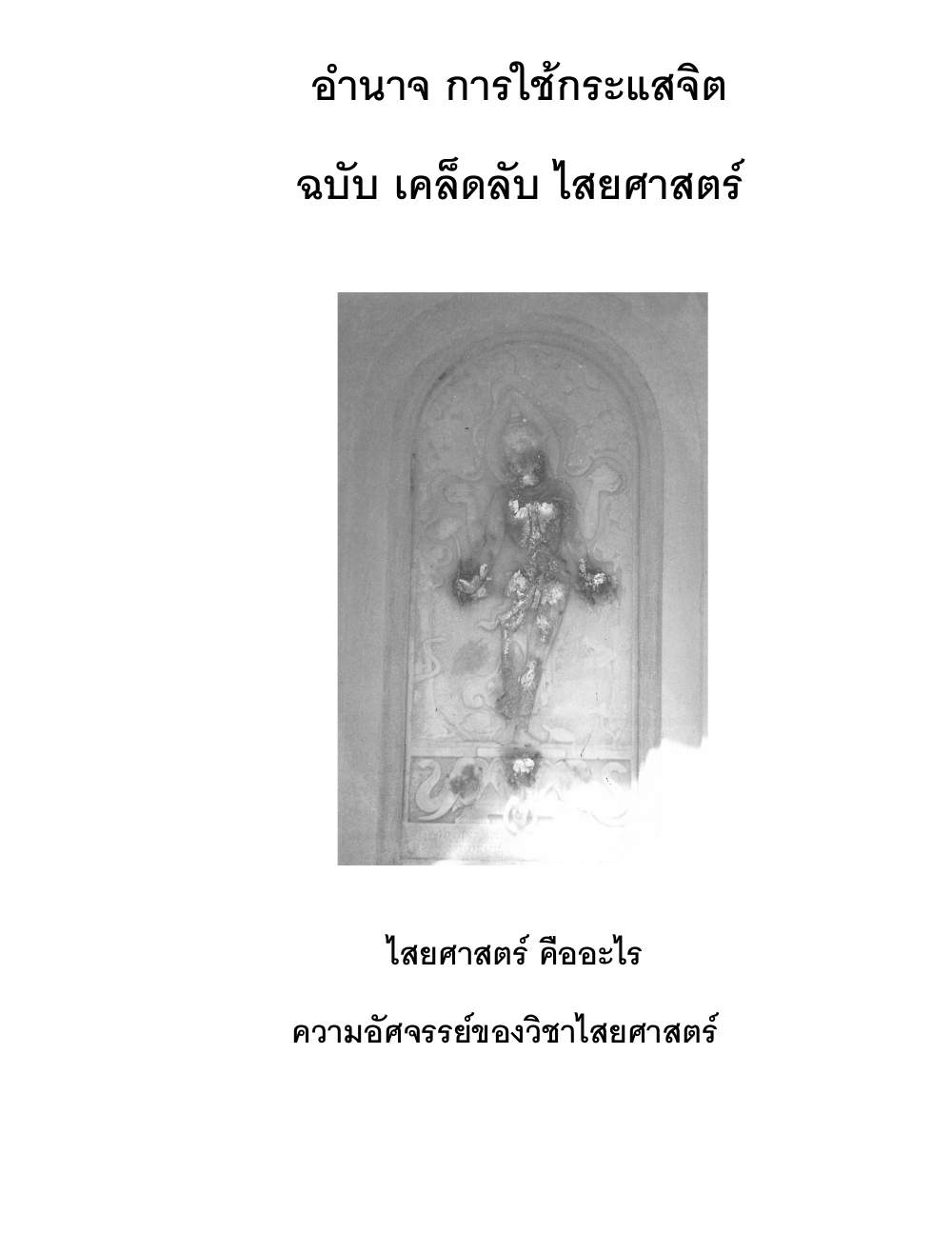
[ภาพ: รูปสลักหินนูนต่ำเป็นเทวรูปยืนอยู่ในซุ้มโค้งแหลม มือทั้งสองข้างถือสิ่งของห้อยลงข้างตัว มีผ้าทิพย์หรือรัศมีโบกสะบัดข้างศีรษะทั้งสองด้าน ลวดลายเครือเถาขนาบซุ้ม ภาพถ่ายเก่าสึกกร่อนตามกาลเวลา]
ไสยศาสตร์ คืออะไร
ความอัศจรรย์ของวิชาไสยศาสตร์
Power: The Use of the Mind-Current
The Secrets-of-Saiyasat Edition
[photo: a weathered stone bas-relief of a standing deity figure inside a pointed-arch niche, both hands holding objects down at the sides, a flowing sash or halo on either side of the head, floral-scroll carving flanking the niche; an old, time-worn photograph]
What is Saiyasat?
The Wonders of the Art of Saiyasat
สารบัญ
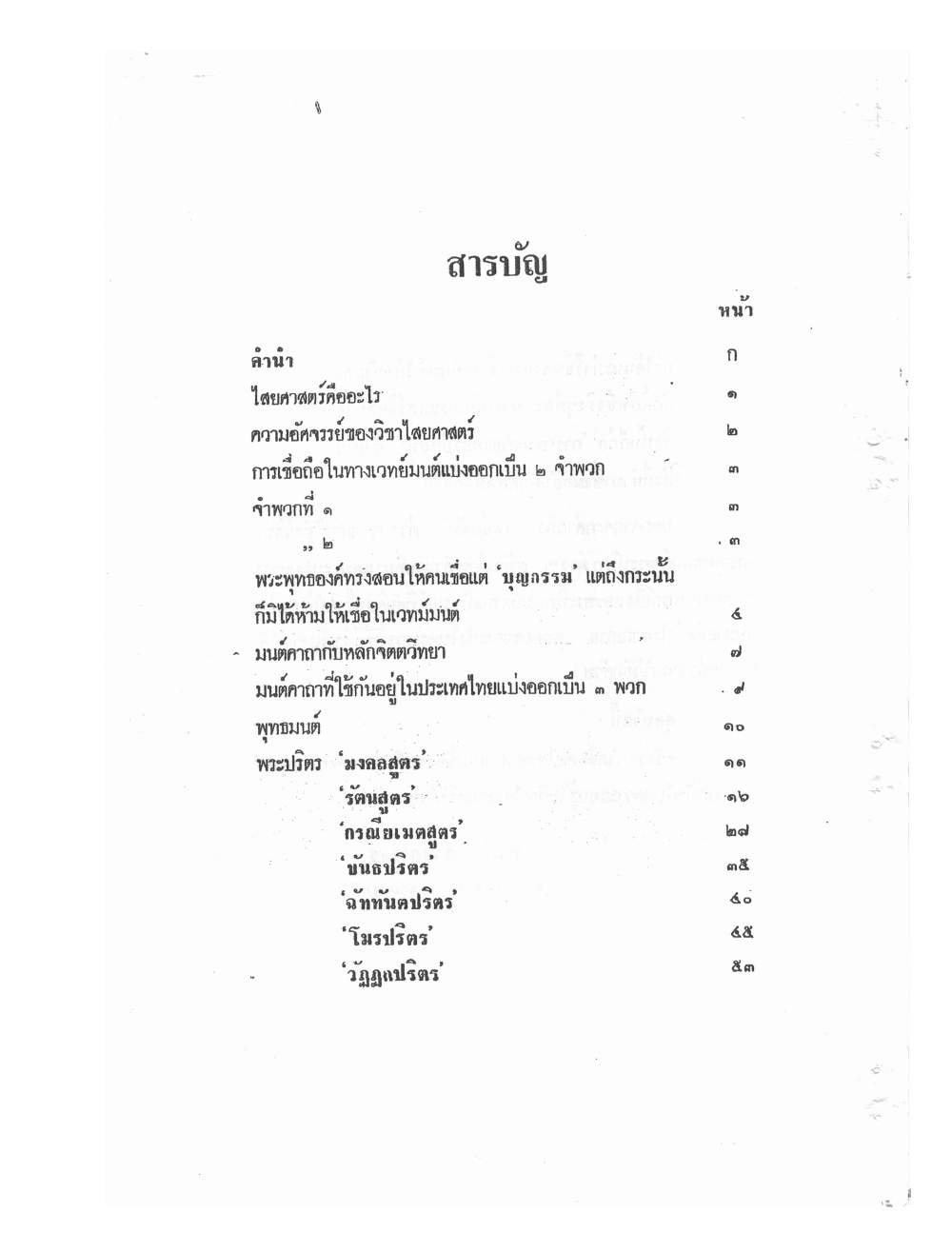
หน้า คำนำ ก ไสยศาสตร์คืออะไร ๑ ความอัศจรรย์ของวิชาไสยศาสตร์ ๒ การเชื่อถือในทางเวทย์มนต์แบ่งออกเป็น ๒ จำพวก ๓ จำพวกที่ ๑ ๓ ,, ๒ ๓
พระพุทธองค์ทรงสอนให้คนเชื่อแต่ 'บุญกรรม' แต่ถึงกระนั้น ก็มิได้ห้ามให้เชื่อในเวทม์มนต์ ๔ มนต์คาถากับหลักจิตตวิทยา ๗ มนต์คาถาที่ใช้กันอยู่ในประเทศไทยแบ่งออกเป็น ๓ พวก ๙ พุทธมนต์ ๑๐ พระปริตร 'มงคลสูตร' ๑๑ 'รัตนสูตร' ๑๖ 'กรณียเมตสูตร' ๒๗ 'ขันธปริตร' ๓๕ 'ฉัททันตปริตร' ๔๐ 'โมรปริตร' ๔๕ 'วัฏฏกปริตร' ๕๓
Table of Contents
Page Foreword a What is Saiyasat? 1 The wonders of the art of Saiyasat 2 Belief in incantations is divided into 2 kinds 3 Kind 1 3 ,, 2 3
The Lord Buddha taught people to believe only in 'merit and karma', yet even so did not forbid belief in incantations 4 Mantras and the principles of psychology 7 The mantras in use in Thailand are divided into 3 groups 9 Buddhist mantras 10 The Paritta 'Mangala Sutta' 11 'Ratana Sutta' 16 'Karaniyametta Sutta' 27 'Khandha Paritta' 35 'Chaddanta Paritta' 40 'Mora Paritta' 45 'Vattaka Paritta' 53
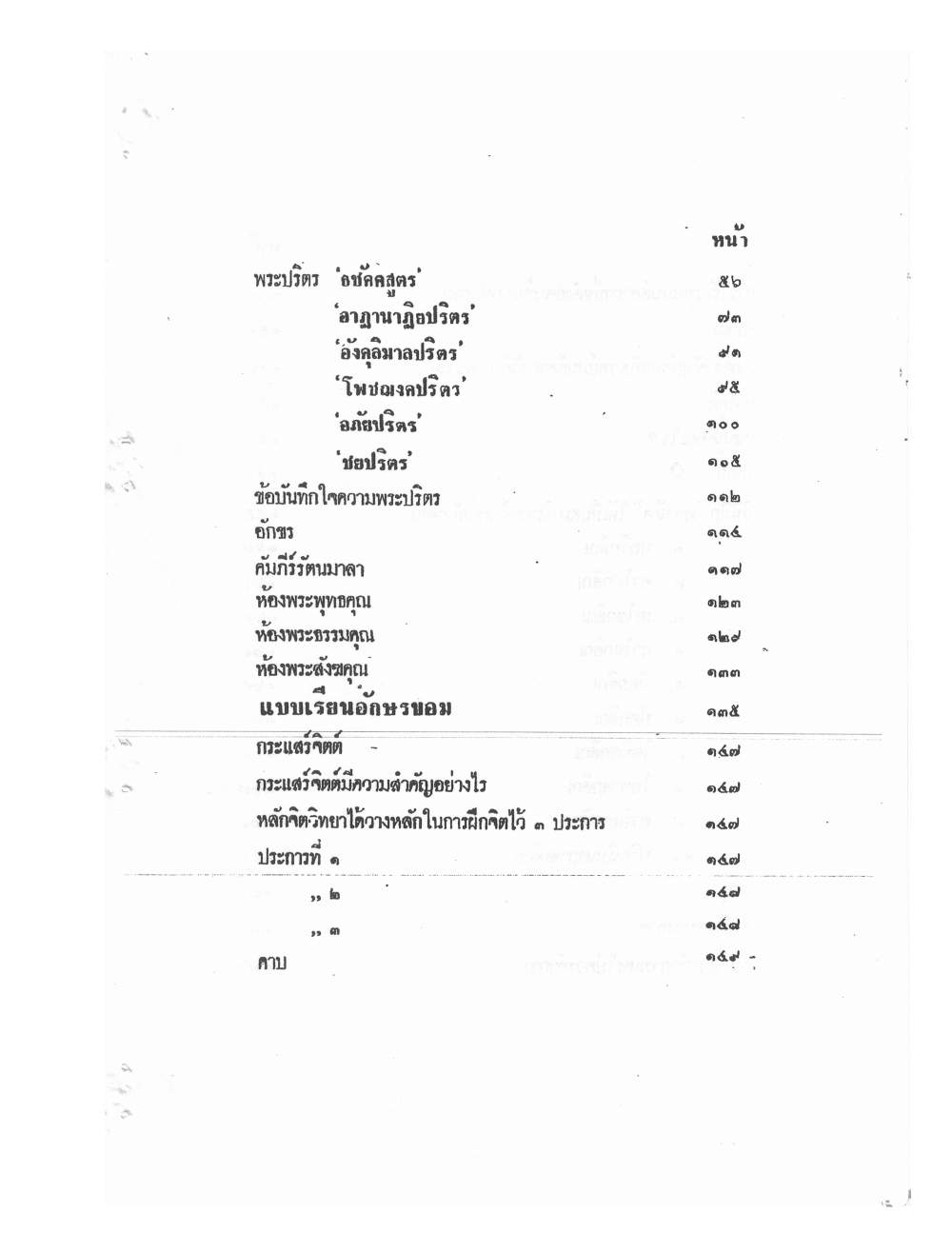
หน้า พระปริตร 'ธชัคคสูตร' ๕๖ 'อาฏานาฏิยปริตร' ๗๓ 'องคุลิมาลปริตร' ๘๓ 'โพชฌงคปริตร' ๙๕ 'อภัยปริตร' ๑๐๐ 'ชัยปริตร' ๑๐๕ ข้อบันทึกใจความพระปริตร ๑๑๒ อักขร ๑๑๔ คัมภีร์รัตนมาลา ๑๑๗ ห้องพระพุทธคุณ ๑๒๓ ห้องพระธรรมคุณ ๑๒๗ ห้องพระสังฆคุณ ๑๓๓ แบบเรียนอักษรขอม ๑๓๕
กระแสจิตต์ ๑๔๗ กระแสจิตต์มีความสำคัญอย่างไร ๑๔๗ หลักจิตวิทยาได้วางหลักในการฝึกจิตไว้ ๓ ประการ ๑๔๗ ประการที่ ๑ ๑๔๗ ,, ๒ ๑๔๘ ,, ๓ ๑๔๘ คาบ ๑๔๘
Page The Paritta 'Dhajagga Sutta' 56 'Atanatiya Paritta' 73 'Angulimala Paritta' 83 'Bojjhanga Paritta' 95 'Abhaya Paritta' 100 'Jaya Paritta' 105 Notes on the meaning of the Parittas 112 The (Khom) alphabet 114 The Ratanamala scripture 117 The Chamber of the Buddha's Virtues 123 The Chamber of the Dhamma's Virtues 127 The Chamber of the Sangha's Virtues 133 A primer for the Khom script 135
The mind-current 147 Why the mind-current is important 147 The principles of psychology set down 3 principles for training the mind 147 Principle 1 147 ,, 2 148 ,, 3 148 The period/interval 148
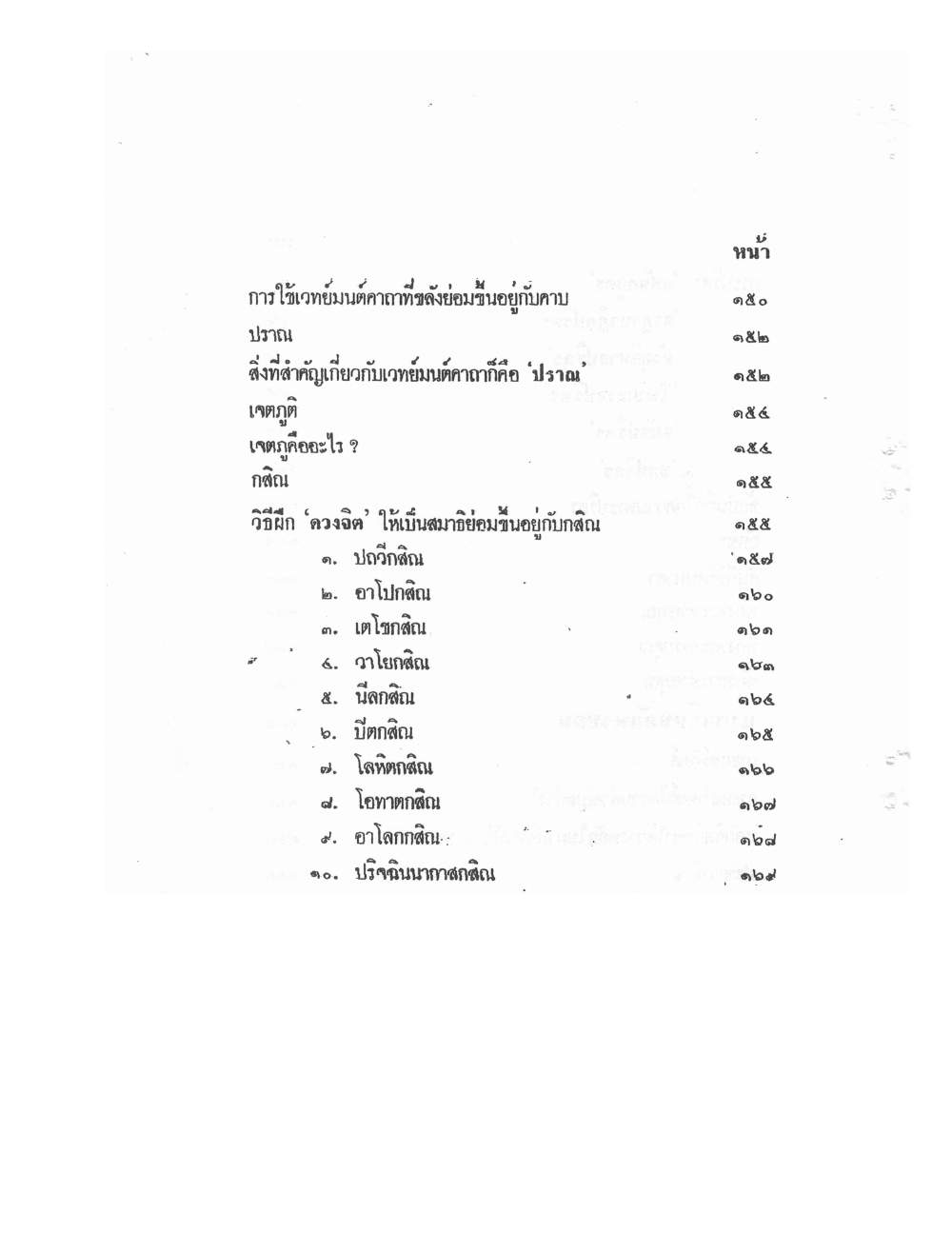
หน้า การใช้เวทย์มนต์คาถาที่ขลังย่อมขึ้นอยู่กับคาบ ๑๕๐ ปราณ ๑๕๒ สิ่งที่สำคัญเกี่ยวกับเวทย์มนต์คาถาก็คือ 'ปราณ' ๑๕๒ เจตภูติ ๑๕๔ เจตภูติคืออะไร ? ๑๕๔ กสิณ ๑๕๕
วิธีฝึก 'ดวงจิต' ให้เป็นสมาธิย่อมขึ้นอยู่กับกสิณ ๑๕๕ ๑. ปถวีกสิณ ๑๕๗ ๒. อาโปกสิณ ๑๖๐ ๓. เตโชกสิณ ๑๖๑ ๔. วาโยกสิณ ๑๖๓ ๕. นีลกสิณ ๑๖๔ ๖. ปีตกสิณ ๑๖๕ ๗. โลหิตกสิณ ๑๖๖ ๘. โอทาตกสิณ ๑๖๗ ๙. อาโลกสิณ ๑๖๘ ๑๐. ปริจฉินนากาสกสิณ ๑๖๙
Page The use of a potent incantation depends on the (proper) interval/timing 150 Breath/vital-force (prana) 152 The important thing concerning incantations is 'prana' 152 The cetaphuti (indwelling spirit) 154 What is the cetaphuti? 154 Kasina 155
The method of training the 'mind' into concentration depends on the kasina 155 1. Earth kasina 157 2. Water kasina 160 3. Fire kasina 161 4. Wind kasina 163 5. Blue kasina 164 6. Yellow kasina 165 7. Red kasina 166 8. White kasina 167 9. Light kasina 168 10. Bounded-space kasina 169
“ไสยศาสตร์” เป็นวิทยาการสาขาหนึ่งอันว่า ด้วยการใช้มนต์คาถาเสกเป่า ทำให้บังเกิดอิทธิฤทธิ์ขึ้น สามารถบันดาลให้เป็นไปตามที่ปรารถนา เช่นการ รักษาโรคภัยไข้เจ็บต่าง ๆ ให้หายไปโดยการเสกเป่า การรดน้ำมนต์ หรือการประกอบพิธีกรรมต่าง ๆ เพื่อ ประสพความสำเร็จ ความมีโชคและความเจริญ รุ่งเรืองแท้จริงวิชาไสยศาสตร์นี้เป็นหลักวิชา ที่ สร้าง ความมหัศจรรย์ให้เห็นได้มาก เช่นการรักษาโรคภัย ไข้เจ็บ ถึงแม้วิทยาการแพทย์ในสมัยปัจจุบัน ซึ่ง เป็นที่ทราบกันแล้วว่า ได้ผ่านการค้นคว้าเจริญรุดหน้า มามากมาย แต่ก็ยังยอมรับนับถือวิธีการรักษาโรคตาม หลักวิชาการไสยศาสตร์ว่าเป็นวิธีการที่สูงให้ผลความ ศักดิ์สิทธิ์แน่นอนทันตาเห็นเป็นต้นว่าการรักษากระดูก แตกกระดูกหัก คนไข้บางรายที่ได้ผ่านการรักษาตาม แบบแผนปัจจุบันมาแล้ว แต่ก็ยังไม่หายสนิทดี จำเป็นต้องหันเข้ามารักษาด้วยการใช้อำนาจไสยศาสตร์
"Saiyasat" is a branch of learning concerning the use of chanted incantations and spells to bring about supernatural power, able to make things happen as one wishes — for example, curing various illnesses through chanting, the sprinkling of blessed water, or the performance of various rites, so as to achieve success, good fortune, and true prosperity. This discipline of Saiyasat is a body of knowledge that produces a great many visible wonders — for example, the curing of illness. Even though present-day medical science, which is known to have advanced through a great deal of research, people still accept and respect the method of treating illness according to the principles of Saiyasat as a superior method giving certain, visibly sacred results — for instance, in the treatment of broken and fractured bones. Some patients who have already undergone treatment by present-day methods but have still not fully recovered are compelled to turn instead to treatment using the power of Saiyasat
โดยการถากไม้ และใช้น้ำมนต์นวดทา ปรากฏว่าได้ หายเป็นปรกติดีเหมือนหนังเดิมไปแทบทุกราย หรือเช่น การรักษาผู้ที่มีพิษร้ายต่าง ๆ ซึ่งผีชนิดร้าย ๆ เหล่า นี้ถ้าเกิดขึ้นแก่ผู้ใดแล้ว แม้จะไปรับการรักษาด้วย การ ผ่าตัด แพทย์ ผู้ รักษา มัก จะ ไม่ ค่อย รับรอง ใน ความปลอดภัยนัก แต่ถ้าหากได้รับการรักษาโดยทาง ไสยศาสตร์แล้ว ผลศักดิ์สิทธิ์จะปรากฏให้เห็นทัน ตาเดียว ผู้ร้ายเหล่านั้นจะสูญหายราบไปสิ้น วิธี การรักษาผู้ทางไสยศาสตร์ด้วยการใช้เวทมนต์นั้น มี อยู่ด้วยกันหลายวิธีเริ่มต้นด้วยการสูด (ด้วยปูนและ น้ำลายใต้ลิ้น) การตอยและการพ่น ถึงแม้นายแพทย์ ที่สำเร็จการแพทย์ชั้นสูงมาจากต่างประเทศ เมื่อได้มา เห็นการรักษาแบบนี้เข้าถึงกับ ออก ปาก ว่า เป็น วิชาที่ ศักดิ์สิทธิ์อย่างยอดเยี่ยม
อันการเลื่อมใสเชื่อถือในเวทย์มนต์คาถานี้มีอยู่ทั่วโลก ไม่ว่า จะเป็นมนุษย์ชาติใดภาษาใดแทบ ทุกยุคทุกสมัยเริ่มแต่ชาติโบราณต่าง ๆ เท่าที่ประวัติศาสตร์จะค้นคว้าได้และบรรดาชาติต่าง ๆ ที่นับถือเวทย์
...by scoring the (afflicted) area and applying and massaging holy water — it was found that in nearly every case the person recovered fully, the skin returning to normal. Or take, for instance, the treatment of those afflicted by various dangerous poisons: when such dangerous venoms befall anyone, even if the person seeks treatment by surgery, the attending doctors will often be reluctant to guarantee real safety. But if treated by way of Saiyasat, the sacred effect will appear visibly in an instant, and those poisons will vanish completely. There are several methods of treating a person by Saiyasat through the use of incantations, beginning with sucking out (the poison, using lime and the saliva beneath the tongue), tapping, and blowing. Even physicians who trained in advanced medicine abroad, upon witnessing this kind of treatment, have gone so far as to declare it a supremely sacred branch of knowledge.
As for devotion to and belief in incantations, this exists throughout the whole world, regardless of race or language, in every age, beginning from the various ancient peoples as far back as history can uncover, and among the various peoples who hold to incantations...
อาจารย์ 'เทพย์ สาริกบุตร' ๓
มนต์คาถานั้น ก็มิใช่เป็นบุคคลบำเถิดอย่างเข้าใจกันเสมอไปไม่ โดย มากเป็นชาติที่เจริญแล้วด้วย อารยะธรรม ทั้ง นั้น เช่น ตัว อย่างใน ประเทศ อินเดียอันเป็นประเทศที่เต็มไปด้วย นักค้นคว้า, นักคิด, นักลิทธิ, นักศาสนา ยิ่งเป็นประเทศที่เต็มไปด้วยการเชื่อถือเวทย์มนต์คาถามากกว่า ประเทศใด ๆ ทั้งสิ้น ถึงแม้แต่ในประเทศไทยเราก็เหมือนกัน การเชื่อ เวทย์มนต์คาถานั้น ผู้ ที่ ได้ รับ การ ศึกษา มา แล้ว เป็น อย่าง ดี ถึง กับ ได้ ผ่านการศึกษามาแล้วจากต่างประเทศ ต่างก็พากันนับถือเชื่อมั่นอย่าง แน่นแฟ้น มีการรดน้ำมนต์เมื่อมีทุกข์ภัยมาถึงและ ประกอบพิธีกรรมต่าง ๆ เพื่อความสุขความเจริญรุ่งเรืองโดยพระอาจารย์ ที่ทรงไว้ ซึ่งเวทย์มนต์อัน ขลังศักดิ์สิทธิ์และปรากฏว่าพวกท่านเหล่านั้นได้ เจริญ รุ่งเรือง ขึ้น เป็นลำดับ มิได้ตกทุกข์ได้ยากได้รับความลำบากอย่างร้ายแรงเลย
ในการเชื่อถือเวทย์มนต์คาถานั้น ถ้าจะกล่าวถึงพวกเชื่อถือกันอย่าง แท้จริงแล้ว ดูเหมือนจะมีบุคคลอยู่ ๒ จำพวก
จำพวกหนึ่ง คือผู้ที่ได้รับการศึกษาน้อยหรือ แทบ จะไม่ได้รับการ ศึกษาเสียเลย พวกนี้เป็นพวกที่เขาเชื่อง่ายที่สุดและเชื่อโดยไม่คำนึงถึงเหตุ ผลใด ๆ ทั้งสิ้นเมื่อได้พบเห็นเข้าก็บังเกิดเชื่อทีเดียว
อีกจำพวกหนึ่ง ก็คือบุคคลที่ได้ผ่านการ ศึกษามาแล้วเป็นอย่างดี เมื่อได้พบเห็นอะไรเข้าก็พยายามวิจารณ์ไตร่ตรองค้นคว้าอย่างถึงที่สุดผลที่ สุดเมื่อประจักษ์เหตุผลจึงได้เชื่อถือ ส่วน บุคคล ที่ อยู่ใน ชั้น กลาง ๆ นั้น
Ajarn 'Thep Sarikaboot' 3
Mantras, in fact, are not believed in only by deluded/foolish persons as is commonly assumed. For the most part it is precisely the civilized nations, full of culture, [that believe] — an example being India, a country full of researchers, thinkers, adepts, and religious teachers, indeed a country more filled with belief in incantations than any other country whatsoever. Even in our own Thailand it is the same. As for belief in incantations, even those who have received a fine education, to the point of having studied abroad, all likewise hold to it and believe in it firmly. There is the sprinkling of holy water when misfortune arrives, and the performance of various rites for happiness and prosperity, led by the teachers who hold these potent and sacred incantations; and it is seen that those people have prospered progressively, never falling into serious hardship.
Regarding belief in incantations, if one speaks of those who truly believe, there seem to be two kinds of people.
One kind is those who have had little education, or almost none at all. These are the people who believe most easily, and believe with no regard whatsoever for reason — the instant they see something, belief arises at once.
The other kind is people who have been through a thorough education. Whenever they encounter something, they try to examine, deliberate, and investigate it to the utmost, and only come to believe once the reason is made evident. As for the people who fall in the middle rank...
๔ เคล็ดลับไสยศาสตร์
การเชื่อถืออาจไม่แน่นแฟ้นนัก คืออาจจะเชื่อถือก็ได้ ไม่เชื่อถือก็ได้สุด แล้วแต่ความนึกคิดของตน
สมเด็จพระสัมมาสัมพุทธเจ้าของเรามาตรและว่าพระองค์ ท่าน ทรงประทานพุทโธวาทในเรื่องความเชื่อถือของมนุษย์เรา ให้เชื่อแต่ บุญ-กรรม การกระทำดีหรือชั่วเท่านั้นให้เชื่อถือว่าผลทุกอย่างย่อมจัก บังเกิดมาแต่เหตุ ถ้าเหตุนั้นเกิดจากการทำดีผลที่ได้รับก็เป็นผลดี และ เหตุนั้นมาจากการทำชั่วผลที่ได้รับนั้นเป็นผลชั่ว ท่านสั่งสอนให้เลิกเชื่อ ถือผีสางเทวดา แต่พระองค์ท่านก็หาทรงทิ้งความเชื่อในทางมนต์คาถา ไปเสียทีเดียวไม่ ดังเช่นทรงให้ภิกษุสงฆ์เจริญภาวนาคาถาพระพุทธคุณ เพื่อบำบัดความหวาดหวั่นภัยอันตรายต่าง ๆ ตามพระพุทธภาษิตที่แสดงไว้ ในธชัคคสูตรว่าดังนี้
“ภิกษุทั้งหลาย ถ้าความกลัวหรือความหวาดเสียวขนพอง สยองเกล้าบังเกิดขึ้นแก่ท่านผู้จะไปสู่ที่ว่างเปล่า อันเป็นที่เงียบสงัด อัน หวาดจะพึงกลัวเป็นต้นว่า ไปสู่ป่าก็ดี สู่โคนไม้ก็ดี สู่เรือนเปลี่ยวก็ดี ในขณะนั้นท่านทั้งหลายพึงตามระลึกถึงเราผู้ตถาคตดังนี้ว่า
◎ อิติปิโสภควา อรหัง สัมมาสัมพุทโธ วิชาจรณสัมปันโน สุคโต โลกวิทู อนุตตโร ปุริสทัมมสารถิ สัตถาเทวมนุสสานัง พุทโธ ภควาติ ๚ะ๛
เมื่อท่านทั้งหลายได้ตามระลึกถึงเราอยู่ ความกลัวหรือความ หวาดเสียวต่ออันตรายต่าง ๆ จะสูญหายไปสิ้น
4 Secrets of Saiyasat
Belief may not be very firm — that is, one may either believe or not believe, entirely according to one's own thinking.
As for our Lord, the Perfectly Self-Enlightened Buddha, it is said that He gave the Buddhist teaching concerning the belief of us human beings: to believe only in merit and karma — good or bad deeds alone — and to believe that every result must arise from a cause. If the cause arose from doing good, the result received is good; and if the cause came from doing evil, the result received is evil. He taught people to give up belief in spirits and lesser deities, but He himself did not abandon belief in the way of incantations entirely — for instance, He had monks recite and meditate on the verses of the Buddha's virtues to dispel fear of various dangers, according to the Buddha's saying set forth in the Dhajagga Sutta, as follows:
"Monks, if fear or dread, making the hair stand on end, arises in one of you who has gone to an empty, solitary place — a place one might well fear, such as going into a forest, to the foot of a tree, or to a deserted dwelling — at that time you should recall Us, the Tathagata, thus:
◎ Itipi so bhagavā arahaṃ sammāsambuddho vijjācaraṇasampanno sugato lokavidū anuttaro purisadammasārathi satthā devamanussānaṃ buddho bhagavā ti. [gloss: 'Thus indeed is the Blessed One — worthy, perfectly self-enlightened, endowed with knowledge and conduct, well-gone, knower of the world, unsurpassed trainer of persons to be tamed, teacher of gods and humans, awakened, blessed.']
When you have recalled Us in this way, whatever fear or dread of various dangers there is will vanish completely."
อาจารย์ 'เทพย์ สาริกบุตร' ๕
โดยเฉพาะมนต์ที่เกี่ยวแก่การบำบัดโรคภัยไข้เจ็บ ที่สมเด็จ- พระสัมมาสัมพุทธเจ้าทรงเชื่อถือมากคือมนต์ “โพชฌงคปริตร” เมื่อ พระภิกษุสาวกบังเกิดโรคาพาธแรงกล้า สมเด็จพระสัมมาสัมพุทธเจ้า เสด็จไปเยี่ยมและทรงสวดโพชฌงคปริตรให้ฟัง อาการเจ็บไข้นั้นจะหาย ไปในทันทีทันใด ดังเนื้อความปรากฏในพระสูตรว่า
สมัยหนึ่ง เมื่อสมเด็จพระผู้มีพระภาคเจ้า สถิตย์ ณ เวฬุวัน มหาวิหาร ใกล้กรุงราชคฤห์มหานคร ครั้งนั้นพระมหากัสสปอาศัยอยู่ ในปิบผลิคูหา บังเกิดโรคาพาธแก่กล้า อาการหนักลงทุก ๆ วันสมเด็จ พระสัมมาสัมพุทธเจ้าทรงพระกรุณาแด่พระกัสสป ได้เสด็จไปประทาน โพชฌงคปริตรแก่พระมหากัสสป เมื่อจบแล้วพระมหากัสสปก็ลุกขึ้นได้ หายโรคาพาธ
และอีกครั้งหนึ่งเมื่อพระมหาโมคคัลลาน์อาศัยอยู่ ในเขาคิชฌกูฏ บังเกิดโรคาพาธมีอาการหนักลงทุก ๆ วัน สมเด็จพระสัมมาสัมพุทธเจ้าได้ เสด็จไปประทานโพชฌงคปริตรแก่พระโมคคัลลาน์ พระโมคคัลลาน์ก็หาย จากโรคาพาธสิ้น
ในคราวหนึ่งเมื่อสมเด็จพระสัมมาสัมพุทธเจ้า เสด็จประทับอยู่ ณ เวฬุวนารามใกล้ราชคฤห์ ทรงประชวรพระโรคให้เจ็บพระนาภีเป็น กำลังและทรงอาพาธหนักลงทุก ๆ วัน ครั้งนั้นพระจุณฑเถรสวดโพชฌงค ปริตรถวายสมเด็จพระสัมมาสัมพุทธเจ้า ก็ทรงหายจากโรคาพาธเสด็จ ลุกขึ้นจากที่บรรทมได้
Ajarn 'Thep Sarikaboot' 5
In particular, the mantra concerning the curing of illness that the Lord Buddha placed great faith in was the "Bojjhanga Paritta." Whenever a monk-disciple fell seriously ill, the Lord Buddha would go to visit him and recite the Bojjhanga Paritta for him to hear, and the sickness would vanish immediately. The account appears in the sutta as follows:
Once, when the Blessed One was residing at Veluvana Mahavihara near the great city of Rajagaha, the Venerable Mahakassapa, who was staying in the Pipphali Cave, fell gravely ill, his condition worsening day by day. Out of compassion for Kassapa, the Lord Buddha went and bestowed the Bojjhanga Paritta upon the Venerable Mahakassapa. When it was finished, Mahakassapa was able to rise up, cured of his illness.
And on another occasion, when the Venerable Mahamoggallana was staying on Vulture Peak (Gijjhakuta), he fell ill, his condition worsening day by day. The Lord Buddha went and bestowed the Bojjhanga Paritta upon Moggallana, and Moggallana was completely cured of his illness.
On one occasion, when the Lord Buddha was residing at Veluvanarama near Rajagaha, He Himself suffered from an illness causing severe pain in the abdomen, and His condition worsened day by day. At that time the Elder Cunda recited the Bojjhanga Paritta to the Lord Buddha, and He was cured of the illness and was able to rise up from His bed.
๖ เคล็ดลับไสยศาสตร์
เฉพาะโพชฌงคปริตร นับได้ว่า สมเด็จ พระสัมมาสัมพุทธเจ้า ทรงนับถือเป็นมนต์คาถาที่ใช้บำบัดโรคอย่างแท้จริง มิใช่ว่าจะเป็นแต่ ข้อธรรมที่ยกมาแสดงพระธรรมเทศนา หากนำข้อธรรมนั้นมาไตร่ตรอง ให้เห็นจริงแล้ว ผลของการไตร่ตรองนั้นสามารถจะบันดาลให้โรคภัยไข้ เจ็บหายไปได้ เป็นมนต์ที่จะต้องใช้ให้ผู้อื่นสวดให้ฟัง เพราะถึงแม้ สมเด็จพระสัมมาสัมพุทธเจ้าเอง เมื่อคราวทรงพระประชวรยังต้องให้สาวก มาสวดให้ฟัง
มนต์คาถาที่พวกเรานิยมใช้กันอยู่ทุกวันนั้น รากฐานเดิมเนื่อง มาจากมนต์คาถาของศาสนาพราหมณ์ เพราะพระพุทธศาสนาก็มีมูลฐาน มาจากศาสนาพราหมณ์นั้นเอง เพราะศาสนาพราหมณ์นั้นมั่นคงเลื่อมใสใน ลัทธิไสยศาสตร์มากมีการใช้มนต์คาถาเป่าพ่น ปลุกเสกและประกอบ อาถรรพ์ต่าง ๆ ภายหลังเมื่อมีคณาจารย์ได้มุ่งสั่งสอนมนต์คาถากันแพร่ หลายยิ่งขึ้นจึงได้คิดตัดแปลงแก้ไขนำวิธี ทางไสยศาสตร์ของพราหมณ์ มาใช้ โดยที่ได้แก้ไขตัดตอนเอาเนื้อมนต์ของเดิมของพราหมณ์นั้นเสียใหม่ บรรจุ พระพุทธมนต์แทรกเข้าไปแทน เพราะมาคิดเห็นว่า แม้มนต์พราหมณ์ยัง เรืองอนุภาพมาก ถ้าแหละเป็นพุทธมนต์คงจะศักดิ์สิทธิ์ขึ้นไปอีก
แท้จริงมนต์คาถาทั้งหลายก็คือสิ่งที่สำหรับให้ดวงจิตยึดเหนี่ยว นั้นเอง ความเป็นไปของชีวิตมนุษย์เปรียบเสมือนดังเช่น การเดิน
6 Secrets of Saiyasat
As for the Bojjhanga Paritta specifically, it may be said that the Lord Buddha genuinely regarded it as a mantra truly used to cure illness — not merely a point of doctrine cited to deliver a Dhamma sermon. If that point of doctrine is contemplated until it is seen as true, the result of that contemplation can bring about the disappearance of illness. It is a mantra that must be recited by someone else for one to hear, since even the Lord Buddha Himself, when He fell ill, still had to have a disciple come and recite it for Him.
The mantras we commonly use every day have their original foundation in the mantras of the Brahmanical religion, because Buddhism itself has its foundation from that same Brahmanical religion. Because the Brahmanical religion was firmly devoted to the doctrine of Saiyasat, with the use of mantras for chanting and blowing, consecration, and the performance of various rites of power. Afterward, when [Buddhist] teachers set out to spread the teaching of mantras ever more widely, they thought to adapt and revise, bringing the methods of Brahmanical Saiyasat into use — editing and cutting away the original content of the Brahmans' mantras and inserting Buddhist mantras in their place instead, because they came to think that if even Brahmanical mantras still held great power, then were they to become Buddhist mantras, they would surely become even more sacred still.
In truth, all mantras are simply things for the mind to hold onto — that is all. The course of human life may be compared to, for example, walking...
อาจารย์ 'เทพย์ สาริกบุตร' ๗
ใต้สะพานข้ามคลองในสภาพที่ล่อแหลมต่ออันตราย ถึงแม้ว่าจะเดินได้ เก่งกล้าแข็งแรงสักเพียงใดก็ดี แต่ถ้าหากมีสิ่งยึดเหนี่ยวไว้บ้างจะดีกว่า ที่ไม่มีเสียเลย เพราะอาจจะมีเวลาที่ทำให้เกิดความหวาดเสียวพลาดพลั้ง ลงได้ และเนื้อมนต์คาถาไม่ว่าจะเป็นของลัทธิใดก็ตาม ย่อมเป็นคำ ที่กล่าวอ้างเอาอำนาจของสิ่งศักดิ์สิทธิ์อันเป็นที่นับถือของแต่ละลัทธิศาสนา นั้น เช่นมนต์ในศาสนาพราหมณ์ก็อ้างเอาพระเป็นเจ้าและสิ่งศักดิ์สิทธิ์ บนสวรรค์ คือ พระอิศวร, พระพรหม, พระนารายณ์ ฯลฯ และ มนต์เหล่านี้ไทยเราได้นำเอามาใช้ควบกันไป กับ มนต์ คาถาทาง พระ พุทธ- ศาสนาอย่างแพร่หลายเหมือนกัน ส่วนมนต์ทางพระพุทธศาสนาก็อ้างอิง เอาบารมีพระรัตนตรัยเป็นที่พึ่งโดยเฉพาะมนต์คาถาทางฝ่ายพระพุทธศาสนา นั้น หนักไปในการใช้ฝ่ายดี ช่วยให้เกิดกำลังใจเข้มแข็งเมื่อผจญ อุปสรรคอันตราย ช่วยบำบัดโรคภัยไข้เจ็บต่าง ๆ และช่วยให้เกิดความ เมตตาจิตจากผู้อื่น ซึ่งการใช้อำนาจมนต์คาถานี้มีหลักการที่ปฏิบัติตรง กับหลักจิตวิทยา อันเป็นหลักวิชาที่นิยมฝึกฝนในสมัยปัจจุบันนี้ เช่น อย่างบุคคลใดที่กำลังตกอยู่ในสภาพว้าวุ่นใจ ไม่กล้าที่จะตัดสินใจกระทำ การใด ๆ ลงไป ทั้ง ๆ ที่รู้อยู่ว่า สิ่งที่ตนกระทำลงไปนั้นก็เป็นการ อันชอบที่ควรจะกระทำอย่างยิ่ง แต่ก็บังเกิดความหวาดกลัวคร้ามเกรง ขึ้น เขาแนะนำให้ปฏิบัติตามหลักวิชาจิตวิทยาดังนี้ คือให้สร้าง มโนภาพให้เกิดเป็นตัวของเราขึ้น และพยายามนึกโน้มให้มองเห็นภาพ
Ajarn 'Thep Sarikaboot' 7
...under a bridge crossing a canal, in a condition precariously exposed to danger — no matter how skillfully and sturdily one may be able to walk, still, having something to hold onto is better than having nothing at all, because there may be a moment when dizziness and fright cause one to slip and fall. And the content of mantras, whatever sect they may belong to, invariably consists of words that invoke the power of the sacred beings revered by each particular sect or religion. For example, mantras of the Brahmanical religion invoke the Lord God and the sacred beings of heaven, namely Shiva (Phra Isuan), Brahma (Phra Phrom), and Vishnu (Phra Narai), etc.; and we Thais have brought these mantras into widespread combined use alongside the mantras of the Buddhist religion as well. As for Buddhist mantras, they rely on and invoke the power of the Triple Gem as their refuge; Buddhist mantras in particular lean heavily toward beneficial use — helping to build strong resolve when facing dangerous obstacles, helping to cure various illnesses, and helping to arouse loving-kindness from others. The use of the power of mantras in this way follows a principle that accords directly with the principles of psychology, a body of knowledge popularly practiced nowadays. For example, take a person currently in a state of turmoil and anxiety, not daring to decide to carry out some action, even while knowing that what he would do is something entirely proper and right to do, yet fear and timidity arise in him nonetheless — [psychologists] advise following the principle of psychology as follows: to create a mental image that becomes, as it were, oneself, and to try to incline the mind to see that image...
๘ เคล็ดลับไสยศาสตร์
นั้นเป็นรูปกายที่ใหญ่โตกำยำเข้มแข็ง คอยยืนกำกับอยู่ข้างหลัง เพื่อ ที่จะให้คุ้มครองป้องกันเรา เป็นเครื่องหนุนกำลังใจให้เรายึดเหนี่ยว อันนี้ เป็นเรื่องปฏิบัติของหลักจิตวิทยาที่นิยมใช้กัน
วิธีการณ์ก็คือให้เครื่องยึดเหนี่ยวกำลังใจตรงกัน ต่างกันแต่ว่า แทนที่เราจะใช้วิธีปฏิบัติให้ลำบากยุ่งยากเช่นนั้น ในเมื่อเรากำลังตกอยู่ใน สถานะการณ์เช่นนั้น เราก็ใช้อำนาจมนต์คาถาเป็นเครื่องยึดเหนี่ยว ดังเช่น คาถาพระพุทธคุณตามที่มีพระพุทธภาษิตกล่าวไว้ในธชัคคสูตร อันได้นำ มากล่าวแล้วในเบื้องต้น วิธีเช่นนั้นนับได้ว่าสะดวกง่ายกว่าวิธีที่ปฏิบัติตาม หลักจิตวิทยามาก
บรรดาคณาจารย์ที่สั่งสอนมนต์คาถากัน โดยเฉพาะอย่างยิ่งใน เมืองไทยนั้น มีคติแปลกอยู่ว่าห้ามมิให้ศิษย์แปลเนื้อความในมนต์คาถา ทั้งหลาย ทั้งนี้เพราะท่านอ้างว่าถ้าแปลแล้วจะทำให้เสื่อมไปไม่ขลัง แต่ ความจริงอาจจะเป็นเพราะว่า ถ้าแปลรู้ข้อความเสียแล้ว และเผอิญข้อ ความเหล่านั้นไผล่เผลอไปทางอื่นไม่เชื่อมโยงอะไรกัน จะทำให้คลาย ความเชื่อถือไป ความจริงถ้าเราได้แปลรู้ข้อความที่มาของมนต์คาถานั้น จะเป็นทางเพิ่มความเลื่อมใสให้มากทีเดียว อย่างมนต์ต่าง ๆ ในทาง พุทธศาสนาล้วนแต่มีประวัติและที่มาดี ๆ ทั้งนั้น ซึ่งถ้าเราได้ทราบความ หมายแน่นอนแล้วจะเป็นสิ่งเพิ่มความเลื่อมใสให้หนักยิ่งขึ้น แต่บาง มนต์ก็กล่าวเป็นคำไทยให้รู้ความหมายโดยตรงทีเดียว บรรดามนต์คาถาที่
8 Secrets of Saiyasat
That [image] is a large, sturdy, powerful body, standing guard behind us, so as to protect and defend us — serving as a support to bolster our courage, something for us to hold onto. This is a practical application of the principle of psychology that is popularly used.
The method serves the same purpose — to give the mind an equivalent thing to hold onto for courage; the only difference is that, instead of using such a troublesome and complicated method as that, when we find ourselves in such a situation, we instead use the power of a mantra as the thing to hold onto — such as the Buddha-virtue incantation stated in the Buddha's saying in the Dhajagga Sutta, already mentioned above. Such a method may be considered far more convenient and easy than the method practiced according to the principles of psychology.
Among the teachers who instruct in mantras, especially in Thailand, there is a peculiar custom of forbidding students from translating the meaning of the words within any mantra. This is because they claim that if translated, the mantra will lose its power and no longer be potent. But in truth this may be because, once the meaning of the words is known, and it happens that those words wander off into something else unconnected to anything, it will cause belief to weaken. In truth, if we came to know and understand the origin of the words of a mantra, it would actually be a way of greatly increasing devotion. Mantras of the Buddhist religion, for instance, all without exception have a fine history and origin; if we knew their meaning for certain, it would be something that increases devotion all the more. But some mantras are stated directly in the Thai language so their meaning is known outright. Among the mantras that...
อาจารย์ เทพย์ สาริกบุตร์ ๘
ใช้กันอยู่ในเมืองไทยเวลานี้นอกจากพระพุทธมนต์และมนต์ที่ อ้าง อิงบารมี พระรัตนตรัยเป็นที่พึ่งแล้ว อาจจะแบ่งออกไปได้ ๓ จำพวกคือ
๑. มนต์ที่ใช้กันอยู่ในภาคกลาง เนื้อมนต์ เหล่านี้ต่อเนื่องจากมนต์ในศาสนาพราหมณ์ เพราะ มักอ้างอิงถึงพระผู้เป็นเจ้าในลัทธิพราหมณ์ มี พระอินศวร, พระนารายน์ และพระพรหมณ์
๒. มนต์ที่ใช้กันอยู่ในทางภาคเหนือ มนต์ทำนองนี้มักจะสืบมาจากพม่า อันต่อเนื่องมาจาก ธิเบตอีกทอดหนึ่ง เพราะธิเบตนั้นนิยมนับถือภูติผี บีศาจ เนื้อมนต์ที่ใช้กันในภาคดังกล่าวนี้ จึงนิยม อ้างอิงกล่าวถึงเรื่องภูตผีบีศาจ
๓. มนต์ที่ใช้กันอยู่ในภาคอีสาน และภาค ตะวันออก มนต์ที่ใช้กันนี้แปลกไปกว่ามนต์ที่ใช้กัน ทั้งสองภาคดังกล่าวแล้ว เพราะเนื้อมนต์หนักไปในแง่ จิตวิทยามาก เพราะชอบกล่าวอ้างถึงกำลังในตัวเอง
[Ajarn Thep Sarikabutr — p. 8]
Aside from Buddha-mantras and mantras that invoke the refuge of the Three Jewels (Triple Gem) as currently used in Thailand, these may be divided into 3 groups, namely:
1. Mantras used in the Central region. The substance of these mantras continues on from mantras of the Brahmanical religion, because they often refer to the deities of the Brahmanical faith — there is Phra Isuan (Shiva), Phra Narai (Vishnu), and Phra Phrom (Brahma).
2. Mantras used in the Northern region. Mantras of this kind tend to be passed down from Burma, which in turn descend from Tibet by another remove, because Tibet favors belief in spirits and demons. The substance of mantras used in the region mentioned therefore tends to refer to matters of spirits and demons.
3. Mantras used in the Northeastern region and the Eastern region. The mantras used here differ from the mantras used in both of the above-mentioned regions, because the substance of the mantras leans heavily toward psychology, since they favor claims about power residing within oneself.
๑๐ เคล็ดลับไสยศาสตร์
หลักสำคัญของมนต์คาถานั้นดำเนินตามหลักจิตวิทยาโดยตรง ทำให้เห็นความสำคัญของตัว ทำให้เชื่ออานุภาพของตัวว่าสามารถจะบันดาล ให้เป็นอย่างโน้นอย่างนี้ได้เท่ากับเป็นการ ปลุกก่อให้เกิดกะลังใจในตัวขึ้น เนื้อมนต์มักจะเป็นคำพูดที่เข้มแข็งทั้งนั้น ทำนองมนต์ที่ผูกขึ้น จัดว่าเป็นสิ่งที่จูงจิตต์ของตน ให้เชื่อความสามารถสองตนว่า จะทำให้เป็น ไปในทำนองต่าง ๆ ได้ นับว่าคณาจารย์ผู้ผูกมนต์นั้น ๆ ขึ้นเป็นผู้มีความ รู้ในหลักจิตวิทยาโดยแท้จริง
พระพุทธมนต์
บรรดามนต์คาถาต่าง ๆ ที่ใช้ในพระพุทธศาสนา มนต์ซึ่ง นับถือว่าเป็นมนต์สำคัญก็คือพระพุทธมนต์อันได้แก่การเอาพระปริตรต่าง ๆ มาใช้สวดมนต์คุ้มครองอันตราย และเพื่อความศิริมงคล ทุก ๆ บทล้วน แต่มีตำนานประกอบไว้ทั้งนั้น เพราะเป็นคตินิยมของคนโบราณเมื่อต้อง การจะเผยแพร่หลักวิชาการใด ๆ มักจะผูกเรื่องทำนองนิยายแล้วแทรก หลักวิชานั้นลงไป เพื่อจะให้นิยายนั้นเป็นเครื่องหุ้มห่อรักษาหลักวิชานั้นๆ ดังจะได้นำตำนานของพระปริตรต่าง ๆ มาแสดงไว้ในที่นี้
[p. 10 — The Secrets of Saiyasat]
The essential principle of mantra-spells follows directly the principles of psychology. It makes one perceive one's own importance, makes one believe in one's own power — believing that one can bring about this or that outcome — which amounts to an awakening that gives rise to inner courage/morale. The substance of a mantra is nearly always forceful speech. The manner in which a mantra is composed is regarded as something that draws the practitioner's own mind, making him believe in his own ability, believing that he can cause things to happen in various ways. The masters (khanajarn) who composed these mantras may truly be said to have possessed genuine knowledge of the principles of psychology.
The Buddha-mantras (พระพุทธมนต์)
Among the various mantra-spells used in Buddhism, the mantra held to be the most important is the Buddha-mantra, namely the taking of the various Parittas to be chanted for protection from danger and for auspiciousness. Every single verse comes together with an accompanying legend (tamnan), because it was the custom of people of old that, when they wished to propagate any body of knowledge, they would tend to weave it into a story in the manner of a tale and insert the body of knowledge into it, so that the tale would serve as a wrapping to preserve that knowledge. Accordingly, the legends of the various Parittas will be presented here.
พระปริตร
ตำนานที่ ๑ มงคลสูตร
ในมงคลสูตรนี้ มีเนื้อความเริ่มต้นว่า หมู่มนุษย์ในชมภูทวีป มาประชุมกันที่ทวารเมือง โรงรับแขกและศาลาที่ประชุมเป็นต้น จ้าง คนที่รู้มาเล่านิทานให้ฟัง นิทานนั้นบางเรื่องเล่านานถึง ๔ เดือนจึงจบ วันหนึ่งชนในที่ประชุมนั้นได้ไต่ถามกันขึ้นถึงข้อมงคลว่า สิ่งใดได้ชื่อว่า เป็นมงคล มีผู้ออกความเห็นว่า รูปที่เห็นด้วยจักษุเป็นมงคลบ้าง เสียงที่ได้ยินด้วยโสตเป็นมงคลบ้าง สิ่งที่ได้สูบดมสัมผัสถูกต้องเป็นมงคล บ้าง ความเห็นของที่ประชุมคงเป็น ๓ อย่าง ไม่ตกลงกัน ใครเห็น อย่างไร ต่างก็ประพฤติไปตามความเห็นของตนและถือเอาเป็นข้อทุ่ม เถียงคนอื่นโกลาหล การสันนิษฐานถึงเหตุอันเป็นมงคลหาสิ้นสุดลงไม่ และต่างก็คิดค้นหาข้อมงคลนั้นอยู่ ครั้งนั้น ฝ่ายฝูงเทพารักษ์ฟังมนุษย์คิดข้อมงคล ก็ชวนกันคิด ข้อมงคลบ้าง แล้วเทพยดาและท้าวมหาพรหมอันเป็นมิตรของเทพารักษ์ ได้ทราบเรื่องเข้า ก็คิดข้อมงคลกันต่อ ๆ ไป สิ้นเวลาถึง ๑๒ ปี ก็มิได้มีผู้ใดชี้ให้เด็ดขาดลงไปได้ว่า สิ่งใดที่เป็นมงคล
The Parittas (พระปริตร)
Legend 1: The Mangala Sutta
This Mangala Sutta begins with the account that: the people of Jambudvipa gathered together at the city gates, at inns and at meeting halls and the like, hiring persons who were learned to come and tell stories for them to listen to. Some of these tales took as long as 4 months to finish telling. One day, the people at one such gathering raised a question among themselves concerning auspiciousness (mangala): what is it that is called auspicious? Some gave the opinion that a form seen with the eye is auspicious; some said a sound heard with the ear is auspicious; some said things smelled, touched, or come into contact with are auspicious. The opinions of the assembly settled into three views that could not agree — whatever each person believed, he acted upon his own opinion and took it as grounds to argue with others, causing an uproar. The inquiry into the cause of auspiciousness could not be brought to an end, and each continued to search for the true matter of auspiciousness. At that time, the guardian spirits (thepharak), hearing the humans pondering the question of auspiciousness, likewise took up pondering the matter themselves. Then the devas and the Great Brahma, who were friends of the guardian spirits, learned of the matter and went on pondering the question of auspiciousness in turn. A full 12 years passed, yet no one was able to give a definitive answer as to what truly constituted auspiciousness.
๑๒ เคล็ดลับไสยศาสตร์
กาลนั้นท้าว สุทธาวาสมหาพรหม ทั้ง หลาย รู้ใน ความ ประสงค์ ด้วยข้อปัญหาของมนุษย์ทั้งหลายแล้ว จึงได้ประกาศแก่มนุษย์ในชมภูทวีป ว่าจำเดิมแต่ต่อนี้ไปอีก ๑๒ ปี สมเด็จพระบรมครูจะได้โปรดประทานพระ ธรรมเทศนา ซึ่งข้อมงคลปัญหาทั้งหลายให้เราท่านทั้งปวงฟัง ครั้นกาลล่วงไป ๑๒ ปี พระพุทธเจ้าได้ตรัสในโลกแล้ว หมู่ เทวดาก็ได้ถามข้อมงคลปัญหาแด่พระอินทร์ พระอินทร์จึงตรัสถามว่า ข้อ บัญหานี้เกิด ณ ที่ใด เทพยดาก็ทูลว่าเกิดขึ้นในมนุษย์โลก พระ อินทร์จึงมีเทวบัญชา ให้เทวาองค์หนึ่งลงไปทูลถามข้อมงคลบัญหา แก่พระสัมมาสัมพุทธเจ้า แล้วพระอินทร์ และหมู่เทวดาก็ตามลงมาฟัง ด้วยในกาลครั้งนั้นหมู่อมรพรหมมินทร์ใน ๑๐๐๐๐ จักรวาลก็มาประชุมกัน ฟังวิสัชนาข้อมงคลบัญหาในครั้งนี้ด้วย พระพุทธเจ้าได้ทรงตรัสแก้ข้อมงคล และทรงแสดงถึงอานิสงส์ ข้อมงคลด้วยคาถามีคำว่า อะเสวะนาจะพาลานัง เป็นต้น มีคำว่า ตันเตสัง มังคละมุตตะมัง เป็นปริโยสาน ข้อมงคลนั้นนับได้ ๓๘ ประการ มีเรียงเป็นลำดับดังต่อไปนี้
หลักมงคล ๓๘ ประการ
๏ อะเสวะนา จะ พาลานัง ความไม่เสพซนพาลทั้งหลายหนึ่ง บัณฑิตานัญ จะ เสวะนา ความเสพบัณฑิตทั้งหลายหนึ่ง ปูชา จะ ปูชะนียานัง ความบูชาชนควรบูชาทั้งหลายหนึ่ง
[p. 12 — The Secrets of Saiyasat]
At that time the Suddhavasa Great Brahmas, all of them, understood the intent behind the people's question, and so proclaimed to the people of Jambudvipa that, from that time twelve more years hence, the Supreme Teacher would graciously bestow a sermon of Dhamma in which he would explain to all of us the question concerning auspiciousness. When twelve years had passed, the Buddha had already arisen [attained enlightenment] in the world. The devas then asked the question of auspiciousness of Indra (Phra In); Indra in turn asked: where did this question arise? The devas reported that it arose in the human world. Indra then issued a divine command for one deva to descend and put the question of auspiciousness to the Fully Self-Awakened Buddha; then Indra and the host of devas followed down to listen as well. At that time the host of immortal Brahmas from the ten thousand [10,000] world-systems also gathered to hear the answer to this question of auspiciousness. The Buddha then expounded the answer to the question of auspiciousness, and taught the benefits of auspiciousness by way of a verse (gatha) beginning with the words "Asevanā ca bālānaṃ," and ending with the words "Etaṃ tesaṃ maṅgalamuttamaṃ" as its conclusion. The matters of auspiciousness so counted number 38 items, arranged in the following order:
The 38 Principles of Auspiciousness
Asevanā ca bālānaṃ — Not associating with fools, one; Paṇḍitānañca sevanā — Associating with the wise, one; Pūjā ca pūjanīyānaṃ — Honoring those worthy of honor, one;
อาจารย์ เทพย์ สาริกบุตร์ ๑๓
เอตัมมังคะละมุตตะมัง สามข้อนี้เป็นมงคลอันอุดม ปะฏิรูปะเทศะวาโส จะ ความอยู่ในประเทศอันสมควรหนึ่ง ปุพเพ จะ กะตะปุญญะตา ความเป็นผู้มีบุญอันทำแล้วในกาล ก่อนหนึ่ง
อัตตะสัมมาปาณิธิ จะ ความตั้งตนไว้ชอบหนึ่ง เอตัมมังคะละมุตตะมัง สามข้อนี้เป็นมงคลอันอุดม พาหุสัจจัญจะ สิปปัญจะ ความได้สดับแล้วมาก หนึ่ง ศิลป ศาสตร์หนึ่ง
วินะโย จะ สุสิกขิโต วินัยอันได้ศึกษาดีแล้วหนึ่ง สุภาสิตา จะ ยา วาจา วาจาใด อันได้กล่าวดีแล้วหนึ่ง เอตัมมังคะละมุตตะมัง สี่ข้อนี้อันเป็นมงคลอันอุดม มาตาปิตุ อุปัฏฐานัง ความบำรุงมารดาและบิดาหนึ่ง ปุตตะทารัสสะ สังคะโห ความสงเคราะห์ลูกหนึ่ง เมียหนึ่ง อะนากุลา จะ กัมมันตา การงานทั้งหลาย ไม่อากูลหนึ่ง เอตัมมังคะละมุตตะมัง สามข้อนี้เป็นมงคลอันอุดม ทานัญ จะ ธัมมะจะริยา จะ ความให้หนึ่ง ความประพฤติ ธรรมหนึ่ง
ญาตะกานัญ จะ สังคะโห ความสงเคราะห์ญาติทั้งหลายหนึ่ง อะนะวัชชานิ กัมมานิ กรรมทั้งหลาย ไม่มีโทษหนึ่ง เอตัมมังคะละมุตตะมัง สามข้อนี้เป็นมงคลอันอุดม
[Ajarn Thep Sarikabutr — p. 13]
Etaṃ maṅgalamuttamaṃ — These three are the highest auspiciousness. Paṭirūpadesavāso ca — Dwelling in a suitable place, one; Pubbe ca katapuññatā — Having done merit in a former time, one;
Attasammāpaṇidhi ca — Setting oneself rightly, one; Etaṃ maṅgalamuttamaṃ — These three are the highest auspiciousness. Bāhusaccañca sippañca — Having heard much (learning), one; skill in the arts, one;
Vinayo ca susikkhito — Discipline that has been well trained, one; Subhāsitā ca yā vācā — Speech that is well spoken, one; Etaṃ maṅgalamuttamaṃ — These four are the highest auspiciousness. Mātāpitu upaṭṭhānaṃ — Attending to one's mother and father, one; Puttadārassa saṅgaho — Caring for one's children, one, and wife, one; Anākulā ca kammantā — Having work that is not in disorder, one; Etaṃ maṅgalamuttamaṃ — These three are the highest auspiciousness. Dānañca dhammacariyā ca — Giving, one; conduct according to Dhamma, one;
Ñātakānañca saṅgaho — Caring for one's relatives, one; Anavajjāni kammāni — Deeds that are blameless, one; Etaṃ maṅgalamuttamaṃ — These three are the highest auspiciousness.
๑๔. เคล็ดลับไสยศาสตร์
อาระตี วิระตี ปาปา ความงดเว้นทางบาปหนึ่ง มัชชะปานา จะสัญญะโม ความสำรวมจากการดื่มน้ำเมาหนึ่ง อัปปะมาโท จะ ธัมเมสุ ความไม่ประมาทในธรรมทั้งหลาย หนึ่ง
เอตัมมังคะมุตตะมัง สามข้อนี้เป็นมงคลอันอุดม คาระโว จะ นิวาโต จะ ความเคารพต่อบุคคลควรเคารพ หนึ่ง ควรไม่จองหองหนึ่ง
สันตุฏฐี จะ กะตัญญุตา ความยินดีด้วยของอันมีค่าอยู่หนึ่ง ความเป็นผู้รู้อุปการะอันชนอื่นทำ แล้วแก่ตนหนึ่ง
กาเลนะ ธัมมัสสะวะนัง ความฟังธรรมในกาลหนึ่ง เอตัมมังคะละมุตตะมัง สามข้อนี้เป็นมงคลอันอุดม ขันตี จะ โสวะจัสสะตา ความอดทนหนึ่ง ความว่าง่ายหนึ่ง สะมะณานัญจะ ทัสสะนัง การใดเห็นสมณะทั้งหลายหนึ่ง กาเลนะ ธัมมะสากัจฉา ความเจรจาธรรมโดยกาลหนึ่ง เอตัมมังคะละมุตตะมัง สามข้อนี้เป็นมงคลอันอุดม ตะโป จะ พรหมจริยัญจะ ความเพียรเผากิเลสหนึ่ง ความ ประพฤติอย่างพรหมหนึ่ง
อะริยะสัจจานะ ทัสสะนัง ความเห็นอริยะสัจทั้งหลายหนึ่ง
[p. 14 — The Secrets of Saiyasat]
Ārati virati pāpā — Refraining, abstaining from evil, one; Majjapānā ca saññamo — Restraint from drinking intoxicants, one; Appamādo ca dhammesu — Heedfulness in the Dhammas, one;
Etaṃ maṅgalamuttamaṃ — These three are the highest auspiciousness. Gāravo ca nivāto ca — Respect toward those deserving respect, one; not being arrogant, one;
Santuṭṭhī ca kataññutā — Contentment with what one has of value, one; being one who acknowledges benefit done to oneself by others (gratitude), one;
Kālena dhammassavanaṃ — Hearing the Dhamma at the proper time, one; Etaṃ maṅgalamuttamaṃ — These three are the highest auspiciousness. Khantī ca sovacassatā — Patience, one; being easy to admonish, one; Samaṇānañca dassanaṃ — Seeing/visiting monks, one; Kālena dhammasākacchā — Discussing the Dhamma at the proper time, one; Etaṃ maṅgalamuttamaṃ — These three are the highest auspiciousness. Tapo ca brahmacariyañca — Ardor that burns away defilements, one; conduct as of Brahma (celibate holy life), one;
Ariyasaccāna dassanaṃ — Seeing the Noble Truths, one;
อาจารย์ เทพย์ สาริกบุตร์ ๑๕
นิพพานะสัจฉิกิริยา จะ ความทำให้แจ้งพระนิพพานหนึ่ง เอตัมมังคะละมุตตะมัง สามข้อนี้เป็นมงคลอันอุดม ผุฏฐัสสะ โลกะธัมเมหิ จิตของผู้ใดอันโลกธรรมทั้งหลาย จิตตัง ยัสสะ นะกัมปะติ ถูกต้องแล้วย่อมไม่หวั่นไหวหนึ่ง อะโสกัง วิระชัง เขมัง จิตไม่มีโศกหนึ่ง จิตมีธุลีไป ปราศจากแล้วหนึ่ง จิตเกษมหนึ่ง
เอตัมมังคะละมุตตะมัง สามข้อนี้เป็นมงคลอันอุดม เอตาทิสานิ กัตวานะ เทวดาและมนุษย์ทั้งหลาย กระทำ มงคลทั้งหลาย เห็นปานนี้แล้ว
สัพพัตถะมะปะราชิตา เป็นผู้ไม่พ่ายแพ้ในที่ทั้งปวง สัพพัตถะ โสตถิง คัจฉันติ ย่อมถึงความสวัสดีในที่ทั้งปวง ตันเตสัง มังคะลามุตตะมันติ ๆ ข้อนี้เป็นมงคลอันอุดม ของเทวดา และมนุษย์ทั้งหลายเหล่านั้น ๆ
[Ajarn Thep Sarikabutr — p. 15]
Nibbānasacchikiriyā ca — Realizing Nibbāna, one; Etaṃ maṅgalamuttamaṃ — These three are the highest auspiciousness. Phuṭṭhassa lokadhammehi — Of one whose mind, though touched by the worldly conditions (loka-dhamma), Cittaṃ yassa na kampati — does not waver, one; Asokaṃ virajaṃ khemaṃ — a mind without sorrow, one; a mind free of dust and stain, one; a mind at ease and secure, one;
Etaṃ maṅgalamuttamaṃ — These three are the highest auspiciousness. Etādisāni katvāna — Devas and human beings, having performed such deeds of auspiciousness as these,
Sabbattham-aparājitā — are undefeated everywhere, Sabbattha sotthiṃ gacchanti — and attain welfare/safety everywhere; Taṃ tesaṃ maṅgalamuttamanti — this is the highest auspiciousness for those devas and human beings.
๑๖
ตำนานที่ ๒ รัตนสูตร
พระสูตรนี้มีเนื้อความว่า ครั้งหนึ่ง พระนครไพศาลีอันไพบูลย์ ไปด้วยขัตติยตระกูล มีพระยาลิจฉวีเป็นประธานแก่ขัตติยตระกูลทั้งปวง บังเกิดทุพภิกขภัยข้าวแพง ฝนแล้ง ข้าวกล้าตายฝอย คนยากจน ทั้งหลายพากันล้มตายเป็นอันมาก เมื่อตายแล้วก็พากันเอาศพไปทิ้งไว้ นอกพระนคร กลิ่นอสุภนั้นเหม็นตระหลบไป กาลนั้นหมู่มนุษย์ทั้งหลายก็เข้าสู่พระนคร อหิวาตกโรคก็เกิด ขึ้นทำให้ชาวพระนครล้มตายอีกเป็นอันมาก เหตุด้วยบ้านเมืองปฏิกูลไป ด้วยเพวรากทรากอสุภ ครั้งนั้นกล่าวกันว่า พระนครไพศาลีประกอบไป ด้วยภัยสามประการ คือ
(๑) ทุพภิกขภัย ข้าวแพง มนุษย์ตายด้วยอดอาหาร (๒) อมนุษย์ภัยเบียดเบียฬ ตายด้วยภัยแห่งอมนุษย์ (๓) โรคภัยตายด้วยโรคต่าง ๆ มีอหิวาตกโรคเป็นต้น
ชนชาวพระนครจึงพากันไปเฝ้าบรมกษัตริย์ทูลว่า ต่อก่อนมา ภัยอย่างนี้ไม่เคยมี ที่มาเกิดขึ้นครั้งนี้เป็นเพราะพระองค์มิได้ทรงตั้งอยู่ใน ธรรม บรมกษัตริย์ก็ทรงอนุญาตให้ชาวพระนครพิจารณาว่า สิ่งใดที่พระองค์มิได้ประพฤติเป็นธรรม ชาวพระนครก็มิสามารถที่จะกล่าวได้ว่า สิ่งใดที่บรมกษัตริย์ มิได้ประพฤติเป็นธรรม จึงพากันคิดว่าจะระงับภัยอันนี้โดยหาผู้ ประเสริฐเลิศในโลกมาระงับ ได้ตกลงกันให้เชิญเสด็จ พระพุทธเจ้าจากกรุงราชคฤห์ไประงับภัยในนครไพศาลี แล้วจึงจัด
[p. 16]
Legend 2: The Ratana Sutta
This sutta relates that once, the great city of Vesāli, abounding in warrior-noble (khattiya) lineages, with the Licchavi princes as chiefs over all the noble clans, was struck by famine — grain became dear, rain failed, the crops withered and died, and the poor people perished in great numbers. When they died, their corpses were carried out and cast outside the city, and the stench of decay spread everywhere. At that time the people crowded into the city, and cholera broke out, causing many more of the city's inhabitants to die, because the city had become foul with the remains of corpses. It was said then that the city of Vesāli was beset by three kinds of danger, namely:
(1) Famine — dear grain; people dying of starvation. (2) Danger from non-human beings (amanussa) afflicting them; dying from the danger of non-human beings. (3) Danger from disease — dying of various diseases, cholera among them.
The people of the city therefore went before the great king and reported: "Such danger as this has never occurred before. That it has arisen now must be because Your Majesty has not remained established in righteousness (dhamma)." The king then permitted the people of the city to consider: what it was that he had failed to practice righteously. The people of the city, however, were unable to say what it was that the king had failed to practice righteously. They therefore resolved to quell this danger by seeking out the most excellent being in the world to bring it to an end. It was agreed to invite the Buddha from the city of Rājagaha to come and quell the danger in the city of Vesāli, and so they arranged...
อาจารย์ เทพย์ สาริกบุตร์ ๑๗
เครื่องบรรณาการมอบให้พระยาลิจฉวี ๒ องค์เป็นประธาน นำเครื่อง ราชบรรณาการไปถวายพระเจ้าพิมพิสาร ขอให้พระองค์อนุญาตให้เชิญ เสด็จพระพุทธเจ้าไปยังพระนครไพศาลี พระเจ้าพิมพิศาลจึงรับสั่งให้ พระยาลิจฉวีไปนิมนต์พระพุทธเจ้าตามความประสงค์ พระพุทธเจ้ารับ นิมนต์ของพระยาลิจฉวีแล้ว ก็เสด็จไปเมืองพระนครไพศาลีพร้อมด้วย สาวก ๕๐๐ รูป ระหว่างเวลาที่เสด็จทรงพระราชดำเนินไปพระนครไพศาลี นั้น พระราชาและชาวนครหมู่อมรพรหมมินทร์กระทำสักการะด้วยโรยทราย และดอกไม้ของหอมตามมรรคา และยกฉัตรกันแสงพระสุริยา ธงผ้าและ ยกฉัตรกันแสงพระสุริยา ธงผ้าและของทิพย์นานาประการ สรรพอาหาร รสเลิศนำมาถวาย อนึ่งทางระหว่างนครไพศาลีกับกรุงราชคฤห์นั้น มีคงคากว้าง ประมาณ ๑ โยชน์เป็นเขตคั่นอยู่ เมื่อพระบรมครูเสด็จถึงที่นั้น ได้ลง สู่นาวาข้ามคงคาไป พระยานาคที่อยู่ในคงคาก็มาทำสักการะบูชาด้วยระยะ ทางจากราชคฤห์ถึงนครไพศาลีประมาณ ๗ โยชน์เศษ สมเด็จพระบรมครู เสด็จรอนแรมไปตามระยะทาง ๗ วันจึงถึงพระนครไพศาลี เมื่อพระพุทธเจ้าเสด็จถึงเขตพระนครไพศาลี ฝนห่าใหญ่ก็ตก ลงมาจนน้ำท่วมถึงเข่า พัดพาเอาซากอสุภทั้งปวงลอยไปสู่คงคาสิ้น เมื่อ ถึงพระนครไพศาลี พระอินทร์และหมู่เทพยดาผู้เหล่ากษ์ ก็มาคอยเฝ้า พระพุทธเจ้า ฝ่ายฝูงอมนุษย์ทั้งหลายเห็นท้าวสหัสสเนตร ก็พากันหนีไป ๒
[Ajarn Thep Sarikabutr — p. 17]
Tribute gifts were entrusted to two Licchavi princes as chief envoys, who took the royal tribute to present to King Bimbisāra, asking his permission to invite the Buddha to go to the city of Vesāli. King Bimbisāra then commanded the Licchavi princes to go and invite the Buddha as desired. The Buddha, having accepted the Licchavis' invitation, then journeyed to the city of Vesāli together with 500 disciples. During the time of his royal journey to Vesāli, the king and the people of the city, together with the host of immortal Brahmas, paid homage by scattering sand and fragrant flowers along the way, and raised parasols to shield him from the sun's rays, with banners of cloth and various divine offerings, and brought the finest-tasting foods of every kind to present to him. Furthermore, between the city of Vesāli and the city of Rājagaha there lay the Ganges river, about one yojana wide, marking the boundary. When the Great Teacher reached that place, he boarded a boat and crossed the Ganges; the Nāga king dwelling in the river came to pay homage and reverence to him. The distance from Rājagaha to Vesāli was about 7 yojanas and more; the Great Teacher traveled, resting along the way each night, for 7 days until he reached the city of Vesāli. When the Buddha reached the boundary of the city of Vesāli, a great rain fell down until the water rose to knee-height, sweeping away all the corpses' remains into the Ganges entirely. When he reached the city of Vesāli, Indra and the host of devas of the celestial lineage came to await and pay homage to the Buddha. As for the host of non-human beings, upon seeing Sahassanetta (Indra, "thousand-eyed"), they all fled away — [2]
๑๘ เคล็ดลับไสยศาสตร์
เป็นอันมาก เมื่อพระพุทธเจ้าเสด็จถึงทวารพระนครไพศาลีแล้ว จึงมี พระพุทธฏีกาตรัสเรียกพระอานนท์ว่าดูกรสำแดงอานนท์ อานนท์จงเรียน เอารัตนะสูตรนี้ แล้วจึงถือเอาเครื่องพลีกรรมเที่ยวไปในระหว่างกำแพง ทั้งหลายสามชั้น แล้วจงสวดซึ่งรัตนะสูตรปริตรนี้ ตรัสดังนั้นแล้วก็กล่าว ซึ่งรัตนะสูตร พระอานนท์ก็เรียนเอาซึ่งรัตนะสูตร เมื่อเรียนได้แล้วก็ถือ เอาบาตรน้ำมนต์ ของสมเด็จพระบรมครู เที่ยวประน้ำสาดน้ำ ไปทั่วพระนคร อมนุษย์ทั้งหลายที่ยังมิได้หนีไปในกาลครั้งก่อนก็พากันหนีไปสิ้น ชาว พระนครก็ปราศจากโรคภัยเบียดเบียฬ พระพุทธเจ้าทรงตรัสเทศนารัตนะสูตร โปรดท้าวสักกรินทร์เทวราช กับหมู่เทพยนิกรทั้งหลายกับฝ่ายมนุษย์ มีพระยาลิจฉวีและชนชาว พระนครเป็นอันมาก กาลเมื่อจบพระธรรมเทศนาลง ความเจริญสิริสวัสดิ์ ก็บังเกิดแก่ราชตระกูลและชนชาวพระนคร อุบัติทวันตรายทั้งปวงก็ระงับ สิ้น จำนวนสรรพสัตว์แปดหมื่นสี่พันก็ได้ตรัสรู้ ธรรมาภิสมัยและมรรคผล ตามสมควรแก่วาสนาบารมีที่สร้างสมอบรมมา ในกาลครั้งนั้น สมเด็จอมรินทร์ทรงจินตนาการว่า พระผู้มีพระ ภาคเจ้าทรงอาศัยซึ่งคุณพระรัตนตรัยแล้วประกอบสัจจะวจนะ กระทำให้ ชาวพระนครถึงซึ่งความเจริญ ปราศจากอุบัททวโรคันตรายทั้งปวง จำ อาตมาจะอาศัยซึ่งพระรัตนตรัยกล่าวแล้วให้เป็นคุณบ้าง เมื่อทรงดำริ ฉะนั้นแล้ว ก็กล่าวพระคาถาสามพระคาถาว่า ๏ ยานีธะ ภูตานิ สมา- คะตานิ ฯลฯ ตะถาคะตัง เทวะมะนุสสะปูชิตัง สังฆังนะมัสสามะ
[p. 18 — The Secrets of Saiyasat]
...in great numbers. When the Buddha reached the gates of the city of Vesāli, there came a royal utterance in which he addressed the venerable Ānanda: "Ānanda, learn this Ratana Sutta." He instructed him to then take the offerings for the rite and go about between the three tiers of the city walls, chanting this Ratana Paritta. Having spoken thus, he then recited the Ratana Sutta. Ānanda learned the Ratana Sutta, and once he had learned it, he took the bowl of blessed water belonging to the Great Teacher and went about sprinkling and scattering the water throughout the city. The non-human beings who had not yet fled on the earlier occasion now all fled away completely, and the people of the city became free from the affliction of disease and danger. The Buddha then delivered the sermon of the Ratana Sutta, benefiting Sakka, lord of the devas, together with the host of deities, and also the human side, including the Licchavi princes and a great many of the city's people. When the sermon came to its conclusion, prosperity and auspicious welfare arose for the royal family and the people of the city; all manner of calamity and danger were entirely quelled; and eighty-four thousand living beings attained enlightenment — realization of the Dhamma and the paths and fruits — according to their accumulated merit and perfections (bāramī). At that time, Sakka, lord of the devas, reflected: "The Blessed One, relying upon the virtue of the Triple Gem, has spoken words of truth (sacca-vacana) and thereby brought the people of the city to prosperity, free from all calamity, disease, and danger. Let me too rely upon the Triple Gem as he has spoken, and let it be of benefit." Having reflected thus, he then spoke three verses (gāthā), beginning: "Yānīdha bhūtāni samāgatāni... [and so on]... tathāgataṃ devamanussapūjitaṃ, saṅghaṃ namassāma" [let us pay homage to the Sangha, the Tathāgata honored by devas and humans].
อาจารย์ เทพย์ สาริกบุตร์ ๑๙
สุวัตถิโหตุฯ ความว่าเทวดาทั้งหลายที่เป็นภุมเทวดา บังเกิดใน ภูมิ ประเทศใดก็ดี เทวดาที่อยู่ในอากาศวิมานก็ดี เราทั้งหลายนมัสการ พระพุทธเจ้าอันเสด็จมาสู่พุทธภูมิ พร้อมด้วยอัจฉริยอัพภูตธรรมเหมือน ด้วยพระพุทธเจ้าแต่ก่อน พระธรรมอันมาสู่พุทธสันดานเหมือนพระธรรม อันมาสู่พระพุทธสันดานแต่ก่อน พระสงฆ์อันมาสู่อริยชาติเหมือนด้วย พระสงฆ์แต่ก่อน อันหมู่เทพนิกรและมนุษย์ทั้งหลายกระทำสักการะบูชา ขอความสวัสดีจงมีแก่หมู่มนุษย์พุทธบริษัททั้งปวงเถิด ครั้นกล่าวพระคาถา นี้แล้วก็ถวายนมัสการลาพาเทพบริวารกลับไป ด้วยเหตุนี้คาถาของท้าว สักกะจึงได้ใช้สวดอยู่ข้างท้ายพระปริตรนี้ด้วย เมื่อหมู่อมรกลับไปแล้ว พระผู้มีพระภาคยังได้ทรงแสดงพระธรรม เทศนารัตนะสูตรโปรดชาวนครอีก ๖ วัน และทรงประทับอยู่ในพระนคร ไพศาลีประมาณ ๑๕ วัน จึงเสด็จกลับถึงฝั่งคงคาพระยานาคที่อยู่ในคงคา ได้นิมิตนาวาพิเศษมาคอยอยู่ท่าน้ำ ทูลอาราธนาพระพุทธเจ้ากับสาวก ๕๐๐ รูปลงสู่นาวาไปนาคพิภพ พระผู้มีพระภาครับอาราธนาเสด็จไปยัง นาคพิภพพร้อมด้วยพระสาวก ๕๐๐ รูป ได้ทรงแสดงพระธรรมเทศนา โปรดนาคทั้งหลายตลอดราตรียังรุ่ง แล้วจึงเสด็จกลับยังกรุงราชคฤห์มนุษย์ และเทวดาก็กระทำสักการะบูชายิ่งกว่าเมื่อคราวเสด็จไป
[Ajarn Thep Sarikabutr — p. 19]
"...suvatthi hotu" — meaning: whatever devas are earth-bound devas (bhummadevatā), born in whatever region or land, and whatever devas dwell in celestial mansions in the sky — may all of us pay homage to the Buddha who has come to Buddhahood, endowed with the same wondrous and marvelous qualities (acchariya-abbhuta-dhamma) as the Buddhas of the past; to the Dhamma that has entered the Buddha's mind-stream just as the Dhamma entered the mind-stream of past Buddhas; and to the Sangha that has attained the noble birth just as the Sangha of the past — these, to which the hosts of devas and human beings render homage and worship. May welfare come to all the human community of Buddhists. Having spoken this verse, he then paid homage, took leave, and returned together with his retinue of devas. For this reason, this verse of Sakka is also used to be chanted at the end of this Paritta. After the host of the immortals had returned, the Blessed One went on to deliver the sermon of the Ratana Sutta to benefit the people of the city for a further 6 days, and remained residing in the city of Vesāli for about 15 days; he then returned to the bank of the Ganges. The Nāga king dwelling in the river conjured a special boat to wait at the landing, and respectfully invited the Buddha, together with the 500 disciples, to board the boat and go to the Nāga realm. The Blessed One accepted the invitation and went to the Nāga realm together with the 500 disciples, and delivered a sermon of Dhamma to benefit the nāgas throughout the night until dawn. He then returned to the city of Rājagaha, where humans and devas paid homage and worship even more greatly than on the occasion of his departure.
๒๐ เคล็ดลับไสยศาสตร์
พระสูตรนี้ว่า ประกอบไปด้วยคุณานุภาพไพศาลเป็นมหัศจรรย์ พันลึกพิเศษต่าง ๆ ยิ่งนัก พระคาถาและคำแปลมีต่อไปนี้
๏ ยานีธะภูตานิสะมาคะตานิ หมู่ภูตเหล่าใด เป็นภุมเทวดาก็ดี ภุมมานิ วา ยานิวะ อันตะลิกเข เหล่าใดสถิตแล้ว ในอากาศก็ดี ซึ่งมาประชุมกันแล้วในที่นี้
สัพเพวะ ภูตา สุมะนา ภะวันตุ ขอหมู่ภูตเหล่านั้น ทั้งหมดเทียว จงเป็นผู้มีจิตต์โสมนัส
อะโถปี สักกัจจะ สุณันตุ ภาสิตัง อนึ่งจงฟังภาษิตโดยเคารพ ตัสมาหิ ภูตา นิสาเมถ สัพเพ เพราะเหตุนั้นแล ท่านทั้งหลาย เหล่าหมู่ภูตทั้งปวงจงฟังพระปริตร
เมตตัง กะโรถะ มานุสิยาปะชายะ กระทำไมตรีจิตต์ ในหมู่สัตว์ มนุษย์ชาติ
ทิวาจะ รัตโตจะ หะรันติเย พะลิง มนุษย์ทั้งหลายเหล่าใด ย่อมนำ กระทำพลีกรรมในกลางวัน หรือ กลางคืน
ตัสมาหิ เน รักขะถะ อัปปะมัตตา เพราะเหตุนั้นแล ท่านทั้งหลายจง เป็นผู้ไม่ประมาท รักษาหมู่มนุษย์ เหล่านั้น
[p. 20 — The Secrets of Saiyasat]
This sutta, it is said, is endowed with vast and marvelous protective power, exceedingly deep and special in various ways. The verses and their translation follow below:
Yānīdha bhūtāni samāgatāni — Whatever spirit-beings (bhūta) are here, whether earth-bound devas, Bhummāni vā yāniva antalikkhe — or those dwelling in the sky, who have gathered together in this place;
Sabbeva bhūtā sumanā bhavantu — may all those spirit-beings, every one, be of joyful mind;
Athopi sakkacca suṇantu bhāsitaṃ — and moreover, let them listen respectfully to what is spoken. Tasmā hi bhūtā nisāmetha sabbe — Therefore, all you spirit-beings, listen to this Paritta;
Mettaṃ karotha mānusiyā pajāya — show loving-kindness toward the human race;
Divā ca ratto ca haranti ye baliṃ — those humans who bring offerings by day or by night —
Tasmā hi ne rakkhatha appamattā — therefore, be heedful, and protect those humans.
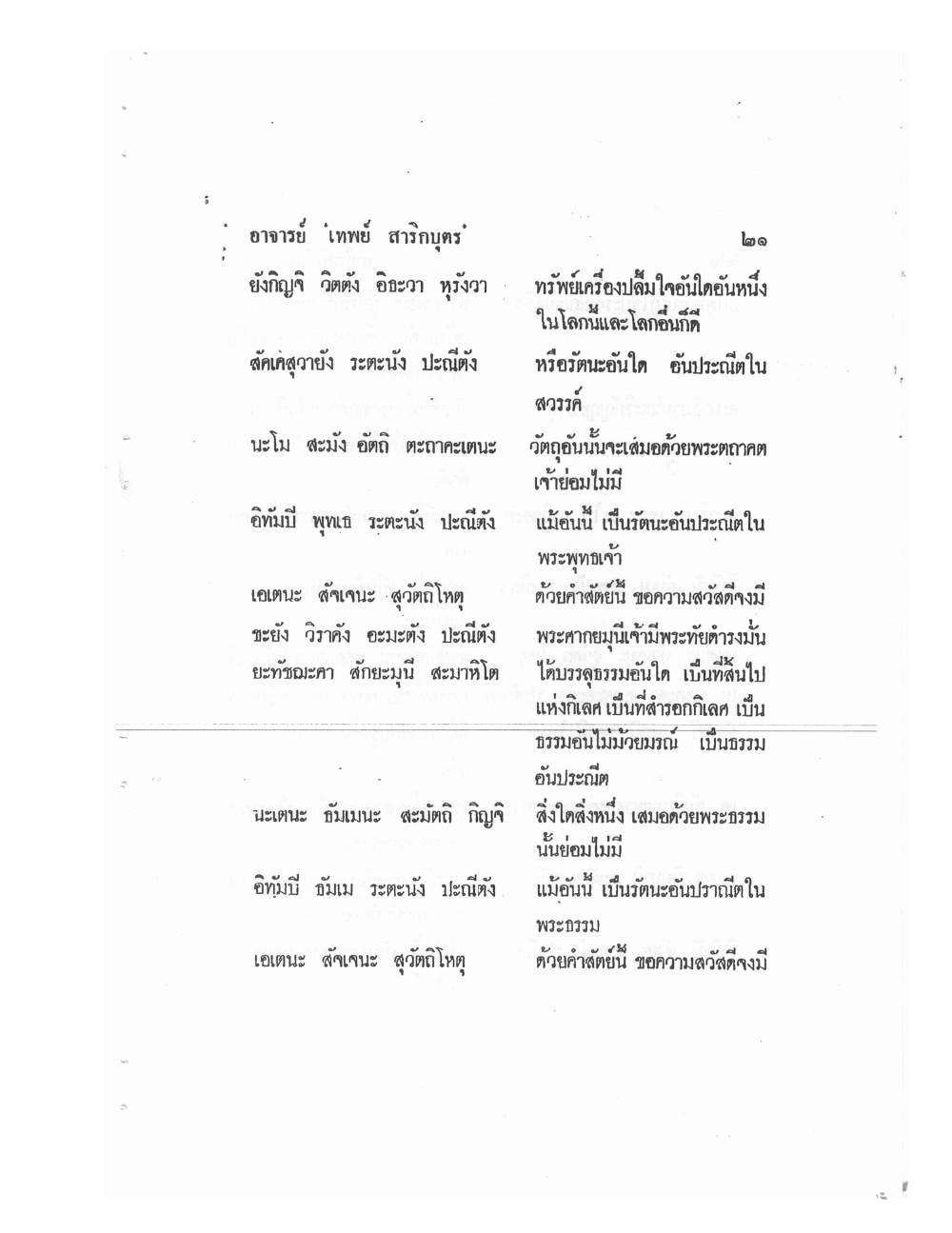
ยังกิญจิ วิตตัง อิธะวา หุรังวา สัคเคสุวายัง ระตะนัง ปะณีตัง นะโม สะมัง อัตถิ ตะถาคะเตนะ อิทัมปิ พุทเธ ระตะนัง ปะณีตัง เอเตนะ สัจเจนะ สุวัตถิโหตุ
ทรัพย์เครื่องปลื้มใจอันใดอันหนึ่ง ในโลกนี้และโลกอื่นก็ดี หรือรัตนะอันใด อันประณีตในสวรรค์ วัตถุอันนั้นจะเสมอด้วยพระตถาคตเจ้าย่อมไม่มี แม้อันนี้ เป็นรัตนะอันประณีตในพระพุทธเจ้า ด้วยคำสัตย์นี้ ขอความสวัสดีจงมี
ขะยัง วิราคัง อะมะตัง ปะณีตัง ยะทัชฌะคา สักยะมุนี สะมาหิโต นะเตนะ ธัมเมนะ สะมัตถิ กิญจิ อิทัมปิ ธัมเม ระตะนัง ปะณีตัง เอเตนะ สัจเจนะ สุวัตถิโหตุ
พระศากยมุนีเจ้ามีพระทัยตำรงมั่น ได้บรรลุธรรมอันใด เป็นที่สิ้นไปแห่งกิเลส เป็นที่สำรอกกิเลส เป็นธรรมอันไม่มีวัยมรณ์ เป็นธรรมอันประณีต สิ่งใดสิ่งหนึ่ง เสมอด้วยพระธรรมนั้นย่อมไม่มี แม้อันนี้ เป็นรัตนะอันปราณีตในพระธรรม ด้วยคำสัตย์นี้ ขอความสวัสดีจงมี
Yaṅ kiñci vittaṃ idha vā huraṃ vā, saggesu vā yaṃ ratanaṃ paṇītaṃ, na no samaṃ atthi tathāgatena, idampi buddhe ratanaṃ paṇītaṃ, etena saccena suvatthi hotu — Whatever treasure that delights the heart, in this world or another, or whatever precious jewel there is in the heavens, nothing is equal to it in the Tathāgata. Even this is a precious jewel in the Buddha. By this word of truth, may there be well-being.
Khayaṃ virāgaṃ amataṃ paṇītaṃ, yadajjhagā sakyamunī samāhito, na tena dhammena samaṃ atthi kiñci, idampi dhamme ratanaṃ paṇītaṃ, etena saccena suvatthi hotu — The Sakyan Sage, his heart firmly established, attained that which is the ending, the fading of passion, the deathless, the excellent — the state that is the ending of defilements, the purging of defilements, a state without aging or death, an excellent state. Nothing whatsoever is equal to that Dhamma. Even this is a precious jewel in the Dhamma. By this word of truth, may there be well-being.
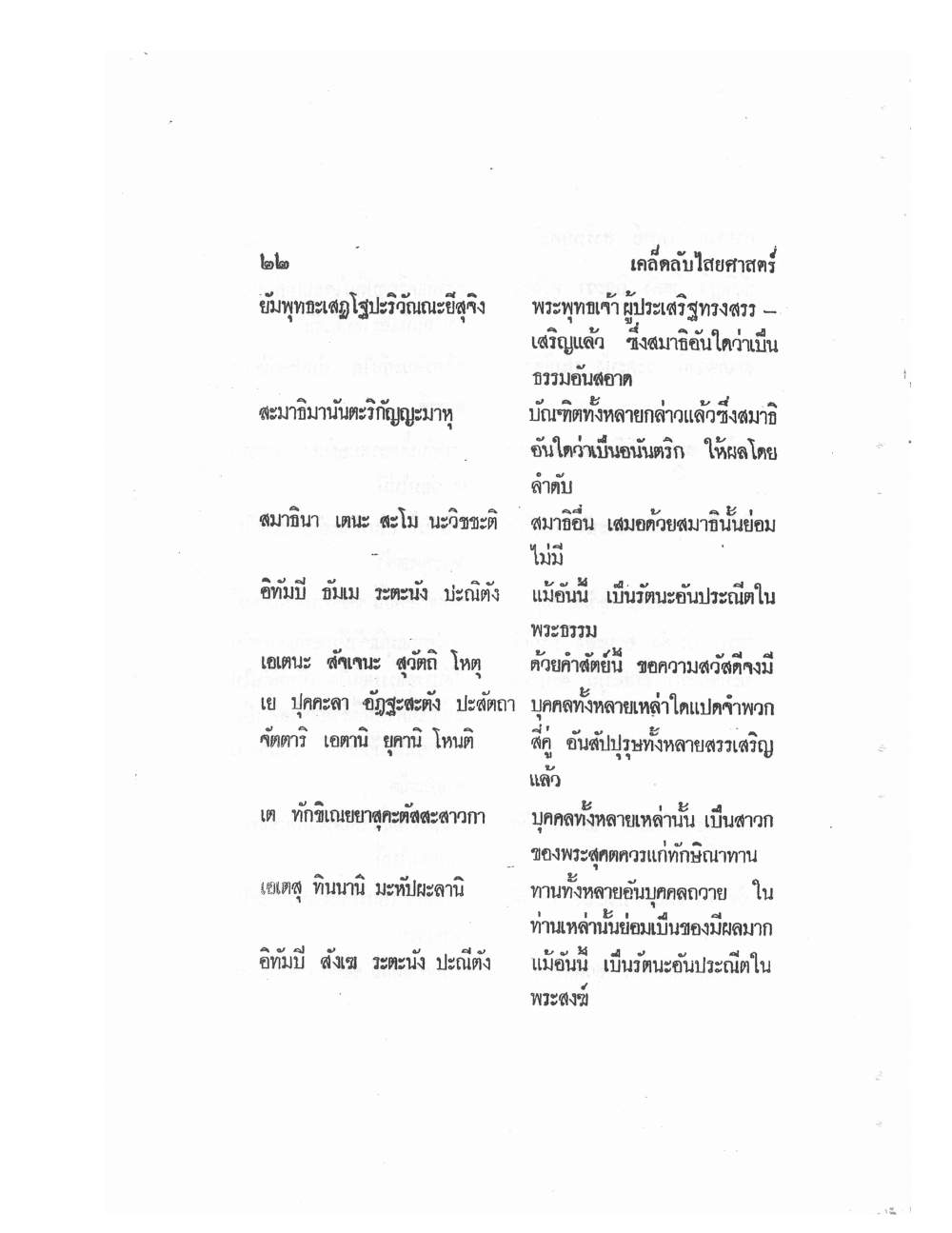
ยัมพุทธะเสฏโฐปะริวัณณะยีสุจิง สะมาธิมานันตะริกัญญะมาหุ สะมาธินา เตนะ สะโม นะวิชชะติ อิทัมปิ ธัมเม ระตะนัง ปะณีตัง เอเตนะ สัจเจนะ สุวัตถิโหตุ
พระพุทธเจ้า ผู้ประเสริฐทรงสรรเสริญแล้ว ซึ่งสมาธิอันใดว่าเป็นธรรมอันสอาด บัณฑิตทั้งหลายกล่าวแล้วซึ่งสมาธิอันใดว่าเป็นอนันตริก ให้ผลโดยลำดับ สมาธิอื่น เสมอด้วยสมาธินั้นย่อมไม่มี แม้อันนี้ เป็นรัตนะอันประณีตในพระธรรม ด้วยคำสัตย์นี้ ขอความสวัสดีจงมี
เย ปุคคะลา อัฏฐะสะตัง ปะสัตถา จัตตาริ เอตานิ ยุคานิ โหนติ เต ทักขิเณยยา สุคะตัสสะ สาวะกา เอเตสุ ทินนานิ มะหัปผะลานิ อิทัมปิ สังเฆ ระตะนัง ปะณีตัง
บุคคลทั้งหลายเหล่าใดแปดจำพวก สี่คู่ อันสัปปุรุษทั้งหลายสรรเสริญแล้ว บุคคลทั้งหลายเหล่านั้น เป็นสาวกของพระสุคต ควรแก่ทักษิณาทาน ทานทั้งหลายอันบุคคลถวายในท่านเหล่านั้นย่อมเป็นของมีผลมาก แม้อันนี้ เป็นรัตนะอันประณีตในพระสงฆ์
Yaṃ buddhaseṭṭho parivaṇṇayī suciṃ, samādhimānantarikaññamāhu, samādhinā tena samo na vijjati, idampi dhamme ratanaṃ paṇītaṃ, etena saccena suvatthi hotu — The excellent Buddha praised as pure that concentration which the wise call "immediate" [giving its fruit without delay]. No other concentration is equal to it. Even this is a precious jewel in the Dhamma. By this word of truth, may there be well-being.
Ye puggalā aṭṭha sataṃ pasatthā, cattāri etāni yugāni honti, te dakkhiṇeyyā sugatassa sāvakā, etesu dinnāni mahapphalāni, idampi saṅghe ratanaṃ paṇītaṃ — Those eight kinds of persons, forming four pairs, praised by the virtuous — these are disciples of the Well-Farer, worthy of offerings; gifts given to them bear great fruit. Even this is a precious jewel in the Sangha.
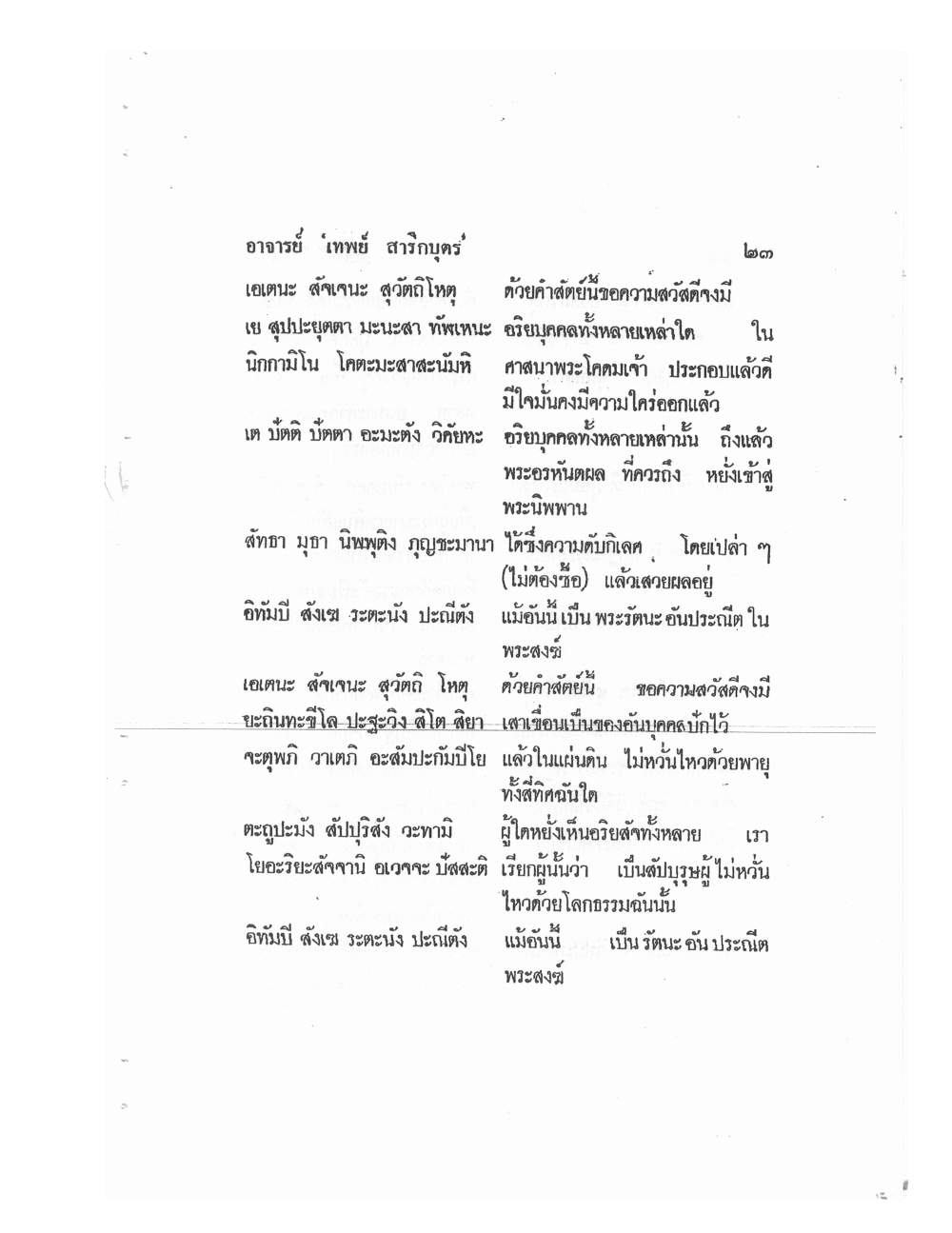
เย สุปปะยุตตา มะนะสา ทัฬเหนะ นิกกามิโน โคตะมะสาสะนัมหิ เต ปัตติปัตตา อะมะตัง วิคัยหะ สัทธา มุธา นิพพุติง ภุญชะมานา อิทัมปิ สังเฆ ระตะนัง ปะณีตัง เอเตนะ สัจเจนะ สุวัตถิโหตุ
อริยบุคคลทั้งหลายเหล่าใด ในศาสนาพระโคดมเจ้า ประกอบแล้วดี มีใจมั่นคง มีความใคร่ออกแล้ว อริยบุคคลทั้งหลายเหล่านั้น ถึงแล้วพระอรหัตผล ที่ควรถึง หยั่งเข้าสู่พระนิพพาน ได้ซึ่งความดับกิเลส โดยเปล่า ๆ (ไม่ต้องซื้อ) แล้วเสวยผลอยู่ แม้อันนี้ เป็นพระรัตนะอันประณีตในพระสงฆ์ ด้วยคำสัตย์นี้ ขอความสวัสดีจงมี
ยะถินทะขีโล ปะฐะวิง สิโต สิยา จะตุพภิ วาเตภิ อะสัมปะกัมปิโย ตะถูปะมัง สัปปุริสัง วะทามิ โยอะริยะสัจจานิ อเวจจะ ปัสสติ อิทัมปิ สังเฆ ระตะนัง ปะณีตัง
เสาเขื่อนเป็นของอันบุคคลปักไว้แล้วในแผ่นดิน ไม่หวั่นไหวด้วยพายุทั้งสี่ทิศฉันใด ผู้ใดหยั่งเห็นอริยสัจทั้งหลาย เราเรียกผู้นั้นว่า เป็นสัปบุรุษผู้ไม่หวั่นไหวด้วยโลกธรรมฉันนั้น แม้อันนี้ เป็นรัตนะอันประณีต พระสงฆ์
Ye suppayuttā manasā daḷhena, nikkāmino gotamasāsanamhi, te pattipattā amataṃ vigayha, laddhā mudhā nibbutiṃ bhuñjamānā, idampi saṅghe ratanaṃ paṇītaṃ, etena saccena suvatthi hotu — Those noble ones who, in the dispensation of the Gotama Buddha, are well applied with a firm mind, having gone forth with longing for release, have attained what should be attained, plunging into the deathless; freely (without needing to purchase it) they enjoy the fruit of the cessation of defilements they have won. Even this is a precious jewel in the Sangha. By this word of truth, may there be well-being.
Yathindakhīlo pathaviṃ sito siyā, catubbhi vātehi asampakampiyo, tathūpamaṃ sappurisaṃ vadāmi, yo ariyasaccāni avecca passati, idampi saṅghe ratanaṃ paṇītaṃ — Just as a boundary-post driven into the earth is unshaken by winds from the four directions, so I call the person who clearly perceives the noble truths a true man, unshaken by the ways of the world. Even this is a precious jewel — the Sangha.
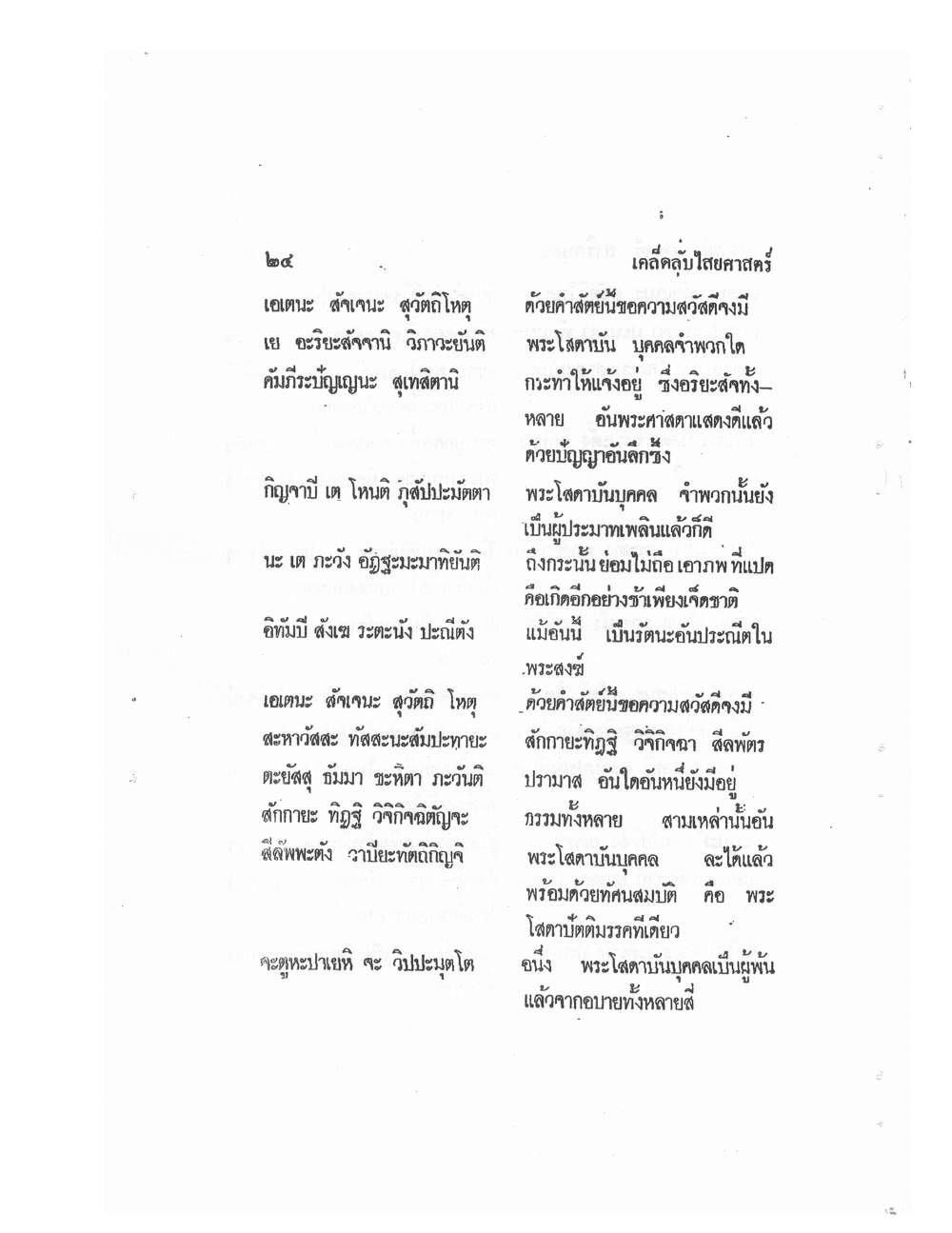
เอเตนะ สัจเจนะ สุวัตถิโหตุ
เย อะริยะสัจจานิ วิภาวะยันติ คัมภีระปัญเญนะ สุเทสิตานิ กิญจาปิ เต โหนติ ภุสัปปะมัตตา นะ เต ภะวัง อัฏฐะมะมาทิยันติ อิทัมปิ สังเฆ ระตะนัง ปะณีตัง
พระโสดาบัน บุคคลจำพวกใด กระทำให้แจ้งอยู่ ซึ่งอริยสัจทั้งหลาย อันพระศาสดาแสดงดีแล้วด้วยปัญญาอันลึกซึ้ง พระโสดาบันบุคคลจำพวกนั้นยังเป็นผู้ประมาทเพลินแล้วก็ดี ถึงกระนั้น ย่อมไม่ถือเอาภพที่แปด คือเกิดอีกอย่างช้าเพียงเจ็ดชาติ แม้อันนี้ เป็นรัตนะอันประณีตในพระสงฆ์
เอเตนะ สัจเจนะ สุวัตถิ โหตุ
สะหาวัสสะ ทัสสะนะสัมปะทายะ ตะยัสสุ ธัมมา ชะหิตา ภะวันติ สักกายะทิฏฐิ วิจิกิจฉิตัญจะ สีลัพพะตัง วาปิยะทัตถิกิญจิ
ด้วยคำสัตย์นี้ ขอความสวัสดีจงมี สักกายะทิฏฐิ วิจิกิจฉา สีลัพตปรามาส อันใดอันหนึ่งยังมีอยู่ กรรมทั้งหลายสามเหล่านั้นอันพระโสดาบันบุคคลละได้แล้ว พร้อมด้วยทัศนสมบัติ คือ พระโสดาปัตติมรรคทีเดียว อนึ่ง พระโสดาบันบุคคลเป็นผู้พ้นแล้วจากอบายทั้งหลายสี่
จะตูหะปาเยหิ จะ วิปปะมุตโต
Etena saccena suvatthi hotu — By this word of truth, may there be well-being.
Ye ariyasaccāni vibhāvayanti, gambhīrapaññena sudesitāni, kiñcāpi te honti bhusappamattā, na te bhavaṃ aṭṭhamaṃ ādiyanti, idampi saṅghe ratanaṃ paṇītaṃ — Whatever stream-enterers realize clearly the noble truths well taught by the Teacher with profound wisdom — even if such stream-enterers are still somewhat heedless and given to enjoyment, still they will not take up an eighth existence; at most they will be reborn only seven more times. Even this is a precious jewel in the Sangha.
Etena saccena suvatthi hotu — By this word of truth, may there be well-being.
Sahāvassa dassanasampadāya, tayassu dhammā jahitā bhavanti, sakkāyadiṭṭhi vicikicchitañca, sīlabbataṃ vāpi yadatthi kiñci — Whatever there is of personality-view, doubt, or attachment to rules and rituals — these three things are abandoned by the stream-enterer together with the attainment of vision, that is, by the very path of stream-entry itself. Furthermore, the stream-enterer is one who is freed from the four states of loss,
catūhapāyehi ca vippamutto — and is freed from the four states of loss —
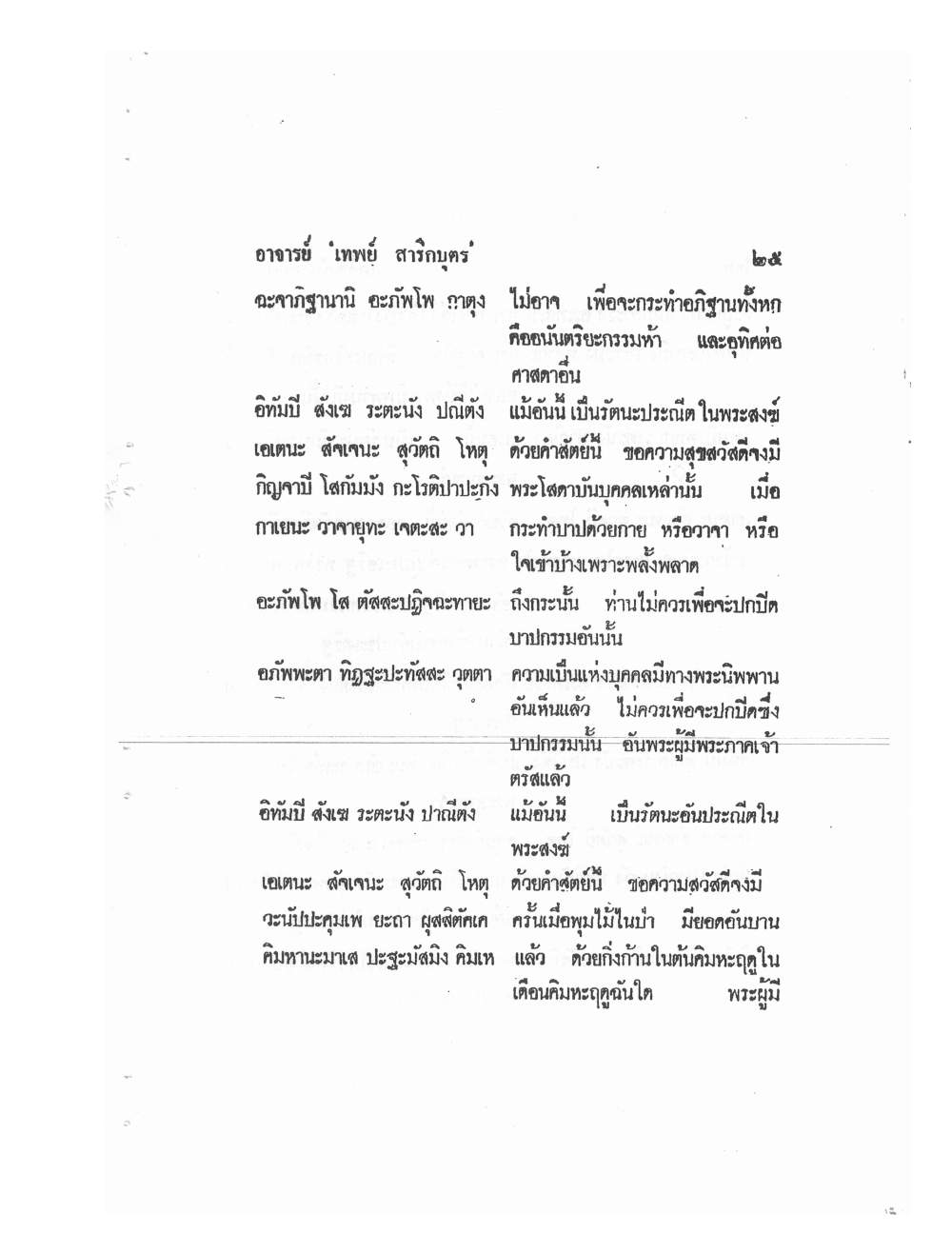
ฉะจาภิฏฐานานิ อะภัพโพ กาตุง อิทัมปิ สังเฆ ระตะนัง ปะณีตัง เอเตนะ สัจเจนะ สุวัตถิ โหตุ
ไม่อาจ เพื่อจะกระทำอภิฐานทั้งหก คืออนันตริยกรรมห้า และอุทิศต่อศาสดาอื่น แม้อันนี้ เป็นรัตนะประณีตในพระสงฆ์ ด้วยคำสัตย์นี้ ขอความสุขสวัสดีจงมี
กิญจาบี โสกัมมัง กะโรติปาปะกัง กาเยนะ วาจายุทะ เจตะสะ วา อะภัพโพ โส ตัสสะปฏิจฉะทายะ อภัพพะตา ทิฏฐะปะทัสสะ วุตตา
พระโสดาบันบุคคลเหล่านั้น เมื่อกระทำบาปด้วยกาย หรือวาจา หรือใจเข้าบ้างเพราะพลั้งพลาด ถึงกระนั้น ท่านไม่ควรเพื่อจะปกปิดบาปกรรมอันนั้น ความเป็นแห่งบุคคลมีทางพระนิพพานอันเห็นแล้ว ไม่ควรเพื่อจะปกปิดซึ่งบาปกรรมนั้น อันพระผู้มีพระภาคเจ้าตรัสแล้ว
อิทัมปี สังเฆ ระตะนัง ปาณีตัง เอเตนะ สัจเจนะ สุวัตถิ โหตุ
แม้อันนี้ เป็นรัตนะอันประณีตในพระสงฆ์ ด้วยคำสัตย์นี้ ขอความสวัสดีจงมี
วะนัปปะคุมเพ ยะถา ผุสสิตัคเค คิมหานะมาเส ปะฐะมัสมิง คิมเห
ครั้นเมื่อพุ่มไม้ในป่า มียอดอันบานแล้ว ด้วยกิ่งก้านในต้นคิมหฤดูในเดือนคิมหฤดูฉันใด พระผู้มี...
Chaccābhiṭhānāni abhabbo kātuṃ, idampi saṅghe ratanaṃ paṇītaṃ, etena saccena suvatthi hotu — [The stream-enterer] is incapable of committing the six grave transgressions — the five acts of immediate retribution, and dedicating himself to another teacher. Even this is a precious jewel in the Sangha. By this word of truth, may there be happiness and well-being.
Kiñcāpi so kammaṃ karoti pāpakaṃ, kāyena vācāyuda cetasā vā, abhabbo so tassa paṭicchadāya, abhabbatā diṭṭhapadassa vuttā — Even if such a stream-enterer commits some wrong through body, speech, or mind by inadvertence, still he is incapable of concealing that misdeed; it has been said by the Blessed One that inability to conceal wrongdoing is a mark of one who has seen the path [to Nibbāna].
Idampi saṅghe ratanaṃ paṇītaṃ, etena saccena suvatthi hotu — Even this is a precious jewel in the Sangha. By this word of truth, may there be well-being.
Vanappagumbe yathā phussitagge, gimhānamāse paṭhamasmiṃ gimhe — Just as, when the thickets of the forest have their crowns in bloom with branches, in the first month of the hot season... [translation trails off with the page]
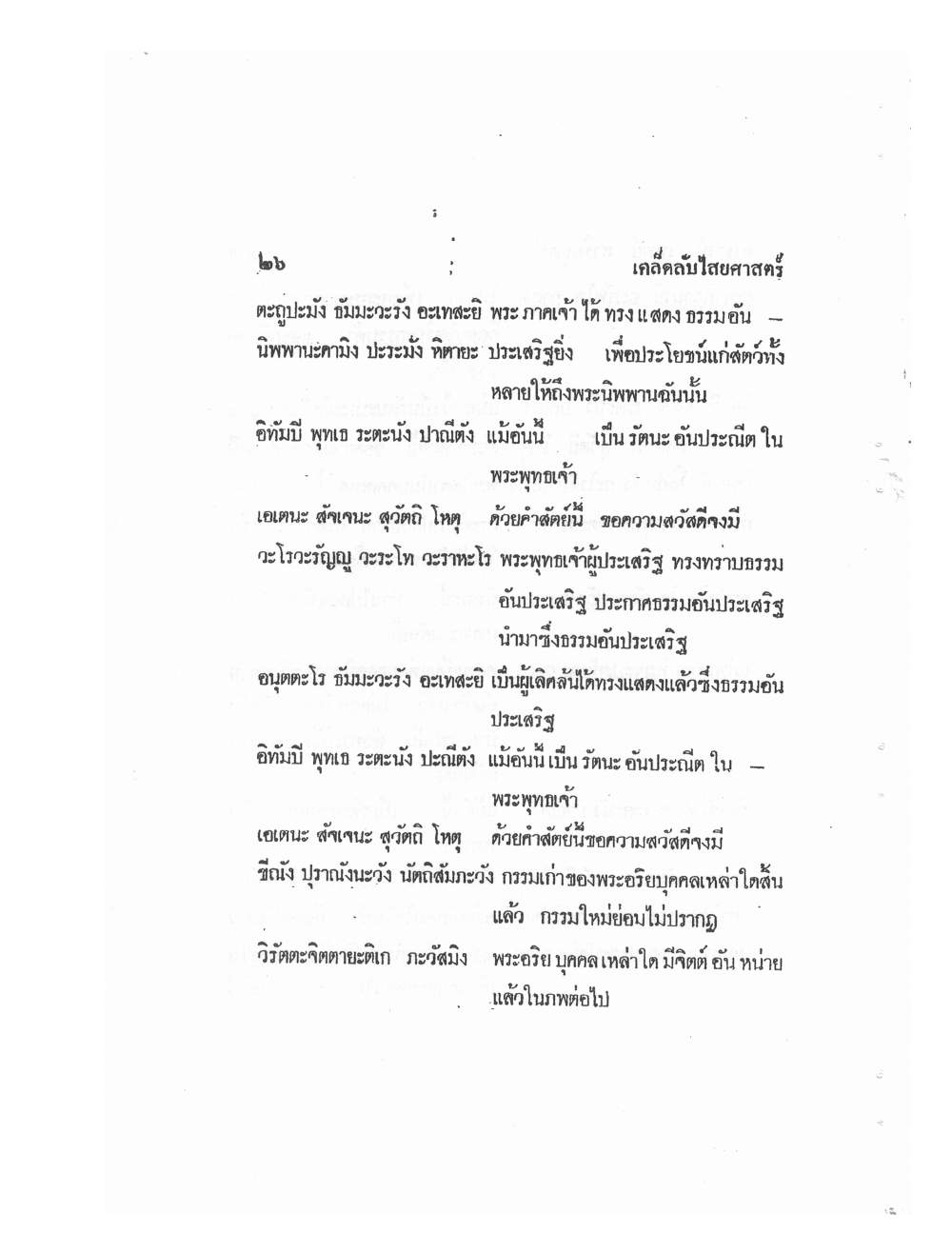
ตะถูปะมัง ธัมมะวะรัง อะเทสะยิ นิพพานะคามิง ปะระมัง หิตายะ อิทัมปิ พุทเธ ระตะนัง ปาณีตัง เอเตนะ สัจเจนะ สุวัตถิ โหตุ
พระภาคเจ้า ได้ทรงแสดงธรรมอัน นิพพานะคามิง ประเสริฐยิ่ง เพื่อประโยชน์แก่สัตว์ทั้งหลายให้ถึงพระนิพพานฉันนั้น แม้อันนี้ เป็นรัตนะอันประณีตในพระพุทธเจ้า ด้วยคำสัตย์นี้ ขอความสวัสดีจงมี
วะโรวะรัญญู วะระโท วะราหะโว อนุตตะโร ธัมมะวะรัง อะเทสะยิ
พระพุทธเจ้าผู้ประเสริฐ ทรงทราบธรรมอันประเสริฐ ประกาศธรรมอันประเสริฐ นำมาซึ่งธรรมอันประเสริฐ เป็นผู้เลิศได้ทรงแสดงแล้วซึ่งธรรมอันประเสริฐ
อิทัมปี พุทเธ ระตะนัง ปะณีตัง เอเตนะ สัจเจนะ สุวัตถิ โหตุ
แม้อันนี้ เป็น รัตนะ อันประณีต ใน พระพุทธเจ้า ด้วยคำสัตย์นี้ ขอความสวัสดีจงมี
ขีณัง ปุราณัง นะวังนัตถิ สัมภะวัง วิรัตตะจิตตายะติเก ภะวัสมิง
กรรมเก่าของพระอริยบุคคลเหล่าใดสิ้นแล้ว กรรมใหม่ย่อมไม่ปรากฏ พระอริยบุคคลเหล่าใดมีจิตต์อันหน่ายแล้วในภพต่อไป
Tathūpamaṃ dhammavaraṃ adesayi, nibbānagāmiṃ paramaṃ hitāya, idampi buddhe ratanaṃ paṇītaṃ, etena saccena suvatthi hotu — In just this way, the Blessed One taught the excellent, supreme Dhamma leading to Nibbāna, for the highest welfare, so that beings might reach Nibbāna. Even this is a precious jewel in the Buddha. By this word of truth, may there be well-being.
Varo varaññū varado varāharo, anuttaro dhammavaraṃ adesayi — The excellent Buddha, knower of the excellent, giver of the excellent, bringer of the excellent, unsurpassed, has taught the excellent Dhamma.
Idampi buddhe ratanaṃ paṇītaṃ, etena saccena suvatthi hotu — Even this is a precious jewel in the Buddha. By this word of truth, may there be well-being.
Khīṇaṃ purāṇaṃ navaṃ natthi sambhavaṃ, virattacittāyatike bhavasmiṃ — For those noble ones whose old karma is exhausted, for whom no new karma arises, whose minds are dispassionate toward future becoming —
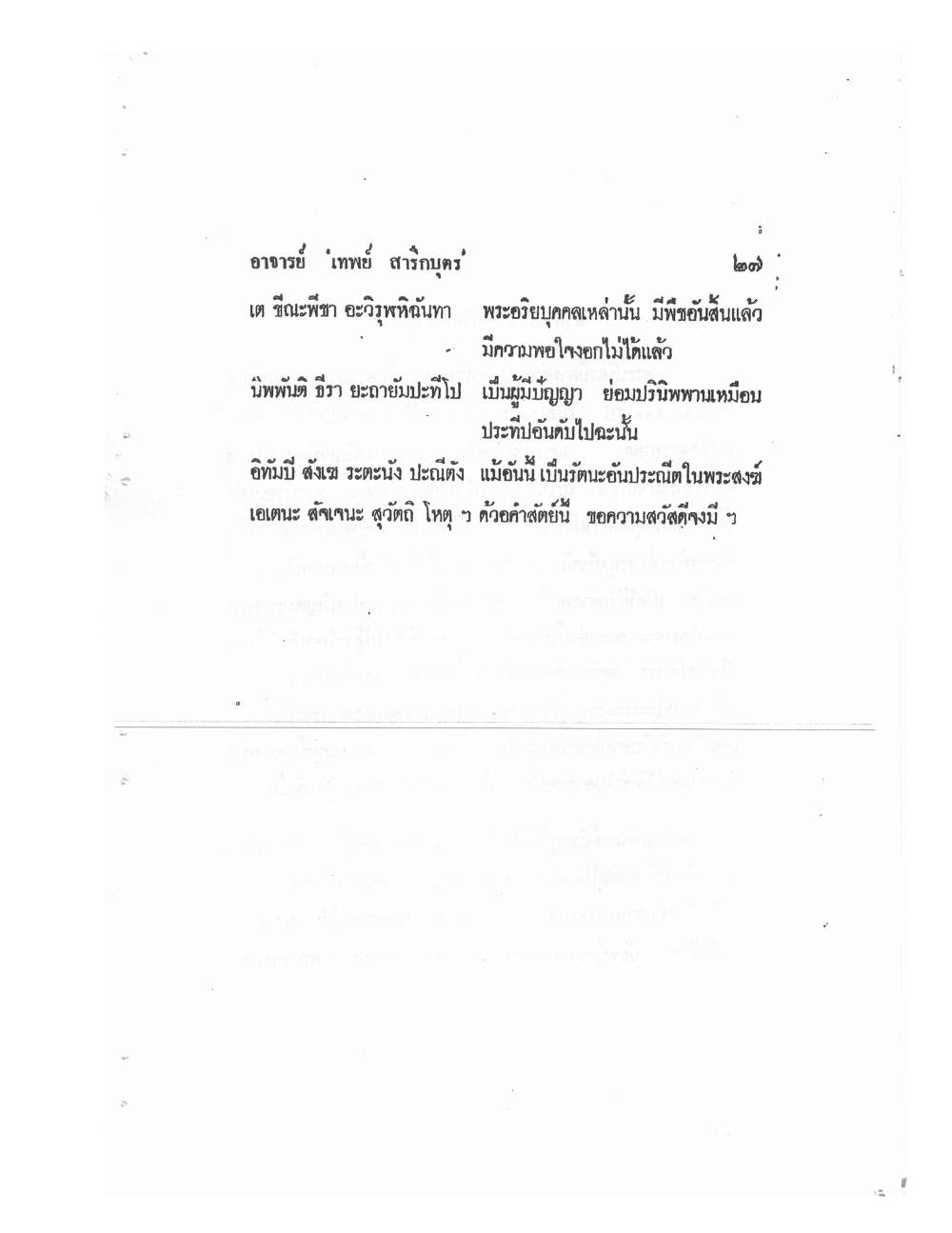
เต ขีณะพีชา อะวิรุฬหิฉันทา นิพพันติ ธีรา ยะถายัมปะทีโป อิทัมปิ สังเฆ ระตะนัง ปะณีตัง เอเตนะ สัจเจนะ สุวัตถิโหตุ ๆ
Te khīṇabījā avirūḷhichandā, nibbanti dhīrā yathāyaṃ padīpo, idampi saṅghe ratanaṃ paṇītaṃ, etena saccena suvatthi hotu — Those noble ones, their seeds [of rebirth] exhausted, their craving no longer able to sprout, being wise, attain final Nibbāna just as this lamp goes out. Even this is a precious jewel in the Sangha. By this word of truth, may there be well-being. [Repeated mark indicating the close of the discourse.]
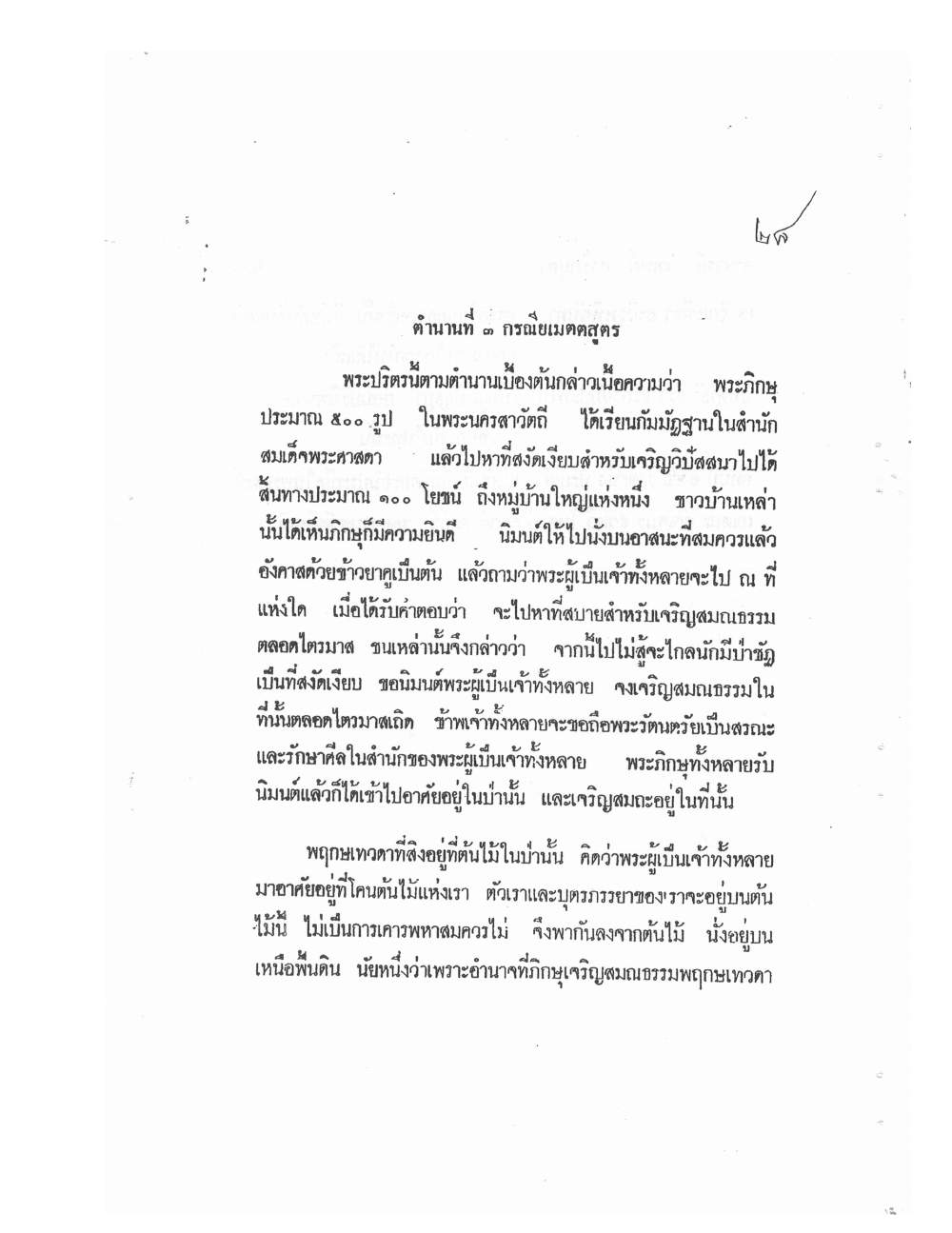
ตำนานที่ ๓ กรณียเมตตสูตร
พระปริตรนี้ตามตำนานเบื้องต้นกล่าวเนื้อความว่า พระภิกษุประมาณ ๕๐๐ รูป ในพระนครสาวัตถี ได้เรียนกัมมัฏฐานในสำนักสมเด็จพระศาสดา แล้วไปหาที่สงัดเงียบสำหรับเจริญวิปัสสนาไปได้สิ้นทางประมาณ ๑๐๐ โยชน์ ถึงหมู่บ้านใหญ่แห่งหนึ่ง ชาวบ้านเหล่านั้นได้เห็นภิกษุมีความยินดี นิมนต์ให้ไปนั่งบนอาสนะที่สมควรแล้ว อังคาสด้วยข้าวยาคูเป็นต้น แล้วถามว่าพระผู้เป็นเจ้าทั้งหลายจะไป ณ ที่แห่งใด เมื่อได้รับคำตอบว่า จะไปหาที่สบายสำหรับเจริญสมณธรรมตลอดไตรมาส ชนเหล่านั้นจึงกล่าวว่า จากนี้ไปไม่สู้จะไกลนักมีป่าชัฏเป็นที่สงัดเงียบ ขอนิมนต์พระผู้เป็นเจ้าทั้งหลาย จงเจริญสมณธรรมในที่นั้นตลอดไตรมาสเถิด ข้าพเจ้าทั้งหลายจะขอถือพระวัตนตรัยเป็นสรณะและรักษาศีลในสำนักของพระผู้เป็นเจ้าทั้งหลาย พระภิกษุทั้งหลายรับนิมนต์แล้วก็ได้เข้าไปอาศัยอยู่ในบ้านนั้น และเจริญสมณะอยู่ในที่นั้น
พฤกษเทวดาที่สิงอยู่ที่ต้นไม้ในบ้านนั้น คิดว่าพระผู้เป็นเจ้าทั้งหลายมาอาศัยอยู่ที่โคนต้นไม้แห่งเรา ตัวเราและบุตรภรรยาของเราจะอยู่บนต้นไม้นี้ ไม่เป็นการเคารพหาสมควรไม่ จึงพากันลงจากต้นไม้ นั่งอยู่บนเหนือพื้นดิน นัยหนึ่งว่าเพราะอำนาจที่ภิกษุเจริญสมณธรรมพฤกษเทวดา
Legend 3: The Karaṇīya Mettā Sutta
According to the legend at its outset, this account tells that about 500 monks in the city of Sāvatthī had learned meditation subjects in the presence of the Blessed Teacher, and then went in search of a secluded place to develop insight. They travelled a distance of about 100 yojanas until they reached a large village. The villagers, seeing the monks, were glad, and invited them to sit on suitable seats, serving them rice-gruel and other food. They then asked the venerable ones where they intended to go. When told that the monks were seeking a comfortable place to practice the ascetic life throughout the three months [of the rains retreat], the villagers said: "Not far from here there is a dense forest, a secluded place. We invite the venerable ones to practice the ascetic life there for the whole three months. We will take the Triple Gem as our refuge and keep the precepts under the guidance of the venerable ones." The monks accepted the invitation, went to dwell in that village, and practiced their ascetic observances there.
The tree-deities dwelling in the trees of that place thought: "The venerable ones have come to dwell at the foot of our trees; it would not be proper or fitting for us and our wives and children to remain up in the trees." So they came down from the trees and sat upon the bare ground. According to one account, it was through the power of the monks' practice of the ascetic life that the tree-deities —
เหล่านั้นจึงไม่อาจอยู่บนต้นไม้ได้ ด้วยสำคัญว่าพระผู้เป็นเจ้าพักอยู่ในที่นั้นคืนหนึ่งแล้วก็จักต่อไป ในวันรุ่งขึ้นพระภิกษุเที่ยวบิณฑบาตรภายในบ้านนั้นแล้วก็กลับเข้าสู่ป่าชัฏตามเดิม เทวดาเหล่านั้นพากันคิดว่า ใครๆ เขาคงนิมนต์ท่านฉันในวันพรุ่งนี้ วันนี้ท่านจึงกลับมาพักในที่นี้อีก และวันหน้าต่อไปท่านก็จะไปในที่อื่น แต่หมู่เทวดาพากันคิดว่าพระภิกษุจะไปในวันหน้าและภิกษุก็ยังกลับมาพักในที่เดิมอีก ดังนี้สืบๆ ไปจนเวลาล่วงไปได้ประมาณครึ่งเดือน เทวดาจึงพากันคิดว่า ชะรอยพระผู้เป็นเจ้าจะอยู่ในที่นี้ตลอดไตรมาสเป็นแน่ ถ้าพระผู้เป็นเจ้าอยู่ในที่นี้ตลอดไตรมาสแล้ว พวกเราก็ต้องอยู่กับพื้นดินตลอดไตรมาสด้วย เป็นการลำบากนัก ควรที่พวกเราจะทำการวิการอะไรขึ้น ให้ท่านไปเสียจากที่นี้ และเป็นการดี เมื่อปรารภอย่างนั้นแล้ว ก็ได้แสดงวิการต่าง ๆ มีทรากศพศีรษะขาด และรูปยักษ์เป็นต้น และกระทำเสียงแห่งอมนุษย์อันน่าสยดสยองทั้งในเวลากลางคืนและกลางวัน กับบรรดาลโรคไอ และโรคจาม ให้เกิดขึ้นแก่พระภิกษุทั้งหลาย ภิกษุทั้งหลายก็อยู่ไม่เป็นผาสุกเหมือนดังแต่ก่อน มีความหวาดกลัวเกิดโรคผอมซีดเซียวลง จึงพากันออกจากที่นั้นไปสู่สำนักของสมเด็จพระศาสดา ทูลให้ทรงทราบถึงเรื่องที่ได้ประสพต่ออารมณ์อันน่ากลัวต่าง ๆ และความไม่ผาสุขที่ได้บังเกิดแก่โรคนั้นด้วย
พระผู้มีพระภาคเจ้า มีพระพุทธประสงค์จะให้ภิกษุเหล่านั้นกลับไปเจริญสมณธรรมในที่เดิมอีก จึงทรงประทานเมตตาสูตรเป็นอาวุธ เครื่อง...
—could no longer remain up in the trees. Thinking that the venerable ones would stay in that place only one night and then move on, [they endured it]. The next day, when the monks had gone for alms-round within the village and returned to the forest as before, the deities thought among themselves: "Surely someone has invited him to a meal tomorrow; that is why he has come back to stay here again, and the day after he will go elsewhere." But the group of deities kept thinking the monks would leave the next day, and yet the monks kept returning to stay in the same place. This went on day after day until about half a month had passed. The deities then thought: "It seems certain the venerable ones intend to stay here the entire three months. If the venerable ones remain here for the whole three months, then we too must remain on the bare ground for the whole three months — this is very troublesome. We ought to produce some disturbance to make them leave this place; that would be best." Having resolved thus, they produced various apparitions — headless corpses, ogre-forms, and the like — and made terrifying inhuman sounds both at night and during the day, and brought about coughing and sneezing sickness upon the monks. The monks were no longer at ease as before; fearful, they grew pale and emaciated, and so they left that place and went to the residence of the Blessed Teacher, reporting to him the frightening experiences they had encountered and the illness that had arisen from it.
The Blessed One, wishing the monks to return and practice their ascetic observances in the same place, then bestowed upon them the Mettā Sutta as a weapon, a means of —
ป้องกัน แล้วจึงมีพระพุทธดำรัสว่า ภิกษุทั้งหลายเธอพึงสาธยายพระสูตรนี้ตั้งแต่ราวไพรภายนอกวิหารเข้าไปสู่ภายในวิหาร ภิกษุเหล่านั้นก็ถวายบังคมพระศาสดาแล้วกลับไปถึงราวไพรภายนอกที่อยู่ ก็สาธยายพระสูตรตามพระพุทธฎีกาแล้วเดินเข้าไปสู่ที่สำนักเดิม คราวนี้หมู่เทวดาเหล่านั้นกลับมีความเมตตา ทำการต้อนรับพระภิกษุเหล่านั้น มีการรับบาตรจีวรและเข้านวดหัวบีบเกวาดสถานที่ ตลอดจนการอารักขาในราวไพรด้วย
ภิกษุเหล่านั้น เมื่อได้อยู่เป็นผาสุขแล้วก็ตั้งจิตบำเพ็ญพระกัมมัฏฐานตลอดทั้งกลางวันและกลางคืน จิตของท่านก็หยั่งลงสู่วิปัสสนา เห็นความสิ้นความเสื่อมในตนว่า อัตตภาพนี้ก็เป็นเช่นภาชนะดินคือต้องแตกทำลายไม่ถาวร พระพุทธเจ้าทรงประทับอยู่ในพระคันธกุฎีทราบความปรารภของพระภิกษุทั้งหลายเหล่านั้น จึงเปล่งรัศมีในที่ห่างประมาณ ๑๐๐ โยชน์ ให้เห็นเหมือนว่าเสด็จประทับอยู่ที่เฉพาะหน้าพระภิกษุเหล่านั้น และตรัสพระคาถาว่า:-
"ภิกษุทราบกายนี้ว่า เปรียบกับหม้อ บีบจิตน์ให้เหมือนกับนคร พึงรบกับมารด้วยอาวุธคือปัญญาและพึงรักษาความชนะไว้ พึงเป็นผู้หาความพัวพันมิได้"
เมื่อจบพระธรรมเทศนาแล้ว ภิกษุ ๕๐๐ รูป ก็ได้บรรลุพระอรหันต์พร้อมด้วยปฏิสัมภิทา
—protection, and he said: "Monks, you should recite this discourse starting from the edge of the forest outside the dwelling, all the way in as you enter the interior of the dwelling." The monks paid homage to the Teacher and returned to the edge of the forest where they were staying; they recited the discourse according to the Buddha's instruction and then walked on into their original dwelling place. This time the group of deities, now filled with loving-kindness, welcomed the monks — receiving their bowls and robes, massaging their heads, and sweeping the grounds, as well as guarding them throughout the forest.
Once the monks were able to dwell in comfort, they applied their minds to their meditation subject throughout both day and night. Their minds sank down into insight, seeing within themselves the nature of decay and dissolution — that this very selfhood is like an earthen vessel, bound to break and perish, impermanent. The Buddha, dwelling in his Fragrant Chamber, became aware of what these monks were contemplating, and so emitted rays of light across a distance of about 100 yojanas, making it seem as though he were present right before the monks, and spoke this verse:
"Know this body, monks, to be like a clay pot; steady this mind as though it were a fortified city. Fight against Māra with the weapon of wisdom, and guard the victory won; be one who has no more entanglement."
When the discourse was concluded, the 500 monks attained arahantship together with the analytical knowledges.
พระสูตรนี้ ประกอบด้วยคุณานุภาพเป็นอันมาก เป็นประหนึ่งหัวใจของพระพุทธศาสนา พระคาถาและคำแปลมีดังต่อไปนี้ -
◎ กะระณียะมัตถะกุสะเลนะ ยันตัง สันตัง ปะทัง อะภิสะเมจจะ
กิจนั้นใด อันพระอริยเจ้าบรรลุแล้วซึ่งบทอันระงับ กระทำแล้วกิจนั้น อันกุลบุตรผู้ฉลาดพึงกระทำ
สักโก อุชู จะ สุหุชู จะ สุวะโจ จัสสะ มุทุ อะนะติมานี
กุลบุตรนั้น พึงเป็นผู้อาจหาญและซื่อตรงด้วยดี เป็นผู้ที่ว่าง่าย ละมุนละม่อม ไม่มีอติมานะ
สันตุสสะโก จะ สุภะโร จะ อัปปะกิจโจ จะ สัลลหุกะวุตติ
เป็นผู้สันโดษ เลี้ยงง่าย เป็นผู้มีกิจธุระน้อย ประพฤติเบากายเบาจิตต์
สันตินทริโย จะ นิปะโก จะ อัปปะคัพโภ กุเลสุ อะนะนุคิทโธ
มีอินทรีย์อันระงับแล้วมีปัญญา เป็นผู้ไม่คะนอง ไม่พัวพันในสกุลทั้งหลาย
นะจะขุททัง สะมาจะเร กิญจิ เยนะ วิญญู ปะเร อุปะวะเทยยุง
This discourse is endowed with very great power and virtue; it is, as it were, the heart of the Buddha's teaching. The verses and their translation are as follows —
◎ Karaṇīyamatthakusalena, yantaṃ santaṃ padaṃ abhisamecca — That task which one skilled in the good should undertake, having realized the state of peace: a wise person of good family should perform that task.
Sakko ujū ca suhujū ca, suvaco cassa mudu anatimānī — Such a person of good family should be capable, truly upright and honest, easy to correct, gentle, and free of excessive pride.
Santussako ca subharo ca, appakicco ca sallahukavutti — Content and easy to support, having few concerns, living lightly in body and mind.
Santindriyo ca nipako ca, appagabbho kulesu ananugiddho — With senses calmed and possessed of wisdom, not impudent, not attached to families.
Na ca khuddaṃ samācare kiñci, yena viññū pare upavadeyyuṃ — [Translation continues on the following page.]
หน่อยหนึ่งแล้ว พึงแผ่ไมตรีจิตต์ไปในหมู่สัตว์ว่า
สุขิโน วา เขมิโน โหนตุ สัพเพ สัตตา ภะวันตุ สุขิตัตตา
ขอสัตว์ทั้งหลายทั้งปวง จงเป็นผู้มีสุข มีความสุขเกษม มีตนถึงซึ่งความสุขเถิด
เยเกจิ ปาณะภูตัตถิ
สัตว์มีชีวิตทั้งหลาย เหล่าใดเหล่าหนึ่งมีอยู่
ตะสา วา ถาวะรา วา อะนะวะเสสา
ยังเป็นผู้สะดุ้ง คือมีตัณหาอยู่ หรือเป็นผู้ถาวรมั่นคง คือไม่มีตัณหาทั้งหมด ไม่เหลือ
ทีฆา วา เย มะหันตา วา มัชฌิมา รัสสะกา อะณุกะถูลา
เหล่าใดเป็นที่ยาวหรือโตใหญ่ หรือปานกลาง คือ ต่ำเตี้ยหรือผอมพี
ทิฏฐา วา เย จะ อะทิฏฐา
เหล่าใดที่เขาเห็นแล้วหรือมิได้เห็น
เย จะ ทูเร วะสันติ อะวิทูเร
เหล่าใดที่อยู่ในที่ไกลและที่ใกล้
ภูตา วา สัมภะเวสี วา
ที่เกิดแล้วไม่ต้องเกิดอีกต่อไป หรือยังแสวงหาภพต่อไปก็ดี
...not even the slightest thing whereby other wise people might find fault; rather, one should for a while extend a heart of loving-kindness toward the community of beings, saying:
Sukhino vā khemino hontu, sabbe sattā bhavantu sukhitattā — May all beings, every one, be happy and secure; may they attain happiness within themselves.
Ye keci pāṇabhūtatthi — Whatever living beings there are —
Tasā vā thāvarā vā anavasesā — whether still trembling [with craving] or steady and firm [free of all craving], without exception —
Dīghā vā ye mahantā vā, majjhimā rassakā aṇukathūlā — whether long or great, or middling, short, small, or stout —
Diṭṭhā vā ye ca adiṭṭhā — whether seen or unseen —
Ye ca dūre vasanti avidūre — whether dwelling far away or near —
Bhūtā vā sambhavesī vā — those already born, not needing to be born again, or those still seeking a [new] existence —
อาจารย์ เทพย์ สาริกบุตร์ ๓๓
สัพเพ สัตตา ภะวันตุ สุขิตัตตา ขอ สรรพสัตว์ ทั้งหลาย เหล่านั้น จงเป็นผู้มีตนถึงซึ่งความสุขเถิด
นะ ปะโร ปะรัง นิกุพเภถะ สัตว์อื่นอย่าพึงข่มเหงสัตว์อื่น
นาติ มัญเญถะ กัตถะจินังกิญจิ อย่าพึงดูหมิ่นอะไรๆ เขาในที่ใดๆ เลย
พยาโรสะนา ปฏิฆะสัญญา นาญญะมัญญัสสะทุกขะมิจเฉยยะ ไม่ควรปรารถนาทุกข์แก่กัน และกัน ด้วยความกริ้วโกรธและด้วยปฏิฆสัญญา ความคับแค้นใจ
มาตา ยะถา นิยัง ปุตตัง อายุสา เอกะปุตตะมะนุรักเข มารดาถนอมบุตร ผู้เกิดในตนอันเป็นลูกเอกด้วยอายุ คือแม้ชีวิตก็สละรักษาบุตรได้ฉันใด
เอวัมปิ สัพพะภูเตสุ มานะสัมภาวะเย อะปะริมาณัง พึงเจริญเมตตา มีในใจ ไม่มีประมาณ ไปในสัตว์ทั้งหลายทั้งปวงแม้ฉันนั้น
เมตตัญจะ สัพพะโลกัสมิง มานะสัมภาวะเย อะปะริมาณัง บุคคลพึงเจริญเมตตา มีในใจ ไม่มีประมาณ ไปในโลกทั้งสิ้น
อุทธัง อะโธ จะ ติริยัญ จะ อะสัมพาธัง อะเวรัง อะสะปัตตัง ทั้งเบื้องบน เบื้องต่ำ เบื้องขวาง เป็นธรรมอันไม่คับแคบ ไม่มีเวร ไม่มีศัตรู
๓๓
[Running header:] Ajahn Thep Sarikabutr — [page] 33
Sabbe sattā bhavantu sukhitattā — May all those many beings become possessed of happiness.
Na paro paraṃ nikubbetha — Let no being oppress another being.
Nātimaññetha katthaci naṃ kañci — Let no one despise anyone at all, anywhere.
Byārosanā paṭighasaññā, nāññamaññassa dukkhamiccheyya — One should not wish suffering upon one another out of anger and irritation, or out of the perception of resentment, or vexation of heart.
Mātā yathā niyaṃ puttaṃ āyusā ekaputtamanurakkhe — Just as a mother protects her only child, born of herself, at the risk of her very life,
Evampi sabbabhūtesu mānasaṃ bhāvaye aparimāṇaṃ — so too should one cultivate in one's heart a loving-kindness without measure toward all beings without exception, just so.
Mettañca sabbalokasmiṃ mānasaṃ bhāvaye aparimāṇaṃ — One should cultivate in one's heart a loving-kindness without measure toward the whole world,
Uddhaṃ adho ca tiriyañca asambādhaṃ averaṃ asapattaṃ — above, below, and across — an unconfined state, free of enmity, free of hostility.
[page] 33
๓๔ เคล็ดลับไสยศาสตร์
ติฏฐัญจะรัง นิสินโน วา ผู้เจริญเมตตาจิตนั้น ยืนอยู่ก็ดี เที่ยวไปก็ดี นั่งแล้วก็ดี
สะยาโน วา ยาวะ ตัสสะ วิคะตะมิทโธ นอนแล้วก็ดี เป็นผู้มีความง่วงนอนไปปราศแล้ว คือยังไม่หลับเพียงไร
เอตัง สะติง อะธิฏเฐยยะ ก็พึงตั้งสติระลึกเมตตาเพียงนั้น
พรหมเมตัง วิหารัง อิธะมาหุ บัณฑิตทั้งหลาย กล่าวกิริยาอันนี้ ว่าเป็นพรหมวิหารในพระศาสนานี้
ทิฏฐิญจะ อะนุปะคัมมะสีละวา บุคคลที่มีเมตตาพรหมวิหารไม่เข้าถึงทิฏฐิ เป็นผู้มีศีล
ทัสสะเนนะ สัมปันโน ถึงพร้อมแล้ว ด้วยทัสสนะ คือ โสดาบัติมรรค
กาเมสุ วิเนยยะเคธัง นำความกำหนัดในกามทั้งหลายออก
นะหิชาตุ คัพภะเสยยัง ปุนะเวติฯ ย่อมไม่ถึง ความเกิดในครรภ์อีกโดยแท้ทีเดียวๆ
[page] 34 — [Book-title header:] Secrets of Saiyasat
Tiṭṭhaṃ caraṃ nisinno vā — One who cultivates that heart of loving-kindness — whether standing, walking, or seated,
Sayāno vā yāva tassa vigatamiddho — or lying down, so long as drowsiness has not overtaken and one is not yet asleep,
Etaṃ satiṃ adhiṭṭheyya — should keep that very mindfulness established.
Brahmam etaṃ vihāraṃ idhamāhu — This practice, the wise call the Brahmavihāra (divine abiding) within this Dispensation.
Diṭṭhiñca anupagamma sīlavā — A person possessed of this loving-kindness Brahmavihāra does not fall into wrong view, and is one of virtue,
Dassanena sampanno — endowed with the vision that is the path of stream-entry,
Kāmesu vineyya gedhaṃ — having drawn out craving for sensual pleasures,
Na hi jātu gabbhaseyyaṃ punaretī ti — such a one will surely, truly, never again come to lie in a womb.
๓๕
ตำนานที่ ๔ ขันธปริตรกับฉัททันต์ปริตร
ขันธปริตร
พระปริตรบทนี้ มีตำนานเริ่มต้นว่า สมัยหนึ่งพระผู้มีพระภาค เสด็จประทับอยู่ ณ พระเชตวนาวาส ใกล้พระนครสาวัตถี ครั้งนั้นพระภิกษุรูปหนึ่งนั่งสีไฟอยู่ ณ เรือนไฟ งูตัวหนึ่งออกจากต้นไม้ผุไปขบเอานิ้วเท้าแห่งพระภิกษุนั้น พระภิกษุนั้นทนพิษงูไม่ได้ก็ถึงแก่มรณะภาพอยู่ ณ ที่นั้น ภิกษุทั้งหลายพากันไปเฝ้าพระพุทธเจ้ากราบทูลถึงเรื่องภิกษุที่ถูกงูกัดตายนั้น สมเด็จพระศาสดาจึงตรัสว่า ดูกรภิกษุทั้งหลาย ชะรอยภิกษุรูปนั้นจะไม่ได้เจริญเมตตาจิตต์ในตระกูลพระยางูทั้ง ๔ ถ้าหากว่าพระภิกษุรูปนั้นได้เจริญเมตตาจิตต์ ปรารภซึ่งตระกูลพระยางูทั้ง ๔ แล้ว งูก็จะไม่กัดพระภิกษุนั้นเลย ถึงแม้ว่าจะกัดก็หาตายไม่ แต่ปางก่อนดาบสทั้งหลายผู้เป็นบัณฑิต ได้เจริญเมตตาจิตต์ในตระกูลพระยางูทั้ง ๔ ก็พากันรอดจากภัยแห่งงูทั้งหลาย จึงทรงนำเอาอดีตชาตกมาแสดงดังต่อไปนี้ —
ในอดีตกาลเมื่อพระเจ้าพรหมทัตครองราชสมบัติ ณ เมืองพาราณสี พระโพธิสัตว์บังเกิดในตระกูลพราหมณ์ ณ กาสิกรัฐ ครั้นเจริญวัยแล้วก็ได้ละสมบัติออกบรรพชาเป็นฤๅษี ได้บรรลุอภิญญา ๔
[page] 35
Legend No. 4: The Khandha Paritta and the Chaddanta Paritta
The Khandha Paritta
Concerning this protective verse, the legend begins thus: once, when the Blessed One was residing at Jetavana Monastery near the city of Sāvatthī, a certain monk was sitting kindling fire by friction at the fire-hut. A snake came out from a rotten tree and struck the toe of that monk. The monk, unable to bear the snake's venom, died on the spot. The monks all went to the Buddha and reported the matter of the monk who had died of a snakebite. The Blessed Teacher then said: 'Monks, it is likely that that monk had not cultivated loving-kindness toward the four royal families of nāgas. Had that monk cultivated loving-kindness with regard to the four royal families of nāgas, the snake would never have bitten him at all — and even had it bitten him, he would not have died. But in ages past, wise ascetics who cultivated loving-kindness toward the four royal families of nāgas escaped danger from snakes altogether.' He then brought forth a story of a past birth, as follows —
In a past age, when King Brahmadatta ruled the kingdom at the city of Vārāṇasī, the Bodhisatta was born into a brahmin family in the kingdom of Kāsi. Having grown to maturity, he renounced his wealth and went forth as an ascetic, attaining the four higher knowledges [continues on next page]
๓๖ เคล็ดลับไสยศาสตร์
และสมาบัติ ๘ แล้วได้สร้างอาศรมอยู่ ณ คุ้งแห่งหนึ่งของแม่น้ำคงคาในบ่าหิมพานต์และได้เป็นอาจารย์สั่งสอนหมู่ฤๅษีอยู่ ณ ที่นั้นด้วย
ครั้งนั้น งูทั้งหลายอยู่ ณ ฝั่งแม่น้ำนั้น ได้ชบกัดฤๅษีถึงแก่ความตายเป็นอันมาก พระดาบสทั้งหลายก็ได้นำความนั้นแจ้งแก่พระดาบสโพธิสัตว์ ผู้เป็นอาจารย์ของตน
พระโพธิสัตว์ผู้เป็นอาจารย์จึงให้ประชุมดาบสทั้งหลายแล้วสอนให้ดาบสเหล่านั้นเจริญเมตตาจิตต่อตระกูลแห่งพระยางูทั้ง ๔ เป็นเบื้องต้น แล้วจึงสอนให้เจริญเมตตาจิตในสัตว์จำนวนอื่นต่อไปโดยลำดับ ตั้งแต่สัตว์ที่ไม่มีเท้า สัตว์ ๒ เท้า สัตว์ ๔ เท้า และสัตว์มีเท้ามากกว่า อย่ามีเวร อย่ามีพยาบาท จนถึงซึ่งความสุขปราศจากทุกข์เกิดแล้วทรงสั่งสอนให้ระลึกถึงคุณของพระพุทธ พระธรรม พระสงฆ์ว่า มากไม่มีประมาณ (คือคุณมากโดยไม่มีกิเลส) สัตว์ทั้งหลายเป็นสัตว์ที่มีคุณมีประมาณ (เพราะข้องอยู่ในกิเลส) สัตว์ที่มีประมาณเหล่านี้ จงกระทำการป้องกันรักษาซึ่งเราทั้งหลายทั้งกลางวันกลางคืนเถิด
ความรักษาป้องกันอันเรากระทำแล้วแก่สัตว์ทั้งหลายมีประมาณเท่านี้ ภูตสัตว์ทั้งหลายจงหลีกเสีย อย่าได้มาเบียดเบียนเราเลย เรากระทำความนอบน้อมนมัสการแต่พระสัมมาสัมพุทธเจ้าทั้งหลาย มีพระวิบัสสีสัมมาสัมพุทธเจ้าเป็นต้น
[page] 36 — [Book-title header:] Secrets of Saiyasat
...and the eight attainments. He then built a hermitage at a bend of the Ganges river at the foot of the Himavanta, and there also became a teacher instructing a company of ascetics.
At that time, snakes dwelling on the bank of that river struck and killed a great many ascetics. The ascetics reported this to the ascetic Bodhisatta, who was their teacher.
The Bodhisatta, being their teacher, therefore assembled the ascetics and taught them to cultivate loving-kindness first toward the families of the four royal nāgas, and then taught them to cultivate loving-kindness in turn toward other kinds of beings — beginning with footless beings, two-footed beings, four-footed beings, and beings with many feet — saying, 'let there be no enmity, let there be no ill will' — until they reached a happiness free of suffering. He then taught them to recollect the virtues of the Buddha, the Dhamma, and the Sangha, [saying] these are 'boundless' (that is, their virtue is great and free of defilement), whereas ordinary beings are beings whose virtue 'has measure' (because they are still entangled in defilement). [He taught:] 'May these beings of measure act to guard and protect us all, both day and night.'
'This protection that we have made extends only to beings of that measure. May all spirit-beings keep away and never come to molest us. We pay homage and reverence to the Fully Self-Enlightened Buddhas, beginning with the Buddha Vipassī.'
อาจารย์ เทพย์ สาริกบุตร์ ๓๗
อนึ่งความไมตรีจิตของสัตว์ทั้งหลายเหล่านั้น ได้มีอยู่แก่เราผู้ใด เราผู้นั้นย่อมได้กระทำความนอบน้อมนมัสการแต่พระสัมมาสัมพุทธเจ้าทั้งหลายมีพระวิบัสสีสัมมาสัมพุทธเจ้าเป็นต้นโดยลำดับมาทั้ง ๗ พระองค์
เมื่อพระโพธิสัตว์ผูกพระปริตรให้แก่ฤๅษีทั้งหลายแล้ว พระฤๅษีเหล่านั้นก็ได้เจริญเมตตาและระลึกถึงพระพุทธคุณเป็นอารมณ์ งูทั้งหลายก็หลีกหนีไปมิได้เข้ามากล้ำกลายอีกต่อไป
พระคาถาและคำแปลพระปริตรบทนี้ได้เรียบเรียงไว้ดังต่อไปนี้
◎ วิรูปักเขหิ เม เมตตัง ความเป็นมิตรของเรา จงมีกับสกุลพระยานาคทั้งหลาย ชื่อวิรูปักข์ด้วย
เมตตัง เอราปะเถหิ เม ความเป็นมิตรของเรา จงมีกับสกุลพระยานาคทั้งหลาย ชื่อเอราบถด้วย
ฉัพยาบุตเตหิ เม เมตตัง ความเป็นมิตรของเรา จงมีกับสกุลพระยานาคทั้งหลาย ชื่อฉัพยาบุตรด้วย
เมตตัง กัณหา โคตมะเกหิ จะ ความเป็นมิตรของเรา จงมีกับสกุลพระยานาคทั้งหลาย ชื่อกัณหาโคตมกะด้วย
[Running header:] Ajahn Thep Sarikabutr — [page] 37
Furthermore, whatever being has held friendly regard for us, to that one we in turn pay homage and reverence, as we do to the Fully Self-Enlightened Buddhas beginning with the Buddha Vipassī, in succession, seven Buddhas in all.
When the Bodhisatta had bound this protective verse for the ascetics, those ascetics then cultivated loving-kindness and kept the Buddha's virtues as their meditation-object. The snakes thereafter kept away and did not come to molest them any further.
The verses and their translation for this protective formula have been compiled as follows:
Virūpakkhehi me mettaṃ — May our friendship be with the families of the nāga kings called the Virūpakkha.
Mettaṃ Erāpathehi me — May our friendship be with the families of the nāga kings called the Erāpatha.
Chabyāputtehi me mettaṃ — May our friendship be with the families of the nāga kings called the Chabyāputta.
Mettaṃ Kaṇhāgotamakehi ca — May our friendship be with the families of the nāga kings called the Kaṇhā-Gotamaka.
๓๘ เคล็ดลับไสยศาสตร์
อะปาทะเกหิ เม เมตตัง ความเป็นมิตรของเรา จงมีแก่สัตว์ทั้งหลายที่ไม่มีเท้าด้วย
เมตตัง ทิปาทะเกหิ เม ความเป็นมิตรของเรา จงมีกับสัตว์ทั้งหลายที่มีเท้าสองเท้าด้วย
จะตุปปะเทหิ เม เมตตัง ความเป็นมิตรของเรา จงมีกับสัตว์ทั้งหลายที่มีเท้าสี่เท้าด้วย
เมตตัง พะหุปปะเทหิ เม ความเป็นมิตรของเรา จงมีกับสัตว์ทั้งหลายที่มีเท้ามากด้วย
มา มัง อะปาทะโก หิงสิ สัตว์ไม่มีเท้าอย่าเบียดเบียนเรา
มา มัง ทิปาทะโก หิงสิ สัตว์สองเท้าอย่าเบียดเบียนเรา
มา มัง จะตุปปะโท หิงสิ สัตว์สี่เท้าอย่าเบียดเบียนเรา
มา มัง หิงสิ พะหุปปะโท สัตว์มากเท้าอย่าเบียดเบียนเรา
สัพเพ สัตตา สัพเพ ปาณา ขอสรรพสัตว์มีชีวิตทั้งหลาย
สัพเพ ภูตา จะ เกวะลา ที่เกิดมาทั้งหมดจะสิ้นเชิงด้วย
สัพเพ ภัทรานิ ปัสสันตุ จงเห็นซึ่งความเจริญทั้งหลายนั้นเถิด
มา กิญจิ ปาปะมาคะมา โทษลามกหน่อยหนึ่ง อย่าได้มาถึงแล้วแก่สัตว์เหล่านั้น
[page] 38 — [Book-title header:] Secrets of Saiyasat
Apādakehi me mettaṃ — May our friendship be with the footless beings.
Mettaṃ dvipādakehi me — May our friendship be with the two-footed beings.
Catuppadehi me mettaṃ — May our friendship be with the four-footed beings.
Mettaṃ bahuppadehi me — May our friendship be with the many-footed beings.
Mā maṃ apādako hiṃsi — May the footless being not harm me.
Mā maṃ dvipādako hiṃsi — May the two-footed being not harm me.
Mā maṃ catuppado hiṃsi — May the four-footed being not harm me.
Mā maṃ hiṃsi bahuppado — May the many-footed being not harm me.
Sabbe sattā sabbe pāṇā — May all beings that have life,
Sabbe bhūtā ca kevalā — all creatures that have come to be, entirely,
Sabbe bhadrāni passantu — behold only good fortune;
Mā kiñci pāpamāgamā — may not the slightest evil come upon those beings.
อาจารย์ เทพย์ สาริกบุตร์ ๓๙
อัปปะมาโณ พุทโธ พระพุทธเจ้า ทรงพระคุณ ไม่มีประมาณ
อัปปะมาโณ ธัมโม พระธรรม ทรงพระคุณ ไม่มีประมาณ
อัปปะมาโณ สังโฆ พระสงฆ์ ทรงพระคุณ ไม่มีประมาณ
ปะมาณะวันตานิ สิริงสะปานิ สัตว์เลื้อยคลานทั้งหลาย คือ
อะหิ วิจฉิกา สะตะปะที งู แมงป่อง ตะเข็บ ตะขาบ
อุณณานาภี สะระพู มูสิกา แมงมุม ตุ๊กแก หนู เหล่านี้ล้วนมีประมาณ (ไม่มากมายเหมือนคุณพระรัตนตรัย)
กะตา เม รักขา กะตา เม ปะริตตา ความรักษาอันเรากระทำแล้ว
ปะฏิกกะมันตุ ภูตานิ หมู่สัตว์ทั้งหลายที่ร้ายกาจ จงหลีกไปเสีย
โสหัง นะโม ภะคะวะโต เรานั้นกระทำการนอบน้อม แด่พระผู้มีพระภาคเจ้าอยู่
นะโมสัตตันนัง สัมมาสัมพุทธานัง ฯ ทำการนอบน้อม แด่พระสัมมาสัมพุทธเจ้าทั้งหลาย เจ็ดพระองค์อยู่ๆ
[Running header:] Ajahn Thep Sarikabutr — [page] 39
Appamāṇo Buddho — The Buddha possesses virtue without measure.
Appamāṇo Dhammo — The Dhamma possesses virtue without measure.
Appamāṇo Saṅgho — The Sangha possesses virtue without measure.
Pamāṇavantāni sarīsapāni — Creeping creatures, however, are 'of measure' — that is:
Ahi vicchikā satapadī — snakes, scorpions, centipedes, millipedes,
Uṇṇanābhi sarabhū mūsikā — spiders, house-lizards, rats — all of these are 'of measure' (not vast beyond measure like the virtue of the Triple Gem).
Katā me rakkhā katā me parittā — Protection has been made by us, a paritta has been made by us;
Paṭikkamantu bhūtāni — may the fierce hordes of harmful beings withdraw and keep away.
So'haṃ namo bhagavato — I hereby pay homage to the Blessed One;
Namo sattannaṃ Sammāsambuddhānaṃ — I pay homage to the seven Fully Self-Enlightened Buddhas.
๔๐ เคล็ดลับไสยศาสตร์
ฉัททันต์ปริตร
พระปริตรบทนี้มีตำนานกล่าวว่า ครั้งหนึ่งพระผู้มีพระภาคเจ้ากำลังแสดงพระธรรมเทศนาอยู่ ณ เขตวันมหาวิหาร พระภิกษุณีฟังธรรมอยู่ และปรารภว่าตัวเรานี้เคยเป็นบาทบริจาริกาของพระผู้มีพระภาคเจ้ามาแล้วในอดีตกาลบ้างหรือไม่หนอ แล้วก็บังเกิดญาณอันหนึ่ง ระลึกชาติขึ้นได้ว่า เคยเป็นบาทบริจาริกร เมื่อครั้งเป็นพระยาช้างฉัททันต์ก็ยินดีหัวเราะขึ้น แล้วพิจารณาต่อไปอีกก็รู้ว่า ตนได้ให้นายพรานโสณุดร ไปยิงพระยาช้างฉัททันต์ด้วยลูกศรอาบยาพิษ ให้ถึงแก่ความตาย ก็กลับเศร้าโศกแล้วร้องไห้ พระศาสดาทรงปรารภเหตุนี้ จึงแย้มพระโอษฐ์ให้ปรากฏ ภิกษุทั้งหลายก็ทูลถามถึงเหตุทรงแย้มพระโอษฐ์นั้น พระองค์ก็ทรงแสดงเหตุแห่งนางภิกษุณีนั้นให้ปรากฏแล้ว นำเรื่องฉัททันต์ชาดกมาแสดงธรรมเทศนา
ความว่า มีพระยาช้างอยู่ในป่าหิมวันต์ชื่อพระยาฉัททันต์ มเหษีของพระยาช้างมีสองชื่อจุลสุภัททา ๑ มหาสุภัททา ๑ มีช้าง ๘๐๐๐ เป็นบริวาร วันหนึ่งดอกไม้รังบานแล้ว พระยาช้างพามเหษีทั้งสองไปชมดอกไม้รัง พระยาช้างชนต้นรังนั้น นางจุลสุภัททายืนอยู่ใกล้ต้นไม้รังนั้น มดคำมดแดงก็ร่วงลงมาต้องสรีระร่างของนาง ส่วนนางมหาสุภัททายืนอยู่ห่างไม้ใต้ลม ลมก็พัดเกษรดอกไม้โปรยไปที่นาง พระนางจุลสุภัททาคิดว่าพระยาช้างไม่รักนาง จึงแกล้งให้มดคำมดแดงมาต้องตัว
[page] 40 — [Book-title header:] Secrets of Saiyasat
The Chaddanta Paritta
Concerning this protective verse, the legend relates: once, while the Blessed One was giving a Dhamma discourse at Jetavana Great Monastery, a certain bhikkhunī, listening to the teaching, wondered whether she herself had ever, in some past life, been a close attendant of the Blessed One. A certain knowledge then arose in her, and she recollected a past life: she had once been a close attendant, at the time when he was the elephant-king Chaddanta, and she laughed with delight at this. Reflecting further, she also came to know that she herself had once sent the hunter Sonuttara to shoot the elephant-king Chaddanta with a poison-tipped arrow, causing his death — and at this she became sorrowful and wept. The Teacher, taking up this matter, then smiled. The monks asked the reason for his smile, and he revealed the cause concerning that bhikkhunī, and thereupon related the Chaddanta Jātaka as a Dhamma discourse.
The story goes: there was an elephant-king dwelling in the Himavanta forest named King Chaddanta. The elephant-king's two consorts were named Culasubhaddā and Mahāsubhaddā, and he had eight thousand elephants as his retinue. One day, when the sal-tree blossoms had opened, the elephant-king took both consorts to view the sal flowers. The elephant-king butted against that sal tree; Princess Culasubhaddā, standing near that tree, had red tree-ants fall down onto her body, while Mahāsubhaddā stood apart, downwind, and the wind blew pollen from the flowers to scatter upon her instead. Princess Culasubhaddā, thinking that the elephant-king did not love her, had deliberately arranged for the red ants to fall upon her body.
อาจารย์ เทพย์ สาริกบุตร์ ๔๑
นาง ส่วนนางมหาสุภัททาภรรยาที่รักแล้วให้เกษรดอกไม้โปรยไปต้องตัวนี้ นางก็มีความเคียดแค้นผูกเวรแก่พระโพธิสัตว์เป็นปฐมเหตุ
อีกครั้งหนึ่ง พระโพธิสัตว์ได้ดอกปทุมใหญ่ดอกหนึ่งก็ยื่นดอกปทุมนั้นให้แก่นางมหาสุภัททา นางจุลสุภัททาได้เห็นดังนั้นก็น้อยใจว่าพระยาช้างไม่ให้ดอกปทุมแก่ตน ก็ผูกเวรแก่พระโพธิสัตว์เป็นครั้งที่สอง
กาลต่อมา นางจุลภัททาได้ถวายผลไม้แก่พระปัจเจกพุทธเจ้า และนางได้ตั้งปรารถนาว่า ข้าพเจ้าจะสิ้นชีพจากชาตินี้แล้ว ขอให้ได้ไปบังเกิดในมัททราชสกุลมีนามว่าสุภัททา และขอให้ได้เป็นมเหษีพระมหากษัตริย์ และให้ได้โอกาสให้นายพรานผู้หนึ่งออกมาล้างผลาญพระยาฉัททันต์ตัดเอางาไปให้จงได้ ครั้นอธิษฐานแล้วนางก็ไม่แสวงหาอาหารมิ นานก็ล้มแล้วไปบังเกิดในมัททราชสกุลชื่อสุภัททา เมื่อมีวัยเจริญแล้วก็ได้เป็นพระมเหษีของพระเจ้าพาราณสีตามความปรารถนานั้น พระนางระลึกความหนหลังได้ เมื่อจะทำความปรารถนานั้นให้สำเร็จ แกล้งทำเป็นประชวรว่าประหนึ่งจะแพ้ท้อง โดยผันเห็นของสิ่งหนึ่งยากที่จะหาได้ขอให้พระราชสามีประชุมพรานป่าก่อน แล้วจะแสดงความผันถวาย พระมหากษัตริย์ก็ให้ประชุมนายพรานป่า แล้วพระนางจึงตรัสว่าเราผันเห็นช้างเผือกผู้งามีรัศมี ๖ ประการ เราต้องการงาทั้งคู่นั้น เมื่อไม่ได้สมความปรารถนาเราจะไม่มีชีวิตต่อไป แล้วพระนางเลือกได้นายพรานโสณุดร จึงสั่งให้นายพรานโสณุดรออกไปยิงพระยาฉัททันต์ และพระนางได้บอกตำแหน่งที่อยู่ของพระยาช้างให้นายพรานโสณุดรทราบโดยตลอด
[Running header:] Ajahn Thep Sarikabutr — [page] 41
...whereas Mahāsubhaddā, his beloved consort, had pollen scattered onto her body instead. Because of this, Culasubhaddā harbored resentment and formed a grudge against the Bodhisatta — this was the first cause.
On another occasion, the Bodhisatta obtained one great lotus blossom and offered that lotus to Mahāsubhaddā. Seeing this, Culasubhaddā felt slighted, thinking that the elephant-king had not given the lotus to her, and so formed a grudge against the Bodhisatta a second time.
Some time later, Princess Culasubhaddā offered fruit to a Paccekabuddha, and she made this aspiration: 'When I have ended this present life, may I be reborn into the Madda royal lineage under the name Subhaddā; may I become the consort of a great king; and may I be given the opportunity to send forth a hunter to destroy King Chaddanta and cut off his tusks and bring them to me.' Having made this vow, she then refused to seek food, and before long she died and was reborn into the Madda royal lineage under the name Subhaddā. When she reached maturity she became the queen consort of the King of Vārāṇasī, in accordance with that aspiration. The queen, recalling her past life, in order to bring that aspiration to fulfillment, pretended to be ill as if suffering pregnancy cravings, feigning to have dreamed of something very difficult to obtain, and asked her royal husband to first assemble the forest hunters, after which she would reveal her craving. The king accordingly assembled the forest hunters, and the queen then declared: 'I dreamed I saw a beautiful white elephant possessed of a six-fold radiance; it is that one's [tusks] I desire. If my wish is not fulfilled, I shall not live.' The queen then chose the hunter Sonuttara, and ordered him to go out and shoot King Chaddanta, telling the hunter Sonuttara the elephant-king's whereabouts in full.
๔๒ เคล็ดลับไสยศาสตร์
นายพรานโสณุดรได้พยายามเดินทางไปสิ้นเวลาเจ็ดปีเจ็ดเดือนเจ็ดวันจึงถึงที่อยู่แห่งพระโพธิสัตว์ ตรวจดูลาดเลาที่หยุดยืนของพระยาช้างได้แล้ว เวลาพระยาช้างไปจากที่นั้น นายพรานจึงขุดหลุมในที่ตรงนั้นให้ลึกลงไปจนลงไปยืนอยู่ในหลุมได้ ทอดไม้ขวางเบื้องบนและเกลี่ยดินให้เรียบ ไว้ช่องธนู และช่องที่ตนลงไปซ่อนตนในหลุม เสร็จแล้วก็เอาผ้ากาสาวพัตร์คลุมศีรษะ และนุ่งห่มลงซ่อนตัวอยู่ในหลุม เมื่อพระยาช้างมายืนอยู่ตรงหลุมนั้น พรานป่าก็ยิงลูกธนูขึ้นไปต้องพระยาช้างแต่นาภีจนทะลุหลัง พระยาช้างก็บันลือโกญจนาทถ้วนวาระ ๓ ครั้ง บริวารของพระยาช้างก็แยกย้ายกันไปเที่ยวหาศัตรู เว้นแต่นางมหาสุภัททาหาได้ไปไม่มาเฝ้า อยู่พระยาช้างรู้ว่าศัตรูซ่อนตัวอยู่ในหลุม และปรารถนาที่จะทราบเหตุโดยเฉพาะตน จึงขับนางสุภัททาให้ไปค้นหาศัตรูอย่างบริวารทั้งหลาย เมื่อนางไปแล้วพระโพธิสัตว์ก็หวายกำบังของศัตรูเพื่อจะจับตัวฆ่าเสีย แต่พอเห็นผ้ากาสาวพัตร์ให้เกิดรู้สึกขึ้นว่า ผ้ากาสาวพัตร์นั้นเป็นธงชัยแห่งพระอรหันต์ บัณฑิตทั้งหลายไม่ทำลายควรสักการะเคารพ จึงเอางวยกนายพรานขึ้นจากหลุมมาวางไว้ข้างบน แล้วกล่าวว่า ผู้ที่หมักหมมอยู่ด้วยกิเลสไม่ควรนุ่งห่มผ้ากาสาวพัตร์ ผ้ากาสาวพัตร์ควรแก่ผู้ที่ปราศจากกิเลส ครั้นกล่าวฉะนี้แล้ว โทสะจิตก็ระงับไป จึงถามนายพรานว่า เจ้าฆ่าเราเพื่อประสงค์อะไร ต้องการเองหรือผู้อื่นใช้มา
เมื่อได้ทราบว่านางสุภัททาใช้ให้นายพรานมาเอางา ก็ทราบว่าเป็นเพราะเวรที่นางอาฆาตไว้ จึงให้นายพรานเลื่อยงาทั้งคู่นั้นตาม
[page] 42 — [Book-title header:] Secrets of Saiyasat
The hunter Sonuttara journeyed with great effort for a full seven years, seven months, and seven days, until he reached the dwelling place of the Bodhisatta. He observed and studied the ground where the elephant-king habitually stood, and once he had learned it, while the elephant-king was away from that spot, the hunter dug a pit right there, deep enough that he could stand down within it. He laid wood crosswise over the top and smoothed the earth level, leaving a gap for his bow and a gap by which he himself went down to hide in the pit. This done, he covered his head with a saffron-dyed monastic robe and clothed himself in it, and hid himself down in the pit. When the elephant-king came to stand right at that pit, the forest hunter shot an arrow upward, striking the elephant-king from the navel clean through to the back. The elephant-king trumpeted a great roar three times over. His retinue scattered in all directions to search for the enemy, except Mahāsubhaddā, who alone did not go and did not come to attend him. The elephant-king, knowing the enemy was hidden in the pit, and wishing to learn the cause of it himself, personally, sent Subhaddā off to search for the enemy along with the rest of the retinue. Once she had gone, the Bodhisatta parted the enemy's concealment intending to seize and kill him, but the moment he saw the saffron robe a realization arose in him: that the saffron robe is the banner of the Arahants, which the wise do not destroy but ought to revere. He therefore lifted the hunter with his trunk up out of the pit and set him down above, and said: 'One who is steeped in defilements ought not wear the saffron robe; the saffron robe befits only one free of defilements.' Having said this, his anger subsided, and he asked the hunter: 'For what purpose have you killed me — was it your own wish, or did another send you?'
When he learned that it was Queen Subhaddā who had sent the hunter to obtain his tusks, he understood it was because of a grudge she had harbored. He therefore had the hunter saw off both tusks accordingly.
อาจารย์ เทพย์ สาริกบุตร์ ๔๓
ความปรารถนาและอธิษฐานว่า ขอเดชะบุญที่บริจาคงาคู่นี้ขอให้ได้บรรลุแก่พระสัพพัญญุตญาณ แล้วก็กระทำสัจจกถาเครื่องป้องกันพาลมฤคในไพรให้แก่พรานโสณุดร สัจจกถานี้ มีแจ้งอยู่ในคาถาสวดมนต์ตั้งแต่ สัลเลนะ ฯ อาคัญฉุนติ แล้วพระโพธิสัตว์ก็ให้นายพรานกลับและพระองค์ก็ทำกาลกิริยา
เมื่อนายพรานโสณุดร นำงาพระยาฉัททันต์มาถึงพระนครแล้ว นางสุภัททาได้เห็นงาแห่งพระโพธิสัตว์ ก็หวลระลึกถึงความหลังขึ้นมา เกิดความโศกเศร้าอย่างสาหัส จนดวงหฤทัยแตกสลายชีพในวันนั้นเอง
คาถาสวดมนต์บทนี้ ได้สวดกันแต่เฉพาะในบทที่พระโพธิสัตว์ ทรงอธิษฐานเป็นพระปริตรเครื่องป้องกันภัยให้แก่นายพรานโสณุดร ดังต่อไปนี้
◎ วาธิสสะเมนันติ ปะรามะสันโต พระยาช้างโพธิสัตว์ได้จับพรานไพรด้วยหมายว่าเราจักฆ่ามัน
กาสาวะมัททักขิ ธะชัง อีสิงัง ครั้นได้เห็นผ้ากาสาวพัตรอันเป็นธงของพวกฤๅษี
ทุกเขนะ ผุฏฐัสสุทะปาทิ สัญญา สัญญา ได้เกิดขึ้นแก่พระโพธิสัตว์ ผู้อันทุกข์ถูกต้องแล้ว
[Running header:] Ajahn Thep Sarikabutr — [page] 43
...aspiring and vowing: 'By the merit of donating this pair of tusks, may I attain omniscience.' He then uttered a solemn asseveration of truth as a protection against savage forest beasts for the hunter Sonuttara. This asseveration of truth appears in full within the chanted verses, beginning 'Sallena...' through to '...āgacchantī.' The Bodhisatta then sent the hunter back, and he himself passed away.
When the hunter Sonuttara brought King Chaddanta's tusks to the capital city, and Queen Subhaddā beheld the tusks of the Bodhisatta, she was suddenly overcome with the memory of her past, and fell into grief so severe that her heart broke and her life ended that very day.
This chanted verse is recited only in the portion where the Bodhisatta made his aspiration as a protective paritta to guard the hunter Sonuttara from danger, as follows:
Vadhissam etan ti parāmasanto — The elephant-king Bodhisatta seized the forest hunter, intending: 'I shall kill him.'
Kāsāvam addakkhi dhajaṃ isīnaṃ — But then he saw the saffron cloth, the banner of the sages,
Dukkhena phuṭṭhassa udapādi saññā — and a realization arose in the Bodhisatta, even though he was one touched by suffering—
๔๔ เคล็ดลับไสยศาสตร์
อะระหัทธะโช สัพภิ อะวัชฌะรูโป ว่าธงชัย ของ พระอรหันต์ มีรูป อันสัปบุรุษหาควรฆ่าไม่
สัลเลนะ วิทโธ พะยะถิโตปิ สันโต แม้พระโพธิสัตว์ ถูกศรควรจะหวั่นไหว แต่เป็นผู้สงบระงับได้
กาสาวะวัตเถมหิ มะนัง นะ ทุสสะยิ ไม่ทำใจประทุษร้าย ในผ้ากาสาวพัตร
สะเจ อิมัง นาคะวะเรนะ สัจจัง ถ้าคำนี้ อันพระยาช้างกล่าวจริงแล้ว
มามังวะเนพาละมิคาอาคัญฉุนติ ฯ ขอเหล่าพาลมฤคในไพร อย่าได้กล้ากลายตัวเราดังนี้ๆ
[page] 44 — [Book-title header:] Secrets of Saiyasat
Arahaddhajo sabbhi avajjharūpo — that this is the banner of the Arahant, a form that good persons should never destroy.
Sallena viddho vyathito'pi santo — Even though pierced by the arrow and though he might well have been shaken, the Bodhisatta remained one who was calm,
Kāsāvavatthamhi manaṃ na dūsayi — and did not let his mind turn to harm against the saffron-dyed cloth.
Sace imaṃ nāgavarena saccaṃ — If this, spoken by this noble elephant, is true,
Mā maṃ vane bālamigā āgacchantū ti — then may no foolish wild beasts in the forest come to attack me — so [he vowed].
ตำนานที่ ๕ โมรปริตร
พระปริตรบทนี้กล่าวว่า เมื่อสมเด็จพระบรมศาสดาทรงประทับอยู่ ณ เขตวันมหาวิหาร ทรงปรารภถึงภิกษุกระสันรูปหนึ่ง จึงตรัสพระธรรมเทศนาพระปริตรบทนี้ ให้พระภิกษุรูปนั้นดำรงอยู่ในโสดาบัตติผล ตำนานเบื้องต้นของพระปริตรนี้มีเนื้อความว่า
ในอดีตกาล สมัยเมื่อพระเจ้าพรหมทัตครองราชสมบัติในเมืองพาราณสี พระโพธิสัตว์ถือปฏิสนธิในครรภ์นางนกยูง อันอยู่ในประจันตประเทศของเมืองพาราณสี เมื่อพระโพธิสัตว์ออกจากฟองไข่แล้ว มีผิวพรรณงามวาวกะว่าทองและประกอบด้วยลักษณะอันเลิศ เมื่อเจริญวัยขึ้นแล้วก็ได้เป็นพระยาแห่งนกยูง
วันหนึ่งพระยานกยูงนั้นไปดื่มน้ำในบ่อ ได้คิดว่าตัวเราอยู่ร่วมกับนกยูงทั้งหลาย ภัยจะมีมาถึงอาตมาจำจะหลีกออกจากฝูงนกยูงไปอยู่เสียในป่าหิมพานต์จึงจะพ้นภัย ดำริฉะนั้นแล้วพระยานกก็หลีกออกจากฝูงไปที่ภูเขาแห่งหนึ่งในป่าหิมวันต์ อาศัยอยู่ที่คูหาแห่งเขานั้นอันเป็นที่ชันพ้นภยันตรายแห่งแมวป่าและงูทั้งหลาย และเมื่อรุ่งขึ้น พระโพธิสัตว์ก็ออกจากคูหาบินไปจับยอดเขาบ่ายหน้าต่อบูรพทิศแล้ว แลดูองค์พระสุริยะเมื่อ
Story No. 5: The Peacock's Protective Verse (Mora Paritta)
This paritta text states that when the Blessed Teacher was residing at Jetavana Mahavihara, he brought up the case of a certain monk who had grown discontented [with monastic life], and so preached this paritta text as a Dhamma sermon, so that that monk would abide in the fruit of stream-entry (sotapatti-phala). The original legend behind this paritta has the following content:
In the past, at the time when King Brahmadatta held royal sovereignty in the city of Baranasi, the Bodhisatta took rebirth in the womb of a peahen dwelling in the border country of the city of Baranasi. When the Bodhisatta emerged from the egg, he had plumage more brilliant and lustrous than gold and was endowed with excellent marks. When he grew to maturity he became the King of the Peacocks.
One day that Peacock King went to drink water at a pool. He thought: 'I dwell together with the other peacocks; danger may come upon me — I should withdraw from the flock of peacocks and go to live in the Himalayan forest, and thus be free of danger.' Having resolved thus, the Peacock King withdrew from the flock to a certain mountain in the Himavanta forest, and dwelt in a cave of that mountain, a place steep and secure from the dangers of wildcats and snakes. And when the day dawned, the Bodhisatta left the cave and flew up to perch on the mountain peak, facing toward the east, and gazed upon the sun as
อุทัยขึ้นมาก็เจริญพระปริตว่า ◎ อุเทตยัญจักขุมา เอกราชา ฯลฯ เป็นอาทิ สำหรับจะป้องกันรักษาตนในกลางวัน แล้วจึงเที่ยวไปแสวงหาเหยื่อ เมื่อเย็นแล้วก็บินไปจับอยู่บนยอดเขาบ่ายหน้าต่อทิศตะวันตก แลดูดวงอาทิตย์ที่อัสดงคตลับไป แล้วเจริญพระปริตว่า ◎ อะเปตะยัญจักขุมา เอกราชา ฯลฯ เป็นต้น สำหรับป้องกันรักษาตนในเวลาราตรี แล้วจึงไปในที่อยู่แห่งตน และในวันต่อๆไปก็ได้ทำเช่นนี้เสมอ พระยานกยูงก็สถิตเป็นสุขสำราญปราศจากทุกข์ภัยทั้งปวง
ต่อมาภายหลังมีพรานป่าคนหนึ่ง ได้สัญจรไปถึงที่อยู่แห่งพระยานกยูงนั้นและได้เห็นพระยานกยูงจับอยู่บนยอดเขา เมื่อกลับมาก็มิได้เล่าให้ผู้ใดฟัง แต่เมื่อนายพรานนั้นใกล้จะตายได้บอกแก่บุตรของตนว่ามีนกยูงทองอยู่ตัวหนึ่ง อยู่ในอรัญประเทศเขาหิมพานต์แนวที่ ๔ ถ้าพระราชารับสั่งถามแล้วก็ควรทูลให้ทรงทราบ สั่งเท่านั้นแล้วก็สิ้นชีพ
ต่อมาภายหลัง พระอรรคมเหษีของพระเจ้าพาราณสีทรงสุบินว่า มีนกยูงทองมาแสดงธรรมและพระนางฟังธรรมของนกยูงทอง เมื่อนกยูงทองจะกลับไป พระนางได้ร้องว่า ช่วยกันจับนกยูงที ช่วยกันจับนกยูงทีแล้วก็บรรทมตื่น และพระนางปรารถนาจะได้นกยูงทองมาแสดงธรรมจริงๆ จึงหาอุบายที่จะให้พระราชสามีทำตามความปรารถนานั้น เห็นอุบายว่าควรทูลพระราชสามีว่าตนเป็นผู้แพ้ท้อง แล้วก็ทูลพระราชสามีว่า
...it rose, and recited the paritta: 'Udetayancakkhuma ekaraja...' and so forth, in order to protect and guard himself during the daytime, and then went about in search of food. When evening came he flew to perch on the mountain peak facing west, watched the sun's disc as it set and disappeared, and then recited the paritta: 'Apetayancakkhuma ekaraja...' and so forth, in order to protect and guard himself during the night-time, and then went to his own dwelling place. And on each succeeding day he did likewise; and so the Peacock King dwelt happily, free from all suffering and danger.
Afterward there was a certain hunter who chanced to travel to the place where that Peacock King lived, and saw the Peacock King perched on the mountain peak. When he returned he did not tell anyone of it. But when that hunter was near death, he told his son that there was a golden peacock, a single one, living in the wilderness of the fourth range of the Himavanta mountains — if the king should ever ask, [his son] ought to report it for the king to know. Having said only that much, he then died.
Afterward, the chief queen of the King of Baranasi dreamed that a golden peacock came and preached the Dhamma, and that she listened to the Dhamma of the golden peacock. When the golden peacock was about to leave, the queen cried out: 'Help catch the peacock! Help catch the peacock!' — and then awoke from her sleep. And the queen desired truly to have the golden peacock come and preach the Dhamma, so she sought a stratagem by which to make her royal husband act according to that desire. She hit upon the stratagem of telling her royal husband that she was suffering a pregnancy-craving, and so she told her royal husband:
ขอได้ทรงโปรดให้ได้ฟังธรรมของพระยานกยูงทองเถิด พระมหากษัตริย์จึงรับสั่งให้ประชุมเหล่าพรานไพร ถามถึงที่อยู่แห่งพระยานกยูงทองและหาผู้ที่จะอาสาออกไปจับพระยานกยูงทอง พรานผู้ที่ได้รับคำบอกเล่าจากบิดาของตนก็กราบทูลถึงที่อยู่พระยานกยูงทองและรับอาสาจะไปจับพระยานกยูงทอง แต่พยายามจับอยู่จนสิ้นอายุของพรานก็หาจับได้ไม่ ส่วนพระราชเทวี เมื่อไม่ได้สมความปรารถนาก็ตรมตรอมพระทัยจนถึงชีพตักษัย พระเจ้าพรหมทัตก็ทรงพระพิโรธพระยานกยูงทองว่า พระราชเทวีสิ้นชีพก็เพราะพระยานกยูงทองนี้เป็นเหตุ จึงจองเวรต่อพระยานกยูงทอง โดยให้จารึกข้อความลงในแผ่นทองว่า ใครได้กินเนื้อพระยานกยูงทองที่เขาหิมวันต์แนวที่ ๔ จักมีอายุยืนไม่แก่ไม่ตาย ครั้นเมื่อพระองค์ทิวงคตแล้ว กษัตริย์องค์อื่นได้ทรงทราบจารึกในแผ่นทองนั้นแล้ว ก็ทรงโปรดให้พรานป่าคนหนึ่งออกไปจับพระยานกยูงทองนั้นอีกและพรานป่าที่ไปจับพระยานกยูงทองก็ไปตายอยู่ในป่าอีก การพยายามจับพระยานกยูงทองได้ทำอยู่เป็นเวลาช้านาน จนเวลาล่วงไปถึง ๖๙๓ ปี และพระราชาทิวงคตไปแล้ว ๖ พระองค์ และพรานที่จับนั้นได้ตายไปแล้ว ๖ คน ยังหาจับพระโพธิสัตว์ได้ไม่ จนถึงพระราชาองค์ที่ ๗ ก็ได้ส่งนายพรานคนที่ ๗ ไปจับพระยานกยูงทองต่อไป
'please grant that I may hear the Dhamma of the golden Peacock King.' The great king then ordered an assembly of all the huntsmen, and asked about the dwelling place of the golden Peacock King, and sought one who would volunteer to go and catch the golden Peacock King. The huntsman who had received the account from his father reported the dwelling place of the golden Peacock King and volunteered to go catch the golden Peacock King. But he tried until the end of his own lifetime and was unable to catch him. As for the queen, when her wish was not fulfilled she pined away in her heart until she died. King Brahmadatta became enraged at the golden Peacock King, saying: 'The queen died because of this golden Peacock King' — and so he bore a grudge against the golden Peacock King, and had an inscription engraved on a golden plate, saying: 'Whoever eats the flesh of the golden Peacock King at the fourth range of the Himavanta mountains will have a long life, will not age, and will not die.' When that king passed away, another king came to know of the inscription on that golden plate, and so had another huntsman sent out to catch that golden Peacock King again; and the huntsman who went to catch the golden Peacock King died in the forest as well. The attempt to catch the golden Peacock King went on for a very long time, until as much as 693 years had passed, and six kings had passed away, and six huntsmen who had gone to catch him had died — and still the Bodhisatta had not been caught. Then, when it came to the seventh king, he sent the seventh huntsman to go and catch the golden Peacock King in turn.
นายพรานคนที่ ๗ นั้นไปพยายามดักบ่วงจะให้พระยานกยูงติดอยู่ ๗ ปี พระยานกยูงก็หาติดบ่วงของนายพรานไม่ นายพรานจึงมาใคร่ครวญว่า ทำไมบ่วงของเราจึงไม่รู้ติดเท้าพระยานกยูง ตั้งแต่นั้นนายพรานก็ได้สกดรอยพระยานกยูงต่อไป จึงทราบว่าพระยานกยูงนั้นเจริญพระปริตทุกเวลาเข้าและเย็น และในสถานที่นั้นก็หามีนกยูงอื่นอีกไม่ ก็เข้าใจได้ว่า พระยานกยูงนั้นรักษาพรหมจรรย์อยู่ อำนาจการรักษาพรหมจรรย์และเจริญพระปริตทั้งสองอย่างนี้ ทำให้บ่วงของเราไม่ติดเท้าพระยานกยูง
เมื่อนายพราน ได้ทราบเลศนัยเช่นนั้นแล้ว ก็คิดจะขจัดเครื่องคุ้มครองของพระยานกยูงเสียจึงกลับไปบ้านแล้วออกไปดักนางนกยูงในป่าได้ตัวหนึ่งจึงพามาผูกหัดให้รู้อาณัติสัญญาคือถ้าดีดมือนางนกยูงก็ร้อง ถ้าปรบมือนางนกยูงก็พ้อรำ เมื่อฝึกสอนได้ชำนิชำนาญแล้วก็พานางนกไปยังที่ๆ พระโพธิสัตว์อยู่ จัดแจงดักบ่วงไว้ก่อนที่พระโพธิสัตว์เจริญ พระปริตแล้วดีดมือขึ้นเป็นสำคัญ นางนกยูงก็ส่งเสียงร้องด้วยสำเนียงอันไพเราะจับใจได้ยินไปถึงพระยานกยูงโพธิสัตว์ ที่นั้นกิเลสที่ระงับอยู่ในสันดานก็ฟุ้งซ่านขึ้นทันที ทำให้พระยานกยูงมีจิตกระสันฟุ้งซ่านเร่าร้อนไปด้วยกิเลส ไม่สามารถจะเจริญพระปริตสำหรับป้องกันทุกข์และภัยได้ ก็โผผินบินไปยังสำนักนางนกยูงโดยเร็วพลัน เท้าก็กลอดเข้าไปในบ่วงบาศของนายพราน บ่วงที่ไม่เคยรูดรัดมาเป็นเวลา ๗๐๐ ปี ก็รูดรัดเท้าพระโพธิสัตว์ไว้
That seventh huntsman went and tried to set snares to make the Peacock King become caught, for seven years, but the Peacock King never got caught in the huntsman's snare. The huntsman then came to reflect: 'Why is it that our snares never manage to catch hold of the Peacock King's feet?' From then on the huntsman tracked the Peacock King's movements, and so learned that the Peacock King recited the paritta every morning and evening, and that in that place there were no other peacocks at all — from which he understood that the Peacock King was maintaining celibate conduct (brahmacariya). It was the power of maintaining celibate conduct together with reciting the paritta, these two things, that caused their snares never to catch the Peacock King's feet.
When the huntsman had learned of this secret, he thought to eliminate the Peacock King's protection. He therefore returned home, then went out and trapped a peahen in the forest — one — and brought her back and trained her to understand signals: that is, if one snapped one's fingers, the peahen would call out; if one clapped one's hands, the peahen would dance and sway. When she had been trained to full proficiency, he took the peahen to the place where the Bodhisatta lived. He set up the snare in advance, and then, just as the Bodhisatta was reciting the paritta, he snapped his fingers as the signal. The peahen then let out a call in a sweet and captivating voice that carried all the way to the Peacock King Bodhisatta. At that, the defilements (kilesa) that lay dormant in his mental continuum flared up at once, causing the Peacock King's mind to become agitated, restless, and inflamed with defilement, so that he was unable to recite the paritta for protection against suffering and danger. He flew swiftly straight to the peahen's location, and his foot slipped right into the huntsman's snare — a snare that had not tightened around a foot for 700 years now tightened around the Bodhisatta's foot.
โดยฉับพลัน นายพรานจึงมาดำริว่า อาศัยด้วยนางนกยูงเป็นเหตุจึงทำให้พระยานกยูงทองเร่าร้อนไปด้วยกิเลสมาติดบ่วงของเราถึงหัว อยู่อย่างนี้ การที่เรามาทำสัตว์มีศีลให้ลำบากเห็นปานฉะนี้เป็นการไม่ควรเลย จำเราจะปล่อยพระยานกยูงไปเสียเถิด เมื่อจะปล่อยพระยานกยูงนั้นดำริห์ว่า ถ้าจะเข้าไปใกล้พระยานกยูง พระยานกยูงก็จะตื่นวนได้รับความลำบากมาก จึงโก่งธนูขึ้นเพื่อจะยิงเชือกที่รัดพระโพธิสัตว์ให้ห้อยอยู่กับรั้วนั้นให้ขาด พระโพธิสัตว์ได้เห็นนายพรานโก่งธนูก็ตกใจ จึงร้องขอชีวิตต่อนายพรานว่า ถ้าท่านจับเราเพราะต้องการทรัพย์แล้วอย่าได้ฆ่าเราเลย จงจับเป็นไปถวายพระราชาเถิด เราเข้าใจว่าท่านจะได้ทรัพย์มาก นายพรานจึงตอบไปว่า เรามิได้มีความประสงค์ที่จะฆ่าพระยานกยูงเลย ประสงค์ที่จะตัดบ่วงปล่อยพระยานกยูงไปตามสบาย พระยานกยูงก็ได้โอกาสโต้ตอบกับนายพราน จึงแสดงการเว้นจากปาณาติบาต และผลแห่งการเว้นจากปาณาติบาตให้นายพรานฟังและได้ชำให้เห็นว่า อเหตุกทิฏฐิ นั้นเป็นความเห็นที่ไร้ประโยชน์ การคบสมณะผู้มีจิตต์อันสงบระงับนั้นแหละย่อมได้รู้จักบุญและบาป และในที่สุดได้แสดงมหาภัยในนรกให้นายพรานฟังอีก นายพรานนั้นได้เคยอบรมบุญกุศลมาแล้วช้านาน เมื่อได้ฟังธรรมของพระยานกยูงแล้วก็ได้สำเร็จเป็นพระปัจเจกโพธิ ส่วนพระยานกยูงนั้น
Immediately, the huntsman came to reflect: 'It is because of this peahen that the golden Peacock King became inflamed with defilement and got caught in my snare right up to his head, being in this state — for me to cause a virtuous creature such suffering as this is not at all proper. Let me release the Peacock King.' As he was about to release the Peacock King, he thought: 'If I approach the Peacock King directly, the Peacock King will startle and thrash about and suffer greatly.' So he drew his bow in order to shoot the cord that bound the Bodhisatta, tethering him to the stake, so as to sever it. The Bodhisatta, seeing the huntsman draw his bow, was frightened, and so cried out to the huntsman begging for his life, saying: 'If you have caught me because you want wealth, then do not kill me — please catch me alive and present me to the king. I understand that you would receive great wealth that way.' The huntsman then replied: 'I have no wish at all to kill the Peacock King. My wish is only to cut the snare and let the Peacock King go free as he pleases.' The Peacock King then had the opportunity to converse further with the huntsman, and so explained to him the abstention from taking life (panatipata veramani) and the fruits of abstaining from taking life, and made clear to him that the view of causelessness (ahetuka-ditthi) was a view devoid of benefit — that associating with contemplatives of calmed mind is what brings one to know merit and demerit — and finally described to him the great terror of hell as well. That huntsman had, in fact, long practiced merit and wholesome deeds; and when he heard the Dhamma of the Peacock King he attained the state of a Solitary Buddha (Pacceka-bodhi). As for the Peacock King,
ก็พ้นจากบ่วง ในขณะที่นายพรานได้ตรัสรู้เป็นพระปัจเจกพุทธเจ้านั้นด้วย พระปัจเจกพุทธเจ้าได้ประทักษิณพระยานกยูงแล้วก็เหาะไปอยู่ในเงื้อมเขานักทุมูลคีรี
พระปริตนี้ มีพระคาถาที่สวดและคำแปล ดังต่อไปนี้ :-
◎ อุเทตะยัญจักขุมาเอกะราชา หริสสะวัณโณ ปะฐะวิปปะภาโส พระอาทิตย์ เป็นดวงตาของโลก เป็นเอกราชมีสีเพียงดังสีแห่งทอง ยังพื้นปฐพีให้สว่างอุทัยขึ้นมา
ตัง ตัง นะมัสสามิ เพราะเหตุนั้น ข้าขอนอบน้อมพระอาทิตย์นั้น
หะริสสะวัณณัง ปะฐะวิปปะภาสัง ซึ่งมีสีเพียงดังสีแห่งทอง ยังพื้นปฐพีให้สว่าง
ตะยัชชะ คุตตา วิหะเรมุ ทิวะสัง ข้าทั้งหลาย อันท่านปกครองแล้วในวันนี้ พึงอยู่เป็นสุขตลอดวัน
เย พราหมณา เวทะคุ สัพพะธัมเม พราหมณ์ทั้งหลายเหล่าใด ผู้ถึงซึ่งเวทในธรรมทั้งปวง
เต เม นะโม พราหมณ์เหล่านั้น จงรับความนอบน้อมของข้า
he too was freed from the snare, at the very moment when the huntsman attained enlightenment as a Solitary Buddha. The Solitary Buddha circumambulated the Peacock King [in reverence] and then flew off to dwell in a mountain cleft called Naktumulagiri [Naga-root Mountain].
This paritta has the following verses that are recited, together with their translation:
Udetayancakkhuma ekaraja harissavanno pathavippabhaso The sun is the eye of the world, the sole sovereign, having a colour just like the colour of gold, illuminating the surface of the earth as it rises.
Tam tam namassami For that reason, I pay homage to that sun.
Harissavannam pathavippabhasam Which has a colour just like the colour of gold, and illuminates the surface of the earth.
Tayajja gutta viharemu divasam May we, protected by you today, dwell in happiness throughout the day.
Ye brahmana vedagu sabbadhamme Whatever brahmins there are who have attained knowledge in all things,
Te me namo may those brahmins receive my homage.
เต จะ มัง ปาละยันตุ อนึ่งพราหมณ์ทั้งหลายเหล่านั้นจงรักษาซึ่งข้า
นะมัตถุ พุทธานัง ความนอบน้อมของข้า จงมีแต่พระพุทธเจ้าทั้งหลาย
นะมัตถุ โพธิยา ความนอบน้อมของข้า จงมีแต่พระโพธิญาณ
นะโม วิมุตตานัง ความนอบน้อมของข้า จงมีแต่ท่านผู้พ้นแล้วทั้งหลาย
นะโม วิมุตติยา ความนอบน้อมของข้า จงมีแต่วิมุตติธรรม
อิมัง โส ปะริตตัง กัตวา โมโร จะระติ เอสะนา ฯ นกยูงนั้นได้กระทำพระปริตอันนี้แล้ว จึงเที่ยวไป เพื่ออันแสวงอาหาร ฯ
◎ อะเปตะยัญจักขุมาเอกะราชา หริสสะวัณโณ ปะฐะวิปปะภาโส พระอาทิตย์เป็นดวงตาของโลก เป็นเอกราช มีสีเพียงดังสีแห่งทอง ยังพื้นปฐพีให้สว่างย่ามอัสตงคตไป
ตัง ตัง นะมัสสามิ เพราะเหตุนั้น ข้าขอนอบน้อมพระอาทิตย์นั้น
Te ca mam palayantu Furthermore, may those brahmins protect me.
Namatthu buddhanam May my homage be to the Buddhas.
Namatthu bodhiya May my homage be to enlightenment (bodhi).
Namo vimuttanam May my homage be to those who are liberated.
Namo vimuttiya May my homage be to liberation (vimutti).
Imam so parittam katva moro carati esana. Having made this protective recitation, the peacock then went about in search of food.
Apetayancakkhuma ekaraja harissavanno pathavippabhaso The sun is the eye of the world, the sole sovereign, having a colour just like the colour of gold, illuminating the surface of the earth, as it passes toward setting.
Tam tam namassami For that reason, I pay homage to that sun.
หะริสสะวัณณัง ปะฐะวิปปะภาสัง ซึ่งมีสีเพียงดังสีแห่งทอง ยังพื้นปฐพีให้สว่าง
ตะยัชชะ คุตตา วิหะเรมุ รัตติง ข้าทั้งหลายอันท่านปกครองแล้วในวันนี้ พึงอยู่เป็นสุขตลอดคืน
เย พราหมณา เวทะคุ สัพพะธัมเม พราหมณ์ทั้งหลาย เหล่าใด ผู้ถึงซึ่งเวทในธรรมทั้งปวง
เต เม นะโม พราหมณ์ทั้งหลายเหล่านั้น จงรับความนอบน้อมของข้า
เต จะ มัง ปาละ ยันตุ อนึ่ง พราหมณ์ทั้งหลายเหล่านั้น จงรักษาซึ่งข้า
นะมัตถุ พุทธานัง ความนอบน้อมของข้า จงมีแต่พระพุทธเจ้าทั้งหลาย
นะมัตถุ โพธิยา ความนอบน้อมของข้า จงมีแต่พระโพธิญาณ
นะโม วิมุตตานัง ความนอบน้อมของข้า จงมีแต่ท่านผู้พ้นแล้วทั้งหลาย
นะโม วิมุตติยา ความนอบน้อมของข้า จงมีแต่วิมุตติธรรม
อิมัง โส ปะริตตัง กัตวา โมโร วาสะมะกัปปะยิ ฯ นกยูงนั้นได้กระทำพระปริตอันนี้แล้ว จึงสำเร็จความอยู่ ฯ
Harissavannam pathavippabhasam Which has a colour just like the colour of gold, and illuminates the surface of the earth.
Tayajja gutta viharemu rattim May we, protected by you today, dwell in happiness throughout the night.
Ye brahmana vedagu sabbadhamme Whatever brahmins there are who have attained knowledge in all things,
Te me namo may those brahmins receive my homage.
Te ca mam pala yantu Furthermore, may those brahmins protect me.
Namatthu buddhanam May my homage be to the Buddhas.
Namatthu bodhiya May my homage be to enlightenment (bodhi).
Namo vimuttanam May my homage be to those who are liberated.
Namo vimuttiya May my homage be to liberation (vimutti).
Imam so parittam katva moro vasamakappayi. Having made this protective recitation, the peacock then settled down to rest.
ตำนานที่ ๖ วัฏฏกปริตร
พระสูตรนี้มีเนื้อความตามตำนานว่า สมัยหนึ่ง สมเด็จพระศาสดาเสด็จจาริก ไปในแว่นแคว้นมคธเพื่อบิณฑบาต พร้อมด้วยพระสาวกเป็นอันมาก เวลาเสด็จกลับจากบิณฑบาต ไฟป่าไหม้มาถึงทางที่พระสาวกกำลังจาริกอยู่นั้น พระสาวกก็พากันหนีไฟไปสู่ที่ๆ พระพุทธเจ้าทรงประทับยืนอยู่
ครั้งนั้นพระผู้มีพระภาคเจ้าประทับยืนอยู่ในที่แห่งหนึ่ง ครั้นไฟไหม้มาห่างจากที่ประทับออกไปโดยรอบได้ ๑๖ กรีส ไฟก็ดับไปเอง ภิกษุทั้งหลายก็สรรเสริญคุณสมเด็จพระศาสดาว่ามีอนุภาพเป็นมหัศจรรย์ พระผู้มีพระภาคจึงตรัสว่าไฟไหม้มาภูมิประเทศอันนี้แล้วดับไป หาใช่เพราะกำลังของพระองค์ในกาลบัดนี้ไม่ ไฟย่อมดับเพราะกำลังแห่งความสัตย์ของพระองค์ในกาลก่อน ภิกษุทั้งหลายจึงทูลอาราธนาเพื่อทราบเรื่อง พระองค์จึงนำชาดกเรื่องนี้มาแสดงว่า ในอดีตสมัยโพธิสัตว์ได้ถือปฏิสนธิในกำเนิด นกคุ่มอยู่ในแว่นแคว้นมคธนั้น ในกาลเมื่อออกจากฟองไข่แล้ว ยังไม่มีกำลังที่จะเดินและบินไปได้ วันหนึ่งนกมารดาบิดาพระโพธิสัตว์ออกไปหาอาหาร ให้นกโพธิสัตว์นอนอยู่ในรัง ครั้งนั้นไฟป่าได้ไหม้เข้ามาในที่ใกล้รัง แห่งลูกนกโพธิสัตว์นั้น นกผู้เป็นมารดาบิดาของพระโพธิสัตว์กลัวไฟก็บินหนีไป หาอาหารกลับมาคุ้มครองลูก
Story No. 6: The Quail's Protective Verse (Vattaka Paritta)
This sutta has the following content according to the legend: at one time the Blessed Teacher was journeying through the country of Magadha for alms, together with a great many disciples. As he was returning from the alms round, a forest fire came right up to the path along which the disciples were journeying. The disciples all fled the fire together to the place where the Buddha stood.
At that time the Blessed One was standing in a certain place. When the fire, burning its way toward him, came to within sixteen karisa of the place where he stood, the fire went out of itself. The monks all praised the virtue of the Blessed Teacher, saying that his power was a marvel. The Blessed One then said that the fire, having burned up to this spot, went out — not because of any power of his in the present, but because of the power of an act of truth (sacca-kiriya) of his in a past life. The monks then requested to be told the story, and so he related this jataka, saying: In a past life the Bodhisatta took rebirth in the form of a quail, dwelling in that same country of Magadha. At the time when he emerged from the egg he did not yet have the strength to walk or fly. One day the quail's mother and father, the Bodhisatta's parents, went out in search of food, leaving the quail Bodhisatta lying in the nest. At that time a forest fire came burning close to the nest of that Bodhisatta chick. The birds who were the Bodhisatta's mother and father, fearing the fire, flew away; they tried to come back to protect their young
น้อยไม่ได้ พระโพธิสัตว์หมดที่พึ่งอย่างอื่นแล้ว จึงระลึกถึงคุณพระพุทธเจ้าในอดีต และคุณพระธรรมที่พระพุทธเจ้าทรงตรัสรู้ และความสัตย์ที่มีอยู่ ความสัตย์นะคือลูกนกได้กล่าวว่า ปีกทั้งสองของเรามีอยู่แต่บินไม่ได้ เท้าทั้งสองของเรามีอยู่แต่เดินไม่ได้ มารดาบิดาทั้งสองของเราไม่อยู่ ออกไปหาอาหาร ถ้าสิ่งทั้งปวงที่กล่าวมานี้เป็นความจริงแน่แล้วไซร้ ขอเปลวไฟจงกลับไปเสียจากที่นี้ ด้วยความสัตย์พระโพธิสัตว์กล่าวนั้น ไฟที่กำลังไหม้อยู่ห่างจากพระโพธิสัตว์ได้ประมาณ ๑๖ กรีส โดยรอบก็เลยเป็นที่มีปาฏิหาริย์ไฟมิได้ไหม้จนตลอดกัลป์นี้ ที่อันนั้นก็คือที่ๆ พระพุทธเจ้าทรงประทับอยู่ เมื่อไฟป่ากำลังไหม้อยู่นั้น พระปริตรบทนี้มีพระคาถาที่สวดและคำแปลดังต่อไปนี้ :-
◎ อัตถิ โลเก สีละคุโณ คุณแห่งศีลมีอยู่ในโลก
สัจจัง โสเจยยะนุทะยา ความสัตย์ ความสอาดกาย และความเอ็นดู มีอยู่ในโลก
เตนะ สัจเจนะ กาหามิ ด้วยคำสัตย์นั้น ข้าพเจ้าจักทำ
สัจจะกิริยะมะนุตตะรัง สัจกิริยาอันเยี่ยม
อาวัชชิตวา ธัมมะพะลัง ข้าพเจ้าพิจารณา ซึ่งกำลัง
สะริตวา ปุพพะเก ชิเน แห่งธรรมและระลึกถึงพระชินะทั้งหลายในปางก่อน
but could not. The Bodhisatta, having no other refuge left, then called to mind the virtue of the Buddhas of the past, and the virtue of the Dhamma that the Buddhas had realized, and the truth that existed [in his own case]. That truth was this: the chick declared: 'My two wings exist, yet I cannot fly. My two feet exist, yet I cannot walk. My mother and father are both absent, having gone out for food. If all that has been stated is indeed true, then let the flame of fire turn back away from this place.' By the power of that truth which the Bodhisatta spoke, the fire, which was burning at a distance of about sixteen karisa from the Bodhisatta, went out entirely all around, and by way of a marvel, did not burn there for the rest of this world-cycle. That very spot is the same spot where the Buddha was then residing. [This happened] while the forest fire was burning. This paritta text has the following verses that are recited, together with their translation:
Atthi loke silaguno The virtue of moral conduct exists in the world.
Saccam soceyyanudaya Truthfulness, purity of body, and compassion exist in the world.
Tena saccena kahami By that truth I shall perform
Saccakiriyamanuttaram an unsurpassed act of truth.
Avajjitva dhammabalam Having reflected upon the power
Saritva pubbake jine of the Dhamma, and calling to mind the Conquerors [Buddhas] of former times.
สัจจะพะละมะวัสสายะ อาศัยกำลังสัจจะ
สัจจะ กิริยะมากาสะหัง ขอทำสัจกิริยา
สันติ ปักขา อะปัตตะนา ปีกทั้งสองของข้ามีอยู่ แต่บินไม่ได้
สันติ ปาทา อะวัญจะนา เท้าทั้งหลายของข้ามีอยู่ แต่เดินไม่ได้
มาตา ปีตา จะ นิกขันตา มารดาบิดาของข้าออกไปหาอาหาร
ชาตะเวทะ ปาฏิกกะมะ ดูก่อนเปลวไฟ ขอท่านจงหลีกไป
สะหะ สัจเจ กะเต มัยหัง ครั้นเมื่อสัจจะ อันเราทำแล้ว
มะหาปัชชะลิโต สิขี วัชเชสิ โสฬะสะ กรีสานิ เปลวไฟอันรุ่งเรืองใหญ่ หลีกไปสิบหกกรีส พร้อมกับคำสัตย์
อุทะกัง ปัตวา ยะถา สิขี ประหนึ่งเปลวไฟอันตกถึงน้ำ
สัจเจนะ เม สะโม นัตถิ สิ่งนี้จะเสมอด้วยสัจจะของเราไม่มี
อาสา เม สัจจะปาระมิ นี้เป็นสัจจะบารมีของเราดังนี้ ฯ
Saccabalamavassaya Relying upon the power of truth,
Saccakiriyamakasaham I now perform an act of truth.
Santi pakkha apattana My two wings exist, yet cannot fly.
Santi pada avancana My feet exist, yet cannot walk.
Mata pita ca nikkhanta My mother and father have gone out for food.
Jatavedha patikkama O flame of fire, please turn back.
Saha sacce kate mayham As soon as the act of truth was performed by me,
Mahapajjalito sikhi vajjesi solasa karisani the great blazing flame withdrew a distance of sixteen karisa, along with the truth spoken,
Udakam patva yatha sikhi just as a flame that has reached water [is extinguished].
Saccena me samo natthi There is nothing equal to my truth.
Asa me saccaparami This is my perfection of truth, thus.
ตำนานที่ ๗ ชชัคคสูตร
พระสูตรนี้ สมเด็จพระผู้มีพระภาคเจ้ามีพระพุทธฎีกาตรัสเรื่องอสูรทำสงครามประชิดอยู่กับเทวดา และพระอินทร์ผู้เป็นเจ้าของเทวดามีเทวบัญชาว่า ถ้าหมู่เทวดามีความกลัวหวาดสะดุ้ง และขนพองสยองเกล้าเกิดขึ้น ก็ให้ดูแลชาย ธง ของพระองค์ หรือของเทวราชชื่อ "ปชาบดี วรุณ และอีสาน" เพื่อให้สำคัญว่าพระยาของตนยืนอยู่ในที่นั้นแล้ว จะสะดุ้งหวาดกลัวอะไรกับอสูรสงคราม และว่าภิกษุทั้งหลายที่ไปในที่เจริญสมณธรรมอยู่ในที่สงัด มีความหวาดกลัวสะดุ้งและขนพองสยองเกล้าเกิดขึ้นก็ให้ระลึกถึงพระพุทธคุณ, พระธรรมคุณและ พระสังฆคุณแต่อย่างใดอย่างหนึ่ง ก็จะระงับความหวาดกลัวนั้นเสียได้ ข้อความพิสดารมีแจ้งอยู่ในพระสูตรนี้แล้ว ในที่นี้จะแสดงเนื้อความเบื้องต้นแห่งคำว่า เทวาสุระสังคาโม ให้ได้ความชัดเสียก่อนว่า ทำไมพระอินทร์จึงต้องทำสงครามกับอสูร มีเรื่องมาว่า
เมื่อครั้งพระศาสดาเสด็จประทับอยู่ ณ นครเวสาลี ได้ทรงนำเรื่อง อดีต นิทาน ของท้าวสักกะ มาแสดง ให้เจ้าลิจฉวีนามว่ามหาลีฟัง มีเรื่องเทวดาทำสงครามกับอสูรอยู่ด้วย ใจความว่า มีมานพผู้หนึ่งชื่อมฆะอยู่ในอจลคามมคธรัฐ ได้ไปสู่สถานที่ทำการในบ้านแห่งหนึ่ง ทำที่นั้นให้เป็นรมณียสถานแล้วยืนอยู่ มีชายคนหนึ่งผลัก
Story No. 7: The Discourse on the Banner-top (Dhajagga Sutta)
In this sutta, the Blessed One gave a Dhamma-discourse concerning the asuras waging war and pressing close against the devas, and Sakka, lord of the devas, gave a divine command: that if fear, dread, or the bristling of hair on the body should arise among the company of devas, they should look toward his own banner, or toward the banners of the deva-kings named Pajapati, Varuna, and Isana, so as to be reminded that their own lord was standing right there — [thinking so] what fear or dread would there be over the war with the asuras? And likewise, monks who go to practice recollection in solitary places, should fear, dread, or the bristling of hair on the body arise, ought to call to mind the virtue of the Buddha, the virtue of the Dhamma, or the virtue of the Sangha — any one of these — and thereby that fear will be quelled. The full details are set out in this sutta itself; here only the introductory content behind the phrase 'devasurasangamo' [the war of gods and asuras] will be given, so as to make clear first why it was that Sakka had to wage war with the asuras. The story goes:
Once, when the Teacher was residing at the city of Vesali, he related an ancient tale (nidana) of Sakka to show to the Licchavi prince named Mahali. It included an account of the devas waging war with the asuras, which runs as follows: There was a young man named Magha living in the village of Acala in the realm of Magadha. He went to a place [where public works were being undertaken] in a certain village, made that place into a pleasant park, and stood there. A certain man came and pushed [him]
ไสนายมะสะออกเสียจากที่นั้นแล้วก็เข้ายืนในที่นั้น นายมะสะก็หาโกรธขายคนนั้นไม่ และได้ไปทำรมณียสถานในที่อื่นอีก ชายคนหนึ่งก็ได้ผลักไสนายมะสะเสียจากที่นั้น แล้วก็เข้ายืนแทนอยู่ในที่นั้น นายมะสะก็หาโกรธไม่ และได้ไปทำรื่นรมย์ที่อื่นต่อไปอีก—คราวนี้มีหลายคนมาผลักไสนายมะสะออกจากที่แล้วเขาก็ยืนอยู่ในที่นั้น นายมะสะก็หาโกรธคนเหล่านั้นไม่ และมาดำริต่อไปว่า การที่ทำให้คนอื่นได้รับความสุขแล้ว กรรมที่ทำนั้นก็เป็นบุญๆ ย่อมให้ความสุข ภายหลังนายมะสะจึงเอาจอบไปถากที่ทำลานให้ราบรื่น ปวงชนก็ได้พากันไปยืนอาศัยอยู่ในที่นั้น นายมะสะจึงคิดว่าที่ใดเป็นที่รื่นรมย์แล้วก็เป็นที่ชอบใจของบุคคลทุกจำพวก คิดฉะนี้แล้วก็ได้ออกถากถางทำมรรคาให้ราบเสมอ รานกิ่งไม้ที่กีดขวางทางให้เป็นที่สะดวกแก่การสัญจรไปมาของคนทั้งหลาย ภายหลังชายคนหนึ่งถามนายมะสะว่า สหายทำการอะไร? นายมะสะตอบว่า ทำทางไปสวรรค์ของฉัน ชายนั้นก็ขอเป็นสหายช่วยทำทางไปสวรรค์ด้วย แล้ว—ชายอื่นๆ ก็เข้าเป็นสหายช่วยทำการอย่างนั้นอีกทีละคนๆ จนได้จำนวน ๓๓ คนทั้งนายมะสะ แล้วได้ทำการขยายทางให้ราบรื่นไปได้ประมาณ ๒ โยชน์ นายบ้านท้องที่นั้นได้เห็นการกระทำของคนเหล่านั้น จึงกล่าวว่า เจ้าทั้งหลายมาทำการที่ไม่เป็นประโยชน์ ทางที่เป็นประโยชน์นั้นควรจะหาเนื้อหาปลาและทำสุราดื่ม การที่เขาพูดเช่นนั้นเพื่อว่า คนเหล่านั้นจะได้แบ่งเนื้อ
When Nai Masa stepped out of that spot and someone else came and stood there instead, Nai Masa felt no anger toward that man, and went to make a pleasant resting-place somewhere else. One man then pushed Nai Masa out of that place and stood there in his stead. Nai Masa still felt no anger, and again went to make a pleasant place elsewhere. This time several people came and pushed Nai Masa out and stood there themselves. Nai Masa felt no anger toward them either, and reflected further: "Bringing happiness to others — the deed done thereby is merit, and merit brings happiness." Afterward Nai Masa took a hoe and cleared the ground level and pleasant, and people came to gather and take shelter there. Nai Masa then thought: wherever there is a pleasant place, it becomes agreeable to people of every sort. Thinking this, he went out to clear and level a roadway, cutting away the branches that blocked the path, to make it convenient for people's coming and going. Afterward a man asked Nai Masa, "Friend, what are you doing?" Nai Masa answered, "I am making a road to my heaven." That man then asked to join as a companion helping to build the road to heaven, and other men likewise joined one by one as companions doing the same, until they numbered 33 including Nai Masa. They widened the road, making it smooth for about 2 yojanas. The headman of that locality, seeing what these men were doing, said, "You are all doing something of no use. What would truly be useful is to go and find meat and fish and brew liquor to drink." He said this so that these people would give him a share of the meat.
ปลาและสุราที่หามาให้ได้แก่เขาบ้าง คนทั้ง ๓๓ คนก็หาทำตามไม่ นายบ้านมีความโกรธจึงไปกราบทูลพระเจ้าแผ่นดินว่า คนเหล่านั้นเป็นโจร พระราชาจึงรับสั่งให้จับคนทั้ง ๓๓ นั้นไปให้ช้างเหยียบ ก่อนที่ช้างจะเหยียบ นายมะสะได้ให้โอวาทแก่พวกของตนว่า จงทำเมตตาเป็นอารมณ์ อย่าทำความแค้นเคืองในใครๆ ตั้งเมตตาไว้ต่อพระราชา ต่อนายบ้าน และช้างที่จะมาเหยียบตนและตนของตนเองด้วย คนเหล่านั้นก็กระทำตามถ้อยคำของนายมะสะ และด้วยอนุภาพแห่งการเจริญเมตตาของคนเหล่านั้น ช้างก็ไม่อาจจะเหยียบคนเหล่านั้นได้ พระราชาทรงดำริว่า ช้างเห็นคนนอนอยู่มากจึงไม่อาจเหยียบ ถ้าเอาเสื่อลำแพนคลุมคนเหล่านั้นเสียแล้วให้ช้างเหยียบ ช้างก็คงเหยียบ ครั้นทำอย่างนั้น ช้างก็หาเหยียบคนเหล่านั้นไม่ พระราชาจึงเรียกคนเหล่านั้นมาสอบถามว่า พวกเจ้าอาศัยเราไม่ได้หรือ จึงคุมกันเป็นโจร เขาก็ทูลว่าหาได้เป็นโจรไม่ เป็นผู้กระทำทางไปสวรรค์และถูกหาว่าเป็นโจรก็ด้วยผู้ปกครองท้องที่มีความโกรธ และแกล้งใส่ความจะให้ฉิบหายแล้ว
พระราชาเมื่อทรงทราบว่าชาย ๓๓ คนนั้นเป็นผู้ทำทางไปสวรรค์ ก็ทรงปราโมทย์ พระราชทานช้างที่ให้เหยียบนั้นเป็นพาหนะแก่พวกเขาและหมู่บ้านนั้นด้วย กับให้ผู้เป็นนายบ้านท้องที่นั้นเป็นทาสแก่พวกเขาด้วย คนทั้ง ๓๓ มีนายมะสะเป็นประธาน เมื่อได้เห็นอานิสงส์บุญของตน
But the fish and liquor that were procured were only given to him in part, and the 33 men would not comply. The headman, angered, went and reported to the king that those men were bandits. The king then ordered all 33 seized and thrown before an elephant to be trampled. Before the elephant trampled them, Nai Masa gave counsel to his fellows: "Keep loving-kindness as your object of mind; harbor resentment toward no one; set loving-kindness toward the king, toward the headman, and toward the elephant that is coming to trample us and itself as well." Those men followed Nai Masa's words, and through the power of the loving-kindness they cultivated, the elephant could not bring itself to trample them. The king thought, "The elephant sees so many people lying there that it cannot trample them; if woven mats are used to cover them and the elephant is made to trample them then, it will surely trample them." When this was done, still the elephant would not trample them. The king then summoned the men and asked, "Can you not depend on us, that you have banded together as bandits?" They replied that they were not bandits at all, but were men making a road to heaven, and had been accused of banditry only because the local headman, being angry, had deliberately fabricated the charge to have them destroyed.
When the king learned that the 33 men were making a road to heaven, he was delighted. He granted them the very elephant that had been made to trample them, as a mount for them and for their village, and he also gave the man who had been headman of that place to them as a slave. The 33 men, with Nai Masa as their leader, upon seeing the fruit of their own merit —
ที่ได้ให้ผลปรากฏแล้วก็มีจิตต์เลื่อมใสยิ่งขึ้น จึงได้ทำบุญให้ทานให้ยิ่งกว่าเก่า มีทำศาลาที่พักและให้อาหารเป็นทานเนื่องนิตย์ ส่วนนายมะสะนั้นยังได้บำเพ็ญวัตตบท ๗ โดยบริบูรณ์คือ
ปฏิบัติบำรุงรักษามารดาบิดา ๑ อ่อนน้อมต่อผู้เฒ่าผู้แก่ในตระกูล ๑ กล่าวคำสัตย์ไม่กล่าวมุสา ๑ ไม่กล่าวคำผรุสวาทหยาบช้าทารุณ ๑ กล่าวเป็นคำที่รักอันดีปราศจากส่อเสียดยุยง ๑ ไม่ตระหนี่ ยินดีในการบริจาคทาน ๑ อดกลั้นโทโสไม่ขึ้งโกรธ ๑
เมื่อนายมะสะตายด้วยกุศลกรรมที่ได้ทำไว้ ก็ได้นำสนองให้ไปบังเกิดเป็นพระอาทิตย์ในเทพพิภพพร้อมด้วยเทพบริวารอีก ๓๒ องค์ จึงรวมเป็น ๓๓ ด้วยกัน เทพนครนั้นจึงได้นามว่าดาวติงสะ (ดาวดึงส์) แปลว่า ๓๓ ส่วน เทพยดาที่สถิตในภพนั้นมาแต่เดิมเห็นเทพบุตรเกิดขึ้นใหม่พร้อมด้วยเทพบริวารเป็นอันมาก จึงได้ตบแต่งเหล้าหอมทิพย์ชื่อคันธบานชวนให้เทพยดาที่เกิดใหม่เสวยน้ำคันธบานด้วยกัน พระอินทร์ได้ห้ามเทพบริวารของพระองค์ว่า อย่าดื่มน้ำคันธบาน ให้ทำแต่ประหนึ่งว่าจะดื่มเท่านั้น ส่วนเทพยดาพวกเดิมก็พากันดื่มน้ำคันธบานจนเมาสิ้นสติ สมปฤดีล้มลงนอนหลับอยู่ กำหนดนับได้นานถึง ๔ เดือนในมนุษย์ สมเด็จอมรินทร์ดำริว่า เทพบุตรเหล่านี้ประมาทมัวเมามิสมควรจะให้อยู่ในเทพนครต่อไป จึงบังคับให้เทพบริวารของพระองค์จับเทพบุตรเหล่านั้นโยนลงไปยังมหาสมุทร ครั้นเทพบุตรเหล่านั้นได้สติขึ้นมา จึงพากันว่า
— once this result had plainly appeared, became still more devout in heart, and performed merit and giving even more than before, building rest-halls and giving food as an offering continually. As for Nai Masa himself, he had also fully practiced the seven vata-pada (observances), namely: (1) attending to and caring for one's mother and father; (2) being humble toward the elders of one's family; (3) speaking truthfully, not speaking falsehood; (4) not speaking harsh, coarse, or cruel words; (5) speaking only words that are kind and good, free of malicious talk or incitement; (6) not being stingy, but delighting in giving alms; (7) enduring anger, not becoming enraged.
When Nai Masa died, the wholesome deeds he had performed brought their result, causing him to be reborn as the sun-deity in the heavenly realm, together with 32 other attendant devas, making 33 in all. That heavenly city thus came to be named Dāvatiṅsa (Dāvadueng), meaning "33." Now the devas who had dwelt in that realm from before, seeing the newly-arisen deva together with his great retinue, prepared a divine fragrant liquor called "gandhabāna" and invited the newly-arisen devas to drink the gandhabāna water together with them. Indra forbade his own retinue, saying, "Do not drink the gandhabāna water — only make as if you are drinking." The original devas, however, all drank the gandhabāna water until they became intoxicated and lost consciousness, collapsing and falling asleep — reckoned to last as long as 4 months of human time. Lord Amarindra [Indra] thought, "These devaputras have been heedless and intoxicated; it is not fitting that they remain in the heavenly city any longer." He therefore ordered his own retinue to seize those devaputras and cast them down into the great ocean. When those devaputras regained their senses, they said to one another:
ที่นี้เราไม่กินเหล้าแล้ว ที่นี้เราไม่กินเหล้าแล้ว เหตุที่พูดกันเช่นนั้น จึงได้นามว่า "อสูร" และด้วยอำนาจแห่งกุศลของอสูรยังมีอยู่ อสูรพิภพอันกว้างใหญ่ก็เกิดขึ้นภายใต้เขาพระเมรุราช เหมือนอย่างพิภพของพระอินทร์นั้น มีต่างกันอยู่อย่างหนึ่ง ที่ดาวดึงส์พิภพนั้นมีต้นไม้ปาริฉัตตกะ เต่าในอสูรพิภพมีไม้จิตตปาตลี (ไม้แคฝอย) หมู่อสูรก็ได้สถิตอยู่ในอสูรพิภพเป็นผาสุขเหมือนอย่างอยู่ในดาวดึงส์พิภพนั้น จะได้รู้ว่าอสูรพิภพนั้นเป็นพิภพที่เกิดขึ้นใหม่ก็หาไม่ และผู้เป็นใหญ่ในอสูรพิภพนั้นมีนามว่าเวปจิตติอสูร หรือไพจิตราสูร ครั้นกาลเมื่อถึงฤดูแคฝอยออกดอก พวกอสูรจึงระลึกขึ้นได้ว่า พิภพที่ตนอยู่นั้นหาใช่ดาวดึงส์ไม่ จิตต์ก็ตระหวัดถึงดอกไม้ปาริฉัตตกะขึ้นมา จึงจัดแจงอสูรโยธาขึ้นไปชิงชัยแก่พระอินทร์ พระอินทร์จึงให้ท้าวจตุมหาราชทั้ง ๔ หรือจตุโลกบาลทั้ง ๔ รักษาเชิงเขาพระเมรุราชองค์ละทิศ คอยสู้รบกับอสูร บางครั้งอสูรมีชัยแก่ท้าวจตุมหาราชลุกไล่ขึ้นไปจนถึงทวารแห่งเทพนคร พระอินทร์ก็ต้องคุมเทพนิกรออกรบกับหมู่อสูร และสงครามนั้นได้ทำกันอยู่ช้านาน ผลัดกันแพ้ผลัดกันชนะอยู่เนืองๆ ภายหลังพระอินทร์ก็จับท้าวไพจิตราสูรได้ ท้าวไพจิตราสูรก็หาเคารพต่อพระอินทร์ไม่ กลับกล่าวคำหยาบข้าต่างๆ นานาต่อพระอินทร์ พระอินทร์ก็มิได้ถือโกรธ ให้อภัยโทษสั่งปล่อยท้าวไพจิตราสูรไป การสงครามระหว่าง
"From now on we shall not drink liquor. From now on we shall not drink liquor." Because they spoke thus, they came to be named "Asura." And since the power of their former merit still remained, a vast Asura realm arose beneath Mount Meru, resembling Indra's own realm, save for one difference: whereas the Tāvatiṃsā realm has the pāricchattaka tree, the Asura realm instead has the cittapātalī tree (the khae-foi tree). The host of Asuras dwelt in the Asura realm as happily as they had dwelt in the Tāvatiṃsā realm, so that it could not be told the Asura realm was a newly-arisen realm. The ruler of the Asura realm was named Vepacitti Asura, or Phaijittrā-sura. When the season came for the khae-foi flowers to bloom, the Asuras recalled that the realm they now dwelt in was not truly Tāvatiṃsā; their minds turned back to the pāricchattaka blossoms, and so they mustered an Asura army and went up to contend for victory against Indra. Indra then set the Four Great Kings — the Four Guardians of the World — to guard the foot of Mount Meru, one to each quarter, to do battle with the Asuras. At times the Asuras prevailed over the Four Great Kings and pressed forward as far as the gates of the heavenly city, so that Indra himself had to lead the host of devas out to fight the Asuras. That war went on for a long time, victory and defeat alternating repeatedly. Afterward Indra captured King Phaijittrā-sura. King Phaijittrā-sura showed no respect toward Indra, but instead spoke various coarse and abusive words to him. Indra held no anger, but pardoned him and ordered him released. The war between —
อสูรกับเทวดาจึงได้สงบลงกันแต่นั้นมา และการที่พระอินทร์มีเทวบัญชาให้เทพบุตรทั้งหลาย ดูชายธงของพระองค์และของเทวราชอีกสามองค์นั้นก็ได้มีเทวบัญชาเมื่อครั้งพระอินทร์ออกทำสงครามกับอสูรนั้นแล
เนื้อความออกจากบทว่า เทวาสุระสังคาโม จงดูในคาถาและคำแปลดังต่อไปนี้ —
◎ เอวัมเม สุตัง — อันข้าพเจ้า (คือพระอานนท์เถระ) ได้สดับมาแล้วอย่างนี้
เอกังสะมะยัง ภะคะวา — สมัยหนึ่ง พระผู้มีพระภาคเจ้า สะวัตถิ ยัง วิหะระติ — เสด็จประทับอยู่ที่ เชตวันวิหาร เชตะวะเนอนาถะปิณฑิกัสสะ — อันเป็นอารามของอนาถบิณฑิก อาราเม — เศรษฐี สร้างถวายในเมืองสาวัตถี ตัตร โข ภะคะวา ภิกขุ — ในกาลนั้นแล พระผู้มีพระภาค อามันเตสิ ภิกขะโวติ — เจ้าตรัสเตือนพระภิกษุทั้งหลายว่าภิกขะโว ดังนี้แล้ว
ภะทันเตติ เต ภิกขุ — พระภิกษุเหล่านั้น จึงทูลรับ ภะคะวะโต ปัจจัสโสสุง — พุทธพจน์ของพระผู้มีพระภาคเจ้าว่า พระเจ้าข้า ดังนี้
The war between the Asuras and the devas thus came to be settled from that time on. And as for Indra's divine command to the devaputras to watch his banner-flag and those of the three other deva-kings, this was likewise a command given at the time Indra went out to war against the Asuras.
The passage derives from the text beginning "Devāsurasaṅgāmo" — see the following verse and its translation below:
◎ Evaṃ me sutaṃ — Thus have I (that is, the Elder Ānanda) heard.
Ekaṃ samayaṃ bhagavā — At one time the Blessed One Sāvatthiyaṃ viharati — was dwelling at Jetavana Monastery, Jetavane Anāthapiṇḍikassa — the monastery of Anāthapiṇḍika Ārāme — the wealthy merchant, built and offered in the city of Sāvatthī. Tatra kho bhagavā bhikkhū — At that time, the Blessed One Āmantesi bhikkhavo'ti — addressed the monks, saying "Bhikkhus" —
Bhadante'ti te bhikkhū — Those monks then replied Bhagavato paccassosuṃ — to the Blessed One's word, saying "Venerable Sir," thus.
ภะคะวา เอตะทะโวจะ — พระผู้มีพระภาคเจ้าจึงตรัสพระพุทธพจน์นั้นว่า
ภูตะปุพพัง ภิกขะเว — ดูก่อนภิกษุทั้งหลาย เรื่องดำรับเคยมีมาแล้ว เทวาสุระสังคาโม — สงครามแห่งเทพยดากับอสูร สมุปัพพะยุพโห อะโหสิ — ได้เกิดประชิดกันแล้ว อะถะโข ภิกขะเว สักโก — ครั้งนั้นแล ภิกษุทั้งหลาย สักกะเทวราช เทวานะมินโท เทวา — ผู้เป็นเจ้าแห่งพวกเทพยดา ตาวะติงเส อามันเตสิ — เรียกหมู่เทพยดาในชั้นดาวดึงส์มาสั่งว่า
สะเจ มาริสา เทวานัง สังคามะ — ดูก่อนท่านผู้นฤทุกข์ ถ้าความ คะตานัง อุปปัชเชยยะ ภะยัง วา — กลัวก็ดี ความหวาดสะดุ้งก็ดี ฉัมภิตัตตัง วา โลมะหังโส วา — ขนพองสยองเกล้าก็ดี พึงบังเกิดขึ้นแก่หมู่เทพยดา ผู้ไปสู่สงครามในสมัยใด
มะเมวะ ตัสมิง มะมะเย — ในสมัยนั้น ท่านทั้งหลายพึง ธะชัคคัง อุลโลเกยยาถะ — แลดูชายธงของเรานั้นเถิด มะมัง หิ โว ธะชัคคัง อุลโลกะยะตัง — เพราะว่า เมื่อท่านทั้งหลาย แลดูชายธงของเราอยู่
Bhagavā etadavoca — The Blessed One then spoke this saying:
Bhūtapubbaṃ bhikkhave — Bhikkhus, there was once a time, so it has been told, devāsurasaṅgāmo — a war of the devas against the Asuras samupabyūḷho ahosi — had broken out and they had joined in close battle. Atha kho bhikkhave sakko — At that time, bhikkhus, Sakka, devānamindo devā — lord and king of the devas, tāvatiṃse āmantesi — summoned the host of devas of the Tāvatiṃsā heaven and commanded them:
Sace mārisā devānaṃ saṅgāma- — "If, dear sirs, when the devas have gone gatānaṃ uppajjeyya bhayaṃ vā — to battle, fear, or chambhitattaṃ vā lomahaṃso vā — dread, or the standing on end of body-hair, should arise in the host of devas at any time,
mameva tasmiṃ samaye — at that time you should dhajaggaṃ ullokeyyātha — look up at my banner-flag. Mamaṃ hi vo dhajaggaṃ ullokayataṃ — For when you look up at my banner-flag —
ยัมภะวิสสะติภะยัง วา ฉัมภิตัตตัง วา โลมะหังโส วา — ความกลัวก็ดี ความหวาดสะดุ้งก็ดี ขนพองสยองเกล้าก็ดี อันใดจักมี
โส ปะหิยยิสสะติ — อันนั้นจักหายไป โน เจ เม ธะชัคคัง อุลโลเกยยาถะ — ถ้าท่านทั้งหลายไม่แลดูชายธงของเรานั้น อะถะ ปะชาปะติสสะ เทวะราชัสสะ — ที่นั้น ท่านทั้งหลายพึงแลดูชายธง ธะชัคคัง อุลโลเกยยาถะ — ของเทวราช ชื่อปชาบดี ปะชาปะติสสะ หิ โว เทวะราชัสสะ — เพราะว่า เมื่อท่านทั้งหลายแลดูชายธง ธะชัคคัง อุลโลกะยะตัง — ของเทวราช ชื่อปชาบดีอยู่
ยัมภะวิสสะติภะยัง วา ฉัมภิตัตตัง วา — ความกลัวก็ดี ความหวาดสะดุ้งก็ดี โลมะหังโส วา — ขนพองสยองเกล้าก็ดี อันใดจักมี
โส ปะหิยยิสสะติ — อันนั้นจักหายไป โน เจ ปะชาปะติสสะ เทวะราชัสสะ — ถ้าท่านทั้งหลาย ไม่แลดูชายธง ธะชัคคัง อุลโลเกยยาถะ — ของเทวราชชื่อปชาบดี อะถะ วะรุณัสสะ เทวะราชัสสะ — ที่นั้น ท่านทั้งหลายพึงแลดูชายธง ธะชัคคัง อุลโลเกยยาถะ — ของเทวราชชื่อวรุณ
Yaṃ bhavissati bhayaṃ vā chambhitattaṃ vā lomahaṃso vā — whatever fear, or dread, or standing on end of body-hair may arise,
so pahīyissati — that will vanish. No ce me dhajaggaṃ ullokeyyātha — If you do not look up at my banner-flag, atha pajāpatissa devarājassa — then you should look up at the banner-flag dhajaggaṃ ullokeyyātha — of the deva-king named Pajāpati. Pajāpatissa hi vo devarājassa — For when you look up at the banner-flag dhajaggaṃ ullokayataṃ — of the deva-king named Pajāpati —
yaṃ bhavissati bhayaṃ vā chambhitattaṃ — whatever fear, or dread, vā lomahaṃso vā — or standing on end of body-hair may arise,
so pahīyissati — that will vanish. No ce pajāpatissa devarājassa — If you do not look up at the banner-flag dhajaggaṃ ullokeyyātha — of the deva-king named Pajāpati, atha varuṇassa devarājassa — then you should look up at the banner-flag dhajaggaṃ ullokeyyātha — of the deva-king named Varuṇa.
วะรุณัสสะ หิ โว เทวะราชัสสะ — เพราะว่าเมื่อท่านทั้งหลาย แลดู ธะชัคคัง อุลโลกะยะตัง — ชายธงของเทวราช ชื่อวรุณอยู่ ยัมภะวิสสะติภะยัง วา ฉัมภิตัตตัง วา — ความกลัวก็ดี ความหวาดสะดุ้ง โลมะหังโส วา — ก็ดี ขนพองสยองเกล้าก็ดี อันใดจักมี
โส ปะหิยยิสสะติ — อันนั้น จักหายไป โน เจ วะรุณัสสะ เทวะราชัสสะ — ถ้าท่านทั้งหลาย ไม่แลดูชายธง ธะชัคคัง อุลโลเกยยาถะ — ของเทวราชชื่อวรุณ อะถะ อิสานัสสะ เทวะราชัสสะ — ที่นั้น ท่านทั้งหลายพึงแลดูชายธง ธะชัคคัง อุลโลเกยยาถะ — ของเทวราชชื่ออิสาน
อิสานัสสะ หิ โว เทวะราชัสสะ — เพราะว่า เมื่อท่านทั้งหลายแลดู ธะชัคคัง อุลโลกะยะตัง — ชายธงของเทวราช ชื่ออิสานอยู่ ยัมภะวิสสะติภะยัง วา ฉัมภิตัตตัง วา — ความกลัวก็ดีความหวาดสะดุ้งก็ดี โลมะหังโส วา — ขนพองสยองเกล้าก็ดีอันใดจักมี
โส ปะหิยยิสสะติ ดังนี้ — อันนั้นจักหายไปดังนี้ ตัง โข ปะนะ ภิกขะเว — ดูก่อนภิกษุทั้งหลาย ก็ข้อนั้นแล สักกัสสะ วา เทวานะมินทัสสะ — คือการแลดูชายธงของสักกะเทวราช ผู้เป็นเจ้าแห่งเทพยดาก็ตาม
Varuṇassa hi vo devarājassa — For when you look up at the banner-flag dhajaggaṃ ullokayataṃ — of the deva-king named Varuṇa, yaṃ bhavissati bhayaṃ vā chambhitattaṃ vā — whatever fear, or dread, lomahaṃso vā — or standing on end of body-hair may arise,
so pahīyissati — that will vanish. No ce varuṇassa devarājassa — If you do not look up at the banner-flag dhajaggaṃ ullokeyyātha — of the deva-king named Varuṇa, atha īsānassa devarājassa — then you should look up at the banner-flag dhajaggaṃ ullokeyyātha — of the deva-king named Īsāna.
Īsānassa hi vo devarājassa — For when you look up at the banner-flag dhajaggaṃ ullokayataṃ — of the deva-king named Īsāna, yaṃ bhavissati bhayaṃ vā chambhitattaṃ vā — whatever fear, or dread, lomahaṃso vā — or standing on end of body-hair may arise,
so pahīyissatī'ti — that will vanish" — thus. Taṃ kho pana bhikkhave — But, bhikkhus, that — sakkassa vā devānamindassa — namely the looking up at the banner-flag of Sakka, lord and king of the devas —
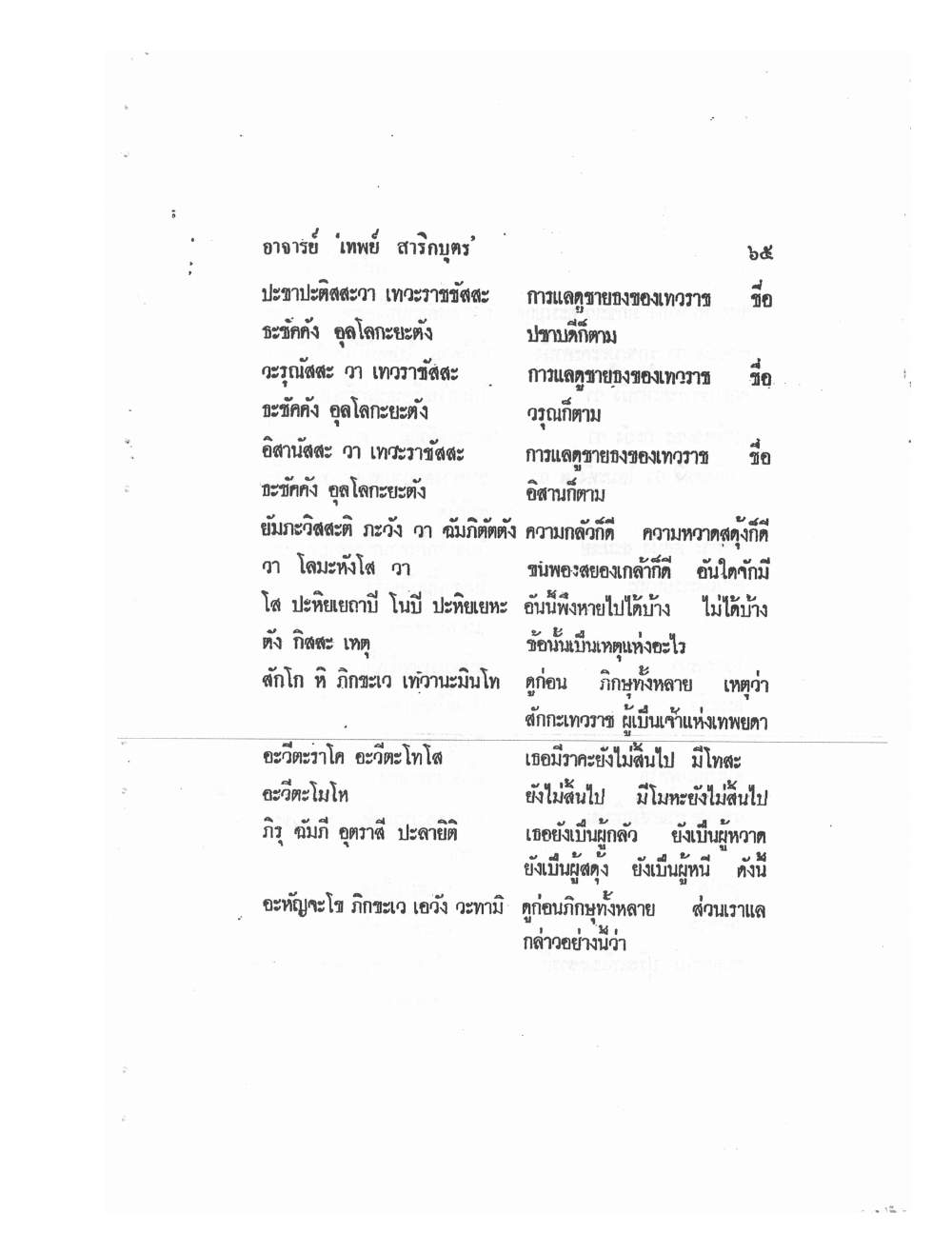
ประชาปติสสะวา เทวะราชัสสะ — การแลดูชายธงของเทวราช ชื่อ ธะชัคคัง อุลโลกะยะตัง — ปชาบดีก็ตาม
วะรุณัสสะ วา เทวะราชัสสะ — การแลดูชายธงของเทวราช ชื่อ ธะชัคคัง อุลโลกะยะตัง — วรุณก็ตาม
อิสานัสสะ วา เทวะราชัสสะ — การแลดูชายธงของเทวราช ชื่อ ธะชัคคัง อุลโลกะยะตัง — อิสานก็ตาม
ยัมภะวิสสะติ ภะวัง วา ฉัมภิตัตตัง — ความกลัวก็ดี ความหวาดสะดุ้งก็ดี วา โลมะหังโส วา — ขนพองสยองเกล้าก็ดี อันใดจักมี
โส ปะหิยเยถาบี โนปี ปะหิยเยยะ — อันนั้นพึงหายไปได้บ้าง ไม่ได้บ้าง ตัง กิสสะ เหตุ — ข้อนั้นเป็นเหตุแห่งอะไร
สักโก หิ ภิกขะเว เทวานะมินโท — ดูก่อนภิกษุทั้งหลาย เหตุว่าสักกะเทวราช ผู้เป็นเจ้าแห่งเทพยดา
อะวีตะราโค อะวีตะโทโส — เธอมีราคะยังไม่สิ้นไป มีโทสะยังไม่สิ้นไป อะวีตะโมโห — มีโมหะยังไม่สิ้นไป
ภิรุ ฉัมภี อุตราสี ปะลายิติ — เธอยังเป็นผู้กลัว ยังเป็นผู้หวาด ยังเป็นผู้สะดุ้ง ยังเป็นผู้หนีดังนี้
อะหัญจะโข ภิกขะเว เอวัง วะทามิ — ดูก่อนภิกษุทั้งหลาย ส่วนเราแลกล่าวอย่างนี้ว่า
Pajāpatissa vā devarājassa — or the looking up at the banner-flag of the deva-king named dhajaggaṃ ullokayataṃ — Pajāpati —
Varuṇassa vā devarājassa — or the looking up at the banner-flag of the deva-king named dhajaggaṃ ullokayataṃ — Varuṇa —
Īsānassa vā devarājassa — or the looking up at the banner-flag of the deva-king named dhajaggaṃ ullokayataṃ — Īsāna —
yaṃ bhavissati bhayaṃ vā chambhitattaṃ — whatever fear, or dread, vā lomahaṃso vā — or standing on end of body-hair may arise,
so pahīyethāpi nopi pahīyetha — that might vanish in some cases and might not vanish in others. Taṃ kissa hetu? — What is the reason for this?
Sakko hi bhikkhave devānamindo — Bhikkhus, it is because Sakka, lord and king of the devas,
avītarāgo avītadoso — has not yet exhausted passion, has not yet exhausted hatred, avītamoho — has not yet exhausted delusion.
Bhīru chambhī utrāsī palāyī'ti — he is still one who fears, still one who dreads, still one who is terrified, still one who flees — thus.
Ahañca kho bhikkhave evaṃ vadāmi — Bhikkhus, but I say this:
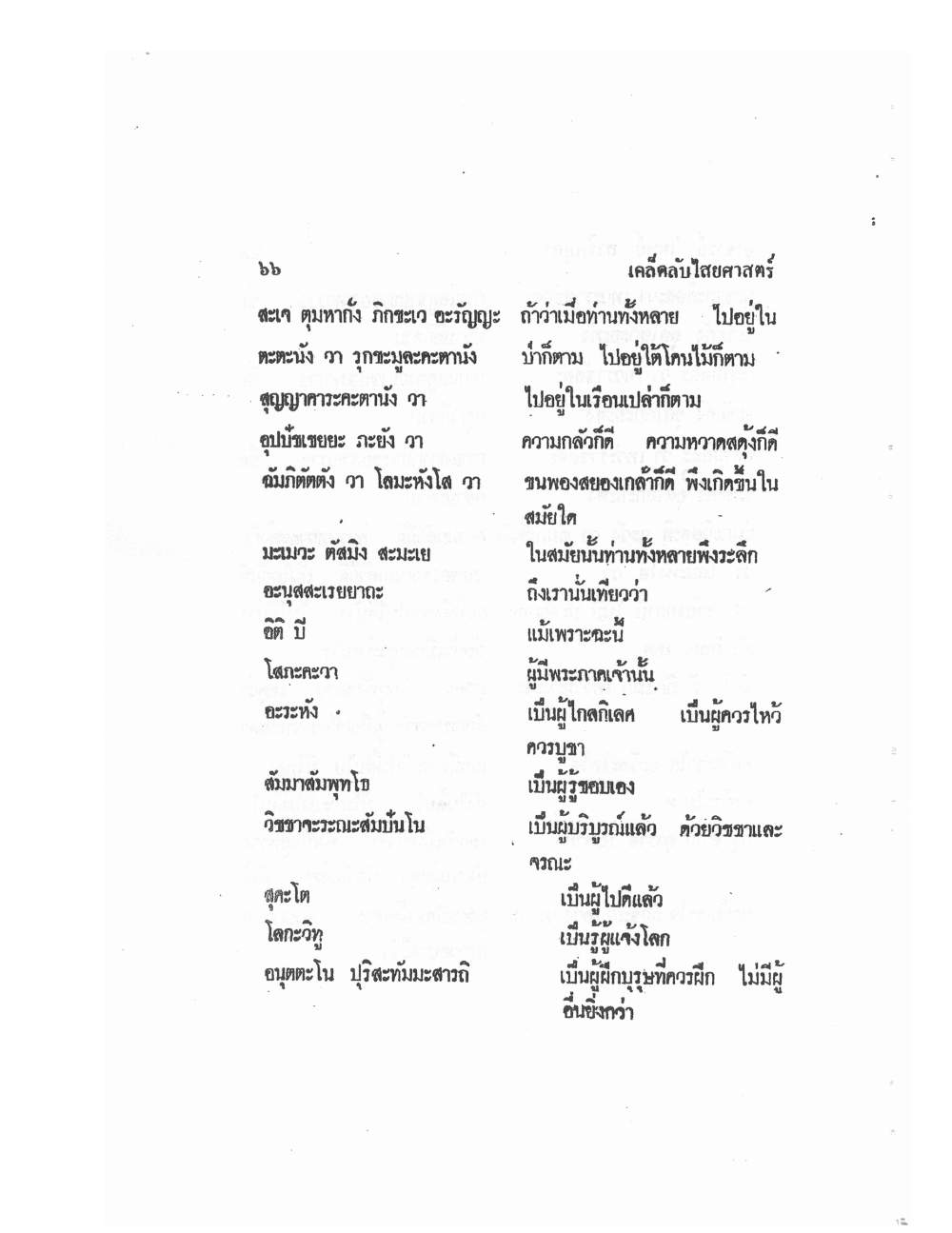
สะเจ ตุมหากัง ภิกขะเว อะรัญญะ — ถ้าว่าเมื่อท่านทั้งหลาย ไปอยู่ในป่าก็ตาม คะตานัง วา รุกขะมูละคะตานัง วา — ไปอยู่ใต้โคนไม้ก็ตาม สุญญาคาระคะตานัง วา — ไปอยู่ในเรือนเปล่าก็ตาม อุปปัชเชยยะ ภะยัง วา — ความกลัวก็ดี ความหวาดสะดุ้งก็ดี ฉัมภิตัตตัง วา โลมะหังโส วา — ขนพองสยองเกล้าก็ดี พึงเกิดขึ้นในสมัยใด
มะเมวะ ตัสมิง สะมะเย — ในสมัยนั้น ท่านทั้งหลายพึงระลึก อะนุสสะเรยยาถะ — ถึงเรานั้นเทียวว่า อิติปิ — แม้เพราะฉะนี้
โส ภะคะวา — ผู้มีพระภาคเจ้านั้น อะระหัง — เป็นผู้ไกลกิเลส เป็นผู้ควรไหว้ควรบูชา สัมมาสัมพุทโธ — เป็นผู้รู้ชอบเอง วิชชาจะระณะสัมปันโน — เป็นผู้บริบูรณ์แล้ว ด้วยวิชชาและจรณะ
สุคะโต — เป็นผู้ไปดีแล้ว โลกะวิทู — เป็นผู้รู้แจ้งโลก อนุตตะโร ปุริสะทัมมะสาระถิ — เป็นผู้ฝึกบุรุษที่ควรฝึก ไม่มีผู้อื่นยิ่งกว่า
Sace tumhākaṃ bhikkhave araññā- — If, bhikkhus, when you have gone to the forest, gatānaṃ vā rukkhamūlagatānaṃ vā — or gone to the foot of a tree, suññāgāragatānaṃ vā — or gone to an empty dwelling, uppajjeyya bhayaṃ vā — fear, or chambhitattaṃ vā lomahaṃso vā — dread, or standing on end of body-hair should arise at any time,
mameva tasmiṃ samaye — at that time you should anussareyyātha — recollect me thus: iti pi — "Even for this reason,
so bhagavā — the Blessed One arahaṃ — is one far from defilements, one worthy of homage and worship, sammāsambuddho — one who has rightly and fully awakened by himself, vijjācaraṇasampanno — one perfect in true knowledge and conduct,
sugato — one who has gone well, lokavidū — one who understands the world, anuttaro purisadammasārathi — the unsurpassed guide of persons to be tamed,
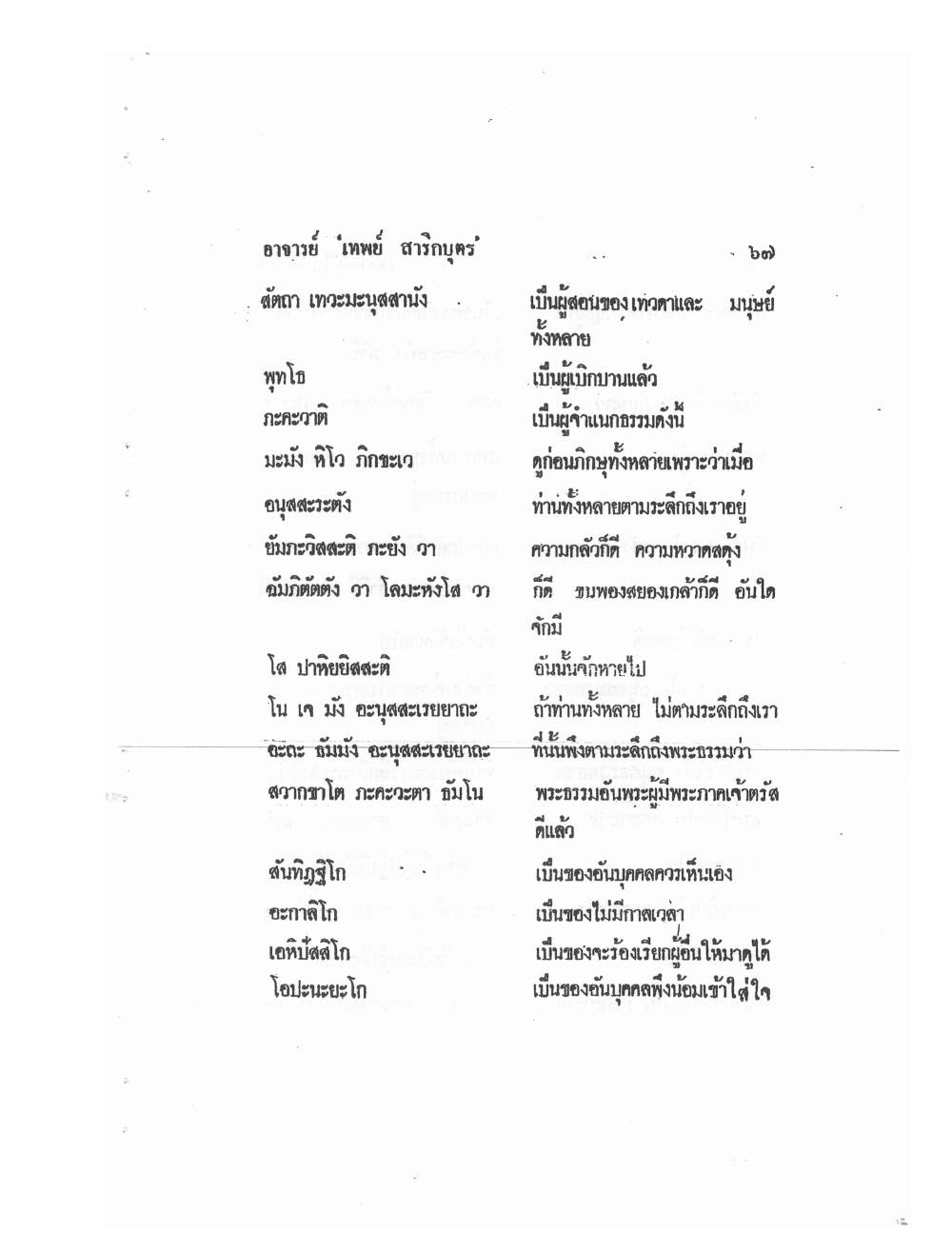
สัตถา เทวะมะนุสสานัง — เป็นผู้สอนของเทวดาและมนุษย์ทั้งหลาย
พุทโธ — เป็นผู้เบิกบานแล้ว ภะคะวาติ — เป็นผู้จำแนกธรรมดังนี้
มะมัง หิ โว ภิกขะเว — ดูก่อนภิกษุทั้งหลาย เพราะว่าเมื่อ อะนุสสะระตัง — ท่านทั้งหลายตามระลึกถึงเราอยู่ ยัมภะวิสสะติ ภะยัง วา — ความกลัวก็ดี ความหวาดสะดุ้ง ฉัมภิตัตตัง วา โลมะหังโส วา — ก็ดี ขนพองสยองเกล้าก็ดี อันใดจักมี
โส ปะหิยยิสสะติ — อันนั้นจักหายไป โน เจ มัง อะนุสสะเรยยาถะ — ถ้าท่านทั้งหลาย ไม่ตามระลึกถึงเรา อะถะ ธัมมัง อะนุสสะเรยยาถะ — ที่นั้นพึงตามระลึกถึงพระธรรมว่า สวากขาโต ภะคะวะตา ธัมโม — พระธรรมอันพระผู้มีพระภาคเจ้าตรัสดีแล้ว
สันทิฏฐิโก — เป็นของอันบุคคลควรเห็นเอง อะกาลิโก — เป็นของไม่มีกาลเวลา เอหิปัสสิโก — เป็นของจะร้องเรียกผู้อื่นให้มาดูได้ โอปะนะยิโก — เป็นของอันบุคคลพึงน้อมเข้าใส่ใจ
Satthā devamanussānaṃ — the teacher of devas and human beings,
Buddho — one who is awakened, Bhagavā'ti — the Blessed One who has analyzed the Dhamma" — thus.
Mamaṃ hi vo bhikkhave — Bhikkhus, for when anussarataṃ — you are recollecting me, yaṃ bhavissati bhayaṃ vā — whatever fear, or dread, chambhitattaṃ vā lomahaṃso vā — or standing on end of body-hair may arise,
so pahīyissati — that will vanish. No ce maṃ anussareyyātha — If you do not recollect me, atha dhammaṃ anussareyyātha — then you should recollect the Dhamma, thus: svākkhāto bhagavatā dhammo — "The Dhamma is well proclaimed by the Blessed One,
sandiṭṭhiko — it is to be seen for oneself, akāliko — it is timeless, ehipassiko — it invites one to come and see, opanayiko — it is to be brought inward into one's own mind,
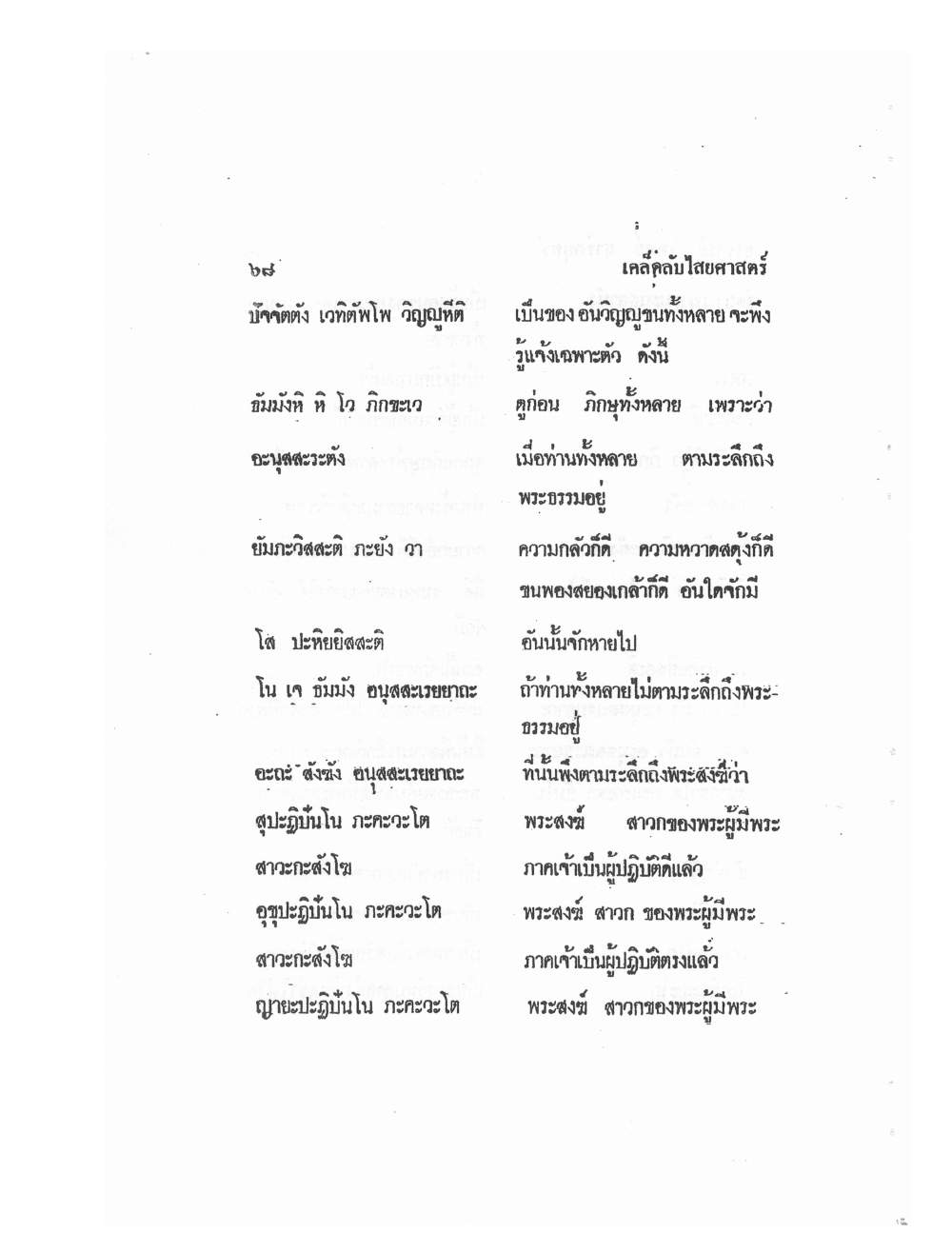
ปัจจัตตัง เวทิตัพโพ วิญญูหิติ — เป็นของอันวิญญูชนทั้งหลายจะพึงรู้แจ้งเฉพาะตัว ดังนี้
ธัมมังหิ โว ภิกขะเว — ดูก่อนภิกษุทั้งหลาย เพราะว่า อะนุสสะระตัง — เมื่อท่านทั้งหลาย ตามระลึกถึงพระธรรมอยู่
ยัมภะวิสสะติ ภะยัง วา — ความกลัวก็ดี ความหวาดสะดุ้งก็ดี ฉัมภิตัตตัง วา โลมะหังโส วา — ขนพองสยองเกล้าก็ดี อันใดจักมี
โส ปะหิยยิสสะติ — อันนั้นจักหายไป โน เจ ธัมมัง อะนุสสะเรยยาถะ — ถ้าท่านทั้งหลายไม่ตามระลึกถึงพระธรรมอยู่ อะถะ สังฆัง อะนุสสะเรยยาถะ — ที่นั้นพึงตามระลึกถึงพระสงฆ์ว่า
สุปะฏิบันโน ภะคะวะโต สาวะกะสังโฆ — พระสงฆ์ สาวกของพระผู้มีพระภาคเจ้าเป็นผู้ปฏิบัติดีแล้ว
อุชุปะฏิบันโน ภะคะวะโต สาวะกะสังโฆ — พระสงฆ์สาวกของพระผู้มีพระภาคเจ้าเป็นผู้ปฏิบัติตรงแล้ว
ญายะปะฏิบันโน ภะคะวะโต — พระสงฆ์สาวกของพระผู้มีพระภาค
Paccattaṃ veditabbo viññūhī'ti — it is to be personally realized by the wise, each for himself" — thus.
Dhammaṃ hi vo bhikkhave — Bhikkhus, for anussarataṃ — when you are recollecting the Dhamma,
yaṃ bhavissati bhayaṃ vā — whatever fear, or dread, chambhitattaṃ vā lomahaṃso vā — or standing on end of body-hair may arise,
so pahīyissati — that will vanish. No ce dhammaṃ anussareyyātha — If you do not recollect the Dhamma, atha saṅghaṃ anussareyyātha — then you should recollect the Saṅgha, thus:
Suppaṭipanno bhagavato sāvakasaṅgho — "The Saṅgha of the Blessed One's disciples has practiced well;
ujuppaṭipanno bhagavato sāvakasaṅgho — the Saṅgha of the Blessed One's disciples has practiced straightly;
ñāyappaṭipanno bhagavato — the Saṅgha of the Blessed One's [disciples has practiced correctly] —
สาวะกะสังโฆ ภาคเจ้าเป็นผู้ปฏิบัติเป็นธรรม สามีจิปฏิบันโน ภะคะวะโต พระสงฆ์สาวก ของพระผู้มีพระ สาวะกะสังโฆ ภาคเจ้าเป็นผู้ปฏิบัติเป็นธรรม สามีจิปฏิบันโน ภะคะวะโต พระสงฆ์สาวก ของพระผู้มีพระภาคเจ้าเป็นผู้ปฏิบัติชอบแท้
ยะทิทัง อย่างไรนี้ จัตตาริ ปุริสะยุคานิ คู่แห่งบุรุษทั้งหลายสี่ อัฏฐะ ปุริสะปุคคะลา บุรุษบุคคลทั้งหลายแปด เอสะ ภะคะวะโต สาวะกะสังโฆ นี้พระสงฆ์สาวก ของพระผู้มีพระภาคเจ้า
อาหุเนยโย ท่านเป็นผู้ควรสักการะ ที่เขานำมาบูชา ปาหุเนยโย ท่านเป็นผู้ควรของต้อนรับ ทักขิเณยโย ท่านเป็นผู้ควรทักษิณาทาน อัญชะลีกะระณีโย ท่านเป็นผู้ควรอัญชลีกรรม อะนุตตะรัง ปุญญักเขตตัง โลกัสสาติ ท่านเป็นเขตบุญของโลก ไม่มีเขตอื่นยิ่งกว่า ดังนี้
สังฆัง หิ โว ภิกขะเว อะนุสสะระตัง ดูก่อนภิกษุทั้งหลาย เพราะว่าเมื่อท่านทั้งหลาย ตามระลึกถึงพระสงฆ์อยู่
sāvaka-saṅgho — the assembly [of disciples] who practise as the Dhamma samīcipaṭipanno bhagavato — the Blessed One's disciple-sangha sāvaka-saṅgho — the assembly who practise as the Dhamma samīcipaṭipanno bhagavato — the Blessed One's disciple-sangha, who indeed practise rightly
yadidaṃ — namely, as follows cattāri purisayugāni — the four pairs of persons aṭṭha purisapuggalā — the eight kinds of individuals esa bhagavato sāvaka-saṅgho — this is the Blessed One's disciple-sangha
āhuneyyo — worthy of gifts brought for offering pāhuneyyo — worthy of hospitality dakkhiṇeyyo — worthy of offerings given in faith añjalikaraṇīyo — worthy of reverential salutation with joined palms anuttaraṃ puññakkhettaṃ lokassāti — an unsurpassed field of merit for the world; thus it is said
saṅghaṃ hi vo bhikkhave anussarataṃ — Monks, this is because when you recollect the Sangha
ยัมภะวิสสะติ ภะยัง วา ฉัมภิตัตตัง วา ความกลัวก็ดี ความหวาดสะดุ้งก็ดี โลมะหังโส วา ขนพองสยองเกล้าก็ดี อันใดจักมี โสปะทิยยิสสะติ อันนั้นจักหายไป ตัง กิสสะ เหตุ ข้อนั้นเป็นเหตุแห่งอะไร ตะถาคะโต หิ ภิกขะเว ดูก่อนภิกษุทั้งหลาย เหตุว่าพระตถาคต
อะระหัง สัมมาสัมพุทโธ เป็น พระอรหันตสัมมาสัมพุทธเจ้า วีตะราโค วีตะโทโส วีตะโมโห มีราคะอันสิ้นไปแล้ว มีโทสะอันสิ้นไปแล้ว มีโมหะอันสิ้นไปแล้ว
อภีรุ อัจฉัมภี เป็นผู้หมดกลัว เป็นผู้หมดหวาด อนุตราสี อะปะลายีติ เป็นผู้หมดสะดุ้ง เป็นผู้หมดหนี ดังนี้แล อิทะมะโวจะ ภะคะวา พระผู้มีพระภาคเจ้า ตรัสพระพุทธพจน์นั้น อิทัง วัตวานะ สุคะโต พระองค์ผู้เป็นพระสุคต ครั้นตรัสพุทธพจน์นั้นแล้ว อะถาปะรัง เอตะทะโวจะ สัตถา ลำดับนั้น พระองค์ผู้เป็นพระศาสดา จึงตรัสพระพุทธพจน์นี้อีกว่า
yaṃ bhavissati bhayaṃ vā chambhitattaṃ vā — whatever fear there may be, or trembling lomahaṃso vā — or horripilation [hair standing on end] so paṭiyissati — that will subside taṃ kissa hetu — for what reason? tathāgato hi bhikkhave — monks, because the Tathāgata
araham sammāsambuddho — is a Worthy One, a Perfectly Self-Awakened One vītarāgo vītadoso vītamoho — whose lust has been extinguished, whose hatred has been extinguished, whose delusion has been extinguished
abhīru acchambhī — is one free of fear, free of dread anutrāsī apalāyīti — is one free of trembling, one who does not flee — thus it is idam avoca bhagavā — the Blessed One spoke these words idaṃ vatvāna sugato — the Well-Gone One, having spoken these words athāparaṃ etadavoca satthā — thereupon the Teacher spoke this further
อะรัญเญ รุกขะมูเล วา ดูก่อนภิกษุทั้งหลาย เมื่อท่านทั้ง สุญญาคาเรวะ ภิกขะโว หลาย อยู่ที่โคนไม้ในป่าหรือในเรือนเปล่า
อนุสสะเรถะ สัมพุทธัง พึงระลึกถึง พระสัมพุทธะ ภะยัง ตุมหากะ โน สิยา ภัยจะไม่พึงมี แก่ท่านทั้งหลาย โน เจ พุทธัง สะเรยยาถะ ถ้าท่านทั้งหลายไม่ระลึกถึงพระพุทธะ โลกะเชฏฐัง นะราสะภัง ซึ่งเป็นใหญ่กว่าโลก ประเสริฐกว่านรชน
อะถะ ธัมมัง สะเรยยาถะ ที่นั้น พึงระลึกถึงพระธรรม นิยยานิกัง สุเทสิตัง อันเป็นเครื่องนำออก ที่เราแสดงไว้ดีแล้ว
โน เจ ธัมมัง สะเรยยาถะ ถ้าท่านทั้งหลายไม่ระลึกถึงพระธรรม นิยยานิกัง สุเทสิตัง อันเป็นเครื่องนำออก ที่เราแสดงไว้ดีแล้ว อะถะ สังฆัง สะเรยยาถะ ที่นั้นพึงระลึกถึงพระสงฆ์ ปุญญักเขตตัง อะนุตตะรัง ซึ่งเป็นบุญเขตของโลก ไม่มีเขตอื่นยิ่งกว่า
araññe rukkhamūle vā — monks, when you suññāgāreva bhikkhavo — are at the foot of a tree in the forest, or in an empty dwelling
anussaretha sambuddhaṃ — recollect the Fully Awakened One bhayaṃ tumhākaṃ no siyā — fear will not arise in you no ce buddhaṃ sareyyātha — if you do not recollect the Buddha lokajeṭṭhaṃ narāsabhaṃ — who is foremost in the world, supreme among men
atha dhammaṃ sareyyātha — then recollect the Dhamma niyyānikaṃ sudesitaṃ — the leading-out [teaching] which has been well taught
no ce dhammaṃ sareyyātha — if you do not recollect the Dhamma niyyānikaṃ sudesitaṃ — the leading-out teaching which has been well taught atha saṅghaṃ sareyyātha — then recollect the Sangha puññakkhettaṃ anuttaraṃ — the unsurpassed field of merit
เอวัมพุทธัง สะรันตานัง ดูก่อน ภิกษุทั้งหลาย เมื่อท่าน ธัมมัง สังฆัญจะ ภิกขะโว ทั้งหลายมาระลึกถึง พระพุทธ และ พระธรรมและพระสงฆ์อยู่อย่างนี้
ภะยัง วา ฉัมภิตัตตัง วา ความกลัวก็ดี ความหวาดสะดุ้งก็ดี โลมะหังโส นะ เหสสะติ ฯ ขนพองสยองเกล้าก็ดี จักไม่มีดังนี้ แล ฯ
evaṃ buddhaṃ sarantānaṃ — monks, when you dhammaṃ saṅghañca bhikkhavo — thus recollect the Buddha, the Dhamma, and the Sangha in this way
bhayaṃ vā chambhitattaṃ vā — whatever fear there may be, or trembling lomahaṃso na hessati — or horripilation — none of these will arise. Thus it is.
ตำนานที่ ๘ อาฏานาฏิยะปริตร
พระสูตรนี้มีเนื้อความว่า สมัยหนึ่ง พระผู้มีพระภาคเจ้าเสด็จ ประทับอยู่ ณ เขาคิชฌกูฏบรรพต ใกล้กรุงราชคฤห์มหานคร ในครั้งนั้น ท้าวมหาราชทั้ง ๔ ซึ่งสถิตอยู่เหนือยอดเขายุคนธร ที่เรียกว่าชั้นจาตุมหา ราชิกาอันเป็นชั้นต่ำกว่าดาวดึงส์ลงมาและเทวราชทั้ง ๔ นี้อยู่ในอำนาจของ พระอินทร์ พระอินทร์มอบให้เทวราชทั้ง ๔ นี้เป็นผู้รักษาต้นทางที่อสูรจะ ยกมารบกวนดาวดึงส์คือ
ท้าวธตรฏฐ์เป็นเจ้าแห่งคนธรรพ์ รักษาทิศบูรพา ท้าววิรุฬหก เป็นเจ้าแห่งกุณภัณฑ์ รักษาทิศทักษิณ ท้าววิรูปักเป็นเจ้าแห่งนาค รักษา ทิศประจิม ท้าวเวสสุวัณ นัยหนึ่งเรียกว่าท้าวกุเวรเป็นเจ้าแห่งยักษ์รักษา ทิศอุดร
เทวราชทั้ง ๔ นี้ คิดจะเกื้อกูลแก่พระพุทธศาสนา มิให้หมู่ ยักษ์เป็นศัตรูมาย่ำยีบีฑาหมู่สาวกในพระพุทธศาสนา จึงชวนกันลงมาเฝ้า พระพุทธเจ้า แล้วหวนคิดไปว่าถ้าอสูรรู้ว่าจตุโลกบาลไม่ได้อยู่ในเทพนคร ก็จะยกมารมารบกวนดาวดึงส์ จึงจัดให้มีคนธรรพ์แสนหนึ่งอยู่รักษาทิศ บูรพา กุมภัณฑ์แสนหนึ่งรักษาทิศทักษิณ นาคแสนหนึ่งรักษาทิศประจิม ยักษ์แสนหนึ่งรักษาทิศอุดร และท้าวจตุมหาราชจึงประชุมกันที่อาฏานา-
Legend No. 8: The Āṭānāṭiya Paritta
The substance of this sutta is as follows. Once, the Blessed One was dwelling at Mount Gijjhakūṭa (Vulture Peak), near the great city of Rājagaha. At that time the Four Great Kings, who reside above the peak of Mount Yugandhara — in what is called the Cātummahārājika realm, a level lower than Tāvatiṃsa — these four deva-kings are under the authority of Indra. Indra assigned these four deva-kings to guard the approach roads by which the asuras might rise up to disturb Tāvatiṃsa, namely:
King Dhataraṭṭha is lord of the gandhabbas, guarding the eastern direction. King Virūḷhaka is lord of the kumbhaṇḍas, guarding the southern direction. King Virūpakkha is lord of the nāgas, guarding the western direction. King Vessavaṇa — also called King Kuvera — is lord of the yakkhas, guarding the northern direction.
These four deva-kings, thinking to be of benefit to the Buddha's religion and not wanting the tribes of yakkhas to become enemies who would harass and molest the community of disciples in the Buddhasāsana, therefore agreed together to descend and pay homage to the Buddha. They then reflected that if the asuras learned that the Four Guardians of the World were not in their heavenly city, they would rise up to disturb Tāvatiṃsa. So they arranged for a hundred thousand gandhabbas to guard the east, a hundred thousand kumbhaṇḍas to guard the south, a hundred thousand nāgas to guard the west, and a hundred thousand yakkhas to guard the north, and the Four Great Kings then assembled at the Āṭānā-
ฏิยนคร ณ ขั้นจาตุมหาราชิกาผู้ซึ่งอาฏานาฏิยปริตร สรรเสริญพระสัมมา สัมพุทธเจ้า ๗ พระองค์ มีพระวิบัสสีเป็นต้น มีพระพุทธเจ้าแห่งเราเป็น ปริโยสาน ครั้นผูกพระปริตรแล้ว ก็ประกาศแก่บริษัทของตน ๆ ว่า ธรรม อาณาแห่งสมเด็จพระพุทธเจ้า อันเป็นบรมครูและราชอาณาแห่งเราทั้ง ๔ นี้ ถ้าใครไม่พึงขืนกระทำให้เกินเลยแล้วจะทำโทษอย่างนี้ ๆ ครั้นประกาศ แก่บริษัททั้งปวงแล้ว ท้าวจตุมหาราชทั้ง ๔ องค์ พร้อมด้วยบริพารก็ลง มาเฝ้าพระพุทธเจ้า ณ เขาคิชฌกูฏ กราบทูลว่ายักษ์ที่เลื่อมใสนั้นมีน้อย เพราะยักษ์มีจิตกระด้างหยาบช้าล่วงเบญจศีลนั้นมีมาก ในเมื่อสาวกของ พระผู้มีพระภาค ยินดีในอัญญิกเสนาสน์บำเพ็ญสมณธรรมในที่ปราศจาก มนุษย์สัญจรไปมา ยักษ์ที่มิได้เลื่อมใสศรัทธาในพระพุทธศาสนาย่อมย่ำ ยีบีฑาหลอกหลอน กระทำให้เจ็บไข้ เป็นอันตรายแก่พิธีที่จะบำเพ็ญ สมณธรรมแต่เดิมแต่นี้ไปเบื้องหน้าขอให้ทรงรับอาฏานาฏิบริตรนี้ไว้ แล้ว โปรดประทานให้พระสาวกสาวิกาทั้งปวงจำเริญเนือง ๆ สวดเนือง ๆ เถิด ยักษ์ทั้งปวง จะได้มีความเลื่อมใสศรัทธา ใน พระพุทธศาสนาแล้ว ก็จะมิได้ ย่ำยีบีฑาแก่พระพุทธบริษัท อำนาจพระปริตรนี้จะคุ้มครองป้องกันรักษา สรรพภัย อุบัทวันตรายทั้งปวงแต่บรรดาที่บังเกิดอานุภาพแห่งยักษ์ เมื่อ ยักษ์ทั้งปวงมีความเลื่อมใสช่วยอภิบาลบำรุงอยู่แล้ว พระภิกษุภิกษุณี อุบาสกและอุบาสิกาในพระบวรพุทธศาสนา ก็จะค่อยมีความสบายได้ บำเพ็ญสมณธรรมเป็นผาสุขภาพพระพุทธองค์ก็ทรงรับ โดยการดุษณีภาพ
-ṭiya City, at the level of the Cātummahārājika [gods], where they composed the Āṭānāṭiya Paritta in praise of the seven Fully Self-Awakened Buddhas, beginning with Buddha Vipassī and ending with our own Buddha [Gotama]. Having composed the paritta, they proclaimed to their respective retinues: "The Dhamma-authority of the Blessed Buddha, our supreme teacher, together with the royal authority of us Four, is thus. Should anyone dare to transgress it, such-and-such punishment shall be done." Having proclaimed this to all their retinues, the Four Great Kings, together with their attendants, descended to pay homage to the Buddha at Mount Gijjhakūṭa. They reported that the yakkhas who had faith [in the Buddha] were few, because most yakkhas were of a coarse, unruly mind, given to transgressing the five precepts. Whenever a disciple of the Blessed One delighted in a remote dwelling place, practising the ascetic life in a location free of human traffic, a yakkha who lacked faith and confidence in the Buddha's teaching would harass and molest, appearing to frighten and cause illness, endangering the very rite of practising the ascetic life. "Therefore, from henceforth, we ask that you accept this Āṭānāṭiya paritta, and grant that all the monk- and nun-disciples recite and chant it regularly. The yakkhas as a whole will then gain faith and confidence in the Buddha's teaching, and will no longer harass or molest the Buddhist community. The power of this paritta will protect, guard, and safeguard against all dangers and calamities that might arise from the power of the yakkhas. When the yakkhas as a whole have faith and help protect and support [the sāsana], the monks, nuns, laymen, and laywomen of the excellent Buddhasāsana will gradually find comfort in practising the ascetic life in well-being." The Blessed One accepted this by silence.
ท้าวเวสสุวัณก็แสดงอาฏานาฏิยปริตรถวายว่า ◎ วิปัสสิสสะ นะมัตถุ ฯลฯ อะยัง ยักโข ประมุญจะติ ฯ
แล้วแสดงอาชญาแห่งปริตรว่า ผู้ใดเล่าเรียนพระปริตรนี้เป็น อันดีมิได้ขาดบทหนึ่งบทใด หมั่นสาธยายท่องบ่นไว้เป็นอันดีแล้ว ถ้า ยักษ์ตนใดขืนเบียดเบียฬบุคคลผู้เล่าเรียนสาธยายท่องบ่นพระปริตรเป็นต้น ว่าเข้าไปประกอบอยู่ในกายหรือยืนใกล้นั่งใกล้กระทำให้ไม่เป็นผาสุขด้วย ประการใด ๆ การกระทำผ่าผืนธรรมจักรและอาณาจักรแล้วนั้น ยักษ์ตนนั้น ก็จะต้องได้รับมหันตโทษ อนึ่ง พวกกุมภัณฑ์ คนธรรพ์และนาคนั้น ก็ดี ถ้ากระทำผ่าผืนพุทธจักรและอาณาจักรแล้ว ก็จะได้รับโทษเช่นกัน กับพวกยักษ์ทั้งหลายด้วย กล่าวคือ จะไม่มีผู้เคารพ ไม่มีผู้ประชุมด้วย และจะอยู่ในราชธานีแห่งตนไม่ได้ แล้วศีรษะจักแตกออกเป็น ๗ ภาค
พระปริตรนี้มีคุณานุภาพไพศาล ท้าวจตุมหาราชถวายแด่พระพุทธเจ้า สำหรับเป็นประโยชน์เกื้อกูลแก่พระสาวกในพระพุทธศาสนา ครั้นแล้วก็ ถวายนมัสการลาสมเด็จพระผู้มีพระภาคจึงมีพุทธฎีกาตรัสว่า ดูกรบพิตร พระราชภารทั้งปวง ตูแต่กาลอันสมควรเถิด ครั้นท้าวจตุมหาราชกลับแล้ว พระพุทธเจ้าจึงมีพระพุทธฎีกาประชุมสงฆ์ทั้งปวง ทรงแสดงเหตุแต่หนหลัง ให้ทราบและในตอนท้ายพระพุทธวจนะมีว่า ดูกรภิกษุทั้งหลายแม้ว่าท่าน อุตสาหะกระทำซึ่งอาฏานาฏิยปริตรนี้ให้บริบูรณ์ในสันดาน อุตสาห์ทรงจำ
King Vessavaṇa then presented and recited the Āṭānāṭiya Paritta, saying: "Vipassissa namatthu ... [and so on] ... ayaṃ yakkho pamuñcati" [homage to Vipassī, and so forth ... thus this yakkha is released].
He then declared the power of the paritta: "Whoever learns this paritta well, without omitting a single verse, and diligently recites, chants, and commits it to memory well — if any yakkha should dare to molest a person who has learned, chanted, and committed the paritta to memory, whether by entering and lodging in the body, or by standing or sitting nearby and causing any manner of distress, that yakkha commits an offence against the Dhamma-realm and the Sovereign-realm, and shall receive severe punishment. Furthermore, the kumbhaṇḍas, gandhabbas, and nāgas likewise, if they transgress against the Buddha-realm and the Sovereign-realm, shall receive the same punishment as the yakkhas — that is to say, they will have no one to honour them, no one to assemble with them, and will not be able to remain in their own capital, and their heads will split into seven pieces.
This paritta possesses vast and far-reaching power. The Four Great Kings offered it to the Buddha for the benefit and protection of the disciples in the Buddha's teaching. Having done so, they paid homage and took their leave of the Blessed One, who then delivered this Buddha-utterance: "Great kings, attend to your royal duties as you see fit, at whatever time is proper." When the Four Great Kings had departed, the Buddha then convened an assembly of the entire Sangha, and explained to them the preceding events. At the end of his discourse the Buddha's words were: "Monks, even though you strive to make this Āṭānāṭiya paritta complete within your being, strive to memorize [it]
ให้มั่นคง จะคุ้มครองป้องกันรักษาให้ปราศจากอุบัทวันตรายทั้งปวงและ เป็นไปเพื่อให้เหล่ามนุษย์ทั้งหลายเข้ามากล้ากลายย่ำยีบีฑาภิกษุภิกษุณี อุบาสกอุบาสิกาทั้งปวงได้ จะได้อยู่เป็นสุขสำราญกาย ภิกษุทั้งหลาย ก็น้อมเศียรเกล้าลงรับกระแสพระพุทธฎีกาด้วยความยินดีทั่วกัน
พระปริตรบทนี้ มีคาถาที่สวดและคำแปลดังต่อไปนี้ —
◎ วิปัสสิสสะ นะมัตถุ ความนอบน้อม แห่งข้าพเจ้าจงมี แด่พระพุทธเจ้า ผู้มีพระนามว่า วิปัสสี
จักขุมันตัสสะ สิรีมะโต ผู้มีจักษุ ผู้มีศิริ สิขิสสะปิ นะมัตถุ ความนอบน้อม แห่งข้าพเจ้า จงมีแม้ แด่พระพุทธเจ้า ผู้มีพระนามว่า สิขี
สัพพะภูตานุกัมปิโน ผู้มีปรกติ อนุเคราะห์แก่สัตว์ทั้งปวง เวสสะภุสสะ นะมัตถุ ความนอบน้อม แห่งข้าพเจ้า จงมีแต่ พระพุทธเจ้า ผู้มีพระนามว่าเวสสภู นะหาตะกัสสะ ตะปัสสิโน ผู้มีกิเลสอันล้างแล้ว ผู้มีตปะ
...firmly, it will protect, guard, and safeguard against all calamities and dangers, and will serve to prevent human beings from becoming bold enough to harass and molest the monks, nuns, laymen, and laywomen; they will be able to dwell in physical comfort and ease." All the monks bowed their heads low and received the flow of the Buddha's proclamation with shared delight.
This paritta has the following verses to be chanted, together with their translation, as follows —
Vipassissa namatthu — May my homage be to the Buddha named Vipassī.
Cakkhumantassa sirīmato — who possesses the [Dhamma-]eye, who possesses glory Sikhissapi namatthu — May my homage also be to the Buddha named Sikhī
Sabbabhūtānukampino — who is habitually compassionate toward all beings Vessabhussa namatthu — May my homage be to the Buddha named Vessabhū Nahātakassa tapassino — who has washed away defilements, who possesses ascetic fervour
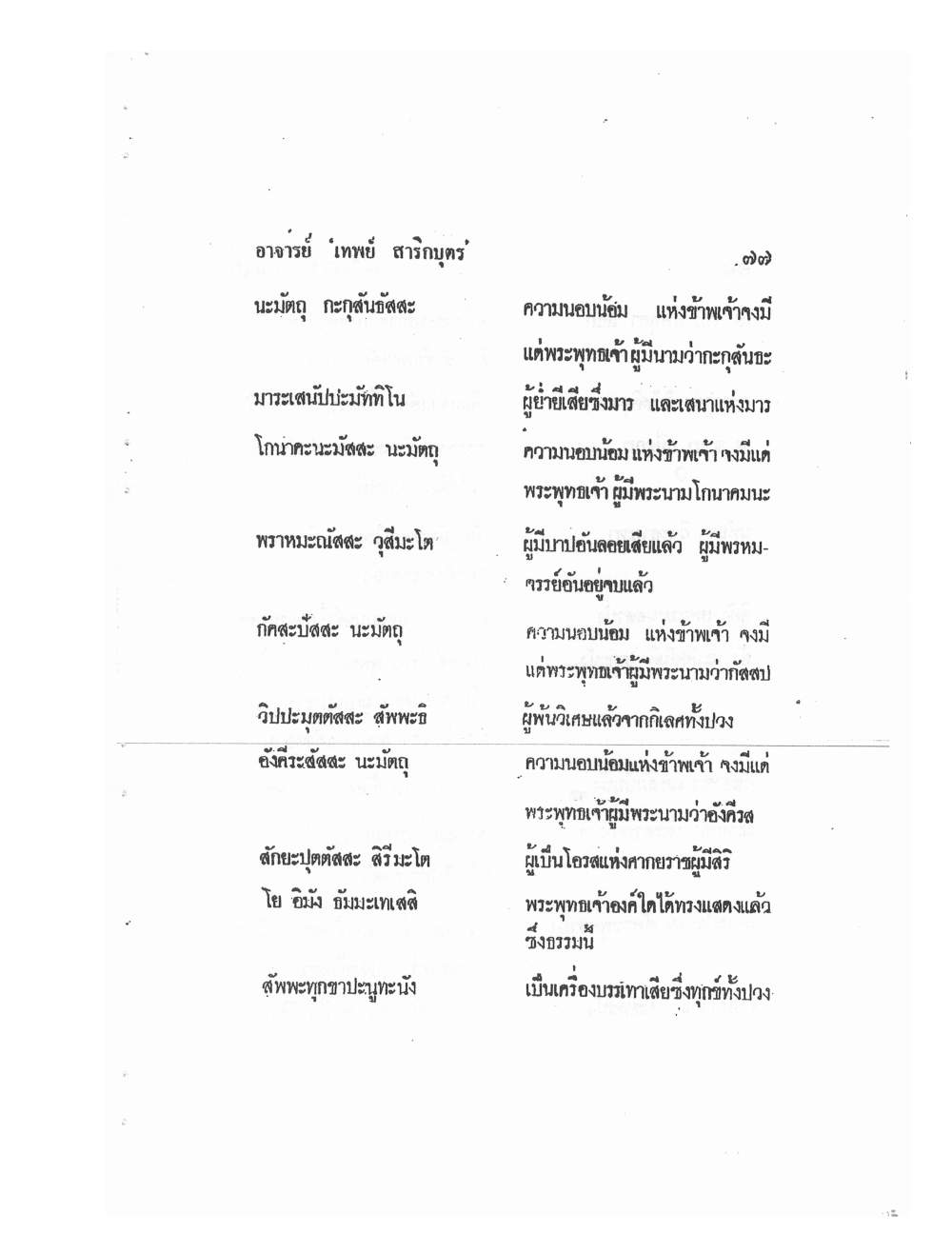
นะมัตถุ กะกุสันธัสสะ ความนอบน้อม แห่งข้าพเจ้าจงมี แด่พระพุทธเจ้าผู้มีนามว่ากะกุสันธะ มาระเสนัปปะมัททิโน ผู้ย่ำเสียซึ่งมาร และเสนาแห่งมาร
โกนาคะนะมัสสะ นะมัตถุ ความนอบน้อม แห่งข้าพเจ้า จงมีแต่ พระพุทธเจ้า ผู้มีพระนามโกนาคมนะ พราหมะณัสสะ วุสีมะโต ผู้มีบาปอันลอยเสียแล้ว ผู้มีพรหม- จรรย์อันอยู่จบแล้ว
กัสสะปัสสะ นะมัตถุ ความนอบน้อม แห่งข้าพเจ้า จงมี แด่พระพุทธเจ้าผู้มีพระนามว่ากัสสป วิปปะมุตตัสสะ สัพพะธิ ผู้พ้นวิเศษแล้วจากกิเลสทั้งปวง
อังคีระสัสสะ นะมัตถุ ความนอบน้อมแห่งข้าพเจ้า จงมีแต่ พระพุทธเจ้าผู้มีพระนามว่าอังคีรส สักยะปุตตัสสะ สิรีมะโต ผู้เป็นโอรสแห่งศากยราชผู้มีสิริ โย อิมัง ธัมมะเทเสสิ พระพุทธเจ้าองค์ใดได้ทรงแสดงแล้ว ซึ่งธรรมนี้ สัพพะทุกขาปะนูทะนัง เป็นเครื่องบรรเทาเสียซึ่งทุกข์ทั้งปวง
Namatthu Kakusandhassa — May my homage be to the Buddha named Kakusandha Mārasenappamaddino — who has crushed Māra and Māra's army
Konāgamanassa namatthu — May my homage be to the Buddha named Koṇāgamana Brāhmaṇassa vusīmato — who has cast off evil, who has completed the holy life
Kassapassa namatthu — May my homage be to the Buddha named Kassapa Vippamuttassa sabbadhi — who is entirely liberated from all defilements
Aṅgīrasassa namatthu — May my homage be to the Buddha named Aṅgīrasa Sakyaputtassa sirīmato — the glorious son of the Sakyan king Yo imaṃ dhammaṃ desesi — who taught this Dhamma Sabbadukkhāpanūdanaṃ — which dispels all suffering
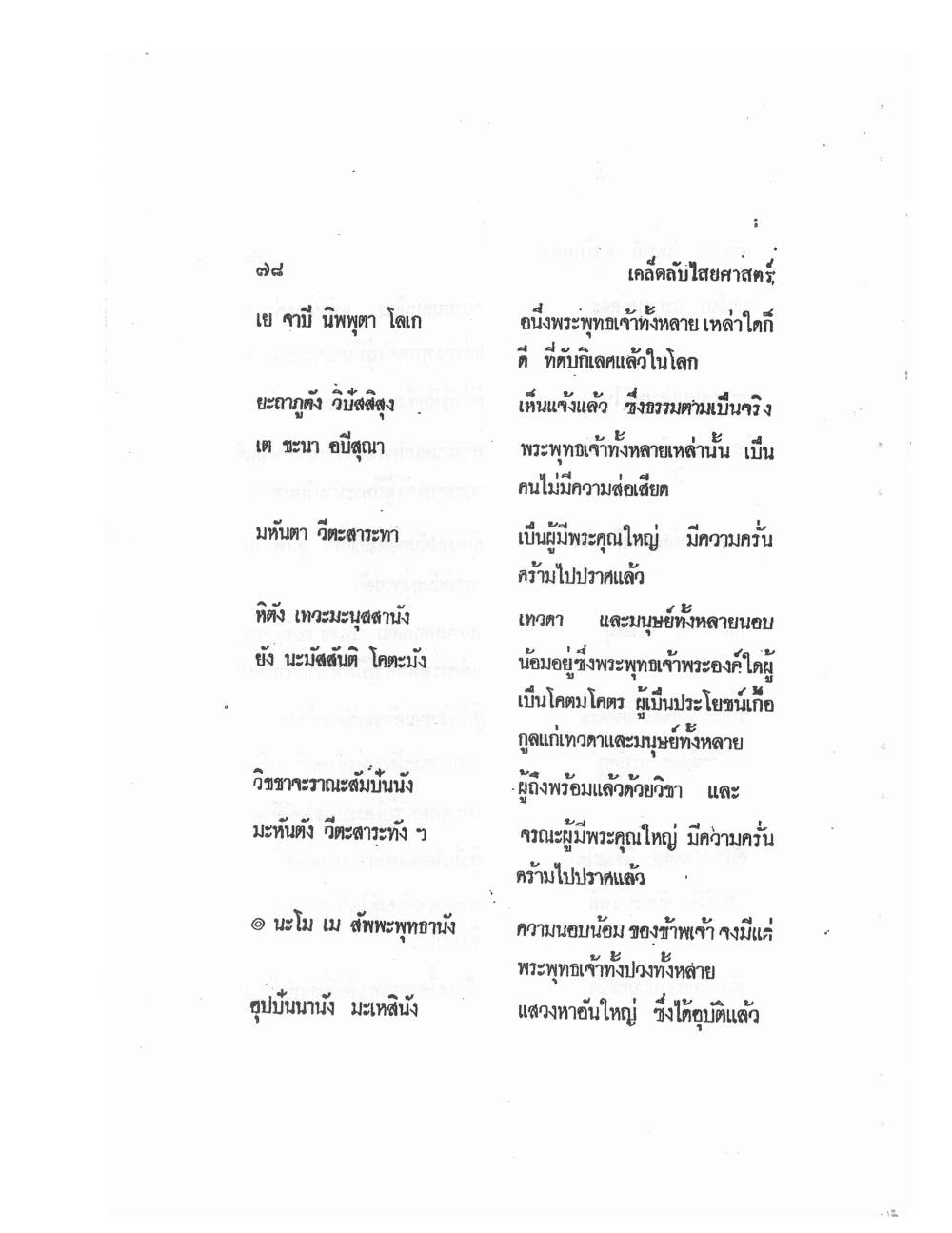
เย จาปิ นิพพุตา โลเก อนึ่งพระพุทธเจ้าทั้งหลาย เหล่าใดก็ ดี ที่ดับกิเลสแล้วในโลก ยะถาภูตัง วิปัสสิสุง เห็นแจ้งแล้ว ซึ่งธรรมตามเป็นจริง เต ชะนา อะปิสุณา พระพุทธเจ้าทั้งหลายเหล่านั้น เป็น คนไม่มีความส่อเสียด
มะหันตา วีตะสาระทา เป็นผู้มีพระคุณใหญ่ มีความครั่น คร้ามไปปราศแล้ว
หิตัง เทวะมะนุสสานัง เทวดา และมนุษย์ทั้งหลายนอบ ยัง นะมัสสันติ โคตะมัง น้อมอยู่ซึ่งพระพุทธเจ้าพระองค์ใดผู้ เป็นโคตมโคตร ผู้เป็นประโยชน์เกื้อ กูลแก่เทวดาและมนุษย์ทั้งหลาย
วิชชาจะระณะสัมปันนัง ผู้ถึงพร้อมแล้วด้วยวิชา และ มะหันตัง วีตะสาระทัง ๆ จรณะผู้มีพระคุณใหญ่ มีความครั่น คร้ามไปปราศแล้ว
◎ นะโม เม สัพพะพุทธานัง ความนอบน้อม ของข้าพเจ้า จงมีแต่ พระพุทธเจ้าทั้งปวงทั้งหลาย อุปปันนานัง มะเหสินัง แสวงหาอันใหญ่ ซึ่งได้อุบัติแล้ว
Ye cāpi nibbutā loke — Furthermore, whichever Buddhas have quenched [their] defilements in the world, Yathābhūtaṃ vipassisuṃ — who have seen clearly the Dhamma as it truly is, Te janā apisuṇā — those Buddhas are persons free of malicious speech
Mahantā vītasāradā — of great virtue, whose dread has departed entirely
Hitaṃ devamanussānaṃ — gods and human beings bow Yaṃ namassanti Gotamaṃ — in homage to the Buddha, of Gotama's lineage, who is of benefit and help to gods and human beings
Vijjācaraṇasampannaṃ — who is endowed with knowledge and Mahantaṃ vītasāradaṃ — conduct, of great virtue, whose dread has departed entirely
Namo me sabbabuddhānaṃ — May my homage be to all the Buddhas Uppannānaṃ mahesinaṃ — the great seekers who have arisen
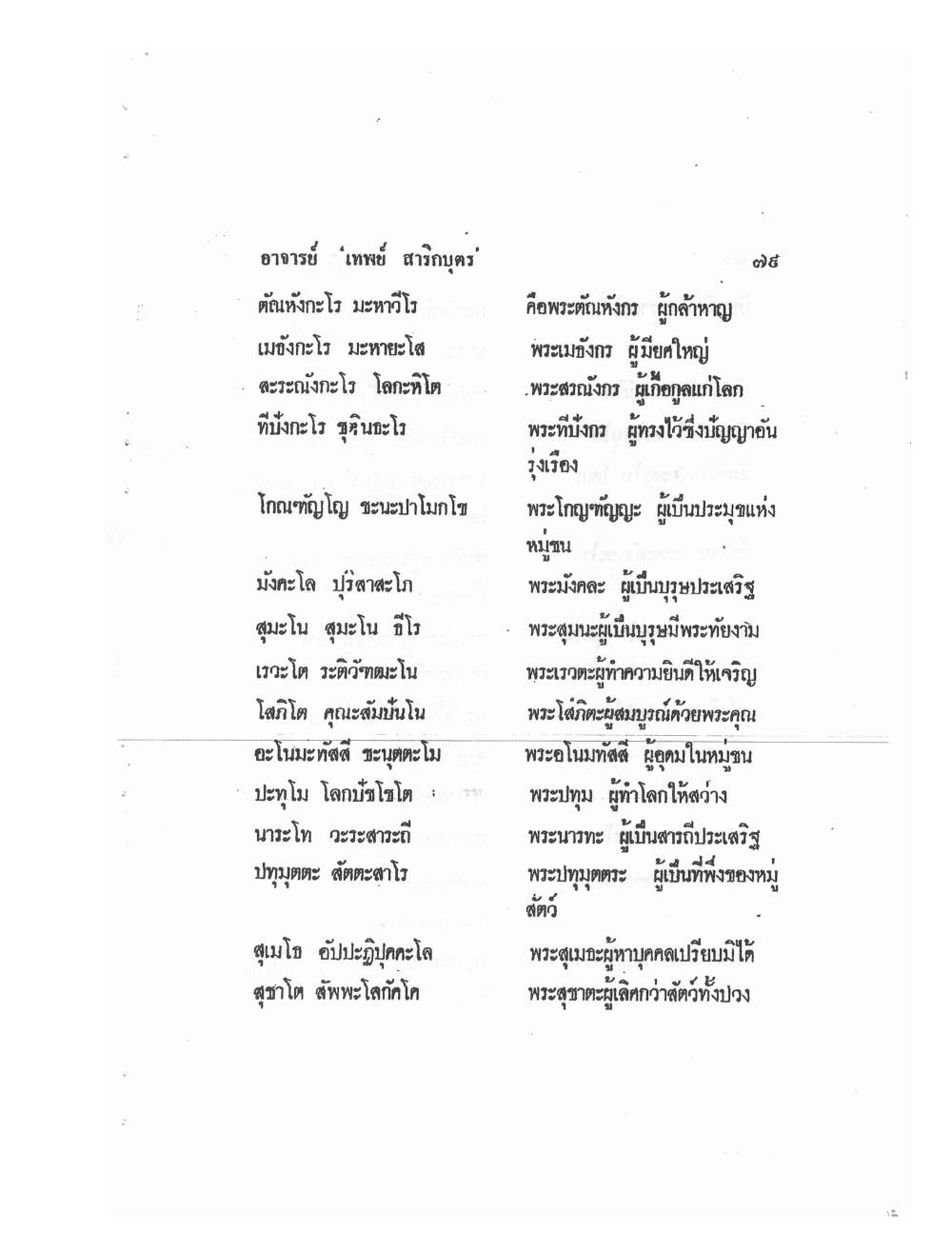
ตัณหังกะโร มะหาวีโร คือพระตัณหังกร ผู้กล้าหาญ เมธังกะโร มะหายะโส พระเมธังกร ผู้มียศใหญ่ สะระณังกะโร โลกะหิโต พระสรณังกร ผู้เกื้อกูลแก่โลก ทีปังกะโร ชุติมันตะโร พระทีปังกร ผู้ทรงไว้ซึ่งปัญญาอัน รุ่งเรือง
โกณฑัญโญ ชะนะปาโมกโข พระโกณฑัญญะ ผู้เป็นประมุขแห่ง หมู่ชน
มังคะโล ปุริสาสะโภ พระมังคละ ผู้เป็นบุรุษประเสริฐ สุมะโน สุมะโน ธีโร พระสุมนะผู้เป็นบุรุษมีพระทัยงาม เรวะโต ระติวัฑฒะโน พระเรวตะผู้ทำความยินดีให้เจริญ โสภิโต คุณะสัมปันโน พระโสภิตะผู้สมบูรณ์ด้วยพระคุณ อะโนมะทัสสี ชะนุตตะโม พระอโนมทัสสี ผู้อุดมในหมู่ชน ปะทุโม โลกะปัชโชโต พระปทุม ผู้ทำโลกให้สว่าง นาระโท วะระสาระถี พระนารทะ ผู้เป็นสารถีประเสริฐ ปะทุมุตตะระ สัตตะสาโร พระปทุมุตตระ ผู้เป็นที่พึ่งของหมู่สัตว์
สุเมโธ อัปปะฏิปุคคะโล พระสุเมธะผู้หาบุคคลเปรียบมิได้ สุชาโต สัพพะโลกัคคะโค พระสุชาตะผู้เลิศกว่าสัตว์ทั้งปวง
Taṇhaṅkaro mahāvīro — that is, the Buddha Taṇhaṅkara, the courageous one Medhaṅkaro mahāyaso — the Buddha Medhaṅkara, of great renown Saraṇaṅkaro lokahito — the Buddha Saraṇaṅkara, who benefits the world Dīpaṅkaro jutimantaro — the Buddha Dīpaṅkara, who possesses radiant wisdom
Koṇḍañño janapāmokkho — the Buddha Koṇḍañña, foremost among people
Maṅgalo purisāsabho — the Buddha Maṅgala, the noblest of men Sumano sumano dhīro — the Buddha Sumana, a wise man of beautiful heart Revato ratiwaḍḍhano — the Buddha Revata, who increases delight Sobhito guṇasampanno — the Buddha Sobhita, endowed with virtue Anomadassī januttamo — the Buddha Anomadassī, supreme among people Paduno lokappajjoto — the Buddha Paduma, who illuminates the world Nārado varasārathi — the Buddha Nārada, the excellent charioteer Padumuttara sattasāro — the Buddha Padumuttara, the refuge of all beings
Sumedho appaṭipuggalo — the Buddha Sumedha, whom no one can compare to Sujāto sabbalokaggo — the Buddha Sujāta, foremost of all beings in the world
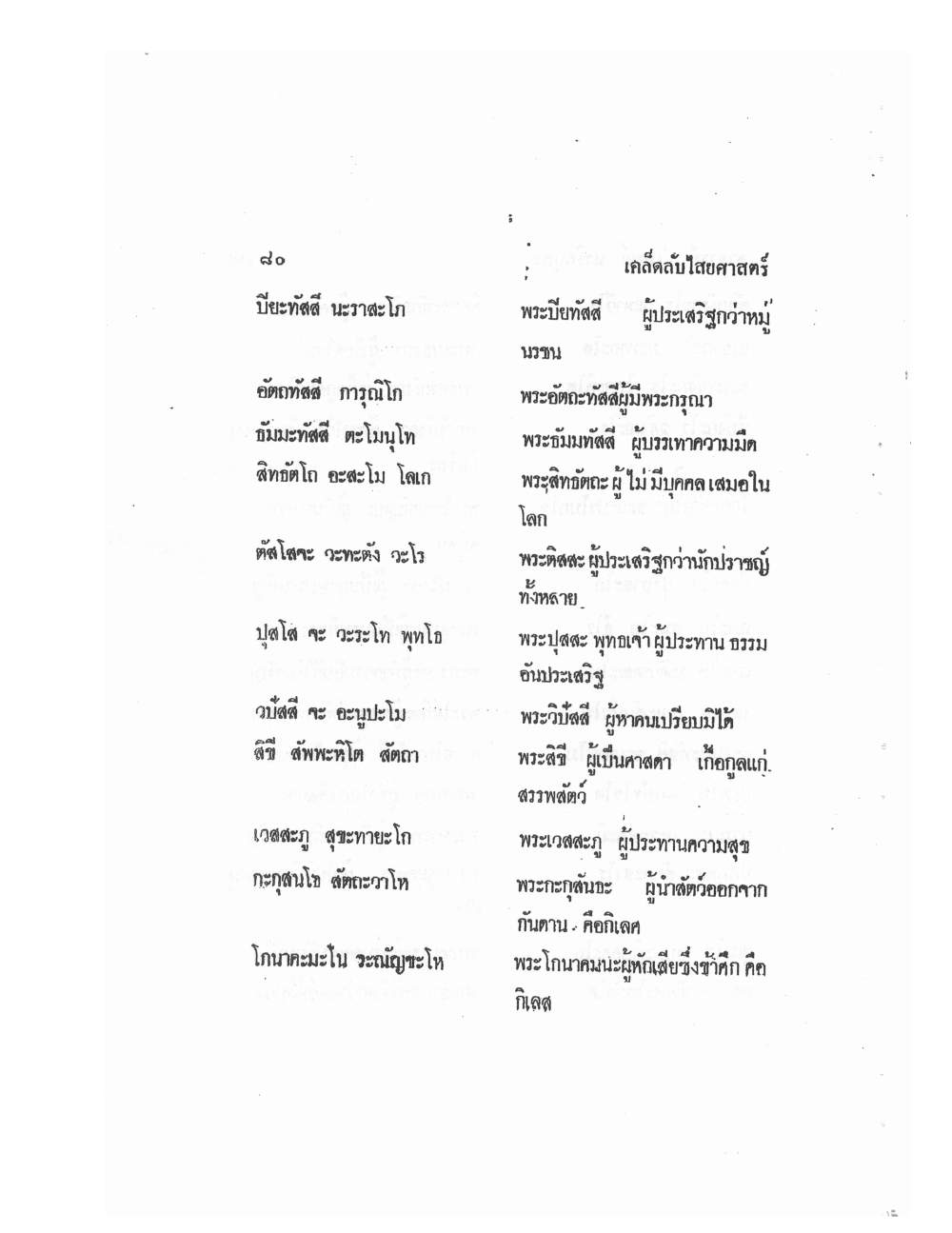
ปิยะทัสสี นะราสะโภ พระปิยทัสสี ผู้ประเสริฐกว่าหมู่ นรชน
อัตถะทัสสี การุณิโก พระอัตถทัสสีผู้มีพระกรุณา ธัมมะทัสสี ตะโมนุโท พระธัมมทัสสี ผู้บรรเทาความมืด สิทธัตโถ อะสะโม โลเก พระสิทธัตถะ ผู้ไม่มีบุคคลเสมอใน โลก
ติสโส วะทะตัง วะโร พระติสสะ ผู้ประเสริฐกว่านักปราชญ์ ทั้งหลาย
ปุสโส จะ วะระโท พุทโธ พระปุสสะ พุทธเจ้า ผู้ประทาน ธรรม อันประเสริฐ
วิปัสสี จะ อะนูปะโม พระวิปัสสี ผู้หาคนเปรียบมิได้ สิขี สัพพะหิโต สัตถา พระสิขี ผู้เป็นศาสดา เกื้อกูลแก่ สรรพสัตว์
เวสสะภู สุขะทายะโก พระเวสสะภู ผู้ประทานความสุข กะกุสันโธ สัตถะวาโห พระกกุสันธะ ผู้นำสัตว์ออกจาก กันดาร คือกิเลส
โกนาคะมะโน ระณัญชะโห พระโกนาคมนะผู้หักเสียซึ่งข้าศึก คือ กิเลส
Piyadassī narāsabho — the Buddha Piyadassī, foremost among men
Atthadassī kāruṇiko — the Buddha Atthadassī, who is compassionate Dhammadassī tamonudo — the Buddha Dhammadassī, who dispels darkness Siddhattho asamo loke — the Buddha Siddhattha, without equal in the world
Tisso vadataṃ varo — the Buddha Tissa, supreme among sages
Pusso ca varado buddho — the Buddha Pussa, who bestows the excellent Dhamma
Vipassī ca anūpamo — the Buddha Vipassī, incomparable Sikhī sabbahito satthā — the Buddha Sikhī, the Teacher, who benefits all beings
Vessabhū sukhadāyako — the Buddha Vessabhū, who bestows happiness Kakusandho satthavāho — the Buddha Kakusandha, who leads beings out of the wilderness of defilements
Konāgamano raṇañjaho — the Buddha Koṇāgamana, who has vanquished the enemy, i.e., defilements
อาจารย์ 'เทพย์ สาริกบุตร' ๘๑
กัสสะโป สิริสัมปันโน พระกัสสป ผู้สมบูรณ์ด้วยสิริ
โคตะโม สักยะปุงคะโว ฯ พระโคตมะ ผู้ประเสริฐกว่าหมู่ศักยวงศ์ ฯ
เอเต จัญเญ จะ สัมพุทธา พระสัมพุทธเจ้าทั้งหลายเหล่านี้ก็ดี เหล่าอื่นก็ดี
อะเนกะสะตะโกฏะโย มากกว่าร้อยโกฏิ
สัพเพ พุทธา อะสะมะสะมา พระพุทธเจ้าทั้งหลายเหล่านั้นทั้งหมดเสมอกันไม่มีใครเหมือน
สัพเพ พุทธา มะหิทธิกา พระพุทธเจ้าทั้งหลายเหล่านั้นล้วนมีพระฤทธิ์มาก
สัพเพ ทะสะพะลูเปตา พระพุทธเจ้าทั้งหลายเหล่านั้นล้วนประกอบไปด้วยทศพลญาณ
เวสารัชเชหุปาคะตา ประกอบไปด้วยเวสารัชชญาณทั้งหลาย
สัพเพ เต ปฏิชานันติ พระพุทธเจ้าทั้งหลายเหล่านั้นล้วนตรัสรู้อยู่
อาสะภัณฐานะมุตตะมัง ซึ่งอาสภฐานอันอุดม
สีหะนาทัง นะทันเต เต พระพุทธเจ้าทั้งหลายเหล่านั้นเป็น [ข้อความต่อหน้าถัดไป]
Teacher Thep Sarikabutr [running header] 81
Kassapo sirisampanno The Lord Kassapa, complete with glory.
Gotamo sakyapungavo. The Lord Gotama, foremost of the Sakya clan.
Ete caññe ca sambuddhā These fully-enlightened Buddhas, and others too,
Anekasata-koṭayo more than a hundred koti in number,
Sabbe buddhā asamasamā all these Buddhas are unequalled, without equal to any,
Sabbe buddhā mahiddhikā all these Buddhas possess great supernormal power,
Sabbe dasabalūpetā all these Buddhas are endowed with the ten powers,
Vesārajjehupāgatā endowed with the powers of intrepid confidence (vesārajja-ñāṇa),
Sabbe te paṭijānanti all of them declare and affirm,
Āsabhaṇṭhānamuttamaṃ the supreme lion's-stance (āsabhaṭṭhāna),
Sīhanādaṃ nadante te roaring the lion's roar, they [sentence continues on the next page]
๘๒ เคล็ดลับไสยศาสตร์
ปะริสาสุ วิสาระทา ผู้องอาจไม่ครั่นคร้าม บันลือสีหนาทในบริษัททั้งหลาย
พรหมะจักกัง ปะวัตเตนติ ย่อมยังพรหมจักรให้เป็นไป
โลเก อัปปะฏิวัตติยัง อันใครๆยังไม่ให้เป็นไปแล้วในโลก
อุเปตา พุทธะธัมเมหิ พระพุทธเจ้าทั้งหลายเหล่านั้นประกอบแล้วด้วยพุทธธรรมทั้งหลาย
อัฏฐาระสะหิ นายะกา สิบแปด เป็นนายกผู้นำสัตว์ออกจากกองทุกข์
ทะวัตติงสะลักขะณูเปตา ผู้ประกอบด้วยพระลักษณะสามสิบสองประการ
สีตะยานุพยัญชะนาธะรา และทรงซึ่งอนุพยัญชนะแปดสิบ
พยามัปปะภายะ สุปปะภา มีพระรัศมีอันงาม ด้วยพระรัศมีมีมณฑลข้างละวา
สัพเพ เต มุ นิกุญชะรา พระพุทธเจ้าทั้งหลายเหล่านั้นล้วนเป็นมุนีอันประเสริฐ
พุทธา สัพพัญญุ โน เอเต พระพุทธเจ้าทั้งหลายเหล่านั้นล้วนเป็นพระสัพพัญญู
82 Secrets of Saiyasat
Parisāsu visāradā Fearless and undaunted, roaring the lion's roar amid the assemblies,
Brahmacakkaṃ pavattenti they set the wheel of Brahma [the supreme Dhamma-wheel] turning,
Loke appaṭivattiyaṃ a wheel that no one else in the world had yet set turning.
Upetā buddhadhammehi Those Buddhas are endowed with the qualities of Buddhahood,
Aṭṭhārasahi nāyakā the eighteen [Buddha-qualities], as leaders who lead beings out of the mass of suffering,
Dvattiṃsalakkhaṇūpetā endowed with the thirty-two marks [of a great being],
Sītānubyañjanadharā and bearing the eighty minor characteristics,
Byāmappabhāya suppabhā possessed of beautiful radiance, with an aura extending a fathom on each side,
Sabbe te munikuñjarā all of them are noble sages, lordly as elephants among sages,
Buddhā sabbaññuno ete all these Buddhas are Omniscient Ones.
อาจารย์ 'เทพย์ สาริกบุตร' ๘๓
สัพเพ ขีณาสะวา ชินา ล้วนเป็นพระขีณาสพผู้ชนะแล้ว
มะหัปปะภา มะหาเตชา มีพระรัศมีมาก มีพระเดชมาก
มะหาปัญญา มะหัพพะลา มีพระปัญญามาก มีพระกำลังมาก
มะหาการุณิกา ธีรา มีพระกรุณามาก เป็นนักปราชญ์
สัพเพสานัง สุขาวะหา นำสุขมาเพื่อสัตว์ทั้งหลายทั้งปวง
ทีปา นาถา ปะติฏฐา จะ เป็นเกาะ เป็นที่พึ่ง และเป็นที่อาศัย
ตาณา เลณา จะ ปาณินัง เป็นที่ต้านทาน และเป็นที่เร้นของสัตว์ทั้งหลาย
คะติ พันธุ มะหัสสาสา เป็นคติ เป็นเผ่าพันธุ์ เป็นยินดีอันใหญ่
สะระณา จะ หิเตสิโน เป็นที่ระลึก และทรงแสวงหาประโยชน์
สะเทวะกัสสะ โลกัสสะ เพื่อสัตว์โลก กับเทวโลก
สัพเพ เอเต ปะรายะนา พระพุทธเจ้าทั้งหลายเหล่านั้นล้วนเป็นเบื้องหน้าของสัตว์
เตสาหัง สิระสา ปาเท ข้าพเจ้าขอนมัสการพระบาทของ
วันทามิ ปุริสุตตะเม พระพุทธเจ้าทั้งหลายเหล่านั้นด้วยเศียรเกล้า ข้าพเจ้าขอนมัสการ
วะจะสา มะนะสา เจวะ พระพุทธเจ้าทั้งหลายเหล่านั้น ผู้เป็นบุรุษอันอุดม ผู้เป็นตถาคตด้วย
วันทาเมเต ตะถาคะเต วาจาและใจที่เดียว
Teacher Thep Sarikabutr 83
Sabbe khīṇāsavā jinā All are Arahants [with taints exhausted], the Victorious Ones,
Mahappabhā mahātejā of great radiance, great majesty,
Mahāpaññā mahabbalā of great wisdom, great strength,
Mahākāruṇikā dhīrā of great compassion, and wise sages,
Sabbesānaṃ sukhāvahā bringing happiness to all beings,
Dīpā nāthā patiṭṭhā ca an island, a refuge, and a foundation,
Tāṇā leṇā ca pāṇinaṃ a shelter and a hiding-place for living beings,
Gatī bandhū mahassāsā a destiny, kinsfolk, a great source of comfort,
Saraṇā ca hitesino a place of refuge, seeking the welfare
Sadevakassa lokassa of the world together with its heavenly beings,
Sabbe ete parāyanā all these Buddhas are the final refuge of beings.
Tesāhaṃ sirasā pāde I pay homage with my head to the feet
Vandāmi purisuttame of those Buddhas, the supreme among men, I pay homage
Vacasā manasā ceva to those Buddhas, the Tathāgatas,
Vandām' ete tathāgate with speech and mind alike.
๘๔ เคล็ดลับไสยศาสตร์
สะยะเน อาสะเน ฐาเน ในที่นอนด้วย ในที่นั่งด้วย ในที่ยืนด้วย
คะมะเน จาปิ สัพพะทา แม้ในที่เดินด้วย ในกาลทุกเมื่อ
สะทา สุเขนะ รักขันตุ พระพุทธเจ้าทั้งหลาย ผู้กระทำความระงับ จงรักษาท่านด้วยสุขในกาลทุกเมื่อ
พุทธา สันติกะรา ตุวัง ท่านผู้อื่น พระพุทธเจ้าทั้งหลายเหล่านั้นทรงรักษาแล้ว จงเป็นผู้ระงับด้วย
เตหิ ตะวัง รักขิโต สันโต
มุตโต สัพพะภะเยนะ จะ จงเป็นผู้แคล้วจากภัยทั้งปวงด้วย
สัพพะโรคะวินิมุตโต จงเป็นผู้ปลอดจากโรคทั้งปวงด้วย
สัพพะสันตาปะวัชชิโต จงเป็นผู้ปราศจากความเดือดร้อนทั้งปวงด้วย
สัพพะเวระมะติกกันโต จงเป็นผู้ล่วงเสียซึ่งเวรทั้งปวงด้วย
นิพพุโต จะ ตุวัง ภะวะ ท่านจงเป็นผู้ดับทุกข์ทั้งปวงด้วย
เตสัง สัจเจนะ สีเลนะ ด้วยสัจจะด้วย ด้วยศีลด้วย
ขันติเมตตาพะเลนะ จะ ด้วยกำลังแห่งขันติ และเมตตา ด้วยของพระพุทธเจ้าเหล่านั้น
เตปิ ตุมเห อนุรักขันตุ แม้คุณพระธรรมเหล่านั้น จงตามรักษาซึ่งท่านทั้งหลาย
84 Secrets of Saiyasat
Sayane āsane ṭhāne Whether lying down, sitting, or standing,
Gamane cāpi sabbadā even while walking, at all times,
Sadā sukhena rakkhantu may the Buddhas, who bring about peace, protect you with happiness at all times.
Buddhā santikarā tuvaṃ May you, protected by those other Buddhas who have granted their protection, be one who is at peace.
Tehi tvaṃ rakkhito santo
Mutto sabbabhayena ca May you be free from all dangers,
Sabbarogavinimutto May you be free from all sickness,
Sabbasantāpavajjito May you be free from all distress,
Sabbaveramatikkanto May you have passed beyond all enmity,
Nibbuto ca tuvaṃ bhava May you become one who is cooled [free of suffering],
Tesaṃ saccena sīlena by their truthfulness, by their virtue,
Khantimettābalena ca by the strength of patience and loving-kindness — by these qualities of those Buddhas,
Te pi tumhe anurakkhantu may these very qualities of the Dhamma also continue to protect you all.
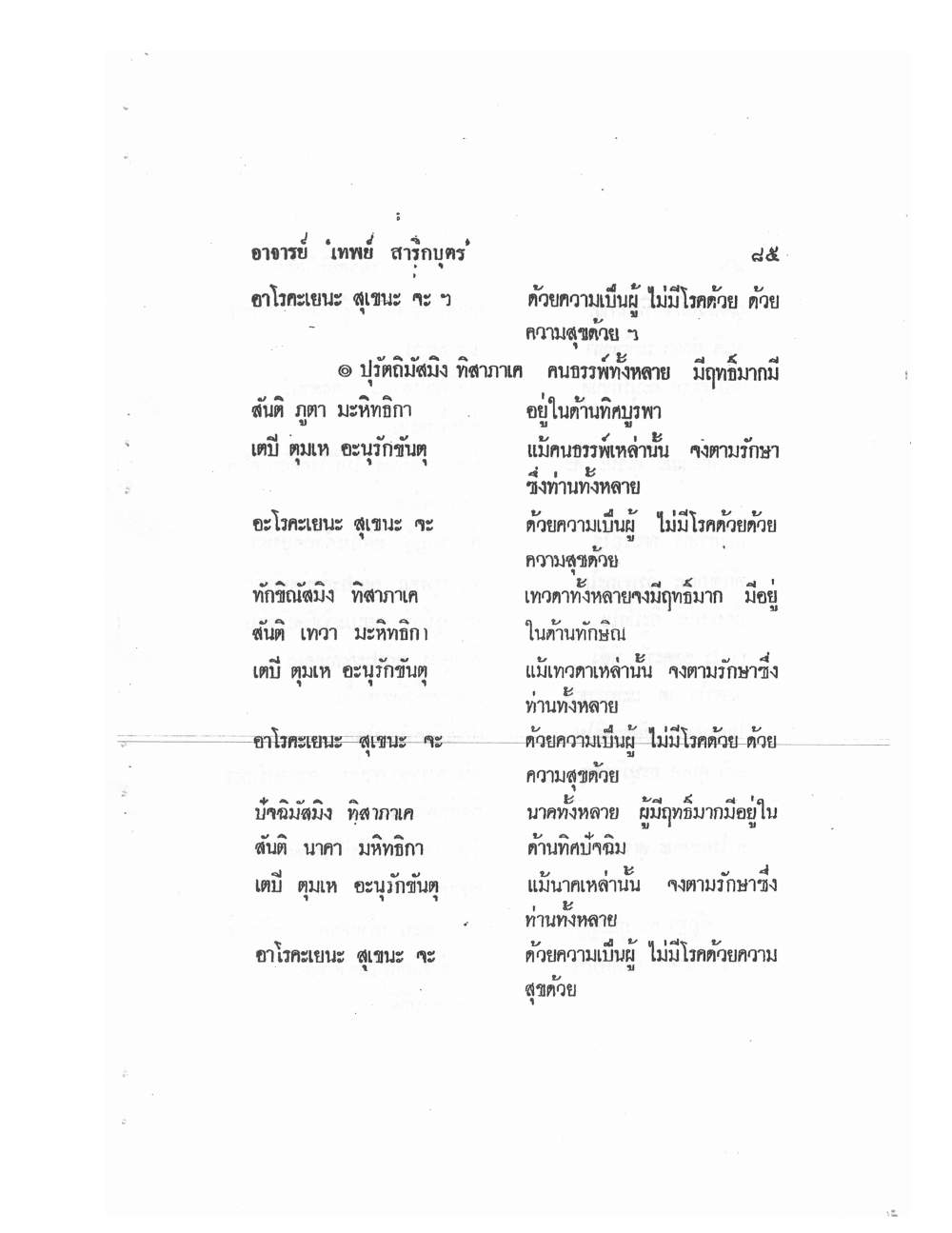
อาจารย์ 'เทพย์ สาริกบุตร' ๘๕
อาโรคะเยนะ สุเขนะ จะ ฯ ด้วยความเป็นผู้ไม่มีโรคด้วย ด้วยความสุขด้วย ฯ
๏ ปุรัตถิมัสมิง ทิสาภาเค คนธรรพ์ทั้งหลาย มีฤทธิ์มากมี
สันติ ภูตา มะหิทธิกา อยู่ในด้านทิศบูรพา
เตปิ ตุมเห อะนุรักขันตุ แม้คนธรรพ์เหล่านั้น จงตามรักษาซึ่งท่านทั้งหลาย
อาโรคะเยนะ สุเขนะ จะ ด้วยความเป็นผู้ไม่มีโรคด้วยด้วยความสุขด้วย
ทักขิณัสมิง ทิสาภาเค เทวดาทั้งหลายจงมีฤทธิ์มาก มีอยู่
สันติ เทวา มะหิทธิกา ในด้านทักษิณ
เตปิ ตุมเห อะนุรักขันตุ แม้เทวดาเหล่านั้น จงตามรักษาซึ่งท่านทั้งหลาย
อาโรคะเยนะ สุเขนะ จะ ด้วยความเป็นผู้ไม่มีโรคด้วย ด้วยความสุขด้วย
ปัจฉิมัสมิง ทิสาภาเค นาคทั้งหลาย ผู้มีฤทธิ์มากมีอยู่ใน
สันติ นาคา มะหิทธิกา ด้านทิศปัจฉิม
เตปิ ตุมเห อะนุรักขันตุ แม้นาคเหล่านั้น จงตามรักษาซึ่งท่านทั้งหลาย
อาโรคะเยนะ สุเขนะ จะ ด้วยความเป็นผู้ไม่มีโรคด้วยความสุขด้วย
Teacher Thep Sarikabutr 85
Ārogyena sukhena ca. together with health, and together with happiness.
In the eastern quarter, gandhabbas [celestial musician-spirits] of great power dwell.
May those gandhabbas also continue to protect you all,
together with health, and together with happiness.
In the southern quarter, devas of great power dwell.
May those devas also continue to protect you all,
together with health, and together with happiness.
In the western quarter, nagas of great power dwell.
May those nagas also continue to protect you all,
together with health, and together with happiness.
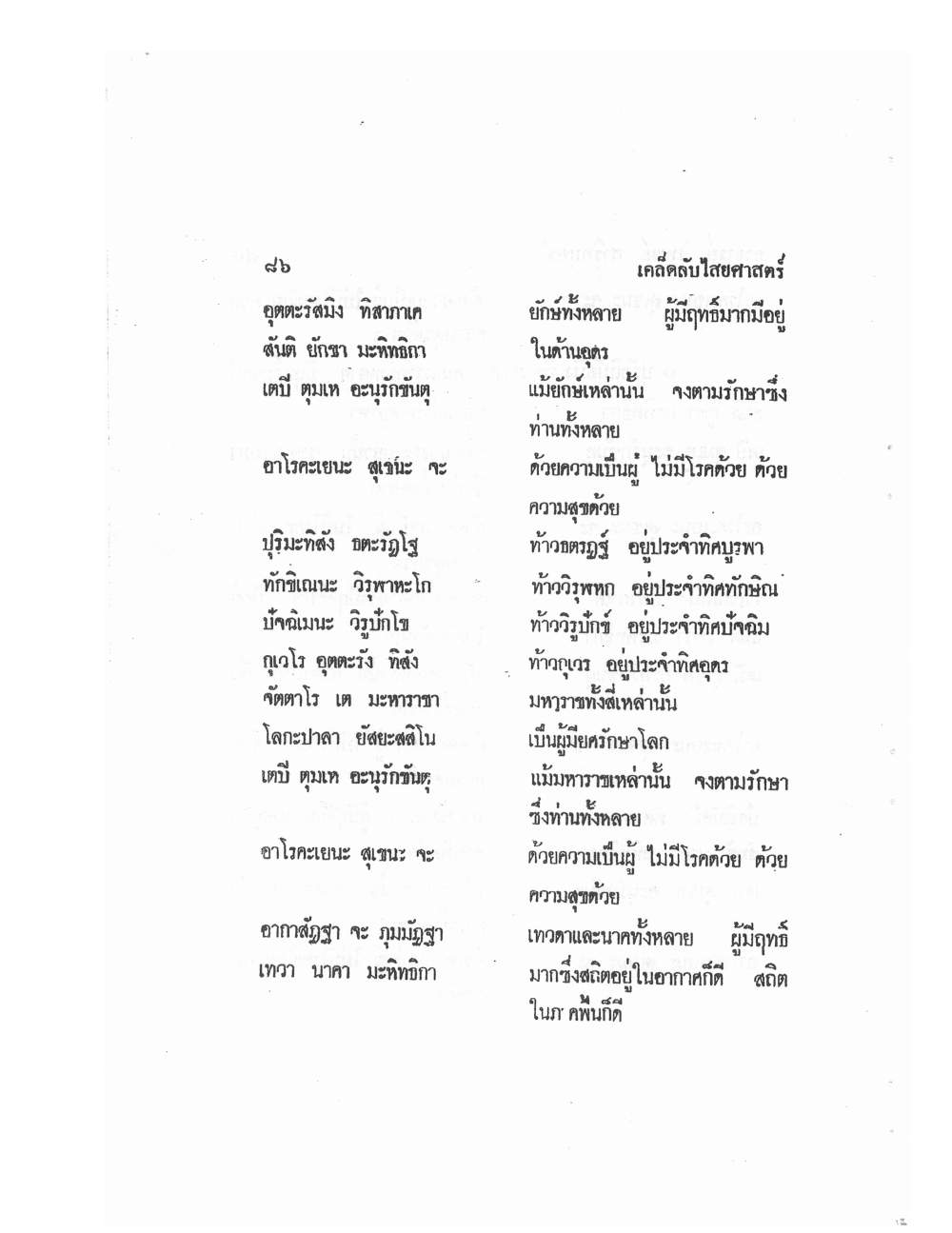
๘๖ เคล็ดลับไสยศาสตร์
อุตตะรัสมิง ทิสาภาเค ยักษ์ทั้งหลาย ผู้มีฤทธิ์มากมีอยู่
สันติ ยักขา มะหิทธิกา ในด้านอุดร
เตปิ ตุมเห อะนุรักขันตุ แม้ยักษ์เหล่านั้น จงตามรักษาซึ่งท่านทั้งหลาย
อาโรคะเยนะ สุเขนะ จะ ด้วยความเป็นผู้ไม่มีโรคด้วย ด้วยความสุขด้วย
ปุริมะทิสัง ธะตะรัฏโฐ ท้าวธตรัฏฐ์ อยู่ประจำทิศบูรพา
ทักขิเณนะ วิรุฬหะโก ท้าววิรุฬหก อยู่ประจำทิศทักษิณ
ปัจฉิเมนะ วิรูปักโข ท้าววิรูปักข์ อยู่ประจำทิศปัจฉิม
กุเวโร อุตตะรัง ทิสัง ท้าวกุเวร อยู่ประจำทิศอุดร
จัตตาโร เต มะหาราชา มหาราชทั้งสี่เหล่านั้น
โลกะปาลา ยะสัสสิโน เป็นผู้มียศรักษาโลก
เตปิ ตุมเห อะนุรักขันตุ แม้มหาราชเหล่านั้น จงตามรักษาซึ่งท่านทั้งหลาย
อาโรคะเยนะ สุเขนะ จะ ด้วยความเป็นผู้ไม่มีโรคด้วย ด้วยความสุขด้วย
อากาสัฏฐา จะ ภุมมัฏฐา เทวดาและนาคทั้งหลาย ผู้มีฤทธิ์
เทวา นาคา มะหิทธิกา มากซึ่งสถิตอยู่ในอากาศก็ดี สถิตในภาคพื้นก็ดี
86 Secrets of Saiyasat
In the northern quarter, yakkhas of great power dwell.
May those yakkhas also continue to protect you all,
together with health, and together with happiness.
Dhataraṭṭha [guards] the eastern quarter, Virūḷhaka the southern quarter, Virūpakkha the western quarter, Kuvera the northern quarter —
those four Great Kings, glorious guardians of the world.
May those Great Kings also continue to protect you all,
together with health, and together with happiness.
The devas and nagas of great power, whether dwelling in the sky or dwelling on the ground —
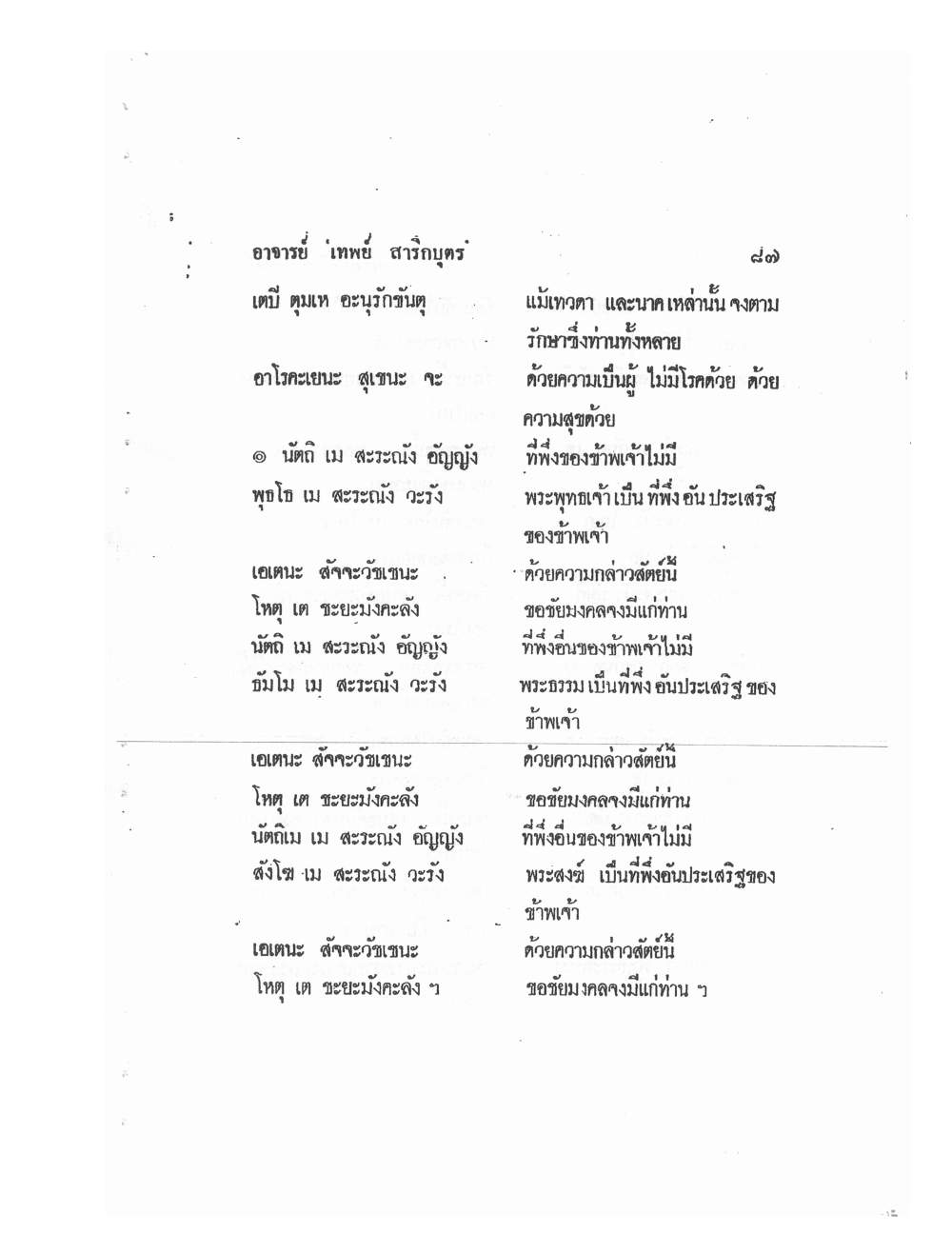
อาจารย์ 'เทพย์ สาริกบุตร' ๘๗
เตปิ ตุมเห อะนุรักขันตุ แม้เทวดาและนาคเหล่านั้น จงตาม
อาโรคะเยนะ สุเขนะ จะ รักษาซึ่งท่านทั้งหลาย ด้วยความเป็นผู้ไม่มีโรคด้วย ด้วยความสุขด้วย
๏ นัตถิ เม สะระณัง อัญญัง ที่พึ่งของข้าพเจ้าไม่มี
พุทโธ เม สะระณัง วะรัง พระพุทธเจ้าเป็นที่พึ่งอันประเสริฐของข้าพเจ้า
เอเตนะ สัจจะวัชเชนะ ด้วยความกล่าวสัตย์นี้
โหตุ เต ชะยะมังคะลัง ขอชัยมงคลจงมีแก่ท่าน
นัตถิ เม สะระณัง อัญญัง ที่พึ่งอื่นของข้าพเจ้าไม่มี
ธัมโม เม สะระณัง วะรัง พระธรรมเป็นที่พึ่งอันประเสริฐของข้าพเจ้า
เอเตนะ สัจจะวัชเชนะ ด้วยความกล่าวสัตย์นี้
โหตุ เต ชะยะมังคะลัง ขอชัยมงคลจงมีแก่ท่าน
นัตถิเม สะระณัง อัญญัง ที่พึ่งอื่นของข้าพเจ้าไม่มี
สังโฆ เม สะระณัง วะรัง พระสงฆ์เป็นที่พึ่งอันประเสริฐของข้าพเจ้า
เอเตนะ สัจจะวัชเชนะ ด้วยความกล่าวสัตย์นี้
โหตุ เต ชะยะมังคะลัง ฯ ขอชัยมงคลจงมีแก่ท่าน ฯ
Teacher Thep Sarikabutr 87
May those devas and nagas also continue to protect you all,
together with health, and together with happiness.
I have no other refuge —
The Buddha is my supreme refuge.
By the speaking of this truth,
may victory and blessing be yours.
I have no other refuge —
The Dhamma is my supreme refuge.
By the speaking of this truth,
may victory and blessing be yours.
I have no other refuge —
The Sangha is my supreme refuge.
By the speaking of this truth,
may victory and blessing be yours.
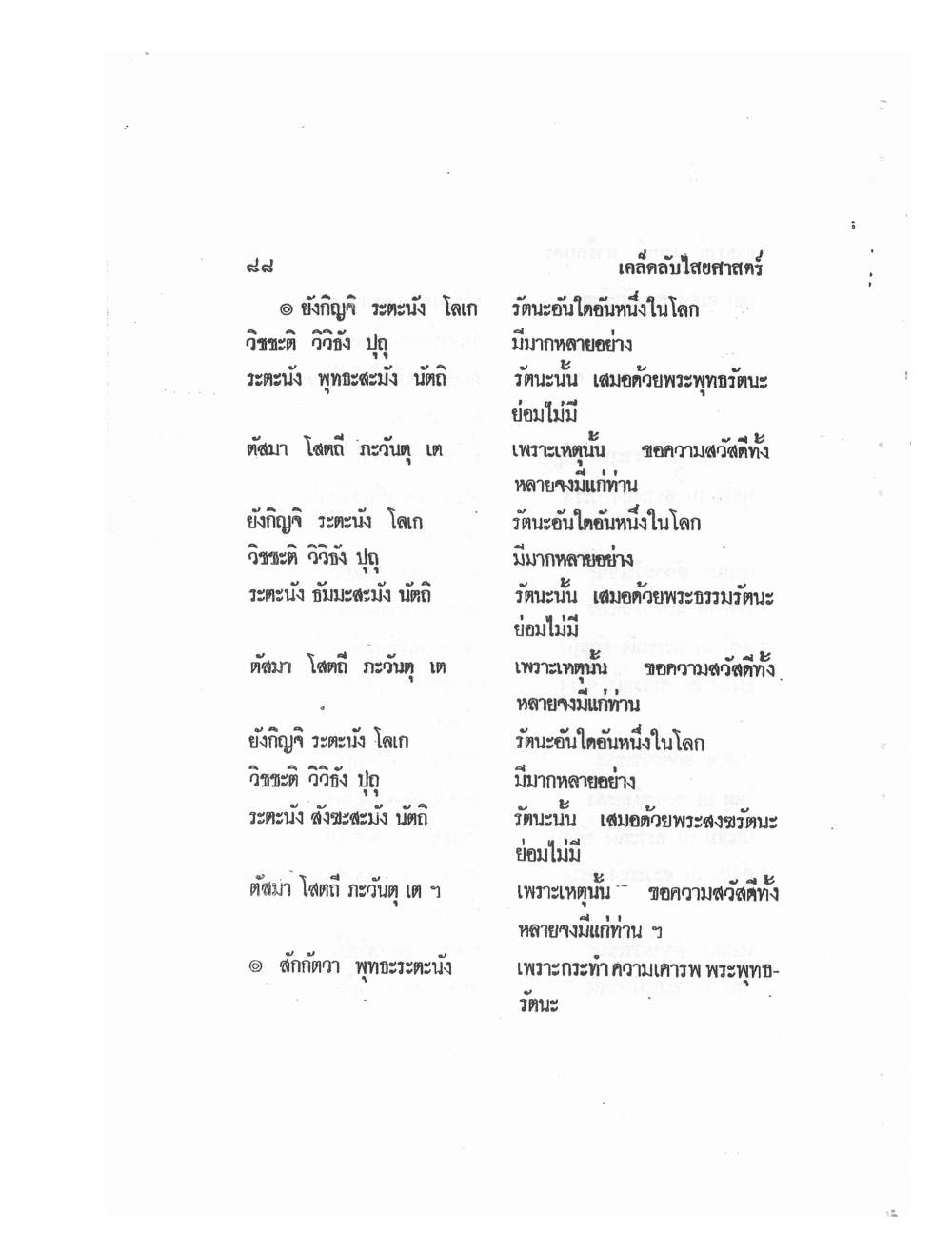
๘๘ เคล็ดลับไสยศาสตร์
๏ ยังกิญจิ ระตะนัง โลเก รัตนะอันใดอันหนึ่งในโลก
วิชชะติ วิวิธัง ปุถุ มีมากหลายอย่าง
ระตะนัง พุทธะสะมัง นัตถิ รัตนะนั้น เสมอด้วยพระพุทธรัตนะย่อมไม่มี
ตัสมา โสตถี ภะวันตุ เต เพราะเหตุนั้น ขอความสวัสดีทั้งหลายจงมีแก่ท่าน
ยังกิญจิ ระตะนัง โลเก รัตนะอันใดอันหนึ่งในโลก
วิชชะติ วิวิธัง ปุถุ มีมากหลายอย่าง
ระตะนัง ธัมมะสะมัง นัตถิ รัตนะนั้น เสมอด้วยพระธรรมรัตนะย่อมไม่มี
ตัสมา โสตถี ภะวันตุ เต เพราะเหตุนั้น ขอความสวัสดีทั้งหลายจงมีแก่ท่าน
ยังกิญจิ ระตะนัง โลเก รัตนะอันใดอันหนึ่งในโลก
วิชชะติ วิวิธัง ปุถุ มีมากหลายอย่าง
ระตะนัง สังฆะสะมัง นัตถิ รัตนะนั้น เสมอด้วยพระสงฆรัตนะย่อมไม่มี
ตัสมา โสตถี ภะวันตุ เต ฯ เพราะเหตุนั้น ขอความสวัสดีทั้งหลายจงมีแก่ท่าน ฯ
๏ สักกัตวา พุทธะระตะนัง เพราะกระทำความเคารพ พระพุทธรัตนะ [ข้อความต่อหน้าถัดไป]
88 Secrets of Saiyasat
Whatever jewel there may be in this world,
of many various kinds,
none is equal to the jewel of the Buddha.
Therefore, may all safety and well-being be yours.
Whatever jewel there may be in this world,
of many various kinds,
none is equal to the jewel of the Dhamma.
Therefore, may all safety and well-being be yours.
Whatever jewel there may be in this world,
of many various kinds,
none is equal to the jewel of the Sangha.
Therefore, may all safety and well-being be yours.
By virtue of having paid homage to the jewel of the Buddha — [sentence continues on the next page]
อาจารย์ 'เทพย์ สาริกบุตร' ๘๙
โอสะถัง อุตตะมัง วะรัง อันเป็นดั่งโอสถอันอุดมเลิศ
หิตัง เทวะมะนุสสานัง เป็นประโยชน์แก่เทพยดาและมนุษย์ทั้งหลาย
พุทเธ เตเชนะ โสตถินา ขอสรรพอุบัททวะทั้งหลาย จง
นัสสันตุปัททะวา สัพเพ ฉิบหายไป ขอทุกข์ทั้งหลายของ
ทุกขา วูปะสะเมนตุ เต ท่านจงสงบไปโดยสวัสดี ด้วยเดชแห่งพระพุทธเจ้า
สักกัตวา ธัมมะระตะนัง เพราะกระทำความเคารพ พระธรรมรัตนะ
โอสะถัง อุตตะมัง วะรัง อันเป็นดั่งโอสถ อันอุดมประเสริฐ
ปะริฬาหูปะสะมะนัง เป็นเครื่องระงับความกระวนกระวาย
ธัมเม เตเชนะ โสตถินา ขอสรรพอุบัททวะทั้งหลาย จงฉิบ
นัสสันตุปัททะวา สัพเพ หายไป ขอภัยทั้งหลายของท่าน
ภะยา วูปะสะเมนตุ เต จงสงบไปโดยสวัสดี ด้วยเดชแห่งพระธรรม
สักกัตวา สังฆะระตะนัง เพราะกระทำความเคารพ พระสังฆรัตนะ
โอสะถัง อุตตะมัง วะรัง อันเป็นดั่งโอสถอันอุดมดี
Teacher Thep Sarikabutr 89
the supreme and excellent medicine,
beneficial to devas and to human beings —
may all calamities be destroyed,
may all your sufferings be pacified in safety through the power and majesty of the Buddha.
By virtue of having paid homage to the jewel of the Dhamma —
the supreme and excellent medicine,
which calms all fevers of agitation —
may all calamities be destroyed,
may all your dangers be pacified in safety through the power and majesty of the Dhamma.
By virtue of having paid homage to the jewel of the Sangha —
the supreme and excellent medicine —
๙๐ เคล็ดลับไสยศาสตร์
อาหุเนยยัง ปาหุเนยยัง ควรเพื่อวัตถุ อันเขานำมาบูชาควรเพื่อวัตถุอันเขาต้อนรับ
สังเฆ เตเชนะ โสตถินา ขอสรรพอุบัททวะทั้งหลาย จง-
นัสสันตุปัททะวา สัพเพ ฉิบหายไป ขอโรคทั้งหลายของ
โรคา วูปะสะเมนตุ เต ฯ ท่านจงสงบไปโดยสวัสดี ด้วยเดชแห่งพระสงฆ์ ฯ
๏ สัพพีติโย วิวัชชันตุ ขอสรรพอุบาทว์ทั้งหลาย จงเว้นไป
สัพพะโรโค วินัสสะตุ โรคทั้งปวงจงฉิบหายไป
มา เต ภะวัตวันตะราโย อันตรายอย่าได้มีแก่ท่าน
สุขี ทีฆายุโก ภะวะ ขอท่านจงเป็นผู้มีสุข มีอายุยืน
อะภิวาทะนะสีลิสสะ ธรรมทั้งหลายสี่ คือ อายุ วรรณะ
นิจจัง วุฑฒาปะจายิโน สุขะ พละ ย่อมเจริญแก่บุคคลผู้
จัตตาโร ธัมมา วัฑฒันติ มีความอภิวาท ต่อบุคคลผู้ควรไหว้
อายุ วัณโณ สุขัง พะลัง ฯ เป็นปรกติ ผู้อ่อนน้อมต่อบุคคลผู้เจริญเป็นนิตย์ ฯ
90 Secrets of Saiyasat
fit to receive offerings, fit to be welcomed —
may all calamities be destroyed,
may all your sicknesses be pacified in safety through the power and majesty of the Sangha.
May all misfortunes be averted,
may all sickness be destroyed,
may no danger befall you,
may you be happy and long-lived.
For one whose habit is to pay respect, who constantly honours those worthy of honour, four things ever increase: long life, good complexion, happiness, and strength.
๙๑
ตำนานที่ ๕ อังคุลิมาลปริตร
พระปริตรบทนี้มีเนื้อความว่า นางพราหมณีภรรยาของปุโรหิตาจารย์ อันเป็นอาจารย์ของพระเจ้าโกศลราชมีครรภ์ เมื่อถ้วนกำหนดแล้วคลอดบุตร เวลาที่คลอดนั้นบังเกิดมหัศจรรย์ เครื่องศาสตราวุธของพราหมณ์ปุโรหิตและพระแสงศาสตราวุธของพระเจ้าโกศลก็บังเกิดรุ่งเรืองดังเปลวไฟ ปุโรหิตนั้นดูฤกษ์บน เมื่อบุตรของตนนั้นคลอดแล้วก็ปลาดใจหนักหนา จึงเข้าเฝ้าพระเจ้าโกศล ทูลว่าศาสตราที่ลุกขึ้นเป็นเปลวทั้งนี้ ด้วยอานุภาพกุมารอันบังเกิดในเรือนข้าพระองค์ จะเป็นโจรมีน้ำใจหยาบข้า นานไปจะพิฆาตหมู่ชนเสียเป็นอันมาก แต่ว่าหาประทุษร้ายต่อพระนครไม่ พระองค์จงจับกุมารนั้นไปประหารชีวิตเสีย
พระเจ้าโกศลรับสั่งว่า จะฆ่ากุมารนั้นเสียแต่บัดนี้เป็นการไม่สมควร ให้ปุโรหิตบำรุงรักษากุมารนั้นไว้เถิด ปุโรหิตก็รักษากุมารนั้นไว้ พอกุมารค่อยเจริญขึ้น จึงให้นามกรตามเหตุที่ศาสตราวุธรุ่งเรืองดังแสงเพลิงว่า 'อหิงสกกุมาร'
เมื่ออหิงสกกุมาร มีอายุสมควรแก่การเล่าเรียนศิลปศาสตร์แล้ว บิดามารดาจึงส่งเจ้าอหิงสกะไปเรียนวิชาในสำนักทิศาปาโมกข์
91
Story 5: The Angulimala Paritta
The content of this protective verse (paritta) is this: The brahmin wife of the royal chaplain (purohita) — the teacher of King Kosala — was pregnant. When her term was complete she gave birth to a son. At the moment of the birth a marvel occurred: the weapons belonging to the brahmin chaplain and the royal weapons of King Kosala blazed up as though aflame. The chaplain read the omen above, and, greatly astonished that his own son had just been born, went before King Kosala and reported that the weapons had burst into flame through the power of the boy born in his household; that the boy would become a bandit of cruel disposition; that in time he would slaughter great numbers of people, though he would do no harm to the capital itself; and he asked that the King have the boy seized and put to death.
King Kosala commanded: "To kill the child now would not be right. Let the chaplain raise and protect him instead." So the chaplain kept and raised the boy. As the child gradually grew, he was given the name — on account of the weapons having blazed like fire — "Ahiṃsaka-kumāra" [the Harmless Prince].
When Prince Ahiṃsaka reached an age fit for learning the arts and sciences, his parents sent him to study under a teacher renowned in all directions (disāpāmokkha).
๙๒ เคล็ดลับไสยศาสตร์
อาจารย์ ณ เมืองตักกะสิลา เจ้าอหิงสกะเป็นผู้ฉลาดเรียนศิลปศาสตร์ได้โดยเร็ว ทั้งการปรนนิบัติอาจารย์ก็ดียิ่ง เพื่อนศิษย์ด้วยกันมีความริษยา จึงพากันไปกล่าวแก่อาจารย์ว่า เจ้าอหิงสกะคิดอ่านประทุษร้ายอาจารย์ ที่แรกอาจารย์ก็หาเชื่อไม่ ครั้นพวกหลังมากล่าวอีก อาจารย์ก็ตัดความรักนั้นเสียแล้วกระทำอุบายเพื่อจะได้ยืมอาวุธจากคนอื่นมาประหารชีวิตเจ้าอหิงสกะเสีย จึงบอกเจ้าอหิงสกะให้ไปฆ่าคนเพื่อเอานิ้วมือมาคนละนิ้วให้ได้พันหนึ่ง จึงจะประสาทวิษณุมนต์ให้ เจ้าอหิงสกะตอบแก่อาจารย์ว่า การฆ่าคนผิดประเพณีแห่งพราหมณ์วงศ์ ตนมิอาจจะกระทำได้ อาจารย์ก็ตอบยืนคำว่าต้องไปฆ่ามาให้ได้จึงจะประสาทอิทธิมนต์ได้ เจ้าอหิงสกะก็จำใจต้องออกไปสู่ชายป่าฆ่าคนสัญจรไปมา ตัดเอานิ้วมือร้อยเป็นพวงแขวนคอไว้ถึงเก้าร้อยเก้าสิบเก้านิ้ว เหตุนี้จึงเรียกว่าองคุลิมาลโจร ราษฎรได้รับความเดือดร้อนด้วยเรื่องโจรฆ่าคน จึงไปทูลพระเจ้าโกศลให้ทรงทราบ พระเจ้าโกศลก็ให้ตระเตรียมไพร่พลจะออกไปจับโจรฆ่าเสีย นางพราหมณีผู้มารดาองคุลิมาล ได้ทราบว่าอันตรายจะพึงมีแก่บุตร ก็รีบล่วงหน้าไปก่อน เพื่อจะบอกเหตุให้บุตรของตนทราบ
ครั้งนั้น พระศาสดาทรงทราบด้วยพระญาณว่า องคุลิมาลมีอุปนิสสัยแห่งพระอรหัตผล ถ้าพระองค์ไม่ทรงทรมานเสียก่อนหน้าที่จะทำมาตุฆาตก็จะขาดเสียจากมรรคผล พระองค์จึงเสด็จไปทรงทรมาน [ข้อความต่อหน้าถัดไป]
92 Secrets of Saiyasat
At the city of Takkasilā, young Ahiṃsaka proved a clever student, learning the arts quickly, and he also served his teacher exceedingly well. His fellow students grew jealous of him and went together to tell the teacher that Ahiṃsaka was scheming to do him harm. At first the teacher did not believe it, but when the students came repeatedly to repeat the charge, the teacher's affection for Ahiṃsaka was cut off, and he devised a scheme to have him borrow a weapon from someone else so that he might be put to death. He therefore told Ahiṃsaka to go and kill people in order to bring back one finger from each person, until he had a thousand fingers — only then would he be granted the mantra of supernormal power. Ahiṃsaka replied to his teacher that killing people was against the tradition of the brahmin lineage and that he could not do such a thing. The teacher insisted firmly that he must go and kill in order to obtain the fingers before the mantra of power could be granted. Ahiṃsaka, against his own will, was forced to go out to the edge of the forest and kill travelers passing by, cutting off their fingers and stringing them into a garland worn around his neck, until he had nine hundred and ninety-nine fingers. For this reason he came to be called "the bandit Aṅgulimāla" [Finger-Garland]. The people suffered greatly on account of this bandit who killed travelers, and so they went and reported it to King Kosala. King Kosala had troops made ready to go out, capture, and kill the bandit. The brahmin woman, mother of Aṅgulimāla, learning that danger now threatened her son, hurried on ahead of the troops in order to warn her son of what was coming.
At that time the Buddha, knowing by his insight that Aṅgulimāla possessed the disposition (upanissaya) for attaining Arahantship, [perceived that] if He did not go to subdue him before he committed matricide, Aṅgulimāla would forfeit the path and its fruit. So the Buddha set out to go and subdue him. [narrative continues on the next page]
อาจารย์ 'เทพย์' สาริกบุตร ๙๓
องคุลิมาลโดยอำนาจพุทธปาฏิหารย์ องคุลิมาลก็วิ่งไล่พระผู้มีพระภาคเจ้า แต่หาทันไม่ จึงร้องบอกให้พระองค์หยุด พระองค์ก็ทรงดำเนินอยู่ แต่มี พุทธฎีกาว่าหยุดแล้ว องคุลิมาลจึงหาว่าพระองค์ตรัสมุสาวาท พระองค์ ตรัสว่าเราหยุดจากบรรดาอกุศลกรรมแล้ว แต่ตัวเธอยังไม่หยุดจากบาป กรรม พระสุรเสียงนั้นทำให้องคุลิมาลได้สติเห็นโทษของตัวจึงเปลื้องอาวุธ และองคุลีทั้ง ๙๙๙ ทิ้งเสีย และขออุปสมบทพระองค์ก็ทรงอนุญาต แล้ว นำไปสู่พระเชตุวัน
วันรุ่งขึ้น พระองคุลิมาลไปบิณฑบาตรในพระนครสาวัตถี ชาวเมืองเห็นก็ตกใจกลัวต่อมรณะภัยพากันหนีไปสิ้น ไม่มีใครใส่บาตร ท่านเลย ครั้งนั้นมีหญิงคนหนึ่งท้องแก่ เห็นพระองคุลิมาลเข้าก็มีความ ตกใจจึงทำกิริยาลอดรั้วหนี ด้วยเหตุท้องใหญ่ลอดไปมิได้ ก็บังเอิญเจ็บ ท้องจะคลอดลูกในขณะนั้น แต่ยังทนลำบากอยู่หาคลอดลูกไม่ได้ ญาติ ของหญิงนั้นจึงคิดขึ้นว่า ถ้าพระองคุลิมาลท่านตั้งความสัจอธิษฐานให้ หญิงนี้คลอดลูกสะดวกแล้วก็คงคลอดได้ง่าย จึงนิมนต์ท่านไปตั้งสัจจาธิษ- ฐาน พระองคุลิมาลก็ตั้งความสัจ เนื้อความเหมือนในคาถาสวดมนต์ หญิงนั้นก็คลอดลูกโดยง่ายดายทีๆ พระองคุลิมาลได้ตั้งความสัจ ภาย หลังได้ก่อเป็นแท่นไว้ แม้แต่สัตว์เดรัจฉานและสตรีที่คลอดบุตรมิได้สะดวก ไปนอนแท่นนั้น ก็คลอดบุตรได้ง่ายยิ่งนัก แม้ไปไม่ได้เอาน้ำล้างแท่น
Acharn 'Thep' Sarikaburi 93
By the power of the Buddha's miracle, Angulimala ran after the Blessed One, but could not catch up, so he called out for him to stop. The Blessed One kept walking, but declared by his royal word that he had [already] stopped. Angulimala then accused him of speaking falsely. The Blessed One said: "I have stopped from all unwholesome deeds, but you yourself have not yet stopped from sinful deeds." That voice caused Angulimala to gain mindfulness and see the fault in himself, so he cast away his weapon and the string of 999 fingers, and asked to be ordained. The Blessed One granted permission, and then led him to Jetavana.
The next day, the Venerable Angulimala went for alms round in the city of Savatthi. The townspeople, seeing him, were frightened of death and fled away entirely; no one offered him alms. At that time there was a woman far along in pregnancy who, on seeing the Venerable Angulimala, was so frightened that she tried to crawl under a fence to flee. Because her belly was too large to pass through, she happened at that moment to go into labor pains. She suffered but could not deliver the child. Her relatives then thought: "If the Venerable Angulimala would make a solemn asseveration of truth for this woman, she would surely deliver easily." So they invited him to make the asseveration of truth. The Venerable Angulimala made his asseveration, its content being the same as in the paritta verse [given below]. The woman then delivered her child easily and swiftly. After Angulimala made this asseveration of truth, a platform was later built [to commemorate it]. Even animals and women who had difficulty in childbirth, if they went and lay upon that platform, would deliver very easily. Even those who could not go there [could send someone] to fetch water to wash the platform...
๙๔ เคล็ดลับไสยศาสตร์
มารดศีรษะสตรีที่คลอดบุตรไม่สะดวกก็ว่าคลอดได้ง่ายและว่าคนเป็นวัณโรค เมื่อเอาน้ำล้างแท่นนั้นรดศีรษะบ้าง ให้กินบ้างก็หายได้
เมื่อพระองคุลิมาลทำสัจจาธิษฐานแล้วก็ได้อาหารบิณฑบาตร พอฉันจึงกลับไปเจริญสมณธรรมต่อไป พระผู้เป็นเจ้าเจริญสมณธรรมได้ ความกำเริบร้อนใจยิ่งนัก ให้เห็นว่าสุรกายที่ฆ่าไว้มาทวงเอาชีวิตเนืองๆ ภายหลังได้พุทโธวาทว่า ให้กำจัดบาปกรรมให้ปราศจากสันดาน เหมือน ดังบุรุษเอาสาหร่ายและจอกแหนออกจากบ่อน้ำ พระผู้เป็นเจ้าก็ปฏิบัติตาม พุทธฎีกา ในไม่ช้าก็ได้บรรลุพระอรหัตผล เป็นอริยบุคคลวิเศษในพระ บวรพุทธศาสนา
พระคาถาที่สวด สวดแต่เฉพาะคาถาที่พระองคุลิมาลอธิษฐาน สวด ๓ จบ มีคาถาที่สวดและคำแปลดังต่อไปนี้
◎ ยะโตหังภะคินิ อาริยายะ ตูก่อนน้องหญิง ตั้งแต่เราเกิดแล้ว ชาติยา ชาโต โดยชาติเป็นอริยะ นาภิชานามิ สัญจิจจะ มิได้รู้แกล้ง ปาณัง ชีวิตา โวโรเปตา เพื่อจะปลงสัตว์มีชีพจากชีวิต เตนะ สัจเจนะ โสตถิ เต ด้วยคำสัตย์นี้ ขอความสวัสดีจงมี แก่ท่าน โหตุ โสตถิ คัพภัสสะ ๆ ขอความสวัสดี จงมีแก่ครรภ์ของ ท่าน
94 Saiyasat Secrets
...anointing the head of a woman who has difficulty giving birth, it is likewise said she will deliver easily; and it is said that for a person with consumption (tuberculosis), when that water used to wash the platform is poured on the head, or given to drink, [the disease] can be cured.
When the Venerable Angulimala had made the asseveration of truth, he then received food from the alms round. After eating, he returned to continue his ascetic practice. The Venerable One, while practicing, felt intense agitation and remorse, seeing as if the bodies of those he had killed kept coming again and again to reclaim their lives. Afterward he received the Buddha's instruction: to purge sinful deeds from one's disposition, just as a man removes algae and duckweed from a pond. The Venerable One practiced according to the Buddha's word, and before long attained the fruit of Arahantship, becoming an extraordinary noble person within the excellent Buddhist religion.
The verse that is recited: only the verse that Angulimala used for his asseveration of truth is recited, three times through. The recited verse and its translation are as follows:
◎ Yato'ham bhagini ariyaya "Sister, since I was born" jatiya jato "by noble birth," nabhijanami sancicca "I do not recall intentionally" panam jivita voropeta "depriving any living being of its life." tena saccena sotthi te "By this word of truth, may well-being be with you," hotu sotthi gabbhassa. "may well-being be with your womb."
ตำนานที่ ๑๐ โพชฌงคปริตร
พระปริตรบทนี้ มีเนื้อความตามในคาถาที่สวดนั้นเป็นสาม ตำนาน หรือสามพระสูตรด้วยกัน แต่เอามารวมสวดเสียบทเดียวกัน ตำนานทั้งสามนั้นมีเนื้อความดังจะกล่าวต่อไปนี้
ตำนานที่ ๑ มหากัสสปโพชฌงคสูตร
ความว่า สมัยหนึ่งพระผู้มีพระภาคเจ้าสถิต ณ เวฬุวันมหาวิหาร ใกล้กรุงราชคฤห์ ครั้งนั้น พระมหากัสสปอาศัยอยู่ในปิปผลิคูหา บังเกิด โรคาพาธแรงกล้าอาการหนักลงทุกวันๆ พระผู้มีพระภาคได้ทรงมหากรุณา แก่พระมหากัสสป เมื่อพระองค์เสด็จออกจากที่เร้นคือ ผลสมาบัติได้เสด็จ ไปประทานพระธรรมเทศนาโพชฌงค์ทั้ง ๗ แก่พระมหากัสสป เมื่อจบพระ ธรรมเทศนาพระมหากัสสปมีความโสมนัสในพระธรรมเทศนา ก็ลุกขึ้นได้ หายจากโรคาพาธ
Legend No. 10: The Bojjhanga Paritta (Verses on the Factors of Enlightenment)
This paritta text, in the content of the verses recited, is composed of three legends, or three suttas together, though they have been brought together to be recited as one continuous passage. The content of the three legends is as given below:
Legend No. 1: The Mahakassapa Bojjhanga Sutta
It is told that once the Blessed One was residing at the great monastery of Veluvana near the city of Rajagaha. At that time the Venerable Mahakassapa was dwelling in the Pipphali Cave and had fallen severely ill, his condition worsening day by day. The Blessed One, feeling great compassion for Mahakassapa, when he emerged from seclusion—that is, from the attainment of fruition—went and gave the teaching on the Seven Factors of Enlightenment to Mahakassapa. When the teaching was finished, Mahakassapa, feeling joy in the Dhamma teaching, was able to rise up, cured of his illness.
๙๖ เคล็ดลับไสยศาสตร์
กรุณาแก่พระมหาโมคคัลลาน์ เมื่อเสด็จออกจากที่เร้นคือผลสมาบัติ ได้ เสด็จๆไปประทานพระธรรมเทศนาโพชฌงค์ทั้ง ๗ แก่พระมหาโมคคัลลาน์ เมื่อจบพระธรรมเทศนา พระมหาโมคคัลลาน์มีความโสมนัสในพระธรรม เทศนาก็ลุกขึ้นได้หายจากโรคาพาธ
ตำนานที่ ๓ มหาจุนทโพชฌงคสูตร
ครั้งหนึ่ง พระพุทธเจ้าเสด็จประทับอยู่ ณ เวฬุวนาราม ใกล้ กรุงราชคฤห์ ทรงประชวรพระโรคให้เจ็บพระนาภีเป็นกำลัง และอาพาธ หนักลงทุกวันๆ ครั้งนั้นพระจุนทเถรผู้มีอายุ ออกจากที่เร้นคือผลสมาบัติ ก็ไปถวายอภิวาทพระผู้มีพระภาค พระองค์จึงมีพระพุทธฎีกาให้พระจุนทเถร แสดงโพชฌงค์ถวายพระจุนทเถร จึงแสดงโพชฌงค์ทั้ง ๗ พร้อมด้วย อานิสงส์ว่า โพชฌงค์ทั้ง ๗ นี้ พระผู้มีพระภาคเจ้าตรัสเทศนา ว่าเป็น ไปเพื่อจะให้ตรัสรู้พระจตุราริยสัจจ์ทั้ง ๔ และยกตนออกจากตัณหา เมื่อ พระจุนทเถรกล่าวจึงพระสูตรนี้จบลงแล้วพระผู้มีพระภาคก็ทรงพระโสมนัส หายจากโรคาพาธเสด็จลุกขึ้นจากที่บรรทมได้
เนื้อความที่กล่าวมานี้แล้ว มีอยู่ในพระคาถาที่สวดโดยย่อ พระคาถาที่สวดมนต์และคำแปลดังต่อไปนี้
96 Saiyasat Secrets
...compassion for Mahamoggallana. When he emerged from seclusion—that is, from the attainment of fruition—he went and gave the teaching on the Seven Factors of Enlightenment to Mahamoggallana. When the teaching was finished, Mahamoggallana, feeling joy in the Dhamma teaching, was able to rise up, cured of his illness.
Legend No. 3: The Mahacunda Bojjhanga Sutta
Once the Buddha was residing at Veluvanarama near the city of Rajagaha. He was afflicted with an illness causing severe pain in his abdomen, and his condition grew worse day by day. At that time the Venerable Elder Cunda, advanced in years, emerged from seclusion—that is, from the attainment of fruition—and went to pay homage to the Blessed One. The Blessed One then instructed by royal word that the Elder Cunda should recite the Factors of Enlightenment. The Elder Cunda then recited the Seven Factors of Enlightenment together with their benefit, [explaining] that the Blessed One had taught these Seven Factors of Enlightenment as leading to realization of the Four Noble Truths and to lifting oneself out of craving. When the Elder Cunda finished reciting this sutta, the Blessed One felt joy, was cured of his illness, and was able to rise up from his sickbed.
The content described above is contained, in abbreviated form, in the verses that are recited. The recited verses and their translation are as follows:
อาจารย์ เทพย์ สาริกบุตร ๙๗
◎ โพชฌังโค สะติสังขาโต โพชฌงค์ ๗ ประการ คือ สติ ธัมมานัง วิจะโย ตะถา สัมโพชฌงค์ ธัมมวิจยะสัม วิริยัมปีติปัสสัทธิ โพชฌงค์ วิริยะสัมโพชฌงค์ โพชฌังคา จะ ตะถาปะเร ปีติสัมโพชฌงค์ ปัสสัทธิสัม สะมาธุเปกขะโพชฌังคา โพชฌงค์ สมาธิสัมโพชฌงค์ สัตเตเตสัพพะทัสสินา อุเบกขาสัมโพชฌงค์ เหล่านี้ มุนินา สัมมะทักขาตา อันพระมุนีเจ้า ผู้เห็นธรรมทั้งสิ้น ตรัสไว้ชอบแล้ว ภาวิตา พะหุลีกะตา อันบุคคล มาเจริญทำให้มากแล้ว สังวัตตันติ อะภิญญายะ ย่อมเป็นไปเพื่อความรู้ยิ่ง นิพพานายะ จะ โพธิยา เพื่อความดับกิเลส และเพื่อความ ตรัสรู้ เอเตนะ สัจจะวัชเชนะ ด้วยความกล่าวสัตย์นี้ โสตถิ เต โหตุ สัพพะทา ขอความสวัสดีจงมีแก่ท่านทุกเมื่อ เอกัสมิง สะมะเย นาโถ ในสมัยหนึ่ง พระโลกนารถเจ้า โมคคัลลานัญจะ กัสสะปัง ทอดพระเนตร พระโมคคัลลานะ คิลาเน ทุกขิเต ทิสวา และพระกัสสป กำลังเป็นไข้ถึงทุก เวทนาแล้ว ๗๖
Acharn Thep Sarikaburi 97
◎ Bojjhango satisankhato "The seven factors of enlightenment: that called mindfulness— dhammanam vicayo tatha the factor of mindfulness; likewise investigation- viriyampitipassaddhi- of-states as a factor; energy, rapture, tranquility as bojjhanga ca tathapare further factors of enlightenment; samadhupekkha-bojjhanga concentration and equanimity as factors of sattete sabbadassina enlightenment—these, by the All-Seeing One, munina sammadakkhata the Sage who sees all phenomena, have been rightly proclaimed. Bhavita bahulikata "When developed and made much of by a person, samvattanti abhinnaya they lead to higher knowledge, nibbanaya ca bodhiya to the quenching of defilements, and to awakening. Etena saccavajjena "By the utterance of this truth, sotthi te hotu sabbada may well-being be with you always. Ekasmim samaye natho "On one occasion the Lord of the World Moggallanan ca Kassapam beheld Moggallana and Kassapa, gilane dukkhite disva sick and afflicted with suffering..." 76
๙๘ เคล็ดลับไสยศาสตร์
โพชฌังเค สัตตะ เทสะยิ ทรงแสดงโพชฌงค์เจ็ดประการ เต จะ ตัง อภินันทิตวา ท่านทั้งสองนั้น ก็เพลิดเพลินภาษิต นั้น โรคา มุจจิงสุ ตังขะเณ หายโรคในขณะนั้น เอเตนะ สัจจะวัชเชนะ ด้วยความกล่าวสัตย์นี้ โสตถิ เต โหตุ สัพพะทา ขอความสวัสดีจงมีแก่ท่านทุกเมื่อ เอกะทา ธัมมะราชาปิ ในกาล บางคราว แม้ พระพุทธเจ้า ผู้ เป็นราชาในธรรม เคลัญเญนาภีปิฬิโต อันความประชวรเบียดเพียฬแล้ว จุนทัตเถเรนะ ตัญเญวะ รับสั่งให้พระจุนทเถระแสดง ภะณาเปตวานะ สาทะรัง โพชฌงค์นั้นแหละโดยเอื้อเฟื้อ สัมโมทิตวา จะ อาพาธา ก็ทรงบันเทิงพระทัย หายความ ประชวรนั้นไปโดยขณะนั้น ตัมหา วุฏฐาสิ ฐานะโส เอเตนะ สัจจะวัชเชนะ ด้วยความกล่าวสัตย์นี้ โสตถิ เต โหตุ สัพพะทา ขอความสวัสดีจงมีแก่ท่านทุกเมื่อ ปะหีนา เต จะ อาพาธา ก็อาพาธทั้งหลายนั้น อันพระอริย บุคคล ผู้แสวงหาคุณธรรมอันใหญ่ ติณณันนัมปิ มะเหสินัง ทั้งสามละได้แล้ว
98 Saiyasat Secrets
Bojjhange satta desayi "[Cunda] taught the seven factors of enlightenment, te ca tam abhinanditva and those two, delighting in that utterance, roga muccimsu tankhane were freed from illness at that very moment. Etena saccavajjena "By the utterance of this truth, sotthi te hotu sabbada may well-being be with you always. Ekada dhammarajapi "On one occasion, even the Buddha, King of the Dhamma, gelannenabhipilito oppressed and afflicted by illness, Cundattherena tan'neva had the Elder Cunda proclaim bhanapetvana sadaram that very [teaching] with reverent care. Sammoditva ca abadha "Rejoicing, he was freed from that affliction tamha vutthasi thanaso and rose at once from that condition. Etena saccavajjena "By the utterance of this truth, sotthi te hotu sabbada may well-being be with you always. Pahina te ca abadha "And those afflictions were abandoned tinnannampi mahesinam by all three great seekers [of the good]...
อาจารย์ เทพย์ สาริกบุตร ๙๙
มัคคาหะตะกิเลสาวะ ถึงแล้วซึ่งความเป็น คือความไม่ บัตตานุปบัตติธัมมะตัง บังเกิดเป็นธรรมดุจ-กิเลส อันพระ อริยเจ้ากำจัดเสียด้วยพระอริยมรรค เอเตนะ สัจจะวัชเชนะ ด้วยความกล่าวสัตย์นี้ โสตถิ เต โหตุ สัพพะทา ๆ ขอความสวัสดีจงมีแก่ท่านทุกเมื่อ ๆ
Acharn Thep Sarikaburi 99
Maggahata kilesava "[the defilements] destroyed by the path, pattanuppatti-dhammatam reaching the state of no longer arising by nature" [gloss: those defilements which the Noble One has destroyed by means of the Noble Path] Etena saccavajjena "By the utterance of this truth, sotthi te hotu sabbada. may well-being be with you always, always."
๑๐๐
ตำนานที่ ๑๑ อภัยปริตร
◎ ยันทุนิมิตตัง ๆ สังฆานุภาเวนะ วินาสะเมนตุๆ คาถานี้ ยังมิได้พบที่มาโดยตรง แต่สันนิษฐานเทียบเคียงคาถาบางส่วนที่ตรงกับ พระสูตรมีบ้าง พอเห็นได้ว่าเป็นคาถาที่แสดงว่า ถ้าอวมงคลอย่างหนึ่ง อย่างใดเกิดขึ้น ให้เจริญพระปริตรคุ้มครองอย่าให้ฆ่าสัตว์ สิ่งละ ๔ ๆ บูชายัญญ์เพื่อให้คุ้มโทษตามลัทธิพราหมณ์ จะได้ยกเรื่องในมหาสุบิน ชาดกมาแสดงไว้พอเป็นทัศนะความว่า
ครั้งหนึ่งพระเจ้าปัสเสนทิโกศล ทรงพระสุบิน ๑๖ ประการแล้ว ก็ให้เกิดหวาดหวั่นต่อมรณภัยจึงทรงเล่า พระสุบินนั้นให้พราหมณ์ปุโรหิต ฟัง พราหมณ์ปุโรหิตพยากรณ์ว่า จะเกิดเหตุอันตรายอย่างหนึ่งอย่างใดแก่ พระองค์และราชสมบัติหรือพระมเหสี และแสดงให้ทรงบำบัดอันตรายด้วย คือเอาสัตว์อย่างละๆ ๔ มาบูชายัญญ์ก็จะพ้นโทษได้ พระเจ้าปัสเสนทิ โกศลโปรดให้เตรียมการบูชายัญญ์ตามถ้อยคำของพราหมณ์ครั้งนั้น นาง มัลลิกาเทวีได้ทราบความนี้แล้วจึงทูลพระราชสามีว่าขอได้โปรดทูลถามเหตุ ที่จะเกิดอันตรายทั้งหลายนั้นแด่พระผู้มีพระภาคเจ้าเถิด พระเจ้าปัสเสนทิโกศล ก็ได้เสด็จๆไปทูลถามพระผู้มีพระภาคเจ้า ณ เชตุวันมหาวิหาร
100
Legend No. 11: The Abhaya Paritta (Protection from Danger)
◎ "Yantunimittam... sanghanubhavena vinasamentu" — the direct source of this verse has not yet been found; however, by comparison, some portions of it correspond to passages found in the suttas. It can be seen as a verse expressing that, should any inauspicious omen of whatever kind arise, one should recite this protective paritta rather than kill animals—four of each kind—as a sacrifice to ward off misfortune according to the brahmanical doctrine. The story from the Mahasupina Jataka will be presented here to give a sense of this, as follows:
Once King Pasenadi of Kosala had sixteen kinds of dreams, and this caused him to become fearful of death, so he related the dreams to his brahmin chaplain (purohita). The brahmin chaplain prophesied that some danger or other would befall the king, his royal wealth, or his queen, and advised that the king could avert the danger by taking animals—four of each kind—and offering them in sacrifice, whereby he would escape misfortune. King Pasenadi of Kosala then ordered preparations for the sacrifice according to the brahmin's words. Queen Mallika, having learned of this, said to her royal husband: "May it please you to ask the Blessed One about the dangers that are to occur." King Pasenadi of Kosala then went to ask the Blessed One at the great monastery of Jetavana.
อาจารย์ เทพย์ สาริกบุตร ๑๐๑
พระผู้มีพระภาคตรัสว่า ภัยอันใดอันหนึ่ง จะได้บังเกิดมีแก่ พระเจ้าปัสเสนทิโกศลก็หาไม่ และทรงพยากรณ์ถึงเหตุการณ์ที่จะเป็นไปใน อานาคตกาลโดยแจ่มแจ้งและในที่สุดก็มีพระพุทธดำรัสให้พระเจ้าปัสเสนทิ โกศลรื้อถอนยัญญวิธีนั้นเสีย
เรื่องที่กล่าวมานี้เป็นการสันนิษฐานความว่า ◎ ทุสสุปีนัง อะกันตัง ๆ สุบินชั่วอันไม่พอใจอันใดด้วย
ดังมีชาดกอีกเรื่องหนึ่งชื่อว่า อัฏฐสัททชาดกกล่าวว่าครั้งหนึ่ง พระเจ้าปัสเสนทิโกศล ได้ทรงสดับเสียงสัตว์หลายชนิดเช่นนกเป็นต้น ได้ ส่งเสียงร้องแปลกประหลาด พระองค์ก็หวาดหวั่นต่อมรณะภัยได้เตรียม การจะทำยัญญกรรมเหมือนในพระสูตรก่อน และพระองค์ก็ได้เสด็จๆไปทูล ถามพระพุทธเจ้าด้วย
พระผู้มีพระภาคเจ้า ทรงพยากรณ์ให้พระปัสเสนทิโกศลทราบ โดยพิสดารแล้วทรงประทานพระพุทโธวาทให้รื้อถอนยัญญกรรมนั้นเสีย
เรื่องที่กล่าวมานี้เป็นการสันนิษฐานความว่า ◎ โยจามะนาโป สะกุณัสสะ สัทโท ๆ เสียงนกที่ไม่ชอบใจอันใดด้วย
เนื้อความบทอื่นๆ ก็คงมีนัยที่มาแต่สูตรอื่นเช่นกัน พระอรรถ- กถาจารย์ถือเอาความที่แสดงไว้ในธชัคคสูตรว่า เมื่อความหวาดสะดุ้งเกิด ขึ้น ก็ให้ระลึกถึงพระพุทธ พระธรรม พระสงฆ์เป็นที่พึ่ง ก็จะขจัดความ
Acharn Thep Sarikaburi 101
The Blessed One said that no danger whatsoever would befall King Pasenadi of Kosala, and he prophesied clearly about the events that would occur in the future. In the end the Buddha's word instructed King Pasenadi of Kosala to abolish that sacrificial rite.
This account is understood to be the source of: ◎ "Dussupinam akantam" — "any evil dream that is displeasing."
There is likewise another Jataka story called the Atthasadda Jataka, which tells that once King Pasenadi of Kosala heard the sounds of many kinds of creatures, such as birds, crying out strangely and unusually. He became fearful of death and prepared to perform a sacrificial rite as in the previous account, and he too went to ask the Buddha about it.
The Blessed One prophesied and explained the matter to King Pasenadi in full detail, and then gave his teaching that the sacrificial rite should be abolished.
This account is understood to be the source of: ◎ "Yo camanapo sakunassa saddo" — "any unpleasant sound of a bird."
The content of the remaining verses likewise has meanings drawn from other suttas. The commentarial teachers take the meaning given in the Dhajagga Sutta: that when fear and alarm arise, one should recall the Buddha, the Dhamma, and the Sangha as refuge, and this will dispel that...
๑๐๒ เคล็ดลับไสยศาสตร์
หวาดสะดุ้งเสียได้ และเพื่อจะกันเสียซึ่งลัทธิบูชายัญญ์ของพราหมณ์ตามที่ กล่าวมาแล้วนั้นด้วย จึงได้รจนาพระปริตรบทนี้ไว้ให้เป็นประโยชน์สืบ ต่อมา
◎ ทุกขัปปัตตา จะ นิทุกขา ๆลๆ รักขัง พันธามิ สัพพะโส ๆ คาถานี้ก็ยังไม่ได้พบที่มาจากพระสูตร มีผู้สันนิษฐานว่าเป็นคาถาแผ่กรุณา พรหมวิหารและให้ส่วนกุศล กับตักเตือนมนุษย์ทั้งหลายให้ประกอบการ กุศล อนึ่ง เป็นคาถาสวดส่งเทวดาคือเมื่อเชิญเทวดาด้วยบทสัคเค ๆลๆ สุณันตุๆ ครั้นเสร็จจากพิธีแล้วจึงเชิญกลับด้วยคาถาบทนี้ เนื้อความนอก จากนี้ก็มีอยู่ในคาถาและคำแปลแล้ว
คาถาและคำแปลอภัยปริตรดังต่อไปนี้ —
◎ ยันทุนิมิตตัง อะวะมังคะลัญจะ นิมิตที่ชั่วร้าย อันใดด้วยอวมงคล อันใดด้วย โยจามะนาโป สะกุณัสสะ สัทโท เสียงนก เป็นที่ไม่ชอบใจอันใดด้วย ปาปัคคะโห ทุสสุปีนัง อะกันตัง บาปเคราะห์อันใดด้วย สุบินชั่วอัน ไม่พอใจอันใดด้วย มีอยู่ พุทธานุภาเวนะ วินาสะเมนตุ ขอสิ่งเหล่านั้น จงถึงความพินาศไป ด้วยอานุภาพพระพุทธเจ้า
102 Saiyasat Secrets
...fear and alarm may be dispelled, and also to prevent the brahmanical doctrine of animal sacrifice described above, this paritta verse was composed for lasting benefit.
◎ "Dukkhappatta ca nidukkha... rakkham bandhami sabbaso" — the source of this verse in the suttas has likewise not yet been found. Some have surmised that it is a verse for the spreading of loving-kindness [the Brahma-viharas] and the sharing of merit, together with an exhortation to all people to perform meritorious deeds. It is also, in addition, a verse recited to send off the devas—that is, when the devas are invited with the verse beginning "sagge...sunantu...", once the ceremony is finished they are sent back with this verse. The remaining content is contained in the verses and their translation below.
The verses and translation of the Abhaya Paritta are as follows —
Yantunimittam avamangalanca "Any evil omen, together with any inauspicious thing, yo camanapo sakunassa saddo any unpleasant sound of a bird, papaggaho dussupinam akantam any evil planetary influence, any undesired bad dream that exists, buddhanubhavena vinasamentu may all these be destroyed by the power of the Buddha."
อาจารย์ เทพย์ สาริกบุตร ๑๐๓
ยันทุนิมิตตัง อะวะมังคะลัญจะ นิมิตที่ชั่วร้ายอันใดด้วย อวมงคล อันใดด้วย โยจามะนาโป สะกุณัสสะ สัทโท เสียงนก เป็นที่ไม่ชอบใจอันใดด้วย ปาปัคคะโห ทุสสุปีนัง อะกันตัง บาปเคราะห์อันใดด้วย สุบินชั่วอัน ไม่พอใจอันใดด้วย มีอยู่ สังฆานุภาเวนะ วินาสะเมนตุ ๆ ขอสิ่งเหล่านั้น จงถึงความพินาศ ไปด้วยอานุภาพพระสงฆ์ ๆ
◎ ทุกขัปปัตตา จะ นิททุกขา ขอสรรพสัตว์ทั้งหลาย ที่ถึงแล้วซึ่ง ภะยัปปัตตา จะ นิพภะยา ทุกข์ จงเป็นผู้ไม่มีทุกข์ และถึง โสกัปปัตตา จะ นิสโสกา แล้วซึ่งภัย จงเป็นผู้ไม่มีภัย และ โหนตุ สัพเพปิ ปาณิโน ถึงแล้วซึ่งโศก จงเป็นผู้ไม่มีโศกเถิด เอตตาวะตา จะ อัมเหหิ ขอเทพเจ้าทั้งปวง จงอนุโมทนา
Acharn Thep Sarikaburi 103
Yantunimittam avamangalanca "Any evil omen, together with any inauspicious thing, yo camanapo sakunassa saddo any unpleasant sound of a bird, papaggaho dussupinam akantam any evil planetary influence, any undesired bad dream that exists, sanghanubhavena vinasamentu may all these be destroyed by the power of the Sangha.
◎ Dukkhappatta ca nidukkha "May all sentient beings who have met with suffering be free of suffering, bhayappatta ca nibbhaya and those who have met with danger be free of danger, and sokappatta ca nissoka those who have met with sorrow be free of sorrow, hontu sabbepi panino may it be so for all living beings. Ettavata ca amhehi By this much, may all the devas rejoice with us..."
๑๐๔ เคล็ดลับไสยศาสตร์
สัมภตัง ปุญญะสัมปะทัง ซึ่งความถึงพร้อมคือบุญ อันเรา ทั้งหลาย ก่อสร้างแล้วด้วยเหตุมี ประมาณเท่านี้ สัพเพ เทวานุโมทันตุ เพื่ออันสำเร็จสมบัติทั้งปวง
สัพพะสัมปัตติสิทธิยา มนุษย์ทั้งหลายจงให้ทานด้วยศรัทธา -ทานัง ทะทันตุ สัทธายะ สีลัง รักขันตุ สัพพะทา จงรักษาศีลในกาลทั้งปวง ภาวนาภิระตา โหนตุ จงเป็นผู้ยินดีแล้วในภาวนา คัจฉันตุ เทวะตาคะตา เทวดาทั้งหลายที่มาแล้ว เชิญกลับ ไปเถิด
สัพเพ พุทธา พะลัปปัตตา พระพุทธเจ้าทั้งหลาย ล้วนทรงพระ กำลังทั้งหมด บัจเจกานัญจะ ยัง พะลัง กำลังอันใด แห่งพระปัจเจกพุทธ อะระหันตานัญจะ เตเชนะ เจ้าทั้งหลายด้วย แห่งพระอรหันต์ รักขัง พันธามิ สัพพะโส ๆ ทั้งหลายด้วย ข้าพเจ้าขอเหนี่ยว ความรักษา ด้วยเดชแห่งกำลังทั้ง หลายเหล่านั้น โดยประการทั้งปวงๆ
104 Saiyasat Secrets
Sambhatam punnasampadam "This accumulation of merit which we have built up to this extent, sabbe devanumodantu may all devas rejoice in it,
sabbasampatti-siddhiya so that every accomplishment may be fulfilled; may people give alms with danam dadantu saddhaya faith, silam rakkhantu sabbada keep the precepts at all times, bhavanabhirata hontu and take delight in meditation. gacchantu devata gata May the devas who have come now please return [to their abodes].
Sabbe buddha balappatta "All Buddhas, endowed with power entire, paccekanan ca yam balam and whatever power belongs to the Pacceka Buddhas, arahantanan ca tejena and by the might of the Arahants— rakkham bandhami sabbaso I bind this protection around myself, in every respect."
ตำนานที่ ๑๒ ชยปริตร
๏ มะหากรุณิโกนาโถ ฯลฯ ชะยะมังคะลัง ฯ คาถานี้ยัง ไม่ได้พบที่มาจากพระสูตร โดยเต็มเนื้อความอย่างนี้ แต่สันนิษฐานเทียบ เคียงว่าเป็น คาถาศักดิ์สิทธิ์ บทหนึ่ง ที่ยกย่องสรรเสริญ พระพุทธเจ้า ว่า ประกอบด้วยพระกรุณายังบารมีธรรมทั้งสิ้นให้เต็มแล้ว เพื่อเกื้อกูลแก่ สัตว์ทั้งปวง จะยกตัวอย่างมากล่าวให้ทราบบ้าง เช่นครั้งหนึ่งพระราช อาณาจักรโกศลเกิดฝนแล้ง มหาชนจึงทูลวิงวอนเชิญเสด็จไปบิณฑบาตร และจำพรรษาในชนบทนั้น
พระพุทธองค์ทรงพระมหากรุณาแก่มหาชนเหล่านั้น ได้เสด็จ ไปบิณฑบาตรพร้อมด้วยพุทธบริวาร ในนครสาวัตถีเมื่อภายหลังแห่งการ บิณฑบาตรและภัตกิจแล้วได้เสด็จไปยังเชตุวัน ประทับยืนอยู่ที่บนบันได สระโบกขรณีอันน้ำในสระนั้นได้แห้งไปแล้ว ฝูงนกทั้งหลายกำลังจิกปลา และเต่าที่นอนจมเบือกตมให้ดิ้นรนอยู่ ครั้งนั้นสมเด็จพระบรมครูทรงผ้า ขุบสรงแปลกกว่าปกติ คือนุ่งด้วยชายข้างหนึ่งและห่มด้วยชายข้างหนึ่ง เผยพระพุทธพจน์ว่า เราจะอาบน้ำในเขตุวันโบกขรณี พระพุทธประสงค์ นี้ทราบไปถึงท้าววัชรินทร์ ท้าววัชรินทร์จึงมีเทวบัญชาให้วัสสวลาหก- เทวราช ไปบรรดาลให้มหาเมฆตั้งขึ้นทางทิศบุรพจิม แล้วยังให้ฝนตกเต็ม
Legend No. 12: Jayaparitta
'Mahā karuṇiko nātho... jayamaṅgalaṃ.' This verse has not yet been found, in this exact full wording, as coming from any sutta, but it is presumed by comparison to be a certain sacred verse that extols and praises the Buddha as one who, endowed with compassion, has brought all the perfections (pāramī) of the Dhamma to completion, for the benefit of all beings. Let an example be cited to make this known: once, when the kingdom of Kosala suffered a drought, the people petitioned and invited [the Buddha] to go on almsround and to keep the rains-retreat in that region.
The Blessed One, out of great compassion for those people, went on almsround together with his company of monks in the city of Sāvatthī. After the almsround and the meal were finished, he went to Jetavana and stood on the steps of a lotus pond whose water had dried up. Flocks of birds were pecking at fish, and tortoises lying stuck in the mud were struggling. At that time the Great Teacher wore his robes differently than usual for bathing — wrapping one edge around himself and draping the other over his shoulder — and uttered these words: 'We shall bathe in the pond at Jetavana.' This wish of the Buddha's became known to Indra (Vajirindra), who then issued a divine command to Vassavalāhaka, the rain-cloud deity, to cause a great cloud to rise up in the eastern quarter, and to make rain fall in full...
๑๐๖ เคล็ดลับไสยศาสตร์
ภูมิภาคที่แห้งแล้งนั้น มนุษย์และสัตว์ทั้งหลายก็พ้นจากทุกข์ภัยด้วย พระ มหากรุณาเป็นมหัศจรรย์
พระการุญภาพนี้ได้สร้างสมมาแล้วช้านาน แม้เมื่อครั้งเสวย พระชาติเป็นพระสุเมธดาบสได้พบพระทีปังกรพระพุทธเจ้า เวลานั้นพระองค์ มีพระบารมีแก่กล้าสมควรที่จะสำเร็จอรหัตตผล สิ้นทุกข์เสียได้ในชาตินั้น หากมีพระเมตตาคุณพระกรุณาคุณต่อสรรพสัตว์ทั้งหลายที่ยังประสพความ ทุกข์อยู่อีกมากมายนัก ยังมิควรที่จะหนีเอาตัวรอดเสียแต่ลำพังผู้เดียวก่อน ควรจะหาอุบายช่วยให้ผู้อื่นได้ด้วยดังพระพุทธที่ปังกรจึงจะชอบ พระองค์ จึงตั้งความ ปรารถนาพระโพธิญาณ เฉพาะพระพักตร์ พระทีปังกรพุทธเจ้า ก็ได้รับลัทธยาเทศจากพระพุทธทีปังกรว่า สุเมธดาบสนี้จะได้ตรัสเป็นพระ- พุทธเจ้าองค์หนึ่งในภายหน้า
พระมหากรุณานี้ได้ตั้งขึ้นแล้ว และเจริญสืบมาจนถึงได้บรรลุ ปรมาภิเษกสัมโพธิญาณ เต็มไปด้วยพระวิสุทธิคุณแล้ว พระองค์จะ เสวยวิมุตติสุขเฉยอยู่อย่างพระปัจเจกโพธิเจ้าก็ได้ แต่หากเต็มไปด้วย พระมหากรุณา จึงไม่ทรง ประพฤติอย่างนั้นได้ จึงได้ทรง ประทานพระพุทธ ศาสนาให้ความสุขความเจริญแก่โลกอยู่จนถึงบัดนี้
บัณฑิตทั้งหลายหวังในพระการุญญภาพนี้ เพื่อให้เป็นเครื่อง คุ้มครองและเจริญสิริมงคล จึงได้วางระเบียบการสวดพระคาถานี้ไว้ใน ท้ายสวดมนต์เป็นประเพณีสืบมา
106 Secrets of Saiyasat
In that parched region, humans and animals alike were freed from suffering and danger through this great compassion — a marvel indeed.
This capacity for compassion had been accumulated over a very long time. Even in the past life when he was the ascetic Sumedha and met the Buddha Dīpaṅkara, at that time he already possessed perfections mature enough to attain arahantship and end suffering in that very life. Yet, [he reflected,] if there is loving-kindness and compassion for the many beings still suffering, it would not be right to escape and save only oneself alone first — one ought to find a means to help others too, for that is what would please the Buddha Dīpaṅkara. So he formed the aspiration for the knowledge of enlightenment (bodhiñāṇa) directly before the Buddha Dīpaṅkara, and received the prophecy from the Buddha Dīpaṅkara that this ascetic Sumedha would in the future become a Buddha.
This great compassion, having been established then, continued to grow until he attained the supreme perfect self-awakening, complete with the virtue of purity. He could have simply dwelt enjoying the bliss of liberation like a Paccekabuddha, but being full of great compassion he could not act in that way, and so he bestowed the Buddha's teaching, giving happiness and prosperity to the world up to this very day.
The wise, hoping in this quality of great compassion, that it might serve as protection and bring about auspiciousness and prosperity, have therefore established the practice of chanting this verse at the end of chanting sessions, as a tradition handed down.
อาจารย์ เทพย์ สาริกบุตร ๑๐๗
๏ ชะยันโต ฯลฯ ปะโมทะติ ฯ เป็นคาถาแสดงชัยของพระ ผู้มีพระภาค คือเมื่อใกล้จะได้บรรลุแก่พระอนุตรสัมมาสัมโพธิญาณครั้ง นั้นว่าพระยาวสวัตตีมาร ผู้มีน้ำใจริษยาในพระองค์ให้ยกพยุหเสนายกร มาผจญพระองค์ เพื่อให้คลาดเสียจากพระโพธิญาณ พระองค์ทรงระลึก ถึง สมติงสบารมีเป็นต้น มีทานบารมีเป็นต้น เป็นกำลังคุ้มครองพระองค์ และทั้งทรงระลึกถึงนางพระธรณี ขอให้มาเป็นทิษย์พยานในการที่ พระองค์ได้บริจาคทานมาแล้วช้านาน นางพระธรณีก็ได้มาสำแดงตนให้ ปรากฏแล้วบิดน้ำทักษิโณทกของพระองค์ที่ได้ทรงหลั่งไว้ทุกครั้งทุกคราวที่ สร้างพระบารมีออกจากมวยผมของตน — ทำให้น้ำท่วมหมู่มารที่มาผจญ กระจัดกระจายไป — พระยามารและไพร่พลก็ถึงความปราชัย และมารทั้ง หลายก็รู้แน่ใจว่า ทานบารมีนี้มีอานุภาพมากตนมิอาจสู้ได้ก็เกิดเลื่อมใส ได้กระทำนอบน้อมแด่พระองค์แล้วจึงกลับไป
มารในที่นี้เข้าใจกันเป็นสองอย่าง ว่าเป็นกิเลสมารอย่างหนึ่ง เป็นเทวบุตรมารอย่างหนึ่ง มีเรื่องแสดงมาอีกตอนหนึ่งว่าบุตรสาวของ พระยามารสามนาง นางหนึ่งชื่อตัณหา คือความปรารถนาหรือความดิ้นรน ทะยานอยาก นางที่สองชื่อราคาคือความกำหนัดหรือความยินดีในกามคุณ นางที่สามชื่ออรดี คือความริษยาและโทมนัส นางทั้งสามนี้ได้อาสาพระ- ยามารมาผจญพระองค์ กล่าวว่ามาผจญเมื่อก่อนตรัสรู้ ดังเรื่องในฏีกา
Teacher Thep Sarikabutr 107
'Jayanto... pamodati.' This is a verse recounting the victory of the Blessed One — namely, when he was about to attain unsurpassed perfect enlightenment, the Mara-king Vasavatti, who bore envy toward him, raised an army of Maras to assail him, so as to make him fail to attain enlightenment. The Blessed One called to mind the thirty perfections (pāramī), beginning with the perfection of giving, as a power to protect him, and he also called to mind the Earth Goddess (Nang Phra Thoranī), asking her to come and bear witness that he had given alms for a very long time. The Earth Goddess then manifested herself and wrung, from the coil of her hair, the water of dedication (dakkhiṇodaka) that he had poured out every time he performed an act of giving throughout his accumulation of perfections — causing a flood that swept away and scattered the host of Maras who had come to assail him. The Mara-king and his forces were thus defeated, and all the Maras, realizing for certain that this perfection of giving possessed too great a power for them to overcome, became filled with reverence, paid homage to him, and departed.
'Mara' here is understood in two senses: one is the Mara of defilements (kilesa-māra), the other is the Mara who is a deva-son (devaputta-māra). There is another account which tells that the Mara-king had three daughters: one named Taṇhā, meaning desire or restless craving; the second named Rāgā, meaning lust or delight in sensual pleasures; and the third named Aratī, meaning envy and displeasure. These three offered to assist the Mara-king in assailing the Blessed One — it is said that this assailing took place before his enlightenment, as told in the commentary (ṭīkā).
๑๐๘ เคล็ดลับไสยศาสตร์
พาหุงและผจญเมื่อตรัสรู้แล้วเช่นในพระปฐมสมโพธิ แต่ — ก็ไม่สามารถ เหนี่ยวรั้งพระองค์ไว้ในอำนาจของตนได้ นางมารทั้งสามนี้เข้าใจกันว่า เป็นศัตรูภายในพระหฤทัยของพระองค์ที่เรียกว่ากิเลสมาร และตัวพระยา มารกับแสนยานุภาพนั้นนับว่าเป็นศัตรูภายนอกที่เรียกว่าเทวบุตรมาร
๏ สุนักขัตตัง สุมังคะลัง ฯลฯ สะหะ สัพเพหิญาติภิ ฯ พระคาถานี้มาจาก สุบุพพัณหสูตร มีเนื้อความเริ่มต้นว่า สมัยหนึ่งพระ ผู้มีพระภาคเจ้าเสด็จประทับอยู่ ณ เชตุวันมหาวิหารในพระนครสาวัตถีทรง พระปรารภวันดีของสัตว์ทั้งหลาย จึงมีพระพุทธฏีกาเรียกพระภิกษุทั้งหลาย ประชุมแล้วตรัสพระพุทธพจน์นั้นว่า ดูกรภิกษุทั้งหลาย สัตว์ทั้งหลายเหล่า ใดประพฤติสุจริต ด้วยกาย ด้วยวาจา และด้วยใจ ในสมัยเบื้องต้น แห่งวัน คือตอนเช้า สมัยนั้นแหละเป็นเบื้องต้นแห่งวันดีของสัตว์ทั้งหลาย เหล่านั้น สัตว์ทั้งหลายเหล่าใดประพฤติสุจริต ด้วยกาย ด้วยวาจา และ ด้วยใจ ในสมัยเมื่อดวงอาทิตย์อยู่ท่ามกลางแห่งวัน คือตอนเที่ยง สมัย นั้นแหละเป็นท่ามกลางแห่งวันดีของสัตว์ทั้งหลายเหล่านั้น สัตว์ทั้งหลาย เหล่าใดประพฤติสุจริต ด้วยกาย ด้วยวาจา และด้วยใจ ในสมัยเป็นที่ สิ้นไปแห่งวันคือตอนเย็น สมัยนั้นแหละเป็นสมัยที่สิ้นไปแห่งวันดีของสัตว์ ทั้งหลายเหล่านั้น พระผู้มีพระภาคตรัสพระคาถาเหล่านี้แล้ว จึงมีพระพุทธ
108 Secrets of Saiyasat
...the 'Bāhuṃ' [victory verses], and the assailing that took place after his enlightenment, as told in the Paṭhamasambodhi — but [the Maras] were never able to hold him back under their power. These three Mara-daughters are understood to be the enemy within the Blessed One's own heart, called the Mara of defilements (kilesa-māra); while the Mara-king himself together with his mighty host are counted as the external enemy, called the deva-son Mara (devaputta-māra).
'Sunakkhattaṃ sumaṅgalaṃ... saha sabbehi ñātibhi.' This verse comes from the Suppabhāta [Good-Dawn] Sutta, which begins with the account that: once the Blessed One was dwelling at the Jetavana Mahāvihāra in the city of Sāvatthī. Being concerned with what makes a good day for beings, he issued the command summoning the monks to assemble, and then spoke these words: 'Monks, whatever beings conduct themselves well in body, speech, and mind in the early part of the day — that is, in the morning — that time is the good beginning of the day for those beings. Whatever beings conduct themselves well in body, speech, and mind at the time when the sun is in the middle of the day — that is, at noon — that time is the good middle of the day for those beings. Whatever beings conduct themselves well in body, speech, and mind at the time when the day comes to its end — that is, in the evening — that time is the good ending of the day for those beings.' Having spoken these verses, the Blessed One then...
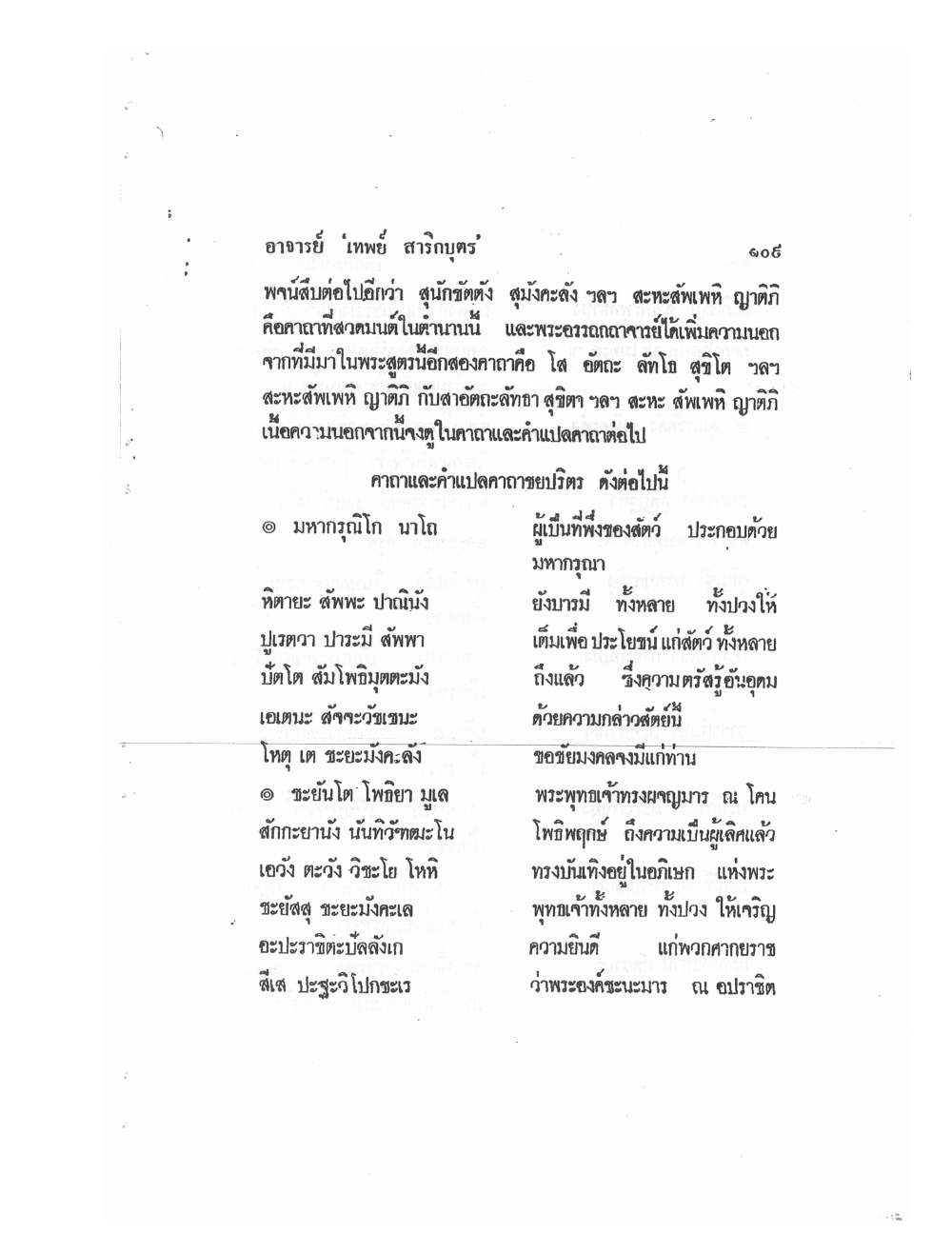
อาจารย์ เทพย์ สาริกบุตร ๑๐๙
พจน์สืบต่อไปอีกว่า สุนักขัตตัง สุมังคะลัง ฯลฯ สะหะสัพเพหิ ญาติภิ คือคาถาที่สวดมนต์ในตำนานนี้ และพระอรรถกถาจารย์ได้เพิ่มความนอก จากที่มีมาในพระสูตรนี้อีกสองคาถาคือ โส อัตถะ ลัทโธ สุขิโต ฯลฯ สะหะสัพเพหิ ญาติภิ กับสาอัตถะลัทธา สุขิตา ฯลฯ สะหะ สัพเพหิ ญาติภิ เนื้อความนอกจากนี้จงดูในคาถาและคำแปลคาถาต่อไป
คาถาและคำแปลคาถาชยปริตร ดังต่อไปนี้
๏ มหากรุณิโก นาโถ ผู้เป็นที่พึ่งของสัตว์ ประกอบด้วย มหากรุณา หิตายะ สัพพะ ปาณินัง ยังบารมี ทั้งหลาย ทั้งปวงให้ ปูเรตวา ปาระมี สัพพา เต็มเพื่อ ประโยชน์ แก่สัตว์ ทั้งหลาย ปัตโต สัมโพธิมุตตมัง ถึงแล้ว ซึ่งความตรัสรู้อันอุดม เอเตนะ สัจจะวัชเชนะ ด้วยความกล่าวสัตย์นี้ โหตุ เต ชะยะมังคะลัง ขอชัยมงคลจงมีแก่ท่าน
๏ ชะยันโต โพธิยา มูเล พระพุทธเจ้าทรงผจญมาร ณ โคน โพธิพฤกษ์ ถึงความเป็นผู้เลิศแล้ว สักกะยานัง นันทิวัฑฒะโน ทรงบันเทิงอยู่ในอภิเษก แห่งพระ เอวัง ตะวัง วิชะโย โหหิ พุทธเจ้าทั้งหลาย ทั้งปวง ให้เจริญ ชะยัสสุ ชะยะมังคะเล ความยินดี แก่พวกศากยราช อะปะราชิตะปัลลังเก ว่าพระองค์ชนะมาร ณ อปราชิต สีเส ปะฐะวิโปกขะเร
Teacher Thep Sarikabutr 109
Continuing further: 'Sunakkhattaṃ sumaṅgalaṃ... saha sabbehi ñātibhi' is the verse chanted in this tradition. The commentators (aṭṭhakathācariya) have added two further verses beyond what is found in the sutta, namely: 'So attha laddho sukhito... saha sabbehi ñātibhi' and 'Sā atthaladdhā sukhitā... saha sabbehi ñātibhi.' For the meaning beyond this, see the verse and translation that follow.
The verse and translation of the Jayaparitta are as follows:
'Mahākaruṇiko nātho' — He who is the refuge of beings, endowed with great compassion, 'hitāya sabba pāṇinaṃ' — for the welfare of all 'pūretvā pāramī sabbā' — living beings, having fulfilled all the perfections, 'patto sambodhimuttamaṃ' — has attained the supreme awakening, 'etena saccavajjena' — by the speaking of this truth, 'hotu te jayamaṅgalaṃ' — may victory and blessing be yours.
'Jayanto bodhiyā mūle' — The Buddha, having contended with Mara at the foot of the Bodhi tree, attained the state of the Foremost One, 'sakkayānaṃ nandivaḍḍhano' — rejoicing in the consecration of all 'evaṃ tvaṃ vijayo hohi' — the Buddhas, increasing the joy of 'jayassu jayamaṅgale' — the Sakya princes, [proclaiming] that he 'aparājitapallaṅke' — had conquered Mara upon the Unconquered Seat, 'sīse paṭhavipokkhare' — at the summit of the earth's surface.
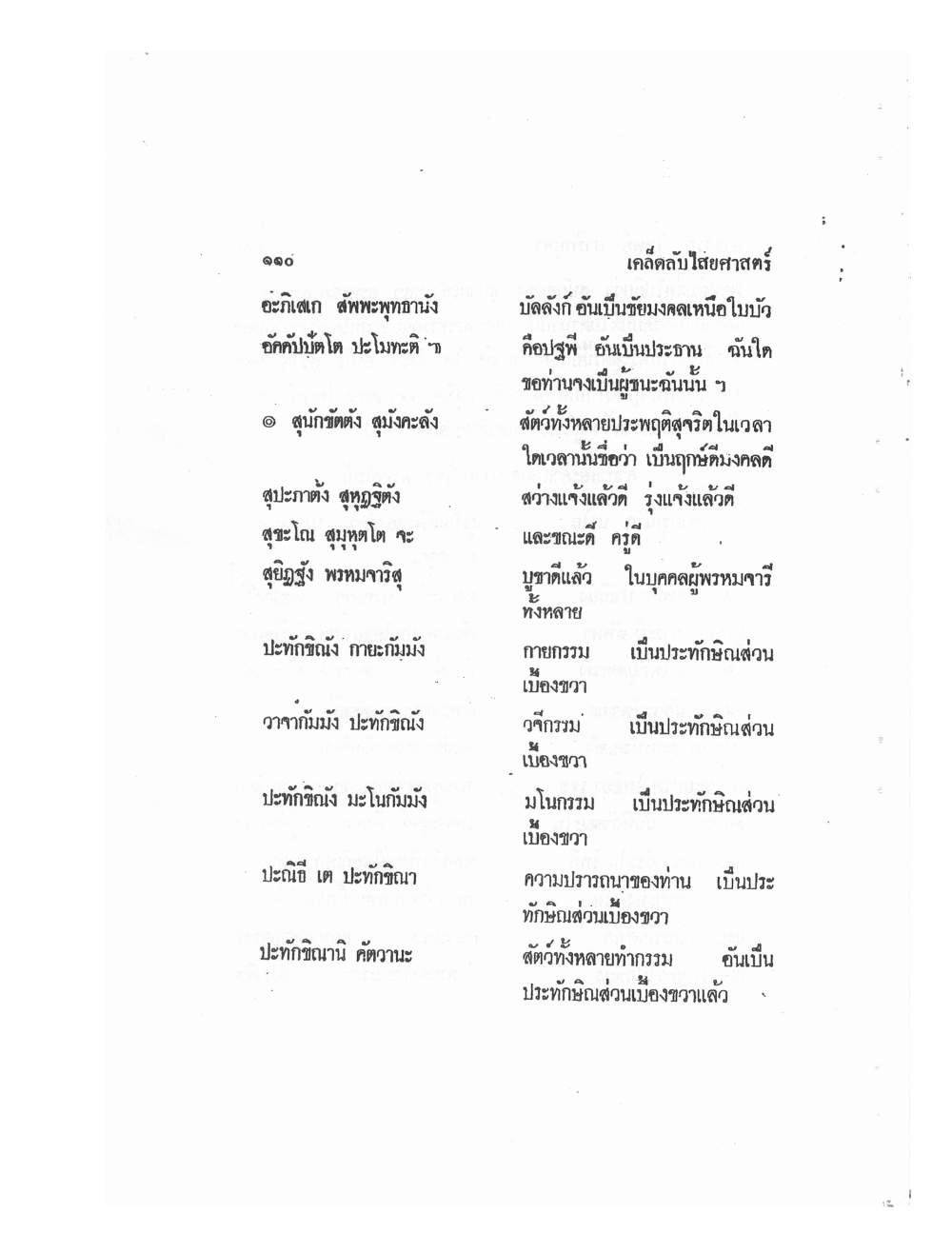
๑๑๐ เคล็ดลับไสยศาสตร์
อะภิเสเก สัพพะพุทธานัง บัลลังก์ อันเป็นชัยมงคลเหนือใบบัว อัคคัปปัตโต ปะโมทะติ ฯ คือปฐพี อันเป็นประธาน ฉันใด ขอท่านจงเป็นผู้ชนะฉันนั้น ฯ
๏ สุนักขัตตัง สุมังคะลัง สัตว์ทั้งหลายประพฤติสุจริตในเวลา ใดเวลานั้นชื่อว่า เป็นฤกษ์ดีมงคลดี
สุปะภาตัง สุหุฏฐิตัง สว่างแจ้งแล้วดี รุ่งแจ้งแล้วดี สุขะโณ สุมุหุตโต จะ และขณะดี ครู่ดี สุยิฏฐัง พรหมจาริสุ บูชาดีแล้ว ในบุคคลผู้พรหมจารี ทั้งหลาย
ปะทักขิณัง กายะกัมมัง กายกรรม เป็นประทักษิณส่วน เบื้องขวา
วาจากัมมัง ปะทักขิณัง วจีกรรม เป็นประทักษิณส่วน เบื้องขวา
ปะทักขิณัง มะโนกัมมัง มโนกรรม เป็นประทักษิณส่วน เบื้องขวา
ปะณิธี เต ปะทักขิณา ความปรารถนาของท่าน เป็นประ ทักษิณส่วนเบื้องขวา
ปะทักขิณานิ กัตวานะ สัตว์ทั้งหลายทำกรรม อันเป็น ประทักษิณส่วนเบื้องขวาแล้ว
110 Secrets of Saiyasat
'Abhiseke sabbabuddhānaṃ' — Just as the throne that is the blessing 'aggappatto pamodati' — of victory above the lotus leaf, that is, the earth, is the foremost support, so may you too be victorious.
'Sunakkhattaṃ sumaṅgalaṃ' — Whatever time beings conduct themselves rightly, that time is called a good and auspicious constellation.
'Supabhātaṃ suhuṭṭhitaṃ' — Well dawned, well arisen indeed, 'sukkhaṇo sumuhutto ca' — a good instant, a good moment, 'suyiṭṭhaṃ brahmacārisu' — a good offering well made among those who live the holy life.
'Padakkhiṇaṃ kāyakammaṃ' — Bodily action that is a rightward circumambulation (auspicious),
'vācākammaṃ padakkhiṇaṃ' — verbal action that is a rightward circumambulation,
'padakkhiṇaṃ manokammaṃ' — mental action that is a rightward circumambulation,
'paṇidhī te padakkhiṇā' — your aspiration is a rightward circumambulation,
'padakkhiṇāni katvāna' — beings, having performed these actions that are a rightward circumambulation...
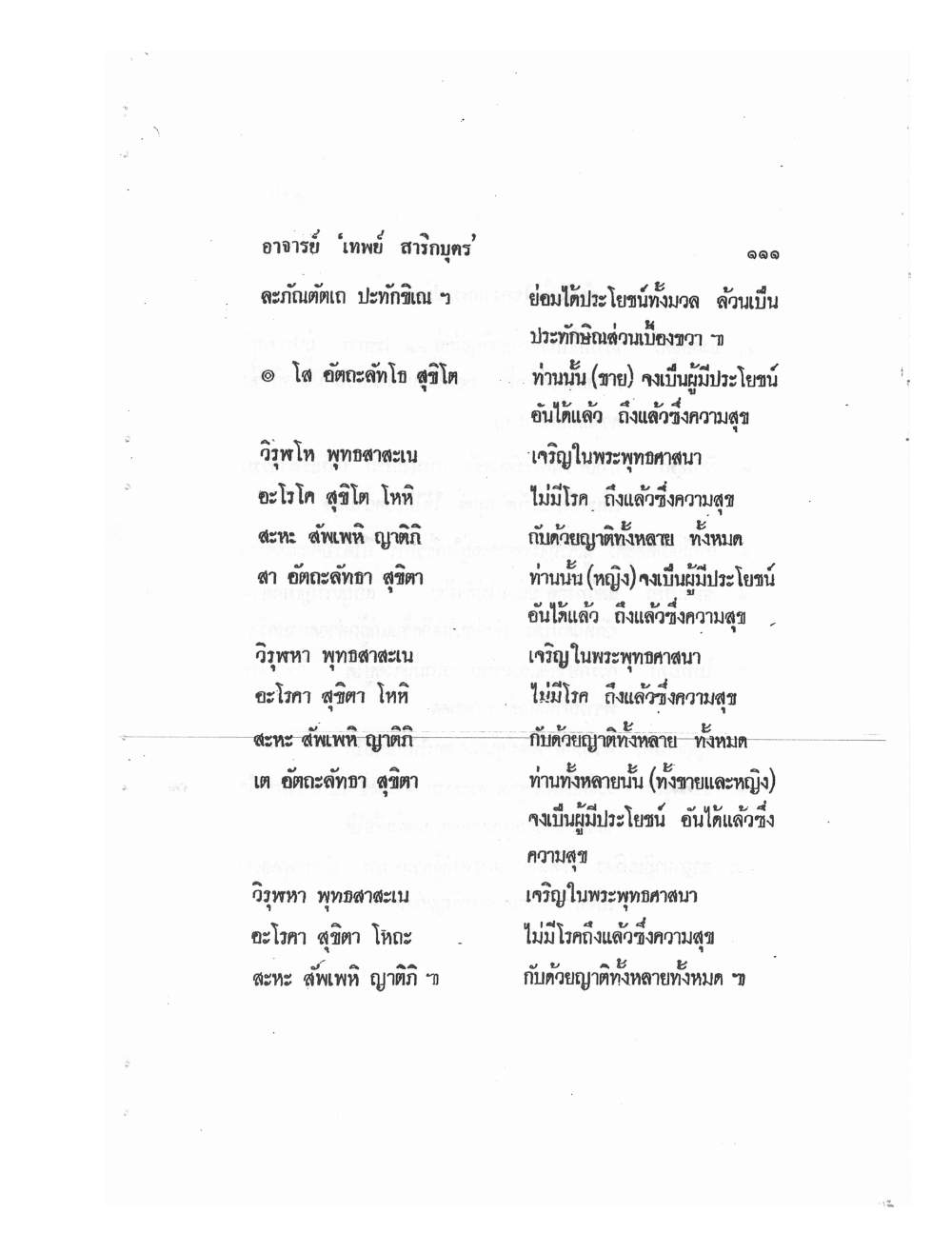
อาจารย์ เทพย์ สาริกบุตร ๑๑๑
ละภันตัตเถ ปะทักขิณา ฯ ย่อมได้ประโยชน์ทั้งมวล ล้วนเป็น ประทักษิณส่วนเบื้องขวา ฯ
๏ โส อัตถะลัทโธ สุขิโต ท่านนั้น (ชาย) จงเป็นผู้มีประโยชน์ อันได้แล้ว ถึงแล้วซึ่งความสุข
วิรุฬโห พุทธสาสะเน เจริญในพระพุทธศาสนา อะโรโค สุขิโต โหหิ ไม่มีโรค ถึงแล้วซึ่งความสุข สะหะ สัพเพหิ ญาติภิ กับด้วยญาติทั้งหลาย ทั้งหมด
สา อัตถะลัทธา สุขิตา ท่านนั้น (หญิง) จงเป็นผู้มีประโยชน์ อันได้แล้ว ถึงแล้วซึ่งความสุข
วิรุฬหา พุทธสาสะเน เจริญในพระพุทธศาสนา อะโรคา สุขิตา โหหิ ไม่มีโรค ถึงแล้วซึ่งความสุข สะหะ สัพเพหิ ญาติภิ กับด้วยญาติทั้งหลาย ทั้งหมด
เต อัตถะลัทธา สุขิตา ท่านทั้งหลายนั้น (ทั้งชายและหญิง) จงเป็นผู้มีประโยชน์ อันได้แล้วซึ่ง ความสุข
วิรุฬหา พุทธสาสะเน เจริญในพระพุทธศาสนา อะโรคา สุขิตา โหถะ ไม่มีโรคถึงแล้วซึ่งความสุข สะหะ สัพเพหิ ญาติภิ ฯ กับด้วยญาติทั้งหลายทั้งหมด ฯ
Teacher Thep Sarikabutr 111
'Labhantatthe padakkhiṇā' — [Beings] gain all benefit, which are all a rightward circumambulation.
'So atthaladdho sukhito' — May he (male) be one who has gained benefit, who has attained happiness,
'viruḷho buddhasāsane' — who prospers in the Buddha's teaching, 'aroko sukhito hohi' — may he be free of illness, may he attain happiness, 'saha sabbehi ñātibhi' — together with all his relatives.
'Sā atthaladdhā sukhitā' — May she (female) be one who has gained benefit, who has attained happiness,
'viruḷhā buddhasāsane' — who prospers in the Buddha's teaching, 'arogā sukhitā hohi' — may she be free of illness, may she attain happiness, 'saha sabbehi ñātibhi' — together with all her relatives.
'Te atthaladdhā sukhitā' — May they (both male and female) be those who have gained benefit and attained happiness,
'viruḷhā buddhasāsane' — who prosper in the Buddha's teaching, 'arogā sukhitā hotha' — may they be free of illness, may they attain happiness, 'saha sabbehi ñātibhi' — together with all their relatives.
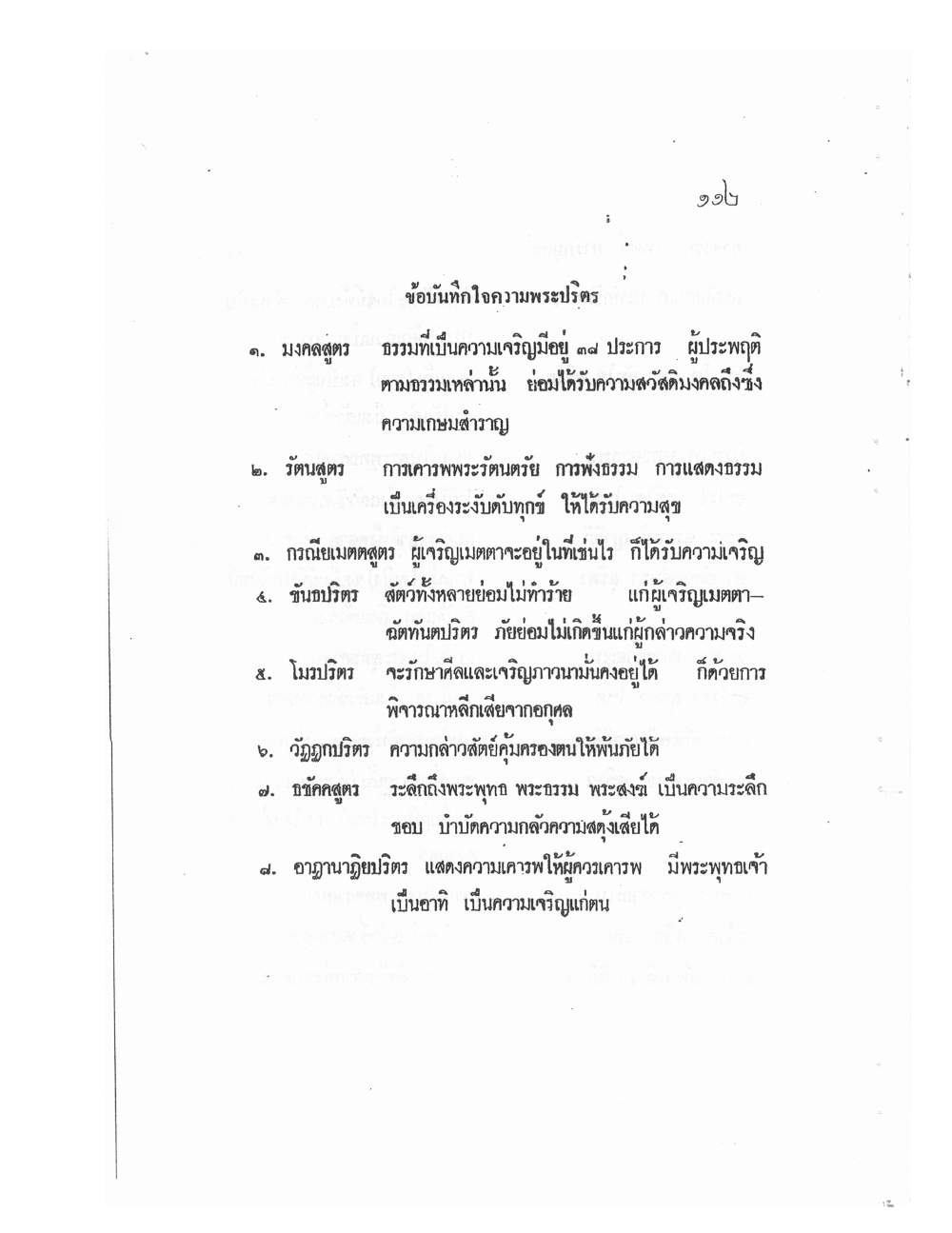
๑๑๒ เคล็ดลับไสยศาสตร์
ข้อบันทึกใจความพระปริตร
๑. มงคลสูตร ธรรมที่เป็นความเจริญมีอยู่ ๓๘ ประการ ผู้ประพฤติ ตามธรรมเหล่านั้น ย่อมได้รับความสวัสดิมงคลถึงซึ่ง ความเกษมสำราญ
๒. รัตนสูตร การเคารพพระรัตนตรัย การฟังธรรม การแสดงธรรม เป็นเครื่องระงับดับทุกข์ ให้ได้รับความสุข
๓. กรณียเมตตสูตร ผู้เจริญเมตตาจะอยู่ในที่เช่นไร ก็ได้รับความเจริญ ๔. ขันธปริตร สัตว์ทั้งหลายย่อมไม่ทำร้าย แก่ผู้เจริญเมตตา — ฉัททันตปริตร ภัยย่อมไม่เกิดขึ้นแก่ผู้กล่าวความจริง ๕. โมรปริตร จะรักษาศีลและเจริญภาวนามั่นคงอยู่ได้ ก็ด้วยการ พิจารณาหลีกเสียจากอกุศล ๖. วัฏฏกปริตร ความกล่าวสัตย์คุ้มครองตนให้พ้นภัยได้ ๗. ธชัคคสูตร ระลึกถึงพระพุทธ พระธรรม พระสงฆ์ เป็นความระลึก ชอบ บำบัดความกลัวความสะดุ้งเสียได้ ๘. อาฏานาฏิยปริตร แสดงความเคารพให้ผู้ควรเคารพ มีพระพุทธเจ้า เป็นอาทิ เป็นความเจริญแก่ตน
112 Secrets of Saiyasat
Notes on the meaning of the parittas
1. Maṅgala Sutta — There are 38 qualities that constitute prosperity. Whoever practices in accordance with these teachings will receive blessed prosperity and attain ease and happiness.
2. Ratana Sutta — Respecting the Triple Gem, listening to the Dhamma, and expounding the Dhamma serve to quell and extinguish suffering, bringing about happiness.
3. Karaṇīyametta Sutta — One who cultivates loving-kindness will find prosperity wherever they dwell.
4. Khandha Paritta — Creatures will not harm one who cultivates loving-kindness — Chaddanta Paritta — danger does not arise for one who speaks the truth.
5. Mora Paritta — One is able to keep the precepts and steadily develop meditation practice through reflecting on and avoiding what is unwholesome.
6. Vaṭṭaka Paritta — Speaking truthfully protects oneself from danger.
7. Dhajagga Sutta — Recollecting the Buddha, the Dhamma, and the Sangha is right recollection, which dispels fear and anxiety.
8. Āṭānāṭiya Paritta — Showing respect to those worthy of respect, with the Buddha foremost among them, brings about one's own prosperity.
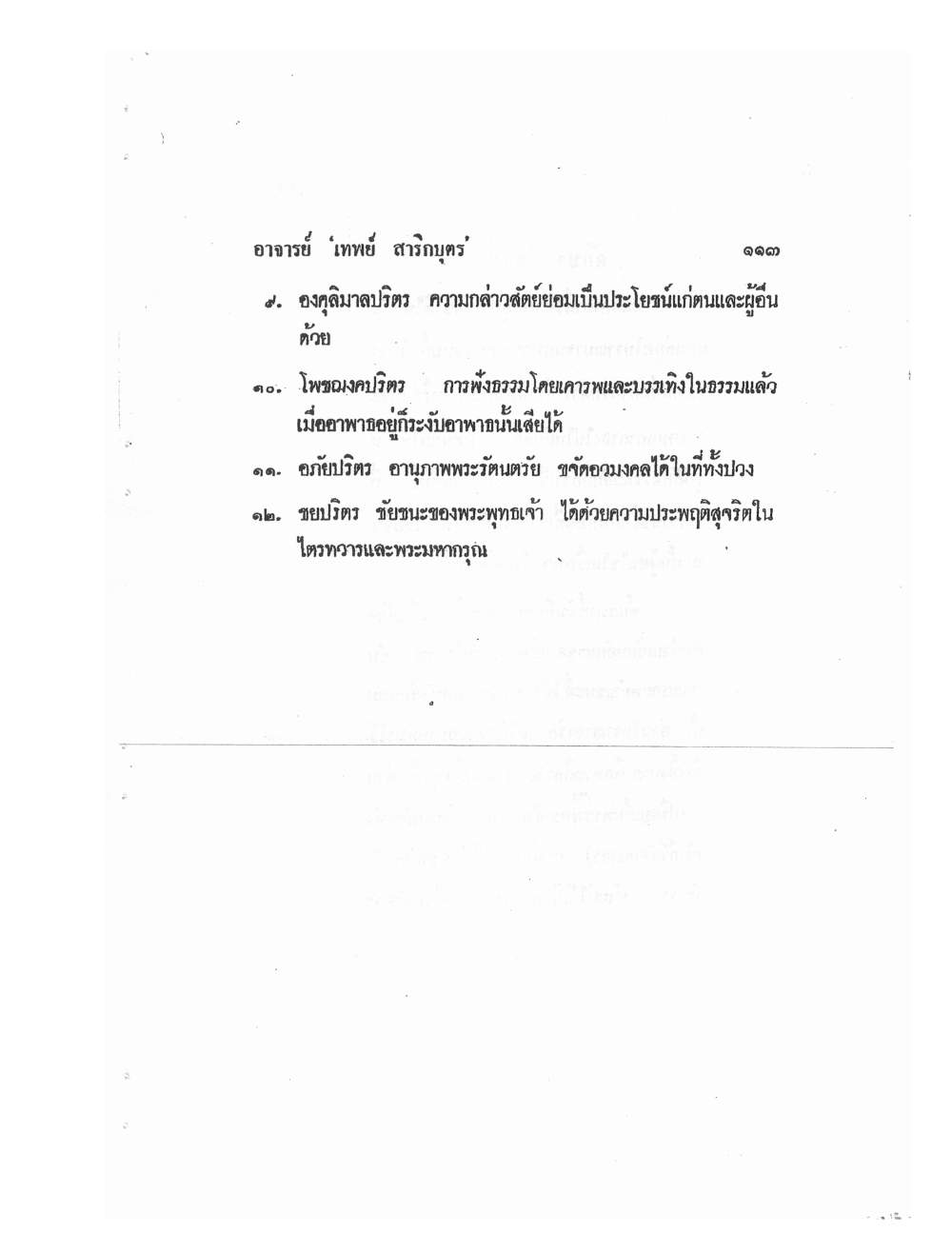
อาจารย์ เทพย์ สาริกบุตร ๑๑๓
๙. องคุลิมาลปริตร ความกล่าวสัตย์ย่อมเป็นประโยชน์แก่ตนและผู้อื่น ด้วย
๑๐. โพชฌงคปริตร การฟังธรรมโดยเคารพและบรรเทิงในธรรมแล้ว เมื่ออาพาธอยู่ก็ระงับอาพาธนั้นเสียได้
๑๑. อภัยปริตร อานุภาพพระรัตนตรัย ขจัดอวมงคลได้ในที่ทั้งปวง
๑๒. ชยปริตร ชัยชนะของพระพุทธเจ้า ได้ด้วยความประพฤติสุจริตใน ไตรทวารและพระมหากรุณ
Teacher Thep Sarikabutr 113
9. Aṅgulimāla Paritta — Speaking the truth is of benefit both to oneself and to others.
10. Bojjhaṅga Paritta — Listening to the Dhamma with respect and taking delight in it can, when one is ill, bring relief from that illness.
11. Abhaya Paritta — The power of the Triple Gem dispels inauspiciousness everywhere.
12. Jaya Paritta — The Buddha's victory was won through right conduct in the three doors [of body, speech, and mind] and through great compassion.
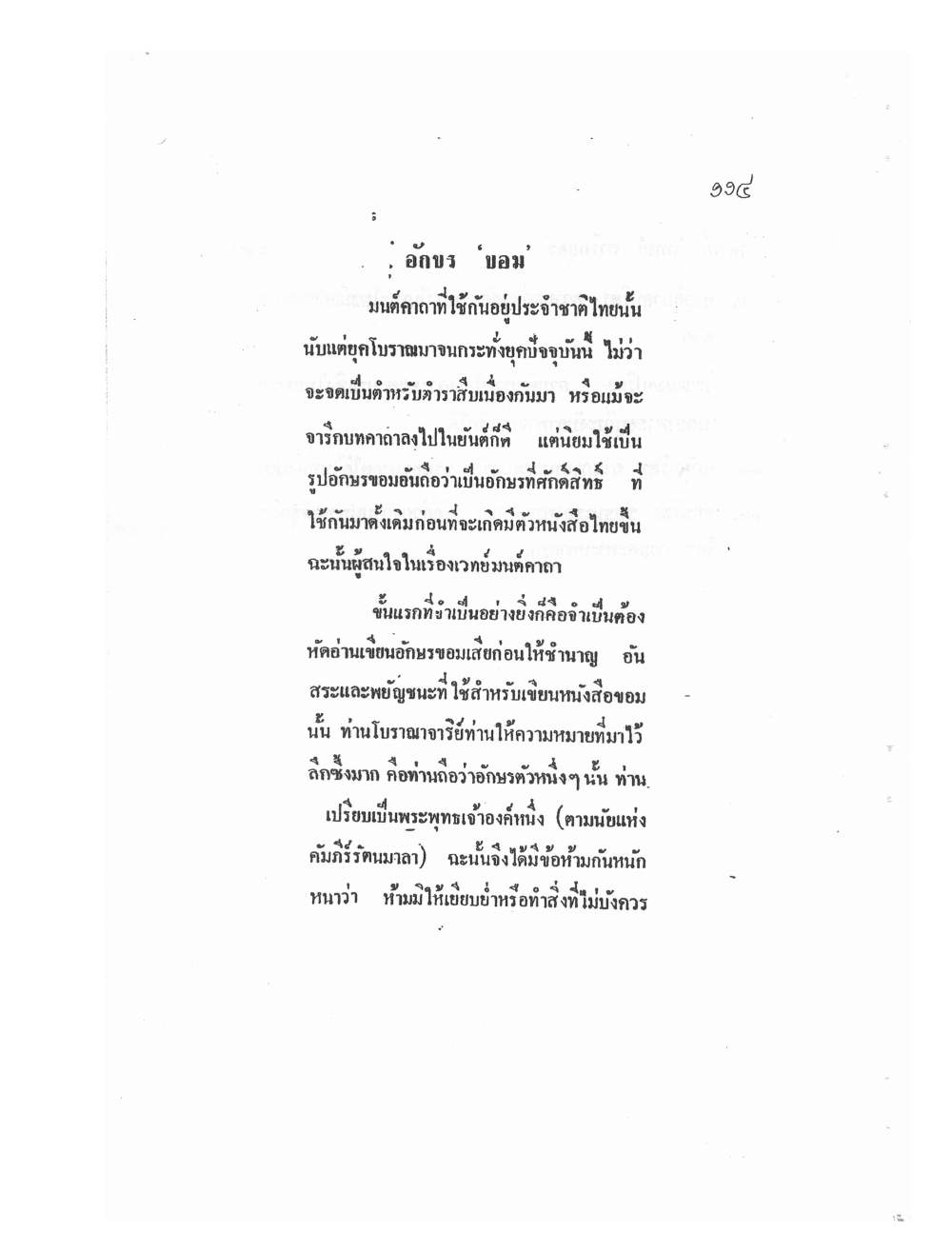
๑๑๔
อักษร 'ขอม'
มนต์คาถาที่ใช้กันอยู่ประจำชาติไทยนั้น นับแต่ยุคโบราณมาจนกระทั่งยุคปัจจุบันนี้ ไม่ว่า จะจดเป็นตำรับตำราสืบเมืองกันมา หรือแม้จะ จารึกบทคาถาลงไปในยันต์กีดี แต่นิยมใช้เป็น รูปอักษรขอมอันถือว่าเป็นอักษรที่ศักดิ์สิทธิ์ ที่ ใช้กันมาตั้งเดิมก่อนที่จะเกิดมีตัวหนังสือไทยขึ้น ฉะนั้นผู้สนใจในเรื่องเวทย์มนต์คาถา
ขั้นแรกที่จะเป็นอย่างยิ่งก็คือจำเป็นต้อง หัดอ่านเขียนอักษรขอมเสียก่อนให้ชำนาญ อัน สระและพยัญชนะที่ใช้สำหรับเขียนหนังสือขอม นั้น ท่านโบราณาจารย์ท่านให้ความหมายที่มาไว้ ลึกซึ้งมาก คือท่านถือว่าอักษรตัวหนึ่งๆนั้น ท่าน เปรียบเป็นพระพุทธเจ้าองค์หนึ่ง (ตามนัยแห่ง คัมภีร์รัตนมาลา) ฉะนั้นจึงได้มีข้อห้ามกันหนัก หนาว่า ห้ามมิให้เหยียบย่ำหรือทำสิ่งที่ไม่บังควร
114
The 'Khom' Script
As for the mantras and sacred verses that have been used throughout the Thai nation, from ancient times right up to the present era — whether recorded in textbooks handed down through the kingdom, or inscribed as verses upon yantra [diagrams] — it has been customary to use the Khom script, which is regarded as a sacred script that was used from the very beginning, before Thai script came into being. Therefore, for those interested in the matter of sacred mantras and spells —
the very first and most essential step is that one must practice reading and writing the Khom script until proficient. As for the vowels and consonants used for writing in Khom, the ancient teachers gave them a very profound significance: they held that each single letter was to be regarded as one Buddha (according to the sense given in the Ratanamālā scripture). For this reason there arose a strict prohibition: one must not tread upon or treat improperly [anything bearing such letters]...
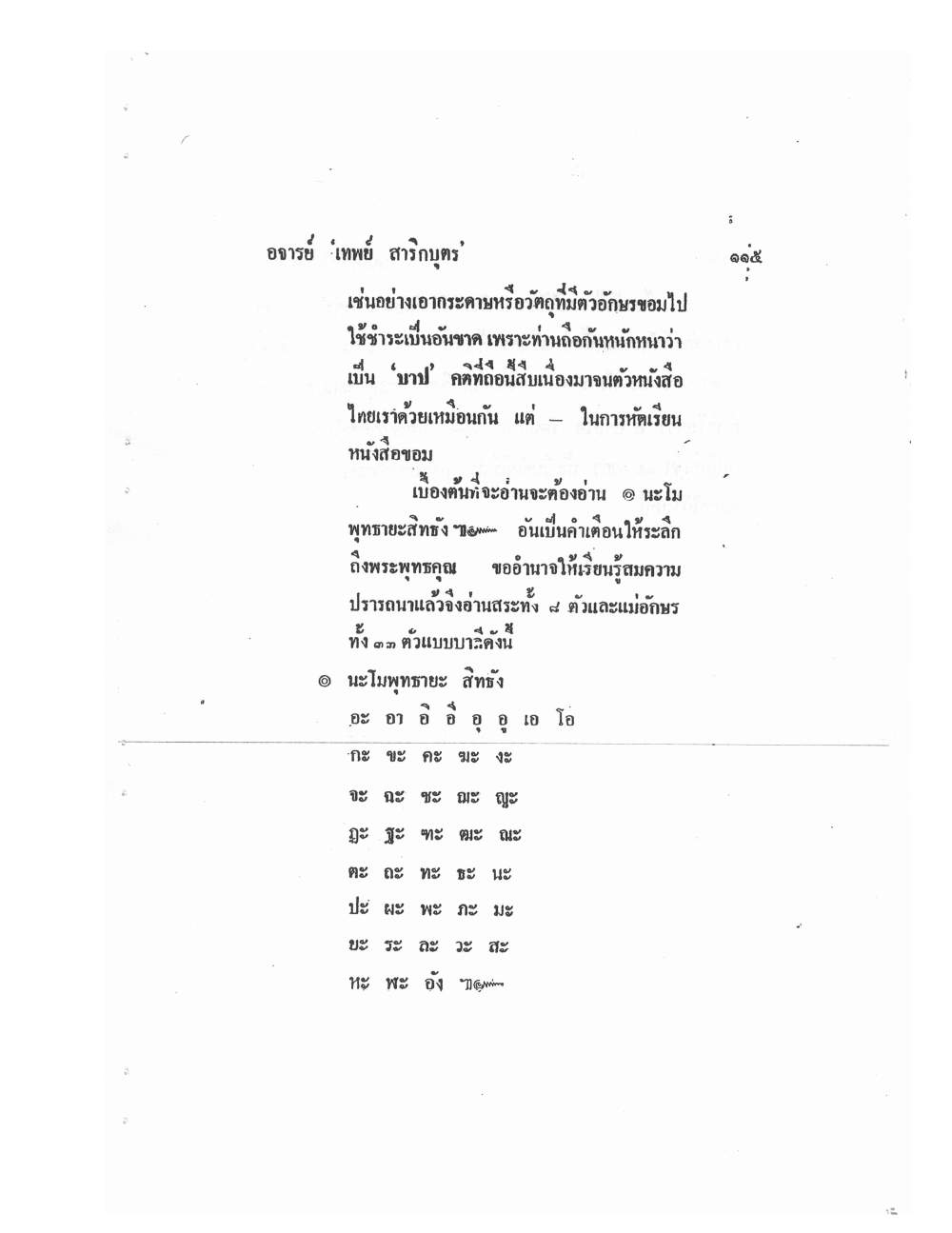
อาจารย์ เทพย์ สาริกบุตร ๑๑๕
เช่นอย่างเอากระดาษหรือวัตถุที่มีตัวอักษรขอมไป ใช้ชำระเป็นอันขาด เพราะท่านถือกันหนักหนาว่า เป็น 'บาป' คิดถือกันสืบเนื่องมาจนตัวหนังสือ ไทยเราด้วยเหมือนกัน แต่ — ในการหัดเรียน หนังสือขอม
เบื้องต้นที่จะอ่านจะต้องอ่าน ๏ นะโม พุทธายะสิทธัง ฯลฯ อันเป็นคำเตือนให้ระลึก ถึงพระพุทธคุณ ขออำนาจให้เรียนรู้สมความ ปรารถนาแล้วจึงอ่านสระทั้ง ๘ ตัวและแม่อักษร ทั้ง ๓๓ ตัวแบบบาลีดังนี้
๏ นะโมพุทธายะ สิทธัง
อะ อา อิ อี อุ อู เอ โอ
กะ ขะ คะ ฆะ งะ จะ ฉะ ชะ ฌะ ญะ ฏะ ฐะ ฑะ ฒะ ณะ ตะ ถะ ทะ ธะ นะ ปะ ผะ พะ ภะ มะ ยะ ระ ละ วะ สะ หะ พะ อัง ฯลฯ
Teacher Thep Sarikabutr 115
...for instance, using paper or an object bearing Khom letters for wiping oneself clean is absolutely forbidden, because it is held to be a very grave 'sin.' This belief has continued down to apply to Thai script as well. However — in the practice of learning to read Khom script,
the very first thing that must be read is: 'Namo Buddhāya siddhaṃ...' — this being words that serve as a reminder to recollect the virtues of the Buddha, requesting the power to learn successfully according to one's wish. After that, one reads the eight vowels and the thirty-three consonant letters in the Pali manner, as follows:
'Namo Buddhāya Siddhaṃ'
a, ā, i, ī, u, ū, e, o
ka, kha, kha, gha, nga ca, cha, cha, jha, nya ṭa, ṭha, ḍa, ḍha, ṇa ta, tha, da, dha, na pa, pha, ba, bha, ma ya, ra, la, wa, sa ha, ba/pha, ang, etc.
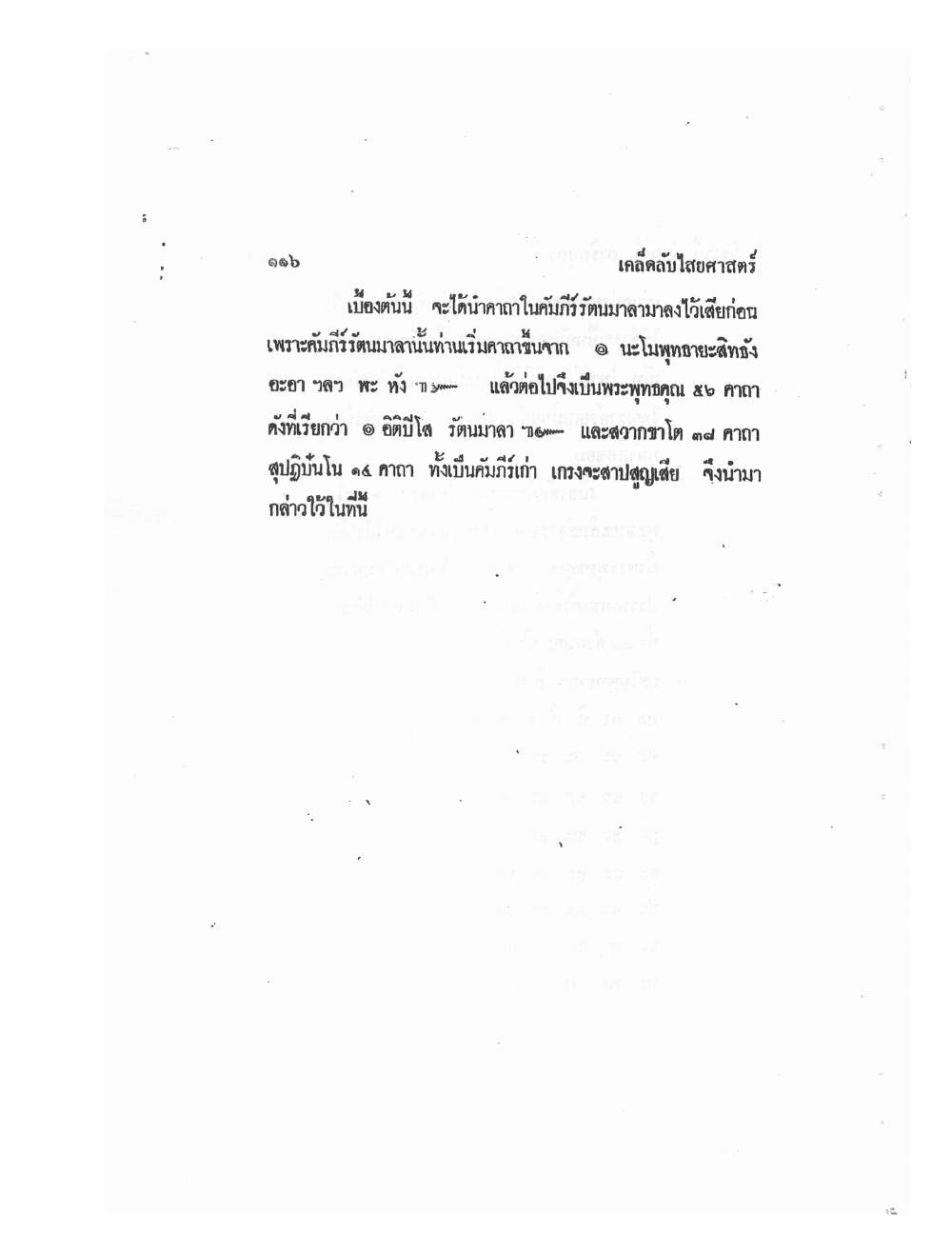
๑๑๖ เคล็ดลับไสยศาสตร์
เบื้องต้นนี้ จะได้นำคาถาในคัมภีร์รัตนมาลามาลงไว้เสียก่อน เพราะคัมภีร์รัตนมาลานั้นท่านเริ่มคาถาขึ้นจาก ๏ นะโมพุทธายะสิทธัง อะอา ฯลฯ พะ หัง ฯลฯ แล้วต่อไปจึงเป็นพระพุทธคุณ ๕๖ คาถา ดังที่เรียกว่า ๏ อิติปิโส รัตนมาลา ๒๖ ฯลฯ และสวากขาโต ๓๘ คาถา สุปฏิปันโน ๑๕ คาถา ทั้งเป็นคัมภีร์เก่า เกรงจะสาปสูญเสีย จึงนำมา กล่าวไว้ในที่นี้
116 Secrets of Saiyasat
At the outset, the verses from the Ratanamālā scripture will first be set down here, because the Ratanamālā scripture begins its verses from 'Namo Buddhāya siddhaṃ, a, ā... ba, haṃ...' and thereafter come the fifty-six verses of the Buddha's virtues, known as 'Itipiso Ratanamālā' [26 verses], followed by 'Svākkhāto' [38 verses] and 'Supaṭipanno' [15 verses]. As this is an old scripture at risk of being lost, it has been brought and set down here.
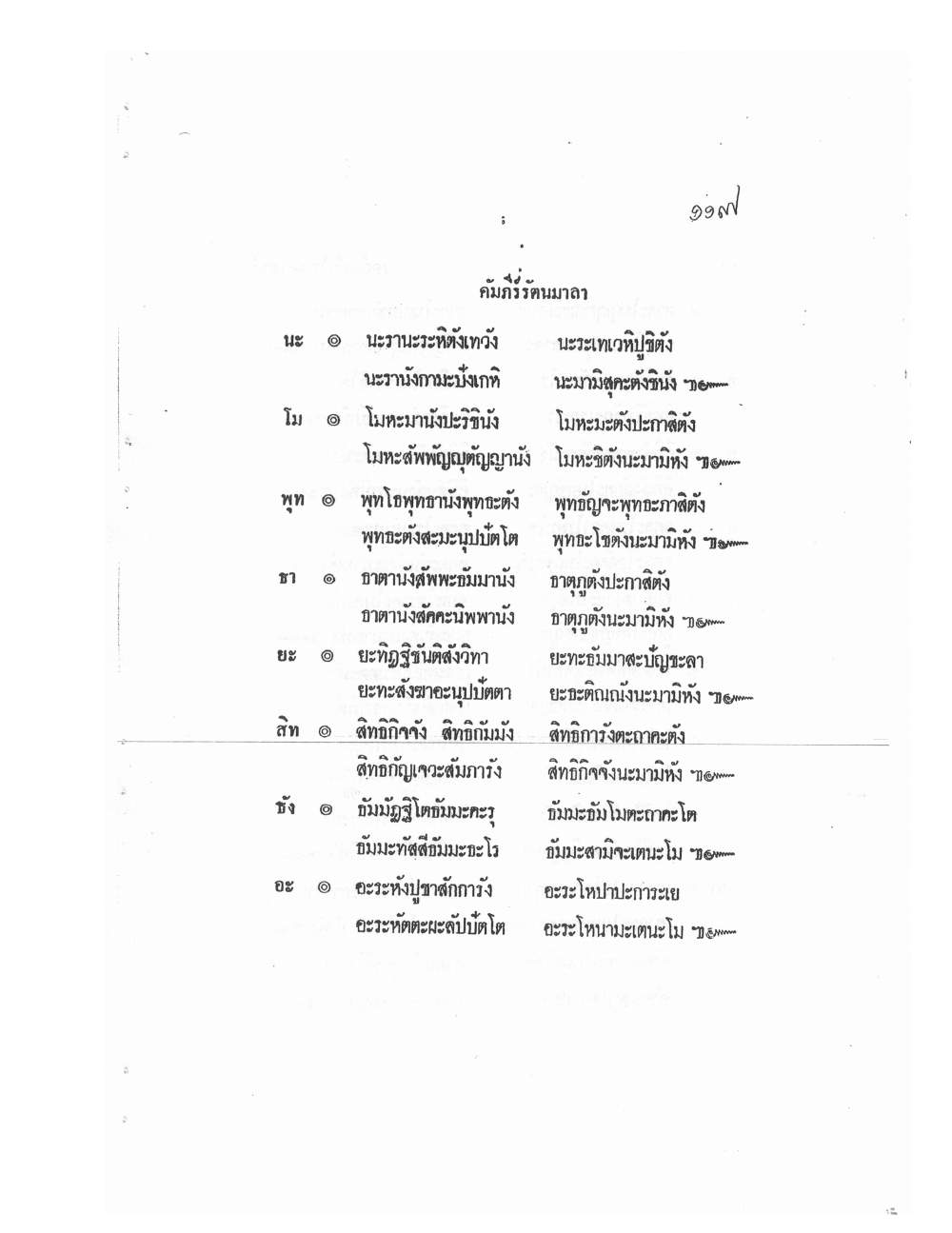
คัมภีร์รัตนมาลา
นะ ◎ นะรานระหิตังเทวัง นะระเทเวหิปูชิตัง นะรานังกามะบังเกิด นะมามิสุคะตังชินัง ๚
โม ◎ โมหะมานังปะริชินัง โมหะมะตังปะกาสิตัง โมหะสัพพัญญุตัญญานัง โมหะขิตังนะมามิหัง ๚
พุท ◎ พุทโธพุทธานังพุทธะตัง พุทธัญจะพุทธะภาสิตัง พุทธะตังสะมะนุปปัตโต พุทธะโชตังนะมามิหัง ๚
ธา ◎ ธาตานังสัพพะธัมมานัง ธาตุภูตังปะกาสิตัง ธาตานังสัคคะนิพพานัง ธาตุภูตังนะมามิหัง ๚
ยะ ◎ ยะทิฏฐิชันติสังวิทา ยะทะธัมมาสะบัญชะลา ยะทะสังฆาอะนุปัตตา ยะธะติณังนะมามิหัง ๚
สิท ◎ สิทธิกิจจัง สิทธิกัมมัง สิทธิการังตะถาคะตัง สิทธิกัญเจวะสัมภารัง สิทธิกิจจังนะมามิหัง ๚
ธัง ◎ ธัมมัฏฐิโตธัมมะคะรุ ธัมมะธัมโมตะถาคะโต ธัมมะทัสสีธัมมะจะโร ธัมมะสามิจะเตนะโม ๚
อะ ◎ อะระหังปูชาสักการัง อะระโหปาปะการะเย อะระหัตตะผะลัปปัตโต อะระโหนามะเตนะโม ๚
The Ratanamala Scripture ("Garland of Jewels")
This page opens a table of Pali mnemonic verses (a genre sometimes called a "heart" or hua-jai formula), each keyed to one syllable of the base invocation Namo Buddhaya + Siddhi..., marked by a ◎ (bindu) sign, and printed as two couplets that close on a repeating refrain of homage (namāmi/namo — "I pay homage to"). A faint, illegible ghost of text from the facing page shows through beneath the title; it is not transcribed as it is not this page's own content.
นะ: a verse chaining words on the sound "na," praising a god who benefits and is honored by both men and gods, closing "I pay homage to the Well-Gone One (Sugata), the Victor (Jina)."
โม: a "mo"-verse on delusion (moha) being cut off, ended, and destroyed through all-knowing wisdom (sabbaññutañāṇa) — "I pay homage to that."
พุท: a "buddha"-verse praising the Buddha, Buddhahood, and what the Buddha spoke, closing "I pay homage to the Buddha's radiance."
ธา: a "dhātu/element"-verse on the elemental nature of all phenomena, heaven, and Nibbana — "I pay homage to that elemental nature."
ยะ: a "ya"-verse on right view, the Dhamma revered with joined palms, and the Sangha attained — "I pay homage to that."
สิท: the well-known "siddhi" (accomplishment) verse — accomplished task, accomplished deed, the Tathagata who accomplishes, accomplished requisites — "I pay homage to the accomplished task."
ธัง: a verse on one established in and revering the Dhamma, the Tathagata who is the Dhamma itself, who sees and practises the Dhamma — "homage to you, Lord of the Dhamma."
อะ: a verse on the Arahant worthy of worship and honor, who has overcome evil, attained the fruit of Arahantship — "homage to you named Arahant."
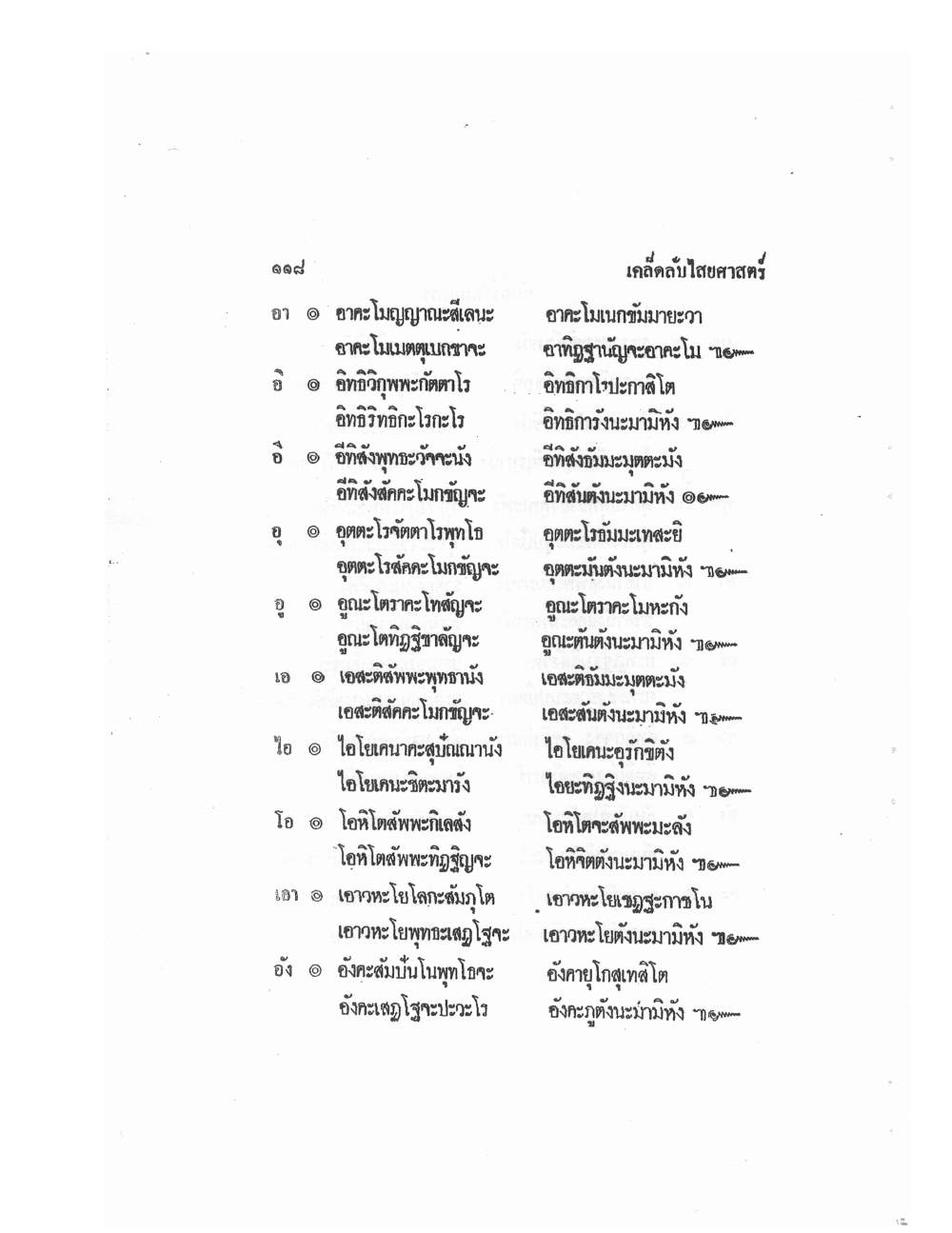
๑๑๘ เคล็ดลับไสยศาสตร์
อา ◎ อาคะโมญญาณะสีเลนะ อาคะโมเนกขัมมายะวา อาคะโมเมตตุเบกขาจะ อาทิฏฐานัญจะอาคะโม ๚
อิ ◎ อิทธิวิกุพพะกัตตาโร อิทธิกาโรปะกาสิโต อิทธิริทธิกะโรกะโร อิทธิการังนะมามิหัง ๚
อี ◎ อีทิสังพุทธะวัจจะนัง อีทิสังธัมมะมุตตะมัง อีทิสังสัคคะโมกขัญจะ อีทิสันตังนะมามิหัง ๚
อุ ◎ อุตตะโรจัตตาโรพุทโธ อุตตะโรธัมมะเทสะยิ อุตตะโรสัคคะโมกขัญจะ อุตตะมันตังนะมามิหัง ๚
อู ◎ อูณะโตราคะโทสัญจะ อูณะโตราคะโมหะกัง อูณะโตทิฏฐาชาลัญจะ อูณะตันตังนะมามิหัง ๚
เอ ◎ เอสะติสัพพะพุทธานัง เอสะติธัมมะมุตตะมัง เอสะติสัคคะโมกขัญจะ เอสะสันตังนะมามิหัง ๚
ไอ ◎ ไอโยเคนาคะสุบัณณานัง ไอโยเคนะอุรักขิตัง ไอโยเคนะชิตะมารัง ไอยะทิฏฐิงนะมามิหัง ๚
โอ ◎ โอหิโตสัพพะกิเลสัง โอหิโตจะสัพพะมะลัง โอหิโตสัพพะทิฏฐิญจะ โอหิจิตังนะมามิหัง ๚
เอา ◎ เอาวะโหยโลกะสัมภูโต เอาวะโหยเชฏฐะกาชิโน เอาวะโหยพุทธะเสฏโฐจะ เอาวะโหยตังนะมามิหัง ๚
อัง ◎ อังคะสัมบันโนพุทโธจะ อังคายุโกสุเทสิโต อังคะเสฏโฐจะปะวะโร อังคะภูตังนะมามิหัง ๚
Page 118 (running head: "Secrets of Saiyasat"). The table continues, now working through the ten Thai vowels as seed sounds for the same style of verse.
อา: knowledge born of virtue, of renunciation, of loving-kindness and equanimity — "thus comes firm resolve."
อิ: on the doers of psychic power (iddhi) and the power of iddhi itself, proclaimed and accomplished — "I pay homage to the power of iddhi."
อี: "such is the Buddha's word, such is the supreme Dhamma, such is heaven and liberation" — "I pay homage to such qualities."
อุ: the supreme Buddha who taught the Dhamma leading to heaven and liberation — "I pay homage to that supreme one."
อู: freedom from desire, aversion, and delusion, freedom from wrong views and entanglement — "I pay homage to that freedom."
เอ: seeking all the Buddhas, the supreme Dhamma, heaven and liberation — "I pay homage to that peaceful seeking."
ไอ: union [with protective naga/garuda power], protecting the body, conquering Mara — "I pay homage to that right view."
โอ: removed from all defilement, all impurity, all wrong view — "I pay homage to that removed mind."
เอา: arisen for the world's sake, as the foremost Victor, as the supreme Buddha — "I pay homage to that arising."
อัง: endowed with excellent qualities, the Buddha, whose life and teaching are excellent and supreme — "I pay homage to that embodiment of excellent qualities."
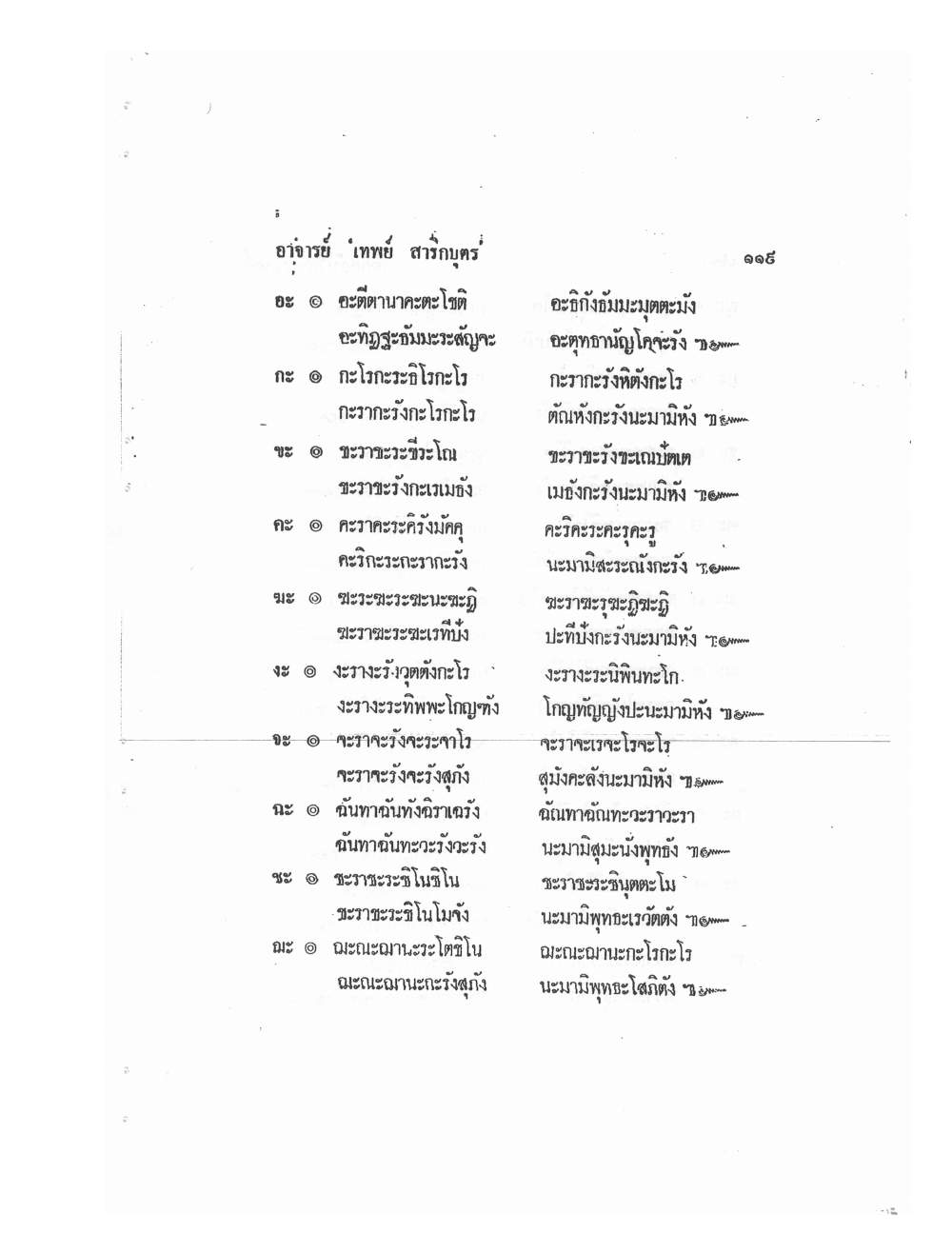
อาจารย์ เทพย์ สาริกบุตร ๑๑๙
อะ ◎ อะตีตานาคะตะโชติ อะทิฏฐะธัมมะระสัญจะ อะทิฏฐะธัมมะระสัญจะ อะตุทธานัญโคะรัง ๚
กะ ◎ กะโรกะระธิโรกะโร กะรากะรังหิตังกะโร กะรากะรังกะโรกะโร ตัณหังกะรังนะมามิหัง ๚
ขะ ◎ ขะราขะระขีวะโถ ขะราขะรังขะเถบัตเต ขะราขะรังกะเรเมธัง เมธังกะรังนะมามิหัง ๚
คะ ◎ คะราคะระคิวังมัคคุ คะริคะระคะรุคะรู คะริกะระกะรากะรัง นะมามิสะระณังกะรัง ๚
ฆะ ◎ ฆะราฆะระฆะนะฆะฏิ ฆะราฆะระฆะเรทีบัง ปะทีบังกะรังนะมามิหัง ๚
งะ ◎ งะรางะรังวุตตังกะโร งะรางะระนิพินทะโก งะรางะระทิพพะโกญตัง โกญทัญญังปะนะมามิหัง ๚
จะ ◎ จะราจะรังจะระจาโร จะราจะเรจะโรจะโร จะราจะรังจะรังสุภัง สุมังคะลังนะมามิหัง ๚
ฉะ ◎ ฉันทาฉันทังฉิราเฉรัง ฉันทาฉันทะวะราวะรา ฉันทาฉันทะวะรังวะรัง นะมามิสุมะนังพุทธัง ๚
ชะ ◎ ชะราชะระชิโนชิโน ชะราชะระชินุตตะโม ชะราชะระชิโนโมจัง นะมามิพุทธะเรวัตตัง ๚
ฌะ ◎ ฌะณะฌานะระโตชิโน ฌะณะฌานะกะโรกะโร ฌะณะฌานะกะรังสุภัง นะมามิพุทธะโสภิตัง ๚
Running head: "Achan Thep Sarikabutr" (the author). Page 119. The table now works through the ก-class and จ-class Thai consonants (ก ข ค ฆ ง / จ ฉ ช ฌ), each seed letter given the same two-couplet treatment.
อะ: a verse on things past, future, and shining, on the unseen nature of the Dhamma [partly indistinct].
กะ, ขะ, คะ, ฆะ, งะ, จะ, ฉะ, ชะ, ฌะ: each entry is an alliterative chain of syllables built on its seed consonant's sound rather than an ordinary Pali sentence, closing with the standard refrain "I pay homage to..." — the closing epithets that are recognizable name: a refuge/protector (สะระณัง, "kā, refuge"), a lamp (ปะทีบัง, "lamp-maker"), auspiciousness (สุมังคะลัง), a gladdened mind and the Buddha (สุมะนัง พุทธัง), the Buddha radiant/transcendent (พุทธะเรวัตตัง), and the Buddha resplendent (พุทธะโสภิตัง). The bodies of these verses are sound-play on their initial letter in the style of a hua-jai (heart-mantra) mnemonic and are not rendered as literal prose to avoid inventing meaning not actually present.
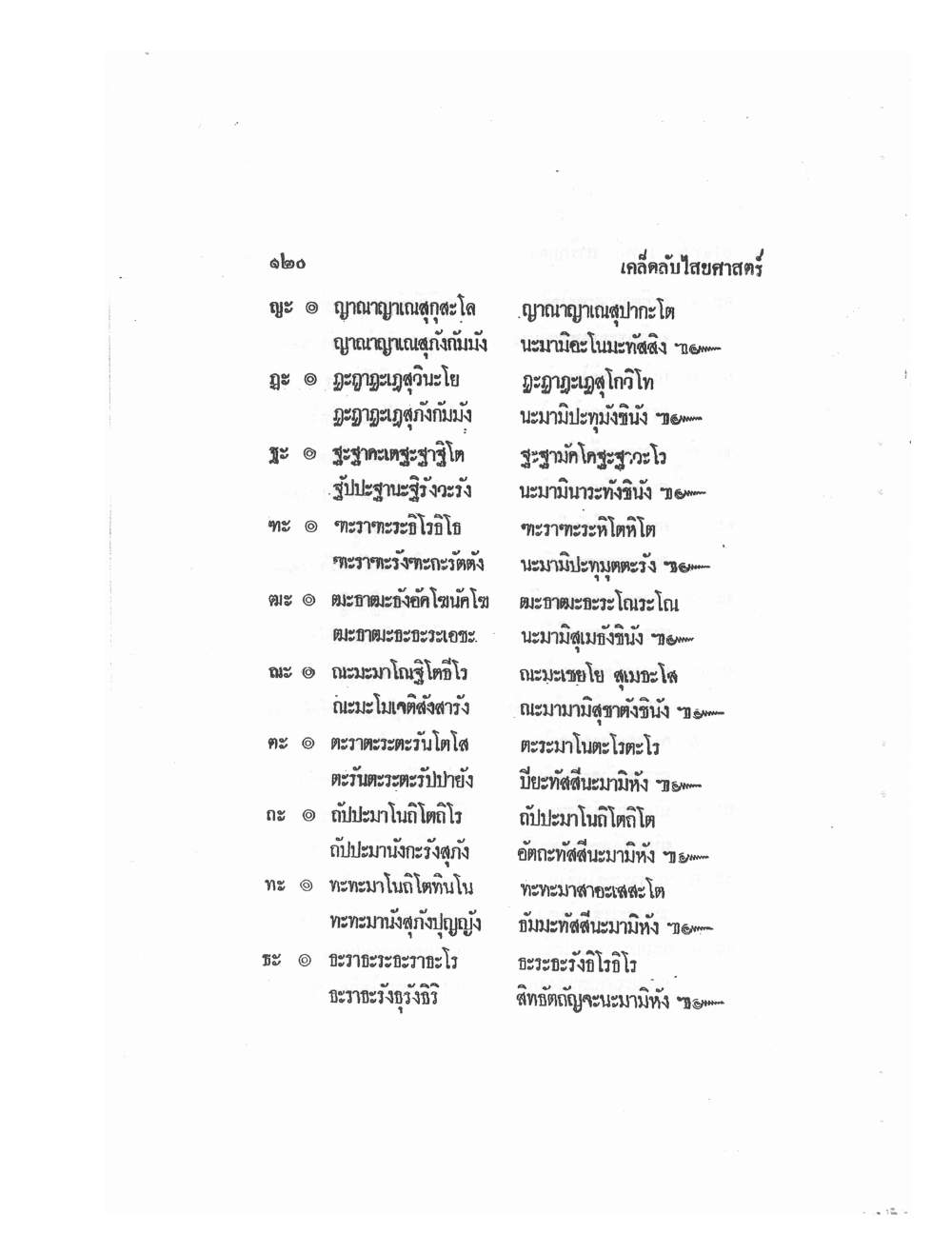
๑๒๐ เคล็ดลับไสยศาสตร์
ญะ ◎ ญาณาญาเณสุกุสะโค ญาณาญาเณสุปากะโต ญาณาญาเณสุภังกัมมัง นะมามิอะโนมะทัสสิง ๚
ฎะ ◎ ฎะฎาฎะเภสุวินะโย ฎะฎาฎะเภสุโกวิโท ฎะฎาฎะเภสุภังกัมมัง นะมามิปะทุมังชินัง ๚
ฐะ ◎ ฐะฐากะเตฐะฐาฐิโต ฐะฐามัคโคฐะฐาวะโร ฐุปปะฐานะฐิรังวะรัง นะมามินาวะทังชินัง ๚
ฑะ ◎ ฑะราฑะระหิโตหิโต ฑะราฑะระตะกะรัตตัง นะมามิปะทุมุตตะรัง ๚
ฒะ ◎ ฒะธาฒะถังอัคโฒนัคโฒ ฒะธาฒะถะระโณระโณ ฒะธาฒะถะเอชะ นะมามิสุเมธังชินัง ๚
ณะ ◎ ณะมะมาโณฐิโตธีโว ณะมะเชยโย สุเมธะโส ณะมะโมเจติสังสารัง ณะมามิสุขาตังชินัง ๚
ตะ ◎ ตะราตะระตันโตโส ตะระมาโนตะโรตะโร ตะรันตะระตัรปายัง บียะทัสสีนะมามิหัง ๚
ถะ ◎ ถัปปะมาโนถิโตถิโร ถัปปะมาโนถิโตถิโร ถัปปะมานังกะรังสุภัง อัตถทัสสีนะมามิหัง ๚
ทะ ◎ ทะทะมาโนถิโตทินโน ทะทะมาสาอะเสสะโต ทะทะมานังสุภังปุญญัง ธัมมะทัสสีนะมามิหัง ๚
ธะ ◎ ธะราธาระธาราะโร ธะระธะรังธิโรธิโร ธะราธะรังธุรังธิริ สิทธัตถัญจะนะมามิหัง ๚
Page 120 (running head: "Secrets of Saiyasat"). The consonant table continues through ญ ฎ ฐ ฑ ฒ ณ ต ถ ท ธ. As before, each entry is a sound-chain on its seed letter closing in the refrain "I pay homage to..."; the recognizable closing epithets in this stretch are: one of humble/lowest vision (อะโนมะทัสสิง), the lotus Victor (ปะทุมัง ชินัง), the boat/ford Victor (นาวะทัง ชินัง — a crossing-over image), the supreme lotus (ปะทุมุตตะรัง), the wise Victor (สุเมธัง ชินัง), the well-gone Victor (สุขาตัง ชินัง), one who sees rightly (ทัสสี, twice — with "attha-dassī," "seer of the goal"), one who sees the Dhamma (ธัมมะทัสสี), and finally Siddhattha — the future Buddha's own name (สิทธัตถัง).
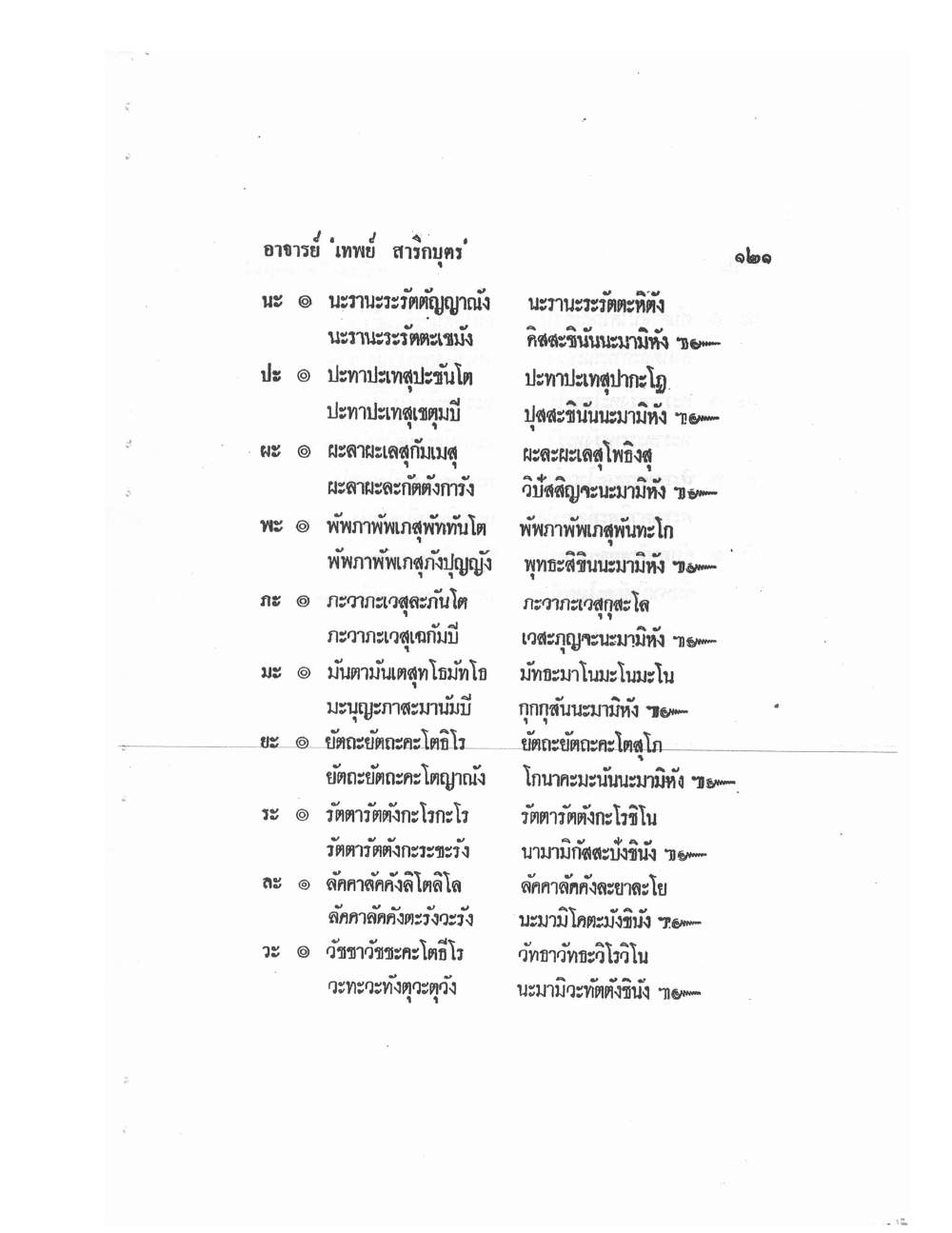
อาจารย์ เทพย์ สาริกบุตร ๑๒๑
นะ ◎ นะรานะระรัตตัญญาณัง นะรานะระรัตตะหิตัง นะรานะระรัตตะเขมัง กิสสะชินันนะมามิหัง ๚
ปะ ◎ ปะทาปะเทสุปะชันโต ปะทาปะเทสุปากะโต ปะทาปะเทสุเขตุมบี ปุสสะชินันนะมามิหัง ๚
ผะ ◎ ผะลาผะเลสุกัมเมสุ ผะละผะเลสุโพธิงสุ ผะลาผะละกัตตังการัง วิบัสสิญจะนะมามิหัง ๚
พะ ◎ พัพภาพัพเภสุพัทธันโต พัพภาพัพเภสุพันทะโก พัพภาพัพเภสุภังปุญญัง พุทธะสิขินนะมามิหัง ๚
ภะ ◎ ภะวาภะเวสุละภันโต ภะวาภะเวสุกุสะโล ภะวาภะเวสุเฉกัมบี เวสะภุญจะนะมามิหัง ๚
มะ ◎ มันตามันเตสุทโธมัทโท มัทถะมาโนมะโนมะโน มะนุญญาภาสะมานัมบี กุกกุสันนะมามิหัง ๚
ยะ ◎ ยัตถะยัตถะคะโตติโร ยัตถะยัตถะคะโตสุโภ ยัตถะยัตถะคะโตญาณัง โกนาคะมะนันนะมามิหัง ๚
ระ ◎ รัตตารัตตังกะโรกะโร รัตตารัตตังกะโรชิโน รัตตารัตตังกะระชะรัง นามะมิกัสสะบังชินัง ๚
ละ ◎ ลัคคาสัคคังลิโตลิโล ลัคคาลัคคังละยาละโย ลัคคาลัคคังตะรังวะรัง บมามิโคตะมังชินัง ๚
วะ ◎ วัชชาวัชชะคะโตธีโร วัทถาวัทธะวิโรวิโน วะทวะทังธุวะธุวัง นะมามิวะทัตตังชินัง ๚
Running head: "Achan Thep Sarikabutr." Page 121. The table works through นะ ปะ ผะ พะ ภะ มะ ยะ ระ ละ วะ. The closing refrains in this stretch invoke, in order, the seven past Buddhas by name: Kissa/Kassapa (กิสสะ...ชินัง — likely Kassapa Buddha), Puссa/Phussa (ปุสสะ...ชินัง), Vipassī (วิบัสสิ...), the "radiant" Buddha Sikhī (พุทธะสิขิน...), Vessabhū (เวสะภุ...), Kakusandha (กุกกุสัน...), Koṇāgamana (โกนาคะมะนัน...), Kassapa again (กัสสะบัง...ชินัง), Gotama (โคตะมัง...ชินัง — the historical Buddha), and finally an epithet of "true speech" (วะทัตตัง...ชินัง). Each entry's body is again an alliterative chain on its seed sound rather than ordinary prose.
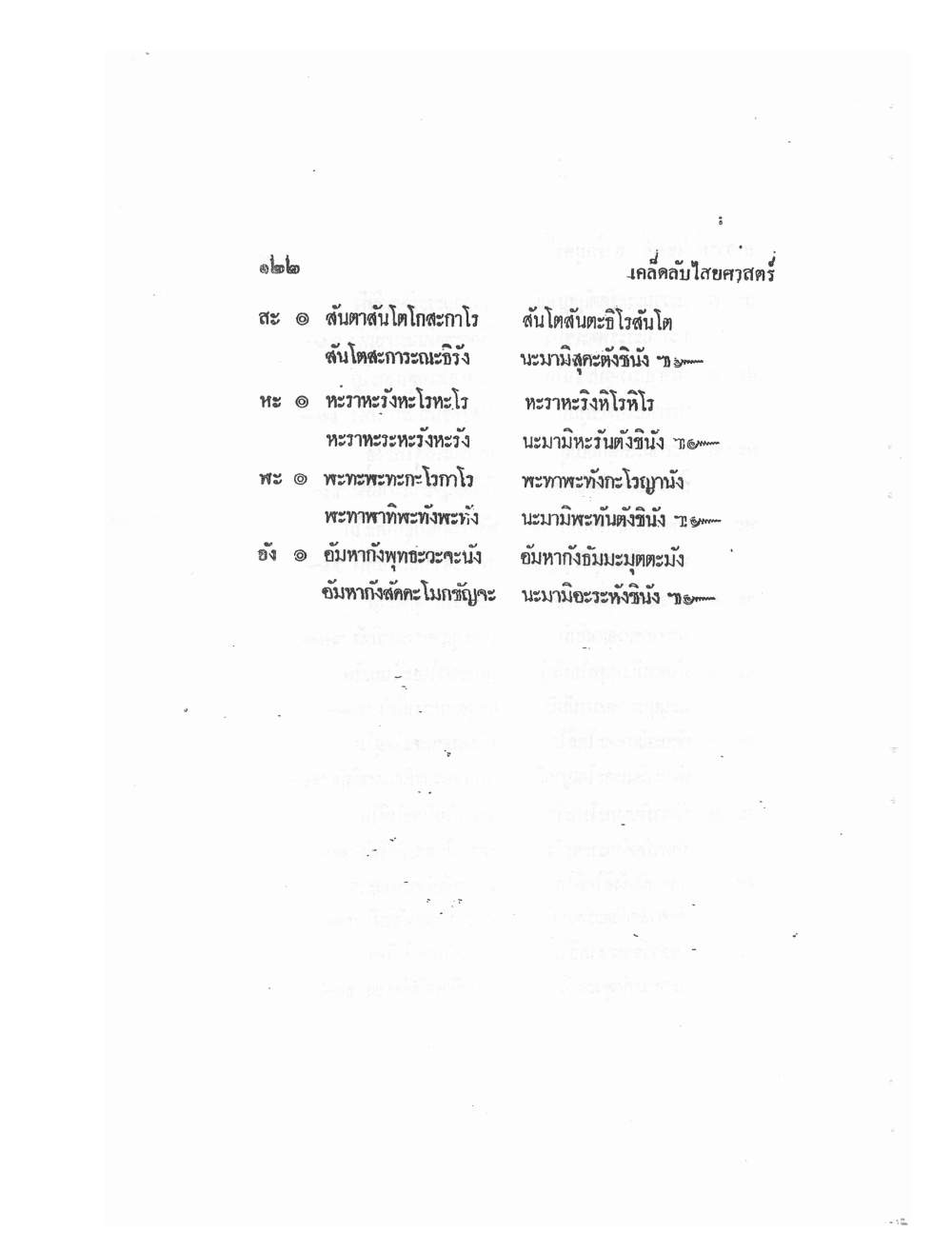
๑๒๒ เคล็ดลับไสยศาสตร์
สะ ◎ สันตาสันโตโกสะกาโร สันโตสันตะธิโรสันโต สันโตสะการะณะธิรัง นะมามิสุคะตังชินัง ๚
หะ ◎ หะราหะรังหะโรหะโร หะราหะริงหิโรหิโร หะราหะระหะรังหะรัง นะมามิหะรันตังชินัง ๚
พะ ◎ พะทะพะทะกะโรกาโร พะทาพะทังกะโรญาณัง พะทาพาทิพะทังพะหัง นะมามิพะทันตังชินัง ๚
อัง ◎ อังหากังพุทธะวะจะนัง อังหากังธัมมะมุตตะมัง อังหากังสัคคะโมกขัญจะ นะมามิอะระหังชินัง ๚
Page 122 (running head: "Secrets of Saiyasat"). This short page finishes the consonant sequence with only four entries — สะ หะ พะ อัง — each still an alliterative sound-chain closing on the standard refrain of homage. The last entry's closing names the Arahant Victor (อะระหัง ชินัง) directly. The lower two-thirds of the page is blank, with only a faint ghost of the facing page's print showing through; that ghosting is not transcribed as it belongs to a different page.
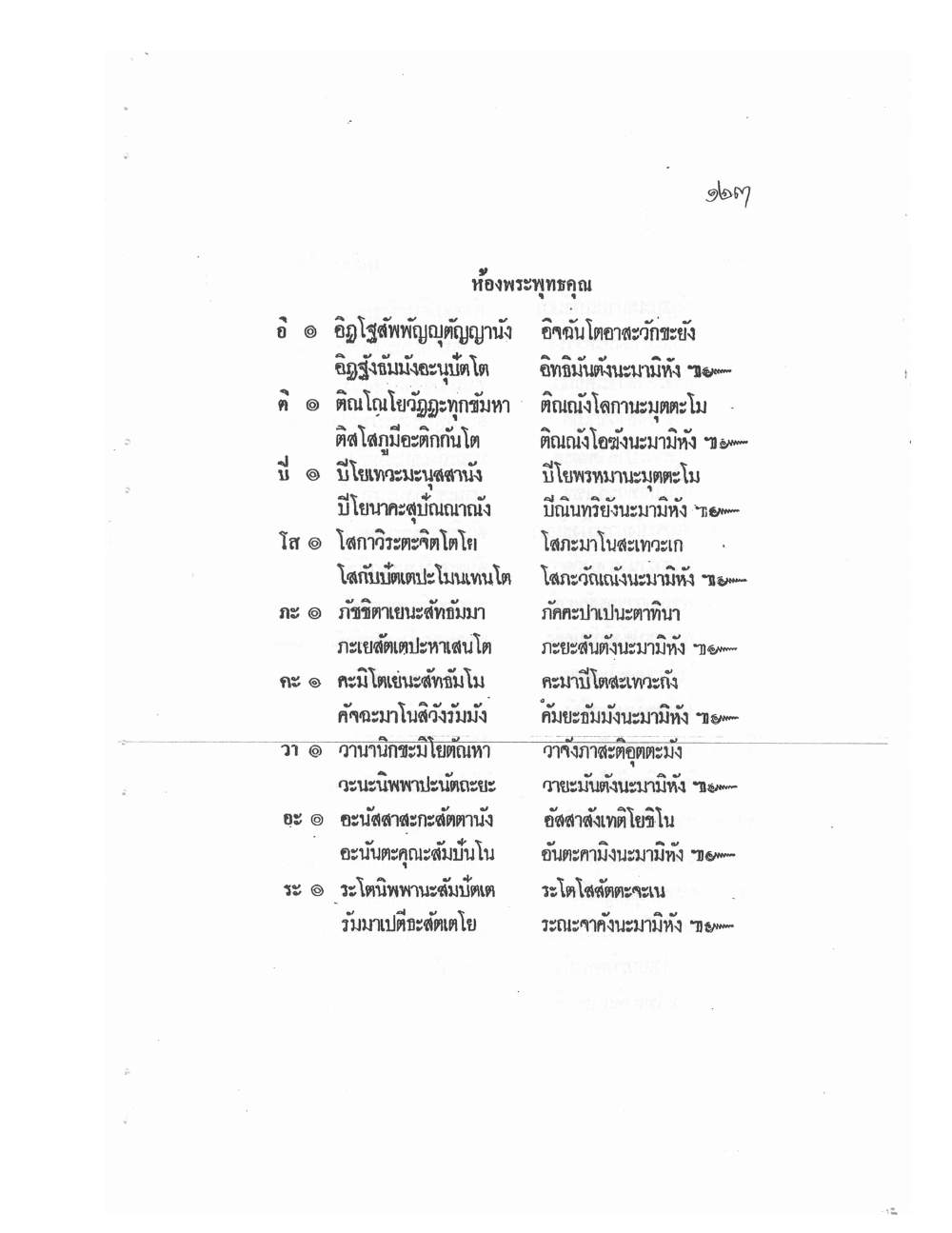
ห้องพระพุทธคุณ
อิ ◎ อิฏโฐสัพพัญญุตัญญาณัง อิจฉันโตอาสะวักขะยัง อิฏฐังธัมมังอะนุปัตโต อิทธิมันตังนะมามิหัง ๚
ติ ◎ ติณโณโยวัฏฏะทุกขัมหา ติณณังโลกานะมุตตะโม ติสโสภูมีอะติกกันโต ติณณังโอฆังนะมามิหัง ๚
บี ◎ บีโยเทวะมะนุสสานัง บีโยพรหมานะมุตตะโม บีโยนาคะสุปัณณานัง บีณินทริยังนะมามิหัง ๚
โส ◎ โสกาวิระตะจิตโตโย โสภะมาโนสะเทวะเก โสกัมปัตแตปะโมทันโต โสภะวัณณังนะมามิหัง ๚
ภะ ◎ ภัชชิตาเยนะสัทธัมมา ภัคคะปาเปนะตาทินา ภะเยสัตเตปะหาเสนโต ภะยะสันตังนะมามิหัง ๚
คะ ◎ คะมิโตเย่นะสัทธัมโม คะมาปีโตสะเทวะกัง คัจฉะมาโนสิวังรัมมัง คัมยะธัมมังนะมามิหัง ๚
วา ◎ วานานิกขะมิโยตัณหา วาจังภาสะติอุตตะมัง วะนะนิพพาปะนัตถายะ วายะมันตังนะมามิหัง ๚
อะ ◎ อะนัสสาสะกะสัตตานัง อัสสาสังเทติโยชิโน อะนันตะคุณะสัมบันโน อันตะคามิงนะมามิหัง ๚
ระ ◎ ระโตนิพพานะสัมบัตเต ระโตโสสัตตะจะเน รัมมาเปติยะสัตเตโย ระณะจากังนะมามิหัง ๚
The Chamber of the Buddha's Virtues
A new heading marks a fresh table. Its seed sounds no longer follow the Thai consonant order but spell a fresh word/phrase (อิ ติ บี โส ภะ คะ วา อะ ระ) — recognizably the start of the Buddhist epithet "Itipiso Bhagavā..." ("Thus indeed is the Blessed One..."), the standard formula recalling the Buddha's virtues. Each entry keeps the same two-couplet, refrain-closing form as the preceding pages.
อิ: desiring all-knowing wisdom and the ending of the taints, attained to the desired Dhamma — "I pay homage to the one possessed of psychic power."
ติ: crossed over the round of suffering, foremost of those who have crossed over, gone beyond the three realms — "I pay homage to the one who has crossed the flood."
บี [pī]: dear to gods and men, dear to and foremost among Brahmas, dear to nagas and garudas — "I pay homage to that one dear [to all]."
โส: a mind free of sorrow, resplendent among gods, rejoicing though touched by sorrow — "I pay homage to that resplendent form."
ภะ: one who has broken with wrong teachings through the true Dhamma, broken with evil, delivers beings from fear — "I pay homage to that ended fear."
คะ: one who has gone by the true Dhamma, gone with joy among the gods, going to the peaceful, pleasant [Nibbana] — "I pay homage to that going in the Dhamma."
วา: gone forth from craving, speaking the supreme word, striving for the extinguishing [of defilement] in the forest — "I pay homage to that striving."
อะ: giving comfort to disheartened beings, the Victor who grants solace, endowed with endless virtue — "I pay homage to the one who goes to the [Nibbanic] end."
ระ: delighting in the attainment of Nibbana, delighting beings, bringing beings to a delightful place — "I pay homage to the ending of strife."
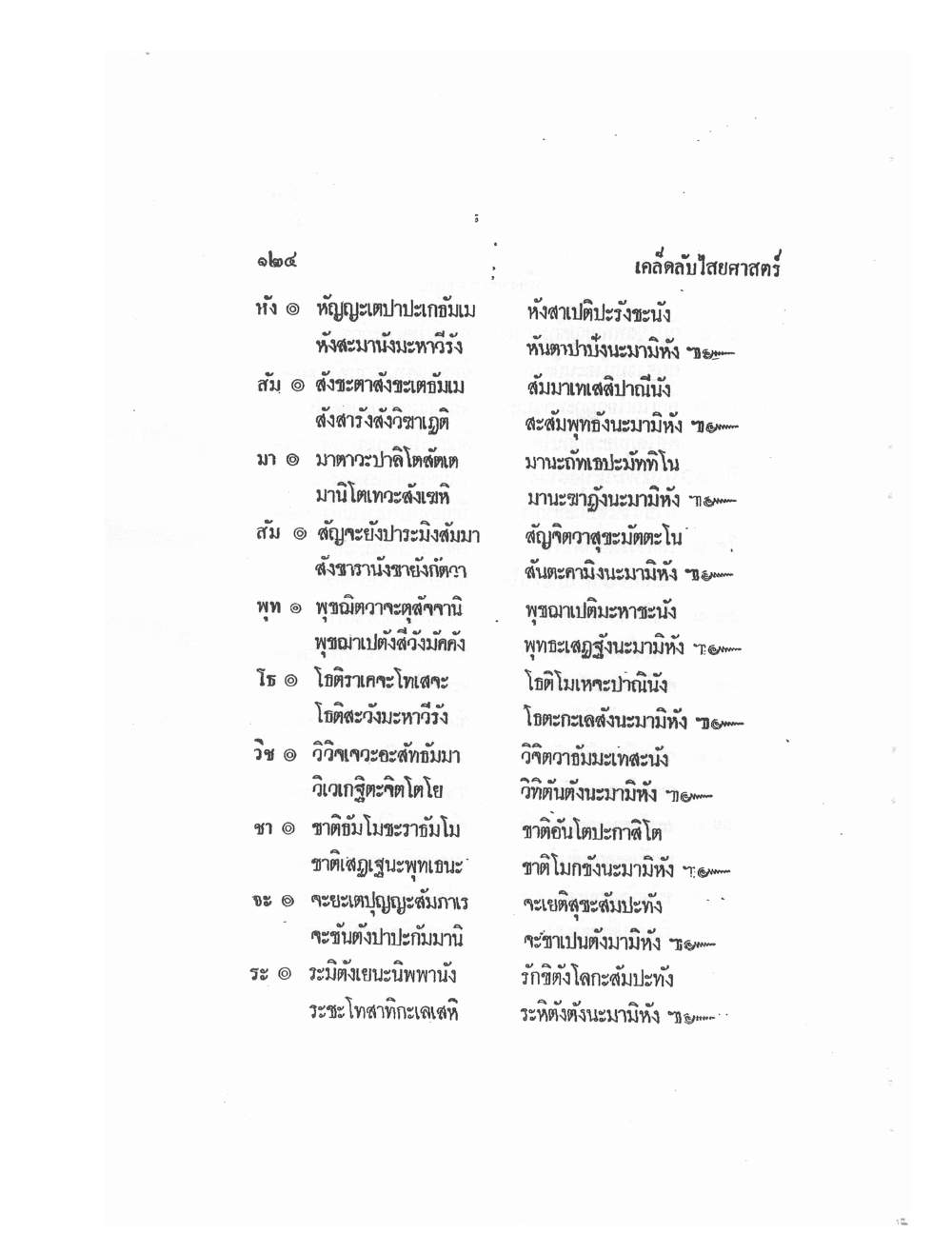
๑๒๔ เคล็ดลับไสยศาสตร์
หัง ◎ หัญญะเตปาปะเกธัมเม หังสาเปติปะรังชะนัง หังสะมานังมะหาวีรัง หันตาปาบังนะมามิหัง ๚
สัม ◎ สังขะตาสังขะเตธัมเม สัมมาเทเสสิปาณินัง สังสารังสังวิฆาฏิ สะสัมพุทธังนะมามิหัง ๚
มา ◎ มาตาวะปาลิโตสัตเต มานะถัทเธปะมัทฑิโน มานิโตเทวะสังเขติ มานะฆาตังนะมามิหัง ๚
สัม ◎ สัญจะยังปาระมิงสัมมา สัญจิตวาสุขะมัตตะโน สังขารานังชายังกัตวา สันตะคามิงนะมามิหัง ๚
พุท ◎ พุชฌิตวาจะตุสัจจานิ พุชฌาเปติมะหาชะนัง พุชฌาเปตังสีวังมัคคัง พุทธะเสฏฐังนะมามิหัง ๚
โธ ◎ โธติราคะจะโทสะจะ โธติโมเหจะปาณินัง โธติสะวังมะหาวีรัง โธตะกะเลสังนะมามิหัง ๚
วิช ◎ วิวิจเจวะอะสัทธัมมา วิเวกัฏฐิตะจิตโตโย วิจิตวาธัมมะเทสะนัง วิทิตันตังนะมามิหัง ๚
ชา ◎ ชาติธัมโมชะราธัมโม ชาติเสฏฐังนะพุทเธนะ ชาติอันโตปะกาสิโต ชาติโมกขังนะมามิหัง ๚
จะ ◎ จะยะเตปุญญะสัมภาเร จะเยติสุขะสัมปะทัง จะขันตังปาปะกัมมานิ จะยาเปนตังนะมามิหัง ๚
ระ ◎ ระมิตังเยนะนิพพานัง รักขิตังโลกะสัมปะทัง ระชะโทสาทิกะเลสะหิ ระหิตังตังนะมามิหัง ๚
Page 124 (running head: "Secrets of Saiyasat"). The seed sounds continue the "Itipiso..." phrase: หัง สัม มา สัม พุท โธ วิช ชา จะ ระ — spelling out "...araham sammāsambuddho vijjācaraṇa[sampanno]..." ("...worthy, perfectly self-awakened, accomplished in knowledge and conduct...").
หัง: destroying evil in the Dhamma, granting joy to others, joyful, a great hero — "I pay homage to the destroyer of evil."
สัม: teaching rightly to beings the compounded and the uncompounded, cutting off the round of rebirth — "I pay homage to the Self-Awakened One."
มา: protecting beings like a mother, subduing the stubbornness of conceit, honored among gods — "I pay homage to the slayer of conceit."
สัม: rightly accumulating the perfections, having gathered his own happiness, having made an end of conditioned existence — "I pay homage to the one gone to peace."
พุท: awakened to the Four Truths, awakening the great multitude, awakening [beings] to the auspicious path — "I pay homage to the supreme Buddha."
โธ: cleansed of passion and aversion, cleansed of delusion in beings, the great hero cleansed throughout — "I pay homage to the one cleansed of defilement."
วิช: secluded from unwholesome states, mind established in seclusion, having composed a teaching of the Dhamma — "I pay homage to the one who has understood fully."
ชา: birth is a [conditioned] state, aging is a [conditioned] state, proclaimed as foremost in birth by the Buddha — "I pay homage to release from birth."
จะ: accumulating a store of merit, gaining happiness thereby, restraining evil deeds — "I pay homage to the one who brings about [merit]."
ระ: delighting in Nibbana, guarding the world's welfare, freed from anger, greed, and the other defilements — "I pay homage to that freedom."
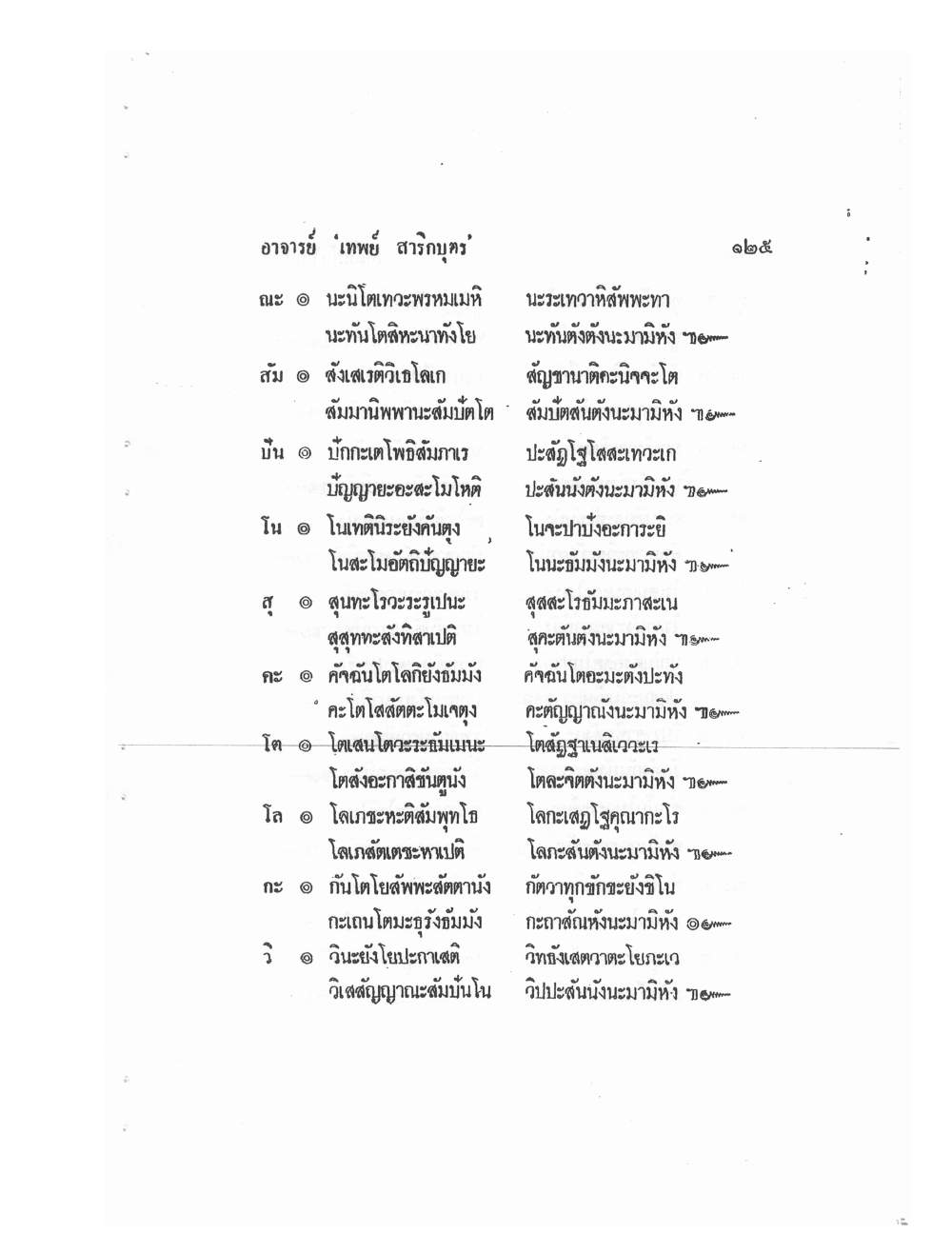
อาจารย์ เทพย์ สาริกบุตร ๑๒๕
ณะ ◎ นะนิโตเทวะพรหมเมหิ นะระเทวาหิสัพพะทา นะทันโตสิหะนาทังโย นะทันตังตังนะมามิหัง ๚
สัม ◎ สังเสวิวิเจโลเก สัญชานาติคะนิจฉะโต สัมมานิพพานะสัมบัตโต สัมบัตสันตังนะมามิหัง ๚
บั้น ◎ บักกะเตโพธิสัมภาเร ปะสัฏโฐโสสะเทวะเก บัญญายะอะสะโมโหติ ปะสันนังตังนะมามิหัง ๚
โน ◎ โนเทตินิระยังคันตุง โนจะปาบังอะการะยิ โนสะโมอัตถิบัญญายะ โนนะธัมมังนะมามิหัง ๚
สุ ◎ สุนทะโรวะระรูเปนะ สุสสะโรธัมมะภาสะเน สุทุทะสังทิสาเปติ สุขะตันตังนะมามิหัง ๚
คะ ◎ คัจฉันโตโลกิยังธัมมัง คัจฉันโตอะมะตังปะทัง คะโตโสสัตตะโมเจตุง คะตัญญาณังนะมามิหัง ๚
โต ◎ โตเสนโตวะระธัมเมนะ โตฏฐาเนสิเวจะเร โตสังอะกาสิชันตูนัง โตละจิตตังนะมามิหัง ๚
โล ◎ โลภะชะหะติสัมพุทโธ โลกะเสฏโฐคุณากะโร โลเภสัตเตชะหาเปติ โลภะสันตังนะมามิหัง ๚
กะ ◎ กันโตโยสัพพะสัตตานัง กัตวาทุกขักขะยังชิโน กะเถนโตมะธุรังธัมมัง กะถาสันตังนะมามิหัง ๚
วิ ◎ วินะยังโยปะกาเสติ วิทธังเสตวาตะโยภะเว วิเสสัญญาณะสัมบันโน วิปัสสันนังนะมามิหัง ๚
Running head: "Achan Thep Sarikabutr." Page 125. The seed sounds spell on: ณะ สัม บั้น โน สุ คะ โต โล กะ วิ — continuing the epithet string "...sugato lokavi[dū]..." ("...well-gone, knower of the world...").
ณะ: honored by gods and Brahmas, roaring the lion's roar among gods and men always — "I pay homage to that roaring one."
สัม: associating with seclusion in the world, discerning what beings wish to know, attained to the accomplishment of Nibbana — "I pay homage to that attainment of peace."
บั้น [ban]: having accumulated the requisites of enlightenment, esteemed among the gods, wise without delusion — "I pay homage to that clarity."
โน: leading away from going to hell, not committing evil, wise without equal — "I pay homage to that Dhamma."
สุ: beautiful in supreme form, sweet-voiced in teaching the Dhamma, showing the way to the hard-to-see — "I pay homage to that well-gone one."
คะ: going in the worldly Dhamma [while] going to the deathless state, gone to release beings — "I pay homage to that attained knowledge."
โต: gladdening [beings] with the excellent Dhamma, established there, wandering about, bringing gladness to creatures — "I pay homage to that gladdened mind."
โล: the Self-Awakened One who abandons greed, foremost in the world, a mine of virtue, causing beings to abandon greed — "I pay homage to that ended greed."
กะ: dear to all beings, the Victor who has ended suffering, speaking the sweet Dhamma — "I pay homage to that peaceful speech."
วิ: proclaiming discipline (vinaya), having destroyed the three [kinds of] existence, endowed with special knowledge — "I pay homage to that insight (vipassanā)."
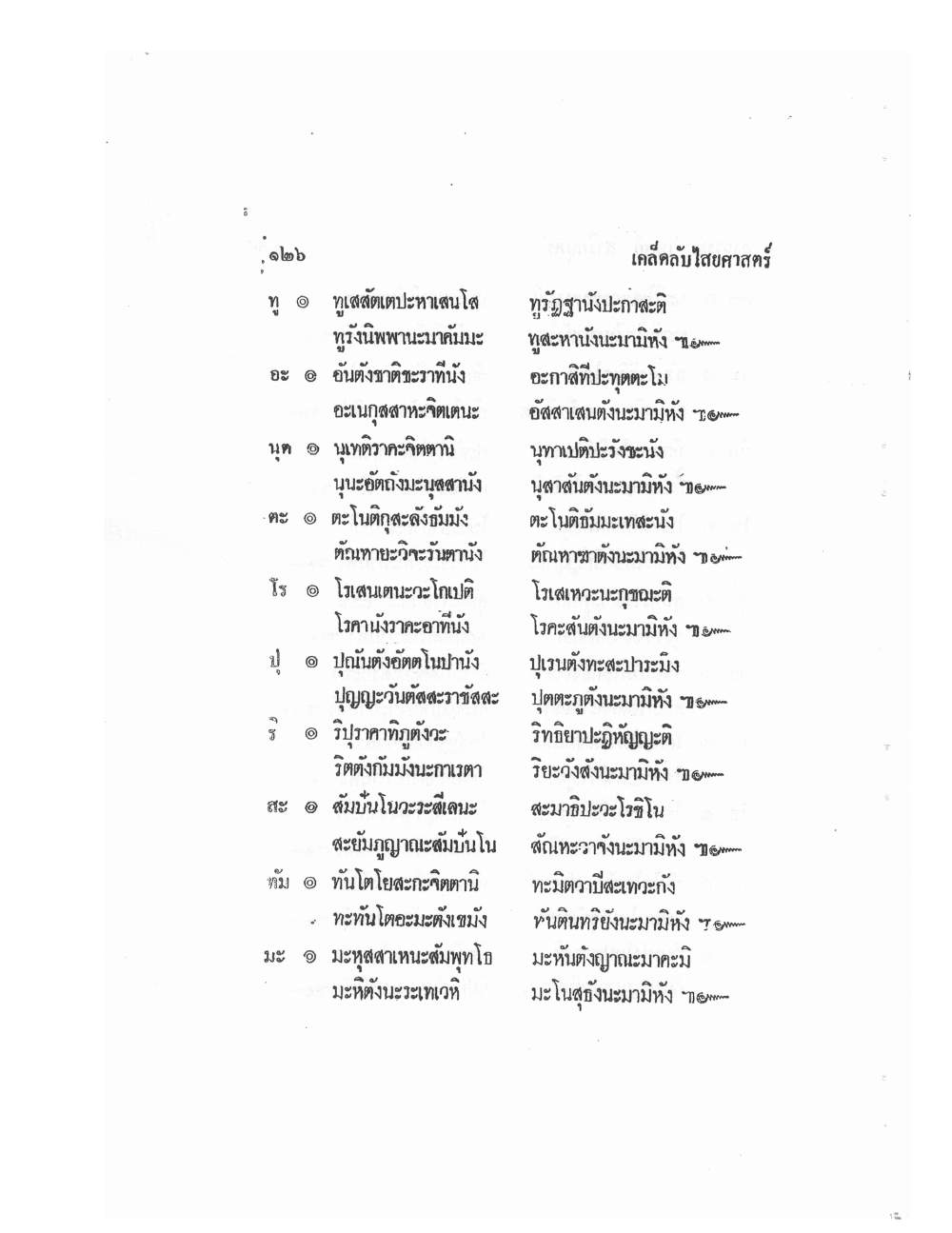
๑๒๖ เคล็ดลับไสยศาสตร์
ทู ◎ ทูเสสัตเตปะหาเสนโส ทูรัฏฐานังปะกาสะติ ทูรังนิพพานะมาคัมมะ ทูสะหานังนะมามิหัง ๚
อะ ◎ อันตังชาติชะราทีนัง อะกาสิปะทุตตะโม อะเนกุสสาหะจิตเตนะ อัสสาเสนตังนะมามิหัง ๚
นุด ◎ นุเทติราคะจิตตานิ นุทาเปติปะรังชะนัง นุนะอัตถังมะนุสสานัง นุสาสันตังนะมามิหัง ๚
ตะ ◎ ตะโนติกุสะลังธัมมัง ตะโนติธัมมะเทสะนัง ตัณหายะวิจะรันตานัง ตัณหาฆาตังนะมามิหัง ๚
โร ◎ โรเสนเตนะวะโกเปติ โรเสเหวะนะกุชฌะติ โรคานังราคะอาทีนัง โรคะสันตังนะมามิหัง ๚
ปุ ◎ ปุณันตังอัตตะโนปานัง ปุเรนตังทะสะปาระมิง ปุญญะวันตัสสะราชัสสะ ปุตตะภูตังนะมามิหัง ๚
ริ ◎ วิปุราคาทิภูตังวะ ริทธิยาปะฏิหัญญะติ ริตตังกัมมังนะกาเวตา ริยะวังสังนะมามิหัง ๚
สะ ◎ สัมบันโนวะระสีเลนะ สะมาธิปะวะโรชิโน สะยัมภูญาณะสัมบันโน สันทะวาจังนะมามิหัง ๚
ทัม ◎ ทันโตโยสะกะจิตตานิ ทะมิตวาบีสะเทวะกัง ทะทันโตอะมะตังเขมัง ทันติริยังนะมามิหัง ๚
มะ ◎ มะหุสสาเหนะสัมพุทโธ มะหันตังญาณะมาคะมิ มะหิตังนะระเทเวหิ มะโนสุขังนะมามิหัง ๚
Page 126 (running head: "Secrets of Saiyasat"). Seed sounds: ทู อะ นุด ตะ โร ปุ ริ สะ ทัม มะ — spelling "...anuttaro purisadammasārathi..." ("...unsurpassed guide of persons to be tamed..."), continuing the Buddha's virtue-epithets.
ทู: causing beings to abandon [evil], proclaiming a far realm, having reached far-off Nibbana — "I pay homage to that reach."
อะ: making an end of birth, old age and the rest, with tireless effort of mind — "I pay homage to that comforter."
นุด: driving out thoughts of passion, driving them from other people, teaching what is beneficial to mankind — "I pay homage to that instruction."
ตะ: bringing about wholesome states, teaching the Dhamma, cutting off the craving of those who wander — "I pay homage to that cutting-off of craving."
โร: angering none though provoked, never angered himself, [curing] the sicknesses of desire and the rest — "I pay homage to that ended sickness."
ปุ: fulfilling his own vow [of Buddhahood], fulfilling the ten perfections, the meritorious king's own son — "I pay homage to that [Bodhisatta] son."
ริ [-ddhi]: possessed of psychic power that overturns [obstacles], never acting emptily, of noble lineage — "I pay homage to that noble lineage."
สะ: endowed with excellent virtue, foremost Victor of concentration, self-awakened, endowed with knowledge — "I pay homage to that harmonious speech."
ทัม: having tamed his own mind, having tamed gods and men, giving the deathless security — "I pay homage to that self-restraint."
มะ: the Self-Awakened One through great effort, who attained great knowledge, honored by men and gods — "I pay homage to that happiness of mind."
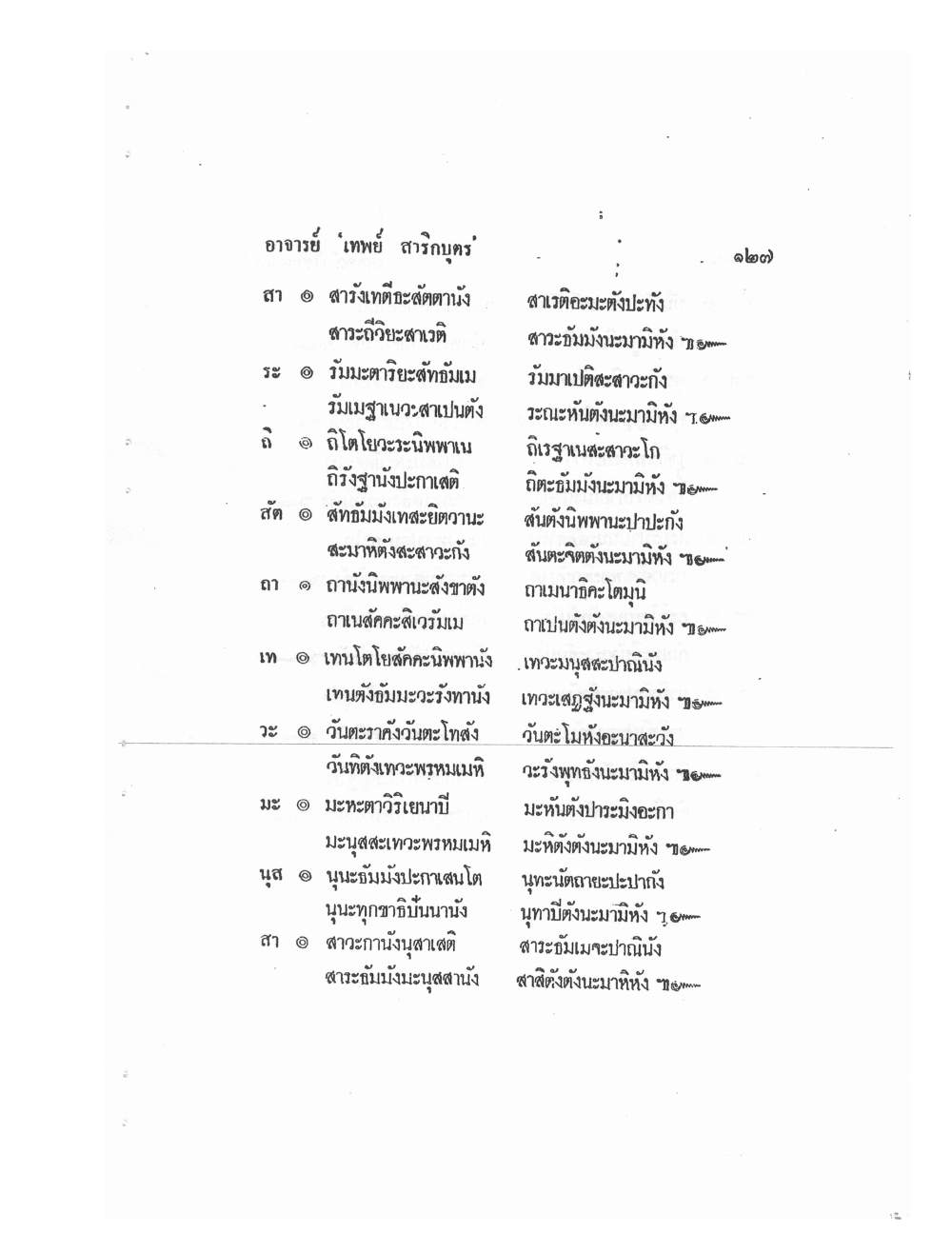
อาจารย์ เทพย์ สาริกบุตร ๑๒๗
สา ◎ สาเรติอะมะตังปะทัง สารังเทตีธะสัตตานัง สาวะกานังนุสาเสติ สาระธัมเมนะมามิหัง ๚
ระ ◎ รัมมาเปติสะสาวะกัง ระมิตังตาริยะสัทธัมเม รัมเมฏฐาเนวะสาเปนตัง ระณะหันตังนะมามิหัง ๚
ถิ ◎ ถิรัฏฐาเนสะสาวะโก ถิโตโยวะระนิพพาเน ถิรังฐานังปะกาเสติ ถิตะธัมมังนะมามิหัง ๚
สัต ◎ สันตังนิพพานะปาปะกัง สัทธัมมังเทสะยิตวานะ สะมาหิตังสะสาวะกัง สันตะจิตตังนะมามิหัง ๚
ถา ◎ ถาเมนาธิคะโตมุนิ ถานังนิพพานะสังขะตัง ถาเนสัคคะสิเวรัมเม ถาเปนตังนะมามิหัง ๚
เท ◎ เทวะมนุสสะปาณินัง เทนโตโยสัคคะนิพพานัง เทนตังธัมมะวะรังทานัง เทวะเสฏฐังนะมามิหัง ๚
วะ ◎ วันตะโมหังอะนาสะวัง วันตะราคังวันตะโทสัง วันติตังเทวะพรหมเมหิ วะรังพุทธังนะมามิหัง ๚
มะ ◎ มะหันตังปาระมิงอะกา มะหาวิริเยนะบี มะหิตังตังนะมามิหัง มะนุสสะเทวะพรหมเมหิ ๚
นุส ◎ นุทะนัตถายะปาปะกัง นุนะธัมมังปะกาเสนโต นุนะทุกขาธิบันนานัง นุทาบีตังนะมามิหัง ๚
สา ◎ สาระธัมเมจะปาณินัง สาวะกานังนุสาเสติ สาระธัมมังมะนุสสานัง สาสิตังตังนะมามิหัง ๚
Running head: "Achan Thep Sarikabutr." Page 127. Seed sounds: สา ระ ถิ สัต ถา เท วะ มะ นุส สา — spelling "...satthā devamanussānaṃ..." ("...teacher of gods and men...").
สา: guiding [beings] to the deathless path, giving essence to beings here, instructing his disciples — "I pay homage to that essential Dhamma."
ระ: delighting his disciples, delighting in the noble true Dhamma, causing them to abide in a delightful place — "I pay homage to that end of strife."
ถิ: a disciple firmly established, abiding in excellent Nibbana, proclaiming a firm state — "I pay homage to that steadfast Dhamma."
สัต [sat-]: teaching the peaceful, blameless true Dhamma of Nibbana, composed together with his disciples — "I pay homage to that peaceful mind."
ถา: the sage who attained through effort, the state of Nibbana as a conditioned goal, established there in heavenly peace — "I pay homage to that establishing."
เท [deva-]: giving to gods, men, and living beings, giving them heaven and Nibbana, giving the excellent gift of Dhamma — "I pay homage to that foremost among gods."
วะ: free of delusion and taints, free of passion, free of aversion, revered by gods and Brahmas — "I pay homage to the excellent Buddha."
มะ [-nussa-]: having achieved the great perfections through great effort, honored — "I pay homage to that one honored by men, gods, and Brahmas." (order of the two half-lines as printed appears reversed from the expected sequence.)
นุส [-sānaṃ]: driving out evil, proclaiming the Dhamma, [teaching] those afflicted with suffering — "I pay homage to that relief from suffering."
สา: the essential Dhamma for living beings, instructing his disciples, the essential Dhamma for mankind — "I pay homage to that teaching."
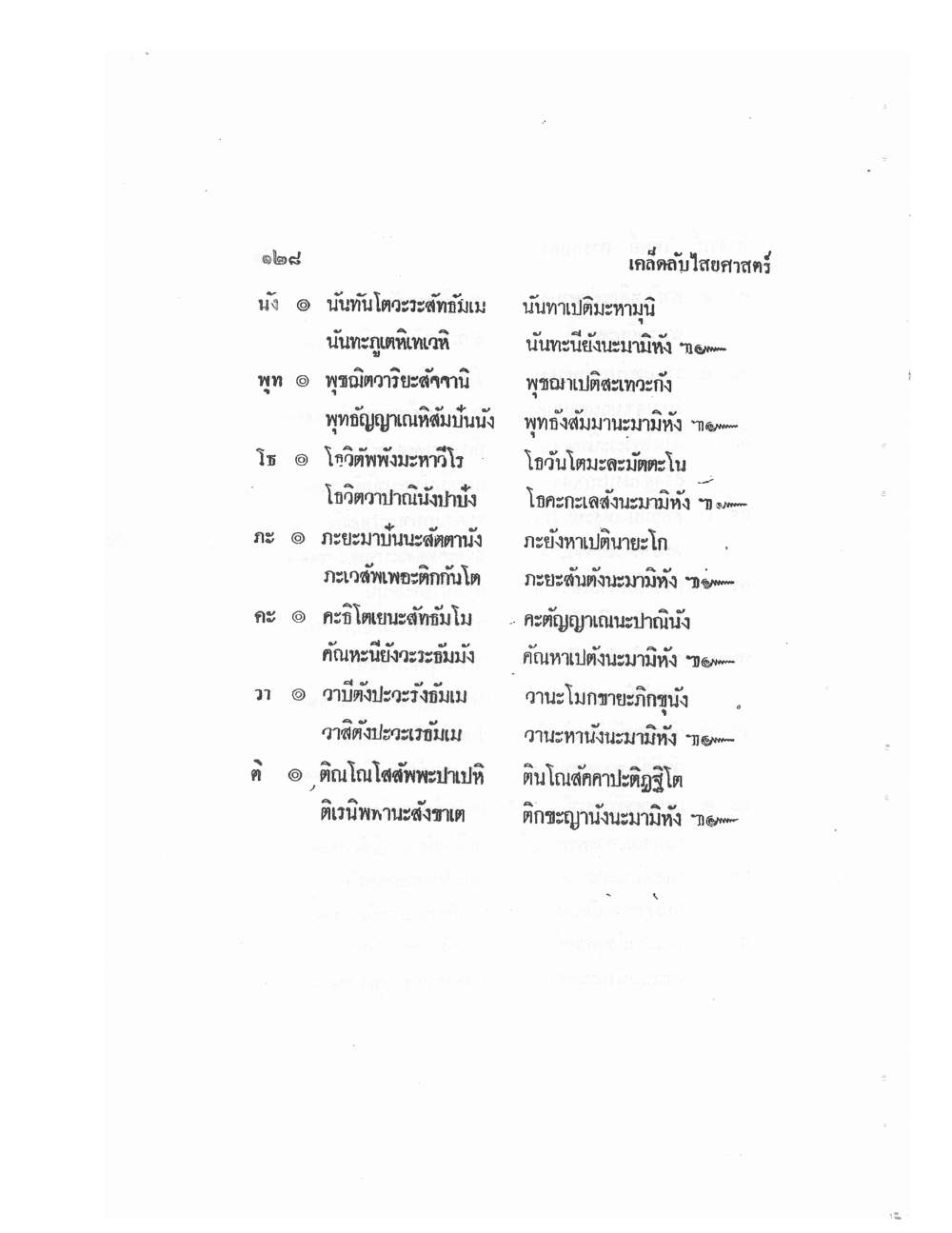
๑๒๘ เคล็ดลับไสยศาสตร์
นัง ◎ นันทาเปติวะระสัทธัมเม นันทะปีติเทวะหิ นันทะภูเตหิเทวะหิ นันทะนียังนะมามิหัง ๚
พุท ◎ พุชฌมิตวาริยะสัจจานิ พุชฌาเปติสะเทวะกัง พุทธัญญาเณหิสัมบันโน พุทธังสัมมานะมามิหัง ๚
โธ ◎ โควิตัพพังมะหาวีโร โควันโตมะละมัตตะโน โควิตวาปาณินังปาบัง โคคะเลสังนะมามิหัง ๚
ภะ ◎ ภะยะมาบันนะสัตตานัง ภะยังหาเปตินายะโก ภะเวสัพเพติกกันโต ภะยะสันตังนะมามิหัง ๚
คะ ◎ คะติโตเยนะสัทธัมโม คัณหะนียังวะระธัมมัง คัณหาเปติงวะระธัมมัง คัณหาเปตังนะมามิหัง ๚
วา ◎ วาบีตังปะวะรังธัมเม วานะโมกขายะภิกขุนัง วาสิตังปะวะเรธัมเม วานะหันตังนะมามิหัง ๚
ติ ◎ ติณโณโสสัพพะปาเปหิ ตินโณสัคคาปะติฏฐิโต ติเรนิพพานะสังขาเต ติกขะญาณังนะมามิหัง ๚
Page 128 (running head: "Secrets of Saiyasat"), the last page of this chunk. Seed sounds: นัง พุท โธ ภะ คะ วา ติ — completing "...Buddho bhagavā ti" ("...the Buddha, the Blessed One"), the closing words of the Itipiso formula begun on page 127. Only seven entries appear; the remainder of the page is blank.
นัง: delighting [beings] in the excellent true Dhamma, joy for the gods, delighted by beings and gods — "I pay homage to that delightful one."
พุท: having awakened to the noble truths, awakening the world together with the gods, endowed with the Buddha's knowledge — "I pay homage rightly to the Buddha."
โธ: the great hero to be known, gone free of his own defilement, having known the evil in beings — "I pay homage to that cleansing." (This entry's seed line begins with the syllable โค rather than โธ as printed; transcribed as it appears.)
ภะ: [dispelling] fear from frightened beings, the leader who removes fear, gone beyond all states of existence — "I pay homage to that end of fear."
คะ: he by whom the true Dhamma is grasped, the excellent Dhamma to be grasped, causing [others] to grasp the excellent Dhamma — "I pay homage to that grasping."
วา: dear in the excellent Dhamma, [leading] monks to liberation from the forest [of defilement], dwelling in the excellent Dhamma — "I pay homage to that end of the forest [of craving]."
ติ: crossed over from all evil, crossed over and established in heaven, established in the state reckoned as Nibbana — "I pay homage to that sharp knowledge."
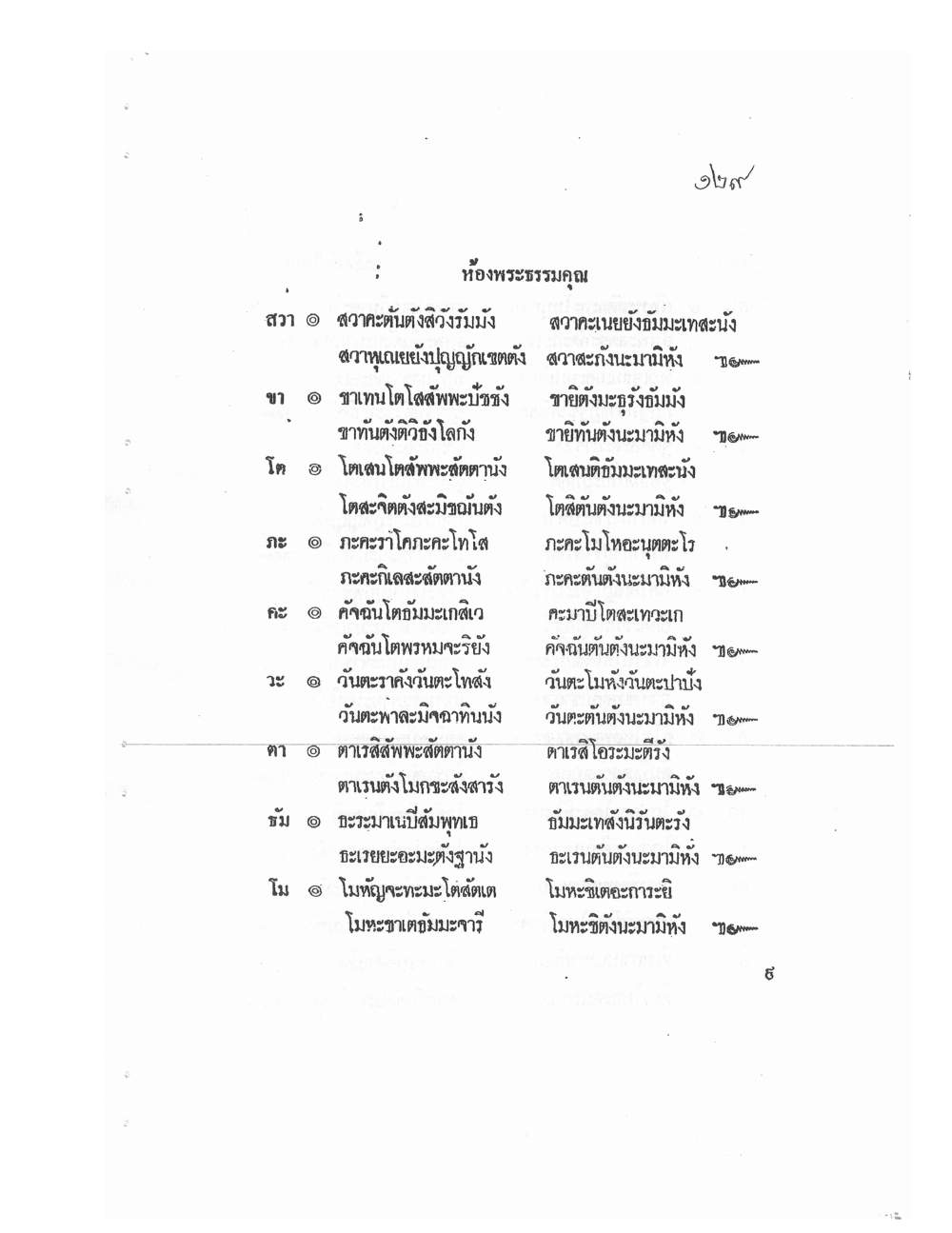
ห้องพระธรรมคุณ
สวา ๏ สวาคะตันตังสิวังรัมมัง สวาคะเนยยังธัมมะเทสะนัง สวาหุเณยยังปุญญักเขตตัง สวาสะถังนะมามิหัง ๚ะ
ขา ๏ ขาเทนโตสัพพะบั๊ชชัง ขายิตังมธุรังธัมมัง ขาทันตังติวิธังโลกัง ขายิทันตังนะมามิหัง ๚ะ
โต ๏ โตเสนโตสัพพะสัตตานัง โตเสนติธัมมะเทสะนัง โตสะจิตตังสะมิฉันตัง โตสิตันตังนะมามิหัง ๚ะ
ภะ ๏ ภะคะราโคภะคะโทโส ภะคะโมโหอนุตตะโว ภะคะกิเลสะสัตตานัง ภะคะตันตังนะมามิหัง ๚ะ
คะ ๏ คัจฉันโตธัมมะเกสิเว คะมาบีโตสะเทวะเก คัจฉันโตพรหมจะริยัง คัจฉันตันตังนะมามิหัง ๚ะ
วะ ๏ วันตะราคังวันตะโทสัง วันตะโมหังวันตะปาบัง วันตะพาละมิจฉาทินนัง วันตะตันตังนะมามิหัง ๚ะ
ตา ๏ ตาเรสิสัพพะสัตตานัง ตาเรสิโอฆะมะตีรัง ตาเรนตังโมกขะสังสารัง ตาเรนตันตังนะมามิหัง ๚ะ
ธัม ๏ ธะระมาเนบิสัมพุทเธ ธัมมะเทสังนิวันตะวัง ธะเรยยะอะมะตังฐานัง ธะเรนตันตังนะมามิหัง ๚ะ
โม ๏ โมหัญจะทะมะโตสัตเต โมหะขิเตอะการะยิ โมหะขาเตธัมมะจารี โมหะขิตังนะมามิหัง ๚ะ
๙
Heading: 'The Chamber of the Dhamma's Virtues.' This page and the next several expand the opening words of the Dhamma-recollection formula ('svākkhāto bhagavatā dhammo...', 'Well-expounded by the Blessed One is the Dhamma') syllable by syllable: each seed syllable of the root phrase (สวา, ขา, โต, ภะ, คะ, วะ, ตา, ธัม, โม) heads a short devotional couplet praising that quality, and every couplet closes with the same refrain, 'นะมามิหัง' — 'I pay homage to that one.' The internal phrasing is a folk-Pali mnemonic style that resists exact word-for-word rendering; the sense of each line, so far as the vocabulary allows, runs: - สวา: well arrived at peace and delight; worthy that the Dhamma be taught to it; worthy of offerings, a field of merit — homage to that peaceful one. - ขา: consuming away all filth; having tasted the sweet Dhamma; having mastered the threefold world — homage to that consumer [of defilement]. - โต: delighting all beings; delighting them with the teaching of the Dhamma; a mind composed in delight — homage to that one who delights. - ภะ: the Blessed One who has broken lust, broken hatred, broken delusion utterly, and broken the defilements of beings — homage to that Blessed Breaker [of defilement]. - คะ: going forth in the Dhamma among sages; revered among the gods; going forth in the holy life — homage to that one who has gone forth. - วะ: vomited-out lust, vomited-out hatred, vomited-out delusion and evil, vomited-out folly and wrong view — homage to that one who has expelled [defilement]. - ตา: ferrying all beings across; ferrying them over the flood to the far shore; ferrying them to liberation from saṃsāra — homage to that ferryman. - ธัม: while the Fully Enlightened One yet lives and teaches the Dhamma without cease, upholding the deathless state — homage to that one who upholds it. - โม: taming beings away from delusion, having driven out delusion and acting rightly, a Dhamma-farer who has slain delusion — homage to that slayer of delusion.
[A small printer's mark, '9', appears at the foot of the page.]
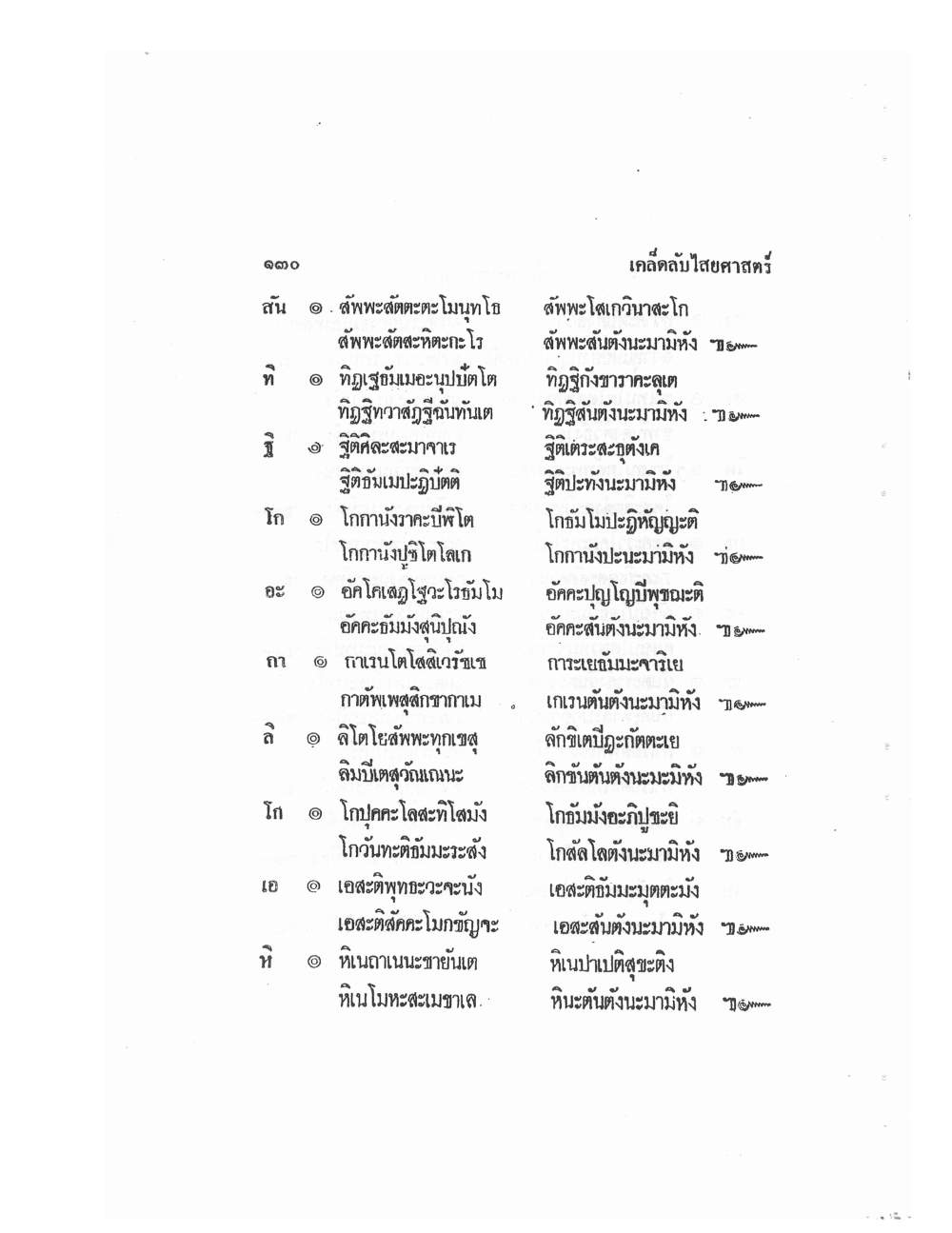
๑๓๐ เคล็ดลับไสยศาสตร์
สัน ๏ สัพพะสัตตะตะโมนุทโธ สัพพะโสเกวินาสะโก สัพพะสัตสะหิตะกะโร สัพพะสันตังนะมามิหัง ๚ะ
ทิ ๏ ทิฏเฐธัมเมอะนุปปันโต ทิฏฐิกังขาราคะลุตตะ ทิฏฐิทวาสีฏฐีฉันทัตเต ทิฏฐิสันตังนะมามิหัง ๚ะ
ฏิ ๏ ฏิติศีละสะมาจาเร ฏิเตระสะถุตังเค ฏิติธัมเมปฏิบัตติ ฏิติปะทังนะมามิหัง ๚ะ
โก ๏ โกกานังราคะบีโต โกธัมโมปะฏิหัญญะติ โกกานังปูชิโตโลเก โกกานังปะนะมามิหัง ๚ะ
อะ ๏ อัคโคเสฏโฐวะโรธัมโม อัคคะปุญโญบีพุชฌะติ อัคคะธัมมังสุนิปุณัง อัคคะสันตังนะมามิหัง ๚ะ
กา ๏ กาเรนโตโสสิเวรัชเช การะเยธัมมะจาริเย กาตัพเพสุสิกขากาเม เกเรนตันตังนะมามิหัง ๚ะ
ลิ ๏ ลิโตโยสัพพะทุกเขสุ ลักขิเตบีฏะกัตตะเย ลิมบีเตสุวัณเณนะ ลิกขันตังนะมามิหัง ๚ะ
โก ๏ โกปุคคะโลสะทิโสมัง โกธัมมังอะภิปูชะยิ โกวันทะติธัมมะระสัง โกสัลโลตังนะมามิหัง ๚ะ
เอ ๏ เอสะติพุทธะวะจะนัง เอสะติธัมมะมุตตะมัง เอสะติสัคคะโมกขัญจะ เอสะสันตังนะมามิหัง ๚ะ
หิ ๏ หิเนถาเนนนะขายันเต หิเนปาเปติสุขะติง หิเนโมหะสะเมชาเล หินะตันตังนะมามิหัง ๚ะ
Printed folio '130,' running head 'The Secrets of Saiyasat.' Continuation of the same Dhamma-virtue expansion table, now on the syllables สัน ทิ ฏิ โก อะ กา ลิ โก เอ หิ (continuing the root formula '...สันทิฏฐิโก อะกาลิโก เอหิ...', 'to be seen for oneself, not delayed by time, inviting one to come and see...'). Each couplet again closes with 'นะมามิหัง,' 'I pay homage to that one': - สัน: dispeller of the darkness of all beings, destroyer of all sorrow, benefactor of all creatures — homage to that all-benefiting one. - ทิ: not caught up in wrong views of visible things, cut off from doubt and the passion of views, free of the two extremes and of craving — homage to that one free of wrong view. - ฏิ: steadfast in virtuous conduct, a steadfast elder praised in body and mind, steadfastly practising the Dhamma — homage to that steadfast one. - โก: free of lust among the fearful, whose Dhamma cannot be obstructed, honoured in the world among the fearful — homage to that one revered among the fearful. - อะ: the foremost, supreme, excellent Dhamma; of foremost merit; the foremost Dhamma, subtle and refined — homage to that foremost, peaceful one. - กา: acting so as to be free of enmity, leading others to walk in the Dhamma, delighting in the training in what should be done — homage to that one who so acts. - ลิ: freed from all suffering, preserved in the three baskets [of scripture], inscribed in gold — homage to that inscribed one. - โก: what person is there equal to this, who reveres the Dhamma highly, who pays homage to the flavour of the Dhamma — homage to that skilful one. - เอ: seeking the word of the Buddha, seeking the supreme Dhamma, seeking heaven and liberation — homage to that seeker of peace. - หิ: [showing the way] out of the low state, leading away from the low state to happiness, quenching delusion amid the low — homage to that one who lifts up from lowliness.
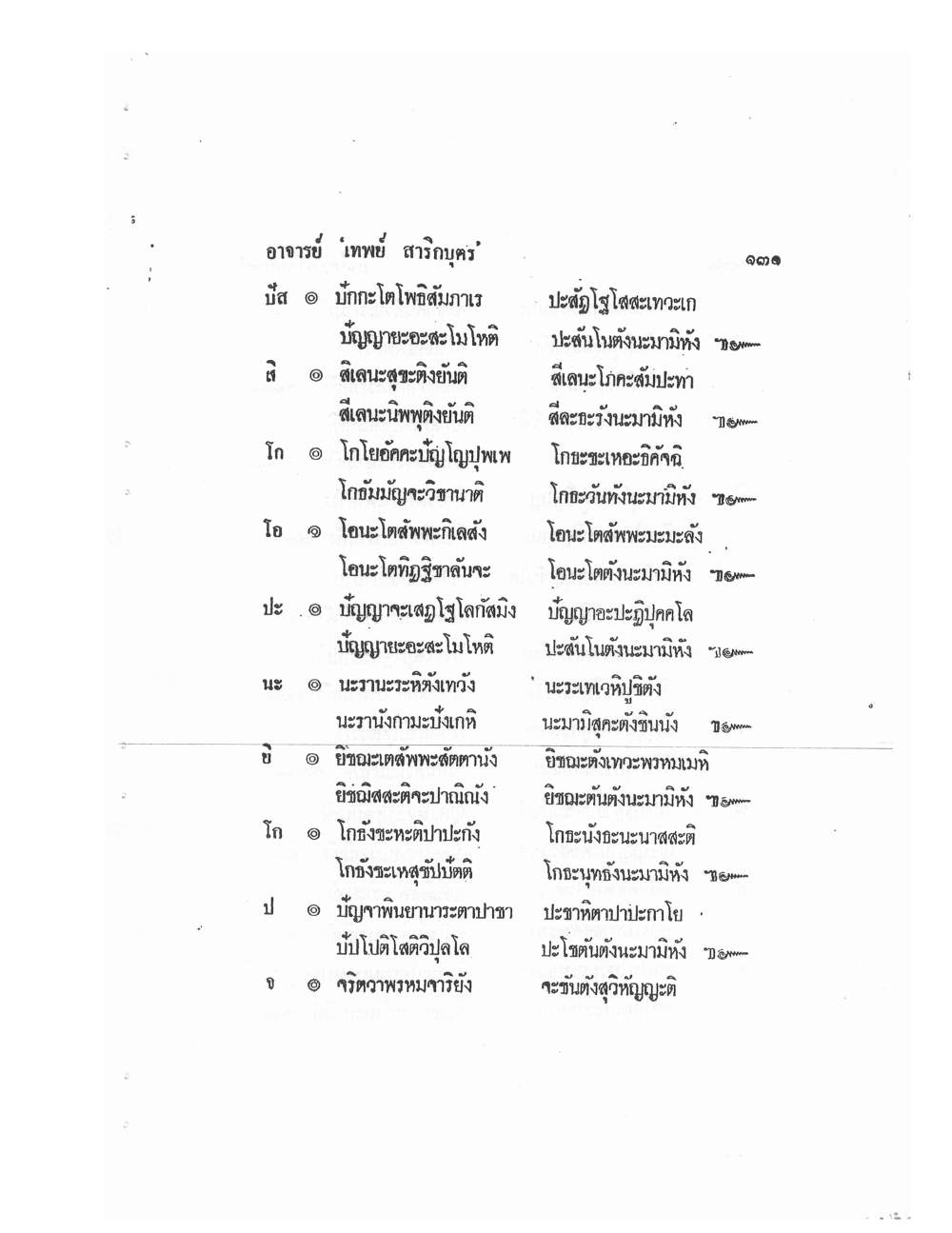
อาจารย์ เทพย์ สาริกบุตร ๑๓๑
บัก ๏ บักกะโตโพธิสัมภาเร ปะสัฏโฐโสสะเทวะเก บัญญายะอะสะโมโหติ ปะสันโนตังนะมามิหัง ๚ะ
สิ ๏ สิเลนะสุขะติงยันติ สีเลนะโภคะสัมปะทา สิเลนะนิพพุติงยันติ สีละถะรังนะมามิหัง ๚ะ
โก ๏ โกโยอัคคะบัญโญปุพเพ โกชะเหอะติคัจฉิ โกธัมมัญจะวิชานาติ โกธะวันทังนะมามิหัง ๚ะ
โอ ๏ โอนะโตสัพพะกิเลสัง โอนะโตสัพพะมะมะลัง โอนะโตทิฏฐะชาลันจะ โอนะโตตังนะมามิหัง ๚ะ
ปะ ๏ บัญญาจะเสฏโฐโลกัสมิง บัญญาอะปฏิปุคคะโล บัญญายะอะสะโมโหติ ปะสันโนตังนะมามิหัง ๚ะ
นะ ๏ นะรานะระหิตังเทวัง นะระเทเวหิปูชิตัง นะรานังกามะบั้งเกิด นะมามิสุคะตังชินนัง ๚ะ
ยิ ๏ ยิชฌะเตสัพพะสัตตานัง ยิชฌะตังเทวะพรหมเมติ ยิชฌิสสะติจะปาณินัง ยิชฌะตันตังนะมามิหัง ๚ะ
โก ๏ โกธังชะหะติปาปะกัง โกชะนังธะนานาสสะติ โกธังชะเหสุชับบัตติ โกธะนุทธังนะมามิหัง ๚ะ
ป ๏ บัญจาพินยานาระตาปาชา ปะชาหิตาปาปะกาโย บั้ปโบติโสติวิปุลโล ปะโชตันตังนะมามิหัง ๚ะ
จ ๏ จริตวาพรหมจาริยัง จะขันตังสุวิหัญญะติ
Running header: 'Ajahn Thep Sarikabutr,' folio '131.' No new section heading — this is a continuation of the Dhamma-virtue expansion table. Ten more seed-syllables are treated, each couplet again closing with homage to the quality named: - [seed 'bak-']: gone to the treasury of enlightenment, calmed among gods and men, possessed of wisdom, free of delusion — homage to that calmed one. - สิ: through virtue one goes to happiness, virtue is the foundation of prosperity, through virtue one goes to liberation — homage to that upholder of virtue. - โก: who attained the foremost wisdom of old, who has gone beyond, who understands the Dhamma — homage to that one who reveres [it]. - โอ: bowed down, so all defilement is cast off; bowed down, so all attachment is cast off; bowed down, so the net of wrong view is cast off — homage to that bowed, reverent one. - ปะ (repeats the 'bak-' couplet): foremost in wisdom in the world, a person beyond opposition, possessed of wisdom, free of delusion — homage to that calmed one. - นะ: benefiting both gods and men, revered by gods and men, [beyond] the arising of human desire — homage to the well-gone Victor. - ยิ: [his teaching] succeeds for all beings, succeeds for gods and Brahmā, will succeed for all creatures — homage to that one whose teaching succeeds. - โก: abandons anger and evil so that people do not lose their wealth; having abandoned anger, well-established — homage to that queller of anger. - ป: guiding the people from wrongdoing, freeing people from evil deeds, greatly increased in prosperity — homage to that one who so shines. - จ (row begins, cut off at the foot of the page): conducting the holy life... [continues onto the next page].
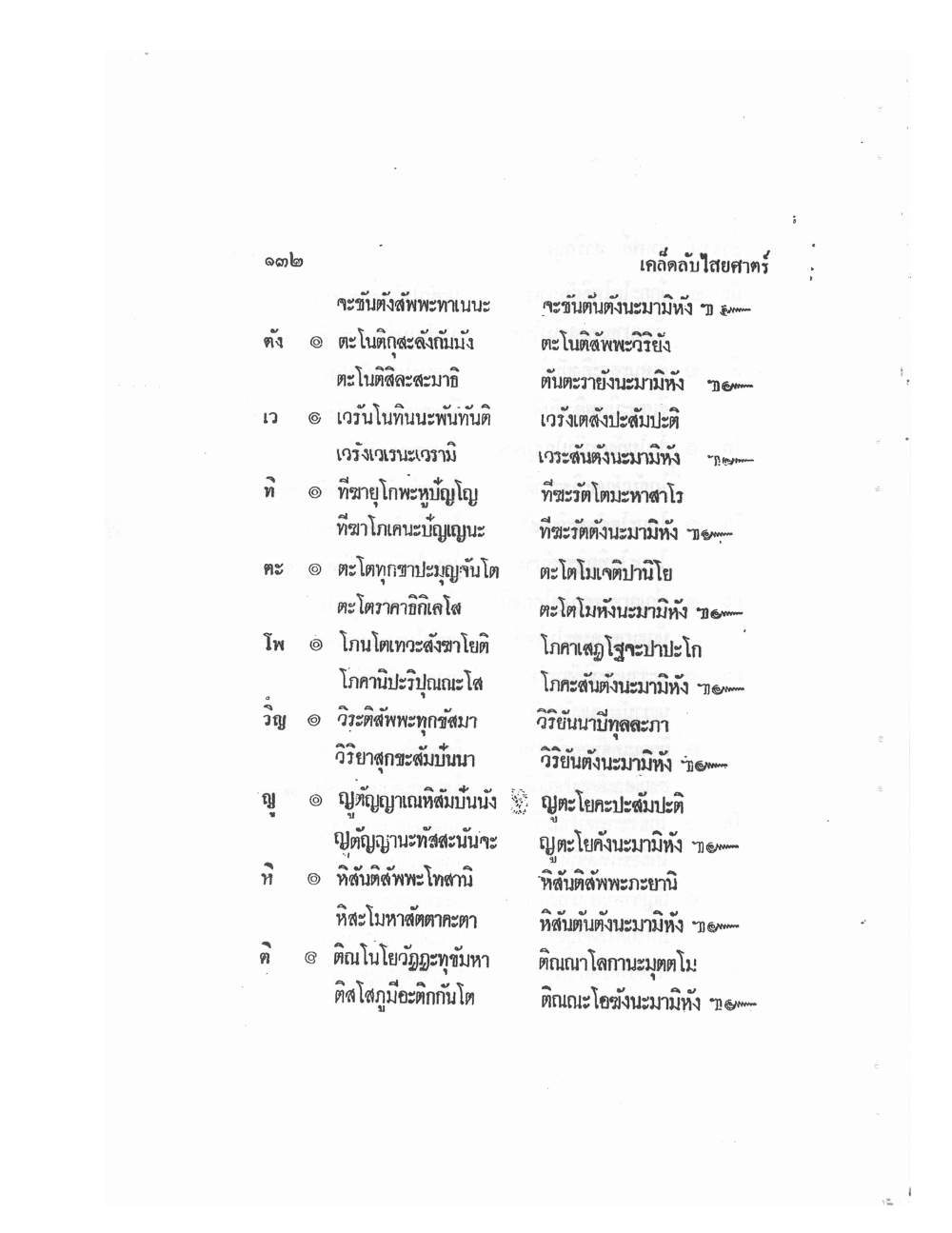
๑๓๒ เคล็ดลับไสยศาสตร์
จะขันตังสัพพะทาเนนนะ จะขันตันตังนะมามิหัง ๚ะ
ตัง ๏ ตะโนติกุสะลังกัมมัง ตะโนติสัพพะวิริยัง ตะโนติสิละสะมาธิ ตันตะรายังนะมามิหัง ๚ะ
เว ๏ เวรันโนทินนะพันทันติ เวรังเตสังปะสัมปะติ เวรังเวรนะเวรามิ เวระสันตังนะมามิหัง ๚ะ
ทิ ๏ ทีฆายุโกพะหูบัญโญ ทีฆะรัตโตมะหาสาโร ทีฆาโภเคนะบัญเญนะ ทีฆะรัตตังนะมามิหัง ๚ะ
ตะ ๏ ตะโตทุกขาปะมุญจันโต ตะโตโมเจติปานิโย ตะโตราคาทิกิเลโส ตะโตมังนะมามิหัง ๚ะ
โพ ๏ โภนโตเทวะสังฆาโยติ โภคาเสฏโฐจะปาปะโก โภคานิปะริปุณณะโส โภคะสันตังนะมามิหัง ๚ะ
วิ ๏ วิระติสัพพะทุกขัสมา วิริยันนาบีทุลละภา วิริยาสุกขะสัมบั้นนา วิริยันตังนะมามิหัง ๚ะ
ญู ๏ ญูตัญญาเณหิสัมบั้นนัง ญูตะโยคะปะสัมปะติ ญูตัญญานทัสสะนัญจะ ญูตะโยคังนะมามิหัง ๚ะ
หิ ๏ หิสันติสัพพะโทสานิ หิสันติสัพพะภะยานิ หิสะโมหาสัตตาคะตา หิสันตันตังนะมามิหัง ๚ะ
ติ ๏ ติณโนโยวัฏฏะทุกขัมหา ติณณาโลกานะมุตตะโม ติสโสภูมิอะติกกันโต ติณณะโอฆังนะมามิหัง ๚ะ
Printed folio '132.' First completes the 'จ' row begun on the previous page ('...having conducted the holy life, a giver to all — homage to that patient one'), then continues the expansion for nine more seed-syllables ตัง เว ทิ ตะ โพ วิ ญู หิ ติ, bringing the Dhamma-virtue table to its close (this final stretch corresponds to the last words of the formula, '...ปัจจัตตัง เวทิตัพโพ วิญญูหิ', 'to be experienced individually by the wise'): - ตัง: producing wholesome deeds, producing all manner of energy, producing virtue and composure — homage to that danger-free one. - เว: [reflecting on] enmity, what is given and what binds; may all be free of enmity and prosper; free of enmity toward enmity — homage to that peaceful, enmity-free one. - ทิ: long-lived, of great merit; over a long time of great substance; through long enjoyment and merit — homage to that one enduring long. - ตะ: releasing beings from suffering, freeing the drinker [of the Dhamma], from lust and the other defilements — homage to that liberator. - โพ: gods and the assembly declare him foremost in fortune and free of evil, his merits fully ripened — homage to that fortunate, peaceful one. - วิ: free from all suffering, energy hard to find elsewhere, energetic and accomplished in ease — homage to that energetic one. - ญู: accomplished in knowledge, skilled and successful, teaching the vision of knowledge — homage to that accomplished, skilled one. - หิ: he calms all hatred, calms all fear, in whom beings' delusion is calmed — homage to that calm one. - ติ: crossed over the round of suffering, unsurpassed among those who have crossed the world, gone beyond the three realms — homage to that one who has crossed the flood.
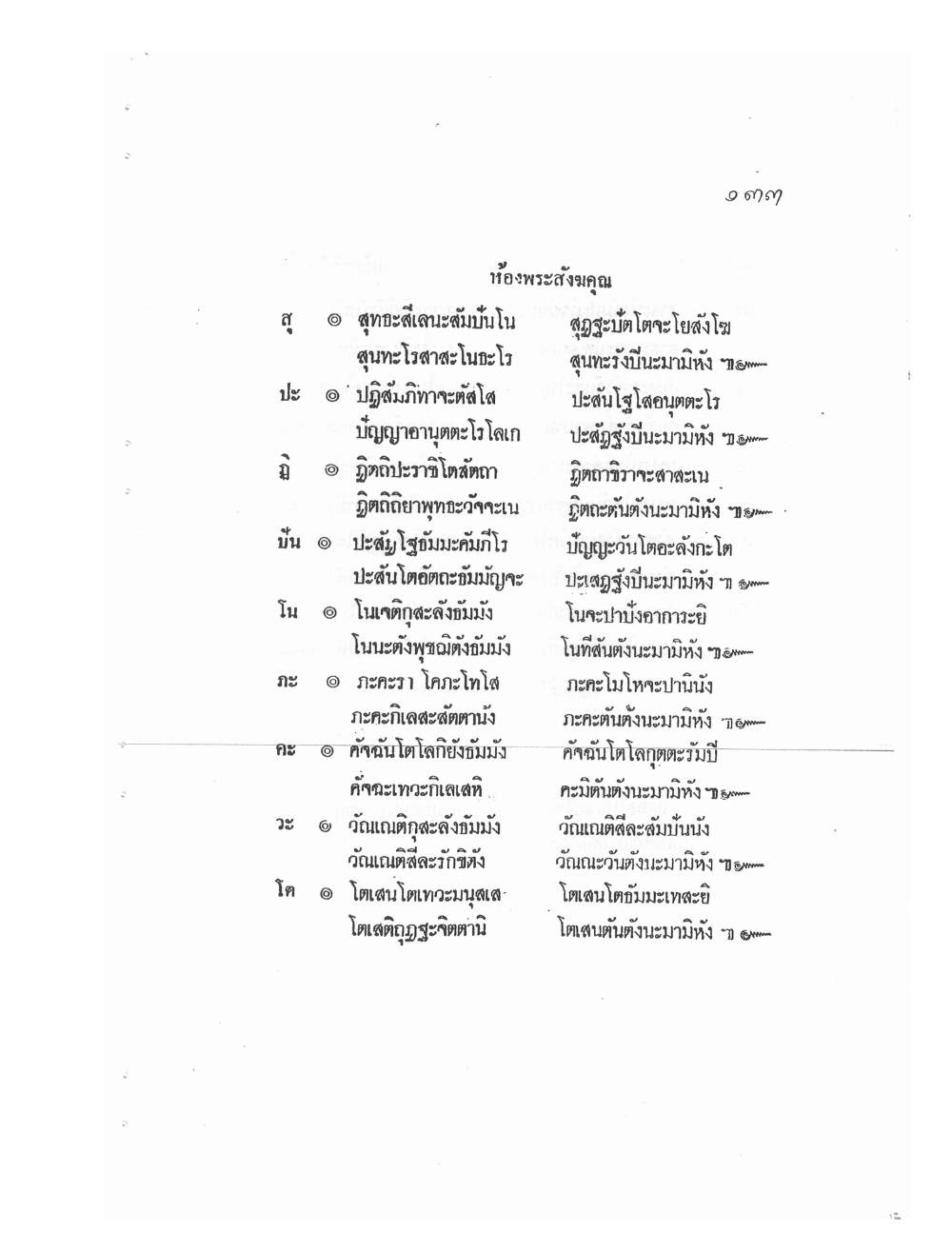
๑๓๓
ห้องพระสังฆคุณ
สุ ๏ สุทธะสีเลนะสัมปันโน สุฏฐะบัติโตจะโยสังโฆ สุนทะโรสาสะโนธะโร สุนทะรังบีนะมามิหัง ๚ะ
ปะ ๏ ปฏิสัมภิทาจะตัสโส ปะสันโฐโสอนุตตะโว บัญญาอานุตตะโรโลเก ปะสัฏฐังบีนะมามิหัง ๚ะ
ฏิ ๏ ฏิติประวาชิโตสัตถา ฏิตาชิราวะจะสาสะเน ฏิติถิยาพุทธะวัจจะเน ฏิตะตันตังนะมามิหัง ๚ะ
ปั้น ๏ ปะสัญโญฐัมมะคัมภีโร บัญญะวันโตอลังกะโต ปะสันโนอัตถะธัมมัญจะ ปะเสฏฐังบีนะมามิหัง ๚ะ
โน ๏ โนเจติกุสะลังธัมมัง โนนะตังพุชฌิตังธัมมัง โนจะปาปังอาการะยิ โนทีสันตังนะมามิหัง ๚ะ
ภะ ๏ ภะคะรา โคภะคะโทโส ภะคะโมโหจะปานินัง ภะคะกิเลสะสัตตานัง ภะคะตันตังนะมามิหัง ๚ะ
คะ ๏ คัจฉันโตโลกิยังธัมมัง คัจฉันโตโลกุตตะรัมบี คัจฉะเทวะกิเลเสติ คะมิตันตังนะมามิหัง ๚ะ
วะ ๏ วัณเณติกุสะลังธัมมัง วัณเณติสีละสัมบั้นนัง วัณเณติสีละรักขิตัง วัณเณวันตังนะมามิหัง ๚ะ
โต ๏ โตเสนโตเทวะมนุสเส โตเสนโตธัมมะเทสะยิ โตเสติฏฐะจิตตานิ โตเสนตันตังนะมามิหัง ๚ะ
Heading: 'The Chamber of the Sangha's Virtues.' This table applies the same seed-syllable expansion to the opening of the Sangha-recollection formula ('supaṭipanno bhagavato sāvakasaṅgho', 'Of good practice is the Blessed One's community of disciples'): สุ ปะ ฏิ ปั้น โน ภะ คะ วะ โต, each couplet again closing with homage: - สุ: perfectly endowed with pure virtue, well-established, attained the Way, a beautiful bearer of the Teaching — homage to that beautiful one. - ปะ: possessed of the four analytical insights, wholly calmed and unsurpassed, of unsurpassed wisdom in the world — homage to that praised one. - ฏิ: ordained under the Teacher, long-established in the Teaching, in the very words of the Buddha — homage to that steadfast one. - ปั้น: of a profound Dhamma, confident and adorned with wisdom, confident in the meaning and the Dhamma — homage to that most excellent one. - โน: whose wholesome Dhamma does not waver, whose realised Dhamma does not bend, who commits no evil — homage to that unwavering one. - ภะ: the Blessed One who has broken lust, broken hatred, broken the delusion and the defilements of beings — homage to that Blessed Breaker [of defilement]. - คะ: going forth in the mundane Dhamma and also in the supramundane, going beyond the defilements of the gods — homage to that one who has gone forth. - วะ: praising the wholesome Dhamma, praising one perfect in virtue, praising one who guards virtue — homage to that praised one. - โต: delighting gods and men, teaching the Dhamma with delight, gladdening steadfast minds — homage to that one who delights.
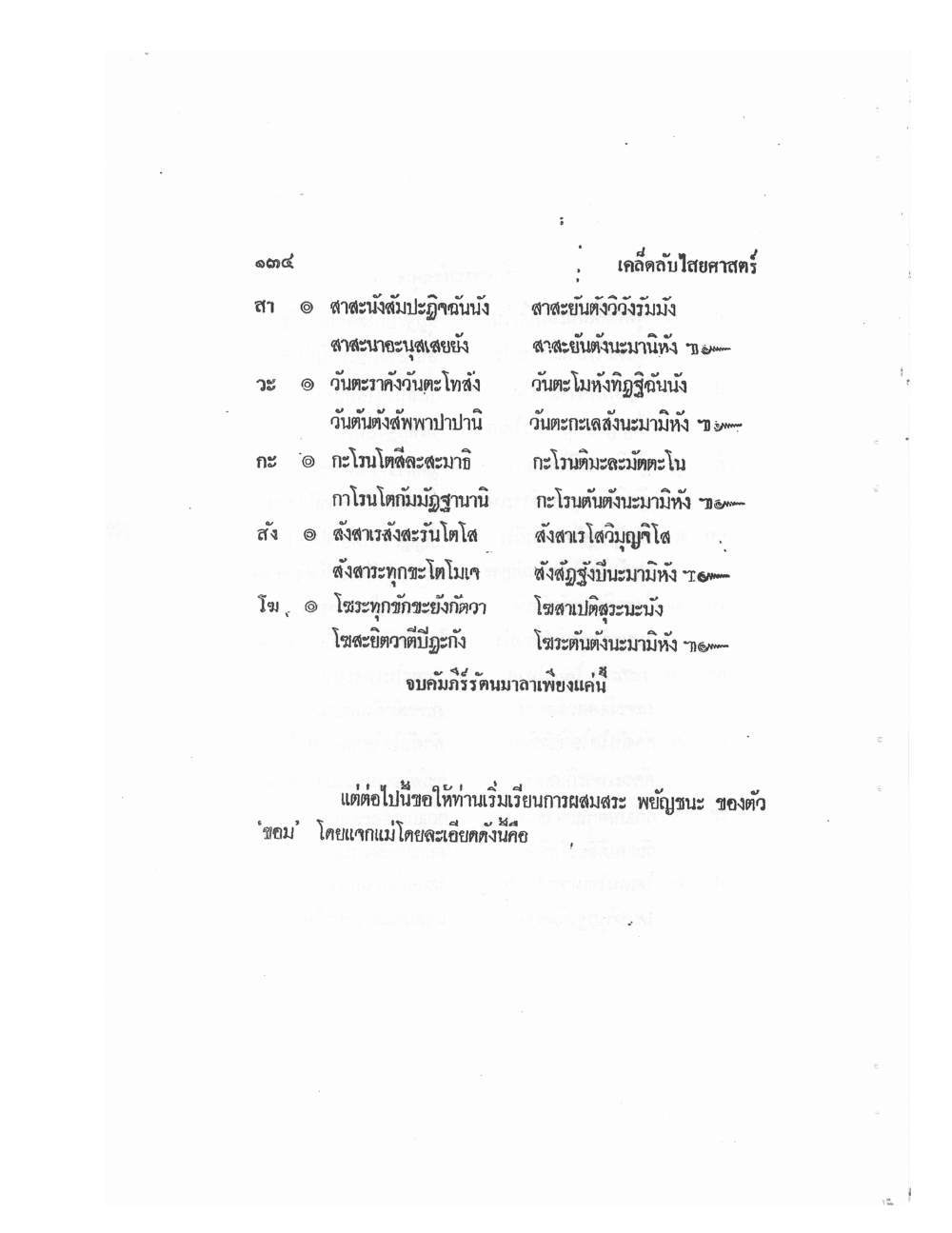
๑๓๔ เคล็ดลับไสยศาสตร์
สา ๏ สาสะนังสัมปะฏิจฉันนัง สาสะยันตังวิวังรัมมัง สาสะนาอะนุสเสยยัง สาสะยันตังนะมามิหัง ๚ะ
วะ ๏ วันตะราคังวันตะโทสัง วันตะโมหังทิฏฐิฉันนัง วันตันตังสัพพาปาปานิ วันตะกะเลสังนะมามิหัง ๚ะ
กะ ๏ กะโรนโตสีละสะมาธิ กะโรนติมะละสัตตะโน กาโรนโตกัมมัฏฐานานิ กะโรนตันตังนะมามิหัง ๚ะ
สัง ๏ สังสาเรสังสะรันโตโส สังสาเรโสวิมุญจิโส สังสาระทุกขะโตโมเจ สังสัฏฐังบีนะมามิหัง ๚ะ
โม ๏ โมระทุกขักขะยังกัตวา โมสาเปติสุระนะมัง โมสะยิตวาตีบีฏะกัง โมระตันตังนะมามิหัง ๚ะ
จบคัมภีร์รัตนมาลาเพียงแค่นี้
แต่ต่อไปนี้ขอให้ท่านเริ่มเรียนการผสมสระ พยัญชนะ ของตัว "ขอม" โดยแจกแม่โดยละเอียดดังนี้คือ
Printed folio '134.' Completes the Sangha-virtue table with five final seed-syllables สา วะ กะ สัง โม (finishing the phrase '...สาวะกะสังโฆ', '...is the community of disciples'): - สา: the Teaching well received and preserved, proclaiming what is delightful, a Teaching not to be despised — homage to that proclaimer. - วะ: vomited-out lust, vomited-out hatred, vomited-out delusion and wrong view, vomited-out every evil — homage to that one free of defilement. - กะ: practising virtue and composure, removing the stains of beings, practising the meditation subjects — homage to that practitioner. - สัง: wandering in saṃsāra yet freed from saṃsāra, released from the suffering of saṃsāra — homage to that released one. - โม: having ended the wearing-out of suffering, delighting the good and wise, having gone beyond the [three] baskets [of scripture] — homage to that one gone beyond.
Then: 'The Ratanamala scripture ends only this far.'
And then: 'But from here on, may you begin to learn the combining of vowels and consonants of the "Khom" script, by drilling through the base-letter declensions in detail, as follows:'
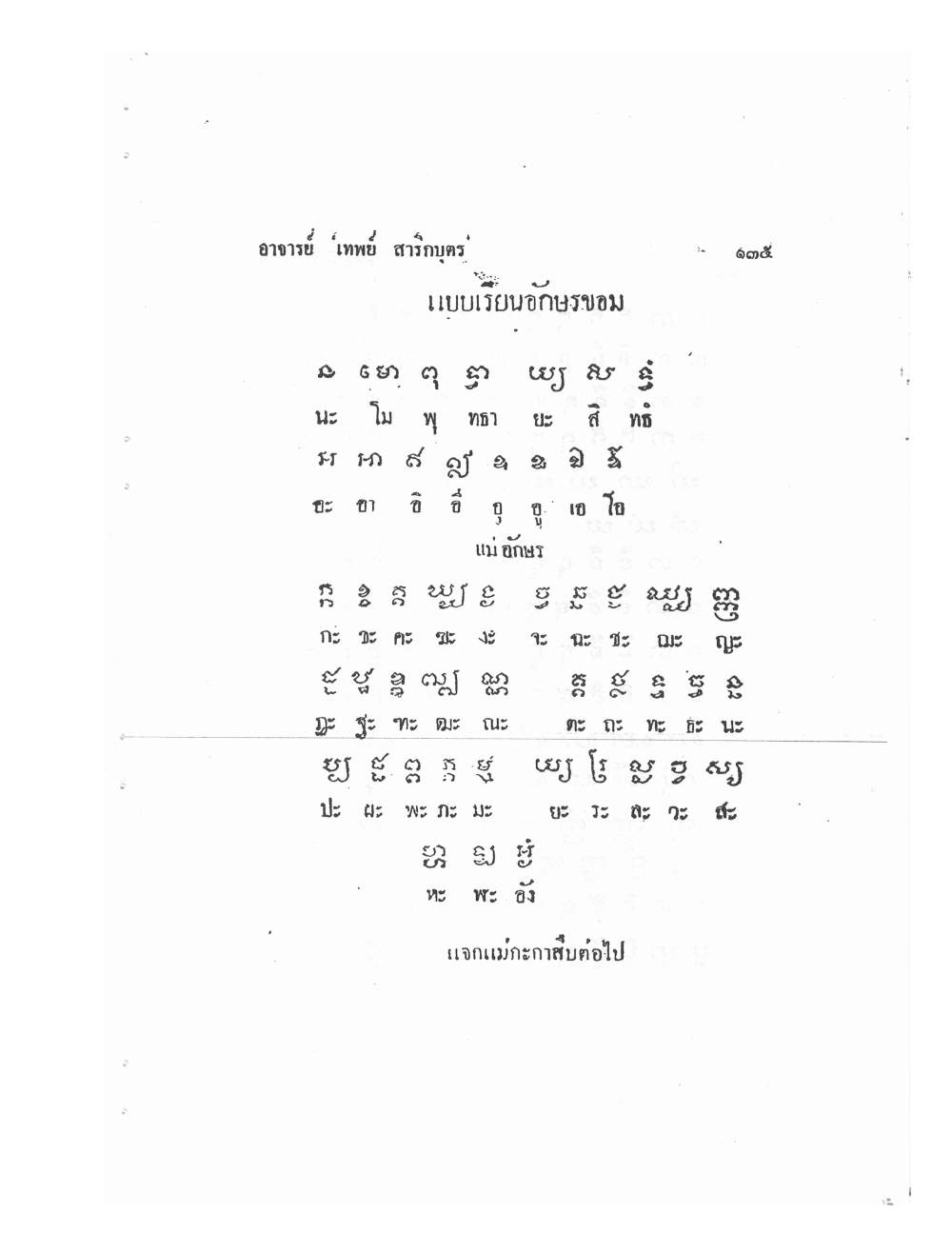
อาจารย์ เทพย์ สาริกบุตร ๑๓๕
แบบเรียนอักษรขอม
[แถวอักษรขอม เป็นคำอัญเชิญ ตรงกับคำอ่านไทยข้างล่าง] นะ โม พุ ทธา ยะ สิ ทธิ
[แถวอักษรขอม เป็นรูปสระ ตรงกับคำอ่านไทยข้างล่าง] อะ อา อิ อี อุ อู เอ โอ
แม่อักษร
[แถวอักษรขอม พยัญชนะวรรค ตรงกับคำอ่านไทยข้างล่าง] กะ ขะ คะ ฆะ งะ จะ ฉะ ชะ ฌะ ญะ
[แถวอักษรขอม พยัญชนะวรรค ตรงกับคำอ่านไทยข้างล่าง] ฏะ ฐะ ฑะ ฒะ ณะ ตะ ถะ ทะ ธะ นะ
[แถวอักษรขอม พยัญชนะวรรค ตรงกับคำอ่านไทยข้างล่าง] ปะ ผะ พะ ภะ มะ ยะ ระ ละ วะ สะ
[แถวอักษรขอม พยัญชนะเศษวรรค ตรงกับคำอ่านไทยข้างล่าง] หะ พะ อัง
แจกแม่กะกาสืบต่อไป
Running header: 'Ajahn Thep Sarikabutr,' folio '135.' Heading: 'A Primer for Learning the Khom Script.' Two introductory lines are given in Khom-script forms with their Thai reading below: first the invocation 'Namo Buddhāya, siddhi' ('Homage to the Buddha; may there be success'), then the eight basic vowels 'a ā i ī u ū e o.' Under the heading 'The Base Letters' follow the consonants of the Pali/Khom alphabet, again given as Khom-script rows with the Thai reading beneath, arranged in the traditional groups: the velars (ka kha ga gha ṅa) and palatals (ca cha ja jha ña); the retroflexes (ṭa ṭha ḍa ḍha ṇa) and dentals (ta tha da dha na); the labials (pa pha ba bha ma) with the semivowels (ya ra la va) and sibilant (sa); and a short closing line (ha, ba/pha, and the nasal-marker 'aṅ'). The page ends: 'Continue next with declining the ko-ka base group.'
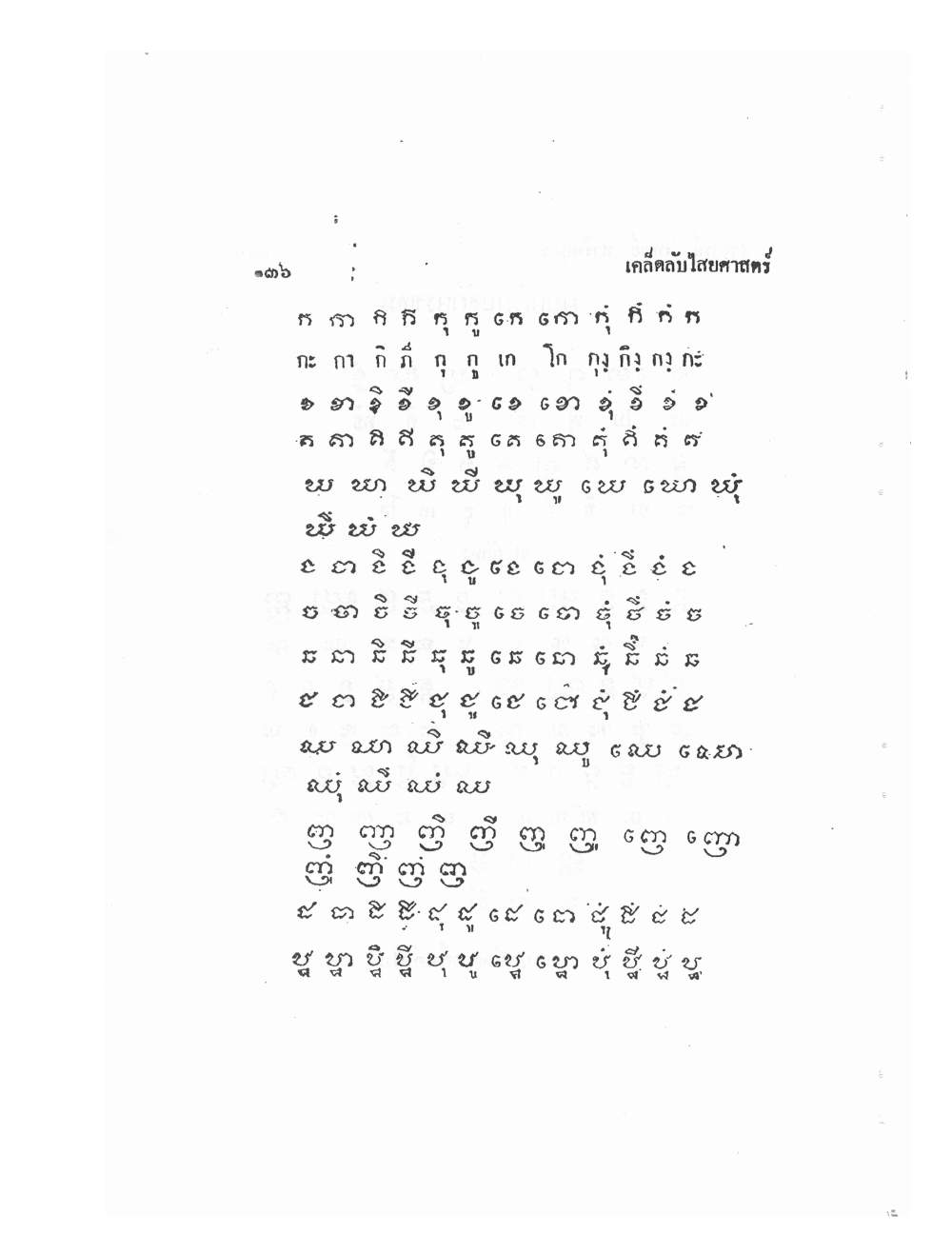
๑๓๖ เคล็ดลับไสยศาสตร์
[แถวอักษรขอมของแต่ละพยัญชนะ ตรงกับคำอ่านไทยข้างล่าง] กะ กา กิ กี กุ กู เก โก กุง กิง กง กะ ขะ ขา ขิ ขี ขุ ขู เข โข ขุง ขิง ขง ขะ คะ คา คิ คี คุ คู เค โค คุง คิง คง คะ งะ งา งิ งี งุ งู เง โง งุง งิง งง งะ
ยะ ยา ยิ ยี ยุ ยู เย โย ยุง ยิง ยง ยะ ยี ยั ยะ
ณะ ณา ณิ ณี ณุ ณู เณ โณ ณุง ณิง ณง ณะ
จะ จา จิ จี จุ จู เจ โจ จุง จิง จง จะ
ฉะ ฉา ฉิ ฉี ฉุ ฉู เฉ โฉ ฉุง ฉิง ฉง ฉะ สะ สา สิ สี สุ สู เส โส สุง สิง สง สะ สม สึ ส
หะ หา หิ หี หุ หู เห โห หุง หิง หง หะ หี หํ ห
Printed folio '136,' running head 'The Secrets of Saiyasat.' Continues the Khom-script declension drill: for each of the consonants shown (ก, ข, ค, ง; ย; ณ; จ; ฉ, ส; ห), a Khom-script row stands above with the Thai reading below, running through the same sequence — short a, long ā, short i, long ī, short u, long ū, e, o — followed by three nasalised endings (-uṅ, -iṅ, -ṅ) and a repeat of the plain short-a form. A short extra line after ย and after ส/ห gives a couple of additional combined forms (ยี ยั ยะ; สม สึ ส; หี หํ ห).
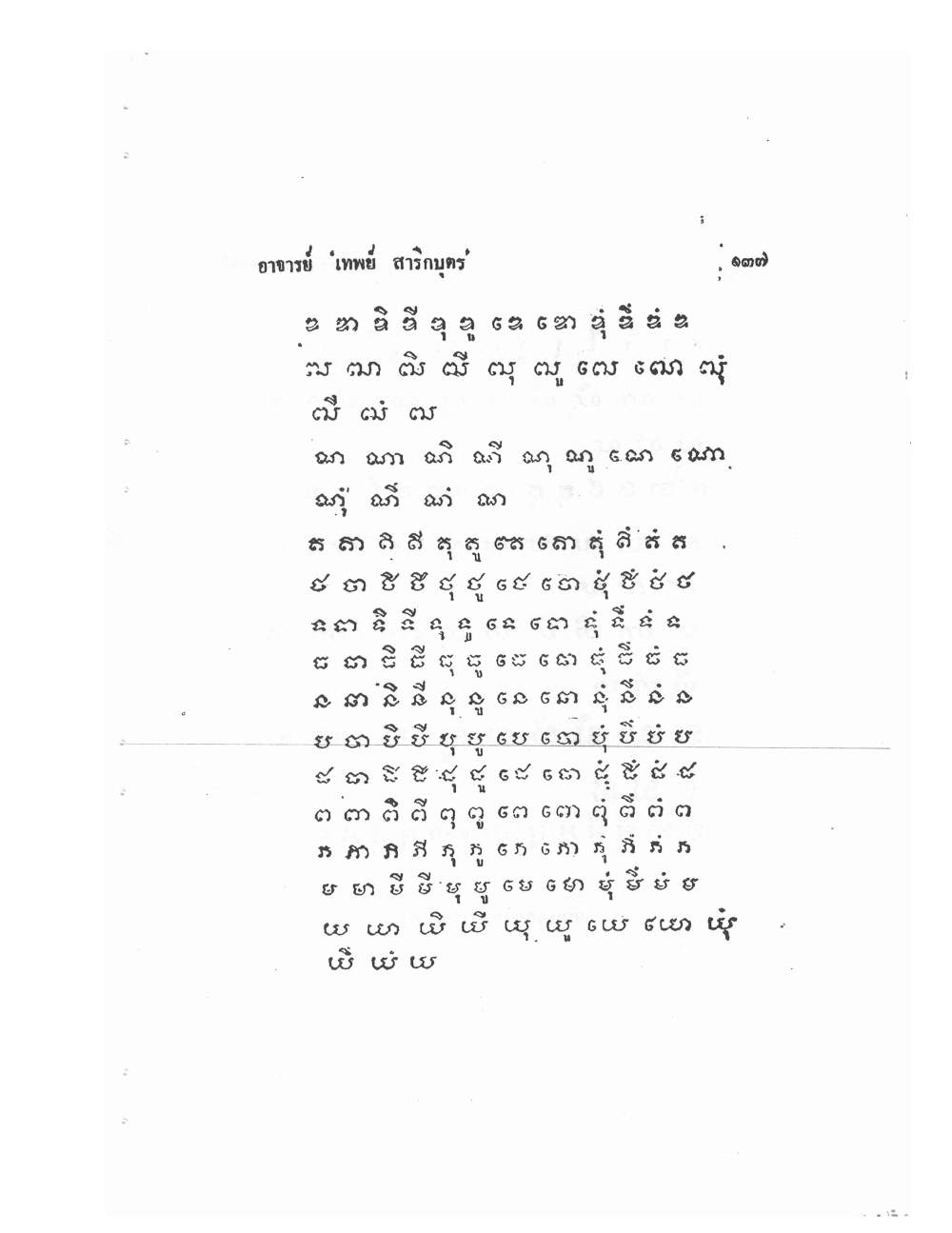
๑๓๗ เคล็ดลับไสยศาสตร์
[แถวอักษรขอมของแต่ละพยัญชนะ ตรงกับคำอ่านไทยข้างล่าง] ตะ ตา ติ ตี ตุ ตู เต โต ตุง ติง ตง ตะ ถะ ถา ถิ ถี ถุ ถู เถ โถ ถุง ถิง ถง ถะ ทะ ทา ทิ ที ทุ ทู เท โท ทุง ทิง ทง ทะ ธะ ธา ธิ ธี ธุ ธู เธ โธ ธุง ธิง ธง ธะ นะ นา นิ นี นุ นู เน โน นุง นิง นง นะ
ปะ ปา ปิ ปี ปุ ปู เป โป ปุง ปิง ปง ปะ ผะ ผา ผิ ผี ผุ ผู เผ โผ ผุง ผิง ผง ผะ พะ พา พิ พี พุ พู เพ โพ พุง พิง พง พะ ภะ ภา ภิ ภี ภุ ภู เภ โภ ภุง ภิง ภง ภะ มะ มา มิ มี มุ มู เม โม มุง มิง มง มะ
ยะ ยา ยิ ยี ยุ ยู เย โย ยุง ยิง ยง ยะ ยิ ยํ ย
Printed folio '137.' The declension drill continues through the dental consonants (ต ถ ท ธ น) and the labial consonants (ป ผ พ ภ ม), each again run through the eight vowel-forms and three nasalised endings, followed by a short extra line for ย (ยิ ยํ ย).
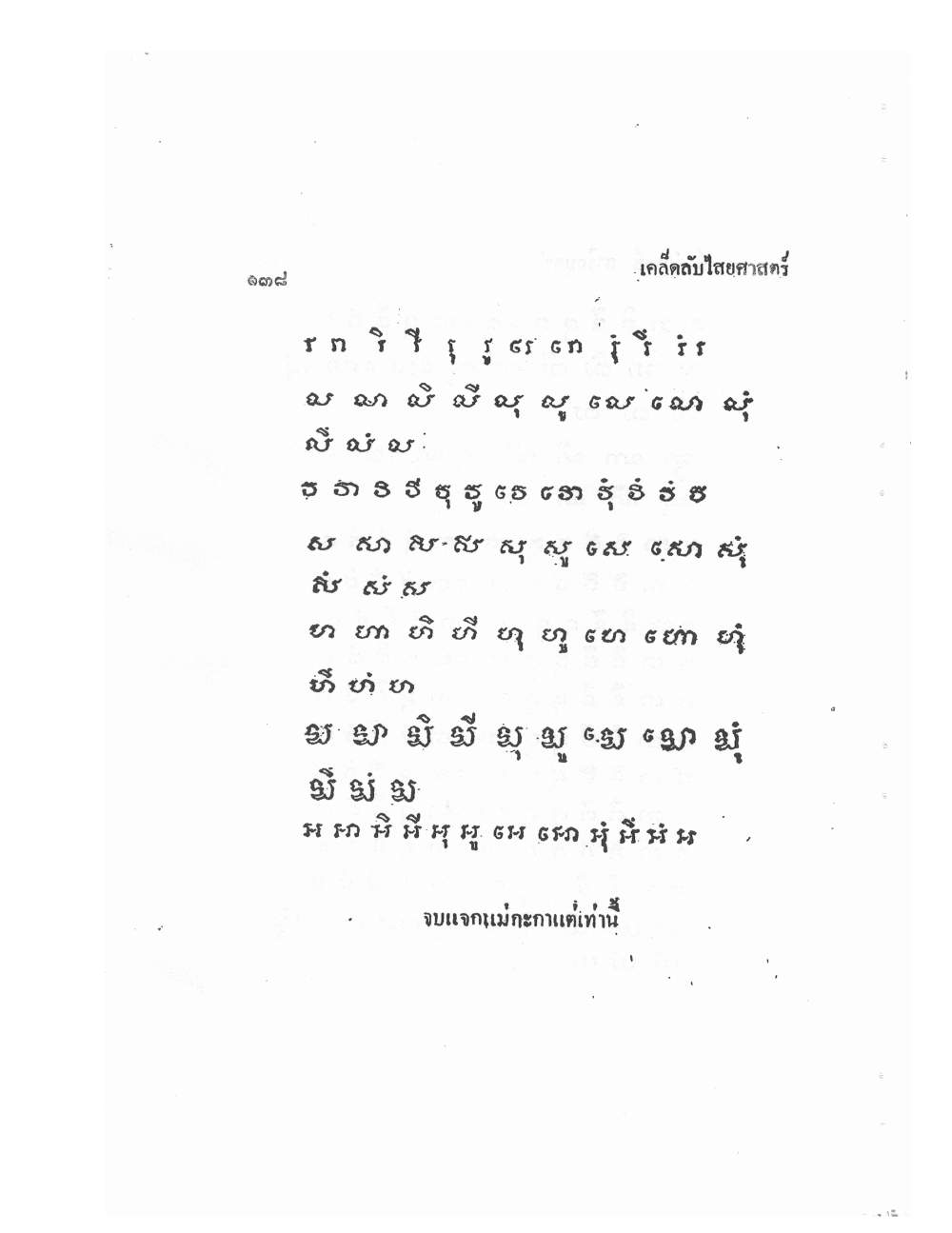
๑๓๘ เคล็ดลับไสยศาสตร์
[แถวอักษรขอมของแต่ละพยัญชนะ ตรงกับคำอ่านไทยข้างล่าง] ระ รา ริ รี รุ รู เร โร รุง ริง รง ระ ละ ลา ลิ ลี ลุ ลู เล โล ลุง ลิง ลง ละ วะ วา วิ วี วุ วู เว โว วุง วิง วง วะ สะ สา สิ สี สุ สู เส โส สุง สิง สง สะ หะ หา หิ หี หุ หู เห โห หุง หิง หง หะ อะ อา อิ อี อุ อู เอ โอ อุง อิง อง อะ ฬะ ฬา ฬิ ฬี ฬุ ฬู เฬ โฬ ฬุง ฬิง ฬง ฬะ
จบแจกแม่กะกาแต่เท่านี้
Printed folio '138.' Concludes the eight-vowel, three-nasalised-ending declension drill with the remaining letters ร ล ว ส ห อ ฬ. Closing line: 'The declension of the ko-ka base ends here.'
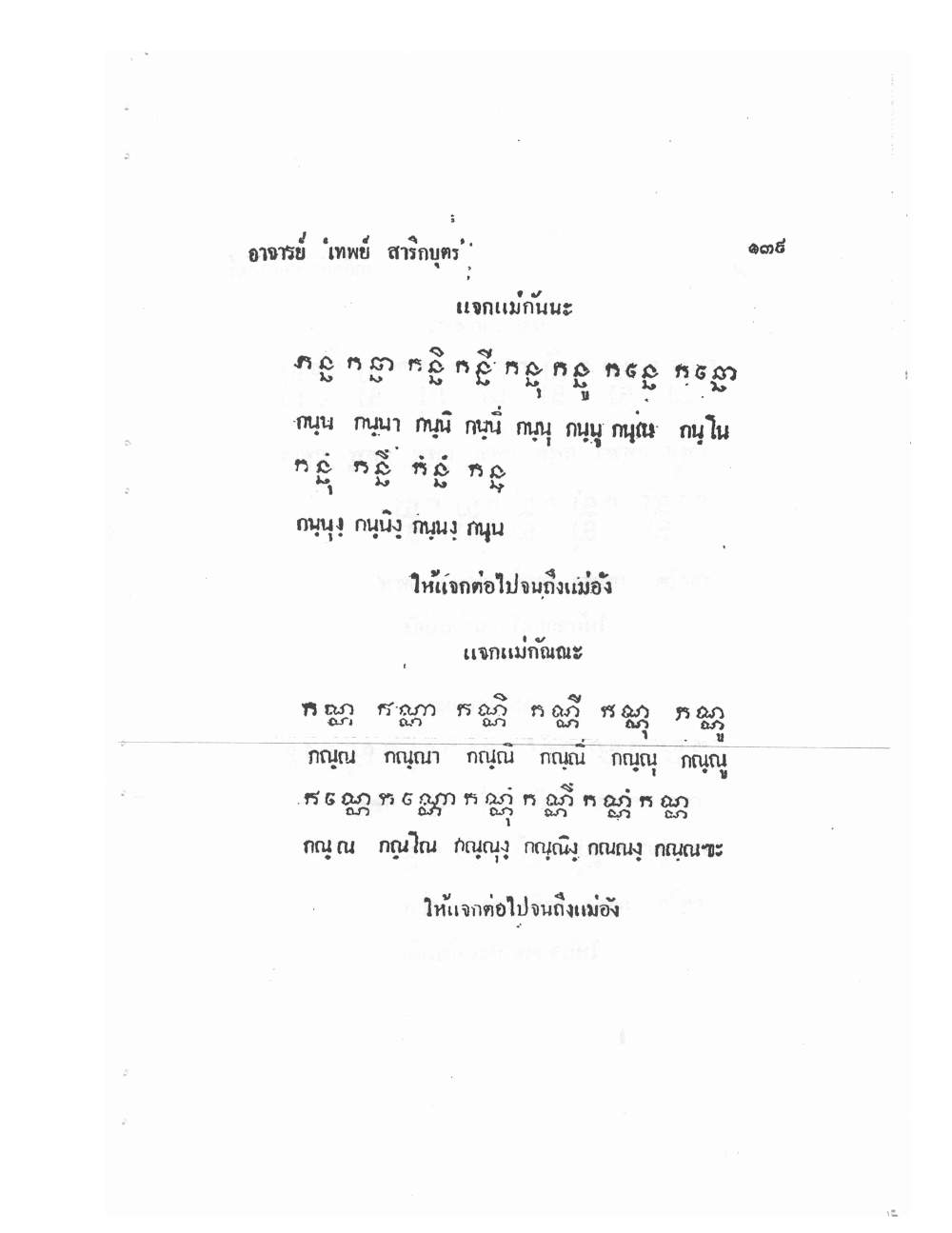
อาจารย์ เทพย์ สาริกบุตร ๑๓๙
แจกแม่กันนะ
[แถวอักษรขอม ตรงกับคำอ่านไทยข้างล่าง] กน กนา กนิ กนี กนุ กนู กเนะ กเนา กนุ กนี กนํ กนุ
กนุนุง กนุนิง กนุนง กนุน
ให้แจกต่อไปจนถึงแม่อัง
แจกแม่กัณณะ
[แถวอักษรขอม ตรงกับคำอ่านไทยข้างล่าง] กณา กณา กณิ กณี กณุ กณู เกณฑา เกณฑา กณุ กณี กณุ กณู
กณ กณใน กณุนุง กณุนิง กณนง กณณะ
ให้แจกต่อไปจนถึงแม่อัง
Running header: 'Ajahn Thep Sarikabutr,' folio '139.' New drill, headed 'Declining the kon Base': the syllable กน is run through the same eight-vowel pattern (ka-, kā-, ki-, kī-, ku-, kū-, ke-, ko-) with an -n final, in Khom script with Thai reading beneath, then through a further set of nasalised forms. Closing instruction: 'Continue declining in this way up through the aṅ base.' A second drill follows, headed 'Declining the kaṇṇa Base,' running the syllable กัณ (with retroflex -ṇ final) through the same pattern, closing with the same instruction, 'Continue declining in this way up through the aṅ base.'
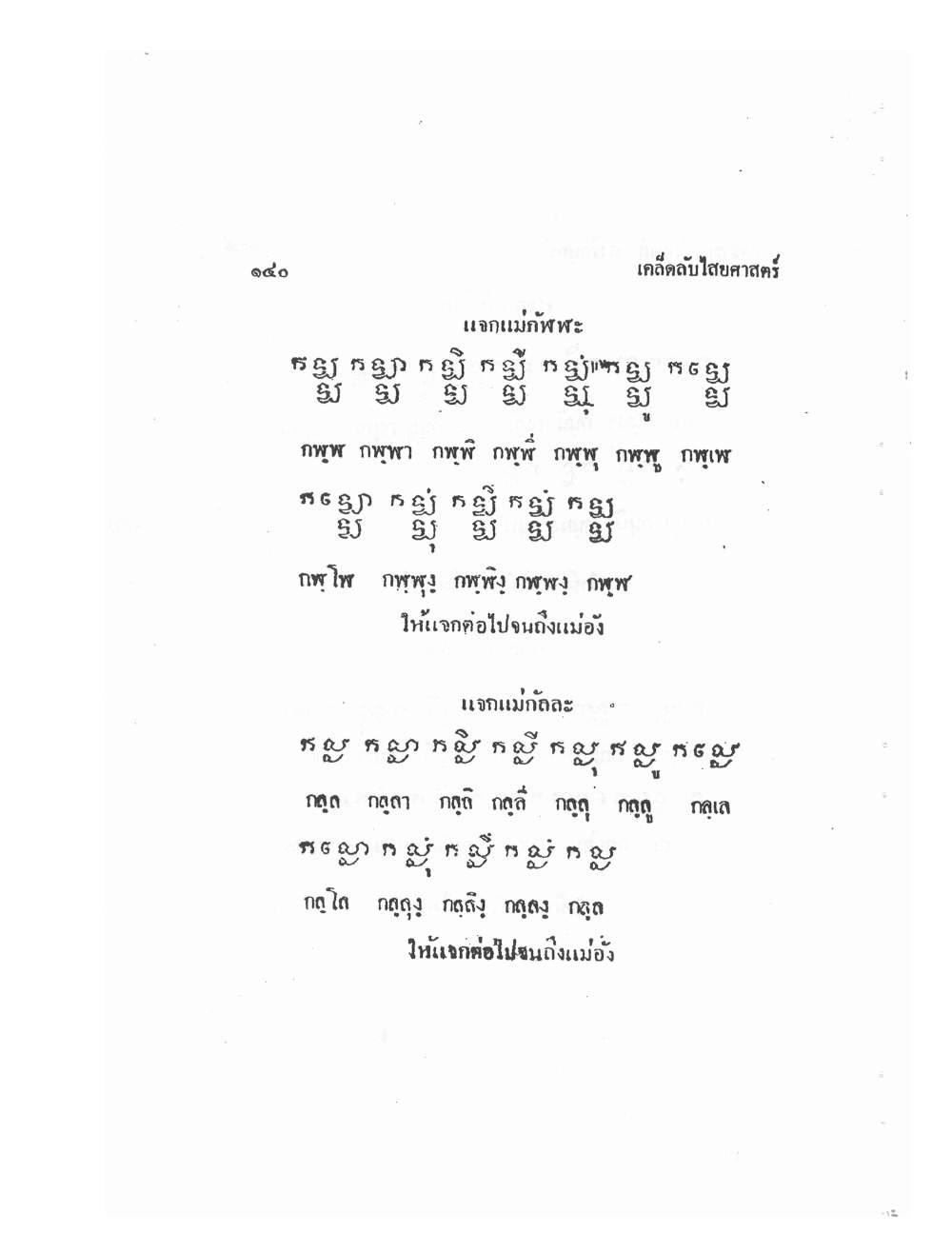
๑๔๐ เคล็ดลับไสยศาสตร์
แจกแม่กัพพะ
[แถวอักษรขอม ตรงกับคำอ่านไทยข้างล่าง] กัพ กัพพา กัพพิ กัพพี กัพพุ กัพพู กัพเพ
กัพพุ กัพพา กัพพิ กัพพี กัพพุ กัพพู กัพเพ
กัพโพ กัพพุง กัพพิง กัพพง กัพพุ
ให้แจกต่อไปจนถึงแม่อัง
แจกแม่กัลละ
[แถวอักษรขอม ตรงกับคำอ่านไทยข้างล่าง] กัล กัลลา กัลลิ กัลลี กัลลุ กัลลู กัลเล
กัลุด กัลุดา กัลุติ กัลุลี กัลุลุ กัลุลู กัลเลส
กัลโต กัลตุง กัลติง กัลตง กัลุต
ให้แจกต่อไปจนถึงแม่อัง
Printed folio '140,' running head 'The Secrets of Saiyasat.' The declension drill continues: 'Declining the kappa Base,' running กัพ (a labial-stop, -p final) through the eight-vowel pattern and a further set of nasalised forms in Khom script with Thai reading beneath, closing 'Continue declining in this way up through the aṅ base.' Then 'Declining the kalla Base,' running กัล (an -l final) through the same pattern, closing with the same instruction, 'Continue declining in this way up through the aṅ base.'
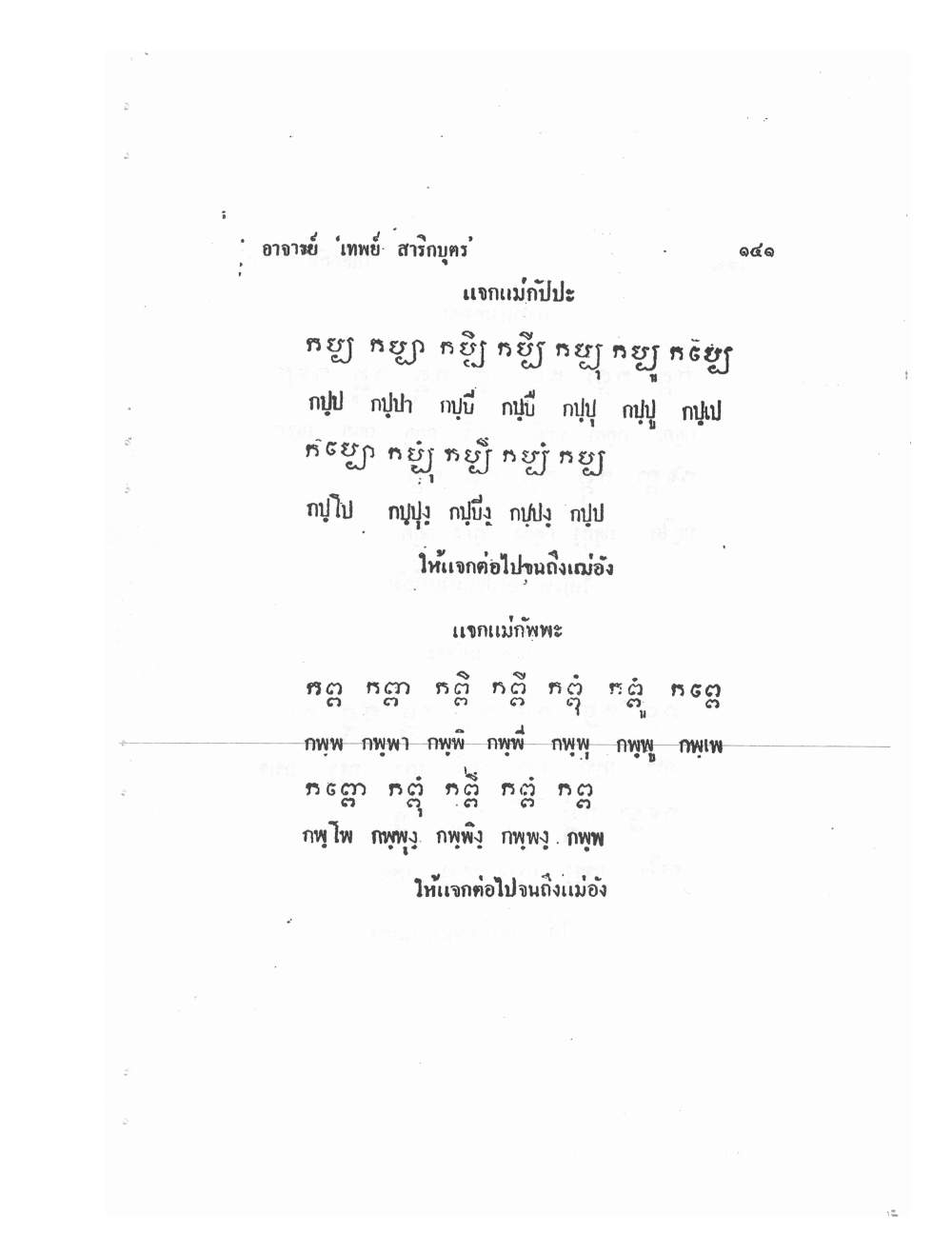
อาจารย์ 'เทพย์' สาริกบุตร์ ๑๔๑
แจกแม่กัปปะ
[บรรทัดบน: เจ็ดพยางค์ชุดเดียวกับบรรทัดถัดไป เขียนด้วยอักษรขอม] กปป กปปา กปปิ กปปี กปปุ กปปู กปเป [บรรทัดบน: ห้าพยางค์ชุดเดียวกับบรรทัดถัดไป เขียนด้วยอักษรขอม] กปโป กปปุง กปปิง กปปง กปป
ให้แจกต่อไปจนถึงแม่[อ่านไม่ออก]
แจกแม่กัพพะ
[บรรทัดบน: เจ็ดพยางค์ชุดเดียวกับบรรทัดถัดไป เขียนด้วยอักษรขอม] กพพ กพพา กพพิ กพพี กพพุ กพพู กพเพ [บรรทัดบน: ห้าพยางค์ชุดเดียวกับบรรทัดถัดไป เขียนด้วยอักษรขอม] กพโพ กพพุง กพพิง กพพง กพพ
ให้แจกต่อไปจนถึงแม่[อ่านไม่ออก]
[header: Ajarn Thep Sarikabutr — p. 141]
Declension drill: the "kappa" cluster
[top line: the same seven syllables as the line below, written in Khom script] kappa, kappā, kappi, kappī, kappu, kappū, kappe [top line: the same five syllables as the line below, written in Khom script] kappo, kappuṅ, kappiṅ, kappaṅ, kappa
Continue declining in the same way through to the "[illegible]" frame.
Declension drill: the "kabba" cluster
[top line: the same seven syllables as the line below, written in Khom script] kabba, kabbā, kabbi, kabbī, kabbu, kabbū, kabbe [top line: the same five syllables as the line below, written in Khom script] kabbo, kabbuṅ, kabbiṅ, kabbaṅ, kabba
Continue declining in the same way through to the "[illegible]" frame.
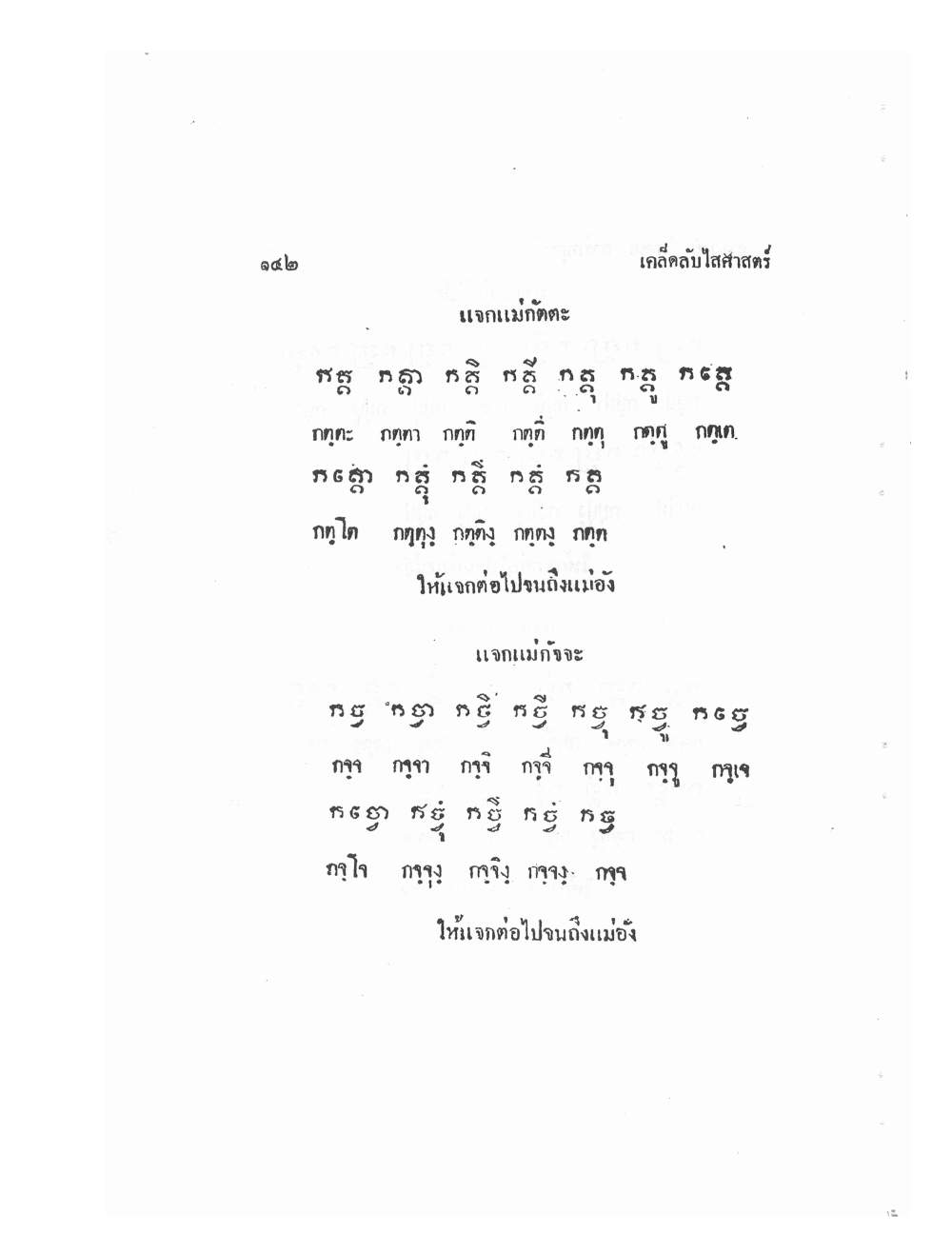
๑๔๒ เคล็ดลับไสยศาสตร์
แจกแม่กัตตะ
[บรรทัดบน: เจ็ดพยางค์ชุดเดียวกับบรรทัดถัดไป เขียนด้วยอักษรขอม] กตต กตตา กตติ กตตี กตตุ กตตู กตเต [บรรทัดบน: ห้าพยางค์ชุดเดียวกับบรรทัดถัดไป เขียนด้วยอักษรขอม] กตโต กตตุง กตติง กตตง กตต
ให้แจกต่อไปจนถึงแม่[อ่านไม่ออก]
แจกแม่กัจจะ
[บรรทัดบน: เจ็ดพยางค์ชุดเดียวกับบรรทัดถัดไป เขียนด้วยอักษรขอม] กจจ กจจา กจจิ กจจี กจจุ กจจู กจเจ [บรรทัดบน: ห้าพยางค์ชุดเดียวกับบรรทัดถัดไป เขียนด้วยอักษรขอม] กจโจ กจจุง กจจิง กจจง กจจ
ให้แจกต่อไปจนถึงแม่[อ่านไม่ออก]
[header: p. 142 — "The Mind-Current: Secrets of Saiyasat"]
Declension drill: the "katta" cluster
[top line: the same seven syllables as the line below, written in Khom script] katta, kattā, katti, kattī, kattu, kattū, katte [top line: the same five syllables as the line below, written in Khom script] katto, kattuṅ, kattiṅ, kattaṅ, katta
Continue declining in the same way through to the "[illegible]" frame.
Declension drill: the "kacca" cluster
[top line: the same seven syllables as the line below, written in Khom script] kacca, kaccā, kacci, kaccī, kaccu, kaccū, kacce [top line: the same five syllables as the line below, written in Khom script] kacco, kaccuṅ, kacciṅ, kaccaṅ, kacca
Continue declining in the same way through to the "[illegible]" frame.
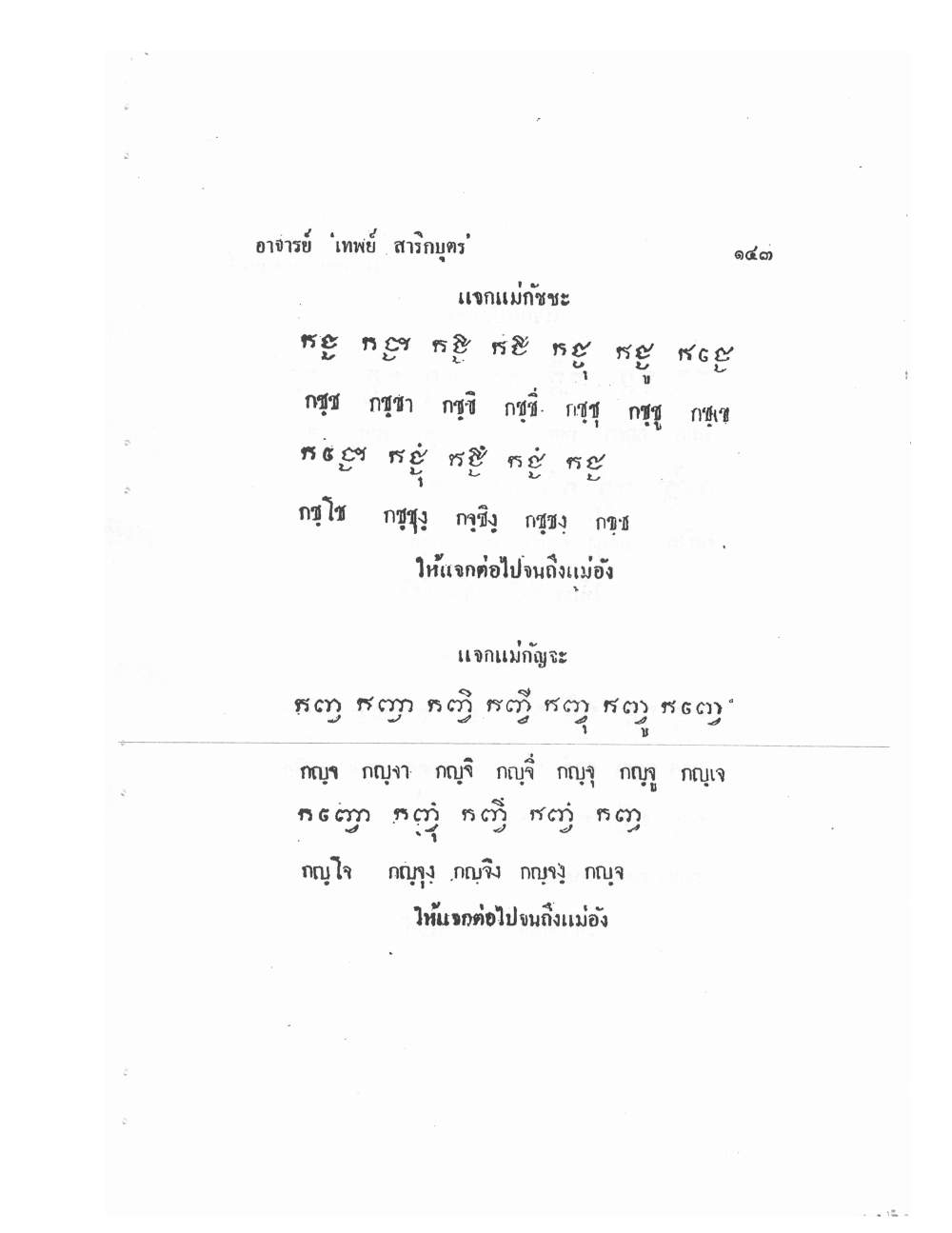
อาจารย์ 'เทพย์' สาริกบุตร์ ๑๔๓
แจกแม่กัชชะ
[บรรทัดบน: เจ็ดพยางค์ชุดเดียวกับบรรทัดถัดไป เขียนด้วยอักษรขอม] กชช กชชา กชชิ กชชี กชชุ กชชู กชเช [บรรทัดบน: ห้าพยางค์ชุดเดียวกับบรรทัดถัดไป เขียนด้วยอักษรขอม] กชโช กชชุง กชชิง กชชง กชช
ให้แจกต่อไปจนถึงแม่[อ่านไม่ออก]
แจกแม่กัญจะ
[บรรทัดบน: เจ็ดพยางค์ชุดเดียวกับบรรทัดถัดไป เขียนด้วยอักษรขอม] กญจ กญจา กญจิ กญจี กญจุ กญจู กญเจ [บรรทัดบน: ห้าพยางค์ชุดเดียวกับบรรทัดถัดไป เขียนด้วยอักษรขอม] กญโจ กญจุง กญจิง กญจง กญจ
ให้แจกต่อไปจนถึงแม่[อ่านไม่ออก]
[header: Ajarn Thep Sarikabutr — p. 143]
Declension drill: the "kajja" cluster
[top line: the same seven syllables as the line below, written in Khom script] kajja, kajjā, kajji, kajjī, kajju, kajjū, kajje [top line: the same five syllables as the line below, written in Khom script] kajjo, kajjuṅ, kajjiṅ, kajjaṅ, kajja
Continue declining in the same way through to the "[illegible]" frame.
Declension drill: the "kañca" cluster
[top line: the same seven syllables as the line below, written in Khom script] kañca, kañcā, kañci, kañcī, kañcu, kañcū, kañce [top line: the same five syllables as the line below, written in Khom script] kañco, kañcuṅ, kañciṅ, kañcaṅ, kañca
Continue declining in the same way through to the "[illegible]" frame.
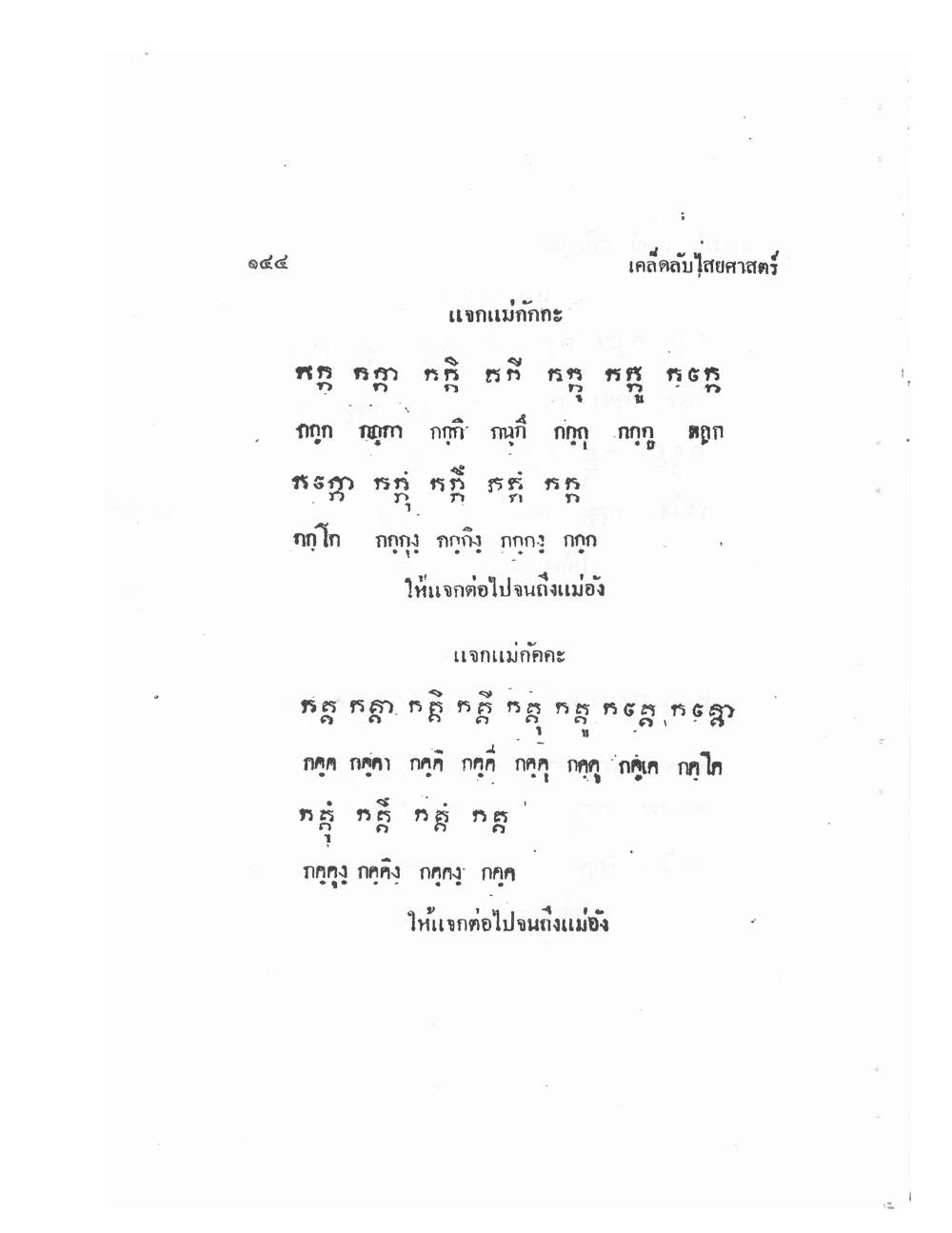
๑๔๔ เคล็ดลับไสยศาสตร์
แจกแม่กักกะ
[บรรทัดบน: เจ็ดพยางค์ชุดเดียวกับบรรทัดถัดไป เขียนด้วยอักษรขอม] กกก กกกา กกกิ กกกี กกกุ กกกู กกเก [บรรทัดบน: ห้าพยางค์ชุดเดียวกับบรรทัดถัดไป เขียนด้วยอักษรขอม] กกโก กกกุง กกกิง กกกง กกก
ให้แจกต่อไปจนถึงแม่[อ่านไม่ออก]
แจกแม่กัคคะ
[บรรทัดบน: เจ็ดพยางค์ชุดเดียวกับบรรทัดถัดไป เขียนด้วยอักษรขอม] กคค กคคา กคคิ กคคี กคคุ กคคู กคเค กคโก [บรรทัดบน: ห้าพยางค์ชุดเดียวกับบรรทัดถัดไป เขียนด้วยอักษรขอม] กคคุง กคคิง กคคง กคค
ให้แจกต่อไปจนถึงแม่[อ่านไม่ออก]
[header: p. 144 — "The Mind-Current: Secrets of Saiyasat"]
Declension drill: the "kakka" cluster
[top line: the same seven syllables as the line below, written in Khom script] kakka, kakkā, kakki, kakkī, kakku, kakkū, kakke [top line: the same five syllables as the line below, written in Khom script] kakko, kakkuṅ, kakkiṅ, kakkaṅ, kakka
Continue declining in the same way through to the "[illegible]" frame.
Declension drill: the "kagga" cluster
[top line: syllables as below, written in Khom script, plus an extra "kagko" form] kagga, kaggā, kaggi, kaggī, kaggu, kaggū, kagge, kagko [top line: the same syllables as the line below, written in Khom script] kagguṅ, kaggiṅ, kaggaṅ, kagga
Continue declining in the same way through to the "[illegible]" frame.
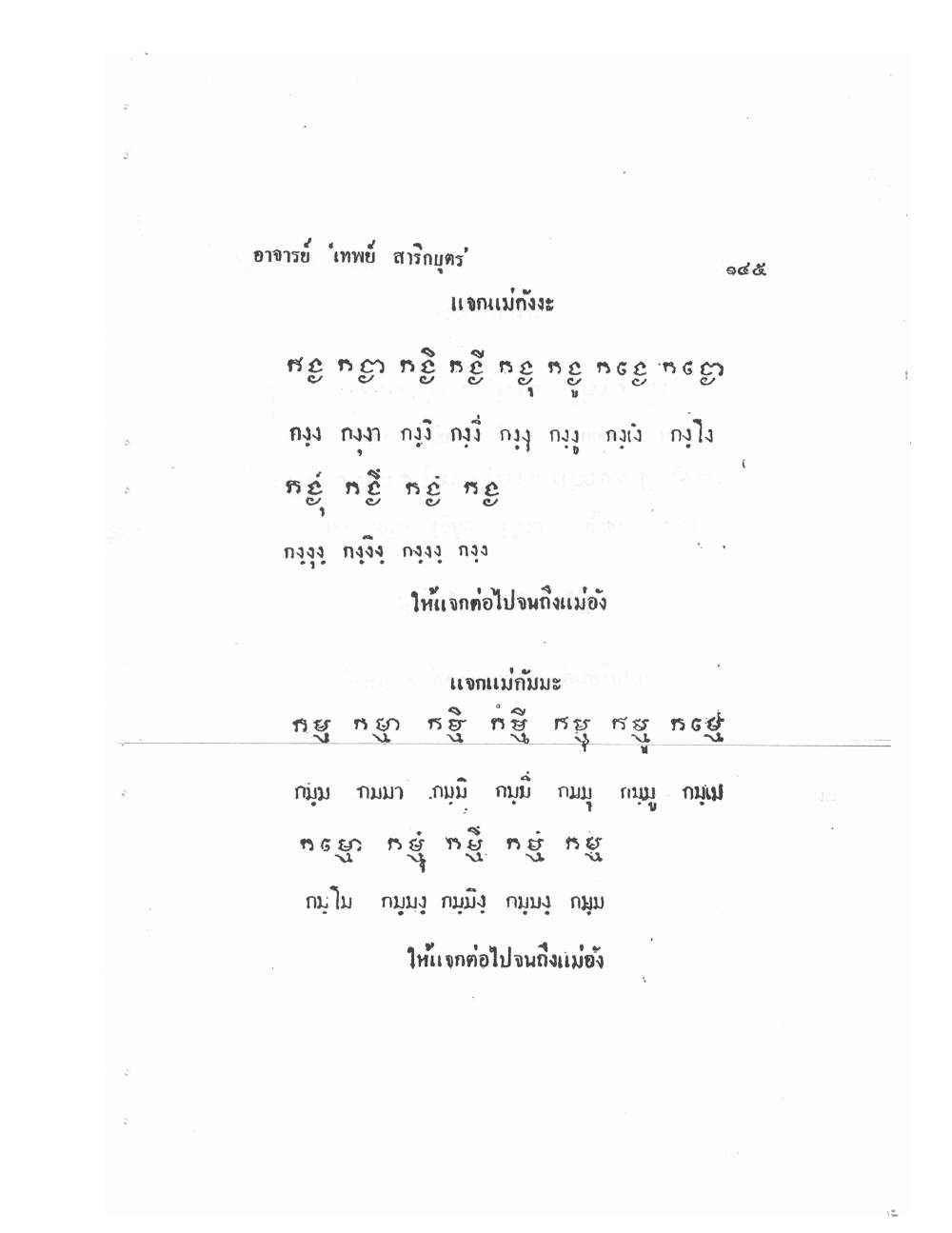
อาจารย์ 'เทพย์' สาริกบุตร์ ๑๔๕
แจกแม่กังงะ
[บรรทัดบน: เจ็ดพยางค์ชุดเดียวกับบรรทัดถัดไป เขียนด้วยอักษรขอม] กงง กงงา กงงิ กงงี กงงุ กงงู กงเง กงโง [บรรทัดบน: สี่พยางค์ชุดเดียวกับบรรทัดถัดไป เขียนด้วยอักษรขอม] กงงุ่ กงงิ่ กงงุ่ กงง
ให้แจกต่อไปจนถึงแม่[อ่านไม่ออก]
แจกแม่กัมมะ
[บรรทัดบน: เจ็ดพยางค์ชุดเดียวกับบรรทัดถัดไป เขียนด้วยอักษรขอม] กมม กมมา กมมิ กมมี กมมุ กมมู กมเม [บรรทัดบน: ห้าพยางค์ชุดเดียวกับบรรทัดถัดไป เขียนด้วยอักษรขอม] กมโม กมมุง กมมิง กมมง กมม
ให้แจกต่อไปจนถึงแม่[อ่านไม่ออก]
[header: Ajarn Thep Sarikabutr — p. 145]
Declension drill: the "kaṅga" cluster
[top line: the same syllables as the line below, written in Khom script] kaṅga, kaṅgā, kaṅgi, kaṅgī, kaṅgu, kaṅgū, kaṅge, kaṅgo [top line: the same syllables as the line below, written in Khom script] kaṅgu(ng), kaṅgi(ng), kaṅgu(ng), kaṅga
Continue declining in the same way through to the "[illegible]" frame.
Declension drill: the "kamma" cluster
[top line: the same seven syllables as the line below, written in Khom script] kamma, kammā, kammi, kammī, kammu, kammū, kamme [top line: the same five syllables as the line below, written in Khom script] kammo, kammuṅ, kammiṅ, kammaṅ, kamma
Continue declining in the same way through to the "[illegible]" frame.
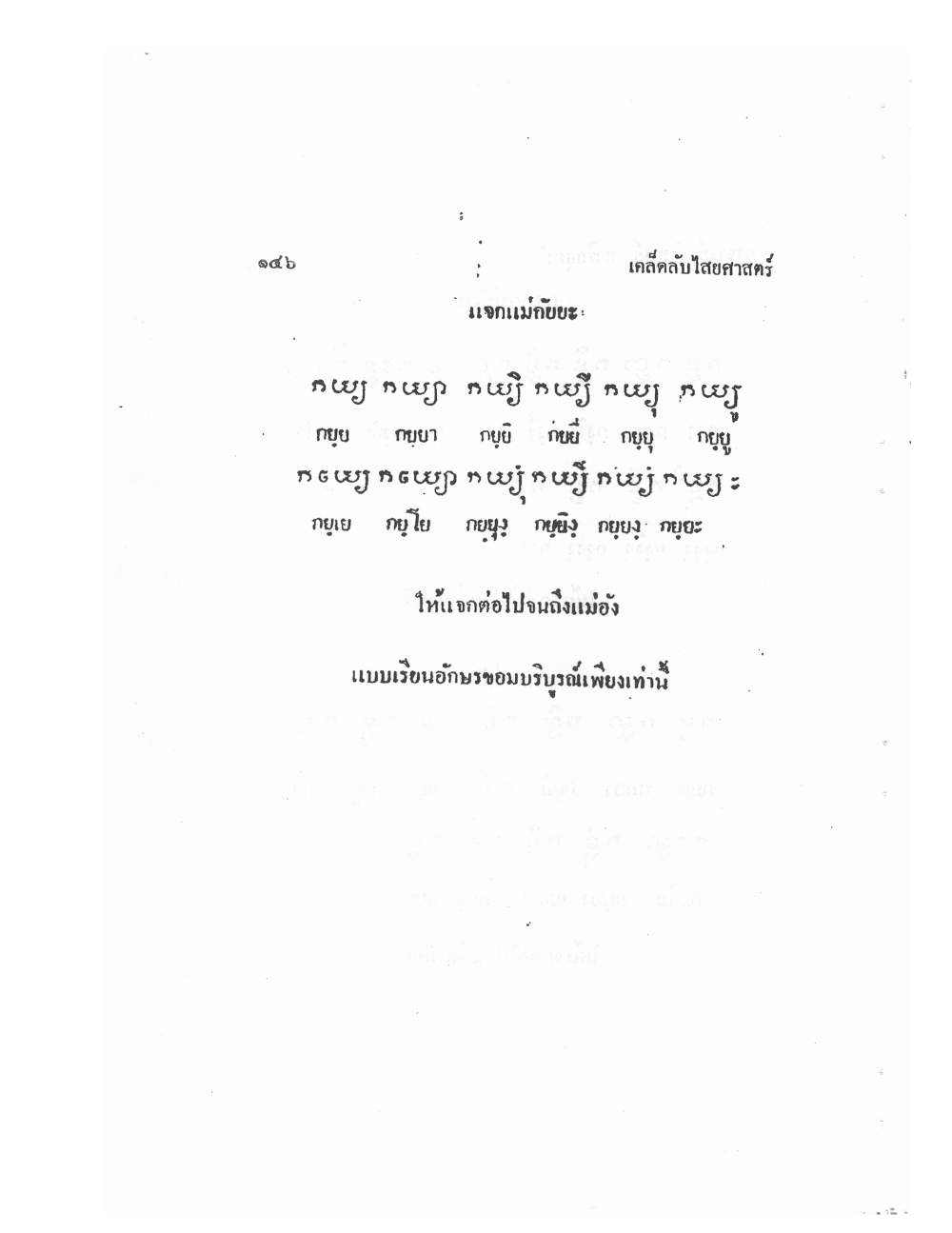
๑๔๖ เคล็ดลับไสยศาสตร์
แจกแม่กับขะ
[บรรทัดบน: หกพยางค์ชุดเดียวกับบรรทัดถัดไป เขียนด้วยอักษรขอม] กบข กบขา กบขิ กบขี กบขุ กบขู [บรรทัดบน: ห้าพยางค์ชุดเดียวกับบรรทัดถัดไป เขียนด้วยอักษรขอม] กบเข กบโข กบขุง กบขิง กบขง กบขะ
ให้แจกต่อไปจนถึงแม่[อ่านไม่ออก]
แบบเรียนอักษรขอมบริบูรณ์เพียงเท่านี้
[header: p. 146 — "The Mind-Current: Secrets of Saiyasat"]
Declension drill: the "kabkha" cluster
[top line: the same six syllables as the line below, written in Khom script] kabkha, kabkhā, kabkhi, kabkhī, kabkhu, kabkhū [top line: the same syllables as the line below, written in Khom script] kabkhe, kabkho, kabkhuṅ, kabkhiṅ, kabkhaṅ, kabkha
Continue declining in the same way through to the "[illegible]" frame.
The primer of Khom script ends here, complete, at this point only.
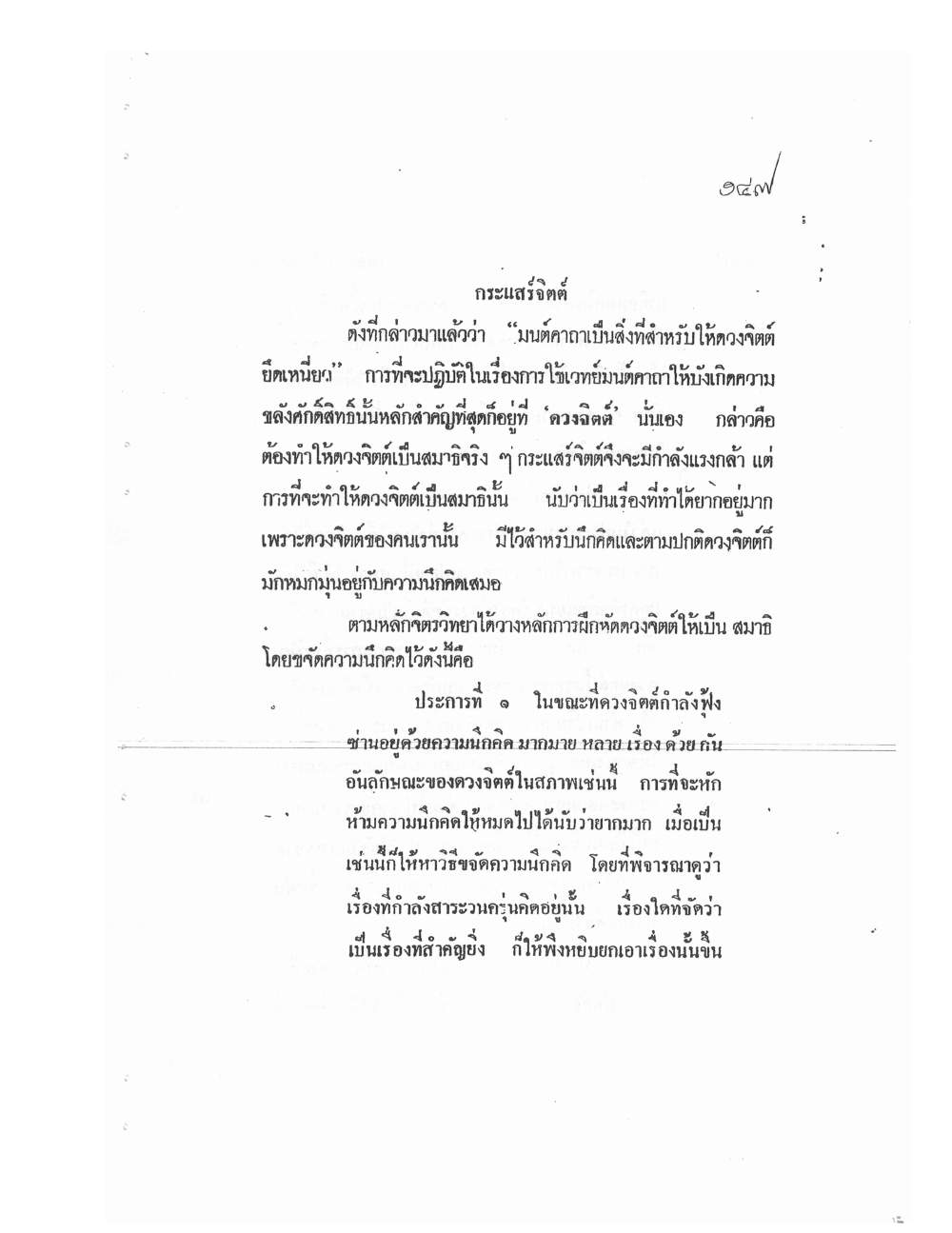
๑๔๗
กระแสร์จิตต์
ดังที่กล่าวมาแล้วว่า "มนต์คาถาเป็นสิ่งที่สำหรับให้ดวงจิตต์ยึดเหนี่ยว" การที่จะปฏิบัติในเรื่องการใช้เวทย์มนต์คาถาให้บังเกิดความขลังศักดิ์สิทธิ์นั้นหลักสำคัญที่สุดก็อยู่ที่ 'ดวงจิตต์' นั่นเอง กล่าวคือ ต้องทำให้ดวงจิตต์เป็นสมาธิจริงๆ กระแสร์จิตต์จึงจะมีกำลังแรงกล้า แต่การที่จะทำให้ดวงจิตต์เป็นสมาธินั้น นับว่าเป็นเรื่องที่ทำได้ยากอยู่มาก เพราะดวงจิตต์ของคนเรานั้น มีไว้สำหรับนึกคิดและตามปกติดวงจิตต์ก็มักหมกมุ่นอยู่กับความนึกคิดเสมอ
ตามหลักจิตรวิทยาได้วางหลักการฝึกหัดดวงจิตต์ให้เป็น สมาธิ โดยขจัดความนึกคิดไว้ดังนี้คือ
ประการที่ ๑ ในขณะที่ดวงจิตต์กำลังฟุ้งซ่านอยู่ด้วยความนึกคิด มากมายหลายเรื่องด้วยกัน อันลักษณะของดวงจิตต์ในสภาพเช่นนี้ การที่จะหักห้ามความนึกคิดให้หมดไปได้นับว่ายากมาก เมื่อเป็นเช่นนี้ก็ให้หาวิธีขจัดความนึกคิด โดยที่พิจารณาดูว่าเรื่องที่กำลังสาระวนครุ่นคิดอยู่นั้น เรื่องใดที่จัดว่าเป็นเรื่องที่สำคัญยิ่ง ก็ให้พึงหยิบยกเอาเรื่องนั้นขึ้น
[page number: 147]
The Mind-Current
As already stated, "mantra-formulas are things for the mind to hold onto." In practicing the use of magical mantra-formulas so as to bring about potency and sanctity, the most important principle lies in the 'mind' itself — that is, one must make the mind truly concentrated (samadhi); only then will the mind-current have strong, powerful force. But making the mind concentrated is reckoned a very difficult thing to do, because a person's mind is meant for thinking, and ordinarily the mind is always preoccupied with thought.
According to the principles of psychology, rules have been laid down for training the mind into concentration by eliminating thought, as follows:
First: while the mind is scattered with many thoughts all at once — such being the nature of the mind in that state — trying to suppress thought entirely is reckoned very difficult. When this is so, one should find a way to eliminate thought by considering which of the matters being turned over and dwelt on is the most important one, and then deliberately take up that matter
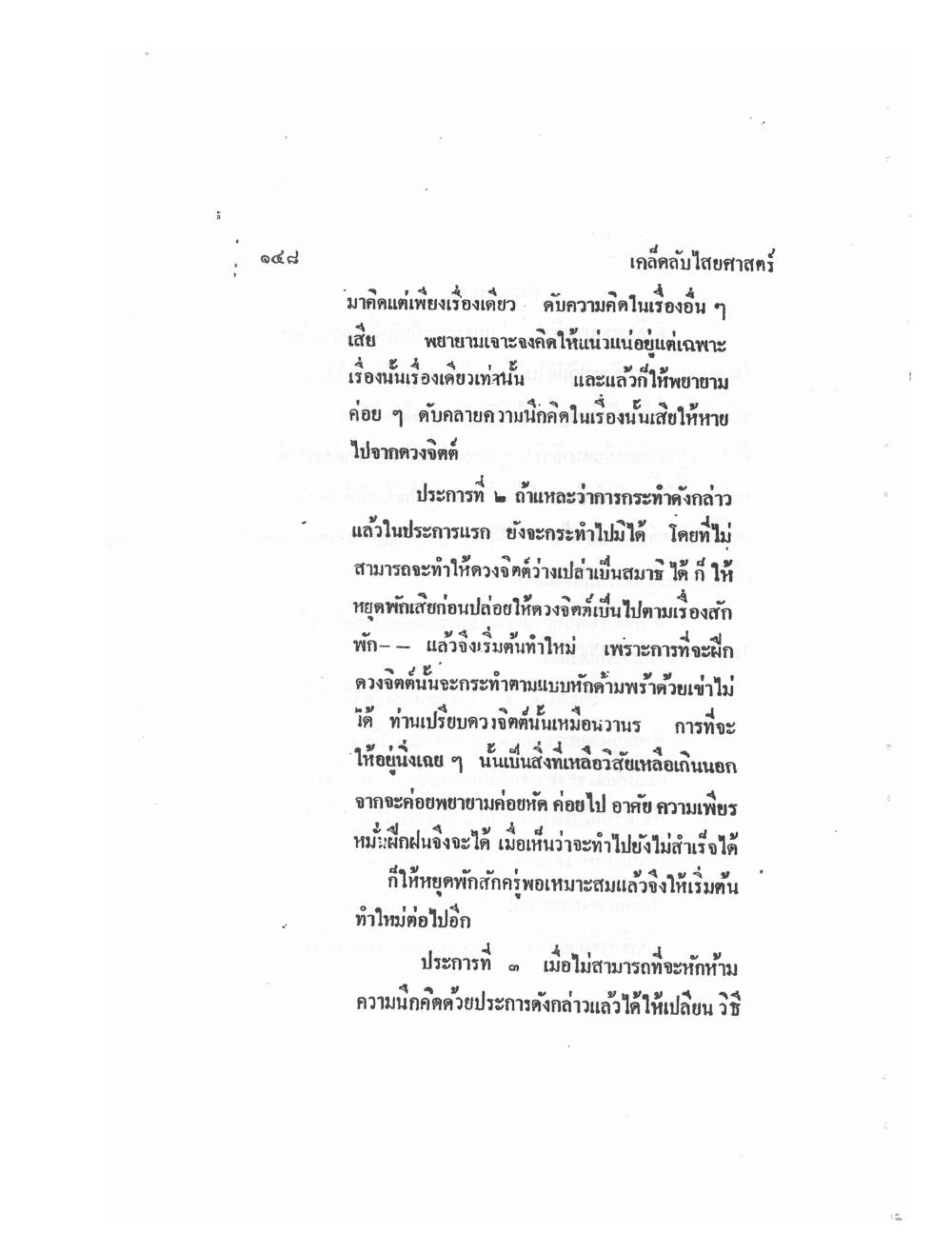
๑๔๘ เคล็ดลับไสยศาสตร์
มาคิดแต่เพียงเรื่องเดียว ดับความคิดในเรื่องอื่นๆเสีย พยายามเจาะจงคิดให้แน่วแน่อยู่แต่เฉพาะเรื่องนั้นเรื่องเดียวเท่านั้น และแล้วก็ให้พยายามค่อยๆ ดับคลายความนึกคิดในเรื่องนั้นเสียให้หายไปจากดวงจิตต์
ประการที่ ๒ ถ้าแม้ว่าการกระทำดังกล่าวแล้วในประการแรก ยังจะกระทำไปมิได้ โดยที่ไม่สามารถจะทำให้ดวงจิตต์ว่างเปล่าเป็นสมาธิได้ ก็ให้หยุดพักเสียก่อนปล่อยให้ดวงจิตต์เป็นไปตามเรื่องสักพัก — แล้วจึงเริ่มต้นทำใหม่ เพราะการที่จะฝึกดวงจิตต์นั้นจะกระทำตามแบบหักด้ามพร้าด้วยเข่าไม่ได้ ท่านเปรียบดวงจิตต์นั้นเหมือนวานร การที่จะให้อยู่นิ่งเฉยๆ นั้นเป็นสิ่งที่เหลือวิสัยเหลือเกิน นอกจากจะค่อยพยายามค่อยหัด ค่อยไป อาศัยความเพียรหมั่นฝึกฝนจึงจะได้ เมื่อเห็นว่าจะทำไปยังไม่สำเร็จได้ ก็ให้หยุดพักสักครู่พอเหมาะสมแล้วจึงให้เริ่มต้นทำใหม่ต่อไปอีก
ประการที่ ๓ เมื่อไม่สามารถที่จะหักห้ามความนึกคิดด้วยประการดังกล่าวแล้วได้ ให้เปลี่ยนวิธี
[header: p. 148 — "The Mind-Current: Secrets of Saiyasat"]
and think of it alone, extinguishing thought of every other matter. Try to concentrate deliberately and firmly on that one matter only, and then gradually try to fade out and extinguish the thought of even that matter, until it disappears from the mind.
Second: if, even after doing what was described in the first method, one still cannot succeed — being unable to make the mind empty and concentrated — then one should stop and rest a while, letting the mind wander on the matter for a time — then begin again. For training the mind cannot be done the way one "breaks a machete-handle across one's knee" [i.e., by brute force]. The mind has been compared to a monkey: expecting it to sit perfectly still is beyond what is possible, except by gradually, patiently training it little by little, relying on diligence and constant practice. When one sees that it is not yet going to succeed, one should stop and rest a suitable while, and then begin again once more.
Third: when one cannot suppress thought by the methods described above, one should change the method
อาจารย์ 'เทพย์' สาริกบุตร์ ๑๔๙
ใหม่ โดยใช้วิธีนึกคิดในสิ่งที่ตรงกันข้าม เช่นเรื่องที่กำลังคิดเป็นเรื่องของความทุกข์ร้อน ก็ให้พยายามโน้มน้าวดวงจิตต์คิดในเรื่องของความสุข หรือเรื่องที่กำลังคิดเป็นเรื่องของการจนมุมสิ้นหวัง ให้พยายามผันความคิด โดยคิดในทางที่จะมีหวังหลุดรอดไปได้
อันการที่ใช้ความคิดในด้านที่ตรงกันข้ามกันนั้น เป็นสิ่งที่ช่วยทำให้ขจัดความคิดที่กำลังหมกมุ่นอยู่ในดวงจิตต์ให้หมดสิ้นไป
วิธีใช้ผันความนึกคิดนี้เป็นเรื่องโดยตรงของการฝึกอำนาจจิตต์ เพราะการฝึกอำนาจจิตต์นั้นก็คือ ฝึกการผันจิตต์นั่นเอง ดวงจิตต์ที่จะมีกระแสร์จิตต์เข้มแข็งนั้นก็คือ ดวงจิตต์ที่สามารถจะผันไปได้
คาบ
ในการสร้างสมาธิให้แก่ 'ดวงจิตต์' เพื่อให้กระแสร์จิตต์มีกำลังแรง อีกวิธีหนึ่งตามหลักของวิชาไสยศาสตร์ใช้สร้างสมาธิ โดยการภาวนาจะเป็นคาถาบทใดบทหนึ่งก็ตามแต่ที่สำคัญ — เวลาภาวนาให้เพ่งเล็ง
[header: Ajarn Thep Sarikabutr — p. 149]
anew, using the method of thinking of the opposite. For example, if the matter one is thinking of is one of suffering and distress, one should try to turn the mind to think of matters of happiness; or if the matter one is thinking of is one of being cornered and hopeless, one should try to turn the thought around, thinking in a way that holds hope of escape.
Using thought in the opposite direction in this way helps to eliminate the thought preoccupying the mind, until it is entirely gone.
This method of turning thought around is directly a matter of training the power of the mind, for training the power of the mind is precisely training the turning of the mind. A mind that will have a strong mind-current is precisely a mind that is able to turn itself.
Khaap (the Chanting-Cycle)
In building concentration for the 'mind,' so that the mind-current may have strong power, there is another method, according to the principles of the art of saiyasat, for building concentration: by chanting whichever formula-verse is important — while chanting, one should focus one's attention
๑๕๐ เคล็ดลับไสยศาสตร์
เกาะเกี่ยวอยู่กับเนื้อมนต์คาถาที่ภาวนานั้น
ภาวนาไปจบบทหนึ่งเรียกว่า คาบหนึ่ง บางทีภาวนาถึง ๑๐๘ คาบก็มี และการที่จะภาวนาให้ถึง ๑๐๘ คาบได้นั้นก็นับว่าเป็นการสร้างสมาธิให้อย่างดีเลิศทีเดียว เพราะการที่จะภาวนาให้ได้อย่างนั้น จำเป็นอย่างยิ่งที่จะต้องทำอย่างแน่วแน่จริงๆ จึงจะทำได้ เพราะฉะนั้นจึงมีคำพังเพยกล่าวว่า การที่จะใช้เวทย์มนต์คาถาให้ขลังศักดิ์สิทธิ์นั้นจำต้องเข้าใจคำว่า 'คาบ' เสียก่อน และคำว่า 'คาบ' นั้นท่านโบราณาจารย์ได้ผูกเป็นปุจฉาให้ขบคิดกันไปนานาประการ แท้ที่จริงคำว่า 'คาบ' นั้นก็คือการกระทำดวงจิตต์ให้ สงบแน่วแน่ในคราวหนึ่งๆ นั่นเอง เช่น การดำน้ำลงไปลงของหรือปลุกเสกเพื่อที่จะต้องการให้ ดวงจิตต์สงบเป็นสมาธิจริงๆ การทำคาบโดยสงบลมหายใจเข้าออกเป็นคราวๆ ดังเช่นการดำน้ำลงไปนั้น คาบเช่นนี้ท่านเรียกว่าคาบลม
ส่วนคาบที่เกิดจากการภาวนาคาถาเป็นคาบๆ นั้น คาบเช่นนี้ท่านเรียกว่าคาบคาถา
คาบคาถาที่เกิดจากการภาวนาเป็นคาบๆ นั้น ให้พิจารณาดูลมหายใจเข้าออกเป็นเกณฑ์ เวลาที่ลมหายใจออกนั้นขับอารมณ์ต่างๆ ออกไปพร้อมกับการหายใจออก และเวลาหายใจเข้า นั้น ให้มั่นอยู่ในคำภาวนาสูดเอามนต์คาถาเข้าไปในกายตัว พร้อมกับการหายใจเข้า เมื่อสูดลมหายใจเข้าก็ให้จบเนื้อมนต์คาถาที่ภาวนานั้น
มนต์คาถาที่ใช้ภาวนาเป็นคาบๆ นั้นโดยมากมักเป็นมนต์ที่มี
[header: p. 150 — "The Mind-Current: Secrets of Saiyasat"]
clinging closely to the substance of the mantra-formula being chanted.
Chanting through one verse from start to finish is called "one khaap." Sometimes one chants as many as 108 khaap. Being able to chant a full 108 khaap is reckoned an excellent way of building concentration indeed, because to chant that many one must do so with truly firm, unwavering intent. That is why there is a saying that to make mantra-formulas potent and sacred, one must first understand the word "khaap." The ancient masters set the word "khaap" as a riddle for people to ponder in many ways. In truth, the word "khaap" simply means making the mind calm and firm for one interval — for example, diving underwater to fetch something, or performing a consecration, in order to make the mind truly calm and concentrated. Making a khaap by calming the in-and-out breath, interval by interval, as in diving underwater — this kind of khaap is called a "wind khaap."
As for the khaap that arises from chanting a formula khaap by khaap, this kind is called a "formula khaap."
For the formula khaap that arises from chanting khaap by khaap, one should take the in-and-out breath as the measure. When the breath goes out, it drives out various emotions along with the outgoing breath; and when breathing in, one should hold firmly to the chanted words, drawing the mantra-formula into the body along with the inhalation. When one draws in the breath, one should finish the substance of the mantra-formula being chanted at that point.
Mantra-formulas used for chanting khaap by khaap are, for the most part, formulas that have
อาจารย์ 'เทพย์' สาริกบุตร์ ๑๕๑
เนื้อมนต์ภาวนาพอเหมาะกับการหายใจพอดี โดยมากมักจะเป็นมนต์คาถาที่ถอดเอาใจความสำคัญออกมาจากมนต์บทใหญ่ๆ เรียกกันว่า 'หัวใจ' ท่านโบราณาจารย์ได้ถอดหัวใจของมนต์ต่างๆ ออกไว้เป็นจำนวนมากเช่นเรียกกันว่า "หัวใจ ๑๐๘" ทุกๆ หัวใจถอดออกมาจากมนต์คาถาที่สำคัญทั้งนั้น (การถอดหัวใจนี้จะกล่าวต่อไปภายหลัง) เช่นหัวใจพระไตรสรณาคม หรือเรียกกันว่ายอดคีลือ ◎ พุทธะสังมิ ๚ ท่านถอดออกจากคาถาพระไตรสรณาคมที่ว่า
◎ พุทธังสรณังคัจฉามิ ๚ ◎ ธัมมังสรณังคัจฉามิ ๚ ◎ สังฆังสรณังคัจฉามิ ๚
คาถา ◎ พุ.ธะสังมิ ๚ นี้เมื่อจะใช้ภาวนาเป็นคาบๆ มักนิยมถอดออกเป็นอุณาโลม ปฏิโลม คือสลับกันไปสลับกันมาครบทั้งสี่อักษรดังนี้
◎ พุธ ธะ สัง มิ ธะ สัง มิ พุธ สัง สิ พุธ ธะ มิ พุท ธะ สัง ๚—
เวลาภาวนาให้เพ่งเอาอักษร ๔ อักษรนี้ ถอดออกไปจนได้ครบ ๑๖ อักษร ครบเป็นคาบหนึ่งพอดี
วิธีการหัดทำสมาธิโดยวิธีภาวนาเป็นคาบๆ อย่างนี้ นับเป็น
[header: Ajarn Thep Sarikabutr — p. 151]
a wording suited exactly to the breath. For the most part they are formulas distilled to extract the essential meaning from larger formula-texts, called a "Heart" (hua-jai). The ancient masters distilled the "hearts" of various formulas and set down a great many of them, known collectively, for example, as the "108 Hearts." Every "heart" is distilled from an important mantra-formula (the distilling of hearts will be discussed further later) — for example, the Heart of the Three Refuges, also called the supreme summit: ◎ Buddha-saṅ-mi ◎. This was distilled from the Refuges formula which reads:
◎ Buddhaṃ saraṇaṃ gacchāmi ◎ ◎ Dhammaṃ saraṇaṃ gacchāmi ◎ ◎ Saṅghaṃ saraṇaṃ gacchāmi ◎
This formula, ◎ Bu-dha-saṅ-mi ◎, when it is to be used for chanting khaap by khaap, is commonly distilled further into forward-and-reverse order (unalom-patilom), that is, rotated around through all four syllables, as follows:
◎ Bud dha saṅ mi Dha saṅ mi Bud Saṅ si Bud dha Mi Bud dha saṅ ◎—
While chanting, one should focus on these 4 syllables, cycling them through until 16 syllables are complete — that makes exactly one khaap.
This method of practicing concentration by chanting khaap by khaap in this way is reckoned
๑๕๒ เคล็ดลับไสยศาสตร์
วิธีที่สะดวกที่สุดเพราะการภาวนาจะให้ได้ คาบ นั้น ต้องเพ่งเล็งเกาะเกี่ยวจริงๆ กับคาถาที่ภาวนา และเมื่อดวงจิตต์เป็นสมาธิแล้ว เราก็สามารถจะใช้กระแสร์จิตต์นั้นไปได้ตามความประสงค์ เช่นทำให้เกิดอำนาจทางป้องกันอันตรายทางเสน่ห์ เมตตาทางที่จะเอาชนะแก่ศัตรู ตลอดจนกระทั่งทำให้เกิดโชคลาภได้ ถึงหากแม้ว่าเราจะไม่ใช้ไปในทางนี้ ก็นับว่าเป็นการสร้างสมาธิจิตต์ซึ่งนับได้ว่าเป็นประโยชน์อย่างยิ่งที่จะทำให้ เกิดสุขภาพแก่ดวงจิตต์ คนที่บังเกิดการเสียจริตนั้น นั่นก็เป็นเพราะหมกมุ่นใช้ความนึกคิดอย่างรุนแรงจนเกินไปจนกลายเป็นเหตุให้สติวิปลาสขึ้น ทางที่จะป้องกันหรือรักษานั้นมีอยู่วิธีเดียวเท่านั้น คือการสร้างสมาธิจิตต์นี้เองทำให้ดวงจิตต์ว่างเว้นจากความนึกคิดทั้งมวล
ปราณ
อีกสิ่งหนึ่งที่เป็นของสำคัญยิ่งในการใช้มนต์คาถาคือ 'ปราณ' คำว่าปราณแปลว่า "ชีวิต" ปราณเป็นกำลังที่เราได้มาจากธาตุต่างๆ ในโลกนี้ ปราณเป็นสิ่งสำคัญยิ่งในทางจิตต์ศาสตร์ เพราะมิใช่ว่าปราณจะช่วยให้มนุษย์เกิดความแข็งแรงยังชีวิตอยู่ได้เท่านั้น
ปราณยังเป็นสิ่งที่สามารถในการที่จะใช้ รักษาโรคภัยไข้เจ็บให้แก่ผู้อื่น และใช้เป็นสิ่งดูดดึงได้อีก
ปราณเป็นสิ่งที่เกิดขึ้นจากการหายใจเอาอากาศบริสุทธิ์ โดยวิธีหายใจเข้าให้แรงและลึกอยู่เสมอเราจะได้ปราณเข้ามาไว้ในกายตัว
การฝึกหายใจเช่นนี้อยู่เสมอ นับว่าเป็นประโยชน์มาก
[header: p. 152 — "The Mind-Current: Secrets of Saiyasat"]
the most convenient method, because to succeed in making a "khaap" one must focus and cling truly closely to the formula being chanted. And once the mind is concentrated, we are able to direct that mind-current wherever we wish — for example, to give rise to power that protects against danger, to charm, to gain the goodwill needed to overcome enemies, and even to bring about good fortune. Even if we do not use it for such purposes, it still counts as building concentration of mind, which is reckoned of the greatest benefit in bringing health to the mind. Those who suffer derangement of mind do so because they are immersed in thinking so violently and excessively that it becomes the cause of loss of sanity. There is only one way to prevent or cure this: building this very concentration of mind, which makes the mind free from all thought.
Praana (Life-Breath)
Another thing of great importance in the use of mantra-formulas is "praana." The word praana means "life." Praana is the force we obtain from the various elements in this world. Praana is a matter of great importance in the science of the mind, for it is not only that praana helps a person gain strength and remain alive.
Praana is also something that can be used to heal illness and sickness in others, and can also be used as a thing that draws and attracts.
Praana is a thing produced by breathing in pure air; by breathing in strongly and deeply at all times, we bring praana into the body.
Practicing breathing in this way at all times is reckoned to be of great benefit
ทั้งในด้านสุขภาพ และด้านจิตใจช่วยสร้างกำลังใจให้แข็งแกร่ง บางมติให้แง่คิดเห็นว่าช่วยดับความโกรธความพยาบาท ดับความใคร่ในเรื่องกามคุณและช่วยให้จิตใจปลอดโปร่ง ปราณเป็นสิ่งที่สามารถจะถ่ายทอดออกไปได้
การเสกเป่าคาถา การรดน้ำมนต์ก็ดี สิ่งเหล่านั้นเป็นเรื่องเกี่ยวกับปราณทั้งนั้น เรียกว่าการถ่ายปราณ ผู้ที่จะถ่ายปราณได้ต้องเป็นผู้ที่มีกำลังใจเข้มแข็ง คือมีดวงจิตต์ที่เป็นสมาธิ โดยที่ต้องมีเครื่องสำหรับยึดเหนี่ยว
เครื่องยึดเหนี่ยวนั้นก็คือมนต์คาถานั่นเองเป็นเครื่องที่จะช่วยปลุกกำลังปราณในตัวของตัวเพื่อที่จะได้ถ่ายทอดให้กับผู้อื่น การรักษาโรคภัยไข้เจ็บด้วยวิธีการถ่ายปราณเป็นวิธีที่ดีที่สุด เหมือนดังการถ่ายเลือดจากคนที่มีกำลังกายแข็งแรงไปใส่ในตัวคนไข้เช่นกัน แต่นั้นเป็นหลักวิชาทางการแพทย์ สำหรับหลักวิชาทางจิตตศาสตร์นั้นถือว่าในร่างกายของคนมีสิ่งสำหรับต่อสู้กับโรคภัยไข้เจ็บ ถ้าหากสิ่งสำหรับต่อสู้นั้นยังมีกำลังต้านทานพอ โรคภัยไข้เจ็บก็หายไปได้เองโดยที่ไม่ต้องใช้วิธีการรักษาอย่างอื่น
วิธีที่จะปลุกให้สิ่งสำหรับต่อสู้กับโรคภัยไข้เจ็บ เกิดกำลังขึ้น ก็คือการถ่ายปราณ (ถ่ายชีวิต) เข้าไปในตัวคนเจ็บนั้นเอง
การถ่ายปราณมีวิธีถ่ายหลายวิธีด้วยกันคือ ถ่ายโดยการแตะต้องลูบคลำด้วยการใช้มือ เพราะเชื่อถือกันว่าปราณอาจถ่ายทาง
...both for physical health and mental wellbeing, helping to build strength of spirit. Some hold the view that it helps extinguish anger and vengefulness, quells lust in matters of sensual desire, and helps keep the mind clear and unobstructed. Prana [the vital life-current] is something that can be transmitted outward.
The chanting of incantations and the sprinkling of blessed water are all matters concerning prana; this is called 'transmitting prana.' One who is able to transmit prana must be a person of strong resolve, that is, one whose mind is settled in concentration (samadhi), and who must have something to serve as an anchor.
That anchor is the mantra-formula itself, the instrument that helps arouse the power of prana within oneself so that it may be transmitted to another. Treating illness by the method of transmitting prana is the best method, comparable to transfusing blood from a person of strong physical constitution into the body of a sick person; but that belongs to the principles of the medical arts. As for the principle belonging to the science of the mind [jittasat], it holds that within a person's body there is something that fights against illness. If that fighting force still has enough power of resistance, the illness will heal by itself without need of any other method of treatment.
The method for arousing that fighting force against illness to gain strength is precisely the transmission of prana (the transmission of life) into the body of the sick person.
There are several methods of transmitting prana, namely: transmitting by touching and stroking with the hand, because it is believed that prana may be transmitted through...
นิ้วมือได้ ถ่ายโดยการพ่นเป่าลมออกจากปากไปให้ถูกต้องตัวคนเจ็บ และถ่ายลงไปในสิ่งใดสิ่งหนึ่ง แล้วนำสิ่งนั้นไปให้ถูกคนเจ็บใช้อีกทีหนึ่ง เช่นการทำน้ำมนต์ดังที่ปฏิบัติกันมาทุกวันนี้เป็นต้น
เจตภูติ
"เจตภูติ" ในร่างกายของมนุษย์เราทุกคนนั้น ยังมีกายพิเศษที่แฝงอยู่อีกกายหนึ่ง เป็นกายที่แลเห็นด้วยตาเปล่าไม่ได้ เจตภูตินี้แหละเป็นบ่อเหตุให้เกิดผีสางขึ้น เจตภูติเป็นสิ่งที่แยกได้บางครั้งบางคราว เช่นอย่างในเวลาที่หลับสนิท แต่การแยกออกไปของเจตภูตินั้น มิได้แยกออกไปเลยทีเดียว ยังมีสายสัมพันธ์เชื่อมโยงกันอยู่กับร่างกาย จึงสามารถดึงดูดกลับมาสู่ร่างกายได้ เช่นในบางคราวที่เรานอนหลับสนิท และเป็นเวลาที่เจตภูติแยกออกไปจากร่างกาย เผอิญเกิดเหตุการณ์ที่เอะอะโครมครามขึ้นใกล้ ๆ ตัวเรา ทำให้เรารู้สึกตัวตกใจตื่นขึ้นโดยกระทันหัน เจตภูติต้องรีบกลับคืนเข้าสู่ร่างกายโดยด่วน ขณะที่เรารู้สึกตัวตื่นขึ้นนั้น จักปรากฏอาการหัวใจเต้นสั่นสท้านทั้งนี้เพราะเจตภูติรีบเข้าสู่ร่างกายโดยรวดเร็ว และกระทบกายเราอย่างรุนแรง เราจึงได้บังเกิดมีความรู้สึกเช่นนั้น แต่ถ้าเจตภูติจากกายโดยไม่กลับมาอีกนั้นก็คือถึงเวลาที่ร่างกายจะแตกดับนั้นเอง
อันเจตภูตินี้เมื่อถึงเวลาร่างกายแตกดับไป โดยที่เกิดโรคภัยไข้เจ็บอย่างธรรมดาเจตภูติก็จะเคลื่อนออกจากกายและค่อย ๆ สูญหาย
...through the fingers. It may also be transmitted by blowing breath from the mouth onto the sick person's body, or by transmitting it into some object, which is then given to the sick person to use, such as making blessed water (nam mon) as is practiced to this day, and so on.
The Jetphut (Spirit-Double)
The 'jetphut' — within the body of every human being there is also a special body concealed within, a body that cannot be seen with the naked eye. This jetphut is precisely the source that gives rise to ghosts. The jetphut is something that can separate from the body on certain occasions, such as during deep sleep. But when the jetphut separates, it never separates entirely — it still retains a connecting link joined to the body, and so it is able to be drawn back into the body. For example, on occasions when we are sleeping deeply, at a time when the jetphut has separated from the body, if some loud, jarring event should happen to occur near us, causing us to be startled awake suddenly, the jetphut must hurry back into the body at once. At the moment we feel ourselves waking, there occurs the sensation of the heart pounding and trembling — this is because the jetphut rushes back into the body swiftly and strikes the body violently, and so we come to have that sensation. But if the jetphut leaves the body and does not return, that is precisely the moment the body will perish.
As for this jetphut, when the time comes for the body to perish through ordinary illness, the jetphut will move out of the body and gradually vanish...
แตกดับตามไปด้วย เพราะเจตภูติที่ต้องจากไปเช่นนี้ เป็นเจตภูติรู้ตัวอยู่แล้วว่าร่างกายจะถึงกาลแตกดับ แต่ถ้าหากว่าร่างกายเกิดอาการแตกดับขึ้นโดยกระทันหันเช่นเดียวที่เรียกกันว่า "ตายโหง" เป็นต้นว่าถูกฆ่าตาย ถูกรถยนต์ชนตาย การตายเช่นนี้เจตภูติมิได้มีเวลารู้ตัวมาแต่ก่อน เมื่อร่างกายเกิดอาการแตกดับขึ้นโดยกระทันหัน เจตภูติจำเป็นต้องผละออกจากร่างไปและก็เที่ยววนเวียนอยู่ บางที่ก็ไปปรากฏให้คนเห็นดังที่เรียกว่า "ผีตายโหง" เพราะฉะนั้นเราจึงมักได้ยินกันว่า คนที่ตายโหงนั้นเป็นผีดุมาก ส่วนคนที่ตายโดยอาการเจ็บไข้โดยธรรมดาแล้วจะไม่ปรากฏว่าผีดุเลย เนื่องจากเจตภูติเป็นกายพิเศษอีกกายหนึ่ง ซึ่งแฝงอยู่ในกายธรรมดาเช่นนั้น ถ้าหากได้ฝึกฝนในเรื่องดวงจิตต์ดีแล้ว เราก็สามารถที่จะใช้เจตภูติทำประโยชน์ได้ เช่นบังคับให้เจตภูติให้ไปปรากฏในที่ต่าง ๆ ได้ตามที่ประสงค์ ความฝันต่าง ๆ ที่บังเกิดขึ้นนั้น ทั้งทางด้านดีและด้านร้ายเกิดขึ้นจากเจตภูติเป็นมูลเหตุทั้งสิ้น
กสิณ
ในการทำดวงจิตต์ให้เป็นสมาธิ ยังมีวิธีแปลกออกไปอีกวิธีหนึ่งคือ วิธีการเพ่ง "กสิณ" โดยใช้วัตถุสิ่งหนึ่งใดก็ได้เป็นเครื่องมือในการเพ่งเล็ง
ท่านแบ่งออกไว้เป็น ๑๐ ชนิดด้วยกัน ดังที่เรียกกันว่า "กสิณ" ๑๐ ประการ สุดแล้วแต่จะยึดถืออะไรเป็นอารมณ์ คือ—
...perish along with it, because a jetphut that must depart in this way already knows in advance that the body's time of perishing has come. But if the body should suddenly perish unexpectedly, as in what is called 'tai hong' [a violent/unnatural death] — for example, being murdered, or killed by a car — in such a death the jetphut has had no time to know beforehand. When the body suddenly perishes, the jetphut is forced to break away from the body and wanders about aimlessly. Sometimes it appears and is seen by people, which is called a 'phi tai hong' [ghost of one who died violently]. This is why we often hear it said that those who die violent deaths become very fierce ghosts, while those who die of ordinary illness are never said to become fierce ghosts. This is because the jetphut is a special body concealed within the ordinary body in that way. If one has trained well in matters of the mind, one can put the jetphut to use — for instance, compelling the jetphut to appear in various places as one wishes. The various dreams that occur, both good and bad, all arise with the jetphut as their root cause.
Kasina
In making the mind attain concentration (samadhi), there is yet another distinct method: the method of gazing at a 'kasina' [meditation-device], using any single object as the instrument of contemplation.
The masters have divided it into 10 kinds, known as the 10 kasinas, depending on what is taken as the object [of meditation], namely—
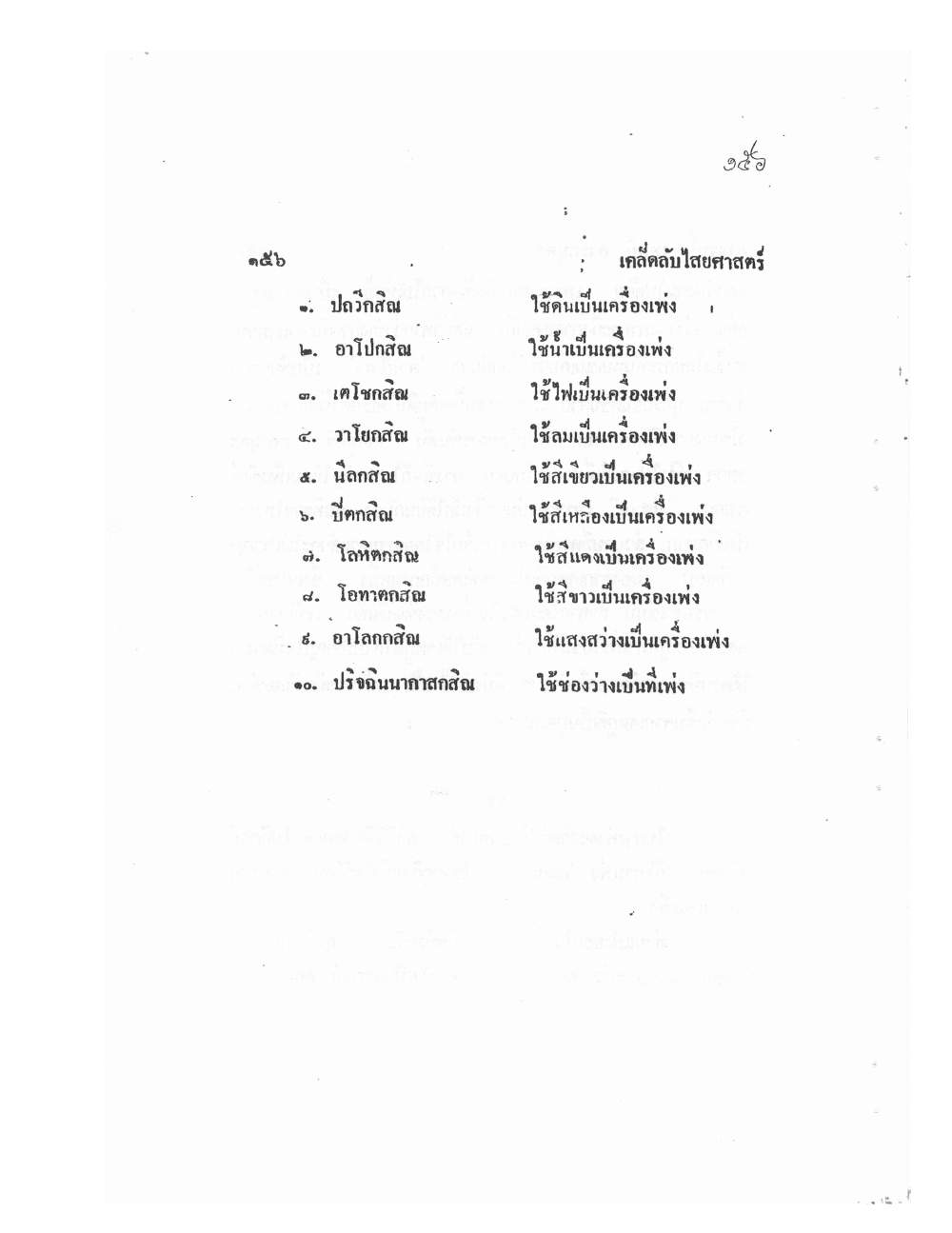
๑. ปถวีกสิณ ใช้ดินเป็นเครื่องเพ่ง ๒. อาโปกสิณ ใช้น้ำเป็นเครื่องเพ่ง ๓. เตโชกสิณ ใช้ไฟเป็นเครื่องเพ่ง ๔. วาโยกสิณ ใช้ลมเป็นเครื่องเพ่ง ๕. นีลกสิณ ใช้สีเขียวเป็นเครื่องเพ่ง ๖. ปีตกสิณ ใช้สีเหลืองเป็นเครื่องเพ่ง ๗. โลหิตกสิณ ใช้สีแดงเป็นเครื่องเพ่ง ๘. โอทาตกสิณ ใช้สีขาวเป็นเครื่องเพ่ง ๙. อาโลกกสิณ ใช้แสงสว่างเป็นเครื่องเพ่ง ๑๐. ปริจฉินนากาสกสิณ ใช้ช่องว่างเป็นที่เพ่ง
1. Pathavi-kasina — uses earth as the object of contemplation 2. Apo-kasina — uses water as the object of contemplation 3. Tejo-kasina — uses fire as the object of contemplation 4. Vayo-kasina — uses wind as the object of contemplation 5. Nila-kasina — uses the color green as the object of contemplation 6. Pita-kasina — uses the color yellow as the object of contemplation 7. Lohita-kasina — uses the color red as the object of contemplation 8. Odata-kasina — uses the color white as the object of contemplation 9. Aloka-kasina — uses light/brightness as the object of contemplation 10. Paricchinnakasa-kasina — uses empty space as the object of contemplation
๑. ปถวีกสิณ
การที่จะเตรียมการเพ่งปถวีกสิณนั้น ท่านให้ใช้ดินที่มีสีแดงปนสีเหลือง เรียกว่าดินสีอรุณ ให้ขยำดินนั้นให้เข้ากันเป็นอย่างดีแล้ว ทำดินนั้นให้เป็นวงกลมกว้าง ๑ คืบ ๔ นิ้ว กระทำหน้าให้ราบประดุจหน้ากลอง แล้วให้ทำรองด้วยผ้าและไม้กรอบสี่อันประกอบกันเข้าเป็นกรอบ จึงให้ทำเตียงที่นั่งอีกเตียงหนึ่งสูง ๑ คืบ ๔ นิ้ว คู่กัน เตียงที่สำหรับจะนั่งนั้น ให้ห่างกว่าวงดวงกสิณประมาณ ๒ ศอกคืบ เพราะเป็นระยะที่เหมาะไม่ใกล้—ไกลเกินไปนัก เพราะถ้าระยะใกล้มากหรือไกลมากจะทำให้เกิดความไม่สะดวกในการเพ่งกสิณ ในบริเวณที่จะกระทำดวงกสิณนั้น ให้บัดกวาดที่ทางเสียให้หมดจด ก่อนจะนั่งก็ให้อาบน้ำเสียก่อน กระทำจิตใจให้บริสุทธิ์จึงจะเข้านั่งได้ เวลานั่งเพ่งกสิณนั้น ไม่ให้ระลึกถึงสีและลักษณะของดินนั้นแต่ทว่า ให้บริกรรมว่า ปถวี ๆ อย่าให้หลงลืมได้ ให้ลืมตาดูดวงกสิณบ้าง แล้วหลับตาบ้าง จนกระทั่งดวงกสิณนั้นปรากฏติดตา คือไม่ว่าหลับตาหรือลืมตา ก็สามารถแลเห็นดวงกสิณนั้นคู่กันดังที่เรียกว่าสำเร็จ "อุคคหนิมิตร" เมื่อได้อุคคหนิมิตร์แล้ว ท่านให้ลุกไปจากที่นั้นเสียไปนั่งที่อื่นซึ่งได้ตระเตรียมไว้ แล้วให้นำเอาอุคคหนิมิตร ซึ่งบังเกิดติดตาอยู่นั้นไปพิจารณาดูต่อไปอีก
อนึ่งในการที่จะลุกจากที่เดิมไปนั่งที่อื่นนั้น ท่าน
1. Pathavi-Kasina
In preparing to contemplate the pathavi-kasina, one is to use earth that is reddish mixed with yellow, called 'dawn-colored earth.' Knead that earth together thoroughly, then shape it into a circle 1 khuep [span] and 4 inches wide, making its face smooth like the head of a drum. Then make a rim for it out of cloth and four wooden frame-pieces joined together to form a border. Next, make a second bench for sitting, 1 khuep 4 inches high, to match. The bench meant for sitting should be placed at a distance of about 2 sok-khuep [cubits-and-a-span] from the circle of the kasina, because that is the proper distance — not too near and not too far — since if the distance is too near or too far it will cause inconvenience in gazing at the kasina. In the area where the kasina-circle is to be made, sweep the surroundings completely clean. Before sitting, one should bathe first, and purify the mind, and only then may one sit. While sitting and gazing at the kasina, do not dwell in the mind on the color and appearance of the earth, but rather recite silently 'pathavi, pathavi,' without forgetting. Open the eyes to look at the kasina-circle for a while, then close the eyes for a while, until the kasina-circle appears fixed before the eyes — that is, whether the eyes are closed or open, one is able to see the kasina-circle just the same; this is called attaining the 'uggaha-nimitta' [learning-sign]. Once the uggaha-nimitta has been attained, one is to rise from that spot and go sit in another place that has been prepared beforehand, and then take the uggaha-nimitta that has become fixed before the eyes and continue to contemplate it further.
Furthermore, regarding rising from the original spot to sit in another place, one...
ให้เตรียมรองเท้าไว้ใส่ เพื่อมิให้เสียเวลาที่จะต้องล้างเท้าอีก และให้เตรียมไม้ถือติดมือไปด้วย เพื่อกันตรายทั้งขาไปและขามา ในเมื่อได้ไปนั่งในที่ใหม่และจำเจริญอุคคหนิมิตร จนบังเกิดขึ้นดุจแต่ก่อนแล้ว ก็พึงกลับคืนสู่ที่อยู่และจำเจริญอุคคหนิมิตรนั้นเรื่อยไป จนบังเกิดเป็น "ปฏิภาคนิมิตร"
อันปฏิภาคนิมิตรนั้น ละเอียดลึกซึ้งยิ่งไปกว่าอุคคหนิมิตรมาก เพราะอุคคหนิมิตรที่ปรากฏนั้น สีสรรวรรณะของที่เพ่งนั้นยังทรงรูปเดิมอยู่ทุกประการ แต่ถ้าเมื่อล่วงเข้าถึงปฏิภาคนิมิตรแล้ว สีดินที่ปรากฏนั้นงดงามประดุจดังแว่นแก้ว และดวงจันทร์ที่ปราศจากเมฆหมอกล่วงหลุดพ้นจากสีดิน มีกำลังแรงกว่าอุคคหนิมิตรมากและสามารถที่จะย่อหรือขยายอุคคหนิมิตรที่เห็นนั้นได้ตามความพอใจ
เมื่อเกิดปฏิภาคนิมิตรนั้นแล้ว จิตต์ย่อมเป็นสมาธิแน่วแน่ได้ แต่ก็เป็นครั้งเป็นคราวชั่วครู่เท่านั้น ยังมีเวลาปรวนแปรไปได้ นอกจากจะน้อมเกาะอยู่กับดวงกสิณที่ปรากฏให้ติดตาอยู่เสมอ ดวงจิตต์จึงจะเป็นสมาธิได้
อันสมาธิเช่นนี้เรียกว่า "อุปจารสมาธิ" คือสมาธิที่บังเกิดขึ้นอย่างฉับไว เป็นครั้งคราว และถ้าพยายามเกาะเกี่ยวอยู่กับดวงกสิณให้มาปรากฏอยู่ติดตาเสมอไปแล้ว — ดวงจิตต์จะตั้งมั่นอยู่ในอารมณ์เดียวตลอดทุกเวลา โดยที่ดวงจิตต์ไม่มีเปลี่ยนแปรไปสู่อารมณ์อื่นใดเลย อุปจารสมาธิก็จะเจริญขึ้นเป็น "อัปปนาสมาธิ" คือ
...prepare footwear to wear, so as not to waste time having to wash the feet again, and also prepare a walking stick to carry, to guard against danger both going and coming. When one has gone to sit in the new place and continues to develop the uggaha-nimitta until it arises just as before, one should then return to one's original dwelling and continue developing that uggaha-nimitta repeatedly, until it becomes a 'patibhaga-nimitta' [counterpart sign].
The patibhaga-nimitta is far more refined and subtle than the uggaha-nimitta, because in the uggaha-nimitta that appears, the color and hue of the object contemplated still retains its original form in every respect. But once one passes into the patibhaga-nimitta, the color of the earth that appears becomes beautiful like a crystal mirror, or like the moon free of cloud and mist, released from the color of the earth; it has much greater power than the uggaha-nimitta, and one is able to shrink or expand the seen uggaha-nimitta according to one's wish.
Once the patibhaga-nimitta has arisen, the mind is able to become fixed in concentration, but only intermittently, for a brief moment at a time; there is still time for it to waver. Only by inclining and clinging to the kasina-circle that appears, keeping it constantly fixed before the eyes, will the mind become concentrated.
Concentration of this kind is called 'upacara-samadhi' [access concentration] — concentration that arises swiftly, on and off. And if one persists in clinging to the kasina-circle so that it constantly appears fixed before the eyes, the mind will become settled in a single object at all times, the mind never shifting to any other object at all; the upacara-samadhi will then develop into 'appana-samadhi' [absorption concentration], that is...
สมาธิที่บังเกิดอย่างหนักแน่นมั่นคงที่สุด ไม่มีอาการเสื่อมคลายได้ดังเช่นอุปจารสมาธิ
ในเรื่องการทำสมาธิจิตต์โดยการเพ่งกสิณนั้น เมื่อบรรลุถึงอัปปนาสมาธิแล้ว ก็นับว่าเป็นชั้นสูงสุดของกสิณ จากนี้เข้าในขั้นฌาน ซึ่งเป็นภูมิธรรมชั้นสูงต่อไปอีก อันอัปปนาสมาธินี้เมื่อบังเกิดขึ้นแล้ว จำเป็นจะต้องพยายามรักษาไว้อย่างดีที่สุด เพราะอาจจะมีสิ่งแวดล้อมภายนอกและเหตุการณ์ต่าง ๆ มาทำให้จิตใจแปรปรวนไปได้ อันเป็นเหตุให้อัปปนาสมาธิเสื่อมคลายไป และก็ต้องพยายามหมั่นทำเสมอ ๆ ท่านวางวิธีที่จะรักษาสมาธิไว้ให้ตลอด คือ
๑. ต้องหาที่อยู่อย่างสบาย ๒. ต้องระวังอย่าให้แสงพระอาทิตย์ส่องหน้า ๓. ต้องหลีกเลี่ยงอย่าให้ได้ยินถ้อยคำที่ไม่เพราะหู ๔. ต้องกินอาหารที่ไม่เป็นโทษแก่ร่างกาย ๕. รู้จักชมจิตต์ ปลอบจิตต์ ประคองจิตต์ให้ชุ่มชื่นอยู่เสมอ ๖. ให้หลีกเลี่ยงคนที่อ่อนแอฟุ้งซ่าน และคบหาคนที่แข็งแข็งมั่นคง ๗. ระวังอย่าให้ใจเหว่วู่วามเกินไป หรือเกียจคร้าน
อันปถวีกสิณนั้นท่านว่าผู้ใดทำได้สำเร็จ ย่อมสามารถจะบันดาลนฤมิตรรูปสิ่งของต่าง ๆ ได้ เป็นต้นว่านฤมิตรคน ๆ เดียวให้เป็นคนมาก นฤมิตรคนมากให้กลับเป็นคนคน ๆ เดียว ทำอากาศและน้ำให้เป็นแผ่นดินแล้วเดิน ยืน นั่ง นอน ได้ตามความประสงค์
...concentration that arises the most firmly and steadfastly, having no tendency to decline as upacara-samadhi does.
In the matter of developing mental concentration by gazing at a kasina, once one attains appana-samadhi, this is reckoned the highest level of kasina practice. From here one enters the stage of jhana, a still higher plane of Dhamma. Once this appana-samadhi has arisen, one must strive to preserve it as well as possible, because outside surroundings and various events may cause the mind to become disturbed, which is a cause for appana-samadhi to decline; one must also strive to practice constantly. The masters have set down methods for preserving concentration throughout, namely:
1. One must find a comfortable dwelling place. 2. One must take care that sunlight does not shine on the face. 3. One must avoid hearing unpleasant words. 4. One must eat food that does no harm to the body. 5. One must know how to praise, soothe, and sustain the mind so that it remains constantly refreshed. 6. One should avoid weak-minded and scattered people, and associate with people who are strong and steady. 7. One must take care that the mind is not too restless and rash, nor too lazy.
As for the pathavi-kasina, it is said that whoever succeeds in it is able to conjure and create various forms of things at will — for example, to create a single person into many people, or to turn many people back into a single person; to turn air and water into solid ground, and then walk, stand, sit, or lie down upon it as one wishes.
๒. อาโปกสิณ
การทำอาโปกสิณนี้ ถ้าแหละว่าผู้ที่จะกระทำ เคยมีนิสสัยอบรมมาบ้างแล้ว ในเรื่องการทำอาโปกสิณแต่ชาติปางก่อน แม้แต่ว่าจะใช้น้ำอะไรก็ได้แม้แต่น้ำในบ่อในสระหรือในทะเล ก็อาจสามารถได้สำเร็จอุคคหนิมิตรและปฏิภาคนิมิตรได้ แต่สำหรับผู้ที่เริ่มพึงบำเพ็ญในบัจจุบันชาตินี้ ให้หาน้ำที่ใสบริสุทธิ์ น้ำที่มีสีดำ แดง เหลือง ขาว นั้นใช้ไม่ได้ ถ้าจะให้ดีควรจะใช้น้ำฝนที่ยังไม่ทันตกถึงดิน เอาน้ำนั้นใส่บาตรหรือคนโทให้เต็มเสมอขอบปากบาตรพอดี แล้วให้กระทำพิธีดังที่กล่าวไว้ในการทำปถวีกสิณ คือการจัดวางให้ระยะห่างจากที่นั่งราว ๒ ศอกคืบและเตียงสำหรับรองนั่งนั้นให้มีรองเท้าสูงประมาณ ๑ คืบ ๔ นิ้ว เมื่อพิจารณาอาโปกสิณนั้นอย่าพิจารณาแยกสี อย่าพิจารณาแยกลักษณะที่ไหลซึมซาบ พึงรวมสีน้ำกับน้ำนั้นให้เป็นอันเดียว เพ่งภาวนาด้วยคำว่า อาโป ๆ อุคคหนิมิตรในอาโปกสิณนี้ ปรากฏแก่ตาเสมือนหนึ่งว่าน้ำไหลกระเพื่อม ๆ อยู่ และเมื่อบังเกิดปฏิภาคนิมิตรนั้นปรากฏเป็นน้ำนิ่งไม่ไหวติง หลักการดำเนินต่อไป ก็ให้พึงกระทำดุจว่าปถวีกสิณเช่นกัน
อันอาโปกสิณผู้ที่ทำได้สำเร็จก็สามารถ อธิษฐานจิตต์ นฤมิตรแผ่นดินให้เป็นน้ำ แล้วดำผุดไปได้ในแผ่นดิน ทำฝนให้ตกลงมาก็ได้ สามารถจะนฤมิตรให้บังเกิดแม่น้ำ ห้วย หนอง คลอง บึงได้
2. Apo-Kasina
As for practicing the apo-kasina [water-kasina]: if the practitioner has already had some training and disposition toward apo-kasina practice from a former life, then even any kind of water will do — even water from a well, a pond, or the sea — and such a person may be able to succeed in attaining the uggaha-nimitta and patibhaga-nimitta. But for one who is only beginning to undertake this practice in the present life, one should seek clear, pure water; water that is black, red, yellow, or white in color may not be used. If one wishes it to be best, one should use rainwater that has not yet touched the ground. Put that water into an alms bowl or a water jar, filling it exactly level with the rim, and then carry out the rite as described for the pathavi-kasina practice, that is, arranging the sitting distance at about 2 sok-khuep, with a bench for sitting having a footrest about 1 khuep 4 inches high. When contemplating the apo-kasina, do not contemplate the color separately, and do not contemplate the flowing, seeping quality separately; one should merge the color of the water with the water itself into a single thing. Meditate while reciting the word 'apo, apo.' The uggaha-nimitta in this apo-kasina appears to the eyes as though the water were rippling and flowing; and when the patibhaga-nimitta arises, it appears as still water, unmoving. As for the further course of practice, one should proceed just as with the pathavi-kasina.
Whoever succeeds in the apo-kasina is able to resolve the mind [by aspiration] to transform solid ground into water, and then dive and emerge within the earth; can also cause rain to fall, and can create rivers, streams, marshes, canals, and swamps.
๓. เตโชกสิณ
เตโชกสิณนี้ท่านอธิบายไว้ว่า ถ้าหากผู้ที่เคยมีกุศลอบรมเตโชกสิณมาแต่ชาติก่อนแล้ว เพียงแต่แลดูเปลวไฟในตะเกียงในเตาหรือไฟไหม้บ้านก็อาจจะเกิดนิมิตรได้ แต่หากจะริเริ่มใหม่ ท่านให้ใช้ไม้แก่นที่สนิทมาผ่าตากไว้ให้แห้ง จึงสุมจุดขึ้นให้ลุกโพลงเอาเสื่อลำแพนหรือจะใช้หนังใช้ผ้าก็ได้ เจาะให้เป็นช่องกลมกว้าง ๑ คืบ ยาว ๔ นิ้ว เอาซึ่งเข้าตรงเบื้องหน้าแล้ว ให้นั่งเพ่งดูด้วยวิธีอันเดียวกับที่กล่าวไว้ในปถวีกสิณ
เมื่อพิจารณานั้นอย่าพิจารณาไม้และหญ้าที่อยู่เบื้องต่ำ และก็อย่าพิจารณาเปลวเพลิงที่วับไปสู่เบื้องบน แต่ให้พิจารณาเอาแต่เปลวเพลิงที่หนาทึบ ในท่ามกลางที่ปรากฏที่ช่องนั้นเป็นอารมณ์ อย่าพิจารณาสีของไฟว่าเป็นสีเขียวเหลือง แดงและอย่าพิจารณาลักษณะที่ร้อนให้รวมสีกับเปลวไฟที่หนาทึบเข้าด้วยกัน บริกรรมภาวนาด้วยคำว่า เตโช ๆ อุคคหนิมิตรในเตโชกสิณนี้ ปรากฏแก่ตาเป็นดวงไฟที่ยังเป็นเปลวและยังหวั่นไหวอยู่ ส่วนปฏิภาคนิมิตรนั้นปรากฏให้เห็นเป็นดวงไฟคงที่ไม่
3. Tejo-Kasina
This tejo-kasina [fire-kasina], the masters have explained: if the practitioner has already trained in tejo-kasina with merit from a former life, merely gazing at the flame of a lamp, a stove, or a house-fire may cause the sign [nimitta] to arise. But for one beginning anew, one should use well-seasoned heartwood, split and dried in the sun until dry, then kindle it into a blazing fire; take a woven mat, or leather, or cloth, and pierce a round hole in it, 1 khuep wide and 4 inches long, and set it directly in front, then sit and gaze by the same method described for the pathavi-kasina.
When contemplating, do not contemplate the wood or grass below, and do not contemplate the flame-tips that flicker upward; contemplate only the dense flame appearing in the middle, within the opening, as the object of meditation. Do not contemplate the color of the fire as green, yellow, or red, and do not contemplate its quality of heat; merge the color together with the dense flame as one. Meditate reciting the word 'tejo, tejo.' The uggaha-nimitta in this tejo-kasina appears to the eyes as a fireball that is still a flame and still flickers; whereas the patibhaga-nimitta appears as a fireball that is fixed, not...
หวั่นไหวเสมือนเอาผ้าแดงวางไว้กลางหาว การปฏิบัติในเตโชกสิณสืบต่อไปก็คล้ายกับปฐวีกสิณดังกล่าวแล้ว
อันเตโชกสิณนี้ผู้ที่สำเร็จนั้น สามารถบันดาลให้เกิดควันกลุ้มและเปลวไฟได้ ทำฝนถ่านเพลิงให้ตกก็ได้ ปรารถนาจะเผาสิ่งใด ๆ ก็สามารถบันดาลให้เกิดเพลิงเผาสิ่งนั้น ๆ ให้ไหม้ได้และอาจทำให้เกิดแสงไฟสว่างแลเห็นรูปใกล้—ไกลได้ดังว่าเห็นด้วยตาทิพย์
...flickering — like a piece of red cloth laid out against the sky. The further practice in tejo-kasina then proceeds similarly to the pathavi-kasina as described above.
As for this tejo-kasina, whoever succeeds in it is able to conjure billowing smoke and flame; can make a rain of burning embers fall; whatever thing one wishes to burn, one is able to conjure fire to burn and consume that thing; and one may also cause a bright light to appear by which one can see forms near and far, as if seeing with the divine eye [dibba-cakkhu].
๔. วาโยกสิณ
วาโยกสิณท่านให้ใช้ลมเป็นเครื่องเพ่ง แบ่งเป็นสองอย่างด้วยกันคือ ลมที่เห็นได้จากอาการที่แสดงให้เห็นเช่นลมที่พัดถูกใบไม้กวัดแกว่ง และลมที่พัดมาถูกต้องร่างกาย สำหรับวาโยกสิณนี้ท่านให้ใช้คำภาวนาว่า วาโย ๆ อุคคหนิมิตร ที่ปรากฏให้เห็นนั้นเป็นเสมือนหนึ่งไอหม้อข้าวที่เพิ่งปลงยกลงจากเตา ส่วนปฏิภาคนิมิตรนั้น สงบแน่นิ่งมิได้หวั่นไหวในการจำเริญวาโยกสิณก็เป็นไปดุจเดียวกันกับปถวีกสิณเช่นกัน
อันวาโยกสิณนี้ผู้ใดทำสำเร็จ สามารถบันดาลให้เกิดลมใหญ่น้อยได้ตามความต้องการและสามารถที่จะทำตัวให้ลอยไปได้
4. Vayo-Kasina
For the vayo-kasina [wind-kasina], one is to use wind as the object of contemplation, divided into two kinds: wind that can be seen from the manner in which it manifests, such as wind blowing and swaying the leaves, and wind that blows and touches the body directly. For this vayo-kasina, one is to recite the word 'vayo, vayo.' The uggaha-nimitta that appears is like the steam rising from a rice-pot just taken down from the stove; as for the patibhaga-nimitta, it is calm, still, and unwavering. The further development of the vayo-kasina proceeds in the same manner as the pathavi-kasina.
Whoever succeeds in this vayo-kasina is able to conjure winds great or small as desired, and is able to make the body float [levitate].
๕. นีลกสิณ
นีลกสิณท่านให้ใช้สิ่งที่มีสีเขียว เป็นอารมณ์เพ่ง จะใช้ดอกอัญชันเขียว ดอกบัวเขียว เอามาใส่ในผะอบหรือฝากล่องก็ได้เรียงระดับไว้ให้เสมอขอบปาก อย่าให้เกษรและก้านปรากฏให้เห็นแต่กลีบอย่างเดียว หรือจะใช้ผ้าสีเขียวก็ได้ ขึงบนฝาผะอบหรือปากฝากล่องจะเป็นวัตถุอันใด ๆ ก็ได้ ขึงเข้าให้เหมือนกับขึงกลอง เมื่อเวลาเพ่งภาวนาว่า นีลัง ๆ อุคคหนิมิตรของนีลกสิณเมื่อปรากฏนั้นย่อมปรากฏพร้อมกับกลีบก้านของดอกไม้หรือวัตถุอื่น ๆ ที่นำมาใช้ด้วย แต่ปฏิภาคนิมิตรนั้นจะปรากฏแต่สีเขียวเด่นใสขึ้นมาอย่างเดียว อันนีลกสิณ ก็ดำเนินตามวิธีที่กล่าวแล้วในเรื่องปถวีกสิณเช่นกัน
นีลกสิณนี้ผู้ที่ทำได้สำเร็จอาจบันดาลนฤมิตรให้รูปเขียวได้และสามารถทำให้เกิดความมืดคลุ้มได้
5. Nila-Kasina
For the nila-kasina [green-kasina], one is to use something of green color as the object of contemplation — one may use green butterfly-pea flowers or green lotus flowers, placed in a covered bowl or box lid, arranged level with the rim; do not let the stamens and stems show, only the petals. Or one may use green cloth, stretched over the lid of the bowl or the mouth of the box — it may be any object — stretched taut like the head of a drum. While gazing, recite 'nilang, nilang.' The uggaha-nimitta of the nila-kasina, when it appears, appears together with the petals and stems of the flower or other object used; but the patibhaga-nimitta appears showing only the green color, standing out clear and bright, by itself. The nila-kasina proceeds according to the method already described for the pathavi-kasina.
Whoever succeeds in this nila-kasina may be able to conjure green forms/images, and is able to bring about thick, billowing darkness.
๖. บีตกสิณ
บีตกสิณท่านให้ใช้สีเหลืองเป็นอารมณ์เพ่ง มีวิธีการเช่นเดียว กันกับนีลกสิณ ต่างแต่เปลี่ยนสีดอกไม้เป็นสีเหลือง หรือผ้าที่มีสีเหลือง เท่านั้น เมื่อเวลาบริกรรมให้ว่า บีตกัง ๆ อุคคหนิมิตรและปฏิภาคนิมิตร จะปรากฏดุจนีลกสิณผิดกันที่เปลี่ยนเป็นสีเหลืองเท่านั้น
บีตกสิณนี้ผู้ที่ทำได้สำเร็จอาจบันดาลนฤมิตรให้รูปสีเหลืองได้ และสามารถบันดาลให้เกิดเป็นสีเหลืองได้เช่นทำให้เกิดเป็นทองได้
6. Yellow Kasiṇa (Pītakasiṇa)
For the yellow kasiṇa, one is instructed to use the color yellow as the object of concentration. The method is the same as for the blue-black kasiṇa (nīlakasiṇa), differing only in that the color of the flower [used as the disc] is changed to yellow, or a cloth that is yellow is used instead. When the time comes to recite, one says "pītakaṃ, pītakaṃ" repeatedly. The learning-sign (uggahanimitta) and the counterpart-sign (paṭibhāganimitta) will appear just as in the nīlakasiṇa, differing only in that they turn yellow.
One who succeeds in this yellow kasiṇa can conjure apparitions to appear yellow, and is able to cause things to turn yellow, such as making something turn into gold.
๗. โลหิตกสิณ
โลหิตกสิณท่านให้ใช้สีแดงเป็นที่เพ่ง มีวิธีการเช่นเดียวกับ นีลกสิณ และบีตกสิณ ต่างแต่เปลี่ยนเป็นสีแดงเท่านั้น เวลาบริกรรม ให้ภาวนาว่า โลหิตกัง ๆ อุคคหนิมิตรและปฏิภาคนิมิตรจะปรากฏให้เห็น ดุจนีลกสิณและบีตกสิณแต่แตกต่างกันคือ เปลี่ยนเป็นสีแดงเท่านั้น
โลหิตกสิณนี้ผู้ที่ทำได้สำเร็จ อาจบันดาลนฤมิตรรูป ให้เป็น สีแดงได้และสามารถทำให้เกิดสีแดงได้ตามความประสงค์
7. Blood/Red Kasiṇa (Lohitakasiṇa)
For the red kasiṇa, one is instructed to use the color red as the point of fixation. The method is the same as for the nīlakasiṇa and the pītakasiṇa, differing only in that it changes to red. During recitation, one meditates saying "lohitakaṃ, lohitakaṃ" repeatedly. The learning-sign and the counterpart-sign will appear to be seen just as in the nīlakasiṇa and pītakasiṇa, the difference being only that they change to red.
One who succeeds in this red kasiṇa can conjure apparitions to be red, and is able to cause the color red to arise as desired.
๘. โอทาตกสิณ
โอทาตกสิณท่านให้ใช้สีขาวเป็นอารมณ์เพ่ง วิธีการก็เช่นกัน กับนีลกสิณ บีตกสิณ โลหิตกสิณ ต่างแต่เปลี่ยนเป็นสีขาวเท่านั้นและ เมื่อเวลาบริกรรมให้ภาวนาว่า โอทาตัง ๆ อุคคหนิมิตรและปฏิภาคนิมิตร จะปรากฏให้เห็นดุจ นีลกสิณ บีตกสิณ โลหิตกสิณ แปลกกันที่เปลี่ยน เป็นสีขาวเท่านั้น
โอทาตกสิณนี้ ผู้ที่ทำได้สำเร็จย่อมสามารถที่จะทำให้เกิดสีขาว ขึ้นได้ ทำความมืดมนต์ให้หายไป ทำตนเองให้หายจากความง่วงเหงา ทำให้เกิดความสว่างแลเห็นรูปสิ่งของทั้งปวงดังตาทิพย์
8. White Kasiṇa (Odātakasiṇa)
For the white kasiṇa, one is instructed to use the color white as the object of concentration. The method is the same as for the nīlakasiṇa, pītakasiṇa, and lohitakasiṇa, differing only in that it changes to white. When reciting, one meditates saying "odātaṃ, odātaṃ" repeatedly. The learning-sign and the counterpart-sign will appear to be seen just as in the nīlakasiṇa, pītakasiṇa, and lohitakasiṇa, the difference being only that they change to white.
One who succeeds in this white kasiṇa is able to make whiteness arise, to dispel darkness/gloom, to free oneself from drowsiness, and to bring about brightness so as to see all things clearly, as if with divine eyesight (dibba-cakkhu).
๙. อาโลกกสิณ
อาโลกกสิณนี้ท่านให้ใช้แสงสว่าง ที่รอดมาตามช่องหน้าต่าง และช่องฝา หรือมิฉะนั้นให้เอาหม้อมาเจาะให้เป็นช่อง จึงตามประทีปไว้ ข้างในมืดฝาเสีย แล้วหันช่องที่เจาะนั้นไปทางริมฝา ให้แสงไฟส่องออก ไปติดอยู่ที่ริมฝา วิธีที่เกิดแสงสว่างโดยใช้หม้อนี้ สะดวกกว่าที่จะใช้แสง สว่างอันเกิดจากดวงอาทิตย์และดวงจันทร์ อาโลกกสิณต่างกันกับเตโชก- สิณเพราะต้องการใช้แต่แสงเท่านั้น ไม่ได้ใช้ดวงไฟดังเช่นเตโชกสิณ มีวิธีการกระทำดุจดังที่กล่าวไว้ในปถวีกสิณต่างกัน แต่บริกรรมคือให้ ภาวนาว่า อาโลโก ๆ อุคคหนิมิตรที่ปรากฏนั้นย่อมปรากฏเป็นแสงสว่าง พร้อมกันกับสิ่งอื่นๆด้วย เช่นฝาและพื้น ส่วนปฏิภาคนิมิตรนั้นปรากฏ แต่แสงโดยฉะเพาะเท่านั้น
อาโลกกสิณนี้ ผู้ที่ทำได้ย่อมสามารถที่จะนฤมิตรรูปให้สว่าง ด้วยรัศมี ทำให้หายง่วงเหงาหาวนอน ทำให้เกิดแสงสว่างให้เห็นรูปใดๆ ได้ดุจดังตาทิพย์
9. Light Kasiṇa (Ālokakasiṇa)
For this light kasiṇa, one is instructed to use light — light that filters in through a window opening or a gap in the wall; or otherwise, take a pot, bore a hole in it to make an opening, then set a lit lamp inside with the surrounding dark, and turn the bored opening toward the edge of the wall so that the light shines out and settles on the edge of the wall. This method of producing light with a pot is more convenient than using the light that comes from the sun and the moon. The light kasiṇa differs from the fire kasiṇa (tejokasiṇa) in that it requires only the light itself, not a fire-disc as used in the tejokasiṇa. The method of practice is as described for the earth kasiṇa (pathavīkasiṇa) though differing [in object], but the recitation is done meditating "āloko, āloko" repeatedly. The learning-sign that appears will appear as light together with other things as well, such as the wall and the floor; as for the counterpart-sign, only the light itself appears, specifically.
One who succeeds in this light kasiṇa is able to conjure apparitions to be bright with radiance, to dispel drowsiness and yawning, and to produce brightness so as to see any form whatsoever, as if with divine eyesight.
๑๐. ปริจฉินนากาสกสิณ
ปริจฉินนากาสกสิณนี้ เป็นกสิณที่ทำยากกว่าอย่างอื่น ท่าน ใช้ช่องว่าง จะเป็นช่องอย่างใดอย่างหนึ่งก็ได้ เช่นช่องหน้าต่าง ช่องฝา หรือจะใช้หนังสือหรือเสื่อลำแพนก็ได้ เอามาเจาะเป็นช่องกลมกว้าง ๑ คืบ ๔ นิ้ว แล้วเอามาขึงไว้ฉะเพาะหน้า กระทำดุจดังกล่าวไว้ในเรื่องปถวีกสิณ ให้นึกถึงแต่ช่องว่างเท่านั้น ไม่ให้ยึดถือแสงสว่างหรือสิ่งอื่นใดทั้งหมด บริกรรมว่า อากาโส ๆ อุคคหนิมิตรที่บังเกิดขึ้นนั้น ย่อมปรากฏเป็นช่อง ว่างพร้อมด้วยขอบฝาขอบหน้าต่างประตู ๆลๆ ส่วนปฏิภาคนิมิตรนั้น ปรากฏแต่ช่องว่างอย่างเดียว
ปริจฉินนากาสกสิณนี้ ผู้ที่ทำได้สำเร็จย่อมสามารถที่จะชำแรก แทรกแผ่นดินและภูเขาไปได้ แม้ฝาหรือกำแพงที่กั้นอยู่ก็อาจทะลุไปได้
กสิณทั้ง ๑๐ ประการตามที่ยกมากล่าวนี้ กล่าวแต่เพียงเป็น บันทัดฐานเท่านั้น แต่ที่กล่าวไว้อย่างละเอียดละออนั้นท่านวางไว้ในอิทธิ ปาฏิหาริย์อภินิหารเวทย์มนต์คาถาและเครื่องรางของขลัง ๕๐ เกจิอาจารย์ ได้ร้อยกรองไว้และกสิณนี้แหละเป็นมาตรฐานคันแรกที่จะก้าวไปสู่ฌานต่อ ไป เพราะผู้ที่บำเพ็ญกสิณจนได้อัปปนาสมาธิ ความกำหนัดในกามคุณ และอกุศลจริตทั้งหลายก็หมดไปสิ้น ไม่มีความดิ้นรนในกามตัณหา หมด ความพยาบาท เป็นอันว่าได้บัลลุถึงขั้นฌานแล้ว
10. Delimited-Space Kasiṇa (Paricchinnākāsakasiṇa)
This space kasiṇa is a kasiṇa that is harder to practise than the others. One uses an opening — it may be any kind of opening, such as a window opening or a gap in the wall, or one may use a piece of paper/board or a woven bamboo mat, boring it to make a round opening 1 khuep [span] and 4 niu [inches] wide, then stretch it up directly in front of oneself, and proceed as described in the section on the earth kasiṇa (pathavīkasiṇa), attending only to the empty space, not fixing on light or anything else at all. One recites "ākāso, ākāso" repeatedly. The learning-sign that arises will appear as an empty space together with the edge of the wall, the edges of the window or door frame, and so on; as for the counterpart-sign, only the empty space itself appears.
One who succeeds in this space kasiṇa is able to bore and pass through the earth and mountains; even a wall or an enclosing rampart can be penetrated.
The ten kasiṇas listed above are stated only as a foundation/baseline. The detailed particulars are set out by the tradition under psychic powers (iddhi), miracles (pāṭihāriya), marvels (abhinihāra), spells and incantations (veda-mantra-khātā), and sacred amulets — fifty [such] teacher-masters have compiled them in verse. This kasiṇa practice is indeed the first standard by which one advances toward jhāna, because one who cultivates the kasiṇa until attaining absorption-concentration (appanā-samādhi) has entirely exhausted lust for sensual objects and all unwholesome tendencies; there remains no restless craving for sensual desire, and ill-will is exhausted — this is reckoned as having attained the stage of jhāna.