ยันต์เกศาผิด คือยันต์ที่ลงอักษรตัวแรกของศัพท์ในอาการ ๓๒ ทีละตัว เดินตาม้าหมากรุกไปบนผัง ฉบับที่ว่ากันในโพสต์นั้นเดินวนกลับมาตั้งต้นใหม่ได้ ไม่มีที่สิ้นสุด
หน้านี้ตามหาว่าวิธีลงแบบนี้มาจากไหน แล้วหาเจอในตำราที่อยู่ในคลังนี้เอง — อาการ ๓๒ เป็นสูตรสำหรับลงยันต์รูปภาพอยู่ก่อนแล้ว (สูตรการลงยันต์แบบขอมผสมไทย น.๔๓) ใช้ภาวนาตอนผูกหุ่นพยนต์ด้วยซังข้าว ๓๒ เส้น (ตำราสร้างเครื่องรางของขลัง น.๗๘) และการลงอักขระ “ตามคำม้าหมากรุก” ก็มีบอกไว้แล้วในยันต์อีกตัวหนึ่ง (ตำรามหายันต์ น.๒๗ ยันต์ที่ ๒๔) สิ่งที่ใหม่คือการเอาสามอย่างนี้มารวมกัน
ส่วนคำถามว่าเดินวนครบ ๓๒ แล้วกลับมาตั้งต้นที่เดิมได้จริงหรือไม่ อันนี้คิดเลขได้ และคำตอบคือได้จริง — ผังเป็นตาราง ๖×๖ ตัดสี่มุมออก เหลือ ๓๒ ช่องพอดี ตัวที่ ๓๒ กับตัวที่ ๑ ห่างกันเท่าตาม้าหมากรุก
ที่น่าสนใจกว่านั้น: อักษรตัวแรก ๑๗ ตัวในผังไม่ซ้ำกับใคร เมื่อบวกกับเงื่อนไขว่าต้องเดินตาม้า ลำดับทั้ง ๓๒ ก็เหลือทางเดียว คืออ่านลำดับกลับออกมาจากตัวอักษรได้ ไม่ต้องดูลูกศร และตรงกับผังแบบเต็มคำทุกช่อง
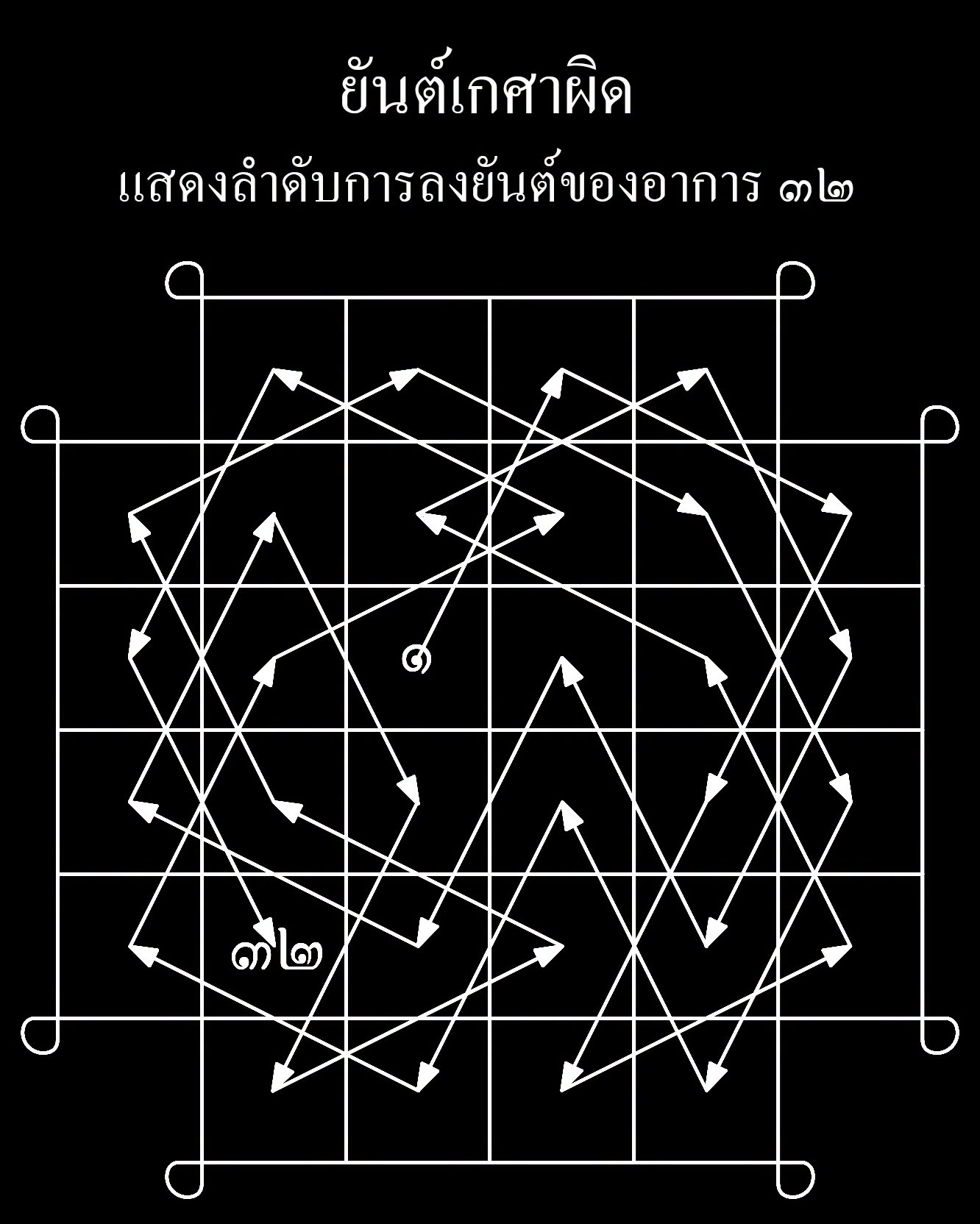
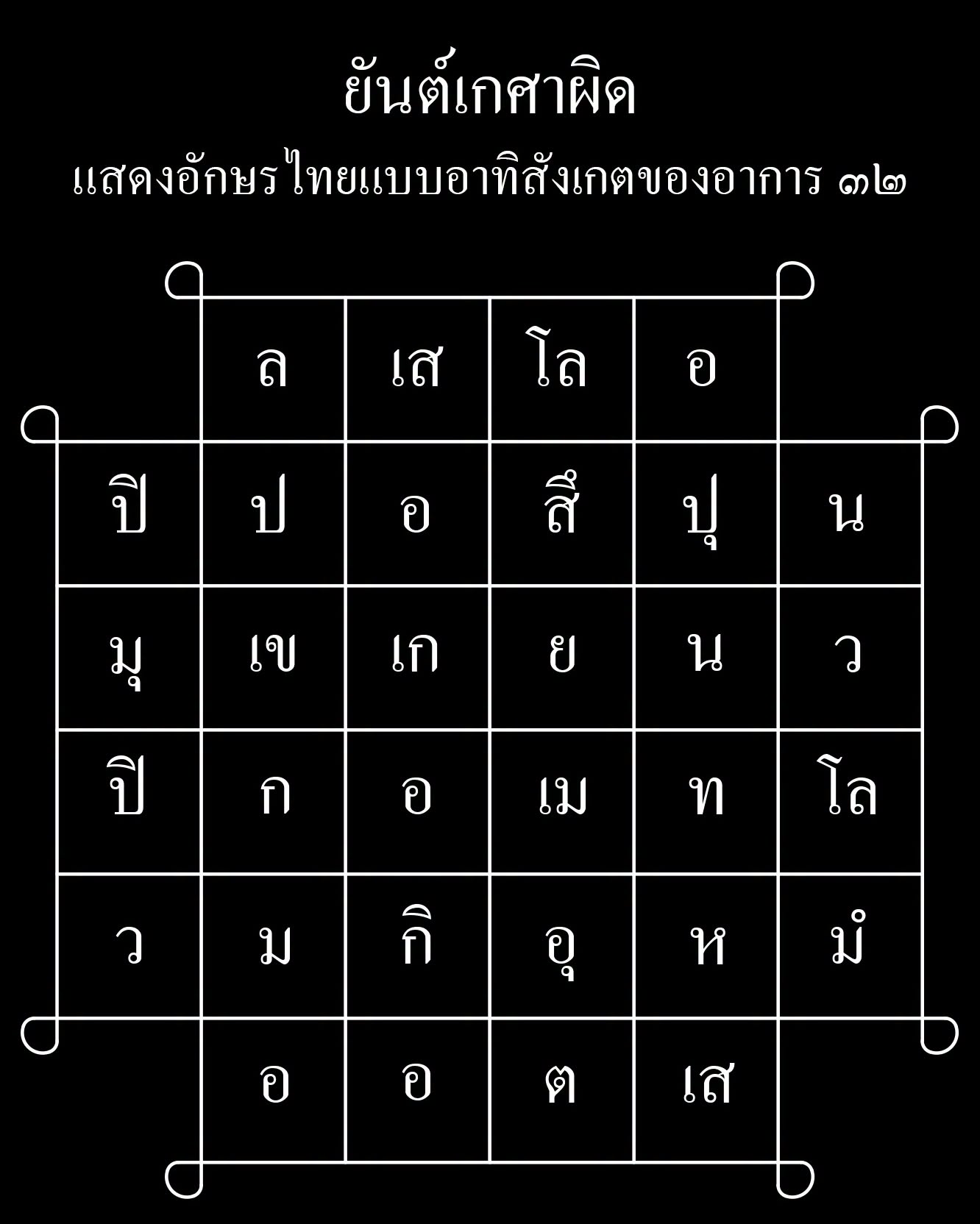
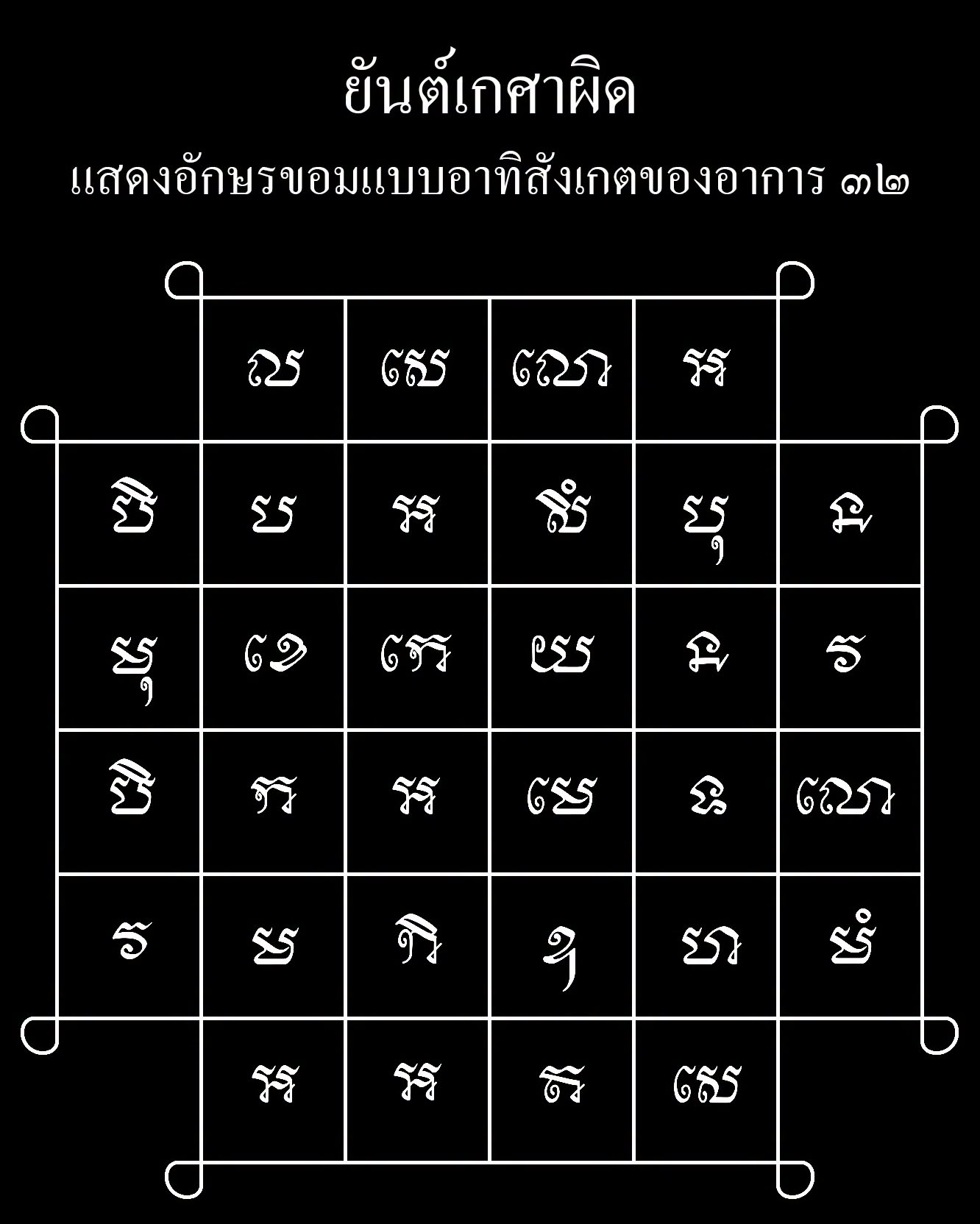
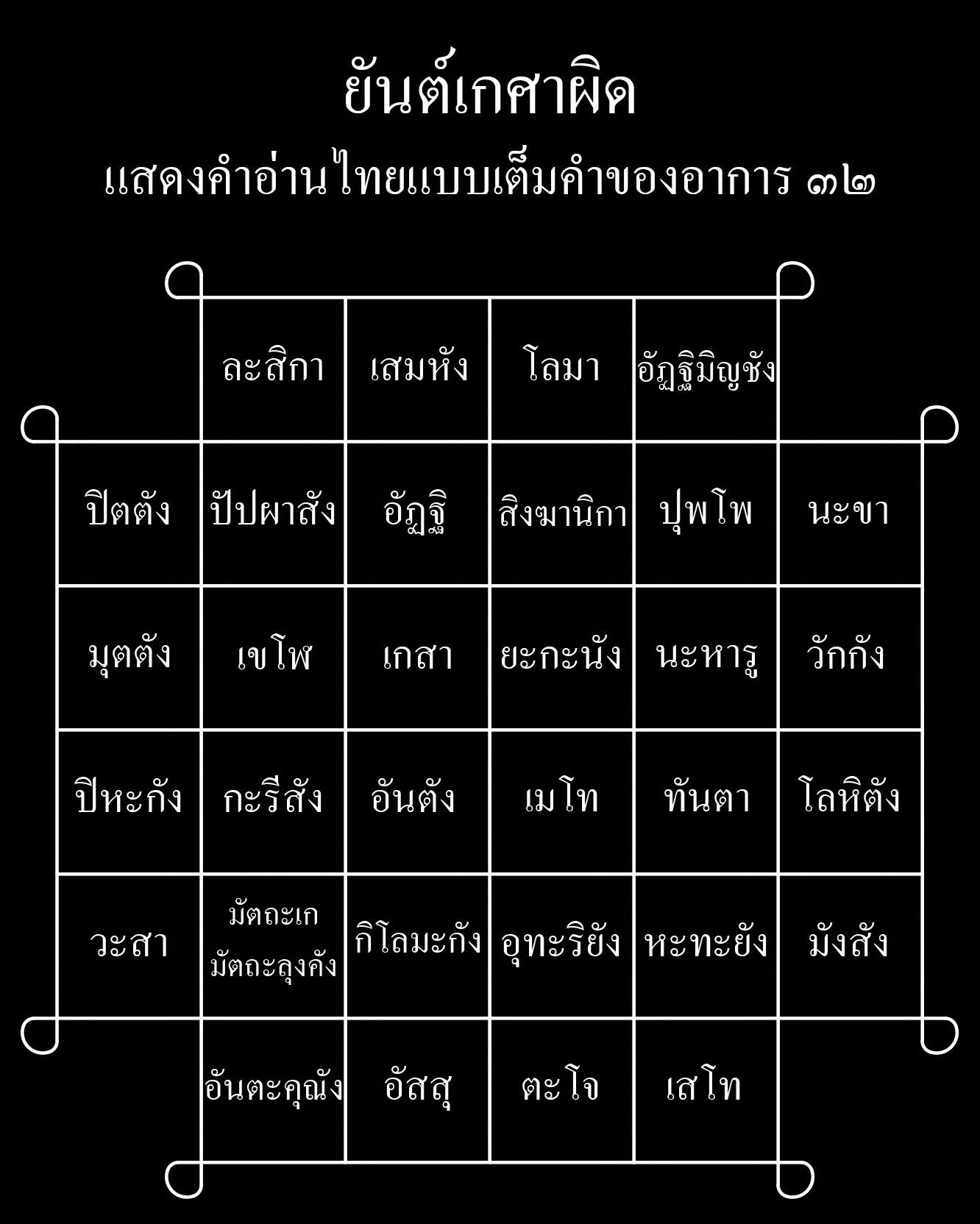
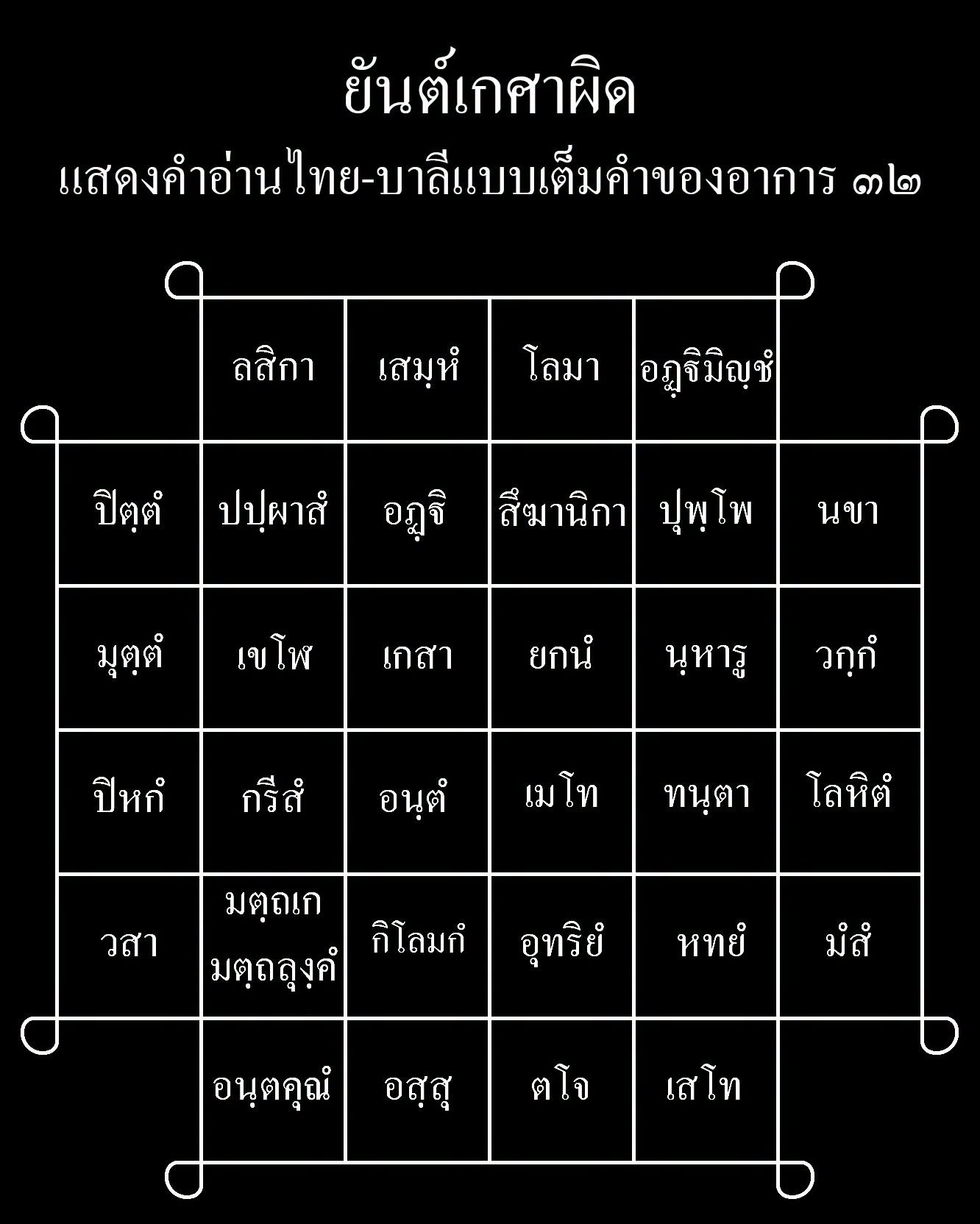
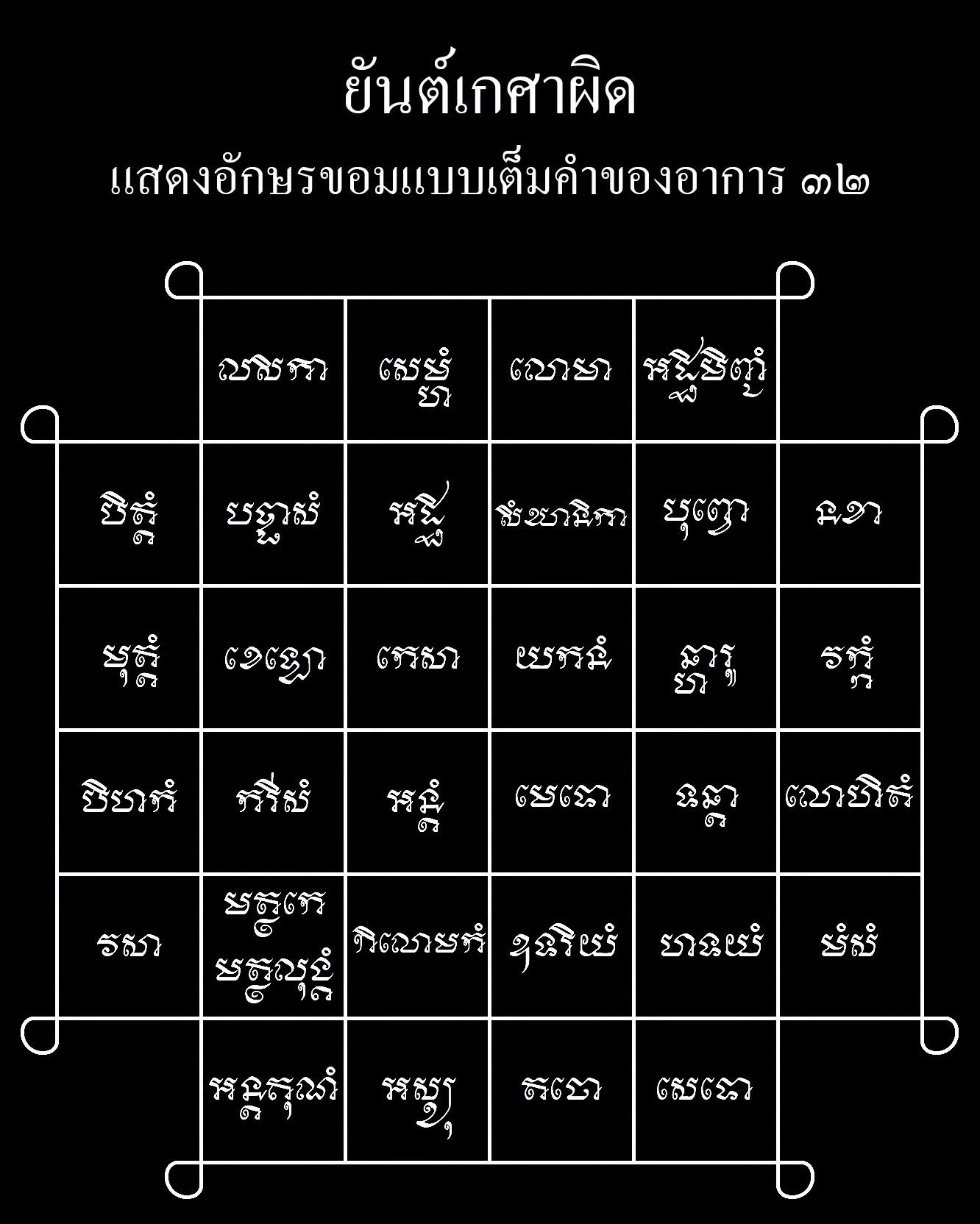
Six drawings of one design, published by ตำราอักขระเลขยันต์ ส.สุวรรณ พ.พัฒนศักดิ์ (Facebook, September 2026) and shown here for study — the plates are that page’s work, not this one’s. Everything below is read off them.
Watch it laid in
The grid, the empty corners and the order are the plate’s own, transcribed from the drawings above. The route is checked move by move when this page is built.
The thirty-two, and the letter each one gives
The method the post names is อาทิสังเกต — marking by the initial. Take the first letter of each word and lay that letter in, instead of the word. The plate does this twice over, once in Khom and once in Thai, and then gives the full words on two more plates.
| Pali | laid in | read as | what it is | the plate’s full word | cell | |
|---|---|---|---|---|---|---|
| 1 | เกสา | เก | เกสา | hair of the head | เกสา | r3 c3 |
| 2 | โลมา | โล | โลมา | body hair | โลมา | r1 c4 |
| 3 | นขา | น | นะขา | nails | นะขา | r2 c6 |
| 4 | ทนฺตา | ท | ทันตา | teeth | ทันตา | r4 c5 |
| 5 | ตโจ | ต | ตะโจ | skin | ตะโจ | r6 c4 |
| 6 | มํสํ | มํ | มังสัง | flesh | มังสัง | r5 c6 |
| 7 | นฺหารู | น | นะหารู | sinew | นะหารู | r3 c5 |
| 8 | อฏฺฐิ | อ | อัฏฐิ | bone | อัฏฐิ | r2 c3 |
| 9 | อฏฺฐิมิญฺชํ | อ | อัฏฐิมิญชัง | marrow | อัฏฐิมิญชัง | r1 c5 |
| 10 | วกฺกํ | ว | วักกัง | spleen | วักกัง | r3 c6 |
| 11 | หทยํ | ห | หะทะยัง | heart | หะทะยัง | r5 c5 |
| 12 | ยกนํ | ย | ยะกะนัง | liver | ยะกะนัง | r3 c4 |
| 13 | กิโลมกํ | กิ | กิโลมะกัง | fascia | กิโลมะกัง | r5 c3 |
| 14 | ปิหกํ | ปิ | ปิหะกัง | kidney | ปิหะกัง | r4 c1 |
| 15 | ปปฺผาสํ | ป | ปัปผาสัง | lungs | ปัปผาสัง | r2 c2 |
| 16 | อนฺตํ | อ | อันตัง | large intestine | อันตัง | r4 c3 |
| 17 | อนฺตคุณํ | อ | อันตะคุณัง | small intestine | อันตะคุณัง | r6 c2 |
| 18 | อุทริยํ | อุ | อุทะริยัง | food newly eaten | อุทะริยัง | r5 c4 |
| 19 | กรีสํ | ก | กะรีสัง | food digested | กะรีสัง | r4 c2 |
| 20 | ปิตฺตํ | ปิ | ปิตตัง | bile | ปิตตัง | r2 c1 |
| 21 | เสมฺหํ | เส | เสมหัง | phlegm | เสมหัง | r1 c3 |
| 22 | ปุพฺโพ | ปุ | ปุพโพ | pus | ปุพโพ | r2 c5 |
| 23 | โลหิตํ | โล | โลหิตัง | blood | โลหิตัง | r4 c6 |
| 24 | เสโท | เส | เสโท | sweat | เสโท | r6 c5 |
| 25 | เมโท | เม | เมโท | fat | เมโท | r4 c4 |
| 26 | อสฺสุ | อ | อัสสุ | tears | อัสสุ | r6 c3 |
| 27 | วสา | ว | วะสา | grease | วะสา | r5 c1 |
| 28 | เขโฬ | เข | เขโฬ | saliva | เขโพ | r3 c2 |
| 29 | สึฆานิกา | สึ | สิงฆานิกา | mucus | สิงฆานิกา | r2 c4 |
| 30 | ลสิกา | ล | ละสิกา | synovial fluid | ละสิกา | r1 c2 |
| 31 | มุตฺตํ | มุ | มุตตัง | urine | มุตตัง | r3 c1 |
| 32 | มตฺถเก มตฺถลุงฺคํ | ม | มัตถะเก มัตถะลุงคัง | brain | มัตถะเก มัตถะลุงคัง | r5 c2 |
How it came to be
Nothing about the kesa yant is invented at the yant. Every part of the method is already in the manuals — the list, the use of the list as words-while-you-draw, the knight’s move as an order, and the worry that makes a closed route worth having. What is new is putting them together.
The list is canonical, and its work is disgust
ทวัตติงสาการ · dvattiṃsākāra · Khuddakapāṭha 3, and the paṭikūlamanasikāra of the commentariesRecited to see the body as unlovely and be done wanting it. The thirty-two are a meditation before they are ever a yant. Four of the meditation manuals in this corpus use them that way and nothing else.
The yant tradition turns the same list into armour
Every one of the thirty-two is named and answered with เพ็ชชะคง — diamond-hard. The list that was recited to loosen a man's grip on his body is recited here to make that body impossible to cut.
อิติปิโส ภะคะวา โอม เกสา ผมอยู่ในทั่วสารพางค์ตัวกู โอมเพ็ชชะคง คง ตรีเพ็ชชะคง อิติปิโส ภะคะวา โอม โลมา ขนอยู่ในทั่วสารพางค์ตัวกู โอมเพ็ชชะคง คง ตรีเพ็ชชะคง อิติปิโส ภะคะวา โอม นักขา เล็บอยู่ในทั่วสารพางค์ตัวกู โอมเพ็ชชะคง คง ตรีเพ็ชชะคง …Itipiso Bhagava. Om, kesā — the hair is throughout my whole frame. Om, diamond-fast, fast, thrice diamond-fast. Itipiso Bhagava. Om, lomā — the body hair is throughout my whole frame… and so through all thirty-two.ประมวลคาถาตำราโบราณ · page 39 — โองการเอิกเกริกน้อย. Translation this project’s.The thirty-two become the laying-in liturgy for a figure yant
For any yant drawn as a figure — a deva, a lion, a bird, a fish — the manual gives the full thirty-two as the words you say while you draw it. Not a footnote: the formula for that whole class of yant.
ยันต์รูปภาพ บรรดารูปภาพต่างๆ ที่ใช้ลงเป็นยันต์นั้นเมื่อเวลาลงภาพนั้น ให้ลงด้วยอาการ ๓๒ คือ เกษา โลมา นักขา ทันตา ตะโจ มังสัง นะหารู อัฏฐิ …Figure yant: for all the various figures used as a yant, when you lay in the figure, lay it in with the thirty-two parts, thus — kesā, lomā, nakhā, dantā, taco, maṃsaṃ, nhārū, aṭṭhi…สูตรการลงยันต์แบบขอมผสมไทย · page 43 — ยันต์รูปภาพ. Translation this project’s.A yant drawn as a person gets them twice
สูตรการลงยันต์แบบขอมผสมไทย · page 44A figure written with a name — the kind buried with a candle — is laid in with the ปถมังโลกีย์ formula and then consecrated with the thirty-two on top of it.
Each letter laid in is a birth, and has to be pinned or it leaves
สูตรการลงยันต์แบบขอมผสมไทย · page 45Every letter carries its own line — X กาโรโหติสัมภะโว, the letter X comes into being — and the manual warns that a letter not pinned (กรึง) afterwards can escape and fade. A sequence that closes on itself is a sequence with nowhere to leave from.
The knight's move is already a laying-in order
การลงตัวอักขระต้องลงอย่างตามคำม้าหมากรุก ตามลำดับตัวอักขระ — the letters must be laid in by the knight's move, in the order of the letters. Here it carries the five Pali consonant groups rather than the thirty-two parts.
ยันต์นี้ใช้ลงเป็นผ้าประเจียด ใช้ได้สารพัดทุกประการ ตามแต่จะปรารถนาเถิด การลงตัวอักขระต้องลงอย่างตามคำม้าหมากรุก ตามลำดับตัวอักขระ แล้วจึงเสกด้วยพระคาถานี้This yant is laid onto a prajiat cloth and serves for anything you wish. The letters must be laid in by the knight's move, in the order of the letters, and then consecrated with this katha.ตำรามหายันต์ · page 27, yant ๒๔. Translation this project’s.And the thirty-two are recited while a body is bound
Thirty-two strands of rice straw, one per part, bound while you recite the thirty-two until it is finished. The same list, carried by straw instead of letters.
ถ้าจะผูกหุ่นพยนต์ ท่านให้ผูกขึ้นด้วยซังข้าว ๓๒ เส้น … เมื่อผูกหุ่นนั้นให้ภาวนาด้วยอาการ ๓๒ กว่าจะแล้วเสร็จTo bind a hun payont, bind it up from thirty-two strands of rice straw… and while you bind it, recite the thirty-two parts until it is done.ตำราสร้างเครื่องรางของขลัง · printed page ๗๘ — หุ่นพยนต์ แบบที่ ๒. Translation this project’s.
Recited to be repelled, recited to be uncuttable
That second step is the turn worth sitting with. In the meditation the thirty-two are gone through so that the body stops looking like a possession worth keeping. In the yant manual the same thirty-two are gone through so that the body cannot be cut. Same list, same order, opposite errand — and the manuals on this disk carry both without comment.
Where the lists disagree
The post’s table and the recension transcribed in this corpus are not identical. Set side by side, they part company in four places.
| Pali | the post | ประมวลคาถาตำราโบราณ p.39 | ||
|---|---|---|---|---|
| 16 | อนฺตํ | ไส้ใหญ่ | ไส้น้อย | the two intestines change places between the two lists |
| 17 | อนฺตคุณํ | ไส้น้อย | ไส้ใหญ่ | and so this one does too — the pair is swapped, not mistranslated once |
| 26 | อสฺสุ | อัสสุ | อัฐสุ | a written variant in the same transcription |
| 28 | เขโฬ | เขโฬ | เขโพ | ฬ for พ — and the plate writes เขโพ too, so this is a reading, not a slip |
And in two places both Thai lists read against the Pali commentaries, in the same direction — so this is the Thai liturgical convention rather than a slip in either.
| Pali | both Thai lists | ||
|---|---|---|---|
| 10 | วกฺกํ | ม้าม · spleen | Pali commentaries: kidney |
| 14 | ปิหกํ | ไต · kidney | Pali commentaries: spleen |
Item 32 is the tell that the set grew. มตฺถเก มตฺถลุงฺคํ — “the brain in the head” — is two words and a locative where every other entry is a single noun, and it is absent from the earlier canonical list, which runs to thirty-one. The yant needs thirty-two cells because a late addition made the count even.
Counted in this corpus
| word | said | what it means | pages | mss | |
|---|---|---|---|---|---|
| อาการ ๓๒ | akan sam-sip-song | the thirty-two parts, in the Thai name | 24 | 13 | |
| เกสา | kesā | hair of the head — the first part, and this yant's name | 33 | 12 | |
| ทวัตติงสา | dvattiṃsā | the Pali name of the set | 1 | 1 | |
| หมากรุก | mak ruk | chess — the knight's move is คำม้าหมากรุก | 3 | 2 | |
| ปถมัง | pathamang | the foundational laying-in system | 31 | 7 | |
| กรึง | krueng | to pin a letter so it cannot leave | 52 | 8 | |
| เพ็ชชะคง | phetcha khong | diamond-fast — the invulnerability formula | 25 | 5 | |
| อาทิสังเกต | ādi-saṅketa | marking by the initial — this yant's mnemonic | 0 | 0 |
Thai is written without spaces, so a short word matches inside longer ones and each count is an upper bound. These are counts over the pages transcribed so far, which are a slice of the catalogue, not the whole of it — a nil here means not on this disk.
Does the route close?
The post’s claim is a geometric one: the letters can be laid start to finish and then begun again by the same method, round without end. In chess terms the open route is a knight’s tour and the looping one is a closed tour — one whose last cell is a knight’s move from its first.
It closes. The plate’s board is a 6×6 grid with its four corner cells absent, which leaves exactly thirty-two — and the route drawn on it runs r3 c3 to r5 c2, a knight’s move apart. Every one of the thirty-two steps is checked when this page is built, and so is the closing one.
A correction
This page said the opposite when it first went up on 19 September 2026: that no thirty-two-cell board it tested could close, this one included. That was a bug in the search here, not a fact about the yant. A cell still to be visited can take its second edge from the cell the route started at — that is what closing a loop means — and the search was not counting it, so it threw away every closed tour one move before completion. The plate is what caught it.
The letters are enough to recover the order
The interesting consequence is what อาทิสังเกต costs and what it does not. Cutting thirty-two words down to their initials looks lossy — five cells read อ, and โล, น, ว, ปิ and เส each appear twice. But 17 of the thirty-two letters occur only once on the plate, which pins those cells outright, and the knight’s move constrains what can follow what. Put those two together and the remaining 15 cells have 1 arrangement: the order is recoverable from the letters alone, with the arrows removed.
That is not an argument this page makes about the plate — it is what the plate does. The order derived that way was then checked against the two full-word drawings, cell by cell, and agrees on all thirty-two. The design is self-checking: lay the letters wrong and no knight’s route will thread them.
Why a rectangle cannot do it
Thirty-two cells do not have to sit in that shape, and most shapes will not take the route. Eleven arrangements are searched here exhaustively, open and closed — the two rectangles that hold thirty-two cells, and every way of leaving four cells empty in a 6×6 so that a quarter turn carries the empty cells onto each other, which is the family that keeps a plate symmetric. The plate’s own board is the last of those.
| thirty-two cells as | open route | closes | nodes searched | light / dark |
|---|---|---|---|---|
| a 4x8 block | yes | no | 105,558 | 16 / 16 |
| a 2x16 strip | no | no | 0 | 16 / 16 |
| 6x6, four cells empty at (0,0) (0,5) (5,0) (5,5) | yes | yes | 33 | 16 / 16 |
| 6x6, four cells empty at (0,1) (1,5) (4,0) (5,4) | yes | yes | 91 | 16 / 16 |
| 6x6, four cells empty at (0,2) (2,5) (3,0) (5,3) | yes | no | 1,559 | 16 / 16 |
| 6x6, four cells empty at (0,3) (2,0) (3,5) (5,2) | yes | no | 1,559 | 16 / 16 |
| 6x6, four cells empty at (0,4) (1,0) (4,5) (5,1) | yes | yes | 40 | 16 / 16 |
| 6x6, four cells empty at (1,1) (1,4) (4,1) (4,4) | yes | yes | 32 | 16 / 16 |
| 6x6, four cells empty at (1,2) (2,4) (3,1) (4,3) | no | no | 0 | 16 / 16 |
| 6x6, four cells empty at (1,3) (2,1) (3,4) (4,2) | no | no | 0 | 16 / 16 |
| 6x6, four cells empty at (2,2) (2,3) (3,2) (3,3) | no | no | 49 | 16 / 16 |
7 of 11 take the open route; 4 close, the plate’s board among them. 111,970 positions were examined. A 4×8 block takes the open route and cannot close, and there the result is general rather than particular: no rectangle four cells deep has a closed tour, whatever its length. What the rectangle has and the plate does not is corners — a cell in the corner of a rectangle is one a knight can enter only two ways, and a closed route has to use both. The plate cuts those four cells out of the grid entirely, which is also what brings the count to thirty-two.
Nor does any of this turn on the easy check: a knight always moves between a light cell and a dark one, so a closed route needs sixteen of each, and every board in the table has sixteen of each. Shape decides it, not the count.
ผิด, พิด, พิศ
The post is careful about the name and this page will be too. Some manuals write ผิด — wrong, out of place. Some write พิด, which reads as poison. Some write พิศ, to gaze at, to consider closely. Only the third has an obvious bearing on a list of body parts used for contemplation, and the post’s own hashtag uses the first. Who first tied this yant, and which he meant, the post says nobody knows.
Sources
| what | when | the part used here | |
|---|---|---|---|
| The post | 2026 | A Thai yant page, #ว่าด้วยยันต์เกศาผิด — the edition that closes and can be re-entered, and the อาทิสังเกต table of initials. Text as shared, September 2026. | |
| ประมวลคาถาตำราโบราณ | — | p.39, โองการเอิกเกริกน้อย — the thirty-two answered one by one with เพ็ชชะคง. | |
| สูตรการลงยันต์แบบขอมผสมไทย | — | pp.43–45 — the thirty-two as the laying-in formula for a figure yant; pathamang for a named figure; a letter is born, and must be pinned. | |
| ตำรามหายันต์ | — | p.27 (yant ๒๔), the knight's move as a laying-in order; p.107, the thirty-two recited while a figure is bound. | |
| ตำราสร้างเครื่องรางของขลัง | — | printed pp.๗๗–๗๘ — thirty-two straws, bound to the thirty-two parts. | |
| Khuddakapāṭha 3 · Paṭikūlamanasikāra | — | The canonical set. The paṭikūlamanasikāra list runs to thirty-one; mattake matthaluṅgaṃ, the brain, is not in the earlier canonical sources. | link |
| A. J. Schwenk | 1991 | Which rectangular chessboards have a knight's tour? — no m×n board with m = 4 has a closed tour, whatever n is. | link |
The yant designs of this corpus → หุ่นพยนต์ · the effigy → สักขาลาย · the leg tattoo →
Text and tables on this page: CC BY 4.0, attribution to wichaa.net. Translations from the Thai are this project’s. The manuscript pages quoted are contributed volumes in this corpus, cited by their transcribed page.